<?xml version="1.0" encoding="UTF-8"?>
<!DOCTYPE article PUBLIC "-//NLM//DTD Journal Publishing DTD v2.3 20070202//EN" "journalpublishing.dtd">
<article xmlns:mml="http://www.w3.org/1998/Math/MathML" xmlns:xlink="http://www.w3.org/1999/xlink" article-type="review-article">
  <front>
	<journal-meta>
	<journal-id journal-id-type="publisher-id">7</journal-id>
	<journal-title>Viruses</journal-title>
	<abbrev-journal-title abbrev-type="publisher">Viruses</abbrev-journal-title>
	<abbrev-journal-title abbrev-type="pubmed">Viruses</abbrev-journal-title>
	<abbrev-journal-title abbrev-type="system">viruses</abbrev-journal-title>
	<abbrev-journal-title>Viruses</abbrev-journal-title>
	<issn pub-type="epub">1999-4915</issn>
	<publisher>
	<publisher-name>Molecular Diversity Preservation International</publisher-name>
	</publisher>
	<abbrev-journal-title abbrev-type="publisher">Viruses</abbrev-journal-title><abbrev-journal-title abbrev-type="pubmed">Viruses</abbrev-journal-title><abbrev-journal-title abbrev-type="system">viruses</abbrev-journal-title></journal-meta>
	<article-meta><article-id pub-id-type="pii">viruses-02-00111</article-id>
	<article-id pub-id-type="pii">viruses-02-00111</article-id>
	<article-id pub-id-type="doi">10.3390/v2010111</article-id>
	<article-id pub-id-type="publisher-id">v2010111</article-id>
	<article-categories>
	<subj-group>
	<subject>Review</subject>
	</subj-group>
	</article-categories>
      <title-group>
        <article-title>Retroviral Integration Site Selection</article-title>
      </title-group>
      <contrib-group>
        <contrib contrib-type="author">
          <name>
            <surname>Desfarges</surname>
            <given-names>Sébastien</given-names>
          </name>
        </contrib>
        <contrib contrib-type="author">
          <name>
            <surname>Ciuffi</surname>
            <given-names>Angela</given-names>
          </name>
        </contrib>
      </contrib-group>
      <aff>Institute of Microbiology, University Hospital Center and University of Lausanne, Bugnon 48, CH-1011 Lausanne, Switzerland; E-Mail: Sebastien.Desfarges@chuv.ch</aff>
      <author-notes>
        <corresp id="c1">Author to whom correspondence should be addressed; E-Mail: Angela.Ciuffi@chuv.ch; Tel.: +41-21-314-66-71; Fax: +41-21-314-40-95.</corresp>
      </author-notes>
      <pub-date pub-type="epub">
        <day>12</day>
        <month>01</month>
        <year>2010</year>
      </pub-date>
      <volume>2</volume>
      <issue>1</issue>
      <fpage>111</fpage>
      <lpage>131</lpage>
      <history>
        <date date-type="received">
          <day>08</day>
          <month>10</month>
          <year>2009</year>
        </date>
        <date date-type="rev-recd">
          <day>21</day>
          <month>12</month>
          <year>2009</year>
        </date>
        <date date-type="accepted">
          <day>05</day>
          <month>01</month>
          <year>2010</year>
        </date>
      </history>
      <permissions>
        <copyright-statement>©  2010 by the authors; licensee Molecular Diversity Preservation International, Basel, Switzerland</copyright-statement>
        <copyright-year>2010</copyright-year>
        <license xmlns:xlink="http://www.w3.org/1999/xlink" license-type="open-access" xlink:href="http://creativecommons.org/licenses/by/3.0/">
          <p>This is an open-access article distributed under the terms of the Creative Commons Attribution License, which permits unrestricted use, distribution, and reproduction in any medium, provided the original work is properly cited.</p>
        </license>
      </permissions>
      <abstract>
        <p>The stable insertion of a copy of their genome into the host cell genome is an essential step of the life cycle of retroviruses. The site of viral DNA integration, mediated by the viral-encoded integrase enzyme, has important consequences for both the virus and the host cell. The analysis of retroviral integration site distribution was facilitated by the availability of the human genome sequence, revealing the non-random feature of integration site selection and identifying different favored and disfavored genomic locations for individual retroviruses. This review will summarize the current knowledge about retroviral differences in their integration site preferences as well as the mechanisms involved in this process.</p>
      </abstract>
      <kwd-group>
        <kwd>retrovirus</kwd>
        <kwd>integration</kwd>
        <kwd>site selection</kwd>
        <kwd>integrase</kwd>
        <kwd>HIV</kwd>
        <kwd>LEDGF</kwd>
        <kwd>LEDGF/p75</kwd>
        <kwd>PSIP1</kwd>
        <kwd>lentivirus</kwd>
        <kwd>transcription</kwd>
      </kwd-group>
    <supplement>2010</supplement></article-meta>
  </front>
  <body>
    <sec sec-type="intro">
      <title>1. Introduction </title>
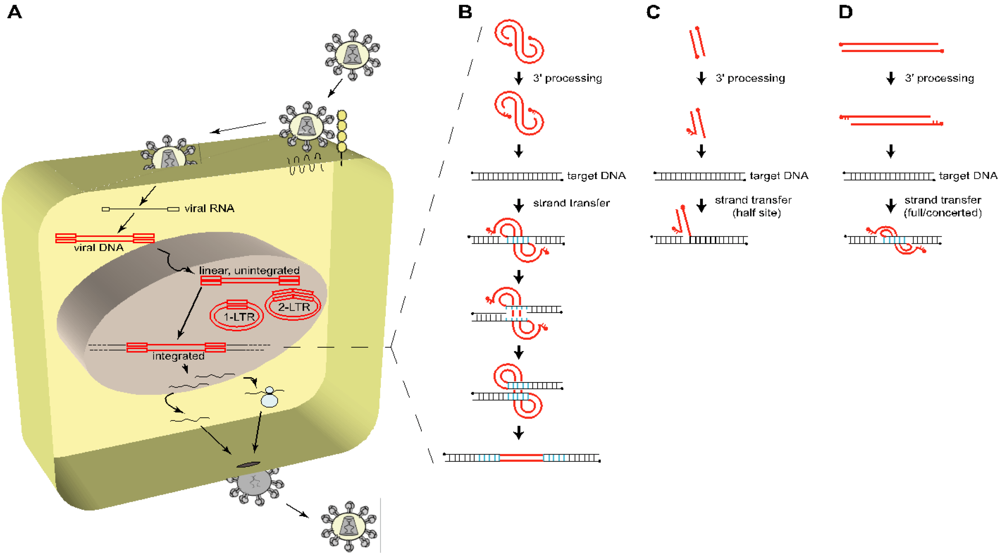
      <p>The principal feature of retroviruses is that upon entry and release of their viral RNA genome into the cytoplasm of the host cell, it is reverse transcribed by the viral reverse transcriptase into a linear double stranded cDNA copy (<xref ref-type="fig" rid="figure1">Figure 1A</xref>) (for reviews, see [<xref ref-type="bibr" rid="B1">1-4</xref>]). This viral DNA is not naked, but is associated with viral and cellular proteins in a nucleoprotein complex called the preintegration complex (PIC). Depending on the retrovirus, the PIC is subsequently translocated into the nucleus, either actively through nuclear pores, or upon nuclear membrane disruption occurring during mitosis. There, it is, either integrated into the genome of the host cell, or remains unintegrated for a certain time, or is degraded (<xref ref-type="fig" rid="figure1">Figure 1</xref>) (for reviews, see [<xref ref-type="bibr" rid="B3">3</xref>,<xref ref-type="bibr" rid="B5">5</xref>]).</p>
      <p>The insertion of the viral DNA into the host cell genome is catalyzed by the virally encoded integrase (IN) enzyme (for reviews, see [<xref ref-type="bibr" rid="B6">6-9</xref>]). Retroviral INs typically range between 280 and 450 amino acids (HIV-1 IN: 288 amino acids, 32 kDa), and are characterized by three functional domains: (i) the N-terminal domain, containing an HHCC zinc-binding motif, (ii) the catalytic core domain (residues 50-212 of HIV-1), containing the critical magnesium-binding D-D-35-E motif that constitutes the active site, and (iii) the C-terminal domain. The three domains of IN appear to be involved in DNA binding and multimerization. Indeed, the full concerted integration seems to require an IN tetramer, <italic>i.e., </italic>one IN dimer at each viral end [<xref ref-type="bibr" rid="B10">10-14</xref>].</p>
      <p>Although unintegrated viral DNA can be used as template for viral transcription [<xref ref-type="bibr" rid="B15">15-17</xref>], integration is required for productive viral replication. However, the efficiency of integration is quite low, and depends on restrictions occurring during the early steps of infection. By infecting human osteosarcoma (HOS) cells with VSV-G pseudotyped HIV particles, Thomas <italic>et al.</italic> measured that only 5% of HIV viruses successfully entered the cell and initiated reverse transcription [<xref ref-type="bibr" rid="B18">18</xref>]. Of these, 28% (<italic>i.e.,</italic> 1.5% total) completed reverse transcription, translocated to the nucleus (with an efficiency ranging around 2-3% according to data using IN-eGFP fusion proteins from Cereseto and collaborators [<xref ref-type="bibr" rid="B19">19</xref>,<xref ref-type="bibr" rid="B20">20</xref>]) and finally only ~13% of viruses that initiated reverse transcription achieved insertion in the host cell genome, which represented 0.41% of the virus input [<xref ref-type="bibr" rid="B18">18</xref>]. </p>
      <p>The site of viral DNA insertion is critical for the virus, as it can influence the rate of viral transcription. Indeed, integration into transcriptionally active regions may favor viral gene expression, thus facilitating productive infectious progeny particles, while integration into transcriptionally repressed chromatin may disfavor viral gene expression, thus possibly facilitating viral latency [<xref ref-type="bibr" rid="B21">21-24</xref>].</p>
      <p>The ability of retroviruses to integrate has also important consequences for the host as it can affect the expression of genes surrounding the proviral DNA. Indeed, viral DNA disruptive insertion into a gene may alter its expression (reduced gene expression), thereby potentially affecting cellular physiology. More importantly, the activity of inserted viral promoters or enhancers near cellular genes may also affect their physiological expression (increased gene expression), potentially leading to tumorigenesis when these genes are proto-oncogenes [<xref ref-type="bibr" rid="B25">25</xref>,<xref ref-type="bibr" rid="B26">26</xref>]. This process, known as insertional mutagenesis, raised justified critical issues regarding the safety of retroviral-based vectors used in gene therapy (for reviews, see [<xref ref-type="bibr" rid="B27">27-32</xref>]). However, not all retroviruses display the same genotoxic potential, as gammaretroviruses for example appeared to be more prone to insertional mutagenesis than lentiviruses [<xref ref-type="bibr" rid="B33">33-37</xref>]. This phenomenon can be partly explained by their preferred genomic site for proviral DNA insertion, <italic>i.e.,</italic> into promoter regions for gammaretroviruses and along transcription units for lentiviruses.</p>
      <p>It is now clear that the chromosomal site of viral DNA integration is not random, but in contrast that retroviruses display specific preferences at distinct genomic positions. This review will summarize the current knowledge about retrovirus-specific favored integration sites, as well as the current models explaining these preferences.</p>
<fig id="figure1" position="float">
<label>Figure 1</label>
<caption>
<p>Overview of the early steps of HIV-1 life cycle. <bold>(A)</bold> To enter a target cell, HIV-1 gp120 binds to specific cellular receptors,<italic> i.e.,</italic> CD4 and a chemokine coreceptor (CCR5 or CXCR4), triggering the gp41-mediated fusion between the viral and the cellular membrane, and releasing the viral core in the cytoplasm of the host cell. The viral single stranded, positive, RNA genome (black line, flanked by open black squares depicting R-U5 and U3-R in its 5’ and 3’ termini respectively) is reverse transcribed into a linear double stranded cDNA copy (red line, flanked by open red squares representing the LTR = U3-R-U5), which is a component of the preintegration complex (PIC), also containing the viral integrase (IN), as well as other viral and cellular proteins. The PIC is translocated to the nucleus and the viral cDNA is either integrated through the action of IN or remains unintegrated (linear, 1-LTR circles, 2-LTR circles). From this point on, the cellular machinery of the host is recruited to transcribe the viral genome in order to produce all the components required to generate newly infectious particles. <bold>(B)</bold> The integration process is divided into three major steps: the 3’ processing and the strand transfer reaction, both catalyzed by IN, and the repair of the integrated viral DNA by the DNA repair machinery of the host cell. The PIC-containing viral DNA (red line, with 5’ ends depicted by filled circles) is first processed by the IN-mediated removal of a dinucleotide (GT) at each 3’ end of the viral DNA, leaving a protruding (AC) dinucleotide at the 5’ ends. IN then catalyzes the stable insertion of the processed viral DNA into a target DNA (black line), by simultaneously and asymmetrically breaking the target DNA 5 bp apart (blue bonds) (4 to 6 bp depending on the retrovirus) and joining it to the 3’ recessed ends of the viral DNA, leaving an integration intermediate with unpaired bases at each viral-target DNA junction. The DNA repair machinery of the host cell fills in the five nucleotide gap at each side of the viral DNA and removes the two 5’ overhang nucleotides from the viral DNA, resulting in the duplication of 5 bp of the target DNA at both sides of the proviral DNA. (C and D) Schematic concepts of <italic>in vitro</italic> integration assays showing half-site integration <bold>(C)</bold> and concerted or full-site integration <bold>(D)</bold>.</p>
</caption>
<graphic xmlns:xlink="http://www.w3.org/1999/xlink" xlink:href="viruses-02-00111-g001.tif" scale="0"/>
</fig>	      
    </sec>
    <sec>
      <title>2. Integration targeting <italic>in vitro </italic></title>
      <p><italic>In vitro</italic>, IN is sufficient to carry out the first two steps of the integration reaction, <italic>i.e.,</italic> 3’ processing and strand transfer reactions, resulting in the covalent attachment of the viral DNA on virtually any DNA target (random integration) (<xref ref-type="fig" rid="figure1">Figure 1</xref>B) [<xref ref-type="bibr" rid="B38">38</xref>]. To succeed, three principal components are minimally required: (i) purified viral integrase, (ii) a donor DNA mimicking a viral DNA terminal sequence to be recognized by IN, and (iii) an acceptor DNA in which the donor DNA will be inserted (for more details, see [<xref ref-type="bibr" rid="B7">7</xref>]).</p>
      <p>In the first <italic>in vitro</italic> assays, the donor DNA consisted in short oligonucleotide duplexes (21 bp minimum) containing the terminal LTR sequence (either U3 or U5), allowing to reproduce the 3’ processing efficiently, as well as the strand transfer reaction (albeit with lower efficiency). However, these were only half-site integration as only one donor DNA (e.g. one viral LTR) was inserted in the acceptor DNA (<xref ref-type="fig" rid="figure1">Figure 1</xref>C) [<xref ref-type="bibr" rid="B39">39</xref>], and not both in a concerted motion. This gave rise to the development of new assays, full-site or concerted integration assays, which use a longer donor DNA containing both terminal sequences (<xref ref-type="fig" rid="figure1">Figure 1</xref>D) [<xref ref-type="bibr" rid="B40">40</xref>,<xref ref-type="bibr" rid="B41">41</xref>].</p>
      <p> These studies showed that <italic>in vitro</italic>, HIV IN displayed only a weak preference for the primary DNA sequence [<xref ref-type="bibr" rid="B42">42-49</xref>], slightly favoring the palindromic TNN<bold>GT(A/T)AC</bold>NNA DNA sequence (bold nucleotides indicate the asymmetrical insertion points, resulting in the final 5 bp duplication flanking the proviral DNA, depicted in blue in <xref ref-type="fig" rid="figure1">Figure 1B</xref>). Furthermore, the addition of nucleosomes on the target DNA improved the <italic>in vitro</italic> efficiency of integration, and favored integration on distorted DNA and outwardly-facing major grooves sites of the nucleosomal DNA [<xref ref-type="bibr" rid="B44">44</xref>,<xref ref-type="bibr" rid="B46">46</xref>,<xref ref-type="bibr" rid="B47">47</xref>,<xref ref-type="bibr" rid="B50">50-53</xref>]. </p>
      <p>In order to investigate whether simple tethering of IN to a specific DNA site could confer integration preferences <italic>in vitro</italic>, fusions of IN to specific DNA binding proteins were engineered [<xref ref-type="bibr" rid="B54">54</xref>]. The fusion of HIV IN to the DNA binding domain of λ repressor (λR) lead to increased integration targeting at sites surrounding the predetermined λR DNA binding sites (λ operator sites) [<xref ref-type="bibr" rid="B54">54</xref>]. Fusion of IN with other DNA binding proteins such as LexA [<xref ref-type="bibr" rid="B55">55</xref>] or the polydactyl Zinc finger protein E2C [<xref ref-type="bibr" rid="B56">56</xref>] reached similar results. These studies provided proof-of-concept that integration site selection <italic>in vitro</italic> could be modified and redirected more preferentially to specific DNA sites.</p>
    </sec>
    <sec>
      <title>3. Integration targeting <italic>in vivo</italic></title>
      <p>The availability of the human genome sequence and other vertebrate genomes made possible to interrogate where in the host cell genome retroviruses integrated, and more precisely what were the chromosomal features (according to current genomic annotations) that were favored for retroviral integration. To achieve this, host DNA regions flanking the proviral DNAs were amplified, sequenced, and finally aligned to the host genome sequence (method overview reviewed in [<xref ref-type="bibr" rid="B32">32</xref>,<xref ref-type="bibr" rid="B57">57</xref>,<xref ref-type="bibr" rid="B58">58</xref>]). </p>
      <p>Schroder <italic>et al.</italic>, in 2002, revealed for the first time that HIV favored integration in transcription units and disfavored Alu repeats [<xref ref-type="bibr" rid="B59">59</xref>]. One year later, Wu <italic>et al.</italic> showed that murine leukemia virus (MLV) had distinct preferences, favoring integration at transcription start sites and CpG islands [<xref ref-type="bibr" rid="B60">60</xref>]. Since then, multiple genome-wide studies confirmed these preferences and revealed the integration site preferences for almost all retroviral genera, with the exception of epsilonretroviruses (Tables 1 and 2). </p>
<table-wrap id="table1" position="float"><object-id pub-id-type="pii">viruses-02-00111_table1</object-id>
<label><xref ref-type="table" rid="table1">Table 1</xref>	</label>
<caption>
<p>Major genome-wide studies of retroviral integration distribution.</p>
</caption>
<table border="1" cellspacing="0" cellpadding="0">
<thead>
  <tr>
    <th>Retroviridae genera</th>
    <th>Specimen <sup>a</sup></th>
    <th>Host cell type <sup>b</sup></th>
    <th>Approx. Nb. of    sites investigated <sup>c</sup></th>
    <th>References</th>
  </tr>
</thead>
<tbody>
<tr>
    <td><bold>lentiviruses</bold></td>
    <td>HIV-1</td>
    <td>human</td>
    <td>59869</td>
    <td>[23,36,59-76] </td>
  </tr>
  <tr>
    <td/>
    <td/>
    <td>other</td>
    <td>2421</td>
    <td>[37,77-81] </td>
  </tr>
  <tr>
    <td/>
    <td>HIV-2</td>
    <td>human </td>
    <td>202</td>
    <td>[82]</td>
  </tr>
  <tr>
    <td/>
    <td>SIV</td>
    <td>human</td>
    <td>148</td>
    <td>[83]</td>
  </tr>
  <tr>
    <td/>
    <td/>
    <td>simian</td>
    <td>501</td>
    <td>[84]</td>
  </tr>
  <tr>
    <td/>
    <td>EIAV</td>
    <td>human</td>
    <td>1241</td>
    <td>[69,81] </td>
  </tr>
  <tr>
    <td/>
    <td/>
    <td>other</td>
    <td>70</td>
    <td>[81]</td>
  </tr>
  <tr>
    <td/>
    <td>FIV</td>
    <td>human</td>
    <td>226</td>
    <td>[85]</td>
  </tr>
  <tr>
    <td/>
    <td/>
    <td/>
    <td/>
    <td/>
  </tr>
  <tr>
    <td><bold>alpharetroviruses</bold></td>
    <td>ASLV</td>
    <td>human</td>
    <td>695</td>
    <td>[62,86]</td>
  </tr>
  <tr>
    <td/>
    <td/>
    <td>avian</td>
    <td>658</td>
    <td>[77]</td>
  </tr>
  <tr>
    <td/>
    <td/>
    <td/>
    <td/>
    <td/>
  </tr>
  <tr>
    <td><bold>betaretroviruses</bold></td>
    <td>MMTV</td>
    <td>human</td>
    <td>298</td>
    <td>[87]</td>
  </tr>
  <tr>
    <td/>
    <td/>
    <td>murine</td>
    <td>170</td>
    <td>[87]</td>
  </tr>
  <tr>
    <td/>
    <td/>
    <td/>
    <td/>
    <td/>
  </tr>
  <tr>
    <td><bold>gammaretroviruses</bold></td>
    <td>MLV</td>
    <td>human</td>
    <td>4005</td>
    <td>[60,66,70,73,88] </td>
  </tr>
  <tr>
    <td/>
    <td/>
    <td>murine</td>
    <td>189</td>
    <td>[37]</td>
  </tr>
  <tr>
    <td/>
    <td/>
    <td>other</td>
    <td>953</td>
    <td>[78,79,84] </td>
  </tr>
  <tr>
    <td/>
    <td>MSCV</td>
    <td>murine</td>
    <td>259</td>
    <td>[89]</td>
  </tr>
  <tr>
    <td/>
    <td>PERV</td>
    <td>human</td>
    <td>1962</td>
    <td>[90,91] </td>
  </tr>
  <tr>
    <td/>
    <td>XMRV</td>
    <td>human</td>
    <td>472</td>
    <td>[92]</td>
  </tr>
  <tr>
    <td/>
    <td/>
    <td/>
    <td/>
    <td/>
  </tr>
  <tr>
    <td><bold>deltaretroviruses</bold></td>
    <td>HTLV-I</td>
    <td>human</td>
    <td>1235</td>
    <td>[93-95] </td>
  </tr>
  <tr>
    <td/>
    <td/>
    <td/>
    <td/>
    <td/>
  </tr>
  <tr>
    <td><bold>epsilonretroviruses</bold></td>
    <td>Not investigated</td>
    <td/>
    <td/>
    <td/>
  </tr>
  <tr>
    <td/>
    <td/>
    <td/>
    <td/>
    <td/>
  </tr>
  <tr>
    <td><bold>spumaviruses</bold></td>
    <td>FV</td>
    <td>human</td>
    <td>3457</td>
    <td>[65,70] </td>
  </tr>
  <tr>
    <td/>
    <td/>
    <td>other</td>
    <td>263</td>
    <td>[78]</td>
  </tr>
  <tr>
    <td/>
    <td/>
    <td/>
    <td/>
    <td/>
  </tr>
  <tr>
    <td><bold>Endogenous retroviruses</bold></td>
    <td>HERV-K</td>
    <td>human</td>
    <td>1565</td>
    <td>[88]</td>
  </tr>
</tbody>
</table>
<table-wrap-foot>
<fn>
<p>a. HIV: human immunodeficiency virus; SIV: simian immunodeficiency virus; EIAV: equine infectious anemia virus; FIV: feline immunodeficiency virus; ASLV: avian sarcoma leukosis virus; MMTV: mouse mammary tumor virus; MLV: murine leukemia virus; MSCV: murine stem cell virus; PERV: porcine endogenous retrovirus; XMRV: xenotropic murine leukemia virus-related virus; HTLV: human T-cell lymphotropic virus; FV: foamy virus; HERV: human endogenous retrovirus.</p>
</fn>
<fn>
<p>b. Host cell type includes human, simian, murine, canine and avian cells. Are indicated the human cells and the host cell type specific to each specimen. Other: non human and non species-specific host cell type.</p>
</fn>
<fn>
<p>c. Number of integration sites analyzed in untreated/control cells according to the original publication.</p>
</fn>
</table-wrap-foot>
</table-wrap>      
      <p>These studies demonstrated that <italic>in vivo</italic> the site of retroviral integration was not random, and that integration site preferences were retrovirus-specific (<xref ref-type="table" rid="table1">Table 1</xref>	): lentiviruses favor integration in active transcription units, with no preference along the transcript, nor for introns or exons; gammaretroviruses, spumaviruses and endogenous retroviruses (HERV class II) integrate preferentially around transcription start sites and CpG islands, features associated with host gene promoters; alpharetroviruses and deltaretroviruses displayed only weak preferences for integrating in transcription units and CpG islands; and finally betaretroviruses show no integration site preferences, displaying a random distribution of integration sites in the host genome.</p>
      <p>The integration site preferences are not host-specific as the same distribution of integration sites can be observed in different host vertebrate cells, including human, simian, murine, avian and canine cells (<xref ref-type="table" rid="table1">Table 1</xref>	). Furthermore, integration targeting is independent of the route of viral entry, as HIV-based vectors using a natural CCR5-tropic HIV envelope or a VSV-G pseudotype envelope displayed the same integration site distribution [<xref ref-type="bibr" rid="B67">67</xref>].</p>
<table-wrap id="table2" position="float"><object-id pub-id-type="pii">viruses-02-00111_table2</object-id>
<label><xref ref-type="table" rid="table1">Table 1</xref>	</label>
<caption>
<p>Chromosomal features associated with preferential retroviral integration sites.</p>
</caption>
<table border="1" cellspacing="0" cellpadding="0">
<thead>
  <tr>
    <th>Retroviridae genera</th>
    <th>in Transcription Units<sup>a</sup></th>
    <th>± 2kb Transcription Start Sites<sup>a</sup></th>
    <th>± 2 kb CpG Islands<sup>a</sup></th>
  </tr>
</thead>
<tbody>
<tr>
    <td>Lentiviruses</td>
    <td>+/++</td>
    <td>0</td>
    <td>-/0</td>
  </tr>
  <tr>
    <td>Alpharetroviruses</td>
    <td>+</td>
    <td>0</td>
    <td>+</td>
  </tr>
  <tr>
    <td>Betaretroviruses</td>
    <td>0</td>
    <td>0</td>
    <td>0</td>
  </tr>
  <tr>
    <td>Gammaretroviruses</td>
    <td>+</td>
    <td>++</td>
    <td>++</td>
  </tr>
  <tr>
    <td>Deltaretroviruses</td>
    <td>+</td>
    <td>+</td>
    <td>+</td>
  </tr>
  <tr>
    <td>Epsilonretroviruses</td>
    <td>NA</td>
    <td>NA</td>
    <td>NA</td>
  </tr>
  <tr>
    <td>Spumaviruses</td>
    <td>0</td>
    <td>++</td>
    <td>++</td>
  </tr>
  <tr>
    <td>HERV-class II</td>
    <td>+</td>
    <td>++</td>
    <td>++</td>
  </tr>
</tbody>
</table>
<table-wrap-foot>
<fn>
<p>a: ratio between the proportion of the chromosomal feature over the random proportion in the human genome, according to RefSeq databases and with values from [69,87,88,90,94,95];</p>
</fn>
<fn>
<p>0: no statistical difference over random;</p>
</fn>
<fn>
<p>+/++: statistically favored feature over random with ++ for ratio greater than 2 and + for a ratio less than 2;</p>
</fn>
<fn>
<p>-: statistically disfavored feature over random;</p>
</fn>
<fn>
<p>NA: not available.</p>
</fn>
</table-wrap-foot>
</table-wrap>      
      <p>Three models, which are not mutually exclusive, have been proposed to date to explain integration site selection: (i) chromatin accessibility, (ii) cell cycle effects, and (iii) tethering mechanism. However, while the first two models can globally influence integration site targeting, only the last one - integration by a tethering mechanism - can provide a logical explanation to the observed differences of integration targeting preferences among retroviruses.</p>
      <sec>
        <title>3.1. The chromatin accessibility model</title>
        <p>According to this model, the structure of the chromatin, either relaxed or condensed, may influence the accessibility of target DNA sequences to preintegration complexes, thereby affecting integration.</p>
        <p><italic>In vivo</italic>, retroviral integration displayed a weak preference for the primary DNA sequence, similar to the one observed <italic>in vitro</italic> [<xref ref-type="bibr" rid="B60">60</xref>,<xref ref-type="bibr" rid="B69">69</xref>,<xref ref-type="bibr" rid="B70">70</xref>,<xref ref-type="bibr" rid="B72">72</xref>,<xref ref-type="bibr" rid="B90">90</xref>,<xref ref-type="bibr" rid="B94">94</xref>,<xref ref-type="bibr" rid="B96">96-99</xref>]. Furthermore, HIV integration <italic>in vivo</italic> also favors major grooves facing outwards from the nucleosome core, as predicted by nucleosome positioning [<xref ref-type="bibr" rid="B72">72</xref>,<xref ref-type="bibr" rid="B100">100</xref>]. These data indicated that local chromatin structure, such as A/T-rich distorted DNA and outwardly-facing major grooves of the nucleosomal DNA, may facilitate integration, however this cannot fully explain the observed differences in retroviral integration site distribution. </p>
        <p>The retroviral differences in favored integration target site selection observed <italic>in vivo</italic> argued against chromatin accessibility being the principal determinant explaining integration targeting (<xref ref-type="table" rid="table1">Table 1</xref>	). Indeed, if the accessibility of chromatin was the key player, all retroviruses would display the same integration site distribution pattern, favoring reachable chromatin.</p>
        <p>Additional evidence against this model playing a major role in integration targeting came from the correlation analysis of mapped HIV and MLV integration sites with mapped DNase I hypersensitive sites. DNase I cleavage sites are used as a surrogate marker for accessible chromatin, and are enriched in the 5’ ends of transcription units and CpG islands [<xref ref-type="bibr" rid="B66">66</xref>,<xref ref-type="bibr" rid="B101">101</xref>]. This study revealed that MLV integrated preferentially in 2-kb intervals surrounding DNase I hypersensitive sites, compatible with favored MLV integration sites in promoter regions. In contrast, HIV integration did not display such a preference, consistent with favored integration in transcription units and not promoter regions. Therefore, although chromatin accessibility may influence MLV integration site preferences, it does not seem to affect significantly HIV integration site distribution.</p>
        <p>In conclusion, even though chromatin structure can facilitate integration, chromatin accessibility cannot solely explain the differences observed in integration site preferences between HIV and MLV. </p>
      </sec>
      <sec>
        <title>3.2. The cell cycle model</title>
        <p>This model implies that the phase of the cell cycle may influence integration site selection. Indeed, lentiviruses can infect and successfully integrate regardless of the cell cycle stage (dividing or non-dividing) thanks to the active nuclear import of the PIC, while gammaretroviruses can integrate only into dividing cells as they require the disruption of the nuclear membrane occurring during mitosis to contact the host genome. Thus, it is possible that this difference in cell cycling status during viral infection might affect integration site distribution. </p>
        <p>To test this hypothesis, HIV integration site distribution was compared between dividing IMR-90 primary lung fibroblasts and non-dividing G1-arrested IMR-90 cells [<xref ref-type="bibr" rid="B64">64</xref>]. HIV integration in active transcription units was favored in both dividing and non-dividing cells, with even stronger preferences in non-dividing cells. Similarly, analysis of HIV integration site distribution in non-dividing differentiated human macrophages also revealed a marked preference for transcription units [<xref ref-type="bibr" rid="B67">67</xref>,<xref ref-type="bibr" rid="B74">74</xref>]. Comparison between quiescent CD4+ T cells and activated CD4+ T cells revealed a similar integration site distribution with favored integration in transcription units and other chromosomal features (gene density, GC-rich regions, DNase I sites), although to a lower extent for resting cells [<xref ref-type="bibr" rid="B75">75</xref>,<xref ref-type="bibr" rid="B76">76</xref>]. </p>
        <p>All together, these data argued against a major positive influence of cycling cells in guiding HIV integration in transcription units and cannot explain the integration site selection differences between HIV and MLV. </p>
      </sec>
      <sec>
        <title>3.3. The tethering protein model </title>
        <p>This model implicates that a cellular protein, specific for each retroviral genera, would act as a tethering factor, binding both to specific chromatin sites and to the retroviral preintegration complex. </p>
        <p>In principle, any PIC component could serve as the docking point between the PIC and the integration site, thereby dictating the integration target site preferences. PIC candidates include both viral and cellular proteins.</p>
        <sec>
          <title>3.3.1. IN and Gag as major viral determinants in integration targeting</title>
          <p>To investigate the role of viral PIC components in integration site distribution, Lewinski <italic>et al.</italic> constructed chimeras between HIV and MLV encompassing Gag and IN regions [<xref ref-type="bibr" rid="B66">66</xref>]. The transfer of MLV Gag in HIV viruses did not affect the HIV integration site preferences of HIV, suggesting that HIV Gag was not involved in directing HIV integration site selection. The transfer of MLV IN into HIV viruses caused the hybrid to favor integration in transcription start sites and CpG islands, close to MLV phenotype. Addition of MLV Gag and MLV IN in HIV chimeric viruses increased the similarity of target site selection to that of MLV, suggesting that both MLV Gag and IN played a role in determining MLV integration site preferences. To summarize these data indicated that IN is the major viral determinant in shaping specific integration site preferences for HIV and MLV, with an additional, although minor, role of MLV Gag in MLV integration targeting. Recently, Felice <italic>et al.</italic> used a bioinformatic approach to show that in contrast to HIV, MLV integrated preferentially in regions enriched for transcription factor binding sites (as described in the JASPAR database) [<xref ref-type="bibr" rid="B73">73</xref>]. Using chimeric constructs for IN and the LTR U3 region between HIV and MLV, they showed that MLV IN was mostly responsible for this targeting, while the MLV U3 region could play a minor role [<xref ref-type="bibr" rid="B73">73</xref>].</p>
          <p>Recently, Tobaly-Tapiero <italic>et al.</italic> identified a chromatin-binding site in the C-terminus of Gag, essential for PIC binding to host chromosomes, by interacting with H2A/H2B core histones, suggesting that Gag may be a major viral determinant dictating foamy virus (FV) integration site selection, through H2A/H2B tethering [<xref ref-type="bibr" rid="B102">102</xref>].</p>
        </sec>
        <sec>
          <title>3.3.2. LEDGF/p75 as the major cellular determinant in lentiviral integration targeting</title>
          <p>Any cellular protein able to bind both chromatin and HIV IN (the major determinant involved in HIV integration targeting) may represent a candidate tethering factor. Numerous cellular proteins have been proposed, such as IN-interactor 1 (Ini-1), barrier to autointegration factor (BAF), high mobility group A1 (HMGA1), heat shock protein 60 (Hsp60) and lens epithelium-derived growth factor (PSIP1/LEDGF/p75) [<xref ref-type="bibr" rid="B2">2</xref>,<xref ref-type="bibr" rid="B103">103-108</xref>]. </p>
          <p>To date, only LEDGF/p75 proved to be a <italic>bona fide</italic> tethering protein, recruiting lentiviral PICs to transcription units, thereby promoting integration efficiency as well as dictating lentiviral integration site selection [<xref ref-type="bibr" rid="B32">32</xref>,<xref ref-type="bibr" rid="B109">109-111</xref>]. </p>
          <p>LEDGF/p75 is a 530 amino-acid bimodal protein containing a large N-terminal domain (comprising a PWWP motif, a nuclear localization signal, a dual AT-hook motif and charged regions) responsible for chromatin binding, and a C-terminal domain involved in protein-protein interaction and containing the IN-binding domain [<xref ref-type="bibr" rid="B110">110-112</xref>]. LEDGF/p75 is a ubiquitously expressed cellular protein and its cellular role has yet to be fully characterized. Proposed roles for LEDGF/p75 include transcriptional activity function [<xref ref-type="bibr" rid="B113">113</xref>], autoantigen in atopic dermatitis and inflammatory conditions [<xref ref-type="bibr" rid="B114">114</xref>], and cell survival [<xref ref-type="bibr" rid="B115">115</xref>]. Despite an increased perinatal mortality, mice knocked-out for the LEDGF/p75-encoding <italic>psip1</italic> gene survived to adulthood with a range of developmental and neurobehavioral abnormalities, suggesting that LEDGF/p75 is not essential for organism survival [<xref ref-type="bibr" rid="B116">116</xref>].</p>
          <p>Studies using RNAi to knock-down LEDGF/p75 expression or knock-out murine cells demonstrated that HIV and lentiviruses in general required LEDGF/p75 to efficiently integrate into the host genome [<xref ref-type="bibr" rid="B80">80</xref>,<xref ref-type="bibr" rid="B117">117</xref>,<xref ref-type="bibr" rid="B118">118</xref>]. Indeed, LEDGF/p75-depleted cells revealed a 10-40x decrease in infection efficiency as compared to LEDGF/p75 expressing cells. Furthermore, the analysis of lentiviral (HIV and EIAV) integration site distribution in cells depleted for LEDGF/p75 revealed an altered integration site selection profile, with a decreased preference for transcription units, as well as an increased targeting in transcription start sites and CpG islands, a pattern resembling MLV integration site preferences [<xref ref-type="bibr" rid="B63">63</xref>,<xref ref-type="bibr" rid="B80">80</xref>,<xref ref-type="bibr" rid="B81">81</xref>]. However, LEDGF/p75 did not affect the weak consensus primary DNA sequence favored by lentivirus integration, further suggesting that chromatin structure may facilitate integration more than dictating integration target sites. These data also suggest that, in absence of LEDGF/p75, other tethering proteins might recruit lentiviral PICs, and promote their integration in new specific chromosomal locations.</p>
          <p>Consistent with LEDGF/p75 recruiting lentiviral PICs to specific favored integrations, the distribution profile of LEDGF/p75 on host chromosome should parallel HIV integration site distribution profile. In order to investigate this, De Rijck <italic>et al.</italic> used the Dam methylase fused to the N-terminal domain of LEDGF/p75, a technology known as DamID [<xref ref-type="bibr" rid="B119">119</xref>]. Sites bound by LEDGF/p75 would induce methylation of proximal adenosine residues in the GATC recognition motif, which can subsequently be identified. DamID analysis of LEDGF/p75 proximal genomic site distribution revealed that LEDGF/p75-binding sites were enriched in genes and poorly present in promoters and intergenic regions, a distribution pattern reminiscent of HIV integration preferences [<xref ref-type="bibr" rid="B119">119</xref>]. Preliminary analysis of DNA sequences bound to LEDGF/p75 or LEDGF/p75-containing complex using a chromatin immunoprecipitation-based approach followed by high-throughput sequencing (ChIP-Seq) also revealed a distribution of LEDGF/p75-captured DNA sequences throughout the transcription units, paralleling HIV integration site distribution [<xref ref-type="bibr" rid="B120">120</xref>]. Moreover, so far, these studies did not highlight any DNA binding motif specific for LEDGF/p75 [<xref ref-type="bibr" rid="B120">120</xref>]. </p>
          <p>An additional argument for LEDGF/p75 being the major lentiviral tethering protein used the IN-binding domain containing C-terminal portion of LEDGF/p75 fused to an alternate N-terminal domain displaying distinct DNA or chromatin binding preferences [<xref ref-type="bibr" rid="B121">121-124</xref>]. This was exemplified first <italic>in vitro</italic> using λR-LEDGF/p75 fusion proteins [<xref ref-type="bibr" rid="B121">121</xref>] and was recently confirmed <italic>in vivo </italic>as well [<xref ref-type="bibr" rid="B122">122-124</xref>]. Indeed, using LANA31 or histone 1-LEDGF/p75 chimeric proteins, Meehan <italic>et al.</italic> showed that they could rescue infectivity in LEDGF/p75 depleted cells [<xref ref-type="bibr" rid="B122">122</xref>]. Furthermore, the fusion of LEDGF/p75 to heterochromatin protein 1α (CBX5) [<xref ref-type="bibr" rid="B123">123</xref>] or heterochromatin protein 1β (CBX1) [<xref ref-type="bibr" rid="B124">124</xref>] altered HIV integration site selection, redirecting integration preferences from active transcription units to heterochromatin regions, thereby giving final proof for the tethering role of LEDGF/p75. Interestingly, these studies demonstrated that integration targeting site preferences may be modified <italic>in vivo</italic>, being of potential interest for improving safety of retroviral-based gene therapy vectors. </p>
          <p>Up to now, LEDGF/p75 is the only tethering protein described for lentiviruses. However, alternate cellular proteins are likely to play a role in lentiviral PIC tethering as well. Foamy virus integration involved Gag tethering to H2A/H2B core histones [<xref ref-type="bibr" rid="B102">102</xref>]. Tethering proteins involved in integration of other retroviral genera are yet to be described.</p>
          <p>To date, 13 proteins interacting with MLV IN have been identified by yeast two-hybrid and represent potential tethering protein candidates dictating MLV integration site selection preferences for promoter regions, as they are chromatin-binding proteins or transcription factors [<xref ref-type="bibr" rid="B125">125</xref>]. These candidates include transcription factors (TFIIE-β, B-ATF, Znfp15, Znfp38, Ankrd49, AF9), chromatin remodeling factors (brd2, Enx-1) and factors involved in DNA repair (Ku70, fen1). These putative candidates are consistent with an enrichment of transcription factor binding sites surrounding MLV integration sites [<xref ref-type="bibr" rid="B73">73</xref>]. Interestingly, some of the MLV IN interacting proteins (AF9, brd2, Znfp38, Ku70 and fen1) also interact with HIV IN in yeast two-hybrid, suggesting that they might play a role in HIV integration targeting in promoters in the absence of LEDGF/p75 [<xref ref-type="bibr" rid="B125">125</xref>].</p>
        </sec>
        <sec>
          <title>3.3.3. Epigenetic modifications and integration targeting</title>
          <p>The Encyclopedia of DNA Elements (ENCODE) contains ~1% of the genome that is extensively annotated, allowing comparisons of epigenetic marks with retroviral integration site preferences [<xref ref-type="bibr" rid="B126">126</xref>,<xref ref-type="bibr" rid="B127">127</xref>]. Consistent with previous findings on favored insertion in active transcription units, lentiviral integration sites associated significantly with the epigenetic marks H3K4me, H3K36me, H3K9/K14Ac and H4Ac, histone modifications usually associated with transcriptionally active chromatin. In contrast, lentiviral integration sites were disfavored in regions containing DNA CpG methylation as well as H3K9me2/3, H3K27me2/3 and H3K79me3, epigenetic marks usually associated with repressed chromatin [<xref ref-type="bibr" rid="B72">72</xref>,<xref ref-type="bibr" rid="B76">76</xref>]. A similar association pattern was observed for alpharetroviruses, gammaretroviruses and HERV-K [<xref ref-type="bibr" rid="B88">88</xref>].</p>
          <p>Recently, LEDGF/p75 was identified as a cellular partner of the menin/MLL complex [<xref ref-type="bibr" rid="B128">128</xref>]. The menin/MLL histone methyltransferase complex promotes specific trimethylation of histone 3 on lysine 4 (H3K4me3), an epigenetic mark associated with active transcription. This histone modification is also associated with HIV integration sites, coherent with a global picture in which, LEDGF/p75, epigenetic marks associated with transcriptional activity and HIV integration sites converge to similar genomic locations.</p>
        </sec>
      </sec>
    </sec>
    <sec sec-type="conclusions">
      <title>4. Conclusions</title>
      <p>LEDGF/p75 was initially identified in a complex co-immunoprecipating with positive cofactor 4 (PC4), a general coactivator of transcription [<xref ref-type="bibr" rid="B113">113</xref>,<xref ref-type="bibr" rid="B129">129</xref>]. PC4 has been involved in many transcription steps: (i) PC4, by interacting with upstream activators and the general transcriptional machinery, can enhance the efficiency of pre-initiation complex assembly, thereby promoting transcription initiation, in cooperation with TBP-associated factors (TAFs) [<xref ref-type="bibr" rid="B130">130</xref>]; (ii) PC4 improves transcription activation by stimulating promoter escape [<xref ref-type="bibr" rid="B131">131</xref>]; (iii) Sub1, the yeast PC4 homolog, facilitates transcription elongation and may also prevent premature transcription termination [<xref ref-type="bibr" rid="B132">132</xref>]. Thus, being associated to a PC4-containing complex, itself associated with the transcription machinery, it is reasonable to hypothesize that LEDGF/p75 might be associated with the RNA polymerase II complex during elongation.</p>
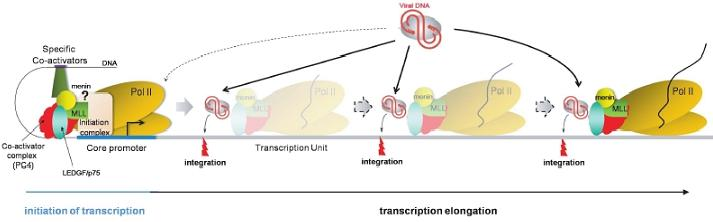
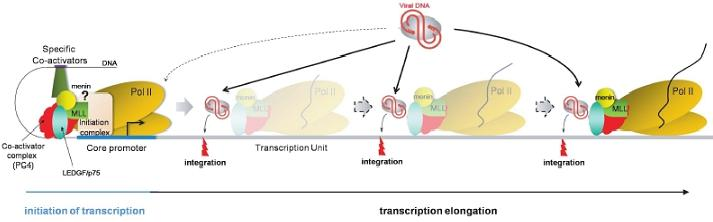
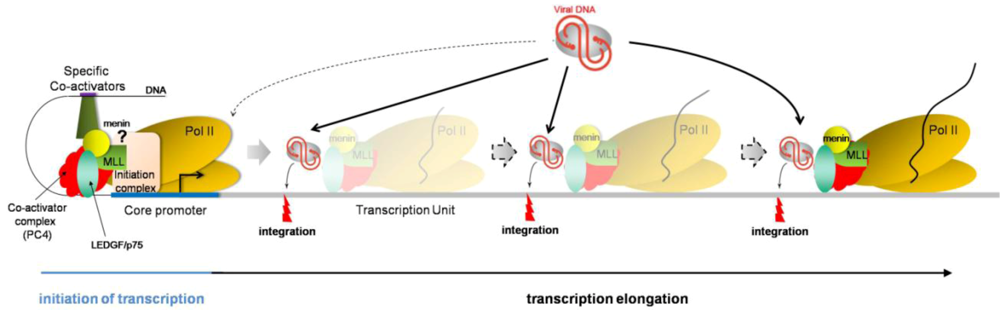
      <p>Therefore, based on the current knowledge about HIV integration site selection, <italic>i.e.</italic>, preferentially integrating into active transcription units, it is tempting to speculate a dynamic, more than a static, tethering model, in which LEDGF/p75 would be associated with PC4 and the RNA polymerase II elongation complex (<xref ref-type="fig" rid="figure2">Figure 2</xref>). In this model, LEDGF/p75 would recruit HIV preintegration complex while transcribing genes or at pausing sites, thereby explaining integration sites all along the transcription units.</p>
<fig id="figure2" position="float">
<label>Figure 2</label>
<caption>
<p>Dynamic model depicting the mechanism of LEDGF/p75-mediated HIV integration. LEDGF/p75 (green oval) associates with PC4 (red protein) and the RNA polymerase II machinery (yellow ovals) at promoter regions, but steric hindrance may prevent successful recruitment of preintegration complexes (gray oval with viral DNA in red). In this proposed model, LEDGF/p75 remains associated with the RNA pol II transcription elongation complex, potentially interacting with PC4 and menin/MLL complex. While this complex displaces nucleosomes (not depicted) and unwinds DNA to allow RNA polymerization, LEDGF/p75 may recruit HIV PIC and promote integration. This model is consistent with LEDGF/p75-captured DNA sequences and HIV integration sites being present throughout the transcription unit, without specific DNA binding consensus motif.</p>
</caption>
<graphic xmlns:xlink="http://www.w3.org/1999/xlink" xlink:href="viruses-02-00111-g002.tif" scale="0"/>
</fig>
      <p>Consistent with these results are (i) integration in active transcription units, with no preference along the transcription unit, neither for exons, nor for introns, (ii) LEDGF/p75 initially characterized as a transcriptional coactivator, associated with the transcription machinery (via PC4-containing complex), (iii) LEDGF/p75 interaction with the menin/MLL histone methyltransferase, involved in H3K4me3 histone modification, a mark associated with active transcription, and (iv) no sequence consensus for LEDGF/p75-binding DNA sites, suggesting that the N-terminal domain of LEDGF/p75 may serve as a hook to anchor the protein to the chromatin but that the location specificity is given by an additional chromosome-bound protein, yet to be identified. </p>
      <p>Further studies on LEDGF/p75 should help refining the detailed mechanism of LEDGF/p75-mediated HIV integration.</p>
    </sec>
  </body>
  <back>
    <ack>
      <p>This work was supported by the Swiss National Science Foundation (3100A0-120553) and the Novartis Foundation.</p>
      <p>Many thanks to Margalida Rotger for critical reading of this manuscript, to Amalio Telenti and Frederic Bushman for mentorship and continuous support, and to colleagues, in particular Raquel Martinez, Julia di Iulio and Miguel Munoz, for helpful discussions.</p>
      <p>The authors declare having no potential competing financial interests.</p>
    </ack>
    <ref-list>
    <title>References</title>
      <ref id="B1">
        <citation citation-type="journal">
          <person-group person-group-type="author">
            <name>
              <surname>Peterlin</surname>
              <given-names>B.M.</given-names>
            </name>
            <name>
              <surname>Trono</surname>
              <given-names>D.</given-names>
            </name>
          </person-group>
          <article-title>Hide, shield and strike back: how HIV-infected cells avoid immune eradication</article-title>
          <source>Nat. Rev. Immunol.</source>
          <year>2003</year>
          <volume>3</volume>
          <fpage>97</fpage>
          <lpage>107</lpage>
          <pub-id pub-id-type="doi">10.1038/nri998</pub-id>
          <pub-id pub-id-type="pmid">12563294</pub-id>
        </citation>
      </ref>
      <ref id="B2">
        <citation citation-type="journal">
          <person-group person-group-type="author">
            <name>
              <surname>Goff</surname>
              <given-names>S.P.</given-names>
            </name>
          </person-group>
          <article-title>Host factors exploited by retroviruses</article-title>
          <source>Nat. Rev. Microbiol.</source>
          <year>2007</year>
          <volume>5</volume>
          <fpage>253</fpage>
          <lpage>263</lpage>
          <pub-id pub-id-type="doi">10.1038/nrmicro1541</pub-id>
        </citation>
      </ref>
      <ref id="B3">
        <citation citation-type="journal">
          <person-group person-group-type="author">
            <name>
              <surname>Suzuki</surname>
              <given-names>Y.</given-names>
            </name>
            <name>
              <surname>Craigie</surname>
              <given-names>R.</given-names>
            </name>
          </person-group>
          <article-title>The road to chromatin - nuclear entry of retroviruses</article-title>
          <source>Nat. Rev. Microbiol.</source>
          <year>2007</year>
          <volume>5</volume>
          <fpage>187</fpage>
          <lpage>196</lpage>
          <pub-id pub-id-type="doi">10.1038/nrmicro1579</pub-id>
          <pub-id pub-id-type="pmid">17304248</pub-id>
        </citation>
      </ref>
      <ref id="B4">
        <citation citation-type="book">
          <person-group person-group-type="author">
            <name>
              <surname>Flint</surname>
              <given-names>S.J.</given-names>
            </name>
            <name>
              <surname>Lynn W. Enquist</surname>
              <given-names>L.W.</given-names>
            </name>
            <name>
              <surname>Racaniello</surname>
              <given-names>V.R.</given-names>
            </name>
            <name>
              <surname>Skalka</surname>
              <given-names>A.M.</given-names>
            </name>
          </person-group>
          <article-title>Principles of Virology</article-title>
          <edition>3rd</edition>
          <publisher-name>American Society for Microbiology Press</publisher-name>
          <publisher-loc>Washington, DC, USA</publisher-loc>
          <year>2009</year>
          <supplement/>
        </citation>
      </ref>
      <ref id="B5">
        <citation citation-type="journal">
          <person-group person-group-type="author">
            <name>
              <surname>Smith</surname>
              <given-names>J.A.</given-names>
            </name>
            <name>
              <surname>Daniel</surname>
              <given-names>R.</given-names>
            </name>
          </person-group>
          <article-title>Following the path of the virus: the exploitation of host DNA repair mechanisms by retroviruses</article-title>
          <source>ACS Chem. Biol.</source>
          <year>2006</year>
          <volume>1</volume>
          <fpage>217</fpage>
          <lpage>226</lpage>
          <pub-id pub-id-type="doi">10.1021/cb600131q</pub-id>
        </citation>
      </ref>
      <ref id="B6">
        <citation citation-type="journal">
          <person-group person-group-type="author">
            <name>
              <surname>Vandegraaff</surname>
              <given-names>N.</given-names>
            </name>
            <name>
              <surname>Engelman</surname>
              <given-names>A.</given-names>
            </name>
          </person-group>
          <article-title>Molecular mechanisms of HIV integration and therapeutic intervention</article-title>
          <source>Expert Rev. Mol. Med.</source>
          <year>2007</year>
          <volume>9</volume>
          <fpage>1</fpage>
          <lpage>19</lpage>
          <pub-id pub-id-type="doi">10.1017/S1462399407000257</pub-id>
          <pub-id pub-id-type="pmid">17320002</pub-id>
        </citation>
      </ref>
      <ref id="B7">
        <citation citation-type="journal">
          <person-group person-group-type="author">
            <name>
              <surname>Delelis</surname>
              <given-names>O.</given-names>
            </name>
            <name>
              <surname>Carayon</surname>
              <given-names>K.</given-names>
            </name>
            <name>
              <surname>Saib</surname>
              <given-names>A.</given-names>
            </name>
            <name>
              <surname>Deprez</surname>
              <given-names>E.</given-names>
            </name>
            <name>
              <surname>Mouscadet</surname>
              <given-names>J.F.</given-names>
            </name>
          </person-group>
          <article-title>Integrase and integration: biochemical activities of HIV-1 integrase</article-title>
          <source>Retrovirology</source>
          <year>2008</year>
          <volume>5</volume>
          <fpage>114</fpage>
          <pub-id pub-id-type="doi">10.1186/1742-4690-5-114</pub-id>
          <pub-id pub-id-type="pmid">19091057</pub-id>
        </citation>
      </ref>
      <ref id="B8">
        <citation citation-type="journal">
          <person-group person-group-type="author">
            <name>
              <surname>Jaskolski</surname>
              <given-names>M.</given-names>
            </name>
            <name>
              <surname>Alexandratos</surname>
              <given-names>J.N.</given-names>
            </name>
            <name>
              <surname>Bujacz</surname>
              <given-names>G.</given-names>
            </name>
            <name>
              <surname>Wlodawer</surname>
              <given-names>A.</given-names>
            </name>
          </person-group>
          <article-title>Piecing together the structure of retroviral integrase, an important target in AIDS therapy</article-title>
          <source>FEBS J.</source>
          <year>2009</year>
          <volume>276</volume>
          <fpage>2926</fpage>
          <lpage>2946</lpage>
          <pub-id pub-id-type="doi">10.1111/j.1742-4658.2009.07009.x</pub-id>
          <pub-id pub-id-type="pmid">19490099</pub-id>
        </citation>
      </ref>
      <ref id="B9">
        <citation citation-type="journal">
          <person-group person-group-type="author">
            <name>
              <surname>Ceccherini-Silberstein</surname>
              <given-names>F.</given-names>
            </name>
            <name>
              <surname>Malet</surname>
              <given-names>I.</given-names>
            </name>
            <name>
              <surname>D'Arrigo</surname>
              <given-names>R.</given-names>
            </name>
            <name>
              <surname>Antinori</surname>
              <given-names>A.</given-names>
            </name>
            <name>
              <surname>Marcelin</surname>
              <given-names>A.G.</given-names>
            </name>
            <name>
              <surname>Perno</surname>
              <given-names>C.F.</given-names>
            </name>
          </person-group>
          <article-title>Characterization and structural analysis of HIV-1 integrase conservation</article-title>
          <source>AIDS Rev.</source>
          <year>2009</year>
          <volume>11</volume>
          <fpage>17</fpage>
          <lpage>29</lpage>
          <pub-id pub-id-type="pmid">19290031</pub-id>
        </citation>
      </ref>
      <ref id="B10">
        <citation citation-type="journal">
          <person-group person-group-type="author">
            <name>
              <surname>McKee</surname>
              <given-names>C.J.</given-names>
            </name>
            <name>
              <surname>Kessl</surname>
              <given-names>J.J.</given-names>
            </name>
            <name>
              <surname>Shkriabai</surname>
              <given-names>N.</given-names>
            </name>
            <name>
              <surname>Dar</surname>
              <given-names>M.J.</given-names>
            </name>
            <name>
              <surname>Engelman</surname>
              <given-names>A.</given-names>
            </name>
            <name>
              <surname>Kvaratskhelia</surname>
              <given-names>M.</given-names>
            </name>
          </person-group>
          <article-title>Dynamic modulation of HIV-1 integrase structure and function by cellular lens epithelium-derived growth factor (LEDGF) protein</article-title>
          <source>J. Biol. Chem.</source>
          <year>2008</year>
          <volume>283</volume>
          <fpage>31802</fpage>
          <lpage>31812</lpage>
          <pub-id pub-id-type="doi">10.1074/jbc.M805843200</pub-id>
          <pub-id pub-id-type="pmid">18801737</pub-id>
        </citation>
      </ref>
      <ref id="B11">
        <citation citation-type="journal">
          <person-group person-group-type="author">
            <name>
              <surname>Lesbats</surname>
              <given-names>P.</given-names>
            </name>
            <name>
              <surname>Metifiot</surname>
              <given-names>M.</given-names>
            </name>
            <name>
              <surname>Calmels</surname>
              <given-names>C.</given-names>
            </name>
            <name>
              <surname>Baranova</surname>
              <given-names>S.</given-names>
            </name>
            <name>
              <surname>Nevinsky</surname>
              <given-names>G.</given-names>
            </name>
            <name>
              <surname>Andreola</surname>
              <given-names>M.L.</given-names>
            </name>
            <name>
              <surname>Parissi</surname>
              <given-names>V.</given-names>
            </name>
          </person-group>
          <article-title>In vitro initial attachment of HIV-1 integrase to viral ends: control of the DNA specific interaction by the oligomerization state</article-title>
          <source>Nucleic Acids Res.</source>
          <year>2008</year>
          <volume>36</volume>
          <fpage>7043</fpage>
          <lpage>7058</lpage>
          <pub-id pub-id-type="doi">10.1093/nar/gkn796</pub-id>
          <pub-id pub-id-type="pmid">18987001</pub-id>
        </citation>
      </ref>
      <ref id="B12">
        <citation citation-type="journal">
          <person-group person-group-type="author">
            <name>
              <surname>Hare</surname>
              <given-names>S.</given-names>
            </name>
            <name>
              <surname>Di Nunzio</surname>
              <given-names>F.</given-names>
            </name>
            <name>
              <surname>Labeja</surname>
              <given-names>A.</given-names>
            </name>
            <name>
              <surname>Wang</surname>
              <given-names>J.</given-names>
            </name>
            <name>
              <surname>Engelman</surname>
              <given-names>A.</given-names>
            </name>
            <name>
              <surname>Cherepanov</surname>
              <given-names>P.</given-names>
            </name>
          </person-group>
          <article-title>Structural basis for functional tetramerization of lentiviral integrase</article-title>
          <source>PLoS Pathog.</source>
          <year>2009</year>
          <volume>5</volume>
          <fpage>e1000515:1</fpage>
          <lpage>e1000515:15</lpage>
        </citation>
      </ref>
      <ref id="B13">
        <citation citation-type="journal">
          <person-group person-group-type="author">
            <name>
              <surname>Michel</surname>
              <given-names>F.</given-names>
            </name>
            <name>
              <surname>Crucifix</surname>
              <given-names>C.</given-names>
            </name>
            <name>
              <surname>Granger</surname>
              <given-names>F.</given-names>
            </name>
            <name>
              <surname>Eiler</surname>
              <given-names>S.</given-names>
            </name>
            <name>
              <surname>Mouscadet</surname>
              <given-names>J.F.</given-names>
            </name>
            <name>
              <surname>Korolev</surname>
              <given-names>S.</given-names>
            </name>
            <name>
              <surname>Agapkina</surname>
              <given-names>J.</given-names>
            </name>
            <name>
              <surname>Ziganshin</surname>
              <given-names>R.</given-names>
            </name>
            <name>
              <surname>Gottikh</surname>
              <given-names>M.</given-names>
            </name>
            <name>
              <surname>Nazabal</surname>
              <given-names>A.</given-names>
            </name>
            <name>
              <surname>Emiliani</surname>
              <given-names>S.</given-names>
            </name>
            <name>
              <surname>Benarous</surname>
              <given-names>R.</given-names>
            </name>
            <name>
              <surname>Moras</surname>
              <given-names>D.</given-names>
            </name>
            <name>
              <surname>Schultz</surname>
              <given-names>P.</given-names>
            </name>
            <name>
              <surname>Ruff</surname>
              <given-names>M.</given-names>
            </name>
          </person-group>
          <article-title>Structural basis for HIV-1 DNA integration in the human genome, role of the LEDGF/P75 cofactor</article-title>
          <source>Embo J.</source>
          <year>2009</year>
          <volume>28</volume>
          <fpage>980</fpage>
          <lpage>991</lpage>
          <pub-id pub-id-type="doi">10.1038/emboj.2009.41</pub-id>
          <pub-id pub-id-type="pmid">19229293</pub-id>
        </citation>
      </ref>
      <ref id="B14">
        <citation citation-type="journal">
          <person-group person-group-type="author">
            <name>
              <surname>Hare</surname>
              <given-names>S.</given-names>
            </name>
            <name>
              <surname>Cherepanov</surname>
              <given-names>P.</given-names>
            </name>
            <name>
              <surname>Wang</surname>
              <given-names>J.</given-names>
            </name>
          </person-group>
          <article-title>Application of general formulas for the correction of a lattice-translocation defect in crystals of a lentiviral integrase in complex with LEDGF</article-title>
          <source>Acta Crystallogr. D. Biol. Crystallogr.</source>
          <year>2009</year>
          <volume>65</volume>
          <fpage>966</fpage>
          <lpage>973</lpage>
          <pub-id pub-id-type="doi">10.1107/S0907444909023695</pub-id>
          <pub-id pub-id-type="pmid">19690374</pub-id>
        </citation>
      </ref>
      <ref id="B15">
        <citation citation-type="journal">
          <person-group person-group-type="author">
            <name>
              <surname>Wu</surname>
              <given-names>Y.</given-names>
            </name>
          </person-group>
          <article-title>HIV-1 gene expression: lessons from provirus and non-integrated DNA</article-title>
          <source>Retrovirology</source>
          <year>2004</year>
          <volume>1</volume>
          <fpage>13</fpage>
          <pub-id pub-id-type="doi">10.1186/1742-4690-1-13</pub-id>
          <pub-id pub-id-type="pmid">15219234</pub-id>
        </citation>
      </ref>
      <ref id="B16">
        <citation citation-type="journal">
          <person-group person-group-type="author">
            <name>
              <surname>Wu</surname>
              <given-names>Y.</given-names>
            </name>
          </person-group>
          <article-title>The second chance story of HIV-1 DNA: Unintegrated? Not a problem!</article-title>
          <source>Retrovirology</source>
          <year>2008</year>
          <volume>5</volume>
          <fpage>61</fpage>
          <supplement/>
          <pub-id pub-id-type="doi">10.1186/1742-4690-5-61</pub-id>
          <pub-id pub-id-type="pmid">18613958</pub-id>
        </citation>
      </ref>
      <ref id="B17">
        <citation citation-type="journal">
          <person-group person-group-type="author">
            <name>
              <surname>Iyer</surname>
              <given-names>S.R.</given-names>
            </name>
            <name>
              <surname>Yu</surname>
              <given-names>D.</given-names>
            </name>
            <name>
              <surname>Biancotto</surname>
              <given-names>A.</given-names>
            </name>
            <name>
              <surname>Margolis</surname>
              <given-names>L.B.</given-names>
            </name>
            <name>
              <surname>Wu</surname>
              <given-names>Y.</given-names>
            </name>
          </person-group>
          <article-title>Measurement of human immunodeficiency virus type 1 preintegration transcription by using Rev-dependent Rev-CEM cells reveals a sizable transcribing DNA population comparable to that from proviral templates</article-title>
          <source>J. Virol.</source>
          <year>2009</year>
          <volume>83</volume>
          <fpage>8662</fpage>
          <lpage>8673</lpage>
          <pub-id pub-id-type="doi">10.1128/JVI.00874-09</pub-id>
          <pub-id pub-id-type="pmid">19553325</pub-id>
        </citation>
      </ref>
      <ref id="B18">
        <citation citation-type="journal">
          <person-group person-group-type="author">
            <name>
              <surname>Thomas</surname>
              <given-names>J.A.</given-names>
            </name>
            <name>
              <surname>Ott</surname>
              <given-names>D.E.</given-names>
            </name>
            <name>
              <surname>Gorelick</surname>
              <given-names>R.J.</given-names>
            </name>
          </person-group>
          <article-title>Efficiency of human immunodeficiency virus type 1 postentry infection processes: evidence against disproportionate numbers of defective virions</article-title>
          <source>J. Virol.</source>
          <year>2007</year>
          <volume>81</volume>
          <fpage>4367</fpage>
          <lpage>4370</lpage>
          <pub-id pub-id-type="doi">10.1128/JVI.02357-06</pub-id>
          <pub-id pub-id-type="pmid">17267494</pub-id>
        </citation>
      </ref>
      <ref id="B19">
        <citation citation-type="journal">
          <person-group person-group-type="author">
            <name>
              <surname>Albanese</surname>
              <given-names>A.</given-names>
            </name>
            <name>
              <surname>Arosio</surname>
              <given-names>D.</given-names>
            </name>
            <name>
              <surname>Terreni</surname>
              <given-names>M.</given-names>
            </name>
            <name>
              <surname>Cereseto</surname>
              <given-names>A.</given-names>
            </name>
          </person-group>
          <article-title>HIV-1 pre-integration complexes selectively target decondensed chromatin in the nuclear periphery</article-title>
          <source>PLoS ONE</source>
          <year>2008</year>
          <volume>3</volume>
          <fpage>e2413:1</fpage>
          <lpage>e2413:9</lpage>
          <pub-id pub-id-type="doi">10.1371/journal.pone.0002413</pub-id>
        </citation>
      </ref>
      <ref id="B20">
        <citation citation-type="journal">
          <person-group person-group-type="author">
            <name>
              <surname>Christ</surname>
              <given-names>F.</given-names>
            </name>
            <name>
              <surname>Thys</surname>
              <given-names>W.</given-names>
            </name>
            <name>
              <surname>De Rijck</surname>
              <given-names>J.</given-names>
            </name>
            <name>
              <surname>Gijsbers</surname>
              <given-names>R.</given-names>
            </name>
            <name>
              <surname>Albanese</surname>
              <given-names>A.</given-names>
            </name>
            <name>
              <surname>Arosio</surname>
              <given-names>D.</given-names>
            </name>
            <name>
              <surname>Emiliani</surname>
              <given-names>S.</given-names>
            </name>
            <name>
              <surname>Rain</surname>
              <given-names>J.C.</given-names>
            </name>
            <name>
              <surname>Benarous</surname>
              <given-names>R.</given-names>
            </name>
            <name>
              <surname>Cereseto</surname>
              <given-names>A.</given-names>
            </name>
            <name>
              <surname>Debyser</surname>
              <given-names>Z.</given-names>
            </name>
          </person-group>
          <article-title>Transportin-SR2 imports HIV into the nucleus</article-title>
          <source>Curr. Biol.</source>
          <year>2008</year>
          <volume>18</volume>
          <fpage>1192</fpage>
          <lpage>1202</lpage>
          <pub-id pub-id-type="doi">10.1016/j.cub.2008.07.079</pub-id>
          <pub-id pub-id-type="pmid">18722123</pub-id>
        </citation>
      </ref>
      <ref id="B21">
        <citation citation-type="journal">
          <person-group person-group-type="author">
            <name>
              <surname>Jordan</surname>
              <given-names>A.</given-names>
            </name>
            <name>
              <surname>Defechereux</surname>
              <given-names>P.</given-names>
            </name>
            <name>
              <surname>Verdin</surname>
              <given-names>E.</given-names>
            </name>
          </person-group>
          <article-title>The site of HIV-1 integration in the human genome determines basal transcriptional activity and response to Tat transactivation</article-title>
          <source>Embo J.</source>
          <year>2001</year>
          <volume>20</volume>
          <fpage>1726</fpage>
          <lpage>1738</lpage>
          <pub-id pub-id-type="doi">10.1093/emboj/20.7.1726</pub-id>
          <pub-id pub-id-type="pmid">11285236</pub-id>
        </citation>
      </ref>
      <ref id="B22">
        <citation citation-type="journal">
          <person-group person-group-type="author">
            <name>
              <surname>Jordan</surname>
              <given-names>A.</given-names>
            </name>
            <name>
              <surname>Bisgrove</surname>
              <given-names>D.</given-names>
            </name>
            <name>
              <surname>Verdin</surname>
              <given-names>E.</given-names>
            </name>
          </person-group>
          <article-title>HIV reproducibly establishes a latent infection after acute infection of T cells <italic>in vitro</italic></article-title>
          <source>Embo J.</source>
          <year>2003</year>
          <volume>22</volume>
          <fpage>1868</fpage>
          <lpage>1877</lpage>
          <pub-id pub-id-type="doi">10.1093/emboj/cdg188</pub-id>
          <pub-id pub-id-type="pmid">12682019</pub-id>
        </citation>
      </ref>
      <ref id="B23">
        <citation citation-type="journal">
          <person-group person-group-type="author">
            <name>
              <surname>Lewinski</surname>
              <given-names>M.K.</given-names>
            </name>
            <name>
              <surname>Bisgrove</surname>
              <given-names>D.</given-names>
            </name>
            <name>
              <surname>Shinn</surname>
              <given-names>P.</given-names>
            </name>
            <name>
              <surname>Chen</surname>
              <given-names>H.</given-names>
            </name>
            <name>
              <surname>Hoffmann</surname>
              <given-names>C.</given-names>
            </name>
            <name>
              <surname>Hannenhalli</surname>
              <given-names>S.</given-names>
            </name>
            <name>
              <surname>Verdin</surname>
              <given-names>E.</given-names>
            </name>
            <name>
              <surname>Berry</surname>
              <given-names>C.C.</given-names>
            </name>
            <name>
              <surname>Ecker</surname>
              <given-names>J.R.</given-names>
            </name>
            <name>
              <surname>Bushman</surname>
              <given-names>F.D.</given-names>
            </name>
          </person-group>
          <article-title>Genome-wide analysis of chromosomal features repressing human immunodeficiency virus transcription</article-title>
          <source>J. Virol.</source>
          <year>2005</year>
          <volume>79</volume>
          <fpage>6610</fpage>
          <lpage>6619</lpage>
          <pub-id pub-id-type="doi">10.1128/JVI.79.11.6610-6619.2005</pub-id>
          <pub-id pub-id-type="pmid">15890899</pub-id>
        </citation>
      </ref>
      <ref id="B24">
        <citation citation-type="journal">
          <person-group person-group-type="author">
            <name>
              <surname>Han</surname>
              <given-names>Y.</given-names>
            </name>
            <name>
              <surname>Lin</surname>
              <given-names>Y.B.</given-names>
            </name>
            <name>
              <surname>An</surname>
              <given-names>W.</given-names>
            </name>
            <name>
              <surname>Xu</surname>
              <given-names>J.</given-names>
            </name>
            <name>
              <surname>Yang</surname>
              <given-names>H.C.</given-names>
            </name>
            <name>
              <surname>O'Connell</surname>
              <given-names>K.</given-names>
            </name>
            <name>
              <surname>Dordai</surname>
              <given-names>D.</given-names>
            </name>
            <name>
              <surname>Boeke</surname>
              <given-names>J.D.</given-names>
            </name>
            <name>
              <surname>Siliciano</surname>
              <given-names>J.D.</given-names>
            </name>
            <name>
              <surname>Siliciano</surname>
              <given-names>R.F.</given-names>
            </name>
          </person-group>
          <article-title>Orientation-dependent regulation of integrated HIV-1 expression by host gene transcriptional readthrough</article-title>
          <source>Cell Host Microbe</source>
          <year>2008</year>
          <volume>4</volume>
          <fpage>134</fpage>
          <lpage>146</lpage>
          <pub-id pub-id-type="doi">10.1016/j.chom.2008.06.008</pub-id>
        </citation>
      </ref>
      <ref id="B25">
        <citation citation-type="book">
          <person-group person-group-type="author">
            <name>
              <surname>Bushman</surname>
              <given-names>F.D.</given-names>
            </name>
          </person-group>
          <article-title>Lateral DNA Transfer: Mechanisms and Consequences</article-title>
          <year>2001</year>
          <publisher-name>Cold Spring Harbor Laboratory Press</publisher-name>
          <publisher-loc>Cold Spring Harbor, NY, USA</publisher-loc>
        </citation>
      </ref>
      <ref id="B26">
        <citation citation-type="journal">
          <person-group person-group-type="author">
            <name>
              <surname>Voigt</surname>
              <given-names>K.</given-names>
            </name>
            <name>
              <surname>Izsvak</surname>
              <given-names>Z.</given-names>
            </name>
            <name>
              <surname>Ivics</surname>
              <given-names>Z.</given-names>
            </name>
          </person-group>
          <article-title>Targeted gene insertion for molecular medicine</article-title>
          <source>J. Mol. Med.</source>
          <year>2008</year>
          <volume>86</volume>
          <fpage>1205</fpage>
          <lpage>1219</lpage>
          <pub-id pub-id-type="doi">10.1007/s00109-008-0381-8</pub-id>
          <pub-id pub-id-type="pmid">18607557</pub-id>
        </citation>
      </ref>
      <ref id="B27">
        <citation citation-type="journal">
          <person-group person-group-type="author">
            <name>
              <surname>Nienhuis</surname>
              <given-names>A.W.</given-names>
            </name>
            <name>
              <surname>Dunbar</surname>
              <given-names>C.E.</given-names>
            </name>
            <name>
              <surname>Sorrentino</surname>
              <given-names>B.P.</given-names>
            </name>
          </person-group>
          <article-title>Genotoxicity of retroviral integration in hematopoietic cells</article-title>
          <source>Mol. Ther.</source>
          <year>2006</year>
          <volume>13</volume>
          <fpage>1031</fpage>
          <lpage>1049</lpage>
          <pub-id pub-id-type="doi">10.1016/j.ymthe.2006.03.001</pub-id>
          <pub-id pub-id-type="pmid">16624621</pub-id>
        </citation>
      </ref>
      <ref id="B28">
        <citation citation-type="journal">
          <person-group person-group-type="author">
            <name>
              <surname>Bushman</surname>
              <given-names>F.D.</given-names>
            </name>
          </person-group>
          <article-title>Retroviral integration and human gene therapy</article-title>
          <source>J. Clin. Invest.</source>
          <year>2007</year>
          <volume>117</volume>
          <fpage>2083</fpage>
          <lpage>2086</lpage>
          <pub-id pub-id-type="doi">10.1172/JCI32949</pub-id>
          <pub-id pub-id-type="pmid">17671645</pub-id>
        </citation>
      </ref>
      <ref id="B29">
        <citation citation-type="journal">
          <person-group person-group-type="author">
            <name>
              <surname>Pike-Overzet</surname>
              <given-names>K.</given-names>
            </name>
            <name>
              <surname>van der Burg</surname>
              <given-names>M.</given-names>
            </name>
            <name>
              <surname>Wagemaker</surname>
              <given-names>G.</given-names>
            </name>
            <name>
              <surname>van Dongen</surname>
              <given-names>J.J.</given-names>
            </name>
            <name>
              <surname>Staal</surname>
              <given-names>F.J.</given-names>
            </name>
          </person-group>
          <article-title>New insights and unresolved issues regarding insertional mutagenesis in X-linked SCID gene therapy</article-title>
          <source>Mol. Ther.</source>
          <year>2007</year>
          <volume>15</volume>
          <fpage>1910</fpage>
          <lpage>1916</lpage>
          <pub-id pub-id-type="doi">10.1038/sj.mt.6300297</pub-id>
          <pub-id pub-id-type="pmid">17726455</pub-id>
        </citation>
      </ref>
      <ref id="B30">
        <citation citation-type="journal">
          <person-group person-group-type="author">
            <name>
              <surname>Cavazzana-Calvo</surname>
              <given-names>M.</given-names>
            </name>
            <name>
              <surname>Fischer</surname>
              <given-names>A.</given-names>
            </name>
          </person-group>
          <article-title>Gene therapy for severe combined immunodeficiency: are we there yet?</article-title>
          <source>J. Clin. Invest.</source>
          <year>2007</year>
          <volume>117</volume>
          <fpage>1456</fpage>
          <lpage>1465</lpage>
          <pub-id pub-id-type="doi">10.1172/JCI30953</pub-id>
          <pub-id pub-id-type="pmid">17549248</pub-id>
        </citation>
      </ref>
      <ref id="B31">
        <citation citation-type="journal">
          <person-group person-group-type="author">
            <name>
              <surname>Kimmelman</surname>
              <given-names>J.</given-names>
            </name>
          </person-group>
          <article-title>The ethics of human gene transfer</article-title>
          <source>Nat. Rev. Genet.</source>
          <year>2008</year>
          <volume>9</volume>
          <fpage>239</fpage>
          <lpage>244</lpage>
          <pub-id pub-id-type="doi">10.1038/nrg2317</pub-id>
        </citation>
      </ref>
      <ref id="B32">
        <citation citation-type="journal">
          <person-group person-group-type="author">
            <name>
              <surname>Ciuffi</surname>
              <given-names>A.</given-names>
            </name>
          </person-group>
          <article-title>Mechanisms governing lentivirus integration site selection</article-title>
          <source>Curr. Gene Ther.</source>
          <year>2008</year>
          <volume>8</volume>
          <fpage>419</fpage>
          <lpage>429</lpage>
          <pub-id pub-id-type="doi">10.2174/156652308786848021</pub-id>
        </citation>
      </ref>
      <ref id="B33">
        <citation citation-type="journal">
          <person-group person-group-type="author">
            <name>
              <surname>Hacein-Bey-Abina</surname>
              <given-names>S.</given-names>
            </name>
            <name>
              <surname>von Kalle</surname>
              <given-names>C.</given-names>
            </name>
            <name>
              <surname>Schmidt</surname>
              <given-names>M.</given-names>
            </name>
            <name>
              <surname>Le Deist</surname>
              <given-names>F.</given-names>
            </name>
            <name>
              <surname>Wulffraat</surname>
              <given-names>N.</given-names>
            </name>
            <name>
              <surname>McIntyre</surname>
              <given-names>E.</given-names>
            </name>
            <name>
              <surname>Radford</surname>
              <given-names>I.</given-names>
            </name>
            <name>
              <surname>Villeval</surname>
              <given-names>J.L.</given-names>
            </name>
            <name>
              <surname>Fraser</surname>
              <given-names>C.C.</given-names>
            </name>
            <name>
              <surname>Cavazzana-Calvo</surname>
              <given-names>M.</given-names>
            </name>
            <name>
              <surname>Fischer</surname>
              <given-names>A.</given-names>
            </name>
          </person-group>
          <article-title>A serious adverse event after successful gene therapy for X-linked severe combined immunodeficiency</article-title>
          <source>N. Engl. J. Med.</source>
          <year>2003</year>
          <volume>348</volume>
          <fpage>255</fpage>
          <lpage>256</lpage>
          <pub-id pub-id-type="doi">10.1056/NEJM200301163480314</pub-id>
          <pub-id pub-id-type="pmid">12529469</pub-id>
        </citation>
      </ref>
      <ref id="B34">
        <citation citation-type="journal">
          <person-group person-group-type="author">
            <name>
              <surname>Hacein-Bey-Abina</surname>
              <given-names>S.</given-names>
            </name>
            <name>
              <surname>Garrigue</surname>
              <given-names>A.</given-names>
            </name>
            <name>
              <surname>Wang</surname>
              <given-names>G.P.</given-names>
            </name>
            <name>
              <surname>Soulier</surname>
              <given-names>J.</given-names>
            </name>
            <name>
              <surname>Lim</surname>
              <given-names>A.</given-names>
            </name>
            <name>
              <surname>Morillon</surname>
              <given-names>E.</given-names>
            </name>
            <name>
              <surname>Clappier</surname>
              <given-names>E.</given-names>
            </name>
            <name>
              <surname>Caccavelli</surname>
              <given-names>L.</given-names>
            </name>
            <name>
              <surname>Delabesse</surname>
              <given-names>E.</given-names>
            </name>
            <name>
              <surname>Beldjord</surname>
              <given-names>K.</given-names>
            </name>
            <name>
              <surname>Asnafi</surname>
              <given-names>V.</given-names>
            </name>
            <name>
              <surname>MacIntyre</surname>
              <given-names>E.</given-names>
            </name>
            <name>
              <surname>Dal Cortivo</surname>
              <given-names>L.</given-names>
            </name>
            <name>
              <surname>Radford</surname>
              <given-names>I.</given-names>
            </name>
            <name>
              <surname>Brousse</surname>
              <given-names>N.</given-names>
            </name>
            <name>
              <surname>Sigaux</surname>
              <given-names>F.</given-names>
            </name>
            <name>
              <surname>Moshous</surname>
              <given-names>D.</given-names>
            </name>
            <name>
              <surname>Hauer</surname>
              <given-names>J.</given-names>
            </name>
            <name>
              <surname>Borkhardt</surname>
              <given-names>A.</given-names>
            </name>
            <name>
              <surname>Belohradsky</surname>
              <given-names>B.H.</given-names>
            </name>
            <name>
              <surname>Wintergerst</surname>
              <given-names>U.</given-names>
            </name>
            <name>
              <surname>Velez</surname>
              <given-names>M.C.</given-names>
            </name>
            <name>
              <surname>Leiva</surname>
              <given-names>L.</given-names>
            </name>
            <name>
              <surname>Sorensen</surname>
              <given-names>R.</given-names>
            </name>
            <name>
              <surname>Wulffraat</surname>
              <given-names>N.</given-names>
            </name>
            <name>
              <surname>Blanche</surname>
              <given-names>S.</given-names>
            </name>
            <name>
              <surname>Bushman</surname>
              <given-names>F.D.</given-names>
            </name>
            <name>
              <surname>Fischer</surname>
              <given-names>A.</given-names>
            </name>
            <name>
              <surname>Cavazzana-Calvo</surname>
              <given-names>M.</given-names>
            </name>
          </person-group>
          <article-title>Insertional oncogenesis in 4 patients after retrovirus-mediated gene therapy of SCID-X1</article-title>
          <source>J. Clin. Invest.</source>
          <year>2008</year>
          <volume>118</volume>
          <fpage>3132</fpage>
          <lpage>3142</lpage>
          <pub-id pub-id-type="doi">10.1172/JCI35700</pub-id>
          <pub-id pub-id-type="pmid">18688285</pub-id>
        </citation>
      </ref>
      <ref id="B35">
        <citation citation-type="journal">
          <person-group person-group-type="author">
            <name>
              <surname>Wang</surname>
              <given-names>G.P.</given-names>
            </name>
            <name>
              <surname>Garrigue</surname>
              <given-names>A.</given-names>
            </name>
            <name>
              <surname>Ciuffi</surname>
              <given-names>A.</given-names>
            </name>
            <name>
              <surname>Ronen</surname>
              <given-names>K.</given-names>
            </name>
            <name>
              <surname>Leipzig</surname>
              <given-names>J.</given-names>
            </name>
            <name>
              <surname>Berry</surname>
              <given-names>C.</given-names>
            </name>
            <name>
              <surname>Lagresle-Peyrou</surname>
              <given-names>C.</given-names>
            </name>
            <name>
              <surname>Benjelloun</surname>
              <given-names>F.</given-names>
            </name>
            <name>
              <surname>Hacein-Bey-Abina</surname>
              <given-names>S.</given-names>
            </name>
            <name>
              <surname>Fischer</surname>
              <given-names>A.</given-names>
            </name>
            <name>
              <surname>Cavazzana-Calvo</surname>
              <given-names>M.</given-names>
            </name>
            <name>
              <surname>Bushman</surname>
              <given-names>F.D.</given-names>
            </name>
          </person-group>
          <article-title>DNA bar coding and pyrosequencing to analyze adverse events in therapeutic gene transfer</article-title>
          <source>Nucleic Acids Res.</source>
          <year>2008</year>
          <volume>36</volume>
          <fpage>e49:1</fpage>
          <lpage>e49:12</lpage>
        </citation>
      </ref>
      <ref id="B36">
        <citation citation-type="journal">
          <person-group person-group-type="author">
            <name>
              <surname>Wang</surname>
              <given-names>G.P.</given-names>
            </name>
            <name>
              <surname>Levine</surname>
              <given-names>B.L.</given-names>
            </name>
            <name>
              <surname>Binder</surname>
              <given-names>G.K.</given-names>
            </name>
            <name>
              <surname>Berry</surname>
              <given-names>C.C.</given-names>
            </name>
            <name>
              <surname>Malani</surname>
              <given-names>N.</given-names>
            </name>
            <name>
              <surname>McGarrity</surname>
              <given-names>G.</given-names>
            </name>
            <name>
              <surname>Tebas</surname>
              <given-names>P.</given-names>
            </name>
            <name>
              <surname>June</surname>
              <given-names>C.H.</given-names>
            </name>
            <name>
              <surname>Bushman</surname>
              <given-names>F.D.</given-names>
            </name>
          </person-group>
          <article-title>Analysis of Lentiviral Vector Integration in HIV+ Study Subjects Receiving Autologous Infusions of Gene Modified CD4+ T Cells</article-title>
          <source>Mol. Ther.</source>
          <year>2009</year>
          <volume>17</volume>
          <fpage>844</fpage>
          <lpage>850</lpage>
          <pub-id pub-id-type="doi">10.1038/mt.2009.16</pub-id>
          <pub-id pub-id-type="pmid">19259065</pub-id>
        </citation>
      </ref>
      <ref id="B37">
        <citation citation-type="journal">
          <person-group person-group-type="author">
            <name>
              <surname>Montini</surname>
              <given-names>E.</given-names>
            </name>
            <name>
              <surname>Cesana</surname>
              <given-names>D.</given-names>
            </name>
            <name>
              <surname>Schmidt</surname>
              <given-names>M.</given-names>
            </name>
            <name>
              <surname>Sanvito</surname>
              <given-names>F.</given-names>
            </name>
            <name>
              <surname>Bartholomae</surname>
              <given-names>C.C.</given-names>
            </name>
            <name>
              <surname>Ranzani</surname>
              <given-names>M.</given-names>
            </name>
            <name>
              <surname>Benedicenti</surname>
              <given-names>F.</given-names>
            </name>
            <name>
              <surname>Sergi</surname>
              <given-names>L.S.</given-names>
            </name>
            <name>
              <surname>Ambrosi</surname>
              <given-names>A.</given-names>
            </name>
            <name>
              <surname>Ponzoni</surname>
              <given-names>M.</given-names>
            </name>
            <name>
              <surname>Doglioni</surname>
              <given-names>C.</given-names>
            </name>
            <name>
              <surname>Di Serio</surname>
              <given-names>C.</given-names>
            </name>
            <name>
              <surname>von Kalle</surname>
              <given-names>C.</given-names>
            </name>
            <name>
              <surname>Naldini</surname>
              <given-names>L.</given-names>
            </name>
          </person-group>
          <article-title>The genotoxic potential of retroviral vectors is strongly modulated by vector design and integration site selection in a mouse model of HSC gene therapy</article-title>
          <source>J. Clin. Invest.</source>
          <year>2009</year>
          <volume>119</volume>
          <fpage>964</fpage>
          <lpage>975</lpage>
          <pub-id pub-id-type="doi">10.1172/JCI37630</pub-id>
          <pub-id pub-id-type="pmid">19307726</pub-id>
        </citation>
      </ref>
      <ref id="B38">
        <citation citation-type="journal">
          <person-group person-group-type="author">
            <name>
              <surname>Bushman</surname>
              <given-names>F.D.</given-names>
            </name>
            <name>
              <surname>Fujiwara</surname>
              <given-names>T.</given-names>
            </name>
            <name>
              <surname>Craigie</surname>
              <given-names>R.</given-names>
            </name>
          </person-group>
          <article-title>Retroviral DNA integration directed by HIV integration protein <italic>in vitro</italic></article-title>
          <source>Science</source>
          <year>1990</year>
          <volume>249</volume>
          <fpage>1555</fpage>
          <lpage>1558</lpage>
          <pub-id pub-id-type="pmid">2171144</pub-id>
        </citation>
      </ref>
      <ref id="B39">
        <citation citation-type="journal">
          <person-group person-group-type="author">
            <name>
              <surname>Chow</surname>
              <given-names>S.A.</given-names>
            </name>
          </person-group>
          <article-title>In vitro assays for activities of retroviral integrase</article-title>
          <source>Methods</source>
          <year>1997</year>
          <volume>12</volume>
          <fpage>306</fpage>
          <lpage>317</lpage>
          <pub-id pub-id-type="doi">10.1006/meth.1997.0484</pub-id>
          <pub-id pub-id-type="pmid">9245611</pub-id>
        </citation>
      </ref>
      <ref id="B40">
        <citation citation-type="journal">
          <person-group person-group-type="author">
            <name>
              <surname>Sinha</surname>
              <given-names>S.</given-names>
            </name>
            <name>
              <surname>Pursley</surname>
              <given-names>M.H.</given-names>
            </name>
            <name>
              <surname>Grandgenett</surname>
              <given-names>D.P.</given-names>
            </name>
          </person-group>
          <article-title>Efficient concerted integration by recombinant human immunodeficiency virus type 1 integrase without cellular or viral cofactors</article-title>
          <source>J. Virol.</source>
          <year>2002</year>
          <volume>76</volume>
          <fpage>3105</fpage>
          <lpage>3113</lpage>
          <pub-id pub-id-type="doi">10.1128/JVI.76.7.3105-3113.2002</pub-id>
          <pub-id pub-id-type="pmid">11884535</pub-id>
        </citation>
      </ref>
      <ref id="B41">
        <citation citation-type="journal">
          <person-group person-group-type="author">
            <name>
              <surname>Sinha</surname>
              <given-names>S.</given-names>
            </name>
            <name>
              <surname>Grandgenett</surname>
              <given-names>D.P.</given-names>
            </name>
          </person-group>
          <article-title>Recombinant human immunodeficiency virus type 1 integrase exhibits a capacity for full-site integration <italic>in vitro</italic> that is comparable to that of purified preintegration complexes from virus-infected cells</article-title>
          <source>J. Virol.</source>
          <year>2005</year>
          <volume>79</volume>
          <fpage>8208</fpage>
          <lpage>8216</lpage>
          <pub-id pub-id-type="doi">10.1128/JVI.79.13.8208-8216.2005</pub-id>
          <pub-id pub-id-type="pmid">15956566</pub-id>
        </citation>
      </ref>
      <ref id="B42">
        <citation citation-type="journal">
          <person-group person-group-type="author">
            <name>
              <surname>Bushman</surname>
              <given-names>F.D.</given-names>
            </name>
            <name>
              <surname>Craigie</surname>
              <given-names>R.</given-names>
            </name>
          </person-group>
          <article-title>Sequence requirements for integration of Moloney murine leukemia virus DNA <italic>in vitro</italic></article-title>
          <source>J. Virol.</source>
          <year>1990</year>
          <volume>64</volume>
          <fpage>5645</fpage>
          <lpage>5648</lpage>
          <pub-id pub-id-type="pmid">2214030</pub-id>
        </citation>
      </ref>
      <ref id="B43">
        <citation citation-type="journal">
          <person-group person-group-type="author">
            <name>
              <surname>Leavitt</surname>
              <given-names>A.D.</given-names>
            </name>
            <name>
              <surname>Rose</surname>
              <given-names>R.B.</given-names>
            </name>
            <name>
              <surname>Varmus</surname>
              <given-names>H.E.</given-names>
            </name>
          </person-group>
          <article-title>Both substrate and target oligonucleotide sequences affect <italic>in vitro</italic> integration mediated by human immunodeficiency virus type 1 integrase protein produced in Saccharomyces cerevisiae</article-title>
          <source>J. Virol.</source>
          <year>1992</year>
          <volume>66</volume>
          <fpage>2359</fpage>
          <lpage>2368</lpage>
          <pub-id pub-id-type="pmid">1548767</pub-id>
        </citation>
      </ref>
      <ref id="B44">
        <citation citation-type="journal">
          <person-group person-group-type="author">
            <name>
              <surname>Pryciak</surname>
              <given-names>P.M.</given-names>
            </name>
            <name>
              <surname>Muller</surname>
              <given-names>H.P.</given-names>
            </name>
            <name>
              <surname>Varmus</surname>
              <given-names>H.E.</given-names>
            </name>
          </person-group>
          <article-title>Simian virus 40 minichromosomes as targets for retroviral integration <italic>in vivo</italic></article-title>
          <source>Proc. Natl. Acad. Sci. U. S. A.</source>
          <year>1992</year>
          <volume>89</volume>
          <fpage>9237</fpage>
          <lpage>9241</lpage>
          <pub-id pub-id-type="doi">10.1073/pnas.89.19.9237</pub-id>
          <pub-id pub-id-type="pmid">1329090</pub-id>
        </citation>
      </ref>
      <ref id="B45">
        <citation citation-type="journal">
          <person-group person-group-type="author">
            <name>
              <surname>Pryciak</surname>
              <given-names>P.M.</given-names>
            </name>
            <name>
              <surname>Sil</surname>
              <given-names>A.</given-names>
            </name>
            <name>
              <surname>Varmus</surname>
              <given-names>H.E.</given-names>
            </name>
          </person-group>
          <article-title>Retroviral integration into minichromosomes <italic>in vitro</italic></article-title>
          <source>Embo J.</source>
          <year>1992</year>
          <volume>11</volume>
          <fpage>291</fpage>
          <lpage>303</lpage>
          <pub-id pub-id-type="pmid">1310932</pub-id>
        </citation>
      </ref>
      <ref id="B46">
        <citation citation-type="journal">
          <person-group person-group-type="author">
            <name>
              <surname>Pryciak</surname>
              <given-names>P.M.</given-names>
            </name>
            <name>
              <surname>Varmus</surname>
              <given-names>H.E.</given-names>
            </name>
          </person-group>
          <article-title>Nucleosomes, DNA-binding proteins, and DNA sequence modulate retroviral integration target site selection</article-title>
          <source>Cell</source>
          <year>1992</year>
          <volume>69</volume>
          <fpage>769</fpage>
          <lpage>780</lpage>
          <pub-id pub-id-type="doi">10.1016/0092-8674(92)90289-O</pub-id>
          <pub-id pub-id-type="pmid">1317268</pub-id>
        </citation>
      </ref>
      <ref id="B47">
        <citation citation-type="journal">
          <person-group person-group-type="author">
            <name>
              <surname>Bor</surname>
              <given-names>Y.C.</given-names>
            </name>
            <name>
              <surname>Bushman</surname>
              <given-names>F.D.</given-names>
            </name>
            <name>
              <surname>Orgel</surname>
              <given-names>L.E.</given-names>
            </name>
          </person-group>
          <article-title>In vitro integration of human immunodeficiency virus type 1 cDNA into targets containing protein-induced bends</article-title>
          <source>Proc. Natl. Acad. Sci. USA</source>
          <year>1995</year>
          <volume>92</volume>
          <fpage>10334</fpage>
          <lpage>10338</lpage>
          <pub-id pub-id-type="doi">10.1073/pnas.92.22.10334</pub-id>
        </citation>
      </ref>
      <ref id="B48">
        <citation citation-type="journal">
          <person-group person-group-type="author">
            <name>
              <surname>Stevens</surname>
              <given-names>S.W.</given-names>
            </name>
            <name>
              <surname>Griffith</surname>
              <given-names>J.D.</given-names>
            </name>
          </person-group>
          <article-title>Sequence analysis of the human DNA flanking sites of human immunodeficiency virus type 1 integration</article-title>
          <source>J. Virol.</source>
          <year>1996</year>
          <volume>70</volume>
          <fpage>6459</fpage>
          <lpage>6462</lpage>
          <pub-id pub-id-type="pmid">8709282</pub-id>
        </citation>
      </ref>
      <ref id="B49">
        <citation citation-type="journal">
          <person-group person-group-type="author">
            <name>
              <surname>Bor</surname>
              <given-names>Y.C.</given-names>
            </name>
            <name>
              <surname>Miller</surname>
              <given-names>M.D.</given-names>
            </name>
            <name>
              <surname>Bushman</surname>
              <given-names>F.D.</given-names>
            </name>
            <name>
              <surname>Orgel</surname>
              <given-names>L.E.</given-names>
            </name>
          </person-group>
          <article-title>Target-sequence preferences of HIV-1 integration complexes <italic>in vitro</italic></article-title>
          <source>Virology</source>
          <year>1996</year>
          <volume>222</volume>
          <fpage>283</fpage>
          <lpage>288</lpage>
          <pub-id pub-id-type="doi">10.1006/viro.1996.0422</pub-id>
          <pub-id pub-id-type="pmid">8806511</pub-id>
        </citation>
      </ref>
      <ref id="B50">
        <citation citation-type="journal">
          <person-group person-group-type="author">
            <name>
              <surname>Muller</surname>
              <given-names>H.P.</given-names>
            </name>
            <name>
              <surname>Varmus</surname>
              <given-names>H.E.</given-names>
            </name>
          </person-group>
          <article-title>DNA bending creates favored sites for retroviral integration: an explanation for preferred insertion sites in nucleosomes</article-title>
          <source>Embo J.</source>
          <year>1994</year>
          <volume>13</volume>
          <fpage>4704</fpage>
          <lpage>4714</lpage>
          <pub-id pub-id-type="pmid">7925312</pub-id>
        </citation>
      </ref>
      <ref id="B51">
        <citation citation-type="journal">
          <person-group person-group-type="author">
            <name>
              <surname>Pruss</surname>
              <given-names>D.</given-names>
            </name>
            <name>
              <surname>Bushman</surname>
              <given-names>F.D.</given-names>
            </name>
            <name>
              <surname>Wolffe</surname>
              <given-names>A.P.</given-names>
            </name>
          </person-group>
          <article-title>Human immunodeficiency virus integrase directs integration to sites of severe DNA distortion within the nucleosome core</article-title>
          <source>Proc. Natl. Acad. Sci. USA</source>
          <year>1994</year>
          <volume>91</volume>
          <fpage>5913</fpage>
          <lpage>5917</lpage>
          <pub-id pub-id-type="doi">10.1073/pnas.91.13.5913</pub-id>
        </citation>
      </ref>
      <ref id="B52">
        <citation citation-type="journal">
          <person-group person-group-type="author">
            <name>
              <surname>Pruss</surname>
              <given-names>D.</given-names>
            </name>
            <name>
              <surname>Reeves</surname>
              <given-names>R.</given-names>
            </name>
            <name>
              <surname>Bushman</surname>
              <given-names>F.D.</given-names>
            </name>
            <name>
              <surname>Wolffe</surname>
              <given-names>A.P.</given-names>
            </name>
          </person-group>
          <article-title>The influence of DNA and nucleosome structure on integration events directed by HIV integrase</article-title>
          <source>J. Biol. Chem.</source>
          <year>1994</year>
          <volume>269</volume>
          <fpage>25031</fpage>
          <lpage>25041</lpage>
          <pub-id pub-id-type="pmid">7929189</pub-id>
        </citation>
      </ref>
      <ref id="B53">
        <citation citation-type="journal">
          <person-group person-group-type="author">
            <name>
              <surname>Botbol</surname>
              <given-names>Y.</given-names>
            </name>
            <name>
              <surname>Raghavendra</surname>
              <given-names>N.K.</given-names>
            </name>
            <name>
              <surname>Rahman</surname>
              <given-names>S.</given-names>
            </name>
            <name>
              <surname>Engelman</surname>
              <given-names>A.</given-names>
            </name>
            <name>
              <surname>Lavigne</surname>
              <given-names>M.</given-names>
            </name>
          </person-group>
          <article-title>Chromatinized templates reveal the requirement for the LEDGF/p75 PWWP domain during HIV-1 integration <italic>in vitro</italic></article-title>
          <source>Nucleic Acids Res.</source>
          <year>2008</year>
          <volume>36</volume>
          <fpage>1237</fpage>
          <lpage>1246</lpage>
          <pub-id pub-id-type="doi">10.1093/nar/gkm1127</pub-id>
          <pub-id pub-id-type="pmid">18174227</pub-id>
        </citation>
      </ref>
      <ref id="B54">
        <citation citation-type="journal">
          <person-group person-group-type="author">
            <name>
              <surname>Bushman</surname>
              <given-names>F.D.</given-names>
            </name>
          </person-group>
          <article-title>Tethering human immunodeficiency virus 1 integrase to a DNA site directs integration to nearby sequences</article-title>
          <source>Proc. Natl. Acad. Sci. USA</source>
          <year>1994</year>
          <volume>91</volume>
          <fpage>9233</fpage>
          <lpage>9237</lpage>
          <pub-id pub-id-type="doi">10.1073/pnas.91.20.9233</pub-id>
        </citation>
      </ref>
      <ref id="B55">
        <citation citation-type="journal">
          <person-group person-group-type="author">
            <name>
              <surname>Goulaouic</surname>
              <given-names>H.</given-names>
            </name>
            <name>
              <surname>Chow</surname>
              <given-names>S.A.</given-names>
            </name>
          </person-group>
          <article-title>Directed integration of viral DNA mediated by fusion proteins consisting of human immunodeficiency virus type 1 integrase and Escherichia coli LexA protein</article-title>
          <source>J. Virol.</source>
          <year>1996</year>
          <volume>70</volume>
          <fpage>37</fpage>
          <lpage>46</lpage>
          <pub-id pub-id-type="pmid">8523550</pub-id>
        </citation>
      </ref>
      <ref id="B56">
        <citation citation-type="journal">
          <person-group person-group-type="author">
            <name>
              <surname>Tan</surname>
              <given-names>W.</given-names>
            </name>
            <name>
              <surname>Zhu</surname>
              <given-names>K.</given-names>
            </name>
            <name>
              <surname>Segal</surname>
              <given-names>D.J.</given-names>
            </name>
            <name>
              <surname>Barbas 3rd</surname>
              <given-names>C.F.</given-names>
            </name>
            <name>
              <surname>Chow</surname>
              <given-names>S.A.</given-names>
            </name>
          </person-group>
          <article-title>Fusion proteins consisting of human immunodeficiency virus type 1 integrase and the designed polydactyl zinc finger protein E2C direct integration of viral DNA into specific sites</article-title>
          <source>J. Virol.</source>
          <year>2004</year>
          <volume>78</volume>
          <fpage>1301</fpage>
          <lpage>1313</lpage>
          <pub-id pub-id-type="doi">10.1128/JVI.78.3.1301-1313.2004</pub-id>
          <pub-id pub-id-type="pmid">14722285</pub-id>
        </citation>
      </ref>
      <ref id="B57">
        <citation citation-type="journal">
          <person-group person-group-type="author">
            <name>
              <surname>Bushman</surname>
              <given-names>F.</given-names>
            </name>
            <name>
              <surname>Lewinski</surname>
              <given-names>M.</given-names>
            </name>
            <name>
              <surname>Ciuffi</surname>
              <given-names>A.</given-names>
            </name>
            <name>
              <surname>Barr</surname>
              <given-names>S.</given-names>
            </name>
            <name>
              <surname>Leipzig</surname>
              <given-names>J.</given-names>
            </name>
            <name>
              <surname>Hannenhalli</surname>
              <given-names>S.</given-names>
            </name>
            <name>
              <surname>Hoffmann</surname>
              <given-names>C.</given-names>
            </name>
          </person-group>
          <article-title>Genome-wide analysis of retroviral DNA integration</article-title>
          <source>Nat. Rev. Microbiol.</source>
          <year>2005</year>
          <volume>3</volume>
          <fpage>848</fpage>
          <lpage>858</lpage>
          <pub-id pub-id-type="doi">10.1038/nrmicro1263</pub-id>
        </citation>
      </ref>
      <ref id="B58">
        <citation citation-type="journal">
          <person-group person-group-type="author">
            <name>
              <surname>Ciuffi</surname>
              <given-names>A.</given-names>
            </name>
            <name>
              <surname>Ronen</surname>
              <given-names>K.</given-names>
            </name>
            <name>
              <surname>Brady</surname>
              <given-names>T.</given-names>
            </name>
            <name>
              <surname>Malani</surname>
              <given-names>N.</given-names>
            </name>
            <name>
              <surname>Wang</surname>
              <given-names>G.</given-names>
            </name>
            <name>
              <surname>Berry</surname>
              <given-names>C.C.</given-names>
            </name>
            <name>
              <surname>Bushman</surname>
              <given-names>F.D.</given-names>
            </name>
          </person-group>
          <article-title>Methods for integration site distribution analyses in animal cell genomes</article-title>
          <source>Methods</source>
          <year>2009</year>
          <volume>47</volume>
          <fpage>261</fpage>
          <lpage>268</lpage>
          <pub-id pub-id-type="doi">10.1016/j.ymeth.2008.10.028</pub-id>
          <pub-id pub-id-type="pmid">19038346</pub-id>
        </citation>
      </ref>
      <ref id="B59">
        <citation citation-type="journal">
          <person-group person-group-type="author">
            <name>
              <surname>Schroder</surname>
              <given-names>A.R.</given-names>
            </name>
            <name>
              <surname>Shinn</surname>
              <given-names>P.</given-names>
            </name>
            <name>
              <surname>Chen</surname>
              <given-names>H.</given-names>
            </name>
            <name>
              <surname>Berry</surname>
              <given-names>C.</given-names>
            </name>
            <name>
              <surname>Ecker</surname>
              <given-names>J.R.</given-names>
            </name>
            <name>
              <surname>Bushman</surname>
              <given-names>F.</given-names>
            </name>
          </person-group>
          <article-title>HIV-1 integration in the human genome favors active genes and local hotspots</article-title>
          <source>Cell</source>
          <year>2002</year>
          <volume>110</volume>
          <fpage>521</fpage>
          <lpage>529</lpage>
          <pub-id pub-id-type="doi">10.1016/S0092-8674(02)00864-4</pub-id>
          <pub-id pub-id-type="pmid">12202041</pub-id>
        </citation>
      </ref>
      <ref id="B60">
        <citation citation-type="journal">
          <person-group person-group-type="author">
            <name>
              <surname>Wu</surname>
              <given-names>X.</given-names>
            </name>
            <name>
              <surname>Li</surname>
              <given-names>Y.</given-names>
            </name>
            <name>
              <surname>Crise</surname>
              <given-names>B.</given-names>
            </name>
            <name>
              <surname>Burgess</surname>
              <given-names>S.M.</given-names>
            </name>
          </person-group>
          <article-title>Transcription start regions in the human genome are favored targets for MLV integration</article-title>
          <source>Science</source>
          <year>2003</year>
          <volume>300</volume>
          <fpage>1749</fpage>
          <lpage>1751</lpage>
          <pub-id pub-id-type="doi">10.1126/science.1083413</pub-id>
          <pub-id pub-id-type="pmid">12805549</pub-id>
        </citation>
      </ref>
      <ref id="B61">
        <citation citation-type="journal">
          <person-group person-group-type="author">
            <name>
              <surname>Craigie</surname>
              <given-names>R.</given-names>
            </name>
            <name>
              <surname>Fujiwara</surname>
              <given-names>T.</given-names>
            </name>
            <name>
              <surname>Bushman</surname>
              <given-names>F.</given-names>
            </name>
          </person-group>
          <article-title>The IN protein of Moloney murine leukemia virus processes the viral DNA ends and accomplishes their integration <italic>in vitro</italic></article-title>
          <source>Cell</source>
          <year>1990</year>
          <volume>62</volume>
          <fpage>829</fpage>
          <lpage>837</lpage>
          <pub-id pub-id-type="doi">10.1016/0092-8674(90)90126-Y</pub-id>
          <pub-id pub-id-type="pmid">2167180</pub-id>
        </citation>
      </ref>
      <ref id="B62">
        <citation citation-type="journal">
          <person-group person-group-type="author">
            <name>
              <surname>Mitchell</surname>
              <given-names>R.S.</given-names>
            </name>
            <name>
              <surname>Beitzel</surname>
              <given-names>B.F.</given-names>
            </name>
            <name>
              <surname>Schroder</surname>
              <given-names>A.R.</given-names>
            </name>
            <name>
              <surname>Shinn</surname>
              <given-names>P.</given-names>
            </name>
            <name>
              <surname>Chen</surname>
              <given-names>H.</given-names>
            </name>
            <name>
              <surname>Berry</surname>
              <given-names>C.C.</given-names>
            </name>
            <name>
              <surname>Ecker</surname>
              <given-names>J.R.</given-names>
            </name>
            <name>
              <surname>Bushman</surname>
              <given-names>F.D.</given-names>
            </name>
          </person-group>
          <article-title>Retroviral DNA integration: ASLV, HIV, and MLV show distinct target site preferences</article-title>
          <source>PLoS Biol.</source>
          <year>2004</year>
          <volume>2</volume>
          <fpage>e234:1127</fpage>
          <lpage>e234:1137</lpage>
          <pub-id pub-id-type="doi">10.1371/journal.pbio.0020234</pub-id>
        </citation>
      </ref>
      <ref id="B63">
        <citation citation-type="journal">
          <person-group person-group-type="author">
            <name>
              <surname>Ciuffi</surname>
              <given-names>A.</given-names>
            </name>
            <name>
              <surname>Llano</surname>
              <given-names>M.</given-names>
            </name>
            <name>
              <surname>Poeschla</surname>
              <given-names>E.</given-names>
            </name>
            <name>
              <surname>Hoffmann</surname>
              <given-names>C.</given-names>
            </name>
            <name>
              <surname>Leipzig</surname>
              <given-names>J.</given-names>
            </name>
            <name>
              <surname>Shinn</surname>
              <given-names>P.</given-names>
            </name>
            <name>
              <surname>Ecker</surname>
              <given-names>J.R.</given-names>
            </name>
            <name>
              <surname>Bushman</surname>
              <given-names>F.</given-names>
            </name>
          </person-group>
          <article-title>A role for LEDGF/p75 in targeting HIV DNA integration</article-title>
          <source>Nat. Med.</source>
          <year>2005</year>
          <volume>11</volume>
          <fpage>1287</fpage>
          <lpage>1289</lpage>
          <pub-id pub-id-type="doi">10.1038/nm1329</pub-id>
          <pub-id pub-id-type="pmid">16311605</pub-id>
        </citation>
      </ref>
      <ref id="B64">
        <citation citation-type="journal">
          <person-group person-group-type="author">
            <name>
              <surname>Ciuffi</surname>
              <given-names>A.</given-names>
            </name>
            <name>
              <surname>Mitchell</surname>
              <given-names>R.S.</given-names>
            </name>
            <name>
              <surname>Hoffmann</surname>
              <given-names>C.</given-names>
            </name>
            <name>
              <surname>Leipzig</surname>
              <given-names>J.</given-names>
            </name>
            <name>
              <surname>Shinn</surname>
              <given-names>P.</given-names>
            </name>
            <name>
              <surname>Ecker</surname>
              <given-names>J.R.</given-names>
            </name>
            <name>
              <surname>Bushman</surname>
              <given-names>F.D.</given-names>
            </name>
          </person-group>
          <article-title>Integration site selection by HIV-based vectors in dividing and growth-arrested IMR-90 lung fibroblasts</article-title>
          <source>Mol. Ther.</source>
          <year>2006</year>
          <volume>13</volume>
          <fpage>366</fpage>
          <lpage>373</lpage>
          <pub-id pub-id-type="doi">10.1016/j.ymthe.2005.10.009</pub-id>
          <pub-id pub-id-type="pmid">16325473</pub-id>
        </citation>
      </ref>
      <ref id="B65">
        <citation citation-type="journal">
          <person-group person-group-type="author">
            <name>
              <surname>Trobridge</surname>
              <given-names>G.D.</given-names>
            </name>
            <name>
              <surname>Miller</surname>
              <given-names>D.G.</given-names>
            </name>
            <name>
              <surname>Jacobs</surname>
              <given-names>M.A.</given-names>
            </name>
            <name>
              <surname>Allen</surname>
              <given-names>J.M.</given-names>
            </name>
            <name>
              <surname>Kiem</surname>
              <given-names>H.P.</given-names>
            </name>
            <name>
              <surname>Kaul</surname>
              <given-names>R.</given-names>
            </name>
            <name>
              <surname>Russell</surname>
              <given-names>D.W.</given-names>
            </name>
          </person-group>
          <article-title>Foamy virus vector integration sites in normal human cells</article-title>
          <source>Proc. Natl. Acad. Sci. USA</source>
          <year>2006</year>
          <volume>103</volume>
          <fpage>1498</fpage>
          <lpage>1503</lpage>
          <pub-id pub-id-type="doi">10.1073/pnas.0510046103</pub-id>
        </citation>
      </ref>
      <ref id="B66">
        <citation citation-type="journal">
          <person-group person-group-type="author">
            <name>
              <surname>Lewinski</surname>
              <given-names>M.K.</given-names>
            </name>
            <name>
              <surname>Yamashita</surname>
              <given-names>M.</given-names>
            </name>
            <name>
              <surname>Emerman</surname>
              <given-names>M.</given-names>
            </name>
            <name>
              <surname>Ciuffi</surname>
              <given-names>A.</given-names>
            </name>
            <name>
              <surname>Marshall</surname>
              <given-names>H.</given-names>
            </name>
            <name>
              <surname>Crawford</surname>
              <given-names>G.</given-names>
            </name>
            <name>
              <surname>Collins</surname>
              <given-names>F.</given-names>
            </name>
            <name>
              <surname>Shinn</surname>
              <given-names>P.</given-names>
            </name>
            <name>
              <surname>Leipzig</surname>
              <given-names>J.</given-names>
            </name>
            <name>
              <surname>Hannenhalli</surname>
              <given-names>S.</given-names>
            </name>
            <name>
              <surname>Berry</surname>
              <given-names>C.C.</given-names>
            </name>
            <name>
              <surname>Ecker</surname>
              <given-names>J.R.</given-names>
            </name>
            <name>
              <surname>Bushman</surname>
              <given-names>F.D.</given-names>
            </name>
          </person-group>
          <article-title>Retroviral DNA integration: viral and cellular determinants of target-site selection</article-title>
          <source>PLoS Pathog.</source>
          <year>2006</year>
          <volume>2</volume>
          <fpage>e60:611</fpage>
          <lpage>e60:622</lpage>
          <pub-id pub-id-type="doi">10.1371/journal.ppat.0020060</pub-id>
        </citation>
      </ref>
      <ref id="B67">
        <citation citation-type="journal">
          <person-group person-group-type="author">
            <name>
              <surname>Barr</surname>
              <given-names>S.D.</given-names>
            </name>
            <name>
              <surname>Ciuffi</surname>
              <given-names>A.</given-names>
            </name>
            <name>
              <surname>Leipzig</surname>
              <given-names>J.</given-names>
            </name>
            <name>
              <surname>Shinn</surname>
              <given-names>P.</given-names>
            </name>
            <name>
              <surname>Ecker</surname>
              <given-names>J.R.</given-names>
            </name>
            <name>
              <surname>Bushman</surname>
              <given-names>F.D.</given-names>
            </name>
          </person-group>
          <article-title>HIV integration site selection: targeting in macrophages and the effects of different routes of viral entry</article-title>
          <source>Mol. Ther.</source>
          <year>2006</year>
          <volume>14</volume>
          <fpage>218</fpage>
          <lpage>225</lpage>
          <pub-id pub-id-type="doi">10.1016/j.ymthe.2006.03.012</pub-id>
          <pub-id pub-id-type="pmid">16647883</pub-id>
        </citation>
      </ref>
      <ref id="B68">
        <citation citation-type="journal">
          <person-group person-group-type="author">
            <name>
              <surname>Levine</surname>
              <given-names>B.L.</given-names>
            </name>
            <name>
              <surname>Humeau</surname>
              <given-names>L.M.</given-names>
            </name>
            <name>
              <surname>Boyer</surname>
              <given-names>J.</given-names>
            </name>
            <name>
              <surname>MacGregor</surname>
              <given-names>R.R.</given-names>
            </name>
            <name>
              <surname>Rebello</surname>
              <given-names>T.</given-names>
            </name>
            <name>
              <surname>Lu</surname>
              <given-names>X.</given-names>
            </name>
            <name>
              <surname>Binder</surname>
              <given-names>G.K.</given-names>
            </name>
            <name>
              <surname>Slepushkin</surname>
              <given-names>V.</given-names>
            </name>
            <name>
              <surname>Lemiale</surname>
              <given-names>F.</given-names>
            </name>
            <name>
              <surname>Mascola</surname>
              <given-names>J.R.</given-names>
            </name>
            <name>
              <surname>Bushman</surname>
              <given-names>F.D.</given-names>
            </name>
            <name>
              <surname>Dropulic</surname>
              <given-names>B.</given-names>
            </name>
            <name>
              <surname>June</surname>
              <given-names>C.H.</given-names>
            </name>
          </person-group>
          <article-title>Gene transfer in humans using a conditionally replicating lentiviral vector</article-title>
          <source>Proc. Natl. Acad. Sci. USA</source>
          <year>2006</year>
          <volume>103</volume>
          <fpage>17372</fpage>
          <lpage>17377</lpage>
          <pub-id pub-id-type="doi">10.1073/pnas.0608138103</pub-id>
        </citation>
      </ref>
      <ref id="B69">
        <citation citation-type="journal">
          <person-group person-group-type="author">
            <name>
              <surname>Hacker</surname>
              <given-names>C.V.</given-names>
            </name>
            <name>
              <surname>Vink</surname>
              <given-names>C.A.</given-names>
            </name>
            <name>
              <surname>Wardell</surname>
              <given-names>T.W.</given-names>
            </name>
            <name>
              <surname>Lee</surname>
              <given-names>S.</given-names>
            </name>
            <name>
              <surname>Treasure</surname>
              <given-names>P.</given-names>
            </name>
            <name>
              <surname>Kingsman</surname>
              <given-names>S.M.</given-names>
            </name>
            <name>
              <surname>Mitrophanous</surname>
              <given-names>K.A.</given-names>
            </name>
            <name>
              <surname>Miskin</surname>
              <given-names>J.E.</given-names>
            </name>
          </person-group>
          <article-title>The integration profile of EIAV-based vectors</article-title>
          <source>Mol. Ther.</source>
          <year>2006</year>
          <volume>14</volume>
          <fpage>536</fpage>
          <lpage>545</lpage>
          <pub-id pub-id-type="doi">10.1016/j.ymthe.2006.06.006</pub-id>
          <pub-id pub-id-type="pmid">16950499</pub-id>
        </citation>
      </ref>
      <ref id="B70">
        <citation citation-type="journal">
          <person-group person-group-type="author">
            <name>
              <surname>Nowrouzi</surname>
              <given-names>A.</given-names>
            </name>
            <name>
              <surname>Dittrich</surname>
              <given-names>M.</given-names>
            </name>
            <name>
              <surname>Klanke</surname>
              <given-names>C.</given-names>
            </name>
            <name>
              <surname>Heinkelein</surname>
              <given-names>M.</given-names>
            </name>
            <name>
              <surname>Rammling</surname>
              <given-names>M.</given-names>
            </name>
            <name>
              <surname>Dandekar</surname>
              <given-names>T.</given-names>
            </name>
            <name>
              <surname>von Kalle</surname>
              <given-names>C.</given-names>
            </name>
            <name>
              <surname>Rethwilm</surname>
              <given-names>A.</given-names>
            </name>
          </person-group>
          <article-title>Genome-wide mapping of foamy virus vector integrations into a human cell line</article-title>
          <source>J. Gen. Virol.</source>
          <year>2006</year>
          <volume>87</volume>
          <fpage>1339</fpage>
          <lpage>1347</lpage>
          <pub-id pub-id-type="doi">10.1099/vir.0.81554-0</pub-id>
          <pub-id pub-id-type="pmid">16603537</pub-id>
        </citation>
      </ref>
      <ref id="B71">
        <citation citation-type="journal">
          <person-group person-group-type="author">
            <name>
              <surname>Kim</surname>
              <given-names>S.</given-names>
            </name>
            <name>
              <surname>Kim</surname>
              <given-names>Y.</given-names>
            </name>
            <name>
              <surname>Liang</surname>
              <given-names>T.</given-names>
            </name>
            <name>
              <surname>Sinsheimer</surname>
              <given-names>J.S.</given-names>
            </name>
            <name>
              <surname>Chow</surname>
              <given-names>S.A.</given-names>
            </name>
          </person-group>
          <article-title>A high-throughput method for cloning and sequencing human immunodeficiency virus type 1 integration sites</article-title>
          <source>J. Virol.</source>
          <year>2006</year>
          <volume>80</volume>
          <fpage>11313</fpage>
          <lpage>11321</lpage>
          <pub-id pub-id-type="doi">10.1128/JVI.01737-06</pub-id>
          <pub-id pub-id-type="pmid">16971446</pub-id>
        </citation>
      </ref>
      <ref id="B72">
        <citation citation-type="journal">
          <person-group person-group-type="author">
            <name>
              <surname>Wang</surname>
              <given-names>G.P.</given-names>
            </name>
            <name>
              <surname>Ciuffi</surname>
              <given-names>A.</given-names>
            </name>
            <name>
              <surname>Leipzig</surname>
              <given-names>J.</given-names>
            </name>
            <name>
              <surname>Berry</surname>
              <given-names>C.C.</given-names>
            </name>
            <name>
              <surname>Bushman</surname>
              <given-names>F.D.</given-names>
            </name>
          </person-group>
          <article-title>HIV integration site selection: Analysis by massively parallel pyrosequencing reveals association with epigenetic modifications</article-title>
          <source>Genome Res.</source>
          <year>2007</year>
          <volume>17</volume>
          <fpage>1186</fpage>
          <lpage>1194</lpage>
          <pub-id pub-id-type="doi">10.1101/gr.6286907</pub-id>
          <pub-id pub-id-type="pmid">17545577</pub-id>
        </citation>
      </ref>
      <ref id="B73">
        <citation citation-type="journal">
          <person-group person-group-type="author">
            <name>
              <surname>Felice</surname>
              <given-names>B.</given-names>
            </name>
            <name>
              <surname>Cattoglio</surname>
              <given-names>C.</given-names>
            </name>
            <name>
              <surname>Cittaro</surname>
              <given-names>D.</given-names>
            </name>
            <name>
              <surname>Testa</surname>
              <given-names>A.</given-names>
            </name>
            <name>
              <surname>Miccio</surname>
              <given-names>A.</given-names>
            </name>
            <name>
              <surname>Ferrari</surname>
              <given-names>G.</given-names>
            </name>
            <name>
              <surname>Luzi</surname>
              <given-names>L.</given-names>
            </name>
            <name>
              <surname>Recchia</surname>
              <given-names>A.</given-names>
            </name>
            <name>
              <surname>Mavilio</surname>
              <given-names>F.</given-names>
            </name>
          </person-group>
          <article-title>Transcription factor binding sites are genetic determinants of retroviral integration in the human genome</article-title>
          <source>PLoS ONE</source>
          <year>2009</year>
          <volume>4</volume>
          <fpage>e4571:1</fpage>
          <lpage>e4571:16</lpage>
          <pub-id pub-id-type="doi">10.1371/journal.pone.0004571</pub-id>
        </citation>
      </ref>
      <ref id="B74">
        <citation citation-type="journal">
          <person-group person-group-type="author">
            <name>
              <surname>Wellensiek</surname>
              <given-names>B.P.</given-names>
            </name>
            <name>
              <surname>Ramakrishnan</surname>
              <given-names>R.</given-names>
            </name>
            <name>
              <surname>Sundaravaradan</surname>
              <given-names>V.</given-names>
            </name>
            <name>
              <surname>Mehta</surname>
              <given-names>R.</given-names>
            </name>
            <name>
              <surname>Harris</surname>
              <given-names>D.T.</given-names>
            </name>
            <name>
              <surname>Ahmad</surname>
              <given-names>N.</given-names>
            </name>
          </person-group>
          <article-title>Differential HIV-1 integration targets more actively transcribed host genes in neonatal than adult blood mononuclear cells</article-title>
          <source>Virology</source>
          <year>2009</year>
          <volume>385</volume>
          <fpage>28</fpage>
          <lpage>38</lpage>
          <pub-id pub-id-type="doi">10.1016/j.virol.2008.10.052</pub-id>
          <pub-id pub-id-type="pmid">19100594</pub-id>
        </citation>
      </ref>
      <ref id="B75">
        <citation citation-type="journal">
          <person-group person-group-type="author">
            <name>
              <surname>Vatakis</surname>
              <given-names>D.N.</given-names>
            </name>
            <name>
              <surname>Kim</surname>
              <given-names>S.</given-names>
            </name>
            <name>
              <surname>Kim</surname>
              <given-names>N.</given-names>
            </name>
            <name>
              <surname>Chow</surname>
              <given-names>S.A.</given-names>
            </name>
            <name>
              <surname>Zack</surname>
              <given-names>J.A.</given-names>
            </name>
          </person-group>
          <article-title>Human immunodeficiency virus integration efficiency and site selection in quiescent CD4+ T cells</article-title>
          <source>J. Virol.</source>
          <year>2009</year>
          <volume>83</volume>
          <fpage>6222</fpage>
          <lpage>6233</lpage>
          <pub-id pub-id-type="doi">10.1128/JVI.00356-09</pub-id>
          <pub-id pub-id-type="pmid">19369341</pub-id>
        </citation>
      </ref>
      <ref id="B76">
        <citation citation-type="journal">
          <person-group person-group-type="author">
            <name>
              <surname>Brady</surname>
              <given-names>T.</given-names>
            </name>
            <name>
              <surname>Agosto</surname>
              <given-names>L.M.</given-names>
            </name>
            <name>
              <surname>Malani</surname>
              <given-names>N.</given-names>
            </name>
            <name>
              <surname>Berry</surname>
              <given-names>C.C.</given-names>
            </name>
            <name>
              <surname>O'Doherty</surname>
              <given-names>U.</given-names>
            </name>
            <name>
              <surname>Bushman</surname>
              <given-names>F.</given-names>
            </name>
          </person-group>
          <article-title>HIV integration site distributions in resting and activated CD4+ T cells infected in culture</article-title>
          <source>Aids</source>
          <year>2009</year>
          <volume>23</volume>
          <fpage>1461</fpage>
          <lpage>1471</lpage>
          <pub-id pub-id-type="doi">10.1097/QAD.0b013e32832caf28</pub-id>
          <pub-id pub-id-type="pmid">19550285</pub-id>
        </citation>
      </ref>
      <ref id="B77">
        <citation citation-type="journal">
          <person-group person-group-type="author">
            <name>
              <surname>Barr</surname>
              <given-names>S.D.</given-names>
            </name>
            <name>
              <surname>Leipzig</surname>
              <given-names>J.</given-names>
            </name>
            <name>
              <surname>Shinn</surname>
              <given-names>P.</given-names>
            </name>
            <name>
              <surname>Ecker</surname>
              <given-names>J.R.</given-names>
            </name>
            <name>
              <surname>Bushman</surname>
              <given-names>F.D.</given-names>
            </name>
          </person-group>
          <article-title>Integration targeting by avian sarcoma-leukosis virus and human immunodeficiency virus in the chicken genome</article-title>
          <source>J. Virol.</source>
          <year>2005</year>
          <volume>79</volume>
          <fpage>12035</fpage>
          <lpage>12044</lpage>
          <pub-id pub-id-type="doi">10.1128/JVI.79.18.12035-12044.2005</pub-id>
          <pub-id pub-id-type="pmid">16140779</pub-id>
        </citation>
      </ref>
      <ref id="B78">
        <citation citation-type="journal">
          <person-group person-group-type="author">
            <name>
              <surname>Beard</surname>
              <given-names>B.C.</given-names>
            </name>
            <name>
              <surname>Keyser</surname>
              <given-names>K.A.</given-names>
            </name>
            <name>
              <surname>Trobridge</surname>
              <given-names>G.D.</given-names>
            </name>
            <name>
              <surname>Peterson</surname>
              <given-names>L.J.</given-names>
            </name>
            <name>
              <surname>Miller</surname>
              <given-names>D.G.</given-names>
            </name>
            <name>
              <surname>Jacobs</surname>
              <given-names>M.</given-names>
            </name>
            <name>
              <surname>Kaul</surname>
              <given-names>R.</given-names>
            </name>
            <name>
              <surname>Kiem</surname>
              <given-names>H.P.</given-names>
            </name>
          </person-group>
          <article-title>Unique integration profiles in a canine model of long-term repopulating cells transduced with gammaretrovirus, lentivirus, or foamy virus</article-title>
          <source>Hum. Gene Ther.</source>
          <year>2007</year>
          <volume>18</volume>
          <fpage>423</fpage>
          <lpage>434</lpage>
          <pub-id pub-id-type="doi">10.1089/hum.2007.011</pub-id>
          <pub-id pub-id-type="pmid">17518616</pub-id>
        </citation>
      </ref>
      <ref id="B79">
        <citation citation-type="journal">
          <person-group person-group-type="author">
            <name>
              <surname>Beard</surname>
              <given-names>B.C.</given-names>
            </name>
            <name>
              <surname>Dickerson</surname>
              <given-names>D.</given-names>
            </name>
            <name>
              <surname>Beebe</surname>
              <given-names>K.</given-names>
            </name>
            <name>
              <surname>Gooch</surname>
              <given-names>C.</given-names>
            </name>
            <name>
              <surname>Fletcher</surname>
              <given-names>J.</given-names>
            </name>
            <name>
              <surname>Okbinoglu</surname>
              <given-names>T.</given-names>
            </name>
            <name>
              <surname>Miller</surname>
              <given-names>D.G.</given-names>
            </name>
            <name>
              <surname>Jacobs</surname>
              <given-names>M.A.</given-names>
            </name>
            <name>
              <surname>Kaul</surname>
              <given-names>R.</given-names>
            </name>
            <name>
              <surname>Kiem</surname>
              <given-names>H.P.</given-names>
            </name>
            <name>
              <surname>Trobridge</surname>
              <given-names>G.D.</given-names>
            </name>
          </person-group>
          <article-title>Comparison of HIV-derived Lentiviral and MLV-based Gammaretroviral Vector Integration Sites in Primate Repopulating Cells</article-title>
          <source>Mol. Ther.</source>
          <year>2007</year>
          <volume>15</volume>
          <fpage>1356</fpage>
          <lpage>1365</lpage>
          <pub-id pub-id-type="doi">10.1038/sj.mt.6300159</pub-id>
          <pub-id pub-id-type="pmid">17440443</pub-id>
        </citation>
      </ref>
      <ref id="B80">
        <citation citation-type="journal">
          <person-group person-group-type="author">
            <name>
              <surname>Shun</surname>
              <given-names>M.C.</given-names>
            </name>
            <name>
              <surname>Raghavendra</surname>
              <given-names>N.K.</given-names>
            </name>
            <name>
              <surname>Vandegraaff</surname>
              <given-names>N.</given-names>
            </name>
            <name>
              <surname>Daigle</surname>
              <given-names>J.E.</given-names>
            </name>
            <name>
              <surname>Hughes</surname>
              <given-names>S.</given-names>
            </name>
            <name>
              <surname>Kellam</surname>
              <given-names>P.</given-names>
            </name>
            <name>
              <surname>Cherepanov</surname>
              <given-names>P.</given-names>
            </name>
            <name>
              <surname>Engelman</surname>
              <given-names>A.</given-names>
            </name>
          </person-group>
          <article-title>LEDGF/p75 functions downstream from preintegration complex formation to effect gene-specific HIV-1 integration</article-title>
          <source>Genes Dev.</source>
          <year>2007</year>
          <volume>21</volume>
          <fpage>1767</fpage>
          <lpage>1778</lpage>
          <pub-id pub-id-type="doi">10.1101/gad.1565107</pub-id>
          <pub-id pub-id-type="pmid">17639082</pub-id>
        </citation>
      </ref>
      <ref id="B81">
        <citation citation-type="journal">
          <person-group person-group-type="author">
            <name>
              <surname>Marshall</surname>
              <given-names>H.M.</given-names>
            </name>
            <name>
              <surname>Ronen</surname>
              <given-names>K.</given-names>
            </name>
            <name>
              <surname>Berry</surname>
              <given-names>C.</given-names>
            </name>
            <name>
              <surname>Llano</surname>
              <given-names>M.</given-names>
            </name>
            <name>
              <surname>Sutherland</surname>
              <given-names>H.</given-names>
            </name>
            <name>
              <surname>Saenz</surname>
              <given-names>D.</given-names>
            </name>
            <name>
              <surname>Bickmore</surname>
              <given-names>W.</given-names>
            </name>
            <name>
              <surname>Poeschla</surname>
              <given-names>E.</given-names>
            </name>
            <name>
              <surname>Bushman</surname>
              <given-names>F.D.</given-names>
            </name>
          </person-group>
          <article-title>Role of PSIP1/LEDGF/p75 in Lentiviral Infectivity and Integration Targeting</article-title>
          <source>PLoS ONE</source>
          <year>2007</year>
          <volume>2</volume>
          <fpage>e1340:1</fpage>
          <lpage>e1340:13</lpage>
        </citation>
      </ref>
      <ref id="B82">
        <citation citation-type="journal">
          <person-group person-group-type="author">
            <name>
              <surname>MacNeil</surname>
              <given-names>A.</given-names>
            </name>
            <name>
              <surname>Sankale</surname>
              <given-names>J.L.</given-names>
            </name>
            <name>
              <surname>Meloni</surname>
              <given-names>S.T.</given-names>
            </name>
            <name>
              <surname>Sarr</surname>
              <given-names>A.D.</given-names>
            </name>
            <name>
              <surname>Mboup</surname>
              <given-names>S.</given-names>
            </name>
            <name>
              <surname>Kanki</surname>
              <given-names>P.</given-names>
            </name>
          </person-group>
          <article-title>Genomic sites of human immunodeficiency virus type 2 (HIV-2) integration: similarities to HIV-1 <italic>in vitro</italic> and possible differences <italic>in vivo</italic></article-title>
          <source>J. Virol.</source>
          <year>2006</year>
          <volume>80</volume>
          <fpage>7316</fpage>
          <lpage>7321</lpage>
          <pub-id pub-id-type="doi">10.1128/JVI.00604-06</pub-id>
          <pub-id pub-id-type="pmid">16840312</pub-id>
        </citation>
      </ref>
      <ref id="B83">
        <citation citation-type="journal">
          <person-group person-group-type="author">
            <name>
              <surname>Crise</surname>
              <given-names>B.</given-names>
            </name>
            <name>
              <surname>Li</surname>
              <given-names>Y.</given-names>
            </name>
            <name>
              <surname>Yuan</surname>
              <given-names>C.</given-names>
            </name>
            <name>
              <surname>Morcock</surname>
              <given-names>D.R.</given-names>
            </name>
            <name>
              <surname>Whitby</surname>
              <given-names>D.</given-names>
            </name>
            <name>
              <surname>Munroe</surname>
              <given-names>D.J.</given-names>
            </name>
            <name>
              <surname>Arthur</surname>
              <given-names>L.O.</given-names>
            </name>
            <name>
              <surname>Wu</surname>
              <given-names>X.</given-names>
            </name>
          </person-group>
          <article-title>Simian immunodeficiency virus integration preference is similar to that of human immunodeficiency virus type 1</article-title>
          <source>J. Virol.</source>
          <year>2005</year>
          <volume>79</volume>
          <fpage>12199</fpage>
          <lpage>12204</lpage>
          <pub-id pub-id-type="doi">10.1128/JVI.79.19.12199-12204.2005</pub-id>
          <pub-id pub-id-type="pmid">16160146</pub-id>
        </citation>
      </ref>
      <ref id="B84">
        <citation citation-type="journal">
          <person-group person-group-type="author">
            <name>
              <surname>Hematti</surname>
              <given-names>P.</given-names>
            </name>
            <name>
              <surname>Hong</surname>
              <given-names>B.K.</given-names>
            </name>
            <name>
              <surname>Ferguson</surname>
              <given-names>C.</given-names>
            </name>
            <name>
              <surname>Adler</surname>
              <given-names>R.</given-names>
            </name>
            <name>
              <surname>Hanawa</surname>
              <given-names>H.</given-names>
            </name>
            <name>
              <surname>Sellers</surname>
              <given-names>S.</given-names>
            </name>
            <name>
              <surname>Holt</surname>
              <given-names>I.E.</given-names>
            </name>
            <name>
              <surname>Eckfeldt</surname>
              <given-names>C.E.</given-names>
            </name>
            <name>
              <surname>Sharma</surname>
              <given-names>Y.</given-names>
            </name>
            <name>
              <surname>Schmidt</surname>
              <given-names>M.</given-names>
            </name>
            <name>
              <surname>von Kalle</surname>
              <given-names>C.</given-names>
            </name>
            <name>
              <surname>Persons</surname>
              <given-names>D.A.</given-names>
            </name>
            <name>
              <surname>Billings</surname>
              <given-names>E.M.</given-names>
            </name>
            <name>
              <surname>Verfaillie</surname>
              <given-names>C.M.</given-names>
            </name>
            <name>
              <surname>Nienhuis</surname>
              <given-names>A.W.</given-names>
            </name>
            <name>
              <surname>Wolfsberg</surname>
              <given-names>T.G.</given-names>
            </name>
            <name>
              <surname>Dunbar</surname>
              <given-names>C.E.</given-names>
            </name>
            <name>
              <surname>Calmels</surname>
              <given-names>B.</given-names>
            </name>
          </person-group>
          <article-title>Distinct genomic integration of MLV and SIV vectors in primate hematopoietic stem and progenitor cells</article-title>
          <source>PLoS Biol.</source>
          <year>2004</year>
          <volume>2</volume>
          <fpage>e423:1</fpage>
          <lpage>e423:8</lpage>
          <pub-id pub-id-type="doi">10.1371/journal.pbio.0020423</pub-id>
        </citation>
      </ref>
      <ref id="B85">
        <citation citation-type="journal">
          <person-group person-group-type="author">
            <name>
              <surname>Kang</surname>
              <given-names>Y.</given-names>
            </name>
            <name>
              <surname>Moressi</surname>
              <given-names>C.J.</given-names>
            </name>
            <name>
              <surname>Scheetz</surname>
              <given-names>T.E.</given-names>
            </name>
            <name>
              <surname>Xie</surname>
              <given-names>L.</given-names>
            </name>
            <name>
              <surname>Tran</surname>
              <given-names>D.T.</given-names>
            </name>
            <name>
              <surname>Casavant</surname>
              <given-names>T.L.</given-names>
            </name>
            <name>
              <surname>Ak</surname>
              <given-names>P.</given-names>
            </name>
            <name>
              <surname>Benham</surname>
              <given-names>C.J.</given-names>
            </name>
            <name>
              <surname>Davidson</surname>
              <given-names>B.L.</given-names>
            </name>
            <name>
              <surname>McCray Jr. Jr</surname>
              <given-names>P.B.</given-names>
            </name>
          </person-group>
          <article-title>Integration site choice of a feline immunodeficiency virus vector</article-title>
          <source>J. Virol.</source>
          <year>2006</year>
          <volume>80</volume>
          <fpage>8820</fpage>
          <lpage>8823</lpage>
          <pub-id pub-id-type="doi">10.1128/JVI.00719-06</pub-id>
          <pub-id pub-id-type="pmid">16912328</pub-id>
        </citation>
      </ref>
      <ref id="B86">
        <citation citation-type="journal">
          <person-group person-group-type="author">
            <name>
              <surname>Narezkina</surname>
              <given-names>A.</given-names>
            </name>
            <name>
              <surname>Taganov</surname>
              <given-names>K.D.</given-names>
            </name>
            <name>
              <surname>Litwin</surname>
              <given-names>S.</given-names>
            </name>
            <name>
              <surname>Stoyanova</surname>
              <given-names>R.</given-names>
            </name>
            <name>
              <surname>Hayashi</surname>
              <given-names>J.</given-names>
            </name>
            <name>
              <surname>Seeger</surname>
              <given-names>C.</given-names>
            </name>
            <name>
              <surname>Skalka</surname>
              <given-names>A.M.</given-names>
            </name>
            <name>
              <surname>Katz</surname>
              <given-names>R.A.</given-names>
            </name>
          </person-group>
          <article-title>Genome-wide analyses of avian sarcoma virus integration sites</article-title>
          <source>J. Virol.</source>
          <year>2004</year>
          <volume>78</volume>
          <fpage>11656</fpage>
          <lpage>11663</lpage>
          <pub-id pub-id-type="doi">10.1128/JVI.78.21.11656-11663.2004</pub-id>
          <pub-id pub-id-type="pmid">15479807</pub-id>
        </citation>
      </ref>
      <ref id="B87">
        <citation citation-type="journal">
          <person-group person-group-type="author">
            <name>
              <surname>Faschinger</surname>
              <given-names>A.</given-names>
            </name>
            <name>
              <surname>Rouault</surname>
              <given-names>F.</given-names>
            </name>
            <name>
              <surname>Sollner</surname>
              <given-names>J.</given-names>
            </name>
            <name>
              <surname>Lukas</surname>
              <given-names>A.</given-names>
            </name>
            <name>
              <surname>Salmons</surname>
              <given-names>B.</given-names>
            </name>
            <name>
              <surname>Gunzburg</surname>
              <given-names>W.H.</given-names>
            </name>
            <name>
              <surname>Indik</surname>
              <given-names>S.</given-names>
            </name>
          </person-group>
          <article-title>Mouse Mammary Tumor Virus Integration Site Selection in Human and Mouse Genomes</article-title>
          <source>J. Virol.</source>
          <year>2008</year>
          <volume>83</volume>
          <fpage>1360</fpage>
          <lpage>1367</lpage>
          <pub-id pub-id-type="doi">10.1128/JVI.02098-07</pub-id>
        </citation>
      </ref>
      <ref id="B88">
        <citation citation-type="journal">
          <person-group person-group-type="author">
            <name>
              <surname>Brady</surname>
              <given-names>T.</given-names>
            </name>
            <name>
              <surname>Lee</surname>
              <given-names>Y.N.</given-names>
            </name>
            <name>
              <surname>Ronen</surname>
              <given-names>K.</given-names>
            </name>
            <name>
              <surname>Malani</surname>
              <given-names>N.</given-names>
            </name>
            <name>
              <surname>Berry</surname>
              <given-names>C.C.</given-names>
            </name>
            <name>
              <surname>Bieniasz</surname>
              <given-names>P.D.</given-names>
            </name>
            <name>
              <surname>Bushman</surname>
              <given-names>F.D.</given-names>
            </name>
          </person-group>
          <article-title>Integration target site selection by a resurrected human endogenous retrovirus</article-title>
          <source>Genes Dev.</source>
          <year>2009</year>
          <volume>23</volume>
          <fpage>633</fpage>
          <lpage>642</lpage>
          <pub-id pub-id-type="doi">10.1101/gad.1762309</pub-id>
          <pub-id pub-id-type="pmid">19270161</pub-id>
        </citation>
      </ref>
      <ref id="B89">
        <citation citation-type="journal">
          <person-group person-group-type="author">
            <name>
              <surname>Aker</surname>
              <given-names>M.</given-names>
            </name>
            <name>
              <surname>Tubb</surname>
              <given-names>J.</given-names>
            </name>
            <name>
              <surname>Miller</surname>
              <given-names>D.G.</given-names>
            </name>
            <name>
              <surname>Stamatoyannopoulos</surname>
              <given-names>G.</given-names>
            </name>
            <name>
              <surname>Emery</surname>
              <given-names>D.W.</given-names>
            </name>
          </person-group>
          <article-title>Integration bias of gammaretrovirus vectors following transduction and growth of primary mouse hematopoietic progenitor cells with and without selection</article-title>
          <source>Mol. Ther.</source>
          <year>2006</year>
          <volume>14</volume>
          <fpage>226</fpage>
          <lpage>235</lpage>
          <pub-id pub-id-type="doi">10.1016/j.ymthe.2006.02.016</pub-id>
          <pub-id pub-id-type="pmid">16647882</pub-id>
        </citation>
      </ref>
      <ref id="B90">
        <citation citation-type="journal">
          <person-group person-group-type="author">
            <name>
              <surname>Moalic</surname>
              <given-names>Y.</given-names>
            </name>
            <name>
              <surname>Blanchard</surname>
              <given-names>Y.</given-names>
            </name>
            <name>
              <surname>Felix</surname>
              <given-names>H.</given-names>
            </name>
            <name>
              <surname>Jestin</surname>
              <given-names>A.</given-names>
            </name>
          </person-group>
          <article-title>Porcine endogenous retrovirus integration sites in the human genome: features in common with those of murine leukemia virus</article-title>
          <source>J. Virol.</source>
          <year>2006</year>
          <volume>80</volume>
          <fpage>10980</fpage>
          <lpage>10988</lpage>
          <pub-id pub-id-type="doi">10.1128/JVI.00904-06</pub-id>
          <pub-id pub-id-type="pmid">16928752</pub-id>
        </citation>
      </ref>
      <ref id="B91">
        <citation citation-type="journal">
          <person-group person-group-type="author">
            <name>
              <surname>Moalic</surname>
              <given-names>Y.</given-names>
            </name>
            <name>
              <surname>Felix</surname>
              <given-names>H.</given-names>
            </name>
            <name>
              <surname>Takeuchi</surname>
              <given-names>Y.</given-names>
            </name>
            <name>
              <surname>Jestin</surname>
              <given-names>A.</given-names>
            </name>
            <name>
              <surname>Blanchard</surname>
              <given-names>Y.</given-names>
            </name>
          </person-group>
          <article-title>Genome areas with high gene density and CpG island neighborhood strongly attract porcine endogenous retrovirus for integration and favor the formation of hot spots</article-title>
          <source>J. Virol.</source>
          <year>2009</year>
          <volume>83</volume>
          <fpage>1920</fpage>
          <lpage>1929</lpage>
          <pub-id pub-id-type="doi">10.1128/JVI.00856-08</pub-id>
          <pub-id pub-id-type="pmid">19036816</pub-id>
        </citation>
      </ref>
      <ref id="B92">
        <citation citation-type="journal">
          <person-group person-group-type="author">
            <name>
              <surname>Kim</surname>
              <given-names>S.</given-names>
            </name>
            <name>
              <surname>Kim</surname>
              <given-names>N.</given-names>
            </name>
            <name>
              <surname>Dong</surname>
              <given-names>B.</given-names>
            </name>
            <name>
              <surname>Boren</surname>
              <given-names>D.</given-names>
            </name>
            <name>
              <surname>Lee</surname>
              <given-names>S.A.</given-names>
            </name>
            <name>
              <surname>Das Gupta</surname>
              <given-names>J.</given-names>
            </name>
            <name>
              <surname>Gaughan</surname>
              <given-names>C.</given-names>
            </name>
            <name>
              <surname>Klein</surname>
              <given-names>E.A.</given-names>
            </name>
            <name>
              <surname>Lee</surname>
              <given-names>C.</given-names>
            </name>
            <name>
              <surname>Silverman</surname>
              <given-names>R.H.</given-names>
            </name>
            <name>
              <surname>Chow</surname>
              <given-names>S.A.</given-names>
            </name>
          </person-group>
          <article-title>Integration site preference of xenotropic murine leukemia virus-related virus, a new human retrovirus associated with prostate cancer</article-title>
          <source>J. Virol.</source>
          <year>2008</year>
          <volume>82</volume>
          <fpage>9964</fpage>
          <lpage>9977</lpage>
          <pub-id pub-id-type="doi">10.1128/JVI.01299-08</pub-id>
          <pub-id pub-id-type="pmid">18684813</pub-id>
        </citation>
      </ref>
      <ref id="B93">
        <citation citation-type="journal">
          <person-group person-group-type="author">
            <name>
              <surname>Doi</surname>
              <given-names>K.</given-names>
            </name>
            <name>
              <surname>Wu</surname>
              <given-names>X.</given-names>
            </name>
            <name>
              <surname>Taniguchi</surname>
              <given-names>Y.</given-names>
            </name>
            <name>
              <surname>Yasunaga</surname>
              <given-names>J.</given-names>
            </name>
            <name>
              <surname>Satou</surname>
              <given-names>Y.</given-names>
            </name>
            <name>
              <surname>Okayama</surname>
              <given-names>A.</given-names>
            </name>
            <name>
              <surname>Nosaka</surname>
              <given-names>K.</given-names>
            </name>
            <name>
              <surname>Matsuoka</surname>
              <given-names>M.</given-names>
            </name>
          </person-group>
          <article-title>Preferential selection of human T-cell leukemia virus type I provirus integration sites in leukemic <italic>versus</italic> carrier states</article-title>
          <source>Blood</source>
          <year>2005</year>
          <volume>106</volume>
          <fpage>1048</fpage>
          <lpage>1053</lpage>
          <pub-id pub-id-type="doi">10.1182/blood-2004-11-4350</pub-id>
          <pub-id pub-id-type="pmid">15840694</pub-id>
        </citation>
      </ref>
      <ref id="B94">
        <citation citation-type="journal">
          <person-group person-group-type="author">
            <name>
              <surname>Derse</surname>
              <given-names>D.</given-names>
            </name>
            <name>
              <surname>Crise</surname>
              <given-names>B.</given-names>
            </name>
            <name>
              <surname>Li</surname>
              <given-names>Y.</given-names>
            </name>
            <name>
              <surname>Princler</surname>
              <given-names>G.</given-names>
            </name>
            <name>
              <surname>Lum</surname>
              <given-names>N.</given-names>
            </name>
            <name>
              <surname>Stewart</surname>
              <given-names>C.</given-names>
            </name>
            <name>
              <surname>McGrath</surname>
              <given-names>C.F.</given-names>
            </name>
            <name>
              <surname>Hughes</surname>
              <given-names>S.H.</given-names>
            </name>
            <name>
              <surname>Munroe</surname>
              <given-names>D.J.</given-names>
            </name>
            <name>
              <surname>Wu</surname>
              <given-names>X.</given-names>
            </name>
          </person-group>
          <article-title>Human T-cell leukemia virus type 1 integration target sites in the human genome: comparison with those of other retroviruses</article-title>
          <source>J. Virol.</source>
          <year>2007</year>
          <volume>81</volume>
          <fpage>6731</fpage>
          <lpage>6741</lpage>
          <pub-id pub-id-type="doi">10.1128/JVI.02752-06</pub-id>
          <pub-id pub-id-type="pmid">17409138</pub-id>
        </citation>
      </ref>
      <ref id="B95">
        <citation citation-type="journal">
          <person-group person-group-type="author">
            <name>
              <surname>Meekings</surname>
              <given-names>K.N.</given-names>
            </name>
            <name>
              <surname>Leipzig</surname>
              <given-names>J.</given-names>
            </name>
            <name>
              <surname>Bushman</surname>
              <given-names>F.D.</given-names>
            </name>
            <name>
              <surname>Taylor</surname>
              <given-names>G.P.</given-names>
            </name>
            <name>
              <surname>Bangham</surname>
              <given-names>C.R.</given-names>
            </name>
          </person-group>
          <article-title>HTLV-1 Integration into Transcriptionally Active Genomic Regions Is Associated with Proviral Expression and with HAM/TSP</article-title>
          <source>PLoS Pathog.</source>
          <year>2008</year>
          <volume>4</volume>
          <fpage>e1000027:1</fpage>
          <lpage>e1000027:10</lpage>
          <pub-id pub-id-type="doi">10.1371/journal.ppat.1000027</pub-id>
        </citation>
      </ref>
      <ref id="B96">
        <citation citation-type="journal">
          <person-group person-group-type="author">
            <name>
              <surname>Carteau</surname>
              <given-names>S.</given-names>
            </name>
            <name>
              <surname>Hoffmann</surname>
              <given-names>C.</given-names>
            </name>
            <name>
              <surname>Bushman</surname>
              <given-names>F.</given-names>
            </name>
          </person-group>
          <article-title>Chromosome structure and human immunodeficiency virus type 1 cDNA integration: centromeric alphoid repeats are a disfavored target</article-title>
          <source>J. Virol.</source>
          <year>1998</year>
          <volume>72</volume>
          <fpage>4005</fpage>
          <lpage>4014</lpage>
          <pub-id pub-id-type="pmid">9557688</pub-id>
        </citation>
      </ref>
      <ref id="B97">
        <citation citation-type="journal">
          <person-group person-group-type="author">
            <name>
              <surname>Holman</surname>
              <given-names>A.G.</given-names>
            </name>
            <name>
              <surname>Coffin</surname>
              <given-names>J.M.</given-names>
            </name>
          </person-group>
          <article-title>Symmetrical base preferences surrounding HIV-1, avian sarcoma/leukosis virus, and murine leukemia virus integration sites</article-title>
          <source>Proc. Natl. Acad. Sci. USA</source>
          <year>2005</year>
          <volume>102</volume>
          <fpage>6103</fpage>
          <lpage>6107</lpage>
          <pub-id pub-id-type="doi">10.1073/pnas.0501646102</pub-id>
        </citation>
      </ref>
      <ref id="B98">
        <citation citation-type="journal">
          <person-group person-group-type="author">
            <name>
              <surname>Berry</surname>
              <given-names>C.</given-names>
            </name>
            <name>
              <surname>Hannenhalli</surname>
              <given-names>S.</given-names>
            </name>
            <name>
              <surname>Leipzig</surname>
              <given-names>J.</given-names>
            </name>
            <name>
              <surname>Bushman</surname>
              <given-names>F.D.</given-names>
            </name>
          </person-group>
          <article-title>Selection of target sites for mobile DNA integration in the human genome</article-title>
          <source>PLoS Comput. Biol.</source>
          <year>2006</year>
          <volume>2</volume>
          <fpage>e157:1450</fpage>
          <lpage>e157:1462</lpage>
          <pub-id pub-id-type="doi">10.1371/journal.pcbi.0020157</pub-id>
        </citation>
      </ref>
      <ref id="B99">
        <citation citation-type="journal">
          <person-group person-group-type="author">
            <name>
              <surname>Shun</surname>
              <given-names>M.C.</given-names>
            </name>
            <name>
              <surname>Daigle</surname>
              <given-names>J.E.</given-names>
            </name>
            <name>
              <surname>Vandegraaff</surname>
              <given-names>N.</given-names>
            </name>
            <name>
              <surname>Engelman</surname>
              <given-names>A.</given-names>
            </name>
          </person-group>
          <article-title>Wild-type levels of human immunodeficiency virus type 1 infectivity in the absence of cellular emerin protein</article-title>
          <source>J. Virol.</source>
          <year>2007</year>
          <volume>81</volume>
          <fpage>166</fpage>
          <lpage>172</lpage>
          <pub-id pub-id-type="doi">10.1128/JVI.01953-06</pub-id>
          <pub-id pub-id-type="pmid">17035312</pub-id>
        </citation>
      </ref>
      <ref id="B100">
        <citation citation-type="journal">
          <person-group person-group-type="author">
            <name>
              <surname>Segal</surname>
              <given-names>E.</given-names>
            </name>
            <name>
              <surname>Fondufe-Mittendorf</surname>
              <given-names>Y.</given-names>
            </name>
            <name>
              <surname>Chen</surname>
              <given-names>L.</given-names>
            </name>
            <name>
              <surname>Thastrom</surname>
              <given-names>A.</given-names>
            </name>
            <name>
              <surname>Field</surname>
              <given-names>Y.</given-names>
            </name>
            <name>
              <surname>Moore</surname>
              <given-names>I.K.</given-names>
            </name>
            <name>
              <surname>Wang</surname>
              <given-names>J.P.</given-names>
            </name>
            <name>
              <surname>Widom</surname>
              <given-names>J.</given-names>
            </name>
          </person-group>
          <article-title>A genomic code for nucleosome positioning</article-title>
          <source>Nature</source>
          <year>2006</year>
          <volume>442</volume>
          <fpage>772</fpage>
          <lpage>778</lpage>
          <pub-id pub-id-type="doi">10.1038/nature04979</pub-id>
          <pub-id pub-id-type="pmid">16862119</pub-id>
        </citation>
      </ref>
      <ref id="B101">
        <citation citation-type="journal">
          <person-group person-group-type="author">
            <name>
              <surname>Crawford</surname>
              <given-names>G.E.</given-names>
            </name>
            <name>
              <surname>Holt</surname>
              <given-names>I.E.</given-names>
            </name>
            <name>
              <surname>Whittle</surname>
              <given-names>J.</given-names>
            </name>
            <name>
              <surname>Webb</surname>
              <given-names>B.D.</given-names>
            </name>
            <name>
              <surname>Tai</surname>
              <given-names>D.</given-names>
            </name>
            <name>
              <surname>Davis</surname>
              <given-names>S.</given-names>
            </name>
            <name>
              <surname>Margulies</surname>
              <given-names>E.H.</given-names>
            </name>
            <name>
              <surname>Chen</surname>
              <given-names>Y.</given-names>
            </name>
            <name>
              <surname>Bernat</surname>
              <given-names>J.A.</given-names>
            </name>
            <name>
              <surname>Ginsburg</surname>
              <given-names>D.</given-names>
            </name>
            <name>
              <surname>Zhou</surname>
              <given-names>D.</given-names>
            </name>
            <name>
              <surname>Luo</surname>
              <given-names>S.</given-names>
            </name>
            <name>
              <surname>Vasicek</surname>
              <given-names>T.J.</given-names>
            </name>
            <name>
              <surname>Daly</surname>
              <given-names>M.J.</given-names>
            </name>
            <name>
              <surname>Wolfsberg</surname>
              <given-names>T.G.</given-names>
            </name>
            <name>
              <surname>Collins</surname>
              <given-names>F.S.</given-names>
            </name>
          </person-group>
          <article-title>Genome-wide mapping of DNase hypersensitive sites using massively parallel signature sequencing (MPSS)</article-title>
          <source>Genome Res.</source>
          <year>2006</year>
          <volume>16</volume>
          <fpage>123</fpage>
          <lpage>131</lpage>
          <pub-id pub-id-type="doi">10.1101/gr.4074106</pub-id>
          <pub-id pub-id-type="pmid">16344561</pub-id>
        </citation>
      </ref>
      <ref id="B102">
        <citation citation-type="journal">
          <person-group person-group-type="author">
            <name>
              <surname>Tobaly-Tapiero</surname>
              <given-names>J.</given-names>
            </name>
            <name>
              <surname>Bittoun</surname>
              <given-names>P.</given-names>
            </name>
            <name>
              <surname>Lehmann-Che</surname>
              <given-names>J.</given-names>
            </name>
            <name>
              <surname>Delelis</surname>
              <given-names>O.</given-names>
            </name>
            <name>
              <surname>Giron</surname>
              <given-names>M.L.</given-names>
            </name>
            <name>
              <surname>de The</surname>
              <given-names>H.</given-names>
            </name>
            <name>
              <surname>Saib</surname>
              <given-names>A.</given-names>
            </name>
          </person-group>
          <article-title>Chromatin tethering of incoming foamy virus by the structural Gag protein</article-title>
          <source>Traffic</source>
          <year>2008</year>
          <volume>9</volume>
          <fpage>1717</fpage>
          <lpage>1727</lpage>
          <pub-id pub-id-type="doi">10.1111/j.1600-0854.2008.00792.x</pub-id>
          <pub-id pub-id-type="pmid">18627573</pub-id>
        </citation>
      </ref>
      <ref id="B103">
        <citation citation-type="journal">
          <person-group person-group-type="author">
            <name>
              <surname>Bushman</surname>
              <given-names>F.D.</given-names>
            </name>
          </person-group>
          <article-title>Integration site selection by lentiviruses: biology and possible control</article-title>
          <source>Curr. Top. Microbiol. Immunol.</source>
          <year>2002</year>
          <volume>261</volume>
          <fpage>165</fpage>
          <lpage>177</lpage>
          <pub-id pub-id-type="pmid">11892246</pub-id>
        </citation>
      </ref>
      <ref id="B104">
        <citation citation-type="journal">
          <person-group person-group-type="author">
            <name>
              <surname>Engelman</surname>
              <given-names>A.</given-names>
            </name>
          </person-group>
          <article-title>The roles of cellular factors in retroviral integration</article-title>
          <source>Curr. Top. Microbiol. Immunol.</source>
          <year>2003</year>
          <volume>281</volume>
          <fpage>209</fpage>
          <lpage>238</lpage>
          <pub-id pub-id-type="pmid">12932079</pub-id>
        </citation>
      </ref>
      <ref id="B105">
        <citation citation-type="journal">
          <person-group person-group-type="author">
            <name>
              <surname>Van Maele</surname>
              <given-names>B.</given-names>
            </name>
            <name>
              <surname>Debyser</surname>
              <given-names>Z.</given-names>
            </name>
          </person-group>
          <article-title>HIV-1 integration: an interplay between HIV-1 integrase, cellular and viral proteins</article-title>
          <source>AIDS Rev.</source>
          <year>2005</year>
          <volume>7</volume>
          <fpage>26</fpage>
          <lpage>43</lpage>
          <pub-id pub-id-type="pmid">15875659</pub-id>
        </citation>
      </ref>
      <ref id="B106">
        <citation citation-type="journal">
          <person-group person-group-type="author">
            <name>
              <surname>Van Maele</surname>
              <given-names>B.</given-names>
            </name>
            <name>
              <surname>Busschots</surname>
              <given-names>K.</given-names>
            </name>
            <name>
              <surname>Vandekerckhove</surname>
              <given-names>L.</given-names>
            </name>
            <name>
              <surname>Christ</surname>
              <given-names>F.</given-names>
            </name>
            <name>
              <surname>Debyser</surname>
              <given-names>Z.</given-names>
            </name>
          </person-group>
          <article-title>Cellular co-factors of HIV-1 integration</article-title>
          <source>Trends Biochem. Sci.</source>
          <year>2006</year>
          <volume>31</volume>
          <fpage>98</fpage>
          <lpage>105</lpage>
          <pub-id pub-id-type="doi">10.1016/j.tibs.2005.12.002</pub-id>
          <pub-id pub-id-type="pmid">16403635</pub-id>
        </citation>
      </ref>
      <ref id="B107">
        <citation citation-type="journal">
          <person-group person-group-type="author">
            <name>
              <surname>Al-Mawsawi</surname>
              <given-names>L.Q.</given-names>
            </name>
            <name>
              <surname>Neamati</surname>
              <given-names>N.</given-names>
            </name>
          </person-group>
          <article-title>Blocking interactions between HIV-1 integrase and cellular cofactors: an emerging anti-retroviral strategy</article-title>
          <source>Trends Pharmacol. Sci.</source>
          <year>2007</year>
          <volume>28</volume>
          <fpage>526</fpage>
          <lpage>535</lpage>
          <pub-id pub-id-type="doi">10.1016/j.tips.2007.09.005</pub-id>
          <pub-id pub-id-type="pmid">17888520</pub-id>
        </citation>
      </ref>
      <ref id="B108">
        <citation citation-type="journal">
          <person-group person-group-type="author">
            <name>
              <surname>Bushman</surname>
              <given-names>F.D.</given-names>
            </name>
            <name>
              <surname>Malani</surname>
              <given-names>N.</given-names>
            </name>
            <name>
              <surname>Fernandes</surname>
              <given-names>J.</given-names>
            </name>
            <name>
              <surname>D'Orso</surname>
              <given-names>I.</given-names>
            </name>
            <name>
              <surname>Cagney</surname>
              <given-names>G.</given-names>
            </name>
            <name>
              <surname>Diamond</surname>
              <given-names>T.L.</given-names>
            </name>
            <name>
              <surname>Zhou</surname>
              <given-names>H.</given-names>
            </name>
            <name>
              <surname>Hazuda</surname>
              <given-names>D.J.</given-names>
            </name>
            <name>
              <surname>Espeseth</surname>
              <given-names>A.S.</given-names>
            </name>
            <name>
              <surname>Konig</surname>
              <given-names>R.</given-names>
            </name>
            <name>
              <surname>Bandyopadhyay</surname>
              <given-names>S.</given-names>
            </name>
            <name>
              <surname>Ideker</surname>
              <given-names>T.</given-names>
            </name>
            <name>
              <surname>Goff</surname>
              <given-names>S.P.</given-names>
            </name>
            <name>
              <surname>Krogan</surname>
              <given-names>N.J.</given-names>
            </name>
            <name>
              <surname>Frankel</surname>
              <given-names>A.D.</given-names>
            </name>
            <name>
              <surname>Young</surname>
              <given-names>J.A.</given-names>
            </name>
            <name>
              <surname>Chanda</surname>
              <given-names>S.K.</given-names>
            </name>
          </person-group>
          <article-title>Host cell factors in HIV replication: meta-analysis of genome-wide studies</article-title>
          <source>PLoS Pathog.</source>
          <year>2009</year>
          <volume>5</volume>
          <fpage>e1000437:1</fpage>
          <lpage>e1000437:12</lpage>
          <pub-id pub-id-type="doi">10.1371/journal.ppat.1000437</pub-id>
        </citation>
      </ref>
      <ref id="B109">
        <citation citation-type="journal">
          <person-group person-group-type="author">
            <name>
              <surname>Ciuffi</surname>
              <given-names>A.</given-names>
            </name>
            <name>
              <surname>Bushman</surname>
              <given-names>F.D.</given-names>
            </name>
          </person-group>
          <article-title>Retroviral DNA integration: HIV and the role of LEDGF/p75</article-title>
          <source>Trends Genet.</source>
          <year>2006</year>
          <volume>22</volume>
          <fpage>388</fpage>
          <lpage>395</lpage>
          <pub-id pub-id-type="doi">10.1016/j.tig.2006.05.006</pub-id>
          <pub-id pub-id-type="pmid">16730094</pub-id>
        </citation>
      </ref>
      <ref id="B110">
        <citation citation-type="journal">
          <person-group person-group-type="author">
            <name>
              <surname>Engelman</surname>
              <given-names>A.</given-names>
            </name>
            <name>
              <surname>Cherepanov</surname>
              <given-names>P.</given-names>
            </name>
          </person-group>
          <article-title>The Lentiviral Integrase Binding Protein LEDGF/p75 and HIV-1 Replication</article-title>
          <source>PLoS Pathog.</source>
          <year>2008</year>
          <volume>4</volume>
          <fpage>e1000046:1</fpage>
          <lpage>e1000046:9</lpage>
          <pub-id pub-id-type="doi">10.1371/journal.ppat.1000046</pub-id>
        </citation>
      </ref>
      <ref id="B111">
        <citation citation-type="journal">
          <person-group person-group-type="author">
            <name>
              <surname>Poeschla</surname>
              <given-names>E.M.</given-names>
            </name>
          </person-group>
          <article-title>Integrase, LEDGF/p75 and HIV replication</article-title>
          <source>Cell. Mol. Life Sci.</source>
          <year>2008</year>
          <volume>65</volume>
          <fpage>1403</fpage>
          <lpage>1424</lpage>
          <pub-id pub-id-type="doi">10.1007/s00018-008-7540-5</pub-id>
          <pub-id pub-id-type="pmid">18264802</pub-id>
        </citation>
      </ref>
      <ref id="B112">
        <citation citation-type="journal">
          <person-group person-group-type="author">
            <name>
              <surname>Cherepanov</surname>
              <given-names>P.</given-names>
            </name>
            <name>
              <surname>Ambrosio</surname>
              <given-names>A.L.</given-names>
            </name>
            <name>
              <surname>Rahman</surname>
              <given-names>S.</given-names>
            </name>
            <name>
              <surname>Ellenberger</surname>
              <given-names>T.</given-names>
            </name>
            <name>
              <surname>Engelman</surname>
              <given-names>A.</given-names>
            </name>
          </person-group>
          <article-title>Structural basis for the recognition between HIV-1 integrase and transcriptional coactivator p75</article-title>
          <source>Proc. Natl. Acad. Sci. USA</source>
          <year>2005</year>
          <volume>102</volume>
          <fpage>17308</fpage>
          <lpage>17313</lpage>
          <pub-id pub-id-type="doi">10.1073/pnas.0506924102</pub-id>
        </citation>
      </ref>
      <ref id="B113">
        <citation citation-type="journal">
          <person-group person-group-type="author">
            <name>
              <surname>Ge</surname>
              <given-names>H.</given-names>
            </name>
            <name>
              <surname>Si</surname>
              <given-names>Y.</given-names>
            </name>
            <name>
              <surname>Roeder</surname>
              <given-names>R.G.</given-names>
            </name>
          </person-group>
          <article-title>Isolation of cDNAs encoding novel transcription coactivators p52 and p75 reveals an alternate regulatory mechanism of transcriptional activation</article-title>
          <source>Embo J.</source>
          <year>1998</year>
          <volume>17</volume>
          <fpage>6723</fpage>
          <lpage>6729</lpage>
          <pub-id pub-id-type="doi">10.1093/emboj/17.22.6723</pub-id>
          <pub-id pub-id-type="pmid">9822615</pub-id>
        </citation>
      </ref>
      <ref id="B114">
        <citation citation-type="journal">
          <person-group person-group-type="author">
            <name>
              <surname>Ganapathy</surname>
              <given-names>V.</given-names>
            </name>
            <name>
              <surname>Daniels</surname>
              <given-names>T.</given-names>
            </name>
            <name>
              <surname>Casiano</surname>
              <given-names>C.A.</given-names>
            </name>
          </person-group>
          <article-title>LEDGF/p75: a novel nuclear autoantigen at the crossroads of cell survival and apoptosis</article-title>
          <source>Autoimmun. Rev.</source>
          <year>2003</year>
          <volume>2</volume>
          <fpage>290</fpage>
          <lpage>297</lpage>
          <pub-id pub-id-type="doi">10.1016/S1568-9972(03)00063-6</pub-id>
          <pub-id pub-id-type="pmid">12965181</pub-id>
        </citation>
      </ref>
      <ref id="B115">
        <citation citation-type="journal">
          <person-group person-group-type="author">
            <name>
              <surname>Shinohara</surname>
              <given-names>T.</given-names>
            </name>
            <name>
              <surname>Singh</surname>
              <given-names>D.P.</given-names>
            </name>
            <name>
              <surname>Fatma</surname>
              <given-names>N.</given-names>
            </name>
          </person-group>
          <article-title>LEDGF, a survival factor, activates stress-related genes</article-title>
          <source>Prog. Retin. Eye Res.</source>
          <year>2002</year>
          <volume>21</volume>
          <fpage>341</fpage>
          <lpage>358</lpage>
          <pub-id pub-id-type="doi">10.1016/S1350-9462(02)00007-1</pub-id>
          <pub-id pub-id-type="pmid">12052388</pub-id>
        </citation>
      </ref>
      <ref id="B116">
        <citation citation-type="journal">
          <person-group person-group-type="author">
            <name>
              <surname>Sutherland</surname>
              <given-names>H.G.</given-names>
            </name>
            <name>
              <surname>Newton</surname>
              <given-names>K.</given-names>
            </name>
            <name>
              <surname>Brownstein</surname>
              <given-names>D.G.</given-names>
            </name>
            <name>
              <surname>Holmes</surname>
              <given-names>M.C.</given-names>
            </name>
            <name>
              <surname>Kress</surname>
              <given-names>C.</given-names>
            </name>
            <name>
              <surname>Semple</surname>
              <given-names>C.A.</given-names>
            </name>
            <name>
              <surname>Bickmore</surname>
              <given-names>W.A.</given-names>
            </name>
          </person-group>
          <article-title>Disruption of Ledgf/Psip1 results in perinatal mortality and homeotic skeletal transformations</article-title>
          <source>Mol. Cell. Biol.</source>
          <year>2006</year>
          <volume>26</volume>
          <fpage>7201</fpage>
          <lpage>7210</lpage>
          <pub-id pub-id-type="doi">10.1128/MCB.00459-06</pub-id>
          <pub-id pub-id-type="pmid">16980622</pub-id>
        </citation>
      </ref>
      <ref id="B117">
        <citation citation-type="journal">
          <person-group person-group-type="author">
            <name>
              <surname>Llano</surname>
              <given-names>M.</given-names>
            </name>
            <name>
              <surname>Saenz</surname>
              <given-names>D.T.</given-names>
            </name>
            <name>
              <surname>Meehan</surname>
              <given-names>A.</given-names>
            </name>
            <name>
              <surname>Wongthida</surname>
              <given-names>P.</given-names>
            </name>
            <name>
              <surname>Peretz</surname>
              <given-names>M.</given-names>
            </name>
            <name>
              <surname>Walker</surname>
              <given-names>W.H.</given-names>
            </name>
            <name>
              <surname>Teo</surname>
              <given-names>W.</given-names>
            </name>
            <name>
              <surname>Poeschla</surname>
              <given-names>E.M.</given-names>
            </name>
          </person-group>
          <article-title>An essential role for LEDGF/p75 in HIV integration</article-title>
          <source>Science</source>
          <year>2006</year>
          <volume>314</volume>
          <fpage>461</fpage>
          <lpage>464</lpage>
          <pub-id pub-id-type="doi">10.1126/science.1132319</pub-id>
          <pub-id pub-id-type="pmid">16959972</pub-id>
        </citation>
      </ref>
      <ref id="B118">
        <citation citation-type="journal">
          <person-group person-group-type="author">
            <name>
              <surname>Vandekerckhove</surname>
              <given-names>L.</given-names>
            </name>
            <name>
              <surname>Christ</surname>
              <given-names>F.</given-names>
            </name>
            <name>
              <surname>Van Maele</surname>
              <given-names>B.</given-names>
            </name>
            <name>
              <surname>De Rijck</surname>
              <given-names>J.</given-names>
            </name>
            <name>
              <surname>Gijsbers</surname>
              <given-names>R.</given-names>
            </name>
            <name>
              <surname>Van den Haute</surname>
              <given-names>C.</given-names>
            </name>
            <name>
              <surname>Witvrouw</surname>
              <given-names>M.</given-names>
            </name>
            <name>
              <surname>Debyser</surname>
              <given-names>Z.</given-names>
            </name>
          </person-group>
          <article-title>Transient and stable knockdown of the integrase cofactor LEDGF/p75 reveals its role in the replication cycle of human immunodeficiency virus</article-title>
          <source>J. Virol.</source>
          <year>2006</year>
          <volume>80</volume>
          <fpage>1886</fpage>
          <lpage>1896</lpage>
          <pub-id pub-id-type="doi">10.1128/JVI.80.4.1886-1896.2006</pub-id>
          <pub-id pub-id-type="pmid">16439544</pub-id>
        </citation>
      </ref>
      <ref id="B119">
        <citation citation-type="journal">
          <person-group person-group-type="author">
            <name>
              <surname>De Rijck</surname>
              <given-names>J. and Debyser</given-names>
            </name>
          </person-group>
          <article-title>KU Leuven, Leuven, Belgium.Personal communication</article-title>
          <year>2009</year>
        </citation>
      </ref>
      <ref id="B120">
        <citation citation-type="journal">
          <person-group person-group-type="author">
            <name>
              <surname>Desfarges</surname>
              <given-names>S.</given-names>
            </name>
            <name>
              <surname>Munoz</surname>
              <given-names>M.</given-names>
            </name>
            <name>
              <surname>Leleu</surname>
              <given-names>M.</given-names>
            </name>
            <name>
              <surname>Lefebvre</surname>
              <given-names>G.</given-names>
            </name>
            <name>
              <surname>Rougemont</surname>
              <given-names>J.</given-names>
            </name>
            <name>
              <surname>Xenarios</surname>
              <given-names>I.</given-names>
            </name>
            <name>
              <surname>Ciuffi</surname>
              <given-names>A.</given-names>
            </name>
          </person-group>
          <article-title>Analysis of LEDGF/p75-bound sequences by ChIP-Seq (to be submitted for publication)</article-title>
          <source>Genome Res.</source>
        </citation>
      </ref>
      <ref id="B121">
        <citation citation-type="journal">
          <person-group person-group-type="author">
            <name>
              <surname>Ciuffi</surname>
              <given-names>A.</given-names>
            </name>
            <name>
              <surname>Diamond</surname>
              <given-names>T.L.</given-names>
            </name>
            <name>
              <surname>Hwang</surname>
              <given-names>Y.</given-names>
            </name>
            <name>
              <surname>Marshall</surname>
              <given-names>H.M.</given-names>
            </name>
            <name>
              <surname>Bushman</surname>
              <given-names>F.D.</given-names>
            </name>
          </person-group>
          <article-title>Modulating target site selection during human immunodeficiency virus DNA integration <italic>in vitro</italic> with an engineered tethering factor</article-title>
          <source>Hum. Gene Ther.</source>
          <year>2006</year>
          <volume>17</volume>
          <fpage>960</fpage>
          <lpage>967</lpage>
          <pub-id pub-id-type="doi">10.1089/hum.2006.17.960</pub-id>
          <pub-id pub-id-type="pmid">16972764</pub-id>
        </citation>
      </ref>
      <ref id="B122">
        <citation citation-type="journal">
          <person-group person-group-type="author">
            <name>
              <surname>Meehan</surname>
              <given-names>A.M.</given-names>
            </name>
            <name>
              <surname>Saenz</surname>
              <given-names>D.T.</given-names>
            </name>
            <name>
              <surname>Morrison</surname>
              <given-names>J.H.</given-names>
            </name>
            <name>
              <surname>Garcia-Rivera</surname>
              <given-names>J.A.</given-names>
            </name>
            <name>
              <surname>Peretz</surname>
              <given-names>M.</given-names>
            </name>
            <name>
              <surname>Llano</surname>
              <given-names>M.</given-names>
            </name>
            <name>
              <surname>Poeschla</surname>
              <given-names>E.M.</given-names>
            </name>
          </person-group>
          <article-title>LEDGF/p75 proteins with alternative chromatin tethers are functional HIV-1 cofactors</article-title>
          <source>PLoS Pathog.</source>
          <year>2009</year>
          <volume>5</volume>
          <fpage>e1000522:1</fpage>
          <lpage>e1000522:18</lpage>
          <pub-id pub-id-type="doi">10.1371/journal.ppat.1000522</pub-id>
        </citation>
      </ref>
      <ref id="B123">
        <citation citation-type="journal">
          <person-group person-group-type="author">
            <name>
              <surname>Silvers</surname>
              <given-names>R.</given-names>
            </name>
            <name>
              <surname>Smith</surname>
              <given-names>J.A.</given-names>
            </name>
            <name>
              <surname>Schowalter</surname>
              <given-names>M.</given-names>
            </name>
            <name>
              <surname>Litwin</surname>
              <given-names>S.</given-names>
            </name>
            <name>
              <surname>Liang</surname>
              <given-names>Z.</given-names>
            </name>
            <name>
              <surname>Geary</surname>
              <given-names>K.</given-names>
            </name>
            <name>
              <surname>Daniel</surname>
              <given-names>R.</given-names>
            </name>
          </person-group>
          <article-title>Modification of Integration Site Preferences of an HIV-1-based Vector by expression of a novel synthetic protein</article-title>
          <source>Hum. Gene Ther.</source>
          <year>2009</year>
        </citation>
      </ref>
      <ref id="B124">
        <citation citation-type="journal">
          <person-group person-group-type="author">
            <name>
              <surname>Gijsbers</surname>
              <given-names>R.</given-names>
            </name>
            <name>
              <surname>Ronen</surname>
              <given-names>K.</given-names>
            </name>
            <name>
              <surname>Vets</surname>
              <given-names>S.</given-names>
            </name>
            <name>
              <surname>Malani</surname>
              <given-names>N.</given-names>
            </name>
            <name>
              <surname>De Rijck</surname>
              <given-names>J.</given-names>
            </name>
            <name>
              <surname>McNeely</surname>
              <given-names>M.</given-names>
            </name>
            <name>
              <surname>Bushman</surname>
              <given-names>F.D.</given-names>
            </name>
            <name>
              <surname>Debyser</surname>
              <given-names>Z.</given-names>
            </name>
          </person-group>
          <article-title>LEDGF hybrids efficiently retarget lentiviral integration into heterochromatin</article-title>
          <source>Mol. Ther.</source>
          <year>2010</year>
          <supplement>In Press</supplement>
        </citation>
      </ref>
      <ref id="B125">
        <citation citation-type="journal">
          <person-group person-group-type="author">
            <name>
              <surname>Studamire</surname>
              <given-names>B.</given-names>
            </name>
            <name>
              <surname>Goff</surname>
              <given-names>S.P.</given-names>
            </name>
          </person-group>
          <article-title>Host proteins interacting with the Moloney murine leukemia virus integrase: multiple transcriptional regulators and chromatin binding factors</article-title>
          <source>Retrovirology</source>
          <year>2008</year>
          <volume>5</volume>
          <fpage>48</fpage>
          <pub-id pub-id-type="doi">10.1186/1742-4690-5-48</pub-id>
          <pub-id pub-id-type="pmid">18554410</pub-id>
        </citation>
      </ref>
      <ref id="B126">
        <citation citation-type="journal">
          <person-group person-group-type="author">
            <name>
              <surname>Consortium</surname>
              <given-names>T.E.P.</given-names>
            </name>
          </person-group>
          <article-title>The ENCODE (ENCyclopedia Of DNA Elements) Project</article-title>
          <source>Science</source>
          <year>2004</year>
          <volume>306</volume>
          <fpage>636</fpage>
          <lpage>640</lpage>
          <pub-id pub-id-type="doi">10.1126/science.1105136</pub-id>
          <pub-id pub-id-type="pmid">15499007</pub-id>
        </citation>
      </ref>
      <ref id="B127">
        <citation citation-type="journal">
          <person-group person-group-type="author">
            <name>
              <surname>Consortium</surname>
              <given-names>T.E.P.</given-names>
            </name>
          </person-group>
          <article-title>Identification and analysis of functional elements in 1% of the human genome by the ENCODE pilot project</article-title>
          <source>Nature</source>
          <year>2007</year>
          <volume>447</volume>
          <fpage>799</fpage>
          <lpage>816</lpage>
          <pub-id pub-id-type="doi">10.1038/nature05874</pub-id>
          <pub-id pub-id-type="pmid">17571346</pub-id>
        </citation>
      </ref>
      <ref id="B128">
        <citation citation-type="journal">
          <person-group person-group-type="author">
            <name>
              <surname>Yokoyama</surname>
              <given-names>A.</given-names>
            </name>
            <name>
              <surname>Cleary</surname>
              <given-names>M.L.</given-names>
            </name>
          </person-group>
          <article-title>Menin critically links MLL proteins with LEDGF on cancer-associated target genes</article-title>
          <source>Cancer Cell</source>
          <year>2008</year>
          <volume>14</volume>
          <fpage>36</fpage>
          <lpage>46</lpage>
          <pub-id pub-id-type="doi">10.1016/j.ccr.2008.05.003</pub-id>
          <pub-id pub-id-type="pmid">18598942</pub-id>
        </citation>
      </ref>
      <ref id="B129">
        <citation citation-type="journal">
          <person-group person-group-type="author">
            <name>
              <surname>Ge</surname>
              <given-names>H.</given-names>
            </name>
            <name>
              <surname>Roeder</surname>
              <given-names>R.G.</given-names>
            </name>
          </person-group>
          <article-title>Purification, cloning, and characterization of a human coactivator, PC4, that mediates transcriptional activation of class II genes</article-title>
          <source>Cell</source>
          <year>1994</year>
          <volume>78</volume>
          <fpage>513</fpage>
          <lpage>523</lpage>
          <pub-id pub-id-type="doi">10.1016/0092-8674(94)90428-6</pub-id>
          <pub-id pub-id-type="pmid">8062391</pub-id>
        </citation>
      </ref>
      <ref id="B130">
        <citation citation-type="journal">
          <person-group person-group-type="author">
            <name>
              <surname>Roeder</surname>
              <given-names>R.G.</given-names>
            </name>
          </person-group>
          <article-title>The role of general initiation factors in transcription by RNA polymerase II</article-title>
          <source>Trends Biochem. Sci.</source>
          <year>1996</year>
          <volume>21</volume>
          <fpage>327</fpage>
          <lpage>335</lpage>
          <pub-id pub-id-type="pmid">8870495</pub-id>
        </citation>
      </ref>
      <ref id="B131">
        <citation citation-type="journal">
          <person-group person-group-type="author">
            <name>
              <surname>Fukuda</surname>
              <given-names>A.</given-names>
            </name>
            <name>
              <surname>Nakadai</surname>
              <given-names>T.</given-names>
            </name>
            <name>
              <surname>Shimada</surname>
              <given-names>M.</given-names>
            </name>
            <name>
              <surname>Tsukui</surname>
              <given-names>T.</given-names>
            </name>
            <name>
              <surname>Matsumoto</surname>
              <given-names>M.</given-names>
            </name>
            <name>
              <surname>Nogi</surname>
              <given-names>Y.</given-names>
            </name>
            <name>
              <surname>Meisterernst</surname>
              <given-names>M.</given-names>
            </name>
            <name>
              <surname>Hisatake</surname>
              <given-names>K.</given-names>
            </name>
          </person-group>
          <article-title>Transcriptional coactivator PC4 stimulates promoter escape and facilitates transcriptional synergy by GAL4-VP16</article-title>
          <source>Mol. Cell. Biol.</source>
          <year>2004</year>
          <volume>24</volume>
          <fpage>6525</fpage>
          <lpage>6535</lpage>
          <pub-id pub-id-type="doi">10.1128/MCB.24.14.6525-6535.2004</pub-id>
          <pub-id pub-id-type="pmid">15226451</pub-id>
        </citation>
      </ref>
      <ref id="B132">
        <citation citation-type="journal">
          <person-group person-group-type="author">
            <name>
              <surname>Calvo</surname>
              <given-names>O.</given-names>
            </name>
            <name>
              <surname>Manley</surname>
              <given-names>J.L.</given-names>
            </name>
          </person-group>
          <article-title>The transcriptional coactivator PC4/Sub1 has multiple functions in RNA polymerase II transcription</article-title>
          <source>Embo J.</source>
          <year>2005</year>
          <volume>24</volume>
          <fpage>1009</fpage>
          <lpage>1020</lpage>
          <pub-id pub-id-type="doi">10.1038/sj.emboj.7600575</pub-id>
          <pub-id pub-id-type="pmid">15692559</pub-id>
        </citation>
      </ref>
    </ref-list>
  </back>
</article>