
<?xml version="1.0" encoding="UTF-8"?>
<!DOCTYPE article PUBLIC "-//NLM//DTD Journal Publishing DTD v2.3 20070202//EN" "journalpublishing.dtd">
<article xmlns:mml="http://www.w3.org/1998/Math/MathML" xmlns:xlink="http://www.w3.org/1999/xlink" article-type="review-article">
 <front>
 <journal-meta>
 <journal-id journal-id-type="publisher-id">7</journal-id>
<journal-title>Viruses</journal-title>
<abbrev-journal-title abbrev-type="publisher">Viruses</abbrev-journal-title>
<abbrev-journal-title abbrev-type="pubmed">Viruses</abbrev-journal-title>
<abbrev-journal-title abbrev-type="system">viruses</abbrev-journal-title>
<abbrev-journal-title>Viruses</abbrev-journal-title>
<issn pub-type="epub">1999-4915</issn>
<publisher>
<publisher-name>Molecular Diversity Preservation International</publisher-name>
</publisher>
<abbrev-journal-title abbrev-type="publisher">Viruses</abbrev-journal-title><abbrev-journal-title abbrev-type="pubmed">Viruses</abbrev-journal-title><abbrev-journal-title abbrev-type="system">viruses</abbrev-journal-title></journal-meta>
<article-meta><article-id pub-id-type="pii">viruses-01-00335</article-id>
<article-id pub-id-type="pii">viruses-01-00335</article-id>
<article-id pub-id-type="doi">10.3390/v1030335</article-id>
<article-id pub-id-type="publisher-id">v1030335</article-id>
<article-categories>
<subj-group>
<subject>Review</subject>
</subj-group>
</article-categories>
      <title-group>
        <article-title>A(H5N1) Virus Evolution in South East Asia</article-title>
      </title-group>     
      <contrib-group>
        <contrib contrib-type="author">
          <name>
            <surname>Gutiérrez</surname>
            <given-names>Ramona Alikiiteaga</given-names>
          </name>
          <xref rid="aff1" ref-type="aff">1</xref>
        </contrib>
        <contrib contrib-type="author">
          <name>
            <surname>Naughtin</surname>
            <given-names>Monica Jane</given-names>
          </name>
          <xref rid="aff1" ref-type="aff">1</xref>
        </contrib>
        <contrib contrib-type="author">
          <name>
            <surname>Horm</surname>
            <given-names>Srey Viseth</given-names>
          </name>
          <xref rid="aff1" ref-type="aff">1</xref>
        </contrib>
        <contrib contrib-type="author">
          <name>
            <surname>San</surname>
            <given-names>Sorn</given-names>
          </name>
          <xref rid="aff2" ref-type="aff">2</xref>
        </contrib>
        <contrib contrib-type="author">
          <name>
            <surname>Buchy</surname>
            <given-names>Philippe</given-names>
          </name>
          <xref rid="aff1" ref-type="aff">1</xref>
          <xref ref-type="corresp" rid="c1">*</xref>
        </contrib>
      </contrib-group>
       <aff id="aff1">
      <label>1</label>Institut Pasteur du Cambodge, Virology Unit, 5 Monivong boulevard, PO Box 983, Phnom Penh, Cambodia; E-Mails: naughtin@pasteur-kh.org (M.J.N.); hsviseth@pasteur-kh.org (S.V.H.)</aff>
      <aff id="aff2">
      <label>2</label>National Veterinary Research Institute (NaVRI)/ Phum Trea, Sals Street # 371, Phnom Penh, Cambodia; E-Mail: sorn.san@gmail.com (S.S.)</aff>
      <author-notes>
       <corresp id="c1">*  Author to whom correspondence should be addressed; E-mail: pbuchy@pasteur-kh.org (P.B.); Tel.: +855-23-426-009, Fax: +855-23-725-606.</corresp>
      </author-notes>
      <pub-date pub-type="epub">
        <day>06</day>
        <month>10</month>
        <year>2009</year>
      </pub-date>
      <volume>1</volume>
      <issue>3</issue>
      <fpage>335</fpage>
      <lpage>361</lpage>
      <history>
        <date date-type="received">
          <day>06</day>
          <month>07</month>
          <year>2009</year>
        </date>
        <date date-type="rev-recd">
          <day>02</day>
          <month>09</month>
          <year>2009</year>
        </date>
        <date date-type="accepted">
          <day>02</day>
          <month>10</month>
          <year>2009</year>
        </date>
      </history>
      <permissions>
        <copyright-statement>©  2009 by the authors; licensee Molecular Diversity Preservation International, Basel, Switzerland</copyright-statement>
        <copyright-year>2009</copyright-year>
        <license xmlns:xlink="http://www.w3.org/1999/xlink" license-type="open-access" xlink:href="http://creativecommons.org/licenses/by/3.0/">
          <p>This is an open-access article distributed under the terms of the Creative Commons Attribution License, which permits unrestricted use, distribution, and reproduction in any medium, provided the original work is properly cited.</p>
        </license>
      </permissions>
      <abstract>
        <p>Highly Pathogenic Avian Influenza (HPAI) H5N1 virus is an ongoing public health and socio-economic challenge, particularly in South East Asia. H5N1 is now endemic in poultry in many countries, and represents a major pandemic threat. Here, we describe the evolution of H5N1 virus in South East Asia, the reassortment events leading to high genetic diversity in the region, and factors responsible for virus spread. The virus has evolved with genetic variations affecting virulence, drug-resistance, and adaptation to new host species. The constant surveillance of these changes is of primary importance in the global efforts of the scientific community.</p>
      </abstract>
      <kwd-group>
        <kwd>avian influenza</kwd>
        <kwd>H5N1 virus</kwd>
        <kwd>evolution</kwd>
        <kwd>South East Asia</kwd>
      </kwd-group>
    <supplement>2009</supplement></article-meta>
  </front>
  <body>
    <sec sec-type="intro">
      <title>1. Introduction</title>
      <p>The Highly Pathogenic Avian Influenza (HPAI) H5N1 virus has dramatically affected human health and economies throughout South East Asia since its detection in 1997. Nearly half of the countries in Asia have declared H5N1 infections in humans. These account for 82% of the total number of confirmed cases, and 90% of fatalities worldwide [<xref ref-type="bibr" rid="B1">1</xref>,<xref ref-type="bibr" rid="B2">2</xref>]. The first H5N1 outbreak in poultry occurred in China in 1996 but the first human case was detected in Hong Kong in 1997 [<xref ref-type="bibr" rid="B3">3</xref>]. A large wave of HPAI H5N1 infections emerged in East and South East Asia in December 2003, rapidly affecting seven countries (Cambodia, China, Indonesia, Japan, Lao People’s Democratic Republic (Lao PDR), Thailand and Vietnam) [<xref ref-type="bibr" rid="B3">3-5</xref>] . The virus is now endemic in poultry in many of these countries and has caused repeated zoonotic infections in humans [<xref ref-type="bibr" rid="B2">2</xref>,<xref ref-type="bibr" rid="B6">6-8</xref>]. The virus has implications far beyond its impact on public health. H5N1 viruses have caused widespread disruption to poultry production and trade, particularly in South East Asia where a significant proportion of the population depends on farming for livelihood.</p>
      <p>Like all influenza viruses, the HPAI H5N1 virus is able to rapidly evolve via mutations and reassortments of its segmented RNA genome. The prototype virus A/Goose/Guangdong/1/96 (A/Gs/Gd/1/96), which emerged in China in 1996, has undergone various genetic reassortments, and spread to neighboring countries in 2003. The direct precursor of the A/Gs/Gd/1/96 virus is unknown but is thought to be a Low Pathogenic Avian Influenza (LPAI) virus circulating in wild aquatic birds [<xref ref-type="bibr" rid="B9">9</xref>]. The probable progenitors that have contributed genetic elements to the A/Gs/Gd/1/96 lineage are probably H3N8 and H7N1 viruses from Nanchang (China), and H1N1 and H5N3 viruses from Hokkaido (Japan) [<xref ref-type="bibr" rid="B10">10</xref>]. </p>
      <p>In this review we examine the evolution of H5N1 viruses in South East Asia, the spatial and temporal transmission of H5N1 within South East Asia, and the emergence of clades and genotypes at a country level. Finally, we discuss significant genetic drift and shift mutations emerging in the H5N1 virus in South East Asia, and their significance in terms of drug-resistance, adaptation to different hosts' species, and pandemic threat.</p>
    </sec>
    <sec>
      <title>2. History of emergence and circulation of H5N1 virus in South East Asian countries</title>
      <sec>
        <title>2.1. China</title>
        <p>The Gs/Gd virus was initially isolated from geese in Guangdong Province, China in 1996. The Gs/Gd lineages are capable of zoonotic infections of human hosts via direct contact with infected birds. In Hong Kong SAR in 1997, a derivative of this strain caused the first fatal human case of H5N1 infection [<xref ref-type="bibr" rid="B11">11</xref>,<xref ref-type="bibr" rid="B12">12</xref>]. Southern China has often been proposed to be an epicenter for the generation of influenza pandemics, and indeed this region has continuously demonstrated the greatest H5N1 genetic diversity, suggesting that in addition of being the country of origin of H5N1 HPAI strains, Southern China is also an ongoing source of emergent and re-emergent HPAI viruses [<xref ref-type="bibr" rid="B13">13</xref>]. </p>
        <p>The circulation of over 20 different HPAI H5 and H7 subtypes has been documented in the last 100 years, however, only the Gs/Gd lineage has become so geographically widespread. Since 2000, HPAI H5N1 viruses have been repeatedly detected in Hong Kong SAR in live poultry markets and multiple novel genotypes have arisen through reassortment of Gs/Gd lineage viruses [<xref ref-type="bibr" rid="B4">4</xref>,<xref ref-type="bibr" rid="B14">14</xref>,<xref ref-type="bibr" rid="B15">15</xref>]. The analysis of 318 viruses isolated from 1996-2006 revealed that Gs/Gd lineage generated a total of 44 different reassortants in China [<xref ref-type="bibr" rid="B16">16</xref>].</p>
        <p>The Hong Kong outbreak of 1997 was caused by a Hong Kong/156/97–like virus that derived its HA gene from Gs/Gd-like viruses and other genes from H9N2 or H6N1 viruses found in quail and other game birds sold in live markets [<xref ref-type="bibr" rid="B17">17</xref>,<xref ref-type="bibr" rid="B18">18</xref>]. During this outbreak, 18 humans were infected with H5N1 [<xref ref-type="bibr" rid="B2">2</xref>]. Six of these cases were fatal, giving a fatality rate of only 33%, which was much lower than subsequent H5N1 fatality rates. In response to the Hong Kong outbreak in 1997, millions of poultry livestock were culled, and as a result, a virus with the same gene constellation has not been detected again, indicating that the control measures used during this outbreak resulted in the eradication of this virus lineage. </p>
        <p>H5N1 outbreaks re-emerged in poultry in 2003, and continued to spread throughout China in 2004, prompting a mass culling campaign to eradicate the virus. A total of 98 outbreaks in poultry were reported to the World Organization for Animal Health (or Office International des Epizooties, OIE) between 2003 and 2009 [<xref ref-type="bibr" rid="B19">19</xref>]. H5N1 has also been detected in wild birds in 2002 and during each winter season from 2004 to 2009 [<xref ref-type="bibr" rid="B5">5</xref>,<xref ref-type="bibr" rid="B20">20</xref>,<xref ref-type="bibr" rid="B21">21</xref>]. Outbreaks in poultry have again occurred in late 2008/early 2009 [<xref ref-type="bibr" rid="B5">5</xref>].</p>
        <p>The H5N1 virus was not detected in humans again until February 2003 when two cases were reported in Hong Kong in a family who had recently travelled to Fujian province. Additionally, in November 2003, a human case was identified in Beijing [<xref ref-type="bibr" rid="B2">2</xref>]. Since late 2005, human cases have been reported from time to time in several Chinese provinces, and to date a total of 38 human cases have been confirmed in China, including 25 fatalities [<xref ref-type="bibr" rid="B2">2</xref>].</p>
        <p>In 2005, hundreds of wild migratory birds became infected with H5N1, causing mass die-offs in Qinghai Lake in central China [<xref ref-type="bibr" rid="B22">22-25</xref>]. Since 2005, only two other outbreaks have been reported in Qinghai province [<xref ref-type="bibr" rid="B5">5</xref>]. In April 2006, the H5N1 virus was detected in wild birds, but did not significantly spread. Interestingly, the latest outbreak was reported on the 17th May, 2009 in Qinghai province, at Genggahu Lake. In this outbreak, 121 wild birds were found dead, and 600 backyard poultry were subsequently culled.</p>
      </sec>
      <sec>
        <title>2.2. Vietnam</title>
        <p>H5N1 virus was introduced to Vietnam in late 2003 from Yunnan province, China, causing multiple poultry outbreaks and finally establishing itself endemically in this population [<xref ref-type="bibr" rid="B4">4</xref>,<xref ref-type="bibr" rid="B8">8</xref>,<xref ref-type="bibr" rid="B26">26</xref>] Outbreaks in poultry were first reported in 2004 and shortly followed by several human cases. Infections in humans were continuously reported throughout 2004-2005, with 65 cases reported during this period which at the time far outnumbered any other country [<xref ref-type="bibr" rid="B3">3</xref>]. Vaccination of poultry against H5 virus was initiated in Vietnam in August 2005, with inactivated H5N1 and H5N2 vaccines [<xref ref-type="bibr" rid="B27">27</xref>]. In efforts to control or eradicate H5N1 in poultry and to prevent human exposure, Vietnam has strengthened their vaccination campaign and associated surveillance programs in poultry, and improved poultry import controls and virological surveillance. Following the vaccination campaign, no influenza outbreaks were reported in poultry or humans from December 2005 until August 2006 [<xref ref-type="bibr" rid="B3">3</xref>]. The virus reappeared in poultry but no human cases were reported again until June 2007 and subsequently new human cases were regularly reported until the current time. At the time of writing, the total number of human infections detected in Vietnam was 111 with 56 mortalities, representing nearly one third of worldwide laboratory-confirmed human H5N1 infections [<xref ref-type="bibr" rid="B3">3</xref>,<xref ref-type="bibr" rid="B28">28</xref>]. Among 50 countries reporting H5N1 avian influenza in domestic poultry to the OIE, Vietnam has reported the greatest number, with 2539 outbreaks declared [<xref ref-type="bibr" rid="B5">5</xref>].</p>
      </sec>
      <sec>
        <title>2.3. Thailand</title>
        <p>Avian influenza H5N1 virus was first reported in Thailand in January 2004 [<xref ref-type="bibr" rid="B29">29</xref>]. Several outbreaks were reported during the 2004-2005 period across many Thai provinces [<xref ref-type="bibr" rid="B29">29</xref>,<xref ref-type="bibr" rid="B30">30</xref>], prompting the government of Thailand to implement strict control and prevention measures against HPAI. The primary objectives were to identify geographic areas with confirmed H5N1 disease in poultry (e.g. 5-kilometer radius around an infected flock); to establish controls on the transport of poultry and poultry products out of affected areas, and to promote safe food-handling practices [<xref ref-type="bibr" rid="B29">29</xref>,<xref ref-type="bibr" rid="B31">31</xref>,<xref ref-type="bibr" rid="B32">32</xref>]. Small epidemics were reported in backyard flocks in 2006. However, following the tighter controls introduced during the same year, outbreak numbers and sizes were greatly reduced, leading to a much smaller natural reservoir which persists through the dry months [<xref ref-type="bibr" rid="B33">33</xref>]. Sporadic outbreaks continued to occur until the beginning of 2008 [<xref ref-type="bibr" rid="B34">34</xref>]. H5N1 transmission is seasonal in Thailand, as there have been several reports of backyard chicken deaths during the wet and cooler months of 2006/07 and 2007/08 [<xref ref-type="bibr" rid="B5">5</xref>,<xref ref-type="bibr" rid="B29">29</xref>,<xref ref-type="bibr" rid="B30">30</xref>,<xref ref-type="bibr" rid="B32">32-34</xref>]. </p>
        <p>Thailand has experienced 1141 outbreaks of H5N1 avian influenza in domestic poultry between 2003 and 2009 [<xref ref-type="bibr" rid="B19">19</xref>]. Approximately 63 million birds in three outbreaks were culled to prevent the further spread of the infection [<xref ref-type="bibr" rid="B30">30</xref>]. To date, 25 laboratory-confirmed human cases have been reported, including 17 fatalities [<xref ref-type="bibr" rid="B3">3</xref>]. The last human case of H5N1 was confirmed in September 2006 in a North-Eastern Thai province [<xref ref-type="bibr" rid="B3">3</xref>]. </p>
      </sec>
      <sec>
        <title>2.4. Cambodia</title>
        <p>In Cambodia the first confirmed outbreak of HPAI subtype H5N1 in poultry was reported during January 2004, and was followed by 14 other H5N1 outbreaks during the same year [<xref ref-type="bibr" rid="B35">35</xref>]. Interestingly, a retrospective investigation also revealed that between December 2003 through January 2004, a HPAI H5N1 outbreak occurred in a wildlife center in Takeo province, infecting several captive wild birds species, and cats. During the first four months of 2005, four fatal human H5N1 cases were detected in Kampot province, South East Cambodia, coinciding with deaths among poultry in this province [<xref ref-type="bibr" rid="B3">3</xref>]. In 2006, four outbreaks were detected in domestic poultry, and two human cases were reported [<xref ref-type="bibr" rid="B36">36</xref>,<xref ref-type="bibr" rid="B37">37</xref>]. In April 2007, Cambodia confirmed the seventh fatal human case of H5N1 infection from Kampong Cham province. The most recent case of human H5N1 infection (8th human case) was also the first non-fatal case and occurred in December 2008 in Kandal province. From 2004 to date, Cambodia officially reported 21 outbreaks of H5N1 avian influenza in domestic poultry [<xref ref-type="bibr" rid="B19">19</xref>]. The control strategies in poultry are based exclusively on culling of infected flocks, and the prohibition of poultry imports [<xref ref-type="bibr" rid="B35">35</xref>].</p>
      </sec>
      <sec>
        <title>2.5. Lao PDR</title>
        <p>H5N1 avian influenza was detected in poultry in Lao PDR in 2003. A mass culling campaign was rapidly conducted, resulting in the loss of approximately 155,000 poultry. Surveillance of live bird markets during 2005 and 2006 failed to detect the virus, or serological evidence of exposure to the virus, suggesting that the virus from the initial outbreak had been eradicated [<xref ref-type="bibr" rid="B38">38</xref>]. In February 2006, avian influenza H5N1 virus was isolated from healthy ducks at a farm in Vientiane. Two human cases (both fatal) were reported in 2007 from Vientiane Province [<xref ref-type="bibr" rid="B2">2</xref>] In 2008 and early 2009, Lao PDR reported new poultry outbreaks of H5N1, however, no human cases were declared [<xref ref-type="bibr" rid="B3">3</xref>]. Since 2003, a total of 18 H5N1 outbreaks in poultry have been reported by Lao PDR authorities [<xref ref-type="bibr" rid="B19">19</xref>].</p>
      </sec>
      <sec>
        <title>2.6. Myanmar</title>
        <p>Myanmar reported its first outbreak of H5N1 virus in poultry in March 2006, and subsequent outbreaks were reported in February, October, November, and December 2007 [<xref ref-type="bibr" rid="B3">3</xref>]. The sole human case of H5N1 infection (non-fatal) was reported in December 2007, in the Shan State province where an outbreak in domestic birds occurred at the same time. In March 2008, H5N1 sero-positive ducks were detected during routine surveillance conducted in the Shan State province [<xref ref-type="bibr" rid="B3">3</xref>]. To date, the country reported a total of 93 H5N1 avian influenza outbreaks in domestic poultry [<xref ref-type="bibr" rid="B19">19</xref>].</p>
      </sec>
      <sec>
        <title>2.7. Indonesia</title>
        <p>Indonesia has suffered the heaviest burden of avian influenza, with 141 human infections, of which 115 were fatal [<xref ref-type="bibr" rid="B2">2</xref>]. Indonesia first detected H5N1 outbreaks in poultry in December 2003, and then continuously through to August 2006. H5N1 virus is now endemic in many Indonesian islands, such as Java, Sumatra and Sulawesi. To date, 261 outbreaks in poultry were reported in the country [<xref ref-type="bibr" rid="B19">19</xref>]. The first human case was reported in July 2005, and then human infections continued to occur frequently until the current time. Three family clusters of H5N1 infection were identified in 2005 [<xref ref-type="bibr" rid="B39">39</xref>]. In May 2006, Indonesia reported a large family cluster involving 7 family members and human-to-human transmission was suspected [<xref ref-type="bibr" rid="B40">40</xref>]. </p>
      </sec>
      <sec>
        <title>2.8. Malaysia</title>
        <p>Malaysia reported outbreaks its first outbreaks in poultry in August and September 2004. Additional outbreaks were reported in February and March 2006 in free-range poultry flocks and then again in chickens in June 2007. No human cases were detected in Malaysia [<xref ref-type="bibr" rid="B41">41</xref>]. Early detection and drastic culling measures could be attributed with such a successful control of H5N1 outbreaks in this country. A total of 16 H5N1 outbreaks in poultry were reported by Malaysian authorities [<xref ref-type="bibr" rid="B19">19</xref>].</p>
      </sec>
      <sec>
        <title>2.9. Comparison of fatality rates in patients from South East Asian countries </title>

        <p>The 1997 H5N1 outbreak in humans in Hong Kong resulted in a fatality rate of 33%. Since the re-emergence of H5N1 in 2003, this rate has been considerably increasing in most affected countries [<xref ref-type="bibr" rid="B2">2</xref>]. Of 429 confirmed human cases worldwide, 61% were fatal. South East Asia recorded 326 of these cases, including 222 fatalities, giving a fatality rate of 68% [<xref ref-type="bibr" rid="B2">2</xref>,<xref ref-type="bibr" rid="B42">42</xref>]. This rate is variable within each country. For example, China’s overall fatality rate is 66%, Indonesia’s 82%, Thailand’s 68%, Vietnam’s 50% (<xref ref-type="table" rid="table1">Table 1</xref>). The high fatality rate in Indonesia is striking, given the significant number of cases that have been reported there. Other South East Asian countries, such as Cambodia, Lao PDR, Myanmar, have small numbers of confirmed human cases (8, 2, 1, respectively), which means interpreting their fatality rates (88%, 100%, 0%, respectively) is difficult.</p>
        <table-wrap id="table1" position="float"><object-id pub-id-type="pii">viruses-01-00335_table1</object-id>
          <object-id pub-id-type="pii">viruses-01-00335_table1</object-id>
          <label>Table 1</label>
          <caption>
            <p>Summary of H5N1 outbreaks in poultry and humans in South East Asia.</p>
          </caption>
         <table border="1" cellspacing="0" cellpadding="0">
            <thead>
              <tr>
                <th>Country</th>
                <th>Year of first outbreak</th>
                <th>Number of outbreaks in poultry</th>
                <th>Number of human infections</th>
                <th>Number of human deaths</th>
                <th>Country Fatality Rate</th>
              </tr>
            </thead>
            <tbody>
              <tr>
                <td>Cambodia</td>
                <td>2003</td>
                <td>21</td>
                <td>8</td>
                <td>7</td>
                <td>88%</td>
              </tr>
              <tr>
                <td>China</td>
                <td>1996</td>
                <td>98</td>
                <td>38</td>
                <td>25</td>
                <td>66%</td>
              </tr>
              <tr>
                <td>Indonesia</td>
                <td>2003</td>
                <td>261</td>
                <td>141</td>
                <td>115</td>
                <td>82%</td>
              </tr>
              <tr>
                <td>Lao PDR</td>
                <td>2003</td>
                <td>18</td>
                <td>2</td>
                <td>2</td>
                <td>100%</td>
              </tr>
              <tr>
                <td>Malaysia</td>
                <td>2004</td>
                <td>16</td>
                <td>0</td>
                <td>0</td>
                <td>-</td>
              </tr>
              <tr>
                <td>Myanmar</td>
                <td>2006</td>
                <td>93</td>
                <td>1</td>
                <td>0</td>
                <td>0%</td>
              </tr>
              <tr>
                <td>Thailand</td>
                <td>2004</td>
                <td>1141</td>
                <td>25</td>
                <td>17</td>
                <td>68%</td>
              </tr>
              <tr>
                <td>Vietnam</td>
                <td>2003</td>
                <td>2539</td>
                <td>111</td>
                <td>56</td>
                <td>50%</td>
              </tr>
            </tbody>
          </table>
        </table-wrap>
        <p>It is unclear whether H5N1 viruses in certain geographical regions differ in their pathogenicity. It would seem that clade 2.1 viruses (Indonesia) are more pathogenic than clade 1 viruses (Cambodia/Thailand/Vietnam) and 2.3 viruses (China) [<xref ref-type="bibr" rid="B43">43</xref>]. Drawing a link between H5N1 clade circulation and fatality rates is difficult, due to differences in health care practices and duration between onset of illness and treatment. Affordability of healthcare in developing countries and reduced access to anti-viral treatment at an early stage of the disease may partially explain increased fatality rates. Where surveillance is lacking, there is the possibility for under-representation of fatality rates, however, subclinical infections may also be under-estimated. Indeed, out of more than 600 blood-tested Cambodian villagers from areas where two children died in 2006, seven were seropositive for H5 antibodies indicative of asymptomatic infection. Thus, in this scenario the fatality rate was much lower than originally determined [<xref ref-type="bibr" rid="B44">44</xref>].</p>
      </sec>
    </sec>
    <sec>
      <title>3. Evolution of the Predominant Genotypes in South East Asia</title>
      <p>South East Asian HPAI H5N1 viruses have their HA and NA genes derived from the prototype A/Gs/Gd/1/96 virus, whereas the genes encoding the six internal proteins (PB2, PB1, PA, NP, M, NS) are derived from several other sources. This diversity has allowed reassortment into various genotype groups, defined as unique gene constellations [<xref ref-type="bibr" rid="B4">4</xref>,<xref ref-type="bibr" rid="B14">14</xref>,<xref ref-type="bibr" rid="B16">16</xref>]. As for each of the internal gene segments constituting these constellations, a Neighbour-Joining bootstrap support above 70% or Bayesian posterior probability above 95% are the determinants for a distinct phylogenetic lineage [<xref ref-type="bibr" rid="B16">16</xref>]. However, in some cases, the same unique gene constellation has led to the definition of two genotypes, which only differ by some molecular marker. Genotypes Z and Z+, for example, differ by the presence or absence of a multi-amino-acid deletion on the NA protein [<xref ref-type="bibr" rid="B16">16</xref>]. </p>
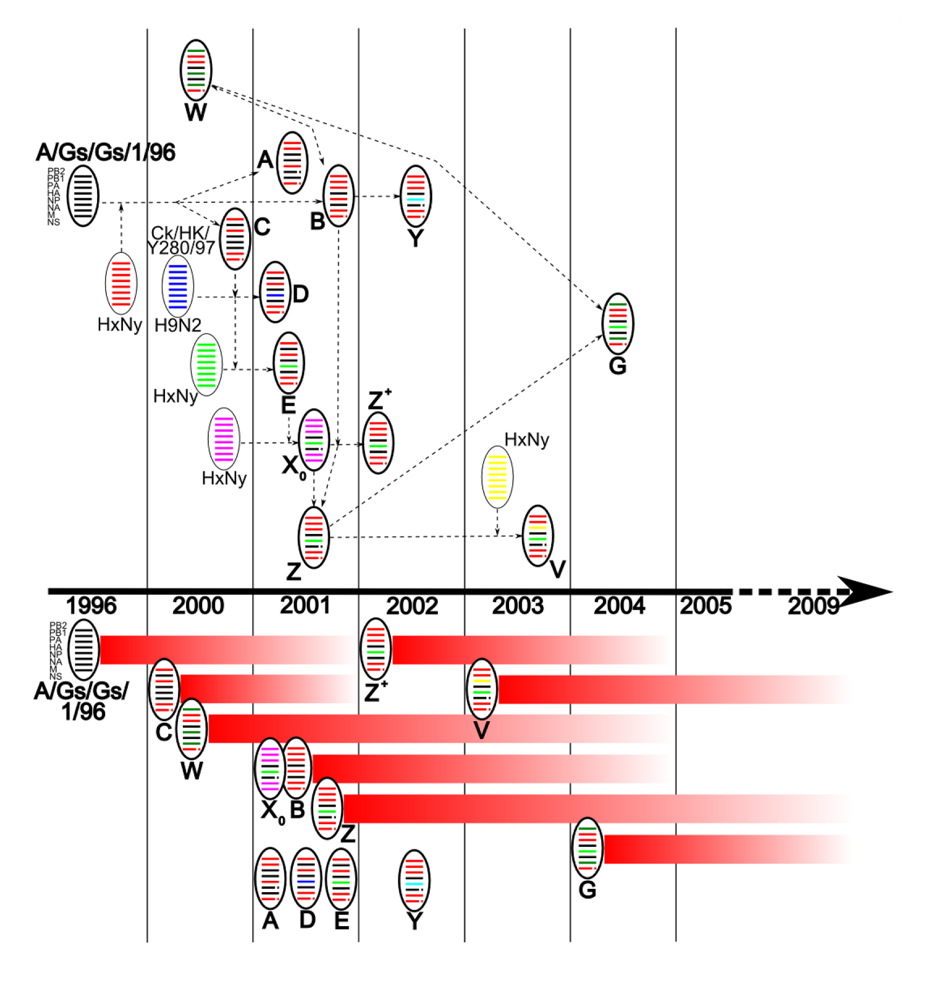
      <p>By 2001, eight genotypes (A, B, C, D, E, X<sub>0</sub>, W, Z) had been identified in Hong-Kong and China (<xref ref-type="fig" rid="figure1">Figure 1</xref>), derived from A/Gs/Gd/1/96-like viruses, from an H9N2 avian virus (Chicken/Hong Kong/Y280/97), and other unknown viruses [<xref ref-type="bibr" rid="B4">4</xref>,<xref ref-type="bibr" rid="B14">14</xref>,<xref ref-type="bibr" rid="B16">16</xref>]. By 2003, three other major genotypes had arisen (Y, Z+, V) [<xref ref-type="bibr" rid="B4">4</xref>,<xref ref-type="bibr" rid="B16">16</xref>]. In 2004, the reassortment between genotypes Z and W led to the emergence of a new genotype, G [<xref ref-type="bibr" rid="B45">45</xref>]. Amongst all these genotypes, only a few persisted for longer than two years (B, Z, Z+, V, G, W, and X<sub>0</sub>) suggesting the acquisition of efficient survival capacities (<xref ref-type="fig" rid="figure1">Figure 1</xref>) [<xref ref-type="bibr" rid="B16">16</xref>].</p>
      <fig id="figure1" position="float">
        <label>Figure 1</label>
        <caption>
          <p>Diagram representing the emergence and persistence of major H5N1 reassortant viruses. Gene segments are ordered PB2, PB1, PA, HA, NP, NA, M, NS from top to bottom within the virus particle diagram. NS1 deletion (position 80-84) and NA-stalk deletion (position 49-68) are represented by discontinuous gene segments. Virus particles outlined in simple black represent potential donor viruses and those outlined in bold black represent characterized H5N1 genotypes placed at the year of first detection. Particles named “HxNy” represent potential donor viruses of which HA and NA subtypes were not identified. Arrows in dotted lines represent possible reassortment pathways of genotype development. Persistence of each genotype since first year of detection is represented by red lines, under the timeline.</p>
        </caption>
        <graphic xmlns:xlink="http://www.w3.org/1999/xlink" xlink:href="viruses-01-00335-g001.tif" scale="0"/>
      </fig>
      <p>These multiple reassortment events are believed to have occurred within domestic duck species, in which H5N1 generally causes an asymptomatic infection. It is proposed that avian influenza viruses from the natural gene pool existing in wild birds are introduced into domestic ducks, and are then able to reassort with endemic H5N1 viruses [<xref ref-type="bibr" rid="B45">45</xref>]. This would then enable the transmission of newly emerged reassortants to other poultry species, and facilitate their rapid spreading. Until recently, there was no evidence of reassortment events outside of China [<xref ref-type="bibr" rid="B16">16</xref>]. However, in 2008 and 2009, studies provided evidence of the emergence of local reassortants in Vietnam, Indonesia, and Thailand [<xref ref-type="bibr" rid="B28">28</xref>,<xref ref-type="bibr" rid="B33">33</xref>,<xref ref-type="bibr" rid="B45">45</xref>,<xref ref-type="bibr" rid="B46">46</xref>].</p>
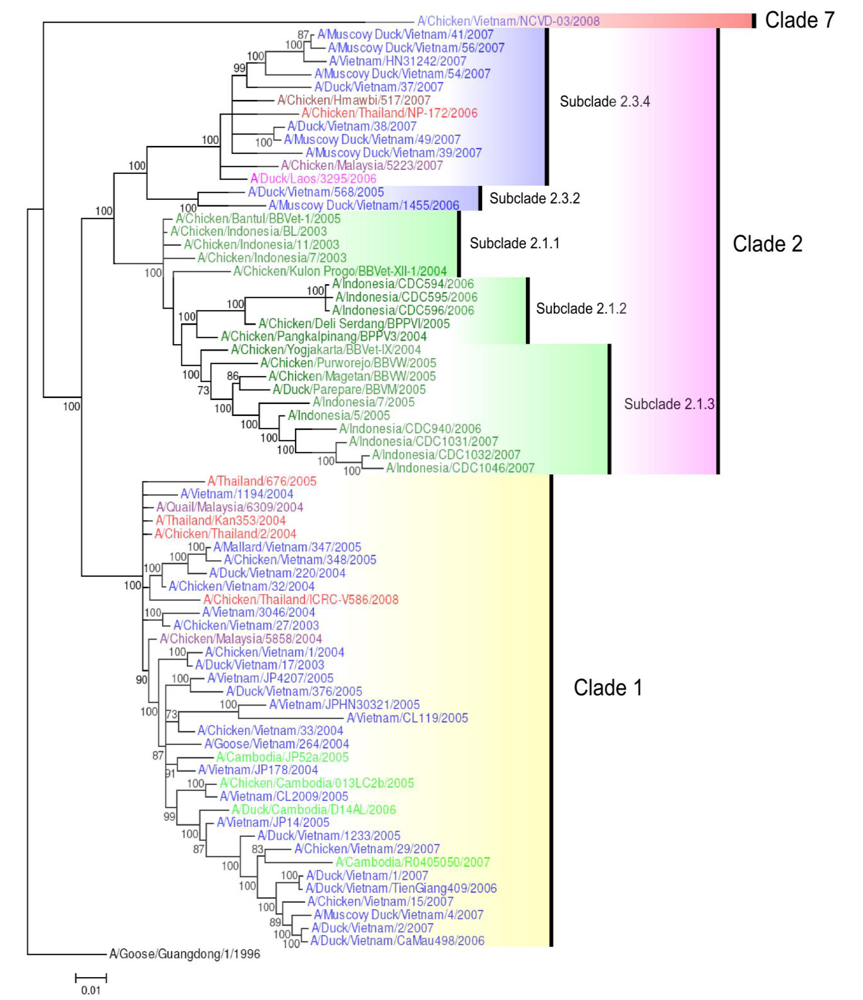
      <p>Genotype Z has dominated the H5N1 outbreaks documented in South East Asia from 2003 until the present day [<xref ref-type="bibr" rid="B47">47</xref>]. Nevertheless, in 2005 and 2006 several genotype G viruses were detected in poultry in Northern Vietnam, for example A/Duck/Vietnam/568/2005 and A/MuscovyDuck/ Vietnam/1455/2006 [<xref ref-type="bibr" rid="B48">48</xref>] (<xref ref-type="fig" rid="figure2">Figure 2</xref>). These viruses may have been introduced into Vietnam in early 2005, since they were closely related to a virus first detected in Guangxi, China in that year [<xref ref-type="bibr" rid="B47">47</xref>]. Although seven clades and nine genotypes have been identified in Vietnam since first detection of H5N1 virus in the country [<xref ref-type="bibr" rid="B28">28</xref>,<xref ref-type="bibr" rid="B49">49</xref>], phylogenetic analysis of the internal genes reveal that at least 8 potential ancestors were necessary for the emergence of the viruses that circulated in this country, and subsequently provided a large pool of genes for further reassortments [<xref ref-type="bibr" rid="B28">28</xref>].</p>
     <fig id="figure2" position="float">
        <label>Figure 2</label>
        <caption>
          <p>Phylogenetic tree of the HA gene of representative South East Asian H5N1 viruses. Analysis of HA gene based on full length gene sequences. The tree was generated by Bayesian analysis using MrBayes v3.1.2 [<xref>57</xref>]. Numbers on branches indicate Bayesian posterior probability values. The tree was rooted to A/Goose/Guangdong/1/1996. Scale bar: 0.01 substitutions per site. Colors used for the different countries are: Cambodia = light green; Indonesia = dark green; Lao PDR = pink; Malaysia = purple; Myanmar = maroon; Thailand = red; Vietnam = blue.</p>
        </caption>
        <graphic xmlns:xlink="http://www.w3.org/1999/xlink" xlink:href="viruses-01-00335-g002.tif" scale="0"/>
      </fig>
      <p>Although in Indonesia genotype Z is the sole genotype detected, there is now evidence of reassortment events within genotype Z viruses [<xref ref-type="bibr" rid="B46">46</xref>]. From 2003 to 2004, all detected viruses belong to a single phylogenetic group [<xref ref-type="bibr" rid="B46">46</xref>]. However, from 2005 to 2007, three groups were identified (named 1, 2, 3). Within group 2, subgroups of reassortant viruses were identified which were likely to have resulted from reassortment between group 3 ancestral viruses (M and PB1 genes), and group 2 ancestral viruses (PB2, PA, HA, NP, NA, NS genes). The common ancestor of these reassortant viruses has been dated to July 2005 [<xref ref-type="bibr" rid="B46">46</xref>].</p>
      <p>All Thai strains of HPAI H5N1 viruses belong to genotype Z or Z+ with one exception which was a virus isolated in Nakhon Pathom province in 2006, A/Chicken/Thailand/NP-172/2006, which belongs to genotype V [<xref ref-type="bibr" rid="B50">50</xref>]. Although viruses from different clades have circulated in Thailand, no reassortment has been reported between clade 1 and 2 viruses. Nevertheless, important reassortment events occurred between various strains of H5N1 virus which persisted silently over a dry season period before giving rise to outbreaks in 2007-2008 [<xref ref-type="bibr" rid="B33">33</xref>]. </p>
      <p>In Lao PDR, the first H5N1 isolates detected in 2003 were genotype Z viruses. However, in 2007, a genotype V strain was isolated, and interestingly clustered with the genotype V A/Chicken/Thailand/NP-172/2006 virus, suggesting a common origin [<xref ref-type="bibr" rid="B51">51</xref>]. Suprisingly, only genotype Z clade 1 viruses have been detected in Cambodia since the emergence of the epidemic in 2003 [<xref ref-type="bibr" rid="B52">52</xref>].</p>
    </sec>
    <sec>
      <title>4. H5N1 Clade Evolution in South East Asia</title>
      <p>Ten different clades (genetic groups) have been defined within the H5N1 viruses, based upon the evolution of the H5 hemagglutinin gene. These clades are strictly defined by phylogenetic criteria, such as sharing a common node, reaching a threshold value of ≥ 60 for the bootstrap at this clade-defining node and fitting in a precise range of values for the average percentage pairwise nucleotide distances between and within clades of &gt;1.5% and &lt;1.5%, respectively [<xref ref-type="bibr" rid="B53">53</xref>]. Several sublineages have emerged within the different clades, resulting in the designation of subclades.</p>
      <p>Between 2003 and 2006, only clades 1 and 2 viruses circulated in South East Asia (<xref ref-type="fig" rid="figure2">Figure 2</xref>). Clade 1 viruses have circulated in Thailand, Vietnam, Malaysia, Lao PDR and Cambodia, affecting both poultry and humans. Clade 2 viruses in South East Asia are represented by subclades 2.1 (2.1.1, 2.1.2, 2.1.3) and 2.3 (2.3.2, 2.3.4). Clade 2 viruses have been circulating in Indonesia since 2003. Within Indonesian clade 2 viruses, subclade 2.1.1 viruses have caused outbreaks exclusively in poultry whereas subclades 2.1.2 and 2.1.3 have affected both birds and humans. Clade 2 (subclade 2.3.2) viruses emerged in Vietnam in 2005, infecting poultry and other migratory species. Subclade 2.3.4 viruses then emerged in 2006 and were identified in poultry outbreaks in Lao PDR, Vietnam (mainly in the north), Thailand, and Malaysia but never in Cambodia (<xref ref-type="fig" rid="figure2">Figure 2</xref>) [<xref ref-type="bibr" rid="B28">28</xref>,<xref ref-type="bibr" rid="B54">54</xref>,<xref ref-type="bibr" rid="B55">55</xref>]. These viruses were confirmed in human hosts in Vietnam for the first time in 2007 [<xref ref-type="bibr" rid="B56">56</xref>].</p>
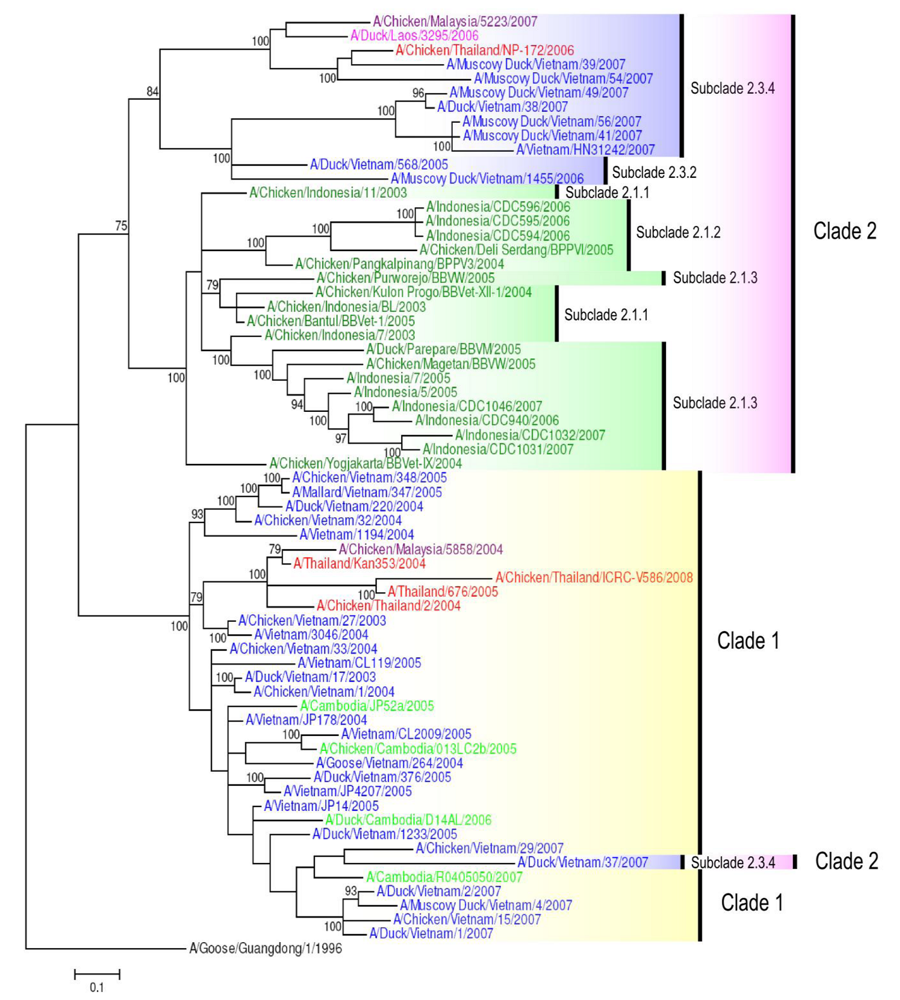
      <p>In Vietnam, seven clades and/or subclades have been identified: clades 0, 1, 2 (2.3.2, 2.3.4), 3, 5 [<xref ref-type="bibr" rid="B28">28</xref>], and recently clade 7 [<xref ref-type="bibr" rid="B49">49</xref>]. Viruses from clades 0, 3 and 5 persisted no longer than one to two years each [<xref ref-type="bibr" rid="B28">28</xref>]. Clade 7 viruses were detected in Northern Vietnam in 2008 (e.g., A/Chicken/Vietnam/NCVD-03/2008) (<xref ref-type="fig" rid="figure2">Figure 2</xref>). Subclade 2.3.2 viruses isolated in Vietnam are represented on the HA tree by the strains A/Duck/Vietnam/568/2005 and A/Muscovy Duck/Vietnam/1455/2006 (<xref ref-type="fig" rid="figure2">Figure 2</xref>), which are also the representatives for genotype G viruses (<xref ref-type="fig" rid="figure1">Figure 1</xref>). It is of interest to note that some viruses, such as A/Duck/Vietnam/37/2007, belong to the subclade 2.3.4, whilst sharing the NA and internal gene constellation of clade 1 viruses, providing evidence for mechanisms of reassortment between different clades (<xref ref-type="fig" rid="figure2">Figure 2</xref>and <xref ref-type="fig" rid="figure3">Figure 3</xref>) [<xref ref-type="bibr" rid="B48">48</xref>].</p>
      <fig id="figure3" position="float">
        <label>Figure 3</label>
        <caption>
          <p>Phylogenetic tree of the NA gene of representative South East Asian H5N1 viruses. Analysis of NA gene based on full length gene sequences. The tree was generated by Bayesian analysis using MrBayes v3.1.2 [<xref>57</xref>]. Numbers on branches indicate Bayesian posterior probability values. The tree was rooted to A/Goose/Guangdong/1/1996. Scale bar: 0.1 substitutions per site. Colors used for the different countries are: Cambodia = light green; Indonesia = dark green; Lao PDR = pink; Malaysia = purple; Myanmar = maroon; Thailand = red; Vietnam = blue.</p>
        </caption>
       <graphic xmlns:xlink="http://www.w3.org/1999/xlink" xlink:href="viruses-01-00335-g003.tif" scale="0"/>
      </fig>
    </sec>
    <sec>
      <title>5. Geographical Dynamics of H5N1 Virus Transmission</title>
      <p>The H5N1 influenza virus has continued to spread from its established source in Southern China to other regions through the transport of poultry and bird migration [<xref ref-type="bibr" rid="B47">47</xref>]. Domestic ducks in Southern China have had a central role in the generation and maintenance of this virus, and wild birds may have contributed to the increasingly wide spread of the virus in South East Asia, and to other parts of the world<bold> </bold>[<xref ref-type="bibr" rid="B4">4</xref>,<xref ref-type="bibr" rid="B58">58</xref>,<xref ref-type="bibr" rid="B59">59</xref>].</p>
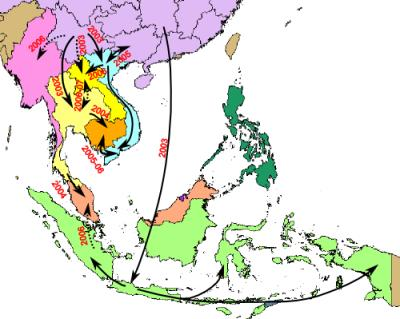
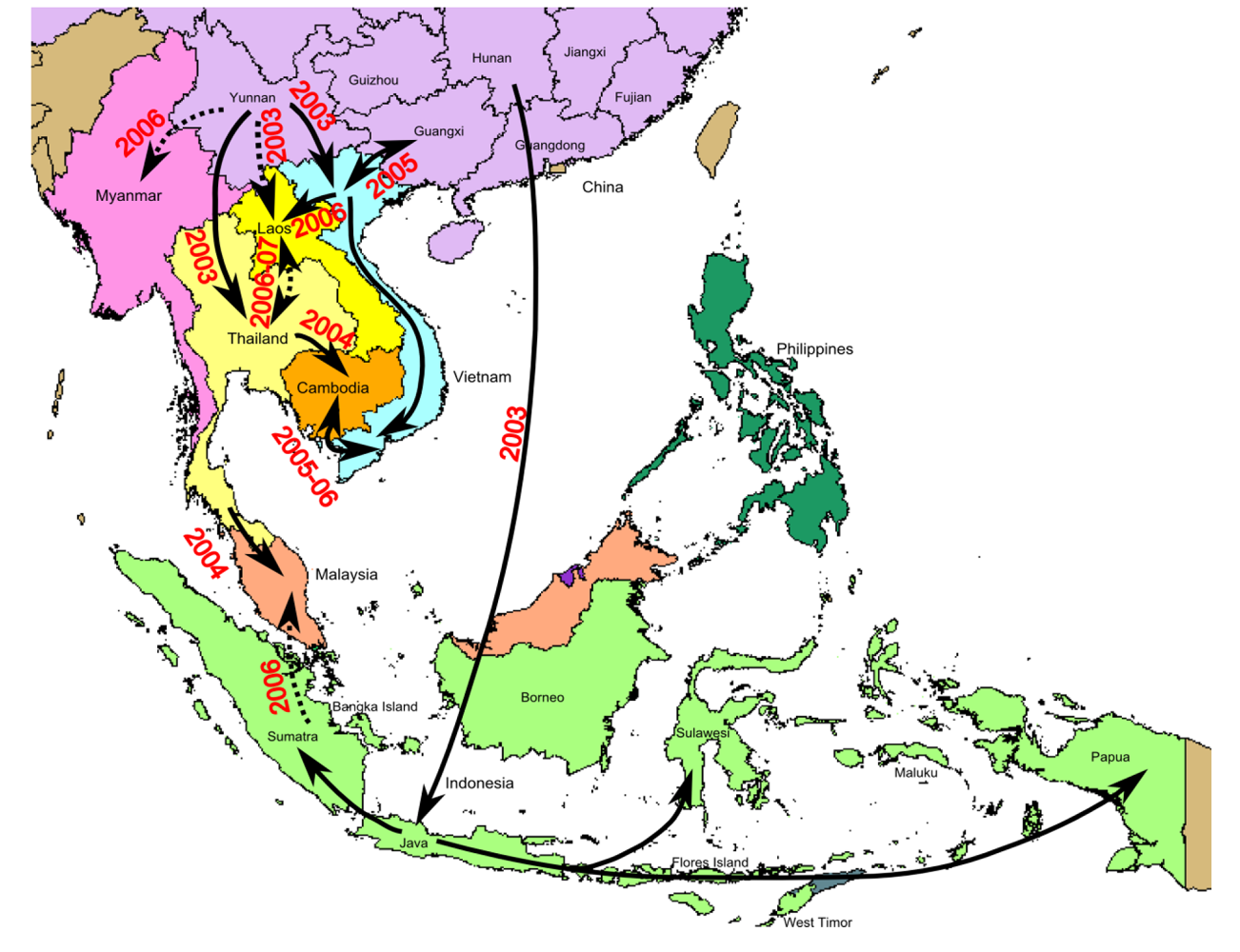
      <p>Since 2003, the HPAI H5N1 virus has spread from China to other countries during three successive transmission waves in 2003, 2005, and 2006 [<xref ref-type="bibr" rid="B4">4</xref>,<xref ref-type="bibr" rid="B60">60</xref>,<xref ref-type="bibr" rid="B61">61</xref>]. The first wave of H5N1 outbreaks occurred in 2003/2004. These viruses originated in Yunnan and Hunan and became endemic in South Vietnam and Cambodia (clade 1 viruses), and Indonesia (clade 2.1 viruses), respectively (<xref ref-type="fig" rid="figure2">Figure 2</xref>and<xref ref-type="fig" rid="figure4">Figure 4</xref>) [<xref ref-type="bibr" rid="B26">26</xref>]. The second wave of transmission occurred following the outbreak at Qinghai lake in Northern China in 2005, whereby clade 2.2 viruses were transmitted by migratory birds to Africa and Europe [<xref ref-type="bibr" rid="B22">22-25</xref>]. In the third wave, a Fujian-like sublineage (clade 2.3) replaced previously established sublineages in several provinces of China, before spreading to Vietnam, Thailand, Lao PDR, Malaysia and Myanmar in 2006 [<xref ref-type="bibr" rid="B61">61</xref>]. The event currently occurring in Qinghai province may be of some concern, since it is known to be on a major migration route of wild birds and of primary epidemiological importance.</p>
     <fig id="figure4" position="float">
        <label>Figure 4</label>
        <caption>
          <p>Map of major H5N1 migration events in South East Asia, based on epidemiological evidence. Arrows represent probable transmission routes. Arrows in dotted lines represent migrations for which the exact origin or the direction has not been elucidated.</p>
        </caption>
        <graphic xmlns:xlink="http://www.w3.org/1999/xlink" xlink:href="viruses-01-00335-g004.tif" scale="0"/>
      </fig>
      <p>The H5N1 virus has been introduced into Vietnam from Southern China on multiple occasions<italic>. </italic>The majority of novel viruses were first detected in Northern Vietnam, suggesting introduction from Yunnan (China) . These viruses subsequently spread to Southern Vietnam, often after reassorting with pre-existing local viruses in Northern Vietnam [<xref ref-type="bibr" rid="B26">26</xref>,<xref ref-type="bibr" rid="B28">28</xref>]. The apparent northern to southern spread of H5N1 may correspond to direct poultry trade routes between major population centres in these regions [<xref ref-type="bibr" rid="B58">58</xref>] or to trade routes along the Mekong River from Lao PDR to Vietnam. Some viruses may have spread back and forth between countries at different time points [<xref ref-type="bibr" rid="B48">48</xref>]. Cross-border poultry trade between Vietnam and China could have led to the introduction of clade 2.3.4 (presumably from Guangxi province, China) and other lineages into Vietnam [<xref ref-type="bibr" rid="B48">48</xref>].</p>
      <p>The H5N1 virus became widespread and endemic in Thailand throughout 2004 without interruption, despite brief periods of undetectable transmission during the hottest months of February-May [<xref ref-type="bibr" rid="B29">29</xref>]. It is believed that the virus is maintained in Thailand at low level during these dry, hot months, therefore providing a source for outbreaks during the wet and cooler months of September-December, when the conditions are more favourable for its spread. A new viral strain (clade 2.3.4, genotype V) was introduced into the north-eastern region of the country in 2006 [<xref ref-type="bibr" rid="B50">50</xref>]. The subtype H5N1 viruses circulating in the markets in ten provinces of central Thailand during July 2006–August 2007 were genetically related to those that circulated in Thailand during 2004–2005, which indicated that the virus was endemic to Thailand [<xref ref-type="bibr" rid="B62">62</xref>]. This suggests that yearly re-emerging viruses in central Thailand belonged to a similar lineage and that they originated from a locally persistent reservoir, rather than repeated introductions [<xref ref-type="bibr" rid="B30">30</xref>,<xref ref-type="bibr" rid="B63">63</xref>]. Recent avian influenza outbreaks in Thailand in 2007-2008 were also shown to be caused by indigenous viruses [<xref ref-type="bibr" rid="B33">33</xref>].</p>
      <p>In Cambodia, the HPAI H5N1 virus was probably introduced from Thailand in 2004 [<xref ref-type="bibr" rid="B64">64</xref>] and then re-introduced from Vietnam over several waves of transmission until the virus finally became endemic, establishing a recent sub-lineage in the south Indochina peninsula region. Poultry movements, rather than repeated re-introductions of H5N1 viruses by wild birds, are responsible for virus circulation and perpetuation [<xref ref-type="bibr" rid="B64">64</xref>]. Within Cambodia, the spread of H5N1 virus clearly occurs in a North-to-South direction, following a major road and transport route. Poultry trading, live poultry markets, cock fights, and other risk factors for poultry contamination are therefore likely to be responsible for the spread of the virus [<xref ref-type="bibr" rid="B65">65</xref>,<xref ref-type="bibr" rid="B66">66</xref>].</p>
      <p>In Lao PDR, it seems that the H5N1 virus has not persisted endemically. H5N1 was first detected in 2003, and then disappeared in 2004 [<xref ref-type="bibr" rid="B38">38</xref>]. In early 2006, a clade 2.3.4 virus was detected, which was presumably introduced from Northern Vietnam [<xref ref-type="bibr" rid="B38">38</xref>]. This virus also seems to have vanished from Lao PDR [<xref ref-type="bibr" rid="B38">38</xref>]. However, in 2007, a genotype V, clade 2.3.4 strain was isolated near the Thai border. Phylogenetic analysis of the HA gene showed that this strain probably shared a common origin with Thai strains isolated in 2006 near the border. Although the direction of the transmission can not be determined, extensive<bold> </bold>poultry movement across the Mekong River is believed to have facilitated the circulation of these strains between countries [<xref ref-type="bibr" rid="B51">51</xref>]. </p>
      <p>In Indonesia, phylogenetic analysis suggests that a single introduction of genotype Z, clade 2 viruses from Southern Chinese domestic poultry (Hunan province) has occurred (<xref ref-type="fig" rid="figure4">Figure 4</xref>) [<xref ref-type="bibr" rid="B4">4</xref>,<xref ref-type="bibr" rid="B47">47</xref>,<xref ref-type="bibr" rid="B67">67</xref>]. The continuing endemicity of those viruses subsequently resulted in the establishment of geographically distinct groups [<xref ref-type="bibr" rid="B8">8</xref>]. In the Indonesian sublineages, there are three groups of viruses. The first group includes viruses from Central and Eastern Indonesia (Java, Southern Sulawesi and West Timor). The second group also contains viruses from Central and Eastern Indonesia (isolates from Java, Bali, Flores Island and West Timor). In comparison, the third group of viruses are from Central and Western Indonesia, found throughout Java and Sumatra, and Bangka Island [<xref ref-type="bibr" rid="B8">8</xref>]. These relationships highlight the subsequent spread both east and west throughout the country. Continued virus activities in Indonesia were attributed to transmission via poultry movement within the country rather than through repeated introductions by bird migration [<xref ref-type="bibr" rid="B8">8</xref>]. Java is thought to be an epicentre for H5N1 generation and spread in Indonesia [<xref ref-type="bibr" rid="B8">8</xref>,<xref ref-type="bibr" rid="B68">68</xref>] (<xref ref-type="fig" rid="figure4">Figure 4</xref>).</p>
    </sec>
    <sec>
      <title>6. Evolution of Influenza A(H5N1) Virus Genes</title>
      <sec>
        <title>6.1. Hemagglutinin (HA) gene</title>
        <p>Diverse populations of endemic HPAI H5N1 viruses have continuously evolved in South East Asia, from 2003 until the present day, and several gene modifications have occurred within these viruses which may affect their transmissibility and pathogenicity. To become a pandemic strain, a H5N1 virus must be able to be efficiently transmitted between human hosts, a feature that existing H5N1 viruses have not yet acquired.</p>
        <p>The HA is the main influenza antigen and determines cell binding, host range, and neutralizing antibody response. Thus, some modifications on the HA gene could provide the virus with advantageous properties. Several key amino acid residues on the HA have been identified. </p>
        <p>Avian influenza viruses are defined as HPAI or LPAI viruses, based on the severity of the disease which they cause. HPAI viruses are highly contagious amongst poultry, and often result in a high fatality rate, especially in terrestrial poultry like chicken, quail or turkey (up to 100% in 2-3 days). LPAI viruses are responsible for mild diseases, with few or no symptoms in some bird species. The defining feature of HPAI is a multi-basic amino acid motif at the cleavage site present in the HA gene (PQRERRRKKR/G), which confers increased pathogenicity. LPAI viruses have a single arginine at the HA cleavage site, which can subsequently be cleaved only by trypsine-like proteases. Since these proteases are present in a restricted number of organs, the infection is usually limited to the respiratory or to the intestinal tract, without becoming systemic. In contrast, the presence of multiple basic amino acids allows the hemagglutinin to be cleaved by many different proteases, enabling a broader tissue tropism, and the ability to cause systemic infections. Some H5N1 strains have alterations on this site, such as Arg (R) or Lys (K) deletions or insertions. Alterations of this kind were observed, among others, on Cambodian, Indonesian, Thai and Vietnamese H5N1 isolates [<xref ref-type="bibr" rid="B8">8</xref>,<xref ref-type="bibr" rid="B49">49</xref>,<xref ref-type="bibr" rid="B50">50</xref>]. Although the real impact of such changes in the HA cleavage site is difficult to estimate, the high frequency of these occurrences highlights the importance of conscientious surveillance of this site.</p>
        <p>The relevant residues involved in antigenic sites on the H5 HA have been described, and compared to H3 antigenic sites which have been comprehensively characterized [<xref ref-type="bibr" rid="B69">69</xref>,<xref ref-type="bibr" rid="B70">70</xref>]. The host immune pressure can induce mutations on these antigenic sites, which results in the emergence of immune-escape mutants. Therefore, a positive selective pressure on those sites can rapidly lead to ineffective host immune responses, which are a major constraint for the development of human or animal vaccines. In Vietnam and Indonesia, among virus isolated from August 2003 to June 2005, a positive selective pressure has been reported on 8 residues of the HA gene. Five of those residues were located on antigenic sites A and E (positions 83, 86, 138, 140 and 141), two of them were suggested to be involved in receptor binding (positions 129 and 175). The last one was a potential <italic>N</italic>-linked glycosylation site (position 156) [<xref ref-type="bibr" rid="B8">8</xref>].</p>
        <p>The HA of human influenza viruses preferentially bind to sialic acid (SA) receptors linked to galactose (Gal) through an α-2,6 linkage (SA α-2,6Gal), whereas avian influenza viruses preferentially bind to SA receptors of the α-2,3 linkage (SA α-2,3Gal). The HA sites which bind these receptors are often under selective evolutionary pressure. Mutations of these binding sites from an avian to human receptor binding preference could facilitate human-to-human transmission and these sites have been proposed as markers for assessing the pandemic potential of H5N1 isolates [<xref ref-type="bibr" rid="B71">71</xref>]. Two key residues have been identified to determine receptor preference switching – position 226 and 228 in H2 and H3 isolates, which corresponds to 222 and 224 in the H5 gene [<xref ref-type="bibr" rid="B72">72</xref>]. However, the mutations Gln222Leu and Gly224Ser which are believed to enhance the affinity of the virus for the SA α-2,6Gal have never been observed in H5N1 field isolates. Nevertheless, several naturally occurring mutations were associated with an enhanced affinity of the avian virus to “human type” receptors SA α-2,6Gal. Mutations at position 182 (Asn182Lys) and 192 (Gln192Arg) can independently switch the receptor binding preference from avian to human [<xref ref-type="bibr" rid="B73">73</xref>]. Several other combinations of mutations were found to have a variable effect on receptor switching, certainly indicating that in the right circumstance a virus may adapt to bind human receptors more efficiently.</p>
        <p>H5N1 HPAI viruses from clade 2.1 (found in Indonesia) may be under a lower positive selective pressure compared to the other clades [<xref ref-type="bibr" rid="B74">74</xref>]. Although such an observation is difficult to interpret, there may be a reduced necessity for the virus to evolve and adapt in Indonesia due to the high endemicity of the disease. The persistence in poultry reduces the need for the virus to jump from one species to another, especially to mammalian species, in order to maintain the chain of transmission [<xref ref-type="bibr" rid="B74">74</xref>].</p>
      </sec>
      <sec>
        <title>6.2. Neuraminidase (NA) gene</title>
        <p>The neuraminidase enzyme cleaves HA from sialic acids, facilitating the release of newly assembled viral particles from the host cell surface and thus enabling spread to other cells. Interestingly, all H5N1 viruses which have been isolated post-2003 contain a deletion in the stalk region of the protein, at positions 49-68 for clade 1 and 2 viruses, and at positions 54-72 for clade 3 viruses [<xref ref-type="bibr" rid="B75">75</xref>]. This deletion reduces the enzymatic activity of the NA, and may act to balance with the HA which has a reduced affinity interaction with receptors in poultry, compared to aquatic birds [<xref ref-type="bibr" rid="B76">76</xref>].</p>
        <p>The NA is a target for the neuraminidase inhibitor (NAI) class of antiviral drugs, including Oseltamivir (Tamiflu<sup>TM</sup>) and Zanamivir (Relenza<sup>TM</sup>) which are commercially available. H5N1 viruses are typically sensitive to NAI’s , and these drugs are used as first line treatment for H5N1 infections in humans, and are a major component of pandemic planning as they are also recommended for chemoprophylaxis [<xref ref-type="bibr" rid="B77">77</xref>]. The His274Tyr mutation is associated with resistance to Oseltamivir. This mutation is now increasingly prevalent in seasonal H1N1 and H3N2 influenza strains, partly due to widespread use of Oseltamivir [<xref ref-type="bibr" rid="B77">77</xref>]. In addition to His274Tyr, amino acid substitutions Arg292Lys, Glu119Val and Asn294Ser have been associated with resistance or reduced sensitivity to Oseltamivir [<xref ref-type="bibr" rid="B78">78</xref>].</p>
        <p>There have been several reports illustrating the development of Oseltamivir resistance during the treatment of H5N1-infected patients. Some patients developed the His274Tyr mutation, others the Asn294Ser mutation associated with a decreased sensitivity to NAI’s [<xref ref-type="bibr" rid="B79">79</xref>,<xref ref-type="bibr" rid="B80">80</xref>]. To assess the threat of a resistant H5N1 strain persisting with equal fitness and replicability, the H5N1 virus A/Vietnam/1203/2004 was engineered to possess several NA resistance mutations including His274Tyr, Glu119Val, Arg292Lys, and Asn294Ser. Viruses with His274Tyr and Asn294Ser were found to retain their infectivity and pathogenicity, highlighting the importance of ongoing surveillance of Oseltamivir resistance for early detection of resistant viruses [<xref ref-type="bibr" rid="B81">81</xref>]. </p>
        <p>In the absence of resistance mutations, genetic drift mutations also give rise to variations in Oseltamivir sensitivity [<xref ref-type="bibr" rid="B82">82</xref>,<xref ref-type="bibr" rid="B83">83</xref>]. Mutations which are remote from the active site may not confer absolute resistance, but may affect the dosage of drugs required to treat these infections. Suboptimal dosing may lead to the emergence of fully resistant viruses. Clade 2.3.4 viruses in Vietnam were recently found to be 8-fold less susceptible to Oseltamivir, but maintain their susceptibility to the adamantanes (M2 inhibitor drugs) [<xref ref-type="bibr" rid="B56">56</xref>]. Treatment combining NAI and adamantanes is recommended for patients infected with adamantane-sensitive H5N1 strains [<xref ref-type="bibr" rid="B56">56</xref>,<xref ref-type="bibr" rid="B84">84</xref>]. Ongoing evaluation of the evolution of drug sensitivity in both seasonal and H5N1 influenza viruses is vital in understanding the best treatment options in the wake of rapid virus evolution.</p>
      </sec>
      <sec>
        <title>6.3. M gene</title>
        <p>The M gene encodes two capsid proteins (M1 and M2). M1 is a RNA-binding protein, and M2 is a membrane ion channel protein involved in H<sup>+</sup> proton transport, which facilitates the acidification of the endosome and the release of the viral particle inside the cytoplasm [<xref ref-type="bibr" rid="B85">85</xref>]. A comparison of synonymous and non-synonymous nucleotide substitutions in virus isolates from Indonesia and Vietnam (2003-2005) provided evidence of positive natural selection on the M2 gene [<xref ref-type="bibr" rid="B8">8</xref>]. Mutations on the M2 protein can result in different adaptative processes which affect the virus' capacity to uncoat during the early stages of the infection, and modulate its virulence. Also, mutation on the M2 gene can lead to adaptation to the different pH environments of aquatic or terrestrial hosts [<xref ref-type="bibr" rid="B8">8</xref>]. Moreover, the M2 protein is the target of the adamantane class of antiviral drugs (amantadine, rimantadine). Two mutations on this protein (Leu26Ile and Ser31Asn) lead to drug resistance, and these mutations are present in all genotype Z, clade 1 viruses [<xref ref-type="bibr" rid="B86">86</xref>]. Clade 2.3.4 viruses from Indonesia and Vietnam remain sensitive to amantadine [<xref ref-type="bibr" rid="B56">56</xref>], and clade 2.1 and 2.2 viruses have varying rates of resistance to this class of drug [<xref ref-type="bibr" rid="B86">86</xref>,<xref ref-type="bibr" rid="B87">87</xref>]. Thus, monitoring M2 mutations in H5N1 viruses remains an important aspect of avian influenza surveillance. </p>
      </sec>
      <sec>
        <title>6.4. Polymerase complex (PB1, PB2, PA)</title>
        <p>The polymerase complex of influenza viruses is composed of three subunits: PB1, PB2, and PA. These subunits, along with the NP protein and the RNA genome, form the ribo-nucleoproteic complex, necessary for the protection of the genome, as well as the replication and transcription processes. The PB1 gene also encodes the PB1-F2 protein by an alternative reading frame. Analyses conducted on viruses from Vietnam and Indonesia isolated between 2003 to 2005 showed that several sites on the PB1-F2 gene were under positive natural selection, although the significance of these particular sites is not known [<xref ref-type="bibr" rid="B8">8</xref>]. In mouse models and in cell lines, the PB1-F2 protein can influence viral pathogenicity, by sensitizing host cells to apoptotic stimuli (e.g. TNFα), thereby promoting apoptosis during infection [<xref ref-type="bibr" rid="B88">88</xref>,<xref ref-type="bibr" rid="B89">89</xref>]. However, the residues involved in this process have not yet been identified.</p>
        <p>Mutations at residue 627 on the PB2 protein are associated with increased virulence and are thought to be relevant to the adaptation of H5N1 viruses to human hosts. The 627 residue on PB2 is a glutamic acid (Glu) in avian strains [<xref ref-type="bibr" rid="B76">76</xref>]. The Glu627Lys mutation on the PB2 improves replication efficiency, enhances adaptation of HPAI viruses to mammalian hosts, and increases transmission between mammalian hosts in experimental models [<xref ref-type="bibr" rid="B90">90-92</xref>]. The 627Lys mutation enhances growth at lower temperatures, consistent with those found in the human upper respiratory tract (around 33°C), compared to wild type viruses with 627Glu which grow optimally at 41°C [<xref ref-type="bibr" rid="B93">93</xref>,<xref ref-type="bibr" rid="B94">94</xref>]. Within clade 1 or clade 2.1 viruses, the Glu627Lys mutation is observed in some human strains but not in avian strains, suggesting a selective advantage for these isolates in mammalian hosts [<xref ref-type="bibr" rid="B8">8</xref>,<xref ref-type="bibr" rid="B95">95</xref>]. In clade 2.2 viruses, the Glu627Lys mutation is observed in both human and avian strains [<xref ref-type="bibr" rid="B47">47</xref>]. Interestingly, most of the strains isolated in birds from the Qinghai Lake outbreaks in 2005 (clade 2.2), which spread to Europe and Africa, contained the 627Lys mutation [<xref ref-type="bibr" rid="B60">60</xref>,<xref ref-type="bibr" rid="B96">96</xref>].</p>
        <p>In addition to residue 627, several other changes on the PB2 protein and other proteins of the polymerase complex also contribute to adaptation to mammalian hosts and to regulation of virulence [<xref ref-type="bibr" rid="B90">90</xref>,<xref ref-type="bibr" rid="B97">97</xref>]. Positive selective pressure was also detected at several sites of unknown function, on PB2 and PA genes from Indonesian strains isolated from 2003 to 2007 [<xref ref-type="bibr" rid="B39">39</xref>]. Thus, surveillance of the substitutions occurring on the polymerase genes, and further elucidation of the importance of PB2 and PA genes in virus evolution is of ongoing interest.</p>
      </sec>
      <sec>
        <title>6.5. NS1 protein</title>
        <p>The non-structural protein NS1 can regulate H5N1 virus virulence in humans by modulating the host immune response. The severity of human infections with H5N1 virus in 1997 was partly due to the resistance of these viruses to interferons and TNFα during the host immune response. The presence of glutamic acid at residue 92 on the NS1 was vital for these effects [<xref ref-type="bibr" rid="B98">98</xref>,<xref ref-type="bibr" rid="B99">99</xref>]. However 92Glu has not been identified in more recent human H5N1 strains. Ser42 and Ala149 can also inhibit immune response signaling pathways, including induction of interferons [<xref ref-type="bibr" rid="B100">100</xref>,<xref ref-type="bibr" rid="B101">101</xref>]. On the contrary, deletions in the NS1 gene can attenuate virulence [<xref ref-type="bibr" rid="B102">102</xref>]. The NS1 carboxy-terminal PDZ ligand binding motif is also a potential virulence factor. This motif binds cellular PDZ-containing proteins, disrupting a range of cellular signaling pathways [<xref ref-type="bibr" rid="B103">103</xref>]. Therefore, monitoring the evolution of the NS1 gene is important for the detection of novel viruses with increased pathogenicity in humans.</p>
      </sec>
    </sec>
    <sec>
      <title>7. H5N1 virus host range</title>
      <p>The H5N1 avian influenza virus does not easily infect humans and cannot spread efficiently amongst the human population. Very few suspected cases of human-to-human transmission have been suspected in family clusters of patients, which account for approximately one quarter of total number of cases [<xref ref-type="bibr" rid="B40">40</xref>,<xref ref-type="bibr" rid="B104">104</xref>]. In most cases, patients probably acquired infection from common-source exposures to poultry or contaminated environment. In some cases, family members in close and unprotected contact with severely ill patient have become ill in the apparent absence of other exposure factors [<xref ref-type="bibr" rid="B39">39</xref>,<xref ref-type="bibr" rid="B104">104</xref>,<xref ref-type="bibr" rid="B105">105</xref>]. Several studies have demonstrated a lack of human-to-human transmission in high-risk populations such as unprotected health care workers [<xref ref-type="bibr" rid="B106">106</xref>,<xref ref-type="bibr" rid="B107">107</xref>], therefore it remains unclear whether successful human-to-human transmission has occurred in select cases.</p>
      <p>It is noteworthy that more and more cases of avian to mammalian infections with H5N1 virus did naturally occur or were experimentally possible [<xref ref-type="bibr" rid="B108">108</xref>,<xref ref-type="bibr" rid="B109">109</xref>]. In Indonesia there is a seroprevalence of H5 neutralizing antibodies of up to 20% in the cat population living near poultry markets were H5N1 virus has been circulating [<xref ref-type="bibr" rid="B110">110</xref>]. There are also reports in other carnivores like dogs, tigers and leopards, suggesting that H5N1 virus has a potentially broad host range [<xref ref-type="bibr" rid="B111">111</xref>,<xref ref-type="bibr" rid="B112">112</xref>]. </p>
    </sec>
    <sec sec-type="conclusions">
      <title>8. Conclusions</title>
      <p>The H5N1 virus which originated in Southern China has spread across 3 continents and is now endemic in many South East Asian countries, with far-reaching effects on public health and local economies. Vietnam and Indonesia have experienced the greatest number of H5N1 outbreaks in both poultry and humans. The Gs/Gd lineage has evolved into multiple novel genotypes through reassortment. Clades are continuously diversifying and requiring further sub-classification. The transduction of H5N1 across South East Asia has occurred through poultry movements and migratory birds. Molecular characterization of H5N1 viruses is an ongoing priority, essential for monitoring antigenic changes, antiviral sensitivity and pathogenicity of novel strains. The pandemic potential of H5N1 virus, 12 years on from its original detection, should not be underestimated.</p>
    </sec>
  </body>
  <back>
    <ack>
      <p>We would like to thank Mathieu Fourment for his advice on the generation of phylogenetic trees.</p>
    </ack>    
    <ref-list>
    <title>References and Notes</title>
      <ref id="B1">
        <citation citation-type="journal">
          <person-group person-group-type="author">
            <name>
              <surname>Kruy</surname>
              <given-names>S.L.</given-names>
            </name>
            <name>
              <surname>Buisson</surname>
              <given-names>Y.</given-names>
            </name>
            <name>
              <surname>Buchy</surname>
              <given-names>P.</given-names>
            </name>
          </person-group>
          <article-title>Asia: avian influenza H5N1</article-title>
          <source>Bull. Soc. Pathol. Exot.</source>
          <year>2008</year>
          <volume>101</volume>
          <fpage>238</fpage>
          <lpage>242</lpage>
          <pub-id pub-id-type="pmid">18681218</pub-id>
        </citation>
      </ref>
      <ref id="B2">
        <citation citation-type="web">
          <person-group person-group-type="author">
            <name>
              <surname>World Health Organisation</surname>        
            </name>
          </person-group>
          <article-title>Cumulative Number of Confirmed Human Cases of Avian Influenza A/(H5N1) Reported to WHO</article-title>
          <year>2009</year>
          <month>04</month>
          <day>21</day>
          <comment>Available online: <ext-link xlink:href="http://www.who.int/csr/disease/ avian_influenza/country/cases_table_2009_04_17/en/index.html">http://www.who.int/csr/disease/ avian_influenza/country/cases_table_2009_04_17/en/index.html</ext-link></comment>
<access-date>(accessed 22 April 2009)</access-date>
        </citation>
      </ref>
      <ref id="B3">
        <citation citation-type="web">
          <person-group person-group-type="author">
            <name>
              <surname>World Health Organisation</surname>
              <given-names/>
            </name>
          </person-group>
          <article-title>H5N1 avian influenza: timeline of major events</article-title>
          <year>2009</year>
          <comment>Available online: <ext-link xlink:href="http://www.who.int/csr/disease/avian_influenza/ai_timeline/en/index.html">http://www.who.int/csr/disease/avian_influenza/ai_timeline/en/index.html</ext-link></comment>
<access-date>(accessed 12 June 2009)</access-date>
        </citation>
      </ref>
      <ref id="B4">
        <citation citation-type="journal">
          <person-group person-group-type="author">
            <name>
              <surname>Li</surname>
              <given-names>K.S.</given-names>
            </name>
            <name>
              <surname>Guan</surname>
              <given-names>Y.</given-names>
            </name>
            <name>
              <surname>Wang</surname>
              <given-names>J.</given-names>
            </name>
            <name>
              <surname>Smith</surname>
              <given-names>G.J.D.</given-names>
            </name>
            <name>
              <surname>Xu</surname>
              <given-names>K.M.</given-names>
            </name>
            <name>
              <surname>Duan</surname>
              <given-names>L.</given-names>
            </name>
            <name>
              <surname>Rahardjo</surname>
              <given-names>A.P.</given-names>
            </name>
            <name>
              <surname>Puthavathana</surname>
              <given-names>P.</given-names>
            </name>
            <name>
              <surname>Buranathai</surname>
              <given-names>C.</given-names>
            </name>
            <name>
              <surname>Nguyen</surname>
              <given-names>T.D.</given-names>
            </name>
            <name>
              <surname>Estoepangestie</surname>
              <given-names>A.T.S.</given-names>
            </name>
            <name>
              <surname>Chaisingh</surname>
              <given-names>A.</given-names>
            </name>
            <name>
              <surname>Auewarakul</surname>
              <given-names>P.</given-names>
            </name>
            <name>
              <surname>Long</surname>
              <given-names>H.T.</given-names>
            </name>
            <name>
              <surname>Hanh</surname>
              <given-names>N.T.H.</given-names>
            </name>
            <name>
              <surname>Webby</surname>
              <given-names>R.J.</given-names>
            </name>
            <name>
              <surname>Poon</surname>
              <given-names>L.L.M.</given-names>
            </name>
            <name>
              <surname>Chen</surname>
              <given-names>H.</given-names>
            </name>
            <name>
              <surname>Shortridge</surname>
              <given-names>K.F.</given-names>
            </name>
            <name>
              <surname>Yuen</surname>
              <given-names>K.Y.</given-names>
            </name>
            <name>
              <surname>Webster</surname>
              <given-names>R.G.</given-names>
            </name>
            <name>
              <surname>Peiris</surname>
              <given-names>J.S.M.</given-names>
            </name>
          </person-group>
          <article-title>Genesis of a highly pathogenic and potentially pandemic H5N1 influenza virus in eastern Asia</article-title>
          <source>Nature</source>
          <year>2004</year>
          <volume>430</volume>
          <fpage>209</fpage>
          <lpage>213</lpage>
          <pub-id pub-id-type="doi">10.1038/nature02746</pub-id>
          <pub-id pub-id-type="pmid">15241415</pub-id>
        </citation>
      </ref>
      <ref id="B5">
        <citation citation-type="web">
          <person-group person-group-type="author">
            <name>
              <surname>OIE World Organisation for Animal Health</surname>    
              </name>         
          </person-group>
          <article-title>Avian influenza: H5N1 timeline</article-title>
          <year>2009</year>
         <comment>Available online: <ext-link xlink:href="http://www.oie.int/eng/info_ev/en_AI_factoids_H5N1_Timeline.htm">http://www.oie.int/eng/info_ev/en_AI_factoids_H5N1_Timeline.htm</ext-link></comment>
<access-date>(accessed 12 June 2009)</access-date>
        </citation>
      </ref>
      <ref id="B6">
        <citation citation-type="journal">
          <person-group person-group-type="author">
            <name>
              <surname>Chotpitayasunondh</surname>
              <given-names>T.</given-names>
            </name>
            <name>
              <surname>Ungchusak</surname>
              <given-names>K.</given-names>
            </name>
            <name>
              <surname>Hanshaoworakul</surname>
              <given-names>W.</given-names>
            </name>
            <name>
              <surname>Chunsuthiwat</surname>
              <given-names>S.</given-names>
            </name>
            <name>
              <surname>Sawanpanyalert</surname>
              <given-names>P.</given-names>
            </name>
            <name>
              <surname>Kijphati</surname>
              <given-names>R.</given-names>
            </name>
            <name>
              <surname>Lochindarat</surname>
              <given-names>S.</given-names>
            </name>
            <name>
              <surname>Srisan</surname>
              <given-names>P.</given-names>
            </name>
            <name>
              <surname>Suwan</surname>
              <given-names>P.</given-names>
            </name>
            <name>
              <surname>Osotthanakorn</surname>
              <given-names>Y.</given-names>
            </name>
            <name>
              <surname>Anantasetagoon</surname>
              <given-names>T.</given-names>
            </name>
            <name>
              <surname>Kanjanawasri</surname>
              <given-names>S.</given-names>
            </name>
            <name>
              <surname>Tanupattarachai</surname>
              <given-names>S.</given-names>
            </name>
            <name>
              <surname>Weerakul</surname>
              <given-names>J.</given-names>
            </name>
            <name>
              <surname>Chaiwirattana</surname>
              <given-names>R.</given-names>
            </name>
            <name>
              <surname>Maneerattanaporn</surname>
              <given-names>M.</given-names>
            </name>
            <name>
              <surname>Poolsavathitikool</surname>
              <given-names>R.</given-names>
            </name>
            <name>
              <surname>Chokephaibulkit</surname>
              <given-names>K.</given-names>
            </name>
            <name>
              <surname>Apisarnthanarak</surname>
              <given-names>A.</given-names>
            </name>
            <name>
              <surname>Dowell</surname>
              <given-names>S.F.</given-names>
            </name>
          </person-group>
          <article-title>Human disease from influenza A (H5N1), Thailand, 2004</article-title>
          <source>Emerg. Infect. Dis.</source>
          <year>2005</year>
          <volume>11</volume>
          <fpage>201</fpage>
          <lpage>209</lpage>
          <pub-id pub-id-type="pmid">15752436</pub-id>
        </citation>
      </ref>
      <ref id="B7">
        <citation citation-type="journal">
          <person-group person-group-type="author">
            <name>
              <surname>Puthavathana</surname>
              <given-names>P.</given-names>
            </name>
            <name>
              <surname>Auewarakul</surname>
              <given-names>P.</given-names>
            </name>
            <name>
              <surname>Charoenying</surname>
              <given-names>P.C.</given-names>
            </name>
            <name>
              <surname>Sangsiriwut</surname>
              <given-names>K.</given-names>
            </name>
            <name>
              <surname>Pooruk</surname>
              <given-names>P.</given-names>
            </name>
            <name>
              <surname>Boonnak</surname>
              <given-names>K.</given-names>
            </name>
            <name>
              <surname>Khanyok</surname>
              <given-names>R.</given-names>
            </name>
            <name>
              <surname>Thawachsupa</surname>
              <given-names>P.</given-names>
            </name>
            <name>
              <surname>Kijphati</surname>
              <given-names>R.</given-names>
            </name>
            <name>
              <surname>Sawanpanyalert</surname>
              <given-names>P.</given-names>
            </name>
          </person-group>
          <article-title>Molecular characterization of the complete genome of human influenza H5N1 virus isolates from Thailand</article-title>
          <source>J. Gen. Virol.</source>
          <year>2005</year>
          <volume>86</volume>
          <fpage>423</fpage>
          <lpage>433</lpage>
          <pub-id pub-id-type="doi">10.1099/vir.0.80368-0</pub-id>
          <pub-id pub-id-type="pmid">15659762</pub-id>
        </citation>
      </ref>
      <ref id="B8">
        <citation citation-type="journal">
          <person-group person-group-type="author">
            <name>
              <surname>Smith</surname>
              <given-names>G.J.D.</given-names>
            </name>
            <name>
              <surname>Naipospos</surname>
              <given-names>T.S.P.</given-names>
            </name>
            <name>
              <surname>Nguyen</surname>
              <given-names>T.D.</given-names>
            </name>
            <name>
              <surname>de Jong</surname>
              <given-names>M.D.</given-names>
            </name>
            <name>
              <surname>Vijaykrishna</surname>
              <given-names>D.</given-names>
            </name>
            <name>
              <surname>Usman</surname>
              <given-names>T.B.</given-names>
            </name>
            <name>
              <surname>Hassan</surname>
              <given-names>S.S.</given-names>
            </name>
            <name>
              <surname>Nguyen</surname>
              <given-names>T.V.</given-names>
            </name>
            <name>
              <surname>Dao</surname>
              <given-names>T.V.</given-names>
            </name>
            <name>
              <surname>Bui</surname>
              <given-names>N.A.</given-names>
            </name>
            <name>
              <surname>Leung</surname>
              <given-names>Y.H.C.</given-names>
            </name>
            <name>
              <surname>Cheung</surname>
              <given-names>C.L.</given-names>
            </name>
            <name>
              <surname>Rayner</surname>
              <given-names>J.M.</given-names>
            </name>
            <name>
              <surname>Zhang</surname>
              <given-names>J.X.</given-names>
            </name>
            <name>
              <surname>Zhang</surname>
              <given-names>L.J.</given-names>
            </name>
            <name>
              <surname>Poon</surname>
              <given-names>L.L.M.</given-names>
            </name>
            <name>
              <surname>Li</surname>
              <given-names>K.S.</given-names>
            </name>
            <name>
              <surname>Nguyen</surname>
              <given-names>V.C.</given-names>
            </name>
            <name>
              <surname>Hien</surname>
              <given-names>T.T.</given-names>
            </name>
            <name>
              <surname>Farrar</surname>
              <given-names>J.</given-names>
            </name>
            <name>
              <surname>Webster</surname>
              <given-names>R.G.</given-names>
            </name>
            <name>
              <surname>Chen</surname>
              <given-names>H.</given-names>
            </name>
            <name>
              <surname>Peiris</surname>
              <given-names>J.S.M.</given-names>
            </name>
            <name>
              <surname>Guan</surname>
              <given-names>Y.</given-names>
            </name>
          </person-group>
          <article-title>Evolution and adaptation of H5N1 influenza virus in avian and human hosts in Indonesia and Vietnam</article-title>
          <source>Virology</source>
          <year>2006</year>
          <volume>350</volume>
          <fpage>258</fpage>
          <lpage>268</lpage>
          <pub-id pub-id-type="doi">10.1016/j.virol.2006.03.048</pub-id>
          <pub-id pub-id-type="pmid">16713612</pub-id>
        </citation>
      </ref>
      <ref id="B9">
        <citation citation-type="journal">
          <person-group person-group-type="author">
            <name>
              <surname>Alexander</surname>
              <given-names>D.J.</given-names>
            </name>
          </person-group>
          <article-title>A review of avian influenza in different bird species</article-title>
          <source>Vet. Microbiol.</source>
          <year>2000</year>
          <volume>74</volume>
          <fpage>3</fpage>
          <lpage>13</lpage>
          <pub-id pub-id-type="doi">10.1016/S0378-1135(00)00160-7</pub-id>
          <pub-id pub-id-type="pmid">10799774</pub-id>
        </citation>
      </ref>
      <ref id="B10">
        <citation citation-type="journal">
          <person-group person-group-type="author">
            <name>
              <surname>Mukhtar</surname>
              <given-names>M.M.</given-names>
            </name>
            <name>
              <surname>Rasool</surname>
              <given-names>S.T.</given-names>
            </name>
            <name>
              <surname>Song</surname>
              <given-names>D.</given-names>
            </name>
            <name>
              <surname>Zhu</surname>
              <given-names>C.</given-names>
            </name>
            <name>
              <surname>Hao</surname>
              <given-names>Q.</given-names>
            </name>
            <name>
              <surname>Zhu</surname>
              <given-names>Y.</given-names>
            </name>
            <name>
              <surname>Wu</surname>
              <given-names>J.</given-names>
            </name>
          </person-group>
          <article-title>Origin of highly pathogenic H5N1 avian influenza virus in China and genetic characterization of donor and recipient viruses</article-title>
          <source>J. Gen. Virol.</source>
          <year>2007</year>
          <volume>88</volume>
          <fpage>3094</fpage>
          <lpage>3099</lpage>
          <pub-id pub-id-type="doi">10.1099/vir.0.83129-0</pub-id>
          <pub-id pub-id-type="pmid">17947535</pub-id>
        </citation>
      </ref>
      <ref id="B11">
        <citation citation-type="journal">
          <person-group person-group-type="author">
            <name>
              <surname>Claas</surname>
              <given-names>E.C.</given-names>
            </name>
            <name>
              <surname>de Jong</surname>
              <given-names>J.C.</given-names>
            </name>
            <name>
              <surname>van Beek</surname>
              <given-names>R.</given-names>
            </name>
            <name>
              <surname>Rimmelzwaan</surname>
              <given-names>G.F.</given-names>
            </name>
            <name>
              <surname>Osterhaus</surname>
              <given-names>A.D.</given-names>
            </name>
          </person-group>
          <article-title>Human influenza virus A/HongKong/156/97 (H5N1) infection</article-title>
          <source>Vaccine</source>
          <year>1998</year>
          <volume>16</volume>
          <fpage>977</fpage>
          <lpage>978</lpage>
          <pub-id pub-id-type="doi">10.1016/S0264-410X(98)00005-X</pub-id>
          <pub-id pub-id-type="pmid">9682346</pub-id>
        </citation>
      </ref>
      <ref id="B12">
        <citation citation-type="journal">
          <person-group person-group-type="author">
            <name>
              <surname>Subbarao</surname>
              <given-names>K.</given-names>
            </name>
            <name>
              <surname>Klimov</surname>
              <given-names>A.</given-names>
            </name>
            <name>
              <surname>Katz</surname>
              <given-names>J.</given-names>
            </name>
            <name>
              <surname>Regnery</surname>
              <given-names>H.</given-names>
            </name>
            <name>
              <surname>Lim</surname>
              <given-names>W.</given-names>
            </name>
            <name>
              <surname>Hall</surname>
              <given-names>H.</given-names>
            </name>
            <name>
              <surname>Perdue</surname>
              <given-names>M.</given-names>
            </name>
            <name>
              <surname>Swayne</surname>
              <given-names>D.</given-names>
            </name>
            <name>
              <surname>Bender</surname>
              <given-names>C.</given-names>
            </name>
            <name>
              <surname>Huang</surname>
              <given-names>J.</given-names>
            </name>
            <name>
              <surname>Hemphill</surname>
              <given-names>M.</given-names>
            </name>
            <name>
              <surname>Rowe</surname>
              <given-names>T.</given-names>
            </name>
            <name>
              <surname>Shaw</surname>
              <given-names>M.</given-names>
            </name>
            <name>
              <surname>Xu</surname>
              <given-names>X.</given-names>
            </name>
            <name>
              <surname>Fukuda</surname>
              <given-names>K.</given-names>
            </name>
            <name>
              <surname>Cox</surname>
              <given-names>N.</given-names>
            </name>
          </person-group>
          <article-title>Characterization of an avian influenza A (H5N1) virus isolated from a child with a fatal respiratory illness</article-title>
          <source>Science</source>
          <year>1998</year>
          <volume>279</volume>
          <fpage>393</fpage>
          <lpage>396</lpage>
          <pub-id pub-id-type="doi">10.1126/science.279.5349.393</pub-id>
          <pub-id pub-id-type="pmid">9430591</pub-id>
        </citation>
      </ref>
      <ref id="B13">
        <citation citation-type="journal">
          <person-group person-group-type="author">
            <name>
              <surname>Shortridge</surname>
              <given-names>K.F.</given-names>
            </name>
            <name>
              <surname>Stuart-Harris</surname>
              <given-names>C.H.</given-names>
            </name>
          </person-group>
          <article-title>An influenza epicentre?</article-title>
          <source>Lancet</source>
          <year>1982</year>
          <volume>2</volume>
          <fpage>812</fpage>
          <lpage>813</lpage>
          <pub-id pub-id-type="doi">10.1016/S0140-6736(82)92693-9</pub-id>
        </citation>
      </ref>
      <ref id="B14">
        <citation citation-type="journal">
          <person-group person-group-type="author">
            <name>
              <surname>Guan</surname>
              <given-names>Y.</given-names>
            </name>
            <name>
              <surname>Peiris</surname>
              <given-names>J.S.M.</given-names>
            </name>
            <name>
              <surname>Lipatov</surname>
              <given-names>A.S.</given-names>
            </name>
            <name>
              <surname>Ellis</surname>
              <given-names>T.M.</given-names>
            </name>
            <name>
              <surname>Dyrting</surname>
              <given-names>K.C.</given-names>
            </name>
            <name>
              <surname>Krauss</surname>
              <given-names>S.</given-names>
            </name>
            <name>
              <surname>Zhang</surname>
              <given-names>L.J.</given-names>
            </name>
            <name>
              <surname>Webster</surname>
              <given-names>R.G.</given-names>
            </name>
            <name>
              <surname>Shortridge</surname>
              <given-names>K.F.</given-names>
            </name>
          </person-group>
          <article-title>Emergence of multiple genotypes of H5N1 avian influenza viruses in Hong Kong SAR</article-title>
          <source>Proc. Natl. Acad. Sci. U.S.A.</source>
          <year>2002</year>
          <volume>99</volume>
          <fpage>8950</fpage>
          <lpage>8955</lpage>
          <pub-id pub-id-type="doi">10.1073/pnas.132268999</pub-id>
          <pub-id pub-id-type="pmid">12077307</pub-id>
        </citation>
      </ref>
      <ref id="B15">
        <citation citation-type="journal">
          <person-group person-group-type="author">
            <name>
              <surname>Webster</surname>
              <given-names>R.G.</given-names>
            </name>
            <name>
              <surname>Guan</surname>
              <given-names>Y.</given-names>
            </name>
            <name>
              <surname>Peiris</surname>
              <given-names>M.</given-names>
            </name>
            <name>
              <surname>Walker</surname>
              <given-names>D.</given-names>
            </name>
            <name>
              <surname>Krauss</surname>
              <given-names>S.</given-names>
            </name>
            <name>
              <surname>Zhou</surname>
              <given-names>N.N.</given-names>
            </name>
            <name>
              <surname>Govorkova</surname>
              <given-names>E.A.</given-names>
            </name>
            <name>
              <surname>Ellis</surname>
              <given-names>T.M.</given-names>
            </name>
            <name>
              <surname>Dyrting</surname>
              <given-names>K.C.</given-names>
            </name>
            <name>
              <surname>Sit</surname>
              <given-names>T.</given-names>
            </name>
            <name>
              <surname>Perez</surname>
              <given-names>D.R.</given-names>
            </name>
            <name>
              <surname>Shortridge</surname>
              <given-names>K.F.</given-names>
            </name>
          </person-group>
          <article-title>Characterization of H5N1 influenza viruses that continue to circulate in geese in southeastern China</article-title>
          <source>J. Virol.</source>
          <year>2002</year>
          <volume>76</volume>
          <fpage>118</fpage>
          <lpage>126</lpage>
          <pub-id pub-id-type="doi">10.1128/JVI.76.1.118-126.2002</pub-id>
          <pub-id pub-id-type="pmid">11739677</pub-id>
        </citation>
      </ref>
      <ref id="B16">
        <citation citation-type="journal">
          <person-group person-group-type="author">
            <name>
              <surname>Duan</surname>
              <given-names>L.</given-names>
            </name>
            <name>
              <surname>Bahl</surname>
              <given-names>J.</given-names>
            </name>
            <name>
              <surname>Smith</surname>
              <given-names>G.</given-names>
            </name>
            <name>
              <surname>Wang</surname>
              <given-names>J.</given-names>
            </name>
            <name>
              <surname>Vijaykrishna</surname>
              <given-names>D.</given-names>
            </name>
            <name>
              <surname>Zhang</surname>
              <given-names>L.</given-names>
            </name>
            <name>
              <surname>Zhang</surname>
              <given-names>J.</given-names>
            </name>
            <name>
              <surname>Li</surname>
              <given-names>K.</given-names>
            </name>
            <name>
              <surname>Fan</surname>
              <given-names>X.</given-names>
            </name>
            <name>
              <surname>Cheung</surname>
              <given-names>C.</given-names>
            </name>
            <name>
              <surname>Huang</surname>
              <given-names>K.</given-names>
            </name>
            <name>
              <surname>Poon</surname>
              <given-names>L.</given-names>
            </name>
            <name>
              <surname>Shortridge</surname>
              <given-names>K.</given-names>
            </name>
            <name>
              <surname>Webster</surname>
              <given-names>R.</given-names>
            </name>
            <name>
              <surname>Peiris</surname>
              <given-names>J.</given-names>
            </name>
            <name>
              <surname>Chen</surname>
              <given-names>H.</given-names>
            </name>
            <name>
              <surname>Guan</surname>
              <given-names>Y.</given-names>
            </name>
          </person-group>
          <article-title>The development and genetic diversity of H5N1 influenza virus in China, 1996-2006</article-title>
          <source>Virology</source>
          <year>2008</year>
          <volume>380</volume>
          <fpage>243</fpage>
          <lpage>254</lpage>
          <pub-id pub-id-type="doi">10.1016/j.virol.2008.07.038</pub-id>
          <pub-id pub-id-type="pmid">18774155</pub-id>
        </citation>
      </ref>
      <ref id="B17">
        <citation citation-type="journal">
          <person-group person-group-type="author">
            <name>
              <surname>Guan</surname>
              <given-names>Y.</given-names>
            </name>
            <name>
              <surname>Shortridge</surname>
              <given-names>K.F.</given-names>
            </name>
            <name>
              <surname>Krauss</surname>
              <given-names>S.</given-names>
            </name>
            <name>
              <surname>Webster</surname>
              <given-names>R.G.</given-names>
            </name>
          </person-group>
          <article-title>Molecular characterization of H9N2 influenza viruses: were they the donors of the "internal" genes of H5N1 viruses in Hong Kong?</article-title>
          <source>Proc. Natl. Acad. Sci. U.S.A.</source>
          <year>1999</year>
          <volume>96</volume>
          <fpage>9363</fpage>
          <lpage>9367</lpage>
          <pub-id pub-id-type="doi">10.1073/pnas.96.16.9363</pub-id>
          <pub-id pub-id-type="pmid">10430948</pub-id>
        </citation>
      </ref>
      <ref id="B18">
        <citation citation-type="journal">
          <person-group person-group-type="author">
            <name>
              <surname>Hoffmann</surname>
              <given-names>E.</given-names>
            </name>
            <name>
              <surname>Stech</surname>
              <given-names>J.</given-names>
            </name>
            <name>
              <surname>Leneva</surname>
              <given-names>I.</given-names>
            </name>
            <name>
              <surname>Krauss</surname>
              <given-names>S.</given-names>
            </name>
            <name>
              <surname>Scholtissek</surname>
              <given-names>C.</given-names>
            </name>
            <name>
              <surname>Chin</surname>
              <given-names>P.S.</given-names>
            </name>
            <name>
              <surname>Peiris</surname>
              <given-names>M.</given-names>
            </name>
            <name>
              <surname>Shortridge</surname>
              <given-names>K.F.</given-names>
            </name>
            <name>
              <surname>Webster</surname>
              <given-names>R.G.</given-names>
            </name>
          </person-group>
          <article-title>Characterization of the influenza A virus gene pool in avian species in southern China: was H6N1 a derivative or a precursor of H5N1?</article-title>
          <source>J. Virol.</source>
          <year>2000</year>
          <volume>74</volume>
          <fpage>6309</fpage>
          <lpage>6315</lpage>
          <pub-id pub-id-type="doi">10.1128/JVI.74.14.6309-6315.2000</pub-id>
          <pub-id pub-id-type="pmid">10864640</pub-id>
        </citation>
      </ref>
      <ref id="B19">
        <citation citation-type="web">
          <person-group person-group-type="author">
            <name>
              <surname>OIE World Organisation for Animal Health</surname>
              <given-names/>
            </name>
          </person-group>
          <article-title>Outbreaks of avian influenza (subtype H5N1) in poultry. From the end of 2003 to 19 April 2009</article-title>
         <comment>Available online: <ext-link xlink:href="http://www.oie.int/downld/AVIAN%20INFLUENZA/Graph%20HPAI/graphs%20HPAI%2019_04_2009.pdf" ext-link-type="uri">http://www.oie.int/downld/AVIAN%20INFLUENZA/Graph%20HPAI/graphs%20HPAI%2019_04_2009.pdf</ext-link></comment>
<access-date>(accessed 12 June 2009)</access-date>
        </citation>
      </ref>
      <ref id="B20">
        <citation citation-type="journal">
          <person-group person-group-type="author">
            <name>
              <surname>Ellis</surname>
              <given-names>T.M.</given-names>
            </name>
            <name>
              <surname>Bousfield</surname>
              <given-names>R.B.</given-names>
            </name>
            <name>
              <surname>Bissett</surname>
              <given-names>L.A.</given-names>
            </name>
            <name>
              <surname>Dyrting</surname>
              <given-names>K.C.</given-names>
            </name>
            <name>
              <surname>Luk</surname>
              <given-names>G.S.</given-names>
            </name>
            <name>
              <surname>Tsim</surname>
              <given-names>S.T.</given-names>
            </name>
            <name>
              <surname>Sturm-Ramirez</surname>
              <given-names>K.</given-names>
            </name>
            <name>
              <surname>Webster</surname>
              <given-names>R.G.</given-names>
            </name>
            <name>
              <surname>Guan</surname>
              <given-names>Y.</given-names>
            </name>
            <name>
              <surname>Malik Peiris</surname>
              <given-names>J.S.</given-names>
            </name>
          </person-group>
          <article-title>Investigation of outbreaks of highly pathogenic H5N1 avian influenza in waterfowl and wild birds in Hong Kong in late 2002</article-title>
          <source>Avian Pathol.</source>
          <year>2004</year>
          <volume>33</volume>
          <fpage>492</fpage>
          <lpage>505</lpage>
          <pub-id pub-id-type="doi">10.1080/03079450400003601</pub-id>
          <pub-id pub-id-type="pmid">15545029</pub-id>
        </citation>
      </ref>
      <ref id="B21">
        <citation citation-type="journal">
          <person-group person-group-type="author">
            <name>
              <surname>Sturm-Ramirez</surname>
              <given-names>K.M.</given-names>
            </name>
            <name>
              <surname>Ellis</surname>
              <given-names>T.</given-names>
            </name>
            <name>
              <surname>Bousfield</surname>
              <given-names>B.</given-names>
            </name>
            <name>
              <surname>Bissett</surname>
              <given-names>L.</given-names>
            </name>
            <name>
              <surname>Dyrting</surname>
              <given-names>K.</given-names>
            </name>
            <name>
              <surname>Rehg</surname>
              <given-names>J.E.</given-names>
            </name>
            <name>
              <surname>Poon</surname>
              <given-names>L.</given-names>
            </name>
            <name>
              <surname>Guan</surname>
              <given-names>Y.</given-names>
            </name>
            <name>
              <surname>Peiris</surname>
              <given-names>M.</given-names>
            </name>
            <name>
              <surname>Webster</surname>
              <given-names>R.G.</given-names>
            </name>
          </person-group>
          <article-title>Reemerging H5N1 influenza viruses in Hong Kong in 2002 are highly pathogenic to ducks</article-title>
          <source>J. Virol.</source>
          <year>2004</year>
          <volume>78</volume>
          <fpage>4892</fpage>
          <lpage>4901</lpage>
          <pub-id pub-id-type="doi">10.1128/JVI.78.9.4892-4901.2004</pub-id>
          <pub-id pub-id-type="pmid">15078970</pub-id>
        </citation>
      </ref>
      <ref id="B22">
        <citation citation-type="journal">
          <person-group person-group-type="author">
            <name>
              <surname>Bragstad</surname>
              <given-names>K.</given-names>
            </name>
            <name>
              <surname>Jorgensen</surname>
              <given-names>P.</given-names>
            </name>
            <name>
              <surname>Handberg</surname>
              <given-names>K.</given-names>
            </name>
            <name>
              <surname>Hammer</surname>
              <given-names>A.</given-names>
            </name>
            <name>
              <surname>Kabell</surname>
              <given-names>S.</given-names>
            </name>
            <name>
              <surname>Fomsgaard</surname>
              <given-names>A.</given-names>
            </name>
          </person-group>
          <article-title>First introduction of highly pathogenic H5N1 avian influenza A viruses in wild and domestic birds in Denmark, northern Europe</article-title>
          <source>Virol. J.</source>
          <year>2007</year>
          <volume>4</volume>
          <fpage>43</fpage>
          <pub-id pub-id-type="doi">10.1186/1743-422X-4-43</pub-id>
          <pub-id pub-id-type="pmid">17498292</pub-id>
        </citation>
      </ref>
      <ref id="B23">
        <citation citation-type="journal">
          <person-group person-group-type="author">
            <name>
              <surname>Ducatez</surname>
              <given-names>M.F.</given-names>
            </name>
            <name>
              <surname>Olinger</surname>
              <given-names>C.M.</given-names>
            </name>
            <name>
              <surname>Owoade</surname>
              <given-names>A.A.</given-names>
            </name>
            <name>
              <surname>De Landtsheer</surname>
              <given-names>S.</given-names>
            </name>
            <name>
              <surname>Ammerlaan</surname>
              <given-names>W.</given-names>
            </name>
            <name>
              <surname>Niesters</surname>
              <given-names>H.G.</given-names>
            </name>
            <name>
              <surname>Osterhaus</surname>
              <given-names>A.D.</given-names>
            </name>
            <name>
              <surname>Fouchier</surname>
              <given-names>R.A.</given-names>
            </name>
            <name>
              <surname>Muller</surname>
              <given-names>C.P.</given-names>
            </name>
          </person-group>
          <article-title>Avian flu: multiple introductions of H5N1 in Nigeria</article-title>
          <source>Nature</source>
          <year>2006</year>
          <volume>442</volume>
          <fpage>37</fpage>
          <pub-id pub-id-type="doi">10.1038/442037a</pub-id>
          <pub-id pub-id-type="pmid">16823443</pub-id>
        </citation>
      </ref>
      <ref id="B24">
        <citation citation-type="journal">
          <person-group person-group-type="author">
            <name>
              <surname>Molbak</surname>
              <given-names>K.</given-names>
            </name>
            <name>
              <surname>Trykker</surname>
              <given-names>H.</given-names>
            </name>
            <name>
              <surname>Mellergaard</surname>
              <given-names>S.</given-names>
            </name>
            <name>
              <surname>Glismann</surname>
              <given-names>S.</given-names>
            </name>
          </person-group>
          <article-title>Avian influenza in Denmark, March-June 2006: public health aspects</article-title>
          <source>Euro. Surveill.</source>
          <year>2006</year>
          <volume>11</volume>
          <fpage>E060615</fpage>          
          <pub-id pub-id-type="pmid">16819124</pub-id>
        </citation>
      </ref>
      <ref id="B25">
        <citation citation-type="journal">
          <person-group person-group-type="author">
            <name>
              <surname>Wang</surname>
              <given-names>G.</given-names>
            </name>
            <name>
              <surname>Zhan</surname>
              <given-names>D.</given-names>
            </name>
            <name>
              <surname>Li</surname>
              <given-names>L.</given-names>
            </name>
            <name>
              <surname>Lei</surname>
              <given-names>F.</given-names>
            </name>
            <name>
              <surname>Liu</surname>
              <given-names>B.</given-names>
            </name>
            <name>
              <surname>Liu</surname>
              <given-names>D.</given-names>
            </name>
            <name>
              <surname>Xiao</surname>
              <given-names>H.</given-names>
            </name>
            <name>
              <surname>Feng</surname>
              <given-names>Y.</given-names>
            </name>
            <name>
              <surname>Li</surname>
              <given-names>J.</given-names>
            </name>
            <name>
              <surname>Yang</surname>
              <given-names>B.</given-names>
            </name>
            <name>
              <surname>Yin</surname>
              <given-names>Z.</given-names>
            </name>
            <name>
              <surname>Song</surname>
              <given-names>X.</given-names>
            </name>
            <name>
              <surname>Zhu</surname>
              <given-names>X.</given-names>
            </name>
            <name>
              <surname>Cong</surname>
              <given-names>Y.</given-names>
            </name>
            <name>
              <surname>Pu</surname>
              <given-names>J.</given-names>
            </name>
            <name>
              <surname>Wang</surname>
              <given-names>J.</given-names>
            </name>
            <name>
              <surname>Liu</surname>
              <given-names>J.</given-names>
            </name>
            <name>
              <surname>Gao</surname>
              <given-names>G.F.</given-names>
            </name>
            <name>
              <surname>Zhu</surname>
              <given-names>Q.</given-names>
            </name>
          </person-group>
          <article-title>H5N1 avian influenza re-emergence of Lake Qinghai: phylogenetic and antigenic analyses of the newly isolated viruses and roles of migratory birds in virus circulation</article-title>
          <source>J. Gen. Virol.</source>
          <year>2008</year>
          <volume>89</volume>
          <fpage>697</fpage>
          <lpage>702</lpage>
          <pub-id pub-id-type="doi">10.1099/vir.0.83419-0</pub-id>
          <pub-id pub-id-type="pmid">18272760</pub-id>
        </citation>
      </ref>
      <ref id="B26">
        <citation citation-type="journal">
          <person-group person-group-type="author">
            <name>
              <surname>Wang</surname>
              <given-names>J.</given-names>
            </name>
            <name>
              <surname>Vijaykrishna</surname>
              <given-names>D.</given-names>
            </name>
            <name>
              <surname>Duan</surname>
              <given-names>L.</given-names>
            </name>
            <name>
              <surname>Bahl</surname>
              <given-names>J.</given-names>
            </name>
            <name>
              <surname>Zhang</surname>
              <given-names>J.X.</given-names>
            </name>
            <name>
              <surname>Webster</surname>
              <given-names>R.G.</given-names>
            </name>
            <name>
              <surname>Peiris</surname>
              <given-names>J.S.M.</given-names>
            </name>
            <name>
              <surname>Chen</surname>
              <given-names>H.</given-names>
            </name>
            <name>
              <surname>Smith</surname>
              <given-names>G.J.D.</given-names>
            </name>
            <name>
              <surname>Guan</surname>
              <given-names>Y.</given-names>
            </name>
          </person-group>
          <article-title>Identification of the progenitors of Indonesian and Vietnamese avian influenza A (H5N1) viruses from southern China</article-title>
          <source>J. Virol.</source>
          <year>2008</year>
          <volume>82</volume>
          <fpage>3405</fpage>
          <lpage>3414</lpage>
          <pub-id pub-id-type="doi">10.1128/JVI.02468-07</pub-id>
          <pub-id pub-id-type="pmid">18216109</pub-id>
        </citation>
      </ref>
      <ref id="B27">
        <citation citation-type="journal">
          <person-group person-group-type="author">
            <name>
              <surname>Food and Agriculture Organisation</surname>
              <given-names/>
            </name>
          </person-group>
          <article-title>The regional avian influenza economic assessment workshop Bali, Indonesia, 26 - 29 September 2005 - Vaccination program in Vietnam</article-title>
          <year>2005</year>
          <comment>Available online: <ext-link xlink:href="http://www.fao.org/docrep/009/ag098e/ag098e0a.htm">http://www.fao.org/docrep/009/ag098e/ag098e0a.htm</ext-link></comment>
<access-date>(accessed 12 June 2009)</access-date>
        </citation>
      </ref>
      <ref id="B28">
        <citation citation-type="journal">
          <person-group person-group-type="author">
            <name>
              <surname>Wan</surname>
              <given-names>X.F.</given-names>
            </name>
            <name>
              <surname>Nguyen</surname>
              <given-names>T.</given-names>
            </name>
            <name>
              <surname>Davis</surname>
              <given-names>C.T.</given-names>
            </name>
            <name>
              <surname>Smith</surname>
              <given-names>C.B.</given-names>
            </name>
            <name>
              <surname>Zhao</surname>
              <given-names>Z.M.</given-names>
            </name>
            <name>
              <surname>Carrel</surname>
              <given-names>M.</given-names>
            </name>
            <name>
              <surname>Inui</surname>
              <given-names>K.</given-names>
            </name>
            <name>
              <surname>Do</surname>
              <given-names>H.T.</given-names>
            </name>
            <name>
              <surname>Mai</surname>
              <given-names>D.T.</given-names>
            </name>
            <name>
              <surname>Jadhao</surname>
              <given-names>S.</given-names>
            </name>
            <name>
              <surname>Balish</surname>
              <given-names>A.</given-names>
            </name>
            <name>
              <surname>Shu</surname>
              <given-names>B.</given-names>
            </name>
            <name>
              <surname>Luo</surname>
              <given-names>F.</given-names>
            </name>
            <name>
              <surname>Emch</surname>
              <given-names>M.</given-names>
            </name>
            <name>
              <surname>Matsuoka</surname>
              <given-names>Y.</given-names>
            </name>
            <name>
              <surname>Lindstrom</surname>
              <given-names>S.E.</given-names>
            </name>
            <name>
              <surname>Cox</surname>
              <given-names>N.J.</given-names>
            </name>
            <name>
              <surname>Nguyen</surname>
              <given-names>C.V.</given-names>
            </name>
            <name>
              <surname>Klimov</surname>
              <given-names>A.</given-names>
            </name>
            <name>
              <surname>Donis</surname>
              <given-names>R.O.</given-names>
            </name>
          </person-group>
          <article-title>Evolution of highly pathogenic H5N1 avian influenza viruses in Vietnam between 2001 and 2007</article-title>
          <source>PLoS One</source>
          <year>2008</year>
          <volume>3</volume>
          <fpage>e3462</fpage>       
          <pub-id pub-id-type="doi">10.1371/journal.pone.0003462</pub-id>
          <pub-id pub-id-type="pmid">18941631</pub-id>
        </citation>
      </ref>
      <ref id="B29">
        <citation citation-type="journal">
          <person-group person-group-type="author">
            <name>
              <surname>Tiensin</surname>
              <given-names>T.</given-names>
            </name>
            <name>
              <surname>Chaitaweesub</surname>
              <given-names>P.</given-names>
            </name>
            <name>
              <surname>Songserm</surname>
              <given-names>T.</given-names>
            </name>
            <name>
              <surname>Chaisingh</surname>
              <given-names>A.</given-names>
            </name>
            <name>
              <surname>Hoonsuwan</surname>
              <given-names>W.</given-names>
            </name>
            <name>
              <surname>Buranathai</surname>
              <given-names>C.</given-names>
            </name>
            <name>
              <surname>Parakamawongsa</surname>
              <given-names>T.</given-names>
            </name>
            <name>
              <surname>Premashthira</surname>
              <given-names>S.</given-names>
            </name>
            <name>
              <surname>Amonsin</surname>
              <given-names>A.</given-names>
            </name>
            <name>
              <surname>Gilbert</surname>
              <given-names>M.</given-names>
            </name>
            <name>
              <surname>Nielen</surname>
              <given-names>M.</given-names>
            </name>
            <name>
              <surname>Stegeman</surname>
              <given-names>A.</given-names>
            </name>
          </person-group>
          <article-title>Highly pathogenic avian influenza H5N1, Thailand, 2004</article-title>
          <source>Emerg. Infect. Dis.</source>
          <year>2005</year>
          <volume>11</volume>
          <fpage>1664</fpage>
          <lpage>1672</lpage>
          <pub-id pub-id-type="pmid">16318716</pub-id>
        </citation>
      </ref>
      <ref id="B30">
        <citation citation-type="journal">
          <person-group person-group-type="author">
            <name>
              <surname>Buranathai</surname>
              <given-names>C.</given-names>
            </name>
            <name>
              <surname>Amonsin</surname>
              <given-names>A.</given-names>
            </name>
            <name>
              <surname>Chaisigh</surname>
              <given-names>A.</given-names>
            </name>
            <name>
              <surname>Theamboonlers</surname>
              <given-names>A.</given-names>
            </name>
            <name>
              <surname>Pariyothorn</surname>
              <given-names>N.</given-names>
            </name>
            <name>
              <surname>Poovorawan</surname>
              <given-names>Y.</given-names>
            </name>
          </person-group>
          <article-title>Surveillance activities and molecular analysis of H5N1 highly pathogenic avian influenza viruses from Thailand, 2004-2005</article-title>
          <source>Avian Dis.</source>
          <year>2007</year>
          <volume>51</volume>
          <fpage>194</fpage>
          <lpage>200</lpage>
          <pub-id pub-id-type="doi">10.1637/7594-040306R.1</pub-id>
          <pub-id pub-id-type="pmid">17494553</pub-id>
        </citation>
      </ref>
      <ref id="B31">
        <citation citation-type="journal">
          <person-group person-group-type="author">
            <name>
              <surname>Kim</surname>
              <given-names>J.K.</given-names>
            </name>
            <name>
              <surname>Seiler</surname>
              <given-names>P.</given-names>
            </name>
            <name>
              <surname>Forrest</surname>
              <given-names>H.L.</given-names>
            </name>
            <name>
              <surname>Khalenkov</surname>
              <given-names>A.M.</given-names>
            </name>
            <name>
              <surname>Franks</surname>
              <given-names>J.</given-names>
            </name>
            <name>
              <surname>Kumar</surname>
              <given-names>M.</given-names>
            </name>
            <name>
              <surname>Karesh</surname>
              <given-names>W.B.</given-names>
            </name>
            <name>
              <surname>Gilbert</surname>
              <given-names>M.</given-names>
            </name>
            <name>
              <surname>Sodnomdarjaa</surname>
              <given-names>R.</given-names>
            </name>
            <name>
              <surname>Douangngeun</surname>
              <given-names>B.</given-names>
            </name>
            <name>
              <surname>Govorkova</surname>
              <given-names>E.A.</given-names>
            </name>
            <name>
              <surname>Webster</surname>
              <given-names>R.G.</given-names>
            </name>
          </person-group>
          <article-title>Pathogenicity and vaccine efficacy of different clades of asian H5N1 avian influenza A viruses in domestic ducks</article-title>
          <source>J. Virol.</source>
          <year>2008</year>
          <volume>82</volume>
          <fpage>11374</fpage>
          <lpage>11382</lpage>
          <pub-id pub-id-type="doi">10.1128/JVI.01176-08</pub-id>
          <pub-id pub-id-type="pmid">18786988</pub-id>
        </citation>
      </ref>
      <ref id="B32">
        <citation citation-type="journal">
          <person-group person-group-type="author">
            <name>
              <surname>Tiensin</surname>
              <given-names>T.</given-names>
            </name>
            <name>
              <surname>Nielen</surname>
              <given-names>M.</given-names>
            </name>
            <name>
              <surname>Songserm</surname>
              <given-names>T.</given-names>
            </name>
            <name>
              <surname>Kalpravidh</surname>
              <given-names>W.</given-names>
            </name>
            <name>
              <surname>Chaitaweesub</surname>
              <given-names>P.</given-names>
            </name>
            <name>
              <surname>Amonsin</surname>
              <given-names>A.</given-names>
            </name>
            <name>
              <surname>Chotiprasatintara</surname>
              <given-names>S.</given-names>
            </name>
            <name>
              <surname>Chaisingh</surname>
              <given-names>A.</given-names>
            </name>
            <name>
              <surname>Damrongwatanapokin</surname>
              <given-names>S.</given-names>
            </name>
            <name>
              <surname>Wongkasemjit</surname>
              <given-names>S.</given-names>
            </name>
            <name>
              <surname>Antarasena</surname>
              <given-names>C.</given-names>
            </name>
            <name>
              <surname>Songkitti</surname>
              <given-names>V.</given-names>
            </name>
            <name>
              <surname>Chanachai</surname>
              <given-names>K.</given-names>
            </name>
            <name>
              <surname>Thanapongtham</surname>
              <given-names>W.</given-names>
            </name>
            <name>
              <surname>Stegeman</surname>
              <given-names>J.A.</given-names>
            </name>
          </person-group>
          <article-title>Geographic and temporal distribution of highly pathogenic avian influenza A virus (H5N1) in Thailand, 2004-2005: an overview</article-title>
          <source>Avian Dis.</source>
          <year>2007</year>
          <volume>51</volume>
          <fpage>182</fpage>
          <lpage>188</lpage>
          <pub-id pub-id-type="doi">10.1637/7635-042806R.1</pub-id>
          <pub-id pub-id-type="pmid">17494551</pub-id>
        </citation>
      </ref>
      <ref id="B33">
        <citation citation-type="journal">
          <person-group person-group-type="author">
            <name>
              <surname>Chaichoune</surname>
              <given-names>K.</given-names>
            </name>
            <name>
              <surname>Wiriyarat</surname>
              <given-names>W.</given-names>
            </name>
            <name>
              <surname>Thitithanyanont</surname>
              <given-names>A.</given-names>
            </name>
            <name>
              <surname>Phonarknguen</surname>
              <given-names>R.</given-names>
            </name>
            <name>
              <surname>Sariya</surname>
              <given-names>L.</given-names>
            </name>
            <name>
              <surname>Suwanpakdee</surname>
              <given-names>S.</given-names>
            </name>
            <name>
              <surname>Noimor</surname>
              <given-names>T.</given-names>
            </name>
            <name>
              <surname>Chatsurachai</surname>
              <given-names>S.</given-names>
            </name>
            <name>
              <surname>Suriyaphol</surname>
              <given-names>P.</given-names>
            </name>
            <name>
              <surname>Ungchusak</surname>
              <given-names>K.</given-names>
            </name>
            <name>
              <surname>Ratanakorn</surname>
              <given-names>P.</given-names>
            </name>
            <name>
              <surname>Webster</surname>
              <given-names>R.G.</given-names>
            </name>
            <name>
              <surname>Thompson</surname>
              <given-names>M.</given-names>
            </name>
            <name>
              <surname>Auewarakul</surname>
              <given-names>P.</given-names>
            </name>
            <name>
              <surname>Puthavathana</surname>
              <given-names>P.</given-names>
            </name>
          </person-group>
          <article-title>Indigenous sources of 2007-2008 H5N1 avian influenza outbreaks in Thailand</article-title>
          <source>J. Gen. Virol.</source>
          <year>2009</year>
          <volume>90</volume>
          <fpage>216</fpage>
          <lpage>222</lpage>
          <pub-id pub-id-type="doi">10.1099/vir.0.005660-0</pub-id>
          <pub-id pub-id-type="pmid">19088292</pub-id>
        </citation>
      </ref>
      <ref id="B34">
        <citation citation-type="journal">
          <person-group person-group-type="author">
            <name>
              <surname>Chutinimitkul</surname>
              <given-names>S.</given-names>
            </name>
            <name>
              <surname>Payungporn</surname>
              <given-names>S.</given-names>
            </name>
            <name>
              <surname>Chieochansin</surname>
              <given-names>T.</given-names>
            </name>
            <name>
              <surname>Suwannakarn</surname>
              <given-names>K.</given-names>
            </name>
            <name>
              <surname>Theamboonlers</surname>
              <given-names>A.</given-names>
            </name>
            <name>
              <surname>Poovorawan</surname>
              <given-names>Y.</given-names>
            </name>
          </person-group>
          <article-title>The spread of avian influenza H5N1 virus; a pandemic threat to mankind</article-title>
          <source>J. Med. Assoc. Thai.</source>
          <year>2006</year>
          <volume>89</volume>
          <fpage>S218</fpage>
          <lpage>S233</lpage>       
          <pub-id pub-id-type="pmid">17722309</pub-id>
        </citation>
      </ref>
      <ref id="B35">
        <citation citation-type="journal">
          <person-group person-group-type="author">
            <name>
              <surname>Desvaux</surname>
              <given-names>S.</given-names>
            </name>
            <name>
              <surname>Sorn</surname>
              <given-names>S.</given-names>
            </name>
            <name>
              <surname>Holl</surname>
              <given-names>D.</given-names>
            </name>
            <name>
              <surname>Chavernac</surname>
              <given-names>D.</given-names>
            </name>
            <name>
              <surname>Goutard</surname>
              <given-names>F.</given-names>
            </name>
            <name>
              <surname>Thonnat</surname>
              <given-names>J.</given-names>
            </name>
            <name>
              <surname>Porphyre</surname>
              <given-names>V.</given-names>
            </name>
            <name>
              <surname>Menard</surname>
              <given-names>C.</given-names>
            </name>
            <name>
              <surname>Cardinale</surname>
              <given-names>E.</given-names>
            </name>
            <name>
              <surname>Roger</surname>
              <given-names>F.</given-names>
            </name>
          </person-group>
          <article-title>HPAI surveillance programme in Cambodia: results and perspectives</article-title>
          <source>Dev. Biol. (Basel)</source>
          <year>2006</year>
          <volume>124</volume>
          <fpage>211</fpage>
          <lpage>224</lpage>
          <pub-id pub-id-type="pmid">16447513</pub-id>
        </citation>
      </ref>
      <ref id="B36">
        <citation citation-type="journal">
          <person-group person-group-type="author">
            <name>
              <surname>Ly</surname>
              <given-names>S.</given-names>
            </name>
            <name>
              <surname>Van Kerkhove</surname>
              <given-names>M.D.</given-names>
            </name>
            <name>
              <surname>Holl</surname>
              <given-names>D.</given-names>
            </name>
            <name>
              <surname>Froehlich</surname>
              <given-names>Y.</given-names>
            </name>
            <name>
              <surname>Vong</surname>
              <given-names>S.</given-names>
            </name>
          </person-group>
          <article-title>Interaction between humans and poultry, rural Cambodia</article-title>
          <source>Emerg. Infect. Dis.</source>
          <year>2007</year>
          <volume>13</volume>
          <fpage>130</fpage>
          <lpage>132</lpage>
          <pub-id pub-id-type="doi">10.3201/eid1301.061014</pub-id>
          <pub-id pub-id-type="pmid">17370527</pub-id>
        </citation>
      </ref>
      <ref id="B37">
        <citation citation-type="journal">
          <person-group person-group-type="author">
            <name>
              <surname>Vong</surname>
              <given-names>S.</given-names>
            </name>
            <name>
              <surname>Coghlan</surname>
              <given-names>B.</given-names>
            </name>
            <name>
              <surname>Mardy</surname>
              <given-names>S.</given-names>
            </name>
            <name>
              <surname>Holl</surname>
              <given-names>D.</given-names>
            </name>
            <name>
              <surname>Seng</surname>
              <given-names>H.</given-names>
            </name>
            <name>
              <surname>Ly</surname>
              <given-names>S.</given-names>
            </name>
            <name>
              <surname>Miller</surname>
              <given-names>M.J.</given-names>
            </name>
            <name>
              <surname>Buchy</surname>
              <given-names>P.</given-names>
            </name>
            <name>
              <surname>Froehlich</surname>
              <given-names>Y.</given-names>
            </name>
            <name>
              <surname>Dufourcq</surname>
              <given-names>J.B.</given-names>
            </name>
            <name>
              <surname>Uyeki</surname>
              <given-names>T.M.</given-names>
            </name>
            <name>
              <surname>Lim</surname>
              <given-names>W.</given-names>
            </name>
            <name>
              <surname>Sok</surname>
              <given-names>T.</given-names>
            </name>
          </person-group>
          <article-title>Low frequency of poultry-to-human H5NI virus transmission, southern Cambodia, 2005</article-title>
          <source>Emerg. Infect. Dis.</source>
          <year>2006</year>
          <volume>12</volume>
          <fpage>1542</fpage>
          <lpage>1547</lpage>
          <pub-id pub-id-type="pmid">17176569</pub-id>
        </citation>
      </ref>
      <ref id="B38">
        <citation citation-type="journal">
          <person-group person-group-type="author">
            <name>
              <surname>Boltz</surname>
              <given-names>D.A.</given-names>
            </name>
            <name>
              <surname>Douangngeun</surname>
              <given-names>B.</given-names>
            </name>
            <name>
              <surname>Sinthasak</surname>
              <given-names>S.</given-names>
            </name>
            <name>
              <surname>Phommachanh</surname>
              <given-names>P.</given-names>
            </name>
            <name>
              <surname>Rolston</surname>
              <given-names>S.</given-names>
            </name>
            <name>
              <surname>Chen</surname>
              <given-names>H.</given-names>
            </name>
            <name>
              <surname>Guan</surname>
              <given-names>Y.</given-names>
            </name>
            <name>
              <surname>Peiris</surname>
              <given-names>J.S.</given-names>
            </name>
            <name>
              <surname>Smith</surname>
              <given-names>J.G.</given-names>
            </name>
            <name>
              <surname>Webster</surname>
              <given-names>R.G.</given-names>
            </name>
          </person-group>
          <article-title>H5N1 influenza viruses in Lao People's Democratic Republic</article-title>
          <source>Emerg. Infect. Dis.</source>
          <year>2006</year>
          <volume>12</volume>
          <fpage>1593</fpage>
          <lpage>1595</lpage>
          <pub-id pub-id-type="pmid">17176581</pub-id>
        </citation>
      </ref>
      <ref id="B39">
        <citation citation-type="journal">
          <person-group person-group-type="author">
            <name>
              <surname>Kandun</surname>
              <given-names>I.N.</given-names>
            </name>
            <name>
              <surname>Wibisono</surname>
              <given-names>H.</given-names>
            </name>
            <name>
              <surname>Sedyaningsih</surname>
              <given-names>E.R.</given-names>
            </name>
          </person-group>
          <article-title>Three Indonesian clusters of H5N1 virus infection in 2005</article-title>
          <source>N. Engl. J. Med.</source>
          <year>2006</year>
          <volume>355</volume>
          <fpage>2186</fpage>
          <lpage>2194</lpage>
          <pub-id pub-id-type="doi">10.1056/NEJMoa060930</pub-id>
          <pub-id pub-id-type="pmid">17124016</pub-id>
        </citation>
      </ref>
      <ref id="B40">
        <citation citation-type="journal">
          <person-group person-group-type="author">
            <name>
              <surname>Butler</surname>
              <given-names>D.</given-names>
            </name>
          </person-group>
          <article-title>Family tragedy spotlights flu mutations</article-title>
          <source>Nature</source>
          <year>2006</year>
          <volume>442</volume>
          <fpage>114</fpage>
          <lpage>115</lpage>
          <pub-id pub-id-type="doi">10.1038/442114a</pub-id>
          <pub-id pub-id-type="pmid">16837983</pub-id>
        </citation>
      </ref>
      <ref id="B41">
        <citation citation-type="journal">
          <person-group person-group-type="author">
            <name>
              <surname>Tee</surname>
              <given-names>K.</given-names>
            </name>
            <name>
              <surname>Takebe</surname>
              <given-names>Y.</given-names>
            </name>
            <name>
              <surname>Kamarulzaman</surname>
              <given-names>A.</given-names>
            </name>
          </person-group>
          <article-title>Emerging and re-emerging viruses in Malaysia, 1997-2007. <italic>Int</italic></article-title>
          <source>J. Infect. Dis.</source>
          <year>2009</year>
          <volume>13</volume>
          <fpage>307</fpage>
          <lpage>318</lpage>
          <pub-id pub-id-type="doi">10.1016/j.ijid.2008.09.005</pub-id>
        </citation>
      </ref>
      <ref id="B42">
        <citation citation-type="web">
          <person-group person-group-type="author">
            <name>
              <surname>World Health Organisation</surname>
              <given-names/>
            </name>
          </person-group>
          <article-title>Situation updates - Avian Influenza</article-title>
       <comment>Available online: <ext-link xlink:href="http://www.who.int/csr/disease/avian_influenza/updates/en/index.html">http://www.who.int/csr/disease/avian_influenza/updates/en/index.html</ext-link></comment>
<access-date>(accessed 12 June 2009)</access-date>
        </citation>
      </ref>
      <ref id="B43">
        <citation citation-type="journal">
          <person-group person-group-type="author">
            <name>
              <surname>Writing Committee of the Second World Health Organization Consultation on Clinical Aspects of Human Infection with Avian Influenza A Virus</surname>
              <given-names/>
            </name>
          </person-group>
          <article-title>Update on avian influenza A (H5N1) virus infection in humans</article-title>
          <source>N. Engl. J. Med.</source>
          <year>2008</year>
          <volume>358</volume>
          <fpage>261</fpage>
          <lpage>273</lpage>        
          <pub-id pub-id-type="doi">10.1056/NEJMra0707279</pub-id>
          <pub-id pub-id-type="pmid">18199865</pub-id>
        </citation>
      </ref>
      <ref id="B44">
        <citation citation-type="journal">
          <person-group person-group-type="author">
            <name>
              <surname>Vong</surname>
              <given-names>S.</given-names>
            </name>
            <name>
              <surname>Ly</surname>
              <given-names>S.</given-names>
            </name>
            <name>
              <surname>Van Kerkhove</surname>
              <given-names>Maria D.</given-names>
            </name>
            <name>
              <surname>Achenbach</surname>
              <given-names>J.</given-names>
            </name>
            <name>
              <surname>Holl</surname>
              <given-names>D.</given-names>
            </name>
            <name>
              <surname>Buchy</surname>
              <given-names>P.</given-names>
            </name>
            <name>
              <surname>Sorn</surname>
              <given-names>S.</given-names>
            </name>
            <name>
              <surname>Seng</surname>
              <given-names>H.</given-names>
            </name>
            <name>
              <surname>Uyeki</surname>
              <given-names>Timothy M.</given-names>
            </name>
            <name>
              <surname>Sok</surname>
              <given-names>T.</given-names>
            </name>
            <name>
              <surname>Katz</surname>
              <given-names>J.M.</given-names>
            </name>
          </person-group>
          <article-title>Risk factors associated with subclinical human infection with avian influenza A (H5N1) virus - Cambodia, 2006</article-title>
          <source>J. Infect. Dis.</source>
          <year>2009</year>
          <volume>199</volume>
          <fpage>1744</fpage>
          <lpage>1752</lpage>        
          <pub-id pub-id-type="doi">10.1086/599208</pub-id>
          <pub-id pub-id-type="pmid">19416078</pub-id>
        </citation>
      </ref>
      <ref id="B45">
        <citation citation-type="journal">
          <person-group person-group-type="author">
            <name>
              <surname>Vijaykrishna</surname>
              <given-names>D.</given-names>
            </name>
            <name>
              <surname>Bahl</surname>
              <given-names>J.</given-names>
            </name>
            <name>
              <surname>Riley</surname>
              <given-names>S.</given-names>
            </name>
            <name>
              <surname>Duan</surname>
              <given-names>L.</given-names>
            </name>
            <name>
              <surname>Zhang</surname>
              <given-names>J.X.</given-names>
            </name>
            <name>
              <surname>Chen</surname>
              <given-names>H.</given-names>
            </name>
            <name>
              <surname>Peiris</surname>
              <given-names>J.S.M.</given-names>
            </name>
            <name>
              <surname>Smith</surname>
              <given-names>G.J.D.</given-names>
            </name>
            <name>
              <surname>Guan</surname>
              <given-names>Y.</given-names>
            </name>
          </person-group>
          <article-title>Evolutionary dynamics and emergence of panzootic H5N1 influenza viruses</article-title>
          <source>PLoS Pathog.</source>
          <year>2008</year>
          <volume>4</volume>
          <fpage>e1000161</fpage>       
          <pub-id pub-id-type="doi">10.1371/journal.ppat.1000161</pub-id>
          <pub-id pub-id-type="pmid">18818732</pub-id>
        </citation>
      </ref>
      <ref id="B46">
        <citation citation-type="journal">
          <person-group person-group-type="author">
            <name>
              <surname>Lam</surname>
              <given-names>T.T.Y.</given-names>
            </name>
            <name>
              <surname>Hon</surname>
              <given-names>C.C.</given-names>
            </name>
            <name>
              <surname>Pybus</surname>
              <given-names>O.G.</given-names>
            </name>
            <name>
              <surname>Kosakovsky Pond</surname>
              <given-names>S.L.</given-names>
            </name>
            <name>
              <surname>Wong</surname>
              <given-names>R.T.Y.</given-names>
            </name>
            <name>
              <surname>Yip</surname>
              <given-names>C.W.</given-names>
            </name>
            <name>
              <surname>Zeng</surname>
              <given-names>F.</given-names>
            </name>
            <name>
              <surname>Leung</surname>
              <given-names>F.C.C.</given-names>
            </name>
          </person-group>
          <article-title>Evolutionary and transmission dynamics of reassortant H5N1 influenza virus in Indonesia</article-title>
          <source>PLoS Pathog.</source>
          <year>2008</year>
          <volume>4</volume>
          <fpage>e1000130</fpage>          
          <pub-id pub-id-type="doi">10.1371/journal.ppat.1000130</pub-id>
          <pub-id pub-id-type="pmid">18725937</pub-id>
        </citation>
      </ref>
      <ref id="B47">
        <citation citation-type="journal">
          <person-group person-group-type="author">
            <name>
              <surname>Chen</surname>
              <given-names>H.</given-names>
            </name>
            <name>
              <surname>Smith</surname>
              <given-names>G.J.D.</given-names>
            </name>
            <name>
              <surname>Li</surname>
              <given-names>K.S.</given-names>
            </name>
            <name>
              <surname>Wang</surname>
              <given-names>J.</given-names>
            </name>
            <name>
              <surname>Fan</surname>
              <given-names>X.H.</given-names>
            </name>
            <name>
              <surname>Rayner</surname>
              <given-names>J.M.</given-names>
            </name>
            <name>
              <surname>Vijaykrishna</surname>
              <given-names>D.</given-names>
            </name>
            <name>
              <surname>Zhang</surname>
              <given-names>J.X.</given-names>
            </name>
            <name>
              <surname>Zhang</surname>
              <given-names>L.J.</given-names>
            </name>
            <name>
              <surname>Guo</surname>
              <given-names>C.T.</given-names>
            </name>
            <name>
              <surname>Cheung</surname>
              <given-names>C.L.</given-names>
            </name>
            <name>
              <surname>Xu</surname>
              <given-names>K.M.</given-names>
            </name>
            <name>
              <surname>Duan</surname>
              <given-names>L.</given-names>
            </name>
            <name>
              <surname>Huang</surname>
              <given-names>K.</given-names>
            </name>
            <name>
              <surname>Qin</surname>
              <given-names>K.</given-names>
            </name>
            <name>
              <surname>Leung</surname>
              <given-names>Y.H.C.</given-names>
            </name>
            <name>
              <surname>Wu</surname>
              <given-names>W.L.</given-names>
            </name>
            <name>
              <surname>Lu</surname>
              <given-names>H.R.</given-names>
            </name>
            <name>
              <surname>Chen</surname>
              <given-names>Y.</given-names>
            </name>
            <name>
              <surname>Xia</surname>
              <given-names>N.S.</given-names>
            </name>
            <name>
              <surname>Naipospos</surname>
              <given-names>T.S.P.</given-names>
            </name>
            <name>
              <surname>Yuen</surname>
              <given-names>K.Y.</given-names>
            </name>
            <name>
              <surname>Hassan</surname>
              <given-names>S.S.</given-names>
            </name>
            <name>
              <surname>Bahri</surname>
              <given-names>S.</given-names>
            </name>
            <name>
              <surname>Nguyen</surname>
              <given-names>T.D.</given-names>
            </name>
            <name>
              <surname>Webster</surname>
              <given-names>R.G.</given-names>
            </name>
            <name>
              <surname>Peiris</surname>
              <given-names>J.S.M.</given-names>
            </name>
            <name>
              <surname>Guan</surname>
              <given-names>Y.</given-names>
            </name>
          </person-group>
          <article-title>Establishment of multiple sublineages of H5N1 influenza virus in Asia: implications for pandemic control</article-title>
          <source>Proc. Natl. Acad. Sci. U.S.A.</source>
          <year>2006</year>
          <volume>103</volume>
          <fpage>2845</fpage>
          <lpage>2850</lpage>
          <pub-id pub-id-type="doi">10.1073/pnas.0511120103</pub-id>
          <pub-id pub-id-type="pmid">16473931</pub-id>
        </citation>
      </ref>
      <ref id="B48">
        <citation citation-type="journal">
          <person-group person-group-type="author">
            <name>
              <surname>Nguyen</surname>
              <given-names>T.</given-names>
            </name>
            <name>
              <surname>Nguyen</surname>
              <given-names>T.</given-names>
            </name>
            <name>
              <surname>Vijaykrishna</surname>
              <given-names>D.</given-names>
            </name>
            <name>
              <surname>Webster</surname>
              <given-names>R.</given-names>
            </name>
            <name>
              <surname>Guan</surname>
              <given-names>Y.</given-names>
            </name>
            <name>
              <surname>Peiris</surname>
              <given-names>J.</given-names>
            </name>
          </person-group>
          <article-title>Multiple sublineages of influenza A virus (H5N1), Vietnam, 2005-2007</article-title>
          <source>Emerg. Infect. Dis.</source>
          <year>2008</year>
          <volume>14</volume>
          <fpage>632</fpage>
          <lpage>636</lpage>
          <pub-id pub-id-type="doi">10.3201/eid1404.071343</pub-id>
          <pub-id pub-id-type="pmid">18394281</pub-id>
        </citation>
      </ref>
      <ref id="B49">
        <citation citation-type="journal">
          <person-group person-group-type="author">
            <name>
              <surname>Nguyen</surname>
              <given-names>T.</given-names>
            </name>
            <name>
              <surname>Davis</surname>
              <given-names>C.T.</given-names>
            </name>
            <name>
              <surname>Stembridge</surname>
              <given-names>W.</given-names>
            </name>
            <name>
              <surname>Shu</surname>
              <given-names>B.</given-names>
            </name>
            <name>
              <surname>Balish</surname>
              <given-names>A.</given-names>
            </name>
            <name>
              <surname>Inui</surname>
              <given-names>K.</given-names>
            </name>
            <name>
              <surname>Do</surname>
              <given-names>H.T.</given-names>
            </name>
            <name>
              <surname>Ngo</surname>
              <given-names>H.T.</given-names>
            </name>
            <name>
              <surname>Wan</surname>
              <given-names>X.F.</given-names>
            </name>
            <name>
              <surname>McCarron</surname>
              <given-names>M.</given-names>
            </name>
            <name>
              <surname>Lindstrom</surname>
              <given-names>S.E.</given-names>
            </name>
            <name>
              <surname>Cox</surname>
              <given-names>N.J.</given-names>
            </name>
            <name>
              <surname>Nguyen</surname>
              <given-names>C.V.</given-names>
            </name>
            <name>
              <surname>Klimov</surname>
              <given-names>A.I.</given-names>
            </name>
            <name>
              <surname>Donis</surname>
              <given-names>R.O.</given-names>
            </name>
          </person-group>
          <article-title>Characterization of a highly pathogenic avian influenza H5N1 virus sublineage in poultry seized at ports of entry into Vietnam</article-title>
          <source>Virology</source>
          <year>2009</year>
          <volume>387</volume>
          <fpage>250</fpage>
          <lpage>256</lpage>
          <pub-id pub-id-type="doi">10.1016/j.virol.2009.03.006</pub-id>
          <pub-id pub-id-type="pmid">19342072</pub-id>
        </citation>
      </ref>
      <ref id="B50">
        <citation citation-type="journal">
          <person-group person-group-type="author">
            <name>
              <surname>Chutinimitkul</surname>
              <given-names>S.</given-names>
            </name>
            <name>
              <surname>Songserm</surname>
              <given-names>T.</given-names>
            </name>
            <name>
              <surname>Amonsin</surname>
              <given-names>A.</given-names>
            </name>
            <name>
              <surname>Payungporn</surname>
              <given-names>S.</given-names>
            </name>
            <name>
              <surname>Suwannakarn</surname>
              <given-names>K.</given-names>
            </name>
            <name>
              <surname>Damrongwatanapokin</surname>
              <given-names>S.</given-names>
            </name>
            <name>
              <surname>Chaisingh</surname>
              <given-names>A.</given-names>
            </name>
            <name>
              <surname>Nuansrichay</surname>
              <given-names>B.</given-names>
            </name>
            <name>
              <surname>Chieochansin</surname>
              <given-names>T.</given-names>
            </name>
            <name>
              <surname>Theamboonlers</surname>
              <given-names>A.</given-names>
            </name>
            <name>
              <surname>Poovorawan</surname>
              <given-names>Y.</given-names>
            </name>
          </person-group>
          <article-title>New strain of influenza A virus (H5N1), Thailand</article-title>
          <source>Emerg. Infect. Dis.</source>
          <year>2007</year>
          <volume>13</volume>
          <fpage>506</fpage>
          <lpage>507</lpage>
          <pub-id pub-id-type="doi">10.3201/eid1303.061103</pub-id>
          <pub-id pub-id-type="pmid">17552116</pub-id>
        </citation>
      </ref>
      <ref id="B51">
        <citation citation-type="journal">
          <person-group person-group-type="author">
            <name>
              <surname>Puthavathana</surname>
              <given-names>P.</given-names>
            </name>
            <name>
              <surname>Sangsiriwut</surname>
              <given-names>K.</given-names>
            </name>
            <name>
              <surname>Korkusol</surname>
              <given-names>A.</given-names>
            </name>
            <name>
              <surname>Pooruk</surname>
              <given-names>P.</given-names>
            </name>
            <name>
              <surname>Auewarakul</surname>
              <given-names>P.</given-names>
            </name>
            <name>
              <surname>Pittayawanganon</surname>
              <given-names>C.</given-names>
            </name>
            <name>
              <surname>Sutdan</surname>
              <given-names>D.</given-names>
            </name>
            <name>
              <surname>Kitphati</surname>
              <given-names>R.</given-names>
            </name>
            <name>
              <surname>Sawanpanyalert</surname>
              <given-names>P.</given-names>
            </name>
            <name>
              <surname>Phommasack</surname>
              <given-names>B.</given-names>
            </name>
            <name>
              <surname>Bounlu</surname>
              <given-names>K.</given-names>
            </name>
            <name>
              <surname>Ungchusak</surname>
              <given-names>K.</given-names>
            </name>
          </person-group>
          <article-title>Avian influenza virus (H5N1) in human, Laos</article-title>
          <source>Emerg. Infect. Dis.</source>
          <year>2009</year>
          <volume>15</volume>
          <fpage>127</fpage>
          <lpage>128</lpage>
          <pub-id pub-id-type="doi">10.3201/eid1501.080524</pub-id>
          <pub-id pub-id-type="pmid">19116076</pub-id>
        </citation>
      </ref>
      <ref id="B52">
        <citation citation-type="journal">
          <person-group person-group-type="author">
            <name>
              <surname>Buchy</surname>
              <given-names>P.</given-names>
            </name>
            <name>
              <surname>Mardy</surname>
              <given-names>S.</given-names>
            </name>
            <name>
              <surname>Vong</surname>
              <given-names>S.</given-names>
            </name>
            <name>
              <surname>Toyoda</surname>
              <given-names>T.</given-names>
            </name>
            <name>
              <surname>Aubin</surname>
              <given-names>J.T.</given-names>
            </name>
            <name>
              <surname>Miller</surname>
              <given-names>M.</given-names>
            </name>
            <name>
              <surname>Touch</surname>
              <given-names>S.</given-names>
            </name>
            <name>
              <surname>Sovann</surname>
              <given-names>L.</given-names>
            </name>
            <name>
              <surname>Dufourcq</surname>
              <given-names>J.B.</given-names>
            </name>
            <name>
              <surname>Richner</surname>
              <given-names>B.</given-names>
            </name>
            <name>
              <surname>Tu</surname>
              <given-names>P.V.</given-names>
            </name>
            <name>
              <surname>Tien</surname>
              <given-names>N.T.K.</given-names>
            </name>
            <name>
              <surname>Lim</surname>
              <given-names>W.</given-names>
            </name>
            <name>
              <surname>Peiris</surname>
              <given-names>J.S.M.</given-names>
            </name>
            <name>
              <surname>Van der Werf</surname>
              <given-names>S.</given-names>
            </name>
          </person-group>
          <article-title>Influenza A/H5N1 virus infection in humans in Cambodia</article-title>
          <source>J. Clin. Virol.</source>
          <year>2007</year>
          <volume>39</volume>
          <fpage>164</fpage>
          <lpage>168</lpage>
          <pub-id pub-id-type="doi">10.1016/j.jcv.2007.04.010</pub-id>
          <pub-id pub-id-type="pmid">17526430</pub-id>
        </citation>
      </ref>
      <ref id="B53">
        <citation citation-type="web">
          <person-group person-group-type="author">
            <name>
              <surname>World Health Organisation</surname>
              <given-names/>
            </name>
          </person-group>
          <article-title>Continuing progress towards a unified nomenclature system for the highly pathogenic H5N1 avian influenza viruses</article-title>
        <comment>Available online: <ext-link xlink:href="http://www.who.int/csr/disease/avian_influenza/guidelines/nomenclature/en/">http://www.who.int/csr/disease/avian_influenza/guidelines/nomenclature/en/</ext-link></comment>
<access-date>(accessed 12 June 2009)</access-date>
        </citation>
      </ref>
      <ref id="B54">
        <citation citation-type="journal">
          <person-group person-group-type="author">
            <name>
              <surname>Uchida</surname>
              <given-names>Y.</given-names>
            </name>
            <name>
              <surname>Chaichoune</surname>
              <given-names>K.</given-names>
            </name>
            <name>
              <surname>Wiriyarat</surname>
              <given-names>W.</given-names>
            </name>
            <name>
              <surname>Watanabe</surname>
              <given-names>C.</given-names>
            </name>
            <name>
              <surname>Hayashi</surname>
              <given-names>T.</given-names>
            </name>
            <name>
              <surname>Patchimasiri</surname>
              <given-names>T.</given-names>
            </name>
            <name>
              <surname>Nuansrichay</surname>
              <given-names>B.</given-names>
            </name>
            <name>
              <surname>Parchariyanon</surname>
              <given-names>S.</given-names>
            </name>
            <name>
              <surname>Okamatsu</surname>
              <given-names>M.</given-names>
            </name>
            <name>
              <surname>Tsukamoto</surname>
              <given-names>K.</given-names>
            </name>
            <name>
              <surname>Takemae</surname>
              <given-names>N.</given-names>
            </name>
            <name>
              <surname>Ratanakorn</surname>
              <given-names>P.</given-names>
            </name>
            <name>
              <surname>Yamaguchi</surname>
              <given-names>S.</given-names>
            </name>
            <name>
              <surname>Saito</surname>
              <given-names>T.</given-names>
            </name>
          </person-group>
          <article-title>Molecular epidemiological analysis of highly pathogenic avian influenza H5N1 subtype isolated from poultry and wild bird in Thailand</article-title>
          <source>Virus Res.</source>
          <year>2008</year>
          <volume>138</volume>
          <fpage>70</fpage>
          <lpage>80</lpage>
          <pub-id pub-id-type="doi">10.1016/j.virusres.2008.08.007</pub-id>
          <pub-id pub-id-type="pmid">18801394</pub-id>
        </citation>
      </ref>
      <ref id="B55">
        <citation citation-type="journal">
          <person-group person-group-type="author">
            <name>
              <surname>World Health Organisation</surname>
              <given-names/>
            </name>
          </person-group>
          <article-title>Neighbor-joining (NJ) tree of 1,342 H5N1 HA sequences</article-title>
<month>January</month>
          <year>2009</year>
          <comment>Available online: <ext-link xlink:href="http://www.who.int/csr/disease/avian_influenza/H5CompleteTree.pdf" ext-link-type="uri">http://www.who.int/csr/disease/avian_influenza/H5CompleteTree.pdf</ext-link></comment>
<access-date>(accessed 12 June 2009)</access-date>
        </citation>
      </ref>
      <ref id="B56">
        <citation citation-type="journal">
          <person-group person-group-type="author">
            <name>
              <surname>Le</surname>
              <given-names>M.T.Q.</given-names>
            </name>
            <name>
              <surname>Wertheim</surname>
              <given-names>H.F.L.</given-names>
            </name>
            <name>
              <surname>Nguyen</surname>
              <given-names>H.D.</given-names>
            </name>
            <name>
              <surname>Taylor</surname>
              <given-names>W.</given-names>
            </name>
            <name>
              <surname>Hoang</surname>
              <given-names>P.V.M.</given-names>
            </name>
            <name>
              <surname>Vuong</surname>
              <given-names>C.D.</given-names>
            </name>
            <name>
              <surname>Nguyen</surname>
              <given-names>H.L.K.</given-names>
            </name>
            <name>
              <surname>Nguyen</surname>
              <given-names>H.H.</given-names>
            </name>
            <name>
              <surname>Nguyen</surname>
              <given-names>T.Q.</given-names>
            </name>
            <name>
              <surname>Nguyen</surname>
              <given-names>T.V.</given-names>
            </name>
            <name>
              <surname>Van</surname>
              <given-names>T.D.</given-names>
            </name>
            <name>
              <surname>Ngoc</surname>
              <given-names>B.T.</given-names>
            </name>
            <name>
              <surname>Bui</surname>
              <given-names>T.N.</given-names>
            </name>
            <name>
              <surname>Nguyen</surname>
              <given-names>B.G.</given-names>
            </name>
            <name>
              <surname>Nguyen</surname>
              <given-names>L.T.</given-names>
            </name>
            <name>
              <surname>Luong</surname>
              <given-names>S.T.</given-names>
            </name>
            <name>
              <surname>Phan</surname>
              <given-names>P.H.</given-names>
            </name>
            <name>
              <surname>Pham</surname>
              <given-names>H.V.</given-names>
            </name>
            <name>
              <surname>Nguyen</surname>
              <given-names>T.</given-names>
            </name>
            <name>
              <surname>Fox</surname>
              <given-names>A.</given-names>
            </name>
            <name>
              <surname>Nguyen</surname>
              <given-names>C.V.</given-names>
            </name>
            <name>
              <surname>Do</surname>
              <given-names>H.Q.</given-names>
            </name>
            <name>
              <surname>Crusat</surname>
              <given-names>M.</given-names>
            </name>
            <name>
              <surname>Farrar</surname>
              <given-names>J.</given-names>
            </name>
            <name>
              <surname>Nguyen</surname>
              <given-names>H.T.</given-names>
            </name>
            <name>
              <surname>de Jong</surname>
              <given-names>M.D.</given-names>
            </name>
            <name>
              <surname>Horby</surname>
              <given-names>P.</given-names>
            </name>
          </person-group>
          <article-title>Influenza A H5N1 clade 2.3.4 virus with a different antiviral susceptibility profile replaced clade 1 virus in humans in northern Vietnam</article-title>
          <source>PLoS One</source>
          <year>2008</year>
          <volume>3</volume>
          <fpage>e3339</fpage>        
          <pub-id pub-id-type="doi">10.1371/journal.pone.0003339</pub-id>
          <pub-id pub-id-type="pmid">18836532</pub-id>
        </citation>
      </ref>
      <ref id="B57">
        <citation citation-type="journal">
          <person-group person-group-type="author">
            <name>
              <surname>Huelsenbeck</surname>
              <given-names>J.P.</given-names>
            </name>
            <name>
              <surname>Ronquist</surname>
              <given-names>F.</given-names>
            </name>
          </person-group>
          <article-title>MRBAYES: Bayesian inference of phylogenetic trees</article-title>
          <source>Bioinformatics</source>
          <year>2001</year>
          <volume>17</volume>
          <fpage>754</fpage>
          <lpage>755</lpage>
          <pub-id pub-id-type="doi">10.1093/bioinformatics/17.8.754</pub-id>
          <pub-id pub-id-type="pmid">11524383</pub-id>
        </citation>
      </ref>
      <ref id="B58">
        <citation citation-type="journal">
          <person-group person-group-type="author">
            <name>
              <surname>Kilpatrick</surname>
              <given-names>A.M.</given-names>
            </name>
            <name>
              <surname>Chmura</surname>
              <given-names>A.A.</given-names>
            </name>
            <name>
              <surname>Gibbons</surname>
              <given-names>D.W.</given-names>
            </name>
            <name>
              <surname>Fleischer</surname>
              <given-names>R.C.</given-names>
            </name>
            <name>
              <surname>Marra</surname>
              <given-names>P.P.</given-names>
            </name>
            <name>
              <surname>Daszak</surname>
              <given-names>P.</given-names>
            </name>
          </person-group>
          <article-title>Predicting the global spread of H5N1 avian influenza</article-title>
          <source>Proc. Natl. Acad. Sci. U.S.A.</source>
          <year>2006</year>
          <volume>103</volume>
          <fpage>19368</fpage>
          <lpage>19373</lpage>
          <pub-id pub-id-type="doi">10.1073/pnas.0609227103</pub-id>
          <pub-id pub-id-type="pmid">17158217</pub-id>
        </citation>
      </ref>
      <ref id="B59">
        <citation citation-type="journal">
          <person-group person-group-type="author">
            <name>
              <surname>Normile</surname>
              <given-names>D.</given-names>
            </name>
          </person-group>
          <article-title>Avian influenza. New H5N1 strain emerges in southern China</article-title>
          <source>Science</source>
          <year>2006</year>
          <volume>314</volume>
          <fpage>742</fpage>
          <pub-id pub-id-type="doi">10.1126/science.314.5800.742</pub-id>
          <pub-id pub-id-type="pmid">17082429</pub-id>
        </citation>
      </ref>
      <ref id="B60">
        <citation citation-type="journal">
          <person-group person-group-type="author">
            <name>
              <surname>Chen</surname>
              <given-names>H.</given-names>
            </name>
            <name>
              <surname>Smith</surname>
              <given-names>G.J.</given-names>
            </name>
            <name>
              <surname>Zhang</surname>
              <given-names>S.Y.</given-names>
            </name>
            <name>
              <surname>Qin</surname>
              <given-names>K.</given-names>
            </name>
            <name>
              <surname>Wang</surname>
              <given-names>J.</given-names>
            </name>
            <name>
              <surname>Li</surname>
              <given-names>K.S.</given-names>
            </name>
            <name>
              <surname>Webster</surname>
              <given-names>R.G.</given-names>
            </name>
            <name>
              <surname>Peiris</surname>
              <given-names>J.S.</given-names>
            </name>
            <name>
              <surname>Guan</surname>
              <given-names>Y.</given-names>
            </name>
          </person-group>
          <article-title>Avian flu: H5N1 virus outbreak in migratory waterfowl</article-title>
          <source>Nature</source>
          <year>2005</year>
          <volume>436</volume>
          <fpage>191</fpage>
          <lpage>192</lpage>
          <pub-id pub-id-type="doi">10.1038/nature03974</pub-id>
          <pub-id pub-id-type="pmid">16007072</pub-id>
        </citation>
      </ref>
      <ref id="B61">
        <citation citation-type="journal">
          <person-group person-group-type="author">
            <name>
              <surname>Smith</surname>
              <given-names>G.J.D.</given-names>
            </name>
            <name>
              <surname>Fan</surname>
              <given-names>X.H.</given-names>
            </name>
            <name>
              <surname>Wang</surname>
              <given-names>J.</given-names>
            </name>
            <name>
              <surname>Li</surname>
              <given-names>K.S.</given-names>
            </name>
            <name>
              <surname>Qin</surname>
              <given-names>K.</given-names>
            </name>
            <name>
              <surname>Zhang</surname>
              <given-names>J.X.</given-names>
            </name>
            <name>
              <surname>Vijaykrishna</surname>
              <given-names>D.</given-names>
            </name>
            <name>
              <surname>Cheung</surname>
              <given-names>C.L.</given-names>
            </name>
            <name>
              <surname>Huang</surname>
              <given-names>K.</given-names>
            </name>
            <name>
              <surname>Rayner</surname>
              <given-names>J.M.</given-names>
            </name>
            <name>
              <surname>Peiris</surname>
              <given-names>J.S.M.</given-names>
            </name>
            <name>
              <surname>Chen</surname>
              <given-names>H.</given-names>
            </name>
            <name>
              <surname>Webster</surname>
              <given-names>R.G.</given-names>
            </name>
            <name>
              <surname>Guan</surname>
              <given-names>Y.</given-names>
            </name>
          </person-group>
          <article-title>Emergence and predominance of an H5N1 influenza variant in China</article-title>
          <source>Proc. Natl. Acad. Sci. U.S.A.</source>
          <year>2006</year>
          <volume>103</volume>
          <fpage>16936</fpage>
          <lpage>16941</lpage>
          <pub-id pub-id-type="doi">10.1073/pnas.0608157103</pub-id>
          <pub-id pub-id-type="pmid">17075062</pub-id>
        </citation>
      </ref>
      <ref id="B62">
        <citation citation-type="journal">
          <person-group person-group-type="author">
            <name>
              <surname>Amonsin</surname>
              <given-names>A.</given-names>
            </name>
            <name>
              <surname>Choatrakol</surname>
              <given-names>C.</given-names>
            </name>
            <name>
              <surname>Lapkuntod</surname>
              <given-names>J.</given-names>
            </name>
            <name>
              <surname>Tantilertcharoen</surname>
              <given-names>R.</given-names>
            </name>
            <name>
              <surname>Thanawongnuwech</surname>
              <given-names>R.</given-names>
            </name>
            <name>
              <surname>Suradhat</surname>
              <given-names>S.</given-names>
            </name>
            <name>
              <surname>Suwannakarn</surname>
              <given-names>K.</given-names>
            </name>
            <name>
              <surname>Theamboonlers</surname>
              <given-names>A.</given-names>
            </name>
            <name>
              <surname>Poovorawan</surname>
              <given-names>Y.</given-names>
            </name>
          </person-group>
          <article-title>Influenza virus (H5N1) in live bird markets and food markets, Thailand</article-title>
          <source>Emerg. Infect. Dis.</source>
          <year>2008</year>
          <volume>14</volume>
          <fpage>1739</fpage>
          <lpage>1742</lpage>
          <pub-id pub-id-type="doi">10.3201/eid1411.080683</pub-id>
          <pub-id pub-id-type="pmid">18976558</pub-id>
        </citation>
      </ref>
      <ref id="B63">
        <citation citation-type="journal">
          <person-group person-group-type="author">
            <name>
              <surname>Amonsin</surname>
              <given-names>A.</given-names>
            </name>
            <name>
              <surname>Chutinimitkul</surname>
              <given-names>S.</given-names>
            </name>
            <name>
              <surname>Pariyothorn</surname>
              <given-names>N.</given-names>
            </name>
            <name>
              <surname>Songserm</surname>
              <given-names>T.</given-names>
            </name>
            <name>
              <surname>Damrongwantanapokin</surname>
              <given-names>S.</given-names>
            </name>
            <name>
              <surname>Puranaveja</surname>
              <given-names>S.</given-names>
            </name>
            <name>
              <surname>Jam-On</surname>
              <given-names>R.</given-names>
            </name>
            <name>
              <surname>Sae-Heng</surname>
              <given-names>N.</given-names>
            </name>
            <name>
              <surname>Payungporn</surname>
              <given-names>S.</given-names>
            </name>
            <name>
              <surname>Theamboonlers</surname>
              <given-names>A.</given-names>
            </name>
            <name>
              <surname>Chaisingh</surname>
              <given-names>A.</given-names>
            </name>
            <name>
              <surname>Tantilertcharoen</surname>
              <given-names>R.</given-names>
            </name>
            <name>
              <surname>Suradhat</surname>
              <given-names>S.</given-names>
            </name>
            <name>
              <surname>Thanawongnuwech</surname>
              <given-names>R.</given-names>
            </name>
            <name>
              <surname>Poovorawan</surname>
              <given-names>Y.</given-names>
            </name>
          </person-group>
          <article-title>Genetic characterization of influenza A viruses (H5N1) isolated from 3rd wave of Thailand AI outbreaks</article-title>
          <source>Virus Res.</source>
          <year>2006</year>
          <volume>122</volume>
          <fpage>194</fpage>
          <lpage>199</lpage>
          <pub-id pub-id-type="doi">10.1016/j.virusres.2006.06.016</pub-id>
          <pub-id pub-id-type="pmid">16935377</pub-id>
        </citation>
      </ref>
      <ref id="B64">
        <citation citation-type="journal">
          <person-group person-group-type="author">
            <name>
              <surname>Buchy</surname>
              <given-names>P.</given-names>
            </name>
            <name>
              <surname>Fourment</surname>
              <given-names>M.</given-names>
            </name>
            <name>
              <surname>Mardy</surname>
              <given-names>S.</given-names>
            </name>
            <name>
              <surname>Sorn</surname>
              <given-names>S.</given-names>
            </name>
            <name>
              <surname>Holl</surname>
              <given-names>D.</given-names>
            </name>
            <name>
              <surname>Ly</surname>
              <given-names>S.</given-names>
            </name>
            <name>
              <surname>Vong</surname>
              <given-names>S.</given-names>
            </name>
            <name>
              <surname>Enouf</surname>
              <given-names>V.</given-names>
            </name>
            <name>
              <surname>Peiris</surname>
              <given-names>J.S.M.</given-names>
            </name>
            <name>
              <surname>van der Werf</surname>
              <given-names>S.</given-names>
            </name>
          </person-group>
          <article-title>Molecular Epidemiology of Clade 1 Influenza A Viruses (H5N1), Southern Indochina Peninsula, 2004-2007</article-title>
          <source>Emerg. Infect. Dis.</source>
          <year>2009</year>
          <volume>15</volume>
          <fpage>1641</fpage>
          <lpage>1644</lpage>
        <pub-id pub-id-type="doi">10.3201/eid1510.090115</pub-id><pub-id pub-id-type="pmid">19861062</pub-id></citation>
      </ref>
      <ref id="B65">
        <citation citation-type="journal">
          <person-group person-group-type="author">
            <name>
              <surname>Hulse-Post</surname>
              <given-names>D.J.</given-names>
            </name>
            <name>
              <surname>Sturm-Ramirez</surname>
              <given-names>K.M.</given-names>
            </name>
            <name>
              <surname>Humberd</surname>
              <given-names>J.</given-names>
            </name>
            <name>
              <surname>Seiler</surname>
              <given-names>P.</given-names>
            </name>
            <name>
              <surname>Govorkova</surname>
              <given-names>E.A.</given-names>
            </name>
            <name>
              <surname>Krauss</surname>
              <given-names>S.</given-names>
            </name>
            <name>
              <surname>Scholtissek</surname>
              <given-names>C.</given-names>
            </name>
            <name>
              <surname>Puthavathana</surname>
              <given-names>P.</given-names>
            </name>
            <name>
              <surname>Buranathai</surname>
              <given-names>C.</given-names>
            </name>
            <name>
              <surname>Nguyen</surname>
              <given-names>T.D.</given-names>
            </name>
            <name>
              <surname>Long</surname>
              <given-names>H.T.</given-names>
            </name>
            <name>
              <surname>Naipospos</surname>
              <given-names>T.S.P.</given-names>
            </name>
            <name>
              <surname>Chen</surname>
              <given-names>H.</given-names>
            </name>
            <name>
              <surname>Ellis</surname>
              <given-names>T.M.</given-names>
            </name>
            <name>
              <surname>Guan</surname>
              <given-names>Y.</given-names>
            </name>
            <name>
              <surname>Peiris</surname>
              <given-names>J.S.M.</given-names>
            </name>
            <name>
              <surname>Webster</surname>
              <given-names>R.G.</given-names>
            </name>
          </person-group>
          <article-title>Role of domestic ducks in the propagation and biological evolution of highly pathogenic H5N1 influenza viruses in Asia</article-title>
          <source>Proc. Natl. Acad. Sci. U.S.A.</source>
          <year>2005</year>
          <volume>102</volume>
          <fpage>10682</fpage>
          <lpage>10687</lpage>
          <pub-id pub-id-type="doi">10.1073/pnas.0504662102</pub-id>
          <pub-id pub-id-type="pmid">16030144</pub-id>
        </citation>
      </ref>
      <ref id="B66">
        <citation citation-type="journal">
          <person-group person-group-type="author">
            <name>
              <surname>Leung</surname>
              <given-names>Y.H.</given-names>
            </name>
            <name>
              <surname>Zhang</surname>
              <given-names>L.J.</given-names>
            </name>
            <name>
              <surname>Chow</surname>
              <given-names>C.K.</given-names>
            </name>
            <name>
              <surname>Tsang</surname>
              <given-names>C.L.</given-names>
            </name>
            <name>
              <surname>Ng</surname>
              <given-names>C.F.</given-names>
            </name>
            <name>
              <surname>Wong</surname>
              <given-names>C.K.</given-names>
            </name>
            <name>
              <surname>Guan</surname>
              <given-names>Y.</given-names>
            </name>
            <name>
              <surname>Peiris</surname>
              <given-names>J.S.M.</given-names>
            </name>
          </person-group>
          <article-title>Poultry drinking water used for avian influenza surveillance</article-title>
          <source>Emerg. Infect. Dis.</source>
          <year>2007</year>
          <volume>13</volume>
          <fpage>1380</fpage>
          <lpage>1382</lpage>
          <pub-id pub-id-type="pmid">18252115</pub-id>
        </citation>
      </ref>
      <ref id="B67">
        <citation citation-type="journal">
          <person-group person-group-type="author">
            <name>
              <surname>World Health Organisation</surname>
              <given-names/>
            </name>
          </person-group>
          <article-title>Evolution of H5N1 avian influenza viruses in Asia</article-title>
          <source>Emerg. Infect. Dis.</source>
          <year>2005</year>
          <volume>11</volume>
          <fpage>1515</fpage>
          <lpage>1521</lpage>          
          <pub-id pub-id-type="pmid">16318689</pub-id>
        </citation>
      </ref>
      <ref id="B68">
        <citation citation-type="journal">
          <person-group person-group-type="author">
            <name>
              <surname>Takano</surname>
              <given-names>R.</given-names>
            </name>
            <name>
              <surname>Nidom</surname>
              <given-names>C.A.</given-names>
            </name>
            <name>
              <surname>Kiso</surname>
              <given-names>M.</given-names>
            </name>
            <name>
              <surname>Muramoto</surname>
              <given-names>Y.</given-names>
            </name>
            <name>
              <surname>Yamada</surname>
              <given-names>S.</given-names>
            </name>
            <name>
              <surname>Sakai-Tagawa</surname>
              <given-names>Y.</given-names>
            </name>
            <name>
              <surname>Macken</surname>
              <given-names>C.</given-names>
            </name>
            <name>
              <surname>Kawaoka</surname>
              <given-names>Y.</given-names>
            </name>
          </person-group>
          <article-title>Phylogenetic characterization of H5N1 avian influenza viruses isolated in Indonesia from 2003-2007</article-title>
          <source>Virology</source>
          <year>2009</year>
          <supplement>[Epub, ahead of print]</supplement>
        </citation>
      </ref>
      <ref id="B69">
        <citation citation-type="journal">
          <person-group person-group-type="author">
            <name>
              <surname>Kaverin</surname>
              <given-names>N.V.</given-names>
            </name>
            <name>
              <surname>Rudneva</surname>
              <given-names>I.A.</given-names>
            </name>
            <name>
              <surname>Ilyushina</surname>
              <given-names>N.A.</given-names>
            </name>
            <name>
              <surname>Varich</surname>
              <given-names>N.L.</given-names>
            </name>
            <name>
              <surname>Lipatov</surname>
              <given-names>A.S.</given-names>
            </name>
            <name>
              <surname>Smirnov</surname>
              <given-names>Y.A.</given-names>
            </name>
            <name>
              <surname>Govorkova</surname>
              <given-names>E.A.</given-names>
            </name>
            <name>
              <surname>Gitelman</surname>
              <given-names>A.K.</given-names>
            </name>
            <name>
              <surname>Lvov</surname>
              <given-names>D.K.</given-names>
            </name>
            <name>
              <surname>Webster</surname>
              <given-names>R.G.</given-names>
            </name>
          </person-group>
          <article-title>Structure of antigenic sites on the haemagglutinin molecule of H5 avian influenza virus and phenotypic variation of escape mutants</article-title>
          <source>J. Gen. Virol.</source>
          <year>2002</year>
          <volume>83</volume>
          <fpage>2497</fpage>
          <lpage>2505</lpage>
          <pub-id pub-id-type="pmid">12237433</pub-id>
        </citation>
      </ref>
      <ref id="B70">
        <citation citation-type="journal">
          <person-group person-group-type="author">
            <name>
              <surname>Wiley</surname>
              <given-names>D.C.</given-names>
            </name>
            <name>
              <surname>Wilson</surname>
              <given-names>I.A.</given-names>
            </name>
            <name>
              <surname>Skehel</surname>
              <given-names>J.J.</given-names>
            </name>
          </person-group>
          <article-title>Structural identification of the antibody-binding sites of Hong Kong influenza haemagglutinin and their involvement in antigenic variation</article-title>
          <source>Nature</source>
          <year>1981</year>
          <volume>289</volume>
          <fpage>373</fpage>
          <lpage>378</lpage>
          <pub-id pub-id-type="doi">10.1038/289373a0</pub-id>
          <pub-id pub-id-type="pmid">6162101</pub-id>
        </citation>
      </ref>
      <ref id="B71">
        <citation citation-type="journal">
          <person-group person-group-type="author">
            <name>
              <surname>Yamada</surname>
              <given-names>S.</given-names>
            </name>
            <name>
              <surname>Suzuki</surname>
              <given-names>Y.</given-names>
            </name>
            <name>
              <surname>Suzuki</surname>
              <given-names>T.</given-names>
            </name>
            <name>
              <surname>Le</surname>
              <given-names>M.Q.</given-names>
            </name>
            <name>
              <surname>Nidom</surname>
              <given-names>C.A.</given-names>
            </name>
            <name>
              <surname>Sakai-Tagawa</surname>
              <given-names>Y.</given-names>
            </name>
            <name>
              <surname>Muramoto</surname>
              <given-names>Y.</given-names>
            </name>
            <name>
              <surname>Ito</surname>
              <given-names>M.</given-names>
            </name>
            <name>
              <surname>Kiso</surname>
              <given-names>M.</given-names>
            </name>
            <name>
              <surname>Horimoto</surname>
              <given-names>T.</given-names>
            </name>
            <name>
              <surname>Shinya</surname>
              <given-names>K.</given-names>
            </name>
            <name>
              <surname>Sawada</surname>
              <given-names>T.</given-names>
            </name>
            <name>
              <surname>Kiso</surname>
              <given-names>M.</given-names>
            </name>
            <name>
              <surname>Usui</surname>
              <given-names>T.</given-names>
            </name>
            <name>
              <surname>Murata</surname>
              <given-names>T.</given-names>
            </name>
            <name>
              <surname>Lin</surname>
              <given-names>Y.</given-names>
            </name>
            <name>
              <surname>Hay</surname>
              <given-names>A.</given-names>
            </name>
            <name>
              <surname>Haire</surname>
              <given-names>L.F.</given-names>
            </name>
            <name>
              <surname>Stevens</surname>
              <given-names>D.J.</given-names>
            </name>
            <name>
              <surname>Russell</surname>
              <given-names>R.J.</given-names>
            </name>
            <name>
              <surname>Gamblin</surname>
              <given-names>S.J.</given-names>
            </name>
            <name>
              <surname>Skehel</surname>
              <given-names>J.J.</given-names>
            </name>
            <name>
              <surname>Kawaoka</surname>
              <given-names>Y.</given-names>
            </name>
          </person-group>
          <article-title>Haemagglutinin mutations responsible for the binding of H5N1 influenza A viruses to human-type receptors</article-title>
          <source>Nature</source>
          <year>2006</year>
          <volume>444</volume>
          <fpage>378</fpage>
          <pub-id pub-id-type="doi">10.1038/nature05264</pub-id>
          <pub-id pub-id-type="pmid">17108965</pub-id>
        </citation>
      </ref>
      <ref id="B72">
        <citation citation-type="journal">
          <person-group person-group-type="author">
            <name>
              <surname>Ha</surname>
              <given-names>Y.</given-names>
            </name>
            <name>
              <surname>Stevens</surname>
              <given-names>D.J.</given-names>
            </name>
            <name>
              <surname>Skehel</surname>
              <given-names>J.J.</given-names>
            </name>
            <name>
              <surname>Wiley</surname>
              <given-names>D.C.</given-names>
            </name>
          </person-group>
          <article-title>X-ray structures of H5 avian and H9 swine influenza virus hemagglutinins bound to avian and human receptor analogs</article-title>
          <source>Proc. Natl. Acad. Sci. U.S.A.</source>
          <year>2001</year>
          <volume>98</volume>
          <fpage>11181</fpage>
          <lpage>11186</lpage>
          <pub-id pub-id-type="doi">10.1073/pnas.201401198</pub-id>
          <pub-id pub-id-type="pmid">11562490</pub-id>
        </citation>
      </ref>
      <ref id="B73">
        <citation citation-type="journal">
          <person-group person-group-type="author">
            <name>
              <surname>Shinya</surname>
              <given-names>K.</given-names>
            </name>
            <name>
              <surname>Ebina</surname>
              <given-names>M.</given-names>
            </name>
            <name>
              <surname>Yamada</surname>
              <given-names>S.</given-names>
            </name>
            <name>
              <surname>Ono</surname>
              <given-names>M.</given-names>
            </name>
            <name>
              <surname>Kasai</surname>
              <given-names>N.</given-names>
            </name>
            <name>
              <surname>Kawaoka</surname>
              <given-names>Y.</given-names>
            </name>
          </person-group>
          <article-title>Avian flu: influenza virus receptors in the human airway</article-title>
          <source>Nature</source>
          <year>2006</year>
          <volume>440</volume>
          <fpage>435</fpage>
          <lpage>436</lpage>
          <pub-id pub-id-type="doi">10.1038/440435a</pub-id>
          <pub-id pub-id-type="pmid">16554799</pub-id>
        </citation>
      </ref>
      <ref id="B74">
        <citation citation-type="journal">
          <person-group person-group-type="author">
            <name>
              <surname>Auewarakul</surname>
              <given-names>P.</given-names>
            </name>
            <name>
              <surname>Chatsurachai</surname>
              <given-names>S.</given-names>
            </name>
            <name>
              <surname>Kongchanagul</surname>
              <given-names>A.</given-names>
            </name>
            <name>
              <surname>Kanrai</surname>
              <given-names>P.</given-names>
            </name>
            <name>
              <surname>Upala</surname>
              <given-names>S.</given-names>
            </name>
            <name>
              <surname>Suriyaphol</surname>
              <given-names>P.</given-names>
            </name>
            <name>
              <surname>Puthavathana</surname>
              <given-names>P.</given-names>
            </name>
          </person-group>
          <article-title>Codon volatility of hemagglutinin genes of H5N1 avian influenza viruses from different clades</article-title>
          <source>Virus Genes</source>
          <year>2009</year>
          <volume>38</volume>
          <fpage>404</fpage>
          <lpage>407</lpage>
          <pub-id pub-id-type="doi">10.1007/s11262-009-0349-y</pub-id>
          <pub-id pub-id-type="pmid">19308713</pub-id>
        </citation>
      </ref>
      <ref id="B75">
        <citation citation-type="journal">
          <person-group person-group-type="author">
            <name>
              <surname>Bender</surname>
              <given-names>C.</given-names>
            </name>
            <name>
              <surname>Hall</surname>
              <given-names>H.</given-names>
            </name>
            <name>
              <surname>Huang</surname>
              <given-names>J.</given-names>
            </name>
            <name>
              <surname>Klimov</surname>
              <given-names>A.</given-names>
            </name>
            <name>
              <surname>Cox</surname>
              <given-names>N.</given-names>
            </name>
            <name>
              <surname>Hay</surname>
              <given-names>A.</given-names>
            </name>
            <name>
              <surname>Gregory</surname>
              <given-names>V.</given-names>
            </name>
            <name>
              <surname>Cameron</surname>
              <given-names>K.</given-names>
            </name>
            <name>
              <surname>Lim</surname>
              <given-names>W.</given-names>
            </name>
            <name>
              <surname>Subbarao</surname>
              <given-names>K.</given-names>
            </name>
          </person-group>
          <article-title>Characterization of the surface proteins of influenza A (H5N1) viruses isolated from humans in 1997-1998</article-title>
          <source>Virology</source>
          <year>1999</year>
          <volume>254</volume>
          <fpage>115</fpage>
          <lpage>123</lpage>
          <pub-id pub-id-type="doi">10.1006/viro.1998.9529</pub-id>
          <pub-id pub-id-type="pmid">9927579</pub-id>
        </citation>
      </ref>
      <ref id="B76">
        <citation citation-type="journal">
          <person-group person-group-type="author">
            <name>
              <surname>Peiris</surname>
              <given-names>J.S.M.</given-names>
            </name>
            <name>
              <surname>de Jong</surname>
              <given-names>M.D.</given-names>
            </name>
            <name>
              <surname>Guan</surname>
              <given-names>Y.</given-names>
            </name>
          </person-group>
          <article-title>Avian influenza virus (H5N1): a threat to human health</article-title>
          <source>Clin. Microbiol. Rev.</source>
          <year>2007</year>
          <volume>20</volume>
          <fpage>243</fpage>
          <lpage>267</lpage>
          <pub-id pub-id-type="doi">10.1128/CMR.00037-06</pub-id>
          <pub-id pub-id-type="pmid">17428885</pub-id>
        </citation>
      </ref>
      <ref id="B77">
        <citation citation-type="journal">
          <person-group person-group-type="author">
            <name>
              <surname>Lackenby</surname>
              <given-names>A.</given-names>
            </name>
            <name>
              <surname>Thompson</surname>
              <given-names>C.</given-names>
            </name>
            <name>
              <surname>Democratis</surname>
              <given-names>J.</given-names>
            </name>
          </person-group>
          <article-title>The potential impact of neuraminidase inhibitor resistant influenza</article-title>
          <source>Curr. Opin. Infect. Dis.</source>
          <year>2008</year>
          <volume>21</volume>
          <fpage>626</fpage>
          <lpage>638</lpage>
          <pub-id pub-id-type="doi">10.1097/QCO.0b013e3283199797</pub-id>
          <pub-id pub-id-type="pmid">18978531</pub-id>
        </citation>
      </ref>
      <ref id="B78">
        <citation citation-type="journal">
          <person-group person-group-type="author">
            <name>
              <surname>Yen</surname>
              <given-names>H.L.</given-names>
            </name>
            <name>
              <surname>Herlocher</surname>
              <given-names>L.M.</given-names>
            </name>
            <name>
              <surname>Hoffmann</surname>
              <given-names>E.</given-names>
            </name>
            <name>
              <surname>Matrosovich</surname>
              <given-names>M.N.</given-names>
            </name>
            <name>
              <surname>Monto</surname>
              <given-names>A.S.</given-names>
            </name>
            <name>
              <surname>Webster</surname>
              <given-names>R.G.</given-names>
            </name>
            <name>
              <surname>Govorkova</surname>
              <given-names>E.A.</given-names>
            </name>
          </person-group>
          <article-title>Neuraminidase inhibitor-resistant influenza viruses may differ substantially in fitness and transmissibility</article-title>
          <source>Antimicrob. Agents Chemother.</source>
          <year>2005</year>
          <volume>49</volume>
          <fpage>4075</fpage>
          <lpage>4083</lpage>
          <pub-id pub-id-type="doi">10.1128/AAC.49.10.4075-4084.2005</pub-id>
          <pub-id pub-id-type="pmid">16189083</pub-id>
        </citation>
      </ref>
      <ref id="B79">
        <citation citation-type="journal">
          <person-group person-group-type="author">
            <name>
              <surname>de Jong</surname>
              <given-names>M.D.</given-names>
            </name>
            <name>
              <surname>Thanh</surname>
              <given-names>T.T.</given-names>
            </name>
            <name>
              <surname>Khanh</surname>
              <given-names>T.H.</given-names>
            </name>
            <name>
              <surname>Hien</surname>
              <given-names>V.M.</given-names>
            </name>
            <name>
              <surname>Smith</surname>
              <given-names>G.J.D.</given-names>
            </name>
            <name>
              <surname>Chau</surname>
              <given-names>N.V.</given-names>
            </name>
            <name>
              <surname>Cam</surname>
              <given-names>B.V.</given-names>
            </name>
            <name>
              <surname>Qui</surname>
              <given-names>P.T.</given-names>
            </name>
            <name>
              <surname>Ha</surname>
              <given-names>D.Q.</given-names>
            </name>
            <name>
              <surname>Guan</surname>
              <given-names>Y.</given-names>
            </name>
            <name>
              <surname>Peiris</surname>
              <given-names>J.S.M.</given-names>
            </name>
            <name>
              <surname>Hien</surname>
              <given-names>T.T.</given-names>
            </name>
            <name>
              <surname>Farrar</surname>
              <given-names>J.</given-names>
            </name>
          </person-group>
          <article-title>Oseltamivir resistance during treatment of influenza A (H5N1) infection</article-title>
          <source>N. Engl. J. Med.</source>
          <year>2005</year>
          <volume>353</volume>
          <fpage>2667</fpage>
          <lpage>2672</lpage>
          <pub-id pub-id-type="doi">10.1056/NEJMoa054512</pub-id>
          <pub-id pub-id-type="pmid">16371632</pub-id>
        </citation>
      </ref>
      <ref id="B80">
        <citation citation-type="journal">
          <person-group person-group-type="author">
            <name>
              <surname>Le</surname>
              <given-names>Q.M.</given-names>
            </name>
            <name>
              <surname>Kiso</surname>
              <given-names>M.</given-names>
            </name>
            <name>
              <surname>Someya</surname>
              <given-names>K.</given-names>
            </name>
            <name>
              <surname>Sakai</surname>
              <given-names>Y.T.</given-names>
            </name>
            <name>
              <surname>Nguyen</surname>
              <given-names>T.H.</given-names>
            </name>
            <name>
              <surname>Nguyen</surname>
              <given-names>K.H.L.</given-names>
            </name>
            <name>
              <surname>Pham</surname>
              <given-names>N.D.</given-names>
            </name>
            <name>
              <surname>Ngyen</surname>
              <given-names>H.H.</given-names>
            </name>
            <name>
              <surname>Yamada</surname>
              <given-names>S.</given-names>
            </name>
            <name>
              <surname>Muramoto</surname>
              <given-names>Y.</given-names>
            </name>
            <name>
              <surname>Horimoto</surname>
              <given-names>T.</given-names>
            </name>
            <name>
              <surname>Takada</surname>
              <given-names>A.</given-names>
            </name>
            <name>
              <surname>Goto</surname>
              <given-names>H.</given-names>
            </name>
            <name>
              <surname>Suzuki</surname>
              <given-names>T.</given-names>
            </name>
            <name>
              <surname>Suzuki</surname>
              <given-names>Y.</given-names>
            </name>
            <name>
              <surname>Kawaoka</surname>
              <given-names>Y.</given-names>
            </name>
          </person-group>
          <article-title>Isolation of drug-resistant H5N1 virus</article-title>
          <source>Nature</source>
          <year>2005</year>
          <volume>437</volume>
          <fpage>1108</fpage>
          <pub-id pub-id-type="doi">10.1038/4371108a</pub-id>
          <pub-id pub-id-type="pmid">16228009</pub-id>
        </citation>
      </ref>
      <ref id="B81">
        <citation citation-type="journal">
          <person-group person-group-type="author">
            <name>
              <surname>Yen</surname>
              <given-names>H.L.</given-names>
            </name>
            <name>
              <surname>Ilyushina</surname>
              <given-names>N.A.</given-names>
            </name>
            <name>
              <surname>Salomon</surname>
              <given-names>R.</given-names>
            </name>
            <name>
              <surname>Hoffmann</surname>
              <given-names>E.</given-names>
            </name>
            <name>
              <surname>Webster</surname>
              <given-names>R.G.</given-names>
            </name>
            <name>
              <surname>Govorkova</surname>
              <given-names>E.A.</given-names>
            </name>
          </person-group>
          <article-title>Neuraminidase inhibitor-resistant recombinant A/Vietnam/1203/04 (H5N1) influenza viruses retain their replication efficiency and pathogenicity <italic>in vitro</italic> and <italic>in vivo</italic></article-title>
          <source>J. Virol.</source>
          <year>2007</year>
          <volume>81</volume>
          <fpage>12418</fpage>
          <lpage>12426</lpage>
          <pub-id pub-id-type="doi">10.1128/JVI.01067-07</pub-id>
          <pub-id pub-id-type="pmid">17855542</pub-id>
        </citation>
      </ref>
      <ref id="B82">
        <citation citation-type="journal">
          <person-group person-group-type="author">
            <name>
              <surname>McKimm-Breschkin</surname>
              <given-names>J.L.</given-names>
            </name>
            <name>
              <surname>Selleck</surname>
              <given-names>P.W.</given-names>
            </name>
            <name>
              <surname>Bhakti Usman</surname>
              <given-names>T.</given-names>
            </name>
            <name>
              <surname>Johnson</surname>
              <given-names>M.A.</given-names>
            </name>
          </person-group>
          <article-title>Reduced sensitivity of influenza A (H5N1) to oseltamivir</article-title>
          <source>Emerg. Infect. Dis.</source>
          <year>2007</year>
          <volume>13</volume>
          <fpage>1354</fpage>
          <lpage>1357</lpage>
          <pub-id pub-id-type="pmid">18252107</pub-id>
        </citation>
      </ref>
      <ref id="B83">
        <citation citation-type="journal">
          <person-group person-group-type="author">
            <name>
              <surname>Rameix-Welti</surname>
              <given-names>M.A.</given-names>
            </name>
            <name>
              <surname>Agou</surname>
              <given-names>F.</given-names>
            </name>
            <name>
              <surname>Buchy</surname>
              <given-names>P.</given-names>
            </name>
            <name>
              <surname>Mardy</surname>
              <given-names>S.</given-names>
            </name>
            <name>
              <surname>Aubin</surname>
              <given-names>J.T.</given-names>
            </name>
            <name>
              <surname>Veron</surname>
              <given-names>M.</given-names>
            </name>
            <name>
              <surname>van der Werf</surname>
              <given-names>S.</given-names>
            </name>
            <name>
              <surname>Naffakh</surname>
              <given-names>N.</given-names>
            </name>
          </person-group>
          <article-title>Natural variation can significantly alter the sensitivity of influenza A (H5N1) viruses to oseltamivir</article-title>
          <source>Antimicrob. Agents Chemother.</source>
          <year>2006</year>
          <volume>50</volume>
          <fpage>3809</fpage>
          <lpage>3815</lpage>
          <pub-id pub-id-type="doi">10.1128/AAC.00645-06</pub-id>
          <pub-id pub-id-type="pmid">16940075</pub-id>
        </citation>
      </ref>
      <ref id="B84">
        <citation citation-type="journal">
          <person-group person-group-type="author">
            <name>
              <surname>Beigel</surname>
              <given-names>J.</given-names>
            </name>
            <name>
              <surname>Bray</surname>
              <given-names>M.</given-names>
            </name>
          </person-group>
          <article-title>Current and future antiviral therapy of severe seasonal and avian influenza</article-title>
          <source>Antiviral Res.</source>
          <year>2008</year>
          <volume>78</volume>
          <fpage>91</fpage>
          <lpage>102</lpage>
          <pub-id pub-id-type="doi">10.1016/j.antiviral.2008.01.003</pub-id>
          <pub-id pub-id-type="pmid">18328578</pub-id>
        </citation>
      </ref>
      <ref id="B85">
        <citation citation-type="journal">
          <person-group person-group-type="author">
            <name>
              <surname>de Jong</surname>
              <given-names>M.D.</given-names>
            </name>
            <name>
              <surname>Hien</surname>
              <given-names>T.T.</given-names>
            </name>
          </person-group>
          <article-title>Avian influenza A (H5N1)</article-title>
          <source>J. Clin. Virol.</source>
          <year>2006</year>
          <volume>35</volume>
          <fpage>2</fpage>
          <lpage>13</lpage>
          <pub-id pub-id-type="doi">10.1016/j.jcv.2005.09.002</pub-id>
          <pub-id pub-id-type="pmid">16213784</pub-id>
        </citation>
      </ref>
      <ref id="B86">
        <citation citation-type="journal">
          <person-group person-group-type="author">
            <name>
              <surname>Hurt</surname>
              <given-names>A.C.</given-names>
            </name>
            <name>
              <surname>Selleck</surname>
              <given-names>P.</given-names>
            </name>
            <name>
              <surname>Komadina</surname>
              <given-names>N.</given-names>
            </name>
            <name>
              <surname>Shaw</surname>
              <given-names>R.</given-names>
            </name>
            <name>
              <surname>Brown</surname>
              <given-names>L.</given-names>
            </name>
            <name>
              <surname>Barr</surname>
              <given-names>I.G.</given-names>
            </name>
          </person-group>
          <article-title>Susceptibility of highly pathogenic A(H5N1) avian influenza viruses to the neuraminidase inhibitors and adamantanes</article-title>
          <source>Antiviral Res.</source>
          <year>2007</year>
          <volume>73</volume>
          <fpage>228</fpage>
          <lpage>231</lpage>
          <pub-id pub-id-type="doi">10.1016/j.antiviral.2006.10.004</pub-id>
          <pub-id pub-id-type="pmid">17112602</pub-id>
        </citation>
      </ref>
      <ref id="B87">
        <citation citation-type="journal">
          <person-group person-group-type="author">
            <name>
              <surname>Cheung</surname>
              <given-names>C.L.</given-names>
            </name>
            <name>
              <surname>Rayner</surname>
              <given-names>J.M.</given-names>
            </name>
            <name>
              <surname>Smith</surname>
              <given-names>G.J.D.</given-names>
            </name>
            <name>
              <surname>Wang</surname>
              <given-names>P.</given-names>
            </name>
            <name>
              <surname>Naipospos</surname>
              <given-names>T.S.P.</given-names>
            </name>
            <name>
              <surname>Zhang</surname>
              <given-names>J.</given-names>
            </name>
            <name>
              <surname>Yuen</surname>
              <given-names>K.Y.</given-names>
            </name>
            <name>
              <surname>Webster</surname>
              <given-names>R.G.</given-names>
            </name>
            <name>
              <surname>Peiris</surname>
              <given-names>J.S.M.</given-names>
            </name>
            <name>
              <surname>Guan</surname>
              <given-names>Y.</given-names>
            </name>
            <name>
              <surname>Chen</surname>
              <given-names>H.</given-names>
            </name>
          </person-group>
          <article-title>Distribution of amantadine-resistant H5N1 avian influenza variants in Asia</article-title>
          <source>J. Infect. Dis.</source>
          <year>2006</year>
          <volume>193</volume>
          <fpage>1626</fpage>
          <lpage>1629</lpage>
          <pub-id pub-id-type="doi">10.1086/504723</pub-id>
          <pub-id pub-id-type="pmid">16703504</pub-id>
        </citation>
      </ref>
      <ref id="B88">
        <citation citation-type="journal">
          <person-group person-group-type="author">
            <name>
              <surname>Conenello</surname>
              <given-names>G.M.</given-names>
            </name>
            <name>
              <surname>Zamarin</surname>
              <given-names>D.</given-names>
            </name>
            <name>
              <surname>Perrone</surname>
              <given-names>L.A.</given-names>
            </name>
            <name>
              <surname>Tumpey</surname>
              <given-names>T.</given-names>
            </name>
            <name>
              <surname>Palese</surname>
              <given-names>P.</given-names>
            </name>
          </person-group>
          <article-title>A single mutation in the PB1-F2 of H5N1 (HK/97) and 1918 influenza A viruses contributes to increased virulence</article-title>
          <source>PLoS Pathog.</source>
          <year>2007</year>
          <volume>3</volume>
          <fpage>e141</fpage>        
          <pub-id pub-id-type="doi">10.1371/journal.ppat.0030141</pub-id>
        </citation>
      </ref>
      <ref id="B89">
        <citation citation-type="journal">
          <person-group person-group-type="author">
            <name>
              <surname>Zamarin</surname>
              <given-names>D.</given-names>
            </name>
            <name>
              <surname>Garcia-Sastre</surname>
              <given-names>A.</given-names>
            </name>
            <name>
              <surname>Xiao</surname>
              <given-names>X.</given-names>
            </name>
            <name>
              <surname>Wang</surname>
              <given-names>R.</given-names>
            </name>
            <name>
              <surname>Palese</surname>
              <given-names>P.</given-names>
            </name>
          </person-group>
          <article-title>Influenza virus PB1-F2 protein induces cell death through mitochondrial ANT3 and VDAC1</article-title>
          <source>PLoS Pathog.</source>
          <year>2005</year>
          <volume>1</volume>
          <fpage>e4</fpage>         
          <pub-id pub-id-type="doi">10.1371/journal.ppat.0010004</pub-id>
          <pub-id pub-id-type="pmid">16201016</pub-id>
        </citation>
      </ref>
      <ref id="B90">
        <citation citation-type="journal">
          <person-group person-group-type="author">
            <name>
              <surname>Gabriel</surname>
              <given-names>G.</given-names>
            </name>
            <name>
              <surname>Dauber</surname>
              <given-names>B.</given-names>
            </name>
            <name>
              <surname>Wolff</surname>
              <given-names>T.</given-names>
            </name>
            <name>
              <surname>Planz</surname>
              <given-names>O.</given-names>
            </name>
            <name>
              <surname>Klenk</surname>
              <given-names>H.D.</given-names>
            </name>
            <name>
              <surname>Stech</surname>
              <given-names>J.</given-names>
            </name>
          </person-group>
          <article-title>The viral polymerase mediates adaptation of an avian influenza virus to a mammalian host</article-title>
          <source>Proc. Natl. Acad. Sci. U.S.A.</source>
          <year>2005</year>
          <volume>102</volume>
          <fpage>18590</fpage>
          <lpage>18595</lpage>
          <pub-id pub-id-type="doi">10.1073/pnas.0507415102</pub-id>
          <pub-id pub-id-type="pmid">16339318</pub-id>
        </citation>
      </ref>
      <ref id="B91">
        <citation citation-type="journal">
          <person-group person-group-type="author">
            <name>
              <surname>Shinya</surname>
              <given-names>K.</given-names>
            </name>
            <name>
              <surname>Hamm</surname>
              <given-names>S.</given-names>
            </name>
            <name>
              <surname>Hatta</surname>
              <given-names>M.</given-names>
            </name>
            <name>
              <surname>Ito</surname>
              <given-names>H.</given-names>
            </name>
            <name>
              <surname>Ito</surname>
              <given-names>T.</given-names>
            </name>
            <name>
              <surname>Kawaoka</surname>
              <given-names>Y.</given-names>
            </name>
          </person-group>
          <article-title>PB2 amino acid at position 627 affects replicative efficiency, but not cell tropism, of Hong Kong H5N1 influenza A viruses in mice</article-title>
          <source>Virology</source>
          <year>2004</year>
          <volume>320</volume>
          <fpage>258</fpage>
          <lpage>266</lpage>
          <pub-id pub-id-type="doi">10.1016/j.virol.2003.11.030</pub-id>
          <pub-id pub-id-type="pmid">15016548</pub-id>
        </citation>
      </ref>
      <ref id="B92">
        <citation citation-type="journal">
          <person-group person-group-type="author">
            <name>
              <surname>Steel</surname>
              <given-names>J.</given-names>
            </name>
            <name>
              <surname>Lowen</surname>
              <given-names>A.C.</given-names>
            </name>
            <name>
              <surname>Mubareka</surname>
              <given-names>S.</given-names>
            </name>
            <name>
              <surname>Palese</surname>
              <given-names>P.</given-names>
            </name>
          </person-group>
          <article-title>Transmission of influenza virus in a mammalian host is increased by PB2 amino acids 627K or 627E/701N</article-title>
          <source>PLoS Pathog.</source>
          <year>2009</year>
          <volume>5</volume>
          <fpage>e1000252</fpage>          
          <pub-id pub-id-type="doi">10.1371/journal.ppat.1000252</pub-id>
          <pub-id pub-id-type="pmid">19119420</pub-id>
        </citation>
      </ref>
      <ref id="B93">
        <citation citation-type="journal">
          <person-group person-group-type="author">
            <name>
              <surname>Hulse-Post</surname>
              <given-names>D.J.</given-names>
            </name>
            <name>
              <surname>Franks</surname>
              <given-names>J.</given-names>
            </name>
            <name>
              <surname>Boyd</surname>
              <given-names>K.</given-names>
            </name>
            <name>
              <surname>Salomon</surname>
              <given-names>R.</given-names>
            </name>
            <name>
              <surname>Hoffmann</surname>
              <given-names>E.</given-names>
            </name>
            <name>
              <surname>Yen</surname>
              <given-names>H.L.</given-names>
            </name>
            <name>
              <surname>Webby</surname>
              <given-names>R.J.</given-names>
            </name>
            <name>
              <surname>Walker</surname>
              <given-names>D.</given-names>
            </name>
            <name>
              <surname>Nguyen</surname>
              <given-names>T.D.</given-names>
            </name>
            <name>
              <surname>Webster</surname>
              <given-names>R.G.</given-names>
            </name>
          </person-group>
          <article-title>Molecular changes in the polymerase genes (PA and PB1) associated with high pathogenicity of H5N1 influenza virus in mallard ducks</article-title>
          <source>J. Virol.</source>
          <year>2007</year>
          <volume>81</volume>
          <fpage>8515</fpage>
          <lpage>8524</lpage>
          <pub-id pub-id-type="doi">10.1128/JVI.00435-07</pub-id>
          <pub-id pub-id-type="pmid">17553873</pub-id>
        </citation>
      </ref>
      <ref id="B94">
        <citation citation-type="journal">
          <person-group person-group-type="author">
            <name>
              <surname>Massin</surname>
              <given-names>P.</given-names>
            </name>
            <name>
              <surname>van der Werf</surname>
              <given-names>S.</given-names>
            </name>
            <name>
              <surname>Naffakh</surname>
              <given-names>N.</given-names>
            </name>
          </person-group>
          <article-title>Residue 627 of PB2 is a determinant of cold sensitivity in RNA replication of avian influenza viruses</article-title>
          <source>J. Virol.</source>
          <year>2001</year>
          <volume>75</volume>
          <fpage>5398</fpage>
          <lpage>5404</lpage>
          <pub-id pub-id-type="doi">10.1128/JVI.75.11.5398-5404.2001</pub-id>
          <pub-id pub-id-type="pmid">11333924</pub-id>
        </citation>
      </ref>
      <ref id="B95">
        <citation citation-type="journal">
          <person-group person-group-type="author">
            <name>
              <surname>de Jong</surname>
              <given-names>M.D.</given-names>
            </name>
            <name>
              <surname>Simmons</surname>
              <given-names>C.P.</given-names>
            </name>
            <name>
              <surname>Thanh</surname>
              <given-names>T.T.</given-names>
            </name>
            <name>
              <surname>Hien</surname>
              <given-names>V.M.</given-names>
            </name>
            <name>
              <surname>Smith</surname>
              <given-names>G.J.D.</given-names>
            </name>
            <name>
              <surname>Chau</surname>
              <given-names>T.N.B.</given-names>
            </name>
            <name>
              <surname>Hoang</surname>
              <given-names>D.M.</given-names>
            </name>
            <name>
              <surname>Van Vinh Chau</surname>
              <given-names>N.</given-names>
            </name>
            <name>
              <surname>Khanh</surname>
              <given-names>T.H.</given-names>
            </name>
            <name>
              <surname>Dong</surname>
              <given-names>V.C.</given-names>
            </name>
            <name>
              <surname>Qui</surname>
              <given-names>P.T.</given-names>
            </name>
            <name>
              <surname>Van Cam</surname>
              <given-names>B.</given-names>
            </name>
            <name>
              <surname>Ha</surname>
              <given-names>D.Q.</given-names>
            </name>
            <name>
              <surname>Guan</surname>
              <given-names>Y.</given-names>
            </name>
            <name>
              <surname>Peiris</surname>
              <given-names>J.S.M.</given-names>
            </name>
            <name>
              <surname>Chinh</surname>
              <given-names>N.T.</given-names>
            </name>
            <name>
              <surname>Hien</surname>
              <given-names>T.T.</given-names>
            </name>
            <name>
              <surname>Farrar</surname>
              <given-names>J.</given-names>
            </name>
          </person-group>
          <article-title>Fatal outcome of human influenza A (H5N1) is associated with high viral load and hypercytokinemia</article-title>
          <source>Nat. Med.</source>
          <year>2006</year>
          <volume>12</volume>
          <fpage>1203</fpage>
          <lpage>1207</lpage>
          <pub-id pub-id-type="doi">10.1038/nm1477</pub-id>
          <pub-id pub-id-type="pmid">16964257</pub-id>
        </citation>
      </ref>
      <ref id="B96">
        <citation citation-type="journal">
          <person-group person-group-type="author">
            <name>
              <surname>Chen</surname>
              <given-names>H.</given-names>
            </name>
            <name>
              <surname>Li</surname>
              <given-names>Y.</given-names>
            </name>
            <name>
              <surname>Li</surname>
              <given-names>Z.</given-names>
            </name>
            <name>
              <surname>Shi</surname>
              <given-names>J.</given-names>
            </name>
            <name>
              <surname>Shinya</surname>
              <given-names>K.</given-names>
            </name>
            <name>
              <surname>Deng</surname>
              <given-names>G.</given-names>
            </name>
            <name>
              <surname>Qi</surname>
              <given-names>Q.</given-names>
            </name>
            <name>
              <surname>Tian</surname>
              <given-names>G.</given-names>
            </name>
            <name>
              <surname>Fan</surname>
              <given-names>S.</given-names>
            </name>
            <name>
              <surname>Zhao</surname>
              <given-names>H.</given-names>
            </name>
            <name>
              <surname>Sun</surname>
              <given-names>Y.</given-names>
            </name>
            <name>
              <surname>Kawaoka</surname>
              <given-names>Y.</given-names>
            </name>
          </person-group>
          <article-title>Properties and dissemination of H5N1 viruses isolated during an influenza outbreak in migratory waterfowl in western China</article-title>
          <source>J. Virol.</source>
          <year>2006</year>
          <volume>80</volume>
          <fpage>5976</fpage>
          <lpage>5983</lpage>
          <pub-id pub-id-type="doi">10.1128/JVI.00110-06</pub-id>
          <pub-id pub-id-type="pmid">16731936</pub-id>
        </citation>
      </ref>
      <ref id="B97">
        <citation citation-type="journal">
          <person-group person-group-type="author">
            <name>
              <surname>Salomon</surname>
              <given-names>R.</given-names>
            </name>
            <name>
              <surname>Franks</surname>
              <given-names>J.</given-names>
            </name>
            <name>
              <surname>Govorkova</surname>
              <given-names>E.A.</given-names>
            </name>
            <name>
              <surname>Ilyushina</surname>
              <given-names>N.A.</given-names>
            </name>
            <name>
              <surname>Yen</surname>
              <given-names>H.L.</given-names>
            </name>
            <name>
              <surname>Hulse-Post</surname>
              <given-names>D.J.</given-names>
            </name>
            <name>
              <surname>Humberd</surname>
              <given-names>J.</given-names>
            </name>
            <name>
              <surname>Trichet</surname>
              <given-names>M.</given-names>
            </name>
            <name>
              <surname>Rehg</surname>
              <given-names>J.E.</given-names>
            </name>
            <name>
              <surname>Webby</surname>
              <given-names>R.J.</given-names>
            </name>
            <name>
              <surname>Webster</surname>
              <given-names>R.G.</given-names>
            </name>
            <name>
              <surname>Hoffmann</surname>
              <given-names>E.</given-names>
            </name>
          </person-group>
          <article-title>The polymerase complex genes contribute to the high virulence of the human H5N1 influenza virus isolate A/Vietnam/1203/04</article-title>
          <source>J. Exp. Med.</source>
          <year>2006</year>
          <volume>203</volume>
          <fpage>689</fpage>
          <lpage>697</lpage>
          <pub-id pub-id-type="doi">10.1084/jem.20051938</pub-id>
          <pub-id pub-id-type="pmid">16533883</pub-id>
        </citation>
      </ref>
      <ref id="B98">
        <citation citation-type="journal">
          <person-group person-group-type="author">
            <name>
              <surname>Seo</surname>
              <given-names>S.H.</given-names>
            </name>
            <name>
              <surname>Hoffmann</surname>
              <given-names>E.</given-names>
            </name>
            <name>
              <surname>Webster</surname>
              <given-names>R.G.</given-names>
            </name>
          </person-group>
          <article-title>Lethal H5N1 influenza viruses escape host anti-viral cytokine responses</article-title>
          <source>Nat. Med.</source>
          <year>2002</year>
          <volume>8</volume>
          <fpage>950</fpage>
          <lpage>954</lpage>
          <pub-id pub-id-type="doi">10.1038/nm757</pub-id>
          <pub-id pub-id-type="pmid">12195436</pub-id>
        </citation>
      </ref>
      <ref id="B99">
        <citation citation-type="journal">
          <person-group person-group-type="author">
            <name>
              <surname>Seo</surname>
              <given-names>S.H.</given-names>
            </name>
            <name>
              <surname>Hoffmann</surname>
              <given-names>E.</given-names>
            </name>
            <name>
              <surname>Webster</surname>
              <given-names>R.G.</given-names>
            </name>
          </person-group>
          <article-title>The NS1 gene of H5N1 influenza viruses circumvents the host anti-viral cytokine responses</article-title>
          <source>Virus Res.</source>
          <year>2004</year>
          <volume>103</volume>
          <fpage>107</fpage>
          <lpage>113</lpage>
          <pub-id pub-id-type="doi">10.1016/j.virusres.2004.02.022</pub-id>
          <pub-id pub-id-type="pmid">15163498</pub-id>
        </citation>
      </ref>
      <ref id="B100">
        <citation citation-type="journal">
          <person-group person-group-type="author">
            <name>
              <surname>Jiao</surname>
              <given-names>P.</given-names>
            </name>
            <name>
              <surname>Tian</surname>
              <given-names>G.</given-names>
            </name>
            <name>
              <surname>Li</surname>
              <given-names>Y.</given-names>
            </name>
            <name>
              <surname>Deng</surname>
              <given-names>G.</given-names>
            </name>
            <name>
              <surname>Jiang</surname>
              <given-names>Y.</given-names>
            </name>
            <name>
              <surname>Liu</surname>
              <given-names>C.</given-names>
            </name>
            <name>
              <surname>Liu</surname>
              <given-names>W.</given-names>
            </name>
            <name>
              <surname>Bu</surname>
              <given-names>Z.</given-names>
            </name>
            <name>
              <surname>Kawaoka</surname>
              <given-names>Y.</given-names>
            </name>
            <name>
              <surname>Chen</surname>
              <given-names>H.</given-names>
            </name>
          </person-group>
          <article-title>A single-amino-acid substitution in the NS1 protein changes the pathogenicity of H5N1 avian influenza viruses in mice</article-title>
          <source>J. Virol.</source>
          <year>2008</year>
          <volume>82</volume>
          <fpage>1146</fpage>
          <lpage>1154</lpage>         
          <pub-id pub-id-type="doi">10.1128/JVI.01698-07</pub-id>
          <pub-id pub-id-type="pmid">18032512</pub-id>
        </citation>
      </ref>
      <ref id="B101">
        <citation citation-type="journal">
          <person-group person-group-type="author">
            <name>
              <surname>Li</surname>
              <given-names>Z.</given-names>
            </name>
            <name>
              <surname>Jiang</surname>
              <given-names>Y.</given-names>
            </name>
            <name>
              <surname>Jiao</surname>
              <given-names>P.</given-names>
            </name>
            <name>
              <surname>Wang</surname>
              <given-names>A.</given-names>
            </name>
            <name>
              <surname>Zhao</surname>
              <given-names>F.</given-names>
            </name>
            <name>
              <surname>Tian</surname>
              <given-names>G.</given-names>
            </name>
            <name>
              <surname>Wang</surname>
              <given-names>X.</given-names>
            </name>
            <name>
              <surname>Yu</surname>
              <given-names>K.</given-names>
            </name>
            <name>
              <surname>Bu</surname>
              <given-names>Z.</given-names>
            </name>
            <name>
              <surname>Chen</surname>
              <given-names>H.</given-names>
            </name>
          </person-group>
          <article-title>The NS1 gene contributes to the virulence of H5N1 avian influenza viruses</article-title>
          <source>J. Virol.</source>
          <year>2006</year>
          <volume>80</volume>
          <fpage>11115</fpage>
          <lpage>11123</lpage>
          <pub-id pub-id-type="doi">10.1128/JVI.00993-06</pub-id>
          <pub-id pub-id-type="pmid">16971424</pub-id>
        </citation>
      </ref>
      <ref id="B102">
        <citation citation-type="journal">
          <person-group person-group-type="author">
            <name>
              <surname>Zhu</surname>
              <given-names>Q.</given-names>
            </name>
            <name>
              <surname>Yang</surname>
              <given-names>H.</given-names>
            </name>
            <name>
              <surname>Chen</surname>
              <given-names>W.</given-names>
            </name>
            <name>
              <surname>Cao</surname>
              <given-names>W.</given-names>
            </name>
            <name>
              <surname>Zhong</surname>
              <given-names>G.</given-names>
            </name>
            <name>
              <surname>Jiao</surname>
              <given-names>P.</given-names>
            </name>
            <name>
              <surname>Deng</surname>
              <given-names>G.</given-names>
            </name>
            <name>
              <surname>Yu</surname>
              <given-names>K.</given-names>
            </name>
            <name>
              <surname>Yang</surname>
              <given-names>C.</given-names>
            </name>
            <name>
              <surname>Bu</surname>
              <given-names>Z.</given-names>
            </name>
            <name>
              <surname>Kawaoka</surname>
              <given-names>Y.</given-names>
            </name>
            <name>
              <surname>Chen</surname>
              <given-names>H.</given-names>
            </name>
          </person-group>
          <article-title>A naturally occurring deletion in its NS gene contributes to the attenuation of an H5N1 swine influenza virus in chickens</article-title>
          <source>J. Virol.</source>
          <year>2008</year>
          <volume>82</volume>
          <fpage>220</fpage>
          <lpage>228</lpage>
          <pub-id pub-id-type="doi">10.1128/JVI.00978-07</pub-id>
          <pub-id pub-id-type="pmid">17942562</pub-id>
        </citation>
      </ref>
      <ref id="B103">
        <citation citation-type="journal">
          <person-group person-group-type="author">
            <name>
              <surname>Obenauer</surname>
              <given-names>J.C.</given-names>
            </name>
            <name>
              <surname>Denson</surname>
              <given-names>J.</given-names>
            </name>
            <name>
              <surname>Mehta</surname>
              <given-names>P.K.</given-names>
            </name>
            <name>
              <surname>Su</surname>
              <given-names>X.</given-names>
            </name>
            <name>
              <surname>Mukatira</surname>
              <given-names>S.</given-names>
            </name>
            <name>
              <surname>Finkelstein</surname>
              <given-names>D.B.</given-names>
            </name>
            <name>
              <surname>Xu</surname>
              <given-names>X.</given-names>
            </name>
            <name>
              <surname>Wang</surname>
              <given-names>J.</given-names>
            </name>
            <name>
              <surname>Ma</surname>
              <given-names>J.</given-names>
            </name>
            <name>
              <surname>Fan</surname>
              <given-names>Y.</given-names>
            </name>
            <name>
              <surname>Rakestraw</surname>
              <given-names>K.M.</given-names>
            </name>
            <name>
              <surname>Webster</surname>
              <given-names>R.G.</given-names>
            </name>
            <name>
              <surname>Hoffmann</surname>
              <given-names>E.</given-names>
            </name>
            <name>
              <surname>Krauss</surname>
              <given-names>S.</given-names>
            </name>
            <name>
              <surname>Zheng</surname>
              <given-names>J.</given-names>
            </name>
            <name>
              <surname>Zhang</surname>
              <given-names>Z.</given-names>
            </name>
            <name>
              <surname>Naeve</surname>
              <given-names>C.W.</given-names>
            </name>
          </person-group>
          <article-title>Large-scale sequence analysis of avian influenza isolates</article-title>
          <source>Science</source>
          <year>2006</year>
          <volume>311</volume>
          <fpage>1576</fpage>
          <lpage>1580</lpage>
          <pub-id pub-id-type="doi">10.1126/science.1121586</pub-id>
          <pub-id pub-id-type="pmid">16439620</pub-id>
        </citation>
      </ref>
      <ref id="B104">
        <citation citation-type="journal">
          <person-group person-group-type="author">
            <name>
              <surname>Ungchusak</surname>
              <given-names>K.</given-names>
            </name>
            <name>
              <surname>Auewarakul</surname>
              <given-names>P.</given-names>
            </name>
            <name>
              <surname>Dowell</surname>
              <given-names>S.F.</given-names>
            </name>
            <name>
              <surname>Kitphati</surname>
              <given-names>R.</given-names>
            </name>
            <name>
              <surname>Auwanit</surname>
              <given-names>W.</given-names>
            </name>
            <name>
              <surname>Puthavathana</surname>
              <given-names>P.</given-names>
            </name>
            <name>
              <surname>Uiprasertkul</surname>
              <given-names>M.</given-names>
            </name>
            <name>
              <surname>Boonnak</surname>
              <given-names>K.</given-names>
            </name>
            <name>
              <surname>Pittayawonganon</surname>
              <given-names>C.</given-names>
            </name>
            <name>
              <surname>Cox</surname>
              <given-names>N.J.</given-names>
            </name>
            <name>
              <surname>Zaki</surname>
              <given-names>S.R.</given-names>
            </name>
            <name>
              <surname>Thawatsupha</surname>
              <given-names>P.</given-names>
            </name>
            <name>
              <surname>Chittaganpitch</surname>
              <given-names>M.</given-names>
            </name>
            <name>
              <surname>Khontong</surname>
              <given-names>R.</given-names>
            </name>
            <name>
              <surname>Simmerman</surname>
              <given-names>J.M.</given-names>
            </name>
            <name>
              <surname>Chunsutthiwat</surname>
              <given-names>S.</given-names>
            </name>
          </person-group>
          <article-title>Probable person-to-person transmission of avian influenza A (H5N1)</article-title>
          <source>N. Engl. J. Med.</source>
          <year>2005</year>
          <volume>352</volume>
          <fpage>333</fpage>
          <lpage>340</lpage>
          <pub-id pub-id-type="doi">10.1056/NEJMoa044021</pub-id>
          <pub-id pub-id-type="pmid">15668219</pub-id>
        </citation>
      </ref>
      <ref id="B105">
        <citation citation-type="web">
          <person-group person-group-type="author">
            <name>
              <surname>World Health Organisation</surname>
              <given-names/>
            </name>
          </person-group>
          <article-title>Avian influenza - situation in Indonesia - update 16</article-title>
          <comment>Available online: <ext-link xlink:href="http://www.who.int/csr/don/2006_05_31/en/index.html">http://www.who.int/csr/don/2006_05_31/en/index.html</ext-link></comment>
<access-date>(accessed 1 September 2009)</access-date>
        </citation>
      </ref>
      <ref id="B106">
        <citation citation-type="journal">
          <person-group person-group-type="author">
            <name>
              <surname>Schultsz</surname>
              <given-names>C.</given-names>
            </name>
            <name>
              <surname>Dong</surname>
              <given-names>V.C.</given-names>
            </name>
            <name>
              <surname>Chau</surname>
              <given-names>N.V.</given-names>
            </name>
            <name>
              <surname>Le</surname>
              <given-names>N.T.</given-names>
            </name>
            <name>
              <surname>Lim</surname>
              <given-names>W.</given-names>
            </name>
            <name>
              <surname>Thanh</surname>
              <given-names>T.T.</given-names>
            </name>
            <name>
              <surname>Dolecek</surname>
              <given-names>C.</given-names>
            </name>
            <name>
              <surname>de Jong</surname>
              <given-names>M.D.</given-names>
            </name>
            <name>
              <surname>Hien</surname>
              <given-names>T.T.</given-names>
            </name>
            <name>
              <surname>Farrar</surname>
              <given-names>J.</given-names>
            </name>
          </person-group>
          <article-title>Avian influenza H5N1 and healthcare workers</article-title>
          <source>Emerg. Infect. Dis.</source>
          <year>2005</year>
          <volume>11</volume>
          <fpage>1158</fpage>
          <lpage>1159</lpage>
          <pub-id pub-id-type="pmid">16032802</pub-id>
        </citation>
      </ref>
      <ref id="B107">
        <citation citation-type="journal">
          <person-group person-group-type="author">
            <name>
              <surname>Thanh Liem</surname>
              <given-names>N.T.</given-names>
            </name>
          </person-group>
          <article-title>Lack of H5N1 avian influenza transmission to hospital employees, Hanoi, 2004</article-title>
          <source>Emerg. Infect. Dis.</source>
          <year>2004</year>
          <volume>11</volume>
          <fpage>210</fpage>
          <lpage>215</lpage>
        </citation>
      </ref>
      <ref id="B108">
        <citation citation-type="journal">
          <person-group person-group-type="author">
            <name>
              <surname>Yingst</surname>
              <given-names>S.</given-names>
            </name>
            <name>
              <surname>Saad</surname>
              <given-names>M.</given-names>
            </name>
            <name>
              <surname>Felt</surname>
              <given-names>S.</given-names>
            </name>
          </person-group>
          <article-title>Qinghai-like H5N1 from domestic cats, northern Iraq</article-title>
          <source>Emerg. Infect. Dis.</source>
          <year>2006</year>
          <volume>12</volume>
          <fpage>1295</fpage>
          <lpage>1297</lpage>
          <pub-id pub-id-type="pmid">16972356</pub-id>
        </citation>
      </ref>
      <ref id="B109">
        <citation citation-type="journal">
          <person-group person-group-type="author">
            <name>
              <surname>Weber</surname>
              <given-names>S.</given-names>
            </name>
            <name>
              <surname>Harder</surname>
              <given-names>T.</given-names>
            </name>
            <name>
              <surname>Starick</surname>
              <given-names>E.</given-names>
            </name>
            <name>
              <surname>Beer</surname>
              <given-names>M.</given-names>
            </name>
            <name>
              <surname>Werner</surname>
              <given-names>O.</given-names>
            </name>
            <name>
              <surname>Hoffmann</surname>
              <given-names>B.</given-names>
            </name>
            <name>
              <surname>Mettenleiter</surname>
              <given-names>T.C.</given-names>
            </name>
            <name>
              <surname>Mundt</surname>
              <given-names>E.</given-names>
            </name>
          </person-group>
          <article-title>Molecular analysis of highly pathogenic avian influenza virus of subtype H5N1 isolated from wild birds and mammals in northern Germany</article-title>
          <source>J. Gen. Virol.</source>
          <year>2007</year>
          <volume>88</volume>
          <fpage>554</fpage>
          <lpage>558</lpage>
          <pub-id pub-id-type="doi">10.1099/vir.0.82300-0</pub-id>
          <pub-id pub-id-type="pmid">17251574</pub-id>
        </citation>
      </ref>
      <ref id="B110">
        <citation citation-type="journal">
          <person-group person-group-type="author">
            <name>
              <surname>Mackenzie</surname>
              <given-names>D.</given-names>
            </name>
          </person-group>
          <article-title>Deadly H5N1 may be brewing in cats</article-title>
          <source>New Scientist</source>
          <year>2007</year>
          <fpage>6</fpage>
          <lpage>7</lpage>         
        </citation>
      </ref>
      <ref id="B111">
        <citation citation-type="journal">
          <person-group person-group-type="author">
            <name>
              <surname>Amonsin</surname>
              <given-names>A.</given-names>
            </name>
            <name>
              <surname>Songserm</surname>
              <given-names>T.</given-names>
            </name>
            <name>
              <surname>Chutinimitkul</surname>
              <given-names>S.</given-names>
            </name>
            <name>
              <surname>Jam-on</surname>
              <given-names>R.</given-names>
            </name>
            <name>
              <surname>Sae-Heng</surname>
              <given-names>N.</given-names>
            </name>
            <name>
              <surname>Pariyothorn</surname>
              <given-names>N.</given-names>
            </name>
            <name>
              <surname>Payungporn</surname>
              <given-names>S.</given-names>
            </name>
            <name>
              <surname>Theamboonlers</surname>
              <given-names>A.</given-names>
            </name>
            <name>
              <surname>Poovorawan</surname>
              <given-names>Y.</given-names>
            </name>
          </person-group>
          <article-title>Genetic analysis of influenza A virus (H5N1) derived from domestic cat and dog in Thailand</article-title>
          <source>Arch. Virol.</source>
          <year>2007</year>
          <volume>152</volume>
          <fpage>1925</fpage>
          <lpage>1933</lpage>
          <pub-id pub-id-type="doi">10.1007/s00705-007-1010-5</pub-id>
          <pub-id pub-id-type="pmid">17577611</pub-id>
        </citation>
      </ref>
      <ref id="B112">
        <citation citation-type="journal">
          <person-group person-group-type="author">
            <name>
              <surname>Keawcharoen</surname>
              <given-names>J.</given-names>
            </name>
            <name>
              <surname>Oraveerakul</surname>
              <given-names>K.</given-names>
            </name>
            <name>
              <surname>Kuiken</surname>
              <given-names>T.</given-names>
            </name>
            <name>
              <surname>Fouchier</surname>
              <given-names>R.</given-names>
            </name>
            <name>
              <surname>Amonsin</surname>
              <given-names>A.</given-names>
            </name>
            <name>
              <surname>Payungporn</surname>
              <given-names>S.</given-names>
            </name>
            <name>
              <surname>Noppornpanth</surname>
              <given-names>S.</given-names>
            </name>
            <name>
              <surname>Wattanodorn</surname>
              <given-names>S.</given-names>
            </name>
            <name>
              <surname>Theamboonlers</surname>
              <given-names>A.</given-names>
            </name>
            <name>
              <surname>Tantilertcharoen</surname>
              <given-names>R.</given-names>
            </name>
            <name>
              <surname>Pattanarangsan</surname>
              <given-names>R.</given-names>
            </name>
            <name>
              <surname>Arya</surname>
              <given-names>N.</given-names>
            </name>
            <name>
              <surname>Ratanakorn</surname>
              <given-names>P.</given-names>
            </name>
            <name>
              <surname>Osterhaus</surname>
              <given-names>A.D.M.E.</given-names>
            </name>
            <name>
              <surname>Poovorawan</surname>
              <given-names>Y.</given-names>
            </name>
          </person-group>
          <article-title>Avian influenza H5N1 in tigers and leopards</article-title>
          <source>Emerg. Infect. Dis.</source>
          <year>2004</year>
          <volume>10</volume>
          <fpage>2189</fpage>
          <lpage>2191</lpage>
          <pub-id pub-id-type="pmid">15663858</pub-id>
        </citation>
      </ref>
    </ref-list>
  </back>
</article>