
Vulnerability of Newborns to Environmental Factors: Findings from Community Based Surveillance Data in Bangladesh

Abstract
:1. Introduction
2. Methods
2.1. Study Setting
2.2. CHW Training
2.3. Data
2.4. Measurement and Analysis
2.5. Ethical Clearance
3. Results
4. Discussion
5. Conclusions
Acknowledgments
References and Notes
- UNICEF. The State of the World's Children; UNICEF: New York, NY, USA, 2009. [Google Scholar]
- Zaidi, AKM; Huskins, WC; Thaver, D; Bhutta, ZA; Abbas, Z; Goldmann, DA. Hospital-acquired neonatal infections in developing countries. Lancet 2005, 365, 1175–1188. [Google Scholar]
- Bang, AT; Reddy, HM; Baitule, SB; Deshmukh, MD; Bang, RA. The incidence of morbidities in a cohort of neonates in rural Gadchiroli, India: Seasonal and temporal variation and a hypothesis about prevention. J. Perinatol 2005, 25, S18–S28. [Google Scholar]
- Murray, LJ; O’Reilly, DPJ; Betts, N; Patterson, CC; Smith, GD; Evans, AE. Season and outdoor ambient temperature: effects on birth weight. Obstet. Gynecol 2000, 96, 689–695. [Google Scholar]
- Matsuda, S; Sone, T; Doi, T; Kahyo, H. Seasonality of mean birth weight and mean gestational period in Japan. Hum. Biol 1993, 65, 481–501. [Google Scholar]
- Bantje, H. Seasonality of births and birthweights in Tanzania. Soc. Sci. Med 1987, 24, 733–739. [Google Scholar]
- Hort, KP. Seasonal variation of birthweight in Bangladesh. Ann. Trop. Paediatr 1987, 7, 66–71. [Google Scholar]
- Fallis, G; Hilditch, J. A comparison of seasonal variation in birthweights between rural Zaire and Ontario. Can. J. Public Health 1989, 80, 205–208. [Google Scholar]
- Cooperstock, M; Wolfe, RA. Seasonality of preterm birth in the collaborative perinatal project: Demographic factors. Am. J. Epidemiol 1986, 124, 234–241. [Google Scholar]
- Keller, CA; Nugent, RP. Seasonal patterns in perinatal mortality and preterm delivery. Am. J. Epidemiol 1983, 118, 689–698. [Google Scholar]
- Yackerson, N; Piura, B; Sheiner, E. The influence of meteorological factors on the emergence of preterm delivery and preterm premature rupture of membrane. J. Perinatol 2008, 28, 707–711. [Google Scholar]
- Lajinian, S; Hudson, S; Applewhite, L; Feldman, J; Minkhoff, HL. An association between the heat-humidity index and preterm labor and delivery: A preliminary analysis. Am. J. Public Health 1997, 87, 1205–1207. [Google Scholar]
- Costello, A. New Methods for Monitoring Neonatal Hypothermia and Cold Stress. In Improving Newborn Infant Health in Developing Countries; Costello, A, Manandhar, D, Eds.; Imperial College Press: London, UK, 2000; pp. 221–232. [Google Scholar]
- Checon, R; Siqueira, M; Lugon, A; Portes, S; Dietze, R. Short report: seasonal pattern of respiratory syncytial virus in a region with a tropical climate in southeastern Brazil. Am. J. Trop. Med. Hyg 2002, 67, 490–491. [Google Scholar]
- McCormick, J; Tubman, R. Readmission with respiratory syncytial virus (RSV) infection among graduates from a Neonatal Intensive Care Unit. Pediatr. Pulmonol 2002, 34, 262–266. [Google Scholar]
- Al-Toum, R; Bdour, S; Ayyash, H. Epidemiology and clinical characteristics of respiratory syncytial virus infections in Jordan. J. Trop. Pediatr 2006, 52, 282–287. [Google Scholar]
- Erling, V; Jalil, F; Hanson, LA; Zaman, S. The impact of climate on the prevalence of respiratory tract infections in early childhood in Lahore, Pakistan. J. Public Health Med 1999, 21, 331–339. [Google Scholar]
- Viegas, M; Barrero, PR; Maffey, AF; Mistchenko, AS. Respiratory viruses seasonality in children under five years of age in Buenos Aires, Argentina - A five-year analysis. J. Infect 2004, 49, 222–228. [Google Scholar]
- Lapena, S; Robles, MB; Castanon, L; Martinez, JP; Reguero, S; Alonso, MP; Fernandez, I. Climatic factors and lower respiratory tract infection due to respiratory syncytial virus in hospitalised infants in northern Spain. Eur. J. Epidemol 2005, 20, 217–276. [Google Scholar]
- Gladstone, BP; Muliyil, JP; Jaffar, S; Wheeler, JG; Le Fevre, A; Iturriza-Gomara, M; Gray, JJ; Bose, A; Estes, MK; Brown, DW; et al. Infant morbidity in an Indian slum birth cohort. Arch. Dis. Child 2008, 93, 479–484. [Google Scholar]
- Zaman, S; Jalil, F; Karlberg, J; Hanson, LA. Early child health in Lahore, Pakistan: VI. Morbidity. Acta Paediatr 1993, 390, 63–78. [Google Scholar]
- Singhi, S; Jain, V; Gupta, G. Pediatric emergencies at a tertiary care hospital in India. J. Trop. Pediatr 2003, 49, 207–211. [Google Scholar]
- Saha, SK; Baqui, AH; Hanif, M; Darmstadt, GL; Ruhulamin, M; Nagatake, T; Santosham, M; Black, RE. Typhoid fever in Bangladesh: implications for vaccination policy. Pediatr. Infect. Dis. J 2001, 20, 521–524. [Google Scholar]
- Sultan, B; Labadi, K; Guegan, JF; Janicot, S. Climate drives the meningitis epidemics onset in West Africa. PLoS Med 2005, 2, 43–49. [Google Scholar]
- Becher, H; Kynast-Wolf, G; Sie, A; Ndugwa, R; Ramroth, H; Kouyate, B; Mueller, O. Patterns of malaria: Cause-specific and all-cause mortality in a malaria-endemic area of West Africa. Am. J. Trop. Med. Hyg 2008, 78, 106–113. [Google Scholar]
- McGuinness, D; Koram, K; Bennett, S; Wagner, G; Nkrumah, F; Riley, E. Clinical case definitions for malaria: Clinical malaria associated with very low parasite densities in African infants. Trans. R. Soc. Trop. Med. Hyg 1998, 92, 527–531. [Google Scholar]
- Vaahtera, M; Kulmala, T; Maleta, K; Cullinan, T; Salin, ML; Ashorn, P. Epidemiology and predictors of infant morbidity in rural Malawi. Paediatr. Perinat. Epidemiol 2000, 14, 363–371. [Google Scholar]
- Matsuda, F; Ishimura, S; Wahatsuma, Y; Higashi, T; Hayashi, T; Faruque, ASG; Sack, DA; Nishibuchi, M. Prediction of epidemic cholera due to Vibrio cholerae O1 in children younger than 10 years using climate data in Bangladesh. Epidemiol. Infect 2008, 136, 73–79. [Google Scholar]
- Hashizume, M; Armstrong, B; Hajat, S; Wagatsuma, Y; Faruque, ASG; Hayashi, T; Sack, DA. The effect of rainfall on the incidence of cholera in Bangladesh. Epidemiology 2008, 19, 103–110. [Google Scholar]
- Pathela, P; Hasan, KZ; Roy, E; Huq, F; Siddique, AK; Sack, RB. Diarrheal illness in a cohort of children 0–2 years of age in rural Bangladesh: I. Incidence and risk factors. Acta Paediatr 2006, 95, 430–437. [Google Scholar]
- Hashizume, M; Armstrong, B; Hajat, S; Wagatsuma, Y; Faruque, ASG; Hayashi, T; Sack, DA. Association between climate variability and hospital visits for non-cholera diarrhoea in Bangladesh: effects and vulnerable groups. Int. J. Epidemiol 2007, 36, 1030–1037. [Google Scholar]
- Checkley, W; Epstein, LD; Gilman, RH; Figueroa, D; Cama, RI; Patz, JA; Black, RE. Effects of El Nino and ambient temperature on hospital admissions for diarrhoeal diseases in Peruvian children. Lancet 2000, 355, 442–450. [Google Scholar]
- Melli, L; Waldman, EA. Temporal trends and inequality in under-5 mortality from diarrhea. J. Pediatr 2009, 85, 21–27. [Google Scholar]
- Mahmud, A; Jalil, F; Karlberg, J; Lindblad, BS. Early child health in Lahore, Pakistan: VII. Diarrhoea. Acta Paediatr 1993, 390, 79–85. [Google Scholar]
- Zarnani, AH; Modarres, S; Jadali, F; Sabahi, F; Moazzeni, SM; Vazirian, F. Role of rotaviruses in children with acute diarrhea in Tehran, Iran. J. Clin. Virol 2004, 29, 189–193. [Google Scholar]
- Pereira, M; Atwill, ER; Basrbosa, AP; Silva, S; Garcia-Zapata, MTA. Intra-Familial and extra-familial risk factors associated with Cryptosporidium Parvum infection among children hospitalized for diarrhea in Goiania, Goias, Brazil. Am. J. Trop. Med. Hyg 2002, 66, 787–793. [Google Scholar]
- Sharma, R; Hudak, ML; Premachandra, BR; Stevens, G; Monteiro, CB; Bradshaw, JA; Kaunitz, AM; Hollister, RA. Clinical manifestations of rotavirus infection in the neonatal intensive care unit. Pediatr. Infect. Dis. J 2002, 21, 1099–1105. [Google Scholar]
- Moodley, D; Jackson, TFHG; Gathiram, V; van den Ende, J. Cryptosporidium infections in children in Durban. S. Afr. Med. J 1991, 79, 295–297. [Google Scholar]
- Nishio, O; Matsui, K; Lan, DTP; Ushijima, H; Isomura, S. Rotavirus infection among infants with diarrhea in Vietnam. Pediatr. Int 2000, 42, 422–424. [Google Scholar]
- Hashizume, M; Armstrong, B; Wagatsuma, Y; Faruque, ASG; Hayashi, T; Sack, DA. Rotavirus infections and climate variability in Dhaka, Bangladesh: A time-series analysis. Epidemiol. Infect 2008, 136, 1281–1289. [Google Scholar]
- Black, RE; Brown, KH; Becker, S; Alim, ARMA; Huq, I. Longitudinal studies of infectious diseases and physical growth of children in rural Bangladesh: II. Incidence of diarrhea and association with known pathogens. Am. J. Epidemiol 1982, 115, 315–324. [Google Scholar]
- Ministry of Health and Family Welfare. National Neonatal Health Strategies and Guidelines; Ministry of Health and Family Welfare: Dhaka, Bangladesh, 2009; (Unpublished work). [Google Scholar]
- Family Health Division, Department of Health Services, Ministry of Health, His Majesty's Government of Nepal. National Neonatal Health Strategy. January 2004.
- Baqui, AH; El-Arifeen, S; Darmstadt, GL; Ahmed, S; Williams, EK; Seraji, HR; Mannan, I; Rahman, SM; Shah, R; Saha, SK; et al. Effect of community-based newborn-care intervention package implemented through two service-delivery strategies in Sylhet district, Bangladesh: a cluster-randomised controlled trial. Lancet 2008, 371, 1936–1944. [Google Scholar]
- Bang, AT; Bang, RA; Baitule, SB; Reddy, HM; Deshmukh, MD. Effect of home-based neonatal care and management of sepsis on neonatal mortality: Field trial in rural India. Lancet 1999, 354, 1955–1961. [Google Scholar]
- Baqui, AH; Arifeen, SE; Williams, EK; Ahmed, S; Mannan, I; Rahman, SM; Begum, N; Seraji, HR; Winch, PJ; Santosham, M; et al. Effectiveness of home-based management of newborn infections by community health workers in Rural Bangladesh. Pediatr. Infect. Dis. J 2009, 28, 304–310. [Google Scholar]
- Darmstadt, GL; Baqui, AH; Choi, Y; Bari, A; Rahman, SM; Mannan, I; Ahmed, ANU; Saha, SK; Rahman, R; Chang, S; et al. Validation of community health workers’ assessment of neonatal illness in rural Bangladesh. Bull. World Health Org 2009, 87, 12–19. [Google Scholar]
- Winch, PJ; Alam, MA; Akther, A; Afroz, D; Ali, NA; Ellis, AA; Baqui, AH; Darmstadt, GL; El Arifeen, S; Seraji, MH. Local understandings of vulnerability and protection during the neonatal period in Sylhet District, Bangladesh: A qualitative study. Lancet 2005, 366, 478–85. [Google Scholar]
- Oliver, JE. Climate and Man. In Climate and Man's Environment: An Introduction to Applied Climatology; John Wiley & Sons Inc.: New York, NY, USA, 1978; Volume 7, pp. 195–205. [Google Scholar]
- Bell, M; Archibald, LK; ONwanyanwu, O; Dobbie, H; Tokars, J; Kazembe, PN; Reller, LB; Jarvis, WR. Seasonal variation in the etiology of bloodstream infections in a febrile inpatient population in a developing country. Int. J. Infect. Dis 2001, 5, 63–69. [Google Scholar]
- Danai, PA; Sinha, S; Moss, M; Haber, MJ; Martin, GS. Seasonal variation in the epidemiology of sepsis. Crit. Care Med 2007, 35, 410–415. [Google Scholar]
- Flournoy, DJ; Stalling, FH; Catron, TL. Seasonal and monthly variation of Streptococcuspneumoniae and other pathogens in bacteremia (1961–1981). Ecol. Dis 1983, 2, 157–160. [Google Scholar]
- Padkin, A; Goldfrad, C; Brady, AR; Young, D; Black, N; Rowan, K. Epidemiology of severe sepsis ocurring in the first 24 hrs in intensive care units in England, Wales, and Northern Ireland. Crit. Care Med 2003, 31, 2332–2338. [Google Scholar]
- Emch, M; Feldacker, C; Islam, MS; Ali, M. Seasonality of cholera from 1974 to 2005: A review of global patterns. Int. J. Health Geogr 2008, 7, 31–43. [Google Scholar]
- Sattenspiel, L. Tropical environments, human activities, and the transmission of infectious diseases. Yearb. Phys. Anthropol 2000, 43, 3–31. [Google Scholar]
- Anderson, DJ; Richet, H; Chen, LF; Spelman, DW; Hung, Y; Huang, AT; Sexton, DJ; Raoult, D. Seasonal variation in Klebsiella pneumoniae bloodstream infection on 4 continents. J. Infect. Dis 2008, 197, 752–756. [Google Scholar]
- Fisman, DN. Seasonality of infectious diseases. Ann. Rev. Public Health 2007, 28, 127–143. [Google Scholar]
- Altizer, S; Dobson, A; Hosseini, P; Hudson, P; Pascual, M; Rohani, P. Seasonality and the dynamics of infectious diseases. Ecol. Lett 2006, 9, 467–484. [Google Scholar]
- Naumova, EN. Mystery of seasonality: Getting the rhythm of nature. J. Public Health Policy 2006, 27, 2–12. [Google Scholar]
- Pascual, M; Bouma, MJ; Dobson, AP. Cholera and climate: Revisitng the quantitative evidence. Microb. Infect 2002, 4, 237–245. [Google Scholar]
- Yildirim, A; Erdem, H; Kilic, S; Yetiser, S; Pahsa, A. Effect of climate on the bacteriology of chronic suppurative otitis media. Ann. Otol. Rhinol. Laryngol 2005, 114, 652–655. [Google Scholar]
- de Goffau, MC; Yang, X; van Dijl, JM; Harmsen, HJM. Bacterial pleomorphism and competition in a relative humidty gradient. Environ. Microbiol 2009, 11, 809–822. [Google Scholar]
- Dunklin, EW; Puck, TT. The lethal effect of relative humidity on air-borne bacteria. J. Exp. Med 1948, 87, 87–101. [Google Scholar]
- Ehrlich, R; Miller, S; Walker, RL. Relationship between atmospheric temperature and survival of airborne bacteria. Appl. Microbiol 1970, 19, 245–249. [Google Scholar]
- McBride, ME; Duncan, WC; Knox, JM. Physiological and environmental control of Gram negative bacteria on skin. Br. J. Dermatol 1975, 93, 191–199. [Google Scholar]
- McEldowney, S; Fletcher, M. The effect of temperature and relative humidity on the survival of bacteria attached to dry solid surfaces. Lett. Appl. Microbiol 1988, 7, 83–86. [Google Scholar]
- Songer, JR. Influence of relative humidity on the survival of some airborne viruses. Appl. Microbiol 1967, 15, 35–42. [Google Scholar]
- Gungoren, B; Latipov, R; Regallet, G; Musabaev, E. Effect of hygiene promotion on the risk of reinfection rate of intestinal parasites in children in rural Uzbekistan. Trans. R. Soc. Trop. Med. Hyg 2007, 101, 564–569. [Google Scholar]


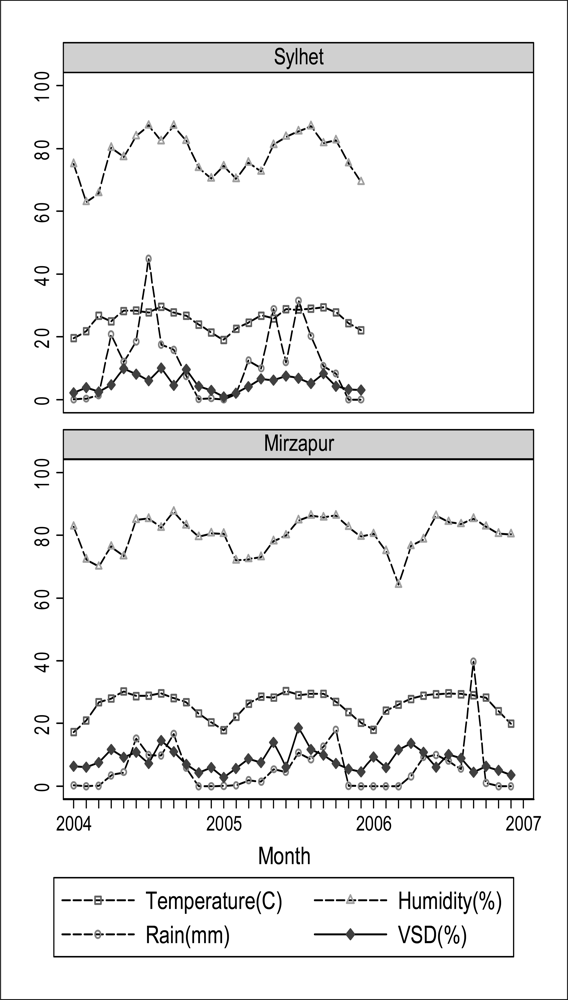
| Sylhet (2004–2005) | Mirzapur (2004–2006) | |||||||
|---|---|---|---|---|---|---|---|---|
| Months | Temperature [°C] | Rain [mm] | Humidity [%] | Heat-Humidity Index (HHI) | Temperature [°C] | Rain [mm] | Humidity [%] | Heat-Humidity Index (HHI) |
| January | 19.3 | 0.0 | 74.8 | 65.5 | 17.7 | 0.2 | 81.2 | 63.3 |
| February | 22.2 | 1.0 | 66.6 | 69.4 | 22.3 | 0.1 | 73.1 | 70.0 |
| March | 25.6 | 6.9 | 70.7 | 74.8 | 26.4 | 0.7 | 68.9 | 76.0 |
| April | 25.9 | 15.3 | 76.5 | 76.0 | 28.1 | 2.7 | 75.3 | 79.2 |
| May | 27.1 | 20.4 | 79.2 | 78.2 | 29.2 | 6.4 | 76.7 | 81.2 |
| June | 28.6 | 15.1 | 83.9 | 81.2 | 29.5 | 9.9 | 83.7 | 82.7 |
| July | 28.2 | 38.3 | 86.5 | 80.9 | 29.1 | 9.5 | 84.8 | 82.2 |
| August | 29.3 | 18.9 | 84.8 | 82.5 | 29.5 | 7.9 | 84.1 | 82.7 |
| September | 28.6 | 13.3 | 84.5 | 81.3 | 28.9 | 23.0 | 86.2 | 82.0 |
| October | 27.1 | 8.0 | 82.6 | 78.6 | 27.3 | 8.2 | 84.1 | 79.0 |
| November | 24.2 | 0.1 | 74.6 | 73.1 | 23.6 | 0.0 | 80.9 | 72.7 |
| December | 21.8 | 0.2 | 69.9 | 69.0 | 20.2 | 0.0 | 80.2 | 67.2 |
| Mean (sd) | 25.7 (±3.2) | 11.5 (±11.3) | 77.9 (±6.8) | 75.9 (±5.6) | 26.0 (±4.0) | 5.7 (±6.8) | 79.9 (±5.3) | 76.5 (±6.7) |
| Range | 19.3, 29.3 | 0.0, 38.3 | 66.6, 86.5 | 65.5, 82.5 | 17.7, 29.5 | 0.0, 23.0 | 68.9, 86.2 | 63.3, 82.7 |
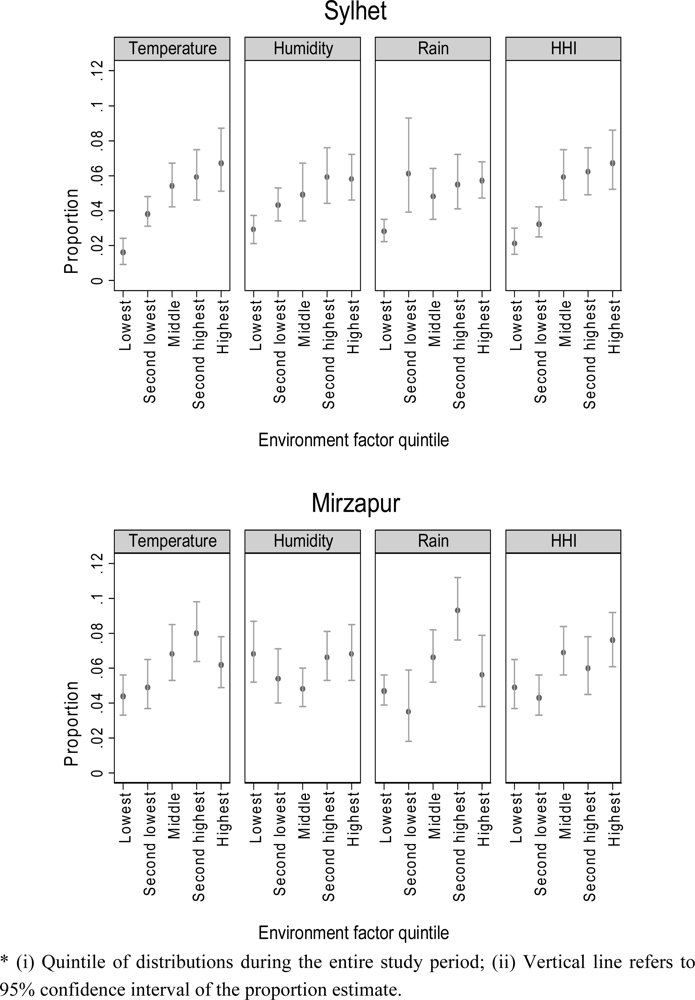
| Model 1 | Model 2 | Model 3 | ||||
|---|---|---|---|---|---|---|
| Odds Ratio | P value | Odds Ratio | P value | Odds Ratio | P value | |
| Sylhet | ||||||
| Temperature | 1.14 (1.08, 1.21) | 0.00 | ||||
| Humidity | 1.01 (0.99, 1.02) | 0.32 | ||||
| Rainfall | 1.00 (0.98, 1.02) | 0.99 | ||||
| Heat Humidity | ||||||
| Index (HHI) | 1.06 (1.04, 1.08) | 0.00 | ||||
| High Risk Month | ||||||
| (June–August) | 1.72 (1.32, 2.23) | 0.00 | ||||
| Mirzapur | ||||||
| Temperature | 1.06 (1.04, 1.07) | 0.00 | ||||
| Humidity | 1.00 (0.98, 1.03) | 0.83 | ||||
| Rainfall | 1.00 (0.99, 1.00) | 0.48 | ||||
| Heat Humidity | ||||||
| Index (HHI) | 1.03 (1.01, 1.04) | 0.00 | ||||
| High Risk Month | ||||||
| (April–September) | 1.62 (1.33, 1.96) | 0.00 | ||||
| Sylhet | Mirzapur | |||||
|---|---|---|---|---|---|---|
| Overall n = 6936 (%) | High-risk month n = 2057 (%) | Low-risk month n = 4879 (%) | Overall n = 5900 (%) | High-risk month n = 2542 (%) | Low-risk month n = 3358 (%) | |
| VSD | 309 (4.5) | 128 (6.2) * | 181 (3.7) | 352 (6.0) | 193 (7.6) * | 159 (4.7) |
| Convulsion | 23 (0.3) | 11 (0.5) | 12 (0.3) | 10 (0.2) | 8 (0.3) | 2 (0.1) |
| Respiratory rate 70/min or higher | 115 (1.7) | 54 (2.6) * | 61 (1.3) | 84 (1.4) | 61 (2.4) * | 23 (0.7) |
| Severe chest in-drawing | 17 (0.3) | 9 (0.4) | 8 (0.2) | 11 (0.2) | 6 (0.2) | 5 (0.2) |
| Temperature > 101 °F | 24 (0.4) | 17 (0.8) * | 7 (0.1) | 19 (0.3) | 16 (0.6) * | 3 (0.1) |
| Temperature < 95.5 °F | 84 (1.2) | 23 (1.1) | 61 (1.3) | 84 (1.4) | 24 (0.9) | 60 (1.8) * |
| Unconsciousness | 7 (0.1) | 5 (0.2) | 2 (0.0) | 1 (0.0) | 0 (0.0) | 1 (0.0) |
| Skin problems | 23 (0.3) | 11 (0.5) | 12 (0.3) | 54 (0.9) | 29 (1.1) | 25 (0.7) |
| Umbilical redness extending to skin | 9 (0.1) | 4 (0.2) | 5 (0.1) | 10 (0.2) | 5 (0.2) | 5 (0.2) |
| Week, abnormal or absent cry | 64 (0.9) | 22 (1.2) | 42 (0.9) | 48 (0.8) | 27 (1.2) | 21 (0.6) |
| Lethargic, less than normal movement | 91 (1.3) | 33 (1.6) | 58 (1.2) | 83 (1.4) | 43 (1.7) | 40 (1.2) |
| Not able to feed or not suck at all | 94 (1.4) | 30 (1.5) | 64 (1.3) | 123 (2.1) | 58 (2.3) | 65 (1.9) |
© 2011 by the authors; licensee MDPI, Basel, Switzerland. This article is an open-access article distributed under the terms and conditions of the Creative Commons Attribution license (http://creativecommons.org/licenses/by/3.0/).
Share and Cite
Mannan, I.; Choi, Y.; Coutinho, A.J.; Chowdhury, A.I.; Rahman, S.M.; Seraji, H.R.; Bari, S.; Shah, R.; Winch, P.J.; El Arifeen, S.; et al. Vulnerability of Newborns to Environmental Factors: Findings from Community Based Surveillance Data in Bangladesh. Int. J. Environ. Res. Public Health 2011, 8, 3437-3452. https://doi.org/10.3390/ijerph8083437
Mannan I, Choi Y, Coutinho AJ, Chowdhury AI, Rahman SM, Seraji HR, Bari S, Shah R, Winch PJ, El Arifeen S, et al. Vulnerability of Newborns to Environmental Factors: Findings from Community Based Surveillance Data in Bangladesh. International Journal of Environmental Research and Public Health. 2011; 8(8):3437-3452. https://doi.org/10.3390/ijerph8083437
Chicago/Turabian StyleMannan, Ishtiaq, Yoonjoung Choi, Anastasia J. Coutinho, Atique I. Chowdhury, Syed Moshfiqur Rahman, Habib R. Seraji, Sanwarul Bari, Rasheduzzaman Shah, Peter J. Winch, Shams El Arifeen, and et al. 2011. "Vulnerability of Newborns to Environmental Factors: Findings from Community Based Surveillance Data in Bangladesh" International Journal of Environmental Research and Public Health 8, no. 8: 3437-3452. https://doi.org/10.3390/ijerph8083437