
<?xml version="1.0" encoding="UTF-8"?>
<!DOCTYPE article PUBLIC "-//NLM//DTD Journal Publishing DTD v2.3 20070202//EN" "journalpublishing.dtd">
<article xmlns:xlink="http://www.w3.org/1999/xlink" xml:lang="en" article-type="research-article">
<front>
<journal-meta>
<journal-id journal-id-type="publisher-id">101238455</journal-id>
<journal-title>International Journal of Environmental Research and Public Health</journal-title>
<issn pub-type="ppub">1661-7827</issn>
<issn pub-type="epub">1660-4601</issn>
<publisher>
<publisher-name>Molecular Diversity Preservation International (MDPI)</publisher-name></publisher></journal-meta>
<article-meta>
<article-id pub-id-type="doi">10.3390/ijerph6112740</article-id>
<article-id pub-id-type="publisher-id">ijerph-06-02740</article-id>
<article-categories>
<subj-group>
<subject>Article</subject></subj-group></article-categories>
<title-group>
<article-title>Chronic Traffic-Induced PM Exposure and Self-Reported Respiratory and Cardiovascular Health in the RHINE Tartu Cohort</article-title></title-group>
<contrib-group>
<contrib contrib-type="author">
<name><surname>Orru</surname><given-names>Hans</given-names></name><xref ref-type="aff" rid="af1-ijerph-06-02740">1</xref><xref ref-type="aff" rid="af2-ijerph-06-02740">2</xref><xref ref-type="corresp" rid="c1-ijerph-06-02740">*</xref></contrib>
<contrib contrib-type="author">
<name><surname>Jõgi</surname><given-names>Rain</given-names></name><xref ref-type="aff" rid="af3-ijerph-06-02740">3</xref></contrib>
<contrib contrib-type="author">
<name><surname>Kaasik</surname><given-names>Marko</given-names></name><xref ref-type="aff" rid="af4-ijerph-06-02740">4</xref></contrib>
<contrib contrib-type="author">
<name><surname>Forsberg</surname><given-names>Bertil</given-names></name><xref ref-type="aff" rid="af2-ijerph-06-02740">2</xref></contrib></contrib-group>
<aff id="af1-ijerph-06-02740">
<label>1</label>Department of Public Health, University of Tartu, Ravila 19, Tartu, 50411, Estonia</aff>
<aff id="af2-ijerph-06-02740">
<label>2</label>Department of Public Health and Clinical Medicine, Umea University, Umea, SE-901 87, Sweden; E-Mail: 
<email>Bertil.Forsberg@envmed.umu.se</email></aff>
<aff id="af3-ijerph-06-02740">
<label>3</label>Lung Clinic, Tartu University Hospital, Riia 167, Tartu, 51014, Estonia; E-Mail: 
<email>Rain.Jogi@kliinikum.ee</email></aff>
<aff id="af4-ijerph-06-02740">
<label>4</label>Institute of Physics, University of Tartu, Riia 142, Tartu, 51014, Estonia; E-Mail: 
<email>Marko.Kaasik@ut.ee</email></aff>
<author-notes>
<corresp id="c1-ijerph-06-02740">
<label>*</label>Author to whom correspondence should be addressed; E-Mail: 
<email>Hans.Orru@ut.ee</email>; Tel.: +372-737-4203; Fax: +372-737-4191.</corresp></author-notes>
<pub-date pub-type="ppub">
<month>11</month>
<year>2009</year></pub-date>
<pub-date pub-type="epub">
<day>30</day>
<month>10</month>
<year>2009</year></pub-date>
<volume>6</volume>
<issue>11</issue>
<fpage>2740</fpage>
<lpage>2751</lpage>
<history>
<date date-type="received">
<day>24</day>
<month>8</month>
<year>2009</year></date>
<date date-type="accepted">
<day>29</day>
<month>10</month>
<year>2009</year></date></history>
<permissions>
<copyright-statement>© 2009 by the authors; licensee Molecular Diversity Preservation International, Basel, Switzerland.</copyright-statement>
<copyright-year>2009</copyright-year>
<license license-type="open-access" xlink:href="http://creativecommons.org/licenses/by/3.0">
<p>This article is an open-access article distributed under the terms and conditions of the Creative Commons Attribution license (http://creativecommons.org/licenses/by/3.0/).</p></license></permissions>
<abstract>
<p>The relationship between exposure to traffic induced particles, respiratory health and cardiac diseases was studied in the RHINE Tartu cohort. A postal questionnaire with commonly used questions regarding respiratory symptoms, cardiac disease, lifestyle issues such as smoking habits, indoor environment, occupation, early life exposure and sleep disorders was sent to 2,460 adults. The annual concentrations of local traffic induced particles were modelled with an atmospheric dispersion model with traffic flow data, and obtained PM<sub>exhaust</sub> concentrations in 40 × 40 m grids were linked with home addresses with GIS. The relationship between the level of exhaust particles outside home and self-reported health problems were analyzed using a multiple logistic regression model. We found a significant relation between fine exhaust particles and cardiac disease, OR = 1.64 (95% CI 1.12–2.43) for increase in PM<sub>exhaust</sub> corresponding to the fifth to the 95th percentile range. The associations also were positive but non-significant for hypertension OR = 1.42 (95% CI 0.94–2.13), shortness of breath OR = 1.27 (95% CI 0.84–1.94) and other respiratory symptoms.</p></abstract>
<kwd-group>
<kwd>air pollution</kwd>
<kwd>particulate matter</kwd>
<kwd>traffic, respiratory diseases</kwd>
<kwd>cardiovascular diseases</kwd></kwd-group></article-meta></front>
<body>
<sec sec-type="intro">
<label>1.</label>
<title>Introduction</title>
<p>Numerous epidemiological studies have shown an association between particulate air pollution and cardiopulmonary health [<xref ref-type="bibr" rid="b1-ijerph-06-02740">1</xref>]. Fine exhaust particles are believed to be the most harmful [<xref ref-type="bibr" rid="b2-ijerph-06-02740">2</xref>–<xref ref-type="bibr" rid="b5-ijerph-06-02740">5</xref>]. It has been assumed that traffic-induced particles emitted from combustion processes are more potent in posing adverse health effects than those from non-combustion processes. Besides exhaust emissions, the major types of traffic particles are brake wear, tyre wear, road surface abrasion and re-suspension [<xref ref-type="bibr" rid="b2-ijerph-06-02740">2</xref>]. However, meta-analysis of epidemiological studies differentiating between the coarse particles PM<sub>2.5–10</sub> and the fine particles PM<sub>2.5</sub>, has shown that health effects exist from both fractions [<xref ref-type="bibr" rid="b3-ijerph-06-02740">3</xref>].</p>
<p>Traffic air pollution has been associated both with respiratory and cardiovascular effects. The cardiovascular effects of air pollution include myocardial ischemia, atherosclerosis, infarctions, heart failure, arrhythmias, strokes etc., and these are said to be the leading causes of air pollution induced morbidity and mortality [<xref ref-type="bibr" rid="b4-ijerph-06-02740">4</xref>]. Many of the studies have shown that chronic PM exposure significantly increases cardiovascular but not pulmonary mortality risk [<xref ref-type="bibr" rid="b5-ijerph-06-02740">5</xref>,<xref ref-type="bibr" rid="b6-ijerph-06-02740">6</xref>]. However, several other studies have shown that long-term PM exposure is also associated with deficiencies in lung function and increased symptoms of obstructive airway disease, such as chronic cough, bronchitis, chest illness, etc. [<xref ref-type="bibr" rid="b1-ijerph-06-02740">1</xref>]. It is possible that morbidity is more important in the context of PM exposure and respiratory health.</p>
<p>Some studies have associated the levels of vehicle exhaust outside the home with an increase in the incidence of asthma [<xref ref-type="bibr" rid="b7-ijerph-06-02740">7</xref>,<xref ref-type="bibr" rid="b8-ijerph-06-02740">8</xref>]. The prevalence of diagnosed asthma and asthma-like symptoms is low in Estonia, both among children [<xref ref-type="bibr" rid="b9-ijerph-06-02740">9</xref>] and adults [<xref ref-type="bibr" rid="b10-ijerph-06-02740">10</xref>], while the prevalence of non-specific respiratory symptoms [<xref ref-type="bibr" rid="b10-ijerph-06-02740">10</xref>] and bronchial hyper-responsiveness [<xref ref-type="bibr" rid="b11-ijerph-06-02740">11</xref>] is relatively high. This has raised some scepticism about the validity of doctor diagnosed asthma in Estonia [<xref ref-type="bibr" rid="b12-ijerph-06-02740">12</xref>]. However, repeated cross-sectional studies in children have shown an increase in asthma prevalence in children [<xref ref-type="bibr" rid="b13-ijerph-06-02740">13</xref>] while longitudinal analysis of ECRHS cohort has shown low incidence of asthma among adults [<xref ref-type="bibr" rid="b14-ijerph-06-02740">14</xref>].</p>
<p>Traffic pollution has been linked with other respiratory symptoms as well. It has been associated with the prevalence of chronic bronchitis [<xref ref-type="bibr" rid="b15-ijerph-06-02740">15</xref>,<xref ref-type="bibr" rid="b16-ijerph-06-02740">16</xref>], coughing attacks, and wheezing [<xref ref-type="bibr" rid="b17-ijerph-06-02740">17</xref>] and rhinitis [<xref ref-type="bibr" rid="b18-ijerph-06-02740">18</xref>]. The links to chest tightness [<xref ref-type="bibr" rid="b19-ijerph-06-02740">19</xref>] and shortness of breath [<xref ref-type="bibr" rid="b20-ijerph-06-02740">20</xref>] are weaker or supposed.</p>
<p>The association between air pollution and blood pressure has also been demonstrated in several studies, but these have mostly investigated short term increases of ambient air pollutants [<xref ref-type="bibr" rid="b21-ijerph-06-02740">21</xref>]. However, some studies have found no association, particularly with long term exposure [<xref ref-type="bibr" rid="b22-ijerph-06-02740">22</xref>,<xref ref-type="bibr" rid="b23-ijerph-06-02740">23</xref>]. Nevertheless, vehicle pollution may be an important risk factor. One study reported a stronger association between PM<sub>2.5</sub> and high blood pressure in the presence of roadway traffic [<xref ref-type="bibr" rid="b24-ijerph-06-02740">24</xref>], and Künzli <italic>et al.</italic> [<xref ref-type="bibr" rid="b24-ijerph-06-02740">24</xref>] have found association between ambient PM<sub>2.5</sub> and atherosclerosis in an area with heavy traffic LA. A recent meta-analysis of three cross-sectional surveys found weakly positive associations between cardiovascular disease and PM<sub>10</sub> [<xref ref-type="bibr" rid="b25-ijerph-06-02740">25</xref>].</p>
<p>Research into air pollution and health effects in Eastern Europe and especially in the Baltic States is limited. One reason has been the limited pollution data available, especially from earlier years. A major recent epidemiologic study has been conducted in Lithuania, where a relationship between exposure to urban nitrogen dioxide pollution and the risk of myocardial infarction was determined [<xref ref-type="bibr" rid="b26-ijerph-06-02740">26</xref>]. Lately a model to calculate traffic pollution concentrations in Tartu has been improved [<xref ref-type="bibr" rid="b27-ijerph-06-02740">27</xref>]. The aim of our study is to investigate the association between the prevalence of respiratory symptoms, cardiac disease and hypertension and traffic-induced particulate air pollution in the RHINE Tartu cohort in Estonia.</p></sec>
<sec sec-type="methods">
<label>2.</label>
<title>Material and Methods</title>
<sec sec-type="methods">
<label>2.1.</label>
<title>Study Population and Site</title>
<p>In 2000/2001 a postal questionnaire was sent to 2,460 adults in Tartu that had answered the ECRHS (European Community Respiratory Health Survey, <ext-link xlink:href="www.ecrhs.org" ext-link-type="uri">www.ecrhs.org</ext-link>) questionnaire sent to a random sample of people aged 25–45 in 1993. This follow up in Tartu and six other ECRHS centres established the RHINE cohort (The Respiratory Health in Northern Europe, <ext-link xlink:href="www.rhine.nu" ext-link-type="uri">www.rhine.nu</ext-link>).</p>
<p>Out of the invited 2,460 persons from Tartu we were able to model the PM<sub>exposure</sub> from traffic at home for 2,216 respondents. Out of these, 1,708 persons (69%) answered the questionnaire. Complete answers regarding respiratory health, cardiac disease, and blood pressure were obtained for 1,684 of the persons for which particle concentrations could be modelled.</p>
<p>The main characteristics of the study population are shown in <xref ref-type="table" rid="t1-ijerph-06-02740">Table 1</xref>. The mean age of the Tartu RHINE cohort in the follow up was 35 years, they had intermediate body mass index (BMI 24.2). The prevalence of cardiac disease, and hypertension and percentage of smokers was relatively high.</p>
<p>Among the rest of self-reported respiratory symptoms, the prevalence in exposed Tartu study population was highest for cough (40.5%); but also high for wheezing (24%), and chest tightness (16.8%). The prevalences for the whole RHINE populations are in more detail given in Jogi <italic>et al.</italic> [<xref ref-type="bibr" rid="b10-ijerph-06-02740">10</xref>] and Toren <italic>et al.</italic> [<xref ref-type="bibr" rid="b14-ijerph-06-02740">14</xref>] papers.</p>
<p>Tartu is a city with 100,000 inhabitants, which makes it the second largest city in Estonia, situated in north-eastern Europe. The air pollution levels are not so high in the European context. According to ECRHS II measurements, the annual average PM<sub>2.5</sub> concentration in Tartu during the study period was 14.8 μg·m<sup>−3</sup> [<xref ref-type="bibr" rid="b28-ijerph-06-02740">28</xref>]. According to Orru <italic>et al.</italic>, [<xref ref-type="bibr" rid="b29-ijerph-06-02740">29</xref>] traffic contributes about 8% of the total PM<sub>2.5</sub>.</p>
<p>As the capacity of the street network remains limited despite growing traffic, congestion occurs at rush hour on several streets. A large number of cars are more than 10 years old, thus the combustion is often not of the highest standard.</p></sec>
<sec>
<label>2.2.</label>
<title>Questionnaire on Respiratory Health and Cardiac Diseases</title>
<p>From the RHINE questionnaire we concentrated on possible air pollution health effect outcomes addressed in following questions:
<list list-type="bullet">
<list-item>
<p><bold>Wheezing</bold> “Have you had wheezing or whistling in your chest at any time in the last 12 months?”, and if so, “Have you had this wheezing or whistling when you did not have a cold?”</p></list-item>
<list-item>
<p><bold>Cough</bold> “Have you been woken by an attack of coughing at any time in the last 12 months?”</p></list-item>
<list-item>
<p><bold>Chronic bronchitis symptoms</bold> “Do you cough up phlegm in this way almost every day for at least three months every year?”, and if so, “Have you had periods of this kind for at least two years in a row?”</p></list-item>
<list-item>
<p><bold>Non-allergic rhinitis</bold> “Have you ever experienced nasal symptoms such as nasal congestion, rhinorrhoea (runny nose) and/or sneezing attacks without having a cold?”, and if “Yes”; “No” to question “Do you have any nasal allergies including hay fever?”</p></list-item>
<list-item>
<p><bold>Chest tightness</bold> “Have you woken up with a feeling of tightness in your chest at any time in the last 12 months?”</p></list-item>
<list-item>
<p><bold>Breath shortness</bold> “Have you been woken by an attack of shortness of breath at any time in the last 12 months?”</p></list-item>
<list-item>
<p><bold>Cardiac diseases</bold> “Do you have any cardiac disease?”</p></list-item>
<list-item>
<p><bold>Hypertension</bold> “Do you have high blood pressure?”</p></list-item></list></p></sec>
<sec>
<label>2.3.</label>
<title>Air Pollution Exposure</title>
<p>The modelled annual mean levels of locally emitted PM<sub>exhaust</sub> (exhaust particles) and PM<sub>10</sub> (also road dust, tyre wear etc.) in 2000 outside the home were used as the exposure variables. The AEROPOL model that is based on Gaussian dispersion algorithm with complementary effects (e.g., reflection of Gaussian plume from the ground and capping inversion, dry and wet removal) was applied for estimating the concentrations. Simulation of long-term average PM concentrations was based on averaging the plumes over climatological distribution of thermal stratification (Pasquill–Gifford stability classes [<xref ref-type="bibr" rid="b30-ijerph-06-02740">30</xref>]), wind direction and speed. The basic concepts of AEROPOL are described by Kaasik and Kimmel [<xref ref-type="bibr" rid="b31-ijerph-06-02740">31</xref>]—these are rather similar with widely known models, e.g., ADMS [<xref ref-type="bibr" rid="b32-ijerph-06-02740">32</xref>] or AERMOD [<xref ref-type="bibr" rid="b33-ijerph-06-02740">33</xref>]. AEROPOL has been applied and validated for urban [<xref ref-type="bibr" rid="b34-ijerph-06-02740">34</xref>,<xref ref-type="bibr" rid="b35-ijerph-06-02740">35</xref>] as well as industrial [<xref ref-type="bibr" rid="b36-ijerph-06-02740">36</xref>] sources. The PM concentrations were modelled in 40 × 40 m grids and geocoded addresses were linked to concentrations using the GIS software Surfer.</p>
<p>The average traffic flows during evening rush hour were available for 487 street links all over the city. As estimations of vehicle emission factors for Estonia are not available, the factors from other countries are used. For exhaust particles, the emission estimation methodology used by the Finnish Meteorological Institute was applied [<xref ref-type="bibr" rid="b37-ijerph-06-02740">37</xref>]. The emissions per vehicle-kilometre were calculated as was typical for Helsinki. The non-exhaust particulate matter (from road surface, tyres, brakes etc.) was estimated using the average for Stockholm, as calculated by Eneroth <italic>et al.</italic> [<xref ref-type="bibr" rid="b38-ijerph-06-02740">38</xref>]. According to their data, almost 90% of non-exhaust emissions originated from resuspension of particles from the street surface. It appears that in northern countries these emissions are roughly 10 times greater than the exhaust emissions because studded tyres are used. As the GDP per capita in Estonia nowadays is exceeding 70% of average level of EU and technical norms correspond completely to EU standards, the quality of the car fleet has been rapidly improved during last 10 years. Nowadays there exist no dramatic differences compared to Nordic countries, including the fact that studded tyres are in use through wintertime.</p>
<p>In the analysis, traffic emissions of exhaust and non-exhaust emissions together are considered as PM<sub>10</sub> since they depend on traffic flows and show a very strong spatial correlation. However, we also present the results obtained using PM<sub>exhaust</sub> only, since it is often assumed to be the most toxic fraction of particles due to composition or size or both [<xref ref-type="bibr" rid="b39-ijerph-06-02740">39</xref>–<xref ref-type="bibr" rid="b43-ijerph-06-02740">43</xref>].</p></sec>
<sec>
<label>2.4.</label>
<title>Statistical Analyses</title>
<p>For the analysis of the relationship between PM exposure at the home address and self-reported health problems in the questionnaire, the multiple logistic regression analysis in SPSS was used. All analyses were adjusted for gender, age, body mass index (BMI), smoking history (current, ex-smoker, never) and, in the case of cardiac diseases, also for self-reported high blood pressure (yes/no).</p></sec></sec>
<sec sec-type="results">
<label>3.</label>
<title>Results</title>
<sec>
<label>3.1.</label>
<title>Exposure</title>
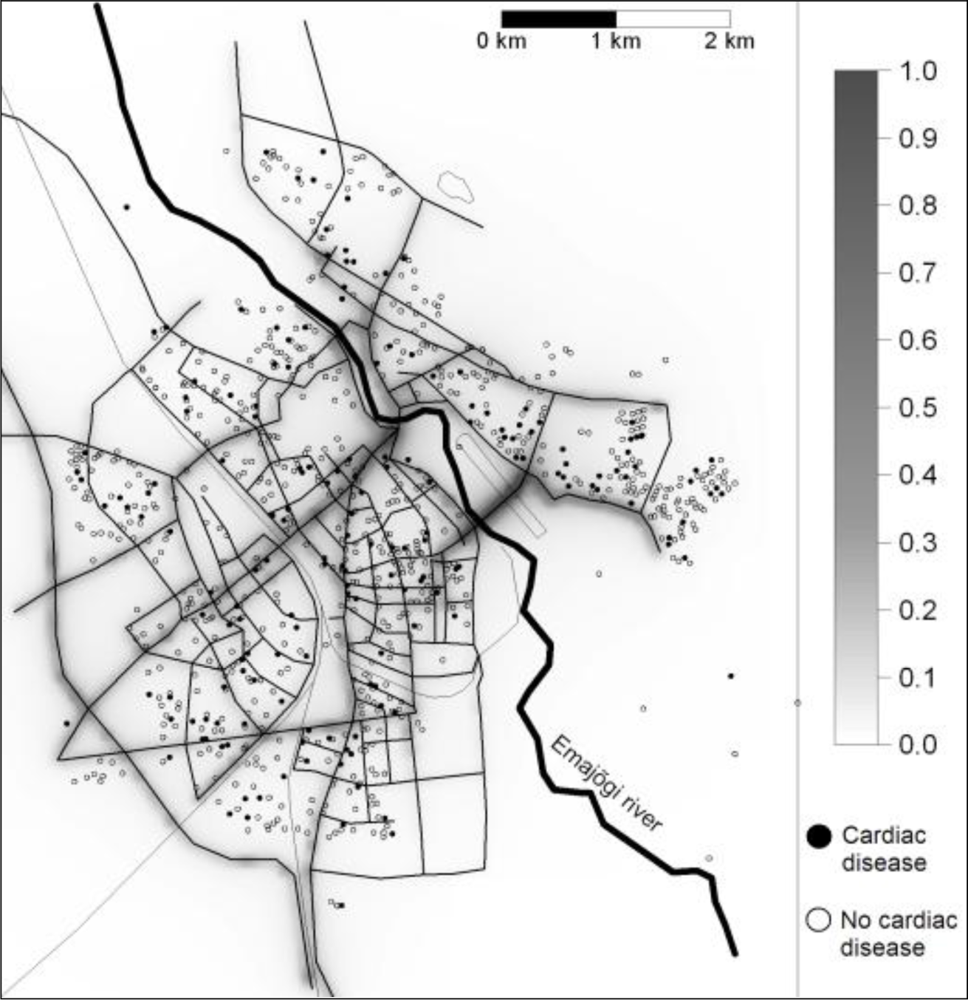
<p>The mean exposure to local traffic induced exhaust particles (PM<sub>exhaust</sub>) was 0.10 μg·m<sup>−3</sup> and to any kind of local traffic induced particles (PM<sub>10</sub>) was 0.76 μg·m<sup>−3</sup>. Most of the streets in Tartu have low traffic flows, but some of the streets are quite busy, with elevated vehicle induced pollution levels (max of PM<sub>exhaust</sub> 0.83 μg·m<sup>−3</sup> and PM<sub>10</sub> 7.40 μg·m<sup>−3</sup>) (<xref ref-type="fig" rid="f1-ijerph-06-02740">Figure 1</xref>). As the correlation between the annual mean level of PM<sub>exhaust</sub>, and traffic related PM<sub>10</sub> for included subjects was 0.99 and PM<sub>exhaust</sub> is often assumed to be the most toxic, relative risks are reported only for PM<sub>exhaust</sub>.</p></sec>
<sec>
<label>3.2.</label>
<title>Associations with PM at Home and Prevalences</title>
<p>We found a strong correlation between concentrations of traffic-induced PM and the prevalence odds ratio (OR) for having cardiac disease, and the association became even stronger when we adjusted it for blood pressure (<xref ref-type="table" rid="t2-ijerph-06-02740">Table 2</xref>). For an increase in mass concentration of 1 μg/m<sup>3</sup> the effect is as high as high OR = 9.04, 95% CI = 1.62–50.42. If the OR for having a cardiac disease is calculated for an increase corresponding to the fifth to the 95<sup>th</sup> percentile range, it becomes 1.64 (95% CI = 1.12–2.43) for PM<sub>exhaust</sub>.</p>
<p>We did not see any significant association with respiratory symptoms (<xref ref-type="table" rid="t2-ijerph-06-02740">Table 2</xref>). After cardiac disease the OR was highest for hypertension and shortness of breath, problems also related to cardiovascular disease, but these associations were not significant. For people with more risky behaviour such as smokers and ex-smokers and respondents with high BMI (&gt;25), the ORs associated with traffic PM were higher for shortness of breath, lower for cardiac diseases, and approximately the same level as the average for other outcomes.</p></sec></sec>
<sec sec-type="discussion">
<label>4.</label>
<title>Discussion</title>
<p>Since the annual mean levels of vehicle exhaust components and road dust show a high spatial correlation due to a common source, it is not possible to study their unique influence on health within one city. Thus we see our study as an investigation of how traffic related pollution may influence health. We had much better data to model exposure levels in 2000 than for the 1993 ECRHS survey, which is why prevalence at follow up was chosen as the outcome. However, a planned future follow up within the next few years will make it possible to study incidence in relation to pollution levels from 2000 and later.</p>
<p>While the specificity and sensitivity of self-reported asthma and asthma symptoms have been studied a lot [<xref ref-type="bibr" rid="b44-ijerph-06-02740">44</xref>], we know less about validity of the questions on cardiac diseases and hypertension that were used in the RHINE study. The question used on cardiac diseases has not been validated against medical records, but other similar self-reported conditions have in different ways, at least indirectly. For example “nonspecific” chest pain has been associated with high long-term mortality in a Swedish study [<xref ref-type="bibr" rid="b45-ijerph-06-02740">45</xref>], and men who recalled a doctor diagnosis of ischemic heart disease, were at extremely high risk of a new major ischemic heart disease event during a follow-up period [<xref ref-type="bibr" rid="b46-ijerph-06-02740">46</xref>]. Moreover, there are a number of studies where myocardial infarction, angina etc have been studied using questions [<xref ref-type="bibr" rid="b47-ijerph-06-02740">47</xref>–<xref ref-type="bibr" rid="b50-ijerph-06-02740">50</xref>] that are rather similar to our questions.</p>
<p>It is somewhat difficult to compare our findings regarding cardiac diseases and traffic-induced particles with other studies, since more specific endpoints like myocardial infarction, arrhythmias, atherosclerosis and ischemic events usually are studied, and the true effect may be different. There are large differences in exposure assessment as well. Rosenlund <italic>et al.</italic> [<xref ref-type="bibr" rid="b51-ijerph-06-02740">51</xref>] reported ORs in Stockholm County for myocardial infarction and traffic pollution of 1.04 (95% CI = 1.00–1.09) for all cases and 1.16 (95% CI = 1.09–1.24) for fatal cases for an increase in PM<sub>10</sub> exposure corresponding to the fifth to the 95th percentile. These are slightly lower when compared to our ORs for prevalent cardiac disease, but our Tartu estimates are for a very specific source of pollution. The same reason, and also the fact that the OR was calculated per intertertile change in NO<sub>2</sub> exposure, could explain the lower ORs in a Lithuanian study [<xref ref-type="bibr" rid="b26-ijerph-06-02740">26</xref>]. On the other hand, Hoffmann <italic>et al.</italic> [<xref ref-type="bibr" rid="b52-ijerph-06-02740">52</xref>] indicated that people living within 50 m of major roads have an OR for coronary atherosclerosis through calcification as high as 1.63 (95% CI = 1.14–2.33).</p>
<p>When we adjusted our model for cardiac diseases to also include high blood pressure, the OR increased around 10% (<xref ref-type="table" rid="t2-ijerph-06-02740">Table 2</xref>). However, the positive association between air pollution and high blood pressure was not significant. The reason for this might be that high pressure is usually found to be related mainly to short-term increases in exposure [<xref ref-type="bibr" rid="b21-ijerph-06-02740">21</xref>]. There are probably other trails than hypertension through what cardiac diseases are developed in the presence of traffic-induced air pollution. Inflammation through pro-oxidative, and pro-inflammatory mediators, interaction of nano-scale particles with cardiovascular systems and autonomic mechanisms in the nervous system are believed to be the main pathways [<xref ref-type="bibr" rid="b4-ijerph-06-02740">4</xref>]. Moreover, the correlation between hypertension and cardiac diseases is low in our data.</p>
<p>We believe there might be confounders, such as noise and stress, for which the effects are difficult to separate from the effects of air pollution. Noise, including traffic noise, has been associated with stress, sleep disturbance, blood pressure and cardiac diseases [<xref ref-type="bibr" rid="b53-ijerph-06-02740">53</xref>]. Noise may confound or modify the relation between traffic pollution and cardiac diseases as both are linked to cardiovascular effects [<xref ref-type="bibr" rid="b54-ijerph-06-02740">54</xref>]. Recent finding have found moderate correlations between traffic-generated air pollution and noise [<xref ref-type="bibr" rid="b55-ijerph-06-02740">55</xref>], but the published data are limited and somewhat inconsistent. As we had no data regarding traffic noise, we could not adjust for it. Possible confounders also are socioeconomic status, and physical activity for which we had no data. As we have adjusted for BMI and smoking history, these parameters could be indirectly included in the adjustment.</p>
<p>We did not determine any significant associations with respiratory symptoms. However several studies have found such [<xref ref-type="bibr" rid="b15-ijerph-06-02740">15</xref>–<xref ref-type="bibr" rid="b20-ijerph-06-02740">20</xref>]. There might be several reasons for our null findings; selection (or survivor) bias could be one. Most people are probably aware that air pollution has a negative effect on asthma and other respiratory diseases. This may cause a selection bias in an epidemiological study—people with respiratory problems may tend to move from polluted streets to less trafficked areas, when more healthy do not. For cardiac diseases the association with air pollution has been observed more recently by researchers and is less known to the general public. The risk of having a selection of people with cardiac diseases away from polluted areas is smaller.</p>
<p>The socioeconomic status may also have influenced the results. There tends to be more cardiac diseases in regions with big block houses compared to regions with residential or small apartment houses. However, the two last groups are very small and no significant difference in regression analysis appeared. These people could have been more stressed etc, what is also important factors inducing cardiac diseases.</p></sec>
<sec sec-type="conclusions">
<label>5.</label>
<title>Conclusions</title>
<p>In this study in Tartu a strong relation between exhaust traffic particles and cardiac diseases was established. Per 1 μg·m<sup>−3</sup> increase in exposure, the exhaust particles due to lower concentrations give much higher ORs compared to PM<sub>10</sub> from traffic. Per change corresponding to the fifth to the 95th percentile range in exposure, there was a very small difference. We could not see any significant relation to respiratory symptoms or hypertension.</p>
<p>It seems that for local traffic pollution the associations here are much stronger with cardiovascular disease compared to respiratory outcomes. Even if vehicle exhaust particles are a proposed candidate to have more toxic effects, we cannot exclude other components in PM due to the high correlations. Traffic pollution is correlated with noise, which could be an important confounder.</p></sec></body>
<back>
<ack>
<p>We acknowledge all the co-workers in RHINE team, especially supporting staff in Estonia. The air pollution modeling was carried out under the auspices of the Estonian National Targeted Financing Project SF0180038s08 “Development of the Numerical Weather Prediction Towards the Forecasting of Atmospheric Environment”.</p></ack>
<ref-list>
<title>References</title>
<ref id="b1-ijerph-06-02740"><label>1.</label><citation citation-type="journal"><person-group person-group-type="author"><name><surname>Pope</surname><given-names>C</given-names></name><name><surname>Dockery</surname><given-names>D</given-names></name></person-group><article-title>Health effects of fine particulate air pollution: lines that connect</article-title><source>J. Air Waste Manage Assoc</source><year>2006</year><volume>56</volume><fpage>709</fpage><lpage>742</lpage><pub-id pub-id-type="doi">10.1080/10473289.2006.10464485</pub-id></citation></ref>
<ref id="b2-ijerph-06-02740"><label>2.</label><citation citation-type="journal"><person-group person-group-type="author"><name><surname>Thorpe</surname><given-names>A</given-names></name><name><surname>Harrison</surname><given-names>RM</given-names></name></person-group><article-title>Sources and properties of non-exhaust particulate matter from road traffic: A review</article-title><source>Sci. Total Environ</source><year>2008</year><volume>400</volume><fpage>270</fpage><lpage>282</lpage><pub-id pub-id-type="doi">10.1016/j.scitotenv.2008.06.007</pub-id><pub-id pub-id-type="pmid">18635248</pub-id></citation></ref>
<ref id="b3-ijerph-06-02740"><label>3.</label><citation citation-type="journal"><person-group person-group-type="author"><name><surname>Brunekreef</surname><given-names>B</given-names></name><name><surname>Forsberg</surname><given-names>B</given-names></name></person-group><article-title>Epidemiological evidence of effects of coarse airborne particles on health</article-title><source>Eur. Resp. J</source><year>2005</year><volume>26</volume><fpage>309</fpage><lpage>318</lpage><pub-id pub-id-type="doi">10.1183/09031936.05.00001805</pub-id></citation></ref>
<ref id="b4-ijerph-06-02740"><label>4.</label><citation citation-type="journal"><person-group person-group-type="author"><name><surname>Brook</surname><given-names>RD</given-names></name></person-group><article-title>Cardiovascular effects of air pollution</article-title><source>Clin. Sci</source><year>2008</year><volume>115</volume><fpage>175</fpage><lpage>187</lpage><pub-id pub-id-type="doi">10.1042/CS20070444</pub-id><pub-id pub-id-type="pmid">18691154</pub-id></citation></ref>
<ref id="b5-ijerph-06-02740"><label>5.</label><citation citation-type="journal"><person-group person-group-type="author"><name><surname>Laden</surname><given-names>F</given-names></name><name><surname>Schwartz</surname><given-names>J</given-names></name><name><surname>Speizer</surname><given-names>FE</given-names></name><name><surname>Dockery</surname><given-names>DW</given-names></name></person-group><article-title>Reduction in fine particulate air pollution and mortality - Extended follow-up of the Harvard six cities study</article-title><source>Am. J. Respir. Crit. Care Med</source><year>2006</year><volume>173</volume><fpage>667</fpage><lpage>672</lpage><pub-id pub-id-type="pmid">16424447</pub-id></citation></ref>
<ref id="b6-ijerph-06-02740"><label>6.</label><citation citation-type="journal"><person-group person-group-type="author"><name><surname>Pope</surname><given-names>CA</given-names></name><name><surname>Burnett</surname><given-names>RT</given-names></name><name><surname>Thurston</surname><given-names>GD</given-names></name><name><surname>Thun</surname><given-names>MJ</given-names></name><name><surname>Calle</surname><given-names>EE</given-names></name><name><surname>Krewski</surname><given-names>D</given-names></name><name><surname>Godleski</surname><given-names>JJ</given-names></name></person-group><article-title>Cardiovascular mortality and long-term exposure to particulate air pollution—Epidemiological evidence of general pathophysiological pathways of disease</article-title><source>Circulation</source><year>2004</year><volume>109</volume><fpage>71</fpage><lpage>77</lpage><pub-id pub-id-type="pmid">14676145</pub-id></citation></ref>
<ref id="b7-ijerph-06-02740"><label>7.</label><citation citation-type="journal"><person-group person-group-type="author"><name><surname>Jacquemin</surname><given-names>B</given-names></name><name><surname>Sunyer</surname><given-names>J</given-names></name><name><surname>Forsberg</surname><given-names>B</given-names></name><name><surname>Aguilera</surname><given-names>I</given-names></name><name><surname>Briggs</surname><given-names>D</given-names></name><name><surname>Garcia-Esteban</surname><given-names>R</given-names></name><name><surname>Gotschi</surname><given-names>T</given-names></name><name><surname>Heinrich</surname><given-names>J</given-names></name><name><surname>Jarvholm</surname><given-names>B</given-names></name><name><surname>Jarvis</surname><given-names>D</given-names></name><name><surname>Vienneau</surname><given-names>D</given-names></name><name><surname>Kunzli</surname><given-names>N</given-names></name></person-group><article-title>Home outdoor NO<sub>2</sub> and new onset of self-reported asthma in adults</article-title><source>Epidemiology</source><year>2009</year><volume>20</volume><fpage>119</fpage><lpage>126</lpage><pub-id pub-id-type="doi">10.1097/EDE.0b013e3181886e76</pub-id><pub-id pub-id-type="pmid">18923331</pub-id></citation></ref>
<ref id="b8-ijerph-06-02740"><label>8.</label><citation citation-type="journal"><person-group person-group-type="author"><name><surname>Modig</surname><given-names>L</given-names></name><name><surname>Toren</surname><given-names>K</given-names></name><name><surname>Janson</surname><given-names>C</given-names></name><name><surname>Jarvholm</surname><given-names>B</given-names></name><name><surname>Forsberg</surname><given-names>B</given-names></name></person-group><article-title>Vehicle exhaust outside the home and onset of asthma among adults</article-title><source>Eur. Respir. J</source><year>2009</year><volume>33</volume><fpage>1261</fpage><lpage>1267</lpage><pub-id pub-id-type="doi">10.1183/09031936.00101108</pub-id><pub-id pub-id-type="pmid">19251785</pub-id></citation></ref>
<ref id="b9-ijerph-06-02740"><label>9.</label><citation citation-type="journal"><person-group person-group-type="author"><name><surname>Riikjarv</surname><given-names>MA</given-names></name><name><surname>Annus</surname><given-names>T</given-names></name><name><surname>Braback</surname><given-names>L</given-names></name><name><surname>Rahu</surname><given-names>K</given-names></name><name><surname>Bjorksten</surname><given-names>B</given-names></name></person-group><article-title>Similar prevalence of respiratory symptoms and atopy in Estonian schoolchildren with changing lifestyle over 4 yrs</article-title><source>Eur. Resp. J</source><year>2000</year><volume>16</volume><fpage>86</fpage><lpage>90</lpage><pub-id pub-id-type="doi">10.1034/j.1399-3003.2000.16a15.x</pub-id></citation></ref>
<ref id="b10-ijerph-06-02740"><label>10.</label><citation citation-type="journal"><person-group person-group-type="author"><name><surname>Jogi</surname><given-names>R</given-names></name><name><surname>Janson</surname><given-names>C</given-names></name><name><surname>Bjornsson</surname><given-names>E</given-names></name><name><surname>Boman</surname><given-names>G</given-names></name><name><surname>Bjorksten</surname><given-names>B</given-names></name></person-group><article-title>The prevalence of asthmatic respiratory symptoms among adults in Estonian and Swedish university cities</article-title><source>Allergy</source><year>1996</year><volume>51</volume><fpage>331</fpage><lpage>336</lpage><pub-id pub-id-type="pmid">8836338</pub-id></citation></ref>
<ref id="b11-ijerph-06-02740"><label>11.</label><citation citation-type="journal"><person-group person-group-type="author"><name><surname>Vasar</surname><given-names>M</given-names></name><name><surname>Braback</surname><given-names>L</given-names></name><name><surname>Julge</surname><given-names>K</given-names></name><name><surname>Knutsson</surname><given-names>A</given-names></name><name><surname>Riikjarv</surname><given-names>MA</given-names></name><name><surname>Bjorksten</surname><given-names>B</given-names></name></person-group><article-title>Prevalence of bronchial hyperreactivity as determined by several methods among Estonian schoolchildren</article-title><source>Pediatr. Allergy Immunol</source><year>1996</year><volume>7</volume><fpage>141</fpage><lpage>146</lpage><pub-id pub-id-type="doi">10.1111/j.1399-3038.1996.tb00121.x</pub-id><pub-id pub-id-type="pmid">9116878</pub-id></citation></ref>
<ref id="b12-ijerph-06-02740"><label>12.</label><citation citation-type="journal"><person-group person-group-type="author"><name><surname>Pallasaho</surname><given-names>P</given-names></name><name><surname>Meren</surname><given-names>M</given-names></name><name><surname>Raukas-Kivioja</surname><given-names>A</given-names></name><name><surname>Ronmark</surname><given-names>E</given-names></name></person-group><article-title>Different labelling of obstructive airway diseases in Estonia, Finland, and Sweden</article-title><source>Eur. J. Epidemiol</source><year>2005</year><volume>20</volume><fpage>975</fpage><lpage>983</lpage><pub-id pub-id-type="doi">10.1007/s10654-005-4117-6</pub-id><pub-id pub-id-type="pmid">16331428</pub-id></citation></ref>
<ref id="b13-ijerph-06-02740"><label>13.</label><citation citation-type="book"><person-group person-group-type="author"><name><surname>Annus</surname><given-names>T</given-names></name><name><surname>Riikjarv</surname><given-names>MA</given-names></name><name><surname>Rahu</surname><given-names>K</given-names></name><name><surname>Bjorksten</surname><given-names>B</given-names></name></person-group><article-title>Modest increase in seasonal allergic rhinitis and eczema over 8 years among Estonian schoolchildren</article-title><source>Congress of the Asia-Pacific-Association-of-Pediatric-Allergy-Respirology-and-Immunology</source>Seoul, South Korea, 2004, 2005; <publisher-name>Blackwell Publishing</publisher-name><publisher-loc>Seoul, South Korea</publisher-loc><year>2005</year><fpage>315</fpage><lpage>320</lpage></citation></ref>
<ref id="b14-ijerph-06-02740"><label>14.</label><citation citation-type="journal"><person-group person-group-type="author"><name><surname>Toren</surname><given-names>K</given-names></name><name><surname>Gislason</surname><given-names>T</given-names></name><name><surname>Omenaas</surname><given-names>E</given-names></name><name><surname>Jogi</surname><given-names>R</given-names></name><name><surname>Forsberg</surname><given-names>B</given-names></name><name><surname>Nystrom</surname><given-names>L</given-names></name><name><surname>Olin</surname><given-names>AC</given-names></name><name><surname>Svanes</surname><given-names>C</given-names></name><name><surname>Janson</surname><given-names>C</given-names></name><collab>RHINE Group</collab></person-group><article-title>A prospective study of asthma incidence and its predictors: the RHINE study</article-title><source>Eur. Resp. J</source><year>2004</year><volume>24</volume><fpage>942</fpage><lpage>946</lpage><pub-id pub-id-type="doi">10.1183/09031936.04.00044804</pub-id></citation></ref>
<ref id="b15-ijerph-06-02740"><label>15.</label><citation citation-type="journal"><person-group person-group-type="author"><name><surname>Lindgren</surname><given-names>A</given-names></name><name><surname>Stroh</surname><given-names>E</given-names></name><name><surname>Montnémery</surname><given-names>P</given-names></name><name><surname>Nihlén</surname><given-names>U</given-names></name><name><surname>Jakobsson</surname><given-names>K</given-names></name><name><surname>Axmon</surname><given-names>A</given-names></name></person-group><article-title>Traffic-related air pollution associated with prevalence of asthma and COPD/chronic bronchitis. A cross-sectional study in Southern Sweden</article-title><source>Int. J. Health Geogr</source><year>2009</year><volume>8</volume><fpage>2</fpage><pub-id pub-id-type="doi">10.1186/1476-072X-8-2</pub-id><pub-id pub-id-type="pmid">19154599</pub-id></citation></ref>
<ref id="b16-ijerph-06-02740"><label>16.</label><citation citation-type="journal"><person-group person-group-type="author"><name><surname>Sunyer</surname><given-names>J</given-names></name><name><surname>Jarvis</surname><given-names>D</given-names></name><name><surname>Gotschi</surname><given-names>T</given-names></name><name><surname>Garcia-Esteban</surname><given-names>R</given-names></name><name><surname>Jacquemin</surname><given-names>B</given-names></name><name><surname>Aguilera</surname><given-names>I</given-names></name><name><surname>Ackerman</surname><given-names>U</given-names></name><name><surname>de Marco</surname><given-names>R</given-names></name><name><surname>Forsberg</surname><given-names>B</given-names></name><name><surname>Gislason</surname><given-names>T</given-names></name><name><surname>Heinrich</surname><given-names>J</given-names></name><name><surname>Norback</surname><given-names>D</given-names></name><name><surname>Villani</surname><given-names>S</given-names></name><name><surname>Kunzli</surname><given-names>N</given-names></name></person-group><article-title>Chronic bronchitis and urban air pollution in an international study</article-title><source>Occup. Environ. Med</source><year>2006</year><volume>63</volume><fpage>836</fpage><lpage>843</lpage><pub-id pub-id-type="doi">10.1136/oem.2006.027995</pub-id><pub-id pub-id-type="pmid">16847030</pub-id></citation></ref>
<ref id="b17-ijerph-06-02740"><label>17.</label><citation citation-type="journal"><person-group person-group-type="author"><name><surname>Heinrich</surname><given-names>J</given-names></name><name><surname>Topp</surname><given-names>R</given-names></name><name><surname>Gehring</surname><given-names>U</given-names></name><name><surname>Thefeld</surname><given-names>W</given-names></name></person-group><article-title>Traffic at residential address, respiratory health, and atopy in adults: the National German Health Survey 1998</article-title><source>Environ. Res</source><year>2005</year><volume>98</volume><fpage>240</fpage><lpage>249</lpage><pub-id pub-id-type="doi">10.1016/j.envres.2004.08.004</pub-id><pub-id pub-id-type="pmid">15820731</pub-id></citation></ref>
<ref id="b18-ijerph-06-02740"><label>18.</label><citation citation-type="journal"><person-group person-group-type="author"><name><surname>Cesaroni</surname><given-names>G</given-names></name><name><surname>Badaloni</surname><given-names>C</given-names></name><name><surname>Porta</surname><given-names>D</given-names></name><name><surname>Forastiere</surname><given-names>F</given-names></name><name><surname>Perucci</surname><given-names>CA</given-names></name></person-group><article-title>Comparison between various indices of exposure to traffic-related air pollution and their impact on respiratory health in adults</article-title><source>Occup. Environ. Med</source><year>2008</year><volume>65</volume><fpage>683</fpage><lpage>690</lpage><pub-id pub-id-type="doi">10.1136/oem.2007.037846</pub-id><pub-id pub-id-type="pmid">18203803</pub-id></citation></ref>
<ref id="b19-ijerph-06-02740"><label>19.</label><citation citation-type="journal"><person-group person-group-type="author"><name><surname>Ko</surname><given-names>FWS</given-names></name><name><surname>Lai</surname><given-names>CKW</given-names></name><name><surname>Woo</surname><given-names>J</given-names></name><name><surname>Ho</surname><given-names>SC</given-names></name><name><surname>Ho</surname><given-names>CWM</given-names></name><name><surname>Goggins</surname><given-names>W</given-names></name><name><surname>Hui</surname><given-names>DSC</given-names></name></person-group><article-title>12-year change in prevalence of respiratory symptoms in elderly Chinese living in Hong Kong</article-title><source>Resp. Med</source><year>2006</year><volume>100</volume><fpage>1598</fpage><lpage>1607</lpage><pub-id pub-id-type="doi">10.1016/j.rmed.2005.12.007</pub-id></citation></ref>
<ref id="b20-ijerph-06-02740"><label>20.</label><citation citation-type="journal"><person-group person-group-type="author"><name><surname>Goldberg</surname><given-names>MS</given-names></name><name><surname>Giannetti</surname><given-names>N</given-names></name><name><surname>Burnett</surname><given-names>RT</given-names></name><name><surname>Mayo</surname><given-names>NE</given-names></name><name><surname>Valois</surname><given-names>M-F</given-names></name><name><surname>Brophy</surname><given-names>JM</given-names></name></person-group><article-title>Shortness of breath at night and health status in congestive heart failure: Effects of environmental conditions and health-related and dietary factors</article-title><source>Environ. Res</source><year>2009</year><volume>109</volume><fpage>166</fpage><lpage>174</lpage><pub-id pub-id-type="doi">10.1016/j.envres.2008.10.007</pub-id><pub-id pub-id-type="pmid">19131052</pub-id></citation></ref>
<ref id="b21-ijerph-06-02740"><label>21.</label><citation citation-type="journal"><person-group person-group-type="author"><name><surname>Dvonch</surname><given-names>JT</given-names></name><name><surname>Kannan</surname><given-names>S</given-names></name><name><surname>Schulz</surname><given-names>AJ</given-names></name><name><surname>Keeler</surname><given-names>GJ</given-names></name><name><surname>Mentz</surname><given-names>G</given-names></name><name><surname>House</surname><given-names>J</given-names></name><name><surname>Benjamin</surname><given-names>A</given-names></name><name><surname>Max</surname><given-names>P</given-names></name><name><surname>Bard</surname><given-names>RL</given-names></name><name><surname>Brook</surname><given-names>RD</given-names></name></person-group><article-title>Acute effects of ambient particulate matter on blood pressure. Differential effects across urban communities</article-title><source>Hypertension</source><year>2009</year><volume>53</volume><fpage>853</fpage><lpage>859</lpage><pub-id pub-id-type="doi">10.1161/HYPERTENSIONAHA.108.123877</pub-id><pub-id pub-id-type="pmid">19273743</pub-id></citation></ref>
<ref id="b22-ijerph-06-02740"><label>22.</label><citation citation-type="journal"><person-group person-group-type="author"><name><surname>Lipfert</surname><given-names>FW</given-names></name><name><surname>Perry</surname><given-names>HM</given-names></name><name><surname>Miller</surname><given-names>JP</given-names></name><name><surname>Baty</surname><given-names>JD</given-names></name><name><surname>Wyzga</surname><given-names>RE</given-names></name><name><surname>Carmody</surname><given-names>SE</given-names></name></person-group><article-title>Air pollution, blood pressure, and their long-term associations with mortality</article-title><source>Inhal. Toxicol</source><year>2003</year><volume>15</volume><fpage>493</fpage><lpage>512</lpage><pub-id pub-id-type="doi">10.1080/08958370304463</pub-id><pub-id pub-id-type="pmid">12682860</pub-id></citation></ref>
<ref id="b23-ijerph-06-02740"><label>23.</label><citation citation-type="journal"><person-group person-group-type="author"><name><surname>Madsen</surname><given-names>C</given-names></name><name><surname>Nafstad</surname><given-names>P</given-names></name></person-group><article-title>Associations between environmental exposure and blood pressure among participants in the Oslo Health Study (HUBRO)</article-title><source>Eur. J. Epidemiol</source><year>2006</year><volume>21</volume><fpage>485</fpage><lpage>491</lpage><pub-id pub-id-type="doi">10.1007/s10654-006-9025-x</pub-id><pub-id pub-id-type="pmid">16858621</pub-id></citation></ref>
<ref id="b24-ijerph-06-02740"><label>24.</label><citation citation-type="journal"><person-group person-group-type="author"><name><surname>Kunzli</surname><given-names>N</given-names></name><name><surname>Jerrett</surname><given-names>M</given-names></name><name><surname>Mack</surname><given-names>WJ</given-names></name><name><surname>Beckerman</surname><given-names>B</given-names></name><name><surname>LaBree</surname><given-names>L</given-names></name><name><surname>Gilliland</surname><given-names>F</given-names></name><name><surname>Thomas</surname><given-names>D</given-names></name><name><surname>Peters</surname><given-names>J</given-names></name><name><surname>Hodis</surname><given-names>HN</given-names></name></person-group><article-title>Ambient air pollution and atherosclerosis in Los Angeles</article-title><source>Environ. Health Perspect</source><year>2005</year><volume>113</volume><fpage>201</fpage><lpage>206</lpage><pub-id pub-id-type="pmid">15687058</pub-id></citation></ref>
<ref id="b25-ijerph-06-02740"><label>25.</label><citation citation-type="journal"><person-group person-group-type="author"><name><surname>Forbes</surname><given-names>L</given-names></name><name><surname>Patel</surname><given-names>M</given-names></name><name><surname>Rudnicka</surname><given-names>A</given-names></name><name><surname>Cook</surname><given-names>D</given-names></name><name><surname>Bush</surname><given-names>T</given-names></name><name><surname>Stedman</surname><given-names>J</given-names></name><name><surname>Whincup</surname><given-names>P</given-names></name><name><surname>Strachan</surname><given-names>D</given-names></name><name><surname>Anderson</surname><given-names>H</given-names></name></person-group><article-title>Chronic exposure to outdoor air pollution and diagnosed cardiovascular disease: meta-analysis of three large cross-sectional surveys</article-title><source>Environ. Health</source><year>2009</year><volume>8</volume><fpage>30</fpage><pub-id pub-id-type="doi">10.1186/1476-069X-8-30</pub-id><pub-id pub-id-type="pmid">19594904</pub-id></citation></ref>
<ref id="b26-ijerph-06-02740"><label>26.</label><citation citation-type="journal"><person-group person-group-type="author"><name><surname>Grazuleviciene</surname><given-names>R</given-names></name><name><surname>Maroziene</surname><given-names>L</given-names></name><name><surname>Dulskiene</surname><given-names>V</given-names></name><name><surname>Malinauskiene</surname><given-names>V</given-names></name><name><surname>Azaraviciene</surname><given-names>A</given-names></name><name><surname>Laurinaviciene</surname><given-names>D</given-names></name><name><surname>Jankauskiene</surname><given-names>K</given-names></name></person-group><article-title>Exposure to urban nitrogen dioxide pollution and the risk of myocardial infarction</article-title><source>Scand. J. Work Environ. Health</source><year>2004</year><volume>30</volume><fpage>293</fpage><lpage>298</lpage><pub-id pub-id-type="doi">10.5271/sjweh.797</pub-id><pub-id pub-id-type="pmid">15458012</pub-id></citation></ref>
<ref id="b27-ijerph-06-02740"><label>27.</label><citation citation-type="journal"><person-group person-group-type="author"><name><surname>Orru</surname><given-names>H</given-names></name><name><surname>Kaasik</surname><given-names>M</given-names></name><name><surname>Antov</surname><given-names>D</given-names></name><name><surname>Forsberg</surname><given-names>B</given-names></name></person-group><article-title>Evolution of traffic flows and traffic-induced air pollution due to structural changes and development during 1993–2006 in Tartu (Estonia)</article-title><source>Balt. J. Road. Bridge. Eng</source><year>2008</year><volume>3</volume><fpage>206</fpage><lpage>212</lpage><pub-id pub-id-type="doi">10.3846/1822-427X.2008.3.206-212</pub-id></citation></ref>
<ref id="b28-ijerph-06-02740"><label>28.</label><citation citation-type="journal"><person-group person-group-type="author"><name><surname>Hazenkamp-Von Arx</surname><given-names>ME</given-names></name><name><surname>Gotschi</surname><given-names>T</given-names></name><name><surname>Ackermann-Liebrich</surname><given-names>U</given-names></name><name><surname>Bono</surname><given-names>R</given-names></name><name><surname>Burney</surname><given-names>P</given-names></name><name><surname>Cyrys</surname><given-names>J</given-names></name><name><surname>Jarvis</surname><given-names>D</given-names></name><name><surname>Lillienberg</surname><given-names>L</given-names></name><name><surname>Luczynska</surname><given-names>C</given-names></name><name><surname>Maldonado</surname><given-names>JA</given-names></name><name><surname>Jaen</surname><given-names>A</given-names></name><name><surname>de Marco</surname><given-names>R</given-names></name><name><surname>Mi</surname><given-names>YH</given-names></name><name><surname>Modig</surname><given-names>L</given-names></name><name><surname>Bayer-Oglesby</surname><given-names>L</given-names></name><name><surname>Payo</surname><given-names>F</given-names></name><name><surname>Soon</surname><given-names>A</given-names></name><name><surname>Sunyer</surname><given-names>J</given-names></name><name><surname>Villani</surname><given-names>S</given-names></name><name><surname>Weyler</surname><given-names>J</given-names></name><name><surname>Kunzli</surname><given-names>N</given-names></name></person-group><article-title>PM2.5 and NO<sub>2</sub> assessment in 21 European study centres of ECRHS II: annual means and seasonal differences</article-title><source>Atmos. Environ</source><year>2004</year><volume>38</volume><fpage>1943</fpage><lpage>1953</lpage><pub-id pub-id-type="doi">10.1016/j.atmosenv.2004.01.016</pub-id></citation></ref>
<ref id="b29-ijerph-06-02740"><label>29.</label><citation citation-type="book"><person-group person-group-type="author"><name><surname>Orru</surname><given-names>H</given-names></name><name><surname>Kimmel</surname><given-names>V</given-names></name><name><surname>Forsberg</surname><given-names>B</given-names></name><name><surname>Soon</surname><given-names>A</given-names></name></person-group><article-title>Elemental Composition and Oxidative Properties of PM2.5 in Relation of Origin of Air Masses in ERCHS II City Tartu</article-title><source>20th Annual Conference of the International-Society-for-Environmental-Epidemiology</source>, Pasadena, CA, USA, Oct, 12–16, 2008; <publisher-name>Lippincott Williams &amp; Wilkins</publisher-name><publisher-loc>Pasadena, CA, USA</publisher-loc><year>2008</year><fpage>S226</fpage><lpage>S226</lpage></citation></ref>
<ref id="b30-ijerph-06-02740"><label>30.</label><citation citation-type="journal"><person-group person-group-type="author"><name><surname>Turner</surname><given-names>DB</given-names></name></person-group><article-title>A diffusion model for an urban area</article-title><source>J. Appl. Meteorol</source><year>1964</year><volume>3</volume><fpage>83</fpage><lpage>91</lpage><pub-id pub-id-type="doi">10.1175/1520-0450(1964)003&lt;0083:ADMFAU&gt;2.0.CO;2</pub-id></citation></ref>
<ref id="b31-ijerph-06-02740"><label>31.</label><citation citation-type="journal"><person-group person-group-type="author"><name><surname>Kaasik</surname><given-names>M</given-names></name><name><surname>Kimmel</surname><given-names>V</given-names></name></person-group><article-title>Validation of the improved AEROPOL model against the Copenhagen data set</article-title><source>Int. J. Environ. Pollut</source><year>2003</year><volume>20</volume><fpage>114</fpage><lpage>120</lpage></citation></ref>
<ref id="b32-ijerph-06-02740"><label>32.</label><citation citation-type="journal"><person-group person-group-type="author"><name><surname>Carruthers</surname><given-names>DJ</given-names></name><name><surname>Holroyd</surname><given-names>RJ</given-names></name><name><surname>Gunt</surname><given-names>JCR</given-names></name><name><surname>Weng</surname><given-names>W-S</given-names></name><name><surname>Robins</surname><given-names>AG</given-names></name><name><surname>Apsley</surname><given-names>DD</given-names></name><name><surname>Thomson</surname><given-names>DJ</given-names></name><name><surname>Smith</surname><given-names>FB</given-names></name></person-group><article-title>UK-ADMS: a new approach to modelling dispersion in the Earth’s atmospheric boundary layer</article-title><source>J. Wind Eng. Ind. Aerodyn</source><year>1994</year><volume>52</volume><fpage>139</fpage><lpage>153</lpage><pub-id pub-id-type="doi">10.1016/0167-6105(94)90044-2</pub-id></citation></ref>
<ref id="b33-ijerph-06-02740"><label>33.</label><citation citation-type="journal"><person-group person-group-type="author"><name><surname>Cimorelli</surname><given-names>AJ</given-names></name><name><surname>Perry</surname><given-names>SG</given-names></name><name><surname>Venkatram</surname><given-names>A</given-names></name><name><surname>Weil</surname><given-names>JC</given-names></name><name><surname>Paine</surname><given-names>RJ</given-names></name><name><surname>Wilson</surname><given-names>RB</given-names></name><name><surname>Lee</surname><given-names>RF</given-names></name><name><surname>Peters</surname><given-names>WD</given-names></name><name><surname>Brode</surname><given-names>RW</given-names></name></person-group><article-title>AERMOD: A dispersion model for industrial source applications. Part I: General model formulation and boundary layer characterization</article-title><source>J. Appl. Meteorol</source><year>2005</year><volume>44</volume><fpage>682</fpage><lpage>693</lpage><pub-id pub-id-type="doi">10.1175/JAM2227.1</pub-id></citation></ref>
<ref id="b34-ijerph-06-02740"><label>34.</label><citation citation-type="book"><person-group person-group-type="author"><name><surname>Kaasik</surname><given-names>M</given-names></name><name><surname>Lukk</surname><given-names>T</given-names></name><name><surname>Kartau</surname><given-names>K</given-names></name><name><surname>Dovnar</surname><given-names>T</given-names></name></person-group><article-title>Nowcasting and forecasting the street pollution dispersion for Tallinn metropolitan area 2007</article-title><source>Developments in Environmental Science</source><person-group person-group-type="editor"><name><surname>Borrego</surname><given-names>C</given-names></name><name><surname>Renner</surname><given-names>E</given-names></name></person-group><publisher-name>Elsevier</publisher-name><publisher-loc>Oxford, UK</publisher-loc><year>2007</year><volume>6</volume><fpage>744</fpage><lpage>746</lpage></citation></ref>
<ref id="b35-ijerph-06-02740"><label>35.</label><citation citation-type="journal"><person-group person-group-type="author"><name><surname>Kimmel</surname><given-names>V</given-names></name><name><surname>Kaasik</surname><given-names>M</given-names></name></person-group><article-title>Assessment of Urban Air Quality in South Estonia by Simple Measures</article-title><source>Environ. Model. Assess</source><year>2003</year><volume>8</volume><fpage>47</fpage><lpage>53</lpage><pub-id pub-id-type="doi">10.1023/A:1022449831456</pub-id></citation></ref>
<ref id="b36-ijerph-06-02740"><label>36.</label><citation citation-type="journal"><person-group person-group-type="author"><name><surname>Sofiev</surname><given-names>M</given-names></name><name><surname>Kaasik</surname><given-names>M</given-names></name><name><surname>Hongisto</surname><given-names>M</given-names></name></person-group><article-title>Model Simulations of the Alkaline Dust Distribution from Estonian Sources over the Baltic Sea Basin</article-title><source>Water Air Soil Pollut</source><year>2003</year><volume>146</volume><fpage>211</fpage><lpage>223</lpage><pub-id pub-id-type="doi">10.1023/A:1023904501653</pub-id></citation></ref>
<ref id="b37-ijerph-06-02740"><label>37.</label><citation citation-type="book"><person-group person-group-type="author"><name><surname>Härkönen</surname><given-names>J</given-names></name><name><surname>Nikmo</surname><given-names>J</given-names></name><name><surname>Karppinen</surname><given-names>A</given-names></name><name><surname>Kukkonen</surname><given-names>J</given-names></name></person-group><article-title>A refined modelling system for estimating the emissions, dispersion, chemical transformation and dry deposition of traffic-originated pollution from a road</article-title><source>A Refined Modelling System for Estimating the Emissions, Dispersion, Chemical Transformation and Dry Deposition of Traffic-Originated Pollution from a Road</source><person-group person-group-type="editor"><name><surname>Cuvelier</surname><given-names>C</given-names></name></person-group><publisher-name>European Joint Research Centre</publisher-name><publisher-loc>Belgirate, Italy</publisher-loc><year>2001</year><fpage>311</fpage><lpage>313</lpage></citation></ref>
<ref id="b38-ijerph-06-02740"><label>38.</label><citation citation-type="book"><person-group person-group-type="author"><name><surname>Eneroth</surname><given-names>K</given-names></name><name><surname>Johansson</surname><given-names>C</given-names></name><name><surname>Bellander</surname><given-names>T</given-names></name></person-group><source>Exposure Comparison between Measurements and Calculations Based on Dispersion Modelling</source><publisher-name>Stockholms och Uppsala Läns Luftvårsförbund</publisher-name><publisher-loc>Stockholm, Sweden</publisher-loc><year>2006</year><fpage>23</fpage></citation></ref>
<ref id="b39-ijerph-06-02740"><label>39.</label><citation citation-type="journal"><person-group person-group-type="author"><name><surname>Gerlofs-Nijland</surname><given-names>ME</given-names></name><name><surname>Dormans</surname><given-names>J</given-names></name><name><surname>Bloemen</surname><given-names>HJT</given-names></name><name><surname>Leseman</surname><given-names>D</given-names></name><name><surname>Boere</surname><given-names>AJF</given-names></name><name><surname>Kelly</surname><given-names>FJ</given-names></name><name><surname>Mudway</surname><given-names>IS</given-names></name><name><surname>Jimenez</surname><given-names>AA</given-names></name><name><surname>Donaldson</surname><given-names>K</given-names></name><name><surname>Guastadisegni</surname><given-names>C</given-names></name><name><surname>Janssen</surname><given-names>NAH</given-names></name><name><surname>Brunekreef</surname><given-names>B</given-names></name><name><surname>Sandstrom</surname><given-names>T</given-names></name><name><surname>Cassee</surname><given-names>FR</given-names></name></person-group><article-title>Toxicity of coarse and fine particulate matter from sites with contrasting traffic profiles</article-title><source>Inhal. Toxicol</source><year>2007</year><volume>19</volume><fpage>1055</fpage><lpage>1069</lpage><pub-id pub-id-type="doi">10.1080/08958370701626261</pub-id><pub-id pub-id-type="pmid">17957546</pub-id></citation></ref>
<ref id="b40-ijerph-06-02740"><label>40.</label><citation citation-type="journal"><person-group person-group-type="author"><name><surname>Schwarze</surname><given-names>PE</given-names></name><name><surname>Ovrevik</surname><given-names>J</given-names></name><name><surname>Lag</surname><given-names>M</given-names></name><name><surname>Refsnes</surname><given-names>M</given-names></name><name><surname>Nafstad</surname><given-names>P</given-names></name><name><surname>Hetland</surname><given-names>RB</given-names></name><name><surname>Dybing</surname><given-names>E</given-names></name></person-group><article-title>Particulate matter properties and health effects: consistency of epidemiological and toxicological studies</article-title><source>Human Exp. Toxicol</source><year>2006</year><volume>25</volume><fpage>559</fpage><lpage>579</lpage><pub-id pub-id-type="doi">10.1177/096032706072520</pub-id></citation></ref>
<ref id="b41-ijerph-06-02740"><label>41.</label><citation citation-type="journal"><person-group person-group-type="author"><name><surname>Valavanidis</surname><given-names>A</given-names></name><name><surname>Fiotakis</surname><given-names>K</given-names></name><name><surname>Vlachogianni</surname><given-names>T</given-names></name></person-group><article-title>Airborne particulate matter and human health: toxicological assessment and importance of size and composition of particles for oxidative damage and carcinogenic mechanisms</article-title><source>J. Environ. Sci. Health C Environ. Carcinog. Ecotoxicol. Rev</source><year>2008</year><volume>26</volume><fpage>339</fpage><lpage>362</lpage><pub-id pub-id-type="doi">10.1080/10590500802494538</pub-id><pub-id pub-id-type="pmid">19034792</pub-id></citation></ref>
<ref id="b42-ijerph-06-02740"><label>42.</label><citation citation-type="journal"><person-group person-group-type="author"><name><surname>Wichmann</surname><given-names>HE</given-names></name></person-group><article-title>Diesel exhaust particles</article-title><source>Inhal. Toxicol</source><year>2007</year><volume>1</volume><fpage>241</fpage><lpage>244</lpage></citation></ref>
<ref id="b43-ijerph-06-02740"><label>43.</label><citation citation-type="journal"><person-group person-group-type="author"><name><surname>Kafoury</surname><given-names>R</given-names></name><name><surname>Madden</surname><given-names>M</given-names></name></person-group><article-title>Diesel exhaust particles induce the over expression of tumor necrosis factor-Î± (TNF-Î±) gene in alveolar macrophages and failed to induce apoptosis through activation of nuclear factor-ÎºB (NF-ÎºB)</article-title><source>IJERPH</source><year>2005</year><volume>2</volume><fpage>107</fpage><lpage>113</lpage><pub-id pub-id-type="doi">10.3390/ijerph2005010107</pub-id><pub-id pub-id-type="pmid">16705808</pub-id></citation></ref>
<ref id="b44-ijerph-06-02740"><label>44.</label><citation citation-type="journal"><person-group person-group-type="author"><name><surname>de Marco</surname><given-names>R</given-names></name><name><surname>Cerveri</surname><given-names>I</given-names></name><name><surname>Bugiani</surname><given-names>M</given-names></name><name><surname>Ferrari</surname><given-names>M</given-names></name><name><surname>Verlato</surname><given-names>G</given-names></name></person-group><article-title>An undetected burden of asthma in Italy: the relationship between clinical and epidemiological diagnosis of asthma</article-title><source>Eur. Resp. J</source><year>1998</year><volume>11</volume><fpage>599</fpage><lpage>605</lpage></citation></ref>
<ref id="b45-ijerph-06-02740"><label>45.</label><citation citation-type="journal"><person-group person-group-type="author"><name><surname>Wilhelmsen</surname><given-names>L</given-names></name><name><surname>Rosengren</surname><given-names>A</given-names></name><name><surname>Hagman</surname><given-names>M</given-names></name><name><surname>Lappas</surname><given-names>G</given-names></name></person-group><article-title>“Nonspecific” chest pain associated with high long-term mortality: results from the primary prevention study in Goteborg, Sweden</article-title><source>Clin. Cardiol</source><year>1998</year><volume>21</volume><fpage>477</fpage><lpage>482</lpage><pub-id pub-id-type="doi">10.1002/clc.4960210706</pub-id><pub-id pub-id-type="pmid">9669056</pub-id></citation></ref>
<ref id="b46-ijerph-06-02740"><label>46.</label><citation citation-type="journal"><person-group person-group-type="author"><name><surname>Lampe</surname><given-names>FC</given-names></name><name><surname>Whincup</surname><given-names>PH</given-names></name><name><surname>Wannamethee</surname><given-names>SG</given-names></name><name><surname>Ebrahim</surname><given-names>S</given-names></name><name><surname>Walker</surname><given-names>M</given-names></name><name><surname>Shaper</surname><given-names>AG</given-names></name></person-group><article-title>Chest pain on questionnaire and prediction of major ischaemic heart disease events in men</article-title><source>Eur. Heart J</source><year>1998</year><volume>19</volume><fpage>63</fpage><lpage>73</lpage><pub-id pub-id-type="doi">10.1053/euhj.1997.0729</pub-id><pub-id pub-id-type="pmid">9503177</pub-id></citation></ref>
<ref id="b47-ijerph-06-02740"><label>47.</label><citation citation-type="journal"><person-group person-group-type="author"><name><surname>Walker</surname><given-names>MK</given-names></name><name><surname>Whincup</surname><given-names>PH</given-names></name><name><surname>Shaper</surname><given-names>AG</given-names></name><name><surname>Lennon</surname><given-names>LT</given-names></name><name><surname>Thomson</surname><given-names>AG</given-names></name></person-group><article-title>Validation of patient recall of doctor-diagnosed heart attack and stroke: A postal questionnaire and record review comparison</article-title><source>Am. J. Epidemiol</source><year>1998</year><volume>148</volume><fpage>355</fpage><lpage>361</lpage><pub-id pub-id-type="doi">10.1093/oxfordjournals.aje.a009653</pub-id><pub-id pub-id-type="pmid">9717879</pub-id></citation></ref>
<ref id="b48-ijerph-06-02740"><label>48.</label><citation citation-type="journal"><person-group person-group-type="author"><name><surname>Meisinger</surname><given-names>C</given-names></name><name><surname>Schuler</surname><given-names>A</given-names></name><name><surname>Lowel</surname><given-names>H</given-names></name><name><surname>Grp</surname><given-names>MK</given-names></name></person-group><article-title>Postal questionnaires identified hospitalizations for self-reported acute myocardial infarction</article-title><source>J. Clin. Epidemiol</source><year>2004</year><volume>57</volume><fpage>989</fpage><lpage>992</lpage><pub-id pub-id-type="doi">10.1016/j.jclinepi.2004.01.016</pub-id><pub-id pub-id-type="pmid">15551512</pub-id></citation></ref>
<ref id="b49-ijerph-06-02740"><label>49.</label><citation citation-type="journal"><person-group person-group-type="author"><name><surname>Psaty</surname><given-names>BM</given-names></name><name><surname>Kuller</surname><given-names>LH</given-names></name><name><surname>Bild</surname><given-names>D</given-names></name><name><surname>Burke</surname><given-names>GL</given-names></name><name><surname>Kittner</surname><given-names>SJ</given-names></name><name><surname>Mittelmark</surname><given-names>M</given-names></name><name><surname>Price</surname><given-names>TR</given-names></name><name><surname>Rautaharju</surname><given-names>PM</given-names></name><name><surname>Robbins</surname><given-names>J</given-names></name></person-group><article-title>Methods of assessing prevalent cardiovascular disease in the Cardiovascular Health Study</article-title><source>Ann. Epidemiol</source><year>1995</year><volume>5</volume><fpage>270</fpage><lpage>277</lpage><pub-id pub-id-type="doi">10.1016/1047-2797(94)00092-8</pub-id><pub-id pub-id-type="pmid">8520708</pub-id></citation></ref>
<ref id="b50-ijerph-06-02740"><label>50.</label><citation citation-type="journal"><person-group person-group-type="author"><name><surname>Olsson</surname><given-names>L</given-names></name><name><surname>Svardsudd</surname><given-names>K</given-names></name><name><surname>Nilsson</surname><given-names>G</given-names></name><name><surname>Ringqvist</surname><given-names>I</given-names></name><name><surname>Tibblin</surname><given-names>G</given-names></name></person-group><article-title>Validity of a postal questionnaire with regard to the prevalence of myocardial-infarction in a general-population sample</article-title><source>Eur. Heart J</source><year>1989</year><volume>10</volume><fpage>1011</fpage><lpage>1016</lpage><pub-id pub-id-type="pmid">2591392</pub-id></citation></ref>
<ref id="b51-ijerph-06-02740"><label>51.</label><citation citation-type="journal"><person-group person-group-type="author"><name><surname>Rosenlund</surname><given-names>M</given-names></name><name><surname>Bellander</surname><given-names>T</given-names></name><name><surname>Nordquist</surname><given-names>T</given-names></name><name><surname>Alfredsson</surname><given-names>L</given-names></name></person-group><article-title>Traffic-generated air pollution and myocardial infarction</article-title><source>Epidemiology</source><year>2009</year><volume>20</volume><fpage>265</fpage><lpage>271</lpage><pub-id pub-id-type="doi">10.1097/EDE.0b013e318190ea68</pub-id><pub-id pub-id-type="pmid">19096356</pub-id></citation></ref>
<ref id="b52-ijerph-06-02740"><label>52.</label><citation citation-type="journal"><person-group person-group-type="author"><name><surname>Hoffmann</surname><given-names>B</given-names></name><name><surname>Moebus</surname><given-names>S</given-names></name><name><surname>Mohlenkamp</surname><given-names>S</given-names></name><name><surname>Stang</surname><given-names>A</given-names></name><name><surname>Lehmann</surname><given-names>N</given-names></name><name><surname>Dragano</surname><given-names>N</given-names></name><name><surname>Schmermund</surname><given-names>A</given-names></name><name><surname>Memmesheimer</surname><given-names>M</given-names></name><name><surname>Mann</surname><given-names>K</given-names></name><name><surname>Erbel</surname><given-names>R</given-names></name><name><surname>Jockel</surname><given-names>KH</given-names></name><name><surname>Heinz Nixdorf Recall</surname><given-names>S</given-names></name></person-group><article-title>Residential exposure to traffic is associated with coronary atherosclerosis</article-title><source>Circulation</source><year>2007</year><volume>116</volume><fpage>489</fpage><lpage>496</lpage><pub-id pub-id-type="doi">10.1161/CIRCULATIONAHA.107.693622</pub-id><pub-id pub-id-type="pmid">17638927</pub-id></citation></ref>
<ref id="b53-ijerph-06-02740"><label>53.</label><citation citation-type="journal"><person-group person-group-type="author"><name><surname>Babisch</surname><given-names>W</given-names></name></person-group><article-title>Transportation noise and cardiovascular risk: updated review and synthesis of epidemiological studies indicate that the evidence has increased</article-title><source>Noise Health</source><year>2006</year><volume>8</volume><fpage>1</fpage><lpage>29</lpage><pub-id pub-id-type="doi">10.4103/1463-1741.32464</pub-id><pub-id pub-id-type="pmid">17513892</pub-id></citation></ref>
<ref id="b54-ijerph-06-02740"><label>54.</label><citation citation-type="journal"><person-group person-group-type="author"><name><surname>Schwela</surname><given-names>D</given-names></name><name><surname>Kephalopoulos</surname><given-names>S</given-names></name><name><surname>Prasher</surname><given-names>D</given-names></name></person-group><article-title>Confounding or aggravating factors in noise-induced health effects: air pollutants and other stressors</article-title><source>Noise Health</source><year>2005</year><volume>7</volume><fpage>41</fpage><lpage>50</lpage><pub-id pub-id-type="doi">10.4103/1463-1741.31630</pub-id><pub-id pub-id-type="pmid">16417704</pub-id></citation></ref>
<ref id="b55-ijerph-06-02740"><label>55.</label><citation citation-type="journal"><person-group person-group-type="author"><name><surname>Allen</surname><given-names>RW</given-names></name><name><surname>Davies</surname><given-names>H</given-names></name><name><surname>Cohen</surname><given-names>MA</given-names></name><name><surname>Mallach</surname><given-names>G</given-names></name><name><surname>Kaufman</surname><given-names>JD</given-names></name><name><surname>Adar</surname><given-names>SD</given-names></name></person-group><article-title>The spatial relationship between traffic-generated air pollution and noise in 2 US cities</article-title><source>Environ. Res</source><year>2009</year><volume>109</volume><fpage>334</fpage><lpage>342</lpage><pub-id pub-id-type="doi">10.1016/j.envres.2008.12.006</pub-id><pub-id pub-id-type="pmid">19193368</pub-id></citation></ref></ref-list>
<sec sec-type="display-objects">
<title>Figure and Tables</title>
<fig id="f1-ijerph-06-02740" position="float">
<label>Figure 1.</label>
<caption>
<p>Annual traffic induced PM<sub>exhaust</sub> exposure (μg·m<sup>−3</sup>) and prevalence of cardiac diseases in 2000 in Tartu.</p></caption><graphic xlink:href="ijerph-06-02740f1.gif"/></fig>
<table-wrap id="t1-ijerph-06-02740" position="float">
<label>Table 1.</label>
<caption>
<p>Characteristics of study population and selected prevalences.</p></caption>
<table frame="box" rules="all">
<thead>
<tr>
<th valign="middle" align="center" colspan="2"><bold>Age (years)</bold></th>
<th valign="middle" align="center"><bold>Men</bold></th>
<th valign="middle" align="center"><bold>Smokers</bold></th>
<th valign="middle" align="center" colspan="2"><bold>BMI</bold></th>
<th valign="middle" align="center" colspan="3"><bold>Prevalence (%)</bold></th></tr>
<tr>
<th valign="middle" align="center"><bold>Mean</bold></th>
<th valign="middle" align="center"><bold>Min-max</bold></th>
<th valign="middle" align="center" colspan="2"><bold>(%)</bold></th>
<th valign="middle" align="center"><bold>Mean</bold></th>
<th valign="middle" align="center"><bold>Min-max</bold></th>
<th valign="middle" align="center"><bold>Cardiac disease</bold></th>
<th valign="middle" align="center"><bold>Hypertension</bold></th>
<th valign="middle" align="center"><bold>Chronic bronchitis</bold></th></tr></thead>
<tbody>
<tr>
<td valign="middle" align="center">35</td>
<td valign="middle" align="center">25–50</td>
<td valign="middle" align="center">48</td>
<td valign="middle" align="center">35.3</td>
<td valign="middle" align="center">24.2</td>
<td valign="middle" align="center">15.4–54.9</td>
<td valign="middle" align="center">12.4</td>
<td valign="middle" align="center">5.7</td></tr></tbody></table></table-wrap>
<table-wrap id="t2-ijerph-06-02740" position="float">
<label>Table 2.</label>
<caption>
<p>Relation between respiratory, and cardiac symptoms and PM<sub>exhaust</sub> exposure.</p></caption>
<table frame="box" rules="all">
<thead>
<tr><th valign="middle" align="left" rowspan="2"/>
<th valign="middle" align="center" colspan="2">OR<xref ref-type="table-fn" rid="tfn3-ijerph-06-02740">3</xref> (95% CI<xref ref-type="table-fn" rid="tfn4-ijerph-06-02740">4</xref>)</th></tr>
<tr>
<th valign="middle" align="center"><bold>Per 1 μg·m<sup>−3</sup> increase in exposure</bold></th>
<th valign="middle" align="center"><bold>Per increase in exposure corresponding to the fifth to the 95<sup>th</sup></bold> <bold>percentile</bold></th></tr></thead>
<tbody>
<tr>
<td valign="middle" align="left">Cough<xref ref-type="table-fn" rid="tfn1-ijerph-06-02740">1</xref></td>
<td valign="middle" align="center">1.01 (0.28–3.64)</td>
<td valign="middle" align="center">1.00 (0.75–1.34)</td></tr>
<tr>
<td valign="middle" align="left">Chronic bronchitis<xref ref-type="table-fn" rid="tfn1-ijerph-06-02740">1</xref></td>
<td valign="middle" align="center">0.78 (0.53–11.44)</td>
<td valign="middle" align="center">0.95 (0.87–1.73)</td></tr>
<tr>
<td valign="middle" align="left">Non–allergic rhinitis<xref ref-type="table-fn" rid="tfn1-ijerph-06-02740">1</xref></td>
<td valign="middle" align="center">1.79 (0.45–7.17)</td>
<td valign="middle" align="center">1.14 (0.83–1.56)</td></tr>
<tr>
<td valign="middle" align="left">Wheezing<xref ref-type="table-fn" rid="tfn1-ijerph-06-02740">1</xref></td>
<td valign="middle" align="center">1.99 (0.36–11.83)</td>
<td valign="middle" align="center">1.17 (0.79–1.75)</td></tr>
<tr>
<td valign="middle" align="left">Chest tightness<xref ref-type="table-fn" rid="tfn1-ijerph-06-02740">1</xref></td>
<td valign="middle" align="center">2.34 (0.48–11.48)</td>
<td valign="middle" align="center">1.21 (0.85–1.74)</td></tr>
<tr>
<td valign="middle" align="left">Shortness of breath<xref ref-type="table-fn" rid="tfn1-ijerph-06-02740">1</xref></td>
<td valign="middle" align="center">2.92 (0.46–18.65)</td>
<td valign="middle" align="center">1.27 (0.84–1.94)</td></tr>
<tr>
<td valign="middle" align="left">Cardiac diseases<xref ref-type="table-fn" rid="tfn1-ijerph-06-02740">1</xref></td>
<td valign="middle" align="center"><bold>7.56 (1.40–40.68)</bold></td>
<td valign="middle" align="center"><bold>1.58 (1.08–2.31)</bold></td></tr>
<tr>
<td valign="middle" align="left">Cardiac diseases<xref ref-type="table-fn" rid="tfn2-ijerph-06-02740">2</xref></td>
<td valign="middle" align="center"><bold>9.04 (1.62–50.42)</bold></td>
<td valign="middle" align="center"><bold>1.64 (1.12–2.43)</bold></td></tr>
<tr>
<td valign="middle" align="left">Hypertension<xref ref-type="table-fn" rid="tfn1-ijerph-06-02740">1</xref></td>
<td valign="middle" align="center">4.65 (0.76–28.41)</td>
<td valign="middle" align="center">1.42 (0.94–2.13)</td></tr></tbody></table>
<table-wrap-foot><fn id="tfn1-ijerph-06-02740">
<label>1</label>
<p>Logistic regression model was adjusted for gender, age, body mass index (BMI), and smoking.</p></fn><fn id="tfn2-ijerph-06-02740">
<label>2</label>
<p>Logistic regression model was also adjusted for high blood pressure.</p></fn><fn id="tfn3-ijerph-06-02740">
<label>3</label>
<p>Odds ratio (OR)</p></fn><fn id="tfn4-ijerph-06-02740">
<label>4</label>
<p>Confidence interval (CI)</p></fn></table-wrap-foot></table-wrap></sec></back></article>