<?xml version="1.0" encoding="UTF-8"?>
<!DOCTYPE article PUBLIC "-//NLM//DTD Journal Publishing DTD v2.3 20070202//EN" "journalpublishing.dtd">
<article xmlns:xlink="http://www.w3.org/1999/xlink" xml:lang="en" article-type="review-article">
<front>
<journal-meta>
<journal-id journal-id-type="publisher-id">101238455</journal-id>
<journal-title>International Journal of Environmental Research and Public Health</journal-title>
<issn pub-type="epub">1660-4601</issn>
<publisher>
<publisher-name>Molecular Diversity Preservation International (MDPI)</publisher-name></publisher></journal-meta>
<article-meta>
<article-id pub-id-type="doi">10.3390/ijerph6010278</article-id>
<article-id pub-id-type="publisher-id">ijerph-06-00278</article-id>
<article-categories>
<subj-group>
<subject>Review</subject></subj-group></article-categories>
<title-group>
<article-title>Bacterial Degradation of Aromatic Compounds</article-title></title-group>
<contrib-group>
<contrib contrib-type="author">
<name><surname>Seo</surname><given-names>Jong-Su</given-names></name><xref ref-type="aff" rid="af1-ijerph-06-00278">1</xref><xref ref-type="aff" rid="af2-ijerph-06-00278">2</xref></contrib>
<contrib contrib-type="author">
<name><surname>Keum</surname><given-names>Young-Soo</given-names></name><xref ref-type="aff" rid="af1-ijerph-06-00278">1</xref><xref ref-type="aff" rid="af3-ijerph-06-00278">3</xref></contrib>
<contrib contrib-type="author">
<name><surname>Li</surname><given-names>Qing X.</given-names></name><xref ref-type="aff" rid="af1-ijerph-06-00278">1</xref><xref ref-type="corresp" rid="C1">*</xref></contrib></contrib-group>
<aff id="af1-ijerph-06-00278">
<label>1</label> Department of Molecular Biosciences and Bioengineering, University of Hawaii, 1955 East-West Road, Honolulu, HI 96822, USA</aff>
<aff id="af2-ijerph-06-00278">
<label>2</label> Current address: Analytical Research Center, Korea Institute of Toxicology, 100 Jangdong, Yuseonggu, Daejeon 305–343, Korea; E-Mail:
<email>jsseo@kitox.re.kr</email> (J.-S.S.);</aff>
<aff id="af3-ijerph-06-00278">
<label>3</label> Current address: School of Agricultural Biotechnology, Seoul National University, San 56–1, Shinrim-9-dong, Kwanakgu, Seoul 151–742, Korea; E-mail:
<email>rational@snu.ac.kr</email> (Y.-S.K.)</aff>
<author-notes>
<corresp id="C1">* Author to whom correspondence should be addressed; E-mail: qingl@hawaii.edu; Tel.: +1-808-956-2011; Fax: +1-808–956–3542</corresp></author-notes>
<pub-date pub-type="ppub">
<month>1</month>
<year>2009</year></pub-date>
<pub-date pub-type="epub">
<day>13</day>
<month>1</month>
<year>2009</year></pub-date>
<volume>6</volume>
<issue>1</issue>
<fpage>278</fpage>
<lpage>309</lpage>
<history>
<date date-type="received">
<day>6</day>
<month>11</month>
<year>2008</year></date>
<date date-type="accepted">
<day>6</day>
<month>1</month>
<year>2009</year></date></history>
<copyright-statement>© 2009 by the authors; licensee Molecular Diversity Preservation International, Basel, Switzerland.</copyright-statement>
<copyright-year>2009</copyright-year>
<license license-type="open-access" xlink:href="http://creativecommons.org/licenses/by/3.0">
<p>This article is an open-access article distributed under the terms and conditions of the Creative Commons Attribution license (http://creativecommons.org/licenses/by/3.0/).</p></license>
<abstract>
<p>Aromatic compounds are among the most prevalent and persistent pollutants in the environment. Petroleum-contaminated soil and sediment commonly contain a mixture of polycyclic aromatic hydrocarbons (PAHs) and heterocyclic aromatics. Aromatics derived from industrial activities often have functional groups such as alkyls, halogens and nitro groups. Biodegradation is a major mechanism of removal of organic pollutants from a contaminated site. This review focuses on bacterial degradation pathways of selected aromatic compounds. Catabolic pathways of naphthalene, fluorene, phenanthrene, fluoranthene, pyrene, and benzo[<italic>a</italic>]pyrene are described in detail. Bacterial catabolism of the heterocycles dibenzofuran, carbazole, dibenzothiophene, and dibenzodioxin is discussed. Bacterial catabolism of alkylated PAHs is summarized, followed by a brief discussion of proteomics and metabolomics as powerful tools for elucidation of biodegradation mechanisms.</p></abstract>
<kwd-group>
<kwd>Bioremediation</kwd>
<kwd>biodegradation</kwd>
<kwd>PAHs</kwd>
<kwd>polycyclic aromatic hydrocarbons</kwd></kwd-group></article-meta></front>
<body>
<sec sec-type="intro">
<label>1.</label>
<title>Introduction</title>
<p>Biodegradation is a viable bioremediation technology for organic pollutants. It has long known that microorganisms degrade environmental pollutants in various matrices and environments. Bioremediation utilizes the metabolic versatility of microorganisms to degrade hazardous pollutants. A goal of bioremediation is to transform organic pollutants into harmless metabolites or mineralize the pollutants into carbon dioxide and water [<xref ref-type="bibr" rid="b1-ijerph-06-00278">1</xref>]. A feasible remedial technology requires microorganisms being capable of quick adaptation to and efficient uses of pollutants of interest in a particular case in a reasonable period of time. Many factors influence microorganisms to use pollutants as substrates or cometabolize them. Therefore, understanding catabolic pathways and mechanisms and responsible enzymes is an effective means to define important factors for efficient cleanup of pollutants. Research has been conducted to understand bioremediation for environmental pollutants such as aromatic compounds that are among the most prevalent and persistent environmental pollutants.</p>
<p>Biodegradation is a very broad field and involves uses of a wide range of microorganisms to break chemical bonds. It has been well reviewed [<xref ref-type="bibr" rid="b1-ijerph-06-00278">1</xref>, <xref ref-type="bibr" rid="b2-ijerph-06-00278">2</xref>], however, it is a very active field and new data are rapidly contributed to the literature. This review is focused on bacterial catabolic pathways of selected aromatic pollutants under aerobic culture conditions (<xref ref-type="table" rid="t1-ijerph-06-00278">Table 1</xref>). The selected aromatic pollutants include the PAHs naphthalene, fluorene, phenanthrene, fluoranthene, pyrene, and benzo[<italic>a</italic>]pyrene, the heterocycles dibenzofuran, carbazole, dibenzothiophene, and dibenzodioxin, and alkylated PAHs. Metabolomics and proteomics in elucidation of mechanisms of microbial degradation of aromatics are also briefly discussed.</p></sec>
<sec>
<label>2.</label>
<title>Aromatic Compounds in the Environment</title>
<p>Aromatic compounds can be defined as organic molecules containing one or more aromatic rings, specifically benzene rings, for example. Different aromatic compounds co-exist as complex mixtures in petroleum refinery and distillation sites. There are three major categories: polycyclic aromatic hydrocarbons (PAHs), heterocyclics, and substituted aromatics. PAHs are a group of chemicals that contain two or more fused aromatic rings in linear, angular, or cluster arrangements [<xref ref-type="bibr" rid="b3-ijerph-06-00278">3</xref>, <xref ref-type="bibr" rid="b4-ijerph-06-00278">4</xref>]. Physical and chemical properties of PAHs vary with the number of rings and hence their molecular weight. Chemical reactivity, aqueous solubility and volatility of PAHs decrease with increasing molecular weight. As a result, PAHs differ in their transport, distribution and fate in the environment and their effects on biological systems. The US EPA has identified 16 PAHs as priority pollutants. Some of these PAHs are considered to be possible or probable human carcinogens, and hence their distributions in the environment and possible exposure to humans have been of concerns [<xref ref-type="bibr" rid="b5-ijerph-06-00278">5</xref>]. High-molecular-weight PAHs are paid particular attention as they are recalcitrant [<xref ref-type="bibr" rid="b4-ijerph-06-00278">4</xref>]. In general, PAHs are relatively stable and recalcitrant in soils and less easy to degrade than many other organic compounds. They are difficult to remove from contaminated soil using the treatments that have been used successfully to clean soils contaminated with more degradable or volatile organic compounds such as alkanes [<xref ref-type="bibr" rid="b6-ijerph-06-00278">6</xref>]. Three major sources of PAHs are petrogenic, pyrogenic and biogenic. Petrogenic PAHs are from petroleum and petroleum-derived products, and are often marked as in abundance of alkyl-substituted PAHs such as alkyl naphthalenes, alkyl phenanthrenes and alkyl dibenzothiophenes. Pyrogenic PAHs are produced from combustion processes and are comprised of predominantly unsubstituted PAHs. Biogenic aromatic compounds including aromatic amino acids, lignin compounds and their derivatives are of biotransformation origin.</p>
<p>PAHs may accumulate in high concentrations in terrestrial environments near coal gasification sites and tar oil distillation plants [<xref ref-type="bibr" rid="b7-ijerph-06-00278">7</xref>]. Major sources of PAHs are incomplete combustion of organic materials, gas production, wood treatment facilities, and waste incineration [<xref ref-type="bibr" rid="b3-ijerph-06-00278">3</xref>, <xref ref-type="bibr" rid="b8-ijerph-06-00278">8</xref>–<xref ref-type="bibr" rid="b10-ijerph-06-00278">10</xref>]. PAHs are formed naturally during thermal geologic reactions associated with fossil-fuel and mineral production, and during burning of vegetation in forest and bush fires [<xref ref-type="bibr" rid="b11-ijerph-06-00278">11</xref>, <xref ref-type="bibr" rid="b12-ijerph-06-00278">12</xref>]. Anthropogenic sources, particularly fuel combustion, automobiles, spillage of petroleum products, and waste incinerators are significant sources of PAHs into the environment. Tobacco cigarette smoking is a significant source of PAH exposure to smokers and secondary smokers. PAHs generated during anthropogenic combustion activities are primarily transported via atmospheric deposition [<xref ref-type="bibr" rid="b13-ijerph-06-00278">13</xref>, <xref ref-type="bibr" rid="b14-ijerph-06-00278">14</xref>]. Petroleum refining and transport activities are major contributors to localized loadings of PAHs into the environment. Such loadings may occur through discharge of industrial effluents and through accidental release of raw and refined products [<xref ref-type="bibr" rid="b9-ijerph-06-00278">9</xref>].</p>
<p>Heterocyclic compounds including dibenzothiophene and carbazole are components of creosote, crude oils, and shale oils and often co-exist in the environment with PAHs and other aromatic compounds [<xref ref-type="bibr" rid="b15-ijerph-06-00278">15</xref>]. Dibenzothiophene is a sulfur heterocyclic compound and is quite persistent in the environment. Little information about dibenzothiophene toxicity is available in the literature. Carbazole, a nitrogen heterocycle, is carcinogenic and toxic [<xref ref-type="bibr" rid="b16-ijerph-06-00278">16</xref>]. Dibenzofuran and its substituted analogues are found in several woody plants as stress chemicals, so called phytoalexins [<xref ref-type="bibr" rid="b17-ijerph-06-00278">17</xref>]. However, most of the environmental concerns with dibenzofuran are related to its halogenated analogues, especially its chloro/bromo derivatives.</p>
<p>Persistent organic pollutants (POPs) are among the most concerned environmental pollutants because they persist in the environment, bioaccumulate through the food web, and pose a risk of causing adverse effects to the environment and human health. POPs are also referred to as persistent, bioaccumulative and toxic chemicals (PBTs). POPs include aldrin, brominated flame retardants, chlordane, DDT, dieldrin, endrin, mirex, organometallic compounds such as tributyltin, PAHs, heptachlor, hexachlorobenzene, polychlorinated biphenyls (PCBs), polychlorinated dibenzo-<italic>p</italic>-dioxins (PCDDs), polychlorinated dibenzofurans (PCDFs), and toxaphene. PCDD/Fs are formed unintentionally from human activities. One of the main sources of PCDD/Fs is municipal waste incinerators [<xref ref-type="bibr" rid="b18-ijerph-06-00278">18</xref>]. PCDD/Fs formed are absorbed on the fly ash, and then enter into the environment. Therefore, the fly ash has been considered as a harmful waste causing environmental pollution. Yang <italic>et al.</italic> [<xref ref-type="bibr" rid="b19-ijerph-06-00278">19</xref>] suggested an efficient catalytic detoxification method for PCDD/Fs in fly ash.</p>
<p>Alkyl PAHs (e.g., methylnaphthalene) have increasingly become an environmental concern. Because alkyl substitution causes a substantial decrease of water solubility, alkyl PAHs tend to be bioaccumulative. They are abundant in fossil fuels, crude oil and petroleum derived products. Boylan and Tripp [<xref ref-type="bibr" rid="b20-ijerph-06-00278">20</xref>] identified a large number of aromatic hydrocarbons (e.g., alkyl-benzenes and naphthalenes) in seawater extracts of several crude oils and kerosene. Alexander <italic>et al.</italic> [<xref ref-type="bibr" rid="b21-ijerph-06-00278">21</xref>] suggested that methylnaphthalenes may be useful indicators of thermal maturity of sedimentary organic matter. Methylnaphthalenes in a petroleum oil fraction can be used as active ingredient of repellent to control mosquitoes [<xref ref-type="bibr" rid="b22-ijerph-06-00278">22</xref>]. Alkylbenz[<italic>a</italic>]anthracene, especially 7,12-dimethylbenz[<italic>a</italic>]anthracene, is a potent carcinogen in rodent skin and mammal cells [<xref ref-type="bibr" rid="b23-ijerph-06-00278">23</xref>].</p></sec>
<sec>
<label>3.</label>
<title>Aerobic Bacterial Catabolic Pathways for Selected PAHs</title>
<sec>
<label>3.1.</label>
<title>Naphthalene</title>
<p>Naphthalene has often been used as a model compound to investigate the ability of bacteria to degrade PAHs because it is the simplest and the most soluble PAH [<xref ref-type="bibr" rid="b24-ijerph-06-00278">24</xref>]. Therefore, information of bacterial degradation of naphthalene has been used to understand and predict pathways in the degradation of three- or more ring PAHs. Many bacteria that have been isolated and utilize naphthalene as a sole source of carbon and energy belong to the genera <italic>Alcaligenes</italic>, <italic>Burkholderia</italic>, <italic>Mycobacterium</italic>, <italic>Polaromonas</italic>, <italic>Pseudomonas</italic>, <italic>Ralstonia</italic>, <italic>Rhodococcus</italic>, <italic>Sphingomonas</italic>, and <italic>Streptomyces</italic> (<xref ref-type="table" rid="t1-ijerph-06-00278">Table 1</xref>) [<xref ref-type="bibr" rid="b3-ijerph-06-00278">3</xref>, <xref ref-type="bibr" rid="b10-ijerph-06-00278">10</xref>, <xref ref-type="bibr" rid="b25-ijerph-06-00278">25</xref>–<xref ref-type="bibr" rid="b36-ijerph-06-00278">36</xref>, <xref ref-type="bibr" rid="b152-ijerph-06-00278">152</xref>, <xref ref-type="bibr" rid="b153-ijerph-06-00278">153</xref>].</p>
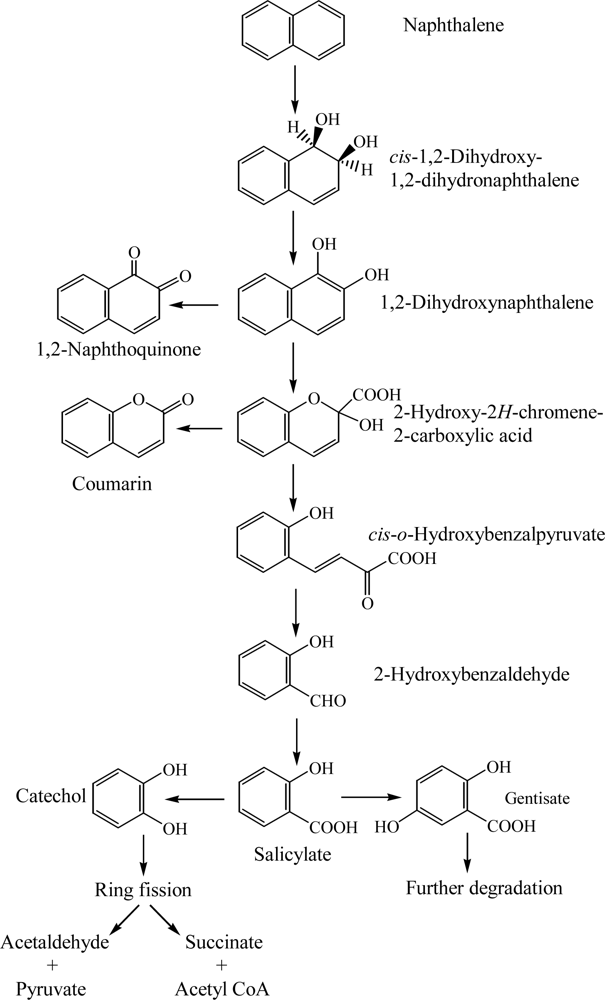
<p>Degradation of naphthalene starts through the multicomponent enzyme, naphthalene dioxygenase, attack on the aromatic ring to form <italic>cis</italic>-(1R, 2S)-dihydroxy-1,2-dihydronaphthalene (<italic>cis</italic>-naphthalene dihydrodiol) (<xref ref-type="fig" rid="f1-ijerph-06-00278">Scheme 1</xref>) [<xref ref-type="bibr" rid="b24-ijerph-06-00278">24</xref>, <xref ref-type="bibr" rid="b37-ijerph-06-00278">37</xref>]. The <italic>cis</italic>-naphthalene dihydrodiol formed by naphthalene dioxygenase is subsequently dehydrogenated to 1,2-dihydroxynaphthalene by a <italic>cis</italic>-dihydrodiol dehydrogenase [<xref ref-type="bibr" rid="b24-ijerph-06-00278">24</xref>, <xref ref-type="bibr" rid="b25-ijerph-06-00278">25</xref>]. Subsequently, 1,2-dihydroxynaphthalene is metabolized to salicylate via 2-hydroxy-2<italic>H</italic>-chromene-2-carboxylic acid, <italic>cis</italic>-<italic>o</italic>-hydroxybenzalpyruvate, and 2-hydroxy-benzaldehyde (<xref ref-type="fig" rid="f1-ijerph-06-00278">Scheme 1</xref>) [<xref ref-type="bibr" rid="b24-ijerph-06-00278">24</xref>, <xref ref-type="bibr" rid="b26-ijerph-06-00278">26</xref>, <xref ref-type="bibr" rid="b27-ijerph-06-00278">27</xref>, <xref ref-type="bibr" rid="b33-ijerph-06-00278">33</xref>]. Also, 1,2-dihydroxynaphthalene is nonenzymatically oxidized to 1,2-naphthaquinone [<xref ref-type="bibr" rid="b25-ijerph-06-00278">25</xref>]. Salicylate is typically decarboxylated to catechol, which is further metabolized by ring fission in <italic>meta</italic>- and <italic>ortho</italic>-pathways. Fuenmayor <italic>et al.</italic> [<xref ref-type="bibr" rid="b29-ijerph-06-00278">29</xref>] reported that salicylate is converted to gentisate by salicylate-5-hydroxylase. Recently, Jouanneau <italic>et al.</italic> [<xref ref-type="bibr" rid="b31-ijerph-06-00278">31</xref>] purified the salicylate 1-hydroxylase from <italic>Sphingomonas</italic> sp. strain CHY-1 and characterized its biochemical and catalytic properties.</p>
<p>The bacterial degradation of naphthalene has been well characterized for the catabolic enzyme system encoded by the plasmid NAH7 in <italic>Pseudomonas putida</italic> G7 [<xref ref-type="bibr" rid="b27-ijerph-06-00278">27</xref>, <xref ref-type="bibr" rid="b37-ijerph-06-00278">37</xref>, <xref ref-type="bibr" rid="b38-ijerph-06-00278">38</xref>]. NAH7 has two operons that contain the structural genes for naphthalene degradation. One operon contains the gene for the upper catabolic pathway encoding the enzymes necessary for the conversion of naphthalene to salicylate. The second operon contains the gene for the lower catabolic pathway encoding the enzymes necessary for the metabolism of salicylate through the catechol meta-cleavage pathway to pyruvate and acetaldehyde [<xref ref-type="bibr" rid="b24-ijerph-06-00278">24</xref>, <xref ref-type="bibr" rid="b27-ijerph-06-00278">27</xref>, <xref ref-type="bibr" rid="b37-ijerph-06-00278">37</xref>, <xref ref-type="bibr" rid="b38-ijerph-06-00278">38</xref>]. The entire sequence structure of plasmid NAH7 (82,232 bp) was determined by Sota <italic>et al</italic>. [<xref ref-type="bibr" rid="b154-ijerph-06-00278">154</xref>]. Also, the complete 83,042 bp sequence of the circular naphthalene degradation plasmid pDTG1 from <italic>Pseudomonas putida</italic> NCIB 9816–4 was determined by Dennis and Zylstra [<xref ref-type="bibr" rid="b155-ijerph-06-00278">155</xref>]. Parales <italic>et al.</italic> [<xref ref-type="bibr" rid="b39-ijerph-06-00278">39</xref>] reported that aspartate 205 in the catalytic domain of naphthalene dioxygenase is a necessary residue in the major pathways of electron transfer to mononuclear iron at the active site.</p></sec>
<sec>
<label>3.2.</label>
<title>Fluorene</title>
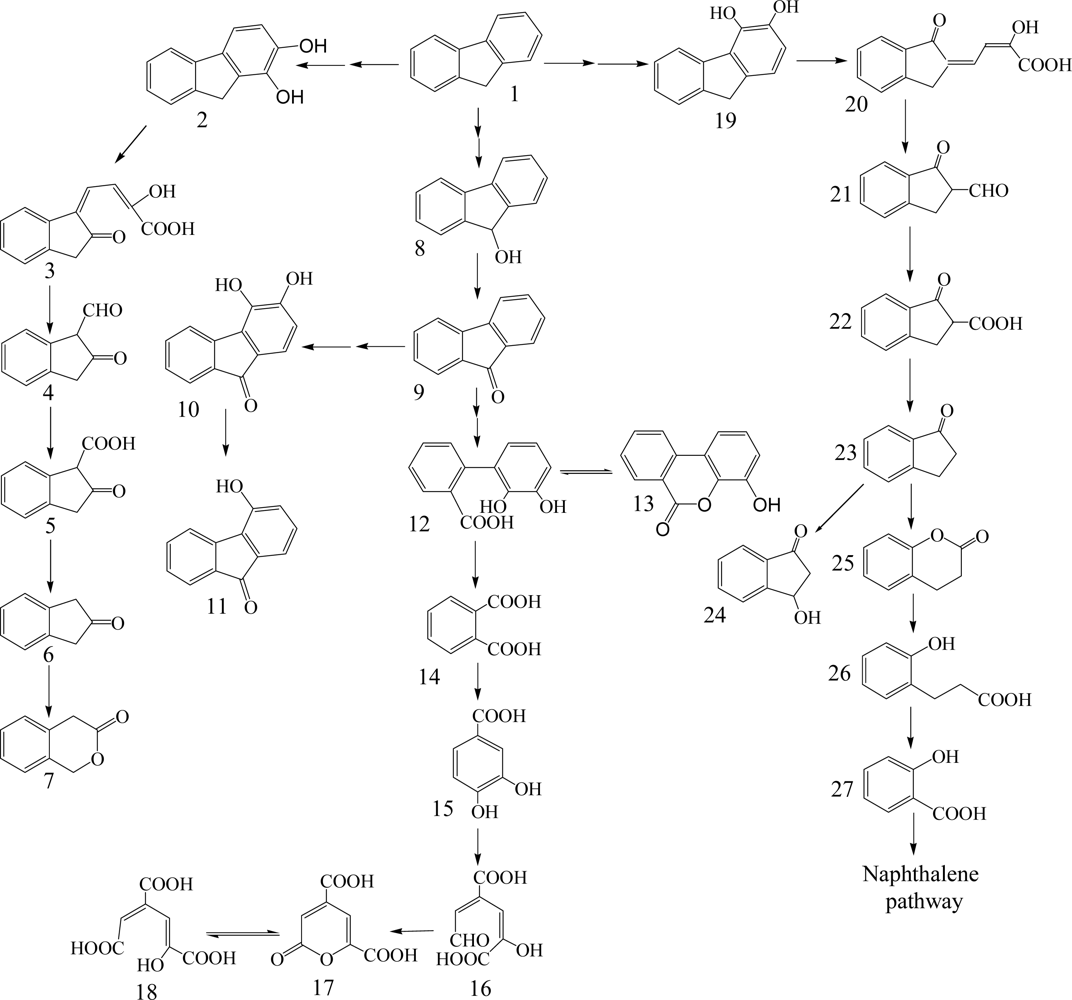
<p>Fluorene having three rings is a major constituent of fossil fuels and coal derivatives. Several bacteria able to use fluorene as their sole source of carbon and energy have been isolated and are in the genera of <italic>Arthrobacter</italic>, <italic>Brevibacterium</italic>, <italic>Burkholderia</italic>, <italic>Mycobacterium</italic>, <italic>Pseudomonas</italic> and <italic>Sphingomonas</italic> (<xref ref-type="table" rid="t1-ijerph-06-00278">Table 1</xref>) [<xref ref-type="bibr" rid="b26-ijerph-06-00278">26</xref>, <xref ref-type="bibr" rid="b40-ijerph-06-00278">40</xref>–<xref ref-type="bibr" rid="b45-ijerph-06-00278">45</xref>]. Three major catabolic pathways are shown in <xref ref-type="fig" rid="f2-ijerph-06-00278">Scheme 2</xref>. The initial 1,2-dioxygenation of fluorene forms fluorene-1,2-diol that is further transformed to 3-chromanone <italic>via</italic> 2-hydroxy-4-(2-oxo-indan-1-ylidene)-2-butenoic acid, 1-formyl-2-indanone, 2-indanone-1-carboxylic acid, and 2-indanone [<xref ref-type="bibr" rid="b41-ijerph-06-00278">41</xref>, <xref ref-type="bibr" rid="b46-ijerph-06-00278">46</xref>]. The second pathway begins at an initial 3,4-dioxygenation of fluorene leading to salicylate formation through 2-hydroxy-4-(1-oxo-indan-2-ylidene)-2-butenoic acid, 2-formyl-1-indanone, 1-indanone-2-carboxylic acid, 1-indanone, 2-chromanone, and 3-(2-hydroxy-phenyl)-propionic acid [<xref ref-type="bibr" rid="b41-ijerph-06-00278">41</xref>, <xref ref-type="bibr" rid="b43-ijerph-06-00278">43</xref>]. The third pathway starts from C-9 monooxygenation in <italic>Brevibacterium</italic> sp. DPO1361 and <italic>Pseudomonas</italic> sp. F274. This pathway is only productive if a subsequent angular carbon dioxygenation occurs, leading to the formation of phthalate that is further transformed to protocatechuate (<xref ref-type="fig" rid="f2-ijerph-06-00278">Scheme 2</xref>) [<xref ref-type="bibr" rid="b40-ijerph-06-00278">40</xref>, <xref ref-type="bibr" rid="b42-ijerph-06-00278">42</xref>, <xref ref-type="bibr" rid="b44-ijerph-06-00278">44</xref>, <xref ref-type="bibr" rid="b45-ijerph-06-00278">45</xref>, <xref ref-type="bibr" rid="b47-ijerph-06-00278">47</xref>]. Several genes involved in the degradation of fluorene to phthalate were characterized in <italic>Terrabacter</italic> sp. DBF63 by Habe <italic>et al.</italic> [<xref ref-type="bibr" rid="b48-ijerph-06-00278">48</xref>].</p></sec>
<sec>
<label>3.3.</label>
<title>Phenanthrene</title>
<p>Phenanthrene, a three aromatic ring system, is found in high concentrations in PAH-contaminated sediments, surface soils, and waste sites [<xref ref-type="bibr" rid="b49-ijerph-06-00278">49</xref>]. Bacterial degradation of phenanthrene has been extensively studied. A variety of bacterial strains in <italic>Acidovorax</italic>, <italic>Arthrobacter</italic>, <italic>Brevibacterium</italic>, <italic>Burkholderia</italic>, <italic>Comamonas</italic>, <italic>Mycobacterium</italic>, <italic>Pseudomonas</italic>, and <italic>Sphingomonas</italic> have been isolated and have the ability to utilize phenanthrene as a sole carbon and energy source (<xref ref-type="table" rid="t1-ijerph-06-00278">Table 1</xref>) [<xref ref-type="bibr" rid="b10-ijerph-06-00278">10</xref>, <xref ref-type="bibr" rid="b26-ijerph-06-00278">26</xref>, <xref ref-type="bibr" rid="b32-ijerph-06-00278">32</xref>, <xref ref-type="bibr" rid="b34-ijerph-06-00278">34</xref>, <xref ref-type="bibr" rid="b36-ijerph-06-00278">36</xref>, <xref ref-type="bibr" rid="b40-ijerph-06-00278">40</xref>, <xref ref-type="bibr" rid="b49-ijerph-06-00278">49</xref>–<xref ref-type="bibr" rid="b59-ijerph-06-00278">59</xref>].</p>
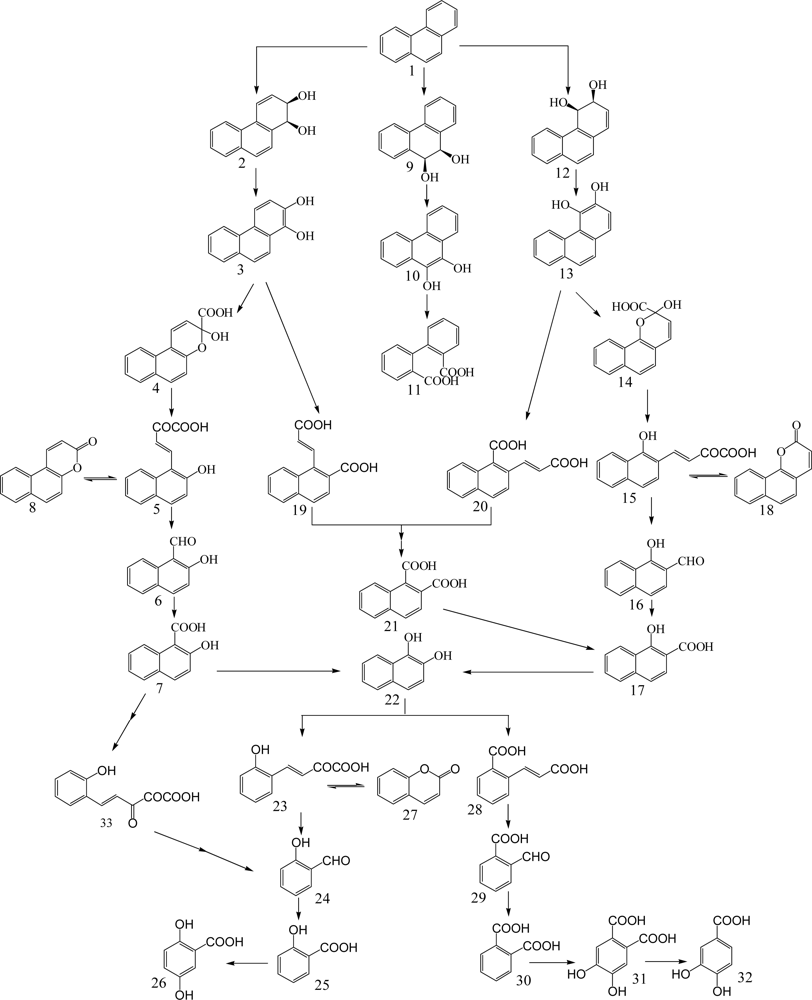
<p>Phenanthrene contains bay- and K-regions able to form an epoxide, which is suspected to be an ultimate carcinogen [<xref ref-type="bibr" rid="b56-ijerph-06-00278">56</xref>, <xref ref-type="bibr" rid="b60-ijerph-06-00278">60</xref>]. Therefore, it is used as a model substrate for studies on the catabolism of bay- and K-region containing carcinogenic PAHs such as benzo[<italic>a</italic>]pyrene, benzo[<italic>a</italic>]anthracene, and chrysene [<xref ref-type="bibr" rid="b56-ijerph-06-00278">56</xref>]. In general, bacterial degradation of phenanthrene is initiated by 3,4-dioxygenation to yield <italic>cis</italic>-3,4-dihydroxy-3,4-dihydrophenanthrene, which undergoes enzymatic dehydrogenation to 3,4-dihydroxyphenanthrene (<xref ref-type="fig" rid="f3-ijerph-06-00278">Scheme 3</xref>) [<xref ref-type="bibr" rid="b57-ijerph-06-00278">57</xref>, <xref ref-type="bibr" rid="b58-ijerph-06-00278">58</xref>, <xref ref-type="bibr" rid="b61-ijerph-06-00278">61</xref>]. The diol is subsequently catabolized to naphthalene-1,2-diol through both <italic>ortho</italic>-cleavage to form 2-(2-carboxy-vinyl)-naphthalene-1-carboxylic acid and <italic>meta</italic>-cleavage to form 4-(1-hydroxy-naphthalen-2-yl)-2-oxo-but-3-enoic acid [<xref ref-type="bibr" rid="b57-ijerph-06-00278">57</xref>].</p>
<p>Recently, Seo <italic>et al.</italic> [<xref ref-type="bibr" rid="b57-ijerph-06-00278">57</xref>] elucidated that the <italic>ortho</italic>-cleavage product, 2-(2-carboxy-vinyl)-naphthalene-1-carboxylic acid, is degraded to naphthalene-1,2-diol through naphthalene-1,2-dicarboxylic acid and 1-hydroxy-2-naphthoic acid. Pagnout <italic>et al.</italic> [<xref ref-type="bibr" rid="b62-ijerph-06-00278">62</xref>] isolated and characterized a gene cluster involved in phenanthrene degradation by 3,4-phenanthrene dioxygenation and <italic>meta</italic>-cleavage. It is possible that 1,2-dioxygenation of phenanthrene forms <italic>cis</italic>-1,2-dihydroxy-1,2-dihydrophenanthrene, which undergoes enzymatic dehydrogenation to 1,2-dihydroxyphenanthrene (<xref ref-type="fig" rid="f3-ijerph-06-00278">Scheme 3</xref>). This diol is also subsequently catabolized to naphthalene-1,2-diol through both <italic>ortho</italic>- and <italic>meta</italic>-cleavages. In general, phenanthrene-1,2- and 3,4-diols mainly undergo <italic>meta</italic>-cleavage due to the rapid accumulation of 5,6- and 7,8-benzocoumarin [<xref ref-type="bibr" rid="b57-ijerph-06-00278">57</xref>]. Naphthalene-1,2-diol converged from 1-hydroxy-2-naphthoic acid and 2-hydroxy-1-naphthoic acid is further degraded in a phthalic acid pathway through <italic>ortho</italic>-cleavage and a salicylic acid pathway through <italic>meta</italic>-cleavage [<xref ref-type="bibr" rid="b55-ijerph-06-00278">55</xref>, <xref ref-type="bibr" rid="b57-ijerph-06-00278">57</xref>, <xref ref-type="bibr" rid="b58-ijerph-06-00278">58</xref>]. Mallick <italic>et al.</italic> [<xref ref-type="bibr" rid="b63-ijerph-06-00278">63</xref>] reported that a novel <italic>meta</italic>-cleavage of 2-hydroxy-1-naphthoic acid to form <italic>trans</italic>-2,3-dioxo-5-(2’-hydroxyphenyl)-pent-4-enoic acid in <italic>Staphylococcus</italic> sp. PN/Y. Interestingly, phenanthrene degradation starts from 9,10-dioxygenase to yield phenanthrene <italic>cis</italic>-9,10-dihydrodiol that is further catabolized to 2,2’-diphenic acid <italic>via</italic> 9,10-dihydroxyphenanthrene [<xref ref-type="bibr" rid="b49-ijerph-06-00278">49</xref>, <xref ref-type="bibr" rid="b57-ijerph-06-00278">57</xref>, <xref ref-type="bibr" rid="b61-ijerph-06-00278">61</xref>].</p></sec>
<sec>
<label>3.4.</label>
<title>Fluoranthene</title>
<p>Fluoranthene, a four-ring PAH, is one of the principal PAHs in the environment. Bacterial transformation of fluoranthene has been reported (<xref ref-type="table" rid="t1-ijerph-06-00278">Table 1</xref>) [<xref ref-type="bibr" rid="b40-ijerph-06-00278">40</xref>, <xref ref-type="bibr" rid="b51-ijerph-06-00278">51</xref>, <xref ref-type="bibr" rid="b64-ijerph-06-00278">64</xref>–<xref ref-type="bibr" rid="b73-ijerph-06-00278">73</xref>]. <italic>Mycobacterium</italic> has been extensively studied and is a well-known genus to mineralize high molecular weight PAHs such as fluoranthene, pyrene, and benzo[<italic>a</italic>]pyrene [<xref ref-type="bibr" rid="b4-ijerph-06-00278">4</xref>, <xref ref-type="bibr" rid="b70-ijerph-06-00278">70</xref>, <xref ref-type="bibr" rid="b74-ijerph-06-00278">74</xref>–<xref ref-type="bibr" rid="b79-ijerph-06-00278">79</xref>]. Also, strains in the genera <italic>Burkholderia</italic>, <italic>Pasteurella</italic>, <italic>Rhodococcus</italic>, <italic>Sphingomonas</italic>, and <italic>Stenotrophomonas</italic> have been isolated to degrade fluoranthene, using it as a sole carbon and energy sources [<xref ref-type="bibr" rid="b64-ijerph-06-00278">64</xref>, <xref ref-type="bibr" rid="b66-ijerph-06-00278">66</xref>, <xref ref-type="bibr" rid="b71-ijerph-06-00278">71</xref>, <xref ref-type="bibr" rid="b72-ijerph-06-00278">72</xref>, <xref ref-type="bibr" rid="b80-ijerph-06-00278">80</xref>, <xref ref-type="bibr" rid="b81-ijerph-06-00278">81</xref>].</p>
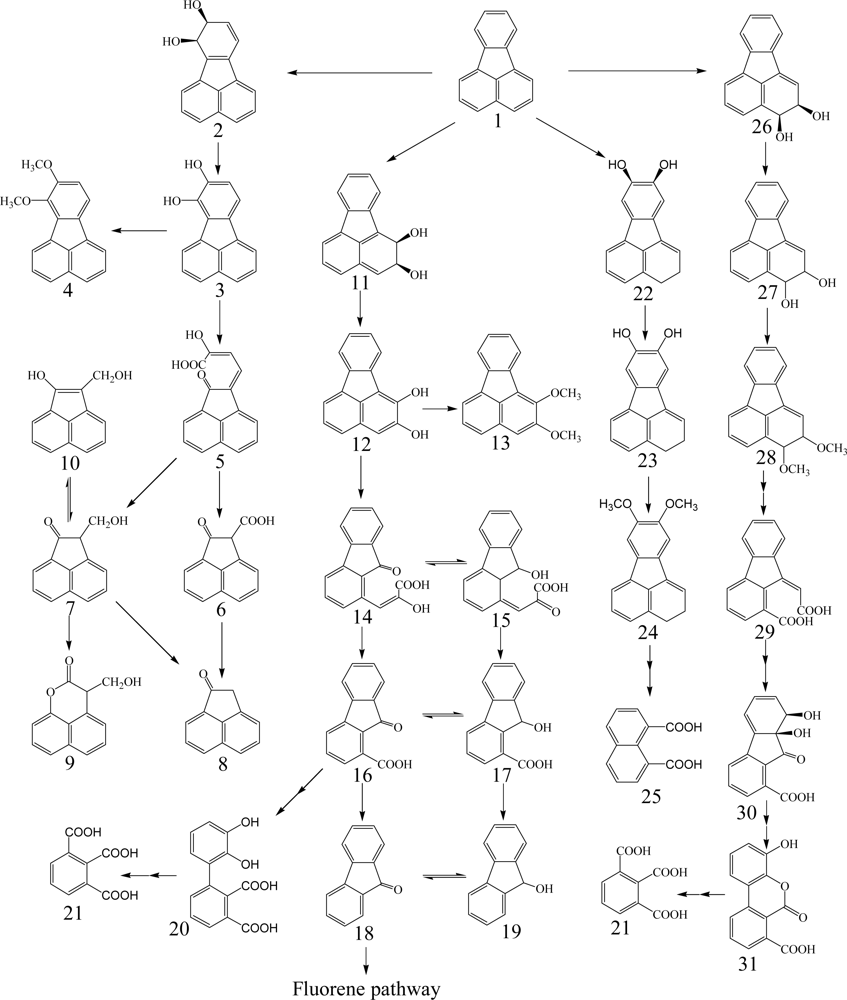
<p>Bacterial degradation of fluoranthene is generally initiated by 1,2- or 7,8-dioxygenation to form <italic>cis</italic>-1,2- or <italic>cis</italic>-7,8-fluoranthene dihydrodiol, respectively (<xref ref-type="fig" rid="f4-ijerph-06-00278">Scheme 4</xref>). These two dihydrodiols are dehydrogenated to 1,2- or 7,8-dihydroxyfluoranthene, respectively. 7,8-Dihydroxy-fluoranthene is further transformed <italic>via meta</italic>-cleavage to 1-acenaphthenone and 3-hydroxymethyl-3<italic>H</italic>-benzo[<italic>de</italic>]-chromen-2-one through 2-hydroxyl-4-(2-oxo-2<italic>H</italic>-acenaphthylen-1-ylidene)-but-2-enoic acid, 2-hydroxylmethyl-2<italic>H</italic>-acenaphthylen-1-one, and 2-oxo-acenaphthene-1-carboxylic acid. Kelley <italic>et al.</italic> [<xref ref-type="bibr" rid="b67-ijerph-06-00278">67</xref>] reported that the dehydrogenation of a transient <italic>cis</italic>-7,8-fluoranthene dihydrodiol to form 7,8-dihydroxyfluoranthene with <italic>O</italic>-methylation at the 7-position would form 7-methoxy-8-hydroxy-fluoranthene. However, Lee <italic>et al.</italic> [<xref ref-type="bibr" rid="b68-ijerph-06-00278">68</xref>] suggested that there are four possible initial dioxygenation at 1,2-, 2,3-, 7,8-, and 8,9-positions of fluoranthene and four possible dimethoxyfluoranthenes in <italic>Mycobacterium</italic> sp. JS14. 1,2-Dihydroxy-fluoranthene is also further degraded by <italic>meta</italic>-cleavage to 9-fluorenone through 9-fluorenone-1-(carboxy-2-hydroxy-1-propenol) and 9-fluorenone-1-carboxylic acid which can be converted by protonation to 9-fluorenol-1-carboxy-3-propenyl-2-one and 9-fluorenol-1-carboxylic acid, respectively. The conversion of 9-fluorenone to 9-fluorenol is also possible.</p>
<p>Rehmann <italic>et al.</italic> [<xref ref-type="bibr" rid="b69-ijerph-06-00278">69</xref>] reported 2,3-dioxygenation of fluoranthene and found five metabolites, namely <italic>cis</italic>-2,3-fluoranthene dihydrodiol, 9-carboxymethylene-9<italic>H</italic>-fluorene-1-carboxylic acid, <italic>cis</italic>-1,9a-dihydroxy-1-hydrofluorene-9-one-8-carboxylic acid, 4-hydroxybenzochromene-6-one-7-carboxylic acid, and benzene-1,2,3-tricarboxylic acid. <italic>cis</italic>-2,3-Fluoranthene dihydrodiol is catabolized by <italic>ortho</italic>-cleavage to benzene-1,2,3-tricarboxylic acid <italic>via</italic> 9-carboxymethylene-9<italic>H</italic>-fluorene-1-carboxylic acid, <italic>cis</italic>-1,9a-dihydroxy-1-hydrofluorene-9-one-8-carboxylic acid, and 4-hydroxybenzo-chromene-6-one-7-carboxylic acid. Recently, Lee <italic>et al.</italic> [<xref ref-type="bibr" rid="b68-ijerph-06-00278">68</xref>] proposed 8,9-dioxygenation of fluoranthene from the detection of 8,9-dimethoxyfluoranthene. Also, they detected 25 proteins related to fluoranthene catabolism in <italic>Mycobacterium</italic> sp. JS14 using 1-D SDS PAGE, 2-D SDS PAGE, and nano-LC/MS/MS.</p></sec>
<sec>
<label>3.5.</label>
<title>Pyrene</title>
<p>Pyrene possessing four benzene rings is a byproduct of gasification processes and other incomplete combustion processes. Many bacterial isolates capable of degrading pyrene have been studied (<xref ref-type="table" rid="t1-ijerph-06-00278">Table 1</xref>). <italic>Mycobacterium</italic> as Gram-positive species has been most widely studied for degrading pyrene by using it as a sole carbon and energy source [<xref ref-type="bibr" rid="b4-ijerph-06-00278">4</xref>, <xref ref-type="bibr" rid="b34-ijerph-06-00278">34</xref>, <xref ref-type="bibr" rid="b35-ijerph-06-00278">35</xref>, <xref ref-type="bibr" rid="b51-ijerph-06-00278">51</xref>, <xref ref-type="bibr" rid="b61-ijerph-06-00278">61</xref>, <xref ref-type="bibr" rid="b75-ijerph-06-00278">75</xref>, <xref ref-type="bibr" rid="b78-ijerph-06-00278">78</xref>, <xref ref-type="bibr" rid="b79-ijerph-06-00278">79</xref>, <xref ref-type="bibr" rid="b83-ijerph-06-00278">83</xref>–<xref ref-type="bibr" rid="b85-ijerph-06-00278">85</xref>]. <italic>Mycobacterium</italic> spp. are known to have high cell surface hydrophobicity and adhere to the emulsified solvent droplets [<xref ref-type="bibr" rid="b83-ijerph-06-00278">83</xref>]. Other pyrene degrading strains isolated include <italic>Rhodococcus</italic> sp. [<xref ref-type="bibr" rid="b86-ijerph-06-00278">86</xref>], <italic>Bacillus cereus</italic> [<xref ref-type="bibr" rid="b87-ijerph-06-00278">87</xref>], <italic>Burkholderia cepacia</italic> [<xref ref-type="bibr" rid="b80-ijerph-06-00278">80</xref>], <italic>Cycloclasticus</italic> sp. P1 [<xref ref-type="bibr" rid="b88-ijerph-06-00278">88</xref>], <italic>Pseudomonas fluorescens</italic> [<xref ref-type="bibr" rid="b64-ijerph-06-00278">64</xref>], <italic>Pseudomonas stutzeri</italic> [<xref ref-type="bibr" rid="b87-ijerph-06-00278">87</xref>], <italic>Sphingomonas</italic> sp. VKM B-2434 [<xref ref-type="bibr" rid="b26-ijerph-06-00278">26</xref>], <italic>Sphingomonas paucimobilis</italic> [<xref ref-type="bibr" rid="b89-ijerph-06-00278">89</xref>], and <italic>Stenotrophomonas maltophilia</italic> [<xref ref-type="bibr" rid="b64-ijerph-06-00278">64</xref>, <xref ref-type="bibr" rid="b66-ijerph-06-00278">66</xref>, <xref ref-type="bibr" rid="b90-ijerph-06-00278">90</xref>].</p>
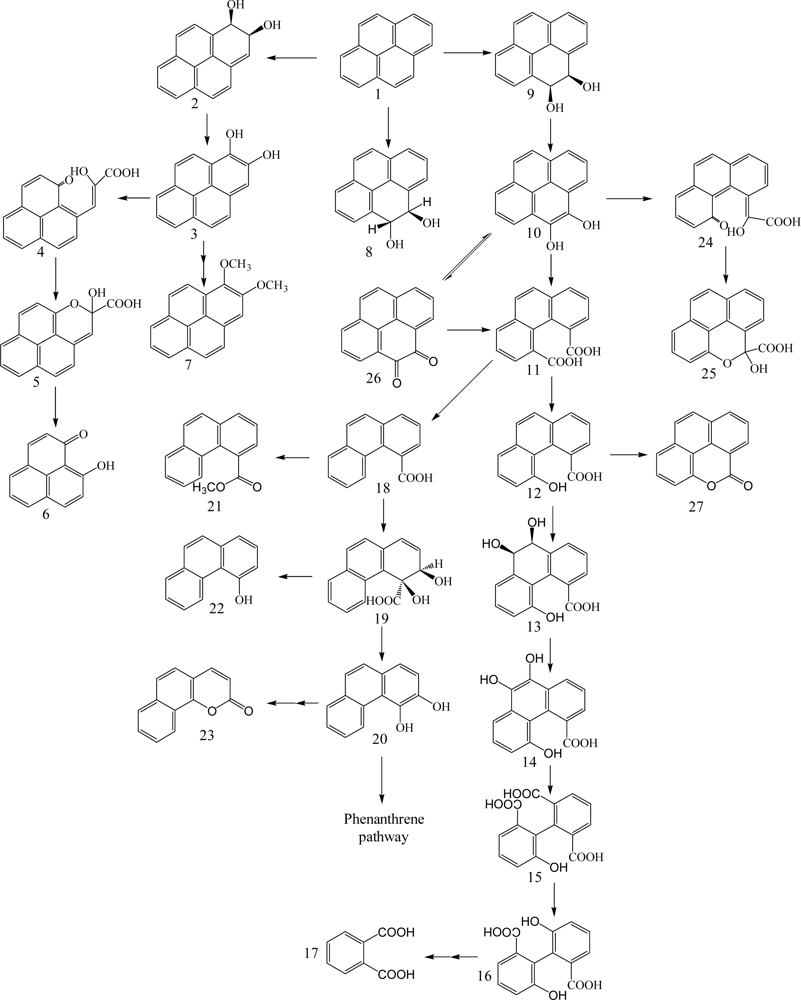
<p>Heitkamp <italic>et al.</italic> [<xref ref-type="bibr" rid="b76-ijerph-06-00278">76</xref>] found the three products of ring oxidation, pyrene-<italic>cis</italic>-4,5-dihydrodiol, pyrene-<italic>trans</italic>-4,5-dihydrodiol, and pyrenol, and four products of ring fission (<xref ref-type="fig" rid="f5-ijerph-06-00278">Scheme 5</xref>), 4-hydroxyperinaphthenone, 4-phenanthroic acid, phthalic acid, and cinnamic acid by multiple analyses, including UV, infrared, mass spectrometry, NMR, and GC. The formation of pyrene-<italic>cis</italic>-4,5-dihydrodiol by dioxygenase and pyrene-<italic>trans</italic>-4,5-dihydrodiol by monooxygenase suggested multiple initial oxidative attacks on pyrene. Pyrene-1,2-diol derived from the dioxygenation at pyrene 1,2-C positions is metabolized to 4-hydroxyperinaphthenone <italic>via cis</italic>-2-hydroxy-3-(perinaphthenone-9-yl)-propenic acid and 2-hydroxy-2<italic>H</italic>-1-oxa-pyrene-2-carboxylic acid (<xref ref-type="fig" rid="f5-ijerph-06-00278">Scheme 5</xref>). Kim and Freeman [<xref ref-type="bibr" rid="b61-ijerph-06-00278">61</xref>] found 1,2-dimethoxypyrene as a subproduct of pyrene-1,2-diol. Pyrene-4,5-diol is degraded by <italic>ortho</italic>-cleavage to phenanthrene-4,5-dicarboxylic acid, which is further metabolized through phenanthrene-3,4-diol pathway and 6,6’-dihydroxy-2,2’-biphenyl-dicarboxylic acid pathway. <italic>Meta</italic>-cleavage of pyrene-4,5-diol lead to 5-hydroxy-5<italic>H</italic>-4-oxa-pyrene-5-carboxylic acid <italic>via</italic> 2-hydroxy-2-(phenanthrene-5-one-4-enyl)-acetic acid (<xref ref-type="fig" rid="f5-ijerph-06-00278">Scheme 5</xref>). A novel metabolite, 6,6’-dihydroxy-2,2’-biphenyl-dicarboxylic acid, was identified by Vila <italic>et al.</italic> [<xref ref-type="bibr" rid="b85-ijerph-06-00278">85</xref>] from the degradation of pyrene by <italic>Mycobacterium</italic> sp. strain AP1. Liang <italic>et al.</italic> [<xref ref-type="bibr" rid="b91-ijerph-06-00278">91</xref>] reported pyrene-4,5-dione formation and identified almost all the enzymes required during the initial steps of pyrene degradation in <italic>Mycobacterium</italic> sp. KMS. Kim <italic>et al.</italic> [<xref ref-type="bibr" rid="b92-ijerph-06-00278">92</xref>] identified 27 enzymes necessary for constructing a complete pathway for pyrene degradation from both genomic and proteomic data.</p></sec>
<sec>
<label>3.6.</label>
<title>Benzo[a]pyrene</title>
<p>Benzo[<italic>a</italic>]pyrene, a five aromatic ring PAH, is one of the most potent carcinogenic PAHs. Benzo[<italic>a</italic>]pyrene has low water solubility (0.0023 mg/L) and a high octanol/water partition coefficient (LogK<sub>ow</sub>, 6.06), which is related to high recalcitrance to microbial degradation. It also has relatively low abundance in environmental samples which limits its catabolism by bacterial assemblages. The concentration of benzo[<italic>a</italic>]pyrene as well as other PAHs in contaminated soils in industrial sites can vary depending on the industrial activities associated with the site. To date, there is only limited information regarding the bacterial degradation of PAHs with five or more rings. There are several bacterial species capable of benzo[<italic>a</italic>]pyrene degradation including <italic>Mycobacterium</italic> sp. [<xref ref-type="bibr" rid="b74-ijerph-06-00278">74</xref>, <xref ref-type="bibr" rid="b79-ijerph-06-00278">79</xref>, <xref ref-type="bibr" rid="b93-ijerph-06-00278">93</xref>], <italic>Sphingomonas paucimobilis</italic> [<xref ref-type="bibr" rid="b94-ijerph-06-00278">94</xref>], and <italic>Stenotrophomonas maltophilia</italic> [<xref ref-type="bibr" rid="b95-ijerph-06-00278">95</xref>] (<xref ref-type="table" rid="t1-ijerph-06-00278">Table 1</xref>). Juhasz <italic>et al.</italic> [<xref ref-type="bibr" rid="b66-ijerph-06-00278">66</xref>] found that <italic>S. maltophilia</italic> VUN 10,003 can degrade benzo[<italic>a</italic>]pyrene by 22% for 14 days incubation. A <italic>S. paucimobilis</italic> EPA 505 grown on fluoranthene degraded 33% of benzo[<italic>a</italic>]pyrene [<xref ref-type="bibr" rid="b94-ijerph-06-00278">94</xref>].</p>
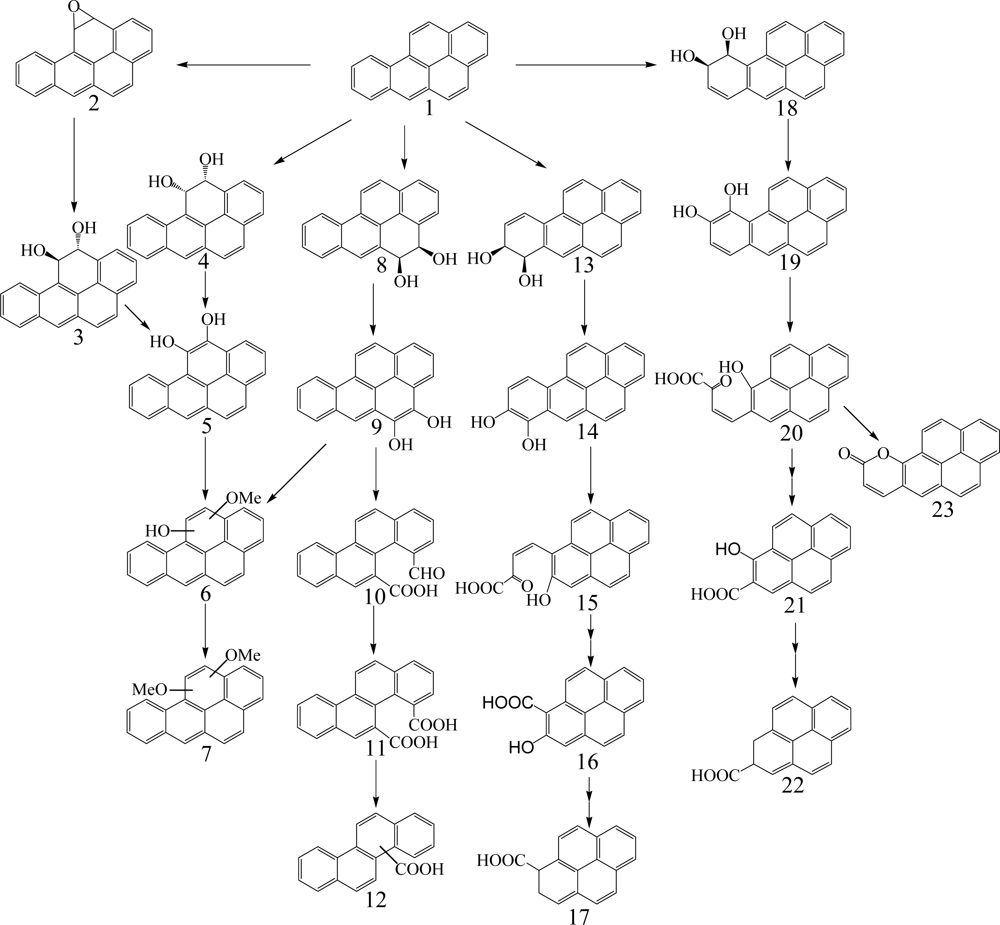
<p>Gibson <italic>et al.</italic> [<xref ref-type="bibr" rid="b96-ijerph-06-00278">96</xref>] first identified <italic>cis</italic>-7,8 and 9,10-benzo[<italic>a</italic>]pyrene-dihydrodiol formed in <italic>Beijerinckia</italic> sp. strain B1, except ring cleavage metabolites (<xref ref-type="fig" rid="f6-ijerph-06-00278">Scheme 6</xref>). Schneider <italic>et al.</italic> [<xref ref-type="bibr" rid="b79-ijerph-06-00278">79</xref>] reported that <italic>Mycobacterium</italic> sp. strain RJGII-135 is capable of transforming benzo[<italic>a</italic>]pyrene to initial ring oxidation and ring cleavage metabolites. They found one ring oxidation metabolite, benzo[<italic>a</italic>]pyrene <italic>cis</italic>-7,8-dihydrodiol, and three ring cleavage metabolites, 4,5-chrysene-dicarboxylic acid, <italic>cis</italic>-4-(8-hydroxypyrene-7-yl)-2-oxobut-3-enoic acid or <italic>cis</italic>-4-(7-hydroxypyrene-8-yl)-2-oxobut-3-enoic acid, and 7,8-dihydro-pyrene-7-carboxylic acid or 7,8-dihydro-pyrene-8-carboxylic acid (<xref ref-type="fig" rid="f6-ijerph-06-00278">Scheme 6</xref>). These metabolites indicate that the initial enzymatic attack occurs at the 4,5-, 7,8-, and 9,10-positions of benzo[<italic>a</italic>]pyrene.</p>
<p>The genes encoding the α-subunit of the PAH-ring hydroxylating dioxygenases involved in the initial step of metabolism of PAH in bacteria were recently quantified and characterized by Cebron <italic>et al.</italic> [<xref ref-type="bibr" rid="b97-ijerph-06-00278">97</xref>] and Lozada <italic>et al.</italic> [<xref ref-type="bibr" rid="b98-ijerph-06-00278">98</xref>]. Benzo[<italic>a</italic>]pyrene <italic>cis</italic>-7,8-dihydrodiol is further catabolized <italic>via meta</italic>-cleavage to 7,8-dihydro-pyrene-8-carboxylic acid through <italic>cis</italic>-4-(7-hydroxypyrene-8-yl)-2-oxobut-3-enoic acid. Benzo[<italic>a</italic>]pyrene <italic>cis</italic>-9,10-dihydrodiol is degraded <italic>via meta</italic>-cleavage to 7,8-dihydro-pyrene-7-carboxylic acid through <italic>cis</italic>-4-(8-hydroxypyrene-7-yl)-2-oxobut-3-enoic acid. In addition, 10-oxabenzo[<italic>def</italic>]-chrysene-9-one formed by dehydration of benzo[<italic>a</italic>]pyrene <italic>cis</italic>-9,10-dihydrodiol to give <italic>cis</italic>-4-(8-hydroxypyrene-7-yl)-2-oxobut-3-enoic acid with subsequent <italic>meta</italic>-cleavage and aromatic ring closure [<xref ref-type="bibr" rid="b99-ijerph-06-00278">99</xref>]. 4,5-Chrysene-dicarboxylic acid is transformed from 4-formylchrysene-5-carboxylic acid formed by the <italic>ortho</italic>-cleavage of 4,5-dihydroxy benzo[<italic>a</italic>]pyrene. Moody <italic>et al.</italic> [<xref ref-type="bibr" rid="b99-ijerph-06-00278">99</xref>] reported new degradation pathways of benzo[<italic>a</italic>]pyrene in <italic>Mycobacterium vanbaalehii</italic> PYR-1. The new pathways are initiated by dioxygenase and monooxygenase at the 11,12-positions of benzo[<italic>a</italic>]pyrene molecule to form benzo[<italic>a</italic>]pyrene <italic>cis</italic>-11,12-dihydrodiol and benzo[<italic>a</italic>]pyrene <italic>trans</italic>-11,12-dihydrodiol, respectively. Benzo[<italic>a</italic>]pyrene <italic>cis</italic>-11,12-dihydrodiol is further catabolized to dimethoxybenzo[<italic>a</italic>]pyrene <italic>via</italic> hydroxymethoxybenzo[<italic>a</italic>]pyrene. The formation of benzo[<italic>a</italic>]pyrene <italic>trans</italic>-11,12-dihydrodiol is due to cytochrome P-450 acting to form benzo[<italic>a</italic>]pyrene 11,12-epoxide with subsequent hydrolysis by epoxide hydrolase. Recently, Rentz <italic>et al.</italic> [<xref ref-type="bibr" rid="b100-ijerph-06-00278">100</xref>] identified two novel ring cleavage metabolites, pyrene-8-hydroxy-7-carboxylic acid and pyrene-7-hydroxy-8-carboxylic acid, formed by <italic>Sphingomonas yanoikuyae</italic> JAR02.</p></sec></sec>
<sec>
<label>4.</label>
<title>Aerobic Bacterial Catabolism of Aromatic Heterocycles</title>
<p>Various types of heterocycles containing oxygen, nitrogen, and sulfur are found in the environment, originating from anthropogenic or natural sources. Dibenzofurans, dibenzodioxins, and dibenzothiophene are among the most important environmental pollutants and are well reviewed [<xref ref-type="bibr" rid="b2-ijerph-06-00278">2</xref>, <xref ref-type="bibr" rid="b101-ijerph-06-00278">101</xref>, <xref ref-type="bibr" rid="b102-ijerph-06-00278">102</xref>]. Therefore, only aerobic bacterial degradation of non-halogenated heterocyclic aromatics is briefly discussed in this review to make a general relation with PAH degradation.</p>
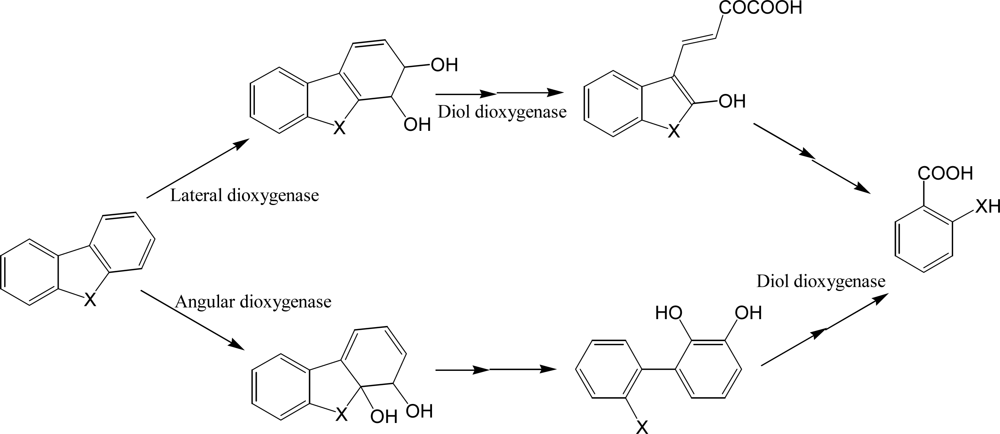
<p>Many bacterial species have been reported to decompose dibenzofurans and carbazole, a structural analogue with nitrogen instead of oxygen [<xref ref-type="bibr" rid="b103-ijerph-06-00278">103</xref>–<xref ref-type="bibr" rid="b108-ijerph-06-00278">108</xref>], although some white rot fungi are well known to decompose halogenated dibenzofurans. Guo <italic>et al.</italic> [<xref ref-type="bibr" rid="b106-ijerph-06-00278">106</xref>] isolated a stable carbazole-degrading microbial consortium consisting of <italic>Chryseobacterium</italic> sp. NCY and <italic>Achromobacter</italic> sp. NCW. As for the degradation of unsubstituted PAHs, bacterial catabolism of dibenzofurans starts at insertion of two oxygen atoms catalyzed by dioxygenases. Although many bacterial PAH dioxygenases are evolutionarily related to phenylpropionate dioxygenase, striking diversities have been reported in catalytic activity, mechanisms, regulations, and substrates of these important enzymes. In short, initial reactions of dibenzofuran and carbazole can be classified into angular and lateral dioxygenation, which may be catalyzed by different enzymes (<xref ref-type="fig" rid="f7-ijerph-06-00278">Scheme 7</xref>). These enzymes were found in Gram-positive and negative bacteria [<xref ref-type="bibr" rid="b109-ijerph-06-00278">109</xref>–<xref ref-type="bibr" rid="b112-ijerph-06-00278">112</xref>]. Some bacterial dioxygenases from <italic>Pseudomonas</italic> sp. CA10 and <italic>Sphingomonas wittichii</italic> RW1, for example, catalyze predominantly angular insertion of oxygen [<xref ref-type="bibr" rid="b109-ijerph-06-00278">109</xref>, <xref ref-type="bibr" rid="b112-ijerph-06-00278">112</xref>] while the commonly known naphthalene dioxygenase from <italic>Pseudomonas</italic> sp. NCIB 9816-4 catalyzes only lateral dioxygenation [<xref ref-type="bibr" rid="b113-ijerph-06-00278">113</xref>]. According to the metabolite analyses accompanied by biochemical studies, angular and lateral dioxygenases were considered from different origins.</p>
<p>However, recent studies with cloned dioxygenase from <italic>Norcardioides aromaticivorans</italic> IC177 revealed that some dioxygenase can catalyze both reactions [<xref ref-type="bibr" rid="b110-ijerph-06-00278">110</xref>]. It is well known that PAH dioxygenases can catalyze various reactions, including reduction, mono- and di-oxygenation [<xref ref-type="bibr" rid="b113-ijerph-06-00278">113</xref>]. In addition to the multiple reactions with specific dioxygenases, current genomic or proteomic research with several PAH degrading bacteria (e.g., <italic>Burkholderia</italic> spp. and <italic>Mycobacterium</italic> spp.) revealed that multiple dioxygenases, probably playing different roles in PAH degradation, exist in a single bacterium [<xref ref-type="bibr" rid="b91-ijerph-06-00278">91</xref>, <xref ref-type="bibr" rid="b114-ijerph-06-00278">114</xref>, <xref ref-type="bibr" rid="b115-ijerph-06-00278">115</xref>]. For example, metabolite profiling of culture supernatant of <italic>Janibacter</italic> sp. YY1 treated with dibenzofuran showed that it may have both angular and lateral dioxygenases [<xref ref-type="bibr" rid="b116-ijerph-06-00278">116</xref>]. Multiple catabolic pathways can produce various metabolites with structural diversities, which probably are metabolized by different types of enzymes. For example, Nojiri <italic>et al.</italic> [<xref ref-type="bibr" rid="b107-ijerph-06-00278">107</xref>] reported that <italic>Terrabacter</italic> sp. DBF63 can metabolize fluorene and dibenzofuran by the same dioxygenase but the metabolites, namely phthalate and salicyclate from fluorene and dibenzofuran, respectively, are further catabolized by different enzymes, of which the related genes are located in different areas of chromosomes.</p>
<p>Dioxygenases involving in dibenzo-<italic>p</italic>-dioxins degradation catalyze predominantly an angular dioxygenation to produce trihydroxy diphenyl ethers (<xref ref-type="fig" rid="f8-ijerph-06-00278">Scheme 8</xref>). PCDDs are well known pollutants with extreme toxicity, especially tetra to hexachloro analogues. Some bacterial species can catabolize up to hexachlorodibenzo-<italic>p</italic>-dioxins [<xref ref-type="bibr" rid="b112-ijerph-06-00278">112</xref>, <xref ref-type="bibr" rid="b117-ijerph-06-00278">117</xref>]. In comparison with dibenzofuran catabolism, chlorophthalates or salicylates and chlorophenols are common metabolites of PCDDs [<xref ref-type="bibr" rid="b112-ijerph-06-00278">112</xref>]. Chlorophenols are well known to be toxic to various organisms, including their degrading bacteria. Toxic effects of chlorometabolites are also reported from the catabolism of PCBs [<xref ref-type="bibr" rid="b118-ijerph-06-00278">118</xref>]. Although it is not clear how the bacteria can cope with the toxicity of chlorophenols during dioxin metabolism, glutathione or other sulfur-containing primary metabolites may be involved in its detoxification [<xref ref-type="bibr" rid="b118-ijerph-06-00278">118</xref>].</p>
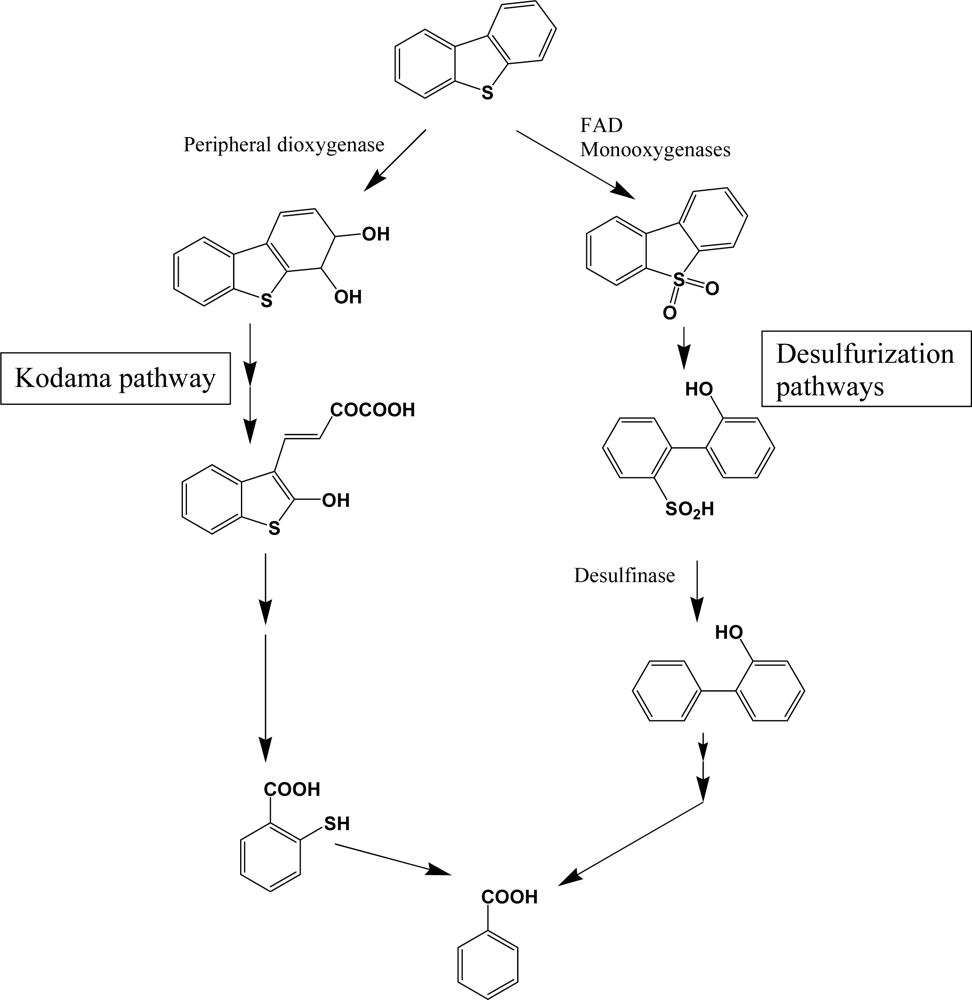
<p>Dibenzothiophene and its higher molecular weight analogues are commonly found in higher molecular weight fractions of petroleum, but are not pyrogenic and biogenic PAH components. Although the chemical profiles of sulfur heterocycles are well documented in petroleum products, studies of their biodegradation in petroleum contaminated natural environments are very limited. Because of the economic importance of desulfurization of unprocessed petroleum, detailed research was performed with various bacterial species [<xref ref-type="bibr" rid="b119-ijerph-06-00278">119</xref>–<xref ref-type="bibr" rid="b121-ijerph-06-00278">121</xref>]. Catabolism of dibenzothiophene is catalyzed by distinct enzymes in two pathways (<xref ref-type="fig" rid="f9-ijerph-06-00278">Scheme 9</xref>). The catabolic branch of initial sulfur oxidation is also called 4S pathway, through which rapid desulfurization can be obtained. Flavin-containing monooxygenases, noted as DszA and DszB (or SoxA and SoxB), are widely distributed in bacteria and catalyze a consecutive addition of single oxygen atom. Consecutive desulfurization is achieved by desulfinase. These monooxygenases require FAD as a cofactor, accompanied by a specific flavin reductase [<xref ref-type="bibr" rid="b122-ijerph-06-00278">122</xref>]. FAD containing monooxygenases are very common in all biota and catalyze various detoxification steps. For example, Sutherland <italic>et al.</italic> [<xref ref-type="bibr" rid="b123-ijerph-06-00278">123</xref>] reported a FAD containing monooxygenase of high sequence homology with dibenzothiophene desulfurization enzymes. In general, bacterial species with high-desulfurization activities have all of the enzymes and broad substrate range [<xref ref-type="bibr" rid="b120-ijerph-06-00278">120</xref>, <xref ref-type="bibr" rid="b121-ijerph-06-00278">121</xref>]. However, some bacterial species are defective in some components, which results in accumulation of intermediates. In comparison with desulfurization pathway, the enzymes for lateral dioxygenation and consecutive reactions are very different (Kodama pathway, <xref ref-type="fig" rid="f9-ijerph-06-00278">Scheme 9</xref>). Many bacterial species have been reported to metabolize dibenzothiphene through Kodama pathway [<xref ref-type="bibr" rid="b105-ijerph-06-00278">105</xref>, <xref ref-type="bibr" rid="b108-ijerph-06-00278">108</xref>, <xref ref-type="bibr" rid="b113-ijerph-06-00278">113</xref>]. Although no detailed research has been done, the structural similarities of the metabolites suggest that common PAH dioxygenase and enzymes in successive steps may be involved in Kodama pathway. According to Resnick and Gibson [<xref ref-type="bibr" rid="b113-ijerph-06-00278">113</xref>], naphthalene dioxygenase from <italic>Pseudomonas</italic> sp. NCIB 9816-4 can produce dibenzothiophene dihydrodiol, a lateral ring dioxygenation product, which supports the broad action of PAH dioxygenase on sulfur heterocycles.</p>
<p>Among the nitrogen heterocycles, catabolism of carbazole is well documented. However, other heterocycles, including benzoquinolines and phenanthridine are not well studied. In comparison with the other heterocycles, nitrogen heterocycles are well known metal chelators and can easily deactivate various metalloenzymes. Seo <italic>et al.</italic> [<xref ref-type="bibr" rid="b108-ijerph-06-00278">108</xref>] reported carbazole catabolism in <italic>Arthrobacter</italic> sp. P1-1. Catabolism of benzoquinoline in <italic>Mycobacterium gilvum</italic> LB307T suggests that at least some bacteria can overcome the toxic effect of nitrogen heterocycles [<xref ref-type="bibr" rid="b124-ijerph-06-00278">124</xref>].</p></sec>
<sec>
<label>5.</label>
<title>Bacterial Catabolism of Alky PAHs</title>
<p>Alkyl- and nitro-PAHs are among common substituted PAHs and have substantial toxicities. Substitution on aromatic rings produces several problems in their degradation. The ability of PAH dioxygenase to remove the substitutions is currently the subject of debate. An alkyl branch is not a good leaving group and probably requires additional steps to be removed. Their presence may inhibit proper orientation and accessibility of the PAHs into dioxygenases.</p>
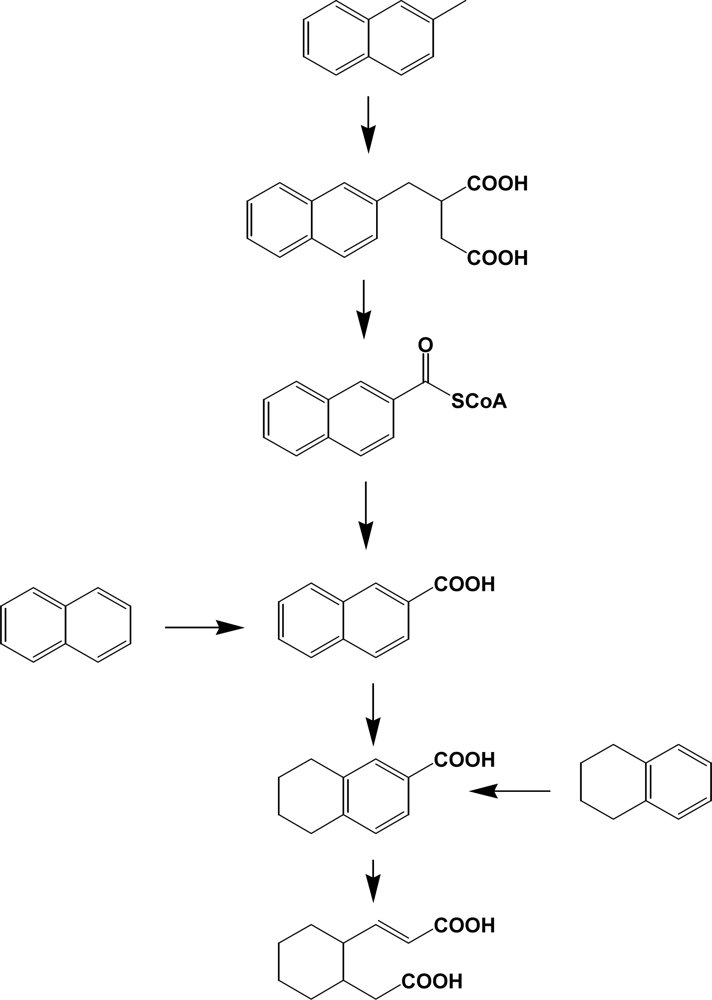
<p>In general, methyl-/ethyl-naphthalenes and phenanthrenes are prevalent contaminants in the environment and, however, limited numbers of studies have been done in relation to bacterial degradation [<xref ref-type="bibr" rid="b28-ijerph-06-00278">28</xref>, <xref ref-type="bibr" rid="b125-ijerph-06-00278">125</xref>, <xref ref-type="bibr" rid="b126-ijerph-06-00278">126</xref>]. Catabolism of alkyl PAHs in aerobic bacteria suggests a very diversity of enzymes involved [<xref ref-type="bibr" rid="b125-ijerph-06-00278">125</xref>]. These include oxidation of methyl group to alcohol, aldehyde, or carboxylic acid, decarboxylation, demethylation, and dioxygenation. However, production of alkyl salicylate or alkylphthalate suggests that the reaction may prefer non-substituted PAH systems. Until recently, research with anaerobic bacteria has been limited to halogenated pollutants such as PCBs, PBDEs, PCDDs/Fs and halogenated solvents [<xref ref-type="bibr" rid="b127-ijerph-06-00278">127</xref>, <xref ref-type="bibr" rid="b128-ijerph-06-00278">128</xref>]. However, PAHs and their alkyl derivatives can be transformed by various anaerobes through novel catabolic pathways (<xref ref-type="fig" rid="f10-ijerph-06-00278">Scheme 10</xref>) [<xref ref-type="bibr" rid="b129-ijerph-06-00278">129</xref>–<xref ref-type="bibr" rid="b131-ijerph-06-00278">131</xref>, <xref ref-type="bibr" rid="b156-ijerph-06-00278">156</xref>]. In comparison with aerobic bacteria initiating dioxygenation, anaerobic bacteria usually insert carboxyl groups from carbon dioxide or succinic acids. Part of the ring is reduced to tetralin type metabolites [<xref ref-type="bibr" rid="b130-ijerph-06-00278">130</xref>]. The presence of ring cleavage products (e.g., derivatives of cyclohexane) suggests that oxygen molecule or oxygen equivalents may be required in these consecutive catabolic steps (<xref ref-type="fig" rid="f10-ijerph-06-00278">Scheme 10</xref>). Metabolism of alkylbenzenes, alkanes, and other hydrocarbons by anaerobic bacteria was well reviewed by Spormann and Widdel [<xref ref-type="bibr" rid="b157-ijerph-06-00278">157</xref>].</p>
<p>Relatively speaking, studies with nitro-PAHs are much more limited [<xref ref-type="bibr" rid="b2-ijerph-06-00278">2</xref>, <xref ref-type="bibr" rid="b132-ijerph-06-00278">132</xref>]. It is noteworthy that a large amount of nitro-PAHs (e.g., 1-nitropyrene) are produced from automobile exhaustion. It is well known that nitropyrene can be transformed into mutagenic metabolites, including amino-, nitroso-, and hydroxyamin-pyrene. Rafii <italic>et al.</italic> [<xref ref-type="bibr" rid="b132-ijerph-06-00278">132</xref>] reported that 1-nitropyrene can be transformed into mutagenic 1-aminopyrene by <italic>Mycobacterium</italic> sp. High genotoxic effects of various nitro-PAHs call for more detailed research on their biodegradation.</p></sec>
<sec>
<label>6.</label>
<title>Protoemics and Metabolomics in Understanding of Bacterial Degradation of PAHs</title>
<p>Proteomics and metabolomics have been recently employed in studies of environmental microbiology and have shown their high impact on the field of biodegradation and bioremediation [<xref ref-type="bibr" rid="b158-ijerph-06-00278">158</xref>, <xref ref-type="bibr" rid="b159-ijerph-06-00278">159</xref>]. Proteomics is an effective technique to identify proteins and their functions involved in the biodegradation of aromatics while metabolomics can be used to profile degradation products of PAHs and primary metabolites in response to PAH exposures. Intent of a brief discussion of proteomics and metabolomics here is to bring attention to these emerging fields rather than offering a comprehensive review and a long list of references.</p>
<p>A good number of genomic sequences or expressed sequence tags (ESTs) of bacteria are currently available. These include several PAH degrading bacteria in the genus of <italic>Mycobacterium</italic>, <italic>Acinetobacter</italic>, <italic>Arthrobacter</italic>, and <italic>Burkholderia</italic>. Detailed transcriptomes in <italic>Burkholderia xenovorans</italic> LB400 during PCB catabolism were analyzed by microarray techniques [<xref ref-type="bibr" rid="b114-ijerph-06-00278">114</xref>, <xref ref-type="bibr" rid="b133-ijerph-06-00278">133</xref>–<xref ref-type="bibr" rid="b135-ijerph-06-00278">135</xref>]. The results revealed that large changes at genomic and proteomic levels occurred during the PAH catabolism, compared with the catabolism of natural carbon sources. These include up-regulation of the genes related to a) PAH catabolism, b) removal of reactive oxygen species, c) primary carbon metabolism, including one-carbon metabolism, d) energy production, e.g., ATP synthesis, e) various transporters, and f) synthesis of energy reservoir, e.g., polyphosphate. Many of these phenomena have been demonstrated by specific studies. For example, polyphosphate accumulation during PCB catabolism was confirmed by electron microscopy [<xref ref-type="bibr" rid="b136-ijerph-06-00278">136</xref>]. The accumulation of polyphosphate and polyphosphate kinase (<italic>Ppk</italic>) under stressed conditions are common in all biota. Up-regulation of superoxide dismutase or catalase/peroxidase is also common phenomena during PAHs or toxic chemical catabolism. The activation of one-carbon metabolism is another common phenomenon in bacteria during xenobiotic metabolism [<xref ref-type="bibr" rid="b137-ijerph-06-00278">137</xref>]. The exact mechanism of the gene activation is not clear. The up-regulation of one-carbon metabolism may be induced by several factors, including limitation of primary metabolite pools, introduction of one carbon unit, e.g., formate in PAH metabolism, and the loss of concerted regulation of general metabolism. Another common phenomenon is the changes of fatty acid content or composition in bacteria [<xref ref-type="bibr" rid="b138-ijerph-06-00278">138</xref>]. However, transcriptome analysis usually did not show a significant change in fatty acid metabolism-related genes. Discrepancies between genomic and proteomic data also occur. In general, proteomic analyses in relation to aromatics catabolism are very limited. However, a few proteomic studies of PAH catabolism in <italic>Mycobacterium</italic> spp. have been reported [<xref ref-type="bibr" rid="b61-ijerph-06-00278">61</xref>, <xref ref-type="bibr" rid="b68-ijerph-06-00278">68</xref>, <xref ref-type="bibr" rid="b91-ijerph-06-00278">91</xref>, <xref ref-type="bibr" rid="b115-ijerph-06-00278">115</xref>, <xref ref-type="bibr" rid="b139-ijerph-06-00278">139</xref>]. For example, Lee <italic>et al.</italic> [<xref ref-type="bibr" rid="b68-ijerph-06-00278">68</xref>] studied fluoranthene catabolism and associated proteins in <italic>Mycobacterium</italic> sp. JS14. An increased expression of 25 proteins related to fluoranthene catabolism is found with 1D-PAGE and nano liquid chromatography tandem MS/MS. Detection of fluoranthene catabolism associated proteins coincides well with its multiple degradation pathways that are mapped via metabolites identified. Kim <italic>et al.</italic> [<xref ref-type="bibr" rid="b115-ijerph-06-00278">115</xref>] reported the protein profiles of <italic>Mycobacterium vanbaalenii</italic> PYR-1 grown in the presence of pyrene, pyrene-4,5-quinoline, phenanthrene, anthracene, and fluoranthene after two dimensional electrophoresis (2DE) separation of proteins and mass spectrometry analysis. They found PAH-induced proteins (catalase-peroxidase, putative monooxygenase, dioxygenase small subunit, small subunit of naphthalene-inducible dioxygenase, and aldehyde dehydrogenase), carbohydrate metabolism related proteins (enolase, 6-phosphogluconate dehydrogenase, indole-3-glycerol phosphate synthase, and fumarase), DNA translation proteins, heat shock proteins, and energy production protein (ATP synthase). Proteomics studies showed that several <italic>Mycobacterium</italic> species have multiple dioxygenases and related enzymes, which may be involved in different substrates [<xref ref-type="bibr" rid="b61-ijerph-06-00278">61</xref>, <xref ref-type="bibr" rid="b68-ijerph-06-00278">68</xref>, <xref ref-type="bibr" rid="b91-ijerph-06-00278">91</xref>]. Those studies also revealed that many of stress related proteins, including enzymes related to reactive oxygen removal and transcriptional regulators are commonly up-regulated during PAH metabolism.</p>
<p>The workflow of proteomics has been extended from qualitative analyses after 1DE or 2DE to quantitative studies. Systematic quantitation of proteomes has become common by using methods such as isotope-coded affinity tag (ICAT), isobaric tags for relative and absolute quantitation (iTRAQ), and stable isotope labeling by essential amino acid culture (SILAC). The labeled proteins or peptides by those methods are analyzed by tandem MS [<xref ref-type="bibr" rid="b140-ijerph-06-00278">140</xref>, <xref ref-type="bibr" rid="b141-ijerph-06-00278">141</xref>]. Recently, Kim <italic>et al.</italic> [<xref ref-type="bibr" rid="b142-ijerph-06-00278">142</xref>] conducted the proteome analysis of <italic>Pseudomonas putida</italic> KT2440 induced with monocyclic aromatic compounds using 2-DE/MS and cleavable isotope-coded affinity tag (ICAT) to determine the changes of proteins involved in aromatic degradation pathways. After translation, attachment of functional groups such as carbohydrates, lipids, phosphates or sulphur to a protein is referred to as post-translational modification (PTM). PTM extends protein functions and makes proteomes further complicated. It is noteworthy that in tandem mass spectrometry, a combination of collision induced dissociation (CID) and electron transfer dissociation (ETD) is becoming very useful in PTM elucidation. ETD cleaves randomly the peptide backbone while modifications are left intact. CID produces fragment ions for structural determination as well as sensitive and specific detection of a particular molecule.</p>
<p>Among the various system-wide evaluation of bacterial PAH degradation, almost no research has been reported in relation to metabolomics. Keum <italic>et al.</italic> [<xref ref-type="bibr" rid="b159-ijerph-06-00278">159</xref>] studied comparative metabolic responses of <italic>Sinorhizobium</italic> sp. C4 during degradation of phenanthrene. Comprehensive profiling of metabolites profiles, including polar metabolites, fatty acids and polyhydroxyalkanoates was performed through untargeted metabolome analyses. Large metabolome differences of strain C4 were observed between the cultures with phenanthrene and natural carbon sources. The changes include TCA cycle, pyruvate metabolism, cofactor biosynthesis, fatty acid compositions, and polyhydroxyalkanoate biosynthesis, which indicate metabolic adaptation in response to using phenanthrene as a substrate. Although the analyses of transcriptomes and proteomes can provide significant information indicating metabolic networks, a large number of metabolites interact with each other and thus metabolomes can show much more complex networks than transcriptomes and proteomes. As proteomics is advancing rapidly in environmental microbiology, metabolomics will also become a powerful tool. In conjunction with functional genomics, proteomics and metabolomics are becoming indispensable in elucidation of mechanisms of biodegradation and biotransformation of organic pollutants in the environment, particularly for the situations of multiple chemicals and microbial consortia.</p></sec></body>
<back>
<ack>
<p>This review was supported in part by US EPA award no. 989512-01-1 and USDA-TSTAR grants (34135–9576, 34135–11295, and 34135–12724), and NRL award N00173–05–2–C003.</p></ack>
<ref-list>
<title>References and Notes</title>
<ref id="b1-ijerph-06-00278"><label>1.</label><citation citation-type="book"><person-group person-group-type="author"><name><surname>Alexander</surname><given-names>M</given-names></name></person-group><source>Biodegradation and Bioremediation</source><edition>2nd Ed</edition><publisher-loc>Academic Press</publisher-loc><publisher-name>San Diego, USA</publisher-name><year>1999</year><fpage>325</fpage><lpage>327</lpage></citation></ref>
<ref id="b2-ijerph-06-00278"><label>2.</label><citation citation-type="book"><person-group person-group-type="author"><name><surname>Klein</surname><given-names>J</given-names></name></person-group><source>Biotechnology</source><edition>2nd Ed</edition><volume>volume 11b</volume><source>Environmental Processes II – Soil Decontamination</source><publisher-loc>Wiley-VCH</publisher-loc><publisher-name>Weinhein</publisher-name><year>2000</year></citation></ref>
<ref id="b3-ijerph-06-00278"><label>3.</label><citation citation-type="journal"><person-group person-group-type="author"><name><surname>Cerniglia</surname><given-names>CE</given-names></name></person-group><article-title>Biodegradation of polycyclic aromatic hydrocarbons</article-title><source>Biodegradation</source><year>1992</year><volume>3</volume><fpage>351</fpage><lpage>368</lpage><pub-id pub-id-type="doi">10.1007/BF00129093</pub-id></citation></ref>
<ref id="b4-ijerph-06-00278"><label>4.</label><citation citation-type="journal"><person-group person-group-type="author"><name><surname>Cheung</surname><given-names>PY</given-names></name><name><surname>Kinkle</surname><given-names>BK</given-names></name></person-group><article-title><italic>Mycobacterium</italic> diversity and pyrene mineralization in petroleum-contaminated soils</article-title><source>Appl. Environ. Microbiol</source><year>2001</year><volume>67</volume><fpage>2222</fpage><lpage>2229</lpage><pub-id pub-id-type="doi">10.1128/AEM.67.5.2222-2229.2001</pub-id><pub-id pub-id-type="pmid">11319104</pub-id></citation></ref>
<ref id="b5-ijerph-06-00278"><label>5.</label><citation citation-type="journal"><person-group person-group-type="author"><name><surname>Menzie</surname><given-names>CA</given-names></name><name><surname>Potochi</surname><given-names>BB</given-names></name><name><surname>Santodonato</surname><given-names>J</given-names></name></person-group><article-title>Exposure to carcinogenic PAHs in the environment</article-title><source>Environ. Sci. Technol</source><year>1992</year><volume>26</volume><fpage>1278</fpage><lpage>1284</lpage><pub-id pub-id-type="doi">10.1021/es00031a002</pub-id></citation></ref>
<ref id="b6-ijerph-06-00278"><label>6.</label><citation citation-type="book"><person-group person-group-type="author"><name><surname>Pitter</surname><given-names>P</given-names></name><name><surname>Chudoba</surname><given-names>J</given-names></name></person-group><source>Biodegradation of Organic Substances in the Aquatic Environment</source><publisher-loc>CRC Press</publisher-loc><publisher-name>Boca Raton, FL</publisher-name><year>1990</year></citation></ref>
<ref id="b7-ijerph-06-00278"><label>7.</label><citation citation-type="journal"><person-group person-group-type="author"><name><surname>Capotori</surname><given-names>G</given-names></name><name><surname>Digianvincenzo</surname><given-names>P</given-names></name><name><surname>Cesti</surname><given-names>P</given-names></name><name><surname>Bernardi</surname><given-names>A</given-names></name><name><surname>Guglielmetti</surname><given-names>G</given-names></name></person-group><article-title>Pyrene and benzo[<italic>a</italic>]pyrene metabolism by an <italic>Aspergillus terreus</italic> strain isolated from a polycyclic aromatic hydrocarbons polluted soil</article-title><source>Biodegradation</source><year>2004</year><volume>15</volume><fpage>79</fpage><lpage>85</lpage><pub-id pub-id-type="doi">10.1023/B:BIOD.0000015612.10481.e6</pub-id><pub-id pub-id-type="pmid">15068369</pub-id></citation></ref>
<ref id="b8-ijerph-06-00278"><label>8.</label><citation citation-type="journal"><person-group person-group-type="author"><name><surname>Ahn</surname><given-names>YH</given-names></name><name><surname>Sanseverino</surname><given-names>J</given-names></name><name><surname>Sayler</surname><given-names>GS</given-names></name></person-group><article-title>Analyses of polycyclic aromatic hydrocarbon-degrading bacteria isolated from contaminated soils</article-title><source>Biodegradation</source><year>1999</year><volume>10</volume><fpage>149</fpage><lpage>157</lpage><pub-id pub-id-type="doi">10.1023/A:1008369905161</pub-id><pub-id pub-id-type="pmid">10466202</pub-id></citation></ref>
<ref id="b9-ijerph-06-00278"><label>9.</label><citation citation-type="journal"><person-group person-group-type="author"><name><surname>Kanaly</surname><given-names>RA</given-names></name><name><surname>Harayama</surname><given-names>S</given-names></name></person-group><article-title>Biodegradation of high-molecular-weight polycyclic aromatic hydrocarbons by bacteria</article-title><source>J. Bacteriol</source><year>2000</year><volume>182</volume><fpage>2059</fpage><lpage>2067</lpage><pub-id pub-id-type="doi">10.1128/JB.182.8.2059-2067.2000</pub-id><pub-id pub-id-type="pmid">10735846</pub-id></citation></ref>
<ref id="b10-ijerph-06-00278"><label>10.</label><citation citation-type="journal"><person-group person-group-type="author"><name><surname>Kim</surname><given-names>TJ</given-names></name><name><surname>Lee</surname><given-names>EY</given-names></name><name><surname>Kim</surname><given-names>YJ</given-names></name><name><surname>Cho</surname><given-names>KS</given-names></name><name><surname>Ryu</surname><given-names>HW</given-names></name></person-group><article-title>Degradation of polyaromatic hydrocarbons by <italic>Burkholderia cepacia</italic> 2A–12</article-title><source>World J. Microbiol. Biotechnol</source><year>2003</year><volume>19</volume><fpage>411</fpage><lpage>417</lpage><pub-id pub-id-type="doi">10.1023/A:1023998719787</pub-id></citation></ref>
<ref id="b11-ijerph-06-00278"><label>11.</label><citation citation-type="journal"><person-group person-group-type="author"><name><surname>Juhasz</surname><given-names>AL</given-names></name><name><surname>Naidu</surname><given-names>R</given-names></name></person-group><article-title>Bioremediation of high molecular weight polycyclic aromatic hydrocarbons: a review of the microbial degradation of benzo[<italic>a</italic>]pyrene</article-title><source>Int. Biodeter. Biodegr</source><year>2000</year><volume>45</volume><fpage>57</fpage><lpage>88</lpage><pub-id pub-id-type="doi">10.1016/S0964-8305(00)00052-4</pub-id></citation></ref>
<ref id="b12-ijerph-06-00278"><label>12.</label><citation citation-type="journal"><person-group person-group-type="author"><name><surname>Wilson</surname><given-names>SC</given-names></name><name><surname>Jones</surname><given-names>KC</given-names></name></person-group><article-title>Bioremediation of soil contaminated with polynuclear aromatic hydrocarbons (PAHs): A review</article-title><source>Environ. Pollut</source><year>1993</year><volume>81</volume><fpage>229</fpage><lpage>249</lpage><pub-id pub-id-type="doi">10.1016/0269-7491(93)90206-4</pub-id><pub-id pub-id-type="pmid">15091809</pub-id></citation></ref>
<ref id="b13-ijerph-06-00278"><label>13.</label><citation citation-type="journal"><person-group person-group-type="author"><name><surname>Freeman</surname><given-names>DJ</given-names></name><name><surname>Cattell</surname><given-names>DWS</given-names></name></person-group><article-title>Wood burning as a source of atmospheric polycyclic aromatic hydrocarbons</article-title><source>Environ. Sci. Technol</source><year>1990</year><volume>24</volume><fpage>1581</fpage><lpage>1585</lpage><pub-id pub-id-type="doi">10.1021/es00080a019</pub-id></citation></ref>
<ref id="b14-ijerph-06-00278"><label>14.</label><citation citation-type="journal"><person-group person-group-type="author"><name><surname>Nishioka</surname><given-names>M</given-names></name><name><surname>Chang</surname><given-names>HC</given-names></name><name><surname>Lee</surname><given-names>ML</given-names></name></person-group><article-title>Structural characteristics of polycyclic aromatic hydrocarbons in coal tars and combustion products</article-title><source>Environ. Sci. Technol</source><year>1986</year><volume>20</volume><fpage>1023</fpage><lpage>1027</lpage><pub-id pub-id-type="doi">10.1021/es00152a010</pub-id><pub-id pub-id-type="pmid">22257402</pub-id></citation></ref>
<ref id="b15-ijerph-06-00278"><label>15.</label><citation citation-type="journal"><person-group person-group-type="author"><name><surname>Max Nestler</surname><given-names>FH</given-names></name></person-group><article-title>Characterization of wood-preserving coal-tar creosote by gas-liquid chromatography</article-title><source>Anal. Chem</source><year>1974</year><volume>46</volume><fpage>46</fpage><lpage>53</lpage><pub-id pub-id-type="doi">10.1021/ac60337a008</pub-id></citation></ref>
<ref id="b16-ijerph-06-00278"><label>16.</label><citation citation-type="journal"><person-group person-group-type="author"><name><surname>Tsuda</surname><given-names>H</given-names></name><name><surname>Hagiwara</surname><given-names>A</given-names></name><name><surname>Shibata</surname><given-names>M</given-names></name><name><surname>Ito</surname><given-names>N</given-names></name></person-group><article-title>Carcinogenic effect of carbazole in the liver of a (C57BL/6NxC3H/HeN) F1 mice</article-title><source>J. Nat. Cancer Ins</source><year>1982</year><volume>69</volume><fpage>1389</fpage><lpage>1393</lpage></citation></ref>
<ref id="b17-ijerph-06-00278"><label>17.</label><citation citation-type="journal"><person-group person-group-type="author"><name><surname>Gottstein</surname><given-names>D</given-names></name><name><surname>Gross</surname><given-names>D</given-names></name></person-group><article-title>Phytoalexins from woody plants</article-title><source>Trees</source><year>1992</year><volume>6</volume><fpage>55</fpage><lpage>68</lpage></citation></ref>
<ref id="b18-ijerph-06-00278"><label>18.</label><citation citation-type="journal"><person-group person-group-type="author"><name><surname>Olie</surname><given-names>K</given-names></name><name><surname>Vermeulen</surname><given-names>PL</given-names></name><name><surname>Hutzinger</surname><given-names>O</given-names></name></person-group><article-title>Chlorodibenzo-<italic>p</italic>-dioxins and chlorodibenzofurans are trace components of fly ash and flue gas of some municipal incinerators in the Netherlands</article-title><source>Chemosphere</source><year>1977</year><volume>6</volume><fpage>455</fpage><lpage>459</lpage><pub-id pub-id-type="doi">10.1016/0045-6535(77)90035-2</pub-id></citation></ref>
<ref id="b19-ijerph-06-00278"><label>19.</label><citation citation-type="journal"><person-group person-group-type="author"><name><surname>Yang</surname><given-names>Z</given-names></name><name><surname>Xia</surname><given-names>C</given-names></name><name><surname>Zhang</surname><given-names>Q</given-names></name><name><surname>Chen</surname><given-names>J</given-names></name><name><surname>Liang</surname><given-names>X</given-names></name></person-group><article-title>Catalytic detoxification of polychlorinated dibenzo-p-dioxins and polychlorinated dibenzofurans in fly ash</article-title><source>Waste Manage</source><year>2007</year><volume>27</volume><fpage>588</fpage><lpage>592</lpage><pub-id pub-id-type="doi">10.1016/j.wasman.2006.02.019</pub-id></citation></ref>
<ref id="b20-ijerph-06-00278"><label>20.</label><citation citation-type="journal"><person-group person-group-type="author"><name><surname>Boylan</surname><given-names>DB</given-names></name><name><surname>Tripp</surname><given-names>BW</given-names></name></person-group><article-title>Determination of hydrocarbons in sea water extracts of crude oil and crude oil fractions</article-title><source>Nature</source><year>1971</year><volume>230</volume><fpage>44</fpage><lpage>47</lpage><pub-id pub-id-type="doi">10.1038/230044a0</pub-id><pub-id pub-id-type="pmid">4930964</pub-id></citation></ref>
<ref id="b21-ijerph-06-00278"><label>21.</label><citation citation-type="journal"><person-group person-group-type="author"><name><surname>Alexander</surname><given-names>R</given-names></name><name><surname>Kagi</surname><given-names>RI</given-names></name><name><surname>Rowland</surname><given-names>SJ</given-names></name><name><surname>Sheppard</surname><given-names>PN</given-names></name><name><surname>Chirila</surname><given-names>TV</given-names></name></person-group><article-title>The effect of thermal maturity on distribution of dimethylnaphthalenes and trimethylnaphthalenes in some ancient sediments and petroleums</article-title><source>Geochim. Cosmochim. Acta</source><year>1985</year><volume>49</volume><fpage>385</fpage><lpage>395</lpage><pub-id pub-id-type="doi">10.1016/0016-7037(85)90031-6</pub-id></citation></ref>
<ref id="b22-ijerph-06-00278"><label>22.</label><citation citation-type="journal"><person-group person-group-type="author"><name><surname>Wirtz</surname><given-names>RA</given-names></name><name><surname>Turrentine</surname><given-names>JD</given-names></name><name><surname>Fox</surname><given-names>RC</given-names></name></person-group><article-title>Area repellents for mosquitoes (Diptera: culicidae): identification of the active ingredients in a petroleum oil fraction</article-title><source>J. Med. Entomol</source><year>1981</year><volume>18</volume><fpage>126</fpage><lpage>128</lpage><pub-id pub-id-type="pmid">7288837</pub-id></citation></ref>
<ref id="b23-ijerph-06-00278"><label>23.</label><citation citation-type="journal"><person-group person-group-type="author"><name><surname>DiGiovanni</surname><given-names>J</given-names></name></person-group><article-title>Multi stage carcinogenesis in mouse skin</article-title><source>Pharmacol. Ther</source><year>1992</year><volume>54</volume><fpage>63</fpage><lpage>128</lpage><pub-id pub-id-type="doi">10.1016/0163-7258(92)90051-Z</pub-id><pub-id pub-id-type="pmid">1528955</pub-id></citation></ref>
<ref id="b24-ijerph-06-00278"><label>24.</label><citation citation-type="journal"><person-group person-group-type="author"><name><surname>Goyal</surname><given-names>AK</given-names></name><name><surname>Zylstra</surname><given-names>GJ</given-names></name></person-group><article-title>Genetics of naphthalene and phenanthrene degradation by <italic>Comamonas testosteroni</italic></article-title><source>J. Ind. Microbiol. Biotechnol</source><year>1997</year><volume>19</volume><fpage>401</fpage><lpage>407</lpage><pub-id pub-id-type="doi">10.1038/sj.jim.2900476</pub-id><pub-id pub-id-type="pmid">9451837</pub-id></citation></ref>
<ref id="b25-ijerph-06-00278"><label>25.</label><citation citation-type="journal"><person-group person-group-type="author"><name><surname>Auger</surname><given-names>RL</given-names></name><name><surname>Jacobson</surname><given-names>AM</given-names></name><name><surname>Domach</surname><given-names>MM</given-names></name></person-group><article-title>Effect of nonionic surfactant addition on bacterial metabolism of naphthalene: Assessment of toxicity and overflow metabolism potential</article-title><source>J. Hazard Mater</source><year>1995</year><volume>43</volume><fpage>263</fpage><lpage>272</lpage><pub-id pub-id-type="doi">10.1016/0304-3894(95)00038-V</pub-id></citation></ref>
<ref id="b26-ijerph-06-00278"><label>26.</label><citation citation-type="journal"><person-group person-group-type="author"><name><surname>Baboshin</surname><given-names>M</given-names></name><name><surname>Akimov</surname><given-names>V</given-names></name><name><surname>Baskunov</surname><given-names>B</given-names></name><name><surname>Born</surname><given-names>TL</given-names></name><name><surname>Khan</surname><given-names>SU</given-names></name><name><surname>Golovleva</surname><given-names>L</given-names></name></person-group><article-title>Conversion of polycyclic aromatic hydrocarbons by <italic>Sphingomonas</italic> sp. VKM B-2434</article-title><source>Biodegradation</source><year>2008</year><volume>19</volume><fpage>567</fpage><lpage>576</lpage><pub-id pub-id-type="doi">10.1007/s10532-007-9162-2</pub-id><pub-id pub-id-type="pmid">17957485</pub-id></citation></ref>
<ref id="b27-ijerph-06-00278"><label>27.</label><citation citation-type="journal"><person-group person-group-type="author"><name><surname>Denome</surname><given-names>SA</given-names></name><name><surname>Stanley</surname><given-names>DC</given-names></name><name><surname>Olson</surname><given-names>ES</given-names></name><name><surname>Young</surname><given-names>KD</given-names></name></person-group><article-title>Metabolism of dibenzothiophene and naphthalene in <italic>Pseudomonas</italic> Strains: Complete DNA sequence of an upper naphthalene catabolic pathway</article-title><source>J. Bacteriol</source><year>1993</year><volume>175</volume><fpage>6890</fpage><lpage>6901</lpage><pub-id pub-id-type="pmid">8226631</pub-id></citation></ref>
<ref id="b28-ijerph-06-00278"><label>28.</label><citation citation-type="journal"><person-group person-group-type="author"><name><surname>Dutta</surname><given-names>TK</given-names></name><name><surname>Selifonov</surname><given-names>SA</given-names></name><name><surname>Gunsalus</surname><given-names>IC</given-names></name></person-group><article-title>Oxidation of methyl-substituted naphthalenes: Pathways in a versatile <italic>Sphingomonas paucimobilis</italic> strain</article-title><source>Appl. Environ. Microbiol</source><year>1998</year><volume>64</volume><fpage>1884</fpage><lpage>1889</lpage><pub-id pub-id-type="pmid">9572967</pub-id></citation></ref>
<ref id="b29-ijerph-06-00278"><label>29.</label><citation citation-type="journal"><person-group person-group-type="author"><name><surname>Fuenmayor</surname><given-names>SL</given-names></name><name><surname>Wild</surname><given-names>M</given-names></name><name><surname>Boyes</surname><given-names>AL</given-names></name><name><surname>Williams</surname><given-names>PA</given-names></name></person-group><article-title>A gene cluster encoding steps in conversion of naphthalene to gentisate in <italic>Pseudomonas</italic> sp. Strain U2</article-title><source>J. Bacteriol</source><year>1998</year><volume>180</volume><fpage>2522</fpage><lpage>2530</lpage><pub-id pub-id-type="pmid">9573207</pub-id></citation></ref>
<ref id="b30-ijerph-06-00278"><label>30.</label><citation citation-type="journal"><person-group person-group-type="author"><name><surname>Hedlund</surname><given-names>BP</given-names></name><name><surname>Geiselbrecht</surname><given-names>AD</given-names></name><name><surname>Staley</surname><given-names>JT</given-names></name></person-group><article-title><italic>Marinobacter</italic> strain NCE312 has a <italic>Pseudomonas</italic>-like naphthalene dioxygenase</article-title><source>FEMS Microbiol. Lett</source><year>2001</year><volume>201</volume><fpage>47</fpage><lpage>51</lpage><pub-id pub-id-type="doi">10.1111/j.1574-6968.2001.tb10731.x</pub-id><pub-id pub-id-type="pmid">11445166</pub-id></citation></ref>
<ref id="b31-ijerph-06-00278"><label>31.</label><citation citation-type="journal"><person-group person-group-type="author"><name><surname>Jouanneau</surname><given-names>Y</given-names></name><name><surname>Micoud</surname><given-names>J</given-names></name><name><surname>Meyer</surname><given-names>C</given-names></name></person-group><article-title>Purification and characterization of a three-component salicylate 1-hydroxylase from <italic>Sphingomonas</italic> sp. Strain CHY-1</article-title><source>Appl. Environ. Microbiol</source><year>2007</year><volume>73</volume><fpage>7515</fpage><lpage>7521</lpage><pub-id pub-id-type="doi">10.1128/AEM.01519-07</pub-id><pub-id pub-id-type="pmid">17905882</pub-id></citation></ref>
<ref id="b32-ijerph-06-00278"><label>32.</label><citation citation-type="journal"><person-group person-group-type="author"><name><surname>Kang</surname><given-names>H</given-names></name><name><surname>Hwang</surname><given-names>SY</given-names></name><name><surname>Kim</surname><given-names>YM</given-names></name><name><surname>Kim</surname><given-names>E</given-names></name><name><surname>Kim</surname><given-names>YS</given-names></name><name><surname>Kim</surname><given-names>SK</given-names></name></person-group><article-title>Degradation of phenanthrene and naphthalene by a <italic>Burkholderia</italic> species strain</article-title><source>Can. J. Microbiol</source><year>2003</year><volume>49</volume><fpage>139</fpage><lpage>144</lpage><pub-id pub-id-type="doi">10.1139/w03-009</pub-id><pub-id pub-id-type="pmid">12718402</pub-id></citation></ref>
<ref id="b33-ijerph-06-00278"><label>33.</label><citation citation-type="journal"><person-group person-group-type="author"><name><surname>Kiyohara</surname><given-names>H</given-names></name><name><surname>Torigoe</surname><given-names>S</given-names></name><name><surname>Kaida</surname><given-names>N</given-names></name><name><surname>Asaki</surname><given-names>T</given-names></name><name><surname>Iida</surname><given-names>T</given-names></name><name><surname>Hayashi</surname><given-names>H</given-names></name><name><surname>Takizawa</surname><given-names>N</given-names></name></person-group><article-title>Cloning and characterization of a chromosomal gene cluster, <italic>pah</italic>, that encodes the upper pathway for phenanthrene and naphthalene utilization by <italic>Pseudomonas putida</italic> OUS82</article-title><source>J. Bacteriol</source><year>1994</year><volume>176</volume><fpage>2439</fpage><lpage>2443</lpage><pub-id pub-id-type="pmid">8157614</pub-id></citation></ref>
<ref id="b34-ijerph-06-00278"><label>34.</label><citation citation-type="other"><person-group person-group-type="author"><name><surname>Seo</surname><given-names>JS</given-names></name></person-group><article-title>Bacterial proteomes and metabolism of aromatic compounds</article-title>. Ph.D. dissertation, University of Hawaii at Manoa: Honolulu, Hawaii, USA, 2006.</citation></ref>
<ref id="b35-ijerph-06-00278"><label>35.</label><citation citation-type="journal"><person-group person-group-type="author"><name><surname>Seo</surname><given-names>JS</given-names></name><name><surname>Keum</surname><given-names>YS</given-names></name><name><surname>Harada</surname><given-names>RM</given-names></name><name><surname>Li</surname><given-names>QX</given-names></name></person-group><article-title>Isolation and characterization of bacteria capable of degrading polycyclic aromatic hydrocarbons (PAHs) and organophosphorus pesticides from PAHs-contaminated soil in Hilo, Hawaii</article-title><source>J. Agric. Food. Chem</source><year>2007</year><volume>55</volume><fpage>5383</fpage><lpage>5389</lpage><pub-id pub-id-type="doi">10.1021/jf0637630</pub-id><pub-id pub-id-type="pmid">17552538</pub-id></citation></ref>
<ref id="b36-ijerph-06-00278"><label>36.</label><citation citation-type="journal"><person-group person-group-type="author"><name><surname>Story</surname><given-names>SP</given-names></name><name><surname>Parker</surname><given-names>SH</given-names></name><name><surname>Hayasaka</surname><given-names>SS</given-names></name><name><surname>Riley</surname><given-names>MB</given-names></name><name><surname>Kline</surname><given-names>EL</given-names></name></person-group><article-title>Convergent and divergent points in catabolic pathways involved in utilization of fluoranthene, naphthalene, anthracene, and phenanthrene by <italic>Sphingomonas paucimobilis</italic> var. EPA505</article-title><source>J. Ind. Microbiol. Biotechnol</source><year>2001</year><volume>26</volume><fpage>369</fpage><lpage>382</lpage><pub-id pub-id-type="doi">10.1038/sj.jim.7000149</pub-id><pub-id pub-id-type="pmid">11571621</pub-id></citation></ref>
<ref id="b37-ijerph-06-00278"><label>37.</label><citation citation-type="journal"><person-group person-group-type="author"><name><surname>Simon</surname><given-names>MJ</given-names></name><name><surname>Osslund</surname><given-names>TD</given-names></name><name><surname>Saunders</surname><given-names>R</given-names></name><name><surname>Ensley</surname><given-names>BD</given-names></name><name><surname>Suggs</surname><given-names>S</given-names></name><name><surname>Harcourt</surname><given-names>A</given-names></name><name><surname>Suen</surname><given-names>WC</given-names></name><name><surname>Cruder</surname><given-names>DL</given-names></name><name><surname>Gibson</surname><given-names>DT</given-names></name><name><surname>Zylstra</surname><given-names>GJ</given-names></name></person-group><article-title>Sequences of genes encoding naphthalene dioxygenase in <italic>Pseudomonas putida</italic> strains G7 and NCIB 9816–4</article-title><source>Gene</source><year>1993</year><volume>127</volume><fpage>31</fpage><lpage>37</lpage><pub-id pub-id-type="doi">10.1016/0378-1119(93)90613-8</pub-id><pub-id pub-id-type="pmid">8486285</pub-id></citation></ref>
<ref id="b38-ijerph-06-00278"><label>38.</label><citation citation-type="journal"><person-group person-group-type="author"><name><surname>Goyal</surname><given-names>AK</given-names></name><name><surname>Zylstra</surname><given-names>GJ</given-names></name></person-group><article-title>Molecular cloning of novel genes for polycyclic aromatic hydrocarbon degradation from <italic>Comamonas testosteroni</italic> GZ39</article-title><source>Appl. Environ. Microbiol</source><year>1996</year><volume>62</volume><fpage>230</fpage><lpage>236</lpage><pub-id pub-id-type="pmid">8572701</pub-id></citation></ref>
<ref id="b39-ijerph-06-00278"><label>39.</label><citation citation-type="journal"><person-group person-group-type="author"><name><surname>Parales</surname><given-names>RE</given-names></name><name><surname>Parales</surname><given-names>JV</given-names></name><name><surname>Gibson</surname><given-names>DT</given-names></name></person-group><article-title>Aspartate 205 in the catalytic domain of naphthalene dioxygenase is essential for activity</article-title><source>J. Bacteriol</source><year>1999</year><volume>181</volume><fpage>1831</fpage><lpage>1837</lpage><pub-id pub-id-type="pmid">10074076</pub-id></citation></ref>
<ref id="b40-ijerph-06-00278"><label>40.</label><citation citation-type="journal"><person-group person-group-type="author"><name><surname>Boldrin</surname><given-names>B</given-names></name><name><surname>Tiehm</surname><given-names>A</given-names></name><name><surname>Fritzsche</surname><given-names>C</given-names></name></person-group><article-title>Degradation of phenanthrene, fluorene, fluoranthene, and pyrene by a <italic>Mycobacterium</italic> sp</article-title><source>Appl. Environ. Microbiol</source><year>1993</year><volume>59</volume><fpage>1927</fpage><lpage>1930</lpage><pub-id pub-id-type="pmid">8328808</pub-id></citation></ref>
<ref id="b41-ijerph-06-00278"><label>41.</label><citation citation-type="journal"><person-group person-group-type="author"><name><surname>Casellas</surname><given-names>M</given-names></name><name><surname>Grifoll</surname><given-names>M</given-names></name><name><surname>Bayona</surname><given-names>JM</given-names></name><name><surname>Solanas</surname><given-names>AM</given-names></name></person-group><article-title>New metabolites in the degradation of fluorene by <italic>Arthrobacter</italic> sp. strain F101</article-title><source>Appl. Environ. Microbiol</source><year>1997</year><volume>63</volume><fpage>819</fpage><lpage>826</lpage><pub-id pub-id-type="pmid">9055403</pub-id></citation></ref>
<ref id="b42-ijerph-06-00278"><label>42.</label><citation citation-type="journal"><person-group person-group-type="author"><name><surname>Grifoll</surname><given-names>M</given-names></name><name><surname>Selifonov</surname><given-names>SA</given-names></name><name><surname>Chapman</surname><given-names>PJ</given-names></name></person-group><article-title>Transformation of substituted fluorenes and fluorene analogs by <italic>Pseudomonas</italic> sp. strain F274</article-title><source>Appl. Environ. Microbiol</source><year>1995</year><volume>61</volume><fpage>3490</fpage><lpage>3493</lpage><pub-id pub-id-type="pmid">16535132</pub-id></citation></ref>
<ref id="b43-ijerph-06-00278"><label>43.</label><citation citation-type="journal"><person-group person-group-type="author"><name><surname>Grifoll</surname><given-names>M</given-names></name><name><surname>Selifonov</surname><given-names>SA</given-names></name><name><surname>Gatlin</surname><given-names>CV</given-names></name><name><surname>Chapman</surname><given-names>PJ</given-names></name></person-group><article-title>Actions of a versatile fluorene-degrading bacterial isolate on polycyclic aromatic hydrocarbons</article-title><source>Appl. Environ. Microbiol.</source><year>1995</year><volume>61</volume><fpage>3711</fpage><lpage>3723</lpage><pub-id pub-id-type="pmid">7487007</pub-id></citation></ref>
<ref id="b44-ijerph-06-00278"><label>44.</label><citation citation-type="journal"><person-group person-group-type="author"><name><surname>Trenz</surname><given-names>SP</given-names></name><name><surname>Engesser</surname><given-names>KH</given-names></name><name><surname>Fischer</surname><given-names>P</given-names></name><name><surname>Knackmuss</surname><given-names>HJ</given-names></name></person-group><article-title>Degradation of fluorene by <italic>Brevibacterium</italic> sp. strain DPO 1361: a novel C-C bond cleavage mechanism via 1, 10-dihydro-1, 10-dihydroxyfluorene-9-one</article-title><source>J. Bacteriol</source><year>1994</year><volume>176</volume><fpage>789</fpage><lpage>795</lpage><pub-id pub-id-type="pmid">8300532</pub-id></citation></ref>
<ref id="b45-ijerph-06-00278"><label>45.</label><citation citation-type="journal"><person-group person-group-type="author"><name><surname>Wattiau</surname><given-names>P</given-names></name><name><surname>Bastiaens</surname><given-names>L</given-names></name><name><surname>vanHerwijnen</surname><given-names>R</given-names></name><name><surname>Daal</surname><given-names>L</given-names></name><name><surname>Parsons</surname><given-names>JR</given-names></name><name><surname>Renard</surname><given-names>ME</given-names></name><name><surname>Springael</surname><given-names>D</given-names></name><name><surname>Cornelis</surname><given-names>GR</given-names></name></person-group><article-title>Fluorene degradation by <italic>Sphingomonas</italic> sp. LB126 proceeds through protocatechuic acid: a genetic analysis</article-title><source>Res. Microbiol</source><year>2001</year><volume>152</volume><fpage>861</fpage><lpage>872</lpage><pub-id pub-id-type="doi">10.1016/S0923-2508(01)01269-4</pub-id><pub-id pub-id-type="pmid">11766961</pub-id></citation></ref>
<ref id="b46-ijerph-06-00278"><label>46.</label><citation citation-type="journal"><person-group person-group-type="author"><name><surname>Monna</surname><given-names>L</given-names></name><name><surname>Omori</surname><given-names>T</given-names></name><name><surname>Kodama</surname><given-names>T</given-names></name></person-group><article-title>Microbial degradation of dibenzofuran, fluorene, and dibenzo-p-dioxin by <italic>Staphylococcus auriculans</italic> DBF63</article-title><source>Appl. Environ. Microbiol</source><year>1993</year><volume>59</volume><fpage>285</fpage><lpage>289</lpage><pub-id pub-id-type="pmid">8439154</pub-id></citation></ref>
<ref id="b47-ijerph-06-00278"><label>47.</label><citation citation-type="journal"><person-group person-group-type="author"><name><surname>Grifoll</surname><given-names>M</given-names></name><name><surname>Selifonov</surname><given-names>SA</given-names></name><name><surname>Chapman</surname><given-names>PJ</given-names></name></person-group><article-title>Evidence for a novel pathway in the degradation of fluorine by <italic>Pseudomonas</italic> sp. strain F274</article-title><source>Appl. Environ. Microbiol</source><year>1994</year><volume>60</volume><fpage>2438</fpage><lpage>2449</lpage><pub-id pub-id-type="pmid">8074523</pub-id></citation></ref>
<ref id="b48-ijerph-06-00278"><label>48.</label><citation citation-type="journal"><person-group person-group-type="author"><name><surname>Habe</surname><given-names>H</given-names></name><name><surname>Chung</surname><given-names>JS</given-names></name><name><surname>Kato</surname><given-names>H</given-names></name><name><surname>Ayabe</surname><given-names>Y</given-names></name><name><surname>Kasuga</surname><given-names>K</given-names></name><name><surname>Yoshida</surname><given-names>T</given-names></name><name><surname>Nojiri</surname><given-names>H</given-names></name><name><surname>Yamane</surname><given-names>H</given-names></name><name><surname>Omori</surname><given-names>T</given-names></name></person-group><article-title>Characterization of the upper pathway genes for fluorene metabolism in <italic>Terrabacter</italic> sp. strain DBF63</article-title><source>J. Bacteriol</source><year>2004</year><volume>186</volume><fpage>5938</fpage><lpage>5944</lpage><pub-id pub-id-type="doi">10.1128/JB.186.17.5938-5944.2004</pub-id><pub-id pub-id-type="pmid">15317800</pub-id></citation></ref>
<ref id="b49-ijerph-06-00278"><label>49.</label><citation citation-type="journal"><person-group person-group-type="author"><name><surname>Moody</surname><given-names>JD</given-names></name><name><surname>Freeman</surname><given-names>JP</given-names></name><name><surname>Doerge</surname><given-names>DR</given-names></name><name><surname>Cerniglia</surname><given-names>CE</given-names></name></person-group><article-title>Degradation of phenanthrene and anthracene by cell suspensions of <italic>Mycobacterium</italic> sp. Strain PYR-1</article-title><source>Appl. Environ. Microbiol</source><year>2001</year><volume>67</volume><fpage>1476</fpage><lpage>1483</lpage><pub-id pub-id-type="doi">10.1128/AEM.67.4.1476-1483.2001</pub-id><pub-id pub-id-type="pmid">11282593</pub-id></citation></ref>
<ref id="b50-ijerph-06-00278"><label>50.</label><citation citation-type="journal"><person-group person-group-type="author"><name><surname>Balashova</surname><given-names>NV</given-names></name><name><surname>Kosheleva</surname><given-names>IA</given-names></name><name><surname>Golovchenko</surname><given-names>NP</given-names></name><name><surname>Boronin</surname><given-names>AM</given-names></name></person-group><article-title>Phenanthrene metabolism by <italic>Pseudomonas</italic> and <italic>Burkholderia</italic> strains</article-title><source>Process Biochem</source><year>1999</year><volume>35</volume><fpage>291</fpage><lpage>296</lpage><pub-id pub-id-type="doi">10.1016/S0032-9592(99)00069-2</pub-id></citation></ref>
<ref id="b51-ijerph-06-00278"><label>51.</label><citation citation-type="journal"><person-group person-group-type="author"><name><surname>Churchill</surname><given-names>SA</given-names></name><name><surname>Harper</surname><given-names>JP</given-names></name><name><surname>Churchill</surname><given-names>PF</given-names></name></person-group><article-title>Isolation and characterization of a <italic>Mycobacterium</italic> species capable of degrading three- and four-ring aromatic and aliphatic hydrocarbons</article-title><source>Appl. Environ. Microbiol</source><year>1999</year><volume>65</volume><fpage>549</fpage><lpage>552</lpage><pub-id pub-id-type="pmid">9925581</pub-id></citation></ref>
<ref id="b52-ijerph-06-00278"><label>52.</label><citation citation-type="journal"><person-group person-group-type="author"><name><surname>Guerin</surname><given-names>WF</given-names></name><name><surname>Jones</surname><given-names>GE</given-names></name></person-group><article-title>Mineralization of phenanthrene by a <italic>Mycobacterium</italic> sp</article-title><source>Appl. Environ. Microbiol</source><year>1988</year><volume>54</volume><fpage>937</fpage><lpage>944</lpage><pub-id pub-id-type="pmid">3377503</pub-id></citation></ref>
<ref id="b53-ijerph-06-00278"><label>53.</label><citation citation-type="journal"><person-group person-group-type="author"><name><surname>Moser</surname><given-names>R</given-names></name><name><surname>Stahl</surname><given-names>U</given-names></name></person-group><article-title>Insights into the genetic diversity of initial dioxygenases from PAH-degrading bacteria</article-title><source>Appl. Microbiol. Biotechnol</source><year>2001</year><volume>55</volume><fpage>609</fpage><lpage>618</lpage><pub-id pub-id-type="doi">10.1007/s002530000489</pub-id><pub-id pub-id-type="pmid">11414329</pub-id></citation></ref>
<ref id="b54-ijerph-06-00278"><label>54.</label><citation citation-type="journal"><person-group person-group-type="author"><name><surname>Pinyakong</surname><given-names>O</given-names></name><name><surname>Habe</surname><given-names>H</given-names></name><name><surname>Yoshida</surname><given-names>T</given-names></name><name><surname>Nojiri</surname><given-names>H</given-names></name><name><surname>Omori</surname><given-names>T</given-names></name></person-group><article-title>Identification of three novel salicylate 1-hydroxylases involved in the phenanthrene degradation of <italic>Sphingomonas</italic> sp. strain P2</article-title><source>Biochem. Biophys. Res. Commun</source><year>2003</year><volume>301</volume><fpage>350</fpage><lpage>357</lpage><pub-id pub-id-type="doi">10.1016/S0006-291X(02)03036-X</pub-id><pub-id pub-id-type="pmid">12565867</pub-id></citation></ref>
<ref id="b55-ijerph-06-00278"><label>55.</label><citation citation-type="journal"><person-group person-group-type="author"><name><surname>Prabhu</surname><given-names>Y</given-names></name><name><surname>Phale</surname><given-names>PS</given-names></name></person-group><article-title>Biodegradation of phenanthrene by <italic>Pseudomonas</italic> sp. strain PP2: novel metabolic pathway, role of biosurfactant and cell surface hydrophobicity in hydrocarbon assimilation</article-title><source>Appl. Microbiol. Biotechnol</source><year>2003</year><volume>61</volume><fpage>342</fpage><lpage>351</lpage><pub-id pub-id-type="pmid">12743764</pub-id></citation></ref>
<ref id="b56-ijerph-06-00278"><label>56.</label><citation citation-type="journal"><person-group person-group-type="author"><name><surname>Samanta</surname><given-names>SK</given-names></name><name><surname>Chakraborti</surname><given-names>AK</given-names></name><name><surname>Jain</surname><given-names>RK</given-names></name></person-group><article-title>Degradation of phenanthrene by different bacteria: evidence for novel transformation sequences involving the formation of 1-naphthol</article-title><source>Appl. Microbiol. Biotechnol</source><year>1999</year><volume>53</volume><fpage>98</fpage><lpage>107</lpage><pub-id pub-id-type="doi">10.1007/s002530051621</pub-id><pub-id pub-id-type="pmid">10645629</pub-id></citation></ref>
<ref id="b57-ijerph-06-00278"><label>57.</label><citation citation-type="journal"><person-group person-group-type="author"><name><surname>Seo</surname><given-names>JS</given-names></name><name><surname>Keum</surname><given-names>YS</given-names></name><name><surname>Hu</surname><given-names>Y</given-names></name><name><surname>Lee</surname><given-names>SE</given-names></name><name><surname>Li</surname><given-names>QX</given-names></name></person-group><article-title>Phenanthrene degradation in <italic>Arthrobacter</italic> sp. P1-1: Initial 1,2-, 3,4- and 9,10-dioxygenation, and <italic>meta</italic>- and <italic>ortho</italic>-cleavages of naphthalene-1,2-diol after its formation from naphthalene-1,2-dicarboxylic acid and hydroxyl naphthoic acids</article-title><source>Chemosphere</source><year>2006</year><volume>65</volume><fpage>2388</fpage><lpage>2394</lpage><pub-id pub-id-type="doi">10.1016/j.chemosphere.2006.04.067</pub-id><pub-id pub-id-type="pmid">16777186</pub-id></citation></ref>
<ref id="b58-ijerph-06-00278"><label>58.</label><citation citation-type="journal"><person-group person-group-type="author"><name><surname>Seo</surname><given-names>JS</given-names></name><name><surname>Keum</surname><given-names>YS</given-names></name><name><surname>Hu</surname><given-names>Y</given-names></name><name><surname>Lee</surname><given-names>SE</given-names></name><name><surname>Li</surname><given-names>QX</given-names></name></person-group><article-title>Degradation of phenanthrene by <italic>Burkholderia</italic> sp. C3: Initial 1,2- and 3,4-dioxygenation and <italic>meta</italic>- and <italic>ortho</italic>-cleavages of naphthalene-1,2-diol</article-title><source>Biodegradation</source><year>2007</year><volume>18</volume><fpage>123</fpage><lpage>131</lpage><pub-id pub-id-type="pmid">16491303</pub-id></citation></ref>
<ref id="b59-ijerph-06-00278"><label>59.</label><citation citation-type="journal"><person-group person-group-type="author"><name><surname>Wong</surname><given-names>JWC</given-names></name><name><surname>Lai</surname><given-names>KM</given-names></name><name><surname>Wan</surname><given-names>CK</given-names></name><name><surname>Ma</surname><given-names>KK</given-names></name><name><surname>Fang</surname><given-names>M</given-names></name></person-group><article-title>Isolation and optimization of PAH-degradative bacteria from contaminated for PAHs bioremediation</article-title><source>Water Air Soil Poll</source><year>2002</year><volume>139</volume><fpage>1</fpage><lpage>13</lpage><pub-id pub-id-type="doi">10.1023/A:1015883924901</pub-id></citation></ref>
<ref id="b60-ijerph-06-00278"><label>60.</label><citation citation-type="journal"><person-group person-group-type="author"><name><surname>Samanta</surname><given-names>SK</given-names></name><name><surname>Singh</surname><given-names>OV</given-names></name><name><surname>Jain</surname><given-names>RK</given-names></name></person-group><article-title>Polycyclic aromatic hydrocarbons: environmental pollution and bioremediation</article-title><source>Trends Biotechnol</source><year>2002</year><volume>20</volume><fpage>243</fpage><lpage>248</lpage><pub-id pub-id-type="doi">10.1016/S0167-7799(02)01943-1</pub-id><pub-id pub-id-type="pmid">12007492</pub-id></citation></ref>
<ref id="b61-ijerph-06-00278"><label>61.</label><citation citation-type="journal"><person-group person-group-type="author"><name><surname>Kim</surname><given-names>YH</given-names></name><name><surname>Freeman</surname><given-names>JP</given-names></name></person-group><article-title>Effects of pH on the degradation of phenanthrene and pyrene by <italic>Mycobacterium vanbaalenii</italic> PYR-1</article-title><source>Appl. Microbiol. Biotechnol</source><year>2005</year><volume>67</volume><fpage>275</fpage><lpage>285</lpage><pub-id pub-id-type="doi">10.1007/s00253-004-1796-y</pub-id><pub-id pub-id-type="pmid">15592827</pub-id></citation></ref>
<ref id="b62-ijerph-06-00278"><label>62.</label><citation citation-type="journal"><person-group person-group-type="author"><name><surname>Pagnout</surname><given-names>C</given-names></name><name><surname>Frache</surname><given-names>G</given-names></name><name><surname>Poupin</surname><given-names>P</given-names></name><name><surname>Maunit</surname><given-names>B</given-names></name><name><surname>Muller</surname><given-names>JF</given-names></name><name><surname>Ferard</surname><given-names>JF</given-names></name></person-group><article-title>Isolation and characterization of a gene cluster in PAH degradation in <italic>Mycobacterium</italic> sp. strain SNP11: Expression in <italic>Mycobacterium smegmatis</italic> mc<sup>2</sup>155</article-title><source>Res. Microbiol</source><year>2007</year><volume>158</volume><fpage>175</fpage><lpage>186</lpage><pub-id pub-id-type="doi">10.1016/j.resmic.2006.11.002</pub-id><pub-id pub-id-type="pmid">17258432</pub-id></citation></ref>
<ref id="b63-ijerph-06-00278"><label>63.</label><citation citation-type="journal"><person-group person-group-type="author"><name><surname>Mallick</surname><given-names>S</given-names></name><name><surname>Chatterjee</surname><given-names>S</given-names></name><name><surname>Dutta</surname><given-names>TK</given-names></name></person-group><article-title>A novel degradation pathway in the assimilation of phenanthrene by <italic>Staphylococcus</italic> sp. strain PN/Y via <italic>meta</italic>-cleavage of 2-hydroxy-1-naphthoic acid: formation of trans-2,3-dioxo-5-(2’-hydroxyphenyl)-pent-4-enoic acid</article-title><source>Microbiology</source><year>2007</year><volume>153</volume><fpage>2104</fpage><lpage>2115</lpage><pub-id pub-id-type="doi">10.1099/mic.0.2006/004218-0</pub-id><pub-id pub-id-type="pmid">17600055</pub-id></citation></ref>
<ref id="b64-ijerph-06-00278"><label>64.</label><citation citation-type="journal"><person-group person-group-type="author"><name><surname>Boonchan</surname><given-names>S</given-names></name><name><surname>Britz</surname><given-names>ML</given-names></name><name><surname>Stanley</surname><given-names>GA</given-names></name></person-group><article-title>Surfactant-enhanced biodegradation of high molecular weight polycyclic aromatic hydrocarbons by <italic>Stenotrophomonas maltophilia</italic></article-title><source>Biotechnol. Bioeng</source><year>1998</year><volume>59</volume><fpage>482</fpage><lpage>494</lpage><pub-id pub-id-type="doi">10.1002/(SICI)1097-0290(19980820)59:4&lt;482::AID-BIT11&gt;3.0.CO;2-C</pub-id><pub-id pub-id-type="pmid">10099362</pub-id></citation></ref>
<ref id="b65-ijerph-06-00278"><label>65.</label><citation citation-type="journal"><person-group person-group-type="author"><name><surname>Dean-Ross</surname><given-names>D</given-names></name><name><surname>Moody</surname><given-names>J</given-names></name><name><surname>Cerniglia</surname><given-names>CE</given-names></name></person-group><article-title>Utilization of mixtures of polycyclic aromatic hydrocarbons by bacteria isolated from contaminated sediment</article-title><source>FEMS Microbiol. Ecol</source><year>2002</year><volume>41</volume><fpage>1</fpage><lpage>7</lpage><pub-id pub-id-type="doi">10.1111/j.1574-6941.2002.tb00960.x</pub-id><pub-id pub-id-type="pmid">19709233</pub-id></citation></ref>
<ref id="b66-ijerph-06-00278"><label>66.</label><citation citation-type="journal"><person-group person-group-type="author"><name><surname>Juhasz</surname><given-names>AL</given-names></name><name><surname>Stanley</surname><given-names>GA</given-names></name><name><surname>Britz</surname><given-names>ML</given-names></name></person-group><article-title>Microbial degradation and detoxification of high molecular weight polycyclic aromatic hydrocarbons by <italic>Stenotrophomonas maltophilia</italic> strain VUN 10,003</article-title><source>Lett. Appl. Microbiol</source><year>2000</year><volume>30</volume><fpage>396</fpage><lpage>401</lpage><pub-id pub-id-type="doi">10.1046/j.1472-765x.2000.00733.x</pub-id><pub-id pub-id-type="pmid">10792670</pub-id></citation></ref>
<ref id="b67-ijerph-06-00278"><label>67.</label><citation citation-type="journal"><person-group person-group-type="author"><name><surname>Kelley</surname><given-names>I</given-names></name><name><surname>Freeman</surname><given-names>JP</given-names></name><name><surname>Evans</surname><given-names>FE</given-names></name><name><surname>Cerniglia</surname><given-names>CE</given-names></name></person-group><article-title>Identification of metabolites from the degradation of fluoranthene by <italic>Mycobacterium</italic> sp. Strain PYR-1</article-title><source>Appl. Environ. Microbiol</source><year>1993</year><volume>59</volume><fpage>800</fpage><lpage>806</lpage><pub-id pub-id-type="pmid">8481006</pub-id></citation></ref>
<ref id="b68-ijerph-06-00278"><label>68.</label><citation citation-type="journal"><person-group person-group-type="author"><name><surname>Lee</surname><given-names>SE</given-names></name><name><surname>Seo</surname><given-names>JS</given-names></name><name><surname>Keum</surname><given-names>YS</given-names></name><name><surname>Lee</surname><given-names>KJ</given-names></name><name><surname>Li</surname><given-names>QX</given-names></name></person-group><article-title>Fluoranthene metabolism and associated proteins in <italic>Mycobacterium</italic> sp. JS14</article-title><source>Proteomics</source><year>2007</year><volume>7</volume><fpage>2059</fpage><lpage>2069</lpage><pub-id pub-id-type="doi">10.1002/pmic.200600489</pub-id><pub-id pub-id-type="pmid">17514677</pub-id></citation></ref>
<ref id="b69-ijerph-06-00278"><label>69.</label><citation citation-type="journal"><person-group person-group-type="author"><name><surname>Rehmann</surname><given-names>K</given-names></name><name><surname>Hertkorn</surname><given-names>N</given-names></name><name><surname>Kettrup</surname><given-names>AA</given-names></name></person-group><article-title>Fluoranthene metabolism in <italic>Mycobacterium</italic> sp. Strain KR20: Identity of pathway intermediates during degradation and growth</article-title><source>Microbiology</source><year>2001</year><volume>147</volume><fpage>2783</fpage><lpage>2794</lpage><pub-id pub-id-type="pmid">11577157</pub-id></citation></ref>
<ref id="b70-ijerph-06-00278"><label>70.</label><citation citation-type="journal"><person-group person-group-type="author"><name><surname>Sepic</surname><given-names>E</given-names></name><name><surname>Bricelj</surname><given-names>M</given-names></name><name><surname>Leskovsek</surname><given-names>H</given-names></name></person-group><article-title>Degradation of fluoranthene by <italic>Pasteurella</italic> sp. IFA and <italic>Mycobacterium</italic> sp. PYR-1: Isolation and identification of metabolites</article-title><source>J. Appl. Microbiol</source><year>1998</year><volume>85</volume><fpage>746</fpage><lpage>754</lpage><pub-id pub-id-type="doi">10.1111/j.1365-2672.1998.00587.x</pub-id><pub-id pub-id-type="pmid">9812386</pub-id></citation></ref>
<ref id="b71-ijerph-06-00278"><label>71.</label><citation citation-type="journal"><person-group person-group-type="author"><name><surname>van Herwijnen</surname><given-names>R</given-names></name><name><surname>Sande</surname><given-names>BF</given-names></name><name><surname>Wielen</surname><given-names>FEM</given-names></name><name><surname>Springael</surname><given-names>D</given-names></name><name><surname>Govers</surname><given-names>HAJ</given-names></name><name><surname>Parsons</surname><given-names>JR</given-names></name></person-group><article-title>Influence of phenanthrene and fluoranthene on the degradation of fluorene and glucose by <italic>Sphingomonas</italic> sp. strain LB126 in chemostat cultures</article-title><source>FEMS Microbiol. Ecol</source><year>2003</year><volume>46</volume><fpage>105</fpage><lpage>111</lpage><pub-id pub-id-type="doi">10.1016/S0168-6496(03)00202-2</pub-id><pub-id pub-id-type="pmid">19719587</pub-id></citation></ref>
<ref id="b72-ijerph-06-00278"><label>72.</label><citation citation-type="journal"><person-group person-group-type="author"><name><surname>van Herwijnen</surname><given-names>R</given-names></name><name><surname>Wattiau</surname><given-names>P</given-names></name><name><surname>Bastiaens</surname><given-names>L</given-names></name><name><surname>Daal</surname><given-names>L</given-names></name><name><surname>Jonker</surname><given-names>L</given-names></name><name><surname>Springael</surname><given-names>D</given-names></name></person-group><article-title>Elucidation of the metabolic pathway of fluorene and cometabolic pathways of phenanthrene, fluoranthene, anthracene and dibenzothiophene by <italic>Sphingomonas</italic> sp. LB126</article-title><source>Res. Microbiol</source><year>2003</year><volume>154</volume><fpage>199</fpage><lpage>206</lpage><pub-id pub-id-type="doi">10.1016/S0923-2508(03)00039-1</pub-id><pub-id pub-id-type="pmid">12706509</pub-id></citation></ref>
<ref id="b73-ijerph-06-00278"><label>73.</label><citation citation-type="journal"><person-group person-group-type="author"><name><surname>Weissenfels</surname><given-names>WD</given-names></name><name><surname>Beyer</surname><given-names>M</given-names></name><name><surname>Klein</surname><given-names>J</given-names></name></person-group><article-title>Degradation of phenanthrene, fluorene, and fluoranthene by pure bacterial cultures</article-title><source>Appl. Microbiol. Biotechnol</source><year>1990</year><volume>32</volume><fpage>479</fpage><lpage>484</lpage><pub-id pub-id-type="doi">10.1007/BF00903787</pub-id><pub-id pub-id-type="pmid">1366395</pub-id></citation></ref>
<ref id="b74-ijerph-06-00278"><label>74.</label><citation citation-type="journal"><person-group person-group-type="author"><name><surname>Heitkamp</surname><given-names>MA</given-names></name><name><surname>Cerniglia</surname><given-names>CE</given-names></name></person-group><article-title>Polycyclic aromatic hydrocarbon degradation by a <italic>Mycobacterium</italic> sp. in microcosm containing sediment and water from a pristine ecosystem</article-title><source>Appl. Environ. Microbiol</source><year>1989</year><volume>55</volume><fpage>1968</fpage><lpage>1973</lpage><pub-id pub-id-type="pmid">2782874</pub-id></citation></ref>
<ref id="b75-ijerph-06-00278"><label>75.</label><citation citation-type="journal"><person-group person-group-type="author"><name><surname>Heitkamp</surname><given-names>MA</given-names></name><name><surname>Franklin</surname><given-names>W</given-names></name><name><surname>Cerniglia</surname><given-names>CE</given-names></name></person-group><article-title>Microbial metabolism of polycyclic aromatic hydrocarbons: Isolation and characterization of a pyrene-degrading bacterium</article-title><source>Appl. Environ. Microbiol</source><year>1988</year><volume>54</volume><fpage>2549</fpage><lpage>2555</lpage><pub-id pub-id-type="pmid">3202633</pub-id></citation></ref>
<ref id="b76-ijerph-06-00278"><label>76.</label><citation citation-type="journal"><person-group person-group-type="author"><name><surname>Heitkamp</surname><given-names>MA</given-names></name><name><surname>Freeman</surname><given-names>JP</given-names></name><name><surname>Miller</surname><given-names>DW</given-names></name><name><surname>Cerniglia</surname><given-names>CE</given-names></name></person-group><article-title>Pyrene degradation by a <italic>Mycobacterium</italic> sp.: Identification of ring oxidation and ring fission products</article-title><source>Appl. Environ. Microbiol</source><year>1988</year><volume>54</volume><fpage>2556</fpage><lpage>2565</lpage><pub-id pub-id-type="pmid">3202634</pub-id></citation></ref>
<ref id="b77-ijerph-06-00278"><label>77.</label><citation citation-type="journal"><person-group person-group-type="author"><name><surname>Ramirez</surname><given-names>N</given-names></name><name><surname>Cutright</surname><given-names>T</given-names></name><name><surname>Ju</surname><given-names>LK</given-names></name></person-group><article-title>Pyrene biodegradation in aqueous solutions and soil slurries by <italic>Mycobacterium</italic> PYR-1 and enriched consortium</article-title><source>Chemosphere</source><year>2001</year><volume>44</volume><fpage>1079</fpage><lpage>1086</lpage><pub-id pub-id-type="doi">10.1016/S0045-6535(00)00475-6</pub-id><pub-id pub-id-type="pmid">11513394</pub-id></citation></ref>
<ref id="b78-ijerph-06-00278"><label>78.</label><citation citation-type="journal"><person-group person-group-type="author"><name><surname>Rehmann</surname><given-names>K</given-names></name><name><surname>Noll</surname><given-names>HP</given-names></name><name><surname>Steinberg</surname><given-names>CEW</given-names></name><name><surname>Kettrup</surname><given-names>AA</given-names></name></person-group><article-title>Pyrene degradation by <italic>Mycobacterium</italic> sp. Strain KR2</article-title><source>Chemosphere</source><year>1998</year><volume>36</volume><fpage>2977</fpage><lpage>2992</lpage><pub-id pub-id-type="doi">10.1016/S0045-6535(97)10240-5</pub-id><pub-id pub-id-type="pmid">9734274</pub-id></citation></ref>
<ref id="b79-ijerph-06-00278"><label>79.</label><citation citation-type="journal"><person-group person-group-type="author"><name><surname>Schneider</surname><given-names>J</given-names></name><name><surname>Grosser</surname><given-names>R</given-names></name><name><surname>Jayasimhulu</surname><given-names>K</given-names></name><name><surname>Xue</surname><given-names>W</given-names></name><name><surname>Warshawsky</surname><given-names>D</given-names></name></person-group><article-title>Degradation of pyrene, benz[<italic>a</italic>]anthracene, and benzo[<italic>a</italic>]pyrene by <italic>Mycobacterium</italic> sp. Strain RJGII-135, isolated from a former coal gasification site</article-title><source>Appl. Environ. Microbiol</source><year>1996</year><volume>62</volume><fpage>13</fpage><lpage>19</lpage><pub-id pub-id-type="pmid">8572690</pub-id></citation></ref>
<ref id="b80-ijerph-06-00278"><label>80.</label><citation citation-type="journal"><person-group person-group-type="author"><name><surname>Juhasz</surname><given-names>AL</given-names></name><name><surname>Britz</surname><given-names>ML</given-names></name><name><surname>Stanley</surname><given-names>GA</given-names></name></person-group><article-title>Degradation of fluoranthene, pyrene, benz[<italic>a</italic>]anthracene and dibenz[<italic>a,h</italic>]anthracene by <italic>Burkholderia cepacia</italic></article-title><source>J. Appl. Microbiol</source><year>1997</year><volume>83</volume><fpage>189</fpage><lpage>198</lpage><pub-id pub-id-type="doi">10.1046/j.1365-2672.1997.00220.x</pub-id></citation></ref>
<ref id="b81-ijerph-06-00278"><label>81.</label><citation citation-type="journal"><person-group person-group-type="author"><name><surname>Sepic</surname><given-names>E</given-names></name><name><surname>Bricelj</surname><given-names>M</given-names></name><name><surname>Leskovsek</surname><given-names>H</given-names></name></person-group><article-title>Toxicity of fluoranthene and its biodegradation metabolites to aquatic organisms</article-title><source>Chemosphere</source><year>2003</year><volume>52</volume><fpage>1125</fpage><lpage>1133</lpage><pub-id pub-id-type="doi">10.1016/S0045-6535(03)00321-7</pub-id><pub-id pub-id-type="pmid">12820993</pub-id></citation></ref>
<ref id="b82-ijerph-06-00278"><label>82.</label><citation citation-type="journal"><person-group person-group-type="author"><name><surname>Dean-Ross</surname><given-names>D</given-names></name><name><surname>Cerniglia</surname><given-names>CE</given-names></name></person-group><article-title>Degradation of pyrene by <italic>Mycobacterium flavescens</italic></article-title><source>Appl. Microbiol. Biotechnol</source><year>1996</year><volume>46</volume><fpage>307</fpage><lpage>312</lpage><pub-id pub-id-type="doi">10.1007/s002530050822</pub-id><pub-id pub-id-type="pmid">8933844</pub-id></citation></ref>
<ref id="b83-ijerph-06-00278"><label>83.</label><citation citation-type="journal"><person-group person-group-type="author"><name><surname>Jimenez</surname><given-names>IY</given-names></name><name><surname>Bartha</surname><given-names>R</given-names></name></person-group><article-title>Solvent-augmented mineralization of pyrene by a <italic>Mycobacterium</italic> sp</article-title><source>Appl. Environ. Microbiol</source><year>1996</year><volume>62</volume><fpage>2311</fpage><lpage>2316</lpage><pub-id pub-id-type="pmid">16535350</pub-id></citation></ref>
<ref id="b84-ijerph-06-00278"><label>84.</label><citation citation-type="journal"><person-group person-group-type="author"><name><surname>Miller</surname><given-names>CD</given-names></name><name><surname>Hall</surname><given-names>K</given-names></name><name><surname>Liang</surname><given-names>Y-N</given-names></name><name><surname>Nieman</surname><given-names>K</given-names></name><name><surname>Sorensen</surname><given-names>D</given-names></name><name><surname>Issa</surname><given-names>B</given-names></name><name><surname>Anderson</surname><given-names>AJ</given-names></name><name><surname>Sims</surname><given-names>RC</given-names></name></person-group><article-title>Isolation and characterization of polycyclic aromatic hydrocarbon-degrading Mycobacterium isolates from soil</article-title><source>Microb. Ecol</source><year>2004</year><volume>48</volume><fpage>230</fpage><lpage>238</lpage><pub-id pub-id-type="doi">10.1007/s00248-003-1044-5</pub-id><pub-id pub-id-type="pmid">15107954</pub-id></citation></ref>
<ref id="b85-ijerph-06-00278"><label>85.</label><citation citation-type="journal"><person-group person-group-type="author"><name><surname>Vila</surname><given-names>J</given-names></name><name><surname>Lopez</surname><given-names>Z</given-names></name><name><surname>Sabate</surname><given-names>J</given-names></name><name><surname>Minguillon</surname><given-names>C</given-names></name><name><surname>Solanas</surname><given-names>AM</given-names></name><name><surname>Grifoll</surname><given-names>M</given-names></name></person-group><article-title>Identification of a novel metabolite in the degradation of pyrene by <italic>Mycobacterium</italic> sp. Strain Ap1: Actions of the isolate on two- and three-ring polycyclic aromatic hydrocarbons</article-title><source>Appl. Environ. Microbiol</source><year>2001</year><volume>67</volume><fpage>5497</fpage><lpage>5505</lpage><pub-id pub-id-type="doi">10.1128/AEM.67.12.5497-5505.2001</pub-id><pub-id pub-id-type="pmid">11722898</pub-id></citation></ref>
<ref id="b86-ijerph-06-00278"><label>86.</label><citation citation-type="journal"><person-group person-group-type="author"><name><surname>Walter</surname><given-names>U</given-names></name><name><surname>Beyer</surname><given-names>M</given-names></name><name><surname>Klein</surname><given-names>J</given-names></name><name><surname>Rehm</surname><given-names>HJ</given-names></name></person-group><article-title>Degradation of pyrene by <italic>Rhodococcus</italic> sp. UW1</article-title><source>Appl. Microbiol. Biotechnol</source><year>1991</year><volume>34</volume><fpage>671</fpage><lpage>676</lpage><pub-id pub-id-type="doi">10.1007/BF00167921</pub-id></citation></ref>
<ref id="b87-ijerph-06-00278"><label>87.</label><citation citation-type="journal"><person-group person-group-type="author"><name><surname>Kazunga</surname><given-names>C</given-names></name><name><surname>Aitken</surname><given-names>MD</given-names></name></person-group><article-title>Products from the incomplete metabolism of pyrene by polycyclic aromatic hydrocarbon-degrading bacteria</article-title><source>Appl. Environ. Microbiol</source><year>2000</year><volume>66</volume><fpage>1917</fpage><lpage>1922</lpage><pub-id pub-id-type="doi">10.1128/AEM.66.5.1917-1922.2000</pub-id><pub-id pub-id-type="pmid">10788360</pub-id></citation></ref>
<ref id="b88-ijerph-06-00278"><label>88.</label><citation citation-type="journal"><person-group person-group-type="author"><name><surname>Wang</surname><given-names>B</given-names></name><name><surname>Lai</surname><given-names>Q</given-names></name><name><surname>Cui</surname><given-names>Z</given-names></name><name><surname>Tan</surname><given-names>T</given-names></name><name><surname>Shao</surname><given-names>Z</given-names></name></person-group><article-title>A pyrene-degrading consortium from deep-sea sediment of the west pacific and its key member <italic>Cycloclasticus</italic> sp. P1</article-title><source>Environ. Microbiol</source><year>2008</year><volume>10</volume><fpage>1948</fpage><lpage>1963</lpage><pub-id pub-id-type="doi">10.1111/j.1462-2920.2008.01611.x</pub-id><pub-id pub-id-type="pmid">18430013</pub-id></citation></ref>
<ref id="b89-ijerph-06-00278"><label>89.</label><citation citation-type="journal"><person-group person-group-type="author"><name><surname>Kastner</surname><given-names>M</given-names></name><name><surname>Breur-Jammali</surname><given-names>M</given-names></name><name><surname>Mahro</surname><given-names>B</given-names></name></person-group><article-title>Impact of inoculation protocols, salinity, and pH on the degradation of polycyclic aromatic hydrocarbons (PAHs) and survival of PAH-degrading bacteria introduced into soil</article-title><source>Appl. Environ. Microbiol</source><year>1998</year><volume>64</volume><fpage>359</fpage><lpage>362</lpage><pub-id pub-id-type="pmid">9435090</pub-id></citation></ref>
<ref id="b90-ijerph-06-00278"><label>90.</label><citation citation-type="journal"><person-group person-group-type="author"><name><surname>Boonchan</surname><given-names>S</given-names></name><name><surname>Britz</surname><given-names>ML</given-names></name><name><surname>Stanley</surname><given-names>GA</given-names></name></person-group><article-title>Degradation and mineralization of high-molecular-weight polycyclic aromatic hydrocarbons by defined fungal-bacterial cocultures</article-title><source>Appl. Environ. Microbiol</source><year>2000</year><volume>66</volume><fpage>1007</fpage><lpage>1019</lpage><pub-id pub-id-type="doi">10.1128/AEM.66.3.1007-1019.2000</pub-id><pub-id pub-id-type="pmid">10698765</pub-id></citation></ref>
<ref id="b91-ijerph-06-00278"><label>91.</label><citation citation-type="journal"><person-group person-group-type="author"><name><surname>Liang</surname><given-names>Y</given-names></name><name><surname>Gardner</surname><given-names>DR</given-names></name><name><surname>Miller</surname><given-names>CD</given-names></name><name><surname>Chen</surname><given-names>D</given-names></name><name><surname>Anderson</surname><given-names>AJ</given-names></name><name><surname>Weimer</surname><given-names>BC</given-names></name><name><surname>Sims</surname><given-names>RC</given-names></name></person-group><article-title>Study of biochemical pathways and enzymes involved in pyrene degradation by <italic>Micobacterium</italic> sp. strain KMS</article-title><source>Appl. Environ. Microbiol</source><year>2006</year><volume>72</volume><fpage>7821</fpage><lpage>7828</lpage><pub-id pub-id-type="doi">10.1128/AEM.01274-06</pub-id><pub-id pub-id-type="pmid">17041157</pub-id></citation></ref>
<ref id="b92-ijerph-06-00278"><label>92.</label><citation citation-type="journal"><person-group person-group-type="author"><name><surname>Kim</surname><given-names>SJ</given-names></name><name><surname>Kweon</surname><given-names>O</given-names></name><name><surname>Jones</surname><given-names>RC</given-names></name><name><surname>Freeman</surname><given-names>JP</given-names></name><name><surname>Edmondson</surname><given-names>RD</given-names></name><name><surname>Cerniglia</surname><given-names>CE</given-names></name></person-group><article-title>Complete and integrated pyrene degradation pathway in <italic>Mycobacterium vanbaalenii</italic> PYR-1 based on systems biology</article-title><source>J. Bacteriol</source><year>2007</year><volume>189</volume><fpage>464</fpage><lpage>472</lpage><pub-id pub-id-type="doi">10.1128/JB.01310-06</pub-id><pub-id pub-id-type="pmid">17085566</pub-id></citation></ref>
<ref id="b93-ijerph-06-00278"><label>93.</label><citation citation-type="journal"><person-group person-group-type="author"><name><surname>Grosser</surname><given-names>RJ</given-names></name><name><surname>Warshawsky</surname><given-names>D</given-names></name><name><surname>Vestal</surname><given-names>JR</given-names></name></person-group><article-title>Indigenous and enhanced mineralization of pyrene, benzo[<italic>a</italic>]pyrene, and carbazole in soils</article-title><source>Appl. Environ. Microbiol</source><year>1991</year><volume>57</volume><fpage>3462</fpage><lpage>3469</lpage><pub-id pub-id-type="pmid">1785924</pub-id></citation></ref>
<ref id="b94-ijerph-06-00278"><label>94.</label><citation citation-type="journal"><person-group person-group-type="author"><name><surname>Ye</surname><given-names>D</given-names></name><name><surname>Siddiqi</surname><given-names>MA</given-names></name><name><surname>Maccubbin</surname><given-names>AE</given-names></name><name><surname>Kumar</surname><given-names>S</given-names></name><name><surname>Sikka</surname><given-names>HC</given-names></name></person-group><article-title>Degradation of polynuclear aromatic hydrocarbons by <italic>Sphingomonas paucimobilis</italic></article-title><source>Environ. Sci. Technol</source><year>1996</year><volume>30</volume><fpage>136</fpage><lpage>142</lpage><pub-id pub-id-type="doi">10.1021/es9501878</pub-id></citation></ref>
<ref id="b95-ijerph-06-00278"><label>95.</label><citation citation-type="journal"><person-group person-group-type="author"><name><surname>Juhasz</surname><given-names>AL</given-names></name><name><surname>Stanley</surname><given-names>GA</given-names></name><name><surname>Britz</surname><given-names>ML</given-names></name></person-group><article-title>Metabolite repression inhibits degradation of benzo[<italic>a</italic>]pyrene and dibenz[<italic>a,h</italic>]anthracene by <italic>Stenotrophomonas maltophilia</italic> VUN 10,003</article-title><source>J. Ind. Microbiol. Biotechnol</source><year>2002</year><volume>28</volume><fpage>88</fpage><lpage>96</lpage><pub-id pub-id-type="pmid">12074057</pub-id></citation></ref>
<ref id="b96-ijerph-06-00278"><label>96.</label><citation citation-type="journal"><person-group person-group-type="author"><name><surname>Gibson</surname><given-names>DT</given-names></name><name><surname>Mahadevan</surname><given-names>V</given-names></name><name><surname>Jerina</surname><given-names>DM</given-names></name><name><surname>Yogi</surname><given-names>H</given-names></name><name><surname>Yeh</surname><given-names>HJ</given-names></name></person-group><article-title>Oxidation of the carcinogens benzo[<italic>a</italic>]pyrene and benzo[<italic>a</italic>]anthracene to dihydrodiols by a bacterium</article-title><source>Science</source><year>1975</year><volume>189</volume><fpage>295</fpage><lpage>297</lpage><pub-id pub-id-type="doi">10.1126/science.1145203</pub-id><pub-id pub-id-type="pmid">1145203</pub-id></citation></ref>
<ref id="b97-ijerph-06-00278"><label>97.</label><citation citation-type="journal"><person-group person-group-type="author"><name><surname>Cebron</surname><given-names>A</given-names></name><name><surname>Norini</surname><given-names>M-P</given-names></name><name><surname>Beguiristain</surname><given-names>T</given-names></name><name><surname>Leyval</surname><given-names>C</given-names></name></person-group><article-title>Real-Time PCR quantification of PAH-ring hydroxylating dioxygenase (PAH-RHDα) genes from Gram positive and Gram negative bacteria in soil and sediment samples</article-title><source>J. Microbiol. Methods</source><year>2008</year><volume>73</volume><fpage>148</fpage><lpage>159</lpage><pub-id pub-id-type="doi">10.1016/j.mimet.2008.01.009</pub-id><pub-id pub-id-type="pmid">18329116</pub-id></citation></ref>
<ref id="b98-ijerph-06-00278"><label>98.</label><citation citation-type="journal"><person-group person-group-type="author"><name><surname>Lozada</surname><given-names>N</given-names></name><name><surname>Mercadal</surname><given-names>JPR</given-names></name><name><surname>Guerrero</surname><given-names>LD</given-names></name><name><surname>Marzio</surname><given-names>WDD</given-names></name><name><surname>Ferrero</surname><given-names>MA</given-names></name><name><surname>Dionisi</surname><given-names>HM</given-names></name></person-group><article-title>Novel aromatic ring-hydroxylating dioxygenase genes from coastal marine sediments of Patagonia</article-title><source>BMC Microbiol</source><year>2008</year><volume>8</volume><fpage>50</fpage><pub-id pub-id-type="doi">10.1186/1471-2180-8-50</pub-id><pub-id pub-id-type="pmid">18366740</pub-id></citation></ref>
<ref id="b99-ijerph-06-00278"><label>99.</label><citation citation-type="journal"><person-group person-group-type="author"><name><surname>Moody</surname><given-names>JD</given-names></name><name><surname>Freeman</surname><given-names>JP</given-names></name><name><surname>Fu</surname><given-names>PP</given-names></name><name><surname>Cerniglia</surname><given-names>CE</given-names></name></person-group><article-title>Degradation of benzo[<italic>a</italic>]pyrene by <italic>Mycobacterium vanbaalenii</italic> PYR-1</article-title><source>Appl. Environ. Microbiol.</source><year>2004</year><volume>70</volume><fpage>340</fpage><lpage>345</lpage><pub-id pub-id-type="doi">10.1128/AEM.70.1.340-345.2004</pub-id><pub-id pub-id-type="pmid">14711661</pub-id></citation></ref>
<ref id="b100-ijerph-06-00278"><label>100.</label><citation citation-type="journal"><person-group person-group-type="author"><name><surname>Rentz</surname><given-names>JA</given-names></name><name><surname>Alvarez</surname><given-names>PJJ</given-names></name><name><surname>Schnoor</surname><given-names>JL</given-names></name></person-group><article-title>Benzo[<italic>a</italic>]pyrene degradation by <italic>Sphingomonas yanoikuyae</italic> JAR02</article-title><source>Environ. Pollut</source><year>2008</year><volume>151</volume><fpage>669</fpage><lpage>677</lpage><pub-id pub-id-type="doi">10.1016/j.envpol.2007.02.018</pub-id><pub-id pub-id-type="pmid">17482734</pub-id></citation></ref>
<ref id="b101-ijerph-06-00278"><label>101.</label><citation citation-type="journal"><person-group person-group-type="author"><name><surname>Bressler</surname><given-names>DC</given-names></name><name><surname>Fedorak</surname><given-names>PM</given-names></name></person-group><article-title>Bacterial metabolism of fluorene, dibenzofuran, dibenzothiophene, and carbazole</article-title><source>Can. J. Microbiol</source><year>2000</year><volume>46</volume><fpage>397</fpage><lpage>409</lpage><pub-id pub-id-type="doi">10.1139/w00-017</pub-id><pub-id pub-id-type="pmid">10872075</pub-id></citation></ref>
<ref id="b102-ijerph-06-00278"><label>102.</label><citation citation-type="journal"><person-group person-group-type="author"><name><surname>Nojiri</surname><given-names>H</given-names></name><name><surname>Omori</surname><given-names>T</given-names></name></person-group><article-title>Molecular bases of aerobic bacterial degradation of dioxins: involvement of angular dioxygenation</article-title><source>Biosci. Biotechnol. Biochem</source><year>2002</year><volume>66</volume><fpage>2001</fpage><lpage>2016</lpage><pub-id pub-id-type="doi">10.1271/bbb.66.2001</pub-id><pub-id pub-id-type="pmid">12450109</pub-id></citation></ref>
<ref id="b103-ijerph-06-00278"><label>103.</label><citation citation-type="journal"><person-group person-group-type="author"><name><surname>Becher</surname><given-names>D</given-names></name><name><surname>Specht</surname><given-names>M</given-names></name><name><surname>Hammer</surname><given-names>E</given-names></name><name><surname>Francke</surname><given-names>W</given-names></name><name><surname>Schauer</surname><given-names>F</given-names></name></person-group><article-title>Cometabolic degradation of dibenzofuran by biphenyl-cultivated <italic>Ralstonia</italic> sp. strain SBUG 290</article-title><source>Appl. Environ. Microbiol</source><year>2000</year><volume>66</volume><fpage>4528</fpage><lpage>4531</lpage><pub-id pub-id-type="doi">10.1128/AEM.66.10.4528-4531.2000</pub-id><pub-id pub-id-type="pmid">11010910</pub-id></citation></ref>
<ref id="b104-ijerph-06-00278"><label>104.</label><citation citation-type="journal"><person-group person-group-type="author"><name><surname>Fortnagel</surname><given-names>P</given-names></name><name><surname>Harms</surname><given-names>H</given-names></name><name><surname>Wittich</surname><given-names>R-M</given-names></name><name><surname>Krohn</surname><given-names>S</given-names></name><name><surname>Meyer</surname><given-names>H</given-names></name><name><surname>Sinnwell</surname><given-names>V</given-names></name><name><surname>Wilkes</surname><given-names>H</given-names></name><name><surname>Francke</surname><given-names>W</given-names></name></person-group><article-title>Metabolism of dibenzofuran by <italic>Pseudomonas</italic> sp. strain HH69 and the mixed culture HH27</article-title><source>Appl. Environ. Microbiol</source><year>1990</year><volume>56</volume><fpage>1148</fpage><lpage>1156</lpage><pub-id pub-id-type="pmid">16348159</pub-id></citation></ref>
<ref id="b105-ijerph-06-00278"><label>105.</label><citation citation-type="journal"><person-group person-group-type="author"><name><surname>Gai</surname><given-names>Z</given-names></name><name><surname>Yu</surname><given-names>B</given-names></name><name><surname>Li</surname><given-names>L</given-names></name><name><surname>Wang</surname><given-names>Y</given-names></name><name><surname>Ma</surname><given-names>C</given-names></name><name><surname>Feng</surname><given-names>J</given-names></name><name><surname>Deng</surname><given-names>Z</given-names></name><name><surname>Xu</surname><given-names>P</given-names></name></person-group><article-title>Cometabolic degradation of dibenzofuran and dibenzothiophene by a newly isolated carbazole-degrading <italic>Sphingomonas</italic> sp. strain</article-title><source>Appl. Environ. Microbiol</source><year>2007</year><volume>73</volume><fpage>2832</fpage><lpage>2838</lpage><pub-id pub-id-type="doi">10.1128/AEM.02704-06</pub-id><pub-id pub-id-type="pmid">17337542</pub-id></citation></ref>
<ref id="b106-ijerph-06-00278"><label>106.</label><citation citation-type="journal"><person-group person-group-type="author"><name><surname>Guo</surname><given-names>W</given-names></name><name><surname>Li</surname><given-names>D</given-names></name><name><surname>Tao</surname><given-names>Y</given-names></name><name><surname>Gao</surname><given-names>P</given-names></name><name><surname>Hu</surname><given-names>J</given-names></name></person-group><article-title>Isolation and description of a stable carbazole-degrading microbial consortium consisting of <italic>Chryseobacterium</italic> sp. NCY and <italic>Achromobacter</italic> sp. NCW</article-title><source>Curr. Microbiol</source><year>2008</year><volume>57</volume><fpage>251</fpage><lpage>257</lpage><pub-id pub-id-type="doi">10.1007/s00284-008-9185-x</pub-id><pub-id pub-id-type="pmid">18584242</pub-id></citation></ref>
<ref id="b107-ijerph-06-00278"><label>107.</label><citation citation-type="journal"><person-group person-group-type="author"><name><surname>Nojiri</surname><given-names>H</given-names></name><name><surname>Kamakura</surname><given-names>M</given-names></name><name><surname>Urata</surname><given-names>M</given-names></name><name><surname>Tanaka</surname><given-names>T</given-names></name><name><surname>Chung</surname><given-names>JS</given-names></name><name><surname>Takemura</surname><given-names>T</given-names></name><name><surname>Yoshida</surname><given-names>T</given-names></name><name><surname>Habe</surname><given-names>H</given-names></name><name><surname>Omori</surname><given-names>T</given-names></name></person-group><article-title>Dioxin catabolic genes are dispersed on the <italic>Terrabacter</italic> sp. DBF63 genome</article-title><source>Biochem. Biophys. Res. Commun</source><year>2002</year><volume>296</volume><fpage>233</fpage><lpage>240</lpage><pub-id pub-id-type="doi">10.1016/S0006-291X(02)00873-2</pub-id><pub-id pub-id-type="pmid">12163007</pub-id></citation></ref>
<ref id="b108-ijerph-06-00278"><label>108.</label><citation citation-type="journal"><person-group person-group-type="author"><name><surname>Seo</surname><given-names>JS</given-names></name><name><surname>Keum</surname><given-names>YS</given-names></name><name><surname>Cho</surname><given-names>IK</given-names></name><name><surname>Li</surname><given-names>QX</given-names></name></person-group><article-title>Degradation of dibenzothiophene and carbazole by <italic>Arthrobacter</italic> sp. P1-1</article-title><source>Int. Biodeter. Biodeg</source><year>2006</year><volume>58</volume><fpage>36</fpage><lpage>43</lpage><pub-id pub-id-type="doi">10.1016/j.ibiod.2006.04.005</pub-id></citation></ref>
<ref id="b109-ijerph-06-00278"><label>109.</label><citation citation-type="journal"><person-group person-group-type="author"><name><surname>Habe</surname><given-names>H</given-names></name><name><surname>Chung</surname><given-names>JS</given-names></name><name><surname>Lee</surname><given-names>JH</given-names></name><name><surname>Kasuga</surname><given-names>K</given-names></name><name><surname>Yoshida</surname><given-names>T</given-names></name><name><surname>Nojiri</surname><given-names>H</given-names></name><name><surname>Omori</surname><given-names>T</given-names></name></person-group><article-title>Degradation of chlorinated dibenzofurans and dibenzo-p-dioxins by two types of bacteria having angular dioxygenases with different features</article-title><source>Appl. Environ. Microbiol</source><year>2001</year><volume>67</volume><fpage>3610</fpage><lpage>3617</lpage><pub-id pub-id-type="doi">10.1128/AEM.67.8.3610-3617.2001</pub-id><pub-id pub-id-type="pmid">11472938</pub-id></citation></ref>
<ref id="b110-ijerph-06-00278"><label>110.</label><citation citation-type="journal"><person-group person-group-type="author"><name><surname>Inoue</surname><given-names>K</given-names></name><name><surname>Habe</surname><given-names>H</given-names></name><name><surname>Yamane</surname><given-names>H</given-names></name><name><surname>Nojiri</surname><given-names>H</given-names></name></person-group><article-title>Characterization of novel carbazole catabolism genes from Gram-positive carbazole degrader <italic>Nocardioides aromaticivorans</italic> IC177</article-title><source>Appl. Environ. Microbiol</source><year>2006</year><volume>72</volume><fpage>3321</fpage><lpage>3329</lpage><pub-id pub-id-type="doi">10.1128/AEM.72.5.3321-3329.2006</pub-id><pub-id pub-id-type="pmid">16672473</pub-id></citation></ref>
<ref id="b111-ijerph-06-00278"><label>111.</label><citation citation-type="journal"><person-group person-group-type="author"><name><surname>Nam</surname><given-names>JW</given-names></name><name><surname>Nojiri</surname><given-names>H</given-names></name><name><surname>Noguchi</surname><given-names>H</given-names></name><name><surname>Uchimura</surname><given-names>H</given-names></name><name><surname>Yoshida</surname><given-names>T</given-names></name><name><surname>Habe</surname><given-names>H</given-names></name><name><surname>Yamane</surname><given-names>H</given-names></name><name><surname>Omori</surname><given-names>T</given-names></name></person-group><article-title>Purification and characterization of carbazole 1,9a-dioxygenase, a three-component dioxygenase system of <italic>Pseudomonas resinovorans</italic> strain CA10</article-title><source>Appl. Environ. Microbiol</source><year>2002</year><volume>68</volume><fpage>5882</fpage><lpage>5890</lpage><pub-id pub-id-type="doi">10.1128/AEM.68.12.5882-5890.2002</pub-id><pub-id pub-id-type="pmid">12450807</pub-id></citation></ref>
<ref id="b112-ijerph-06-00278"><label>112.</label><citation citation-type="journal"><person-group person-group-type="author"><name><surname>Nam</surname><given-names>IH</given-names></name><name><surname>Kim</surname><given-names>YM</given-names></name><name><surname>Schmidt</surname><given-names>S</given-names></name><name><surname>Chang</surname><given-names>YS</given-names></name></person-group><article-title>Biotransformation of 1,2,3-tri- and 1,2,3,4,7,8-hexachlorodibenzo-p- dioxin by <italic>Sphingomonas wittichii</italic> strain RW1</article-title><source>Appl. Environ. Microbiol</source><year>2006</year><volume>72</volume><fpage>112</fpage><lpage>116</lpage><pub-id pub-id-type="doi">10.1128/AEM.72.1.112-116.2006</pub-id><pub-id pub-id-type="pmid">16391032</pub-id></citation></ref>
<ref id="b113-ijerph-06-00278"><label>113.</label><citation citation-type="journal"><person-group person-group-type="author"><name><surname>Resnick</surname><given-names>SM</given-names></name><name><surname>Gibson</surname><given-names>DT</given-names></name></person-group><article-title>Regio- and stereospecific oxidation of fluorene, dibenzofuran, and dibenzothiophene by naphthalene dioxygenase from <italic>Pseudomonas</italic> sp. strain NCIB 9816–4</article-title><source>Appl. Environ. Microbiol</source><year>1996</year><volume>62</volume><fpage>4073</fpage><lpage>4080</lpage><pub-id pub-id-type="pmid">8899998</pub-id></citation></ref>
<ref id="b114-ijerph-06-00278"><label>114.</label><citation citation-type="journal"><person-group person-group-type="author"><name><surname>Chain</surname><given-names>PS</given-names></name><name><surname>Denef</surname><given-names>VJ</given-names></name><name><surname>Konstantinidis</surname><given-names>KT</given-names></name><name><surname>Vergez</surname><given-names>LM</given-names></name><name><surname>Aqullo</surname><given-names>L</given-names></name><name><surname>Reves</surname><given-names>VL</given-names></name><name><surname>Hauser</surname><given-names>L</given-names></name><name><surname>Cordova</surname><given-names>M</given-names></name><name><surname>Gomez</surname><given-names>L</given-names></name><name><surname>Gonzalez</surname><given-names>M</given-names></name><name><surname>Land</surname><given-names>M</given-names></name><name><surname>Lao</surname><given-names>V</given-names></name><name><surname>Larimer</surname><given-names>F</given-names></name><name><surname>LiPuma</surname><given-names>JJ</given-names></name><name><surname>Mahenthiralingam</surname><given-names>E</given-names></name><name><surname>Malfatti</surname><given-names>SA</given-names></name><name><surname>Marx</surname><given-names>CJ</given-names></name><name><surname>Parnell</surname><given-names>JJ</given-names></name><name><surname>Ramette</surname><given-names>A</given-names></name><name><surname>Richardson</surname><given-names>P</given-names></name><name><surname>Seeger</surname><given-names>M</given-names></name><name><surname>Smith</surname><given-names>D</given-names></name><name><surname>Spilker</surname><given-names>T</given-names></name><name><surname>Sul</surname><given-names>WJ</given-names></name><name><surname>Tsoi</surname><given-names>TV</given-names></name><name><surname>Ulrich</surname><given-names>LE</given-names></name><name><surname>Zhulin</surname><given-names>IB</given-names></name><name><surname>Tiedje</surname><given-names>JM</given-names></name></person-group><article-title><italic>Burkholderia xenovorans</italic> LB400 harbors a multiple replicon, 9.73-Mbp genome shaped for versatility</article-title><source>Proc. Natl. Acad. Sci. USA</source><year>2006</year><volume>103</volume><fpage>15380</fpage><lpage>15287</lpage><pub-id pub-id-type="doi">10.1073/pnas.0606831103</pub-id><pub-id pub-id-type="pmid">17032761</pub-id></citation></ref>
<ref id="b115-ijerph-06-00278"><label>115.</label><citation citation-type="journal"><person-group person-group-type="author"><name><surname>Kim</surname><given-names>SJ</given-names></name><name><surname>Jones</surname><given-names>RC</given-names></name><name><surname>Cha</surname><given-names>CJ</given-names></name><name><surname>Kweon</surname><given-names>O</given-names></name><name><surname>Edmondson</surname><given-names>RD</given-names></name><name><surname>Cerniglia</surname><given-names>CE</given-names></name></person-group><article-title>Identification of proteins induced by polycyclic aromatic hydrocarbon in <italic>Mycobacterium vanbaalenii</italic> PYR-1 using two-dimensional polyacrylamide gel electrophoresis and <italic>de novo</italic> sequencing methods</article-title><source>Proteomics</source><year>2004</year><volume>4</volume><fpage>3899</fpage><lpage>3908</lpage><pub-id pub-id-type="doi">10.1002/pmic.200400872</pub-id><pub-id pub-id-type="pmid">15540208</pub-id></citation></ref>
<ref id="b116-ijerph-06-00278"><label>116.</label><citation citation-type="journal"><person-group person-group-type="author"><name><surname>Yamazoe</surname><given-names>A</given-names></name><name><surname>Yagi</surname><given-names>O</given-names></name><name><surname>Oyaizu</surname><given-names>H</given-names></name></person-group><article-title>Degradation of polycyclic aromatic hydrocarbons by a newly isolated dibenzofuran-utilizing <italic>Janibacter</italic> sp. strain YY-1</article-title><source>Appl. Microbiol. Biotechnol</source><year>2004</year><volume>65</volume><fpage>211</fpage><lpage>218</lpage><pub-id pub-id-type="pmid">14740192</pub-id></citation></ref>
<ref id="b117-ijerph-06-00278"><label>117.</label><citation citation-type="journal"><person-group person-group-type="author"><name><surname>Habe</surname><given-names>H</given-names></name><name><surname>Ide</surname><given-names>K</given-names></name><name><surname>Yotsumoto</surname><given-names>M</given-names></name><name><surname>Tsuji</surname><given-names>H</given-names></name><name><surname>Yoshida</surname><given-names>T</given-names></name><name><surname>Nojiri</surname><given-names>H</given-names></name><name><surname>Omori</surname><given-names>T</given-names></name></person-group><article-title>Degradation characteristics of a dibenzofuran-degrader <italic>Terrabacter</italic> sp. strain DBF63 toward chlorinated dioxins in soil</article-title><source>Chemosphere</source><year>2002</year><volume>48</volume><fpage>201</fpage><lpage>207</lpage><pub-id pub-id-type="doi">10.1016/S0045-6535(02)00064-4</pub-id><pub-id pub-id-type="pmid">12117055</pub-id></citation></ref>
<ref id="b118-ijerph-06-00278"><label>118.</label><citation citation-type="journal"><person-group person-group-type="author"><name><surname>Fortin</surname><given-names>PD</given-names></name><name><surname>Horsman</surname><given-names>GP</given-names></name><name><surname>Yang</surname><given-names>HM</given-names></name><name><surname>Eltis</surname><given-names>LD</given-names></name></person-group><article-title>A glutathione S-transferase catalyzes the dehalogenation of inhibitory metabolites of polychlorinated biphenyls</article-title><source>J. Bacteriol</source><year>2006</year><volume>188</volume><fpage>4424</fpage><lpage>4430</lpage><pub-id pub-id-type="doi">10.1128/JB.01849-05</pub-id><pub-id pub-id-type="pmid">16740949</pub-id></citation></ref>
<ref id="b119-ijerph-06-00278"><label>119.</label><citation citation-type="journal"><person-group person-group-type="author"><name><surname>Bressler</surname><given-names>DC</given-names></name><name><surname>Fedorak</surname><given-names>PM</given-names></name></person-group><article-title>Purification, stability, and mineralization of 3-hydroxy-2- formylbenzothiophene, a metabolite of dibenzothiophene</article-title><source>Appl. Environ. Microbiol</source><year>2001</year><volume>67</volume><fpage>821</fpage><lpage>826</lpage><pub-id pub-id-type="doi">10.1128/AEM.67.2.821-826.2001</pub-id><pub-id pub-id-type="pmid">11157249</pub-id></citation></ref>
<ref id="b120-ijerph-06-00278"><label>120.</label><citation citation-type="journal"><person-group person-group-type="author"><name><surname>Folsom</surname><given-names>BR</given-names></name><name><surname>Schieche</surname><given-names>DR</given-names></name><name><surname>DiGrazia</surname><given-names>PM</given-names></name><name><surname>Werner</surname><given-names>J</given-names></name><name><surname>Palmer</surname><given-names>S</given-names></name></person-group><article-title>Microbial desulfurization of alkylated dibenzothiophenes from a hydrodesulfurized middle distillate by <italic>Rhodococcus erythropolis</italic> I-19</article-title><source>Appl. Environ. Microbiol</source><year>1999</year><volume>65</volume><fpage>4967</fpage><lpage>4972</lpage><pub-id pub-id-type="pmid">10543810</pub-id></citation></ref>
<ref id="b121-ijerph-06-00278"><label>121.</label><citation citation-type="journal"><person-group person-group-type="author"><name><surname>Kirimura</surname><given-names>K</given-names></name><name><surname>Furuya</surname><given-names>T</given-names></name><name><surname>Sato</surname><given-names>R</given-names></name><name><surname>Ishii</surname><given-names>Y</given-names></name><name><surname>Kino</surname><given-names>K</given-names></name><name><surname>Usami</surname><given-names>S</given-names></name></person-group><article-title>Biodesulfurization of naphthothiophene and benzothiophene through selective cleavage of carbon-sulfur bonds by <italic>Rhodococcus</italic> sp. strain WU-K2R</article-title><source>Appl. Environ. Microbiol</source><year>2002</year><volume>68</volume><fpage>3867</fpage><lpage>3872</lpage><pub-id pub-id-type="doi">10.1128/AEM.68.8.3867-3872.2002</pub-id><pub-id pub-id-type="pmid">12147483</pub-id></citation></ref>
<ref id="b122-ijerph-06-00278"><label>122.</label><citation citation-type="journal"><person-group person-group-type="author"><name><surname>Matsubara</surname><given-names>T</given-names></name><name><surname>Ohshiro</surname><given-names>T</given-names></name><name><surname>Nishina</surname><given-names>Y</given-names></name><name><surname>Izumi</surname><given-names>Y</given-names></name></person-group><article-title>Purification, characterization, and overexpression of flavin reductase involved in dibenzothiophene desulfurization by <italic>Rhodococcus erythropolis</italic> D-1</article-title><source>Appl. Environ. Microbiol</source><year>2001</year><volume>67</volume><fpage>1179</fpage><lpage>1184</lpage><pub-id pub-id-type="doi">10.1128/AEM.67.3.1179-1184</pub-id><pub-id pub-id-type="pmid">11229908</pub-id></citation></ref>
<ref id="b123-ijerph-06-00278"><label>123.</label><citation citation-type="journal"><person-group person-group-type="author"><name><surname>Sutherland</surname><given-names>TD</given-names></name><name><surname>Horne</surname><given-names>I</given-names></name><name><surname>Russell</surname><given-names>RJ</given-names></name><name><surname>Oakeshott</surname><given-names>JG</given-names></name></person-group><article-title>Gene cloning and molecular characterization of a two-enzyme system catalyzing the oxidative detoxification of ß-endosulfan</article-title><source>Appl. Environ. Microbiol</source><year>2002</year><volume>68</volume><fpage>6237</fpage><lpage>6245</lpage><pub-id pub-id-type="doi">10.1128/AEM.68.12.6237-6245.2002</pub-id><pub-id pub-id-type="pmid">12450848</pub-id></citation></ref>
<ref id="b124-ijerph-06-00278"><label>124.</label><citation citation-type="journal"><person-group person-group-type="author"><name><surname>Willumsen</surname><given-names>PA</given-names></name><name><surname>Nielsen</surname><given-names>JK</given-names></name><name><surname>Karlson</surname><given-names>U</given-names></name></person-group><article-title>Degradation of phenanthrene-analogue azaarenes by <italic>Mycobacterium gilvum</italic> strain LB307T under aerobic conditions</article-title><source>Appl. Microbiol. Biotechnol</source><year>2001</year><volume>56</volume><fpage>539</fpage><lpage>544</lpage><pub-id pub-id-type="doi">10.1007/s002530100640</pub-id><pub-id pub-id-type="pmid">11549034</pub-id></citation></ref>
<ref id="b125-ijerph-06-00278"><label>125.</label><citation citation-type="journal"><person-group person-group-type="author"><name><surname>Mahajan</surname><given-names>MC</given-names></name><name><surname>Phale</surname><given-names>PS</given-names></name><name><surname>Vaidyanathan</surname><given-names>CS</given-names></name></person-group><article-title>Evidence for the involvement of multiple pathways in the biodegradation of 1- and 2-methylnaphthalene by <italic>Pseudomonas putida</italic> CSV86</article-title><source>Arch. Microbiol</source><year>1994</year><volume>161</volume><fpage>425</fpage><lpage>433</lpage><pub-id pub-id-type="doi">10.1007/BF00288954</pub-id><pub-id pub-id-type="pmid">8042906</pub-id></citation></ref>
<ref id="b126-ijerph-06-00278"><label>126.</label><citation citation-type="journal"><person-group person-group-type="author"><name><surname>Moody</surname><given-names>JD</given-names></name><name><surname>Fu</surname><given-names>PP</given-names></name><name><surname>Freeman</surname><given-names>JP</given-names></name><name><surname>Cerniglia</surname><given-names>CE</given-names></name></person-group><article-title>Regio- and stereoselective metabolism of 7,12-dimethylbenz[<italic>a</italic>]anthracene by <italic>Mycobacterium vanbaalenii</italic> PYR-1</article-title><source>Appl. Environ. Microbiol</source><year>2003</year><volume>69</volume><fpage>3924</fpage><lpage>3931</lpage><pub-id pub-id-type="doi">10.1128/AEM.69.7.3924-3931.2003</pub-id><pub-id pub-id-type="pmid">12839762</pub-id></citation></ref>
<ref id="b127-ijerph-06-00278"><label>127.</label><citation citation-type="journal"><person-group person-group-type="author"><name><surname>Bunge</surname><given-names>M</given-names></name><name><surname>Adrian</surname><given-names>L</given-names></name><name><surname>Kraus</surname><given-names>A</given-names></name><name><surname>Opel</surname><given-names>M</given-names></name><name><surname>Lorenz</surname><given-names>WG</given-names></name><name><surname>Andreesen</surname><given-names>JR</given-names></name><name><surname>Görisch</surname><given-names>H</given-names></name><name><surname>Lechner</surname><given-names>U</given-names></name></person-group><article-title>Reductive dehalogenation of chlorinated dioxins by an anaerobic bacterium</article-title><source>Nature</source><year>2003</year><volume>421</volume><fpage>357</fpage><lpage>360</lpage><pub-id pub-id-type="doi">10.1038/nature01237</pub-id><pub-id pub-id-type="pmid">12540897</pub-id></citation></ref>
<ref id="b128-ijerph-06-00278"><label>128.</label><citation citation-type="journal"><person-group person-group-type="author"><name><surname>Chang</surname><given-names>BV</given-names></name><name><surname>Chiu</surname><given-names>TC</given-names></name><name><surname>Yuan</surname><given-names>SY</given-names></name></person-group><article-title>Dechlorination of polychlorinated biphenyl congeners by anaerobic microorganisms from river sediment</article-title><source>Water Environ. Res</source><year>2006</year><volume>78</volume><fpage>764</fpage><lpage>769</lpage><pub-id pub-id-type="doi">10.2175/106143006X107380</pub-id><pub-id pub-id-type="pmid">16929648</pub-id></citation></ref>
<ref id="b129-ijerph-06-00278"><label>129.</label><citation citation-type="journal"><person-group person-group-type="author"><name><surname>Annweiler</surname><given-names>E</given-names></name><name><surname>Materna</surname><given-names>A</given-names></name><name><surname>Safinowski</surname><given-names>M</given-names></name><name><surname>Kappler</surname><given-names>A</given-names></name><name><surname>Richnow</surname><given-names>HH</given-names></name><name><surname>Michaelis</surname><given-names>W</given-names></name><name><surname>Meckenstock</surname><given-names>RU</given-names></name></person-group><article-title>Anaerobic degradation of 2-methylnaphthalene by a sulfate-reducing enrichment culture</article-title><source>Appl. Environ. Microbiol</source><year>2000</year><volume>66</volume><fpage>5329</fpage><lpage>5333</lpage><pub-id pub-id-type="doi">10.1128/AEM.66.12.5329-5333.2000</pub-id><pub-id pub-id-type="pmid">11097910</pub-id></citation></ref>
<ref id="b130-ijerph-06-00278"><label>130.</label><citation citation-type="journal"><person-group person-group-type="author"><name><surname>Annweiler</surname><given-names>E</given-names></name><name><surname>Michaelis</surname><given-names>W</given-names></name><name><surname>Meckenstock</surname><given-names>RU</given-names></name></person-group><article-title>Identical ring cleavage products during anaerobic degradation of naphthalene, 2-methylnaphthalene, and tetralin indicate a new metabolic pathway</article-title><source>Appl. Environ. Microbiol</source><year>2002</year><volume>68</volume><fpage>852</fpage><lpage>858</lpage><pub-id pub-id-type="doi">10.1128/AEM.68.2.852-858.2002</pub-id><pub-id pub-id-type="pmid">11823228</pub-id></citation></ref>
<ref id="b131-ijerph-06-00278"><label>131.</label><citation citation-type="journal"><person-group person-group-type="author"><name><surname>Zhang</surname><given-names>X</given-names></name><name><surname>Young</surname><given-names>LY</given-names></name></person-group><article-title>Carboxylation as an initial reaction in the anaerobic metabolism of naphthalene and phenanthrene by sulfidogenic consortia</article-title><source>Appl. Environ. Microbiol</source><year>1997</year><volume>63</volume><fpage>4759</fpage><lpage>4764</lpage><pub-id pub-id-type="pmid">9471963</pub-id></citation></ref>
<ref id="b132-ijerph-06-00278"><label>132.</label><citation citation-type="journal"><person-group person-group-type="author"><name><surname>Rafii</surname><given-names>F</given-names></name><name><surname>Selby</surname><given-names>AL</given-names></name><name><surname>Newton</surname><given-names>RK</given-names></name><name><surname>Cerniglia</surname><given-names>CE</given-names></name></person-group><article-title>Reduction and mutagenic activation of nitroaromatic compounds by a <italic>Mycobacterium</italic> sp</article-title><source>Appl. Environ. Microbiol</source><year>1994</year><volume>60</volume><fpage>4263</fpage><lpage>4267</lpage><pub-id pub-id-type="pmid">7811065</pub-id></citation></ref>
<ref id="b133-ijerph-06-00278"><label>133.</label><citation citation-type="journal"><person-group person-group-type="author"><name><surname>Denef</surname><given-names>VJ</given-names></name><name><surname>Patrauchan</surname><given-names>MA</given-names></name><name><surname>Florizone</surname><given-names>C</given-names></name><name><surname>Park</surname><given-names>J</given-names></name><name><surname>Tsoi</surname><given-names>TV</given-names></name><name><surname>Verstraete</surname><given-names>W</given-names></name><name><surname>Tiedje</surname><given-names>JM</given-names></name><name><surname>Eltis</surname><given-names>LD</given-names></name></person-group><article-title>Growth substrate- and phase-specific expression of biphenyl, benzoate, and C1 metabolic pathways in <italic>Burkholderia xenovorans</italic> LB400</article-title><source>J. Bacteriol</source><year>2005</year><volume>187</volume><fpage>7996</fpage><lpage>8005</lpage><pub-id pub-id-type="doi">10.1128/JB.187.23.7996-8005.2005</pub-id><pub-id pub-id-type="pmid">16291673</pub-id></citation></ref>
<ref id="b134-ijerph-06-00278"><label>134.</label><citation citation-type="journal"><person-group person-group-type="author"><name><surname>Denef</surname><given-names>VJ</given-names></name><name><surname>Klappenbach</surname><given-names>JA</given-names></name><name><surname>Patrauchan</surname><given-names>MA</given-names></name><name><surname>Florizone</surname><given-names>C</given-names></name><name><surname>Rodrigues</surname><given-names>JLM</given-names></name><name><surname>Tsoi</surname><given-names>V</given-names></name><name><surname>Verstraete</surname><given-names>W</given-names></name><name><surname>Eltis</surname><given-names>LD</given-names></name><name><surname>Tiedje</surname><given-names>JM</given-names></name></person-group><article-title>Genetic and genomic insights into the role of benzoate-catabolic pathway redundancy in <italic>Burkholderia xenovorans</italic> LB400</article-title><source>Appl. Environ. Microbiol</source><year>2006</year><volume>72</volume><fpage>585</fpage><lpage>595</lpage><pub-id pub-id-type="doi">10.1128/AEM.72.1.585-595.2006</pub-id><pub-id pub-id-type="pmid">16391095</pub-id></citation></ref>
<ref id="b135-ijerph-06-00278"><label>135.</label><citation citation-type="journal"><person-group person-group-type="author"><name><surname>Parnell</surname><given-names>JJ</given-names></name><name><surname>Park</surname><given-names>JH</given-names></name><name><surname>Denef</surname><given-names>V</given-names></name><name><surname>Tsoi</surname><given-names>T</given-names></name><name><surname>Hashsham</surname><given-names>S</given-names></name><name><surname>Quensen</surname><given-names>J</given-names><suffix>III</suffix></name><name><surname>Tiedje</surname><given-names>JM</given-names></name></person-group><article-title>Coping with polychlorinated biphenyl (PCB) toxicity: Physiological and genome-wide responses of <italic>Burkholderia xenovorans</italic> LB400 to PCB-mediated stress</article-title><source>Appl. Environ. Microbiol</source><year>2006</year><volume>72</volume><fpage>6607</fpage><lpage>6614</lpage><pub-id pub-id-type="doi">10.1128/AEM.01129-06</pub-id><pub-id pub-id-type="pmid">17021212</pub-id></citation></ref>
<ref id="b136-ijerph-06-00278"><label>136.</label><citation citation-type="journal"><person-group person-group-type="author"><name><surname>Chávez</surname><given-names>FP</given-names></name><name><surname>Lünsdorf</surname><given-names>H</given-names></name><name><surname>Jerez</surname><given-names>CA</given-names></name></person-group><article-title>Growth of polychlorinated-biphenyl-degrading bacteria in the presence of biphenyl and chlorobiphenyls generates oxidative stress and massive accumulation of inorganic polyphosphate</article-title><source>Appl. Environ. Microbiol</source><year>2004</year><volume>70</volume><fpage>3064</fpage><lpage>3072</lpage><pub-id pub-id-type="doi">10.1128/AEM.70.5.3064-3072.2004</pub-id><pub-id pub-id-type="pmid">15128568</pub-id></citation></ref>
<ref id="b137-ijerph-06-00278"><label>137.</label><citation citation-type="journal"><person-group person-group-type="author"><name><surname>Hanson</surname><given-names>RS</given-names></name><name><surname>Hanson</surname><given-names>TE</given-names></name></person-group><article-title>Methanotrophic bacteria</article-title><source>Microbiol. Rev</source><year>1996</year><volume>60</volume><fpage>439</fpage><lpage>471</lpage><pub-id pub-id-type="pmid">8801441</pub-id></citation></ref>
<ref id="b138-ijerph-06-00278"><label>138.</label><citation citation-type="journal"><person-group person-group-type="author"><name><surname>Sokolovska</surname><given-names>I</given-names></name><name><surname>Rozenberg</surname><given-names>R</given-names></name><name><surname>Riez</surname><given-names>C</given-names></name><name><surname>Rouxhet</surname><given-names>PG</given-names></name><name><surname>Agathos</surname><given-names>SN</given-names></name><name><surname>Wattiau</surname><given-names>P</given-names></name></person-group><article-title>Carbon-source induced modifications in the mycolic acid content and cell wall permeability of <italic>Rhodococcus erythropolis</italic> E1</article-title><source>Appl. Environ. Microbiol</source><year>2003</year><volume>69</volume><fpage>7019</fpage><lpage>7027</lpage><pub-id pub-id-type="doi">10.1128/AEM.69.12.7019-7027.2003</pub-id><pub-id pub-id-type="pmid">14660344</pub-id></citation></ref>
<ref id="b139-ijerph-06-00278"><label>139.</label><citation citation-type="journal"><person-group person-group-type="author"><name><surname>Krivobok</surname><given-names>S</given-names></name><name><surname>Kuony</surname><given-names>S</given-names></name><name><surname>Meyer</surname><given-names>C</given-names></name><name><surname>Louwagie</surname><given-names>M</given-names></name><name><surname>Willison</surname><given-names>JC</given-names></name><name><surname>Jouanneau</surname><given-names>Y</given-names></name></person-group><article-title>Identification of pyrene-induced proteins in <italic>Mycobacterium</italic> sp. strain 6PY1: Evidence for two ring-hydroxylating dioxygenase</article-title><source>J. Bacteriol</source><year>2003</year><volume>185</volume><fpage>3828</fpage><lpage>3841</lpage><pub-id pub-id-type="doi">10.1128/JB.185.13.3828-3841.2003</pub-id><pub-id pub-id-type="pmid">12813077</pub-id></citation></ref>
<ref id="b140-ijerph-06-00278"><label>140.</label><citation citation-type="journal"><person-group person-group-type="author"><name><surname>Ong</surname><given-names>SE</given-names></name><name><surname>Blagoev</surname><given-names>B</given-names></name><name><surname>Kratchmarova</surname><given-names>I</given-names></name><name><surname>Kristensen</surname><given-names>DB</given-names></name><name><surname>Steen</surname><given-names>H</given-names></name><name><surname>Pandey</surname><given-names>A</given-names></name><name><surname>Mann</surname><given-names>M</given-names></name></person-group><article-title>Stable isotopelabeling by amino acids in cell culture, SILAC, as a simple and accurate approach to expression proteomics</article-title><source>Mol. Cell. Proteomics</source><year>2002</year><volume>1</volume><fpage>376</fpage><lpage>386</lpage><pub-id pub-id-type="doi">10.1074/mcp.M200025-MCP200</pub-id><pub-id pub-id-type="pmid">12118079</pub-id></citation></ref>
<ref id="b141-ijerph-06-00278"><label>141.</label><citation citation-type="journal"><person-group person-group-type="author"><name><surname>Ross</surname><given-names>PL</given-names></name><name><surname>Huang</surname><given-names>YN</given-names></name><name><surname>Marchese</surname><given-names>JN</given-names></name><name><surname>Williamson</surname><given-names>B</given-names></name><name><surname>Parker</surname><given-names>K</given-names></name><name><surname>Hattan</surname><given-names>S</given-names></name><name><surname>Khainovski</surname><given-names>N</given-names></name><name><surname>Pillai</surname><given-names>S</given-names></name><name><surname>Dey</surname><given-names>S</given-names></name><name><surname>Daniels</surname><given-names>S</given-names></name><name><surname>Purkayastha</surname><given-names>S</given-names></name><name><surname>Juhasz</surname><given-names>P</given-names></name><name><surname>Martin</surname><given-names>S</given-names></name><name><surname>Bartlet-Jones</surname><given-names>M</given-names></name><name><surname>He</surname><given-names>F</given-names></name><name><surname>Jacobson</surname><given-names>A</given-names></name><name><surname>Pappin</surname><given-names>DJ</given-names></name></person-group><article-title>Multiplexed protein quantitation in <italic>Saccharomyces cerevisiae</italic> using amine-reactive isobaric tagging reagents</article-title><source>Mol. Cell. Proteomics</source><year>2004</year><volume>3</volume><fpage>1154</fpage><lpage>1169</lpage><pub-id pub-id-type="doi">10.1074/mcp.M400129-MCP200</pub-id><pub-id pub-id-type="pmid">15385600</pub-id></citation></ref>
<ref id="b142-ijerph-06-00278"><label>142.</label><citation citation-type="journal"><person-group person-group-type="author"><name><surname>Kim</surname><given-names>YH</given-names></name><name><surname>Cho</surname><given-names>K</given-names></name><name><surname>Yun</surname><given-names>SH</given-names></name><name><surname>Kim</surname><given-names>JY</given-names></name><name><surname>Kwon</surname><given-names>KH</given-names></name><name><surname>Yoo</surname><given-names>JS</given-names></name><name><surname>Kim</surname><given-names>SI</given-names></name></person-group><article-title>Analysis of aromatic catabolic pathways in <italic>Pseudomonas putida</italic> KT2440 using a combined approach: 2-DE/MS and cleavable isotope-coded affinity tag analysis</article-title><source>Proteomics</source><year>2006</year><volume>6</volume><fpage>1301</fpage><lpage>1318</lpage><pub-id pub-id-type="doi">10.1002/pmic.200500329</pub-id><pub-id pub-id-type="pmid">16470664</pub-id></citation></ref>
<ref id="b143-ijerph-06-00278"><label>143.</label><citation citation-type="journal"><person-group person-group-type="author"><name><surname>Laurie</surname><given-names>AD</given-names></name><name><surname>Lloyd-Jones</surname><given-names>G</given-names></name></person-group><article-title>Conserved and hybrid meta-cleavage operons from PAH-degrading <italic>Burkholderia</italic> RP007</article-title><source>Biochem. Biophys. Res. Commun</source><year>1999</year><volume>262</volume><fpage>308</fpage><lpage>314</lpage><pub-id pub-id-type="doi">10.1006/bbrc.1999.1153</pub-id><pub-id pub-id-type="pmid">10448110</pub-id></citation></ref>
<ref id="b144-ijerph-06-00278"><label>144.</label><citation citation-type="journal"><person-group person-group-type="author"><name><surname>Fritzsche</surname><given-names>C</given-names></name></person-group><article-title>Degradation of pyrene at low defined oxygen concentrations by a <italic>Mycobacterium</italic> sp</article-title><source>Appl. Environ. Microbiol</source><year>1994</year><volume>60</volume><fpage>1687</fpage><lpage>1689</lpage><pub-id pub-id-type="pmid">8017949</pub-id></citation></ref>
<ref id="b145-ijerph-06-00278"><label>145.</label><citation citation-type="journal"><person-group person-group-type="author"><name><surname>van Herwijnen</surname><given-names>R</given-names></name><name><surname>Springael</surname><given-names>D</given-names></name><name><surname>Slot</surname><given-names>P</given-names></name><name><surname>Govers</surname><given-names>HAJ</given-names></name><name><surname>Parsons</surname><given-names>JR</given-names></name></person-group><article-title>Degradation of anthracene by <italic>Mycobacterium</italic> sp. Strain LB501T proceeds via a novel pathway, through <italic>o</italic>-phthalic acid</article-title><source>Appl. Environ. Microbiol</source><year>2003</year><volume>69</volume><fpage>186</fpage><lpage>190</lpage><pub-id pub-id-type="doi">10.1128/AEM.69.1.186-190.2003</pub-id><pub-id pub-id-type="pmid">12513994</pub-id></citation></ref>
<ref id="b146-ijerph-06-00278"><label>146.</label><citation citation-type="journal"><person-group person-group-type="author"><name><surname>Sepic</surname><given-names>E</given-names></name><name><surname>Leskovsek</surname><given-names>H</given-names></name></person-group><article-title>Isolation and identification of fluoranthene biodegradation products</article-title><source>Analyst</source><year>1999</year><volume>124</volume><fpage>1765</fpage><lpage>1769</lpage><pub-id pub-id-type="doi">10.1039/a904990h</pub-id></citation></ref>
<ref id="b147-ijerph-06-00278"><label>147.</label><citation citation-type="journal"><person-group person-group-type="author"><name><surname>Caldini</surname><given-names>G</given-names></name><name><surname>Cenci</surname><given-names>G</given-names></name><name><surname>Manenti</surname><given-names>R</given-names></name><name><surname>Morozzi</surname><given-names>G</given-names></name></person-group><article-title>The ability of an environmental isolate of <italic>Pseudomonas fluorescens</italic> to utilize chrysene and other four-ring polycyclic aromatic hydrocarbons</article-title><source>Appl. Microbiol. Biotechnol</source><year>1995</year><volume>44</volume><fpage>225</fpage><lpage>229</lpage><pub-id pub-id-type="doi">10.1007/BF00164506</pub-id></citation></ref>
<ref id="b148-ijerph-06-00278"><label>148.</label><citation citation-type="journal"><person-group person-group-type="author"><name><surname>Romero</surname><given-names>MC</given-names></name><name><surname>Cazau</surname><given-names>MC</given-names></name><name><surname>Giorgieri</surname><given-names>S</given-names></name><name><surname>Arambarri</surname><given-names>AM</given-names></name></person-group><article-title>Phenanthrene degradation by microorganisms isolated from a contaminated stream</article-title><source>Environ. Pollut</source><year>1998</year><volume>101</volume><fpage>355</fpage><lpage>359</lpage><pub-id pub-id-type="doi">10.1016/S0269-7491(98)00056-6</pub-id></citation></ref>
<ref id="b149-ijerph-06-00278"><label>149.</label><citation citation-type="journal"><person-group person-group-type="author"><name><surname>Kanaly</surname><given-names>RA</given-names></name><name><surname>Harayama</surname><given-names>S</given-names></name><name><surname>Watanabe</surname><given-names>K</given-names></name></person-group><article-title><italic>Rhodanobacter</italic> sp. Strain BPC-1 in a benzo[<italic>a</italic>]pyrene-mineralizing bacterial consortium</article-title><source>Appl. Environ. Microbiol</source><year>2002</year><volume>68</volume><fpage>5826</fpage><lpage>5833</lpage><pub-id pub-id-type="doi">10.1128/AEM.68.12.5826-5833.2002</pub-id><pub-id pub-id-type="pmid">12450801</pub-id></citation></ref>
<ref id="b150-ijerph-06-00278"><label>150.</label><citation citation-type="journal"><person-group person-group-type="author"><name><surname>Pinyakong</surname><given-names>O</given-names></name><name><surname>Habe</surname><given-names>H</given-names></name><name><surname>Supaka</surname><given-names>N</given-names></name><name><surname>Pinpanichkarn</surname><given-names>P</given-names></name><name><surname>Juntongjin</surname><given-names>K</given-names></name><name><surname>Yoshida</surname><given-names>T</given-names></name></person-group><article-title>Identification of novel metabolites in the degradation of phenanthrene by <italic>Sphingomonas</italic> sp. strain P2</article-title><source>FEMS Microbiol. Lett</source><year>2000</year><volume>191</volume><fpage>115</fpage><lpage>121</lpage><pub-id pub-id-type="doi">10.1111/j.1574-6968.2000.tb09327.x</pub-id><pub-id pub-id-type="pmid">11004408</pub-id></citation></ref>
<ref id="b151-ijerph-06-00278"><label>151.</label><citation citation-type="journal"><person-group person-group-type="author"><name><surname>Mueller</surname><given-names>JG</given-names></name><name><surname>Chapman</surname><given-names>PJ</given-names></name><name><surname>Blattmann</surname><given-names>BO</given-names></name><name><surname>Pritchard</surname><given-names>PH</given-names></name></person-group><article-title>Isolation and characterization of a fluoranthene-utilizing strain of <italic>Pseudomonas paucimobilis</italic></article-title><source>Appl. Environ. Microbiol</source><year>1990</year><volume>56</volume><fpage>1079</fpage><lpage>1086</lpage><pub-id pub-id-type="pmid">2339870</pub-id></citation></ref>
<ref id="b152-ijerph-06-00278"><label>152.</label><citation citation-type="journal"><person-group person-group-type="author"><name><surname>Zhou</surname><given-names>NY</given-names></name><name><surname>Al-Dulayymi</surname><given-names>J</given-names></name><name><surname>Baird</surname><given-names>MS</given-names></name><name><surname>Williama</surname><given-names>PA</given-names></name></person-group><article-title>Salicylate 5-hydroxylase from <italic>Ralstonia</italic> sp. strain U2: a monooxygenase with close relationships to and shared electron transport proteins with naphthalene dioxygenase</article-title><source>J. Bacteriol</source><year>2002</year><volume>184</volume><fpage>1547</fpage><lpage>1555</lpage><pub-id pub-id-type="doi">10.1128/JB.184.6.1547-1555.2002</pub-id><pub-id pub-id-type="pmid">11872705</pub-id></citation></ref>
<ref id="b153-ijerph-06-00278"><label>153.</label><citation citation-type="journal"><person-group person-group-type="author"><name><surname>Pumphrey</surname><given-names>GM</given-names></name><name><surname>Madsen</surname><given-names>EL</given-names></name></person-group><article-title>Naphthalene metabolism and growth inhibition by naphthalene in <italic>Polaromonas naphthalenivorans</italic> strain CJ2</article-title><source>Microbiology</source><year>2007</year><volume>153</volume><fpage>3730</fpage><lpage>3738</lpage><pub-id pub-id-type="doi">10.1099/mic.0.2007/010728-0</pub-id><pub-id pub-id-type="pmid">17975081</pub-id></citation></ref>
<ref id="b154-ijerph-06-00278"><label>154.</label><citation citation-type="journal"><person-group person-group-type="author"><name><surname>Sota</surname><given-names>M</given-names></name><name><surname>Yano</surname><given-names>H</given-names></name><name><surname>Ono</surname><given-names>A</given-names></name><name><surname>Miyazaki</surname><given-names>R</given-names></name><name><surname>Ishii</surname><given-names>H</given-names></name><name><surname>Genka</surname><given-names>H</given-names></name><name><surname>Top</surname><given-names>EM</given-names></name><name><surname>Tsuda</surname><given-names>M</given-names></name></person-group><article-title>Genomic and functional analysis of the IncP-9 naphthalene-catabolic plasmid NAH7 and its transposon Tn<italic>4655</italic> suggests catabolic gene spread by a tyrosine recombinase</article-title><source>J. Bacteriol</source><year>2006</year><volume>188</volume><fpage>4057</fpage><lpage>4067</lpage><pub-id pub-id-type="doi">10.1128/JB.00185-06</pub-id><pub-id pub-id-type="pmid">16707697</pub-id></citation></ref>
<ref id="b155-ijerph-06-00278"><label>155.</label><citation citation-type="journal"><person-group person-group-type="author"><name><surname>Dennis</surname><given-names>JJ</given-names></name><name><surname>Zylstra</surname><given-names>GJ</given-names></name></person-group><article-title>Complete sequence and genetic organization of pDTG1, the 83kilobase naphthalene degradation plasmid from <italic>Pseudomonas putida</italic> strain NCIB 9816-4</article-title><source>J. Mol. Biol</source><year>2004</year><volume>341</volume><fpage>753</fpage><lpage>768</lpage><pub-id pub-id-type="doi">10.1016/j.jmb.2004.06.034</pub-id><pub-id pub-id-type="pmid">15288784</pub-id></citation></ref>
<ref id="b156-ijerph-06-00278"><label>156.</label><citation citation-type="journal"><person-group person-group-type="author"><name><surname>Safinowski</surname><given-names>M</given-names></name><name><surname>Meckenstock</surname><given-names>RU</given-names></name></person-group><article-title>Methylation is the initial reaction in anaerobic naphthalene degradation by a sulfate-reducing enrichment culture</article-title><source>Environ. Microbiol</source><year>2006</year><volume>8</volume><fpage>347</fpage><lpage>352</lpage><pub-id pub-id-type="doi">10.1111/j.1462-2920.2005.00900.x</pub-id><pub-id pub-id-type="pmid">16423020</pub-id></citation></ref>
<ref id="b157-ijerph-06-00278"><label>157.</label><citation citation-type="journal"><person-group person-group-type="author"><name><surname>Spormann</surname><given-names>AM</given-names></name><name><surname>Widdel</surname><given-names>F</given-names></name></person-group><article-title>Metabolism of alkylbenzenes, alkanes, and other hydrocarbons in anaerobic bacteria</article-title><source>Biodegradation</source><year>2000</year><volume>11</volume><fpage>85</fpage><lpage>105</lpage><pub-id pub-id-type="doi">10.1023/A:1011122631799</pub-id><pub-id pub-id-type="pmid">11440245</pub-id></citation></ref>
<ref id="b158-ijerph-06-00278"><label>158.</label><citation citation-type="journal"><person-group person-group-type="author"><name><surname>Nesatyy</surname><given-names>VJ</given-names></name><name><surname>Suter</surname><given-names>MJ-F</given-names></name></person-group><article-title>Proteomics for the analysis of environmental stress responses in organisms</article-title><source>Environ. Sci. Technol</source><year>2007</year><volume>41</volume><fpage>6891</fpage><lpage>6900</lpage><pub-id pub-id-type="doi">10.1021/es070561r</pub-id><pub-id pub-id-type="pmid">17993125</pub-id></citation></ref>
<ref id="b159-ijerph-06-00278"><label>159.</label><citation citation-type="journal"><person-group person-group-type="author"><name><surname>Keum</surname><given-names>Y-S</given-names></name><name><surname>Seo</surname><given-names>J-S</given-names></name><name><surname>Li</surname><given-names>QX</given-names></name><name><surname>Kim</surname><given-names>J-H</given-names></name></person-group><article-title>Comparative metabolomic analysis of <italic>Sinorhizobium</italic> sp. C4 during the degradation of phenanthrene</article-title><source>Appl. Microbiol. Biotechnol</source><year>2008</year><volume>80</volume><fpage>863</fpage><lpage>872</lpage><pub-id pub-id-type="doi">10.1007/s00253-008-1581-4</pub-id><pub-id pub-id-type="pmid">18668240</pub-id></citation></ref></ref-list>
<sec sec-type="display-objects">
<title>Figures and Table</title>
<fig id="f1-ijerph-06-00278" position="float">
<label>Scheme 1.</label>
<caption>
<p>Proposed catabolic pathways of naphthalene by bacteria [<xref ref-type="bibr" rid="b24-ijerph-06-00278">24</xref>–<xref ref-type="bibr" rid="b27-ijerph-06-00278">27</xref>, <xref ref-type="bibr" rid="b33-ijerph-06-00278">33</xref>].</p></caption>
<graphic xlink:href="ijerph-06-00278f1.gif"/></fig>
<fig id="f2-ijerph-06-00278" position="float">
<label>Scheme 2.</label>
<caption>
<p>Proposed catabolic pathways of fluorene by bacteria [<xref ref-type="bibr" rid="b26-ijerph-06-00278">26</xref>, <xref ref-type="bibr" rid="b40-ijerph-06-00278">40</xref>, <xref ref-type="bibr" rid="b41-ijerph-06-00278">41</xref>, <xref ref-type="bibr" rid="b43-ijerph-06-00278">43</xref>, <xref ref-type="bibr" rid="b45-ijerph-06-00278">45</xref>, <xref ref-type="bibr" rid="b46-ijerph-06-00278">46</xref>].</p>
<p><italic>Compound designations</italic>: 1, fluorene; 2, fluorene-1,2-diol; 3, 2-hydroxy-4-(2-oxo-indan-1-ylidene)-2-butenoic acid; 4, 1-formyl- 2-indanone; 5, 2-indanone-1-carboxylic acid; 6, 2-indanone; 7, 3-chromanone; 8, 9-fluorenol; 9, 9-fluorenone; 10, 3,4-dihydroxy-9-fluorenone; 11, 4-hydroxy-9-fluorenone; 12, 2’,3’-dihydroxy-biphenyl-2-carboxylic acid; 13, 8-hydroxy-3,4-benzocoumarin; 14, phthalate; 15, protocatechuic acid; 16, 4-carboxy-2-hydroxymuconate- 6-semialdehyde; 17, 2-pyrone-4,6-dicarboxylic acid; 18, 4-carboxy-2-hydroxymuconic acid; 19, fluorene-3,4-diol; 20, 2-hydroxy-4-(1-oxo-indan-2-ylidene)-2-butenoic acid; 21, 2-formyl-1-indanone; 22, 1-indanone-2-carboxylic acid; 23, 1-indanone; 24, 3-hydroxy- 1-indanone; 25, 2-chromanone; 26, 3-(2-hydroxy-phenyl)-propionic acid; 27, salicylic acid.</p></caption>
<graphic xlink:href="ijerph-06-00278f2.gif"/></fig>
<fig id="f3-ijerph-06-00278" position="float">
<label>Scheme 3.</label>
<caption>
<p>Proposed catabolic pathways of phenanthrene by bacteria [<xref ref-type="bibr" rid="b24-ijerph-06-00278">24</xref>, <xref ref-type="bibr" rid="b49-ijerph-06-00278">49</xref>, <xref ref-type="bibr" rid="b55-ijerph-06-00278">55</xref>, <xref ref-type="bibr" rid="b57-ijerph-06-00278">57</xref>, <xref ref-type="bibr" rid="b58-ijerph-06-00278">58</xref>, <xref ref-type="bibr" rid="b63-ijerph-06-00278">63</xref>, <xref ref-type="bibr" rid="b139-ijerph-06-00278">139</xref>, <xref ref-type="bibr" rid="b150-ijerph-06-00278">150</xref>].</p>
<p><italic>Compound designations</italic>: 1, phenanthrene; 2, <italic>cis</italic>-1,2-dihydroxy-1,2-dihydrophenanthrene; 3, 1,2- dihydroxyphenanthrene; 4, 3-hydroxy-3<italic>H</italic>-benzo[<italic>f</italic>]chromene-3-carboxylic acid; 5, 4-(2-hydroxy-naphthalen-1-yl)-2-oxo-but-3-enoic acid; 6, 2-hydroxy-naphthalene-1-carbaldehyde; 7, 2-hydroxy-1-naphthoic acid; 8, 5,6-benzocoumarin; 9, <italic>cis</italic>-9,10-dihydroxy-9,10-dihydrophenanthrene; 10, 9,10-dihydroxyphenanthrene; 11, 2,2’-diphenic acid; 12, <italic>cis</italic>-3,4-dihydroxy-3,4-dihydrophenanthrene; 13, 3,4-dihydroxyphenanthrene; 14, 2-hydroxy-2<italic>H</italic>-benzo[<italic>h</italic>]chromene-2-carboxylic acid; 15, 4-(1-hydroxynaphthalen-2-yl)-2-oxo-but-3-enoic acid; 16, 1-hydroxy-naphthalene-2-carbaldehyde; 17, 1-hydroxy-2-naphthoic acid; 18, 7,8-benzocoumarin; 19, 1-(2-carboxy-vinyl)-naphthalene-2-carboxylic acid; 20, 2-(2-carboxy-vinyl)-naphthalene-1-carboxylic acid; 21, naphthalene-1,2-dicarboxylic acid; 22, naphthalene-1,2-diol; 23, 2-hydroxybenzalpyruvic acid; 24, salicylic aldehyde; 25, salicylic acid; 26, gentisic acid; 27, coumarin; 28, 2-carboxycinnamic acid; 29, 2-formylbenzoic acid; 30, phthalic acid; 31, 3,4-dihydroxyphthalic acid; 32, protocatechuic acid; 33, <italic>trans</italic>-2,3-dioxo-5-(2’-hydroxyphenyl)-pent-4-enoic acid.</p></caption>
<graphic xlink:href="ijerph-06-00278f3.gif"/></fig>
<fig id="f4-ijerph-06-00278" position="float">
<label>Scheme 4.</label>
<caption>
<p>Proposed catabolic pathways of fluoranthene by bacteria [<xref ref-type="bibr" rid="b3-ijerph-06-00278">3</xref>, <xref ref-type="bibr" rid="b67-ijerph-06-00278">67</xref>–<xref ref-type="bibr" rid="b70-ijerph-06-00278">70</xref>, <xref ref-type="bibr" rid="b85-ijerph-06-00278">85</xref>, <xref ref-type="bibr" rid="b147-ijerph-06-00278">147</xref>].</p>
<p><italic>Compound designations</italic>: 1, fluoranthene; 2, <italic>cis</italic>-7,8-fluoranthene dihydrodiol; 3, 7,8-dihydroxy-fluoranthene; 4, 7,8-dimethoxyfluoranthene; 5, 2-hydroxy-4-(2-oxo-2<italic>H</italic>-acenaphthylen-1-ylidene)-but-2-enoic acid; 6, 2-oxo-acenaphthene-1-carboxylic acid; 7, 2-hydroxylmethyl-2<italic>H</italic>-acenaphthylen-1-one; 8, 1-acenaphthenone; 9, 3-hydroxymethyl-3<italic>H</italic>-benzo[<italic>de</italic>] chromen-2-one; 10, 2-hydroxymethyl-acenaphthylen-1-ol; 11, <italic>cis</italic>-1,2-fluoranthene dihydrodiol; 12, 1,2-dihydroxy-fluoranthene; 13, 1,2-dimethoxyfluoranthene; 14, 9-fluorenone-1-(carboxy-2-hydroxy-1-propenol); 15, 9-fluorenol-1-carboxy-3-propenyl-2-one; 16, 9-fluorenone-1-carboxylic acid; 17, 9-fluorenol-1-carboxylic acid; 18, 9-fluorenone; 19, 9-fluorenol; 20, 2’,3’-dihydroxybiphenyl-2,3-dicarboxylic acid; 21, benzene-1,2,3-tricarboxylic acid; 22, <italic>cis</italic>-8,9-fluoranthene dihydrodiol; 23, 8,9-dihydroxy-fluoranthene; 24, 8,9-dimethoxyfluoranthene; 25, naphthalene-1,8-dicarboxylic acid; 26, <italic>cis</italic>-2,3-fluoranthene dihydrodiol; 27, 2,3-dihydroxy-fluoranthene; 28, 2,3-dimethoxyfluoranthene; 29, 9-carboxymethylene-9<italic>H</italic>-fluorene-1-carboxylic acid; 30, <italic>cis</italic>-1,9a-dihydroxy-1-hydrofluorene-9-one-8-carboxylic acid; 31, 4-hydroxybenzochromene-6-one-7-carboxylic acid.</p></caption>
<graphic xlink:href="ijerph-06-00278f4.gif"/></fig>
<fig id="f5-ijerph-06-00278" position="float">
<label>Scheme 5.</label>
<caption>
<p>Proposed catabolic pathways of pyrene by bacteria [<xref ref-type="bibr" rid="b3-ijerph-06-00278">3</xref>, <xref ref-type="bibr" rid="b9-ijerph-06-00278">9</xref>, <xref ref-type="bibr" rid="b61-ijerph-06-00278">61</xref>, <xref ref-type="bibr" rid="b76-ijerph-06-00278">76</xref>, <xref ref-type="bibr" rid="b78-ijerph-06-00278">78</xref>, <xref ref-type="bibr" rid="b82-ijerph-06-00278">82</xref>, <xref ref-type="bibr" rid="b85-ijerph-06-00278">85</xref>, <xref ref-type="bibr" rid="b86-ijerph-06-00278">86</xref>, <xref ref-type="bibr" rid="b91-ijerph-06-00278">91</xref>, <xref ref-type="bibr" rid="b139-ijerph-06-00278">139</xref>].</p>
<p><italic>Compound designations</italic>: 1, pyrene; 2, pyrene-<italic>cis</italic>-1,2-dihydrodiol; 3, pyrene-1,2-diol; 4, 2-hydroxy-3-(perinaphthenone-9-yl)-propenic acid; 5, 2-hydroxy-2<italic>H</italic>-1-oxa-pyrene-2-carboxylic acid; 6, 4-hydroxyperinaphthenone; 7, 1,2-dimethoxypyrene; 8, pyrene-<italic>trans</italic>-4,5-dihydrodiol; 9, pyrene-<italic>cis</italic>-4,5-dihydrodiol; 10, pyrene-4,5-diol; 11, phenanthrene-4,5-dicarboxylic acid; 12, 4-carboxyphenanthrene-5-ol; 13, 4-carboxy-5-hydroxy-phenanthrene-9,10-dihydrodiol; 14, 4-carboxyphenanthrene-5,9,10-triol; 15, 2,6,6’-tricarboxy-2’-hydroxybiphenyl; 16, 2,2’-dicarboxy-6,6’-dihydroxybiphenyl; 17, phthalic acid; 18, 4-phenantroic acid; 19, 3,4-dihydroxy-3,4-dihydro-phenanthrene-4-carboxylic acid; 20, phenanthrene-3,4-diol; 21, 4-phenanthroic acid methyl ester; 22, 4-hydroxyphenanthrene; 23, 7,8-benzocoumarin; 24, 2-hydroxy-2-(phenanthrene-5-one-4-enyl)-acetic acid; 25, 5-hydroxy-5<italic>H</italic>-4-oxa-pyrene-5-carboxylic acid; 26, pyrene-4,5-dione; 27, 4-oxa-pyrene-5-one.</p></caption>
<graphic xlink:href="ijerph-06-00278f5.gif"/></fig>
<fig id="f6-ijerph-06-00278" position="float">
<label>Scheme 6.</label>
<caption>
<p>Proposed catabolic pathways of benzo[<italic>a</italic>]pyrene by bacteria [<xref ref-type="bibr" rid="b79-ijerph-06-00278">79</xref>, <xref ref-type="bibr" rid="b99-ijerph-06-00278">99</xref>, <xref ref-type="bibr" rid="b100-ijerph-06-00278">100</xref>].</p>
<p><italic>Compound designations</italic>: 1, benzo[<italic>a</italic>]pyrene; 2, benzo[<italic>a</italic>]pyrene-11,12-epoxide; 3, benzo[<italic>a</italic>]pyrene trans-11,12-dihydrodiol; 4, benzo[<italic>a</italic>]pyrene cis-11,12-dihydrodiol; 5, 11,12-dihydroxybenzo[<italic>a</italic>]pyrene; 6, hydroxymethoxybenzo[<italic>a</italic>]pyrene; 7, dimethoxybenzo[<italic>a</italic>]pyrene; 8, benzo[<italic>a</italic>]pyrene cis-4,5-dihydrodiol; 9, 4,5-dihydroxybenzo[<italic>a</italic>]pyrene; 10, 4-formylchrysene-5-carboxylic acid; 11, 4,5-chrysene-dicarboxylic acid; 12, chrysene-4 or 5-carboxylic acid; 13, benzo[<italic>a</italic>]pyrene <italic>cis</italic>-7,8-dihydrodiol; 14, 7,8-dihydroxybenzo[<italic>a</italic>]pyrene; 15, <italic>cis</italic>-4-(7-hydroxypyrene-8-yl)-2-oxobut-3-enoic acid; 16, pyrene-7-hydroxy-8-carboxylic acid; 17, 7,8-dihydro-pyrene-8-carboxylic acid; 18, benzo[<italic>a</italic>]pyrene <italic>cis</italic>-9,10-dihydrodiol; 19, 9,10-dihydroxybenzo[<italic>a</italic>]pyrene; 20, <italic>cis</italic>-4-(8-hydroxypyrene-7-yl)-2-oxobut-3-enoic acid; 21, pyrene-8-hydroxy-7-carboxylic acid; 22, 7,8-dihydro-pyrene-7-carboxylic acid; 23, 10-oxabenzo[<italic>def</italic>]chrysene-9-one.</p></caption>
<graphic xlink:href="ijerph-06-00278f6.gif"/></fig>
<fig id="f7-ijerph-06-00278" position="float">
<label>Scheme 7.</label>
<caption>
<p>Simplified bacterial catabolic pathways of dibenzofuran (X= O) and carbazole (X = S).</p></caption>
<graphic xlink:href="ijerph-06-00278f7.gif"/></fig>
<fig id="f8-ijerph-06-00278" position="float">
<label>Scheme 8.</label>
<caption>
<p>Bacterial catabolic pathways of dibenzo-<italic>p</italic>-dioxin.</p></caption>
<graphic xlink:href="ijerph-06-00278f8.gif"/></fig>
<fig id="f9-ijerph-06-00278" position="float">
<label>Scheme 9.</label>
<caption>
<p>Bacterial catabolic pathways of dibenzothiophene.</p></caption>
<graphic xlink:href="ijerph-06-00278f9.gif"/></fig>
<fig id="f10-ijerph-06-00278" position="float">
<label>Scheme 10.</label>
<caption>
<p>Catabolism of naphthalene, methylnaphthalene, and tetralin by anaerobic bacteria [<xref ref-type="bibr" rid="b129-ijerph-06-00278">129</xref>–<xref ref-type="bibr" rid="b131-ijerph-06-00278">131</xref>].</p></caption>
<graphic xlink:href="ijerph-06-00278f10.gif"/></fig>
<table-wrap id="t1-ijerph-06-00278" position="float">
<label>Table 1</label>
<caption>
<p>Isolated bacteria capable of degrading aromatic compounds (incomplete list).</p></caption>
<table frame="hsides" rules="all">
<thead>
<tr>
<th align="left">Bacterial species</th>
<th align="left">Strains</th>
<th align="left">Aromatics</th>
<th align="left">References</th></tr></thead>
<tbody>
<tr>
<td align="left"><italic>Achromobacter</italic> sp.</td>
<td align="left">NCW</td>
<td align="left">CBZ</td>
<td align="left">[<xref ref-type="bibr" rid="b106-ijerph-06-00278">106</xref>]</td></tr>
<tr>
<td align="left"><italic>Alcaligenes denitrificans</italic></td>
<td align="left"/>
<td align="left">FLA</td>
<td align="left">[<xref ref-type="bibr" rid="b73-ijerph-06-00278">73</xref>]</td></tr>
<tr>
<td align="left"><italic>Arthrobacter</italic> sp.</td>
<td align="left">F101</td>
<td align="left">FLE</td>
<td align="left">[<xref ref-type="bibr" rid="b41-ijerph-06-00278">41</xref>]</td></tr>
<tr>
<td align="left"><italic>Arthrobacter</italic> sp.</td>
<td align="left">P1-1</td>
<td align="left">DBT, CBZ, PHE</td>
<td align="left">[<xref ref-type="bibr" rid="b57-ijerph-06-00278">57</xref>, <xref ref-type="bibr" rid="b108-ijerph-06-00278">108</xref>]</td></tr>
<tr>
<td align="left"><italic>Arthrobacter sulphureus</italic></td>
<td align="left">RKJ4</td>
<td align="left">PHE</td>
<td align="left">[<xref ref-type="bibr" rid="b56-ijerph-06-00278">56</xref>]</td></tr>
<tr>
<td align="left"><italic>Acidovorax delafieldii</italic></td>
<td align="left">P4-1</td>
<td align="left">PHE</td>
<td align="left">[<xref ref-type="bibr" rid="b56-ijerph-06-00278">56</xref>]</td></tr>
<tr>
<td align="left"><italic>Bacillus cereus</italic></td>
<td align="left">P21</td>
<td align="left">PYR</td>
<td align="left">[<xref ref-type="bibr" rid="b87-ijerph-06-00278">87</xref>]</td></tr>
<tr>
<td align="left"><italic>Brevibacterium</italic> sp.</td>
<td align="left">HL4</td>
<td align="left">PHE</td>
<td align="left">[<xref ref-type="bibr" rid="b56-ijerph-06-00278">56</xref>]</td></tr>
<tr>
<td align="left"><italic>Burkholderia</italic> sp.</td>
<td align="left">S3702, RP007, 2A-12TNFYE-5, BS3770</td>
<td align="left">PHE</td>
<td align="left">[<xref ref-type="bibr" rid="b32-ijerph-06-00278">32</xref>, <xref ref-type="bibr" rid="b50-ijerph-06-00278">50</xref>, <xref ref-type="bibr" rid="b143-ijerph-06-00278">143</xref>]</td></tr>
<tr>
<td align="left"><italic>Burkholderia</italic> sp.</td>
<td align="left">C3</td>
<td align="left">PHE</td>
<td align="left">[<xref ref-type="bibr" rid="b57-ijerph-06-00278">57</xref>]</td></tr>
<tr>
<td align="left"><italic>Burkholderia cepacia</italic></td>
<td align="left">BU-3</td>
<td align="left">NAP, PHE, PYR</td>
<td align="left">[<xref ref-type="bibr" rid="b10-ijerph-06-00278">10</xref>]</td></tr>
<tr>
<td align="left"><italic>Burkholderia cocovenenans</italic></td>
<td align="left"/>
<td align="left">PHE</td>
<td align="left">[<xref ref-type="bibr" rid="b59-ijerph-06-00278">59</xref>]</td></tr>
<tr>
<td align="left"><italic>Burkholderia xenovorans</italic></td>
<td align="left">LB400</td>
<td align="left">BZ, BP</td>
<td align="left">[<xref ref-type="bibr" rid="b133-ijerph-06-00278">133</xref>]</td></tr>
<tr>
<td align="left"><italic>Chryseobacterium</italic> sp.</td>
<td align="left">NCY</td>
<td align="left">CBZ</td>
<td align="left">[<xref ref-type="bibr" rid="b106-ijerph-06-00278">106</xref>]</td></tr>
<tr>
<td align="left"><italic>Cycloclasticus sp.</italic></td>
<td align="left">P1</td>
<td align="left">PYR</td>
<td align="left">[<xref ref-type="bibr" rid="b88-ijerph-06-00278">88</xref>]</td></tr>
<tr>
<td align="left"><italic>Janibacter</italic> sp.</td>
<td align="left">YY-1</td>
<td align="left">DBF, FLE, DBT, PHE, ANT, DD</td>
<td align="left">[<xref ref-type="bibr" rid="b116-ijerph-06-00278">116</xref>]</td></tr>
<tr>
<td align="left"><italic>Marinobacter</italic></td>
<td align="left">NCE312</td>
<td align="left">NAP</td>
<td align="left">[<xref ref-type="bibr" rid="b30-ijerph-06-00278">30</xref>]</td></tr>
<tr>
<td align="left"><italic>Mycobacterium</italic> sp.</td>
<td align="left"/>
<td align="left">PYR, BaP</td>
<td align="left">[<xref ref-type="bibr" rid="b4-ijerph-06-00278">4</xref>, <xref ref-type="bibr" rid="b68-ijerph-06-00278">68</xref>, <xref ref-type="bibr" rid="b75-ijerph-06-00278">75</xref>, <xref ref-type="bibr" rid="b76-ijerph-06-00278">76</xref>, <xref ref-type="bibr" rid="b83-ijerph-06-00278">83</xref>, <xref ref-type="bibr" rid="b93-ijerph-06-00278">93</xref>, <xref ref-type="bibr" rid="b144-ijerph-06-00278">144</xref>]</td></tr>
<tr>
<td align="left"><italic>Mycobacterium</italic> sp.</td>
<td align="left">JS14</td>
<td align="left">FLA</td>
<td align="left">[<xref ref-type="bibr" rid="b68-ijerph-06-00278">68</xref>]</td></tr>
<tr>
<td align="left"><italic>Mycobacterium</italic> sp.</td>
<td align="left">6PY1, KR2, AP1</td>
<td align="left">PYR</td>
<td align="left">[<xref ref-type="bibr" rid="b78-ijerph-06-00278">78</xref>, <xref ref-type="bibr" rid="b85-ijerph-06-00278">85</xref>, <xref ref-type="bibr" rid="b139-ijerph-06-00278">139</xref>]</td></tr>
<tr>
<td align="left"><italic>Mycobacterium</italic> sp.</td>
<td align="left">RJGII-135</td>
<td align="left">PYR,BaA, BaP</td>
<td align="left">[<xref ref-type="bibr" rid="b79-ijerph-06-00278">79</xref>]</td></tr>
<tr>
<td align="left"><italic>Mycobacterium</italic> sp.</td>
<td align="left">PYR-1, LB501T</td>
<td align="left">FLA, PYR, PHE, ANT</td>
<td align="left">[<xref ref-type="bibr" rid="b49-ijerph-06-00278">49</xref>, <xref ref-type="bibr" rid="b67-ijerph-06-00278">67</xref>, <xref ref-type="bibr" rid="b70-ijerph-06-00278">70</xref>, <xref ref-type="bibr" rid="b77-ijerph-06-00278">77</xref>, <xref ref-type="bibr" rid="b87-ijerph-06-00278">87</xref>, <xref ref-type="bibr" rid="b145-ijerph-06-00278">145</xref>]</td></tr>
<tr>
<td align="left"><italic>Mycobacterium</italic> sp.</td>
<td align="left">CH1, BG1, BB1, KR20</td>
<td align="left">PHE, FLE, FLA, PYR</td>
<td align="left">[<xref ref-type="bibr" rid="b40-ijerph-06-00278">40</xref>, <xref ref-type="bibr" rid="b51-ijerph-06-00278">51</xref>, <xref ref-type="bibr" rid="b52-ijerph-06-00278">52</xref>, <xref ref-type="bibr" rid="b69-ijerph-06-00278">69</xref>]</td></tr>
<tr>
<td align="left"><italic>Mycobacterium flavescens</italic></td>
<td align="left"/>
<td align="left">PYR, FLA</td>
<td align="left">[<xref ref-type="bibr" rid="b65-ijerph-06-00278">65</xref>, <xref ref-type="bibr" rid="b82-ijerph-06-00278">82</xref>]</td></tr>
<tr>
<td align="left"><italic>Mycobacterium vanbaalenii</italic></td>
<td align="left">PYR-1</td>
<td align="left">PHE, PYR, dMBaA</td>
<td align="left">[<xref ref-type="bibr" rid="b61-ijerph-06-00278">61</xref>, <xref ref-type="bibr" rid="b126-ijerph-06-00278">126</xref>]</td></tr>
<tr>
<td align="left"><italic>Mycobacterium</italic> sp.</td>
<td align="left">KMS</td>
<td align="left">PYR</td>
<td align="left">[<xref ref-type="bibr" rid="b84-ijerph-06-00278">84</xref>]</td></tr>
<tr>
<td align="left"><italic>Nocardioides aromaticivorans</italic></td>
<td align="left">IC177</td>
<td align="left">CBZ</td>
<td align="left">[<xref ref-type="bibr" rid="b110-ijerph-06-00278">110</xref>]</td></tr>
<tr>
<td align="left"><italic>Pasteurella</italic> sp.</td>
<td align="left">IFA</td>
<td align="left">FLA</td>
<td align="left">[<xref ref-type="bibr" rid="b146-ijerph-06-00278">146</xref>]</td></tr>
<tr>
<td align="left"><italic>Polaromonas naphthalenivorans</italic></td>
<td align="left">CJ2</td>
<td align="left">NAP</td>
<td align="left">[<xref ref-type="bibr" rid="b153-ijerph-06-00278">153</xref>]</td></tr>
<tr>
<td align="left"><italic>Pseudomonas</italic> sp.</td>
<td align="left">C18, PP2, DLC-P11</td>
<td align="left">NAP, PHE</td>
<td align="left">[<xref ref-type="bibr" rid="b27-ijerph-06-00278">27</xref>, <xref ref-type="bibr" rid="b55-ijerph-06-00278">55</xref>, <xref ref-type="bibr" rid="b56-ijerph-06-00278">56</xref>]</td></tr>
<tr>
<td align="left"><italic>Pseudomonas</italic> sp.</td>
<td align="left">BT1d</td>
<td align="left">HFBT</td>
<td align="left">[<xref ref-type="bibr" rid="b119-ijerph-06-00278">119</xref>]</td></tr>
<tr>
<td align="left"><italic>Pseudomonas</italic> sp.</td>
<td align="left">B4</td>
<td align="left">BP, CBP</td>
<td align="left">[<xref ref-type="bibr" rid="b136-ijerph-06-00278">136</xref>]</td></tr>
<tr>
<td align="left"><italic>Pseudomonas</italic> sp.</td>
<td align="left">HH69</td>
<td align="left">DBF</td>
<td align="left">[<xref ref-type="bibr" rid="b104-ijerph-06-00278">104</xref>]</td></tr>
<tr>
<td align="left"><italic>Pseudomonas</italic> sp.</td>
<td align="left">CA10</td>
<td align="left">CBZ, CDD</td>
<td align="left">[<xref ref-type="bibr" rid="b109-ijerph-06-00278">109</xref>]</td></tr>
<tr>
<td align="left"><italic>Pseudomonas</italic> sp.</td>
<td align="left">NCIB 9816-4</td>
<td align="left">FLE, DBF, DBT</td>
<td align="left">[<xref ref-type="bibr" rid="b113-ijerph-06-00278">113</xref>]</td></tr>
<tr>
<td align="left"><italic>Pseudomonas</italic> sp.</td>
<td align="left">F274</td>
<td align="left">FLE</td>
<td align="left">[<xref ref-type="bibr" rid="b47-ijerph-06-00278">47</xref>]</td></tr>
<tr>
<td align="left"><italic>Pseudomonas paucimobilis</italic></td>
<td align="left"/>
<td align="left">PHE</td>
<td align="left">[<xref ref-type="bibr" rid="b73-ijerph-06-00278">73</xref>]</td></tr>
<tr>
<td align="left"><italic>Pseudomonas vesicularis</italic></td>
<td align="left">OUS82</td>
<td align="left">FLE</td>
<td align="left">[<xref ref-type="bibr" rid="b73-ijerph-06-00278">73</xref>]</td></tr>
<tr>
<td align="left"><italic>Pseudomonas putida</italic></td>
<td align="left">P16, BS3701, BS3750, BS590-P, BS202-P1</td>
<td align="left">NAP, PHE</td>
<td align="left">[<xref ref-type="bibr" rid="b33-ijerph-06-00278">33</xref>, <xref ref-type="bibr" rid="b50-ijerph-06-00278">50</xref>]</td></tr>
<tr>
<td align="left"><italic>Pseudomonas putida</italic></td>
<td align="left">CSV86</td>
<td align="left">MNAP</td>
<td align="left">[<xref ref-type="bibr" rid="b125-ijerph-06-00278">125</xref>]</td></tr>
<tr>
<td align="left"><italic>Pseudomonas fluorescens</italic></td>
<td align="left">BS3760</td>
<td align="left">PHE, CHR, BaA</td>
<td align="left">[<xref ref-type="bibr" rid="b50-ijerph-06-00278">50</xref>, <xref ref-type="bibr" rid="b147-ijerph-06-00278">147</xref>]</td></tr>
<tr>
<td align="left"><italic>Pseudomonas stutzeri</italic></td>
<td align="left">P15</td>
<td align="left">PYR</td>
<td align="left">[<xref ref-type="bibr" rid="b87-ijerph-06-00278">87</xref>]</td></tr>
<tr>
<td align="left"><italic>Pseudomonas saccharophilia</italic></td>
<td align="left"/>
<td align="left">PYR</td>
<td align="left">[<xref ref-type="bibr" rid="b87-ijerph-06-00278">87</xref>]</td></tr>
<tr>
<td align="left"><italic>Pseudomonas aeruginosa</italic></td>
<td align="left"/>
<td align="left">PHE</td>
<td align="left">[<xref ref-type="bibr" rid="b148-ijerph-06-00278">148</xref>]</td></tr>
<tr>
<td align="left"><italic>Ralstonia</italic> sp.</td>
<td align="left">SBUG 290 
<break/>U2</td>
<td align="left">DBF 
<break/> NAP</td>
<td align="left">[<xref ref-type="bibr" rid="b103-ijerph-06-00278">103</xref>] 
<break/>[<xref ref-type="bibr" rid="b152-ijerph-06-00278">152</xref>]</td></tr>
<tr>
<td align="left"><italic>Rhodanobacter</italic> sp.</td>
<td align="left">BPC-1</td>
<td align="left">BaP</td>
<td align="left">[<xref ref-type="bibr" rid="b149-ijerph-06-00278">149</xref>]</td></tr>
<tr>
<td align="left"><italic>Rhodococcus</italic> sp.</td>
<td align="left"/>
<td align="left">PYR, FLA</td>
<td align="left">[<xref ref-type="bibr" rid="b65-ijerph-06-00278">65</xref>, <xref ref-type="bibr" rid="b86-ijerph-06-00278">86</xref>]</td></tr>
<tr>
<td align="left"><italic>Rhodococcus</italic> sp.</td>
<td align="left">WU-K2R</td>
<td align="left">NAT, BT</td>
<td align="left">[<xref ref-type="bibr" rid="b121-ijerph-06-00278">121</xref>]</td></tr>
<tr>
<td align="left"><italic>Rhodococcus erythropolis</italic></td>
<td align="left">I-19</td>
<td align="left">ADBT</td>
<td align="left">[<xref ref-type="bibr" rid="b120-ijerph-06-00278">120</xref>]</td></tr>
<tr>
<td align="left"><italic>Rhodococcus erythropolis</italic></td>
<td align="left">D-1</td>
<td align="left">DBT</td>
<td align="left">[<xref ref-type="bibr" rid="b122-ijerph-06-00278">122</xref>]</td></tr>
<tr>
<td align="left"><italic>Staphylococcus</italic> sp.</td>
<td align="left">PN/Y</td>
<td align="left">PHE</td>
<td align="left">[<xref ref-type="bibr" rid="b63-ijerph-06-00278">63</xref>]</td></tr>
<tr>
<td align="left"><italic>Stenotrophomonas maltophilia</italic></td>
<td align="left">VUN 10,010</td>
<td align="left">PYR, FLA, BaP</td>
<td align="left">[<xref ref-type="bibr" rid="b64-ijerph-06-00278">64</xref>, <xref ref-type="bibr" rid="b90-ijerph-06-00278">90</xref>]</td></tr>
<tr>
<td align="left"><italic>Stenotrophomonas maltophilia</italic></td>
<td align="left">VUN 10,003</td>
<td align="left">PYR, FLA, BaA, BaP, DBA, COR</td>
<td align="left">[<xref ref-type="bibr" rid="b66-ijerph-06-00278">66</xref>, <xref ref-type="bibr" rid="b95-ijerph-06-00278">95</xref>]</td></tr>
<tr>
<td align="left"><italic>Sphingomonas yanoikuyae</italic></td>
<td align="left">R1</td>
<td align="left">PYR</td>
<td align="left">[<xref ref-type="bibr" rid="b87-ijerph-06-00278">87</xref>]</td></tr>
<tr>
<td align="left"><italic>Sphingomonas yanoikuyae</italic></td>
<td align="left">JAR02</td>
<td align="left">BaP</td>
<td align="left">[<xref ref-type="bibr" rid="b100-ijerph-06-00278">100</xref>]</td></tr>
<tr>
<td align="left"><italic>Sphingomonas</italic> sp.</td>
<td align="left">P2, LB126</td>
<td align="left">FLE, PHE, FLA, ANT</td>
<td align="left">[<xref ref-type="bibr" rid="b54-ijerph-06-00278">54</xref>, <xref ref-type="bibr" rid="b71-ijerph-06-00278">71</xref>, <xref ref-type="bibr" rid="b72-ijerph-06-00278">72</xref>, <xref ref-type="bibr" rid="b150-ijerph-06-00278">150</xref>]</td></tr>
<tr>
<td align="left"><italic>Sphingomonas</italic> sp.</td>
<td align="left"/>
<td align="left">DBF, DBT, CBZ</td>
<td align="left">[<xref ref-type="bibr" rid="b105-ijerph-06-00278">105</xref>]</td></tr>
<tr>
<td align="left"><italic>Sphingomonas paucimobilis</italic></td>
<td align="left">EPA505</td>
<td align="left">FLA, NAP, ANT, PHE</td>
<td align="left">[<xref ref-type="bibr" rid="b36-ijerph-06-00278">36</xref>, <xref ref-type="bibr" rid="b151-ijerph-06-00278">151</xref>]</td></tr>
<tr>
<td align="left"><italic>Sphingomonas wittichii</italic></td>
<td align="left">RW1</td>
<td align="left">CDD</td>
<td align="left">[<xref ref-type="bibr" rid="b112-ijerph-06-00278">112</xref>]</td></tr>
<tr>
<td align="left"><italic>Terrabacter</italic> sp.</td>
<td align="left">DBF63</td>
<td align="left">DBF, CDBF, CDD, FLE</td>
<td align="left">[<xref ref-type="bibr" rid="b48-ijerph-06-00278">48</xref>, <xref ref-type="bibr" rid="b109-ijerph-06-00278">109</xref>, <xref ref-type="bibr" rid="b117-ijerph-06-00278">117</xref>]</td></tr>
<tr>
<td align="left"><italic>Xanthamonas</italic> sp.</td>
<td align="left"/>
<td align="left">PYR, BaP, CBZ</td>
<td align="left">[<xref ref-type="bibr" rid="b93-ijerph-06-00278">93</xref>]</td></tr></tbody></table>
<table-wrap-foot><fn id="tfn1-ijerph-06-00278">
<p>PYR, pyrene; BaP, Benzo[<italic>a</italic>]pyrene; PHE, phenanthrene; FLA, fluoranthene; FLE, fluorene; ANT, anthracene; NAP, naphthalene; BaA, benz[<italic>a</italic>]anthracene; dMBaA, dimethylbenz[<italic>a</italic>]anthracene; DBA, dibenz[<italic>a,h</italic>]anthracene; COR, coronene; CHR, chrysene; DBF, dibenzofuran; CDBF, chlorinated dibenzothophene; HFBT, 3-hydroxy-2-formylbenzothiophene; BP, biphenyl; CBP, chlorobiphenyl; NAT, naphthothiophene; BT, benzothiophene; BZ, benzoate; ADBT, alkylated dibenzothiophene; CBZ, carbazole; DD, dibenzo-<italic>p</italic>-dioxin; CDD, chlorinated dibenzo-<italic>p</italic>-dioxin; MNAP, methyl naphthalene.</p></fn></table-wrap-foot></table-wrap></sec></back></article>