<?xml version="1.0" encoding="UTF-8"?>
<!DOCTYPE article PUBLIC "-//NLM//DTD Journal Publishing DTD v2.3 20070202//EN" "journalpublishing.dtd">
<article xmlns:xlink="http://www.w3.org/1999/xlink" xml:lang="en" article-type="review-article">
<front>
<journal-meta>
<journal-id journal-id-type="publisher-id">MD</journal-id>
<journal-title>Marine Drugs</journal-title>
<abbrev-journal-title>MD</abbrev-journal-title>
<issn pub-type="epub">1660-3397</issn>
<publisher>
<publisher-name>Molecular Diversity Preservation International</publisher-name></publisher></journal-meta>
<article-meta>
<article-id pub-id-type="doi">10.3390/md8072185</article-id>
<article-id pub-id-type="publisher-id">marinedrugs-08-02185</article-id>
<article-categories>
<subj-group>
<subject>Review</subject></subj-group></article-categories>
<title-group>
<article-title>Neurotoxic Alkaloids: Saxitoxin and Its Analogs</article-title></title-group>
<contrib-group>
<contrib contrib-type="author">
<name><surname>Wiese</surname><given-names>Maria</given-names></name><xref ref-type="aff" rid="af1-marinedrugs-08-02185">1</xref><xref ref-type="fn" rid="fn1-marinedrugs-08-02185">†</xref></contrib>
<contrib contrib-type="author">
<name><surname>D’Agostino</surname><given-names>Paul M.</given-names></name><xref ref-type="aff" rid="af2-marinedrugs-08-02185">2</xref><xref ref-type="fn" rid="fn1-marinedrugs-08-02185">†</xref></contrib>
<contrib contrib-type="author">
<name><surname>Mihali</surname><given-names>Troco K.</given-names></name><xref ref-type="aff" rid="af1-marinedrugs-08-02185">1</xref></contrib>
<contrib contrib-type="author">
<name><surname>Moffitt</surname><given-names>Michelle C.</given-names></name><xref ref-type="aff" rid="af2-marinedrugs-08-02185">2</xref></contrib>
<contrib contrib-type="author">
<name><surname>Neilan</surname><given-names>Brett A.</given-names></name><xref ref-type="aff" rid="af1-marinedrugs-08-02185">1</xref><xref ref-type="corresp" rid="c1-marinedrugs-08-02185">*</xref></contrib></contrib-group>
<aff id="af1-marinedrugs-08-02185">
<label>1</label> School of Biotechnology and Biomolecular Sciences, University of New South Wales, Sydney, NSW, 2052, Australia; E-Mails: <email>m.wiese@student.unsw.edu.au</email> (M.W.); <email>troco@unsw.edu.au</email> (T.K.M.)</aff>
<aff id="af2-marinedrugs-08-02185">
<label>2</label> School of Biomedical and Health Sciences, University of Western Sydney, Campbelltown, NSW, 2560, Australia; E-Mails: <email>p.dagostino@uws.edu.au</email> (P.M.D.); <email>m.moffitt@uws.edu.au</email> (M.C.M.)</aff>
<author-notes>
<corresp id="c1-marinedrugs-08-02185">* Author to whom correspondence should be addressed; E-Mail: <email>b.neilan@unsw.edu.au</email>; Tel.: +61-2-93853235; Fax: +61-2-93851591.</corresp><fn id="fn1-marinedrugs-08-02185">
<label>†</label>
<p>These authors contributed equally to this work.</p></fn></author-notes>
<pub-date pub-type="collection">
<year>2010</year></pub-date>
<pub-date pub-type="epub">
<day>20</day>
<month>7</month>
<year>2010</year></pub-date>
<volume>8</volume>
<issue>7</issue>
<fpage>2185</fpage>
<lpage>2211</lpage>
<history>
<date date-type="received">
<day>9</day>
<month>7</month>
<year>2010</year></date>
<date date-type="rev-recd">
<day>12</day>
<month>7</month>
<year>2010</year></date>
<date date-type="accepted">
<day>16</day>
<month>7</month>
<year>2010</year></date></history>
<permissions>
<copyright-statement>© 2010 by the authors; licensee Molecular Diversity Preservation International, Basel, Switzerland</copyright-statement>
<copyright-year>2010</copyright-year>
<license license-type="open-access" xlink:href="http://creativecommons.org/licenses/by/3.0">
<p>This article is an open-access article distributed under the terms and conditions of the Creative Commons Attribution license (http://creativecommons.org/licenses/by/3.0/).</p></license></permissions>
<abstract>
<p>Saxitoxin (STX) and its 57 analogs are a broad group of natural neurotoxic alkaloids, commonly known as the paralytic shellfish toxins (PSTs). PSTs are the causative agents of paralytic shellfish poisoning (PSP) and are mostly associated with marine dinoflagellates (eukaryotes) and freshwater cyanobacteria (prokaryotes), which form extensive blooms around the world. PST producing dinoflagellates belong to the genera <italic>Alexandrium</italic>, <italic>Gymnodinium</italic> and <italic>Pyrodinium</italic> whilst production has been identified in several cyanobacterial genera including <italic>Anabaena</italic>, <italic>Cylindrospermopsis</italic>, <italic>Aphanizomenon Planktothrix</italic> and <italic>Lyngbya.</italic> STX and its analogs can be structurally classified into several classes such as non-sulfated, mono-sulfated, di-sulfated, decarbamoylated and the recently discovered hydrophobic analogs—each with varying levels of toxicity. Biotransformation of the PSTs into other PST analogs has been identified within marine invertebrates, humans and bacteria. An improved understanding of PST transformation into less toxic analogs and degradation, both chemically or enzymatically, will be important for the development of methods for the detoxification of contaminated water supplies and of shellfish destined for consumption. Some PSTs also have demonstrated pharmaceutical potential as a long-term anesthetic in the treatment of anal fissures and for chronic tension-type headache. The recent elucidation of the saxitoxin biosynthetic gene cluster in cyanobacteria and the identification of new PST analogs will present opportunities to further explore the pharmaceutical potential of these intriguing alkaloids.</p></abstract>
<kwd-group>
<kwd>saxitoxin</kwd>
<kwd>STX</kwd>
<kwd>paralytic shellfish poisoning</kwd>
<kwd>PSP</kwd>
<kwd>paralytic shellfish toxins</kwd>
<kwd>PSTs</kwd>
<kwd>neurotoxins</kwd>
<kwd>alkaloid analogs</kwd></kwd-group></article-meta></front>
<body>
<sec sec-type="intro">
<title>1. Introduction</title>
<p>The paralytic shellfish toxins (PSTs) are a group of naturally occurring neurotoxic alkaloids. Saxitoxin (STX) is the most researched PST to date, and since its discovery in 1957 [<xref ref-type="bibr" rid="b1-marinedrugs-08-02185">1</xref>], 57 analogs have been described. The PSTs are primarily produced in detrimental concentrations during harmful algal bloom (HAB) events [<xref ref-type="bibr" rid="b2-marinedrugs-08-02185">2</xref>–<xref ref-type="bibr" rid="b5-marinedrugs-08-02185">5</xref>] Over the last few decades, HABs have become more frequent, intense, and span a wider global distribution, the cause of which is still under debate [<xref ref-type="bibr" rid="b3-marinedrugs-08-02185">3</xref>,<xref ref-type="bibr" rid="b6-marinedrugs-08-02185">6</xref>]. The PSTs can be broadly characterized as hydrophilic or hydrophobic, and can be divided into subgroups based on substituent side chains such as carbamate, sulfate, hydroxyl, hydroxybenzoate, or acetate. Each moiety then imparts a varying level of toxicity [<xref ref-type="bibr" rid="b7-marinedrugs-08-02185">7</xref>].</p>
<p>In marine environments, PSTs are primarily produced by the eukaryotic dinoflagellates, belonging to the genera <italic>Alexandrium</italic>, <italic>Gymnodinium</italic> and <italic>Pyrodinium</italic> [<xref ref-type="bibr" rid="b8-marinedrugs-08-02185">8</xref>–<xref ref-type="bibr" rid="b10-marinedrugs-08-02185">10</xref>]. The toxins are passed through the marine food web via vector organisms, which accumulate the toxins by feeding on PST producing dinoflagellates without apparent harm to themselves [<xref ref-type="bibr" rid="b11-marinedrugs-08-02185">11</xref>,<xref ref-type="bibr" rid="b12-marinedrugs-08-02185">12</xref>]. These include filter feeding invertebrates such as shellfish, crustaceans, molluscs and also other, non-traditional vectors such as gastropods and planktivorous fish [<xref ref-type="bibr" rid="b13-marinedrugs-08-02185">13</xref>]. In freshwater environments the PSTs are produced by prokaryotic cyanobacteria belonging to the genera <italic>Anabaena</italic>, <italic>Cylindrospermopsis</italic>, <italic>Aphanizomenon</italic>, <italic>Planktothrix</italic> and <italic>Lyngbya.</italic> Cyanobacterial PST producing blooms result in the contamination of drinking and recreational water resources. In the past, high levels of toxins have been detected in the freshwater resources of many countries such as Australia, Brazil, USA, Mexico, Germany and China [<xref ref-type="bibr" rid="b14-marinedrugs-08-02185">14</xref>–<xref ref-type="bibr" rid="b22-marinedrugs-08-02185">22</xref>].</p>
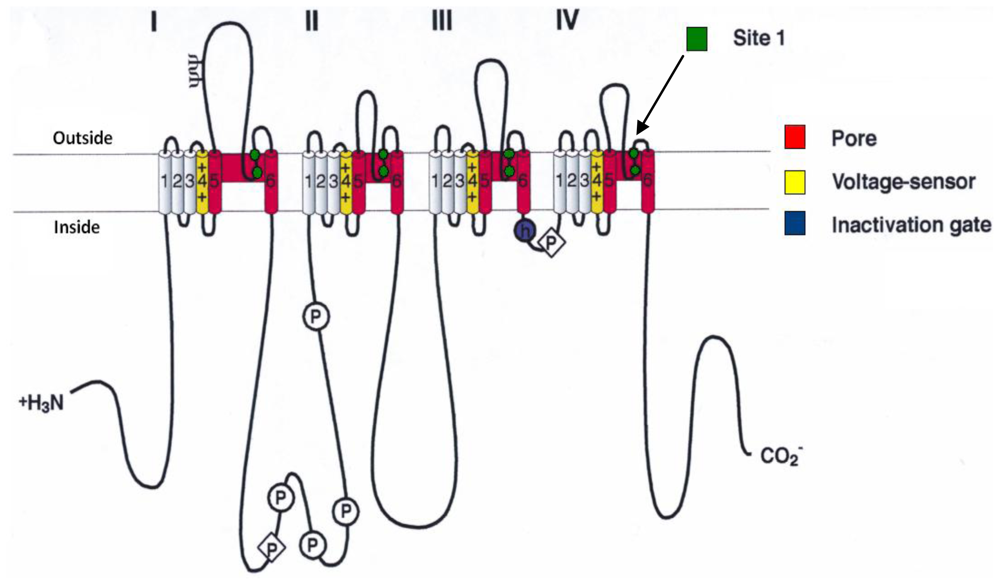
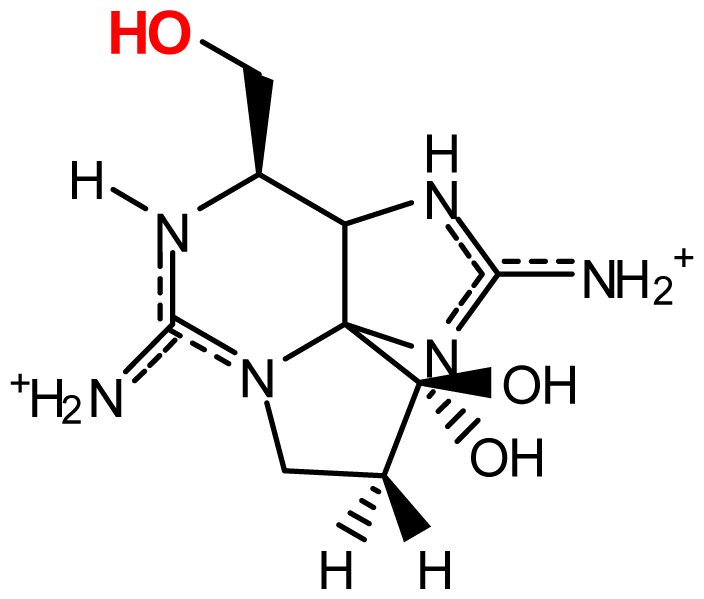
<p>Intoxication with PSTs may result in the severe and occasionally fatal illness known as paralytic shellfish poisoning (PSP) or saxitoxin pufferfish poisoning (SPFP) [<xref ref-type="bibr" rid="b23-marinedrugs-08-02185">23</xref>–<xref ref-type="bibr" rid="b27-marinedrugs-08-02185">27</xref>]. This illness is caused when PSTs reversibly bind voltage-gated Na<sup>+</sup> channels in an equimolar ratio. This is mediated by the interaction between the positively charged guanidinium groups of STX with negatively charged carboxyl groups at site 1 of the Na<sup>+</sup> channel, thereby blocking the pore (<xref ref-type="fig" rid="f1-marinedrugs-08-02185">Figure 1</xref>) [<xref ref-type="bibr" rid="b28-marinedrugs-08-02185">28</xref>–<xref ref-type="bibr" rid="b30-marinedrugs-08-02185">30</xref>]. Currently, there is no antidote for PSP with artificial respiration and fluid therapy the only treatment available. A recent case of PSP involved the death of two fishermen after consumption of the filter feeder bi-valve <italic>Aulacomya ater</italic> in the Chilean Patagonian Fjords [<xref ref-type="bibr" rid="b26-marinedrugs-08-02185">26</xref>]. The threat of PSP is not only a major cause of concern for public health but is also detrimental to the economy. Outbreaks of PSTs often result in the death of marine life and livestock, the closure of contaminated fisheries, while the continual expenditure required for the maintenance and running of monitoring programs, all combine to present a major economic burden around the world [<xref ref-type="bibr" rid="b31-marinedrugs-08-02185">31</xref>,<xref ref-type="bibr" rid="b32-marinedrugs-08-02185">32</xref>].</p>
<p>This review will focus on the structural diversity of PSTs characterized to date and the biosynthetic and metabolic basis for this diversity. The saxitoxin biosynthetic gene cluster (<italic>sxt</italic>) was recently identified in cyanobacteria, which now provides insight into the biosynthesis of STX and its analogs [<xref ref-type="bibr" rid="b33-marinedrugs-08-02185">33</xref>,<xref ref-type="bibr" rid="b34-marinedrugs-08-02185">34</xref>]. A specific suite of analogs can be isolated from a single PST-producing organism, which is directly a result of the evolution of genes present within the organism’s genome [<xref ref-type="bibr" rid="b14-marinedrugs-08-02185">14</xref>,<xref ref-type="bibr" rid="b33-marinedrugs-08-02185">33</xref>–<xref ref-type="bibr" rid="b37-marinedrugs-08-02185">37</xref>]. Naturally occurring PSTs can also be precursors for extracellular metabolic or chemical transformations into new analogs. Knowledge of these transformations may have important implications for the detection, toxicity and removal of PSTs from a contaminated source. Other medicinal uses for PSTs may become more established by screening the bioactivity of less toxic analogs, since their use as a potential local anesthetic has long been known [<xref ref-type="bibr" rid="b38-marinedrugs-08-02185">38</xref>,<xref ref-type="bibr" rid="b39-marinedrugs-08-02185">39</xref>]. The characterization of PST biosynthesis genes and their potential use in combinatorial biosynthesis, together with the constant discovery of novel analogs (either natural or transformed), is likely to expand the possibilities for the pharmaceutical use of PSTs [<xref ref-type="bibr" rid="b40-marinedrugs-08-02185">40</xref>,<xref ref-type="bibr" rid="b41-marinedrugs-08-02185">41</xref>].</p></sec>
<sec>
<title>2. Saxitoxin and Its Analogs, the Paralytic Shellfish Toxins</title>
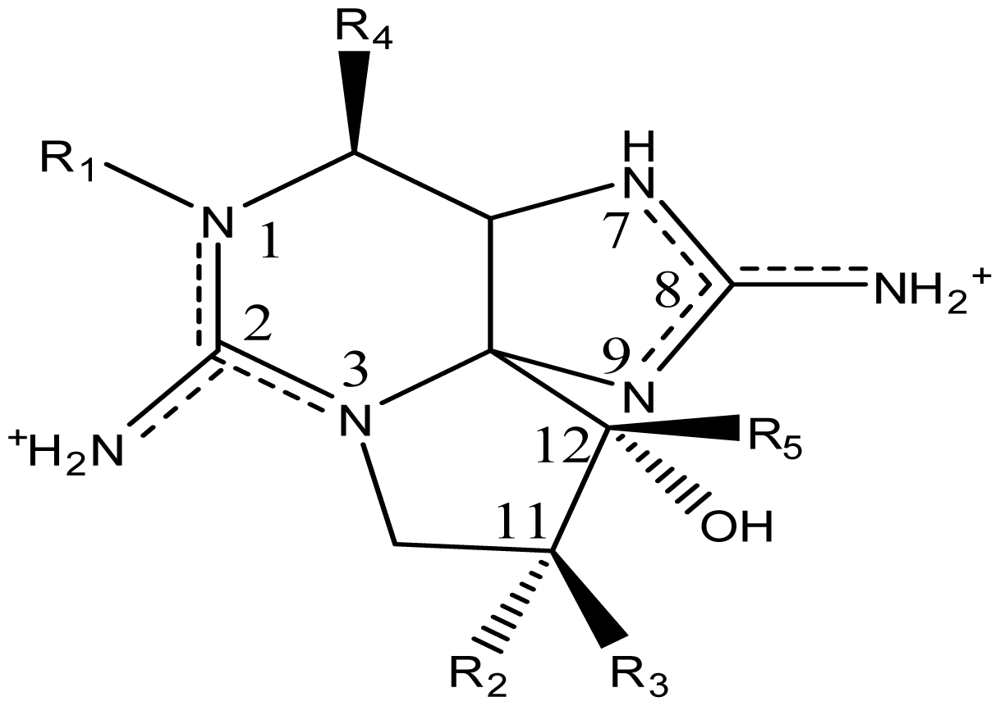
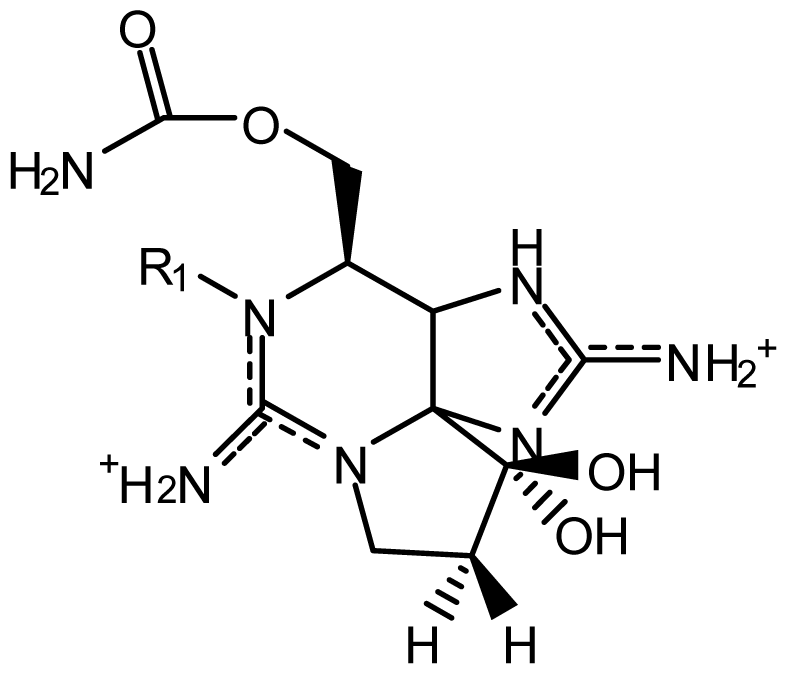
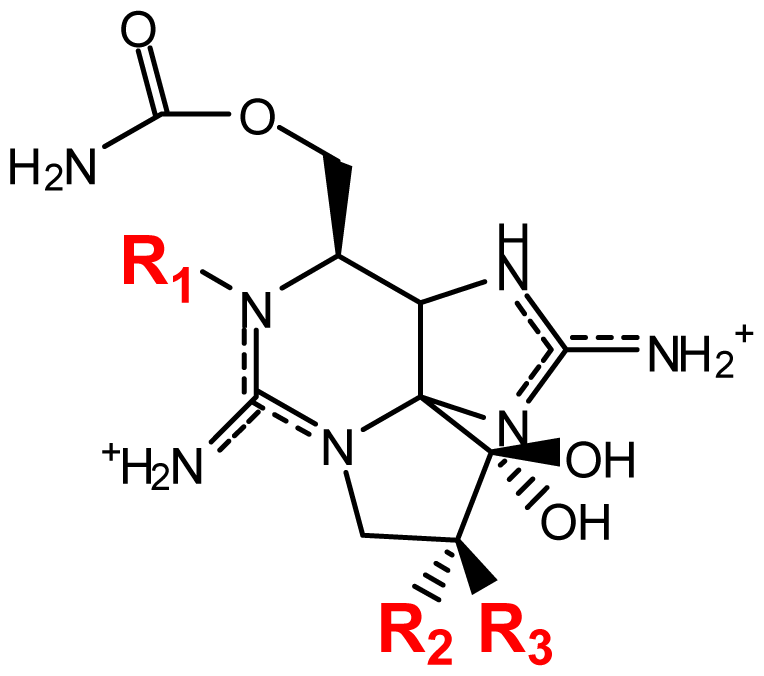
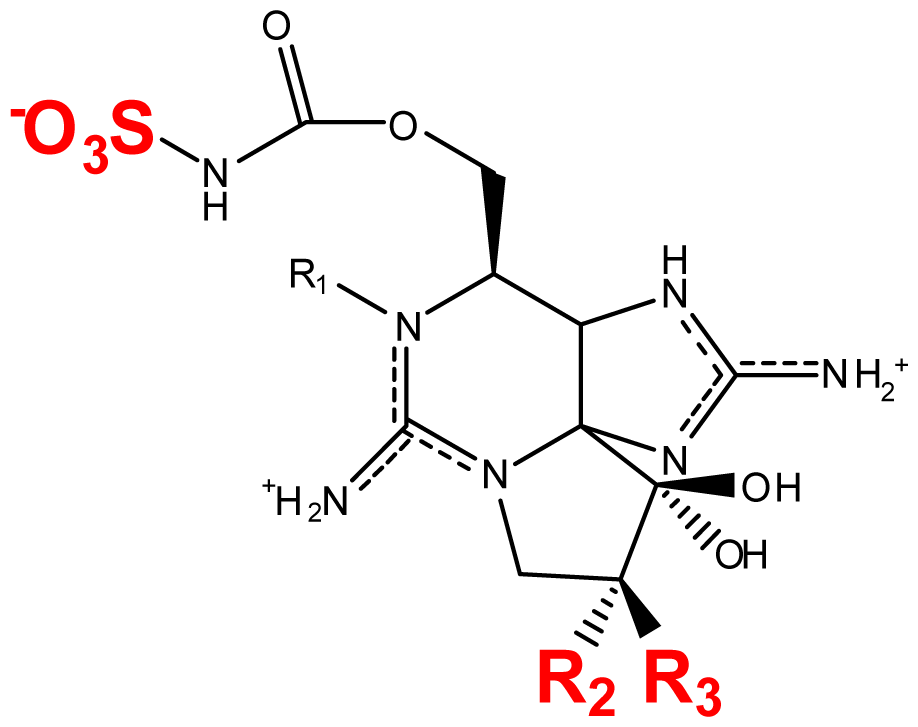
<p>STX is one of the most potent natural neurotoxins known. A dose of approximately 1 mg of the toxin from a single serving of contaminated shellfish is fatal to humans. STX was the first PST isolated in pure form from the Alaskan butter clam, <italic>Saxidomus gigangteus</italic> in 1957 [<xref ref-type="bibr" rid="b1-marinedrugs-08-02185">1</xref>]. Its highly polar characteristics represent poor conditions for crystallization and hampered structure elucidations for 18 years, until the crystal structure was solved by two groups independently in 1975 [<xref ref-type="bibr" rid="b42-marinedrugs-08-02185">42</xref>,<xref ref-type="bibr" rid="b43-marinedrugs-08-02185">43</xref>]. STX is an alkaloid with the molecular formula C<sub>10</sub>H<sub>17</sub>N<sub>7</sub>O<sub>4</sub> (Molecular Weight = 299) and is composed of a 3,4-propinoperhydropurine tricyclic system. STX belongs to the large family of guanidinium-containing marine natural products, due to the presence of two guanidino groups which are responsible for its high polarity [<xref ref-type="bibr" rid="b44-marinedrugs-08-02185">44</xref>,<xref ref-type="bibr" rid="b45-marinedrugs-08-02185">45</xref>]. Since its initial discovery, 57 naturally occurring STX analogs have been identified in a number of organisms, collectively referred to as the PSTs (<xref ref-type="table" rid="t1-marinedrugs-08-02185">Table 1</xref>).</p>
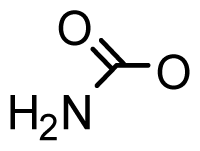
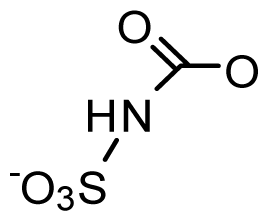
<p>Usually a PST- producing organism synthesizes a characteristic suite of toxins made up of several PST analogs. These analogs differ in side group moieties and thus are commonly grouped according to these variable residues. The most commonly occurring PSTs are hydrophilic and have been studied in depth [<xref ref-type="bibr" rid="b7-marinedrugs-08-02185">7</xref>]. They may be non-sulfated, such as STX and neosaxitoxin (neoSTX), mono-sulfated, such as the gonyautoxins (GTXs 1–6), or di-sulfated (C1-4 toxins) [<xref ref-type="bibr" rid="b7-marinedrugs-08-02185">7</xref>,<xref ref-type="bibr" rid="b90-marinedrugs-08-02185">90</xref>]. In addition, decarbamoyl variants of these analogs also exist, including decarbamoyl-saxitoxins (dcSTX, dcneoSTX), decarbamoyl-gonyautoxins (dcGTXs 1–4), and the 13-deoxy-decarbamoyl derivatives (doSTX, doGTX 2,3). Three structural families of SXT are classified by the identity of the R<sub>4</sub> side chain as either <italic>N</italic>-sulfocarbamoyl, decarbamoyl, or carbamoyl, each with increasing toxicity in mammalian bioassays (<xref ref-type="table" rid="t2-marinedrugs-08-02185">Table 2</xref>) [<xref ref-type="bibr" rid="b7-marinedrugs-08-02185">7</xref>,<xref ref-type="bibr" rid="b9-marinedrugs-08-02185">9</xref>,<xref ref-type="bibr" rid="b90-marinedrugs-08-02185">90</xref>]. Recently, an increase in screening efforts, coupled with improved methods for detection and structure elucidation, has seen an increase in the number of new PSTs reported in the literature.</p>
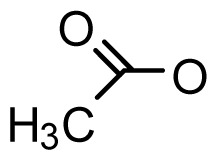
<p>A novel group of PSTs with a hydrophobic side chain were identified within the cyanobacterium <italic>Lyngbya wollei</italic> and are characterized by the presence of an acetate at C13 (LWTX 1–3,5,6) and a carbinol at C12 (LWTX 2,3,5) in place of a hydrated ketone [<xref ref-type="bibr" rid="b82-marinedrugs-08-02185">82</xref>]. This was the first report of STX derivatives with a hydrophobic substituent and these toxins have only been found exclusively in the freshwater environment [<xref ref-type="bibr" rid="b14-marinedrugs-08-02185">14</xref>,<xref ref-type="bibr" rid="b82-marinedrugs-08-02185">82</xref>]. The presence of an acetate side chain in the LWTXs correlated with a decrease in mouse toxicity, while the reduction at C12 resulted in a complete loss of mouse toxicity [<xref ref-type="bibr" rid="b82-marinedrugs-08-02185">82</xref>].</p>
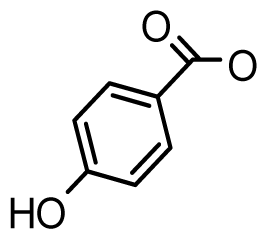
<p>Interestingly, Negri <italic>et al.</italic> reported a novel subclass of analogs containing a hydrophobic R<sub>4</sub> side chain designated GC1-3. These were first isolated and structurally characterized from Australian isolates of the dinoflagellate <italic>Gymnodinium catenatum</italic> and since have also been identified within <italic>Alexandrium catenatum</italic> globally [<xref ref-type="bibr" rid="b72-marinedrugs-08-02185">72</xref>]. High-resolution mass-spectrometry (MS) and nuclear magnetic resonance spectroscopy (NMR) revealed that GC3 is a 4-hydroxybenzoate ester derivative of dcSTX, while GC1 and GC2 are epimeric 11-hydroxysulfate derivatives of GC3 [<xref ref-type="bibr" rid="b83-marinedrugs-08-02185">83</xref>,<xref ref-type="bibr" rid="b91-marinedrugs-08-02185">91</xref>]. Negri <italic>et al.</italic> emphasized that the lipophilic nature of these toxins may lead to an increased potential to bioaccumulate in marine organisms [<xref ref-type="bibr" rid="b72-marinedrugs-08-02185">72</xref>]. These novel analogs have also been shown to bind strongly to the voltage gated Na<sup>+</sup> channel. The binding affinity of GC3 resembles the affinity of the GTXs, whereas the epimer pair GC1 and GC2 bind with a similar affinity compared to the C-toxins [<xref ref-type="bibr" rid="b72-marinedrugs-08-02185">72</xref>,<xref ref-type="bibr" rid="b92-marinedrugs-08-02185">92</xref>]. More recently, other GC PST analogs have been identified, such as GC4-6, the di-hydroxylated benzoate GC analogs GC1-6a and the sulfated benzoate analogs GC1-6b for which only putative structures have been determined via mass spectrometry (MS) [<xref ref-type="bibr" rid="b85-marinedrugs-08-02185">85</xref>]. Due to their hydrophobic nature, these toxins easily escape conventional chromatography methods. The frequently used C18 solid-phase separation is based on polarity and thus hydrophobic compounds are retained on the column and cannot be detected. This is significant from a shellfish monitoring and public safety viewpoint, and presents a major challenge to water authorities [<xref ref-type="bibr" rid="b72-marinedrugs-08-02185">72</xref>,<xref ref-type="bibr" rid="b93-marinedrugs-08-02185">93</xref>,<xref ref-type="bibr" rid="b94-marinedrugs-08-02185">94</xref>].</p>
<p>Recently, Vale <italic>et al.</italic> reported the isolation of four unusual compounds (denoted A–D) and categorized them as novel STX analogs based on fluorescence emission, ultraviolet absorption maxima and cross-reactivity to a commercial antibody towards STX [<xref ref-type="bibr" rid="b86-marinedrugs-08-02185">86</xref>]. These extracts originated from shellfish samples (<italic>Semele proficua</italic> and <italic>Senilia senilis</italic>) collected from Luanda and Mussulo Bay, Angola. Compounds A and D were classified as non-N1-hydroxyl PST analogs and compound B as a N1-hydroxyl analog. Even though the presence of <italic>G. catenatum</italic> and <italic>Pyrodinium bahamense</italic> has been reported from the coast of Angola, none of the 18 PSTs commonly found in dinoflagellates were identified in these extracts. The authors therefore suggested a possible cyanobacterial source, though neither a definitive chemical structure, nor a PST-producing organism were conclusively identified [<xref ref-type="bibr" rid="b86-marinedrugs-08-02185">86</xref>]. Further analysis of the compounds by MS and NMR is required to elucidate these structures and confirm them as STX analogs.</p>
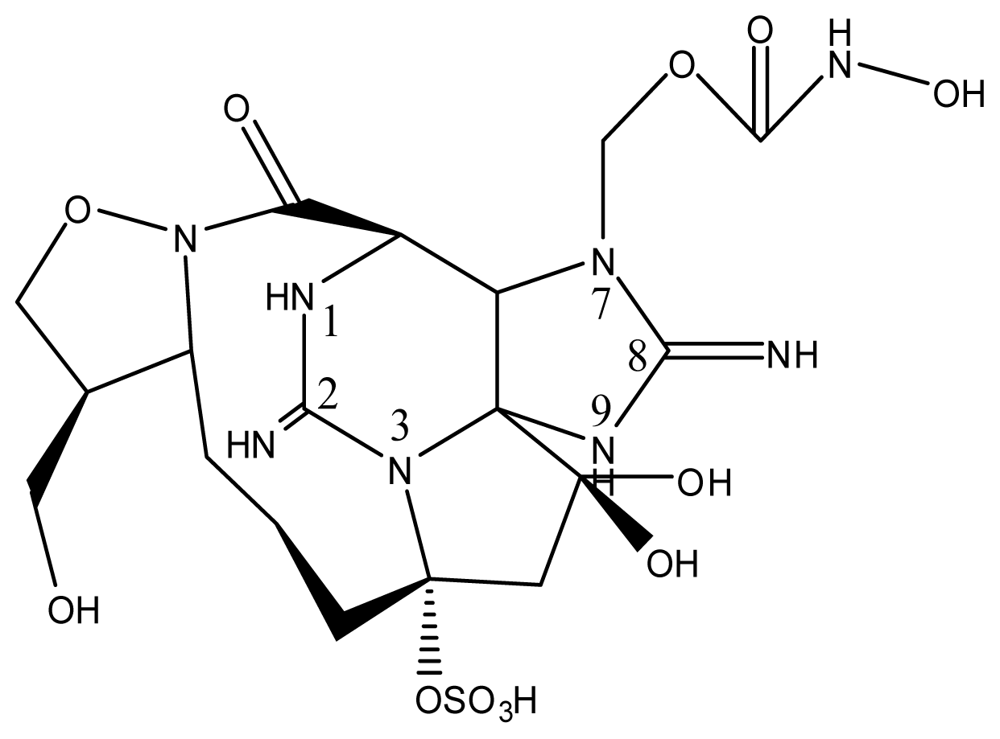
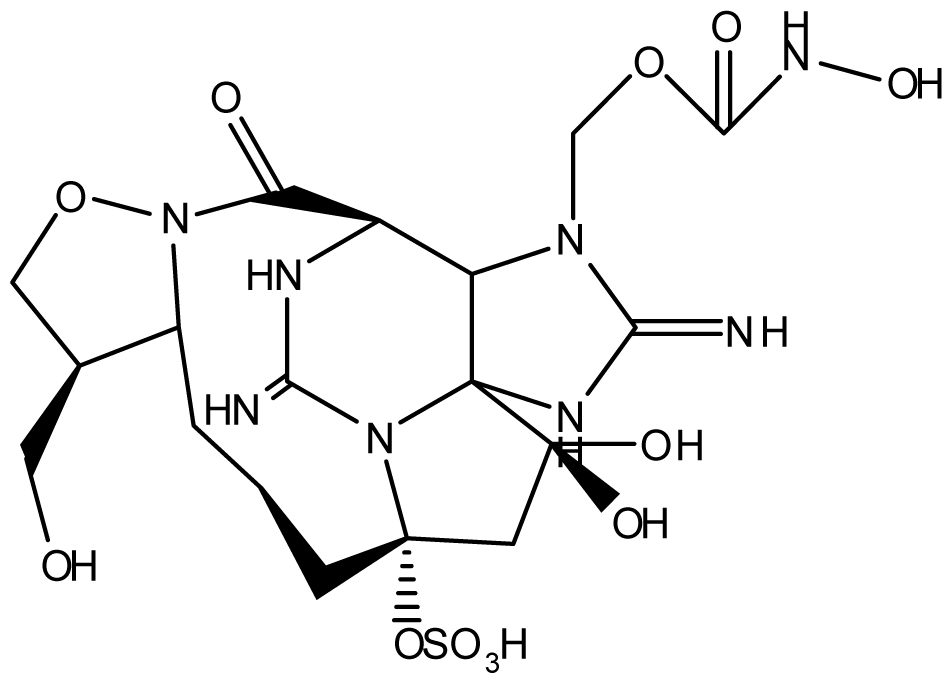
<p>The most exotic STX isolate identified to date was isolated from the Panamanian golden frog <italic>Atelopus zeteki</italic> and designated zetekitoxin AB (<xref ref-type="table" rid="t1-marinedrugs-08-02185">Tables 1</xref> and <xref ref-type="table" rid="t2-marinedrugs-08-02185">2</xref>). Zetekitoxin AB was confirmed to be a PST containing a unique 1,2-oxazolidine ring-fused lactam. The binding affinity of zetekitoxin AB for brain, heart, and muscle Na<sup>+</sup> channels was extremely potent, displaying a toxicity of approximately 580-, 160- and 63-fold greater than STX against each channel, respectively [<xref ref-type="bibr" rid="b89-marinedrugs-08-02185">89</xref>].</p>
<p>The constant discovery of novel and diverse STX analogs is a challenge to PST identification and monitoring. Improvement of detection methods will no doubt uncover new natural forms of STX, however, we are still only beginning to understand the mechanisms by which these complex molecules are produced in nature.</p></sec>
<sec>
<title>3. Biotransformation of the Paralytic Shellfish Toxins</title>
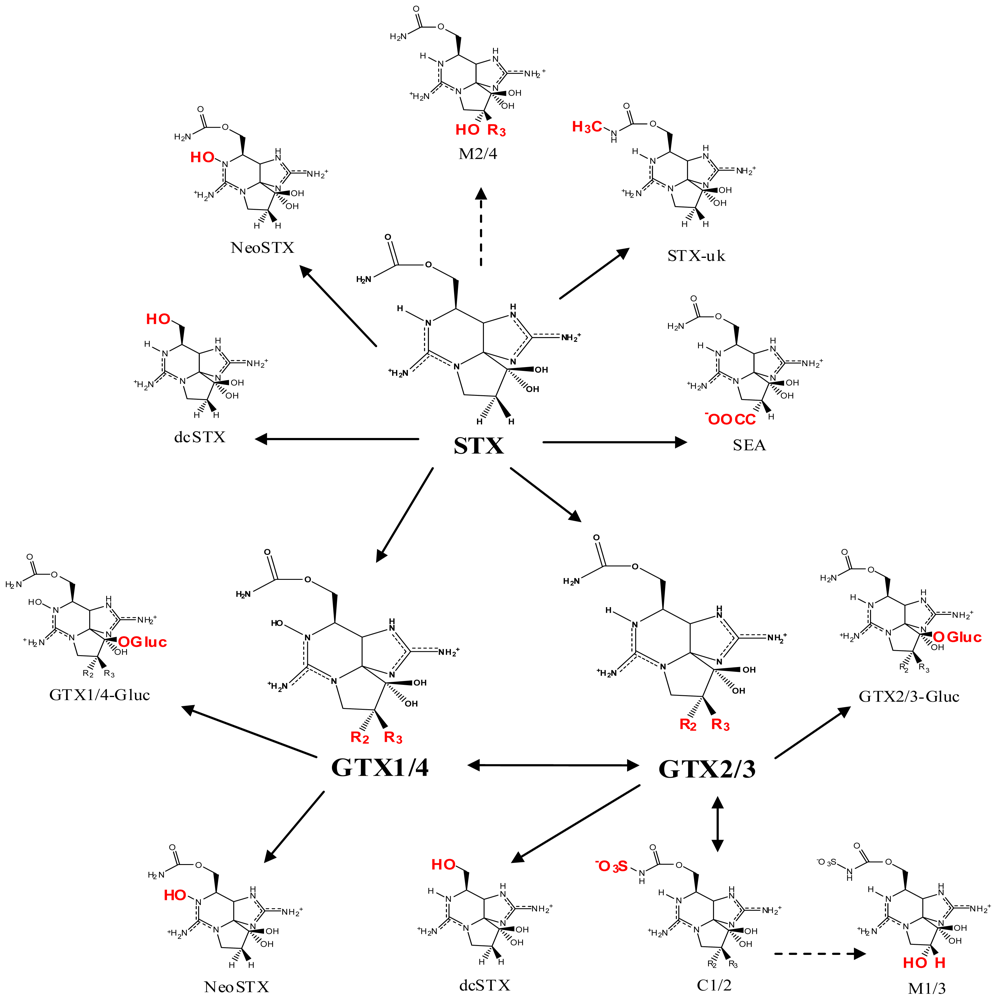
<p>Naturally occurring PSTs may be structurally modified by various biological factors. In some cases, these biotransformations can result in new PSTs that cannot be biosynthesized by cyanobacteria or dinoflagellates alone (<xref ref-type="fig" rid="f2-marinedrugs-08-02185">Figure 2</xref>). In addition, less toxic PSTs may be converted into analogs with greater toxicity (e.g., C-toxins→GTXs) or <italic>vice versa</italic>. Therefore, a clearer understanding of PST biotransformation is needed for predicting more accurate levels of toxicity. This knowledge may also allow for a mechanism of detoxification to be established and utilized in the water supply and shellfish farming industries.</p>
<p>Cell extracts of PST-producing dinoflagellates are capable of enzymatically modifying PSTs. Oshima <italic>et al.</italic> demonstrated that GTX2 + 3 can be converted into GTX1 + 4 by incubation with <italic>Alexandrium tamarense</italic> homogenate [<xref ref-type="bibr" rid="b92-marinedrugs-08-02185">92</xref>]. Introduction of a sulfate moiety on the carbamoyl group, resultingin the formation of C1 and C2 toxins, has been shown following incubation with <italic>G. catenatum</italic> homogenate [<xref ref-type="bibr" rid="b44-marinedrugs-08-02185">44</xref>,<xref ref-type="bibr" rid="b99-marinedrugs-08-02185">99</xref>]. In these organisms, biotransformation is likely to occur via inherent STX tailoring enzymes which are a part of the SXT biosynthetic pathway encoded within the organism.</p>
<p>Due to differences in the toxin profiles of filter-feeding invertebrate PST vectors and causative producing organisms, various studies have been conducted to monitor toxin biotransformation [<xref ref-type="bibr" rid="b84-marinedrugs-08-02185">84</xref>,<xref ref-type="bibr" rid="b100-marinedrugs-08-02185">100</xref>–<xref ref-type="bibr" rid="b105-marinedrugs-08-02185">105</xref>]. Enzymatic transformation of carbamoyl and carbamoyl-<italic>N</italic> sulfated toxins into the decarbamoyl compounds was detected within the little neck clam, <italic>Prothotheca staminea</italic> [<xref ref-type="bibr" rid="b106-marinedrugs-08-02185">106</xref>]. In addition, the conversion of the GTXs and neoSTX to STX by reduction of the O22-sulfate and N1-hydroxyl groups, respectively, has been observed within the homogenate of the scallop <italic>Placopecten magellanicus</italic> [<xref ref-type="bibr" rid="b107-marinedrugs-08-02185">107</xref>].</p>
<p>GC1-3 can be converted into dcSTX, as has been confirmed <italic>in vitro</italic> through incubation of semi-purified GC toxins with bivalve digestive glands [<xref ref-type="bibr" rid="b93-marinedrugs-08-02185">93</xref>]. Similarly, the recently identified M-toxins (M1-5) are reportedly bivalve metabolites of the PSTs and are not present in PST- producing microalgae [<xref ref-type="bibr" rid="b56-marinedrugs-08-02185">56</xref>]. The M-toxins constitute an important toxin fraction in mussels contaminated by <italic>A. tamarense</italic> and <italic>G. catenatum</italic> and have been detected in shellfish, including mussels, cockles and clams [<xref ref-type="bibr" rid="b56-marinedrugs-08-02185">56</xref>,<xref ref-type="bibr" rid="b86-marinedrugs-08-02185">86</xref>]. These findings are similar to previous reports on the isolation of 11-saxitoxinethanoic acid (SEA), a novel PST from the xanthid crab <italic>Atergatis floridus</italic>, inhabiting the pacific coast of Shikoku Island [<xref ref-type="bibr" rid="b87-marinedrugs-08-02185">87</xref>]. Other examples include a novel carbamoyl-<italic>N-</italic>methylsaxitoxin (STX-uk) isolated from the Bangladeshi freshwater puffer <italic>Tetraodon cutcutia</italic> [<xref ref-type="bibr" rid="b88-marinedrugs-08-02185">88</xref>]. These exotic STX analogs are likely products of toxin transforming enzymes within the vector organism or its associated microorganisms. However, the mechanism of enzymatic transformation in these organisms is yet to be elucidated [<xref ref-type="bibr" rid="b56-marinedrugs-08-02185">56</xref>,<xref ref-type="bibr" rid="b86-marinedrugs-08-02185">86</xref>–<xref ref-type="bibr" rid="b88-marinedrugs-08-02185">88</xref>,<xref ref-type="bibr" rid="b106-marinedrugs-08-02185">106</xref>–<xref ref-type="bibr" rid="b109-marinedrugs-08-02185">109</xref>].</p>
<p>Biotransformation of the PSTs by bacteria was first suggested many years ago by Kotaki <italic>et al.</italic>, who proposed that marine bacteria, such as <italic>Vibrio</italic> and <italic>Pseudomonas</italic> spp., are capable of metabolizing PSTs [<xref ref-type="bibr" rid="b110-marinedrugs-08-02185">110</xref>]. In addition, isolates from the viscera of marine crabs, snails and the marine red algae <italic>Jania</italic> sp., were studied and demonstrated transformation GTX derivatives into STX through reductive eliminations [<xref ref-type="bibr" rid="b110-marinedrugs-08-02185">110</xref>,<xref ref-type="bibr" rid="b111-marinedrugs-08-02185">111</xref>]. Bacterial conversion of GTX1-4 to STX and neoSTX is reportedly due to the bacterial thiol compounds glutathione and 2-mercaptoethanol [<xref ref-type="bibr" rid="b112-marinedrugs-08-02185">112</xref>]. The ability of bacteria to degrade PSTs has been further described by Smith <italic>et al.</italic>, who screened marine bacterial isolates from various shellfish species for their ability to metabolize a range of PSTs, such as GTX1-5, STX and neoSTX, suggesting that bacteria might play an important role in the clearance of PSTs from bivalve molluscs [<xref ref-type="bibr" rid="b113-marinedrugs-08-02185">113</xref>]. Novel strains of <italic>Pseudoalteromonas haloplanktis</italic>, isolated from the digestive tracts of blue mussels (<italic>Mytilus edulis</italic>) have been reported to possess the ability to reduce the overall toxicity of a PST mixture of algal extracts by 90% within three days [<xref ref-type="bibr" rid="b114-marinedrugs-08-02185">114</xref>,<xref ref-type="bibr" rid="b115-marinedrugs-08-02185">115</xref>]. Catabolism of the PSTs most likely occurred via oxidation reactions catalyzed by oxidases and peroxidases into aliphatic products for subsequent use in purine and arginine metabolism, although this is speculated, as no catabolized PST products could be identified [<xref ref-type="bibr" rid="b115-marinedrugs-08-02185">115</xref>]. Degradation has also been observed during the passage through a bioactive treatment plant, leading to a decrease in predominant C-toxins and an increase of GTX2 + 3 which display relatively higher toxicity [<xref ref-type="bibr" rid="b116-marinedrugs-08-02185">116</xref>].</p>
<sec>
<title>Detoxification of the paralytic shellfish toxins within mammals</title>
<p>Metabolism of PSTs by humans has not been studied in depth. Nevertheless, Garcia <italic>et al.</italic> suggested biotransformation of STX to neoSTX and the oxidation of the GTX2 + 3 epimers into GTX1 + 4 within samples of pancreas, bile, urine, brain and heart obtained post-mortem from PSP victims [<xref ref-type="bibr" rid="b26-marinedrugs-08-02185">26</xref>]. Further investigations confirmed their findings of biotransformation in humans. N1-oxidation of GTX2 + 3 into the corresponding hydroxylamine analogs GTX1 + 4 has been demonstrated <italic>in vitro</italic> when incubated with a microsomal fraction isolated from healthy human livers. Moreover, <italic>in vitro</italic> glucuronidation of GTX2 + 3 into the hydrophilic compounds GTX3-Gluc and GTX2-Gluc, through conjugation at the hydroxyl-C12 group has also been reported (<xref ref-type="fig" rid="f2-marinedrugs-08-02185">Figure 2</xref>) [<xref ref-type="bibr" rid="b117-marinedrugs-08-02185">117</xref>]. The oxidation and glucuronidation of STX and GTX2 + 3 epimers into neoSTX or GTX1 + 4 epimers, respectively, has been suggested to be significant detoxification pathways of GTX2 + 3 and other PSTs in humans and other mammals [<xref ref-type="bibr" rid="b117-marinedrugs-08-02185">117</xref>]. Similar studies were conducted with cat liver, however, enzymatic transformation was not detected, with 100% recovery of the STX used in the incubation being recovered [<xref ref-type="bibr" rid="b118-marinedrugs-08-02185">118</xref>]. This was explained by the fact that with the exception of cats, the liver of mammals produces glucuronides as a major metabolic product, thus supporting the specificity of human tissue transformation [<xref ref-type="bibr" rid="b119-marinedrugs-08-02185">119</xref>]. However, biotransformation of STX was not detected when STX was passaged through rat’s urine, indicating further mammalian variability in models [<xref ref-type="bibr" rid="b120-marinedrugs-08-02185">120</xref>,<xref ref-type="bibr" rid="b121-marinedrugs-08-02185">121</xref>]. Gessner <italic>et al.</italic> investigated serum and urine in human PSP victims and detected a significant increase of the PST C1 in comparison to GTX2, which is distinguished by an additional sulfate on the carbamoyl side group [<xref ref-type="bibr" rid="b122-marinedrugs-08-02185">122</xref>]. A new assay for STX and neoSTX quantification in human urine samples has been developed recently [<xref ref-type="bibr" rid="b123-marinedrugs-08-02185">123</xref>]. It is proposed that methodological improvements should also contribute to a better understanding of PST profile and its change while passaging through the human body [<xref ref-type="bibr" rid="b123-marinedrugs-08-02185">123</xref>].</p>
<p>The research described above highlights the need to characterize the diversity of biological transformations of PSTs. Detoxification pathways could be manipulated to improve biological removal strategies, while further characterization of detoxification of PSTs within the human body could lead to improved treatment of PSP.</p></sec></sec>
<sec>
<title>4. A Genetic Basis for the Paralytic Shellfish Toxins</title>
<sec>
<title>4.1. The saxitoxin biosynthetic gene cluster</title>
<p>Recently the saxitoxin biosynthesis pathway was proposed [<xref ref-type="bibr" rid="b124-marinedrugs-08-02185">124</xref>], and the s<italic>xt</italic> gene cluster was identified in three cyanobacterial species of the family <italic>Nostocaceae</italic> [<xref ref-type="bibr" rid="b33-marinedrugs-08-02185">33</xref>,<xref ref-type="bibr" rid="b34-marinedrugs-08-02185">34</xref>] and one from the family <italic>Oscillatoriaceae</italic> [<xref ref-type="bibr" rid="b125-marinedrugs-08-02185">125</xref>]. The <italic>sxt</italic> gene clusters within each organism all contain a core set of genes putatively responsible for the biosynthesis of STX. However, the gene profile between each cluster differs, resulting in the production of a different suite of STX analogs by each organism. It is foreseeable that identification of the cyanobacterial PST biosynthesis genes will eventually lead to the identification of the homologs within dinoflagellates. However, the dinoflagellate PST biosynthesis genes remain elusive. There is also some debate on whether the enzymes for PST biosynthesis are encoded by the dinoflagellate genome, including plastids or other sources such as symbiotic bacteria or viruses [<xref ref-type="bibr" rid="b126-marinedrugs-08-02185">126</xref>–<xref ref-type="bibr" rid="b128-marinedrugs-08-02185">128</xref>].</p>
<p>In cyanobacteria, biosynthesis of STX is catalyzed by several enzymes otherwise rare in microbial metabolism. The core PST biosynthetic gene, <italic>sxtA</italic>, is thought to have a chimeric origin and is putatively responsible for the initiation of STX biosynthesis, catalysing the incorporation of acetate to the enzyme complex and its subsequent methylation and Claisen condensation with arginine [<xref ref-type="bibr" rid="b33-marinedrugs-08-02185">33</xref>,<xref ref-type="bibr" rid="b34-marinedrugs-08-02185">34</xref>,<xref ref-type="bibr" rid="b129-marinedrugs-08-02185">129</xref>]. SxtA consists of four catalytic domains (SxtA1-SxtA4) with the <italic>N</italic>-terminal region showing similarities to a polyketide synthase (PKS) complex [<xref ref-type="bibr" rid="b130-marinedrugs-08-02185">130</xref>] consisting of a GCN5-related <italic>N</italic>-acetyltransferase [<xref ref-type="bibr" rid="b131-marinedrugs-08-02185">131</xref>], acyl-carrier protein (ACP) and a S-adenosylmethionine-dependant (SAM) methyltransferase [<xref ref-type="bibr" rid="b132-marinedrugs-08-02185">132</xref>] domains, while the <italic>C</italic>-terminal region contains a domain homologous to previously characterized aminotransferases [<xref ref-type="bibr" rid="b133-marinedrugs-08-02185">133</xref>].</p>
<p>Specific PST analog profiles are proposed to be the result of tailoring enzymes encoded by the <italic>sxt</italic> gene cluster. The function of tailoring enzymes within each of the characterized <italic>sxt</italic> clusters has been inferred by analysis of the specific toxin profile produced by each cyanobacterium. For example, neoSTX differs from STX by hydroxylation at the N1 position (<xref ref-type="table" rid="t1-marinedrugs-08-02185">Table 1</xref>). NeoSTX is produced by <italic>C. raciborskii</italic> T3, <italic>Aphanizomenon</italic> sp. NH-5 and <italic>L. wollei</italic>, but has not been detected in <italic>A. circinalis</italic> [<xref ref-type="bibr" rid="b14-marinedrugs-08-02185">14</xref>,<xref ref-type="bibr" rid="b35-marinedrugs-08-02185">35</xref>,<xref ref-type="bibr" rid="b36-marinedrugs-08-02185">36</xref>,<xref ref-type="bibr" rid="b57-marinedrugs-08-02185">57</xref>,<xref ref-type="bibr" rid="b62-marinedrugs-08-02185">62</xref>]. Sequence analysis of the four <italic>sxt</italic> gene clusters revealed SxtX as a protein putatively responsible for the N1-hydroxylation of STX, since <italic>sxtX</italic> was identified in all neoSTX producing strains and absent from the <italic>A. circinalis</italic> AWQC131C gene cluster [<xref ref-type="bibr" rid="b33-marinedrugs-08-02185">33</xref>,<xref ref-type="bibr" rid="b34-marinedrugs-08-02185">34</xref>]. This protein displayed high structural similarities to cephalosporin hydroxylase [<xref ref-type="bibr" rid="b134-marinedrugs-08-02185">134</xref>], further affirming its role in the <italic>N</italic>1-hydroxylation of STX.</p>
<p>The GTXs are produced by mono-sulfation at N21 or O22 of STX which can then be di-sulfated to produce the C-toxins. Previous studies of the dinoflagellate <italic>G. catenatum</italic>, revealed two 3′-phosphate 5′-phosphosulfate (PAPS)-dependant sulfotransferases responsible for the N21 sulfation of STX, GTX2 and GTX3, and the O22 sulfation of 11-hydroxy STX [<xref ref-type="bibr" rid="b135-marinedrugs-08-02185">135</xref>,<xref ref-type="bibr" rid="b136-marinedrugs-08-02185">136</xref>]. Two genes, <italic>sxtO</italic>, a PAPS forming enzyme and <italic>sxtN</italic>, a sulfotransferase, within cyanobacterial <italic>sxt</italic> clusters are proposed to encode proteins that play a similar sulfation role in the synthesis of GTXs and C-toxins.</p>
<p>The requirement of SAM for STX biosynthesis has long been hypothesized and thus has been targeted during attempts to identify the PST genes [<xref ref-type="bibr" rid="b137-marinedrugs-08-02185">137</xref>,<xref ref-type="bibr" rid="b138-marinedrugs-08-02185">138</xref>]. Harlow <italic>et al.</italic> were able to use degenerate primers to screen several dinoflagellate genomes in an attempt to identify genes encoding SAM as a candidate involved in PST biosynthesis [<xref ref-type="bibr" rid="b138-marinedrugs-08-02185">138</xref>]. Although several SAM genes were successfully identified within dinoflagellates, these were not correlated to PST biosynthesis. The study was hampered by a limited knowledge of dinoflagellate codon usage and a lack of related sequence information within the NCBI database [<xref ref-type="bibr" rid="b138-marinedrugs-08-02185">138</xref>,<xref ref-type="bibr" rid="b139-marinedrugs-08-02185">139</xref>]. Kellmann <italic>et al.</italic> used a similar degenerate PCR approach to identify a gene encoding a <italic>O</italic>-carbamoyltransferase (<italic>sxtI</italic>), which ultimately led to the identification of the entire <italic>sxt</italic> biosynthesis pathway in cyanobacteria [<xref ref-type="bibr" rid="b33-marinedrugs-08-02185">33</xref>,<xref ref-type="bibr" rid="b138-marinedrugs-08-02185">138</xref>,<xref ref-type="bibr" rid="b140-marinedrugs-08-02185">140</xref>]. There are now multiple genes that may be utilized to target homologs of the <italic>sxt</italic> cluster in dinoflagellates. However, a recent study identified the dinoflagellate <italic>sxt</italic> cluster may differ from cyanobacteria more than would be expected from a recent gene transfer event. Hence, mRNA present solely within toxic dinoflagellates may be more successful at identifying the candidate <italic>sxt</italic> pathway in these organisms [<xref ref-type="bibr" rid="b141-marinedrugs-08-02185">141</xref>].</p></sec>
<sec>
<title>4.2. Pharmaceutical potential of the paralytic shellfish toxins</title>
<p>Recent years has seen a renewed interest in marine alkaloids and their analogs, including the PSTs, with regards to their use as therapeutic agents or as a drug lead. Bioactivity studies and molecular modeling of a range of PSTs could also lead to the design of unnatural analogs with improved pharmaceutical characteristics. Recently, a group of toxins isolated from marine cone snails (genus <italic>Conus</italic>), known as conotoxins, have been shown to contain over 2,000 peptide analogs [<xref ref-type="bibr" rid="b142-marinedrugs-08-02185">142</xref>]. The conotoxins are able to specifically target a broad range of ion channels and membrane receptors with several currently under investigation for possible clinical trials [<xref ref-type="bibr" rid="b142-marinedrugs-08-02185">142</xref>]. In 2004, a synthetic version of a single conotoxin analog, ω-conotoxin MVIIA, also known as ziconotide (trade name Prialt<sup>®</sup>) was the first marine natural product to be approved for use by the US Food and Drug Administration since 1976 [<xref ref-type="bibr" rid="b143-marinedrugs-08-02185">143</xref>,<xref ref-type="bibr" rid="b144-marinedrugs-08-02185">144</xref>]. Ziconotide acts by targeting N-type voltage sensitive Ca<sup>2+</sup> channels and is used for the treatment of chronic pain in spinal cord injury [<xref ref-type="bibr" rid="b145-marinedrugs-08-02185">145</xref>,<xref ref-type="bibr" rid="b146-marinedrugs-08-02185">146</xref>].</p>
<p>Like Prialt<sup>®</sup>, STX also has a huge pharmaceutical potential for its ability to induce anesthesia through interaction with site 1 of the voltage gated Na<sup>+</sup> channel [<xref ref-type="bibr" rid="b38-marinedrugs-08-02185">38</xref>,<xref ref-type="bibr" rid="b39-marinedrugs-08-02185">39</xref>]. It has been suggested that site 1 blockers prolong the duration of anaesthesia in a synergistic manner when combined with other local anaesthetics [<xref ref-type="bibr" rid="b39-marinedrugs-08-02185">39</xref>,<xref ref-type="bibr" rid="b147-marinedrugs-08-02185">147</xref>,<xref ref-type="bibr" rid="b148-marinedrugs-08-02185">148</xref>]. In spite of this, the push for STX to enter clinical trials has been hindered by its systematic toxicity [<xref ref-type="bibr" rid="b149-marinedrugs-08-02185">149</xref>]. The use of STX as a slow release, prolonged anesthetic was recently demonstrated using a novel controlled release system in male Sprague-Dawley rats [<xref ref-type="bibr" rid="b150-marinedrugs-08-02185">150</xref>]. Liposomal formulations of STX, either alone and in conjunction with dexamethasone and/or bupivacaine, were able to block the sciatic nerve within rats for long periods with no damaging myotoxic, cytotoxic or neurotoxic effects and little associated inflammation [<xref ref-type="bibr" rid="b150-marinedrugs-08-02185">150</xref>]. Liposome formulations of STX for slow and site-directed release for prolonged anaesthesia have since been postulated as a putative treatment of localized pain and severe joint pain [<xref ref-type="bibr" rid="b151-marinedrugs-08-02185">151</xref>].</p>
<p>PSTs such as GTX2 + 3 also have clinical potential and have been utilized for the treatment of anal fissures [<xref ref-type="bibr" rid="b152-marinedrugs-08-02185">152</xref>–<xref ref-type="bibr" rid="b154-marinedrugs-08-02185">154</xref>]. Since 1951, surgery has been the most common form of anal fissure treatment with several possible side effects [<xref ref-type="bibr" rid="b155-marinedrugs-08-02185">155</xref>–<xref ref-type="bibr" rid="b157-marinedrugs-08-02185">157</xref>], while other treatments include ointments [<xref ref-type="bibr" rid="b158-marinedrugs-08-02185">158</xref>], botulinium toxin [<xref ref-type="bibr" rid="b159-marinedrugs-08-02185">159</xref>] and topical application of nitroglycerine [<xref ref-type="bibr" rid="b160-marinedrugs-08-02185">160</xref>]. Treatment with GTX2 + 3 involves direct injection into both sides of the fissure. A success rate of 98% with remission after 15 and 28 days for acute and chronic conditions, respectively (<italic>n</italic> = 100) was observed [<xref ref-type="bibr" rid="b153-marinedrugs-08-02185">153</xref>]. A follow up study with an enhanced method has since been performed by Garrido <italic>et al</italic>. with an improved time of healing of seven to 14 days for chronic cases (<italic>n</italic> = 23) [<xref ref-type="bibr" rid="b154-marinedrugs-08-02185">154</xref>]. Both studies identified GTX2 + 3 as safe and effective when compared to other treatments [<xref ref-type="bibr" rid="b153-marinedrugs-08-02185">153</xref>,<xref ref-type="bibr" rid="b154-marinedrugs-08-02185">154</xref>]. GTX2 + 3 have also been used in the treatment of chronic tension type headache, with 70% of patients (<italic>n</italic> = 27) responding to treatment [<xref ref-type="bibr" rid="b161-marinedrugs-08-02185">161</xref>]. These studies recognize that PSTs other than STX also have potential as future pharmaceutical leads. Their use in the past has also been limited largely due to problems obtaining purified PST analogs.</p>
<p>The genetic characterization of PST biosynthesis pathways from diverse producer organisms has increased our insight into <italic>sxt</italic> tailoring reactions and the molecular understanding of the mechanisms by which a particular suite of PSTs can be synthesized. This will ultimately advance research into the pharmaceutical potential of the PSTs as Na<sup>+</sup> channel blockers, by generating new analogs or by increasing the availability of analogs otherwise biosynthesized in low concentrations. Bioengineering can also be utilized to further enhance the structural diversity of bioactive small molecules by using <italic>in vitro</italic> approaches that utilize enzymes in chemical synthesis, as well as <italic>in vivo</italic> approaches, such as combinatorial biosynthesis [<xref ref-type="bibr" rid="b40-marinedrugs-08-02185">40</xref>,<xref ref-type="bibr" rid="b41-marinedrugs-08-02185">41</xref>]. Combinatorial biosynthesis is the process of incorporating genes from multiple biosynthetic clusters into an expression plasmid, in a combinatorial fashion, to generate a library of “unnatural” natural products expressed <italic>in vivo</italic>. However expression of large gene fragments in a heterologous host is required and analogs of interest may then be extracted, purified and assayed to determine their bioactivity.</p>
<p>The bioactive nature of STX as an anaesthetic and GTX2 + 3 for the treatment of anal fissures and chronic tension type headaches demonstrates that these alkaloids have pharmaceutical potential deserving of further investigation. The recent elucidation of the <italic>sxt</italic> gene clusters in cyanobacteria and the identification of novel PSTs has provided more options for further PST bioactivity studies. Novel analogs could also be devised by redesigning PST biosynthesis genes in amenable host systems via combinatorial biosynthesis.</p></sec></sec>
<sec sec-type="conclusions">
<title>5. Conclusions</title>
<p>The structure of STX has been known for 53 years and the discovery of novel STX analogs has continued steadily ever since. Today, 57 PST analogs have been reported. With more sensitive detection methods, new STX analogs will most likely continue to be identified, with new functional moieties and possibly novel bioactivity. Despite extended research on the role of saxitoxin and its analogs as a sodium channel blocker, the effect of these toxins on the environment, and the genes that are responsible for their production, there is still a vast gap in knowledge in regards to their potential intracellular role within the producing organism. Nevertheless, it is possible that the different analogs display varying functions within the cells due to their partial differences in charges and chemical properties. More studies are needed to elucidate the localization of saxitoxin and its derivatives might provide clues to the potential role of the PST analogs within the producing organism. In the future, a better understanding of the intracellular and extracellular functions of STX might open more avenues for pharmaceutical applications.</p>
<p>Since PSTs are produced by distantly related organisms, spanning two domains, including cyanobacteria, dinoflagellates and the Panamanian golden frog, it is possible that their occurrence in nature is more widespread than we know. Further investigations are needed to elucidate the extent of their distribution, diversity and their fundamental biology, such as their biosynthesis, metabolic and eco-physiological function. This is in addition to the role of chemical transformation of the different toxins in shellfish and the environment.</p>
<p>Future research is also needed to understand the integration of PST biosynthesis within the overall cell metabolism and the possible recruitment of enzymes from other biosynthetic pathways for PST bioconversions. Proteomic and transcriptomic studies are likely to provide a link between STX biosynthesis, regulation and cellular metabolism. It is expected that data will allow us to acquire a better understanding of the conservation of the SXT biosynthesis pathway at the enzymatic level in comparison to the genetic level, may give further insight into the molecular function of these toxins and also lead to clues of their evolutionary history. In future, characterization of PST biosynthetic genes from dinoflagellates and comparison with cyanobacterial genes will also aid in our understanding of the evolutionary history of these genes with regard to their origin and transfer.</p>
<p>PSP is a serious health problem and its incidence has continued to rise on a global scale. PSTs negatively impact the fisheries industry globally and the development of novel methods of detoxification is essential from a human health and financial perspective [<xref ref-type="bibr" rid="b104-marinedrugs-08-02185">104</xref>,<xref ref-type="bibr" rid="b113-marinedrugs-08-02185">113</xref>,<xref ref-type="bibr" rid="b162-marinedrugs-08-02185">162</xref>]. The enzymatic basis for the structural diversity of PSTs is now beginning to be understood from the genetics of their biosynthesis in cyanobacteria and characterization of transformations catalyzed by bacteria, marine invertebrates and mammals. Biotransformation pathways could also be manipulated to efficiently remove toxins from water supplies. Specific enzymes or bacterial strains that degrade PSTs could be introduced into shellfish to assist detoxification. Currently, the PSTs represent extraordinary potential for pharmacy. This potential is likely to increase as we continue to gain a better molecular understanding of the PSTs, leading to future prospects of their use in combinatorial biosynthesis for the production of novel alkaloids with beneficial application.</p></sec></body>
<back>
<ack>
<title>Acknowledgements</title>
<p>The authors would like to thank the Australian Research Council, Diagnostic Technology, NSW Department of Primary Industries, Safe Food NSW, Department of Health and Human Services Tasmania and Primary Industries and Resources SA for supporting this work.</p></ack>
<fn-group><fn>
<p><italic>Samples Availability</italic>: Available from the authors.</p></fn></fn-group>
<ref-list>
<title>References</title>
<ref id="b1-marinedrugs-08-02185"><label>1</label><citation citation-type="journal"><person-group person-group-type="author"><name><surname>Schantz</surname><given-names>EJ</given-names></name><name><surname>Mold</surname><given-names>J</given-names></name><name><surname>Stanger</surname><given-names>D</given-names></name><name><surname>Shavel</surname><given-names>J</given-names></name><name><surname>Riel</surname><given-names>F</given-names></name><name><surname>Bowden</surname><given-names>J</given-names></name><name><surname>Lynch</surname><given-names>J</given-names></name><name><surname>Wyler</surname><given-names>R</given-names></name><name><surname>Riegel</surname><given-names>B</given-names></name><name><surname>Sommer</surname><given-names>H</given-names></name></person-group><article-title>Paralytic shellfish poison VI. A procedure for the isolation and purification of the poison from toxic clams and mussel tissues</article-title><source>J. Am. Chem. Soc</source><year>1957</year><volume>79</volume><fpage>5230</fpage><lpage>5235</lpage><pub-id pub-id-type="doi">10.1021/ja01576a044</pub-id></citation></ref>
<ref id="b2-marinedrugs-08-02185"><label>2</label><citation citation-type="book"><person-group person-group-type="author"><name><surname>Anderson</surname><given-names>DM</given-names></name><name><surname>Cembella</surname><given-names>AD</given-names></name><name><surname>Hallegraeff</surname><given-names>GM</given-names></name></person-group><source>Physiological Ecology of Harmful Algal Blooms</source><edition>1st ed</edition><publisher-name>Springer</publisher-name><publisher-loc>Berlin, Germany</publisher-loc><year>1998</year><fpage>662</fpage></citation></ref>
<ref id="b3-marinedrugs-08-02185"><label>3</label><citation citation-type="journal"><person-group person-group-type="author"><name><surname>Anderson</surname><given-names>DM</given-names></name><name><surname>Glibert</surname><given-names>PM</given-names></name><name><surname>Burkholder</surname><given-names>JM</given-names></name></person-group><article-title>Harmful algal blooms and eutrophication: Nutrient sources, composition, and consequences</article-title><source>Estuaries</source><year>2002</year><volume>25</volume><fpage>704</fpage><lpage>726</lpage><pub-id pub-id-type="doi">10.1007/BF02804901</pub-id></citation></ref>
<ref id="b4-marinedrugs-08-02185"><label>4</label><citation citation-type="journal"><person-group person-group-type="author"><name><surname>Sellner</surname><given-names>KG</given-names></name><name><surname>Doucette</surname><given-names>GJ</given-names></name><name><surname>Kirkpatrick</surname><given-names>GJ</given-names></name></person-group><article-title>Harmful algal blooms: Causes, impacts and detection</article-title><source>J. Ind. Microbiol. Biotechnol</source><year>2003</year><volume>30</volume><fpage>383</fpage><lpage>406</lpage><pub-id pub-id-type="doi">10.1007/s10295-003-0074-9</pub-id><pub-id pub-id-type="pmid">12898390</pub-id></citation></ref>
<ref id="b5-marinedrugs-08-02185"><label>5</label><citation citation-type="journal"><person-group person-group-type="author"><name><surname>Zingone</surname><given-names>A</given-names></name><name><surname>Enevoldsen</surname><given-names>HO</given-names></name></person-group><article-title>The diversity of harmful algal blooms: A challenge for science and management</article-title><source>Ocean Coast. Manage</source><year>2000</year><volume>43</volume><fpage>725</fpage><lpage>748</lpage><pub-id pub-id-type="doi">10.1016/S0964-5691(00)00056-9</pub-id></citation></ref>
<ref id="b6-marinedrugs-08-02185"><label>6</label><citation citation-type="journal"><person-group person-group-type="author"><name><surname>Van Dolah</surname><given-names>FM</given-names></name></person-group><article-title>Marine algal toxins: Origins, health effects, and their increased occurrence</article-title><source>Environ. Health Perspect</source><year>2000</year><volume>108</volume><fpage>133</fpage><lpage>141</lpage><pub-id pub-id-type="pmid">10698729</pub-id></citation></ref>
<ref id="b7-marinedrugs-08-02185"><label>7</label><citation citation-type="journal"><person-group person-group-type="author"><name><surname>Llewellyn</surname><given-names>LE</given-names></name></person-group><article-title>Saxitoxin, a toxic marine natural product that targets a multitude of receptors</article-title><source>Nat. Prod. Rep</source><year>2006</year><volume>23</volume><fpage>200</fpage><lpage>222</lpage><pub-id pub-id-type="doi">10.1039/b501296c</pub-id><pub-id pub-id-type="pmid">16572228</pub-id></citation></ref>
<ref id="b8-marinedrugs-08-02185"><label>8</label><citation citation-type="journal"><person-group person-group-type="author"><name><surname>Lefebvre</surname><given-names>KA</given-names></name><name><surname>Bill</surname><given-names>BD</given-names></name><name><surname>Erickson</surname><given-names>A</given-names></name><name><surname>Baugh</surname><given-names>KA</given-names></name><name><surname>O'Rourke</surname><given-names>L</given-names></name><name><surname>Costa</surname><given-names>PR</given-names></name><name><surname>Nance</surname><given-names>S</given-names></name><name><surname>Trainer</surname><given-names>VL</given-names></name></person-group><article-title>Characterization of intracellular and extracellular saxitoxin levels in both field and cultured <italic>Alexandrium</italic> spp. samples from Sequim Bay, Washington</article-title><source>Mar. Drugs</source><year>2008</year><volume>6</volume><fpage>103</fpage><lpage>116</lpage><pub-id pub-id-type="doi">10.3390/md6020103</pub-id><pub-id pub-id-type="pmid">18728762</pub-id></citation></ref>
<ref id="b9-marinedrugs-08-02185"><label>9</label><citation citation-type="journal"><person-group person-group-type="author"><name><surname>Oshima</surname><given-names>Y</given-names></name><name><surname>Blackburn</surname><given-names>SI</given-names></name><name><surname>Hallegraeff</surname><given-names>GM</given-names></name></person-group><article-title>Comparative study on paralytic shellfish toxin profiles of the dinoflagellate <italic>Gymnodinium catenatum</italic> from three different countries</article-title><source>Mar. Biol</source><year>1993</year><volume>116</volume><fpage>471</fpage><lpage>476</lpage><pub-id pub-id-type="doi">10.1007/BF00350064</pub-id></citation></ref>
<ref id="b10-marinedrugs-08-02185"><label>10</label><citation citation-type="journal"><person-group person-group-type="author"><name><surname>Usup</surname><given-names>G</given-names></name><name><surname>Kulis</surname><given-names>DM</given-names></name><name><surname>Anderson</surname><given-names>DM</given-names></name></person-group><article-title>Growth and toxin production of the toxic dinoflagellate <italic>Pyrodinium bahamense</italic> var. <italic>compressum</italic> in laboratory cultures</article-title><source>Nat. Toxins</source><year>1994</year><volume>2</volume><fpage>254</fpage><lpage>262</lpage><pub-id pub-id-type="doi">10.1002/nt.2620020503</pub-id><pub-id pub-id-type="pmid">7866660</pub-id></citation></ref>
<ref id="b11-marinedrugs-08-02185"><label>11</label><citation citation-type="journal"><person-group person-group-type="author"><name><surname>Gainey</surname><given-names>L</given-names></name><name><surname>Shumway</surname><given-names>J</given-names></name><name><surname>Shumway</surname><given-names>S</given-names></name></person-group><article-title>A compendium of the responses of bivalve molluscs to toxic dinoflagellates</article-title><source>J. Shellfish Res</source><year>1988</year><volume>7</volume><fpage>623</fpage><lpage>628</lpage></citation></ref>
<ref id="b12-marinedrugs-08-02185"><label>12</label><citation citation-type="journal"><person-group person-group-type="author"><name><surname>Shumway</surname><given-names>SE</given-names></name></person-group><article-title>Phycotoxin-related shellfish poisoning: Bivalve molluscs are not the only vectors</article-title><source>Rev. Fish. Sci</source><year>1995</year><volume>3</volume><fpage>1</fpage><lpage>31</lpage></citation></ref>
<ref id="b13-marinedrugs-08-02185"><label>13</label><citation citation-type="journal"><person-group person-group-type="author"><name><surname>Deeds</surname><given-names>J</given-names></name><name><surname>Landsberg</surname><given-names>J</given-names></name><name><surname>Etheridge</surname><given-names>S</given-names></name><name><surname>Pitcher</surname><given-names>G</given-names></name><name><surname>Longan</surname><given-names>S</given-names></name></person-group><article-title>Non-traditional vectors for paralytic shellfish poisoning</article-title><source>Mar. Drugs</source><year>2008</year><volume>6</volume><fpage>308</fpage><lpage>348</lpage><pub-id pub-id-type="doi">10.3390/md6020308</pub-id><pub-id pub-id-type="pmid">18728730</pub-id></citation></ref>
<ref id="b14-marinedrugs-08-02185"><label>14</label><citation citation-type="journal"><person-group person-group-type="author"><name><surname>Carmichael</surname><given-names>WW</given-names></name><name><surname>Evans</surname><given-names>WR</given-names></name><name><surname>Yin</surname><given-names>QQ</given-names></name><name><surname>Bell</surname><given-names>P</given-names></name><name><surname>Moczydlowski</surname><given-names>E</given-names></name></person-group><article-title>Evidence for paralytic shellfish poisons in the freshwater cyanobacterium <italic>Lyngbya wollei</italic> (Farlow ex Gomont) comb. nov</article-title><source>Appl. Environ. Microbiol</source><year>1997</year><volume>63</volume><fpage>3104</fpage><lpage>3110</lpage><pub-id pub-id-type="pmid">9251196</pub-id></citation></ref>
<ref id="b15-marinedrugs-08-02185"><label>15</label><citation citation-type="journal"><person-group person-group-type="author"><name><surname>Hoeger</surname><given-names>SJ</given-names></name><name><surname>Shaw</surname><given-names>G</given-names></name><name><surname>Hitzfeld</surname><given-names>BC</given-names></name><name><surname>Dietrich</surname><given-names>DR</given-names></name></person-group><article-title>Occurrence and elimination of cyanobacterial toxins in two Australian drinking water treatment plants</article-title><source>Toxicon</source><year>2004</year><volume>43</volume><fpage>639</fpage><lpage>649</lpage><pub-id pub-id-type="doi">10.1016/j.toxicon.2004.02.019</pub-id><pub-id pub-id-type="pmid">15109885</pub-id></citation></ref>
<ref id="b16-marinedrugs-08-02185"><label>16</label><citation citation-type="journal"><person-group person-group-type="author"><name><surname>Molica</surname><given-names>RJR</given-names></name><name><surname>Oliveira</surname><given-names>EJA</given-names></name><name><surname>Carvalho</surname><given-names>PVVC</given-names></name><name><surname>Costa</surname><given-names>ANSF</given-names></name><name><surname>Cunha</surname><given-names>MCC</given-names></name><name><surname>Melo</surname><given-names>GL</given-names></name><name><surname>Azevedo</surname><given-names>SMFO</given-names></name></person-group><article-title>Occurrence of saxitoxins and an anatoxin-a(s)-like anticholinesterase in a Brazilian drinking water supply</article-title><source>Harmful Algae</source><year>2005</year><volume>4</volume><fpage>743</fpage><lpage>753</lpage><pub-id pub-id-type="doi">10.1016/j.hal.2004.11.001</pub-id></citation></ref>
<ref id="b17-marinedrugs-08-02185"><label>17</label><citation citation-type="journal"><person-group person-group-type="author"><name><surname>Clemente</surname><given-names>Z</given-names></name><name><surname>Busato</surname><given-names>RH</given-names></name><name><surname>Oliveira Ribeiro</surname><given-names>CA</given-names></name><name><surname>Cestari</surname><given-names>MM</given-names></name><name><surname>Ramsdorf</surname><given-names>WA</given-names></name><name><surname>Magalhães</surname><given-names>VF</given-names></name><name><surname>Wosiack</surname><given-names>AC</given-names></name><name><surname>Silva de Assis</surname><given-names>HC</given-names></name></person-group><article-title>Analyses of paralytic shellfish toxins and biomarkers in a southern Brazilian reservoir</article-title><source>Toxicon</source><year>2010</year><volume>55</volume><fpage>396</fpage><lpage>406</lpage><pub-id pub-id-type="doi">10.1016/j.toxicon.2009.09.003</pub-id><pub-id pub-id-type="pmid">19778550</pub-id></citation></ref>
<ref id="b18-marinedrugs-08-02185"><label>18</label><citation citation-type="journal"><person-group person-group-type="author"><name><surname>Liu</surname><given-names>Y</given-names></name><name><surname>Chen</surname><given-names>W</given-names></name><name><surname>Li</surname><given-names>D</given-names></name><name><surname>Shen</surname><given-names>Y</given-names></name><name><surname>Li</surname><given-names>G</given-names></name><name><surname>Liu</surname><given-names>Y</given-names></name></person-group><article-title>First report of aphantoxins in China—waterblooms of toxigenic <italic>Aphanizomenon flos-aquae</italic> in Lake Dianchi</article-title><source>Ecotoxicol. Environ. Saf</source><year>2006</year><volume>65</volume><fpage>84</fpage><lpage>92</lpage><pub-id pub-id-type="doi">10.1016/j.ecoenv.2005.06.012</pub-id><pub-id pub-id-type="pmid">16289338</pub-id></citation></ref>
<ref id="b19-marinedrugs-08-02185"><label>19</label><citation citation-type="journal"><person-group person-group-type="author"><name><surname>Berry</surname><given-names>JP</given-names></name><name><surname>Lind</surname><given-names>O</given-names></name></person-group><article-title>First evidence of "paralytic shellfish toxins" and cylindrospermopsin in a Mexican freshwater system, Lago Catemaco, and apparent bioaccumulation of the toxins in "tegogolo" snails (Pomacea patula catemacensis)</article-title><source>Toxicon</source><year>2010</year><volume>55</volume><fpage>930</fpage><lpage>938</lpage><pub-id pub-id-type="doi">10.1016/j.toxicon.2009.07.035</pub-id><pub-id pub-id-type="pmid">19651152</pub-id></citation></ref>
<ref id="b20-marinedrugs-08-02185"><label>20</label><citation citation-type="journal"><person-group person-group-type="author"><name><surname>Ballot</surname><given-names>A</given-names></name><name><surname>Fastner</surname><given-names>J</given-names></name><name><surname>Wiedner</surname><given-names>C</given-names></name></person-group><article-title>Paralytic shellfish poisoning toxin-producing cyanobacterium <italic>Aphanizomenon gracile</italic> in Northeast Germany</article-title><source>Appl. Environ. Microbiol</source><year>2010</year><volume>76</volume><fpage>1173</fpage><lpage>1180</lpage><pub-id pub-id-type="doi">10.1128/AEM.02285-09</pub-id><pub-id pub-id-type="pmid">20048055</pub-id></citation></ref>
<ref id="b21-marinedrugs-08-02185"><label>21</label><citation citation-type="journal"><person-group person-group-type="author"><name><surname>Codd</surname><given-names>GA</given-names></name></person-group><article-title>Cyanobacterial toxins: occurrence, properties and biological significance</article-title><source>Water Sci. Technol</source><year>1995</year><volume>32</volume><fpage>149</fpage><lpage>156</lpage></citation></ref>
<ref id="b22-marinedrugs-08-02185"><label>22</label><citation citation-type="book"><person-group person-group-type="author"><name><surname>Sivonen</surname><given-names>K</given-names></name><name><surname>Jones</surname><given-names>G</given-names></name></person-group><person-group person-group-type="editor"><name><surname>Chorus</surname><given-names>I</given-names></name><name><surname>Bartram</surname><given-names>J</given-names></name></person-group><article-title>Cyanobacterial toxins</article-title><source>Toxin Cyanobacteria in Water: A Guide to Their Public Health Consequences, Monitoring and Management</source><publisher-name>WHO E &amp; FN Spon</publisher-name><publisher-loc>London, UK</publisher-loc><year>1999</year><fpage>41</fpage><lpage>111</lpage></citation></ref>
<ref id="b23-marinedrugs-08-02185"><label>23</label><citation citation-type="book"><person-group person-group-type="author"><name><surname>Kao</surname><given-names>CY</given-names></name></person-group><person-group person-group-type="editor"><name><surname>Falconer</surname><given-names>ER</given-names></name></person-group><article-title>Paralytic shellfish poisoning</article-title><source>Algal Toxins in Seafood and Drinking Water</source><publisher-name>Academic</publisher-name><publisher-loc>London, UK</publisher-loc><year>1993</year><fpage>75</fpage></citation></ref>
<ref id="b24-marinedrugs-08-02185"><label>24</label><citation citation-type="journal"><person-group person-group-type="author"><name><surname>Anderson</surname><given-names>DM</given-names></name><name><surname>Kulis</surname><given-names>DM</given-names></name><name><surname>Qi</surname><given-names>Y</given-names></name><name><surname>Zheng</surname><given-names>L</given-names></name><name><surname>Lu</surname><given-names>S</given-names></name><name><surname>Lin</surname><given-names>Y</given-names></name></person-group><article-title>Paralytic shellfish poisoning in Southern China</article-title><source>Toxicon</source><year>1996</year><volume>34</volume><fpage>579</fpage><lpage>590</lpage><pub-id pub-id-type="doi">10.1016/0041-0101(95)00158-1</pub-id><pub-id pub-id-type="pmid">8783452</pub-id></citation></ref>
<ref id="b25-marinedrugs-08-02185"><label>25</label><citation citation-type="journal"><person-group person-group-type="author"><name><surname>Rodrigue</surname><given-names>DC</given-names></name><name><surname>Etzel</surname><given-names>RA</given-names></name><name><surname>Hall</surname><given-names>S</given-names></name><name><surname>de Porras</surname><given-names>E</given-names></name><name><surname>Velasquez</surname><given-names>OH</given-names></name><name><surname>Tauxe</surname><given-names>RV</given-names></name><name><surname>Kilbourne</surname><given-names>EM</given-names></name><name><surname>Blake</surname><given-names>PA</given-names></name></person-group><article-title>Lethal paralytic shellfish poisoning in Guatemala</article-title><source>Am. J. Trop. Med. Hyg</source><year>1990</year><volume>42</volume><fpage>267</fpage><lpage>271</lpage><pub-id pub-id-type="pmid">2316796</pub-id></citation></ref>
<ref id="b26-marinedrugs-08-02185"><label>26</label><citation citation-type="journal"><person-group person-group-type="author"><name><surname>Garcia</surname><given-names>C</given-names></name><name><surname>del Carmen Bravo</surname><given-names>M</given-names></name><name><surname>Lagos</surname><given-names>M</given-names></name><name><surname>Lagos</surname><given-names>N</given-names></name></person-group><article-title>Paralytic shellfish poisoning: Post-mortem analysis of tissue and body fluid samples from human victims in the Patagonia fjords</article-title><source>Toxicon</source><year>2004</year><volume>43</volume><fpage>149</fpage><lpage>158</lpage><pub-id pub-id-type="doi">10.1016/j.toxicon.2003.11.018</pub-id><pub-id pub-id-type="pmid">15019474</pub-id></citation></ref>
<ref id="b27-marinedrugs-08-02185"><label>27</label><citation citation-type="journal"><person-group person-group-type="author"><name><surname>Landsberg</surname><given-names>JH</given-names></name><name><surname>Hall</surname><given-names>S</given-names></name><name><surname>Johannessen</surname><given-names>JN</given-names></name><name><surname>White</surname><given-names>KD</given-names></name><name><surname>Conrad</surname><given-names>SM</given-names></name><name><surname>Abbott</surname><given-names>JP</given-names></name><name><surname>Flewelling</surname><given-names>LJ</given-names></name><name><surname>Richardson</surname><given-names>RW</given-names></name><name><surname>Dickey</surname><given-names>RW</given-names></name><name><surname>Jester</surname><given-names>EL</given-names></name><name><surname>Etheridge</surname><given-names>SM</given-names></name><name><surname>Deeds</surname><given-names>JR</given-names></name><name><surname>Van Dolah</surname><given-names>FM</given-names></name><name><surname>Leighfield</surname><given-names>TA</given-names></name><name><surname>Zou</surname><given-names>Y</given-names></name><name><surname>Beaudry</surname><given-names>CG</given-names></name><name><surname>Benner</surname><given-names>RA</given-names></name><name><surname>Rogers</surname><given-names>PL</given-names></name><name><surname>Scott</surname><given-names>PS</given-names></name><name><surname>Kawabata</surname><given-names>K</given-names></name><name><surname>Wolny</surname><given-names>JL</given-names></name><name><surname>Steidinger</surname><given-names>KA</given-names></name></person-group><article-title>Saxitoxin puffer fish poisoning in the United States, with the first report of <italic>Pyrodinium bahamense</italic> as the putative toxin source</article-title><source>Environ. Health Perspect</source><year>2006</year><volume>114</volume><fpage>1502</fpage><lpage>1507</lpage><pub-id pub-id-type="doi">10.1289/ehp.8998</pub-id><pub-id pub-id-type="pmid">17035133</pub-id></citation></ref>
<ref id="b28-marinedrugs-08-02185"><label>28</label><citation citation-type="journal"><person-group person-group-type="author"><name><surname>Catterall</surname><given-names>WA</given-names></name><name><surname>Morrow</surname><given-names>CS</given-names></name><name><surname>Hartshorne</surname><given-names>RP</given-names></name></person-group><article-title>Neurotoxin binding to receptor sites associated with voltage-sensitive sodium channels in intact, lysed, and detergent-solubilized brain membranes</article-title><source>J. Biol. Chem</source><year>1979</year><volume>254</volume><fpage>11379</fpage><lpage>11387</lpage><pub-id pub-id-type="pmid">500648</pub-id></citation></ref>
<ref id="b29-marinedrugs-08-02185"><label>29</label><citation citation-type="journal"><person-group person-group-type="author"><name><surname>Catterall</surname><given-names>WA</given-names></name></person-group><article-title>Neurotoxins that act on voltage-sensitive sodium channels in excitable membranes</article-title><source>Annu. Rev. Pharmacol</source><year>1980</year><volume>20</volume><fpage>15</fpage><lpage>43</lpage></citation></ref>
<ref id="b30-marinedrugs-08-02185"><label>30</label><citation citation-type="journal"><person-group person-group-type="author"><name><surname>Cestèle</surname><given-names>S</given-names></name><name><surname>Catterall</surname><given-names>WA</given-names></name></person-group><article-title>Molecular mechanisms of neurotoxin action on voltage-gated sodium channels</article-title><source>Biochimie</source><year>2000</year><volume>82</volume><fpage>883</fpage><lpage>892</lpage><pub-id pub-id-type="doi">10.1016/S0300-9084(00)01174-3</pub-id><pub-id pub-id-type="pmid">11086218</pub-id></citation></ref>
<ref id="b31-marinedrugs-08-02185"><label>31</label><citation citation-type="journal"><person-group person-group-type="author"><name><surname>Guy</surname><given-names>AL</given-names></name><name><surname>Griffin</surname><given-names>G</given-names></name></person-group><article-title>Adopting alternatives for the regulatory monitoring of shellfish for paralytic shellfish poisoning in Canada: Interface between federal regulators, science and ethics</article-title><source>Regul. Toxicol. Pharmacol</source><year>2009</year><volume>54</volume><fpage>256</fpage><lpage>263</lpage><pub-id pub-id-type="doi">10.1016/j.yrtph.2009.05.002</pub-id><pub-id pub-id-type="pmid">19442698</pub-id></citation></ref>
<ref id="b32-marinedrugs-08-02185"><label>32</label><citation citation-type="book"><person-group person-group-type="author"><name><surname>Stewart</surname><given-names>I</given-names></name><name><surname>Seawright</surname><given-names>AA</given-names></name><name><surname>Shaw</surname><given-names>GR</given-names></name></person-group><person-group person-group-type="editor"><name><surname>Hudnell</surname><given-names>HK</given-names></name></person-group><article-title>Cyanobacterial poisoning in livestock, wild mammals and birds—an overview</article-title><source>Cyanobacterial Harmful Algal Blooms: State of the Science and Research Needs</source><publisher-name>Springer</publisher-name><publisher-loc>New York, NY, USA</publisher-loc><year>2008</year><fpage>613</fpage><lpage>637</lpage></citation></ref>
<ref id="b33-marinedrugs-08-02185"><label>33</label><citation citation-type="journal"><person-group person-group-type="author"><name><surname>Kellmann</surname><given-names>R</given-names></name><name><surname>Mihali</surname><given-names>TK</given-names></name><name><surname>Jeon</surname><given-names>YJ</given-names></name><name><surname>Pickford</surname><given-names>R</given-names></name><name><surname>Pomati</surname><given-names>F</given-names></name><name><surname>Neilan</surname><given-names>BA</given-names></name></person-group><article-title>Biosynthetic intermediate analysis and functional homology reveal a saxitoxin gene cluster in cyanobacteria</article-title><source>Appl. Environ. Microbiol</source><year>2008</year><volume>74</volume><fpage>4044</fpage><lpage>4053</lpage><pub-id pub-id-type="doi">10.1128/AEM.00353-08</pub-id><pub-id pub-id-type="pmid">18487408</pub-id></citation></ref>
<ref id="b34-marinedrugs-08-02185"><label>34</label><citation citation-type="journal"><person-group person-group-type="author"><name><surname>Mihali</surname><given-names>TK</given-names></name><name><surname>Kellmann</surname><given-names>R</given-names></name><name><surname>Neilan</surname><given-names>BA</given-names></name></person-group><article-title>Characterisation of the paralytic shellfish toxin biosynthesis gene clusters in <italic>Anabaena circinalis</italic> AWQC131C and <italic>Aphanizomenon</italic> sp. NH-5</article-title><source>BMC Biochem</source><year>2009</year><volume>10</volume><fpage>8</fpage><pub-id pub-id-type="doi">10.1186/1471-2091-10-8</pub-id><pub-id pub-id-type="pmid">19331657</pub-id></citation></ref>
<ref id="b35-marinedrugs-08-02185"><label>35</label><citation citation-type="journal"><person-group person-group-type="author"><name><surname>Llewellyn</surname><given-names>LE</given-names></name><name><surname>Negri</surname><given-names>AP</given-names></name><name><surname>Doyle</surname><given-names>J</given-names></name><name><surname>Baker</surname><given-names>PD</given-names></name><name><surname>Beltran</surname><given-names>EC</given-names></name><name><surname>Neilan</surname><given-names>BA</given-names></name></person-group><article-title>Radioreceptor assays for sensitive detection and quantitation of saxitoxin and its analogues from strains of the freshwater cyanobacterium, <italic>Anabaena circinalis</italic></article-title><source>Environ. Sci. Technol</source><year>2001</year><volume>35</volume><fpage>1445</fpage><lpage>1451</lpage><pub-id pub-id-type="doi">10.1021/es001575z</pub-id><pub-id pub-id-type="pmid">11348083</pub-id></citation></ref>
<ref id="b36-marinedrugs-08-02185"><label>36</label><citation citation-type="journal"><person-group person-group-type="author"><name><surname>Lagos</surname><given-names>N</given-names></name><name><surname>Onodera</surname><given-names>H</given-names></name><name><surname>Zagatto</surname><given-names>PA</given-names></name><name><surname>Andrinolo</surname><given-names>D</given-names></name><name><surname>Azevedo</surname><given-names>SMFQ</given-names></name><name><surname>Oshima</surname><given-names>Y</given-names></name></person-group><article-title>The first evidence of paralytic shellfish toxins in the freshwater cyanobacterium <italic>Cylindrospermopsis raciborskii</italic>, isolated from Brazil</article-title><source>Toxicon</source><year>1999</year><volume>37</volume><fpage>1359</fpage><lpage>1373</lpage><pub-id pub-id-type="doi">10.1016/S0041-0101(99)00080-X</pub-id><pub-id pub-id-type="pmid">10414862</pub-id></citation></ref>
<ref id="b37-marinedrugs-08-02185"><label>37</label><citation citation-type="journal"><person-group person-group-type="author"><name><surname>Ferreira</surname><given-names>FMB</given-names></name><name><surname>Soler</surname><given-names>JMF</given-names></name><name><surname>Fidalgo</surname><given-names>ML</given-names></name><name><surname>Fernández-Vila</surname><given-names>P</given-names></name></person-group><article-title>PSP toxins from <italic>Aphanizomenon flos-aquae</italic> (cyanobacteria) collected in the Crestuma-Lever reservoir (Douro river, northern Portugal)</article-title><source>Toxicon</source><year>2001</year><volume>39</volume><fpage>757</fpage><lpage>761</lpage><pub-id pub-id-type="doi">10.1016/S0041-0101(00)00114-8</pub-id><pub-id pub-id-type="pmid">11137533</pub-id></citation></ref>
<ref id="b38-marinedrugs-08-02185"><label>38</label><citation citation-type="journal"><person-group person-group-type="author"><name><surname>Hille</surname><given-names>B</given-names></name></person-group><article-title>The receptor for tetrodotoxin and saxitoxin. A structural hypothesis</article-title><source>Biophys. J</source><year>1975</year><volume>15</volume><fpage>615</fpage><lpage>619</lpage><pub-id pub-id-type="doi">10.1016/S0006-3495(75)85842-5</pub-id><pub-id pub-id-type="pmid">1148362</pub-id></citation></ref>
<ref id="b39-marinedrugs-08-02185"><label>39</label><citation citation-type="journal"><person-group person-group-type="author"><name><surname>Adams</surname><given-names>HJ</given-names></name><name><surname>Blair</surname><given-names>MR</given-names><suffix>Jr</suffix></name><name><surname>Takman</surname><given-names>BH</given-names></name></person-group><article-title>The local anesthetic activity of saxitoxin alone and with vasoconstrictor and local anesthetic agents</article-title><source>Arch. Int. Pharmacodyn. Ther</source><year>1976</year><volume>224</volume><fpage>275</fpage><lpage>282</lpage><pub-id pub-id-type="pmid">1015924</pub-id></citation></ref>
<ref id="b40-marinedrugs-08-02185"><label>40</label><citation citation-type="journal"><person-group person-group-type="author"><name><surname>Khosla</surname><given-names>C</given-names></name><name><surname>Keasling</surname><given-names>JD</given-names></name></person-group><article-title>Metabolic engineering for drug discovery and development</article-title><source>Nat. Rev. Drug Discov</source><year>2003</year><volume>2</volume><fpage>1019</fpage><lpage>1025</lpage><pub-id pub-id-type="doi">10.1038/nrd1256</pub-id><pub-id pub-id-type="pmid">14654799</pub-id></citation></ref>
<ref id="b41-marinedrugs-08-02185"><label>41</label><citation citation-type="journal"><person-group person-group-type="author"><name><surname>Zhang</surname><given-names>W</given-names></name><name><surname>Tang</surname><given-names>Y</given-names></name></person-group><article-title>Combinatorial biosynthesis of natural products</article-title><source>J. Med. Chem</source><year>2008</year><volume>51</volume><fpage>2629</fpage><lpage>2633</lpage><pub-id pub-id-type="doi">10.1021/jm701269v</pub-id><pub-id pub-id-type="pmid">18393406</pub-id></citation></ref>
<ref id="b42-marinedrugs-08-02185"><label>42</label><citation citation-type="journal"><person-group person-group-type="author"><name><surname>Bordner</surname><given-names>J</given-names></name><name><surname>Thiessen</surname><given-names>WE</given-names></name><name><surname>Bates</surname><given-names>HA</given-names></name><name><surname>Rapoport</surname><given-names>H</given-names></name></person-group><article-title>Structure of a crystalline derivative of saxitoxin. Structure of saxitoxin</article-title><source>J. Am. Chem. Soc</source><year>1975</year><volume>97</volume><fpage>6008</fpage><lpage>6012</lpage><pub-id pub-id-type="doi">10.1021/ja00854a009</pub-id><pub-id pub-id-type="pmid">1176726</pub-id></citation></ref>
<ref id="b43-marinedrugs-08-02185"><label>43</label><citation citation-type="journal"><person-group person-group-type="author"><name><surname>Schantz</surname><given-names>EJ</given-names></name><name><surname>Ghazarossian</surname><given-names>VE</given-names></name><name><surname>Schnoes</surname><given-names>HK</given-names></name><name><surname>Strong</surname><given-names>FM</given-names></name><name><surname>Springer</surname><given-names>JP</given-names></name><name><surname>Pezzanite</surname><given-names>JO</given-names></name><name><surname>Clardy</surname><given-names>J</given-names></name></person-group><article-title>Structure of saxitoxin</article-title><source>J. Am. Chem. Soc</source><year>1975</year><volume>97</volume><fpage>1238</fpage><lpage>1239</lpage><pub-id pub-id-type="doi">10.1021/ja00838a045</pub-id><pub-id pub-id-type="pmid">1133383</pub-id></citation></ref>
<ref id="b44-marinedrugs-08-02185"><label>44</label><citation citation-type="book"><person-group person-group-type="author"><name><surname>Shimizu</surname><given-names>Y</given-names></name></person-group><person-group person-group-type="editor"><name><surname>Botana</surname><given-names>LM</given-names></name></person-group><article-title>Chemistry and mechanism of action</article-title><source>Seafood and Freshwater Toxins: Pharmacology, Physiology, and Detection</source><publisher-name>Marcel Dekker</publisher-name><publisher-loc>New York, NY, USA</publisher-loc><year>2000</year><fpage>151</fpage><lpage>172</lpage></citation></ref>
<ref id="b45-marinedrugs-08-02185"><label>45</label><citation citation-type="journal"><person-group person-group-type="author"><name><surname>Berlinck</surname><given-names>RGS</given-names></name><name><surname>Kossuga</surname><given-names>MH</given-names></name></person-group><article-title>Natural guanidine derivatives</article-title><source>Nat. Prod. Rep</source><year>2005</year><volume>22</volume><fpage>516</fpage><lpage>550</lpage><pub-id pub-id-type="doi">10.1039/b209227c</pub-id><pub-id pub-id-type="pmid">16047049</pub-id></citation></ref>
<ref id="b46-marinedrugs-08-02185"><label>46</label><citation citation-type="journal"><person-group person-group-type="author"><name><surname>Ciminiello</surname><given-names>P</given-names></name><name><surname>Fattorusso</surname><given-names>E</given-names></name><name><surname>Forino</surname><given-names>M</given-names></name><name><surname>Montresor</surname><given-names>M</given-names></name></person-group><article-title>Saxitoxin and neosaxitoxin as toxic principles of <italic>Alexandrium andersoni</italic> (Dinophyceae) from the Gulf of Naples, Italy</article-title><source>Toxicon</source><year>2000</year><volume>38</volume><fpage>1871</fpage><lpage>1877</lpage><pub-id pub-id-type="doi">10.1016/S0041-0101(00)00099-4</pub-id><pub-id pub-id-type="pmid">10858525</pub-id></citation></ref>
<ref id="b47-marinedrugs-08-02185"><label>47</label><citation citation-type="journal"><person-group person-group-type="author"><name><surname>Siu</surname><given-names>G</given-names></name><name><surname>Young</surname><given-names>M</given-names></name><name><surname>Chan</surname><given-names>D</given-names></name></person-group><article-title>Environmental and nutritional factors which regulate population dynamics and toxin production in the dinoflagellate <italic>Alexandrium catenella</italic></article-title><source>Hydrobiologia</source><year>1997</year><volume>352</volume><fpage>117</fpage><lpage>140</lpage><pub-id pub-id-type="doi">10.1023/A:1003042431985</pub-id></citation></ref>
<ref id="b48-marinedrugs-08-02185"><label>48</label><citation citation-type="journal"><person-group person-group-type="author"><name><surname>Sebastián</surname><given-names>CR</given-names></name><name><surname>Etheridge</surname><given-names>SM</given-names></name><name><surname>Cook</surname><given-names>PA</given-names></name><name><surname>O'Ryan</surname><given-names>C</given-names></name><name><surname>Pitcher</surname><given-names>GC</given-names></name></person-group><article-title>Phylogenetic analysis of toxic <italic>Alexandrium</italic> (Dinophyceae) isolates from South Africa: implications for the global phylogeography of the <italic>Alexandrium tamarense</italic> species complex</article-title><source>Phycologia</source><year>2005</year><volume>44</volume><fpage>49</fpage><lpage>60</lpage><pub-id pub-id-type="doi">10.2216/0031-8884(2005)44[49:PAOTAD]2.0.CO;2</pub-id></citation></ref>
<ref id="b49-marinedrugs-08-02185"><label>49</label><citation citation-type="journal"><person-group person-group-type="author"><name><surname>Krock</surname><given-names>B</given-names></name><name><surname>Seguel</surname><given-names>CG</given-names></name><name><surname>Cembella</surname><given-names>AD</given-names></name></person-group><article-title>Toxin profile of <italic>Alexandrium catenella</italic> from the Chilean coast as determined by liquid chromatography with fluorescence detection and liquid chromatography coupled with tandem mass spectrometry</article-title><source>Harmful Algae</source><year>2007</year><volume>6</volume><fpage>734</fpage><lpage>744</lpage><pub-id pub-id-type="doi">10.1016/j.hal.2007.02.005</pub-id></citation></ref>
<ref id="b50-marinedrugs-08-02185"><label>50</label><citation citation-type="journal"><person-group person-group-type="author"><name><surname>Poulton</surname><given-names>NJ</given-names></name><name><surname>Keafer</surname><given-names>BA</given-names></name><name><surname>Anderson</surname><given-names>DM</given-names></name></person-group><article-title>Toxin variability in natural populations of <italic>Alexandrium fundyense</italic> in Casco Bay, Maine—evidence of nitrogen limitation</article-title><source>Deep-Sea Res. PT. II</source><year>2005</year><volume>52</volume><fpage>2501</fpage><lpage>2521</lpage><pub-id pub-id-type="doi">10.1016/j.dsr2.2005.06.029</pub-id></citation></ref>
<ref id="b51-marinedrugs-08-02185"><label>51</label><citation citation-type="journal"><person-group person-group-type="author"><name><surname>Anderson</surname><given-names>DM</given-names></name><name><surname>Kulis</surname><given-names>DM</given-names></name><name><surname>Sullivan</surname><given-names>JJ</given-names></name><name><surname>Hall</surname><given-names>S</given-names></name></person-group><article-title>Toxin composition variations in one isolate of the dinoflagellate <italic>Alexandrium fundyense</italic></article-title><source>Toxicon</source><year>1990</year><volume>28</volume><fpage>885</fpage><lpage>893</lpage><pub-id pub-id-type="doi">10.1016/0041-0101(90)90018-3</pub-id><pub-id pub-id-type="pmid">2080515</pub-id></citation></ref>
<ref id="b52-marinedrugs-08-02185"><label>52</label><citation citation-type="journal"><person-group person-group-type="author"><name><surname>Jaime</surname><given-names>E</given-names></name><name><surname>Gerdts</surname><given-names>G</given-names></name><name><surname>Luckas</surname><given-names>B</given-names></name></person-group><article-title><italic>In vitro</italic> transformation of PSP toxins by different shellfish tissues</article-title><source>Harmful Algae</source><year>2007</year><volume>6</volume><fpage>308</fpage><lpage>316</lpage><pub-id pub-id-type="doi">10.1016/j.hal.2006.04.003</pub-id></citation></ref>
<ref id="b53-marinedrugs-08-02185"><label>53</label><citation citation-type="journal"><person-group person-group-type="author"><name><surname>Parkhill</surname><given-names>J</given-names></name><name><surname>Cembella</surname><given-names>A</given-names></name></person-group><article-title>Effects of salinity, light and inorganic nitrogen on growth and toxigenicity of the marine dinoflagellate <italic>Alexandrium tamarense</italic> from northeastern Canada</article-title><source>J. Plankton Res</source><year>1999</year><volume>21</volume><fpage>939</fpage><lpage>955</lpage><pub-id pub-id-type="doi">10.1093/plankt/21.5.939</pub-id></citation></ref>
<ref id="b54-marinedrugs-08-02185"><label>54</label><citation citation-type="journal"><person-group person-group-type="author"><name><surname>Yu</surname><given-names>R</given-names></name><name><surname>Hummert</surname><given-names>C</given-names></name><name><surname>Luckas</surname><given-names>B</given-names></name><name><surname>Qian</surname><given-names>P</given-names></name><name><surname>Li</surname><given-names>J</given-names></name><name><surname>Zhou</surname><given-names>M</given-names></name></person-group><article-title>A modified HPLC method for analysis of PSP toxins in algae and shellfish from china</article-title><source>Chromatographia</source><year>1998</year><volume>48</volume><fpage>671</fpage><lpage>676</lpage><pub-id pub-id-type="doi">10.1007/BF02467597</pub-id></citation></ref>
<ref id="b55-marinedrugs-08-02185"><label>55</label><citation citation-type="journal"><person-group person-group-type="author"><name><surname>Ichimi</surname><given-names>K</given-names></name><name><surname>Suzuki</surname><given-names>T</given-names></name><name><surname>Ito</surname><given-names>A</given-names></name></person-group><article-title>Variety of PSP toxin profiles in various culture strains of <italic>Alexandrium tamarense</italic> and change of toxin profile in natural <italic>A. tamarense</italic> population</article-title><source>J. Exp. Mar. Biol. Ecol</source><year>2002</year><volume>273</volume><fpage>51</fpage><lpage>60</lpage><pub-id pub-id-type="doi">10.1016/S0022-0981(02)00137-5</pub-id></citation></ref>
<ref id="b56-marinedrugs-08-02185"><label>56</label><citation citation-type="journal"><person-group person-group-type="author"><name><surname>Dell'Aversano</surname><given-names>C</given-names></name><name><surname>Walter</surname><given-names>JA</given-names></name><name><surname>Burton</surname><given-names>IW</given-names></name><name><surname>Stirling</surname><given-names>DJ</given-names></name><name><surname>Fattorusso</surname><given-names>E</given-names></name><name><surname>Quilliam</surname><given-names>MA</given-names></name></person-group><article-title>Isolation and structure elucidation of new and unusual saxitoxin analogues from mussels</article-title><source>J. Nat. Prod</source><year>2008</year><volume>71</volume><fpage>1518</fpage><lpage>1523</lpage><pub-id pub-id-type="doi">10.1021/np800066r</pub-id><pub-id pub-id-type="pmid">18698820</pub-id></citation></ref>
<ref id="b57-marinedrugs-08-02185"><label>57</label><citation citation-type="journal"><person-group person-group-type="author"><name><surname>Velzeboer</surname><given-names>RMA</given-names></name><name><surname>Baker</surname><given-names>PD</given-names></name><name><surname>Rositano</surname><given-names>J</given-names></name><name><surname>Heresztyn</surname><given-names>T</given-names></name><name><surname>Codd</surname><given-names>GA</given-names></name><name><surname>Raggett</surname><given-names>SL</given-names></name></person-group><article-title>Geographical patterns of occurrence and composition of saxitoxins in the cyanobacterial genus <italic>Anabaena</italic> (Nostocales, Cyanophyta) in Australia</article-title><source>Phycologia</source><year>2000</year><volume>39</volume><fpage>395</fpage><lpage>407</lpage><pub-id pub-id-type="doi">10.2216/i0031-8884-39-5-395.1</pub-id></citation></ref>
<ref id="b58-marinedrugs-08-02185"><label>58</label><citation citation-type="journal"><person-group person-group-type="author"><name><surname>Testé</surname><given-names>V</given-names></name><name><surname>Briand</surname><given-names>J-F</given-names></name><name><surname>Nicholson</surname><given-names>BC</given-names></name><name><surname>Puiseux-Dao</surname><given-names>S</given-names></name></person-group><article-title>Comparison of changes in toxicity during growth of <italic>Anabaena circinalis</italic> (cyanobacteria) determined by mouse neuroblastoma bioassay and HPLC</article-title><source>J. Appl. Phycol</source><year>2002</year><volume>14</volume><fpage>399</fpage><lpage>407</lpage><pub-id pub-id-type="doi">10.1023/A:1022101320029</pub-id></citation></ref>
<ref id="b59-marinedrugs-08-02185"><label>59</label><citation citation-type="journal"><person-group person-group-type="author"><name><surname>Negri</surname><given-names>AP</given-names></name><name><surname>Jones</surname><given-names>GJ</given-names></name></person-group><article-title>Bioaccumulation of paralytic shellfish poisoning (PSP) toxins from the cyanobacterium <italic>Anabaena circinalis</italic> by the freshwater mussel <italic>Alathyria condola</italic></article-title><source>Toxicon</source><year>1995</year><volume>33</volume><fpage>667</fpage><lpage>678</lpage><pub-id pub-id-type="doi">10.1016/0041-0101(94)00180-G</pub-id><pub-id pub-id-type="pmid">7660371</pub-id></citation></ref>
<ref id="b60-marinedrugs-08-02185"><label>60</label><citation citation-type="journal"><person-group person-group-type="author"><name><surname>Dias</surname><given-names>E</given-names></name><name><surname>Pereira</surname><given-names>P</given-names></name><name><surname>Franca</surname><given-names>S</given-names></name></person-group><article-title>Production of the paralytic shellfish toxins by <italic>Aphanizomenon</italic> sp. LMECYA 31 (cyanobacteria)</article-title><source>J. Phycol</source><year>2002</year><volume>38</volume><fpage>705</fpage><lpage>712</lpage><pub-id pub-id-type="doi">10.1046/j.1529-8817.2002.01146.x</pub-id></citation></ref>
<ref id="b61-marinedrugs-08-02185"><label>61</label><citation citation-type="journal"><person-group person-group-type="author"><name><surname>Ikawa</surname><given-names>M</given-names></name><name><surname>Wegener</surname><given-names>K</given-names></name><name><surname>Foxall</surname><given-names>TL</given-names></name><name><surname>Sasner</surname><given-names>JJ</given-names><suffix>Jr</suffix></name></person-group><article-title>Comparison of the toxins of the blue-green alga <italic>Aphanizomenon flos-aquae</italic> with the Gonyaulax toxins</article-title><source>Toxicon</source><year>1982</year><volume>20</volume><fpage>747</fpage><lpage>752</lpage><pub-id pub-id-type="doi">10.1016/0041-0101(82)90122-2</pub-id><pub-id pub-id-type="pmid">6814018</pub-id></citation></ref>
<ref id="b62-marinedrugs-08-02185"><label>62</label><citation citation-type="journal"><person-group person-group-type="author"><name><surname>Mahmood</surname><given-names>NA</given-names></name><name><surname>Carmichael</surname><given-names>WW</given-names></name></person-group><article-title>Paralytic shellfish poisons produced by the freshwater cyanobacterium <italic>Aphanizomenon flos-aquae</italic> NH-5</article-title><source>Toxicon</source><year>1986</year><volume>24</volume><fpage>175</fpage><lpage>186</lpage><pub-id pub-id-type="doi">10.1016/0041-0101(86)90120-0</pub-id><pub-id pub-id-type="pmid">3085292</pub-id></citation></ref>
<ref id="b63-marinedrugs-08-02185"><label>63</label><citation citation-type="journal"><person-group person-group-type="author"><name><surname>Pereira</surname><given-names>P</given-names></name><name><surname>Onodera</surname><given-names>H</given-names></name><name><surname>Andrinolo</surname><given-names>D</given-names></name><name><surname>Franca</surname><given-names>S</given-names></name><name><surname>Araújo</surname><given-names>F</given-names></name><name><surname>Lagos</surname><given-names>N</given-names></name><name><surname>Oshima</surname><given-names>Y</given-names></name></person-group><article-title>Paralytic shellfish toxins in the freshwater cyanobacterium <italic>Aphanizomenon flos-aquae</italic>, isolated from Montargil reservoir, Portugal</article-title><source>Toxicon</source><year>2000</year><volume>38</volume><fpage>1689</fpage><lpage>1702</lpage><pub-id pub-id-type="doi">10.1016/S0041-0101(00)00100-8</pub-id><pub-id pub-id-type="pmid">10858510</pub-id></citation></ref>
<ref id="b64-marinedrugs-08-02185"><label>64</label><citation citation-type="journal"><person-group person-group-type="author"><name><surname>Pereira</surname><given-names>P</given-names></name><name><surname>Li</surname><given-names>R</given-names></name><name><surname>Carmichael</surname><given-names>W</given-names></name><name><surname>Dias</surname><given-names>E</given-names></name><name><surname>Franca</surname><given-names>S</given-names></name></person-group><article-title>Taxonomy and production of paralytic shellfish toxins by the freshwater cyanobacterium <italic>Aphanizomenon gracile</italic> LMECYA40</article-title><source>Eur. J. Phycol</source><year>2004</year><volume>39</volume><fpage>361</fpage><lpage>368</lpage><pub-id pub-id-type="doi">10.1080/09670260410001714723</pub-id></citation></ref>
<ref id="b65-marinedrugs-08-02185"><label>65</label><citation citation-type="journal"><person-group person-group-type="author"><name><surname>Nogueira</surname><given-names>ICG</given-names></name><name><surname>Pereira</surname><given-names>P</given-names></name><name><surname>Dias</surname><given-names>E</given-names></name><name><surname>Pflugmacher</surname><given-names>S</given-names></name><name><surname>Wiegand</surname><given-names>C</given-names></name><name><surname>Franca</surname><given-names>S</given-names></name><name><surname>Vasconcelos</surname><given-names>VM</given-names></name></person-group><article-title>Accumulation of paralytic shellfish toxins (PST) from the cyanobacterium <italic>Aphanizomenon issatschenkoi</italic> by the cladoceran <italic>Daphnia magna</italic></article-title><source>Toxicon</source><year>2004</year><volume>44</volume><fpage>773</fpage><lpage>780</lpage><pub-id pub-id-type="doi">10.1016/j.toxicon.2004.08.006</pub-id><pub-id pub-id-type="pmid">15500853</pub-id></citation></ref>
<ref id="b66-marinedrugs-08-02185"><label>66</label><citation citation-type="journal"><person-group person-group-type="author"><name><surname>Rapala</surname><given-names>J</given-names></name><name><surname>Robertson</surname><given-names>A</given-names></name><name><surname>Negri</surname><given-names>AP</given-names></name><name><surname>Berg</surname><given-names>KA</given-names></name><name><surname>Tuomi</surname><given-names>P</given-names></name><name><surname>Lyra</surname><given-names>C</given-names></name><name><surname>Erkomaa</surname><given-names>K</given-names></name><name><surname>Lahti</surname><given-names>K</given-names></name><name><surname>Hoppu</surname><given-names>K</given-names></name><name><surname>Lepistö</surname><given-names>L</given-names></name></person-group><article-title>First report of saxitoxin in Finnish lakes and possible associated effects on human health</article-title><source>Environ. Toxicol</source><year>2005</year><volume>20</volume><fpage>331</fpage><lpage>340</lpage><pub-id pub-id-type="doi">10.1002/tox.20109</pub-id><pub-id pub-id-type="pmid">15892061</pub-id></citation></ref>
<ref id="b67-marinedrugs-08-02185"><label>67</label><citation citation-type="journal"><person-group person-group-type="author"><name><surname>Castro</surname><given-names>D</given-names></name><name><surname>Vera</surname><given-names>D</given-names></name><name><surname>Lagos</surname><given-names>N</given-names></name><name><surname>García</surname><given-names>C</given-names></name><name><surname>Vásquez</surname><given-names>M</given-names></name></person-group><article-title>The effect of temperature on growth and production of paralytic shellfish poisoning toxins by the cyanobacterium <italic>Cylindrospermopsis raciborskii</italic> C10</article-title><source>Toxicon</source><year>2004</year><volume>44</volume><fpage>483</fpage><lpage>489</lpage><pub-id pub-id-type="doi">10.1016/j.toxicon.2004.06.005</pub-id><pub-id pub-id-type="pmid">15450922</pub-id></citation></ref>
<ref id="b68-marinedrugs-08-02185"><label>68</label><citation citation-type="journal"><person-group person-group-type="author"><name><surname>Pomati</surname><given-names>F</given-names></name><name><surname>Moffitt</surname><given-names>MC</given-names></name><name><surname>Cavaliere</surname><given-names>R</given-names></name><name><surname>Neilan</surname><given-names>BA</given-names></name></person-group><article-title>Evidence for differences in the metabolism of saxitoxin and C1+2 toxins in the freshwater cyanobacterium <italic>Cylindrospermopsis raciborskii</italic> T3</article-title><source>BBA-Gen. Subjects</source><year>2004</year><volume>1674</volume><fpage>60</fpage><lpage>67</lpage><pub-id pub-id-type="doi">10.1016/j.bbagen.2004.05.006</pub-id></citation></ref>
<ref id="b69-marinedrugs-08-02185"><label>69</label><citation citation-type="journal"><person-group person-group-type="author"><name><surname>Molica</surname><given-names>R</given-names></name><name><surname>Onodbra</surname><given-names>H</given-names></name><name><surname>Garcia</surname><given-names>C</given-names></name><name><surname>Rivas</surname><given-names>M</given-names></name><name><surname>Andrinolo</surname><given-names>D</given-names></name><name><surname>Nascimento</surname><given-names>S</given-names></name><name><surname>Meguro</surname><given-names>H</given-names></name><name><surname>Oshimo</surname><given-names>Y</given-names></name><name><surname>Azevedo</surname><given-names>S</given-names></name><name><surname>Lagos</surname><given-names>N</given-names></name></person-group><article-title>Toxins in the freshwater cyanobacterium <italic>Cylindrospermopsis raciborskii</italic> (Cyanophyceae) isolated from Tabocas reservoir in Caruaru, Brazil, including demonstration of a new saxitoxin analogue</article-title><source>Phycologia</source><year>2002</year><volume>41</volume><fpage>606</fpage><lpage>611</lpage><pub-id pub-id-type="doi">10.2216/i0031-8884-41-6-606.1</pub-id></citation></ref>
<ref id="b70-marinedrugs-08-02185"><label>70</label><citation citation-type="journal"><person-group person-group-type="author"><name><surname>Holmes</surname><given-names>MJ</given-names></name><name><surname>Bolch</surname><given-names>CJS</given-names></name><name><surname>Green</surname><given-names>DH</given-names></name><name><surname>Cembella</surname><given-names>AD</given-names></name><name><surname>Teo</surname><given-names>SLM</given-names></name></person-group><article-title>Singapore isolates of the dinoflagellate <italic>Gymnodinium catenatum</italic> (Dinophyceae) produce a unique profile of paralytic shellfish poisoning toxins</article-title><source>J. Phycol</source><year>2002</year><volume>38</volume><fpage>96</fpage><lpage>106</lpage><pub-id pub-id-type="doi">10.1046/j.1529-8817.2002.01153.x</pub-id></citation></ref>
<ref id="b71-marinedrugs-08-02185"><label>71</label><citation citation-type="journal"><person-group person-group-type="author"><name><surname>Gárate-Lizárraga</surname><given-names>I</given-names></name><name><surname>Bustillos-Guzmán</surname><given-names>JJ</given-names></name><name><surname>Morquecho</surname><given-names>L</given-names></name><name><surname>Band-Schmidt</surname><given-names>CJ</given-names></name><name><surname>Alonso-Rodríguez</surname><given-names>R</given-names></name><name><surname>Erler</surname><given-names>K</given-names></name><name><surname>Luckas</surname><given-names>B</given-names></name><name><surname>Reyes-Salinas</surname><given-names>A</given-names></name><name><surname>Góngora-González</surname><given-names>DT</given-names></name></person-group><article-title>Comparative paralytic shellfish toxin profiles in the strains of <italic>Gymnodinium catenatum</italic> Graham from the Gulf of California, Mexico</article-title><source>Mar. Pollut. Bull</source><year>2005</year><volume>50</volume><fpage>211</fpage><lpage>217</lpage><pub-id pub-id-type="doi">10.1016/j.marpolbul.2004.11.034</pub-id><pub-id pub-id-type="pmid">15737363</pub-id></citation></ref>
<ref id="b72-marinedrugs-08-02185"><label>72</label><citation citation-type="journal"><person-group person-group-type="author"><name><surname>Negri</surname><given-names>AP</given-names></name><name><surname>Bolch</surname><given-names>CJS</given-names></name><name><surname>Geier</surname><given-names>S</given-names></name><name><surname>Green</surname><given-names>DH</given-names></name><name><surname>Park</surname><given-names>T-G</given-names></name><name><surname>Blackburn</surname><given-names>SI</given-names></name></person-group><article-title>Widespread presence of hydrophobic paralytic shellfish toxins in <italic>Gymnodinium catenatum</italic></article-title><source>Harmful Algae</source><year>2007</year><volume>6</volume><fpage>774</fpage><lpage>780</lpage><pub-id pub-id-type="doi">10.1016/j.hal.2007.04.001</pub-id></citation></ref>
<ref id="b73-marinedrugs-08-02185"><label>73</label><citation citation-type="journal"><person-group person-group-type="author"><name><surname>Pomati</surname><given-names>F</given-names></name><name><surname>Sacchi</surname><given-names>S</given-names></name><name><surname>Rossetti</surname><given-names>C</given-names></name><name><surname>Giovannardi</surname><given-names>S</given-names></name><name><surname>Onodera</surname><given-names>H</given-names></name><name><surname>Oshima</surname><given-names>Y</given-names></name><name><surname>Neilan</surname><given-names>BA</given-names></name></person-group><article-title>The freshwater cyanobacterium <italic>Planktothrix</italic> sp. FP1: Molecular identification and detection of paralytic shellfish poisoning toxins</article-title><source>J. Phycol</source><year>2000</year><volume>36</volume><fpage>553</fpage><lpage>562</lpage><pub-id pub-id-type="doi">10.1046/j.1529-8817.2000.99181.x</pub-id></citation></ref>
<ref id="b74-marinedrugs-08-02185"><label>74</label><citation citation-type="journal"><person-group person-group-type="author"><name><surname>Liu</surname><given-names>Y</given-names></name><name><surname>Chen</surname><given-names>W</given-names></name><name><surname>Li</surname><given-names>D</given-names></name><name><surname>Shen</surname><given-names>Y</given-names></name><name><surname>Liu</surname><given-names>Y</given-names></name><name><surname>Song</surname><given-names>L</given-names></name></person-group><article-title>Analysis of paralytic shellfish toxins in <italic>Aphanizomenon</italic> DC-1 from Lake Dianchi, China</article-title><source>Environ. Toxicol</source><year>2006</year><volume>21</volume><fpage>289</fpage><lpage>295</lpage><pub-id pub-id-type="doi">10.1002/tox.20182</pub-id><pub-id pub-id-type="pmid">16646002</pub-id></citation></ref>
<ref id="b75-marinedrugs-08-02185"><label>75</label><citation citation-type="journal"><person-group person-group-type="author"><name><surname>Navarro</surname><given-names>JM</given-names></name><name><surname>Muñoz</surname><given-names>MG</given-names></name><name><surname>Contreras</surname><given-names>AM</given-names></name></person-group><article-title>Temperature as a factor regulating growth and toxin content in the dinoflagellate <italic>Alexandrium catenella</italic></article-title><source>Harmful Algae</source><year>2006</year><volume>5</volume><fpage>762</fpage><lpage>769</lpage><pub-id pub-id-type="doi">10.1016/j.hal.2006.04.001</pub-id></citation></ref>
<ref id="b76-marinedrugs-08-02185"><label>76</label><citation citation-type="journal"><person-group person-group-type="author"><name><surname>Samsur</surname><given-names>M</given-names></name><name><surname>Yamaguchi</surname><given-names>Y</given-names></name><name><surname>Sagara</surname><given-names>T</given-names></name><name><surname>Takatani</surname><given-names>T</given-names></name><name><surname>Arakawa</surname><given-names>O</given-names></name><name><surname>Noguchi</surname><given-names>T</given-names></name></person-group><article-title>Accumulation and depuration profiles of PSP toxins in the short-necked clam <italic>Tapes japonica</italic> fed with the toxic dinoflagellate <italic>Alexandrium catenella</italic></article-title><source>Toxicon</source><year>2006</year><volume>48</volume><fpage>323</fpage><lpage>330</lpage><pub-id pub-id-type="doi">10.1016/j.toxicon.2006.06.002</pub-id><pub-id pub-id-type="pmid">16887162</pub-id></citation></ref>
<ref id="b77-marinedrugs-08-02185"><label>77</label><citation citation-type="journal"><person-group person-group-type="author"><name><surname>Franco</surname><given-names>J</given-names></name><name><surname>Fernández</surname><given-names>P</given-names></name><name><surname>Reguera</surname><given-names>B</given-names></name></person-group><article-title>Toxin profiles of natural populations and cultures of <italic>Alexandrium minutum</italic> Halim from Galician (Spain) coastal waters</article-title><source>J. Appl. Phycol</source><year>1994</year><volume>6</volume><fpage>275</fpage><lpage>279</lpage><pub-id pub-id-type="doi">10.1007/BF02181938</pub-id></citation></ref>
<ref id="b78-marinedrugs-08-02185"><label>78</label><citation citation-type="journal"><person-group person-group-type="author"><name><surname>Hwang</surname><given-names>D-F</given-names></name><name><surname>Lu</surname><given-names>Y-H</given-names></name><name><surname>Noguchi</surname><given-names>T</given-names></name></person-group><article-title>Effects of exogenous polyamines on growth, toxicity, and toxin profile of dinoflagellate <italic>Alexandrium minutum</italic></article-title><source>J. Food Hyg. Soc. Jpn</source><year>2003</year><volume>44</volume><fpage>49</fpage><lpage>53</lpage><pub-id pub-id-type="doi">10.3358/shokueishi.44.49</pub-id></citation></ref>
<ref id="b79-marinedrugs-08-02185"><label>79</label><citation citation-type="journal"><person-group person-group-type="author"><name><surname>Pitcher</surname><given-names>GC</given-names></name><name><surname>Cembella</surname><given-names>AD</given-names></name><name><surname>Joyce</surname><given-names>LB</given-names></name><name><surname>Larsen</surname><given-names>J</given-names></name><name><surname>Probyn</surname><given-names>TA</given-names></name><name><surname>Ruiz Sebastián</surname><given-names>C</given-names></name></person-group><article-title>The dinoflagellate <italic>Alexandrium minutum</italic> in Cape Town harbour (South Africa): Bloom characteristics, phylogenetic analysis and toxin composition</article-title><source>Harmful Algae</source><year>2007</year><volume>6</volume><fpage>823</fpage><lpage>836</lpage><pub-id pub-id-type="doi">10.1016/j.hal.2007.04.008</pub-id></citation></ref>
<ref id="b80-marinedrugs-08-02185"><label>80</label><citation citation-type="journal"><person-group person-group-type="author"><name><surname>Hansen</surname><given-names>PJ</given-names></name><name><surname>Cembella</surname><given-names>AD</given-names></name><name><surname>Moestrup</surname><given-names>Ø</given-names></name></person-group><article-title>The marine dinoflagellate <italic>Alexandrium ostenfeldii</italic>: Paralytic shellfish toxin concentration, composition and toxicity to a tintinnid cilliate</article-title><source>J. Phycol</source><year>1992</year><volume>28</volume><fpage>597</fpage><lpage>603</lpage><pub-id pub-id-type="doi">10.1111/j.0022-3646.1992.00597.x</pub-id></citation></ref>
<ref id="b81-marinedrugs-08-02185"><label>81</label><citation citation-type="journal"><person-group person-group-type="author"><name><surname>Vale</surname><given-names>P</given-names></name></person-group><article-title>Metabolites of saxitoxin analogues in bivalves contaminated by Gymnodinium catenatum</article-title><source>Toxicon</source><year>2010</year><volume>55</volume><fpage>162</fpage><lpage>165</lpage><pub-id pub-id-type="doi">10.1016/j.toxicon.2009.07.010</pub-id><pub-id pub-id-type="pmid">19622366</pub-id></citation></ref>
<ref id="b82-marinedrugs-08-02185"><label>82</label><citation citation-type="journal"><person-group person-group-type="author"><name><surname>Onodera</surname><given-names>H</given-names></name><name><surname>Satake</surname><given-names>M</given-names></name><name><surname>Oshima</surname><given-names>Y</given-names></name><name><surname>Yasumoto</surname><given-names>T</given-names></name><name><surname>Carmichael</surname><given-names>WW</given-names></name></person-group><article-title>New saxitoxin analogues from the freshwater filamentous cyanobacterium <italic>Lyngbya wollei</italic></article-title><source>Nat. Toxins</source><year>1997</year><volume>5</volume><fpage>146</fpage><lpage>151</lpage><pub-id pub-id-type="pmid">9407557</pub-id></citation></ref>
<ref id="b83-marinedrugs-08-02185"><label>83</label><citation citation-type="journal"><person-group person-group-type="author"><name><surname>Negri</surname><given-names>A</given-names></name><name><surname>Stirling</surname><given-names>D</given-names></name><name><surname>Quilliam</surname><given-names>M</given-names></name><name><surname>Blackburn</surname><given-names>S</given-names></name><name><surname>Bolch</surname><given-names>C</given-names></name><name><surname>Burton</surname><given-names>I</given-names></name><name><surname>Eaglesham</surname><given-names>G</given-names></name><name><surname>Thomas</surname><given-names>K</given-names></name><name><surname>Walter</surname><given-names>J</given-names></name><name><surname>Willis</surname><given-names>R</given-names></name></person-group><article-title>Three novel hydroxybenzoate saxitoxin analogues isolated from the dinoflagellate <italic>Gymnodinium catenatum</italic></article-title><source>Chem. Res. Toxicol</source><year>2003</year><volume>16</volume><fpage>1029</fpage><lpage>1033</lpage><pub-id pub-id-type="doi">10.1021/tx034037j</pub-id><pub-id pub-id-type="pmid">12924931</pub-id></citation></ref>
<ref id="b84-marinedrugs-08-02185"><label>84</label><citation citation-type="book"><person-group person-group-type="author"><name><surname>Oshima</surname><given-names>Y</given-names></name><name><surname>Sugino</surname><given-names>K</given-names></name><name><surname>Itakura</surname><given-names>H</given-names></name><name><surname>Hirota</surname><given-names>M</given-names></name><name><surname>Yasumoto</surname><given-names>T</given-names></name></person-group><person-group person-group-type="editor"><name><surname>Grane'li</surname><given-names>E</given-names></name><name><surname>Sundstrom</surname><given-names>B</given-names></name><name><surname>Edler</surname><given-names>L</given-names></name><name><surname>Anderson</surname><given-names>DM</given-names></name></person-group><article-title>Comparative studies on paralytic shellfish toxin profile of dinoflagellates and bivalves</article-title><source>Toxic Marine Phytoplankton</source><publisher-name>Elsevier Science Publishing</publisher-name><publisher-loc>New York, NY, USA</publisher-loc><year>1990</year><fpage>391</fpage><lpage>396</lpage></citation></ref>
<ref id="b85-marinedrugs-08-02185"><label>85</label><citation citation-type="journal"><person-group person-group-type="author"><name><surname>Vale</surname><given-names>P</given-names></name></person-group><article-title>Complex profiles of hydrophobic paralytic shellfish poisoning compounds in <italic>Gymnodinium catenatum</italic> identified by liquid chromatography with fluorescence detection and mass spectrometry</article-title><source>J. Chromatogr. A</source><year>2008</year><volume>1195</volume><fpage>85</fpage><lpage>93</lpage><pub-id pub-id-type="doi">10.1016/j.chroma.2008.04.073</pub-id><pub-id pub-id-type="pmid">18511059</pub-id></citation></ref>
<ref id="b86-marinedrugs-08-02185"><label>86</label><citation citation-type="journal"><person-group person-group-type="author"><name><surname>Vale</surname><given-names>P</given-names></name><name><surname>Rangel</surname><given-names>I</given-names></name><name><surname>Silva</surname><given-names>B</given-names></name><name><surname>Coelho</surname><given-names>P</given-names></name><name><surname>Vilar</surname><given-names>A</given-names></name></person-group><article-title>Atypical profiles of paralytic shellfish poisoning toxins in shellfish from Luanda and Mussulo bays, Angola</article-title><source>Toxicon</source><year>2009</year><volume>53</volume><fpage>176</fpage><lpage>183</lpage><pub-id pub-id-type="doi">10.1016/j.toxicon.2008.10.029</pub-id><pub-id pub-id-type="pmid">19041661</pub-id></citation></ref>
<ref id="b87-marinedrugs-08-02185"><label>87</label><citation citation-type="journal"><person-group person-group-type="author"><name><surname>Arakawa</surname><given-names>O</given-names></name><name><surname>Nishio</surname><given-names>S</given-names></name><name><surname>Noguchi</surname><given-names>T</given-names></name><name><surname>Shida</surname><given-names>Y</given-names></name><name><surname>Onoue</surname><given-names>Y</given-names></name></person-group><article-title>A new saxitoxin analogue from a xanthid crab <italic>Atergatis floridus</italic></article-title><source>Toxicon</source><year>1995</year><volume>33</volume><fpage>1577</fpage><lpage>1584</lpage><pub-id pub-id-type="doi">10.1016/0041-0101(95)00106-9</pub-id><pub-id pub-id-type="pmid">8866615</pub-id></citation></ref>
<ref id="b88-marinedrugs-08-02185"><label>88</label><citation citation-type="journal"><person-group person-group-type="author"><name><surname>Zaman</surname><given-names>L</given-names></name><name><surname>Arakawa</surname><given-names>O</given-names></name><name><surname>Shimosu</surname><given-names>A</given-names></name><name><surname>Shida</surname><given-names>Y</given-names></name><name><surname>Onoue</surname><given-names>Y</given-names></name></person-group><article-title>Occurrence of a methyl derivative of saxitoxin in Bangladeshi freshwater puffers</article-title><source>Toxicon</source><year>1998</year><volume>36</volume><fpage>627</fpage><lpage>630</lpage><pub-id pub-id-type="doi">10.1016/S0041-0101(97)00086-X</pub-id><pub-id pub-id-type="pmid">9643475</pub-id></citation></ref>
<ref id="b89-marinedrugs-08-02185"><label>89</label><citation citation-type="journal"><person-group person-group-type="author"><name><surname>Yotsu-Yamashita</surname><given-names>M</given-names></name><name><surname>Kim</surname><given-names>YH</given-names></name><name><surname>Dudley</surname><given-names>SC</given-names></name><name><surname>Choudhary</surname><given-names>G</given-names></name><name><surname>Pfahnl</surname><given-names>A</given-names></name><name><surname>Oshima</surname><given-names>Y</given-names></name><name><surname>Daly</surname><given-names>JW</given-names></name></person-group><article-title>The structure of zetekitoxin AB, a saxitoxin analog from the Panamanian golden frog <italic>Atelopus zeteki</italic>: A potent sodium-channel blocker</article-title><source>Proc. Natl. Acad. Sci. USA</source><year>2004</year><volume>101</volume><fpage>4346</fpage><lpage>4351</lpage><pub-id pub-id-type="doi">10.1073/pnas.0400368101</pub-id><pub-id pub-id-type="pmid">15070720</pub-id></citation></ref>
<ref id="b90-marinedrugs-08-02185"><label>90</label><citation citation-type="journal"><person-group person-group-type="author"><name><surname>van Apeldoorn</surname><given-names>ME</given-names></name><name><surname>van Egmond</surname><given-names>HP</given-names></name><name><surname>Speijers</surname><given-names>GJA</given-names></name><name><surname>Bakker</surname><given-names>GJI</given-names></name></person-group><article-title>Toxins of cyanobacteria</article-title><source>Mol. Nutr. Food Res</source><year>2007</year><volume>51</volume><fpage>7</fpage><lpage>60</lpage><pub-id pub-id-type="doi">10.1002/mnfr.200600185</pub-id><pub-id pub-id-type="pmid">17195276</pub-id></citation></ref>
<ref id="b91-marinedrugs-08-02185"><label>91</label><citation citation-type="book"><person-group person-group-type="author"><name><surname>Negri</surname><given-names>AP</given-names></name><name><surname>Bolch</surname><given-names>CJ</given-names></name><name><surname>Blackbum</surname><given-names>SI</given-names></name><name><surname>Dickman</surname><given-names>M</given-names></name><name><surname>Llewellyn</surname><given-names>LE</given-names></name><name><surname>Mendez</surname><given-names>S</given-names></name></person-group><person-group person-group-type="editor"><name><surname>Hallegraeff</surname><given-names>G</given-names></name><name><surname>Bolch</surname><given-names>CJ</given-names></name><name><surname>Blackburn</surname><given-names>SI</given-names></name><name><surname>Lewis</surname><given-names>RJ</given-names></name></person-group><article-title>Paralytic shellfish toxins in <italic>Gymnodinium catenatum</italic> strains from six countries</article-title><source>Harmfull Algal Blooms 2000</source><publisher-name>Intergovernmental Oceanographic Commission of UNESCO</publisher-name><publisher-loc>Paris, France</publisher-loc><year>2001</year><fpage>210</fpage><lpage>213</lpage></citation></ref>
<ref id="b92-marinedrugs-08-02185"><label>92</label><citation citation-type="journal"><person-group person-group-type="author"><name><surname>Llewellyn</surname><given-names>L</given-names></name><name><surname>Negri</surname><given-names>A</given-names></name><name><surname>Quilliam</surname><given-names>M</given-names></name></person-group><article-title>High affinity for the rat brain sodium channel of newly discovered hydroxybenzoate saxitoxin analogues from the dinoflagellate <italic>Gymnodinium catenatum</italic></article-title><source>Toxicon</source><year>2004</year><volume>43</volume><fpage>101</fpage><lpage>104</lpage><pub-id pub-id-type="doi">10.1016/j.toxicon.2003.10.016</pub-id><pub-id pub-id-type="pmid">15037035</pub-id></citation></ref>
<ref id="b93-marinedrugs-08-02185"><label>93</label><citation citation-type="journal"><person-group person-group-type="author"><name><surname>Vale</surname><given-names>P</given-names></name></person-group><article-title>Fate of benzoate paralytic shellfish poisoning toxins from <italic>Gymnodinium catenatum</italic> in shellfish and fish detected by pre-column oxidation and liquid chromatography with fluorescence detection</article-title><source>J. Chromatogr. A</source><year>2008</year><volume>1190</volume><fpage>191</fpage><lpage>197</lpage><pub-id pub-id-type="doi">10.1016/j.chroma.2008.03.009</pub-id><pub-id pub-id-type="pmid">18371975</pub-id></citation></ref>
<ref id="b94-marinedrugs-08-02185"><label>94</label><citation citation-type="journal"><person-group person-group-type="author"><name><surname>Codd</surname><given-names>GA</given-names></name><name><surname>Morrison</surname><given-names>LF</given-names></name><name><surname>Metcalf</surname><given-names>JS</given-names></name></person-group><article-title>Cyanobacterial toxins: risk management for health protection</article-title><source>Toxicol. Appl. Pharm</source><year>2005</year><volume>203</volume><fpage>264</fpage><lpage>272</lpage><pub-id pub-id-type="doi">10.1016/j.taap.2004.02.016</pub-id></citation></ref>
<ref id="b95-marinedrugs-08-02185"><label>95</label><citation citation-type="journal"><person-group person-group-type="author"><name><surname>Usleber</surname><given-names>E</given-names></name><name><surname>Donald</surname><given-names>M</given-names></name><name><surname>Straka</surname><given-names>M</given-names></name><name><surname>Märtlbauer</surname><given-names>E</given-names></name></person-group><article-title>Comparison of enzyme immunoassay and mouse bioassay for determining paralytic shellfish poisoning toxins in shellfish</article-title><source>Food Addit. Contam</source><year>1997</year><volume>14</volume><fpage>193</fpage><lpage>198</lpage><pub-id pub-id-type="doi">10.1080/02652039709374514</pub-id><pub-id pub-id-type="pmid">9102352</pub-id></citation></ref>
<ref id="b96-marinedrugs-08-02185"><label>96</label><citation citation-type="journal"><person-group person-group-type="author"><name><surname>Genenah</surname><given-names>AA</given-names></name><name><surname>Shimizu</surname><given-names>Y</given-names></name></person-group><article-title>Specific toxicity of paralytic shellfish poisons</article-title><source>J. Agr. Food Chem</source><year>1981</year><volume>29</volume><fpage>1289</fpage><lpage>1291</lpage><pub-id pub-id-type="doi">10.1021/jf00108a047</pub-id></citation></ref>
<ref id="b97-marinedrugs-08-02185"><label>97</label><citation citation-type="journal"><person-group person-group-type="author"><name><surname>Sullivan</surname><given-names>JJ</given-names></name><name><surname>Wekell</surname><given-names>MM</given-names></name><name><surname>Kentala</surname><given-names>LL</given-names></name></person-group><article-title>Application of HPLC for the Determination of PSP Toxins in Shellfish</article-title><source>J. Food Sci</source><year>1985</year><volume>50</volume><fpage>26</fpage><lpage>29</lpage></citation></ref>
<ref id="b98-marinedrugs-08-02185"><label>98</label><citation citation-type="book"><person-group person-group-type="author"><name><surname>Oshima</surname><given-names>Y</given-names></name><name><surname>Sugino</surname><given-names>K</given-names></name><name><surname>Yasumoto</surname><given-names>T</given-names></name></person-group><source>Mycotoxins and Phycotoxins '88</source><publisher-name>Elsevier Applied Science</publisher-name><publisher-loc>Amsterdam, The Netherlands</publisher-loc><year>1989</year></citation></ref>
<ref id="b99-marinedrugs-08-02185"><label>99</label><citation citation-type="book"><person-group person-group-type="author"><name><surname>Oshima</surname><given-names>Y</given-names></name></person-group><person-group person-group-type="editor"><name><surname>Lassus</surname><given-names>P</given-names></name><name><surname>Arzul</surname><given-names>G</given-names></name><name><surname>Erard</surname><given-names>E</given-names></name><name><surname>Gentien</surname><given-names>P</given-names></name><name><surname>Marcaillou</surname><given-names>C</given-names></name></person-group><article-title>Chemical and enzymatic transformation of paralytic shellfish toxins in marine organisms</article-title><source>Harmful Marine Algal Blooms</source><publisher-name>Lavoisier</publisher-name><publisher-loc>Paris, France</publisher-loc><year>1995</year></citation></ref>
<ref id="b100-marinedrugs-08-02185"><label>100</label><citation citation-type="journal"><person-group person-group-type="author"><name><surname>Asakawa</surname><given-names>M</given-names></name><name><surname>Miyazawa</surname><given-names>K</given-names></name><name><surname>Takayama</surname><given-names>H</given-names></name><name><surname>Noguchi</surname><given-names>T</given-names></name></person-group><article-title>Dinoflagellate <italic>Alexandrium tamarense</italic> as the source of paralytic shellfish poison (PSP) contained in bivalves from Hiroshima Bay, Hiroshima Prefecture, Japan</article-title><source>Toxicon</source><year>1995</year><volume>33</volume><fpage>691</fpage><lpage>697</lpage><pub-id pub-id-type="doi">10.1016/0041-0101(94)00177-A</pub-id><pub-id pub-id-type="pmid">7660373</pub-id></citation></ref>
<ref id="b101-marinedrugs-08-02185"><label>101</label><citation citation-type="journal"><person-group person-group-type="author"><name><surname>Bricelj</surname><given-names>VM</given-names></name><name><surname>Lee</surname><given-names>JH</given-names></name><name><surname>Cembella</surname><given-names>AD</given-names></name></person-group><article-title>Influence of dinoflagellate cell toxicity on uptake and loss of paralytic shellfish toxins in the northern quahog <italic>Mercenaria mercenaria</italic></article-title><source>Mar. Ecol. Prog. Ser</source><year>1991</year><volume>74</volume><fpage>33</fpage><lpage>46</lpage><pub-id pub-id-type="doi">10.3354/meps074033</pub-id></citation></ref>
<ref id="b102-marinedrugs-08-02185"><label>102</label><citation citation-type="journal"><person-group person-group-type="author"><name><surname>Bricelj</surname><given-names>VM</given-names></name><name><surname>Lee</surname><given-names>JH</given-names></name><name><surname>Cembella</surname><given-names>AD</given-names></name><name><surname>Anderson</surname><given-names>DM</given-names></name></person-group><article-title>Uptake kinetics of paralytic shellfish toxins from the dinoflagellate <italic>Alexandrium fundyense</italic> in the mussel <italic>Mytilus edulis</italic></article-title><source>Mar. Ecol. Prog. Ser</source><year>1990</year><volume>63</volume><fpage>177</fpage><lpage>188</lpage><pub-id pub-id-type="doi">10.3354/meps063177</pub-id></citation></ref>
<ref id="b103-marinedrugs-08-02185"><label>103</label><citation citation-type="journal"><person-group person-group-type="author"><name><surname>Cembella</surname><given-names>AD</given-names></name><name><surname>Shumway</surname><given-names>SE</given-names></name><name><surname>Lewis</surname><given-names>NI</given-names></name></person-group><article-title>Anatomical distribution and spatio-temporal variation in paralytic shellfish toxin composition in two bivalve species from the Gulf of Maine</article-title><source>J. Shellfish Res</source><year>1993</year><volume>12</volume><fpage>389</fpage><lpage>403</lpage></citation></ref>
<ref id="b104-marinedrugs-08-02185"><label>104</label><citation citation-type="journal"><person-group person-group-type="author"><name><surname>Lassus</surname><given-names>P</given-names></name><name><surname>Bardouill</surname><given-names>M</given-names></name><name><surname>Massselin</surname><given-names>P</given-names></name><name><surname>Naviner</surname><given-names>P</given-names></name><name><surname>Truquet</surname><given-names>P</given-names></name></person-group><article-title>Comparative efficiencies of different non-toxic microalgal diets in detoxification of PSP-contaminated oysters (<italic>Crassoatrea gigas</italic> Thunberg)</article-title><source>J. Nat. Toxins</source><year>2000</year><volume>9</volume><fpage>1</fpage><lpage>12</lpage><pub-id pub-id-type="pmid">10701176</pub-id></citation></ref>
<ref id="b105-marinedrugs-08-02185"><label>105</label><citation citation-type="journal"><person-group person-group-type="author"><name><surname>Oshima</surname><given-names>Y</given-names></name><name><surname>Fallon</surname><given-names>WE</given-names></name><name><surname>Shimizu</surname><given-names>Y</given-names></name><name><surname>Noguchi</surname><given-names>T</given-names></name><name><surname>Hashimoto</surname><given-names>Y</given-names></name></person-group><article-title>Toxins of the <italic>Gonyaulax</italic> sp. and infested bivalves in Owase Bay</article-title><source>Bull. Jpn. Soc. Sci. Fish</source><year>1976</year><volume>42</volume><fpage>851</fpage><lpage>856</lpage><pub-id pub-id-type="doi">10.2331/suisan.42.851</pub-id></citation></ref>
<ref id="b106-marinedrugs-08-02185"><label>106</label><citation citation-type="journal"><person-group person-group-type="author"><name><surname>Sullivan</surname><given-names>JJ</given-names></name><name><surname>Iwaoka</surname><given-names>WT</given-names></name><name><surname>Liston</surname><given-names>J</given-names></name></person-group><article-title>Enzymatic transformation of PSP toxins in the littleneck clam (<italic>Protothaca staminea</italic>)</article-title><source>Biochem. Biophys. Res. Commun</source><year>1983</year><volume>114</volume><fpage>465</fpage><lpage>472</lpage><pub-id pub-id-type="doi">10.1016/0006-291X(83)90803-3</pub-id><pub-id pub-id-type="pmid">6882435</pub-id></citation></ref>
<ref id="b107-marinedrugs-08-02185"><label>107</label><citation citation-type="journal"><person-group person-group-type="author"><name><surname>Shimizu</surname><given-names>Y</given-names></name><name><surname>Yoshioka</surname><given-names>M</given-names></name></person-group><article-title>Transformation of paralytic shellfish toxins as demonstrated in scallop homogenates</article-title><source>Science</source><year>1981</year><volume>212</volume><fpage>547</fpage><lpage>549</lpage><pub-id pub-id-type="doi">10.1126/science.7209548</pub-id><pub-id pub-id-type="pmid">7209548</pub-id></citation></ref>
<ref id="b108-marinedrugs-08-02185"><label>108</label><citation citation-type="journal"><person-group person-group-type="author"><name><surname>Lu</surname><given-names>Y</given-names></name><name><surname>Hwang</surname><given-names>D</given-names></name></person-group><article-title>Effects of toxic dinoflagellates and toxin biotransformation in bivalves</article-title><source>J. Nat. Toxins</source><year>2002</year><volume>11</volume><fpage>315</fpage><lpage>322</lpage><pub-id pub-id-type="pmid">12503874</pub-id></citation></ref>
<ref id="b109-marinedrugs-08-02185"><label>109</label><citation citation-type="journal"><person-group person-group-type="author"><name><surname>Fast</surname><given-names>MD</given-names></name><name><surname>Cembella</surname><given-names>AD</given-names></name><name><surname>Ross</surname><given-names>NW</given-names></name></person-group><article-title><italic>In vitro</italic> transformation of paralytic shellfish toxins in the clams <italic>Mya arenaria</italic> and <italic>Protothaca staminea</italic></article-title><source>Harmful Algae</source><year>2006</year><volume>5</volume><fpage>79</fpage><lpage>90</lpage><pub-id pub-id-type="doi">10.1016/j.hal.2005.05.005</pub-id></citation></ref>
<ref id="b110-marinedrugs-08-02185"><label>110</label><citation citation-type="journal"><person-group person-group-type="author"><name><surname>Kotaki</surname><given-names>Y</given-names></name><name><surname>Oshima</surname><given-names>Y</given-names></name><name><surname>Yasumoto</surname><given-names>T</given-names></name></person-group><article-title>Bacterial transformation of paralytic shellfish toxins in coral reef crabs and a marine snail</article-title><source>Nippon Suisan Gakk</source><year>1985</year><volume>51</volume><fpage>1009</fpage><lpage>1013</lpage><pub-id pub-id-type="doi">10.2331/suisan.51.1009</pub-id></citation></ref>
<ref id="b111-marinedrugs-08-02185"><label>111</label><citation citation-type="journal"><person-group person-group-type="author"><name><surname>Kotaki</surname><given-names>Y</given-names></name></person-group><article-title>Screening of bacteria which convert gonyautoxin 2,3 to saxitoxin</article-title><source>Nippon Suisan Gakk</source><year>1989</year><volume>55</volume><fpage>1293</fpage></citation></ref>
<ref id="b112-marinedrugs-08-02185"><label>112</label><citation citation-type="journal"><person-group person-group-type="author"><name><surname>Sugawara</surname><given-names>A</given-names></name><name><surname>Imamura</surname><given-names>T</given-names></name><name><surname>Aso</surname><given-names>S</given-names></name><name><surname>Ebitani</surname><given-names>K</given-names></name></person-group><article-title>Change of paralytic shellfish poison by the marine bacteria living in the intestine of the Japanese surf clam, Pseudocardium sybillae, and the brown sole, Pleuronectes herensteini</article-title><source>Sci. Rep. Hokkaido Fish. Exp. Stat</source><year>1997</year><volume>50</volume><fpage>35</fpage><lpage>42</lpage></citation></ref>
<ref id="b113-marinedrugs-08-02185"><label>113</label><citation citation-type="journal"><person-group person-group-type="author"><name><surname>Smith</surname><given-names>EA</given-names></name><name><surname>Grant</surname><given-names>F</given-names></name><name><surname>Ferguson</surname><given-names>CMJ</given-names></name><name><surname>Gallacher</surname><given-names>S</given-names></name></person-group><article-title>Biotransformations of paralytic shellfish toxins by bacteria isolated from bivalve molluscs</article-title><source>Appl. Environ. Microbiol</source><year>2001</year><volume>67</volume><fpage>2345</fpage><lpage>2353</lpage><pub-id pub-id-type="doi">10.1128/AEM.67.5.2345-2353.2001</pub-id><pub-id pub-id-type="pmid">11319121</pub-id></citation></ref>
<ref id="b114-marinedrugs-08-02185"><label>114</label><citation citation-type="journal"><person-group person-group-type="author"><name><surname>Donovan</surname><given-names>CJ</given-names></name><name><surname>Garduno</surname><given-names>RA</given-names></name><name><surname>Kalmokoff</surname><given-names>M</given-names></name><name><surname>Ku</surname><given-names>JC</given-names></name><name><surname>Quilliam</surname><given-names>MA</given-names></name><name><surname>Gill</surname><given-names>TA</given-names></name></person-group><article-title><italic>Pseudoalteromonas</italic> bacteria are capable of degrading paralytic shellfish toxins</article-title><source>Appl. Environ. Microbiol</source><year>2009</year><volume>75</volume><fpage>6919</fpage><lpage>6923</lpage><pub-id pub-id-type="doi">10.1128/AEM.01384-09</pub-id><pub-id pub-id-type="pmid">19717625</pub-id></citation></ref>
<ref id="b115-marinedrugs-08-02185"><label>115</label><citation citation-type="journal"><person-group person-group-type="author"><name><surname>Donovan</surname><given-names>CJ</given-names></name><name><surname>Ku</surname><given-names>JC</given-names></name><name><surname>Quilliam</surname><given-names>MA</given-names></name><name><surname>Gill</surname><given-names>TA</given-names></name></person-group><article-title>Bacterial degradation of paralytic shellfish toxins</article-title><source>Toxicon</source><year>2008</year><volume>52</volume><fpage>91</fpage><lpage>100</lpage><pub-id pub-id-type="doi">10.1016/j.toxicon.2008.05.005</pub-id><pub-id pub-id-type="pmid">18573270</pub-id></citation></ref>
<ref id="b116-marinedrugs-08-02185"><label>116</label><citation citation-type="journal"><person-group person-group-type="author"><name><surname>Kayal</surname><given-names>N</given-names></name><name><surname>Newcombe</surname><given-names>G</given-names></name><name><surname>Ho</surname><given-names>L</given-names></name></person-group><article-title>Investigating the fate of saxitoxins in biologically active water treatment plant filters</article-title><source>Environ. Toxicol</source><year>2008</year><volume>23</volume><fpage>751</fpage><lpage>755</lpage><pub-id pub-id-type="doi">10.1002/tox.20384</pub-id><pub-id pub-id-type="pmid">18442074</pub-id></citation></ref>
<ref id="b117-marinedrugs-08-02185"><label>117</label><citation citation-type="journal"><person-group person-group-type="author"><name><surname>García</surname><given-names>C</given-names></name><name><surname>Rodriguez-Navarro</surname><given-names>A</given-names></name><name><surname>Díaz</surname><given-names>JC</given-names></name><name><surname>Torres</surname><given-names>R</given-names></name><name><surname>Lagos</surname><given-names>N</given-names></name></person-group><article-title>Evidence of <italic>in vitro</italic> glucuronidation and enzymatic transformation of paralytic shellfish toxins by healthy human liver microsomes fraction</article-title><source>Toxicon</source><year>2009</year><volume>53</volume><fpage>206</fpage><lpage>213</lpage><pub-id pub-id-type="doi">10.1016/j.toxicon.2008.10.028</pub-id><pub-id pub-id-type="pmid">19041885</pub-id></citation></ref>
<ref id="b118-marinedrugs-08-02185"><label>118</label><citation citation-type="journal"><person-group person-group-type="author"><name><surname>Andrinolo</surname><given-names>D</given-names></name><name><surname>Michea</surname><given-names>LF</given-names></name><name><surname>Lagos</surname><given-names>N</given-names></name></person-group><article-title>Toxic effects, pharmacokinetics and clearance of saxitoxin, a component of paralytic shellfish poison (PSP), in cats</article-title><source>Toxicon</source><year>1999</year><volume>37</volume><fpage>447</fpage><lpage>464</lpage><pub-id pub-id-type="doi">10.1016/S0041-0101(98)00173-1</pub-id><pub-id pub-id-type="pmid">10080350</pub-id></citation></ref>
<ref id="b119-marinedrugs-08-02185"><label>119</label><citation citation-type="book"><person-group person-group-type="author"><name><surname>Kasper</surname><given-names>BC</given-names></name><name><surname>Henton</surname><given-names>D</given-names></name></person-group><person-group person-group-type="editor"><name><surname>Jakob</surname><given-names>WB</given-names></name></person-group><article-title>Glucuronidation</article-title><source>Enzymatic Basis of Detoxication</source><publisher-name>Academic</publisher-name><publisher-loc>New York, NY, USA</publisher-loc><year>1960</year><volume>1</volume></citation></ref>
<ref id="b120-marinedrugs-08-02185"><label>120</label><citation citation-type="journal"><person-group person-group-type="author"><name><surname>Stafford</surname><given-names>RG</given-names></name><name><surname>Hines</surname><given-names>HB</given-names></name></person-group><article-title>Urinary elimination of saxitoxin after intravenous injection</article-title><source>Toxicon</source><year>1995</year><volume>33</volume><fpage>1501</fpage><lpage>1510</lpage><pub-id pub-id-type="doi">10.1016/0041-0101(95)00081-V</pub-id><pub-id pub-id-type="pmid">8744989</pub-id></citation></ref>
<ref id="b121-marinedrugs-08-02185"><label>121</label><citation citation-type="journal"><person-group person-group-type="author"><name><surname>Hines</surname><given-names>H</given-names></name><name><surname>Naseem</surname><given-names>S</given-names></name><name><surname>Wannemacher</surname><given-names>RJ</given-names></name></person-group><article-title>3H-Saxitoxinol metabolism and elimination in the rat</article-title><source>Toxicon</source><year>1993</year><volume>31</volume><fpage>905</fpage><lpage>908</lpage><pub-id pub-id-type="doi">10.1016/0041-0101(93)90226-9</pub-id><pub-id pub-id-type="pmid">8212035</pub-id></citation></ref>
<ref id="b122-marinedrugs-08-02185"><label>122</label><citation citation-type="journal"><person-group person-group-type="author"><name><surname>Gessner</surname><given-names>BD</given-names></name><name><surname>Bell</surname><given-names>P</given-names></name><name><surname>Doucette</surname><given-names>GJ</given-names></name><name><surname>Moczydlowski</surname><given-names>E</given-names></name><name><surname>Poli</surname><given-names>MA</given-names></name><name><surname>Van Dolah</surname><given-names>F</given-names></name><name><surname>Hall</surname><given-names>S</given-names></name></person-group><article-title>Hypertension and identification of toxin in human urine and serum following a cluster of mussel-associated paralytic shellfish poisoning outbreaks</article-title><source>Toxicon</source><year>1997</year><volume>35</volume><fpage>711</fpage><lpage>722</lpage><pub-id pub-id-type="doi">10.1016/S0041-0101(96)00154-7</pub-id><pub-id pub-id-type="pmid">9203296</pub-id></citation></ref>
<ref id="b123-marinedrugs-08-02185"><label>123</label><citation citation-type="journal"><person-group person-group-type="author"><name><surname>Johnson</surname><given-names>RC</given-names></name><name><surname>Zhou</surname><given-names>Y</given-names></name><name><surname>Statler</surname><given-names>K</given-names></name><name><surname>Thomas</surname><given-names>J</given-names></name><name><surname>Cox</surname><given-names>F</given-names></name><name><surname>Hall</surname><given-names>S</given-names></name><name><surname>Barr</surname><given-names>JR</given-names></name></person-group><article-title>Quantification of saxitoxin and neosaxitoxin in human urine utilizing isotope dilution tandem mass spectrometry</article-title><source>J. Anal. Toxicol</source><year>2009</year><volume>33</volume><fpage>8</fpage><lpage>14</lpage><pub-id pub-id-type="pmid">19161664</pub-id></citation></ref>
<ref id="b124-marinedrugs-08-02185"><label>124</label><citation citation-type="journal"><person-group person-group-type="author"><name><surname>Kellmann</surname><given-names>R</given-names></name><name><surname>Neilan</surname><given-names>BA</given-names></name></person-group><article-title>Biochemical characterization of paralytic shellfish toxin biosynthesis <italic>in vitro</italic></article-title><source>J. Phycol</source><year>2007</year><volume>43</volume><fpage>497</fpage><lpage>508</lpage><pub-id pub-id-type="doi">10.1111/j.1529-8817.2007.00351.x</pub-id></citation></ref>
<ref id="b125-marinedrugs-08-02185"><label>125</label><citation citation-type="journal"><person-group person-group-type="author"><name><surname>Mihali</surname><given-names>TK</given-names></name><name><surname>Carmichael</surname><given-names>WW</given-names></name><name><surname>Neilan</surname><given-names>BA</given-names></name></person-group><article-title>Biosynthesis of the Lyngbya wollei (Farlow ex Gomont) paralytic shellfish toxins - natural biocombinatorics</article-title><source>PLoS One</source><year>2010</year><comment>Submitted for publication</comment></citation></ref>
<ref id="b126-marinedrugs-08-02185"><label>126</label><citation citation-type="journal"><person-group person-group-type="author"><name><surname>Prol</surname><given-names>MJ</given-names></name><name><surname>Guisande</surname><given-names>C</given-names></name><name><surname>Barreiro</surname><given-names>A</given-names></name><name><surname>Miguez</surname><given-names>B</given-names></name><name><surname>de la Iglesia</surname><given-names>P</given-names></name><name><surname>Villar</surname><given-names>A</given-names></name><name><surname>Gago-Martinez</surname><given-names>A</given-names></name><name><surname>Combarro</surname><given-names>MP</given-names></name></person-group><article-title>Evaluation of the production of paralytic shellfish poisoning toxins by extracellular bacteria isolated from the toxic dinoflagellate <italic>Alexandrium minutum</italic></article-title><source>Can. J. Microbiol</source><year>2009</year><volume>55</volume><fpage>943</fpage><lpage>954</lpage><pub-id pub-id-type="doi">10.1139/W09-047</pub-id><pub-id pub-id-type="pmid">19898534</pub-id></citation></ref>
<ref id="b127-marinedrugs-08-02185"><label>127</label><citation citation-type="journal"><person-group person-group-type="author"><name><surname>Baker</surname><given-names>TR</given-names></name><name><surname>Doucette</surname><given-names>GJ</given-names></name><name><surname>Powell</surname><given-names>CL</given-names></name><name><surname>Boyer</surname><given-names>GL</given-names></name><name><surname>Plumley</surname><given-names>FG</given-names></name></person-group><article-title>GTX4 imposters: Characterization of fluorescent compounds synthesized by <italic>Pseudomonas stutzeri</italic> SF/PS and <italic>Pseudomonas</italic>/<italic>Alteromonas</italic> PTB-1, symbionts of saxitoxin-producing <italic>Alexandrium</italic> spp</article-title><source>Toxicon</source><year>2003</year><volume>41</volume><fpage>339</fpage><lpage>347</lpage><pub-id pub-id-type="doi">10.1016/S0041-0101(02)00314-8</pub-id><pub-id pub-id-type="pmid">12565757</pub-id></citation></ref>
<ref id="b128-marinedrugs-08-02185"><label>128</label><citation citation-type="journal"><person-group person-group-type="author"><name><surname>Gallacher</surname><given-names>S</given-names></name><name><surname>Flynn</surname><given-names>K</given-names></name><name><surname>Franco</surname><given-names>J</given-names></name><name><surname>Brueggemann</surname><given-names>E</given-names></name><name><surname>Hines</surname><given-names>H</given-names></name></person-group><article-title>Evidence for production of paralytic shellfish toxins by bacteria associated with <italic>Alexandrium</italic> spp. (Dinophyta) in culture</article-title><source>Appl. Environ. Microbiol</source><year>1997</year><volume>63</volume><fpage>239</fpage><lpage>245</lpage><pub-id pub-id-type="pmid">9065273</pub-id></citation></ref>
<ref id="b129-marinedrugs-08-02185"><label>129</label><citation citation-type="journal"><person-group person-group-type="author"><name><surname>Moustafa</surname><given-names>A</given-names></name><name><surname>Loram</surname><given-names>JE</given-names></name><name><surname>Hackett</surname><given-names>JD</given-names></name><name><surname>Anderson</surname><given-names>DM</given-names></name><name><surname>Plumley</surname><given-names>FG</given-names></name><name><surname>Bhattacharya</surname><given-names>D</given-names></name></person-group><article-title>Origin of saxitoxin biosynthetic genes in cyanobacteria</article-title><source>PLoS ONE</source><year>2009</year><volume>4</volume><fpage>e5758</fpage><pub-id pub-id-type="doi">10.1371/journal.pone.0005758</pub-id><pub-id pub-id-type="pmid">19484122</pub-id></citation></ref>
<ref id="b130-marinedrugs-08-02185"><label>130</label><citation citation-type="journal"><person-group person-group-type="author"><name><surname>Hill</surname><given-names>AM</given-names></name></person-group><article-title>The biosynthesis, molecular genetics and enzymology of the polyketide-derived metabolites</article-title><source>Nat. Prod. Rep</source><year>2006</year><volume>23</volume><fpage>256</fpage><lpage>320</lpage><pub-id pub-id-type="doi">10.1039/b301028g</pub-id><pub-id pub-id-type="pmid">16572230</pub-id></citation></ref>
<ref id="b131-marinedrugs-08-02185"><label>131</label><citation citation-type="journal"><person-group person-group-type="author"><name><surname>Wolf</surname><given-names>E</given-names></name><name><surname>Vassilev</surname><given-names>A</given-names></name><name><surname>Makino</surname><given-names>Y</given-names></name><name><surname>Sali</surname><given-names>A</given-names></name><name><surname>Nakatani</surname><given-names>Y</given-names></name><name><surname>Burley</surname><given-names>SK</given-names></name></person-group><article-title>Crystal Structure of a GCN5-Related <italic>N-</italic>acetyltransferase: Serratia marcescens Aminoglycoside 3-<italic>N-</italic>acetyltransferase</article-title><source>Cell</source><year>1998</year><volume>94</volume><fpage>439</fpage><lpage>449</lpage><pub-id pub-id-type="doi">10.1016/S0092-8674(00)81585-8</pub-id><pub-id pub-id-type="pmid">9727487</pub-id></citation></ref>
<ref id="b132-marinedrugs-08-02185"><label>132</label><citation citation-type="journal"><person-group person-group-type="author"><name><surname>Kagan</surname><given-names>RM</given-names></name><name><surname>Clarke</surname><given-names>S</given-names></name></person-group><article-title>Widespread occurrence of three sequence motifs in diverse S-adenosylmethionine-dependent methyltransferases suggests a common structure for these enzymes</article-title><source>Arch. Biochem. Biophys</source><year>1994</year><volume>310</volume><fpage>417</fpage><lpage>427</lpage><pub-id pub-id-type="doi">10.1006/abbi.1994.1187</pub-id><pub-id pub-id-type="pmid">8179327</pub-id></citation></ref>
<ref id="b133-marinedrugs-08-02185"><label>133</label><citation citation-type="journal"><person-group person-group-type="author"><name><surname>Alexander</surname><given-names>FW</given-names></name><name><surname>Sandmeier</surname><given-names>E</given-names></name><name><surname>Mehta</surname><given-names>PK</given-names></name><name><surname>Christen</surname><given-names>P</given-names></name></person-group><article-title>Evolutionary relationships among pyridoxal-5′-phosphate-dependent enzymes</article-title><source>Eur. J. Biochem</source><year>1994</year><volume>219</volume><fpage>953</fpage><lpage>960</lpage><pub-id pub-id-type="doi">10.1111/j.1432-1033.1994.tb18577.x</pub-id><pub-id pub-id-type="pmid">8112347</pub-id></citation></ref>
<ref id="b134-marinedrugs-08-02185"><label>134</label><citation citation-type="journal"><person-group person-group-type="author"><name><surname>Alexander</surname><given-names>DC</given-names></name><name><surname>Jensen</surname><given-names>SE</given-names></name></person-group><article-title>Investigation of the <italic>Streptomyces clavuligerus</italic> cephamycin C gene cluster and its regulation by the CcaR protein</article-title><source>J. Bacteriol</source><year>1998</year><volume>180</volume><fpage>4068</fpage><lpage>4079</lpage><pub-id pub-id-type="pmid">9696752</pub-id></citation></ref>
<ref id="b135-marinedrugs-08-02185"><label>135</label><citation citation-type="journal"><person-group person-group-type="author"><name><surname>Yoshida</surname><given-names>T</given-names></name><name><surname>Sako</surname><given-names>Y</given-names></name><name><surname>Uchida</surname><given-names>A</given-names></name><name><surname>Kakutani</surname><given-names>T</given-names></name><name><surname>Arakawa</surname><given-names>O</given-names></name><name><surname>Noguchi</surname><given-names>T</given-names></name><name><surname>Ishida</surname><given-names>Y</given-names></name></person-group><article-title>Purification and characterization of sulfotransferase specific to O-22 of 11-hydroxy saxitoxin from the toxic dinoflagellate <italic>Gymnodinium catenatum</italic> (dinophyceae)</article-title><source>Fish. Sci</source><year>2002</year><volume>68</volume><fpage>634</fpage><lpage>642</lpage><pub-id pub-id-type="doi">10.1046/j.1444-2906.2002.00471.x</pub-id></citation></ref>
<ref id="b136-marinedrugs-08-02185"><label>136</label><citation citation-type="journal"><person-group person-group-type="author"><name><surname>Sako</surname><given-names>Y</given-names></name><name><surname>Yoshida</surname><given-names>T</given-names></name><name><surname>Uchida</surname><given-names>A</given-names></name><name><surname>Arakawa</surname><given-names>O</given-names></name><name><surname>Noguchi</surname><given-names>T</given-names></name><name><surname>Ishida</surname><given-names>Y</given-names></name></person-group><article-title>Purification and characterization of a sulfotransferase specific to <italic>N-</italic>21 of saxitoxin and gonyautosin 2+3 from the toxic dinoflagellate <italic>Gymnodinium catenatum</italic> (Dinophyceae)</article-title><source>J. Phycol</source><year>2001</year><volume>37</volume><fpage>1044</fpage><lpage>1051</lpage><pub-id pub-id-type="doi">10.1046/j.1529-8817.2001.00119.x</pub-id></citation></ref>
<ref id="b137-marinedrugs-08-02185"><label>137</label><citation citation-type="journal"><person-group person-group-type="author"><name><surname>Shimizu</surname><given-names>Y</given-names></name></person-group><article-title>Microalgal metabolites</article-title><source>Chem. Rev</source><year>1993</year><volume>93</volume><fpage>1685</fpage><lpage>1698</lpage><pub-id pub-id-type="doi">10.1021/cr00021a002</pub-id></citation></ref>
<ref id="b138-marinedrugs-08-02185"><label>138</label><citation citation-type="journal"><person-group person-group-type="author"><name><surname>Harlow</surname><given-names>LD</given-names></name><name><surname>Koutoulis</surname><given-names>A</given-names></name><name><surname>Hallegraeff</surname><given-names>GM</given-names></name></person-group><article-title>S-adenosylmethionine synthetase genes from eleven marine dinoflagellates</article-title><source>Phycologia</source><year>2007</year><volume>46</volume><fpage>46</fpage><lpage>53</lpage><pub-id pub-id-type="doi">10.2216/06-28.1</pub-id></citation></ref>
<ref id="b139-marinedrugs-08-02185"><label>139</label><citation citation-type="journal"><person-group person-group-type="author"><name><surname>Altschul</surname><given-names>SF</given-names></name><name><surname>Madden</surname><given-names>TL</given-names></name><name><surname>Schaffer</surname><given-names>AA</given-names></name><name><surname>Zhang</surname><given-names>J</given-names></name><name><surname>Zhang</surname><given-names>Z</given-names></name><name><surname>Miller</surname><given-names>W</given-names></name><name><surname>Lipman</surname><given-names>DJ</given-names></name></person-group><article-title>Gapped BLAST and PSI-BLAST: a new generation of protein database search programs</article-title><source>Nucleic Acids Res</source><year>1997</year><volume>25</volume><fpage>3389</fpage><lpage>3402</lpage><pub-id pub-id-type="doi">10.1093/nar/25.17.3389</pub-id><pub-id pub-id-type="pmid">9254694</pub-id></citation></ref>
<ref id="b140-marinedrugs-08-02185"><label>140</label><citation citation-type="journal"><person-group person-group-type="author"><name><surname>Kellmann</surname><given-names>R</given-names></name><name><surname>Mihali</surname><given-names>TK</given-names></name><name><surname>Neilan</surname><given-names>BA</given-names></name></person-group><article-title>Identification of a saxitoxin biosynthesis gene with a history of frequent horizontal gene transfers</article-title><source>J. Mol. Evol</source><year>2008</year><volume>67</volume><fpage>526</fpage><lpage>538</lpage><pub-id pub-id-type="doi">10.1007/s00239-008-9169-2</pub-id><pub-id pub-id-type="pmid">18850059</pub-id></citation></ref>
<ref id="b141-marinedrugs-08-02185"><label>141</label><citation citation-type="journal"><person-group person-group-type="author"><name><surname>Yang</surname><given-names>I</given-names></name><name><surname>John</surname><given-names>U</given-names></name><name><surname>Beszteri</surname><given-names>S</given-names></name><name><surname>Glockner</surname><given-names>G</given-names></name><name><surname>Krock</surname><given-names>B</given-names></name><name><surname>Goesmann</surname><given-names>A</given-names></name><name><surname>Cembella</surname><given-names>A</given-names></name></person-group><article-title>Comparative gene expression in toxic versus non-toxic strains of the marine dinoflagellate <italic>Alexandrium minutum</italic></article-title><source>BMC Genomics</source><year>2010</year><volume>11</volume><fpage>248</fpage><pub-id pub-id-type="doi">10.1186/1471-2164-11-248</pub-id><pub-id pub-id-type="pmid">20403159</pub-id></citation></ref>
<ref id="b142-marinedrugs-08-02185"><label>142</label><citation citation-type="journal"><person-group person-group-type="author"><name><surname>Halai</surname><given-names>R</given-names></name><name><surname>Craik</surname><given-names>DJ</given-names></name></person-group><article-title>Conotoxins: Natural product drug leads</article-title><source>Nat. Prod. Rep</source><year>2009</year><volume>26</volume><fpage>526</fpage><lpage>536</lpage><pub-id pub-id-type="doi">10.1039/b819311h</pub-id><pub-id pub-id-type="pmid">19642420</pub-id></citation></ref>
<ref id="b143-marinedrugs-08-02185"><label>143</label><citation citation-type="journal"><person-group person-group-type="author"><name><surname>Klotz</surname><given-names>U</given-names></name></person-group><article-title>Ziconotide—a novel neuron-specific calcium channel blocker for the intrathecal treatment of severe chronic pain—a short review</article-title><source>Int. J. Clin. Pharmacol. Ther</source><year>2006</year><volume>44</volume><fpage>478</fpage><lpage>483</lpage><pub-id pub-id-type="pmid">17063978</pub-id></citation></ref>
<ref id="b144-marinedrugs-08-02185"><label>144</label><citation citation-type="journal"><person-group person-group-type="author"><name><surname>Glaser</surname><given-names>KB</given-names></name><name><surname>Mayer</surname><given-names>AMS</given-names></name></person-group><article-title>A renaissance in marine pharmacology: From preclinical curiosity to clinical reality</article-title><source>Biochem. Pharmacol</source><year>2009</year><volume>78</volume><fpage>440</fpage><lpage>448</lpage><pub-id pub-id-type="doi">10.1016/j.bcp.2009.04.015</pub-id><pub-id pub-id-type="pmid">19393227</pub-id></citation></ref>
<ref id="b145-marinedrugs-08-02185"><label>145</label><citation citation-type="journal"><person-group person-group-type="author"><name><surname>Olivera</surname><given-names>BM</given-names></name><name><surname>Cruz</surname><given-names>LJ</given-names></name><name><surname>de Santos</surname><given-names>V</given-names></name><name><surname>LeCheminant</surname><given-names>GW</given-names></name><name><surname>Griffin</surname><given-names>D</given-names></name><name><surname>Zeikus</surname><given-names>R</given-names></name><name><surname>McIntosh</surname><given-names>M</given-names></name><name><surname>Galyean</surname><given-names>R</given-names></name><name><surname>Varga</surname><given-names>J</given-names></name><name><surname>Gray</surname><given-names>WR</given-names></name><name><surname>Rivier</surname><given-names>J</given-names></name></person-group><article-title>Neuronal calcium channel antagonists. Discrimination between calcium channel subtypes using omega-conotoxin from Conus magus venom</article-title><source>Biochemistry</source><year>1987</year><volume>26</volume><fpage>2086</fpage><lpage>2090</lpage><pub-id pub-id-type="doi">10.1021/bi00382a004</pub-id><pub-id pub-id-type="pmid">2441741</pub-id></citation></ref>
<ref id="b146-marinedrugs-08-02185"><label>146</label><citation citation-type="journal"><person-group person-group-type="author"><name><surname>Molinski</surname><given-names>TF</given-names></name><name><surname>Dalisay</surname><given-names>DS</given-names></name><name><surname>Lievens</surname><given-names>SL</given-names></name><name><surname>Saludes</surname><given-names>JP</given-names></name></person-group><article-title>Drug development from marine natural products</article-title><source>Nat. Rev. Drug Discov</source><year>2009</year><volume>8</volume><fpage>69</fpage><lpage>85</lpage><pub-id pub-id-type="doi">10.1038/nrd2487</pub-id><pub-id pub-id-type="pmid">19096380</pub-id></citation></ref>
<ref id="b147-marinedrugs-08-02185"><label>147</label><citation citation-type="journal"><person-group person-group-type="author"><name><surname>Kohane</surname><given-names>DS</given-names></name><name><surname>Yieh</surname><given-names>J</given-names></name><name><surname>Lu</surname><given-names>NT</given-names></name><name><surname>Langer</surname><given-names>R</given-names></name><name><surname>Strichartz</surname><given-names>GR</given-names></name><name><surname>Berde</surname><given-names>CB</given-names></name></person-group><article-title>A re-examination of tetrodotoxin for prolonged duration local anesthesia</article-title><source>Anesthesiology</source><year>1998</year><volume>89</volume><fpage>119</fpage><lpage>131</lpage><pub-id pub-id-type="doi">10.1097/00000542-199807000-00019</pub-id><pub-id pub-id-type="pmid">9667302</pub-id></citation></ref>
<ref id="b148-marinedrugs-08-02185"><label>148</label><citation citation-type="journal"><person-group person-group-type="author"><name><surname>Barnet</surname><given-names>CS</given-names></name><name><surname>Tse</surname><given-names>JY</given-names></name><name><surname>Kohane</surname><given-names>DS</given-names></name></person-group><article-title>Site 1 sodium channel blockers prolong the duration of sciatic nerve blockade from tricyclic antidepressants</article-title><source>Pain</source><year>2004</year><volume>110</volume><fpage>432</fpage><lpage>438</lpage><pub-id pub-id-type="doi">10.1016/j.pain.2004.04.027</pub-id><pub-id pub-id-type="pmid">15275796</pub-id></citation></ref>
<ref id="b149-marinedrugs-08-02185"><label>149</label><citation citation-type="journal"><person-group person-group-type="author"><name><surname>Kohane</surname><given-names>DS</given-names></name><name><surname>Lu</surname><given-names>NT</given-names></name><name><surname>Gökgöl-Kline</surname><given-names>AC</given-names></name><name><surname>Shubina</surname><given-names>M</given-names></name><name><surname>Kuang</surname><given-names>Y</given-names></name><name><surname>Hall</surname><given-names>S</given-names></name><name><surname>Strichartz</surname><given-names>GR</given-names></name><name><surname>Berde</surname><given-names>CB</given-names></name></person-group><article-title>The local anesthetic properties and toxicity of saxitonin homologues for rat sciatic nerve block <italic>in vivo</italic></article-title><source>Reg. Anesth. Pain Med</source><year>2000</year><volume>25</volume><fpage>52</fpage><lpage>59</lpage><pub-id pub-id-type="pmid">10660241</pub-id></citation></ref>
<ref id="b150-marinedrugs-08-02185"><label>150</label><citation citation-type="journal"><person-group person-group-type="author"><name><surname>Epstein-Barash</surname><given-names>H</given-names></name><name><surname>Shichor</surname><given-names>I</given-names></name><name><surname>Kwon</surname><given-names>AH</given-names></name><name><surname>Hall</surname><given-names>S</given-names></name><name><surname>Lawlor</surname><given-names>MW</given-names></name><name><surname>Langer</surname><given-names>R</given-names></name><name><surname>Kohane</surname><given-names>DS</given-names></name></person-group><article-title>Prolonged duration local anesthesia with minimal toxicity</article-title><source>Proc. Natl. Acad. Sci. USA</source><year>2009</year><volume>106</volume><fpage>7125</fpage><lpage>7130</lpage><pub-id pub-id-type="doi">10.1073/pnas.0900598106</pub-id><pub-id pub-id-type="pmid">19365067</pub-id></citation></ref>
<ref id="b151-marinedrugs-08-02185"><label>151</label><citation citation-type="journal"><person-group person-group-type="author"><name><surname>Chorny</surname><given-names>M</given-names></name><name><surname>Levy</surname><given-names>RJ</given-names></name></person-group><article-title>Site-specific analgesia with sustained release liposomes</article-title><source>Proc. Natl. Acad. Sci. USA</source><year>2009</year><volume>106</volume><fpage>6891</fpage><lpage>6892</lpage><pub-id pub-id-type="doi">10.1073/pnas.0903079106</pub-id><pub-id pub-id-type="pmid">19416926</pub-id></citation></ref>
<ref id="b152-marinedrugs-08-02185"><label>152</label><citation citation-type="journal"><person-group person-group-type="author"><name><surname>Garrido</surname><given-names>R</given-names></name><name><surname>Lagos</surname><given-names>N</given-names></name><name><surname>Lattes</surname><given-names>K</given-names></name><name><surname>Azolas</surname><given-names>CG</given-names></name><name><surname>Bocic</surname><given-names>G</given-names></name><name><surname>Cuneo</surname><given-names>A</given-names></name><name><surname>Chiong</surname><given-names>H</given-names></name><name><surname>Jensen</surname><given-names>C</given-names></name><name><surname>Henriquez</surname><given-names>AI</given-names></name><name><surname>Fernandez</surname><given-names>C</given-names></name></person-group><article-title>The gonyautoxin 2/3 epimers reduces anal tone when injected in the anal sphincter of healthy adults</article-title><source>Biol. Res</source><year>2004</year><volume>37</volume><fpage>395</fpage><lpage>403</lpage><pub-id pub-id-type="pmid">15515965</pub-id></citation></ref>
<ref id="b153-marinedrugs-08-02185"><label>153</label><citation citation-type="journal"><person-group person-group-type="author"><name><surname>Garrido</surname><given-names>R</given-names></name><name><surname>Lagos</surname><given-names>N</given-names></name><name><surname>Lattes</surname><given-names>K</given-names></name><name><surname>Abedrapo</surname><given-names>M</given-names></name><name><surname>Bocic</surname><given-names>G</given-names></name><name><surname>Cuneo</surname><given-names>A</given-names></name><name><surname>Chiong</surname><given-names>H</given-names></name><name><surname>Jensen</surname><given-names>C</given-names></name><name><surname>Azolas</surname><given-names>R</given-names></name><name><surname>Henriquez</surname><given-names>A</given-names></name><name><surname>Garcia</surname><given-names>C</given-names></name></person-group><article-title>Gonyautoxin: New treatment for healing acute and chronic anal fissures</article-title><source>Dis. Colon Rectum</source><year>2005</year><volume>48</volume><fpage>335</fpage><lpage>343</lpage><pub-id pub-id-type="doi">10.1007/s10350-004-0893-4</pub-id><pub-id pub-id-type="pmid">15812585</pub-id></citation></ref>
<ref id="b154-marinedrugs-08-02185"><label>154</label><citation citation-type="journal"><person-group person-group-type="author"><name><surname>Garrido</surname><given-names>R</given-names></name><name><surname>Lagos</surname><given-names>N</given-names></name><name><surname>Lagos</surname><given-names>M</given-names></name><name><surname>Rodríguez-Navarro</surname><given-names>AJ</given-names></name><name><surname>Garcia</surname><given-names>C</given-names></name><name><surname>Truan</surname><given-names>D</given-names></name><name><surname>Henriquez</surname><given-names>A</given-names></name></person-group><article-title>Treatment of chronic anal fissure by gonyautoxin</article-title><source>Colorectal Dis</source><year>2007</year><volume>9</volume><fpage>619</fpage><lpage>624</lpage><pub-id pub-id-type="doi">10.1111/j.1463-1318.2006.01183.x</pub-id><pub-id pub-id-type="pmid">17824979</pub-id></citation></ref>
<ref id="b155-marinedrugs-08-02185"><label>155</label><citation citation-type="journal"><person-group person-group-type="author"><name><surname>Eisenhammer</surname><given-names>S</given-names></name></person-group><article-title>The surgical correction of chronic internal anal (sphincteric) contracture</article-title><source>S. Afr. Med. J</source><year>1951</year><volume>25</volume><fpage>486</fpage><lpage>489</lpage><pub-id pub-id-type="pmid">14866486</pub-id></citation></ref>
<ref id="b156-marinedrugs-08-02185"><label>156</label><citation citation-type="journal"><person-group person-group-type="author"><name><surname>Khubchandani</surname><given-names>IT</given-names></name><name><surname>Reed</surname><given-names>JF</given-names></name></person-group><article-title>Sequelae of internal sphincterotomy for chronic fissure in ano</article-title><source>Br. J. Surg</source><year>1989</year><volume>76</volume><fpage>431</fpage><lpage>434</lpage><pub-id pub-id-type="doi">10.1002/bjs.1800760504</pub-id><pub-id pub-id-type="pmid">2736353</pub-id></citation></ref>
<ref id="b157-marinedrugs-08-02185"><label>157</label><citation citation-type="journal"><person-group person-group-type="author"><name><surname>Hsu</surname><given-names>T-C</given-names></name><name><surname>MacKeigan</surname><given-names>J</given-names></name></person-group><article-title>Surgical treatment of chronic anal fissure</article-title><source>Dis. Colon Rectum</source><year>1984</year><volume>27</volume><fpage>475</fpage><lpage>478</lpage><pub-id pub-id-type="doi">10.1007/BF02555546</pub-id><pub-id pub-id-type="pmid">6745021</pub-id></citation></ref>
<ref id="b158-marinedrugs-08-02185"><label>158</label><citation citation-type="journal"><person-group person-group-type="author"><name><surname>Ezri</surname><given-names>T</given-names></name><name><surname>Susmallian</surname><given-names>S</given-names></name></person-group><article-title>Topical nifedipine vs. topical glyceryl trinitrate for treatment of chronic anal fissure</article-title><source>Dis. Colon Rectum</source><year>2003</year><volume>46</volume><fpage>805</fpage><lpage>808</lpage><pub-id pub-id-type="doi">10.1007/s10350-004-6660-8</pub-id><pub-id pub-id-type="pmid">12794583</pub-id></citation></ref>
<ref id="b159-marinedrugs-08-02185"><label>159</label><citation citation-type="journal"><person-group person-group-type="author"><name><surname>Maria</surname><given-names>G</given-names></name><name><surname>Brisinda</surname><given-names>G</given-names></name><name><surname>Bentivoglio</surname><given-names>AR</given-names></name><name><surname>Cassetta</surname><given-names>E</given-names></name><name><surname>Gui</surname><given-names>D</given-names></name><name><surname>Albanese</surname><given-names>A</given-names></name></person-group><article-title>Botulinum toxin injections in the internal anal sphincter for the treatment of chronic anal fissure: Long-term results after two different dosage regimens</article-title><source>Ann. Surg</source><year>1998</year><volume>228</volume><fpage>664</fpage><lpage>669</lpage><pub-id pub-id-type="doi">10.1097/00000658-199811000-00005</pub-id><pub-id pub-id-type="pmid">9833804</pub-id></citation></ref>
<ref id="b160-marinedrugs-08-02185"><label>160</label><citation citation-type="journal"><person-group person-group-type="author"><name><surname>Gorfine</surname><given-names>SR</given-names></name></person-group><article-title>Topical nitroglycerin therapy for anal fissures and ulcers</article-title><source>N. Engl. J. Med</source><year>1995</year><volume>333</volume><fpage>1156</fpage><lpage>1157</lpage><pub-id pub-id-type="doi">10.1056/NEJM199510263331718</pub-id><pub-id pub-id-type="pmid">7565967</pub-id></citation></ref>
<ref id="b161-marinedrugs-08-02185"><label>161</label><citation citation-type="journal"><person-group person-group-type="author"><name><surname>Lattes</surname><given-names>K</given-names></name><name><surname>Venegas</surname><given-names>P</given-names></name><name><surname>Lagos</surname><given-names>N</given-names></name><name><surname>Lagos</surname><given-names>M</given-names></name><name><surname>Pedraza</surname><given-names>L</given-names></name><name><surname>Rodriguez-Navarro</surname><given-names>AJ</given-names></name><name><surname>Garcia</surname><given-names>C</given-names></name></person-group><article-title>Local infiltration of gonyautoxin is safe and effective in treatment of chronic tension-type headache</article-title><source>Neurol. Res</source><year>2009</year><volume>31</volume><fpage>228</fpage><lpage>233</lpage><pub-id pub-id-type="doi">10.1179/174313209X380829</pub-id><pub-id pub-id-type="pmid">19040797</pub-id></citation></ref>
<ref id="b162-marinedrugs-08-02185"><label>162</label><citation citation-type="journal"><person-group person-group-type="author"><name><surname>Yan</surname><given-names>T</given-names></name><name><surname>Fu</surname><given-names>M</given-names></name><name><surname>Li</surname><given-names>J</given-names></name><name><surname>Yu</surname><given-names>R</given-names></name><name><surname>Zhou</surname><given-names>M</given-names></name></person-group><article-title>Accumulation, transformation and elimination of PSP in <italic>Mytilus edulis</italic></article-title><source>Oceanol. Limnol. Sin</source><year>2001</year><volume>32</volume><fpage>421</fpage><lpage>427</lpage></citation></ref></ref-list>
<sec sec-type="display-objects">
<title>Figures and Tables</title>
<fig id="f1-marinedrugs-08-02185" position="float">
<label>Figure 1</label>
<caption>
<p>The proposed transmembrane arrangement of the α-subunit of Na<sup>+</sup> channels. The pore is represented in red, the voltage sensors in yellow and the inactivation gate in blue. PSP is mediated by the interaction and blockage of Site 1 by STX. Figure adapted from [<xref ref-type="bibr" rid="b30-marinedrugs-08-02185">30</xref>].</p></caption><graphic xlink:href="marinedrugs-08-02185f1.gif"/></fig>
<fig id="f2-marinedrugs-08-02185" position="float">
<label>Figure 2</label>
<caption>
<p>Biotransformation of the paralytic shellfish toxins. Refer to <xref ref-type="table" rid="t1-marinedrugs-08-02185">Table 1</xref> for assigned R groups. Moieties highlighted in red indicate a differentiation from the structure of STX. Unbroken line refers to experimental data of toxin conversion. Broken line refers to putative biotransformation based on structural analysis.</p></caption><graphic xlink:href="marinedrugs-08-02185f2.gif"/></fig>
<table-wrap id="t1-marinedrugs-08-02185" position="float">
<label>Table 1</label>
<caption>
<p>The paralytic shellfish toxins.</p></caption>
<table frame="hsides" rules="groups">
<thead>
<tr>
<th colspan="8" align="center" valign="bottom"><graphic xlink:href="marinedrugs-08-02185f3.gif"/><hr/></th></tr>
<tr>
<th align="center" valign="bottom">Toxin</th>
<th align="center" valign="bottom">R1</th>
<th align="center" valign="bottom">R2</th>
<th align="center" valign="bottom">R3</th>
<th align="center" valign="bottom"><xref ref-type="table-fn" rid="tfn3-marinedrugs-08-02185">Ω</xref> R4</th>
<th align="center" valign="bottom">R5</th>
<th align="center" valign="bottom">Origin</th>
<th align="center" valign="bottom">Ref.</th></tr></thead>
<tbody>
<tr>
<td align="center" valign="top">STX</td>
<td align="center" valign="top">H</td>
<td align="center" valign="top">OCONH<sub>2</sub></td>
<td align="center" valign="top">OH</td>
<td align="left" valign="top"><italic>Alexandrium andersoni</italic></td>
<td align="left" valign="top">[<xref ref-type="bibr" rid="b46-marinedrugs-08-02185">46</xref>]</td></tr>
<tr><td align="center" valign="top"/><td align="center" valign="top"/><td align="center" valign="top"/><td align="center" valign="top"/><td align="center" valign="top"/><td align="center" valign="top"/>
<td align="left" valign="top"><italic>A. catenella</italic></td>
<td align="left" valign="top">[<xref ref-type="bibr" rid="b47-marinedrugs-08-02185">47</xref>–<xref ref-type="bibr" rid="b49-marinedrugs-08-02185">49</xref>]</td></tr>
<tr><td align="center" valign="top"/><td align="center" valign="top"/><td align="center" valign="top"/><td align="center" valign="top"/><td align="center" valign="top"/><td align="center" valign="top"/>
<td align="left" valign="top"><italic>A. fundyense</italic></td>
<td align="left" valign="top">[<xref ref-type="bibr" rid="b50-marinedrugs-08-02185">50</xref>–<xref ref-type="bibr" rid="b52-marinedrugs-08-02185">52</xref>]</td></tr>
<tr><td align="center" valign="top"/><td align="center" valign="top"/><td align="center" valign="top"/><td align="center" valign="top"/><td align="center" valign="top"/><td align="center" valign="top"/>
<td align="left" valign="top"><italic>A. tamarense</italic></td>
<td align="left" valign="top">[<xref ref-type="bibr" rid="b53-marinedrugs-08-02185">53</xref>–<xref ref-type="bibr" rid="b56-marinedrugs-08-02185">56</xref>]</td></tr>
<tr><td align="center" valign="top"/><td align="center" valign="top"/><td align="center" valign="top"/><td align="center" valign="top"/><td align="center" valign="top"/><td align="center" valign="top"/>
<td align="left" valign="top"><italic>A. circinalis</italic></td>
<td align="left" valign="top">[<xref ref-type="bibr" rid="b35-marinedrugs-08-02185">35</xref>,<xref ref-type="bibr" rid="b57-marinedrugs-08-02185">57</xref>–<xref ref-type="bibr" rid="b59-marinedrugs-08-02185">59</xref>]</td></tr>
<tr><td align="center" valign="top"/><td align="center" valign="top"/><td align="center" valign="top"/><td align="center" valign="top"/><td align="center" valign="top"/><td align="center" valign="top"/>
<td align="left" valign="top"><italic>Aphanizomenon flos-aquae</italic></td>
<td align="left" valign="top">[<xref ref-type="bibr" rid="b60-marinedrugs-08-02185">60</xref>–<xref ref-type="bibr" rid="b63-marinedrugs-08-02185">63</xref>]</td></tr>
<tr><td align="center" valign="top"/><td align="center" valign="top"/><td align="center" valign="top"/><td align="center" valign="top"/><td align="center" valign="top"/><td align="center" valign="top"/>
<td align="left" valign="top"><italic>Aph. gracile</italic></td>
<td align="left" valign="top">[<xref ref-type="bibr" rid="b20-marinedrugs-08-02185">20</xref>,<xref ref-type="bibr" rid="b64-marinedrugs-08-02185">64</xref>]</td></tr>
<tr><td align="center" valign="top"/><td align="center" valign="top"/><td align="center" valign="top"/><td align="center" valign="top"/><td align="center" valign="top"/><td align="center" valign="top"/>
<td align="left" valign="top"><italic>Aph. issatschenkoi</italic></td>
<td align="left" valign="top">[<xref ref-type="bibr" rid="b65-marinedrugs-08-02185">65</xref>]</td></tr>
<tr><td align="center" valign="top"/><td align="center" valign="top"/><td align="center" valign="top"/><td align="center" valign="top"/><td align="center" valign="top"/><td align="center" valign="top"/>
<td align="left" valign="top"><italic>Anabaena lemmermannii</italic></td>
<td align="left" valign="top">[<xref ref-type="bibr" rid="b66-marinedrugs-08-02185">66</xref>]</td></tr>
<tr><td align="center" valign="top"/><td align="center" valign="top"/><td align="center" valign="top"/><td align="center" valign="top"/><td align="center" valign="top"/><td align="center" valign="top"/>
<td align="left" valign="top"><italic>C. raciborskii</italic></td>
<td align="left" valign="top">[<xref ref-type="bibr" rid="b16-marinedrugs-08-02185">16</xref>,<xref ref-type="bibr" rid="b36-marinedrugs-08-02185">36</xref>,<xref ref-type="bibr" rid="b67-marinedrugs-08-02185">67</xref>–<xref ref-type="bibr" rid="b69-marinedrugs-08-02185">69</xref>]</td></tr>
<tr><td align="center" valign="top"/><td align="center" valign="top"/><td align="center" valign="top"/><td align="center" valign="top"/><td align="center" valign="top"/><td align="center" valign="top"/>
<td align="left" valign="top"><italic>Gymnodinium catenatum</italic></td>
<td align="left" valign="top">[<xref ref-type="bibr" rid="b70-marinedrugs-08-02185">70</xref>–<xref ref-type="bibr" rid="b72-marinedrugs-08-02185">72</xref>]</td></tr>
<tr><td align="center" valign="top"/><td align="center" valign="top"/><td align="center" valign="top"/><td align="center" valign="top"/><td align="center" valign="top"/><td align="center" valign="top"/>
<td align="left" valign="top"><italic>Pyrodinium bahamense</italic></td>
<td align="left" valign="top">[<xref ref-type="bibr" rid="b10-marinedrugs-08-02185">10</xref>]</td></tr>
<tr><td align="center" valign="top"/><td align="center" valign="top"/><td align="center" valign="top"/><td align="center" valign="top"/><td align="center" valign="top"/><td align="center" valign="top"/>
<td align="left" valign="top"><italic>Planktothrix</italic> sp.</td>
<td align="left" valign="top">[<xref ref-type="bibr" rid="b73-marinedrugs-08-02185">73</xref>]</td></tr>
<tr>
<td align="center" valign="top">neoSTX</td>
<td align="center" valign="top">OH</td>
<td align="center" valign="top">H</td>
<td align="center" valign="top">OCONH<sub>2</sub></td>
<td align="center" valign="top">OH</td>
<td align="left" valign="top"><italic>A. andersoni</italic></td>
<td align="left" valign="top">[<xref ref-type="bibr" rid="b46-marinedrugs-08-02185">46</xref>]</td></tr>
<tr><td align="center" valign="top"/><td align="center" valign="top"/><td align="center" valign="top"/><td align="center" valign="top"/><td align="center" valign="top"/><td align="center" valign="top"/>
<td align="left" valign="top"><italic>A. catenella</italic></td>
<td align="left" valign="top">[<xref ref-type="bibr" rid="b47-marinedrugs-08-02185">47</xref>–<xref ref-type="bibr" rid="b49-marinedrugs-08-02185">49</xref>]</td></tr>
<tr><td align="center" valign="top"/><td align="center" valign="top"/><td align="center" valign="top"/><td align="center" valign="top"/><td align="center" valign="top"/><td align="center" valign="top"/>
<td align="left" valign="top"><italic>A. fundyense</italic></td>
<td align="left" valign="top">[<xref ref-type="bibr" rid="b50-marinedrugs-08-02185">50</xref>–<xref ref-type="bibr" rid="b52-marinedrugs-08-02185">52</xref>]</td></tr>
<tr><td align="center" valign="top"/><td align="center" valign="top"/><td align="center" valign="top"/><td align="center" valign="top"/><td align="center" valign="top"/><td align="center" valign="top"/>
<td align="left" valign="top"><italic>A. tamarense</italic></td>
<td align="left" valign="top">[<xref ref-type="bibr" rid="b53-marinedrugs-08-02185">53</xref>–<xref ref-type="bibr" rid="b56-marinedrugs-08-02185">56</xref>]</td></tr>
<tr><td align="center" valign="top"/><td align="center" valign="top"/><td align="center" valign="top"/><td align="center" valign="top"/><td align="center" valign="top"/><td align="center" valign="top"/>
<td align="left" valign="top"><italic>Aph. flos-aquae</italic></td>
<td align="left" valign="top">[<xref ref-type="bibr" rid="b60-marinedrugs-08-02185">60</xref>–<xref ref-type="bibr" rid="b63-marinedrugs-08-02185">63</xref>]</td></tr>
<tr><td align="center" valign="top"/><td align="center" valign="top"/><td align="center" valign="top"/><td align="center" valign="top"/><td align="center" valign="top"/><td align="center" valign="top"/>
<td align="left" valign="top"><italic>Aph. gracile</italic></td>
<td align="left" valign="top">[<xref ref-type="bibr" rid="b20-marinedrugs-08-02185">20</xref>,<xref ref-type="bibr" rid="b64-marinedrugs-08-02185">64</xref>]</td></tr>
<tr><td align="center" valign="top"/><td align="center" valign="top"/><td align="center" valign="top"/><td align="center" valign="top"/><td align="center" valign="top"/><td align="center" valign="top"/>
<td align="left" valign="top"><italic>Aph. issatschenkoi</italic></td>
<td align="left" valign="top">[<xref ref-type="bibr" rid="b65-marinedrugs-08-02185">65</xref>]</td></tr>
<tr><td align="center" valign="top"/><td align="center" valign="top"/><td align="center" valign="top"/><td align="center" valign="top"/><td align="center" valign="top"/><td align="center" valign="top"/>
<td align="left" valign="top"><italic>Aph.</italic> sp.</td>
<td align="left" valign="top">[<xref ref-type="bibr" rid="b74-marinedrugs-08-02185">74</xref>]</td></tr>
<tr><td align="center" valign="top"/><td align="center" valign="top"/><td align="center" valign="top"/><td align="center" valign="top"/><td align="center" valign="top"/><td align="center" valign="top"/>
<td align="left" valign="top"><italic>C. raciborskii</italic></td>
<td align="left" valign="top">[<xref ref-type="bibr" rid="b16-marinedrugs-08-02185">16</xref>,<xref ref-type="bibr" rid="b36-marinedrugs-08-02185">36</xref>,<xref ref-type="bibr" rid="b69-marinedrugs-08-02185">69</xref>]</td></tr>
<tr><td align="center" valign="top"/><td align="center" valign="top"/><td align="center" valign="top"/><td align="center" valign="top"/><td align="center" valign="top"/><td align="center" valign="top"/>
<td align="left" valign="top"><italic>G. catenatum</italic></td>
<td align="left" valign="top">[<xref ref-type="bibr" rid="b70-marinedrugs-08-02185">70</xref>,<xref ref-type="bibr" rid="b71-marinedrugs-08-02185">71</xref>]</td></tr>
<tr><td align="center" valign="top"/><td align="center" valign="top"/><td align="center" valign="top"/><td align="center" valign="top"/><td align="center" valign="top"/><td align="center" valign="top"/>
<td align="left" valign="top"><italic>P. bahamense</italic></td>
<td align="left" valign="top">[<xref ref-type="bibr" rid="b10-marinedrugs-08-02185">10</xref>]</td></tr>
<tr>
<td colspan="8" align="left" valign="top"><hr/></td></tr>
<tr>
<td colspan="8" align="left" valign="top"><bold>Mono-Sulfated</bold><hr/></td></tr>
<tr>
<td align="center" valign="top">GTX1</td>
<td align="center" valign="top">OH</td>
<td align="center" valign="top">H</td>
<td align="center" valign="top">OSO<sub>3</sub><sup>−</sup></td>
<td align="center" valign="top">OCONH<sub>2</sub></td>
<td align="center" valign="top">OH</td>
<td align="left" valign="top"><italic>A. catenella</italic></td>
<td align="left" valign="top">[<xref ref-type="bibr" rid="b47-marinedrugs-08-02185">47</xref>–<xref ref-type="bibr" rid="b49-marinedrugs-08-02185">49</xref>,<xref ref-type="bibr" rid="b75-marinedrugs-08-02185">75</xref>,<xref ref-type="bibr" rid="b76-marinedrugs-08-02185">76</xref>]</td></tr>
<tr><td align="center" valign="top"/><td align="center" valign="top"/><td align="center" valign="top"/><td align="center" valign="top"/><td align="center" valign="top"/><td align="center" valign="top"/>
<td align="left" valign="top"><italic>A. fundyense</italic></td>
<td align="left" valign="top">[<xref ref-type="bibr" rid="b50-marinedrugs-08-02185">50</xref>–<xref ref-type="bibr" rid="b52-marinedrugs-08-02185">52</xref>]</td></tr>
<tr><td align="center" valign="top"/><td align="center" valign="top"/><td align="center" valign="top"/><td align="center" valign="top"/><td align="center" valign="top"/><td align="center" valign="top"/>
<td align="left" valign="top"><italic>A. minutum</italic></td>
<td align="left" valign="top">[<xref ref-type="bibr" rid="b77-marinedrugs-08-02185">77</xref>–<xref ref-type="bibr" rid="b79-marinedrugs-08-02185">79</xref>]</td></tr>
<tr><td align="center" valign="top"/><td align="center" valign="top"/><td align="center" valign="top"/><td align="center" valign="top"/><td align="center" valign="top"/><td align="center" valign="top"/>
<td align="left" valign="top"><italic>A. tamarense</italic></td>
<td align="left" valign="top">[<xref ref-type="bibr" rid="b53-marinedrugs-08-02185">53</xref>–<xref ref-type="bibr" rid="b56-marinedrugs-08-02185">56</xref>]</td></tr>
<tr><td align="center" valign="top"/><td align="center" valign="top"/><td align="center" valign="top"/><td align="center" valign="top"/><td align="center" valign="top"/><td align="center" valign="top"/>
<td align="left" valign="top"><italic>Aph. flos-aquae</italic></td>
<td align="left" valign="top">[<xref ref-type="bibr" rid="b37-marinedrugs-08-02185">37</xref>]</td></tr>
<tr><td align="center" valign="top"/><td align="center" valign="top"/><td align="center" valign="top"/><td align="center" valign="top"/><td align="center" valign="top"/><td align="center" valign="top"/>
<td align="left" valign="top"><italic>G. catenatum</italic></td>
<td align="left" valign="top">[<xref ref-type="bibr" rid="b9-marinedrugs-08-02185">9</xref>,<xref ref-type="bibr" rid="b70-marinedrugs-08-02185">70</xref>,<xref ref-type="bibr" rid="b72-marinedrugs-08-02185">72</xref>]</td></tr>
<tr>
<td align="center" valign="top">GTX2</td>
<td align="center" valign="top">H</td>
<td align="center" valign="top">OSO<sub>3</sub><sup>−</sup></td>
<td align="center" valign="top">OCONH<sub>2</sub></td>
<td align="center" valign="top">OH</td>
<td align="left" valign="top"><italic>A. catenella</italic></td>
<td align="left" valign="top">[<xref ref-type="bibr" rid="b48-marinedrugs-08-02185">48</xref>,<xref ref-type="bibr" rid="b49-marinedrugs-08-02185">49</xref>]</td></tr>
<tr><td align="center" valign="top"/><td align="center" valign="top"/><td align="center" valign="top"/><td align="center" valign="top"/><td align="center" valign="top"/><td align="center" valign="top"/>
<td align="left" valign="top"><italic>A. fundyense</italic></td>
<td align="left" valign="top">[<xref ref-type="bibr" rid="b50-marinedrugs-08-02185">50</xref>–<xref ref-type="bibr" rid="b52-marinedrugs-08-02185">52</xref>]</td></tr>
<tr><td align="center" valign="top"/><td align="center" valign="top"/><td align="center" valign="top"/><td align="center" valign="top"/><td align="center" valign="top"/><td align="center" valign="top"/>
<td align="left" valign="top"><italic>A. minutum</italic></td>
<td align="left" valign="top">[<xref ref-type="bibr" rid="b77-marinedrugs-08-02185">77</xref>–<xref ref-type="bibr" rid="b79-marinedrugs-08-02185">79</xref>]</td></tr>
<tr><td align="center" valign="top"/><td align="center" valign="top"/><td align="center" valign="top"/><td align="center" valign="top"/><td align="center" valign="top"/><td align="center" valign="top"/>
<td align="left" valign="top"><italic>A. ostenfeldii</italic></td>
<td align="left" valign="top">[<xref ref-type="bibr" rid="b80-marinedrugs-08-02185">80</xref>]</td></tr>
<tr><td align="center" valign="top"/><td align="center" valign="top"/><td align="center" valign="top"/><td align="center" valign="top"/><td align="center" valign="top"/><td align="center" valign="top"/>
<td align="left" valign="top"><italic>A. tamarense</italic></td>
<td align="left" valign="top">[<xref ref-type="bibr" rid="b53-marinedrugs-08-02185">53</xref>–<xref ref-type="bibr" rid="b56-marinedrugs-08-02185">56</xref>]</td></tr>
<tr><td align="center" valign="top"/><td align="center" valign="top"/><td align="center" valign="top"/><td align="center" valign="top"/><td align="center" valign="top"/><td align="center" valign="top"/>
<td align="left" valign="top"><italic>A. circinalis</italic></td>
<td align="left" valign="top">[<xref ref-type="bibr" rid="b35-marinedrugs-08-02185">35</xref>,<xref ref-type="bibr" rid="b57-marinedrugs-08-02185">57</xref>–<xref ref-type="bibr" rid="b59-marinedrugs-08-02185">59</xref>]</td></tr>
<tr><td align="center" valign="top"/><td align="center" valign="top"/><td align="center" valign="top"/><td align="center" valign="top"/><td align="center" valign="top"/><td align="center" valign="top"/>
<td align="left" valign="top"><italic>C. raciborskii</italic></td>
<td align="left" valign="top">[<xref ref-type="bibr" rid="b36-marinedrugs-08-02185">36</xref>,<xref ref-type="bibr" rid="b67-marinedrugs-08-02185">67</xref>]</td></tr>
<tr><td align="center" valign="top"/><td align="center" valign="top"/><td align="center" valign="top"/><td align="center" valign="top"/><td align="center" valign="top"/><td align="center" valign="top"/>
<td align="left" valign="top"><italic>G. catenatum</italic></td>
<td align="left" valign="top">[<xref ref-type="bibr" rid="b9-marinedrugs-08-02185">9</xref>,<xref ref-type="bibr" rid="b70-marinedrugs-08-02185">70</xref>,<xref ref-type="bibr" rid="b72-marinedrugs-08-02185">72</xref>]</td></tr>
<tr>
<td align="center" valign="top">GTX3</td>
<td align="center" valign="top">H</td>
<td align="center" valign="top">OSO<sub>3</sub><sup>−</sup></td>
<td align="center" valign="top">H</td>
<td align="center" valign="top">OCONH<sub>2</sub></td>
<td align="center" valign="top">OH</td>
<td align="left" valign="top"><italic>A. catenella</italic></td>
<td align="left" valign="top"><xref ref-type="bibr" rid="b47-marinedrugs-08-02185">47</xref>–<xref ref-type="bibr" rid="b49-marinedrugs-08-02185">49</xref>]</td></tr>
<tr><td align="center" valign="top"/><td align="center" valign="top"/><td align="center" valign="top"/><td align="center" valign="top"/><td align="center" valign="top"/><td align="center" valign="top"/>
<td align="left" valign="top"><italic>A. fundyense</italic></td>
<td align="left" valign="top">[<xref ref-type="bibr" rid="b50-marinedrugs-08-02185">50</xref>–<xref ref-type="bibr" rid="b52-marinedrugs-08-02185">52</xref>]</td></tr>
<tr><td align="center" valign="top"/><td align="center" valign="top"/><td align="center" valign="top"/><td align="center" valign="top"/><td align="center" valign="top"/><td align="center" valign="top"/>
<td align="left" valign="top"><italic>A. minutum</italic></td>
<td align="left" valign="top">[<xref ref-type="bibr" rid="b77-marinedrugs-08-02185">77</xref>–<xref ref-type="bibr" rid="b79-marinedrugs-08-02185">79</xref>]</td></tr>
<tr><td align="center" valign="top"/><td align="center" valign="top"/><td align="center" valign="top"/><td align="center" valign="top"/><td align="center" valign="top"/><td align="center" valign="top"/>
<td align="left" valign="top"><italic>A. ostenfeldii</italic></td>
<td align="left" valign="top">[<xref ref-type="bibr" rid="b80-marinedrugs-08-02185">80</xref>]</td></tr>
<tr><td align="center" valign="top"/><td align="center" valign="top"/><td align="center" valign="top"/><td align="center" valign="top"/><td align="center" valign="top"/><td align="center" valign="top"/>
<td align="left" valign="top"><italic>A. tamarense</italic></td>
<td align="left" valign="top">[<xref ref-type="bibr" rid="b53-marinedrugs-08-02185">53</xref>–<xref ref-type="bibr" rid="b56-marinedrugs-08-02185">56</xref>]</td></tr>
<tr><td align="center" valign="top"/><td align="center" valign="top"/><td align="center" valign="top"/><td align="center" valign="top"/><td align="center" valign="top"/><td align="center" valign="top"/>
<td align="left" valign="top"><italic>A. circinalis</italic></td>
<td align="left" valign="top">[<xref ref-type="bibr" rid="b35-marinedrugs-08-02185">35</xref>,<xref ref-type="bibr" rid="b57-marinedrugs-08-02185">57</xref>–<xref ref-type="bibr" rid="b59-marinedrugs-08-02185">59</xref>]</td></tr>
<tr><td align="center" valign="top"/><td align="center" valign="top"/><td align="center" valign="top"/><td align="center" valign="top"/><td align="center" valign="top"/><td align="center" valign="top"/>
<td align="left" valign="top"><italic>Aph. flos-aquae</italic></td>
<td align="left" valign="top">[<xref ref-type="bibr" rid="b37-marinedrugs-08-02185">37</xref>]</td></tr>
<tr><td align="center" valign="top"/><td align="center" valign="top"/><td align="center" valign="top"/><td align="center" valign="top"/><td align="center" valign="top"/><td align="center" valign="top"/>
<td align="left" valign="top"><italic>C. raciborskii</italic></td>
<td align="left" valign="top">[<xref ref-type="bibr" rid="b36-marinedrugs-08-02185">36</xref>,<xref ref-type="bibr" rid="b67-marinedrugs-08-02185">67</xref>]</td></tr>
<tr><td align="center" valign="top"/><td align="center" valign="top"/><td align="center" valign="top"/><td align="center" valign="top"/><td align="center" valign="top"/><td align="center" valign="top"/>
<td align="left" valign="top"><italic>G. catenatum</italic></td>
<td align="left" valign="top">[<xref ref-type="bibr" rid="b9-marinedrugs-08-02185">9</xref>,<xref ref-type="bibr" rid="b70-marinedrugs-08-02185">70</xref>,<xref ref-type="bibr" rid="b72-marinedrugs-08-02185">72</xref>]</td></tr>
<tr>
<td align="center" valign="top">GTX4</td>
<td align="center" valign="top">OH</td>
<td align="center" valign="top">OSO<sub>3</sub><sup>−</sup></td>
<td align="center" valign="top">H</td>
<td align="center" valign="top">OCONH<sub>2</sub></td>
<td align="center" valign="top">OH</td>
<td align="left" valign="top"><italic>A. catenella</italic></td>
<td align="left" valign="top">[<xref ref-type="bibr" rid="b47-marinedrugs-08-02185">47</xref>–<xref ref-type="bibr" rid="b49-marinedrugs-08-02185">49</xref>,<xref ref-type="bibr" rid="b75-marinedrugs-08-02185">75</xref>,<xref ref-type="bibr" rid="b76-marinedrugs-08-02185">76</xref>]</td></tr>
<tr><td align="center" valign="top"/><td align="center" valign="top"/><td align="center" valign="top"/><td align="center" valign="top"/><td align="center" valign="top"/><td align="center" valign="top"/>
<td align="left" valign="top"><italic>A. fundyense</italic></td>
<td align="left" valign="top">[<xref ref-type="bibr" rid="b50-marinedrugs-08-02185">50</xref>–<xref ref-type="bibr" rid="b52-marinedrugs-08-02185">52</xref>]</td></tr>
<tr><td align="center" valign="top"/><td align="center" valign="top"/><td align="center" valign="top"/><td align="center" valign="top"/><td align="center" valign="top"/><td align="center" valign="top"/>
<td align="left" valign="top"><italic>A. minutum</italic></td>
<td align="left" valign="top">[<xref ref-type="bibr" rid="b77-marinedrugs-08-02185">77</xref>–<xref ref-type="bibr" rid="b79-marinedrugs-08-02185">79</xref>]</td></tr>
<tr><td align="center" valign="top"/><td align="center" valign="top"/><td align="center" valign="top"/><td align="center" valign="top"/><td align="center" valign="top"/><td align="center" valign="top"/>
<td align="left" valign="top"><italic>A. tamarense</italic></td>
<td align="left" valign="top">[<xref ref-type="bibr" rid="b53-marinedrugs-08-02185">53</xref>–<xref ref-type="bibr" rid="b56-marinedrugs-08-02185">56</xref>]</td></tr>
<tr><td align="center" valign="top"/><td align="center" valign="top"/><td align="center" valign="top"/><td align="center" valign="top"/><td align="center" valign="top"/><td align="center" valign="top"/>
<td align="left" valign="top"><italic>Aph. flos-aquae</italic></td>
<td align="left" valign="top">[<xref ref-type="bibr" rid="b37-marinedrugs-08-02185">37</xref>]</td></tr>
<tr><td align="center" valign="top"/><td align="center" valign="top"/><td align="center" valign="top"/><td align="center" valign="top"/><td align="center" valign="top"/><td align="center" valign="top"/>
<td align="left" valign="top"><italic>G. catenatum</italic></td>
<td align="left" valign="top">[<xref ref-type="bibr" rid="b9-marinedrugs-08-02185">9</xref>,<xref ref-type="bibr" rid="b70-marinedrugs-08-02185">70</xref>,<xref ref-type="bibr" rid="b72-marinedrugs-08-02185">72</xref>]</td></tr>
<tr>
<td align="center" valign="top">GTX5 (B1)</td>
<td align="center" valign="top">H</td>
<td align="center" valign="top">OCONHSO<sub>3</sub><sup>−</sup></td>
<td align="center" valign="top">OH</td>
<td align="left" valign="top"><italic>A. catenella</italic></td>
<td align="left" valign="top">[<xref ref-type="bibr" rid="b48-marinedrugs-08-02185">48</xref>,<xref ref-type="bibr" rid="b49-marinedrugs-08-02185">49</xref>,<xref ref-type="bibr" rid="b75-marinedrugs-08-02185">75</xref>,<xref ref-type="bibr" rid="b76-marinedrugs-08-02185">76</xref>]</td></tr>
<tr><td align="center" valign="top"/><td align="center" valign="top"/><td align="center" valign="top"/><td align="center" valign="top"/><td align="center" valign="top"/><td align="center" valign="top"/>
<td align="left" valign="top"><italic>A. fundyense</italic></td>
<td align="left" valign="top">[<xref ref-type="bibr" rid="b50-marinedrugs-08-02185">50</xref>–<xref ref-type="bibr" rid="b52-marinedrugs-08-02185">52</xref>]</td></tr>
<tr><td align="center" valign="top"/><td align="center" valign="top"/><td align="center" valign="top"/><td align="center" valign="top"/><td align="center" valign="top"/><td align="center" valign="top"/>
<td align="left" valign="top"><italic>A. tamarense</italic></td>
<td align="left" valign="top">[<xref ref-type="bibr" rid="b54-marinedrugs-08-02185">54</xref>,<xref ref-type="bibr" rid="b56-marinedrugs-08-02185">56</xref>]</td></tr>
<tr><td align="center" valign="top"/><td align="center" valign="top"/><td align="center" valign="top"/><td align="center" valign="top"/><td align="center" valign="top"/><td align="center" valign="top"/>
<td align="left" valign="top"><italic>A. circinalis</italic></td>
<td align="left" valign="top">[<xref ref-type="bibr" rid="b35-marinedrugs-08-02185">35</xref>,<xref ref-type="bibr" rid="b57-marinedrugs-08-02185">57</xref>,<xref ref-type="bibr" rid="b59-marinedrugs-08-02185">59</xref>]</td></tr>
<tr><td align="center" valign="top"/><td align="center" valign="top"/><td align="center" valign="top"/><td align="center" valign="top"/><td align="center" valign="top"/><td align="center" valign="top"/>
<td align="left" valign="top"><italic>Aph. flos-aquae</italic></td>
<td align="left" valign="top">[<xref ref-type="bibr" rid="b60-marinedrugs-08-02185">60</xref>,<xref ref-type="bibr" rid="b63-marinedrugs-08-02185">63</xref>]</td></tr>
<tr><td align="center" valign="top"/><td align="center" valign="top"/><td align="center" valign="top"/><td align="center" valign="top"/><td align="center" valign="top"/><td align="center" valign="top"/>
<td align="left" valign="top"><italic>Aph. gracile</italic></td>
<td align="left" valign="top">[<xref ref-type="bibr" rid="b20-marinedrugs-08-02185">20</xref>]</td></tr>
<tr><td align="center" valign="top"/><td align="center" valign="top"/><td align="center" valign="top"/><td align="center" valign="top"/><td align="center" valign="top"/><td align="center" valign="top"/>
<td align="left" valign="top"><italic>Aph. issatschenkoi</italic></td>
<td align="left" valign="top">[<xref ref-type="bibr" rid="b37-marinedrugs-08-02185">37</xref>,<xref ref-type="bibr" rid="b65-marinedrugs-08-02185">65</xref>]</td></tr>
<tr><td align="center" valign="top"/><td align="center" valign="top"/><td align="center" valign="top"/><td align="center" valign="top"/><td align="center" valign="top"/><td align="center" valign="top"/>
<td align="left" valign="top"><italic>G. catenatum</italic></td>
<td align="left" valign="top">[<xref ref-type="bibr" rid="b9-marinedrugs-08-02185">9</xref>,<xref ref-type="bibr" rid="b71-marinedrugs-08-02185">71</xref>,<xref ref-type="bibr" rid="b81-marinedrugs-08-02185">81</xref>]</td></tr>
<tr><td align="center" valign="top"/><td align="center" valign="top"/><td align="center" valign="top"/><td align="center" valign="top"/><td align="center" valign="top"/><td align="center" valign="top"/>
<td align="left" valign="top"><italic>P. bahamense</italic></td>
<td align="left" valign="top">[<xref ref-type="bibr" rid="b10-marinedrugs-08-02185">10</xref>]</td></tr>
<tr>
<td align="center" valign="top">GTX6 (B2)</td>
<td align="center" valign="top">OH</td>
<td align="center" valign="top">H</td>
<td align="center" valign="top">OCONHSO<sub>3</sub><sup>−</sup></td>
<td align="center" valign="top">OH</td>
<td align="left" valign="top"><italic>A. catenella</italic></td>
<td align="left" valign="top">[<xref ref-type="bibr" rid="b47-marinedrugs-08-02185">47</xref>,<xref ref-type="bibr" rid="b49-marinedrugs-08-02185">49</xref>,<xref ref-type="bibr" rid="b75-marinedrugs-08-02185">75</xref>,<xref ref-type="bibr" rid="b76-marinedrugs-08-02185">76</xref>]</td></tr>
<tr><td align="center" valign="top"/><td align="center" valign="top"/><td align="center" valign="top"/><td align="center" valign="top"/><td align="center" valign="top"/><td align="center" valign="top"/>
<td align="left" valign="top"><italic>A. fundyense</italic></td>
<td align="left" valign="top">[<xref ref-type="bibr" rid="b52-marinedrugs-08-02185">52</xref>]</td></tr>
<tr><td align="center" valign="top"/><td align="center" valign="top"/><td align="center" valign="top"/><td align="center" valign="top"/><td align="center" valign="top"/><td align="center" valign="top"/>
<td align="left" valign="top"><italic>A. ostenfeldii</italic></td>
<td align="left" valign="top">[<xref ref-type="bibr" rid="b80-marinedrugs-08-02185">80</xref>]</td></tr>
<tr><td align="center" valign="top"/><td align="center" valign="top"/><td align="center" valign="top"/><td align="center" valign="top"/><td align="center" valign="top"/><td align="center" valign="top"/>
<td align="left" valign="top"><italic>A. tamarense</italic></td>
<td align="left" valign="top">[<xref ref-type="bibr" rid="b54-marinedrugs-08-02185">54</xref>]</td></tr>
<tr><td align="center" valign="top"/><td align="center" valign="top"/><td align="center" valign="top"/><td align="center" valign="top"/><td align="center" valign="top"/><td align="center" valign="top"/>
<td align="left" valign="top"><italic>Aph. flos-aquae</italic></td>
<td align="left" valign="top">[<xref ref-type="bibr" rid="b63-marinedrugs-08-02185">63</xref>]</td></tr>
<tr><td align="center" valign="top"/><td align="center" valign="top"/><td align="center" valign="top"/><td align="center" valign="top"/><td align="center" valign="top"/><td align="center" valign="top"/>
<td align="left" valign="top"><italic>C. raciborskii</italic></td>
<td align="left" valign="top">[<xref ref-type="bibr" rid="b69-marinedrugs-08-02185">69</xref>]</td></tr>
<tr><td align="center" valign="top"/><td align="center" valign="top"/><td align="center" valign="top"/><td align="center" valign="top"/><td align="center" valign="top"/><td align="center" valign="top"/>
<td align="left" valign="top"><italic>G. catenatum</italic></td>
<td align="left" valign="top">[<xref ref-type="bibr" rid="b9-marinedrugs-08-02185">9</xref>,<xref ref-type="bibr" rid="b71-marinedrugs-08-02185">71</xref>,<xref ref-type="bibr" rid="b72-marinedrugs-08-02185">72</xref>,<xref ref-type="bibr" rid="b81-marinedrugs-08-02185">81</xref>]</td></tr>
<tr><td align="center" valign="top"/><td align="center" valign="top"/><td align="center" valign="top"/><td align="center" valign="top"/><td align="center" valign="top"/><td align="center" valign="top"/>
<td align="left" valign="top"><italic>P. bahamense</italic></td>
<td align="left" valign="top">[<xref ref-type="bibr" rid="b10-marinedrugs-08-02185">10</xref>]</td></tr>
<tr>
<td colspan="8" align="left" valign="top"><hr/></td></tr>
<tr>
<td colspan="8" align="left" valign="top"><bold>Di-Sulfated</bold><hr/></td></tr>
<tr>
<td align="center" valign="top">C1</td>
<td align="center" valign="top">H</td>
<td align="center" valign="top">OSO<sub>3</sub><sup>−</sup></td>
<td align="center" valign="top">OCONHSO<sub>3</sub><sup>−</sup></td>
<td align="center" valign="top">OH</td>
<td align="left" valign="top"><italic>A. catenella</italic></td>
<td align="left" valign="top">[<xref ref-type="bibr" rid="b48-marinedrugs-08-02185">48</xref>,<xref ref-type="bibr" rid="b49-marinedrugs-08-02185">49</xref>,<xref ref-type="bibr" rid="b75-marinedrugs-08-02185">75</xref>,<xref ref-type="bibr" rid="b76-marinedrugs-08-02185">76</xref>]</td></tr>
<tr><td align="center" valign="top"/><td align="center" valign="top"/><td align="center" valign="top"/><td align="center" valign="top"/><td align="center" valign="top"/><td align="center" valign="top"/>
<td align="left" valign="top"><italic>A. fundyense</italic></td>
<td align="left" valign="top">[<xref ref-type="bibr" rid="b50-marinedrugs-08-02185">50</xref>–<xref ref-type="bibr" rid="b52-marinedrugs-08-02185">52</xref>]</td></tr>
<tr><td align="center" valign="top"/><td align="center" valign="top"/><td align="center" valign="top"/><td align="center" valign="top"/><td align="center" valign="top"/><td align="center" valign="top"/>
<td align="left" valign="top"><italic>A. ostenfeldii</italic></td>
<td align="left" valign="top">[<xref ref-type="bibr" rid="b80-marinedrugs-08-02185">80</xref>]</td></tr>
<tr><td align="center" valign="top"/><td align="center" valign="top"/><td align="center" valign="top"/><td align="center" valign="top"/><td align="center" valign="top"/><td align="center" valign="top"/>
<td align="left" valign="top"><italic>A. tamarense</italic></td>
<td align="left" valign="top">[<xref ref-type="bibr" rid="b53-marinedrugs-08-02185">53</xref>–<xref ref-type="bibr" rid="b56-marinedrugs-08-02185">56</xref>]</td></tr>
<tr><td align="center" valign="top"/><td align="center" valign="top"/><td align="center" valign="top"/><td align="center" valign="top"/><td align="center" valign="top"/><td align="center" valign="top"/>
<td align="left" valign="top"><italic>A. circinalis</italic></td>
<td align="left" valign="top">[<xref ref-type="bibr" rid="b35-marinedrugs-08-02185">35</xref>,<xref ref-type="bibr" rid="b57-marinedrugs-08-02185">57</xref>–<xref ref-type="bibr" rid="b59-marinedrugs-08-02185">59</xref>]</td></tr>
<tr><td align="center" valign="top"/><td align="center" valign="top"/><td align="center" valign="top"/><td align="center" valign="top"/><td align="center" valign="top"/><td align="center" valign="top"/>
<td align="left" valign="top"><italic>C. raciborskii</italic></td>
<td align="left" valign="top">[<xref ref-type="bibr" rid="b68-marinedrugs-08-02185">68</xref>]</td></tr>
<tr><td align="center" valign="top"/><td align="center" valign="top"/><td align="center" valign="top"/><td align="center" valign="top"/><td align="center" valign="top"/><td align="center" valign="top"/>
<td align="left" valign="top"><italic>G. catenatum</italic></td>
<td align="left" valign="top">[<xref ref-type="bibr" rid="b9-marinedrugs-08-02185">9</xref>,<xref ref-type="bibr" rid="b71-marinedrugs-08-02185">71</xref>,<xref ref-type="bibr" rid="b72-marinedrugs-08-02185">72</xref>,<xref ref-type="bibr" rid="b81-marinedrugs-08-02185">81</xref>]</td></tr>
<tr>
<td align="center" valign="top">C2</td>
<td align="center" valign="top">H</td>
<td align="center" valign="top">OSO<sub>3</sub><sup>−</sup></td>
<td align="center" valign="top">H</td>
<td align="center" valign="top">OCONHSO<sub>3</sub><sup>−</sup></td>
<td align="center" valign="top">OH</td>
<td align="left" valign="top"><italic>A. catenella</italic></td>
<td align="left" valign="top">[<xref ref-type="bibr" rid="b48-marinedrugs-08-02185">48</xref>,<xref ref-type="bibr" rid="b49-marinedrugs-08-02185">49</xref>,<xref ref-type="bibr" rid="b75-marinedrugs-08-02185">75</xref>]</td></tr>
<tr><td align="center" valign="top"/><td align="center" valign="top"/><td align="center" valign="top"/><td align="center" valign="top"/><td align="center" valign="top"/><td align="center" valign="top"/>
<td align="left" valign="top"><italic>A. fundyense</italic></td>
<td align="left" valign="top">[<xref ref-type="bibr" rid="b50-marinedrugs-08-02185">50</xref>–<xref ref-type="bibr" rid="b52-marinedrugs-08-02185">52</xref>]</td></tr>
<tr><td align="center" valign="top"/><td align="center" valign="top"/><td align="center" valign="top"/><td align="center" valign="top"/><td align="center" valign="top"/><td align="center" valign="top"/>
<td align="left" valign="top"><italic>A. ostenfeldii</italic></td>
<td align="left" valign="top">[<xref ref-type="bibr" rid="b80-marinedrugs-08-02185">80</xref>]</td></tr>
<tr><td align="center" valign="top"/><td align="center" valign="top"/><td align="center" valign="top"/><td align="center" valign="top"/><td align="center" valign="top"/><td align="center" valign="top"/>
<td align="left" valign="top"><italic>A. tamarense</italic></td>
<td align="left" valign="top">[<xref ref-type="bibr" rid="b53-marinedrugs-08-02185">53</xref>–<xref ref-type="bibr" rid="b56-marinedrugs-08-02185">56</xref>]</td></tr>
<tr><td align="center" valign="top"/><td align="center" valign="top"/><td align="center" valign="top"/><td align="center" valign="top"/><td align="center" valign="top"/><td align="center" valign="top"/>
<td align="left" valign="top"><italic>A. circinalis</italic></td>
<td align="left" valign="top">[<xref ref-type="bibr" rid="b35-marinedrugs-08-02185">35</xref>,<xref ref-type="bibr" rid="b57-marinedrugs-08-02185">57</xref>–<xref ref-type="bibr" rid="b59-marinedrugs-08-02185">59</xref>]</td></tr>
<tr><td align="center" valign="top"/><td align="center" valign="top"/><td align="center" valign="top"/><td align="center" valign="top"/><td align="center" valign="top"/><td align="center" valign="top"/>
<td align="left" valign="top"><italic>C. raciborskii</italic></td>
<td align="left" valign="top">[<xref ref-type="bibr" rid="b68-marinedrugs-08-02185">68</xref>]</td></tr>
<tr><td align="center" valign="top"/><td align="center" valign="top"/><td align="center" valign="top"/><td align="center" valign="top"/><td align="center" valign="top"/><td align="center" valign="top"/>
<td align="left" valign="top"><italic>G. catenatum</italic></td>
<td align="left" valign="top">[<xref ref-type="bibr" rid="b9-marinedrugs-08-02185">9</xref>,<xref ref-type="bibr" rid="b71-marinedrugs-08-02185">71</xref>,<xref ref-type="bibr" rid="b72-marinedrugs-08-02185">72</xref>,<xref ref-type="bibr" rid="b81-marinedrugs-08-02185">81</xref>]</td></tr>
<tr>
<td align="center" valign="top">C3</td>
<td align="center" valign="top">OH</td>
<td align="center" valign="top">H</td>
<td align="center" valign="top">OSO<sub>3</sub><sup>−</sup></td>
<td align="center" valign="top">OCONHSO<sub>3</sub><sup>−</sup></td>
<td align="center" valign="top">OH</td>
<td align="left" valign="top"><italic>A. catenella</italic></td>
<td align="left" valign="top">[<xref ref-type="bibr" rid="b48-marinedrugs-08-02185">48</xref>,<xref ref-type="bibr" rid="b49-marinedrugs-08-02185">49</xref>,<xref ref-type="bibr" rid="b75-marinedrugs-08-02185">75</xref>,<xref ref-type="bibr" rid="b76-marinedrugs-08-02185">76</xref>]</td></tr>
<tr><td align="center" valign="top"/><td align="center" valign="top"/><td align="center" valign="top"/><td align="center" valign="top"/><td align="center" valign="top"/><td align="center" valign="top"/>
<td align="left" valign="top"><italic>G. catenatum</italic></td>
<td align="left" valign="top">[<xref ref-type="bibr" rid="b9-marinedrugs-08-02185">9</xref>,<xref ref-type="bibr" rid="b72-marinedrugs-08-02185">72</xref>,<xref ref-type="bibr" rid="b81-marinedrugs-08-02185">81</xref>]</td></tr>
<tr>
<td align="center" valign="top">C4</td>
<td align="center" valign="top">OH</td>
<td align="center" valign="top">OSO<sub>3</sub><sup>−</sup></td>
<td align="center" valign="top">H</td>
<td align="center" valign="top">OCONHSO<sub>3</sub><sup>−</sup></td>
<td align="center" valign="top">OH</td>
<td align="left" valign="top"><italic>A. catenella</italic></td>
<td align="left" valign="top">[<xref ref-type="bibr" rid="b48-marinedrugs-08-02185">48</xref>,<xref ref-type="bibr" rid="b49-marinedrugs-08-02185">49</xref>,<xref ref-type="bibr" rid="b75-marinedrugs-08-02185">75</xref>,<xref ref-type="bibr" rid="b76-marinedrugs-08-02185">76</xref>]</td></tr>
<tr><td align="center" valign="top"/><td align="center" valign="top"/><td align="center" valign="top"/><td align="center" valign="top"/><td align="center" valign="top"/><td align="center" valign="top"/>
<td align="left" valign="top"><italic>G. catenatum</italic></td>
<td align="left" valign="top">[<xref ref-type="bibr" rid="b9-marinedrugs-08-02185">9</xref>,<xref ref-type="bibr" rid="b72-marinedrugs-08-02185">72</xref>,<xref ref-type="bibr" rid="b81-marinedrugs-08-02185">81</xref>]</td></tr>
<tr>
<td colspan="8" align="left" valign="top"><hr/></td></tr>
<tr>
<td colspan="8" align="left" valign="top"><bold>Decarbamoylated</bold><hr/></td></tr>
<tr>
<td align="center" valign="top">dcSTX</td>
<td align="center" valign="top">H</td>
<td align="center" valign="top">OH</td>
<td align="left" valign="top"><italic>A. catenella</italic></td>
<td align="left" valign="top">[<xref ref-type="bibr" rid="b49-marinedrugs-08-02185">49</xref>]</td></tr>
<tr><td align="center" valign="top"/><td align="center" valign="top"/><td align="center" valign="top"/><td align="center" valign="top"/><td align="center" valign="top"/><td align="center" valign="top"/>
<td align="left" valign="top"><italic>A. circinalis</italic></td>
<td align="left" valign="top">[<xref ref-type="bibr" rid="b35-marinedrugs-08-02185">35</xref>,<xref ref-type="bibr" rid="b59-marinedrugs-08-02185">59</xref>]</td></tr>
<tr><td align="center" valign="top"/><td align="center" valign="top"/><td align="center" valign="top"/><td align="center" valign="top"/><td align="center" valign="top"/><td align="center" valign="top"/>
<td align="left" valign="top"><italic>Aph. flos-aquae</italic></td>
<td align="left" valign="top">[<xref ref-type="bibr" rid="b60-marinedrugs-08-02185">60</xref>,<xref ref-type="bibr" rid="b63-marinedrugs-08-02185">63</xref>]</td></tr>
<tr><td align="center" valign="top"/><td align="center" valign="top"/><td align="center" valign="top"/><td align="center" valign="top"/><td align="center" valign="top"/><td align="center" valign="top"/>
<td align="left" valign="top"><italic>Aph. gracile</italic></td>
<td align="left" valign="top">[<xref ref-type="bibr" rid="b20-marinedrugs-08-02185">20</xref>]</td></tr>
<tr><td align="center" valign="top"/><td align="center" valign="top"/><td align="center" valign="top"/><td align="center" valign="top"/><td align="center" valign="top"/><td align="center" valign="top"/>
<td align="left" valign="top"><italic>Aph. issatschenkoi</italic></td>
<td align="left" valign="top">[<xref ref-type="bibr" rid="b65-marinedrugs-08-02185">65</xref>]</td></tr>
<tr><td align="center" valign="top"/><td align="center" valign="top"/><td align="center" valign="top"/><td align="center" valign="top"/><td align="center" valign="top"/><td align="center" valign="top"/>
<td align="left" valign="top"><italic>Aph.</italic> sp.</td>
<td align="left" valign="top">[<xref ref-type="bibr" rid="b74-marinedrugs-08-02185">74</xref>]</td></tr>
<tr><td align="center" valign="top"/><td align="center" valign="top"/><td align="center" valign="top"/><td align="center" valign="top"/><td align="center" valign="top"/><td align="center" valign="top"/>
<td align="left" valign="top"><italic>C. raciborskii</italic></td>
<td align="left" valign="top">[<xref ref-type="bibr" rid="b16-marinedrugs-08-02185">16</xref>,<xref ref-type="bibr" rid="b67-marinedrugs-08-02185">67</xref>,<xref ref-type="bibr" rid="b69-marinedrugs-08-02185">69</xref>]</td></tr>
<tr><td align="center" valign="top"/><td align="center" valign="top"/><td align="center" valign="top"/><td align="center" valign="top"/><td align="center" valign="top"/><td align="center" valign="top"/>
<td align="left" valign="top"><italic>Lyngbya wollei</italic></td>
<td align="left" valign="top">[<xref ref-type="bibr" rid="b82-marinedrugs-08-02185">82</xref>]</td></tr>
<tr><td align="center" valign="top"/><td align="center" valign="top"/><td align="center" valign="top"/><td align="center" valign="top"/><td align="center" valign="top"/><td align="center" valign="top"/>
<td align="left" valign="top"><italic>G. catenatum</italic></td>
<td align="left" valign="top">[<xref ref-type="bibr" rid="b9-marinedrugs-08-02185">9</xref>,<xref ref-type="bibr" rid="b71-marinedrugs-08-02185">71</xref>,<xref ref-type="bibr" rid="b72-marinedrugs-08-02185">72</xref>]</td></tr>
<tr><td align="center" valign="top"/><td align="center" valign="top"/><td align="center" valign="top"/><td align="center" valign="top"/><td align="center" valign="top"/><td align="center" valign="top"/>
<td align="left" valign="top"><italic>P. bahamense</italic></td>
<td align="left" valign="top">[<xref ref-type="bibr" rid="b10-marinedrugs-08-02185">10</xref>]</td></tr>
<tr>
<td align="center" valign="top">dcneoSTX</td>
<td align="center" valign="top">OH</td>
<td align="center" valign="top">H</td>
<td align="center" valign="top">OH</td>
<td align="left" valign="top"><italic>C. raciborskii</italic></td>
<td align="left" valign="top">[<xref ref-type="bibr" rid="b69-marinedrugs-08-02185">69</xref>]</td></tr>
<tr>
<td align="center" valign="top">dcGTX1</td>
<td align="center" valign="top">OH</td>
<td align="center" valign="top">H</td>
<td align="center" valign="top">OSO<sub>3</sub><sup>−</sup></td>
<td align="center" valign="top">OH</td>
<td align="left" valign="top"><italic>G. catenatum</italic></td>
<td align="left" valign="top">[<xref ref-type="bibr" rid="b83-marinedrugs-08-02185">83</xref>]</td></tr>
<tr>
<td align="center" valign="top">dcGTX2</td>
<td align="center" valign="top">H</td>
<td align="center" valign="top">OSO<sub>3</sub><sup>−</sup></td>
<td align="center" valign="top">OH</td>
<td align="left" valign="top"><italic>A. catenella</italic></td>
<td align="left" valign="top">[<xref ref-type="bibr" rid="b49-marinedrugs-08-02185">49</xref>]</td></tr>
<tr><td align="center" valign="top"/><td align="center" valign="top"/><td align="center" valign="top"/><td align="center" valign="top"/><td align="center" valign="top"/><td align="center" valign="top"/>
<td align="left" valign="top"><italic>A. fundyense</italic></td>
<td align="left" valign="top">[<xref ref-type="bibr" rid="b52-marinedrugs-08-02185">52</xref>]</td></tr>
<tr><td align="center" valign="top"/><td align="center" valign="top"/><td align="center" valign="top"/><td align="center" valign="top"/><td align="center" valign="top"/><td align="center" valign="top"/>
<td align="left" valign="top"><italic>A. circinalis</italic></td>
<td align="left" valign="top">[<xref ref-type="bibr" rid="b35-marinedrugs-08-02185">35</xref>,<xref ref-type="bibr" rid="b57-marinedrugs-08-02185">57</xref>–<xref ref-type="bibr" rid="b59-marinedrugs-08-02185">59</xref>]</td></tr>
<tr><td align="center" valign="top"/><td align="center" valign="top"/><td align="center" valign="top"/><td align="center" valign="top"/><td align="center" valign="top"/><td align="center" valign="top"/>
<td align="left" valign="top"><italic>G. catenatum</italic></td>
<td align="left" valign="top">[<xref ref-type="bibr" rid="b9-marinedrugs-08-02185">9</xref>,<xref ref-type="bibr" rid="b71-marinedrugs-08-02185">71</xref>]</td></tr>
<tr><td align="center" valign="top"/><td align="center" valign="top"/><td align="center" valign="top"/><td align="center" valign="top"/><td align="center" valign="top"/><td align="center" valign="top"/>
<td align="left" valign="top"><italic>L. wollei</italic></td>
<td align="left" valign="top">[<xref ref-type="bibr" rid="b14-marinedrugs-08-02185">14</xref>,<xref ref-type="bibr" rid="b82-marinedrugs-08-02185">82</xref>]</td></tr>
<tr>
<td align="center" valign="top">dcGTX3</td>
<td align="center" valign="top">H</td>
<td align="center" valign="top">OSO<sub>3</sub><sup>−</sup></td>
<td align="center" valign="top">H</td>
<td align="center" valign="top">OH</td>
<td align="left" valign="top"><italic>A. catenella</italic></td>
<td align="left" valign="top">[<xref ref-type="bibr" rid="b49-marinedrugs-08-02185">49</xref>]</td></tr>
<tr><td align="center" valign="top"/><td align="center" valign="top"/><td align="center" valign="top"/><td align="center" valign="top"/><td align="center" valign="top"/><td align="center" valign="top"/>
<td align="left" valign="top"><italic>A. fundyense</italic></td>
<td align="left" valign="top">[<xref ref-type="bibr" rid="b50-marinedrugs-08-02185">50</xref>,<xref ref-type="bibr" rid="b52-marinedrugs-08-02185">52</xref>]</td></tr>
<tr><td align="center" valign="top"/><td align="center" valign="top"/><td align="center" valign="top"/><td align="center" valign="top"/><td align="center" valign="top"/><td align="center" valign="top"/>
<td align="left" valign="top"><italic>A. circinalis</italic></td>
<td align="left" valign="top">[<xref ref-type="bibr" rid="b35-marinedrugs-08-02185">35</xref>,<xref ref-type="bibr" rid="b57-marinedrugs-08-02185">57</xref>–<xref ref-type="bibr" rid="b59-marinedrugs-08-02185">59</xref>]</td></tr>
<tr><td align="center" valign="top"/><td align="center" valign="top"/><td align="center" valign="top"/><td align="center" valign="top"/><td align="center" valign="top"/><td align="center" valign="top"/>
<td align="left" valign="top"><italic>Aphanizomenon</italic> sp.</td>
<td align="left" valign="top">[<xref ref-type="bibr" rid="b74-marinedrugs-08-02185">74</xref>]</td></tr>
<tr><td align="center" valign="top"/><td align="center" valign="top"/><td align="center" valign="top"/><td align="center" valign="top"/><td align="center" valign="top"/><td align="center" valign="top"/>
<td align="left" valign="top"><italic>L. wollei</italic></td>
<td align="left" valign="top">[<xref ref-type="bibr" rid="b14-marinedrugs-08-02185">14</xref>,<xref ref-type="bibr" rid="b82-marinedrugs-08-02185">82</xref>]</td></tr>
<tr><td align="center" valign="top"/><td align="center" valign="top"/><td align="center" valign="top"/><td align="center" valign="top"/><td align="center" valign="top"/><td align="center" valign="top"/>
<td align="left" valign="top"><italic>G. catenatum</italic></td>
<td align="left" valign="top">[<xref ref-type="bibr" rid="b9-marinedrugs-08-02185">9</xref>,<xref ref-type="bibr" rid="b71-marinedrugs-08-02185">71</xref>]</td></tr>
<tr>
<td align="center" valign="top">dcGTX4</td>
<td align="center" valign="top">OH</td>
<td align="center" valign="top">OSO<sub>3</sub><sup>−</sup></td>
<td align="center" valign="top">H</td>
<td align="center" valign="top">OH</td>
<td align="left" valign="top"><italic>G. catenatum</italic></td>
<td align="left" valign="top">[<xref ref-type="bibr" rid="b83-marinedrugs-08-02185">83</xref>]</td></tr>
<tr>
<td colspan="8" align="left" valign="top"><hr/></td></tr>
<tr>
<td colspan="8" align="left" valign="top"><bold>Deoxy-Decarbomoylated</bold><hr/></td></tr>
<tr>
<td align="center" valign="top">doSTX</td>
<td align="center" valign="top">H</td>
<td align="center" valign="top">OH</td>
<td align="left" valign="top"><italic>G. catenatum</italic></td>
<td align="left" valign="top">[<xref ref-type="bibr" rid="b9-marinedrugs-08-02185">9</xref>,<xref ref-type="bibr" rid="b84-marinedrugs-08-02185">84</xref>]</td></tr>
<tr>
<td align="center" valign="top">doGTX1</td>
<td align="center" valign="top">OH</td>
<td align="center" valign="top">H</td>
<td align="center" valign="top">OSO<sub>3</sub><sup>−</sup></td>
<td align="center" valign="top">H</td>
<td align="center" valign="top">OH</td>
<td align="left" valign="top"><italic>G. catenatum</italic></td>
<td align="left" valign="top">[<xref ref-type="bibr" rid="b9-marinedrugs-08-02185">9</xref>,<xref ref-type="bibr" rid="b84-marinedrugs-08-02185">84</xref>]</td></tr>
<tr>
<td align="center" valign="top">doGTX2</td>
<td align="center" valign="top">H</td>
<td align="center" valign="top">OSO<sub>3</sub><sup>−</sup></td>
<td align="center" valign="top">H</td>
<td align="center" valign="top">OH</td>
<td align="left" valign="top"><italic>G. catenatum</italic></td>
<td align="left" valign="top">[<xref ref-type="bibr" rid="b9-marinedrugs-08-02185">9</xref>,<xref ref-type="bibr" rid="b84-marinedrugs-08-02185">84</xref>]</td></tr>
<tr>
<td colspan="8" align="left" valign="top"><hr/></td></tr>
<tr>
<td colspan="8" align="left" valign="top"><bold><italic>L. wollei</italic></bold> <bold>toxins</bold><hr/></td></tr>
<tr>
<td align="center" valign="top">LWTX1</td>
<td align="center" valign="top">H</td>
<td align="center" valign="top">OSO<sub>3</sub><sup>−</sup></td>
<td align="center" valign="top">OCOCH<sub>3</sub></td>
<td align="center" valign="top">H</td>
<td align="left" valign="top"><italic>L. wollei</italic></td>
<td align="left" valign="top">[<xref ref-type="bibr" rid="b82-marinedrugs-08-02185">82</xref>]</td></tr>
<tr>
<td align="center" valign="top">LWTX2</td>
<td align="center" valign="top">H</td>
<td align="center" valign="top">OSO<sub>3</sub><sup>−</sup></td>
<td align="center" valign="top">OCOCH<sub>3</sub></td>
<td align="center" valign="top">OH</td>
<td align="left" valign="top"><italic>L. wollei</italic></td>
<td align="left" valign="top">[<xref ref-type="bibr" rid="b82-marinedrugs-08-02185">82</xref>]</td></tr>
<tr>
<td align="center" valign="top">LWTX3</td>
<td align="center" valign="top">H</td>
<td align="center" valign="top">OSO<sub>3</sub><sup>−</sup></td>
<td align="center" valign="top">H</td>
<td align="center" valign="top">OCOCH<sub>3</sub></td>
<td align="center" valign="top">OH</td>
<td align="left" valign="top"><italic>L. wollei</italic></td>
<td align="left" valign="top">[<xref ref-type="bibr" rid="b82-marinedrugs-08-02185">82</xref>]</td></tr>
<tr>
<td align="center" valign="top">LWTX4</td>
<td align="center" valign="top">H</td>
<td align="left" valign="top"><italic>L. wollei</italic></td>
<td align="left" valign="top">[<xref ref-type="bibr" rid="b82-marinedrugs-08-02185">82</xref>]</td></tr>
<tr>
<td align="center" valign="top">LWTX5</td>
<td align="center" valign="top">H</td>
<td align="center" valign="top">OCOCH<sub>3</sub></td>
<td align="center" valign="top">OH</td>
<td align="left" valign="top"><italic>L. wollei</italic></td>
<td align="left" valign="top">[<xref ref-type="bibr" rid="b82-marinedrugs-08-02185">82</xref>]</td></tr>
<tr>
<td align="center" valign="top">LWTX6</td>
<td align="center" valign="top">H</td>
<td align="center" valign="top">OCOCH<sub>3</sub></td>
<td align="center" valign="top">H</td>
<td align="left" valign="top"><italic>L. wollei</italic></td>
<td align="left" valign="top">[<xref ref-type="bibr" rid="b82-marinedrugs-08-02185">82</xref>]</td></tr>
<tr>
<td colspan="8" align="left" valign="top"><hr/></td></tr>
<tr>
<td colspan="8" align="left" valign="top"><bold>Mono-Hydroxy-Benzoate Analogs</bold><hr/></td></tr>
<tr>
<td align="center" valign="top">GC1</td>
<td align="center" valign="top">H</td>
<td align="center" valign="top">OSO<sub>3</sub><sup>−</sup></td>
<td align="center" valign="top">OCOPhOH</td>
<td align="center" valign="top">OH</td>
<td align="left" valign="top"><italic>G. catenatum</italic></td>
<td align="left" valign="top">[<xref ref-type="bibr" rid="b83-marinedrugs-08-02185">83</xref>]</td></tr>
<tr>
<td align="center" valign="top">GC2</td>
<td align="center" valign="top">H</td>
<td align="center" valign="top">OSO<sub>3</sub><sup>−</sup></td>
<td align="center" valign="top">H</td>
<td align="center" valign="top">OCOPhOH</td>
<td align="center" valign="top">OH</td>
<td align="left" valign="top"><italic>G. catenatum</italic></td>
<td align="left" valign="top">[<xref ref-type="bibr" rid="b83-marinedrugs-08-02185">83</xref>]</td></tr>
<tr>
<td align="center" valign="top">GC3</td>
<td align="center" valign="top">H</td>
<td align="center" valign="top">OCOPhOH</td>
<td align="center" valign="top">OH</td>
<td align="left" valign="top"><italic>G. catenatum</italic></td>
<td align="left" valign="top">[<xref ref-type="bibr" rid="b83-marinedrugs-08-02185">83</xref>]</td></tr>
<tr>
<td align="center" valign="top"><xref ref-type="table-fn" rid="tfn1-marinedrugs-08-02185">*</xref>GC4</td>
<td align="center" valign="top">OH</td>
<td align="center" valign="top">H</td>
<td align="center" valign="top">OSO<sub>3</sub><sup>−</sup></td>
<td align="center" valign="top">OCOPhOH</td>
<td align="center" valign="top">OH</td>
<td align="left" valign="top"><italic>G. catenatum</italic></td>
<td align="left" valign="top">[<xref ref-type="bibr" rid="b85-marinedrugs-08-02185">85</xref>]</td></tr>
<tr>
<td align="center" valign="top"><xref ref-type="table-fn" rid="tfn1-marinedrugs-08-02185">*</xref>GC5</td>
<td align="center" valign="top">OH</td>
<td align="center" valign="top">OSO<sub>3</sub><sup>−</sup></td>
<td align="center" valign="top">H</td>
<td align="center" valign="top">OCOPhOH</td>
<td align="center" valign="top">OH</td>
<td align="left" valign="top"><italic>G. catenatum</italic></td>
<td align="left" valign="top">[<xref ref-type="bibr" rid="b85-marinedrugs-08-02185">85</xref>]</td></tr>
<tr>
<td align="center" valign="top"><xref ref-type="table-fn" rid="tfn1-marinedrugs-08-02185">*</xref>GC6</td>
<td align="center" valign="top">OH</td>
<td align="center" valign="top">H</td>
<td align="center" valign="top">OCOPhOH</td>
<td align="center" valign="top">OH</td>
<td align="left" valign="top"><italic>G. catenatum</italic></td>
<td align="left" valign="top">[<xref ref-type="bibr" rid="b85-marinedrugs-08-02185">85</xref>]</td></tr>
<tr>
<td colspan="8" align="left" valign="top"><hr/></td></tr>
<tr>
<td colspan="8" align="left" valign="top"><bold>Di-Hydroxy Benzoate Analogs</bold><hr/></td></tr>
<tr>
<td align="center" valign="top"><xref ref-type="table-fn" rid="tfn2-marinedrugs-08-02185">ŧ</xref>GC1a</td>
<td align="center" valign="top">H</td>
<td align="center" valign="top">OSO<sub>3</sub><sup>−</sup></td>
<td align="center" valign="top">DHB</td>
<td align="center" valign="top">OH</td>
<td align="left" valign="top"><italic>G. catenatum</italic></td>
<td align="left" valign="top">[<xref ref-type="bibr" rid="b85-marinedrugs-08-02185">85</xref>]</td></tr>
<tr>
<td align="center" valign="top"><xref ref-type="table-fn" rid="tfn2-marinedrugs-08-02185">ŧ</xref>GC2a</td>
<td align="center" valign="top">H</td>
<td align="center" valign="top">OSO<sub>3</sub><sup>−</sup></td>
<td align="center" valign="top">H</td>
<td align="center" valign="top">DHB</td>
<td align="center" valign="top">OH</td>
<td align="left" valign="top"><italic>G. catenatum</italic></td>
<td align="left" valign="top">[<xref ref-type="bibr" rid="b85-marinedrugs-08-02185">85</xref>]</td></tr>
<tr>
<td align="center" valign="top"><xref ref-type="table-fn" rid="tfn2-marinedrugs-08-02185">ŧ</xref>GC3a</td>
<td align="center" valign="top">H</td>
<td align="center" valign="top">DHB</td>
<td align="center" valign="top">OH</td>
<td align="left" valign="top"><italic>G. catenatum</italic></td>
<td align="left" valign="top">[<xref ref-type="bibr" rid="b85-marinedrugs-08-02185">85</xref>]</td></tr>
<tr>
<td align="center" valign="top"><xref ref-type="table-fn" rid="tfn2-marinedrugs-08-02185">ŧ</xref>GC4a</td>
<td align="center" valign="top">OH</td>
<td align="center" valign="top">H</td>
<td align="center" valign="top">OSO<sub>3</sub><sup>−</sup></td>
<td align="center" valign="top">DHB</td>
<td align="center" valign="top">OH</td>
<td align="left" valign="top"><italic>G. catenatum</italic></td>
<td align="left" valign="top">[<xref ref-type="bibr" rid="b85-marinedrugs-08-02185">85</xref>]</td></tr>
<tr>
<td align="center" valign="top"><xref ref-type="table-fn" rid="tfn2-marinedrugs-08-02185">ŧ</xref>GC5a</td>
<td align="center" valign="top">OH</td>
<td align="center" valign="top">OSO<sub>3</sub><sup>−</sup></td>
<td align="center" valign="top">H</td>
<td align="center" valign="top">DHB</td>
<td align="center" valign="top">OH</td>
<td align="left" valign="top"><italic>G. catenatum</italic></td>
<td align="left" valign="top">[<xref ref-type="bibr" rid="b85-marinedrugs-08-02185">85</xref>]</td></tr>
<tr>
<td align="center" valign="top"><xref ref-type="table-fn" rid="tfn2-marinedrugs-08-02185">ŧ</xref>GC6a</td>
<td align="center" valign="top">OH</td>
<td align="center" valign="top">H</td>
<td align="center" valign="top">DHB</td>
<td align="center" valign="top">OH</td>
<td align="left" valign="top"><italic>G. catenatum</italic></td>
<td align="left" valign="top">[<xref ref-type="bibr" rid="b85-marinedrugs-08-02185">85</xref>]</td></tr>
<tr>
<td colspan="8" align="left" valign="top"><hr/></td></tr>
<tr>
<td colspan="8" align="left" valign="top"><bold>Sulfated Benzoate Analogs</bold><hr/></td></tr>
<tr>
<td align="center" valign="top"><xref ref-type="table-fn" rid="tfn2-marinedrugs-08-02185">ŧ</xref>GC1b</td>
<td align="center" valign="top">H</td>
<td align="center" valign="top">OSO<sub>3</sub><sup>−</sup></td>
<td align="center" valign="top">SB</td>
<td align="center" valign="top">OH</td>
<td align="left" valign="top"><italic>G. catenatum</italic></td>
<td align="left" valign="top">[<xref ref-type="bibr" rid="b85-marinedrugs-08-02185">85</xref>]</td></tr>
<tr>
<td align="center" valign="top"><xref ref-type="table-fn" rid="tfn2-marinedrugs-08-02185">ŧ</xref>GC2b</td>
<td align="center" valign="top">H</td>
<td align="center" valign="top">OSO<sub>3</sub><sup>−</sup></td>
<td align="center" valign="top">H</td>
<td align="center" valign="top">SB</td>
<td align="center" valign="top">OH</td>
<td align="left" valign="top"><italic>G. catenatum</italic></td>
<td align="left" valign="top">[<xref ref-type="bibr" rid="b85-marinedrugs-08-02185">85</xref>]</td></tr>
<tr>
<td align="center" valign="top"><xref ref-type="table-fn" rid="tfn2-marinedrugs-08-02185">ŧ</xref>GC3b</td>
<td align="center" valign="top">H</td>
<td align="center" valign="top">SB</td>
<td align="center" valign="top">OH</td>
<td align="left" valign="top"><italic>G. catenatum</italic></td>
<td align="left" valign="top">[<xref ref-type="bibr" rid="b85-marinedrugs-08-02185">85</xref>]</td></tr>
<tr>
<td align="center" valign="top"><xref ref-type="table-fn" rid="tfn2-marinedrugs-08-02185">ŧ</xref>GC4b</td>
<td align="center" valign="top">OH</td>
<td align="center" valign="top">H</td>
<td align="center" valign="top">OSO<sub>3</sub><sup>−</sup></td>
<td align="center" valign="top">SB</td>
<td align="center" valign="top">OH</td>
<td align="left" valign="top"><italic>G. catenatum</italic></td>
<td align="left" valign="top">[<xref ref-type="bibr" rid="b85-marinedrugs-08-02185">85</xref>]</td></tr>
<tr>
<td align="center" valign="top"><xref ref-type="table-fn" rid="tfn2-marinedrugs-08-02185">ŧ</xref>GC5b</td>
<td align="center" valign="top">OH</td>
<td align="center" valign="top">OSO<sub>3</sub><sup>−</sup></td>
<td align="center" valign="top">H</td>
<td align="center" valign="top">SB</td>
<td align="center" valign="top">OH</td>
<td align="left" valign="top"><italic>G. catenatum</italic></td>
<td align="left" valign="top">[<xref ref-type="bibr" rid="b85-marinedrugs-08-02185">85</xref>]</td></tr>
<tr>
<td align="center" valign="top"><xref ref-type="table-fn" rid="tfn2-marinedrugs-08-02185">ŧ</xref>GC6b</td>
<td align="center" valign="top">OH</td>
<td align="center" valign="top">H</td>
<td align="center" valign="top">SB</td>
<td align="center" valign="top">OH</td>
<td align="left" valign="top"><italic>G. catenatum</italic></td>
<td align="left" valign="top">[<xref ref-type="bibr" rid="b85-marinedrugs-08-02185">85</xref>]</td></tr>
<tr>
<td colspan="8" align="left" valign="top"><hr/></td></tr>
<tr>
<td colspan="8" align="left" valign="top"><bold>Other PST Analogs</bold><hr/></td></tr>
<tr>
<td align="center" valign="top">M1</td>
<td align="center" valign="top">H</td>
<td align="center" valign="top">OH</td>
<td align="center" valign="top">H</td>
<td align="center" valign="top">OCONHSO<sub>3</sub><sup>−</sup></td>
<td align="center" valign="top">OH</td>
<td align="left" valign="top">Metabolic transformation</td>
<td align="left" valign="top">[<xref ref-type="bibr" rid="b56-marinedrugs-08-02185">56</xref>,<xref ref-type="bibr" rid="b81-marinedrugs-08-02185">81</xref>]</td></tr>
<tr>
<td align="center" valign="top">M2</td>
<td align="center" valign="top">H</td>
<td align="center" valign="top">OH</td>
<td align="center" valign="top">H</td>
<td align="center" valign="top">OCONH<sub>2</sub></td>
<td align="center" valign="top">OH</td>
<td align="left" valign="top">Metabolic transformation</td>
<td align="left" valign="top">[<xref ref-type="bibr" rid="b56-marinedrugs-08-02185">56</xref>]</td></tr>
<tr>
<td align="center" valign="top">M3</td>
<td align="center" valign="top">H</td>
<td align="center" valign="top">OH</td>
<td align="center" valign="top">OCONHSO<sub>3</sub><sup>−</sup></td>
<td align="center" valign="top">OH</td>
<td align="left" valign="top">Metabolic transformation</td>
<td align="left" valign="top">[<xref ref-type="bibr" rid="b56-marinedrugs-08-02185">56</xref>]</td></tr>
<tr>
<td align="center" valign="top">M4</td>
<td align="center" valign="top">H</td>
<td align="center" valign="top">OH</td>
<td align="center" valign="top">OCONH<sub>2</sub></td>
<td align="center" valign="top">OH</td>
<td align="left" valign="top">Metabolic transformation</td>
<td align="left" valign="top">[<xref ref-type="bibr" rid="b56-marinedrugs-08-02185">56</xref>]</td></tr>
<tr>
<td align="center" valign="top"><xref ref-type="table-fn" rid="tfn1-marinedrugs-08-02185">*</xref>M5</td><td align="center" valign="top"/><td align="center" valign="top"/><td align="center" valign="top"/><td align="center" valign="top"/><td align="center" valign="top"/>
<td align="left" valign="top">Metabolic transformation</td>
<td align="left" valign="top">[<xref ref-type="bibr" rid="b56-marinedrugs-08-02185">56</xref>]</td></tr>
<tr>
<td align="center" valign="top"><xref ref-type="table-fn" rid="tfn1-marinedrugs-08-02185">*</xref>A</td><td align="center" valign="top"/><td align="center" valign="top"/><td align="center" valign="top"/><td align="center" valign="top"/><td align="center" valign="top"/>
<td align="left" valign="top">Unknown</td>
<td align="left" valign="top">[<xref ref-type="bibr" rid="b86-marinedrugs-08-02185">86</xref>]</td></tr>
<tr>
<td align="center" valign="top"><xref ref-type="table-fn" rid="tfn1-marinedrugs-08-02185">*</xref>B</td><td align="center" valign="top"/><td align="center" valign="top"/><td align="center" valign="top"/><td align="center" valign="top"/><td align="center" valign="top"/>
<td align="left" valign="top">Unknown</td>
<td align="left" valign="top">[<xref ref-type="bibr" rid="b86-marinedrugs-08-02185">86</xref>]</td></tr>
<tr>
<td align="center" valign="top"><xref ref-type="table-fn" rid="tfn1-marinedrugs-08-02185">*</xref>C</td><td align="center" valign="top"/><td align="center" valign="top"/><td align="center" valign="top"/><td align="center" valign="top"/><td align="center" valign="top"/>
<td align="left" valign="top">Unknown</td>
<td align="left" valign="top">[<xref ref-type="bibr" rid="b86-marinedrugs-08-02185">86</xref>]</td></tr>
<tr>
<td align="center" valign="top"><xref ref-type="table-fn" rid="tfn1-marinedrugs-08-02185">*</xref>D</td><td align="center" valign="top"/><td align="center" valign="top"/><td align="center" valign="top"/><td align="center" valign="top"/><td align="center" valign="top"/>
<td align="left" valign="top">Unknown</td>
<td align="left" valign="top">[<xref ref-type="bibr" rid="b86-marinedrugs-08-02185">86</xref>]</td></tr>
<tr>
<td align="center" valign="top">SEA</td>
<td align="center" valign="top">H</td>
<td align="center" valign="top">CCOO<sup>−</sup></td>
<td align="center" valign="top">H</td>
<td align="center" valign="top">OCONH<sub>2</sub></td>
<td align="center" valign="top">OH</td>
<td align="left" valign="top"><italic>Atergatis floridus</italic></td>
<td align="left" valign="top">[<xref ref-type="bibr" rid="b87-marinedrugs-08-02185">87</xref>]</td></tr>
<tr>
<td align="center" valign="top">STX-uk</td>
<td align="center" valign="top">H</td>
<td align="center" valign="top">OCONHCH<sub>3</sub></td>
<td align="center" valign="top">OH</td>
<td align="left" valign="top"><italic>Tetraodon cutcutia</italic></td>
<td align="left" valign="top">[<xref ref-type="bibr" rid="b88-marinedrugs-08-02185">88</xref>]</td></tr>
<tr>
<td align="center" valign="top">Zetekitoxin AB</td><td align="center" valign="top"/><td align="center" valign="top"/><td align="center" valign="top"/><td align="center" valign="top"/><td align="center" valign="top"/>
<td align="left" valign="top"><italic>Atelopus zeteki</italic></td>
<td align="left" valign="top">[<xref ref-type="bibr" rid="b89-marinedrugs-08-02185">89</xref>]</td></tr>
<tr>
<td colspan="8" align="center" valign="top"><graphic xlink:href="marinedrugs-08-02185f4.gif"/></td></tr></tbody></table>
<table-wrap-foot><fn id="tfn1-marinedrugs-08-02185">
<label>*</label>
<p>Not structurally characterized</p></fn><fn id="tfn2-marinedrugs-08-02185">
<label>ŧ</label>
<p>R<sub>4</sub> group putatively assigned based on major ions obtained via MS [<xref ref-type="bibr" rid="b85-marinedrugs-08-02185">85</xref>]</p></fn><fn id="tfn3-marinedrugs-08-02185">
<label>Ω</label>
<p>OCONH<sub>2</sub> <graphic xlink:href="marinedrugs-08-02185f5.gif"/></p></fn><fn id="tfn4-marinedrugs-08-02185">
<label>Ω</label>
<p>OCONHSO<sub>3</sub><sup>−</sup> <graphic xlink:href="marinedrugs-08-02185f6.gif"/></p></fn><fn id="tfn5-marinedrugs-08-02185">
<label>Ω</label>
<p>OCOCH<sub>3</sub> <graphic xlink:href="marinedrugs-08-02185f7.gif"/></p></fn><fn id="tfn6-marinedrugs-08-02185">
<label>Ω</label>
<p>OCOPhOH <graphic xlink:href="marinedrugs-08-02185f8.gif"/></p></fn><fn id="tfn7-marinedrugs-08-02185">
<label>Ω</label>
<p>OCONHCH<sub>3</sub> <graphic xlink:href="marinedrugs-08-02185f9.gif"/></p></fn><fn id="tfn8-marinedrugs-08-02185">
<label>Ω</label>
<p>DHB: Di-hydroxyl-benzoate</p></fn><fn id="tfn9-marinedrugs-08-02185">
<label>Ω</label>
<p>SB: Sulfated-benzoate</p></fn></table-wrap-foot></table-wrap>
<table-wrap id="t2-marinedrugs-08-02185" position="float">
<label>Table 2</label>
<caption>
<p>Relative toxicity of the paralytic shellfish toxins. Toxicity of the PSTs due to change in moiety is listed in descending order. Data obtained from [<xref ref-type="bibr" rid="b95-marinedrugs-08-02185">95</xref>].</p></caption>
<table frame="hsides" rules="groups">
<thead>
<tr>
<th align="center" valign="bottom">Structure<xref ref-type="table-fn" rid="tfn10-marinedrugs-08-02185">Ω</xref></th>
<th align="center" valign="bottom">Toxin</th>
<th align="center" valign="bottom">Relative toxicity<xref ref-type="table-fn" rid="tfn12-marinedrugs-08-02185">Φ</xref></th></tr></thead>
<tbody>
<tr>
<td align="center" valign="middle"><graphic xlink:href="marinedrugs-08-02185f10.gif"/></td>
<td align="center" valign="middle">Zetekitoxin AB</td>
<td align="center" valign="middle">63, 160, 580<xref ref-type="table-fn" rid="tfn13-marinedrugs-08-02185">ω</xref></td></tr>
<tr>
<td colspan="3" align="center" valign="middle"><hr/></td></tr>
<tr>
<td align="center" valign="middle" rowspan="2"><graphic xlink:href="marinedrugs-08-02185f11.gif"/></td>
<td align="center" valign="middle"><bold>Non-Sulfated</bold></td><td align="center" valign="middle"/></tr>
<tr>
<td align="center" valign="middle">STX<break/>NeoSTX</td>
<td align="center" valign="middle">1<break/>05–1.1</td></tr>
<tr>
<td colspan="3" align="center" valign="middle"><hr/></td></tr>
<tr>
<td align="center" valign="middle" rowspan="2"><graphic xlink:href="marinedrugs-08-02185f12.gif"/></td>
<td align="center" valign="middle"><bold>Mono-sulfated</bold></td><td align="center" valign="middle"/></tr>
<tr>
<td align="center" valign="middle">GTX1/4<xref ref-type="table-fn" rid="tfn11-marinedrugs-08-02185">¥</xref><break/>GTX2/3<xref ref-type="table-fn" rid="tfn11-marinedrugs-08-02185">¥</xref></td>
<td align="center" valign="middle">0.39/1.09–0.48/0.76<break/>0.8/0.33–0.9/0.9</td></tr>
<tr>
<td colspan="3" align="center" valign="middle"><hr/></td></tr>
<tr>
<td align="center" valign="middle" rowspan="2"><graphic xlink:href="marinedrugs-08-02185f13.gif"/></td>
<td align="center" valign="middle"><bold>Decarbamoylated</bold></td><td align="center" valign="middle"/></tr>
<tr>
<td align="center" valign="middle">dcSTX<break/>dcNeoSTX<break/>dcGTX1-4</td>
<td align="center" valign="middle">0.43<break/>0.43<break/>0.18–0.45</td></tr>
<tr>
<td colspan="3" align="center" valign="middle"><hr/></td></tr>
<tr>
<td align="center" valign="middle" rowspan="2"><graphic xlink:href="marinedrugs-08-02185f14.gif"/></td>
<td align="center" valign="middle"><bold>Di-sulfated</bold></td><td align="center" valign="middle"/></tr>
<tr>
<td align="center" valign="middle">C1-4</td>
<td align="center" valign="middle">&lt;0.01–0.14</td></tr></tbody></table>
<table-wrap-foot><fn id="tfn10-marinedrugs-08-02185">
<label>Ω</label>
<p>Refer to <xref ref-type="table" rid="t1-marinedrugs-08-02185">Table 1</xref> for assigned R groups. Moieties highlighted in red differentiate from the structure of STX;</p></fn><fn id="tfn11-marinedrugs-08-02185">
<label>¥</label>
<p>α/β epimeric mixture;</p></fn><fn id="tfn12-marinedrugs-08-02185">
<label>Φ</label>
<p>Relative toxicity based on the mouse bioassay results obtained from [<xref ref-type="bibr" rid="b95-marinedrugs-08-02185">95</xref>–<xref ref-type="bibr" rid="b98-marinedrugs-08-02185">98</xref>];</p></fn><fn id="tfn13-marinedrugs-08-02185">
<label>ω</label>
<p>Based on binding affinity to human brain, heart and muscle Na<sup>+</sup> channels assessed in <italic>Xenopus</italic> oocytes, respectively [<xref ref-type="bibr" rid="b89-marinedrugs-08-02185">89</xref>].</p></fn></table-wrap-foot></table-wrap></sec></back></article>