
<?xml version="1.0" encoding="UTF-8"?>
<!DOCTYPE article PUBLIC "-//NLM//DTD Journal Publishing DTD v2.3 20070202//EN" "journalpublishing.dtd">
<article xmlns:xlink="http://www.w3.org/1999/xlink" xml:lang="en" article-type="review-article">
<front>
<journal-meta>
<journal-id journal-id-type="publisher-id">MD</journal-id>
<journal-title>Marine Drugs</journal-title>
<abbrev-journal-title>MD</abbrev-journal-title>
<issn pub-type="epub">1660-3397</issn>
<publisher>
<publisher-name>Molecular Diversity Preservation International</publisher-name></publisher></journal-meta>
<article-meta>
<article-id pub-id-type="doi">10.3390/md80100122</article-id>
<article-id pub-id-type="publisher-id">marinedrugs-08-00122</article-id>
<article-categories>
<subj-group>
<subject>Review</subject></subj-group></article-categories>
<title-group>
<article-title>Calyculins and Related Marine Natural Products as Serine-Threonine Protein Phosphatase PP1 and PP2A Inhibitors and Total Syntheses of Calyculin A, B, and C</article-title></title-group>
<contrib-group>
<contrib contrib-type="author">
<name><surname>Fagerholm</surname><given-names>Annika E.</given-names></name></contrib>
<contrib contrib-type="author">
<name><surname>Habrant</surname><given-names>Damien</given-names></name></contrib>
<contrib contrib-type="author">
<name><surname>Koskinen</surname><given-names>Ari M. P.</given-names></name><xref ref-type="corresp" rid="c1-marinedrugs-08-00122">*</xref></contrib>
<aff id="af1-marinedrugs-08-00122">Laboratory of Organic Chemistry, Helsinki University of Technology, PO Box 6100, FIN-02015 HUT, Finland; E-Mails: 
<email>afagerho@cc.hut.fi</email> (A.E.F.); 
<email>habrant@cc.hut.fi</email> (D.H.)</aff></contrib-group>
<author-notes>
<corresp id="c1-marinedrugs-08-00122">* Author to whom correspondence should be addressed; E-Mail: 
<email>ari.koskinen@tkk.fi</email>; Tel.: +358 9 451 2526; Fax: +358 9 451 2538.</corresp></author-notes>
<pub-date pub-type="collection">
<month>1</month>
<year>2010</year></pub-date>
<pub-date pub-type="epub">
<day>21</day>
<month>1</month>
<year>2010</year></pub-date>
<volume>8</volume>
<issue>1</issue>
<fpage>122</fpage>
<lpage>172</lpage>
<history>
<date date-type="received">
<day>21</day>
<month>12</month>
<year>2009</year></date>
<date date-type="rev-recd">
<day>12</day>
<month>1</month>
<year>2010</year></date>
<date date-type="accepted">
<day>13</day>
<month>1</month>
<year>2010</year></date></history>
<permissions>
<copyright-statement>© 2010 by the authors; licensee Molecular Diversity Preservation International, Basel, Switzerland</copyright-statement>
<copyright-year>2010</copyright-year>
<license license-type="open-access" xlink:href="http://creativecommons.org/licenses/by/3.0">
<p>This article is an open-access article distributed under the terms and conditions of the Creative Commons Attribution license (http://creativecommons.org/licenses/by/3.0/).</p></license></permissions>
<abstract>
<p>Calyculins, highly cytotoxic polyketides, originally isolated from the marine sponge <italic>Discodermia calyx</italic> by Fusetani and co-workers, belong to the lithistid sponges group. These molecules have become interesting targets for cell biologists and synthetic organic chemists. The serine/threonine protein phosphatases play an essential role in the cellular signalling, metabolism, and cell cycle control. Calyculins express potent protein phosphatase 1 and 2A inhibitory activity, and have therefore become valuable tools for cellular biologists studying intracellular processes and their control by reversible phosphorylation. Calyculins might also play an important role in the development of several diseases such as cancer, neurodegenerative diseases, and type 2-<italic>diabetes mellitus</italic>. The fascinating structures of calyculins have inspired various groups of synthetic organic chemists to develop total syntheses of the most abundant calyculins A and C. However, with fifteen chiral centres, a cyano-capped tetraene unit, a phosphate-bearing spiroketal, an <italic>anti, anti, anti</italic> dipropionate segment, an α-chiral oxazole, and a trihydroxylated γ-amino acid, calyculins reach versatility that only few natural products can surpass, and truly challenge modern chemists’ asymmetric synthesis skills.</p></abstract>
<kwd-group>
<kwd>marine natural products</kwd>
<kwd>total synthesis</kwd>
<kwd>protein phosphatase inhibitors</kwd></kwd-group></article-meta></front>
<body>
<sec sec-type="intro">
<title>1. Introduction</title>
<p>Nature offers an endless source of inspiration to synthetic organic chemists. Because water covers more than 70% of Earth’s surface, it is only logical that the number of new molecules isolated from marine species is enormous, including structures that have never been found from terrestial organisms. This interest has led to the discovery of many compounds with very promising biological activity [<xref ref-type="bibr" rid="b1-marinedrugs-08-00122">1</xref>]. Among these compounds is the calyculin family. Various studies have shown that calyculins are potent inhibitors of protein phosphatases 1 and 2A, opening up numerous possibilities for their therapeutic use [<xref ref-type="bibr" rid="b2-marinedrugs-08-00122">2</xref>–<xref ref-type="bibr" rid="b7-marinedrugs-08-00122">7</xref>].</p>
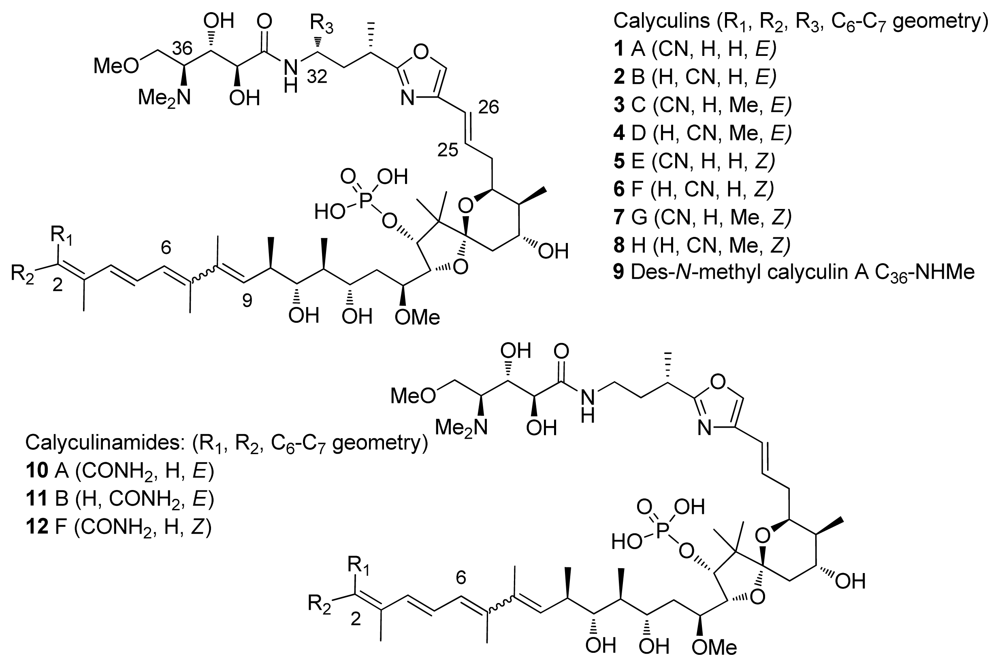
<p>Calyculins are a class of highly cytotoxic metabolites originally isolated from the marine sponge <italic>Discodermia calyx</italic> by Fusetani and co-workers. The first member, calyculin A, was isolated in 1986 from a sponge collected in the Gulf of Sagami, near Tokyo Bay [<xref ref-type="bibr" rid="b8-marinedrugs-08-00122">8</xref>–<xref ref-type="bibr" rid="b15-marinedrugs-08-00122">15</xref>]. The sponge still remains the primary source of the natural product. The structures of different calyculins and structurally-related calyculinamides are shown in <xref ref-type="fig" rid="f1-marinedrugs-08-00122">Figure 1</xref>. The most naturally abundant members of the family are calyculins A and C.</p>
<p>The structure of complex natural products may sometimes lead, even with the help of modern analytical methods, to misassignments of the absolute stereochemistry. In such cases, total synthesis can be the key for proving the absolute stereochemistry of the natural product. Calyculins provide an excellent example as Shioiri and co-workers ascertained the absolute stereochemistry of calyculins by synthesis in 1991 shortly after Fusetani disclosed the absolute configuration of calyculin A [<xref ref-type="bibr" rid="b16-marinedrugs-08-00122">16</xref>,<xref ref-type="bibr" rid="b17-marinedrugs-08-00122">17</xref>]. In their original article, Fusetani and co-workers presented a structure for calyculin A that appeared to be the enantiomer of the natural product [<xref ref-type="bibr" rid="b11-marinedrugs-08-00122">11</xref>]. Although being very clear about the uncertainty of the absolute configuration, the then ongoing synthetic efforts towards the calyculins had been directed to the non-natural enantiomer. As a consequence, three of the six published total syntheses of calyculins have yielded the wrong enantiomer [<xref ref-type="bibr" rid="b18-marinedrugs-08-00122">18</xref>–<xref ref-type="bibr" rid="b23-marinedrugs-08-00122">23</xref>].</p></sec>
<sec>
<title>2. Importance of Protein Phosphatases</title>
<p>Phosphorylation-dephosphorylation of proteins is one of the most essential mechanisms for the proper functioning of cells. It affects almost all cellular functions such as metabolism, signal transduction, cell division, and memory. Protein kinases have long been known for the regulatory properties of phosphorylation and dephosphorylation. Although it has been recognised only later, protein phosphatases (PP) have also a great influence for these regulation processes. Phosphatases that catalyze dephosphorylation of serine and threonine residues are encoded by the phospho protein phosphatase (PPP) and protein phosphatase magnesium-dependent (PPM) gene families, whereas the protein tyrosine phosphatases (PTPs) dephosphorylate phosphotyrosine amino acids [<xref ref-type="bibr" rid="b2-marinedrugs-08-00122">2</xref>,<xref ref-type="bibr" rid="b3-marinedrugs-08-00122">3</xref>]. PP enzymes play a very dynamic role in cellular signalling, particularly because they can be turned on and off through very tight regulation of their subunit composition and selective targeting. These functions are regulated by allosteric modification using second messengers and reversible protein phosphorylation to create specific subcellular multi-protein signalling modules [<xref ref-type="bibr" rid="b2-marinedrugs-08-00122">2</xref>,<xref ref-type="bibr" rid="b6-marinedrugs-08-00122">6</xref>,<xref ref-type="bibr" rid="b7-marinedrugs-08-00122">7</xref>].</p>
<p>The total number of phosphatases discovered is over 100 but it has been estimated that the total number could be as many as 1,000 [<xref ref-type="bibr" rid="b6-marinedrugs-08-00122">6</xref>]. PP1, PP2A, PP2B, and PP2C are the most widely studied phosphatases and also account for the majority of the protein serine/threonine activity <italic>in vivo</italic>. PP1, PP2A, and PP2B belong to the family of PPPs and their enzymatic activity is dependent upon Ca<sup>2+</sup>/Calmodulin, whereas PP2C of the PPM family is Mg<sup>2+</sup> dependent [<xref ref-type="bibr" rid="b2-marinedrugs-08-00122">2</xref>,<xref ref-type="bibr" rid="b3-marinedrugs-08-00122">3</xref>].</p>
<p>Extracellular signals, such as hormones and growth factors, affect the regulatory subunits and thereby modify the substrate specificity of PP1, which is involved in glycogen metabolism, muscle contraction, cell cycle progression, neuronal activities, and splicing of RNA. Recently, PP2A has been the focus of important interest since it accounts for 1% of total cellular proteins, and for the major portion of serine and threonine phosphatase activity in most tissues and cells. Although PP2A is involved in a great variety of cellular processes, including cell metabolism, signalling, and cell cycle control as well as the control of telomerase activity, its specific role is less delineated [<xref ref-type="bibr" rid="b2-marinedrugs-08-00122">2</xref>,<xref ref-type="bibr" rid="b3-marinedrugs-08-00122">3</xref>].</p>
<p>The holoenzyme of PP2A consists of three subunits, named A, B, and C. The catalytic subunit C is always associated with the scaffolding subunit A, which modulates its enzymatic properties by coordinating the protein-protein targeting to protein kinases and cytoskeletal proteins [<xref ref-type="bibr" rid="b7-marinedrugs-08-00122">7</xref>]. The holoenzyme of PP1 contains also a catalytic subunit C. PP1’s and PP2A’s C subunits are structurally related, and share 50% amino acid identity [<xref ref-type="bibr" rid="b6-marinedrugs-08-00122">6</xref>]. The regulative subunit B, subdivided into B, B′, B″, is encoded by separate genes, and can bind to AC with wide variety of heteromeric complexes. It is believed that individual subunits cannot exist individually <italic>in vivo</italic>; however, AC dimers are abundant in tissues. To date, two isoforms (α, β) of subunits A and C have been described, and there is an ever-growing number of B-type isoforms. The homologues of mammalian PP2A subunits have been identified from diverse origins such as algae, higher plants, and yeast. Moreover, although PP2A is primarily a serine and threonine phosphatase, it can, in specific circumstances, display an independent phosphotyrosyl phosphatase (PTP) activity. The diversity and selectivity of PP2A has been linked to the coverable three dimensional holoenzyme [<xref ref-type="bibr" rid="b7-marinedrugs-08-00122">7</xref>].</p>
<p>Protein phosphatase signalling plays an important role in many human diseases [<xref ref-type="bibr" rid="b3-marinedrugs-08-00122">3</xref>–<xref ref-type="bibr" rid="b5-marinedrugs-08-00122">5</xref>]. Unfortunately, studies towards determining the signalling mechanism have been slowed down by the absence of a PP2A crystal structure [<xref ref-type="bibr" rid="b4-marinedrugs-08-00122">4</xref>]. Many observations support the role of PP2A in tumorogenesis although PP2A inhibitors can also display anti-tumour activity [<xref ref-type="bibr" rid="b3-marinedrugs-08-00122">3</xref>–<xref ref-type="bibr" rid="b5-marinedrugs-08-00122">5</xref>]. The mutations in the gene encoding the subunit A in human breast, lung, and colorectal carcinomas, as well as in melanomas strengthen the notion of tumorigenesis activity [<xref ref-type="bibr" rid="b4-marinedrugs-08-00122">4</xref>,<xref ref-type="bibr" rid="b7-marinedrugs-08-00122">7</xref>]. However, it has not been unequivocally established so far whether such mutations, examples of which have been found in human cancer cells, result in the activation of an oncogenic function or rather in the inactivation of the presumed tumour suppressive role of PP2A. The exact effect of PP2As has been found complicated since it can exert inhibiting as well as stimulating control on cell proliferation. This might indicate activity of several different PP2A complexes during these processes [<xref ref-type="bibr" rid="b5-marinedrugs-08-00122">5</xref>].</p>
<p>The major members of PPP family are highly concentrated in the brain, and are fundamental elements of complex signalling system controlling neuronal function. PP1 is widely distributed in neurons and has multiple functions. Targeted inhibition of PP1 is a potential strategy for minimizing the symptoms associated with Parkinson’s disease [<xref ref-type="bibr" rid="b4-marinedrugs-08-00122">4</xref>]. PP2A activity also affects human neurodegenerative diseases. In Alzheimer’s disease, the activity levels of PP2A are significantly decreased. Altogether, PP2A-dependent PI 3-kinase signalling plays a crucial role in neuronal survival [<xref ref-type="bibr" rid="b4-marinedrugs-08-00122">4</xref>,<xref ref-type="bibr" rid="b7-marinedrugs-08-00122">7</xref>].</p>
<p>Both PP1 and PP2A are involved in the mediation of insulin action on carbohydrate and lipid metabolism. More specifically, activation of PP1 and inactivation of PP2A can affect insulin stimulation. Type 2 <italic>diabetes mellitus</italic> is characterized by variation of insulin resistance. Therefore, molecules involved in the insulin signalling cascade are potential targets for therapeutic drug design; both PP1 and PP2A have been involved in these studies.</p>
<p>PP2A signalling also regulates the transcription factors Sp1 and NK-κB which are essential modulators of cellular gene expression and viral transcription of many human viruses, such as HIV-1, cytomegalovirus, hepatitis B, herpes simplex type 1, Epstein-Bass virus, and papillomavirus. Recent studies also suggest that PP2A signalling participates in parasite-transmitted human diseases such as malaria [<xref ref-type="bibr" rid="b7-marinedrugs-08-00122">7</xref>].</p></sec>
<sec>
<title>3. Inhibition of Protein Phosphatases PP1 and PP2A by Naturally Occurring Toxins</title>
<p>In contrast to many enzymes, protein phosphatases, especially PP1 and PP2A, exhibit broad and overlapping substrate specificity, with no apparent substrate consensus sequence. Because the protein phosphatases affect other proteins and have literally hundred of substrates, it has been challenging to describe the mode of action of these biological catalysts and their regulation. For that reason, much of the information gathered from the functioning of protein phosphatases is based on inhibition studies [<xref ref-type="bibr" rid="b6-marinedrugs-08-00122">6</xref>].</p>
<p>Protein inhibitors have been used to study the mechanism of protein phosphatase inhibition. However, they suffer from some shortages: proteolytic degradation, poor membrane permeability, high molecular weight, potential instability, and often unavailability in sufficient quantity. To avoid these problems, small molecule inhibitors are often used. Many naturally occurring molecules, with wide structurally diversity, have been identified to either selectively or specifically inhibit the phosphatases. Alkaloids, terpenes, oligosaccharides, and polyketides have evolved to imitate and/or complement small areas of molecular surfaces of protein-peptides [<xref ref-type="bibr" rid="b6-marinedrugs-08-00122">6</xref>].</p>
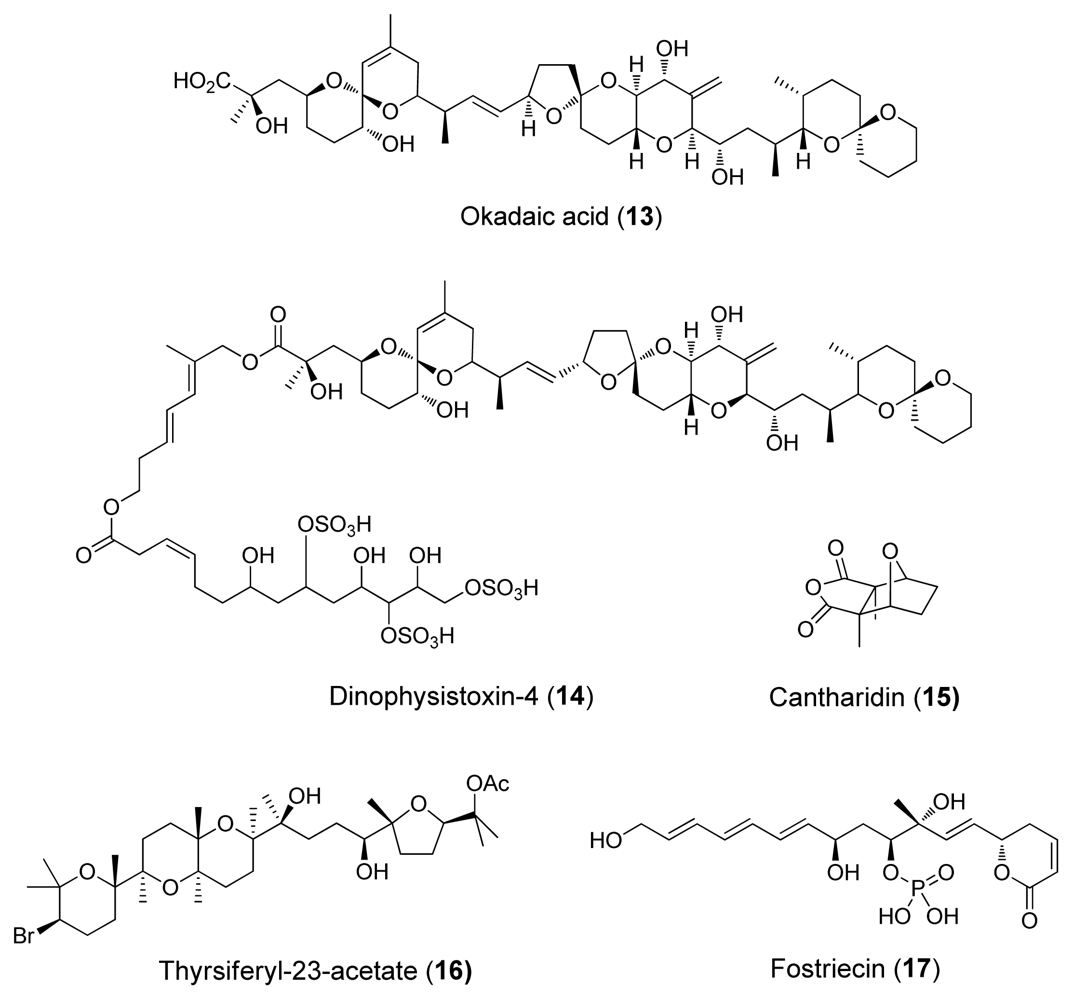
<p>Several natural products from different structural groups have been identified to inhibit serine/threonine-specific protein phosphatases. The natural toxin inhibitors are also known as the <italic>okadaic acid class</italic> inhibitors (<xref ref-type="fig" rid="f1-marinedrugs-08-00122">Figures 1</xref>–<xref ref-type="fig" rid="f4-marinedrugs-08-00122">4</xref>). Okadaic acid, the causative agent of diarrhetic seafood poisoning [<xref ref-type="bibr" rid="b4-marinedrugs-08-00122">4</xref>], was the first of these inhibitors discovered in 1981. It is a marine polyketide initially found from marine sponges <italic>Halicondria okadai</italic> and <italic>Halicondria melanodocia</italic>.</p>
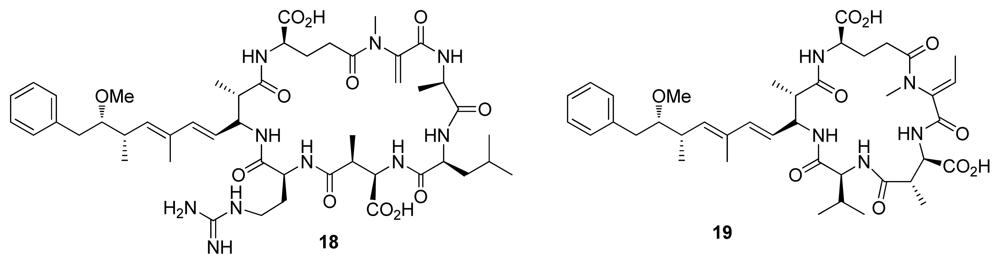
<p>Cyclic peptides such as microcystins (e.g., microcystin–LR (<bold>18</bold>)) and nodularins were initially isolated from blue green algae and are potent inhibitors of PP1 and PP2A, but poor PP2B and PP2C inhibitors. Another cyclic peptide motuporin (<bold>19</bold>), also known as nodularin-V, was isolated from the marine sponge <italic>Theonella swinhoei gray</italic> (<xref ref-type="fig" rid="f3-marinedrugs-08-00122">Figure 3</xref>) [<xref ref-type="bibr" rid="b4-marinedrugs-08-00122">4</xref>]. Both microcystins and motuporin share the rare aminoacid ADDA, which interacts with the hydrophobic groove of PP1.</p>
<p>As mentioned earlier several different structural groups can bind PP1 and PP2A, which makes the classification of these inhibitors challenging. The inhibitors can be classified by structure but a valid choice is classification based on PP1/PP2A selectivity. Based on different inhibition studies and screening, a large number of structurally interesting natural products has been identified to bind PP1 and PP2A more or less selectively. The IC<sub>50</sub> values of selected molecules are collected in <xref ref-type="table" rid="t1-marinedrugs-08-00122">Table 1</xref>, as well as the origin and structural class.</p>
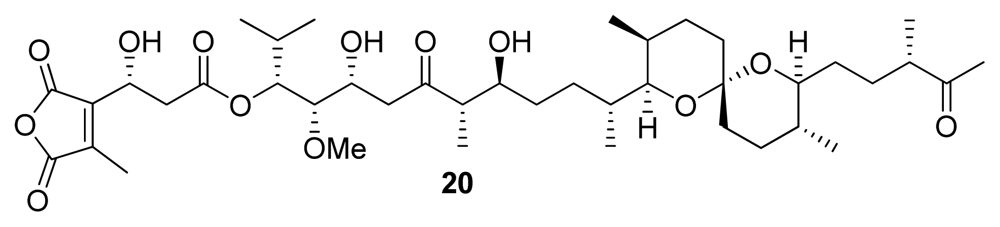
<p>From the biological activity data (<xref ref-type="table" rid="t1-marinedrugs-08-00122">Table 1</xref>) it can be observed that okadaic acid (<bold>13</bold>), dinophysistoxin (<bold>14</bold>), cantharidin (<bold>15</bold>) and its derivative, thyrsiferyl-23-acetate (<bold>16</bold>), as well as phosphate-bearing inhibitor fostriecin (<bold>17</bold>) (<xref ref-type="fig" rid="f2-marinedrugs-08-00122">Figure 2</xref>) are selective PP2A inhibitors. Although some common structures such as spiroketal moieties can be identified, the observed PP1 and PP2A differences cannot be adequately explained with the current structure-activity relationship data [<xref ref-type="bibr" rid="b6-marinedrugs-08-00122">6</xref>]. However, the binding data of <xref ref-type="table" rid="t1-marinedrugs-08-00122">Table 1</xref> indicates that tautomycin (<bold>20</bold>) (<xref ref-type="fig" rid="f4-marinedrugs-08-00122">Figure 4</xref>) and calyculins show slight PP1 selectivity. Tautomycin was first isolated from <italic>Streptomyces spiroverticillatus</italic> and is the first inhibitor to display preferential inhibition of PP1 (<xref ref-type="fig" rid="f4-marinedrugs-08-00122">Figure 4</xref>) [<xref ref-type="bibr" rid="b4-marinedrugs-08-00122">4</xref>].</p>
<p>Mutagenesis and natural products studies indicate that acidic groove residues are a key feature in the active site of PP1 [<xref ref-type="bibr" rid="b4-marinedrugs-08-00122">4</xref>]. This could mean that the binding region in PP2A is more hydrophobic than the one in PP1, and therefore more accessible to hydrophobic inhibitors such as thyrsiferyl-23-acetate (<bold>16</bold>) (<xref ref-type="fig" rid="f2-marinedrugs-08-00122">Figure 2</xref>).</p></sec>
<sec>
<title>4. Calyculins and Related Structures</title>
<sec>
<title>4.1. Origin</title>
<p>The first isolated calyculin was calyculin A (<bold>1</bold>) in 1986, followed by calyculins B-D (<bold>2</bold>–<bold>4</bold>) in 1988, calyculins E-H (<bold>5</bold>–<bold>8</bold>) in 1990 and calyculin J (<bold>25</bold>) in 1997 [<xref ref-type="bibr" rid="b9-marinedrugs-08-00122">9</xref>–<xref ref-type="bibr" rid="b15-marinedrugs-08-00122">15</xref>]. <italic>D. calyx</italic> belongs to the order of lithistid sponges, which are an artificial assemblage of species of diverse origin known from their ability to produce diverse array of biologically active metabolites such as polyketides, cyclic peptides, alkaloids, pigments, and novel sterols [<xref ref-type="bibr" rid="b9-marinedrugs-08-00122">9</xref>].</p>
<p>Calyculin related structures have also been found from other marine sponges, such as <italic>Lamellomorpha strongylata</italic> which was collected at the Chantam Rise off the East Coast of South Island of New Zealand in 1995 and whose extraction afforded calyculinamides A (<bold>10</bold>) and B (<bold>11</bold>) [<xref ref-type="bibr" rid="b10-marinedrugs-08-00122">10</xref>]. Calyculinamide A (<bold>10</bold>), calyculinamide F (<bold>12</bold>), des-<italic>N</italic>-methyl calyculin A (<bold>9</bold>), and dephosphocalyculin A (<bold>24</bold>) were isolated in 1997 from <italic>D. calyx</italic> [<xref ref-type="bibr" rid="b13-marinedrugs-08-00122">13</xref>]. Further, calyculin derivatives clavosines A-C (<bold>21</bold>–<bold>23</bold>) were isolated in 1998 from the marine sponge <italic>Myriastra clavosa</italic> (<xref ref-type="fig" rid="f5-marinedrugs-08-00122">Figure 5</xref>) [<xref ref-type="bibr" rid="b25-marinedrugs-08-00122">25</xref>]. In 2001, Epipolasid sponge <italic>Lufariella geometrica</italic> was collected at Heron Island’s Wistari Reef, Australia, and allowed the isolation of another novel calyculin derivative, geometricin A (<bold>26</bold>) [<xref ref-type="bibr" rid="b26-marinedrugs-08-00122">26</xref>]. The latest isolated calyculin derivative is swinhoeiamide A (<bold>27</bold>) from the lithistid sponge <italic>Theonella svinhoei</italic> [<xref ref-type="bibr" rid="b27-marinedrugs-08-00122">27</xref>].</p>
<p>To this day, totally eighteen calyculins and calyculin related structures have been isolated. Calyculin A is formed from four different structural regions: C<sub>1</sub>–C<sub>8</sub> tetraene, C<sub>9</sub>–C<sub>25</sub> dipropionate spiroketal, C<sub>26</sub>–C<sub>32</sub> oxazole and C<sub>33</sub>–C<sub>37</sub> amino acid, these subunits are represented in <xref ref-type="fig" rid="f1-marinedrugs-08-00122">Figure 1</xref>. Calyculins differ from each other by the methyl group at C<sub>32</sub> and the geometry of C<sub>2,3</sub> and C<sub>6,7</sub> olefins [<xref ref-type="bibr" rid="b9-marinedrugs-08-00122">9</xref>–<xref ref-type="bibr" rid="b15-marinedrugs-08-00122">15</xref>]. The geometry of C<sub>2,3</sub> and C<sub>6,7</sub> olefins are also the critical sites of the structural differences in calyculinamides as well as in clavosines. In the latter, the C<sub>21</sub> hydroxyl group is also in the <italic>S</italic> configuration, and is glycosylated by a trimethoxyrhamnose [<xref ref-type="bibr" rid="b10-marinedrugs-08-00122">10</xref>,<xref ref-type="bibr" rid="b13-marinedrugs-08-00122">13</xref>,<xref ref-type="bibr" rid="b25-marinedrugs-08-00122">25</xref>]. Calyculin J (<bold>25</bold>) is a C<sub>9</sub> brominated derivative of <bold>1</bold> where C<sub>8–11</sub> and C<sub>11</sub> oxygen form a tetrahydrofuran ring. Geometricin A (<bold>26</bold>), swinhoeiamide A (<bold>27</bold>), and hemicalyculin A (<bold>28</bold>) could be described as rump calyculin derivatives since the most significant difference comparing to calyculins is the lack of the polar region [<xref ref-type="bibr" rid="b26-marinedrugs-08-00122">26</xref>–<xref ref-type="bibr" rid="b28-marinedrugs-08-00122">28</xref>].</p></sec>
<sec>
<title>4.2. Crystal structures of calyculins and their binding to protein phosphatases</title>
<p>Several research groups have studied the structure-activity relationships (SARs) of naturally occurring toxins to PP1 and PP2A. Quinn <italic>et. al.</italic> developed a pharmacophore model for the binding of okadaic acid (<bold>13</bold>), calyculin A (<bold>1</bold>) and microcystin LR (<bold>18</bold>) to PP1 [<xref ref-type="bibr" rid="b29-marinedrugs-08-00122">29</xref>]. Competitive binding assays with <bold>13</bold>, <bold>1</bold>, <bold>18</bold> and tautomycin (<bold>20</bold>) suggested that at least these toxins share a common binding site [<xref ref-type="bibr" rid="b30-marinedrugs-08-00122">30</xref>]. The absolute stereochemistry of the calyculins was first published in 1991 by Shioiri <italic>et. al</italic>. [<xref ref-type="bibr" rid="b16-marinedrugs-08-00122">16</xref>]. The first publication of X-ray structure of PP1 in 1995 [<xref ref-type="bibr" rid="b31-marinedrugs-08-00122">31</xref>] soon inspired four docking studies in 1997 [<xref ref-type="bibr" rid="b24-marinedrugs-08-00122">24</xref>,<xref ref-type="bibr" rid="b32-marinedrugs-08-00122">32</xref>–<xref ref-type="bibr" rid="b34-marinedrugs-08-00122">34</xref>]. However, the first two groups, Armstrong and Holmes, used the incorrect enantiomer of crystal structure. Their initial idea was that the binding of the toxins would not change the structure significantly [<xref ref-type="bibr" rid="b8-marinedrugs-08-00122">8</xref>]. This seems to be possible for cyclic microcystines and nodularins; however, with open chain molecules such as calyculins, this approach is unlikely [<xref ref-type="bibr" rid="b34-marinedrugs-08-00122">34</xref>].</p>
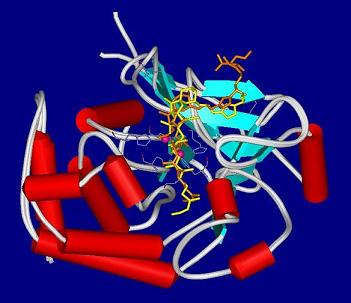
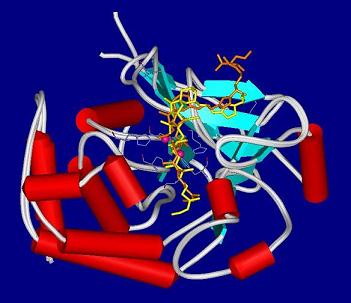
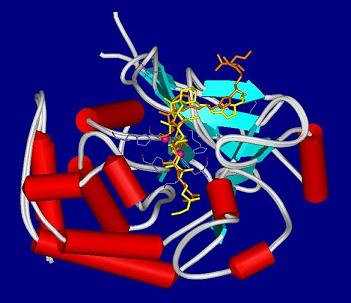
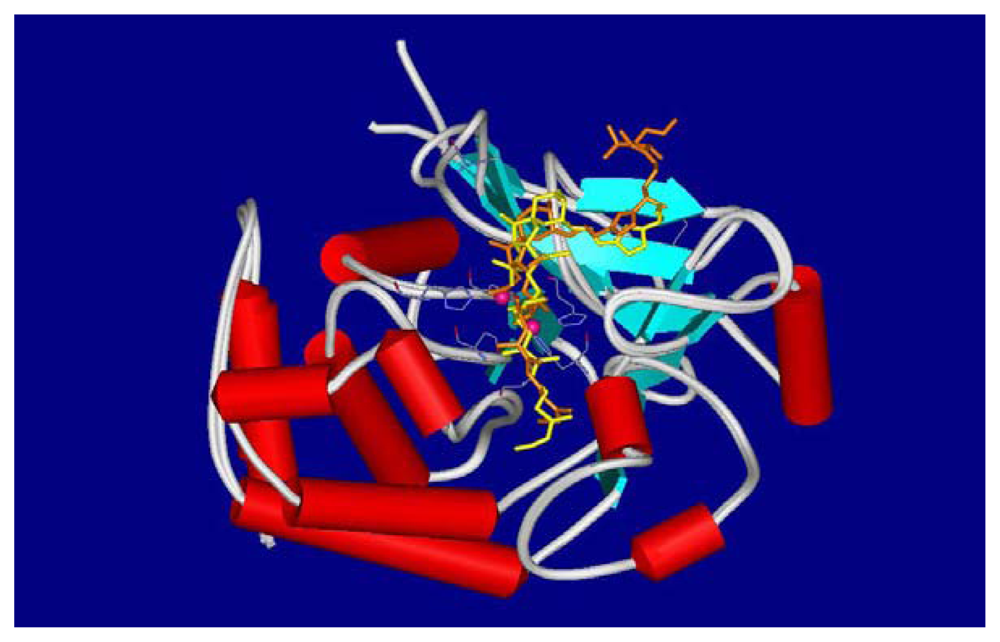
<p>Calyculins as well as other inhibitors have been targets of continuous study and several binding models have been proposed [<xref ref-type="bibr" rid="b28-marinedrugs-08-00122">28</xref>,<xref ref-type="bibr" rid="b35-marinedrugs-08-00122">35</xref>–<xref ref-type="bibr" rid="b37-marinedrugs-08-00122">37</xref>]. The binding mode of calyculin A (<bold>1</bold>) to the active site of PP1 is shown in <xref ref-type="fig" rid="f6-marinedrugs-08-00122">Figure 6</xref>: <bold>1</bold> is represented according to its crystal structure in orange [<xref ref-type="bibr" rid="b35-marinedrugs-08-00122">35</xref>], in yellow is the calyculin model built by Koskinen [<xref ref-type="bibr" rid="b34-marinedrugs-08-00122">34</xref>].</p>
<p>The SARs of calyculins indicate that the phosphate, the hydroxyl C<sub>13</sub>, and the hydrophobic polyketide tail are essential for their inhibitory action. The dipeptide portion was less important in the interaction with enzymes, but essential for cytotoxicity [<xref ref-type="bibr" rid="b28-marinedrugs-08-00122">28</xref>,<xref ref-type="bibr" rid="b35-marinedrugs-08-00122">35</xref>]. However, compared to <bold>1</bold>, dephosphonocalyculin A (<bold>24</bold>) was inactive, which was already examined [<xref ref-type="bibr" rid="b15-marinedrugs-08-00122">15</xref>]. This could indicate that phosphate group is less important for the binding.</p>
<p>It should be noted that the published models are still speculative. The prediction of enzyme-inhibitor interaction is challenging because there are so many parameters affecting the system. Site-directed mutagenesis studies and SAR data for serine/threonine protein phosphatases are useful, but the interpretation of the results can be difficult. Even the models of most simple enzymes contain so wide range of contacts that the interpretation is difficult. Calyculin fragments would give a useful addition to PP1, PP2A binding and SAR studies. In future, design of simpler and more selective inhibitors would also be possible.</p></sec></sec>
<sec>
<title>5. Synthetic Approaches towards Calyculins</title>
<p>The fascinating structures of calyculins have drawn a great amount of attention and resources. The first total synthesis of <italic>ent</italic>-calyculin A (<bold>1</bold>) was published by Evans <italic>et al.</italic> in 1992 [<xref ref-type="bibr" rid="b18-marinedrugs-08-00122">18</xref>]. Two years later, Masamune <italic>et al.</italic> published the first total synthesis of the natural enantiomer of <bold>1</bold> [<xref ref-type="bibr" rid="b19-marinedrugs-08-00122">19</xref>]. In 1996, the Shioiri group published a formal total synthesis of <bold>1</bold> [<xref ref-type="bibr" rid="b20-marinedrugs-08-00122">20</xref>]. Total synthesis of <italic>ent</italic>-calyculin A and B by Smith <italic>et al.</italic> [<xref ref-type="bibr" rid="b22-marinedrugs-08-00122">22</xref>] and calyculin C by the Armstrong group were published in 1998 [<xref ref-type="bibr" rid="b21-marinedrugs-08-00122">21</xref>]. The latest total synthesis of <italic>ent</italic>-calyculin A was published by Barrett <italic>et al.</italic> in 2001 [<xref ref-type="bibr" rid="b23-marinedrugs-08-00122">23</xref>]. The Koskinen group has been involved in the preparation of individual fragments [<xref ref-type="bibr" rid="b38-marinedrugs-08-00122">38</xref>–<xref ref-type="bibr" rid="b46-marinedrugs-08-00122">46</xref>]. Only the studies of these seven groups will be examined in detail in this review.</p>
<p>The total synthesis of calyculins has been reviewed by Jacobs and Itching in 1998 [<xref ref-type="bibr" rid="b47-marinedrugs-08-00122">47</xref>], and by Pihko and Koskinen in 1999 [<xref ref-type="bibr" rid="b48-marinedrugs-08-00122">48</xref>]. The retrosynthetic analyses, as well as the preparation of individual fragments, and the final assembly of the fragments are presented in the following section. In order to compare the different methods, we will first present the preparation of the different fragments separately. Then, the assembly of these fragments to reach the calyculins will be discussed. The total syntheses of calyculins will be presented in chronological order and, for clarity, the different fragments will be described in the same order of publishing year of the total syntheses.</p>
<sec sec-type="methods">
<title>5.1. Retrosynthetic analysis</title>
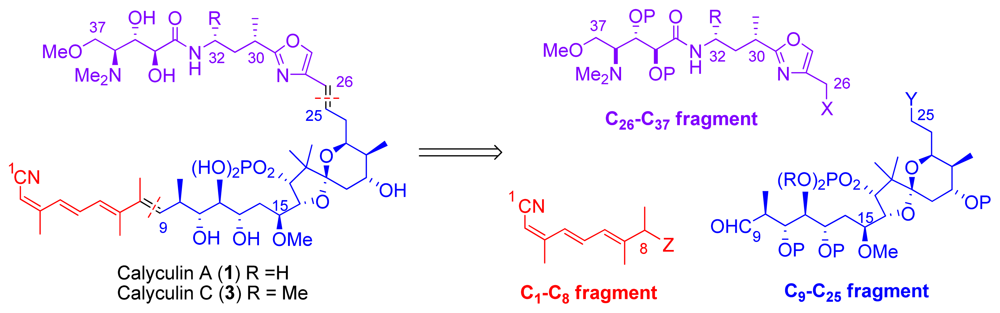
<p>The retrosynthetic analysis of the calyculin skeleton divides it into three fragments: the C<sub>1</sub>–C<sub>8</sub> tetraene subunit, the C<sub>9</sub>–C<sub>25</sub> dipropionate spiroketal subunit, and the C<sub>26</sub>–C<sub>37</sub> amino acid oxazole subunit (<xref ref-type="fig" rid="f7-marinedrugs-08-00122">Scheme 1</xref>).</p>
<p>Further, the C<sub>26</sub>–C<sub>37</sub> amino acid oxazole subunit is divided into two subunits: the amino acid C<sub>33</sub>–C<sub>37</sub> subunit and the oxazole C<sub>26</sub>–C<sub>32</sub> subunit (<xref ref-type="fig" rid="f8-marinedrugs-08-00122">Scheme 2</xref>).</p>
<p>The retrosynthetic analysis and the executions of the different fragments are described in the following sections.</p></sec>
<sec>
<title>5.2. C<sub>1</sub>–C<sub>8</sub> tetraene fragment</title>
<p>For the synthesis of this fragment, a number of renowned reactions can be highlighted: Horner-Wadsworth- Emmons (HWE), Peterson olefination, Stille coupling, and related Negishi and Suzuki couplings. Evans and co-workers [<xref ref-type="bibr" rid="b18-marinedrugs-08-00122">18</xref>] were the first to report that the HWE reaction to couple the entire tetraene is not possible due to the unstable cyano group and tetraenes tendency to isomerisation. The uses of sp<sup>2</sup>-sp<sup>2</sup> couplings methods such as the Stille coupling were tempting since the double bond geometries of the starting materials are completely retained in the reaction.</p>
<p>Based on the disconnections of the building blocks, the retrosynthetic analysis of tetraene can be divided into three groups (<xref ref-type="fig" rid="f9-marinedrugs-08-00122">Scheme 3</xref>). Smith’s group choose to disconnect in position <italic>a</italic> and <italic>d</italic> which gives nitrile <bold>29</bold> and phosphate <bold>30</bold> [<xref ref-type="bibr" rid="b22-marinedrugs-08-00122">22</xref>], whereas Evans’ and Armstrong’s target was to create vinyl iodide <bold>31</bold> and phosphate <bold>32</bold>, <italic>via b</italic> and <italic>d</italic> disconnections [<xref ref-type="bibr" rid="b18-marinedrugs-08-00122">18</xref>,<xref ref-type="bibr" rid="b21-marinedrugs-08-00122">21</xref>]. Finally, Masamune and Barrett chose <italic>c</italic> and <italic>d</italic> disconnections involving intermediates <bold>33</bold> and <bold>34</bold> [<xref ref-type="bibr" rid="b19-marinedrugs-08-00122">19</xref>,<xref ref-type="bibr" rid="b23-marinedrugs-08-00122">23</xref>].</p>
<p>In addition, a few other approaches and ideas for the synthesis of this fragment have been published. For example, Negishi <italic>et al.</italic> recently proposed that propyne bromoboration and tandem Pd-catalyzed cross coupling could be used in the synthesis of C<sub>1</sub>–C<sub>8</sub> fragment [<xref ref-type="bibr" rid="b49-marinedrugs-08-00122">49</xref>].</p>
<sec>
<title>5.2.1. Evans [<xref ref-type="bibr" rid="b18-marinedrugs-08-00122">18</xref>]</title>
<p>Evans’ synthesis of phosphonate diene <bold>32</bold> began with vinyl stannane <bold>35</bold> which was prepared by reduction of methyl (<italic>E</italic>)-3-(tributylstannyl)-2-propionate (<xref ref-type="fig" rid="f10-marinedrugs-08-00122">Scheme 4</xref>). Swern oxidation followed by HWE reaction gave diene ester <bold>36</bold> as a 19:1 <italic>E:Z</italic> mixture. Reduction of the ester furnished alcohol <bold>37</bold>, which was converted to phosphonate <bold>38</bold> by the Michaelis-Becker method. Final methylation of <bold>38</bold> completed the synthesis of targeted phosphonate <bold>32</bold>.</p></sec>
<sec>
<title>5.2.2. Masamune [<xref ref-type="bibr" rid="b19-marinedrugs-08-00122">19</xref>]</title>
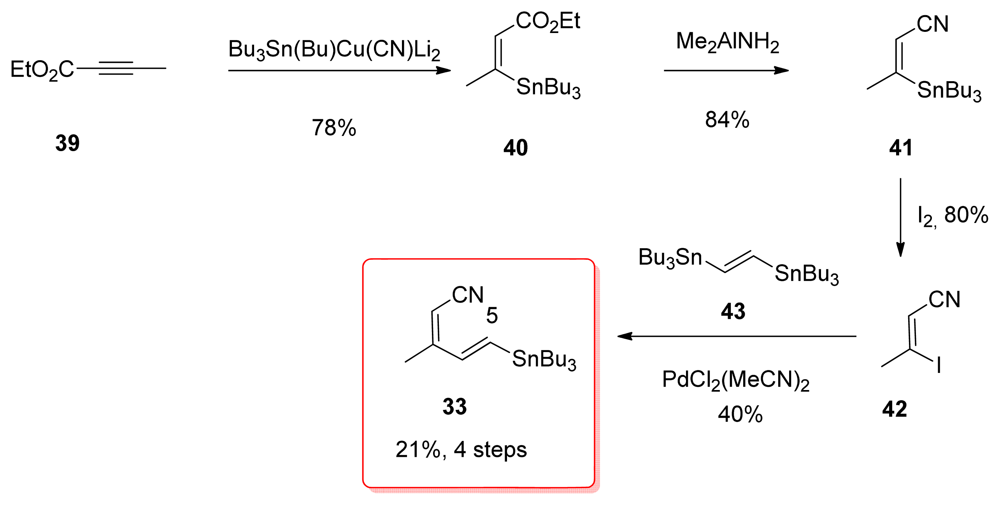
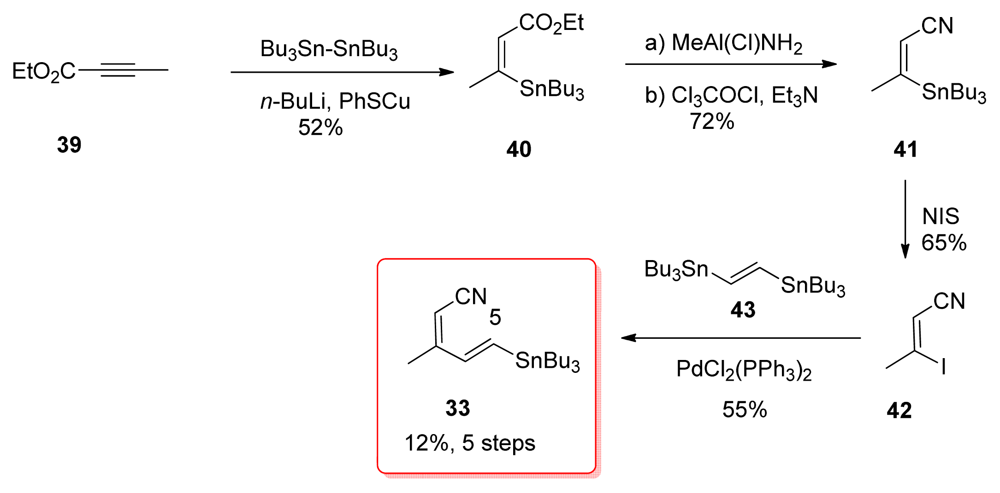
<p>The fact that tributylstannyl moieties can be easily converted to the corresponding iodide was utilized in the synthesis of the tetraene fragment by Masamune <italic>via</italic> fragments <bold>33</bold> and <bold>34</bold>. However, the synthesis of <bold>33</bold> has not been published, and the preparation described here has been found in the PhD thesis of S. A. Filla [<xref ref-type="bibr" rid="b50-marinedrugs-08-00122">50</xref>]. Addition of Lipschutz higher cuprate Bu<sub>3</sub>SN(Bu)Cu(CN)Li<sub>2</sub> to ethyl butynoate <bold>39</bold> occurred regioselectively to furnish the (<italic>Z</italic>)-enoate <bold>40</bold> in good yield (<xref ref-type="fig" rid="f11-marinedrugs-08-00122">Scheme 5</xref>). Treatment of <bold>40</bold> with the Weinreb reagent produced nitrile <bold>41</bold>. Tin-iodide exchange gave vinyl iodide <bold>42</bold> whose Stille coupling with <italic>trans</italic>-1,2-bis(tri-<italic>n</italic>-butylstannyl)ethylene (<bold>43</bold>) produced the expected stannane <bold>33</bold> in a modest 40% yield.</p>
<p>The protected 3-butyl-2-ol <bold>44</bold> was reacted with methylcopper (I) reagent followed by iodination to give vinyl iodide <bold>45</bold>. (<xref ref-type="fig" rid="f16-marinedrugs-08-00122">Scheme 10</xref>) This was converted to phosphonate <bold>46</bold> by an Arbuzov reaction and subsequent tin-iodine exchange with CuSnBu<sub>3</sub> yielded <bold>34</bold>. This last step appeared to be the weakest link in this part, lowering the global yield.</p></sec>
<sec>
<title>5.2.3. Shioiri [<xref ref-type="bibr" rid="b20-marinedrugs-08-00122">20</xref>]</title>
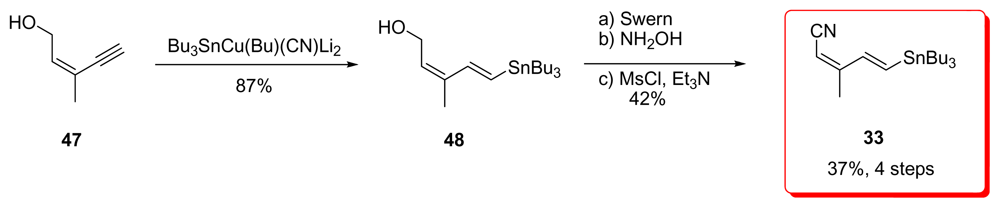
<p>Shioiri group’s strategy was to introduce the whole tetraene, actually the C<sub>1</sub>–C<sub>12</sub>, as a single moiety to the rest of the target molecule. Stannyl cupration of alcohol <bold>47</bold> was the key step, affording the stannyl derivative <bold>48</bold> in 87% yield. Further conversion of the alcohol to the corresponding nitrile generated <bold>33</bold> (<xref ref-type="fig" rid="f13-marinedrugs-08-00122">Scheme 7</xref>).</p>
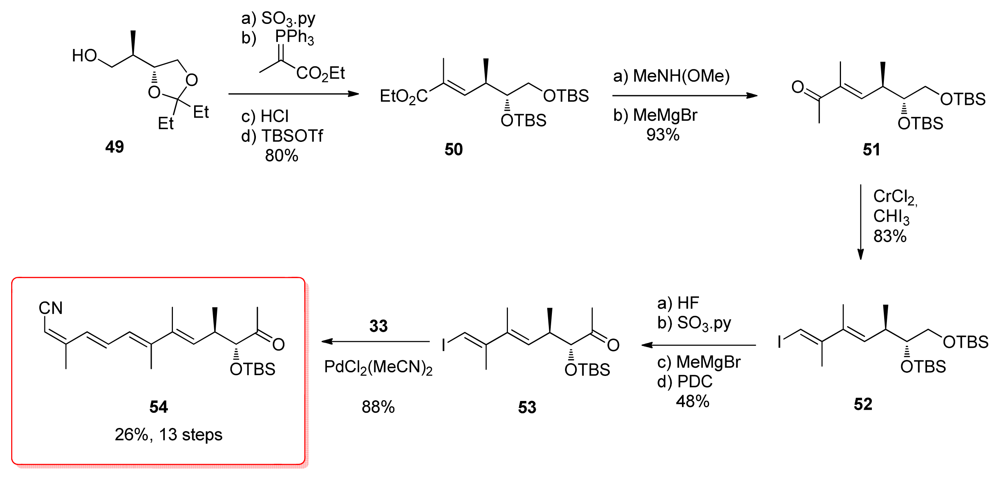
<p>The synthesis of the other coupling partner began with alcohol <bold>49</bold> which was readily available from <sc>l</sc>-(+)-tartrate (<xref ref-type="fig" rid="f14-marinedrugs-08-00122">Scheme 8</xref>). Parikh-Doering oxidation and subsequent HWE reaction were followed by conversion of the acetonide to the bis-TBS ether derivative <bold>50</bold>. Weinreb amide formation and reaction with methyl magnesium bromide furnished methyl ketone <bold>51</bold>, which was converted to (<italic>E</italic>)-vinyl iodine <bold>52</bold> by use of the Takai and Utimoto’s chromium reagent. Selective deprotection of the primary TBS group was followed by conversion of the resulting alcohol to the corresponding methyl ketone <bold>53</bold>. Final Stille coupling of <bold>53</bold> with stannane <bold>33</bold> produced <bold>54</bold>. Shioiri’s group has also published another strategy for the synthesis of this subunit; however, this method has not been used in the formal total synthesis [<xref ref-type="bibr" rid="b49-marinedrugs-08-00122">49</xref>].</p></sec>
<sec>
<title>5.2.4. Smith [<xref ref-type="bibr" rid="b22-marinedrugs-08-00122">22</xref>,<xref ref-type="bibr" rid="b51-marinedrugs-08-00122">51</xref>]</title>
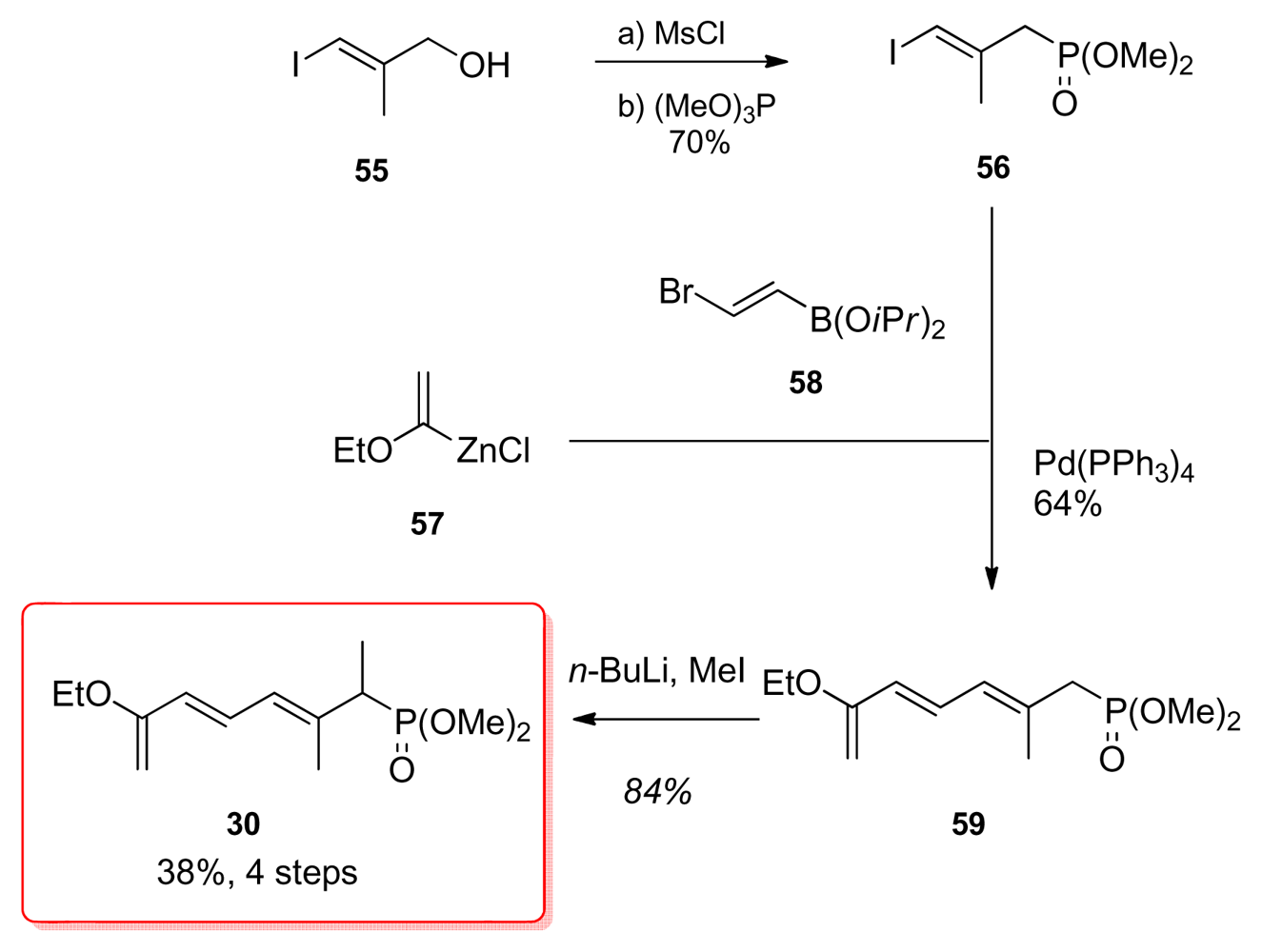
<p>Smith <italic>et al</italic>. began by synthesizing the iodo phosphonate <bold>56</bold> in two steps from allylic alcohol <bold>55</bold> (<xref ref-type="fig" rid="f15-marinedrugs-08-00122">Scheme 9</xref>). This was followed by a two stage one-pot coupling of the three components. The first part, the Negishi coupling of the organozinc compound <bold>57</bold> with bromoboronate <bold>58</bold> was followed by a Suzuki coupling with iodide <bold>55</bold> affording phosphonate <bold>59</bold> in 64% yield. Final methylation of <bold>59</bold> furnished <bold>30</bold>.</p></sec>
<sec>
<title>5.2.5. Armstrong [<xref ref-type="bibr" rid="b21-marinedrugs-08-00122">21</xref>,<xref ref-type="bibr" rid="b52-marinedrugs-08-00122">52</xref>]</title>
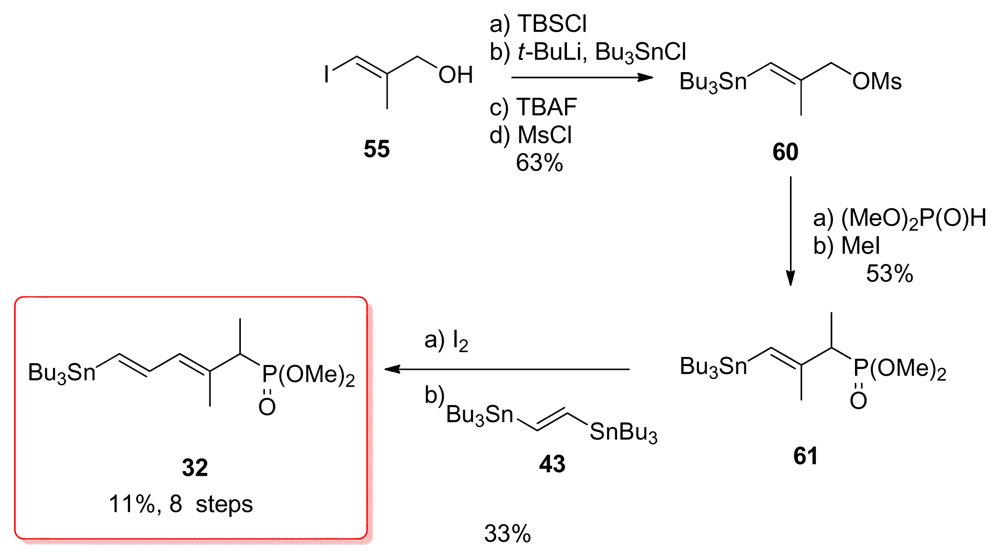
<p>Armstrong’s synthesis of the tetraene fragment also began with the iodo alcohol <bold>55</bold> and proceeded successfully using classical transformations to generate phosphonate <bold>61</bold>, which unfortunately appeared to be too unreactive toward hindered aldehydes (<xref ref-type="fig" rid="f16-marinedrugs-08-00122">Scheme 10</xref>). For this reason, the authors decided to convert <bold>61</bold> to diene <bold>32</bold>. Unfortunately, this transformation proceeded with a low yield of 33% over two steps, lowering the overall yield.</p></sec>
<sec>
<title>5.2.6. Barrett [<xref ref-type="bibr" rid="b23-marinedrugs-08-00122">23</xref>,<xref ref-type="bibr" rid="b53-marinedrugs-08-00122">53</xref>]</title>
<p>For the preparation of stannane <bold>33</bold>, Barrett <italic>et al.</italic> used a strategy similar in every aspect to the one presented earlier by Masamune; however, as mentioned before, Masamune’s results were not published. Conjugate addition of tributylstannyl cuprate to ethyl butynoate <bold>39</bold> gave (<italic>Z</italic>)-enoate <bold>40</bold>. Conversion of ethyl ester of <bold>40</bold> to the corresponding nitrile <bold>41</bold> was achieved <italic>via</italic> the amide in 2 steps. Metal-halogen exchange furnished vinyl iodide <bold>42</bold> and Stille coupling with <bold>43</bold> were the lasts steps for the preparation of <bold>33</bold>.</p>
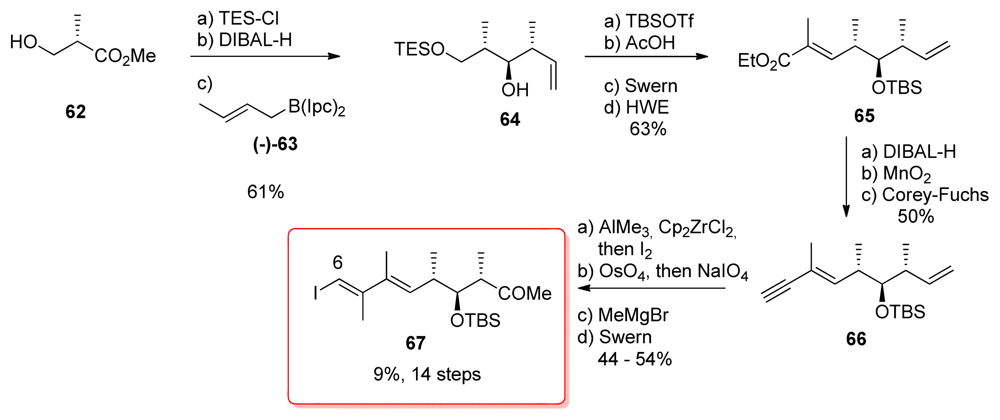
<p>The key idea of the synthesis of the C<sub>6</sub>-C<sub>14</sub> fragment was to construct the vinyl iodide <bold>67</bold> <italic>via</italic> methyl zirconation–iodonolysis of alkyne <bold>66</bold> using Negishi’s procedure (<xref ref-type="fig" rid="f18-marinedrugs-08-00122">Scheme 12</xref>). The synthesis started with commercially available methyl (<italic>S</italic>)-3-hydroxy-2-methylpropanoate (<bold>62</bold>) which was efficiently converted to homoallylic alcohol <bold>64</bold> by Brown’s homologation with (−)-<bold>63</bold> [<xref ref-type="bibr" rid="b54-marinedrugs-08-00122">54</xref>,<xref ref-type="bibr" rid="b55-marinedrugs-08-00122">55</xref>], setting the stereochemistry at C<sub>11</sub> and C<sub>12</sub> with excellent diastereomeric excess (&gt;96%). Further standard steps led to ester <bold>65</bold>, which was then reduced to aldehyde and homologated to the corresponding alkyne <bold>66</bold> using the Corey-Fuchs protocol. Methylzirconation-iodinolysis of <bold>66</bold> furnishing the corresponding vinyl iodide and final formation of the methyl ketone at C<sub>14</sub> were the final steps for the preparation of <bold>67</bold>.</p></sec>
<sec>
<title>5.2.7. Koskinen [<xref ref-type="bibr" rid="b40-marinedrugs-08-00122">40</xref>]</title>
<p>Koskinen <italic>et al.</italic> reported a short and efficient synthesis of alcohol <bold>37</bold>, which was used by Evans for the preparation of phosphonate <bold>32</bold> (<xref ref-type="fig" rid="f19-marinedrugs-08-00122">Scheme 13</xref>). Sequential treatment of distannyl compound <bold>43</bold> with <italic>n</italic>-BuLi and ZnCl<sub>2</sub>, followed by Pd-catalyzed Negishi coupling with bromo-ester <bold>68</bold>, furnished diene <bold>69</bold> in 95% yield. Reduction with DIBAL-H afforded the alcohol <bold>37</bold>. Introduction of the phosphonate moiety included bromination, Michaelis-Becker reaction and final methylation, following the procedure published by Evans <italic>et al.</italic> [<xref ref-type="bibr" rid="b18-marinedrugs-08-00122">18</xref>] gave <bold>32</bold>.</p></sec></sec>
<sec>
<title>5.3. Synthesis of the C<sub>9</sub>–C<sub>25</sub> dipropionate-spiroketal subunit</title>
<p>The C<sub>9</sub>–C<sub>25</sub> spiroketal-propionate subunit forms the core of the calyculins. With eleven stereocenters, a phosphate-bearing spiroketal, and <italic>anti, anti, anti</italic> dipropionate segment, the synthesis of this fragment is most challenging.</p>
<p>The construction of the C<sub>9</sub>–C<sub>25</sub> spiroketal-propionate subunit can be divided into four groups (<xref ref-type="fig" rid="f20-marinedrugs-08-00122">Scheme 14</xref>). Armstrong’s [<xref ref-type="bibr" rid="b21-marinedrugs-08-00122">21</xref>] and Koskinen’s group [<xref ref-type="bibr" rid="b44-marinedrugs-08-00122">44</xref>–<xref ref-type="bibr" rid="b46-marinedrugs-08-00122">46</xref>] chose to introduce the dipropionate in two parts and to use Brown’s asymmetric crotylborane chemistry, while Masamune <italic>et al.</italic> selected the asymmetric aldol strategy [<xref ref-type="bibr" rid="b19-marinedrugs-08-00122">19</xref>]. In contrast, Evans <italic>et al</italic>. used a chiral β-ketoamide aldol methodology [<xref ref-type="bibr" rid="b18-marinedrugs-08-00122">18</xref>]. Shioiri <italic>et al.</italic> used the Ziegler-Brückner aldol-oxidative degradation method [<xref ref-type="bibr" rid="b20-marinedrugs-08-00122">20</xref>] and Smith’s group chose to use vinyl cuprate–epoxide coupling [<xref ref-type="bibr" rid="b22-marinedrugs-08-00122">22</xref>].</p>
<p>For the disconnection on the spiroketal, Smith and co-workers strategy was to create the C<sub>19</sub>-C<sub>20</sub> bond by addition of a dithiane to an epoxide (<italic>via</italic> disconnection <italic>d</italic>). All the other groups decided to use more or less similar aldol-type strategy to create the C<sub>20</sub>–C<sub>21</sub> bond (disconnection <italic>e</italic>).</p>
<p>Trost and co-workers have also published a synthesis of the C<sub>15</sub>–C<sub>24</sub> spiroketal core; the synthesis being based on their methodology on ruthenium-catalyzed cyclization and allyl alcohol addition process [<xref ref-type="bibr" rid="b56-marinedrugs-08-00122">56</xref>].</p>
<sec>
<title>5.3.1. Evans [<xref ref-type="bibr" rid="b18-marinedrugs-08-00122">18</xref>]</title>
<p>The authors exploited their studies on the oxazolidone chiral auxiliaries in this synthesis, creating six of the eleven stereocentres with this method. The synthesis of the spiroketal fragment began with the known acid <bold>70</bold>, which could be prepared from diethyl isopropylidenemalonate in three steps (the yields of these early transformations were not reported in the original procedure) [<xref ref-type="bibr" rid="b57-marinedrugs-08-00122">57</xref>]. Compound <bold>70</bold> was converted to the (<italic>S</italic>)-phenylalanine-derived oxazolidone, followed by auxiliary-based asymmetric hydroxylation at C<sub>17</sub> which afforded <bold>71</bold> as a single diastereomer. Removal of the chiral auxiliary and PMB protection at C<sub>17</sub> were followed by chelation controlled addition of methoxyallylstannane <bold>73</bold> to aldehyde <bold>72</bold>, affording alcohol <bold>74</bold> as a 7.5:1 mixture of diastereomers. Silylation and regioselective Rh-catalysed hydroboration gave alcohol <bold>75</bold>. Finally, pivaloyl protection and oxidative cleavage of the double bond afforded ketone <bold>76</bold> (<xref ref-type="fig" rid="f21-marinedrugs-08-00122">Scheme 15</xref>).</p>
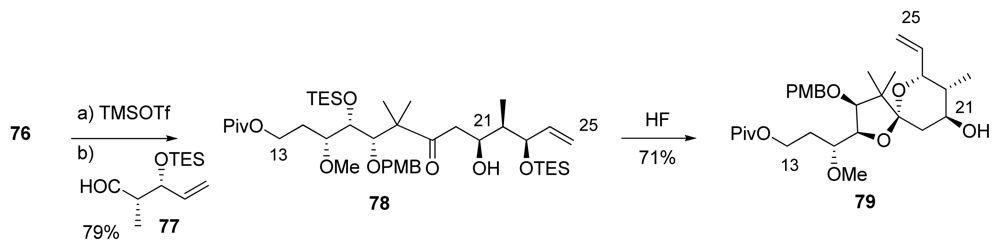
<p>Mukayama aldol coupling of between <bold>76</bold> and <bold>77</bold>, prepared in 3 steps <italic>via</italic> classical methods, afforded <bold>78</bold> as a single diastereomer in 80% yield. Spiroketal formation was effected with acid catalysis, furnishing <bold>79</bold> in a 5:1 ratio of diastereomers (<xref ref-type="fig" rid="f22-marinedrugs-08-00122">Scheme 16</xref>).</p>
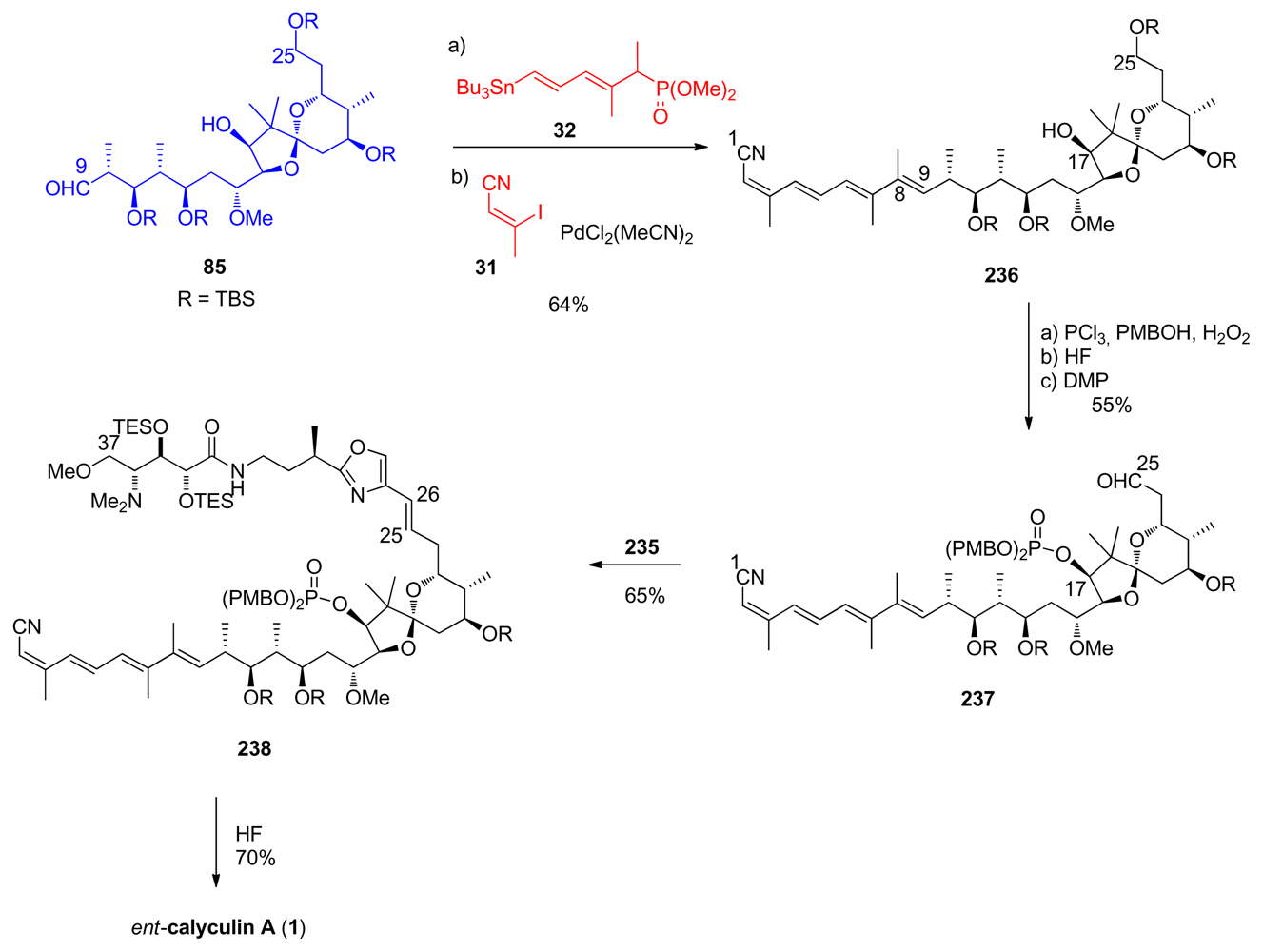
<p>Spiroketal <bold>79</bold> was then hydroborated and TBS protected at C<sub>25</sub>, followed by pivalate removal and Swern oxidation at C<sub>13</sub>, resulting in the formation of aldehyde <bold>80</bold> (<xref ref-type="fig" rid="f23-marinedrugs-08-00122">Scheme 17</xref>). Addition of <bold>80</bold> to the titanium enolate derived from β-ketoamide <bold>81</bold> provided the <italic>syn, syn</italic> adduct <bold>82</bold> exclusively. A<italic>nti</italic> selective reduction at C<sub>11</sub> was then performed, yielding diol <bold>83</bold>. The configuration of the C<sub>13</sub> alcohol had then to be inverted <italic>via</italic> a Mitsunobu reaction to give <bold>84</bold>. Finally, standard transformations provided aldehyde <bold>85</bold>, which represents the C<sub>9</sub>–C<sub>25</sub> subunit of calyculins.</p></sec>
<sec>
<title>5.3.2. Masamune [<xref ref-type="bibr" rid="b19-marinedrugs-08-00122">19</xref>]</title>
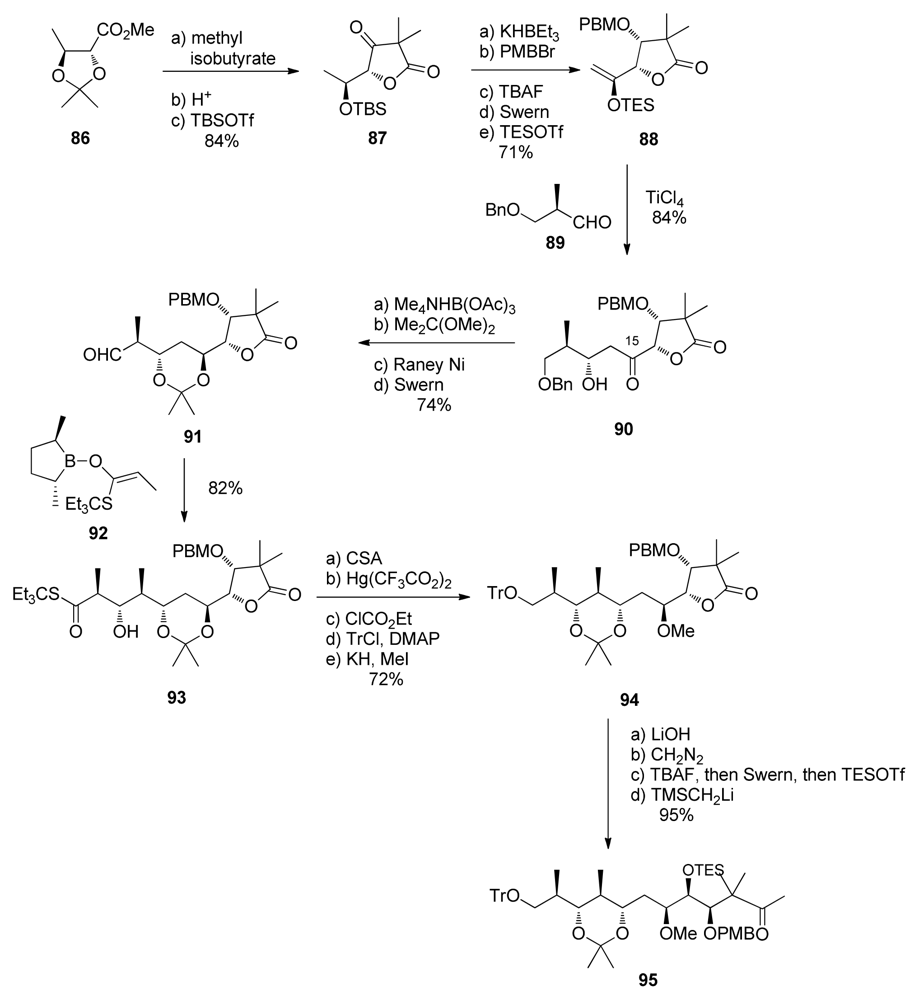
<p>Masamune <italic>et al.</italic> chose to create the C<sub>10</sub>–C<sub>13</sub> dipropionate segment before constructing the spiroketal (<xref ref-type="fig" rid="f24-marinedrugs-08-00122">Scheme 18</xref>). The synthesis began with <sc>d</sc>-threonine derivative <bold>86</bold>. Claisen condensation with methyl isobutyrate, lactonisation, and TBS protection gave <bold>87</bold>. Reduction at C<sub>17</sub> with KHBEt<sub>3</sub>, with &gt;10:1 diastereselectivity, PMB protection, and conversion to silyl enol ether provided <bold>88</bold>. Then, the titanium-chelated Mukaiyama aldol addition of <bold>88</bold> to aldehyde <bold>89</bold> provided <bold>90</bold> with a 10:1 diastereoselectivity. Reduction at C<sub>15</sub> with Me<sub>4</sub>NHB(OAc)<sub>3</sub>, diol protection, and a debenzylation-oxidation sequence provided aldehyde <bold>91</bold>.</p>
<p>The authors exploited their studies with chiral borolanyl triflates in asymmetric aldol reactions. The advantage of these reagents is that the intrinsic Felkin bias can be overridden in aldol reactions with chiral aldehydes. This was applied to the construction of the C<sub>10</sub>–C<sub>13</sub> <italic>anti</italic>, <italic>anti</italic>, <italic>anti</italic> dipropionate. Reacting aldehyde <bold>91</bold> with enolate <bold>92</bold> produced <bold>93</bold> with an excellent 12:1 diastereoselectivity. Acetonide migrations to the more stable <italic>syn</italic> adduct, reduction of the thioester, protection of the alcohol, and C<sub>15</sub> methylation provided compound <bold>94</bold>. The standard final four steps completed the preparation of the C<sub>9</sub>-C<sub>20</sub> methyl ketone <bold>95</bold>.</p>
<p>The key aldol reaction between <bold>95</bold> and aldehyde <bold>96</bold> was performed in the presence of bulky (cHex)<sub>2</sub>BCl, leading to the exclusive formation of <bold>97</bold>, without any trace of its C<sub>21</sub> epimer (<xref ref-type="fig" rid="f25-marinedrugs-08-00122">Scheme 19</xref>). Desilylation and treatment with formic acid provided spiroketal <bold>98</bold> as a single diastereomer. TBS protection and removal of PMB constituted the last steps of the C<sub>9</sub>–C<sub>25</sub> fragment <bold>99</bold>.</p></sec>
<sec>
<title>5.3.3. Shioiri [<xref ref-type="bibr" rid="b20-marinedrugs-08-00122">20</xref>,<xref ref-type="bibr" rid="b58-marinedrugs-08-00122">58</xref>]</title>
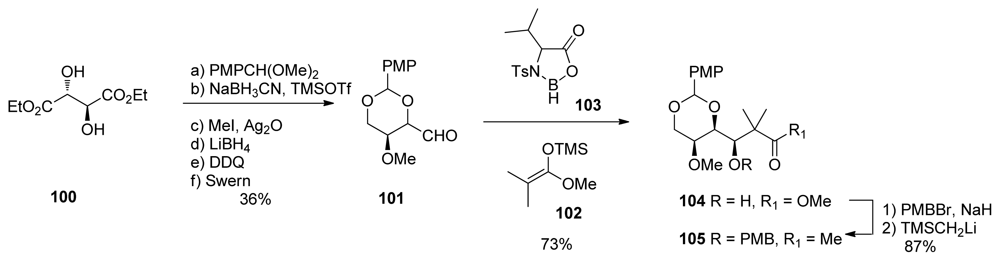
<p>Shioiri’s group formal total synthesis of calyculin A consisted of a variety of studies and different strategies. The synthesis of C<sub>14</sub>–C<sub>20</sub> ketone <bold>105</bold> began from diethyl <sc>l</sc>-tartrate <bold>100</bold> which was converted in five steps to the key intermediate <bold>101.</bold> Aldol reaction with ketene acetal <bold>102</bold>, in the presence of chiral borane reagent <bold>103</bold>, stereoselectively produced <bold>104</bold>, which was then easily converted to the corresponding methyl ketone <bold>105</bold>.</p>
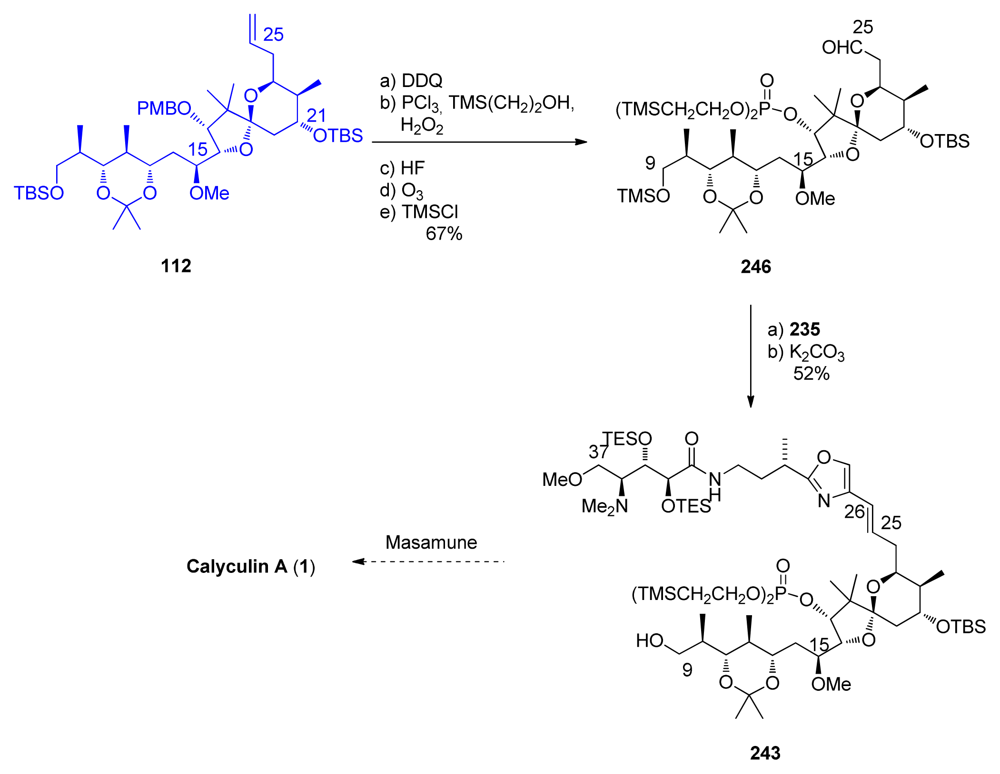
<p>The aldol reaction between <bold>105</bold> and aldehyde <bold>106</bold>, easily prepared from dimethyl <sc>l</sc>-malate, proceeded with an excellent diastereoselectivity to give <bold>107</bold> in a 18:1 ratio (<xref ref-type="fig" rid="f27-marinedrugs-08-00122">Scheme 21</xref>). Interestingly, only the potassium enolate of <bold>105</bold> gave satisfactory results in the formation of the <italic>syn</italic> aldol adduct, the lithium and sodium enolates giving only poor diastereoselectivity. Spiroketalization was then performed in aqueous HF. Further protection-deprotection sequence followed by TPAP oxidation gave aldehyde <bold>108</bold>. Coupling of <bold>108</bold> with the enolate of C<sub>9</sub>–C<sub>13</sub> lactone <bold>109</bold> furnished <bold>110</bold> as a mixture of diastereomers. Barton deoxygenation of the hydroxyl group at C<sub>14</sub> furnished <bold>111</bold>, together with its C<sub>13</sub> epimer in a 4:1 ratio (the latter being further epimerized with MeLi to give the desired <bold>111</bold>). Degradation of the γ–lactone to the 1,3-acetonide was performed using Ziegler-Brückner conditions and further protection of the diol to gave <bold>112</bold>.</p></sec>
<sec>
<title>5.3.4. Smith [<xref ref-type="bibr" rid="b22-marinedrugs-08-00122">22</xref>,<xref ref-type="bibr" rid="b59-marinedrugs-08-00122">59</xref>,<xref ref-type="bibr" rid="b60-marinedrugs-08-00122">60</xref>]</title>
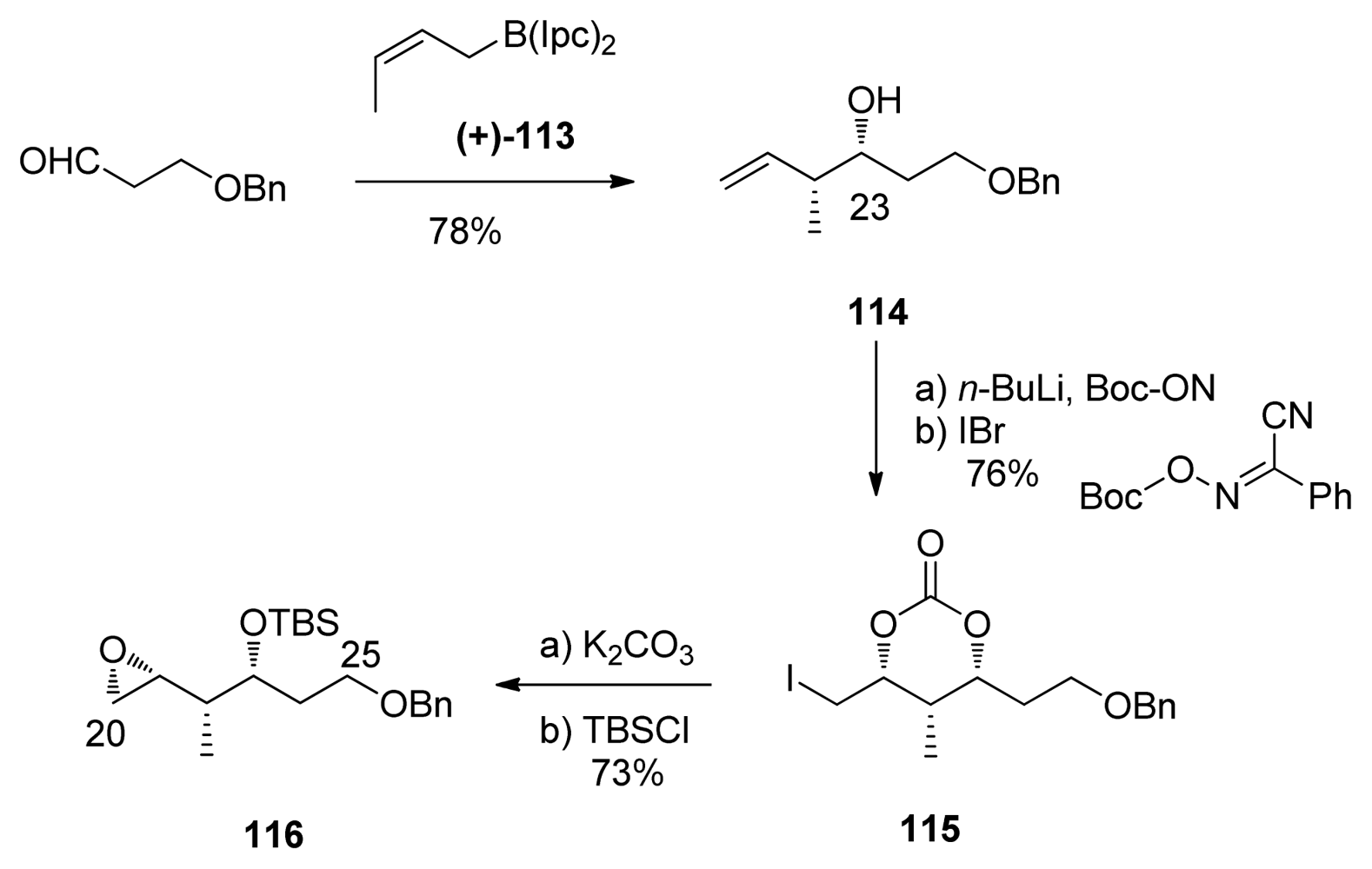
<p>Smith published the synthesis of the spiroketal core of <italic>ent</italic>-calyculin A in 1991, using a novel dithiane-epoxide coupling strategy. Brown’s crotylation on 3-benzyloxypropanal, using (<italic>Z</italic>)-crotylboron reagent (+)-<bold>113</bold>, furnished alcohol <bold>114</bold> in 99% enantiopurity (<xref ref-type="fig" rid="f28-marinedrugs-08-00122">Scheme 22</xref>). Boc-protection and electrophilic cyclization in the presence of IBr afforded the <italic>syn, syn</italic> carbonate <bold>115</bold>, with good α/β selectivity of 13.9/1. The synthesis of C<sub>20</sub>–C<sub>25</sub> coupling moiety was finished with cleavage of the carbonate group, and TBS protection to give epoxide <bold>116</bold>.</p>
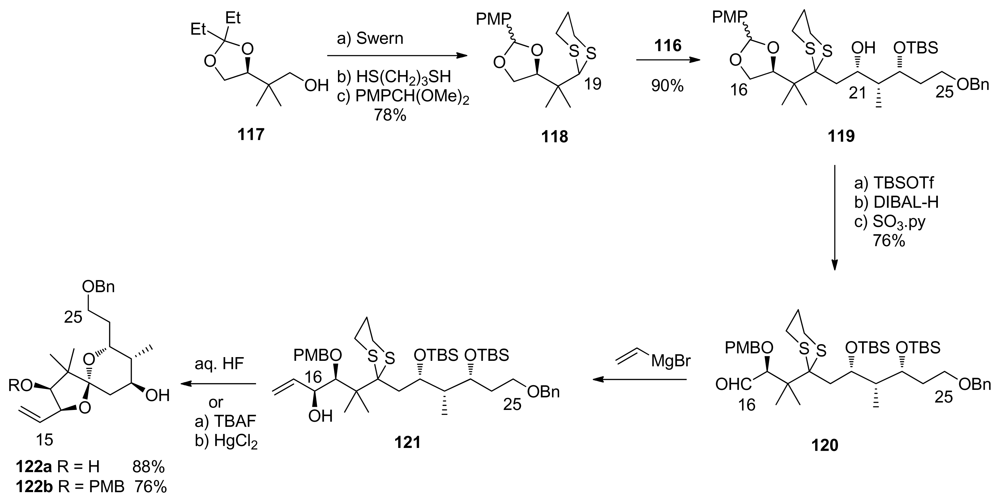
<p>The C<sub>16</sub>-C<sub>19</sub> dithiane moiety <bold>118</bold> was easily prepared from alcohol <bold>117</bold>, <italic>via</italic> consecutive Swern oxidation, dithiane formation and diol protection (<xref ref-type="fig" rid="f29-marinedrugs-08-00122">Scheme 23</xref>). Key coupling was performed by metalation of <bold>118</bold> with <italic>n-</italic>BuLi followed by addition of DMPU and epoxide <bold>116</bold>, to furnish alcohol <bold>119</bold>. Silyl protection, acetal reduction, and Parikh-Doering oxidation then afforded aldehyde <bold>120</bold>. The stereochemistry of C<sub>16</sub> was created by chelation-controlled addition of vinylmagnesium bromide to <bold>120</bold> to give alcohol <bold>121</bold> with a &gt;20:1 diastereoselectivity. Two different conditions for the spirocyclisation were employed. The first, using aqueous HF, produced <bold>122a</bold> as a single diastereomer in 88% yield but resulted in the loss of PMB group at C<sub>17</sub>. To retain this useful protecting group, an alternative sequence was applied. Sequential treatment of <bold>121</bold> with TBAF and HgCl<sub>2</sub>/CaCO<sub>3</sub> afforded a mixture of <bold>122b</bold> and its C<sub>19</sub> epimer. Fortunately, the latter could be quantitatively converted to <bold>122b</bold> upon exposure to <italic>p</italic>-TsOH, with a global yield of 76%.</p>
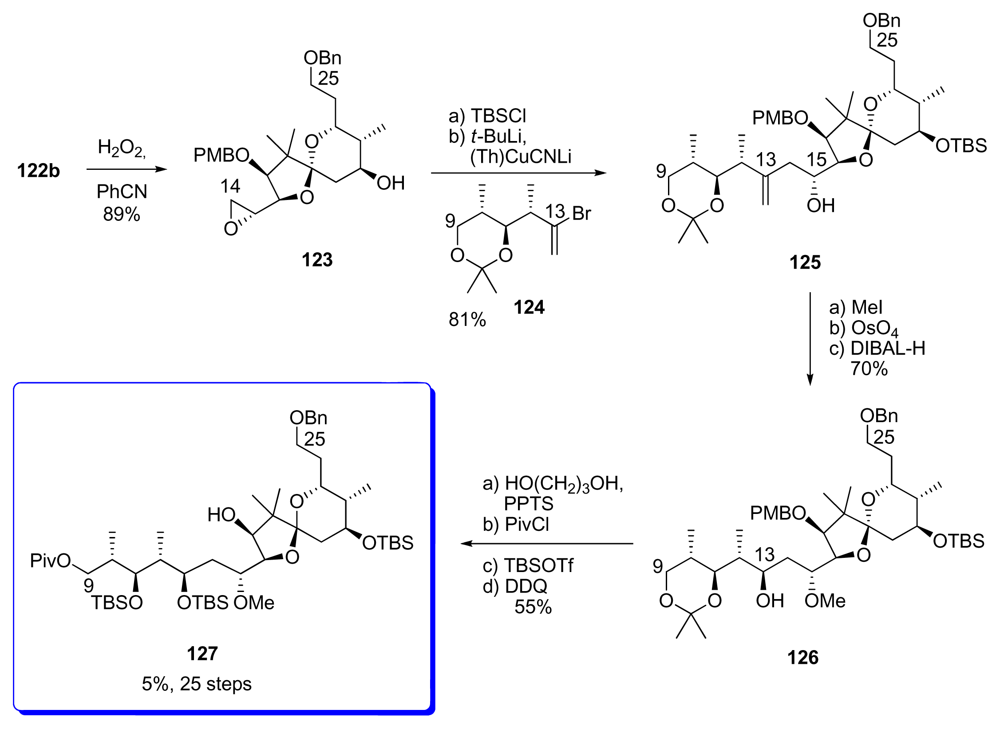
<p>After extensive experimentation, the authors found out that Payne epoxidation of <bold>122b</bold> occurred in good <italic>syn</italic> diastereoselectivity and yield (9.5:1, 89%) to give <bold>123</bold>. After TBS-protection, the epoxide was coupled with the vinyl cuprate derived from <bold>124</bold> giving access to <bold>125</bold> as a single diastereomer in 83% yield. Methylation of the C<sub>15</sub> hydroxyl group of <bold>125</bold>, and oxidation of the alkene were followed by DIBAL-H reduction to provide <bold>126</bold> with &gt;12:1 diastereoselectivity at C<sub>13</sub> (probably <italic>via</italic> internal hydride delivery by prior coordination at the C<sub>15</sub> methoxy group). Finally, protecting group manipulations provided compound <bold>127</bold>.</p></sec>
<sec>
<title>5.3.5. Armstrong [<xref ref-type="bibr" rid="b21-marinedrugs-08-00122">21</xref>,<xref ref-type="bibr" rid="b52-marinedrugs-08-00122">52</xref>]</title>
<p>Armstrong’s group used Brown’s chiral allylborane reagents in their synthesis of C<sub>9</sub>–C<sub>25</sub> fragment. The synthesis of spiroketal core starts with the reaction of <sc>d</sc>-glyceraldehyde <bold>128</bold> with the enantiopure allylboron reagent (−)-<bold>129</bold> (<xref ref-type="fig" rid="f31-marinedrugs-08-00122">Scheme 25</xref>). This addition occurred in good yield and excellent stereoselectivity to provide <bold>130</bold>. After MEM-protection and ozonolysis, ketone <bold>131</bold> was obtained. Aldol reaction between <bold>131</bold> and aldehyde <bold>132</bold> and further benzoyl protection furnished compound <bold>133</bold>. Upon exposure to TFA, <bold>133</bold> underwent the expected tandem deprotection-spirocyclisation to give the desired spiroketal <bold>134</bold> as a single enantiomer.</p>
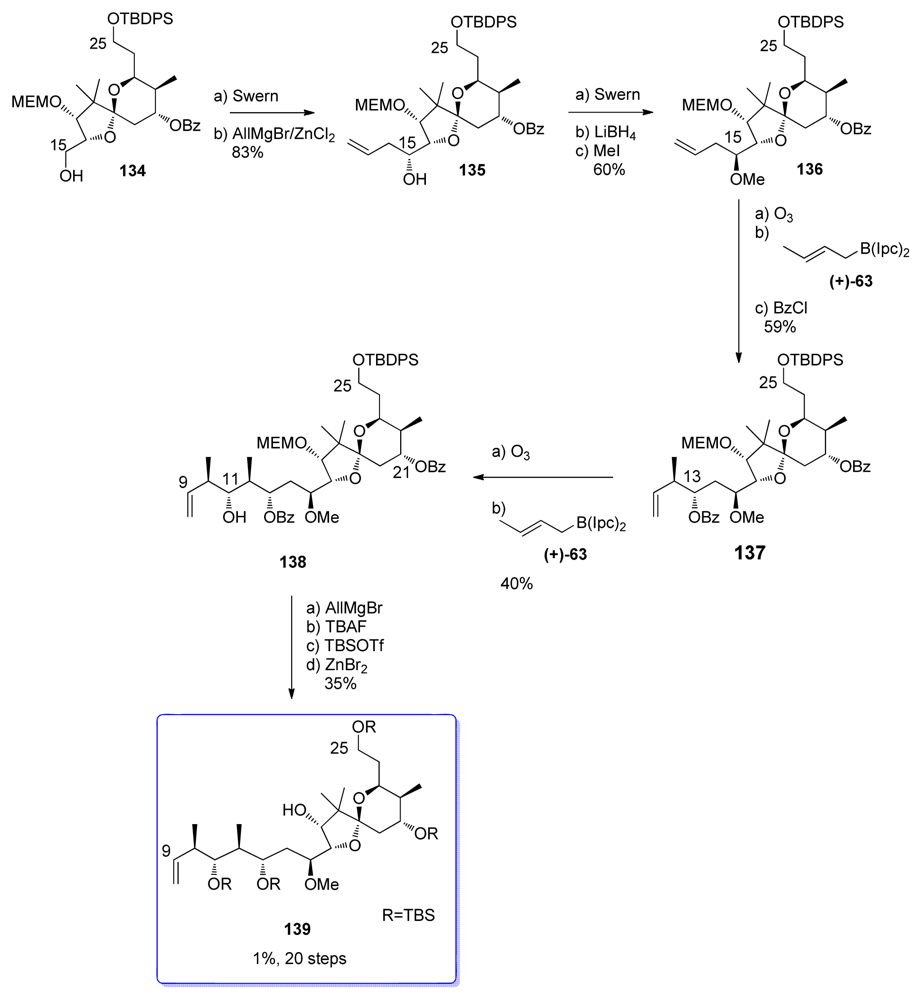
<p>Swern oxidation of alcohol <bold>134</bold> was followed by reaction with allylmagnesium bromide in the presence of ZnCl<sub>2</sub> to give homoallylic alcohol <bold>135</bold> (<xref ref-type="fig" rid="f32-marinedrugs-08-00122">Scheme 26</xref>). Unfortunately, the Felkin-Ahn mode was followed for this addition, resulting in the formation of the stereochemistry at C<sub>15</sub> opposite to that present in the natural product. Inversion at C<sub>15</sub> was performed by consecutive oxidation-reduction. Finally, the new C<sub>15</sub> hydroxyl was methylated to give <bold>136</bold>. Ozonolysis of <bold>136</bold> afforded the corresponding aldehyde that, upon submission to an asymmetric Brown’s crotylboration with (+)-<bold>63</bold> and benzoyl protection, gave olefin <bold>137</bold> as a single diastereomer. Second ozonolysis gave the corresponding aldehyde which was the substrate for a further Brown’s crotylation. Unfortunately, this step proceeded with very low diastereoselectivity; the expected <italic>anti, anti, anti</italic> adduct <bold>138</bold> being isolated in only 40% yield; the <italic>anti, syn, anti</italic> isomer being isolated in 30%. This disappointing result led the authors to study the influence of the different protecting groups at C<sub>25</sub>, C<sub>21</sub> and C<sub>13</sub> on the crotylation process. Unfortunately, all the other protecting group combination gave lower yield of the expected <bold>138</bold>, the undesired isomer always being the main product. The tetra-TBS protected compound <bold>139</bold> was then prepared by simple protection group conversion of <bold>138</bold>, followed by MEM-deprotection.</p></sec>
<sec>
<title>5.3.6. Barrett [<xref ref-type="bibr" rid="b23-marinedrugs-08-00122">23</xref>,<xref ref-type="bibr" rid="b61-marinedrugs-08-00122">61</xref>]</title>
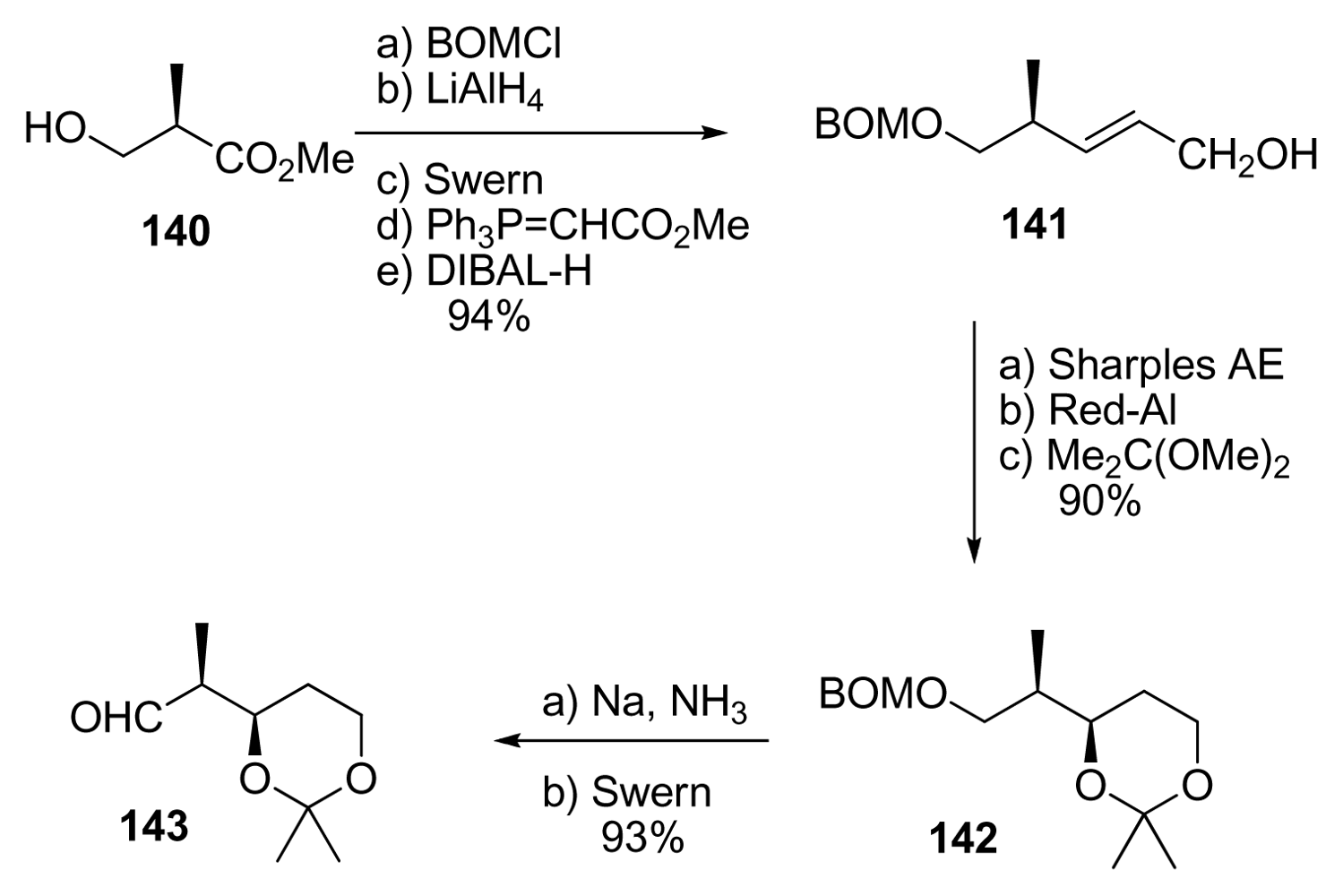
<p>Barrett <italic>et al.</italic> also used the Brown’s crotyl boration reagents for the synthesis of the spiroketal moiety of calyculins. The synthesis began with ester <bold>140</bold> which was converted to allylic alcohol <bold>141</bold> (<xref ref-type="fig" rid="f33-marinedrugs-08-00122">Scheme 27</xref>). Sharpless asymmetric epoxidation, ring opening and protection of the resulting diol furnished acetonide <bold>142</bold>. Deprotection of the benzyloxymethyl ether, and subsequent Swern oxidation completed the synthesis of aldehyde <bold>143</bold>.</p>
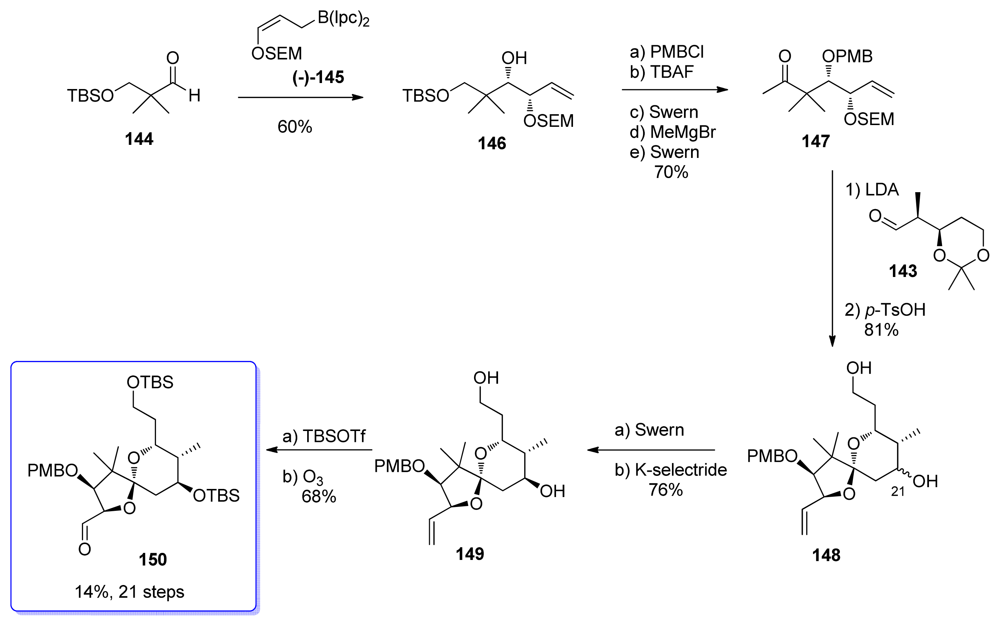
<p>Addition of (<italic>Z</italic>)-borane (−)<bold>-145</bold> to aldehyde <bold>144</bold> proceeded effectively to yield the <italic>syn</italic> adduct <bold>146</bold> with &gt;95% stereocontrol (<xref ref-type="fig" rid="f34-marinedrugs-08-00122">Scheme 28</xref>). Transformation of <bold>146</bold> to the corresponding methyl ketone <bold>147</bold> was then carried out using standard transformations. Key aldol reaction between <bold>147</bold> and aldehyde <bold>143</bold> yielded, after acidic treatment, to the spiroketal <bold>148</bold>, as a 2:1 mixture of C<sub>21</sub> epimers. Swern oxidation followed by K-selectride reduction furnished diol <bold>149</bold> as a single diastereomer. Final protection-oxidation steps led to compound <bold>150</bold>.</p></sec>
<sec>
<title>5.3.7. Koskinen [<xref ref-type="bibr" rid="b42-marinedrugs-08-00122">42</xref>–<xref ref-type="bibr" rid="b46-marinedrugs-08-00122">46</xref>]</title>
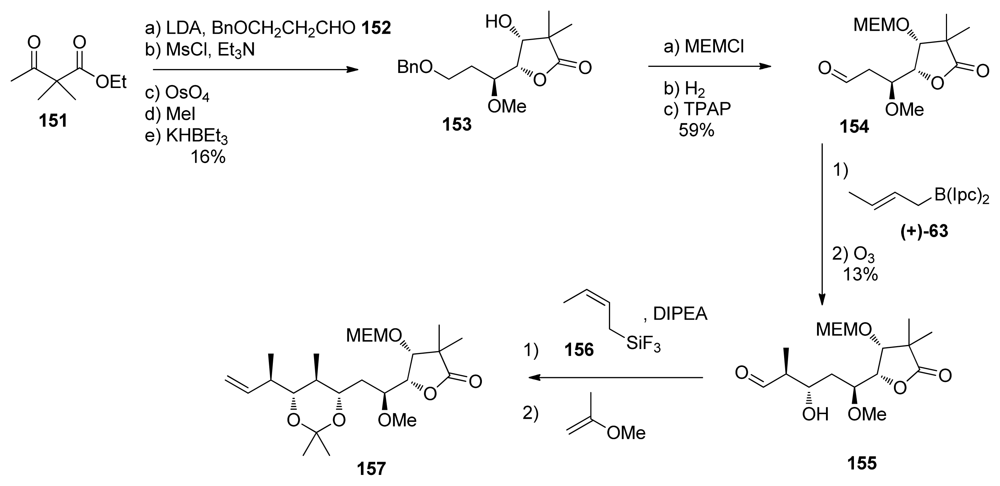
<p>The Koskinen group has presented separate studies for the preparation of the dipropionate and the spiroketal moieties. The key lactone <bold>153</bold> was prepared in five steps from ketoester <bold>151</bold> and aldehyde <bold>152</bold> (<xref ref-type="fig" rid="f35-marinedrugs-08-00122">Scheme 29</xref>). MEM-protection, benzyl deprotection and further oxidation provided aldehyde <bold>154</bold>. This aldehyde was subjected to a Brown’s crotylation, affording the expected homoallylic alcohol in a 6:1 separable mixture of diastereomers, in favor of the expected product. Further ozonolysis furnished aldehyde <bold>155</bold>, which was, in turn, subjected to a crotylation reaction. Based on previous studies by Armstrong [<xref ref-type="bibr" rid="b21-marinedrugs-08-00122">21</xref>,<xref ref-type="bibr" rid="b52-marinedrugs-08-00122">52</xref>] showing that a second Brown’s crotylation on similar substrates gave only poor selectivity, the authors decided to use the Roush (<italic>Z</italic>)-crotyl trifluorosilane <bold>156</bold> for this reaction [<xref ref-type="bibr" rid="b62-marinedrugs-08-00122">62</xref>]. This transformation pleasingly afforded a single isomer and further acetonide protection furnished <bold>157</bold>, whose analysis proved the <italic>anti, anti, anti</italic> relationships in the stereotetrad. This strategy proved to be efficient in terms of selectivity, but suffers from poor yields. Current studies in our lab recently showed that this methodology could be improved and much better yields were obtained on new substrates used in the course of the synthesis of calyculins (unpublished results).</p>
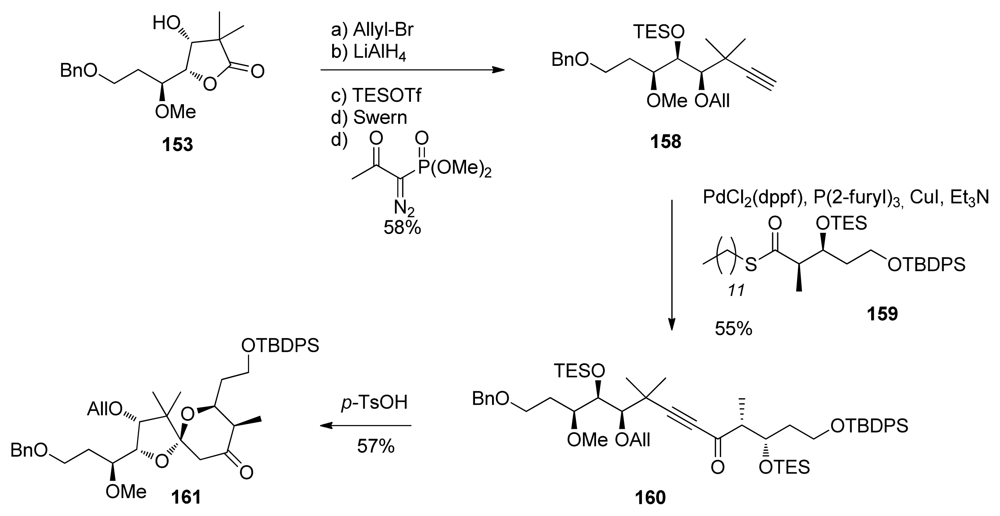
<p>Koskinen also recently published a preparation of the C<sub>13</sub>–C<sub>25</sub> spiroketal core of calyculins (<xref ref-type="fig" rid="f36-marinedrugs-08-00122">Scheme 30</xref>) [<xref ref-type="bibr" rid="b46-marinedrugs-08-00122">46</xref>]. Lactone <bold>153</bold> was allyl-protected, reduced with LiAlH<sub>4</sub>, and the diol protected as a TES ether. Further selective deprotection-oxidation of the primary alcohol, and homologation of the aldehyde to the corresponding alkyne using the Ohira-Bestmann protocol produced <bold>158</bold> in good yield. Key coupling between acetylene <bold>158</bold> and thioester <bold>159</bold> furnished ynone <bold>160</bold>. This was subjected to acidic treatment, leading to TES-deprotection followed by a double intramolecular hetero-Michael addition (DIHMA) to yield <bold>161</bold> as a single enantiomer. The DIHMA spiroketalisation differs from all the other methods described for this fragment.</p></sec></sec>
<sec>
<title>5.4. Syntheses of the C<sub>26</sub>-C<sub>32</sub> oxazole fragment</title>
<p>Compared to the synthesis of C<sub>9</sub>-C<sub>25</sub> spiroketal-propionate subunit, the C<sub>26</sub>–C<sub>32</sub> oxazole fragment seems to be less difficult; however, formation of the C<sub>30</sub> stereocenter creates challenges. Construction of the suitably substituted oxazole in good yield without epimerization proved challenging.</p>
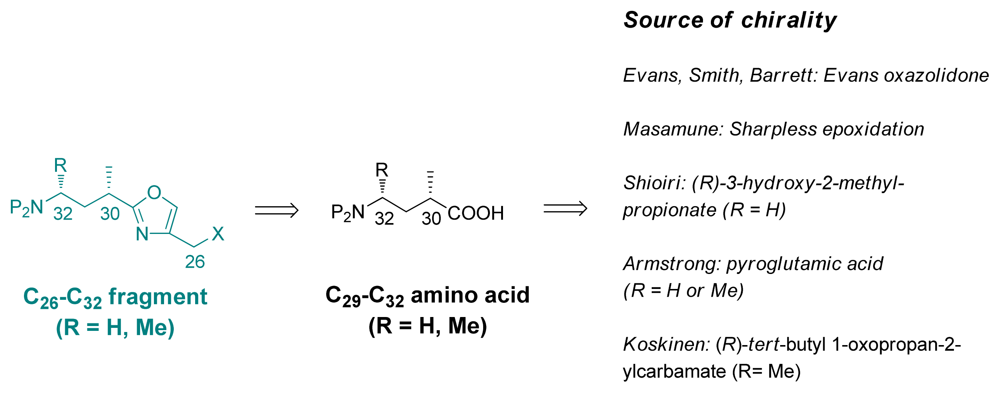
<p>Retrosynthetically, the C<sub>26</sub>-C<sub>32</sub> can be simplified to a chiral aminoacid (<xref ref-type="fig" rid="f37-marinedrugs-08-00122">Scheme 31</xref>). The Evans’ oxazolidone was used as source of chirality by Evans [<xref ref-type="bibr" rid="b18-marinedrugs-08-00122">18</xref>], Smith [<xref ref-type="bibr" rid="b22-marinedrugs-08-00122">22</xref>], and Barrett [<xref ref-type="bibr" rid="b23-marinedrugs-08-00122">23</xref>] whereas Masamune used the Sharpless epoxidation [<xref ref-type="bibr" rid="b19-marinedrugs-08-00122">19</xref>]. Shioiri decided to use a hydroxy acid as the starting material [<xref ref-type="bibr" rid="b20-marinedrugs-08-00122">20</xref>]. Finally, Armstrong started from <sc>l</sc>-pyroglutamic acid [<xref ref-type="bibr" rid="b21-marinedrugs-08-00122">21</xref>], while Koskinen used <italic><sc>d</sc></italic>-alaninal [<xref ref-type="bibr" rid="b39-marinedrugs-08-00122">39</xref>].</p>
<sec>
<title>5.4.1. Evans [<xref ref-type="bibr" rid="b18-marinedrugs-08-00122">18</xref>]</title>
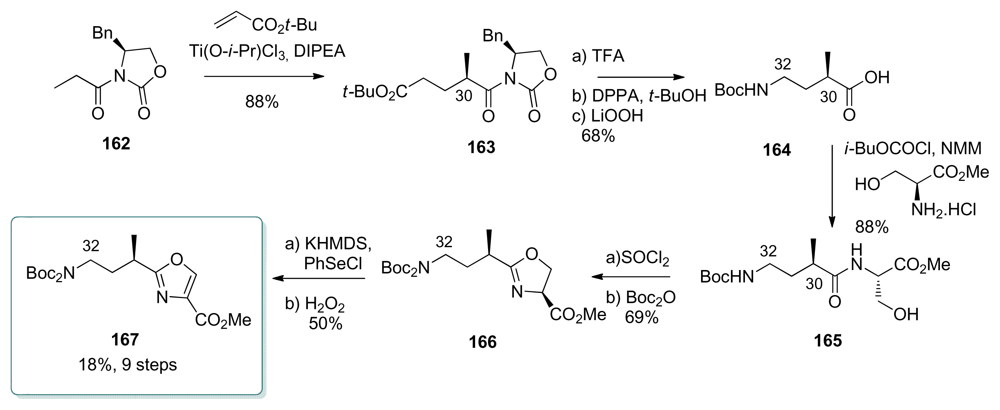
<p>The key step of the oxazole synthesis was the diastereoselective Michael addition of <italic>N</italic>-propionyloxazolidone <bold>162</bold> to <italic>tert</italic>-butyl acrylate, setting up the correct stereochemistry for <bold>163</bold> at C<sub>30</sub> in 88% yield with &gt;95:5 diastereoselectivity (<xref ref-type="fig" rid="f38-marinedrugs-08-00122">Scheme 32</xref>). Cleavage of the <italic>tert</italic>-butyl ester followed by Curtius rearrangement afforded amino acid <bold>164</bold>, which was coupled with <sc>l</sc>-serine methyl ester to give <bold>165</bold>. Cyclisation with thionyl chloride afforded the corresponding oxazoline <bold>166</bold>. Finally, oxidation by trapping the enolate of <bold>166</bold> with PhSeCl followed by oxidative elimination afforded oxazole <bold>167</bold>.</p></sec>
<sec>
<title>5.4.2. Masamune [<xref ref-type="bibr" rid="b19-marinedrugs-08-00122">19</xref>,<xref ref-type="bibr" rid="b63-marinedrugs-08-00122">63</xref>]</title>
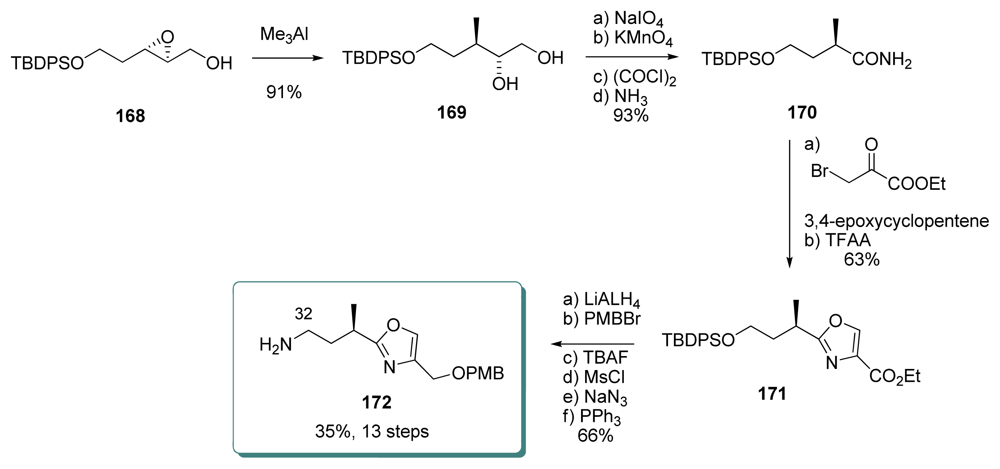
<p>The starting point for the oxazole fragment <bold>172</bold> was the epoxy alcohol <bold>168</bold>, obtained by Sharpless asymmetric epoxidation of the corresponding allylic alcohol; unfortunately, no details about the yield or selectivity were reported (<xref ref-type="fig" rid="f39-marinedrugs-08-00122">Scheme 33</xref>). Regioselective ring-opening of <bold>168</bold> with Me<sub>3</sub>Al provided the diol <bold>169</bold>, with the requisite stereochemistry at C<sub>30</sub>. Oxidative cleavage of <bold>169</bold>, further oxidation to acid and conversion to amide furnished <bold>170</bold>. Treatment of <bold>170</bold> with ethyl bromopyruvate furnished, after dehydration, oxazole <bold>171</bold>. To avoid epimerization, this reaction had to be carried out in the presence of 3, 4-epoxycyclopentene. Final preparation of oxazole <bold>172</bold> was achieved with standard transformations.</p></sec>
<sec>
<title>5.4.3. Shioiri [<xref ref-type="bibr" rid="b20-marinedrugs-08-00122">20</xref>,<xref ref-type="bibr" rid="b64-marinedrugs-08-00122">64</xref>]</title>
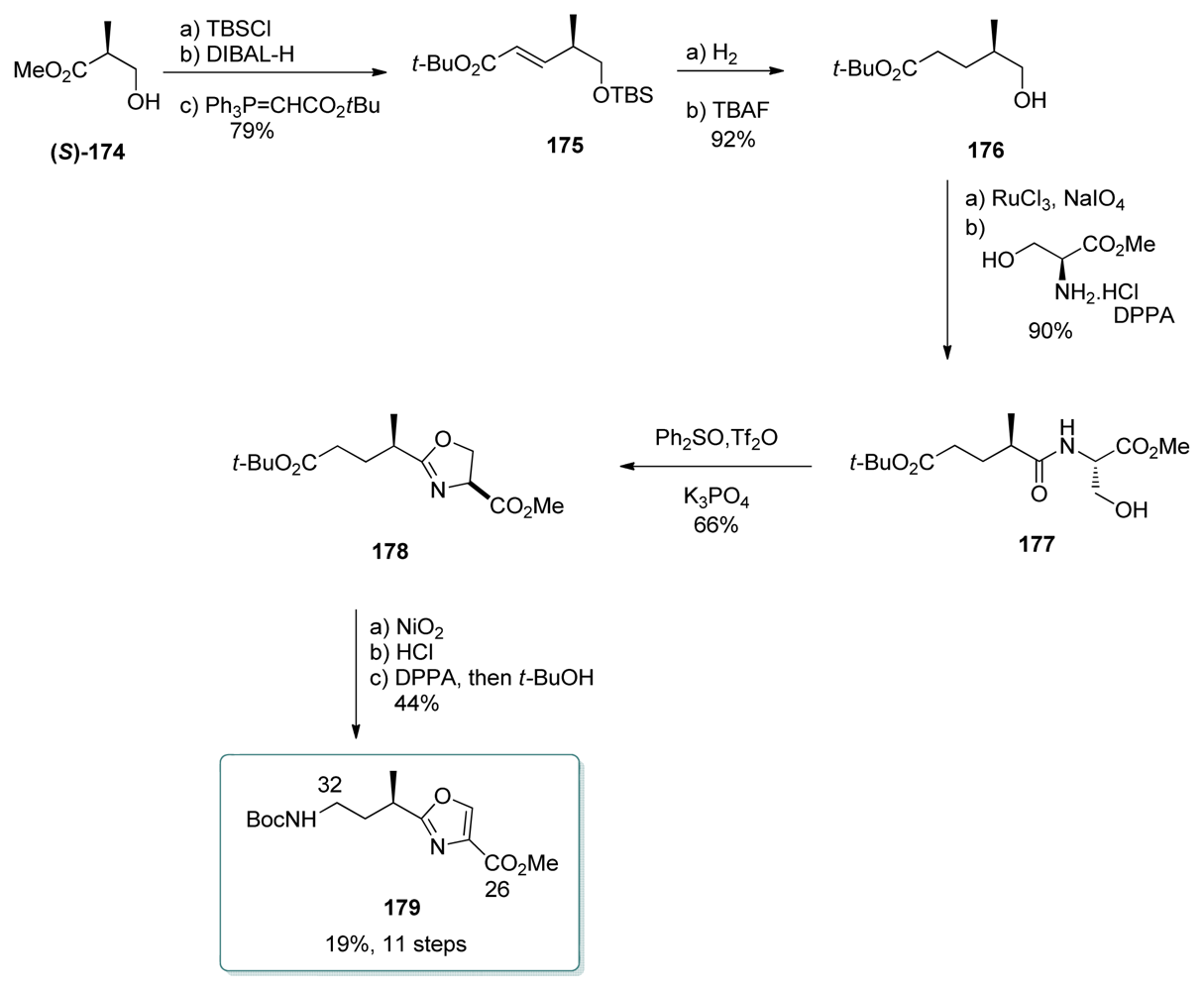
<p>For the synthesis of oxazole fragment of calyculin A, Shioiri <italic>et al.</italic> used methyl (<italic>S</italic>)-3-hydroxy-2-methylpropionate [(<italic>S</italic>)-<bold>174</bold>]. TBS protection, DIBAL-H reduction to the corresponding aldehyde, and Wittig olefination gave the unsaturated ester <bold>175</bold> (<xref ref-type="fig" rid="f40-marinedrugs-08-00122">Scheme 34</xref>). This was followed by hydrogenation of the double bond, and cleavage of the TBS-deprotection to yield alcohol <bold>176</bold>. Oxidation of <bold>176</bold> to the corresponding acid and coupling with <sc>l</sc>-serine methyl ester gave <bold>177</bold>. For the conversion to the oxazoline <bold>178</bold>, the authors applied their own method which uses triflic anhydride, diphenyl sulfoxide and potassium phosphate. Oxazoline <bold>178</bold> was obtained in 66% yield, without any epimerization in the process. Oxidation with NiO<sub>2</sub> provided the corresponding oxazole. Finally, after removal of the <italic>tert</italic>-butyl ester, Curtius rearrangement gave the amino ester <bold>179</bold>. This synthesis afforded the enantiomer of the fragment present in the natural product. However, the enantiomer of <bold>179</bold> can easily be obtained by using (<italic>R</italic>)-3-hydroxy-2-methylpropionate [(<italic>R</italic>)-<bold>174</bold>] as starting material.</p>
<p>The authors presented also a method for the preparation of the C<sub>26</sub>–C<sub>32</sub> oxazole part of calyculin C, which adds an extra methyl group at C<sub>32</sub> [<xref ref-type="bibr" rid="b57-marinedrugs-08-00122">57</xref>]. This method relied on the asymmetric ring opening of a prochiral cyclic anhydride. However, this strategy has not been used in any total synthesis and therefore will not be described here in detail.</p></sec>
<sec>
<title>5.4.4. Smith [<xref ref-type="bibr" rid="b22-marinedrugs-08-00122">22</xref>,<xref ref-type="bibr" rid="b51-marinedrugs-08-00122">51</xref>]</title>
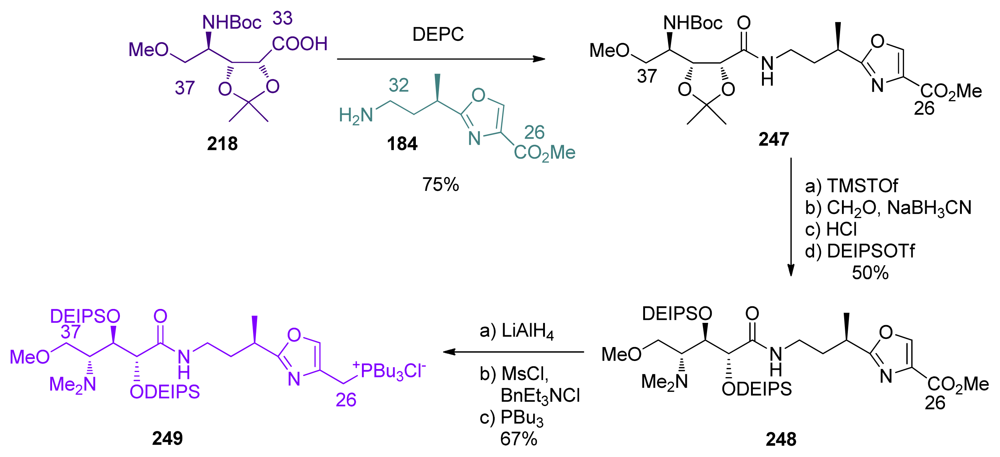
<p>The synthesis started with 4-chlorobutyl chloride (<bold>180</bold>) which was converted to oxazolidinone <bold>181</bold> (<xref ref-type="fig" rid="f41-marinedrugs-08-00122">Scheme 35</xref>). Methylation (87% yield, 95% diastereoselectivity) followed by removal of the chiral auxiliary furnished acid <bold>182</bold>. Condensation with <sc>l</sc>-serine methyl ester in the presence of diethylcyanophosphonate (DECP) as the coupling agent yielded amide <bold>183</bold>. Exposure of <bold>183</bold> to Burgess reagent followed by Narrish-Singh oxidation produced the desired oxazole ring. Finally, azide reduction furnished <bold>184</bold> in good yield and without epimerisation.</p></sec>
<sec>
<title>5.4.5. Armstrong [<xref ref-type="bibr" rid="b21-marinedrugs-08-00122">21</xref>,<xref ref-type="bibr" rid="b65-marinedrugs-08-00122">65</xref>]</title>
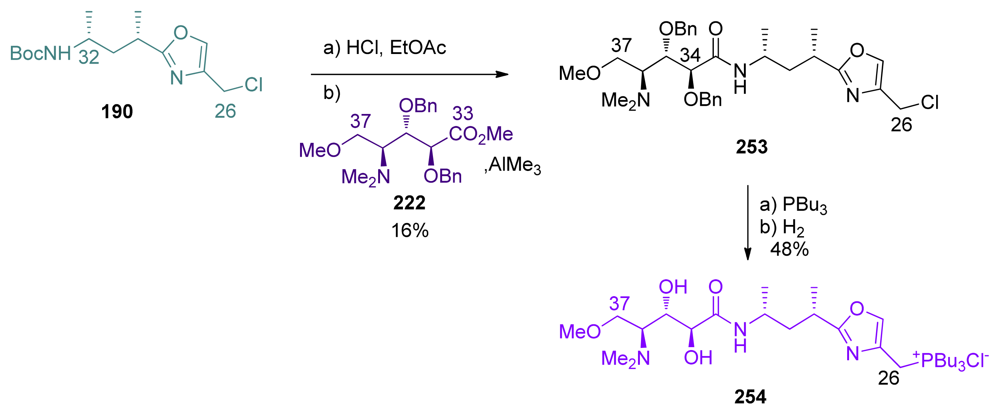
<p>Comparing to other syntheses of this subunit, Armstrong targeted calyculin C, which contains one additional methyl at C<sub>32</sub>. Bicyclic <italic>N,O</italic>-acetal <bold>185</bold>, which was prepared from (<italic>S</italic>)-pyroglutamic acid, was methylated at C<sub>30</sub> to give <bold>186</bold> in a 80:20 ratio of diastereomers (<xref ref-type="fig" rid="f42-marinedrugs-08-00122">Scheme 36</xref>). Acetal hydrolysis followed by mesylation afforded lactam <bold>187</bold>. Radical deoxygenation of the <italic>in situ</italic> formed iodide and Boc-protection yielded <bold>188</bold>. Ring opening by Me<sub>3</sub>Al in the presence of ammonia furnished the open-chain amide <bold>189</bold>. Finally, oxazole <bold>190</bold> was obtained by reaction of <bold>189</bold> with 1,3-dichloroacetone.</p></sec>
<sec>
<title>5.4.6. Barrett [<xref ref-type="bibr" rid="b23-marinedrugs-08-00122">23</xref>,<xref ref-type="bibr" rid="b66-marinedrugs-08-00122">66</xref>]</title>
<p>Barrett <italic>et al</italic>. synthesized the oxazole unit by using a modified Cornforth-Meyers approach (<xref ref-type="fig" rid="f43-marinedrugs-08-00122">Scheme 37</xref>). The synthesis started with oxazolidinone <bold>191</bold>, which was reacted with lithium benzyloxide to give ester <bold>192</bold>.</p>
<p>Nitrile <bold>193</bold> was obtained by submitting <bold>192</bold> to Me<sub>3</sub>Al and dehydration. Addition of MeOH and HCl to <bold>193</bold> produced an intermediate imidate ion, which reacted with glycine methyl ester to produce <bold>194</bold>. The Cornforth-Meyers procedure, using methyl formate in the presence of <italic>t</italic>-BuOK and BF<sub>3</sub>.OEt<sub>2</sub>, provided oxazole <bold>195</bold>. Final stages transformed the terminal alkene of <bold>195</bold> to the corresponding primary amine <bold>196</bold> in 5 steps. No racemization was observed during the entire process.</p></sec>
<sec>
<title>5.4.7. Koskinen [<xref ref-type="bibr" rid="b39-marinedrugs-08-00122">39</xref>]</title>
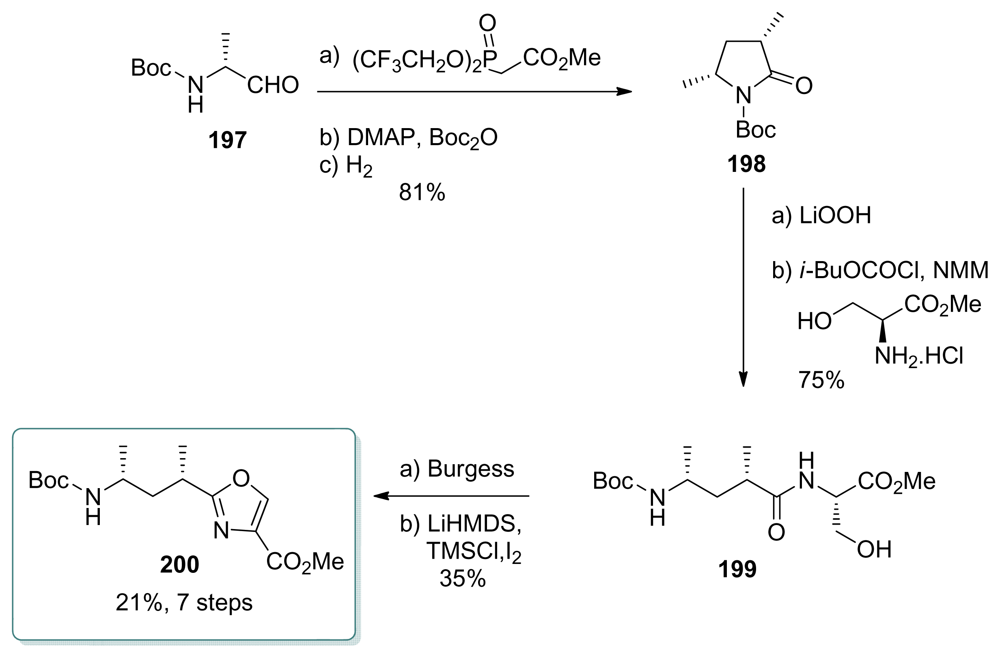
<p>Koskinen group’s strategy towards calyculin C was to use cyclic stereocontrol to create the <italic>syn</italic>-isomer of C<sub>26</sub>–C<sub>32</sub> (<xref ref-type="fig" rid="f44-marinedrugs-08-00122">Scheme 38</xref>). <italic><sc>d</sc></italic>-Alaninal derivative <bold>197</bold> was subjected to Still-Gennari modification of HWE olefination to give the corresponding (<italic>Z</italic>)-enoate, whose cyclization under Ragnarsson-Grehn conditions (Boc<sub>2</sub>O, cat. DMAP) and hydrogenation furnished lactam <bold>198</bold>, together with 9% of its <italic>anti</italic> diastereomer. Hydrolysis of <bold>198</bold> followed by coupling with <sc>l</sc>-serine methyl ester afforded amides <bold>199</bold> (at this stage, the <italic>anti</italic> diastereomer could be separated by chromatography). Conversion to oxazole <bold>200</bold> was achieved by treatment with Burgess reagent to give the oxazoline, followed by oxidation. This oxidation proved to be difficult, and the best results were obtained by using either CuBr<sub>2</sub>/HMTA/DBU as discussed earlier [<xref ref-type="bibr" rid="b22-marinedrugs-08-00122">22</xref>,<xref ref-type="bibr" rid="b51-marinedrugs-08-00122">51</xref>] or by temporary TMS protection of the carbamate hydrogen, deprotonation of the oxazoline and oxidation of the enolate with I<sub>2</sub>. Those two strategies yielded 42% of oxazole <bold>200</bold>.</p></sec></sec>
<sec>
<title>5.5. Syntheses of the C<sub>33</sub>–C<sub>37</sub> amino acid fragment</title>
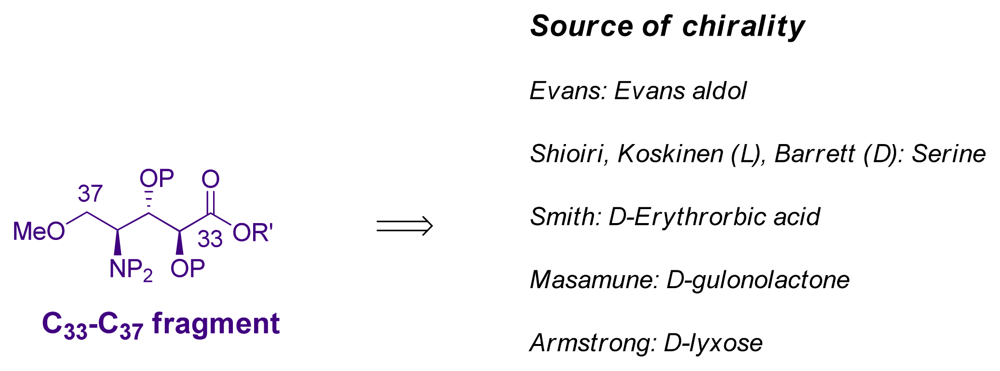
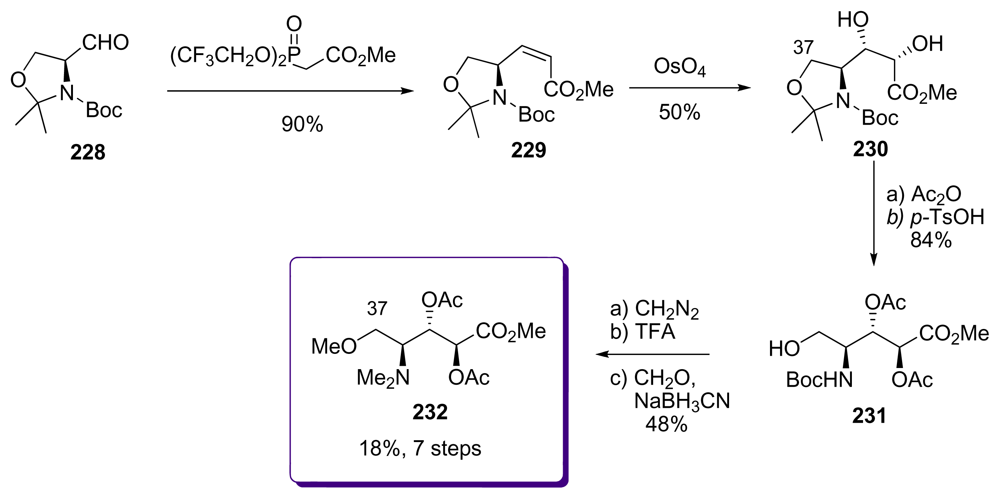
<p>Because of the three chiral centres and possibly reactive amine, the synthesis of C<sub>33</sub>–C<sub>37</sub> is also a challenging target. For the synthesis of this fragment, most groups used carbohydrates. It can be also noticed that the left half of the fragment resembles serine. This was exploited by the Shioiri, Barrett, and Koskinen groups (<xref ref-type="fig" rid="f45-marinedrugs-08-00122">Scheme 39</xref>) [<xref ref-type="bibr" rid="b20-marinedrugs-08-00122">20</xref>,<xref ref-type="bibr" rid="b38-marinedrugs-08-00122">38</xref>,<xref ref-type="bibr" rid="b65-marinedrugs-08-00122">65</xref>,<xref ref-type="bibr" rid="b66-marinedrugs-08-00122">66</xref>].</p>
<sec>
<title>5.5.1. Evans [<xref ref-type="bibr" rid="b18-marinedrugs-08-00122">18</xref>]</title>
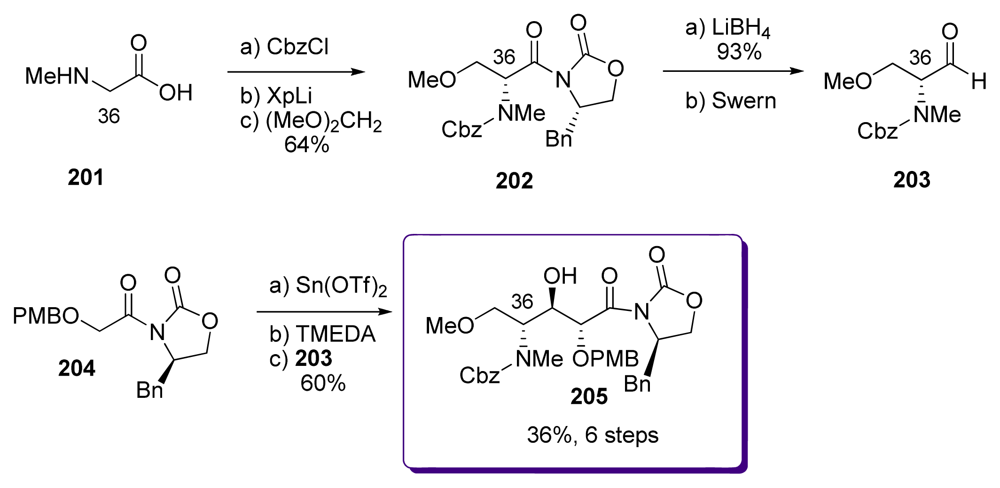
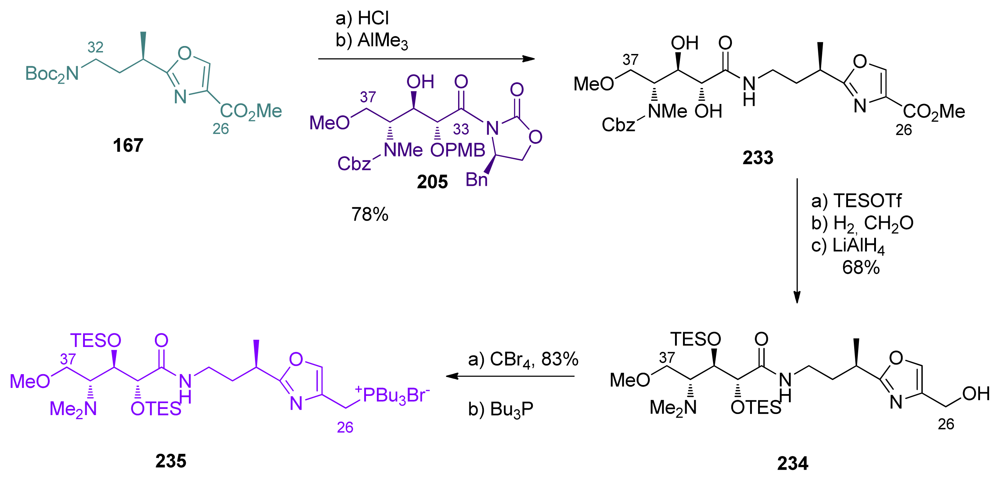
<p>Sarcosine derived oxazolidinone was prepared from <bold>201</bold> and further alkylated with dimethoxyethane in good yield (80%) and diastereoselectivity (98:2) to produce <bold>202</bold> (<xref ref-type="fig" rid="f46-marinedrugs-08-00122">Scheme 40</xref>). Displacement of the chiral auxiliary with LiBH<sub>4</sub> followed by Swern oxidation, where Hunig’s base was employed to prevent racemisation, cleanly furnished aldehyde <bold>203</bold>. Enolization of <bold>204</bold> in the presence of Sn(OTf)<sub>2</sub> and TMEDA followed by addition of aldehyde <bold>203</bold> afforded the expected <italic>anti</italic> aldol <bold>205</bold> in 60% yield. Unfortunately significant amounts of other diastereomers were also formed in the reaction.</p></sec>
<sec>
<title>5.5.2. Masamune [<xref ref-type="bibr" rid="b19-marinedrugs-08-00122">19</xref>,<xref ref-type="bibr" rid="b63-marinedrugs-08-00122">63</xref>]</title>
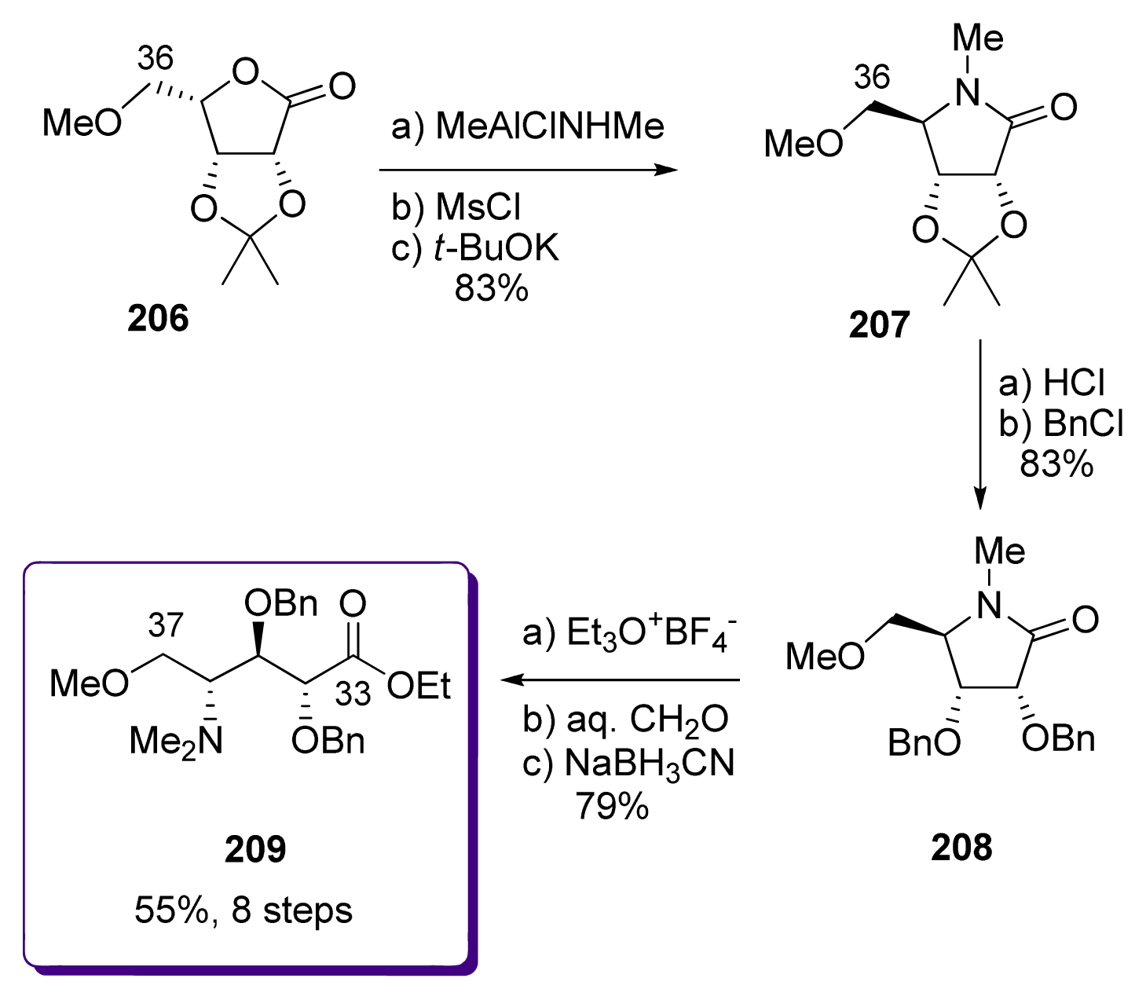
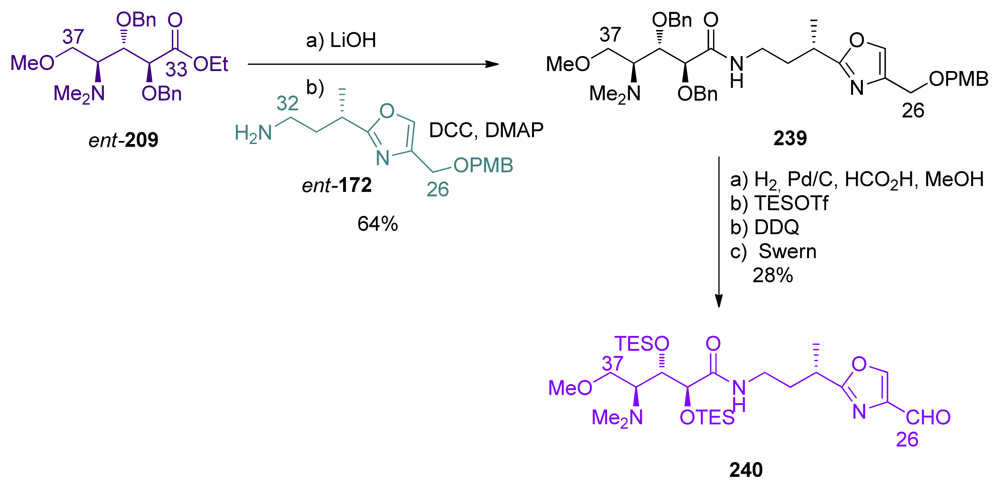
<p>The synthesis of the aminoacid derivative <bold>209</bold> began with the reaction of lactone <bold>206</bold>, easily prepared from gulonolactone, with the Weinreb’s reagent of methylamine (<xref ref-type="fig" rid="f47-marinedrugs-08-00122">Scheme 41</xref>). The crude hydroxyamine obtained was then mesylated and treated with <italic>t-</italic>BuOK to provide lactam <bold>207</bold>, with reverse stereochemistry at C<sub>35</sub> to that present in <bold>206</bold>. Cleavage of acetonide liberated the corresponding diol which was protected as the dibenzyl ether <bold>208</bold>. Treatment of <bold>208</bold> with Meerwein’s reagent provided the corresponding imidate, which after hydrolysis, reaction with formaldehyde and reduction with cyanoborohydride, furnished aminoester <bold>209</bold>, the enantiomer of the C<sub>33</sub>–C<sub>37</sub> fragment present in calyculins. However, in the course of the total synthesis of natural calyculin A, the authors briefly state that the synthesis of the fragment with the correct stereochemistry had been performed with significant improvements compared to <bold>209</bold>.</p></sec>
<sec>
<title>5.5.3. Shioiri [<xref ref-type="bibr" rid="b20-marinedrugs-08-00122">20</xref>,<xref ref-type="bibr" rid="b67-marinedrugs-08-00122">67</xref>]</title>
<p>Shioiri <italic>et al.</italic> also published a synthesis of the C<sub>33</sub>–C<sub>37</sub> fragment. Their strategy was based on OsO<sub>4</sub> dihydroxylation of the <sc>l</sc>-serine derived <italic>Z</italic>-alkene <bold>212</bold> (<xref ref-type="fig" rid="f48-marinedrugs-08-00122">Scheme 42</xref>). Boc-<sc>l</sc>-serine <bold>210</bold> was <italic>O-</italic>methylated and converted to aldehyde <bold>211</bold>. Reaction with Still-Gennari’s phosphonate and Boc replacement by Cbz group furnished the <italic>Z</italic>-enoate <bold>212</bold>. Dihydroxylation in the presence of dihydroquinine <italic>p</italic>-chlorobenzoate produced the corresponding diol (80% total yield, 80:20 diastereoselectivity), which was then protected as its acetonide <bold>213</bold>.</p>
<p>Shioiri’s group has also earlier published a synthesis of enantiomer of the C<sub>33</sub>–C<sub>37</sub> fragment. Although it was not utilized in the total synthesis, it had a great effect in determining the absolute stereochemistry of the calyculins.</p></sec>
<sec>
<title>5.5.4. Smith [<xref ref-type="bibr" rid="b22-marinedrugs-08-00122">22</xref>,<xref ref-type="bibr" rid="b51-marinedrugs-08-00122">51</xref>]</title>
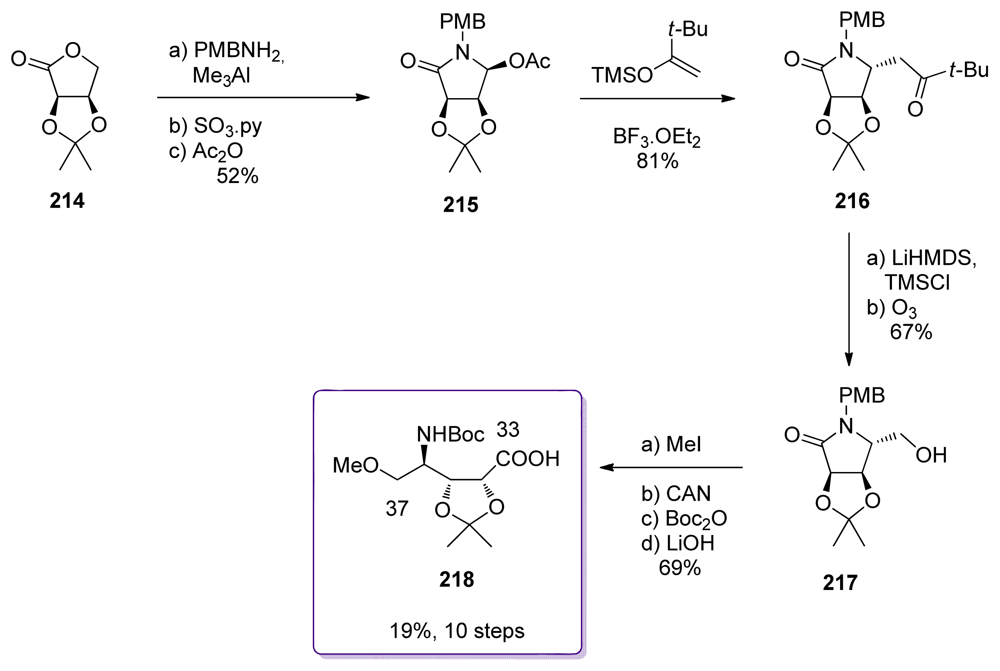
<p>The starting point of the preparation of the amino acid subunit was commercially available <italic>iso</italic>-propylidene <italic><sc>d</sc></italic>-erythronolactone (<bold>214</bold>, <xref ref-type="fig" rid="f49-marinedrugs-08-00122">Scheme 43</xref>). Treatment of <bold>214</bold> with PMBNH<sub>2</sub> in the presence of Me<sub>3</sub>Al gave the ring opened hydroxyl amide. Parikh-Doering oxidation of the primary alcohol and dehydration led to the formation of <bold>215</bold>, in a 7:1 anomeric mixture in favor of the β–anomer. In the presence of the TMS-enol ether of pinacolone and BF<sub>3</sub>.OEt<sub>2</sub>, <bold>215</bold> elegantly led to the formation of ketone <bold>216</bold> in 81% yield and as a single diastereomer. Formation of the TMS-silyl ether of <bold>216</bold> followed by reduction provided alcohol <bold>217</bold>. Methylation of the free hydroxyl group of <bold>217</bold>, PMB-Boc protecting group exchange and basic hydrolysis were the last steps for the preparation of <bold>218</bold>.</p></sec>
<sec>
<title>5.5.5. Armstrong [<xref ref-type="bibr" rid="b21-marinedrugs-08-00122">21</xref>,<xref ref-type="bibr" rid="b65-marinedrugs-08-00122">65</xref>]</title>
<p>The synthesis started from alcohol <bold>219</bold>, available in four steps from <italic><sc>d</sc></italic>-lyxose (<xref ref-type="fig" rid="f50-marinedrugs-08-00122">Scheme 44</xref>). <italic>O-</italic>Methylation, acidic hydrolysis followed by mild reduction yielded the corresponding diol which was selectively silyl-protected to give <bold>220</bold>. The C<sub>36</sub> stereochemistry of <bold>220</bold> is opposite to that found in the natural product. Inversion was achieved <italic>via</italic> mesylation, azidation and reduction to furnish amine <bold>221</bold>. Classical steps of amine-methylation, silyl deprotection and oxidation of the primary alcohol to the corresponding methyl ester completed the preparation of <bold>222</bold>. The overall yield for this fragment remains low mainly because of the difficulties encountered in the Jones oxidation.</p></sec>
<sec>
<title>5.5.6. Barrett [<xref ref-type="bibr" rid="b23-marinedrugs-08-00122">23</xref>,<xref ref-type="bibr" rid="b66-marinedrugs-08-00122">66</xref>]</title>
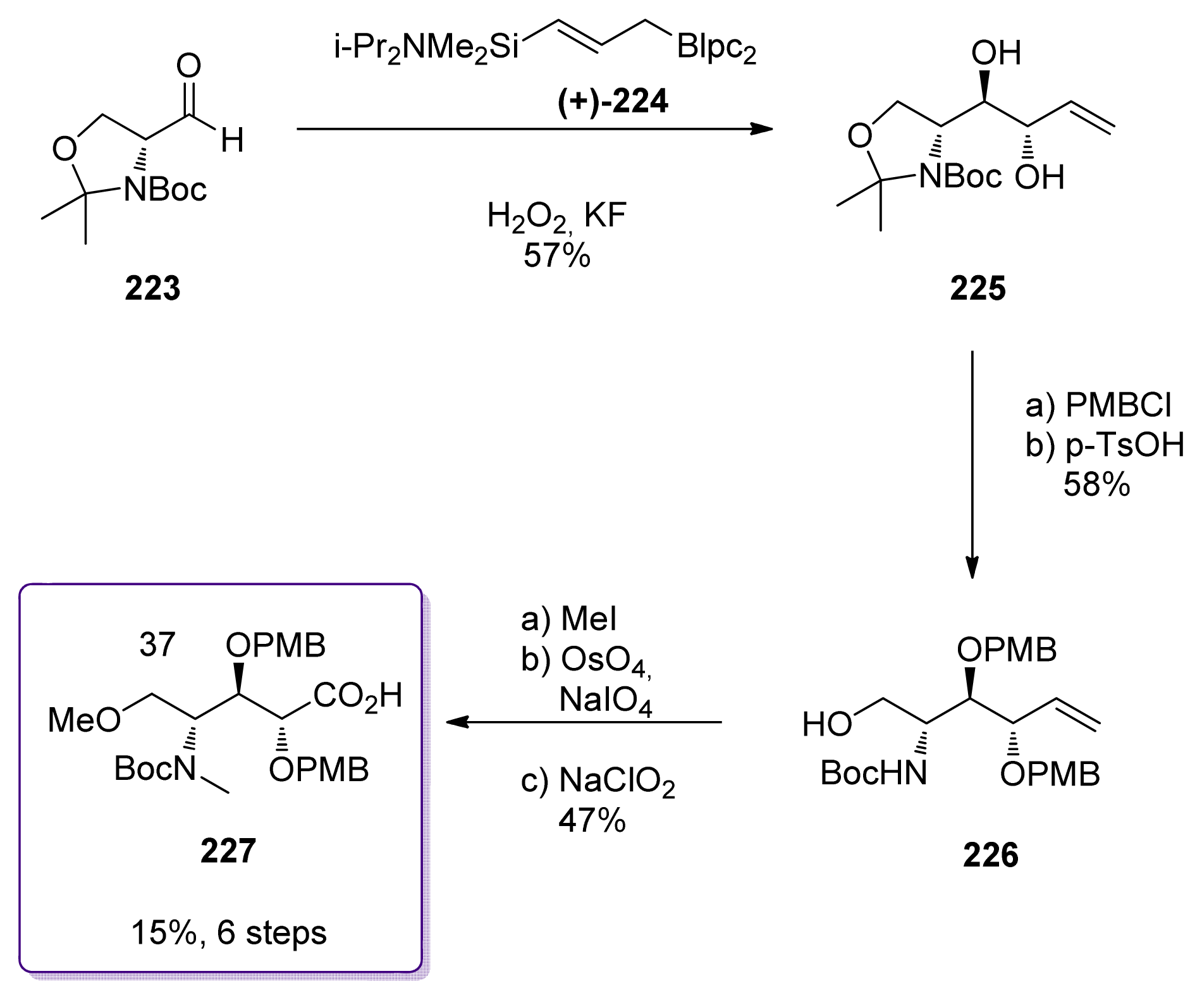
<p>Like the other fragments in the Barrett’s total synthesis of <italic>ent</italic>-calyculin A, the aminoacid part was also prepared using an allylboration strategy (<xref ref-type="fig" rid="f51-marinedrugs-08-00122">Scheme 45</xref>) [<xref ref-type="bibr" rid="b54-marinedrugs-08-00122">54</xref>,<xref ref-type="bibr" rid="b55-marinedrugs-08-00122">55</xref>]. Key reaction of Garner’s aldehyde <bold>223</bold> with the silylated allylborane derivative <bold>224</bold> followed by oxidative cleavage of the C-Si bond produced stereospecifically diol <bold>225</bold>, which was then protected as a di-PMB ether. Selective hydrolysis of the isopropylidene ketal gave alcohol <bold>226</bold>. <italic>O-</italic> and <italic>N-</italic>methylation preceeded the oxidative cleavage of the double bond, which was further oxidized to acid to furnish amino acid <bold>227</bold>.</p></sec>
<sec>
<title>5.5.7. Koskinen [<xref ref-type="bibr" rid="b38-marinedrugs-08-00122">38</xref>]</title>
<p>The synthesis of the aminoacid fragment C<sub>33</sub>-C<sub>38</sub> by Koskinen <italic>et al.</italic> began with the <sc>l</sc>-serine derived aldehyde <bold>228</bold> which gave, after treatment with the Still-Gennari phosphonate, the <italic>Z</italic>-enoate <bold>229</bold> (<xref ref-type="fig" rid="f52-marinedrugs-08-00122">Scheme 46</xref>). The key-step for this sequence was the stereospecific dihydroxylation. Taking advantage of the allylic strain of <italic>Z</italic>-olefins enhanced by the presence of the cyclic protecting group pattern, treatment of <bold>229</bold> with OsO<sub>4</sub> led to the formation of a single diol <bold>230</bold>, whose analysis proved &gt;99% optical purity. After acetate protection, the acetonide was cleaved to amino alcohol <bold>231</bold>. <italic>O-</italic>Methylation, Boc-deprotection and <italic>N</italic>-dimethylation finished this synthesis to give <bold>232</bold>.</p></sec></sec>
<sec sec-type="intro">
<title>5.6. Finishing the total synthesis: introduction of phosphonate and assembly of fragments</title>
<p>The syntheses of the four fragments of calyculins have without a doubt created a great challenge to all chemists involved in the synthesis work. However, before the final assembly of the fragments, representing the final judgement of the efficiency of the total synthesis, there was still one problem to solve: the introduction of the C<sub>17</sub> phosphate group. The C<sub>17</sub> is placed in very shielded and hindered position in the spiroketal core. It therefore requires a reactive electrophile for the activation, but at the same time it has to be mild enough not to react with other parts of the molecule. It is interesting that even if phosphate groups are common in natural products, techniques for their introduction are still limited.</p>
<p>Because the Evans and Masamune groups were the first ones involved in the total synthesis of calyculins, they performed the pioneering work in that field, by studying the different possibilities protecting phosphate groups [<xref ref-type="bibr" rid="b18-marinedrugs-08-00122">18</xref>,<xref ref-type="bibr" rid="b19-marinedrugs-08-00122">19</xref>,<xref ref-type="bibr" rid="b68-marinedrugs-08-00122">68</xref>]. They both ended up using phosphorous (III) compounds as reactive electrophiles; this technique being used later by all the other groups.</p>
<p>The efforts towards the total synthesis of any natural product are truly tested in the coupling of fragments. Without a good method for that, even the greatest synthesis does not complete its final goal. The completion of the six published total synthesis of calyculins are discussed next.</p>
<sec>
<title>5.6.1. Total synthesis of <italic>ent</italic>-calyculin A by Evans [<xref ref-type="bibr" rid="b18-marinedrugs-08-00122">18</xref>]</title>
<p>The total synthesis published by Evans and co-workers was the first completed synthesis of a member of the calyculin family; however, the molecule obtained appeared to be the enantiomer of calyculin A. Thanks to this work, the absolute configuration of calyculins was finally determined.</p>
<p>The assembly of the fragments is shown in <xref ref-type="fig" rid="f53-marinedrugs-08-00122">Scheme 47</xref> and <xref ref-type="fig" rid="f54-marinedrugs-08-00122">Scheme 48</xref>. It should be noted that the protection of hydroxyl groups was planned as a <italic>cumulative silicon strategy</italic>. If a protection needed to persist until the end of the synthesis, silicon-based protecting groups were used while more temporary protecting groups were non-silicon based.</p>
<p>To produce the C<sub>26</sub>–C<sub>37</sub> subunit, the oxazole <bold>167</bold> was first Boc-deprotected and coupled with oxazolidone <bold>205</bold> in the presence of Me<sub>3</sub>Al, pleasingly leading to the formation of the amide bond and PMB-deprotection in the same operation (<xref ref-type="fig" rid="f53-marinedrugs-08-00122">Scheme 47</xref>). Diol <bold>233</bold> was thus obtained and was further TES-protected, which was followed by CBz-removal, reductive methylation of the amine, and reduction of the ester group to furnish <bold>234</bold>. Conversion of the alcohol to the corresponding tributylphosphonium salt, precursor for the Wittig reaction, terminated the preparation of <bold>235</bold>.</p>
<p>The preparation of the C<sub>1</sub>–C<sub>25</sub> fragment was finished with the HWE reaction between aldehyde <bold>85</bold> and stannyl phosphonate <bold>32</bold> which afforded the corresponding stannyl triene as a 7:1 <italic>E:Z</italic> mixture (<xref ref-type="fig" rid="f54-marinedrugs-08-00122">Scheme 48</xref>). Stille coupling of the triene with vinyl iodide <bold>31</bold> gave the tetraene <bold>236</bold>. The phosphonate at C<sub>17</sub> was then introduced, by treating <bold>236</bold> with PCl<sub>3</sub>, followed by PMBOH and <italic>in situ</italic> oxidation of the intermediate phosphite with H<sub>2</sub>O<sub>2</sub>. Selective removal of the primary TBS at C<sub>25</sub> and subsequent oxidation produced aldehyde <bold>237</bold>. Wittig reaction between <bold>237</bold> and the phosphonium salt <bold>235</bold> afforded the protected product <bold>238</bold>. Treatment of <bold>238</bold> by HF finished the first total synthesis of <italic>ent</italic>-calyculin A.</p></sec>
<sec>
<title>5.6.2. Total synthesis of calyculin A by Masamune [<xref ref-type="bibr" rid="b19-marinedrugs-08-00122">19</xref>,<xref ref-type="bibr" rid="b63-marinedrugs-08-00122">63</xref>]</title>
<p>Masamune <italic>et al</italic>. published in 1994 the first total synthesis of naturally occurring calyculin A. The assembly of C<sub>26</sub>–C<sub>37</sub> fragment is described in <xref ref-type="fig" rid="f55-marinedrugs-08-00122">Scheme 49</xref>. Ester <italic>ent</italic>-<bold>209</bold> was saponified and then coupled with amine <italic>ent</italic>-<bold>172</bold> which gave amide <bold>239</bold>. Selective deprotection of the C<sub>34</sub> and C<sub>35</sub> benzyl moieties in the presence of C<sub>26</sub> PMB group was achieved by performing the hydrogenation in a HCO<sub>2</sub>H/MeOH solvent mixture. Further TES-protection of the resulting diol, PMB removal and oxidation to aldehyde produced <bold>240</bold>.</p>
<p>Then, the phosphate introduction at the C<sub>17</sub> alcohol of spiroketal <bold>99</bold> was carried out (<xref ref-type="fig" rid="f56-marinedrugs-08-00122">Scheme 50</xref>). The authors chose trimethylsilylethyl phosphate ester, a protecting group they had previously studied [<xref ref-type="bibr" rid="b68-marinedrugs-08-00122">68</xref>], which was introduced by successively treating <bold>99</bold> with TMSCH<sub>2</sub>CH<sub>2</sub>OPCl<sub>2</sub>, TMSCH<sub>2</sub>CH<sub>2</sub>OH and H<sub>2</sub>O<sub>2</sub>, to yield <bold>241</bold>. To create the C<sub>25</sub>–C<sub>26</sub> double bond, the Masamune group decided to use Julia-Lythgoe conditions. In this purpose, the benzyl group at C<sub>25</sub> was removed and conversion of the alcohol to the corresponding sulfone was carried out. Additional protecting group exchange at C<sub>9</sub> was also performed to give sulfone <bold>242</bold>. Key Julia-Lythgoe olefination between <bold>242</bold> and <bold>240</bold> was then performed, providing <bold>243</bold>. The geometry of the newly formed C<sub>25</sub>-C<sub>26</sub> double bond was described as being predominantly <italic>E</italic>, however no <italic>E:Z</italic> ratio was reported. Oxidation of the primary alcohol of <bold>243</bold> was followed by reaction with phosphonate <bold>34</bold> and tin/iodide exchange. Stille coupling with stannyl <bold>33</bold> furnished compound <bold>244</bold>. Final HF treatment completed the first total synthesis of natural calyculin A.</p></sec>
<sec>
<title>5.6.3. Formal total synthesis of calyculin A by Shioiri [<xref ref-type="bibr" rid="b20-marinedrugs-08-00122">20</xref>]</title>
<p>The formal total synthesis of <italic>ent-</italic>calyculin A by Shioiri and co-workers converges on the C<sub>9</sub>–C<sub>37</sub> intermediate <bold>243</bold> in the Masamune’s synthesis. This synthesis allows a comparable overall yield with considerably shorter synthesis.</p>
<p>The C<sub>26</sub>–C<sub>37</sub> fragment was synthesized efficiently from <bold>213</bold> and de-BOC-<italic>ent-</italic><bold>179</bold> (<xref ref-type="fig" rid="f57-marinedrugs-08-00122">Scheme 51</xref>). The coupling of the fragments C<sub>26</sub>–C<sub>32</sub> and C<sub>33</sub>–C<sub>37</sub> in the presence of DEPC furnished amide <bold>245</bold> in 90% yield. Acetonide deprotection furnished diol <bold>233</bold>, which was converted to phosphonium <bold>235</bold> following Evans procedure [<xref ref-type="bibr" rid="b18-marinedrugs-08-00122">18</xref>].</p>
<p>PMB-removal at C<sub>17</sub> on <bold>112</bold> was followed by phosphorylation, C<sub>9</sub> protecting group exchange and ozonolysis at C<sub>25</sub> to give aldehyde <bold>246</bold> (<xref ref-type="fig" rid="f58-marinedrugs-08-00122">Scheme 52</xref>). Wittig reaction between <bold>246</bold> and phosphonium salt <bold>235</bold>, followed by TMS-deprotection at C<sub>9</sub> furnished compound <bold>243</bold>, the intermediate previously reported by Masamune.</p></sec>
<sec>
<title>5.6.4. The total synthesis of <italic>ent</italic>-calyculin A and B by Smith [<xref ref-type="bibr" rid="b22-marinedrugs-08-00122">22</xref>,<xref ref-type="bibr" rid="b51-marinedrugs-08-00122">51</xref>,<xref ref-type="bibr" rid="b69-marinedrugs-08-00122">69</xref>]</title>
<p>Smith and co-workers tenacious work afforded the total syntheses of <italic>ent</italic>-calyculin A and B in 1999. The coupling of C<sub>33</sub>–C<sub>37</sub> oxazole <bold>184</bold> and C<sub>26</sub>–C<sub>32</sub> acid <bold>218</bold> was carried out in the presence of DEPC, as described by Shioiri, to give <bold>247</bold> (<xref ref-type="fig" rid="f59-marinedrugs-08-00122">Scheme 53</xref>). Boc-deprotection was followed by methylation of the amine, and acetonide deprotection liberated diol which was protected with DEIPS group, to yield <bold>248</bold>. Finally, conversion of the methyl ester at C<sub>26</sub> to the phosphonium salt <bold>249</bold> was carried out <italic>via</italic> the corresponding chloride.</p>
<p>Phosphate introduction at C<sub>17</sub> of <bold>127</bold> was followed by benzyl deprotection and oxidation to furnish aldehyde <bold>250</bold> (<xref ref-type="fig" rid="f60-marinedrugs-08-00122">Scheme 54</xref>). Wittig olefination between <bold>250</bold> and phosphonium chloride <bold>249</bold> provided <bold>251</bold> as a 9:1 <italic>E:Z</italic> mixture in 84% yield. Pivaloyl-removal at C<sub>9</sub> and subsequent oxidation of <bold>251</bold> furnished the corresponding aldehyde, which was olefinated <italic>via</italic> HWE reaction with phosphonate <bold>30</bold> to give methyl ketone <bold>252</bold>, after acidic treatment, in excellent 92% yield and 15:1 <italic>E:Z</italic> ratio. Peterson olefination of <bold>252</bold> furnished a 1.7:1 mixture of the <italic>E</italic> and <italic>Z</italic> isomers, which respectively corresponds to protected <italic>ent</italic>-calyculin A and <italic>ent</italic>-calyculin B. After chromatographic separation, final HF treatment produced <italic>ent</italic>-calyculin A in 69% yield and <italic>ent</italic>-calyculin B in 84% yield.</p></sec>
<sec>
<title>5.6.5. Total synthesis of calyculin C by Armstrong [<xref ref-type="bibr" rid="b21-marinedrugs-08-00122">21</xref>,<xref ref-type="bibr" rid="b65-marinedrugs-08-00122">65</xref>]</title>
<p>The total synthesis of calyculin C by Armstrong was also a result of perseverant work. Armstrong and co-workers were also the first to prepare calyculin C and prove its stereochemistry. Boc-deprotection of <bold>190</bold> was followed by coupling with ester <bold>222</bold> (<xref ref-type="fig" rid="f61-marinedrugs-08-00122">Scheme 55</xref>). Unfortunately, this reaction produced a 2.7:1 mixture of C<sub>34</sub> epimers. Further studies proved that the main product was the undesired isomer; the expected diastereomer <bold>253</bold> being isolated in only 17%. Conversion of the chloride to the phosphonium salt and benzyl-deprotection then furnished <bold>254</bold>.</p>
<p>The final stages of the synthesis followed Evans’ example (<xref ref-type="fig" rid="f62-marinedrugs-08-00122">Scheme 56</xref>). Fragment <bold>139</bold> was converted to the tetraene <bold>255</bold>. C<sub>17</sub>-phosphonate protection, C<sub>25</sub>-deprotection and subsequent oxidation furnished aldehyde <bold>256</bold>. Olefination between <bold>256</bold> and <bold>254</bold> furnished compound <bold>257</bold> in modest yield. Final HF treatment completed the total synthesis of calyculin C <bold>3</bold>.</p></sec>
<sec>
<title>5.6.6. Formal total synthesis of <italic>ent-</italic>calyculin A by Barrett [<xref ref-type="bibr" rid="b23-marinedrugs-08-00122">23</xref>]</title>
<p>Barrett <italic>et al</italic>. last steps for completing the total synthesis of <italic>ent-</italic><bold>1</bold> began with the coupling of aminoacid <bold>227</bold> and oxazole <bold>196</bold> fragments, to give amide <bold>258</bold> (<xref ref-type="fig" rid="f63-marinedrugs-08-00122">Scheme 57</xref>). The latter was then converted to Evans’s intermediate <bold>234</bold>, by a three-step/one-pot sequence involving Boc-deprotection, <italic>N</italic>-methylation and reduction of the ester at C<sub>26</sub>.</p>
<p>Aldol reaction between methyl ketone <bold>67</bold> and aldehyde <bold>150</bold> gave in a diastereoselective manner β-hydroxyketone <bold>259</bold>, unfortunately carrying the wrong stereochemistry at C<sub>15</sub> (<xref ref-type="fig" rid="f64-marinedrugs-08-00122">Scheme 58</xref>). LiAlH<sub>4</sub> reduction at C<sub>13</sub> furnished the corresponding diol in 73%, together with its C<sub>13</sub>-epimer in 15% yield. Selective monosilylation at C<sub>13</sub> was followed by inversion of stereochemistry at C<sub>15</sub> by successive Dess-Martin oxidation and DIBAL-H reduction to produce <bold>260</bold>. <italic>O</italic>-Methylation at C<sub>15</sub>, PMB-removal at C<sub>17</sub> and final Stille coupling with stannane <bold>33</bold> finished the synthesis of Evans’ intermediate <bold>236</bold>.</p></sec></sec></sec>
<sec sec-type="conclusions">
<title>6. Conclusions</title>
<p>Altogether six total or formal synthesis of calyculins have been published. These syntheses can be divided into three groups:</p>
<list list-type="bullet">
<list-item>
<p>Masamune and Armstrong have described the total synthesis of natural calyculins A and C, respectively</p></list-item>
<list-item>
<p>Evans and Smith have completed the total synthesis of the enantiomer of naturally occurring calyculin A (and B for Smith)</p></list-item>
<list-item>
<p>Shioiri and Barrett have published highly advanced intermediates, previously prepared by Masamune and Evans respectively and therefore accomplished formal synthesis of natural and non natural calyculin A.</p></list-item></list>
<p>Even if the basic retrosynthetic analysis appeared to be quite similar in the different synthesis, the different points of views and methods makes the comparison challenging. The overall yields and number of steps of the different syntheses are compiled in <xref ref-type="table" rid="t2-marinedrugs-08-00122">Table 2</xref>.</p>
<p>Each of these syntheses resulted from extensive efforts and has to be considered as high level work. As discussed earlier, the structure of calyculins makes the total synthesis very demanding in every aspect; every fragment had its own features and presented challenges. Of course, theses syntheses are not perfect and some drawbacks could be noted, like a C<sub>13</sub>-stereochemistry inversion for Evans, a low-yielding iodide-tin exchange for Masamune, protecting groups exchange for Shioiri, low selectivity in the final Peterson olefination for Smith (which fortunately led to the formation of <italic>ent</italic>-calyculin B), stereochemistry inversions and poor selectivity in the second Brown crotylation for Armstrong or a C<sub>15</sub>-stereochemistry inversion for Barrett. However, all these syntheses were performed before 2000 and all the new tools that have appeared in the last decade for stereoselective transformations were not available. For all these reasons, these total syntheses of the structurally much elaborated calyculins deserve the biggest respect from the synthetic community.</p>
<p>Another goal should still lie in a better understanding of the PP inhibition-activity of calyculins and related toxins. Improved design and synthetic methods should also lead to the design of simpler synthetic inhibitors that could compete with the activity of natural toxins.</p></sec></body>
<back>
<ack>
<title>Acknowledgements</title>
<p>This research has been financially supported by the Academy of Finland (Grant No 123485).</p></ack>
<fn-group><fn>
<p><italic>Samples Availability:</italic> Available from the authors.</p></fn></fn-group>
<ref-list>
<title>References</title>
<ref id="b1-marinedrugs-08-00122"><label>1</label><citation citation-type="journal"><person-group person-group-type="author"><name><surname>Nakao</surname><given-names>Y</given-names></name><name><surname>Fusetani</surname><given-names>N</given-names></name></person-group><article-title>Enzyme inhibitors from marine invertebrates</article-title><source>J Nat Prod</source><year>2007</year><volume>70</volume><fpage>689</fpage><lpage>710</lpage><pub-id pub-id-type="doi">10.1021/np060600x</pub-id><pub-id pub-id-type="pmid">17362037</pub-id></citation></ref>
<ref id="b2-marinedrugs-08-00122"><label>2</label><citation citation-type="journal"><person-group person-group-type="author"><name><surname>Barford</surname><given-names>D</given-names></name><name><surname>Das</surname><given-names>AK</given-names></name><name><surname>Egloff</surname><given-names>M-P</given-names></name></person-group><article-title>The strucrure and mechanism of protein phosphatases: Insights into catalysis and regulation</article-title><source>Annu Rev Biophys Biomol Struct</source><year>1998</year><volume>27</volume><fpage>133</fpage><lpage>164</lpage><pub-id pub-id-type="doi">10.1146/annurev.biophys.27.1.133</pub-id><pub-id pub-id-type="pmid">9646865</pub-id></citation></ref>
<ref id="b3-marinedrugs-08-00122"><label>3</label><citation citation-type="journal"><person-group person-group-type="author"><name><surname>Cohen</surname><given-names>PTW</given-names></name></person-group><article-title>Novel protein serine/threonine phosphatases: Variety is the spice of life</article-title><source>Trends Biochem Sci</source><year>1997</year><volume>22</volume><fpage>245</fpage><lpage>251</lpage><pub-id pub-id-type="doi">10.1016/S0968-0004(97)01060-8</pub-id><pub-id pub-id-type="pmid">9255065</pub-id></citation></ref>
<ref id="b4-marinedrugs-08-00122"><label>4</label><citation citation-type="journal"><person-group person-group-type="author"><name><surname>McCluskey</surname><given-names>A</given-names></name><name><surname>Sim</surname><given-names>ATR</given-names></name><name><surname>Sakoff</surname><given-names>JA</given-names></name></person-group><article-title>Serine-Threonine protein phosphatase inhibitors: Development of potential therapeutic strategies</article-title><source>J Med Chem</source><year>2002</year><volume>45</volume><fpage>1151</fpage><lpage>1175</lpage><pub-id pub-id-type="doi">10.1021/jm010066k</pub-id><pub-id pub-id-type="pmid">11881984</pub-id></citation></ref>
<ref id="b5-marinedrugs-08-00122"><label>5</label><citation citation-type="journal"><person-group person-group-type="author"><name><surname>Schönthal</surname><given-names>AH</given-names></name></person-group><article-title>Role of serine/threonine protein phosphatase 2A in cancer</article-title><source>Cancer Lett</source><year>2001</year><volume>170</volume><fpage>1</fpage><lpage>13</lpage><pub-id pub-id-type="doi">10.1016/S0304-3835(01)00561-4</pub-id><pub-id pub-id-type="pmid">11448528</pub-id></citation></ref>
<ref id="b6-marinedrugs-08-00122"><label>6</label><citation citation-type="journal"><person-group person-group-type="author"><name><surname>Sheppeck</surname><given-names>JE</given-names></name><name><surname>Gauss</surname><given-names>C-M</given-names></name><name><surname>Chamberlin</surname><given-names>AR</given-names></name></person-group><article-title>Inhibition of the ser-thr phosphatases PP1 and PP2A by naturally occurring toxins</article-title><source>Bioorg Med Chem</source><year>1997</year><volume>5</volume><fpage>1739</fpage><lpage>1750</lpage><pub-id pub-id-type="doi">10.1016/S0968-0896(97)00146-6</pub-id><pub-id pub-id-type="pmid">9354230</pub-id></citation></ref>
<ref id="b7-marinedrugs-08-00122"><label>7</label><citation citation-type="journal"><person-group person-group-type="author"><name><surname>Sontag</surname><given-names>E</given-names></name></person-group><article-title>Protein phosphatase 2A: The trojan horse of cellular signaling</article-title><source>Cell Signaling</source><year>2001</year><volume>13</volume><fpage>7</fpage><lpage>16</lpage><pub-id pub-id-type="doi">10.1016/S0898-6568(00)00123-6</pub-id></citation></ref>
<ref id="b8-marinedrugs-08-00122"><label>8</label><citation citation-type="journal"><person-group person-group-type="author"><name><surname>Kato</surname><given-names>Y</given-names></name><name><surname>Fusetani</surname><given-names>N</given-names></name><name><surname>Matsunaga</surname><given-names>S</given-names></name><name><surname>Hashimoto</surname><given-names>K</given-names></name><name><surname>Koseki</surname><given-names>K</given-names></name></person-group><article-title>Bioactive marine metabolites. 24. Isolation and structure elucidation of calyculins B, C, and D, novel antitumor metabolites, from the marine sponge Discodermia calyx</article-title><source>J Org Chem</source><year>1988</year><volume>53</volume><fpage>3930</fpage><lpage>3932</lpage><pub-id pub-id-type="doi">10.1021/jo00252a009</pub-id></citation></ref>
<ref id="b9-marinedrugs-08-00122"><label>9</label><citation citation-type="journal"><person-group person-group-type="author"><name><surname>Bewley</surname><given-names>CA</given-names></name><name><surname>Faulkner</surname><given-names>DJ</given-names></name></person-group><article-title>Lithistid sponges: Star performers or hostes to the stars</article-title><source>Angew Chem Int Ed</source><year>1998</year><volume>37</volume><fpage>2162</fpage><lpage>2178</lpage><pub-id pub-id-type="doi">10.1002/(SICI)1521-3773(19980904)37:16&lt;2162::AID-ANIE2162&gt;3.0.CO;2-2</pub-id></citation></ref>
<ref id="b10-marinedrugs-08-00122"><label>10</label><citation citation-type="journal"><person-group person-group-type="author"><name><surname>Dumdei</surname><given-names>EJ</given-names></name><name><surname>Blunt</surname><given-names>JW</given-names></name><name><surname>Munro</surname><given-names>MHG</given-names></name><name><surname>Pannell</surname><given-names>LK</given-names></name></person-group><article-title>Isolation of calyculins, calyculinamides, and swinholide H from the New Zealand deep-water marine sponge lamellomorpha strongylata</article-title><source>J Org Chem</source><year>1997</year><volume>62</volume><fpage>2636</fpage><lpage>2639</lpage><pub-id pub-id-type="doi">10.1021/jo961745j</pub-id><pub-id pub-id-type="pmid">11671610</pub-id></citation></ref>
<ref id="b11-marinedrugs-08-00122"><label>11</label><citation citation-type="journal"><person-group person-group-type="author"><name><surname>Kato</surname><given-names>Y</given-names></name><name><surname>Fusetani</surname><given-names>N</given-names></name><name><surname>Matsunaga</surname><given-names>S</given-names></name><name><surname>Hashimoto</surname><given-names>K</given-names></name><name><surname>Fujita</surname><given-names>S</given-names></name><name><surname>Furuya</surname><given-names>T</given-names></name></person-group><article-title>Bioactive marine metabolites. Part 16. Calyculin A. A novel antitumor metabolite from the marine sponge Discodermia calyx</article-title><source>J Am Chem Soc</source><year>1986</year><volume>108</volume><fpage>2780</fpage><lpage>2781</lpage><pub-id pub-id-type="doi">10.1021/ja00270a061</pub-id></citation></ref>
<ref id="b12-marinedrugs-08-00122"><label>12</label><citation citation-type="journal"><person-group person-group-type="author"><name><surname>Kato</surname><given-names>Y</given-names></name><name><surname>Fusetani</surname><given-names>N</given-names></name><name><surname>Matsunaga</surname><given-names>S</given-names></name><name><surname>Hashimoto</surname><given-names>K</given-names></name><name><surname>Koseki</surname><given-names>K</given-names></name></person-group><article-title>Bioactive marine metabolites. 24. Isolation and structure elucidation of calyculins B, C, and D, novel antitumor metabolites, from the marine sponge Discodermia calyx</article-title><source>J Org Chem</source><year>2002</year><volume>53</volume><fpage>3930</fpage><lpage>3932</lpage></citation></ref>
<ref id="b13-marinedrugs-08-00122"><label>13</label><citation citation-type="journal"><person-group person-group-type="author"><name><surname>Matsunaga</surname><given-names>S</given-names></name><name><surname>Fujiki</surname><given-names>H</given-names></name><name><surname>Sakata</surname><given-names>D</given-names></name><name><surname>Fusetani</surname><given-names>N</given-names></name></person-group><article-title>Calyculins E, F, G, and H, additional inhibitors of protein phosphatases 1 and 2A, from the marine sponge discodermia calyx</article-title><source>Tetrahedron</source><year>1991</year><volume>47</volume><fpage>2999</fpage><lpage>3006</lpage><pub-id pub-id-type="doi">10.1016/S0040-4020(01)96031-4</pub-id></citation></ref>
<ref id="b14-marinedrugs-08-00122"><label>14</label><citation citation-type="journal"><person-group person-group-type="author"><name><surname>Matsunaga</surname><given-names>S</given-names></name><name><surname>Wakimoto</surname><given-names>T</given-names></name><name><surname>Fusetani</surname><given-names>N</given-names></name></person-group><article-title>Isolation of four new calyculins from the marine sponge Discodermia calyx</article-title><source>J Org Chem</source><year>1997</year><volume>62</volume><fpage>2640</fpage><lpage>2642</lpage><pub-id pub-id-type="doi">10.1021/jo961746b</pub-id><pub-id pub-id-type="pmid">11671611</pub-id></citation></ref>
<ref id="b15-marinedrugs-08-00122"><label>15</label><citation citation-type="journal"><person-group person-group-type="author"><name><surname>Matsunaga</surname><given-names>S</given-names></name><name><surname>Wakimoto</surname><given-names>T</given-names></name><name><surname>Fusetani</surname><given-names>N</given-names></name><name><surname>Suganuma</surname><given-names>M</given-names></name></person-group><article-title>Isolation of dephosphonocalyculin A from the marine sponge, Discodermia calyx</article-title><source>Tetrahedron Lett</source><year>1997</year><volume>38</volume><fpage>3763</fpage><lpage>3764</lpage><pub-id pub-id-type="doi">10.1016/S0040-4039(97)00748-X</pub-id></citation></ref>
<ref id="b16-marinedrugs-08-00122"><label>16</label><citation citation-type="journal"><person-group person-group-type="author"><name><surname>Hamada</surname><given-names>Y</given-names></name><name><surname>Tanada</surname><given-names>Y</given-names></name><name><surname>Yokokawa</surname><given-names>F</given-names></name><name><surname>Shioiri</surname><given-names>T</given-names></name></person-group><article-title>Stereoselective synthesis of 2,3-dihydroxy-4-dimethylamino-5-methoxypentanoic acid, a fragment of calyculins -Determination of the absolute configuration of calyculins</article-title><source>Tetrahedron Lett</source><year>1991</year><volume>32</volume><fpage>5983</fpage><lpage>5986</lpage><pub-id pub-id-type="doi">10.1016/S0040-4039(00)79444-5</pub-id></citation></ref>
<ref id="b17-marinedrugs-08-00122"><label>17</label><citation citation-type="journal"><person-group person-group-type="author"><name><surname>Matsunaga</surname><given-names>S</given-names></name><name><surname>Fusetani</surname><given-names>N</given-names></name></person-group><article-title>Absolute stereochemistry of the calyculins, potent inhibitors of potent phosphatases 1 and 2A</article-title><source>Tetrahedron Lett</source><year>1991</year><volume>32</volume><fpage>5605</fpage><lpage>5606</lpage><pub-id pub-id-type="doi">10.1016/0040-4039(91)80096-O</pub-id></citation></ref>
<ref id="b18-marinedrugs-08-00122"><label>18</label><citation citation-type="journal"><person-group person-group-type="author"><name><surname>Evans</surname><given-names>DA</given-names></name><name><surname>Gage</surname><given-names>JR</given-names></name><name><surname>Leighton</surname><given-names>JL</given-names></name></person-group><article-title>Total synthesis of (+)-calyculin A</article-title><source>J Am Chem Soc</source><year>1992</year><volume>114</volume><fpage>9434</fpage><lpage>9453</lpage><pub-id pub-id-type="doi">10.1021/ja00050a024</pub-id></citation></ref>
<ref id="b19-marinedrugs-08-00122"><label>19</label><citation citation-type="journal"><person-group person-group-type="author"><name><surname>Tanimoto</surname><given-names>N</given-names></name><name><surname>Gerritz</surname><given-names>SW</given-names></name><name><surname>Sawabe</surname><given-names>A</given-names></name><name><surname>Noda</surname><given-names>T</given-names></name><name><surname>Filla</surname><given-names>SA</given-names></name><name><surname>Masamune</surname><given-names>S</given-names></name></person-group><article-title>The synthesis of naturally occurring (−)-calyculin A</article-title><source>Angew Chem Int Ed</source><year>1994</year><volume>33</volume><fpage>673</fpage><lpage>675</lpage><pub-id pub-id-type="doi">10.1002/anie.199406731</pub-id></citation></ref>
<ref id="b20-marinedrugs-08-00122"><label>20</label><citation citation-type="journal"><person-group person-group-type="author"><name><surname>Yokokawa</surname><given-names>F</given-names></name><name><surname>Hamada</surname><given-names>Y</given-names></name><name><surname>Shioiri</surname><given-names>T</given-names></name></person-group><article-title>Total synthesis of calyculin A—Construction of the C(9)–C(37) fragment</article-title><source>Chem Commun</source><year>1996</year><volume>7</volume><fpage>872</fpage></citation></ref>
<ref id="b21-marinedrugs-08-00122"><label>21</label><citation citation-type="journal"><person-group person-group-type="author"><name><surname>Ogawa</surname><given-names>AK</given-names></name><name><surname>Armstrong</surname><given-names>RW</given-names></name></person-group><article-title>Total synthesis of calyculin C</article-title><source>J Am Chem Soc</source><year>1998</year><volume>120</volume><fpage>12435</fpage><lpage>12442</lpage><pub-id pub-id-type="doi">10.1021/ja980836q</pub-id></citation></ref>
<ref id="b22-marinedrugs-08-00122"><label>22</label><citation citation-type="journal"><person-group person-group-type="author"><name><surname>Smith</surname><given-names>AB</given-names></name><name><surname>Friestad</surname><given-names>GK</given-names></name><name><surname>Duan</surname><given-names>JJW</given-names></name><name><surname>Barbosa</surname><given-names>J</given-names></name><name><surname>Hull</surname><given-names>KG</given-names></name><name><surname>Iwashima</surname><given-names>M</given-names></name><name><surname>Qiu</surname><given-names>Y</given-names></name><name><surname>Spoors</surname><given-names>PG</given-names></name><name><surname>Bertounesque</surname><given-names>E</given-names></name><name><surname>Salvatore</surname><given-names>BA</given-names></name></person-group><article-title>Total synthesis of (+)-calyculin A and (−)-calyculin B</article-title><source>J Org Chem</source><year>1998</year><volume>63</volume><fpage>7596</fpage><lpage>7597</lpage><pub-id pub-id-type="doi">10.1021/jo981813x</pub-id></citation></ref>
<ref id="b23-marinedrugs-08-00122"><label>23</label><citation citation-type="journal"><person-group person-group-type="author"><name><surname>Anderson</surname><given-names>OP</given-names></name><name><surname>Barrett</surname><given-names>AGM</given-names></name><name><surname>Edmunds</surname><given-names>JJ</given-names></name><name><surname>Hachiya</surname><given-names>S-I</given-names></name><name><surname>Hendrix</surname><given-names>JA</given-names></name><name><surname>Horita</surname><given-names>K</given-names></name><name><surname>Malecha</surname><given-names>JW</given-names></name><name><surname>Parkinson</surname><given-names>CJ</given-names></name><name><surname>VanSickle</surname><given-names>A</given-names></name></person-group><article-title>Applications of crotyldiisopino campheylboranes in synthesis: A formal total synthesis of (+)-calyculin A</article-title><source>Can J Chem</source><year>2001</year><volume>79</volume><fpage>1562</fpage><lpage>1592</lpage><pub-id pub-id-type="doi">10.1139/v01-133</pub-id></citation></ref>
<ref id="b24-marinedrugs-08-00122"><label>24</label><citation citation-type="journal"><person-group person-group-type="author"><name><surname>Gupta</surname><given-names>V</given-names></name><name><surname>Ogawa</surname><given-names>AK</given-names></name><name><surname>Du</surname><given-names>X</given-names></name><name><surname>Houk</surname><given-names>KN</given-names></name><name><surname>Armstrong</surname><given-names>RW</given-names></name></person-group><article-title>A model for binding of structurally diverse natural product inhibitors of protein phosphatases PP1 and PP2A</article-title><source>J Med Chem</source><year>1997</year><volume>40</volume><fpage>3199</fpage><lpage>3206</lpage><pub-id pub-id-type="doi">10.1021/jm960873x</pub-id><pub-id pub-id-type="pmid">9379439</pub-id></citation></ref>
<ref id="b25-marinedrugs-08-00122"><label>25</label><citation citation-type="journal"><person-group person-group-type="author"><name><surname>Fu</surname><given-names>X</given-names></name><name><surname>Schmitz</surname><given-names>FJ</given-names></name><name><surname>Kelly-Borges</surname><given-names>M</given-names></name><name><surname>McCready</surname><given-names>TL</given-names></name><name><surname>Holmes</surname><given-names>CFB</given-names></name></person-group><article-title>Clavosines A-C from the marine sponge myriastra clavosa: Potent cytotoxins and inhibitors of protein phosphatases 1 and 2A</article-title><source>J Org Chem</source><year>1998</year><volume>63</volume><fpage>7957</fpage><lpage>7963</lpage><pub-id pub-id-type="doi">10.1021/jo981249q</pub-id></citation></ref>
<ref id="b26-marinedrugs-08-00122"><label>26</label><citation citation-type="journal"><person-group person-group-type="author"><name><surname>Kehraus</surname><given-names>S</given-names></name><name><surname>Konig</surname><given-names>GM</given-names></name><name><surname>Wright</surname><given-names>AD</given-names></name></person-group><article-title>A new cytotoxic calyculinamide derivative, geometricin A, from the australian sponge luffariella geometrica</article-title><source>J Nat Prod</source><year>2002</year><volume>65</volume><fpage>1056</fpage><lpage>1058</lpage><pub-id pub-id-type="doi">10.1021/np010544u</pub-id><pub-id pub-id-type="pmid">12141875</pub-id></citation></ref>
<ref id="b27-marinedrugs-08-00122"><label>27</label><citation citation-type="journal"><person-group person-group-type="author"><name><surname>Edrada</surname><given-names>RA</given-names></name><name><surname>Ebel</surname><given-names>R</given-names></name><name><surname>Supriyono</surname><given-names>A</given-names></name><name><surname>Wray</surname><given-names>V</given-names></name><name><surname>Schupp</surname><given-names>P</given-names></name><name><surname>Steube</surname><given-names>K</given-names></name><name><surname>van Soest</surname><given-names>R</given-names></name><name><surname>Proksch</surname><given-names>P</given-names></name></person-group><article-title>Swinhoeiamide A, a new highly active calyculin derivative from the marine sponge Theonella swinhoei</article-title><source>J Nat Prod</source><year>2002</year><volume>65</volume><fpage>1168</fpage><lpage>1172</lpage><pub-id pub-id-type="doi">10.1021/np020049d</pub-id><pub-id pub-id-type="pmid">12193024</pub-id></citation></ref>
<ref id="b28-marinedrugs-08-00122"><label>28</label><citation citation-type="journal"><person-group person-group-type="author"><name><surname>Wakimoto</surname><given-names>T</given-names></name><name><surname>Matsunaga</surname><given-names>S</given-names></name><name><surname>Takai</surname><given-names>A</given-names></name><name><surname>Fusetani</surname><given-names>N</given-names></name></person-group><article-title>Insight into binding of calyculin A to protein phosphatase 1: Isolation of hemicalyculin A and chemical transformation of calyculin A</article-title><source>Chem Biol</source><year>2002</year><volume>9</volume><fpage>309</fpage><lpage>319</lpage><pub-id pub-id-type="doi">10.1016/S1074-5521(02)00118-7</pub-id><pub-id pub-id-type="pmid">11927256</pub-id></citation></ref>
<ref id="b29-marinedrugs-08-00122"><label>29</label><citation citation-type="journal"><person-group person-group-type="author"><name><surname>Quinn</surname><given-names>RJ</given-names></name><name><surname>Taylor</surname><given-names>C</given-names></name><name><surname>Suganuma</surname><given-names>M</given-names></name><name><surname>Fujiki</surname><given-names>H</given-names></name></person-group><article-title>The conserved acid binding domain model of inhibitors of protein phosphatases 1 and 2A: Molecular modelling aspects</article-title><source>Bioorg Med Chem Lett</source><year>1993</year><volume>3</volume><fpage>1029</fpage><lpage>1034</lpage><pub-id pub-id-type="doi">10.1016/S0960-894X(00)80281-4</pub-id></citation></ref>
<ref id="b30-marinedrugs-08-00122"><label>30</label><citation citation-type="journal"><person-group person-group-type="author"><name><surname>Takai</surname><given-names>A</given-names></name><name><surname>Sasaki</surname><given-names>K</given-names></name><name><surname>Nagai</surname><given-names>H</given-names></name><name><surname>Mieskes</surname><given-names>G</given-names></name><name><surname>Isobe</surname><given-names>M</given-names></name><name><surname>Isono</surname><given-names>K</given-names></name><name><surname>Yasumoto</surname><given-names>T</given-names></name></person-group><article-title>Inhibition of spesific binding of okadaic acid to protein phosphatase 2A by microcystin-LR, calyculin-A and tautomycin: Method of analysis of interactions of tight-binding with target protein</article-title><source>Biochem J</source><year>1995</year><volume>306</volume><fpage>657</fpage><lpage>665</lpage><pub-id pub-id-type="pmid">7702557</pub-id></citation></ref>
<ref id="b31-marinedrugs-08-00122"><label>31</label><citation citation-type="journal"><person-group person-group-type="author"><name><surname>Goldberg</surname><given-names>J</given-names></name><name><surname>Huang</surname><given-names>H-b</given-names></name><name><surname>Kwon</surname><given-names>Y-g</given-names></name><name><surname>Greengard</surname><given-names>P</given-names></name><name><surname>Nairn</surname><given-names>AC</given-names></name><name><surname>Kuriyan</surname><given-names>J</given-names></name></person-group><article-title>Three dimensional structure of the catalytic subunit of protein serine/threonine phosphatase-1</article-title><source>Nature</source><year>1995</year><volume>376</volume><fpage>745</fpage><lpage>753</lpage><pub-id pub-id-type="doi">10.1038/376745a0</pub-id><pub-id pub-id-type="pmid">7651533</pub-id></citation></ref>
<ref id="b32-marinedrugs-08-00122"><label>32</label><citation citation-type="journal"><person-group person-group-type="author"><name><surname>Bagu</surname><given-names>JR</given-names></name><name><surname>Sykes</surname><given-names>BD</given-names></name><name><surname>Craig</surname><given-names>MM</given-names></name><name><surname>Holmes</surname><given-names>CFB</given-names></name></person-group><article-title>A molecular basics for different interactions of marine toxins with protein phosphatase-1</article-title><source>J Biol Chem</source><year>1997</year><volume>272</volume><fpage>5087</fpage><lpage>5097</lpage><pub-id pub-id-type="doi">10.1074/jbc.272.8.5087</pub-id><pub-id pub-id-type="pmid">9030574</pub-id></citation></ref>
<ref id="b33-marinedrugs-08-00122"><label>33</label><citation citation-type="journal"><person-group person-group-type="author"><name><surname>Gauss</surname><given-names>C-M</given-names></name><name><surname>Sheppeck</surname><given-names>JE</given-names></name><name><surname>Nairn</surname><given-names>AC</given-names></name><name><surname>Chamberlin</surname><given-names>R</given-names></name></person-group><article-title>A molecular modeling analysis of the binding interactions between the okadaic acid class of natural product inhibitors and the ser-thr phosphatases, PP1 and PP2A</article-title><source>Bioorg Med Chem</source><year>1997</year><volume>5</volume><fpage>1751</fpage><lpage>1773</lpage><pub-id pub-id-type="doi">10.1016/S0968-0896(97)00145-4</pub-id><pub-id pub-id-type="pmid">9354231</pub-id></citation></ref>
<ref id="b34-marinedrugs-08-00122"><label>34</label><citation citation-type="journal"><person-group person-group-type="author"><name><surname>Lindvall</surname><given-names>MK</given-names></name><name><surname>Pihko</surname><given-names>PM</given-names></name><name><surname>Koskinen</surname><given-names>AMP</given-names></name></person-group><article-title>The binding model of calyculin A to protein phosphatase.1: A novel spiroketal vector model</article-title><source>J Biol Chem</source><year>1997</year><volume>272</volume><fpage>23312</fpage><lpage>23316</lpage><pub-id pub-id-type="doi">10.1074/jbc.272.37.23312</pub-id><pub-id pub-id-type="pmid">9287341</pub-id></citation></ref>
<ref id="b35-marinedrugs-08-00122"><label>35</label><citation citation-type="journal"><person-group person-group-type="author"><name><surname>Kita</surname><given-names>A</given-names></name><name><surname>Matsunaga</surname><given-names>S</given-names></name><name><surname>Takai</surname><given-names>A</given-names></name><name><surname>Kataiwa</surname><given-names>H</given-names></name><name><surname>Wakimoto</surname><given-names>T</given-names></name><name><surname>Fusetani</surname><given-names>N</given-names></name><name><surname>Isobe</surname><given-names>M</given-names></name><name><surname>Miki</surname><given-names>K</given-names></name></person-group><article-title>Crystal structure of the complex between calyculin A and the catalytic subunit of protein phosphatase 1</article-title><source>Structure</source><year>2002</year><volume>10</volume><fpage>715</fpage><lpage>724</lpage><pub-id pub-id-type="doi">10.1016/S0969-2126(02)00764-5</pub-id><pub-id pub-id-type="pmid">12015153</pub-id></citation></ref>
<ref id="b36-marinedrugs-08-00122"><label>36</label><citation citation-type="journal"><person-group person-group-type="author"><name><surname>McCready</surname><given-names>TL</given-names></name><name><surname>Islam</surname><given-names>BF</given-names></name><name><surname>Schmitz</surname><given-names>FJ</given-names></name><name><surname>Luu</surname><given-names>HA</given-names></name><name><surname>Dawson</surname><given-names>JF</given-names></name><name><surname>Holmes</surname><given-names>CFB</given-names></name></person-group><article-title>Inhibition of protein phosphatase-1 by clavosines A and B- novel members of the calyculun family of toxins</article-title><source>J Biol Chem</source><year>2002</year><volume>9</volume><fpage>4192</fpage><lpage>4198</lpage></citation></ref>
<ref id="b37-marinedrugs-08-00122"><label>37</label><citation citation-type="journal"><person-group person-group-type="author"><name><surname>Volter</surname><given-names>KE</given-names></name><name><surname>Embrey</surname><given-names>KJ</given-names></name><name><surname>Pierens</surname><given-names>GK</given-names></name><name><surname>Quinn</surname><given-names>RJ</given-names></name></person-group><article-title>A study of the binding requirements of calyculin A and dephosphonocalyculin A with PP1, development of a molecular recognition model for the binding interactions of the okadaic acid class of compounds with PP1</article-title><source>Eur J Pharm Sci</source><year>2001</year><volume>12</volume><fpage>181</fpage><lpage>194</lpage><pub-id pub-id-type="doi">10.1016/S0928-0987(00)00116-0</pub-id><pub-id pub-id-type="pmid">11113637</pub-id></citation></ref>
<ref id="b38-marinedrugs-08-00122"><label>38</label><citation citation-type="journal"><person-group person-group-type="author"><name><surname>Koskinen</surname><given-names>AMP</given-names></name><name><surname>Chen</surname><given-names>J</given-names></name></person-group><article-title>Enantiospecific synthesis of polyhydroxy amino acids. Synthesis of the C33-C38 portion of calyculins</article-title><source>Tetrahedron Lett</source><year>1991</year><volume>32</volume><fpage>6977</fpage><lpage>6980</lpage><pub-id pub-id-type="doi">10.1016/0040-4039(91)80459-J</pub-id></citation></ref>
<ref id="b39-marinedrugs-08-00122"><label>39</label><citation citation-type="journal"><person-group person-group-type="author"><name><surname>Pihko</surname><given-names>PM</given-names></name><name><surname>Koskinen</surname><given-names>AMP</given-names></name></person-group><article-title>Synthesis of the C26–32 oxazole fragment of calyculin C: A test case for oxazole syntheses</article-title><source>J Org Chem</source><year>1998</year><volume>63</volume><fpage>92</fpage><lpage>98</lpage><pub-id pub-id-type="doi">10.1021/jo971167m</pub-id><pub-id pub-id-type="pmid">11674047</pub-id></citation></ref>
<ref id="b40-marinedrugs-08-00122"><label>40</label><citation citation-type="journal"><person-group person-group-type="author"><name><surname>Pihko</surname><given-names>PM</given-names></name><name><surname>Koskinen</surname><given-names>AMP</given-names></name></person-group><article-title>The triumph of zinc: A short and highly efficient synthesis of the calyculin C1-C9 tetraene building block by Negishi Coupling</article-title><source>Synlett</source><year>1999</year><volume>12</volume><fpage>1966</fpage><lpage>1968</lpage></citation></ref>
<ref id="b41-marinedrugs-08-00122"><label>41</label><citation citation-type="journal"><person-group person-group-type="author"><name><surname>Pihko</surname><given-names>PM</given-names></name><name><surname>Koskinen</surname><given-names>AMP</given-names></name><name><surname>Nissinen</surname><given-names>MJ</given-names></name><name><surname>Rissanen</surname><given-names>K</given-names></name></person-group><article-title>Formation of stable spiro[4.4] ortho ester aminals during the synthesis of the C26-C32 oxazole fragment of calyculin C</article-title><source>J Org Chem</source><year>1999</year><volume>64</volume><fpage>652</fpage><lpage>654</lpage><pub-id pub-id-type="doi">10.1021/jo981674j</pub-id></citation></ref>
<ref id="b42-marinedrugs-08-00122"><label>42</label><citation citation-type="journal"><person-group person-group-type="author"><name><surname>Karisalmi</surname><given-names>K</given-names></name><name><surname>Koskinen</surname><given-names>AMP</given-names></name></person-group><article-title>Studies towards the synthesis of the C(9)-C(20) lactone-dipropionate fragment of calyculin C</article-title><source>Synthesis</source><year>2004</year><volume>9</volume><fpage>1331</fpage><lpage>1342</lpage></citation></ref>
<ref id="b43-marinedrugs-08-00122"><label>43</label><citation citation-type="journal"><person-group person-group-type="author"><name><surname>Karisalmi</surname><given-names>K</given-names></name><name><surname>Koskinen</surname><given-names>AMP</given-names></name></person-group><article-title>Stereoselective synthesis of the C9-C19 lactone-dipropionate fragment of calyculin C</article-title><source>Tetrahedron Lett</source><year>2004</year><volume>45</volume><fpage>8245</fpage><lpage>8248</lpage><pub-id pub-id-type="doi">10.1016/j.tetlet.2004.09.012</pub-id></citation></ref>
<ref id="b44-marinedrugs-08-00122"><label>44</label><citation citation-type="journal"><person-group person-group-type="author"><name><surname>Rauhala</surname><given-names>V</given-names></name><name><surname>Nevalainen</surname><given-names>M</given-names></name><name><surname>Koskinen</surname><given-names>AMP</given-names></name></person-group><article-title>An expedient synthesis of spiroketals: Model studies for the calyculin C16-C25 fragment</article-title><source>Tetrahedron</source><year>2004</year><volume>60</volume><fpage>9199</fpage><lpage>9204</lpage><pub-id pub-id-type="doi">10.1016/j.tet.2004.07.059</pub-id></citation></ref>
<ref id="b45-marinedrugs-08-00122"><label>45</label><citation citation-type="journal"><person-group person-group-type="author"><name><surname>Rauhala</surname><given-names>V</given-names></name><name><surname>NÃ¤ttinen</surname><given-names>K</given-names></name><name><surname>Rissanen</surname><given-names>K</given-names></name><name><surname>Koskinen</surname><given-names>AMP</given-names></name></person-group><article-title>The reaction mechanism of spirocylization and stereo selectivity studies for the calyculin C16-C25 fragment</article-title><source>Eur J Org Chem</source><year>2005</year><fpage>4119</fpage><lpage>4126</lpage></citation></ref>
<ref id="b46-marinedrugs-08-00122"><label>46</label><citation citation-type="journal"><person-group person-group-type="author"><name><surname>Habrant</surname><given-names>D</given-names></name><name><surname>Stewart</surname><given-names>AJW</given-names></name><name><surname>Koskinen</surname><given-names>AMP</given-names></name></person-group><article-title>Towards the total synthesis of calyculin C: Preparation of the C13-C25 spirocyclic core</article-title><source>Tetrahedron</source><year>2009</year><volume>65</volume><fpage>7927</fpage><lpage>7934</lpage><pub-id pub-id-type="doi">10.1016/j.tet.2009.07.070</pub-id></citation></ref>
<ref id="b47-marinedrugs-08-00122"><label>47</label><citation citation-type="journal"><person-group person-group-type="author"><name><surname>Jacobs</surname><given-names>MF</given-names></name><name><surname>Kitching</surname><given-names>W</given-names></name></person-group><article-title>Spiroacetals of marine origin</article-title><source>Curr Org Chem</source><year>1998</year><volume>2</volume><fpage>395</fpage><lpage>436</lpage></citation></ref>
<ref id="b48-marinedrugs-08-00122"><label>48</label><citation citation-type="book"><person-group person-group-type="author"><name><surname>Pihko</surname><given-names>PM</given-names></name></person-group><article-title>Chemistry and biology of the calyculins</article-title><source>Acta Univ Oul, Ser A (Sci Rer Nat)</source><volume>325</volume><comment>PhD Thesis</comment><publisher-name>Dept Chemistry, University of Oulu</publisher-name><publisher-loc>Finland</publisher-loc><year>1999</year></citation></ref>
<ref id="b49-marinedrugs-08-00122"><label>49</label><citation citation-type="journal"><person-group person-group-type="author"><name><surname>Wang</surname><given-names>C</given-names></name><name><surname>Tobrman</surname><given-names>T</given-names></name><name><surname>Xu</surname><given-names>Z</given-names></name><name><surname>Negishi</surname><given-names>E-i</given-names></name></person-group><article-title>Highly regio- and stereoselective synthesis of (Z)-trisubstituted alkenes <italic>via</italic> propyne bromoboration and tandem Pd-catalyzed cross-coupling</article-title><source>Org Lett</source><year>2009</year><volume>11</volume><fpage>4092</fpage><lpage>4095</lpage><pub-id pub-id-type="doi">10.1021/ol901566e</pub-id><pub-id pub-id-type="pmid">19694459</pub-id></citation></ref>
<ref id="b50-marinedrugs-08-00122"><label>50</label><citation citation-type="book"><person-group person-group-type="author"><name><surname>Filla</surname><given-names>SA</given-names></name></person-group><source>Discodermolide synthesis: Fragments A and BCD</source><comment>PhD Thesis</comment><publisher-name>Dept Chemistry, Massachusetts Institute of Technology</publisher-name><publisher-loc>Cambridge, MA, USA</publisher-loc><year>1994</year></citation></ref>
<ref id="b51-marinedrugs-08-00122"><label>51</label><citation citation-type="journal"><person-group person-group-type="author"><name><surname>Smith</surname><given-names>AB</given-names></name><name><surname>Friestad</surname><given-names>GK</given-names></name><name><surname>Duan</surname><given-names>JJW</given-names></name><name><surname>Barbosa</surname><given-names>J</given-names></name><name><surname>Hull</surname><given-names>KG</given-names></name><name><surname>Iwashima</surname><given-names>M</given-names></name><name><surname>Qiu</surname><given-names>Y</given-names></name><name><surname>Spoors</surname><given-names>PG</given-names></name><name><surname>Bertounesque</surname><given-names>E</given-names></name><name><surname>Salvatore</surname><given-names>BA</given-names></name></person-group><article-title>Total synthesis of (+)-calyculin A and (−)-calyculin B: Cyanotetraene construction, asymmetric synthesis of the C(26–37) oxazole, fragment assembly, and final elaboration</article-title><source>J Am Chem Soc</source><year>1999</year><volume>121</volume><fpage>10478</fpage><lpage>10486</lpage><pub-id pub-id-type="doi">10.1021/ja992135e</pub-id></citation></ref>
<ref id="b52-marinedrugs-08-00122"><label>52</label><citation citation-type="journal"><person-group person-group-type="author"><name><surname>Scarlato</surname><given-names>GR</given-names></name><name><surname>DeMattei</surname><given-names>JA</given-names></name><name><surname>Chong</surname><given-names>LS</given-names></name><name><surname>Ogawa</surname><given-names>AK</given-names></name><name><surname>Lin</surname><given-names>MR</given-names></name><name><surname>Armstrong</surname><given-names>RW</given-names></name></person-group><article-title>Asymmetric synthesis of calyculin C. 1. Synthesis of the C1–C25 fragment</article-title><source>J Org Chem</source><year>1996</year><volume>61</volume><fpage>6139</fpage><lpage>6152</lpage><pub-id pub-id-type="doi">10.1021/jo960314y</pub-id><pub-id pub-id-type="pmid">11667448</pub-id></citation></ref>
<ref id="b53-marinedrugs-08-00122"><label>53</label><citation citation-type="journal"><person-group person-group-type="author"><name><surname>Barrett</surname><given-names>AGM</given-names></name><name><surname>Edmunds</surname><given-names>JJ</given-names></name><name><surname>Hendrix</surname><given-names>JA</given-names></name><name><surname>Horita</surname><given-names>K</given-names></name><name><surname>Parkinson</surname><given-names>CJ</given-names></name></person-group><article-title>Stereocontrolled synthesis of calyculin A: Construction of the C(1)–C(14) tetraene nitrile unit</article-title><source>Chem Commun</source><year>1992</year><fpage>1238</fpage><lpage>1240</lpage></citation></ref>
<ref id="b54-marinedrugs-08-00122"><label>54</label><citation citation-type="journal"><person-group person-group-type="author"><name><surname>Brown</surname><given-names>HC</given-names></name><name><surname>Bhat</surname><given-names>KS</given-names></name></person-group><article-title>Enantiomeric (<italic>Z</italic>)- and (<italic>E</italic>)-crotyldiisopinocampheylboranes. Synthesis in high optical purity of all four possible stereoisomers of b-methylhomoalyl alcohols</article-title><source>J Am Chem Soc</source><year>1986</year><volume>108</volume><fpage>293</fpage><lpage>294</lpage><pub-id pub-id-type="doi">10.1021/ja00262a017</pub-id></citation></ref>
<ref id="b55-marinedrugs-08-00122"><label>55</label><citation citation-type="journal"><person-group person-group-type="author"><name><surname>Brown</surname><given-names>HC</given-names></name><name><surname>Jadhav</surname><given-names>PK</given-names></name><name><surname>Bhat</surname><given-names>KS</given-names></name></person-group><article-title>Chiral synthesis <italic>via</italic> organoboranes. 13 A highly diastereoselective and enentioselective addition of [(<italic>Z</italic>)-g-alkoxyallyl]diisopinocampheylboranes to aldehydes</article-title><source>J Am Chem Soc</source><year>1988</year><volume>110</volume><fpage>1535</fpage><lpage>1538</lpage><pub-id pub-id-type="doi">10.1021/ja00213a029</pub-id></citation></ref>
<ref id="b56-marinedrugs-08-00122"><label>56</label><citation citation-type="journal"><person-group person-group-type="author"><name><surname>Trost</surname><given-names>BM</given-names></name><name><surname>Flygare</surname><given-names>JA</given-names></name></person-group><article-title>A synthesis of the spiroketal subunit of (−)-calyculin A</article-title><source>Tetrahedron Lett</source><year>1994</year><volume>35</volume><fpage>4059</fpage><lpage>4062</lpage><pub-id pub-id-type="doi">10.1016/S0040-4039(00)73111-X</pub-id></citation></ref>
<ref id="b57-marinedrugs-08-00122"><label>57</label><citation citation-type="journal"><person-group person-group-type="author"><name><surname>Yokokawa</surname><given-names>F</given-names></name><name><surname>Hamada</surname><given-names>Y</given-names></name><name><surname>Shioiri</surname><given-names>T</given-names></name></person-group><article-title>A synthesis of the oxazole part of calyculins; Part 2</article-title><source>Synlett</source><year>1992</year><fpage>151</fpage><lpage>152</lpage></citation></ref>
<ref id="b58-marinedrugs-08-00122"><label>58</label><citation citation-type="journal"><person-group person-group-type="author"><name><surname>Takebuchi</surname><given-names>K</given-names></name><name><surname>Hamada</surname><given-names>Y</given-names></name><name><surname>Shioiri</surname><given-names>T</given-names></name></person-group><article-title>Synthesis of the C13–C19 unit in the spiroketal fragment of calyculins</article-title><source>Tetrahedron Lett</source><year>1994</year><volume>35</volume><fpage>5239</fpage><lpage>5242</lpage><pub-id pub-id-type="doi">10.1016/S0040-4039(00)77073-0</pub-id></citation></ref>
<ref id="b59-marinedrugs-08-00122"><label>59</label><citation citation-type="journal"><person-group person-group-type="author"><name><surname>Smith</surname><given-names>AB</given-names></name><name><surname>Duan</surname><given-names>JJW</given-names></name><name><surname>Hull</surname><given-names>KG</given-names></name><name><surname>Salvatore</surname><given-names>BA</given-names></name></person-group><article-title>Calyculin synthetic studies. Stereoselective construction of the C(14)–C(25) spiroketal subunit</article-title><source>Tetrahedron Lett</source><year>1991</year><volume>32</volume><fpage>4855</fpage><lpage>4858</lpage><pub-id pub-id-type="doi">10.1016/S0040-4039(00)93479-8</pub-id></citation></ref>
<ref id="b60-marinedrugs-08-00122"><label>60</label><citation citation-type="journal"><person-group person-group-type="author"><name><surname>Smith</surname><given-names>AB</given-names></name><name><surname>Friestad</surname><given-names>GK</given-names></name><name><surname>Duan</surname><given-names>JJW</given-names></name><name><surname>Barbosa</surname><given-names>J</given-names></name><name><surname>Hull</surname><given-names>KG</given-names></name><name><surname>Iwashima</surname><given-names>M</given-names></name><name><surname>Qiu</surname><given-names>Y</given-names></name><name><surname>Spoors</surname><given-names>PG</given-names></name><name><surname>Bertounesque</surname><given-names>E</given-names></name><name><surname>Salvatore</surname><given-names>BA</given-names></name></person-group><article-title>Total synthesis of (+)-calyculin A and (−)-calyculin B: Asymmetric synthesis of the C(9–25) spiroketal dipropionate subunit</article-title><source>J Am Chem Soc</source><year>1999</year><volume>121</volume><fpage>10468</fpage><lpage>10477</lpage><pub-id pub-id-type="doi">10.1021/ja992134m</pub-id></citation></ref>
<ref id="b61-marinedrugs-08-00122"><label>61</label><citation citation-type="journal"><person-group person-group-type="author"><name><surname>Barrett</surname><given-names>AGM</given-names></name><name><surname>Edmunds</surname><given-names>JJ</given-names></name><name><surname>Horita</surname><given-names>K</given-names></name><name><surname>Parkinson</surname><given-names>CJ</given-names></name></person-group><article-title>Stereocontrolled synthesis of calyculin A: Construction of the C(15)–C(25) spiroketal unit</article-title><source>Chem Commun</source><year>1992</year><fpage>1236</fpage><lpage>1238</lpage></citation></ref>
<ref id="b62-marinedrugs-08-00122"><label>62</label><citation citation-type="journal"><person-group person-group-type="author"><name><surname>Chemler</surname><given-names>SR</given-names></name><name><surname>Roush</surname><given-names>WR</given-names></name></person-group><article-title>Stereochemistry of the allylation and crotylation reactions of a-methyl-b-hydroxy aldehydes with allyl- andcrotyltrifluorosilanes. Synthesis of <italic>anti</italic>-<italic>anti</italic>-dipropionate stereotriads and stereodivergent pathways for the reactions with 2,3-<italic>anti</italic> and 2,3-<italic>syn</italic>-a-methyl-b-hydroxy aldehydes</article-title><source>J Org Chem</source><year>2003</year><volume>68</volume><fpage>1319</fpage><lpage>1333</lpage><pub-id pub-id-type="doi">10.1021/jo0267908</pub-id><pub-id pub-id-type="pmid">12585871</pub-id></citation></ref>
<ref id="b63-marinedrugs-08-00122"><label>63</label><citation citation-type="journal"><person-group person-group-type="author"><name><surname>Vaccaro</surname><given-names>HA</given-names></name><name><surname>Levy</surname><given-names>DE</given-names></name><name><surname>Sawabe</surname><given-names>A</given-names></name><name><surname>Jaetsch</surname><given-names>T</given-names></name><name><surname>Masamune</surname><given-names>S</given-names></name></person-group><article-title>Towards the synthesis of calyculin: A synthetic intermediate corresponding to the C(26)–C(37) fragment</article-title><source>Tetrahedron Lett</source><year>1992</year><volume>33</volume><fpage>1937</fpage><lpage>1940</lpage><pub-id pub-id-type="doi">10.1016/0040-4039(92)88107-G</pub-id></citation></ref>
<ref id="b64-marinedrugs-08-00122"><label>64</label><citation citation-type="journal"><person-group person-group-type="author"><name><surname>Yokokawa</surname><given-names>F</given-names></name><name><surname>Hamada</surname><given-names>Y</given-names></name><name><surname>Shioiri</surname><given-names>T</given-names></name></person-group><article-title>A synthesis of the oxazole part of calyculins; Part 1</article-title><source>Synlett</source><year>1992</year><fpage>149</fpage><lpage>150</lpage></citation></ref>
<ref id="b65-marinedrugs-08-00122"><label>65</label><citation citation-type="journal"><person-group person-group-type="author"><name><surname>Ogawa</surname><given-names>AK</given-names></name><name><surname>DeMattei</surname><given-names>JA</given-names></name><name><surname>Scarlato</surname><given-names>GR</given-names></name><name><surname>Tellew</surname><given-names>JE</given-names></name><name><surname>Chong</surname><given-names>LS</given-names></name><name><surname>Armstrong</surname><given-names>RW</given-names></name></person-group><article-title>Asymmetric synthesis of calyculin C. 2. synthesis of the C26–C37 fragment and model Wittig couplings</article-title><source>J Org Chem</source><year>1996</year><volume>61</volume><fpage>6153</fpage><lpage>6161</lpage><pub-id pub-id-type="doi">10.1021/jo960315q</pub-id><pub-id pub-id-type="pmid">11667449</pub-id></citation></ref>
<ref id="b66-marinedrugs-08-00122"><label>66</label><citation citation-type="journal"><person-group person-group-type="author"><name><surname>Barrett</surname><given-names>AGM</given-names></name><name><surname>Edmunds</surname><given-names>JJ</given-names></name><name><surname>Malecha</surname><given-names>JW</given-names></name><name><surname>Parkinson</surname><given-names>CJ</given-names></name></person-group><article-title>Stereocontrolled synthesis of calyculin A: Construction of the C(26)–C(37) amide-oxazole unit</article-title><source>Chem Commun</source><year>1992</year><fpage>1240</fpage><lpage>1242</lpage></citation></ref>
<ref id="b67-marinedrugs-08-00122"><label>67</label><citation citation-type="journal"><person-group person-group-type="author"><name><surname>Yokokawa</surname><given-names>F</given-names></name><name><surname>Hamada</surname><given-names>Y</given-names></name><name><surname>Shioiri</surname><given-names>T</given-names></name></person-group><article-title>Synthesis of the C26–C37 fragment of calyculin A having natural configuration</article-title><source>Synlett</source><year>1992</year><fpage>703</fpage><lpage>705</lpage></citation></ref>
<ref id="b68-marinedrugs-08-00122"><label>68</label><citation citation-type="journal"><person-group person-group-type="author"><name><surname>Sawabe</surname><given-names>A</given-names></name><name><surname>Filla</surname><given-names>SA</given-names></name><name><surname>Masamune</surname><given-names>S</given-names></name></person-group><article-title>Use of 2-trimethylsilylethyl as a protecting group in phosphate monoester synthesis</article-title><source>Tetrahedron Lett</source><year>1992</year><volume>33</volume><fpage>7685</fpage><lpage>7686</lpage><pub-id pub-id-type="doi">10.1016/0040-4039(93)88016-C</pub-id></citation></ref>
<ref id="b69-marinedrugs-08-00122"><label>69</label><citation citation-type="journal"><person-group person-group-type="author"><name><surname>Smith</surname><given-names>AB</given-names></name><name><surname>Salvatore</surname><given-names>BA</given-names></name><name><surname>Hull</surname><given-names>KG</given-names></name><name><surname>Duan</surname><given-names>JJW</given-names></name></person-group><article-title>Calyculin synthetic studies. 2. Stereocontrolled assembly of the C(9)-C(13) dithiane and C(26)-C(37) oxazole intermediates</article-title><source>Tetrahedron Lett</source><year>1991</year><volume>32</volume><fpage>4859</fpage><lpage>4862</lpage><pub-id pub-id-type="doi">10.1016/S0040-4039(00)93480-4</pub-id></citation></ref></ref-list>
<sec sec-type="display-objects">
<title>Figures and Tables</title>
<fig id="f1-marinedrugs-08-00122" position="float">
<label>Figure 1</label>
<caption>
<p>Calyculins and calyculinamides.</p></caption><graphic xlink:href="marinedrugs-08-00122f1.gif"/></fig>
<fig id="f2-marinedrugs-08-00122" position="float">
<label>Figure 2</label>
<caption>
<p>PP2A-selective inhibitors.</p></caption><graphic xlink:href="marinedrugs-08-00122f2.gif"/></fig>
<fig id="f3-marinedrugs-08-00122" position="float">
<label>Figure 3</label>
<caption>
<p>Right: microcystin-LR (<bold>18</bold>); left: motuporin (<bold>19</bold>).</p></caption><graphic xlink:href="marinedrugs-08-00122f3.gif"/></fig>
<fig id="f4-marinedrugs-08-00122" position="float">
<label>Figure 4</label>
<caption>
<p>Tautomycin <bold>20</bold>.</p></caption><graphic xlink:href="marinedrugs-08-00122f4.gif"/></fig>
<fig id="f5-marinedrugs-08-00122" position="float">
<label>Figure 5</label>
<caption>
<p>Calyculin related structures.</p></caption><graphic xlink:href="marinedrugs-08-00122f5.gif"/></fig>
<fig id="f6-marinedrugs-08-00122" position="float">
<label>Figure 6</label>
<caption>
<p>Binding models of calyculin A to PP1.</p></caption><graphic xlink:href="marinedrugs-08-00122f6.gif"/></fig>
<fig id="f7-marinedrugs-08-00122" position="float">
<label>Scheme 1</label>
<caption>
<p>Retrosynthetic analysis of the calyculin skeleton (X, Y and Z denote the functional groups suitable for coupling).</p></caption><graphic xlink:href="marinedrugs-08-00122f7.gif"/></fig>
<fig id="f8-marinedrugs-08-00122" position="float">
<label>Scheme 2</label>
<caption>
<p>Retrosynthetic analysis of the C<sub>26</sub>–C<sub>37</sub> fragment (X denotes the functional group suitable for coupling with the fragment C<sub>9</sub>–C<sub>25</sub>).</p></caption><graphic xlink:href="marinedrugs-08-00122f8.gif"/></fig>
<fig id="f9-marinedrugs-08-00122" position="float">
<label>Scheme 3</label>
<caption>
<p>Retrosynthetic analysis of C<sub>1</sub>–C<sub>9</sub> fragment (X denotes the functional groups suitable for coupling).</p></caption><graphic xlink:href="marinedrugs-08-00122f9.gif"/></fig>
<fig id="f10-marinedrugs-08-00122" position="float">
<label>Scheme 4</label>
<caption>
<p>Preparation of phosphonate <bold>32</bold>.</p></caption><graphic xlink:href="marinedrugs-08-00122f10.gif"/></fig>
<fig id="f11-marinedrugs-08-00122" position="float">
<label>Scheme 5</label>
<caption>
<p>Preparation of stannane <bold>33</bold> by Masamune.</p></caption><graphic xlink:href="marinedrugs-08-00122f11.gif"/></fig>
<fig id="f12-marinedrugs-08-00122" position="float">
<label>Scheme 6</label>
<caption>
<p>Preparation of phosphonate <bold>34.</bold></p></caption><graphic xlink:href="marinedrugs-08-00122f12.gif"/></fig>
<fig id="f13-marinedrugs-08-00122" position="float">
<label>Scheme 7</label>
<caption>
<p>Preparation of stannane <bold>33</bold> by Shioiri.</p></caption><graphic xlink:href="marinedrugs-08-00122f13.gif"/></fig>
<fig id="f14-marinedrugs-08-00122" position="float">
<label>Scheme 8</label>
<caption>
<p>Preparation of tetraene <bold>54.</bold></p></caption><graphic xlink:href="marinedrugs-08-00122f14.gif"/></fig>
<fig id="f15-marinedrugs-08-00122" position="float">
<label>Scheme 9</label>
<caption>
<p>Preparation of phosphonate <bold>30.</bold></p></caption><graphic xlink:href="marinedrugs-08-00122f15.gif"/></fig>
<fig id="f16-marinedrugs-08-00122" position="float">
<label>Scheme 10</label>
<caption>
<p>Preparation of phosphonate <bold>32</bold>.</p></caption><graphic xlink:href="marinedrugs-08-00122f16.gif"/></fig>
<fig id="f17-marinedrugs-08-00122" position="float">
<label>Scheme 11</label>
<caption>
<p>Preparation of stannane <bold>33</bold> by Barrett.</p></caption><graphic xlink:href="marinedrugs-08-00122f17.gif"/></fig>
<fig id="f18-marinedrugs-08-00122" position="float">
<label>Scheme 12</label>
<caption>
<p>Synthesis of vinyl iodide <bold>67</bold>.</p></caption><graphic xlink:href="marinedrugs-08-00122f18.gif"/></fig>
<fig id="f19-marinedrugs-08-00122" position="float">
<label>Scheme 13</label>
<caption>
<p>Preparation of <bold>32</bold> by Koskinen.</p></caption><graphic xlink:href="marinedrugs-08-00122f19.gif"/></fig>
<fig id="f20-marinedrugs-08-00122" position="float">
<label>Scheme 14</label>
<caption>
<p>Retrosynthetic analysis of C<sub>9</sub>-C<sub>25</sub> fragment. (Y denotes the functional groups suitable for coupling and P protective groups).</p></caption><graphic xlink:href="marinedrugs-08-00122f20.gif"/></fig>
<fig id="f21-marinedrugs-08-00122" position="float">
<label>Scheme 15</label>
<caption>
<p>Preparation of ketone <bold>76</bold>.</p></caption><graphic xlink:href="marinedrugs-08-00122f21.gif"/></fig>
<fig id="f22-marinedrugs-08-00122" position="float">
<label>Scheme 16</label>
<caption>
<p>Formation of spiroketal <bold>79</bold>.</p></caption><graphic xlink:href="marinedrugs-08-00122f22.gif"/></fig>
<fig id="f23-marinedrugs-08-00122" position="float">
<label>Scheme 17</label>
<caption>
<p>Preparation of <bold>85</bold>.</p></caption><graphic xlink:href="marinedrugs-08-00122f23.gif"/></fig>
<fig id="f24-marinedrugs-08-00122" position="float">
<label>Scheme 18</label>
<caption>
<p>Preparation of <bold>95</bold>.</p></caption><graphic xlink:href="marinedrugs-08-00122f24.gif"/></fig>
<fig id="f25-marinedrugs-08-00122" position="float">
<label>Scheme 19</label>
<caption>
<p>Preparation of spiroketal <bold>99.</bold></p></caption><graphic xlink:href="marinedrugs-08-00122f25.gif"/></fig>
<fig id="f26-marinedrugs-08-00122" position="float">
<label>Scheme 20</label>
<caption>
<p>Preparation of ketone <bold>105</bold>.</p></caption><graphic xlink:href="marinedrugs-08-00122f26.gif"/></fig>
<fig id="f27-marinedrugs-08-00122" position="float">
<label>Scheme 21</label>
<caption>
<p>Synthesis of spiroketal <bold>112</bold>.</p></caption><graphic xlink:href="marinedrugs-08-00122f27.gif"/></fig>
<fig id="f28-marinedrugs-08-00122" position="float">
<label>Scheme 22</label>
<caption>
<p>Synthesis of epoxides <bold>116</bold>.</p></caption><graphic xlink:href="marinedrugs-08-00122f28.gif"/></fig>
<fig id="f29-marinedrugs-08-00122" position="float">
<label>Scheme 23</label>
<caption>
<p>Preparation of spiroketal <bold>122</bold>.</p></caption><graphic xlink:href="marinedrugs-08-00122f29.gif"/></fig>
<fig id="f30-marinedrugs-08-00122" position="float">
<label>Scheme 24</label>
<caption>
<p>Preparation of fragment <bold>127.</bold></p></caption><graphic xlink:href="marinedrugs-08-00122f30.gif"/></fig>
<fig id="f31-marinedrugs-08-00122" position="float">
<label>Scheme 25</label>
<caption>
<p>Preparation of spiroketal <bold>134.</bold></p></caption><graphic xlink:href="marinedrugs-08-00122f31.gif"/></fig>
<fig id="f32-marinedrugs-08-00122" position="float">
<label>Scheme 26</label>
<caption>
<p>Preparation of <bold>139</bold>.</p></caption><graphic xlink:href="marinedrugs-08-00122f32.gif"/></fig>
<fig id="f33-marinedrugs-08-00122" position="float">
<label>Scheme 27</label>
<caption>
<p>Preparation of aldehyde <bold>143</bold>.</p></caption><graphic xlink:href="marinedrugs-08-00122f33.gif"/></fig>
<fig id="f34-marinedrugs-08-00122" position="float">
<label>Scheme 28</label>
<caption>
<p>Preparation of spiroketal <bold>150</bold>.</p></caption><graphic xlink:href="marinedrugs-08-00122f34.gif"/></fig>
<fig id="f35-marinedrugs-08-00122" position="float">
<label>Scheme 29</label>
<caption>
<p>Preparation of <bold>157.</bold></p></caption><graphic xlink:href="marinedrugs-08-00122f35.gif"/></fig>
<fig id="f36-marinedrugs-08-00122" position="float">
<label>Scheme 30</label>
<caption>
<p>Preparation of spiroketal <bold>161.</bold></p></caption><graphic xlink:href="marinedrugs-08-00122f36.gif"/></fig>
<fig id="f37-marinedrugs-08-00122" position="float">
<label>Scheme 31</label>
<caption>
<p>Retrosynthetic analysis of C<sub>26</sub>–C<sub>32</sub> fragment (X denotes the functional groups suitable for coupling and P the protective group).</p></caption><graphic xlink:href="marinedrugs-08-00122f37.gif"/></fig>
<fig id="f38-marinedrugs-08-00122" position="float">
<label>Scheme 32</label>
<caption>
<p>Preparation of oxazole <bold>167</bold>.</p></caption><graphic xlink:href="marinedrugs-08-00122f38.gif"/></fig>
<fig id="f39-marinedrugs-08-00122" position="float">
<label>Scheme 33</label>
<caption>
<p>Preparation of oxazole <bold>172</bold>.</p></caption><graphic xlink:href="marinedrugs-08-00122f39.gif"/></fig>
<fig id="f40-marinedrugs-08-00122" position="float">
<label>Scheme 34</label>
<caption>
<p>Preparation of oxazole <bold>179.</bold></p></caption><graphic xlink:href="marinedrugs-08-00122f40.gif"/></fig>
<fig id="f41-marinedrugs-08-00122" position="float">
<label>Scheme 35</label>
<caption>
<p>Preparation of oxazole <bold>184.</bold></p></caption><graphic xlink:href="marinedrugs-08-00122f41.gif"/></fig>
<fig id="f42-marinedrugs-08-00122" position="float">
<label>Scheme 36</label>
<caption>
<p>Preparation of oxazole <bold>190.</bold></p></caption><graphic xlink:href="marinedrugs-08-00122f42.gif"/></fig>
<fig id="f43-marinedrugs-08-00122" position="float">
<label>Scheme 37</label>
<caption>
<p>Preparation of oxazole <bold>196</bold>.</p></caption><graphic xlink:href="marinedrugs-08-00122f43.gif"/></fig>
<fig id="f44-marinedrugs-08-00122" position="float">
<label>Scheme 38</label>
<caption>
<p>Preparation of oxazole <bold>200.</bold></p></caption><graphic xlink:href="marinedrugs-08-00122f44.gif"/></fig>
<fig id="f45-marinedrugs-08-00122" position="float">
<label>Scheme 39</label>
<caption>
<p>Retrosynthetic analysis of C<sub>33</sub>–C<sub>37</sub> fragment.</p></caption><graphic xlink:href="marinedrugs-08-00122f45.gif"/></fig>
<fig id="f46-marinedrugs-08-00122" position="float">
<label>Scheme 40</label>
<caption>
<p>Preparation of <bold>205</bold>.</p></caption><graphic xlink:href="marinedrugs-08-00122f46.gif"/></fig>
<fig id="f47-marinedrugs-08-00122" position="float">
<label>Scheme 41</label>
<caption>
<p>Preparation of <bold>209</bold>.</p></caption><graphic xlink:href="marinedrugs-08-00122f47.gif"/></fig>
<fig id="f48-marinedrugs-08-00122" position="float">
<label>Scheme 42</label>
<caption>
<p>Preparation of ester <bold>213</bold>.</p></caption><graphic xlink:href="marinedrugs-08-00122f48.gif"/></fig>
<fig id="f49-marinedrugs-08-00122" position="float">
<label>Scheme 43</label>
<caption>
<p>Preparation of <bold>218.</bold></p></caption><graphic xlink:href="marinedrugs-08-00122f49.gif"/></fig>
<fig id="f50-marinedrugs-08-00122" position="float">
<label>Scheme 44</label>
<caption>
<p>Preparation of <bold>222</bold>.</p></caption><graphic xlink:href="marinedrugs-08-00122f50.gif"/></fig>
<fig id="f51-marinedrugs-08-00122" position="float">
<label>Scheme 45</label>
<caption>
<p>Preparation of <bold>227</bold>.</p></caption><graphic xlink:href="marinedrugs-08-00122f51.gif"/></fig>
<fig id="f52-marinedrugs-08-00122" position="float">
<label>Scheme 46</label>
<caption>
<p>Preparation of <bold>232</bold>.</p></caption><graphic xlink:href="marinedrugs-08-00122f52.gif"/></fig>
<fig id="f53-marinedrugs-08-00122" position="float">
<label>Scheme 47</label>
<caption>
<p>Preparation of the C<sub>26</sub>–C<sub>37</sub> fragment <bold>235</bold>.</p></caption><graphic xlink:href="marinedrugs-08-00122f53.gif"/></fig>
<fig id="f54-marinedrugs-08-00122" position="float">
<label>Scheme 48</label>
<caption>
<p>Final steps for the synthesis of <italic>ent</italic>-calyculin A.</p></caption><graphic xlink:href="marinedrugs-08-00122f54.gif"/></fig>
<fig id="f55-marinedrugs-08-00122" position="float">
<label>Scheme 49</label>
<caption>
<p>Preparation of C<sub>26</sub>–C<sub>37</sub> fragment <bold>240</bold>.</p></caption><graphic xlink:href="marinedrugs-08-00122f55.gif"/></fig>
<fig id="f56-marinedrugs-08-00122" position="float">
<label>Scheme 50</label>
<caption>
<p>Final steps to calyculin A.</p></caption><graphic xlink:href="marinedrugs-08-00122f56.gif"/></fig>
<fig id="f57-marinedrugs-08-00122" position="float">
<label>Scheme 51</label>
<caption>
<p>Preparation of C<sub>26</sub>–C<sub>37</sub> <bold>235</bold> by Shioiri.</p></caption><graphic xlink:href="marinedrugs-08-00122f57.gif"/></fig>
<fig id="f58-marinedrugs-08-00122" position="float">
<label>Scheme 52</label>
<caption>
<p>Preparation of <bold>243</bold>.</p></caption><graphic xlink:href="marinedrugs-08-00122f58.gif"/></fig>
<fig id="f59-marinedrugs-08-00122" position="float">
<label>Scheme 53</label>
<caption>
<p>Preparation of C<sub>26</sub>–C<sub>37</sub> fragment <bold>249.</bold></p></caption><graphic xlink:href="marinedrugs-08-00122f59.gif"/></fig>
<fig id="f60-marinedrugs-08-00122" position="float">
<label>Scheme 54</label>
<caption>
<p>Final steps to <italic>ent-</italic>calyculin A and B.</p></caption><graphic xlink:href="marinedrugs-08-00122f60.gif"/></fig>
<fig id="f61-marinedrugs-08-00122" position="float">
<label>Scheme 55</label>
<caption>
<p>Preparation of C<sub>26</sub>–C<sub>37</sub> fragment <bold>254.</bold></p></caption><graphic xlink:href="marinedrugs-08-00122f61.gif"/></fig>
<fig id="f62-marinedrugs-08-00122" position="float">
<label>Scheme 56</label>
<caption>
<p>Final steps to calyculin C.</p></caption><graphic xlink:href="marinedrugs-08-00122f62.gif"/></fig>
<fig id="f63-marinedrugs-08-00122" position="float">
<label>Scheme 57</label>
<caption>
<p>Preparation of the C<sub>26</sub>–C<sub>37</sub> fragment <bold>234</bold> by Barrett.</p></caption><graphic xlink:href="marinedrugs-08-00122f63.gif"/></fig>
<fig id="f64-marinedrugs-08-00122" position="float">
<label>Scheme 58</label>
<caption>
<p>Preparation of the C<sub>1</sub>–C<sub>25</sub> fragment <bold>236</bold> by Barrett.</p></caption><graphic xlink:href="marinedrugs-08-00122f64.gif"/></fig>
<table-wrap id="t1-marinedrugs-08-00122" position="float">
<label>Table 1</label>
<caption>
<p>PP1 and PP2A inhibitors.</p></caption>
<table frame="hsides" rules="groups">
<thead>
<tr>
<th align="left" rowspan="2" valign="middle">Name of the inhibitor</th>
<th align="left" rowspan="2" valign="middle">Isolation origin</th>
<th align="left" rowspan="2" valign="middle">Structural Scaffold</th>
<th colspan="2" align="left" valign="middle">IC50 nM <xref ref-type="table-fn" rid="tfn1-marinedrugs-08-00122">a</xref><hr/></th>
<th align="left" rowspan="2" valign="middle">Properties</th>
<th align="left" rowspan="2" valign="middle">Ref.</th></tr>
<tr>
<th align="left">PP1</th>
<th align="left">PP2A</th></tr></thead>
<tbody>
<tr>
<td align="left">Microcystin-LR (<bold>18</bold>)</td>
<td align="left">Blue green algae</td>
<td align="left">Cyclic peptide</td>
<td align="left">0.3–0.6</td>
<td align="left">0.04–2.0</td>
<td align="left">Liver toxin</td>
<td align="left">[<xref ref-type="bibr" rid="b24-marinedrugs-08-00122">24</xref>]</td></tr>
<tr>
<td align="left">Nodularin-V (<bold>19</bold>)</td>
<td align="left">Blue green algae</td>
<td align="left">Cyclic peptide</td>
<td align="left">0.5–3</td>
<td align="left">0.03–1.0</td>
<td align="left">Liver toxin</td>
<td align="left">[<xref ref-type="bibr" rid="b24-marinedrugs-08-00122">24</xref>]</td></tr>
<tr>
<td align="left">Cantharidin (<bold>15</bold>)</td>
<td align="left">Blister beetles</td>
<td align="left">Terpenoid</td>
<td align="left">0.5–2.0</td>
<td align="left">0.2</td>
<td align="left">Natural defensive toxicant</td>
<td align="left">[<xref ref-type="bibr" rid="b6-marinedrugs-08-00122">6</xref>]</td></tr>
<tr>
<td align="left">Thyrsiferyl- 23-acetate (<bold>16</bold>)</td>
<td align="left">Red algae, <italic>L. Obtusa</italic></td>
<td align="left">Terpenoid</td>
<td align="left">&gt;1</td>
<td align="left">(4–16)·10<sup>−3</sup></td><td align="left"/>
<td align="left">[<xref ref-type="bibr" rid="b6-marinedrugs-08-00122">6</xref>]</td></tr>
<tr>
<td align="left">Okadaic acid (<bold>13</bold>)</td>
<td align="left"><italic>Dinoflagellates</italic></td>
<td align="left">Polyketide</td>
<td align="left">10–1300</td>
<td align="left">0.02–1.0</td>
<td align="left">Tumour promoter</td>
<td align="left">[<xref ref-type="bibr" rid="b24-marinedrugs-08-00122">24</xref>]</td></tr>
<tr>
<td align="left">Dinophysistoxin-4 (<bold>14</bold>)</td>
<td align="left"><italic>Dinoflagellates</italic></td>
<td align="left">Polyketide</td>
<td align="left">~200</td>
<td align="left">~2</td><td align="left"/>
<td align="left">[<xref ref-type="bibr" rid="b4-marinedrugs-08-00122">4</xref>]</td></tr>
<tr>
<td align="left">Calyculin A (<bold>1</bold>)</td>
<td align="left"><italic>Marine sponge D. calyx.</italic></td>
<td align="left">Polyketide</td>
<td align="left">0.4–2.0</td>
<td align="left">0.25–3</td>
<td align="left">Tumour promoter</td>
<td align="left">[<xref ref-type="bibr" rid="b24-marinedrugs-08-00122">24</xref>]</td></tr>
<tr>
<td align="left">Calyculin C (<bold>3</bold>)</td>
<td align="left"><italic>Marine sponge D. calyx.</italic></td>
<td align="left">Polyketide</td>
<td align="left">0.6</td>
<td align="left">2.8</td>
<td align="left">Tumour promoter</td>
<td align="left">[<xref ref-type="bibr" rid="b24-marinedrugs-08-00122">24</xref>]</td></tr>
<tr>
<td align="left">Tautomycin (<bold>20</bold>)</td>
<td align="left">Bacterium, <italic>Streptomyces verticillatus</italic></td>
<td align="left">Polyketide</td>
<td align="left">1.1–7.51</td>
<td align="left">10–23.1</td>
<td align="left">Antibiotic</td>
<td align="left">[<xref ref-type="bibr" rid="b24-marinedrugs-08-00122">24</xref>]</td></tr>
<tr>
<td align="left">Fostriecins (<bold>17</bold>)</td>
<td align="left">Bacterium, <italic>Streptomyces pulveraceus</italic></td>
<td align="left">Polyketide</td>
<td align="left">0.131</td>
<td align="left">3.4·10<sup>−6</sup></td>
<td align="left">Antitumoric activity</td>
<td align="left">[<xref ref-type="bibr" rid="b4-marinedrugs-08-00122">4</xref>]</td></tr></tbody></table>
<table-wrap-foot><fn id="tfn1-marinedrugs-08-00122">
<label>a</label>
<p>The determined IC<sub>50</sub> values are not always directly comparable from source to source. They may vary depending on the substrate, and on the purity, concentration and origin of the purified protein.</p></fn></table-wrap-foot></table-wrap>
<table-wrap id="t2-marinedrugs-08-00122" position="float">
<label>Table 2</label>
<caption>
<p>Overview of the total synthesis.</p></caption>
<table frame="hsides" rules="groups">
<thead>
<tr>
<th align="left">Group</th>
<th align="left">Target</th>
<th align="left">Pub. year</th>
<th align="left">Number of steps <xref ref-type="table-fn" rid="tfn2-marinedrugs-08-00122">a</xref></th>
<th align="left">Overall yield (%) <xref ref-type="table-fn" rid="tfn2-marinedrugs-08-00122">a</xref></th>
<th align="left">Number of steps <xref ref-type="table-fn" rid="tfn3-marinedrugs-08-00122">b</xref></th>
<th align="left">Overall yield (%) <xref ref-type="table-fn" rid="tfn3-marinedrugs-08-00122">b</xref></th></tr></thead>
<tbody>
<tr>
<td align="left">Evans</td>
<td align="left"><italic>ent</italic>-Calyculin A</td>
<td align="left">1992</td>
<td align="left">33</td>
<td align="left">0.54</td>
<td align="left">36</td>
<td align="left">-</td></tr>
<tr>
<td align="left">Masamune</td>
<td align="left">Calyculin A</td>
<td align="left">1994</td>
<td align="left">43</td>
<td align="left">0.31</td>
<td align="left">45</td>
<td align="left">0.18</td></tr>
<tr>
<td align="left">Shioiri</td>
<td align="left">Calyculin A</td>
<td align="left">1996</td>
<td align="left">32</td>
<td align="left">0.092</td>
<td align="left">32</td>
<td align="left">0.092</td></tr>
<tr>
<td align="left">Smith</td>
<td align="left"><italic>ent</italic>-Calyculin A</td>
<td align="left">1998</td>
<td align="left">35</td>
<td align="left">0.89</td>
<td align="left">37</td>
<td align="left">0.79</td></tr>
<tr>
<td align="left">Armstrong</td>
<td align="left">Calyculin C</td>
<td align="left">1998</td>
<td align="left">30</td>
<td align="left">0.018</td>
<td align="left">30</td>
<td align="left">0.018</td></tr>
<tr>
<td align="left">Barrett</td>
<td align="left"><italic>ent</italic>-Calyculin A</td>
<td align="left">2001</td>
<td align="left">34</td>
<td align="left">0.9</td>
<td align="left">34</td>
<td align="left">0.9</td></tr></tbody></table>
<table-wrap-foot><fn id="tfn2-marinedrugs-08-00122">
<label>a</label>
<p>Longest linear sequence based on the reported starting materials.</p></fn><fn id="tfn3-marinedrugs-08-00122">
<label>b</label>
<p>Longest linear sequence based on commercially available starting materials.</p></fn></table-wrap-foot></table-wrap></sec></back></article>