
<?xml version="1.0" encoding="UTF-8"?>
<!DOCTYPE article PUBLIC "-//NLM//DTD Journal Publishing DTD v2.3 20070202//EN" "journalpublishing.dtd">
<article xmlns:xlink="http://www.w3.org/1999/xlink" xml:lang="en" article-type="review-article">
<front>
<journal-meta>
<journal-id journal-id-type="publisher-id">MD</journal-id>
<journal-title>Marine Drugs</journal-title>
<abbrev-journal-title>MD</abbrev-journal-title>
<issn pub-type="epub">1660-3397</issn>
<publisher>
<publisher-name>Molecular Diversity Preservation International</publisher-name></publisher></journal-meta>
<article-meta>
<article-id pub-id-type="doi">10.3390/md7030401</article-id>
<article-id pub-id-type="publisher-id">marinedrugs-07-00401</article-id>
<article-categories>
<subj-group>
<subject>Review</subject></subj-group></article-categories>
<title-group>
<article-title>Marine-Derived Metabolites of <italic>S-</italic>Adenosylmethionine as Templates for New Anti-Infectives</article-title></title-group>
<contrib-group>
<contrib contrib-type="author">
<name><surname>Sufrin</surname><given-names>Janice R.</given-names></name><xref ref-type="corresp" rid="c1-marinedrugs-07-00401">*</xref></contrib>
<contrib contrib-type="author">
<name><surname>Finckbeiner</surname><given-names>Steven</given-names></name><xref ref-type="fn" rid="fn1-marinedrugs-07-00401">#</xref></contrib>
<contrib contrib-type="author">
<name><surname>Oliver</surname><given-names>Colin M.</given-names></name><xref ref-type="fn" rid="fn1-marinedrugs-07-00401">#</xref></contrib>
<aff id="af1-marinedrugs-07-00401">Department of Pharmacology and Therapeutics, Grace Cancer Drug Center, Roswell Park Cancer Institute, Buffalo, New York, NY, USA; E-Mails:<email>steven.finckbeiner@roswellpark.org</email> (S.F.);<email>colin.oliver@roswellpark.org</email> (C.O.)</aff></contrib-group>
<author-notes>
<corresp id="c1-marinedrugs-07-00401">*Author to whom correspondence should be addressed; E-Mail:<email>janice.sufrin@roswellpark.org</email>; Tel.: +1 716-845-4582; Fax: +1 716-845-3879.</corresp><fn id="fn1-marinedrugs-07-00401">
<label>#</label>
<p>These authors contributed equally to this work.</p></fn></author-notes>
<pub-date pub-type="collection">
<month>9</month>
<year>2009</year></pub-date>
<pub-date pub-type="epub">
<day>26</day>
<month>8</month>
<year>2009</year></pub-date>
<volume>7</volume>
<issue>3</issue>
<fpage>401</fpage>
<lpage>434</lpage>
<history>
<date date-type="received">
<day>30</day>
<month>7</month>
<year>2009</year></date>
<date date-type="rev-recd">
<day>20</day>
<month>8</month>
<year>2009</year></date>
<date date-type="accepted">
<day>24</day>
<month>8</month>
<year>2009</year></date></history>
<permissions>
<copyright-statement>© 2009 by the authors; licensee Molecular Diversity Preservation International, Basel, Switzerland</copyright-statement>
<copyright-year>2009</copyright-year>
<license license-type="open-access" xlink:href="http://creativecommons.org/licenses/by/3.0">
<p>This article is an open-access article distributed under the terms and conditions of the Creative Commons Attribution license (http://creativecommons.org/licenses/by/3.0/).</p></license></permissions>
<abstract>
<p><italic>S</italic>-Adenosylmethionine (AdoMet) is a key biochemical co-factor whose proximate metabolites include methylated macromolecules (<italic>e.g.</italic>, nucleic acids, proteins, phospholipids), methylated small molecules (<italic>e.g.</italic>, sterols, biogenic amines), polyamines (<italic>e.g.</italic>, spermidine, spermine), ethylene, and <italic>N</italic>-acyl-homoserine lactones. Marine organisms produce numerous AdoMet metabolites whose novel structures can be regarded as lead compounds for anti-infective drug design.</p></abstract>
<kwd-group>
<kwd>adenosylmethionine</kwd>
<kwd>ethylene</kwd>
<kwd>polyamines</kwd>
<kwd>radical SAM</kwd>
<kwd>quorum sensing</kwd></kwd-group></article-meta></front>
<body>
<sec sec-type="intro">
<title>1. Introduction</title>
<p><italic>S</italic>-Adenosyl-<sc>l</sc>-methionine (AdoMet, SAM) is a biochemical intermediate which serves as precursor to a vast compendium of bioactive metabolites in all living organisms. The remarkable structural diversity that characterizes known metabolites of AdoMet is a key component of AdoMet’s ability to meet specialized needs in highly different microenvironments. Many AdoMet metabolites and AdoMet-utilizing pathways, as yet unknown, remain to be discovered and characterized. Marine environments provide an attractive and abundant reservoir to search for new classes of molecules that are structurally derived from AdoMet. This is corroborated by a recent novel finding that the chloro-substituent of salinosporamide A, a marine product now undergoing Phase I clinical trials for cancer treatment, is enzymatically derived from AdoMet [<xref ref-type="bibr" rid="b1-marinedrugs-07-00401">1</xref>].</p>
<p>The aims of this article are: 1) to present an overview of AdoMet metabolism that increases readers’ awareness of the intrinsic roles of these pathways in maintaining the viability of all living organisms; and 2) to highlight novel marine natural products that incorporate structural components of AdoMet in their molecular structure. Our intent is to provide broadly based evidence for our premise that marine environments will remain a continuous source of new AdoMet metabolites that can be viewed as templates for novel anti-infectives and other therapeutic agents.</p></sec>
<sec>
<title>2. Overview of Major AdoMet-Utilizing Pathways</title>
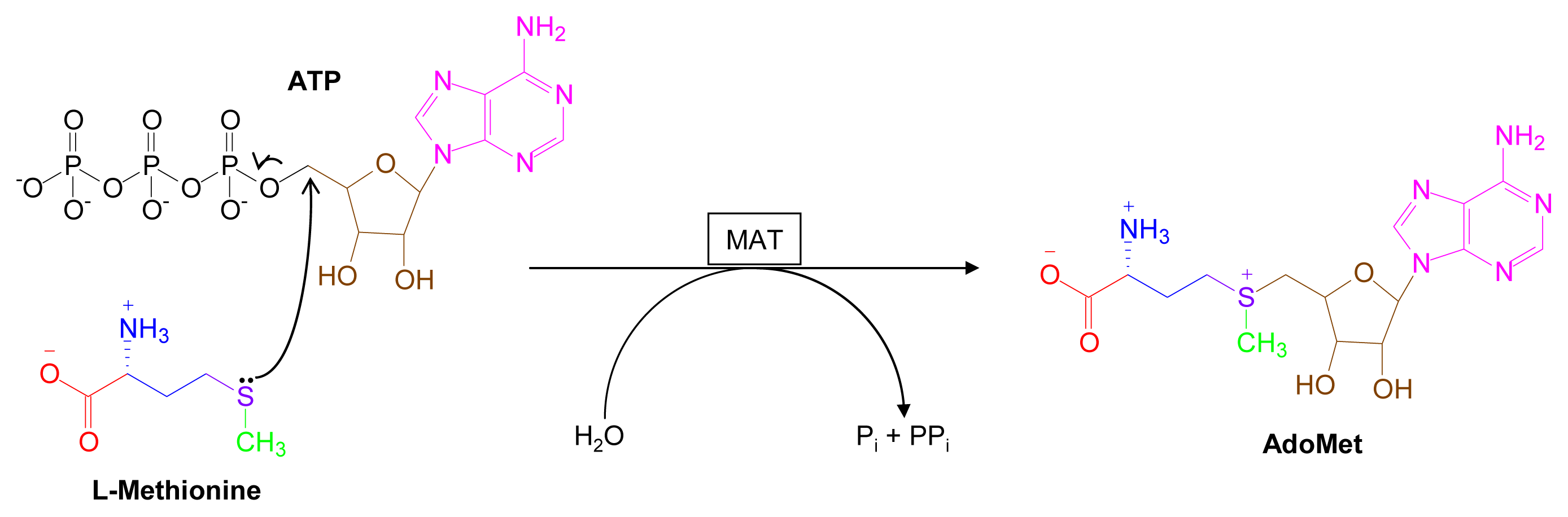
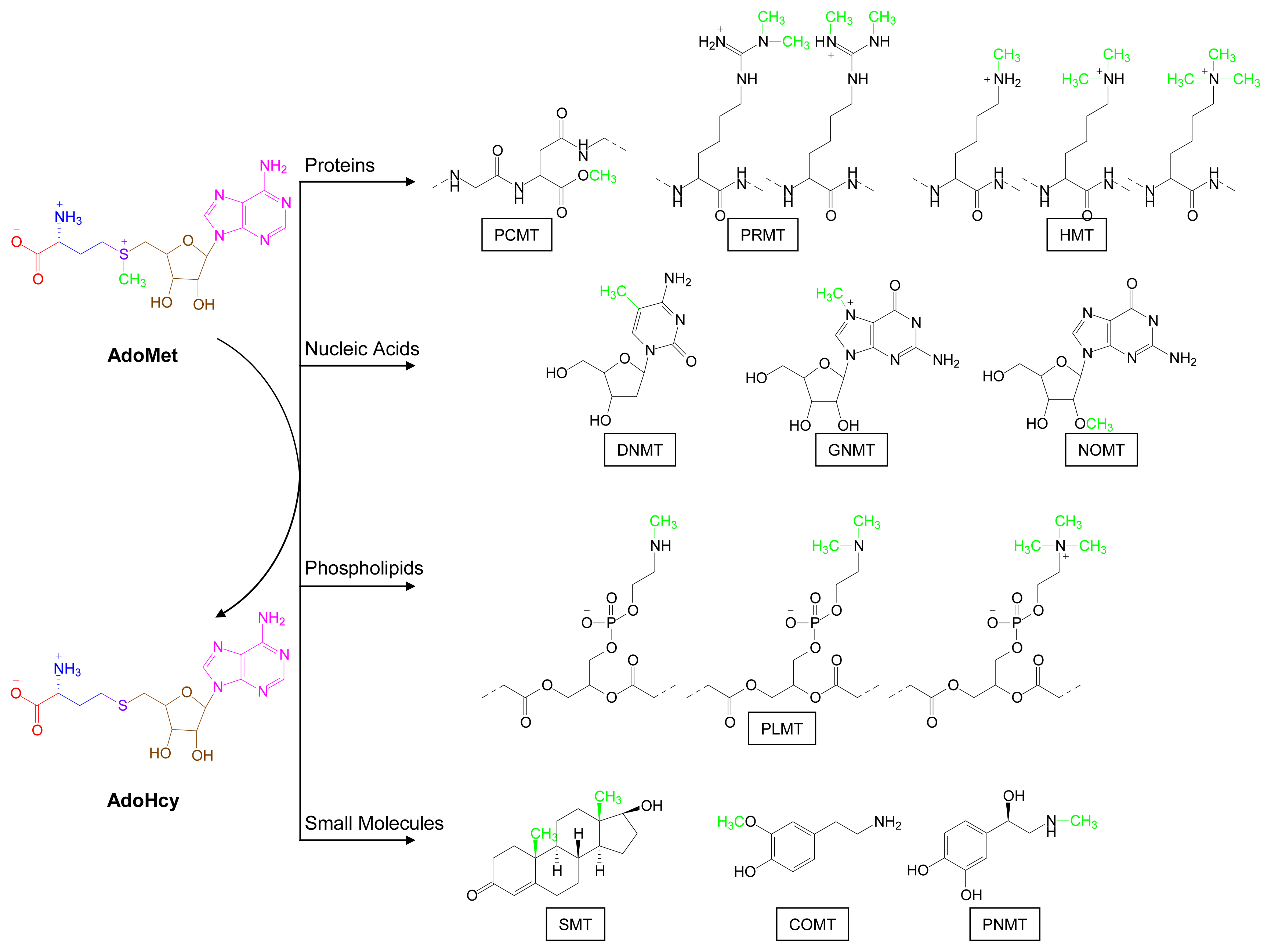
<p>AdoMet is synthesized from <sc>l</sc>-methionine and ATP by various isoforms of the enzyme, methionine adenosyltransferase (MAT, <xref ref-type="fig" rid="f1-marinedrugs-07-00401">Figure 1</xref>) [<xref ref-type="bibr" rid="b2-marinedrugs-07-00401">2</xref>]. Central to AdoMet’s reactivity is the presence of a chiral sulfonium ion whose three adjacent alkyl substituents are susceptible to nucleophilic attack at their respective carbon-sulfur bonds [<xref ref-type="bibr" rid="b3-marinedrugs-07-00401">3</xref>,<xref ref-type="bibr" rid="b4-marinedrugs-07-00401">4</xref>]. A robust family of methyltransferases catalyzes transfer of AdoMet’s methyl group to diverse biological substrates [<xref ref-type="bibr" rid="b5-marinedrugs-07-00401">5</xref>]. Nucleophilic attacks directed at the carbon-sulfur bond of ribose lead to formation of 5’-halogenated adenosine derivatives [<xref ref-type="bibr" rid="b6-marinedrugs-07-00401">6</xref>]; those directed at the 3-amino-3-carboxypropyl portion of AdoMet give rise to polyamines, ethylene and homoserine lactone derivatives [<xref ref-type="bibr" rid="b3-marinedrugs-07-00401">3</xref>,<xref ref-type="bibr" rid="b4-marinedrugs-07-00401">4</xref>].</p>
<p>As the principal biological methyl donor, AdoMet is an obligatory cofactor for the enzymatic methylation of DNA, RNA, proteins, phospholipids, and various small molecules such as catecholamines, steroids, etc. Polyamine biosynthesis is another important AdoMet-dependent pathway: AdoMet, subsequent to its enzymatic decarboxylation, serves as aminopropyl donor for synthesis of the ubiquitous polyamines, spermidine and spermine. Ethylene, another key metabolite of AdoMet, is produced in plants where it plays major roles in ripening, senescence and responses to stress. AdoMet-dependent biosyntheses of methylated molecules, polyamines and ethylene have been studied for many years and are regarded as classical pathways of AdoMet metabolism.</p>
<p>In more recent years, two major pathways of AdoMet metabolism in bacteria have been uncovered. The discovery of <italic>N</italic>-acyl-<sc>l</sc>-homoserine lactones, a new class of signal molecules produced by many gram negative bacteria, was followed by studies which determined that its <sc>l</sc>-homoserine lactone component is enzymatically derived from AdoMet [<xref ref-type="bibr" rid="b7-marinedrugs-07-00401">7</xref>,<xref ref-type="bibr" rid="b8-marinedrugs-07-00401">8</xref>]. Autoinducer-2 is another important bacterial signal molecule which is derived from AdoMet [<xref ref-type="bibr" rid="b9-marinedrugs-07-00401">9</xref>].</p>
<p>A new class of AdoMet-utilizing proteins, the radical SAM superfamily, was discovered recently [<xref ref-type="bibr" rid="b10-marinedrugs-07-00401">10</xref>]. These proteins use AdoMet as substrate or catalyst in various enzymatic reactions that are associated with a diverse array of chemical transformations and biological functions [<xref ref-type="bibr" rid="b10-marinedrugs-07-00401">10</xref>–<xref ref-type="bibr" rid="b12-marinedrugs-07-00401">12</xref>]. In addition, a novel role for AdoMet in the biosynthesis of complex, halogenated organic molecules was first reported in 2002 [<xref ref-type="bibr" rid="b13-marinedrugs-07-00401">13</xref>,<xref ref-type="bibr" rid="b14-marinedrugs-07-00401">14</xref>]. Subsequently, an AdoMet-utilizing halogenase was identified in a marine organism [<xref ref-type="bibr" rid="b1-marinedrugs-07-00401">1</xref>]. The importance and scope of AdoMet-dependent biohalogenation pathways will become more evident as additional scientific studies are published.</p>
<p>Several uncommon pathways of AdoMet metabolism are worthy of mention because they highlight novel, unprecedented donor properties of this ubiquitous sulfonium compound [<xref ref-type="bibr" rid="b4-marinedrugs-07-00401">4</xref>]. AdoMet serves as amino donor for biosynthesis of 7,8-pelargonic acid, an intermediate in the biosynthesis of biotin [<xref ref-type="bibr" rid="b15-marinedrugs-07-00401">15</xref>]. AdoMet serves as 3-amino-3-carboxypropyl donor for biosynthesis of the hypermodified nucleoside, 3-(3-amino-3-carboxypropyl)uridine, which was first found in <italic>Escherichia coli</italic> tRNA [<xref ref-type="bibr" rid="b16-marinedrugs-07-00401">16</xref>–<xref ref-type="bibr" rid="b18-marinedrugs-07-00401">18</xref>]. AdoMet serves as ribosyl donor for biosynthesis of the hypermodified tRNA nucleoside, queuosine [<xref ref-type="bibr" rid="b19-marinedrugs-07-00401">19</xref>]. These highly specific, AdoMet-dependent, structural modifications to RNA are complemented by AdoMet’s more pervasive activities as methyl donor for RNA [<xref ref-type="bibr" rid="b20-marinedrugs-07-00401">20</xref>–<xref ref-type="bibr" rid="b25-marinedrugs-07-00401">25</xref>].</p></sec>
<sec>
<title>3. AdoMet Pathways and Marine-Derived AdoMet Metabolites</title>
<p>The role of AdoMet as precursor for ethylene, polyamines and methylated molecules has been extensively documented in the scientific literature. Biochemical studies with labeled precursors have been instrumental in validating the diverse pathways of AdoMet consumption in living organisms. For the most part, these studies have used terrestrial organisms as platforms for experimental design. Discovery of the AdoMet-derived, bacterial signal molecules, <italic>N</italic>-acyl-<sc>l</sc>-homoserine lactones (AHLs) and autoinducer-2 (<bold>AI-2</bold>), in marine bacteria is a notable exception.</p>
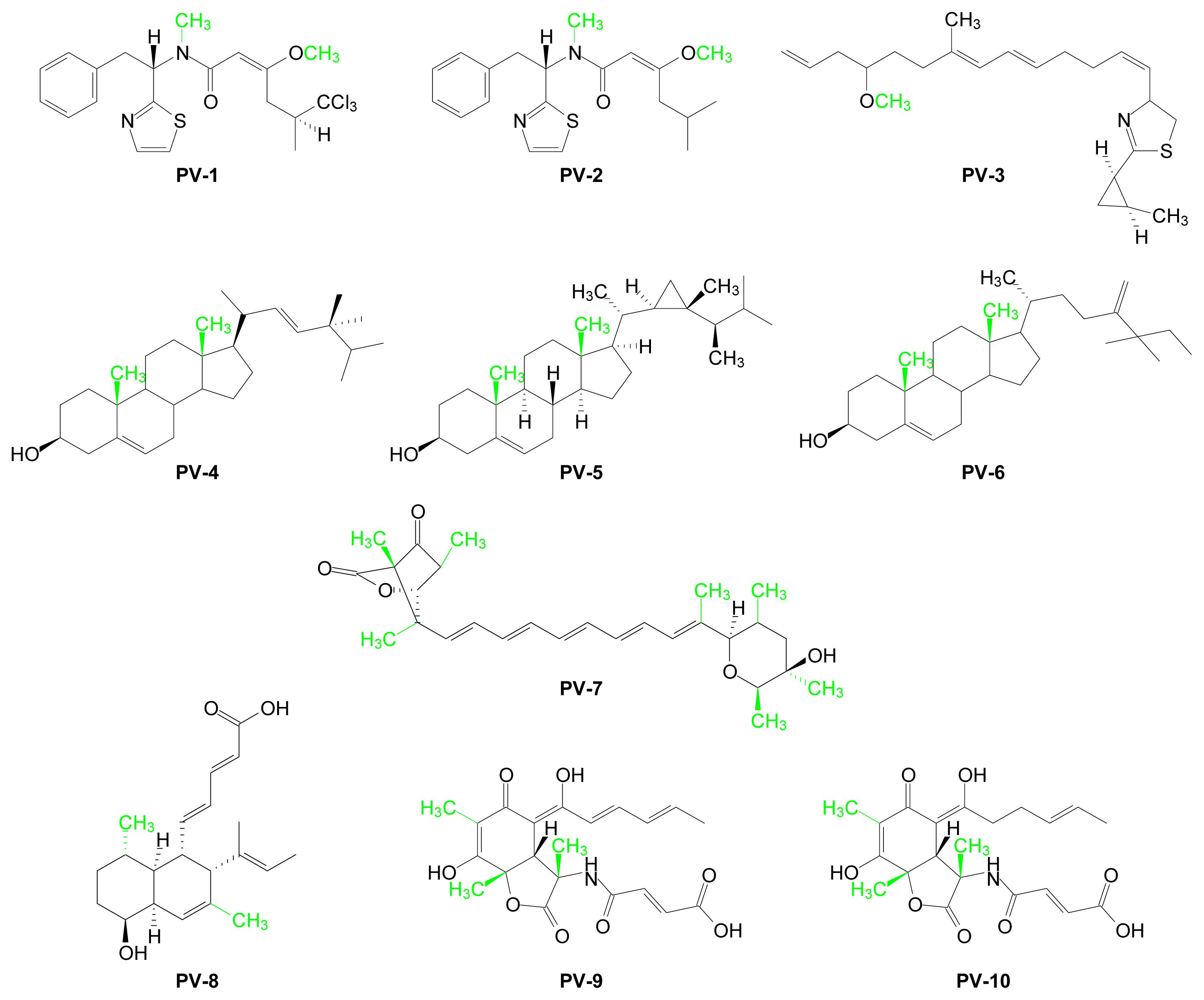
<p>Precursor studies using marine organisms have been reported but their scope has been limited by the elusiveness of marine microorganisms and challenges associated with scientific exploration of marine habitats. When such studies were carried out, most were designed to provide evidence of the role of AdoMet as the biological methyl donor for a range of marine-derived methylated natural products. Several examples of marine-derived molecules whose methyl group origins have been unambiguously attributed to AdoMet by labeled methionine precursor studies are listed in <xref ref-type="table" rid="t1-marinedrugs-07-00401">Table 1</xref>. Their structures are shown in <xref ref-type="fig" rid="f2-marinedrugs-07-00401">Figure 2</xref>.</p>
<p>Labeled decarboxylated AdoMet was used to determine that AdoMet is the source of aminopropyl groups of the polyamines produced by <italic>Pyrococcus furiosus</italic>, a hyperthermophilic archeon [<xref ref-type="bibr" rid="b36-marinedrugs-07-00401">36</xref>]. Moreover, these studies identified a new aminopropyl transferase enzyme whose natural substrates include the expected 1,4-diaminobutane (putrescine) as well as the less common diamines, 1,3-diaminopropane, cadaverine, thermine and agmatine [<xref ref-type="bibr" rid="b36-marinedrugs-07-00401">36</xref>].</p>
<sec>
<title>3.1. Polyamine Pathways [<xref ref-type="bibr" rid="b37-marinedrugs-07-00401">37</xref>–<xref ref-type="bibr" rid="b44-marinedrugs-07-00401">44</xref>]</title>
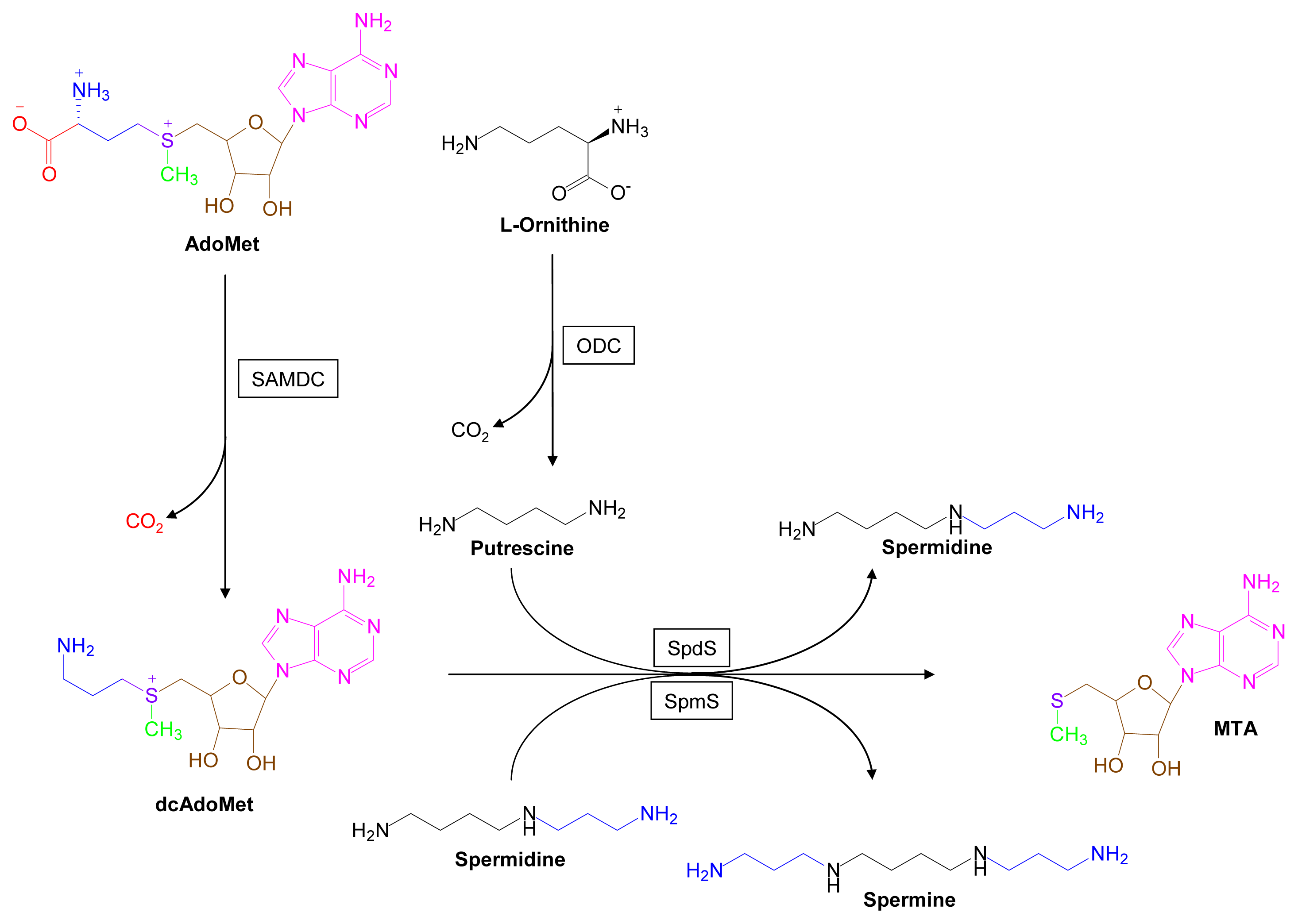
<p>Putrescine, spermidine and spermine are the major eukaryotic polyamines. Putrescine, which is enzymatically derived from ornithine, is metabolized to spermidine and then to spermine by successive enzymatic transfers of an aminopropyl group from decarboxylated AdoMet (<xref ref-type="fig" rid="f3-marinedrugs-07-00401">Figure 3</xref>).</p>
<p>The purine nucleoside, 5’-deoxy-5’-(methylthio)adenosine (MTA) is the common byproduct of spermidine and spermine synthesis. At physiologic pH, polyamines exist as polycations and modulate functions of acidic structures such as DNA, RNA, phospholipids and proteins. They are important participants in processes associated with cell viability, growth and differentiation. The naturally high intracellular levels of polyamines (<italic>i.e.</italic>, mM concentrations) have made clarification of their high affinity molecular targets more difficult. They are known to specifically affect the functions of ion channels and the <italic>N</italic>-methyl-<sc>d</sc>-aspartate (NMDA) glutamate receptor at physiological concentrations [<xref ref-type="bibr" rid="b40-marinedrugs-07-00401">40</xref>,<xref ref-type="bibr" rid="b45-marinedrugs-07-00401">45</xref>]. Igarashi and colleagues studied the binding interactions of spermidine and spermine with cellular DNA, RNA, phospholipids and ATP in rat liver and bovine lymphocytes [<xref ref-type="bibr" rid="b41-marinedrugs-07-00401">41</xref>]. In both cell types, the largest fractions of intracellular spermidine and spermine were found to be associated with RNA, suggesting that the structural changes to RNA arising from these binding interactions may play a major role in the intracellular functions of polyamines [<xref ref-type="bibr" rid="b41-marinedrugs-07-00401">41</xref>].</p>
<p>Polyamines are involved in key cellular functions such as responses to oxidative stress, pH, and osmoregulation, which are of particular importance to marine bacteria. These functions are even more important to extreme thermophilic bacteria, which use polyamines to stabilize their RNA and DNA at high temperatures [<xref ref-type="bibr" rid="b46-marinedrugs-07-00401">46</xref>]. The fact that polyamines have specialized functions in aquatic environments is evidenced by an abundance of novel straight chain and branched polyamines produced by marine organisms. The marine thermophile, <italic>Thermus thermophilus</italic> is an example of a prolific producer of different polycationic polyamine structures (shown in <xref ref-type="table" rid="t2-marinedrugs-07-00401">Table 2</xref>).</p>
<p>A collection of unusually long-chain polyamines (LCPAs) has been isolated from the marine sponge, <italic>Axinyssa aculeate</italic>. A composite of their structures, <sup>+</sup>H<sub>3</sub>N-(CH<sub>2</sub>)<sub>3</sub>-[NH<sub>2</sub><sup>+</sup>-(CH<sub>2</sub>)<sub>3</sub>]n–NH<sub>3</sub><sup>+</sup> (n = 4–14), gives an idea of their extraordinary length [<xref ref-type="bibr" rid="b47-marinedrugs-07-00401">47</xref>]. Other LCPAs have been isolated from marine algae [<xref ref-type="bibr" rid="b48-marinedrugs-07-00401">48</xref>–<xref ref-type="bibr" rid="b50-marinedrugs-07-00401">50</xref>]. LCPAs are known to combine with silica precipitating proteins (silaffins) to produce a composite material called biosilica that is essential to the formation of complex cell wall structures such as those found in shells. Biomineralization is manifested by the use of species-specific sets of silaffins and LCPA constituents whose structural variations may include differences in chain length, <italic>N</italic>-methylation patterns and/or the positioning of secondary amino substituents and quaternary ammonium groups [<xref ref-type="bibr" rid="b48-marinedrugs-07-00401">48</xref>,<xref ref-type="bibr" rid="b49-marinedrugs-07-00401">49</xref>,<xref ref-type="bibr" rid="b51-marinedrugs-07-00401">51</xref>]. Consequently, polyamines are essential for the formation of intricate silica patterns on cell walls of diatoms [<xref ref-type="bibr" rid="b47-marinedrugs-07-00401">47</xref>–<xref ref-type="bibr" rid="b50-marinedrugs-07-00401">50</xref>]. From a technical perspective, an understanding of the biochemical mechanisms that regulate nanoscale production of biosilica-based structures is highly relevant to research and product development in the field of nanotechnology [<xref ref-type="bibr" rid="b51-marinedrugs-07-00401">51</xref>].</p>
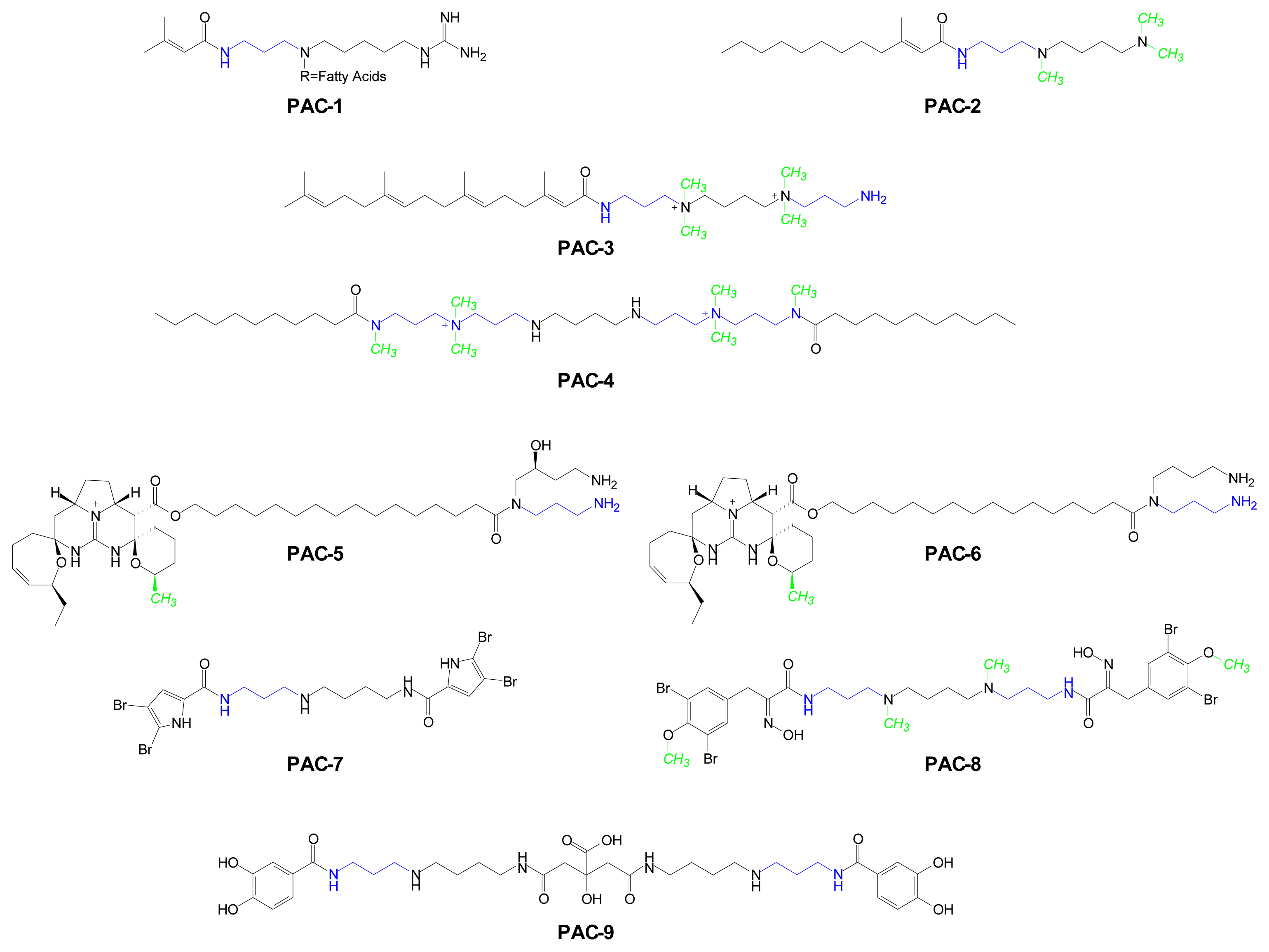
<p>Marine habitats have also proved to be a rich source of unusual polyamine conjugates (PACs) such as those depicted in <xref ref-type="fig" rid="f4-marinedrugs-07-00401">Figure 4</xref>. For each conjugate, at least one marine source is listed in <xref ref-type="table" rid="t3-marinedrugs-07-00401">Table 3</xref>. Crambescidin 800 (<bold>PAC-5</bold>) and ptilomycalin A (<bold>PAC-6</bold>) belong to a family of guanidine alkaloids whose structures contain an unusual pentacyclic guanidine framework linked by a ω–hydroxy fatty acid to a spermidine or hydroxyspermidine moiety. The structures of <bold>PAC-5</bold> and <bold>PAC-6</bold> differ only by the presence or absence of a hydroxyl substituent on spermidine. Although both compounds showed activity in various antitumor and antimicrobial screens, their potencies were unremarkable [<xref ref-type="bibr" rid="b53-marinedrugs-07-00401">53</xref>–<xref ref-type="bibr" rid="b56-marinedrugs-07-00401">56</xref>]. However, in the course of comprehensive, high-throughput screens of ~3,100 compounds from NCI libraries and &gt;300 crude marine-derived extracts for antifungal activity, Crambescidin 800 emerged as the most potent compound [<xref ref-type="bibr" rid="b57-marinedrugs-07-00401">57</xref>].</p>
<p>Penaramide A (<bold>PAC-4</bold>) is one of several acylated polyamine structures that were isolated from the sponge <italic>Penares</italic> aff. <italic>Incrustans</italic>. Penaramides are symmetric molecules that differ only in the composition of their <italic>N</italic>-terminal acyl substituents. Penaramide A, the simplest of these compounds, contains two linear, C11 fatty acids. At the time these compounds were described, they were found to inhibit binding of the peptide neurotoxin, ω-conotoxin GVIA to N-type (high voltage-activated) calcium channels [<xref ref-type="bibr" rid="b33-marinedrugs-07-00401">33</xref>].</p>
<p>Acarnidines (<bold>PAC-1</bold>), another class of polyamine fatty acid conjugates, are distinguished by the presence of a homospermidine backbone. As seen in the penaramide series, acarnidines differ only by the structures of their respective fatty acid components. The acarnadines were reported to have significant antimicrobial activity against <italic>Herpes simplex</italic> type 1, <italic>Bacillus subtilis,</italic> and <italic>Penicillium atrovenetum</italic> [<xref ref-type="bibr" rid="b58-marinedrugs-07-00401">58</xref>]. Another fatty acid polyamine conjugate, sinulamide (<bold>PAC-3</bold>), is an inhibitor of H,K-ATPase [<xref ref-type="bibr" rid="b66-marinedrugs-07-00401">66</xref>]. Sinulamide has structural features similar to some of those seen in penaramides and acarnidines.</p>
<p>The novel alkaloid, spermatinamine (<bold>PAC-8</bold>) is a symmetrical spermine conjugate whose uncommon feature is its unusual acyl component which is derived from 3,5-dibromotyrosine. Spermatinamine is an inhibitor of isoprenylcysteine carboxyl methyltransferase (ICMT), one of the enzymes involved in activation of the Ras signaling pathway [<xref ref-type="bibr" rid="b64-marinedrugs-07-00401">64</xref>]. Ras family proteins contain a CAAX terminal sequence that undergoes a series of successive posttranslational modifications, resulting in the translocation of these proteins to the cell membrane [<xref ref-type="bibr" rid="b67-marinedrugs-07-00401">67</xref>]. The specific enzymes that contribute to activation of Ras signaling are considered to be promising anticancer targets. Spermatinamine, the first natural product known to inhibit ICMT, is a compound of significant chemotherapeutic interest [<xref ref-type="bibr" rid="b64-marinedrugs-07-00401">64</xref>].</p>
<p>Petrobactin (<bold>PAC-9</bold>) was first isolated from <italic>Marinobacter hydrocarbonoclasticus</italic> [<xref ref-type="bibr" rid="b68-marinedrugs-07-00401">68</xref>]. This oil-degrading molecule has since been found in both pathogenic and nonpathogenic bacteria [<xref ref-type="bibr" rid="b69-marinedrugs-07-00401">69</xref>]. Petrobactin is required for expression of virulence by <italic>Bacillus anthracis</italic>, the causative agent of anthrax disease and is the primary siderophore produced by this pathogen under conditions of iron starvation [<xref ref-type="bibr" rid="b65-marinedrugs-07-00401">65</xref>]. Elucidation of its structure, biosynthetic origins and biological properties as well as chemical routes to its synthesis, have been well established [<xref ref-type="bibr" rid="b65-marinedrugs-07-00401">65</xref>,<xref ref-type="bibr" rid="b70-marinedrugs-07-00401">70</xref>–<xref ref-type="bibr" rid="b81-marinedrugs-07-00401">81</xref>]. Pseudoceratidine (<bold>PAC-7</bold>), an antifouling agent that can prevent attachment of marine organisms (<italic>e.g.</italic>, mollusks, barnacles) to hulls of ships and other submerged structures, was first isolated and synthesized in 1996 [<xref ref-type="bibr" rid="b63-marinedrugs-07-00401">63</xref>,<xref ref-type="bibr" rid="b82-marinedrugs-07-00401">82</xref>]. Its interesting spectrum of antimicrobial and marine biocidal effects are of potential industrial significance [<xref ref-type="bibr" rid="b83-marinedrugs-07-00401">83</xref>]. Trimethylspermidine amide (<bold>PAC-2</bold>) and sinulamide (<bold>PAC-3</bold>), a potent inhibitor of H,K-ATPase, were isolated from different species of the soft coral <italic>Sinularia</italic> [<xref ref-type="bibr" rid="b66-marinedrugs-07-00401">66</xref>]. Marine <bold>PACs</bold> with unusually complex <italic>N</italic>-acyl components can be viewed as lead structures for combinatorial synthesis of novel <bold>PACs</bold> from libraries of acyl substituents and linear polyamines.</p></sec>
<sec>
<title>3.2. Methylation Pathways</title>
<p>Methylated molecules are the most abundant type of AdoMet metabolites in living organisms. Their biosynthesis is catalyzed by a superfamily of methyltransferase enzymes [<xref ref-type="bibr" rid="b5-marinedrugs-07-00401">5</xref>,<xref ref-type="bibr" rid="b84-marinedrugs-07-00401">84</xref>–<xref ref-type="bibr" rid="b87-marinedrugs-07-00401">87</xref>] (<xref ref-type="fig" rid="f5-marinedrugs-07-00401">Figure 5</xref>). Several classes of methyltransferases have been structurally defined [<xref ref-type="bibr" rid="b5-marinedrugs-07-00401">5</xref>, <xref ref-type="bibr" rid="b86-marinedrugs-07-00401">86</xref>–<xref ref-type="bibr" rid="b88-marinedrugs-07-00401">88</xref>]. The AdoMet binding regions in many of these enzymes contain a common, three-dimensional structural motif that has been used to seek out putative methyltransferases among proteins of unknown function [<xref ref-type="bibr" rid="b84-marinedrugs-07-00401">84</xref>]. Clarke and colleagues established a methyltransferase-specific database and have continued to search for protein sequences predictive of methyltransferase function by scanning open reading frames of genomes using automated methods they developed for this purpose [<xref ref-type="bibr" rid="b84-marinedrugs-07-00401">84</xref>].</p>
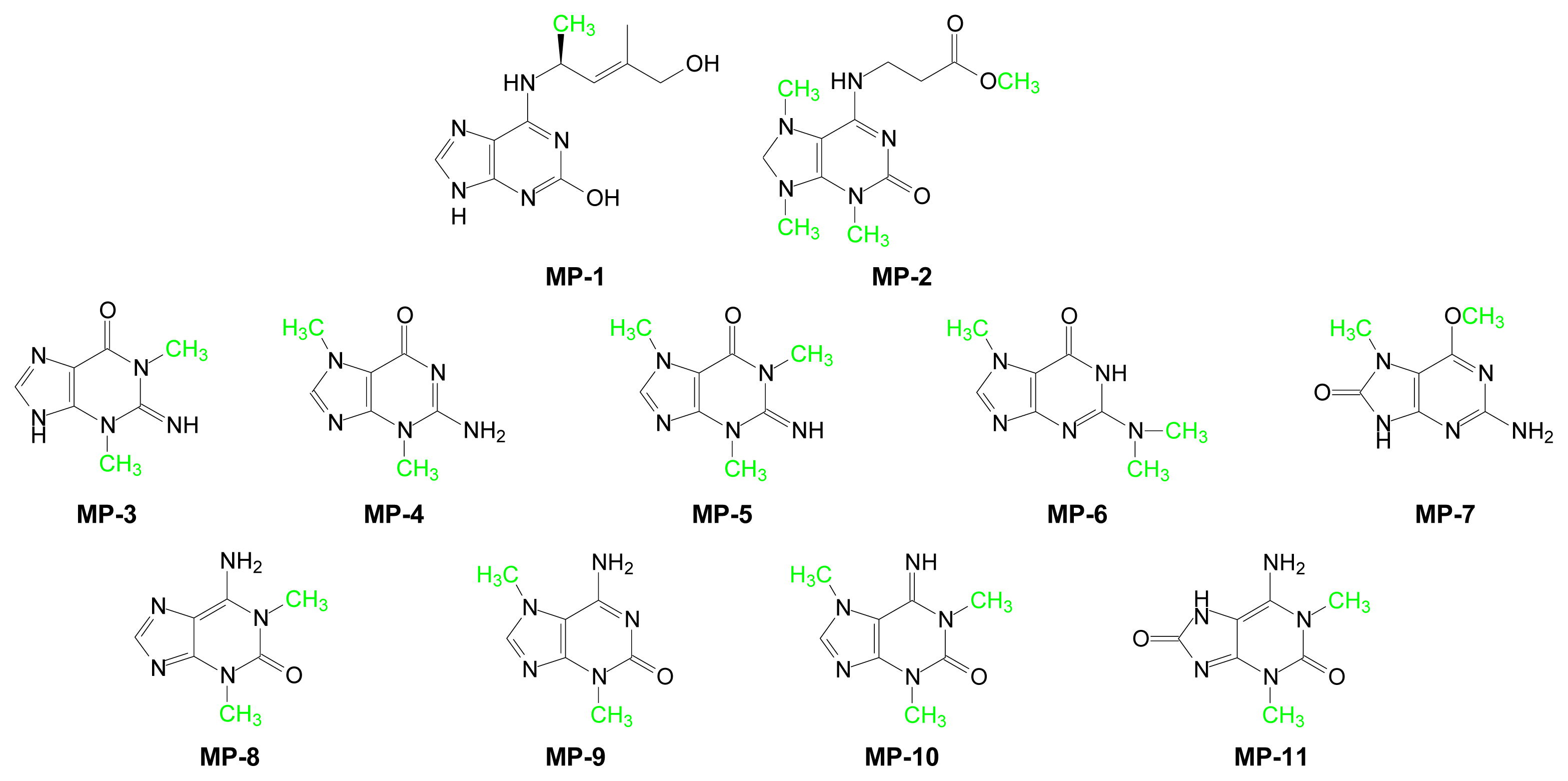
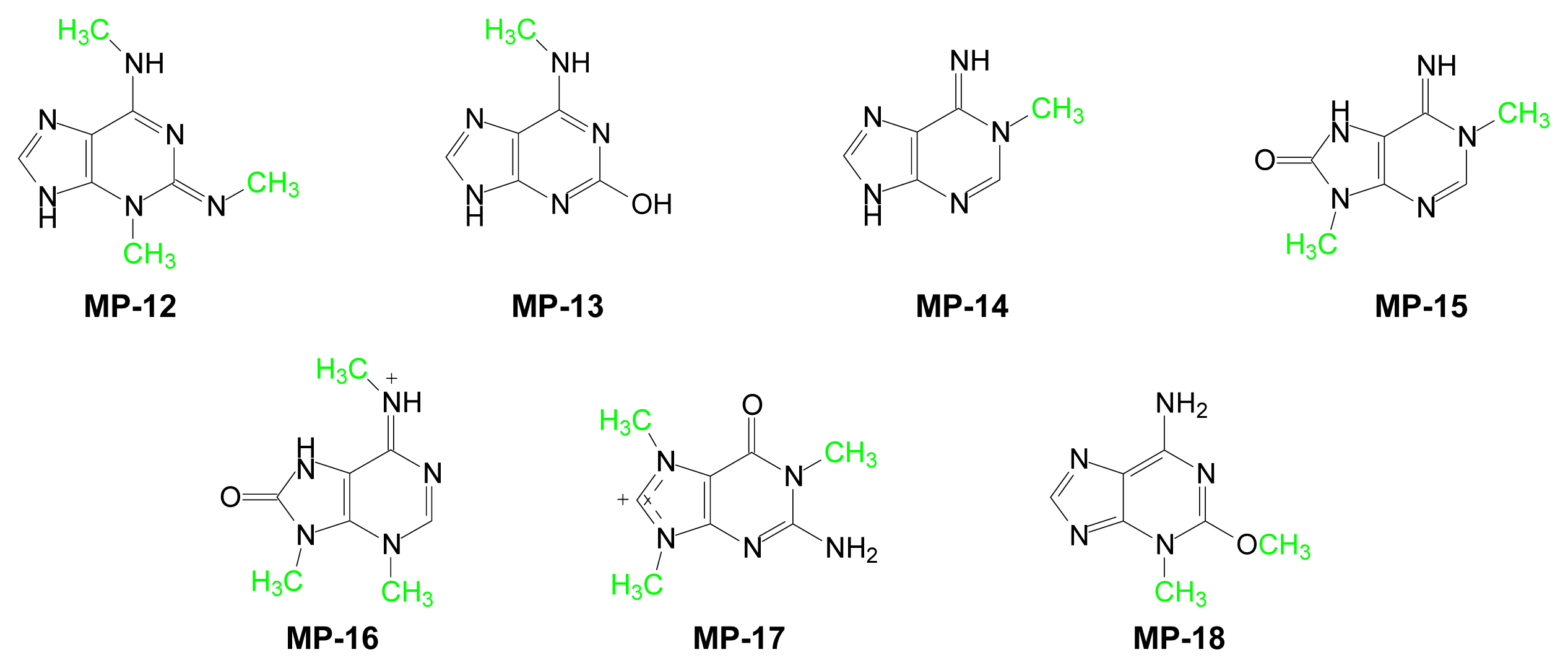
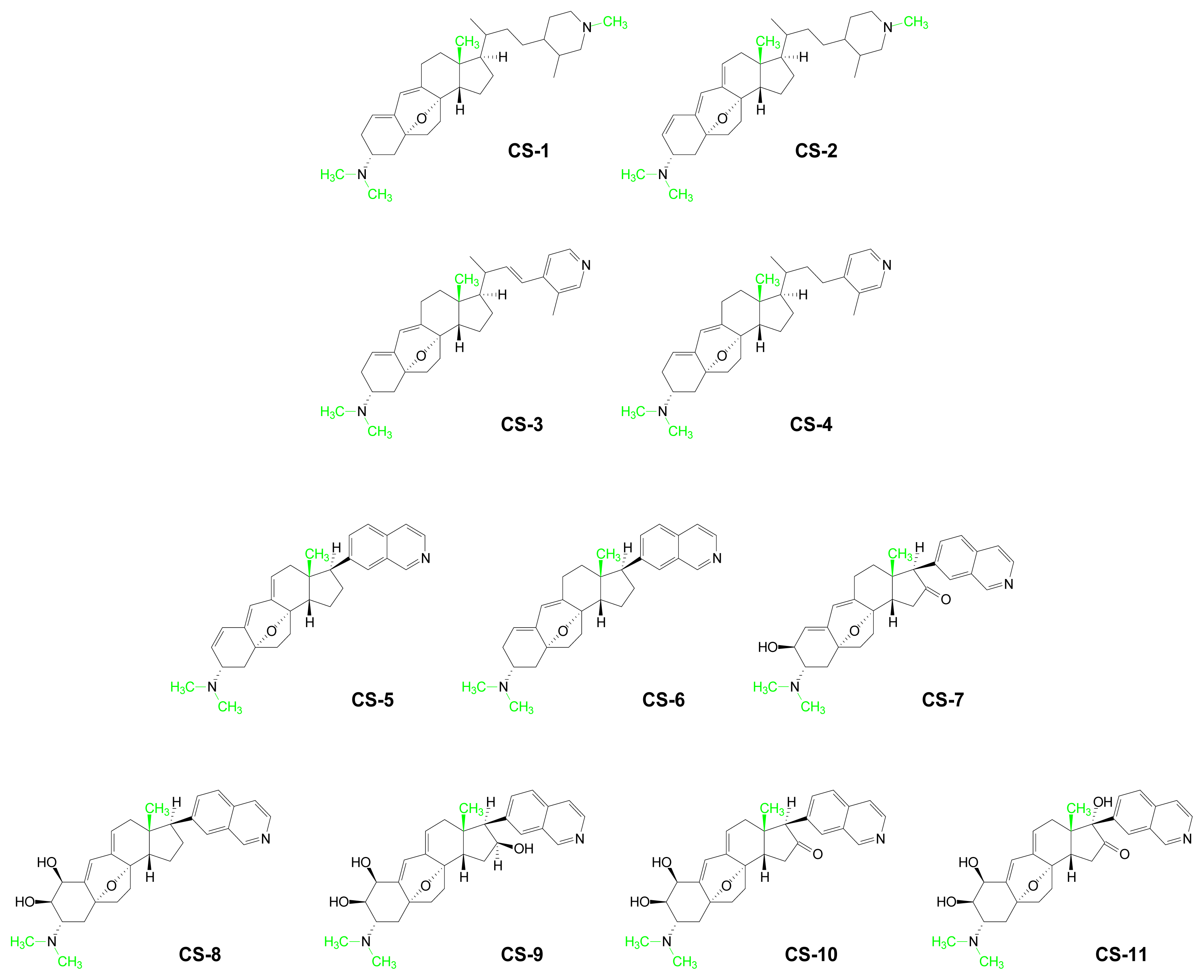
<p>The physiological consequences of enzymatic methyl group transfer can be viewed from fundamental chemical and biochemical perspectives. A methyl group can be transferred to atoms such as carbon, nitrogen, oxygen, sulfur, and selenium. However, methyltransferases that catalyze methyl transfer to carbon, nitrogen and oxygen atoms are predominant. Methyl group addition increases steric bulk and can alter charge, conformation and/or tertiary structure of the acceptor molecule. Furthermore, methylation can profoundly affect biochemical pathways and physiological processes by altering the binding affinities of associated ligands for macromolecules such as proteins, DNA, RNA and phospholipids as well as for small molecule ligands, such as steroids, amino acids, nucleosides and biogenic amines. Complex methylation patterns are seen in many classes of small marine-derived molecules such as purines (<xref ref-type="table" rid="t4-marinedrugs-07-00401">Table 4</xref>, <xref ref-type="fig" rid="f6-marinedrugs-07-00401">Figure 6</xref>) and sterols (<xref ref-type="fig" rid="f7-marinedrugs-07-00401">Figure 7</xref>).</p>
<p>A variety of methylated purines has been isolated from marine organisms [<xref ref-type="bibr" rid="b106-marinedrugs-07-00401">106</xref>]. <xref ref-type="fig" rid="f6-marinedrugs-07-00401">Figure 6</xref> depicts a selected number of these structures.</p>
<p>Examples of methylation within the purine scaffold, which contains four heterocyclic nitrogen atoms, as well as on some of the exocyclic amino- and imino-substitutents are depicted. <bold>MP-7</bold> and <bold>MP-17</bold> contain exocyclic methoxy substituents. <bold>MP-8</bold> elicits an antitumor response, <bold>MP-9</bold> displays antibacterial behavior and <bold>MP-17</bold> is a collagenase inhibitor [<xref ref-type="bibr" rid="b106-marinedrugs-07-00401">106</xref>]. Whether these purine analogs afford any benefits to their host organisms is unclear. However, they may be useful as anti-metabolite templates for potential anti-infectives.</p>
<p>Sponges are the most abundant marine source of novel sterols [<xref ref-type="bibr" rid="b107-marinedrugs-07-00401">107</xref>]. Changes in the compositions of these membrane constituents, which are vital for cell permeability, are associated with increased defensive capabilities [<xref ref-type="bibr" rid="b108-marinedrugs-07-00401">108</xref>,<xref ref-type="bibr" rid="b109-marinedrugs-07-00401">109</xref>]. Marine sterols exhibit structural complexities that are not observed in terrestrial organisms [<xref ref-type="bibr" rid="b110-marinedrugs-07-00401">110</xref>]. Although most variations occur in the side chain, the steroid ring system is also subject to chemical transformations [<xref ref-type="bibr" rid="b111-marinedrugs-07-00401">111</xref>]. Structural variations also arise in the methylation patterns of steroid rings, alkyl side chains and/or exocyclic substituents. The structurally complex, anti-angiogenic cortistatins isolated from the sponge <italic>Corticium simplex</italic> contain both <italic>C</italic>- and <italic>N</italic>-methylated substituents [<xref ref-type="bibr" rid="b112-marinedrugs-07-00401">112</xref>] (<xref ref-type="fig" rid="f7-marinedrugs-07-00401">Figure 7</xref>).</p></sec>
<sec>
<title>3.3. AdoMet-Dependent Ethylene Biosynthesis [<xref ref-type="bibr" rid="b113-marinedrugs-07-00401">113</xref>–<xref ref-type="bibr" rid="b117-marinedrugs-07-00401">117</xref>]</title>
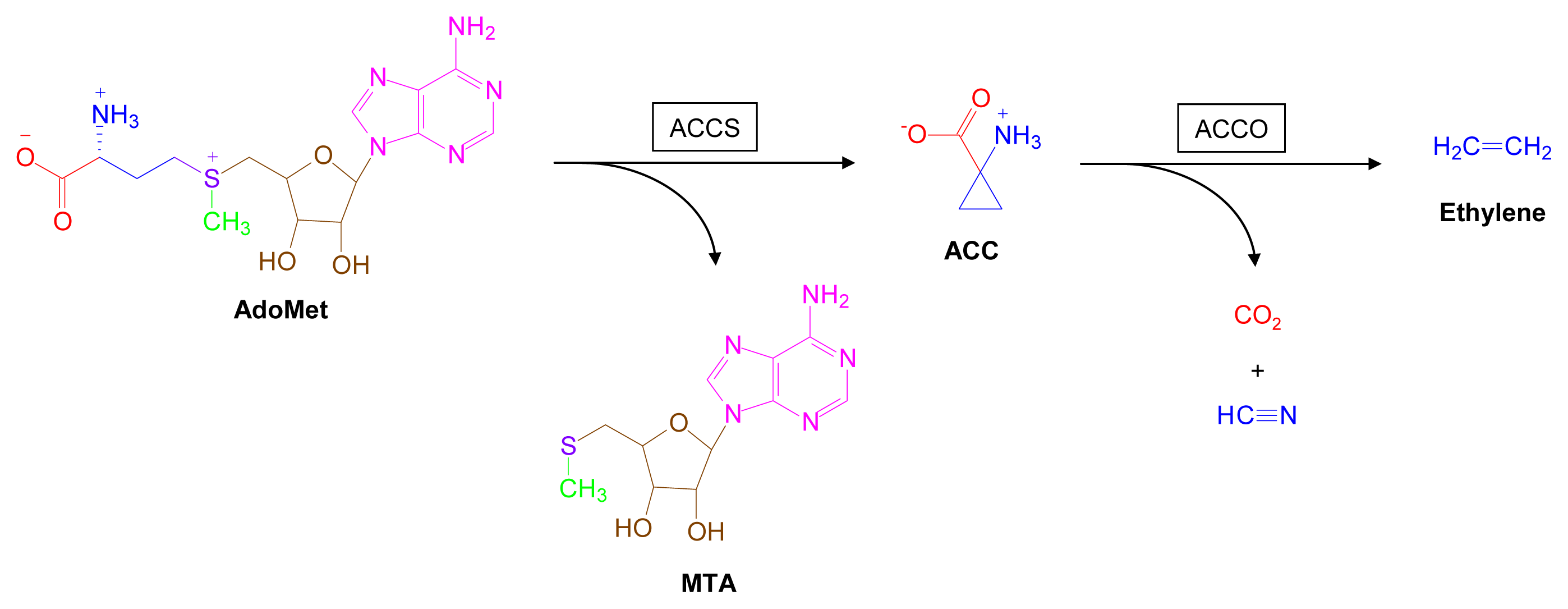
<p>Ethylene is a phytohormone that stands at the apex of a robust signaling pathway in plants. Ethylene, which is enzymatically derived from AdoMet (<xref ref-type="fig" rid="f8-marinedrugs-07-00401">Figure 8</xref>), serves as a critical regulator of life sustaining processes such as plant growth and development, responses to external stresses, and senescence. The terrestrial plant, <italic>Arabidopsis thaliana</italic> has served as a model system for elucidating the biochemical, molecular and genetic complexities of the ethylene signaling pathway, which is still the focus of intense scientific study [<xref ref-type="bibr" rid="b84-marinedrugs-07-00401">84</xref>,<xref ref-type="bibr" rid="b115-marinedrugs-07-00401">115</xref>,<xref ref-type="bibr" rid="b116-marinedrugs-07-00401">116</xref>,<xref ref-type="bibr" rid="b118-marinedrugs-07-00401">118</xref>].</p>
<p>AdoMet-dependent ethylene biosynthesis has been documented in a variety of marine plants and sponges [<xref ref-type="bibr" rid="b119-marinedrugs-07-00401">119</xref>–<xref ref-type="bibr" rid="b121-marinedrugs-07-00401">121</xref>]. <italic>Suberites domuncula</italic>, a marine sponge, responds to the presence of ethylene (5 μM) by upregulating its intracellular concentration of Ca<sup>+2</sup> and reducing its apoptotic response to starvation [<xref ref-type="bibr" rid="b122-marinedrugs-07-00401">122</xref>]. When the marine macroalga <italic>Ulva (Enteromorpha) intestinalis</italic> moves from conditions of low light intensity to high light intensity, its production of ethylene increases. This suggests that ethylene is involved in an adaptive response to light stress [<xref ref-type="bibr" rid="b119-marinedrugs-07-00401">119</xref>]. Ethylene is also naturally present in seawater as a consequence of widespread photochemical degradation of organic materials. Thus ethylene can be acquired from the aquatic environment by ethylene-responsive marine organisms that might not contain the biosynthetic machinery for its production.</p></sec>
<sec>
<title>3.4. Biohalogenation Pathways [<xref ref-type="bibr" rid="b123-marinedrugs-07-00401">123</xref>–<xref ref-type="bibr" rid="b125-marinedrugs-07-00401">125</xref>]</title>
<p>The discovery of a fluorinase enzyme that catalyzes the formation of a carbon-fluorine bond not only opened a new chapter in the field of biohalogenation, but also uncovered a previously unknown pathway of AdoMet metabolism [<xref ref-type="bibr" rid="b13-marinedrugs-07-00401">13</xref>]. The fluorinase was first isolated from the soil bacterium <italic>Streptomyces cattleya</italic>. The enzyme’s x-ray crystal structure, catalytic mechanism and kinetic features have since been determined [<xref ref-type="bibr" rid="b13-marinedrugs-07-00401">13</xref>,<xref ref-type="bibr" rid="b123-marinedrugs-07-00401">123</xref>,<xref ref-type="bibr" rid="b126-marinedrugs-07-00401">126</xref>]. The fluorinase reaction yields the proximate AdoMet metabolite, 5’-deoxy-5’-fluoroadenosine, which is ultimately transformed to a toxin, monofluoroacetic acid and an unusual amino acid, 4-fluorothreonine.</p>
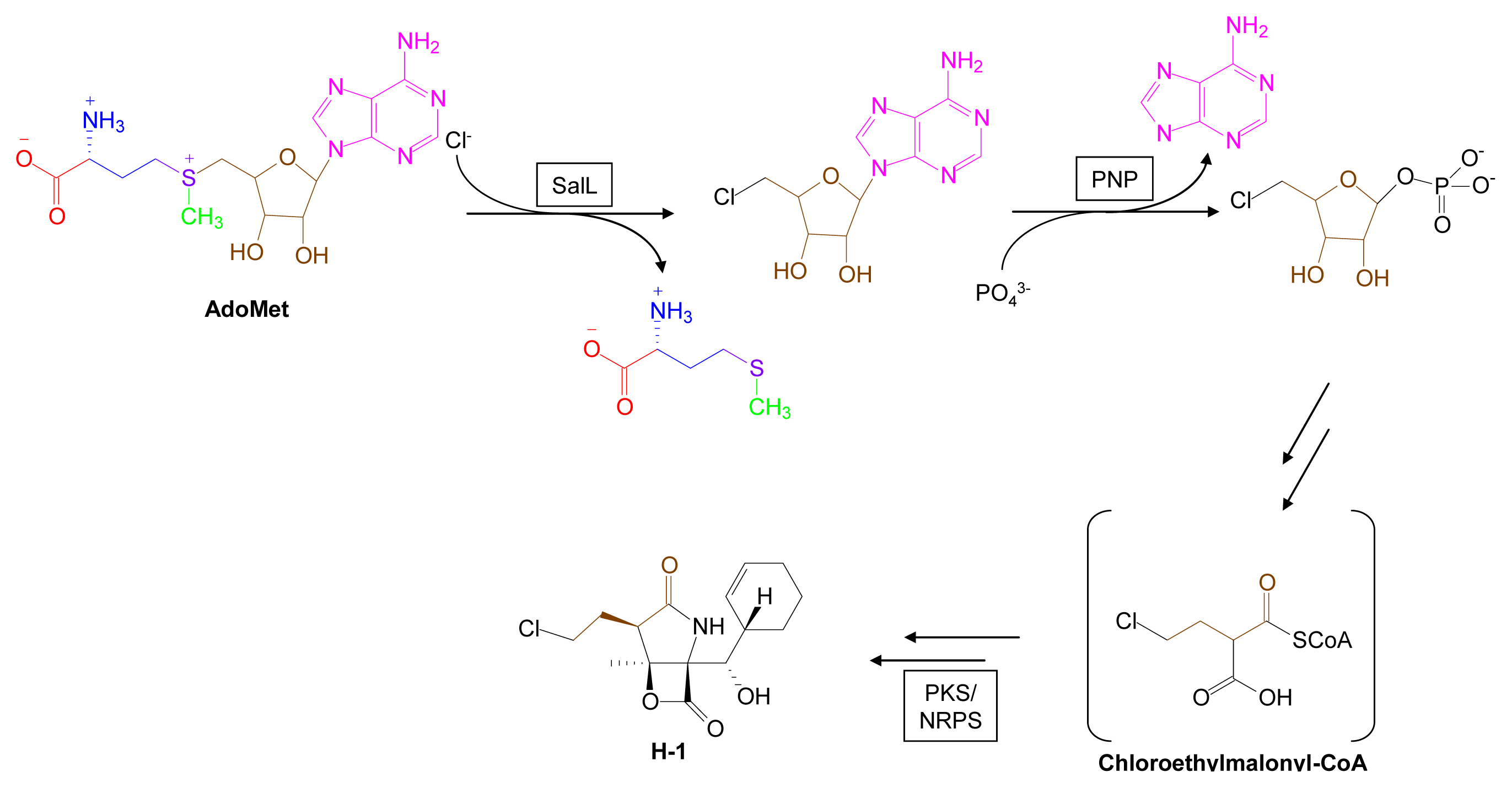
<p>Subsequent discovery of an AdoMet-utilizing chlorinase from <italic>Salinispora tropica</italic> has demonstrated the existence of AdoMet biohalogenation pathways in marine organisms [<xref ref-type="bibr" rid="b1-marinedrugs-07-00401">1</xref>]. The chlorinase reaction, mechanistically similar to that of the <italic>S. cattleya</italic> fluorinase, produces the proximate AdoMet metabolite, 5’-deoxy-5’-chloroadenosine which is a key intermediate in the biosynthesis of salinosporamide A (<xref ref-type="fig" rid="f9-marinedrugs-07-00401">Figure 9</xref>). Cell-free assays of <italic>S. tropica</italic> chlorinase activity determined that inorganic bromide and iodide, but not fluoride, can be used as inorganic substrates in place of chloride, suggesting that brominated and iodinated marine structures arising from AdoMet-dependent biohalogenations may possibly be found in the future [<xref ref-type="bibr" rid="b1-marinedrugs-07-00401">1</xref>].</p></sec>
<sec>
<title>3.5. Radical SAM Pathways [<xref ref-type="bibr" rid="b10-marinedrugs-07-00401">10</xref>–<xref ref-type="bibr" rid="b12-marinedrugs-07-00401">12</xref>,<xref ref-type="bibr" rid="b127-marinedrugs-07-00401">127</xref>–<xref ref-type="bibr" rid="b130-marinedrugs-07-00401">130</xref>]</title>
<p>In a groundbreaking study, Sofia and colleagues discovered a new protein superfamily of enzymes, designated radical SAM, through iterative profile searches of protein databases, data analysis employing powerful bioinformatic tools and information visualization techniques [<xref ref-type="bibr" rid="b10-marinedrugs-07-00401">10</xref>]. Shared features of radical SAM proteins are the presence of an uncommon iron-sulfur cluster [4Fe-4S], the specific sequence motif CxxCxxC and an AdoMet binding motif.</p>
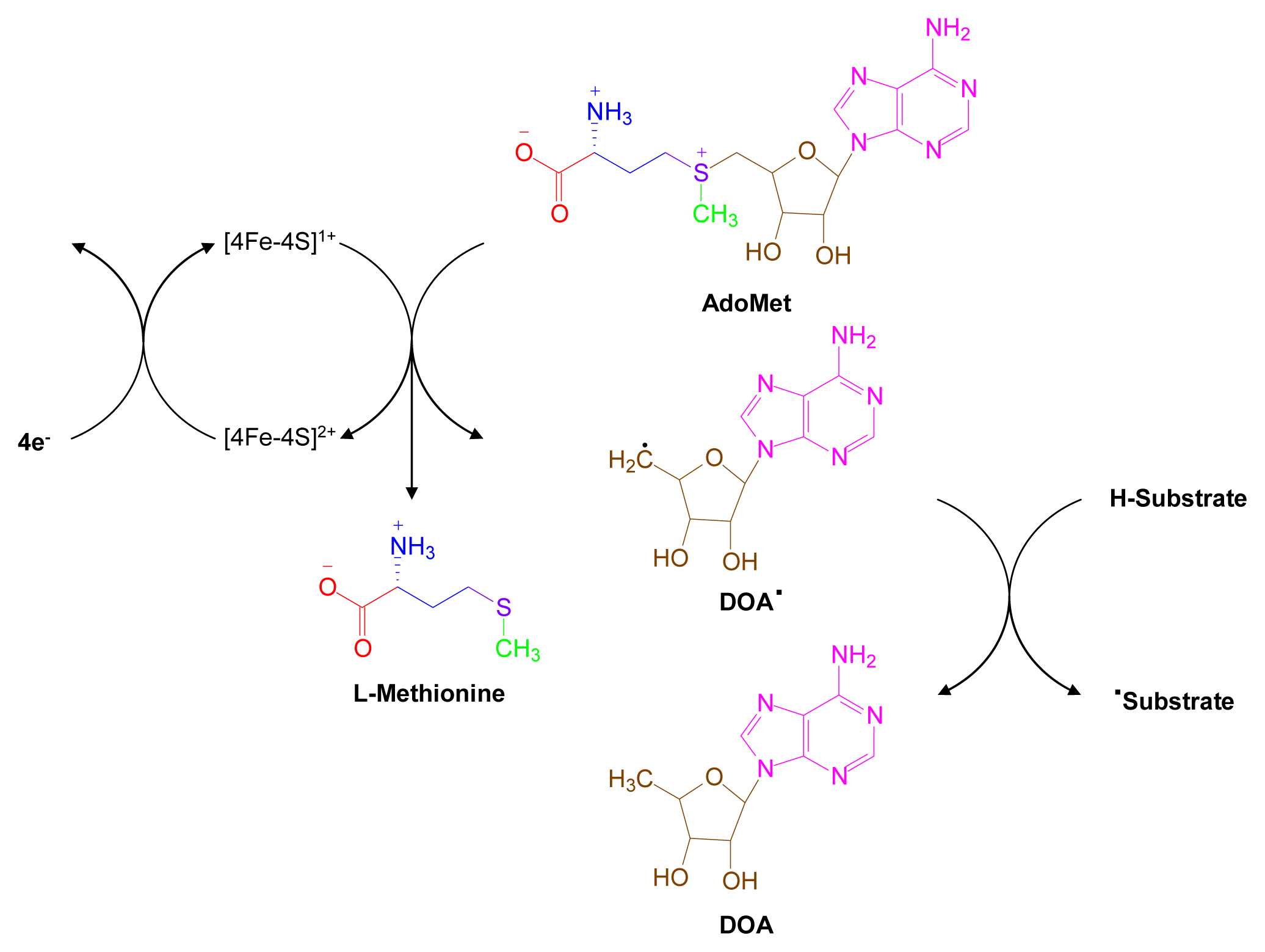
<p>Two basic types of radical SAM proteins have been characterized. One uses AdoMet as a catalytic cofactor that is the direct precursor of the 5’-deoxyadenosyl radical (DOA radical). The other uses AdoMet as a substrate to irreversbly generate a DOA radical. In the first reaction type, AdoMet abstracts a hydrogen atom from 5’-deoxyadenosine (DOA), the end product of step 1, and concomitantly, recycles AdoMet and regenerates a DOA radical. In the second type, AdoMet serves as a radical SAM substrate whose proximate products are methionine and a DOA radical. The initial reaction steps, which are identical for all SAM enzymes, are illustrated in <xref ref-type="fig" rid="f10-marinedrugs-07-00401">Figure 10</xref>.</p>
<p>DOA radicals can act as powerful anaerobic oxidants whose biochemical functions vary among different radical SAM proteins. Many of these proteins use DOA radicals to cleave and functionalize otherwise unreactive carbon-hydrogen (C-H) bonds in protein and small molecule substrates [<xref ref-type="bibr" rid="b12-marinedrugs-07-00401">12</xref>]. Chemical reactions such as isomerization, sulfur insertion, dehydrogenation and cyclization are catalyzed by radical SAM family members [<xref ref-type="bibr" rid="b10-marinedrugs-07-00401">10</xref>,<xref ref-type="bibr" rid="b11-marinedrugs-07-00401">11</xref>]. The radical SAM enzymes, biotin synthase and lipoyl synthase are responsible for the production of the key biochemical cofactors, biotin and lipoic acid [<xref ref-type="bibr" rid="b11-marinedrugs-07-00401">11</xref>,<xref ref-type="bibr" rid="b12-marinedrugs-07-00401">12</xref>,<xref ref-type="bibr" rid="b127-marinedrugs-07-00401">127</xref>–<xref ref-type="bibr" rid="b130-marinedrugs-07-00401">130</xref>]. Brief mention here of other known radical SAM family members attests to the functional diversity of these proteins: spore photoproduct lyase; anaerobic ribonucleotide reductase activating enzyme; benzylsuccinate synthase; coproporphyrinogen III oxidase; lysine 2,3-amino-mutase; pyruvate formate-lyase [<xref ref-type="bibr" rid="b127-marinedrugs-07-00401">127</xref>].</p>
<p>Existence of radical SAM proteins in marine organisms has been noted. The green sulfur bacterium<bold>,</bold> <italic>Chlorobaculum tepidum</italic>, produces bacteriochlorophylls <italic>c, d</italic>, and <italic>e</italic>, a group of photosynthetic pigments that differ from other chlorophylls by the presence of methyl groups at their <italic>C</italic>-8<sup>2</sup> and <italic>C</italic>-12<sup>1</sup> carbons. These site-specific methylations are critical to the organism’s ability to adapt to decreased light intensities [<xref ref-type="bibr" rid="b131-marinedrugs-07-00401">131</xref>]. Labeled precursor studies confirmed that these methyl groups are derived from AdoMet [<xref ref-type="bibr" rid="b132-marinedrugs-07-00401">132</xref>]. The methyltransferases responsible for addition of these two methyl groups have been identified recently as members of the radical SAM superfamily [<xref ref-type="bibr" rid="b131-marinedrugs-07-00401">131</xref>]. Sequencing of the complete genome of <italic>Acaryochloris marina</italic> has led to the discovery of twelve proteins that contain the characteristic, distinguishing features of radical SAM proteins [<xref ref-type="bibr" rid="b133-marinedrugs-07-00401">133</xref>]. <italic>A. marina</italic> is a cyanobacterium whose predominant photosynthetic pigment is chlorophyll <italic>d</italic>. The presence of this unusual pigment enables <italic>A. marina</italic> to use far-red light for its photosynthetic pathways.</p></sec>
<sec>
<title>3.6. Quorum Sensing Pathways</title>
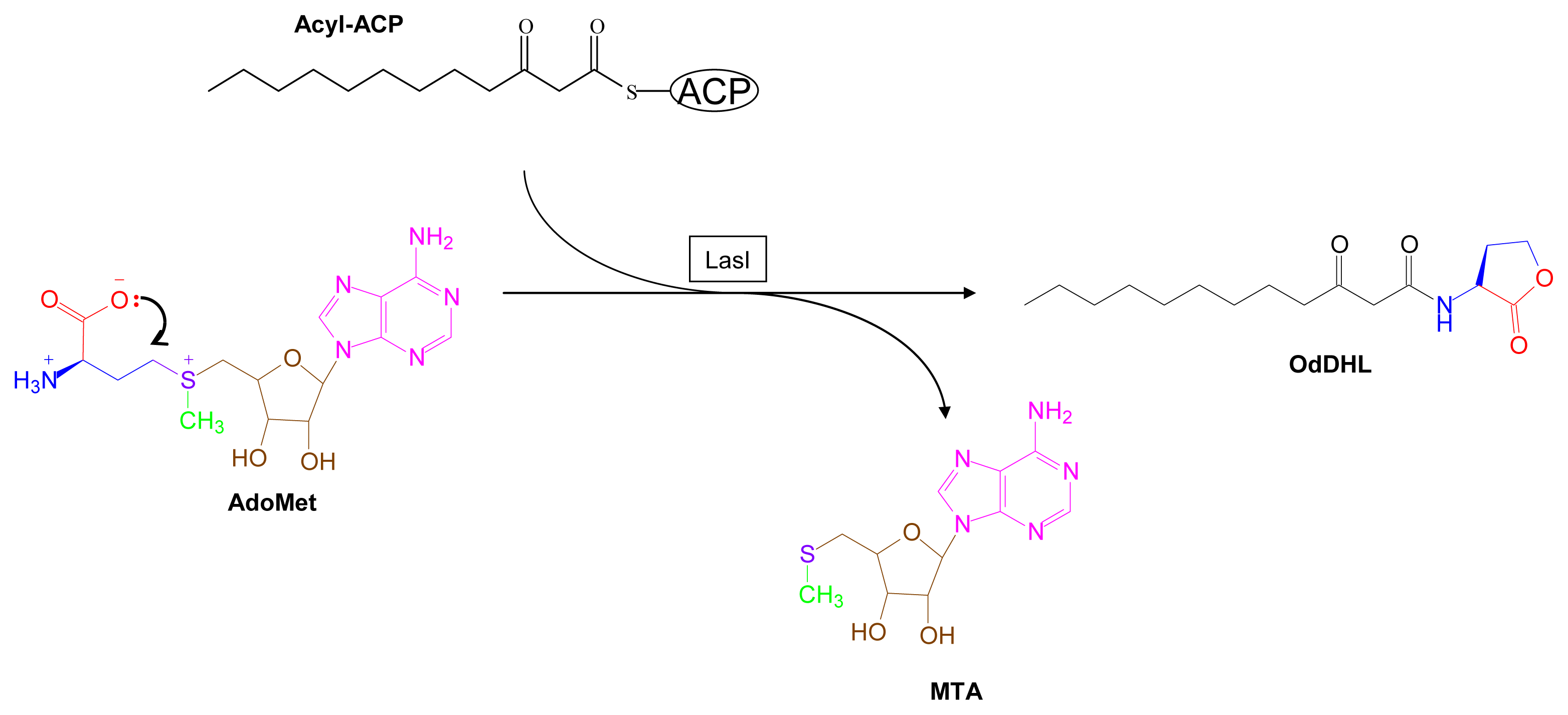
<p>Some gram-negative bacteria sense conspecific cell density, and the density of other bacteria, by monitoring the extracellular concentration of specific small molecules. This phenomenon, called quorum sensing (QS), is used by bacteria to coordinate transcriptional regulation of genes that control population-sensitive programs. QS was first described as a general phenomenon in a landmark review [<xref ref-type="bibr" rid="b134-marinedrugs-07-00401">134</xref>]. An example from this review illustrates the process as a whole: <italic>Vibrio fischeri</italic>, a bioluminescent marine bacterium, expresses genes needed to produce bioluminescence only at high population density. A small molecule, <italic>N</italic>-3-oxo-hexanoyl-<sc>l</sc>-homoserine lactone, accumulates in culture fluid with increasing density of <italic>V. fischeri. N</italic>-3-oxo-hexanoyl-<sc>l</sc>-homoserine binds to the receptor/transcription factor, LuxR, which controls population density dependent expression of bioluminescence genes. Further work showed that different species of bacteria use different AHLs of varying acyl chain lengths as species specific QS signals. In addition to control of bioluminescence in other <italic>Vibrio</italic> species, AHL-controlled QS coordinates what are effectively multicellular developmental programs in a wide range of bacteria. These include biofilm formation, swarming, and induction of virulence in pathogenic species. [<xref ref-type="bibr" rid="b135-marinedrugs-07-00401">135</xref>–<xref ref-type="bibr" rid="b137-marinedrugs-07-00401">137</xref>]. AHLs are enzymatically produced from AdoMet and an acyl-acyl carrier protein [<xref ref-type="bibr" rid="b7-marinedrugs-07-00401">7</xref>,<xref ref-type="bibr" rid="b138-marinedrugs-07-00401">138</xref>] (<xref ref-type="fig" rid="f11-marinedrugs-07-00401">Figure 11</xref>).</p>
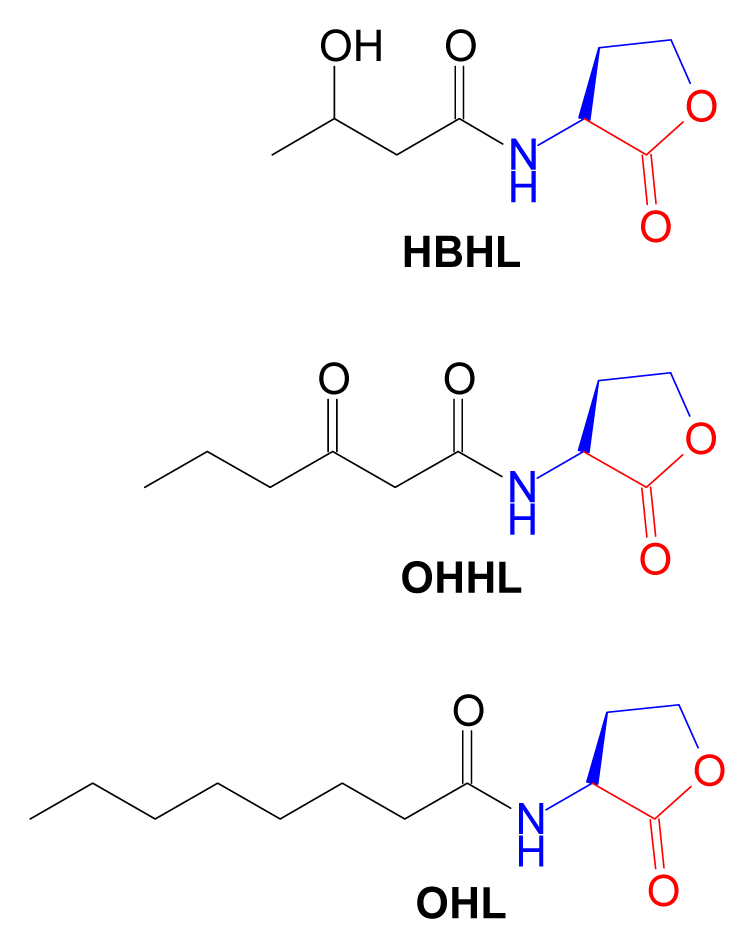
<p>The lactone ring is an invariant feature of AHLs, arising from cyclization of the methionine moiety of AdoMet by AHL synthase enzymes. Natural AHL structures vary not only in the length of the acyl side chain but also in the oxidation state at carbon 3 and the occasional presence of unsaturated carbon-carbon bonds. This is illustrated in three AHL structures produced by various <italic>Vibrio</italic> sp. [<xref ref-type="bibr" rid="b139-marinedrugs-07-00401">139</xref>] (<xref ref-type="fig" rid="f12-marinedrugs-07-00401">Figure 12</xref>).</p>
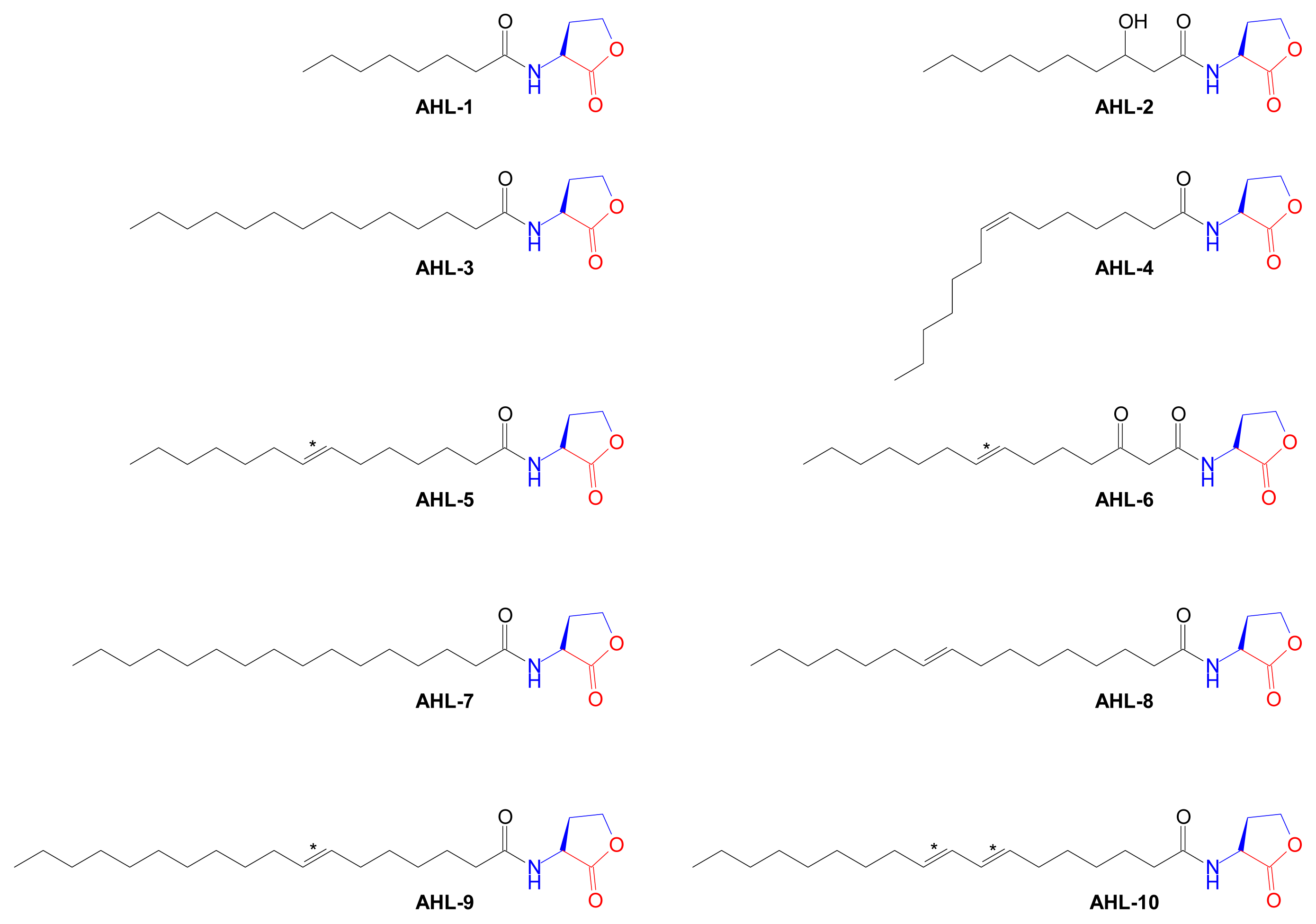
<p>Marine gram-negative α-proteobacteria produce many novel AHL structures, such as those isolated from <italic>Mesorhizobium</italic> sp. [<xref ref-type="bibr" rid="b140-marinedrugs-07-00401">140</xref>] (<xref ref-type="fig" rid="f13-marinedrugs-07-00401">Figure 13</xref>).</p>
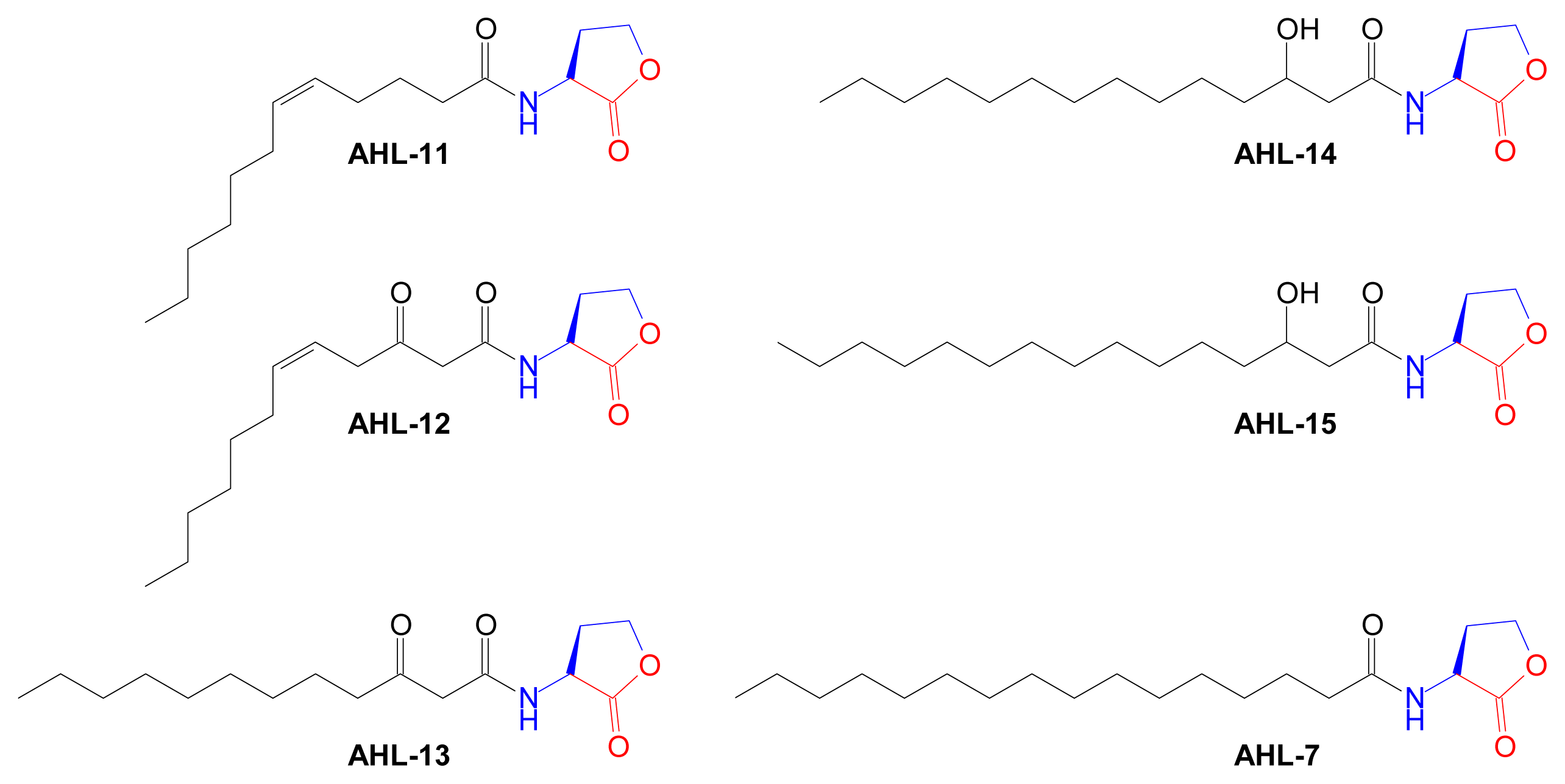
<p>The <italic>Roseobacter</italic> clade, grouped by a shared lineage, is a ubiquitous class of α-proteobacteria, [<xref ref-type="bibr" rid="b141-marinedrugs-07-00401">141</xref>,<xref ref-type="bibr" rid="b142-marinedrugs-07-00401">142</xref>]. Although <italic>Roseobacters</italic> can exist as free-living organisms, they frequently reside in marine habitats that promote their symbiotic associations with microalgae, corals, diatoms, oysters, etc. A significant number of <italic>Roseobacter</italic> strains isolated from North Sea marine habitats were found to produce complex mixtures of unusual, long-chain AHLs (<xref ref-type="fig" rid="f14-marinedrugs-07-00401">Figure 14</xref>) [<xref ref-type="bibr" rid="b143-marinedrugs-07-00401">143</xref>].</p>
<p>Quorum sensing in <italic>Roseobacters</italic> is associated with adaptive responses, such as biofilm formation, which promote colonization of other organisms, and antibiotic production, which is presumably used for self protection [<xref ref-type="bibr" rid="b144-marinedrugs-07-00401">144</xref>]. Tryptantrin and thiotropocin are two known <italic>Roseobacter</italic>-derived antibiotics, whose production is regulated by AHL-dependent signaling [<xref ref-type="bibr" rid="b142-marinedrugs-07-00401">142</xref>]. Comparison of the long-chain AHLs produced by <italic>Roseobacters</italic> (<xref ref-type="fig" rid="f14-marinedrugs-07-00401">Figure 14</xref>) and <italic>Mesorhizobium</italic> sp. (<xref ref-type="fig" rid="f13-marinedrugs-07-00401">Figure 13</xref>) shows remarkable similarities in the acyl side chain structures. Except for <bold>AHL-7</bold>, which is produced by both organisms, their respective AHL signal molecules are in fact structurally distinct and allow for self discrimination.</p>
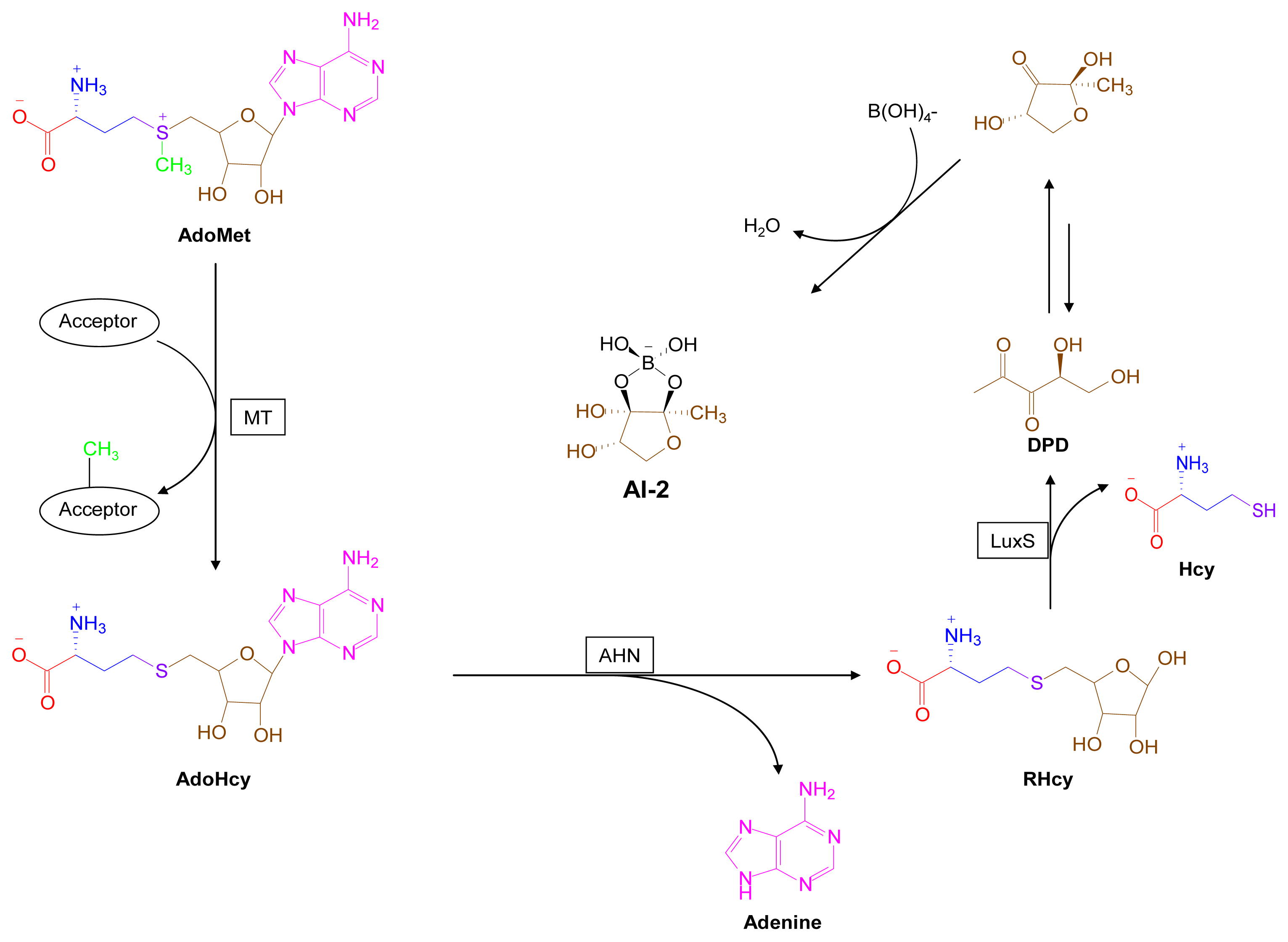
<p>Autoinducer-2 (<bold>AI-2</bold>) is another AdoMet-derived bacterial QS signal molecule that was discovered in a marine bacterium [<xref ref-type="bibr" rid="b9-marinedrugs-07-00401">9</xref>,<xref ref-type="bibr" rid="b145-marinedrugs-07-00401">145</xref>]. The proximate precursor of <bold>AI-2</bold> is <italic>S</italic>-adenosylhomocysteine (AdoHcy), the AdoMet metabolite that is generated as the byproduct of all AdoMet-utilizing methylation reactions (<xref ref-type="fig" rid="f15-marinedrugs-07-00401">Figure 15</xref>). Since AdoHcy is a potent product inhibitor of methyltransferases, conditions that allow its accumulation in cells have toxic consequences. Two pathways of AdoHcy degradation are known. One is initiated by the enzyme AdoHcy hydrolase which produces the proximate metabolites, adenosine and <sc>l</sc>-homocysteine. A second pathway of AdoHcy degradation is initiated by the enzyme AdoHcy nucleosidase, which produces the proximate metabolites, adenine and <italic>S</italic>-ribosylhomocysteine.</p>
<p>Gram-positive bacteria also utilize QS as a means to communicate and coordinate responses to a variety of environmental stimuli. However, they do not generate AHLs; instead they utilize small autoinducing peptides [<xref ref-type="bibr" rid="b146-marinedrugs-07-00401">146</xref>]. Although AHL production is considered to be exclusive to gram negative bacteria, both gram-positive and gram-negative bacteria are able to synthesize <bold>AI-2</bold>. Thus QS signaling via <bold>AI-2</bold> provides an avenue for interspecies communication [<xref ref-type="bibr" rid="b147-marinedrugs-07-00401">147</xref>].</p></sec>
<sec>
<title>3.7. N-Acylhomoserine Lactones as Templates for Anti-Infective Tetramic and Tetronic Acids</title>
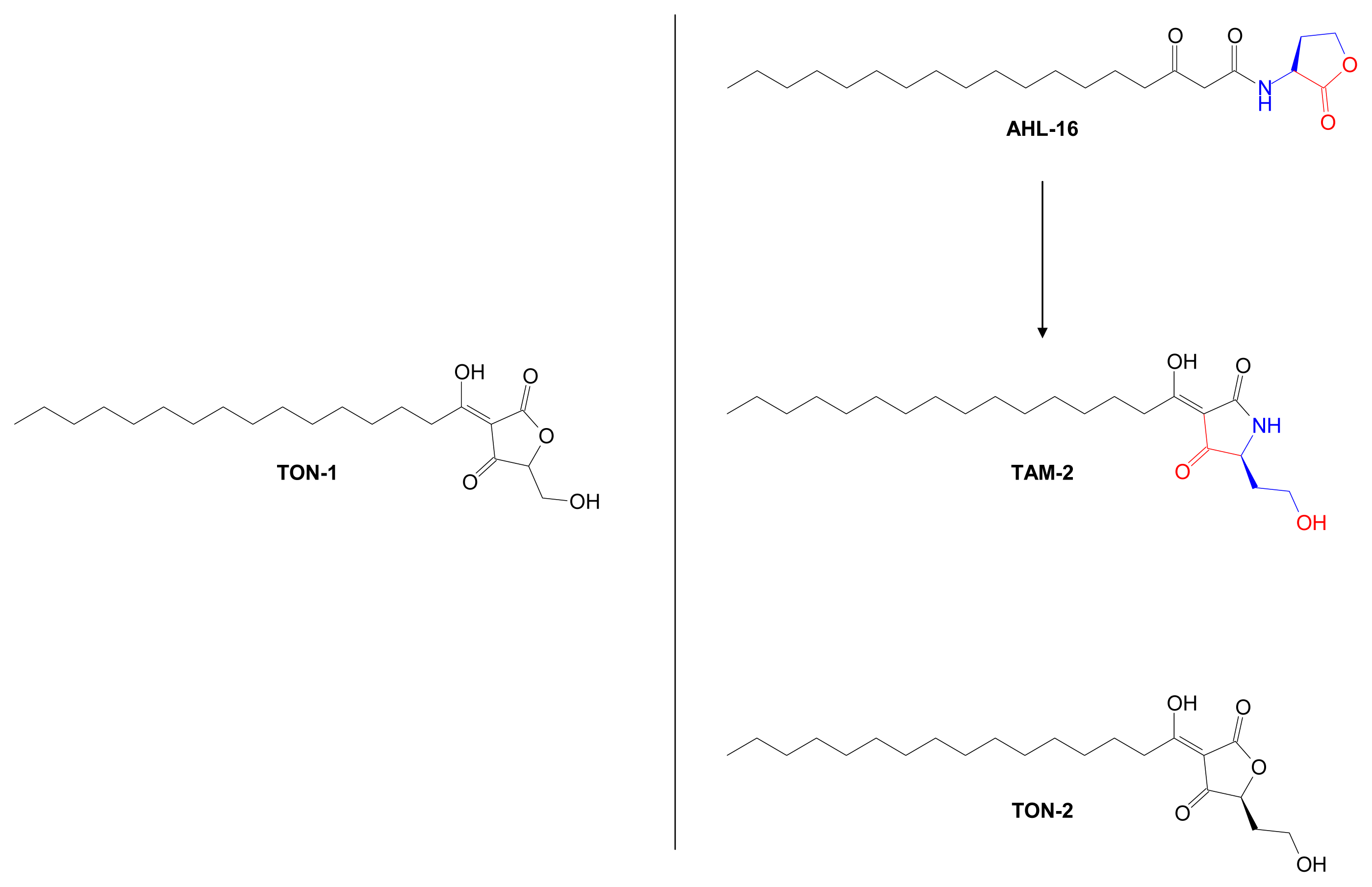
<p>Bacteria that rely on the production of QS signal molecules to coordinate expression of genetic programs, must also have signal molecule degradation pathways to effectively shut down these processes. Two major enzymatic mechanisms for AHL removal are hydrolytic opening of the lactone ring by lactonases or hydrolytic cleavage of the amide bond by acylases [<xref ref-type="bibr" rid="b148-marinedrugs-07-00401">148</xref>]. AHLs can also undergo a nonenzymatic chemical rearrangement to form tetramic acids (TAMs). The biological relevance of this type of AHL rearrangement was observed in <italic>Pseudomonas aeruginosa</italic> cultures by Kaufmann and colleagues, who isolated the expected AHL, <italic>N</italic>-3-oxo-dodecanoyl-<sc>l</sc>-homoserine lactone (OdDHL) as well as the corresponding tetramic acid (<bold>TAM-1</bold>) from the culture medium [<xref ref-type="bibr" rid="b149-marinedrugs-07-00401">149</xref>] (<xref ref-type="fig" rid="f16-marinedrugs-07-00401">Figure 16</xref>). Notably, <bold>TAM-1</bold> displayed a spectrum of antibacterial activity different from that of OdDHL.</p>
<p>Based on these novel findings, marine-derived AHLs can be regarded as templates for the design of tetramic acid derivatives with antibacterial effects distinct from those of their parent AHLs. Similarly, the tetramic acids can serve as templates for synthesis of the related tetronic acids (TONs). In fact, 3-alkanoyl-5-hydroxymethyl tetronic acid (RK-682, <bold>TON-1</bold>), isolated from actinomycete strain DSM 7357, at first sight appears to be an AHL-derived tetronic acid analog [<xref ref-type="bibr" rid="b150-marinedrugs-07-00401">150</xref>] (<xref ref-type="fig" rid="f17-marinedrugs-07-00401">Figure 17</xref>). The initial finding that <bold>TON-1</bold> is a potent inhibitor of tyrosine phosphatase that blocks G2/M cell cycle progression has spurred interest in analog synthesis and evaluation [<xref ref-type="bibr" rid="b150-marinedrugs-07-00401">150</xref>–<xref ref-type="bibr" rid="b152-marinedrugs-07-00401">152</xref>].</p></sec>
<sec>
<title>3.8. Marine-Derived Quorum Sensing Antagonists</title>
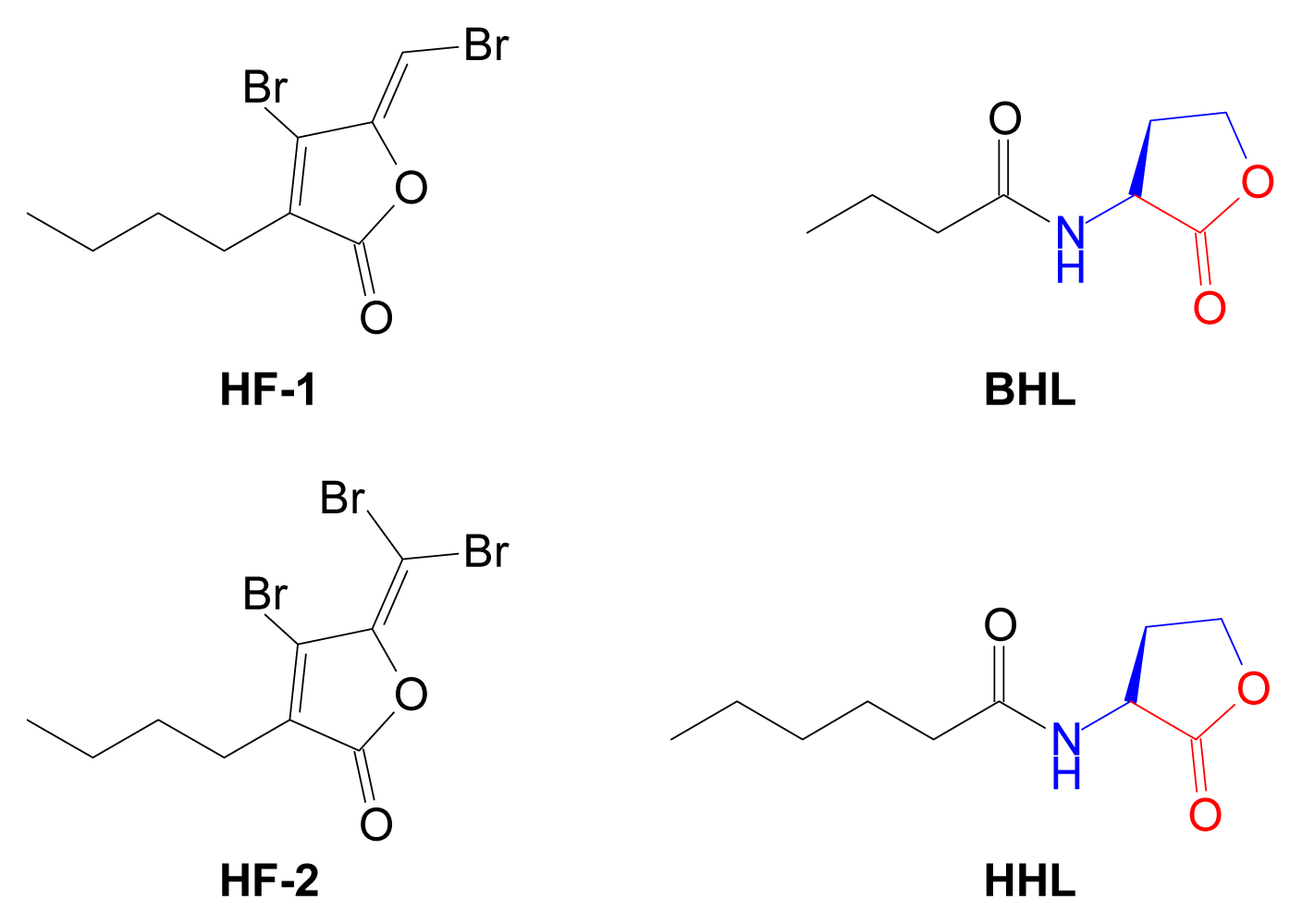
<p>Marine organisms have not sat by idly while various bacteria coordinate their destruction with AHLs. Many have developed additional pathways to disrupt AHL function and QS signaling. Some marine eukaryotes produce AHL mimics that interfere with AHL-receptor binding, effectively blocking the QS signal. Halogenated furanones produced by the Australian red algae, <italic>Delisea pulchra</italic> are the best studied examples of naturally occurring AHL mimics [<xref ref-type="bibr" rid="b153-marinedrugs-07-00401">153</xref>,<xref ref-type="bibr" rid="b154-marinedrugs-07-00401">154</xref>] (<xref ref-type="fig" rid="f18-marinedrugs-07-00401">Figure 18</xref>).</p>
<p>Several studies have determined that two <italic>D. pulchra</italic> halogenated furanones (<bold>HF-1</bold> and <bold>HF-2</bold>) disrupt the AHL-controlled swarming phenotype of <italic>S. liquefaciens</italic> through competitive binding of AHL receptors [<xref ref-type="bibr" rid="b155-marinedrugs-07-00401">155</xref>], [<xref ref-type="bibr" rid="b156-marinedrugs-07-00401">156</xref>]. Furthermore, binding of halogenated furanones to AHL receptors decreases receptor half life [<xref ref-type="bibr" rid="b156-marinedrugs-07-00401">156</xref>]. Like tetronic acids, halogenated furanones may serve as retro-templates for related AHL or tetramic acid structures with potential anti-QS and/or anti-infective activities.</p></sec>
<sec>
<title>3.9. Unusual Marine Metabolites of AdoMet</title>
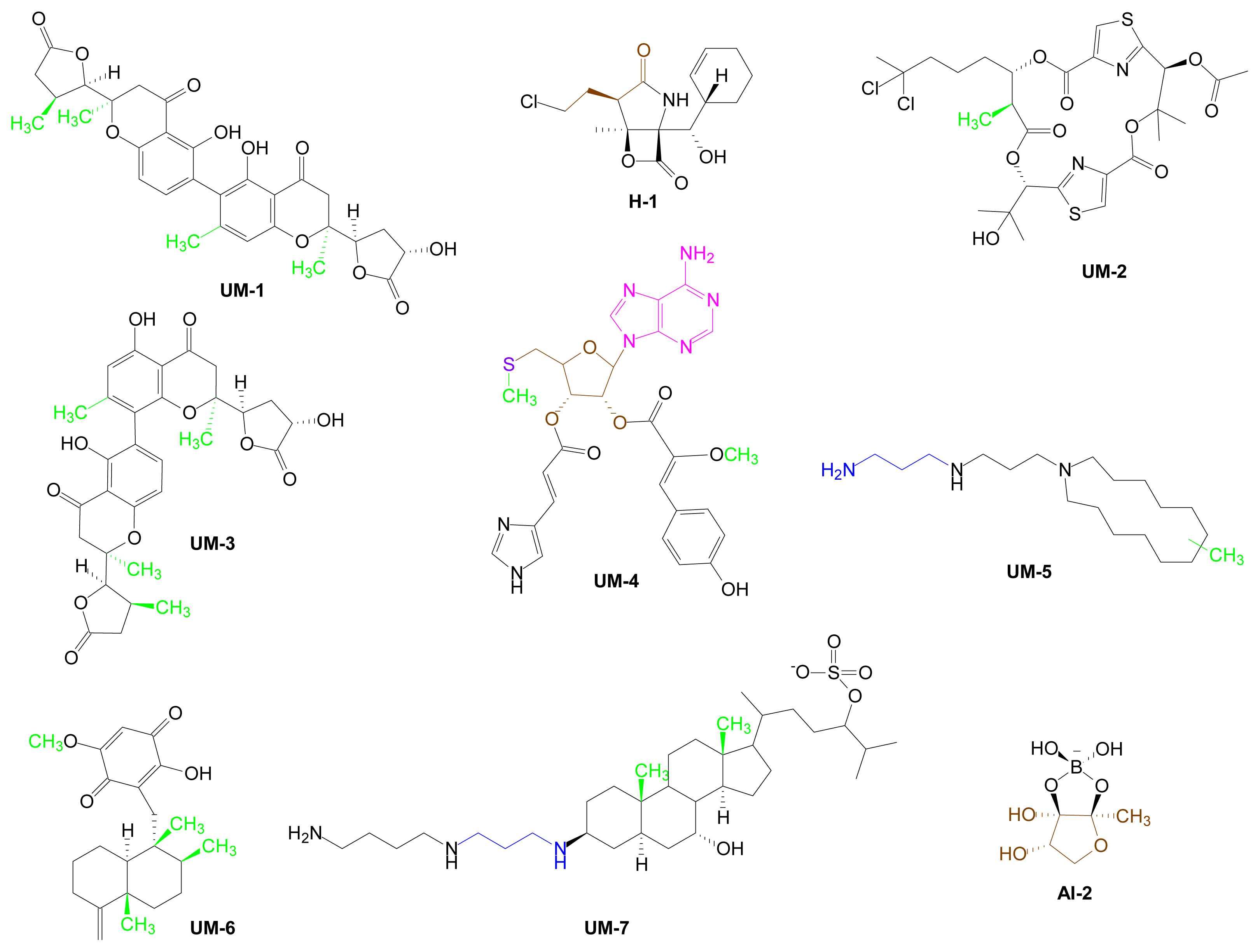
<p>Many AdoMet-derived compounds that were isolated from marine sources have unconventional structures and/or exhibit unusual biological properties (<xref ref-type="fig" rid="f19-marinedrugs-07-00401">Figure 19</xref>). Some of these metabolites contain a polyamine backbone within a more complex chemical structure (<bold>UM-5, UM-7</bold>); most integrate methyl substituents within unusual structural scaffolds (<bold>UM1</bold> - <bold>UM7</bold>). From a shared chemical and biological perspective, the most extraordinary AdoMet-derived marine metabolite is, arguably, the low molecular weight boronate diester, <bold>AI-2</bold>, which acts as an interspecies bacterial signal molecule. Inclusion of salinosporamide A (<bold>H-1</bold>) in this small group of uncommon molecules reflects its novelty as the first marine metabolite known to be halogenated via an AdoMet-dependent halogenase (as noted in Section 3.4 [<xref ref-type="bibr" rid="b1-marinedrugs-07-00401">1</xref>]).</p>
<p>Motuporamines (MPAs) were first isolated from the tropical marine sponge <italic>Xestospongia exigua</italic> (Kirkpatrick) [<xref ref-type="bibr" rid="b157-marinedrugs-07-00401">157</xref>]. Their heterocyclic structures are characterized by the presence of an incorporated polyamine (<italic>i.e.</italic>, spermidine) tail. Additional motuporamines whose structures differ by ring size and by the presence and positions of unsaturated bonds and/or methyl substituents, have since been isolated [<xref ref-type="bibr" rid="b158-marinedrugs-07-00401">158</xref>]. The MPAs, <bold>UM-5</bold> (composite structure<bold>)</bold> each contain a methyl group of unassigned position. AdoMet independently serves as polyamine precursor and methyl donor for the structural components of <bold>UM-5</bold>. MPAs have been shown to inhibit angiogenesis and tumor cell invasiveness [<xref ref-type="bibr" rid="b158-marinedrugs-07-00401">158</xref>,<xref ref-type="bibr" rid="b159-marinedrugs-07-00401">159</xref>]. To and colleagues considered that MPAs might have similar effects on neuronal growth and motility. They studied the effects of MPA-C on neurite development in chicks and determined that this compound profoundly represses formation of the highly motile, neuronal growth cone that plays a key role in axonal outgrowth [<xref ref-type="bibr" rid="b160-marinedrugs-07-00401">160</xref>]. MPA-C is used as a novel neurobiological probe to study molecular mechanisms associated with neuronal outgrowth [<xref ref-type="bibr" rid="b158-marinedrugs-07-00401">158</xref>–<xref ref-type="bibr" rid="b161-marinedrugs-07-00401">161</xref>].</p>
<p>The sesquiterpene quinone, ilimaquinone (<bold>UM-6</bold>) was first isolated from the marine sponge <italic>Hippospongia metachromia</italic> in 1979 [<xref ref-type="bibr" rid="b162-marinedrugs-07-00401">162</xref>]. One of its unusual biological properties is its ability to completely vesiculate Golgi membranes and consequently affect protein transport [<xref ref-type="bibr" rid="b163-marinedrugs-07-00401">163</xref>]. As such, ilimaquinone has been widely used to elucidate the physiological functions of the Golgi apparatus [<xref ref-type="bibr" rid="b164-marinedrugs-07-00401">164</xref>,<xref ref-type="bibr" rid="b165-marinedrugs-07-00401">165</xref>]. Ilimaquinone has also been found to potently inhibit <italic>S</italic>-adenosylhomocysteine hydrolase (AHH), a key enzyme in methylation pathways [<xref ref-type="bibr" rid="b166-marinedrugs-07-00401">166</xref>]. AHH inhibition blocks degradation of <italic>S</italic>-adenosylhomocysteine, the potent product inhibitor of all AdoMet dependent methyltransferases, suggesting that AdoHcy levels are elevated in ilimaquinone-producing marine organisms. Since AdoHcy also serves as proximate precursor of the QS signal molecule, <bold>AI-2</bold>, “ilimaquinone-producers” in marine habitats may have an enhanced capability to synthesize <bold>AI-2</bold> in response to environmental stresses.</p>
<p>The aminosterol, squalamine (<bold>UM-7</bold>) is a spermidine-dihydroxycholestane-sulfate conjugate that was initially isolated from stomach extracts of the dogfish shark <italic>Squalus acanthias</italic> [<xref ref-type="bibr" rid="b167-marinedrugs-07-00401">167</xref>]. Additional aminosterols, with structural variations primarily in the sterol side chain, were subsequently isolated from the same source [<xref ref-type="bibr" rid="b168-marinedrugs-07-00401">168</xref>]. One of these compounds is a spermine conjugate. Squalamine is a water-soluble, broad spectrum antimicrobial, having shown activity against strains of <italic>Escherichia coli</italic>, <italic>Staphylococcus aureus</italic>, C<italic>andida albicans</italic> and <italic>P. aeruginosa</italic> [<xref ref-type="bibr" rid="b167-marinedrugs-07-00401">167</xref>,<xref ref-type="bibr" rid="b168-marinedrugs-07-00401">168</xref>]. Squalamine, which has also shown anticancer and antiangiogenic activities, has undergone phase II clinical trials against ovarian, prostate and non-small cell lung cancers [<xref ref-type="bibr" rid="b167-marinedrugs-07-00401">167</xref>–<xref ref-type="bibr" rid="b169-marinedrugs-07-00401">169</xref>].</p>
<p>Monodictychromones A and B (<bold>UM-1</bold> and <bold>UM-3</bold>) were found in the marine algicolous fungus, <italic>Monodictys putredinis</italic> by Konig and colleagues who had previously isolated a group of monomeric xanthones from the same organism [<xref ref-type="bibr" rid="b140-marinedrugs-07-00401">140</xref>,<xref ref-type="bibr" rid="b170-marinedrugs-07-00401">170</xref>]. <bold>UM-1</bold> and <bold>UM-3</bold> contain two unusual, non identical xanthone subunits and three chiral methyl substituents. <bold>UM-1</bold> and <bold>UM-3</bold> differ only by the site of their linkage [<xref ref-type="bibr" rid="b170-marinedrugs-07-00401">170</xref>]. The two compounds were evaluated for their ability to inhibit the activities of aromatase and cytochrome P450 1A enzymes as well as induction of NAD(P)H:quinone reductase. Both dimeric structures showed similar, but modest inhibitory effects (μM range) in these assays [<xref ref-type="bibr" rid="b170-marinedrugs-07-00401">170</xref>].</p>
<p>Hectochlorin, <bold>UM-2</bold> has been isolated from the marine cyanobacterium <italic>Lyngbya majuscula</italic> as well as the sea hare, <italic>Bursatella leachii</italic> [<xref ref-type="bibr" rid="b171-marinedrugs-07-00401">171</xref>,<xref ref-type="bibr" rid="b172-marinedrugs-07-00401">172</xref>]. <bold>UM-2</bold>’s notable biological properties include its potent stimulatory effects on actin polymerization in PtK2 (normal kidney) cells and its potent antifungal activity against <italic>C. albicans</italic> [<xref ref-type="bibr" rid="b171-marinedrugs-07-00401">171</xref>]. Gerwick and colleagues characterized the hectochlorin biosynthetic gene cluster from <italic>L. majuscula</italic> [<xref ref-type="bibr" rid="b173-marinedrugs-07-00401">173</xref>]. During these investigations, an AdoMet-dependent <italic>C</italic>-methyl-transferase signature motif, previously identified in the biosynthetic gene clusters of curacin A and jamaicamide from other <italic>L. majuscula</italic> strains, was found to be present in the hectochlorin biosynthetic gene cluster [<xref ref-type="bibr" rid="b29-marinedrugs-07-00401">29</xref>,<xref ref-type="bibr" rid="b173-marinedrugs-07-00401">173</xref>–<xref ref-type="bibr" rid="b175-marinedrugs-07-00401">175</xref>].</p>
<p>The unusual, asymmetric diester of MTA, <bold>UM-4</bold> was isolated from the marine ascadian, <italic>Atriolum robustum</italic> [<xref ref-type="bibr" rid="b175-marinedrugs-07-00401">175</xref>]. The 2’-ribose ester substituent of <bold>UM-4</bold> is derived from 3-(4-hydroxyphenyl-2-methoxyacrylic acid (HMA); the 3’-ribose ester substituent, from urocanic acid (UCA). <bold>UM-4</bold> was consistently inferior to MTA in receptor-specific binding assays for the A1, A2A, A2B, and A3 adenosine receptors with binding constants in the micromolar range for the A1, A2A, and A3 receptors [<xref ref-type="bibr" rid="b175-marinedrugs-07-00401">175</xref>]. <italic>In silico</italic> docking into homology models of the A1 and A3 receptors demonstrated that <bold>UM-4</bold> readily docks into the adenosine binding sites of both receptors, likely due to the inherent flexibility of its long chain ester substituents [<xref ref-type="bibr" rid="b175-marinedrugs-07-00401">175</xref>].</p>
<p>MTA is the enzymatic by product of three major AdoMet-dependent pathways: polyamine, ethylene and <italic>N</italic>-acylhomoserine lactone biosyntheses. Thus, the quantities of MTA produced by marine organisms are not insignificant. MTA, like <italic>S</italic>-adenosylhomocysteine, is a proximate AdoMet metabolite that is usually recycled to methionine [<xref ref-type="bibr" rid="b176-marinedrugs-07-00401">176</xref>,<xref ref-type="bibr" rid="b177-marinedrugs-07-00401">177</xref>]. Two major routes of MTA metabolism are known [<xref ref-type="bibr" rid="b178-marinedrugs-07-00401">178</xref>–<xref ref-type="bibr" rid="b181-marinedrugs-07-00401">181</xref>]. One is initiated by the enzyme MTA phosphorylase to yield adenine and 5-methyl-thioribose-1-phosphate; a second enzymatic pathway involves initial hydrolytic cleavage of MTA by one of several closely related nucleosidases, to produce adenine and 5-methylthioribose. Konig and colleagues suggested <bold>UM-4</bold> might be an MTA prodrug that is slowly hydrolyzed by marine esterases [<xref ref-type="bibr" rid="b175-marinedrugs-07-00401">175</xref>]. Expanding on this idea, <bold>UM-4</bold> may also be a depot form of UCA and/or HMA. UCA’s biological properties support this possibility [<xref ref-type="bibr" rid="b182-marinedrugs-07-00401">182</xref>]. The <italic>trans</italic>-isomer of UCA is biosynthesized from histidine in the outer epidermal layers of marine organisms. Subsequent exposure to UV radiation converts <italic>trans</italic>-UCA to the bioactive, immunosuppressive <italic>cis</italic>-isomer. The mechanisms associated with these biological properties, although widely studied, are not well understood [<xref ref-type="bibr" rid="b182-marinedrugs-07-00401">182</xref>]. Further insights into <bold>UM-4</bold> function may be forthcoming in the future. From a structural perspective alone, <bold>UM-4</bold> is, perhaps, the most bizarre AdoMet metabolite to be extracted from the oceans’ depths.</p></sec></sec>
<sec sec-type="conclusions">
<title>4. Conclusions</title>
<p>Marine environments continue to serve as a source of newly identified, structurally novel metabolites of AdoMet. The discovery of quorum sensing activities in gram-negative marine bacteria and the ensuing studies of QS phenomena in marine environments have been instrumental to our current understanding of the complexities of this previously unrecognized bacterial signaling network. These studies provided the first evidence of two new types of AdoMet-derived metabolites, AHLs and <bold>AI-2</bold>. We regard QS networks in global marine habitats as an unusually fertile source of potential, anti-infective AdoMet-derived molecules. The different types of QS-related molecules that can be used as templates for drug design include AHLs, their corresponding tetramic and tetronic acids, and halogenated furanones. Equally important drug templates will emerge from the vast array of defensive chemicals produced by marine organisms to combat the coordinated assaults of pathogenic, quorum sensing bacteria.</p></sec></body>
<back>
<ref-list>
<title>References and Notes</title>
<ref id="b1-marinedrugs-07-00401"><label>1</label><citation citation-type="journal"><person-group person-group-type="author"><name><surname>Eustaquio</surname><given-names>AS</given-names></name><name><surname>Pojer</surname><given-names>F</given-names></name><name><surname>Noe</surname><given-names>JP</given-names></name><name><surname>Moore</surname><given-names>BS</given-names></name></person-group><article-title>Discovery and Characterization of a Marine Bacterial SAM-Dependent Chlorinase</article-title><source>Nat Chem Biol</source><year>2008</year><volume>4</volume><fpage>69</fpage><lpage>74</lpage><pub-id pub-id-type="doi">10.1038/nchembio.2007.56</pub-id><pub-id pub-id-type="pmid">18059261</pub-id></citation></ref>
<ref id="b2-marinedrugs-07-00401"><label>2</label><citation citation-type="journal"><person-group person-group-type="author"><name><surname>Kotb</surname><given-names>M</given-names></name><name><surname>Geller</surname><given-names>AM</given-names></name></person-group><article-title>Methionine Adenosyltransferase-Structure and Function</article-title><source>Pharmacol Ther</source><year>1993</year><volume>59</volume><fpage>125</fpage><lpage>143</lpage><pub-id pub-id-type="doi">10.1016/0163-7258(93)90042-C</pub-id><pub-id pub-id-type="pmid">8278461</pub-id></citation></ref>
<ref id="b3-marinedrugs-07-00401"><label>3</label><citation citation-type="journal"><person-group person-group-type="author"><name><surname>Iwig</surname><given-names>DF</given-names></name><name><surname>Booker</surname><given-names>SJ</given-names></name></person-group><article-title>Insight into the Polar Reactivity of the Onium Chalcogen Analogues of <italic>S</italic>-Adenosyl-l-Methionine</article-title><source>Biochemistry</source><year>2004</year><volume>43</volume><fpage>13496</fpage><lpage>13509</lpage><pub-id pub-id-type="doi">10.1021/bi048693+</pub-id><pub-id pub-id-type="pmid">15491157</pub-id></citation></ref>
<ref id="b4-marinedrugs-07-00401"><label>4</label><citation citation-type="journal"><person-group person-group-type="author"><name><surname>Fontecave</surname><given-names>M</given-names></name><name><surname>Atta</surname><given-names>M</given-names></name><name><surname>Mulliez</surname><given-names>E</given-names></name></person-group><article-title><italic>S</italic>-Adenosylmethionine: Nothing Goes to Waste</article-title><source>Trends Biochem Sci</source><year>2004</year><volume>29</volume><fpage>243</fpage><lpage>249</lpage><pub-id pub-id-type="doi">10.1016/j.tibs.2004.03.007</pub-id><pub-id pub-id-type="pmid">15130560</pub-id></citation></ref>
<ref id="b5-marinedrugs-07-00401"><label>5</label><citation citation-type="journal"><person-group person-group-type="author"><name><surname>Kagan</surname><given-names>RM</given-names></name><name><surname>Clarke</surname><given-names>S</given-names></name></person-group><article-title>Widespread Occurrence of 3 Sequence Motifs in Diverse <italic>S</italic>-Adenosylmethionine-Dependent Methyltransferases Suggests a Common Structure for These Enzymes</article-title><source>Arch Biochem Biophys</source><year>1994</year><volume>310</volume><fpage>417</fpage><lpage>427</lpage><pub-id pub-id-type="doi">10.1006/abbi.1994.1187</pub-id><pub-id pub-id-type="pmid">8179327</pub-id></citation></ref>
<ref id="b6-marinedrugs-07-00401"><label>6</label><citation citation-type="journal"><person-group person-group-type="author"><name><surname>Deng</surname><given-names>H</given-names></name><name><surname>O'Hagan</surname><given-names>D</given-names></name></person-group><article-title>The Fluorinase, the Chlorinase and the Duf-62 Enzymes</article-title><source>Curr Opin Chem Biol</source><year>2008</year><volume>12</volume><fpage>582</fpage><lpage>592</lpage><pub-id pub-id-type="doi">10.1016/j.cbpa.2008.06.036</pub-id><pub-id pub-id-type="pmid">18675376</pub-id></citation></ref>
<ref id="b7-marinedrugs-07-00401"><label>7</label><citation citation-type="journal"><person-group person-group-type="author"><name><surname>Hanzelka</surname><given-names>BL</given-names></name><name><surname>Greenberg</surname><given-names>EP</given-names></name></person-group><article-title>Quorum Sensing in Vibrio Fischeri: Evidence That <italic>S</italic>-Adenosylmethionine Is the Amino Acid Substrate for Autoinducer Synthesis</article-title><source>J Bacteriol</source><year>1996</year><volume>178</volume><fpage>5291</fpage><lpage>5294</lpage><pub-id pub-id-type="pmid">8752350</pub-id></citation></ref>
<ref id="b8-marinedrugs-07-00401"><label>8</label><citation citation-type="journal"><person-group person-group-type="author"><name><surname>More</surname><given-names>MI</given-names></name><name><surname>Finger</surname><given-names>LD</given-names></name><name><surname>Stryker</surname><given-names>JL</given-names></name><name><surname>Fuqua</surname><given-names>C</given-names></name><name><surname>Eberhard</surname><given-names>A</given-names></name><name><surname>Winans</surname><given-names>SC</given-names></name></person-group><article-title>Enzymatic Synthesis of a Quorum-Sensing Autoinducer through Use of Defined Substrates</article-title><source>Science</source><year>1996</year><volume>272</volume><fpage>1655</fpage><lpage>1658</lpage><pub-id pub-id-type="doi">10.1126/science.272.5268.1655</pub-id><pub-id pub-id-type="pmid">8658141</pub-id></citation></ref>
<ref id="b9-marinedrugs-07-00401"><label>9</label><citation citation-type="journal"><person-group person-group-type="author"><name><surname>Chen</surname><given-names>X</given-names></name><name><surname>Schauder</surname><given-names>S</given-names></name><name><surname>Potier</surname><given-names>N</given-names></name><name><surname>Van Dorsselaer</surname><given-names>A</given-names></name><name><surname>Pelczer</surname><given-names>I</given-names></name><name><surname>Bassler</surname><given-names>BL</given-names></name><name><surname>Hughson</surname><given-names>FM</given-names></name></person-group><article-title>Structural Identification of a Bacterial Quorum-Sensing Signal Containing Boron</article-title><source>Nature</source><year>2002</year><volume>415</volume><fpage>545</fpage><lpage>549</lpage><pub-id pub-id-type="doi">10.1038/415545a</pub-id><pub-id pub-id-type="pmid">11823863</pub-id></citation></ref>
<ref id="b10-marinedrugs-07-00401"><label>10</label><citation citation-type="journal"><person-group person-group-type="author"><name><surname>Sofia</surname><given-names>HJ</given-names></name><name><surname>Chen</surname><given-names>G</given-names></name><name><surname>Hetzler</surname><given-names>BG</given-names></name><name><surname>Reyes-Spindola</surname><given-names>JF</given-names></name><name><surname>Miller</surname><given-names>NE</given-names></name></person-group><article-title>Radical SAM, a Novel Protein Superfamily Linking Unresolved Steps in Familiar Biosynthetic Pathways with Radical Mechanisms: Functional Characterization Using New Analysis and Information Visualization Methods</article-title><source>Nucleic Acids Res</source><year>2001</year><volume>29</volume><fpage>1097</fpage><lpage>1106</lpage><pub-id pub-id-type="doi">10.1093/nar/29.5.1097</pub-id><pub-id pub-id-type="pmid">11222759</pub-id></citation></ref>
<ref id="b11-marinedrugs-07-00401"><label>11</label><citation citation-type="journal"><person-group person-group-type="author"><name><surname>Frey</surname><given-names>PA</given-names></name><name><surname>Hegeman</surname><given-names>AD</given-names></name><name><surname>Ruzicka</surname><given-names>FJ</given-names></name></person-group><article-title>The Radical SAM Superfamily</article-title><source>Crit Rev Biochem Mol Biol</source><year>2008</year><volume>43</volume><fpage>63</fpage><lpage>88</lpage><pub-id pub-id-type="doi">10.1080/10409230701829169</pub-id><pub-id pub-id-type="pmid">18307109</pub-id></citation></ref>
<ref id="b12-marinedrugs-07-00401"><label>12</label><citation citation-type="journal"><person-group person-group-type="author"><name><surname>Booker</surname><given-names>SJ</given-names></name></person-group><article-title>Anaerobic Functionalization of Unactivated C-H Bonds</article-title><source>Curr Opin Chem Biol</source><year>2009</year><volume>13</volume><fpage>58</fpage><lpage>73</lpage><pub-id pub-id-type="doi">10.1016/j.cbpa.2009.02.036</pub-id><pub-id pub-id-type="pmid">19297239</pub-id></citation></ref>
<ref id="b13-marinedrugs-07-00401"><label>13</label><citation citation-type="journal"><person-group person-group-type="author"><name><surname>O'Hagan</surname><given-names>D</given-names></name><name><surname>Schaffrath</surname><given-names>C</given-names></name><name><surname>Cobb</surname><given-names>SL</given-names></name><name><surname>Hamilton</surname><given-names>JTG</given-names></name><name><surname>Murphy</surname><given-names>CD</given-names></name></person-group><article-title>Biosynthesis of an Organofluorine Molecule-a Fluorinase Enzyme Has Been Discovered that Catalyses Carbon-Fluorine Bond Formation</article-title><source>Nature</source><year>2002</year><volume>416</volume><fpage>279</fpage><lpage>279</lpage><pub-id pub-id-type="pmid">11907567</pub-id></citation></ref>
<ref id="b14-marinedrugs-07-00401"><label>14</label><citation citation-type="journal"><person-group person-group-type="author"><name><surname>Dong</surname><given-names>CJ</given-names></name><name><surname>Huang</surname><given-names>FL</given-names></name><name><surname>Deng</surname><given-names>H</given-names></name><name><surname>Schaffrath</surname><given-names>C</given-names></name><name><surname>Spencer</surname><given-names>JB</given-names></name><name><surname>O'Hagan</surname><given-names>D</given-names></name><name><surname>Naismith</surname><given-names>JH</given-names></name></person-group><article-title>Crystal Structure and Mechanism of a Bacterial Fluorinating Enzyme</article-title><source>Nature</source><year>2004</year><volume>427</volume><fpage>561</fpage><lpage>565</lpage><pub-id pub-id-type="doi">10.1038/nature02280</pub-id><pub-id pub-id-type="pmid">14765200</pub-id></citation></ref>
<ref id="b15-marinedrugs-07-00401"><label>15</label><citation citation-type="journal"><person-group person-group-type="author"><name><surname>Eisenberg</surname><given-names>MA</given-names></name><name><surname>Stoner</surname><given-names>GL</given-names></name></person-group><article-title>Biosynthesis of 7,8-Diaminopelargonic Acid, a Biotin Intermediate, from 7-Keto-8-Aminoperlargonic Acid and <italic>S</italic>-Adenosyl-l-Methionine</article-title><source>J Bacteriol</source><year>1971</year><volume>108</volume><fpage>1135</fpage><lpage>1140</lpage><pub-id pub-id-type="pmid">4945185</pub-id></citation></ref>
<ref id="b16-marinedrugs-07-00401"><label>16</label><citation citation-type="journal"><person-group person-group-type="author"><name><surname>Nishimura</surname><given-names>S</given-names></name><name><surname>Taya</surname><given-names>Y</given-names></name><name><surname>Kuchino</surname><given-names>Y</given-names></name><name><surname>Ohashi</surname><given-names>Z</given-names></name></person-group><article-title>Enzymatic-Synthesis of 3-(3-Amino-3-Carboxypropyl)Uridine in Escherichia-Coli Phenylalanine Transfer-RNA-Transfer of 3-Amino-3-Carboxypropyl Group from <italic>S</italic>-Adenosylmethionine</article-title><source>Biochem Biophys Res Commun</source><year>1974</year><volume>57</volume><fpage>702</fpage><lpage>708</lpage><pub-id pub-id-type="doi">10.1016/0006-291X(74)90603-2</pub-id><pub-id pub-id-type="pmid">4597321</pub-id></citation></ref>
<ref id="b17-marinedrugs-07-00401"><label>17</label><citation citation-type="journal"><person-group person-group-type="author"><name><surname>Iwata-Reuyl</surname><given-names>D</given-names></name></person-group><article-title>An Embarrassment of Riches: The Enzymology of RNA Modification</article-title><source>Curr Opin Chem Biol</source><year>2008</year><volume>12</volume><fpage>126</fpage><lpage>133</lpage><pub-id pub-id-type="doi">10.1016/j.cbpa.2008.01.041</pub-id><pub-id pub-id-type="pmid">18294973</pub-id></citation></ref>
<ref id="b18-marinedrugs-07-00401"><label>18</label><citation citation-type="journal"><person-group person-group-type="author"><name><surname>van Lanen</surname><given-names>SG</given-names></name><name><surname>Kinzie</surname><given-names>SD</given-names></name><name><surname>Matthieu</surname><given-names>S</given-names></name><name><surname>Link</surname><given-names>T</given-names></name><name><surname>Culp</surname><given-names>J</given-names></name><name><surname>Iwata-Reuyl</surname><given-names>D</given-names></name></person-group><article-title>tRNA Modification by <italic>S</italic>-Adenosylmethionine: tRNA Ribosyltransferase-Isomerase-Assay Development and Characterization of the Recombinant Enzyme</article-title><source>J Biol Chem</source><year>2003</year><volume>278</volume><fpage>10491</fpage><lpage>10499</lpage><pub-id pub-id-type="doi">10.1074/jbc.M207727200</pub-id><pub-id pub-id-type="pmid">12533518</pub-id></citation></ref>
<ref id="b19-marinedrugs-07-00401"><label>19</label><citation citation-type="journal"><person-group person-group-type="author"><name><surname>Iwata-Reuyl</surname><given-names>D</given-names></name></person-group><article-title>Biosynthesis of the 7-Deazaguanosine Hypermodified Nucleosides of Transfer RNA</article-title><source>Bioorg Chem</source><year>2003</year><volume>31</volume><fpage>24</fpage><lpage>43</lpage><pub-id pub-id-type="doi">10.1016/S0045-2068(02)00513-8</pub-id><pub-id pub-id-type="pmid">12697167</pub-id></citation></ref>
<ref id="b20-marinedrugs-07-00401"><label>20</label><citation citation-type="journal"><person-group person-group-type="author"><name><surname>Basturea</surname><given-names>GN</given-names></name><name><surname>Rudd</surname><given-names>KE</given-names></name><name><surname>Deutscher</surname><given-names>MP</given-names></name></person-group><article-title>Identification and Characterization of RsmE, the Founding Member of a New RNA Base Methyltransferase Family</article-title><source>RNA-Publ RNA Soc</source><year>2006</year><volume>12</volume><fpage>426</fpage><lpage>434</lpage><pub-id pub-id-type="doi">10.1261/rna.2283106</pub-id></citation></ref>
<ref id="b21-marinedrugs-07-00401"><label>21</label><citation citation-type="journal"><person-group person-group-type="author"><name><surname>Poole</surname><given-names>A</given-names></name><name><surname>Penny</surname><given-names>D</given-names></name><name><surname>Sjoberg</surname><given-names>BM</given-names></name></person-group><article-title>Methyl-RNA: An Evolutionary Bridge between RNA and DNA?</article-title><source>Chem Biol</source><year>2000</year><volume>7</volume><fpage>R207</fpage><lpage>R216</lpage><pub-id pub-id-type="doi">10.1016/S1074-5521(00)00042-9</pub-id><pub-id pub-id-type="pmid">11137821</pub-id></citation></ref>
<ref id="b22-marinedrugs-07-00401"><label>22</label><citation citation-type="journal"><person-group person-group-type="author"><name><surname>Kerr</surname><given-names>SJ</given-names></name><name><surname>Borek</surname><given-names>E</given-names></name></person-group><article-title>Transfer-RNA Methyltransferases</article-title><source>Adv Enzymol Relat Areas Mol Biol</source><year>1972</year><volume>36</volume><fpage>1</fpage><lpage>27</lpage><pub-id pub-id-type="pmid">4563428</pub-id></citation></ref>
<ref id="b23-marinedrugs-07-00401"><label>23</label><citation citation-type="journal"><person-group person-group-type="author"><name><surname>Colonna</surname><given-names>A</given-names></name><name><surname>Kerr</surname><given-names>SJ</given-names></name></person-group><article-title>The Nucleus as the Site of Transfer-RNA Methylation</article-title><source>J Cell Physiol</source><year>1980</year><volume>103</volume><fpage>29</fpage><lpage>33</lpage><pub-id pub-id-type="doi">10.1002/jcp.1041030105</pub-id><pub-id pub-id-type="pmid">7430257</pub-id></citation></ref>
<ref id="b24-marinedrugs-07-00401"><label>24</label><citation citation-type="journal"><person-group person-group-type="author"><name><surname>Tollervey</surname><given-names>D</given-names></name></person-group><article-title>Small Nucleolar RNAs Guide Ribosomal RNA Methylation</article-title><source>Science</source><year>1996</year><volume>273</volume><fpage>1056</fpage><lpage>1057</lpage><pub-id pub-id-type="doi">10.1126/science.273.5278.1056</pub-id><pub-id pub-id-type="pmid">8711484</pub-id></citation></ref>
<ref id="b25-marinedrugs-07-00401"><label>25</label><citation citation-type="journal"><person-group person-group-type="author"><name><surname>Maravic</surname><given-names>G</given-names></name><name><surname>Flogel</surname><given-names>M</given-names></name></person-group><article-title>RNA Methylation and Antibiotic Resistance: An Overview</article-title><source>Period Biol</source><year>2004</year><volume>106</volume><fpage>135</fpage><lpage>140</lpage></citation></ref>
<ref id="b26-marinedrugs-07-00401"><label>26</label><citation citation-type="journal"><person-group person-group-type="author"><name><surname>Sitachitta</surname><given-names>N</given-names></name><name><surname>Marquez</surname><given-names>BL</given-names></name><name><surname>Williamson</surname><given-names>RT</given-names></name><name><surname>Rossi</surname><given-names>J</given-names></name><name><surname>Roberts</surname><given-names>MA</given-names></name><name><surname>Gerwick</surname><given-names>WH</given-names></name><name><surname>Nguyen</surname><given-names>VA</given-names></name><name><surname>Willis</surname><given-names>CL</given-names></name></person-group><article-title>Biosynthetic Pathway and Origin of the Chlorinated Methyl Group in Barbamide and Dechlorobarbamide, Metabolites from the Marine Cyanobacterium Lyngbya Majuscula</article-title><source>Tetrahedron</source><year>2000</year><volume>56</volume><fpage>9103</fpage><lpage>9113</lpage><pub-id pub-id-type="doi">10.1016/S0040-4020(00)00763-8</pub-id></citation></ref>
<ref id="b27-marinedrugs-07-00401"><label>27</label><citation citation-type="journal"><person-group person-group-type="author"><name><surname>Flatt</surname><given-names>PM</given-names></name><name><surname>O'Connell</surname><given-names>SJ</given-names></name><name><surname>McPhail</surname><given-names>KL</given-names></name><name><surname>Zeller</surname><given-names>G</given-names></name><name><surname>Willis</surname><given-names>CL</given-names></name><name><surname>Sherman</surname><given-names>DH</given-names></name><name><surname>Gerwick</surname><given-names>WH</given-names></name></person-group><article-title>Characterization of the Initial Enzymatic Steps of Barbamide Biosynthesis</article-title><source>J Nat Prod</source><year>2006</year><volume>69</volume><fpage>938</fpage><lpage>944</lpage><pub-id pub-id-type="doi">10.1021/np050523q</pub-id><pub-id pub-id-type="pmid">16792414</pub-id></citation></ref>
<ref id="b28-marinedrugs-07-00401"><label>28</label><citation citation-type="journal"><person-group person-group-type="author"><name><surname>Orjala</surname><given-names>J</given-names></name><name><surname>Gerwick</surname><given-names>WH</given-names></name></person-group><article-title>Barbamide, a Chlorinated Metabolite with Molluscicidal Activity from the Caribbean Cyanobacterium Lyngbya Majuscula</article-title><source>J Nat Prod</source><year>1996</year><volume>59</volume><fpage>427</fpage><lpage>430</lpage><pub-id pub-id-type="doi">10.1021/np960085a</pub-id><pub-id pub-id-type="pmid">8699186</pub-id></citation></ref>
<ref id="b29-marinedrugs-07-00401"><label>29</label><citation citation-type="journal"><person-group person-group-type="author"><name><surname>Chang</surname><given-names>ZX</given-names></name><name><surname>Sitachitta</surname><given-names>N</given-names></name><name><surname>Rossi</surname><given-names>JV</given-names></name><name><surname>Roberts</surname><given-names>MA</given-names></name><name><surname>Flatt</surname><given-names>PM</given-names></name><name><surname>Jia</surname><given-names>JY</given-names></name><name><surname>Sherman</surname><given-names>DH</given-names></name><name><surname>Gerwick</surname><given-names>WH</given-names></name></person-group><article-title>Biosynthetic Pathway and Gene Cluster Analysis of Curacin A, an Antitubulin Natural Product from the Tropical Marine Cyanobacterium Lyngbya Majuscula</article-title><source>J Nat Prod</source><year>2004</year><volume>67</volume><fpage>1356</fpage><lpage>1367</lpage><pub-id pub-id-type="doi">10.1021/np0499261</pub-id><pub-id pub-id-type="pmid">15332855</pub-id></citation></ref>
<ref id="b30-marinedrugs-07-00401"><label>30</label><citation citation-type="journal"><person-group person-group-type="author"><name><surname>Kokke</surname><given-names>W</given-names></name><name><surname>Shoolery</surname><given-names>JN</given-names></name><name><surname>Fenical</surname><given-names>W</given-names></name><name><surname>Djerassi</surname><given-names>C</given-names></name></person-group><article-title>Biosynthetic-Studies of Marine Lipids.4. Mechanism of Side-Chain Alkylation in (<italic>E</italic>)-24-Propylidenecholesterol by a Chrysophyte Alga</article-title><source>J Org Chem</source><year>1984</year><volume>49</volume><fpage>3742</fpage><lpage>3752</lpage><pub-id pub-id-type="doi">10.1021/jo00194a014</pub-id></citation></ref>
<ref id="b31-marinedrugs-07-00401"><label>31</label><citation citation-type="journal"><person-group person-group-type="author"><name><surname>Giner</surname><given-names>JL</given-names></name><name><surname>Djerassi</surname><given-names>C</given-names></name></person-group><article-title>Biosynthetic-Studies of Marine Lipids. 33. Biosynthesis of Dinosterol, Peridinosterol, and Gorgosterol - Unusual Patterns of Bioalkylation in Dinoflagellate Sterols</article-title><source>J Org Chem</source><year>1991</year><volume>56</volume><fpage>2357</fpage><lpage>2363</lpage><pub-id pub-id-type="doi">10.1021/jo00007a021</pub-id></citation></ref>
<ref id="b32-marinedrugs-07-00401"><label>32</label><citation citation-type="journal"><person-group person-group-type="author"><name><surname>Kerr</surname><given-names>RG</given-names></name><name><surname>Kerr</surname><given-names>SL</given-names></name><name><surname>Djerassi</surname><given-names>C</given-names></name></person-group><article-title>Biosynthetic-Studies of Marine Lipids. 26. Elucidation of the Biosynthesis of Mutasterol, a Sponge Sterol with a Quaternary Carbon in Its Side-Chain</article-title><source>J Org Chem</source><year>1991</year><volume>56</volume><fpage>63</fpage><lpage>66</lpage><pub-id pub-id-type="doi">10.1021/jo00001a014</pub-id></citation></ref>
<ref id="b33-marinedrugs-07-00401"><label>33</label><citation citation-type="journal"><person-group person-group-type="author"><name><surname>Lang</surname><given-names>G</given-names></name><name><surname>Wiese</surname><given-names>J</given-names></name><name><surname>Schmaljohann</surname><given-names>R</given-names></name><name><surname>Imhoff</surname><given-names>JF</given-names></name></person-group><article-title>New Pentaenes from the Sponge-Derived Marine Fungus Penicillium Rugulosum: Structure Determination and Biosynthetic Studies</article-title><source>Tetrahedron</source><year>2007</year><volume>63</volume><fpage>11844</fpage><lpage>11849</lpage><pub-id pub-id-type="doi">10.1016/j.tet.2007.09.025</pub-id></citation></ref>
<ref id="b34-marinedrugs-07-00401"><label>34</label><citation citation-type="journal"><person-group person-group-type="author"><name><surname>Kobayashi</surname><given-names>H</given-names></name><name><surname>Meguro</surname><given-names>S</given-names></name><name><surname>Yoshimoto</surname><given-names>T</given-names></name><name><surname>Namikoshi</surname><given-names>M</given-names></name></person-group><article-title>Absolute Structure, Biosynthesis, and Anti-Microtubule Activity of Phomopsidin, Isolated from a Marine-Derived Fungus Phomopsis Sp</article-title><source>Tetrahedron</source><year>2003</year><volume>59</volume><fpage>455</fpage><lpage>459</lpage><pub-id pub-id-type="doi">10.1016/S0040-4020(02)01566-1</pub-id></citation></ref>
<ref id="b35-marinedrugs-07-00401"><label>35</label><citation citation-type="journal"><person-group person-group-type="author"><name><surname>Bringmann</surname><given-names>G</given-names></name><name><surname>Lang</surname><given-names>G</given-names></name><name><surname>Gulder</surname><given-names>TAM</given-names></name><name><surname>Tsuruta</surname><given-names>H</given-names></name><name><surname>Muhlbacher</surname><given-names>J</given-names></name><name><surname>Maksimenka</surname><given-names>K</given-names></name><name><surname>Steffens</surname><given-names>S</given-names></name><name><surname>Schaumann</surname><given-names>K</given-names></name><name><surname>Stohr</surname><given-names>R</given-names></name><name><surname>Wiese</surname><given-names>J</given-names></name><name><surname>Imhoff</surname><given-names>JF</given-names></name><name><surname>Perovic-Ottstadt</surname><given-names>S</given-names></name><name><surname>Boreiko</surname><given-names>O</given-names></name><name><surname>Muller</surname><given-names>WEG</given-names></name></person-group><article-title>The First Sorbicillinoid Alkaloids, the Antileukemic Sorbicillactones A and B, from a Sponge-Derived Penicillium Chrysogenum Strain</article-title><source>Tetrahedron</source><year>2005</year><volume>61</volume><fpage>7252</fpage><lpage>7265</lpage><pub-id pub-id-type="doi">10.1016/j.tet.2005.05.026</pub-id></citation></ref>
<ref id="b36-marinedrugs-07-00401"><label>36</label><citation citation-type="journal"><person-group person-group-type="author"><name><surname>Cacciapuoti</surname><given-names>G</given-names></name><name><surname>Porcelli</surname><given-names>M</given-names></name><name><surname>Moretti</surname><given-names>MA</given-names></name><name><surname>Sorrentino</surname><given-names>F</given-names></name><name><surname>Concilio</surname><given-names>L</given-names></name><name><surname>Zappia</surname><given-names>V</given-names></name><name><surname>Liu</surname><given-names>ZJ</given-names></name><name><surname>Tempel</surname><given-names>W</given-names></name><name><surname>Schubot</surname><given-names>F</given-names></name><name><surname>Rose</surname><given-names>JP</given-names></name><name><surname>Wang</surname><given-names>BC</given-names></name><name><surname>Brereton</surname><given-names>PS</given-names></name><name><surname>Jenney</surname><given-names>FE</given-names></name><name><surname>Adams</surname><given-names>MWW</given-names></name></person-group><article-title>The First Agmatine/Cadaverine Aminopropyl Transferase: Biochemical and Structural Characterization of an Enzyme Involved in Polyamine Biosynthesis in the Hyperthermophilic Archaeon Pyrococcus Furiosus</article-title><source>J Bacteriol</source><year>2007</year><volume>189</volume><fpage>6057</fpage><lpage>6067</lpage><pub-id pub-id-type="doi">10.1128/JB.00151-07</pub-id><pub-id pub-id-type="pmid">17545282</pub-id></citation></ref>
<ref id="b37-marinedrugs-07-00401"><label>37</label><citation citation-type="journal"><person-group person-group-type="author"><name><surname>Kusano</surname><given-names>T</given-names></name><name><surname>Berberich</surname><given-names>T</given-names></name><name><surname>Tateda</surname><given-names>C</given-names></name><name><surname>Takahashi</surname><given-names>Y</given-names></name></person-group><article-title>Polyamines: Essential Factors for Growth and Survival</article-title><source>Planta</source><year>2008</year><volume>228</volume><fpage>367</fpage><lpage>381</lpage><pub-id pub-id-type="doi">10.1007/s00425-008-0772-7</pub-id><pub-id pub-id-type="pmid">18594857</pub-id></citation></ref>
<ref id="b38-marinedrugs-07-00401"><label>38</label><citation citation-type="journal"><person-group person-group-type="author"><name><surname>Shah</surname><given-names>P</given-names></name><name><surname>Swlatlo</surname><given-names>E</given-names></name></person-group><article-title>A Multifaceted Role for Polyamines in Bacterial Pathogens</article-title><source>Mol Microbiol</source><year>2008</year><volume>68</volume><fpage>4</fpage><lpage>16</lpage><pub-id pub-id-type="doi">10.1111/j.1365-2958.2008.06126.x</pub-id><pub-id pub-id-type="pmid">18405343</pub-id></citation></ref>
<ref id="b39-marinedrugs-07-00401"><label>39</label><citation citation-type="journal"><person-group person-group-type="author"><name><surname>Kuehn</surname><given-names>GD</given-names></name><name><surname>Phillips</surname><given-names>GC</given-names></name></person-group><article-title>Role of Polyamines in Apoptosis and Other Recent Advances in Plant Polyamines</article-title><source>Crit Rev Plant Sci</source><year>2005</year><volume>24</volume><fpage>123</fpage><lpage>130</lpage><pub-id pub-id-type="doi">10.1080/07352680590953161</pub-id></citation></ref>
<ref id="b40-marinedrugs-07-00401"><label>40</label><citation citation-type="journal"><person-group person-group-type="author"><name><surname>Williams</surname><given-names>K</given-names></name></person-group><article-title>Modulation and Block of Ion Channels: A New Biology of Polyamines</article-title><source>Cell Signal</source><year>1997</year><volume>9</volume><fpage>1</fpage><lpage>13</lpage><pub-id pub-id-type="doi">10.1016/S0898-6568(96)00089-7</pub-id><pub-id pub-id-type="pmid">9067625</pub-id></citation></ref>
<ref id="b41-marinedrugs-07-00401"><label>41</label><citation citation-type="journal"><person-group person-group-type="author"><name><surname>Igarashi</surname><given-names>K</given-names></name><name><surname>Kashiwagi</surname><given-names>K</given-names></name></person-group><article-title>Polyamines: Mysterious Modulators of Cellular Functions</article-title><source>Biochem Biophys Res Commun</source><year>2000</year><volume>271</volume><fpage>559</fpage><lpage>564</lpage><pub-id pub-id-type="doi">10.1006/bbrc.2000.2601</pub-id><pub-id pub-id-type="pmid">10814501</pub-id></citation></ref>
<ref id="b42-marinedrugs-07-00401"><label>42</label><citation citation-type="journal"><person-group person-group-type="author"><name><surname>Rhee</surname><given-names>HJ</given-names></name><name><surname>Kim</surname><given-names>EJ</given-names></name><name><surname>Lee</surname><given-names>JK</given-names></name></person-group><article-title>Physiological Polyamines: Simple Primordial Stress Molecules</article-title><source>J Cell Mol Med</source><year>2007</year><volume>11</volume><fpage>685</fpage><lpage>703</lpage><pub-id pub-id-type="doi">10.1111/j.1582-4934.2007.00077.x</pub-id><pub-id pub-id-type="pmid">17760833</pub-id></citation></ref>
<ref id="b43-marinedrugs-07-00401"><label>43</label><citation citation-type="journal"><person-group person-group-type="author"><name><surname>Baron</surname><given-names>K</given-names></name><name><surname>Stasolla</surname><given-names>C</given-names></name></person-group><article-title>The Role of Polyamines During <italic>in Vivo</italic> and <italic>in Vitro</italic> Development</article-title><source>In Vitro Cell Dev Biol-Plant</source><year>2008</year><volume>44</volume><fpage>384</fpage><lpage>395</lpage><pub-id pub-id-type="doi">10.1007/s11627-008-9176-4</pub-id></citation></ref>
<ref id="b44-marinedrugs-07-00401"><label>44</label><citation citation-type="journal"><person-group person-group-type="author"><name><surname>Groppa</surname><given-names>MD</given-names></name><name><surname>Benavides</surname><given-names>MP</given-names></name></person-group><article-title>Polyamines and Abiotic Stress: Recent Advances</article-title><source>Amino Acids</source><year>2008</year><volume>34</volume><fpage>35</fpage><lpage>45</lpage><pub-id pub-id-type="doi">10.1007/s00726-007-0501-8</pub-id><pub-id pub-id-type="pmid">17356805</pub-id></citation></ref>
<ref id="b45-marinedrugs-07-00401"><label>45</label><citation citation-type="journal"><person-group person-group-type="author"><name><surname>Williams</surname><given-names>K</given-names></name></person-group><article-title>Interactions of Polyamines with Ion Channels</article-title><source>Biochem J</source><year>1997</year><volume>325</volume><fpage>289</fpage><lpage>297</lpage><pub-id pub-id-type="pmid">9230104</pub-id></citation></ref>
<ref id="b46-marinedrugs-07-00401"><label>46</label><citation citation-type="journal"><person-group person-group-type="author"><name><surname>Terui</surname><given-names>Y</given-names></name><name><surname>Ohnuma</surname><given-names>M</given-names></name><name><surname>Hiraga</surname><given-names>K</given-names></name><name><surname>Kawashima</surname><given-names>E</given-names></name><name><surname>Oshima</surname><given-names>T</given-names></name></person-group><article-title>Stabilization of Nucleic Acids by Unusual Polyamines Produced by an Extreme Thermophile, Thermus Thermophilus</article-title><source>Biochem J</source><year>2005</year><volume>388</volume><fpage>427</fpage><lpage>433</lpage><pub-id pub-id-type="doi">10.1042/BJ20041778</pub-id><pub-id pub-id-type="pmid">15673283</pub-id></citation></ref>
<ref id="b47-marinedrugs-07-00401"><label>47</label><citation citation-type="journal"><person-group person-group-type="author"><name><surname>Matsunaga</surname><given-names>S</given-names></name><name><surname>Sakai</surname><given-names>R</given-names></name><name><surname>Jimbo</surname><given-names>M</given-names></name><name><surname>Kamiya</surname><given-names>H</given-names></name></person-group><article-title>Long-Chain Polyamines (LCPAs) from Marine Sponge: Possible Implication in Spicule Formation</article-title><source>ChemBioChem</source><year>2007</year><volume>8</volume><fpage>1729</fpage><lpage>1735</lpage><pub-id pub-id-type="doi">10.1002/cbic.200700305</pub-id><pub-id pub-id-type="pmid">17683052</pub-id></citation></ref>
<ref id="b48-marinedrugs-07-00401"><label>48</label><citation citation-type="journal"><person-group person-group-type="author"><name><surname>Kroger</surname><given-names>N</given-names></name><name><surname>Deutzmann</surname><given-names>R</given-names></name><name><surname>Bergsdorf</surname><given-names>C</given-names></name><name><surname>Sumper</surname><given-names>M</given-names></name></person-group><article-title>Species-Specific Polyamines from Diatoms Control Silica Morphology</article-title><source>Proc Natl Acad Sci USA</source><year>2000</year><volume>97</volume><fpage>14133</fpage><lpage>14138</lpage><pub-id pub-id-type="doi">10.1073/pnas.260496497</pub-id><pub-id pub-id-type="pmid">11106386</pub-id></citation></ref>
<ref id="b49-marinedrugs-07-00401"><label>49</label><citation citation-type="journal"><person-group person-group-type="author"><name><surname>Sumper</surname><given-names>M</given-names></name><name><surname>Lehmann</surname><given-names>G</given-names></name></person-group><article-title>Silica Pattern Formation in Diatoms: Species-Specific Polyamine Biosynthesis</article-title><source>ChemBioChem</source><year>2006</year><volume>7</volume><fpage>1419</fpage><lpage>1427</lpage><pub-id pub-id-type="doi">10.1002/cbic.200600184</pub-id><pub-id pub-id-type="pmid">16888733</pub-id></citation></ref>
<ref id="b50-marinedrugs-07-00401"><label>50</label><citation citation-type="journal"><person-group person-group-type="author"><name><surname>Sumper</surname><given-names>M</given-names></name><name><surname>Brunner</surname><given-names>E</given-names></name></person-group><article-title>Silica Biomineralisation in Diatoms: The Model Organism Thalassiosira Pseudonana</article-title><source>ChemBioChem</source><year>2008</year><volume>9</volume><fpage>1187</fpage><lpage>1194</lpage><pub-id pub-id-type="doi">10.1002/cbic.200700764</pub-id><pub-id pub-id-type="pmid">18381716</pub-id></citation></ref>
<ref id="b51-marinedrugs-07-00401"><label>51</label><citation citation-type="journal"><person-group person-group-type="author"><name><surname>Foo</surname><given-names>CWP</given-names></name><name><surname>Huang</surname><given-names>J</given-names></name><name><surname>Kaplan</surname><given-names>DL</given-names></name></person-group><article-title>Lessons from Seashells: Silica Mineralization via Protein Templating</article-title><source>Trends Biotechnol</source><year>2004</year><volume>22</volume><fpage>577</fpage><lpage>585</lpage><pub-id pub-id-type="doi">10.1016/j.tibtech.2004.09.011</pub-id><pub-id pub-id-type="pmid">15491802</pub-id></citation></ref>
<ref id="b52-marinedrugs-07-00401"><label>52</label><citation citation-type="journal"><person-group person-group-type="author"><name><surname>Ohnuma</surname><given-names>M</given-names></name><name><surname>Terui</surname><given-names>Y</given-names></name><name><surname>Tamakoshi</surname><given-names>M</given-names></name><name><surname>Mitome</surname><given-names>H</given-names></name><name><surname>Niitsu</surname><given-names>M</given-names></name><name><surname>Samejima</surname><given-names>K</given-names></name><name><surname>Kawashima</surname><given-names>E</given-names></name><name><surname>Oshima</surname><given-names>T</given-names></name></person-group><article-title><italic>N</italic>-1-Aminopropylagmatine, a New Polyamine Produced as a Key Intermediate in Polyamine Biosynthesis of an Extreme Thermophile, Thermus Thermophilus</article-title><source>J Biol Chem</source><year>2005</year><volume>280</volume><fpage>30073</fpage><lpage>30082</lpage><pub-id pub-id-type="doi">10.1074/jbc.M413332200</pub-id><pub-id pub-id-type="pmid">15983049</pub-id></citation></ref>
<ref id="b53-marinedrugs-07-00401"><label>53</label><citation citation-type="journal"><person-group person-group-type="author"><name><surname>Palagiano</surname><given-names>E</given-names></name><name><surname>Demarino</surname><given-names>S</given-names></name><name><surname>Minale</surname><given-names>L</given-names></name><name><surname>Riccio</surname><given-names>R</given-names></name><name><surname>Zollo</surname><given-names>F</given-names></name><name><surname>Iorizzi</surname><given-names>M</given-names></name><name><surname>Carre</surname><given-names>JB</given-names></name><name><surname>Debitus</surname><given-names>C</given-names></name><name><surname>Lucarain</surname><given-names>L</given-names></name><name><surname>Provost</surname><given-names>J</given-names></name></person-group><article-title>Ptilomycalin-A, Crambescidin-800 and Related New Highly Cytotoxic Guanidine Alkaloids from the Starfishes Fromia-Monilis and Celerina-Heffernani</article-title><source>Tetrahedron</source><year>1995</year><volume>51</volume><fpage>3675</fpage><lpage>3682</lpage><pub-id pub-id-type="doi">10.1016/0040-4020(95)00082-J</pub-id></citation></ref>
<ref id="b54-marinedrugs-07-00401"><label>54</label><citation citation-type="journal"><person-group person-group-type="author"><name><surname>Black</surname><given-names>GP</given-names></name><name><surname>Coles</surname><given-names>SJ</given-names></name><name><surname>Hizi</surname><given-names>A</given-names></name><name><surname>Howard-Jones</surname><given-names>AG</given-names></name><name><surname>Hursthouse</surname><given-names>MB</given-names></name><name><surname>McGown</surname><given-names>AT</given-names></name><name><surname>Loya</surname><given-names>S</given-names></name><name><surname>Moore</surname><given-names>CG</given-names></name><name><surname>Murphy</surname><given-names>PJ</given-names></name><name><surname>Smith</surname><given-names>NK</given-names></name><name><surname>Walshe</surname><given-names>NDA</given-names></name></person-group><article-title>Synthesis and Biological Activity of Analogues of Ptilomycalin A</article-title><source>Tetrahedron Lett</source><year>2001</year><volume>42</volume><fpage>3377</fpage><lpage>3381</lpage><pub-id pub-id-type="doi">10.1016/S0040-4039(01)00400-2</pub-id></citation></ref>
<ref id="b55-marinedrugs-07-00401"><label>55</label><citation citation-type="journal"><person-group person-group-type="author"><name><surname>Lazaro</surname><given-names>JEH</given-names></name><name><surname>Nitcheu</surname><given-names>J</given-names></name><name><surname>Mahmoudi</surname><given-names>N</given-names></name><name><surname>Ibana</surname><given-names>JA</given-names></name><name><surname>Mangalindan</surname><given-names>GC</given-names></name><name><surname>Black</surname><given-names>GP</given-names></name><name><surname>Howard-Jones</surname><given-names>AG</given-names></name><name><surname>Moore</surname><given-names>CG</given-names></name><name><surname>Thomas</surname><given-names>DA</given-names></name><name><surname>Mazier</surname><given-names>D</given-names></name><name><surname>Ireland</surname><given-names>CM</given-names></name><name><surname>Concepcion</surname><given-names>GP</given-names></name><name><surname>Murphy</surname><given-names>PJ</given-names></name><name><surname>Diquet</surname><given-names>B</given-names></name></person-group><article-title>Antimalarial Activity of Crambescidin 800 and Synthetic Analogues against Liver and Blood Stage of Plasmodium Sp</article-title><source>J Antibiot</source><year>2006</year><volume>59</volume><fpage>583</fpage><lpage>590</lpage><pub-id pub-id-type="doi">10.1038/ja.2006.78</pub-id><pub-id pub-id-type="pmid">17136890</pub-id></citation></ref>
<ref id="b56-marinedrugs-07-00401"><label>56</label><citation citation-type="journal"><person-group person-group-type="author"><name><surname>Kashman</surname><given-names>Y</given-names></name><name><surname>Hirsh</surname><given-names>S</given-names></name><name><surname>McConnell</surname><given-names>OJ</given-names></name><name><surname>Ohtani</surname><given-names>I</given-names></name><name><surname>Kusumi</surname><given-names>T</given-names></name><name><surname>Kakisawa</surname><given-names>H</given-names></name></person-group><article-title>Ptilomycalin-A - a Novel Polycyclic Guanidine Alkaloid of Marine Origin</article-title><source>J Am Chem Soc</source><year>1989</year><volume>111</volume><fpage>8925</fpage><lpage>8926</lpage><pub-id pub-id-type="doi">10.1021/ja00206a029</pub-id></citation></ref>
<ref id="b57-marinedrugs-07-00401"><label>57</label><citation citation-type="journal"><person-group person-group-type="author"><name><surname>Gassner</surname><given-names>NC</given-names></name><name><surname>Tamble</surname><given-names>CM</given-names></name><name><surname>Bock</surname><given-names>JE</given-names></name><name><surname>Cotton</surname><given-names>N</given-names></name><name><surname>White</surname><given-names>KN</given-names></name><name><surname>Tenney</surname><given-names>K</given-names></name><name><surname>St Onge</surname><given-names>RP</given-names></name><name><surname>Proctor</surname><given-names>MJ</given-names></name><name><surname>Giaever</surname><given-names>G</given-names></name><name><surname>Nislow</surname><given-names>C</given-names></name><name><surname>Davis</surname><given-names>RW</given-names></name><name><surname>Crews</surname><given-names>P</given-names></name><name><surname>Holman</surname><given-names>TR</given-names></name><name><surname>Lokey</surname><given-names>RS</given-names></name></person-group><article-title>Accelerating the Discovery of Biologically Active Small Molecules Using a High-Throughput Yeast Halo Assay</article-title><source>J Nat Prod</source><year>2007</year><volume>70</volume><fpage>383</fpage><lpage>390</lpage><pub-id pub-id-type="doi">10.1021/np060555t</pub-id><pub-id pub-id-type="pmid">17291044</pub-id></citation></ref>
<ref id="b58-marinedrugs-07-00401"><label>58</label><citation citation-type="journal"><person-group person-group-type="author"><name><surname>Carter</surname><given-names>GT</given-names></name><name><surname>Rinehart</surname><given-names>KL</given-names></name></person-group><article-title>Acarnidines, Novel Anti-Viral and Anti-Microbial Compounds from Sponge Acarnus-Erithacus-(De Laubenfels)</article-title><source>J Am Chem Soc</source><year>1978</year><volume>100</volume><fpage>4302</fpage><lpage>4304</lpage><pub-id pub-id-type="doi">10.1021/ja00481a049</pub-id></citation></ref>
<ref id="b59-marinedrugs-07-00401"><label>59</label><citation citation-type="journal"><person-group person-group-type="author"><name><surname>Schmitz</surname><given-names>FJ</given-names></name><name><surname>Hollenbeak</surname><given-names>KH</given-names></name><name><surname>Prasad</surname><given-names>RS</given-names></name></person-group><article-title>Marine Natural-Products - Cytotoxic Spermidine Derivatives from the Soft Coral Sinularia-Brongersmai</article-title><source>Tetrahedron Lett</source><year>1979</year><fpage>3387</fpage><lpage>3390</lpage></citation></ref>
<ref id="b60-marinedrugs-07-00401"><label>60</label><citation citation-type="journal"><person-group person-group-type="author"><name><surname>Karigiannis</surname><given-names>G</given-names></name><name><surname>Papaioannou</surname><given-names>D</given-names></name></person-group><article-title>Structure, Biological Activity and Synthesis of Polyamine Analogues and Conjugates</article-title><source>Eur J Org Chem</source><year>2000</year><fpage>1841</fpage><lpage>1863</lpage></citation></ref>
<ref id="b61-marinedrugs-07-00401"><label>61</label><citation citation-type="journal"><person-group person-group-type="author"><name><surname>Ushiosata</surname><given-names>N</given-names></name><name><surname>Matsunaga</surname><given-names>S</given-names></name><name><surname>Fusetani</surname><given-names>N</given-names></name><name><surname>Honda</surname><given-names>K</given-names></name><name><surname>Yasumuro</surname><given-names>K</given-names></name></person-group><article-title>Penaramides, Which Inhibit Binding of Omega-Conotoxin Gvia to N-Type Ca<sup>2+</sup> Channels, from the Marine Sponge Penares Aff Incrustans</article-title><source>Tetrahedron Lett</source><year>1996</year><volume>37</volume><fpage>225</fpage><lpage>228</lpage><pub-id pub-id-type="doi">10.1016/0040-4039(95)02134-5</pub-id></citation></ref>
<ref id="b62-marinedrugs-07-00401"><label>62</label><citation citation-type="journal"><person-group person-group-type="author"><name><surname>Coffey</surname><given-names>DS</given-names></name><name><surname>McDonald</surname><given-names>AI</given-names></name><name><surname>Overman</surname><given-names>LE</given-names></name><name><surname>Rabinowitz</surname><given-names>MH</given-names></name><name><surname>Renhowe</surname><given-names>PA</given-names></name></person-group><article-title>A Practical Entry to the Crambescidin Family of Guanidine Alkaloids. Enantioselective Total Syntheses of Ptilomycalin a, Crambescidin 657 and Its Methyl Ester (Neofolitispates 2), and Crambescidin 800</article-title><source>J Am Chem Soc</source><year>2000</year><volume>122</volume><fpage>4893</fpage><lpage>4903</lpage><pub-id pub-id-type="doi">10.1021/ja000234i</pub-id></citation></ref>
<ref id="b63-marinedrugs-07-00401"><label>63</label><citation citation-type="journal"><person-group person-group-type="author"><name><surname>Tsukamoto</surname><given-names>S</given-names></name><name><surname>Kato</surname><given-names>H</given-names></name><name><surname>Hirota</surname><given-names>H</given-names></name><name><surname>Fusetani</surname><given-names>N</given-names></name></person-group><article-title>Pseudoceratidine: A New Antifouling Spermidine Derivative from the Marine Sponge Pseudoceratina Purpurea</article-title><source>Tetrahedron Lett</source><year>1996</year><volume>37</volume><fpage>1439</fpage><lpage>1440</lpage><pub-id pub-id-type="doi">10.1016/0040-4039(96)00025-1</pub-id></citation></ref>
<ref id="b64-marinedrugs-07-00401"><label>64</label><citation citation-type="journal"><person-group person-group-type="author"><name><surname>Buchanan</surname><given-names>MS</given-names></name><name><surname>Carroll</surname><given-names>AR</given-names></name><name><surname>Fechner</surname><given-names>GA</given-names></name><name><surname>Boyle</surname><given-names>A</given-names></name><name><surname>Simpson</surname><given-names>MM</given-names></name><name><surname>Addepalli</surname><given-names>R</given-names></name><name><surname>Avery</surname><given-names>VM</given-names></name><name><surname>Hooper</surname><given-names>JNA</given-names></name><name><surname>Su</surname><given-names>N</given-names></name><name><surname>Chen</surname><given-names>HW</given-names></name><name><surname>Quinn</surname><given-names>RJ</given-names></name></person-group><article-title>Spermatinamine, the First Natural Product Inhibitor of Isoprenylcysteine Carboxyl Methyltransferase, a New Cancer Target</article-title><source>Bioorg Med Chem Lett</source><year>2007</year><volume>17</volume><fpage>6860</fpage><lpage>6863</lpage><pub-id pub-id-type="doi">10.1016/j.bmcl.2007.10.021</pub-id><pub-id pub-id-type="pmid">17964784</pub-id></citation></ref>
<ref id="b65-marinedrugs-07-00401"><label>65</label><citation citation-type="journal"><person-group person-group-type="author"><name><surname>Koppisch</surname><given-names>AT</given-names></name><name><surname>Browder</surname><given-names>CC</given-names></name><name><surname>Moe</surname><given-names>AL</given-names></name><name><surname>Shelley</surname><given-names>JT</given-names></name><name><surname>Kinke</surname><given-names>BA</given-names></name><name><surname>Hersman</surname><given-names>LE</given-names></name><name><surname>Iyer</surname><given-names>S</given-names></name><name><surname>Ruggiero</surname><given-names>CE</given-names></name></person-group><article-title>Petrobactin is the Primary Siderophore Synthesized by Bacillus Anthracis Str. Sterne under Conditions of Iron Starvation</article-title><source>BioMetals</source><year>2005</year><volume>18</volume><fpage>577</fpage><lpage>585</lpage><pub-id pub-id-type="doi">10.1007/s10534-005-1782-6</pub-id><pub-id pub-id-type="pmid">16388397</pub-id></citation></ref>
<ref id="b66-marinedrugs-07-00401"><label>66</label><citation citation-type="journal"><person-group person-group-type="author"><name><surname>Sata</surname><given-names>NU</given-names></name><name><surname>Sugano</surname><given-names>M</given-names></name><name><surname>Matsunaga</surname><given-names>S</given-names></name><name><surname>Fusetani</surname><given-names>N</given-names></name></person-group><article-title>Bioactive Marine Metabolites - Part 88 - Sinulamide: An H,K-ATPase Inhibitor from a Soft Coral <italic>Sinularia</italic> sp</article-title><source>Tetrahedron Lett</source><year>1999</year><volume>40</volume><fpage>719</fpage><lpage>722</lpage><pub-id pub-id-type="doi">10.1016/S0040-4039(98)02438-1</pub-id></citation></ref>
<ref id="b67-marinedrugs-07-00401"><label>67</label><citation citation-type="journal"><person-group person-group-type="author"><name><surname>Wright</surname><given-names>LP</given-names></name><name><surname>Philips</surname><given-names>MR</given-names></name></person-group><article-title>Caax Modification and Membrane Targeting of Ras</article-title><source>J Lipid Res</source><year>2006</year><volume>47</volume><fpage>883</fpage><lpage>891</lpage><pub-id pub-id-type="doi">10.1194/jlr.R600004-JLR200</pub-id><pub-id pub-id-type="pmid">16543601</pub-id></citation></ref>
<ref id="b68-marinedrugs-07-00401"><label>68</label><citation citation-type="journal"><person-group person-group-type="author"><name><surname>Barbeau</surname><given-names>K</given-names></name><name><surname>Zhang</surname><given-names>GP</given-names></name><name><surname>Live</surname><given-names>DH</given-names></name><name><surname>Butler</surname><given-names>A</given-names></name></person-group><article-title>Petrobactin, a Photoreactive Siderophore Produced by the Oil-Degrading Marine Bacterium Marinobacter Hydrocarbonoclasticus</article-title><source>J Am Chem Soc</source><year>2002</year><volume>124</volume><fpage>378</fpage><lpage>379</lpage><pub-id pub-id-type="doi">10.1021/ja0119088</pub-id><pub-id pub-id-type="pmid">11792199</pub-id></citation></ref>
<ref id="b69-marinedrugs-07-00401"><label>69</label><citation citation-type="journal"><person-group person-group-type="author"><name><surname>Koppisch</surname><given-names>AT</given-names></name><name><surname>Dhungana</surname><given-names>S</given-names></name><name><surname>Hill</surname><given-names>KK</given-names></name><name><surname>Boukhalfa</surname><given-names>H</given-names></name><name><surname>Heine</surname><given-names>HS</given-names></name><name><surname>Colip</surname><given-names>LA</given-names></name><name><surname>Romero</surname><given-names>RB</given-names></name><name><surname>Shou</surname><given-names>YL</given-names></name><name><surname>Ticknor</surname><given-names>LO</given-names></name><name><surname>Marrone</surname><given-names>BL</given-names></name><name><surname>Hersman</surname><given-names>LE</given-names></name><name><surname>Iyer</surname><given-names>S</given-names></name><name><surname>Ruggiero</surname><given-names>CE</given-names></name></person-group><article-title>Petrobactin is Produced by Both Pathogenic and Non-Pathogenic Isolates of the Bacillus Cereus Group of Bacteria</article-title><source>BioMetals</source><year>2008</year><volume>21</volume><fpage>581</fpage><lpage>589</lpage><pub-id pub-id-type="doi">10.1007/s10534-008-9144-9</pub-id><pub-id pub-id-type="pmid">18459058</pub-id></citation></ref>
<ref id="b70-marinedrugs-07-00401"><label>70</label><citation citation-type="journal"><person-group person-group-type="author"><name><surname>Bergeron</surname><given-names>RJ</given-names></name><name><surname>Huang</surname><given-names>GF</given-names></name><name><surname>Smith</surname><given-names>RE</given-names></name><name><surname>Bharti</surname><given-names>N</given-names></name><name><surname>McManis</surname><given-names>JS</given-names></name><name><surname>Butler</surname><given-names>A</given-names></name></person-group><article-title>Total Synthesis and Structure Revision of Petrobactin</article-title><source>Tetrahedron</source><year>2003</year><volume>59</volume><fpage>2007</fpage><lpage>2014</lpage><pub-id pub-id-type="doi">10.1016/S0040-4020(03)00103-0</pub-id></citation></ref>
<ref id="b71-marinedrugs-07-00401"><label>71</label><citation citation-type="journal"><person-group person-group-type="author"><name><surname>Gardner</surname><given-names>RA</given-names></name><name><surname>Kinkade</surname><given-names>R</given-names></name><name><surname>Wang</surname><given-names>CJ</given-names></name><name><surname>Phanstiel</surname><given-names>O</given-names></name></person-group><article-title>Total Synthesis of Petrobactin and Its Homologues as Potential Growth Stimuli for Marinobacter Hydrocarbonoclasticus, an Oil-Degrading Bacteria</article-title><source>J Org Chem</source><year>2004</year><volume>69</volume><fpage>3530</fpage><lpage>3537</lpage><pub-id pub-id-type="doi">10.1021/jo049803l</pub-id><pub-id pub-id-type="pmid">15132566</pub-id></citation></ref>
<ref id="b72-marinedrugs-07-00401"><label>72</label><citation citation-type="journal"><person-group person-group-type="author"><name><surname>Abergel</surname><given-names>RJ</given-names></name><name><surname>Wilson</surname><given-names>MK</given-names></name><name><surname>Arceneaux</surname><given-names>JEL</given-names></name><name><surname>Hoette</surname><given-names>TM</given-names></name><name><surname>Strong</surname><given-names>RK</given-names></name><name><surname>Byers</surname><given-names>BR</given-names></name><name><surname>Raymond</surname><given-names>KN</given-names></name></person-group><article-title>Anthrax Pathogen Evades the Mammalian Immune System through Stealth Siderophore Production</article-title><source>Proc Natl Acad Sci USA</source><year>2006</year><volume>103</volume><fpage>18499</fpage><lpage>18503</lpage><pub-id pub-id-type="doi">10.1073/pnas.0607055103</pub-id><pub-id pub-id-type="pmid">17132740</pub-id></citation></ref>
<ref id="b73-marinedrugs-07-00401"><label>73</label><citation citation-type="journal"><person-group person-group-type="author"><name><surname>Gardner</surname><given-names>RA</given-names></name><name><surname>Kinkade</surname><given-names>R</given-names></name><name><surname>Wang</surname><given-names>CJ</given-names></name><name><surname>Phanstiel</surname><given-names>O</given-names></name></person-group><article-title>Total Synthesis of Petrobactin and Its Homologues as Potential Growth Stimuli for Marinobacter Hydrocarbonoclasticus, an Oil-Degrading Bacteria. (Correction)</article-title><source>J Org Chem</source><year>2007</year><volume>72</volume><fpage>3158</fpage><lpage>3158</lpage></citation></ref>
<ref id="b74-marinedrugs-07-00401"><label>74</label><citation citation-type="journal"><person-group person-group-type="author"><name><surname>Lee</surname><given-names>JY</given-names></name><name><surname>Janes</surname><given-names>BK</given-names></name><name><surname>Passalacqua</surname><given-names>KD</given-names></name><name><surname>Pfleger</surname><given-names>BF</given-names></name><name><surname>Bergman</surname><given-names>NH</given-names></name><name><surname>Liu</surname><given-names>HC</given-names></name><name><surname>Hakansson</surname><given-names>K</given-names></name><name><surname>Somu</surname><given-names>RV</given-names></name><name><surname>Aldrich</surname><given-names>CC</given-names></name><name><surname>Cendrowski</surname><given-names>S</given-names></name><name><surname>Hanna</surname><given-names>PC</given-names></name><name><surname>Sherman</surname><given-names>DH</given-names></name></person-group><article-title>Biosynthetic Analysis of the Petrobactin Siderophore Pathway from Bacillus Anthracis</article-title><source>J Bacteriol</source><year>2007</year><volume>189</volume><fpage>1698</fpage><lpage>1710</lpage><pub-id pub-id-type="doi">10.1128/JB.01526-06</pub-id><pub-id pub-id-type="pmid">17189355</pub-id></citation></ref>
<ref id="b75-marinedrugs-07-00401"><label>75</label><citation citation-type="journal"><person-group person-group-type="author"><name><surname>Oves-Costales</surname><given-names>D</given-names></name><name><surname>Kadi</surname><given-names>N</given-names></name><name><surname>Fogg</surname><given-names>MJ</given-names></name><name><surname>Song</surname><given-names>L</given-names></name><name><surname>Wilson</surname><given-names>KS</given-names></name><name><surname>Challis</surname><given-names>GL</given-names></name></person-group><article-title>Enzymatic Logic of Anthrax Stealth Siderophore Biosynthesis: AsbA Catalyzes ATP-Dependent Condensation of Citric Acid and Spermidine</article-title><source>J Am Chem Soc</source><year>2007</year><volume>129</volume><fpage>8416</fpage><lpage>8417</lpage><pub-id pub-id-type="doi">10.1021/ja072391o</pub-id><pub-id pub-id-type="pmid">17579415</pub-id></citation></ref>
<ref id="b76-marinedrugs-07-00401"><label>76</label><citation citation-type="journal"><person-group person-group-type="author"><name><surname>Pfleger</surname><given-names>BF</given-names></name><name><surname>Lee</surname><given-names>JY</given-names></name><name><surname>Somu</surname><given-names>RV</given-names></name><name><surname>Aldrich</surname><given-names>CC</given-names></name><name><surname>Hanna</surname><given-names>PC</given-names></name><name><surname>Sherman</surname><given-names>DH</given-names></name></person-group><article-title>Characterization and Analysis of Early Enzymes for Petrobactin Biosynthesis in Bacillus Anthracis</article-title><source>Biochemistry (Mosc)</source><year>2007</year><volume>46</volume><fpage>4147</fpage><lpage>4157</lpage><pub-id pub-id-type="doi">10.1021/bi6023995</pub-id></citation></ref>
<ref id="b77-marinedrugs-07-00401"><label>77</label><citation citation-type="journal"><person-group person-group-type="author"><name><surname>Fox</surname><given-names>DT</given-names></name><name><surname>Hotta</surname><given-names>K</given-names></name><name><surname>Kim</surname><given-names>CY</given-names></name><name><surname>Koppisch</surname><given-names>AT</given-names></name></person-group><article-title>The Missing Link in Petrobactin Biosynthesis: AsbF Encodes a (-)-3-Dehydroshikimate Dehydratase</article-title><source>Biochemistry (Mosc)</source><year>2008</year><volume>47</volume><fpage>12251</fpage><lpage>12253</lpage><pub-id pub-id-type="doi">10.1021/bi801876q</pub-id></citation></ref>
<ref id="b78-marinedrugs-07-00401"><label>78</label><citation citation-type="journal"><person-group person-group-type="author"><name><surname>Koppisch</surname><given-names>AT</given-names></name><name><surname>Hotta</surname><given-names>K</given-names></name><name><surname>Fox</surname><given-names>DT</given-names></name><name><surname>Ruggiero</surname><given-names>CE</given-names></name><name><surname>Kim</surname><given-names>CY</given-names></name><name><surname>Sanchez</surname><given-names>T</given-names></name><name><surname>Iyer</surname><given-names>S</given-names></name><name><surname>Browder</surname><given-names>CC</given-names></name><name><surname>Unkefer</surname><given-names>PJ</given-names></name><name><surname>Unkefer</surname><given-names>CJ</given-names></name></person-group><article-title>Biosynthesis of the 3,4-Dihydroxybenzoate Moieties of Petrobactin by Bacillus Anthracis</article-title><source>J Org Chem</source><year>2008</year><volume>73</volume><fpage>5759</fpage><lpage>5765</lpage><pub-id pub-id-type="doi">10.1021/jo800427f</pub-id><pub-id pub-id-type="pmid">18582113</pub-id></citation></ref>
<ref id="b79-marinedrugs-07-00401"><label>79</label><citation citation-type="journal"><person-group person-group-type="author"><name><surname>Pfleger</surname><given-names>BF</given-names></name><name><surname>Kim</surname><given-names>YC</given-names></name><name><surname>Nusca</surname><given-names>TD</given-names></name><name><surname>Maltseva</surname><given-names>N</given-names></name><name><surname>Lee</surname><given-names>JY</given-names></name><name><surname>Rath</surname><given-names>CM</given-names></name><name><surname>Scaglione</surname><given-names>JB</given-names></name><name><surname>Janes</surname><given-names>BK</given-names></name><name><surname>Anderson</surname><given-names>EC</given-names></name><name><surname>Bergman</surname><given-names>NH</given-names></name><name><surname>Hanna</surname><given-names>PC</given-names></name><name><surname>Joachimiak</surname><given-names>A</given-names></name><name><surname>Sherman</surname><given-names>DH</given-names></name></person-group><article-title>Structural and Functional Analysis of AsbF: Origin of the Stealth 3,4-Dihydroxybenzoic Acid Subunit for Petrobactin Biosynthesis</article-title><source>Proc Natl Acad Sci U S A</source><year>2008</year><volume>105</volume><fpage>17133</fpage><lpage>17138</lpage><pub-id pub-id-type="doi">10.1073/pnas.0808118105</pub-id><pub-id pub-id-type="pmid">18955706</pub-id></citation></ref>
<ref id="b80-marinedrugs-07-00401"><label>80</label><citation citation-type="journal"><person-group person-group-type="author"><name><surname>Lee</surname><given-names>J</given-names></name><name><surname>Sperandio</surname><given-names>V</given-names></name><name><surname>Frantz</surname><given-names>DE</given-names></name><name><surname>Longgood</surname><given-names>J</given-names></name><name><surname>Camilli</surname><given-names>A</given-names></name><name><surname>Phillips</surname><given-names>MA</given-names></name><name><surname>Michael</surname><given-names>AJ</given-names></name></person-group><article-title>An Alternative Polyamine Biosynthetic Pathway Is Widespread in Bacteria and Essential for Biofilm Formation in Vibrio Cholerae</article-title><source>J Biol Chem</source><year>2009</year><volume>284</volume><fpage>9899</fpage><lpage>9907</lpage><pub-id pub-id-type="doi">10.1074/jbc.M900110200</pub-id><pub-id pub-id-type="pmid">19196710</pub-id></citation></ref>
<ref id="b81-marinedrugs-07-00401"><label>81</label><citation citation-type="journal"><person-group person-group-type="author"><name><surname>Oves-Costales</surname><given-names>D</given-names></name><name><surname>Song</surname><given-names>L</given-names></name><name><surname>Challis</surname><given-names>GL</given-names></name></person-group><article-title>Enantioselective Desymmetrisation of Citric Acid Catalysed by the Substrate-Tolerant Petrobactin Biosynthetic Enzyme AsbA</article-title><source>Chem Commun</source><year>2009</year><fpage>1389</fpage><lpage>1391</lpage></citation></ref>
<ref id="b82-marinedrugs-07-00401"><label>82</label><citation citation-type="journal"><person-group person-group-type="author"><name><surname>Ponasik</surname><given-names>JA</given-names></name><name><surname>Kassab</surname><given-names>DJ</given-names></name><name><surname>Ganem</surname><given-names>B</given-names></name></person-group><article-title>Synthesis of the Antifouling Polyamine Pseudoceratidine and Its Analogs: Factors Influencing Biocidal Activity</article-title><source>Tetrahedron Lett</source><year>1996</year><volume>37</volume><fpage>6041</fpage><lpage>6044</lpage><pub-id pub-id-type="doi">10.1016/0040-4039(96)01310-X</pub-id></citation></ref>
<ref id="b83-marinedrugs-07-00401"><label>83</label><citation citation-type="journal"><person-group person-group-type="author"><name><surname>Ponasik</surname><given-names>JA</given-names></name><name><surname>Conova</surname><given-names>S</given-names></name><name><surname>Kinghorn</surname><given-names>D</given-names></name><name><surname>Kinney</surname><given-names>WA</given-names></name><name><surname>Rittschof</surname><given-names>D</given-names></name><name><surname>Ganem</surname><given-names>B</given-names></name></person-group><article-title>Pseudoceratidine, a Marine Natural Product with Antifouling Activity: Synthetic and Biological Studies</article-title><source>Tetrahedron</source><year>1998</year><volume>54</volume><fpage>6977</fpage><lpage>6986</lpage><pub-id pub-id-type="doi">10.1016/S0040-4020(98)00340-8</pub-id></citation></ref>
<ref id="b84-marinedrugs-07-00401"><label>84</label><citation citation-type="journal"><person-group person-group-type="author"><name><surname>Katz</surname><given-names>JE</given-names></name><name><surname>Dlakic</surname><given-names>M</given-names></name><name><surname>Clarke</surname><given-names>S</given-names></name></person-group><article-title>Automated Identification of Putative Methyltransferases from Genomic Open Reading Frames</article-title><source>Mol Cell Proteomics</source><year>2003</year><volume>2</volume><fpage>525</fpage><lpage>540</lpage><pub-id pub-id-type="pmid">12872006</pub-id></citation></ref>
<ref id="b85-marinedrugs-07-00401"><label>85</label><citation citation-type="journal"><person-group person-group-type="author"><name><surname>Fujioka</surname><given-names>M</given-names></name></person-group><article-title>Mammalian Small Molecule Methyltransferases - Their Structural and Functional Features</article-title><source>Int J Biochem</source><year>1992</year><volume>24</volume><fpage>1917</fpage><lpage>1924</lpage><pub-id pub-id-type="doi">10.1016/0020-711X(92)90287-B</pub-id><pub-id pub-id-type="pmid">1473604</pub-id></citation></ref>
<ref id="b86-marinedrugs-07-00401"><label>86</label><citation citation-type="journal"><person-group person-group-type="author"><name><surname>Cheng</surname><given-names>XD</given-names></name><name><surname>Roberts</surname><given-names>RJ</given-names></name></person-group><article-title>AdoMet-Dependent Methylation, DNA Methyltransferases and Base Flipping</article-title><source>Nucleic Acids Res</source><year>2001</year><volume>29</volume><fpage>3784</fpage><lpage>3795</lpage><pub-id pub-id-type="doi">10.1093/nar/29.18.3784</pub-id><pub-id pub-id-type="pmid">11557810</pub-id></citation></ref>
<ref id="b87-marinedrugs-07-00401"><label>87</label><citation citation-type="journal"><person-group person-group-type="author"><name><surname>Yeates</surname><given-names>TO</given-names></name></person-group><article-title>Structures of Set Domain Proteins: Protein Lysine Methyltransferases Make Their Mark</article-title><source>Cell</source><year>2002</year><volume>111</volume><fpage>5</fpage><lpage>7</lpage><pub-id pub-id-type="doi">10.1016/S0092-8674(02)01010-3</pub-id><pub-id pub-id-type="pmid">12372294</pub-id></citation></ref>
<ref id="b88-marinedrugs-07-00401"><label>88</label><citation citation-type="journal"><person-group person-group-type="author"><name><surname>Romano</surname><given-names>JD</given-names></name><name><surname>Michaelis</surname><given-names>S</given-names></name></person-group><article-title>Topological and Mutational Analysis of Saccharomyces Cerevisiae Ste14p, Founding Member of the Isoprenylcysteine Carboxyl Methyltransferase Family</article-title><source>Mol Biol Cell</source><year>2001</year><volume>12</volume><fpage>1957</fpage><lpage>1971</lpage><pub-id pub-id-type="pmid">11451995</pub-id></citation></ref>
<ref id="b89-marinedrugs-07-00401"><label>89</label><citation citation-type="journal"><person-group person-group-type="author"><name><surname>Farooqi</surname><given-names>AHA</given-names></name><name><surname>Shukla</surname><given-names>YN</given-names></name><name><surname>Shukla</surname><given-names>A</given-names></name><name><surname>Bhakuni</surname><given-names>DS</given-names></name></person-group><article-title>Cytokinins from Marine Organisms</article-title><source>Phytochemistry</source><year>1990</year><volume>29</volume><fpage>2061</fpage><lpage>2063</lpage><pub-id pub-id-type="doi">10.1016/0031-9422(90)83004-K</pub-id></citation></ref>
<ref id="b90-marinedrugs-07-00401"><label>90</label><citation citation-type="journal"><person-group person-group-type="author"><name><surname>Ashour</surname><given-names>M</given-names></name><name><surname>Edrada-Ebel</surname><given-names>R</given-names></name><name><surname>Ebel</surname><given-names>R</given-names></name><name><surname>Wray</surname><given-names>V</given-names></name><name><surname>Van Soest</surname><given-names>RWM</given-names></name><name><surname>Proksch</surname><given-names>P</given-names></name></person-group><article-title>New Purine Derivatives from the Marine Sponge Petrosia Nigricans</article-title><source>Nat Prod Commun</source><year>2008</year><volume>3</volume><fpage>1889</fpage><lpage>1894</lpage></citation></ref>
<ref id="b91-marinedrugs-07-00401"><label>91</label><citation citation-type="journal"><person-group person-group-type="author"><name><surname>Lindsay</surname><given-names>BS</given-names></name><name><surname>Battershill</surname><given-names>CN</given-names></name><name><surname>Copp</surname><given-names>BR</given-names></name></person-group><article-title>1,3-Dimethylguanine, a New Purine from the New Zealand Ascidian Botrylloides Leachi</article-title><source>J Nat Prod</source><year>1999</year><volume>62</volume><fpage>638</fpage><lpage>639</lpage><pub-id pub-id-type="doi">10.1021/np980477c</pub-id><pub-id pub-id-type="pmid">10217731</pub-id></citation></ref>
<ref id="b92-marinedrugs-07-00401"><label>92</label><citation citation-type="journal"><person-group person-group-type="author"><name><surname>Tasdemir</surname><given-names>D</given-names></name><name><surname>Mangalindan</surname><given-names>GC</given-names></name><name><surname>Concepcion</surname><given-names>GP</given-names></name><name><surname>Harper</surname><given-names>MK</given-names></name><name><surname>Irelanda</surname><given-names>CM</given-names></name></person-group><article-title>3,7-Dimethylguanine, a New Purine from a Philippine Sponge Zyzzya Fuliginosa</article-title><source>Chem Pharm Bull (Tokyo)</source><year>2001</year><volume>49</volume><fpage>1628</fpage><lpage>1630</lpage><pub-id pub-id-type="doi">10.1248/cpb.49.1628</pub-id></citation></ref>
<ref id="b93-marinedrugs-07-00401"><label>93</label><citation citation-type="journal"><person-group person-group-type="author"><name><surname>Perry</surname><given-names>NB</given-names></name><name><surname>Blunt</surname><given-names>JW</given-names></name><name><surname>Munro</surname><given-names>MHG</given-names></name></person-group><article-title>1,3,7-Trimethylguanine from the Sponge Latrunculia-Brevis</article-title><source>J Nat Prod</source><year>1987</year><volume>50</volume><fpage>307</fpage><lpage>308</lpage><pub-id pub-id-type="doi">10.1021/np50050a044</pub-id></citation></ref>
<ref id="b94-marinedrugs-07-00401"><label>94</label><citation citation-type="journal"><person-group person-group-type="author"><name><surname>Berry</surname><given-names>Y</given-names></name><name><surname>Bremner</surname><given-names>JB</given-names></name><name><surname>Davis</surname><given-names>A</given-names></name><name><surname>Samosorn</surname><given-names>S</given-names></name></person-group><article-title>Isolation and NMR Spectroscopic Clarification of the Alkaloid 1,3,7-Trimethylguanine from the Ascidian Eudistoma Maculosum</article-title><source>Nat Prod Res</source><year>2006</year><volume>20</volume><fpage>479</fpage><lpage>483</lpage><pub-id pub-id-type="doi">10.1080/14786410500463270</pub-id><pub-id pub-id-type="pmid">16644546</pub-id></citation></ref>
<ref id="b95-marinedrugs-07-00401"><label>95</label><citation citation-type="journal"><person-group person-group-type="author"><name><surname>Pearce</surname><given-names>AN</given-names></name><name><surname>Babcock</surname><given-names>RC</given-names></name><name><surname>Lambert</surname><given-names>G</given-names></name><name><surname>Copp</surname><given-names>BR</given-names></name></person-group><article-title><italic>N</italic>-2,<italic>N</italic>-2,7-Trimethylguanine, a New Trimethylated Guanine Natural Product from the New Zealand Ascidian, Lissoclinum Notti</article-title><source>Nat Prod Lett</source><year>2001</year><volume>15</volume><fpage>237</fpage><lpage>241</lpage><pub-id pub-id-type="doi">10.1080/10575630108041287</pub-id><pub-id pub-id-type="pmid">11833618</pub-id></citation></ref>
<ref id="b96-marinedrugs-07-00401"><label>96</label><citation citation-type="journal"><person-group person-group-type="author"><name><surname>Lindsay</surname><given-names>BS</given-names></name><name><surname>Almeida</surname><given-names>AMP</given-names></name><name><surname>Smith</surname><given-names>CJ</given-names></name><name><surname>Berlinck</surname><given-names>RGS</given-names></name><name><surname>Da Rocha</surname><given-names>RM</given-names></name><name><surname>Ireland</surname><given-names>CM</given-names></name></person-group><article-title>6-Methoxy-7-Methyl-8-Oxoguanine, an Unusual Purine from the Ascidian Symplegma Rubra</article-title><source>J Nat Prod</source><year>1999</year><volume>62</volume><fpage>1573</fpage><lpage>1575</lpage><pub-id pub-id-type="doi">10.1021/np990211l</pub-id><pub-id pub-id-type="pmid">10579878</pub-id></citation></ref>
<ref id="b97-marinedrugs-07-00401"><label>97</label><citation citation-type="journal"><person-group person-group-type="author"><name><surname>Chehade</surname><given-names>CC</given-names></name><name><surname>Dias</surname><given-names>RLA</given-names></name><name><surname>Berlinck</surname><given-names>RGS</given-names></name><name><surname>Ferreira</surname><given-names>AG</given-names></name><name><surname>Costa</surname><given-names>LV</given-names></name><name><surname>Rangel</surname><given-names>M</given-names></name><name><surname>Malpezzi</surname><given-names>ELA</given-names></name><name><surname>Defreitas</surname><given-names>JC</given-names></name><name><surname>Hajdu</surname><given-names>E</given-names></name></person-group><article-title>1,3-Dimethylisoguanine, a New Purine from the Marine Sponge Amphimedon Viridis</article-title><source>J Nat Prod</source><year>1997</year><volume>60</volume><fpage>729</fpage><lpage>731</lpage><pub-id pub-id-type="doi">10.1021/np970021f</pub-id><pub-id pub-id-type="pmid">9249981</pub-id></citation></ref>
<ref id="b98-marinedrugs-07-00401"><label>98</label><citation citation-type="journal"><person-group person-group-type="author"><name><surname>Cafieri</surname><given-names>F</given-names></name><name><surname>Fattorusso</surname><given-names>E</given-names></name><name><surname>Mangoni</surname><given-names>A</given-names></name><name><surname>Taglialatelascafati</surname><given-names>O</given-names></name></person-group><article-title>Longamide and 3,7-Dimethylisoguanine, 2 Novel Alkaloids from the Marine Sponge Agelas-Longissima</article-title><source>Tetrahedron Lett</source><year>1995</year><volume>36</volume><fpage>7893</fpage><lpage>7896</lpage><pub-id pub-id-type="doi">10.1016/0040-4039(95)01626-S</pub-id></citation></ref>
<ref id="b99-marinedrugs-07-00401"><label>99</label><citation citation-type="journal"><person-group person-group-type="author"><name><surname>Copp</surname><given-names>BR</given-names></name><name><surname>Wassvik</surname><given-names>CM</given-names></name><name><surname>Lambert</surname><given-names>G</given-names></name><name><surname>Page</surname><given-names>MJ</given-names></name></person-group><article-title>Isolation and Characterization of the New Purine 1,3,7-Trimethylisoguanine from the New Zealand Ascidian Pseudodistoma Cereum</article-title><source>J Nat Prod</source><year>2000</year><volume>63</volume><fpage>1168</fpage><lpage>1169</lpage><pub-id pub-id-type="doi">10.1021/np000172+</pub-id><pub-id pub-id-type="pmid">10978221</pub-id></citation></ref>
<ref id="b100-marinedrugs-07-00401"><label>100</label><citation citation-type="journal"><person-group person-group-type="author"><name><surname>Appleton</surname><given-names>DR</given-names></name><name><surname>Page</surname><given-names>MJ</given-names></name><name><surname>Lambert</surname><given-names>G</given-names></name><name><surname>Copp</surname><given-names>BR</given-names></name></person-group><article-title>1,3-Dimethyl-8-Oxoisoguanine, a New Purine from the New Zealand Ascidian Pseudodistoma Cereum</article-title><source>Nat Prod Res</source><year>2004</year><volume>18</volume><fpage>39</fpage><lpage>42</lpage><pub-id pub-id-type="doi">10.1080/1057563031000122077</pub-id><pub-id pub-id-type="pmid">14974616</pub-id></citation></ref>
<ref id="b101-marinedrugs-07-00401"><label>101</label><citation citation-type="journal"><person-group person-group-type="author"><name><surname>Derosa</surname><given-names>S</given-names></name><name><surname>Destefano</surname><given-names>S</given-names></name><name><surname>Puliti</surname><given-names>R</given-names></name><name><surname>Mattia</surname><given-names>CA</given-names></name><name><surname>Mazzarella</surname><given-names>L</given-names></name></person-group><article-title>Isolation and X-Ray Crystal-Structure of a Derivative of 2,6-Diaminopurine from a Sea-Anemone</article-title><source>J Nat Prod</source><year>1987</year><volume>50</volume><fpage>876</fpage><lpage>880</lpage><pub-id pub-id-type="doi">10.1021/np50053a017</pub-id></citation></ref>
<ref id="b102-marinedrugs-07-00401"><label>102</label><citation citation-type="journal"><person-group person-group-type="author"><name><surname>Cimino</surname><given-names>G</given-names></name><name><surname>Degiulio</surname><given-names>A</given-names></name><name><surname>Derosa</surname><given-names>S</given-names></name><name><surname>Destefano</surname><given-names>S</given-names></name><name><surname>Puliti</surname><given-names>R</given-names></name><name><surname>Mattia</surname><given-names>CA</given-names></name><name><surname>Mazzarella</surname><given-names>L</given-names></name></person-group><article-title>Isolation and X-Ray Crystal-Structure of a Novel 8-Oxopurine Compound from a Marine Sponge</article-title><source>J Nat Prod</source><year>1985</year><volume>48</volume><fpage>523</fpage><lpage>528</lpage><pub-id pub-id-type="doi">10.1021/np50040a002</pub-id></citation></ref>
<ref id="b103-marinedrugs-07-00401"><label>103</label><citation citation-type="journal"><person-group person-group-type="author"><name><surname>Cooper</surname><given-names>RA</given-names></name><name><surname>Defreitas</surname><given-names>JC</given-names></name><name><surname>Porreca</surname><given-names>F</given-names></name><name><surname>Eisenhour</surname><given-names>CM</given-names></name><name><surname>Lukas</surname><given-names>R</given-names></name><name><surname>Huxtable</surname><given-names>RJ</given-names></name></person-group><article-title>The Sea-Anemone Purine, Caissarone - Adenosine Receptor Antagonism</article-title><source>Toxicon</source><year>1995</year><volume>33</volume><fpage>1025</fpage><lpage>1031</lpage><pub-id pub-id-type="doi">10.1016/0041-0101(95)00047-P</pub-id><pub-id pub-id-type="pmid">8533136</pub-id></citation></ref>
<ref id="b104-marinedrugs-07-00401"><label>104</label><citation citation-type="journal"><person-group person-group-type="author"><name><surname>Yagi</surname><given-names>H</given-names></name><name><surname>Matsunaga</surname><given-names>S</given-names></name><name><surname>Fusetani</surname><given-names>N</given-names></name></person-group><article-title>Isolation of 1-Methylherbipoline, a Purine Base, from a Marine Sponge, Jaspis Sp</article-title><source>J Nat Prod</source><year>1994</year><volume>57</volume><fpage>837</fpage><lpage>838</lpage><pub-id pub-id-type="doi">10.1021/np50108a025</pub-id></citation></ref>
<ref id="b105-marinedrugs-07-00401"><label>105</label><citation citation-type="journal"><person-group person-group-type="author"><name><surname>Bourguet-Kondracki</surname><given-names>ML</given-names></name><name><surname>Martin</surname><given-names>MT</given-names></name><name><surname>Vacelet</surname><given-names>J</given-names></name><name><surname>Guyot</surname><given-names>M</given-names></name></person-group><article-title>Mucronatine, a New <italic>N</italic>-Methyl Purine from the French Mediterranean Marine Sponge Stryphnus Mucronatus</article-title><source>Tetrahedron Lett</source><year>2001</year><volume>42</volume><fpage>7257</fpage><lpage>7259</lpage><pub-id pub-id-type="doi">10.1016/S0040-4039(01)01527-1</pub-id></citation></ref>
<ref id="b106-marinedrugs-07-00401"><label>106</label><citation citation-type="journal"><person-group person-group-type="author"><name><surname>Rosemeyer</surname><given-names>H</given-names></name></person-group><article-title>The Chemodiversity of Purine as a Constituent of Natural Products</article-title><source>Chem Biodivers</source><year>2004</year><volume>1</volume><fpage>361</fpage><lpage>401</lpage><pub-id pub-id-type="doi">10.1002/cbdv.200490033</pub-id><pub-id pub-id-type="pmid">17191854</pub-id></citation></ref>
<ref id="b107-marinedrugs-07-00401"><label>107</label><citation citation-type="journal"><person-group person-group-type="author"><name><surname>Kerr</surname><given-names>RG</given-names></name><name><surname>Baker</surname><given-names>BJ</given-names></name></person-group><article-title>Marine Sterols</article-title><source>Nat Prod Rep</source><year>1991</year><volume>8</volume><fpage>465</fpage><lpage>497</lpage><pub-id pub-id-type="doi">10.1039/np9910800465</pub-id></citation></ref>
<ref id="b108-marinedrugs-07-00401"><label>108</label><citation citation-type="journal"><person-group person-group-type="author"><name><surname>Giner</surname><given-names>JL</given-names></name><name><surname>Faraldos</surname><given-names>JA</given-names></name><name><surname>Boyer</surname><given-names>GL</given-names></name></person-group><article-title>Novel Sterols of the Toxic Dinoflagellate Karenia Brevis (Dinophyceae): A Defensive Function for Unusual Marine Sterols?</article-title><source>J Phycol</source><year>2003</year><volume>39</volume><fpage>315</fpage><lpage>319</lpage><pub-id pub-id-type="doi">10.1046/j.1529-8817.2003.01254.x</pub-id></citation></ref>
<ref id="b109-marinedrugs-07-00401"><label>109</label><citation citation-type="journal"><person-group person-group-type="author"><name><surname>Nechev</surname><given-names>J</given-names></name><name><surname>Christie</surname><given-names>WW</given-names></name><name><surname>Robaina</surname><given-names>R</given-names></name><name><surname>De Diego</surname><given-names>F</given-names></name><name><surname>Popov</surname><given-names>S</given-names></name><name><surname>Stefanov</surname><given-names>K</given-names></name></person-group><article-title>Chemical Composition of the Sponge Hymeniacidon Sanguinea from the Canary Islands</article-title><source>Comp Biochem Physiol A: Mol Integr Physiol</source><year>2004</year><volume>137</volume><fpage>365</fpage><lpage>374</lpage><pub-id pub-id-type="doi">10.1016/j.cbpb.2003.10.016</pub-id></citation></ref>
<ref id="b110-marinedrugs-07-00401"><label>110</label><citation citation-type="journal"><person-group person-group-type="author"><name><surname>Djerassi</surname><given-names>C</given-names></name><name><surname>Lam</surname><given-names>WK</given-names></name></person-group><article-title>Phospholipid Studies of Marine Organisms .25. Sponge Phospholipids</article-title><source>Acc Chem Res</source><year>1991</year><volume>24</volume><fpage>69</fpage><lpage>75</lpage><pub-id pub-id-type="doi">10.1021/ar00003a002</pub-id></citation></ref>
<ref id="b111-marinedrugs-07-00401"><label>111</label><citation citation-type="journal"><person-group person-group-type="author"><name><surname>Giner</surname><given-names>JL</given-names></name></person-group><article-title>Biosynthesis of Marine Sterol Side-Chains</article-title><source>Chem Rev</source><year>1993</year><volume>93</volume><fpage>1735</fpage><lpage>1752</lpage><pub-id pub-id-type="doi">10.1021/cr00021a004</pub-id></citation></ref>
<ref id="b112-marinedrugs-07-00401"><label>112</label><citation citation-type="journal"><person-group person-group-type="author"><name><surname>Aoki</surname><given-names>S</given-names></name><name><surname>Watanabe</surname><given-names>Y</given-names></name><name><surname>Tanabe</surname><given-names>D</given-names></name><name><surname>Arai</surname><given-names>M</given-names></name><name><surname>Suna</surname><given-names>H</given-names></name><name><surname>Miyamoto</surname><given-names>K</given-names></name><name><surname>Tsujibo</surname><given-names>H</given-names></name><name><surname>Tsujikawa</surname><given-names>K</given-names></name><name><surname>Yamamoto</surname><given-names>H</given-names></name><name><surname>Kobayashi</surname><given-names>M</given-names></name></person-group><article-title>Structure-Activity Relationship and Biological Property of Cortistatins, Anti-Angiogenic Spongean Steroidal Alkaloids</article-title><source>Bioorg Med Chem</source><year>2007</year><volume>15</volume><fpage>6758</fpage><lpage>6762</lpage><pub-id pub-id-type="doi">10.1016/j.bmc.2007.08.017</pub-id><pub-id pub-id-type="pmid">17765550</pub-id></citation></ref>
<ref id="b113-marinedrugs-07-00401"><label>113</label><citation citation-type="journal"><person-group person-group-type="author"><name><surname>Guo</surname><given-names>HW</given-names></name><name><surname>Ecker</surname><given-names>JR</given-names></name></person-group><article-title>The Ethylene Signaling Pathway: New Insights</article-title><source>Curr Opin Plant Biol</source><year>2004</year><volume>7</volume><fpage>40</fpage><lpage>49</lpage><pub-id pub-id-type="doi">10.1016/j.pbi.2003.11.011</pub-id><pub-id pub-id-type="pmid">14732440</pub-id></citation></ref>
<ref id="b114-marinedrugs-07-00401"><label>114</label><citation citation-type="journal"><person-group person-group-type="author"><name><surname>Pandey</surname><given-names>S</given-names></name><name><surname>Ranade</surname><given-names>SA</given-names></name><name><surname>Nagar</surname><given-names>PK</given-names></name><name><surname>Kumar</surname><given-names>N</given-names></name></person-group><article-title>Role of Polyamines and Ethylene as Modulators of Plant Senescence</article-title><source>J Biosci (Bangalore)</source><year>2000</year><volume>25</volume><fpage>291</fpage><lpage>299</lpage><pub-id pub-id-type="doi">10.1007/BF02703938</pub-id></citation></ref>
<ref id="b115-marinedrugs-07-00401"><label>115</label><citation citation-type="journal"><person-group person-group-type="author"><name><surname>Alonso</surname><given-names>JM</given-names></name><name><surname>Stepanova</surname><given-names>AN</given-names></name></person-group><article-title>The Ethylene Signaling Pathway</article-title><source>Science</source><year>2004</year><volume>306</volume><fpage>1513</fpage><lpage>1515</lpage><pub-id pub-id-type="doi">10.1126/science.1104812</pub-id><pub-id pub-id-type="pmid">15567852</pub-id></citation></ref>
<ref id="b116-marinedrugs-07-00401"><label>116</label><citation citation-type="journal"><person-group person-group-type="author"><name><surname>Bleecker</surname><given-names>AB</given-names></name><name><surname>Kende</surname><given-names>H</given-names></name></person-group><article-title>Ethylene: A Gaseous Signal Molecule in Plants</article-title><source>Ann Rev Cell Dev Biol</source><year>2000</year><volume>16</volume><fpage>1</fpage><lpage>18</lpage><pub-id pub-id-type="doi">10.1146/annurev.cellbio.16.1.1</pub-id></citation></ref>
<ref id="b117-marinedrugs-07-00401"><label>117</label><citation citation-type="journal"><person-group person-group-type="author"><name><surname>Roje</surname><given-names>S</given-names></name></person-group><article-title><italic>S</italic>-Adenosyl-l-Methionine: Beyond the Universal Methyl Group Donor</article-title><source>Phytochem</source><year>2006</year><volume>67</volume><fpage>1686</fpage><lpage>1698</lpage><pub-id pub-id-type="doi">10.1016/j.phytochem.2006.04.019</pub-id></citation></ref>
<ref id="b118-marinedrugs-07-00401"><label>118</label><citation citation-type="journal"><person-group person-group-type="author"><name><surname>Wang</surname><given-names>KLC</given-names></name><name><surname>Li</surname><given-names>H</given-names></name><name><surname>Ecker</surname><given-names>JR</given-names></name></person-group><article-title>Ethylene Biosynthesis and Signaling Networks</article-title><source>Plant Cell</source><year>2002</year><volume>14</volume><fpage>S131</fpage><lpage>S151</lpage><pub-id pub-id-type="pmid">12045274</pub-id></citation></ref>
<ref id="b119-marinedrugs-07-00401"><label>119</label><citation citation-type="journal"><person-group person-group-type="author"><name><surname>Plettner</surname><given-names>I</given-names></name><name><surname>Steinke</surname><given-names>M</given-names></name><name><surname>Malin</surname><given-names>G</given-names></name></person-group><article-title>Ethene (Ethylene) Production in the Marine Macroalga Ulva (Enteromorpha) Intestinalis L. (Chlorophyta, Ulvophyceae): Effect of Light-Stress and Co-Production with Dimethyl Sulphide</article-title><source>Plant Cell Environ</source><year>2005</year><volume>28</volume><fpage>1136</fpage><lpage>1145</lpage><pub-id pub-id-type="doi">10.1111/j.1365-3040.2005.01351.x</pub-id></citation></ref>
<ref id="b120-marinedrugs-07-00401"><label>120</label><citation citation-type="journal"><person-group person-group-type="author"><name><surname>Watanabe</surname><given-names>T</given-names></name><name><surname>Kondo</surname><given-names>N</given-names></name></person-group><article-title>Ethylene Evolution in Marine-Algae and a Proteinaceous Inhibitor of Ethylene Biosynthesis from Red Alga</article-title><source>Plant Cell Physiol</source><year>1976</year><volume>17</volume><fpage>1159</fpage><lpage>1166</lpage></citation></ref>
<ref id="b121-marinedrugs-07-00401"><label>121</label><citation citation-type="journal"><person-group person-group-type="author"><name><surname>Watanabe</surname><given-names>T</given-names></name><name><surname>Kondo</surname><given-names>N</given-names></name><name><surname>Fujii</surname><given-names>T</given-names></name><name><surname>Noguchi</surname><given-names>T</given-names></name></person-group><article-title>Affinity Chromatography of an Ethylene-Synthesizing Enzyme from Red Alga Porphyra-Tenera on an Immobilized Inhibitor of Ethylene Evolution</article-title><source>Plant Cell Physiol</source><year>1977</year><volume>18</volume><fpage>387</fpage><lpage>392</lpage></citation></ref>
<ref id="b122-marinedrugs-07-00401"><label>122</label><citation citation-type="journal"><person-group person-group-type="author"><name><surname>Krasko</surname><given-names>A</given-names></name><name><surname>Schroder</surname><given-names>HC</given-names></name><name><surname>Perovic</surname><given-names>S</given-names></name><name><surname>Steffen</surname><given-names>R</given-names></name><name><surname>Kruse</surname><given-names>M</given-names></name><name><surname>Reichert</surname><given-names>W</given-names></name><name><surname>Muller</surname><given-names>IM</given-names></name><name><surname>Muller</surname><given-names>WEG</given-names></name></person-group><article-title>Ethylene Modulates Gene Expression in Cells of the Marine Sponge Suberites Domuncula and Reduces the Degree of Apoptosis</article-title><source>J Biol Chem</source><year>1999</year><volume>274</volume><fpage>31524</fpage><lpage>31530</lpage><pub-id pub-id-type="doi">10.1074/jbc.274.44.31524</pub-id><pub-id pub-id-type="pmid">10531355</pub-id></citation></ref>
<ref id="b123-marinedrugs-07-00401"><label>123</label><citation citation-type="journal"><person-group person-group-type="author"><name><surname>O'Hagan</surname><given-names>D</given-names></name></person-group><article-title>Recent Developments on the Fluorinase from Streptomyces Cattleya</article-title><source>J Fluorine Chem</source><year>2006</year><volume>127</volume><fpage>1479</fpage><lpage>1483</lpage><pub-id pub-id-type="doi">10.1016/j.jfluchem.2006.09.006</pub-id></citation></ref>
<ref id="b124-marinedrugs-07-00401"><label>124</label><citation citation-type="journal"><person-group person-group-type="author"><name><surname>Fujimori</surname><given-names>DG</given-names></name><name><surname>Walsh</surname><given-names>CT</given-names></name></person-group><article-title>What's New in Enzymatic Halogenations</article-title><source>Curr Opin Chem Biol</source><year>2007</year><volume>11</volume><fpage>553</fpage><lpage>560</lpage><pub-id pub-id-type="doi">10.1016/j.cbpa.2007.08.002</pub-id><pub-id pub-id-type="pmid">17881282</pub-id></citation></ref>
<ref id="b125-marinedrugs-07-00401"><label>125</label><citation citation-type="journal"><person-group person-group-type="author"><name><surname>Blasiak</surname><given-names>LC</given-names></name><name><surname>Drennan</surname><given-names>CL</given-names></name></person-group><article-title>Structural Perspective on Enzymatic Halogenation</article-title><source>Acc Chem Res</source><year>2009</year><volume>42</volume><fpage>147</fpage><lpage>155</lpage><pub-id pub-id-type="doi">10.1021/ar800088r</pub-id><pub-id pub-id-type="pmid">18774824</pub-id></citation></ref>
<ref id="b126-marinedrugs-07-00401"><label>126</label><citation citation-type="journal"><person-group person-group-type="author"><name><surname>Deng</surname><given-names>H</given-names></name><name><surname>Cobb</surname><given-names>SL</given-names></name><name><surname>McEwan</surname><given-names>AR</given-names></name><name><surname>McGlinchey</surname><given-names>RP</given-names></name><name><surname>Naismith</surname><given-names>JH</given-names></name><name><surname>O'Hagan</surname><given-names>D</given-names></name><name><surname>Robinson</surname><given-names>DA</given-names></name><name><surname>Spencer</surname><given-names>JB</given-names></name></person-group><article-title>The Fluorinase from Streptomyces Cattleya is also a Chlorinase</article-title><source>Angew Chem Int Ed (Engl)</source><year>2006</year><volume>45</volume><fpage>759</fpage><lpage>762</lpage><pub-id pub-id-type="doi">10.1002/anie.200503582</pub-id></citation></ref>
<ref id="b127-marinedrugs-07-00401"><label>127</label><citation citation-type="journal"><person-group person-group-type="author"><name><surname>Layer</surname><given-names>G</given-names></name><name><surname>Heinz</surname><given-names>DW</given-names></name><name><surname>Jahn</surname><given-names>D</given-names></name><name><surname>Schubert</surname><given-names>WD</given-names></name></person-group><article-title>Structure and Function of Radical SAM Enzymes</article-title><source>Curr Opin Chem Biol</source><year>2004</year><volume>8</volume><fpage>468</fpage><lpage>476</lpage><pub-id pub-id-type="doi">10.1016/j.cbpa.2004.08.001</pub-id><pub-id pub-id-type="pmid">15450488</pub-id></citation></ref>
<ref id="b128-marinedrugs-07-00401"><label>128</label><citation citation-type="journal"><person-group person-group-type="author"><name><surname>Wang</surname><given-names>SC</given-names></name><name><surname>Frey</surname><given-names>PA</given-names></name></person-group><article-title><italic>S</italic>-Adenosylmethionine as an Oxidant: The Radical SAM Superfamily</article-title><source>Trends Biochem Sci</source><year>2007</year><volume>32</volume><fpage>101</fpage><lpage>110</lpage><pub-id pub-id-type="doi">10.1016/j.tibs.2007.01.002</pub-id><pub-id pub-id-type="pmid">17291766</pub-id></citation></ref>
<ref id="b129-marinedrugs-07-00401"><label>129</label><citation citation-type="journal"><person-group person-group-type="author"><name><surname>Booker</surname><given-names>SJ</given-names></name><name><surname>Cicchillo</surname><given-names>RM</given-names></name><name><surname>Grove</surname><given-names>TL</given-names></name></person-group><article-title>Self-Sacrifice in Radical <italic>S</italic>-Adenosylmethionine Proteins</article-title><source>Curr Opin Chem Biol</source><year>2007</year><volume>11</volume><fpage>543</fpage><lpage>552</lpage><pub-id pub-id-type="doi">10.1016/j.cbpa.2007.08.028</pub-id><pub-id pub-id-type="pmid">17936058</pub-id></citation></ref>
<ref id="b130-marinedrugs-07-00401"><label>130</label><citation citation-type="journal"><person-group person-group-type="author"><name><surname>Duschene</surname><given-names>KS</given-names></name><name><surname>Veneziano</surname><given-names>SE</given-names></name><name><surname>Silver</surname><given-names>SC</given-names></name><name><surname>Broderick</surname><given-names>JB</given-names></name></person-group><article-title>Control of Radical Chemistry in the AdoMet Radical Enzymes</article-title><source>Curr Opin Chem Biol</source><year>2009</year><volume>13</volume><fpage>74</fpage><lpage>83</lpage><pub-id pub-id-type="doi">10.1016/j.cbpa.2009.01.022</pub-id><pub-id pub-id-type="pmid">19269883</pub-id></citation></ref>
<ref id="b131-marinedrugs-07-00401"><label>131</label><citation citation-type="journal"><person-group person-group-type="author"><name><surname>Chew</surname><given-names>AGM</given-names></name><name><surname>Frigaard</surname><given-names>NU</given-names></name><name><surname>Bryant</surname><given-names>DA</given-names></name></person-group><article-title>Bacteriochlorophyllide c C-8(2) and C-12(1) Methyltransferases Are Essential for Adaptation to Low Light in Chlorobaculum Tepidum</article-title><source>J Bacteriol</source><year>2007</year><volume>189</volume><fpage>6176</fpage><lpage>6184</lpage><pub-id pub-id-type="doi">10.1128/JB.00519-07</pub-id><pub-id pub-id-type="pmid">17586634</pub-id></citation></ref>
<ref id="b132-marinedrugs-07-00401"><label>132</label><citation citation-type="journal"><person-group person-group-type="author"><name><surname>Huster</surname><given-names>MS</given-names></name><name><surname>Smith</surname><given-names>KM</given-names></name></person-group><article-title>Biosynthetic Studies of Substituent Homologation in Bacteriochlorophylls c and d</article-title><source>Biochemistry (Mosc)</source><year>1990</year><volume>29</volume><fpage>4348</fpage><lpage>4355</lpage><pub-id pub-id-type="doi">10.1021/bi00470a013</pub-id></citation></ref>
<ref id="b133-marinedrugs-07-00401"><label>133</label><citation citation-type="journal"><person-group person-group-type="author"><name><surname>Swingley</surname><given-names>WD</given-names></name><name><surname>Chen</surname><given-names>M</given-names></name><name><surname>Cheung</surname><given-names>PC</given-names></name><name><surname>Conrad</surname><given-names>AL</given-names></name><name><surname>Dejesa</surname><given-names>LC</given-names></name><name><surname>Hao</surname><given-names>J</given-names></name><name><surname>Honchak</surname><given-names>BM</given-names></name><name><surname>Karbach</surname><given-names>LE</given-names></name><name><surname>Kurdoglu</surname><given-names>A</given-names></name><name><surname>Lahiri</surname><given-names>S</given-names></name><name><surname>Mastrian</surname><given-names>SD</given-names></name><name><surname>Miyashita</surname><given-names>H</given-names></name><name><surname>Page</surname><given-names>L</given-names></name><name><surname>Ramakrishna</surname><given-names>P</given-names></name><name><surname>Satoh</surname><given-names>S</given-names></name><name><surname>Sattley</surname><given-names>WM</given-names></name><name><surname>Shimada</surname><given-names>Y</given-names></name><name><surname>Taylor</surname><given-names>HL</given-names></name><name><surname>Tomo</surname><given-names>T</given-names></name><name><surname>Tsuchiya</surname><given-names>T</given-names></name><name><surname>Wang</surname><given-names>ZT</given-names></name><name><surname>Raymond</surname><given-names>J</given-names></name><name><surname>Mimuro</surname><given-names>M</given-names></name><name><surname>Blankenship</surname><given-names>RE</given-names></name><name><surname>Touchman</surname><given-names>JW</given-names></name></person-group><article-title>Niche Adaptation and Genome Expansion in the Chlorophyll d-Producing Cyanobacterium Acarylochloris Marina</article-title><source>Proc Natl Acad Sci USA</source><year>2008</year><volume>105</volume><fpage>2005</fpage><lpage>2010</lpage><pub-id pub-id-type="doi">10.1073/pnas.0709772105</pub-id><pub-id pub-id-type="pmid">18252824</pub-id></citation></ref>
<ref id="b134-marinedrugs-07-00401"><label>134</label><citation citation-type="journal"><person-group person-group-type="author"><name><surname>Fuqua</surname><given-names>WC</given-names></name><name><surname>Winans</surname><given-names>SC</given-names></name><name><surname>Greenberg</surname><given-names>EP</given-names></name></person-group><article-title>Quorum Sensing in Bacteria - the LuxR-LuxI Family of Cell Density-Responsive Transcriptional Regulators</article-title><source>JBacteriol</source><year>1994</year><volume>176</volume><fpage>269</fpage><lpage>275</lpage></citation></ref>
<ref id="b135-marinedrugs-07-00401"><label>135</label><citation citation-type="journal"><person-group person-group-type="author"><name><surname>Hastings</surname><given-names>JW</given-names></name><name><surname>Greenberg</surname><given-names>EP</given-names></name></person-group><article-title>Quorum Sensing: The Explanation of a Curious Phenomenon Reveals a Common Characteristic of Bacteria</article-title><source>J Bacteriol</source><year>1999</year><volume>181</volume><fpage>2667</fpage><lpage>2668</lpage><pub-id pub-id-type="pmid">10217751</pub-id></citation></ref>
<ref id="b136-marinedrugs-07-00401"><label>136</label><citation citation-type="journal"><person-group person-group-type="author"><name><surname>Fuqua</surname><given-names>C</given-names></name><name><surname>Greenberg</surname><given-names>EP</given-names></name></person-group><article-title>Self Perception in Bacteria: Quorum Sensing with Acylated Homoserine Lactones</article-title><source>Curr Opin Microbiol</source><year>1998</year><volume>1</volume><fpage>183</fpage><lpage>189</lpage><pub-id pub-id-type="doi">10.1016/S1369-5274(98)80009-X</pub-id><pub-id pub-id-type="pmid">10066485</pub-id></citation></ref>
<ref id="b137-marinedrugs-07-00401"><label>137</label><citation citation-type="journal"><person-group person-group-type="author"><name><surname>Fuqua</surname><given-names>C</given-names></name><name><surname>Greenberg</surname><given-names>EP</given-names></name></person-group><article-title>Listening in on Bacteria: Acyl-Homoserine Lactone Signalling</article-title><source>Nat Rev Mol Cell Biol</source><year>2002</year><volume>3</volume><fpage>685</fpage><lpage>695</lpage><pub-id pub-id-type="doi">10.1038/nrm907</pub-id><pub-id pub-id-type="pmid">12209128</pub-id></citation></ref>
<ref id="b138-marinedrugs-07-00401"><label>138</label><citation citation-type="journal"><person-group person-group-type="author"><name><surname>Schaefer</surname><given-names>AL</given-names></name><name><surname>Val</surname><given-names>DL</given-names></name><name><surname>Hanzelka</surname><given-names>BL</given-names></name><name><surname>Cronan</surname><given-names>JE</given-names></name><name><surname>Greenberg</surname><given-names>EP</given-names></name></person-group><article-title>Generation of Cell-to-Cell Signals in Quorum Sensing: Acyl Homoserine Lactone Synthase Activity of a Purified Vibrio Fescheri LuxI Protein</article-title><source>Proc Natl Acad Sci USA</source><year>1996</year><volume>93</volume><fpage>9505</fpage><lpage>9509</lpage><pub-id pub-id-type="doi">10.1073/pnas.93.18.9505</pub-id><pub-id pub-id-type="pmid">8790360</pub-id></citation></ref>
<ref id="b139-marinedrugs-07-00401"><label>139</label><citation citation-type="journal"><person-group person-group-type="author"><name><surname>Milton</surname><given-names>DL</given-names></name></person-group><article-title>Quorum Sensing in Vibrios: Complexity for Diversification</article-title><source>Int J Med Microbiol</source><year>2006</year><volume>296</volume><fpage>61</fpage><lpage>71</lpage><pub-id pub-id-type="doi">10.1016/j.ijmm.2006.01.044</pub-id><pub-id pub-id-type="pmid">16487746</pub-id></citation></ref>
<ref id="b140-marinedrugs-07-00401"><label>140</label><citation citation-type="journal"><person-group person-group-type="author"><name><surname>Krick</surname><given-names>A</given-names></name><name><surname>Kehraus</surname><given-names>S</given-names></name><name><surname>Eberl</surname><given-names>L</given-names></name><name><surname>Riedel</surname><given-names>K</given-names></name><name><surname>Anke</surname><given-names>H</given-names></name><name><surname>Kaesler</surname><given-names>I</given-names></name><name><surname>Graeber</surname><given-names>I</given-names></name><name><surname>Szewzyk</surname><given-names>U</given-names></name><name><surname>Konig</surname><given-names>GM</given-names></name></person-group><article-title>A Marine Mesorhizobium Sp Produces Structurally Novel Long-Chain <italic>N</italic>-Acyl-l-Homoserine Lactones</article-title><source>Appl Environ Microbiol</source><year>2007</year><volume>73</volume><fpage>3587</fpage><lpage>3594</lpage><pub-id pub-id-type="doi">10.1128/AEM.02344-06</pub-id><pub-id pub-id-type="pmid">17400774</pub-id></citation></ref>
<ref id="b141-marinedrugs-07-00401"><label>141</label><citation citation-type="journal"><person-group person-group-type="author"><name><surname>Brinkhoff</surname><given-names>T</given-names></name><name><surname>Giebel</surname><given-names>HA</given-names></name><name><surname>Simon</surname><given-names>M</given-names></name></person-group><article-title>Diversity, Ecology, and Genomics of the Roseobacter Clade: A Short Overview</article-title><source>Arch Microbiol</source><year>2008</year><volume>189</volume><fpage>531</fpage><lpage>539</lpage><pub-id pub-id-type="doi">10.1007/s00203-008-0353-y</pub-id><pub-id pub-id-type="pmid">18253713</pub-id></citation></ref>
<ref id="b142-marinedrugs-07-00401"><label>142</label><citation citation-type="journal"><person-group person-group-type="author"><name><surname>Wagner-Dobler</surname><given-names>I</given-names></name><name><surname>Biebl</surname><given-names>H</given-names></name></person-group><article-title>Environmental Biology of the Marine Roseobacter Lineage</article-title><source>Annu Rev Microbiol</source><year>2006</year><volume>60</volume><fpage>255</fpage><lpage>280</lpage><pub-id pub-id-type="doi">10.1146/annurev.micro.60.080805.142115</pub-id><pub-id pub-id-type="pmid">16719716</pub-id></citation></ref>
<ref id="b143-marinedrugs-07-00401"><label>143</label><citation citation-type="journal"><person-group person-group-type="author"><name><surname>Wagner-Dobler</surname><given-names>I</given-names></name><name><surname>Thiel</surname><given-names>V</given-names></name><name><surname>Eberl</surname><given-names>L</given-names></name><name><surname>Allgaier</surname><given-names>M</given-names></name><name><surname>Bodor</surname><given-names>A</given-names></name><name><surname>Meyer</surname><given-names>S</given-names></name><name><surname>Ebner</surname><given-names>S</given-names></name><name><surname>Hennig</surname><given-names>A</given-names></name><name><surname>Pukall</surname><given-names>R</given-names></name><name><surname>Schulz</surname><given-names>S</given-names></name></person-group><article-title>Discovery of Complex Mixtures of Novel Long-Chain Quorum Sensing Signals in Free-Living and Host-Associated Marine Alphaproteobacteria</article-title><source>ChemBioChem</source><year>2005</year><volume>6</volume><fpage>2195</fpage><lpage>2206</lpage><pub-id pub-id-type="doi">10.1002/cbic.200500189</pub-id><pub-id pub-id-type="pmid">16283687</pub-id></citation></ref>
<ref id="b144-marinedrugs-07-00401"><label>144</label><citation citation-type="journal"><person-group person-group-type="author"><name><surname>Buchan</surname><given-names>A</given-names></name><name><surname>Gonzalez</surname><given-names>JM</given-names></name><name><surname>Moran</surname><given-names>MA</given-names></name></person-group><article-title>Overview of the Marine Roseobacter Lineage</article-title><source>Appl Environ Microbiol</source><year>2005</year><volume>71</volume><fpage>5665</fpage><lpage>5677</lpage><pub-id pub-id-type="doi">10.1128/AEM.71.10.5665-5677.2005</pub-id><pub-id pub-id-type="pmid">16204474</pub-id></citation></ref>
<ref id="b145-marinedrugs-07-00401"><label>145</label><citation citation-type="journal"><person-group person-group-type="author"><name><surname>Rickard</surname><given-names>AH</given-names></name><name><surname>Palmer</surname><given-names>RJ</given-names></name><name><surname>Blehert</surname><given-names>DS</given-names></name><name><surname>Campagna</surname><given-names>SR</given-names></name><name><surname>Semmelhack</surname><given-names>MF</given-names></name><name><surname>Egland</surname><given-names>PG</given-names></name><name><surname>Bassler</surname><given-names>BL</given-names></name><name><surname>Kolenbrander</surname><given-names>PE</given-names></name></person-group><article-title>Autoinducer 2: A Concentration-Dependent Signal for Mutualistic Bacterial Biofilm Growth</article-title><source>Mol Microbiol</source><year>2006</year><volume>60</volume><fpage>1446</fpage><lpage>1456</lpage><pub-id pub-id-type="doi">10.1111/j.1365-2958.2006.05202.x</pub-id><pub-id pub-id-type="pmid">16796680</pub-id></citation></ref>
<ref id="b146-marinedrugs-07-00401"><label>146</label><citation citation-type="journal"><person-group person-group-type="author"><name><surname>Sturme</surname><given-names>MHJ</given-names></name><name><surname>Kleerebezem</surname><given-names>M</given-names></name><name><surname>Nakayama</surname><given-names>J</given-names></name><name><surname>Akkermans</surname><given-names>ADL</given-names></name><name><surname>Vaughan</surname><given-names>EE</given-names></name><name><surname>de Vos</surname><given-names>WM</given-names></name></person-group><article-title>Cell to Cell Communication by Autoinducing Peptides in Gram-Positive Bacteria</article-title><source>Anton Leeuw Int J G Mol Microbiol</source><year>2002</year><volume>81</volume><fpage>233</fpage><lpage>243</lpage><pub-id pub-id-type="doi">10.1023/A:1020522919555</pub-id></citation></ref>
<ref id="b147-marinedrugs-07-00401"><label>147</label><citation citation-type="journal"><person-group person-group-type="author"><name><surname>Federle</surname><given-names>MJ</given-names></name><name><surname>Bassler</surname><given-names>BL</given-names></name></person-group><article-title>Interspecies Communication in Bacteria</article-title><source>J Clin Invest</source><year>2003</year><volume>112</volume><fpage>1291</fpage><lpage>1299</lpage><pub-id pub-id-type="pmid">14597753</pub-id></citation></ref>
<ref id="b148-marinedrugs-07-00401"><label>148</label><citation citation-type="journal"><person-group person-group-type="author"><name><surname>Uroz</surname><given-names>S</given-names></name><name><surname>Dessaux</surname><given-names>Y</given-names></name><name><surname>Oger</surname><given-names>P</given-names></name></person-group><article-title>Quorum Sensing and Quorum Quenching: The Yin and Yang of Bacterial Communication</article-title><source>ChemBioChem</source><year>2009</year><volume>10</volume><fpage>205</fpage><lpage>216</lpage><pub-id pub-id-type="doi">10.1002/cbic.200800521</pub-id><pub-id pub-id-type="pmid">19072824</pub-id></citation></ref>
<ref id="b149-marinedrugs-07-00401"><label>149</label><citation citation-type="journal"><person-group person-group-type="author"><name><surname>Kaufmann</surname><given-names>GF</given-names></name><name><surname>Sartorio</surname><given-names>R</given-names></name><name><surname>Lee</surname><given-names>SH</given-names></name><name><surname>Rogers</surname><given-names>CJ</given-names></name><name><surname>Meijler</surname><given-names>MM</given-names></name><name><surname>Moss</surname><given-names>JA</given-names></name><name><surname>Clapham</surname><given-names>B</given-names></name><name><surname>Brogan</surname><given-names>AP</given-names></name><name><surname>Dickerson</surname><given-names>TJ</given-names></name><name><surname>Janda</surname><given-names>KD</given-names></name></person-group><article-title>Revisiting Quorum Sensing: Discovery of Additional Chemical and Biological Functions for 3-Oxo-<italic>N</italic>-Acylhomoserine Lactones</article-title><source>Proc Natl Acad Sci USA</source><year>2005</year><volume>102</volume><fpage>309</fpage><lpage>314</lpage><pub-id pub-id-type="doi">10.1073/pnas.0408639102</pub-id><pub-id pub-id-type="pmid">15623555</pub-id></citation></ref>
<ref id="b150-marinedrugs-07-00401"><label>150</label><citation citation-type="journal"><person-group person-group-type="author"><name><surname>Roggo</surname><given-names>BE</given-names></name><name><surname>Petersen</surname><given-names>F</given-names></name><name><surname>Delmendo</surname><given-names>R</given-names></name><name><surname>Jenny</surname><given-names>HB</given-names></name><name><surname>Peter</surname><given-names>HH</given-names></name><name><surname>Roesel</surname><given-names>J</given-names></name></person-group><article-title>3-Alkanoyl-5-Hydroxymethyl Tetronic Acid Homologs and Resistomycin - New Inhibitors of HIV-1 Protease. 1. Fermentation, Isolation and Biological-Activity</article-title><source>J Antibiot</source><year>1994</year><volume>47</volume><fpage>136</fpage><lpage>142</lpage><pub-id pub-id-type="doi">10.7164/antibiotics.47.136</pub-id><pub-id pub-id-type="pmid">8150707</pub-id></citation></ref>
<ref id="b151-marinedrugs-07-00401"><label>151</label><citation citation-type="journal"><person-group person-group-type="author"><name><surname>Schobert</surname><given-names>R</given-names></name></person-group><article-title>Domino Syntheses of Bioactive Tetronic and Tetramic Acids</article-title><source>Naturwissenschaften</source><year>2007</year><volume>94</volume><fpage>1</fpage><lpage>11</lpage><pub-id pub-id-type="pmid">16944091</pub-id></citation></ref>
<ref id="b152-marinedrugs-07-00401"><label>152</label><citation citation-type="journal"><person-group person-group-type="author"><name><surname>Roggo</surname><given-names>BE</given-names></name><name><surname>Hug</surname><given-names>P</given-names></name><name><surname>Moss</surname><given-names>S</given-names></name><name><surname>Raschdorf</surname><given-names>F</given-names></name><name><surname>Peter</surname><given-names>HH</given-names></name></person-group><article-title>3-Alkanoyl-5-Hydroxymethyl- Tetronic Acid Homologs - New Inhibitors of HIV-1 Protease. 2. Structure Determination</article-title><source>J Antibiot</source><year>1994</year><volume>47</volume><fpage>143</fpage><lpage>147</lpage><pub-id pub-id-type="doi">10.7164/antibiotics.47.143</pub-id><pub-id pub-id-type="pmid">8150708</pub-id></citation></ref>
<ref id="b153-marinedrugs-07-00401"><label>153</label><citation citation-type="journal"><person-group person-group-type="author"><name><surname>Denys</surname><given-names>R</given-names></name><name><surname>Wright</surname><given-names>AD</given-names></name><name><surname>Konig</surname><given-names>GM</given-names></name><name><surname>Sticher</surname><given-names>O</given-names></name></person-group><article-title>New Halogenated Furanones from the Marine Alga Delisea-Pulchra (cf. Fimbriata)</article-title><source>Tetrahedron</source><year>1993</year><volume>49</volume><fpage>11213</fpage><lpage>11220</lpage><pub-id pub-id-type="doi">10.1016/S0040-4020(01)81808-1</pub-id></citation></ref>
<ref id="b154-marinedrugs-07-00401"><label>154</label><citation citation-type="journal"><person-group person-group-type="author"><name><surname>Persson</surname><given-names>T</given-names></name><name><surname>Givskov</surname><given-names>M</given-names></name><name><surname>Nielsen</surname><given-names>J</given-names></name></person-group><article-title>Quorum Sensing Inhibition: Targeting Chemical Communication in Gram-Negative Bacteria</article-title><source>Curr Med Chem</source><year>2005</year><volume>12</volume><fpage>3103</fpage><lpage>3115</lpage><pub-id pub-id-type="doi">10.2174/092986705774933425</pub-id><pub-id pub-id-type="pmid">16375704</pub-id></citation></ref>
<ref id="b155-marinedrugs-07-00401"><label>155</label><citation citation-type="journal"><person-group person-group-type="author"><name><surname>Givskov</surname><given-names>M</given-names></name><name><surname>Denys</surname><given-names>R</given-names></name><name><surname>Manefield</surname><given-names>M</given-names></name><name><surname>Gram</surname><given-names>L</given-names></name><name><surname>Maximilien</surname><given-names>R</given-names></name><name><surname>Eberl</surname><given-names>L</given-names></name><name><surname>Molin</surname><given-names>S</given-names></name><name><surname>Steinberg</surname><given-names>PD</given-names></name><name><surname>Kjelleberg</surname><given-names>S</given-names></name></person-group><article-title>Eukaryotic Interference with Homoserine Lactone-Mediated Prokaryotic Signaling</article-title><source>J Bacteriol</source><year>1996</year><volume>178</volume><fpage>6618</fpage><lpage>6622</lpage><pub-id pub-id-type="pmid">8932319</pub-id></citation></ref>
<ref id="b156-marinedrugs-07-00401"><label>156</label><citation citation-type="journal"><person-group person-group-type="author"><name><surname>Manefield</surname><given-names>M</given-names></name><name><surname>De Nys</surname><given-names>R</given-names></name><name><surname>Kumar</surname><given-names>N</given-names></name><name><surname>Read</surname><given-names>R</given-names></name><name><surname>Givskov</surname><given-names>M</given-names></name><name><surname>Steinberg</surname><given-names>P</given-names></name><name><surname>Kjelleberg</surname><given-names>SA</given-names></name></person-group><article-title>Evidence that Halogenated Furanones from Delisea Pulchra Inhibit Acylated Homoserine Lactone (AHL)-Mediated Gene Expression by Displacing the AHL Signal from Its Receptor Protein</article-title><source>Microbiol-UK</source><year>1999</year><volume>145</volume><fpage>283</fpage><lpage>291</lpage><pub-id pub-id-type="doi">10.1099/13500872-145-2-283</pub-id></citation></ref>
<ref id="b157-marinedrugs-07-00401"><label>157</label><citation citation-type="journal"><person-group person-group-type="author"><name><surname>Williams</surname><given-names>DE</given-names></name><name><surname>Lassota</surname><given-names>P</given-names></name><name><surname>Andersen</surname><given-names>RJ</given-names></name></person-group><article-title>Motuporamines A-C, Cytotoxic Alkaloids Isolated from the Marine Sponge Xestospongia Exigua (Kirkpatrick)</article-title><source>J Org Chem</source><year>1998</year><volume>63</volume><fpage>4838</fpage><lpage>4841</lpage><pub-id pub-id-type="doi">10.1021/jo980355p</pub-id></citation></ref>
<ref id="b158-marinedrugs-07-00401"><label>158</label><citation citation-type="journal"><person-group person-group-type="author"><name><surname>Williams</surname><given-names>DE</given-names></name><name><surname>Craig</surname><given-names>KS</given-names></name><name><surname>Patrick</surname><given-names>B</given-names></name><name><surname>McHardy</surname><given-names>LM</given-names></name><name><surname>Van Soest</surname><given-names>R</given-names></name><name><surname>Roberge</surname><given-names>M</given-names></name><name><surname>Andersen</surname><given-names>RJ</given-names></name></person-group><article-title>Motuporamines, Anti-Invasion and Anti-Angiogenic Alkaloids from the Marine Sponge Xestospongia Exigua (Kirkpatrick): Isolation, Structure Elucidation, Analogue Synthesis, and Conformational Analysis</article-title><source>J Org Chem</source><year>2002</year><volume>67</volume><fpage>245</fpage><lpage>258</lpage><pub-id pub-id-type="doi">10.1021/jo016101c</pub-id><pub-id pub-id-type="pmid">11777468</pub-id></citation></ref>
<ref id="b159-marinedrugs-07-00401"><label>159</label><citation citation-type="journal"><person-group person-group-type="author"><name><surname>Roskelley</surname><given-names>CD</given-names></name><name><surname>Williams</surname><given-names>DE</given-names></name><name><surname>McHardy</surname><given-names>LM</given-names></name><name><surname>Leong</surname><given-names>KG</given-names></name><name><surname>Troussard</surname><given-names>A</given-names></name><name><surname>Karsan</surname><given-names>A</given-names></name><name><surname>Andersen</surname><given-names>RJ</given-names></name><name><surname>Dedhar</surname><given-names>S</given-names></name><name><surname>Roberge</surname><given-names>M</given-names></name></person-group><article-title>Inhibition of Tumor Cell Invasion and Angiogenesis by Motuporamines</article-title><source>Cancer Res</source><year>2001</year><volume>61</volume><fpage>6788</fpage><lpage>6794</lpage><pub-id pub-id-type="pmid">11559552</pub-id></citation></ref>
<ref id="b160-marinedrugs-07-00401"><label>160</label><citation citation-type="journal"><person-group person-group-type="author"><name><surname>To</surname><given-names>KCW</given-names></name><name><surname>Loh</surname><given-names>KT</given-names></name><name><surname>Roskelley</surname><given-names>CD</given-names></name><name><surname>Andersen</surname><given-names>RJ</given-names></name><name><surname>O'Connor</surname><given-names>TP</given-names></name></person-group><article-title>The Anti-Invasive Compound Motuporamine C is a Robust Stimulator of Neuronal Growth Cone Collapse</article-title><source>Neurosci</source><year>2006</year><volume>139</volume><fpage>1263</fpage><lpage>1274</lpage><pub-id pub-id-type="doi">10.1016/j.neuroscience.2006.01.065</pub-id></citation></ref>
<ref id="b161-marinedrugs-07-00401"><label>161</label><citation citation-type="journal"><person-group person-group-type="author"><name><surname>To</surname><given-names>KCW</given-names></name><name><surname>Church</surname><given-names>J</given-names></name><name><surname>O'Connor</surname><given-names>TP</given-names></name></person-group><article-title>Growth Cone Collapse Stimulated by both Calpain- and Rho-Mediated Pathways</article-title><source>Neurosci</source><year>2008</year><volume>153</volume><fpage>645</fpage><lpage>653</lpage><pub-id pub-id-type="doi">10.1016/j.neuroscience.2008.02.043</pub-id></citation></ref>
<ref id="b162-marinedrugs-07-00401"><label>162</label><citation citation-type="journal"><person-group person-group-type="author"><name><surname>Luibrand</surname><given-names>RT</given-names></name><name><surname>Erdman</surname><given-names>TR</given-names></name><name><surname>Vollmer</surname><given-names>JJ</given-names></name><name><surname>Scheuer</surname><given-names>PJ</given-names></name><name><surname>Finer</surname><given-names>J</given-names></name><name><surname>Clardy</surname><given-names>J</given-names></name></person-group><article-title>Ilimaquinone, a Sesquiterpenoid Quinone from a Marine Sponge</article-title><source>Tetrahedron</source><year>1979</year><volume>35</volume><fpage>609</fpage><lpage>612</lpage><pub-id pub-id-type="doi">10.1016/0040-4020(79)87004-0</pub-id></citation></ref>
<ref id="b163-marinedrugs-07-00401"><label>163</label><citation citation-type="journal"><person-group person-group-type="author"><name><surname>Takizawa</surname><given-names>PA</given-names></name><name><surname>Yucel</surname><given-names>JK</given-names></name><name><surname>Veit</surname><given-names>B</given-names></name><name><surname>Faulkner</surname><given-names>DJ</given-names></name><name><surname>Deerinck</surname><given-names>T</given-names></name><name><surname>Soto</surname><given-names>G</given-names></name><name><surname>Ellisman</surname><given-names>M</given-names></name><name><surname>Malhotra</surname><given-names>V</given-names></name></person-group><article-title>Complete Vesiculation of Golgi Membranes and Inhibition of Protein-Transport by a Novel Sea Sponge Metabolite, Ilimaquinone</article-title><source>Cell</source><year>1993</year><volume>73</volume><fpage>1079</fpage><lpage>1090</lpage><pub-id pub-id-type="doi">10.1016/0092-8674(93)90638-7</pub-id><pub-id pub-id-type="pmid">8513494</pub-id></citation></ref>
<ref id="b164-marinedrugs-07-00401"><label>164</label><citation citation-type="journal"><person-group person-group-type="author"><name><surname>Dinter</surname><given-names>A</given-names></name><name><surname>Berger</surname><given-names>EG</given-names></name></person-group><article-title>Golgi-Disturbing Agents</article-title><source>Histochem Cell Biol</source><year>1998</year><volume>109</volume><fpage>571</fpage><lpage>590</lpage><pub-id pub-id-type="doi">10.1007/s004180050256</pub-id><pub-id pub-id-type="pmid">9681636</pub-id></citation></ref>
<ref id="b165-marinedrugs-07-00401"><label>165</label><citation citation-type="journal"><person-group person-group-type="author"><name><surname>Mayer</surname><given-names>TU</given-names></name></person-group><article-title>Chemical Genetics: Tailoring Tools for Cell Biology</article-title><source>Trends Cell Biol</source><year>2003</year><volume>13</volume><fpage>270</fpage><lpage>277</lpage><pub-id pub-id-type="doi">10.1016/S0962-8924(03)00077-1</pub-id><pub-id pub-id-type="pmid">12742171</pub-id></citation></ref>
<ref id="b166-marinedrugs-07-00401"><label>166</label><citation citation-type="journal"><person-group person-group-type="author"><name><surname>Radeke</surname><given-names>HS</given-names></name><name><surname>Digits</surname><given-names>CA</given-names></name><name><surname>Casaubon</surname><given-names>RL</given-names></name><name><surname>Snapper</surname><given-names>ML</given-names></name></person-group><article-title>Interactions of (-)-Ilimaquinone with Methylation Enzymes: Implications for Vesicular-Mediated Secretion</article-title><source>Chem Biol</source><year>1999</year><volume>6</volume><fpage>639</fpage><lpage>647</lpage><pub-id pub-id-type="doi">10.1016/S1074-5521(99)80115-X</pub-id><pub-id pub-id-type="pmid">10467129</pub-id></citation></ref>
<ref id="b167-marinedrugs-07-00401"><label>167</label><citation citation-type="journal"><person-group person-group-type="author"><name><surname>Moore</surname><given-names>KS</given-names></name><name><surname>Wehrli</surname><given-names>S</given-names></name><name><surname>Roder</surname><given-names>H</given-names></name><name><surname>Rogers</surname><given-names>M</given-names></name><name><surname>Forrest</surname><given-names>JN</given-names></name><name><surname>McCrimmon</surname><given-names>D</given-names></name><name><surname>Zasloff</surname><given-names>M</given-names></name></person-group><article-title>Squalamine - an Aminosterol Antibiotic from the Shark</article-title><source>Proc Natl Acad Sci USA</source><year>1993</year><volume>90</volume><fpage>1354</fpage><lpage>1358</lpage><pub-id pub-id-type="doi">10.1073/pnas.90.4.1354</pub-id><pub-id pub-id-type="pmid">8433993</pub-id></citation></ref>
<ref id="b168-marinedrugs-07-00401"><label>168</label><citation citation-type="journal"><person-group person-group-type="author"><name><surname>Rao</surname><given-names>MN</given-names></name><name><surname>Shinnar</surname><given-names>AE</given-names></name><name><surname>Noecker</surname><given-names>LA</given-names></name><name><surname>Chao</surname><given-names>TL</given-names></name><name><surname>Feibush</surname><given-names>B</given-names></name><name><surname>Snyder</surname><given-names>B</given-names></name><name><surname>Sharkansky</surname><given-names>I</given-names></name><name><surname>Sarkahian</surname><given-names>A</given-names></name><name><surname>Zhang</surname><given-names>XH</given-names></name><name><surname>Jones</surname><given-names>SR</given-names></name><name><surname>Kinney</surname><given-names>WA</given-names></name><name><surname>Zasloff</surname><given-names>M</given-names></name></person-group><article-title>Aminosterols from the Dogfish Shark Squalus-Acanthias</article-title><source>J Nat Prod</source><year>2000</year><volume>63</volume><fpage>631</fpage><lpage>635</lpage><pub-id pub-id-type="doi">10.1021/np990514f</pub-id><pub-id pub-id-type="pmid">10843574</pub-id></citation></ref>
<ref id="b169-marinedrugs-07-00401"><label>169</label><citation citation-type="journal"><person-group person-group-type="author"><name><surname>Singh</surname><given-names>R</given-names></name><name><surname>Sharma</surname><given-names>M</given-names></name><name><surname>Joshi</surname><given-names>P</given-names></name><name><surname>Rawat</surname><given-names>DS</given-names></name></person-group><article-title>Clinical Status of Anti-Cancer Agents Derived from Marine Sources</article-title><source>Anti-Cancer Agents Med Chem</source><year>2008</year><volume>8</volume><fpage>603</fpage><lpage>617</lpage></citation></ref>
<ref id="b170-marinedrugs-07-00401"><label>170</label><citation citation-type="journal"><person-group person-group-type="author"><name><surname>Pontius</surname><given-names>A</given-names></name><name><surname>Krick</surname><given-names>A</given-names></name><name><surname>Mesry</surname><given-names>R</given-names></name><name><surname>Kehraus</surname><given-names>S</given-names></name><name><surname>Foegen</surname><given-names>SE</given-names></name><name><surname>Muller</surname><given-names>M</given-names></name><name><surname>Klimo</surname><given-names>K</given-names></name><name><surname>Gerhauser</surname><given-names>C</given-names></name><name><surname>Konig</surname><given-names>GM</given-names></name></person-group><article-title>Monodictyochromes A and B, Dimeric Xanthone Derivatives from the Marine Algicolous Fungus Monodictys Putredinis</article-title><source>J Nat Prod</source><year>2008</year><volume>71</volume><fpage>1793</fpage><lpage>1799</lpage><pub-id pub-id-type="doi">10.1021/np800392w</pub-id><pub-id pub-id-type="pmid">18939864</pub-id></citation></ref>
<ref id="b171-marinedrugs-07-00401"><label>171</label><citation citation-type="journal"><person-group person-group-type="author"><name><surname>Marquez</surname><given-names>BL</given-names></name><name><surname>Watts</surname><given-names>KS</given-names></name><name><surname>Yokochi</surname><given-names>A</given-names></name><name><surname>Roberts</surname><given-names>MA</given-names></name><name><surname>Verdier-Pinard</surname><given-names>P</given-names></name><name><surname>Jimenez</surname><given-names>JI</given-names></name><name><surname>Hamel</surname><given-names>E</given-names></name><name><surname>Scheuer</surname><given-names>PJ</given-names></name><name><surname>Gerwick</surname><given-names>WH</given-names></name></person-group><article-title>Structure and Absolute Stereochemistry of Hectochlorin, a Potent Stimulator of Actin Assembly</article-title><source>J Nat Prod</source><year>2002</year><volume>65</volume><fpage>866</fpage><lpage>871</lpage><pub-id pub-id-type="doi">10.1021/np0106283</pub-id><pub-id pub-id-type="pmid">12088429</pub-id></citation></ref>
<ref id="b172-marinedrugs-07-00401"><label>172</label><citation citation-type="journal"><person-group person-group-type="author"><name><surname>Suntornchashwej</surname><given-names>S</given-names></name><name><surname>Chaichit</surname><given-names>N</given-names></name><name><surname>Isobe</surname><given-names>M</given-names></name><name><surname>Suwanborirux</surname><given-names>K</given-names></name></person-group><article-title>Hectochlorin and Morpholine Derivatives from the Thai Sea Hare, Bursatella Leachii</article-title><source>J Nat Prod</source><year>2005</year><volume>68</volume><fpage>951</fpage><lpage>955</lpage><pub-id pub-id-type="doi">10.1021/np0500124</pub-id><pub-id pub-id-type="pmid">15974628</pub-id></citation></ref>
<ref id="b173-marinedrugs-07-00401"><label>173</label><citation citation-type="journal"><person-group person-group-type="author"><name><surname>Ramaswamy</surname><given-names>AV</given-names></name><name><surname>Sorrels</surname><given-names>CM</given-names></name><name><surname>Gerwick</surname><given-names>WH</given-names></name></person-group><article-title>Cloning and Biochemical Characterization of the Hectochlorin Biosynthetic Gene Cluster from the Marine Cyanobacterium Lyngbya Majuscula</article-title><source>J Nat Prod</source><year>2007</year><volume>70</volume><fpage>1977</fpage><lpage>1986</lpage><pub-id pub-id-type="doi">10.1021/np0704250</pub-id><pub-id pub-id-type="pmid">18001088</pub-id></citation></ref>
<ref id="b174-marinedrugs-07-00401"><label>174</label><citation citation-type="journal"><person-group person-group-type="author"><name><surname>Edwards</surname><given-names>DJ</given-names></name><name><surname>Marquez</surname><given-names>BL</given-names></name><name><surname>Nogle</surname><given-names>LM</given-names></name><name><surname>McPhail</surname><given-names>K</given-names></name><name><surname>Goeger</surname><given-names>DE</given-names></name><name><surname>Roberts</surname><given-names>MA</given-names></name><name><surname>Gerwick</surname><given-names>WH</given-names></name></person-group><article-title>Structure and Biosynthesis of the Jamaicamides, New Mixed Polyketide-Peptide Neurotoxins from the Marine Cyanobacterium Lyngbya Majuscula</article-title><source>Chem Biol</source><year>2004</year><volume>11</volume><fpage>817</fpage><lpage>833</lpage><pub-id pub-id-type="doi">10.1016/j.chembiol.2004.03.030</pub-id><pub-id pub-id-type="pmid">15217615</pub-id></citation></ref>
<ref id="b175-marinedrugs-07-00401"><label>175</label><citation citation-type="journal"><person-group person-group-type="author"><name><surname>Kehraus</surname><given-names>S</given-names></name><name><surname>Gorzalka</surname><given-names>S</given-names></name><name><surname>Hallmen</surname><given-names>C</given-names></name><name><surname>Iqbal</surname><given-names>J</given-names></name><name><surname>Muller</surname><given-names>CE</given-names></name><name><surname>Wright</surname><given-names>AD</given-names></name><name><surname>Wiese</surname><given-names>M</given-names></name><name><surname>Konig</surname><given-names>GM</given-names></name></person-group><article-title>Novel Amino Acid Derived Natural Products from the Ascidian Atriolum Robustum: Identification and Pharmacological Characterization of a Unique Adenosine Derivative</article-title><source>J Med Chem</source><year>2004</year><volume>47</volume><fpage>2243</fpage><lpage>2255</lpage><pub-id pub-id-type="doi">10.1021/jm031092g</pub-id><pub-id pub-id-type="pmid">15084123</pub-id></citation></ref>
<ref id="b176-marinedrugs-07-00401"><label>176</label><citation citation-type="journal"><person-group person-group-type="author"><name><surname>Schlenk</surname><given-names>F</given-names></name></person-group><article-title>Methylthioadenosine</article-title><source>Adv Enzymol Relat Areas Mol Biol</source><year>1983</year><volume>54</volume><fpage>195</fpage><lpage>265</lpage><pub-id pub-id-type="pmid">6405586</pub-id></citation></ref>
<ref id="b177-marinedrugs-07-00401"><label>177</label><citation citation-type="journal"><person-group person-group-type="author"><name><surname>Grillo</surname><given-names>MA</given-names></name><name><surname>Colombatto</surname><given-names>S</given-names></name></person-group><article-title><italic>S</italic>-Adenosylmethionine and Its Products</article-title><source>Amino Acids</source><year>2008</year><volume>34</volume><fpage>187</fpage><lpage>193</lpage><pub-id pub-id-type="doi">10.1007/s00726-007-0500-9</pub-id><pub-id pub-id-type="pmid">17334902</pub-id></citation></ref>
<ref id="b178-marinedrugs-07-00401"><label>178</label><citation citation-type="journal"><person-group person-group-type="author"><name><surname>Kamatani</surname><given-names>N</given-names></name><name><surname>Kubota</surname><given-names>M</given-names></name><name><surname>Willis</surname><given-names>EH</given-names></name><name><surname>Frincke</surname><given-names>LA</given-names></name><name><surname>Carson</surname><given-names>DA</given-names></name></person-group><article-title>5'-Methylthioadenosine Is the Major Source of Adenine in Human-Cells</article-title><source>Adv Exp Med Biol</source><year>1984</year><volume>165</volume><fpage>83</fpage><lpage>88</lpage><pub-id pub-id-type="pmid">6426269</pub-id></citation></ref>
<ref id="b179-marinedrugs-07-00401"><label>179</label><citation citation-type="journal"><person-group person-group-type="author"><name><surname>Walker</surname><given-names>J</given-names></name><name><surname>Barrett</surname><given-names>J</given-names></name></person-group><article-title>Parasite Sulphur Amino Acid Metabolism</article-title><source>Int J Parasitol</source><year>1997</year><volume>27</volume><fpage>883</fpage><lpage>897</lpage><pub-id pub-id-type="doi">10.1016/S0020-7519(97)00039-8</pub-id><pub-id pub-id-type="pmid">9292304</pub-id></citation></ref>
<ref id="b180-marinedrugs-07-00401"><label>180</label><citation citation-type="journal"><person-group person-group-type="author"><name><surname>Sekowska</surname><given-names>A</given-names></name><name><surname>Kung</surname><given-names>HF</given-names></name><name><surname>Danchin</surname><given-names>A</given-names></name></person-group><article-title>Sulfur Metabolism in Escherichia coli and Related Bacteria: Facts and Fiction</article-title><source>J Mol Microbiol Biotechnol</source><year>2000</year><volume>2</volume><fpage>145</fpage><lpage>177</lpage><pub-id pub-id-type="pmid">10939241</pub-id></citation></ref>
<ref id="b181-marinedrugs-07-00401"><label>181</label><citation citation-type="journal"><person-group person-group-type="author"><name><surname>Pirkov</surname><given-names>I</given-names></name><name><surname>Norbeck</surname><given-names>J</given-names></name><name><surname>Gustafsson</surname><given-names>L</given-names></name><name><surname>Albers</surname><given-names>E</given-names></name></person-group><article-title>A Complete Inventory of All Enzymes in the Eukaryotic Methionine Salvage Pathway</article-title><source>FEBS J</source><year>2008</year><volume>275</volume><fpage>4111</fpage><lpage>4120</lpage><pub-id pub-id-type="doi">10.1111/j.1742-4658.2008.06552.x</pub-id><pub-id pub-id-type="pmid">18625006</pub-id></citation></ref>
<ref id="b182-marinedrugs-07-00401"><label>182</label><citation citation-type="journal"><person-group person-group-type="author"><name><surname>Gibbs</surname><given-names>NK</given-names></name><name><surname>Tye</surname><given-names>J</given-names></name><name><surname>Norval</surname><given-names>M</given-names></name></person-group><article-title>Recent Advances in Urocanic Acid Photochemistry, Photobiology and Photoimmunology</article-title><source>Photochem Photobiol Sci</source><year>2008</year><volume>7</volume><fpage>655</fpage><lpage>667</lpage><pub-id pub-id-type="doi">10.1039/b717398a</pub-id><pub-id pub-id-type="pmid">18528548</pub-id></citation></ref></ref-list>
<sec sec-type="display-objects">
<title>Figures and Tables</title>
<fig id="f1-marinedrugs-07-00401" position="float">
<label>Figure 1</label>
<caption>
<p><italic>S</italic>-Adenosylmethionine biosynthesis. Structural components of AdoMet are color coded.</p></caption><graphic xlink:href="marinedrugs-07-00401f1.gif"/></fig>
<fig id="f2-marinedrugs-07-00401" position="float">
<label>Figure 2</label>
<caption>
<p>Structures of marine-derived, precursor-validated AdoMet metabolites. AdoMet-derived methyl groups are shown in green.</p></caption><graphic xlink:href="marinedrugs-07-00401f2.gif"/></fig>
<fig id="f3-marinedrugs-07-00401" position="float">
<label>Figure 3</label>
<caption>
<p>Polyamine Biosynthesis. Structural components derived from AdoMet are color coded. SAMDC, <italic>S</italic>-adenosylmethionine decarboxylase; ODC, ornithine decarboxylase; SpdS, spermidine synthase; SpmS, spermine synthase.</p></caption><graphic xlink:href="marinedrugs-07-00401f3.gif"/></fig>
<fig id="f4-marinedrugs-07-00401" position="float">
<label>Figure 4</label>
<caption>
<p>Structures of marine-derived polyamine conjugates. AdoMet-derived aminopropyl (blue) and methyl (green) groups are depicted.</p></caption><graphic xlink:href="marinedrugs-07-00401f4.gif"/></fig>
<fig id="f5-marinedrugs-07-00401" position="float">
<label>Figure 5</label>
<caption>
<p>Biological methylation pathways. AdoMet-derived methyl groups are shown in green. AdoHcy, <italic>S</italic>-adenosylhomocysteine; PCMT, protein carboxymethyltransferase; PRMT, protein arginine methyltransferase; HMT, histone methyltransferase; DNMT, DNA methyltransferase; GNMT, guanosine <italic>N</italic>-methyltransferase; NOMT, nucleoside <italic>O</italic>-methyltransferase; PLMT, phospholipid methyltransferase; SMT, sterol methyltransferase; COMT, catechol <italic>O</italic>-methyltransferase; PNMT, phenylethanolamine <italic>N</italic>-methyltransferase.</p></caption><graphic xlink:href="marinedrugs-07-00401f5.gif"/></fig>
<fig id="f6-marinedrugs-07-00401" position="float">
<label>Figure 6</label>
<caption>
<p>Structures of marine-derived methylated purines. AdoMet-derived methyl groups are shown in green.</p></caption><graphic xlink:href="marinedrugs-07-00401f6a.gif"/><graphic xlink:href="marinedrugs-07-00401f6b.gif"/></fig>
<fig id="f7-marinedrugs-07-00401" position="float">
<label>Figure 7</label>
<caption>
<p>Cortistatins (CS). AdoMet-derived methyl groups are shown in green.</p></caption><graphic xlink:href="marinedrugs-07-00401f7.gif"/></fig>
<fig id="f8-marinedrugs-07-00401" position="float">
<label>Figure 8</label>
<caption>
<p>Ethylene biosynthesis. Structural components derived from AdoMet are color coded. ACC, 1-aminocyclopropane-1-carboxylate; ACCS, 1-aminocyclopropane-1-carboxylate synthase; ACCO, 1-aminocyclopropane-1-carboxylate oxidase.</p></caption><graphic xlink:href="marinedrugs-07-00401f8.gif"/></fig>
<fig id="f9-marinedrugs-07-00401" position="float">
<label>Figure 9</label>
<caption>
<p>AdoMet-dependent halogenation pathways. A halogen is enzymatically transferred to AdoMet, releasing methionine to generate 5’-halo-5’-deoxyadenosine. SalL, AdoMet-dependent chlorinase; PNP, purine nucleoside phosphorylase; PKS/NRPS, polyketide synthase/nonribosomal peptide synthetase.</p></caption><graphic xlink:href="marinedrugs-07-00401f9.gif"/></fig>
<fig id="f10-marinedrugs-07-00401" position="float">
<label>Figure 10</label>
<caption>
<p>. Radical SAM pathways [<xref ref-type="bibr" rid="b11-marinedrugs-07-00401">11</xref>,<xref ref-type="bibr" rid="b127-marinedrugs-07-00401">127</xref>,<xref ref-type="bibr" rid="b128-marinedrugs-07-00401">128</xref>]. AdoMet is utilized as a protein cofactor or catalyst in radical SAM reactions. These proteins contain an embedded iron-sulfur cluster that binds AdoMet, releases methionine and generates a deoxyadenosine (DOA) radical. The DOA radical transfers an electron to the enzyme substrate to generate a substrate radical. Structural components derived from AdoMet are color coded.</p></caption><graphic xlink:href="marinedrugs-07-00401f10.gif"/></fig>
<fig id="f11-marinedrugs-07-00401" position="float">
<label>Figure 11</label>
<caption>
<p><italic>N</italic>-Acylhomoserine lactone biosynthesis. Structural components derived from AdoMet are color coded. LasI, AHL synthase. OdDHL, <italic>N</italic>-3-oxo-dodecanoyl-<sc>l</sc>-homoserine lactone.</p></caption><graphic xlink:href="marinedrugs-07-00401f11.gif"/></fig>
<fig id="f12-marinedrugs-07-00401" position="float">
<label>Figure 12</label>
<caption>
<p>Acylhomoserine lactones from marine bacteria genus <italic>Vibrio</italic>. Structural components derived from AdoMet are color coded. HBHL, <italic>N</italic>-3-hydroxy-butanoyl-<sc>l</sc>-homoserine lactone; OHHL, <italic>N</italic>-3-oxo-hexanoyl-<sc>l</sc>-homoserine lactone; OHL, <italic>N</italic>-octanoyl-<sc>l</sc>-homoserine lactone.</p></caption><graphic xlink:href="marinedrugs-07-00401f12.gif"/></fig>
<fig id="f13-marinedrugs-07-00401" position="float">
<label>Figure 13</label>
<caption>
<p>AHLs produced by marine bacteria genus <italic>Mesorhizobium</italic>. Structural components derived from AdoMet are color coded.</p></caption><graphic xlink:href="marinedrugs-07-00401f13.gif"/></fig>
<fig id="f14-marinedrugs-07-00401" position="float">
<label>Figure 14</label>
<caption>
<p>AHLs produced by marine bacteria genus <italic>Roseobacter</italic>. Asterisks indicate double bonds whose location and <italic>cis-</italic>, <italic>trans</italic>-orientations are unknown. Structural components derived from AdoMet are color coded.</p></caption><graphic xlink:href="marinedrugs-07-00401f14.gif"/></fig>
<fig id="f15-marinedrugs-07-00401" position="float">
<label>Figure 15</label>
<caption>
<p>AI-2 biosynthesis. The byproduct of biological methylation pathways, AdoHcy, is enzymatically metabolized through two steps to yield DPD (<italic>4S</italic>-4,5-dihydroxypentane-2,3-dione), which is generated from the ribose ring of AdoMet. DPD spontaneously cyclizes and binds boric acid to form autoinducer 2 (AI-2). Structural components derived from AdoMet are color coded. MT, methyltransferase; AHN, adenosylhomocysteine nucleosidase; RHcy, ribosylhomocysteine; LuxS, <italic>S</italic>-ribosylhomocysteine lyase.</p></caption><graphic xlink:href="marinedrugs-07-00401f15.gif"/></fig>
<fig id="f16-marinedrugs-07-00401" position="float">
<label>Figure 16</label>
<caption>
<p>The <italic>P. aeruginosa</italic> QS signal, <italic>N</italic>-3-oxo-dodecanoyl-<sc>l</sc>-homoserine lactone, OdDHL, undergoes spontaneous degradation to form a tetramic acid [<xref ref-type="bibr" rid="b149-marinedrugs-07-00401">149</xref>].</p></caption><graphic xlink:href="marinedrugs-07-00401f16.gif"/></fig>
<fig id="f17-marinedrugs-07-00401" position="float">
<label>Figure 17</label>
<caption>
<p>TON-1 (RK-682, 3-alkanoyl-5-hydroxymethyl tetronic acid) can serve as a retro-template for related AHL and tetramic acid structures. AHL-16, TAM-2 and TON-2 are putative structures. Structural components derived from AdoMet are color coded.</p></caption><graphic xlink:href="marinedrugs-07-00401f17.gif"/></fig>
<fig id="f18-marinedrugs-07-00401" position="float">
<label>Figure 18</label>
<caption>
<p>Quorum sensing antagonists. Halogenated furanones of <italic>D. pulchra</italic> interfere with AHL-mediated QS pathways of <italic>Serratia liquefaciens</italic>. Structural components derived from AdoMet are color coded. BHL, <italic>N</italic>-butanoyl-<sc>l</sc>-homoserine lactone; HHL, <italic>N</italic>-hexanoyl-<sc>l</sc>-homoserine lactone.</p></caption><graphic xlink:href="marinedrugs-07-00401f18.gif"/></fig>
<fig id="f19-marinedrugs-07-00401" position="float">
<label>Figure 19</label>
<caption>
<p>Unusual marine-derived metabolites of AdoMet (UM). Structural components derived from AdoMet are color coded.</p></caption><graphic xlink:href="marinedrugs-07-00401f19.gif"/></fig>
<table-wrap id="t1-marinedrugs-07-00401" position="float">
<label>Table 1</label>
<caption>
<p>Examples of marine-derived, precursor-validated AdoMet metabolites.</p></caption>
<table frame="hsides" rules="groups">
<thead>
<tr>
<th align="left">Compound</th>
<th align="left">AdoMet Metabolite</th>
<th align="left">Marine Source</th>
<th align="left">Reference</th></tr></thead>
<tbody>
<tr>
<td align="left"><bold>PV-1</bold></td>
<td align="left">Barbamide</td>
<td align="left"><italic>Lyngbya majuscula</italic> (cyanobacterium)</td>
<td align="left">[<xref ref-type="bibr" rid="b26-marinedrugs-07-00401">26</xref>–<xref ref-type="bibr" rid="b28-marinedrugs-07-00401">28</xref>]</td></tr>
<tr>
<td align="left"><bold>PV-2</bold></td>
<td align="left">Dechlorobarbaramide</td>
<td align="left"><italic>Lyngbya majuscula</italic> (cyanobacterium)</td>
<td align="left">[<xref ref-type="bibr" rid="b26-marinedrugs-07-00401">26</xref>]</td></tr>
<tr>
<td align="left"><bold>PV-3</bold></td>
<td align="left">Curacin A</td>
<td align="left"><italic>Lyngbya majuscula</italic> (cyanobacterium)</td>
<td align="left">[<xref ref-type="bibr" rid="b29-marinedrugs-07-00401">29</xref>]</td></tr>
<tr>
<td align="left"><bold>PV-4</bold></td>
<td align="left">Brassicasterol</td>
<td align="left"><italic>Bugula neritina</italic> (bryozoan)</td>
<td align="left">[<xref ref-type="bibr" rid="b30-marinedrugs-07-00401">30</xref>]</td></tr>
<tr>
<td align="left"><bold>PV-5</bold></td>
<td align="left">Gorgosterol</td>
<td align="left"><italic>Isis hippuris</italic> (coral)</td>
<td align="left">[<xref ref-type="bibr" rid="b31-marinedrugs-07-00401">31</xref>]</td></tr>
<tr>
<td align="left"><bold>PV-6</bold></td>
<td align="left">Mutasterol</td>
<td align="left"><italic>Xestspongia muta</italic> (sponge)</td>
<td align="left">[<xref ref-type="bibr" rid="b32-marinedrugs-07-00401">32</xref>]</td></tr>
<tr>
<td align="left"><bold>PV-7</bold></td>
<td align="left">Prugosene A1</td>
<td align="left"><italic>Penicillium rugulosum</italic> (sponge-derived fungus)</td>
<td align="left">[<xref ref-type="bibr" rid="b33-marinedrugs-07-00401">33</xref>]</td></tr>
<tr>
<td align="left"><bold>PV-8</bold></td>
<td align="left">Phomopsidin</td>
<td align="left"><italic>Phomopsis sp</italic> (fungus)</td>
<td align="left">[<xref ref-type="bibr" rid="b34-marinedrugs-07-00401">34</xref>]</td></tr>
<tr>
<td align="left"><bold>PV-9</bold></td>
<td align="left">Sorbicillactone A</td>
<td align="left"><italic>Penicillium chrysogenum</italic> (sponge)</td>
<td align="left">[<xref ref-type="bibr" rid="b35-marinedrugs-07-00401">35</xref>]</td></tr>
<tr>
<td align="left"><bold>PV-10</bold></td>
<td align="left">Sorbicillactone B</td>
<td align="left"><italic>Penicillium chrysogenum</italic> (sponge)</td>
<td align="left">[<xref ref-type="bibr" rid="b35-marinedrugs-07-00401">35</xref>]</td></tr></tbody></table></table-wrap>
<table-wrap id="t2-marinedrugs-07-00401" position="float">
<label>Table 2</label>
<caption>
<p>Linear aliphatic polyamines derived from <italic>Thermus thermophilus</italic> [<xref ref-type="bibr" rid="b46-marinedrugs-07-00401">46</xref>,<xref ref-type="bibr" rid="b52-marinedrugs-07-00401">52</xref>]. AdoMet-derived terminal aminopropyl groups are shown in blue.</p></caption>
<table frame="hsides" rules="groups">
<thead>
<tr>
<th align="left">Compound</th>
<th align="left">Polyamine</th>
<th align="left">Structure</th></tr></thead>
<tbody>
<tr>
<td align="left"><bold>PA-1</bold></td>
<td align="left">Diaminopropane</td>
<td align="left">H<sub>2</sub>N(CH<sub>2</sub>)<bold><sub>3</sub></bold>NH<sub>2</sub></td></tr>
<tr>
<td align="left"><bold>PA-2</bold></td>
<td align="left">Putrescine</td>
<td align="left">H<sub>2</sub>N(CH<sub>2</sub>)<bold><sub>4</sub></bold>NH<sub>2</sub></td></tr>
<tr>
<td align="left"><bold>PA-3</bold></td>
<td align="left">Cadaverine</td>
<td align="left">H<sub>2</sub>N(CH<sub>2</sub>)<bold><sub>5</sub></bold>NH<sub>2</sub></td></tr>
<tr>
<td align="left"><bold>PA-4</bold></td>
<td align="left">Norspermidine</td>
<td align="left">
<named-content content-type="color:#0000FF">H<sub>2</sub>N(CH<sub>2</sub>)<bold><sub>3</sub></bold></named-content>NH(CH<sub>2</sub>)<bold><sub>3</sub></bold>NH<sub>2</sub></td></tr>
<tr>
<td align="left"><bold>PA-5</bold></td>
<td align="left">Spermidine</td>
<td align="left">
<named-content content-type="color:#0000FF">H<sub>2</sub>N(CH<sub>2</sub>)<bold><sub>3</sub></bold></named-content>NH(CH<sub>2</sub>)<bold><sub>4</sub></bold>NH<sub>2</sub></td></tr>
<tr>
<td align="left"><bold>PA-6</bold></td>
<td align="left">Homospermidine</td>
<td align="left">H<sub>2</sub>N(CH<sub>2</sub>)<bold><sub>4</sub></bold>NH(CH<sub>2</sub>)<bold><sub>4</sub></bold>NH<sub>2</sub></td></tr>
<tr>
<td align="left"><bold>PA-7</bold></td>
<td align="left">Thermine</td>
<td align="left">
<named-content content-type="color:#0000FF">H<sub>2</sub>N(CH<sub>2</sub>)<bold><sub>3</sub></bold></named-content>NH(CH<sub>2</sub>)<bold><sub>3</sub></bold>NH
<named-content content-type="color:#0000FF">(CH<sub>2</sub>)<bold><sub>3</sub></bold>NH<sub>2</sub></named-content></td></tr>
<tr>
<td align="left"><bold>PA-8</bold></td>
<td align="left">Spermine</td>
<td align="left">
<named-content content-type="color:#0000FF">H<sub>2</sub>N(CH<sub>2</sub>)<bold><sub>3</sub></bold></named-content>NH(CH<sub>2</sub>)<bold><sub>4</sub></bold>NH
<named-content content-type="color:#0000FF">(CH<sub>2</sub>)<bold><sub>3</sub></bold>NH<sub>2</sub></named-content></td></tr>
<tr>
<td align="left"><bold>PA-9</bold></td>
<td align="left">Thermospermine</td>
<td align="left">
<named-content content-type="color:#0000FF">H<sub>2</sub>N(CH<sub>2</sub>)<bold><sub>3</sub></bold></named-content>NH(CH<sub>2</sub>)<bold><sub>3</sub></bold>NH(CH<sub>2</sub>)<bold><sub>4</sub></bold> NH<sub>2</sub></td></tr>
<tr>
<td align="left"><bold>PA-10</bold></td>
<td align="left">Homospermine</td>
<td align="left">
<named-content content-type="color:#0000FF">H<sub>2</sub>N(CH<sub>2</sub>)<bold><sub>3</sub></bold></named-content>NH(CH<sub>2</sub>)<bold><sub>4</sub></bold>NH(CH<sub>2</sub>)<bold><sub>4</sub></bold> NH<sub>2</sub></td></tr>
<tr>
<td align="left"><bold>PA-11</bold></td>
<td align="left">Caldopentamine</td>
<td align="left">
<named-content content-type="color:#0000FF">H<sub>2</sub>N(CH<sub>2</sub>)<bold><sub>3</sub></bold></named-content>NH(CH<sub>2</sub>)<bold><sub>3</sub></bold>NH(CH<sub>2</sub>)<bold><sub>3</sub></bold>NH
<named-content content-type="color:#0000FF">(CH<sub>2</sub>)<bold><sub>3</sub></bold>NH<sub>2</sub></named-content></td></tr>
<tr>
<td align="left"><bold>PA-12</bold></td>
<td align="left">Thermopentamine</td>
<td align="left">
<named-content content-type="color:#0000FF">H<sub>2</sub>N(CH<sub>2</sub>)<bold><sub>3</sub></bold></named-content>NH(CH<sub>2</sub>)<bold><sub>3</sub></bold>NH(CH<sub>2</sub>)<bold><sub>4</sub></bold>NH
<named-content content-type="color:#0000FF">(CH<sub>2</sub>)<bold><sub>3</sub></bold>NH<sub>2</sub></named-content></td></tr>
<tr>
<td align="left"><bold>PA-13</bold></td>
<td align="left">Homocaldopentamine</td>
<td align="left">
<named-content content-type="color:#0000FF">H<sub>2</sub>N(CH<sub>2</sub>)<bold><sub>3</sub></bold></named-content>NH(CH)<bold><sub>3</sub></bold>NH(CH<sub>2</sub>)<bold><sub>3</sub></bold>NH(CH<sub>2</sub>)<bold><sub>3</sub></bold>NH(CH<sub>2</sub>)<sub>4</sub>NH<sub>2</sub></td></tr>
<tr>
<td align="left"><bold>PA-14</bold></td>
<td align="left">Caldohexamine</td>
<td align="left">
<named-content content-type="color:#0000FF">H<sub>2</sub>N(CH<sub>2</sub>)<bold><sub>3</sub></bold></named-content>NH(CH<sub>2</sub>)<bold><sub>3</sub></bold>NH(CH<sub>2</sub>)<bold><sub>3</sub></bold>NH(CH<sub>2</sub>)<bold><sub>3</sub></bold>NH
<named-content content-type="color:#0000FF">(CH<sub>2</sub>)<sub>3</sub>NH<sub>2</sub></named-content></td></tr>
<tr>
<td align="left"><bold>PA-15</bold></td>
<td align="left">Homocaldohexamine</td>
<td align="left">
<named-content content-type="color:#0000FF">H<sub>2</sub>N(CH<sub>2</sub>)<bold><sub>3</sub></bold></named-content>NH(CH<sub>2</sub>)<bold><sub>3</sub></bold>NH(CH<sub>2</sub>)<bold><sub>3</sub></bold>NH(CH<sub>2</sub>)<bold><sub>3</sub></bold>NH(CH<sub>2</sub>)<sub>4</sub>NH<sub>2</sub></td></tr></tbody></table></table-wrap>
<table-wrap id="t3-marinedrugs-07-00401" position="float">
<label>Table 3</label>
<caption>
<p>Examples of marine-derived polyamine conjugates (PACs).</p></caption>
<table frame="hsides" rules="groups">
<thead>
<tr>
<th align="left">Compound</th>
<th align="left">Polyamine Conjugate</th>
<th align="left">Marine Source</th>
<th align="left">Reference</th></tr></thead>
<tbody>
<tr>
<td align="left"><bold>PAC-1</bold></td>
<td align="left">Acarnidines</td>
<td align="left"><italic>Acarnus erithacus</italic> (sponge)</td>
<td align="left">[<xref ref-type="bibr" rid="b58-marinedrugs-07-00401">58</xref>]</td></tr>
<tr>
<td align="left"><bold>PAC-2</bold></td>
<td align="left"><italic>N</italic>-trimethylSpd FAE<xref ref-type="table-fn" rid="tfn1-marinedrugs-07-00401">*</xref></td>
<td align="left"><italic>Sinularia brongersmai</italic> (coral)</td>
<td align="left">[<xref ref-type="bibr" rid="b59-marinedrugs-07-00401">59</xref>]</td></tr>
<tr>
<td align="left"><bold>PAC-3</bold></td>
<td align="left">Sinulamide</td>
<td align="left"><italic>Sinularia</italic> <bold>s</bold>p. 1 (coral)</td>
<td align="left">[<xref ref-type="bibr" rid="b59-marinedrugs-07-00401">59</xref>,<xref ref-type="bibr" rid="b60-marinedrugs-07-00401">60</xref>]</td></tr>
<tr>
<td align="left"><bold>PAC-4</bold></td>
<td align="left">Penaramide A</td>
<td align="left"><italic>Penares</italic> aff. <italic>Incrustans</italic> (sponge)</td>
<td align="left">[<xref ref-type="bibr" rid="b61-marinedrugs-07-00401">61</xref>]</td></tr>
<tr>
<td align="left"><bold>PAC-5</bold></td>
<td align="left">Crambescidin 800</td>
<td align="left"><italic>Crambe crambe</italic> (sponge)</td>
<td align="left">[<xref ref-type="bibr" rid="b53-marinedrugs-07-00401">53</xref>,<xref ref-type="bibr" rid="b62-marinedrugs-07-00401">62</xref>]</td></tr>
<tr>
<td align="left"><bold>PAC-6</bold></td>
<td align="left">Ptilomycalin A</td>
<td align="left"><italic>Hemimycale</italic> sp (sponge)</td>
<td align="left">[<xref ref-type="bibr" rid="b53-marinedrugs-07-00401">53</xref>,<xref ref-type="bibr" rid="b62-marinedrugs-07-00401">62</xref>]</td></tr>
<tr>
<td align="left"><bold>PAC-7</bold></td>
<td align="left">Pseudoceratidine</td>
<td align="left"><italic>Pseudoceratina purpurea</italic> (sponge)</td>
<td align="left">[<xref ref-type="bibr" rid="b63-marinedrugs-07-00401">63</xref>]</td></tr>
<tr>
<td align="left"><bold>PAC-8</bold></td>
<td align="left">Spermatinamine</td>
<td align="left"><italic>Pseudoceratina</italic> sp. (sponge)</td>
<td align="left">[<xref ref-type="bibr" rid="b64-marinedrugs-07-00401">64</xref>]</td></tr>
<tr>
<td align="left"><bold>PAC-9</bold></td>
<td align="left">Petrobactin 1</td>
<td align="left"><italic>Bacillus anthracis</italic> str. Sterne (bacterium)</td>
<td align="left">[<xref ref-type="bibr" rid="b65-marinedrugs-07-00401">65</xref>]</td></tr></tbody></table>
<table-wrap-foot><fn id="tfn1-marinedrugs-07-00401">
<label>*</label>
<p><italic>N</italic>-trimethylspermidine fatty acid ester.</p></fn></table-wrap-foot></table-wrap>
<table-wrap id="t4-marinedrugs-07-00401" position="float">
<label>Table 4</label>
<caption>
<p>Examples of marine-derived methylated purines (MP).</p></caption>
<table frame="hsides" rules="groups">
<thead>
<tr>
<th align="left">Compound</th>
<th align="left">Purine</th>
<th align="left">Marine Source</th>
<th align="left">Ref.</th></tr></thead>
<tbody>
<tr>
<td align="left"><bold>MP-1</bold></td>
<td align="left">2-Hydroxy-1’-methylzeatin</td>
<td align="left">Green algae and blue coral</td>
<td align="left">[<xref ref-type="bibr" rid="b89-marinedrugs-07-00401">89</xref>]</td></tr>
<tr>
<td align="left"><bold>MP-2</bold></td>
<td align="left">Nigricine 4</td>
<td align="left"><italic>Petrosia nigricans</italic> (sponge)</td>
<td align="left">[<xref ref-type="bibr" rid="b90-marinedrugs-07-00401">90</xref>]</td></tr>
<tr>
<td align="left"><bold>MP-3</bold></td>
<td align="left">1,3-Dimethylguanine</td>
<td align="left"><italic>Botrylloides leachi</italic> (acidian)</td>
<td align="left">[<xref ref-type="bibr" rid="b91-marinedrugs-07-00401">91</xref>]</td></tr>
<tr>
<td align="left"><bold>MP-4</bold></td>
<td align="left">3,7-Dimethylguanine</td>
<td align="left"><italic>Zyzzya fuliginosa</italic> (sponge)</td>
<td align="left">[<xref ref-type="bibr" rid="b92-marinedrugs-07-00401">92</xref>]</td></tr>
<tr>
<td align="left"><bold>MP-5</bold></td>
<td align="left">1,3,7-Trimethylguanine</td>
<td align="left"><italic>Latrunculia brevis</italic> (sponge)<break/><italic>Eudistoma maculosum</italic> (ascidian)</td>
<td align="left">[<xref ref-type="bibr" rid="b93-marinedrugs-07-00401">93</xref>]<break/>[<xref ref-type="bibr" rid="b94-marinedrugs-07-00401">94</xref>]</td></tr>
<tr>
<td align="left"><bold>MP-6</bold></td>
<td align="left"><italic>N</italic><sup>2</sup>,<italic>N</italic><sup>2</sup>,<italic>N</italic><sup>7</sup>-Trimethylguanine</td>
<td align="left"><italic>Lissoclinum notti</italic> (ascidian)</td>
<td align="left">[<xref ref-type="bibr" rid="b95-marinedrugs-07-00401">95</xref>]</td></tr>
<tr>
<td align="left"><bold>MP-7</bold></td>
<td align="left">6-Methoxy-7-methyl-8-oxoguanine</td>
<td align="left"><italic>Symplegma rubra</italic> (ascidian)</td>
<td align="left">[<xref ref-type="bibr" rid="b96-marinedrugs-07-00401">96</xref>]</td></tr>
<tr>
<td align="left"><bold>MP-8</bold></td>
<td align="left">1,3-Dimethylisoguanine</td>
<td align="left"><italic>Amphimedon viridis</italic> (sponge)</td>
<td align="left">[<xref ref-type="bibr" rid="b97-marinedrugs-07-00401">97</xref>]</td></tr>
<tr>
<td align="left"><bold>MP-9</bold></td>
<td align="left">3,7-Dimethylisoguanine</td>
<td align="left"><italic>Agelas longissima</italic> (sponge)</td>
<td align="left">[<xref ref-type="bibr" rid="b98-marinedrugs-07-00401">98</xref>]</td></tr>
<tr>
<td align="left"><bold>MP-10</bold></td>
<td align="left">1,3,7-Trimethylisoguanine</td>
<td align="left"><italic>Pseudodistoma cereum</italic> (ascidian)</td>
<td align="left">[<xref ref-type="bibr" rid="b99-marinedrugs-07-00401">99</xref>]</td></tr>
<tr>
<td align="left"><bold>MP-11</bold></td>
<td align="left">1,3-Dimethyl-8-oxoisoguanine</td>
<td align="left"><italic>Pseudodistoma cereum</italic> (ascidian)</td>
<td align="left">[<xref ref-type="bibr" rid="b100-marinedrugs-07-00401">100</xref>]</td></tr>
<tr>
<td align="left"><bold>MP-12</bold></td>
<td align="left">3-Methyl-6-methylamino-2-methylimino-9H-purine</td>
<td align="left"><italic>Sagartia troglodytes</italic> Price (sea anemone)</td>
<td align="left">[<xref ref-type="bibr" rid="b101-marinedrugs-07-00401">101</xref>]</td></tr>
<tr>
<td align="left"><bold>MP-13</bold></td>
<td align="left">2-Hydroxy-6-methylaminopurine</td>
<td align="left">Green algae and blue coral</td>
<td align="left">[<xref ref-type="bibr" rid="b89-marinedrugs-07-00401">89</xref>]</td></tr>
<tr>
<td align="left"><bold>MP-14</bold></td>
<td align="left">1-Methyl-6-iminopurine</td>
<td align="left"><italic>Hymeniacidon</italic> Grant (sponge)</td>
<td align="left">[<xref ref-type="bibr" rid="b102-marinedrugs-07-00401">102</xref>]</td></tr>
<tr>
<td align="left"><bold>MP-15</bold></td>
<td align="left">1,9-Dimethyl-6-imino-8-oxopurine</td>
<td align="left"><italic>Hymeniacidon sanguinea</italic> Grant (sponge)</td>
<td align="left">[<xref ref-type="bibr" rid="b102-marinedrugs-07-00401">102</xref>]</td></tr>
<tr>
<td align="left"><bold>MP-16</bold></td>
<td align="left">Caissarone</td>
<td align="left"><italic>Bunodosoma-Caissasum</italic> (sea-anemone)</td>
<td align="left">[<xref ref-type="bibr" rid="b103-marinedrugs-07-00401">103</xref>]</td></tr>
<tr>
<td align="left"><bold>MP-17</bold></td>
<td align="left">1-Methylherbipoline</td>
<td align="left"><italic>Jaspis</italic> sp (sponge)</td>
<td align="left">[<xref ref-type="bibr" rid="b104-marinedrugs-07-00401">104</xref>]</td></tr>
<tr>
<td align="left"><bold>MP-18</bold></td>
<td align="left">Mucronatine</td>
<td align="left"><italic>Stryphnus mucronatus</italic> (sponge)</td>
<td align="left">[<xref ref-type="bibr" rid="b105-marinedrugs-07-00401">105</xref>]</td></tr></tbody></table></table-wrap></sec></back></article>