
<?xml version="1.0" encoding="UTF-8"?>
<!DOCTYPE article PUBLIC "-//NLM//DTD Journal Publishing DTD v2.3 20070202//EN" "journalpublishing.dtd">
<article xmlns:xlink="http://www.w3.org/1999/xlink" xml:lang="en" article-type="review-article">
<front>
<journal-meta>
<journal-id journal-id-type="publisher-id">MD</journal-id>
<journal-title>Marine Drugs</journal-title>
<abbrev-journal-title>MD</abbrev-journal-title>
<issn pub-type="epub">1660-3397</issn>
<publisher>
<publisher-name>Molecular Diversity Preservation International</publisher-name></publisher></journal-meta>
<article-meta>
<article-id pub-id-type="doi">10.3390/md7030314</article-id>
<article-id pub-id-type="publisher-id">marinedrugs-07-00314</article-id>
<article-categories>
<subj-group>
<subject>Review</subject></subj-group></article-categories>
<title-group>
<article-title>Recent Synthetic Studies Leading to Structural Revisions of Marine Natural Products</article-title></title-group>
<contrib-group>
<contrib contrib-type="author">
<name><surname>Usami</surname><given-names>Yoshihide</given-names></name></contrib>
<aff id="af1-marinedrugs-07-00314">Osaka University of Pharmaceutical Sciences, 4-20-1 Nasahara, Takatsuki, Osaka 569-1094, Japan; E-Mail:<email>usami@egly.oups.ac.jp</email>; Tel.: +81-72-690-1083; Fax: +81-72-690-1005</aff></contrib-group>
<pub-date pub-type="collection">
<month>9</month>
<year>2009</year></pub-date>
<pub-date pub-type="epub">
<day>13</day>
<month>7</month>
<year>2009</year></pub-date>
<volume>7</volume>
<issue>3</issue>
<fpage>314</fpage>
<lpage>330</lpage>
<history>
<date date-type="received">
<day>15</day>
<month>6</month>
<year>2009</year></date>
<date date-type="rev-recd">
<day>7</day>
<month>7</month>
<year>2009</year></date>
<date date-type="accepted">
<day>13</day>
<month>7</month>
<year>2009</year></date></history>
<permissions>
<copyright-statement>© 2009 by the authors; licensee Molecular Diversity Preservation International, Basel, Switzerland</copyright-statement>
<copyright-year>2009</copyright-year>
<license license-type="open-access" xlink:href="http://creativecommons.org/licenses/by/3.0">
<p>This article is an open-access article distributed under the terms and conditions of the Creative Commons Attribution license (http://creativecommons.org/licenses/by/3.0/).</p></license></permissions>
<abstract>
<p>Because of the highly unique structures of marine natural products, there are many examples of structures that were originally proposed based on spectral analyses but later proven incorrect. In many cases, the total syntheses of the originally proposed structures of marine natural products has confirmed their incorrectness and the subsequent total syntheses of the newly proposed structures proved the revised structures. This review will show such cases appearing after 2005 and demonstrate how the true structures were elucidated.</p></abstract>
<kwd-group>
<kwd>structural revision</kwd>
<kwd>stereoselective</kwd>
<kwd>synthesis</kwd>
<kwd>marine natural product</kwd></kwd-group></article-meta></front>
<body>
<sec sec-type="intro">
<title>1. Introduction</title>
<p>In the last several decades, research has expanded from land to ocean in order to find new leads for drug candidates. Because the ocean occupies almost 70% of Earth’s surface, it offers an unlimited possibility of biological and chemical diversities [<xref ref-type="bibr" rid="b1-marinedrugs-07-00314">1</xref>–<xref ref-type="bibr" rid="b3-marinedrugs-07-00314">3</xref>]. Given such a background, marine natural products chemistry has been progressing at an unprecedented rate, resulting in a multitude of discoveries of carbon skeletons and molecules hitherto unseen on land.</p>
<p>However, the sad truth is that structures originally proposed based on detailed modern spectral analyses often include misassignments. Because marine natural products often possess unusual structures, such as a large membered ring or a spiro-fused ring, they are prone to such misassignments and only synthetic studies could provide the correct structures. However, the total syntheses of marine natural products require extremely high level work in organic chemistry. The original purposes of the total synthesis are to elucidate the absolute configuration, to develop effective synthetic routes that would supply materials for biological assays, or to take up the challenge of constructing complicated molecules. Nevertheless, synthetic organic chemists sometimes end up with incorrect structures of target molecules after multi-step stereoselective total syntheses. They must re-examine the original data of the compounds in order to deduce consistent structures and restart the synthesis to yield the true structures of natural product molecules. We had experienced an exciting series of synthetic studies on the antitumor compound pericosine A [<xref ref-type="bibr" rid="b4-marinedrugs-07-00314">4</xref>–<xref ref-type="bibr" rid="b8-marinedrugs-07-00314">8</xref>], which will be mentioned briefly later.</p>
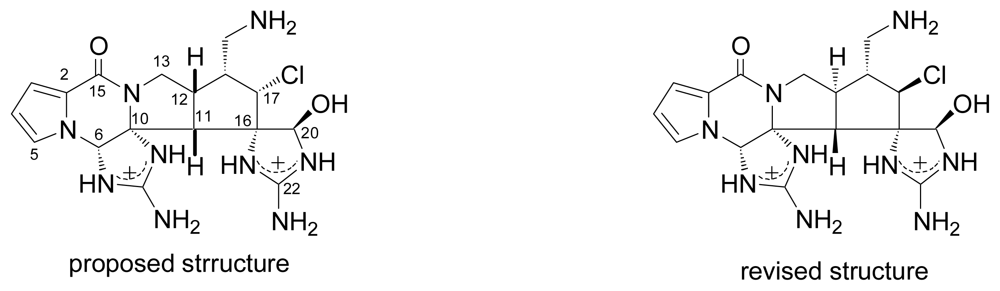
<p>Although there are many excellent reviews [<xref ref-type="bibr" rid="b9-marinedrugs-07-00314">9</xref>–<xref ref-type="bibr" rid="b13-marinedrugs-07-00314">13</xref>] of the synthesis of marine natural products, in 2005, an excellent and encouraging review on misassignments and structural revisions was published by Nicolaou and Snyder [<xref ref-type="bibr" rid="b14-marinedrugs-07-00314">14</xref>]. It included a database of example cases as well as their own narrative of revisions of bioactive marine natural products diazonamide A and azaspiracid-1. Herein we will review recent synthetic studies of marine natural products that led to structural revisions after 2005 except for palau’amine shown in <xref ref-type="fig" rid="f1-marinedrugs-07-00314">Figure 1</xref> [<xref ref-type="bibr" rid="b15-marinedrugs-07-00314">15</xref>], which has been described in another review [<xref ref-type="bibr" rid="b16-marinedrugs-07-00314">16</xref>].</p></sec>
<sec>
<title>2. Examples of Syntheses Leading to Structural Revisions of Marine Natural Products</title>
<sec>
<title>2.1. Macrocyclic Marine Natural Products</title>
<p>Macrocyclic structure is one of the typical features of many marine natural products. Because of the large membered rings, macrocyclic marine natural products are highly flexible and this flexibility has made conformational analysis a difficult task.</p>
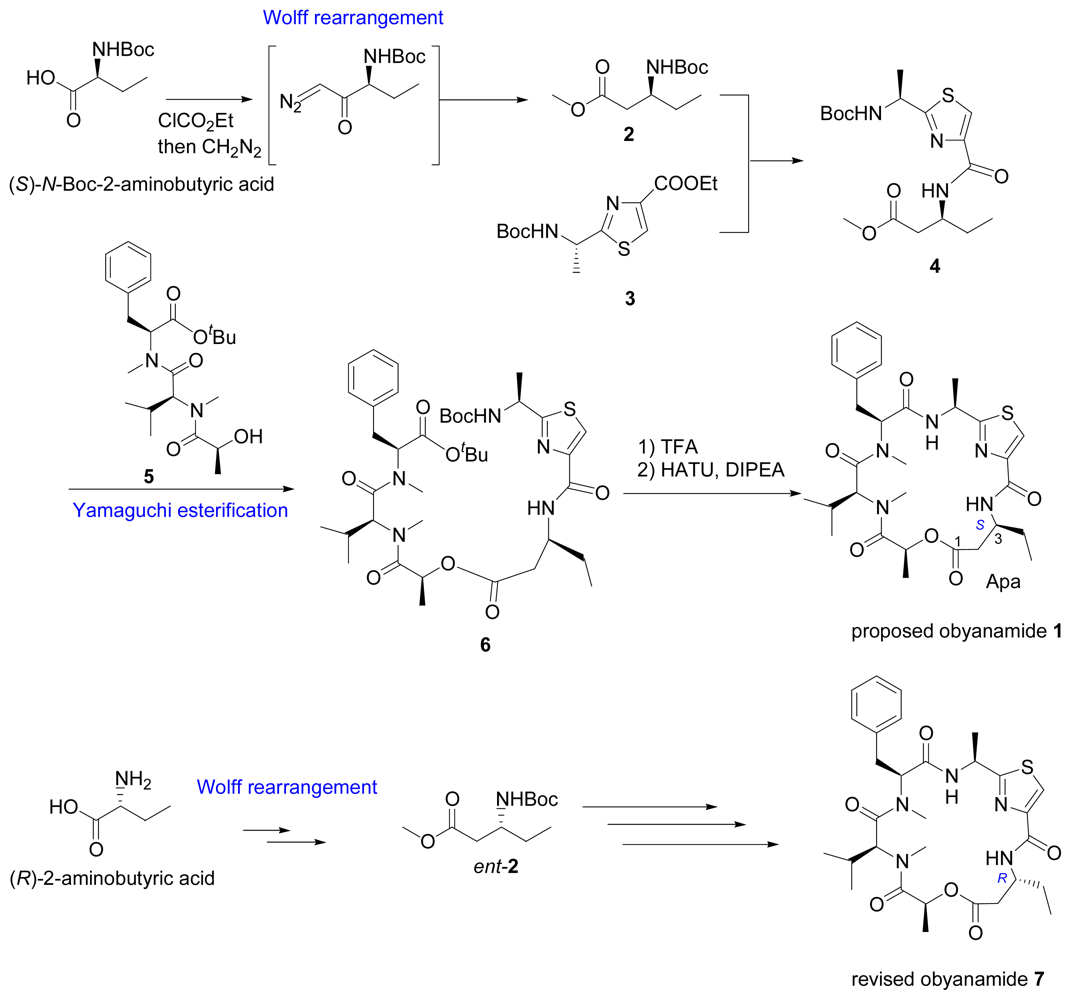
<p>A cytotoxic depsipeptide designated as obyanamide (<bold>1</bold>) was isolated from the marine cyanobacterium <italic>Lyngbya confervoides</italic>, as shown in <xref ref-type="fig" rid="f4-marinedrugs-07-00314">Scheme 1</xref>. Compared to related natural products, in the originally proposed structure <bold>1</bold> it had an unexpected (<italic>S</italic>)-configuration at C-3. The stereochemistry at C-3 in the Apa (aminopentanoic acid) part was deduced by chemical degradation and comparison of the hydrolyzated mixture with synthetic standards due to the limited amount of available material [<xref ref-type="bibr" rid="b17-marinedrugs-07-00314">17</xref>]. The total synthesis of <bold>1</bold> reported by Li and co-workers in 2005 is summarized in <xref ref-type="fig" rid="f4-marinedrugs-07-00314">Scheme 1</xref>. Methyl (<italic>S</italic>)-<italic>N</italic>-Boc-3-aminopenatanoate (<bold>2</bold>), derived from (<italic>S</italic>)-2-aminobutyric acid via a Wolff rearrangement, was combined with ester <bold>3</bold> to afford amide <bold>4</bold>. A Yamaguchi esterification between <bold>4</bold> and <bold>5</bold> afforded ester <bold>6</bold>, which was cyclized to give the desired <bold>1</bold>. But this total synthesis suggested the need for structural revision [<xref ref-type="bibr" rid="b18-marinedrugs-07-00314">18</xref>]. Since all other related compounds isolated from the <italic>Lyngbya</italic> species had <italic>R</italic>-configuration in the β-amino acid residues, the same research group thought the revised structure should be <bold>7</bold>. Thus they carried out the total synthesis of <bold>7</bold> using the same strategy with methyl (<italic>R</italic>)-<italic>N</italic>-Boc-3-aminopenatanoate (<italic>ent-</italic><bold>2</bold>) derived from (<italic>R</italic>)-2-aminobutyric acid via a Wolff rearrangement, and proved that <bold>7</bold> is indeed the correct structure [<xref ref-type="bibr" rid="b19-marinedrugs-07-00314">19</xref>].</p>
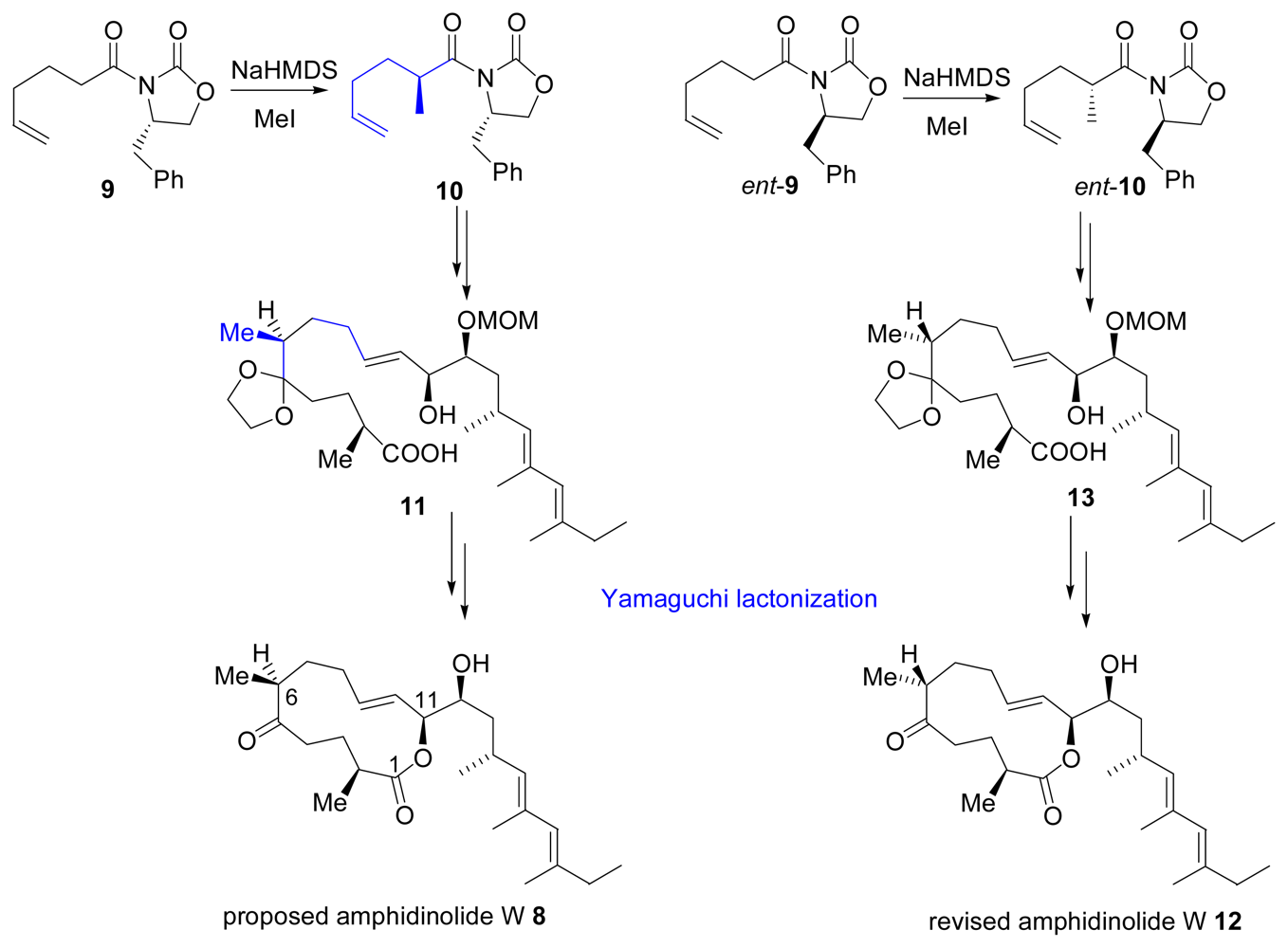
<p>The isolation of amphidinolide W (<bold>8</bold>), a new cytotoxic 12-membered macrolide from the dinoflagellate <italic>Amphidinium</italic> sp., was reported in 2002. The absolute configuration at C-6 was determined by the advanced Mosher’s method, utilizing the secondary alcohol that was obtained by degradation of the Baeyer-Villiger oxidation product of amphidinolide W [<xref ref-type="bibr" rid="b20-marinedrugs-07-00314">20</xref>]. Ghosh and co-workers synthesized proposed structure <bold>8</bold> via a Yamaguchi macrolactonization, as illustrated in <xref ref-type="fig" rid="f5-marinedrugs-07-00314">Scheme 2</xref>. Chiral oxazolidone <bold>9</bold> was alkylated to <bold>10</bold> stereoselectively. Compound <bold>10</bold> was transformed into <bold>8</bold> via intermediate <bold>11</bold>, showing that the structure of <bold>8</bold> did not match the reported data.</p>
<p>After a careful review of the <sup>1</sup>H-NMR spectra of natural amphidinolide W and the synthesized compound <bold>8</bold>, they found significant discrepancies between the chemical shifts in the C2-C11 ring region. Since they had synthesized <bold>8</bold> [(2<italic>S</italic>,6<italic>S</italic>)-isomer] and another epimer at C-2 [(2<italic>R</italic>,6<italic>S</italic>)-isomer] and neither of them corresponded to amphidinolide W, they hypothesized that the stereoisomer at C-6 <bold>12</bold> would be the revised structure. Then <bold>12</bold> was synthesized via intermediate <bold>13</bold> with <italic>ent</italic><bold>-9</bold> as a starting material. This total synhesis proved that <bold>12</bold> was the correct structure of amphidinolide W. In that study, they also synthesized another epimer at C-6, which is (2<italic>R</italic>,6<italic>R</italic>)-isomer [<xref ref-type="bibr" rid="b21-marinedrugs-07-00314">21</xref>,<xref ref-type="bibr" rid="b22-marinedrugs-07-00314">22</xref>].</p>
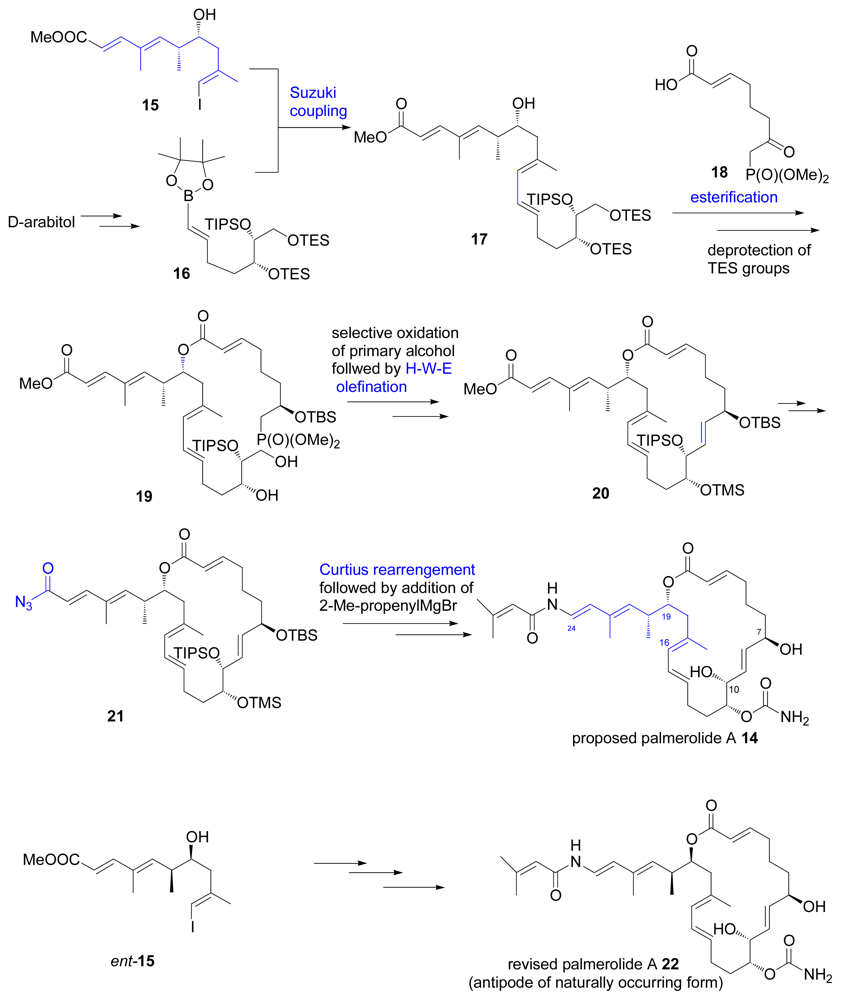
<p>Palmerolide A is a macrolide isolated from the Atlantic tunicate <italic>Synoicum adareanum.</italic> It exhibits selective cytotoxicity to UACC-62 (melanoma), HCC-2998 (colon cancer), and RXF 393 (renal cancer) cell lines [<xref ref-type="bibr" rid="b23-marinedrugs-07-00314">23</xref>]. The relative stereochemistry of the originally proposed structure <bold>14</bold> was assigned on the basis of a combined analysis of coupling constants and the NOESY spectrum. The absolute configurations at C7 and C10 were assigned by the advanced Mosher’s method, as in the previous example. De Brabander and co-workers achieved the total synthesis of <bold>14</bold> via the Horner-Wadsworth-Emmons olefination of C8 and C9 as a key step for macrocyclization as summarized in <xref ref-type="fig" rid="f6-marinedrugs-07-00314">Scheme 3</xref>. Chiral vinyliodide <bold>15</bold> was coupled with borate <bold>16</bold>, which was derived from <sub>D</sub>-arabitol, to afford alcohol <bold>17</bold>. Then acid <bold>18</bold> was esterified with <bold>17</bold> to <bold>19.</bold> After selective oxidation of primary hydroxyl group in <bold>19</bold>, the resulted aldehyde was cyclized to <bold>20</bold> via H-W-E olefination. Methyl ester <bold>20</bold> was transformed to azide <bold>21</bold>, which was then converted into <bold>14</bold> via Curtius rearrangement followed by addition of 2-methylpropenylmagnesium bromide. As the data for <bold>14</bold> did not match that reported for the natural product, it was concluded that a structural revision was required.</p>
<p>After careful review of the NMR analysis of natural palmerolide A, De Brabander and co-workers thought that the relative stereochemistry C-10-C11 and C-19-C20 seemed reliable, but believed that the stereochemistry from C11 to C19 was doubtful. Then they set on next target <bold>22</bold> and carried out the total synthesis starting from <italic>ent-</italic><bold>15</bold>. Since data of synthesized <bold>22</bold> was identical with those of palmerolode A except for the CD-spectrum, the correct structure of palmerolide A were determined and also the absolute configuration were elucidated [<xref ref-type="bibr" rid="b24-marinedrugs-07-00314">24</xref>]. A few months later, Nicolaou <italic>et al.</italic> reported the synthesis of <bold>14</bold> and naturally occurring enantiomer <italic>ent</italic>-<bold>22</bold> via ring-closing metathesis, constructing the C8-C9 double bond as the key reaction [<xref ref-type="bibr" rid="b25-marinedrugs-07-00314">25</xref>,<xref ref-type="bibr" rid="b26-marinedrugs-07-00314">26</xref>].</p>
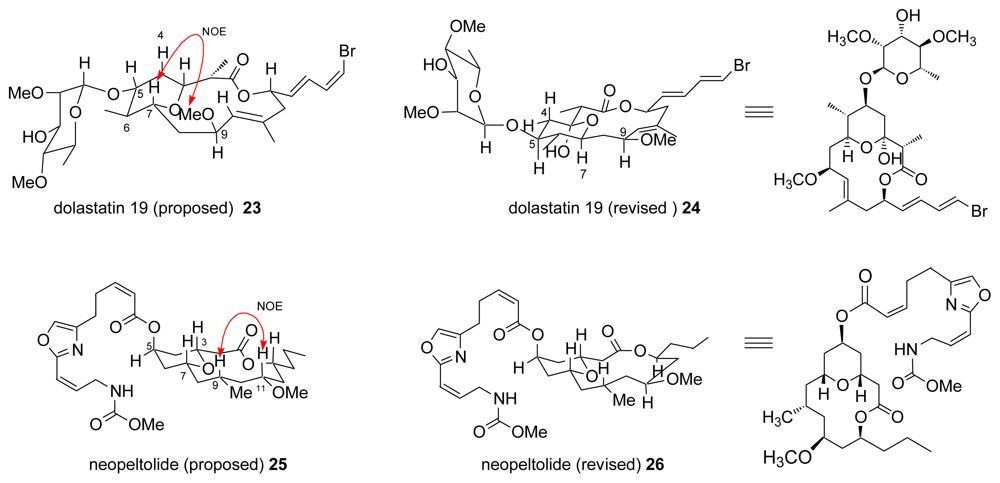
<p>The following two cases of dolastatin 19 and neopeltolide are quite similar. Both of them have a 14-membered lactone fused to a pyran ring with the C3-C7 skeleton, as illustrated in <xref ref-type="fig" rid="f2-marinedrugs-07-00314">Figure 2</xref>.</p>
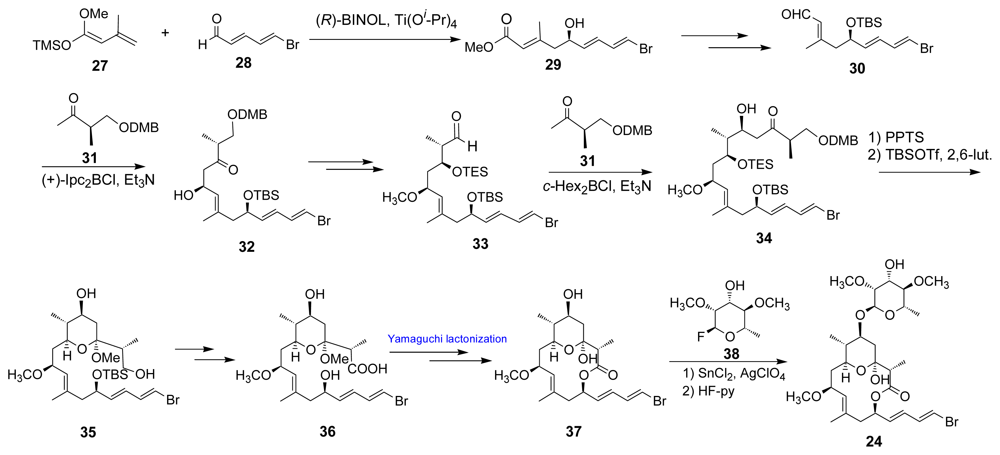
<p>Dolastatin (<bold>19</bold>) is a cancer cell growth inhibitor isolated from the sea hare <italic>Dolabella auricularia</italic> collected in the Gulf of California [<xref ref-type="bibr" rid="b27-marinedrugs-07-00314">27</xref>]. The initial stereostructure <bold>23</bold> was determined by careful spectral analysis. It must be noted that the presence of a NOESY cross peaks between H7/9-OMe in dolastatin (<bold>19</bold>) as illustrated in <xref ref-type="fig" rid="f2-marinedrugs-07-00314">Figure 2</xref> seems to contradict the revised structure <bold>24</bold>. Paterson <italic>et al.</italic> proposed the revised structure <bold>24</bold> that has a different configuration on C5, C6, C7, and C13, through detailed conformational analysis of <sup>1</sup>H-NMR spectra and calculation of the lowest energy of the proposed molecule <bold>23</bold>, and also through common bacterial biogenesis of related polyketides. The stereoselective total synthesis of <bold>24</bold> was achieved in 23 steps in 1.7% total yield as summarized in <xref ref-type="fig" rid="f7-marinedrugs-07-00314">Scheme 4</xref>. An asymmetric Ti(O<italic><sup>i</sup></italic>Pr)<sub>4</sub>-(<italic>R</italic>)-BIBOL catalyzed aldol condensation between <bold>27</bold> and <bold>28</bold> yielded <bold>29</bold>. Aldehyde <bold>30</bold>, that was derived from <bold>29</bold>, was applied to a 1,4-<italic>syn</italic> boron mediated aldol reaction with ketone <bold>31</bold> to give <bold>32</bold>. After transformation of <bold>32</bold> to aldehyde <bold>33</bold>, <bold>33</bold> was applied to another 1,4-<italic>syn</italic> boron mediated aldol reaction with ketone <bold>31</bold> to give β-hydroxyketone <bold>34</bold>. Compound <bold>34</bold> was treated with PPTS with trimethylorthoformate in MeOH to give <bold>35</bold> with a tetrahydropyran-ring formation and a methyl ether function. After transformation into carboxylic acid <bold>36</bold>, 14-membered lactone <bold>37</bold> was formed via a Yamaguchi lactonization. This total synthesis was completed by coupling of <bold>37</bold> with fluoroalchohol <bold>38</bold> to afford desired <bold>24</bold>, thereby elucidating the relative and absolute configurations [<xref ref-type="bibr" rid="b28-marinedrugs-07-00314">28</xref>].</p>
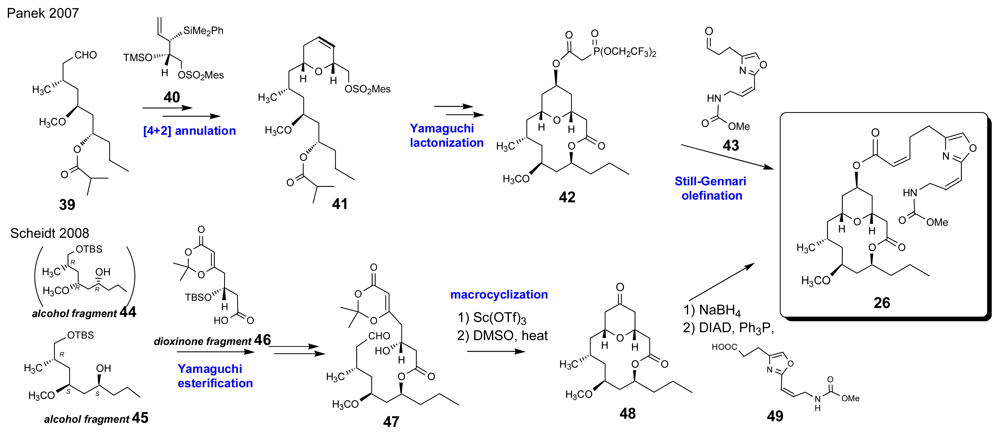
<p>Neopeltolide derived from <italic>Neopeltidae</italic> sponge is a potent inhibitor of human cancer cell lines, such as A-549 and NCI-ADR-RES, and the P388 murine leukemia cell line [<xref ref-type="bibr" rid="b29-marinedrugs-07-00314">29</xref>]. Toward the end of 2007, Panek’s group and Scheidt’s groups reported independently the synthesis of neopeltolide, as shown in <xref ref-type="fig" rid="f8-marinedrugs-07-00314">Scheme 5</xref>. Their accounts are quite similar.</p>
<p>After initial efforts to synthesize the proposed structure <bold>25</bold>, Panek’s group set <bold>26</bold> as their next target based on close inspection of available spectral data and its structural homology to leucascandrolide A. The dihydropyran <bold>41</bold>, which was formed by triflic acid promoted [4+2] annulations of aldehyde <bold>39</bold> with allylsilane <bold>40</bold>, was applied to a Yamaguchi macrolactonization. Stereoselective oxymercuration of the double bond in the dihydropyran moiety of the Yamaguchi lactonization product followed by acylation with bis(2,2,2-trifluoroethyl)phosphoacetic acid afforded phosphonoacetate <bold>42</bold>. A Still-Gennari olefination between <bold>42</bold> and aldehyde <bold>43</bold> yielded <bold>26</bold>. This total synthesis gave the correct relative and absolute configuration of neopeltolide [<xref ref-type="bibr" rid="b30-marinedrugs-07-00314">30</xref>].</p>
<p>A few months after the report by Panek’s group, Scheidt and co-workers reported the synthesis and structural revision of neopeltolide. Like in Penek’s study, they synthesized <bold>25</bold> along the same route summarized in <xref ref-type="fig" rid="f9-marinedrugs-07-00314">Scheme 6</xref>, starting from a coupling between alcohol fragment <bold>44</bold> and dioxinone fragment <bold>46</bold> using a Yamaguchi esterification followed by the scandium(III) triflate catalyzed macrolactonization. Recognizing that <bold>25</bold> was not neopeltolide, they postulated the correct structure of <bold>26</bold> and started the synthesis from a Yamaguchi esterification between alcohol fragment <bold>45</bold> and <bold>46</bold>. Macrolactonization of <bold>47</bold> using Sc(OTf)<sub>3</sub> as a catalyst gave lactone <bold>48</bold>, which was finally converted to <bold>26</bold> via stereoselective NaBH<sub>4</sub> reduction followed by a Mitsunobu reaction with carboxylic acid <bold>49</bold> [<xref ref-type="bibr" rid="b31-marinedrugs-07-00314">31</xref>]. The authors mentioned the difficulty of assigning the relative configuration of such a flexible macrocyclic natural product, whose originally proposed stereostructure around C9-C11-C13 in <bold>25</bold> was assigned from the NOESY cross peak between H9 and H11, as shown in <xref ref-type="fig" rid="f2-marinedrugs-07-00314">Figure 2</xref> [<xref ref-type="bibr" rid="b29-marinedrugs-07-00314">29</xref>].</p></sec>
<sec>
<title>2.2. Etheric Marine Natural Products</title>
<p>Polyetheric or etheric compounds are well-known marine natural products. The isolation of brevenal from cultures of the dinoflagellate <italic>Karenia brevis</italic>, which is structurally related to hemibrevetoxin-B (<bold>50</bold>) but is almost half the size of the most well known metabolites of the same microorganisms called brevetoxins, was reported [<xref ref-type="bibr" rid="b32-marinedrugs-07-00314">32</xref>,<xref ref-type="bibr" rid="b33-marinedrugs-07-00314">33</xref>]. It is noteworthy that brevenal is not toxic to fish and antagonizes the toxic effects of brevetoxins in fish.</p>
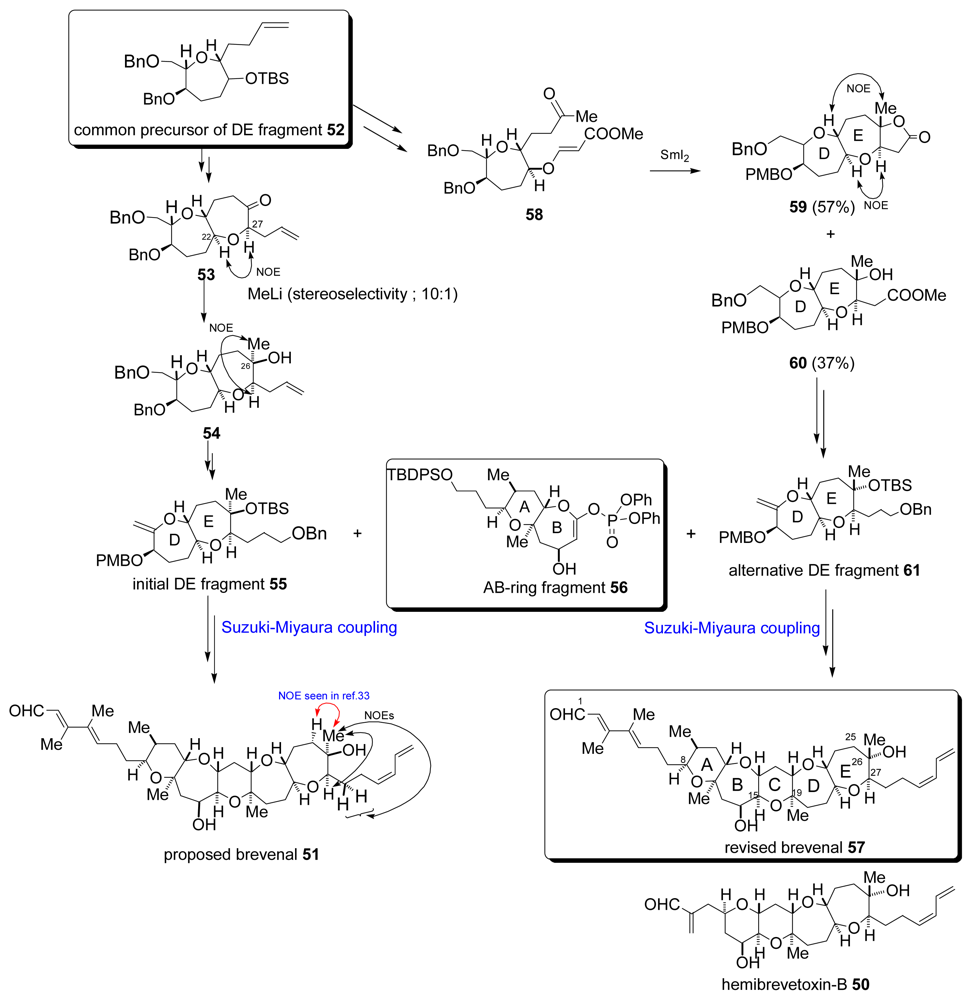
<p>Fuwa and co-workers attempted to perform the total synthesis of proposed structure <bold>51</bold> with their strategy of building a pentacyclic core via the advanced Suzuki-Miyaura coupling between AB and DE ring fragments as illustrated in <xref ref-type="fig" rid="f9-marinedrugs-07-00314">Scheme 6</xref>. The common precursor of the DE fragment <bold>52</bold> was transformed into ketone <bold>53</bold>, whose relative configuration was confirmed by the NOESY cross peak between H22/H27. Ketone <bold>53</bold> was stereoselectively methylated with methyllithium affording a diasteromeric mixture of alcohols in a 10:1 ratio. The NOESY cross peak between H27 and the methyl group at C26 suggested the stereochemistry of the major product <bold>54</bold>, which was transformed into the initial DE fragment <bold>55</bold>. Alkylborane prepared from <bold>55</bold> <italic>in situ</italic> coupled with the AB ring enol phosphate <bold>56</bold> in the presence of Cs<sub>2</sub>CO<sub>3</sub> and Pd(Ph)<sub>3</sub>. The coupled product gave desired <bold>51</bold> through multistep transformations; however, it was not identical with natural brevenal [<xref ref-type="bibr" rid="b34-marinedrugs-07-00314">34</xref>]. Then, the authors reviewed the NMR spectra of <bold>51</bold> and the natural product and found a significant deviation of the chemical shift values around C26 tertiary alcohol. In addition, there was no description in the literature [<xref ref-type="bibr" rid="b33-marinedrugs-07-00314">33</xref>] of NOEs between 26Me/H27 and 26Me/H28α,β, which were observed in the NOESY spectrum of <bold>51</bold>. For the related marine natural product hemibrevetoxin-B (<bold>50</bold>), the configuration at C18, which corresponded to C26 in brevenal, was assumed by biosynthetic considerations [<xref ref-type="bibr" rid="b35-marinedrugs-07-00314">35</xref>].</p>
<p>Then, Fuwa <italic>et al.</italic> postulated that natural brevenal (<bold>57</bold>) should be the epimer at C26 of <bold>51</bold> and restarted the synthesis of brevenal. The common precursor of the DE fragment <bold>52</bold> was transformed into ketone <bold>58</bold>, and this was subjected to reductive cyclization with SmI<sub>2</sub> to form a 7-membered ether ring with the desired stereochemistry in a mixture of lactone <bold>59</bold> (57%) and hydroxylether <bold>60</bold> (37%). The relative configuration of <bold>59</bold> was confirmed by NOESY analysis where cross peaks H22/H27 and 26Me/H23 were observed. Both products <bold>59</bold> and <bold>60</bold> could be converted into the alternative DE fragment <bold>61</bold>, which reacted with AB-ring enol phosphate <bold>56</bold> to afford the cross-coupled product. This finally yielded revised brevenal (<bold>57</bold>) via similar multiple sequences (<xref ref-type="fig" rid="f9-marinedrugs-07-00314">Scheme 6</xref>) [<xref ref-type="bibr" rid="b36-marinedrugs-07-00314">36</xref>].</p>
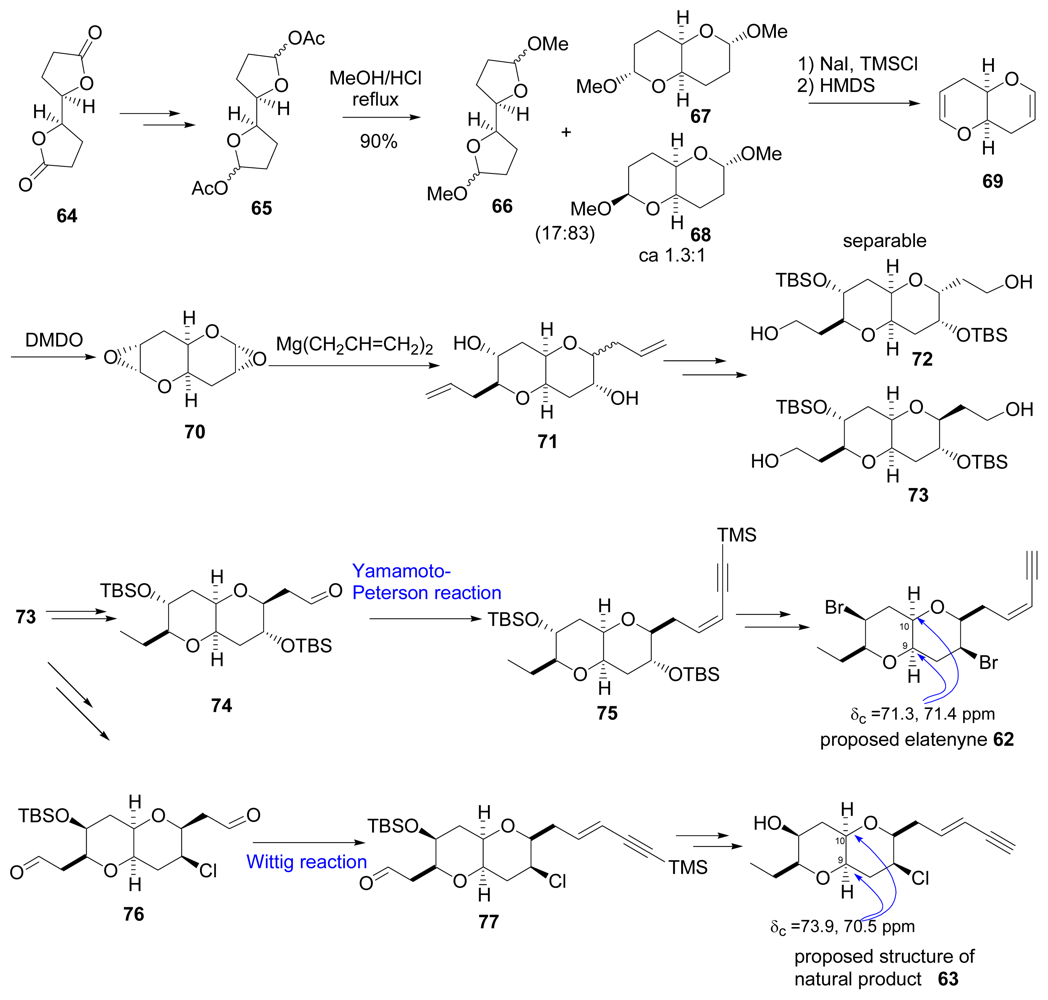
<p>Elatenyne was isolated from the red alga <italic>Laurencia elata</italic> in 1986 and the proposed structure <bold>62</bold> is shown in <xref ref-type="fig" rid="f10-marinedrugs-07-00314">Scheme 7</xref> [<xref ref-type="bibr" rid="b37-marinedrugs-07-00314">37</xref>]. Isolation of structurely related natural product <bold>63</bold> from <italic>Laurencia majuscula</italic> was reported in 1993. The proposed structure was determined by NMR analysis and by comparison of spectral data with elatenyne [<xref ref-type="bibr" rid="b38-marinedrugs-07-00314">38</xref>]. Recently Burton and co-workers attempted to perform the total synthesis of elatenyne <bold>62</bold> and <bold>63</bold> as summarized in <xref ref-type="fig" rid="f10-marinedrugs-07-00314">Scheme 7</xref>. The known bislactone <bold>64</bold> was transformed in to a mixture of anomeric acetate <bold>65</bold>. Treatment of <bold>65</bold> with acidic methanol under reflux gave a mixture of <bold>66</bold>, <bold>67</bold> and <bold>68</bold>. Then the mixture was transformed solely into <bold>69</bold>. Compound <bold>69</bold> was oxidized stereoselectively with dimethydioxirane to bis(epoxide) <bold>70</bold>, that was then reacted with diallylmagnesium to give a diastereomeric mixture of bis(allylated)diols <bold>71</bold>. The resulted inseparable mixture <bold>71</bold> was converted to separable alcohols <bold>72</bold> and <bold>73</bold>. Purely isolated <bold>73</bold> led to desired <bold>62</bold> via Yamatoto-Peterson reaction from <bold>74</bold> to <bold>75</bold>.</p>
<p>In the same report <bold>63</bold> was synthesized from <bold>73</bold> via <bold>77</bold>, which was prepared from aldehyde <bold>76</bold> by a Wittig reaction. But the data of <bold>62</bold> and <bold>63</bold> did not agree with those of natural products, suggesting both of them required structural revision [<xref ref-type="bibr" rid="b39-marinedrugs-07-00314">39</xref>,<xref ref-type="bibr" rid="b40-marinedrugs-07-00314">40</xref>]. The authors then reviewed the spectral data of reported natural products and synthesized <bold>62</bold> and <bold>63</bold> carefully, paying special attention to the <sup>13</sup>C-NMR chemical shift values at the ring juncture particularly pointed out in <xref ref-type="fig" rid="f10-marinedrugs-07-00314">Scheme 7</xref> and <xref ref-type="fig" rid="f3-marinedrugs-07-00314">Figure 3</xref>. During the synthetic study of <bold>62</bold> and <bold>63</bold>, they synthesized a large number of pyrano[3,2-<italic>b</italic>]pyrans and 2,2′-bisfuranyl compounds and found that <sup>13</sup>C-NMR chemical shift values at the ring juncture fall into two distinct groups. When the δ value was larger than 76 ppm, the compound belongs to a 2,2′-bisfuranyl-group, otherwise it belongs to a pyrano[3,2-<italic>b</italic>]pyran-group. The C-9 or C-10 chemical sifts values of synthesized <bold>62</bold> and <bold>63</bold> were δ 71.3, 71.4 ppm (for <bold>62</bold>) and δ 73.9, 70.5 ppm (for <bold>63</bold>). These evidences supported the structures of synthesized compounds <bold>62</bold> and <bold>63</bold>. But natural elatenyne and the eneyne from <italic>L. majuscula</italic> had larger <sup>13</sup>C-NMR chemical shift values. In the original literatures <sup>13</sup>C-NMR chemical shift values for C-9 and C-10 of <bold>62</bold> and <bold>63</bold> were reported as δ 80.0 and 79.5 ppm for <bold>62</bold> and δ 79.2 and 77.9 ppm for <bold>63</bold> [<xref ref-type="bibr" rid="b37-marinedrugs-07-00314">37</xref>,<xref ref-type="bibr" rid="b38-marinedrugs-07-00314">38</xref>]. Therefore Burton and co-workers proposed the structures of elatenyne and the eneyne from <italic>L. majuscula</italic>as to be <bold>78</bold> and <bold>79</bold> respectively shown in <xref ref-type="fig" rid="f3-marinedrugs-07-00314">Figure 3</xref>.</p></sec>
<sec>
<title>2.3. Other Examples</title>
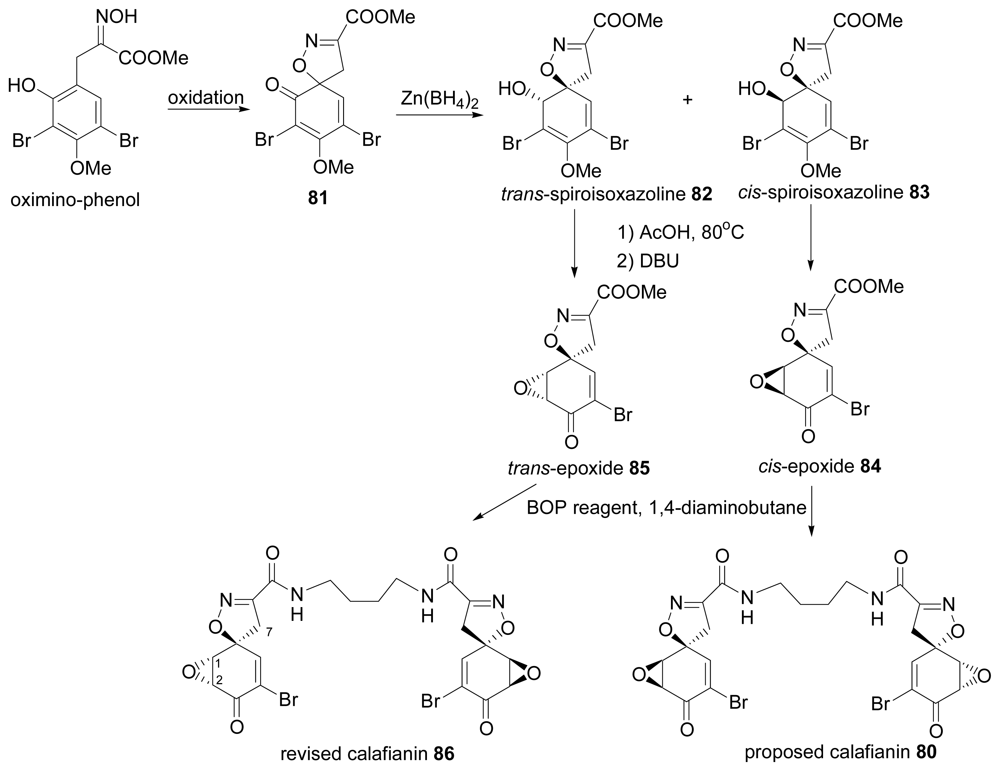
<p>Calafianin (<bold>80</bold>) (proposed structure), a spiroisoxazoline marine natural product, was isolated from the Mexican sponge <italic>Aplysina gerardogreeni</italic>. The relative configuration around the spiroisoxazoline moiety was deduced from NOE experiments, observing 2% enhancement of H7 signal when H1 was irradiated and 5% enhancement of H7 signal when H2 was irradiated [<xref ref-type="bibr" rid="b41-marinedrugs-07-00314">41</xref>]. The total synthesis of racemic <bold>80</bold> was conducted by Nishiyama’s group, as summarized in <xref ref-type="fig" rid="f11-marinedrugs-07-00314">Scheme 8</xref>. <italic>Trans</italic>- and cis-piroisoxazolines <bold>82</bold>, <bold>83</bold> was constructed as the key intermediate by oxidation of oximino-phenol affording <bold>81</bold> followed by reduction with Zn(BH<sub>4</sub>)<sub>2</sub>. Compound <bold>80</bold> was prepared from <bold>83</bold> via <italic>cis</italic>-epoxide <bold>84</bold> but the spectral data were not identical with those of the natural product. Applying the same reaction sequence to the <italic>trans</italic>-epoxide <bold>85</bold>, which was derived from <bold>82</bold>, furnished revised calafianin <bold>86</bold>. It must be noted that synthesized <bold>86</bold>, which had identical spectral data to natural calafianin, exhibited NOE correlation between H1 and H7 [<xref ref-type="bibr" rid="b42-marinedrugs-07-00314">42</xref>,<xref ref-type="bibr" rid="b43-marinedrugs-07-00314">43</xref>]. After the revision of the relative configuration of calafianin by Nishiyama’s group, the asymmetric synthesis for the assignment of (+)-calafianin was reported by Bardhan <italic>et al.</italic> [<xref ref-type="bibr" rid="b44-marinedrugs-07-00314">44</xref>].</p>
<p>Tridachiahydropyrone, a structurally interesting fused bicyclic γ-dihydropyrone-containing natural product, was isolated from the Caribbean sacoglossan mollusc <italic>Tridachia crispata.</italic> Its stereochemistry was assigned as <bold>87</bold> as shown in <xref ref-type="fig" rid="f12-marinedrugs-07-00314">Scheme 9</xref> by NMR analysis. NOE experiments in particular suggested the <italic>cis-</italic>configuration between H9 and the 17-methyl group [<xref ref-type="bibr" rid="b45-marinedrugs-07-00314">45</xref>]. The total syntheses of proposed structure <bold>87</bold> and revised structure <bold>88</bold> were carried out by independent research groups, as summarized in <xref ref-type="fig" rid="f12-marinedrugs-07-00314">Scheme 9</xref>. In order to determine the absolute configuration Perkins and co-workers synthesized <bold>87</bold>. Compound <bold>89</bold> was reacted with cuprate <bold>90</bold> with cyclization affording cyclohexenol intermediate <bold>91</bold> that was then stereoselectively methylated.</p>
<p>The stereochemistry of the subsequent intermediate enone <bold>92</bold> was established by X-ray crystallography. The asymmetric total synthesis of <bold>87</bold> completed via a four-step process from <bold>92</bold> confirmed that <bold>87</bold> was the incorrect structure [<xref ref-type="bibr" rid="b46-marinedrugs-07-00314">46</xref>]. In 2008, Moses and co-workers reported the racemic total synthesis of revised <bold>88.</bold> The revised structure was arisen from their biosynthetic hypothesis of photochemical, conrotatory 6π elctrocycloaddition of hypothetical precursor <bold>95</bold>. Suzuki coupling between vinylbromide <bold>93</bold> and borate <bold>94</bold> gave <bold>95</bold>, which was applied to subsequent photochemical electrocyclization yielding desired <bold>88</bold>. The authors noted not only the same NOE correlation between H9 and the 17-methyl group in <bold>88</bold> as described in the literature [<xref ref-type="bibr" rid="b45-marinedrugs-07-00314">45</xref>] but also a more intense NOE between 17-methyl/16-methyl and 17-methyl/H11 [<xref ref-type="bibr" rid="b47-marinedrugs-07-00314">47</xref>].</p>
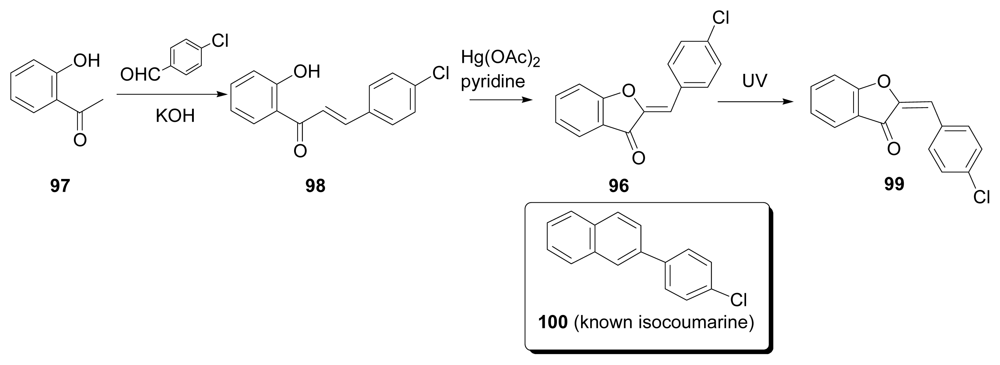
<p>Another example of the synthesis of 4′-chloroaurone <bold>96</bold>, a bioactive metabolite from the marine brown alga <italic>Spatoglossum variabile</italic> [<xref ref-type="bibr" rid="b48-marinedrugs-07-00314">48</xref>], was achieved by Subbaraju as shown in <xref ref-type="fig" rid="f13-marinedrugs-07-00314">Scheme 10</xref>. 2-Hydroxyacetophenone (<bold>97</bold>) was reacted with 4-chlorobenzaldehyde under the basic condition to give chlorochalcone <bold>98</bold>, which was then treated with mercury (II) acetate to afford the desired <bold>96</bold>.</p>
<p>Since the spectral data of <bold>96</bold> did not match with those of reported 4′-chloroaurone, <italic>Z</italic>-<bold>96</bold> was then photoisomerized to thermodynamically more stable <italic>E</italic>-isomer <bold>99</bold>. But <bold>99</bold> did not agree with 4′-chloroaurone either. After careful analysis of the spectral data for natural 4′-chloroaurone, the authors found that the data agreed well with the reported data of known 3-(4′-chlorophenyl)-isocoumarin (<bold>100</bold>) [<xref ref-type="bibr" rid="b49-marinedrugs-07-00314">49</xref>].</p></sec>
<sec>
<title>2.4. Our Experiences with Pericosines</title>
<p>The isolation of pericosines A and B as cytotoxic metabolites of the fungus <italic>Periconia byssoides</italic> OUPS-N133 originally separated from the sea hare <italic>Aplysia kurodai</italic> was reported in 1997 [<xref ref-type="bibr" rid="b50-marinedrugs-07-00314">50</xref>]. As the absolute configuration of pericosine A was not determined, we performed the total synthesis of the originally proposed structure of pericosine A <bold>101</bold> as shown in <xref ref-type="fig" rid="f14-marinedrugs-07-00314">Scheme 11</xref> (Equation 1). Known lactone <bold>102</bold> derived from (−)-quinic acid was chlorinated to chloroketone <bold>103</bold> in a stereoselective manner. Conversion of <bold>103</bold> to <bold>101</bold> was achieved via intermediate <bold>104</bold> and we found that <bold>101</bold> was incorrect structure of pericosine A [<xref ref-type="bibr" rid="b4-marinedrugs-07-00314">4</xref>,<xref ref-type="bibr" rid="b5-marinedrugs-07-00314">5</xref>]. In 2006, we reported the first total synthesis of the antipode of revised pericosine A (−)-<bold>105</bold> and established its absolute configuration [<xref ref-type="bibr" rid="b6-marinedrugs-07-00314">6</xref>]. Revised structure <bold>105</bold> was presented after detailed analysis of NMR data for the natural product and several synthesized compounds related to pericosines. Total synthesis of <bold>105</bold> starting from (−)-shikimic acid involved a stereoselective dihydroxylation with catalytic osmiumtetroxide and trimethyamine-<italic>N</italic>-oxide yielding <bold>106</bold> and a stereoselective induction of chlor atom against alcohol <bold>107</bold> as shown in <xref ref-type="fig" rid="f14-marinedrugs-07-00314">Scheme 11</xref> (Equation 2). Since the synthesized <bold>105</bold> showed identical spectral data to natural pericosine A except for the sign of specific rotation, it was proved to be antipode of the natural product. The following year, we synthesized the natural form (+)-<bold>105</bold> [<xref ref-type="bibr" rid="b7-marinedrugs-07-00314">7</xref>].</p>
<p>In 2007, a full account of the isolation and structure elucidation of pericosines A–E was reported by the original researchers [<xref ref-type="bibr" rid="b51-marinedrugs-07-00314">51</xref>]. In that paper, the structure of pericosine A was revised based on our synthesis and new compound pericosine D <bold>108</bold> was reported. The following year, we synthesized <bold>26</bold> from chlorohydrine <bold>109</bold> that was obtained as a minor product of the ring opening reaction with hydrogen chloride of epoxide <bold>110</bold> derived from (−)-quinic acid via unstable diene <bold>111</bold>, and elucidated the absolute configuration of natural <bold>108</bold> [<xref ref-type="bibr" rid="b52-marinedrugs-07-00314">52</xref>] by a synthetic approach, as shown in <xref ref-type="fig" rid="f14-marinedrugs-07-00314">Scheme 11</xref> (Equation 3). We also revised the spectral data of the natural product because synthesized <bold>108</bold> possessing the proposed structure showed different spectral data from the natural product [<xref ref-type="bibr" rid="b51-marinedrugs-07-00314">51</xref>]. We concluded that the originally reported pericosine D must have a different relative configuration from the reported acetonide, which had relative stereochemistry corresponding to <bold>108</bold>. After completing the synthesis of (−)-pericosine B [<xref ref-type="bibr" rid="b53-marinedrugs-07-00314">53</xref>] and the improved synthesis of (+)-pericosine A <bold>105</bold> and C [<xref ref-type="bibr" rid="b54-marinedrugs-07-00314">54</xref>], we will undertake the new challenge of elucidating the correct structure of originally reported pericosine D.</p></sec></sec>
<sec sec-type="conclusions">
<title>3. Summary</title>
<p>In our review of the literature that has appeared in the last couple of years, we can witness numerous examples of misassignments of structures of marine natural products. Clearly, we still have much to learn about marine natural products possessing unusual structural features. We saw what synthetic chemists had to go through to overcome such formidable situations. Each and every total synthesis is extremely high level work. We recognized again the importance of synthetic studies for structure elucidation, as well as the need to supply marine-derived materials or to chemically modify molecules to increase pharmacological activity, in the development of marine-derived drugs.</p></sec></body>
<back>
<fn-group><fn>
<p><italic>Sample Availability:</italic> Not available</p></fn></fn-group>
<ref-list>
<title>References and Notes</title>
<ref id="b1-marinedrugs-07-00314"><label>1</label><citation citation-type="journal"><person-group person-group-type="author"><name><surname>Newman</surname><given-names>DJ</given-names></name><name><surname>Cragg</surname><given-names>GM</given-names></name></person-group><article-title>Natural products from marine invertebrates and microbes as modulators of antitumor targets</article-title><source>Curr Drug Targets</source><year>2006</year><volume>7</volume><fpage>279</fpage><lpage>304</lpage><pub-id pub-id-type="doi">10.2174/138945006776054960</pub-id><pub-id pub-id-type="pmid">16515528</pub-id></citation></ref>
<ref id="b2-marinedrugs-07-00314"><label>2</label><citation citation-type="journal"><person-group person-group-type="author"><name><surname>Newman</surname><given-names>DJ</given-names></name><name><surname>Cragg</surname><given-names>GM</given-names></name></person-group><article-title>Advanced preclinical and clinical trials of natural products and related compounds from marine sources</article-title><source>Curr Med Chem</source><year>2004</year><volume>11</volume><fpage>1693</fpage><lpage>1713</lpage><pub-id pub-id-type="doi">10.2174/0929867043364982</pub-id><pub-id pub-id-type="pmid">15279577</pub-id></citation></ref>
<ref id="b3-marinedrugs-07-00314"><label>3</label><citation citation-type="journal"><person-group person-group-type="author"><name><surname>Butler</surname><given-names>MS</given-names></name></person-group><article-title>Natural products to drugs: natural product derived compounds in clinical trials</article-title><source>Nat Prod Rep</source><year>2005</year><volume>22</volume><fpage>162</fpage><lpage>195</lpage><pub-id pub-id-type="doi">10.1039/b402985m</pub-id><pub-id pub-id-type="pmid">15806196</pub-id></citation></ref>
<ref id="b4-marinedrugs-07-00314"><label>4</label><citation citation-type="journal"><person-group person-group-type="author"><name><surname>Usami</surname><given-names>Y</given-names></name><name><surname>Ueda</surname><given-names>Y</given-names></name></person-group><article-title>Synthetic study toward antitumour natural product pericosine A</article-title><source>Chem Lett</source><year>2005</year><volume>34</volume><fpage>1062</fpage><lpage>1063</lpage><pub-id pub-id-type="doi">10.1246/cl.2005.1062</pub-id></citation></ref>
<ref id="b5-marinedrugs-07-00314"><label>5</label><citation citation-type="journal"><person-group person-group-type="author"><name><surname>Usami</surname><given-names>Y</given-names></name><name><surname>Ueda</surname><given-names>Y</given-names></name></person-group><article-title>Stereoselective syntheses of diastereomers of antitumor natural product pericosine a from (−)-quinic acid</article-title><source>Synthesis</source><year>2007</year><fpage>3219</fpage><lpage>3225</lpage></citation></ref>
<ref id="b6-marinedrugs-07-00314"><label>6</label><citation citation-type="journal"><person-group person-group-type="author"><name><surname>Usami</surname><given-names>Y</given-names></name><name><surname>Horibe</surname><given-names>Y</given-names></name><name><surname>Takaoka</surname><given-names>I</given-names></name><name><surname>Ichikawa</surname><given-names>H</given-names></name><name><surname>Arimoto</surname><given-names>M</given-names></name></person-group><article-title>First total synthesis of (−)-pericosine A from (−)-shikimic acid: Structure Revision and determination of the absolute configuration of antitumor natural product pericosine A</article-title><source>Synlett</source><year>2006</year><fpage>1598</fpage><lpage>1600</lpage></citation></ref>
<ref id="b7-marinedrugs-07-00314"><label>7</label><citation citation-type="journal"><person-group person-group-type="author"><name><surname>Usami</surname><given-names>Y</given-names></name><name><surname>Takaoka</surname><given-names>I</given-names></name><name><surname>Ichikawa</surname><given-names>H</given-names></name><name><surname>Horibe</surname><given-names>Y</given-names></name><name><surname>Tomiyama</surname><given-names>S</given-names></name><name><surname>Ohtsuka</surname><given-names>M</given-names></name><name><surname>Imanishi</surname><given-names>Y</given-names></name><name><surname>Arimoto</surname><given-names>M</given-names></name></person-group><article-title>First total synthesis of (+)- and (−)-pericosine A: Determination of absolute stereo structure</article-title><source>J Org Chem</source><year>2007</year><volume>72</volume><fpage>6127</fpage><lpage>6134</lpage><pub-id pub-id-type="doi">10.1021/jo070715l</pub-id><pub-id pub-id-type="pmid">17628106</pub-id></citation></ref>
<ref id="b8-marinedrugs-07-00314"><label>8</label><citation citation-type="journal"><person-group person-group-type="author"><name><surname>Usami</surname><given-names>Y</given-names></name><name><surname>Ichikawa</surname><given-names>H</given-names></name><name><surname>Arimoto</surname><given-names>M</given-names></name></person-group><article-title>Synthetic efforts for stereo structure determination of cytotoxic marine natural product pericosines as metabolites of <italic>Periconia</italic> sp. from sea hare</article-title><source>Int J Mol Sci</source><year>2008</year><volume>9</volume><fpage>401</fpage><lpage>421</lpage><pub-id pub-id-type="doi">10.3390/ijms9030401</pub-id><pub-id pub-id-type="pmid">19325758</pub-id></citation></ref>
<ref id="b9-marinedrugs-07-00314"><label>9</label><citation citation-type="journal"><person-group person-group-type="author"><name><surname>Nicholas</surname><given-names>GM</given-names></name><name><surname>Phillips</surname><given-names>AJ</given-names></name></person-group><article-title>Marine natural products: Synthetic aspects</article-title><source>Nat Prod Rep</source><year>2005</year><volume>22</volume><fpage>144</fpage><lpage>161</lpage><pub-id pub-id-type="doi">10.1039/b407236g</pub-id><pub-id pub-id-type="pmid">15806195</pub-id></citation></ref>
<ref id="b10-marinedrugs-07-00314"><label>10</label><citation citation-type="journal"><person-group person-group-type="author"><name><surname>Nicholas</surname><given-names>GM</given-names></name><name><surname>Phillips</surname><given-names>AJ</given-names></name></person-group><article-title>Marine natural products: Synthetic aspects</article-title><source>Nat Prod Rep</source><year>2006</year><volume>23</volume><fpage>79</fpage><lpage>99</lpage><pub-id pub-id-type="doi">10.1039/b501014b</pub-id><pub-id pub-id-type="pmid">16453032</pub-id></citation></ref>
<ref id="b11-marinedrugs-07-00314"><label>11</label><citation citation-type="journal"><person-group person-group-type="author"><name><surname>Morris</surname><given-names>JC</given-names></name><name><surname>Nicholas</surname><given-names>GM</given-names></name><name><surname>Phillips</surname><given-names>AJ</given-names></name></person-group><article-title>Marine natural products: synthetic aspects</article-title><source>Nat Prod Rep</source><year>2007</year><volume>24</volume><fpage>87</fpage><lpage>108</lpage><pub-id pub-id-type="doi">10.1039/b602832m</pub-id><pub-id pub-id-type="pmid">17268608</pub-id></citation></ref>
<ref id="b12-marinedrugs-07-00314"><label>12</label><citation citation-type="journal"><person-group person-group-type="author"><name><surname>Morris</surname><given-names>JC</given-names></name><name><surname>Phillips</surname><given-names>AJ</given-names></name></person-group><article-title>Marine natural products: synthetic aspects</article-title><source>Nat Prod Rep</source><year>2008</year><volume>25</volume><fpage>95</fpage><lpage>117</lpage><pub-id pub-id-type="doi">10.1039/b701533j</pub-id><pub-id pub-id-type="pmid">18250898</pub-id></citation></ref>
<ref id="b13-marinedrugs-07-00314"><label>13</label><citation citation-type="journal"><person-group person-group-type="author"><name><surname>Morris</surname><given-names>JC</given-names></name><name><surname>Phillips</surname><given-names>AJ</given-names></name></person-group><article-title>Marine natural products: synthetic aspects</article-title><source>Nat Prod Rep</source><year>2009</year><volume>26</volume><fpage>245</fpage><lpage>265</lpage><pub-id pub-id-type="doi">10.1039/b805111a</pub-id><pub-id pub-id-type="pmid">19177223</pub-id></citation></ref>
<ref id="b14-marinedrugs-07-00314"><label>14</label><citation citation-type="journal"><person-group person-group-type="author"><name><surname>Nicolaou</surname><given-names>KC</given-names></name><name><surname>Snyder</surname><given-names>SA</given-names></name></person-group><article-title>Chasing molecules that were never there: Misassigned natural products and the role of chemical synthesis in modern structure elucidation</article-title><source>Angew Chem Int Ed</source><year>2005</year><volume>44</volume><fpage>1012</fpage><lpage>1044</lpage><pub-id pub-id-type="doi">10.1002/anie.200460864</pub-id></citation></ref>
<ref id="b15-marinedrugs-07-00314"><label>15</label><citation citation-type="journal"><person-group person-group-type="author"><name><surname>Kinnel</surname><given-names>RB</given-names></name><name><surname>Gehrken</surname><given-names>H-P</given-names></name><name><surname>Scheuer</surname><given-names>PJ</given-names></name></person-group><article-title>Palau'amine: A cytotoxic and immunosuppressive hexacyclic bisguanidine antibiotic from the sponge <italic>Stylotella agminata</italic></article-title><source>J Am Chem Soc</source><year>1993</year><volume>115</volume><fpage>3376</fpage><lpage>3377</lpage><pub-id pub-id-type="doi">10.1021/ja00061a065</pub-id></citation></ref>
<ref id="b16-marinedrugs-07-00314"><label>16</label><citation citation-type="journal"><person-group person-group-type="author"><name><surname>Köeck</surname><given-names>M</given-names></name><name><surname>Grube</surname><given-names>A</given-names></name><name><surname>Seiple</surname><given-names>IB</given-names></name><name><surname>Baran</surname><given-names>PS</given-names></name></person-group><article-title>The pursuit of Palau'amine</article-title><source>Angew Chem Int Ed</source><year>2007</year><volume>46</volume><fpage>6586</fpage><lpage>6594</lpage><pub-id pub-id-type="doi">10.1002/anie.200701798</pub-id></citation></ref>
<ref id="b17-marinedrugs-07-00314"><label>17</label><citation citation-type="journal"><person-group person-group-type="author"><name><surname>Williams</surname><given-names>PG</given-names></name><name><surname>Yoshida</surname><given-names>WY</given-names></name><name><surname>Moore</surname><given-names>RE</given-names></name><name><surname>Paul</surname><given-names>VJ</given-names></name></person-group><article-title>Isolation and structure determination of obyanamide, a novel cytotoxic cyclic depsipeptide from the marine cyanobacterium <italic>Lyngbya confervoides</italic></article-title><source>J Nat Prod</source><year>2002</year><volume>65</volume><fpage>29</fpage><lpage>31</lpage><pub-id pub-id-type="doi">10.1021/np0102253</pub-id><pub-id pub-id-type="pmid">11809060</pub-id></citation></ref>
<ref id="b18-marinedrugs-07-00314"><label>18</label><citation citation-type="journal"><person-group person-group-type="author"><name><surname>Zhang</surname><given-names>W</given-names></name><name><surname>Song</surname><given-names>N</given-names></name><name><surname>Li</surname><given-names>Z-Z</given-names></name><name><surname>Li</surname><given-names>Y-X</given-names></name></person-group><article-title>Synthesis of obyanamide, a marine cytotoxic cyclic depsipeptide</article-title><source>Chin Chem Lett</source><year>2006</year><volume>17</volume><fpage>285</fpage><lpage>288</lpage></citation></ref>
<ref id="b19-marinedrugs-07-00314"><label>19</label><citation citation-type="journal"><person-group person-group-type="author"><name><surname>Zhang</surname><given-names>W</given-names></name><name><surname>Ma</surname><given-names>Z-H</given-names></name><name><surname>Mei</surname><given-names>D</given-names></name><name><surname>Li</surname><given-names>C-X</given-names></name><name><surname>Zhang</surname><given-names>X-L</given-names></name><name><surname>Li</surname><given-names>Y-X</given-names></name></person-group><article-title>Total synthesis and reassignment of stereochemistry of obyanamide</article-title><source>Tetrahedron</source><year>2006</year><volume>62</volume><fpage>9966</fpage><lpage>9972</lpage><pub-id pub-id-type="doi">10.1016/j.tet.2006.08.002</pub-id></citation></ref>
<ref id="b20-marinedrugs-07-00314"><label>20</label><citation citation-type="journal"><person-group person-group-type="author"><name><surname>Shimbo</surname><given-names>K</given-names></name><name><surname>Tsuda</surname><given-names>M</given-names></name><name><surname>Izui</surname><given-names>N</given-names></name><name><surname>Kobayashi</surname><given-names>J</given-names></name></person-group><article-title>Amphidinolide W, a new 12-membered macrolide from dinoflagellate <italic>Amphidinium</italic> sp</article-title><source>J Org Chem</source><year>2002</year><volume>67</volume><fpage>1020</fpage><lpage>1023</lpage><pub-id pub-id-type="doi">10.1021/jo016089o</pub-id><pub-id pub-id-type="pmid">11856056</pub-id></citation></ref>
<ref id="b21-marinedrugs-07-00314"><label>21</label><citation citation-type="journal"><person-group person-group-type="author"><name><surname>Ghosh</surname><given-names>AK</given-names></name><name><surname>Gong</surname><given-names>G</given-names></name></person-group><article-title>Total synthesis and structural revision of (+)-amphidinolide W</article-title><source>J Am Chem Soc</source><year>2004</year><volume>126</volume><fpage>3704</fpage><lpage>3705</lpage><pub-id pub-id-type="doi">10.1021/ja049754u</pub-id><pub-id pub-id-type="pmid">15038710</pub-id></citation></ref>
<ref id="b22-marinedrugs-07-00314"><label>22</label><citation citation-type="journal"><person-group person-group-type="author"><name><surname>Ghosh</surname><given-names>AK</given-names></name><name><surname>Gong</surname><given-names>G</given-names></name></person-group><article-title>Total synthesis and revision of C6 stereochemistry of (+)-amphidinolide W</article-title><source>J Org Chem</source><year>2006</year><volume>71</volume><fpage>1085</fpage><lpage>1093</lpage><pub-id pub-id-type="doi">10.1021/jo052181z</pub-id><pub-id pub-id-type="pmid">16438525</pub-id></citation></ref>
<ref id="b23-marinedrugs-07-00314"><label>23</label><citation citation-type="journal"><person-group person-group-type="author"><name><surname>Diyabalanage</surname><given-names>T</given-names></name><name><surname>Amsler</surname><given-names>CD</given-names></name><name><surname>McClintock</surname><given-names>JB</given-names></name><name><surname>Baker</surname><given-names>J</given-names></name></person-group><article-title>Palmerolide A, a cytotoxic macrolide from the antarctic tunicate <italic>Synoicum adareanum</italic></article-title><source>J Am Chem Soc</source><year>2006</year><volume>128</volume><fpage>5630</fpage><lpage>5631</lpage><pub-id pub-id-type="doi">10.1021/ja0588508</pub-id><pub-id pub-id-type="pmid">16637618</pub-id></citation></ref>
<ref id="b24-marinedrugs-07-00314"><label>24</label><citation citation-type="journal"><person-group person-group-type="author"><name><surname>Jiang</surname><given-names>X</given-names></name><name><surname>Liu</surname><given-names>B</given-names></name><name><surname>Lebreton</surname><given-names>S</given-names></name><name><surname>de Brabander</surname><given-names>JK</given-names></name></person-group><article-title>Total synthesis and structure revision of the marine metabolite palmerolide A</article-title><source>J Am Chem Soc</source><year>2007</year><volume>129</volume><fpage>6386</fpage><lpage>6387</lpage><pub-id pub-id-type="doi">10.1021/ja0715142</pub-id><pub-id pub-id-type="pmid">17458968</pub-id></citation></ref>
<ref id="b25-marinedrugs-07-00314"><label>25</label><citation citation-type="journal"><person-group person-group-type="author"><name><surname>Nicolaou</surname><given-names>KC</given-names></name><name><surname>Guduru</surname><given-names>R</given-names></name><name><surname>Sun</surname><given-names>Y-P</given-names></name><name><surname>Banerji</surname><given-names>B</given-names></name><name><surname>Chen</surname><given-names>DY-K</given-names></name></person-group><article-title>Total synthesis of the originally proposed and revised structures of palmerolide A</article-title><source>Angew Chem Int Ed</source><year>2007</year><volume>46</volume><fpage>5896</fpage><lpage>5900</lpage><pub-id pub-id-type="doi">10.1002/anie.200702243</pub-id></citation></ref>
<ref id="b26-marinedrugs-07-00314"><label>26</label><citation citation-type="journal"><person-group person-group-type="author"><name><surname>Nicolaou</surname><given-names>KC</given-names></name><name><surname>Sun</surname><given-names>Y-P</given-names></name><name><surname>Guduru</surname><given-names>R</given-names></name><name><surname>Banerji</surname><given-names>B</given-names></name><name><surname>Chen</surname><given-names>DY-K</given-names></name></person-group><article-title>Total synthesis of the originally proposed and revised structures of palmerolide A and isomers thereof</article-title><source>J Am Chem Soc</source><year>2008</year><volume>130</volume><fpage>3633</fpage><lpage>3644</lpage><pub-id pub-id-type="doi">10.1021/ja710485n</pub-id><pub-id pub-id-type="pmid">18298117</pub-id></citation></ref>
<ref id="b27-marinedrugs-07-00314"><label>27</label><citation citation-type="journal"><person-group person-group-type="author"><name><surname>Pettit</surname><given-names>GR</given-names></name><name><surname>Xu</surname><given-names>J-P</given-names></name><name><surname>Doubek</surname><given-names>DL</given-names></name><name><surname>Chapuis</surname><given-names>J-C</given-names></name><name><surname>Schmidt</surname><given-names>JM</given-names></name></person-group><article-title>Antineoplastic agents. 510. Isolation and structure of dolastatin 19 from the Gulf of California sea hare <italic>Dolabella auricularia</italic></article-title><source>J Nat Prod</source><year>2004</year><volume>67</volume><fpage>1252</fpage><lpage>1255</lpage><pub-id pub-id-type="doi">10.1021/np030198b</pub-id><pub-id pub-id-type="pmid">15332837</pub-id></citation></ref>
<ref id="b28-marinedrugs-07-00314"><label>28</label><citation citation-type="journal"><person-group person-group-type="author"><name><surname>Paterson</surname><given-names>I</given-names></name><name><surname>Findlay</surname><given-names>AD</given-names></name><name><surname>Florence</surname><given-names>GJ</given-names></name></person-group><article-title>Total synthesis and stereochemical reassignment of (+)-dolastatin 19</article-title><source>Org Lett</source><year>2006</year><volume>8</volume><fpage>2131</fpage><lpage>2134</lpage><pub-id pub-id-type="doi">10.1021/ol060609q</pub-id><pub-id pub-id-type="pmid">16671799</pub-id></citation></ref>
<ref id="b29-marinedrugs-07-00314"><label>29</label><citation citation-type="journal"><person-group person-group-type="author"><name><surname>Wright</surname><given-names>AE</given-names></name><name><surname>Botelho</surname><given-names>JC</given-names></name><name><surname>Guzman</surname><given-names>E</given-names></name><name><surname>Harmody</surname><given-names>D</given-names></name><name><surname>Linley</surname><given-names>P</given-names></name><name><surname>McCarthy</surname><given-names>PJ</given-names></name><name><surname>Pitts</surname><given-names>TP</given-names></name><name><surname>Pomponi</surname><given-names>SA</given-names></name><name><surname>Reed</surname><given-names>JK</given-names></name></person-group><article-title>Neopeltolide, a macrolide from a lithistid sponge of the family <italic>Neopeltidae</italic></article-title><source>J Nat Prod</source><year>2007</year><volume>70</volume><fpage>412</fpage><lpage>416</lpage><pub-id pub-id-type="doi">10.1021/np060597h</pub-id><pub-id pub-id-type="pmid">17309301</pub-id></citation></ref>
<ref id="b30-marinedrugs-07-00314"><label>30</label><citation citation-type="journal"><person-group person-group-type="author"><name><surname>Youngsaye</surname><given-names>W</given-names></name><name><surname>Lowe</surname><given-names>JT</given-names></name><name><surname>Pohlki</surname><given-names>F</given-names></name><name><surname>Ralifo</surname><given-names>P</given-names></name><name><surname>Panek</surname><given-names>JS</given-names></name></person-group><article-title>Total synthesis and stereochemical reassignment of (+)-neopeltolide</article-title><source>Angew Chem Int Ed</source><year>2007</year><volume>46</volume><fpage>9211</fpage><lpage>9214</lpage><pub-id pub-id-type="doi">10.1002/anie.200704122</pub-id></citation></ref>
<ref id="b31-marinedrugs-07-00314"><label>31</label><citation citation-type="journal"><person-group person-group-type="author"><name><surname>Custar</surname><given-names>DW</given-names></name><name><surname>Zabawa</surname><given-names>TP</given-names></name><name><surname>Scheidt</surname><given-names>KA</given-names></name></person-group><article-title>Total synthesis and structural revision of the marine macrolide neopeltolide</article-title><source>J Am Chem Soc</source><year>2008</year><volume>130</volume><fpage>804</fpage><lpage>805</lpage><pub-id pub-id-type="doi">10.1021/ja710080q</pub-id><pub-id pub-id-type="pmid">18161979</pub-id></citation></ref>
<ref id="b32-marinedrugs-07-00314"><label>32</label><citation citation-type="journal"><person-group person-group-type="author"><name><surname>Bourdelais</surname><given-names>AJ</given-names></name><name><surname>Campbell</surname><given-names>S</given-names></name><name><surname>Jacocks</surname><given-names>H</given-names></name><name><surname>Naar</surname><given-names>J</given-names></name><name><surname>Wright</surname><given-names>JLC</given-names></name><name><surname>Carsi</surname><given-names>J</given-names></name><name><surname>Baden</surname><given-names>DG</given-names></name></person-group><article-title>Brevenal is a natural inhibitor of brevetoxin action in sodium channel receptor binding assays</article-title><source>Cell Mol Neurobiol</source><year>2004</year><volume>24</volume><fpage>553</fpage><lpage>563</lpage><pub-id pub-id-type="doi">10.1023/B:CEMN.0000023629.81595.09</pub-id><pub-id pub-id-type="pmid">15233378</pub-id></citation></ref>
<ref id="b33-marinedrugs-07-00314"><label>33</label><citation citation-type="journal"><person-group person-group-type="author"><name><surname>Bourdelais</surname><given-names>AJ</given-names></name><name><surname>Jacocks</surname><given-names>HM</given-names></name><name><surname>Wright</surname><given-names>JLC</given-names></name><name><surname>Bigwarfe</surname><given-names>PM</given-names><suffix>Jr</suffix></name><name><surname>Baden</surname><given-names>DG</given-names></name></person-group><article-title>A new polyether ladder compound produced by the dinoflagellate <italic>Karenia brevis</italic></article-title><source>J Nat Prod</source><year>2005</year><volume>68</volume><fpage>2</fpage><lpage>6</lpage><pub-id pub-id-type="doi">10.1021/np049797o</pub-id><pub-id pub-id-type="pmid">15679307</pub-id></citation></ref>
<ref id="b34-marinedrugs-07-00314"><label>34</label><citation citation-type="journal"><person-group person-group-type="author"><name><surname>Fuwa</surname><given-names>H</given-names></name><name><surname>Ebine</surname><given-names>M</given-names></name><name><surname>Sasaki</surname><given-names>M</given-names></name></person-group><article-title>Total synthesis of the proposed structure of brevenal</article-title><source>J Am Chem Soc</source><year>2006</year><volume>128</volume><fpage>9648</fpage><lpage>9650</lpage><pub-id pub-id-type="doi">10.1021/ja062524q</pub-id><pub-id pub-id-type="pmid">16866516</pub-id></citation></ref>
<ref id="b35-marinedrugs-07-00314"><label>35</label><citation citation-type="journal"><person-group person-group-type="author"><name><surname>Prasad</surname><given-names>AVK</given-names></name><name><surname>Shimizu</surname><given-names>T</given-names></name></person-group><article-title>The structure of hemibrevetoxin-B; A new type of the Gulf of Mexico red tide organism</article-title><source>J Am Chem Soc</source><year>1989</year><volume>111</volume><fpage>6476</fpage><lpage>6477</lpage><pub-id pub-id-type="doi">10.1021/ja00198a098</pub-id></citation></ref>
<ref id="b36-marinedrugs-07-00314"><label>36</label><citation citation-type="journal"><person-group person-group-type="author"><name><surname>Fuwa</surname><given-names>H</given-names></name><name><surname>Ebine</surname><given-names>M</given-names></name><name><surname>Bourdelais</surname><given-names>AJ</given-names></name><name><surname>Baden</surname><given-names>DG</given-names></name><name><surname>Sasaki</surname><given-names>M</given-names></name></person-group><article-title>Total Synthesis, structure revision, and absolute configuration of (−)-brevenal</article-title><source>J Am Chem Soc</source><year>2006</year><volume>128</volume><fpage>16989</fpage><lpage>16999</lpage><pub-id pub-id-type="doi">10.1021/ja066772y</pub-id><pub-id pub-id-type="pmid">17177450</pub-id></citation></ref>
<ref id="b37-marinedrugs-07-00314"><label>37</label><citation citation-type="journal"><person-group person-group-type="author"><name><surname>Hall</surname><given-names>JG</given-names></name><name><surname>Reiss</surname><given-names>JA</given-names></name></person-group><article-title>Elatenyne — a pyrano[3,2-b]pyranyl vinyl acetylene from the red alga Laurencia elata</article-title><source>Aust J Chem</source><year>1986</year><volume>39</volume><fpage>1401</fpage><lpage>1409</lpage><pub-id pub-id-type="doi">10.1071/CH9861401</pub-id></citation></ref>
<ref id="b38-marinedrugs-07-00314"><label>38</label><citation citation-type="journal"><person-group person-group-type="author"><name><surname>Wright</surname><given-names>AD</given-names></name><name><surname>Konig</surname><given-names>GM</given-names></name><name><surname>Denys</surname><given-names>R</given-names></name><name><surname>Sticher</surname><given-names>O</given-names></name></person-group><article-title>Seven new metabolites from marine red alga <italic>Laurencia majuscule</italic></article-title><source>J Nat Prod</source><year>1993</year><volume>56</volume><fpage>394</fpage><lpage>401</lpage><pub-id pub-id-type="doi">10.1021/np50093a012</pub-id></citation></ref>
<ref id="b39-marinedrugs-07-00314"><label>39</label><citation citation-type="journal"><person-group person-group-type="author"><name><surname>Sheldrake</surname><given-names>HM</given-names></name><name><surname>Jamieson</surname><given-names>C</given-names></name><name><surname>Burton</surname><given-names>JW</given-names></name></person-group><article-title>The changing faces of halogenated marine natural products: total synthesis of the reported structures of elatenyne and an enyne from <italic>Laurencia majuscula</italic></article-title><source>Angew Chem Int Ed</source><year>2006</year><volume>45</volume><fpage>7199</fpage><lpage>7202</lpage><pub-id pub-id-type="doi">10.1002/anie.200602211</pub-id></citation></ref>
<ref id="b40-marinedrugs-07-00314"><label>40</label><citation citation-type="journal"><person-group person-group-type="author"><name><surname>Sheldrake</surname><given-names>HM</given-names></name><name><surname>Jamieson</surname><given-names>C</given-names></name><name><surname>Pascu</surname><given-names>SI</given-names></name><name><surname>Burton</surname><given-names>JW</given-names></name></person-group><article-title>Synthesis of the originally proposed structures of elatenyne and an enyne from <italic>Laurencia majuscule</italic></article-title><source>Org Biomol Chem</source><year>2009</year><volume>7</volume><fpage>238</fpage><lpage>252</lpage><pub-id pub-id-type="doi">10.1039/b814953d</pub-id><pub-id pub-id-type="pmid">19109668</pub-id></citation></ref>
<ref id="b41-marinedrugs-07-00314"><label>41</label><citation citation-type="journal"><person-group person-group-type="author"><name><surname>Encarnacion</surname><given-names>RD</given-names></name><name><surname>Sandoval</surname><given-names>E</given-names></name><name><surname>Malmstrom</surname><given-names>J</given-names></name><name><surname>Christophersen</surname><given-names>C</given-names></name></person-group><article-title>Calafianin, a bromotyrosine derivative from the marine sponge <italic>Aplysina gerardogreeni</italic></article-title><source>J Nat Prod</source><year>2000</year><volume>63</volume><fpage>874</fpage><lpage>875</lpage><pub-id pub-id-type="doi">10.1021/np990489d</pub-id><pub-id pub-id-type="pmid">10869226</pub-id></citation></ref>
<ref id="b42-marinedrugs-07-00314"><label>42</label><citation citation-type="journal"><person-group person-group-type="author"><name><surname>Ogamino</surname><given-names>T</given-names></name><name><surname>Nishiyama</surname><given-names>S</given-names></name></person-group><article-title>Synthesis and structural revision of calafianin, a member of the spiroisoxazole family isolated from the marine sponge, <italic>Aplysina gerardogreeni</italic></article-title><source>Tetrahedron Lett</source><year>2005</year><volume>46</volume><fpage>1083</fpage><lpage>1086</lpage><pub-id pub-id-type="doi">10.1016/j.tetlet.2004.12.084</pub-id></citation></ref>
<ref id="b43-marinedrugs-07-00314"><label>43</label><citation citation-type="journal"><person-group person-group-type="author"><name><surname>Ogamino</surname><given-names>T</given-names></name><name><surname>Obata</surname><given-names>R</given-names></name><name><surname>Tomoda</surname><given-names>H</given-names></name><name><surname>Nishiyama</surname><given-names>S</given-names></name></person-group><article-title>Total synthesis, structural revision, and biological evaluation of calafianin, a marine spiroisoxazoline from the sponge, <italic>Aplysina gerardogreeni</italic></article-title><source>Bull Chem Soc Jpn</source><year>2006</year><volume>79</volume><fpage>134</fpage><lpage>139</lpage><pub-id pub-id-type="doi">10.1246/bcsj.79.134</pub-id></citation></ref>
<ref id="b44-marinedrugs-07-00314"><label>44</label><citation citation-type="journal"><person-group person-group-type="author"><name><surname>Bardhan</surname><given-names>S</given-names></name><name><surname>Schmitt</surname><given-names>DC</given-names></name><name><surname>Porco</surname><given-names>JA</given-names><suffix>Jr</suffix></name></person-group><article-title>Total synthesis and stereochemical assignment of the spiroisoxazoline natural product (+)-calafianin</article-title><source>Org Lett</source><year>2006</year><volume>8</volume><fpage>927</fpage><lpage>930</lpage><pub-id pub-id-type="doi">10.1021/ol053115m</pub-id><pub-id pub-id-type="pmid">16494476</pub-id></citation></ref>
<ref id="b45-marinedrugs-07-00314"><label>45</label><citation citation-type="journal"><person-group person-group-type="author"><name><surname>Gavagnin</surname><given-names>M</given-names></name><name><surname>Mollo</surname><given-names>E</given-names></name><name><surname>Cimino</surname><given-names>G</given-names></name><name><surname>Ortea</surname><given-names>J</given-names></name></person-group><article-title>A new γ-dihydropyrone-propionate from the caribbean sacoglossan <italic>Tridachia crispata</italic></article-title><source>Tetrahedron Lett</source><year>1996</year><volume>37</volume><fpage>4259</fpage><lpage>4262</lpage><pub-id pub-id-type="doi">10.1016/0040-4039(96)00811-8</pub-id></citation></ref>
<ref id="b46-marinedrugs-07-00314"><label>46</label><citation citation-type="journal"><person-group person-group-type="author"><name><surname>Jeffery</surname><given-names>DW</given-names></name><name><surname>Perkins</surname><given-names>MV</given-names></name><name><surname>White</surname><given-names>JM</given-names></name></person-group><article-title>Synthesis of the putative structure of tridachiahydropyrone</article-title><source>Org Lett</source><year>2005</year><volume>7</volume><fpage>1581</fpage><lpage>1584</lpage><pub-id pub-id-type="doi">10.1021/ol050236d</pub-id><pub-id pub-id-type="pmid">15816757</pub-id></citation></ref>
<ref id="b47-marinedrugs-07-00314"><label>47</label><citation citation-type="journal"><person-group person-group-type="author"><name><surname>Sharma</surname><given-names>P</given-names></name><name><surname>Griffiths</surname><given-names>N</given-names></name><name><surname>Moses</surname><given-names>JE</given-names></name></person-group><article-title>Biomimetic synthesis and structural revision of (±)-tridachiahydropyrone</article-title><source>Org Lett</source><year>2008</year><volume>10</volume><fpage>4025</fpage><lpage>4027</lpage><pub-id pub-id-type="doi">10.1021/ol8015836</pub-id><pub-id pub-id-type="pmid">18717585</pub-id></citation></ref>
<ref id="b48-marinedrugs-07-00314"><label>48</label><citation citation-type="journal"><person-group person-group-type="author"><name><surname>Atta-Ur-Rahman</surname></name><name><surname>Choudhary</surname><given-names>MI</given-names></name><name><surname>Hayat</surname><given-names>S</given-names></name><name><surname>Khan</surname><given-names>AM</given-names></name><name><surname>Ahmed</surname><given-names>A</given-names></name></person-group><article-title>Two new aurones from marine brown alga spatoglossum variabile</article-title><source>Chem Pharm Bull</source><year>2001</year><volume>49</volume><fpage>105</fpage><lpage>107</lpage><pub-id pub-id-type="doi">10.1248/cpb.49.105</pub-id><pub-id pub-id-type="pmid">11201212</pub-id></citation></ref>
<ref id="b49-marinedrugs-07-00314"><label>49</label><citation citation-type="journal"><person-group person-group-type="author"><name><surname>Venkateswarlu</surname><given-names>S</given-names></name><name><surname>Panchagnula</surname><given-names>GK</given-names></name><name><surname>Gottumukkala</surname><given-names>AL</given-names></name><name><surname>Subbaraju</surname><given-names>GV</given-names></name></person-group><article-title>Synthesis, structural revision, and biological activities of 4′-chloroaurone, a metabolite of marine brown alga <italic>Spatoglossum variabile</italic></article-title><source>Tetrahedron</source><year>2007</year><volume>63</volume><fpage>6909</fpage><lpage>6914</lpage><pub-id pub-id-type="doi">10.1016/j.tet.2007.04.048</pub-id></citation></ref>
<ref id="b50-marinedrugs-07-00314"><label>50</label><citation citation-type="journal"><person-group person-group-type="author"><name><surname>Numata</surname><given-names>A</given-names></name><name><surname>Iritani</surname><given-names>M</given-names></name><name><surname>Yamada</surname><given-names>T</given-names></name><name><surname>Minoura</surname><given-names>K</given-names></name><name><surname>Matsumura</surname><given-names>E</given-names></name><name><surname>Yamori</surname><given-names>T</given-names></name><name><surname>Tsuruo</surname><given-names>T</given-names></name></person-group><article-title>Novel antitumor metabolites produced by a fungal strain from a sea hare</article-title><source>Tetrahedron Lett</source><year>1997</year><volume>38</volume><fpage>8215</fpage><lpage>8218</lpage><pub-id pub-id-type="doi">10.1016/S0040-4039(97)10198-8</pub-id></citation></ref>
<ref id="b51-marinedrugs-07-00314"><label>51</label><citation citation-type="journal"><person-group person-group-type="author"><name><surname>Yamada</surname><given-names>T</given-names></name><name><surname>Iritani</surname><given-names>M</given-names></name><name><surname>Ohishi</surname><given-names>H</given-names></name><name><surname>Tanaka</surname><given-names>K</given-names></name><name><surname>Doi</surname><given-names>M</given-names></name><name><surname>Minoura</surname><given-names>K</given-names></name><name><surname>Numata</surname><given-names>A</given-names></name></person-group><article-title>Pericosines, antitumor metabolites from the sea hare-derived fungus <italic>Periconia byssoides</italic>. Structures and biological activities</article-title><source>Org Biomol Chem</source><year>2007</year><volume>5</volume><fpage>3979</fpage><lpage>3986</lpage><pub-id pub-id-type="doi">10.1039/b713060k</pub-id><pub-id pub-id-type="pmid">18043803</pub-id></citation></ref>
<ref id="b52-marinedrugs-07-00314"><label>52</label><citation citation-type="journal"><person-group person-group-type="author"><name><surname>Usami</surname><given-names>Y</given-names></name><name><surname>Mizuki</surname><given-names>K</given-names></name><name><surname>Ichikawa</surname><given-names>H</given-names></name><name><surname>Arimoto</surname><given-names>M</given-names></name></person-group><article-title>Determination of the absolute configuration of the cytotoxic marine natural product pericosines D</article-title><source>Tetrahedron: Asymmetry</source><year>2008</year><volume>19</volume><fpage>1460</fpage><lpage>1463</lpage></citation></ref>
<ref id="b53-marinedrugs-07-00314"><label>53</label><citation citation-type="journal"><person-group person-group-type="author"><name><surname>Usami</surname><given-names>Y</given-names></name><name><surname>Suzuki</surname><given-names>K</given-names></name><name><surname>Mizuki</surname><given-names>K</given-names></name><name><surname>Ichikawa</surname><given-names>H</given-names></name><name><surname>Arimoto</surname><given-names>M</given-names></name></person-group><article-title>Synthesis of (−)-pericosine B, the antipode of the cytotoxic marine natural product</article-title><source>Org Biomol Chem</source><year>2009</year><volume>7</volume><fpage>315</fpage><lpage>318</lpage><pub-id pub-id-type="doi">10.1039/b813072h</pub-id><pub-id pub-id-type="pmid">19109676</pub-id></citation></ref>
<ref id="b54-marinedrugs-07-00314"><label>54</label><citation citation-type="journal"><person-group person-group-type="author"><name><surname>Usami</surname><given-names>Y</given-names></name><name><surname>Ohsugi</surname><given-names>M</given-names></name><name><surname>Mizuki</surname><given-names>K</given-names></name><name><surname>Ichikawa</surname><given-names>H</given-names></name><name><surname>Arimoto</surname><given-names>M</given-names></name></person-group><article-title>Facile and efficient synthesis of naturally occuring carbasugars (+)-pericosines A and C</article-title><source>Org Lett</source><year>2009</year><volume>11</volume><fpage>2699</fpage><lpage>2701</lpage><pub-id pub-id-type="doi">10.1021/ol9008188</pub-id><pub-id pub-id-type="pmid">19514797</pub-id></citation></ref></ref-list>
<sec sec-type="display-objects">
<title>Figures</title>
<fig id="f1-marinedrugs-07-00314" position="float">
<label>Figure 1</label>
<caption>
<p>Proposed and revised structures of palau’amine.</p></caption><graphic xlink:href="marinedrugs-07-00314f1.gif"/></fig>
<fig id="f2-marinedrugs-07-00314" position="float">
<label>Figure 2</label>
<caption>
<p>Structures of 14-membered lactone marine natural products.</p></caption><graphic xlink:href="marinedrugs-07-00314f2.gif"/></fig>
<fig id="f3-marinedrugs-07-00314" position="float">
<label>Figure 3</label>
<caption>
<p>Proposed and reproposed structures of elatenyne.</p></caption><graphic xlink:href="marinedrugs-07-00314f3.gif"/></fig>
<fig id="f4-marinedrugs-07-00314" position="float">
<label>Scheme 1</label>
<caption>
<p>Synthesis of proposed and revised structures of obyanamide.</p></caption><graphic xlink:href="marinedrugs-07-00314f4.gif"/></fig>
<fig id="f5-marinedrugs-07-00314" position="float">
<label>Scheme 2</label>
<caption>
<p>Synthesis of proposed and revised amphidinolide W.</p></caption><graphic xlink:href="marinedrugs-07-00314f5.gif"/></fig>
<fig id="f6-marinedrugs-07-00314" position="float">
<label>Scheme 3</label>
<caption>
<p>Synthesis of proposed and revised structures of palmerolide A.</p></caption><graphic xlink:href="marinedrugs-07-00314f6.gif"/></fig>
<fig id="f7-marinedrugs-07-00314" position="float">
<label>Scheme 4</label>
<caption>
<p>Synthesis of revised dolastatin <bold>19</bold>.</p></caption><graphic xlink:href="marinedrugs-07-00314f7.gif"/></fig>
<fig id="f8-marinedrugs-07-00314" position="float">
<label>Scheme 5</label>
<caption>
<p>Synthesis of neopeltolide.</p></caption><graphic xlink:href="marinedrugs-07-00314f8.gif"/></fig>
<fig id="f9-marinedrugs-07-00314" position="float">
<label>Scheme 6</label>
<caption>
<p>Total synthesis of brevenal.</p></caption><graphic xlink:href="marinedrugs-07-00314f9.gif"/></fig>
<fig id="f10-marinedrugs-07-00314" position="float">
<label>Scheme 7</label>
<caption>
<p>Synthesis of proposed structures of a metabolite from <italic>Laurencia</italic> sp.</p></caption><graphic xlink:href="marinedrugs-07-00314f10.gif"/></fig>
<fig id="f11-marinedrugs-07-00314" position="float">
<label>Scheme 8</label>
<caption>
<p>Synthesis of proposed and revised calafianin.</p></caption><graphic xlink:href="marinedrugs-07-00314f11.gif"/></fig>
<fig id="f12-marinedrugs-07-00314" position="float">
<label>Scheme 9</label>
<caption>
<p>Synthesis of proposed and revised tridachiahydropyrone.</p></caption><graphic xlink:href="marinedrugs-07-00314f12.gif"/></fig>
<fig id="f13-marinedrugs-07-00314" position="float">
<label>Scheme 10</label>
<caption>
<p>Synthesis of proposed structures of 4′-chloroaurone.</p></caption><graphic xlink:href="marinedrugs-07-00314f13.gif"/></fig>
<fig id="f14-marinedrugs-07-00314" position="float">
<label>Scheme 11</label>
<caption>
<p>Synthesis of pericosines.</p></caption><graphic xlink:href="marinedrugs-07-00314f14.gif"/></fig></sec></back></article>