<?xml version="1.0" encoding="UTF-8"?>
<!DOCTYPE article PUBLIC "-//NLM//DTD Journal Publishing DTD v2.3 20070202//EN" "journalpublishing.dtd">
<article xmlns:mml="http://www.w3.org/1998/Math/MathML" xmlns:xlink="http://www.w3.org/1999/xlink" xml:lang="en" article-type="other">
  <front>
    <journal-meta>
      <journal-id journal-id-type="publisher-id">pharmaceuticals</journal-id>
      <journal-title>Pharmaceuticals</journal-title>
      <abbrev-journal-title abbrev-type="publisher">Pharmaceuticals</abbrev-journal-title>
      <abbrev-journal-title abbrev-type="pubmed">Pharmaceuticals</abbrev-journal-title>
      <issn pub-type="epub">1424-8247</issn>
      <publisher>
        <publisher-name>MDPI</publisher-name>
      </publisher>
    </journal-meta>
    <article-meta>
      <article-id pub-id-type="doi">10.3390/ph6010032</article-id>
      <article-id pub-id-type="publisher-id">pharmaceuticals-06-00032</article-id>
      <article-categories>
        <subj-group>
          <subject>Concept Paper</subject>
        </subj-group>
      </article-categories>
      <title-group>
        <article-title>The Potential Role of Cell Penetrating Peptides in the Intracellular Delivery of Proteins for Therapy of Erythroid Related Disorders</article-title>
      </title-group>
	  <contrib-group>
        <contrib contrib-type="author">
          <name>
            <surname>Papadopoulou</surname>
            <given-names>Lefkothea C.</given-names>
          </name>
          <xref rid="fn1-pharmaceuticals-06-00032" ref-type="fn">†</xref>
          <xref rid="c1-pharmaceuticals-06-00032" ref-type="corresp">*</xref>
        </contrib>
        <contrib contrib-type="author">
          <name>
            <surname>Tsiftsoglou</surname>
            <given-names>Asterios S.</given-names>
          </name>
          <xref rid="fn1-pharmaceuticals-06-00032" ref-type="fn">†</xref>
        </contrib>
      </contrib-group>
      
      <aff id="af1-pharmaceuticals-06-00032">Laboratory of Pharmacology, Department of Pharmaceutical Sciences, Aristotle University of Thessaloniki, Thessaloniki GR54124 Macedonia, Greece; E-Mail: <email>tsif@pharm.auth.gr</email></aff>
      <author-notes>
        <fn id="fn1-pharmaceuticals-06-00032">
          <label>†</label>
          <p> These two authors contributed equally to this manuscript.</p>
        </fn>
        <corresp id="c1-pharmaceuticals-06-00032"><label>*</label> Author to whom correspondence should be addressed; E-Mail: <email>lefkotea@pharm.auth.gr</email>; Tel: +30-2310-997636; Fax: 0030-2310-997674.</corresp>
      </author-notes>
      <pub-date pub-type="epub">
        <day>07</day>
        <month>01</month>
        <year>2013</year>
      </pub-date>
      <pub-date pub-type="collection">
	  <month>01</month>
        <year>2013</year>
      </pub-date>
      <volume>6</volume>
      <issue>1</issue>
      <fpage>32</fpage>
      <lpage>53</lpage>
      <history>
        <date date-type="received">
          <day>31</day>
          <month>10</month>
          <year>2012</year>
        </date>
        <date date-type="rev-recd">
          <day>20</day>
          <month>12</month>
          <year>2012</year>
        </date>
        <date date-type="accepted">
          <day>27</day>
          <month>12</month>
          <year>2012</year>
        </date>
      </history>
      <permissions>
        <copyright-statement>© 2013 by the authors; licensee MDPI, Basel, Switzerland.</copyright-statement>
        <copyright-year>2013</copyright-year>
        <license xmlns:xlink="http://www.w3.org/1999/xlink" license-type="open-access" xlink:href="http://creativecommons.org/licenses/by/3.0/">
          <p>This article is an open-access article distributed under the terms and conditions of the Creative Commons Attribution license (<uri>http://creativecommons.org/licenses/by/3.0/</uri>).</p>
        </license>
      </permissions>
      <abstract>
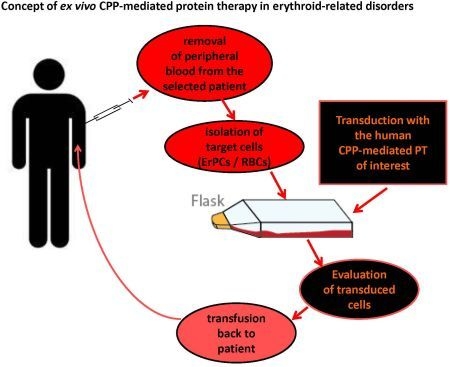
        <p>The erythroid related disorders (ERDs) represent a large group of hematological diseases, which in most cases are attributed either to the deficiency or malfunction of biosynthetic enzymes or oxygen transport proteins. Current treatments for these disorders include histo-compatible erythrocyte transfusions or allogeneic hematopoietic stem cell (HSC) transplantation. Gene therapy delivered via suitable viral vectors or genetically modified HSCs have been under way. Protein Transduction Domain (PTD) technology has allowed the production and intracellular delivery of recombinant therapeutic proteins, bearing Cell Penetrating Peptides (CPPs), into a variety of mammalian cells. Remarkable progress in the field of protein transduction leads to the development of novel protein therapeutics (CPP-mediated PTs) for the treatment of monogenetic and/or metabolic disorders. The “concept” developed in this paper is the intracellular protein delivery made possible via the PTD technology as a novel therapeutic intervention for treatment of ERDs. This can be achieved via four stages including: (i) the production of genetically engineered human CPP-mediated PT of interest, since the corresponding native protein either is missing or is mutated in the erythroid progenitor cell (ErPCs) or mature erythrocytes of patients; (ii) isolation of target cells from the peripheral blood of the selected patients; (iii) <italic>ex vivo</italic> transduction of cells with the CPP-mediated PT of interest; and (iv) re-administration of the successfully transduced cells back into the same patients.</p>
      </abstract>
      <kwd-group>
        <kwd>protein transduction</kwd>
		<kwd>CPPs</kwd>
		<kwd>erythroid related disorders</kwd>
		<kwd>protein therapy</kwd>
      </kwd-group>
    </article-meta>
  </front>
  <body>
  <sec><title>Abbreviations</title>
<def-list>
<def-item><term>aa</term><def><p>aminoacid</p></def></def-item>
<def-item><term>ALAS</term><def><p>ALA Synthase</p></def></def-item>
<def-item><term>BFU-Es</term><def><p>burst-forming units-erythroid</p></def></def-item>
<def-item><term>BM</term><def><p>bone marrow</p></def></def-item>
<def-item><term>CDS</term><def><p>coding sequence</p></def></def-item>
<def-item><term>CEP</term><def><p>congenital erythropoietic porphyria</p></def></def-item>
<def-item><term>CFU-Es</term><def><p>colony-forming units-erythroid</p></def></def-item>
<def-item><term>CGAs</term><def><p>congenital anemias</p></def></def-item>
<def-item><term>CPP</term><def><p>Cell Penetrating Peptide</p></def></def-item>
<def-item><term>CPP-mediated PTs</term><def><p>PTs engineered via PTD Technology</p></def></def-item>
<def-item><term>ErPCs</term><def><p>Erythroid progenitor cells</p></def></def-item>
<def-item><term>ERDs</term><def><p>Erythroid related disorders</p></def></def-item>
<def-item><term>ERT</term><def><p>enzyme replacement therapy</p></def></def-item>
<def-item><term>EPO</term><def><p>erythropoietin</p></def></def-item>
<def-item><term>EPP</term><def><p>erythropoietic protoporphyria</p></def></def-item>
<def-item><term>FA</term><def><p>Fanconi anemia</p></def></def-item>
<def-item><term>FECH</term><def><p>Ferrochelatase</p></def></def-item>
<def-item><term>GVHD</term><def><p>graft <italic>versus</italic> host disease</p></def></def-item>
<def-item><term>HbA</term><def><p>adult hemoglobin</p></def></def-item>
<def-item><term>HbF</term><def><p>fetal hemoglobin</p></def></def-item>
<def-item><term>HbS</term><def><p>hemoglobin S</p></def></def-item>
<def-item><term>HSCs</term><def><p>hematopoietic stem cells</p></def></def-item>
<def-item><term>HSCT</term><def><p>HSC transplantation</p></def></def-item>
<def-item><term>HU</term><def><p>Hydroxyurea</p></def></def-item>
<def-item><term>iPSCs</term><def><p>induced Pluripotent Stem Cells</p></def></def-item>
<def-item><term>PEG</term><def><p>polyethylene glycol</p></def></def-item>
<def-item><term>PRT</term><def><p>protein replacement therapy</p></def></def-item>
<def-item><term>PTD</term><def><p>protein transduction domain</p></def></def-item>
<def-item><term>PTs</term><def><p>proteins therapeutics</p></def></def-item>
<def-item><term>R</term><def><p>arginine</p></def></def-item>
<def-item><term>RBC</term><def><p>red blood cell</p></def></def-item>
<def-item><term>SCD</term><def><p>sickle cell disease</p></def></def-item>
<def-item><term>α</term><def><p>alpha</p></def></def-item>
<def-item><term>β</term><def><p>beta</p></def></def-item>
<def-item><term>γ</term><def><p>gamma</p></def></def-item>
<def-item><term>δ</term><def><p>delta</p></def></def-item>
</def-list>
</sec>
    <sec sec-type="intro">
      <title>1. Introduction</title>
      <p>Erythropoiesis is a complex developmental process occurring in bone marrow (BM) during adult life. Pluripotent hematopoietic stem cells (HSCs) upon differentiation give rise to erythroid progenitor cell (ErPCs) (including eythroid committed burst-forming units-erythroid ‒ BFU-Es and colony-forming units-erythroid ‒ CFU-Es), which are eventually differentiated into mature erythrocytes or red blood cells (RBCs). Erythropoiesis involves: (i) activation of the erythropoietin (EPO) receptor mediated signaling by EPO; EPO is promoted by hypoxia via the hypoxia-inducible transcription factors; (ii) activation of heme biosynthesis; (iii) expression of globin genes; and (iv) completion of terminal morphological maturation [<xref ref-type="bibr" rid="B1-pharmaceuticals-06-00032">1</xref>,<xref ref-type="bibr" rid="B2-pharmaceuticals-06-00032">2</xref>]. Under normal erythropoiesis, hemoglobin A (HbA: α<sub>2</sub>β<sub>2</sub>) and, to a much lesser extent, hemoglobin A<sub>2</sub> (HbA<sub>2</sub>: α<sub>2</sub>δ<sub>2</sub>) as well as fetal hemoglobin (HbF: α<sub>2</sub>γ<sub>2</sub>) are produced in human adult RBCs. Each one of the globin subunits [alpha (α), beta (β), delta (δ) or gamma (γ)] carries one molecule of heme (an iron protoporphyrin IX) as a prosthetic group, able to bind and transport the oxygen into tissues [<xref ref-type="bibr" rid="B3-pharmaceuticals-06-00032">3</xref>,<xref ref-type="bibr" rid="B4-pharmaceuticals-06-00032">4</xref>].</p>
      <p>Human mature erythrocytes lack nucleus and are among the most abundant human cell types (~2-3 × 10<sup>13</sup>). They have a biconcave shape, which offer them flexibility during blood circulation and make them able to penetrate through basement membranes during their transit from the splenic cord to splenic sinus and through the microvasculature bed during their life span in circulation (100 - 120 days) [<xref ref-type="bibr" rid="B5-pharmaceuticals-06-00032">5</xref>,<xref ref-type="bibr" rid="B6-pharmaceuticals-06-00032">6</xref>]. Normal RBCs are indeed quite tolerant to hemolysis.</p>
      <p>Normally, ~280 × 10<sup>6</sup> molecules of adult haemoglobin (HbA) are generated in ErPCs [<xref ref-type="bibr" rid="B7-pharmaceuticals-06-00032">7</xref>]. Alpha globin chain is co-translationally regulated with heme [<xref ref-type="bibr" rid="B8-pharmaceuticals-06-00032">8</xref>,<xref ref-type="bibr" rid="B9-pharmaceuticals-06-00032">9</xref>]. Heme-containing alpha globin chain associates with apo-beta globin chain and drives the insertion of heme into it [<xref ref-type="bibr" rid="B10-pharmaceuticals-06-00032">10</xref>]. </p>
      <p>Erythroid related disorders (ERDs) in most cases result either from reduced RBC production due to ineffective erythropoiesis and failure of maturation of the ErPCs (like in sideroblastic anemias, thalassemias) or increased RBC destruction, associated with hemoglobinopathies as well as enzyme deficiencies (like those occurring in porphyrias) [<xref ref-type="bibr" rid="B3-pharmaceuticals-06-00032">3</xref>,<xref ref-type="bibr" rid="B4-pharmaceuticals-06-00032">4</xref>,<xref ref-type="bibr" rid="B11-pharmaceuticals-06-00032">11</xref>,<xref ref-type="bibr" rid="B12-pharmaceuticals-06-00032">12</xref>]. There are also other disorders that affect mainly hematopoietic progenitor cells, like the myeloproliferative polycythemia vera, the acute erythroid leukemia and the myelodysplastic syndromes. The latter are characterized by overwhelming or ineffective erythropoiesis [<xref ref-type="bibr" rid="B13-pharmaceuticals-06-00032">13</xref>], accompanied by known and unknown genetic abnormalities. Fanconi anemia (FA) is another genetic disorder associated with mutations in at least twelve genes that could lead to aplastic anemia [<xref ref-type="bibr" rid="B14-pharmaceuticals-06-00032">14</xref>]. Unfortunately, there is no current standard therapy of all ERDs. For example, there is no cure for sideroblastic anemias, while symptomatic therapy is applied in patients with porphyrias. Hemoglobinopathies, currently, are treated symptomatically by long-life erythrocyte transfusions.Cure of ERDs could be achieved by: (a) correction of the abnormal gene or replacement with a normal one; and (b) transplantation with allogeneic HSCs from HLA - matched donors or with autologous HSCs, gene-corrected previously <italic>ex vivo</italic> [<xref ref-type="bibr" rid="B15-pharmaceuticals-06-00032">15</xref>,<xref ref-type="bibr" rid="B16-pharmaceuticals-06-00032">16</xref>]. Unfortunately, the poor availability of transplants from HLA - matched donors, the severity of graft <italic>versus</italic> host disease (GVHD) that can be developed in cases of allogeneic HSC transplantation (HSCT) and the complexities associated with gene therapy (like insertional mutagenesis - tumorigenesis) demand alternative therapeutic interventions for ERDs. </p>
      <p>Enzyme or protein replacement therapy (ERT/PRT) via the Protein Transduction Domain (PTD) technology could be considered as an alternative intervention that, compared to gene therapy, is regarded safe, since it doesn’t affect the host structural integrity of the genome [<xref ref-type="bibr" rid="B17-pharmaceuticals-06-00032">17</xref>,<xref ref-type="bibr" rid="B18-pharmaceuticals-06-00032">18</xref>,<xref ref-type="bibr" rid="B19-pharmaceuticals-06-00032">19</xref>]. PTD technology is based on the ability of short aminoacid (aa) sequences [CPPs or PTDs] to facilitate intracellular delivery of recombinant proteins (as well as other molecules) conjugated-linked to them. This remarkable technology permits the development of a novel class of proteins therapeutics (CPP-mediated PTs) for certain genetic and/or metabolic disorders, including ERDs that are discussed later on.</p>
      <p>In the framework of this “concept paper”, we wish: (i) to discuss the pathophysiology and current treatment - management of some ERDs (sideroblastic anemias, porphyrias and hemoglobinopathies); and (ii) to present how CPP-mediated PTs (biodrugs) can be used as an alternative ERT/PRT approach for treating ERDs. </p>
    </sec>
    <sec>
      <title>2. Genetic and Metabolic ERDs and current Treatment</title>
      <sec>
        <title>2.1. Sideroblastic Anemias</title>
        <p>Under normal erythropoiesis, erythroblasts contain ~200 mitochondria per cell, playing crucial role in iron metabolism and biosynthesis of heme and iron-sulphur [Fe-S] clusters [<xref ref-type="bibr" rid="B20-pharmaceuticals-06-00032">20</xref>]. More than 80 percent of body heme levels are synthesized in ErPCs (BFU-Es, CFU-Es) for the production of hemoglobin [<xref ref-type="bibr" rid="B21-pharmaceuticals-06-00032">21</xref>], which corresponds to ~ 40-50% of total protein in mature RBCs. Disruption of interconnection between heme biosynthesis, [Fe-S] biogenesis and iron - heme proteins could result in congenital anemias (CGAs) [<xref ref-type="bibr" rid="B20-pharmaceuticals-06-00032">20</xref>].</p>
        <p>Sideroblastic anemias are either acquired (associated with drugs or alcohol abuse) or congenital. They are characterized by the appearance of ringed sideroblasts (erythroblasts characterized by the accumulation of non-heme iron in perinuclear mitochondria) as common feature in the BM [<xref ref-type="bibr" rid="B20-pharmaceuticals-06-00032">20</xref>,<xref ref-type="bibr" rid="B22-pharmaceuticals-06-00032">22</xref>]. </p>
        <p>Mutations in the erythroid-specific heme biosynthetic gene <italic>ALAS-2</italic> (δ-aminolevulinic acid synthase - 2, isoform exclusively synthesized in ErPCs) can lead to X-linked sideroblastic anemia (XLSA) (OMIM: 300751), the most common CGA. More specifically, some mutations intervene with the binding of ALAS-2 to the succinyl-CoA synthetase that provides the succinyl-CoA, necessary for the synthesis of δ-aminolevulinic acid (ALA), the first enzyme in the biosynthesis of heme [<xref ref-type="bibr" rid="B23-pharmaceuticals-06-00032">23</xref>,<xref ref-type="bibr" rid="B24-pharmaceuticals-06-00032">24</xref>]. Patients carrying mutations in <italic>ALAS-2</italic> that influence the affinity of the enzyme for its cofactor pyridoxal phosphate may respond to treatment with pyridoxine (vitamin B6) [<xref ref-type="bibr" rid="B25-pharmaceuticals-06-00032">25</xref>,<xref ref-type="bibr" rid="B26-pharmaceuticals-06-00032">26</xref>,<xref ref-type="bibr" rid="B27-pharmaceuticals-06-00032">27</xref>]. </p>
        <p>Sideroblastic anemias may also occur by mutations in genes encoding transporters, like: (a) the solute carrier SLC25A38, an erythroid specific transporter of glycine into the mitochondrial matrix (OMIM: 205950) [<xref ref-type="bibr" rid="B28-pharmaceuticals-06-00032">28</xref>,<xref ref-type="bibr" rid="B29-pharmaceuticals-06-00032">29</xref>], where with succinyl-CoA will give genesis to ALA; and (b) the inner mitochondrial membrane ABCB7 transporter [<xref ref-type="bibr" rid="B30-pharmaceuticals-06-00032">30</xref>]. This transporter controls the availability of mitochondrial iron to be inserted in the protoporphyrin IX via ferrochelatase (FECH) [<xref ref-type="bibr" rid="B25-pharmaceuticals-06-00032">25</xref>,<xref ref-type="bibr" rid="B29-pharmaceuticals-06-00032">29</xref>]. Mutations in ABCB7 transporter may disrupt the maturation of [Fe-S] [<xref ref-type="bibr" rid="B31-pharmaceuticals-06-00032">31</xref>] in FECH during heme biosynthesis and lead to X-linked sideroblastic anemia with ataxia (XLSA-A) (OMIM: 301310). There is also evidence that deficiency of glutaredoxin 5 (GLRX5), also essential for [Fe-S] biogenesis, can lead to sideroblastic anemia in humans (OMIM: 609588) [<xref ref-type="bibr" rid="B20-pharmaceuticals-06-00032">20</xref>,<xref ref-type="bibr" rid="B32-pharmaceuticals-06-00032">32</xref>]. </p>
        <p>Furthermore, congenital sideroblastic anemias are associated with abnormalities concerning mitochondrial protein synthesis, like: (a) Pearson Marrow-Pancreas Syndrome (PMPS) [<xref ref-type="bibr" rid="B33-pharmaceuticals-06-00032">33</xref>] (OMIM: 557000), with half patients being heteroplasmic for the 4977-bp common deletion in the mitochondrial genome; (b) Mitochondrial myopathy with Lactic Acidosis and ringed Sideroblasts (MLASA) [<xref ref-type="bibr" rid="B34-pharmaceuticals-06-00032">34</xref>] (OMIM: 600462), with mutations in <italic>PUS1</italic> gene, encoding PUS playing role in the metabolism of uridine; and (c) Thiamine Responsive Megaloblastic Anemia (TRMA) [<xref ref-type="bibr" rid="B35-pharmaceuticals-06-00032">35</xref>] (OMIM: 249270) due to mutations in thiamine transporter SLC19A2. Unfortunately, there is no cure for congenital sideroblastic anemias up to now, while gene therapy is considered as a possible future therapeutic intervention [<xref ref-type="bibr" rid="B20-pharmaceuticals-06-00032">20</xref>].</p>
      </sec>
      <sec>
        <title>2.2. Porphyrias</title>
        <p>“Porphyrias” represent a group of inherited or acquired disorders attributed to deficiencies of enzymes involved in heme biosynthesis. Porphyrin intermediates (substrates for the corresponding defective heme biosynthetic enzymes) accumulate in the BM erythropoietic cells and/or in the liver. Thus porphyrias are classified as erythropoietic or hepatic, respectively. Patients with porphyrias must avoid the use of the so called “porphyrogenic” drugs, which may enhance the frequency of acute porphyria attacks with serious complications [<xref ref-type="bibr" rid="B36-pharmaceuticals-06-00032">36</xref>,<xref ref-type="bibr" rid="B37-pharmaceuticals-06-00032">37</xref>]. </p>
        <p>More specifically, mutations in human heme biosynthetic genes can give genesis to porphyrias [<xref ref-type="bibr" rid="B38-pharmaceuticals-06-00032">38</xref>], like in: (i) <italic>ALAS-2,</italic> leading to X-linked dominant erythropoietic protoporphyria (XLEPP or XLDPP) (OMIM: 300752) [<xref ref-type="bibr" rid="B39-pharmaceuticals-06-00032">39</xref>,<xref ref-type="bibr" rid="B40-pharmaceuticals-06-00032">40</xref>]; (ii) <italic>UROS</italic> (uroporphyrinogen III synthase), leading to congenital erythropoietic porphyria (CEP) (OMIM: 263700) and (iii) <italic>FECH</italic>, leading to erythropoietic protoporphyria (EPP) (OMIM: 612386). Moreover, mutations in human <italic>GATA-1</italic> can also result in CEP (OMIM: 305371) [<xref ref-type="bibr" rid="B41-pharmaceuticals-06-00032">41</xref>]. It is worth mentioning here that at least five heme biosynthetic enzymes have binding site for the GATA-1 (an erythroid specific transcription factor) [<xref ref-type="bibr" rid="B42-pharmaceuticals-06-00032">42</xref>]. </p>
        <p>Acute porphyria attacks are life threatening and can be manipulated by: a) avoiding precipitating factors [porhyrinogenic drugs (chloroquine, sulphonamide antibiotics, rifampicin), alcohol, hormones (estrogen, progesterone) that overproduce porphyrins)]; b) alleviating the neurological (nausea, vomiting, pain) or cardiovascular problems with symptomatic therapy; c) intravenous (i.v.) administration of hemin, in the form of heme arginate or hematin [<xref ref-type="bibr" rid="B38-pharmaceuticals-06-00032">38</xref>]. However, treatment with hemin should be monitored, since free heme accumulation could lead to iron overload and organ failure. Patients with chronic porphyrias (like EPP, CEP) present mild to severe cutaneous lesions (erythema, blistering and others) that exacerbated after expose to sunlight. Thus, in chronic porphyrias, intentional avoidance of sunlight is recommended. Liver or BM/HSC transplantations are recommended in severe cases [<xref ref-type="bibr" rid="B36-pharmaceuticals-06-00032">36</xref>,<xref ref-type="bibr" rid="B38-pharmaceuticals-06-00032">38</xref>,<xref ref-type="bibr" rid="B43-pharmaceuticals-06-00032">43</xref>].</p>
      </sec>
      <sec>
        <title>2.3. Hemoglobinopathies</title>
        <p>Hemoglobinopathies [<xref ref-type="bibr" rid="B44-pharmaceuticals-06-00032">44</xref>], as inherited disorders of hemoglobin, are among the most common monogenetic ERDs. Hemoglobinopathies reflect the natural selection of carriers, being protected from the consequences of infection with <italic>P. falciparum</italic> that causes malaria [<xref ref-type="bibr" rid="B45-pharmaceuticals-06-00032">45</xref>,<xref ref-type="bibr" rid="B46-pharmaceuticals-06-00032">46</xref>,<xref ref-type="bibr" rid="B47-pharmaceuticals-06-00032">47</xref>,<xref ref-type="bibr" rid="B48-pharmaceuticals-06-00032">48</xref>]. A plethora of hemoglobinopathies, listed in the HbVardatabase [<xref ref-type="bibr" rid="B49-pharmaceuticals-06-00032">49</xref>], arise from globin gene mutations. About 5-7% of the world’s population carries globin gene variants, while ~340.000 annual births appear with major hemoglobin disorders [<xref ref-type="bibr" rid="B7-pharmaceuticals-06-00032">7</xref>,<xref ref-type="bibr" rid="B47-pharmaceuticals-06-00032">47</xref>,<xref ref-type="bibr" rid="B50-pharmaceuticals-06-00032">50</xref>]. </p>
        <sec>
          <title>2.3.1. Thalassemias</title>
          <p>Among the hemoglobinopathies, thalassemias [<xref ref-type="bibr" rid="B4-pharmaceuticals-06-00032">4</xref>] are a group of disorders named from the Greek word <italic>“thalassa”</italic> for sea, since they have been endemic in the areas around Mediterannean Sea [<xref ref-type="bibr" rid="B51-pharmaceuticals-06-00032">51</xref>]. In thalassemias, absence or reduced amount of one or more globin chains [necessary for the formation of the tetramer α<sub>2</sub>β<sub>2</sub> of HbA] lead to decreased HbA, hypochromia and microcytosis. Imbalance between alpha and beta globin chains, leads to ineffective erythropoiesis in BM, hemolysis in peripheral RBCs and thus mild or severe hemolytic anemia [<xref ref-type="bibr" rid="B50-pharmaceuticals-06-00032">50</xref>]. In alpha thalassemias [<xref ref-type="bibr" rid="B52-pharmaceuticals-06-00032">52</xref>] (OMIM: 141750), partial (α<sup>+</sup>) or total (α°) deletions of one or more of the four alpha globin genes are the most common causes, while beta thalassemias (OMIM: 613985) are attributed to more than 200 mutations (point mutations, insertions or inversions-deletions) associated either with some beta globin synthesis (β<sup>+</sup>) or no synthesis at all (β°) [<xref ref-type="bibr" rid="B47-pharmaceuticals-06-00032">47</xref>].</p>
          <p>In alpha thalassemia, unpaired beta and gamma globin chains usually don’t precipitate but rather polymerize to form unstable tetramers, β<sub>4</sub> in HbH or γ<sub>4 </sub>in HbBart’s. HbBart’s results in fatal hydrops fetalis [<xref ref-type="bibr" rid="B46-pharmaceuticals-06-00032">46</xref>,<xref ref-type="bibr" rid="B51-pharmaceuticals-06-00032">51</xref>]. Both HbH and HbBart’s have very high affinity for oxygen and cannot support transport of oxygen to tissues. Moreover, HbH and HbBart’s have been found to cause increased apoptosis and reduced cell survival of ErPCs in BM. These apoptotic cells are removed via phagocytosis [<xref ref-type="bibr" rid="B46-pharmaceuticals-06-00032">46</xref>,<xref ref-type="bibr" rid="B50-pharmaceuticals-06-00032">50</xref>]. </p>
          <p>In case of beta thalassemia, defects in both genes lead to either intermedia beta thalassemia or beta thalassemia major or, otherwise, β°-thalassemia or Cooley’s anemia. Severity of syndrome increases as the beta globin chain production is reduced, while alpha globin chain production is at normal levels. This discrepancy leads to excess amounts of free alpha globin chains in both the ErPCs in BM and the RBCs in the peripheral blood. Free alpha globin chains finally precipitate, form inclusion bodies, destruct the membranes and lead to cell death of RBCs (promoted by iron and free heme), ineffective erythropoiesis and anemia [<xref ref-type="bibr" rid="B46-pharmaceuticals-06-00032">46</xref>]. </p>
          <p>Patients with beta thalassemia major (hemoglobin levels lower than 70 g/L) need long-life, safe, immunocompatible (to avoid alloimmunization), fresh units of erythrocyte (leucocyte reduced) transfusions every 2<sup>nd</sup> to 4<sup>th</sup> week to correct anemia. In patients with intermedia beta thalassemia, transfusions depend on the severity of situation and, usually, is episodic. Regular erythrocyte transfusions usually result in iron overload, which could be toxic due to accumulation in various organs (liver, myocardium) and can lead even to cardiac insufficiency [<xref ref-type="bibr" rid="B50-pharmaceuticals-06-00032">50</xref>]. Thus, chelation therapy (e.g. parenterally administered desferrioxamine or new oral chelating agents, like deferriprone) is absolutely needed to remove excess iron from the human body [<xref ref-type="bibr" rid="B46-pharmaceuticals-06-00032">46</xref>]. </p>
          <p>Αnother therapeutic approach is the epigenetic modulation of globin gene expression and induction of HbF to therapeutic levels with the use of EPO, HU as well as other pharmacological agents. EPO therapy stimulates erythroid proliferation, decreases apoptosis of erythropoietic cells and finally increases hemoglobin levels by ~25 g/L [<xref ref-type="bibr" rid="B53-pharmaceuticals-06-00032">53</xref>]. Drugs, like hydroxyurea (HU, hydroxycarbamide), sodium butyrate or aza-cytidine, can activate Gγ-globin and enhance fetal HbF production, thus being quite useful [<xref ref-type="bibr" rid="B46-pharmaceuticals-06-00032">46</xref>,<xref ref-type="bibr" rid="B54-pharmaceuticals-06-00032">54</xref>]. HU has been approved by FDA to stimulate HbF synthesis. HU is an antimetabolite that transient arrest DNA synthesis in the late ErPCs, thus giving advantage to premature earlier ErPCs, which have active the HbF program [<xref ref-type="bibr" rid="B55-pharmaceuticals-06-00032">55</xref>,<xref ref-type="bibr" rid="B56-pharmaceuticals-06-00032">56</xref>]. It is known, that human gamma globin genes are hypomethylated in fetal tissue and thus are transcribed, while transition to adult life results in their methylation and subsequent silencing [<xref ref-type="bibr" rid="B57-pharmaceuticals-06-00032">57</xref>]. Short chain fatty acid derivatives, like butyrates, inhibit histone deacetylases, increase acetylation of core histones, alter the chromatin structure and permit accession of the transcription factors in the promoters of gamma globin genes. Increased transcription levels lead to increased HbF levels.</p>
          <p>HSCT can be applied mainly in low risk patients (based on age, gender, physical situation, other pathological conditions) as curative therapy [<xref ref-type="bibr" rid="B58-pharmaceuticals-06-00032">58</xref>]. The main problem, however, is the availability of transplants from HLA - matched donors, since allogeneic HSCT itself can lead to GVHD as well as others serious complications. The use of umbilical cord blood transplants would extend the donors pool [<xref ref-type="bibr" rid="B59-pharmaceuticals-06-00032">59</xref>]. </p>
          <p>Gene therapy could be used instead, but this approach has its own limitations, since it has to be safe by avoiding insertional mutagenesis and leukemogenesis, to be specific in erythropoietic cells and to achieve adequate production of beta globin. Cell and gene therapy in patient-specific embryonic stem cells (ESCs) or induced pluripotent stem cells (iPSCs) by correcting the mutant gene and subsequent transplantation into the patient could overcome a number of technical obstacles [<xref ref-type="bibr" rid="B60-pharmaceuticals-06-00032">60</xref>]. Thus far, only Leboulch’s team succeeded in a gene therapy approach (using a lentiviral βeta globin gene transfer) to achieve blood transfusion independence for four years now in a patient with severe beta thalassemia, being dependent since early childhood on monthly transfusions [<xref ref-type="bibr" rid="B54-pharmaceuticals-06-00032">54</xref>,<xref ref-type="bibr" rid="B61-pharmaceuticals-06-00032">61</xref>]. Moreover, intensive investigation is on progress to delineate where and how the beta globin gene was integrated and remained functional. </p>
          <p>RNA interference technology could offer advantage in gene therapy approach by silencing the alpha globin gene to reduce the alpha globin levels and restore normal ratio between alpha and beta globin chains [<xref ref-type="bibr" rid="B62-pharmaceuticals-06-00032">62</xref>]. Correction of the mutant phenotype at the level of mRNA could be also approached, by using chemically stabilized antisense oligonucleotides [<xref ref-type="bibr" rid="B60-pharmaceuticals-06-00032">60</xref>,<xref ref-type="bibr" rid="B63-pharmaceuticals-06-00032">63</xref>].</p>
        </sec>
        <sec>
          <title>2.3.2. Sickle Cell Anemia</title>
          <p>Sickle cell anemia (OMIM: 603903) or, otherwise, sickle cell disease (SCD), is a genetic disorder that results from a single point mutation (T to A) in the 17<sup>th</sup> nucleotide of the coding sequence (CDS) of the beta globin gene, producing the abnormal hemoglobin S (HbS: α<sub>2</sub>β<sub>2</sub><sup>s</sup>) [<xref ref-type="bibr" rid="B64-pharmaceuticals-06-00032">64</xref>]. The resulting replacement of the negatively charged glutamic acid (6<sup>th</sup> aa) by valine, a non-polar neutral aminoacid, creates a hydrophobic motif, which under hypoxia conditions leads to binding between the beta chains of two deoxygenated HbS tetramers. This hemoglobin polymerization disrupts the architecture - flexibility of RBCs. The rigidity of RBCs leads to vaso-occlusion, hemolysis and chronic anemia. Elevating the HbF levels seems to offer good results in cases of SCD, since HbF and α<sub>2</sub>γβ<sup>s</sup> tetramers are not involved in the polymerization process induced by HbS. Novel therapeutic candidates can induce gamma-globin gene expression <italic>in vivo</italic> [<xref ref-type="bibr" rid="B65-pharmaceuticals-06-00032">65</xref>]. RNA interference technology could be also applied to silence the beta<sup>s</sup>-globin gene and reduce the polymerization in hypoxic conditions [<xref ref-type="bibr" rid="B66-pharmaceuticals-06-00032">66</xref>]. Gene-corrected BM/HSC cells derived from mouse iPSCs were able to treat SCD upon transplantation in animals [<xref ref-type="bibr" rid="B67-pharmaceuticals-06-00032">67</xref>]. Furthermore, regenerative medicine would be considered as an alternative treatment for some of the ERDs by <italic>in vitro</italic> generation of mature, functional RBCs [<xref ref-type="bibr" rid="B68-pharmaceuticals-06-00032">68</xref>] or <italic>ex vivo</italic> expansion of normal RBCs [<xref ref-type="bibr" rid="B69-pharmaceuticals-06-00032">69</xref>]. Of course, there are limitations, either due to the huge amounts of RBCs, needed each time for transfusion, or due to the high cost of such an approach. </p>
        </sec>
      </sec>
    </sec>
    <sec>
      <title>3. Protein Transduction Domain Technology for intracellular DELIVERY of Protein Therapeutics (PTs)</title>
      <p>“Omics” technologies (like genomics, transcriptomics, proteomics, metabolomics, interactomics), implemented by bioinformatic analysis, contributed to the development of a large number of new therapeutic targets, the majority of which are located intracellularly.</p>
      <p>Protein therapy as direct delivery of the gene translational product itself, the PT, could be considered as an alternative therapeutic approach to gene therapy of monogenetic or metabolic disorders [<xref ref-type="bibr" rid="B18-pharmaceuticals-06-00032">18</xref>], like in the case of insulin as PT in diabetes mellitus. However, in many cases, PTs have to “cross” the plasma membrane of the cells [<xref ref-type="bibr" rid="B70-pharmaceuticals-06-00032">70</xref>] and even to target a specific organelle (e.g. mitochondria) [<xref ref-type="bibr" rid="B18-pharmaceuticals-06-00032">18</xref>] in order to exert their therapeutic effect in diseases, where a mutated gene encodes either an abnormal intracellular protein or no protein at all.</p>
      <p>PTD technology developed over the past decades is based on the intrinsic capacity of some native proteins to penetrate biological membranes. Proteins, like the TAT protein of the HIV-1 virus (a transactivator factor of transcription) [<xref ref-type="bibr" rid="B71-pharmaceuticals-06-00032">71</xref>] and the Antennapedia, a <italic>Drosophila</italic> homeotic transcription factor [<xref ref-type="bibr" rid="B72-pharmaceuticals-06-00032">72</xref>], were found to be able to penetrate the plasma membrane [<xref ref-type="bibr" rid="B73-pharmaceuticals-06-00032">73</xref>] and carry on heterologous proteins [<xref ref-type="bibr" rid="B71-pharmaceuticals-06-00032">71</xref>] intracellularly.</p>
      <p>PTD technology uses small peptides (CPPs or PTDs) of less than 30 aa in length, able to penetrate almost all biological membranes and carry on intracellularly a variety of cargos ranging from small molecules (drugs, oligonucleotides, siRNAs) to macromolecules (proteins, plasmids, liposomes and nanoparticles) [<xref ref-type="bibr" rid="B74-pharmaceuticals-06-00032">74</xref>,<xref ref-type="bibr" rid="B75-pharmaceuticals-06-00032">75</xref>,<xref ref-type="bibr" rid="B76-pharmaceuticals-06-00032">76</xref>,<xref ref-type="bibr" rid="B77-pharmaceuticals-06-00032">77</xref>,<xref ref-type="bibr" rid="B78-pharmaceuticals-06-00032">78</xref>]. CPPs are either protein derived peptides (like the eleven amino acid TAT peptide from the HIV-1 TAT full length protein) or synthetic peptides (like the R9) or even chimeric peptides (like the transportan) (<xref ref-type="table" rid="pharmaceuticals-06-00032-t001">Table 1</xref>) [<xref ref-type="bibr" rid="B18-pharmaceuticals-06-00032">18</xref>,<xref ref-type="bibr" rid="B79-pharmaceuticals-06-00032">79</xref>,<xref ref-type="bibr" rid="B80-pharmaceuticals-06-00032">80</xref>]. A CPPsite has been uploaded, offering information (origin, sequence, subcellular localization) for more than 800 CPPs [<xref ref-type="bibr" rid="B79-pharmaceuticals-06-00032">79</xref>].</p>
      <p>CPPs are in some cases cationic in nature (like the TAT peptide and the chemically synthesized polyarginines R7, R8, R9), in other cases amphipathic, bearing both cationic and hydrophobic residues (like the penetratin, VP22) or even hydrophobic (like the PFVYLI peptide), as also shown in <xref ref-type="table" rid="pharmaceuticals-06-00032-t001">Table 1</xref>.</p>
	  <table-wrap id="pharmaceuticals-06-00032-t001" position="float">
        <object-id pub-id-type="pii">pharmaceuticals-06-00032-t001_Table 1</object-id>
        <label>Table 1</label>
        <caption>
          <p>Representative CPPs.</p>
        </caption>
        <table rules="all" style="border:solid thin">
          <thead>
            <tr>
              <th align="left" valign="middle">CPP</th>
              <th align="left" valign="middle">Origin</th>
              <th align="left" valign="middle">Aminoacid (aa) Sequence /Physicochemical nature</th>
              <th align="left" valign="middle">Length(aa)</th>
              <th align="left" valign="middle">Refs</th>
            </tr>
          </thead>
          <tbody>
            <tr>
              <td align="left" valign="top">TAT</td>
              <td align="left" valign="top">HIV-1 TAT (transactivator factor of transcription)</td>
              <td align="left" valign="top">YGRKKRRQRRR<break/>Cationic peptide</td>
              <td align="left" valign="top">11</td>
              <td align="left" valign="top">[<xref ref-type="bibr" rid="B73-pharmaceuticals-06-00032">73</xref>,<xref ref-type="bibr" rid="B81-pharmaceuticals-06-00032">81</xref>]</td>
            </tr>
            
            <tr>
              <td align="left" valign="top">Penetratin (Antp)</td>
              <td align="left" valign="top"><italic>Drosophila</italic> homeotic transcription factor encoded by <italic>antennapedia</italic> gene</td>
              <td align="left" valign="top">RQIKIWFQNRRMKWKK <break/>Amphipathic pepttide</td>
              <td align="left" valign="top">16</td>
              <td align="left" valign="top">[<xref ref-type="bibr" rid="B72-pharmaceuticals-06-00032">72</xref>]</td>
            </tr>
            
            <tr>
              <td align="left" valign="top">VP22</td>
              <td align="left" valign="top">herpes simplex virus VP22 transcription factor</td>
              <td align="left" valign="top">DAATATRGRSAASRPTERPRAPARSASRPRRPVD<break/>Amphipathic peptide</td>
              <td align="left" valign="top">35</td>
              <td align="left" valign="top">[<xref ref-type="bibr" rid="B82-pharmaceuticals-06-00032">82</xref>]</td>
            </tr>
            
            <tr>
              <td align="left" valign="top">poly- Arginines</td>
              <td align="left" valign="top">chemically synthesized </td>
              <td align="left" valign="top">R7, R8, R9 <break/>Cationic peptides</td>
              <td align="left" valign="top">9 / 8</td>
              <td align="left" valign="top">[<xref ref-type="bibr" rid="B83-pharmaceuticals-06-00032">83</xref>,<xref ref-type="bibr" rid="B84-pharmaceuticals-06-00032">84</xref>]</td>
            </tr>
            
            <tr>
              <td align="left" valign="top">Transportan </td>
              <td align="left" valign="top">galanin -mastoparan </td>
              <td align="left" valign="top">GWTLNSAGYLLGK-INLKALAALAKKIL <break/>Chimeric - Amphipathic peptide</td>
              <td align="left" valign="top">27</td>
              <td align="left" valign="top">[<xref ref-type="bibr" rid="B85-pharmaceuticals-06-00032">85</xref>]</td>
            </tr>
            
            <tr>
              <td align="left" valign="top">TP10</td>
              <td align="left" valign="top">truncated form ofTransportan</td>
              <td align="left" valign="top">AGYLLGKINLKALAALAKKIL <break/>Chimeric - Amphipathic peptide</td>
              <td align="left" valign="top">21</td>
              <td align="left" valign="top">[<xref ref-type="bibr" rid="B86-pharmaceuticals-06-00032">86</xref>]</td>
            </tr>
            
            <tr>
              <td align="left" valign="top">pVEC </td>
              <td align="left" valign="top">Vascular Endothelial (Ve) - Cadherin </td>
              <td align="left" valign="top">LLIILRRRIRKQAHAHSK<break/>Amphipathic peptide</td>
              <td align="left" valign="top">18</td>
              <td align="left" valign="top">[<xref ref-type="bibr" rid="B87-pharmaceuticals-06-00032">87</xref>]</td>
            </tr>
            
            <tr>
              <td align="left" valign="top">Pep-1</td>
              <td align="left" valign="top">Trp-rich motif-SV40 NLS</td>
              <td align="left" valign="top">KETWWETWWTEWSQPKKKRKV <break/>Chimeric - Amphipathic peptide</td>
              <td align="left" valign="top">21</td>
              <td align="left" valign="top">[<xref ref-type="bibr" rid="B88-pharmaceuticals-06-00032">88</xref>]</td>
            </tr>
            
            <tr>
              <td align="left" valign="top">C105Y</td>
              <td align="left" valign="top">peptide based on the residues 359-374 of alpha1-antitrypsin</td>
              <td align="left" valign="top">CSIPPEVKFNKPFVYLI<break/>Amphipathic peptide</td>
              <td align="left" valign="top">17</td>
              <td align="left" valign="top">[<xref ref-type="bibr" rid="B89-pharmaceuticals-06-00032">89</xref>]</td>
            </tr>
            
            <tr>
              <td align="left" valign="top">PFVYLI </td>
              <td align="left" valign="top">derived from the synthetic peptide C105Y</td>
              <td align="left" valign="top">PFVYLI<break/>Hydrophobic peptide</td>
              <td align="left" valign="top">6</td>
              <td align="left" valign="top">[<xref ref-type="bibr" rid="B89-pharmaceuticals-06-00032">89</xref>]</td>
            </tr>
            
            <tr>
              <td align="left" valign="top">CADY</td>
              <td align="left" valign="top">chemically synthesized, combining aromatic (W) and cationic (R) residues</td>
              <td align="left" valign="top">GLWRALWRLLRSLWRLLWRA<break/>Amphipathic peptide</td>
              <td align="left" valign="top">20</td>
              <td align="left" valign="top">[<xref ref-type="bibr" rid="B90-pharmaceuticals-06-00032">90</xref>]</td>
            </tr>
            
            <tr>
              <td align="left" valign="top">CAPHs</td>
              <td align="left" valign="top">chemically synthesized with cationic amphiphilic polyproline helices</td>
              <td align="left" valign="top">P11LRR to P14LRR<break/>Cationic - Amphipathic peptides</td>
              <td align="left" valign="top">14 to 17</td>
              <td align="left" valign="top">[<xref ref-type="bibr" rid="B91-pharmaceuticals-06-00032">91</xref>]</td>
            </tr>
          </tbody>
        </table>
      </table-wrap>
      
      <p>For cationic CPPs [enriched in arginines (R)], cellular entry is initiated by electrostatic interactions and hydrogen bonding between the arginine’s guanidine group and the cell surface’s negatively charged groups (like heparin sulphate proteoglycans, phosphates or carboxylates). Subsequently, endocytosis driven delivery model and, more specifically, macropinocytosis [<xref ref-type="bibr" rid="B92-pharmaceuticals-06-00032">92</xref>], seems to be the one most widely accepted model for cell penetration. Other models of endocytosis have also been proposed, depending not only on the nature of the used CPP, but also on the nature (sequence, length, conformation) of cargo as well as on the targeted cell type and the CPP to cell ratio employed [<xref ref-type="bibr" rid="B18-pharmaceuticals-06-00032">18</xref>,<xref ref-type="bibr" rid="B92-pharmaceuticals-06-00032">92</xref>,<xref ref-type="bibr" rid="B93-pharmaceuticals-06-00032">93</xref>,<xref ref-type="bibr" rid="B94-pharmaceuticals-06-00032">94</xref>,<xref ref-type="bibr" rid="B95-pharmaceuticals-06-00032">95</xref>]. Even extremely hydrophobic peptides, like the PFVYLI (the C-terminal sequence of the C105Y peptide) or the LLIIL (the N-terminal sequence of the pVEC CPP peptide) (<xref ref-type="table" rid="pharmaceuticals-06-00032-t001">Table 1</xref>), are important for the penetration of the cell membrane [<xref ref-type="bibr" rid="B89-pharmaceuticals-06-00032">89</xref>,<xref ref-type="bibr" rid="B96-pharmaceuticals-06-00032">96</xref>]. Aromatic residues, like tryptophans (W), as part of the hydrophobic domain of penetratin and CADY, are also proposed to play significant role in the transduction process.</p>
      <p>Enhancement of intracellular delivery by 100x fold can be achieved by increasing the multivalency, which means coupling more than one CPP peptides (e.g. fifteen TAT peptides) to cargo [<xref ref-type="bibr" rid="B97-pharmaceuticals-06-00032">97</xref>]. Multivalency has also been found to increase the efficiency of binding to cell surface and thus enhance the intracellular uptake [<xref ref-type="bibr" rid="B19-pharmaceuticals-06-00032">19</xref>]. </p>
      <sec>
        <title>3.1. Production of PTs via PTD Technology</title>
        <p>CPP-mediated PTs are engineered via PTD Technology by: a) cloning of the CDS, corresponding to the open reading frame of the PT of interest, adjacent to the sequence encoding the CPP (like the TAT peptide) into a suitable expression vector (like the pTAT/TAT-HA from Dowdy’s group); b) subsequently transformation of appropriate competent (bacterial) cells;and c) production of fusion proteins containing the CPP of choice linked to the protein of interest [<xref ref-type="bibr" rid="B81-pharmaceuticals-06-00032">81</xref>,<xref ref-type="bibr" rid="B98-pharmaceuticals-06-00032">98</xref>,<xref ref-type="bibr" rid="B99-pharmaceuticals-06-00032">99</xref>]. In cases that the produced CPP-mediated PT needs post-translational modifications in order to exert its biological actions, novel modified eukaryotic cloning-expression systems are employed [<xref ref-type="bibr" rid="B100-pharmaceuticals-06-00032">100</xref>], since bacteria fail to carry out post translational modifications (e.g. glycosylation) of the produced protein.</p>
        <p>Chemical conjugation can be also applied between the CPPs and the cargo of interest in order to obtain the CPP - cargo, which will be able to deliver and, later on, release the cargo (e.g. the desired PT) intracellularly, depending on the environmental pH, temperature or protease [<xref ref-type="bibr" rid="B84-pharmaceuticals-06-00032">84</xref>,<xref ref-type="bibr" rid="B101-pharmaceuticals-06-00032">101</xref>,<xref ref-type="bibr" rid="B102-pharmaceuticals-06-00032">102</xref>,<xref ref-type="bibr" rid="B103-pharmaceuticals-06-00032">103</xref>,<xref ref-type="bibr" rid="B104-pharmaceuticals-06-00032">104</xref>]. The most widely used linker for conjugation is the disulphide bridge, permitting reduction of the CPP-cargo after penetration of the cell membrane, due to the high concentration of intracellular glutathione and subsequent release of the cargo. However, a recent study proposed that such a reduction could also happen at the level of cell surface [<xref ref-type="bibr" rid="B105-pharmaceuticals-06-00032">105</xref>]. Other linkers proposed for chemical conjugation of the PTs with the CPP of interest are the maleimide linker bond, sulphanyl (bi-functional) bond as well as phosphatydylethanolamine hydrogen bonding [<xref ref-type="bibr" rid="B95-pharmaceuticals-06-00032">95</xref>,<xref ref-type="bibr" rid="B106-pharmaceuticals-06-00032">106</xref>].</p>
        <p>Protein transduction can be also approached in a non covalent manner by either premixing of the selected CPP with the desired cargo or by formulating the CPP - cargo in liposomes or nanoparticles [<xref ref-type="bibr" rid="B107-pharmaceuticals-06-00032">107</xref>,<xref ref-type="bibr" rid="B108-pharmaceuticals-06-00032">108</xref>,<xref ref-type="bibr" rid="B109-pharmaceuticals-06-00032">109</xref>]. Non covalent molecular interactions between the CPPs and the cargo seems to depend on their tertiary structures and hydrophobic as well as electrostatic interactions [<xref ref-type="bibr" rid="B107-pharmaceuticals-06-00032">107</xref>].</p>
      </sec>
      <sec>
        <title>3.2. Pharmacokinetic, Toxicity and Targeting of CPP-Mediated PTs</title>
        <p>PTD Technology, compared to gene therapy, is regarded safe, since it doesn’t affect/alter the host genome integrity [<xref ref-type="bibr" rid="B17-pharmaceuticals-06-00032">17</xref>,<xref ref-type="bibr" rid="B18-pharmaceuticals-06-00032">18</xref>,<xref ref-type="bibr" rid="B19-pharmaceuticals-06-00032">19</xref>], although obstacles remain to be solved. These obstacles include: (i) lack of tissue specificity; (ii) protein instability, induced by proteases being present in circulation and inside the cells; (iii) immunogenicity; and (iv) other adverse reactions (like hypersensitivity) of the delivered CPP-mediated PTs (<xref ref-type="table" rid="pharmaceuticals-06-00032-t002">Table 2</xref>). </p>
        <table-wrap id="pharmaceuticals-06-00032-t002" position="float">
          <object-id pub-id-type="pii">pharmaceuticals-06-00032-t002_Table 2</object-id>
          <label>Table 2</label>
          <caption>
            <p>Obstacles of CPP-mediated PTs.</p>
          </caption>
          <table rules="cols" style="border:solid thin">
    <thead>
              <tr>
                <th align="center" valign="middle" style="border-bottom:solid thin">Obstacles of CPP-mediated PTs</th>
                <th align="center" valign="middle" style="border-bottom:solid thin">Possible solution of the obstacles</th>
                <th align="left" valign="middle" style="border-bottom:solid thin">Refs</th>
              </tr>
            </thead>
            <tbody>
              <tr>
                <td rowspan="4" align="center" valign="top" style="border-bottom:solid thin">lack of tissue specificity</td>
                <td align="center" valign="top">Development of “smart” delivery platforms</td>
                <td align="left" valign="top">[<xref ref-type="bibr" rid="B95-pharmaceuticals-06-00032">95</xref>]</td>
              </tr>
              <tr>
                <td align="center" valign="top">Use of target-specific antibodies, attached via bonds sensitive to cell environmental or external stimulus conditions</td>
                <td align="left" valign="top">[<xref ref-type="bibr" rid="B95-pharmaceuticals-06-00032">95</xref>,<xref ref-type="bibr" rid="B104-pharmaceuticals-06-00032">104</xref>]</td>
              </tr>
              <tr>
                <td align="center" valign="top">Use of Homing peptides</td>
                <td align="left" valign="top">[<xref ref-type="bibr" rid="B110-pharmaceuticals-06-00032">110</xref>,<xref ref-type="bibr" rid="B111-pharmaceuticals-06-00032">111</xref>]</td>
              </tr>
              <tr>
                <td align="center" valign="top" style="border-bottom:solid thin">Development of tissue specific CPPs</td>
                <td align="left" valign="top" style="border-bottom:solid thin">[<xref ref-type="bibr" rid="B112-pharmaceuticals-06-00032">112</xref>]</td>
              </tr>
              <tr>
                <td rowspan="3" align="center" valign="top" style="border-bottom:solid thin">protein instability</td>
                <td align="center" valign="top">Exchange L-amino acids of CPPs with the corresponding D-amino acids</td>
                <td align="left" valign="top">[<xref ref-type="bibr" rid="B113-pharmaceuticals-06-00032">113</xref>]</td>
              </tr>
              <tr>
                <td align="center" valign="top">Polymerization technologies (protein PEGylation) </td>
                <td align="left" valign="top">[<xref ref-type="bibr" rid="B114-pharmaceuticals-06-00032">114</xref>]</td>
              </tr>
              <tr>
                <td align="center" valign="top" style="border-bottom:solid thin">Construction of liposomes and nanoparticles</td>
                <td align="left" valign="top" style="border-bottom:solid thin">[<xref ref-type="bibr" rid="B95-pharmaceuticals-06-00032">95</xref>]</td>
              </tr>
              <tr>
                <td rowspan="2" align="center" valign="top">immunogenicity</td>
                <td align="center" valign="top">de-immunization by substitution of key aminoacids of T- or B-cell epitopes on CPP-mediated PT, using computer algorithms </td>
                <td align="left" valign="top">[<xref ref-type="bibr" rid="B115-pharmaceuticals-06-00032">115</xref>,<xref ref-type="bibr" rid="B116-pharmaceuticals-06-00032">116</xref>]</td>
              </tr>
              <tr>
                <td align="center" valign="top">Dosage / Route of administration (topical / i.v.)</td>
                <td align="left" valign="top">[<xref ref-type="bibr" rid="B117-pharmaceuticals-06-00032">117</xref>]</td>
              </tr>
            </tbody>
          </table>
        </table-wrap>
        <p>Most of the CPPs applied for pharmacokinetic studies undergo rapid clearance from the blood, with liver and kidney considered as the primary organs of their accumulation [<xref ref-type="bibr" rid="B118-pharmaceuticals-06-00032">118</xref>]. The necessity for multiple times administration of CPP-mediated PTs at high doses may indeed increase their immunogenicity [<xref ref-type="bibr" rid="B117-pharmaceuticals-06-00032">117</xref>]. Stability of CPP-mediated PTs could be affected by exchanging the L-amino acids with the corresponding D-amino acids, although this procedure may reduce the intracellular delivery [<xref ref-type="bibr" rid="B113-pharmaceuticals-06-00032">113</xref>]. </p>
        <p>Polymerization technologies (e.g. protein PEGylation) as well as entrapment of proteins in liposomes and/or nanoparticles could achieve better pharmacokinetic profile for the CPP-mediated PTs and overcome a number of obstacles, allowing penetration of even intact biological barriers, like BBB or BSCB (blood-spinal cord barrier) [<xref ref-type="bibr" rid="B114-pharmaceuticals-06-00032">114</xref>]. </p>
        <p>The ability of CPPs to penetrate almost all biological membranes makes the targeted delivery of proteins a very important issue in order to minimize undesirable effects. One should take in consideration the special characteristics of the targeted organ microenvironment. Torchillin’s group [<xref ref-type="bibr" rid="B95-pharmaceuticals-06-00032">95</xref>,<xref ref-type="bibr" rid="B104-pharmaceuticals-06-00032">104</xref>] developed “smart” delivery platforms for organ-tissue specific targeting, after administration of the desired cargo (e.g. the PT of interest) in the circulation: CPP - cargo is shielded with a protective molecule, like PEG (polyethylene glycol polymer), thus enhancing solubility, decreasing accessibility for the circulating proteolytic enzymes and increasing the half time of the PT by reducing kidney filtration due to its increased size. PEG chains can carry target-specific antibodies, attached to the surface via bonds sensitive to cell environmental (e.g. pH, temperature, matrix metalloproteinases) or external (magnetic field, ultrasound) stimulus conditions. After accumulation of the “smart” nanocarrier in the targeted organ and release of the PEG-antibody conjugates, the exposed CPP permits the transduction of the cargo intracellularly. Such an approach seems reasonable for the design of tumor-specific drugs/prodrugs/biodrugs, although the observed cell heterogeneity in tumors raises a number of limitations.</p>
        <p>Another interesting approach for targeting delivery could be the ability to attach, during the production process, a homing peptide, if any available, adjacent to the sequence of the suitable CPP-mediated PT of interest [<xref ref-type="bibr" rid="B110-pharmaceuticals-06-00032">110</xref>]. Such homing peptides, able to bind specific molecules on the targeted cell population and facilitate selective transduction of PT, could be identified by Phage Display technology [<xref ref-type="bibr" rid="B111-pharmaceuticals-06-00032">111</xref>]. The design of a CPP, specific for glial cells, has been presented as a promising therapeutic approach for glial-related disorders [<xref ref-type="bibr" rid="B112-pharmaceuticals-06-00032">112</xref>].</p>
        <p>In cases of subcellular organelle-targeted therapy, specific targeted sequences [like NLS (nuclear localization signal) or MTS (mitochondrial targeting signal)]) can be inserted in the designed sequence (e.g. CPP-MTS-PT) [<xref ref-type="bibr" rid="B18-pharmaceuticals-06-00032">18</xref>,<xref ref-type="bibr" rid="B99-pharmaceuticals-06-00032">99</xref>,<xref ref-type="bibr" rid="B119-pharmaceuticals-06-00032">119</xref>,<xref ref-type="bibr" rid="B120-pharmaceuticals-06-00032">120</xref>,<xref ref-type="bibr" rid="B121-pharmaceuticals-06-00032">121</xref>]. In an <italic>in vivo</italic> mouse (E3-deficient) model, intramitochondrial delivery of lipoamide dehydrogenase (LAD; E3), fused to TAT peptide, restored LAD activity [<xref ref-type="bibr" rid="B122-pharmaceuticals-06-00032">122</xref>]. Another class of CPPs, the cationic polyproline helices (CAPHs), has been also proposed to reach even more efficiently the mitochondria via direct transport mechanism [<xref ref-type="bibr" rid="B91-pharmaceuticals-06-00032">91</xref>].</p>
        <p>CPPs have been administered by various ways, both parentally as well as topically. Parental administration is the most frequent route for the delivery of biodrugs [<xref ref-type="bibr" rid="B107-pharmaceuticals-06-00032">107</xref>,<xref ref-type="bibr" rid="B110-pharmaceuticals-06-00032">110</xref>]. Parental administration is the most frequent route for the delivery of biodrugs. Oral delivery would open new opportunities in biodrugs’ administration, since it is non invasive and friendly to the patient for self administration, but it is not as yet applicable. The lack of specificity of CPP-mediated therapeutics towards various tissues till now led topical applications to be more preferable for clinical purposes [<xref ref-type="bibr" rid="B118-pharmaceuticals-06-00032">118</xref>]. Thus, CPP-mediated therapeutics (like PsorBan, RT-001, AZX-100), that have reached clinical trials, are mainly for local use towards scarring, psoriasis, pain, wrinkles and excessive sweating (see <xref ref-type="table" rid="pharmaceuticals-06-00032-t003">Table 3</xref>) [<xref ref-type="bibr" rid="B74-pharmaceuticals-06-00032">74</xref>,<xref ref-type="bibr" rid="B96-pharmaceuticals-06-00032">96</xref>,<xref ref-type="bibr" rid="B123-pharmaceuticals-06-00032">123</xref>,<xref ref-type="bibr" rid="B124-pharmaceuticals-06-00032">124</xref>]. Data from Phases I/II on more than 2,000 patients indicated no significant adverse reactions [<xref ref-type="bibr" rid="B125-pharmaceuticals-06-00032">125</xref>]. There are also clinical trials targeting heart problems or even cancer (<xref ref-type="table" rid="pharmaceuticals-06-00032-t003">Table 3</xref>). The so-called “smart” delivery platforms, bypassing stability and tissue specificity problems, would further facilitate the development of novel therapeutic interventions [<xref ref-type="bibr" rid="B95-pharmaceuticals-06-00032">95</xref>].</p>
        </sec>
      <sec>
        <title>3.3. Targeted Intracellular Delivery of CPP-Mediated PTs in ErPCs and RBCs:Future ex vivo Therapy</title>
        <p>It has been quite clear that ERDs, described thus far, include diseases, where ErPCs or even mature RBCs are deficient in a gene or its translation product and thus fail to function properly. Therefore, it is reasonable to assume that ERT/PRT approach would be beneficial for these disorders. An enzyme or any other type of missing protein can be produced as recombinant protein outside the body in a selected gene cloning-expression system, modified accordingly via PTD technology to carry an appropriate CPP and then be transduced into ErPCs or RBCs (wherever is needed) to deliver its intended function.</p>
		<table-wrap id="pharmaceuticals-06-00032-t003" position="float">
          <object-id pub-id-type="pii">pharmaceuticals-06-00032-t003_Table 3</object-id>
          <label>Table 3</label>
          <caption>
            <p>The status of some Preclinical and Clinical trials of CPP-mediated therapeutics.</p>
          </caption>
          <table rules="all" style="border:solid thin">
    <thead>
              <tr>
                <th align="left" valign="middle">Biopharmaceutical Company</th>
                <th align="left" valign="middle">Product</th>
                <th align="left" valign="middle">CPP-cargo</th>
                <th align="left" valign="middle">Indication</th>
                <th align="left" valign="middle">Clinical Phase</th>
                <th align="left" valign="middle">Refs</th>
              </tr>
            </thead>
            <tbody>
              <tr>
                <td align="left" valign="top">CellGate, Inc.</td>
                <td align="left" valign="top">PsorBan</td>
                <td align="left" valign="top">R7-cyclosporin A</td>
                <td align="left" valign="top">topical treatment of psoriasis </td>
                <td align="center" valign="top">II (discontinued)</td>
                <td align="left" valign="top">[<xref ref-type="bibr" rid="B126-pharmaceuticals-06-00032">126</xref>]</td>
              </tr>
              <tr>
                <td align="left" valign="top">Revance Therapeutics, Inc. </td>
                <td align="left" valign="top">RT-001</td>
                <td align="left" valign="top">TAT-botulinum toxin (TransMTS TM platform technology)</td>
                <td align="left" valign="top">topical treatment of wrinkles and excessive sweating</td>
                <td align="center" valign="middle"><break/> IIb<break/><break/> I</td>
                <td align="left" valign="middle"><break/><break/>[<xref ref-type="bibr" rid="B95-pharmaceuticals-06-00032">95</xref>,<xref ref-type="bibr" rid="B124-pharmaceuticals-06-00032">124</xref>]</td>
              </tr>
              <tr>
                <td align="left" valign="top">Capstone Therapeutics</td>
                <td align="left" valign="top">AZX-100 </td>
                <td align="left" valign="top">YARAAARQARA - HSP20 phosphopeptide</td>
                <td align="left" valign="top">excessive dermal/keloid scarring and fibrotic disorders</td>
                <td align="center" valign="middle"><break/><break/>II</td>
                <td align="left" valign="middle"><break/><break/>[<xref ref-type="bibr" rid="B127-pharmaceuticals-06-00032">127</xref>]</td>
              </tr>
              <tr>
                <td align="left" valign="top">KAI Pharmaceuticals </td>
                <td align="left" valign="top">KIA-9803 <break/><break/>KIA-1678 <break/><break/>KIA-1455</td>
                <td align="left" valign="top">TAT-protein kinase Cδ inhibitor <break/>TAT-protein kinase Cε inhibitor <break/>TAT-protein kinase Cε activator</td>
                <td align="left" valign="top">myocardial infarction <break/><break/>pain <break/><break/>cytoprotection ischemia </td>
                <td align="center" valign="middle"><break/><break/><break/><break/>I/II</td>
                <td align="left" valign="middle"><break/><break/><break/><break/>[<xref ref-type="bibr" rid="B95-pharmaceuticals-06-00032">95</xref>,<xref ref-type="bibr" rid="B124-pharmaceuticals-06-00032">124</xref>]</td>
              </tr>
              <tr>
                <td align="left" valign="top">Avi Biopharma  </td>
                <td align="left" valign="top">AVI-5038</td>
                <td align="left" valign="top">(R-Ahx<sup>1</sup>-R)4 AhxB –PMO<sup>2</sup></td>
                <td align="left" valign="top">Duchenne Muscular<break/>Dystrophy/viral infections</td>
                <td align="center" valign="top">Pre-clinical studies in mouse</td>
                <td align="left" valign="top">[<xref ref-type="bibr" rid="B128-pharmaceuticals-06-00032">128</xref>]</td>
              </tr>
              <tr>
                <td align="left" valign="top">Centro Nazionale AIDS-Istituto Superiore di Sanità -NovartisVaccines</td>
                <td align="left" valign="top">Trial ISS P-002</td>
                <td align="left" valign="top">TAT- V2-deleted Env proteins</td>
                <td align="left" valign="top">HIV Infection</td>
                <td align="center" valign="top">I</td>
                <td align="left" valign="top">[<xref ref-type="bibr" rid="B129-pharmaceuticals-06-00032">129</xref>]</td>
              </tr>
              <tr>
                <td align="left" valign="top">Traversa Therapeutics and Sanofi-Aventis</td>
                <td align="left" valign="top">PTD–DRBD</td>
                <td align="left" valign="top">PTD-DRBD<sup>3</sup>- siRNA</td>
                <td align="left" valign="top">RNAi delivery</td>
                <td align="center" valign="top">Pre-clinical studies</td>
                <td align="left" valign="top">[<xref ref-type="bibr" rid="B130-pharmaceuticals-06-00032">130</xref>,<xref ref-type="bibr" rid="B131-pharmaceuticals-06-00032">131</xref>]</td>
              </tr>
              <tr>
                <td align="left" valign="top">Xigen Pharm
                  <bold>(</bold>Epalinges<bold>, </bold>Swiss<bold>)</bold></td>
                <td align="left" valign="top">XG
                <bold>-</bold>102 <bold> (</bold>
                D<bold>-</bold>JNKI<bold>-</bold>1<bold>)</bold></td>
                <td align="left" valign="top">TAT- JNK-inhibiting peptide</td>
                <td align="left" valign="top">inflammatory bowel disease</td>
                <td align="center" valign="top">Pre-clinical studies</td>
                <td align="left" valign="top">[<xref ref-type="bibr" rid="B132-pharmaceuticals-06-00032">132</xref>]</td>
              </tr>
              <tr>
                <td align="left" valign="top">Diatos – Drais Pharmaceuticals </td>
                <td align="left" valign="top">DTS-108 </td>
                <td align="left" valign="top">DPV1047<sup>4</sup>- SN38 (activemetabolite ofirinotecan)</td>
                <td align="left" valign="top">cancer treatment</td>
                <td align="center" valign="top">I</td>
                <td align="left" valign="top">[<xref ref-type="bibr" rid="B133-pharmaceuticals-06-00032">133</xref>]</td>
              </tr>
            </tbody>
          </table>
		  <table-wrap-foot><fn><p><sup>1</sup>Ahx:6-aminohexanoic acid, <sup>2</sup>PMO: morpholinooligomer, <sup>3</sup>DRBD: double-stranded RNA binding domain, <sup>4</sup>DPV1047: DPV (for Diatos Peptide Vectors) Vectocell peptide :CVKRGLKLRHVRPRVTRMDV (20aa)</p></fn></table-wrap-foot>
        </table-wrap>
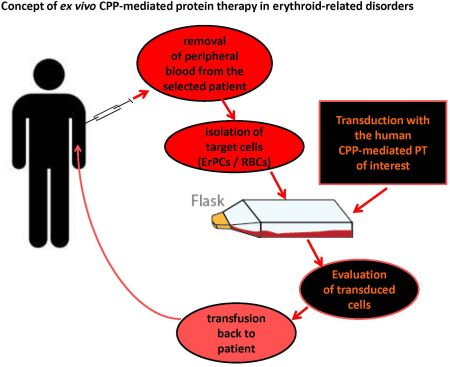
        <p>This task, of course, requires careful study of each particular case of ERDs in order to design the appropriate experimental approach. A number of questions to be considered include: (i) what is the pathobiology of a given ERD; (ii) what type of ErPCs are involved; (iii) how are they characterized in terms of their cell surface antigens and progeny; (iv) what is the missing protein and its corresponding gene; (v) where is this protein located inside the cells; (vi) how does this protein function; and (vii) how shall this protein (PT) of interest be delivered and remain functional (in the form of a newly produced recombinant CPP-mediated PT) for relatively long time.This valuable information is considered essential prior to any design of experiments in order to clone, express and produce the CPP-mediated PT of interest in a highly purified state, biologically active and able to exert its function upon delivery into the target cells. A critical step for the successful treatment of ERDs by protein transduction is the isolation of the candidate recipient cells (target cells), deficient in the protein of interest, prior to transduction experiments. Current technologies, including flow cytometry and cell sorting complemented by functional assays, will be able to facilitate isolation of these target cells. These cells can be removed from the peripheral blood of patients, mobilizated by G-CSF, as it has been followed for HSC-based gene therapy for beta thalassemia [<xref ref-type="bibr" rid="B134-pharmaceuticals-06-00032">134</xref>]. Following characterization, isolated cells will be grown in culture at selective media with minimal manipulation and then be efficiently transduced with the CPP-mediated PT of interest for as long as needed. By the end of loading period, cells will be assessed for the efficiency of protein transduction and functionality, using conventional assays. Stability and biological activity of the transduced CPP-mediated PT are essential to correct the corresponding cellular protein deficiency and allow cells to act properly. Whether the transduced CPP-mediated PT will survive for as long as needed to correct the deficiency in the recipient cells is an issue for investigation. It may be possible for such cells to be submitted to repeated protein transductions in timed intervals. For example, ErPCs and/or RBCs, removed from patients, could be transduced <italic>ex vivo</italic> with the CPP-mediated PT of interest. It has to be tested whether transduction will affect the structural integrity and function of ErPCs and/or RBCs, causing hemolysis or other adverse effects. Furthermore, the transduced CPP-mediated PT is expected to enter the intracellular space and interact properly with other proteins or form functional protein complexes. Full comparability studies using deficient and transduced erythropoietic cells will be carried out in parallel to confirm that protein transduction delivers the intended therapeutic action. Successfully transduced, with the CPP-mediated PT, cells will then be administered back into the patients. In ERDs with aberrant protein located in the mitochondria, like in cases of mitochondrial enzymes ALAS-2 and FECH in X-linked sideroblastic anemia, X-lnked erythropoietic porphyria or erythropoietic protoporphyria, intramitochondrial targeted protein therapy via PTD technology should be applied [<xref ref-type="bibr" rid="B18-pharmaceuticals-06-00032">18</xref>,<xref ref-type="bibr" rid="B119-pharmaceuticals-06-00032">119</xref>].</p>
        <p>Possible therapy of ERDs with the use of CPP-mediated PTs is still in its conceptual stage. At present, efforts can be made: (a) to produce erythroid related proteins (e.g. enzymes or oxygen carrier proteins) as fusion recombinant proteins bearing a CPP; and (b) to transduce them into either HSCs and/or ErPCs - RBCs. Basic studies on protein intracellular delivery, followed by preclinical studies with the use of relevant animal models, are needed to be evaluated, before clinical trials aimed to treat ERDs via CPP-mediated PTs would follow in the future. It is interesting, however, to underline that the field of CPP-mediated therapeutics (biodrugs) keeps growing in other areas of pathological disorders. <xref ref-type="table" rid="pharmaceuticals-06-00032-t003">Table 3</xref> illustrates animal and human studies carried out or being on progress to assess the impact of the PTD technology in the treatment of such disorders. Of course, the roadmap of the development and application of PTD technology “from bench to bed” in people with ERDs is quite long, but is provocative and can be eventually fruitful. </p>
      </sec>
    </sec>
    <sec sec-type="conclusions">
      <title>4. Conclusions and Perspectives</title>
      <p>The development of PTD technology, that uses small peptides (known as CPPs or PTDs) to enable protein cellular uptake into mammalian cells, opened new horizons in ERT/PRT approach of genetic/metabolic diseases. ERDs, like porphyrias, congenital sideroblastic anemias and hemoglobinopathies, result from deficiency of heme biosynthetic enzymes, impaired iron metabolism and absence or mutated globin chains, respectively. There is no current standard therapy of ERDs. However, CPP-mediated PRT emerges as an alternative therapeutic intervention for these disorders, which should follow all the way from “the bench to the bedside”. The results from the ongoing preclinical and clinical trials with CPP-mediated therapeutics in a variety of other disorders can be useful in order to predict the potential of outcome of CPP-mediated PTs in the treatment of ERDs.</p>
    </sec>
    
  </body>
  <back><notes>
      <title>Conflict of Interest</title>
      <p>The authors declare no conflict of interest. </p>
    </notes>
    <ref-list>
      <title>References</title>
      <ref id="B1-pharmaceuticals-06-00032">
        <label>1.</label>
        <citation citation-type="journal">
          <person-group person-group-type="author">
            <name>
              <surname>Tsiftsoglou</surname>
              <given-names>A.S.</given-names>
            </name>
            <name>
              <surname>Vizirianakis</surname>
              <given-names>I.S.</given-names>
            </name>
            <name>
              <surname>Strouboulis</surname>
              <given-names>J.</given-names>
            </name>
          </person-group>
          <article-title>Erythropoiesis: Model systems, molecular regulators, and developmental program</article-title>
          <source>IUBMB Life</source>
          <year>2009</year>
          <volume>61</volume>
          <fpage>800</fpage>
          <lpage>830</lpage>
          <pub-id pub-id-type="doi">10.1002/iub.226</pub-id>
        </citation>
      </ref>
      <ref id="B2-pharmaceuticals-06-00032">
        <label>2.</label>
        <citation citation-type="journal">
          <person-group person-group-type="author">
            <name>
              <surname>Jelkmann</surname>
              <given-names>W.</given-names>
            </name>
          </person-group>
          <article-title>Regulation of erythropoietin production</article-title>
          <source>J. Physiol.</source>
          <year>2011</year>
          <volume>589</volume>
          <fpage>1251</fpage>
          <lpage>1258</lpage>
          <pub-id pub-id-type="doi">10.1113/jphysiol.2010.195057</pub-id>
        </citation>
      </ref>
      <ref id="B3-pharmaceuticals-06-00032">
        <label>3.</label>
        <citation citation-type="journal">
          <person-group person-group-type="author">
            <name>
              <surname>Schechter</surname>
              <given-names>A.N.</given-names>
            </name>
          </person-group>
          <article-title>Hemoglobin research and the origins of molecular medicine</article-title>
          <source>Blood</source>
          <year>2008</year>
          <volume>112</volume>
          <fpage>3927</fpage>
          <lpage>3938</lpage>
          <pub-id pub-id-type="doi">10.1182/blood-2008-04-078188</pub-id>
        </citation>
      </ref>
      <ref id="B4-pharmaceuticals-06-00032">
        <label>4.</label>
        <citation citation-type="journal">
          <person-group person-group-type="author">
            <name>
              <surname>Higgs</surname>
              <given-names>D.R.</given-names>
            </name>
            <name>
              <surname>Engel</surname>
              <given-names>J.D.</given-names>
            </name>
            <name>
              <surname>Stamatoyannopoulos</surname>
              <given-names>G.</given-names>
            </name>
          </person-group>
          <article-title>Thalassaemia</article-title>
          <source>Lancet</source>
          <year>2012</year>
          <volume>379</volume>
          <fpage>373</fpage>
          <lpage>383</lpage>
        <pub-id pub-id-type="doi">10.1016/S0140-6736(11)60283-3</pub-id><pub-id pub-id-type="pmid">21908035</pub-id></citation>
      </ref>
      <ref id="B5-pharmaceuticals-06-00032">
        <label>5.</label>
        <citation citation-type="journal">
          <person-group person-group-type="author">
            <name>
              <surname>An</surname>
              <given-names>X.</given-names>
            </name>
            <name>
              <surname>Mohandas</surname>
              <given-names>N.</given-names>
            </name>
          </person-group>
          <article-title>Disorders of red cell membrane</article-title>
          <source>Br. J. Haematol.</source>
          <year>2008</year>
          <volume>141</volume>
          <fpage>367</fpage>
          <lpage>375</lpage>
        <pub-id pub-id-type="pmid">18341630</pub-id></citation>
      </ref>
      <ref id="B6-pharmaceuticals-06-00032">
        <label>6.</label>
        <citation citation-type="journal">
          <person-group person-group-type="author">
            <name>
              <surname>Foller</surname>
              <given-names>M.</given-names>
            </name>
            <name>
              <surname>Huber</surname>
              <given-names>S.M.</given-names>
            </name>
            <name>
              <surname>Lang</surname>
              <given-names>F.</given-names>
            </name>
          </person-group>
          <article-title>Erythrocyte programmed cell death</article-title>
          <source>IUBMB Life</source>
          <year>2008</year>
          <volume>60</volume>
          <fpage>661</fpage>
          <lpage>668</lpage>
          <pub-id pub-id-type="doi">10.1002/iub.106</pub-id>
        </citation>
      </ref>
      <ref id="B7-pharmaceuticals-06-00032">
        <label>7.</label>
        <citation citation-type="journal">
          <person-group person-group-type="author">
            <name>
              <surname>Voon</surname>
              <given-names>H.P.</given-names>
            </name>
            <name>
              <surname>Vadolas</surname>
              <given-names>J.</given-names>
            </name>
          </person-group>
          <article-title>Controlling alpha-globin: A review of alpha-globin expression and its impact on beta-thalassemia</article-title>
          <source>Haematologica</source>
          <year>2008</year>
          <volume>93</volume>
          <fpage>1868</fpage>
          <lpage>1876</lpage>
          <pub-id pub-id-type="doi">10.3324/haematol.13490</pub-id>
        </citation>
      </ref>
      <ref id="B8-pharmaceuticals-06-00032">
        <label>8.</label>
        <citation citation-type="journal">
          <person-group person-group-type="author">
            <name>
              <surname>Komar</surname>
              <given-names>A.A.</given-names>
            </name>
            <name>
              <surname>Kommer</surname>
              <given-names>A.</given-names>
            </name>
            <name>
              <surname>Krasheninnikov</surname>
              <given-names>I.A.</given-names>
            </name>
            <name>
              <surname>Spirin</surname>
              <given-names>A.S.</given-names>
            </name>
          </person-group>
          <article-title>Cotranslational folding of globin</article-title>
          <source>J. Biol. Chem.</source>
          <year>1997</year>
          <volume>272</volume>
          <fpage>10646</fpage>
          <lpage>10651</lpage>
        <pub-id pub-id-type="doi">10.1074/jbc.272.16.10646</pub-id><pub-id pub-id-type="pmid">9099713</pub-id></citation>
      </ref>
      <ref id="B9-pharmaceuticals-06-00032">
        <label>9.</label>
        <citation citation-type="journal">
          <person-group person-group-type="author">
            <name>
              <surname>Komar</surname>
              <given-names>A.A.</given-names>
            </name>
            <name>
              <surname>Kommer</surname>
              <given-names>A.</given-names>
            </name>
            <name>
              <surname>Krasheninnikov</surname>
              <given-names>I.A.</given-names>
            </name>
            <name>
              <surname>Spirin</surname>
              <given-names>A.S.</given-names>
            </name>
          </person-group>
          <article-title>Cotranslational heme binding to nascent globin chains</article-title>
          <source>FEBS Lett.</source>
          <year>1993</year>
          <volume>326</volume>
          <fpage>261</fpage>
          <lpage>263</lpage>
          <pub-id pub-id-type="doi">10.1016/0014-5793(93)81803-8</pub-id>
        </citation>
      </ref>
      <ref id="B10-pharmaceuticals-06-00032">
        <label>10.</label>
        <citation citation-type="journal">
          <person-group person-group-type="author">
            <name>
              <surname>Mollan</surname>
              <given-names>T.L.</given-names>
            </name>
            <name>
              <surname>Yu</surname>
              <given-names>X.</given-names>
            </name>
            <name>
              <surname>Weiss</surname>
              <given-names>M.J.</given-names>
            </name>
            <name>
              <surname>Olson</surname>
              <given-names>J.S.</given-names>
            </name>
          </person-group>
          <article-title>The role of alpha-hemoglobin stabilizing protein in redox chemistry, denaturation, and hemoglobin assembly</article-title>
          <source>Antioxid Redox Signal.</source>
          <year>2010</year>
          <volume>12</volume>
          <fpage>219</fpage>
          <lpage>231</lpage>
          <pub-id pub-id-type="doi">10.1089/ars.2009.2780</pub-id>
        </citation>
      </ref>
      <ref id="B11-pharmaceuticals-06-00032">
        <label>11.</label>
        <citation citation-type="journal">
          <person-group person-group-type="author">
            <name>
              <surname>Elder</surname>
              <given-names>G.H.</given-names>
            </name>
          </person-group>
          <article-title>Molecular genetics of disorders of haem biosynthesis</article-title>
          <source>J. Clin. Pathol.</source>
          <year>1993</year>
          <volume>46</volume>
          <fpage>977</fpage>
          <lpage>981</lpage>
          <pub-id pub-id-type="doi">10.1136/jcp.46.11.977</pub-id>
        </citation>
      </ref>
      <ref id="B12-pharmaceuticals-06-00032">
        <label>12.</label>
        <citation citation-type="journal">
          <person-group person-group-type="author">
            <name>
              <surname>Tanno</surname>
              <given-names>T.</given-names>
            </name>
            <name>
              <surname>Miller</surname>
              <given-names>J.L.</given-names>
            </name>
          </person-group>
          <article-title>Iron loading and overloading due to ineffective erythropoiesis</article-title>
          <source>Adv. Hematol.</source>
          <year>2010</year>
          <volume>2010</volume>
          <fpage>358283</fpage>
        <pub-id pub-id-type="pmid">20467559</pub-id></citation>
      </ref>
      <ref id="B13-pharmaceuticals-06-00032">
        <label>13.</label>
        <citation citation-type="journal">
          <person-group person-group-type="author">
            <name>
              <surname>Wang</surname>
              <given-names>S.A.</given-names>
            </name>
            <name>
              <surname>Hasserjian</surname>
              <given-names>R.P.</given-names>
            </name>
          </person-group>
          <article-title>Erythroid proliferations in myeloid neoplasms</article-title>
          <source>Hum. Pathol.</source>
          <year>2012</year>
          <volume>43</volume>
          <fpage>153</fpage>
          <lpage>164</lpage>
        <pub-id pub-id-type="doi">10.1016/j.humpath.2011.08.008</pub-id><pub-id pub-id-type="pmid">22154053</pub-id></citation>
      </ref>
      <ref id="B14-pharmaceuticals-06-00032">
        <label>14.</label>
        <citation citation-type="journal">
          <person-group person-group-type="author">
            <name>
              <surname>Kalb</surname>
              <given-names>R.</given-names>
            </name>
            <name>
              <surname>Neveling</surname>
              <given-names>K.</given-names>
            </name>
            <name>
              <surname>Nanda</surname>
              <given-names>I.</given-names>
            </name>
            <name>
              <surname>Schindler</surname>
              <given-names>D.</given-names>
            </name>
            <name>
              <surname>Hoehn</surname>
              <given-names>H.</given-names>
            </name>
          </person-group>
          <article-title>Fanconi anemia: Causes and consequences of genetic instability</article-title>
          <source>Genome Dyn.</source>
          <year>2006</year>
          <volume>1</volume>
          <fpage>218</fpage>
          <lpage>242</lpage>
        <pub-id pub-id-type="pmid">18724063</pub-id></citation>
      </ref>
      <ref id="B15-pharmaceuticals-06-00032">
        <label>15.</label>
        <citation citation-type="journal">
          <person-group person-group-type="author">
            <name>
              <surname>Xu</surname>
              <given-names>X.</given-names>
            </name>
            <name>
              <surname>Qu</surname>
              <given-names>J.</given-names>
            </name>
            <name>
              <surname>Suzuki</surname>
              <given-names>K.</given-names>
            </name>
            <name>
              <surname>Li</surname>
              <given-names>M.</given-names>
            </name>
            <name>
              <surname>Zhang</surname>
              <given-names>W.</given-names>
            </name>
            <name>
              <surname>Liu</surname>
              <given-names>G.H.</given-names>
            </name>
            <name>
              <surname>Izpisua Belmonte</surname>
              <given-names>J.C.</given-names>
            </name>
          </person-group>
          <article-title>Reprogramming based gene therapy for inherited red blood cell disorders</article-title>
          <source>Cell. Res.</source>
          <year>2012</year>
          <volume>22</volume>
          <fpage>941</fpage>
          <lpage>944</lpage>
          <pub-id pub-id-type="doi">10.1038/cr.2012.54</pub-id>
        </citation>
      </ref>
      <ref id="B16-pharmaceuticals-06-00032">
        <label>16.</label>
        <citation citation-type="journal">
          <person-group person-group-type="author">
            <name>
              <surname>Storb</surname>
              <given-names>R.F.</given-names>
            </name>
            <name>
              <surname>Lucarelli</surname>
              <given-names>G.</given-names>
            </name>
            <name>
              <surname>McSweeney</surname>
              <given-names>P.A.</given-names>
            </name>
            <name>
              <surname>Childs</surname>
              <given-names>R.W.</given-names>
            </name>
          </person-group>
          <article-title>Hematopoietic cell transplantation for benign hematological disorders and solid tumors</article-title>
          <source>Hematology Am. Soc. Hematol. Educ. Program.</source>
          <year>2003</year>
          <fpage>372</fpage>
          <lpage>397</lpage>
        </citation>
      </ref>
      <ref id="B17-pharmaceuticals-06-00032">
        <label>17.</label>
        <citation citation-type="journal">
          <person-group person-group-type="author">
            <name>
              <surname>Snyder</surname>
              <given-names>E.L.</given-names>
            </name>
            <name>
              <surname>Dowdy</surname>
              <given-names>S.F.</given-names>
            </name>
          </person-group>
          <article-title>Recent advances in the use of protein transduction domains for the delivery of peptides, proteins and nucleic acids <italic>in vivo</italic></article-title>
          <source>Expert Opin. Drug Deliv.</source>
          <year>2005</year>
          <volume>2</volume>
          <fpage>43</fpage>
          <lpage>51</lpage>
          <pub-id pub-id-type="doi">10.1517/17425247.2.1.43</pub-id>
        </citation>
      </ref>
      <ref id="B18-pharmaceuticals-06-00032">
        <label>18.</label>
        <citation citation-type="journal">
          <person-group person-group-type="author">
            <name>
              <surname>Papadopoulou</surname>
              <given-names>L.C.</given-names>
            </name>
            <name>
              <surname>Tsiftsoglou</surname>
              <given-names>A.S.</given-names>
            </name>
          </person-group>
          <article-title>Transduction of human recombinant proteins into mitochondria as a protein therapeutic approach for mitochondrial disorders</article-title>
          <source>Pharm. Res.</source>
          <year>2011</year>
          <volume>28</volume>
          <fpage>2639</fpage>
          <lpage>2656</lpage>
          <pub-id pub-id-type="doi">10.1007/s11095-011-0546-y</pub-id>
        </citation>
      </ref>
      <ref id="B19-pharmaceuticals-06-00032">
        <label>19.</label>
        <citation citation-type="journal">
          <person-group person-group-type="author">
            <name>
              <surname>Suzuki</surname>
              <given-names>Y.</given-names>
            </name>
          </person-group>
          <article-title>Exploring transduction mechanisms of protein transduction domains (ptds) in living cells utilizing single-quantum dot tracking (sqt) technology</article-title>
          <source>Sensors (Basel)</source>
          <year>2012</year>
          <volume>12</volume>
          <fpage>549</fpage>
          <lpage>572</lpage>
          <pub-id pub-id-type="doi">10.3390/s120100549</pub-id>
        </citation>
      </ref>
      <ref id="B20-pharmaceuticals-06-00032">
        <label>20.</label>
        <citation citation-type="journal">
          <person-group person-group-type="author">
            <name>
              <surname>Fleming</surname>
              <given-names>M.D.</given-names>
            </name>
          </person-group>
          <article-title>Congenital sideroblastic anemias: Iron and heme lost in mitochondrial translation</article-title>
          <source>Hematology Am. Soc. Hematol. Educ. Program.</source>
          <year>2011</year>
          <volume>2011</volume>
          <fpage>525</fpage>
          <lpage>531</lpage>
          <pub-id pub-id-type="doi">10.1182/asheducation-2011.1.525</pub-id>
        </citation>
      </ref>
      <ref id="B21-pharmaceuticals-06-00032">
        <label>21.</label>
        <citation citation-type="journal">
          <person-group person-group-type="author">
            <name>
              <surname>Ajioka</surname>
              <given-names>R.S.</given-names>
            </name>
            <name>
              <surname>Phillips</surname>
              <given-names>J.D.</given-names>
            </name>
            <name>
              <surname>Kushner</surname>
              <given-names>J.P.</given-names>
            </name>
          </person-group>
          <article-title>Biosynthesis of heme in mammals</article-title>
          <source>Biochim. Biophys. Acta</source>
          <year>2006</year>
          <volume>1763</volume>
          <fpage>723</fpage>
          <lpage>736</lpage>
          <pub-id pub-id-type="doi">10.1016/j.bbamcr.2006.05.005</pub-id>
        </citation>
      </ref>
      <ref id="B22-pharmaceuticals-06-00032">
        <label>22.</label>
        <citation citation-type="journal">
          <person-group person-group-type="author">
            <name>
              <surname>Harigae</surname>
              <given-names>H.</given-names>
            </name>
            <name>
              <surname>Furuyama</surname>
              <given-names>K.</given-names>
            </name>
          </person-group>
          <article-title>Hereditary sideroblastic anemia: Pathophysiology and gene mutations</article-title>
          <source>Int.J. Hematol.</source>
          <year>2010</year>
          <volume>92</volume>
          <fpage>425</fpage>
          <lpage>431</lpage>
          <pub-id pub-id-type="doi">10.1007/s12185-010-0688-4</pub-id>
        </citation>
      </ref>
      <ref id="B23-pharmaceuticals-06-00032">
        <label>23.</label>
        <citation citation-type="journal">
          <person-group person-group-type="author">
            <name>
              <surname>Bishop</surname>
              <given-names>D.F.</given-names>
            </name>
            <name>
              <surname>Tchaikovskii</surname>
              <given-names>V.</given-names>
            </name>
            <name>
              <surname>Hoffbrand</surname>
              <given-names>A.V.</given-names>
            </name>
            <name>
              <surname>Fraser</surname>
              <given-names>M.E.</given-names>
            </name>
            <name>
              <surname>Margolis</surname>
              <given-names>S.</given-names>
            </name>
          </person-group>
          <article-title>X-linked sideroblastic anemia due to carboxyl-terminal alas2 mutations that cause loss of binding to the beta-subunit of succinyl-coa synthetase (sucla2)</article-title>
          <source>J. Biol. Chem.</source>
          <year>2012</year>
          <volume>287</volume>
          <fpage>28943</fpage>
          <lpage>28955</lpage>
        <pub-id pub-id-type="doi">10.1074/jbc.M111.306423</pub-id><pub-id pub-id-type="pmid">22740690</pub-id></citation>
      </ref>
      <ref id="B24-pharmaceuticals-06-00032">
        <label>24.</label>
        <citation citation-type="journal">
          <person-group person-group-type="author">
            <name>
              <surname>Tsiftsoglou</surname>
              <given-names>A.S.</given-names>
            </name>
            <name>
              <surname>Tsamadou</surname>
              <given-names>A.I.</given-names>
            </name>
            <name>
              <surname>Papadopoulou</surname>
              <given-names>L.C.</given-names>
            </name>
          </person-group>
          <article-title>Heme as key regulator of major mammalian cellular functions: Molecular, cellular, and pharmacological aspects</article-title>
          <source>Pharmacol. Ther.</source>
          <year>2006</year>
          <volume>111</volume>
          <fpage>327</fpage>
          <lpage>345</lpage>
          <pub-id pub-id-type="doi">10.1016/j.pharmthera.2005.10.017</pub-id>
        </citation>
      </ref>
      <ref id="B25-pharmaceuticals-06-00032">
        <label>25.</label>
        <citation citation-type="journal">
          <person-group person-group-type="author">
            <name>
              <surname>Fontenay</surname>
              <given-names>M.</given-names>
            </name>
            <name>
              <surname>Cathelin</surname>
              <given-names>S.</given-names>
            </name>
            <name>
              <surname>Amiot</surname>
              <given-names>M.</given-names>
            </name>
            <name>
              <surname>Gyan</surname>
              <given-names>E.</given-names>
            </name>
            <name>
              <surname>Solary</surname>
              <given-names>E.</given-names>
            </name>
          </person-group>
          <article-title>Mitochondria in hematopoiesis and hematological diseases</article-title>
          <source>Oncogene</source>
          <year>2006</year>
          <volume>25</volume>
          <fpage>4757</fpage>
          <lpage>4767</lpage>
          <pub-id pub-id-type="doi">10.1038/sj.onc.1209606</pub-id>
        </citation>
      </ref>
      <ref id="B26-pharmaceuticals-06-00032">
        <label>26.</label>
        <citation citation-type="journal">
          <person-group person-group-type="author">
            <name>
              <surname>Cuijpers</surname>
              <given-names>M.L.</given-names>
            </name>
            <name>
              <surname>van Spronsen</surname>
              <given-names>D.J.</given-names>
            </name>
            <name>
              <surname>Muus</surname>
              <given-names>P.</given-names>
            </name>
            <name>
              <surname>Hamel</surname>
              <given-names>B.C.</given-names>
            </name>
            <name>
              <surname>Swinkels</surname>
              <given-names>D.W.</given-names>
            </name>
          </person-group>
          <article-title>Need for early recognition and therapeutic guidelines of congenital sideroblastic anaemia</article-title>
          <source>Int. J. Hematol.</source>
          <year>2011</year>
          <volume>94</volume>
          <fpage>97</fpage>
          <lpage>100</lpage>
          <pub-id pub-id-type="doi">10.1007/s12185-011-0875-y</pub-id>
        </citation>
      </ref>
      <ref id="B27-pharmaceuticals-06-00032">
        <label>27.</label>
        <citation citation-type="journal">
          <person-group person-group-type="author">
            <name>
              <surname>Baumann Kreuziger</surname>
              <given-names>L.M.</given-names>
            </name>
            <name>
              <surname>Wolanskyj</surname>
              <given-names>A.P.</given-names>
            </name>
            <name>
              <surname>Hanson</surname>
              <given-names>C.A.</given-names>
            </name>
            <name>
              <surname>Steensma</surname>
              <given-names>D.P.</given-names>
            </name>
          </person-group>
          <article-title>Lack of efficacy of pyridoxine (vitamin b6) treatment in acquired idiopathic sideroblastic anaemia, including refractory anaemia with ring sideroblasts</article-title>
          <source>Eur. J. Haematol.</source>
          <year>2011</year>
          <volume>86</volume>
          <fpage>512</fpage>
          <lpage>516</lpage>
          <pub-id pub-id-type="doi">10.1111/j.1600-0609.2011.01604.x</pub-id>
        </citation>
      </ref>
      <ref id="B28-pharmaceuticals-06-00032">
        <label>28.</label>
        <citation citation-type="journal">
          <person-group person-group-type="author">
            <name>
              <surname>Guernsey</surname>
              <given-names>D.L.</given-names>
            </name>
            <name>
              <surname>Jiang</surname>
              <given-names>H.</given-names>
            </name>
            <name>
              <surname>Campagna</surname>
              <given-names>D.R.</given-names>
            </name>
            <name>
              <surname>Evans</surname>
              <given-names>S.C.</given-names>
            </name>
            <name>
              <surname>Ferguson</surname>
              <given-names>M.</given-names>
            </name>
            <name>
              <surname>Kellogg</surname>
              <given-names>M.D.</given-names>
            </name>
            <name>
              <surname>Lachance</surname>
              <given-names>M.</given-names>
            </name>
            <name>
              <surname>Matsuoka</surname>
              <given-names>M.</given-names>
            </name>
            <name>
              <surname>Nightingale</surname>
              <given-names>M.</given-names>
            </name>
            <name>
              <surname>Rideout</surname>
              <given-names>A.</given-names>
            </name>
            <name>
              <surname>Saint-Amant</surname>
              <given-names>L.</given-names>
            </name>
            <name>
              <surname>Schmidt</surname>
              <given-names>P.J.</given-names>
            </name>
            <name>
              <surname>Orr</surname>
              <given-names>A.</given-names>
            </name>
            <name>
              <surname>Bottomley</surname>
              <given-names>S.S.</given-names>
            </name>
            <name>
              <surname>Fleming</surname>
              <given-names>M.D.</given-names>
            </name>
            <name>
              <surname>Ludman</surname>
              <given-names>M.</given-names>
            </name>
            <name>
              <surname>Dyack</surname>
              <given-names>S.</given-names>
            </name>
            <name>
              <surname>Fernandez</surname>
              <given-names>C.V.</given-names>
            </name>
            <name>
              <surname>Samuels</surname>
              <given-names>M.E.</given-names>
            </name>
          </person-group>
          <article-title>Mutations in mitochondrial carrier family gene slc25a38 cause nonsyndromic autosomal recessive congenital sideroblastic anemia</article-title>
          <source>Nat. Genet.</source>
          <year>2009</year>
          <volume>41</volume>
          <fpage>651</fpage>
          <lpage>653</lpage>
        <pub-id pub-id-type="doi">10.1038/ng.359</pub-id><pub-id pub-id-type="pmid">19412178</pub-id></citation>
      </ref>
      <ref id="B29-pharmaceuticals-06-00032">
        <label>29.</label>
        <citation citation-type="journal">
          <person-group person-group-type="author">
            <name>
              <surname>Khan</surname>
              <given-names>A.A.</given-names>
            </name>
            <name>
              <surname>Quigley</surname>
              <given-names>J.G.</given-names>
            </name>
          </person-group>
          <article-title>Control of intracellular heme levels: Heme transporters and heme oxygenases</article-title>
          <source>Biochim. Biophys. Acta</source>
          <year>2011</year>
          <volume>1813</volume>
          <fpage>668</fpage>
          <lpage>682</lpage>
          <pub-id pub-id-type="doi">10.1016/j.bbamcr.2011.01.008</pub-id>
        </citation>
      </ref>
      <ref id="B30-pharmaceuticals-06-00032">
        <label>30.</label>
        <citation citation-type="journal">
          <person-group person-group-type="author">
            <name>
              <surname>Zutz</surname>
              <given-names>A.</given-names>
            </name>
            <name>
              <surname>Gompf</surname>
              <given-names>S.</given-names>
            </name>
            <name>
              <surname>Schagger</surname>
              <given-names>H.</given-names>
            </name>
            <name>
              <surname>Tampe</surname>
              <given-names>R.</given-names>
            </name>
          </person-group>
          <article-title>Mitochondrial abc proteins in health and disease</article-title>
          <source>Biochim. Biophys. Acta</source>
          <year>2009</year>
          <volume>1787</volume>
          <fpage>681</fpage>
          <lpage>690</lpage>
          <pub-id pub-id-type="doi">10.1016/j.bbabio.2009.02.009</pub-id>
        </citation>
      </ref>
      <ref id="B31-pharmaceuticals-06-00032">
        <label>31.</label>
        <citation citation-type="journal">
          <person-group person-group-type="author">
            <name>
              <surname>Allikmets</surname>
              <given-names>R.</given-names>
            </name>
            <name>
              <surname>Raskind</surname>
              <given-names>W.H.</given-names>
            </name>
            <name>
              <surname>Hutchinson</surname>
              <given-names>A.</given-names>
            </name>
            <name>
              <surname>Schueck</surname>
              <given-names>N.D.</given-names>
            </name>
            <name>
              <surname>Dean</surname>
              <given-names>M.</given-names>
            </name>
            <name>
              <surname>Koeller</surname>
              <given-names>D.M.</given-names>
            </name>
          </person-group>
          <article-title>Mutation of a putative mitochondrial iron transporter gene (abc7) in x-linked sideroblastic anemia and ataxia (xlsa/a)</article-title>
          <source>Hum. Mol. Genet.</source>
          <year>1999</year>
          <volume>8</volume>
          <fpage>743</fpage>
          <lpage>749</lpage>
          <pub-id pub-id-type="doi">10.1093/hmg/8.5.743</pub-id>
        </citation>
      </ref>
      <ref id="B32-pharmaceuticals-06-00032">
        <label>32.</label>
        <citation citation-type="journal">
          <person-group person-group-type="author">
            <name>
              <surname>Ye</surname>
              <given-names>H.</given-names>
            </name>
            <name>
              <surname>Jeong</surname>
              <given-names>S.Y.</given-names>
            </name>
            <name>
              <surname>Ghosh</surname>
              <given-names>M.C.</given-names>
            </name>
            <name>
              <surname>Kovtunovych</surname>
              <given-names>G.</given-names>
            </name>
            <name>
              <surname>Silvestri</surname>
              <given-names>L.</given-names>
            </name>
            <name>
              <surname>Ortillo</surname>
              <given-names>D.</given-names>
            </name>
            <name>
              <surname>Uchida</surname>
              <given-names>N.</given-names>
            </name>
            <name>
              <surname>Tisdale</surname>
              <given-names>J.</given-names>
            </name>
            <name>
              <surname>Camaschella</surname>
              <given-names>C.</given-names>
            </name>
            <name>
              <surname>Rouault</surname>
              <given-names>T.A.</given-names>
            </name>
          </person-group>
          <article-title>Glutaredoxin 5 deficiency causes sideroblastic anemia by specifically impairing heme biosynthesis and depleting cytosolic iron in human erythroblasts</article-title>
          <source>J. Clin. Invest.</source>
          <year>2010</year>
          <volume>120</volume>
          <fpage>1749</fpage>
          <lpage>1761</lpage>
          <pub-id pub-id-type="doi">10.1172/JCI40372</pub-id>
        </citation>
      </ref>
      <ref id="B33-pharmaceuticals-06-00032">
        <label>33.</label>
        <citation citation-type="journal">
          <person-group person-group-type="author">
            <name>
              <surname>Pearson</surname>
              <given-names>H.A.</given-names>
            </name>
            <name>
              <surname>Lobel</surname>
              <given-names>J.S.</given-names>
            </name>
            <name>
              <surname>Kocoshis</surname>
              <given-names>S.A.</given-names>
            </name>
            <name>
              <surname>Naiman</surname>
              <given-names>J.L.</given-names>
            </name>
            <name>
              <surname>Windmiller</surname>
              <given-names>J.</given-names>
            </name>
            <name>
              <surname>Lammi</surname>
              <given-names>A.T.</given-names>
            </name>
            <name>
              <surname>Hoffman</surname>
              <given-names>R.</given-names>
            </name>
            <name>
              <surname>Marsh</surname>
              <given-names>J.C.</given-names>
            </name>
          </person-group>
          <article-title>A new syndrome of refractory sideroblastic anemia with vacuolization of marrow precursors and exocrine pancreatic dysfunction</article-title>
          <source>J. Pediatr.</source>
          <year>1979</year>
          <volume>95</volume>
          <fpage>976</fpage>
          <lpage>984</lpage>
          <pub-id pub-id-type="doi">10.1016/S0022-3476(79)80286-3</pub-id>
        </citation>
      </ref>
      <ref id="B34-pharmaceuticals-06-00032">
        <label>34.</label>
        <citation citation-type="journal">
          <person-group person-group-type="author">
            <name>
              <surname>Rawles</surname>
              <given-names>J.M.</given-names>
            </name>
            <name>
              <surname>Weller</surname>
              <given-names>R.O.</given-names>
            </name>
          </person-group>
          <article-title>Familial association of metabolic myopathy, lactic acidosis and sideroblastic anemia</article-title>
          <source>Am. J. Med.</source>
          <year>1974</year>
          <volume>56</volume>
          <fpage>891</fpage>
          <lpage>897</lpage>
          <pub-id pub-id-type="doi">10.1016/0002-9343(74)90820-1</pub-id>
        </citation>
      </ref>
      <ref id="B35-pharmaceuticals-06-00032">
        <label>35.</label>
        <citation citation-type="journal">
          <person-group person-group-type="author">
            <name>
              <surname>Porter</surname>
              <given-names>F.S.</given-names>
            </name>
            <name>
              <surname>Rogers</surname>
              <given-names>L.E.</given-names>
            </name>
            <name>
              <surname>Sidbury</surname>
              <given-names>J.B.</given-names>
              <suffix>Jr.</suffix>
            </name>
          </person-group>
          <article-title>Thiamine-responsive megaloblastic anemia</article-title>
          <source>J. Pediatr.</source>
          <year>1969</year>
          <volume>74</volume>
          <fpage>494</fpage>
          <lpage>504</lpage>
          <pub-id pub-id-type="doi">10.1016/S0022-3476(69)80031-4</pub-id>
        </citation>
      </ref>
      <ref id="B36-pharmaceuticals-06-00032">
        <label>36.</label>
        <citation citation-type="journal">
          <person-group person-group-type="author">
            <name>
              <surname>Siegesmund</surname>
              <given-names>M.</given-names>
            </name>
            <name>
              <surname>van Tuyll van Serooskerken</surname>
              <given-names>A.M.</given-names>
            </name>
            <name>
              <surname>Poblete-Gutierrez</surname>
              <given-names>P.</given-names>
            </name>
            <name>
              <surname>Frank</surname>
              <given-names>J.</given-names>
            </name>
          </person-group>
          <article-title>The acute hepatic porphyrias: Current status and future challenges</article-title>
          <source>Best Pract. Res. Clin. Gastroenterol.</source>
          <year>2010</year>
          <volume>24</volume>
          <fpage>593</fpage>
          <lpage>605</lpage>
          <pub-id pub-id-type="doi">10.1016/j.bpg.2010.08.010</pub-id>
        </citation>
      </ref>
      <ref id="B37-pharmaceuticals-06-00032">
        <label>37.</label>
        <citation citation-type="journal">
          <person-group person-group-type="author">
            <name>
              <surname>Hift</surname>
              <given-names>R.J.</given-names>
            </name>
            <name>
              <surname>Thunell</surname>
              <given-names>S.</given-names>
            </name>
            <name>
              <surname>Brun</surname>
              <given-names>A.</given-names>
            </name>
          </person-group>
          <article-title>Drugs in porphyria: From observation to a modern algorithm-based system for the prediction of porphyrogenicity</article-title>
          <source>Pharmacol.Ther.</source>
          <year>2011</year>
          <volume>132</volume>
          <fpage>158</fpage>
          <lpage>169</lpage>
          <pub-id pub-id-type="doi">10.1016/j.pharmthera.2011.06.001</pub-id>
        </citation>
      </ref>
      <ref id="B38-pharmaceuticals-06-00032">
        <label>38.</label>
        <citation citation-type="journal">
          <person-group person-group-type="author">
            <name>
              <surname>Cappellini</surname>
              <given-names>M.D.</given-names>
            </name>
            <name>
              <surname>Brancaleoni</surname>
              <given-names>V.</given-names>
            </name>
            <name>
              <surname>Graziadei</surname>
              <given-names>G.</given-names>
            </name>
            <name>
              <surname>Tavazzi</surname>
              <given-names>D.</given-names>
            </name>
            <name>
              <surname>Di Pierro</surname>
              <given-names>E.</given-names>
            </name>
          </person-group>
          <article-title>Porphyrias at a glance: Diagnosis and treatment</article-title>
          <source>Intern. Emerg. Med.</source>
          <year>2010</year>
          <volume>5</volume>
		  <supplement>(Suppl. 1)</supplement>
          <fpage>S73</fpage>
          <lpage>80</lpage>
        <pub-id pub-id-type="doi">10.1007/s11739-010-0449-7</pub-id><pub-id pub-id-type="pmid">20865478</pub-id></citation>
      </ref>
      <ref id="B39-pharmaceuticals-06-00032">
        <label>39.</label>
        <citation citation-type="journal">
          <person-group person-group-type="author">
            <name>
              <surname>Hunter</surname>
              <given-names>G.A.</given-names>
            </name>
            <name>
              <surname>Ferreira</surname>
              <given-names>G.C.</given-names>
            </name>
          </person-group>
          <article-title>Molecular enzymology of 5-aminolevulinate synthase, the gatekeeper of heme biosynthesis</article-title>
          <source>Biochim. Biophys. Acta</source>
          <year>2011</year>
          <volume>1814</volume>
          <fpage>1467</fpage>
          <lpage>1473</lpage>
          <pub-id pub-id-type="doi">10.1016/j.bbapap.2010.12.015</pub-id>
        </citation>
      </ref>
      <ref id="B40-pharmaceuticals-06-00032">
        <label>40.</label>
        <citation citation-type="journal">
          <person-group person-group-type="author">
            <name>
              <surname>Schmitt</surname>
              <given-names>C.</given-names>
            </name>
            <name>
              <surname>Ducamp</surname>
              <given-names>S.</given-names>
            </name>
            <name>
              <surname>Gouya</surname>
              <given-names>L.</given-names>
            </name>
            <name>
              <surname>Deybach</surname>
              <given-names>J.C.</given-names>
            </name>
            <name>
              <surname>Puy</surname>
              <given-names>H.</given-names>
            </name>
          </person-group>
          <article-title>[inheritance in erythropoietic protoporphyria]</article-title>
          <source>Pathol. Biol. (Paris)</source>
          <year>2010</year>
          <volume>58</volume>
          <fpage>372</fpage>
          <lpage>380</lpage>
          <pub-id pub-id-type="doi">10.1016/j.patbio.2010.01.007</pub-id>
        </citation>
      </ref>
      <ref id="B41-pharmaceuticals-06-00032">
        <label>41.</label>
        <citation citation-type="journal">
          <person-group person-group-type="author">
            <name>
              <surname>Phillips</surname>
              <given-names>J.D.</given-names>
            </name>
            <name>
              <surname>Steensma</surname>
              <given-names>D.P.</given-names>
            </name>
            <name>
              <surname>Pulsipher</surname>
              <given-names>M.A.</given-names>
            </name>
            <name>
              <surname>Spangrude</surname>
              <given-names>G.J.</given-names>
            </name>
            <name>
              <surname>Kushner</surname>
              <given-names>J.P.</given-names>
            </name>
          </person-group>
          <article-title>Congenital erythropoietic porphyria due to a mutation in gata1: The first trans-acting mutation causative for a human porphyria</article-title>
          <source>Blood</source>
          <year>2007</year>
          <volume>109</volume>
          <fpage>2618</fpage>
          <lpage>2621</lpage>
          <pub-id pub-id-type="doi">10.1182/blood-2006-06-022848</pub-id>
        </citation>
      </ref>
      <ref id="B42-pharmaceuticals-06-00032">
        <label>42.</label>
        <citation citation-type="journal">
          <person-group person-group-type="author">
            <name>
              <surname>May</surname>
              <given-names>B.K.</given-names>
            </name>
            <name>
              <surname>Dogra</surname>
              <given-names>S.C.</given-names>
            </name>
            <name>
              <surname>Sadlon</surname>
              <given-names>T.J.</given-names>
            </name>
            <name>
              <surname>Bhasker</surname>
              <given-names>C.R.</given-names>
            </name>
            <name>
              <surname>Cox</surname>
              <given-names>T.C.</given-names>
            </name>
            <name>
              <surname>Bottomley</surname>
              <given-names>S.S.</given-names>
            </name>
          </person-group>
          <article-title>Molecular regulation of heme biosynthesis in higher vertebrates</article-title>
          <source>Prog. Nucleic. Acid. Res. Mol. Biol.</source>
          <year>1995</year>
          <volume>51</volume>
          <fpage>1</fpage>
          <lpage>51</lpage>
          <pub-id pub-id-type="doi">10.1016/S0079-6603(08)60875-2</pub-id>
        </citation>
      </ref>
      <ref id="B43-pharmaceuticals-06-00032">
        <label>43.</label>
        <citation citation-type="journal">
          <person-group person-group-type="author">
            <name>
              <surname>Simon</surname>
              <given-names>N.G.</given-names>
            </name>
            <name>
              <surname>Herkes</surname>
              <given-names>G.K.</given-names>
            </name>
          </person-group>
          <article-title>The neurologic manifestations of the acute porphyrias</article-title>
          <source>J. Clin. Neurosci.</source>
          <year>2011</year>
          <volume>18</volume>
          <fpage>1147</fpage>
          <lpage>1153</lpage>
          <pub-id pub-id-type="doi">10.1016/j.jocn.2011.01.003</pub-id>
        </citation>
      </ref>
      <ref id="B44-pharmaceuticals-06-00032">
        <label>44.</label>
        <citation citation-type="journal">
          <person-group person-group-type="author">
            <name>
              <surname>Perutz</surname>
              <given-names>M.F.</given-names>
            </name>
            <name>
              <surname>Lehmann</surname>
              <given-names>H.</given-names>
            </name>
          </person-group>
          <article-title>Molecular pathology of human haemoglobin</article-title>
          <source>Nature</source>
          <year>1968</year>
          <volume>219</volume>
          <fpage>902</fpage>
          <lpage>909</lpage>
          <pub-id pub-id-type="doi">10.1038/219902a0</pub-id>
        </citation>
      </ref>
      <ref id="B45-pharmaceuticals-06-00032">
        <label>45.</label>
        <citation citation-type="journal">
          <person-group person-group-type="author">
            <name>
              <surname>Angastiniotis</surname>
              <given-names>M.</given-names>
            </name>
            <name>
              <surname>Modell</surname>
              <given-names>B.</given-names>
            </name>
          </person-group>
          <article-title>Global epidemiology of hemoglobin disorders</article-title>
          <source>Ann. N Y Acad. Sci.</source>
          <year>1998</year>
          <volume>850</volume>
          <fpage>251</fpage>
          <lpage>269</lpage>
          <pub-id pub-id-type="doi">10.1111/j.1749-6632.1998.tb10482.x</pub-id>
        </citation>
      </ref>
      <ref id="B46-pharmaceuticals-06-00032">
        <label>46.</label>
        <citation citation-type="journal">
          <person-group person-group-type="author">
            <name>
              <surname>Birgens</surname>
              <given-names>H.</given-names>
            </name>
            <name>
              <surname>Ljung</surname>
              <given-names>R.</given-names>
            </name>
          </person-group>
          <article-title>The thalassaemia syndromes</article-title>
          <source>Scand. J. Clin. Lab. Invest.</source>
          <year>2007</year>
          <volume>67</volume>
          <fpage>11</fpage>
          <lpage>25</lpage>
          <pub-id pub-id-type="doi">10.1080/00365510601046417</pub-id>
        </citation>
      </ref>
      <ref id="B47-pharmaceuticals-06-00032">
        <label>47.</label>
        <citation citation-type="journal">
          <person-group person-group-type="author">
            <name>
              <surname>Weatherall</surname>
              <given-names>D.J.</given-names>
            </name>
          </person-group>
          <article-title>Thalassemia as a global health problem: Recent progress toward its control in the developing countries</article-title>
          <source>Ann. N Y Acad. Sci.</source>
          <year>2010</year>
          <volume>1202</volume>
          <fpage>17</fpage>
          <lpage>23</lpage>
          <pub-id pub-id-type="doi">10.1111/j.1749-6632.2010.05546.x</pub-id>
        </citation>
      </ref>
      <ref id="B48-pharmaceuticals-06-00032">
        <label>48.</label>
        <citation citation-type="journal">
          <person-group person-group-type="author">
            <name>
              <surname>Weatherall</surname>
              <given-names>D.J.</given-names>
            </name>
          </person-group>
          <article-title>Genetic variation and susceptibility to infection: The red cell and malaria</article-title>
          <source>Br. J. Haematol.</source>
          <year>2008</year>
          <volume>141</volume>
          <fpage>276</fpage>
          <lpage>286</lpage>
          <pub-id pub-id-type="doi">10.1111/j.1365-2141.2008.07085.x</pub-id>
        </citation>
      </ref>
      <ref id="B49-pharmaceuticals-06-00032">
        <label>49.</label>
        <citation citation-type="journal">
          <person-group person-group-type="author">
            <name>
              <surname>Giardine</surname>
              <given-names>B.</given-names>
            </name>
            <name>
              <surname>van Baal</surname>
              <given-names>S.</given-names>
            </name>
            <name>
              <surname>Kaimakis</surname>
              <given-names>P.</given-names>
            </name>
            <name>
              <surname>Riemer</surname>
              <given-names>C.</given-names>
            </name>
            <name>
              <surname>Miller</surname>
              <given-names>W.</given-names>
            </name>
            <name>
              <surname>Samara</surname>
              <given-names>M.</given-names>
            </name>
            <name>
              <surname>Kollia</surname>
              <given-names>P.</given-names>
            </name>
            <name>
              <surname>Anagnou</surname>
              <given-names>N.P.</given-names>
            </name>
            <name>
              <surname>Chui</surname>
              <given-names>D.H.</given-names>
            </name>
            <name>
              <surname>Wajcman</surname>
              <given-names>H.</given-names>
            </name>
            <name>
              <surname>Hardison</surname>
              <given-names>R.C.</given-names>
            </name>
            <name>
              <surname>Patrinos</surname>
              <given-names>G.P.</given-names>
            </name>
          </person-group>
          <article-title>Hbvar database of human hemoglobin variants and thalassemia mutations: 2007 update</article-title>
          <source>Hum. Mutat.</source>
          <year>2007</year>
          <volume>28</volume>
          <fpage>206</fpage>
        <pub-id pub-id-type="pmid">17221865</pub-id></citation>
      </ref>
      <ref id="B50-pharmaceuticals-06-00032">
        <label>50.</label>
        <citation citation-type="journal">
          <person-group person-group-type="author">
            <name>
              <surname>Urbinati</surname>
              <given-names>F.</given-names>
            </name>
            <name>
              <surname>Madigan</surname>
              <given-names>C.</given-names>
            </name>
            <name>
              <surname>Malik</surname>
              <given-names>P.</given-names>
            </name>
          </person-group>
          <article-title>Pathophysiology and therapy for haemoglobinopathies. Part ii: Thalassaemias</article-title>
          <source>Expert Rev. Mol. Med.</source>
          <year>2006</year>
          <volume>8</volume>
          <fpage>1</fpage>
          <lpage>26</lpage>
        <pub-id pub-id-type="pmid">17178008</pub-id></citation>
      </ref>
      <ref id="B51-pharmaceuticals-06-00032">
        <label>51.</label>
        <citation citation-type="journal">
          <person-group person-group-type="author">
            <name>
              <surname>Muncie</surname>
              <given-names>H.L.</given-names>
              <suffix>Jr.</suffix>
            </name>
            <name>
              <surname>Campbell</surname>
              <given-names>J.</given-names>
            </name>
          </person-group>
          <article-title>Alpha and beta thalassemia</article-title>
          <source>Am. Fam. Physician</source>
          <year>2009</year>
          <volume>80</volume>
          <fpage>339</fpage>
          <lpage>344</lpage>
        <pub-id pub-id-type="pmid">19678601</pub-id></citation>
      </ref>
      <ref id="B52-pharmaceuticals-06-00032">
        <label>52.</label>
        <citation citation-type="journal">
          <person-group person-group-type="author">
            <name>
              <surname>Harteveld</surname>
              <given-names>C.L.</given-names>
            </name>
            <name>
              <surname>Higgs</surname>
              <given-names>D.R.</given-names>
            </name>
          </person-group>
          <article-title>Alpha-thalassaemia</article-title>
          <source>Orphanet. J. Rare Dis.</source>
          <year>2010</year>
          <volume>5</volume>
          <fpage>13</fpage>
          <pub-id pub-id-type="doi">10.1186/1750-1172-5-13</pub-id>
        </citation>
      </ref>
      <ref id="B53-pharmaceuticals-06-00032">
        <label>53.</label>
        <citation citation-type="journal">
          <person-group person-group-type="author">
            <name>
              <surname>Bourantas</surname>
              <given-names>K.</given-names>
            </name>
            <name>
              <surname>Economou</surname>
              <given-names>G.</given-names>
            </name>
            <name>
              <surname>Georgiou</surname>
              <given-names>J.</given-names>
            </name>
          </person-group>
          <article-title>Administration of high doses of recombinant human erythropoietin to patients with beta-thalassemia intermedia: A preliminary trial</article-title>
          <source>Eur. J. Haematol.</source>
          <year>1997</year>
          <volume>58</volume>
          <fpage>22</fpage>
          <lpage>25</lpage>
        <pub-id pub-id-type="pmid">9020369</pub-id></citation>
      </ref>
      <ref id="B54-pharmaceuticals-06-00032">
        <label>54.</label>
        <citation citation-type="journal">
          <person-group person-group-type="author">
            <name>
              <surname>Gambari</surname>
              <given-names>R.</given-names>
            </name>
          </person-group>
          <article-title>Alternative options for DNA-based experimental therapy of beta-thalassemia</article-title>
          <source>Expert Opin. Biol. Ther.</source>
          <year>2012</year>
          <volume>12</volume>
          <fpage>443</fpage>
          <lpage>462</lpage>
          <pub-id pub-id-type="doi">10.1517/14712598.2012.665047</pub-id>
        </citation>
      </ref>
      <ref id="B55-pharmaceuticals-06-00032">
        <label>55.</label>
        <citation citation-type="journal">
          <person-group person-group-type="author">
            <name>
              <surname>Stamatoyannopoulos</surname>
              <given-names>G.</given-names>
            </name>
          </person-group>
          <article-title>Control of globin gene expression during development and erythroid differentiation</article-title>
          <source>Exp. Hematol.</source>
          <year>2005</year>
          <volume>33</volume>
          <fpage>259</fpage>
          <lpage>271</lpage>
          <pub-id pub-id-type="doi">10.1016/j.exphem.2004.11.007</pub-id>
        </citation>
      </ref>
      <ref id="B56-pharmaceuticals-06-00032">
        <label>56.</label>
        <citation citation-type="journal">
          <person-group person-group-type="author">
            <name>
              <surname>Hankins</surname>
              <given-names>J.</given-names>
            </name>
            <name>
              <surname>Aygun</surname>
              <given-names>B.</given-names>
            </name>
          </person-group>
          <article-title>Pharmacotherapy in sickle cell disease--state of the art and future prospects</article-title>
          <source>Br. J. Haematol</source>
          <year>2009</year>
          <volume>145</volume>
          <fpage>296</fpage>
          <lpage>308</lpage>
          <pub-id pub-id-type="doi">10.1111/j.1365-2141.2009.07602.x</pub-id>
        </citation>
      </ref>
      <ref id="B57-pharmaceuticals-06-00032">
        <label>57.</label>
        <citation citation-type="journal">
          <person-group person-group-type="author">
            <name>
              <surname>Ataga</surname>
              <given-names>K.I.</given-names>
            </name>
          </person-group>
          <article-title>Novel therapies in sickle cell disease</article-title>
          <source>Hematology Am. Soc. Hematol. Educ. Program.</source>
          <year>2009</year>
          <fpage>54</fpage>
          <lpage>61</lpage>
          <pub-id pub-id-type="doi">10.1182/asheducation-2009.1.54</pub-id>
        </citation>
      </ref>
      <ref id="B58-pharmaceuticals-06-00032">
        <label>58.</label>
        <citation citation-type="journal">
          <person-group person-group-type="author">
            <name>
              <surname>Elborai</surname>
              <given-names>Y.</given-names>
            </name>
            <name>
              <surname>Uwumugambi</surname>
              <given-names>A.</given-names>
            </name>
            <name>
              <surname>Lehmann</surname>
              <given-names>L.</given-names>
            </name>
          </person-group>
          <article-title>Hematopoietic stem cell transplantation for thalassemia</article-title>
          <source>Immunotherapy</source>
          <year>2012</year>
          <volume>4</volume>
          <fpage>947</fpage>
          <lpage>956</lpage>
          <pub-id pub-id-type="doi">10.2217/imt.12.95</pub-id>
        </citation>
      </ref>
      <ref id="B59-pharmaceuticals-06-00032">
        <label>59.</label>
        <citation citation-type="journal">
          <person-group person-group-type="author">
            <name>
              <surname>Mogul</surname>
              <given-names>M.J.</given-names>
            </name>
          </person-group>
          <article-title>Unrelated cord blood transplantation vs matched unrelated donor bone marrow transplantation: The risks and benefits of each choice</article-title>
          <source>Bone Marrow Transplant.</source>
          <year>2000</year>
          <volume>25</volume>
		  <supplement>Suppl 2</supplement>
          <fpage>S58</fpage>
          <lpage>60</lpage>
          <pub-id pub-id-type="doi">10.1038/sj.bmt.1702372</pub-id>
        </citation>
      </ref>
      <ref id="B60-pharmaceuticals-06-00032">
        <label>60.</label>
        <citation citation-type="journal">
          <person-group person-group-type="author">
            <name>
              <surname>Quek</surname>
              <given-names>L.</given-names>
            </name>
            <name>
              <surname>Thein</surname>
              <given-names>S.L.</given-names>
            </name>
          </person-group>
          <article-title>Molecular therapies in beta-thalassaemia</article-title>
          <source>Br. J. Haematol.</source>
          <year>2007</year>
          <volume>136</volume>
          <fpage>353</fpage>
          <lpage>365</lpage>
          <pub-id pub-id-type="doi">10.1111/j.1365-2141.2006.06408.x</pub-id>
        </citation>
      </ref>
      <ref id="B61-pharmaceuticals-06-00032">
        <label>61.</label>
        <citation citation-type="journal">
          <person-group person-group-type="author">
            <name>
              <surname>Cavazzana-Calvo</surname>
              <given-names>M.</given-names>
            </name>
            <name>
              <surname>Payen</surname>
              <given-names>E.</given-names>
            </name>
            <name>
              <surname>Negre</surname>
              <given-names>O.</given-names>
            </name>
            <name>
              <surname>Wang</surname>
              <given-names>G.</given-names>
            </name>
            <name>
              <surname>Hehir</surname>
              <given-names>K.</given-names>
            </name>
            <name>
              <surname>Fusil</surname>
              <given-names>F.</given-names>
            </name>
            <name>
              <surname>Down</surname>
              <given-names>J.</given-names>
            </name>
            <name>
              <surname>Denaro</surname>
              <given-names>M.</given-names>
            </name>
            <name>
              <surname>Brady</surname>
              <given-names>T.</given-names>
            </name>
            <name>
              <surname>Westerman</surname>
              <given-names>K.</given-names>
            </name>
            <name>
              <surname>Cavallesco</surname>
              <given-names>R.</given-names>
            </name>
            <name>
              <surname>Gillet-Legrand</surname>
              <given-names>B.</given-names>
            </name>
            <name>
              <surname>Caccavelli</surname>
              <given-names>L.</given-names>
            </name>
            <name>
              <surname>Sgarra</surname>
              <given-names>R.</given-names>
            </name>
            <name>
              <surname>Maouche-Chretien</surname>
              <given-names>L.</given-names>
            </name>
            <name>
              <surname>Bernaudin</surname>
              <given-names>F.</given-names>
            </name>
            <name>
              <surname>Girot</surname>
              <given-names>R.</given-names>
            </name>
            <name>
              <surname>Dorazio</surname>
              <given-names>R.</given-names>
            </name>
            <name>
              <surname>Mulder</surname>
              <given-names>G.J.</given-names>
            </name>
            <name>
              <surname>Polack</surname>
              <given-names>A.</given-names>
            </name>
            <name>
              <surname>Bank</surname>
              <given-names>A.</given-names>
            </name>
            <name>
              <surname>Soulier</surname>
              <given-names>J.</given-names>
            </name>
            <name>
              <surname>Larghero</surname>
              <given-names>J.</given-names>
            </name>
            <name>
              <surname>Kabbara</surname>
              <given-names>N.</given-names>
            </name>
            <name>
              <surname>Dalle</surname>
              <given-names>B.</given-names>
            </name>
            <name>
              <surname>Gourmel</surname>
              <given-names>B.</given-names>
            </name>
            <name>
              <surname>Socie</surname>
              <given-names>G.</given-names>
            </name>
            <name>
              <surname>Chretien</surname>
              <given-names>S.</given-names>
            </name>
            <name>
              <surname>Cartier</surname>
              <given-names>N.</given-names>
            </name>
            <name>
              <surname>Aubourg</surname>
              <given-names>P.</given-names>
            </name>
            <name>
              <surname>Fischer</surname>
              <given-names>A.</given-names>
            </name>
            <name>
              <surname>Cornetta</surname>
              <given-names>K.</given-names>
            </name>
            <name>
              <surname>Galacteros</surname>
              <given-names>F.</given-names>
            </name>
            <name>
              <surname>Beuzard</surname>
              <given-names>Y.</given-names>
            </name>
            <name>
              <surname>Gluckman</surname>
              <given-names>E.</given-names>
            </name>
            <name>
              <surname>Bushman</surname>
              <given-names>F.</given-names>
            </name>
            <name>
              <surname>Hacein-Bey-Abina</surname>
              <given-names>S.</given-names>
            </name>
            <name>
              <surname>Leboulch</surname>
              <given-names>P.</given-names>
            </name>
          </person-group>
          <article-title>Transfusion independence and hmga2 activation after gene therapy of human beta-thalassaemia</article-title>
          <source>Nature</source>
          <year>2010</year>
          <volume>467</volume>
          <fpage>318</fpage>
          <lpage>322</lpage>
        <pub-id pub-id-type="doi">10.1038/nature09328</pub-id><pub-id pub-id-type="pmid">20844535</pub-id></citation>
      </ref>
      <ref id="B62-pharmaceuticals-06-00032">
        <label>62.</label>
        <citation citation-type="journal">
          <person-group person-group-type="author">
            <name>
              <surname>Sarakul</surname>
              <given-names>O.</given-names>
            </name>
            <name>
              <surname>Vattanaviboon</surname>
              <given-names>P.</given-names>
            </name>
            <name>
              <surname>Wilairat</surname>
              <given-names>P.</given-names>
            </name>
            <name>
              <surname>Fucharoen</surname>
              <given-names>S.</given-names>
            </name>
            <name>
              <surname>Abe</surname>
              <given-names>Y.</given-names>
            </name>
            <name>
              <surname>Muta</surname>
              <given-names>K.</given-names>
            </name>
          </person-group>
          <article-title>Inhibition of alpha-globin gene expression by rnai</article-title>
          <source>Biochem. Biophys. Res. Commun.</source>
          <year>2008</year>
          <volume>369</volume>
          <fpage>935</fpage>
          <lpage>938</lpage>
          <pub-id pub-id-type="doi">10.1016/j.bbrc.2008.02.124</pub-id>
        </citation>
      </ref>
      <ref id="B63-pharmaceuticals-06-00032">
        <label>63.</label>
        <citation citation-type="journal">
          <person-group person-group-type="author">
            <name>
              <surname>Vadolas</surname>
              <given-names>J.</given-names>
            </name>
            <name>
              <surname>Wardan</surname>
              <given-names>H.</given-names>
            </name>
            <name>
              <surname>Orford</surname>
              <given-names>M.</given-names>
            </name>
            <name>
              <surname>Williamson</surname>
              <given-names>R.</given-names>
            </name>
            <name>
              <surname>Ioannou</surname>
              <given-names>P.A.</given-names>
            </name>
          </person-group>
          <article-title>Cellular genomic reporter assays for screening and evaluation of inducers of fetal hemoglobin</article-title>
          <source>Hum. Mol. Genet.</source>
          <year>2004</year>
          <volume>13</volume>
          <fpage>223</fpage>
          <lpage>233</lpage>
        <pub-id pub-id-type="pmid">14645208</pub-id></citation>
      </ref>
      <ref id="B64-pharmaceuticals-06-00032">
        <label>64.</label>
        <citation citation-type="journal">
          <person-group person-group-type="author">
            <name>
              <surname>Rees</surname>
              <given-names>D.C.</given-names>
            </name>
            <name>
              <surname>Williams</surname>
              <given-names>T.N.</given-names>
            </name>
            <name>
              <surname>Gladwin</surname>
              <given-names>M.T.</given-names>
            </name>
          </person-group>
          <article-title>Sickle-cell disease</article-title>
          <source>Lancet</source>
          <year>2010</year>
          <volume>376</volume>
          <fpage>2018</fpage>
          <lpage>2031</lpage>
          <pub-id pub-id-type="doi">10.1016/S0140-6736(10)61029-X</pub-id>
        </citation>
      </ref>
      <ref id="B65-pharmaceuticals-06-00032">
        <label>65.</label>
        <citation citation-type="journal">
          <person-group person-group-type="author">
            <name>
              <surname>Boosalis</surname>
              <given-names>M.S.</given-names>
            </name>
            <name>
              <surname>Castaneda</surname>
              <given-names>S.A.</given-names>
            </name>
            <name>
              <surname>Trudel</surname>
              <given-names>M.</given-names>
            </name>
            <name>
              <surname>Mabaera</surname>
              <given-names>R.</given-names>
            </name>
            <name>
              <surname>White</surname>
              <given-names>G.L.</given-names>
            </name>
            <name>
              <surname>Lowrey</surname>
              <given-names>C.H.</given-names>
            </name>
            <name>
              <surname>Emery</surname>
              <given-names>D.W.</given-names>
            </name>
            <name>
              <surname>Mpollo</surname>
              <given-names>M.S.</given-names>
            </name>
            <name>
              <surname>Shen</surname>
              <given-names>L.</given-names>
            </name>
            <name>
              <surname>Wargin</surname>
              <given-names>W.A.</given-names>
            </name>
            <name>
              <surname>Bohacek</surname>
              <given-names>R.</given-names>
            </name>
            <name>
              <surname>Faller</surname>
              <given-names>D.V.</given-names>
            </name>
            <name>
              <surname>Perrine</surname>
              <given-names>S.P.</given-names>
            </name>
          </person-group>
          <article-title>Novel therapeutic candidates, identified by molecular modeling, induce gamma-globin gene expression in vivo</article-title>
          <source>Blood Cells Mol. Dis.</source>
          <year>2011</year>
          <volume>47</volume>
          <fpage>107</fpage>
          <lpage>116</lpage>
          <pub-id pub-id-type="doi">10.1016/j.bcmd.2011.04.008</pub-id>
        </citation>
      </ref>
      <ref id="B66-pharmaceuticals-06-00032">
        <label>66.</label>
        <citation citation-type="journal">
          <person-group person-group-type="author">
            <name>
              <surname>Samakoglu</surname>
              <given-names>S.</given-names>
            </name>
            <name>
              <surname>Lisowski</surname>
              <given-names>L.</given-names>
            </name>
            <name>
              <surname>Budak-Alpdogan</surname>
              <given-names>T.</given-names>
            </name>
            <name>
              <surname>Usachenko</surname>
              <given-names>Y.</given-names>
            </name>
            <name>
              <surname>Acuto</surname>
              <given-names>S.</given-names>
            </name>
            <name>
              <surname>Di Marzo</surname>
              <given-names>R.</given-names>
            </name>
            <name>
              <surname>Maggio</surname>
              <given-names>A.</given-names>
            </name>
            <name>
              <surname>Zhu</surname>
              <given-names>P.</given-names>
            </name>
            <name>
              <surname>Tisdale</surname>
              <given-names>J.F.</given-names>
            </name>
            <name>
              <surname>Riviere</surname>
              <given-names>I.</given-names>
            </name>
            <name>
              <surname>Sadelain</surname>
              <given-names>M.</given-names>
            </name>
          </person-group>
          <article-title>A genetic strategy to treat sickle cell anemia by coregulating globin transgene expression and rna interference</article-title>
          <source>Nat. Biotechnol.</source>
          <year>2006</year>
          <volume>24</volume>
          <fpage>89</fpage>
          <lpage>94</lpage>
          <pub-id pub-id-type="doi">10.1038/nbt1176</pub-id>
        </citation>
      </ref>
      <ref id="B67-pharmaceuticals-06-00032">
        <label>67.</label>
        <citation citation-type="journal">
          <person-group person-group-type="author">
            <name>
              <surname>Hanna</surname>
              <given-names>J.</given-names>
            </name>
            <name>
              <surname>Wernig</surname>
              <given-names>M.</given-names>
            </name>
            <name>
              <surname>Markoulaki</surname>
              <given-names>S.</given-names>
            </name>
            <name>
              <surname>Sun</surname>
              <given-names>C.W.</given-names>
            </name>
            <name>
              <surname>Meissner</surname>
              <given-names>A.</given-names>
            </name>
            <name>
              <surname>Cassady</surname>
              <given-names>J.P.</given-names>
            </name>
            <name>
              <surname>Beard</surname>
              <given-names>C.</given-names>
            </name>
            <name>
              <surname>Brambrink</surname>
              <given-names>T.</given-names>
            </name>
            <name>
              <surname>Wu</surname>
              <given-names>L.C.</given-names>
            </name>
            <name>
              <surname>Townes</surname>
              <given-names>T.M.</given-names>
            </name>
            <name>
              <surname>Jaenisch</surname>
              <given-names>R.</given-names>
            </name>
          </person-group>
          <article-title>Treatment of sickle cell anemia mouse model with ips cells generated from autologous skin</article-title>
          <source>Science</source>
          <year>2007</year>
          <volume>318</volume>
          <fpage>1920</fpage>
          <lpage>1923</lpage>
          <pub-id pub-id-type="doi">10.1126/science.1152092</pub-id>
        </citation>
      </ref>
      <ref id="B68-pharmaceuticals-06-00032">
        <label>68.</label>
        <citation citation-type="journal">
          <person-group person-group-type="author">
            <name>
              <surname>Douay</surname>
              <given-names>L.</given-names>
            </name>
          </person-group>
          <article-title>In vitro generation of red blood cells for transfusion: A model for regenerative medicine</article-title>
          <source>Regen. Med.</source>
          <year>2012</year>
          <volume>7</volume>
          <fpage>1</fpage>
          <lpage>2</lpage>
          <pub-id pub-id-type="doi">10.2217/rme.11.108</pub-id>
        </citation>
      </ref>
      <ref id="B69-pharmaceuticals-06-00032">
        <label>69.</label>
        <citation citation-type="journal">
          <person-group person-group-type="author">
            <name>
              <surname>Migliaccio</surname>
              <given-names>A.R.</given-names>
            </name>
            <name>
              <surname>Masselli</surname>
              <given-names>E.</given-names>
            </name>
            <name>
              <surname>Varricchio</surname>
              <given-names>L.</given-names>
            </name>
            <name>
              <surname>Whitsett</surname>
              <given-names>C.</given-names>
            </name>
          </person-group>
          <article-title>Ex-vivo expansion of red blood cells: How real for transfusion in humans?</article-title>
          <source>Blood Rev.</source>
          <year>2012</year>
          <volume>26</volume>
          <fpage>81</fpage>
          <lpage>95</lpage>
          <pub-id pub-id-type="doi">10.1016/j.blre.2011.11.002</pub-id>
        </citation>
      </ref>
      <ref id="B70-pharmaceuticals-06-00032">
        <label>70.</label>
        <citation citation-type="journal">
          <person-group person-group-type="author">
            <name>
              <surname>Stephens</surname>
              <given-names>D.J.</given-names>
            </name>
            <name>
              <surname>Pepperkok</surname>
              <given-names>R.</given-names>
            </name>
          </person-group>
          <article-title>The many ways to cross the plasma membrane</article-title>
          <source>Proc. Natl. Acad. Sci. USA</source>
          <year>2001</year>
          <volume>98</volume>
          <fpage>4295</fpage>
          <lpage>4298</lpage>
          <pub-id pub-id-type="doi">10.1073/pnas.081065198</pub-id>
        </citation>
      </ref>
      <ref id="B71-pharmaceuticals-06-00032">
        <label>71.</label>
        <citation citation-type="journal">
          <person-group person-group-type="author">
            <name>
              <surname>Fawell</surname>
              <given-names>S.</given-names>
            </name>
            <name>
              <surname>Seery</surname>
              <given-names>J.</given-names>
            </name>
            <name>
              <surname>Daikh</surname>
              <given-names>Y.</given-names>
            </name>
            <name>
              <surname>Moore</surname>
              <given-names>C.</given-names>
            </name>
            <name>
              <surname>Chen</surname>
              <given-names>L.L.</given-names>
            </name>
            <name>
              <surname>Pepinsky</surname>
              <given-names>B.</given-names>
            </name>
            <name>
              <surname>Barsoum</surname>
              <given-names>J.</given-names>
            </name>
          </person-group>
          <article-title>Tat-mediated delivery of heterologous proteins into cells</article-title>
          <source>Proc. Natl. Acad. Sci. USA</source>
          <year>1994</year>
          <volume>91</volume>
          <fpage>664</fpage>
          <lpage>668</lpage>
          <pub-id pub-id-type="doi">10.1073/pnas.91.2.664</pub-id>
        </citation>
      </ref>
      <ref id="B72-pharmaceuticals-06-00032">
        <label>72.</label>
        <citation citation-type="journal">
          <person-group person-group-type="author">
            <name>
              <surname>Derossi</surname>
              <given-names>D.</given-names>
            </name>
            <name>
              <surname>Joliot</surname>
              <given-names>A.H.</given-names>
            </name>
            <name>
              <surname>Chassaing</surname>
              <given-names>G.</given-names>
            </name>
            <name>
              <surname>Prochiantz</surname>
              <given-names>A.</given-names>
            </name>
          </person-group>
          <article-title>The third helix of the antennapedia homeodomain translocates through biological membranes</article-title>
          <source>J. Biol. Chem.</source>
          <year>1994</year>
          <volume>269</volume>
          <fpage>10444</fpage>
          <lpage>10450</lpage>
        <pub-id pub-id-type="pmid">8144628</pub-id></citation>
      </ref>
      <ref id="B73-pharmaceuticals-06-00032">
        <label>73.</label>
        <citation citation-type="journal">
          <person-group person-group-type="author">
            <name>
              <surname>Frankel</surname>
              <given-names>A.D.</given-names>
            </name>
            <name>
              <surname>Pabo</surname>
              <given-names>C.O.</given-names>
            </name>
          </person-group>
          <article-title>Cellular uptake of the tat protein from human immunodeficiency virus</article-title>
          <source>Cell</source>
          <year>1988</year>
          <volume>55</volume>
          <fpage>1189</fpage>
          <lpage>1193</lpage>
          <pub-id pub-id-type="doi">10.1016/0092-8674(88)90263-2</pub-id>
        </citation>
      </ref>
      <ref id="B74-pharmaceuticals-06-00032">
        <label>74.</label>
        <citation citation-type="journal">
          <person-group person-group-type="author">
            <name>
              <surname>Brasseur</surname>
              <given-names>R.</given-names>
            </name>
            <name>
              <surname>Divita</surname>
              <given-names>G.</given-names>
            </name>
          </person-group>
          <article-title>Happy birthday cell penetrating peptides: Already 20years</article-title>
          <source>Biochim. Biophys. Acta</source>
          <year>2010</year>
          <volume>1798</volume>
          <fpage>2177</fpage>
          <lpage>2181</lpage>
          <pub-id pub-id-type="doi">10.1016/j.bbamem.2010.09.001</pub-id>
        </citation>
      </ref>
      <ref id="B75-pharmaceuticals-06-00032">
        <label>75.</label>
        <citation citation-type="journal">
          <person-group person-group-type="author">
            <name>
              <surname>Vives</surname>
              <given-names>E.</given-names>
            </name>
          </person-group>
          <article-title>Present and future of cell-penetrating peptide mediated delivery systems: "Is the trojan horse too wild to go only to troy?"</article-title>
          <source>J. Control. Release</source>
          <year>2005</year>
          <volume>109</volume>
          <fpage>77</fpage>
          <lpage>85</lpage>
          <pub-id pub-id-type="doi">10.1016/j.jconrel.2005.09.032</pub-id>
        </citation>
      </ref>
      <ref id="B76-pharmaceuticals-06-00032">
        <label>76.</label>
        <citation citation-type="journal">
          <person-group person-group-type="author">
            <name>
              <surname>Snyder</surname>
              <given-names>E.L.</given-names>
            </name>
            <name>
              <surname>Dowdy</surname>
              <given-names>S.F.</given-names>
            </name>
          </person-group>
          <article-title>Cell penetrating peptides in drug delivery</article-title>
          <source>Pharm Res.</source>
          <year>2004</year>
          <volume>21</volume>
          <fpage>389</fpage>
          <lpage>393</lpage>
          <pub-id pub-id-type="doi">10.1023/B:PHAM.0000019289.61978.f5</pub-id>
        </citation>
      </ref>
      <ref id="B77-pharmaceuticals-06-00032">
        <label>77.</label>
        <citation citation-type="journal">
          <person-group person-group-type="author">
            <name>
              <surname>Eguchi</surname>
              <given-names>A.</given-names>
            </name>
            <name>
              <surname>Dowdy</surname>
              <given-names>S.F.</given-names>
            </name>
          </person-group>
          <article-title>Sirna delivery using peptide transduction domains</article-title>
          <source>Trends Pharmacol. Sci.</source>
          <year>2009</year>
          <volume>30</volume>
          <fpage>341</fpage>
          <lpage>345</lpage>
          <pub-id pub-id-type="doi">10.1016/j.tips.2009.04.009</pub-id>
        </citation>
      </ref>
      <ref id="B78-pharmaceuticals-06-00032">
        <label>78.</label>
        <citation citation-type="journal">
          <person-group person-group-type="author">
            <name>
              <surname>El Andaloussi</surname>
              <given-names>S.A.</given-names>
            </name>
            <name>
              <surname>Hammond</surname>
              <given-names>S.M.</given-names>
            </name>
            <name>
              <surname>Mager</surname>
              <given-names>I.</given-names>
            </name>
            <name>
              <surname>Wood</surname>
              <given-names>M.J.</given-names>
            </name>
          </person-group>
          <article-title>Use of cell-penetrating-peptides in oligonucleotide splice switching therapy</article-title>
          <source>Curr. Gene Ther.</source>
          <year>2012</year>
          <volume>12</volume>
          <fpage>161</fpage>
          <lpage>178</lpage>
          <pub-id pub-id-type="doi">10.2174/156652312800840612</pub-id>
        </citation>
      </ref>
      <ref id="B79-pharmaceuticals-06-00032">
        <label>79.</label>
        <citation citation-type="journal">
          <person-group person-group-type="author">
            <name>
              <surname>Gautam</surname>
              <given-names>A.</given-names>
            </name>
            <name>
              <surname>Singh</surname>
              <given-names>H.</given-names>
            </name>
            <name>
              <surname>Tyagi</surname>
              <given-names>A.</given-names>
            </name>
            <name>
              <surname>Chaudhary</surname>
              <given-names>K.</given-names>
            </name>
            <name>
              <surname>Kumar</surname>
              <given-names>R.</given-names>
            </name>
            <name>
              <surname>Kapoor</surname>
              <given-names>P.</given-names>
            </name>
            <name>
              <surname>Raghava</surname>
              <given-names>G.P. </given-names>
            </name>
          </person-group>
          <article-title>Cppsite: A curated database of cell penetrating peptides</article-title>
          <source>Database (Oxford)</source>
          <year>2012</year>
          <volume>2012</volume>
          <fpage>bas015</fpage>
        <pub-id pub-id-type="doi">10.1093/database/bas015</pub-id></citation>
      </ref>
      <ref id="B80-pharmaceuticals-06-00032">
        <label>80.</label>
        <citation citation-type="journal">
          <person-group person-group-type="author">
            <name>
              <surname>Milletti</surname>
              <given-names>F.</given-names>
            </name>
          </person-group>
          <article-title>Cell-penetrating peptides: Classes, origin, and current landscape</article-title>
          <source>Drug Discov. Today</source>
          <year>2012</year>
          <volume>17</volume>
          <fpage>850</fpage>
          <lpage>860</lpage>
          <pub-id pub-id-type="doi">10.1016/j.drudis.2012.03.002</pub-id>
        </citation>
      </ref>
      <ref id="B81-pharmaceuticals-06-00032">
        <label>81.</label>
        <citation citation-type="journal">
          <person-group person-group-type="author">
            <name>
              <surname>Schwarze</surname>
              <given-names>S.R.</given-names>
            </name>
            <name>
              <surname>Ho</surname>
              <given-names>A.</given-names>
            </name>
            <name>
              <surname>Vocero-Akbani</surname>
              <given-names>A.</given-names>
            </name>
            <name>
              <surname>Dowdy</surname>
              <given-names>S.F.</given-names>
            </name>
          </person-group>
          <article-title>In vivo protein transduction: Delivery of a biologically active protein into the mouse</article-title>
          <source>Science</source>
          <year>1999</year>
          <volume>285</volume>
          <fpage>1569</fpage>
          <lpage>1572</lpage>
          <pub-id pub-id-type="doi">10.1126/science.285.5433.1569</pub-id>
        </citation>
      </ref>
      <ref id="B82-pharmaceuticals-06-00032">
        <label>82.</label>
        <citation citation-type="journal">
          <person-group person-group-type="author">
            <name>
              <surname>Elliott</surname>
              <given-names>G.</given-names>
            </name>
            <name>
              <surname>O'Hare</surname>
              <given-names>P.</given-names>
            </name>
          </person-group>
          <article-title>Intercellular trafficking and protein delivery by a herpesvirus structural protein</article-title>
          <source>Cell</source>
          <year>1997</year>
          <volume>88</volume>
          <fpage>223</fpage>
          <lpage>233</lpage>
          <pub-id pub-id-type="doi">10.1016/S0092-8674(00)81843-7</pub-id>
        </citation>
      </ref>
      <ref id="B83-pharmaceuticals-06-00032">
        <label>83.</label>
        <citation citation-type="journal">
          <person-group person-group-type="author">
            <name>
              <surname>Futaki</surname>
              <given-names>S.</given-names>
            </name>
            <name>
              <surname>Suzuki</surname>
              <given-names>T.</given-names>
            </name>
            <name>
              <surname>Ohashi</surname>
              <given-names>W.</given-names>
            </name>
            <name>
              <surname>Yagami</surname>
              <given-names>T.</given-names>
            </name>
            <name>
              <surname>Tanaka</surname>
              <given-names>S.</given-names>
            </name>
            <name>
              <surname>Ueda</surname>
              <given-names>K.</given-names>
            </name>
            <name>
              <surname>Sugiura</surname>
              <given-names>Y. </given-names>
            </name>
          </person-group>
          <article-title>Arginine-rich peptides. An abundant source of membrane-permeable peptides having potential as carriers for intracellular protein delivery</article-title>
          <source>J. Biol. Chem.</source>
          <year>2001</year>
          <volume>276</volume>
          <fpage>5836</fpage>
          <lpage>5840</lpage>
        <pub-id pub-id-type="doi">10.1074/jbc.M007540200</pub-id><pub-id pub-id-type="pmid">11084031</pub-id></citation>
      </ref>
      <ref id="B84-pharmaceuticals-06-00032">
        <label>84.</label>
        <citation citation-type="journal">
          <person-group person-group-type="author">
            <name>
              <surname>Wender</surname>
              <given-names>P.A.</given-names>
            </name>
            <name>
              <surname>Cooley</surname>
              <given-names>C.B.</given-names>
            </name>
            <name>
              <surname>Geihe</surname>
              <given-names>E.I.</given-names>
            </name>
          </person-group>
          <article-title>Beyond cell penetrating peptides: Designed molecular transporters</article-title>
          <source>Drug Discov. Today Technol.</source>
          <year>2012</year>
          <volume>9</volume>
          <fpage>e49</fpage>
          <lpage>e55</lpage>
          <pub-id pub-id-type="doi">10.1016/j.ddtec.2011.07.004</pub-id>
        </citation>
      </ref>
      <ref id="B85-pharmaceuticals-06-00032">
        <label>85.</label>
        <citation citation-type="journal">
          <person-group person-group-type="author">
            <name>
              <surname>Lindgren</surname>
              <given-names>M.</given-names>
            </name>
            <name>
              <surname>Gallet</surname>
              <given-names>X.</given-names>
            </name>
            <name>
              <surname>Soomets</surname>
              <given-names>U.</given-names>
            </name>
            <name>
              <surname>Hallbrink</surname>
              <given-names>M.</given-names>
            </name>
            <name>
              <surname>Brakenhielm</surname>
              <given-names>E.</given-names>
            </name>
            <name>
              <surname>Pooga</surname>
              <given-names>M.</given-names>
            </name>
            <name>
              <surname>Brasseur</surname>
              <given-names>R.</given-names>
            </name>
            <name>
              <surname>Langel</surname>
              <given-names>U.</given-names>
            </name>
          </person-group>
          <article-title>Translocation properties of novel cell penetrating transportan and penetratin analogues</article-title>
          <source>Bioconjug. Chem.</source>
          <year>2000</year>
          <volume>11</volume>
          <fpage>619</fpage>
          <lpage>626</lpage>
          <pub-id pub-id-type="doi">10.1021/bc990156s</pub-id>
        </citation>
      </ref>
      <ref id="B86-pharmaceuticals-06-00032">
        <label>86.</label>
        <citation citation-type="journal">
          <person-group person-group-type="author">
            <name>
              <surname>Soomets</surname>
              <given-names>U.</given-names>
            </name>
            <name>
              <surname>Lindgren</surname>
              <given-names>M.</given-names>
            </name>
            <name>
              <surname>Gallet</surname>
              <given-names>X.</given-names>
            </name>
            <name>
              <surname>Hallbrink</surname>
              <given-names>M.</given-names>
            </name>
            <name>
              <surname>Elmquist</surname>
              <given-names>A.</given-names>
            </name>
            <name>
              <surname>Balaspiri</surname>
              <given-names>L.</given-names>
            </name>
            <name>
              <surname>Zorko</surname>
              <given-names>M.</given-names>
            </name>
            <name>
              <surname>Pooga</surname>
              <given-names>M.</given-names>
            </name>
            <name>
              <surname>Brasseur</surname>
              <given-names>R.</given-names>
            </name>
            <name>
              <surname>Langel</surname>
              <given-names>U.</given-names>
            </name>
          </person-group>
          <article-title>Deletion analogues of transportan</article-title>
          <source>Biochim. Biophys. Acta</source>
          <year>2000</year>
          <volume>1467</volume>
          <fpage>165</fpage>
          <lpage>176</lpage>
          <pub-id pub-id-type="doi">10.1016/S0005-2736(00)00216-9</pub-id>
        </citation>
      </ref>
      <ref id="B87-pharmaceuticals-06-00032">
        <label>87.</label>
        <citation citation-type="journal">
          <person-group person-group-type="author">
            <name>
              <surname>Elmquist</surname>
              <given-names>A.</given-names>
            </name>
            <name>
              <surname>Lindgren</surname>
              <given-names>M.</given-names>
            </name>
            <name>
              <surname>Bartfai</surname>
              <given-names>T.</given-names>
            </name>
            <name>
              <surname>Langel</surname>
              <given-names>U.</given-names>
            </name>
          </person-group>
          <article-title>Ve-cadherin-derived cell-penetrating peptide, pvec, with carrier function</article-title>
          <source>Exp. Cell. Res.</source>
          <year>2001</year>
          <volume>269</volume>
          <fpage>237</fpage>
          <lpage>244</lpage>
          <pub-id pub-id-type="doi">10.1006/excr.2001.5316</pub-id>
        </citation>
      </ref>
      <ref id="B88-pharmaceuticals-06-00032">
        <label>88.</label>
        <citation citation-type="journal">
          <person-group person-group-type="author">
            <name>
              <surname>Gros</surname>
              <given-names>E.</given-names>
            </name>
            <name>
              <surname>Deshayes</surname>
              <given-names>S.</given-names>
            </name>
            <name>
              <surname>Morris</surname>
              <given-names>M.C.</given-names>
            </name>
            <name>
              <surname>Aldrian-Herrada</surname>
              <given-names>G.</given-names>
            </name>
            <name>
              <surname>Depollier</surname>
              <given-names>J.</given-names>
            </name>
            <name>
              <surname>Heitz</surname>
              <given-names>F.</given-names>
            </name>
            <name>
              <surname>Divita</surname>
              <given-names>G.</given-names>
            </name>
          </person-group>
          <article-title>A non-covalent peptide-based strategy for protein and peptide nucleic acid transduction</article-title>
          <source>Biochim. Biophys. Acta</source>
          <year>2006</year>
          <volume>1758</volume>
          <fpage>384</fpage>
          <lpage>393</lpage>
          <pub-id pub-id-type="doi">10.1016/j.bbamem.2006.02.006</pub-id>
        </citation>
      </ref>
      <ref id="B89-pharmaceuticals-06-00032">
        <label>89.</label>
        <citation citation-type="journal">
          <person-group person-group-type="author">
            <name>
              <surname>Rhee</surname>
              <given-names>M.</given-names>
            </name>
            <name>
              <surname>Davis</surname>
              <given-names>P.</given-names>
            </name>
          </person-group>
          <article-title>Mechanism of uptake of c105y, a novel cell-penetrating peptide</article-title>
          <source>J. Biol. Chem.</source>
          <year>2006</year>
          <volume>281</volume>
          <fpage>1233</fpage>
          <lpage>1240</lpage>
          <pub-id pub-id-type="doi">10.1074/jbc.M509813200</pub-id>
        </citation>
      </ref>
      <ref id="B90-pharmaceuticals-06-00032">
        <label>90.</label>
        <citation citation-type="journal">
          <person-group person-group-type="author">
            <name>
              <surname>Crombez</surname>
              <given-names>L.</given-names>
            </name>
            <name>
              <surname>Aldrian-Herrada</surname>
              <given-names>G.</given-names>
            </name>
            <name>
              <surname>Konate</surname>
              <given-names>K.</given-names>
            </name>
            <name>
              <surname>Nguyen</surname>
              <given-names>Q.N.</given-names>
            </name>
            <name>
              <surname>McMaster</surname>
              <given-names>G.K.</given-names>
            </name>
            <name>
              <surname>Brasseur</surname>
              <given-names>R.</given-names>
            </name>
            <name>
              <surname>Heitz</surname>
              <given-names>F.</given-names>
            </name>
            <name>
              <surname>Divita</surname>
              <given-names>G.</given-names>
            </name>
          </person-group>
          <article-title>A new potent secondary amphipathic cell-penetrating peptide for sirna delivery into mammalian cells</article-title>
          <source>Mol. Ther.</source>
          <year>2009</year>
          <volume>17</volume>
          <fpage>95</fpage>
          <lpage>103</lpage>
          <pub-id pub-id-type="doi">10.1038/mt.2008.215</pub-id>
        </citation>
      </ref>
      <ref id="B91-pharmaceuticals-06-00032">
        <label>91.</label>
        <citation citation-type="journal">
          <person-group person-group-type="author">
            <name>
              <surname>Kalafut</surname>
              <given-names>D.</given-names>
            </name>
            <name>
              <surname>Anderson</surname>
              <given-names>T.N.</given-names>
            </name>
            <name>
              <surname>Chmielewski</surname>
              <given-names>J.</given-names>
            </name>
          </person-group>
          <article-title>Mitochondrial targeting of a cationic amphiphilic polyproline helix</article-title>
          <source>Bioorg Med. Chem. Lett.</source>
          <year>2012</year>
          <volume>22</volume>
          <fpage>561</fpage>
          <lpage>563</lpage>
        <pub-id pub-id-type="doi">10.1016/j.bmcl.2011.10.077</pub-id><pub-id pub-id-type="pmid">22130131</pub-id></citation>
      </ref>
      <ref id="B92-pharmaceuticals-06-00032">
        <label>92.</label>
        <citation citation-type="journal">
          <person-group person-group-type="author">
            <name>
              <surname>Green</surname>
              <given-names>I.</given-names>
            </name>
            <name>
              <surname>Christison</surname>
              <given-names>R.</given-names>
            </name>
            <name>
              <surname>Voyce</surname>
              <given-names>C.J.</given-names>
            </name>
            <name>
              <surname>Bundell</surname>
              <given-names>K.R.</given-names>
            </name>
            <name>
              <surname>Lindsay</surname>
              <given-names>M.A.</given-names>
            </name>
          </person-group>
          <article-title>Protein transduction domains: Are they delivering?</article-title>
          <source>Trends Pharmacol. Sci.</source>
          <year>2003</year>
          <volume>24</volume>
          <fpage>213</fpage>
          <lpage>215</lpage>
          <pub-id pub-id-type="doi">10.1016/S0165-6147(03)00076-2</pub-id>
        </citation>
      </ref>
      <ref id="B93-pharmaceuticals-06-00032">
        <label>93.</label>
        <citation citation-type="journal">
          <person-group person-group-type="author">
            <name>
              <surname>Fischer</surname>
              <given-names>R.</given-names>
            </name>
            <name>
              <surname>Fotin-Mleczek</surname>
              <given-names>M.</given-names>
            </name>
            <name>
              <surname>Hufnagel</surname>
              <given-names>H.</given-names>
            </name>
            <name>
              <surname>Brock</surname>
              <given-names>R.</given-names>
            </name>
          </person-group>
          <article-title>Break on through to the other side-biophysics and cell biology shed light on cell-penetrating peptides</article-title>
          <source>Chembiochem</source>
          <year>2005</year>
          <volume>6</volume>
          <fpage>2126</fpage>
          <lpage>2142</lpage>
          <pub-id pub-id-type="doi">10.1002/cbic.200500044</pub-id>
        </citation>
      </ref>
      <ref id="B94-pharmaceuticals-06-00032">
        <label>94.</label>
        <citation citation-type="journal">
          <person-group person-group-type="author">
            <name>
              <surname>Mueller</surname>
              <given-names>J.</given-names>
            </name>
            <name>
              <surname>Kretzschmar</surname>
              <given-names>I.</given-names>
            </name>
            <name>
              <surname>Volkmer</surname>
              <given-names>R.</given-names>
            </name>
            <name>
              <surname>Boisguerin</surname>
              <given-names>P.</given-names>
            </name>
          </person-group>
          <article-title>Comparison of cellular uptake using 22 cpps in 4 different cell lines</article-title>
          <source>Bioconjug. Chem.</source>
          <year>2008</year>
          <volume>19</volume>
          <fpage>2363</fpage>
          <lpage>2374</lpage>
          <pub-id pub-id-type="doi">10.1021/bc800194e</pub-id>
        </citation>
      </ref>
      <ref id="B95-pharmaceuticals-06-00032">
        <label>95.</label>
        <citation citation-type="journal">
          <person-group person-group-type="author">
            <name>
              <surname>Koren</surname>
              <given-names>E.</given-names>
            </name>
            <name>
              <surname>Torchilin</surname>
              <given-names>V.P.</given-names>
            </name>
          </person-group>
          <article-title>Cell-penetrating peptides: Breaking through to the other side</article-title>
          <source>Trends Mol. Med.</source>
          <year>2012</year>
          <volume>18</volume>
          <fpage>385</fpage>
          <lpage>393</lpage>
          <pub-id pub-id-type="doi">10.1016/j.molmed.2012.04.012</pub-id>
        </citation>
      </ref>
      <ref id="B96-pharmaceuticals-06-00032">
        <label>96.</label>
        <citation citation-type="journal">
          <person-group person-group-type="author">
            <name>
              <surname>Jones</surname>
              <given-names>A.T.</given-names>
            </name>
            <name>
              <surname>Sayers</surname>
              <given-names>E.J.</given-names>
            </name>
          </person-group>
          <article-title>Cell entry of cell penetrating peptides: Tales of tails wagging dogs</article-title>
          <source>J. Control. Release</source>
          <year>2012</year>
          <volume>161</volume>
          <fpage>582</fpage>
          <lpage>591</lpage>
          <pub-id pub-id-type="doi">10.1016/j.jconrel.2012.04.003</pub-id>
        </citation>
      </ref>
      <ref id="B97-pharmaceuticals-06-00032">
        <label>97.</label>
        <citation citation-type="journal">
          <person-group person-group-type="author">
            <name>
              <surname>Sung</surname>
              <given-names>M.</given-names>
            </name>
            <name>
              <surname>Poon</surname>
              <given-names>G.M.</given-names>
            </name>
            <name>
              <surname>Gariepy</surname>
              <given-names>J.</given-names>
            </name>
          </person-group>
          <article-title>The importance of valency in enhancing the import and cell routing potential of protein transduction domain-containing molecules</article-title>
          <source>Biochim Biophys Acta</source>
          <year>2006</year>
          <volume>1758</volume>
          <fpage>355</fpage>
          <lpage>363</lpage>
          <pub-id pub-id-type="doi">10.1016/j.bbamem.2005.11.016</pub-id>
        </citation>
      </ref>
      <ref id="B98-pharmaceuticals-06-00032">
        <label>98.</label>
        <citation citation-type="journal">
          <person-group person-group-type="author">
            <name>
              <surname>Vocero-Akbani</surname>
              <given-names>A.</given-names>
            </name>
            <name>
              <surname>Lissy</surname>
              <given-names>N.A.</given-names>
            </name>
            <name>
              <surname>Dowdy</surname>
              <given-names>S.F.</given-names>
            </name>
          </person-group>
          <article-title>Transduction of full-length tat fusion proteins directly into mammalian cells: Analysis of t cell receptor activation-induced cell death</article-title>
          <source>Methods Enzymol.</source>
          <year>2000</year>
          <volume>322</volume>
          <fpage>508</fpage>
          <lpage>521</lpage>
          <pub-id pub-id-type="doi">10.1016/S0076-6879(00)22046-6</pub-id>
        </citation>
      </ref>
      <ref id="B99-pharmaceuticals-06-00032">
        <label>99.</label>
        <citation citation-type="journal">
          <person-group person-group-type="author">
            <name>
              <surname>Foltopoulou</surname>
              <given-names>P.F.</given-names>
            </name>
            <name>
              <surname>Tsiftsoglou</surname>
              <given-names>A.S.</given-names>
            </name>
            <name>
              <surname>Bonovolias</surname>
              <given-names>I.D.</given-names>
            </name>
            <name>
              <surname>Ingendoh</surname>
              <given-names>A.T.</given-names>
            </name>
            <name>
              <surname>Papadopoulou</surname>
              <given-names>L.C.</given-names>
            </name>
          </person-group>
          <article-title>Intracellular delivery of full length recombinant human mitochondrial l-sco2 protein into the mitochondria of permanent cell lines and sco2 deficient patient's primary cells</article-title>
          <source>Biochim. Biophys. Acta</source>
          <year>2010</year>
          <volume>1802</volume>
          <fpage>497</fpage>
          <lpage>508</lpage>
          <pub-id pub-id-type="doi">10.1016/j.bbadis.2010.02.009</pub-id>
        </citation>
      </ref>
      <ref id="B100-pharmaceuticals-06-00032">
        <label>100.</label>
        <citation citation-type="journal">
          <person-group person-group-type="author">
            <name>
              <surname>Flinterman</surname>
              <given-names>M.</given-names>
            </name>
            <name>
              <surname>Farzaneh</surname>
              <given-names>F.</given-names>
            </name>
            <name>
              <surname>Habib</surname>
              <given-names>N.</given-names>
            </name>
            <name>
              <surname>Malik</surname>
              <given-names>F.</given-names>
            </name>
            <name>
              <surname>Gaken</surname>
              <given-names>J.</given-names>
            </name>
            <name>
              <surname>Tavassoli</surname>
              <given-names>M.</given-names>
            </name>
          </person-group>
          <article-title>Delivery of therapeutic proteins as secretable tat fusion products</article-title>
          <source>Mol. Ther.</source>
          <year>2009</year>
          <volume>17</volume>
          <fpage>334</fpage>
          <lpage>342</lpage>
          <pub-id pub-id-type="doi">10.1038/mt.2008.256</pub-id>
        </citation>
      </ref>
      <ref id="B101-pharmaceuticals-06-00032">
        <label>101.</label>
        <citation citation-type="journal">
          <person-group person-group-type="author">
            <name>
              <surname>Chen</surname>
              <given-names>X.</given-names>
            </name>
            <name>
              <surname>Bai</surname>
              <given-names>Y.</given-names>
            </name>
            <name>
              <surname>Zaro</surname>
              <given-names>J.L.</given-names>
            </name>
            <name>
              <surname>Shen</surname>
              <given-names>W.C.</given-names>
            </name>
          </person-group>
          <article-title>Design of an <italic>in vivo</italic> cleavable disulfide linker in recombinant fusion proteins</article-title>
          <source>Biotechniques</source>
          <year>2010</year>
          <volume>49</volume>
          <fpage>513</fpage>
          <lpage>518</lpage>
          <pub-id pub-id-type="doi">10.2144/000113450</pub-id>
        </citation>
      </ref>
      <ref id="B102-pharmaceuticals-06-00032">
        <label>102.</label>
        <citation citation-type="journal">
          <person-group person-group-type="author">
            <name>
              <surname>Zaro</surname>
              <given-names>J.L.</given-names>
            </name>
            <name>
              <surname>Fei</surname>
              <given-names>L.</given-names>
            </name>
            <name>
              <surname>Shen</surname>
              <given-names>W.C.</given-names>
            </name>
          </person-group>
          <article-title>Recombinant peptide constructs for targeted cell penetrating peptide-mediated delivery</article-title>
          <source>J. Control. Release</source>
          <year>2012</year>
          <volume>158</volume>
          <fpage>357</fpage>
          <lpage>361</lpage>
          <pub-id pub-id-type="doi">10.1016/j.jconrel.2012.01.039</pub-id>
        </citation>
      </ref>
      <ref id="B103-pharmaceuticals-06-00032">
        <label>103.</label>
        <citation citation-type="journal">
          <person-group person-group-type="author">
            <name>
              <surname>Sawant</surname>
              <given-names>R.M.</given-names>
            </name>
            <name>
              <surname>Hurley</surname>
              <given-names>J.P.</given-names>
            </name>
            <name>
              <surname>Salmaso</surname>
              <given-names>S.</given-names>
            </name>
            <name>
              <surname>Kale</surname>
              <given-names>A.</given-names>
            </name>
            <name>
              <surname>Tolcheva</surname>
              <given-names>E.</given-names>
            </name>
            <name>
              <surname>Levchenko</surname>
              <given-names>T.S.</given-names>
            </name>
            <name>
              <surname>Torchilin</surname>
              <given-names>V.P.</given-names>
            </name>
          </person-group>
          <article-title>"Smart" drug delivery systems: Double-targeted ph-responsive pharmaceutical nanocarriers</article-title>
          <source>Bioconjug. Chem.</source>
          <year>2006</year>
          <volume>17</volume>
          <fpage>943</fpage>
          <lpage>949</lpage>
          <pub-id pub-id-type="doi">10.1021/bc060080h</pub-id>
        </citation>
      </ref>
      <ref id="B104-pharmaceuticals-06-00032">
        <label>104.</label>
        <citation citation-type="journal">
          <person-group person-group-type="author">
            <name>
              <surname>Sawant</surname>
              <given-names>R.R.</given-names>
            </name>
            <name>
              <surname>Jhaveri</surname>
              <given-names>A.M.</given-names>
            </name>
            <name>
              <surname>Torchilin</surname>
              <given-names>V.P.</given-names>
            </name>
          </person-group>
          <article-title>Immunomicelles for advancing personalized therapy</article-title>
          <source>Adv. Drug Deliv. Rev.</source>
          <year>2012</year>
          <volume>64</volume>
          <fpage>1436</fpage>
          <lpage>1446</lpage>
          <pub-id pub-id-type="doi">10.1016/j.addr.2012.08.003</pub-id>
        </citation>
      </ref>
      <ref id="B105-pharmaceuticals-06-00032">
        <label>105.</label>
        <citation citation-type="journal">
          <person-group person-group-type="author">
            <name>
              <surname>Aubry</surname>
              <given-names>S.</given-names>
            </name>
            <name>
              <surname>Burlina</surname>
              <given-names>F.</given-names>
            </name>
            <name>
              <surname>Dupont</surname>
              <given-names>E.</given-names>
            </name>
            <name>
              <surname>Delaroche</surname>
              <given-names>D.</given-names>
            </name>
            <name>
              <surname>Joliot</surname>
              <given-names>A.</given-names>
            </name>
            <name>
              <surname>Lavielle</surname>
              <given-names>S.</given-names>
            </name>
            <name>
              <surname>Chassaing</surname>
              <given-names>G.</given-names>
            </name>
            <name>
              <surname>Sagan</surname>
              <given-names>S.</given-names>
            </name>
          </person-group>
          <article-title>Cell-surface thiols affect cell entry of disulfide-conjugated peptides</article-title>
          <source>FASEB J.</source>
          <year>2009</year>
          <volume>23</volume>
          <fpage>2956</fpage>
          <lpage>2967</lpage>
          <pub-id pub-id-type="doi">10.1096/fj.08-127563</pub-id>
        </citation>
      </ref>
      <ref id="B106-pharmaceuticals-06-00032">
        <label>106.</label>
        <citation citation-type="journal">
          <person-group person-group-type="author">
            <name>
              <surname>Kale</surname>
              <given-names>A.A.</given-names>
            </name>
            <name>
              <surname>Torchilin</surname>
              <given-names>V.P.</given-names>
            </name>
          </person-group>
          <article-title>"Smart" drug carriers: Pegylated tatp-modified ph-sensitive liposomes</article-title>
          <source>J. Liposome Res.</source>
          <year>2007</year>
          <volume>17</volume>
          <fpage>197</fpage>
          <lpage>203</lpage>
          <pub-id pub-id-type="doi">10.1080/08982100701525035</pub-id>
        </citation>
      </ref>
      <ref id="B107-pharmaceuticals-06-00032">
        <label>107.</label>
        <citation citation-type="journal">
          <person-group person-group-type="author">
            <name>
              <surname>Khafagy el</surname>
              <given-names>S.</given-names>
            </name>
            <name>
              <surname>Morishita</surname>
              <given-names>M.</given-names>
            </name>
          </person-group>
          <article-title>Oral biodrug delivery using cell-penetrating peptide</article-title>
          <source>Adv. Drug Deliv. Rev.</source>
          <year>2012</year>
          <volume>64</volume>
          <fpage>531</fpage>
          <lpage>539</lpage>
          <pub-id pub-id-type="doi">10.1016/j.addr.2011.12.014</pub-id>
        </citation>
      </ref>
      <ref id="B108-pharmaceuticals-06-00032">
        <label>108.</label>
        <citation citation-type="journal">
          <person-group person-group-type="author">
            <name>
              <surname>Liu</surname>
              <given-names>B.R.</given-names>
            </name>
            <name>
              <surname>Li</surname>
              <given-names>J.F.</given-names>
            </name>
            <name>
              <surname>Lu</surname>
              <given-names>S.W.</given-names>
            </name>
            <name>
              <surname>Leel</surname>
              <given-names>H.J.</given-names>
            </name>
            <name>
              <surname>Huang</surname>
              <given-names>Y.W.</given-names>
            </name>
            <name>
              <surname>Shannon</surname>
              <given-names>K.B.</given-names>
            </name>
            <name>
              <surname>Aronstam</surname>
              <given-names>R.S.</given-names>
            </name>
          </person-group>
          <article-title>Cellular internalization of quantum dots noncovalently conjugated with arginine-rich cell-penetrating peptides</article-title>
          <source>J. Nanosci. Nanotechnol.</source>
          <year>2010</year>
          <volume>10</volume>
          <fpage>6534</fpage>
          <lpage>6543</lpage>
          <pub-id pub-id-type="doi">10.1166/jnn.2010.2637</pub-id>
        </citation>
      </ref>
      <ref id="B109-pharmaceuticals-06-00032">
        <label>109.</label>
        <citation citation-type="journal">
          <person-group person-group-type="author">
            <name>
              <surname>Hu</surname>
              <given-names>J.W.</given-names>
            </name>
            <name>
              <surname>Liu</surname>
              <given-names>B.R.</given-names>
            </name>
            <name>
              <surname>Wu</surname>
              <given-names>C.Y.</given-names>
            </name>
            <name>
              <surname>Lu</surname>
              <given-names>S.W.</given-names>
            </name>
            <name>
              <surname>Lee</surname>
              <given-names>H.J.</given-names>
            </name>
          </person-group>
          <article-title>Protein transport in human cells mediated by covalently and noncovalently conjugated arginine-rich intracellular delivery peptides</article-title>
          <source>Peptides</source>
          <year>2009</year>
          <volume>30</volume>
          <fpage>1669</fpage>
          <lpage>1678</lpage>
          <pub-id pub-id-type="doi">10.1016/j.peptides.2009.06.006</pub-id>
        </citation>
      </ref>
      <ref id="B110-pharmaceuticals-06-00032">
        <label>110.</label>
        <citation citation-type="journal">
          <person-group person-group-type="author">
            <name>
              <surname>Jarver</surname>
              <given-names>P.</given-names>
            </name>
            <name>
              <surname>Mager</surname>
              <given-names>I.</given-names>
            </name>
            <name>
              <surname>Langel</surname>
              <given-names>U.</given-names>
            </name>
          </person-group>
          <article-title>In vivo biodistribution and efficacy of peptide mediated delivery</article-title>
          <source>Trends Pharmacol. Sci.</source>
          <year>2010</year>
          <volume>31</volume>
          <fpage>528</fpage>
          <lpage>535</lpage>
          <pub-id pub-id-type="doi">10.1016/j.tips.2010.07.006</pub-id>
        </citation>
      </ref>
      <ref id="B111-pharmaceuticals-06-00032">
        <label>111.</label>
        <citation citation-type="journal">
          <person-group person-group-type="author">
            <name>
              <surname>Snyder</surname>
              <given-names>E.L.</given-names>
            </name>
            <name>
              <surname>Saenz</surname>
              <given-names>C.C.</given-names>
            </name>
            <name>
              <surname>Denicourt</surname>
              <given-names>C.</given-names>
            </name>
            <name>
              <surname>Meade</surname>
              <given-names>B.R.</given-names>
            </name>
            <name>
              <surname>Cui</surname>
              <given-names>X.S.</given-names>
            </name>
            <name>
              <surname>Kaplan</surname>
              <given-names>I.M.</given-names>
            </name>
            <name>
              <surname>Dowdy</surname>
              <given-names>S.F.</given-names>
            </name>
          </person-group>
          <article-title>Enhanced targeting and killing of tumor cells expressing the cxc chemokine receptor 4 by transducible anticancer peptides</article-title>
          <source>Cancer Res.</source>
          <year>2005</year>
          <volume>65</volume>
          <fpage>10646</fpage>
          <lpage>10650</lpage>
          <pub-id pub-id-type="doi">10.1158/0008-5472.CAN-05-0118</pub-id>
        </citation>
      </ref>
      <ref id="B112-pharmaceuticals-06-00032">
        <label>112.</label>
        <citation citation-type="journal">
          <person-group person-group-type="author">
            <name>
              <surname>Heffernan</surname>
              <given-names>C.</given-names>
            </name>
            <name>
              <surname>Sumer</surname>
              <given-names>H.</given-names>
            </name>
            <name>
              <surname>Guillemin</surname>
              <given-names>G.J.</given-names>
            </name>
            <name>
              <surname>Manuelpillai</surname>
              <given-names>U.</given-names>
            </name>
            <name>
              <surname>Verma</surname>
              <given-names>P.J.</given-names>
            </name>
          </person-group>
          <article-title>Design and screening of a glial cell-specific, cell penetrating peptide for therapeutic applications in multiple sclerosis</article-title>
          <source>PLoS One</source>
          <year>2012</year>
          <volume>7</volume>
          <fpage>e45501</fpage>
        <pub-id pub-id-type="doi">10.1371/journal.pone.0045501</pub-id><pub-id pub-id-type="pmid">23049807</pub-id></citation>
      </ref>
      <ref id="B113-pharmaceuticals-06-00032">
        <label>113.</label>
        <citation citation-type="journal">
          <person-group person-group-type="author">
            <name>
              <surname>Verdurmen</surname>
              <given-names>W.P.</given-names>
            </name>
            <name>
              <surname>Bovee-Geurts</surname>
              <given-names>P.H.</given-names>
            </name>
            <name>
              <surname>Wadhwani</surname>
              <given-names>P.</given-names>
            </name>
            <name>
              <surname>Ulrich</surname>
              <given-names>A.S.</given-names>
            </name>
            <name>
              <surname>Hallbrink</surname>
              <given-names>M.</given-names>
            </name>
            <name>
              <surname>van Kuppevelt</surname>
              <given-names>T.H.</given-names>
            </name>
            <name>
              <surname>Brock</surname>
              <given-names>R.</given-names>
            </name>
          </person-group>
          <article-title>Preferential uptake of l-<italic>versus</italic> d-amino acid cell-penetrating peptides in a cell type-dependent manner</article-title>
          <source>Chem. Biol.</source>
          <year>2011</year>
          <volume>18</volume>
          <fpage>1000</fpage>
          <lpage>1010</lpage>
          <pub-id pub-id-type="doi">10.1016/j.chembiol.2011.06.006</pub-id>
        </citation>
      </ref>
      <ref id="B114-pharmaceuticals-06-00032">
        <label>114.</label>
        <citation citation-type="journal">
          <person-group person-group-type="author">
            <name>
              <surname>Wang</surname>
              <given-names>H.</given-names>
            </name>
            <name>
              <surname>Zhang</surname>
              <given-names>S.</given-names>
            </name>
            <name>
              <surname>Liao</surname>
              <given-names>Z.</given-names>
            </name>
            <name>
              <surname>Wang</surname>
              <given-names>C.</given-names>
            </name>
            <name>
              <surname>Liu</surname>
              <given-names>Y.</given-names>
            </name>
            <name>
              <surname>Feng</surname>
              <given-names>S.</given-names>
            </name>
            <name>
              <surname>Jiang</surname>
              <given-names>X.</given-names>
            </name>
            <name>
              <surname>Chang</surname>
              <given-names>J.</given-names>
            </name>
          </person-group>
          <article-title>Peglated magnetic polymeric liposome anchored with tat for delivery of drugs across the blood-spinal cord barrier</article-title>
          <source>Biomaterials</source>
          <year>2010</year>
          <volume>31</volume>
          <fpage>6589</fpage>
          <lpage>6596</lpage>
          <pub-id pub-id-type="doi">10.1016/j.biomaterials.2010.04.057</pub-id>
        </citation>
      </ref>
      <ref id="B115-pharmaceuticals-06-00032">
        <label>115.</label>
        <citation citation-type="journal">
          <person-group person-group-type="author">
            <name>
              <surname>Weber</surname>
              <given-names>C.A.</given-names>
            </name>
            <name>
              <surname>Mehta</surname>
              <given-names>P.J.</given-names>
            </name>
            <name>
              <surname>Ardito</surname>
              <given-names>M.</given-names>
            </name>
            <name>
              <surname>Moise</surname>
              <given-names>L.</given-names>
            </name>
            <name>
              <surname>Martin</surname>
              <given-names>B.</given-names>
            </name>
            <name>
              <surname>De Groot</surname>
              <given-names>A.S.</given-names>
            </name>
          </person-group>
          <article-title>T cell epitope: Friend or foe? Immunogenicity of biologics in context</article-title>
          <source>Adv. Drug Deliv. Rev.</source>
          <year>2009</year>
          <volume>61</volume>
          <fpage>965</fpage>
          <lpage>976</lpage>
          <pub-id pub-id-type="doi">10.1016/j.addr.2009.07.001</pub-id>
        </citation>
      </ref>
      <ref id="B116-pharmaceuticals-06-00032">
        <label>116.</label>
        <citation citation-type="journal">
          <person-group person-group-type="author">
            <name>
              <surname>Bryson</surname>
              <given-names>C.J.</given-names>
            </name>
            <name>
              <surname>Jones</surname>
              <given-names>T.D.</given-names>
            </name>
            <name>
              <surname>Baker</surname>
              <given-names>M.P.</given-names>
            </name>
          </person-group>
          <article-title>Prediction of immunogenicity of therapeutic proteins: Validity of computational tools</article-title>
          <source>BioDrugs</source>
          <year>2010</year>
          <volume>24</volume>
          <fpage>1</fpage>
          <lpage>8</lpage>
        <pub-id pub-id-type="pmid">21175227</pub-id></citation>
      </ref>
      <ref id="B117-pharmaceuticals-06-00032">
        <label>117.</label>
        <citation citation-type="journal">
          <person-group person-group-type="author">
            <name>
              <surname>Schellekens</surname>
              <given-names>H.</given-names>
            </name>
          </person-group>
          <article-title>Bioequivalence and the immunogenicity of biopharmaceuticals</article-title>
          <source>Nat. Rev. Drug Discov.</source>
          <year>2002</year>
          <volume>1</volume>
          <fpage>457</fpage>
          <lpage>462</lpage>
          <pub-id pub-id-type="doi">10.1038/nrd818</pub-id>
        </citation>
      </ref>
      <ref id="B118-pharmaceuticals-06-00032">
        <label>118.</label>
        <citation citation-type="journal">
          <person-group person-group-type="author">
            <name>
              <surname>Sarko</surname>
              <given-names>D.</given-names>
            </name>
            <name>
              <surname>Beijer</surname>
              <given-names>B.</given-names>
            </name>
            <name>
              <surname>Boy</surname>
              <given-names>R.G.</given-names>
            </name>
            <name>
              <surname>Nothelfer</surname>
              <given-names>E.M.</given-names>
            </name>
            <name>
              <surname>Leotta</surname>
              <given-names>K.</given-names>
            </name>
            <name>
              <surname>Eisenhut</surname>
              <given-names>M.</given-names>
            </name>
            <name>
              <surname>Altmann</surname>
              <given-names>A.</given-names>
            </name>
            <name>
              <surname>Haberkorn</surname>
              <given-names>U.</given-names>
            </name>
            <name>
              <surname>Mier</surname>
              <given-names>W.</given-names>
            </name>
          </person-group>
          <article-title>The pharmacokinetics of cell-penetrating peptides</article-title>
          <source>Mol. Pharm.</source>
          <year>2010</year>
          <volume>7</volume>
          <fpage>2224</fpage>
          <lpage>2231</lpage>
          <pub-id pub-id-type="doi">10.1021/mp100223d</pub-id>
        </citation>
      </ref>
      <ref id="B119-pharmaceuticals-06-00032">
        <label>119.</label>
        <citation citation-type="journal">
          <person-group person-group-type="author">
            <name>
              <surname>D'Souza</surname>
              <given-names>G.G.</given-names>
            </name>
            <name>
              <surname>Weissig</surname>
              <given-names>V.</given-names>
            </name>
          </person-group>
          <article-title>Subcellular targeting: A new frontier for drug-loaded pharmaceutical nanocarriers and the concept of the magic bullet</article-title>
          <source>Expert Opin. Drug Deliv.</source>
          <year>2009</year>
          <volume>6</volume>
          <fpage>1135</fpage>
          <lpage>1148</lpage>
          <pub-id pub-id-type="doi">10.1517/17425240903236101</pub-id>
        </citation>
      </ref>
      <ref id="B120-pharmaceuticals-06-00032">
        <label>120.</label>
        <citation citation-type="journal">
          <person-group person-group-type="author">
            <name>
              <surname>Mossalam</surname>
              <given-names>M.</given-names>
            </name>
            <name>
              <surname>Dixon</surname>
              <given-names>A.S.</given-names>
            </name>
            <name>
              <surname>Lim</surname>
              <given-names>C.S.</given-names>
            </name>
          </person-group>
          <article-title>Controlling subcellular delivery to optimize therapeutic effect</article-title>
          <source>Ther. Deliv.</source>
          <year>2010</year>
          <volume>1</volume>
          <fpage>169</fpage>
          <lpage>193</lpage>
          <pub-id pub-id-type="doi">10.4155/tde.10.8</pub-id>
        </citation>
      </ref>
      <ref id="B121-pharmaceuticals-06-00032">
        <label>121.</label>
        <citation citation-type="journal">
          <person-group person-group-type="author">
            <name>
              <surname>Davis</surname>
              <given-names>J.R.</given-names>
            </name>
            <name>
              <surname>Kakar</surname>
              <given-names>M.</given-names>
            </name>
            <name>
              <surname>Lim</surname>
              <given-names>C.S.</given-names>
            </name>
          </person-group>
          <article-title>Controlling protein compartmentalization to overcome disease</article-title>
          <source>Pharm. Res.</source>
          <year>2007</year>
          <volume>24</volume>
          <fpage>17</fpage>
          <lpage>27</lpage>
        <pub-id pub-id-type="pmid">16969692</pub-id></citation>
      </ref>
      <ref id="B122-pharmaceuticals-06-00032">
        <label>122.</label>
        <citation citation-type="journal">
          <person-group person-group-type="author">
            <name>
              <surname>Rapoport</surname>
              <given-names>M.</given-names>
            </name>
            <name>
              <surname>Salman</surname>
              <given-names>L.</given-names>
            </name>
            <name>
              <surname>Sabag</surname>
              <given-names>O.</given-names>
            </name>
            <name>
              <surname>Patel</surname>
              <given-names>M.S.</given-names>
            </name>
            <name>
              <surname>Lorberboum-Galski</surname>
              <given-names>H.</given-names>
            </name>
          </person-group>
          <article-title>Successful tat-mediated enzyme replacement therapy in a mouse model of mitochondrial e3 deficiency</article-title>
          <source>J. Mol. Med.</source>
          <year>2011</year>
          <volume>89</volume>
          <fpage>161</fpage>
          <lpage>170</lpage>
          <pub-id pub-id-type="doi">10.1007/s00109-010-0693-3</pub-id>
        </citation>
      </ref>
      <ref id="B123-pharmaceuticals-06-00032">
        <label>123.</label>
        <citation citation-type="journal">
          <person-group person-group-type="author">
            <name>
              <surname>Macewan</surname>
              <given-names>S.R.</given-names>
            </name>
            <name>
              <surname>Chilkoti</surname>
              <given-names>A.</given-names>
            </name>
          </person-group>
          <article-title>Harnessing the power of cell-penetrating peptides: Activatable carriers for targeting systemic delivery of cancer therapeutics and imaging agents</article-title>
          <source>Wiley Interdiscip. Rev. Nanomed. Nanobiotechnol.</source>
          <year>2012</year>
          <pub-id pub-id-type="doi">10.1002/wnan.1197</pub-id>
        </citation>
      </ref>
      <ref id="B124-pharmaceuticals-06-00032">
        <label>124.</label>
        <citation citation-type="journal">
          <person-group person-group-type="author">
            <name>
              <surname>Johnson</surname>
              <given-names>R.M.</given-names>
            </name>
            <name>
              <surname>Harrison</surname>
              <given-names>S.D.</given-names>
            </name>
            <name>
              <surname>Maclean</surname>
              <given-names>D.</given-names>
            </name>
          </person-group>
          <article-title>Therapeutic applications of cell-penetrating peptides</article-title>
          <source>Methods Mol. Biol.</source>
          <year>2010</year>
          <volume>683</volume>
          <fpage>535</fpage>
          <lpage>551</lpage>
        </citation>
      </ref>
      <ref id="B125-pharmaceuticals-06-00032">
        <label>125.</label>
        <citation citation-type="journal">
          <person-group person-group-type="author">
            <name>
              <surname>van den Berg</surname>
              <given-names>A.</given-names>
            </name>
            <name>
              <surname>Dowdy</surname>
              <given-names>S.F.</given-names>
            </name>
          </person-group>
          <article-title>Protein transduction domain delivery of therapeutic macromolecules</article-title>
          <source>Curr. Opin. Biotechnol.</source>
          <year>2011</year>
          <volume>22</volume>
          <fpage>888</fpage>
          <lpage>893</lpage>
          <pub-id pub-id-type="doi">10.1016/j.copbio.2011.03.008</pub-id>
        </citation>
      </ref>
      <ref id="B126-pharmaceuticals-06-00032">
        <label>126.</label>
        <citation citation-type="journal">
          <person-group person-group-type="author">
            <name>
              <surname>Rothbard</surname>
              <given-names>J.B.</given-names>
            </name>
            <name>
              <surname>Garlington</surname>
              <given-names>S.</given-names>
            </name>
            <name>
              <surname>Lin</surname>
              <given-names>Q.</given-names>
            </name>
            <name>
              <surname>Kirschberg</surname>
              <given-names>T.</given-names>
            </name>
            <name>
              <surname>Kreider</surname>
              <given-names>E.</given-names>
            </name>
            <name>
              <surname>McGrane</surname>
              <given-names>P.L.</given-names>
            </name>
            <name>
              <surname>Wender</surname>
              <given-names>P.A.</given-names>
            </name>
            <name>
              <surname>Khavari</surname>
              <given-names>P.A.</given-names>
            </name>
          </person-group>
          <article-title>Conjugation of arginine oligomers to cyclosporin a facilitates topical delivery and inhibition of inflammation</article-title>
          <source>Nat. Med.</source>
          <year>2000</year>
          <volume>6</volume>
          <fpage>1253</fpage>
          <lpage>1257</lpage>
        <pub-id pub-id-type="doi">10.1038/81359</pub-id><pub-id pub-id-type="pmid">11062537</pub-id></citation>
      </ref>
      <ref id="B127-pharmaceuticals-06-00032">
        <label>127.</label>
        <citation citation-type="journal">
          <person-group person-group-type="author">
            <name>
              <surname>Lopes</surname>
              <given-names>L.B.</given-names>
            </name>
            <name>
              <surname>Furnish</surname>
              <given-names>E.J.</given-names>
            </name>
            <name>
              <surname>Komalavilas</surname>
              <given-names>P.</given-names>
            </name>
            <name>
              <surname>Flynn</surname>
              <given-names>C.R.</given-names>
            </name>
            <name>
              <surname>Ashby</surname>
              <given-names>P.</given-names>
            </name>
            <name>
              <surname>Hansen</surname>
              <given-names>A.</given-names>
            </name>
            <name>
              <surname>Ly</surname>
              <given-names>D.P.</given-names>
            </name>
            <name>
              <surname>Yang</surname>
              <given-names>G.P.</given-names>
            </name>
            <name>
              <surname>Longaker</surname>
              <given-names>M.T.</given-names>
            </name>
            <name>
              <surname>Panitch</surname>
              <given-names>A.</given-names>
            </name>
            <name>
              <surname>Brophy</surname>
              <given-names>C.M.</given-names>
            </name>
          </person-group>
          <article-title>Cell permeant peptide analogues of the small heat shock protein, hsp20, reduce tgf-beta1-induced ctgf expression in keloid fibroblasts</article-title>
          <source>J. Invest. Dermatol.</source>
          <year>2009</year>
          <volume>129</volume>
          <fpage>590</fpage>
          <lpage>598</lpage>
          <pub-id pub-id-type="doi">10.1038/jid.2008.264</pub-id>
        </citation>
      </ref>
      <ref id="B128-pharmaceuticals-06-00032">
        <label>128.</label>
        <citation citation-type="journal">
          <person-group person-group-type="author">
            <name>
              <surname>Lebleu</surname>
              <given-names>B.</given-names>
            </name>
            <name>
              <surname>Moulton</surname>
              <given-names>H.M.</given-names>
            </name>
            <name>
              <surname>Abes</surname>
              <given-names>R.</given-names>
            </name>
            <name>
              <surname>Ivanova</surname>
              <given-names>G.D.</given-names>
            </name>
            <name>
              <surname>Abes</surname>
              <given-names>S.</given-names>
            </name>
            <name>
              <surname>Stein</surname>
              <given-names>D.A.</given-names>
            </name>
            <name>
              <surname>Iversen</surname>
              <given-names>P.L.</given-names>
            </name>
            <name>
              <surname>Arzumanov</surname>
              <given-names>A.A.</given-names>
            </name>
            <name>
              <surname>Gait</surname>
              <given-names>M.J.</given-names>
            </name>
          </person-group>
          <article-title>Cell penetrating peptide conjugates of steric block oligonucleotides</article-title>
          <source>Adv. Drug Deliv. Rev.</source>
          <year>2008</year>
          <volume>60</volume>
          <fpage>517</fpage>
          <lpage>529</lpage>
          <pub-id pub-id-type="doi">10.1016/j.addr.2007.09.002</pub-id>
        </citation>
      </ref>
      <ref id="B129-pharmaceuticals-06-00032">
        <label>129.</label>
        <citation citation-type="journal">
          <person-group person-group-type="author">
            <name>
              <surname>Ensoli</surname>
              <given-names>B.</given-names>
            </name>
            <name>
              <surname>Bellino</surname>
              <given-names>S.</given-names>
            </name>
            <name>
              <surname>Tripiciano</surname>
              <given-names>A.</given-names>
            </name>
            <name>
              <surname>Longo</surname>
              <given-names>O.</given-names>
            </name>
            <name>
              <surname>Francavilla</surname>
              <given-names>V.</given-names>
            </name>
            <name>
              <surname>Marcotullio</surname>
              <given-names>S.</given-names>
            </name>
            <name>
              <surname>Cafaro</surname>
              <given-names>A.</given-names>
            </name>
            <name>
              <surname>Picconi</surname>
              <given-names>O.</given-names>
            </name>
            <name>
              <surname>Paniccia</surname>
              <given-names>G.</given-names>
            </name>
            <name>
              <surname>Scoglio</surname>
              <given-names>A.</given-names>
            </name>
            <name>
              <surname>Arancio</surname>
              <given-names>A.</given-names>
            </name>
            <name>
              <surname>Ariola</surname>
              <given-names>C.</given-names>
            </name>
            <name>
              <surname>Ruiz Alvarez</surname>
              <given-names>M.J.</given-names>
            </name>
            <name>
              <surname>Campagna</surname>
              <given-names>M.</given-names>
            </name>
            <name>
              <surname>Scaramuzzi</surname>
              <given-names>D.</given-names>
            </name>
            <name>
              <surname>Iori</surname>
              <given-names>C.</given-names>
            </name>
            <name>
              <surname>Esposito</surname>
              <given-names>R.</given-names>
            </name>
            <name>
              <surname>Mussini</surname>
              <given-names>C.</given-names>
            </name>
            <name>
              <surname>Ghinelli</surname>
              <given-names>F.</given-names>
            </name>
            <name>
              <surname>Sighinolfi</surname>
              <given-names>L.</given-names>
            </name>
            <name>
              <surname>Palamara</surname>
              <given-names>G.</given-names>
            </name>
            <name>
              <surname>Latini</surname>
              <given-names>A.</given-names>
            </name>
            <name>
              <surname>Angarano</surname>
              <given-names>G.</given-names>
            </name>
            <name>
              <surname>Ladisa</surname>
              <given-names>N.</given-names>
            </name>
            <name>
              <surname>Soscia</surname>
              <given-names>F.</given-names>
            </name>
            <name>
              <surname>Mercurio</surname>
              <given-names>V.S.</given-names>
            </name>
            <name>
              <surname>Lazzarin</surname>
              <given-names>A.</given-names>
            </name>
            <name>
              <surname>Tambussi</surname>
              <given-names>G.</given-names>
            </name>
            <name>
              <surname>Visintini</surname>
              <given-names>R.</given-names>
            </name>
            <name>
              <surname>Mazzotta</surname>
              <given-names>F.</given-names>
            </name>
            <name>
              <surname>Di Pietro</surname>
              <given-names>M.</given-names>
            </name>
            <name>
              <surname>Galli</surname>
              <given-names>M.</given-names>
            </name>
            <name>
              <surname>Rusconi</surname>
              <given-names>S.</given-names>
            </name>
            <name>
              <surname>Carosi</surname>
              <given-names>G.</given-names>
            </name>
            <name>
              <surname>Torti</surname>
              <given-names>C.</given-names>
            </name>
            <name>
              <surname>Di Perri</surname>
              <given-names>G.</given-names>
            </name>
            <name>
              <surname>Bonora</surname>
              <given-names>S.</given-names>
            </name>
            <name>
              <surname>Ensoli</surname>
              <given-names>F.</given-names>
            </name>
            <name>
              <surname>Garaci</surname>
              <given-names>E.</given-names>
            </name>
          </person-group>
          <article-title>Therapeutic immunization with Hiv-1 tat reduces immune activation and loss of regulatory t-cells and improves immune function in subjects on haart</article-title>
          <source>PLoS One</source>
          <year>2010</year>
          <volume>5</volume>
          <fpage>e13540</fpage>
        <pub-id pub-id-type="doi">10.1371/journal.pone.0013540</pub-id><pub-id pub-id-type="pmid">21085635</pub-id></citation>
      </ref>
      <ref id="B130-pharmaceuticals-06-00032">
        <label>130.</label>
        <citation citation-type="journal">
          <person-group person-group-type="author">
            <name>
              <surname>Eguchi</surname>
              <given-names>A.</given-names>
            </name>
            <name>
              <surname>Dowdy</surname>
              <given-names>S.F.</given-names>
            </name>
          </person-group>
          <article-title>Efficient sirna delivery by novel ptd-drbd fusion proteins</article-title>
          <source>Cell. Cycle</source>
          <year>2010</year>
          <volume>9</volume>
          <fpage>424</fpage>
          <lpage>425</lpage>
          <pub-id pub-id-type="doi">10.4161/cc.9.3.10693</pub-id>
        </citation>
      </ref>
      <ref id="B131-pharmaceuticals-06-00032">
        <label>131.</label>
        <citation citation-type="journal">
          <person-group person-group-type="author">
            <name>
              <surname>Palm-Apergi</surname>
              <given-names>C.</given-names>
            </name>
            <name>
              <surname>Eguchi</surname>
              <given-names>A.</given-names>
            </name>
            <name>
              <surname>Dowdy</surname>
              <given-names>S.F.</given-names>
            </name>
          </person-group>
          <article-title>Ptd-drbd sirna delivery</article-title>
          <source>Methods Mol. Biol.</source>
          <year>2011</year>
          <volume>683</volume>
          <fpage>339</fpage>
          <lpage>347</lpage>
          <pub-id pub-id-type="doi">10.1007/978-1-60761-919-2_24</pub-id>
        </citation>
      </ref>
      <ref id="B132-pharmaceuticals-06-00032">
        <label>132.</label>
        <citation citation-type="journal">
          <person-group person-group-type="author">
            <name>
              <surname>Reinecke</surname>
              <given-names>K.</given-names>
            </name>
            <name>
              <surname>Eminel</surname>
              <given-names>S.</given-names>
            </name>
            <name>
              <surname>Dierck</surname>
              <given-names>F.</given-names>
            </name>
            <name>
              <surname>Roessner</surname>
              <given-names>W.</given-names>
            </name>
            <name>
              <surname>Kersting</surname>
              <given-names>S.</given-names>
            </name>
            <name>
              <surname>Chromik</surname>
              <given-names>A.M.</given-names>
            </name>
            <name>
              <surname>Gavrilova</surname>
              <given-names>O.</given-names>
            </name>
            <name>
              <surname>Laukevicience</surname>
              <given-names>A.</given-names>
            </name>
            <name>
              <surname>Leuschner</surname>
              <given-names>I.</given-names>
            </name>
            <name>
              <surname>Waetzig</surname>
              <given-names>V.</given-names>
            </name>
            <name>
              <surname>Rosenstiel</surname>
              <given-names>P.</given-names>
            </name>
            <name>
              <surname>Herdegen</surname>
              <given-names>T.</given-names>
            </name>
            <name>
              <surname>Sina</surname>
              <given-names>C.</given-names>
            </name>
          </person-group>
          <article-title>The jnk inhibitor xg-102 protects against tnbs-induced colitis</article-title>
          <source>PLoS One</source>
          <year>2012</year>
          <volume>7</volume>
          <fpage>e30985</fpage>
        <pub-id pub-id-type="doi">10.1371/journal.pone.0030985</pub-id><pub-id pub-id-type="pmid">22427801</pub-id></citation>
      </ref>
      <ref id="B133-pharmaceuticals-06-00032">
        <label>133.</label>
        <citation citation-type="journal">
          <person-group person-group-type="author">
            <name>
              <surname>Meyer-Losic</surname>
              <given-names>F.</given-names>
            </name>
            <name>
              <surname>Nicolazzi</surname>
              <given-names>C.</given-names>
            </name>
            <name>
              <surname>Quinonero</surname>
              <given-names>J.</given-names>
            </name>
            <name>
              <surname>Ribes</surname>
              <given-names>F.</given-names>
            </name>
            <name>
              <surname>Michel</surname>
              <given-names>M.</given-names>
            </name>
            <name>
              <surname>Dubois</surname>
              <given-names>V.</given-names>
            </name>
            <name>
              <surname>de Coupade</surname>
              <given-names>C.</given-names>
            </name>
            <name>
              <surname>Boukaissi</surname>
              <given-names>M.</given-names>
            </name>
            <name>
              <surname>Chene</surname>
              <given-names>A.S.</given-names>
            </name>
            <name>
              <surname>Tranchant</surname>
              <given-names>I.</given-names>
            </name>
            <name>
              <surname>Arranz</surname>
              <given-names>V.</given-names>
            </name>
            <name>
              <surname>Zoubaa</surname>
              <given-names>I.</given-names>
            </name>
            <name>
              <surname>Fruchart</surname>
              <given-names>J.S.</given-names>
            </name>
            <name>
              <surname>Ravel</surname>
              <given-names>D.</given-names>
            </name>
            <name>
              <surname>Kearsey</surname>
              <given-names>J.</given-names>
            </name>
          </person-group>
          <article-title>Dts-108, a novel peptidic prodrug of sn38: In vivo efficacy and toxicokinetic studies</article-title>
          <source>Clin. Cancer Res.</source>
          <year>2008</year>
          <volume>14</volume>
          <fpage>2145</fpage>
          <lpage>2153</lpage>
        <pub-id pub-id-type="doi">10.1158/1078-0432.CCR-07-4580</pub-id><pub-id pub-id-type="pmid">18381956</pub-id></citation>
      </ref>
      <ref id="B134-pharmaceuticals-06-00032">
        <label>134.</label>
        <citation citation-type="journal">
          <person-group person-group-type="author">
            <name>
              <surname>Drakopoulou</surname>
              <given-names>E.</given-names>
            </name>
            <name>
              <surname>Papanikolaou</surname>
              <given-names>E.</given-names>
            </name>
            <name>
              <surname>Anagnou</surname>
              <given-names>N.P.</given-names>
            </name>
          </person-group>
          <article-title>The ongoing challenge of hematopoietic stem cell-based gene therapy for beta-thalassemia</article-title>
          <source>Stem Cells Int.</source>
          <year>2011</year>
          <fpage>987980</fpage>
        </citation>
      </ref>
    </ref-list>
  </back>
</article>