<?xml version="1.0" encoding="UTF-8"?>
<!DOCTYPE article PUBLIC "-//NLM//DTD Journal Publishing DTD v2.3 20070202//EN" "journalpublishing.dtd">
<article xmlns:mml="http://www.w3.org/1998/Math/MathML" xmlns:xlink="http://www.w3.org/1999/xlink" xml:lang="en" article-type="review-article">
  <front>
    <journal-meta>
      <journal-id journal-id-type="publisher-id">pharmaceuticals</journal-id>
      <journal-title>Pharmaceuticals</journal-title>
      <abbrev-journal-title abbrev-type="publisher">Pharmaceuticals</abbrev-journal-title>
      <abbrev-journal-title abbrev-type="pubmed">Pharmaceuticals</abbrev-journal-title>
      <issn pub-type="epub">1424-8247</issn>
      <publisher>
        <publisher-name>MDPI</publisher-name>
      </publisher>
    </journal-meta>
    <article-meta>
      <article-id pub-id-type="doi">10.3390/ph5030297</article-id>
      <article-id pub-id-type="publisher-id">pharmaceuticals-05-00297</article-id>
      <article-categories>
        <subj-group>
          <subject>Review</subject>
        </subj-group>
      </article-categories>
      <title-group>
        <article-title>Heterocycles in Peptidomimetics and Pseudopeptides: Design and Synthesis <sup>†</sup></article-title>
      </title-group>
      <contrib-group>
        <contrib contrib-type="author">
          <name>
            <surname>Cerminara</surname>
            <given-names>Iole</given-names>
          </name>
        </contrib>
        <contrib contrib-type="author">
          <name>
            <surname>Chiummiento</surname>
            <given-names>Lucia</given-names>
          </name>
        </contrib>
        <contrib contrib-type="author">
          <name>
            <surname>Funicello</surname>
            <given-names>Maria</given-names>
          </name>
          <xref rid="c1-pharmaceuticals-05-00297" ref-type="corresp">*</xref>
        </contrib>
        <contrib contrib-type="author">
          <name>
            <surname>Guarnaccio</surname>
            <given-names>Ambra</given-names>
          </name>
        </contrib>
        <contrib contrib-type="author">
          <name>
            <surname>Lupattelli</surname>
            <given-names>Paolo</given-names>
          </name>
        </contrib>
      </contrib-group>
	  <aff id="af1-pharmaceuticals-05-00297">Dipartimento di Chimica “Antonio Mario Tamburro”, Università degli Studi della Basilicata, Via Ateneo Lucano 10, Potenza 85100, Italy; Email: <email>iole.cerminara@gmail.com</email> (I.C.); <email>lucia.chiummiento@unibas.it</email> (L.C.); <email>ambra.guarnaccio@gmail.com</email> (A.G.); <email>paolo.lupattelli@unibas.it</email> (P.L.)</aff>
      <author-notes>
        <fn id="fn1-pharmaceuticals-05-00297">
          <label>† </label>
          <p>Dedicated to Professor Piero Spagnolo on the occasion of his 70th birthday.</p>
        </fn>
        <corresp id="c1-pharmaceuticals-05-00297"><label>*</label> Author  to whom correspondence should be addressed; Email: <email>maria.funicello@unibas.it</email> ; Tel.: +39-097-120-5490; Fax: +39-097-120-5678.</corresp>
      </author-notes>
      <pub-date pub-type="epub">
        <day>08</day>
        <month>03</month>
        <year>2012</year>
      </pub-date>
      <pub-date pub-type="collection">
	    <month>03</month>
        <year>2012</year>
      </pub-date>
      <volume>5</volume>
      <issue>3</issue>
      <fpage>297</fpage>
      <lpage>316</lpage>
      <history>
        <date date-type="received">
          <day>27</day>
          <month>12</month>
          <year>2011</year>
        </date>
        <date date-type="rev-recd">
          <day>22</day>
          <month>02</month>
          <year>2012</year>
        </date>
        <date date-type="accepted">
          <day>28</day>
          <month>02</month>
          <year>2012</year>
        </date>
      </history>
      <permissions>
        <copyright-statement>© 2012 by the authors; licensee MDPI, Basel, Switzerland.</copyright-statement>
        <copyright-year>2012</copyright-year>
        <license xmlns:xlink="http://www.w3.org/1999/xlink" license-type="open-access" xlink:href="http://creativecommons.org/licenses/by/3.0/">
          <p>This article is an open-access article distributed under the terms and conditions of the Creative Commons Attribution license (http://creativecommons.org/licenses/by/3.0/).</p>
        </license>
      </permissions>
      <abstract>
        <p>This minireview provides a brief outline of the peculiar aspects of the preparation of peptidomimetic and pseudopeptidic structures containing heterocycles. In particular novel tricyclic structures are investigated as potential drugs.</p>
      </abstract>
      <kwd-group>
        <kwd>heterocycles</kwd>
        <kwd>peptidomimetics</kwd>
        <kwd>tricyclic compounds</kwd>
        <kwd>scaffold</kwd>
      </kwd-group>
    </article-meta>
  </front>
  <body>
    <sec sec-type="intro">
      <title>1. Introduction</title>
      <p>Heteroarenes are widely known in many fields of organic chemistry; in particular medicinal chemistry is intimately associated with heterocyclic compounds and most known chemicals used in medicine are based on heterocyclic frameworks [<xref ref-type="bibr" rid="B1-pharmaceuticals-05-00297">1</xref>].</p>
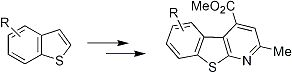
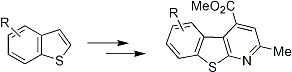
      <p>There are two main sources of heteroarenes: They abound in Nature, often in complex form, but they can also be prepared in research laboratories by different synthetic approaches. Herein we generally describe synthesis and elaboration of benzocondensed heteroarenes and their introduction in peptidomimetic structures. In particular, we focus on benzothiophenes with a view to preparation of benzothienopyridines and their potential application as scaffolds in pseudopeptides.</p>
    </sec>
    <sec>
      <title>2. Peptidomimetic Structures</title>
      <p>Peptidomimetics typically are small protein-like molecules designed to mimic natural peptides or proteins. These mimetics, whose structures were mainly derived from natural peptides, should have the ability to bind to their natural targets in the same way of the natural sequences and hence should produce the same biological effects.</p>
      <p>It is possible to design these molecules in such a way that they show the same biological effects as their peptide role models, but with enhanced properties like a higher proteolytic stability, higher bioavailability and also often with improve selectivity or potency [<xref ref-type="bibr" rid="B2-pharmaceuticals-05-00297">2</xref>].</p>
      <p>Moreover it is known that the isosteric replacement of a peptide bond represents an important and general tool in design of peptidomimetics together with the incorporation of conformationally restricted units, such as rings, into a peptide sequence to force it to adopt a known, biologically active conformation [<xref ref-type="bibr" rid="B3-pharmaceuticals-05-00297">3</xref>].</p>
      <p>The goal is to replace as much of the peptide backbone as possible with non-peptide fragments while still maintaining the pharmacophoric groups (usually the amino acid side chains) of the peptide. This makes the compound more lipophilic, and therefore its bioavailability is increased. Replacement of the amide bond with alternative groups prevents proteolysis and promotes metabolic stability. Initially, conformational flexibility has to be retained to allow the pharmacophoric groups a better opportunity to find their binding sites, but further lead refinement should favour the formation of more conformationally restricted analogs that hold appropriate pharmacophoric groups in the bioactive conformation for binding to the target receptor [<xref ref-type="bibr" rid="B4-pharmaceuticals-05-00297">4</xref>].</p>
      <p>There are many examples in literature of peptidomimetics that result from the incorporation of a heterocycle into a peptide, or peptide-like structure; the pre-organization of peptide shape, via the introduction of a structural motif that imparts conformational restriction, can enhance binding and hence therapeutic potential [<xref ref-type="bibr" rid="B5-pharmaceuticals-05-00297">5</xref>].</p>
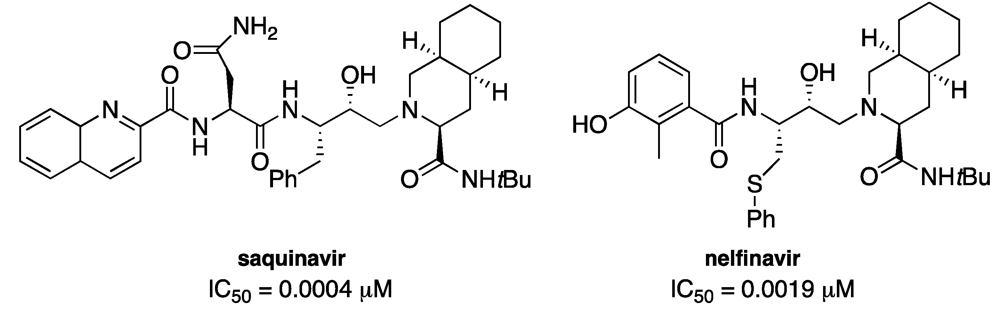
      <p>To the best of our knowledge many drugs are peptidomimetics, in particular drugs actually in use for the inhibition of HIV protease (HIV-Pr) [<xref ref-type="bibr" rid="B6-pharmaceuticals-05-00297">6</xref>]. To date [<xref ref-type="bibr" rid="B7-pharmaceuticals-05-00297">7</xref>] there are ten commercially available drugs that target the HIV-Pr and nine of these collectively represent a success story in rational molecular design of peptidomimetics. Among these we focused our attention on saquinavir and nelfinavir, attracted by the great activity of the first and from the presence of a sulfur atom in the core of the second (<xref ref-type="fig" rid="pharmaceuticals-05-00297-f001">Figure 1</xref>).</p>
      <fig id="pharmaceuticals-05-00297-f001" position="anchor">
        <label>Figure 1</label>
        <caption>
          <p>Structures of saquinavir and nelfinavir.</p>
        </caption>
        <graphic xmlns:xlink="http://www.w3.org/1999/xlink" xlink:href="pharmaceuticals-05-00297-g001.tif"/>
      </fig>
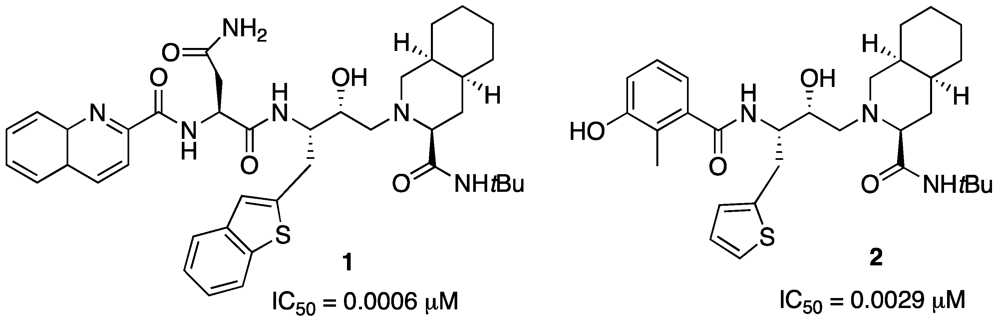
      <p>Our idea was the possibility of change in the core of this class of peptidomimetics by replacing of the phenyl ring with a heterocyclic ring, namely thiophene or benzothiophene: In fact it is well known that a thienyl ring mimics a phenyl group of phenylalanine in peptidomimetics [<xref ref-type="bibr" rid="B8-pharmaceuticals-05-00297">8</xref>] and in many drugs [<xref ref-type="bibr" rid="B9-pharmaceuticals-05-00297">9</xref>,<xref ref-type="bibr" rid="B10-pharmaceuticals-05-00297">10</xref>,<xref ref-type="bibr" rid="B11-pharmaceuticals-05-00297">11</xref>].</p>
      <p>On the basis of our experience in the chemistry of thiophene and benzothiophene [<xref ref-type="bibr" rid="B12-pharmaceuticals-05-00297">12</xref>,<xref ref-type="bibr" rid="B13-pharmaceuticals-05-00297">13</xref>] as well as in stereoselective synthesis [<xref ref-type="bibr" rid="B14-pharmaceuticals-05-00297">14</xref>,<xref ref-type="bibr" rid="B15-pharmaceuticals-05-00297">15</xref>], we began to work toward the synthesis of new heterocycle containing structures as potential inhibitors of HIV-Pr [<xref ref-type="bibr" rid="B16-pharmaceuticals-05-00297">16</xref>]. From this research, after different synthetic approaches, we were able to prepare the reported structures (<xref ref-type="fig" rid="pharmaceuticals-05-00297-f002">Figure 2</xref>): It was remarkable that such compounds were active either against the wild type of protease or the mutated one.</p>
      <fig id="pharmaceuticals-05-00297-f002" position="anchor">
        <label>Figure 2</label>
        <caption>
          <p>Structures of thienyl and benzothienyl derivatives of saquinavir (<bold>1</bold>) and nelfinavir (<bold>2</bold>).</p>
        </caption>
        <graphic xmlns:xlink="http://www.w3.org/1999/xlink" xlink:href="pharmaceuticals-05-00297-g002.tif"/>
      </fig>
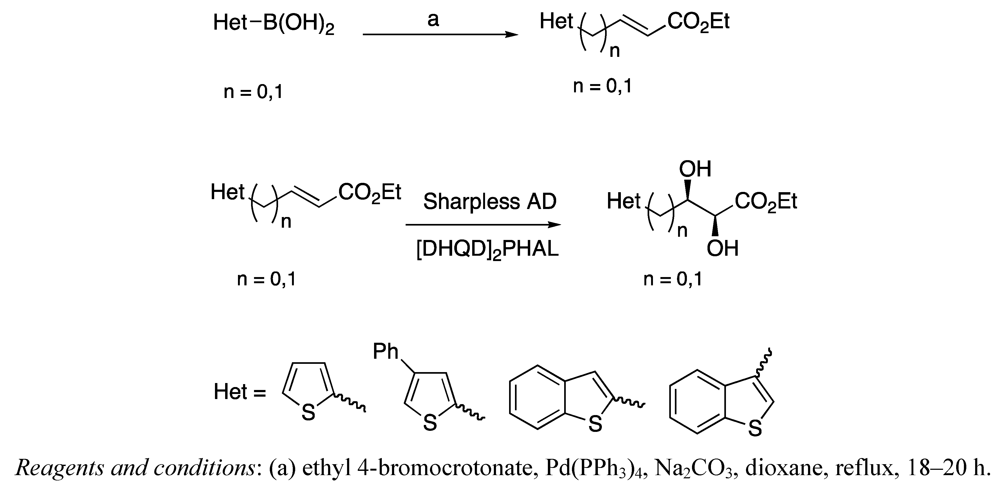
      <p>The goal in this synthetic approach was the construction of the core starting from two important and actual reactions: A Suzuki coupling for the introduction of the heterocyclic ring and the Sharpless asymmetric dihydroxylation (AD) for the introduction of the correct chirality in the core of the potential inhibitor [<xref ref-type="bibr" rid="B17-pharmaceuticals-05-00297">17</xref>,<xref ref-type="bibr" rid="B18-pharmaceuticals-05-00297">18</xref>] (<xref ref-type="fig" rid="pharmaceuticals-05-00297-f003">Scheme 1</xref>).</p>
      <fig id="pharmaceuticals-05-00297-f003" position="anchor">
        <label>Scheme 1</label>
        <caption>
          <p>Suzuki coupling and AD reaction.</p>
        </caption>
        <graphic xmlns:xlink="http://www.w3.org/1999/xlink" xlink:href="pharmaceuticals-05-00297-g003.tif"/>
      </fig>
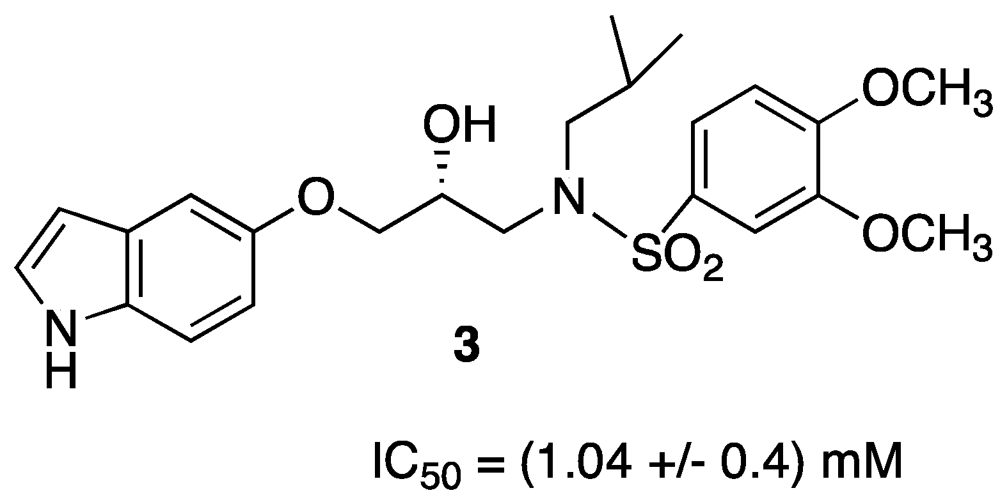
      <p>Furthermore, the need to overcome viral resistance and to have a simpler synthetic sequence prompted us to investigate new non-peptidic compounds, with simplified structure, bearing the central isopropanolamine unit found in the commercially available peptidic drugs [<xref ref-type="bibr" rid="B19-pharmaceuticals-05-00297">19</xref>,<xref ref-type="bibr" rid="B20-pharmaceuticals-05-00297">20</xref>,<xref ref-type="bibr" rid="B21-pharmaceuticals-05-00297">21</xref>]. In our continuing interest on new inhibitors containing heteroarylic groups, the attention focused on some reported structures [<xref ref-type="bibr" rid="B22-pharmaceuticals-05-00297">22</xref>] in which the indole ring, mimicking the aminoindane group of Indinavir, seems to be important for the activity. So we produced another series of inhibitors [<xref ref-type="bibr" rid="B23-pharmaceuticals-05-00297">23</xref>] containing an indole ring in P2 position: Unfortunately the activity of these compounds remained in the range of micromolar scale, even if SAR studies showed the importance of the indolic NH presence in that position for a good interaction with active site of the protease (<xref ref-type="fig" rid="pharmaceuticals-05-00297-f004">Figure 3</xref>).</p>
      <fig id="pharmaceuticals-05-00297-f004" position="anchor">
        <label>Figure 3</label>
        <caption>
          <p>Structure of indolic non-peptidic HIV protease inhibitor.</p>
        </caption>
        <graphic xmlns:xlink="http://www.w3.org/1999/xlink" xlink:href="pharmaceuticals-05-00297-g004.tif"/>
      </fig>
    </sec>
    <sec>
      <title>3. Pseudopeptides</title>
      <p>Another approach to construct peptidomimetics involves the design of conformationally restricted analogs that mimic and/or stabilise characteristics of the receptor-bound conformation of the endogenous peptide, such as β-turns and other.</p>
      <p>The ability to access to such structures modified by incorporation of heterocycles allows the study of the associated biological processes, with an opportunity for further drug design and development. 1,2,3-Triazoles, for example, offer an appealing structural motif in peptidomimetic research because their structural and electronic characteristics are similar to those of a peptide bond [<xref ref-type="bibr" rid="B24-pharmaceuticals-05-00297">24</xref>]. It is also known that secondary structures (β-turns, α-helices, β-strands) are sites of recognition by the enzymes, such as proteases [<xref ref-type="bibr" rid="B25-pharmaceuticals-05-00297">25</xref>].</p>
      <p>This idea can be extended to <italic>scaffold peptidomimetics</italic> in which important pharmacophoric residues are held in the appropriate orientation by a rigid template. So in this field, much effort has been devoted to the design and synthesis of conformationally constrained compounds that mimic, or induce, specific secondary structural features of peptides and proteins.</p>
      <p>Many scaffolds possessing the functionalities of peptides (<italic>i.e</italic>., amine and carboxyl groups) together with well defined spatial properties, thus reproducing the desired orientation of a growing peptide chain, have hence been created [<xref ref-type="bibr" rid="B26-pharmaceuticals-05-00297">26</xref>].</p>
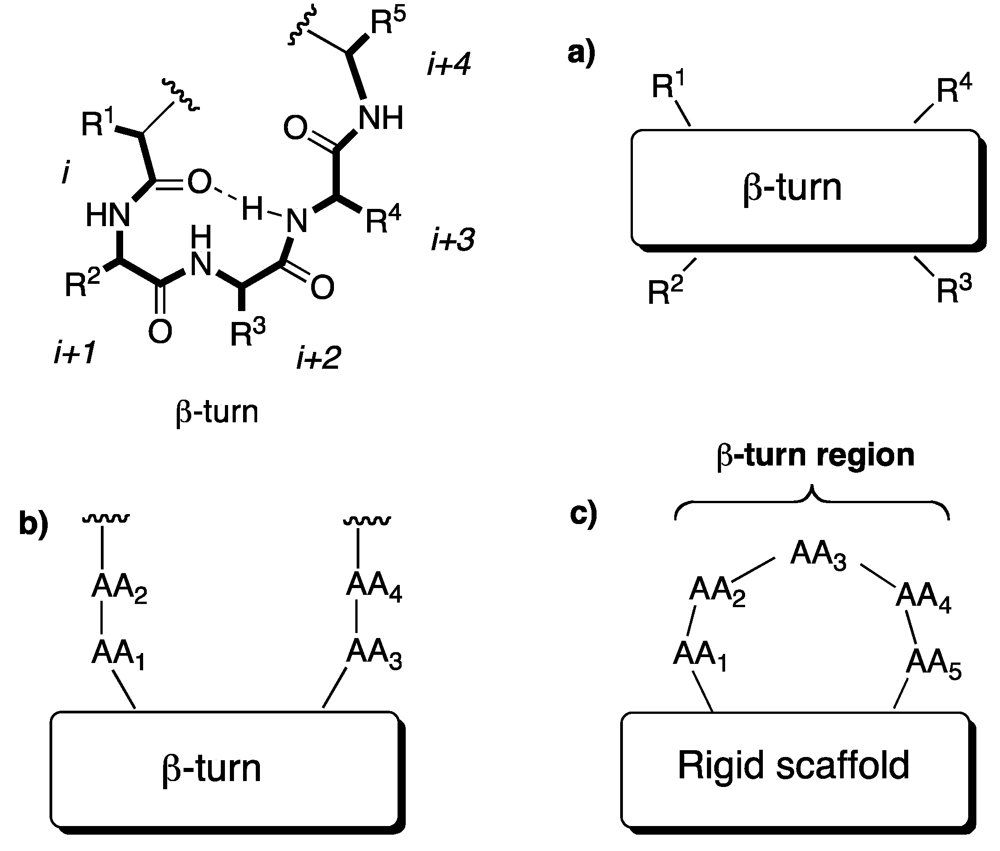
      <p>The β-turn is a common feature in biologically active peptides and is defined as any tetrapeptide sequence, with a 10-membered intramolecularly H-bonded ring, in which the C<sub>α</sub>(i) to C<sub>α</sub>(i+3) distance varies from 4 to 7 Angstrom (<xref ref-type="fig" rid="pharmaceuticals-05-00297-f005">Figure 4</xref>).</p>
      
      <p>There are at least 14 types of β-turn structures, described in literature [<xref ref-type="bibr" rid="B26-pharmaceuticals-05-00297">26</xref>]. These conformers used as models have been developed for linear and short peptides. In natural proteins, turn fragments can adopt an even larger variety of conformations, due to stabilization provided by the remaining portion of molecule. Although there has been much discussion in the literature on what constitutes a β-turn mimic and how different types of mimics have to be characterized, these can be roughly classified into three broad classes, illustrated in <xref ref-type="fig" rid="pharmaceuticals-05-00297-f005">Figure 4</xref>.</p>
      <p>Aiming to construct a β-turn mimic with a heterocyclic scaffold we hypothesized an opportune synthetic approach, in particular directed to the preparation of potential active structure for the treatment of Alzheimer’s disease, either as β-secretase or as β-amyloid aggregation inhibitor.</p>
	  <fig id="pharmaceuticals-05-00297-f005" position="anchor">
        <label>Figure 4</label>
        <caption>
          <p>β-turn and induced β-turn. (<bold>a</bold>) internal β-turn mimics; (<bold>b</bold>) β-hairpin mimics (in which a rigid scaffold induces reversal of the peptide chain); (<bold>c</bold>) external β-turn inducers.</p>
        </caption>
        <graphic xmlns:xlink="http://www.w3.org/1999/xlink" xlink:href="pharmaceuticals-05-00297-g005.tif"/>
      </fig>
      <p>β-Secretase (memapsin 2 or BACE1), discovered in 1999 [<xref ref-type="bibr" rid="B27-pharmaceuticals-05-00297">27</xref>,<xref ref-type="bibr" rid="B28-pharmaceuticals-05-00297">28</xref>], is one of the two proteases that cleave the β-amyloid precursor protein (APP) to produce a 40–42 residue amyloid β-peptide (Aβ) in the human brain. Accumulation of Aβ results in the formation of amyloid plaques and neurofibrillary tangles. The neurotoxicity of Aβ is ultimately responsible for brain inflammation, neuronal death, dementia and Alzheimer’s disease [<xref ref-type="bibr" rid="B29-pharmaceuticals-05-00297">29</xref>]. Consequently therapeutic inhibition of memapsin 2 has emerged as one of the most active areas of today’s drug development for the intervention of Alzheimer’s disease.</p>
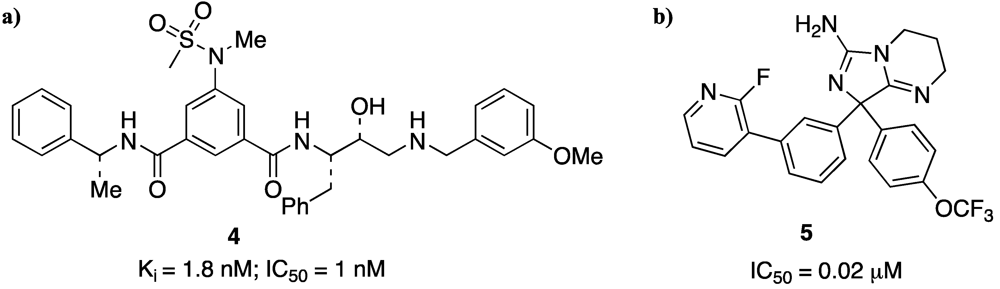
      <p>It is known that β-secretase is an aspartic protease, for which the inhibition mechanism and the design of transition state analogues through the successful development of HIV-1 protease inhibitor drugs are well previously described [<xref ref-type="bibr" rid="B30-pharmaceuticals-05-00297">30</xref>]. So, as first approach to the design and synthesis of potential inhibitors, Ghosh and co-authors reported [<xref ref-type="bibr" rid="B31-pharmaceuticals-05-00297">31</xref>] a series of Leu-Ala isosteres which led to the first potent transition-state inhibitor (CTS-21166) that is actually in advanced clinical trials. This compound (an optimization of the structure is reported in <xref ref-type="fig" rid="pharmaceuticals-05-00297-f006">Figure 5</xref>a) represents the first small peptidomimetic inhibitor modifying therapy for Alzheimer’s disease.</p>
      <fig id="pharmaceuticals-05-00297-f006" position="anchor">
        <label>Figure 5</label>
        <caption>
          <p>Two potential β-secretase inhibitors. (<bold>a</bold>) GRL-8234; (<bold>b</bold>) heteroarylaminoimidazole.</p>
        </caption>
        <graphic xmlns:xlink="http://www.w3.org/1999/xlink" xlink:href="pharmaceuticals-05-00297-g006.tif"/>
      </fig>
      <p>The newest generation BACE1 inhibitors are low molecular weight molecules with excellent cell permeability, have little or no peptidic character, and possess enhanced pharmacokinetic profiles [<xref ref-type="bibr" rid="B32-pharmaceuticals-05-00297">32</xref>,<xref ref-type="bibr" rid="B33-pharmaceuticals-05-00297">33</xref>,<xref ref-type="bibr" rid="B34-pharmaceuticals-05-00297">34</xref>,<xref ref-type="bibr" rid="B35-pharmaceuticals-05-00297">35</xref>]. Actually many lines of research are concerned with the synthesis and study of small-molecule-containing heterocyclic rings as β-secretase inhibitors [<xref ref-type="bibr" rid="B36-pharmaceuticals-05-00297">36</xref>,<xref ref-type="bibr" rid="B37-pharmaceuticals-05-00297">37</xref>] (<xref ref-type="fig" rid="pharmaceuticals-05-00297-f006">Figure 5</xref>b).</p>
    </sec>
    <sec>
      <title>4. Scaffold for Pseudopeptides: Design and Synthesis of Heteroaromatic Tricyclic Structures</title>
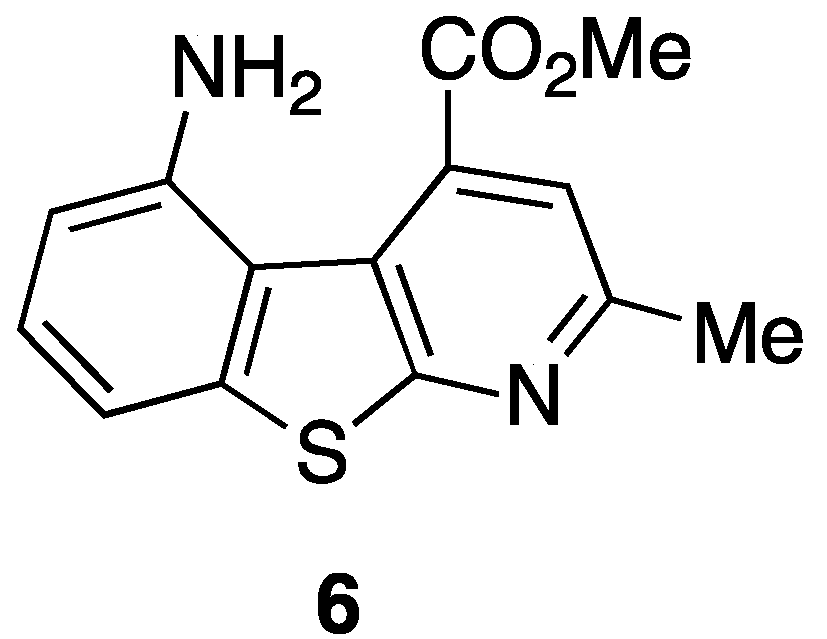
      <p>Our long interest in the preparation of heterocycles and their application in medicinal chemistry prompted us to design and synthesize new tricyclic compounds as potential scaffolds for pseudopeptides and/or as β-secretase inhibitors. Recently [<xref ref-type="bibr" rid="B38-pharmaceuticals-05-00297">38</xref>], a particular structure that mimics a biological turn has just been synthetized in our laboratory. The molecule is shown in <xref ref-type="fig" rid="pharmaceuticals-05-00297-f007">Figure 6</xref>.</p>
      <fig id="pharmaceuticals-05-00297-f007" position="anchor">
        <label>Figure 6</label>
        <caption>
          <p>5-Amino-4-carbomethoxy-2-methylbenzothienopyridine.</p>
        </caption>
        <graphic xmlns:xlink="http://www.w3.org/1999/xlink" xlink:href="pharmaceuticals-05-00297-g007.tif"/>
      </fig>
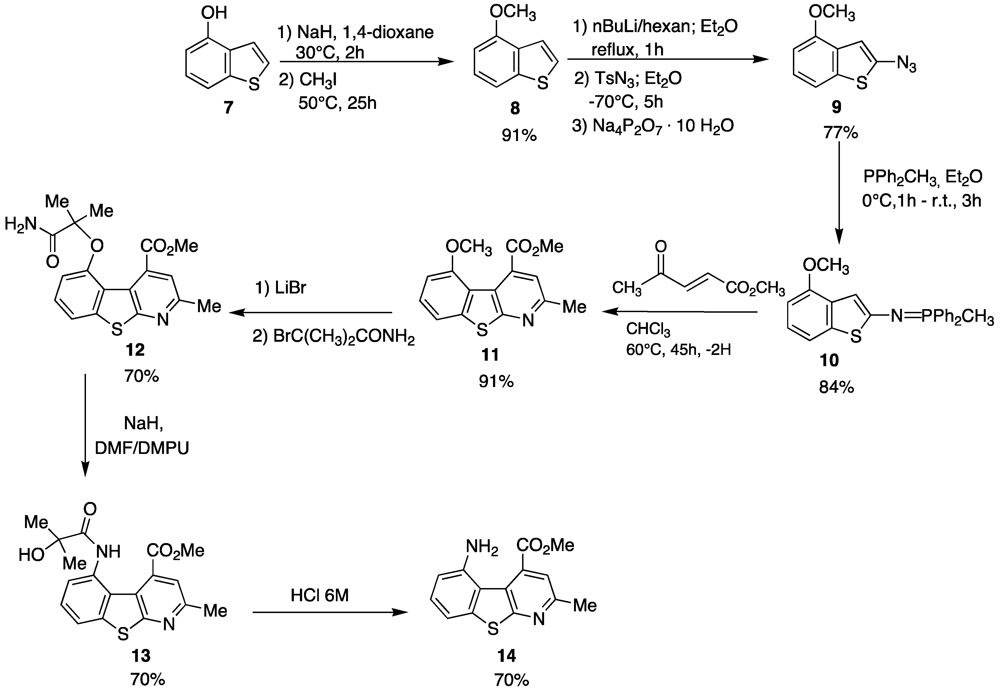
      <p>As can be seen such a benzothienopyridine bears two interesting groups in the 4- and 5-positions of the tricyclic structure, a carbomethoxy and an amine function, respectively, that immediately suggest its possible use as a pseudopeptide scaffold as well as a β-secretase inhibitor. For its preparation an innovative synthetic route was developed (<xref ref-type="fig" rid="pharmaceuticals-05-00297-f008">Scheme 2</xref>).</p>
      <fig id="pharmaceuticals-05-00297-f008" position="anchor">
        <label>Scheme 2</label>
        <caption>
          <p>Synthetic route affording 5-amino-4-carbomethoxy-2-methylbenzothienopyridine.</p>
        </caption>
        <graphic xmlns:xlink="http://www.w3.org/1999/xlink" xlink:href="pharmaceuticals-05-00297-g008.tif"/>
      </fig>
      <p>The depicted synthetic approach is based on four principal reactions:</p>
      <list list-type="simple">
        <list-item>
          <p>(1)An azido-transfer reaction that furnishes the azido precursors [<xref ref-type="bibr" rid="B39-pharmaceuticals-05-00297">39</xref>];</p>
        </list-item>
        <list-item>
          <p>(2)A Staudinger reaction that transforms the azido group into an iminophosphorane, a powerful tool for the construction of nitrogen containing heterocycles [<xref ref-type="bibr" rid="B40-pharmaceuticals-05-00297">40</xref>,<xref ref-type="bibr" rid="B41-pharmaceuticals-05-00297">41</xref>,<xref ref-type="bibr" rid="B42-pharmaceuticals-05-00297">42</xref>,<xref ref-type="bibr" rid="B43-pharmaceuticals-05-00297">43</xref>,<xref ref-type="bibr" rid="B44-pharmaceuticals-05-00297">44</xref>]</p>
        </list-item>
        <list-item>
          <p>(3)A tandem aza-Wittig/electrocyclization of iminophosphoranes with suitable α,β-unsaturated carbonyl compounds;</p>
        </list-item>
        <list-item>
          <p>(4)Finally, a Smiles rearrangement that affords the benzothienopyridine [<xref ref-type="bibr" rid="B45-pharmaceuticals-05-00297">45</xref>,<xref ref-type="bibr" rid="B46-pharmaceuticals-05-00297">46</xref>,<xref ref-type="bibr" rid="B47-pharmaceuticals-05-00297">47</xref>,<xref ref-type="bibr" rid="B48-pharmaceuticals-05-00297">48</xref>]</p>
        </list-item>
      </list>
      <p>It is well known that benzothienopyridines are of pharmacological interest due to their isosterism with indolopyridines [<xref ref-type="bibr" rid="B49-pharmaceuticals-05-00297">49</xref>,<xref ref-type="bibr" rid="B50-pharmaceuticals-05-00297">50</xref>] and to their reported activity as antibacterial [<xref ref-type="bibr" rid="B51-pharmaceuticals-05-00297">51</xref>], antiallergic [<xref ref-type="bibr" rid="B52-pharmaceuticals-05-00297">52</xref>] and anxiolytic agents [<xref ref-type="bibr" rid="B53-pharmaceuticals-05-00297">53</xref>], so the development of a facile preparation seems to be of timely interest.</p>
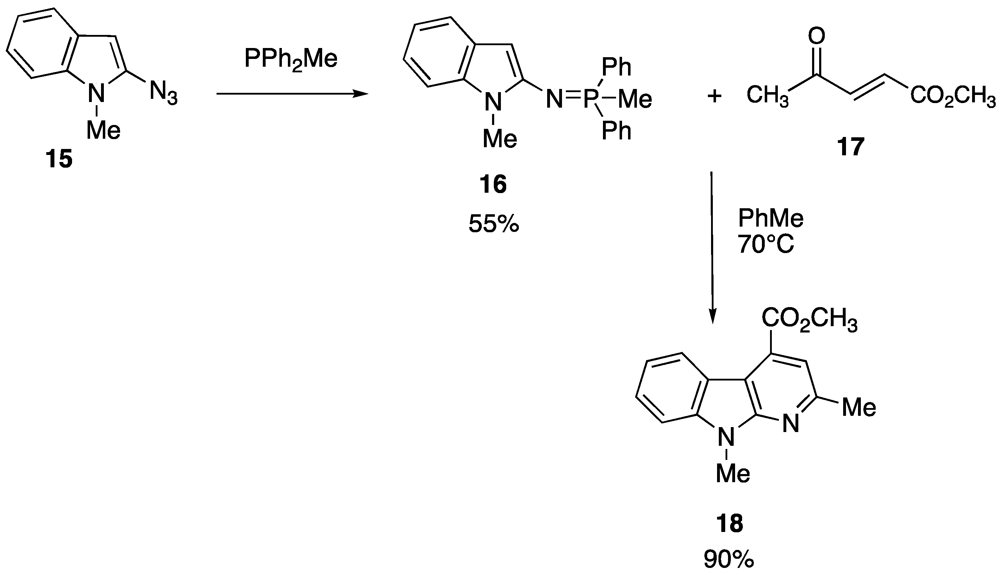
      <p>Our experience in heterocyclic chemistry suggested us also to extend the use of Staudinger reaction (and subsequent aza-Wittig/electrocyclization reaction) either to indole, benzofuran or to substituted benzothienyl ring. As an example of such a methodology for the preparation of a benzofuropyridine [<xref ref-type="bibr" rid="B54-pharmaceuticals-05-00297">54</xref>] and α-carboline [<xref ref-type="bibr" rid="B55-pharmaceuticals-05-00297">55</xref>] we reported the reaction scheme realized for 2-azido-<italic>N</italic>-methylindole (<xref ref-type="fig" rid="pharmaceuticals-05-00297-f009">Scheme 3</xref>).</p>
      <fig id="pharmaceuticals-05-00297-f009" position="anchor">
        <label>Scheme 3</label>
        <caption>
          <p>Synthesis of α-carboline.</p>
        </caption>
        <graphic xmlns:xlink="http://www.w3.org/1999/xlink" xlink:href="pharmaceuticals-05-00297-g009.tif"/>
      </fig>
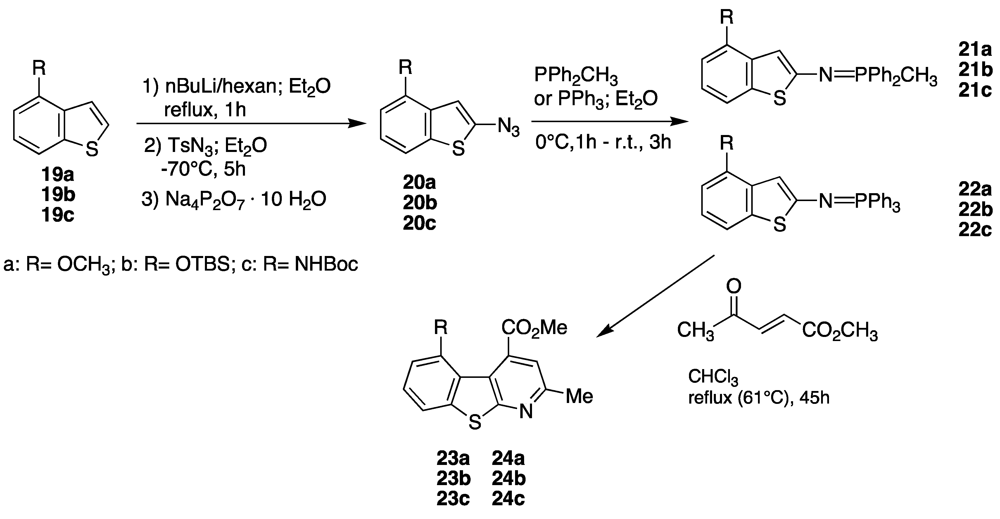
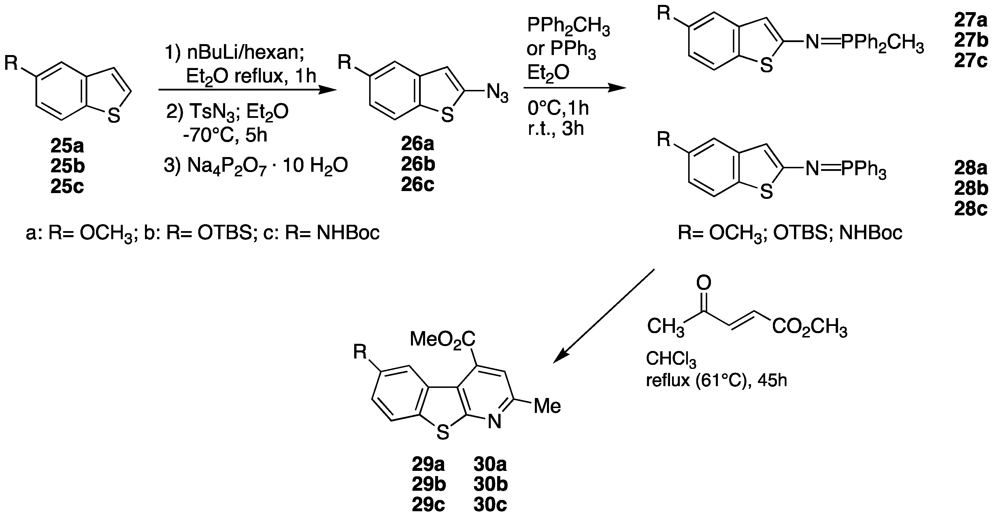
      <p>This efficient strategy was then applied on 4- and 5-substituted benzothiophenes; preliminary results are shown in the next <xref ref-type="fig" rid="pharmaceuticals-05-00297-f010">Scheme 4</xref> and <xref ref-type="fig" rid="pharmaceuticals-05-00297-f011">Scheme 5</xref>, and <xref ref-type="table" rid="pharmaceuticals-05-00297-t001">Table 1</xref> and <xref ref-type="table" rid="pharmaceuticals-05-00297-t002">Table 2</xref>, [<xref ref-type="bibr" rid="B56-pharmaceuticals-05-00297">56</xref>,<xref ref-type="bibr" rid="B57-pharmaceuticals-05-00297">57</xref>].</p>
      <table-wrap id="pharmaceuticals-05-00297-t001" position="anchor">
        <object-id pub-id-type="pii">pharmaceuticals-05-00297-t001_Table 1</object-id>
        <label>Table 1</label>
        <caption>
          <p>Synthesis of 5-amino (or hydroxy)-4-carbomethoxy-2-methylbenzothienopyridines.</p>
        </caption>
        <table>
          <thead>
            <tr>
              <th align="left" valign="middle">Entry</th>
              <th align="left" valign="middle">Azide (%yield)</th>
              <th align="left" valign="middle">Phosphorane (%yield)</th>
              <th align="left" valign="middle">Benzothienopyridine (%yield)</th>
            </tr>
          </thead>
          <tbody>
            <tr>
              <td align="left" valign="middle"><bold>1</bold></td>
              <td align="left" valign="middle">20a (77%)</td>
              <td align="left" valign="middle">21a (84%)</td>
              <td align="left" valign="middle">23a (91%)</td>
            </tr>
            <tr>
              <td align="left" valign="middle"><bold>2</bold></td>
              <td align="left" valign="middle">20b (80%)</td>
              <td align="left" valign="middle">21b (40%)</td>
              <td align="left" valign="middle">23b (14%)</td>
            </tr>
            <tr>
              <td align="left" valign="middle"><bold>3</bold></td>
              <td align="left" valign="middle">20c (30%)</td>
              <td align="left" valign="middle">21c (no product)</td>
              <td align="left" valign="middle">23c (no product)</td>
            </tr>
            <tr>
              <td align="left" valign="middle"><bold>4</bold></td>
              <td align="left" valign="middle">20a (77%)</td>
              <td align="left" valign="middle">22a (33%)</td>
              <td align="left" valign="middle">24a (40%)</td>
            </tr>
            <tr>
              <td align="left" valign="middle"><bold>5</bold></td>
              <td align="left" valign="middle">20b (80%)</td>
              <td align="left" valign="middle">22b (20%)</td>
              <td align="left" valign="middle">24b (no product)</td>
            </tr>
            <tr>
              <td align="left" valign="middle"><bold>6</bold></td>
              <td align="left" valign="middle">20c (30%)</td>
              <td align="left" valign="middle">22c (no product)</td>
              <td align="left" valign="middle">24c (no product)</td>
            </tr>
          </tbody>
        </table>
      </table-wrap>
      <table-wrap id="pharmaceuticals-05-00297-t002" position="anchor">
        <object-id pub-id-type="pii">pharmaceuticals-05-00297-t002_Table 2</object-id>
        <label>Table 2</label>
        <caption>
          <p>Synthesis of 4-carbomethoxy-6-hydroxy-(or amine)-2-methylbenzothienopyridines.</p>
        </caption>
        <table>
          <thead>
            <tr>
              <th align="left" valign="middle">Entry</th>
              <th align="left" valign="middle">Azide (%yield)</th>
              <th align="left" valign="middle">Phosphorane (%yield)</th>
              <th align="left" valign="middle">Benzothienopyridine (%yield)</th>
            </tr>
          </thead>
          <tbody>
            <tr>
              <td align="left" valign="middle"><bold>1</bold></td>
              <td align="left" valign="middle">26a (55%)</td>
              <td align="left" valign="middle">27a (58%)</td>
              <td align="left" valign="middle">29a (35%)</td>
            </tr>
            <tr>
              <td align="left" valign="middle"><bold>2</bold></td>
              <td align="left" valign="middle">26b (28%)</td>
              <td align="left" valign="middle">27b (79%)</td>
              <td align="left" valign="middle">29b (13%)</td>
            </tr>
            <tr>
              <td align="left" valign="middle"><bold>3</bold></td>
              <td align="left" valign="middle">26c (62%)</td>
              <td align="left" valign="middle">27c (49%)</td>
              <td align="left" valign="middle">29c (no product)</td>
            </tr>
            <tr>
              <td align="left" valign="middle"><bold>4</bold></td>
              <td align="left" valign="middle">26a (55%)</td>
              <td align="left" valign="middle">28a (74%)</td>
              <td align="left" valign="middle">30a (52%)</td>
            </tr>
            <tr>
              <td align="left" valign="middle"><bold>5</bold></td>
              <td align="left" valign="middle">26b (28%)</td>
              <td align="left" valign="middle">28b (81%)</td>
              <td align="left" valign="middle">30b (58%)</td>
            </tr>
            <tr>
              <td align="left" valign="middle"><bold>6</bold></td>
              <td align="left" valign="middle">26c (62%)</td>
              <td align="left" valign="middle">28c (no product)</td>
              <td align="left" valign="middle">30c (no product)</td>
            </tr>
          </tbody>
        </table>

      </table-wrap>
      <fig id="pharmaceuticals-05-00297-f010" position="anchor">
        <label>Scheme 4</label>
        <caption>
          <p>Synthesis of 5-amino (or hydroxy)-4-carbomethoxy-2-methylbenzothienopyridines.</p>
        </caption>
        <graphic xmlns:xlink="http://www.w3.org/1999/xlink" xlink:href="pharmaceuticals-05-00297-g010.tif"/>
      </fig>
      <fig id="pharmaceuticals-05-00297-f011" position="anchor">
        <label>Scheme 5</label>
        <caption>
          <p>Synthesis of 4-carbomethoxy-6-hydroxy-(or amine)-2-methylbenzothienopyridines.</p>
        </caption>
        <graphic xmlns:xlink="http://www.w3.org/1999/xlink" xlink:href="pharmaceuticals-05-00297-g011.tif"/>
      </fig>
      <p>As can be seen, the presence of a <italic>t-</italic>butyldimethylsilylether functionality in the 4-position of the benzothiophene plays an important different effect: In fact the azido transfer reaction was favoured, while the Staudinger reaction was unfavoured, in particular when triphenylphosphine was used.</p>
      <p>Probably, such an effect was due to the hindrance of the substituent either on phosphorous or on oxygen. In presence of a methoxy group at the 4-position of benzothiophene the effect on the azido formation was the same (we hypothesized a predominant electronic effect), but it had the opposite effect on iminophosporane synthesis.</p>
      <p>The NH-Boc substituent merits particular: In this case the presence of the hydrogen on the <italic>N</italic>-function represents a drawback during lithiation, despite the hindrance of the <italic>t</italic>-butyl group; hence the chemical yields were unsatisfactory, even with excess of butyl lithium.</p>
      <p>A different result was obtained when the same synthetic route was used on 5-substituted benzothiophene, precursor of 4-carbomethoxy-6-hydroxy-(or amine)-2-methylbenzothienopyridine (<xref ref-type="fig" rid="pharmaceuticals-05-00297-f011">Figure 11</xref>). As can be observed it seems that electronic effects were prevalent for all considered substrates, both in the azido transfer and in the Staudinger reaction leading to iminophosphoranes, but the final cyclization is still not an optimized procedure. Further studies on the synthesis of the described tricyclic structures and their potential biological activity on β-secretase are in progress.</p>
    </sec>
    <sec sec-type="methods">
      <title>5. Experimental</title>
      <sec>
        <title>5.1. General</title>
        <p>Column chromatography was carried out on Merck silica gel (0.063–0.200 mm particle size) by progressive elution with petroleum ether/ethyl acetate or petroleum ether/diethyl ether mixtures. <sup>1</sup>H- and <sup>13</sup>C-NMR spectra were normally recorded for CDCl<sub>3</sub> solutions on a Bruker AM 300 MHz or on Varian INOVA 400 and 500 MHz instruments. IR spectra were registered on a JASCO FT/IR 460 Plus. Mass spectra were obtained with a Hewlett-Packard 5971 mass-selective detector on a Hewlett-Packard GC/MS 6890-5973 system. Dichloromethane, chloroform and carbon tetrachloride were dried with anhydrous CaCl<sub>2</sub>; diethyl ether and 1,4-dioxane were dried using sodium/benzophenone. Dry dimethylformamide was commercially available. 4-Hydroxybenzo[<italic>b</italic>]thiophene was prepared according to the literature [<xref ref-type="bibr" rid="B38-pharmaceuticals-05-00297">38</xref>]. 2-Bromo-2-methylpropanamide was synthesized as recently reported [<xref ref-type="bibr" rid="B38-pharmaceuticals-05-00297">38</xref>] and used in Smiles rearrangement as reported in the same paper to obtain the suitable 2-aryloxy-2-methylpropanamide. 5-Aminobenzo[<italic>b</italic>]thiophene was commercially available (Maybridge Trevillet, Tintagel, Cornwall, UK).</p>
      </sec>
      <sec>
        <title>5.2. Synthesis of 4,5-Disubstituted Benzothieno[2,3-b]pyridine Precursors</title>
        <p><italic>4-Methoxybenzo[b]thiophene</italic> (<bold>19a</bold>). Compound <bold>19a</bold> was synthesized from 4-hydroxybenzo[<italic>b</italic>]-thiophene according to a known procedure [<xref ref-type="bibr" rid="B38-pharmaceuticals-05-00297">38</xref>]. Thick red oil (yield 91%). Found: C, 65.85; H, 4.88; S, 19.56%. C<sub>9</sub>H<sub>8</sub>OS requires C, 65.83; H, 4.91; S, 19.52%; <sup>1</sup>H-NMR (300 MHz, CDCl<sub>3</sub>) (ppm): δ<sub>H</sub> 7.65–7.5 (m, 2H), 7.45–7.38 (m, 2H), 6.84–6.80 (m, 1H), 3.99 (s, 3H); <sup>13</sup>C-NMR (75 MHz, CDCl<sub>3</sub>) (ppm): δ<sub>C</sub> 155.0, 141.2, 130.5, 125.3, 124.6, 120.5, 115.0, 104.1, 55.9; MS <italic>m/z</italic>: 164 (M<sup>+</sup>), 149 (100).</p>
        <p><italic>4-(Tert-butyldimethylsilyloxy)benzo[b]thiophene</italic> (<bold>19b</bold>). Compound <bold>19b</bold> was synthesized from 4-hydroxybenzothiophene according to a known procedure [<xref ref-type="bibr" rid="B38-pharmaceuticals-05-00297">38</xref>]. Thick oil (yield 75%). Found: C, 63.59; H, 7.59; S, 12.15%. C<sub>14</sub>H<sub>20</sub>OSSi requires: C, 63.58; H, 7.62; S, 12.12%; <sup>1</sup>H-NMR (300 MHz, CDCl<sub>3</sub>) (ppm): δ<sub>H</sub> 7.72–7.67 (m, 2H), 7.53–7.37 (m, 2H), 6.99–6.93 (m, 1H), 1.35 (s, 9H), 0.50 (s, 6H); <sup>13</sup>C-NMR (75 MHz, CDCl<sub>3</sub>) (ppm): δ<sub>C</sub> 150.7, 141.5, 133.5, 125.3, 124.3, 121.0, 115.7, 113.1, 25.7, 18.5, 20.4; MS <italic>m/z</italic>: 264 (M<sup>+</sup>), 207 (100).</p>
        <p><italic>Tert-butyl benzo[b]thiophen-4-yl carbamate</italic> (<bold>19c</bold>). 4-Hydroxybenzo[<italic>b</italic>]thiophene (135 mg, 0.9 mmol) was converted to <italic>N</italic>-(benzo[<italic>b</italic>]thiophen-4-yl)-2-hydroxy-2-methylpropanamide (190 mg, 90%) via a Smiles rearrangement according to a known procedure [<xref ref-type="bibr" rid="B38-pharmaceuticals-05-00297">38</xref>]. The <italic>N</italic>-(benzo[<italic>b</italic>]thiophen-4-yl)-2-hydroxy-2-methylpropanamide was dissolved in HCl 6M (10 mL) and the resulting mixture was stirred at 100 °C for 4 h. After cooling to 25 °C the mixture was slowly treated with a solution of NaOH 2M until neutrality, then extracted twice with diethyl ether and dried over sodium sulphate. Removal of the solvent gave the 4-aminebenzo[<italic>b</italic>]thiophene as a black thick oil (107 mg, 90%).</p>
        <p>To a solution of 4-aminobenzo[<italic>b</italic>]thiophene (107 mg, 0.72 mmol) in dry dichloromethane (4 mL), di-<italic>tert</italic>-butyl dicarbonate (BOC) (205 mg, 0.94 mmol) was added and the resulting mixture was stirred in an inert atmosphere for 15 h at room temperature [<xref ref-type="bibr" rid="B56-pharmaceuticals-05-00297">56</xref>]. After solvent removal, the crude was dissolved into ethyl acetate and the organic phase was washed several times with water, once with brine and then dried over sodium sulphate and finally concentrated under vacuum. The crude product was chromatographed on silica gel, using petroleum ether/ethyl acetate 7:3 as eluent, to give <bold>19c</bold> as a thick light pink oil (108 mg, 60%). <sup>1</sup>H-NMR (400 MHz, CDCl<sub>3</sub>) (ppm):δ<sub>H</sub> 7.82–7.80 (m, 1H), 7.60–7.58 (m, 1H), 7.43–7.41 (m, 1H), 7.33–7.30 (m, 1H), 6.72 (s, 1H), 1.54 (s, 9H); <sup>13</sup>C-NMR (125 MHz, CDCl<sub>3</sub>) (ppm): δ<sub>C</sub> 152.9, 140.5, 132.7, 131.1, 125.9, 124.9, 119.1, 117.8, 115.1, 80.8, 28.3; MS: <italic>m/z</italic> 249 (M<sup>+</sup>); 193 (100).</p>
      </sec>
      <sec>
        <title>5.3. Synthesis of Azides <italic><bold>20a,b,c</bold></italic></title>
        <p><italic>2-Azido-4-methoxy-1-benzo[b]thiophene</italic> (<bold>20a</bold>). Compound <bold>20a</bold> was synthesized from <bold>19a</bold> according to a known procedure [<xref ref-type="bibr" rid="B38-pharmaceuticals-05-00297">38</xref>]. Thick yellow oil (yield 77%). Found: C, 52.65; H, 3.47; N, 20.45; S, 15.63%. C<sub>9</sub>H<sub>7</sub>N<sub>3</sub>OS requires: C, 52.67; H, 3.44; N, 20.47; S, 15.62%; IR ν<sub>max</sub>/cm<sup>−1</sup> 2113 (N<sub>3</sub>); <sup>1</sup>H-NMR (300 MHz, CDCl<sub>3</sub>) (ppm): δ<sub>H</sub> 7.35-7.20 (m, 2H); 7.05 (s, 1H); 6.80-6.75 (m, 1H); 3.95 (s, 3H); <sup>13</sup>C-NMR (75 MHz, CDCl<sub>3</sub>) (ppm): δ<sub>C</sub> 152.7, 139.5, 138.2, 125.3, 124.6, 117.1, 115.7, 110.3, 50.5.</p>
        <p><italic>[(2-Azidobenzo[b]thiophen-4-yl)oxy](tert-butyl)dimethylsilane</italic> (<bold>20b</bold>). Compound <bold>20b</bold> was synthesized from <bold>19b</bold> according to a known procedure [<xref ref-type="bibr" rid="B38-pharmaceuticals-05-00297">38</xref>]. Thick yellow oil (yield 80%). Found: C, 55.07; H, 6.21; N, 13.78; S, 10.44%. C<sub>14</sub>H<sub>19</sub>N<sub>3</sub>OSSi requires C, 55.05; H, 6.27; N, 13.76; S, 10.50%; IR ν<sub>max</sub>/cm<sup>−1</sup> 2110 (N<sub>3</sub>); <sup>1</sup>H-NMR (300 MHz, CDCl<sub>3</sub>) (ppm): δ<sub>H</sub> 7.50–7.40 (m, 1H), 7.19–7.11 (m, 1H), 6.89 (s, 1H), 6.72–6.68 (m, 1H), 1.07 (s, 9H), 0.27 (s, 6H); <sup>13</sup>C-NMR (75 MHz, CDCl<sub>3</sub>) (ppm): δ<sub>C</sub> 142.7, 125.3, 124.5, 121.0, 115.6, 115.0, 113.6, 108.3, 25.8, 15.9.</p>
        <p><italic>Tert-butyl (2-azidobenzo[b]thiophen-4-yl)carbamate</italic> <bold>20c</bold>. Compound <bold>19c</bold> (108 mg, 0,43 mmol) in dry diethyl ether (7 mL) was treated, under an inert atmosphere, with 1.6 M <italic>n</italic>-butyl lithium in hexane (0.65 mmol) and refluxed for 1 h. Then the reaction mixture was cooled to −70 °C and, slowly, tosylazide (119 mg, 0.60 mmol) in dry diethyl ether (3 mL) was added. After 5 h at this temperature the obtained triazene salt was filtered under vacuum, washed with dry diethyl ether and treated at 0 °C with an aqueous solution of sodium pyrophosphate decahydrate (316 mg, 0.7 mmol, in 5 mL of water). After 15 min of stirring at this temperature the suspension was filtered on a Buckner funnel and extracted twice with diethyl ether and then with ethyl acetate. After solvent removal, the crude product was purified by chromatography on Florisil (eluent petroleum ether/ethyl acetate 8:2) giving the title compound (38 mg, 30%) as a thick light yellow oil. Compound <bold>19c</bold> is unstable, so it was only characterized by IR and <sup>1</sup>H-NMR spectroscopy. IR ν<sub>max</sub>/cm<sup>−1</sup> 2125 (N<sub>3</sub>); <sup>1</sup>H-NMR (400 MHz, CDCl<sub>3</sub>) (ppm): δ<sub>H</sub> 7.73 (s, 1H), 7.55–7.53 (m, 1H), 7.38–7.36 (m, 1H), 7.27–7.24 (m, 1H), 6.66 (s, 1H), 1.49 (s, 9H).</p>
      </sec>
      <sec>
        <title>5.4. Synthesis of Imminophosphoranes <italic><bold>21a,b,c-22a,b,c</bold></italic></title>
        <p><italic>[(4-Methoxy-1-benzothiophen-2-yl)imino]-(methyl)diphenylphosphorane</italic> <bold>21a</bold>. This compound was prepared from the azide <bold>20a</bold> and methyldiphenylphosphine (1eq) according to a known procedure [<xref ref-type="bibr" rid="B38-pharmaceuticals-05-00297">38</xref>]. Chromatography with petroleum ether/ethyl acetate 7:3 as eluent gave the title compound (yield 84%) as a red oil. Found: C, 70.04; H, 5.36; N, 3.69; S, 8.50%. C<sub>22</sub>H<sub>20</sub>NOPS requires C, 70.01; H, 5.34; N, 3.71; S, 8.49%; <sup>1</sup>H-NMR (300 MHz, CDCl<sub>3</sub>) (ppm): δ<sub>H</sub> 7.62–7.50 (m, 5H), 7.43–7.32 (m, 5H), 6.98–6.90 (m, 1H), 6.87–6.80 (m, 1H), 6.53–6.48 (m, 1H), 6.08 (s, 1H), 3.70 (s, 3H), 2.25–2.20 (d, 3H, <italic>J<sub>PH</sub></italic> = 12.8 Hz); <sup>13</sup>C-NMR (75 MHz, CDCl<sub>3</sub>) (ppm): δ<sub>C</sub> 157.0, 152.3, 140.2, 135.3, 133.0, 132.5, 132.0, 131.7, 131.4, 130.0 129.5, 128.2, 125.8, 121.0, 114.3, 101.5, 55.5, 15.5.</p>
        <p><italic>4-(Tert-butyldimethylsilyl)oxy)-N-(methyldiphenylphosphoranyliene)benzo[b]thiophen-2-amine</italic> <bold>21b</bold>. This compound was prepared from the azide <bold>20b</bold> and methyldiphenylphosphine (1eq) according to a known procedure [<xref ref-type="bibr" rid="B38-pharmaceuticals-05-00297">38</xref>]. Chromatography with petroleum ether/ethyl acetate 7:3 as eluent gave the title compound (88 mg, 40%) as a brown powder, mp 90–92 °C (diethyl ether). (Found: C, 67.66; H, 6.79; N, 2.99; S, 6.73%. C<sub>27</sub>H<sub>32</sub>NOPSSi requires C, 67.89; H, 6.75; N, 2.93; S, 6.71%); <sup>1</sup>H-NMR (300 MHz, CDCl<sub>3</sub>) (ppm): δ<sub>H</sub> 7.83–7.77 (m, 5H), 7.58–7.37 (m, 5H), 7.11–7.06 (m, 1H), 6.87–6.77 (m, 1H), 6.52–6.49 (m, 1H), 6.02 (s, 1H), 2.25–2.20 (d, 3H, <italic>J<sub>PH</sub></italic> = 12.8 Hz); 0.95 (s, 9H), 0.1 (s, 6H); <sup>13</sup>C-NMR (75 MHz, CDCl<sub>3</sub>) (ppm): δ<sub>C</sub> 168.3, 151.7, 147.5, 135.8, 134.7, 134.0, 132.2, 131.2, 130.8, 129.5, 129.0, 128.8, 120.9, 116.1, 113.2, 101.9, 25.7, 18.3, 14.5, 13.8.</p>
        <p><italic>Tert-butyl 2-(methyldiphenylphosphoranylidene)aminobenzo[b]thiophen-4-yl)carbamate</italic> <bold>21c</bold>. Compound <bold>20c</bold> (62 mg, 0.21 mmol) in dry diethyl ether (3 mL) was added dropwise to a solution of methyldiphenylphosphine (41 mg, 0.20 mmol) in dry dichloromethane (3 mL) at 0 °C, in nitrogen atmosphere. After 2 h, the reaction mixture was allowed to room temperature, finally it was concentrated under vacuum. No desired product was recovered but only degradation products of the starting materials.</p>
        <p><italic>[(4-Methoxy-1-benzothiophen-2-yl)imino]-triphenylphosphorane</italic> <bold>22a</bold>. This compound was prepared from the azide <bold>20a</bold> (100 mg, 0.49 mmol) and triphenylphosphine (128 mg, 0.49 mmol) following a reported procedure [<xref ref-type="bibr" rid="B38-pharmaceuticals-05-00297">38</xref>]. Chromatography on silica gel with petroleum ether/ethyl acetate 7:3 as eluent gave the title compound (72 mg, 33%). <sup>1</sup>H-NMR (500 MHz, CDCl<sub>3</sub>) (ppm): δ<sub>H</sub> 7.74–7.70 (m, 5H), 7.52–7.50 (m, 5H), 7.46–7.42 (m, 5H), 7.00–6.98 (d, 1H, <italic>J<sub>PH</sub></italic> = 10 Hz), 6.88–6.85 (m, 1H), 6.51 (d, 1H, <italic>J<sub>PH</sub></italic> = 5 Hz), 6.24 (s, 1H), 3.73 (s, 3H); <sup>13</sup>C-NMR (125 MHz, CDCl<sub>3</sub>) (ppm): δ<sub>C</sub> 161.2, 140.9, 132.6, 131.2, 128.7, 125.4, 123.3 121.4, 115.2, 108.6, 98.9, 56.2.</p>
        <p><italic>[(4-[tert-Butyl(dimethyl)silyl]oxy-1-benzothiophen-2-yl)imino]-triphenylphosphorane</italic> <bold>22b</bold>. This compound was prepared from the azide <bold>20b</bold> (66 mg, 0.22 mmol) and triphenylphosphine (59 mg, 0.22 mmol) following a reported procedure [<xref ref-type="bibr" rid="B38-pharmaceuticals-05-00297">38</xref>]. Chromatography on silica gel with petroleum ether/ethyl acetate 7:3 as eluent gave the title compound (24 mg, 20%) as a brown/green oil. <sup>1</sup>H-NMR (500 MHz, CDCl<sub>3</sub>) (ppm): δ<sub>H</sub> 7.74–7.70 (m, 5H), 7.50–7.49 (m, 5H), 7.42–7.41 (m, 5H), 7.01 (d, 1H, <italic>J<sub>PH</sub></italic> = 11 Hz), 6.80–6.76 (m, 1H), 6.46 (d, 1H, <italic>J<sub>PH</sub></italic> = 7 Hz), 6.03 (s, 1H), 0.95 (s, 9H), 0.1 (s, 6H); <sup>13</sup>C-NMR (125 MHz, CDCl<sub>3</sub>) (ppm): δ<sub>C</sub> 185.8, 166.9, 147.2, 135.5, 134.5, 132.9, 132.8, 132.7, 128.8, 128.7, 120.8, 114.7, 112.9, 80.3, 25.8, 23.8, 18.1, 1.0, −4.4.</p>
        <p><italic>Tert-butyl (2((triphenylphosphoranylidene)amino)benzo[b]thiophen-4-yl)carbamate</italic> <bold>22c</bold>. Compound <bold>20c</bold> (105 mg, 0.4 mmol) in dry dichloromethane (5 mL) was added dropwise to a solution of triphenylphosphine (117 mg, 0.44 mmol) in dry dichloromethane (5 mL) at 0 °C, in nitrogen atmosphere. After 2 h, the reaction mixture was allowed to reach room temperature and stirred over night; finally it was concentrated under vacuum. No desired product was recovered but only degradation products of the starting materials.</p>
      </sec>
      <sec>
        <title>5.5. General Procedure for Synthesis of (1)Benzothieno[2,3-b]pyridines <italic><bold>23a,b, 24a</bold></italic></title>
        <p>A solution of the appropriate iminophosphorane <bold>22a,b</bold> (0.12 mmol) in dry chloroform (3 mL) was treated with methyl <italic>trans</italic>-4-oxo-2-pentenoate (0.12 mmol) and then stirred in an inert atmosphere for 34 h at 45 °C. After removal of the solvent, the crude product was chromatographed on silica gel, using petroleum ether/ethyl acetate 7:3 as eluent. For yields see <xref ref-type="table" rid="pharmaceuticals-05-00297-t001">Table 1</xref>.</p>
        <p><italic>Methyl 5-methoxy-2-methyl(1)benzothieno[2,3-b]pyridine-4-carboxylate</italic> <bold>23a–24a</bold>. This compound was obtained as a thick oil. (Found: C, 62.72; H, 4.58; N, 4.85; S, 11.13%. C<sub>15</sub>H<sub>13</sub>NO<sub>3</sub>S requires C, 62.70; H, 4.56; N, 4.87; S, 11.16%); <sup>1</sup>H-NMR (300 MHz, CDCl<sub>3</sub>) (ppm): δ<sub>H</sub> 7.75–7.70 (m, 1H), 7.57–7.50 (m, 1H), 7.47–7.40 (m, 1H), 6.95–6.90 (m, 1H), 3.98 (s, 6H), 2.72 (s, 3H);<sup> 13</sup>C-NMR (75 MHz, CDCl<sub>3</sub>) (ppm): δ<sub>C</sub> 169.4, 167.8, 156.8, 139.4, 138.2, 132.5, 131.2, 129.1, 128.8, 118.2, 115.6, 106.6, 55.9, 30.3; MS: m/z = 287 (M<sup>+</sup>).</p>
        <p><italic>Methyl 5-[tert-butyl(dimethyl)silyl]oxy-2-methyl(1)benzothieno[2,3-b]pyridine-4-carboxylate</italic> <bold>23b</bold>. This compound was obtained as a thick oil. (Found: C, 62.00; H, 6.53; N, 3.58; S, 8.24%. C<sub>20</sub>H<sub>25</sub>NO<sub>3</sub>SSi requires: C, 61.98; H, 6.50; N, 3.61; S, 8.27%); <sup>1</sup>H-NMR (300 MHz, CDCl<sub>3</sub>) (ppm): δ<sub>H</sub> 7.50–7.25 (m, 3H), 7.00–6.95 (m, 1H), 3.90 (s, 3H), 2.72 (s, 3H), 0.81 (s, 9H), 0.15 (s, 6H); <sup>13</sup>C-NMR (75 MHz, CDCl<sub>3</sub>) (ppm): δ<sub>C</sub> 169.5, 154.2, 151.9, 150.5, 149.5, 141.5, 131.7, 128.4, 117.7, 117.0, 116.2, 53.9, 29.8, 26.2, 25.7, 19.8, 18.5, −0.4; MS: m/z: 387 (M<sup>+</sup>).</p>
      </sec>
      <sec>
        <title>5.6. Synthesis of 4,6-Disubstituted Benzothieno[2,3-b]pyridine Precursors</title>
        <p><italic>5-Methoxybenzo[b]thiophene</italic> <bold>25a</bold>. Compound <bold>25a</bold> was prepared from commercial 4-methoxybenzenethiol (2 g, 14 mmol) according to a known procedure [<xref ref-type="bibr" rid="B57-pharmaceuticals-05-00297">57</xref>]. Chromatography on silica gel, using petroleum ether/ethyl acetate 9:1 as eluent, furnished the title compound <bold>25a</bold> as a thick fragrant yellow oil (218 mg, 31%). <sup>1</sup>H-NMR (500 MHz, CDCl<sub>3</sub>) (ppm): δ<sub>H</sub> 7.67 (d, 1H, <italic>J<sub>PH</sub></italic> = 10 Hz), 7.37 (d, 1H, <italic>J<sub>PH</sub></italic> = 5 Hz), 7.22–7.20 (m, 2H), 6.94–6.93 (d, 1H, <italic>J<sub>PH</sub></italic> = 5 Hz), 3.81 (s, 3H); <sup>13</sup>C-NMR (125 MHz, CDCl<sub>3</sub>) (ppm): δ<sub>C</sub> 159.3, 141.0, 132.9, 127.9, 123.8, 123.6, 121.5, 106.7, 55.9; MS: m/z = 164 (M<sup>+</sup>).</p>
        <p><italic>5-Hydroxybenzo[b]thiophene.</italic> At 0 °C, to the substrate <bold>25a</bold> dissolved in chlorobenzene was added dropwise a solution of BBr<sub>3</sub>·S(CH<sub>3</sub>)<sub>2</sub> 1 M in CH<sub>2</sub>Cl<sub>2</sub>. After about 30 min at 0 °C the solution is brought to reflux for 22 h. The reaction was quenched by adding about 50 mL of water and extracting the organic product three times with CH<sub>2</sub>Cl<sub>2</sub> (25 mL). The combined organic phases were washed first with water, then with brine. The reaction product is purified by chromatography on silica gel (petroleum ether/diethyl ether 8:2 as eluent) to give 395 mg (81%) of 5-hydroxybenzo[<italic>b</italic>]thiophene as a light pink solid. Mp 89–92 °C. <sup>1</sup>H-NMR (500 MHz, CDCl<sub>3</sub>) (ppm): δ<sub>H</sub> 7.73 (d, 1H, <italic>J<sub>PH</sub></italic> = 10 Hz ), 7.46 (d, 1H, <italic>J<sub>PH</sub></italic> = 5 Hz), 7.27 (d, 1H, <italic>J<sub>PH</sub></italic> = 5 Hz), 7.22 (d, 1H, <italic>J<sub>PH</sub></italic> = 5 Hz); 6.94 (d, 1H, <italic>J<sub>PH</sub></italic> = 5 Hz); 5.04 (s;1H). <sup>13</sup>C-NMR (125 MHz, CDCl<sub>3</sub>) (ppm): δ<sub>C</sub> 153.4, 141.1, 133.6, 128.1, 123.5, 116.2, 114.6, 108.8; MS: m/z 150 (M<sup>+</sup>).</p>
        <p><italic>(Benzo[b]thiophen-5-yloxy)(tert-butyl)dimethylsilane</italic> <bold>25b</bold>. 5-Hydroxybenzo[<italic>b</italic>]thiophene (320 mg, 2.13 mmol) was dissolved in 8 mL of dry dichloromethane and to this solution were added <italic>tert</italic>-butyldimethylsilylchloride (3.48 mmol), imidazole (6.68 mmol) and a catalytic amount of 4-dimethylaminopyridine. The resulting mixture was stirred in inert atmosphere for 3 h at room temperature, then was filtered and washed with saturated ammonium chloride solution and twice with water. After solvent removal the crude product was chromatographed on silica gel, using petroleum ether as eluent, to give <bold>25b</bold> as a thick light brown oil (434 mg, 83%). <sup>1</sup>H-NMR (500 MHz, CDCl<sub>3</sub>) (ppm): δ<sub>H</sub> 7.47 (d, 1H, <italic>J<sub>PH</sub></italic> = 15 Hz), 7.19 (d, 1H, <italic>J<sub>PH</sub></italic> = 15 Hz), 7.04 (d, 1H, <italic>J<sub>PH</sub></italic> = 15 Hz), 7.02–6.99 (m, 1H), 6.70–6.68 (m, 1H), 0.79 (s, 9H), 0.30–0.00 (m, 6H); <sup>13</sup>C-NMR (125 MHz, CDCl<sub>3</sub>) (ppm): δ<sub>C</sub> 153.0, 140.9, 132.8, 127.3, 123.4, 122.9, 118.7, 113.5, 29.7, 25.7. MS: <italic>m/z</italic> 264 (M<sup>+</sup>); 207 (100).</p>
        <p><italic>Tert-butyl benzo[b]thiophen-5-yl-carbamate</italic> <bold>25c</bold>. To a solution of benzo[<italic>b</italic>]thiophen-5-amine (78 mg, 0.52 mmol) in dry dichloromethane (2 mL) was added di-<italic>tert</italic>-butyl dicarbonate (BOC) (148 mg, 0.68 mmol). The resulting mixture was stirred in an inert atmosphere for 15 h at room temperature. Then, after solvent removal, the crude was dissolved in ethyl acetate and the resulting organic phase was washed several times with water, once with brine and then dried over sodium sulphate. After solvent removal, the crude product was chromatographed on silica gel, using petroleum ether/ethyl acetate 7:3 as eluent, to give <bold>25c</bold> as a thick colourless oil (103 mg, 80%). <sup>1</sup>H-NMR (400 MHz, CDCl<sub>3</sub>) (ppm): δ<sub>H</sub> 8.01 (s, 1H), 7.76 (d, 1H, <italic>J<sub>PH</sub></italic> = 8 Hz), 7.43 (d, 1H, <italic>J<sub>PH</sub></italic> = 4 Hz); 7.26 (d, 1H, <italic>J<sub>PH</sub></italic> = 4 Hz); 7.22 (d, 1H, <italic>J<sub>PH</sub></italic> = 8 Hz), 6.64 (s, 1H), 1.56 (s, 9H); <sup>13</sup>C-NMR (125 MHz, CDCl<sub>3</sub>) (ppm): δ<sub>C</sub> 153.0, 140.3, 135.2, 134.4, 127.3, 123.8, 122.6, 116.8, 113.0, 80.5, 29.3. MS: <italic>m/z</italic> 249 (M<sup>+</sup>); 193 (100).</p>
      </sec>
      <sec>
        <title>5.7. Synthesis of Azides <italic><bold>26a, 26b, 26c</bold></italic></title>
        <p><italic>2-Azido-5-methoxy-1-benzothiophene</italic> <bold>26a</bold>. Compound <bold>25a</bold> (300 mg, 1.8 mmol) in dry diethyl ether (4 mL) was treated, in an inert atmosphere, with 1.6M <italic>n</italic>-butyllithium in hexane (2.7 mmol) and refluxed for 1 h. Then the reaction mixture was cooled to −70 °C and tosyl azide (380 mg, 1.9 mmol) in dry diethyl ether (4 mL) was added dropwise. After 4 h at this temperature, the obtained triazene salt was filtered under vacuum, washed with dry diethyl ether and then treated at 0 °C with an aqueous solution of sodium pyrophosphate decahydrate (868 mg, 1.9 mmol, in 9 mL of water). After 15 min of stirring at this temperature the suspension was filtered on a Buckner filter and extracted twice with diethyl ether and then with ethyl acetate until the organic phase appeared colourless. Then, after solvent removal, the crude product was purified by chromatography on Florisil (eluent petroleum ether/ethyl acetate 8:2) giving the title compound (206 mg, 55%) as a thick orange oil. Azide <bold>26a</bold> is unstable; it was characterized by IR and <sup>1</sup>H-NMR spectroscopy. ΙR ν<sub>max</sub>/cm<sup>−1</sup> 2117 (N<sub>3</sub>); <sup>1</sup>H-NMR (400 MHz, CDCl<sub>3</sub>) (ppm): δ<sub>H</sub> 7.35–7.20 (m, 1H), 7.07 (s, 1H), 6.95 (d, 1H, <italic>J<sub>PH</sub></italic> = 24 Hz), 6.75 (s, 1H), 3.84 (s, 3H).</p>
        <p><italic>((2-Azidobenzo[b]thiophen-5-yl)oxy)(tert-butyl)dimethylsilane</italic> <bold>26b</bold>. Compound <bold>25b</bold> (434 mg, 1.64 mmol) in dry diethyl ether (9 mL) was treated, in an inert atmosphere, with 1.6 M <italic>n</italic>-butyllithium in hexane (1.64 mmol) and refluxed for 1 h. Then the reaction mixture was cooled to −78 °C and, slowly, tosylazide (378 mg, 1.92 mmol) in dry diethyl ether (9 mL) was added. After 5 h at this temperature the obtained triazene salt was filtered on a Buckner filter, washed with dry diethyl ether and then treated at 0 °C with an aqueous solution of sodium pyrophosphate decahydrate (0.9 g, 2.02 mmol) in water (9 mL). After 15 min of stirring at this temperature the suspension was filtered on a Buckner filter and extracted twice with diethyl ether and then with ethyl acetate until the organic phase appeared colourless. Then, after solvent removal, the crude product was purified by chromatography on Florisil (eluent petroleum ether) giving the title compound (141 mg, 28%) as a thick yellow oil. Azide <bold>26b</bold> is unstable; it was characterized by IR and <sup>1</sup>H-NMR spectroscopy. IR ν<sub>max</sub>/ cm<sup>−1</sup> 2116 (N<sub>3</sub>). <sup>1</sup>H-NMR (500 MHz, CDCl<sub>3</sub>) (ppm): δ<sub>H</sub> 7.72–7.70 (d, 1H, <italic>J<sub>PH</sub></italic> = 10 Hz), 7.43 (d, 1H, <italic>J<sub>PH</sub></italic> = 10 Hz ), 7.27 (s, 1H), 6.73 (s, 1H), 1.03 (s, 9H), 0.23 (m, 6H).</p>
        <p><italic>Tert-butyl (2-azidobenzo[b]thiophen-5-yl)carbamate</italic> <bold>26c</bold>. Compound <bold>24c</bold> (141 mg, 0.56 mmol) in dry diethyl ether (3 mL) was treated, under a nitrogen atmosphere, with 1.6 M <italic>n</italic>-butyllithium in hexane (500 μL, 0.70 mmol) and refluxed for 1 h. Then the reaction mixture was cooled to −78 °C and tosylazide (135 mg, 0.68 mmol) in dry diethyl ether (3 mL) was added dropwise. After 5 h at this temperature, the reaction mixture was treated at 0 °C with an aqueous solution of sodium pyrophosphate decahydrate (412 mg; 0.92 mmol, in 3 mL of water). After 15 min of stirring at this temperature the suspension was extracted several times with diethyl ether and then with ethyl acetate until the organic phase appeared colourless and dried over sodium sulphate. Then, after solvent removal, the crude product was purified by chromatography on Florisil (eluant petroleum ether/diethyl ether 8:2) giving the title compound (150 mg, 62%) as a thick yellow oil. IR ν<sub>max</sub>/cm<sup>−1</sup> 2126 (N<sub>3</sub>). <sup>1</sup>H-NMR (400 MHz, CDCl<sub>3</sub>) (ppm): δ<sub>H</sub> 8.01 (s, 1H), 7.86 (d, 1H, <italic>J<sub>PH</sub></italic> = 8 Hz), 7.41 (s, 1H), 7.21 (d, 1H, <italic>J<sub>PH</sub></italic> = 4 Hz), 6.55 (s, 1H), 1.55 (s, 9H). <sup>13</sup>C-NMR (100 MHz, CDCl<sub>3</sub>) (ppm): δ<sub>C</sub> 152.5, 140.3, 135.2, 134.2, 123.8, 122.7, 116.8, 113.0, 98.8, 80.6, 28.4.</p>
      </sec>
      <sec>
        <title>5.8. Synthesis of Imminophosphoranes <italic><bold>27a,b,c-28a,b</bold></italic></title>
        <p><italic>[(5-Methoxy-1-benzothiophen-2-yl)imino]-(methyl)diphenylphosphorane</italic> <bold>27a</bold>. Compound <bold>26a</bold> (46 mg, 0.22 mmol) in dry diethyl ether (2 mL) was added dropwise to a solution of methyldiphenylphosphine (44 mg, 0.22 mmol) in dry diethyl ether (2 mL) at 0 °C, in nitrogen atmosphere. After 2 h, the reaction mixture was allowed to room temperature for another hour and then was concentrated under vacuum. The residual material was purified by chromatography on silica gel (eluent petroleum ether/ethyl acetate 7:3). The title compound (83 mg, 58%) was obtained as a brown solid. Mp 135–136°C. <sup>1</sup>H-NMR (500 MHz, CDCl<sub>3</sub>) (ppm): δ<sub>H</sub> 7.71–7.66 (m, 5H), 7.47–7.45 (m, 5H), 7.41–7.40 (m, 1H), 7.18 (d, 1H, <italic>J<sub>PH</sub></italic> = 15 Hz), 6.72 (s, 1H), 6.52 (d, 1H, <italic>J<sub>PH</sub></italic> = 10 Hz), 5.88 (s, 1H), 3.70 (s, 3H), 2.08 (d, 3H, <italic>J<sub>PH</sub></italic> = 15 Hz); <sup>13</sup>C-NMR (100 MHz, CDCl<sub>3</sub>) (ppm): δ<sub>C</sub> 159.6, 157.5, 142.6, 132.5, 131.8, 131.7, 130.8, 129.8, 129.3, 129.1 126.4, 122.1, 109.4, 105.3, 105.2, 105.1, 103.6, 55.7, 15.1.</p>
        <p><italic>5-((Tert-butyldimethylsilyl)oxy)-N-(methyldiphenylphosphoranylidene)benzo[b]thiophen-2-amine</italic> <bold>27b</bold>. Compound <bold>26b</bold> (62 mg, 0.21 mmol) in dry dichloromethane (2 mL) was added dropwise to a solution of methyldiphenylphosphine (42 mg, 0.21 mmol) in dry dichloromethane (2 mL) at 0 °C, in nitrogen atmosphere. After 2 h, the reaction mixture was taken to room temperature for another hour and then was concentrated under vacuum. The residual material was crystallized from diethyl ether and characterized. The title compound (79 mg, 79%) was obtained as a green thick oil. <sup>1</sup>H NMR (500 MHz, CDCl<sub>3</sub>) (ppm): δ<sub>H</sub> 7.58–7.56 (m, 4H), 7.39–7.37 (m, 4H), 7.21–7.19 (m, 2H), 6.82 (d, 1H, <italic>J<sub>PH</sub></italic> = 5 Hz), 6.73 (s, 1H), 6.44 (d, 1H, <italic>J<sub>PH</sub></italic> = 10 Hz), 5.90 (s, 1H), 2.23 (d, 3H, <italic>J<sub>PH</sub></italic> = 10 Hz), 0.83 (s, 9H), 0.19 (d, 6H); <sup>13</sup>C NMR (125 MHz, CDCl<sub>3</sub>) (ppm): δ<sub>C</sub> 155.0, 140.8, 132.8, 131.3, 130.1, 128.70, 127.5, 123.3, 114.6, 98.9, 30.2, 25.9, 25.3.</p>
        <p><italic>Tert-butyl(2-((methyldiphenylphosphoranylidene)amino)benzo[b]thiophen-5-yl)carbamate</italic> <bold>27c</bold>. Compound <bold>26c</bold> (100 mg, 0.34 mmol) in dry dichloromethane (3 mL) was added dropwise to a solution of methyldiphenylphosphine (85 mg, 0.42 mmol) in dry dichloromethane (3 mL) at 0 °C, in nitrogen atmosphere. After 2 h, the reaction mixture was taken to room temperature for another hour and then was concentrated under vacuum. The residual material was crystallized from diethyl ether and characterized. The title compound (77 mg, 49%) was obtained as white needles. Mp 112–114 °C. <sup>1</sup>H-NMR (500 MHz, CDCl<sub>3</sub>) (ppm): δ<sub>H</sub> 8.58 (s, 1H), 7.81 (d, 1H, <italic>J<sub>PH</sub></italic> = 10 Hz), 7.73–7.62 (m, 5H) 7.54–7.39 (m, 5H), 7.23 (s, 1H), 6.98–6.97 (d, 1H, <italic>J<sub>PH</sub></italic> = 5 Hz), 5.18 (s, 1H), 2.38 (s, 3H), 2.27 (s, 9H). <sup>13</sup>C-NMR (125 MHz, CDCl<sub>3</sub>) (ppm): δ<sub>C</sub> 152.5, 143.0, 140.0, 137.0, 135.5, 129.2, 128.2, 126.3, 123.3, 123.0, 116.4, 115.9, 98.8, 79.5, 38.7, 28.4, 25.2.</p>
        <p><italic>[(5-Methoxy-1-benzothiophen-2-yl)imino]-triphenylphosphorane</italic> <bold>28a</bold>. Compound <bold>26a</bold> (125 mg, 0.61 mmol) in dry diethyl ether (5 mL) was added dropwise to a solution of triphenylphosphine (162 mg, 0.62 mmol) in dry diethyl ether (5 mL) at 0 °C, in nitrogen atmosphere. After 2 h, the reaction mixture was allowed to room temperature, then was concentrated under vacuum. The residual material (a very dark and thick oil) was purified by chromatography on silica gel (eluent petroleum ether/ethyl acetate 8:2). The title compound (200 mg, 74%) was obtained as a brown oil. <sup>1</sup>H-NMR (500 MHz, CDCl<sub>3</sub>) (ppm): δ<sub>H</sub> 7.81–7.77 (m, 5H), 7.61–7.57 (m, 5H), 7.52–7.47 (m, 5H), 7.3 (s, 1H), 6.80 (d, 1H, <italic>J<sub>PH</sub></italic> = 5 Hz), 6.63–6.60 (m, 1H), 6.07 (s, 1H), 3.78 (s, 3H); <sup>13</sup>C-NMR (100 MHz, CDCl<sub>3</sub>) (ppm): δ<sub>C</sub> 162.2, 160.5, 144.2, 136.3, 134.8, 132.7, 131.0, 129.7, 129.5, 129.2, 126.8, 122.7, 109.1, 105.7, 105.4, 105.1, 103.1.</p>
        <p><italic>5-((Tert-butyldimethylsilyl)oxy)-N-(triphenylphosphoranylidene)benzo[b]thiophen-2-amine</italic> <bold>28b</bold>. Compound <bold>26b</bold> (66 mg, 0.22 mmol) in dry dichloromethane (2 mL) was added dropwise to a solution of triphenylphosphine (60 mg, 0.23 mmol) in dry dichloromethane (2 mL) at 0 °C, in nitrogen atmosphere. After 2 h, the reaction mixture was taken to room temperature for another hour and then was concentrated under vacuum. The crude was purified on silica gel using petroleum ether/dichloromethane 1:1 as eluent to give the title compound (97 mg, 81%) as a yellow solid. Mp 163–165 °C. <sup>1</sup>H-NMR (500 MHz, CDCl<sub>3</sub>) (ppm): δ<sub>H</sub> 7.82–7.78 (m, 5H), 7.60–7.50 (m, 10H), 7.23 (d, 1H, <italic>J<sub>PH</sub></italic> = 10 Hz), 7.01 (s, 1H), 6.75 (s, 1H), 6.53 (d, 1H, <italic>J<sub>PH</sub></italic> = 10 Hz), 0.99 (s, 9H), 0.19 (m, 6H); <sup>13</sup>C-NMR (125 MHz, CDCl<sub>3</sub>) (ppm): δ<sub>C</sub> 152.6, 132.9, 132.9, 132.6, 130.8, 128.8, 125.3, 121.6, 114.5, 112.5, 98.8, 29.7, 25.8.</p>
      </sec>
      <sec>
        <title>5.9. General Procedure for the Synthesis of (1)-Benzothieno[2,3-b]pyridines <italic><bold>29a,b, 30a,b</bold></italic></title>
        <p>A solution of the appropriate iminophosphorane <bold>27a,b, 28a,b</bold> in dry chloroform was treated with methyl <italic>trans</italic> 4-oxo-2-pentenoate (1.1 eq) and then stirred in inert atmosphere at 61 °C. After removal of the solvent, the crude product was chromatographed on silica gel, using petroleum ether/ethyl acetate 9:1 as eluent. For yields see <xref ref-type="table" rid="pharmaceuticals-05-00297-t002">Table 2</xref>.</p>
        <p><italic>Methyl 6-methoxy-2-methyl(1)benzothieno[2,3-b]pyridine-4-carboxylate</italic> <bold>29a-30a</bold>. This compound was obtained as a thick oil. <sup>1</sup>H-NMR (500 MHz, CDCl<sub>3</sub>) (ppm): δ<sub>H</sub> 7.95 (s, 1H), 7.75 (d, 1H, <italic>J<sub>PH</sub></italic> = 12 Hz), 7.47 (s, 1H), 7.09–7.07 (d, 1H, <italic>J<sub>PH</sub></italic> = 12 Hz), 4.10 (s, 3H), 3.91 (s, 3H), 2.74 (s, 3H); <sup>13</sup>C-NMR (125 MHz, CDCl<sub>3</sub>) (ppm): δ<sub>C</sub> 168.2, 160.0, 160.3, 142.4, 136.6, 133.5, 132.2, 131.2, 129.5, 126.4, 120.9, 115.6, 106.5, 55.8, 27.5; MS: <italic>m/z</italic> 287 (M<sup>+</sup>).</p>
        <p><italic>Methyl 6-((Tert-butyldimethylsilyl)oxy)-2-methylbenzo[4,5]thieno[2,3-b]pyridine-4-carboxylate</italic> (<bold>29b-30b</bold>). Thick red oil. <sup>1</sup>H-NMR (500 MHz, CDCl<sub>3</sub>) (ppm): δ<sub>H</sub> 7.84 (s, 1H); 7.72–7.71 (m, 1H), 7.43 (s, 1H), 7.07 (d, 1H, <italic>J<sub>PH</sub></italic> = 5 Hz), 4.09 (s, 3H), 2.74 (s, 3H), 1.05 (s, 9H), 0.35 (s, 6H); <sup>13</sup>C-NMR (125 MHz, CDCl<sub>3</sub>) (ppm): δ<sub>C</sub> 165.9, 159.0, 151.1, 142.8, 133.6, 132.9, 127.5, 126.5, 124.9, 120.9, 114.6, 112.6, 51.6, 30.2, 25.9, 23.5, −0.9; MS: <italic>m/z</italic> 387 (M<sup>+</sup>).</p>
      </sec>
    </sec>
    <sec>
      <title>6. Conclusion</title>
      <p>In summary, in this paper we have examined the general characteristics of peptidomimetics and pseudopeptides: Their use as drugs is under development. Particular attention has been devoted to the synthesis of tricyclic structures as potential scaffolds for new pseudopeptides. Moreover, the choice of 4- and 5-substituted benzothiophenes is relevant, not only for their isosterism with biologically active compounds containing indole rings, but also for the electronic characteristics of sulfur in interaction with the active sites of biological molecules.</p>
    </sec>
  </body>
  <back>
    <ack>
      <title>Acknowledgements</title>
      <p>Contract grant sponsor: MIUR-PRIN2008BRXNTY and Università della Basilicata.</p>
    </ack>
    <ref-list>
      <title>References</title>
      <ref id="B1-pharmaceuticals-05-00297">
        <label>1.</label>
        <citation citation-type="book">
          <person-group person-group-type="author">
            <name>
              <surname>Quin</surname>
              <given-names>L.D.</given-names>
            </name>
            <name>
              <surname>Tyrell</surname>
              <given-names>J.A.</given-names>
            </name>
          </person-group>
          <article-title>The scope of the field of heterocyclic chemistry</article-title>
          <source>Fundamentals of Heterocyclic Chemistry</source>
          <publisher-name>John Wiley and Sons</publisher-name>
          <publisher-loc>Hoboken, NJ, USA</publisher-loc>
          <year>2010</year>
          <fpage>1</fpage>
          <lpage>5</lpage>
        </citation>
      </ref>
      <ref id="B2-pharmaceuticals-05-00297">
        <label>2.</label>
        <citation citation-type="journal">
          <person-group person-group-type="author">
            <name>
              <surname>Grauer</surname>
              <given-names>A.</given-names>
            </name>
            <name>
              <surname>Konig</surname>
              <given-names>B.</given-names>
            </name>
          </person-group>
          <article-title>Peptidomimetics—A versatile route to biologically active compounds</article-title>
          <source>Eur. J. Org. Chem.</source>
          <year>2009</year>
          <volume>2009</volume>
          <fpage>5099</fpage>
          <lpage>5113</lpage>
          <pub-id pub-id-type="doi">10.1002/ejoc.200900599</pub-id>
        </citation>
      </ref>
      <ref id="B3-pharmaceuticals-05-00297">
        <label>3.</label>
        <citation citation-type="journal">
          <person-group person-group-type="author">
            <name>
              <surname>Edmonds</surname>
              <given-names>M.K.</given-names>
            </name>
            <name>
              <surname>Abell</surname>
              <given-names>A.D.</given-names>
            </name>
          </person-group>
          <article-title>Design and synthesis of a conformationally restricted <italic>trans</italic> peptide isostere based on the bioactive conformations of saquinavir and nelfinavir</article-title>
          <source>J. Org. Chem.</source>
          <year>2001</year>
          <volume>66</volume>
          <fpage>3747</fpage>
          <lpage>3752</lpage>
          <pub-id pub-id-type="doi">10.1021/jo0016834</pub-id>
        </citation>
      </ref>
      <ref id="B4-pharmaceuticals-05-00297">
        <label>4.</label>
        <citation citation-type="book">
          <person-group person-group-type="author">
            <name>
              <surname>Silverman</surname>
              <given-names>R.B.</given-names>
            </name>
          </person-group>
          <article-title>Drug discovery design and development E7 peptidomimetics</article-title>
          <source>The Organic Chemistry of Drug Design and Drug Action</source>
          <publisher-name>Elsevier Academic Press</publisher-name>
          <publisher-loc>Evanston, IL, USA</publisher-loc>
          <year>2004</year>
          <fpage>47</fpage>
          <lpage>50</lpage>
        </citation>
      </ref>
      <ref id="B5-pharmaceuticals-05-00297">
        <label>5.</label>
        <citation citation-type="journal">
          <person-group person-group-type="author">
            <name>
              <surname>Abell</surname>
              <given-names>A.D.</given-names>
            </name>
          </person-group>
          <article-title>Heterocyclic-based peptidomimetics</article-title>
          <source>Lett. Pept. Sci.</source>
          <year>2002</year>
          <volume>8</volume>
          <fpage>267</fpage>
          <lpage>272</lpage>
        <pub-id pub-id-type="doi">10.1002/psc.387</pub-id></citation>
      </ref>
      <ref id="B6-pharmaceuticals-05-00297">
        <label>6.</label>
        <citation citation-type="journal">
          <person-group person-group-type="author">
            <name>
              <surname>Leung</surname>
              <given-names>D.</given-names>
            </name>
            <name>
              <surname>Abbenante</surname>
              <given-names>G.</given-names>
            </name>
            <name>
              <surname>Fairlie</surname>
              <given-names>D.P.</given-names>
            </name>
          </person-group>
          <article-title>Protease inhibitors: Current status and future prospects</article-title>
          <source>J. Med. Chem.</source>
          <year>2000</year>
          <volume>43</volume>
          <fpage>305</fpage>
          <lpage>341</lpage>
          <pub-id pub-id-type="doi">10.1021/jm990412m</pub-id>
        </citation>
      </ref>
      <ref id="B7-pharmaceuticals-05-00297">
        <label>7.</label>
        <citation citation-type="journal">
          <person-group person-group-type="author">
            <name>
              <surname>Tsantrizos</surname>
              <given-names>Y.S.</given-names>
            </name>
          </person-group>
          <article-title>Peptidomimetic therapeutic agents targeting the protease enzyme of the human immunodeficiency virus and hepatitis C virus</article-title>
          <source>Acc. Chem. Res.</source>
          <year>2008</year>
          <volume>41</volume>
          <fpage>1252</fpage>
          <lpage>1263</lpage>
          <pub-id pub-id-type="doi">10.1021/ar8000519</pub-id>
        </citation>
      </ref>
      <ref id="B8-pharmaceuticals-05-00297">
        <label>8.</label>
        <citation citation-type="journal">
          <person-group person-group-type="author">
            <name>
              <surname>Gante</surname>
              <given-names>J.</given-names>
            </name>
          </person-group>
          <article-title>Peptidomimetics—Tailored enzyme inhibitors</article-title>
          <source>Angew. Chem. Int. Ed. Engl.</source>
          <year>1994</year>
          <volume>33</volume>
          <fpage>1699</fpage>
          <lpage>1720</lpage>
          <pub-id pub-id-type="doi">10.1002/anie.199416991</pub-id>
        </citation>
      </ref>
      <ref id="B9-pharmaceuticals-05-00297">
        <label>9.</label>
        <citation citation-type="journal">
          <person-group person-group-type="author">
            <name>
              <surname>Corral</surname>
              <given-names>C.</given-names>
            </name>
            <name>
              <surname>Lissavetzky</surname>
              <given-names>J.</given-names>
            </name>
            <name>
              <surname>Manzanares</surname>
              <given-names>I.</given-names>
            </name>
            <name>
              <surname>Darias</surname>
              <given-names>V.</given-names>
            </name>
            <name>
              <surname>Exposito-Orta</surname>
              <given-names>M.A.</given-names>
            </name>
            <name>
              <surname>Conde</surname>
              <given-names>J.A.M.</given-names>
            </name>
            <name>
              <surname>Sanchez-Mateo</surname>
              <given-names>C.C.</given-names>
            </name>
          </person-group>
          <article-title>Synthesis and preliminary pharmacological evaluation of thiophene analogues of viloxazine as potential antidepressant drugs</article-title>
          <source>Bioorg. Med. Chem.</source>
          <year>1999</year>
          <volume>7</volume>
          <fpage>1349</fpage>
          <lpage>1359</lpage>
        <pub-id pub-id-type="doi">10.1016/S0968-0896(99)00070-X</pub-id><pub-id pub-id-type="pmid">10465409</pub-id></citation>
      </ref>
      <ref id="B10-pharmaceuticals-05-00297">
        <label>10.</label>
        <citation citation-type="journal">
          <person-group person-group-type="author">
            <name>
              <surname>Zhang</surname>
              <given-names>A.</given-names>
            </name>
            <name>
              <surname>Zhou</surname>
              <given-names>G.</given-names>
            </name>
            <name>
              <surname>Rong</surname>
              <given-names>S.-B.</given-names>
            </name>
            <name>
              <surname>Johnson</surname>
              <given-names>K.M.</given-names>
            </name>
            <name>
              <surname>Zang</surname>
              <given-names>M.</given-names>
            </name>
            <name>
              <surname>Kozikowsky</surname>
              <given-names>A.P.</given-names>
            </name>
          </person-group>
          <article-title>Thiophene derivatives: A new series of potent norepinephrine and serotonin reuptake inhibitors</article-title>
          <source>Bioorg. Med. Chem. Lett.</source>
          <year>2002</year>
          <volume>12</volume>
          <fpage>993</fpage>
          <lpage>995</lpage>
          <pub-id pub-id-type="doi">10.1016/S0960-894X(02)00103-8</pub-id>
        </citation>
      </ref>
      <ref id="B11-pharmaceuticals-05-00297">
        <label>11.</label>
        <citation citation-type="journal">
          <person-group person-group-type="author">
            <name>
              <surname>Uckun</surname>
              <given-names>F.M.</given-names>
            </name>
            <name>
              <surname>Pendergrass</surname>
              <given-names>S.</given-names>
            </name>
            <name>
              <surname>Maher</surname>
              <given-names>D.</given-names>
            </name>
            <name>
              <surname>Zhu</surname>
              <given-names>D.</given-names>
            </name>
            <name>
              <surname>Tuel-Ahlgren</surname>
              <given-names>L.</given-names>
            </name>
            <name>
              <surname>Mao</surname>
              <given-names>C.</given-names>
            </name>
            <name>
              <surname>Venkatachalam</surname>
              <given-names>T.K.</given-names>
            </name>
          </person-group>
          <article-title><italic>N</italic>'-[2-(2-thiophene)ethyl]-<italic>N</italic>'-[2-(5-bromopyridyl)] thiourea as a potent inhibitor of NNI-resistant and multidrug-resistant human immunodeficiency virus-1</article-title>
          <source>Bioorg. Med. Chem. Lett.</source>
          <year>1999</year>
          <volume>9</volume>
          <fpage>3411</fpage>
          <lpage>3416</lpage>
          <pub-id pub-id-type="doi">10.1016/S0960-894X(99)00624-1</pub-id>
        </citation>
      </ref>
      <ref id="B12-pharmaceuticals-05-00297">
        <label>12.</label>
        <citation citation-type="journal">
          <person-group person-group-type="author">
            <name>
              <surname>Funicello</surname>
              <given-names>M.</given-names>
            </name>
            <name>
              <surname>Spagnolo</surname>
              <given-names>P.</given-names>
            </name>
            <name>
              <surname>Zanirato</surname>
              <given-names>P.</given-names>
            </name>
          </person-group>
          <article-title>Thermal reactivity of 2-azido- and 3-azido-benzo[<italic>b</italic>]thiophene with alkenes</article-title>
          <source>J. Chem. Soc. Perkin Trans. I</source>
          <year>1990</year>
          <volume>1990</volume>
          <fpage>2971</fpage>
          <lpage>2978</lpage>
        </citation>
      </ref>
      <ref id="B13-pharmaceuticals-05-00297">
        <label>13.</label>
        <citation citation-type="book">
          <person-group person-group-type="author">
            <name>
              <surname>Funicello</surname>
              <given-names>M.</given-names>
            </name>
            <name>
              <surname>Spagnolo</surname>
              <given-names>P.</given-names>
            </name>
          </person-group>
          <article-title>Five-membered heteroaryl azides and derived iminophosphoranes: Useful intermediates for the construction of <italic>b</italic>-fused pyridine ring systems</article-title>
          <source>Targets in heterocyclic systems</source>
          <publisher-name>Italian Society of Chemistry</publisher-name>
          <publisher-loc>Roma, Italy</publisher-loc>
          <year>2005</year>
          <volume>8</volume>
          <fpage>274</fpage>
          <lpage>287</lpage>
        </citation>
      </ref>
      <ref id="B14-pharmaceuticals-05-00297">
        <label>14.</label>
        <citation citation-type="journal">
          <person-group person-group-type="author">
            <name>
              <surname>Federici</surname>
              <given-names>C.</given-names>
            </name>
            <name>
              <surname>Righi</surname>
              <given-names>L.</given-names>
            </name>
            <name>
              <surname>Rossi</surname>
              <given-names>L.</given-names>
            </name>
            <name>
              <surname>Bonini</surname>
              <given-names>C.</given-names>
            </name>
            <name>
              <surname>Chiummiento</surname>
              <given-names>L.</given-names>
            </name>
            <name>
              <surname>Funicello</surname>
              <given-names>M.</given-names>
            </name>
          </person-group>
          <article-title>Ring opening of 2,3-epoxy 1-tosylates to halohydrins and subsequent elaboration to asymmetrical alcohols</article-title>
          <source>Tetrahedron Lett.</source>
          <year>1994</year>
          <volume>35</volume>
          <fpage>797</fpage>
          <lpage>800</lpage>
        <pub-id pub-id-type="doi">10.1016/S0040-4039(00)75820-5</pub-id></citation>
      </ref>
      <ref id="B15-pharmaceuticals-05-00297">
        <label>15.</label>
        <citation citation-type="journal">
          <person-group person-group-type="author">
            <name>
              <surname>Bonini</surname>
              <given-names>C.</given-names>
            </name>
            <name>
              <surname>Chiummiento</surname>
              <given-names>L.</given-names>
            </name>
            <name>
              <surname>de Bonis</surname>
              <given-names>M.</given-names>
            </name>
            <name>
              <surname>Funicello</surname>
              <given-names>M.</given-names>
            </name>
            <name>
              <surname>Lupattelli</surname>
              <given-names>P.</given-names>
            </name>
          </person-group>
          <article-title>Synthesis of a first thiophene containing analog of the HIV protease inhibitor nelfinavir</article-title>
          <source>Tetrahedron Lett.</source>
          <year>2004</year>
          <volume>45</volume>
          <fpage>2797</fpage>
          <lpage>2799</lpage>
        <pub-id pub-id-type="doi">10.1016/j.tetlet.2004.02.026</pub-id></citation>
      </ref>
      <ref id="B16-pharmaceuticals-05-00297">
        <label>16.</label>
        <citation citation-type="journal">
          <person-group person-group-type="author">
            <name>
              <surname>Bonini</surname>
              <given-names>C.</given-names>
            </name>
            <name>
              <surname>Chiummiento</surname>
              <given-names>L.</given-names>
            </name>
            <name>
              <surname>de Bonis</surname>
              <given-names>M.</given-names>
            </name>
            <name>
              <surname>di Blasio</surname>
              <given-names>N.</given-names>
            </name>
            <name>
              <surname>Funicello</surname>
              <given-names>M.</given-names>
            </name>
            <name>
              <surname>Lupattelli</surname>
              <given-names>P.</given-names>
            </name>
            <name>
              <surname>Pandolfo</surname>
              <given-names>R.</given-names>
            </name>
            <name>
              <surname>Tramutola</surname>
              <given-names>F.</given-names>
            </name>
            <name>
              <surname>Berti</surname>
              <given-names>F.</given-names>
            </name>
          </person-group>
          <article-title>Synthesis of new thienyl ring containing HIV-1 protease inhibitors: Promising preliminary pharmacological evaluation against recombinant HIV-1 proteases</article-title>
          <source>J. Med. Chem.</source>
          <year>2010</year>
          <volume>53</volume>
          <fpage>1451</fpage>
          <lpage>1457</lpage>
        <pub-id pub-id-type="doi">10.1021/jm900846f</pub-id><pub-id pub-id-type="pmid">20108932</pub-id></citation>
      </ref>
      <ref id="B17-pharmaceuticals-05-00297">
        <label>17.</label>
        <citation citation-type="journal">
          <person-group person-group-type="author">
            <name>
              <surname>Miyaura</surname>
              <given-names>N.</given-names>
            </name>
            <name>
              <surname>Suzuki</surname>
              <given-names>A.</given-names>
            </name>
          </person-group>
          <article-title>Palladium-catalyzed cross-coupling reactions of organoboron compounds</article-title>
          <source>Chem. Rev.</source>
          <year>1995</year>
          <volume>95</volume>
          <fpage>2457</fpage>
          <lpage>2483</lpage>
          <pub-id pub-id-type="doi">10.1021/cr00039a007</pub-id>
        </citation>
      </ref>
      <ref id="B18-pharmaceuticals-05-00297">
        <label>18.</label>
        <citation citation-type="journal">
          <person-group person-group-type="author">
            <name>
              <surname>Bonini</surname>
              <given-names>C.</given-names>
            </name>
            <name>
              <surname>Chiummiento</surname>
              <given-names>L.</given-names>
            </name>
            <name>
              <surname>de Bonis</surname>
              <given-names>M.</given-names>
            </name>
            <name>
              <surname>Funicello</surname>
              <given-names>M.</given-names>
            </name>
            <name>
              <surname>Pandolfo</surname>
              <given-names>R.</given-names>
            </name>
            <name>
              <surname>Lupattelli</surname>
              <given-names>P.</given-names>
            </name>
          </person-group>
          <article-title>Application of sharpless asymmetric dihydroxylation to thienyl- and benzothienyl acrylates and crotonate</article-title>
          <source>Tetrahedron Asymmetry</source>
          <year>2006</year>
          <volume>17</volume>
          <fpage>2919</fpage>
          <lpage>2924</lpage>
          <pub-id pub-id-type="doi">10.1016/j.tetasy.2006.10.035</pub-id>
        </citation>
      </ref>
      <ref id="B19-pharmaceuticals-05-00297">
        <label>19.</label>
        <citation citation-type="journal">
          <person-group person-group-type="author">
            <name>
              <surname>Chiummiento</surname>
              <given-names>L.</given-names>
            </name>
            <name>
              <surname>Funicello</surname>
              <given-names>M.</given-names>
            </name>
            <name>
              <surname>Lupattelli</surname>
              <given-names>P.</given-names>
            </name>
            <name>
              <surname>Tramutola</surname>
              <given-names>F.</given-names>
            </name>
            <name>
              <surname>Berti</surname>
              <given-names>F.</given-names>
            </name>
            <name>
              <surname>Marino-Merlo</surname>
              <given-names>F.</given-names>
            </name>
          </person-group>
          <article-title>Synthesis and biological evaluation of novel small non peptidic HIV-1PIs: The benzothiophene ring as an effective moiety</article-title>
          <source>Bioorg. Med. Chem.</source>
          <year>2012</year>
          <pub-id pub-id-type="doi">10.1016/j.bmcl.2012.02.046</pub-id>
        </citation>
      </ref>
      <ref id="B20-pharmaceuticals-05-00297">
        <label>20.</label>
        <citation citation-type="journal">
          <person-group person-group-type="author">
            <name>
              <surname>Silva</surname>
              <given-names>N.O.</given-names>
            </name>
            <name>
              <surname>Abreu</surname>
              <given-names>A.S.</given-names>
            </name>
            <name>
              <surname>Ferreira</surname>
              <given-names>P.S.T.</given-names>
            </name>
            <name>
              <surname>Monteiro</surname>
              <given-names>L.S.</given-names>
            </name>
            <name>
              <surname>Queiroz</surname>
              <given-names>M.-J.R.P.</given-names>
            </name>
          </person-group>
          <article-title>Synthesis using Suzuki cross couplings of sulfur analogues of dehydrotryptophan with a definite stereochemistry</article-title>
          <source>Eur. J. Org. Chem.</source>
          <year>2002</year>
          <volume>2002</volume>
          <fpage>2524</fpage>
          <lpage>2528</lpage>
        <pub-id pub-id-type="doi">10.1002/1099-0690(200208)2002:15&lt;2524::AID-EJOC2524&gt;3.0.CO;2-W</pub-id></citation>
      </ref>
      <ref id="B21-pharmaceuticals-05-00297">
        <label>21.</label>
        <citation citation-type="journal">
          <person-group person-group-type="author">
            <name>
              <surname>Bouillon</surname>
              <given-names>A.</given-names>
            </name>
            <name>
              <surname>Voisin</surname>
              <given-names>A.S.</given-names>
            </name>
            <name>
              <surname>Robic</surname>
              <given-names>A.</given-names>
            </name>
            <name>
              <surname>Lancelot</surname>
              <given-names>J.-C.</given-names>
            </name>
            <name>
              <surname>Collot</surname>
              <given-names>V.</given-names>
            </name>
            <name>
              <surname>Rault</surname>
              <given-names>S.</given-names>
            </name>
          </person-group>
          <article-title>An efficient two-step total synthesis of the quaterpyridine nemertellin</article-title>
          <source>J. Org. Chem.</source>
          <year>2003</year>
          <volume>68</volume>
          <fpage>10178</fpage>
          <lpage>10180</lpage>
        <pub-id pub-id-type="doi">10.1021/jo034805b</pub-id><pub-id pub-id-type="pmid">14682721</pub-id></citation>
      </ref>
      <ref id="B22-pharmaceuticals-05-00297">
        <label>22.</label>
        <citation citation-type="journal">
          <person-group person-group-type="author">
            <name>
              <surname>Di Santo</surname>
              <given-names>R.</given-names>
            </name>
            <name>
              <surname>Costi</surname>
              <given-names>R.</given-names>
            </name>
            <name>
              <surname>Artico</surname>
              <given-names>M.</given-names>
            </name>
            <name>
              <surname>Massa</surname>
              <given-names>S.</given-names>
            </name>
            <name>
              <surname>Ragno</surname>
              <given-names>R.</given-names>
            </name>
            <name>
              <surname>Marshall</surname>
              <given-names>G.R.</given-names>
            </name>
            <name>
              <surname>La Colla</surname>
              <given-names>P.</given-names>
            </name>
          </person-group>
          <article-title>Design, synthesis and QSAR studies on <italic>N</italic>-aryl heteroarylisopropanolamines, a new class of non-peptidic HIV-1 protease inhibitors</article-title>
          <source>Bioorg. Med. Chem.</source>
          <year>2002</year>
          <volume>10</volume>
          <fpage>2511</fpage>
          <lpage>2526</lpage>
          <pub-id pub-id-type="doi">10.1016/S0968-0896(02)00119-0</pub-id>
        </citation>
      </ref>
      <ref id="B23-pharmaceuticals-05-00297">
        <label>23.</label>
        <citation citation-type="journal">
          <person-group person-group-type="author">
            <name>
              <surname>Chiummiento</surname>
              <given-names>L.</given-names>
            </name>
            <name>
              <surname>Funicello</surname>
              <given-names>M.</given-names>
            </name>
            <name>
              <surname>Lupattelli</surname>
              <given-names>P.</given-names>
            </name>
            <name>
              <surname>Tramutola</surname>
              <given-names>F.</given-names>
            </name>
          </person-group>
          <article-title>New indolic non-peptidic HIV protease inhibitors from (S)-glycidol: Synthesis and preliminary biological activity</article-title>
          <source>Tetrahedron</source>
          <year>2009</year>
          <volume>65</volume>
          <fpage>5984</fpage>
          <lpage>5989</lpage>
        <pub-id pub-id-type="doi">10.1016/j.tet.2009.05.089</pub-id></citation>
      </ref>
      <ref id="B24-pharmaceuticals-05-00297">
        <label>24.</label>
        <citation citation-type="journal">
          <person-group person-group-type="author">
            <name>
              <surname>Pedersen</surname>
              <given-names>D.S.</given-names>
            </name>
            <name>
              <surname>Abell</surname>
              <given-names>A.</given-names>
            </name>
          </person-group>
          <article-title>1,2,3-Triazoles in peptidomimetic chemistry</article-title>
          <source>Eur. J. Org. Chem.</source>
          <year>2011</year>
          <volume>2011</volume>
          <fpage>2399</fpage>
          <lpage>2411</lpage>
          <pub-id pub-id-type="doi">10.1002/ejoc.201100157</pub-id>
        </citation>
      </ref>
      <ref id="B25-pharmaceuticals-05-00297">
        <label>25.</label>
        <citation citation-type="journal">
          <person-group person-group-type="author">
            <name>
              <surname>Tyndall</surname>
              <given-names>J.D.A.</given-names>
            </name>
            <name>
              <surname>Nall</surname>
              <given-names>T.</given-names>
            </name>
            <name>
              <surname>Fairlie</surname>
              <given-names>D.P.</given-names>
            </name>
          </person-group>
          <article-title>Proteases universally recognize beta strands in their active sites</article-title>
          <source>Chem. Rev.</source>
          <year>2005</year>
          <volume>105</volume>
          <fpage>973</fpage>
          <lpage>999</lpage>
          <pub-id pub-id-type="doi">10.1021/cr040669e</pub-id>
        </citation>
      </ref>
      <ref id="B26-pharmaceuticals-05-00297">
        <label>26.</label>
        <citation citation-type="journal">
          <person-group person-group-type="author">
            <name>
              <surname>Ressurreiçao</surname>
              <given-names>A.S.M.</given-names>
            </name>
            <name>
              <surname>Delatouche</surname>
              <given-names>R.</given-names>
            </name>
            <name>
              <surname>Gennari</surname>
              <given-names>C.</given-names>
            </name>
            <name>
              <surname>Piarulli</surname>
              <given-names>U.</given-names>
            </name>
          </person-group>
          <article-title>Bifunctional 2,5-diketopiperazines as rigid three-dimensional scaffolds in receptors and peptidomimetics</article-title>
          <source>Eur. J. Org. Chem.</source>
          <year>2011</year>
          <volume>2011</volume>
          <fpage>217</fpage>
          <lpage>228</lpage>
          <pub-id pub-id-type="doi">10.1002/ejoc.201001330</pub-id>
        </citation>
      </ref>
      <ref id="B27-pharmaceuticals-05-00297">
        <label>27.</label>
        <citation citation-type="journal">
          <person-group person-group-type="author">
            <name>
              <surname>Lin</surname>
              <given-names>X.</given-names>
            </name>
            <name>
              <surname>Koelsch</surname>
              <given-names>G.</given-names>
            </name>
            <name>
              <surname>Wu</surname>
              <given-names>S.</given-names>
            </name>
            <name>
              <surname>Downs</surname>
              <given-names>D.</given-names>
            </name>
            <name>
              <surname>Dashti</surname>
              <given-names>A.</given-names>
            </name>
            <name>
              <surname>Tang</surname>
              <given-names>J.</given-names>
            </name>
          </person-group>
          <article-title>Human aspartic protease memapsin 2 cleaves the β-secretase site of β-amyloid precursor protein</article-title>
          <source>Proc. Natl. Acad. Sci. USA</source>
          <year>2000</year>
          <volume>97</volume>
          <fpage>1456</fpage>
          <lpage>1460</lpage>
        <pub-id pub-id-type="doi">10.1073/pnas.97.4.1456</pub-id><pub-id pub-id-type="pmid">10677483</pub-id></citation>
      </ref>
      <ref id="B28-pharmaceuticals-05-00297">
        <label>28.</label>
        <citation citation-type="journal">
          <person-group person-group-type="author">
            <name>
              <surname>Vassar</surname>
              <given-names>R.</given-names>
            </name>
          </person-group>
          <article-title>β-Secretase cleavage of Alzheimer’s amyloid precursor protein by the transmembrane aspartic protease BACE</article-title>
          <source>Science</source>
          <year>1999</year>
          <volume>286</volume>
          <fpage>735</fpage>
          <lpage>741</lpage>
          <pub-id pub-id-type="doi">10.1126/science.286.5440.735</pub-id>
        </citation>
      </ref>
      <ref id="B29-pharmaceuticals-05-00297">
        <label>29.</label>
        <citation citation-type="journal">
          <person-group person-group-type="author">
            <name>
              <surname>Selkoe</surname>
              <given-names>D.J.</given-names>
            </name>
          </person-group>
          <article-title>Translating cell biology into therapeutic advances in Alzheimer’s disease</article-title>
          <source>Nature</source>
          <year>1999</year>
          <volume>399</volume>
          <fpage>23</fpage>
          <lpage>31</lpage>
        <pub-id pub-id-type="doi">10.1038/19866</pub-id></citation>
      </ref>
      <ref id="B30-pharmaceuticals-05-00297">
        <label>30.</label>
        <citation citation-type="journal">
          <person-group person-group-type="author">
            <name>
              <surname>Gosh</surname>
              <given-names>A.K.</given-names>
            </name>
            <name>
              <surname>Bilcer</surname>
              <given-names>G.</given-names>
            </name>
            <name>
              <surname>Hong</surname>
              <given-names>L.</given-names>
            </name>
            <name>
              <surname>Koelsch</surname>
              <given-names>G.</given-names>
            </name>
            <name>
              <surname>Tang</surname>
              <given-names>J.</given-names>
            </name>
          </person-group>
          <article-title>Memapsin 2 (beta secretase) inhibitor drug, between fantasy and reality</article-title>
          <source>Curr. Alzheimer Res.</source>
          <year>2007</year>
          <volume>4</volume>
          <fpage>418</fpage>
          <lpage>422</lpage>
          <pub-id pub-id-type="doi">10.2174/156720507781788864</pub-id>
        </citation>
      </ref>
      <ref id="B31-pharmaceuticals-05-00297">
        <label>31.</label>
        <citation citation-type="journal">
          <person-group person-group-type="author">
            <name>
              <surname>Ghosh</surname>
              <given-names>A.K.</given-names>
            </name>
          </person-group>
          <article-title>Harnessing nature’s insight: Design of aspartyl protease inhibitors from treatment of drug-resistant HIV to Alzheimer’s disease</article-title>
          <source>J. Med. Chem.</source>
          <year>2009</year>
          <volume>52</volume>
          <fpage>2163</fpage>
          <lpage>2176</lpage>
          <pub-id pub-id-type="doi">10.1021/jm900064c</pub-id>
        </citation>
      </ref>
      <ref id="B32-pharmaceuticals-05-00297">
        <label>32.</label>
        <citation citation-type="journal">
          <person-group person-group-type="author">
            <name>
              <surname>Stachel</surname>
              <given-names>S.J.</given-names>
            </name>
            <name>
              <surname>Coburn</surname>
              <given-names>C.A.</given-names>
            </name>
            <name>
              <surname>Steele</surname>
              <given-names>T.G.</given-names>
            </name>
            <name>
              <surname>Jones</surname>
              <given-names>K.G.</given-names>
            </name>
            <name>
              <surname>Loutzen-Hiser</surname>
              <given-names>E.F.</given-names>
            </name>
            <name>
              <surname>Gregro</surname>
              <given-names>A.R.</given-names>
            </name>
            <name>
              <surname>Rajapakse</surname>
              <given-names>H.A.</given-names>
            </name>
            <name>
              <surname>Lai</surname>
              <given-names>M.-T.</given-names>
            </name>
            <name>
              <surname>Croutha-Mel</surname>
              <given-names>M.-C.</given-names>
            </name>
            <name>
              <surname>Xu</surname>
              <given-names>M.</given-names>
            </name>
            <etal/>
          </person-group>
          <article-title>Structure-based design of potent and selective cell-permeable inhibitors of human β-secretase (BACE1)</article-title>
          <source>J. Med. Chem.</source>
          <year>2004</year>
          <volume>47</volume>
          <fpage>6447</fpage>
          <lpage>6450</lpage>
        <pub-id pub-id-type="doi">10.1021/jm049379g</pub-id><pub-id pub-id-type="pmid">15588077</pub-id></citation>
      </ref>
      <ref id="B33-pharmaceuticals-05-00297">
        <label>33.</label>
        <citation citation-type="journal">
          <person-group person-group-type="author">
            <name>
              <surname>Coburn</surname>
              <given-names>C.A.</given-names>
            </name>
            <name>
              <surname>Stachel</surname>
              <given-names>S.J.</given-names>
            </name>
            <name>
              <surname>Li</surname>
              <given-names>Y.-M.</given-names>
            </name>
            <name>
              <surname>Rush</surname>
              <given-names>D.M.</given-names>
            </name>
            <name>
              <surname>Steele</surname>
              <given-names>T.G.</given-names>
            </name>
            <name>
              <surname>Chen-Dodson</surname>
              <given-names>E.</given-names>
            </name>
            <name>
              <surname>Holloway</surname>
              <given-names>M.K.</given-names>
            </name>
            <name>
              <surname>Xu</surname>
              <given-names>M.</given-names>
            </name>
            <name>
              <surname>Huang</surname>
              <given-names>Q.</given-names>
            </name>
            <name>
              <surname>Lai</surname>
              <given-names>M.-T.</given-names>
            </name>
            <etal/>
          </person-group>
          <article-title>Identification of a small molecule nonpeptide active site β-secretase inhibitor that displays a non-traditional binding mode for aspartyl proteases</article-title>
          <source>J. Med. Chem.</source>
          <year>2004</year>
          <volume>47</volume>
          <fpage>6117</fpage>
          <lpage>6119</lpage>
        <pub-id pub-id-type="doi">10.1021/jm049388p</pub-id><pub-id pub-id-type="pmid">15566281</pub-id></citation>
      </ref>
      <ref id="B34-pharmaceuticals-05-00297">
        <label>34.</label>
        <citation citation-type="journal">
          <person-group person-group-type="author">
            <name>
              <surname>Garino</surname>
              <given-names>C.</given-names>
            </name>
            <name>
              <surname>Pietrancosta</surname>
              <given-names>N.</given-names>
            </name>
            <name>
              <surname>Laras</surname>
              <given-names>Y.</given-names>
            </name>
            <name>
              <surname>Moret</surname>
              <given-names>V.</given-names>
            </name>
            <name>
              <surname>Rolland</surname>
              <given-names>A.</given-names>
            </name>
            <name>
              <surname>Quelever</surname>
              <given-names>G.</given-names>
            </name>
            <name>
              <surname>Kraus</surname>
              <given-names>J.-L.</given-names>
            </name>
          </person-group>
          <article-title>BACE1 inhibitory activities of new substituted phenyl-piperazine coupled to various heterocycles: Chromene, coumarin, and quinolin</article-title>
          <source>Bioorg. Med. Chem. Lett.</source>
          <year>2006</year>
          <volume>16</volume>
          <fpage>1995</fpage>
          <lpage>1999</lpage>
        <pub-id pub-id-type="doi">10.1016/j.bmcl.2005.12.064</pub-id><pub-id pub-id-type="pmid">16412632</pub-id></citation>
      </ref>
      <ref id="B35-pharmaceuticals-05-00297">
        <label>35.</label>
        <citation citation-type="journal">
          <person-group person-group-type="author">
            <name>
              <surname>Rajapaske</surname>
              <given-names>H.A.</given-names>
            </name>
            <name>
              <surname>Nantermet</surname>
              <given-names>P.G.</given-names>
            </name>
            <name>
              <surname>Selnick</surname>
              <given-names>H.G.</given-names>
            </name>
            <name>
              <surname>Munshi</surname>
              <given-names>S.</given-names>
            </name>
            <name>
              <surname>McGaughey</surname>
              <given-names>G.B.</given-names>
            </name>
            <name>
              <surname>Lindsley</surname>
              <given-names>S.R.</given-names>
            </name>
            <name>
              <surname>Young</surname>
              <given-names>M.B.</given-names>
            </name>
            <name>
              <surname>Lai</surname>
              <given-names>M.-T.</given-names>
            </name>
            <name>
              <surname>Espeseth</surname>
              <given-names>A.S.</given-names>
            </name>
            <name>
              <surname>Shi</surname>
              <given-names>X.-P.</given-names>
            </name>
            <etal/>
          </person-group>
          <article-title>Discovery of oxadiazoyl tertiary carbinamine inhibitors of β-secretase (BACE1)</article-title>
          <source>J. Med. Chem.</source>
          <year>2006</year>
          <volume>49</volume>
          <fpage>7270</fpage>
          <lpage>7273</lpage>
        <pub-id pub-id-type="doi">10.1021/jm061046r</pub-id><pub-id pub-id-type="pmid">17149856</pub-id></citation>
      </ref>
      <ref id="B36-pharmaceuticals-05-00297">
        <label>36.</label>
        <citation citation-type="journal">
          <person-group person-group-type="author">
            <name>
              <surname>Malamas</surname>
              <given-names>M.S.</given-names>
            </name>
            <name>
              <surname>Erdei</surname>
              <given-names>J.</given-names>
            </name>
            <name>
              <surname>Gunawan</surname>
              <given-names>I.</given-names>
            </name>
            <name>
              <surname>Turner</surname>
              <given-names>J.</given-names>
            </name>
            <name>
              <surname>Hu</surname>
              <given-names>Y.</given-names>
            </name>
            <name>
              <surname>Wagner</surname>
              <given-names>E.</given-names>
            </name>
            <name>
              <surname>Fan</surname>
              <given-names>K.</given-names>
            </name>
            <name>
              <surname>Chopra</surname>
              <given-names>R.</given-names>
            </name>
            <name>
              <surname>Olland</surname>
              <given-names>A.</given-names>
            </name>
            <name>
              <surname>Bard</surname>
              <given-names>J.</given-names>
            </name>
            <name>
              <surname>Robichaud</surname>
              <given-names>A.J.</given-names>
            </name>
          </person-group>
          <article-title>Aminoimidazoles as potent and selective human β-secretase (BACE1) inhibitors</article-title>
          <source>J. Med. Chem.</source>
          <year>2009</year>
          <volume>53</volume>
          <fpage>6314</fpage>
          <lpage>6323</lpage>
        </citation>
      </ref>
      <ref id="B37-pharmaceuticals-05-00297">
        <label>37.</label>
        <citation citation-type="journal">
          <person-group person-group-type="author">
            <name>
              <surname>Stachel</surname>
              <given-names>S.J.</given-names>
            </name>
            <name>
              <surname>Coburn</surname>
              <given-names>C.A.</given-names>
            </name>
            <name>
              <surname>Rusha</surname>
              <given-names>D.</given-names>
            </name>
            <name>
              <surname>Jones</surname>
              <given-names>K.L.G.</given-names>
            </name>
            <name>
              <surname>Zhua</surname>
              <given-names>H.</given-names>
            </name>
            <name>
              <surname>Rajapakse</surname>
              <given-names>H.</given-names>
            </name>
            <name>
              <surname>Grahama</surname>
              <given-names>S.L.</given-names>
            </name>
            <name>
              <surname>Simond</surname>
              <given-names>A.</given-names>
            </name>
            <name>
              <surname>Holloway</surname>
              <given-names>M.K.</given-names>
            </name>
            <name>
              <surname>Allison</surname>
              <given-names>T.J.</given-names>
            </name>
            <etal/>
          </person-group>
          <article-title>Discovery of aminoheterocycles as a novel β-secretase inhibitor class: pH Dependence on binding activity part 1</article-title>
          <source>Bioorg. Med. Chem. Lett.</source>
          <year>2009</year>
          <volume>19</volume>
          <fpage>2977</fpage>
          <lpage>2980</lpage>
        <pub-id pub-id-type="doi">10.1016/j.bmcl.2009.04.033</pub-id><pub-id pub-id-type="pmid">19409780</pub-id></citation>
      </ref>
      <ref id="B38-pharmaceuticals-05-00297">
        <label>38.</label>
        <citation citation-type="journal">
          <person-group person-group-type="author">
            <name>
              <surname>Bonini</surname>
              <given-names>C.</given-names>
            </name>
            <name>
              <surname>Funicello</surname>
              <given-names>M.</given-names>
            </name>
            <name>
              <surname>Scialpi</surname>
              <given-names>R.</given-names>
            </name>
            <name>
              <surname>Spagnolo</surname>
              <given-names>P.</given-names>
            </name>
          </person-group>
          <article-title>Smiles rearrangement for the synthesis of 5-amino-substituted [1]benzothieno[2,3-b]pyridine</article-title>
          <source>Tetrahedron</source>
          <year>2003</year>
          <volume>59</volume>
          <fpage>7515</fpage>
          <lpage>7520</lpage>
          <pub-id pub-id-type="doi">10.1016/S0040-4020(03)01177-3</pub-id>
        </citation>
      </ref>
      <ref id="B39-pharmaceuticals-05-00297">
        <label>39.</label>
        <citation citation-type="journal">
          <person-group person-group-type="author">
            <name>
              <surname>Spagnolo</surname>
              <given-names>P.</given-names>
            </name>
            <name>
              <surname>Zanirato</surname>
              <given-names>P.</given-names>
            </name>
          </person-group>
          <article-title>A convenient synthesis of Azidothiophenes and some their reactions</article-title>
          <source>J. Org. Chem.</source>
          <year>1978</year>
          <volume>43</volume>
          <fpage>3539</fpage>
          <lpage>3541</lpage>
          <pub-id pub-id-type="doi">10.1021/jo00412a027</pub-id>
        </citation>
      </ref>
      <ref id="B40-pharmaceuticals-05-00297">
        <label>40.</label>
        <citation citation-type="journal">
          <person-group person-group-type="author">
            <name>
              <surname>Barluenga</surname>
              <given-names>J.</given-names>
            </name>
            <name>
              <surname>Palacios</surname>
              <given-names>F.</given-names>
            </name>
          </person-group>
          <article-title>Synthesis and reactivity of lambda 5-phosphazenes. Uses as synthetic intermediates</article-title>
          <source>Org. Prep. Proced. Int.</source>
          <year>1991</year>
          <volume>23</volume>
          <fpage>1</fpage>
          <lpage>65</lpage>
          <pub-id pub-id-type="doi">10.1080/00304949109458286</pub-id>
        </citation>
      </ref>
      <ref id="B41-pharmaceuticals-05-00297">
        <label>41.</label>
        <citation citation-type="journal">
          <person-group person-group-type="author">
            <name>
              <surname>Golologov</surname>
              <given-names>Y.G.</given-names>
            </name>
            <name>
              <surname>Kasukhin</surname>
              <given-names>L.</given-names>
            </name>
          </person-group>
          <article-title>Recent advances in the Staudinger reaction</article-title>
          <source>Tetrahedron</source>
          <year>1992</year>
          <volume>48</volume>
          <fpage>1353</fpage>
          <lpage>1406</lpage>
          <pub-id pub-id-type="doi">10.1016/S0040-4020(01)92229-X</pub-id>
        </citation>
      </ref>
      <ref id="B42-pharmaceuticals-05-00297">
        <label>42.</label>
        <citation citation-type="journal">
          <person-group person-group-type="author">
            <name>
              <surname>Molina</surname>
              <given-names>P.</given-names>
            </name>
            <name>
              <surname>Vilaplana</surname>
              <given-names>M.J.</given-names>
            </name>
          </person-group>
          <article-title>Iminophosphoranes: Useful building blocks for the preparation of nitrogen-containing heterocycles</article-title>
          <source>Synthesis</source>
          <year>1994</year>
          <volume>1994</volume>
          <fpage>1197</fpage>
          <lpage>1218</lpage>
          <pub-id pub-id-type="doi">10.1055/s-1994-25672</pub-id>
        </citation>
      </ref>
      <ref id="B43-pharmaceuticals-05-00297">
        <label>43.</label>
        <citation citation-type="journal">
          <person-group person-group-type="author">
            <name>
              <surname>Wamhoff</surname>
              <given-names>H.</given-names>
            </name>
            <name>
              <surname>Richardt</surname>
              <given-names>G.</given-names>
            </name>
            <name>
              <surname>Stolben</surname>
              <given-names>S.</given-names>
            </name>
          </person-group>
          <article-title>Iminophosphoranes: Versatile tools in heterocyclic synthesis</article-title>
          <source>Adv. Heterocycl. Chem.</source>
          <year>1995</year>
          <volume>64</volume>
          <fpage>159</fpage>
          <lpage>249</lpage>
          <pub-id pub-id-type="doi">10.1016/S0065-2725(08)60172-5</pub-id>
        </citation>
      </ref>
      <ref id="B44-pharmaceuticals-05-00297">
        <label>44.</label>
        <citation citation-type="journal">
          <person-group person-group-type="author">
            <name>
              <surname>Fresneda</surname>
              <given-names>P.M.</given-names>
            </name>
            <name>
              <surname>Molina</surname>
              <given-names>P.</given-names>
            </name>
          </person-group>
          <article-title>Application of iminophosphorane-based methodologies for the synthesis of natural products</article-title>
          <source>Synlett</source>
          <year>2004</year>
          <volume>2004</volume>
          <fpage>1</fpage>
          <lpage>17</lpage>
          <pub-id pub-id-type="doi">10.1055/s-2003-43338</pub-id>
        </citation>
      </ref>
      <ref id="B45-pharmaceuticals-05-00297">
        <label>45.</label>
        <citation citation-type="journal">
          <person-group person-group-type="author">
            <name>
              <surname>Degl’Innocenti</surname>
              <given-names>A.</given-names>
            </name>
            <name>
              <surname>Funicello</surname>
              <given-names>M.</given-names>
            </name>
            <name>
              <surname>Scafato</surname>
              <given-names>P.</given-names>
            </name>
            <name>
              <surname>Spagnolo</surname>
              <given-names>P.</given-names>
            </name>
          </person-group>
          <article-title>Reaction of heteroaromatic o-aminothioaldehydes with alkynes: A novel entry to <italic>b</italic>-fused pyridines</article-title>
          <source>Tetrahedron Lett.</source>
          <year>1997</year>
          <volume>38</volume>
          <fpage>2171</fpage>
          <lpage>2174</lpage>
        <pub-id pub-id-type="doi">10.1016/S0040-4039(97)00274-8</pub-id></citation>
      </ref>
      <ref id="B46-pharmaceuticals-05-00297">
        <label>46.</label>
        <citation citation-type="journal">
          <person-group person-group-type="author">
            <name>
              <surname>Degl’Innocenti</surname>
              <given-names>A.</given-names>
            </name>
            <name>
              <surname>Funicello</surname>
              <given-names>M.</given-names>
            </name>
            <name>
              <surname>Scafato</surname>
              <given-names>P.</given-names>
            </name>
            <name>
              <surname>Spagnolo</surname>
              <given-names>P.</given-names>
            </name>
            <name>
              <surname>Zanirato</surname>
              <given-names>P.</given-names>
            </name>
          </person-group>
          <article-title>New entry to benzo[<italic>b</italic>]thieno[2,3-<italic>b</italic>]- and benzo [<italic>b</italic>] thieno-[3,2-<italic>b</italic>]-pyridines using 2- and 3-azidobenzo[<italic>b</italic>]thiophene as the nitrogen precursors</article-title>
          <source>J. Chem. Soc. Perkin Trans. I</source>
          <year>1996</year>
          <volume>1996</volume>
          <fpage>2561</fpage>
          <lpage>2563</lpage>
        </citation>
      </ref>
      <ref id="B47-pharmaceuticals-05-00297">
        <label>47.</label>
        <citation citation-type="journal">
          <person-group person-group-type="author">
            <name>
              <surname>Bonini</surname>
              <given-names>C.</given-names>
            </name>
            <name>
              <surname>Chiummiento</surname>
              <given-names>L.</given-names>
            </name>
            <name>
              <surname>Funicello</surname>
              <given-names>M.</given-names>
            </name>
            <name>
              <surname>Spagnolo</surname>
              <given-names>P.</given-names>
            </name>
          </person-group>
          <article-title><italic>N</italic>-(3-Benzo[b]thienyl)iminophosphoranes toward the synthesis of benzo[b]thieno[3,2-b]pyridines: Reactivity and alternative regioselectivity with a,β-unsaturated ketones and aldehydes</article-title>
          <source>Tetrahedron</source>
          <year>2000</year>
          <volume>56</volume>
          <fpage>1517</fpage>
          <lpage>1521</lpage>
        <pub-id pub-id-type="doi">10.1016/S0040-4020(00)00037-5</pub-id></citation>
      </ref>
      <ref id="B48-pharmaceuticals-05-00297">
        <label>48.</label>
        <citation citation-type="journal">
          <person-group person-group-type="author">
            <name>
              <surname>Bonini</surname>
              <given-names>C.</given-names>
            </name>
            <name>
              <surname>D’Auria</surname>
              <given-names>M.</given-names>
            </name>
            <name>
              <surname>Funicello</surname>
              <given-names>M.</given-names>
            </name>
            <name>
              <surname>Romaniello</surname>
              <given-names>G.</given-names>
            </name>
          </person-group>
          <article-title>Novel <italic>N</italic>-(2-benzo[b]thienyl) iminophosphoranes and their use in the synthesis of benzo[b]thieno[2,3-b]pyridines</article-title>
          <source>Tetrahedron</source>
          <year>2002</year>
          <volume>58</volume>
          <fpage>3507</fpage>
          <lpage>3512</lpage>
          <pub-id pub-id-type="doi">10.1016/S0040-4020(02)00324-1</pub-id>
        </citation>
      </ref>
      <ref id="B49-pharmaceuticals-05-00297">
        <label>49.</label>
        <citation citation-type="journal">
          <person-group person-group-type="author">
            <name>
              <surname>Roques</surname>
              <given-names>B.P.</given-names>
            </name>
            <name>
              <surname>Prange</surname>
              <given-names>T.</given-names>
            </name>
            <name>
              <surname>Oberlin</surname>
              <given-names>R.</given-names>
            </name>
          </person-group>
          <article-title><sup>1</sup>H-NMR studies of solvent effects on chemical displacements and couplings vincinaux of benzothienopiridines</article-title>
          <source>Org. Magn. Reson.</source>
          <year>1977</year>
          <volume>9</volume>
          <fpage>185</fpage>
          <lpage>187</lpage>
        <pub-id pub-id-type="doi">10.1002/mrc.1270090403</pub-id></citation>
      </ref>
      <ref id="B50-pharmaceuticals-05-00297">
        <label>50.</label>
        <citation citation-type="journal">
          <person-group person-group-type="author">
            <name>
              <surname>Benoit</surname>
              <given-names>R.</given-names>
            </name>
            <name>
              <surname>Dupas</surname>
              <given-names>G.</given-names>
            </name>
            <name>
              <surname>Bourguignon</surname>
              <given-names>J.</given-names>
            </name>
            <name>
              <surname>Queguiner</surname>
              <given-names>G.</given-names>
            </name>
          </person-group>
          <article-title>Facile synthesis of anellated NADH models precursors</article-title>
          <source>Synthesis</source>
          <year>1987</year>
          <volume>1987</volume>
          <fpage>1124</fpage>
          <lpage>1126</lpage>
          <pub-id pub-id-type="doi">10.1055/s-1987-28195</pub-id>
        </citation>
      </ref>
      <ref id="B51-pharmaceuticals-05-00297">
        <label>51.</label>
        <citation citation-type="journal">
          <person-group person-group-type="author">
            <name>
              <surname>Gorlitzer</surname>
              <given-names>K.</given-names>
            </name>
            <name>
              <surname>Kramer</surname>
              <given-names>C.</given-names>
            </name>
          </person-group>
          <article-title>Potential antiallergics. 3. Synthesis and transformations of 1,4-dihydro-4-oxo-(1)benzothieno(3,2-b)pyridine-2-carboxylic acid esters]</article-title>
          <source>Pharmazie</source>
          <year>2000</year>
          <volume>55</volume>
          <fpage>645</fpage>
          <lpage>650</lpage>
        <pub-id pub-id-type="pmid">11031766</pub-id></citation>
      </ref>
      <ref id="B52-pharmaceuticals-05-00297">
        <label>52.</label>
        <citation citation-type="journal">
          <person-group person-group-type="author">
            <name>
              <surname>Fevrier</surname>
              <given-names>B.</given-names>
            </name>
            <name>
              <surname>Dupas</surname>
              <given-names>G.</given-names>
            </name>
            <name>
              <surname>Bourguignon</surname>
              <given-names>J.</given-names>
            </name>
            <name>
              <surname>Queguiner</surname>
              <given-names>G.</given-names>
            </name>
          </person-group>
          <article-title>Synthesis of new 4-quinolone-type compounds in the benzo[<italic>b</italic>]thiophene series</article-title>
          <source>J. Heterocycl. Chem.</source>
          <year>1993</year>
          <volume>30</volume>
          <fpage>1085</fpage>
          <lpage>1088</lpage>
          <pub-id pub-id-type="doi">10.1002/jhet.5570300442</pub-id>
        </citation>
      </ref>
      <ref id="B53-pharmaceuticals-05-00297">
        <label>53.</label>
        <citation citation-type="journal">
          <person-group person-group-type="author">
            <name>
              <surname>Benham</surname>
              <given-names>C.D.</given-names>
            </name>
            <name>
              <surname>Blackburn</surname>
              <given-names>T.P.</given-names>
            </name>
            <name>
              <surname>Johns</surname>
              <given-names>A.</given-names>
            </name>
            <name>
              <surname>Kotecha</surname>
              <given-names>N.R.</given-names>
            </name>
            <name>
              <surname>Martin</surname>
              <given-names>R.T.</given-names>
            </name>
            <name>
              <surname>Thomas</surname>
              <given-names>D.R.</given-names>
            </name>
            <name>
              <surname>Thompson</surname>
              <given-names>M.</given-names>
            </name>
            <name>
              <surname>Ward</surname>
              <given-names>R.W.</given-names>
            </name>
          </person-group>
          <article-title>The synthesis of pyrazolo[4,3-c]- and imidazo[4,5-c]-Aryl[e]fused pyridines as structural analogues of 4-aminonicotinoates</article-title>
          <source>Bioorg. Med. Chem. Lett.</source>
          <year>1995</year>
          <volume>5</volume>
          <fpage>2455</fpage>
          <lpage>2460</lpage>
          <pub-id pub-id-type="doi">10.1016/0960-894X(95)00430-2</pub-id>
        </citation>
      </ref>
      <ref id="B54-pharmaceuticals-05-00297">
        <label>54.</label>
        <citation citation-type="journal">
          <person-group person-group-type="author">
            <name>
              <surname>Funicello</surname>
              <given-names>M.</given-names>
            </name>
            <name>
              <surname>Laboragine</surname>
              <given-names>V.</given-names>
            </name>
            <name>
              <surname>Pandolfo</surname>
              <given-names>R.</given-names>
            </name>
            <name>
              <surname>Spagnolo</surname>
              <given-names>P.</given-names>
            </name>
          </person-group>
          <article-title>A new entry to benzo[4,5]furo[3,2-<italic>b</italic>] pyridines via <italic>N</italic>-(benzofuran-3-yl)iminophosphorane</article-title>
          <source>Synlett</source>
          <year>2010</year>
          <volume>2010</volume>
          <fpage>77</fpage>
          <lpage>80</lpage>
          <pub-id pub-id-type="doi">10.1055/s-0029-1218551</pub-id>
        </citation>
      </ref>
      <ref id="B55-pharmaceuticals-05-00297">
        <label>55.</label>
        <citation citation-type="journal">
          <person-group person-group-type="author">
            <name>
              <surname>Bonini</surname>
              <given-names>C.</given-names>
            </name>
            <name>
              <surname>Funicello</surname>
              <given-names>M.</given-names>
            </name>
            <name>
              <surname>Spagnolo</surname>
              <given-names>P.</given-names>
            </name>
          </person-group>
          <article-title>Novel α-carboline synthesis using tandem aza-wittig-electrocyclization reaction of indol-2-yl phosphorane with enone</article-title>
          <source>Synlett</source>
          <year>2006</year>
          <volume>2006</volume>
          <fpage>1574</fpage>
          <lpage>1576</lpage>
          <pub-id pub-id-type="doi">10.1055/s-2006-944182</pub-id>
        </citation>
      </ref>
      <ref id="B56-pharmaceuticals-05-00297">
        <label>56.</label>
        <citation citation-type="book">
          <person-group person-group-type="author">
            <name>
              <surname>Green</surname>
              <given-names>T.W.</given-names>
            </name>
            <name>
              <surname>Wuts</surname>
              <given-names>P.G.M.</given-names>
            </name>
          </person-group>
          <article-title>Protection for the amino group, carbamates</article-title>
          <source>Protective Groups in Organic Synthesis</source>
          <publisher-name>John Wiley &amp; Sons, Inc.</publisher-name>
          <publisher-loc>New York, NY, USA</publisher-loc>
          <year>1999</year>
        </citation>
      </ref>
      <ref id="B57-pharmaceuticals-05-00297">
        <label>57.</label>
        <citation citation-type="journal">
          <person-group person-group-type="author">
            <name>
              <surname>Perez-Silanes</surname>
              <given-names>S.</given-names>
            </name>
            <name>
              <surname>Martinez-Esparza</surname>
              <given-names>J.</given-names>
            </name>
            <name>
              <surname>Oficialdegui</surname>
              <given-names>A.M.</given-names>
            </name>
            <name>
              <surname>Villanueva</surname>
              <given-names>H.</given-names>
            </name>
            <name>
              <surname>Orus</surname>
              <given-names>L.</given-names>
            </name>
            <name>
              <surname>Monge</surname>
              <given-names>A.</given-names>
            </name>
          </person-group>
          <article-title>Synthesis of new 5-substituted benzo[<italic>b</italic>]thiophene derivatives</article-title>
          <source>J. Heterocycl. Chem.</source>
          <year>2001</year>
          <volume>38</volume>
          <fpage>1025</fpage>
          <lpage>1030</lpage>
          <pub-id pub-id-type="doi">10.1002/jhet.5570380502</pub-id>
        </citation>
      </ref>
    </ref-list>
  </back>
</article>