<?xml version="1.0" encoding="UTF-8"?>
<!DOCTYPE article PUBLIC "-//NLM//DTD Journal Publishing DTD v2.3 20070202//EN" "journalpublishing.dtd">
<article xmlns:xlink="http://www.w3.org/1999/xlink" xml:lang="en" article-type="review-article">
<front>
<journal-meta>
<journal-id journal-id-type="nlm-ta">Pharmaceuticals</journal-id>
<journal-title>Pharmaceuticals</journal-title>
<issn pub-type="epub">1424-8247</issn>
<publisher>
<publisher-name>Molecular Diversity Preservation International (MDPI)</publisher-name></publisher></journal-meta>
<article-meta>
<article-id pub-id-type="doi">10.3390/ph4040603</article-id>
<article-id pub-id-type="publisher-id">pharmaceuticals-04-00603</article-id>
<article-categories>
<subj-group>
<subject>Review</subject></subj-group></article-categories>
<title-group>
<article-title>Role of 5-HT<sub>3</sub> Receptors in the Antidepressant Response</article-title></title-group>
<contrib-group>
<contrib contrib-type="author">
<name><surname>Bétry</surname><given-names>Cécile</given-names></name><xref ref-type="aff" rid="af1-pharmaceuticals-04-00603"><sup>1</sup></xref><xref ref-type="aff" rid="af2-pharmaceuticals-04-00603"><sup>2</sup></xref></contrib>
<contrib contrib-type="author">
<name><surname>Etiévant</surname><given-names>Adeline</given-names></name><xref ref-type="aff" rid="af1-pharmaceuticals-04-00603"><sup>1</sup></xref><xref ref-type="aff" rid="af2-pharmaceuticals-04-00603"><sup>2</sup></xref></contrib>
<contrib contrib-type="author">
<name><surname>Oosterhof</surname><given-names>Chris</given-names></name><xref ref-type="aff" rid="af1-pharmaceuticals-04-00603"><sup>1</sup></xref><xref ref-type="aff" rid="af2-pharmaceuticals-04-00603"><sup>2</sup></xref></contrib>
<contrib contrib-type="author">
<name><surname>Ebert</surname><given-names>Bjarke</given-names></name><xref ref-type="aff" rid="af3-pharmaceuticals-04-00603"><sup>3</sup></xref></contrib>
<contrib contrib-type="author">
<name><surname>Sanchez</surname><given-names>Connie</given-names></name><xref ref-type="aff" rid="af4-pharmaceuticals-04-00603"><sup>4</sup></xref></contrib>
<contrib contrib-type="author">
<name><surname>Haddjeri</surname><given-names>Nasser</given-names></name><xref ref-type="aff" rid="af1-pharmaceuticals-04-00603"><sup>1</sup></xref><xref ref-type="aff" rid="af2-pharmaceuticals-04-00603"><sup>2</sup></xref><xref ref-type="corresp" rid="c1-pharmaceuticals-04-00603"><sup>*</sup></xref></contrib></contrib-group>
<aff id="af1-pharmaceuticals-04-00603">
<label>1</label> University of Lyon, F-69008, Lyon, France</aff>
<aff id="af2-pharmaceuticals-04-00603">
<label>2</label> Laboratory of Neuropharmacology, Faculty of pharmacy, University of Lyon 1, F-69008, Lyon, France</aff>
<aff id="af3-pharmaceuticals-04-00603">
<label>3</label> H. Lundbeck A/S, Ottiliavej 9, DK-2500 Valby, Denmark</aff>
<aff id="af4-pharmaceuticals-04-00603">
<label>4</label> Lundbeck Research USA, Inc., Paramus, NJ 07652, USA</aff>
<author-notes>
<corresp id="c1-pharmaceuticals-04-00603">
<label>*</label> Author to whom correspondence should be addressed; E-Mail: <email>nasser.haddjeri@univ-lyon1.fr</email>; Tel.: +33-4-26-68-82-15; Fax: +33-4-78-77-72-09.</corresp></author-notes>
<pub-date pub-type="collection">
<year>2011</year></pub-date>
<pub-date pub-type="epub">
<day>07</day>
<month>04</month>
<year>2011</year></pub-date>
<volume>4</volume>
<issue>4</issue>
<fpage>603</fpage>
<lpage>629</lpage>
<history>
<date date-type="received">
<day>09</day>
<month>02</month>
<year>2011</year></date>
<date date-type="rev-recd">
<day>20</day>
<month>03</month>
<year>2011</year></date>
<date date-type="accepted">
<day>31</day>
<month>03</month>
<year>2011</year></date></history>
<permissions>
<copyright-statement>© 2011 by the authors; licensee MDPI, Basel, Switzerland.</copyright-statement>
<copyright-year>2011</copyright-year>
<license>
<p>This article is an open access article distributed under the terms and conditions of the Creative Commons Attribution license (http://creativecommons.org/licenses/by/3.0/).</p></license></permissions>
<abstract>
<p>Serotonin (5-HT)<sub>3</sub> receptors are the only ligand-gated ion channel of the 5-HT receptors family. They are present both in the peripheral and central nervous system and are localized in several areas involved in mood regulation (e.g., hippocampus or prefrontal cortex). Moreover, they are involved in regulation of neurotransmitter systems implicated in the pathophysiology of major depression (e.g., dopamine or GABA). Clinical and preclinical studies have suggested that 5-HT<sub>3</sub> receptors may be a relevant target in the treatment of affective disorders. 5-HT<sub>3</sub> receptor agonists seem to counteract the effects of antidepressants in non-clinical models, whereas 5-HT<sub>3</sub> receptor antagonists, such as ondansetron, present antidepressant-like activities. In addition, several antidepressants, such as mirtazapine, also target 5-HT<sub>3</sub> receptors. In this review, we will report major advances in the research of 5-HT<sub>3</sub> receptor's roles in neuropsychiatric disorders, with special emphasis on mood and anxiety disorders.</p></abstract>
<kwd-group>
<kwd>5-HT3 receptors</kwd>
<kwd>depression</kwd>
<kwd>new therapeutics</kwd></kwd-group></article-meta></front>
<body>
<sec sec-type="intro">
<label>1.</label>
<title>Introduction</title>
<p>Major depression is one of the most frequent psychiatric disorders. In the United States, the lifetime prevalence of this disease is about 16% [<xref ref-type="bibr" rid="b1-pharmaceuticals-04-00603">1</xref>]. It is an important public health problem since major depression induces disability, poor quality of life, economic burden or suicide. According to the monoaminergic theory of depression, deficiencies or imbalances in monoamine neurotransmitters, <italic>i.e.</italic>, serotonin (5-HT), noradrenaline (NA) and dopamine (DA), are involved in the pathophysiology of this disease. Development of antidepressants in the last five decades has been mainly based on this hypothesis. In addition, it is now well established that both pathophysiology of depression and effect of antidepressant treatments involve neuroplasticity (e.g., hippocampal neurogenesis, expression of the brain-derived neurotrophic factors (BDNF)) and hypothalamic pituitary-adrenal (HPA) axis modulation [<xref ref-type="bibr" rid="b2-pharmaceuticals-04-00603">2</xref>,<xref ref-type="bibr" rid="b3-pharmaceuticals-04-00603">3</xref>]. Nevertheless, despite their large range, pharmacotherapy treatments of depression remain unsatisfactory [<xref ref-type="bibr" rid="b4-pharmaceuticals-04-00603">4</xref>]. Firstly, patients often receive several antidepressant agents before responding to a treatment and only about 65% experience some degree of therapeutic response [<xref ref-type="bibr" rid="b5-pharmaceuticals-04-00603">5</xref>]. Secondly, treatment for weeks or months is necessary before a therapeutic response is achieved; this therapeutic delay is critical since it can be associated with increased risk of suicide [<xref ref-type="bibr" rid="b6-pharmaceuticals-04-00603">6</xref>].</p>
<p>New pharmacological strategies have emerged to improve efficacy and reduce the time for antidepressants to act. Preclinical studies have suggested that targeting specific 5-HT receptors with selective agonist or antagonist drugs may enhance the antidepressant response and reduced its delay compared to currently used antidepressants. Both the 5-HT<sub>1A</sub> receptor antagonist pindolol and 5-HT<sub>1A</sub> receptor agonists, e.g., buspirone, have been largely investigated both in clinical and in preclinical studies in combination with antidepressants with some significant effects [<xref ref-type="bibr" rid="b7-pharmaceuticals-04-00603">7</xref>,<xref ref-type="bibr" rid="b8-pharmaceuticals-04-00603">8</xref>]. Moreover, the beneficial effect of atypical antipsychotics, such as quietapine, in combination with antidepressants in depression may be partly due to their 5-HT<sub>2A</sub> receptor targeting [<xref ref-type="bibr" rid="b9-pharmaceuticals-04-00603">9</xref>,<xref ref-type="bibr" rid="b10-pharmaceuticals-04-00603">10</xref>]. More recently, preclinical studies suggested that 5-HT<sub>4</sub> receptor agonists are putative antidepressants with a fast onset of action [<xref ref-type="bibr" rid="b11-pharmaceuticals-04-00603">11</xref>,<xref ref-type="bibr" rid="b12-pharmaceuticals-04-00603">12</xref>]. Similarly, 5-HT<sub>7</sub> receptor antagonists may improve efficacy and delay of action of classical antidepressants [<xref ref-type="bibr" rid="b13-pharmaceuticals-04-00603">13</xref>]. In this review, we will report major advances in the discovery of 5-HT<sub>3</sub> receptor roles, with special emphasis on the potential role of 5-HT<sub>3</sub> receptor antagonism in mood and anxiety disorders. Although their clinical use mainly concerns chemotherapy-induced emesis, several preclinical and clinical studies suggest their relevance in treatment of psychiatric disorders. After a brief description of the structure and the physiological function of 5-HT<sub>3</sub> receptors, we will describe their brain distribution. Then, we will review the effects of 5-HT<sub>3</sub> receptor agonists and antagonists in brain areas involved in the pathophysiology of depression. Finally we will summarize several behavioral non-clinical studies and clinical studies revealing its role in the antidepressant response.</p></sec>
<sec>
<label>2.</label>
<title>Structure and Function of 5-HT<sub>3</sub> Receptors in the Central Nervous System</title>
<sec>
<label>2.1.</label>
<title>Structure of 5-HT<sub>3</sub> Receptors</title>
<p>The 5-HT<sub>3</sub> receptors are the only ionotropic or ligand gated ion channel of the 5-HT receptor family [<xref ref-type="bibr" rid="b14-pharmaceuticals-04-00603">14</xref>]. They are members of the Cys-loop superfamily of ligand-gated ion channels [<xref ref-type="bibr" rid="b15-pharmaceuticals-04-00603">15</xref>] as are nicotinic acetylcholine (nAch) receptors and gamma-aminobutyric acid-type-A (GABA)<sub>A</sub> receptors. Thus, they are composed of five subunits forming a cylinder that can be crossed by cations [<xref ref-type="bibr" rid="b16-pharmaceuticals-04-00603">16</xref>]. In rats and mice, two subunits have been cloned: 5-HT<sub>3A</sub> [<xref ref-type="bibr" rid="b15-pharmaceuticals-04-00603">15</xref>] and 5-HT<sub>3B</sub> [<xref ref-type="bibr" rid="b17-pharmaceuticals-04-00603">17</xref>] receptor subunits which can be arranged in homomeric 5-HT<sub>3A</sub> receptors and heteromeric 5-HT<sub>3A</sub>/5-HT<sub>3B</sub> receptors [<xref ref-type="bibr" rid="b17-pharmaceuticals-04-00603">17</xref>]. Three others subunits have been also described in multiple mammalian species but not in rodents: 5-HT<sub>3C</sub>, 5-HT<sub>3D</sub> and 5-HT<sub>3E</sub> [<xref ref-type="bibr" rid="b18-pharmaceuticals-04-00603">18</xref>-<xref ref-type="bibr" rid="b20-pharmaceuticals-04-00603">20</xref>] which probably form only heteromeric receptors with 5-HT<sub>3A</sub> receptor subunits.</p></sec>
<sec>
<label>2.2.</label>
<title>Location of the 5-HT<sub>3</sub> Receptor in the CNS</title>
<p>Using different methods including autoradiography, immunohistochemistry and <italic>in situ</italic> hybridization, the 5-HT<sub>3</sub> receptor distribution has been largely described with some differences between species. 5-HT<sub>3</sub> receptors are expressed both in peripheral and central nervous system. In the periphery, 5-HT<sub>3</sub> receptors are located on pre- and postganglionic neurons from autonomic nervous system and on neurons of the sensory and enteric nervous system [<xref ref-type="bibr" rid="b21-pharmaceuticals-04-00603">21</xref>]. In the central nervous system, 5-HT<sub>3</sub> receptor density appeared low compared to others 5-HT receptors [<xref ref-type="bibr" rid="b14-pharmaceuticals-04-00603">14</xref>,<xref ref-type="bibr" rid="b22-pharmaceuticals-04-00603">22</xref>]. In all species, including humans, the most important densities of 5-HT<sub>3</sub> receptors seems to be found in the hindbrain in particular in the dorsal motor nucleus of the vagus nerve, in the nucleus of the tractus solitaries and in the area postrema [<xref ref-type="bibr" rid="b22-pharmaceuticals-04-00603">22</xref>-<xref ref-type="bibr" rid="b32-pharmaceuticals-04-00603">32</xref>]. These brain areas are involved in the vomiting reflex explaining the relevance of 5-HT<sub>3</sub> receptor antagonist in chemotherapy-induced emesis [<xref ref-type="bibr" rid="b14-pharmaceuticals-04-00603">14</xref>]. Significant densities of 5-HT<sub>3</sub> receptors have also been described in the spinal cord [<xref ref-type="bibr" rid="b33-pharmaceuticals-04-00603">33</xref>,<xref ref-type="bibr" rid="b34-pharmaceuticals-04-00603">34</xref>].</p>
<p>Compared to the hindbrain, the density of 5-HT<sub>3</sub> receptors in the forebrain is lower. Nevertheless, significant levels of these receptors have been found in brain areas involved in the pathophysiology of depression with densities varying across species.</p>
<p>In non primate mammals, 5-HT<sub>3</sub> receptors are found in the limbic areas including the amygdala, hippocampus, nucleus accumbens and in the superficial layers of the cerebral cortex, <italic>i.e</italic>., the frontal parts (in particular cingulate, prelimbic and infralimbic areas and primary and secondary motor areas), entorhinal and temporal cortex [<xref ref-type="bibr" rid="b25-pharmaceuticals-04-00603">25</xref>,<xref ref-type="bibr" rid="b27-pharmaceuticals-04-00603">27</xref>-<xref ref-type="bibr" rid="b29-pharmaceuticals-04-00603">29</xref>,<xref ref-type="bibr" rid="b31-pharmaceuticals-04-00603">31</xref>,<xref ref-type="bibr" rid="b33-pharmaceuticals-04-00603">33</xref>,<xref ref-type="bibr" rid="b35-pharmaceuticals-04-00603">35</xref>-<xref ref-type="bibr" rid="b38-pharmaceuticals-04-00603">38</xref>]. In addition, some studies have demonstrated that, they are also present at low densities in the dorsal raphe nucleus, striatum, substantia nigria and nucleus accumbens [<xref ref-type="bibr" rid="b25-pharmaceuticals-04-00603">25</xref>,<xref ref-type="bibr" rid="b28-pharmaceuticals-04-00603">28</xref>-<xref ref-type="bibr" rid="b30-pharmaceuticals-04-00603">30</xref>,<xref ref-type="bibr" rid="b38-pharmaceuticals-04-00603">38</xref>].</p>
<p>In the marmoset forebrain, 5-HT<sub>3</sub> receptors are found in medial habenula nucleus and the hippocampus [<xref ref-type="bibr" rid="b32-pharmaceuticals-04-00603">32</xref>]. In the human forebrain, 5-HT<sub>3</sub> receptors are found essentially in limbic structures such as amygdala, hippocampus, nucleus accumbens and striatum whereas only low levels of 5-HT<sub>3</sub> receptors have been found in cortex [<xref ref-type="bibr" rid="b23-pharmaceuticals-04-00603">23</xref>,<xref ref-type="bibr" rid="b28-pharmaceuticals-04-00603">28</xref>,<xref ref-type="bibr" rid="b39-pharmaceuticals-04-00603">39</xref>-<xref ref-type="bibr" rid="b42-pharmaceuticals-04-00603">42</xref>].</p>
<p>A significant amount of 5-HT<sub>3</sub> receptors are localized on presynaptic nerve fibers and terminals [<xref ref-type="bibr" rid="b30-pharmaceuticals-04-00603">30</xref>,<xref ref-type="bibr" rid="b43-pharmaceuticals-04-00603">43</xref>-<xref ref-type="bibr" rid="b46-pharmaceuticals-04-00603">46</xref>]. Indeed, in cortical areas, amygdala [<xref ref-type="bibr" rid="b47-pharmaceuticals-04-00603">47</xref>] and in striatum [<xref ref-type="bibr" rid="b48-pharmaceuticals-04-00603">48</xref>,<xref ref-type="bibr" rid="b49-pharmaceuticals-04-00603">49</xref>], 5-HT<sub>3</sub> receptors are essentially located presynaptically whereas in hippocampus, the postsynaptic receptors are predominant [<xref ref-type="bibr" rid="b47-pharmaceuticals-04-00603">47</xref>].</p></sec>
<sec>
<label>2.3.</label>
<title>Pharmacology and Physiology of 5-HT<sub>3</sub> Receptors</title>
<p>5-HT<sub>3</sub> receptors are permeable to Na<sup>+</sup>, K<sup>+</sup> and Ca<sup>2+</sup> [<xref ref-type="bibr" rid="b50-pharmaceuticals-04-00603">50</xref>,<xref ref-type="bibr" rid="b51-pharmaceuticals-04-00603">51</xref>]. Stimulation leads to opening of the ion channel, inducing a rapid membrane depolarization mediated by cation flow [<xref ref-type="bibr" rid="b52-pharmaceuticals-04-00603">52</xref>,<xref ref-type="bibr" rid="b53-pharmaceuticals-04-00603">53</xref>]. The function of 5-HT<sub>3</sub> receptors depend on their localization: nerve-terminal 5-HT<sub>3</sub> receptors activation leads to release of various neurotransmitters such as 5-HT, DA or GABA [<xref ref-type="bibr" rid="b54-pharmaceuticals-04-00603">54</xref>], whereas the activation of postsynaptic 5-HT<sub>3</sub> receptors is involved in fast synaptic transmission [<xref ref-type="bibr" rid="b55-pharmaceuticals-04-00603">55</xref>,<xref ref-type="bibr" rid="b56-pharmaceuticals-04-00603">56</xref>]. Pre- and postsynaptic receptors are associated with specific characteristics including a different hill coefficient, different single channel conductances, different kinetics, a different re-sensitization time-course [<xref ref-type="bibr" rid="b17-pharmaceuticals-04-00603">17</xref>,<xref ref-type="bibr" rid="b57-pharmaceuticals-04-00603">57</xref>,<xref ref-type="bibr" rid="b58-pharmaceuticals-04-00603">58</xref>]. In particular, presynaptic 5-HT<sub>3</sub> receptor displays a high permeability to Ca<sup>2+</sup> [<xref ref-type="bibr" rid="b45-pharmaceuticals-04-00603">45</xref>,<xref ref-type="bibr" rid="b46-pharmaceuticals-04-00603">46</xref>,<xref ref-type="bibr" rid="b48-pharmaceuticals-04-00603">48</xref>,<xref ref-type="bibr" rid="b59-pharmaceuticals-04-00603">59</xref>], whereas postsynaptic receptors display a lower permeability to Ca<sup>2+</sup> compared to Na<sup>+</sup> and K<sup>+</sup> [<xref ref-type="bibr" rid="b50-pharmaceuticals-04-00603">50</xref>,<xref ref-type="bibr" rid="b60-pharmaceuticals-04-00603">60</xref>]. Similarly, homomeric 5-HT<sub>3A</sub> receptors are equally permeable to monovalent and divalent cations whereas heteromeric 5-HT<sub>3</sub> receptors have a lower permeability to Ca<sup>2+</sup> [<xref ref-type="bibr" rid="b17-pharmaceuticals-04-00603">17</xref>,<xref ref-type="bibr" rid="b61-pharmaceuticals-04-00603">61</xref>,<xref ref-type="bibr" rid="b62-pharmaceuticals-04-00603">62</xref>]. Moreover, heteromeric receptors display faster activation and deactivation kinetics than homomeric receptors [<xref ref-type="bibr" rid="b62-pharmaceuticals-04-00603">62</xref>]. <italic>In vitro</italic> studies are generally performed in cultured cells expressing only homomeric 5-HT<sub>3</sub> receptors [<xref ref-type="bibr" rid="b61-pharmaceuticals-04-00603">61</xref>] which can explain several differences obtained by <italic>in vitro</italic> and <italic>in vivo</italic> studies.</p>
<p>5-HT<sub>3</sub> receptor agonists and antagonists present different affinity and efficacy depending on the structure of 5-HT<sub>3</sub> receptors, <italic>i.e.</italic>, heteromeric or homomeric [<xref ref-type="bibr" rid="b17-pharmaceuticals-04-00603">17</xref>,<xref ref-type="bibr" rid="b58-pharmaceuticals-04-00603">58</xref>,<xref ref-type="bibr" rid="b61-pharmaceuticals-04-00603">61</xref>] (<xref ref-type="table" rid="t1-pharmaceuticals-04-00603">Table 1</xref>). 5-HT<sub>3</sub> receptor agonists seem not have clinical interests. Frequently used preclinical tool agonists are 1-(<italic>m</italic>-chlorophenyl)-biguanide (mCPBG) and 2-methyl-5-HT (2-Me-5-HT) which do not cross the blood brain barrier. These compounds are not selective for 5-HT<sub>3</sub> receptors since mCPBG has notable affinity for the DA transporter [<xref ref-type="bibr" rid="b63-pharmaceuticals-04-00603">63</xref>] while 2-Me-5-HT has notable affinity for other 5-HT receptor subtypes [<xref ref-type="bibr" rid="b64-pharmaceuticals-04-00603">64</xref>,<xref ref-type="bibr" rid="b65-pharmaceuticals-04-00603">65</xref>]. SR57227A is the mostly used 5-HT<sub>3</sub> receptor agonist that crosses the blood brain barrier [<xref ref-type="bibr" rid="b66-pharmaceuticals-04-00603">66</xref>].</p>
<p>In comparison to 5-HT3 receptor agonists, many 5-HT<sub>3</sub> receptor antagonists have been developed and they are widely used in the clinic. The main therapeutic use of 5-HT<sub>3</sub> receptor antagonist is for chemotherapy-induced emesis [<xref ref-type="bibr" rid="b67-pharmaceuticals-04-00603">67</xref>]. However, other therapeutic uses of 5-HT<sub>3</sub> receptor antagonist have been suggested e.g. pain, addiction and psychiatric disorders [<xref ref-type="bibr" rid="b68-pharmaceuticals-04-00603">68</xref>]. In regard with psychiatric disorders, 5-HT<sub>3</sub> receptor antagonists present anxiolytic and antidepressants effect (see below) but they may also have antipsychotic effect even if data are yet controversial [<xref ref-type="bibr" rid="b21-pharmaceuticals-04-00603">21</xref>,<xref ref-type="bibr" rid="b69-pharmaceuticals-04-00603">69</xref>]. The 5-HT<sub>3</sub> antagonists may be identified by the suffix setron. Different drugs belonging to the “setron class” are used in the clinic: MDL 73,147EF (dolasetron), GR38032F (ondansetron), BRL 43694 (granisetron), ICS 205-939 (tropisetron), palanosetron listed according to ascending receptor binding affinity (7.73 to 10.45 nM) [<xref ref-type="bibr" rid="b67-pharmaceuticals-04-00603">67</xref>]. Other “setrons” have been used in preclinical studies including DAU 6215 (itasetron), BRL-46470A (ricasetron), MDL 72222 and LY277359 (zatosetron).</p>
<p>Curiously, 5-HT<sub>3</sub> receptor agonist or antagonist responses are frequently associated with a bell-shaped dose-response curve and this is the case for both clinical and preclinical studies. Generally, the maximum effect is typically observed at very low dose, in the microgram range, while higher doses are ineffective [<xref ref-type="bibr" rid="b21-pharmaceuticals-04-00603">21</xref>]. For example, such responses were observed in the rat learned helplessness [<xref ref-type="bibr" rid="b70-pharmaceuticals-04-00603">70</xref>], the forced swim test and the tail suspension test [<xref ref-type="bibr" rid="b71-pharmaceuticals-04-00603">71</xref>] as well as in the induction of theta rhythms [<xref ref-type="bibr" rid="b72-pharmaceuticals-04-00603">72</xref>]. The inverse dose-response relation of 5-HT<sub>3</sub> receptor agonists may be explained by receptor desensitization. Receptor desensitization is involved in mediation of short-term plasticity of synapses. Such mechanisms seem to be involved in regulation of 5-HT<sub>3</sub> receptors activity in cultured cells [<xref ref-type="bibr" rid="b52-pharmaceuticals-04-00603">52</xref>]. This desensitization can be explained by receptor internalization. In fact, when cells expressing 5-HT<sub>3</sub> receptors in the plasma membrane were activated by the 5-HT<sub>3</sub> receptor agonist, mCPBG, a decrease of 5-HT<sub>3</sub> receptor density was observed after a few minutes [<xref ref-type="bibr" rid="b73-pharmaceuticals-04-00603">73</xref>]. Internalization can be prevented by the 5-HT<sub>3</sub> receptor antagonist ondansetron [<xref ref-type="bibr" rid="b74-pharmaceuticals-04-00603">74</xref>]. Interestingly, it has been recently demonstrated that the 5-HT<sub>3</sub> receptor antagonist palanosetron can also induce 5-HT<sub>3</sub> receptor internalization and cause prolonged inhibition of receptor function whereas ondansetron and granisetron do not [<xref ref-type="bibr" rid="b75-pharmaceuticals-04-00603">75</xref>]. Moreover, MDL7222 fails to induce internalization of 5-HT<sub>3</sub> receptors since a chronic treatment with this compound does not alter sensitivity to a 5-HT<sub>3</sub> receptor agonist [<xref ref-type="bibr" rid="b76-pharmaceuticals-04-00603">76</xref>]. Thus, internalization of 5-HT<sub>3</sub> receptors is not sufficient to explain the bell-shaped dose-response curve observed under various conditions [<xref ref-type="bibr" rid="b21-pharmaceuticals-04-00603">21</xref>] brought forward hypothesizes of steric hindrance at higher concentrations, different effect on hetero/homoreceptors inducing an effect on some receptors at a low concentration and another effect at higher concentration explaining a heterogeneous response depending on concentration.</p></sec></sec>
<sec>
<label>3.</label>
<title>Effect of 5-HT<sub>3</sub> Receptor Ligands on Neuronal Firing and Neurotransmitter Release</title>
<sec>
<label>3.1.</label>
<title>Interaction with 5-HT Systems: Effect in Dorsal Raphe Nucleus</title>
<p>Dorsal raphe nucleus is the brain structure with the highest density of 5-HT cell bodies. Electrophysiological studies demonstrated that the 5-HT<sub>3</sub> receptor agonist, phenylbiguanide, has no effect on the dorsal raphe nucleus 5-HT cell firing whereas the other 5-HT<sub>3</sub> receptor agonist 2-Me-5-HT has an inhibitory action [<xref ref-type="bibr" rid="b65-pharmaceuticals-04-00603">65</xref>,<xref ref-type="bibr" rid="b77-pharmaceuticals-04-00603">77</xref>]. However, the interpretation of these findings are difficult as there are reports showing that a 5-HT<sub>1A</sub> receptor antagonist can prevent the suppressant effect of a 5-HT<sub>3</sub> agonist [<xref ref-type="bibr" rid="b77-pharmaceuticals-04-00603">77</xref>], and others reporting a lack of effect of a 5-HT<sub>3</sub> receptor antagonist and 5-HT<sub>1A</sub> antagonist to reverse the effect of the agonist [<xref ref-type="bibr" rid="b65-pharmaceuticals-04-00603">65</xref>]. Furthermore, both <italic>in vivo</italic> and <italic>in vitro</italic>, studies of various 5-HT<sub>3</sub> receptor antagonists including ondansetron and zacopride report no significant effect on the dorsal raphe nucleus 5-HT cell firing [<xref ref-type="bibr" rid="b65-pharmaceuticals-04-00603">65</xref>,<xref ref-type="bibr" rid="b77-pharmaceuticals-04-00603">77</xref>]. Interestingly, it has been shown <italic>in vitro</italic> that 2-Me-5-HT induces a release of 5-HT in raphe nuclei slices both under basal conditions and also after stimulations [<xref ref-type="bibr" rid="b78-pharmaceuticals-04-00603">78</xref>]. This release of 5-HT explains the decrease of firing observed with 5-HT<sub>3</sub> receptor agonists since dorsal raphe nucleus neurons mediate inhibitory effects at 5-HT<sub>1A</sub> autoreceptors. The 5-HT release induced by 5-HT<sub>3</sub> receptor agonists is also not specific in basal conditions: it can be antagonized by fluoxetine and not by 5-HT<sub>3</sub> receptor antagonists whereas it is reversed in stimulated conditions by ondansetron [<xref ref-type="bibr" rid="b78-pharmaceuticals-04-00603">78</xref>]. Thus, it seems that in dorsal raphe nucleus, there is no detectable 5-HT tone at 5-HT<sub>3</sub> receptors and that contradictory results obtained in basal conditions can be explained by the poor selectivity of 5-HT<sub>3</sub> receptors agonists.</p></sec>
<sec>
<label>3.2.</label>
<title>Interaction with GABAergic Interneurons</title>
<p>The role of GABAergic neurotransmission in depression is a relative new area of research [<xref ref-type="bibr" rid="b79-pharmaceuticals-04-00603">79</xref>]. Changes in GABAergic function has been observed in animal model of depression [<xref ref-type="bibr" rid="b80-pharmaceuticals-04-00603">80</xref>] and GABA receptor agonists seems to present antidepressant-like properties [<xref ref-type="bibr" rid="b81-pharmaceuticals-04-00603">81</xref>]. Moreover, serotonergic neurons connect mainly GABAergic interneurons suggesting a strong interaction between the two systems [<xref ref-type="bibr" rid="b82-pharmaceuticals-04-00603">82</xref>,<xref ref-type="bibr" rid="b83-pharmaceuticals-04-00603">83</xref>]. GABAergic interneurons expressing 5-HT<sub>3</sub> receptors have been essentially detected in the hippocampus and prefrontal cortex [<xref ref-type="bibr" rid="b84-pharmaceuticals-04-00603">84</xref>].</p>
<sec>
<label>3.2.1.</label>
<title>Hippocampus</title>
<p>Since antidepressants modulate serotoninergic and noradrenergic systems in the hippocampus, it has been suggested that the hippocampus is involved in the pathophysiology of depression [<xref ref-type="bibr" rid="b85-pharmaceuticals-04-00603">85</xref>]. The activity of hippocampus is strongly regulated by GABAergic interneurons. These inhibitory neurons are notably controlled by 5-HT inputs [<xref ref-type="bibr" rid="b86-pharmaceuticals-04-00603">86</xref>]. Hippocampus is one of the forebrain areas in which 5-HT<sub>3</sub> receptors are localized both post- and pre-synaptically. In the hippocampus, 5-HT<sub>3</sub> messenger ribonucleic acids (mRNAs) and proteins are essentially localized on interneurons [<xref ref-type="bibr" rid="b87-pharmaceuticals-04-00603">87</xref>]. Interestingly, more than 50% of the hippocampal GABAergic interneurons express 5-HT<sub>3</sub> receptors [<xref ref-type="bibr" rid="b88-pharmaceuticals-04-00603">88</xref>]. 5-HT<sub>3A</sub> and 5-HT<sub>3B</sub> mRNA and protein subunits are present in the human hippocampus [<xref ref-type="bibr" rid="b17-pharmaceuticals-04-00603">17</xref>,<xref ref-type="bibr" rid="b89-pharmaceuticals-04-00603">89</xref>].</p>
<p><italic>In vivo</italic>, infusion of the 5-HT<sub>3</sub> receptor agonist 2-Me-5-HT induces 5-HT release in the hippocampus [<xref ref-type="bibr" rid="b78-pharmaceuticals-04-00603">78</xref>,<xref ref-type="bibr" rid="b90-pharmaceuticals-04-00603">90</xref>]. Interestingly, after an 10 µM infusion of 2-Me-5-HT the 5-HT level rapidly goes back to baseline while with after 1µM, the effect is maintained for 45 minutes [<xref ref-type="bibr" rid="b90-pharmaceuticals-04-00603">90</xref>]. Similarly, <italic>in vitro</italic> electrically-evoked 5-HT release was enhanced by a 5-HT<sub>3</sub> receptor agonist [<xref ref-type="bibr" rid="b65-pharmaceuticals-04-00603">65</xref>]. These effects are prevented by 5-HT<sub>3</sub> receptor antagonists while the antagonist has no effect on basal 5-HT release [<xref ref-type="bibr" rid="b65-pharmaceuticals-04-00603">65</xref>,<xref ref-type="bibr" rid="b90-pharmaceuticals-04-00603">90</xref>]. Thus, hippocampal 5-HT<sub>3</sub> receptors seem not to be tonically activated. Nevertheless, even if 5-HT<sub>3</sub> receptor antagonists have no basal effect on the hippocampal 5-HT release, they can increase 5-HT levels induced by the selective serotonin reuptake inhibitor (SSRI) paroxetine [<xref ref-type="bibr" rid="b91-pharmaceuticals-04-00603">91</xref>].</p>
<p><italic>In vivo</italic>, 2-Me-5-HT reduces the hippocampal transmission by reducing the amplitude of evoked field potentials and this effect is blocked by the 5-HT<sub>3</sub> receptor antagonist ricasetron [<xref ref-type="bibr" rid="b92-pharmaceuticals-04-00603">92</xref>] whereas <italic>in vitro</italic> 2-Me-5-HT has no significant electrophysiological effect on CA1 pyramidal cells at basal state [<xref ref-type="bibr" rid="b93-pharmaceuticals-04-00603">93</xref>,<xref ref-type="bibr" rid="b94-pharmaceuticals-04-00603">94</xref>]. Nevertheless, it reduces clearly hippocampal plasticity by decreasing long term potentiation (LTP) and long term depression (LTD), evoked by stimulation of Schaffer collaterals [<xref ref-type="bibr" rid="b93-pharmaceuticals-04-00603">93</xref>,<xref ref-type="bibr" rid="b94-pharmaceuticals-04-00603">94</xref>]. Conversely, 5-HT<sub>3</sub> receptor antagonists induce an increase in LTP induction associated with behavioral increase of memory [<xref ref-type="bibr" rid="b72-pharmaceuticals-04-00603">72</xref>,<xref ref-type="bibr" rid="b94-pharmaceuticals-04-00603">94</xref>,<xref ref-type="bibr" rid="b95-pharmaceuticals-04-00603">95</xref>]. Granisetron and a GABA receptor antagonist prevent this effect whereas 5-HT<sub>1</sub> or 5-HT<sub>2</sub> receptor antagonists have no effect [<xref ref-type="bibr" rid="b93-pharmaceuticals-04-00603">93</xref>, <xref ref-type="bibr" rid="b94-pharmaceuticals-04-00603">94</xref>]. As mentioned above, 5-HT<sub>3</sub> receptor stimulation in hippocampus induces a release of 5-HT and it is well-known that 5-HT has an inhibitory effect on hippocampal LTP [<xref ref-type="bibr" rid="b96-pharmaceuticals-04-00603">96</xref>] which may explain the suppressant effect of a 5-HT<sub>3</sub> receptor agonist on LTP. Interestingly, a 5-HT<sub>3</sub> receptor antagonist prevented this 5-HT-mediated blockage of LTP [<xref ref-type="bibr" rid="b93-pharmaceuticals-04-00603">93</xref>,<xref ref-type="bibr" rid="b96-pharmaceuticals-04-00603">96</xref>,<xref ref-type="bibr" rid="b97-pharmaceuticals-04-00603">97</xref>]. Firing rate of <italic>in vivo</italic> CA1 pyramidal cells that are iontophoretically activated by glutamate is suppressed by SR57227A and 2-me-5-HT, whereas the 5HT3 receptor antagonist ricasetron prevents this suppressant effect [<xref ref-type="bibr" rid="b92-pharmaceuticals-04-00603">92</xref>].</p>
<p>In hippocampus slices, 5-HT increases the frequency and amplitude of spontaneous GABAergic inhibitory postsynaptic potentials (IPSPs), an effect that is inhibited by 5-HT<sub>3</sub> receptor antagonists [<xref ref-type="bibr" rid="b43-pharmaceuticals-04-00603">43</xref>,<xref ref-type="bibr" rid="b59-pharmaceuticals-04-00603">59</xref>,<xref ref-type="bibr" rid="b98-pharmaceuticals-04-00603">98</xref>-<xref ref-type="bibr" rid="b100-pharmaceuticals-04-00603">100</xref>]. A 5-HT<sub>3</sub> receptor agonist acts similar to the endogenous ligand on IPSPSs [<xref ref-type="bibr" rid="b59-pharmaceuticals-04-00603">59</xref>]. Thus, 5-HT<sub>3</sub> receptor agonists depolarize hippocampal interneurons [<xref ref-type="bibr" rid="b101-pharmaceuticals-04-00603">101</xref>,<xref ref-type="bibr" rid="b102-pharmaceuticals-04-00603">102</xref>] and induce GABA release by opening of voltage-gated Ca<sup>2+</sup> channels [<xref ref-type="bibr" rid="b59-pharmaceuticals-04-00603">59</xref>,<xref ref-type="bibr" rid="b100-pharmaceuticals-04-00603">100</xref>]. This effect has a rapid onset and desensitization [<xref ref-type="bibr" rid="b59-pharmaceuticals-04-00603">59</xref>]. These inhibitory GABAergic interneurons regulate function of both hippocampal CA1 pyramidal cells and dentate gyrus cells [<xref ref-type="bibr" rid="b101-pharmaceuticals-04-00603">101</xref>].</p>
<p>5-HT<sub>3</sub> receptor agonists reduce both hippocampal transmission and plasticity and 5-HT<sub>3</sub> receptor antagonists inhibit this effect. Stress reduces LTP and it has been suggested that alterations of hippocampal LTP may have a role in the etiology of depression. Yet, current antidepressants inhibit LTP [<xref ref-type="bibr" rid="b3-pharmaceuticals-04-00603">3</xref>]. Hence, addition of a 5-HT<sub>3</sub> receptor antagonist may prevent the antidepressant-induced LTP decrease and thereby improve efficacy of current antidepressants and including memory deficits.</p></sec>
<sec>
<label>3.2.2.</label>
<title>Prefrontal Cortex</title>
<p>Prefrontal cortex is frequently metabolically overactive in treatment-resistant depression and clinical improvement after pharmacotherapy, psychotherapy or limbic leucotomy is correlated with decreases in its metabolic activity [<xref ref-type="bibr" rid="b103-pharmaceuticals-04-00603">103</xref>]. The majority of 5-HT<sub>3</sub> receptors in the prefrontal cortex cells are co-expressed with glutamic acid decarboxylase (GAD), a marker of GABAergic neurons [<xref ref-type="bibr" rid="b35-pharmaceuticals-04-00603">35</xref>]. In the neocortex, more than 90% of cells expressing 5-HT<sub>3</sub> receptors are GABAergic neurons [<xref ref-type="bibr" rid="b84-pharmaceuticals-04-00603">84</xref>,<xref ref-type="bibr" rid="b88-pharmaceuticals-04-00603">88</xref>]. In prefrontal cortex, only 5-HT<sub>3A</sub> receptor subunit seems to be expressed [<xref ref-type="bibr" rid="b104-pharmaceuticals-04-00603">104</xref>]. GABAergic interneurons expressing 5-HT<sub>3</sub> receptors are also co-localized with cholecystokinin (CCK) and vasoactive intestinal peptides but not somatostatin, and may express the Ca<sup>2+</sup> binding proteins calbindin and calretinin but not parvalbumin [<xref ref-type="bibr" rid="b88-pharmaceuticals-04-00603">88</xref>,<xref ref-type="bibr" rid="b104-pharmaceuticals-04-00603">104</xref>]. Similarly in rhesus monkeys, the majorities of 5-HT<sub>3</sub> receptor positive cortical cells are GABAergic neurons and generally co-expresses substance P receptors. These neurons can also express calbindin or calretinin [<xref ref-type="bibr" rid="b105-pharmaceuticals-04-00603">105</xref>].</p>
<p><italic>In vitro</italic> 2-Me-5-HT enhances the 5-HT release in rat and guinea pig frontal cortex, an effect inhibited by 5-HT<sub>3</sub> receptor antagonists [<xref ref-type="bibr" rid="b65-pharmaceuticals-04-00603">65</xref>,<xref ref-type="bibr" rid="b106-pharmaceuticals-04-00603">106</xref>]. Applied by microiontophoresis, they induce an inhibitory effect on the firing activity of medial prefrontal cortex cells [<xref ref-type="bibr" rid="b65-pharmaceuticals-04-00603">65</xref>,<xref ref-type="bibr" rid="b107-pharmaceuticals-04-00603">107</xref>-<xref ref-type="bibr" rid="b110-pharmaceuticals-04-00603">110</xref>]. Some investigators found that the effect is specific, <italic>i.e.</italic>, it is blocked by selective 5-HT<sub>3</sub> receptor antagonists and not by 5-HT<sub>1</sub> and 5-HT<sub>2</sub> receptor antagonist and GABA-A receptor antagonists [<xref ref-type="bibr" rid="b107-pharmaceuticals-04-00603">107</xref>-<xref ref-type="bibr" rid="b110-pharmaceuticals-04-00603">110</xref>], whereas for others report that the effect is not blocked by a 5-HT<sub>3</sub> receptor antagonist but by a 5-HT<sub>1A</sub> receptor antagonist [<xref ref-type="bibr" rid="b65-pharmaceuticals-04-00603">65</xref>]. Similarly, 5-HT<sub>3</sub> receptor agonists depressed firing of glutamate-activated quiescent medial prefrontal cortex cells [<xref ref-type="bibr" rid="b109-pharmaceuticals-04-00603">109</xref>]. Moreover, SR57227A depressed <italic>N</italic>-Methyl-<sc>d</sc>-aspartate (NMDA)-evoked membrane depolarization, action potentials, and inward current in the rat medial prefrontal pyramidal cells, an effect that was reversed by a 5-HT<sub>3</sub> receptor antagonist [<xref ref-type="bibr" rid="b111-pharmaceuticals-04-00603">111</xref>]. Interestingly, acute administration of an SSRI, like citalopram, increases 5-HT levels in prefrontal cortex and ondansetron can enhance this increase [<xref ref-type="bibr" rid="b91-pharmaceuticals-04-00603">91</xref>].</p>
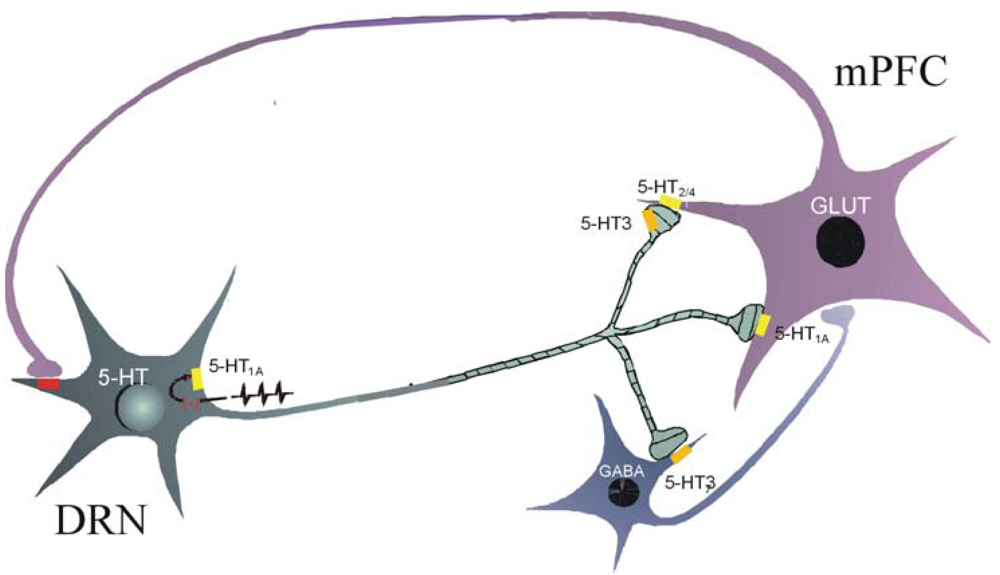
<p>The suppressant effect on the firing activity of medial prefrontal cortex cells induced by a 5-HT<sub>3</sub> receptor agonist is mediated by an indirect mechanism. A 5-HT<sub>3</sub> receptor agonist induces a direct inward current with a rapid desensitization of interneurons but has no effect in cultured pyramidal cells [<xref ref-type="bibr" rid="b112-pharmaceuticals-04-00603">112</xref>]. Thus, it appears that 5-HT<sub>3</sub> receptor agonists increase inhibitory postsynaptic currents (IPSCs) in cortical pyramidal neurons via stimulation of 5-HT<sub>3</sub> receptors located on inhibitory GABAergic interneurons [<xref ref-type="bibr" rid="b104-pharmaceuticals-04-00603">104</xref>,<xref ref-type="bibr" rid="b112-pharmaceuticals-04-00603">112</xref>]. In contrast to 5-HT<sub>2A</sub> receptors which are localized both in inhibitory and excitatory neurons, 5-HT<sub>3</sub> receptors have only an inhibitory effect in cortex [<xref ref-type="bibr" rid="b105-pharmaceuticals-04-00603">105</xref>,<xref ref-type="bibr" rid="b112-pharmaceuticals-04-00603">112</xref>]. As a consequence, a pulse of 5-HT is inhibitory while prolonged presence of 5-HT can induce enhancement of transmission because of 5-HT<sub>2A</sub> receptor activation and 5-HT<sub>3</sub> receptor desensitization [<xref ref-type="bibr" rid="b112-pharmaceuticals-04-00603">112</xref>]. There is a regulatory loop between raphe dorsalis and prefrontal cortex since stimulation of dorsal raphe induces an excitation of slow-spiking GABAergic neurons in prefrontal cortex inducing a suppression of cortical cells, an effect blocked by a 5-HT<sub>3</sub> receptor antagonist [<xref ref-type="bibr" rid="b35-pharmaceuticals-04-00603">35</xref>,<xref ref-type="bibr" rid="b108-pharmaceuticals-04-00603">108</xref>] (<xref ref-type="fig" rid="f1-pharmaceuticals-04-00603">Figure 1</xref>).</p></sec></sec>
<sec>
<label>3.3.</label>
<title>Interaction with the Dopamine System</title>
<p>The dopamine system can be divided into three pathways. The nigrostriatal dopaminergic pathway consists of the substantia nigra pars compacta (SNc, A9) and their associated efferent targets in the dorsal striatum. The mesolimbic dopaminergic pathway contains A10 dopaminergic neurons located within the ventral tegmental area (VTA) and their associated efferent targets in the ventral striatum including nucleus accumbens and limbic structures (e.g., amygdala and hippocampus). The mesocortical dopaminergic pathway consists of the A10 dopaminergic neurons and their associated efferent targets in the prefrontal cortex. It has been suggested that abnormalities of dopaminergic neurotransmission have been implicated in the pathogenesis of affective disorders [<xref ref-type="bibr" rid="b113-pharmaceuticals-04-00603">113</xref>,<xref ref-type="bibr" rid="b114-pharmaceuticals-04-00603">114</xref>]. In particular, several studies have suggested that the mesolimbic pathway can be altered in mood disorders. For example, stress, in animal models of depression, activates VTA DA neurons and their limbic efferent targets [<xref ref-type="bibr" rid="b115-pharmaceuticals-04-00603">115</xref>]. Moreover, the DA system is now one of the targets of depression treatment, for example drugs initially used in schizophrenia like aripiprazole or quetiapine are now used in depressed patients [<xref ref-type="bibr" rid="b8-pharmaceuticals-04-00603">8</xref>].</p>
<sec>
<label>3.3.1.</label>
<title>Substantia nigra compacta (SNc)</title>
<p>Acute administration of ondansetron, zatosetron or itasetron fails to modify the number of DA neurons that are spontaneously active in SNc (<xref ref-type="table" rid="t2-pharmaceuticals-04-00603">Table 2</xref>). Similarly, 21-day-chronic treatment with 5-HT<sub>3</sub> receptor antagonists has no effect, except for zatosetron at 0.1 mg/kg/day [<xref ref-type="bibr" rid="b116-pharmaceuticals-04-00603">116</xref>] and dolasetron at 5 mg/kg/day [<xref ref-type="bibr" rid="b117-pharmaceuticals-04-00603">117</xref>] which both decreased number of DA cells that are spontaneously active(<xref ref-type="table" rid="t2-pharmaceuticals-04-00603">Table 2</xref>). Moreover, 5-HT<sub>3</sub> receptor antagonists fail to affect sensibility to the D2-like receptor agonist apomorphine in SNc [<xref ref-type="bibr" rid="b118-pharmaceuticals-04-00603">118</xref>].</p></sec>
<sec>
<label>3.3.2.</label>
<title>Striatum</title>
<p>Infusion of striatal slices with 5-HT<sub>3</sub> receptor agonists, including 5-HT, produce an increase in DA release, an effect that is blocked by a 5-HT<sub>3</sub> receptor antagonist [<xref ref-type="bibr" rid="b119-pharmaceuticals-04-00603">119</xref>-<xref ref-type="bibr" rid="b122-pharmaceuticals-04-00603">122</xref>]. Similarly, <italic>in vivo</italic> studies in rats demonstrated that endogenous 5-HT stimulates release of 5-HT in striatum and that this effect is partially blocked by a 5-HT<sub>3</sub> receptor antagonist [<xref ref-type="bibr" rid="b123-pharmaceuticals-04-00603">123</xref>]. Notably, these data are controversial and in some studies the release induced by 5-HT<sub>3</sub> receptor agonists is not found to be 5-HT<sub>3</sub> receptor specific [<xref ref-type="bibr" rid="b124-pharmaceuticals-04-00603">124</xref>,<xref ref-type="bibr" rid="b125-pharmaceuticals-04-00603">125</xref>] wheras in other studies 5-HT<sub>3</sub> receptor agonists fail to modify basal striatal DA release [<xref ref-type="bibr" rid="b126-pharmaceuticals-04-00603">126</xref>]. 5-HT<sub>3</sub> receptor antagonists have failed to induce DA release in the striatum both <italic>in vitro</italic> and <italic>in vivo</italic> [<xref ref-type="bibr" rid="b127-pharmaceuticals-04-00603">127</xref>-<xref ref-type="bibr" rid="b132-pharmaceuticals-04-00603">132</xref>]. Dorsal raphe nucleus stimulation produces a DA decrease in the striatum which is not modified by 5-HT<sub>3</sub> receptor antagonists [<xref ref-type="bibr" rid="b133-pharmaceuticals-04-00603">133</xref>]. In fact, 5-HT<sub>3</sub> receptor-induced DA release may be effective only when both DA and 5-HT tone is increased [<xref ref-type="bibr" rid="b134-pharmaceuticals-04-00603">134</xref>].</p></sec>
<sec>
<label>3.3.3.</label>
<title>Ventral tegmental area (VTA)</title>
<p>Local infusion of mCPBG induces an increase of extracellular levels of DA in VTA slices, an effect that is inhibited by a 5-HT<sub>3</sub> receptor antagonist and depending on Ca<sup>2+</sup> [<xref ref-type="bibr" rid="b76-pharmaceuticals-04-00603">76</xref>,<xref ref-type="bibr" rid="b135-pharmaceuticals-04-00603">135</xref>,<xref ref-type="bibr" rid="b136-pharmaceuticals-04-00603">136</xref>]. On the other hand, acute administration of 5-HT<sub>3</sub> receptor antagonists ricasetron and itasetron has no effect on the firing of VTA DA neurons [<xref ref-type="bibr" rid="b118-pharmaceuticals-04-00603">118</xref>,<xref ref-type="bibr" rid="b137-pharmaceuticals-04-00603">137</xref>,<xref ref-type="bibr" rid="b138-pharmaceuticals-04-00603">138</xref>] and do not affect sensitivity to the D2-like receptor agonist apomorphine [<xref ref-type="bibr" rid="b118-pharmaceuticals-04-00603">118</xref>]. Nevertheless, clorgyline, a monoamine oxidase inhibitor (MAOI), inhibits VTA DA firing rate and ondansetron reverses this effect [<xref ref-type="bibr" rid="b138-pharmaceuticals-04-00603">138</xref>]. Effects of 5-HT<sub>3</sub> receptor antagonists on the number of DA cells per track are rather variable. Both after acute and chronic treatment, 5-HT<sub>3</sub> receptor antagonists have no effect or induced an increase or a decrease of the number of DA cells that are spontaneously active. These results depend on the 5-HT<sub>3</sub> receptor antagonist used and the dose used (<xref ref-type="table" rid="t2-pharmaceuticals-04-00603">Table 2</xref>). Moreover, when a 5-HT<sub>3</sub> receptor antagonist produces a decrease of the number of DA cells/track after a chronic treatment, apomorphine can or cannot reverse this effect [<xref ref-type="bibr" rid="b118-pharmaceuticals-04-00603">118</xref>].</p></sec>
<sec>
<label>3.3.4.</label>
<title>Nucleus accumbens</title>
<p><italic>In vivo</italic> and <italic>in vitro</italic> local administrations of a 5-HT<sub>3</sub> receptor agonist induced an increase of extracellular DA release in nucleus accumbens, an effect which is blocked by a 5-HT<sub>3</sub> receptor antagonist [<xref ref-type="bibr" rid="b76-pharmaceuticals-04-00603">76</xref>,<xref ref-type="bibr" rid="b139-pharmaceuticals-04-00603">139</xref>-<xref ref-type="bibr" rid="b141-pharmaceuticals-04-00603">141</xref>], suggesting a modulation of DA function by presynaptic 5-HT<sub>3</sub> receptors in this area [<xref ref-type="bibr" rid="b142-pharmaceuticals-04-00603">142</xref>]. Moreover, in 5-HT<sub>3</sub> receptors over-expressed mice, the DA release induced by a 5-HT<sub>3</sub> receptor agonist was increased compared to wild type [<xref ref-type="bibr" rid="b143-pharmaceuticals-04-00603">143</xref>]. Similarly, dorsal raphe nucleus stimulation increases DA release in nucleus accumbens which is attenuated by a 5-HT<sub>3</sub> receptor antagonist [<xref ref-type="bibr" rid="b133-pharmaceuticals-04-00603">133</xref>]. Interestingly, in an animal model of depression, namely the Flinder sensitive Line rats, 5-HT<sub>3</sub> receptor agonists do not increase DA levels in nucleus accumbens while a chronic antidepressant treatment restore the DA increase in response to agonist [<xref ref-type="bibr" rid="b113-pharmaceuticals-04-00603">113</xref>]. Acute administration of a 5-HT<sub>3</sub> receptor antagonist does not modify the rate of DA release in nucleus accumbens [<xref ref-type="bibr" rid="b130-pharmaceuticals-04-00603">130</xref>,<xref ref-type="bibr" rid="b144-pharmaceuticals-04-00603">144</xref>] while chronic treatment with the 5-HT<sub>3</sub> receptor antagonist MDL72222 decreases the extracellular concentration of DA in the nucleus accumbens [<xref ref-type="bibr" rid="b76-pharmaceuticals-04-00603">76</xref>,<xref ref-type="bibr" rid="b131-pharmaceuticals-04-00603">131</xref>]. This effect is not due to an alteration of sensitivity of 5-HT<sub>3</sub> receptors since the DA release induced by a 5-HT<sub>3</sub> receptor agonist is not altered after MDL72222 treatment [<xref ref-type="bibr" rid="b76-pharmaceuticals-04-00603">76</xref>]. Finally, local administration of a 5-HT<sub>3</sub> receptor antagonist in nucleus accumbens has an anxiolytic-like effect in different behavioral tests such as open-field, Vogel conflict test and light-dark exploration [<xref ref-type="bibr" rid="b145-pharmaceuticals-04-00603">145</xref>,<xref ref-type="bibr" rid="b146-pharmaceuticals-04-00603">146</xref>].</p></sec></sec>
<sec>
<label>3.4.</label>
<title>Interaction with Other Neurotransmitters</title>
<p>There is less data concerning other neurotransmitters release and this relevance of this data for depression is less clear data. Nevertheless, there is some evidence that 5-HT<sub>3</sub> receptors may also induce a release of glutamate from nerve terminals [<xref ref-type="bibr" rid="b148-pharmaceuticals-04-00603">148</xref>-<xref ref-type="bibr" rid="b150-pharmaceuticals-04-00603">150</xref>]. Also, there might be a role for acetylcholine (Ach), since 5-HT<sub>3</sub> receptor activation inhibits cortical release of Ach. It is not clear, however, whether this is a direct effect. Moreover 5-HT<sub>3</sub> receptor antagonist induced an increase of cortical Ach release, an effect that was potentiated by GABA receptor antagonists. This has led to the suggestion that the augmented ACh release by 5-HT<sub>3</sub> antagonists causes a blockade of GABA-mediated inhibition on cholinergic neurons [<xref ref-type="bibr" rid="b14-pharmaceuticals-04-00603">14</xref>,<xref ref-type="bibr" rid="b151-pharmaceuticals-04-00603">151</xref>]. Finally, some studies evoked an increase of noradrenaline induced by activation of 5-HT<sub>3</sub> stimulation but some others data are controversial and this effect seems not specific [<xref ref-type="bibr" rid="b85-pharmaceuticals-04-00603">85</xref>].</p></sec></sec>
<sec>
<label>4.</label>
<title>5-HT<sub>3</sub> Receptors as Drug Target for Treatment of Anxiety and Depression</title>
<sec>
<label>4.1.</label>
<title>Effect of Current Antidepressants on 5-HT3 Receptors</title>
<p>Some of the currently used antidepressants show affinity for 5-HT<sub>3</sub> receptors. Thus, the tricyclic antidepressant (TCA) Imipramine, the SSRI fluoxetine, the non-selective α2-adrenoceptor antagonist mirtazapine and the MAOI phenelzine dose-dependently block the inward current mediated by 5-HT<sub>3</sub> receptors expressed in cultured cells [<xref ref-type="bibr" rid="b152-pharmaceuticals-04-00603">152</xref>-<xref ref-type="bibr" rid="b156-pharmaceuticals-04-00603">156</xref>]. Moreover, several antidepressants, including fluoxetine, can inhibit binding of a 5-HT<sub>3</sub> receptor antagonist [<xref ref-type="bibr" rid="b157-pharmaceuticals-04-00603">157</xref>]. Interestingly, fluoxetine induced an increase of Polysialic Acid Neural Cell Adhesion Molecule (PSA-NCAM), a molecule implicated in neuroplasticity, an effect that was blocked by administration of 5-HT<sub>3</sub> receptor antagonist, thus suggesting a direct effect of fluoxetine on 5-HT<sub>3</sub> receptors [<xref ref-type="bibr" rid="b158-pharmaceuticals-04-00603">158</xref>]. Finally, fluoxetine inhibits 5-HT release induced by 5-HT<sub>3</sub> receptor agonists in the dorsal raphe nucleus [<xref ref-type="bibr" rid="b78-pharmaceuticals-04-00603">78</xref>]. Except for mirtazapine, the latter effect of antidepressants on 5-HT<sub>3</sub> receptors seems non-competitive[<xref ref-type="bibr" rid="b155-pharmaceuticals-04-00603">155</xref>,<xref ref-type="bibr" rid="b156-pharmaceuticals-04-00603">156</xref>,<xref ref-type="bibr" rid="b159-pharmaceuticals-04-00603">159</xref>]. Similarly, typical and atypical antipsychotics antagonize 5-HT<sub>3</sub> receptor in a non competitive manner [<xref ref-type="bibr" rid="b160-pharmaceuticals-04-00603">160</xref>]. This has led to the suggestion of an allosteric recognition site different from the 5-HT<sub>3</sub> binding site [<xref ref-type="bibr" rid="b155-pharmaceuticals-04-00603">155</xref>]. Interestingly, the non-competitive 5-HT3 antagonism of antidepressants seem not associated with an increase of internalization [<xref ref-type="bibr" rid="b161-pharmaceuticals-04-00603">161</xref>]. It has also been shown that 5-HT<sub>3</sub> receptors and antidepressants are colocalized in specific domain of membrane cells, the raft-like domains. Nevertheless antidepressants may exert effect on 5-HT<sub>3</sub> receptor despite disruption of lipid rafts [<xref ref-type="bibr" rid="b161-pharmaceuticals-04-00603">161</xref>,<xref ref-type="bibr" rid="b162-pharmaceuticals-04-00603">162</xref>].</p>
<p>Electrophysiological studies exploring recovery of firing after chronic (from 2 days to 3 weeks) antidepressant treatments in anesthetized rats suggested that mirtazapine may be more rapid than SSRIs in reversing the decrease of 5-HT dorsal raphe nucleus firing rate. Also, co-administration of paroxetine and mirtazapine may accelerate this index of antidepressant response compared to either drug alone [<xref ref-type="bibr" rid="b163-pharmaceuticals-04-00603">163</xref>]. In preclinical studies, cyamemazine, an atypical antipsychotic with D2-like, 5-HT<sub>2A</sub>, 5-HT<sub>2C</sub> and 5-HT<sub>3</sub> receptor antagonism properties [<xref ref-type="bibr" rid="b164-pharmaceuticals-04-00603">164</xref>] presents anxiolytic-like activity. In clinical studies, cyamemazine improved the anxious syndrome [<xref ref-type="bibr" rid="b164-pharmaceuticals-04-00603">164</xref>]. Finally, it has been suggested that electroconvulsive therapy may potentiate 5-HT<sub>3</sub> receptor function in hippocampal CA1 pyramidal cells [<xref ref-type="bibr" rid="b165-pharmaceuticals-04-00603">165</xref>].</p></sec>
<sec>
<label>4.2.</label>
<title>Lu AA21004</title>
<p>Lu AA21004 is a 5-HT<sub>3</sub> receptor antagonist, 5-HT<sub>1A</sub> receptor agonist (h5-HT3 and h5-HT<sub>1A</sub> receptors: Ki = 4.5 and 15 nM, respectively) and an inhibitor of the 5-HT transporter (5HTT) (h5HTT: IC<sub>50</sub> = 5.4 nM) [<xref ref-type="bibr" rid="b166-pharmaceuticals-04-00603">166</xref>]. This <italic>in vitro</italic> profile translates into enhanced levels of 5-HT as well as other neurotransmitters (<italic>i.e.</italic>, noradrenaline, dopamine, acetylcholine) in hippocampus and prefrontal cortex after <italic>in vivo</italic> administration [<xref ref-type="bibr" rid="b91-pharmaceuticals-04-00603">91</xref>,<xref ref-type="bibr" rid="b166-pharmaceuticals-04-00603">166</xref>]. It is different from others antidepressants since it has an effect on 5-HT levels even at a low transporter occupancy [<xref ref-type="bibr" rid="b91-pharmaceuticals-04-00603">91</xref>,<xref ref-type="bibr" rid="b166-pharmaceuticals-04-00603">166</xref>]. Moreover, it displays anxiolytic-like and antidepressant-like activity in various validated rodents models with a better efficacy than current antidepressant drugs [<xref ref-type="bibr" rid="b91-pharmaceuticals-04-00603">91</xref>,<xref ref-type="bibr" rid="b166-pharmaceuticals-04-00603">166</xref>]. Interestingly, in electrophysiological studies, Lu AA21004 has a preclinical profile of a fast-acting antidepressant, since it induced early 5-HT<sub>1A</sub> receptor desensitization compared to fluoxetine, an effect probably mediated by 5-HT<sub>3</sub> receptors blockade [<xref ref-type="bibr" rid="b167-pharmaceuticals-04-00603">167</xref>]. Currently in phase III trials, LuAA21004 displays very good efficacy and well tolerance [<xref ref-type="bibr" rid="b168-pharmaceuticals-04-00603">168</xref>].</p></sec>
<sec>
<label>4.3.</label>
<title>Preclinical Studies of 5-HT<sub>3</sub> Receptor Ligands</title>
<p>Poncelet <italic>et al.</italic> [<xref ref-type="bibr" rid="b169-pharmaceuticals-04-00603">169</xref>] demonstrate that the selective 5-HT<sub>3</sub> receptor agonist SR57227A produces antidepressant-like effect in different behavioral tests (forced swimming test, learned helplessness) in rodents. In contrast, other investigators report 5-HT<sub>3</sub> receptor agonists alone or in combination with antidepressants to be ineffective in the forced swimming test [<xref ref-type="bibr" rid="b170-pharmaceuticals-04-00603">170</xref>] and others report that 5-HT<sub>3</sub> receptor agonists attenuate the effects of antidepressants in this animal model [<xref ref-type="bibr" rid="b171-pharmaceuticals-04-00603">171</xref>]. These variable results may be explained by the different doses tested and may also ascribed to SR57227A being a partial 5HT<sub>3</sub> agonist.</p>
<p>In the learned helplessness test, zacopride, ondansetron and tropisetron reverse the escape failure with a biphasic dose effect relationship [<xref ref-type="bibr" rid="b70-pharmaceuticals-04-00603">70</xref>]. In the forced swim test and tail suspension test, acute and chronic treatments with 5-HT<sub>3</sub> receptor antagonists decrease the immobility time [<xref ref-type="bibr" rid="b71-pharmaceuticals-04-00603">71</xref>,<xref ref-type="bibr" rid="b172-pharmaceuticals-04-00603">172</xref>-<xref ref-type="bibr" rid="b175-pharmaceuticals-04-00603">175</xref>]. Interestingly, in the forced swim test, ondansetron increases the efficacy of fluoxetine, venlafaxine and citalopram [<xref ref-type="bibr" rid="b71-pharmaceuticals-04-00603">71</xref>,<xref ref-type="bibr" rid="b170-pharmaceuticals-04-00603">170</xref>]. In bulbectomized rats (another animal model of depression) 5-HT<sub>3</sub> receptor antagonists reverse their depression-like phenotype [<xref ref-type="bibr" rid="b71-pharmaceuticals-04-00603">71</xref>,<xref ref-type="bibr" rid="b175-pharmaceuticals-04-00603">175</xref>]. The novel putative antidepressant (4-benzylpiperazin-1-yl) (quinoxalin-2-yl) methanone (QCF-3) which is a 5-HT<sub>3</sub> receptor antagonist displayed also antidepressant properties both alone and in association with fluoxetine [<xref ref-type="bibr" rid="b176-pharmaceuticals-04-00603">176</xref>]. Finally, antidepressants induce a decrease in rapid eyes movements (REM) sleep. Microinjection of the 5-HT<sub>3</sub> receptor agonist mCPBG in the dorsal raphe nucleus causes a reduction of rapid eye movement sleep (REMS) whereas ondansetron prevented this reduction. [<xref ref-type="bibr" rid="b150-pharmaceuticals-04-00603">150</xref>]. Thus, administration of a 5-HT<sub>3</sub> receptor antagonist may have a beneficial effect on sleep disturbances induced by antidepressants.</p>
<p>Anxiolytic activity of 5-HT<sub>3</sub> receptor antagonists have been extensively studied in animal models [<xref ref-type="bibr" rid="b177-pharmaceuticals-04-00603">177</xref>,<xref ref-type="bibr" rid="b178-pharmaceuticals-04-00603">178</xref>]. Griebel <italic>et al.</italic> [<xref ref-type="bibr" rid="b178-pharmaceuticals-04-00603">178</xref>] analyzed more than 75 5-HT<sub>3</sub> receptor related experiments in which two-third of the studies demonstrated anxiolytic-like effect of 5-HT<sub>3</sub> receptor antagonists and one-third of the studies failed to reveal an effect. For example, in some studies, 5-HT<sub>3</sub> receptor antagonists disinhibited punished behavior in the Vogel test [<xref ref-type="bibr" rid="b145-pharmaceuticals-04-00603">145</xref>,<xref ref-type="bibr" rid="b179-pharmaceuticals-04-00603">179</xref>,<xref ref-type="bibr" rid="b180-pharmaceuticals-04-00603">180</xref>] and in other studies 5-HT<sub>3</sub> receptor antagonists were inactive [<xref ref-type="bibr" rid="b181-pharmaceuticals-04-00603">181</xref>]. Interestingly, after chronic treatment with diazepam, 5-HT<sub>3</sub> receptor agonists had no more anxiogenic effect, suggesting that diazepam may have induced a 5-HT<sub>3</sub> receptor desensitization [<xref ref-type="bibr" rid="b182-pharmaceuticals-04-00603">182</xref>].</p>
<p>Another index used to evaluate anxiolytic effect of drugs is by examining its effect on cholecystokinin [<xref ref-type="bibr" rid="b183-pharmaceuticals-04-00603">183</xref>]. Interestingly, GABAergic interneurons expressing 5-HT<sub>3</sub> receptors co-express cholecystokinin [<xref ref-type="bibr" rid="b88-pharmaceuticals-04-00603">88</xref>,<xref ref-type="bibr" rid="b104-pharmaceuticals-04-00603">104</xref>]. It has been shown that 5-HT or 5-HT<sub>3</sub> receptor agonists induce a release of cholecystokinin in cortical or accumbal synaptosomes while 5-HT<sub>3</sub> receptor antagonists decrease spontaneous- or induced-release of CCK [<xref ref-type="bibr" rid="b184-pharmaceuticals-04-00603">184</xref>,<xref ref-type="bibr" rid="b185-pharmaceuticals-04-00603">185</xref>]. However, in another study, 5-HT<sub>3</sub> receptor antagonists fail to prevent the increase of CCK induced by stress in rat prefrontal cortex [<xref ref-type="bibr" rid="b186-pharmaceuticals-04-00603">186</xref>]. Finally, it is well known that amygdala is involved in physiology of anxiety [<xref ref-type="bibr" rid="b187-pharmaceuticals-04-00603">187</xref>]. As described previously, 5-HT<sub>3</sub> receptors are present at significant levels in the amygdala. In the mouse amygdala, local administration of 5-HT<sub>3</sub> receptor antagonists attenuates aversive response whereas 5-HT<sub>3</sub> receptor agonists increase this [<xref ref-type="bibr" rid="b146-pharmaceuticals-04-00603">146</xref>]. Under the same conditions, in the social interaction test, 5-HT<sub>3</sub> receptor antagonists have also an anxiolytic-like activity [<xref ref-type="bibr" rid="b146-pharmaceuticals-04-00603">146</xref>]. It has been suggested that the amygdala is involved in disinhibitory effects induced by various 5-HT<sub>3</sub> receptor antagonists [<xref ref-type="bibr" rid="b188-pharmaceuticals-04-00603">188</xref>].</p>
<p>5-HT<sub>3A</sub> receptor knockout male mice present anxiety-like behavior in elevated plus maze, novelty interaction animal models and light/dark box models of anxiety [<xref ref-type="bibr" rid="b189-pharmaceuticals-04-00603">189</xref>,<xref ref-type="bibr" rid="b190-pharmaceuticals-04-00603">190</xref>]. In the forced swim test, male 5-HT<sub>3A</sub> knock-out (KO) did not differ from the wild type rats, whereas female 5-HT<sub>3</sub> knockout mice showed increased immobility [<xref ref-type="bibr" rid="b191-pharmaceuticals-04-00603">191</xref>]. Mice overexpressing 5-HT<sub>3</sub> receptors show decreased anxiety in the elevated plus-maze and in the exploration paradigm [<xref ref-type="bibr" rid="b192-pharmaceuticals-04-00603">192</xref>].</p></sec>
<sec>
<label>4.4.</label>
<title>Clinical Studies with 5-HT<sub>3</sub> Receptor Antagonists</title>
<p>5-HT<sub>3</sub> receptor antagonists have been tested on anxiety and depressive syndromes associated to other diseases. For example, ondansetron reduced depressive symptoms in patients with chronic hepatitis C [<xref ref-type="bibr" rid="b193-pharmaceuticals-04-00603">193</xref>], with alcoholism [<xref ref-type="bibr" rid="b194-pharmaceuticals-04-00603">194</xref>] and in bulimic patients [<xref ref-type="bibr" rid="b195-pharmaceuticals-04-00603">195</xref>]. Similarly in fibromyalgic patients, tropisetron improved anxiety and depressive scores [<xref ref-type="bibr" rid="b196-pharmaceuticals-04-00603">196</xref>]. Moreover, in pathology with common symptoms of depression like chronic fatigue or fibromyalgia, 5-HT<sub>3</sub> receptor antagonist have been reported efficacious [<xref ref-type="bibr" rid="b193-pharmaceuticals-04-00603">193</xref>,<xref ref-type="bibr" rid="b197-pharmaceuticals-04-00603">197</xref>-<xref ref-type="bibr" rid="b199-pharmaceuticals-04-00603">199</xref>], although negative results in chronic fatigue syndrome have been also reported [<xref ref-type="bibr" rid="b200-pharmaceuticals-04-00603">200</xref>]. Suspicion of 5-HT syndrome after use of setron alone or in combination with mirtazapine has reported in one study [<xref ref-type="bibr" rid="b201-pharmaceuticals-04-00603">201</xref>].</p>
<p>In healthy volunteers, ondansetron has been explored in emotional processing tasks. It abolishes the emotion potentiated startle effect, revealing an anxiolytic-like activity [<xref ref-type="bibr" rid="b202-pharmaceuticals-04-00603">202</xref>]. In anxious patients, zatosetron tends to reduce anxiety however the results from this study was not significant [<xref ref-type="bibr" rid="b203-pharmaceuticals-04-00603">203</xref>]. Similarly, tropisteron improves anxiety scores in patients suffering from generalized anxiety disorders [<xref ref-type="bibr" rid="b204-pharmaceuticals-04-00603">204</xref>]. In clinical studies, results concerning CCK release were contradictory as in preclinical studies. Indeed, in patients with panic disorder and social phobia, ondansetron fails to prevent the anxiety induced by pentagastrin, a CCK agonist [<xref ref-type="bibr" rid="b205-pharmaceuticals-04-00603">205</xref>]. Whereas, in healthy volunteers, ondansetron prevents panic symptoms induced by CCK tetrapeptide [<xref ref-type="bibr" rid="b206-pharmaceuticals-04-00603">206</xref>].</p></sec></sec>
<sec sec-type="conclusions">
<label>5.</label>
<title>Conclusions</title>
<p>5-HT<sub>3</sub> receptors are in numerous ways intimately involved in the regulation of neurotransmitter systems that are known to be of relevance for several psychiatric disorders including mood disorders, schizophrenia, eating disorders and addiction [<xref ref-type="bibr" rid="b21-pharmaceuticals-04-00603">21</xref>,<xref ref-type="bibr" rid="b207-pharmaceuticals-04-00603">207</xref>]. As becomes evident from the present review, the involvement of 5-HT<sub>3</sub> receptors is complex and also context dependent. Their molecular structure, function and regulation are only partly elucidated. It will be important to understand why several responses associated with 5-HT<sub>3</sub> receptor ligands present a bell-shaped dose-response curve. In conclusion, we feel that additional knowledge about 5-HT<sub>3</sub> receptor function and their role in several diseases may offer new therapeutic opportunities in the future.</p></sec></body>
<back>
<sec sec-type="display-objects">
<title>Figure and Tables</title>
<fig id="f1-pharmaceuticals-04-00603" position="float">
<label>Figure 1.</label>
<caption>
<p>Hypothetic model of the mechanism of action of 5-HT<sub>3</sub> receptor agonists on the dorsal raphe nucleus-prefrontal cortex loop. Cortical 5-HT<sub>3</sub> receptors seem to be localized both presynaptically on 5-HT neurons and postsynaptically on GABAergic interneurons. Stimulation of dorsal raphe nucleus induces a cortical release of 5-HT. Thus, released 5-HT may target postsynaptic 5-HT<sub>3</sub> receptors inducing an activation of GABAergic interneurons. These interneurons inhibit pyramidal cells that reduce 5-HT dorsal raphe neuronal firing rate. 5-HT receptors are represented in yellow except 5-HT<sub>3</sub> receptors in orange and ionotropic glutamatergic receptors are represented in red. DRN, dorsal raphe nucleus, mPFC, medial prefrontal cortex, GABA, gamma aminobutyric acid, GLUT, glutamate.</p></caption>
<graphic xlink:href="pharmaceuticals-04-00603f1.gif"/></fig>
<table-wrap id="t1-pharmaceuticals-04-00603" position="float">
<label>Table 1.</label>
<caption>
<p>5-HT<sub>3</sub> receptor agonists and antagonists.</p></caption>
<table frame="hsides" rules="groups">
<thead>
<tr>
<th align="left" valign="top"><bold>5-HT3 receptor agonist</bold></th>
<th align="left" valign="top"><bold>5-HT3 receptor antagonists</bold></th></tr></thead>
<tbody>
<tr>
<td align="left" valign="top">1-(m-chlorophenyl)-biguanide (mCPBG)</td>
<td align="left" valign="top">MDL 73,147EF (dolasetron)</td></tr>
<tr>
<td align="left" valign="top" rowspan="8">2-methyl-5-HT (2-me-5-HT) SR57227A</td>
<td align="left" valign="top">GR38032F (ondansetron)</td></tr>
<tr>
<td align="left" valign="top">BRL 43694 (granisetron)</td></tr>
<tr>
<td align="left" valign="top">ICS 205-939 (tropisetron)</td></tr>
<tr>
<td align="left" valign="top">DAU 6215 (itasetron)</td></tr>
<tr>
<td align="left" valign="top">BRL-46470A (ricasetron)</td></tr>
<tr>
<td align="left" valign="top">LY277359 (zatosetron)</td></tr>
<tr>
<td align="left" valign="top">MDL 72222</td></tr>
<tr>
<td align="left" valign="top">Palanosetron</td></tr></tbody></table></table-wrap>
<table-wrap id="t2-pharmaceuticals-04-00603" position="float">
<label>Table 2.</label>
<caption>
<p>Acute and chronic effects of 5-HT<sub>3</sub> receptors antagonists on the number of DA cell/track. 5-HT3 receptor antagonists had either no effect (0) either an increase (+) or a decrease (−) on the number of cell/track.</p></caption>
<table frame="box" rules="all">
<thead>
<tr>
<th colspan="5" align="left" valign="top"><bold>Cell per track</bold></th></tr>
<tr>
<th align="left" valign="top"><bold>5-HT<sub>3</sub> receptor antagonist</bold></th>
<th align="left" valign="top"><bold>Duration</bold></th>
<th align="left" valign="top"><bold>Dose</bold></th>
<th align="left" valign="top"><bold>A9 (SNc)</bold></th>
<th align="left" valign="top"><bold>A10 (VTA)</bold></th></tr></thead>
<tbody>
<tr>
<td align="left" valign="middle">Dolasetron [<xref ref-type="bibr" rid="b117-pharmaceuticals-04-00603">117</xref>]</td>
<td align="left" valign="middle" rowspan="9">Acute treatment</td>
<td align="left" valign="top">500 µg/kg, i.v.</td>
<td align="left" valign="top">0</td>
<td align="left" valign="top">0</td></tr>
<tr>
<td align="left" valign="middle" rowspan="2">Zatosetron [<xref ref-type="bibr" rid="b116-pharmaceuticals-04-00603">116</xref>]</td>
<td align="left" valign="top">0.1 mg/kg, i.v.</td>
<td align="left" valign="top">0</td>
<td align="left" valign="top">+</td></tr>
<tr>
<td align="left" valign="top">1 mg/kg, i.v.</td>
<td align="left" valign="top">0</td>
<td align="left" valign="top">+</td></tr>
<tr>
<td align="left" valign="middle" rowspan="5">Zatosetron [<xref ref-type="bibr" rid="b147-pharmaceuticals-04-00603">147</xref>]</td>
<td align="left" valign="top">10 mg/kg, i.v.</td>
<td align="left" valign="top">0</td>
<td align="left" valign="top">0</td></tr>
<tr>
<td align="left" valign="top">0.01 mg/kg, i.p.</td>
<td align="left" valign="top">0</td>
<td align="left" valign="top">0</td></tr>
<tr>
<td align="left" valign="top">0.1 mg/kg, i.p.</td>
<td align="left" valign="top">0</td>
<td align="left" valign="top">−</td></tr>
<tr>
<td align="left" valign="top">1 mg/kg, i.p.</td>
<td align="left" valign="top">0</td>
<td align="left" valign="top">0</td></tr>
<tr>
<td align="left" valign="top">10 mg/kg, i.p.</td>
<td align="left" valign="top">0</td>
<td align="left" valign="top">0</td></tr>
<tr>
<td align="left" valign="middle">Itasetron [<xref ref-type="bibr" rid="b118-pharmaceuticals-04-00603">118</xref>]</td>
<td align="left" valign="top">15 µg/kg, s.c.</td>
<td align="left" valign="top">0</td>
<td align="left" valign="top">+</td></tr>
<tr>
<td align="left" valign="middle">Dolasetron [<xref ref-type="bibr" rid="b117-pharmaceuticals-04-00603">117</xref>]</td>
<td align="left" valign="middle" rowspan="11">Chronic treatment (21 days)</td>
<td align="left" valign="top">5 mg/kg/day, i.p.</td>
<td align="left" valign="top">−</td>
<td align="left" valign="top">−</td></tr>
<tr>
<td align="left" valign="middle" rowspan="2">Granisetron [<xref ref-type="bibr" rid="b137-pharmaceuticals-04-00603">137</xref>]</td>
<td align="left" valign="top">5 mg/kg/day, i.p.</td>
<td align="left" valign="top">0</td>
<td align="left" valign="top">0</td></tr>
<tr>
<td align="left" valign="top">10 mg/kg/day, i.p.</td>
<td align="left" valign="top">0</td>
<td align="left" valign="top">0</td></tr>
<tr>
<td align="left" valign="middle">Itasetron [<xref ref-type="bibr" rid="b118-pharmaceuticals-04-00603">118</xref>]</td>
<td align="left" valign="top">30 µg/kg/day, s.c.</td>
<td align="left" valign="top">0</td>
<td align="left" valign="top">−</td></tr>
<tr>
<td align="left" valign="middle" rowspan="3">Zatosetron [<xref ref-type="bibr" rid="b116-pharmaceuticals-04-00603">116</xref>]</td>
<td align="left" valign="top">0.1 mg/kg/day, i.p.</td>
<td align="left" valign="top">−</td>
<td align="left" valign="top">−</td></tr>
<tr>
<td align="left" valign="top">1 mg/kg/day, i.p.</td>
<td align="left" valign="top">0</td>
<td align="left" valign="top">+</td></tr>
<tr>
<td align="left" valign="top">10 mg/kg/day, i.p.</td>
<td align="left" valign="top">0</td>
<td align="left" valign="top">−</td></tr>
<tr>
<td align="left" valign="middle" rowspan="4">Zatosetron [<xref ref-type="bibr" rid="b147-pharmaceuticals-04-00603">147</xref>]</td>
<td align="left" valign="top">0.01 mg/kg, i.p.</td>
<td align="left" valign="top">0</td>
<td align="left" valign="top">0</td></tr>
<tr>
<td align="left" valign="top">0.1 mg/kg, i.p.</td>
<td align="left" valign="top">0</td>
<td align="left" valign="top">−</td></tr>
<tr>
<td align="left" valign="top">1 mg/kg, i.p.</td>
<td align="left" valign="top">0</td>
<td align="left" valign="top">0</td></tr>
<tr>
<td align="left" valign="top">10 mg/kg, i.p.</td>
<td align="left" valign="top">0</td>
<td align="left" valign="top">0</td></tr></tbody></table></table-wrap></sec>
<ref-list>
<title>References</title>
<ref id="b1-pharmaceuticals-04-00603"><label>1.</label><citation citation-type="journal"><person-group person-group-type="author"><name><surname>Kessler</surname><given-names>R.C.</given-names></name><name><surname>Kessler</surname><given-names>R.C.</given-names></name><name><surname>Berglund</surname><given-names>P.</given-names></name><name><surname>Demler</surname><given-names>O.</given-names></name><name><surname>Jin</surname><given-names>R.</given-names></name><name><surname>Koretz</surname><given-names>D.</given-names></name><name><surname>Merikangas</surname><given-names>K.R.</given-names></name><name><surname>Rush</surname><given-names>A.J.</given-names></name><name><surname>Walters</surname><given-names>E.E.</given-names></name><name><surname>Wang</surname><given-names>P.S.</given-names></name></person-group><article-title>The epidemiology of major depressive disorder: Results from the National Comorbidity Survey Replication (NCS-R)</article-title><source>JAMA</source><year>2003</year><volume>289</volume><fpage>3095</fpage><lpage>3105</lpage><pub-id pub-id-type="doi">10.1001/jama.289.23.3095</pub-id><pub-id pub-id-type="pmid">12813115</pub-id></citation></ref>
<ref id="b2-pharmaceuticals-04-00603"><label>2.</label><citation citation-type="journal"><person-group person-group-type="author"><name><surname>Kunugi</surname><given-names>H.</given-names></name><name><surname>Hori</surname><given-names>H.</given-names></name><name><surname>Adachi</surname><given-names>N.</given-names></name><name><surname>Numakawa</surname><given-names>T.</given-names></name></person-group><article-title>Interface between hypothalamic-pituitary-adrenal axis and brain-derived neurotrophic factor in depression</article-title><source>Psychiat. Clin. Neurosci.</source><year>2010</year><volume>64</volume><fpage>447</fpage><lpage>459</lpage><pub-id pub-id-type="doi">10.1111/j.1440-1819.2010.02135.x</pub-id></citation></ref>
<ref id="b3-pharmaceuticals-04-00603"><label>3.</label><citation citation-type="journal"><person-group person-group-type="author"><name><surname>Faure</surname><given-names>C.</given-names></name><name><surname>Mnie-Filali</surname><given-names>O.</given-names></name><name><surname>Haddjeri</surname><given-names>N.</given-names></name></person-group><article-title>Long-term adaptive changes induced by serotonergic antidepressant drugs</article-title><source>Expert Rev. Neurother.</source><year>2006</year><volume>6</volume><fpage>235</fpage><lpage>245</lpage><pub-id pub-id-type="doi">10.1586/14737175.6.2.235</pub-id><pub-id pub-id-type="pmid">16466303</pub-id></citation></ref>
<ref id="b4-pharmaceuticals-04-00603"><label>4.</label><citation citation-type="journal"><person-group person-group-type="author"><name><surname>Berton</surname><given-names>O.</given-names></name><name><surname>Nestler</surname><given-names>E.J.</given-names></name></person-group><article-title>New approaches to antidepressant drug discovery: Beyond monoamines</article-title><source>Nat. Rev. Neurosci.</source><year>2006</year><volume>7</volume><fpage>137</fpage><lpage>151</lpage><pub-id pub-id-type="doi">10.1038/nrn1846</pub-id><pub-id pub-id-type="pmid">16429123</pub-id></citation></ref>
<ref id="b5-pharmaceuticals-04-00603"><label>5.</label><citation citation-type="journal"><person-group person-group-type="author"><name><surname>Duman</surname><given-names>R.S.</given-names></name></person-group><article-title>Depression: A case of neuronal life and death?</article-title><source>Biol Psychiat.</source><year>2004</year><volume>56</volume><fpage>140</fpage><lpage>145</lpage><pub-id pub-id-type="doi">10.1016/j.biopsych.2004.02.033</pub-id><pub-id pub-id-type="pmid">15271581</pub-id></citation></ref>
<ref id="b6-pharmaceuticals-04-00603"><label>6.</label><citation citation-type="journal"><person-group person-group-type="author"><name><surname>Blier</surname><given-names>P.</given-names></name></person-group><article-title>The pharmacology of putative early-onset antidepressant strategies</article-title><source>Eur. Neuropsychopharmacol.</source><year>2003</year><volume>13</volume><fpage>57</fpage><lpage>66</lpage><pub-id pub-id-type="pmid">12650947</pub-id></citation></ref>
<ref id="b7-pharmaceuticals-04-00603"><label>7.</label><citation citation-type="journal"><person-group person-group-type="author"><name><surname>Artigas</surname><given-names>F.</given-names></name><name><surname>Adell</surname><given-names>A.</given-names></name><name><surname>Celada</surname><given-names>P.</given-names></name></person-group><article-title>Pindolol augmentation of antidepressant response</article-title><source>Curr.Drug Targets</source><year>2006</year><volume>7</volume><fpage>139</fpage><lpage>147</lpage><pub-id pub-id-type="doi">10.2174/138945006775515446</pub-id><pub-id pub-id-type="pmid">16475955</pub-id></citation></ref>
<ref id="b8-pharmaceuticals-04-00603"><label>8.</label><citation citation-type="journal"><person-group person-group-type="author"><name><surname>Etievant</surname><given-names>A.</given-names></name><name><surname>Betry</surname><given-names>C.</given-names></name><name><surname>Haddjeri</surname><given-names>N.</given-names></name></person-group><article-title>Partial dopamine D2/serotonin 5-HT1A receptor agonists as new therapeutic agents</article-title><source>Open Neuropsychopharmacol. J.</source><year>2010</year><volume>3</volume><fpage>1</fpage><lpage>12</lpage><pub-id pub-id-type="doi">10.2174/1876523801003010001</pub-id></citation></ref>
<ref id="b9-pharmaceuticals-04-00603"><label>9.</label><citation citation-type="journal"><person-group person-group-type="author"><name><surname>Celada</surname><given-names>P.</given-names></name><name><surname>Puig</surname><given-names>M.</given-names></name><name><surname>Amargos-Bosch</surname><given-names>M.</given-names></name><name><surname>Adell</surname><given-names>A.</given-names></name><name><surname>Artigas</surname><given-names>F.</given-names></name></person-group><article-title>The therapeutic role of 5-HT1A and 5-HT2A receptors in depression</article-title><source>J. Psychiat. Neurosci.</source><year>2004</year><volume>29</volume><fpage>252</fpage><lpage>265</lpage></citation></ref>
<ref id="b10-pharmaceuticals-04-00603"><label>10.</label><citation citation-type="journal"><person-group person-group-type="author"><name><surname>Marek</surname><given-names>G.J.</given-names></name><name><surname>Carpenter</surname><given-names>L.L.</given-names></name><name><surname>McDougle</surname><given-names>C.J.</given-names></name><name><surname>Price</surname><given-names>L.H.</given-names></name></person-group><article-title>Synergistic action of 5-HT2A antagonists and selective serotonin reuptake inhibitors in neuropsychiatric disorders</article-title><source>Neuropsychopharmacology</source><year>2003</year><volume>28</volume><fpage>402</fpage><lpage>412</lpage><pub-id pub-id-type="doi">10.1038/sj.npp.1300057</pub-id><pub-id pub-id-type="pmid">12589395</pub-id></citation></ref>
<ref id="b11-pharmaceuticals-04-00603"><label>11.</label><citation citation-type="journal"><person-group person-group-type="author"><name><surname>Lucas</surname><given-names>G.</given-names></name><name><surname>Rymar</surname><given-names>V.V.</given-names></name><name><surname>Du</surname><given-names>J.</given-names></name><name><surname>Mnie-Filali</surname><given-names>O.</given-names></name><name><surname>Bisgaard</surname><given-names>C.</given-names></name><name><surname>Manta</surname><given-names>S.</given-names></name><name><surname>Lambas-Senas</surname><given-names>L.</given-names></name><name><surname>Wiborg</surname><given-names>O.</given-names></name><name><surname>Haddjeri</surname><given-names>N.</given-names></name><name><surname>Piñeyro</surname><given-names>G.</given-names></name><etal/></person-group><article-title>Serotonin(4) (5-HT(4)) receptor agonists are putative antidepressants with a rapid onset of action</article-title><source>Neuron</source><year>2007</year><volume>55</volume><fpage>712</fpage><lpage>725</lpage><pub-id pub-id-type="doi">10.1016/j.neuron.2007.07.041</pub-id><pub-id pub-id-type="pmid">17785179</pub-id></citation></ref>
<ref id="b12-pharmaceuticals-04-00603"><label>12.</label><citation citation-type="journal"><person-group person-group-type="author"><name><surname>Lucas</surname><given-names>G.</given-names></name></person-group><article-title>Serotonin receptors, type 4: A new hope?</article-title><source>Curr.Drug Targets</source><year>2009</year><volume>10</volume><fpage>1085</fpage><lpage>1095</lpage><pub-id pub-id-type="doi">10.2174/138945009789735200</pub-id><pub-id pub-id-type="pmid">19702554</pub-id></citation></ref>
<ref id="b13-pharmaceuticals-04-00603"><label>13.</label><citation citation-type="journal"><person-group person-group-type="author"><name><surname>Mnie-Filali</surname><given-names>O.</given-names></name><name><surname>Lambas-Senas</surname><given-names>L.</given-names></name><name><surname>Zimmer</surname><given-names>L.</given-names></name><name><surname>Haddjeri</surname><given-names>N.</given-names></name></person-group><article-title>5-HT7 receptor antagonists as a new class of antidepressants</article-title><source>Drug News Perspect.</source><year>2007</year><volume>20</volume><fpage>613</fpage><lpage>618</lpage><pub-id pub-id-type="doi">10.1358/dnp.2007.20.10.1181354</pub-id><pub-id pub-id-type="pmid">18301795</pub-id></citation></ref>
<ref id="b14-pharmaceuticals-04-00603"><label>14.</label><citation citation-type="journal"><person-group person-group-type="author"><name><surname>Barnes</surname><given-names>N.M.</given-names></name><name><surname>Sharp</surname><given-names>T.</given-names></name></person-group><article-title>A review of central 5-HT receptors and their function</article-title><source>Neuropharmacology</source><year>1999</year><volume>38</volume><fpage>1083</fpage><lpage>1152</lpage><pub-id pub-id-type="doi">10.1016/S0028-3908(99)00010-6</pub-id><pub-id pub-id-type="pmid">10462127</pub-id></citation></ref>
<ref id="b15-pharmaceuticals-04-00603"><label>15.</label><citation citation-type="journal"><person-group person-group-type="author"><name><surname>Maricq</surname><given-names>A.V.</given-names></name><name><surname>Peterson</surname><given-names>A.S.</given-names></name><name><surname>Brake</surname><given-names>A.J.</given-names></name><name><surname>Myers</surname><given-names>R.M.</given-names></name><name><surname>Julius</surname><given-names>D.</given-names></name></person-group><article-title>Primary structure and functional expression of the 5HT3 receptor, a serotonin-gated ion channel</article-title><source>Science</source><year>1991</year><volume>254</volume><fpage>432</fpage><lpage>437</lpage><pub-id pub-id-type="doi">10.1126/science.1718042</pub-id><pub-id pub-id-type="pmid">1718042</pub-id></citation></ref>
<ref id="b16-pharmaceuticals-04-00603"><label>16.</label><citation citation-type="journal"><person-group person-group-type="author"><name><surname>Cederholm</surname><given-names>J.M.</given-names></name><name><surname>Schofield</surname><given-names>P.R.</given-names></name><name><surname>Lewis</surname><given-names>T.M.</given-names></name></person-group><article-title>Gating mechanisms in Cys-loop receptors</article-title><source>Eur. Biophys. J.</source><year>2009</year><volume>39</volume><fpage>37</fpage><lpage>49</lpage><pub-id pub-id-type="doi">10.1007/s00249-009-0452-y</pub-id><pub-id pub-id-type="pmid">19404635</pub-id></citation></ref>
<ref id="b17-pharmaceuticals-04-00603"><label>17.</label><citation citation-type="journal"><person-group person-group-type="author"><name><surname>Davies</surname><given-names>P.A.</given-names></name><name><surname>Pistis</surname><given-names>M.</given-names></name><name><surname>Hanna</surname><given-names>M.C.</given-names></name><name><surname>Peters</surname><given-names>J.A.</given-names></name><name><surname>Lambert</surname><given-names>J.J.</given-names></name><name><surname>Hales</surname><given-names>T.G.</given-names></name><name><surname>Kirkness</surname><given-names>E.F.</given-names></name></person-group><article-title>The 5-HT3B subunit is a major determinant of serotonin-receptor function</article-title><source>Nature</source><year>1999</year><volume>397</volume><fpage>359</fpage><lpage>363</lpage><pub-id pub-id-type="doi">10.1038/16941</pub-id><pub-id pub-id-type="pmid">9950429</pub-id></citation></ref>
<ref id="b18-pharmaceuticals-04-00603"><label>18.</label><citation citation-type="journal"><person-group person-group-type="author"><name><surname>Niesler</surname><given-names>B.</given-names></name><name><surname>Frank</surname><given-names>B.</given-names></name><name><surname>Kapeller</surname><given-names>J.</given-names></name><name><surname>Rappold</surname><given-names>G.A.</given-names></name></person-group><article-title>Cloning, physical mapping and expression analysis of the human 5-HT3 serotonin receptor-like genes HTR3C, HTR3D and HTR3E</article-title><source>Gene</source><year>2003</year><volume>310</volume><fpage>101</fpage><lpage>111</lpage><pub-id pub-id-type="doi">10.1016/S0378-1119(03)00503-1</pub-id><pub-id pub-id-type="pmid">12801637</pub-id></citation></ref>
<ref id="b19-pharmaceuticals-04-00603"><label>19.</label><citation citation-type="journal"><person-group person-group-type="author"><name><surname>Karnovsky</surname><given-names>A.M.</given-names></name><name><surname>Gotow</surname><given-names>L.F.</given-names></name><name><surname>McKinley</surname><given-names>D.D.</given-names></name><name><surname>Piechan</surname><given-names>J.L.</given-names></name><name><surname>Ruble</surname><given-names>C.L.</given-names></name><name><surname>Mills</surname><given-names>C.J.</given-names></name><name><surname>Schellin</surname><given-names>K.A.</given-names></name><name><surname>Slightom</surname><given-names>J.L.</given-names></name><name><surname>Fitzgerald</surname><given-names>L.R.</given-names></name><name><surname>Benjamin</surname><given-names>C.W.</given-names></name><etal/></person-group><article-title>A cluster of novel serotonin receptor 3-like genes on human chromosome 3</article-title><source>Gene</source><year>2003</year><volume>319</volume><fpage>137</fpage><lpage>148</lpage><pub-id pub-id-type="doi">10.1016/S0378-1119(03)00803-5</pub-id><pub-id pub-id-type="pmid">14597179</pub-id></citation></ref>
<ref id="b20-pharmaceuticals-04-00603"><label>20.</label><citation citation-type="journal"><person-group person-group-type="author"><name><surname>Holbrook</surname><given-names>J.D.</given-names></name><name><surname>Gill</surname><given-names>C.H.</given-names></name><name><surname>Zebda</surname><given-names>N.</given-names></name><name><surname>Spencer</surname><given-names>J.P.</given-names></name><name><surname>Leyland</surname><given-names>R.</given-names></name><name><surname>Rance</surname><given-names>K.H.</given-names></name><name><surname>Trinh</surname><given-names>H.</given-names></name><name><surname>Balmer</surname><given-names>G.</given-names></name><name><surname>Kelly</surname><given-names>F.M.</given-names></name><name><surname>Yusaf</surname><given-names>S.P.</given-names></name><etal/></person-group><article-title>Gunthorpe, Characterisation of 5-HT3C, 5-HT3D and 5-HT3E receptor subunits: evolution, distribution and function</article-title><source>J. Neurochem.</source><year>2009</year><volume>108</volume><fpage>384</fpage><lpage>396</lpage><pub-id pub-id-type="doi">10.1111/j.1471-4159.2008.05775.x</pub-id><pub-id pub-id-type="pmid">19012743</pub-id></citation></ref>
<ref id="b21-pharmaceuticals-04-00603"><label>21.</label><citation citation-type="journal"><person-group person-group-type="author"><name><surname>Faerber</surname><given-names>L.</given-names></name><name><surname>Drechsler</surname><given-names>S.</given-names></name><name><surname>Ladenburger</surname><given-names>S.</given-names></name><name><surname>Gschaidmeier</surname><given-names>H.</given-names></name><name><surname>Fischer</surname><given-names>W.</given-names></name></person-group><article-title>The neuronal 5-HT3 receptor network after 20 years of research—Evolving concepts in management of pain and inflammation</article-title><source>Eur. J. Pharmacol.</source><year>2007</year><volume>560</volume><fpage>1</fpage><lpage>8</lpage><pub-id pub-id-type="doi">10.1016/j.ejphar.2007.01.028</pub-id><pub-id pub-id-type="pmid">17316606</pub-id></citation></ref>
<ref id="b22-pharmaceuticals-04-00603"><label>22.</label><citation citation-type="journal"><person-group person-group-type="author"><name><surname>Pratt</surname><given-names>G.D.</given-names></name><name><surname>Bowery</surname><given-names>N.G.</given-names></name><name><surname>Kilpatrick</surname><given-names>G.J.</given-names></name><name><surname>Leslie</surname><given-names>R.A.</given-names></name><name><surname>Barnes</surname><given-names>N.M.</given-names></name><name><surname>Naylor</surname><given-names>R.J.</given-names></name><name><surname>Jones</surname><given-names>B.J.</given-names></name><name><surname>Nelson</surname><given-names>D.R.</given-names></name><name><surname>Palacids</surname><given-names>J.M.</given-names></name><name><surname>Slater</surname><given-names>P.</given-names></name><etal/></person-group><article-title>Consensus meeting agrees distribution of 5-HT3 receptors in mammalian hindbrain</article-title><source>Trends Pharmacol. Sci.</source><year>1990</year><volume>11</volume><fpage>135</fpage><lpage>137</lpage><pub-id pub-id-type="doi">10.1016/0165-6147(90)90058-G</pub-id><pub-id pub-id-type="pmid">2333665</pub-id></citation></ref>
<ref id="b23-pharmaceuticals-04-00603"><label>23.</label><citation citation-type="journal"><person-group person-group-type="author"><name><surname>Waeber</surname><given-names>C.</given-names></name><name><surname>Hoyer</surname><given-names>D.</given-names></name><name><surname>Palacios</surname><given-names>J.M.</given-names></name></person-group><article-title>5-Hydroxytryptamine3 receptors in the human brain: autoradiographic visualization using [3H]ICS 205-930</article-title><source>Neuroscience</source><year>1989</year><volume>31</volume><fpage>393</fpage><lpage>400</lpage><pub-id pub-id-type="doi">10.1016/0306-4522(89)90382-5</pub-id><pub-id pub-id-type="pmid">2797443</pub-id></citation></ref>
<ref id="b24-pharmaceuticals-04-00603"><label>24.</label><citation citation-type="journal"><person-group person-group-type="author"><name><surname>Barnes</surname><given-names>J.M.</given-names></name><name><surname>Barnes</surname><given-names>N.M.</given-names></name><name><surname>Costall</surname><given-names>B.</given-names></name><name><surname>Deakin</surname><given-names>J.F.</given-names></name><name><surname>Ironside</surname><given-names>J.W.</given-names></name><name><surname>Kilpatrick</surname><given-names>G.J.</given-names></name><name><surname>Naylor</surname><given-names>R.J.</given-names></name><name><surname>Rudd</surname><given-names>J.A.</given-names></name><name><surname>Simpson</surname><given-names>M.D.</given-names></name><name><surname>Slater</surname><given-names>P.</given-names></name><etal/></person-group><article-title>Identification and distribution of 5-HT3 recognition sites within the human brainstem</article-title><source>Neurosci. Lett.</source><year>1990</year><volume>111</volume><fpage>80</fpage><lpage>86</lpage><pub-id pub-id-type="doi">10.1016/0304-3940(90)90348-D</pub-id><pub-id pub-id-type="pmid">2336196</pub-id></citation></ref>
<ref id="b25-pharmaceuticals-04-00603"><label>25.</label><citation citation-type="journal"><person-group person-group-type="author"><name><surname>Laporte</surname><given-names>A.M.</given-names></name><name><surname>Koscielniak</surname><given-names>T.</given-names></name><name><surname>Ponchant</surname><given-names>M.</given-names></name><name><surname>Verge</surname><given-names>D.</given-names></name><name><surname>Hamon</surname><given-names>M.</given-names></name><name><surname>Gozlan</surname><given-names>H.</given-names></name></person-group><article-title>Quantitative autoradiographic mapping of 5-HT3 receptors in the rat CNS using [125I]iodo-zacopride and [3H]zacopride as radioligands</article-title><source>Synapse</source><year>1992</year><volume>10</volume><fpage>271</fpage><lpage>281</lpage><pub-id pub-id-type="doi">10.1002/syn.890100402</pub-id><pub-id pub-id-type="pmid">1585260</pub-id></citation></ref>
<ref id="b26-pharmaceuticals-04-00603"><label>26.</label><citation citation-type="journal"><person-group person-group-type="author"><name><surname>Chameau</surname><given-names>P.</given-names></name><name><surname>van Hooft</surname><given-names>J.A.</given-names></name></person-group><article-title>Serotonin 5-HT(3) receptors in the central nervous system</article-title><source>Cell Tissue Res.</source><year>2006</year><volume>326</volume><fpage>573</fpage><lpage>581</lpage><pub-id pub-id-type="doi">10.1007/s00441-006-0255-8</pub-id><pub-id pub-id-type="pmid">16826372</pub-id></citation></ref>
<ref id="b27-pharmaceuticals-04-00603"><label>27.</label><citation citation-type="journal"><person-group person-group-type="author"><name><surname>Kilpatrick</surname><given-names>G.J.</given-names></name><name><surname>Jones</surname><given-names>B.J.</given-names></name><name><surname>Tyers</surname><given-names>M.B.</given-names></name></person-group><article-title>The distribution of specific binding of the 5-HT3 receptor ligand [3H]GR65630 in rat brain using quantitative autoradiography</article-title><source>Neurosci. Lett.</source><year>1988</year><volume>94</volume><fpage>156</fpage><lpage>160</lpage><pub-id pub-id-type="doi">10.1016/0304-3940(88)90287-X</pub-id><pub-id pub-id-type="pmid">3241663</pub-id></citation></ref>
<ref id="b28-pharmaceuticals-04-00603"><label>28.</label><citation citation-type="journal"><person-group person-group-type="author"><name><surname>Kilpatrick</surname><given-names>G.J.</given-names></name><name><surname>Jones</surname><given-names>B.J.</given-names></name><name><surname>Tyers</surname><given-names>M.B.</given-names></name></person-group><article-title>Binding of the 5-HT3 ligand, [3H]GR65630, to rat area postrema, vagus nerve and the brains of several species</article-title><source>Eur. J. Pharmacol.</source><year>1989</year><volume>159</volume><fpage>157</fpage><lpage>164</lpage><pub-id pub-id-type="doi">10.1016/0014-2999(89)90700-0</pub-id><pub-id pub-id-type="pmid">2707305</pub-id></citation></ref>
<ref id="b29-pharmaceuticals-04-00603"><label>29.</label><citation citation-type="journal"><person-group person-group-type="author"><name><surname>Gehlert</surname><given-names>D.R.</given-names></name><name><surname>Gackenheimer</surname><given-names>S.L.</given-names></name><name><surname>Wong</surname><given-names>D.T.</given-names></name><name><surname>Robertson</surname><given-names>D.W.</given-names></name></person-group><article-title>Localization of 5-HT3 receptors in the rat brain using [3H]LY278584</article-title><source>Brain Res.</source><year>1991</year><volume>553</volume><fpage>149</fpage><lpage>154</lpage><pub-id pub-id-type="doi">10.1016/0006-8993(91)90242-N</pub-id><pub-id pub-id-type="pmid">1933271</pub-id></citation></ref>
<ref id="b30-pharmaceuticals-04-00603"><label>30.</label><citation citation-type="journal"><person-group person-group-type="author"><name><surname>Waeber</surname><given-names>C.</given-names></name><name><surname>Dixon</surname><given-names>K.</given-names></name><name><surname>Hoyer</surname><given-names>D.</given-names></name><name><surname>Palacios</surname><given-names>J.M.</given-names></name></person-group><article-title>Localisation by autoradiography of neuronal 5-HT3 receptors in the mouse CNS</article-title><source>Eur. J. Pharmacol.</source><year>1988</year><volume>151</volume><fpage>351</fpage><lpage>352</lpage><pub-id pub-id-type="doi">10.1016/0014-2999(88)90825-4</pub-id><pub-id pub-id-type="pmid">3169128</pub-id></citation></ref>
<ref id="b31-pharmaceuticals-04-00603"><label>31.</label><citation citation-type="journal"><person-group person-group-type="author"><name><surname>Waeber</surname><given-names>C.</given-names></name><name><surname>Pinkus</surname><given-names>L.M.</given-names></name><name><surname>Palacios</surname><given-names>J.M.</given-names></name></person-group><article-title>The (S)-isomer of [3H]zacopride labels 5-HT3 receptors with high affinity in rat brain</article-title><source>Eur. J. Pharmacol.</source><year>1990</year><volume>181</volume><fpage>283</fpage><lpage>287</lpage><pub-id pub-id-type="doi">10.1016/0014-2999(90)90090-S</pub-id><pub-id pub-id-type="pmid">2384135</pub-id></citation></ref>
<ref id="b32-pharmaceuticals-04-00603"><label>32.</label><citation citation-type="journal"><person-group person-group-type="author"><name><surname>Jones</surname><given-names>B.J.</given-names></name><name><surname>Costall</surname><given-names>B.</given-names></name><name><surname>Domeney</surname><given-names>A.M.</given-names></name><name><surname>Kelly</surname><given-names>M.E.</given-names></name><name><surname>Naylor</surname><given-names>R.J.</given-names></name><name><surname>Oakley</surname><given-names>N.R.</given-names></name><name><surname>Tyers</surname><given-names>M.B.</given-names></name></person-group><article-title>The distribution of 5-HT3 recognition sites in the marmoset brain</article-title><source>Eur. J. Pharmacol.</source><year>1992</year><volume>215</volume><fpage>63</fpage><lpage>67</lpage><pub-id pub-id-type="doi">10.1016/0014-2999(92)90609-8</pub-id><pub-id pub-id-type="pmid">1516650</pub-id></citation></ref>
<ref id="b33-pharmaceuticals-04-00603"><label>33.</label><citation citation-type="journal"><person-group person-group-type="author"><name><surname>Morales</surname><given-names>M.</given-names></name><name><surname>Battenberg</surname><given-names>E.</given-names></name><name><surname>de Lecea</surname><given-names>L.</given-names></name><name><surname>Sanna</surname><given-names>P.P.</given-names></name><name><surname>Bloom</surname><given-names>F.E.</given-names></name></person-group><article-title>Cellular and subcellular immunolocalization of the type 3 serotonin receptor in the rat central nervous system</article-title><source>Brain Res. Mol. Brain Res.</source><year>1996</year><volume>36</volume><fpage>251</fpage><lpage>260</lpage><pub-id pub-id-type="doi">10.1016/0169-328X(96)88406-3</pub-id><pub-id pub-id-type="pmid">8965645</pub-id></citation></ref>
<ref id="b34-pharmaceuticals-04-00603"><label>34.</label><citation citation-type="journal"><person-group person-group-type="author"><name><surname>Kia</surname><given-names>H.K.</given-names></name><name><surname>Miquel</surname><given-names>M.C.</given-names></name><name><surname>McKernan</surname><given-names>R.M.</given-names></name><name><surname>Laporte</surname><given-names>A.M.</given-names></name><name><surname>Lombard</surname><given-names>M.C.</given-names></name><name><surname>Bourgoin</surname><given-names>S.</given-names></name><name><surname>Hamon</surname><given-names>M.</given-names></name><name><surname>Verge</surname><given-names>D.</given-names></name></person-group><article-title>Localization of 5-HT3 receptors in the rat spinal cord: immunohistochemistry and in situ hybridization</article-title><source>Neuroreport</source><year>1995</year><volume>6</volume><fpage>257</fpage><lpage>261</lpage><pub-id pub-id-type="doi">10.1097/00001756-199501000-00008</pub-id><pub-id pub-id-type="pmid">7756605</pub-id></citation></ref>
<ref id="b35-pharmaceuticals-04-00603"><label>35.</label><citation citation-type="journal"><person-group person-group-type="author"><name><surname>Puig</surname><given-names>M.V.</given-names></name><name><surname>Santana</surname><given-names>N.</given-names></name><name><surname>Celada</surname><given-names>P.</given-names></name><name><surname>Mengod</surname><given-names>G.</given-names></name><name><surname>Artigas</surname><given-names>F.</given-names></name></person-group><article-title><italic>In vivo</italic> excitation of GABA interneurons in the medial prefrontal cortex through 5-HT3 receptors</article-title><source>Cereb. Cortex</source><year>2004</year><volume>14</volume><fpage>1365</fpage><lpage>1375</lpage><pub-id pub-id-type="doi">10.1093/cercor/bhh097</pub-id><pub-id pub-id-type="pmid">15166106</pub-id></citation></ref>
<ref id="b36-pharmaceuticals-04-00603"><label>36.</label><citation citation-type="journal"><person-group person-group-type="author"><name><surname>Barnes</surname><given-names>J.M.</given-names></name><name><surname>Barnes</surname><given-names>N.M.</given-names></name><name><surname>Champaneria</surname><given-names>S.</given-names></name><name><surname>Costall</surname><given-names>B.</given-names></name><name><surname>Naylor</surname><given-names>R.J.</given-names></name></person-group><article-title>Characterisation and autoradiographic localisation of 5-HT3 receptor recognition sites identified with [3H]-(<italic>S</italic>)-zacopride in the forebrain of the rat</article-title><source>Neuropharmacology</source><year>1990</year><volume>29</volume><fpage>1037</fpage><lpage>1045</lpage><pub-id pub-id-type="doi">10.1016/0028-3908(90)90110-D</pub-id><pub-id pub-id-type="pmid">2087255</pub-id></citation></ref>
<ref id="b37-pharmaceuticals-04-00603"><label>37.</label><citation citation-type="journal"><person-group person-group-type="author"><name><surname>Steward</surname><given-names>L.J.</given-names></name><name><surname>West</surname><given-names>K.E.</given-names></name><name><surname>Kilpatrick</surname><given-names>G.J.</given-names></name><name><surname>Barnes</surname><given-names>N.M.</given-names></name></person-group><article-title>Labelling of 5-HT3 receptor recognition sites in the rat brain using the agonist radioligand [3H]meta-chlorophenylbiguanide</article-title><source>Eur. J. Pharmacol.</source><year>1993</year><volume>243</volume><fpage>13</fpage><lpage>18</lpage><pub-id pub-id-type="doi">10.1016/0014-2999(93)90161-A</pub-id><pub-id pub-id-type="pmid">8253120</pub-id></citation></ref>
<ref id="b38-pharmaceuticals-04-00603"><label>38.</label><citation citation-type="journal"><person-group person-group-type="author"><name><surname>Kilpatrick</surname><given-names>G.J.</given-names></name><name><surname>Jones</surname><given-names>B.J.</given-names></name><name><surname>Tyers</surname><given-names>M.B.</given-names></name></person-group><article-title>Identification and distribution of 5-HT3 receptors in rat brain using radioligand binding</article-title><source>Nature</source><year>1987</year><volume>330</volume><fpage>746</fpage><lpage>748</lpage><pub-id pub-id-type="doi">10.1038/330746a0</pub-id><pub-id pub-id-type="pmid">3696238</pub-id></citation></ref>
<ref id="b39-pharmaceuticals-04-00603"><label>39.</label><citation citation-type="journal"><person-group person-group-type="author"><name><surname>Barnes</surname><given-names>J.M.</given-names></name><name><surname>Barnes</surname><given-names>N.M.</given-names></name><name><surname>Costall</surname><given-names>B.</given-names></name><name><surname>Ironside</surname><given-names>J.W.</given-names></name><name><surname>Naylor</surname><given-names>R.J.</given-names></name></person-group><article-title>Identification and characterisation of 5-hydroxytryptamine 3 recognition sites in human brain tissue</article-title><source>J. Neurochem.</source><year>1989</year><volume>53</volume><fpage>1787</fpage><lpage>1793</lpage><pub-id pub-id-type="doi">10.1111/j.1471-4159.1989.tb09244.x</pub-id><pub-id pub-id-type="pmid">2809591</pub-id></citation></ref>
<ref id="b40-pharmaceuticals-04-00603"><label>40.</label><citation citation-type="journal"><person-group person-group-type="author"><name><surname>Bufton</surname><given-names>K.E.</given-names></name><name><surname>Steward</surname><given-names>L.J.</given-names></name><name><surname>Barber</surname><given-names>P.C.</given-names></name><name><surname>Barnes</surname><given-names>N.M.</given-names></name></person-group><article-title>Distribution and characterization of the [3H]granisetron-labelled 5-HT3 receptor in the human forebrain</article-title><source>Neuropharmacology</source><year>1993</year><volume>32</volume><fpage>1325</fpage><lpage>1331</lpage><pub-id pub-id-type="doi">10.1016/0028-3908(93)90027-Z</pub-id><pub-id pub-id-type="pmid">8152523</pub-id></citation></ref>
<ref id="b41-pharmaceuticals-04-00603"><label>41.</label><citation citation-type="journal"><person-group person-group-type="author"><name><surname>Parker</surname><given-names>R.M.</given-names></name><name><surname>Barnes</surname><given-names>J.M.</given-names></name><name><surname>Ge</surname><given-names>J.</given-names></name><name><surname>Barber</surname><given-names>P.C.</given-names></name><name><surname>Barnes</surname><given-names>N.M.</given-names></name></person-group><article-title>Autoradiographic distribution of [3H]-(S)-zacopride-labelled 5-HT3 receptors in human brain</article-title><source>J. Neurol. Sci.</source><year>1996</year><volume>144</volume><fpage>119</fpage><lpage>127</lpage><pub-id pub-id-type="doi">10.1016/S0022-510X(96)00211-0</pub-id><pub-id pub-id-type="pmid">8994113</pub-id></citation></ref>
<ref id="b42-pharmaceuticals-04-00603"><label>42.</label><citation citation-type="journal"><person-group person-group-type="author"><name><surname>Abi-Dargham</surname><given-names>A.</given-names></name><name><surname>Laruelle</surname><given-names>M.</given-names></name><name><surname>Lipska</surname><given-names>B.</given-names></name><name><surname>Jaskiw</surname><given-names>G.E.</given-names></name><name><surname>Wong</surname><given-names>D.T.</given-names></name><name><surname>Robertson</surname><given-names>D.W.</given-names></name><name><surname>Weinberger</surname><given-names>D.R.</given-names></name><name><surname>Kleinman</surname><given-names>J.E.</given-names></name></person-group><article-title>Serotonin 5-HT3 receptors in schizophrenia: a postmortem study of the amygdala</article-title><source>Brain Res.</source><year>1993</year><volume>616</volume><fpage>53</fpage><lpage>57</lpage><pub-id pub-id-type="doi">10.1016/0006-8993(93)90191-O</pub-id><pub-id pub-id-type="pmid">8358629</pub-id></citation></ref>
<ref id="b43-pharmaceuticals-04-00603"><label>43.</label><citation citation-type="journal"><person-group person-group-type="author"><name><surname>Katsurabayashi</surname><given-names>S.</given-names></name><name><surname>Kubota</surname><given-names>H.</given-names></name><name><surname>Tokutomi</surname><given-names>N.</given-names></name><name><surname>Akaike</surname><given-names>N.</given-names></name></person-group><article-title>A distinct distribution of functional presynaptic 5-HT receptor subtypes on GABAergic nerve terminals projecting to single hippocampal CA1 pyramidal neurons</article-title><source>Neuropharmacology</source><year>2003</year><volume>44</volume><fpage>1022</fpage><lpage>1030</lpage><pub-id pub-id-type="doi">10.1016/S0028-3908(03)00103-5</pub-id><pub-id pub-id-type="pmid">12763095</pub-id></citation></ref>
<ref id="b44-pharmaceuticals-04-00603"><label>44.</label><citation citation-type="journal"><person-group person-group-type="author"><name><surname>Kidd</surname><given-names>E.J.</given-names></name><name><surname>Laporte</surname><given-names>A.M.</given-names></name><name><surname>Langlois</surname><given-names>X.</given-names></name><name><surname>Fattaccini</surname><given-names>C.M.</given-names></name><name><surname>Doyen</surname><given-names>C.</given-names></name><name><surname>Lombard</surname><given-names>M.C.</given-names></name><name><surname>Gozlan</surname><given-names>H.</given-names></name><name><surname>Hamon</surname><given-names>M.</given-names></name></person-group><article-title>5-HT3 receptors in the rat central nervous system are mainly located on nerve fibres and terminals</article-title><source>Brain Res.</source><year>1993</year><volume>612</volume><fpage>289</fpage><lpage>298</lpage><pub-id pub-id-type="doi">10.1016/0006-8993(93)91674-H</pub-id><pub-id pub-id-type="pmid">8330206</pub-id></citation></ref>
<ref id="b45-pharmaceuticals-04-00603"><label>45.</label><citation citation-type="journal"><person-group person-group-type="author"><name><surname>Nichols</surname><given-names>R.A.</given-names></name><name><surname>Mollard</surname><given-names>P.</given-names></name></person-group><article-title>Direct observation of serotonin 5-HT3 receptor-induced increases in calcium levels in individual brain nerve terminals</article-title><source>J. Neurochem.</source><year>1996</year><volume>67</volume><fpage>581</fpage><lpage>592</lpage><pub-id pub-id-type="pmid">8764583</pub-id></citation></ref>
<ref id="b46-pharmaceuticals-04-00603"><label>46.</label><citation citation-type="journal"><person-group person-group-type="author"><name><surname>Nayak</surname><given-names>S.V.</given-names></name><name><surname>Ronde</surname><given-names>P.</given-names></name><name><surname>Spier</surname><given-names>A.D.</given-names></name><name><surname>Lummis</surname><given-names>S.C.</given-names></name><name><surname>Nichols</surname><given-names>R.A.</given-names></name></person-group><article-title>Calcium changes induced by presynaptic 5-hydroxytryptamine-3 serotonin receptors on isolated terminals from various regions of the rat brain</article-title><source>Neuroscience</source><year>1999</year><volume>91</volume><fpage>107</fpage><lpage>117</lpage><pub-id pub-id-type="doi">10.1016/S0306-4522(98)00520-X</pub-id><pub-id pub-id-type="pmid">10336063</pub-id></citation></ref>
<ref id="b47-pharmaceuticals-04-00603"><label>47.</label><citation citation-type="journal"><person-group person-group-type="author"><name><surname>Miquel</surname><given-names>M.C.</given-names></name><name><surname>Emerit</surname><given-names>M.B.</given-names></name><name><surname>Nosjean</surname><given-names>A.</given-names></name><name><surname>Simon</surname><given-names>A.</given-names></name><name><surname>Rumajogee</surname><given-names>P.</given-names></name><name><surname>Brisorgueil</surname><given-names>M.J.</given-names></name><name><surname>Doucet</surname><given-names>E.</given-names></name><name><surname>Hamon</surname><given-names>M.</given-names></name><name><surname>Verge</surname><given-names>D.</given-names></name></person-group><article-title>Differential subcellular localization of the 5-HT3-As receptor subunit in the rat central nervous system</article-title><source>Eur. J. Neurosci.</source><year>2002</year><volume>15</volume><fpage>449</fpage><lpage>457</lpage><pub-id pub-id-type="doi">10.1046/j.0953-816x.2001.01872.x</pub-id><pub-id pub-id-type="pmid">11876772</pub-id></citation></ref>
<ref id="b48-pharmaceuticals-04-00603"><label>48.</label><citation citation-type="journal"><person-group person-group-type="author"><name><surname>Ronde</surname><given-names>P.</given-names></name><name><surname>Nichols</surname><given-names>R.A.</given-names></name></person-group><article-title>High calcium permeability of serotonin 5-HT3 receptors on presynaptic nerve terminals from rat striatum</article-title><source>J. Neurochem.</source><year>1998</year><volume>70</volume><fpage>1094</fpage><lpage>1103</lpage><pub-id pub-id-type="pmid">9489730</pub-id></citation></ref>
<ref id="b49-pharmaceuticals-04-00603"><label>49.</label><citation citation-type="journal"><person-group person-group-type="author"><name><surname>Nayak</surname><given-names>S.V.</given-names></name><name><surname>Ronde</surname><given-names>P.</given-names></name><name><surname>Spier</surname><given-names>A.D.</given-names></name><name><surname>Lummis</surname><given-names>S.C.</given-names></name><name><surname>Nichols</surname><given-names>R.A.</given-names></name></person-group><article-title>Nicotinic receptors co-localize with 5-HT(3) serotonin receptors on striatal nerve terminals</article-title><source>Neuropharmacology</source><year>2000</year><volume>39</volume><fpage>2681</fpage><lpage>2690</lpage><pub-id pub-id-type="doi">10.1016/S0028-3908(00)00109-X</pub-id><pub-id pub-id-type="pmid">11044738</pub-id></citation></ref>
<ref id="b50-pharmaceuticals-04-00603"><label>50.</label><citation citation-type="journal"><person-group person-group-type="author"><name><surname>Yang</surname><given-names>J.</given-names></name></person-group><article-title>Ion permeation through 5-hydroxytryptamine-gated channels in neuroblastoma N18 cells</article-title><source>J. Gen. Physiol.</source><year>1990</year><volume>96</volume><fpage>1177</fpage><lpage>1198</lpage><pub-id pub-id-type="doi">10.1085/jgp.96.6.1177</pub-id><pub-id pub-id-type="pmid">2286832</pub-id></citation></ref>
<ref id="b51-pharmaceuticals-04-00603"><label>51.</label><citation citation-type="journal"><person-group person-group-type="author"><name><surname>Hargreaves</surname><given-names>A.C.</given-names></name><name><surname>Lummis</surname><given-names>S C.</given-names></name><name><surname>Taylor</surname><given-names>C.W.</given-names></name></person-group><article-title>Ca2+ permeability of cloned and native 5-hydroxytryptamine type 3 receptors</article-title><source>Mol. Pharmacol.</source><year>1994</year><volume>46</volume><fpage>1120</fpage><lpage>1128</lpage><pub-id pub-id-type="pmid">7808432</pub-id></citation></ref>
<ref id="b52-pharmaceuticals-04-00603"><label>52.</label><citation citation-type="journal"><person-group person-group-type="author"><name><surname>Yakel</surname><given-names>J.L.</given-names></name><name><surname>Jackson</surname><given-names>M.B.</given-names></name></person-group><article-title>5-HT3 receptors mediate rapid responses in cultured hippocampus and a clonal cell line</article-title><source>Neuron</source><year>1988</year><volume>1</volume><fpage>615</fpage><lpage>621</lpage><pub-id pub-id-type="doi">10.1016/0896-6273(88)90111-0</pub-id><pub-id pub-id-type="pmid">3272181</pub-id></citation></ref>
<ref id="b53-pharmaceuticals-04-00603"><label>53.</label><citation citation-type="journal"><person-group person-group-type="author"><name><surname>Peters</surname><given-names>J.A.</given-names></name><name><surname>Lambert</surname><given-names>J.J.</given-names></name></person-group><article-title>Electrophysiology of 5-HT3 receptors in neuronal cell lines</article-title><source>Trends Pharmacol. Sci.</source><year>1989</year><volume>10</volume><fpage>172</fpage><lpage>175</lpage><pub-id pub-id-type="doi">10.1016/0165-6147(89)90230-7</pub-id><pub-id pub-id-type="pmid">2667222</pub-id></citation></ref>
<ref id="b54-pharmaceuticals-04-00603"><label>54.</label><citation citation-type="journal"><person-group person-group-type="author"><name><surname>van Hooft</surname><given-names>J.A.</given-names></name><name><surname>Vijverberg</surname><given-names>H.P.</given-names></name></person-group><article-title>5-HT(3) receptors and neurotransmitter release in the CNS: A nerve ending story?</article-title><source>Trends Neurosci.</source><year>2000</year><volume>23</volume><fpage>605</fpage><lpage>610</lpage><pub-id pub-id-type="doi">10.1016/S0166-2236(00)01662-3</pub-id><pub-id pub-id-type="pmid">11137150</pub-id></citation></ref>
<ref id="b55-pharmaceuticals-04-00603"><label>55.</label><citation citation-type="journal"><person-group person-group-type="author"><name><surname>Sugita</surname><given-names>S.</given-names></name><name><surname>Shen</surname><given-names>K.Z.</given-names></name><name><surname>North</surname><given-names>R.A.</given-names></name></person-group><article-title>5-hydroxytryptamine is a fast excitatory transmitter at 5-HT3 receptors in rat amygdala</article-title><source>Neuron</source><year>1992</year><volume>8</volume><fpage>199</fpage><lpage>203</lpage><pub-id pub-id-type="doi">10.1016/0896-6273(92)90121-S</pub-id><pub-id pub-id-type="pmid">1346089</pub-id></citation></ref>
<ref id="b56-pharmaceuticals-04-00603"><label>56.</label><citation citation-type="journal"><person-group person-group-type="author"><name><surname>Roerig</surname><given-names>B.</given-names></name><name><surname>Katz</surname><given-names>L.C.</given-names></name></person-group><article-title>Modulation of intrinsic circuits by serotonin 5-HT3 receptors in developing ferret visual cortex</article-title><source>J. Neurosci.</source><year>1997</year><volume>17</volume><fpage>8324</fpage><lpage>9338</lpage><pub-id pub-id-type="pmid">9334407</pub-id></citation></ref>
<ref id="b57-pharmaceuticals-04-00603"><label>57.</label><citation citation-type="journal"><person-group person-group-type="author"><name><surname>Barrera</surname><given-names>N.P.</given-names></name><name><surname>Herbert</surname><given-names>P.</given-names></name><name><surname>Henderson</surname><given-names>R.M.</given-names></name><name><surname>Martin</surname><given-names>I.L.</given-names></name><name><surname>Edwardson</surname><given-names>J.M.</given-names></name></person-group><article-title>Atomic force microscopy reveals the stoichiometry and subunit arrangement of 5-HT3 receptors</article-title><source>Proc. Natl. Acad. Sci. USA</source><year>2005</year><volume>102</volume><fpage>12595</fpage><lpage>12600</lpage><pub-id pub-id-type="doi">10.1073/pnas.0503253102</pub-id><pub-id pub-id-type="pmid">16116092</pub-id></citation></ref>
<ref id="b58-pharmaceuticals-04-00603"><label>58.</label><citation citation-type="journal"><person-group person-group-type="author"><name><surname>Hapfelmeier</surname><given-names>G.</given-names></name><name><surname>Tredt</surname><given-names>C.</given-names></name><name><surname>Haseneder</surname><given-names>R.</given-names></name><name><surname>Zieglgansberger</surname><given-names>W.</given-names></name><name><surname>Eisensamer</surname><given-names>B.</given-names></name><name><surname>Rupprecht</surname><given-names>R.</given-names></name><name><surname>Rammes</surname><given-names>G.</given-names></name></person-group><article-title>Co-expression of the 5-HT3B serotonin receptor subunit alters the biophysics of the 5-HT3 receptor</article-title><source>Biophys. J.</source><year>2003</year><volume>84</volume><fpage>1720</fpage><lpage>1733</lpage><pub-id pub-id-type="doi">10.1016/S0006-3495(03)74980-7</pub-id><pub-id pub-id-type="pmid">12609874</pub-id></citation></ref>
<ref id="b59-pharmaceuticals-04-00603"><label>59.</label><citation citation-type="journal"><person-group person-group-type="author"><name><surname>Turner</surname><given-names>T.J.</given-names></name><name><surname>Mokler</surname><given-names>D.J.</given-names></name><name><surname>Luebke</surname><given-names>J.I.</given-names></name></person-group><article-title>Calcium influx through presynaptic 5-HT3 receptors facilitates GABA release in the hippocampus: <italic>In vitro</italic> slice and synaptosome studies</article-title><source>Neuroscience</source><year>2004</year><volume>129</volume><fpage>703</fpage><lpage>718</lpage><pub-id pub-id-type="doi">10.1016/j.neuroscience.2004.08.020</pub-id><pub-id pub-id-type="pmid">15541891</pub-id></citation></ref>
<ref id="b60-pharmaceuticals-04-00603"><label>60.</label><citation citation-type="journal"><person-group person-group-type="author"><name><surname>Yakel</surname><given-names>J.L.</given-names></name><name><surname>Shao</surname><given-names>X.M.</given-names></name><name><surname>Jackson</surname><given-names>M.B.</given-names></name></person-group><article-title>The selectivity of the channel coupled to the 5-HT3 receptor</article-title><source>Brain Res.</source><year>1990</year><volume>533</volume><fpage>46</fpage><lpage>52</lpage><pub-id pub-id-type="doi">10.1016/0006-8993(90)91793-G</pub-id><pub-id pub-id-type="pmid">1707717</pub-id></citation></ref>
<ref id="b61-pharmaceuticals-04-00603"><label>61.</label><citation citation-type="journal"><person-group person-group-type="author"><name><surname>Stewart</surname><given-names>A.</given-names></name><name><surname>Davies</surname><given-names>P.A.</given-names></name><name><surname>Kirkness</surname><given-names>E.F.</given-names></name><name><surname>Safa</surname><given-names>P.</given-names></name><name><surname>Hales</surname><given-names>T.G.</given-names></name></person-group><article-title>Introduction of the 5-HT3B subunit alters the functional properties of 5-HT3 receptors native to neuroblastoma cells</article-title><source>Neuropharmacology</source><year>2003</year><volume>44</volume><fpage>214</fpage><lpage>223</lpage><pub-id pub-id-type="doi">10.1016/S0028-3908(02)00376-3</pub-id><pub-id pub-id-type="pmid">12623220</pub-id></citation></ref>
<ref id="b62-pharmaceuticals-04-00603"><label>62.</label><citation citation-type="journal"><person-group person-group-type="author"><name><surname>Walstab</surname><given-names>J.</given-names></name><name><surname>Rappold</surname><given-names>G.</given-names></name><name><surname>Niesler</surname><given-names>B.</given-names></name></person-group><article-title>5-HT(3) receptors: Role in disease and target of drugs</article-title><source>Pharmacol. Ther.</source><year>2010</year><volume>128</volume><fpage>146</fpage><lpage>169</lpage><pub-id pub-id-type="doi">10.1016/j.pharmthera.2010.07.001</pub-id><pub-id pub-id-type="pmid">20621123</pub-id></citation></ref>
<ref id="b63-pharmaceuticals-04-00603"><label>63.</label><citation citation-type="journal"><person-group person-group-type="author"><name><surname>Campbell</surname><given-names>A.D.</given-names></name><name><surname>Womer</surname><given-names>D.E.</given-names></name><name><surname>Simon</surname><given-names>J.R.</given-names></name></person-group><article-title>The 5-HT3 receptor agonist 1-(m-chlorophenyl)-biguanide interacts with the dopamine transporter in rat brain synaptosomes</article-title><source>Eur. J. Pharmacol.</source><year>1995</year><volume>290</volume><fpage>157</fpage><lpage>162</lpage><pub-id pub-id-type="doi">10.1016/0922-4106(95)90029-2</pub-id><pub-id pub-id-type="pmid">8575531</pub-id></citation></ref>
<ref id="b64-pharmaceuticals-04-00603"><label>64.</label><citation citation-type="journal"><person-group person-group-type="author"><name><surname>Ismaiel</surname><given-names>A.M.</given-names></name><name><surname>Titeler</surname><given-names>M.</given-names></name><name><surname>Miller</surname><given-names>K.J.</given-names></name><name><surname>Smith</surname><given-names>T.S.</given-names></name><name><surname>Glennon</surname><given-names>R.A.</given-names></name></person-group><article-title>5-HT1 and 5-HT2 binding profiles of the serotonergic agents alpha-methylserotonin and 2-methylserotonin</article-title><source>J. Med. Chem.</source><year>1990</year><volume>33</volume><fpage>755</fpage><lpage>758</lpage><pub-id pub-id-type="doi">10.1021/jm00164a046</pub-id><pub-id pub-id-type="pmid">2299641</pub-id></citation></ref>
<ref id="b65-pharmaceuticals-04-00603"><label>65.</label><citation citation-type="journal"><person-group person-group-type="author"><name><surname>Haddjeri</surname><given-names>N.</given-names></name><name><surname>Blier</surname><given-names>P.</given-names></name></person-group><article-title>Pre- and post-synaptic effects of the 5-HT3 agonist 2-methyl-5-HT on the 5-HT system in the rat brain</article-title><source>Synapse</source><year>1995</year><volume>20</volume><fpage>54</fpage><lpage>67</lpage><pub-id pub-id-type="doi">10.1002/syn.890200109</pub-id><pub-id pub-id-type="pmid">7624830</pub-id></citation></ref>
<ref id="b66-pharmaceuticals-04-00603"><label>66.</label><citation citation-type="journal"><person-group person-group-type="author"><name><surname>Bachy</surname><given-names>A.</given-names></name><name><surname>Heaulme</surname><given-names>M.</given-names></name><name><surname>Giudice</surname><given-names>A.</given-names></name><name><surname>Michaud</surname><given-names>J.C.</given-names></name><name><surname>Lefevre</surname><given-names>I.A.</given-names></name><name><surname>Souilhac</surname><given-names>J.</given-names></name><name><surname>Manara</surname><given-names>L.</given-names></name><name><surname>Emerit</surname><given-names>M.B.</given-names></name><name><surname>Gozlan</surname><given-names>H.</given-names></name><name><surname>Hamon</surname><given-names>M.</given-names></name><etal/></person-group><article-title>SR 57227A: a potent and selective agonist at central and peripheral 5-HT3 receptors <italic>in vitro</italic> and <italic>in vivo</italic></article-title><source>Eur. J. Pharmacol.</source><year>1993</year><volume>237</volume><fpage>299</fpage><lpage>309</lpage><pub-id pub-id-type="doi">10.1016/0014-2999(93)90282-M</pub-id><pub-id pub-id-type="pmid">7689975</pub-id></citation></ref>
<ref id="b67-pharmaceuticals-04-00603"><label>67.</label><citation citation-type="journal"><person-group person-group-type="author"><name><surname>Herrstedt</surname><given-names>J.</given-names></name><name><surname>Dombernowsky</surname><given-names>P.</given-names></name></person-group><article-title>Anti-emetic therapy in cancer chemotherapy: Current status</article-title><source>Basic Clin. Pharmacol. Toxicol.</source><year>2007</year><volume>101</volume><fpage>143</fpage><lpage>150</lpage><pub-id pub-id-type="doi">10.1111/j.1742-7843.2007.00122.x</pub-id><pub-id pub-id-type="pmid">17697032</pub-id></citation></ref>
<ref id="b68-pharmaceuticals-04-00603"><label>68.</label><citation citation-type="journal"><person-group person-group-type="author"><name><surname>Greenshaw</surname><given-names>A.J.</given-names></name><name><surname>Silverstone</surname><given-names>P.H.</given-names></name></person-group><article-title>The non-antiemetic uses of serotonin 5-HT3 receptor antagonists</article-title><source>Clin. Pharmacol. Ther. Appl. Drugs</source><year>1997</year><volume>53</volume><fpage>20</fpage><lpage>39</lpage></citation></ref>
<ref id="b69-pharmaceuticals-04-00603"><label>69.</label><citation citation-type="journal"><person-group person-group-type="author"><name><surname>Greenshaw</surname><given-names>A.J.</given-names></name></person-group><article-title>Behavioural pharmacology of 5-HT3 receptor antagonists: a critical update on therapeutic potential</article-title><source>Trends Pharmacol. Sci.</source><year>1993</year><volume>14</volume><fpage>265</fpage><lpage>270</lpage><pub-id pub-id-type="doi">10.1016/0165-6147(93)90128-7</pub-id><pub-id pub-id-type="pmid">8105596</pub-id></citation></ref>
<ref id="b70-pharmaceuticals-04-00603"><label>70.</label><citation citation-type="journal"><person-group person-group-type="author"><name><surname>Martin</surname><given-names>P.</given-names></name><name><surname>Gozlan</surname><given-names>H.</given-names></name><name><surname>Puech</surname><given-names>A.J.</given-names></name></person-group><article-title>5-HT3 receptor antagonists reverse helpless behaviour in rats</article-title><source>Eur. J. Pharmacol.</source><year>1992</year><volume>212</volume><fpage>73</fpage><lpage>78</lpage><pub-id pub-id-type="doi">10.1016/0014-2999(92)90074-E</pub-id><pub-id pub-id-type="pmid">1532555</pub-id></citation></ref>
<ref id="b71-pharmaceuticals-04-00603"><label>71.</label><citation citation-type="journal"><person-group person-group-type="author"><name><surname>Ramamoorthy</surname><given-names>R.</given-names></name><name><surname>Radhakrishnan</surname><given-names>M.</given-names></name><name><surname>Borah</surname><given-names>M.</given-names></name></person-group><article-title>Antidepressant-like effects of serotonin type-3 antagonist, ondansetron: an investigation in behaviour-based rodent models</article-title><source>Behav. Pharmacol.</source><year>2008</year><volume>19</volume><fpage>29</fpage><lpage>40</lpage><pub-id pub-id-type="doi">10.1097/FBP.0b013e3282f3cfd4</pub-id><pub-id pub-id-type="pmid">18195592</pub-id></citation></ref>
<ref id="b72-pharmaceuticals-04-00603"><label>72.</label><citation citation-type="journal"><person-group person-group-type="author"><name><surname>Staubli</surname><given-names>U.</given-names></name><name><surname>Xu</surname><given-names>F.B.</given-names></name></person-group><article-title>Effects of 5-HT3 receptor antagonism on hippocampal theta rhythm, memory, and LTP induction in the freely moving rat</article-title><source>J. Neurosci.</source><year>1995</year><volume>15</volume><fpage>2445</fpage><lpage>2452</lpage><pub-id pub-id-type="pmid">7891179</pub-id></citation></ref>
<ref id="b73-pharmaceuticals-04-00603"><label>73.</label><citation citation-type="journal"><person-group person-group-type="author"><name><surname>Ilegems</surname><given-names>E.</given-names></name><name><surname>Pick</surname><given-names>H.M.</given-names></name><name><surname>Deluz</surname><given-names>C.</given-names></name><name><surname>Kellenberger</surname><given-names>S.</given-names></name><name><surname>Vogel</surname><given-names>H.</given-names></name></person-group><article-title>Noninvasive imaging of 5-HT3 receptor trafficking in live cells: from biosynthesis to endocytosis</article-title><source>J. Biol. Chem.</source><year>2004</year><volume>279</volume><fpage>53346</fpage><lpage>53352</lpage><pub-id pub-id-type="doi">10.1074/jbc.M407467200</pub-id><pub-id pub-id-type="pmid">15452106</pub-id></citation></ref>
<ref id="b74-pharmaceuticals-04-00603"><label>74.</label><citation citation-type="journal"><person-group person-group-type="author"><name><surname>Freeman</surname><given-names>S.L.</given-names></name><name><surname>Glatzle</surname><given-names>J.</given-names></name><name><surname>Robin</surname><given-names>C.S.</given-names></name><name><surname>Valdellon</surname><given-names>M.</given-names></name><name><surname>Sternini</surname><given-names>C.</given-names></name><name><surname>Sharp</surname><given-names>J.W.</given-names></name><name><surname>Raybould</surname><given-names>H.E.</given-names></name></person-group><article-title>Ligand-induced 5-HT3 receptor internalization in enteric neurons in rat ileum</article-title><source>Gastroenterology</source><year>2006</year><volume>131</volume><fpage>97</fpage><lpage>107</lpage><pub-id pub-id-type="doi">10.1053/j.gastro.2006.04.013</pub-id><pub-id pub-id-type="pmid">16831594</pub-id></citation></ref>
<ref id="b75-pharmaceuticals-04-00603"><label>75.</label><citation citation-type="journal"><person-group person-group-type="author"><name><surname>Rojas</surname><given-names>C.</given-names></name><name><surname>Thomas</surname><given-names>A.G.</given-names></name><name><surname>Alt</surname><given-names>J.</given-names></name><name><surname>Stathis</surname><given-names>M.</given-names></name><name><surname>Zhang</surname><given-names>J.</given-names></name><name><surname>Rubenstein</surname><given-names>E.B.</given-names></name><name><surname>Sebastiani</surname><given-names>S.</given-names></name><name><surname>Cantoreggi</surname><given-names>S.</given-names></name><name><surname>Slusher</surname><given-names>B.S.</given-names></name></person-group><article-title>Palonosetron triggers 5-HT(3) receptor internalization and causes prolonged inhibition of receptor function</article-title><source>Eur. J. Pharmacol.</source><year>2010</year><volume>626</volume><fpage>193</fpage><lpage>199</lpage><pub-id pub-id-type="doi">10.1016/j.ejphar.2009.10.002</pub-id><pub-id pub-id-type="pmid">19836386</pub-id></citation></ref>
<ref id="b76-pharmaceuticals-04-00603"><label>76.</label><citation citation-type="journal"><person-group person-group-type="author"><name><surname>Liu</surname><given-names>W.</given-names></name><name><surname>Thielen</surname><given-names>R.J.</given-names></name><name><surname>McBride</surname><given-names>W.J.</given-names></name></person-group><article-title>Effects of repeated daily treatments with a 5-HT3 receptor antagonist on dopamine neurotransmission and functional activity of 5-HT3 receptors within the nucleus accumbens of Wistar rats</article-title><source>Pharmacol. Biochem. Behav.</source><year>2006</year><volume>84</volume><fpage>370</fpage><lpage>377</lpage><pub-id pub-id-type="doi">10.1016/j.pbb.2006.06.002</pub-id><pub-id pub-id-type="pmid">16828150</pub-id></citation></ref>
<ref id="b77-pharmaceuticals-04-00603"><label>77.</label><citation citation-type="journal"><person-group person-group-type="author"><name><surname>Adrien</surname><given-names>J.</given-names></name><name><surname>Tissier</surname><given-names>M.H.</given-names></name><name><surname>Lanfumey</surname><given-names>L.</given-names></name><name><surname>Haj-Dahmane</surname><given-names>S.</given-names></name><name><surname>Jolas</surname><given-names>T.</given-names></name><name><surname>Franc</surname><given-names>B.</given-names></name><name><surname>Hamon</surname><given-names>M.</given-names></name></person-group><article-title>Central action of 5-HT3 receptor ligands in the regulation of sleep-wakefulness and raphe neuronal activity in the rat</article-title><source>Neuropharmacology</source><year>1992</year><volume>31</volume><fpage>519</fpage><lpage>529</lpage><pub-id pub-id-type="doi">10.1016/0028-3908(92)90183-P</pub-id><pub-id pub-id-type="pmid">1407392</pub-id></citation></ref>
<ref id="b78-pharmaceuticals-04-00603"><label>78.</label><citation citation-type="journal"><person-group person-group-type="author"><name><surname>Bagdy</surname><given-names>E.</given-names></name><name><surname>Solyom</surname><given-names>S.</given-names></name><name><surname>Harsing</surname><given-names>L.G.</given-names><suffix>Jr.</suffix></name></person-group><article-title>Feedback stimulation of somatodendritic serotonin release: a 5-HT3 receptor-mediated effect in the raphe nuclei of the rat</article-title><source>Brain Res. Bull.</source><year>1998</year><volume>45</volume><fpage>203</fpage><lpage>208</lpage><pub-id pub-id-type="doi">10.1016/S0361-9230(97)00340-7</pub-id><pub-id pub-id-type="pmid">9443841</pub-id></citation></ref>
<ref id="b79-pharmaceuticals-04-00603"><label>79.</label><citation citation-type="journal"><person-group person-group-type="author"><name><surname>Sanacora</surname><given-names>G.</given-names></name><name><surname>Saricicek</surname><given-names>A.</given-names></name></person-group><article-title>GABAergic contributions to the pathophysiology of depression and the mechanism of antidepressant action</article-title><source>CNS Neurol. Disord. Drug Targets</source><year>2007</year><volume>6</volume><fpage>127</fpage><lpage>140</lpage><pub-id pub-id-type="doi">10.2174/187152707780363294</pub-id><pub-id pub-id-type="pmid">17430150</pub-id></citation></ref>
<ref id="b80-pharmaceuticals-04-00603"><label>80.</label><citation citation-type="journal"><person-group person-group-type="author"><name><surname>Holm</surname><given-names>M.M.</given-names></name><name><surname>Nieto-Gonzalez</surname><given-names>J.L.</given-names></name><name><surname>Vardya</surname><given-names>I.</given-names></name><name><surname>Henningsen</surname><given-names>K.</given-names></name><name><surname>Jayatissa</surname><given-names>M.N.</given-names></name><name><surname>Wiborg</surname><given-names>O.</given-names></name><name><surname>Jensen</surname><given-names>K.</given-names></name></person-group><article-title>Hippocampal GABAergic dysfunction in a rat chronic mild stress model of depression</article-title><source>Hippocampus</source><year>2011</year><volume>21</volume><fpage>422</fpage><lpage>423</lpage><pub-id pub-id-type="doi">10.1002/hipo.20758</pub-id><pub-id pub-id-type="pmid">20087886</pub-id></citation></ref>
<ref id="b81-pharmaceuticals-04-00603"><label>81.</label><citation citation-type="journal"><person-group person-group-type="author"><name><surname>Methippara</surname><given-names>M.</given-names></name><name><surname>Bashir</surname><given-names>T.</given-names></name><name><surname>Suntsova</surname><given-names>N.</given-names></name><name><surname>Szymusiak</surname><given-names>R.</given-names></name><name><surname>McGinty</surname><given-names>D.</given-names></name></person-group><article-title>Hippocampal adult neurogenesis is enhanced by chronic eszopiclone treatment in rats</article-title><source>J. Sleep Res.</source><year>2010</year><volume>19</volume><fpage>384</fpage><lpage>393</lpage><pub-id pub-id-type="doi">10.1111/j.1365-2869.2010.00833.x</pub-id><pub-id pub-id-type="pmid">20408925</pub-id></citation></ref>
<ref id="b82-pharmaceuticals-04-00603"><label>82.</label><citation citation-type="journal"><person-group person-group-type="author"><name><surname>Smiley</surname><given-names>J.F.</given-names></name><name><surname>Goldman-Rakic</surname><given-names>P.S.</given-names></name></person-group><article-title>Serotonergic axons in monkey prefrontal cerebral cortex synapse predominantly on interneurons as demonstrated by serial section electron microscopy</article-title><source>J. Comp. Neurol.</source><year>1996</year><volume>367</volume><fpage>431</fpage><lpage>443</lpage><pub-id pub-id-type="doi">10.1002/(SICI)1096-9861(19960408)367:3&lt;431::AID-CNE8&gt;3.0.CO;2-6</pub-id><pub-id pub-id-type="pmid">8698902</pub-id></citation></ref>
<ref id="b83-pharmaceuticals-04-00603"><label>83.</label><citation citation-type="journal"><person-group person-group-type="author"><name><surname>Hornung</surname><given-names>J.P.</given-names></name><name><surname>Celio</surname><given-names>M.R.</given-names></name></person-group><article-title>The selective innervation by serotoninergic axons of calbindin-containing interneurons in the neocortex and hippocampus of the marmoset</article-title><source>J. Comp. Neurol.</source><year>1992</year><volume>320</volume><fpage>457</fpage><lpage>467</lpage><pub-id pub-id-type="doi">10.1002/cne.903200404</pub-id><pub-id pub-id-type="pmid">1629398</pub-id></citation></ref>
<ref id="b84-pharmaceuticals-04-00603"><label>84.</label><citation citation-type="journal"><person-group person-group-type="author"><name><surname>Morales</surname><given-names>M.</given-names></name><name><surname>Battenberg</surname><given-names>E.</given-names></name><name><surname>de Lecea</surname><given-names>L.</given-names></name><name><surname>Bloom</surname><given-names>F.E.</given-names></name></person-group><article-title>The type 3 serotonin receptor is expressed in a subpopulation of GABAergic neurons in the rat neocortex and hippocampus</article-title><source>Brain Res.</source><year>1996</year><volume>731</volume><fpage>199</fpage><lpage>202</lpage><pub-id pub-id-type="doi">10.1016/0006-8993(96)00557-4</pub-id><pub-id pub-id-type="pmid">8883870</pub-id></citation></ref>
<ref id="b85-pharmaceuticals-04-00603"><label>85.</label><citation citation-type="journal"><person-group person-group-type="author"><name><surname>Mongeau</surname><given-names>R.</given-names></name><name><surname>Blier</surname><given-names>P.</given-names></name><name><surname>de Montigny</surname><given-names>C.</given-names></name></person-group><article-title>The serotonergic and noradrenergic systems of the hippocampus: their interactions and the effects of antidepressant treatments</article-title><source>Brain Res. Brain Res. Rev.</source><year>1997</year><volume>23</volume><fpage>145</fpage><lpage>195</lpage><pub-id pub-id-type="doi">10.1016/S0165-0173(96)00017-3</pub-id><pub-id pub-id-type="pmid">9164669</pub-id></citation></ref>
<ref id="b86-pharmaceuticals-04-00603"><label>86.</label><citation citation-type="journal"><person-group person-group-type="author"><name><surname>Gulyas</surname><given-names>A.I.</given-names></name><name><surname>Acsady</surname><given-names>L.</given-names></name><name><surname>Freund</surname><given-names>T.F.</given-names></name></person-group><article-title>Structural basis of the cholinergic and serotonergic modulation of GABAergic neurons in the hippocampus</article-title><source>Neurochem. Int.</source><year>1999</year><volume>34</volume><fpage>359</fpage><lpage>372</lpage><pub-id pub-id-type="doi">10.1016/S0197-0186(99)00041-8</pub-id><pub-id pub-id-type="pmid">10397363</pub-id></citation></ref>
<ref id="b87-pharmaceuticals-04-00603"><label>87.</label><citation citation-type="journal"><person-group person-group-type="author"><name><surname>Tecott</surname><given-names>L.H.</given-names></name><name><surname>Maricq</surname><given-names>A.V.</given-names></name><name><surname>Julius</surname><given-names>D.</given-names></name></person-group><article-title>Nervous system distribution of the serotonin 5-HT3 receptor mRNA</article-title><source>Proc. Natl. Acad. Sci. USA</source><year>1993</year><volume>90</volume><fpage>1430</fpage><lpage>1434</lpage><pub-id pub-id-type="doi">10.1073/pnas.90.4.1430</pub-id><pub-id pub-id-type="pmid">8434003</pub-id></citation></ref>
<ref id="b88-pharmaceuticals-04-00603"><label>88.</label><citation citation-type="journal"><person-group person-group-type="author"><name><surname>Morales</surname><given-names>M.</given-names></name><name><surname>Bloom</surname><given-names>F.E.</given-names></name></person-group><article-title>The 5-HT3 receptor is present in different subpopulations of GABAergic neurons in the rat telencephalon</article-title><source>J. Neurosci.</source><year>1997</year><volume>17</volume><fpage>3157</fpage><lpage>3167</lpage><pub-id pub-id-type="pmid">9096150</pub-id></citation></ref>
<ref id="b89-pharmaceuticals-04-00603"><label>89.</label><citation citation-type="journal"><person-group person-group-type="author"><name><surname>Brady</surname><given-names>C.A.</given-names></name><name><surname>Dover</surname><given-names>T.J.</given-names></name><name><surname>Massoura</surname><given-names>A.N.</given-names></name><name><surname>Princivalle</surname><given-names>A.P.</given-names></name><name><surname>Hope</surname><given-names>A.G.</given-names></name><name><surname>Barnes</surname><given-names>N.M.</given-names></name></person-group><article-title>Identification of 5-HT3A and 5-HT3B receptor subunits in human hippocampus</article-title><source>Neuropharmacology</source><year>2007</year><volume>52</volume><fpage>1284</fpage><lpage>1290</lpage><pub-id pub-id-type="doi">10.1016/j.neuropharm.2007.01.009</pub-id><pub-id pub-id-type="pmid">17327132</pub-id></citation></ref>
<ref id="b90-pharmaceuticals-04-00603"><label>90.</label><citation citation-type="journal"><person-group person-group-type="author"><name><surname>Martin</surname><given-names>K.F.</given-names></name><name><surname>Hannon</surname><given-names>S.</given-names></name><name><surname>Phillips</surname><given-names>I.</given-names></name><name><surname>Heal</surname><given-names>D.J.</given-names></name></person-group><article-title>Opposing roles for 5-HT1B and 5-HT3 receptors in the control of 5-HT release in rat hippocampus <italic>in vivo</italic></article-title><source>Br. J. Pharmacol.</source><year>1992</year><volume>106</volume><fpage>139</fpage><lpage>142</lpage><pub-id pub-id-type="doi">10.1111/j.1476-5381.1992.tb14306.x</pub-id><pub-id pub-id-type="pmid">1504723</pub-id></citation></ref>
<ref id="b91-pharmaceuticals-04-00603"><label>91.</label><citation citation-type="journal"><person-group person-group-type="author"><name><surname>Mørk</surname><given-names>A.</given-names></name><name><surname>Brennum</surname><given-names>L.T.</given-names></name><name><surname>Fallón</surname><given-names>S.</given-names></name><name><surname>Bisulco</surname><given-names>S.</given-names></name><name><surname>Frederiksen</surname><given-names>K.</given-names></name><name><surname>Bang-Andersen</surname><given-names>B.</given-names></name><name><surname>Lassen</surname><given-names>A.B.</given-names></name><name><surname>Zhong</surname><given-names>H.</given-names></name><name><surname>Sanchez</surname><given-names>C.</given-names></name><name><surname>Stensbøl</surname><given-names>T.B.</given-names></name></person-group><article-title>P.2.d.017 Pharmacological profile of Lu AA21004, a novel multi-target drug for the treatment of mood disorders</article-title><source>Eur. Neuropsychopharmacol.</source><year>2009</year><volume>19</volume><supplement>Suppl. 3</supplement><fpage>S439</fpage></citation></ref>
<ref id="b92-pharmaceuticals-04-00603"><label>92.</label><citation citation-type="journal"><person-group person-group-type="author"><name><surname>Zhang</surname><given-names>J.Y.</given-names></name><name><surname>Zeise</surname><given-names>M.L.</given-names></name><name><surname>Wang</surname><given-names>R.Y.</given-names></name></person-group><article-title>Serotonin3 receptor agonists attenuate glutamate-induced firing in rat hippocampal CA1 pyramidal cells</article-title><source>Neuropharmacology</source><year>1994</year><volume>33</volume><fpage>483</fpage><lpage>491</lpage><pub-id pub-id-type="doi">10.1016/0028-3908(94)90079-5</pub-id><pub-id pub-id-type="pmid">7984287</pub-id></citation></ref>
<ref id="b93-pharmaceuticals-04-00603"><label>93.</label><citation citation-type="journal"><person-group person-group-type="author"><name><surname>Zeise</surname><given-names>M.L.</given-names></name><name><surname>Batsche</surname><given-names>K.</given-names></name><name><surname>Wang</surname><given-names>R.Y.</given-names></name></person-group><article-title>The 5-HT3 receptor agonist 2-methyl-5-HT reduces postsynaptic potentials in rat CA1 pyramidal neurons of the hippocampus <italic>in vitro</italic></article-title><source>Brain Res.</source><year>1994</year><volume>651</volume><fpage>337</fpage><lpage>341</lpage><pub-id pub-id-type="doi">10.1016/0006-8993(94)90715-3</pub-id><pub-id pub-id-type="pmid">7922584</pub-id></citation></ref>
<ref id="b94-pharmaceuticals-04-00603"><label>94.</label><citation citation-type="journal"><person-group person-group-type="author"><name><surname>Maeda</surname><given-names>T.</given-names></name><name><surname>Kaneko</surname><given-names>S.</given-names></name><name><surname>Satoh</surname><given-names>M.</given-names></name></person-group><article-title>Inhibitory influence via 5-HT3 receptors on the induction of LTP in mossy fiber-CA3 system of guinea-pig hippocampal slices</article-title><source>Neurosci. Res.</source><year>1994</year><volume>18</volume><fpage>277</fpage><lpage>282</lpage><pub-id pub-id-type="doi">10.1016/0168-0102(94)90163-5</pub-id><pub-id pub-id-type="pmid">8190370</pub-id></citation></ref>
<ref id="b95-pharmaceuticals-04-00603"><label>95.</label><citation citation-type="journal"><person-group person-group-type="author"><name><surname>Reznic</surname><given-names>J.</given-names></name><name><surname>Staubli</surname><given-names>U.</given-names></name></person-group><article-title>Effects of 5-HT3 receptor antagonism on hippocampal cellular activity in the freely moving rat</article-title><source>J. Neurophysiol.</source><year>1997</year><volume>77</volume><fpage>517</fpage><lpage>521</lpage><pub-id pub-id-type="pmid">9120594</pub-id></citation></ref>
<ref id="b96-pharmaceuticals-04-00603"><label>96.</label><citation citation-type="journal"><person-group person-group-type="author"><name><surname>Corradetti</surname><given-names>R.</given-names></name><name><surname>Ballerini</surname><given-names>L.</given-names></name><name><surname>Pugliese</surname><given-names>A.M.</given-names></name><name><surname>Pepeu</surname><given-names>G.</given-names></name></person-group><article-title>Serotonin blocks the long-term potentiation induced by primed burst stimulation in the CA1 region of rat hippocampal slices</article-title><source>Neuroscience</source><year>1992</year><volume>46</volume><fpage>511</fpage><lpage>518</lpage><pub-id pub-id-type="doi">10.1016/0306-4522(92)90140-W</pub-id><pub-id pub-id-type="pmid">1545909</pub-id></citation></ref>
<ref id="b97-pharmaceuticals-04-00603"><label>97.</label><citation citation-type="journal"><person-group person-group-type="author"><name><surname>Passani</surname><given-names>M.B.</given-names></name><name><surname>Pugliese</surname><given-names>A.M.</given-names></name><name><surname>Azzurrini</surname><given-names>M.</given-names></name><name><surname>Corradetti</surname><given-names>R.</given-names></name></person-group><article-title>Effects of DAU 6215, a novel 5-hydroxytryptamine3 (5-HT3) antagonist on electrophysiological properties of the rat hippocampus</article-title><source>Br. J. Pharmacol.</source><year>1994</year><volume>112</volume><fpage>695</fpage><lpage>703</lpage><pub-id pub-id-type="doi">10.1111/j.1476-5381.1994.tb13132.x</pub-id><pub-id pub-id-type="pmid">8075890</pub-id></citation></ref>
<ref id="b98-pharmaceuticals-04-00603"><label>98.</label><citation citation-type="journal"><person-group person-group-type="author"><name><surname>Ropert</surname><given-names>N.</given-names></name><name><surname>Guy</surname><given-names>N.</given-names></name></person-group><article-title>Serotonin facilitates GABAergic transmission in the CA1 region of rat hippocampus <italic>in vitro</italic></article-title><source>J. Physiol.</source><year>1991</year><volume>441</volume><fpage>121</fpage><lpage>136</lpage><pub-id pub-id-type="pmid">1687746</pub-id></citation></ref>
<ref id="b99-pharmaceuticals-04-00603"><label>99.</label><citation citation-type="journal"><person-group person-group-type="author"><name><surname>Piguet</surname><given-names>P.</given-names></name><name><surname>Galvan</surname><given-names>M.</given-names></name></person-group><article-title>Transient and long-lasting actions of 5-HT on rat dentate gyrus neurones <italic>in vitro</italic></article-title><source>J. Physiol.</source><year>1994</year><volume>481</volume><fpage>629</fpage><lpage>639</lpage><pub-id pub-id-type="pmid">7707231</pub-id></citation></ref>
<ref id="b100-pharmaceuticals-04-00603"><label>100.</label><citation citation-type="journal"><person-group person-group-type="author"><name><surname>Dorostkar</surname><given-names>M.M.</given-names></name><name><surname>Boehm</surname><given-names>S.</given-names></name></person-group><article-title>Opposite effects of presynaptic 5-HT3 receptor activation on spontaneous and action potential-evoked GABA release at hippocampal synapses</article-title><source>J. Neurochem.</source><year>2007</year><volume>100</volume><fpage>395</fpage><lpage>405</lpage><pub-id pub-id-type="doi">10.1111/j.1471-4159.2006.04218.x</pub-id><pub-id pub-id-type="pmid">17064350</pub-id></citation></ref>
<ref id="b101-pharmaceuticals-04-00603"><label>101.</label><citation citation-type="journal"><person-group person-group-type="author"><name><surname>McMahon</surname><given-names>L.L.</given-names></name><name><surname>Kauer</surname><given-names>J.A.</given-names></name></person-group><article-title>Hippocampal interneurons are excited via serotonin-gated ion channels</article-title><source>J. Neurophysiol.</source><year>1997</year><volume>78</volume><fpage>2493</fpage><lpage>2502</lpage><pub-id pub-id-type="pmid">9356400</pub-id></citation></ref>
<ref id="b102-pharmaceuticals-04-00603"><label>102.</label><citation citation-type="journal"><person-group person-group-type="author"><name><surname>Kawa</surname><given-names>K.</given-names></name></person-group><article-title>Distribution and functional properties of 5-HT3 receptors in the rat hippocampal dentate gyrus: a patch-clamp study</article-title><source>J. Neurophysiol.</source><year>1994</year><volume>71</volume><fpage>1935</fpage><lpage>1947</lpage><pub-id pub-id-type="pmid">7520482</pub-id></citation></ref>
<ref id="b103-pharmaceuticals-04-00603"><label>103.</label><citation citation-type="journal"><person-group person-group-type="author"><name><surname>Mayberg</surname><given-names>H.S.</given-names></name><name><surname>Brannan</surname><given-names>S.K.</given-names></name><name><surname>Tekell</surname><given-names>J.L.</given-names></name><name><surname>Silva</surname><given-names>J.A.</given-names></name><name><surname>Mahurin</surname><given-names>R.K.</given-names></name><name><surname>McGinnis</surname><given-names>S.</given-names></name><name><surname>Jerabek</surname><given-names>P.A.</given-names></name></person-group><article-title>Regional metabolic effects of fluoxetine in major depression: serial changes and relationship to clinical response</article-title><source>Biol. Psychiat.</source><year>2000</year><volume>48</volume><fpage>830</fpage><lpage>843</lpage><pub-id pub-id-type="doi">10.1016/S0006-3223(00)01036-2</pub-id><pub-id pub-id-type="pmid">11063978</pub-id></citation></ref>
<ref id="b104-pharmaceuticals-04-00603"><label>104.</label><citation citation-type="journal"><person-group person-group-type="author"><name><surname>Ferezou</surname><given-names>I.</given-names></name><name><surname>Cauli</surname><given-names>B.</given-names></name><name><surname>Hill</surname><given-names>E.L.</given-names></name><name><surname>Rossier</surname><given-names>J.</given-names></name><name><surname>Hamel</surname><given-names>E.</given-names></name><name><surname>Lambolez</surname><given-names>B.</given-names></name></person-group><article-title>5-HT3 receptors mediate serotonergic fast synaptic excitation of neocortical vasoactive intestinal peptide/cholecystokinin interneurons</article-title><source>J. Neurosci.</source><year>2002</year><volume>22</volume><fpage>7389</fpage><lpage>7397</lpage><pub-id pub-id-type="pmid">12196560</pub-id></citation></ref>
<ref id="b105-pharmaceuticals-04-00603"><label>105.</label><citation citation-type="journal"><person-group person-group-type="author"><name><surname>Jakab</surname><given-names>R.L.</given-names></name><name><surname>Goldman-Rakic</surname><given-names>P.S.</given-names></name></person-group><article-title>Segregation of serotonin 5-HT2A and 5-HT3 receptors in inhibitory circuits of the primate cerebral cortex</article-title><source>J. Comp. Neurol.</source><year>2000</year><volume>417</volume><fpage>337</fpage><lpage>348</lpage><pub-id pub-id-type="doi">10.1002/(SICI)1096-9861(20000214)417:3&lt;337::AID-CNE7&gt;3.0.CO;2-O</pub-id><pub-id pub-id-type="pmid">10683608</pub-id></citation></ref>
<ref id="b106-pharmaceuticals-04-00603"><label>106.</label><citation citation-type="journal"><person-group person-group-type="author"><name><surname>Blier</surname><given-names>P.</given-names></name><name><surname>Bouchard</surname><given-names>C.</given-names></name></person-group><article-title>Functional characterization of a 5-HT3 receptor which modulates the release of 5-HT in the guinea-pig brain</article-title><source>Br. J. Pharmacol.</source><year>1993</year><volume>108</volume><fpage>13</fpage><lpage>22</lpage><pub-id pub-id-type="doi">10.1111/j.1476-5381.1993.tb13433.x</pub-id><pub-id pub-id-type="pmid">8428202</pub-id></citation></ref>
<ref id="b107-pharmaceuticals-04-00603"><label>107.</label><citation citation-type="journal"><person-group person-group-type="author"><name><surname>Ashby</surname><given-names>C.R.</given-names><suffix>Jr.</suffix></name><name><surname>Edwards</surname><given-names>E.</given-names></name><name><surname>Harkins</surname><given-names>K.</given-names></name><name><surname>Wang</surname><given-names>R.Y.</given-names></name></person-group><article-title>Characterization of 5-hydroxytryptamine3 receptors in the medial prefrontal cortex: a microiontophoretic study</article-title><source>Eur. J. Pharmacol.</source><year>1989</year><volume>173</volume><fpage>193</fpage><lpage>196</lpage><pub-id pub-id-type="doi">10.1016/0014-2999(89)90519-0</pub-id><pub-id pub-id-type="pmid">2560433</pub-id></citation></ref>
<ref id="b108-pharmaceuticals-04-00603"><label>108.</label><citation citation-type="journal"><person-group person-group-type="author"><name><surname>Ashby</surname><given-names>C.R.</given-names><suffix>Jr.</suffix></name><name><surname>Edwards</surname><given-names>E.</given-names></name><name><surname>Wang</surname><given-names>R.Y.</given-names></name></person-group><article-title>Action of serotonin in the medial prefrontal cortex: mediation by serotonin3-like receptors</article-title><source>Synapse</source><year>1992</year><volume>10</volume><fpage>7</fpage><lpage>15</lpage><pub-id pub-id-type="doi">10.1002/syn.890100103</pub-id><pub-id pub-id-type="pmid">1536032</pub-id></citation></ref>
<ref id="b109-pharmaceuticals-04-00603"><label>109.</label><citation citation-type="journal"><person-group person-group-type="author"><name><surname>Edwards</surname><given-names>E.</given-names></name><name><surname>Hampton</surname><given-names>E.</given-names></name><name><surname>Ashby</surname><given-names>C.R.</given-names></name><name><surname>Zhang</surname><given-names>J.</given-names></name><name><surname>Wang</surname><given-names>R.Y.</given-names></name></person-group><article-title>5-HT3-like receptors in the rat medial prefrontal cortex: further pharmacological characterization</article-title><source>Brain Res.</source><year>1996</year><volume>733</volume><fpage>21</fpage><lpage>30</lpage><pub-id pub-id-type="doi">10.1016/0006-8993(96)00529-X</pub-id><pub-id pub-id-type="pmid">8891244</pub-id></citation></ref>
<ref id="b110-pharmaceuticals-04-00603"><label>110.</label><citation citation-type="journal"><person-group person-group-type="author"><name><surname>Ashby</surname><given-names>C.R.</given-names><suffix>Jr.</suffix></name><name><surname>Minabe</surname><given-names>Y.</given-names></name><name><surname>Edwards</surname><given-names>E.</given-names></name><name><surname>Wang</surname><given-names>R.Y.</given-names></name></person-group><article-title>5-HT3-like receptors in the rat medial prefrontal cortex: an electrophysiological study</article-title><source>Brain Res.</source><year>1991</year><volume>550</volume><fpage>181</fpage><lpage>191</lpage><pub-id pub-id-type="doi">10.1016/0006-8993(91)91316-S</pub-id><pub-id pub-id-type="pmid">1679370</pub-id></citation></ref>
<ref id="b111-pharmaceuticals-04-00603"><label>111.</label><citation citation-type="journal"><person-group person-group-type="author"><name><surname>Liang</surname><given-names>X.</given-names></name><name><surname>Arvanov</surname><given-names>V.L.</given-names></name><name><surname>Wang</surname><given-names>R.Y.</given-names></name></person-group><article-title>Inhibition of NMDA-receptor mediated response in the rat medial prefrontal cortical pyramidal cells by the 5-HT3 receptor agonist SR 57227A and 5-HT: Intracellular studies</article-title><source>Synapse</source><year>1998</year><volume>29</volume><fpage>257</fpage><lpage>268</lpage><pub-id pub-id-type="doi">10.1002/(SICI)1098-2396(199807)29:3&lt;257::AID-SYN8&gt;3.0.CO;2-5</pub-id><pub-id pub-id-type="pmid">9635896</pub-id></citation></ref>
<ref id="b112-pharmaceuticals-04-00603"><label>112.</label><citation citation-type="journal"><person-group person-group-type="author"><name><surname>Zhou</surname><given-names>F.M.</given-names></name><name><surname>Hablitz</surname><given-names>J.J.</given-names></name></person-group><article-title>Activation of serotonin receptors modulates synaptic transmission in rat cerebral cortex</article-title><source>J. Neurophysiol.</source><year>1999</year><volume>82</volume><fpage>2989</fpage><lpage>2999</lpage><pub-id pub-id-type="pmid">10601434</pub-id></citation></ref>
<ref id="b113-pharmaceuticals-04-00603"><label>113.</label><citation citation-type="journal"><person-group person-group-type="author"><name><surname>Dremencov</surname><given-names>E.</given-names></name><name><surname>Weizmann</surname><given-names>Y.</given-names></name><name><surname>Kinor</surname><given-names>N.</given-names></name><name><surname>Gispan-Herman</surname><given-names>I.</given-names></name><name><surname>Yadid</surname><given-names>G.</given-names></name></person-group><article-title>Modulation of dopamine transmission by 5HT2C and 5HT3 receptors: a role in the antidepressant response</article-title><source>Curr. Drug Targets</source><year>2006</year><volume>7</volume><fpage>165</fpage><lpage>175</lpage><pub-id pub-id-type="doi">10.2174/138945006775515491</pub-id><pub-id pub-id-type="pmid">16475958</pub-id></citation></ref>
<ref id="b114-pharmaceuticals-04-00603"><label>114.</label><citation citation-type="journal"><person-group person-group-type="author"><name><surname>Alex</surname><given-names>K.D.</given-names></name><name><surname>Pehek</surname><given-names>E.A.</given-names></name></person-group><article-title>Pharmacologic mechanisms of serotonergic regulation of dopamine neurotransmission</article-title><source>Pharmacol. Ther.</source><year>2007</year><volume>113</volume><fpage>296</fpage><lpage>320</lpage><pub-id pub-id-type="doi">10.1016/j.pharmthera.2006.08.004</pub-id><pub-id pub-id-type="pmid">17049611</pub-id></citation></ref>
<ref id="b115-pharmaceuticals-04-00603"><label>115.</label><citation citation-type="journal"><person-group person-group-type="author"><name><surname>Nestler</surname><given-names>E.J.</given-names></name><name><surname>Carlezon</surname><given-names>W.A.</given-names><suffix>Jr.</suffix></name></person-group><article-title>The mesolimbic dopamine reward circuit in depression</article-title><source>Biol. Psychiat.</source><year>2006</year><volume>59</volume><fpage>1151</fpage><lpage>1159</lpage><pub-id pub-id-type="doi">10.1016/j.biopsych.2005.09.018</pub-id><pub-id pub-id-type="pmid">16566899</pub-id></citation></ref>
<ref id="b116-pharmaceuticals-04-00603"><label>116.</label><citation citation-type="journal"><person-group person-group-type="author"><name><surname>Minabe</surname><given-names>Y.</given-names></name><name><surname>Ashby</surname><given-names>C.R.</given-names><suffix>Jr.</suffix></name><name><surname>Wang</surname><given-names>R.Y.</given-names></name></person-group><article-title>The effect of acute and chronic LY 277359, a selective 5-HT3 receptor antagonist, on the number of spontaneously active midbrain dopamine neurons</article-title><source>Eur. J. Pharmacol.</source><year>1991</year><volume>209</volume><fpage>151</fpage><lpage>156</lpage><pub-id pub-id-type="doi">10.1016/0014-2999(91)90163-K</pub-id><pub-id pub-id-type="pmid">1797560</pub-id></citation></ref>
<ref id="b117-pharmaceuticals-04-00603"><label>117.</label><citation citation-type="journal"><person-group person-group-type="author"><name><surname>Sorensen</surname><given-names>S.M.</given-names></name><name><surname>Humphreys</surname><given-names>T.M.</given-names></name><name><surname>Palfreyman</surname><given-names>M.G.</given-names></name></person-group><article-title>Effect of acute and chronic MDL 73,147EF, a 5-HT3 receptor antagonist, on A9 and A10 dopamine neurons</article-title><source>Eur. J. Pharmacol.</source><year>1989</year><volume>163</volume><fpage>115</fpage><lpage>118</lpage><pub-id pub-id-type="doi">10.1016/0014-2999(89)90402-0</pub-id><pub-id pub-id-type="pmid">2744086</pub-id></citation></ref>
<ref id="b118-pharmaceuticals-04-00603"><label>118.</label><citation citation-type="journal"><person-group person-group-type="author"><name><surname>Prisco</surname><given-names>S.</given-names></name><name><surname>Pessia</surname><given-names>M.</given-names></name><name><surname>Ceci</surname><given-names>A.</given-names></name><name><surname>Borsini</surname><given-names>F.</given-names></name><name><surname>Esposito</surname><given-names>E.</given-names></name></person-group><article-title>Chronic treatment with DAU 6215, a new 5-HT3 receptor antagonist, causes a selective decrease in the number of spontaneously active dopaminergic neurons in the rat ventral tegmental area</article-title><source>Eur. J. Pharmacol.</source><year>1992</year><volume>214</volume><fpage>13</fpage><lpage>19</lpage><pub-id pub-id-type="doi">10.1016/0014-2999(92)90089-M</pub-id><pub-id pub-id-type="pmid">1582449</pub-id></citation></ref>
<ref id="b119-pharmaceuticals-04-00603"><label>119.</label><citation citation-type="journal"><person-group person-group-type="author"><name><surname>King</surname><given-names>G.R.</given-names></name><name><surname>Xue</surname><given-names>Z.</given-names></name><name><surname>Calvi</surname><given-names>C.</given-names></name><name><surname>Ellinwood</surname><given-names>E.H.</given-names><suffix>Jr.</suffix></name></person-group><article-title>5-HT3 agonist-induced dopamine overflow during withdrawal from continuous or intermittent cocaine administration</article-title><source>Psychopharmacology (Berl)</source><year>1995</year><volume>117</volume><fpage>458</fpage><lpage>465</lpage><pub-id pub-id-type="doi">10.1007/BF02246219</pub-id></citation></ref>
<ref id="b120-pharmaceuticals-04-00603"><label>120.</label><citation citation-type="journal"><person-group person-group-type="author"><name><surname>Blandina</surname><given-names>P.</given-names></name><name><surname>Goldfarb</surname><given-names>J.</given-names></name><name><surname>Green</surname><given-names>J.P.</given-names></name></person-group><article-title>Activation of a 5-HT3 receptor releases dopamine from rat striatal slice</article-title><source>Eur. J. Pharmacol.</source><year>1988</year><volume>155</volume><fpage>349</fpage><lpage>350</lpage><pub-id pub-id-type="doi">10.1016/0014-2999(88)90528-6</pub-id><pub-id pub-id-type="pmid">3234491</pub-id></citation></ref>
<ref id="b121-pharmaceuticals-04-00603"><label>121.</label><citation citation-type="journal"><person-group person-group-type="author"><name><surname>Blandina</surname><given-names>P.</given-names></name><name><surname>Goldfarb</surname><given-names>J.</given-names></name><name><surname>Craddock-Royal</surname><given-names>B.</given-names></name><name><surname>Green</surname><given-names>J.P.</given-names></name></person-group><article-title>Release of endogenous dopamine by stimulation of 5-hydroxytryptamine3 receptors in rat striatum</article-title><source>J. Pharmacol. Exp. Ther.</source><year>1989</year><volume>251</volume><fpage>803</fpage><lpage>809</lpage><pub-id pub-id-type="pmid">2600815</pub-id></citation></ref>
<ref id="b122-pharmaceuticals-04-00603"><label>122.</label><citation citation-type="journal"><person-group person-group-type="author"><name><surname>Richter</surname><given-names>J.A.</given-names></name><name><surname>Bare</surname><given-names>D.J.</given-names></name><name><surname>Yu</surname><given-names>H.</given-names></name><name><surname>Ghetti</surname><given-names>B.</given-names></name><name><surname>Simon</surname><given-names>J.R.</given-names></name></person-group><article-title>Dopamine transporter-dependent and -independent endogenous dopamine release from weaver mouse striatum <italic>in vitro</italic></article-title><source>J. Neurochem.</source><year>1995</year><volume>64</volume><fpage>191</fpage><lpage>198</lpage><pub-id pub-id-type="pmid">7798913</pub-id></citation></ref>
<ref id="b123-pharmaceuticals-04-00603"><label>123.</label><citation citation-type="journal"><person-group person-group-type="author"><name><surname>Benloucif</surname><given-names>S.</given-names></name><name><surname>Keegan</surname><given-names>M.J.</given-names></name><name><surname>Galloway</surname><given-names>M.P.</given-names></name></person-group><article-title>Serotonin-facilitated dopamine release <italic>in vivo</italic>: Pharmacological characterization</article-title><source>J. Pharmacol. Exp. Ther.</source><year>1993</year><volume>265</volume><fpage>373</fpage><lpage>377</lpage><pub-id pub-id-type="pmid">8474019</pub-id></citation></ref>
<ref id="b124-pharmaceuticals-04-00603"><label>124.</label><citation citation-type="journal"><person-group person-group-type="author"><name><surname>Schmidt</surname><given-names>C.J.</given-names></name><name><surname>Black</surname><given-names>C.K.</given-names></name></person-group><article-title>The putative 5-HT3 agonist phenylbiguanide induces carrier-mediated release of [3H]dopamine</article-title><source>Eur. J. Pharmacol.</source><year>1989</year><volume>167</volume><fpage>309</fpage><lpage>310</lpage><pub-id pub-id-type="doi">10.1016/0014-2999(89)90595-5</pub-id><pub-id pub-id-type="pmid">2591480</pub-id></citation></ref>
<ref id="b125-pharmaceuticals-04-00603"><label>125.</label><citation citation-type="journal"><person-group person-group-type="author"><name><surname>Zazpe</surname><given-names>A.</given-names></name><name><surname>Artaiz</surname><given-names>I.</given-names></name><name><surname>Del Rio</surname><given-names>J.</given-names></name></person-group><article-title>Role of 5-HT3 receptors in basal and K(+)-evoked dopamine release from rat olfactory tubercle and striatal slices</article-title><source>Br. J. Pharmacol.</source><year>1994</year><volume>113</volume><fpage>968</fpage><lpage>972</lpage><pub-id pub-id-type="doi">10.1111/j.1476-5381.1994.tb17087.x</pub-id><pub-id pub-id-type="pmid">7858893</pub-id></citation></ref>
<ref id="b126-pharmaceuticals-04-00603"><label>126.</label><citation citation-type="journal"><person-group person-group-type="author"><name><surname>Ng</surname><given-names>N.K.</given-names></name><name><surname>Lee</surname><given-names>H.S.</given-names></name><name><surname>Wong</surname><given-names>P.T.</given-names></name></person-group><article-title>Regulation of striatal dopamine release through 5-HT1 and 5-HT2 receptors</article-title><source>J. Neurosci. Res.</source><year>1999</year><volume>55</volume><fpage>600</fpage><lpage>607</lpage><pub-id pub-id-type="doi">10.1002/(SICI)1097-4547(19990301)55:5&lt;600::AID-JNR7&gt;3.0.CO;2-#</pub-id><pub-id pub-id-type="pmid">10082082</pub-id></citation></ref>
<ref id="b127-pharmaceuticals-04-00603"><label>127.</label><citation citation-type="journal"><person-group person-group-type="author"><name><surname>Porras</surname><given-names>G.</given-names></name><name><surname>De Deurwaerdere</surname><given-names>P.</given-names></name><name><surname>Moison</surname><given-names>D.</given-names></name><name><surname>Spampinato</surname><given-names>U.</given-names></name></person-group><article-title>Conditional involvement of striatal serotonin3 receptors in the control of <italic>in vivo</italic> dopamine outflow in the rat striatum</article-title><source>Eur. J. Neurosci.</source><year>2003</year><volume>17</volume><fpage>771</fpage><lpage>781</lpage><pub-id pub-id-type="doi">10.1046/j.1460-9568.2003.02512.x</pub-id><pub-id pub-id-type="pmid">12603267</pub-id></citation></ref>
<ref id="b128-pharmaceuticals-04-00603"><label>128.</label><citation citation-type="journal"><person-group person-group-type="author"><name><surname>Yi</surname><given-names>S.J.</given-names></name><name><surname>Gifford</surname><given-names>A.N.</given-names></name><name><surname>Johnson</surname><given-names>K.M.</given-names></name></person-group><article-title>Effect of cocaine and 5-HT3 receptor antagonists on 5-HT-induced [3H]dopamine release from rat striatal synaptosomes</article-title><source>Eur. J. Pharmacol.</source><year>1991</year><volume>199</volume><fpage>185</fpage><lpage>189</lpage><pub-id pub-id-type="doi">10.1016/0014-2999(91)90456-Z</pub-id><pub-id pub-id-type="pmid">1835440</pub-id></citation></ref>
<ref id="b129-pharmaceuticals-04-00603"><label>129.</label><citation citation-type="journal"><person-group person-group-type="author"><name><surname>Sarhan</surname><given-names>H.</given-names></name><name><surname>Cloez-Tayarani</surname><given-names>I.</given-names></name><name><surname>Massot</surname><given-names>O.</given-names></name><name><surname>Fillion</surname><given-names>M.P.</given-names></name><name><surname>Fillion</surname><given-names>G.</given-names></name></person-group><article-title>5-HT1B receptors modulate release of [3H]dopamine from rat striatal synaptosomes</article-title><source>Naunyn-Schmied. Arch. Pharmacol.</source><year>1999</year><volume>359</volume><fpage>40</fpage><lpage>47</lpage><pub-id pub-id-type="doi">10.1007/PL00005321</pub-id></citation></ref>
<ref id="b130-pharmaceuticals-04-00603"><label>130.</label><citation citation-type="journal"><person-group person-group-type="author"><name><surname>Koulu</surname><given-names>M.</given-names></name><name><surname>Sjoholm</surname><given-names>B.</given-names></name><name><surname>Lappalainen</surname><given-names>J.</given-names></name><name><surname>Virtanen</surname><given-names>R.</given-names></name></person-group><article-title>Effects of acute GR38032F (odansetron), a 5-HT3 receptor antagonist, on dopamine and serotonin metabolism in mesolimbic and nigrostriatal dopaminergic neurons</article-title><source>Eur. J. Pharmacol.</source><year>1989</year><volume>169</volume><fpage>321</fpage><lpage>324</lpage><pub-id pub-id-type="doi">10.1016/0014-2999(89)90031-9</pub-id><pub-id pub-id-type="pmid">2530097</pub-id></citation></ref>
<ref id="b131-pharmaceuticals-04-00603"><label>131.</label><citation citation-type="journal"><person-group person-group-type="author"><name><surname>Invernizzi</surname><given-names>R.</given-names></name><name><surname>Pozzi</surname><given-names>L.</given-names></name><name><surname>Samanin</surname><given-names>R.</given-names></name></person-group><article-title>Selective reduction of extracellular dopamine in the rat nucleus accumbens following chronic treatment with DAU 6215, a 5-HT3 receptor antagonist</article-title><source>Neuropharmacology</source><year>1995</year><volume>34</volume><fpage>211</fpage><lpage>215</lpage><pub-id pub-id-type="doi">10.1016/0028-3908(94)00150-Q</pub-id><pub-id pub-id-type="pmid">7617146</pub-id></citation></ref>
<ref id="b132-pharmaceuticals-04-00603"><label>132.</label><citation citation-type="journal"><person-group person-group-type="author"><name><surname>Jacocks</surname><given-names>H.M.</given-names><suffix>3rd</suffix></name><name><surname>Cox</surname><given-names>B.M.</given-names></name></person-group><article-title>Serotonin-stimulated release of [3H]dopamine via reversal of the dopamine transporter in rat striatum and nucleus accumbens: a comparison with release elicited by potassium, N-methyl-D-aspartic acid, glutamic acid and D-amphetamine</article-title><source>J. Pharmacol. Exp. Ther.</source><year>1992</year><volume>262</volume><fpage>356</fpage><lpage>364</lpage><pub-id pub-id-type="pmid">1352552</pub-id></citation></ref>
<ref id="b133-pharmaceuticals-04-00603"><label>133.</label><citation citation-type="journal"><person-group person-group-type="author"><name><surname>De Deurwaerdere</surname><given-names>P.</given-names></name><name><surname>Stinus</surname><given-names>L.</given-names></name><name><surname>Spampinato</surname><given-names>U.</given-names></name></person-group><article-title>Opposite change of <italic>in vivo</italic> dopamine release in the rat nucleus accumbens and striatum that follows electrical stimulation of dorsal raphe nucleus: Role of 5-HT3 receptors</article-title><source>J. Neurosci.</source><year>1998</year><volume>18</volume><fpage>6528</fpage><lpage>6538</lpage><pub-id pub-id-type="pmid">9698340</pub-id></citation></ref>
<ref id="b134-pharmaceuticals-04-00603"><label>134.</label><citation citation-type="journal"><person-group person-group-type="author"><name><surname>Chameau</surname><given-names>P.</given-names></name><name><surname>Inta</surname><given-names>D.</given-names></name><name><surname>Vitalis</surname><given-names>T.</given-names></name><name><surname>Monyer</surname><given-names>H.</given-names></name><name><surname>Wadman</surname><given-names>W.J.</given-names></name><name><surname>van Hooft</surname><given-names>J.A.</given-names></name></person-group><article-title>The N-terminal region of reelin regulates postnatal dendritic maturation of cortical pyramidal neurons</article-title><source>Proc. Natl. Acad. Sci. USA</source><year>2009</year><volume>106</volume><fpage>7227</fpage><lpage>7232</lpage><pub-id pub-id-type="doi">10.1073/pnas.0810764106</pub-id><pub-id pub-id-type="pmid">19366679</pub-id></citation></ref>
<ref id="b135-pharmaceuticals-04-00603"><label>135.</label><citation citation-type="journal"><person-group person-group-type="author"><name><surname>Liu</surname><given-names>W.</given-names></name><name><surname>Thielen</surname><given-names>R.J.</given-names></name><name><surname>Rodd</surname><given-names>Z.A.</given-names></name><name><surname>McBride</surname><given-names>W.J.</given-names></name></person-group><article-title>Activation of serotonin-3 receptors increases dopamine release within the ventral tegmental area of Wistar and alcohol-preferring (P) rats</article-title><source>Alcohol</source><year>2006</year><volume>40</volume><fpage>167</fpage><lpage>176</lpage><pub-id pub-id-type="doi">10.1016/j.alcohol.2007.01.001</pub-id><pub-id pub-id-type="pmid">17418696</pub-id></citation></ref>
<ref id="b136-pharmaceuticals-04-00603"><label>136.</label><citation citation-type="journal"><person-group person-group-type="author"><name><surname>Campbell</surname><given-names>A.D.</given-names></name><name><surname>Kohl</surname><given-names>R.R.</given-names></name><name><surname>McBride</surname><given-names>W.J.</given-names></name></person-group><article-title>Serotonin-3 receptor and ethanol-stimulated somatodendritic dopamine release</article-title><source>Alcohol</source><year>1996</year><volume>13</volume><fpage>569</fpage><lpage>574</lpage><pub-id pub-id-type="doi">10.1016/S0741-8329(96)00069-9</pub-id><pub-id pub-id-type="pmid">8949951</pub-id></citation></ref>
<ref id="b137-pharmaceuticals-04-00603"><label>137.</label><citation citation-type="journal"><person-group person-group-type="author"><name><surname>Ashby</surname><given-names>C.R.</given-names><suffix>Jr.</suffix></name><name><surname>Jiang</surname><given-names>L.H.</given-names></name><name><surname>Wang</surname><given-names>R.Y.</given-names></name></person-group><article-title>Chronic BRL 43694, a selective 5-HT3 receptor antagonist, fails to alter the number of spontaneously active midbrain dopamine neurons</article-title><source>Eur. J. Pharmacol.</source><year>1990</year><volume>175</volume><fpage>347</fpage><lpage>350</lpage><pub-id pub-id-type="doi">10.1016/0014-2999(90)90574-P</pub-id><pub-id pub-id-type="pmid">2157603</pub-id></citation></ref>
<ref id="b138-pharmaceuticals-04-00603"><label>138.</label><citation citation-type="journal"><person-group person-group-type="author"><name><surname>Chenu</surname><given-names>F.</given-names></name><name><surname>El Mansari</surname><given-names>M.</given-names></name><name><surname>Blier</surname><given-names>P.</given-names></name></person-group><article-title>Long-term administration of monoamine oxidase inhibitors alters the firing rate and pattern of dopamine neurons in the ventral tegmental area</article-title><source>Int. J. Neuropsychopharmacol.</source><year>2009</year><volume>12</volume><fpage>475</fpage><lpage>485</lpage><pub-id pub-id-type="doi">10.1017/S1461145708009218</pub-id><pub-id pub-id-type="pmid">18700056</pub-id></citation></ref>
<ref id="b139-pharmaceuticals-04-00603"><label>139.</label><citation citation-type="journal"><person-group person-group-type="author"><name><surname>Campbell</surname><given-names>A.D.</given-names></name><name><surname>McBride</surname><given-names>W.J.</given-names></name></person-group><article-title>Serotonin-3 receptor and ethanol-stimulated dopamine release in the nucleus accumbens</article-title><source>Pharmacol. Biochem. Behav.</source><year>1995</year><volume>51</volume><fpage>835</fpage><lpage>842</lpage><pub-id pub-id-type="doi">10.1016/0091-3057(95)00050-7</pub-id><pub-id pub-id-type="pmid">7675866</pub-id></citation></ref>
<ref id="b140-pharmaceuticals-04-00603"><label>140.</label><citation citation-type="journal"><person-group person-group-type="author"><name><surname>Jiang</surname><given-names>L.H.</given-names></name><name><surname>Ashby</surname><given-names>C.R.</given-names><suffix>Jr.</suffix></name><name><surname>Kasser</surname><given-names>R.J.</given-names></name><name><surname>Wang</surname><given-names>R.Y.</given-names></name></person-group><article-title>The effect of intraventricular administration of the 5-HT3 receptor agonist 2-methylserotonin on the release of dopamine in the nucleus accumbens: an <italic>in vivo</italic> chronocoulometric study</article-title><source>Brain Res.</source><year>1990</year><volume>513</volume><fpage>156</fpage><lpage>160</lpage><pub-id pub-id-type="doi">10.1016/0006-8993(90)91103-N</pub-id><pub-id pub-id-type="pmid">2112416</pub-id></citation></ref>
<ref id="b141-pharmaceuticals-04-00603"><label>141.</label><citation citation-type="journal"><person-group person-group-type="author"><name><surname>Matell</surname><given-names>M.S.</given-names></name><name><surname>King</surname><given-names>G.R.</given-names></name></person-group><article-title>5-HT3 receptor mediated dopamine release in the nucleus accumbens during withdrawal from continuous cocaine</article-title><source>Psychopharmacology (Berl)</source><year>1997</year><volume>130</volume><fpage>242</fpage><lpage>248</lpage><pub-id pub-id-type="doi">10.1007/s002130050235</pub-id></citation></ref>
<ref id="b142-pharmaceuticals-04-00603"><label>142.</label><citation citation-type="journal"><person-group person-group-type="author"><name><surname>Chen</surname><given-names>J.P.</given-names></name><name><surname>van Praag</surname><given-names>H.M.</given-names></name><name><surname>Gardner</surname><given-names>E.L.</given-names></name></person-group><article-title>Activation of 5-HT3 receptor by 1-phenylbiguanide increases dopamine release in the rat nucleus accumbens</article-title><source>Brain Res.</source><year>1991</year><volume>543</volume><fpage>354</fpage><lpage>357</lpage><pub-id pub-id-type="doi">10.1016/0006-8993(91)90050-6</pub-id><pub-id pub-id-type="pmid">1711914</pub-id></citation></ref>
<ref id="b143-pharmaceuticals-04-00603"><label>143.</label><citation citation-type="journal"><person-group person-group-type="author"><name><surname>Allan</surname><given-names>A.M.</given-names></name><name><surname>Galindo</surname><given-names>R.</given-names></name><name><surname>Chynoweth</surname><given-names>J.</given-names></name><name><surname>Engel</surname><given-names>S.R.</given-names></name><name><surname>Savage</surname><given-names>D.D.</given-names></name></person-group><article-title>Conditioned place preference for cocaine is attenuated in mice over-expressing the 5-HT(3) receptor</article-title><source>Psychopharmacology (Berl)</source><year>2001</year><volume>158</volume><fpage>18</fpage><lpage>27</lpage><pub-id pub-id-type="doi">10.1007/s002130100833</pub-id></citation></ref>
<ref id="b144-pharmaceuticals-04-00603"><label>144.</label><citation citation-type="journal"><person-group person-group-type="author"><name><surname>Carboni</surname><given-names>E.</given-names></name><name><surname>Acquas</surname><given-names>E.</given-names></name><name><surname>Frau</surname><given-names>R.</given-names></name><name><surname>Di Chiara</surname><given-names>G.</given-names></name></person-group><article-title>Differential inhibitory effects of a 5-HT3 antagonist on drug-induced stimulation of dopamine release</article-title><source>Eur. J. Pharmacol.</source><year>1989</year><volume>164</volume><fpage>515</fpage><lpage>519</lpage><pub-id pub-id-type="doi">10.1016/0014-2999(89)90259-8</pub-id><pub-id pub-id-type="pmid">2767122</pub-id></citation></ref>
<ref id="b145-pharmaceuticals-04-00603"><label>145.</label><citation citation-type="journal"><person-group person-group-type="author"><name><surname>Stefanski</surname><given-names>R.</given-names></name><name><surname>Palejko</surname><given-names>W.</given-names></name><name><surname>Bidzinski</surname><given-names>A.</given-names></name><name><surname>Kostowski</surname><given-names>W.</given-names></name><name><surname>Plaznik</surname><given-names>A.</given-names></name></person-group><article-title>Serotonergic innervation of the hippocampus and nucleus accumbens septi and the anxiolytic-like action of the 5-HT3 receptor antagonists</article-title><source>Neuropharmacology</source><year>1993</year><volume>32</volume><fpage>987</fpage><lpage>993</lpage><pub-id pub-id-type="doi">10.1016/0028-3908(93)90063-9</pub-id><pub-id pub-id-type="pmid">7905195</pub-id></citation></ref>
<ref id="b146-pharmaceuticals-04-00603"><label>146.</label><citation citation-type="journal"><person-group person-group-type="author"><name><surname>Costall</surname><given-names>B.</given-names></name><name><surname>Kelly</surname><given-names>M.E.</given-names></name><name><surname>Naylor</surname><given-names>R.J.</given-names></name><name><surname>Onaivi</surname><given-names>E.S.</given-names></name><name><surname>Tyers</surname><given-names>M.B.</given-names></name></person-group><article-title>Neuroanatomical sites of action of 5-HT3 receptor agonist and antagonists for alteration of aversive behaviour in the mouse</article-title><source>Br. J. Pharmacol.</source><year>1989</year><volume>96</volume><fpage>325</fpage><lpage>332</lpage><pub-id pub-id-type="doi">10.1111/j.1476-5381.1989.tb11821.x</pub-id><pub-id pub-id-type="pmid">2522335</pub-id></citation></ref>
<ref id="b147-pharmaceuticals-04-00603"><label>147.</label><citation citation-type="journal"><person-group person-group-type="author"><name><surname>Rasmussen</surname><given-names>K.</given-names></name><name><surname>Stockton</surname><given-names>M.E.</given-names></name><name><surname>Czachura</surname><given-names>J.F.</given-names></name></person-group><article-title>The 5-HT3 receptor antagonist zatosetron decreases the number of spontaneously active A10 dopamine neurons</article-title><source>Eur. J. Pharmacol.</source><year>1991</year><volume>205</volume><fpage>113</fpage><lpage>116</lpage><pub-id pub-id-type="doi">10.1016/0014-2999(91)90781-K</pub-id><pub-id pub-id-type="pmid">1811993</pub-id></citation></ref>
<ref id="b148-pharmaceuticals-04-00603"><label>148.</label><citation citation-type="journal"><person-group person-group-type="author"><name><surname>Ashworth-Preece</surname><given-names>M.A.</given-names></name><name><surname>Jarrott</surname><given-names>B.</given-names></name><name><surname>Lawrence</surname><given-names>A.J.</given-names></name></person-group><article-title>5-Hydroxytryptamine3 receptor modulation of excitatory amino acid release in the rat nucleus tractus solitarius</article-title><source>Neurosci. Lett.</source><year>1995</year><volume>191</volume><fpage>75</fpage><lpage>78</lpage><pub-id pub-id-type="doi">10.1016/0304-3940(95)11564-5</pub-id><pub-id pub-id-type="pmid">7659296</pub-id></citation></ref>
<ref id="b149-pharmaceuticals-04-00603"><label>149.</label><citation citation-type="journal"><person-group person-group-type="author"><name><surname>Funahashi</surname><given-names>M.</given-names></name><name><surname>Mitoh</surname><given-names>Y.</given-names></name><name><surname>Matsuo</surname><given-names>R.</given-names></name></person-group><article-title>Activation of presynaptic 5-HT3 receptors facilitates glutamatergic synaptic inputs to area postrema neurons in rat brain slices</article-title><source>Methods Find. Exp. Clin. Pharmacol.</source><year>2004</year><volume>26</volume><fpage>615</fpage><lpage>622</lpage><pub-id pub-id-type="doi">10.1358/mf.2004.26.8.863726</pub-id><pub-id pub-id-type="pmid">15605121</pub-id></citation></ref>
<ref id="b150-pharmaceuticals-04-00603"><label>150.</label><citation citation-type="journal"><person-group person-group-type="author"><name><surname>Monti</surname><given-names>J.M.</given-names></name><name><surname>Jantos</surname><given-names>H.</given-names></name></person-group><article-title>Activation of the serotonin 5-HT3 receptor in the dorsal raphe nucleus suppresses REM sleep in the rat. Prog. Neuropsychopharmacol</article-title><source>Biol. Psychiat.</source><year>2008</year><volume>32</volume><fpage>940</fpage><lpage>947</lpage></citation></ref>
<ref id="b151-pharmaceuticals-04-00603"><label>151.</label><citation citation-type="journal"><person-group person-group-type="author"><name><surname>Diez-Ariza</surname><given-names>M.</given-names></name><name><surname>Garcia-Alloza</surname><given-names>M.</given-names></name><name><surname>Lasheras</surname><given-names>B.</given-names></name><name><surname>Del Rio</surname><given-names>J.</given-names></name><name><surname>Ramirez</surname><given-names>M.J.</given-names></name></person-group><article-title>GABA(A) receptor antagonists enhance cortical acetylcholine release induced by 5-HT(3) receptor blockade in freely moving rats</article-title><source>Brain Res.</source><year>2002</year><volume>956</volume><fpage>81</fpage><lpage>85</lpage><pub-id pub-id-type="doi">10.1016/S0006-8993(02)03483-2</pub-id><pub-id pub-id-type="pmid">12426049</pub-id></citation></ref>
<ref id="b152-pharmaceuticals-04-00603"><label>152.</label><citation citation-type="journal"><person-group person-group-type="author"><name><surname>Fan</surname><given-names>P.</given-names></name></person-group><article-title>Effects of antidepressants on the inward current mediated by 5-HT3 receptors in rat nodose ganglion neurones</article-title><source>Br. J. Pharmacol.</source><year>1994</year><volume>112</volume><fpage>741</fpage><lpage>744</lpage><pub-id pub-id-type="doi">10.1111/j.1476-5381.1994.tb13140.x</pub-id><pub-id pub-id-type="pmid">7522857</pub-id></citation></ref>
<ref id="b153-pharmaceuticals-04-00603"><label>153.</label><citation citation-type="journal"><person-group person-group-type="author"><name><surname>Fan</surname><given-names>P.</given-names></name></person-group><article-title>Inhibition of a 5-HT3 receptor-mediated current by the selective serotonin uptake inhibitor, fluoxetine</article-title><source>Neurosci. Lett.</source><year>1994</year><volume>173</volume><fpage>210</fpage><lpage>212</lpage><pub-id pub-id-type="doi">10.1016/0304-3940(94)90185-6</pub-id><pub-id pub-id-type="pmid">7523998</pub-id></citation></ref>
<ref id="b154-pharmaceuticals-04-00603"><label>154.</label><citation citation-type="journal"><person-group person-group-type="author"><name><surname>Choi</surname><given-names>J.S.</given-names></name><name><surname>Choi</surname><given-names>B.H.</given-names></name><name><surname>Ahn</surname><given-names>H.S.</given-names></name><name><surname>Kim</surname><given-names>M.J.</given-names></name><name><surname>Rhie</surname><given-names>D.J.</given-names></name><name><surname>Yoon</surname><given-names>S.H.</given-names></name><name><surname>Min</surname><given-names>D.S.</given-names></name><name><surname>Jo</surname><given-names>Y.H.</given-names></name><name><surname>Kim</surname><given-names>M.S.</given-names></name><name><surname>Sungm</surname><given-names>K.W.</given-names></name><etal/></person-group><article-title>Mechanism of block by fluoxetine of 5-hydroxytryptamine3 (5-HT3)-mediated currents in NCB-20 neuroblastoma cells</article-title><source>Biochem. Pharmacol.</source><year>2003</year><volume>66</volume><fpage>2125</fpage><lpage>2132</lpage><pub-id pub-id-type="doi">10.1016/j.bcp.2003.08.012</pub-id><pub-id pub-id-type="pmid">14609737</pub-id></citation></ref>
<ref id="b155-pharmaceuticals-04-00603"><label>155.</label><citation citation-type="journal"><person-group person-group-type="author"><name><surname>Eisensamer</surname><given-names>B.</given-names></name><name><surname>Rammes</surname><given-names>G.</given-names></name><name><surname>Gimpl</surname><given-names>G.</given-names></name><name><surname>Shapa</surname><given-names>M.</given-names></name><name><surname>Ferrari</surname><given-names>U.</given-names></name><name><surname>Hapfelmeier</surname><given-names>G.</given-names></name><name><surname>Bondy</surname><given-names>B.</given-names></name><name><surname>Parsons</surname><given-names>C.</given-names></name><name><surname>Gilling</surname><given-names>K.</given-names></name><name><surname>Zieglgansberger</surname><given-names>W.</given-names></name><etal/></person-group><article-title>Antidepressants are functional antagonists at the serotonin type 3 (5-HT3) receptor</article-title><source>Mol. Psychiat.</source><year>2003</year><volume>8</volume><fpage>994</fpage><lpage>1007</lpage><pub-id pub-id-type="doi">10.1038/sj.mp.4001314</pub-id></citation></ref>
<ref id="b156-pharmaceuticals-04-00603"><label>156.</label><citation citation-type="journal"><person-group person-group-type="author"><name><surname>Breitinger</surname><given-names>H.G.</given-names></name><name><surname>Geetha</surname><given-names>N.</given-names></name><name><surname>Hess</surname><given-names>G.P.</given-names></name></person-group><article-title>Inhibition of the serotonin 5-HT3 receptor by nicotine, cocaine, and fluoxetine investigated by rapid chemical kinetic techniques</article-title><source>Biochemistry</source><year>2001</year><volume>40</volume><fpage>8419</fpage><lpage>8429</lpage><pub-id pub-id-type="doi">10.1021/bi0106890</pub-id><pub-id pub-id-type="pmid">11444989</pub-id></citation></ref>
<ref id="b157-pharmaceuticals-04-00603"><label>157.</label><citation citation-type="journal"><person-group person-group-type="author"><name><surname>Lucchelli</surname><given-names>A.</given-names></name><name><surname>Santagostino-Barbone</surname><given-names>M.G.</given-names></name><name><surname>Barbieri</surname><given-names>A.</given-names></name><name><surname>Candura</surname><given-names>S.M.</given-names></name><name><surname>Tonini</surname><given-names>M.</given-names></name></person-group><article-title>The interaction of antidepressant drugs with central and peripheral (enteric) 5-HT3 and 5-HT4 receptors</article-title><source>Br. J. Pharmacol.</source><year>1995</year><volume>114</volume><fpage>1017</fpage><lpage>1025</lpage><pub-id pub-id-type="doi">10.1111/j.1476-5381.1995.tb13307.x</pub-id><pub-id pub-id-type="pmid">7780635</pub-id></citation></ref>
<ref id="b158-pharmaceuticals-04-00603"><label>158.</label><citation citation-type="journal"><person-group person-group-type="author"><name><surname>Varea</surname><given-names>E.</given-names></name><name><surname>Blasco-Ibáñez</surname><given-names>J.M.</given-names></name><name><surname>Gómez-Climent</surname><given-names>M.Á.</given-names></name><name><surname>Castillo-Gómez</surname><given-names>E.</given-names></name><name><surname>Crespo</surname><given-names>C.</given-names></name><name><surname>Martínez-Guijarro</surname><given-names>F.J.</given-names></name><name><surname>Nácher</surname><given-names>J.</given-names></name></person-group><article-title>Chronic fluoxetine treatment increases the expression of PSA-NCAM in the medial prefrontal cortex</article-title><source>Neuropsychopharmacology</source><year>2007</year><volume>32</volume><fpage>803</fpage><lpage>812</lpage><pub-id pub-id-type="doi">10.1038/sj.npp.1301183</pub-id><pub-id pub-id-type="pmid">16900104</pub-id></citation></ref>
<ref id="b159-pharmaceuticals-04-00603"><label>159.</label><citation citation-type="journal"><person-group person-group-type="author"><name><surname>Kent</surname><given-names>J.M.</given-names></name></person-group><article-title>SNaRIs, NaSSAs, and NaRIs: New agents for the treatment of depression</article-title><source>Lancet</source><year>2000</year><volume>355</volume><fpage>911</fpage><lpage>918</lpage><pub-id pub-id-type="doi">10.1016/S0140-6736(99)11381-3</pub-id><pub-id pub-id-type="pmid">10752718</pub-id></citation></ref>
<ref id="b160-pharmaceuticals-04-00603"><label>160.</label><citation citation-type="journal"><person-group person-group-type="author"><name><surname>Rammes</surname><given-names>G.</given-names></name><name><surname>Eisensamer</surname><given-names>B.</given-names></name><name><surname>Ferrari</surname><given-names>U.</given-names></name><name><surname>Shapa</surname><given-names>M.</given-names></name><name><surname>Gimpl</surname><given-names>G.</given-names></name><name><surname>Gilling</surname><given-names>K.</given-names></name><name><surname>Parsons</surname><given-names>C.</given-names></name><name><surname>Riering</surname><given-names>K.</given-names></name><name><surname>Hapfelmeier</surname><given-names>G.</given-names></name><name><surname>Bondy</surname><given-names>B.</given-names></name><etal/></person-group><article-title>Antipsychotic drugs antagonize human serotonin type 3 receptor currents in a noncompetitive manner</article-title><source>Mol. Psychiat.</source><year>2004</year><volume>9</volume><fpage>846</fpage><lpage>858</lpage><pub-id pub-id-type="doi">10.1038/sj.mp.4001490</pub-id></citation></ref>
<ref id="b161-pharmaceuticals-04-00603"><label>161.</label><citation citation-type="journal"><person-group person-group-type="author"><name><surname>Eisensamer</surname><given-names>B.</given-names></name><name><surname>Uhr</surname><given-names>M.</given-names></name><name><surname>Meyr</surname><given-names>S.</given-names></name><name><surname>Gimpl</surname><given-names>G.</given-names></name><name><surname>Deiml</surname><given-names>T.</given-names></name><name><surname>Rammes</surname><given-names>G.</given-names></name><name><surname>Lambert</surname><given-names>J.J.</given-names></name><name><surname>Zieglgansberger</surname><given-names>W.</given-names></name><name><surname>Holsboer</surname><given-names>F.</given-names></name><name><surname>Rupprecht</surname><given-names>R.</given-names></name></person-group><article-title>Antidepressants and antipsychotic drugs colocalize with 5-HT3 receptors in raft-like domains</article-title><source>J. Neurosci.</source><year>2005</year><volume>25</volume><fpage>10198</fpage><lpage>10206</lpage><pub-id pub-id-type="doi">10.1523/JNEUROSCI.2460-05.2005</pub-id><pub-id pub-id-type="pmid">16267227</pub-id></citation></ref>
<ref id="b162-pharmaceuticals-04-00603"><label>162.</label><citation citation-type="journal"><person-group person-group-type="author"><name><surname>Nothdurfter</surname><given-names>C.</given-names></name><name><surname>Tanasic</surname><given-names>S.</given-names></name><name><surname>Di Benedetto</surname><given-names>B.</given-names></name><name><surname>Rammes</surname><given-names>G.</given-names></name><name><surname>Wagner</surname><given-names>E.M.</given-names></name><name><surname>Kirmeier</surname><given-names>T.</given-names></name><name><surname>Ganal</surname><given-names>V.</given-names></name><name><surname>Kessler</surname><given-names>J.S.</given-names></name><name><surname>Rein</surname><given-names>T.</given-names></name><name><surname>Holsboer</surname><given-names>F.</given-names></name><etal/></person-group><article-title>Impact of lipid raft integrity on 5-HT3 receptor function and its modulation by antidepressants</article-title><source>Neuropsychopharmacology</source><year>2010</year><volume>35</volume><fpage>1510</fpage><lpage>1519</lpage><pub-id pub-id-type="doi">10.1038/npp.2010.20</pub-id><pub-id pub-id-type="pmid">20200506</pub-id></citation></ref>
<ref id="b163-pharmaceuticals-04-00603"><label>163.</label><citation citation-type="journal"><person-group person-group-type="author"><name><surname>Besson</surname><given-names>A.</given-names></name><name><surname>Haddjeri</surname><given-names>N.</given-names></name><name><surname>Blier</surname><given-names>P.</given-names></name><name><surname>de Montigny</surname><given-names>C.</given-names></name></person-group><article-title>Effects of the co-administration of mirtazapine and paroxetine on serotonergic neurotransmission in the rat brain</article-title><source>Eur. Neuropsychopharmacol.</source><year>2000</year><volume>10</volume><fpage>177</fpage><lpage>188</lpage><pub-id pub-id-type="pmid">10793320</pub-id></citation></ref>
<ref id="b164-pharmaceuticals-04-00603"><label>164.</label><citation citation-type="journal"><person-group person-group-type="author"><name><surname>Bourin</surname><given-names>M.</given-names></name><name><surname>Dailly</surname><given-names>E.</given-names></name><name><surname>Hascoet</surname><given-names>M.</given-names></name></person-group><article-title>Preclinical and clinical pharmacology of cyamemazine: anxiolytic effects and prevention of alcohol and benzodiazepine withdrawal syndrome</article-title><source>CNS Drug Rev.</source><year>2004</year><volume>10</volume><fpage>219</fpage><lpage>229</lpage><pub-id pub-id-type="pmid">15492772</pub-id></citation></ref>
<ref id="b165-pharmaceuticals-04-00603"><label>165.</label><citation citation-type="journal"><person-group person-group-type="author"><name><surname>Ishihara</surname><given-names>K.</given-names></name><name><surname>Sasa</surname><given-names>M.</given-names></name></person-group><article-title>Potentiation of 5-HT(3) receptor functions in the hippocampal CA1 region of rats following repeated electroconvulsive shock treatments</article-title><source>Neurosci. Lett.</source><year>2001</year><volume>307</volume><fpage>37</fpage><lpage>40</lpage><pub-id pub-id-type="doi">10.1016/S0304-3940(01)01902-4</pub-id><pub-id pub-id-type="pmid">11516569</pub-id></citation></ref>
<ref id="b166-pharmaceuticals-04-00603"><label>166.</label><citation citation-type="journal"><person-group person-group-type="author"><name><surname>Moore</surname><given-names>N.</given-names></name><name><surname>Bang-Andersen</surname><given-names>B.</given-names></name><name><surname>Brennum</surname><given-names>L.</given-names></name><name><surname>Fredriksen</surname><given-names>K.</given-names></name><name><surname>Hogg</surname><given-names>S.</given-names></name><name><surname>Mork</surname><given-names>A.</given-names></name><name><surname>Stensbol</surname><given-names>T.</given-names></name><name><surname>Zhong</surname><given-names>H.</given-names></name><name><surname>Sanchez</surname><given-names>C.</given-names></name><name><surname>Smith</surname><given-names>D.</given-names></name></person-group><article-title>Lu AA21004: a novel potential treatment for mood disorders</article-title><source>Eur. Neuropsychopharmacol.</source><year>2008</year><volume>18</volume><fpage>S321</fpage></citation></ref>
<ref id="b167-pharmaceuticals-04-00603"><label>167.</label><citation citation-type="journal"><person-group person-group-type="author"><name><surname>Haddjeri</surname><given-names>N.</given-names></name><name><surname>Etievant</surname><given-names>A.</given-names></name><name><surname>Moore</surname><given-names>N.</given-names></name><name><surname>Miller</surname><given-names>S.</given-names></name><name><surname>Sánchez</surname><given-names>C.</given-names></name><name><surname>Betry</surname><given-names>C.</given-names></name></person-group><article-title>P.2.d.013 Electrophysiological study of the effects of the novel antidepressant Lu AA21004 on the rat 5-HT neuronal activity</article-title><source>Eur. Neuropsychopharmacol.</source><year>2009</year><volume>19</volume><supplement>Suppl.3</supplement><fpage>S437</fpage></citation></ref>
<ref id="b168-pharmaceuticals-04-00603"><label>168.</label><citation citation-type="journal"><person-group person-group-type="author"><name><surname>Artigas</surname><given-names>F.</given-names></name><name><surname>Dragheim</surname><given-names>M.</given-names></name><name><surname>Loft</surname><given-names>H.</given-names></name><name><surname>Perez</surname><given-names>V.</given-names></name><name><surname>Álvarez</surname><given-names>E.</given-names></name></person-group><article-title>P.2.c.040 A randomised, double-blind, placebo-controlled, active-referenced study of Lu AA21004 in patients with major depression</article-title><source>Eur. Neuropsychopharmacol.</source><year>2009</year><volume>19</volume><supplement>Suppl.3</supplement><fpage>S426</fpage><pub-id pub-id-type="doi">10.1016/S0924-977X(09)70661-3</pub-id></citation></ref>
<ref id="b169-pharmaceuticals-04-00603"><label>169.</label><citation citation-type="journal"><person-group person-group-type="author"><name><surname>Poncelet</surname><given-names>M.</given-names></name><name><surname>Perio</surname><given-names>A.</given-names></name><name><surname>Simiand</surname><given-names>J.</given-names></name><name><surname>Gout</surname><given-names>G.</given-names></name><name><surname>Soubrie</surname><given-names>P.</given-names></name><name><surname>Le Fur</surname><given-names>G.</given-names></name></person-group><article-title>Antidepressant-like effects of SR 57227A, a 5-HT3 receptor agonist, in rodents</article-title><source>J. Neural. Transm. Gen. Sect.</source><year>1995</year><volume>102</volume><fpage>83</fpage><lpage>90</lpage><pub-id pub-id-type="doi">10.1007/BF01276504</pub-id><pub-id pub-id-type="pmid">8748673</pub-id></citation></ref>
<ref id="b170-pharmaceuticals-04-00603"><label>170.</label><citation citation-type="journal"><person-group person-group-type="author"><name><surname>Redrobe</surname><given-names>J.P.</given-names></name><name><surname>Bourin</surname><given-names>M.</given-names></name></person-group><article-title>Partial role of 5-HT2 and 5-HT3 receptors in the activity of antidepressants in the mouse forced swimming test</article-title><source>Eur. J. Pharmacol.</source><year>1997</year><volume>325</volume><fpage>129</fpage><lpage>135</lpage><pub-id pub-id-type="doi">10.1016/S0014-2999(97)00115-5</pub-id><pub-id pub-id-type="pmid">9163559</pub-id></citation></ref>
<ref id="b171-pharmaceuticals-04-00603"><label>171.</label><citation citation-type="journal"><person-group person-group-type="author"><name><surname>Nakagawa</surname><given-names>Y.</given-names></name><name><surname>Ishima</surname><given-names>T.</given-names></name><name><surname>Takashima</surname><given-names>T.</given-names></name></person-group><article-title>The 5-HT3 receptor agonist attenuates the action of antidepressants in the forced swim test in rats</article-title><source>Brain Res.</source><year>1998</year><volume>786</volume><fpage>189</fpage><lpage>193</lpage><pub-id pub-id-type="doi">10.1016/S0006-8993(97)01459-5</pub-id><pub-id pub-id-type="pmid">9555008</pub-id></citation></ref>
<ref id="b172-pharmaceuticals-04-00603"><label>172.</label><citation citation-type="journal"><person-group person-group-type="author"><name><surname>Bravo</surname><given-names>G.</given-names></name><name><surname>Maswood</surname><given-names>S.</given-names></name></person-group><article-title>Acute treatment with 5-HT3 receptor antagonist, tropisetron, reduces immobility in intact female rats exposed to the forced swim test</article-title><source>Pharmacol. Biochem. Behav.</source><year>2006</year><volume>85</volume><fpage>362</fpage><lpage>368</lpage><pub-id pub-id-type="doi">10.1016/j.pbb.2006.09.003</pub-id><pub-id pub-id-type="pmid">17067664</pub-id></citation></ref>
<ref id="b173-pharmaceuticals-04-00603"><label>173.</label><citation citation-type="journal"><person-group person-group-type="author"><name><surname>Kos</surname><given-names>T.</given-names></name><name><surname>Popik</surname><given-names>P.</given-names></name><name><surname>Pietraszek</surname><given-names>M.</given-names></name><name><surname>Schafer</surname><given-names>D.</given-names></name><name><surname>Danysz</surname><given-names>W.</given-names></name><name><surname>Dravolina</surname><given-names>O.</given-names></name><name><surname>Blokhina</surname><given-names>E.</given-names></name><name><surname>Galankin</surname><given-names>T.</given-names></name><name><surname>Bespalov</surname><given-names>A.Y.</given-names></name></person-group><article-title>Effect of 5-HT3 receptor antagonist MDL 72222 on behaviors induced by ketamine in rats and mice</article-title><source>Eur. Neuropsychopharmacol.</source><year>2006</year><volume>16</volume><fpage>297</fpage><lpage>310</lpage><pub-id pub-id-type="doi">10.1016/j.euroneuro.2005.10.001</pub-id><pub-id pub-id-type="pmid">16288851</pub-id></citation></ref>
<ref id="b174-pharmaceuticals-04-00603"><label>174.</label><citation citation-type="journal"><person-group person-group-type="author"><name><surname>Bourin</surname><given-names>M.</given-names></name><name><surname>Hascoet</surname><given-names>M.</given-names></name><name><surname>Colombel</surname><given-names>M.C.</given-names></name><name><surname>Redrobe</surname><given-names>J.P.</given-names></name><name><surname>Baker</surname><given-names>G.B.</given-names></name></person-group><article-title>Differential effects of clonidine, lithium and quinine in the forced swimming test in mice for antidepressants: possible roles of serotoninergic systems</article-title><source>Eur. Neuropsychopharmacol.</source><year>1996</year><volume>6</volume><fpage>231</fpage><lpage>236</lpage><pub-id pub-id-type="pmid">8880083</pub-id></citation></ref>
<ref id="b175-pharmaceuticals-04-00603"><label>175.</label><citation citation-type="journal"><person-group person-group-type="author"><name><surname>Mahesh</surname><given-names>R.</given-names></name><name><surname>Rajkumar</surname><given-names>R.</given-names></name><name><surname>Minasri</surname><given-names>B.</given-names></name><name><surname>Venkatesha Perumal</surname><given-names>R.</given-names></name></person-group><article-title>Potential antidepressants: pharmacology of 2-(4-methyl piperazin-1-yl)-1,8-naphthyridine-3-carbonitrile in rodent behavioural models</article-title><source>Pharmazie</source><year>2007</year><volume>62</volume><fpage>919</fpage><lpage>924</lpage><pub-id pub-id-type="pmid">18214343</pub-id></citation></ref>
<ref id="b176-pharmaceuticals-04-00603"><label>176.</label><citation citation-type="journal"><person-group person-group-type="author"><name><surname>Devadoss</surname><given-names>T.</given-names></name><name><surname>Pandey</surname><given-names>D.K.</given-names></name><name><surname>Mahesh</surname><given-names>R.</given-names></name><name><surname>Yadav</surname><given-names>S.K.</given-names></name></person-group><article-title>Effect of acute and chronic treatment with QCF-3 (4-benzylpiperazin-1-yl) (quinoxalin-2-yl) methanone, a novel 5-HT(3) receptor antagonist, in animal models of depression</article-title><source>Pharmacol. Rep.</source><year>2010</year><volume>62</volume><fpage>245</fpage><lpage>257</lpage><pub-id pub-id-type="pmid">20508279</pub-id></citation></ref>
<ref id="b177-pharmaceuticals-04-00603"><label>177.</label><citation citation-type="journal"><person-group person-group-type="author"><name><surname>Olivier</surname><given-names>B.</given-names></name><name><surname>van Wijngaarden</surname><given-names>I.</given-names></name><name><surname>Soudijn</surname><given-names>W.</given-names></name></person-group><article-title>5-HT(3) receptor antagonists and anxiety; a preclinical and clinical review</article-title><source>Eur. Neuropsychopharmacol.</source><year>2000</year><volume>10</volume><fpage>77</fpage><lpage>95</lpage><pub-id pub-id-type="doi">10.1016/S0924-977X(99)00065-6</pub-id><pub-id pub-id-type="pmid">10706989</pub-id></citation></ref>
<ref id="b178-pharmaceuticals-04-00603"><label>178.</label><citation citation-type="journal"><person-group person-group-type="author"><name><surname>Griebel</surname><given-names>G.</given-names></name></person-group><article-title>5-Hydroxytryptamine-interacting drugs in animal models of anxiety disorders: More than 30 years of research</article-title><source>Pharmacol. Ther.</source><year>1995</year><volume>65</volume><fpage>319</fpage><lpage>395</lpage><pub-id pub-id-type="doi">10.1016/0163-7258(95)98597-J</pub-id><pub-id pub-id-type="pmid">7644567</pub-id></citation></ref>
<ref id="b179-pharmaceuticals-04-00603"><label>179.</label><citation citation-type="journal"><person-group person-group-type="author"><name><surname>Stefanski</surname><given-names>R.</given-names></name><name><surname>Palejko</surname><given-names>W.</given-names></name><name><surname>Kostowski</surname><given-names>W.</given-names></name><name><surname>Plaznik</surname><given-names>A.</given-names></name></person-group><article-title>The comparison of benzodiazepine derivatives and serotonergic agonists and antagonists in two animal models of anxiety</article-title><source>Neuropharmacology</source><year>1992</year><volume>31</volume><fpage>1251</fpage><lpage>1258</lpage><pub-id pub-id-type="doi">10.1016/0028-3908(92)90053-R</pub-id><pub-id pub-id-type="pmid">1470301</pub-id></citation></ref>
<ref id="b180-pharmaceuticals-04-00603"><label>180.</label><citation citation-type="journal"><person-group person-group-type="author"><name><surname>Filip</surname><given-names>M.</given-names></name><name><surname>Baran</surname><given-names>L.</given-names></name><name><surname>Siwanowicz</surname><given-names>J.</given-names></name><name><surname>Chojnacka-Wojcik</surname><given-names>E.</given-names></name><name><surname>Przegalinski</surname><given-names>E.</given-names></name></person-group><article-title>The anxiolytic-like effects of 5-hydroxytryptamine3 (5-HT3) receptor antagonists</article-title><source>Pol. J. Pharmacol. Pharm.</source><year>1992</year><volume>44</volume><fpage>261</fpage><lpage>269</lpage><pub-id pub-id-type="doi">10.1111/j.2042-7158.1992.tb03596.x</pub-id><pub-id pub-id-type="pmid">1470564</pub-id></citation></ref>
<ref id="b181-pharmaceuticals-04-00603"><label>181.</label><citation citation-type="journal"><person-group person-group-type="author"><name><surname>Jones</surname><given-names>B.J.</given-names></name><name><surname>Costall</surname><given-names>B.</given-names></name><name><surname>Domeney</surname><given-names>A.M.</given-names></name><name><surname>Kelly</surname><given-names>M.E.</given-names></name><name><surname>Naylor</surname><given-names>R.J.</given-names></name><name><surname>Oakley</surname><given-names>N.R.</given-names></name><name><surname>Tyers</surname><given-names>M.B.</given-names></name></person-group><article-title>The potential anxiolytic activity of GR38032F, a 5-HT3-receptor antagonist</article-title><source>Br. J. Pharmacol.</source><year>1988</year><volume>93</volume><fpage>985</fpage><lpage>993</lpage><pub-id pub-id-type="doi">10.1111/j.1476-5381.1988.tb11489.x</pub-id><pub-id pub-id-type="pmid">2898961</pub-id></citation></ref>
<ref id="b182-pharmaceuticals-04-00603"><label>182.</label><citation citation-type="journal"><person-group person-group-type="author"><name><surname>Andrews</surname><given-names>N.</given-names></name><name><surname>File</surname><given-names>S.E.</given-names></name></person-group><article-title>Are there changes in sensitivity to 5-HT3 receptor ligands following chronic diazepam treatment?</article-title><source>Psychopharmacology (Berl)</source><year>1992</year><volume>108</volume><fpage>333</fpage><lpage>337</lpage><pub-id pub-id-type="doi">10.1007/BF02245120</pub-id></citation></ref>
<ref id="b183-pharmaceuticals-04-00603"><label>183.</label><citation citation-type="journal"><person-group person-group-type="author"><name><surname>Rotzinger</surname><given-names>S.</given-names></name><name><surname>Lovejoy</surname><given-names>D.A.</given-names></name><name><surname>Tan</surname><given-names>L.A.</given-names></name></person-group><article-title>Behavioral effects of neuropeptides in rodent models of depression and anxiety</article-title><source>Peptides</source><year>2010</year><volume>31</volume><fpage>736</fpage><lpage>756</lpage><pub-id pub-id-type="doi">10.1016/j.peptides.2009.12.015</pub-id><pub-id pub-id-type="pmid">20026211</pub-id></citation></ref>
<ref id="b184-pharmaceuticals-04-00603"><label>184.</label><citation citation-type="journal"><person-group person-group-type="author"><name><surname>Raiteri</surname><given-names>M.</given-names></name><name><surname>Paudice</surname><given-names>P.</given-names></name><name><surname>Vallebuona</surname><given-names>F.</given-names></name></person-group><article-title>Inhibition by 5-HT3 receptor antagonists of release of cholecystokinin-like immunoreactivity from the frontal cortex of freely moving rats</article-title><source>Naunyn-Schmied. Arch. Pharmacol.</source><year>1993</year><volume>347</volume><fpage>111</fpage><lpage>114</lpage></citation></ref>
<ref id="b185-pharmaceuticals-04-00603"><label>185.</label><citation citation-type="journal"><person-group person-group-type="author"><name><surname>Paudice</surname><given-names>P.</given-names></name><name><surname>Raiteri</surname><given-names>M.</given-names></name></person-group><article-title>Cholecystokinin release mediated by 5-HT3 receptors in rat cerebral cortex and nucleus accumbens</article-title><source>Br. J. Pharmacol.</source><year>1991</year><volume>103</volume><fpage>1790</fpage><lpage>1794</lpage><pub-id pub-id-type="doi">10.1111/j.1476-5381.1991.tb09864.x</pub-id><pub-id pub-id-type="pmid">1933141</pub-id></citation></ref>
<ref id="b186-pharmaceuticals-04-00603"><label>186.</label><citation citation-type="journal"><person-group person-group-type="author"><name><surname>Nevo</surname><given-names>I.</given-names></name><name><surname>Becker</surname><given-names>C.</given-names></name><name><surname>Hamon</surname><given-names>M.</given-names></name><name><surname>Benoliel</surname><given-names>J.J.</given-names></name></person-group><article-title>Stress- and yohimbine-induced release of cholecystokinin in the frontal cortex of the freely moving rat: prevention by diazepam but not ondansetron</article-title><source>J. Neurochem.</source><year>1996</year><volume>66</volume><fpage>2041</fpage><lpage>2049</lpage><pub-id pub-id-type="pmid">8780034</pub-id></citation></ref>
<ref id="b187-pharmaceuticals-04-00603"><label>187.</label><citation citation-type="journal"><person-group person-group-type="author"><name><surname>Ninan</surname><given-names>P.T.</given-names></name></person-group><article-title>The functional anatomy, neurochemistry, and pharmacology of anxiety</article-title><source>J. Clin. Psychiat.</source><year>1999</year><volume>60</volume><supplement>Suppl. 22</supplement><fpage>12</fpage><lpage>17</lpage></citation></ref>
<ref id="b188-pharmaceuticals-04-00603"><label>188.</label><citation citation-type="journal"><person-group person-group-type="author"><name><surname>Higgins</surname><given-names>G.A.</given-names></name><name><surname>Jones</surname><given-names>B.J.</given-names></name><name><surname>Oakley</surname><given-names>N.R.</given-names></name><name><surname>Tyers</surname><given-names>M.B.</given-names></name></person-group><article-title>Evidence that the amygdala is involved in the disinhibitory effects of 5-HT3 receptor antagonists</article-title><source>Psychopharmacology (Berl)</source><year>1991</year><volume>104</volume><fpage>545</fpage><lpage>551</lpage><pub-id pub-id-type="doi">10.1007/BF02245664</pub-id></citation></ref>
<ref id="b189-pharmaceuticals-04-00603"><label>189.</label><citation citation-type="journal"><person-group person-group-type="author"><name><surname>Bhatnagar</surname><given-names>S.</given-names></name><name><surname>Sun</surname><given-names>L.M.</given-names></name><name><surname>Raber</surname><given-names>J.</given-names></name><name><surname>Maren</surname><given-names>S.</given-names></name><name><surname>Julius</surname><given-names>D.</given-names></name><name><surname>Dallman</surname><given-names>M.F.</given-names></name></person-group><article-title>Changes in anxiety-related behaviors and hypothalamic-pituitary-adrenal activity in mice lacking the 5-HT-3A receptor</article-title><source>Physiol. Behav.</source><year>2004</year><volume>81</volume><fpage>545</fpage><lpage>555</lpage><pub-id pub-id-type="doi">10.1016/j.physbeh.2004.01.018</pub-id><pub-id pub-id-type="pmid">15178147</pub-id></citation></ref>
<ref id="b190-pharmaceuticals-04-00603"><label>190.</label><citation citation-type="journal"><person-group person-group-type="author"><name><surname>Kelley</surname><given-names>S.P.</given-names></name><name><surname>Bratt</surname><given-names>A.M.</given-names></name><name><surname>Hodge</surname><given-names>C.W.</given-names></name></person-group><article-title>Targeted gene deletion of the 5-HT3A receptor subunit produces an anxiolytic phenotype in mice</article-title><source>Eur. J. Pharmacol.</source><year>2003</year><volume>461</volume><fpage>19</fpage><lpage>25</lpage><pub-id pub-id-type="doi">10.1016/S0014-2999(02)02960-6</pub-id><pub-id pub-id-type="pmid">12568911</pub-id></citation></ref>
<ref id="b191-pharmaceuticals-04-00603"><label>191.</label><citation citation-type="journal"><person-group person-group-type="author"><name><surname>Bhatnagar</surname><given-names>S.</given-names></name><name><surname>Nowak</surname><given-names>N.</given-names></name><name><surname>Babich</surname><given-names>L.</given-names></name><name><surname>Bok</surname><given-names>L.</given-names></name></person-group><article-title>Deletion of the 5-HT3 receptor differentially affects behavior of males and females in the Porsolt forced swim and defensive withdrawal tests</article-title><source>Behav. Brain Res.</source><year>2004</year><volume>153</volume><fpage>527</fpage><lpage>535</lpage><pub-id pub-id-type="doi">10.1016/j.bbr.2004.01.018</pub-id><pub-id pub-id-type="pmid">15265651</pub-id></citation></ref>
<ref id="b192-pharmaceuticals-04-00603"><label>192.</label><citation citation-type="journal"><person-group person-group-type="author"><name><surname>Harrell</surname><given-names>A.V.</given-names></name><name><surname>Allan</surname><given-names>A.M.</given-names></name></person-group><article-title>Improvements in hippocampal-dependent learning and decremental attention in 5-HT(3) receptor overexpressing mice</article-title><source>Learn. Mem.</source><year>2003</year><volume>10</volume><fpage>410</fpage><lpage>419</lpage><pub-id pub-id-type="doi">10.1101/lm.56103</pub-id><pub-id pub-id-type="pmid">14557614</pub-id></citation></ref>
<ref id="b193-pharmaceuticals-04-00603"><label>193.</label><citation citation-type="journal"><person-group person-group-type="author"><name><surname>Piche</surname><given-names>T.</given-names></name><name><surname>Vanbiervliet</surname><given-names>G.</given-names></name><name><surname>Cherikh</surname><given-names>F.</given-names></name><name><surname>Antoun</surname><given-names>Z.</given-names></name><name><surname>Huet</surname><given-names>P.M.</given-names></name><name><surname>Gelsi</surname><given-names>E.</given-names></name><name><surname>Demarquay</surname><given-names>J.F.</given-names></name><name><surname>Caroli-Bosc</surname><given-names>F.X.</given-names></name><name><surname>Benzaken</surname><given-names>S.</given-names></name><name><surname>Rigault</surname><given-names>M.C.</given-names></name><etal/></person-group><article-title>Effect of ondansetron, a 5-HT3 receptor antagonist, on fatigue in chronic hepatitis C: A randomised, double blind, placebo controlled study</article-title><source>Gut</source><year>2005</year><volume>54</volume><fpage>1169</fpage><lpage>1173</lpage><pub-id pub-id-type="doi">10.1136/gut.2004.055251</pub-id><pub-id pub-id-type="pmid">16009690</pub-id></citation></ref>
<ref id="b194-pharmaceuticals-04-00603"><label>194.</label><citation citation-type="journal"><person-group person-group-type="author"><name><surname>Johnson</surname><given-names>B.A.</given-names></name><name><surname>Ait-Daoud</surname><given-names>N.</given-names></name><name><surname>Ma</surname><given-names>J.Z.</given-names></name><name><surname>Wang</surname><given-names>Y.</given-names></name></person-group><article-title>Ondansetron reduces mood disturbance among biologically predisposed, alcohol-dependent individuals</article-title><source>Alcohol. Clin. Exp. Res.</source><year>2003</year><volume>27</volume><fpage>1773</fpage><lpage>1779</lpage><pub-id pub-id-type="doi">10.1097/01.ALC.0000095635.46911.5D</pub-id><pub-id pub-id-type="pmid">14634493</pub-id></citation></ref>
<ref id="b195-pharmaceuticals-04-00603"><label>195.</label><citation citation-type="journal"><person-group person-group-type="author"><name><surname>Faris</surname><given-names>P.L.</given-names></name><name><surname>Eckert</surname><given-names>E.D.</given-names></name><name><surname>Kim</surname><given-names>S.W.</given-names></name><name><surname>Meller</surname><given-names>W.H.</given-names></name><name><surname>Pardo</surname><given-names>J.V.</given-names></name><name><surname>Goodale</surname><given-names>R.L.</given-names></name><name><surname>Hartman</surname><given-names>B.K.</given-names></name></person-group><article-title>Evidence for a vagal pathophysiology for bulimia nervosa and the accompanying depressive symptoms</article-title><source>J. Affect. Disord.</source><year>2006</year><volume>92</volume><fpage>79</fpage><lpage>90</lpage><pub-id pub-id-type="doi">10.1016/j.jad.2005.12.047</pub-id><pub-id pub-id-type="pmid">16516303</pub-id></citation></ref>
<ref id="b196-pharmaceuticals-04-00603"><label>196.</label><citation citation-type="journal"><person-group person-group-type="author"><name><surname>Haus</surname><given-names>U.</given-names></name><name><surname>Varga</surname><given-names>B.</given-names></name><name><surname>Stratz</surname><given-names>T.</given-names></name><name><surname>Spath</surname><given-names>M.</given-names></name><name><surname>Muller</surname><given-names>W.</given-names></name></person-group><article-title>Oral treatment of fibromyalgia with tropisetron given over 28 days: influence on functional and vegetative symptoms, psychometric parameters and pain</article-title><source>Scand. J. Rheumatol. Suppl.</source><year>2000</year><volume>113</volume><fpage>55</fpage><lpage>58</lpage><pub-id pub-id-type="pmid">11028833</pub-id></citation></ref>
<ref id="b197-pharmaceuticals-04-00603"><label>197.</label><citation citation-type="journal"><person-group person-group-type="author"><name><surname>Spath</surname><given-names>M.</given-names></name><name><surname>Welzel</surname><given-names>D.</given-names></name><name><surname>Farber</surname><given-names>L.</given-names></name></person-group><article-title>Treatment of chronic fatigue syndrome with 5-HT3 receptor antagonists—preliminary results</article-title><source>Scand. J. Rheumatol. Suppl.</source><year>2000</year><volume>113</volume><fpage>72</fpage><lpage>77</lpage><pub-id pub-id-type="pmid">11028837</pub-id></citation></ref>
<ref id="b198-pharmaceuticals-04-00603"><label>198.</label><citation citation-type="journal"><person-group person-group-type="author"><name><surname>The</surname><given-names>G.K.</given-names></name><name><surname>Prins</surname><given-names>J.</given-names></name><name><surname>Bleijenberg</surname><given-names>G.</given-names></name><name><surname>van der Meer</surname><given-names>J.W.</given-names></name></person-group><article-title>The effect of granisetron, a 5-HT3 receptor antagonist, in the treatment of chronic fatigue syndrome patients—A pilot study</article-title><source>Neth. J. Med.</source><year>2003</year><volume>61</volume><fpage>285</fpage><lpage>289</lpage><pub-id pub-id-type="pmid">14692441</pub-id></citation></ref>
<ref id="b199-pharmaceuticals-04-00603"><label>199.</label><citation citation-type="journal"><person-group person-group-type="author"><name><surname>Spath</surname><given-names>M.</given-names></name></person-group><article-title>Current experience with 5-HT3 receptor antagonists in fibromyalgia</article-title><source>Rheum. Dis. Clin. North Am.</source><year>2002</year><volume>28</volume><fpage>319</fpage><lpage>328</lpage><pub-id pub-id-type="doi">10.1016/S0889-857X(01)00014-X</pub-id><pub-id pub-id-type="pmid">12122920</pub-id></citation></ref>
<ref id="b200-pharmaceuticals-04-00603"><label>200.</label><citation citation-type="journal"><person-group person-group-type="author"><name><surname>The</surname><given-names>G.K.</given-names></name><name><surname>Bleijenberg</surname><given-names>G.</given-names></name><name><surname>Buitelaar</surname><given-names>J.K.</given-names></name><name><surname>van der Meer</surname><given-names>J.W.</given-names></name></person-group><article-title>The effect of ondansetron, a 5-HT3 receptor antagonist, in chronic fatigue syndrome: A randomized controlled trial</article-title><source>J. Clin. Psychiat.</source><year>2010</year><volume>71</volume><fpage>528</fpage><lpage>533</lpage><pub-id pub-id-type="doi">10.4088/JCP.08m04719whi</pub-id></citation></ref>
<ref id="b201-pharmaceuticals-04-00603"><label>201.</label><citation citation-type="journal"><person-group person-group-type="author"><name><surname>Turkel</surname><given-names>S.B.</given-names></name><name><surname>Nadala</surname><given-names>J.G.</given-names></name><name><surname>Wincor</surname><given-names>M.Z.</given-names></name></person-group><article-title>Possible serotonin syndrome in association with 5-HT(3) antagonist agents</article-title><source>Psychosomatics</source><year>2001</year><volume>42</volume><fpage>258</fpage><lpage>260</lpage><pub-id pub-id-type="doi">10.1176/appi.psy.42.3.258</pub-id><pub-id pub-id-type="pmid">11351116</pub-id></citation></ref>
<ref id="b202-pharmaceuticals-04-00603"><label>202.</label><citation citation-type="journal"><person-group person-group-type="author"><name><surname>Harmer</surname><given-names>C.J.</given-names></name><name><surname>Reid</surname><given-names>C.B.</given-names></name><name><surname>Ray</surname><given-names>M.K.</given-names></name><name><surname>Goodwin</surname><given-names>G.M.</given-names></name><name><surname>Cowen</surname><given-names>P.J.</given-names></name></person-group><article-title>5HT(3) antagonism abolishes the emotion potentiated startle effect in humans</article-title><source>Psychopharmacology (Berl)</source><year>2006</year><volume>186</volume><fpage>18</fpage><lpage>24</lpage><pub-id pub-id-type="doi">10.1007/s00213-006-0337-z</pub-id></citation></ref>
<ref id="b203-pharmaceuticals-04-00603"><label>203.</label><citation citation-type="journal"><person-group person-group-type="author"><name><surname>Smith</surname><given-names>W.T.</given-names></name><name><surname>Londborg</surname><given-names>P.D.</given-names></name><name><surname>Blomgren</surname><given-names>S.L.</given-names></name><name><surname>Tollefson</surname><given-names>G.D.</given-names></name><name><surname>Sayler</surname><given-names>M.E.</given-names></name></person-group><article-title>Pilot study of zatosetron (LY277359) maleate, a 5-hydroxytryptamine-3 antagonist, in the treatment of anxiety</article-title><source>J. Clin. Psychopharmacol.</source><year>1999</year><volume>19</volume><fpage>125</fpage><lpage>131</lpage><pub-id pub-id-type="doi">10.1097/00004714-199904000-00006</pub-id><pub-id pub-id-type="pmid">10211913</pub-id></citation></ref>
<ref id="b204-pharmaceuticals-04-00603"><label>204.</label><citation citation-type="journal"><person-group person-group-type="author"><name><surname>Lecrubier</surname><given-names>Y.</given-names></name><name><surname>Puech</surname><given-names>A.J.</given-names></name><name><surname>Azcona</surname><given-names>A.</given-names></name><name><surname>Bailey</surname><given-names>P.E.</given-names></name><name><surname>Lataste</surname><given-names>X.</given-names></name></person-group><article-title>A randomized double-blind placebo-controlled study of tropisetron in the treatment of outpatients with generalized anxiety disorder</article-title><source>Psychopharmacology (Berl)</source><year>1993</year><volume>112</volume><fpage>129</fpage><lpage>133</lpage><pub-id pub-id-type="doi">10.1007/BF02247373</pub-id></citation></ref>
<ref id="b205-pharmaceuticals-04-00603"><label>205.</label><citation citation-type="journal"><person-group person-group-type="author"><name><surname>McCann</surname><given-names>U.D.</given-names></name><name><surname>Morgan</surname><given-names>C.M.</given-names></name><name><surname>Geraci</surname><given-names>M.</given-names></name><name><surname>Slate</surname><given-names>S.O.</given-names></name><name><surname>Murphy</surname><given-names>D.L.</given-names></name><name><surname>Post</surname><given-names>R.M.</given-names></name></person-group><article-title>Effects of the 5-HT3 antagonist, ondansetron, on the behavioral and physiological effects of pentagastrin in patients with panic disorder and social phobia</article-title><source>Neuropsychopharmacology</source><year>1997</year><volume>17</volume><fpage>360</fpage><lpage>369</lpage><pub-id pub-id-type="doi">10.1016/S0893-133X(97)00085-7</pub-id><pub-id pub-id-type="pmid">9397424</pub-id></citation></ref>
<ref id="b206-pharmaceuticals-04-00603"><label>206.</label><citation citation-type="journal"><person-group person-group-type="author"><name><surname>Depot</surname><given-names>M.</given-names></name><name><surname>Caille</surname><given-names>G.</given-names></name><name><surname>Mukherjee</surname><given-names>J.</given-names></name><name><surname>Katzman</surname><given-names>M.A.</given-names></name><name><surname>Cadieux</surname><given-names>A.</given-names></name><name><surname>Bradwejn</surname><given-names>J.</given-names></name></person-group><article-title>Acute and chronic role of 5-HT3 neuronal system on behavioral and neuroendocrine changes induced by intravenous cholecystokinin tetrapeptide administration in humans</article-title><source>Neuropsychopharmacology</source><year>1999</year><volume>20</volume><fpage>177</fpage><lpage>187</lpage><pub-id pub-id-type="doi">10.1016/S0893-133X(98)00074-8</pub-id><pub-id pub-id-type="pmid">9885797</pub-id></citation></ref>
<ref id="b207-pharmaceuticals-04-00603"><label>207.</label><citation citation-type="journal"><person-group person-group-type="author"><name><surname>Walstab</surname><given-names>J.</given-names></name><name><surname>Rappold</surname><given-names>G.</given-names></name><name><surname>Niesler</surname><given-names>B.</given-names></name></person-group><article-title>5-HT(3) receptors: Role in disease and target of drugs</article-title><source>Pharmacol. Ther.</source><year>2010</year><volume>128</volume><fpage>146</fpage><lpage>169</lpage><pub-id pub-id-type="doi">10.1016/j.pharmthera.2010.07.001</pub-id><pub-id pub-id-type="pmid">20621123</pub-id></citation></ref></ref-list></back></article>