
<?xml version="1.0" encoding="UTF-8"?>
<!DOCTYPE article PUBLIC "-//NLM//DTD Journal Publishing DTD v2.3 20070202//EN" "journalpublishing.dtd">
<article xmlns:mml="http://www.w3.org/1998/Math/MathML" xmlns:xlink="http://www.w3.org/1999/xlink" article-type="review-article">
  <front>
    <journal-meta>
      <journal-id journal-id-type="publisher-id">10</journal-id>
      <journal-title>Pharmaceuticals</journal-title>
      <abbrev-journal-title abbrev-type="publisher">Pharmaceuticals</abbrev-journal-title>
      <abbrev-journal-title abbrev-type="pubmed">Pharmaceuticals</abbrev-journal-title>
      <abbrev-journal-title>Pharmaceuticals</abbrev-journal-title>
      <issn pub-type="epub">1424-8247</issn>
      <publisher>
        <publisher-name>MDPI</publisher-name>
      </publisher>
    <abbrev-journal-title abbrev-type="system">pharmaceuticals</abbrev-journal-title></journal-meta>
    <article-meta><article-id pub-id-type="pii">pharmaceuticals-03-01652</article-id>
      <article-id pub-id-type="publisher-id">ph3051652</article-id>
      <article-id pub-id-type="doi">10.3390/ph3051652</article-id>
      <article-id pub-id-type="pii">pharmaceuticals-03-01652</article-id>
      <article-categories>
        <subj-group>
          <subject>Review</subject>
        </subj-group>
      </article-categories>
      <title-group>
        <article-title>NSAIDs: Old Drugs Reveal New Anticancer Targets</article-title>
      </title-group>
      <contrib-group>
        <contrib contrib-type="author">
          <name>
            <surname>Piazza</surname>
            <given-names>Gary A. </given-names>
          </name>
          <xref rid="aff1" ref-type="aff">1</xref>
          <xref rid="aff2" ref-type="aff">2</xref>
          <xref rid="c1" ref-type="corresp">*</xref>
        </contrib>
        <contrib contrib-type="author">
          <name>
            <surname>Keeton</surname>
            <given-names>Adam B.</given-names>
          </name>
          <xref rid="aff1" ref-type="aff">1</xref>
        </contrib>
        <contrib contrib-type="author">
          <name>
            <surname>Tinsley</surname>
            <given-names>Heather N.</given-names>
          </name>
          <xref rid="aff2" ref-type="aff">2</xref>
        </contrib>
        <contrib contrib-type="author">
          <name>
            <surname>Whitt</surname>
            <given-names>Jason D.</given-names>
          </name>
          <xref rid="aff2" ref-type="aff">2</xref>
        </contrib>
        <contrib contrib-type="author">
          <name>
            <surname>Gary</surname>
            <given-names>Bernard D.</given-names>
          </name>
          <xref rid="aff1" ref-type="aff">1</xref>
        </contrib>
        <contrib contrib-type="author">
          <name>
            <surname>Mathew</surname>
            <given-names>Bini</given-names>
          </name>
          <xref rid="aff1" ref-type="aff">1</xref>
        </contrib>
        <contrib contrib-type="author">
          <name>
            <surname>Singh</surname>
            <given-names>Raj</given-names>
          </name>
          <xref rid="aff3" ref-type="aff">3</xref>
        </contrib>
        <contrib contrib-type="author">
          <name>
            <surname>Grizzle</surname>
            <given-names>William E.</given-names>
          </name>
          <xref rid="aff2" ref-type="aff">2</xref>
        </contrib>
        <contrib contrib-type="author">
          <name>
            <surname>Reynolds</surname>
            <given-names>Robert C.</given-names>
          </name>
          <xref rid="aff1" ref-type="aff">1</xref>
          <xref rid="aff2" ref-type="aff">2</xref>
        </contrib>
      </contrib-group>
      <aff id="aff1"><label>1</label>      Southern Research Institute, 2000 9th Avenue South, Birmingham AL, 35205, USA </aff>
      <aff id="aff2"><label>2</label>      The University of Alabama at Birmingham, 703 19th Street South, Birmingham AL, 35294, USA</aff>
      <aff id="aff3"><label>3</label>      Vivo Biosciences Inc., 1601 12th Avenue South, Birmingham AL, 35205, USA </aff>
      <author-notes>
        <corresp id="c1">* Author to whom correspondence should be addressed; E-Mail: piazza@southernresearch.org; Tel. +1-205-581-2731; Fax: +1-205-581-2093.</corresp>
      </author-notes>
      <pub-date pub-type="epub">
        <day>25</day>
        <month>05</month>
        <year>2010</year>
      </pub-date>
      <volume>3</volume>
      <issue>5</issue>
      <fpage>1652</fpage>
      <lpage>1667</lpage>
      <history>
        <date date-type="received">
          <day>16</day>
          <month>03</month>
          <year>2010</year>
        </date>
        <date date-type="rev-recd">
          <day>05</day>
          <month>05</month>
          <year>2010</year>
        </date>
        <date date-type="accepted">
          <day>10</day>
          <month>05</month>
          <year>2010</year>
        </date>
      </history>
      <permissions>
        <copyright-statement>2010 by the authors; licensee MDPI, Basel, Switzerland</copyright-statement>
        <copyright-year>2010</copyright-year>
        <license xmlns:xlink="http://www.w3.org/1999/xlink" license-type="open-access" xlink:href="http://creativecommons.org/licenses/by/3.0/">
          <p>This is an open-access article distributed under the terms of the Creative Commons Attribution License, which permits unrestricted use, distribution, and reproduction in any medium, provided the original work is properly cited.</p>
        </license>
      </permissions>
      <abstract>
        <p>There is compelling evidence that nonsteroidal anti-inflammatory drugs (NSAIDs) and cyclooxygenase-2 selective inhibitors have antineoplastic activity, but toxicity from cyclooxygenase (COX) inhibition and the suppression of physiologically important prostaglandins limits their use for cancer chemoprevention. Previous studies as reviewed here suggest that the mechanism for their anticancer properties does not require COX inhibition, but instead involves an off-target effect. In support of this possibility, recent molecular modeling studies have shown that the NSAID sulindac can be chemically modified to selectively design out its COX-1 and COX-2 inhibitory activity. Unexpectedly, certain derivatives that were synthesized based on <italic>in silico</italic> modeling displayed increased potency to inhibit tumor cell growth. Other experiments have shown that sulindac can inhibit phosphodiesterase to increase intracellular cyclic GMP levels and that this activity is closely associated with its ability to selectively induce apoptosis of tumor cells. Together, these studies suggest that COX-independent mechanisms can be targeted to develop safer and more efficacious drugs for cancer chemoprevention. </p>
      </abstract>
      <kwd-group>
        <kwd>NSAIDs</kwd>
        <kwd>sulindac</kwd>
        <kwd>cancer</kwd>
        <kwd>colon</kwd>
        <kwd>chemoprevention</kwd>
      </kwd-group>
    <supplement>2010</supplement></article-meta>
  </front>
  <body>
    <sec>
      <title>1. Introduction</title>
      <p>Epidemiological, clinical, and preclinical studies provide compelling evidence that NSAIDs, including COX-2 selective inhibitors, have antineoplastic properties. Population-based studies have shown that chronic use of NSAIDs is associated with reduced incidence of colorectal cancer by as much as 30-50% [<xref ref-type="bibr" rid="B1">1</xref>,<xref ref-type="bibr" rid="B2">2</xref>]. Moreover, clinical studies have shown that certain NSAIDs can reduce precancerous adenomas in patients with familial or sporadic adenomatous polyposis. For example, the non-selective COX inhibitor sulindac and the COX-2 selective inhibitor celecoxib have been shown to prevent the formation and cause regression of adenomas in patients with familial polyposis [<xref ref-type="bibr" rid="B3">3</xref>,<xref ref-type="bibr" rid="B4">4</xref>,<xref ref-type="bibr" rid="B5">5</xref>,<xref ref-type="bibr" rid="B6">6</xref>,<xref ref-type="bibr" rid="B7">7</xref>,<xref ref-type="bibr" rid="B8">8</xref>]. Unfortunately, COX-1 and/or COX-2 inhibition and depletion of physiologically important prostaglandins is associated with gastrointestinal, renal and cardiovascular toxicities that limit the use of NSAIDs and COX-2 inhibitors for cancer chemoprevention [<xref ref-type="bibr" rid="B9">9</xref>,<xref ref-type="bibr" rid="B10">10</xref>,<xref ref-type="bibr" rid="B11">11</xref>]. Aside from toxicity, another major limitation is that currently available anti-inflammatory drugs do not completely protect against disease progression. For example, case reports have described individuals with adenomas who developed colorectal cancer despite long term treatment with sulindac [<xref ref-type="bibr" rid="B3">3</xref>,<xref ref-type="bibr" rid="B12">12</xref>]. </p>
      <p>Numerous studies have shown that cyclooxygenase enzymes are overexpressed and prostaglandin levels are increased in various tumor types. These observations support the commonly held view that inflammation plays an important role in tumorigenesis and that suppression of prostaglandin synthesis is responsible for the chemopreventive activity of NSAIDs [<xref ref-type="bibr" rid="B13">13</xref>,<xref ref-type="bibr" rid="B14">14</xref>,<xref ref-type="bibr" rid="B15">15</xref>,<xref ref-type="bibr" rid="B16">16</xref>]. However, there is opposing evidence to suggests that a COX-independent mechanism is either responsible for or contributes to the antineoplastic properties of NSAIDs [<xref ref-type="bibr" rid="B17">17</xref>,<xref ref-type="bibr" rid="B18">18</xref>,<xref ref-type="bibr" rid="B19">19</xref>,<xref ref-type="bibr" rid="B20">20</xref>]. Given the toxicity limitations of currently available NSAIDs, the elucidation of the biochemical and cellular pathways that are responsible for their antineoplastic activity could provide insight to alternative pathways that could be targeted to discover and develop potentially safer and more efficacious drugs for cancer chemoprevention. Here we review evidence that the cancer chemopreventive properties of NSAIDs are COX-independent, including recent studies that have shown that the NSAID, sulindac can be chemically modified to reduce COX binding, while enhancing tumor cell growth inhibitory activity. Others studies have suggested a mechanism involving cyclic guanosine monophosphate phosphodiesterase inhibition, which is also reviewed.</p>
    </sec>
    <sec>
      <title>2. Colorectal Cancer</title>
      <p>Colorectal cancer is the 3<sup>rd</sup> most common malignant disease in Western countries [<xref ref-type="bibr" rid="B21">21</xref>]. In the United States, colorectal cancer is a major public health problem that accounts for 12% of all newly diagnosed cancers [<xref ref-type="bibr" rid="B22">22</xref>]. Approximately 6% of cancer deaths each year are from colorectal cancer [<xref ref-type="bibr" rid="B23">23</xref>]. Those individuals who have a genetic predisposition are at higher risk for developing colorectal cancer and will develop precancerous lesions at an earlier age compared with the general population. For example, patients with familial adenomatous polyposis (FAP), a rare autosomal dominant disease, can develop hundreds to thousands of precancerous adenomas by adolescence and will inevitably develop colon cancer unless the colon is surgically removed [<xref ref-type="bibr" rid="B24">24</xref>]. A larger percentage of the population develops sporadic adenomas, which involves the same genetic defect as in FAP patients. Despite a significant reduction of colorectal cancer incidence by endoscopic surveillance, colonoscopy is an invasive procedure that is associated with significant morbidity. In addition, the colon mucosa contains precancerous cells that reside in microscopic lesions referred to as aberrant crypt foci, which are found in the uninvolved colon epithelium in patients and cannot be detected by conventional colonoscopy. As such, there is a clear unmet medical need to develop new drugs that could be used in conjunction with colonoscopy to reduce colon cancer progression in moderate to high risk individuals. </p>
      <p>The majority of colorectal cancers are caused by mutations in the <italic>APC</italic> (adenomatous polyposis coli) gene, which is considered to be the earliest genetic defect in the aberrant crypt foci-adenoma-carcinoma sequence [<xref ref-type="bibr" rid="B25">25</xref>]. Germ-line mutations in a single allele of the <italic>APC</italic> gene are sufficient to cause the formation of adenomas that progress to adenocarcinomas as colonocytes develop a second mutation in the wild-type <italic>APC</italic> allele as well as in other oncogenes and tumor suppressor genes involved in colorectal carcinogenesis [<xref ref-type="bibr" rid="B26">26</xref>]. The wild-type APC protein is expressed in non-proliferating epithelial cells of colonic crypts where it functions as a member of a supra-molecular complex with axin and glycogen synthetase kinase 3β to maintain low levels of β-catenin by regulating ubiquitination and proteosomal degradation [<xref ref-type="bibr" rid="B27">27</xref>]. The loss of APC protein by mutations provides a growth advantage to colonocytes to stabilize β-catenin, which is an important transcription factor with oncogenic properties. In neoplastic cells of the colon, β-catenin levels are high in the nucleus where it plays an essential role in the synthesis of tumor cell growth promoting and survival proteins such as cyclin D and survivin [<xref ref-type="bibr" rid="B28">28</xref>]. </p>
    </sec>
    <sec>
      <title>3. Cancer Chemopreventive Activity of NSAIDs</title>
      <p>Numerous population-based studies that have surveyed individuals who regularly take NSAIDs provide strong evidence that long-term use of this widely prescribed class of drugs can significantly reduce the risk of death from colorectal cancer by as much as 50% [<xref ref-type="bibr" rid="B29">29</xref>]. Additionally, treatment with certain high potency NSAIDs such as sulindac can reduce the number and size of adenomas in patients with familial or sporadic polyposis [<xref ref-type="bibr" rid="B6">6</xref>]. Experimental studies support these observations by showing the capacity of various NSAIDs to inhibit colon carcinogenesis in rodent models with <italic>APC</italic> mutations or involving chemically-induced colon tumorigenesis [<xref ref-type="bibr" rid="B30">30-31</xref>], including models of aberrant crypt foci formation. Recent studies have shown that certain NSAIDs can suppress β-catenin levels in the nucleus to inhibit transcriptional activity [<xref ref-type="bibr" rid="B32">32</xref>]. Although the underlying molecular target(s) responsible for the antineoplastic activity of NSAIDs has been elusive as discussed below, the suppression of β-catenin mediated transcription by NSAIDs may provide a highly specific mechanism to compensate for the genetic aberrations that are associated with <italic>APC</italic> mutations, which are ultimately responsible for the initiation of colorectal cancer.</p>
    </sec>
    <sec>
      <title>4. Classification of NSAIDs</title>
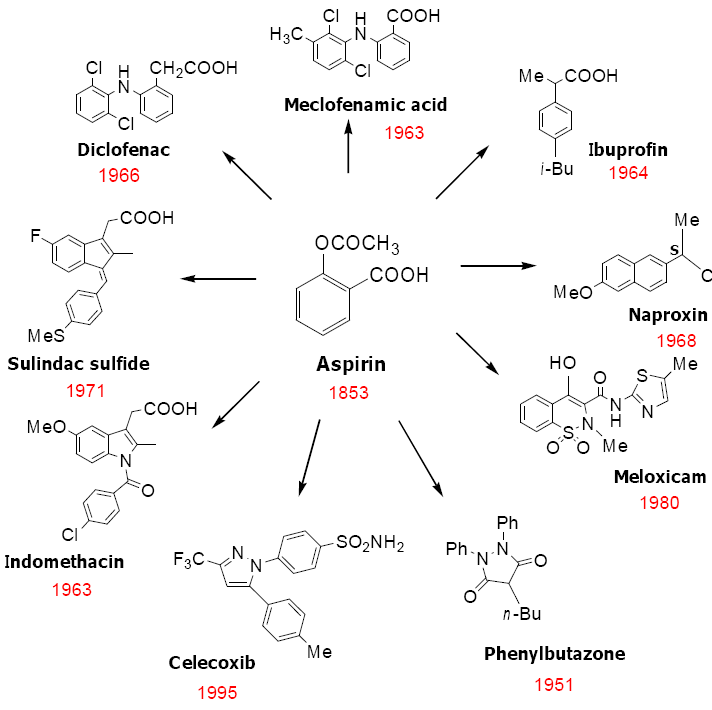
      <p>NSAIDs are a chemically diverse family of drugs that are available over-the-counter or by prescription and are commonly used in acute situations to treat a variety of inflammatory conditions or chronically to manage pain associated with arthritis. <xref ref-type="fig" rid="figure1">Figure 1</xref> shows the chemical structures of the most widely used NSAIDs, which remarkably still includes aspirin that was discovered over 150 years ago. The pharmacological basis for the anti-inflammatory activity of NSAIDs involves the inhibition of COX isozymes and blockage of the conversion of arachidonic acid to prostaglandin H<sub>2</sub>, a precursor for the synthesis of prostaglandins, prostacyclins, and thromboxanes [<xref ref-type="bibr" rid="B9">9</xref>]. Two distinct COX isozymes have been characterized that share similar catalytic activity, but have different modes of expression and sensitivity to inhibitors [<xref ref-type="bibr" rid="B10">10</xref>]. COX-1 is a constitutive enzyme responsible for the regulation of prostaglandin biosynthesis in normal tissues and serves an important role in maintaining blood flow necessary for gastric cytoprotection and renal homeostasis. As such, the chronic administration of non-selective COX inhibitors is associated with risk of gastrointestinal and renal toxicity. </p>
      <fig id="figure1" position="float">
        <label>Figure 1</label>
        <caption>
          <p>Chemical structures of commonly used NSAIDs.</p>
        </caption>
        <graphic xmlns:xlink="http://www.w3.org/1999/xlink" xlink:href="pharmaceuticals-03-01652-g001.tif" scale="0"/>
      </fig>
      <p>The COX-2 isozyme is inducible and expressed in inflammatory cells and cancer cells and was considered to be an ideal drug target for inhibiting inflammation and tumorigenesis. However, recent clinical studies have shown an association between the use of COX-2 selective inhibitors such as rofecoxib (Vioxx®) and celecoxib (Celebrex®) and increased incidence of stroke and myocardial infarction. These toxicities are believed to be attributed to COX-2 inhibition and the suppression of endothelial-derived prostacyclin levels that function as a vasodilator and inhibitor of platelet aggregation [<xref ref-type="bibr" rid="B33">33</xref>]. Vioxx was withdrawn from the market, while Celebrex remains available, despite its associated risk of cardiovascular toxicity. </p>
    </sec>
    <sec>
      <title>5. Cyclooxygenase Independent Anticancer Activity of NSAIDs</title>
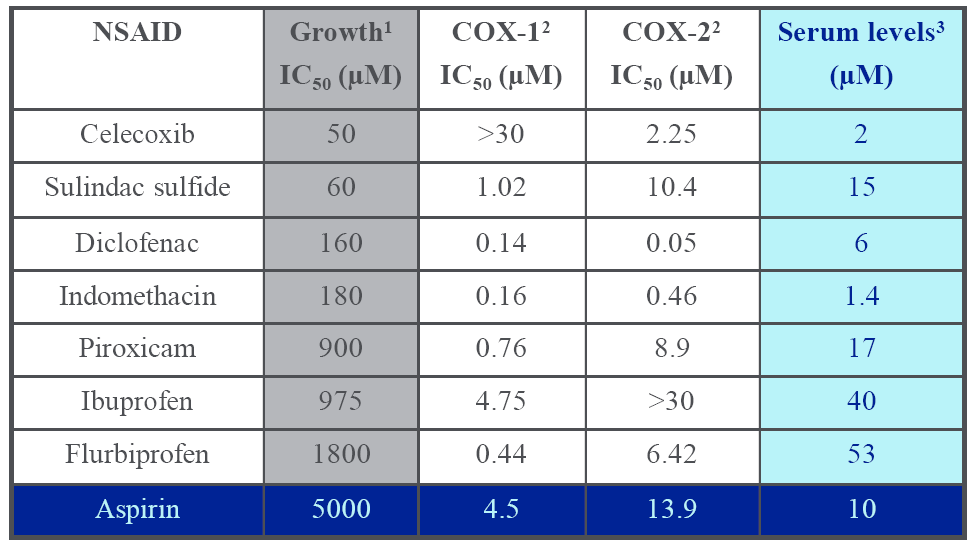
      <p>Numerous investigators have suggested that a COX-independent effect may either contribute to or be fully responsible for the chemopreventive properties of NSAIDs, as well as COX-2 selective inhibitors [<xref ref-type="bibr" rid="B17">17-20</xref>,<xref ref-type="bibr" rid="B34">34-36</xref>]. For example, NSAIDs and COX-2 selective inhibitors can suppress the growth of tumor cells that do not express COX-2 [<xref ref-type="bibr" rid="B20">20</xref>], while supplementation with exogenous prostaglandins does not reverse the growth inhibitory activity of NSAIDs [<xref ref-type="bibr" rid="B37">37</xref>]. Additionally, the rank order potency among NSAIDs to inhibit prostaglandin synthesis does not match the potency to inhibit tumor cell growth [<xref ref-type="bibr" rid="B38">38</xref>]. In general, appreciably higher dosages of NSAIDs are required to inhibit tumor cell growth compared to anti-inflammatory dosages [<xref ref-type="bibr" rid="B39">39</xref>]. For example, a series of chemically diverse NSAIDs as listed in <xref ref-type="table" rid="table1">Table 1</xref> are ranked based on their potency to inhibit colon tumor cell growth <italic>in vitro</italic> and their potency to inhibit either COX-1 or COX-2. In addition to the lack of correlation between these two activities, the concentration range required to inhibit tumor cell growth significantly exceeds the concentrations required to inhibit COX-1 and COX-2. Moreover, the concentration range required to inhibit tumor cell growth exceeds the concentration in blood that can be achieved in humans with standard dosages. Still, NSAIDs show evidence of chemopreventive efficacy in long term studies, which may be the consequence of chronic administration. As highlighted, aspirin may be unique among other NSAIDs given its ability to irreversibly bind COX, which may provide a sustained anti-inflammatory benefit. </p>
      <table-wrap id="table1"><object-id pub-id-type="pii">pharmaceuticals-03-01652_table1</object-id>
        <object-id pub-id-type="pii">pharmaceuticals-03-01652_table1</object-id>
        <label>Table 1</label>
        <caption>
          <p>Tumor cell growth and COX inhibitory activity of a panel of NSAIDs.</p>
        </caption>
        <table>
          <tbody>
            <tr>
              <td align="left" valign="middle">
                <graphic xmlns:xlink="http://www.w3.org/1999/xlink" xlink:href="pharmaceuticals-03-01652-i001.tif" scale="0"/>
              </td>
            </tr>
          </tbody>
        </table>
        <table-wrap-foot>
          <fn>
            <p><sup>1</sup> Human HT29 colon cells, 72 hrs, MTS assay [unpublished data]; <sup>2</sup> Whole blood COX assays [<xref ref-type="bibr" rid="B40">40</xref>]; <sup>3</sup> Therapeutic dosages [<xref ref-type="bibr" rid="B41">41</xref>].</p>
          </fn>
        </table-wrap-foot>
      </table-wrap>
      <p>Perhaps the most compelling evidence for a COX-independent mechanism comes from studies showing that certain chemically related derivatives, which include metabolites (e.g. sulindac sulfone or exisulind), <italic>R</italic>-enantiomers (e.g. <italic>R</italic>-flurbiprofen, <italic>R</italic>-etodolac), and synthetic derivatives (e.g. OSU-03012, a celecoxib derivative; SRI 21009, a sulindac derivative) retain anticancer activity, despite lacking COX inhibitory activity [<xref ref-type="bibr" rid="B42">42-44</xref>]. </p>
    </sec>
    <sec>
      <title>6. Cancer Chemopreventive Activity of Sulindac and Its Non-COX Inhibitory Sulfone Metabolite</title>
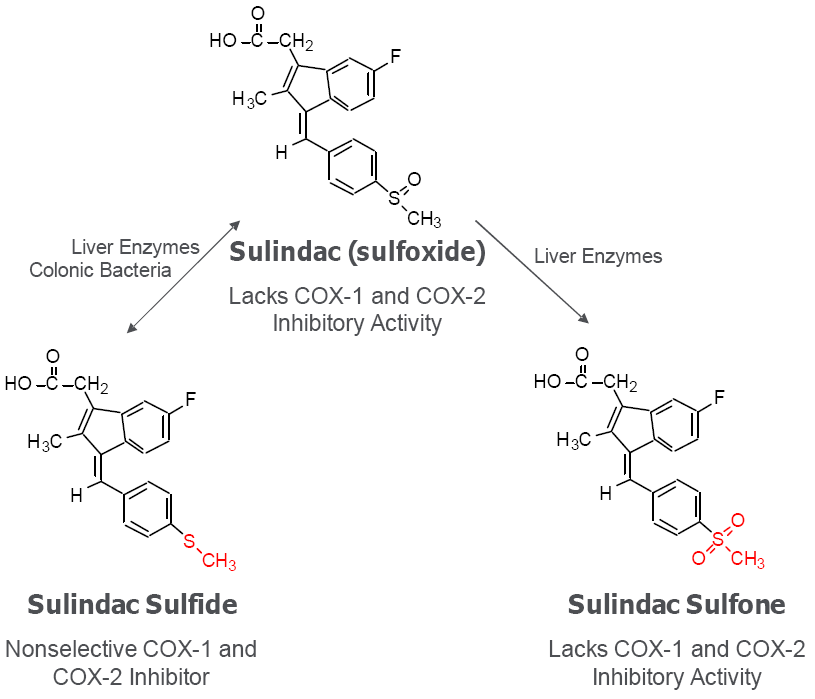
      <p>Sulindac is considered to be the most effective among the NSAIDs and COX-2 inhibitors with regard to cancer chemoprevention. For example, clinical trials involving patients with familial adenomatous polyposis showed that six months of treatment with celecoxib at a dose of 800 mg per day caused a 28% mean reduction in polyp number [<xref ref-type="bibr" rid="B8">8</xref>]. By comparison, sulindac reduced polyp number and size by approximately 60-70% at a daily dose of 300 mg [<xref ref-type="bibr" rid="B3">3</xref>,<xref ref-type="bibr" rid="B6">6-7</xref>]. In addition, there is an abundance of evidence showing strong cancer chemopreventive efficacy of sulindac in a variety of animal models at dosages significantly less than those required for celecoxib [<xref ref-type="bibr" rid="B45">45-46</xref>]. As shown in <xref ref-type="fig" rid="figure2">Figure 2</xref> and reviewed previously [<xref ref-type="bibr" rid="B47">47</xref>], sulindac is a prodrug that requires reductive metabolism of the sulfoxide by colonic bacteria to a sulfide, which is a non-selective COX inhibitor that is responsible for the anti-inflammatory activity of sulindac. A sulfone metabolite is also generated by oxidation of the sulfoxide in the liver, but does not have anti-inflammatory activity. The reduction of the sulfoxide to the sulfide is reversible, while the oxidation of the sulfide or sulfoxide to the sulfone is irreversible.</p>
      <fig id="figure2" position="float">
        <label>Figure 2</label>
        <caption>
          <p>Metabolism of sulindac. </p>
        </caption>
        <graphic xmlns:xlink="http://www.w3.org/1999/xlink" xlink:href="pharmaceuticals-03-01652-g002.tif" scale="0"/>
      </fig>
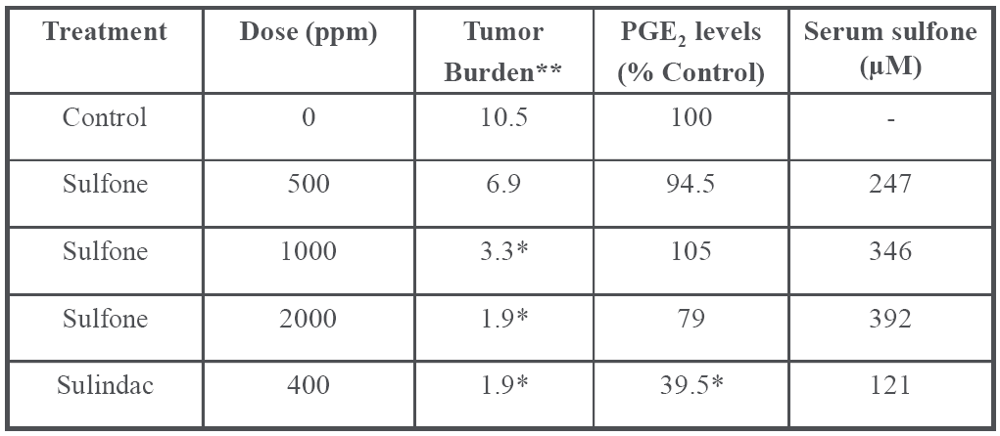
      <p>Sulindac sulfone has been shown by several investigators to inhibit tumor cell growth and induce apoptosis <italic>in vitro</italic> in a number of tumor cell lines of diverse histological origin despite its lack of COX-1 and COX-2 inhibitory activity and can inhibit chemical-induced carcinogenesis of the colon, mammary glands, lung and bladder [<xref ref-type="bibr" rid="B18">18</xref>,<xref ref-type="bibr" rid="B30">30</xref>,<xref ref-type="bibr" rid="B34">34</xref>,<xref ref-type="bibr" rid="B48">48-53</xref>]. The inhibitory activity of sulindac sulfone on colon tumor formation induced in rats by the carcinogen, azoxymethane is summarized in <xref ref-type="table" rid="table2">Table 2</xref> and has been previously published [<xref ref-type="bibr" rid="B30">30</xref>]. Although higher dosages were required, sulindac sulfone inhibited colon tumor formation to a level comparable to sulindac. Unlike sulindac, the antitumor effect of sulindac sulfone was not accompanied by a suppression of prostaglandin levels in the colon mucosa. The anticancer activity of sulindac sulfone in the azoxymethane-induced model of colon tumorigenesis was associated with plasma levels of the drug that exceeded concentrations required to inhibit tumor cell growth and induced apoptosis as observed <italic>in vitro</italic> using cultured colon tumor cell lines [<xref ref-type="bibr" rid="B18">18</xref>,<xref ref-type="bibr" rid="B34">34</xref>].</p>
      <table-wrap id="table2" position="float"><object-id pub-id-type="pii">pharmaceuticals-03-01652_table2</object-id>
        <object-id pub-id-type="pii">pharmaceuticals-03-01652_table2</object-id>
        <label>Table 2</label>
        <caption>
          <p>Inhibition of colon tumorigenesis in rats by sulindac sulfone and sulindac.</p>
        </caption>
        <table>
          <tbody>
            <tr>
              <td align="left" valign="middle">
                <graphic xmlns:xlink="http://www.w3.org/1999/xlink" xlink:href="pharmaceuticals-03-01652-i002.tif" scale="0"/>
              </td>
            </tr>
          </tbody>
        </table>
        <table-wrap-foot>
          <fn>
            <p>* <italic>P </italic>&lt; 0.05; ** Sum of sizes (cm) of adenomas and adenocarcinomas.</p>
          </fn>
        </table-wrap-foot>
      </table-wrap>
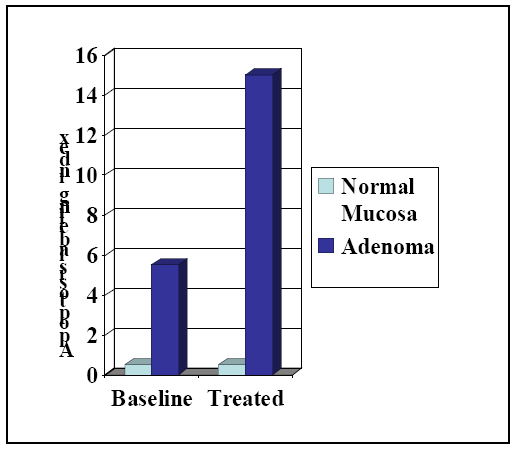
      <p>In clinical trials, sulindac sulfone was shown to cause significant adenoma regression in patients with familial [<xref ref-type="bibr" rid="B54">54</xref>] or sporadic [<xref ref-type="bibr" rid="B55">55</xref>] adenomatous polyposis but did not receive FDA approval due to hepatotoxicity. Nonetheless, an interesting observation from the early clinical studies of sulindac sulfone in familial adenomatous polyposis patients is that treatment was associated with an increase the percentage of apoptotic cells in adenomas, but not in the normal colonic mucosa. A summary of these results are shown in <xref ref-type="fig" rid="figure4">Figure 4</xref> and have been previously published [<xref ref-type="bibr" rid="B54">54</xref>]. These observations suggest that the underlying biochemical mechanism responsible for the anticancer properties of sulindac sulfone involve a selective effect on neoplastic cells that is COX-independent. Despite its shortcomings in potency and toxicity, sulindac sulfone provided important proof-of-concept evidence to support further research on the underlying mechanism of action.</p>
      <fig id="figure3" position="float">
        <label>Figure 3</label>
        <caption>
          <p>Apoptosis induction by sulindac sulfone in FAP patients.</p>
        </caption>
        <graphic xmlns:xlink="http://www.w3.org/1999/xlink" xlink:href="pharmaceuticals-03-01652-g003.tif" scale="0"/>
      </fig>
    </sec>
    <sec>
      <title>7. Design of a Novel Non-COX Inhibitory Sulindac Derivative with Potent Tumor Cell Growth Inhibitory Activity</title>
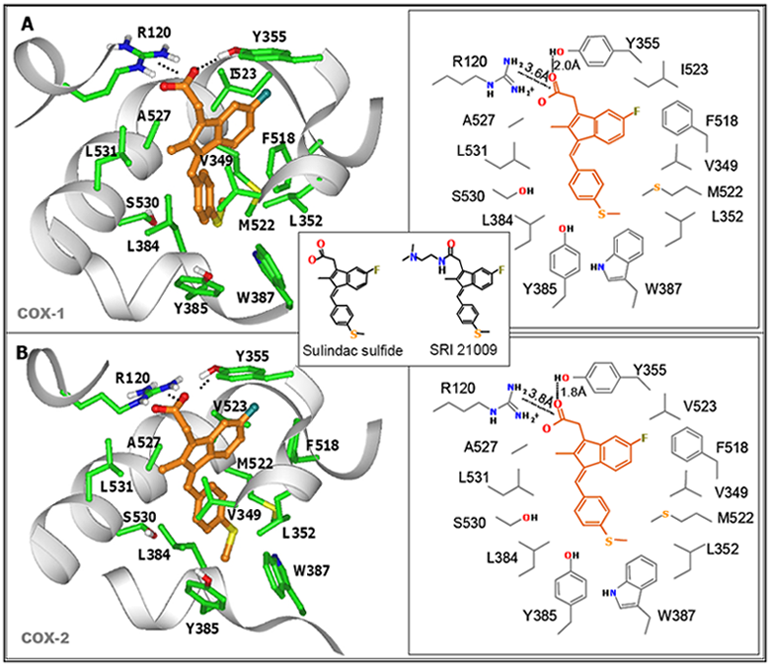
      <p>To develop new drug candidates with improved potency, more recent studies have focused on strategies to design out the COX inhibitory activity of the more potent sulfide metabolite of sulindac. As recently reported [<xref ref-type="bibr" rid="B56">56</xref>], <italic>in silico</italic> modeling studies that docked sulindac sulfide (SS) into its binding domain on COX isozymes were conducted using the published structures of COX-1 and COX-2 (PDB entries 2OYE and 6COX, respectively) obtained from X-ray diffraction studies. The orientation of SS bound to COX-1 and COX-2 was found to be very similar as shown in <xref ref-type="fig" rid="figure4">Figure 4</xref>. It was also noted that the carboxylic acid moiety on SS formed a salt bridge with the positively charged guanidinium moiety of arginine 120 (R120) that was common to both COX-1 and COX-2, which constrains the rest of the molecule in a region that is rich in non-polar amino acids<italic>. </italic></p>
      <p>The observations suggested the synthesis of a series of SS derivatives with amide substitutions in place of the carboxylic acid. Following screening for tumor cell growth and COX inhibitory activity, a subset of analogs containing a basic amino group was unexpectedly found to inhibit colon tumor cell growth with high potency. A derivative with a <italic>N,N</italic>-dimethylethylamine group as shown in <xref ref-type="fig" rid="figure4">Figure 4</xref> (insert) was among the most potent inhibitors identified and was studied in more detail. This derivative was designated as SRI 21009 and is referred to here as sulindac sulfide amide (SSA) for simplicity. Using purified COX-1 and COX-2 isozymes, SS was found to inhibit COX-1 and COX-2 with IC<sub>50</sub> values of 1.8 and 6.3 μM, respectively. By comparison, SSA did not inhibit COX-1 at concentrations as high as 300 μM and only weakly inhibited COX-2 with an IC<sub>50</sub> value of 164.5 μM; a level unlikely to be pharmacologically relevant. </p>
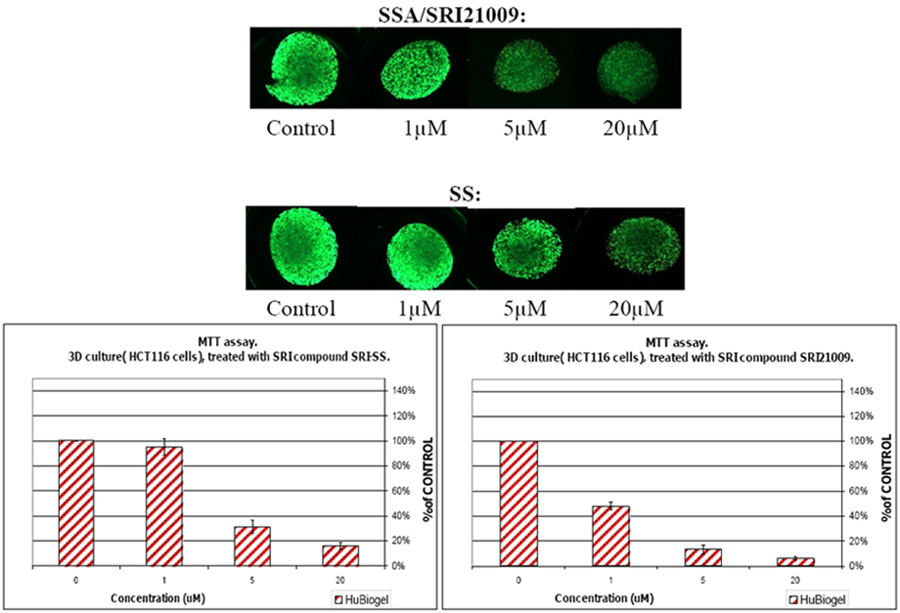
      <p>In addition to <italic>in vitro</italic> tumor cell growth inhibitory activity using colon tumor cell lines with IC<sub>50</sub> values of approximately 2 µM as previously published [<xref ref-type="bibr" rid="B56">56</xref>], SSA was also evaluated for anti-tumor efficacy using a three dimensional mini-tumor assay model that emulates<italic> in vivo </italic>like multi-cellular tumor growth and biology as described previously [<xref ref-type="bibr" rid="B57">57</xref>]. Viable mini-tumors (1 mm size) of HCT-116 colon cancer cells were generated using a 3D human Biogel® culture system (HuBiogel, Vivo Biosciences Inc.). As shown in <xref ref-type="fig" rid="figure5">Figure 5</xref>, SSA treatment significantly inhibited colony formation in a dose-dependent manner with ~80% inhibition at 5 µM. By comparison, sulindac sulfide was appreciably less effective, causing no inhibition at 1 µM and ~40% inhibition at 5 µM which was equivalent to 1 µM SSA. </p>
      <fig id="figure4" position="float">
        <label>Figure 4</label>
        <caption>
          <p>Molecular modeling of SS binding to COX-1 (A) or COX-2 (B). Chemical structures of SS and SRI 21009 (SSA) are shown in the insert.</p>
        </caption>
        <graphic xmlns:xlink="http://www.w3.org/1999/xlink" xlink:href="pharmaceuticals-03-01652-g004.tif" scale="0"/>
      </fig>
      <p>The apoptosis inducing properties of SSA and <italic>in vivo</italic> anticancer activity in the HT-29 colon tumor xenograft model has been previously reported as well as studies showing combination benefits with conventional chemotherapeutic drugs, such as irinotecan [<xref ref-type="bibr" rid="B56">56</xref>]. Together, these studies suggest that SSA or analogs with improved selectivity, potency, and bioavailability have the potential to be more efficacious and less toxic than sulindac for cancer chemoprevention, which merit further preclinical development.</p>
      <fig id="figure5" position="float">
        <label>Figure 5</label>
        <caption>
          <p>Inhibition of human HCT116 colon tumor cell growth in a 3-dimensional spheroid model by sulindac sulfide and sulindac sulfide amide (SRI 21009).</p>
        </caption>
        <graphic xmlns:xlink="http://www.w3.org/1999/xlink" xlink:href="pharmaceuticals-03-01652-g005.tif" scale="0"/>
      </fig>
    </sec>
    <sec>
      <title>8. COX-Independent Targets of NSAIDs</title>
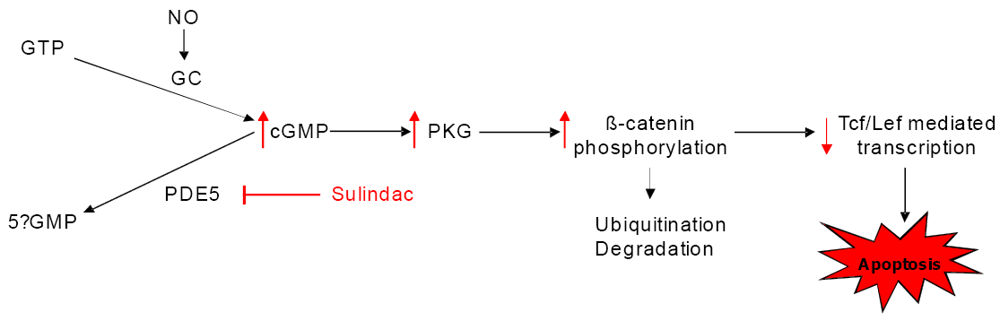
      <p>A number of COX-independent targets have been proposed to mediate the cancer chemopreventive properties of NSAIDs, including 15-lipoxygenase [<xref ref-type="bibr" rid="B58">58</xref>], Ras [<xref ref-type="bibr" rid="B59">59</xref>], PPAR [<xref ref-type="bibr" rid="B60">60</xref>], NF-κB [<xref ref-type="bibr" rid="B61">61</xref>], PDK-1/Akt [<xref ref-type="bibr" rid="B62">62</xref>], phosphodiesterase [<xref ref-type="bibr" rid="B36">36</xref>,<xref ref-type="bibr" rid="B63">63</xref>] as well as others [<xref ref-type="bibr" rid="B64">64-65</xref>]. A comprehensive review of the potential non-COX targets of NSAIDs has been previously published [<xref ref-type="bibr" rid="B66">66</xref>]. As reported previously sulindac sulfone can inhibit cyclic guanosine monophosphate phosphodiesterase (cGMP PDE) and that this activity correlated with potency to inhibit colon tumor cell growth among a series of sulindac analogs [<xref ref-type="bibr" rid="B63">63</xref>]. These studies provided initial evidence that cGMP PDE may represent an important non-COX target that is responsible for the tumor cell growth inhibitory and apoptosis inducing activities of sulindac. In support of this possibility, recent studies have shown that SS can selectively inhibit the cGMP specific PDE5 isozyme and that cGMP elevation is closely associated with its tumor cell growth inhibitory and apoptosis inducing activity [<xref ref-type="bibr" rid="B67">67</xref>]. In addition, PDE5 has been found to be overexpressed in various carcinomas and appears to be the predominant cGMP degrading isozyme in numerous tumor cell types. Based on these and other studies, a mechanistic model for the apoptosis inducing properties of sulindac as shown in <xref ref-type="fig" rid="figure6">Figure 6</xref> can be envisioned, which involves PDE5 inhibition, cGMP elevation, and protein kinase G activation. As previously reported, β-catenin is a potentially important substrate of protein kinase G to induce degradation, thereby suppressing the transcription of important growth regulatory genes such as cyclin D and survivin that are necessary for tumor cell proliferation and survival [<xref ref-type="bibr" rid="B63">63</xref>,<xref ref-type="bibr" rid="B68">68-70</xref>]. Conventional PDE5 inhibitors such as sildenafil that are used for treating erectile dysfunction, however, do not inhibit tumor cell growth as does SS. While such drugs are capable of inhibiting PDE5 activity in lysates from tumor cells, they are unable to induce cGMP levels or activate cGMP signaling in cancer cells. The lack of anticancer activity of sildenafil and other conventional PDE5 inhibitors may be attributed to efflux mechanisms involving membrane transport proteins, although additional studies are required to investigate this and other possibilities. </p>
      <fig id="figure6" position="float">
        <label>Figure 6</label>
        <caption>
          <p>Mechanistic model for the apoptosis inducing properties of sulindac.</p>
        </caption>
        <graphic xmlns:xlink="http://www.w3.org/1999/xlink" xlink:href="pharmaceuticals-03-01652-g006.tif" scale="0"/>
      </fig>
    </sec>
    <sec>
      <title>9. Conclusions </title>
      <p>It has been estimated that 28 million people in the US develop sporadic colonic adenomas [<xref ref-type="bibr" rid="B71">71</xref>]. Approximately 10% form lesions at a high rate and could benefit from a safe and efficacious chemopreventive drug that would serve as an adjunct with colonoscopy to prevent new lesions from forming and reducing the overall risk of disease progression. NSAIDs have shown promising activity in experimental, clinical and epidemiological studies, although gastrointestinal, renal, and cardiovascular toxicity resulting from the suppression of cyclooxygenase-1 and/or -2 and the depletion of physiologically important prostaglandins limits their use for chemoprevention. Mechanistic studies suggest that a COX-independent or off-target effect, possibly involving PDE5 inhibition and cGMP elevation to induce apoptosis may contribute to their antineoplastic properties. Therefore, it may feasible to develop safer and more efficacious drugs for chemoprevention by targeting PDE5, although further studies are necessary to determine the exact role of this isozyme and the cGMP pathway in tumorigenesis. </p>
    </sec>
  </body>
  <back>
    <ref-list>
      <ref id="B1">
        <citation citation-type="journal">
          <person-group person-group-type="author">
            <name>
              <surname>Thun</surname>
              <given-names>M.J.</given-names>
            </name>
            <name>
              <surname>Henley</surname>
              <given-names>S.J.</given-names>
            </name>
            <name>
              <surname>Patrono</surname>
              <given-names>C.</given-names>
            </name>
          </person-group>
          <article-title>Nonsteroidal anti-inflammatory drugs as anticancer agents: mechanistic, pharmacologic, and clinical issues</article-title>
          <source>J. Natl. Cancer Inst.</source>
          <year>2002</year>
          <volume>94</volume>
          <fpage>252</fpage>
          <lpage>266</lpage>
          <pub-id pub-id-type="pmid">11854387</pub-id>
        </citation>
      </ref>
      <ref id="B2">
        <citation citation-type="journal">
          <person-group person-group-type="author">
            <name>
              <surname>Chan</surname>
              <given-names>T.A.</given-names>
            </name>
          </person-group>
          <article-title>Nonsteroidal anti-inflammatory drugs, apoptosis, and colon-cancer chemoprevention</article-title>
          <source>Lancet Oncol.</source>
          <year>2002</year>
          <volume>3</volume>
          <fpage>166</fpage>
          <lpage>174</lpage>
          <pub-id pub-id-type="pmid">11902503</pub-id>
          <pub-id pub-id-type="doi">10.1016/S1470-2045(02)00680-0</pub-id>
        </citation>
      </ref>
      <ref id="B3">
        <citation citation-type="journal">
          <person-group person-group-type="author">
            <name>
              <surname>Matsuhashi</surname>
              <given-names>N.</given-names>
            </name>
            <name>
              <surname>Nakajima</surname>
              <given-names>A.</given-names>
            </name>
            <name>
              <surname>Shinohara</surname>
              <given-names>K.</given-names>
            </name>
            <name>
              <surname>Oka</surname>
              <given-names>T.</given-names>
            </name>
            <name>
              <surname>Yazaki</surname>
              <given-names>Y.</given-names>
            </name>
          </person-group>
          <article-title>Rectal cancer after sulindac therapy for a sporadic adenomatous colonic polyp</article-title>
          <source>Am. J. Gastroenterol.</source>
          <year>1998</year>
          <volume>93</volume>
          <fpage>2261</fpage>
          <lpage>2266</lpage>
          <pub-id pub-id-type="pmid">9820411</pub-id>
          <pub-id pub-id-type="doi">10.1111/j.1572-0241.1998.00630.x</pub-id>
        </citation>
      </ref>
      <ref id="B4">
        <citation citation-type="journal">
          <person-group person-group-type="author">
            <name>
              <surname>Waddell</surname>
              <given-names>W.R.</given-names>
            </name>
            <name>
              <surname>Loughry</surname>
              <given-names>R.W.</given-names>
            </name>
          </person-group>
          <article-title>Sulindac for polyposis of the colon</article-title>
          <source>J Surg Oncol</source>
          <year>1983</year>
          <volume>24</volume>
          <fpage>83</fpage>
          <lpage>87</lpage>
          <pub-id pub-id-type="pmid">6887943</pub-id>
          <pub-id pub-id-type="doi">10.1002/jso.2930240119</pub-id>
        </citation>
      </ref>
      <ref id="B5">
        <citation citation-type="journal">
          <person-group person-group-type="author">
            <name>
              <surname>Rigau</surname>
              <given-names>J.</given-names>
            </name>
            <name>
              <surname>Pique</surname>
              <given-names>J.M.</given-names>
            </name>
            <name>
              <surname>Rubio</surname>
              <given-names>E.</given-names>
            </name>
            <name>
              <surname>Planas</surname>
              <given-names>R.</given-names>
            </name>
            <name>
              <surname>Tarrech</surname>
              <given-names>J.M.</given-names>
            </name>
            <name>
              <surname>Bordas</surname>
              <given-names>J.M.</given-names>
            </name>
          </person-group>
          <article-title>Effects of long-term sulindac therapy on colonic polyposis</article-title>
          <source>Ann. Intern. Med.</source>
          <year>1991</year>
          <volume>115</volume>
          <fpage>952</fpage>
          <lpage>954</lpage>
          <pub-id pub-id-type="pmid">1659272</pub-id>
        </citation>
      </ref>
      <ref id="B6">
        <citation citation-type="journal">
          <person-group person-group-type="author">
            <name>
              <surname>Giardiello</surname>
              <given-names>F.M.</given-names>
            </name>
            <name>
              <surname>Hamilton</surname>
              <given-names>S.R.</given-names>
            </name>
            <name>
              <surname>Krush</surname>
              <given-names>A.J.</given-names>
            </name>
            <name>
              <surname>Piantadosi</surname>
              <given-names>S.</given-names>
            </name>
            <name>
              <surname>Hylind</surname>
              <given-names>L.M.</given-names>
            </name>
            <name>
              <surname>Celano</surname>
              <given-names>P.</given-names>
            </name>
            <name>
              <surname>Booker</surname>
              <given-names>S.V.</given-names>
            </name>
            <name>
              <surname>Robinson</surname>
              <given-names>C.R.</given-names>
            </name>
            <name>
              <surname>Offerhaus</surname>
              <given-names>G.J.</given-names>
            </name>
          </person-group>
          <article-title>Treatment of colonic and rectal adenomas with sulindac in familial adenomatous polyposis</article-title>
          <source>N. Engl. J. Med.</source>
          <year>1993</year>
          <volume>328</volume>
          <fpage>1313</fpage>
          <lpage>1316</lpage>
          <pub-id pub-id-type="pmid">8385741</pub-id>
          <pub-id pub-id-type="doi">10.1056/NEJM199305063281805</pub-id>
        </citation>
      </ref>
      <ref id="B7">
        <citation citation-type="journal">
          <person-group person-group-type="author">
            <name>
              <surname>Nugent</surname>
              <given-names>K.P.</given-names>
            </name>
            <name>
              <surname>Farmer</surname>
              <given-names>K.C.</given-names>
            </name>
            <name>
              <surname>Spigelman</surname>
              <given-names>A.D.</given-names>
            </name>
            <name>
              <surname>Williams</surname>
              <given-names>C.B.</given-names>
            </name>
            <name>
              <surname>Phillips</surname>
              <given-names>R.K.</given-names>
            </name>
          </person-group>
          <article-title>Randomized controlled trial of the effect of sulindac on duodenal and rectal polyposis and cell proliferation in patients with familial adenomatous polyposis</article-title>
          <source>Br. J. Surg.</source>
          <year>1993</year>
          <volume>80</volume>
          <fpage>1618</fpage>
          <lpage>1619</lpage>
          <pub-id pub-id-type="pmid">8298943</pub-id>
          <pub-id pub-id-type="doi">10.1002/bjs.1800801244</pub-id>
        </citation>
      </ref>
      <ref id="B8">
        <citation citation-type="journal">
          <person-group person-group-type="author">
            <name>
              <surname>Steinbach</surname>
              <given-names>G.</given-names>
            </name>
            <name>
              <surname>Lynch</surname>
              <given-names>P.M.</given-names>
            </name>
            <name>
              <surname>Phillips</surname>
              <given-names>R.K.</given-names>
            </name>
            <name>
              <surname>Wallace</surname>
              <given-names>M.H.</given-names>
            </name>
            <name>
              <surname>Hawk</surname>
              <given-names>E.</given-names>
            </name>
            <name>
              <surname>Gordon</surname>
              <given-names>G.B.</given-names>
            </name>
            <name>
              <surname>Wakabayashi</surname>
              <given-names>N.</given-names>
            </name>
            <name>
              <surname>Saunders</surname>
              <given-names>B.</given-names>
            </name>
            <name>
              <surname>Shen</surname>
              <given-names>Y.</given-names>
            </name>
            <name>
              <surname>Fujimura</surname>
              <given-names>T.</given-names>
            </name>
            <name>
              <surname>Su</surname>
              <given-names>L.K.</given-names>
            </name>
            <name>
              <surname>Levin</surname>
              <given-names>B.</given-names>
            </name>
          </person-group>
          <article-title>The effect of celecoxib, a cyclooxygenase-2 inhibitor, in familial adenomatous polyposis</article-title>
          <source>N. Engl. J. Med.</source>
          <year>2000</year>
          <volume>342</volume>
          <fpage>1946</fpage>
          <lpage>1952</lpage>
          <pub-id pub-id-type="pmid">10874062</pub-id>
          <pub-id pub-id-type="doi">10.1056/NEJM200006293422603</pub-id>
        </citation>
      </ref>
      <ref id="B9">
        <citation citation-type="journal">
          <person-group person-group-type="author">
            <name>
              <surname>Vane</surname>
              <given-names>J.R.</given-names>
            </name>
            <name>
              <surname>Botting</surname>
              <given-names>R.M.</given-names>
            </name>
          </person-group>
          <article-title>Mechanism of action of antiinflammatory drugs</article-title>
          <source>Int. J. Tissue React.</source>
          <year>1998</year>
          <volume>20</volume>
          <fpage>3</fpage>
          <lpage>15</lpage>
          <pub-id pub-id-type="pmid">9561441</pub-id>
        </citation>
      </ref>
      <ref id="B10">
        <citation citation-type="journal">
          <person-group person-group-type="author">
            <name>
              <surname>Vane</surname>
              <given-names>J.R.</given-names>
            </name>
            <name>
              <surname>Bakhle</surname>
              <given-names>Y.S.</given-names>
            </name>
            <name>
              <surname>Botting</surname>
              <given-names>R.M.</given-names>
            </name>
          </person-group>
          <article-title>Cyclooxygenases 1 and 2</article-title>
          <source>Annu. Rev. Pharmacol. Toxicol.</source>
          <year>1998</year>
          <volume>38</volume>
          <fpage>97</fpage>
          <lpage>120</lpage>
          <pub-id pub-id-type="pmid">9597150</pub-id>
          <pub-id pub-id-type="doi">10.1146/annurev.pharmtox.38.1.97</pub-id>
        </citation>
      </ref>
      <ref id="B11">
        <citation citation-type="journal">
          <person-group person-group-type="author">
            <name>
              <surname>Mukherjee</surname>
              <given-names>D.</given-names>
            </name>
          </person-group>
          <article-title>Selective cyclooxygenase-2 (COX-2) inhibitors and potential risk of cardiovascular events</article-title>
          <source>Biochem. Pharmacol.</source>
          <year>2002</year>
          <volume>63</volume>
          <fpage>817</fpage>
          <lpage>821</lpage>
          <pub-id pub-id-type="pmid">11911832</pub-id>
          <pub-id pub-id-type="doi">10.1016/S0006-2952(02)00842-0</pub-id>
        </citation>
      </ref>
      <ref id="B12">
        <citation citation-type="journal">
          <person-group person-group-type="author">
            <name>
              <surname>Niv</surname>
              <given-names>Y.</given-names>
            </name>
            <name>
              <surname>Fraser</surname>
              <given-names>G.M.</given-names>
            </name>
          </person-group>
          <article-title>Adenocarcinoma in the rectal segment in familial polyposis coli is not prevented by sulindac therapy</article-title>
          <source>Gastroenterology</source>
          <year>1994</year>
          <volume>107</volume>
          <fpage>854</fpage>
          <lpage>857</lpage>
          <pub-id pub-id-type="pmid">8076772</pub-id>
        </citation>
      </ref>
      <ref id="B13">
        <citation citation-type="journal">
          <person-group person-group-type="author">
            <name>
              <surname>Brown</surname>
              <given-names>J.R.</given-names>
            </name>
            <name>
              <surname>DuBois</surname>
              <given-names>R.N.</given-names>
            </name>
          </person-group>
          <article-title>COX-2: a molecular target for colorectal cancer prevention</article-title>
          <source>J. Clin. Oncol.</source>
          <year>2005</year>
          <volume>23</volume>
          <fpage>2840</fpage>
          <lpage>2855</lpage>
          <pub-id pub-id-type="pmid">15837998</pub-id>
          <pub-id pub-id-type="doi">10.1200/JCO.2005.09.051</pub-id>
        </citation>
      </ref>
      <ref id="B14">
        <citation citation-type="journal">
          <person-group person-group-type="author">
            <name>
              <surname>Eberhart</surname>
              <given-names>C.E.</given-names>
            </name>
            <name>
              <surname>Coffey</surname>
              <given-names>R.J.</given-names>
            </name>
            <name>
              <surname>Radhika</surname>
              <given-names>A.</given-names>
            </name>
            <name>
              <surname>Giardiello</surname>
              <given-names>F.M.</given-names>
            </name>
            <name>
              <surname>Ferrenbach</surname>
              <given-names>S.</given-names>
            </name>
            <name>
              <surname>DuBois</surname>
              <given-names>R.N.</given-names>
            </name>
          </person-group>
          <article-title>Up-regulation of cyclooxygenase 2 gene expression in human colorectal adenomas and adenocarcinomas</article-title>
          <source>Gastroenterology</source>
          <year>1994</year>
          <volume>107</volume>
          <fpage>1183</fpage>
          <lpage>1188</lpage>
          <pub-id pub-id-type="pmid">7926468</pub-id>
        </citation>
      </ref>
      <ref id="B15">
        <citation citation-type="journal">
          <person-group person-group-type="author">
            <name>
              <surname>Rigas</surname>
              <given-names>B.</given-names>
            </name>
            <name>
              <surname>Goldman</surname>
              <given-names>I.S.</given-names>
            </name>
            <name>
              <surname>Levine</surname>
              <given-names>L.</given-names>
            </name>
          </person-group>
          <article-title>Altered eicosanoid levels in human colon cancer</article-title>
          <source>J. Lab. Clin. Med.</source>
          <year>1993</year>
          <volume>122</volume>
          <fpage>518</fpage>
          <lpage>523</lpage>
          <pub-id pub-id-type="pmid">8228569</pub-id>
        </citation>
      </ref>
      <ref id="B16">
        <citation citation-type="journal">
          <person-group person-group-type="author">
            <name>
              <surname>Sano</surname>
              <given-names>H.</given-names>
            </name>
            <name>
              <surname>Kawahito</surname>
              <given-names>Y.</given-names>
            </name>
            <name>
              <surname>Wilder</surname>
              <given-names>R.L.</given-names>
            </name>
            <name>
              <surname>Hashiramoto</surname>
              <given-names>A.</given-names>
            </name>
            <name>
              <surname>Mukai</surname>
              <given-names>S.</given-names>
            </name>
            <name>
              <surname>Asai</surname>
              <given-names>K.</given-names>
            </name>
            <name>
              <surname>Kimura</surname>
              <given-names>S.</given-names>
            </name>
            <name>
              <surname>Kato</surname>
              <given-names>H.</given-names>
            </name>
            <name>
              <surname>Kondo</surname>
              <given-names>M.</given-names>
            </name>
            <name>
              <surname>Hla</surname>
              <given-names>T.</given-names>
            </name>
          </person-group>
          <article-title>Expression of cyclooxygenase-1 and -2 in human colorectal cancer</article-title>
          <source>Cancer Res.</source>
          <year>1995</year>
          <volume>55</volume>
          <fpage>3785</fpage>
          <lpage>3789</lpage>
          <pub-id pub-id-type="pmid">7641194</pub-id>
        </citation>
      </ref>
      <ref id="B17">
        <citation citation-type="journal">
          <person-group person-group-type="author">
            <name>
              <surname>Alberts</surname>
              <given-names>D.S.</given-names>
            </name>
            <name>
              <surname>Hixson</surname>
              <given-names>L.</given-names>
            </name>
            <name>
              <surname>Ahnen</surname>
              <given-names>D.</given-names>
            </name>
            <name>
              <surname>Bogert</surname>
              <given-names>C.</given-names>
            </name>
            <name>
              <surname>Einspahr</surname>
              <given-names>J.</given-names>
            </name>
            <name>
              <surname>Paranka</surname>
              <given-names>N.</given-names>
            </name>
            <name>
              <surname>Brendel</surname>
              <given-names>K.</given-names>
            </name>
            <name>
              <surname>Gross</surname>
              <given-names>P.H.</given-names>
            </name>
            <name>
              <surname>Pamukcu</surname>
              <given-names>R.</given-names>
            </name>
            <name>
              <surname>Burt</surname>
              <given-names>R.W.</given-names>
            </name>
          </person-group>
          <article-title>Do NSAIDs exert their colon cancer chemoprevention activities through the inhibition of mucosal prostaglandin synthetase?</article-title>
          <source>J. Cell Biochem. Suppl.</source>
          <year>1995</year>
          <volume>22</volume>
          <fpage>18</fpage>
          <lpage>23</lpage>
          <pub-id pub-id-type="pmid">8538196</pub-id>
          <pub-id pub-id-type="doi">10.1002/jcb.240590804</pub-id>
        </citation>
      </ref>
      <ref id="B18">
        <citation citation-type="journal">
          <person-group person-group-type="author">
            <name>
              <surname>Piazza</surname>
              <given-names>G.A.</given-names>
            </name>
            <name>
              <surname>Rahm</surname>
              <given-names>A.L.</given-names>
            </name>
            <name>
              <surname>Krutzsch</surname>
              <given-names>M.</given-names>
            </name>
            <name>
              <surname>Sperl</surname>
              <given-names>G.</given-names>
            </name>
            <name>
              <surname>Paranka</surname>
              <given-names>N.S.</given-names>
            </name>
            <name>
              <surname>Gross</surname>
              <given-names>P.H.</given-names>
            </name>
            <name>
              <surname>Brendel</surname>
              <given-names>K.</given-names>
            </name>
            <name>
              <surname>Burt</surname>
              <given-names>R.W.</given-names>
            </name>
            <name>
              <surname>Alberts</surname>
              <given-names>D.S.</given-names>
            </name>
            <name>
              <surname>Pamukcu</surname>
              <given-names>R.</given-names>
            </name>
            <name>
              <surname>Ahnen</surname>
              <given-names>D. J.</given-names>
            </name>
          </person-group>
          <article-title>Antineoplastic drugs sulindac sulfide and sulfone inhibit cell growth by inducing apoptosis</article-title>
          <source>Cancer Res.</source>
          <year>1995</year>
          <volume>55</volume>
          <fpage>3110</fpage>
          <lpage>3116</lpage>
          <pub-id pub-id-type="pmid">7606732</pub-id>
        </citation>
      </ref>
      <ref id="B19">
        <citation citation-type="journal">
          <person-group person-group-type="author">
            <name>
              <surname>Hanif</surname>
              <given-names>R.</given-names>
            </name>
            <name>
              <surname>Pittas</surname>
              <given-names>A.</given-names>
            </name>
            <name>
              <surname>Feng</surname>
              <given-names>Y.</given-names>
            </name>
            <name>
              <surname>Koutsos</surname>
              <given-names>M.I.</given-names>
            </name>
            <name>
              <surname>Qiao</surname>
              <given-names>L.</given-names>
            </name>
            <name>
              <surname>Staiano-Coico</surname>
              <given-names>L.</given-names>
            </name>
            <name>
              <surname>Shiff</surname>
              <given-names>S.I.</given-names>
            </name>
            <name>
              <surname>Rigas</surname>
              <given-names>B.</given-names>
            </name>
          </person-group>
          <article-title>Effects of nonsteroidal anti-inflammatory drugs on proliferation and on induction of apoptosis in colon cancer cells by a prostaglandin-independent pathway</article-title>
          <source>Biochem. Pharmacol.</source>
          <year>1996</year>
          <volume>52</volume>
          <fpage>237</fpage>
          <lpage>245</lpage>
          <pub-id pub-id-type="pmid">8694848</pub-id>
          <pub-id pub-id-type="doi">10.1016/0006-2952(96)00181-5</pub-id>
        </citation>
      </ref>
      <ref id="B20">
        <citation citation-type="journal">
          <person-group person-group-type="author">
            <name>
              <surname>Elder</surname>
              <given-names>D.J.</given-names>
            </name>
            <name>
              <surname>Halton</surname>
              <given-names>D.E.</given-names>
            </name>
            <name>
              <surname>Hague</surname>
              <given-names>A.</given-names>
            </name>
            <name>
              <surname>Paraskeva</surname>
              <given-names>C.</given-names>
            </name>
          </person-group>
          <article-title>Induction of apoptotic cell death in human colorectal carcinoma cell lines by a cyclooxygenase-2 (COX-2)-selective nonsteroidal anti-inflammatory drug: independence from COX-2 protein expression</article-title>
          <source>Clin. Cancer Res.</source>
          <year>1997</year>
          <volume>3</volume>
          <fpage>1679</fpage>
          <lpage>1683</lpage>
          <pub-id pub-id-type="pmid">9815550</pub-id>
        </citation>
      </ref>
      <ref id="B21">
        <citation citation-type="journal">
          <person-group person-group-type="author">
            <name>
              <surname>Jemal</surname>
              <given-names>A.</given-names>
            </name>
            <name>
              <surname>Murray</surname>
              <given-names>T.</given-names>
            </name>
            <name>
              <surname>Ward</surname>
              <given-names>E.</given-names>
            </name>
            <name>
              <surname>Samuels</surname>
              <given-names>A.</given-names>
            </name>
            <name>
              <surname>Tiwari</surname>
              <given-names>R.C.</given-names>
            </name>
            <name>
              <surname>Ghafoor</surname>
              <given-names>A.</given-names>
            </name>
            <name>
              <surname>Feuer</surname>
              <given-names>E.J.</given-names>
            </name>
            <name>
              <surname>Thun</surname>
              <given-names>M.J.</given-names>
            </name>
          </person-group>
          <article-title>Cancer statistics, 2005</article-title>
          <source>CA Cancer J. Clin.</source>
          <year>2005</year>
          <volume>55</volume>
          <fpage>10</fpage>
          <lpage>30</lpage>
          <pub-id pub-id-type="pmid">15661684</pub-id>
          <pub-id pub-id-type="doi">10.3322/canjclin.55.1.10</pub-id>
        </citation>
      </ref>
      <ref id="B22">
        <citation citation-type="journal">
          <person-group person-group-type="author">
            <name>
              <surname>Wingo</surname>
              <given-names>P.A.</given-names>
            </name>
            <name>
              <surname>Ries</surname>
              <given-names>L.A.</given-names>
            </name>
            <name>
              <surname>Parker</surname>
              <given-names>S.L.</given-names>
            </name>
            <name>
              <surname>Heath</surname>
              <given-names>C.W.</given-names>
            </name>
          </person-group>
          <article-title>Long-term cancer patient survival in the United States</article-title>
          <source>Cancer Epidemiol. Biomarkers Prev.</source>
          <year>1998</year>
          <volume>7</volume>
          <fpage>271</fpage>
          <lpage>282</lpage>
          <pub-id pub-id-type="pmid">9568781</pub-id>
        </citation>
      </ref>
      <ref id="B23">
        <citation citation-type="journal">
          <person-group person-group-type="author">
            <name>
              <surname>Greenlee</surname>
              <given-names>R.T.</given-names>
            </name>
            <name>
              <surname>Hill-Harmon</surname>
              <given-names>M.B.</given-names>
            </name>
            <name>
              <surname>Murray</surname>
              <given-names>T.</given-names>
            </name>
            <name>
              <surname>Thun</surname>
              <given-names>M.</given-names>
            </name>
          </person-group>
          <article-title>Cancer statistics, 2001</article-title>
          <source>CA Cancer J. Clin.</source>
          <year>2001</year>
          <volume>51</volume>
          <fpage>15</fpage>
          <lpage>36</lpage>
          <pub-id pub-id-type="pmid">11577478</pub-id>
          <pub-id pub-id-type="doi">10.3322/canjclin.51.1.15</pub-id>
        </citation>
      </ref>
      <ref id="B24">
        <citation citation-type="journal">
          <person-group person-group-type="author">
            <name>
              <surname>O'Shaughnessy</surname>
              <given-names>J.A.</given-names>
            </name>
            <name>
              <surname>Kelloff</surname>
              <given-names>G.J.</given-names>
            </name>
            <name>
              <surname>Gordon</surname>
              <given-names>G.B.</given-names>
            </name>
            <name>
              <surname>Dannenberg</surname>
              <given-names>A.J.</given-names>
            </name>
            <name>
              <surname>Hong</surname>
              <given-names>W.K.</given-names>
            </name>
            <name>
              <surname>Fabian</surname>
              <given-names>C.J.</given-names>
            </name>
            <name>
              <surname>Sigman</surname>
              <given-names>C.C.</given-names>
            </name>
            <name>
              <surname>Bertagnolli</surname>
              <given-names>M.M.</given-names>
            </name>
            <name>
              <surname>Stratton</surname>
              <given-names>S.P.</given-names>
            </name>
            <name>
              <surname>Lam</surname>
              <given-names>S.</given-names>
            </name>
            <name>
              <surname>Nelson</surname>
              <given-names>W.G.</given-names>
            </name>
            <name>
              <surname>Meyskens</surname>
              <given-names>F.L.</given-names>
            </name>
            <name>
              <surname>Alberts</surname>
              <given-names>D.S.</given-names>
            </name>
            <name>
              <surname>Follen</surname>
              <given-names>M.</given-names>
            </name>
            <name>
              <surname>Rustgi</surname>
              <given-names>A.K.</given-names>
            </name>
            <name>
              <surname>Papadimitrakopoulou</surname>
              <given-names>V.</given-names>
            </name>
            <name>
              <surname>Scardino</surname>
              <given-names>P.T.</given-names>
            </name>
            <name>
              <surname>Gazdar</surname>
              <given-names>A.F.</given-names>
            </name>
            <name>
              <surname>Wattenberg</surname>
              <given-names>L.W.</given-names>
            </name>
            <name>
              <surname>Sporn</surname>
              <given-names>M.B.</given-names>
            </name>
            <name>
              <surname>Sakr</surname>
              <given-names>W.A.</given-names>
            </name>
            <name>
              <surname>Lippman</surname>
              <given-names>S.M.</given-names>
            </name>
            <name>
              <surname>Von Hoff</surname>
              <given-names>D.D.</given-names>
            </name>
          </person-group>
          <article-title>Treatment and prevention of intraepithelial neoplasia: an important target for accelerated new agent development</article-title>
          <source>Clin. Cancer Res.</source>
          <year>2002</year>
          <volume>8</volume>
          <fpage>314</fpage>
          <lpage>346</lpage>
        <pub-id pub-id-type="pmid">11839647</pub-id></citation>
      </ref>
      <ref id="B25">
        <citation citation-type="journal">
          <person-group person-group-type="author">
            <name>
              <surname>Oshima</surname>
              <given-names>M.</given-names>
            </name>
            <name>
              <surname>Oshima</surname>
              <given-names>H.</given-names>
            </name>
            <name>
              <surname>Kitagawa</surname>
              <given-names>K.</given-names>
            </name>
            <name>
              <surname>Kobayashi</surname>
              <given-names>M.</given-names>
            </name>
            <name>
              <surname>Itakura</surname>
              <given-names>C.</given-names>
            </name>
            <name>
              <surname>Taketo</surname>
              <given-names>M.</given-names>
            </name>
          </person-group>
          <article-title>Loss of Apc heterozygosity and abnormal tissue building in nascent intestinal polyps in mice carrying a truncated Apc gene</article-title>
          <source>Proc. Natl. Acad. Sci. USA</source>
          <year>1995</year>
          <volume>92</volume>
          <fpage>4482</fpage>
          <lpage>4486</lpage>
          <pub-id pub-id-type="doi">10.1073/pnas.92.10.4482</pub-id>
        </citation>
      </ref>
      <ref id="B26">
        <citation citation-type="journal">
          <person-group person-group-type="author">
            <name>
              <surname>Levy</surname>
              <given-names>D.B.</given-names>
            </name>
            <name>
              <surname>Smith</surname>
              <given-names>K.J.</given-names>
            </name>
            <name>
              <surname>Beazer-Barclay</surname>
              <given-names>Y.</given-names>
            </name>
            <name>
              <surname>Hamilton</surname>
              <given-names>S.R.</given-names>
            </name>
            <name>
              <surname>Vogelstein</surname>
              <given-names>B.</given-names>
            </name>
            <name>
              <surname>Kinzler</surname>
              <given-names>K.W.</given-names>
            </name>
          </person-group>
          <article-title>Inactivation of both APC alleles in human and mouse tumors</article-title>
          <source>Cancer Res.</source>
          <year>1994</year>
          <volume>54</volume>
          <fpage>5953</fpage>
          <lpage>5958</lpage>
          <pub-id pub-id-type="pmid">7954428</pub-id>
        </citation>
      </ref>
      <ref id="B27">
        <citation citation-type="journal">
          <person-group person-group-type="author">
            <name>
              <surname>Peifer</surname>
              <given-names>M.</given-names>
            </name>
            <name>
              <surname>Polakis</surname>
              <given-names>P.</given-names>
            </name>
          </person-group>
          <article-title>Wnt signaling in oncogenesis and embryogenesis--a look outside the nucleus</article-title>
          <source>Science</source>
          <year>2000</year>
          <volume>287</volume>
          <fpage>1606</fpage>
          <lpage>1609</lpage>
          <pub-id pub-id-type="pmid">10733430</pub-id>
          <pub-id pub-id-type="doi">10.1126/science.287.5458.1606</pub-id>
        </citation>
      </ref>
      <ref id="B28">
        <citation citation-type="journal">
          <person-group person-group-type="author">
            <name>
              <surname>Bafico</surname>
              <given-names>A.</given-names>
            </name>
            <name>
              <surname>Liu</surname>
              <given-names>G.</given-names>
            </name>
            <name>
              <surname>Goldin</surname>
              <given-names>L.</given-names>
            </name>
            <name>
              <surname>Harris</surname>
              <given-names>V.</given-names>
            </name>
            <name>
              <surname>Aaronson</surname>
              <given-names>S.A.</given-names>
            </name>
          </person-group>
          <article-title>An autocrine mechanism for constitutive Wnt pathway activation in human cancer cells</article-title>
          <source>Cancer Cell</source>
          <year>2004</year>
          <volume>6</volume>
          <fpage>497</fpage>
          <lpage>506</lpage>
          <pub-id pub-id-type="pmid">15542433</pub-id>
          <pub-id pub-id-type="doi">10.1016/j.ccr.2004.09.032</pub-id>
        </citation>
      </ref>
      <ref id="B29">
        <citation citation-type="journal">
          <person-group person-group-type="author">
            <name>
              <surname>Smalley</surname>
              <given-names>W.</given-names>
            </name>
            <name>
              <surname>Ray</surname>
              <given-names>W.A.</given-names>
            </name>
            <name>
              <surname>Daugherty</surname>
              <given-names>J.</given-names>
            </name>
            <name>
              <surname>Griffin</surname>
              <given-names>M.R.</given-names>
            </name>
          </person-group>
          <article-title>Use of nonsteroidal anti-inflammatory drugs and incidence of colorectal cancer: a population-based study</article-title>
          <source>Arch. Intern. Med.</source>
          <year>1999</year>
          <volume>159</volume>
          <fpage>161</fpage>
          <lpage>166</lpage>
          <pub-id pub-id-type="pmid">9927099</pub-id>
          <pub-id pub-id-type="doi">10.1001/archinte.159.2.161</pub-id>
        </citation>
      </ref>
      <ref id="B30">
        <citation citation-type="journal">
          <person-group person-group-type="author">
            <name>
              <surname>Piazza</surname>
              <given-names>G.A.</given-names>
            </name>
            <name>
              <surname>Alberts</surname>
              <given-names>D.S.</given-names>
            </name>
            <name>
              <surname>Hixson</surname>
              <given-names>L.J.</given-names>
            </name>
            <name>
              <surname>Paranka</surname>
              <given-names>N.S.</given-names>
            </name>
            <name>
              <surname>Li</surname>
              <given-names>H.</given-names>
            </name>
            <name>
              <surname>Finn</surname>
              <given-names>T.</given-names>
            </name>
            <name>
              <surname>Bogert</surname>
              <given-names>C.</given-names>
            </name>
            <name>
              <surname>Guillen</surname>
              <given-names>J.M.</given-names>
            </name>
            <name>
              <surname>Brendel</surname>
              <given-names>K.</given-names>
            </name>
            <name>
              <surname>Gross</surname>
              <given-names>P.H.</given-names>
            </name>
            <name>
              <surname>Sperl</surname>
              <given-names>G.</given-names>
            </name>
            <name>
              <surname>Ritchie</surname>
              <given-names>J.</given-names>
            </name>
            <name>
              <surname>Burt</surname>
              <given-names>R.W.</given-names>
            </name>
            <name>
              <surname>Ellsworth</surname>
              <given-names>L.</given-names>
            </name>
            <name>
              <surname>Ahnen</surname>
              <given-names>D.J.</given-names>
            </name>
            <name>
              <surname>Pamukcu</surname>
              <given-names>R.</given-names>
            </name>
          </person-group>
          <article-title>Sulindac sulfone inhibits azoxymethane-induced colon carcinogenesis in rats without reducing prostaglandin levels</article-title>
          <source>Cancer Res.</source>
          <year>1997</year>
          <volume>57</volume>
          <fpage>2909</fpage>
          <lpage>2915</lpage>
          <pub-id pub-id-type="pmid">9230200</pub-id>
        </citation>
      </ref>
      <ref id="B31">
        <citation citation-type="journal">
          <person-group person-group-type="author">
            <name>
              <surname>Beazer-Barclay</surname>
              <given-names>Y.</given-names>
            </name>
            <name>
              <surname>Levy</surname>
              <given-names>D.B.</given-names>
            </name>
            <name>
              <surname>Moser</surname>
              <given-names>A.R.</given-names>
            </name>
            <name>
              <surname>Dove</surname>
              <given-names>W.F.</given-names>
            </name>
            <name>
              <surname>Hamilton</surname>
              <given-names>S.R.</given-names>
            </name>
            <name>
              <surname>Vogelstein</surname>
              <given-names>B.</given-names>
            </name>
            <name>
              <surname>Kinzler</surname>
              <given-names>K.W.</given-names>
            </name>
          </person-group>
          <article-title>Sulindac suppresses tumorigenesis in the Min mouse</article-title>
          <source>Carcinogenesis</source>
          <year>1996</year>
          <volume>17</volume>
          <fpage>1757</fpage>
          <lpage>1760</lpage>
          <pub-id pub-id-type="pmid">8761438</pub-id>
          <pub-id pub-id-type="doi">10.1093/carcin/17.8.1757</pub-id>
        </citation>
      </ref>
      <ref id="B32">
        <citation citation-type="journal">
          <person-group person-group-type="author">
            <name>
              <surname>Barker</surname>
              <given-names>N.</given-names>
            </name>
            <name>
              <surname>Clevers</surname>
              <given-names>H.</given-names>
            </name>
          </person-group>
          <article-title>Mining the Wnt pathway for cancer therapeutics</article-title>
          <source>Nat. Rev. Drug Discov.</source>
          <year>2006</year>
          <volume>5</volume>
          <fpage>997</fpage>
          <lpage>1014</lpage>
          <pub-id pub-id-type="pmid">17139285</pub-id>
          <pub-id pub-id-type="doi">10.1038/nrd2154</pub-id>
        </citation>
      </ref>
      <ref id="B33">
        <citation citation-type="journal">
          <person-group person-group-type="author">
            <name>
              <surname>Mukherjee</surname>
              <given-names>D.</given-names>
            </name>
            <name>
              <surname>Nissen</surname>
              <given-names>S.E.</given-names>
            </name>
            <name>
              <surname>Topol</surname>
              <given-names>E.J.</given-names>
            </name>
          </person-group>
          <article-title>Risk of cardiovascular events associated with selective COX-2 inhibitors</article-title>
          <source>JAMA</source>
          <year>2001</year>
          <volume>286</volume>
          <fpage>954</fpage>
          <lpage>959</lpage>
          <pub-id pub-id-type="pmid">11509060</pub-id>
          <pub-id pub-id-type="doi">10.1001/jama.286.8.954</pub-id>
        </citation>
      </ref>
      <ref id="B34">
        <citation citation-type="journal">
          <person-group person-group-type="author">
            <name>
              <surname>Piazza</surname>
              <given-names>G.A.</given-names>
            </name>
            <name>
              <surname>Rahm</surname>
              <given-names>A.K.</given-names>
            </name>
            <name>
              <surname>Finn</surname>
              <given-names>T.S.</given-names>
            </name>
            <name>
              <surname>Fryer</surname>
              <given-names>B.H.</given-names>
            </name>
            <name>
              <surname>Li</surname>
              <given-names>H.</given-names>
            </name>
            <name>
              <surname>Stoumen</surname>
              <given-names>A.L.</given-names>
            </name>
            <name>
              <surname>Pamukcu</surname>
              <given-names>R.</given-names>
            </name>
            <name>
              <surname>Ahnen</surname>
              <given-names>D.J.</given-names>
            </name>
          </person-group>
          <article-title>Apoptosis primarily accounts for the growth-inhibitory properties of sulindac metabolites and involves a mechanism that is independent of cyclooxygenase inhibition, cell cycle arrest, and p53 induction</article-title>
          <source>Cancer Res.</source>
          <year>1997</year>
          <volume>57</volume>
          <fpage>2452</fpage>
          <lpage>2459</lpage>
          <pub-id pub-id-type="pmid">9192825</pub-id>
        </citation>
      </ref>
      <ref id="B35">
        <citation citation-type="journal">
          <person-group person-group-type="author">
            <name>
              <surname>Rigas</surname>
              <given-names>B.</given-names>
            </name>
            <name>
              <surname>Shiff</surname>
              <given-names>S.J.</given-names>
            </name>
          </person-group>
          <article-title>Is inhibition of cyclooxygenase required for the chemopreventive effect
of NSAIDs in colon cancer? A model reconciling the current contradiction</article-title>
          <source>Med. Hypotheses</source>
          <year>2000</year>
          <volume>54</volume>
          <fpage>210</fpage>
          <lpage>215</lpage>
          <pub-id pub-id-type="pmid">10790755</pub-id>
          <pub-id pub-id-type="doi">10.1054/mehy.1999.0023</pub-id>
        </citation>
      </ref>
      <ref id="B36">
        <citation citation-type="journal">
          <person-group person-group-type="author">
            <name>
              <surname>Kashfi</surname>
              <given-names>K.</given-names>
            </name>
            <name>
              <surname>Rigas</surname>
              <given-names>B.</given-names>
            </name>
          </person-group>
          <article-title>Non-COX-2 targets and cancer: expanding the molecular target repertoire of chemoprevention</article-title>
          <source>Biochem. Pharmacol.</source>
          <year>2005</year>
          <volume>70</volume>
          <fpage>969</fpage>
          <lpage>986</lpage>
          <pub-id pub-id-type="pmid">15949789</pub-id>
          <pub-id pub-id-type="doi">10.1016/j.bcp.2005.05.004</pub-id>
        </citation>
      </ref>
      <ref id="B37">
        <citation citation-type="journal">
          <person-group person-group-type="author">
            <name>
              <surname>Kusuhara</surname>
              <given-names>H.</given-names>
            </name>
            <name>
              <surname>Matsuyuki</surname>
              <given-names>H.</given-names>
            </name>
            <name>
              <surname>Matsuura</surname>
              <given-names>M.</given-names>
            </name>
            <name>
              <surname>Imayoshi</surname>
              <given-names>T.</given-names>
            </name>
            <name>
              <surname>Okumoto</surname>
              <given-names>T.</given-names>
            </name>
            <name>
              <surname>Matsui</surname>
              <given-names>H.</given-names>
            </name>
          </person-group>
          <article-title>Induction of apoptotic DNA fragmentation by nonsteroidal anti-inflammatory drugs in cultured rat gastric mucosal cells</article-title>
          <source>Eur. J. Pharmacol.</source>
          <year>1998</year>
          <volume>360</volume>
          <fpage>273</fpage>
          <lpage>280</lpage>
          <pub-id pub-id-type="pmid">9851595</pub-id>
          <pub-id pub-id-type="doi">10.1016/S0014-2999(98)00679-7</pub-id>
        </citation>
      </ref>
      <ref id="B38">
        <citation citation-type="journal">
          <person-group person-group-type="author">
            <name>
              <surname>de Mello</surname>
              <given-names>M.C.</given-names>
            </name>
            <name>
              <surname>Bayer</surname>
              <given-names>B.M.</given-names>
            </name>
            <name>
              <surname>Beaven</surname>
              <given-names>M.A.</given-names>
            </name>
          </person-group>
          <article-title>Evidence that prostaglandins do not have a role in the cytostatic action of anti-inflammatory drugs</article-title>
          <source>Biochem. Pharmacol.</source>
          <year>1980</year>
          <volume>29</volume>
          <fpage>311</fpage>
          <lpage>318</lpage>
          <pub-id pub-id-type="pmid">6767484</pub-id>
          <pub-id pub-id-type="doi">10.1016/0006-2952(80)90506-7</pub-id>
        </citation>
      </ref>
      <ref id="B39">
        <citation citation-type="journal">
          <person-group person-group-type="author">
            <name>
              <surname>Williams</surname>
              <given-names>C.S.</given-names>
            </name>
            <name>
              <surname>Watson</surname>
              <given-names>A.J.</given-names>
            </name>
            <name>
              <surname>Sheng</surname>
              <given-names>H.</given-names>
            </name>
            <name>
              <surname>Helou</surname>
              <given-names>R.</given-names>
            </name>
            <name>
              <surname>Shao</surname>
              <given-names>J.</given-names>
            </name>
            <name>
              <surname>DuBois</surname>
              <given-names>R.N.</given-names>
            </name>
          </person-group>
          <article-title>Celecoxib prevents tumor growth <italic>in vivo</italic> without toxicity to normal gut: lack of correlation between <italic>in vitro</italic> and <italic>in vivo</italic> models</article-title>
          <source>Cancer Res.</source>
          <year>2000</year>
          <volume>60</volume>
          <fpage>6045</fpage>
          <lpage>6051</lpage>
          <pub-id pub-id-type="pmid">11085526</pub-id>
        </citation>
      </ref>
      <ref id="B40">
        <citation citation-type="journal">
          <person-group person-group-type="author">
            <name>
              <surname>Brideau</surname>
              <given-names>C.</given-names>
            </name>
            <name>
              <surname>Kargman</surname>
              <given-names>S.</given-names>
            </name>
            <name>
              <surname>Liu</surname>
              <given-names>S.</given-names>
            </name>
            <name>
              <surname>Dallob</surname>
              <given-names>A.L.</given-names>
            </name>
            <name>
              <surname>Ehrich</surname>
              <given-names>E. W.</given-names>
            </name>
            <name>
              <surname>Rodger</surname>
              <given-names>I. W.</given-names>
            </name>
            <name>
              <surname>Chan</surname>
              <given-names>C. C.</given-names>
            </name>
          </person-group>
          <article-title>A human whole blood assay for clinical evaluation of biochemical efficacy of cyclooxygenase inhibitors</article-title>
          <source>Inflamm. Res.</source>
          <year>1996</year>
          <volume>45</volume>
          <fpage>68</fpage>
          <lpage>74</lpage>
          <pub-id pub-id-type="pmid">8907587</pub-id>
          <pub-id pub-id-type="doi">10.1007/BF02265118</pub-id>
        </citation>
      </ref>
      <ref id="B41">
        <citation citation-type="journal">
          <person-group person-group-type="author">
            <name>
              <surname>Cryer</surname>
              <given-names>B.</given-names>
            </name>
            <name>
              <surname>Feldman</surname>
              <given-names>M.</given-names>
            </name>
          </person-group>
          <article-title>Cyclooxygenase-1 and cyclooxygenase-2 selectivity of widely used nonsteroidal anti-inflammatory drugs<italic/></article-title>
          <source>Am. J. Med.,</source>
          <year>1998</year>
          <volume>104</volume>
          <fpage>413</fpage>
          <lpage>21</lpage>
          <pub-id pub-id-type="doi">10.1016/S0002-9343(98)00091-6</pub-id>
        </citation>
      </ref>
      <ref id="B42">
        <citation citation-type="journal">
          <person-group person-group-type="author">
            <name>
              <surname>Zhu</surname>
              <given-names>J.</given-names>
            </name>
            <name>
              <surname>Song</surname>
              <given-names>X.</given-names>
            </name>
            <name>
              <surname>Lin</surname>
              <given-names>H.P.</given-names>
            </name>
            <name>
              <surname>Young</surname>
              <given-names>D.C.</given-names>
            </name>
            <name>
              <surname>Yan</surname>
              <given-names>S.</given-names>
            </name>
            <name>
              <surname>Marquez</surname>
              <given-names>V.E.</given-names>
            </name>
            <name>
              <surname>Chen</surname>
              <given-names>C.S.</given-names>
            </name>
          </person-group>
          <article-title>Using cyclooxygenase-2 inhibitors as molecular platforms to develop a new class of apoptosis-inducing agents</article-title>
          <source>J. Natl. Cancer Inst.</source>
          <year>2002</year>
          <volume>94</volume>
          <fpage>1745</fpage>
          <lpage>1757</lpage>
          <pub-id pub-id-type="pmid">12464646</pub-id>
        </citation>
      </ref>
      <ref id="B43">
        <citation citation-type="journal">
          <person-group person-group-type="author">
            <name>
              <surname>Myers</surname>
              <given-names>C.</given-names>
            </name>
            <name>
              <surname>Koki</surname>
              <given-names>A.</given-names>
            </name>
            <name>
              <surname>Pamukcu</surname>
              <given-names>R.</given-names>
            </name>
            <name>
              <surname>Wechter</surname>
              <given-names>W.</given-names>
            </name>
            <name>
              <surname>Padley</surname>
              <given-names>R.J.</given-names>
            </name>
          </person-group>
          <article-title>Proapoptotic anti-inflammatory drugs</article-title>
          <source>Urology</source>
          <year>2001</year>
          <volume>57</volume>
          <fpage>73</fpage>
          <lpage>76</lpage>
          <pub-id pub-id-type="pmid">11295599</pub-id>
          <pub-id pub-id-type="doi">10.1016/S0090-4295(00)00945-6</pub-id>
        </citation>
      </ref>
      <ref id="B44">
        <citation citation-type="journal">
          <person-group person-group-type="author">
            <name>
              <surname>Elder</surname>
              <given-names>D.J.</given-names>
            </name>
            <name>
              <surname>Paraskeva</surname>
              <given-names>C.</given-names>
            </name>
          </person-group>
          <article-title>Induced apoptosis in the prevention of colorectal cancer by non-steroidal anti-inflammatory drugs</article-title>
          <source>Apoptosis</source>
          <year>1999</year>
          <volume>4</volume>
          <fpage>365</fpage>
          <lpage>372</lpage>
          <pub-id pub-id-type="doi">10.1023/A:1009696505108</pub-id>
        </citation>
      </ref>
      <ref id="B45">
        <citation citation-type="journal">
          <person-group person-group-type="author">
            <name>
              <surname>Rao</surname>
              <given-names>C.V.</given-names>
            </name>
            <name>
              <surname>Rivenson</surname>
              <given-names>A.</given-names>
            </name>
            <name>
              <surname>Simi</surname>
              <given-names>B.</given-names>
            </name>
            <name>
              <surname>Zang</surname>
              <given-names>E.</given-names>
            </name>
            <name>
              <surname>Kelloff</surname>
              <given-names>G.</given-names>
            </name>
            <name>
              <surname>Steele</surname>
              <given-names>V.</given-names>
            </name>
            <name>
              <surname>Reddy</surname>
              <given-names>B.S.</given-names>
            </name>
          </person-group>
          <article-title>Chemoprevention of colon carcinogenesis by sulindac, a nonsteroidal anti-inflammatory agent</article-title>
          <source>Cancer Res.</source>
          <year>1995</year>
          <volume>55</volume>
          <fpage>1464</fpage>
          <lpage>1472</lpage>
          <pub-id pub-id-type="pmid">7882354</pub-id>
        </citation>
      </ref>
      <ref id="B46">
        <citation citation-type="journal">
          <person-group person-group-type="author">
            <name>
              <surname>Moorghen</surname>
              <given-names>M.</given-names>
            </name>
            <name>
              <surname>Ince</surname>
              <given-names>P.</given-names>
            </name>
            <name>
              <surname>Finney</surname>
              <given-names>K.J.</given-names>
            </name>
            <name>
              <surname>Sunter</surname>
              <given-names>J.P.</given-names>
            </name>
            <name>
              <surname>Appleton</surname>
              <given-names>D.R.</given-names>
            </name>
            <name>
              <surname>Watson</surname>
              <given-names>A.J.</given-names>
            </name>
          </person-group>
          <article-title>A protective effect of sulindac against chemically-induced primary colonic tumours in mice</article-title>
          <source>J. Pathol.</source>
          <year>1988</year>
          <volume>156</volume>
          <fpage>341</fpage>
          <lpage>347</lpage>
          <pub-id pub-id-type="pmid">3225717</pub-id>
          <pub-id pub-id-type="doi">10.1002/path.1711560411</pub-id>
        </citation>
      </ref>
      <ref id="B47">
        <citation citation-type="journal">
          <person-group person-group-type="author">
            <name>
              <surname>Davies</surname>
              <given-names>N.M.</given-names>
            </name>
            <name>
              <surname>Watson</surname>
              <given-names>M.S.</given-names>
            </name>
          </person-group>
          <article-title>Clinical pharmacokinetics of sulindac. A dynamic old drug</article-title>
          <source>Clin. Pharmacokinet.</source>
          <year>1997</year>
          <volume>32</volume>
          <fpage>437</fpage>
          <lpage>459</lpage>
          <pub-id pub-id-type="pmid">9195115</pub-id>
          <pub-id pub-id-type="doi">10.2165/00003088-199732060-00002</pub-id>
        </citation>
      </ref>
      <ref id="B48">
        <citation citation-type="journal">
          <person-group person-group-type="author">
            <name>
              <surname>Reddy</surname>
              <given-names>B.S.</given-names>
            </name>
            <name>
              <surname>Kawamori</surname>
              <given-names>T.</given-names>
            </name>
            <name>
              <surname>Lubet</surname>
              <given-names>R.A.</given-names>
            </name>
            <name>
              <surname>Steele</surname>
              <given-names>V.E.</given-names>
            </name>
            <name>
              <surname>Kelloff</surname>
              <given-names>G.J.</given-names>
            </name>
            <name>
              <surname>Rao</surname>
              <given-names>C.V.</given-names>
            </name>
          </person-group>
          <article-title>Chemopreventive efficacy of sulindac sulfone against colon cancer depends on time of administration during carcinogenic process</article-title>
          <source>Cancer Res.</source>
          <year>1999</year>
          <volume>59</volume>
          <fpage>3387</fpage>
          <lpage>3391</lpage>
          <pub-id pub-id-type="pmid">10416599</pub-id>
        </citation>
      </ref>
      <ref id="B49">
        <citation citation-type="journal">
          <person-group person-group-type="author">
            <name>
              <surname>de Jong</surname>
              <given-names>T.A.</given-names>
            </name>
            <name>
              <surname>Skinner</surname>
              <given-names>S.A.</given-names>
            </name>
            <name>
              <surname>Malcontenti-Wilson</surname>
              <given-names>C.</given-names>
            </name>
            <name>
              <surname>Vogiagis</surname>
              <given-names>D.</given-names>
            </name>
            <name>
              <surname>Bailey</surname>
              <given-names>M.</given-names>
            </name>
            <name>
              <surname>van Driel</surname>
              <given-names>I.R.</given-names>
            </name>
            <name>
              <surname>O'Brien</surname>
              <given-names>P.E.</given-names>
            </name>
          </person-group>
          <article-title>Inhibition of rat colon tumors by sulindac and sulindac sulfone is independent of K-ras (codon 12) mutation</article-title>
          <source>Am. J. Physiol. Gastrointest. Liver Physiol.</source>
          <year>2000</year>
          <volume>278</volume>
          <fpage>G266</fpage>
          <lpage>G272</lpage>
          <pub-id pub-id-type="pmid">10666051</pub-id>
        </citation>
      </ref>
      <ref id="B50">
        <citation citation-type="journal">
          <person-group person-group-type="author">
            <name>
              <surname>Piazza</surname>
              <given-names>G.A.</given-names>
            </name>
            <name>
              <surname>Thompson</surname>
              <given-names>W.J.</given-names>
            </name>
            <name>
              <surname>Pamukcu</surname>
              <given-names>R.</given-names>
            </name>
            <name>
              <surname>Alila</surname>
              <given-names>H.W.</given-names>
            </name>
            <name>
              <surname>Whitehead</surname>
              <given-names>C.M.</given-names>
            </name>
            <name>
              <surname>Liu</surname>
              <given-names>L.</given-names>
            </name>
            <name>
              <surname>Fetter</surname>
              <given-names>J.R.</given-names>
            </name>
            <name>
              <surname>Gresh</surname>
              <given-names>W.E.</given-names>
            </name>
            <name>
              <surname>Klein-Szanto</surname>
              <given-names>A.J.</given-names>
            </name>
            <name>
              <surname>Farnell</surname>
              <given-names>D.R.</given-names>
            </name>
            <name>
              <surname>Eto</surname>
              <given-names>I.</given-names>
            </name>
            <name>
              <surname>Grubbs</surname>
              <given-names>C.J.</given-names>
            </name>
          </person-group>
          <article-title>Exisulind, a novel proapoptotic drug, inhibits rat urinary bladder tumorigenesis</article-title>
          <source>Cancer Res.</source>
          <year>2001</year>
          <volume>61</volume>
          <fpage>3961</fpage>
          <lpage>3968</lpage>
          <pub-id pub-id-type="pmid">11358813</pub-id>
        </citation>
      </ref>
      <ref id="B51">
        <citation citation-type="journal">
          <person-group person-group-type="author">
            <name>
              <surname>Malkinson</surname>
              <given-names>A.M.</given-names>
            </name>
            <name>
              <surname>Koski</surname>
              <given-names>K.M.</given-names>
            </name>
            <name>
              <surname>Dwyer-Nield</surname>
              <given-names>L.D.</given-names>
            </name>
            <name>
              <surname>Rice</surname>
              <given-names>P.L.</given-names>
            </name>
            <name>
              <surname>Rioux</surname>
              <given-names>N.</given-names>
            </name>
            <name>
              <surname>Castonguay</surname>
              <given-names>A.</given-names>
            </name>
            <name>
              <surname>Ahnen</surname>
              <given-names>D.J.</given-names>
            </name>
            <name>
              <surname>Thompson</surname>
              <given-names>H.</given-names>
            </name>
            <name>
              <surname>Pamukcu</surname>
              <given-names>R.</given-names>
            </name>
            <name>
              <surname>Piazza</surname>
              <given-names>G.A.</given-names>
            </name>
          </person-group>
          <article-title>Inhibition of 4-(methylnitrosamino)-1-(3-pyridyl)-1-butanone-induced mouse lung tumor formation by FGN-1 (sulindac sulfone)</article-title>
          <source>Carcinogenesis</source>
          <year>1998</year>
          <volume>19</volume>
          <fpage>1353</fpage>
          <lpage>1356</lpage>
          <pub-id pub-id-type="pmid">9744528</pub-id>
          <pub-id pub-id-type="doi">10.1093/carcin/19.8.1353</pub-id>
        </citation>
      </ref>
      <ref id="B52">
        <citation citation-type="journal">
          <person-group person-group-type="author">
            <name>
              <surname>Thompson</surname>
              <given-names>H.J.</given-names>
            </name>
            <name>
              <surname>Briggs</surname>
              <given-names>S.</given-names>
            </name>
            <name>
              <surname>Paranka</surname>
              <given-names>N.S.</given-names>
            </name>
            <name>
              <surname>Piazza</surname>
              <given-names>G.A.</given-names>
            </name>
            <name>
              <surname>Brendel</surname>
              <given-names>K.</given-names>
            </name>
            <name>
              <surname>Gross</surname>
              <given-names>P.H.</given-names>
            </name>
            <name>
              <surname>Sperl</surname>
              <given-names>G.J.</given-names>
            </name>
            <name>
              <surname>Pamukcu</surname>
              <given-names>R.</given-names>
            </name>
            <name>
              <surname>Ahnen</surname>
              <given-names>D.J.</given-names>
            </name>
          </person-group>
          <article-title>Inhibition of mammary carcinogenesis in rats by sulfone metabolite of sulindac</article-title>
          <source>J. Natl. Cancer Inst.</source>
          <year>1995</year>
          <volume>87</volume>
          <fpage>1259</fpage>
          <lpage>1260</lpage>
          <pub-id pub-id-type="pmid">7563174</pub-id>
        </citation>
      </ref>
      <ref id="B53">
        <citation citation-type="journal">
          <person-group person-group-type="author">
            <name>
              <surname>Thompson</surname>
              <given-names>H.J.</given-names>
            </name>
            <name>
              <surname>Jiang</surname>
              <given-names>C.</given-names>
            </name>
            <name>
              <surname>Lu</surname>
              <given-names>J.</given-names>
            </name>
            <name>
              <surname>Mehta</surname>
              <given-names>R.G.</given-names>
            </name>
            <name>
              <surname>Piazza</surname>
              <given-names>G.A.</given-names>
            </name>
            <name>
              <surname>Paranka</surname>
              <given-names>N.S.</given-names>
            </name>
            <name>
              <surname>Pamukcu</surname>
              <given-names>R.</given-names>
            </name>
            <name>
              <surname>Ahnen</surname>
              <given-names>D.J.</given-names>
            </name>
          </person-group>
          <article-title>Sulfone metabolite of sulindac inhibits mammary carcinogenesis</article-title>
          <source>Cancer Res.</source>
          <year>1997</year>
          <volume>57</volume>
          <fpage>267</fpage>
          <lpage>271</lpage>
          <pub-id pub-id-type="pmid">9000566</pub-id>
        </citation>
      </ref>
      <ref id="B54">
        <citation citation-type="journal">
          <person-group person-group-type="author">
            <name>
              <surname>Stoner</surname>
              <given-names>G.D.</given-names>
            </name>
            <name>
              <surname>Budd</surname>
              <given-names>G.T.</given-names>
            </name>
            <name>
              <surname>Ganapathi</surname>
              <given-names>R.</given-names>
            </name>
            <name>
              <surname>DeYoung</surname>
              <given-names>B.</given-names>
            </name>
            <name>
              <surname>Kresty</surname>
              <given-names>L.A.</given-names>
            </name>
            <name>
              <surname>Nitert</surname>
              <given-names>M.</given-names>
            </name>
            <name>
              <surname>Fryer</surname>
              <given-names>B.</given-names>
            </name>
            <name>
              <surname>Church</surname>
              <given-names>J.M.</given-names>
            </name>
            <name>
              <surname>Provencher</surname>
              <given-names>K.</given-names>
            </name>
            <name>
              <surname>Pamukcu</surname>
              <given-names>R.</given-names>
            </name>
            <name>
              <surname>Piazza</surname>
              <given-names>G.</given-names>
            </name>
            <name>
              <surname>Hawk</surname>
              <given-names>E.</given-names>
            </name>
            <name>
              <surname>Kelloff</surname>
              <given-names>G.</given-names>
            </name>
            <name>
              <surname>Elson</surname>
              <given-names>P.</given-names>
            </name>
            <name>
              <surname>van Stolk</surname>
              <given-names>R.U.</given-names>
            </name>
          </person-group>
          <article-title>Sulindac sulfone induced regression of rectal polyps in patients with familial adenomatous polyposis</article-title>
          <source>Adv. Exp. Med. Biol.</source>
          <year>1999</year>
          <volume>470</volume>
          <fpage>45</fpage>
          <lpage>53</lpage>
          <pub-id pub-id-type="pmid">10709673</pub-id>
        </citation>
      </ref>
      <ref id="B55">
        <citation citation-type="journal">
          <person-group person-group-type="author">
            <name>
              <surname>Arber</surname>
              <given-names>N.</given-names>
            </name>
            <name>
              <surname>Kuwada</surname>
              <given-names>S.</given-names>
            </name>
            <name>
              <surname>Leshno</surname>
              <given-names>M.</given-names>
            </name>
            <name>
              <surname>Sjodahl</surname>
              <given-names>R.</given-names>
            </name>
            <name>
              <surname>Hultcrantz</surname>
              <given-names>R.</given-names>
            </name>
            <name>
              <surname>Rex</surname>
              <given-names>D.</given-names>
            </name>
          </person-group>
          <article-title>Sporadic adenomatous polyp regression with exisulind is effective but toxic: a randomised, double blind, placebo controlled, dose-response study</article-title>
          <source>Gut</source>
          <year>2006</year>
          <volume>55</volume>
          <fpage>367</fpage>
          <lpage>373</lpage>
          <pub-id pub-id-type="pmid">16150858</pub-id>
          <pub-id pub-id-type="doi">10.1136/gut.2004.061432</pub-id>
        </citation>
      </ref>
      <ref id="B56">
        <citation citation-type="journal">
          <person-group person-group-type="author">
            <name>
              <surname>Piazza</surname>
              <given-names>G.A.</given-names>
            </name>
            <name>
              <surname>Keeton</surname>
              <given-names>A.B.</given-names>
            </name>
            <name>
              <surname>Tinsley</surname>
              <given-names>H.N.</given-names>
            </name>
            <name>
              <surname>Gary</surname>
              <given-names>B.D.</given-names>
            </name>
            <name>
              <surname>Whitt</surname>
              <given-names>J.D.</given-names>
            </name>
            <name>
              <surname>Mathew</surname>
              <given-names>B.</given-names>
            </name>
            <name>
              <surname>Thaiparambil</surname>
              <given-names>J.</given-names>
            </name>
            <name>
              <surname>Coward</surname>
              <given-names>L.</given-names>
            </name>
            <name>
              <surname>Gorman</surname>
              <given-names>G.</given-names>
            </name>
            <name>
              <surname>Li</surname>
              <given-names>Y.</given-names>
            </name>
            <name>
              <surname>Sani</surname>
              <given-names>B.</given-names>
            </name>
            <name>
              <surname>Hobrath</surname>
              <given-names>J.V.</given-names>
            </name>
            <name>
              <surname>Maxuitenko</surname>
              <given-names>Y.Y.</given-names>
            </name>
            <name>
              <surname>Reynolds</surname>
              <given-names>R.C.</given-names>
            </name>
          </person-group>
          <article-title>A novel sulindac derivative that does not inhibit cyclooxygenases but potently inhibits colon tumor cell growth and induces apoptosis with antitumor activity</article-title>
          <source>Cancer Prev. Res. (Phila. PA)</source>
          <year>2009</year>
          <volume>2</volume>
          <fpage>572</fpage>
          <lpage>580</lpage>
        <pub-id pub-id-type="doi">10.1158/1940-6207.CAPR-09-0001</pub-id></citation>
      </ref>
      <ref id="B57">
        <citation citation-type="journal">
          <person-group person-group-type="author">
            <name>
              <surname>Yuan</surname>
              <given-names>K.</given-names>
            </name>
            <name>
              <surname>Kucik</surname>
              <given-names>D.</given-names>
            </name>
            <name>
              <surname>Singh</surname>
              <given-names>R.K.</given-names>
            </name>
            <name>
              <surname>Listinsky</surname>
              <given-names>C.M.</given-names>
            </name>
            <name>
              <surname>Listinsky</surname>
              <given-names>J.J.</given-names>
            </name>
            <name>
              <surname>Siegal</surname>
              <given-names>G.P.</given-names>
            </name>
          </person-group>
          <article-title>Alterations in human breast cancer adhesion-motility in response to changes in cell surface glycoproteins displaying alpha-L-fucose moieties</article-title>
          <source>Int. J. Oncol.</source>
          <year>2008</year>
          <volume>32</volume>
          <fpage>797</fpage>
          <lpage>807</lpage>
          <pub-id pub-id-type="pmid">18360707</pub-id>
        </citation>
      </ref>
      <ref id="B58">
        <citation citation-type="journal">
          <person-group person-group-type="author">
            <name>
              <surname>Shureiqi</surname>
              <given-names>I.</given-names>
            </name>
            <name>
              <surname>Chen</surname>
              <given-names>D.</given-names>
            </name>
            <name>
              <surname>Lotan</surname>
              <given-names>R.</given-names>
            </name>
            <name>
              <surname>Yang</surname>
              <given-names>P.</given-names>
            </name>
            <name>
              <surname>Newman</surname>
              <given-names>R.A.</given-names>
            </name>
            <name>
              <surname>Fischer</surname>
              <given-names>S.M.</given-names>
            </name>
            <name>
              <surname>Lippman</surname>
              <given-names>S.M.</given-names>
            </name>
          </person-group>
          <article-title>15-Lipoxygenase-1 mediates nonsteroidal anti-inflammatory drug-induced apoptosis independently of cyclooxygenase-2 in colon cancer cells</article-title>
          <source>Cancer Res.</source>
          <year>2000</year>
          <volume>60</volume>
          <fpage>6846</fpage>
          <lpage>6850</lpage>
          <pub-id pub-id-type="pmid">11156377</pub-id>
        </citation>
      </ref>
      <ref id="B59">
        <citation citation-type="journal">
          <person-group person-group-type="author">
            <name>
              <surname>Herrmann</surname>
              <given-names>C.</given-names>
            </name>
            <name>
              <surname>Block</surname>
              <given-names>C.</given-names>
            </name>
            <name>
              <surname>Geisen</surname>
              <given-names>C.</given-names>
            </name>
            <name>
              <surname>Haas</surname>
              <given-names>K.</given-names>
            </name>
            <name>
              <surname>Weber</surname>
              <given-names>C.</given-names>
            </name>
            <name>
              <surname>Winde</surname>
              <given-names>G.</given-names>
            </name>
            <name>
              <surname>Moroy</surname>
              <given-names>T.</given-names>
            </name>
            <name>
              <surname>Muller</surname>
              <given-names>O.</given-names>
            </name>
          </person-group>
          <article-title>Sulindac sulfide inhibits Ras signaling</article-title>
          <source>Oncogene</source>
          <year>1998</year>
          <volume>17</volume>
          <fpage>1769</fpage>
          <lpage>1776</lpage>
          <pub-id pub-id-type="pmid">9778042</pub-id>
        </citation>
      </ref>
      <ref id="B60">
        <citation citation-type="journal">
          <person-group person-group-type="author">
            <name>
              <surname>He</surname>
              <given-names>T.C.</given-names>
            </name>
            <name>
              <surname>Chan</surname>
              <given-names>T.A.</given-names>
            </name>
            <name>
              <surname>Vogelstein</surname>
              <given-names>B.</given-names>
            </name>
            <name>
              <surname>Kinzler</surname>
              <given-names>K.W.</given-names>
            </name>
          </person-group>
          <article-title>PPARdelta is an APC-regulated target of nonsteroidal anti-inflammatory drugs</article-title>
          <source>Cell</source>
          <year>1999</year>
          <volume>99</volume>
          <fpage>335</fpage>
          <lpage>345</lpage>
          <pub-id pub-id-type="pmid">10555149</pub-id>
          <pub-id pub-id-type="doi">10.1016/S0092-8674(00)81664-5</pub-id>
        </citation>
      </ref>
      <ref id="B61">
        <citation citation-type="journal">
          <person-group person-group-type="author">
            <name>
              <surname>Yamamoto</surname>
              <given-names>Y.</given-names>
            </name>
            <name>
              <surname>Yin</surname>
              <given-names>M.J.</given-names>
            </name>
            <name>
              <surname>Lin</surname>
              <given-names>K.M.</given-names>
            </name>
            <name>
              <surname>Gaynor</surname>
              <given-names>R.B.</given-names>
            </name>
          </person-group>
          <article-title>Sulindac inhibits activation of the NF-kappaB pathway</article-title>
          <source>J. Biol. Chem.</source>
          <year>1999</year>
          <volume>274</volume>
          <fpage>27307</fpage>
          <lpage>27314</lpage>
          <pub-id pub-id-type="pmid">10480951</pub-id>
          <pub-id pub-id-type="doi">10.1074/jbc.274.38.27307</pub-id>
        </citation>
      </ref>
      <ref id="B62">
        <citation citation-type="journal">
          <person-group person-group-type="author">
            <name>
              <surname>Zhu</surname>
              <given-names>J.</given-names>
            </name>
            <name>
              <surname>Huang</surname>
              <given-names>J.W.</given-names>
            </name>
            <name>
              <surname>Tseng</surname>
              <given-names>P.H.</given-names>
            </name>
            <name>
              <surname>Yang</surname>
              <given-names>Y.T.</given-names>
            </name>
            <name>
              <surname>Fowble</surname>
              <given-names>J.</given-names>
            </name>
            <name>
              <surname>Shiau</surname>
              <given-names>C.W.</given-names>
            </name>
            <name>
              <surname>Shaw</surname>
              <given-names>Y.J.</given-names>
            </name>
            <name>
              <surname>Kulp</surname>
              <given-names>S.K.</given-names>
            </name>
            <name>
              <surname>Chen</surname>
              <given-names>C.S.</given-names>
            </name>
          </person-group>
          <article-title>From the cyclooxygenase-2 inhibitor celecoxib to a novel class of 3-phosphoinositide-dependent protein kinase-1 inhibitors</article-title>
          <source>Cancer Res.</source>
          <year>2004</year>
          <volume>64</volume>
          <fpage>4309</fpage>
          <lpage>4318</lpage>
          <pub-id pub-id-type="pmid">15205346</pub-id>
          <pub-id pub-id-type="doi">10.1158/0008-5472.CAN-03-4063</pub-id>
        </citation>
      </ref>
      <ref id="B63">
        <citation citation-type="journal">
          <person-group person-group-type="author">
            <name>
              <surname>Thompson</surname>
              <given-names>W.J.</given-names>
            </name>
            <name>
              <surname>Piazza</surname>
              <given-names>G.A.</given-names>
            </name>
            <name>
              <surname>Li</surname>
              <given-names>H.</given-names>
            </name>
            <name>
              <surname>Liu</surname>
              <given-names>L.</given-names>
            </name>
            <name>
              <surname>Fetter</surname>
              <given-names>J.</given-names>
            </name>
            <name>
              <surname>Zhu</surname>
              <given-names>B.</given-names>
            </name>
            <name>
              <surname>Sperl</surname>
              <given-names>G.</given-names>
            </name>
            <name>
              <surname>Ahnen</surname>
              <given-names>D.</given-names>
            </name>
            <name>
              <surname>Pamukcu</surname>
              <given-names>R.</given-names>
            </name>
          </person-group>
          <article-title>Exisulind induction of apoptosis involves guanosine 3',5'-cyclic monophosphate phosphodiesterase inhibition, protein kinase G activation, and attenuated beta-catenin</article-title>
          <source>Cancer Res.</source>
          <year>2000</year>
          <volume>60</volume>
          <fpage>3338</fpage>
          <lpage>3342</lpage>
          <pub-id pub-id-type="pmid">10910034</pub-id>
        </citation>
      </ref>
      <ref id="B64">
        <citation citation-type="journal">
          <person-group person-group-type="author">
            <name>
              <surname>Zerbini</surname>
              <given-names>L.F.</given-names>
            </name>
            <name>
              <surname>Czibere</surname>
              <given-names>A.</given-names>
            </name>
            <name>
              <surname>Wang</surname>
              <given-names>Y.</given-names>
            </name>
            <name>
              <surname>Correa</surname>
              <given-names>R.G.</given-names>
            </name>
            <name>
              <surname>Otu</surname>
              <given-names>H.</given-names>
            </name>
            <name>
              <surname>Joseph</surname>
              <given-names>M.</given-names>
            </name>
            <name>
              <surname>Takayasu</surname>
              <given-names>Y.</given-names>
            </name>
            <name>
              <surname>Silver</surname>
              <given-names>M.</given-names>
            </name>
            <name>
              <surname>Gu</surname>
              <given-names>X.</given-names>
            </name>
            <name>
              <surname>Ruchusatsawat</surname>
              <given-names>K.</given-names>
            </name>
            <name>
              <surname>Li</surname>
              <given-names>L.</given-names>
            </name>
            <name>
              <surname>Sarkar</surname>
              <given-names>D.</given-names>
            </name>
            <name>
              <surname>Zhou</surname>
              <given-names>J.R.</given-names>
            </name>
            <name>
              <surname>Fisher</surname>
              <given-names>P.B.</given-names>
            </name>
            <name>
              <surname>Libermann</surname>
              <given-names>T.A.</given-names>
            </name>
          </person-group>
          <article-title>A novel pathway involving melanoma differentiation associated gene-7/interleukin-24 mediates nonsteroidal anti-inflammatory drug-induced apoptosis and growth arrest of cancer cells</article-title>
          <source>Cancer Res.</source>
          <year>2006</year>
          <volume>66</volume>
          <fpage>11922</fpage>
          <lpage>11931</lpage>
          <pub-id pub-id-type="pmid">17178890</pub-id>
          <pub-id pub-id-type="doi">10.1158/0008-5472.CAN-06-2068</pub-id>
        </citation>
      </ref>
      <ref id="B65">
        <citation citation-type="journal">
          <person-group person-group-type="author">
            <name>
              <surname>Eling</surname>
              <given-names>T.E.</given-names>
            </name>
            <name>
              <surname>Baek</surname>
              <given-names>S.J.</given-names>
            </name>
            <name>
              <surname>Shim</surname>
              <given-names>M.</given-names>
            </name>
            <name>
              <surname>Lee</surname>
              <given-names>C.H.</given-names>
            </name>
          </person-group>
          <article-title>NSAID activated gene (NAG-1), a modulator of tumorigenesis</article-title>
          <source>J. Biochem. Mol. Biol.</source>
          <year>2006</year>
          <volume>39</volume>
          <fpage>649</fpage>
          <lpage>655</lpage>
          <pub-id pub-id-type="pmid">17129398</pub-id>
        </citation>
      </ref>
      <ref id="B66">
        <citation citation-type="journal">
          <person-group person-group-type="author">
            <name>
              <surname>Soh</surname>
              <given-names>J.W.</given-names>
            </name>
            <name>
              <surname>Weinstein</surname>
              <given-names>I.B.</given-names>
            </name>
          </person-group>
          <article-title>Role of COX-independent targets of NSAIDs and related compounds in cancer prevention and treatment</article-title>
          <source>Prog. Exp. Tumor Res.</source>
          <year>2003</year>
          <volume>37</volume>
          <fpage>261</fpage>
          <lpage>285</lpage>
          <pub-id pub-id-type="pmid">12795059</pub-id>
        </citation>
      </ref>
      <ref id="B67">
        <citation citation-type="journal">
          <person-group person-group-type="author">
            <name>
              <surname>Tinsley</surname>
              <given-names>H.N.</given-names>
            </name>
            <name>
              <surname>Gary</surname>
              <given-names>B.D.</given-names>
            </name>
            <name>
              <surname>Keeton</surname>
              <given-names>A.B.</given-names>
            </name>
            <name>
              <surname>Zhang</surname>
              <given-names>W.</given-names>
            </name>
            <name>
              <surname>Abadi</surname>
              <given-names>A.H.</given-names>
            </name>
            <name>
              <surname>Reynolds</surname>
              <given-names>R.C.</given-names>
            </name>
            <name>
              <surname>Piazza</surname>
              <given-names>G.A.</given-names>
            </name>
          </person-group>
          <article-title>Sulindac sulfide selectively inhibits growth and induces apoptosis of human breast tumor cells by phosphodiesterase 5 inhibition, elevation of cyclic GMP, and activation of protein kinase G</article-title>
          <source>Mol. Cancer Ther.</source>
          <year>2009</year>
          <volume>8</volume>
          <fpage>3331</fpage>
          <lpage>3340</lpage>
          <pub-id pub-id-type="doi">10.1158/1535-7163.MCT-09-0758</pub-id>
        </citation>
      </ref>
      <ref id="B68">
        <citation citation-type="journal">
          <person-group person-group-type="author">
            <name>
              <surname>Li</surname>
              <given-names>H.</given-names>
            </name>
            <name>
              <surname>Liu</surname>
              <given-names>L.</given-names>
            </name>
            <name>
              <surname>David</surname>
              <given-names>M.L.</given-names>
            </name>
            <name>
              <surname>Whitehead</surname>
              <given-names>C.M.</given-names>
            </name>
            <name>
              <surname>Chen</surname>
              <given-names>M.</given-names>
            </name>
            <name>
              <surname>Fetter</surname>
              <given-names>J.R.</given-names>
            </name>
            <name>
              <surname>Sperl</surname>
              <given-names>G.J.</given-names>
            </name>
            <name>
              <surname>Pamukcu</surname>
              <given-names>R.</given-names>
            </name>
            <name>
              <surname>Thompson</surname>
              <given-names>W.J.</given-names>
            </name>
          </person-group>
          <article-title>Pro-apoptotic actions of exisulind and CP461 in SW480 colon tumor cells involve beta-catenin and cyclin D1 down-regulation</article-title>
          <source>Biochem. Pharmacol.</source>
          <year>2002</year>
          <volume>64</volume>
          <fpage>1325</fpage>
          <lpage>1336</lpage>
          <pub-id pub-id-type="pmid">12392815</pub-id>
          <pub-id pub-id-type="doi">10.1016/S0006-2952(02)01345-X</pub-id>
        </citation>
      </ref>
      <ref id="B69">
        <citation citation-type="journal">
          <person-group person-group-type="author">
            <name>
              <surname>Liu</surname>
              <given-names>L.</given-names>
            </name>
            <name>
              <surname>Li</surname>
              <given-names>H.</given-names>
            </name>
            <name>
              <surname>Underwood</surname>
              <given-names>T.</given-names>
            </name>
            <name>
              <surname>Lloyd</surname>
              <given-names>M.</given-names>
            </name>
            <name>
              <surname>David</surname>
              <given-names>M.</given-names>
            </name>
            <name>
              <surname>Sperl</surname>
              <given-names>G.</given-names>
            </name>
            <name>
              <surname>Pamukcu</surname>
              <given-names>R.</given-names>
            </name>
            <name>
              <surname>Thompson</surname>
              <given-names>W.J.</given-names>
            </name>
          </person-group>
          <article-title>Cyclic GMP-dependent protein kinase activation and induction by exisulind and CP461 in colon tumor cells</article-title>
          <source>J. Pharmacol. Exp. Ther.</source>
          <year>2001</year>
          <volume>299</volume>
          <fpage>583</fpage>
          <lpage>592</lpage>
          <pub-id pub-id-type="pmid">11602670</pub-id>
        </citation>
      </ref>
      <ref id="B70">
        <citation citation-type="journal">
          <person-group person-group-type="author">
            <name>
              <surname>Rice</surname>
              <given-names>P.L.</given-names>
            </name>
            <name>
              <surname>Kelloff</surname>
              <given-names>J.</given-names>
            </name>
            <name>
              <surname>Sullivan</surname>
              <given-names>H.</given-names>
            </name>
            <name>
              <surname>Driggers</surname>
              <given-names>L.J.</given-names>
            </name>
            <name>
              <surname>Beard</surname>
              <given-names>K.S.</given-names>
            </name>
            <name>
              <surname>Kuwada</surname>
              <given-names>S.</given-names>
            </name>
            <name>
              <surname>Piazza</surname>
              <given-names>G.</given-names>
            </name>
            <name>
              <surname>Ahnen</surname>
              <given-names>D.J.</given-names>
            </name>
          </person-group>
          <article-title>Sulindac metabolites induce caspase- and proteasome-dependent degradation of beta-catenin protein in human colon cancer cells</article-title>
          <source>Mol. Cancer Ther.</source>
          <year>2003</year>
          <volume>2</volume>
          <fpage>885</fpage>
          <lpage>892</lpage>
        <pub-id pub-id-type="pmid">14555707</pub-id></citation>
      </ref>
      <ref id="B71">
        <citation citation-type="journal">
          <person-group person-group-type="author">
            <name>
              <surname>Vogelstein</surname>
              <given-names>B.</given-names>
            </name>
            <name>
              <surname>Kinzler</surname>
              <given-names>K.W.</given-names>
            </name>
          </person-group>
          <article-title>Cancer genes and the pathways they control</article-title>
          <source>Nat. Med.</source>
          <year>2004</year>
          <volume>10</volume>
          <fpage>789</fpage>
          <lpage>799</lpage>
          <pub-id pub-id-type="pmid">15286780</pub-id>
          <pub-id pub-id-type="doi">10.1038/nm1087</pub-id>
        </citation>
      </ref>
    </ref-list>
  </back>
</article>