<?xml version="1.0" encoding="UTF-8"?>
<!DOCTYPE article PUBLIC "-//NLM//DTD Journal Publishing DTD v2.3 20070202//EN" "journalpublishing.dtd">
<article xmlns:mml="http://www.w3.org/1998/Math/MathML" xmlns:xlink="http://www.w3.org/1999/xlink" article-type="review-article">
  <front>
    <journal-meta>
      <journal-id journal-id-type="publisher-id">10</journal-id>
      <journal-title>Pharmaceuticals</journal-title>
      <abbrev-journal-title abbrev-type="publisher">Pharmaceuticals</abbrev-journal-title>
      <abbrev-journal-title abbrev-type="pubmed">Pharmaceuticals</abbrev-journal-title>
      <abbrev-journal-title>Pharmaceuticals</abbrev-journal-title>
      <issn pub-type="epub">1424-8247</issn>
      <publisher>
        <publisher-name>MDPI</publisher-name>
      </publisher>
    <abbrev-journal-title abbrev-type="system">pharmaceuticals</abbrev-journal-title></journal-meta>
    <article-meta><article-id pub-id-type="pii">pharmaceuticals-03-00725</article-id>
      <article-id pub-id-type="publisher-id">ph3030725</article-id>
      <article-id pub-id-type="doi">10.3390/ph3030725</article-id>
      <article-id pub-id-type="pii">pharmaceuticals-03-00725</article-id>
      <article-categories>
        <subj-group>
          <subject>Review</subject>
        </subj-group>
      </article-categories>
      <title-group>
        <article-title>Theophylline</article-title>
      </title-group>
      <contrib-group>
        <contrib contrib-type="author">
          <name>
            <surname>Barnes</surname>
            <given-names>Peter J.</given-names>
          </name>
        </contrib>
      </contrib-group>
      <aff id="aff1">National Heart and Lung Institute, Imperial College, London, UK; E-Mail: p.j.barnes@imperial.ac.uk; Tel.: +44-207-351-8174; Fax: +44-207-351-5675</aff>
      <pub-date pub-type="epub">
        <day>18</day>
        <month>03</month>
        <year>2010</year>
      </pub-date>
      <volume>3</volume>
      <issue>3</issue>
      <fpage>725</fpage>
      <lpage>747</lpage>
      <history>
        <date date-type="received">
          <day>14</day>
          <month>01</month>
          <year>2010</year>
        </date>
        <date date-type="accepted">
          <day>18</day>
          <month>03</month>
          <year>2010</year>
        </date>
      </history>
      <permissions>
        <copyright-statement>2010 by the authors; licensee MDPI, Basel, Switzerland</copyright-statement>
        <copyright-year>2010</copyright-year>
        <license xmlns:xlink="http://www.w3.org/1999/xlink" license-type="open-access" xlink:href="http://creativecommons.org/licenses/by/3.0/">
          <p>This is an open-access article distributed under the terms of the Creative Commons Attribution License, which permits unrestricted use, distribution, and reproduction in any medium, provided the original work is properly cited.</p>
        </license>
      </permissions>
      <abstract>
        <p>Theophylline (3-methyxanthine) has been used to treat airway diseases for over 70 years. It was originally used as a bronchodilator but the relatively high doses required are associated with frequent side effects, so its use declined as inhaled β<sub>2</sub>-agonists became more widely used. More recently it has been shown to have anti-inflammatory effects in asthma and COPD at lower concentrations. The molecular mechanism of bronchodilatation is inhibition of phosphodiesterase(PDE)3 and PDE4, but the anti-inflammatory effect may be due to histone deacetylase (HDAC) activation, resulting in switching off of activated inflammatory genes. Through this mechanism theophylline also reverses corticosteroid resistance and this may be of particular value in severe asthma and COPD where HDAC2 activity is markedly reduced. Theophylline is given systemically (orally as slow-release preparations for chronic treatment and intravenously for acute exacerbations of asthma) and blood concentrations are determined mainly by hepatic metabolism, which may be increased or decreased in several diseases and by concomitant drug therapy. Theophylline is now usually used as an add-on therapy in asthma patients not well controlled on inhaled corticosteroids and in COPD patients with severe disease not controlled by bronchodilator therapy. Side effects are related to plasma concentrations and include nausea, vomiting and headaches due to PDE inhibition and at higher concentrations to cardiac arrhythmias and seizures due to adenosine A<sub>1</sub>-receptor antagonism.</p>
      </abstract>
      <kwd-group>
        <kwd>methylxanthine</kwd>
        <kwd>phosphodiesterase</kwd>
        <kwd>adenosine receptor</kwd>
        <kwd>histone deacetylase</kwd>
        <kwd>bronchodilatation</kwd>
        <kwd>inflammation</kwd>
        <kwd>immunomodulation</kwd>
        <kwd>plasma concentration</kwd>
        <kwd>drug interaction</kwd>
      </kwd-group>
    <supplement>2010</supplement></article-meta>
  </front>
  <body>
    <sec>
      <title>1. Introduction</title>
      <p>Theophylline remains one of the most widely prescribed drugs for the treatment of asthma and COPD world-wide, since it is inexpensive and widely available. In many industrialized countries, however, theophylline has become a third-line treatment that is only used in poorly controlled patients as an add-on therapy. This has been reinforced by various national and international guidelines on asthma and COPD therapy. Some have even questioned whether theophylline is indicated in any patients with asthma [<xref ref-type="bibr" rid="B1">1</xref>], although others have emphasized the special beneficial effects of theophylline which still give it an important place in management of asthma [<xref ref-type="bibr" rid="B2">2</xref>]. The frequency of side-effects at the previously recommended doses and the relatively low efficacy of theophylline have recently led to reduced usage, since inhaled β<sub>2</sub>-agonists are far more effective as bronchodilators and inhaled corticosteroids have a greater anti-inflammatory effect. Despite the fact that theophylline has been used in asthma therapy for over 70 years, there is still considerable uncertainty about its molecular mode of action in asthma and its logical place in therapy. Recently novel mechanisms of action that may account for the effectiveness of theophylline in severe asthma have been elucidated [<xref ref-type="bibr" rid="B3">3</xref>]. Because of problems with side effects, there have been attempts to improve on theophylline and recently there has been increasing interest in selective phosphodiesterase (PDE) inhibitors, which have the possibility of improving the beneficial and reducing the adverse effects of theophylline.</p>
    </sec>
    <sec>
      <title>2. Chemistry</title>
      <p>Theophylline is a methylxanthine, similar in structure to the common dietary xanthines caffeine and theobromine. Several substituted derivatives have been synthesized, but none has any advantage over theophylline [<xref ref-type="bibr" rid="B2">2</xref>]. The 3-propyl derivative, enprofylline, is more potent as a bronchodilator and may have fewer toxic effects; however, its clinical development was halted because of hepatic toxicity problems [<xref ref-type="bibr" rid="B4">4</xref>]. Many salts of theophylline have also been marketed, the most common being aminophylline, the ethylene diamine salt used to increase solubility at neutral pH, so that intravenous administration is possible. Other salts, such as choline theophyllinate, do not have any advantage and others, such as acepifylline, are virtually inactive. Doxofylline (7-(1,3-dioxalan-2-yl-methyl) theophylline) has similar efficacy to theophylline but has less effect on adenosine receptors so fewer cardiovascular and central side effects [<xref ref-type="bibr" rid="B5">5</xref>]. It is well tolerated when given twice daily by mouth.</p>
    </sec>
    <sec>
      <title>3. Molecular Mechanisms of Action</title>
      <p>Although theophylline has been in clinical use for more than 70 years, its mechanism of action at a molecular level and its site of action remain uncertain, although there have been important recent advances. Several molecular mechanisms of action have been proposed, many of which appear to occur only at higher concentrations of theophylline than are effective clinically (<xref ref-type="table" rid="table1">Table 1</xref>).</p>
      <table-wrap id="table1" position="float"><object-id pub-id-type="pii">pharmaceuticals-03-00725_table1</object-id>
        <object-id pub-id-type="pii">pharmaceuticals-03-00725_table1</object-id>
        <label>Table 1</label>
        <caption>
          <p>Proposed mechanisms of action of theophylline.</p>
        </caption>
        <table>
          <tbody>
            <tr>
              <td align="left" valign="middle">Phosphodiesterase inhibition (non-selective)</td>
            </tr>
            <tr>
              <td align="left" valign="middle">Adenosine receptor antagonism (A<sub>1</sub>-, A<sub>2A</sub>-, A<sub>2B</sub>-receptors)</td>
            </tr>
            <tr>
              <td align="left" valign="middle">Inhibition of nuclear factor-κB (° nuclear translocation)</td>
            </tr>
            <tr>
              <td align="left" valign="middle">Inhibition of phosphoinositide 3 kinase-δ</td>
            </tr>
            <tr>
              <td align="left" valign="middle">↑ Interleukin-10 secretion</td>
            </tr>
            <tr>
              <td align="left" valign="middle">↑ Apoptosis of inflammatory cells</td>
            </tr>
            <tr>
              <td align="left" valign="middle">↓ poly(ADP-ribose)polymerase-1 (inhibits cell death)</td>
            </tr>
            <tr>
              <td align="left" valign="middle">↑  Histone deacetylase activity (° efficacy of corticosteroids)</td>
            </tr>
          </tbody>
        </table>
      </table-wrap>
      <sec>
        <title>3.1. Phosphodiesterase Inhibition</title>
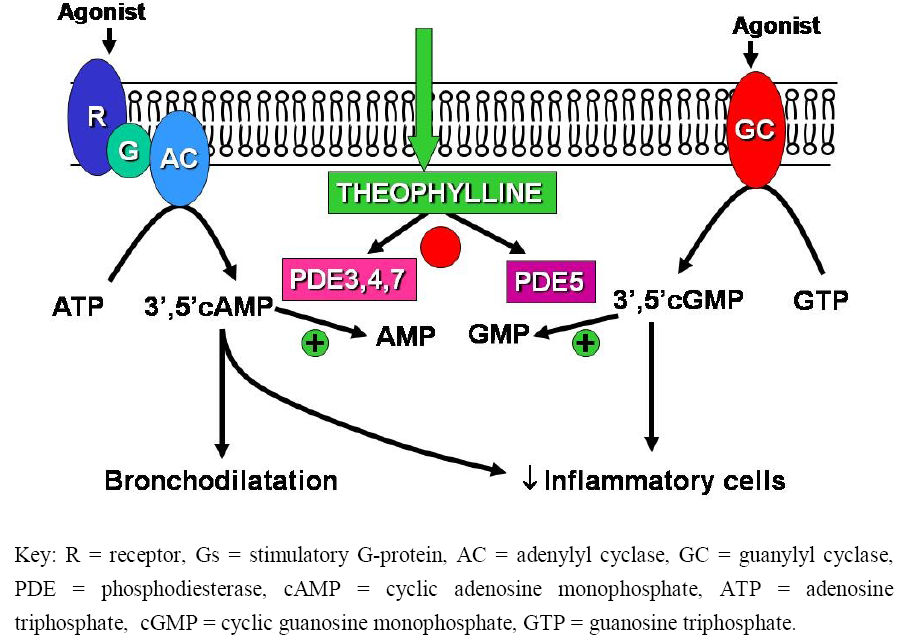
        <p>Theophylline is a weak non-selective inhibitor of PDEs, which break down cyclic nucleotides in the cell, thereby leading to an increase in intracellular cyclic 3'5' adenosine monophosphate (AMP) and cyclic 3',5' guanosine monophosphate (GMP) concentrations (<xref ref-type="fig" rid="figure1">Figure 1</xref>). However, the degree of inhibition is small at concentrations of theophylline that are therapeutically relevant. Thus total PDE activity in human lung extracts is inhibited by only 5–10% by therapeutic concentrations of theophylline [<xref ref-type="bibr" rid="B6">6</xref>]. There is convincing <italic>in vitro</italic> evidence that theophylline relaxes airway smooth muscle by inhibition of PDE activity, but relatively high concentrations are needed for maximal relaxation [<xref ref-type="bibr" rid="B7">7</xref>]. Similarly, the inhibitory effect of theophylline on mediator release from alveolar macrophages appears to be mediated by inhibition of PDE activity in these cells [<xref ref-type="bibr" rid="B8">8</xref>]. There is no evidence that airway smooth muscle or inflammatory cells concentrate theophylline to achieve higher intracellular than circulating concentrations. Inhibition of PDE should lead to synergistic interaction with β-agonists, but this has not been convincingly demonstrated <italic>in vivo</italic> or in clinical studies; however, this might be because relaxation of airway smooth muscle by β-agonists may involve direct coupling of β-receptors <italic>via</italic> a stimulatory G-protein to the opening of potassium channels, without the involvement of cyclic AMP [<xref ref-type="bibr" rid="B9">9</xref>].</p>
        <p>At least 11 isoenzyme families of PDE have now been recognized and some (PDE3, PDE4, PDE5) are important in smooth muscle relaxation [<xref ref-type="bibr" rid="B10">10</xref>]; however, there is no convincing evidence that theophylline has any greater inhibitory effect on the PDE isoenzymes involved in smooth muscle relaxation. It is possible that PDE isoenzymes may have an increased expression in asthmatic airways, either as a result of the chronic inflammatory process, or as a result of therapy. Elevation of cyclic AMP by ß-agonists may result in increased PDE activity, thus limiting the effect of ß-agonists. Indeed, alveolar macrophages from asthmatic patients appear to have increased PDE activity [<xref ref-type="bibr" rid="B11">11</xref>]. This would mean that theophylline might have a greater inhibitory effect on PDE in asthmatic airways than in normal airways. Support for this is provided by the lack of bronchodilator effect of theophylline in normal subjects, compared to a bronchodilator effect in asthmatic patients [<xref ref-type="bibr" rid="B12">12</xref>].</p>
        <p>Inhibition of PDEs is likely to account for some of the most frequent side effects of theophylline, including nausea and vomiting (PDE4), palpitations and cardiac arrhythmias (PDE3) and headaches (PDE4).</p>
        <fig id="figure1" position="float">
          <label>Figure 1</label>
          <caption>
            <p>Effect of phosphodiesterase (PDE) inhibitors in the breakdown of cyclic nucleotides in airway smooth muscle and inflammatory cells.</p>
          </caption>
          <graphic xmlns:xlink="http://www.w3.org/1999/xlink" xlink:href="pharmaceuticals-03-00725-g001.tif" scale="0"/>
        </fig>
        <p>Key: R = receptor, Gs = stimulatory G-protein, AC = adenylyl cyclase, GC = guanylyl cyclase, PDE = phosphodiesterase, cAMP = cyclic adenosine monophosphate, ATP = adenosine triphosphate,  cGMP = cyclic guanosine monophosphate, GTP = guanosine triphosphate.</p>
      </sec>
      <sec>
        <title>3.2. Adenosine Receptor Antagonism</title>
        <p>Theophylline is a potent inhibitor of adenosine receptors at therapeutic concentrations. Both A<sub>1</sub>- and A<sub>2</sub>-receptors are inhibited, but theophylline is less effective against A<sub>3</sub>-receptors, suggesting that this could be the basis for its bronchodilator effects [<xref ref-type="bibr" rid="B13">13</xref>]. Although adenosine has little effect on normal human airway smooth muscle <italic>in vitro</italic>, it constricts airways of asthmatic patients <italic>via</italic> the release of histamine and leukotrienes, suggesting that adenosine releases mediators from mast cells [<xref ref-type="bibr" rid="B14">14</xref>]. The receptor involved appears to be an A<sub>3</sub>- receptor in rat mast cells [<xref ref-type="bibr" rid="B15">15</xref>,<xref ref-type="bibr" rid="B16">16</xref>], but in humans A<sub>2B</sub>-receptors are involved [<xref ref-type="bibr" rid="B17">17</xref>]. Adenosine causes bronchoconstriction in asthmatic subjects when given by inhalation [<xref ref-type="bibr" rid="B18">18</xref>]. The mechanism of bronchoconstriction is indirect and involves release of histamine from airway mast cells [<xref ref-type="bibr" rid="B14">14</xref>,<xref ref-type="bibr" rid="B19">19</xref>]. The bronchoconstrictor effect of adenosine is prevented by therapeutic concentrations of theophylline [<xref ref-type="bibr" rid="B18">18</xref>]; however, this only confirms that theophylline is capable of antagonizing the effects of adenosine at therapeutic concentrations, and does not necessarily indicate that this is important for its anti-asthma effect. Adenosine antagonism is likely to account for some of the side effects of theophylline, such as central nervous system stimulation, cardiac arrhythmias (both <italic>via</italic> blockade of A<sub>1</sub>-receptors), gastric hypersecretion, gastroesophageal reflux and diuresis. A novel AMP receptor, P2Y<sub>15</sub>, has been identified which is more potently inhibited by theophylline [<xref ref-type="bibr" rid="B20">20</xref>], although the function of these receptors has been questioned.</p>
      </sec>
      <sec>
        <title>3.3. Interleukin-10 Release</title>
        <p>Interleukin(IL)-10 has a broad spectrum of anti-inflammatory effects and there is evidence that its secretion is reduced in asthma and COPD [<xref ref-type="bibr" rid="B21">21</xref>]. IL-10 release is increased by theophylline and this effect may be mediated <italic>via</italic> PDE inhibition [<xref ref-type="bibr" rid="B22">22</xref>], although this has not been seen at the low doses that are effective in asthma [<xref ref-type="bibr" rid="B23">23</xref>].</p>
      </sec>
      <sec>
        <title>3.4. Effects on Gene Transcription</title>
        <p>Theophylline prevents the translocation of the proinflammatory transcription factor nuclear factor-κB (NF-κB) into the nucleus, thus potentially reducing the expression of inflammatory genes in asthma and COPD [<xref ref-type="bibr" rid="B24">24</xref>]. Inhibition of NF-κB appears to be due to a protective effect against the degradation of the inhibitory protein I-κBα, so that nuclear translocation of activated NF-κB is prevented [<xref ref-type="bibr" rid="B25">25</xref>]. However, these effects are seen at high concentrations and may be mediated by inhibition of PDE. </p>
      </sec>
      <sec>
        <title>3.5. Effect on Kinases</title>
        <p>Theophylline directly inhibits phosphoinositie-3-kinases, with greatest potency for the PI3K (p110)-δ subtype (IC50 75 μM) [<xref ref-type="bibr" rid="B26">26</xref>] a subtype of the enzyme that has been implicated in responses to oxidative stress [<xref ref-type="bibr" rid="B27">27</xref>]. However, it is a relatively weak effect against the PI3K-γ subtype (IC50 800 μM), which is involved in chemotactic responses of neutrophils and monocytes. The inhibitory effect of theophylline on PI3K-δ may account for the ability of theophylline to reverse corticosteroid resistance, which may be of critical importance for its clinical effects in severe asthma and COPD [<xref ref-type="bibr" rid="B28">28</xref>]</p>
      </sec>
      <sec>
        <title>3.6. Effects on Apoptosis</title>
        <p>Prolonged survival of granulocytes due to a reduction in apoptosis may be important in perpetuating chronic inflammation in COPD. Theophylline promotes inhibits apoptosis in neutrophils <italic>in vitro</italic> [<xref ref-type="bibr" rid="B29">29</xref>]. This is associated with a reduction in the anti-apoptotic protein Bcl-2 [<xref ref-type="bibr" rid="B30">30</xref>]. This effect is not mediated <italic>via</italic> PDE inhibition, but in neutrophils may be mediated by antagonism of adenosine A<sub>2A</sub>-receptors [<xref ref-type="bibr" rid="B31">31</xref>]. Theophylline also induces apoptosis of T-lymphocytes, thus reducing their survival and this effect appears to be mediated <italic>via</italic> PDE inhibition [<xref ref-type="bibr" rid="B32">32</xref>]. Theophylline also inhibits the enzyme poly(ADP-ribose)polymerase-1 (PARP-1), which is activated by oxidative stress and leads to a reduction in nicotine adenine diamine levels resulting in an energy crisis that leads to cell death [<xref ref-type="bibr" rid="B33">33</xref>]. </p>
      </sec>
      <sec>
        <title>3.7. Histone Deacetylase Activation</title>
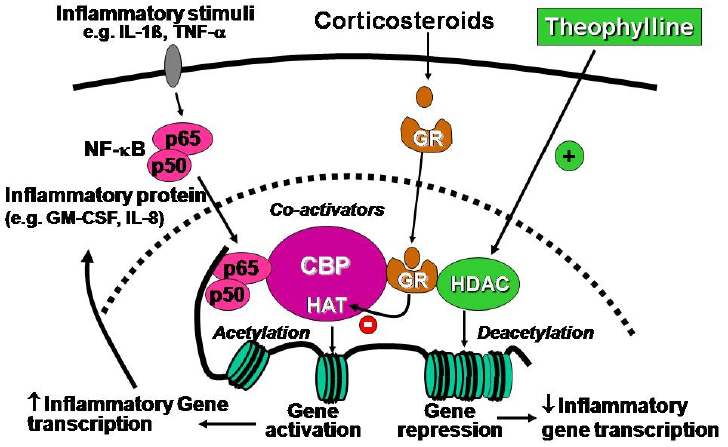
        <p>A novel mechanism of action involving activation of histone deacetylases (HDAC) has been described which, in contrast to the proposed molecular mechanisms discussed above, is seen at therapeutically relevant concentrations [<xref ref-type="bibr" rid="B3">3</xref>]. Expression of inflammatory genes is regulated by the balance between histone acetylation and deacetylation [<xref ref-type="bibr" rid="B34">34</xref>]. In asthma multiple inflammatory genes are activated through proinflammatory transcription factors, such as NF-κB, leading to histone acetylation and increased transcription. This process is reversed by the recruitment of histone deacetylases (HDAC) to the activated inflammatory gene promoter site within the nucleus. Corticosteroids suppress inflammation by recruiting HDAC2 to activated inflammatory genes, thus switching off their expression [<xref ref-type="bibr" rid="B35">35</xref>]. This molecular mechanism is defective in COPD patients as HDAC2 activity and expression is markedly reduced, thus accounting for the steroid resistance of COPD [<xref ref-type="bibr" rid="B36">36</xref>]. There is also a defect in HDAC2 function in patients with severe asthma and in asthmatic patients who smoke [<xref ref-type="bibr" rid="B37">37</xref>,<xref ref-type="bibr" rid="B38">38</xref>]. Theophylline is an activator of HDACs and enhances the anti-inflammatory effect of corticosteroids, as well as reversing steroid resistance in cells from COPD patients [<xref ref-type="bibr" rid="B39">39</xref>,<xref ref-type="bibr" rid="B40">40</xref>] (<xref ref-type="fig" rid="figure2">Figure 2</xref>). </p>
        <fig id="figure2" position="float">
          <label>Figure 2</label>
          <caption>
            <p>Theophylline directly activates histone deacetylases (HDACs) which deacetylate core histones that have been acetylated by the histone acetyltransferase (HAT) activity of co-activators, such as CREB-binding protein (CBP). This results in suppression of inflammatory genes and proteins, such as granulocyte-macrophage colony stimulating factor (GM-CSF) and interleukin-8 (IL-8) that have been switched on by proinflammatory transcription factors, such as nuclear factor-κB (NF-κB). Corticosteroids also activate HDACs, but through a different mechanism resulting in the recruitment of HDACs to the activated transcriptional complex <italic>via</italic> activation of the glucocorticoid receptors (GR) which function as a molecular bridge. This predicts that theophylline and corticosteroids may have a synergistic effect in repressing inflammatory gene expression.</p>
          </caption>
          <graphic xmlns:xlink="http://www.w3.org/1999/xlink" xlink:href="pharmaceuticals-03-00725-g002.tif" scale="0"/>
        </fig>
        <p>This action of theophylline is seen at low plasma concentrations (optimally 5 mg/L) and is completely independent of PDE inhibition and adenosine antagonism. The effect of theophylline is reversed by an HDAC inhibitor called trichostatin A and by knocking out HDAC2 using interference RNA [<xref ref-type="bibr" rid="B41">41</xref>]. The reason why theophylline selectivey activates HDAC activity is through the inhibition of PI3K-δ, which is activated by oxidative stress and involved in the regulation of HDAC2 activity [<xref ref-type="bibr" rid="B28">28</xref>]. This effect of theophylline is seen particularly in the presence of oxidative and nitrative stress and this accounts for why theophylline is effective particularly in severe asthma, where oxidative and nitrative stress are greatest. Increased reactive oxygen species and nitric oxide from increased expression of inducible nitric oxide synthase results in the formation of peroxynitrite radicals. Peroxynitrite is unstable and nitrates tyrosine residues in proteins, which may result in altered protein function. Peroxynitrite is increased in COPD lungs [<xref ref-type="bibr" rid="B42">42</xref>,<xref ref-type="bibr" rid="B43">43</xref>] and is associated with tyrosine nitration and inactivation of HDAC2 [<xref ref-type="bibr" rid="B44">44</xref>]. Theophylline also appears to reduce the formation of peroxynitrite and this provides a further mechanism for increasing HDAC2 function in asthma [<xref ref-type="bibr" rid="B45">45</xref>].</p>
      </sec>
    </sec>
    <sec>
      <title>4. Cellular Effects</title>
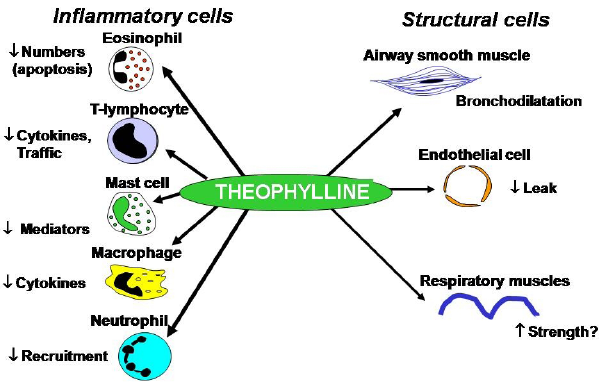
      <p>Theophylline has several cellular effects that may contribute to its clinical efficacy in the treatment of asthma (<xref ref-type="fig" rid="figure3">Figure 3</xref>).</p>
      <fig id="figure3" position="float">
        <label>Figure 3</label>
        <caption>
          <p>Multiple cellular effects of theophylline.</p>
        </caption>
        <graphic xmlns:xlink="http://www.w3.org/1999/xlink" xlink:href="pharmaceuticals-03-00725-g003.tif" scale="0"/>
      </fig>
      <sec>
        <title>4.1 Airway Smooth Muscle Effects</title>
        <p>The primary effect of theophylline was assumed to be relaxation of airway smooth muscle and <italic>in vitro</italic> studies have shown that it is equally effective in large and small airways [<xref ref-type="bibr" rid="B46">46</xref>]. In airways obtained at lung surgery approximately 25% of preparations fail to relax with a ß-agonist, but all relax with theophylline [<xref ref-type="bibr" rid="B47">47</xref>]. The molecular mechanism of bronchodilatation is almost certainly related to PDE inhibition, resulting in an increase in cyclic AMP [<xref ref-type="bibr" rid="B7">7</xref>]. PDE3 inhibition accounts for most of the bronchodilator effect, with no contribution from PDE4 inhibition in human airway smooth muscle. The bronchodilator effect of theophylline is reduced in human airways by the toxin charybdotoxin, which inhibits large conductance Ca<sup>2+</sup>-activated K<sup>+</sup> channels (maxi-K channels), suggesting that theophylline opens maxi K channels <italic>via</italic> an increase in cyclic AMP [<xref ref-type="bibr" rid="B48">48</xref>]. Theophylline acts as a functional antagonist and inhibits the contractile response of multiple spasmogens. In airways obtained at post-mortem from patients who have died from asthma the relaxant response to β-agonists is reduced, whereas the bronchodilator response to theophylline is no different from that seen in normal airways [<xref ref-type="bibr" rid="B49">49</xref>]. Theophylline is a weak bronchodilator at therapeutically relevant concentrations, suggesting that some other target cell may be more relevant for its anti-asthma effect. In human airways the EC<sub>50</sub> for airway smooth muscle relaxation by theophylline is approximately 1.5 × 10<sup>-4 </sup>M, which is equivalent to 67 mg/L assuming 60% protein binding [<xref ref-type="bibr" rid="B47">47</xref>], that is well above the therapeutic range. However, PDE activity may be increased in asthmatic airways as a result of inflammation so that theophylline may have a greater than expected effect.</p>
        <p><italic>In vivo</italic> intravenous aminophylline has an acute bronchodilator effect in asthmatic patients, which is most likely to be due to a relaxant effect on airway smooth muscle [<xref ref-type="bibr" rid="B50">50</xref>]. The bronchodilator effect of theophylline in chronic asthma is small in comparison with β<sub>2</sub>-agonists, however. Several studies have demonstrated a small protective effect of theophylline on histamine, methacholine or exercise challenge [<xref ref-type="bibr" rid="B51">51</xref>,<xref ref-type="bibr" rid="B52">52</xref>,<xref ref-type="bibr" rid="B53">53</xref>,<xref ref-type="bibr" rid="B54">54</xref>]. This protective effect does not correlate well with any bronchodilator effect and the protective effect of theophylline may be observed at plasma concentrations of &lt;10 mg/L. These clinical studies suggest that theophylline may have anti-asthma effects that are unrelated to any bronchodilator action.</p>
      </sec>
      <sec>
        <title>4.2. Anti-inflammatory Effects</title>
        <p>There is increasing evidence that theophylline has anti-inflammatory effects in asthma and that these are seen at lower plasma concentrations than are needed for bronchodilatation. Theophylline inhibits mediator release from chopped human lung [<xref ref-type="bibr" rid="B55">55</xref>], although high concentrations are necessary and it is likely that this effect involves an increase in cyclic AMP concentration due to PDE inhibition. Theophylline also has an inhibitory effect on superoxide anion release from human neutrophils [<xref ref-type="bibr" rid="B56">56</xref>] and inhibits the feedback stimulatory effect of adenosine on neutrophils <italic>in vivo</italic> [<xref ref-type="bibr" rid="B57">57</xref>]. At therapeutic concentrations <italic>in vitro</italic> theophylline may <italic>increase</italic> superoxide release <italic>via</italic> an inhibitory effect on adenosine receptors, since endogenous adenosine may normally exert an inhibitory action on these cells [<xref ref-type="bibr" rid="B58">58</xref>]. Similar results are also seen in guinea-pig and human eosinophils [<xref ref-type="bibr" rid="B59">59</xref>]. At therapeutic concentrations there is an increased release of superoxide anions from eosinophils, which appears to be mediated <italic>via</italic> inhibition of adenosine A<sub>2</sub>-receptors and is mimicked by the adenosine antagonist 8-phenyltheophylline. Inhibition of eosinophil superoxide generation occurs only at high concentrations of theophylline (&gt; 10<sup>-4 </sup>M) which are likely to inhibit PDE. Similar results have also been obtained in human alveolar macrophages [<xref ref-type="bibr" rid="B8">8</xref>]. Macrophages in bronchoalveolar lavage fluid from patients taking theophylline have been found to have a reduced oxidative burst response [<xref ref-type="bibr" rid="B60">60</xref>], but there is no reduction in the release of the proinflammatory cytokines TNF–α or GM-CSF [<xref ref-type="bibr" rid="B61">61</xref>]. Theophylline inhibits neutrophil chemotaxis <italic>via</italic> inhibition of adenosine A<sub>2A</sub>-receptors and this may be relevant in severe asthma [<xref ref-type="bibr" rid="B62">62</xref>].</p>
        <p><italic>In vivo</italic> theophylline inhibits mediator-induced airway microvascular leakage in rodents when given in high doses [<xref ref-type="bibr" rid="B63">63</xref>], although this is not seen at therapeutically relevant concentrations [<xref ref-type="bibr" rid="B64">64</xref>]. Theophylline has an inhibitory effect on plasma exudation in nasal secretions induced by allergen in patients with allergic rhinitis, although this could be secondary to inhibition of mediator release [<xref ref-type="bibr" rid="B65">65</xref>]. Microarray studies in macrophages show that theophylline has the greatest inhibitory effect on IL-13 expression [<xref ref-type="bibr" rid="B66">66</xref>].</p>
        <p>In allergen challenge studies chronic oral treatment with theophylline reduces the late response to allergen [<xref ref-type="bibr" rid="B67">67</xref>]. This has been interpreted as an effect on the chronic inflammatory response and is supported by a reduced infiltration of eosinophils into the airways after allergen challenge following low doses of theophylline [<xref ref-type="bibr" rid="B68">68</xref>]. In patients with nocturnal asthma low dose theophylline inhibits the influx of neutrophils and, to a lesser extent, eosinophils seen in the early morning [<xref ref-type="bibr" rid="B69">69</xref>]. Chronic treatment with low dose theophylline reduces the numbers of eosinophils in bronchial biopsies, bronchoalveolar lavage and induced sputum of patients with mild asthma [<xref ref-type="bibr" rid="B61">61</xref>]. However these effects are less than those expected with low doses of inhaled corticosteroids and there is no reduction of exhaled nitric oxide, indicating a lesser effect on suppression of inflammation than corticosteroids.</p>
        <p>In patients with COPD, theophylline reduces the proportion of neutrophils in induced sputum and reduces the concentration of IL-8, suggesting that it may have an anti-inflammatory effect unlike corticosteroids [<xref ref-type="bibr" rid="B70">70</xref>,<xref ref-type="bibr" rid="B71">71</xref>,<xref ref-type="bibr" rid="B72">72</xref>]. Since patients with severe asthma may have increased neutrophils in the airways [<xref ref-type="bibr" rid="B73">73</xref>,<xref ref-type="bibr" rid="B74">74</xref>], this may provide a mechanism whereby theophylline is effective as an add-on therapy to high doses of inhaled corticosteroids in these patients.</p>
      </sec>
      <sec>
        <title>4.3. Immunomodulatory Effects</title>
        <p>T-lymphocytes are now believed to play a central role in coordinating the chronic inflammatory response in asthma. Theophylline has several actions on T-lymphocyte function, suggesting that it might have an immunomodulatory effect in asthma. Theophylline has a stimulatory effect on suppressor (CD8<sup>+</sup>) T-lymphocytes, which may be relevant to the control of chronic airway inflammation [<xref ref-type="bibr" rid="B75">75</xref>,<xref ref-type="bibr" rid="B76">76</xref>], and has an inhibitory effect on graft rejection [<xref ref-type="bibr" rid="B77">77</xref>]. <italic>In vitro</italic> theophylline inhibits IL-2 synthesis in human T-lymphocytes, an effect that is secondary to a rise in intracellular cyclic AMP concentration [<xref ref-type="bibr" rid="B78">78</xref>]. At high concentrations theophylline inhibits proliferation in CD4<sup>+</sup> and CD8<sup>+ </sup>cells, an effect that is mediated <italic>via</italic> inhibition of PDE4 [<xref ref-type="bibr" rid="B79">79</xref>]. Theophylline also inhibits the chemotactic response of T-lymphocytes, an effect that is also mediated through PDE inhibition [<xref ref-type="bibr" rid="B80">80</xref>]. In allergen-induced airway inflammation in guinea pigs, theophylline has a significant inhibitory effect on eosinophil infiltration [<xref ref-type="bibr" rid="B81">81</xref>], suggesting that it may inhibit the T-cell-derived cytokines responsible for this eosinophilic response. Theophylline has been reported to decrease circulating concentrations of IL-4 and IL-5 in asthmatic patients [<xref ref-type="bibr" rid="B82">82</xref>]. In asthmatic patients low dose theophylline treatment results in an increase in activated circulating CD4<sup>+</sup> and CD8<sup>+</sup> T-cells, but a decrease in these cells in the airways, suggesting that it may reduce the trafficking of activated T cells into the airways [<xref ref-type="bibr" rid="B83">83</xref>]. This is supported by studies in allergen challenge, where low dose theophylline decreases the number of activated CD4<sup>+ </sup>and CD8<sup>+</sup> T-cells in bronchoalveolar lavage fluid after allergen challenge and this is mirrored by an increase in these cells in peripheral blood [<xref ref-type="bibr" rid="B84">84</xref>]. These effects are seen even in patients treated with high doses of inhaled corticosteroids, indicating that the molecular effects of theophylline are likely to be different from those of corticosteroids. Theophylline induces apoptosis of T-lymphocytes, thus reducing their survival [<xref ref-type="bibr" rid="B32">32</xref>]. This effect may be mediated <italic>via</italic> PDE4 inhibition, so may not be relevant to clinical doses of theophylline. The therapeutic range of theophylline was based on measurement of immediate bronchodilatation in response to the acute administration of theophylline [<xref ref-type="bibr" rid="B50">50</xref>]. However, it is possible that the non-bronchodilator effects of theophylline, which may reflect some anti-inflammatory or immunomodulatory effect, may be exerted at lower plasma concentrations and that different molecular mechanisms may be involved [<xref ref-type="bibr" rid="B85">85</xref>].</p>
      </sec>
      <sec>
        <title>4.4. Extrapulmonary Effects</title>
        <p>It has been suggested that theophylline may exert its effects in asthma <italic>via</italic> some action outside the airways. It may be relevant that theophylline is ineffective when given by inhalation until therapeutic plasma concentrations are achieved [<xref ref-type="bibr" rid="B86">86</xref>]. This may indicate that theophylline has effects on cells other than those in the airway. An effect of theophylline which remains controversial is its action on respiratory muscles. Aminophylline increases diaphragmatic contractility and reverses diaphragm fatigue [<xref ref-type="bibr" rid="B87">87</xref>]. This effect has not been observed by all investigators but there are doubts about the relevance of these observations to the clinical benefit provided by theophylline [<xref ref-type="bibr" rid="B88">88</xref>]. Whether theophylline has any effects on systemic effects or co-morbidities in COPD patients has not yet been established.</p>
      </sec>
    </sec>
    <sec>
      <title>5. Pharmacokinetics</title>
      <p>There is a close relationship between the acute improvement in airway function and serum theophylline concentration. Below 10 mg/L therapeutic effects (at least in terms of rapid improvement in airway function) are small and above 25 mg/L additional benefits are outweighed by side effects, so that the therapeutic range was usually taken as 10–20 mg/L (55–110 µM) [<xref ref-type="bibr" rid="B2">2</xref>]. It is now apparent that non-bronchodilator effects of theophylline may be seen at plasma concentrations of &lt;10 mg/L and that clinical benefit may be derived from these lower concentrations of theophylline. This suggests that it may be necessary to redefine the therapeutic range of theophylline based on anti-asthma effect, rather than the acute bronchodilator response that requires a higher plasma concentration. The dose of theophylline required to give therapeutic concentrations varies among patients, largely because of differences in clearance. Theophylline is rapidly and completely absorbed, but there are large inter-individual variations in clearance, due to differences in hepatic metabolism (<xref ref-type="table" rid="table2">Table 2</xref>). Theophylline is metabolized in the liver by the cytochrome P450 microsomal enzyme system, and a large number of factors may influence hepatic metabolism. Theophylline is predominantly metabolized by the CYP1A2 enzyme, while at higher plasma concentrations CYP2E1 is also involved (89).</p>
      <table-wrap id="table2" position="float"><object-id pub-id-type="pii">pharmaceuticals-03-00725_table2</object-id>
        <object-id pub-id-type="pii">pharmaceuticals-03-00725_table2</object-id>
        <label>Table 2</label>
        <caption>
          <p>Factors affecting clearance of theophylline.</p>
        </caption>
        <table>
          <thead>
            <tr>
              <th align="left" valign="middle">
                <bold>Increased Clearance</bold>
              </th>
              <th align="left" valign="middle">
                <bold>Decreased Clearance</bold>
              </th>
            </tr>
          </thead>
          <tbody>
            <tr>
              <td align="left" valign="middle">Enzyme induction (rifampicin, phenobarbitone, ethanol)</td>
              <td align="left" valign="middle">Enzyme inhibition (cimetidine, erythromycin, ciprofloxacin, allopurinol, zileuton)</td>
            </tr>
            <tr>
              <td align="left" valign="middle">Smoking (tobacco, marijuana)</td>
              <td align="left" valign="middle">Congestive heart failure</td>
            </tr>
            <tr>
              <td align="left" valign="middle">High protein, low carbohydrate diet</td>
              <td align="left" valign="middle">Liver disease</td>
            </tr>
            <tr>
              <td align="left" valign="middle">Barbecued meat</td>
              <td align="left" valign="middle">Pneumonia</td>
            </tr>
            <tr>
              <td align="left" valign="middle">Childhood</td>
              <td align="left" valign="middle">Viral infection</td>
            </tr>
            <tr>
              <td align="left" valign="middle"/>
              <td align="left" valign="middle">Vaccination (immunization)</td>
            </tr>
            <tr>
              <td align="left" valign="middle"/>
              <td align="left" valign="middle">High carbohydrate diet</td>
            </tr>
            <tr>
              <td align="left" valign="middle"/>
              <td align="left" valign="middle">Old age</td>
            </tr>
          </tbody>
        </table>
      </table-wrap>
      <sec>
        <title>5.1. Increased Clearance</title>
        <p>Increased clearance is seen in children (1–16 years), and in cigarette and marijuana smokers. Concurrent administration of phenytoin and phenobarbitone increases activity of P450, resulting in increased metabolic breakdown, so that higher doses may be required. </p>
      </sec>
      <sec>
        <title>5.2. Reduced Clearance</title>
        <p>Reduced clearance is found in liver disease, pneumonia and heart failure and doses need to be reduced to half and plasma levels monitored carefully. Decreased clearance is also seen with certain drugs, including erythromycin, certain quinolone antibiotics (ciprofloxacin, but not ofloxacin), allopurinol, cimetidine (but not ranitidine), serotonin uptake inhibitors (fluvoxamine) and the 5-lipoxygenase inhibitor zileuton, which interfere with CYP 1A2 function. Thus, if a patient on maintenance theophylline requires a course of erythromycin, the dose of theophylline should be halved. Viral infections and vaccinations (immunizations) may also reduce clearance, and this may be particularly important in children. Because of these variations in clearance, individualization of theophylline dosage is required and plasma concentrations should be measured 4 h after the last dose with slow-release preparations, when steady state has usually been achieved. There is no significant circadian variation in theophylline metabolism [<xref ref-type="bibr" rid="B90">90</xref>].</p>
      </sec>
    </sec>
    <sec>
      <title>6. Routes of Administration</title>
      <sec>
        <title>6.1. Intravenous</title>
        <p>Intravenous aminophylline has been used for many years in the treatment of acute severe asthma. The recommended dose is now 6 mg/kg given intravenously over 20–30 min, followed by a maintenance dose of 0.5 mg/kg/h. If the patient is already taking theophylline, or there are any factors which decrease clearance, these doses should be halved and the plasma level checked more frequently.</p>
      </sec>
      <sec>
        <title>6.2. Oral</title>
        <p>Plain theophylline tablets or elixir, which are rapidly absorbed, give wide fluctuations in plasma levels and are not recommended. Several effective sustained-release preparations now available are absorbed at a constant rate and provide steady plasma concentrations over a 12–24 h period. Although there are differences between preparations, these are relatively minor and of no clinical significance. Both slow-release aminophylline and theophylline are available and are equally effective (although the ethylene diamine component of aminophylline has very occasionally been implicated in allergic reactions). For continuous treatment, twice daily therapy (approximately 8 mg/kg twice daily) is needed, although some preparations are designed for once daily administration. For nocturnal asthma, a single dose of slow-release theophylline at night may be effective [<xref ref-type="bibr" rid="B91">91</xref>,<xref ref-type="bibr" rid="B92">92</xref>]. Once optimal doses have been determined plasma concentrations usually remain stable, providing no factors which alter clearance are introduced.</p>
      </sec>
      <sec>
        <title>6.3. Other Routes</title>
        <p>Aminophylline may be given as a suppository, but rectal absorption is unreliable and proctitis may occur, so this route should be avoided. Inhalation of theophylline is irritating and ineffective [<xref ref-type="bibr" rid="B86">86</xref>]. Intramuscular injections of theophylline are very painful and should never be given.</p>
      </sec>
    </sec>
    <sec>
      <title>7. Clinical Use</title>
      <sec>
        <title>7.1. Acute Exacerbations</title>
        <p>Intravenous aminophylline has been used in the management of acute severe asthma for over 50 years, but this use has been questioned in view of the risk of adverse effects compared with nebulized ß<sub>2</sub>-agonists. In patients with acute asthma, intravenous aminophylline is less effective than nebulized ß<sub>2</sub>-agonists [<xref ref-type="bibr" rid="B93">93</xref>], and should therefore be reserved for those who fail to respond to ß-agonists. In a meta-analysis of 27 studies which looked at addition of iv aminophylline to nebulized β<sub>2</sub>-agonists, there is no evidence for significant benefit in adults [<xref ref-type="bibr" rid="B94">94</xref>] or children [<xref ref-type="bibr" rid="B95">95</xref>]. This indicates that aminophylline should not be added routinely to nebulized ß-agonists. Indeed, addition of aminophylline only increases adverse effects. Several deaths have been reported after intravenous aminophylline. In one study of 43 asthma deaths in southern England there was a significantly greater frequency of toxic theophylline concentrations (21%) compared with matched controls (7%) [<xref ref-type="bibr" rid="B96">96</xref>]. These concerns have lead to the view that intravenous aminophylline should be reserved for the few patients with acute severe asthma who fail to show a satisfactory response to nebulized β<sub>2</sub>-agonists. When intravenous aminophylline is used it should be given as a slow intravenous infusion with careful monitoring of vital signs and plasma theophylline concentrations should be measured prior to and after infusion. Aminophylline similarly has no place in the routine management of COPD exacerbations [<xref ref-type="bibr" rid="B97">97</xref>,<xref ref-type="bibr" rid="B98">98</xref>].</p>
      </sec>
      <sec>
        <title>7.2. Chronic Asthma</title>
        <p>In most guidelines for asthma management theophylline is recommended as an additional bronchodilator if asthma remains difficult to control after high doses of inhaled corticosteroids. The introduction of long-acting inhaled β<sub>2</sub>-agonists has further threatened the position of theophylline, since the side effects of these agents may be less frequent that those associated with theophylline and long-acting inhaled β<sub>2</sub>-agonists are more effective controllers than theophylline [<xref ref-type="bibr" rid="B99">99</xref>]. Whether theophylline has some additional benefit over its bronchodilator action is now an important consideration. In chronic asthma oral theophylline provides additional control of asthma symptoms even in patients talking regular inhaled steroids [<xref ref-type="bibr" rid="B100">100</xref>]. In an uncontrolled study a group of adolescent patients with severe asthma who were controlled with oral and inhaled steroids, nebulized β<sub>2</sub>-agonists, inhaled anticholinergics and sodium cromoglycate, in addition to regular oral theophylline, withdrawal of the oral theophylline resulted in a marked deterioration of asthma control which could not be controlled by further increase in steroids and only responded to reintroduction of theophylline [<xref ref-type="bibr" rid="B101">101</xref>]. This suggests that there may be a group of severe asthmatic patients who particularly benefit from theophylline. In a controlled trial of theophylline withdrawal in patients with severe asthma controlled only on high doses of inhaled corticosteroids, there was a significant deterioration in symptoms and lung function when placebo was substituted for the relatively low maintenance dose of theophylline [<xref ref-type="bibr" rid="B83">83</xref>]. There is also evidence that addition of theophylline improves asthma control to a greater extent than β<sub>2</sub>-agonists in patients with severe asthma treated with high dose inhaled steroids [<xref ref-type="bibr" rid="B102">102</xref>]. This suggests that theophylline may have a useful place in the optimal management of moderate to severe asthma and appears to provide additional control above that provided by high dose inhaled steroids [<xref ref-type="bibr" rid="B103">103</xref>,<xref ref-type="bibr" rid="B104">104</xref>]. </p>
        <p>Theophylline may be a useful treatment for nocturnal asthma and a single dose of a slow release theophylline preparation given at night may provide effective control of nocturnal asthma symptoms [<xref ref-type="bibr" rid="B91">91</xref>,<xref ref-type="bibr" rid="B92">92</xref>]. Theophylline has equal efficacy to salmeterol in controlling nocturnal asthma, but the quality of sleep is better with salmeterol compared to theophylline [<xref ref-type="bibr" rid="B105">105</xref>]. The mechanism of action of theophylline in nocturnal asthma may involve more than long-lasting bronchodilatation, and could involve inhibition of some components of the inflammatory response, which may increase at night [<xref ref-type="bibr" rid="B69">69</xref>]. </p>
      </sec>
      <sec>
        <title>7.3. Add-on Therapy</title>
        <p>Several studies have demonstrated that adding low dose theophylline to inhaled corticosteroids in patients who are not controlled gives better asthma control than doubling the dose of inhaled corticosteroids. This has been demonstrated in patients with moderate to severe and mild asthma [<xref ref-type="bibr" rid="B106">106</xref>,<xref ref-type="bibr" rid="B107">107</xref>,<xref ref-type="bibr" rid="B108">108</xref>]. Interestingly, there is a greater degree of improvement in forced vital capacity than in FEV<sub>1</sub>, possibly indicating an effect on peripheral airways. Since the improvement in lung function was relatively slow, this suggests that the effect of the added theophylline may be having an anti-inflammatory rather than a bronchodilator effect, particularly as the plasma concentration of theophylline in these studies was &lt; 10 mg/L. These studies suggest that low dose theophylline may be preferable to increasing the dose of inhaled steroids when asthma is not controlled on moderate doses of inhaled steroids; such a therapeutic approach would be much less expensive than adding long-acting inhaled β<sub>2</sub>-agonists. However, theophylline is a less effective option than adding a long-acting inhaled β<sub>2</sub>-agonist [<xref ref-type="bibr" rid="B99">99</xref>]. Low dose theophylline is also effective in smoking asthmatics, who have a poor response to inhaled steroids and this may through increasing HDAC2 activity, which is reduced in the airways asthmatic patients who smoke [<xref ref-type="bibr" rid="B109">109</xref>].</p>
      </sec>
      <sec>
        <title>7.4. COPD</title>
        <p>Theophylline may also benefit patients with COPD and increases exercise tolerance [<xref ref-type="bibr" rid="B110">110</xref>,<xref ref-type="bibr" rid="B111">111</xref>]. Theophylline reduces air trapping, suggesting an effect on peripheral airways, and this may explain why some patients with COPD may obtain considerable symptomatic improvement without any increase in spirometric values [<xref ref-type="bibr" rid="B112">112</xref>]. The demonstration that low doses of theophylline reduces neutrophils in induced sputum of patients with COPD suggests that theophylline may have some anti-inflammatory effect [<xref ref-type="bibr" rid="B71">71</xref>,<xref ref-type="bibr" rid="B113">113</xref>]. In COPD macrophages <italic>in vitro</italic> theophylline restores HDAC activity to normal and thus reverses corticosteroid resistance [<xref ref-type="bibr" rid="B40">40</xref>]. It also reduces nitrative stress in macrophages from patients with COPD, whereas high doses of an inhaled corticosteroid are without effect [<xref ref-type="bibr" rid="B45">45</xref>]. Low dose theophylline increases the recovery from an acute exacerbation of COPD and this is associated with reduced inflammation and increased HDAC activity [<xref ref-type="bibr" rid="B114">114</xref>]. This suggests that corticosteroids may be useful in reversing corticosteroid resistance in patients with COPD, but long-term clinical trials are now needed to confirm this [<xref ref-type="bibr" rid="B115">115</xref>,<xref ref-type="bibr" rid="B116">116</xref>].</p>
      </sec>
      <sec>
        <title>7.5. Interaction with ß<sub>2</sub>-Agonists</title>
        <p>If theophylline exerts its effects by PDE inhibition, a synergistic interaction with ß-agonists would be expected. Many studies have investigated this possibility, but while there is good evidence that theophylline and ß-agonists have additive effects, true synergy is not seen. β<sub>2</sub>-Agonists may cause relaxation of airway smooth muscle <italic>via</italic> several mechanisms. Classically, they increase intracellular cyclic AMP concentrations, which were believed to be an essential event in the relaxation response. However, β<sub>2</sub>-agonists cause bronchodilatation, at least in part, by opening maxi-K channels in airway smooth muscle cells [<xref ref-type="bibr" rid="B48">48</xref>]. Maxi-K channels are opened by low concentrations of ß<sub>2</sub>-agonists which are likely to be therapeutically relevant. β<sub>2</sub>-Receptors may be coupled directly to maxi-K channels <italic>via</italic> the α-subunit of G<sub>s</sub> and therefore may induce relaxation without any increase in cyclic AMP, thus accounting for a lack of synergy [<xref ref-type="bibr" rid="B117">117</xref>]. </p>
        <p>Repeated administration of β<sub>2</sub>-agonists may result in tolerance; however, this may be explained by down-regulation of β<sub>2</sub>-receptors, an additional mechanism may involve up-regulation of PDE enzymes (especially PDE4D) which then break down cyclic AMP more readily [<xref ref-type="bibr" rid="B118">118</xref>]. Theophylline may therefore theoretically prevent the development of tolerance. However, in a clinical study theophylline failed to prevent the development of tolerance to the bronchoprotective effect of salmeterol in asthmatic patients [<xref ref-type="bibr" rid="B119">119</xref>].</p>
      </sec>
    </sec>
    <sec>
      <title>8. Side Effects</title>
      <p>The main limitation to the use of theophylline in conventional doses has been the high frequency of adverse effects [<xref ref-type="bibr" rid="B120">120</xref>]. Unwanted effects of theophylline are usually related to plasma concentration and tend to occur when plasma levels exceed 20 mg/L; however, some patients develop side-effects even at low plasma concentrations. To some extent side effects may be reduced by gradually increasing the dose until therapeutic concentrations are achieved.</p>
      <p>The commonest side effects are headache, nausea and vomiting, abdominal discomfort and restlessness. There may also be increased acid secretion, gastroesophageal reflux and diuresis. At high concentrations convulsions and cardiac arrhythmias may occur and, as stated previously, there is concern that intravenous aminophylline administered in the emergency room may be a contributory factor to the deaths of some patients with severe asthma [<xref ref-type="bibr" rid="B96">96</xref>].</p>
      <p>Some of the side-effects of theophylline (central stimulation, gastric secretion, diuresis and arrhythmias) may be due to adenosine receptor antagonism (A<sub>1A </sub>receptors) and these may therefore be avoided by PDE inhibitors or by doxifylline when it is available, as discussed above. The commonest side effects of theophylline are nausea and headaches, which may be due to inhibition of certain PDEs (e.g., PDE4 in the vomiting center) and cardiac arrhythmias due to inhibition of PDE3 [<xref ref-type="bibr" rid="B121">121</xref>].</p>
    </sec>
    <sec>
      <title>9. Future Developments</title>
      <p>Although theophylline has recently been used much less in developed countries, there are reasons for thinking that it may come back in fashion for the treatment of severe asthma, smoking asthma and COPD, with the recognition that it may have an anti-inflammatory and immunomodulatory effect when given in low doses (plasma concentration 5–10 mg/L) [<xref ref-type="bibr" rid="B3">3</xref>]. At these low doses the drug is easier to use, side effects are uncommon and the problems of drug interaction are less of a problem, thus making the clinical use of theophylline less complicated. Theophylline appears to have an effect that is different from those of corticosteroids and it may therefore be a useful drug to combine with low dose inhaled steroids. The molecular mechanism of anti-inflammatory effects of theophylline is now becoming clearer and it seems likely that there is a synergistic interaction with the anti-inflammatory mechanism of corticosteroids through restoration of HDAC activity. This interaction may underlie the beneficial effects of theophylline when added to inhaled corticosteroids. This may be particularly appropriate in patients with more severe asthma in whom corticosteroids are less effective as there may be a reduction in HDAC activity in these patients [<xref ref-type="bibr" rid="B37">37</xref>] as well as in smoking asthmatics patients [<xref ref-type="bibr" rid="B109">109</xref>] and patients with COPD [<xref ref-type="bibr" rid="B114">114</xref>]. As slow-release theophylline preparations are cheaper than long-acting inhaled β<sub>2</sub>-agonists and leukotriene modifiers, this may justify the choice of low dose theophylline as the add-on therapy for asthma control. In addition, compliance with oral therapy is likely to be greater than with inhaled therapies [<xref ref-type="bibr" rid="B122">122</xref>]. This suggests that low dose theophylline may find an important place in the management in patients of patients with severe asthma and all patients with COPD. </p>
    </sec>
  </body>
  <back>
    <ref-list>
      <ref id="B1">
        <citation citation-type="journal">
          <person-group person-group-type="author">
            <name>
              <surname>Lam</surname>
              <given-names>A.</given-names>
            </name>
            <name>
              <surname>Newhouse</surname>
              <given-names>M.T.</given-names>
            </name>
          </person-group>
          <article-title>Management of asthma and chronic airflow limitation. Are methylxanthines obsolete?</article-title>
          <source>Chest</source>
          <year>1990</year>
          <volume>98</volume>
          <fpage>44</fpage>
          <lpage>52</lpage>
          <pub-id pub-id-type="doi">10.1378/chest.98.1.44</pub-id>
          <pub-id pub-id-type="pmid">2193783</pub-id>
        </citation>
      </ref>
      <ref id="B2">
        <citation citation-type="journal">
          <person-group person-group-type="author">
            <name>
              <surname>Weinberger</surname>
              <given-names>M.</given-names>
            </name>
            <name>
              <surname>Hendeles</surname>
              <given-names>L.</given-names>
            </name>
          </person-group>
          <article-title>Theophylline in asthma</article-title>
          <source>New Engl. J. Med.</source>
          <year>1996</year>
          <volume>334</volume>
          <fpage>1380</fpage>
          <lpage>1388</lpage>
          <pub-id pub-id-type="doi">10.1056/NEJM199605233342107</pub-id>
        </citation>
      </ref>
      <ref id="B3">
        <citation citation-type="journal">
          <person-group person-group-type="author">
            <name>
              <surname>Barnes</surname>
              <given-names>P.J.</given-names>
            </name>
          </person-group>
          <article-title>Theophylline: New perspectives on an old drug</article-title>
          <source>Am. J. Respir. Crit. Care Med.</source>
          <year>2003</year>
          <volume>167</volume>
          <fpage>813</fpage>
          <lpage>818</lpage>
          <pub-id pub-id-type="doi">10.1164/rccm.200210-1142PP</pub-id>
          <pub-id pub-id-type="pmid">12623857</pub-id>
        </citation>
      </ref>
      <ref id="B4">
        <citation citation-type="journal">
          <person-group person-group-type="author">
            <name>
              <surname>Persson</surname>
              <given-names>C.G.A.</given-names>
            </name>
          </person-group>
          <article-title>Development of safer xanthine drugs for the treatment of obstructive airways disease</article-title>
          <source>J. Allergy Clin. Immunol.</source>
          <year>1986</year>
          <volume>78</volume>
          <fpage>817</fpage>
          <lpage>824</lpage>
          <pub-id pub-id-type="doi">10.1016/0091-6749(86)90067-9</pub-id>
          <pub-id pub-id-type="pmid">3534062</pub-id>
        </citation>
      </ref>
      <ref id="B5">
        <citation citation-type="journal">
          <person-group person-group-type="author">
            <name>
              <surname>Shukla</surname>
              <given-names>D.</given-names>
            </name>
            <name>
              <surname>Chakraborty</surname>
              <given-names>S.</given-names>
            </name>
            <name>
              <surname>Singh</surname>
              <given-names>S.</given-names>
            </name>
            <name>
              <surname>Mishra</surname>
              <given-names>B.</given-names>
            </name>
          </person-group>
          <article-title>Doxofylline: A promising methylxanthine derivative for the treatment of asthma and chronic obstructive pulmonary disease</article-title>
          <source>Expert. Opin. Pharmacother.</source>
          <year>2009</year>
          <volume>10</volume>
          <fpage>2343</fpage>
          <lpage>2356</lpage>
          <pub-id pub-id-type="doi">10.1517/14656560903200667</pub-id>
          <pub-id pub-id-type="pmid">19678793</pub-id>
        </citation>
      </ref>
      <ref id="B6">
        <citation citation-type="journal">
          <person-group person-group-type="author">
            <name>
              <surname>Poolson</surname>
              <given-names>J.B.</given-names>
            </name>
            <name>
              <surname>Kazanowski</surname>
              <given-names>J.J.</given-names>
            </name>
            <name>
              <surname>Goldman</surname>
              <given-names>A.L.</given-names>
            </name>
            <name>
              <surname>Szentivanyi</surname>
              <given-names>A.</given-names>
            </name>
          </person-group>
          <article-title>Inhibition of human pulmonary phosphodiesterase activity by therapeutic levels of theophylline</article-title>
          <source>Clin. Exp. Pharmacol. Physiol.</source>
          <year>1978</year>
          <volume>5</volume>
          <fpage>535</fpage>
          <lpage>539</lpage>
          <pub-id pub-id-type="doi">10.1111/j.1440-1681.1978.tb00707.x</pub-id>
          <pub-id pub-id-type="pmid">215363</pub-id>
        </citation>
      </ref>
      <ref id="B7">
        <citation citation-type="journal">
          <person-group person-group-type="author">
            <name>
              <surname>Rabe</surname>
              <given-names>K.F.</given-names>
            </name>
            <name>
              <surname>Magnussen</surname>
              <given-names>H.</given-names>
            </name>
            <name>
              <surname>Dent</surname>
              <given-names>G.</given-names>
            </name>
          </person-group>
          <article-title>Theophylline and selective PDE inhibitors as bronchodilators and smooth muscle relaxants</article-title>
          <source>Eur. Respir. J.</source>
          <year>1995</year>
          <volume>8</volume>
          <fpage>637</fpage>
          <lpage>642</lpage>
        <pub-id pub-id-type="pmid">7664866</pub-id></citation>
      </ref>
      <ref id="B8">
        <citation citation-type="journal">
          <person-group person-group-type="author">
            <name>
              <surname>Dent</surname>
              <given-names>G.</given-names>
            </name>
            <name>
              <surname>Giembycz</surname>
              <given-names>M.A.</given-names>
            </name>
            <name>
              <surname>Rabe</surname>
              <given-names>K.F.</given-names>
            </name>
            <name>
              <surname>Wolf</surname>
              <given-names>B.</given-names>
            </name>
            <name>
              <surname>Barnes</surname>
              <given-names>P.J.</given-names>
            </name>
            <name>
              <surname>Magnussen</surname>
              <given-names>H.</given-names>
            </name>
          </person-group>
          <article-title>Theophylline suppresses human alveolar macrophage respiratory burst through phosphodiesterase inhibition</article-title>
          <source>Am. J. Resp. Cell Mol. Biol.</source>
          <year>1994</year>
          <volume>10</volume>
          <fpage>565</fpage>
          <lpage>572</lpage>
        </citation>
      </ref>
      <ref id="B9">
        <citation citation-type="journal">
          <person-group person-group-type="author">
            <name>
              <surname>Kume</surname>
              <given-names>H.</given-names>
            </name>
            <name>
              <surname>Hall</surname>
              <given-names>I.P.</given-names>
            </name>
            <name>
              <surname>Washabau</surname>
              <given-names>R.J.</given-names>
            </name>
            <name>
              <surname>Takagi</surname>
              <given-names>K.</given-names>
            </name>
            <name>
              <surname>Kotlikoff</surname>
              <given-names>M.I.</given-names>
            </name>
          </person-group>
          <article-title>Adrenergic agonists regulate K<sub>Ca</sub> channels in airway smooth muscle by cAMP-dependent and -independent mechanisms</article-title>
          <source>J. Clin. Invest.</source>
          <year>1994</year>
          <volume>93</volume>
          <fpage>371</fpage>
          <lpage>379</lpage>
          <pub-id pub-id-type="doi">10.1172/JCI116969</pub-id>
          <pub-id pub-id-type="pmid">7904270</pub-id>
        </citation>
      </ref>
      <ref id="B10">
        <citation citation-type="journal">
          <person-group person-group-type="author">
            <name>
              <surname>Beavo</surname>
              <given-names>J.A.</given-names>
            </name>
          </person-group>
          <article-title>Cyclic nucleotide phosphodiesterases: Functional implications of multiple isoforms</article-title>
          <source>Physiol. Rev.</source>
          <year>1995</year>
          <volume>75</volume>
          <fpage>725</fpage>
          <lpage>748</lpage>
          <pub-id pub-id-type="pmid">7480160</pub-id>
        </citation>
      </ref>
      <ref id="B11">
        <citation citation-type="journal">
          <person-group person-group-type="author">
            <name>
              <surname>Bachelet</surname>
              <given-names>M.</given-names>
            </name>
            <name>
              <surname>Vincent</surname>
              <given-names>D.</given-names>
            </name>
            <name>
              <surname>Havet</surname>
              <given-names>N.</given-names>
            </name>
            <name>
              <surname>Marrash-Chahla</surname>
              <given-names>R.</given-names>
            </name>
            <name>
              <surname>Pradalier</surname>
              <given-names>A.</given-names>
            </name>
            <name>
              <surname>Dry</surname>
              <given-names>J.</given-names>
            </name>
            <name>
              <surname>Vargaftig</surname>
              <given-names>B.B.</given-names>
            </name>
          </person-group>
          <article-title>Reduced responsiveness of adenylate cyclase in alveolar macrophages from patients with asthma</article-title>
          <source>J. Allergy Clin. Immunol.</source>
          <year>1991</year>
          <volume>88</volume>
          <fpage>322</fpage>
          <lpage>328</lpage>
          <pub-id pub-id-type="doi">10.1016/0091-6749(91)90093-4</pub-id>
          <pub-id pub-id-type="pmid">1716272</pub-id>
        </citation>
      </ref>
      <ref id="B12">
        <citation citation-type="journal">
          <person-group person-group-type="author">
            <name>
              <surname>Estenne</surname>
              <given-names>M.</given-names>
            </name>
            <name>
              <surname>Yernault</surname>
              <given-names>J.</given-names>
            </name>
            <name>
              <surname>De Troyer</surname>
              <given-names>A.</given-names>
            </name>
          </person-group>
          <article-title>Effects of parenteral aminophylline on lung mechanics in normal humans</article-title>
          <source>Am. Rev. Respir. Dis.</source>
          <year>1980</year>
          <volume>121</volume>
          <fpage>967</fpage>
          <lpage>971</lpage>
          <pub-id pub-id-type="pmid">7416595</pub-id>
        </citation>
      </ref>
      <ref id="B13">
        <citation citation-type="journal">
          <person-group person-group-type="author">
            <name>
              <surname>Pauwels</surname>
              <given-names>R.A.</given-names>
            </name>
            <name>
              <surname>Joos</surname>
              <given-names>G.F.</given-names>
            </name>
          </person-group>
          <article-title>Characterization of the adenosine receptors in the airways</article-title>
          <source>Arch. Int. Pharmacodyn. Ther.</source>
          <year>1995</year>
          <volume>329</volume>
          <fpage>151</fpage>
          <lpage>156</lpage>
          <pub-id pub-id-type="pmid">7639616</pub-id>
        </citation>
      </ref>
      <ref id="B14">
        <citation citation-type="journal">
          <person-group person-group-type="author">
            <name>
              <surname>Björk</surname>
              <given-names>T.</given-names>
            </name>
            <name>
              <surname>Gustafsson</surname>
              <given-names>L.E.</given-names>
            </name>
            <name>
              <surname>Dahlén</surname>
              <given-names>S.E.</given-names>
            </name>
          </person-group>
          <article-title>Isolated bronchi from asthmatics are hyperresponsive to adenosine, which apparently acts indirectly by liberation of leukotrienes and histamine</article-title>
          <source>Am. Rev. Respir. Dis.</source>
          <year>1992</year>
          <volume>145</volume>
          <fpage>1087</fpage>
          <lpage>1091</lpage>
          <pub-id pub-id-type="pmid">1375009</pub-id>
        </citation>
      </ref>
      <ref id="B15">
        <citation citation-type="journal">
          <person-group person-group-type="author">
            <name>
              <surname>Fozard</surname>
              <given-names>J.R.</given-names>
            </name>
            <name>
              <surname>Pfannkuche</surname>
              <given-names>H.J.</given-names>
            </name>
            <name>
              <surname>Schuurman</surname>
              <given-names>H.J.</given-names>
            </name>
          </person-group>
          <article-title>Mast cell degranulation following adenosine A3 receptor activation in rats</article-title>
          <source>Eur. J. Pharmacol.</source>
          <year>1996</year>
          <volume>298</volume>
          <fpage>293</fpage>
          <lpage>297</lpage>
          <pub-id pub-id-type="doi">10.1016/0014-2999(95)00822-5</pub-id>
          <pub-id pub-id-type="pmid">8846829</pub-id>
        </citation>
      </ref>
      <ref id="B16">
        <citation citation-type="journal">
          <person-group person-group-type="author">
            <name>
              <surname>Hannon</surname>
              <given-names>J.P.</given-names>
            </name>
            <name>
              <surname>Tigani</surname>
              <given-names>B.</given-names>
            </name>
            <name>
              <surname>Williams</surname>
              <given-names>I.</given-names>
            </name>
            <name>
              <surname>Mazzoni</surname>
              <given-names>L.</given-names>
            </name>
            <name>
              <surname>Fozard</surname>
              <given-names>J.R.</given-names>
            </name>
          </person-group>
          <article-title>Mechanism of airway hyperresponsiveness to adenosine induced by allergen challenge in actively sensitized Brown Norway rats</article-title>
          <source>Br. J. Pharmacol.</source>
          <year>2001</year>
          <volume>132</volume>
          <fpage>1509</fpage>
          <lpage>1523</lpage>
          <pub-id pub-id-type="doi">10.1038/sj.bjp.0703961</pub-id>
          <pub-id pub-id-type="pmid">11264245</pub-id>
        </citation>
      </ref>
      <ref id="B17">
        <citation citation-type="journal">
          <person-group person-group-type="author">
            <name>
              <surname>Polosa</surname>
              <given-names>R.</given-names>
            </name>
            <name>
              <surname>Blackburn</surname>
              <given-names>M.R.</given-names>
            </name>
          </person-group>
          <article-title>Adenosine receptors as targets for therapeutic intervention in asthma and chronic obstructive pulmonary disease</article-title>
          <source>Trends Pharmacol. Sci.</source>
          <year>2009</year>
          <volume>30</volume>
          <fpage>528</fpage>
          <lpage>535</lpage>
          <pub-id pub-id-type="doi">10.1016/j.tips.2009.07.005</pub-id>
          <pub-id pub-id-type="pmid">19762093</pub-id>
        </citation>
      </ref>
      <ref id="B18">
        <citation citation-type="journal">
          <person-group person-group-type="author">
            <name>
              <surname>Cushley</surname>
              <given-names>M.J.</given-names>
            </name>
            <name>
              <surname>Tattersfield</surname>
              <given-names>A.E.</given-names>
            </name>
            <name>
              <surname>Holgate</surname>
              <given-names>S.T.</given-names>
            </name>
          </person-group>
          <article-title>Adenosine-induced bronchoconstriction in asthma: Antagonism by inhaled theophylline</article-title>
          <source>Am. Rev. Respir. Dis.</source>
          <year>1984</year>
          <volume>129</volume>
          <fpage>380</fpage>
          <lpage>384</lpage>
          <pub-id pub-id-type="pmid">6703496</pub-id>
        </citation>
      </ref>
      <ref id="B19">
        <citation citation-type="journal">
          <person-group person-group-type="author">
            <name>
              <surname>Cushley</surname>
              <given-names>M.J.</given-names>
            </name>
            <name>
              <surname>Holgate</surname>
              <given-names>S.T.</given-names>
            </name>
          </person-group>
          <article-title>Adenosine induced bronchoconstriction in asthma: Role of mast cell mediator release</article-title>
          <source>J. Allergy Clin. Immunol.</source>
          <year>1985</year>
          <volume>75</volume>
          <fpage>272</fpage>
          <lpage>278</lpage>
          <pub-id pub-id-type="doi">10.1016/0091-6749(85)90057-0</pub-id>
          <pub-id pub-id-type="pmid">2981912</pub-id>
        </citation>
      </ref>
      <ref id="B20">
        <citation citation-type="journal">
          <person-group person-group-type="author">
            <name>
              <surname>Inbe</surname>
              <given-names>H.</given-names>
            </name>
            <name>
              <surname>Watanabe</surname>
              <given-names>S.</given-names>
            </name>
            <name>
              <surname>Miyawaki</surname>
              <given-names>M.</given-names>
            </name>
            <name>
              <surname>Tanabe</surname>
              <given-names>E.</given-names>
            </name>
            <name>
              <surname>Encinas</surname>
              <given-names>J.A.</given-names>
            </name>
          </person-group>
          <article-title>Identification and characterization of a cell-surface receptor, P2Y15, for AMP and adenosine</article-title>
          <source>J. Biol. Chem.</source>
          <year>2004</year>
          <volume>279</volume>
          <fpage>19790</fpage>
          <lpage>19799</lpage>
          <pub-id pub-id-type="doi">10.1074/jbc.M400360200</pub-id>
          <pub-id pub-id-type="pmid">15001573</pub-id>
        </citation>
      </ref>
      <ref id="B21">
        <citation citation-type="journal">
          <person-group person-group-type="author">
            <name>
              <surname>Takanashi</surname>
              <given-names>S.</given-names>
            </name>
            <name>
              <surname>Hasegawa</surname>
              <given-names>Y.</given-names>
            </name>
            <name>
              <surname>Kanehira</surname>
              <given-names>Y.</given-names>
            </name>
            <name>
              <surname>Yamamoto</surname>
              <given-names>K.</given-names>
            </name>
            <name>
              <surname>Fujimoto</surname>
              <given-names>K.</given-names>
            </name>
            <name>
              <surname>Satoh</surname>
              <given-names>K.</given-names>
            </name>
            <name>
              <surname>Okamura</surname>
              <given-names>K.</given-names>
            </name>
          </person-group>
          <article-title>Interleukin-10 level in sputum is reduced in bronchial asthma, COPD and in smokers</article-title>
          <source>Eur. Respir. J.</source>
          <year>1999</year>
          <volume>14</volume>
          <fpage>309</fpage>
          <lpage>314</lpage>
          <pub-id pub-id-type="doi">10.1034/j.1399-3003.1999.14b12.x</pub-id>
          <pub-id pub-id-type="pmid">10515406</pub-id>
        </citation>
      </ref>
      <ref id="B22">
        <citation citation-type="journal">
          <person-group person-group-type="author">
            <name>
              <surname>Mascali</surname>
              <given-names>J.J.</given-names>
            </name>
            <name>
              <surname>Cvietusa</surname>
              <given-names>P.</given-names>
            </name>
            <name>
              <surname>Negri</surname>
              <given-names>J.</given-names>
            </name>
            <name>
              <surname>Borish</surname>
              <given-names>L.</given-names>
            </name>
          </person-group>
          <article-title>Anti-inflammatory effects of theophylline: Modulation of cytokine production</article-title>
          <source>Ann. Allergy Asthma Immunol.</source>
          <year>1996</year>
          <volume>77</volume>
          <fpage>34</fpage>
          <lpage>38</lpage>
          <pub-id pub-id-type="doi">10.1016/S1081-1206(10)63476-X</pub-id>
          <pub-id pub-id-type="pmid">8705632</pub-id>
        </citation>
      </ref>
      <ref id="B23">
        <citation citation-type="journal">
          <person-group person-group-type="author">
            <name>
              <surname>Oliver</surname>
              <given-names>B.</given-names>
            </name>
            <name>
              <surname>Tomita</surname>
              <given-names>K.</given-names>
            </name>
            <name>
              <surname>Keller</surname>
              <given-names>A.</given-names>
            </name>
            <name>
              <surname>Caramori</surname>
              <given-names>G.</given-names>
            </name>
            <name>
              <surname>Adcock</surname>
              <given-names>I.</given-names>
            </name>
            <name>
              <surname>Chung</surname>
              <given-names>K.F.</given-names>
            </name>
            <name>
              <surname>Barnes</surname>
              <given-names>P.J.</given-names>
            </name>
            <name>
              <surname>Lim</surname>
              <given-names>S.</given-names>
            </name>
          </person-group>
          <article-title>Low-dose theophylline does not exert its anti-inflammatory effects in mild asthma through upregulation of interleukin-10 in alveolar macrophages</article-title>
          <source>Allergy</source>
          <year>2001</year>
          <volume>56</volume>
          <fpage>1087</fpage>
          <lpage>1090</lpage>
          <pub-id pub-id-type="doi">10.1034/j.1398-9995.2001.00097.x</pub-id>
          <pub-id pub-id-type="pmid">11703224</pub-id>
        </citation>
      </ref>
      <ref id="B24">
        <citation citation-type="journal">
          <person-group person-group-type="author">
            <name>
              <surname>Tomita</surname>
              <given-names>K.</given-names>
            </name>
            <name>
              <surname>Chikumi</surname>
              <given-names>H.</given-names>
            </name>
            <name>
              <surname>Tokuyasu</surname>
              <given-names>H.</given-names>
            </name>
            <name>
              <surname>Yajima</surname>
              <given-names>H.</given-names>
            </name>
            <name>
              <surname>Hitsuda</surname>
              <given-names>Y.</given-names>
            </name>
            <name>
              <surname>Matsumoto</surname>
              <given-names>Y.</given-names>
            </name>
            <name>
              <surname>Sasaki</surname>
              <given-names>T.</given-names>
            </name>
          </person-group>
          <article-title>Functional assay of NF-kappaB translocation into nuclei by laser scanning cytometry: Inhibitory effect by dexamethasone or theophylline</article-title>
          <source>Naunyn Schmiedebergs Arch. Pharmacol.</source>
          <year>1999</year>
          <volume>359</volume>
          <fpage>249</fpage>
          <lpage>255</lpage>
          <pub-id pub-id-type="doi">10.1007/PL00005349</pub-id>
          <pub-id pub-id-type="pmid">10344522</pub-id>
        </citation>
      </ref>
      <ref id="B25">
        <citation citation-type="journal">
          <person-group person-group-type="author">
            <name>
              <surname>Ichiyama</surname>
              <given-names>T.</given-names>
            </name>
            <name>
              <surname>Hasegawa</surname>
              <given-names>S.</given-names>
            </name>
            <name>
              <surname>Matsubara</surname>
              <given-names>T.</given-names>
            </name>
            <name>
              <surname>Hayashi</surname>
              <given-names>T.</given-names>
            </name>
            <name>
              <surname>Furukawa</surname>
              <given-names>S.</given-names>
            </name>
          </person-group>
          <article-title>Theophylline inhibits NF-kB activation and IkBa degradation in human pulmonary epithelial cells</article-title>
          <source>Naunyn Schmiedebergs Arch. Pharmacol</source>
          <year>2001</year>
          <volume>364</volume>
          <fpage>558</fpage>
          <lpage>561</lpage>
          <pub-id pub-id-type="doi">10.1007/s00210-001-0494-x</pub-id>
          <pub-id pub-id-type="pmid">11770011</pub-id>
        </citation>
      </ref>
      <ref id="B26">
        <citation citation-type="journal">
          <person-group person-group-type="author">
            <name>
              <surname>Foukas</surname>
              <given-names>L.C.</given-names>
            </name>
            <name>
              <surname>Daniele</surname>
              <given-names>N.</given-names>
            </name>
            <name>
              <surname>Ktori</surname>
              <given-names>C.</given-names>
            </name>
            <name>
              <surname>Anderson</surname>
              <given-names>K.E.</given-names>
            </name>
            <name>
              <surname>Jensen</surname>
              <given-names>J.</given-names>
            </name>
            <name>
              <surname>Shepherd</surname>
              <given-names>P.R.</given-names>
            </name>
          </person-group>
          <article-title>Direct effects of caffeine and theophylline on p110 delta and other phosphoinositide 3-kinases. Differential effects on lipid kinase and protein kinase activities</article-title>
          <source>J. Biol.Chem.</source>
          <year>2002</year>
          <volume>277</volume>
          <fpage>37124</fpage>
          <lpage>37130</lpage>
          <pub-id pub-id-type="doi">10.1074/jbc.M202101200</pub-id>
          <pub-id pub-id-type="pmid">12145276</pub-id>
        </citation>
      </ref>
      <ref id="B27">
        <citation citation-type="journal">
          <person-group person-group-type="author">
            <name>
              <surname>Yamamori</surname>
              <given-names>T.</given-names>
            </name>
            <name>
              <surname>Inanami</surname>
              <given-names>O.</given-names>
            </name>
            <name>
              <surname>Nagahata</surname>
              <given-names>H.</given-names>
            </name>
            <name>
              <surname>Kuwabara</surname>
              <given-names>M.</given-names>
            </name>
          </person-group>
          <article-title>Phosphoinositide 3-kinase regulates the phosphorylation of NADPH oxidase component p47(phox) by controlling cPKC/PKCdelta but not Akt</article-title>
          <source>Biochem. Biophys. Res. Commun.</source>
          <year>2004</year>
          <volume>316</volume>
          <fpage>720</fpage>
          <lpage>730</lpage>
          <pub-id pub-id-type="doi">10.1016/j.bbrc.2004.02.108</pub-id>
          <pub-id pub-id-type="pmid">15033459</pub-id>
        </citation>
      </ref>
      <ref id="B28">
        <citation citation-type="journal">
          <person-group person-group-type="author">
            <name>
              <surname>To</surname>
              <given-names>M.</given-names>
            </name>
            <name>
              <surname>Ito</surname>
              <given-names>K.</given-names>
            </name>
            <name>
              <surname>Kizawa</surname>
              <given-names>Y.</given-names>
            </name>
            <name>
              <surname>Failla</surname>
              <given-names>M.</given-names>
            </name>
            <name>
              <surname>Ito</surname>
              <given-names>M.</given-names>
            </name>
            <name>
              <surname>Kusama</surname>
              <given-names>T.</given-names>
            </name>
            <name>
              <surname>Elliot</surname>
              <given-names>M.</given-names>
            </name>
            <name>
              <surname>Hogg</surname>
              <given-names>J.C.</given-names>
            </name>
            <name>
              <surname>Adcock</surname>
              <given-names>I.M.</given-names>
            </name>
            <name>
              <surname>Barnes</surname>
              <given-names>P.J.</given-names>
            </name>
          </person-group>
          <article-title>Targeting phosphoinositide-3-kinase-d with theophylline reverses corticosteroid insensitivity in COPD</article-title>
          <source>Am. J. Resp. Crit. Care Med.</source>
          <year>2010</year>
          <supplement>ahead of print</supplement>
        </citation>
      </ref>
      <ref id="B29">
        <citation citation-type="journal">
          <person-group person-group-type="author">
            <name>
              <surname>Yasui</surname>
              <given-names>K.</given-names>
            </name>
            <name>
              <surname>Hu</surname>
              <given-names>B.</given-names>
            </name>
            <name>
              <surname>Nakazawa</surname>
              <given-names>T.</given-names>
            </name>
            <name>
              <surname>Agematsu</surname>
              <given-names>K.</given-names>
            </name>
            <name>
              <surname>Komiyama</surname>
              <given-names>A.</given-names>
            </name>
          </person-group>
          <article-title>Theophylline accelerates human granulocyte apoptosis not <italic>via</italic> phosphodiesterase inhibition</article-title>
          <source>J. Clin. Invest.</source>
          <year>1997</year>
          <volume>100</volume>
          <fpage>1677</fpage>
          <lpage>1684</lpage>
          <pub-id pub-id-type="doi">10.1172/JCI119692</pub-id>
          <pub-id pub-id-type="pmid">9312165</pub-id>
        </citation>
      </ref>
      <ref id="B30">
        <citation citation-type="journal">
          <person-group person-group-type="author">
            <name>
              <surname>Chung</surname>
              <given-names>I.Y.</given-names>
            </name>
            <name>
              <surname>Nam-Kung</surname>
              <given-names>E.K.</given-names>
            </name>
            <name>
              <surname>Lee</surname>
              <given-names>N.M.</given-names>
            </name>
            <name>
              <surname>Chang</surname>
              <given-names>H.S.</given-names>
            </name>
            <name>
              <surname>Kim</surname>
              <given-names>D.J.</given-names>
            </name>
            <name>
              <surname>Kim</surname>
              <given-names>Y.H.</given-names>
            </name>
            <name>
              <surname>Park</surname>
              <given-names>C.S.</given-names>
            </name>
          </person-group>
          <article-title>The downregulation of bcl-2 expression is necessary for theophylline-induced apoptosis of eosinophil</article-title>
          <source>Cell Immunol.</source>
          <year>2000</year>
          <volume>203</volume>
          <fpage>95</fpage>
          <lpage>102</lpage>
          <pub-id pub-id-type="doi">10.1006/cimm.2000.1678</pub-id>
          <pub-id pub-id-type="pmid">11006007</pub-id>
        </citation>
      </ref>
      <ref id="B31">
        <citation citation-type="journal">
          <person-group person-group-type="author">
            <name>
              <surname>Yasui</surname>
              <given-names>K.</given-names>
            </name>
            <name>
              <surname>Agematsu</surname>
              <given-names>K.</given-names>
            </name>
            <name>
              <surname>Shinozaki</surname>
              <given-names>K.</given-names>
            </name>
            <name>
              <surname>Hokibara</surname>
              <given-names>S.</given-names>
            </name>
            <name>
              <surname>Nagumo</surname>
              <given-names>H.</given-names>
            </name>
            <name>
              <surname>Nakazawa</surname>
              <given-names>T.</given-names>
            </name>
            <name>
              <surname>Komiyama</surname>
              <given-names>A.</given-names>
            </name>
          </person-group>
          <article-title>Theophylline induces neutrophil apoptosis through adenosine A<sub>2A</sub> receptor antagonism</article-title>
          <source>J. Leukoc. Biol.</source>
          <year>2000</year>
          <volume>67</volume>
          <fpage>529</fpage>
          <lpage>535</lpage>
          <pub-id pub-id-type="pmid">10770286</pub-id>
        </citation>
      </ref>
      <ref id="B32">
        <citation citation-type="journal">
          <person-group person-group-type="author">
            <name>
              <surname>Ohta</surname>
              <given-names>K.</given-names>
            </name>
            <name>
              <surname>Yamashita</surname>
              <given-names>N.</given-names>
            </name>
          </person-group>
          <article-title>Apoptosis of eosinophils and lymphocytes in allergic inflammation</article-title>
          <source>J. Allergy Clin. Immunol.</source>
          <year>1999</year>
          <volume>104</volume>
          <fpage>14</fpage>
          <lpage>21</lpage>
          <pub-id pub-id-type="doi">10.1016/S0091-6749(99)70107-7</pub-id>
          <pub-id pub-id-type="pmid">10400833</pub-id>
        </citation>
      </ref>
      <ref id="B33">
        <citation citation-type="journal">
          <person-group person-group-type="author">
            <name>
              <surname>Moonen</surname>
              <given-names>H.J.</given-names>
            </name>
            <name>
              <surname>Geraets</surname>
              <given-names>L.</given-names>
            </name>
            <name>
              <surname>Vaarhorst</surname>
              <given-names>A.</given-names>
            </name>
            <name>
              <surname>Bast</surname>
              <given-names>A.</given-names>
            </name>
            <name>
              <surname>Wouters</surname>
              <given-names>E.F.</given-names>
            </name>
            <name>
              <surname>Hageman</surname>
              <given-names>G.J.</given-names>
            </name>
          </person-group>
          <article-title>Theophylline prevents NAD+ depletion <italic>via</italic> PARP-1 inhibition in human pulmonary epithelial cells</article-title>
          <source>Biochem. Biophys. Res Commun.</source>
          <year>2005</year>
          <volume>338</volume>
          <fpage>1805</fpage>
          <lpage>1810</lpage>
          <pub-id pub-id-type="doi">10.1016/j.bbrc.2005.10.159</pub-id>
          <pub-id pub-id-type="pmid">16289039</pub-id>
        </citation>
      </ref>
      <ref id="B34">
        <citation citation-type="journal">
          <person-group person-group-type="author">
            <name>
              <surname>Barnes</surname>
              <given-names>P.J.</given-names>
            </name>
            <name>
              <surname>Adcock</surname>
              <given-names>I.M.</given-names>
            </name>
            <name>
              <surname>Ito</surname>
              <given-names>K.</given-names>
            </name>
          </person-group>
          <article-title>Histone acetylation and deacetylation: Importance in inflammatory lung diseases</article-title>
          <source>Eur. Respir. J.</source>
          <year>2005</year>
          <volume>25</volume>
          <fpage>552</fpage>
          <lpage>563</lpage>
          <pub-id pub-id-type="doi">10.1183/09031936.05.00117504</pub-id>
          <pub-id pub-id-type="pmid">15738302</pub-id>
        </citation>
      </ref>
      <ref id="B35">
        <citation citation-type="journal">
          <person-group person-group-type="author">
            <name>
              <surname>Barnes</surname>
              <given-names>P.J.</given-names>
            </name>
          </person-group>
          <article-title>How corticosteroids control inflammation</article-title>
          <source>Br. J Pharmacol.</source>
          <year>2006</year>
          <volume>148</volume>
          <fpage>245</fpage>
          <lpage>254</lpage>
          <pub-id pub-id-type="doi">10.1038/sj.bjp.0706736</pub-id>
          <pub-id pub-id-type="pmid">16604091</pub-id>
        </citation>
      </ref>
      <ref id="B36">
        <citation citation-type="journal">
          <person-group person-group-type="author">
            <name>
              <surname>Ito</surname>
              <given-names>K.</given-names>
            </name>
            <name>
              <surname>Ito</surname>
              <given-names>M.</given-names>
            </name>
            <name>
              <surname>Elliott</surname>
              <given-names>W.M.</given-names>
            </name>
            <name>
              <surname>Cosio</surname>
              <given-names>B.</given-names>
            </name>
            <name>
              <surname>Caramori</surname>
              <given-names>G.</given-names>
            </name>
            <name>
              <surname>Kon</surname>
              <given-names>O.M.</given-names>
            </name>
            <name>
              <surname>Barczyk</surname>
              <given-names>A.</given-names>
            </name>
            <name>
              <surname>Hayashi</surname>
              <given-names>M.</given-names>
            </name>
            <name>
              <surname>Adcock</surname>
              <given-names>I.M.</given-names>
            </name>
            <name>
              <surname>Hogg</surname>
              <given-names>J.C.</given-names>
            </name>
            <name>
              <surname>Barnes</surname>
              <given-names>P.J.</given-names>
            </name>
          </person-group>
          <article-title>Decreased histone deacetylase activity in chronic obstructive pulmonary disease</article-title>
          <source>New Engl. J. Med.</source>
          <year>2005</year>
          <volume>352</volume>
          <fpage>1967</fpage>
          <lpage>1976</lpage>
          <pub-id pub-id-type="doi">10.1056/NEJMoa041892</pub-id>
        </citation>
      </ref>
      <ref id="B37">
        <citation citation-type="journal">
          <person-group person-group-type="author">
            <name>
              <surname>Hew</surname>
              <given-names>M.</given-names>
            </name>
            <name>
              <surname>Bhavsar</surname>
              <given-names>P.</given-names>
            </name>
            <name>
              <surname>Torrego</surname>
              <given-names>A.</given-names>
            </name>
            <name>
              <surname>Meah</surname>
              <given-names>S.</given-names>
            </name>
            <name>
              <surname>Khorasani</surname>
              <given-names>N.</given-names>
            </name>
            <name>
              <surname>Barnes</surname>
              <given-names>P.J.</given-names>
            </name>
            <name>
              <surname>Adcock</surname>
              <given-names>I.</given-names>
            </name>
            <name>
              <surname>Chung</surname>
              <given-names>K.F.</given-names>
            </name>
          </person-group>
          <article-title>Relative corticosteroid insensitivity of peripheral blood mononuclear cells in severe asthma</article-title>
          <source>Am. J. Respir. Crit. Care Med.</source>
          <year>2006</year>
          <volume>174</volume>
          <fpage>134</fpage>
          <lpage>141</lpage>
          <pub-id pub-id-type="doi">10.1164/rccm.200512-1930OC</pub-id>
          <pub-id pub-id-type="pmid">16614347</pub-id>
        </citation>
      </ref>
      <ref id="B38">
        <citation citation-type="journal">
          <person-group person-group-type="author">
            <name>
              <surname>Murahidy</surname>
              <given-names>A.</given-names>
            </name>
            <name>
              <surname>Ito</surname>
              <given-names>M.</given-names>
            </name>
            <name>
              <surname>Adcock</surname>
              <given-names>I.M.</given-names>
            </name>
            <name>
              <surname>Barnes</surname>
              <given-names>P.J.</given-names>
            </name>
            <name>
              <surname>Ito</surname>
              <given-names>K.</given-names>
            </name>
          </person-group>
          <article-title>Reduction is histone deacetylase expression and activity in smoking asthmatics: A mechanism of steroid resistance</article-title>
          <source>Proc. Amer. Thorac. Soc.</source>
          <year>2005</year>
          <volume>2</volume>
          <fpage>A889</fpage>
        </citation>
      </ref>
      <ref id="B39">
        <citation citation-type="journal">
          <person-group person-group-type="author">
            <name>
              <surname>Ito</surname>
              <given-names>K.</given-names>
            </name>
            <name>
              <surname>Lim</surname>
              <given-names>S.</given-names>
            </name>
            <name>
              <surname>Caramori</surname>
              <given-names>G.</given-names>
            </name>
            <name>
              <surname>Cosio</surname>
              <given-names>B.</given-names>
            </name>
            <name>
              <surname>Chung</surname>
              <given-names>K.F.</given-names>
            </name>
            <name>
              <surname>Adcock</surname>
              <given-names>I.M.</given-names>
            </name>
            <name>
              <surname>Barnes</surname>
              <given-names>P.J.</given-names>
            </name>
          </person-group>
          <article-title>A molecular mechanism of action of theophylline: Induction of histone deacetylase activity to decrease inflammatory gene expression</article-title>
          <source>Proc. Natl. Acad. Sci.USA</source>
          <year>2002</year>
          <volume>99</volume>
          <fpage>8921</fpage>
          <lpage>8926</lpage>
          <pub-id pub-id-type="doi">10.1073/pnas.132556899</pub-id>
        </citation>
      </ref>
      <ref id="B40">
        <citation citation-type="journal">
          <person-group person-group-type="author">
            <name>
              <surname>Cosio</surname>
              <given-names>B.G.</given-names>
            </name>
            <name>
              <surname>Tsaprouni</surname>
              <given-names>L.</given-names>
            </name>
            <name>
              <surname>Ito</surname>
              <given-names>K.</given-names>
            </name>
            <name>
              <surname>Jazrawi</surname>
              <given-names>E.</given-names>
            </name>
            <name>
              <surname>Adcock</surname>
              <given-names>I.M.</given-names>
            </name>
            <name>
              <surname>Barnes</surname>
              <given-names>P.J.</given-names>
            </name>
          </person-group>
          <article-title>Theophylline restores histone deacetylase activity and steroid responses in COPD macrophages</article-title>
          <source>J. Exp. Med.</source>
          <year>2004</year>
          <volume>200</volume>
          <fpage>689</fpage>
          <lpage>695</lpage>
          <pub-id pub-id-type="doi">10.1084/jem.20040416</pub-id>
          <pub-id pub-id-type="pmid">15337792</pub-id>
        </citation>
      </ref>
      <ref id="B41">
        <citation citation-type="journal">
          <person-group person-group-type="author">
            <name>
              <surname>Ito</surname>
              <given-names>K.</given-names>
            </name>
            <name>
              <surname>Yamamura</surname>
              <given-names>S.</given-names>
            </name>
            <name>
              <surname>Essilfie-Quaye</surname>
              <given-names>S.</given-names>
            </name>
            <name>
              <surname>Cosio</surname>
              <given-names>B.</given-names>
            </name>
            <name>
              <surname>Ito</surname>
              <given-names>M.</given-names>
            </name>
            <name>
              <surname>Barnes</surname>
              <given-names>P.J.</given-names>
            </name>
            <name>
              <surname>Adcock</surname>
              <given-names>I.M.</given-names>
            </name>
          </person-group>
          <article-title>Histone deacetylase 2-mediated deacetylation of the glucocorticoid receptor enables NF-kB suppression</article-title>
          <source>J. Exp. Med.</source>
          <year>2006</year>
          <volume>203</volume>
          <fpage>7</fpage>
          <lpage>13</lpage>
          <pub-id pub-id-type="doi">10.1084/jem.20050466</pub-id>
          <pub-id pub-id-type="pmid">16380507</pub-id>
        </citation>
      </ref>
      <ref id="B42">
        <citation citation-type="journal">
          <person-group person-group-type="author">
            <name>
              <surname>Ricciardolo</surname>
              <given-names>F.L.</given-names>
            </name>
            <name>
              <surname>Caramori</surname>
              <given-names>G.</given-names>
            </name>
            <name>
              <surname>Ito</surname>
              <given-names>K.</given-names>
            </name>
            <name>
              <surname>Capelli</surname>
              <given-names>A.</given-names>
            </name>
            <name>
              <surname>Brun</surname>
              <given-names>P.</given-names>
            </name>
            <name>
              <surname>Abatangelo</surname>
              <given-names>G.</given-names>
            </name>
            <name>
              <surname>Papi</surname>
              <given-names>A.</given-names>
            </name>
            <name>
              <surname>Chung</surname>
              <given-names>K.F.</given-names>
            </name>
            <name>
              <surname>Adcock</surname>
              <given-names>I.</given-names>
            </name>
            <name>
              <surname>Barnes</surname>
              <given-names>P.J.</given-names>
            </name>
            <name>
              <surname>Donner</surname>
              <given-names>C.F.</given-names>
            </name>
            <name>
              <surname>Rossi</surname>
              <given-names>A.</given-names>
            </name>
            <name>
              <surname>Di Stefano</surname>
              <given-names>A.</given-names>
            </name>
          </person-group>
          <article-title>Nitrosative stress in the bronchial mucosa of severe chronic obstructive pulmonary disease</article-title>
          <source>J. Allergy Clin. Immunol.</source>
          <year>2005</year>
          <volume>116</volume>
          <fpage>1028</fpage>
          <lpage>1035</lpage>
          <pub-id pub-id-type="doi">10.1016/j.jaci.2005.06.034</pub-id>
          <pub-id pub-id-type="pmid">16275371</pub-id>
        </citation>
      </ref>
      <ref id="B43">
        <citation citation-type="journal">
          <person-group person-group-type="author">
            <name>
              <surname>Osoata</surname>
              <given-names>G.O.</given-names>
            </name>
            <name>
              <surname>Hanazawa</surname>
              <given-names>T.</given-names>
            </name>
            <name>
              <surname>Brindicci</surname>
              <given-names>C.</given-names>
            </name>
            <name>
              <surname>Ito</surname>
              <given-names>M.</given-names>
            </name>
            <name>
              <surname>Barnes</surname>
              <given-names>P.J.</given-names>
            </name>
            <name>
              <surname>Kharitonov</surname>
              <given-names>S.</given-names>
            </name>
            <name>
              <surname>Ito</surname>
              <given-names>K.</given-names>
            </name>
          </person-group>
          <article-title>Peroxynitrite elevation in exhaled breath condensate of COPD and its inhibition by fudosteine</article-title>
          <source>Chest.</source>
          <year>2009</year>
          <volume>135</volume>
          <fpage>1513</fpage>
          <lpage>1520</lpage>
          <pub-id pub-id-type="doi">10.1378/chest.08-2105</pub-id>
          <pub-id pub-id-type="pmid">19188555</pub-id>
        </citation>
      </ref>
      <ref id="B44">
        <citation citation-type="journal">
          <person-group person-group-type="author">
            <name>
              <surname>Osoata</surname>
              <given-names>G.</given-names>
            </name>
            <name>
              <surname>Adcock</surname>
              <given-names>I.M.</given-names>
            </name>
            <name>
              <surname>Barnes</surname>
              <given-names>P.J.</given-names>
            </name>
            <name>
              <surname>Ito</surname>
              <given-names>K.</given-names>
            </name>
          </person-group>
          <article-title>Oxidative stress causes HDAC2 reduction by nitration, ubiquitnylation and proteasomall degradation</article-title>
          <source>Proc. Amer. Thorac. Soc.</source>
          <year>2005</year>
          <volume>2</volume>
          <fpage>A755.</fpage>
        </citation>
      </ref>
      <ref id="B45">
        <citation citation-type="journal">
          <person-group person-group-type="author">
            <name>
              <surname>Hirano</surname>
              <given-names>T.</given-names>
            </name>
            <name>
              <surname>Yamagata</surname>
              <given-names>T.</given-names>
            </name>
            <name>
              <surname>Gohda</surname>
              <given-names>M.</given-names>
            </name>
            <name>
              <surname>Yamagata</surname>
              <given-names>Y.</given-names>
            </name>
            <name>
              <surname>Ichgikawa</surname>
              <given-names>T.</given-names>
            </name>
            <name>
              <surname>Yanagisawa</surname>
              <given-names>S.</given-names>
            </name>
            <name>
              <surname>Ueshima</surname>
              <given-names>K.</given-names>
            </name>
            <name>
              <surname>Akamatsu</surname>
              <given-names>K.</given-names>
            </name>
            <name>
              <surname>Nakanishi</surname>
              <given-names>M.</given-names>
            </name>
            <name>
              <surname>Matsunaga</surname>
              <given-names>K.</given-names>
            </name>
            <name>
              <surname>Ichimura</surname>
              <given-names>M.</given-names>
            </name>
            <name>
              <surname>Ichinose</surname>
              <given-names>M.</given-names>
            </name>
          </person-group>
          <article-title>Inhibition of reactive nitrogen species production in COPD airways: Comparison obetween inhaled corticosteroid and oral theophylline</article-title>
          <source>Thorax</source>
          <year>2006</year>
          <volume>61</volume>
          <fpage>761</fpage>
          <lpage>766</lpage>
          <pub-id pub-id-type="pmid">16936236</pub-id>
        </citation>
      </ref>
      <ref id="B46">
        <citation citation-type="journal">
          <person-group person-group-type="author">
            <name>
              <surname>Finney</surname>
              <given-names>M.J.B.</given-names>
            </name>
            <name>
              <surname>Karlson</surname>
              <given-names>J.A.</given-names>
            </name>
            <name>
              <surname>Persson</surname>
              <given-names>C.G.A.</given-names>
            </name>
          </person-group>
          <article-title>Effects of bronchoconstriction and bronchodilation on a novel human small airway preparation</article-title>
          <source>Br. J. Pharmacol.</source>
          <year>1985</year>
          <volume>85</volume>
          <fpage>29</fpage>
          <lpage>36</lpage>
          <pub-id pub-id-type="pmid">2411319</pub-id>
        </citation>
      </ref>
      <ref id="B47">
        <citation citation-type="journal">
          <person-group person-group-type="author">
            <name>
              <surname>Guillot</surname>
              <given-names>C.</given-names>
            </name>
            <name>
              <surname>Fornaris</surname>
              <given-names>M.</given-names>
            </name>
            <name>
              <surname>Badger</surname>
              <given-names>M.</given-names>
            </name>
            <name>
              <surname>Orehek</surname>
              <given-names>J.</given-names>
            </name>
          </person-group>
          <article-title>Spontaneous and provoked resistance to isoproterenol in isolated human bronchi</article-title>
          <source>J. Allergy Clin. Immunol.</source>
          <year>1984</year>
          <volume>74</volume>
          <fpage>713</fpage>
          <lpage>718</lpage>
          <pub-id pub-id-type="doi">10.1016/0091-6749(84)90235-5</pub-id>
          <pub-id pub-id-type="pmid">6501744</pub-id>
        </citation>
      </ref>
      <ref id="B48">
        <citation citation-type="journal">
          <person-group person-group-type="author">
            <name>
              <surname>Miura</surname>
              <given-names>M.</given-names>
            </name>
            <name>
              <surname>Belvisi</surname>
              <given-names>M.G.</given-names>
            </name>
            <name>
              <surname>Stretton</surname>
              <given-names>C.D.</given-names>
            </name>
            <name>
              <surname>Yacoub</surname>
              <given-names>M.H.</given-names>
            </name>
            <name>
              <surname>Barnes</surname>
              <given-names>P.J.</given-names>
            </name>
          </person-group>
          <article-title>Role of potassium channels in bronchodilator responses in human airways</article-title>
          <source>Am. Rev. Respir. Dis.</source>
          <year>1992</year>
          <volume>146</volume>
          <fpage>132</fpage>
          <lpage>136</lpage>
          <pub-id pub-id-type="pmid">1378252</pub-id>
        </citation>
      </ref>
      <ref id="B49">
        <citation citation-type="journal">
          <person-group person-group-type="author">
            <name>
              <surname>Goldie</surname>
              <given-names>R.G.</given-names>
            </name>
            <name>
              <surname>Spina</surname>
              <given-names>D.</given-names>
            </name>
            <name>
              <surname>Henry</surname>
              <given-names>P.J.</given-names>
            </name>
            <name>
              <surname>Lulich</surname>
              <given-names>K.M.</given-names>
            </name>
            <name>
              <surname>Paterson</surname>
              <given-names>J.W.</given-names>
            </name>
          </person-group>
          <article-title>In vitro responsiveness of human asthmatic bronchus to carbachol, histamine, b-adrenoceptor agonists and theophylline</article-title>
          <source>Br. J. Clin. Pharmacol.</source>
          <year>1986</year>
          <volume>22</volume>
          <fpage>669</fpage>
          <lpage>676</lpage>
          <pub-id pub-id-type="pmid">2882770</pub-id>
        </citation>
      </ref>
      <ref id="B50">
        <citation citation-type="journal">
          <person-group person-group-type="author">
            <name>
              <surname>Mitenko</surname>
              <given-names>P.A.</given-names>
            </name>
            <name>
              <surname>Ogilvie</surname>
              <given-names>R.I.</given-names>
            </name>
          </person-group>
          <article-title>Rational intravenous doses of theophylline</article-title>
          <source>New Engl. J. Med.</source>
          <year>1973</year>
          <volume>289</volume>
          <fpage>600</fpage>
          <lpage>603</lpage>
          <pub-id pub-id-type="doi">10.1056/NEJM197309202891202</pub-id>
        </citation>
      </ref>
      <ref id="B51">
        <citation citation-type="journal">
          <person-group person-group-type="author">
            <name>
              <surname>McWilliams</surname>
              <given-names>B.C.</given-names>
            </name>
            <name>
              <surname>Menendez</surname>
              <given-names>R.</given-names>
            </name>
            <name>
              <surname>Kelly</surname>
              <given-names>W.H.</given-names>
            </name>
            <name>
              <surname>Howick</surname>
              <given-names>J.</given-names>
            </name>
          </person-group>
          <article-title>Effects of theophylline on inhaled methacholine and histamine in asthmatic children</article-title>
          <source>Am. Rev. Respir. Dis.</source>
          <year>1984</year>
          <volume>130</volume>
          <fpage>193</fpage>
          <lpage>197</lpage>
          <pub-id pub-id-type="pmid">6380356</pub-id>
        </citation>
      </ref>
      <ref id="B52">
        <citation citation-type="journal">
          <person-group person-group-type="author">
            <name>
              <surname>Cartier</surname>
              <given-names>A.</given-names>
            </name>
            <name>
              <surname>Lemire</surname>
              <given-names>I.</given-names>
            </name>
            <name>
              <surname>L'Archeveque</surname>
              <given-names>J.</given-names>
            </name>
          </person-group>
          <article-title>Theophylline partially inhibits bronchoconstriction caused by inhaled histamine in subjects with asthma</article-title>
          <source>J. Allergy Clin. Immunol.</source>
          <year>1986</year>
          <volume>77</volume>
          <fpage>570</fpage>
          <lpage>575</lpage>
          <pub-id pub-id-type="doi">10.1016/0091-6749(86)90347-7</pub-id>
          <pub-id pub-id-type="pmid">3958384</pub-id>
        </citation>
      </ref>
      <ref id="B53">
        <citation citation-type="journal">
          <person-group person-group-type="author">
            <name>
              <surname>Magnusson</surname>
              <given-names>H.</given-names>
            </name>
            <name>
              <surname>Reuss</surname>
              <given-names>G.</given-names>
            </name>
            <name>
              <surname>Jorres</surname>
              <given-names>R.</given-names>
            </name>
          </person-group>
          <article-title>Theophylline has a dose-related effect on the airway response to inhaled histamine and methacholine in asthmatics</article-title>
          <source>Am. Rev. Respir. Dis.</source>
          <year>1987</year>
          <volume>136</volume>
          <fpage>1163</fpage>
          <lpage>1167</lpage>
          <pub-id pub-id-type="pmid">3314612</pub-id>
        </citation>
      </ref>
      <ref id="B54">
        <citation citation-type="journal">
          <person-group person-group-type="author">
            <name>
              <surname>Magnussen</surname>
              <given-names>H.</given-names>
            </name>
            <name>
              <surname>Reuss</surname>
              <given-names>G.</given-names>
            </name>
            <name>
              <surname>Jörres</surname>
              <given-names>R.</given-names>
            </name>
          </person-group>
          <article-title>Methylxanthines inhibit exercise-induced bronchoconstriction at low serum theophylline concentrations and in a dose-dependent fashion</article-title>
          <source>J. Allergy Clin. Immunol.</source>
          <year>1988</year>
          <volume>81</volume>
          <fpage>531</fpage>
          <lpage>537</lpage>
          <pub-id pub-id-type="doi">10.1016/0091-6749(88)90190-X</pub-id>
          <pub-id pub-id-type="pmid">3346483</pub-id>
        </citation>
      </ref>
      <ref id="B55">
        <citation citation-type="journal">
          <person-group person-group-type="author">
            <name>
              <surname>Orange</surname>
              <given-names>R.P.</given-names>
            </name>
            <name>
              <surname>Kaliner</surname>
              <given-names>M.A.</given-names>
            </name>
            <name>
              <surname>Laraia</surname>
              <given-names>P.J.</given-names>
            </name>
            <name>
              <surname>Austen</surname>
              <given-names>K.F.</given-names>
            </name>
          </person-group>
          <article-title>Immunological release of histamine and slow reacting substance of anaphylaxis from human lung. II. Influence of cellular levels of cyclic AMP</article-title>
          <source>Fed. Proc.</source>
          <year>1971</year>
          <volume>30</volume>
          <fpage>1725</fpage>
          <lpage>1729</lpage>
          <pub-id pub-id-type="pmid">4108129</pub-id>
        </citation>
      </ref>
      <ref id="B56">
        <citation citation-type="journal">
          <person-group person-group-type="author">
            <name>
              <surname>Nielson</surname>
              <given-names>C.P.</given-names>
            </name>
            <name>
              <surname>Crawley</surname>
              <given-names>J.J.</given-names>
            </name>
            <name>
              <surname>Morgan</surname>
              <given-names>M.E.</given-names>
            </name>
            <name>
              <surname>Vestal</surname>
              <given-names>R.E.</given-names>
            </name>
          </person-group>
          <article-title>Polymorphonuclear leukocyte inhibition by therapeutic concentrations of theophylline is mediated by cyclic 3',5' adenosine aminophosphate</article-title>
          <source>Am. Rev. Respir. Dis.</source>
          <year>1988</year>
          <volume>137</volume>
          <fpage>25</fpage>
          <lpage>30</lpage>
          <pub-id pub-id-type="pmid">2827546</pub-id>
        </citation>
      </ref>
      <ref id="B57">
        <citation citation-type="journal">
          <person-group person-group-type="author">
            <name>
              <surname>Kraft</surname>
              <given-names>M.</given-names>
            </name>
            <name>
              <surname>Pak</surname>
              <given-names>J.</given-names>
            </name>
            <name>
              <surname>Borish</surname>
              <given-names>L.</given-names>
            </name>
            <name>
              <surname>Martin</surname>
              <given-names>R.J.</given-names>
            </name>
          </person-group>
          <article-title>Theophylline's effect on neutrophil function and the late asthmatic response</article-title>
          <source>J. Allergy Clin. Immunol.</source>
          <year>1996</year>
          <volume>98</volume>
          <fpage>251</fpage>
          <lpage>257</lpage>
          <pub-id pub-id-type="doi">10.1016/S0091-6749(96)70147-1</pub-id>
          <pub-id pub-id-type="pmid">8757200</pub-id>
        </citation>
      </ref>
      <ref id="B58">
        <citation citation-type="journal">
          <person-group person-group-type="author">
            <name>
              <surname>Schrier</surname>
              <given-names>D.J.</given-names>
            </name>
            <name>
              <surname>Imre</surname>
              <given-names>R.M.</given-names>
            </name>
          </person-group>
          <article-title>The effects of adenosine antagonists on human neutrophil function</article-title>
          <source>J. Immunol.</source>
          <year>1986</year>
          <volume>137</volume>
          <fpage>3284</fpage>
          <lpage>3289</lpage>
          <pub-id pub-id-type="pmid">3021850</pub-id>
        </citation>
      </ref>
      <ref id="B59">
        <citation citation-type="journal">
          <person-group person-group-type="author">
            <name>
              <surname>Yukawa</surname>
              <given-names>T.</given-names>
            </name>
            <name>
              <surname>Kroegel</surname>
              <given-names>C.</given-names>
            </name>
            <name>
              <surname>Dent</surname>
              <given-names>G.</given-names>
            </name>
            <name>
              <surname>Chanez</surname>
              <given-names>P.</given-names>
            </name>
            <name>
              <surname>Ukena</surname>
              <given-names>D.</given-names>
            </name>
            <name>
              <surname>Barnes</surname>
              <given-names>P.J.</given-names>
            </name>
          </person-group>
          <article-title>Effect of theophylline and adenosine on eosinophil function</article-title>
          <source>Am. Rev. Respir. Dis.</source>
          <year>1989</year>
          <volume>140</volume>
          <fpage>327</fpage>
          <lpage>333</lpage>
          <pub-id pub-id-type="pmid">2548425</pub-id>
        </citation>
      </ref>
      <ref id="B60">
        <citation citation-type="journal">
          <person-group person-group-type="author">
            <name>
              <surname>O'Neill</surname>
              <given-names>S.J.</given-names>
            </name>
            <name>
              <surname>Sitar</surname>
              <given-names>D.S.</given-names>
            </name>
            <name>
              <surname>Kilass</surname>
              <given-names>D.J.</given-names>
            </name>
          </person-group>
          <article-title>The pulmonary disposition of theophylline and its influences on human alveolar macrophage bactericidal function</article-title>
          <source>Am. Rev. Respir. Dis.</source>
          <year>1988</year>
          <volume>134</volume>
          <fpage>1225</fpage>
          <lpage>1228</lpage>
        </citation>
      </ref>
      <ref id="B61">
        <citation citation-type="journal">
          <person-group person-group-type="author">
            <name>
              <surname>Lim</surname>
              <given-names>S.</given-names>
            </name>
            <name>
              <surname>Tomita</surname>
              <given-names>K.</given-names>
            </name>
            <name>
              <surname>Carramori</surname>
              <given-names>G.</given-names>
            </name>
            <name>
              <surname>Jatakanon</surname>
              <given-names>A.</given-names>
            </name>
            <name>
              <surname>Oliver</surname>
              <given-names>B.</given-names>
            </name>
            <name>
              <surname>Keller</surname>
              <given-names>A.</given-names>
            </name>
            <name>
              <surname>Adcock</surname>
              <given-names>I.</given-names>
            </name>
            <name>
              <surname>Chung</surname>
              <given-names>K.F.</given-names>
            </name>
            <name>
              <surname>Barnes</surname>
              <given-names>P.J.</given-names>
            </name>
          </person-group>
          <article-title>Low-dose theophylline reduces eosinophilic inflammation but not exhaled nitric oxide in mild asthma</article-title>
          <source>Am. J. Respir. Crit. Care Med.</source>
          <year>2001</year>
          <volume>164</volume>
          <fpage>273</fpage>
          <lpage>276</lpage>
          <pub-id pub-id-type="pmid">11463600</pub-id>
        </citation>
      </ref>
      <ref id="B62">
        <citation citation-type="journal">
          <person-group person-group-type="author">
            <name>
              <surname>Yasui</surname>
              <given-names>K.</given-names>
            </name>
            <name>
              <surname>Agematsu</surname>
              <given-names>K.</given-names>
            </name>
            <name>
              <surname>Shinozaki</surname>
              <given-names>K.</given-names>
            </name>
            <name>
              <surname>Hokibara</surname>
              <given-names>S.</given-names>
            </name>
            <name>
              <surname>Nagumo</surname>
              <given-names>H.</given-names>
            </name>
            <name>
              <surname>Yamada</surname>
              <given-names>S.</given-names>
            </name>
            <name>
              <surname>Kobayashi</surname>
              <given-names>N.</given-names>
            </name>
            <name>
              <surname>Komiyama</surname>
              <given-names>A.</given-names>
            </name>
          </person-group>
          <article-title>Effects of theophylline on human eosinophil functions: Comparative study with neutrophil functions</article-title>
          <source>J. Leukoc. Biol.</source>
          <year>2000</year>
          <volume>68</volume>
          <fpage>194</fpage>
          <lpage>200</lpage>
          <pub-id pub-id-type="pmid">10947063</pub-id>
        </citation>
      </ref>
      <ref id="B63">
        <citation citation-type="journal">
          <person-group person-group-type="author">
            <name>
              <surname>Erjefalt</surname>
              <given-names>I.</given-names>
            </name>
            <name>
              <surname>Persson</surname>
              <given-names>C.G.A.</given-names>
            </name>
          </person-group>
          <article-title>Pharmacologic control of plasma exudation into tracheobronchial airways</article-title>
          <source>Am. Rev. Respir. Dis.</source>
          <year>1991</year>
          <volume>143</volume>
          <fpage>1008</fpage>
          <lpage>1014</lpage>
          <pub-id pub-id-type="pmid">1902634</pub-id>
        </citation>
      </ref>
      <ref id="B64">
        <citation citation-type="journal">
          <person-group person-group-type="author">
            <name>
              <surname>Boschetto</surname>
              <given-names>P.</given-names>
            </name>
            <name>
              <surname>Roberts</surname>
              <given-names>N.M.</given-names>
            </name>
            <name>
              <surname>Rogers</surname>
              <given-names>D.F.</given-names>
            </name>
            <name>
              <surname>Barnes</surname>
              <given-names>P.J.</given-names>
            </name>
          </person-group>
          <article-title>The effect of antiasthma drugs on microvascular leak in guinea pig airways</article-title>
          <source>Am. Rev. Respir. Dis.</source>
          <year>1989</year>
          <volume>139</volume>
          <fpage>416</fpage>
          <lpage>421</lpage>
          <pub-id pub-id-type="pmid">2563319</pub-id>
        </citation>
      </ref>
      <ref id="B65">
        <citation citation-type="journal">
          <person-group person-group-type="author">
            <name>
              <surname>Naclerio</surname>
              <given-names>R.M.</given-names>
            </name>
            <name>
              <surname>Bartenfelder</surname>
              <given-names>D.</given-names>
            </name>
            <name>
              <surname>Proud</surname>
              <given-names>D.</given-names>
            </name>
            <name>
              <surname>Togias</surname>
              <given-names>A.G.</given-names>
            </name>
            <name>
              <surname>Meyers</surname>
              <given-names>D.A.</given-names>
            </name>
            <name>
              <surname>Kagey Sobotka</surname>
              <given-names>A.</given-names>
            </name>
            <name>
              <surname>Norman</surname>
              <given-names>P.S.</given-names>
            </name>
            <name>
              <surname>Lichtenstein</surname>
              <given-names>L.M.</given-names>
            </name>
          </person-group>
          <article-title>Theophylline reduces histamine release during pollen-induced rhinitis</article-title>
          <source>J. Allergy Clin. Immunol.</source>
          <year>1986</year>
          <volume>78</volume>
          <fpage>874</fpage>
          <lpage>876</lpage>
          <pub-id pub-id-type="doi">10.1016/0091-6749(86)90233-2</pub-id>
          <pub-id pub-id-type="pmid">2431021</pub-id>
        </citation>
      </ref>
      <ref id="B66">
        <citation citation-type="journal">
          <person-group person-group-type="author">
            <name>
              <surname>Yao</surname>
              <given-names>P.L.</given-names>
            </name>
            <name>
              <surname>Tsai</surname>
              <given-names>M.F.</given-names>
            </name>
            <name>
              <surname>Lin</surname>
              <given-names>Y.C.</given-names>
            </name>
            <name>
              <surname>Wang</surname>
              <given-names>C.H.</given-names>
            </name>
            <name>
              <surname>Liao</surname>
              <given-names>W.Y.</given-names>
            </name>
            <name>
              <surname>Chen</surname>
              <given-names>J.J.</given-names>
            </name>
            <name>
              <surname>Yang</surname>
              <given-names>P.C.</given-names>
            </name>
          </person-group>
          <article-title>Global expression profiling of theophylline response genes in macrophages: Evidence of airway anti-inflammatory regulation</article-title>
          <source>Respir Res.</source>
          <year>2005</year>
          <volume>6</volume>
          <fpage>89</fpage>
          <pub-id pub-id-type="doi">10.1186/1465-9921-6-89</pub-id>
        </citation>
      </ref>
      <ref id="B67">
        <citation citation-type="journal">
          <person-group person-group-type="author">
            <name>
              <surname>Ward</surname>
              <given-names>A.J.M.</given-names>
            </name>
            <name>
              <surname>McKenniff</surname>
              <given-names>M.</given-names>
            </name>
            <name>
              <surname>Evans</surname>
              <given-names>J.M.</given-names>
            </name>
            <name>
              <surname>Page</surname>
              <given-names>C.P.</given-names>
            </name>
            <name>
              <surname>Costello</surname>
              <given-names>J.F.</given-names>
            </name>
          </person-group>
          <article-title>Theophylline - an immunomodulatory role in asthma?</article-title>
          <source>Am. Rev. Respir. Dis.</source>
          <year>1993</year>
          <volume>147</volume>
          <fpage>518</fpage>
          <lpage>523</lpage>
          <pub-id pub-id-type="pmid">8442581</pub-id>
        </citation>
      </ref>
      <ref id="B68">
        <citation citation-type="journal">
          <person-group person-group-type="author">
            <name>
              <surname>Sullivan</surname>
              <given-names>P.</given-names>
            </name>
            <name>
              <surname>Bekir</surname>
              <given-names>S.</given-names>
            </name>
            <name>
              <surname>Jaffar</surname>
              <given-names>Z.</given-names>
            </name>
            <name>
              <surname>Page</surname>
              <given-names>C.</given-names>
            </name>
            <name>
              <surname>Jeffery</surname>
              <given-names>P.</given-names>
            </name>
            <name>
              <surname>Costello</surname>
              <given-names>J.</given-names>
            </name>
          </person-group>
          <article-title>Anti-inflammatory effects of low-dose oral theophylline in atopic asthma</article-title>
          <source>Lancet</source>
          <year>1994</year>
          <volume>343</volume>
          <fpage>1006</fpage>
          <lpage>1008</lpage>
          <pub-id pub-id-type="doi">10.1016/S0140-6736(94)90127-9</pub-id>
          <pub-id pub-id-type="pmid">7909049</pub-id>
        </citation>
      </ref>
      <ref id="B69">
        <citation citation-type="journal">
          <person-group person-group-type="author">
            <name>
              <surname>Kraft</surname>
              <given-names>M.</given-names>
            </name>
            <name>
              <surname>Torvik</surname>
              <given-names>J.A.</given-names>
            </name>
            <name>
              <surname>Trudeau</surname>
              <given-names>J.B.</given-names>
            </name>
            <name>
              <surname>Wenzel</surname>
              <given-names>S.E.</given-names>
            </name>
            <name>
              <surname>Martin</surname>
              <given-names>R.J.</given-names>
            </name>
          </person-group>
          <article-title>Theophylline: Potential antiinflammatory effects in nocturnal asthma</article-title>
          <source>J. Allergy Clin. Immunol.</source>
          <year>1996</year>
          <volume>97</volume>
          <fpage>1242</fpage>
          <lpage>1246</lpage>
          <pub-id pub-id-type="doi">10.1016/S0091-6749(96)70191-4</pub-id>
          <pub-id pub-id-type="pmid">8648019</pub-id>
        </citation>
      </ref>
      <ref id="B70">
        <citation citation-type="journal">
          <person-group person-group-type="author">
            <name>
              <surname>Culpitt</surname>
              <given-names>S.</given-names>
            </name>
            <name>
              <surname>Maziak</surname>
              <given-names>W.</given-names>
            </name>
            <name>
              <surname>Loukides</surname>
              <given-names>S.</given-names>
            </name>
            <name>
              <surname>Keller</surname>
              <given-names>A.</given-names>
            </name>
            <name>
              <surname>Barnes</surname>
              <given-names>P.J.</given-names>
            </name>
          </person-group>
          <article-title>Effect of theophylline on induced sputum inflammatory indices in COPD patients</article-title>
          <source>Am. J. Respir. Crit. Care Med.</source>
          <year>1997</year>
          <volume>157</volume>
          <fpage>A797</fpage>
        </citation>
      </ref>
      <ref id="B71">
        <citation citation-type="journal">
          <person-group person-group-type="author">
            <name>
              <surname>Kobayashi</surname>
              <given-names>M.</given-names>
            </name>
            <name>
              <surname>Nasuhara</surname>
              <given-names>Y.</given-names>
            </name>
            <name>
              <surname>Betsuyaku</surname>
              <given-names>T.</given-names>
            </name>
            <name>
              <surname>Shibuya</surname>
              <given-names>E.</given-names>
            </name>
            <name>
              <surname>Tanino</surname>
              <given-names>Y.</given-names>
            </name>
            <name>
              <surname>Tanino</surname>
              <given-names>M.</given-names>
            </name>
            <name>
              <surname>Takamura</surname>
              <given-names>K.</given-names>
            </name>
            <name>
              <surname>Nagai</surname>
              <given-names>K.</given-names>
            </name>
            <name>
              <surname>Hosokawa</surname>
              <given-names>T.</given-names>
            </name>
            <name>
              <surname>Nishimura</surname>
              <given-names>M.</given-names>
            </name>
          </person-group>
          <article-title>Effect of low-dose theophylline on airway inflammation in COPD</article-title>
          <source>Respirology</source>
          <year>2004</year>
          <volume>9</volume>
          <fpage>249</fpage>
          <lpage>254</lpage>
          <pub-id pub-id-type="doi">10.1111/j.1440-1843.2004.00573.x</pub-id>
        </citation>
      </ref>
      <ref id="B72">
        <citation citation-type="journal">
          <person-group person-group-type="author">
            <name>
              <surname>Kanehara</surname>
              <given-names>M.</given-names>
            </name>
            <name>
              <surname>Yokoyama</surname>
              <given-names>A.</given-names>
            </name>
            <name>
              <surname>Tomoda</surname>
              <given-names>Y.</given-names>
            </name>
            <name>
              <surname>Shiota</surname>
              <given-names>N.</given-names>
            </name>
            <name>
              <surname>Iwamoto</surname>
              <given-names>H.</given-names>
            </name>
            <name>
              <surname>Ishikawa</surname>
              <given-names>N.</given-names>
            </name>
            <name>
              <surname>Taooka</surname>
              <given-names>Y.</given-names>
            </name>
            <name>
              <surname>Haruta</surname>
              <given-names>Y.</given-names>
            </name>
            <name>
              <surname>Hattori</surname>
              <given-names>N.</given-names>
            </name>
            <name>
              <surname>Kohno</surname>
              <given-names>N.</given-names>
            </name>
          </person-group>
          <article-title>Anti-inflammatory effects and clinical efficacy of theophylline and tulobuterol in mild-to-moderate chronic obstructive pulmonary disease</article-title>
          <source>Pulm. Pharmacol. Ther.</source>
          <year>2008</year>
          <volume>21</volume>
          <fpage>874</fpage>
          <lpage>878</lpage>
          <pub-id pub-id-type="doi">10.1016/j.pupt.2008.09.003</pub-id>
          <pub-id pub-id-type="pmid">18983928</pub-id>
        </citation>
      </ref>
      <ref id="B73">
        <citation citation-type="journal">
          <person-group person-group-type="author">
            <name>
              <surname>Wenzel</surname>
              <given-names>S.E.</given-names>
            </name>
            <name>
              <surname>Szefler</surname>
              <given-names>S.J.</given-names>
            </name>
            <name>
              <surname>Leung</surname>
              <given-names>D.Y.</given-names>
            </name>
            <name>
              <surname>Sloan</surname>
              <given-names>S.I.</given-names>
            </name>
            <name>
              <surname>Rex</surname>
              <given-names>M.D.</given-names>
            </name>
            <name>
              <surname>Martin</surname>
              <given-names>R.J.</given-names>
            </name>
          </person-group>
          <article-title>Bronchoscopic evaluation of severe asthma. Persistent inflammation associated with high dose glucocorticoids</article-title>
          <source>Am. J. Respir. Crit. Care Med.</source>
          <year>1997</year>
          <volume>156</volume>
          <fpage>737</fpage>
          <lpage>743</lpage>
          <pub-id pub-id-type="pmid">9309987</pub-id>
        </citation>
      </ref>
      <ref id="B74">
        <citation citation-type="journal">
          <person-group person-group-type="author">
            <name>
              <surname>Jatakanon</surname>
              <given-names>A.</given-names>
            </name>
            <name>
              <surname>Uasaf</surname>
              <given-names>C.</given-names>
            </name>
            <name>
              <surname>Maziak</surname>
              <given-names>W.</given-names>
            </name>
            <name>
              <surname>Lim</surname>
              <given-names>S.</given-names>
            </name>
            <name>
              <surname>Chung</surname>
              <given-names>K.F.</given-names>
            </name>
            <name>
              <surname>Barnes</surname>
              <given-names>P.J.</given-names>
            </name>
          </person-group>
          <article-title>Neutrophilic inflammation in severe persistent asthma</article-title>
          <source>Am. J. Respir. Crit. Care Med.</source>
          <year>1999</year>
          <volume>160</volume>
          <fpage>1532</fpage>
          <lpage>1539</lpage>
          <pub-id pub-id-type="pmid">10556116</pub-id>
        </citation>
      </ref>
      <ref id="B75">
        <citation citation-type="journal">
          <person-group person-group-type="author">
            <name>
              <surname>Shohat</surname>
              <given-names>B.</given-names>
            </name>
            <name>
              <surname>Volovitz</surname>
              <given-names>B.</given-names>
            </name>
            <name>
              <surname>Varsano</surname>
              <given-names>I.</given-names>
            </name>
          </person-group>
          <article-title>Induction of suppressor T cells in asthmatic children by theophylline treatment</article-title>
          <source>Clin. Allergy</source>
          <year>1983</year>
          <volume>13</volume>
          <fpage>487</fpage>
          <lpage>493</lpage>
          <pub-id pub-id-type="doi">10.1111/j.1365-2222.1983.tb02626.x</pub-id>
          <pub-id pub-id-type="pmid">6226454</pub-id>
        </citation>
      </ref>
      <ref id="B76">
        <citation citation-type="journal">
          <person-group person-group-type="author">
            <name>
              <surname>Fink</surname>
              <given-names>G.</given-names>
            </name>
            <name>
              <surname>Mittelman</surname>
              <given-names>M.</given-names>
            </name>
            <name>
              <surname>Shohat</surname>
              <given-names>B.</given-names>
            </name>
            <name>
              <surname>Spitzer</surname>
              <given-names>S.A.</given-names>
            </name>
          </person-group>
          <article-title>Theophylline-induced alterations in cellular immunity in asthmatic patients</article-title>
          <source>Clin. Allergy</source>
          <year>1987</year>
          <volume>17</volume>
          <fpage>313</fpage>
          <lpage>316</lpage>
          <pub-id pub-id-type="doi">10.1111/j.1365-2222.1987.tb02020.x</pub-id>
          <pub-id pub-id-type="pmid">2957120</pub-id>
        </citation>
      </ref>
      <ref id="B77">
        <citation citation-type="journal">
          <person-group person-group-type="author">
            <name>
              <surname>Guillou</surname>
              <given-names>P.J.</given-names>
            </name>
            <name>
              <surname>Ramsden</surname>
              <given-names>C.</given-names>
            </name>
            <name>
              <surname>Kerr</surname>
              <given-names>M.</given-names>
            </name>
            <name>
              <surname>Davison</surname>
              <given-names>A.M.</given-names>
            </name>
            <name>
              <surname>Giles</surname>
              <given-names>G.R.</given-names>
            </name>
          </person-group>
          <article-title>A prospective controlled clinical trial of aminophylline as an adjunct immunosuppressive agent</article-title>
          <source>Transpl. Proc.</source>
          <year>1984</year>
          <volume>16</volume>
          <fpage>1218</fpage>
          <lpage>1220</lpage>
        </citation>
      </ref>
      <ref id="B78">
        <citation citation-type="journal">
          <person-group person-group-type="author">
            <name>
              <surname>Didier</surname>
              <given-names>M.</given-names>
            </name>
            <name>
              <surname>Aussel</surname>
              <given-names>C.</given-names>
            </name>
            <name>
              <surname>Ferrua</surname>
              <given-names>B.</given-names>
            </name>
            <name>
              <surname>Fehlman</surname>
              <given-names>M.</given-names>
            </name>
          </person-group>
          <article-title>Regulation of interleukin 2 synthesis by cAMP in human T cells</article-title>
          <source>J. Immunol.</source>
          <year>1987</year>
          <volume>139</volume>
          <fpage>1179</fpage>
          <lpage>1184</lpage>
          <pub-id pub-id-type="pmid">3038999</pub-id>
        </citation>
      </ref>
      <ref id="B79">
        <citation citation-type="journal">
          <person-group person-group-type="author">
            <name>
              <surname>Giembycz</surname>
              <given-names>M.A.</given-names>
            </name>
            <name>
              <surname>Corrigan</surname>
              <given-names>C.J.</given-names>
            </name>
            <name>
              <surname>Seybold</surname>
              <given-names>J.</given-names>
            </name>
            <name>
              <surname>Newton</surname>
              <given-names>R.</given-names>
            </name>
            <name>
              <surname>Barnes</surname>
              <given-names>P.J.</given-names>
            </name>
          </person-group>
          <article-title>Identification of cyclic AMP phosphodiesterases 3, 4 and 7 in human CD4<sup>+</sup> and CD8<sup>+</sup> T-lymphocytes</article-title>
          <source>Br. J. Pharmacol.</source>
          <year>1996</year>
          <volume>118</volume>
          <fpage>1945</fpage>
          <lpage>1958</lpage>
          <pub-id pub-id-type="pmid">8864528</pub-id>
        </citation>
      </ref>
      <ref id="B80">
        <citation citation-type="journal">
          <person-group person-group-type="author">
            <name>
              <surname>Hidi</surname>
              <given-names>R.</given-names>
            </name>
            <name>
              <surname>Timmermans</surname>
              <given-names>S.</given-names>
            </name>
            <name>
              <surname>Liu</surname>
              <given-names>E.</given-names>
            </name>
            <name>
              <surname>Schudt</surname>
              <given-names>C.</given-names>
            </name>
            <name>
              <surname>Dent</surname>
              <given-names>G.</given-names>
            </name>
            <name>
              <surname>Holgate</surname>
              <given-names>S.T.</given-names>
            </name>
            <name>
              <surname>Djukanovic</surname>
              <given-names>R.</given-names>
            </name>
          </person-group>
          <article-title>Phosphodiesterase and cyclic adenosine monophosphate-dependent inhibition of T-lymphocyte chemotaxis</article-title>
          <source>Eur. Respir. J.</source>
          <year>2000</year>
          <volume>15</volume>
          <fpage>342</fpage>
          <lpage>349</lpage>
          <pub-id pub-id-type="doi">10.1034/j.1399-3003.2000.15b21.x</pub-id>
          <pub-id pub-id-type="pmid">10706503</pub-id>
        </citation>
      </ref>
      <ref id="B81">
        <citation citation-type="journal">
          <person-group person-group-type="author">
            <name>
              <surname>Sanjar</surname>
              <given-names>S.</given-names>
            </name>
            <name>
              <surname>Aoki</surname>
              <given-names>S.</given-names>
            </name>
            <name>
              <surname>Kristersson</surname>
              <given-names>A.</given-names>
            </name>
            <name>
              <surname>Smith</surname>
              <given-names>D.</given-names>
            </name>
            <name>
              <surname>Morley</surname>
              <given-names>J.</given-names>
            </name>
          </person-group>
          <article-title>Antigen challenge induces pulmonary eosinophil accumulation and airway hyperreactivity in sensitized guinea pigs: The effect of anti-asthma drugs</article-title>
          <source>Br. J. Pharmacol.</source>
          <year>1990</year>
          <volume>99</volume>
          <fpage>679</fpage>
          <lpage>686</lpage>
          <pub-id pub-id-type="pmid">2361168</pub-id>
        </citation>
      </ref>
      <ref id="B82">
        <citation citation-type="journal">
          <person-group person-group-type="author">
            <name>
              <surname>Kosmas</surname>
              <given-names>E.N.</given-names>
            </name>
            <name>
              <surname>Michaelides</surname>
              <given-names>S.A.</given-names>
            </name>
            <name>
              <surname>Polychronaki</surname>
              <given-names>A.</given-names>
            </name>
            <name>
              <surname>Roussou</surname>
              <given-names>T.</given-names>
            </name>
            <name>
              <surname>Toukmatzi</surname>
              <given-names>S.</given-names>
            </name>
            <name>
              <surname>Polychronopoulos</surname>
              <given-names>V.</given-names>
            </name>
            <name>
              <surname>Baxevanis</surname>
              <given-names>C.N.</given-names>
            </name>
          </person-group>
          <article-title>Theophylline induces a reduction in circulating interleukin-4 and interleukin-5 in atopic asthmatics</article-title>
          <source>Eur. Respir. J.</source>
          <year>1999</year>
          <volume>13</volume>
          <fpage>53</fpage>
          <lpage>58</lpage>
          <pub-id pub-id-type="pmid">10836323</pub-id>
        </citation>
      </ref>
      <ref id="B83">
        <citation citation-type="journal">
          <person-group person-group-type="author">
            <name>
              <surname>Kidney</surname>
              <given-names>J.</given-names>
            </name>
            <name>
              <surname>Dominguez</surname>
              <given-names>M.</given-names>
            </name>
            <name>
              <surname>Taylor</surname>
              <given-names>P.M.</given-names>
            </name>
            <name>
              <surname>Rose</surname>
              <given-names>M.</given-names>
            </name>
            <name>
              <surname>Chung</surname>
              <given-names>K.F.</given-names>
            </name>
            <name>
              <surname>Barnes</surname>
              <given-names>P.J.</given-names>
            </name>
          </person-group>
          <article-title>Immunomodulation by theophylline in asthma: Demonstration by withdrawal of therapy</article-title>
          <source>Am. J. Resp. Crit. Care Med.</source>
          <year>1995</year>
          <volume>151</volume>
          <fpage>1907</fpage>
          <lpage>1914</lpage>
        <pub-id pub-id-type="pmid">7767539</pub-id></citation>
      </ref>
      <ref id="B84">
        <citation citation-type="journal">
          <person-group person-group-type="author">
            <name>
              <surname>Jaffar</surname>
              <given-names>Z.H.</given-names>
            </name>
            <name>
              <surname>Sullivan</surname>
              <given-names>P.</given-names>
            </name>
            <name>
              <surname>Page</surname>
              <given-names>C.</given-names>
            </name>
            <name>
              <surname>Costello</surname>
              <given-names>J.</given-names>
            </name>
          </person-group>
          <article-title>Low-dose theophylline modulates T-lymphocyte activation in allergen-challenged asthmatics</article-title>
          <source>Eur. Respir. J.</source>
          <year>1996</year>
          <volume>9</volume>
          <fpage>456</fpage>
          <lpage>462</lpage>
          <pub-id pub-id-type="doi">10.1183/09031936.96.09030456</pub-id>
        </citation>
      </ref>
      <ref id="B85">
        <citation citation-type="journal">
          <person-group person-group-type="author">
            <name>
              <surname>Barnes</surname>
              <given-names>P.J.</given-names>
            </name>
            <name>
              <surname>Pauwels</surname>
              <given-names>R.A.</given-names>
            </name>
          </person-group>
          <article-title>Theophylline in asthma: Time for reappraisal?</article-title>
          <source>Eur. Resp. J.</source>
          <year>1994</year>
          <volume>7</volume>
          <fpage>579</fpage>
          <lpage>591</lpage>
          <pub-id pub-id-type="doi">10.1183/09031936.94.07030579</pub-id>
        </citation>
      </ref>
      <ref id="B86">
        <citation citation-type="journal">
          <person-group person-group-type="author">
            <name>
              <surname>Cushley</surname>
              <given-names>M.J.</given-names>
            </name>
            <name>
              <surname>Holgate</surname>
              <given-names>S.T.</given-names>
            </name>
          </person-group>
          <article-title>Bronchodilator actions of xanthine derivatives administered by inhalation in asthma</article-title>
          <source>Thorax</source>
          <year>1985</year>
          <volume>40</volume>
          <fpage>176</fpage>
          <lpage>179</lpage>
          <pub-id pub-id-type="doi">10.1136/thx.40.3.176</pub-id>
          <pub-id pub-id-type="pmid">3983884</pub-id>
        </citation>
      </ref>
      <ref id="B87">
        <citation citation-type="journal">
          <person-group person-group-type="author">
            <name>
              <surname>Aubier</surname>
              <given-names>M.</given-names>
            </name>
            <name>
              <surname>De Troyer</surname>
              <given-names>A.</given-names>
            </name>
            <name>
              <surname>Sampson</surname>
              <given-names>M.</given-names>
            </name>
            <name>
              <surname>Macklem</surname>
              <given-names>P.T.</given-names>
            </name>
            <name>
              <surname>Roussos</surname>
              <given-names>C.</given-names>
            </name>
          </person-group>
          <article-title>Aminophylline improves diaphragmatic contractility</article-title>
          <source>New Engl. J. Med.</source>
          <year>1981</year>
          <volume>305</volume>
          <fpage>249</fpage>
          <lpage>252</lpage>
          <pub-id pub-id-type="doi">10.1056/NEJM198107303050503</pub-id>
        </citation>
      </ref>
      <ref id="B88">
        <citation citation-type="journal">
          <person-group person-group-type="author">
            <name>
              <surname>Moxham</surname>
              <given-names>J.</given-names>
            </name>
          </person-group>
          <article-title>Aminophylline and the respiratory muscles: An alternative view. In: Respiratory Muscles : Function in health and disease</article-title>
          <source>Clin. Chest. Med.</source>
          <year>1988</year>
          <volume>2</volume>
          <fpage>325</fpage>
          <lpage>340</lpage>
        </citation>
      </ref>
      <ref id="B89">
        <citation citation-type="journal">
          <person-group person-group-type="author">
            <name>
              <surname>Zhang</surname>
              <given-names>Z.Y.</given-names>
            </name>
            <name>
              <surname>Kaminsky</surname>
              <given-names>L.S.</given-names>
            </name>
          </person-group>
          <article-title>Characterization of human cytochromes P450 involved in theophylline 8-hydroxylation</article-title>
          <source>Biochem. Pharmacol.</source>
          <year>1995</year>
          <volume>50</volume>
          <fpage>205</fpage>
          <lpage>211</lpage>
          <pub-id pub-id-type="doi">10.1016/0006-2952(95)00120-O</pub-id>
          <pub-id pub-id-type="pmid">7632164</pub-id>
        </citation>
      </ref>
      <ref id="B90">
        <citation citation-type="journal">
          <person-group person-group-type="author">
            <name>
              <surname>Taylor</surname>
              <given-names>D.R.</given-names>
            </name>
            <name>
              <surname>Ruffin</surname>
              <given-names>D.</given-names>
            </name>
            <name>
              <surname>Kinney</surname>
              <given-names>C.D.</given-names>
            </name>
            <name>
              <surname>McDevitt</surname>
              <given-names>D.G.</given-names>
            </name>
          </person-group>
          <article-title>Investigation of diurnal changes in the disposition of theophylline</article-title>
          <source>Br. J. Clin. Pharmac.</source>
          <year>1983</year>
          <volume>16</volume>
          <fpage>413</fpage>
          <lpage>416</lpage>
        <pub-id pub-id-type="doi">10.1111/j.1365-2125.1983.tb02186.x</pub-id></citation>
      </ref>
      <ref id="B91">
        <citation citation-type="journal">
          <person-group person-group-type="author">
            <name>
              <surname>Barnes</surname>
              <given-names>P.J.</given-names>
            </name>
            <name>
              <surname>Greening</surname>
              <given-names>A.P.</given-names>
            </name>
            <name>
              <surname>Neville</surname>
              <given-names>L.</given-names>
            </name>
            <name>
              <surname>Timmers</surname>
              <given-names>J.</given-names>
            </name>
            <name>
              <surname>Poole</surname>
              <given-names>G.W.</given-names>
            </name>
          </person-group>
          <article-title>Single dose slow-release aminophylline at night prevents nocturnal asthma</article-title>
          <source>Lancet</source>
          <year>1982</year>
          <fpage>299</fpage>
          <lpage>301</lpage>
          <pub-id pub-id-type="doi">10.1016/S0140-6736(82)91566-5</pub-id>
        </citation>
      </ref>
      <ref id="B92">
        <citation citation-type="journal">
          <person-group person-group-type="author">
            <name>
              <surname>Heins</surname>
              <given-names>M.</given-names>
            </name>
            <name>
              <surname>Kurtin</surname>
              <given-names>L.</given-names>
            </name>
            <name>
              <surname>Oellerich</surname>
              <given-names>M.</given-names>
            </name>
            <name>
              <surname>Maes</surname>
              <given-names>R.</given-names>
            </name>
            <name>
              <surname>Sybrecht</surname>
              <given-names>G.W.</given-names>
            </name>
          </person-group>
          <article-title>Nocturnal asthma: Slow-release terbutaline versus slow-release theophylline therapy</article-title>
          <source>Eur. Respir. J.</source>
          <year>1988</year>
          <volume>1</volume>
          <fpage>306</fpage>
          <lpage>310</lpage>
          <pub-id pub-id-type="pmid">3294036</pub-id>
        </citation>
      </ref>
      <ref id="B93">
        <citation citation-type="journal">
          <person-group person-group-type="author">
            <name>
              <surname>Bowler</surname>
              <given-names>S.D.</given-names>
            </name>
            <name>
              <surname>Mitchell</surname>
              <given-names>C.A.</given-names>
            </name>
            <name>
              <surname>Armstrong</surname>
              <given-names>J.G.</given-names>
            </name>
          </person-group>
          <article-title>Nebulised fenoterol and i.v. aminophylline in acute severe asthma</article-title>
          <source>Eur. Resp. J.</source>
          <year>1987</year>
          <volume>70</volume>
          <fpage>280</fpage>
          <lpage>283</lpage>
        </citation>
      </ref>
      <ref id="B94">
        <citation citation-type="journal">
          <person-group person-group-type="author">
            <name>
              <surname>Parameswaran</surname>
              <given-names>K.</given-names>
            </name>
            <name>
              <surname>Belda</surname>
              <given-names>J.</given-names>
            </name>
            <name>
              <surname>Rowe</surname>
              <given-names>B.H.</given-names>
            </name>
          </person-group>
          <article-title>Addition of intravenous aminophylline to beta2-agonists in adults with acute asthma</article-title>
          <source>Cochrane. Database. Syst. Rev.</source>
          <year>2000</year>
          <supplement>DOI: 10.1002/14651858</supplement>
        </citation>
      </ref>
      <ref id="B95">
        <citation citation-type="journal">
          <person-group person-group-type="author">
            <name>
              <surname>Mitra</surname>
              <given-names>A.</given-names>
            </name>
            <name>
              <surname>Bassler</surname>
              <given-names>D.</given-names>
            </name>
            <name>
              <surname>Goodman</surname>
              <given-names>K.</given-names>
            </name>
            <name>
              <surname>Lasserson</surname>
              <given-names>T.J.</given-names>
            </name>
            <name>
              <surname>Ducharme</surname>
              <given-names>F.M.</given-names>
            </name>
          </person-group>
          <article-title>Intravenous aminophylline for acute severe asthma in children over two years receiving inhaled bronchodilators</article-title>
          <source>Cochrane. Database. Syst. Rev.</source>
          <year>2005</year>
          <supplement>DOI: 10.1002/14651858</supplement>
        </citation>
      </ref>
      <ref id="B96">
        <citation citation-type="journal">
          <person-group person-group-type="author">
            <name>
              <surname>Eason</surname>
              <given-names>J.</given-names>
            </name>
            <name>
              <surname>Makowe</surname>
              <given-names>H.L.J.</given-names>
            </name>
          </person-group>
          <article-title>Aminophylline toxicity - how many hospital asthma deaths does it cause?</article-title>
          <source>Resp. Med.</source>
          <year>1989</year>
          <volume>83</volume>
          <fpage>219</fpage>
          <lpage>226</lpage>
          <pub-id pub-id-type="doi">10.1016/S0954-6111(89)80035-6</pub-id>
        </citation>
      </ref>
      <ref id="B97">
        <citation citation-type="journal">
          <person-group person-group-type="author">
            <name>
              <surname>Duffy</surname>
              <given-names>N.</given-names>
            </name>
            <name>
              <surname>Walker</surname>
              <given-names>P.</given-names>
            </name>
            <name>
              <surname>Diamantea</surname>
              <given-names>F.</given-names>
            </name>
            <name>
              <surname>Calverley</surname>
              <given-names>P.M.</given-names>
            </name>
            <name>
              <surname>Davies</surname>
              <given-names>L.</given-names>
            </name>
          </person-group>
          <article-title>Intravenous aminophylline in patients admitted to hospital with non-acidotic exacerbations of chronic obstructive pulmonary disease: A prospective randomised controlled trial</article-title>
          <source>Thorax</source>
          <year>2005</year>
          <volume>60</volume>
          <fpage>713</fpage>
          <lpage>717</lpage>
          <pub-id pub-id-type="doi">10.1136/thx.2004.036046</pub-id>
          <pub-id pub-id-type="pmid">15939732</pub-id>
        </citation>
      </ref>
      <ref id="B98">
        <citation citation-type="journal">
          <person-group person-group-type="author">
            <name>
              <surname>Barr</surname>
              <given-names>R.G.</given-names>
            </name>
            <name>
              <surname>Rowe</surname>
              <given-names>B.H.</given-names>
            </name>
            <name>
              <surname>Camargo</surname>
              <given-names>C.A.</given-names>
            </name>
          </person-group>
          <article-title>Methylxanthines for exacerbations of chronic obstructive pulmonary disease: Meta-analysis of randomised trials</article-title>
          <source>Br. Med. J.</source>
          <year>2003</year>
          <volume>327</volume>
          <fpage>643</fpage>
          <pub-id pub-id-type="doi">10.1136/bmj.327.7416.643</pub-id>
        </citation>
      </ref>
      <ref id="B99">
        <citation citation-type="journal">
          <person-group person-group-type="author">
            <name>
              <surname>Wilson</surname>
              <given-names>A.J.</given-names>
            </name>
            <name>
              <surname>Gibson</surname>
              <given-names>P.G.</given-names>
            </name>
            <name>
              <surname>Coughlan</surname>
              <given-names>J.</given-names>
            </name>
          </person-group>
          <article-title>Long acting beta-agonists versus theophylline for maintenance treatment of asthma</article-title>
          <source>Cochrane Database Syst. Rev.</source>
          <year>2000</year>
          <volume>2</volume>
          <supplement>CD001281</supplement>
        </citation>
      </ref>
      <ref id="B100">
        <citation citation-type="journal">
          <person-group person-group-type="author">
            <name>
              <surname>Nassif</surname>
              <given-names>E.G.</given-names>
            </name>
            <name>
              <surname>Weinburger</surname>
              <given-names>M.</given-names>
            </name>
            <name>
              <surname>Thompson</surname>
              <given-names>R.</given-names>
            </name>
            <name>
              <surname>Huntley</surname>
              <given-names>W.</given-names>
            </name>
          </person-group>
          <article-title>The value of maintenance theophylline in steroid-dependent asthma</article-title>
          <source>New Engl. J. Med.</source>
          <year>1981</year>
          <volume>304</volume>
          <fpage>71</fpage>
          <lpage>75</lpage>
          <pub-id pub-id-type="doi">10.1056/NEJM198101083040202</pub-id>
        </citation>
      </ref>
      <ref id="B101">
        <citation citation-type="journal">
          <person-group person-group-type="author">
            <name>
              <surname>Brenner</surname>
              <given-names>M.R.</given-names>
            </name>
            <name>
              <surname>Berkowitz</surname>
              <given-names>R.</given-names>
            </name>
            <name>
              <surname>Marshall</surname>
              <given-names>N.</given-names>
            </name>
            <name>
              <surname>Strunk</surname>
              <given-names>R.C.</given-names>
            </name>
          </person-group>
          <article-title>Need for theophylline in severe steroid-requiring asthmatics</article-title>
          <source>Clin. Allergy</source>
          <year>1988</year>
          <volume>18</volume>
          <fpage>143</fpage>
          <lpage>150</lpage>
          <pub-id pub-id-type="doi">10.1111/j.1365-2222.1988.tb02853.x</pub-id>
          <pub-id pub-id-type="pmid">3365858</pub-id>
        </citation>
      </ref>
      <ref id="B102">
        <citation citation-type="journal">
          <person-group person-group-type="author">
            <name>
              <surname>Rivington</surname>
              <given-names>R.N.</given-names>
            </name>
            <name>
              <surname>Boulet</surname>
              <given-names>L.P.</given-names>
            </name>
            <name>
              <surname>Cote</surname>
              <given-names>J.</given-names>
            </name>
            <name>
              <surname>Kreisman</surname>
              <given-names>H.</given-names>
            </name>
            <name>
              <surname>Small</surname>
              <given-names>D.I.</given-names>
            </name>
            <name>
              <surname>Alexander</surname>
              <given-names>M.</given-names>
            </name>
            <name>
              <surname>Day</surname>
              <given-names>A.</given-names>
            </name>
            <name>
              <surname>Harsanyi</surname>
              <given-names>Z.</given-names>
            </name>
            <name>
              <surname>Darke</surname>
              <given-names>A.C.</given-names>
            </name>
          </person-group>
          <article-title>Efficacy of slow-release theophylline, inhaled salbutamol and their combination in asthmatic patients on high-dose inhaled steroids</article-title>
          <source>Am. J. Respir. Crit. Care Med.</source>
          <year>1995</year>
          <volume>151</volume>
          <fpage>325</fpage>
          <lpage>332</lpage>
          <pub-id pub-id-type="pmid">7842186</pub-id>
        </citation>
      </ref>
      <ref id="B103">
        <citation citation-type="journal">
          <person-group person-group-type="author">
            <name>
              <surname>Barnes</surname>
              <given-names>P.J.</given-names>
            </name>
          </person-group>
          <article-title>The role of theophylline in severe asthma</article-title>
          <source>Eur. Respir. Rev.</source>
          <year>1996</year>
          <volume>6</volume>
          <fpage>154S</fpage>
          <lpage>159S</lpage>
        </citation>
      </ref>
      <ref id="B104">
        <citation citation-type="journal">
          <person-group person-group-type="author">
            <name>
              <surname>Markham</surname>
              <given-names>A.</given-names>
            </name>
            <name>
              <surname>Faulds</surname>
              <given-names>D.</given-names>
            </name>
          </person-group>
          <article-title>Theophylline. A review of its potential steroid sparing effects in asthma</article-title>
          <source>Drugs</source>
          <year>1998</year>
          <volume>56</volume>
          <fpage>1081</fpage>
          <lpage>1091</lpage>
          <pub-id pub-id-type="doi">10.2165/00003495-199856060-00018</pub-id>
          <pub-id pub-id-type="pmid">9878995</pub-id>
        </citation>
      </ref>
      <ref id="B105">
        <citation citation-type="journal">
          <person-group person-group-type="author">
            <name>
              <surname>Selby</surname>
              <given-names>C.</given-names>
            </name>
            <name>
              <surname>Engleman</surname>
              <given-names>H.M.</given-names>
            </name>
            <name>
              <surname>Fitzpatrick</surname>
              <given-names>M.F.</given-names>
            </name>
            <name>
              <surname>Sime</surname>
              <given-names>P.M.</given-names>
            </name>
            <name>
              <surname>Mackay</surname>
              <given-names>T.W.</given-names>
            </name>
            <name>
              <surname>Douglas</surname>
              <given-names>N.J.</given-names>
            </name>
          </person-group>
          <article-title>Inhaled salmeterol or oral theophylline in nocturnal asthma?</article-title>
          <source>Am. J. Respir. Crit. Care Med.</source>
          <year>1997</year>
          <volume>155</volume>
          <fpage>104</fpage>
          <lpage>108</lpage>
          <pub-id pub-id-type="pmid">9001297</pub-id>
        </citation>
      </ref>
      <ref id="B106">
        <citation citation-type="journal">
          <person-group person-group-type="author">
            <name>
              <surname>Evans</surname>
              <given-names>D.J.</given-names>
            </name>
            <name>
              <surname>Taylor</surname>
              <given-names>D.A.</given-names>
            </name>
            <name>
              <surname>Zetterstrom</surname>
              <given-names>O.</given-names>
            </name>
            <name>
              <surname>Chung</surname>
              <given-names>K.F.</given-names>
            </name>
            <name>
              <surname>O'Connor</surname>
              <given-names>B.J.</given-names>
            </name>
            <name>
              <surname>Barnes</surname>
              <given-names>P.J.</given-names>
            </name>
          </person-group>
          <article-title>A comparison of low-dose inhaled budesonide plus theophylline and high-dose inhaled budesonide for moderate asthma</article-title>
          <source>New Engl. J. Med.</source>
          <year>1997</year>
          <volume>337</volume>
          <fpage>1412</fpage>
          <lpage>1418</lpage>
          <pub-id pub-id-type="doi">10.1056/NEJM199711133372002</pub-id>
        </citation>
      </ref>
      <ref id="B107">
        <citation citation-type="journal">
          <person-group person-group-type="author">
            <name>
              <surname>Ukena</surname>
              <given-names>D.</given-names>
            </name>
            <name>
              <surname>Harnest</surname>
              <given-names>U.</given-names>
            </name>
            <name>
              <surname>Sakalauskas</surname>
              <given-names>R.</given-names>
            </name>
            <name>
              <surname>Magyar</surname>
              <given-names>P.</given-names>
            </name>
            <name>
              <surname>Vetter</surname>
              <given-names>N.</given-names>
            </name>
            <name>
              <surname>Steffen</surname>
              <given-names>H.</given-names>
            </name>
            <name>
              <surname>Leichtl</surname>
              <given-names>S.</given-names>
            </name>
            <name>
              <surname>Rathgeb</surname>
              <given-names>F.</given-names>
            </name>
            <name>
              <surname>Keller</surname>
              <given-names>A.</given-names>
            </name>
            <name>
              <surname>Steinijans</surname>
              <given-names>V.W.</given-names>
            </name>
          </person-group>
          <article-title>Comparison of addition of theophylline to inhaled steroid with doubling of the dose of inhaled steroid in asthma</article-title>
          <source>Eur. Respir. J.</source>
          <year>1997</year>
          <volume>10</volume>
          <fpage>2754</fpage>
          <lpage>2760</lpage>
          <pub-id pub-id-type="doi">10.1183/09031936.97.10122754</pub-id>
          <pub-id pub-id-type="pmid">9493656</pub-id>
        </citation>
      </ref>
      <ref id="B108">
        <citation citation-type="journal">
          <person-group person-group-type="author">
            <name>
              <surname>Lim</surname>
              <given-names>S.</given-names>
            </name>
            <name>
              <surname>Groneberg</surname>
              <given-names>D.</given-names>
            </name>
            <name>
              <surname>Fischer</surname>
              <given-names>A.</given-names>
            </name>
            <name>
              <surname>Oates</surname>
              <given-names>T.</given-names>
            </name>
            <name>
              <surname>Caramori</surname>
              <given-names>G.</given-names>
            </name>
            <name>
              <surname>Mattos</surname>
              <given-names>W.</given-names>
            </name>
            <name>
              <surname>Adcock</surname>
              <given-names>I.</given-names>
            </name>
            <name>
              <surname>Barnes</surname>
              <given-names>P.J.</given-names>
            </name>
            <name>
              <surname>Chung</surname>
              <given-names>K.F.</given-names>
            </name>
          </person-group>
          <article-title>Expression of heme oxygenase isoenzymes 1 and 2 in normal and asthmatic airways. Effect of inhaled corticosteroids</article-title>
          <source>Am. J. Respir. Crit. Care Med.</source>
          <year>2000</year>
          <volume>162</volume>
          <fpage>1912</fpage>
          <lpage>1918</lpage>
          <pub-id pub-id-type="pmid">11069834</pub-id>
        </citation>
      </ref>
      <ref id="B109">
        <citation citation-type="journal">
          <person-group person-group-type="author">
            <name>
              <surname>Spears</surname>
              <given-names>M.</given-names>
            </name>
            <name>
              <surname>Donnelly</surname>
              <given-names>I.</given-names>
            </name>
            <name>
              <surname>Jolly</surname>
              <given-names>L.</given-names>
            </name>
            <name>
              <surname>Brannigan</surname>
              <given-names>M.</given-names>
            </name>
            <name>
              <surname>Ito</surname>
              <given-names>K.</given-names>
            </name>
            <name>
              <surname>McSharry</surname>
              <given-names>C.</given-names>
            </name>
            <name>
              <surname>Lafferty</surname>
              <given-names>J.</given-names>
            </name>
            <name>
              <surname>Chaudhuri</surname>
              <given-names>R.</given-names>
            </name>
            <name>
              <surname>Braganza</surname>
              <given-names>G.</given-names>
            </name>
            <name>
              <surname>Adcock</surname>
              <given-names>I.M.</given-names>
            </name>
            <name>
              <surname>Barnes</surname>
              <given-names>P.J.</given-names>
            </name>
            <name>
              <surname>Wood</surname>
              <given-names>S.</given-names>
            </name>
            <name>
              <surname>Thomson</surname>
              <given-names>N.C.</given-names>
            </name>
          </person-group>
          <article-title>Effect of theophylline plus beclometasone on lung function in smokers with asthma-a pilot study</article-title>
          <source>Eur. Respir. J.</source>
          <year>2009</year>
          <volume>33</volume>
          <fpage>1010</fpage>
          <lpage>1017</lpage>
          <pub-id pub-id-type="doi">10.1183/09031936.00158208</pub-id>
          <pub-id pub-id-type="pmid">19196814</pub-id>
        </citation>
      </ref>
      <ref id="B110">
        <citation citation-type="journal">
          <person-group person-group-type="author">
            <name>
              <surname>Taylor</surname>
              <given-names>D.R.</given-names>
            </name>
            <name>
              <surname>Buick</surname>
              <given-names>B.</given-names>
            </name>
            <name>
              <surname>Kinney</surname>
              <given-names>C.</given-names>
            </name>
            <name>
              <surname>Lowry</surname>
              <given-names>R.C.</given-names>
            </name>
            <name>
              <surname>McDevitt</surname>
              <given-names>D.G.</given-names>
            </name>
          </person-group>
          <article-title>The efficacy of orally administered theophylline, inhaled salbutamol, and a combination of the two as chronic therapy in the management of chronic bronchitis with reversible airflow obstruction</article-title>
          <source>Am. Rev. Respir. Dis.</source>
          <year>1985</year>
          <volume>131</volume>
          <fpage>747</fpage>
          <lpage>751</lpage>
          <pub-id pub-id-type="pmid">4003919</pub-id>
        </citation>
      </ref>
      <ref id="B111">
        <citation citation-type="journal">
          <person-group person-group-type="author">
            <name>
              <surname>Murciano</surname>
              <given-names>D.</given-names>
            </name>
            <name>
              <surname>Avclair</surname>
              <given-names>M.H.</given-names>
            </name>
            <name>
              <surname>Parievte</surname>
              <given-names>R.</given-names>
            </name>
            <name>
              <surname>Aubier</surname>
              <given-names>M.</given-names>
            </name>
          </person-group>
          <article-title>A randomized controlled trial of theophylline in patients with severe chronic obstructive pulmonary disease</article-title>
          <source>New Engl. J. Med.</source>
          <year>1989</year>
          <volume>320</volume>
          <fpage>1521</fpage>
          <lpage>1525</lpage>
          <pub-id pub-id-type="doi">10.1056/NEJM198906083202304</pub-id>
        </citation>
      </ref>
      <ref id="B112">
        <citation citation-type="journal">
          <person-group person-group-type="author">
            <name>
              <surname>Chrystyn</surname>
              <given-names>H.</given-names>
            </name>
            <name>
              <surname>Mulley</surname>
              <given-names>B.A.</given-names>
            </name>
            <name>
              <surname>Peake</surname>
              <given-names>M.D.</given-names>
            </name>
          </person-group>
          <article-title>Dose response relation to oral theophylline in severe chronic obstructive airway disease</article-title>
          <source>Br. Med. J.</source>
          <year>1988</year>
          <volume>297</volume>
          <fpage>1506</fpage>
          <lpage>1510</lpage>
          <pub-id pub-id-type="doi">10.1136/bmj.297.6662.1506</pub-id>
        </citation>
      </ref>
      <ref id="B113">
        <citation citation-type="journal">
          <person-group person-group-type="author">
            <name>
              <surname>Culpitt</surname>
              <given-names>S.V.</given-names>
            </name>
            <name>
              <surname>de Matos</surname>
              <given-names>C.</given-names>
            </name>
            <name>
              <surname>Russell</surname>
              <given-names>R.E.</given-names>
            </name>
            <name>
              <surname>Donnelly</surname>
              <given-names>L.E.</given-names>
            </name>
            <name>
              <surname>Rogers</surname>
              <given-names>D.F.</given-names>
            </name>
            <name>
              <surname>Barnes</surname>
              <given-names>P.J.</given-names>
            </name>
          </person-group>
          <article-title>Effect of theophylline on induced sputum inflammatory indices and neutrophil chemotaxis in COPD</article-title>
          <source>Am. J. Respir. Crit. Care Med.</source>
          <year>2002</year>
          <volume>165</volume>
          <fpage>1371</fpage>
          <lpage>1376</lpage>
          <pub-id pub-id-type="doi">10.1164/rccm.2105106</pub-id>
          <pub-id pub-id-type="pmid">12016098</pub-id>
        </citation>
      </ref>
      <ref id="B114">
        <citation citation-type="journal">
          <person-group person-group-type="author">
            <name>
              <surname>Cosio</surname>
              <given-names>B.G.</given-names>
            </name>
            <name>
              <surname>Iglesias</surname>
              <given-names>A.</given-names>
            </name>
            <name>
              <surname>Rios</surname>
              <given-names>A.</given-names>
            </name>
            <name>
              <surname>Noguera</surname>
              <given-names>A.</given-names>
            </name>
            <name>
              <surname>Sala</surname>
              <given-names>E.</given-names>
            </name>
            <name>
              <surname>Ito</surname>
              <given-names>K.</given-names>
            </name>
            <name>
              <surname>Barnes</surname>
              <given-names>P.J.</given-names>
            </name>
            <name>
              <surname>Agusti</surname>
              <given-names>A.</given-names>
            </name>
          </person-group>
          <article-title>Low-dose theophylline enhances the anti-inflammatory effects of steroids during exacerbations of chronic obstructive pulmonary disease</article-title>
          <source>Thorax</source>
          <year>2009</year>
          <volume>64</volume>
          <fpage>424</fpage>
          <lpage>429</lpage>
          <pub-id pub-id-type="doi">10.1136/thx.2008.103432</pub-id>
          <pub-id pub-id-type="pmid">19158122</pub-id>
        </citation>
      </ref>
      <ref id="B115">
        <citation citation-type="journal">
          <person-group person-group-type="author">
            <name>
              <surname>Barnes</surname>
              <given-names>P.J.</given-names>
            </name>
          </person-group>
          <article-title>Theophylline in chronic obstructive pulmonary disease: New horizons</article-title>
          <source>Proc. Am. Thorac. Soc.</source>
          <year>2005</year>
          <volume>2</volume>
          <fpage>334</fpage>
          <lpage>339</lpage>
          <pub-id pub-id-type="doi">10.1513/pats.200504-024SR</pub-id>
          <pub-id pub-id-type="pmid">16267358</pub-id>
        </citation>
      </ref>
      <ref id="B116">
        <citation citation-type="journal">
          <person-group person-group-type="author">
            <name>
              <surname>Barnes</surname>
              <given-names>P.J.</given-names>
            </name>
          </person-group>
          <article-title>Theophylline for COPD</article-title>
          <source>Thorax</source>
          <year>2006</year>
          <volume>61</volume>
          <fpage>742</fpage>
          <lpage>743</lpage>
          <pub-id pub-id-type="doi">10.1136/thx.2006.061002</pub-id>
          <pub-id pub-id-type="pmid">16936233</pub-id>
        </citation>
      </ref>
      <ref id="B117">
        <citation citation-type="journal">
          <person-group person-group-type="author">
            <name>
              <surname>Kume</surname>
              <given-names>H.</given-names>
            </name>
            <name>
              <surname>Graziano</surname>
              <given-names>M.P.</given-names>
            </name>
            <name>
              <surname>Kotlikoff</surname>
              <given-names>M.I.</given-names>
            </name>
          </person-group>
          <article-title>Stimulatory and inhibitory regulation of calcium-activated potassium channels by guanine nucleotide binding proteins</article-title>
          <source>Proc. Natl. Acad. Sci. USA</source>
          <year>1992</year>
          <volume>89</volume>
          <fpage>11051</fpage>
          <lpage>11055</lpage>
          <pub-id pub-id-type="doi">10.1073/pnas.89.22.11051</pub-id>
        </citation>
      </ref>
      <ref id="B118">
        <citation citation-type="journal">
          <person-group person-group-type="author">
            <name>
              <surname>Giembycz</surname>
              <given-names>M.A.</given-names>
            </name>
          </person-group>
          <article-title>Phosphodiesterase 4 and tolerance to beta 2-adrenoceptor agonists in asthma</article-title>
          <source>Trends. Pharmacol. Sci.</source>
          <year>1996</year>
          <volume>17</volume>
          <fpage>331</fpage>
          <lpage>336</lpage>
          <pub-id pub-id-type="doi">10.1016/0165-6147(96)10039-0</pub-id>
          <pub-id pub-id-type="pmid">8885699</pub-id>
        </citation>
      </ref>
      <ref id="B119">
        <citation citation-type="journal">
          <person-group person-group-type="author">
            <name>
              <surname>Cheung</surname>
              <given-names>D.</given-names>
            </name>
            <name>
              <surname>Wever</surname>
              <given-names>A.M.</given-names>
            </name>
            <name>
              <surname>de GOEIJ</surname>
              <given-names>J.A.</given-names>
            </name>
            <name>
              <surname>de GRAAFF</surname>
              <given-names>C.S.</given-names>
            </name>
            <name>
              <surname>Steen</surname>
              <given-names>H.</given-names>
            </name>
            <name>
              <surname>Sterk</surname>
              <given-names>P.J.</given-names>
            </name>
          </person-group>
          <article-title>Effects of theophylline on tolerance to the bronchoprotective actions of salmeterol in asthmatics</article-title>
          <source>in vivo Am. J. Respir. Crit. Care Med.</source>
          <year>1998</year>
          <volume>158</volume>
          <fpage>792</fpage>
          <lpage>796</lpage>
          <pub-id pub-id-type="pmid">9731006</pub-id>
        </citation>
      </ref>
      <ref id="B120">
        <citation citation-type="journal">
          <person-group person-group-type="author">
            <name>
              <surname>Williamson</surname>
              <given-names>B.H.</given-names>
            </name>
            <name>
              <surname>Milligan</surname>
              <given-names>C.</given-names>
            </name>
            <name>
              <surname>Griffiths</surname>
              <given-names>K.</given-names>
            </name>
            <name>
              <surname>Sparta</surname>
              <given-names>S.</given-names>
            </name>
            <name>
              <surname>Tribe</surname>
              <given-names>A.C.</given-names>
            </name>
            <name>
              <surname>Thompson</surname>
              <given-names>P.J.</given-names>
            </name>
          </person-group>
          <article-title>An assessment of major and minor side effects of theophylline</article-title>
          <source>Aust. NZ J. Med .</source>
          <year>1988</year>
          <volume>19</volume>
          <fpage>539</fpage>
        </citation>
      </ref>
      <ref id="B121">
        <citation citation-type="journal">
          <person-group person-group-type="author">
            <name>
              <surname>Nicholson</surname>
              <given-names>C.D.</given-names>
            </name>
            <name>
              <surname>Challiss</surname>
              <given-names>R.A.J.</given-names>
            </name>
            <name>
              <surname>Shahid</surname>
              <given-names>M.</given-names>
            </name>
          </person-group>
          <article-title>Differential modulation of tissue function and therapeutic potential of selective inhibitors of cyclic nucleotide phosphodiesterase isoenzymes</article-title>
          <source>Trends Pharmacol. Sci.</source>
          <year>1991</year>
          <volume>12</volume>
          <fpage>19</fpage>
          <lpage>27</lpage>
          <pub-id pub-id-type="doi">10.1016/0165-6147(91)90484-A</pub-id>
          <pub-id pub-id-type="pmid">1848733</pub-id>
        </citation>
      </ref>
      <ref id="B122">
        <citation citation-type="journal">
          <person-group person-group-type="author">
            <name>
              <surname>Kelloway</surname>
              <given-names>J.S.</given-names>
            </name>
            <name>
              <surname>Wyatt</surname>
              <given-names>R.A.</given-names>
            </name>
            <name>
              <surname>Adlis</surname>
              <given-names>S.A.</given-names>
            </name>
          </person-group>
          <article-title>Comparison of patients' compliance with prescribed oral and inhaled asthma medications</article-title>
          <source>Arch. Int. Med.</source>
          <year>1994</year>
          <volume>154</volume>
          <fpage>1349</fpage>
          <lpage>1352</lpage>
        <pub-id pub-id-type="doi">10.1001/archinte.1994.00420120066007</pub-id></citation>
      </ref>
    </ref-list>
  </back>
</article>