<?xml version="1.0" encoding="UTF-8"?>
<!DOCTYPE article PUBLIC "-//NLM//DTD Journal Publishing DTD v2.3 20070202//EN" "journalpublishing.dtd">
<article xmlns:mml="http://www.w3.org/1998/Math/MathML" xmlns:xlink="http://www.w3.org/1999/xlink" xml:lang="en" article-type="research-article">
<front>
<journal-meta>
<journal-id journal-id-type="nlm-ta">Sensors</journal-id>
<journal-title>Sensors</journal-title>
<issn pub-type="epub">1424-8220</issn>
<publisher>
<publisher-name>Molecular Diversity Preservation International (MDPI)</publisher-name></publisher></journal-meta>
<article-meta>
<article-id pub-id-type="doi">10.3390/s90906823</article-id>
<article-id pub-id-type="publisher-id">sensors-09-06823</article-id>
<article-categories>
<subj-group>
<subject>Article</subject></subj-group></article-categories>
<title-group>
<article-title>Research of DOA Estimation Based on Single MEMS Vector Hydrophone</article-title></title-group>
<contrib-group>
<contrib contrib-type="author">
<name><surname>Zhang</surname><given-names>Wen Dong</given-names></name><xref ref-type="aff" rid="af1-sensors-09-06823"><sup>1</sup></xref><xref ref-type="aff" rid="af2-sensors-09-06823"><sup>2</sup></xref></contrib>
<contrib contrib-type="author">
<name><surname>Guan</surname><given-names>Ling Gang</given-names></name><xref ref-type="aff" rid="af1-sensors-09-06823"><sup>1</sup></xref><xref ref-type="corresp" rid="c1-sensors-09-06823"><sup>*</sup></xref></contrib>
<contrib contrib-type="author">
<name><surname>Zhang</surname><given-names>Guo Jun</given-names></name><xref ref-type="aff" rid="af1-sensors-09-06823"><sup>1</sup></xref></contrib>
<contrib contrib-type="author">
<name><surname>Xue</surname><given-names>Chen Yang</given-names></name><xref ref-type="aff" rid="af1-sensors-09-06823"><sup>1</sup></xref><xref ref-type="aff" rid="af2-sensors-09-06823"><sup>2</sup></xref></contrib>
<contrib contrib-type="author">
<name><surname>Zhang</surname><given-names>Kai Rui</given-names></name><xref ref-type="aff" rid="af2-sensors-09-06823"><sup>2</sup></xref></contrib>
<contrib contrib-type="author">
<name><surname>Wang</surname><given-names>Jian Ping</given-names></name><xref ref-type="aff" rid="af2-sensors-09-06823"><sup>2</sup></xref></contrib></contrib-group>
<aff id="af1-sensors-09-06823">
<label>1</label> National Key Laboratory For Electronic Measurement Technology, North University of China, Taiyuan 030051, China; E-Mails: <email>wdzhang@nuc.edu.cn</email> (W.D.Z.); <email>zhangguojun1977@nuc.edu.cn</email>(G.J.Z.); <email>xuechenyang@nuc.edu.cn</email> (C.Y.X.)</aff>
<aff id="af2-sensors-09-06823">
<label>2</label> Key Laboratory of Instrument Science and Dynamic Measurement (North University of China) of Ministry of Education of China, Taiyuan 030051, China; E-Mails: <email>zbdxzkr2006@163.com</email> (K.R.Z).; <email>wangjianping119@126.com</email> (J.P.W.)</aff>
<author-notes>
<corresp id="c1-sensors-09-06823">
<label>*</label>Author to whom correspondence should be addressed; E-Mail: <email>lianggang125@163.com</email> (L.G.G.); Tel.: +86-0351-3920399; Fax: +86-0351-3922131.</corresp></author-notes>
<pub-date pub-type="collection">
<year>2009</year></pub-date>
<pub-date pub-type="epub">
<day>31</day>
<month>8</month>
<year>2009</year></pub-date>
<volume>9</volume>
<issue>9</issue>
<fpage>6823</fpage>
<lpage>6834</lpage>
<history>
<date date-type="received">
<day>5</day>
<month>2</month>
<year>2009</year></date>
<date date-type="rev-recd">
<day>29</day>
<month>6</month>
<year>2009</year></date>
<date date-type="accepted">
<day>24</day>
<month>8</month>
<year>2009</year></date></history>
<permissions>
<copyright-statement>© 2009 by the authors; licensee MDPI, Basel, Switzerland</copyright-statement>
<copyright-year>2009</copyright-year>
<license>
<p>This article is an open access article distributed under the terms and conditions of the Creative Commons Attribution license (http://creativecommons.org/licenses/by/3.0/).</p></license></permissions>
<abstract>
<p>The MEMS vector hydrophone is a novel acoustic sensor with a “four-beam-cilia” structure. Based on the MEMS vector hydrophone with this structure, the paper studies the method of estimated direction of arrival (DOA). According to various research papers, many algorithms can be applied to vector hydrophones. The beam-forming approach and bar graph approach are described in detail. Laboratory tests by means of the a standing-wave tube are performed to validate the theoretical results. Both the theoretical analysis and the results of tests prove that the proposed MEMS vector hydrophone possesses the desired directional function.</p></abstract>
<kwd-group>
<kwd>MEMS</kwd>
<kwd>piezoresistive effect</kwd>
<kwd>vector hydrophone</kwd>
<kwd>DOA estimation</kwd>
<kwd>beam-forming</kwd></kwd-group></article-meta></front>
<body>
<sec sec-type="intro">
<label>1.</label>
<title>Introduction</title>
<p>Vector hydrophones can obtain both the acoustic pressure and acoustic particle velocity simultaneously, and therefore can gather more information about a point in the sound field than an ordinary acoustic pressure hydrophones. Thus, they have a unique advantage and wide applicability [<xref ref-type="bibr" rid="b1-sensors-09-06823">1</xref>–<xref ref-type="bibr" rid="b4-sensors-09-06823">4</xref>].</p>
<p>As early as in the 1940s, the United States developed a sound pressure gradient vector hydrophone, and in 1970s, the vector hydrophone was successfully applied in the DIFAR sonobuoy system. In the development of vector hydrophones, the United States and Russia have taken the lead in the World, and vector hydrophones with stable performance have not only gone into the engineering phase [<xref ref-type="bibr" rid="b5-sensors-09-06823">5</xref>–<xref ref-type="bibr" rid="b6-sensors-09-06823">6</xref>], but explorations in the field of vector hydrophone calibration have also been carried out [<xref ref-type="bibr" rid="b7-sensors-09-06823">7</xref>]. In the field of the vector hydrophone signal processing, Nehorai established a position measurement model with a combination of sensor arrays in 1994, and gave two methods to measure the orientation error, the methods are the Cramer-Rao lower limit and the use of a single combination of sensors, respectively [<xref ref-type="bibr" rid="b8-sensors-09-06823">8</xref>]. Because traditional hydrophones are piezoelectric ceramics, their structure and principle are also relatively simple, so the United States and Russia also typically use the resonant vector hydrophone based on the piezoelectric accelerometer.</p>
<p>The MEMS vector hydrophone is designed based on the piezoresistive effect of silicon, The beam microstructure is manufactured by means of a silicon-on-insulator (SOI) wafer with MEMS technology. Compared with traditional piezoelectric hydrophones, the MEMS vector hydrophone has the characteristic of a being a single sensor with directional functions. In theory, two sensors can locate the target.</p></sec>
<sec>
<label>2.</label>
<title>MEMS Vector Hydrophone</title>
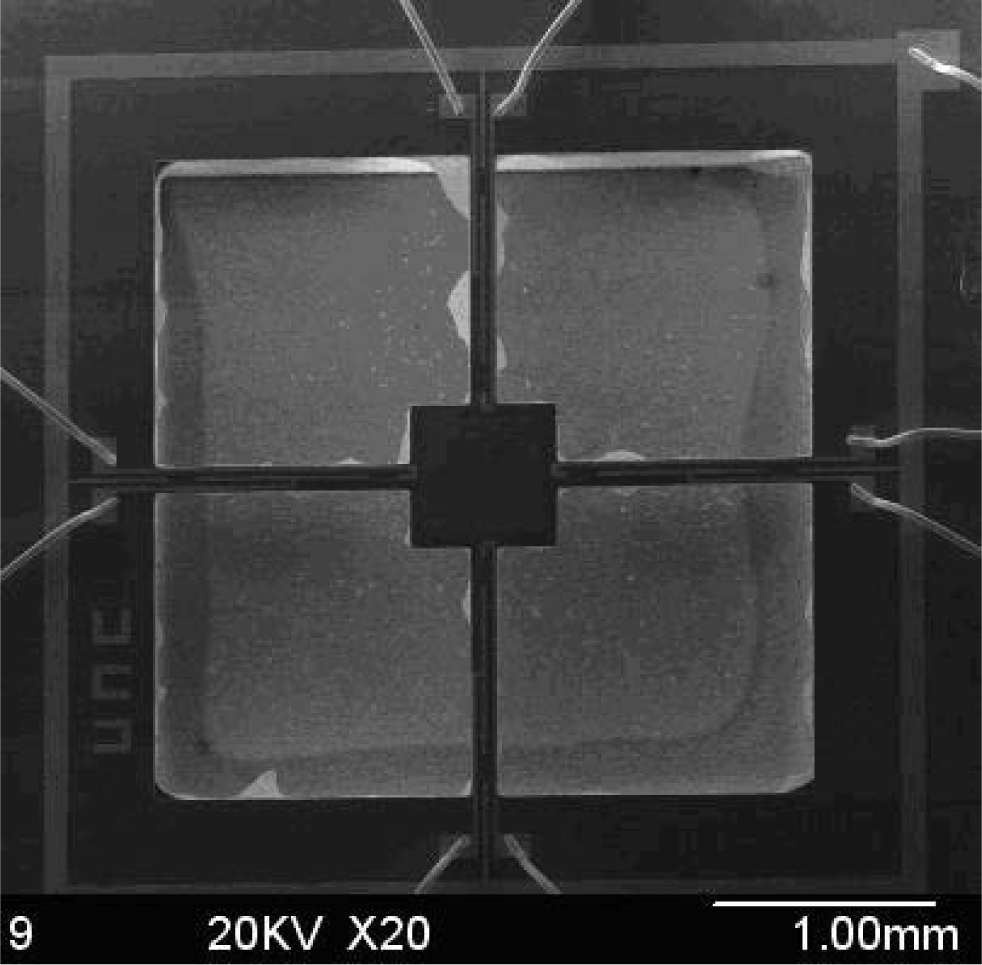
<p>In this paper, we will discuss a novel hydrophone which is developed from a typical accelerometer structure. The SEM image (top view) of the microstructure is shown in <xref ref-type="fig" rid="f1-sensors-09-06823">Figure 1</xref>.</p>
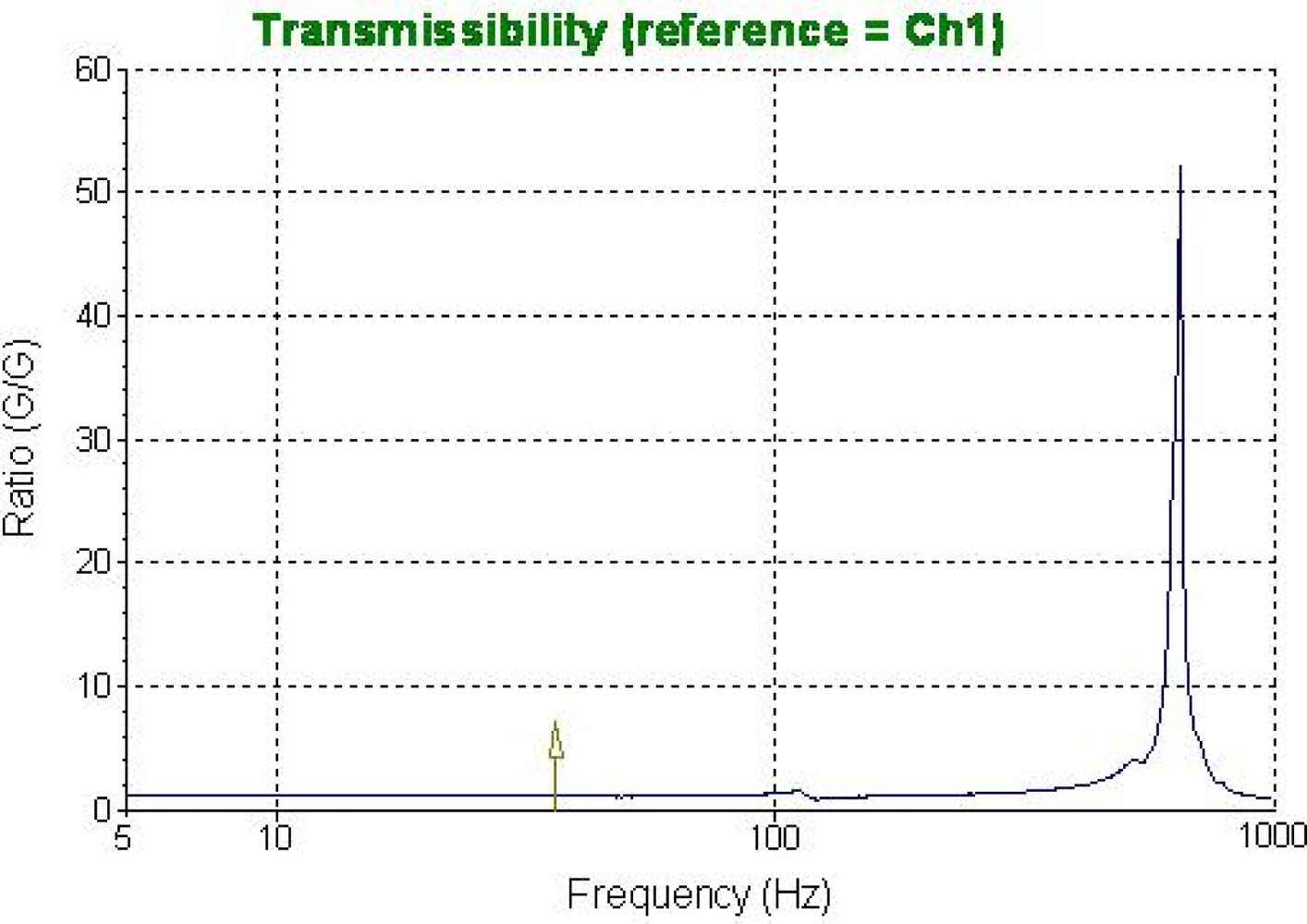
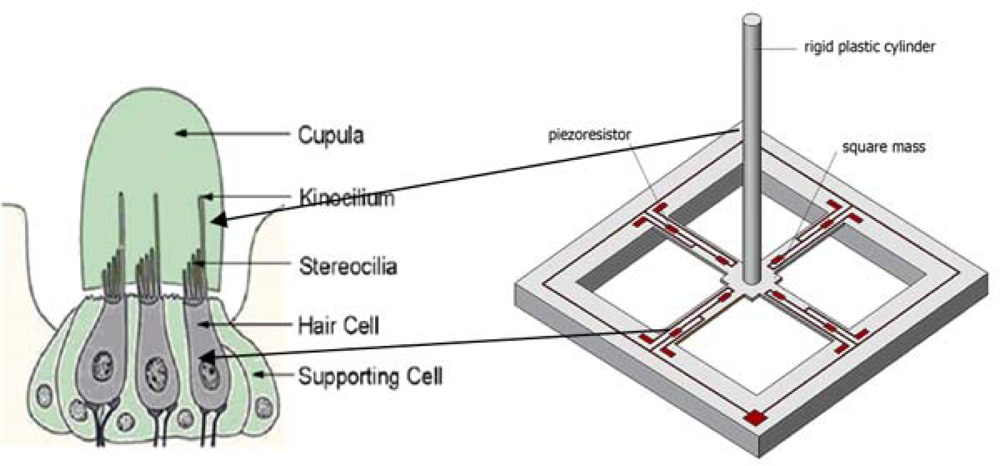
<p>As we can see in this Figure, it is a typical mass-beam accelerometer structure, which is based on the piezoresistive effect. In order to improve the sensitivity, a cylinder (diameter: 200 μm, length: 7,000 μm) was glued in the center of the mass [<xref ref-type="bibr" rid="b9-sensors-09-06823">9</xref>]. <xref ref-type="fig" rid="f2-sensors-09-06823">Figure 2</xref> shows the bionic microstructure of MEMS vector hydrophone, which consists of two parts: four high-precision cantilever beams and a rigid cylinder which is fixed at the central of the square mass. <xref ref-type="fig" rid="f3-sensors-09-06823">Figure 3</xref> shows the frequency response of this geometry from 0 Hz to 1 KHz, BK 8305 as a standard accelerometer (sensitivity is 60 mV/g), the sensitivity of this structure in the X direction is 0.7552 mv/g.</p>
<p>According to the auditory principle of a fish’s lateral line, we use a rigid cylinder as a stereocilia which can improve the sensitivity. When the sound signal is sensed by the cylinder, the piezoresistors located at the beam transform the sound signal into strain and finally into a differential output voltage signal via the Wheatstone bridge circuit. So the sound signal can be detected.</p></sec>
<sec>
<label>3.</label>
<title>The Principle of Direction</title>
<p>The sound field is the vector field, and a plane wave is a longitudinal wave, so the vector hydrophone measures the direction of sound vibration (vibration velocity v̄) and sound intensity flow Pv̄ (where P is acoustic pressure) is the direction of sound propagation, which is the goal orientation, so the measurement Pv̄ can estimate the DOA.</p>
<p>From the acoustic theory, we can see the plane wave acoustic pressure can be expressed as [<xref ref-type="bibr" rid="b10-sensors-09-06823">10</xref>–<xref ref-type="bibr" rid="b12-sensors-09-06823">12</xref>]:
<disp-formula id="FD1">
<label>(1)</label>
<mml:math display="block">
<mml:mrow>
<mml:mi>p</mml:mi>
<mml:mo stretchy="false">(</mml:mo>
<mml:mi>r</mml:mi>
<mml:mo>,</mml:mo>
<mml:mo> </mml:mo>
<mml:mi>t</mml:mi>
<mml:mo stretchy="false">)</mml:mo>
<mml:mo>=</mml:mo>
<mml:msub>
<mml:mrow>
<mml:mi>p</mml:mi></mml:mrow>
<mml:mn>0</mml:mn></mml:msub>
<mml:mo> </mml:mo>
<mml:msup>
<mml:mrow>
<mml:mi>e</mml:mi></mml:mrow>
<mml:mrow>
<mml:mi>j</mml:mi>
<mml:mo stretchy="false">(</mml:mo>
<mml:mover accent="true">
<mml:mi>k</mml:mi>
<mml:mo stretchy="true">→</mml:mo></mml:mover>
<mml:mover accent="true">
<mml:mi>r</mml:mi>
<mml:mo stretchy="true">→</mml:mo></mml:mover>
<mml:mo>−</mml:mo>
<mml:mi mathvariant="italic">wt</mml:mi>
<mml:mo stretchy="false">)</mml:mo></mml:mrow></mml:msup>
<mml:mo>=</mml:mo>
<mml:msub>
<mml:mrow>
<mml:mi>p</mml:mi></mml:mrow>
<mml:mn>0</mml:mn></mml:msub>
<mml:mo> </mml:mo>
<mml:mtext>exp</mml:mtext>
<mml:mo stretchy="false">[</mml:mo>
<mml:mi>j</mml:mi>
<mml:mo stretchy="false">(</mml:mo>
<mml:mi mathvariant="italic">kx</mml:mi>
<mml:mo> </mml:mo>
<mml:mtext>cos</mml:mtext>
<mml:mo> </mml:mo>
<mml:mi>α</mml:mi>
<mml:mo> </mml:mo>
<mml:mtext>cos</mml:mtext>
<mml:mo> </mml:mo>
<mml:mi>θ</mml:mi>
<mml:mo>+</mml:mo>
<mml:mi mathvariant="italic">ky</mml:mi>
<mml:mo> </mml:mo>
<mml:mtext>cos</mml:mtext>
<mml:mo> </mml:mo>
<mml:mi>α</mml:mi>
<mml:mo> </mml:mo>
<mml:mtext>sin</mml:mtext>
<mml:mo> </mml:mo>
<mml:mi>θ</mml:mi>
<mml:mo>+</mml:mo>
<mml:mi mathvariant="italic">kz</mml:mi>
<mml:mo> </mml:mo>
<mml:mtext>sin</mml:mtext>
<mml:mo> </mml:mo>
<mml:mi>α</mml:mi>
<mml:mo>−</mml:mo>
<mml:mi mathvariant="italic">wt</mml:mi>
<mml:mo stretchy="false">)</mml:mo>
<mml:mo stretchy="false">]</mml:mo></mml:mrow></mml:math></disp-formula></p>
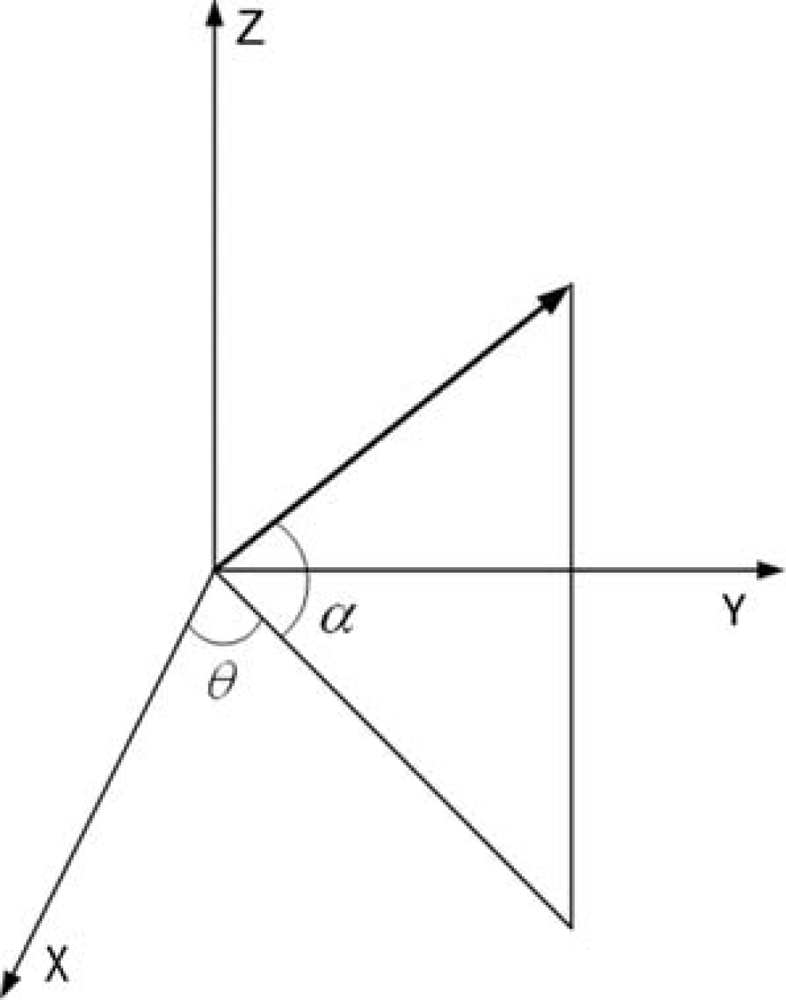
<p>Where <italic>k</italic> is a wave vector, indicating the direction of sound propagation, <italic>α</italic> is the angle between <italic>k</italic> and horizontal plane, <italic>α</italic> ∈ [−π/2, π/2], <italic>θ</italic> is the angle between the projection in the horizontal plane of <italic>k</italic> and x-axis, <italic>θ</italic> ∈ [0,2π], As shown in <xref ref-type="fig" rid="f4-sensors-09-06823">Figure 4</xref>:</p>
<fig id="f4-sensors-09-06823" position="anchor">
<label>Figure 4.</label>
<caption>
<p>Wave vector’s projection in the coordinate system.</p></caption>
<graphic xlink:href="sensors-09-06823f4.gif"/></fig>
<p>In homogeneous medium, the sound field equation of motion is:
<disp-formula id="FD2">
<label>(2)</label>
<mml:math display="block">
<mml:mrow>
<mml:mfrac>
<mml:mrow>
<mml:mo>∂</mml:mo>
<mml:mover accent="true">
<mml:mi>v</mml:mi>
<mml:mo>→</mml:mo></mml:mover></mml:mrow>
<mml:mrow>
<mml:mo>∂</mml:mo>
<mml:mi>t</mml:mi></mml:mrow></mml:mfrac>
<mml:mo>+</mml:mo>
<mml:mfrac>
<mml:mn>1</mml:mn>
<mml:mrow>
<mml:msub>
<mml:mrow>
<mml:mi>ρ</mml:mi></mml:mrow>
<mml:mn>0</mml:mn></mml:msub></mml:mrow></mml:mfrac>
<mml:mo>∇</mml:mo>
<mml:mi>p</mml:mi>
<mml:mo>=</mml:mo>
<mml:mn>0</mml:mn></mml:mrow></mml:math></disp-formula></p>
<p>Substituting this into Expression 1,we get:
<disp-formula id="FD3">
<label>(3)</label>
<mml:math display="block">
<mml:mrow>
<mml:mover accent="true">
<mml:mi>v</mml:mi>
<mml:mo>¯</mml:mo></mml:mover>
<mml:mo>=</mml:mo>
<mml:mfrac>
<mml:mrow>
<mml:msub>
<mml:mi>p</mml:mi>
<mml:mn>0</mml:mn></mml:msub></mml:mrow>
<mml:mrow>
<mml:msub>
<mml:mrow>
<mml:mi>ρ</mml:mi></mml:mrow>
<mml:mn>0</mml:mn></mml:msub>
<mml:mi>c</mml:mi></mml:mrow></mml:mfrac>
<mml:mo> </mml:mo>
<mml:mrow>
<mml:mo stretchy="false">(</mml:mo>
<mml:mrow>
<mml:mtext>cos</mml:mtext>
<mml:mi>θ</mml:mi>
<mml:mtext>cos</mml:mtext>
<mml:mi>α</mml:mi>
<mml:mover accent="true">
<mml:mi>ξ</mml:mi>
<mml:mo>→</mml:mo></mml:mover>
<mml:mo>+</mml:mo>
<mml:mtext>sin</mml:mtext>
<mml:mi>θ</mml:mi>
<mml:mtext>cos</mml:mtext>
<mml:mi>α</mml:mi>
<mml:mover accent="true">
<mml:mi>η</mml:mi>
<mml:mo>→</mml:mo></mml:mover>
<mml:mo>+</mml:mo>
<mml:mtext>sin</mml:mtext>
<mml:mi>α</mml:mi>
<mml:mover accent="true">
<mml:mi>τ</mml:mi>
<mml:mo>→</mml:mo></mml:mover></mml:mrow>
<mml:mo stretchy="false">)</mml:mo></mml:mrow></mml:mrow></mml:math></disp-formula>Where <italic>ξ, η, τ</italic> is the unit vector of x, y, z axis, <italic>ρ</italic><sub>0</sub> is the medium density, <italic>c</italic> is the velocity of sound in the medium. <xref ref-type="disp-formula" rid="FD3">Equation (3)</xref> shows that the ratio between acoustic pressure and the three components of particle velocity is just a constant, their wave is the same, so pressure and velocity of the plane wave are totally relevant.</p>
<p>From (3) we can get the three components of the particle velocity:
<disp-formula id="FD4">
<label>(4)</label>
<mml:math display="block">
<mml:mtable columnalign="left">
<mml:mtr>
<mml:mtd>
<mml:msub>
<mml:mrow>
<mml:mi>v</mml:mi></mml:mrow>
<mml:mi>x</mml:mi></mml:msub>
<mml:mo>=</mml:mo>
<mml:mfrac>
<mml:mi>p</mml:mi>
<mml:mrow>
<mml:msub>
<mml:mrow>
<mml:mi>ρ</mml:mi></mml:mrow>
<mml:mn>0</mml:mn></mml:msub>
<mml:mi>c</mml:mi></mml:mrow></mml:mfrac>
<mml:mo> </mml:mo>
<mml:mtext>cos</mml:mtext>
<mml:mo> </mml:mo>
<mml:mi>θ</mml:mi>
<mml:mtext>cos</mml:mtext>
<mml:mo> </mml:mo>
<mml:mi>α</mml:mi></mml:mtd></mml:mtr>
<mml:mtr>
<mml:mtd>
<mml:msub>
<mml:mrow>
<mml:mi>v</mml:mi></mml:mrow>
<mml:mi>y</mml:mi></mml:msub>
<mml:mo>=</mml:mo>
<mml:mfrac>
<mml:mi>p</mml:mi>
<mml:mrow>
<mml:msub>
<mml:mrow>
<mml:mi>ρ</mml:mi></mml:mrow>
<mml:mn>0</mml:mn></mml:msub>
<mml:mi>c</mml:mi></mml:mrow></mml:mfrac>
<mml:mo> </mml:mo>
<mml:mtext>sin</mml:mtext>
<mml:mo> </mml:mo>
<mml:mi>θ</mml:mi>
<mml:mo> </mml:mo>
<mml:mtext>cos</mml:mtext>
<mml:mi>α</mml:mi></mml:mtd></mml:mtr>
<mml:mtr>
<mml:mtd>
<mml:msub>
<mml:mrow>
<mml:mi>v</mml:mi></mml:mrow>
<mml:mi>z</mml:mi></mml:msub>
<mml:mo>=</mml:mo>
<mml:mfrac>
<mml:mi>p</mml:mi>
<mml:mrow>
<mml:msub>
<mml:mrow>
<mml:mi>ρ</mml:mi></mml:mrow>
<mml:mn>0</mml:mn></mml:msub>
<mml:mi>c</mml:mi></mml:mrow></mml:mfrac>
<mml:mo> </mml:mo>
<mml:mtext>sin</mml:mtext>
<mml:mo> </mml:mo>
<mml:mi>α</mml:mi></mml:mtd></mml:mtr></mml:mtable></mml:math></disp-formula>and:
<disp-formula id="FD5">
<label>(5)</label>
<mml:math display="block">
<mml:mrow>
<mml:mi>θ</mml:mi>
<mml:mo>=</mml:mo>
<mml:mtext>arctan</mml:mtext>
<mml:mrow>
<mml:mo stretchy="false">(</mml:mo>
<mml:mrow>
<mml:mfrac>
<mml:mrow>
<mml:msub>
<mml:mi>v</mml:mi>
<mml:mi>y</mml:mi></mml:msub></mml:mrow>
<mml:mrow>
<mml:msub>
<mml:mi>v</mml:mi>
<mml:mi>x</mml:mi></mml:msub></mml:mrow></mml:mfrac></mml:mrow>
<mml:mo stretchy="false">)</mml:mo></mml:mrow></mml:mrow></mml:math></disp-formula>
<disp-formula id="FD6">
<label>(6)</label>
<mml:math display="block">
<mml:mrow>
<mml:mi>α</mml:mi>
<mml:mo>=</mml:mo>
<mml:mtext>arctan</mml:mtext>
<mml:mrow>
<mml:mo stretchy="false">(</mml:mo>
<mml:mrow>
<mml:mfrac>
<mml:mrow>
<mml:msub>
<mml:mi>v</mml:mi>
<mml:mi>z</mml:mi></mml:msub></mml:mrow>
<mml:mrow>
<mml:msqrt>
<mml:mrow>
<mml:msubsup>
<mml:mi>v</mml:mi>
<mml:mi>x</mml:mi>
<mml:mn>2</mml:mn></mml:msubsup>
<mml:mo>+</mml:mo>
<mml:msubsup>
<mml:mi>v</mml:mi>
<mml:mi>y</mml:mi>
<mml:mn>2</mml:mn></mml:msubsup></mml:mrow></mml:msqrt></mml:mrow></mml:mfrac></mml:mrow>
<mml:mo stretchy="false">)</mml:mo></mml:mrow></mml:mrow></mml:math></disp-formula></p>
<p>So, as long as we measured the two components ν<sub>x</sub>, ν<sub>y</sub> of particle velocity in the horizontal plane, we can get the azimuth <italic>θ</italic> of the sound source in the horizontal plane from <xref ref-type="disp-formula" rid="FD5">Equation (5)</xref>, three velocity components can get the pitch angle <italic>α</italic> from <xref ref-type="disp-formula" rid="FD6">Equation (6)</xref>. These are the basic principles that the vector hydrophone uses to determine a sound source’s position.</p></sec>
<sec>
<label>4.</label>
<title>Two Approaches to DOA Estimation</title>
<p>According to the different types of noise background and signals, there are several approaches to estimate azimuth angle based on a single vector hydrophone [<xref ref-type="bibr" rid="b13-sensors-09-06823">13</xref>], such as the average acoustic power approach, line-spectra estimation, the bar graph approach and the beam-forming approach. However, the first two methods can’t do well in the condition of either line-spectra coherent interference lying in broad band signal or broadband coherent interference lying in line-spectra signal. In this paper, we apply the beam-forming approach and bar graph approach to the DOA estimation based on a single MEMS vector hydrophone.</p>
<sec>
<label>4.1.</label>
<title>Beamforming Approach</title>
<p>The term beam-forming refers to the various output signals whereby a vector hydrophone can determine space directivity after processing (weighted, delay, summation etc.), It can focus the receive direction of hydrophone on a direction, which is equivalent to a beam, rotating the beam to find the maximum peak, that is the target azimuth. The algorithm can be seen as a space filter that can separate the signal from interference, according to the azimuth difference between signal and interference.</p>
<p>There are many weighted modes, this paper only analyzes two of them. If only in the plane, according to (4) we can obtain the following equation:
<disp-formula id="FD7">
<label>(7)</label>
<mml:math display="block">
<mml:mtable columnalign="left">
<mml:mtr>
<mml:mtd>
<mml:msub>
<mml:mi>v</mml:mi>
<mml:mi>x</mml:mi></mml:msub>
<mml:mo>=</mml:mo>
<mml:mfrac>
<mml:mi>p</mml:mi>
<mml:mrow>
<mml:msub>
<mml:mrow>
<mml:mi>ρ</mml:mi></mml:mrow>
<mml:mn>0</mml:mn></mml:msub>
<mml:mi>c</mml:mi></mml:mrow></mml:mfrac>
<mml:mo> </mml:mo>
<mml:mtext>cos</mml:mtext>
<mml:mo> </mml:mo>
<mml:mi>θ</mml:mi></mml:mtd></mml:mtr>
<mml:mtr>
<mml:mtd>
<mml:msub>
<mml:mi>v</mml:mi>
<mml:mi>y</mml:mi></mml:msub>
<mml:mo>=</mml:mo>
<mml:mfrac>
<mml:mi>p</mml:mi>
<mml:mrow>
<mml:msub>
<mml:mrow>
<mml:mi>ρ</mml:mi></mml:mrow>
<mml:mn>0</mml:mn></mml:msub>
<mml:mi>c</mml:mi></mml:mrow></mml:mfrac>
<mml:mo> </mml:mo>
<mml:mtext>sin</mml:mtext>
<mml:mo> </mml:mo>
<mml:mi>θ</mml:mi></mml:mtd></mml:mtr></mml:mtable></mml:math></disp-formula></p>
<p>The first weighted method: <italic>v<sub>x</sub></italic>(<italic>t</italic>) cos <italic>ψ</italic> + <italic>v<sub>y</sub></italic>(<italic>t</italic>) sin <italic>ψ</italic></p>
<p>Substituting (7) into it and assuming 
<inline-formula>
<mml:math>
<mml:mrow>
<mml:mfrac>
<mml:mn>1</mml:mn>
<mml:mrow>
<mml:msub>
<mml:mrow>
<mml:mi>ρ</mml:mi></mml:mrow>
<mml:mn>0</mml:mn></mml:msub>
<mml:mi>c</mml:mi></mml:mrow></mml:mfrac>
<mml:mo>=</mml:mo>
<mml:mn>1</mml:mn></mml:mrow></mml:math></inline-formula>, we have the following equation:
<disp-formula id="FD8">
<label>(8)</label>
<mml:math display="block">
<mml:mrow>
<mml:msub>
<mml:mi>v</mml:mi>
<mml:mi>x</mml:mi></mml:msub>
<mml:mo> </mml:mo>
<mml:mo stretchy="false">(</mml:mo>
<mml:mi>t</mml:mi>
<mml:mo stretchy="false">)</mml:mo>
<mml:mo> </mml:mo>
<mml:mtext>cos</mml:mtext>
<mml:mo> </mml:mo>
<mml:mi>ψ</mml:mi>
<mml:mo>+</mml:mo>
<mml:msub>
<mml:mi>v</mml:mi>
<mml:mi>y</mml:mi></mml:msub>
<mml:mo> </mml:mo>
<mml:mo stretchy="false">(</mml:mo>
<mml:mi>t</mml:mi>
<mml:mo stretchy="false">)</mml:mo>
<mml:mo> </mml:mo>
<mml:mtext>sin</mml:mtext>
<mml:mo> </mml:mo>
<mml:mi>ψ</mml:mi>
<mml:mo>=</mml:mo>
<mml:mi>p</mml:mi>
<mml:mo>×</mml:mo>
<mml:mtext>cos</mml:mtext>
<mml:mo stretchy="false">(</mml:mo>
<mml:mi>θ</mml:mi>
<mml:mo>−</mml:mo>
<mml:mi>ψ</mml:mi>
<mml:mo stretchy="false">)</mml:mo></mml:mrow></mml:math></disp-formula></p>
<p>The second weighted method, adds the acoustic pressure <italic>p</italic>(t), so we get:
<disp-formula id="FD9">
<label>(9)</label>
<mml:math display="block">
<mml:mrow>
<mml:mi>p</mml:mi>
<mml:mo>+</mml:mo>
<mml:msub>
<mml:mi>v</mml:mi>
<mml:mi>x</mml:mi></mml:msub>
<mml:mo> </mml:mo>
<mml:mo stretchy="false">(</mml:mo>
<mml:mi>t</mml:mi>
<mml:mo stretchy="false">)</mml:mo>
<mml:mo> </mml:mo>
<mml:mtext>cos</mml:mtext>
<mml:mo> </mml:mo>
<mml:mi>ψ</mml:mi>
<mml:mo>+</mml:mo>
<mml:msub>
<mml:mi>v</mml:mi>
<mml:mi>y</mml:mi></mml:msub>
<mml:mo> </mml:mo>
<mml:mo stretchy="false">(</mml:mo>
<mml:mi>t</mml:mi>
<mml:mo stretchy="false">)</mml:mo>
<mml:mo> </mml:mo>
<mml:mtext>sin</mml:mtext>
<mml:mo> </mml:mo>
<mml:mi>ψ</mml:mi>
<mml:mo>=</mml:mo>
<mml:mi>p</mml:mi>
<mml:mo stretchy="false">(</mml:mo>
<mml:mn>1</mml:mn>
<mml:mo>+</mml:mo>
<mml:mtext>cos</mml:mtext>
<mml:mo stretchy="false">(</mml:mo>
<mml:mi>θ</mml:mi>
<mml:mo>−</mml:mo>
<mml:mi>ψ</mml:mi>
<mml:mo stretchy="false">)</mml:mo>
<mml:mo stretchy="false">)</mml:mo></mml:mrow></mml:math></disp-formula></p>
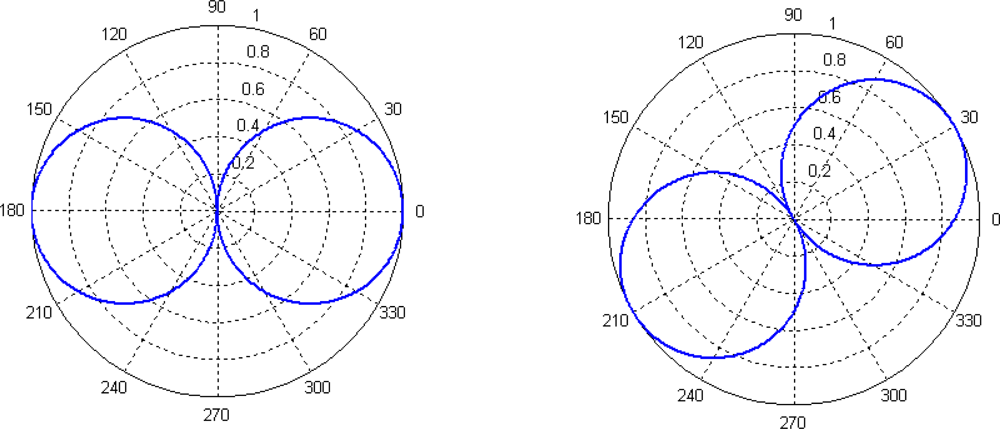
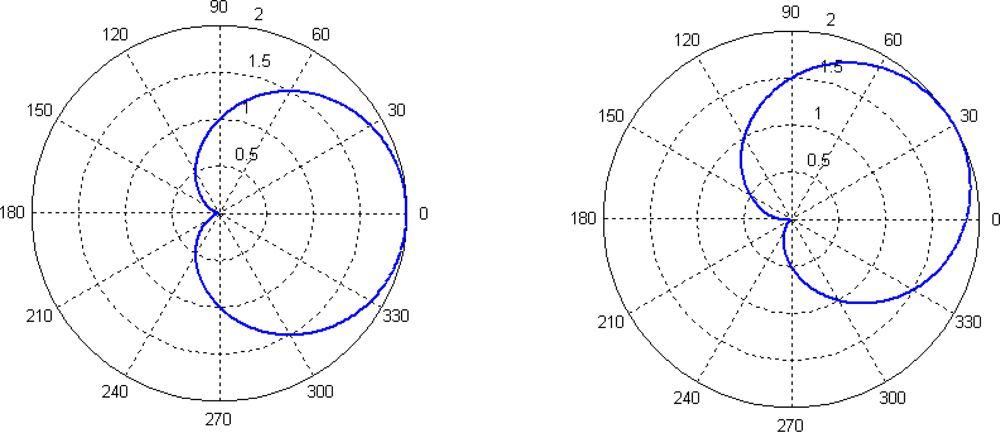
<p>The directivity patterns of two weighted functions (8) and (9) are as follows, respectively:</p>
<p>The <xref ref-type="fig" rid="f5-sensors-09-06823">Figure 5</xref> is “8”-shaped with bilateral directivity, which can induce port and starboard ambiguity, however, the <xref ref-type="fig" rid="f6-sensors-09-06823">Figure 6</xref> is heart-shaped with unilateral directivity. Therefore, we use the second weighted form to reduce the side-lobe. If we don’t add <italic>p</italic>(t), the outcome will have two peaks.</p>
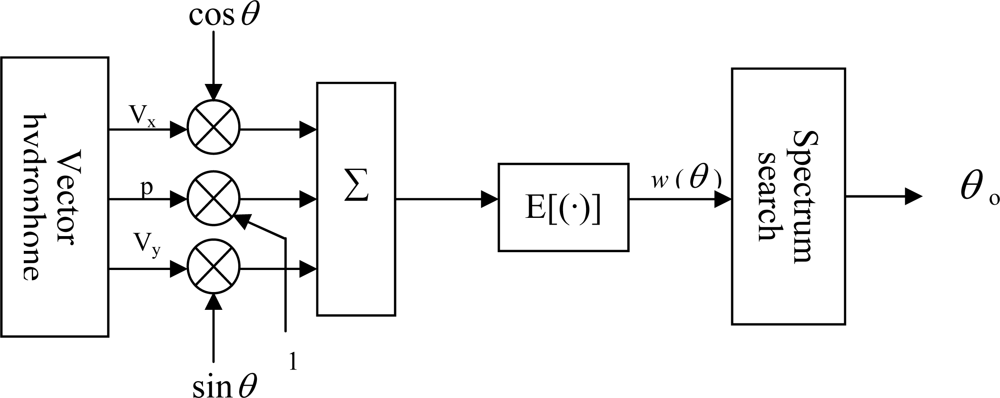
<p>The principle chart of the beam-forming approach is shown in <xref ref-type="fig" rid="f7-sensors-09-06823">Figure 7</xref>, weighting the three way signal <italic>p</italic>(t), ν<sub>x</sub>(t) and ν<sub>y</sub>(t) output of hydrophone by 1, cos<italic>θ</italic>, sin<italic>θ</italic> and summing them. The result is:
<disp-formula id="FD10">
<label>(10)</label>
<mml:math display="block">
<mml:mrow>
<mml:mi>y</mml:mi>
<mml:mo stretchy="false">(</mml:mo>
<mml:mi>t</mml:mi>
<mml:mo stretchy="false">)</mml:mo>
<mml:mo>=</mml:mo>
<mml:mi>p</mml:mi>
<mml:mo stretchy="false">(</mml:mo>
<mml:mi>t</mml:mi>
<mml:mo stretchy="false">)</mml:mo>
<mml:mo>+</mml:mo>
<mml:msub>
<mml:mi>v</mml:mi>
<mml:mi>x</mml:mi></mml:msub>
<mml:mo> </mml:mo>
<mml:mo stretchy="false">(</mml:mo>
<mml:mi>t</mml:mi>
<mml:mo stretchy="false">)</mml:mo>
<mml:mo> </mml:mo>
<mml:mtext>cos</mml:mtext>
<mml:mo> </mml:mo>
<mml:mi>θ</mml:mi>
<mml:mo>+</mml:mo>
<mml:msub>
<mml:mi>v</mml:mi>
<mml:mi>y</mml:mi></mml:msub>
<mml:mo> </mml:mo>
<mml:mo stretchy="false">(</mml:mo>
<mml:mi>t</mml:mi>
<mml:mo stretchy="false">)</mml:mo>
<mml:mo> </mml:mo>
<mml:mtext>sin</mml:mtext>
<mml:mo> </mml:mo>
<mml:mi>θ</mml:mi></mml:mrow></mml:math></disp-formula></p>
<p>The average power of <italic>y</italic> (t) is:
<disp-formula id="FD11">
<label>(11)</label>
<mml:math display="block">
<mml:mrow>
<mml:mi>w</mml:mi>
<mml:mo stretchy="false">(</mml:mo>
<mml:mi>θ</mml:mi>
<mml:mo stretchy="false">)</mml:mo>
<mml:mo>=</mml:mo>
<mml:mi>E</mml:mi>
<mml:mrow>
<mml:mo>[</mml:mo>
<mml:mrow>
<mml:mrow>
<mml:mo>|</mml:mo>
<mml:mrow>
<mml:mi>y</mml:mi>
<mml:msup>
<mml:mrow>
<mml:mrow>
<mml:mo stretchy="false">(</mml:mo>
<mml:mi>t</mml:mi>
<mml:mo stretchy="false">)</mml:mo></mml:mrow></mml:mrow>
<mml:mn>2</mml:mn></mml:msup></mml:mrow>
<mml:mo>|</mml:mo></mml:mrow></mml:mrow>
<mml:mo>]</mml:mo></mml:mrow></mml:mrow></mml:math></disp-formula>where, <italic>E</italic>[ ] – ensemble average; <italic>w</italic>(<italic>θ</italic>) – space spectrum of the output, is a function of <italic>θ</italic>, reflecting the space distribution of energy. Search the max of <italic>w</italic>(<italic>θ</italic>) in <italic>θ</italic> ∈ [0,2π], <italic>w</italic>(<italic>θ</italic>) can acquire the max, only when <italic>θ</italic> = <italic>θ</italic><sub>0</sub>, so <italic>θ</italic><sub>0</sub> is the azimuth angle of the sound signal. Virtually, this is a process of beam-forming [<xref ref-type="bibr" rid="b14-sensors-09-06823">14</xref>].</p></sec>
<sec>
<label>4.2.</label>
<title>Bar Graph Approach</title>
<p>From <xref ref-type="disp-formula" rid="FD5">Equation (5)</xref> we know that, by simply calculating the three velocity components measured by a vector hydrophone, we can identify the azimuth angle <italic>θ</italic> and pitch angle <italic>α</italic> of a sound source. By determining the positive and negative of ν<sub>x</sub> and ν<sub>y</sub>, a single vector hydrophone can estimate the direction of the sound source. Although this method is simple, the error would be great, this is mainly because the three velocity components ν<sub>x</sub>, ν<sub>y</sub>and ν<sub>z,</sub> measured by the vector hydrophone not only contain a valid signal, but also noise. Noise has a great impact on the estimated results, and this impact is more serious with lower SNR (signal-to-noise ratio).</p>
<p>We assume the signals received from vector hydrophone are as follows:
<disp-formula id="FD12">
<label>(12)</label>
<mml:math display="block">
<mml:mrow>
<mml:mi>p</mml:mi>
<mml:mo stretchy="false">(</mml:mo>
<mml:mi>t</mml:mi>
<mml:mo stretchy="false">)</mml:mo>
<mml:mo>=</mml:mo>
<mml:msub>
<mml:mi>p</mml:mi>
<mml:mi>s</mml:mi></mml:msub>
<mml:mo> </mml:mo>
<mml:mo stretchy="false">(</mml:mo>
<mml:mi>t</mml:mi>
<mml:mo stretchy="false">)</mml:mo>
<mml:mo>+</mml:mo>
<mml:msub>
<mml:mi>p</mml:mi>
<mml:mi>n</mml:mi></mml:msub>
<mml:mo> </mml:mo>
<mml:mo stretchy="false">(</mml:mo>
<mml:mi>t</mml:mi>
<mml:mo stretchy="false">)</mml:mo></mml:mrow></mml:math></disp-formula>
<disp-formula id="FD13">
<label>(13)</label>
<mml:math display="block">
<mml:mrow>
<mml:mi>v</mml:mi>
<mml:mo stretchy="false">(</mml:mo>
<mml:mi>t</mml:mi>
<mml:mo stretchy="false">)</mml:mo>
<mml:mo>=</mml:mo>
<mml:msub>
<mml:mi>v</mml:mi>
<mml:mi>s</mml:mi></mml:msub>
<mml:mo> </mml:mo>
<mml:mo stretchy="false">(</mml:mo>
<mml:mi>t</mml:mi>
<mml:mo stretchy="false">)</mml:mo>
<mml:mo>+</mml:mo>
<mml:msub>
<mml:mi>v</mml:mi>
<mml:mi>n</mml:mi></mml:msub>
<mml:mo> </mml:mo>
<mml:mo stretchy="false">(</mml:mo>
<mml:mi>t</mml:mi>
<mml:mo stretchy="false">)</mml:mo></mml:mrow></mml:math></disp-formula></p>
<p>In the equation,
<list list-type="simple">
<list-item>
<p><italic>p<sub>s</sub></italic>(<italic>t</italic>)- acoustic pressure generate by target sound source;</p></list-item>
<list-item>
<p>ν<sub>s</sub>(<italic>t</italic>)- particle velocity generate by target sound source;</p></list-item>
<list-item>
<p><italic>p<sub>n</sub></italic>(<italic>t</italic>)- acoustic pressure of isotropic noise field;</p></list-item>
<list-item>
<p>ν<italic><sub>n</sub></italic>(<italic>t</italic>)- particle velocity of isotropic noise field.</p></list-item></list></p>
<p>Target signal and interference noise is independent of each other, and they are ergodic. Calculating average sound intensity by above formula, we get:
<disp-formula id="FD14">
<label>(14)</label>
<mml:math display="block">
<mml:mrow>
<mml:mover accent="true">
<mml:mrow>
<mml:mi>I</mml:mi>
<mml:mo stretchy="false">(</mml:mo>
<mml:mi>t</mml:mi>
<mml:mo stretchy="false">)</mml:mo></mml:mrow>
<mml:mo>¯</mml:mo></mml:mover>
<mml:mo>=</mml:mo>
<mml:mover accent="true">
<mml:mrow>
<mml:mi>p</mml:mi>
<mml:mo stretchy="false">(</mml:mo>
<mml:mi>t</mml:mi>
<mml:mo stretchy="false">)</mml:mo>
<mml:mo>⋅</mml:mo>
<mml:mi>v</mml:mi>
<mml:mo stretchy="false">(</mml:mo>
<mml:mi>t</mml:mi>
<mml:mo stretchy="false">)</mml:mo></mml:mrow>
<mml:mo>¯</mml:mo></mml:mover>
<mml:mo>=</mml:mo>
<mml:mover accent="true">
<mml:mrow>
<mml:mo stretchy="false">(</mml:mo>
<mml:msub>
<mml:mi>p</mml:mi>
<mml:mi>s</mml:mi></mml:msub>
<mml:mo> </mml:mo>
<mml:mo stretchy="false">(</mml:mo>
<mml:mi>t</mml:mi>
<mml:mo stretchy="false">)</mml:mo>
<mml:mo>+</mml:mo>
<mml:msub>
<mml:mi>p</mml:mi>
<mml:mi>n</mml:mi></mml:msub>
<mml:mo> </mml:mo>
<mml:mo stretchy="false">(</mml:mo>
<mml:mi>t</mml:mi>
<mml:mo stretchy="false">)</mml:mo>
<mml:mo>⋅</mml:mo>
<mml:mo stretchy="false">(</mml:mo>
<mml:msub>
<mml:mi>v</mml:mi>
<mml:mi>s</mml:mi></mml:msub>
<mml:mo> </mml:mo>
<mml:mo stretchy="false">(</mml:mo>
<mml:mi>t</mml:mi>
<mml:mo stretchy="false">)</mml:mo>
<mml:mo>+</mml:mo>
<mml:msub>
<mml:mi>v</mml:mi>
<mml:mi>n</mml:mi></mml:msub>
<mml:mo> </mml:mo>
<mml:mo stretchy="false">(</mml:mo>
<mml:mi>t</mml:mi>
<mml:mo stretchy="false">)</mml:mo>
<mml:mo stretchy="false">)</mml:mo></mml:mrow>
<mml:mo>¯</mml:mo></mml:mover>
<mml:mo>≈</mml:mo>
<mml:mover accent="true">
<mml:mrow>
<mml:msub>
<mml:mi>p</mml:mi>
<mml:mi>s</mml:mi></mml:msub>
<mml:mo> </mml:mo>
<mml:mo stretchy="false">(</mml:mo>
<mml:mi>t</mml:mi>
<mml:mo stretchy="false">)</mml:mo>
<mml:msub>
<mml:mi>v</mml:mi>
<mml:mi>s</mml:mi></mml:msub>
<mml:mo> </mml:mo>
<mml:mo stretchy="false">(</mml:mo>
<mml:mi>t</mml:mi>
<mml:mo stretchy="false">)</mml:mo></mml:mrow>
<mml:mo>¯</mml:mo></mml:mover></mml:mrow></mml:math></disp-formula></p>
<p>For <italic>p<sub>n</sub></italic>(<italic>t</italic>), ν<italic><sub>n</sub></italic>(<italic>t</italic>) and <italic>p<sub>s</sub></italic>(<italic>t</italic>) are independent of each other, the value of the average cross-multiplied is small, which can be neglected.
<disp-formula id="FD15">
<label>(15)</label>
<mml:math display="block">
<mml:mrow>
<mml:mi>θ</mml:mi>
<mml:mo>=</mml:mo>
<mml:mtext>arctan</mml:mtext>
<mml:mrow>
<mml:mo>[</mml:mo>
<mml:mrow>
<mml:mfrac>
<mml:mrow>
<mml:mover accent="true">
<mml:mrow>
<mml:msub>
<mml:mi>I</mml:mi>
<mml:mi>y</mml:mi></mml:msub>
<mml:mo> </mml:mo>
<mml:mo stretchy="false">(</mml:mo>
<mml:mi>t</mml:mi>
<mml:mo stretchy="false">)</mml:mo></mml:mrow>
<mml:mo>¯</mml:mo></mml:mover></mml:mrow>
<mml:mrow>
<mml:mover accent="true">
<mml:mrow>
<mml:msub>
<mml:mi>I</mml:mi>
<mml:mi>x</mml:mi></mml:msub>
<mml:mo> </mml:mo>
<mml:mo stretchy="false">(</mml:mo>
<mml:mi>t</mml:mi>
<mml:mo stretchy="false">)</mml:mo></mml:mrow>
<mml:mo>¯</mml:mo></mml:mover></mml:mrow></mml:mfrac></mml:mrow>
<mml:mo>]</mml:mo></mml:mrow></mml:mrow></mml:math></disp-formula></p>
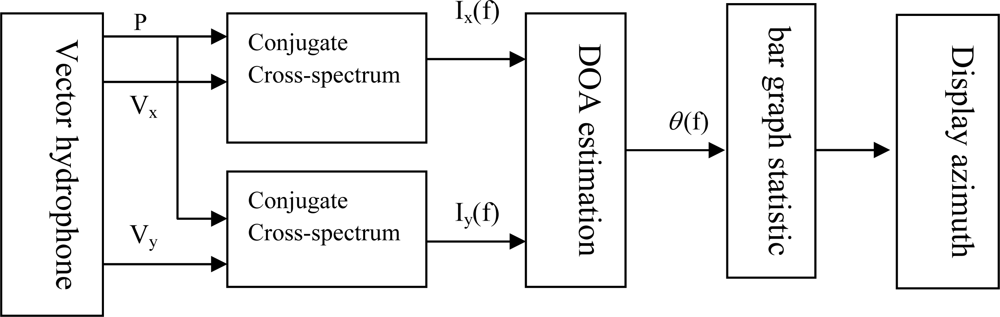
<p>Bar graph estimation is a statistical approach based on cross-spectrum estimation. First we calculate the angle corresponding to each frequency, and then count the probability density of each estimated value, to get the estimated curve of a certain moment, the curve maximum position corresponds to the estimated value of which is the target position. <xref ref-type="fig" rid="f8-sensors-09-06823">Figure 8</xref> shows its principle chart [<xref ref-type="bibr" rid="b13-sensors-09-06823">13</xref>], acoustic pressure and particle velocity are calculated by the conjugate and cross-spectrum. If <italic>P</italic>(<italic>f</italic>), <italic>V<sub>x</sub></italic>(<italic>f</italic>) and <italic>V<sub>y</sub></italic>(<italic>f</italic>) correspond to the FFT of the acoustic pressure and particle velocity signal <italic>p</italic>(t), ν<sub>x</sub>(t) and ν<sub>y</sub>(t), we can get the expression of calculated azimuth:
<disp-formula id="FD16">
<label>(16)</label>
<mml:math display="block">
<mml:mrow>
<mml:mi>θ</mml:mi>
<mml:mo>=</mml:mo>
<mml:mtext>arctan</mml:mtext>
<mml:mrow>
<mml:mo>[</mml:mo>
<mml:mrow>
<mml:mfrac>
<mml:mrow>
<mml:mover accent="true">
<mml:mrow>
<mml:msub>
<mml:mi>I</mml:mi>
<mml:mi>y</mml:mi></mml:msub>
<mml:mo> </mml:mo>
<mml:mo stretchy="false">(</mml:mo>
<mml:mi>t</mml:mi>
<mml:mo stretchy="false">)</mml:mo></mml:mrow>
<mml:mo>¯</mml:mo></mml:mover></mml:mrow>
<mml:mrow>
<mml:mover accent="true">
<mml:mrow>
<mml:msub>
<mml:mi>I</mml:mi>
<mml:mi>x</mml:mi></mml:msub>
<mml:mo> </mml:mo>
<mml:mo stretchy="false">(</mml:mo>
<mml:mi>t</mml:mi>
<mml:mo stretchy="false">)</mml:mo></mml:mrow>
<mml:mo>¯</mml:mo></mml:mover></mml:mrow></mml:mfrac></mml:mrow>
<mml:mo>]</mml:mo></mml:mrow>
<mml:mo>=</mml:mo>
<mml:mtext>arctan</mml:mtext>
<mml:mrow>
<mml:mo>(</mml:mo>
<mml:mrow>
<mml:mfrac>
<mml:mrow>
<mml:mi>R</mml:mi>
<mml:mrow>
<mml:mo stretchy="false">[</mml:mo>
<mml:mrow>
<mml:mi>P</mml:mi>
<mml:mo>*</mml:mo>
<mml:mo stretchy="false">(</mml:mo>
<mml:mi>f</mml:mi>
<mml:mo stretchy="false">)</mml:mo>
<mml:msub>
<mml:mi>V</mml:mi>
<mml:mi>y</mml:mi></mml:msub>
<mml:mo> </mml:mo>
<mml:mo stretchy="false">(</mml:mo>
<mml:mi>f</mml:mi>
<mml:mo stretchy="false">)</mml:mo></mml:mrow>
<mml:mo stretchy="false">]</mml:mo></mml:mrow></mml:mrow>
<mml:mrow>
<mml:mi>R</mml:mi>
<mml:mrow>
<mml:mo stretchy="false">[</mml:mo>
<mml:mrow>
<mml:mi>P</mml:mi>
<mml:mo>*</mml:mo>
<mml:mo stretchy="false">(</mml:mo>
<mml:mi>f</mml:mi>
<mml:mo stretchy="false">)</mml:mo>
<mml:msub>
<mml:mi>V</mml:mi>
<mml:mi>x</mml:mi></mml:msub>
<mml:mo> </mml:mo>
<mml:mo stretchy="false">(</mml:mo>
<mml:mi>f</mml:mi>
<mml:mo stretchy="false">)</mml:mo></mml:mrow>
<mml:mo stretchy="false">]</mml:mo></mml:mrow></mml:mrow></mml:mfrac></mml:mrow>
<mml:mo>)</mml:mo></mml:mrow></mml:mrow></mml:math></disp-formula>where, <italic>R</italic>[ ] – get real component; “*” – conjugate.</p>
<p>Bar graph statistics mainly estimates the azimuth of every frequency, if 1° is the statistical unit, we get:
<disp-formula id="FD17">
<label>(17)</label>
<mml:math display="block">
<mml:mrow>
<mml:mi>k</mml:mi>
<mml:mo>=</mml:mo>
<mml:mo stretchy="false">[</mml:mo>
<mml:mi>θ</mml:mi>
<mml:mo stretchy="false">(</mml:mo>
<mml:mi>f</mml:mi>
<mml:mo stretchy="false">)</mml:mo>
<mml:mo>×</mml:mo>
<mml:mn>180</mml:mn>
<mml:mo>/</mml:mo>
<mml:mi>π</mml:mi>
<mml:mo stretchy="false">]</mml:mo></mml:mrow></mml:math></disp-formula>
<disp-formula id="FD18">
<label>(18)</label>
<mml:math display="block">
<mml:mrow>
<mml:mi>φ</mml:mi>
<mml:mo stretchy="false">(</mml:mo>
<mml:mi>k</mml:mi>
<mml:mo stretchy="false">)</mml:mo>
<mml:mo>=</mml:mo>
<mml:mi>φ</mml:mi>
<mml:mo stretchy="false">(</mml:mo>
<mml:mi>k</mml:mi>
<mml:mo stretchy="false">)</mml:mo>
<mml:mo>+</mml:mo>
<mml:mn>1</mml:mn></mml:mrow></mml:math></disp-formula></p>
<p>In <xref ref-type="disp-formula" rid="FD17">Formula (17)</xref>, [ ] – get integer. <italic>θ</italic>(<italic>f</italic>) is the azimuth value of certain frequence, transforming <italic>θ</italic>(<italic>f</italic>) to angle <italic>k</italic>. <italic>φ</italic> is an array, which stores the frequence of every angle in [−180°,180°], initialization of the array is zero, when we get a value of k, the frequence <italic>φ</italic>(<italic>k</italic>) of corresponding to <italic>k</italic> add one in array. The statistical result is the azimuth estimated value.</p></sec></sec>
<sec sec-type="results">
<label>5.</label>
<title>Test and Results</title>
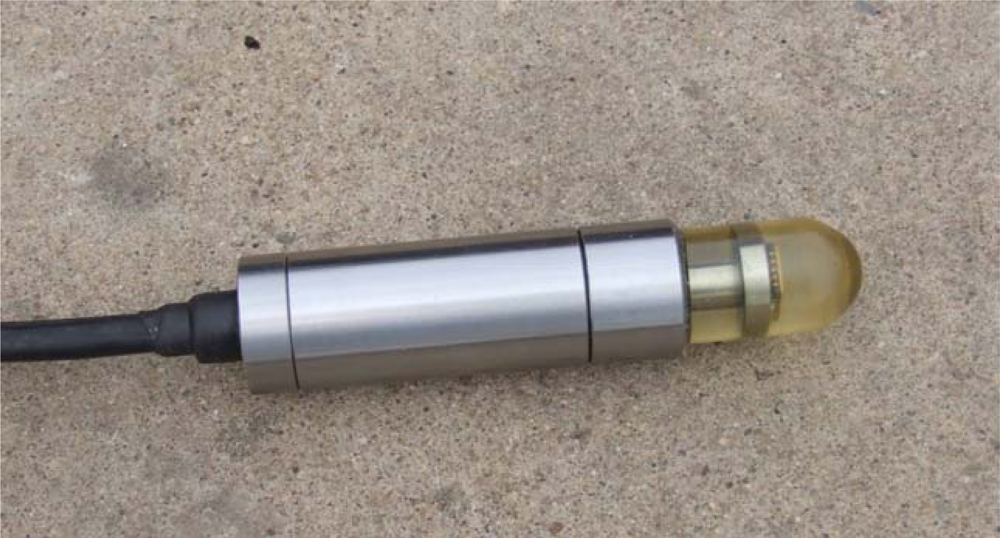
<p>The DOA estimation experiment has been completed by means of the a test vector hydrophone instrument in the laboratory, <xref ref-type="fig" rid="f9-sensors-09-06823">Figure 9</xref> shows the photo of MEMS vector hydrophone being tested. Its receiving sensitivity is up to −160 dB(0dB = 1 V/μpa). <xref ref-type="fig" rid="f10-sensors-09-06823">Figure 10</xref> shows the principle chart of the test instrument, the instrument can emit standing wave in a circular tube. The sound source is located in the tube’s bottom, so a uniform and stable sound field is built in the tube. We can change the angle of wave incidence by adjusting hydrophone’s position. The computer collects the sound information transformed by hydrophone, and processes the data, and as a result, the direction of the sound signal can be estimated.</p></sec>
<sec>
<label>5.1.</label>
<title>Directed to the Single-frequency Signal</title>
<p>Using a signal generator to generate a single-frequency sine wave S<sub>1</sub>(t), DOA is 45°. The Data Acquisition Card collects a three-way signal at the same time P, V<sub>x</sub>, V<sub>y</sub>, data sampling rate is set to 10 KHz. The two methods are applied to DOA estimates. The results in <xref ref-type="fig" rid="f11-sensors-09-06823">Figure 11</xref> show Method 1 for the beam-forming approach, Method 2 for the bar graph approach.</p>
<sec>
<label>5.2.</label>
<title>Directed to the Noise Signal</title>
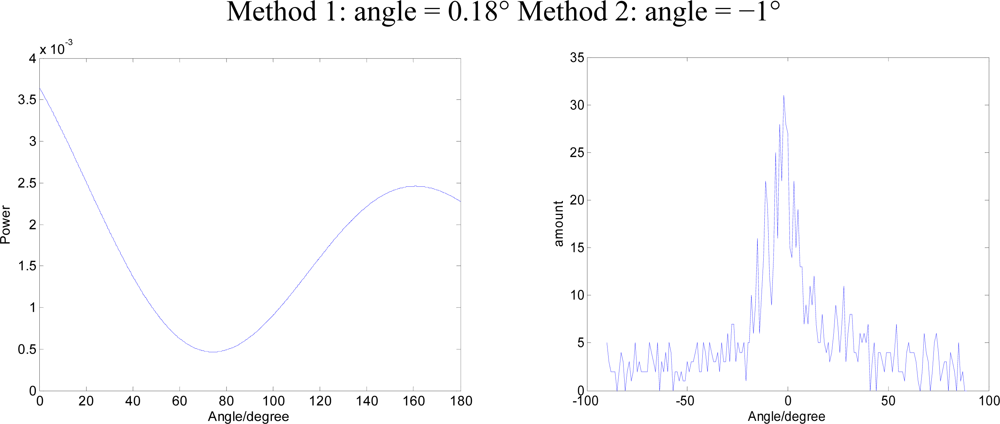
<p>As sound source a broadband signal (white noise) S<sub>2</sub>(t) is used, DOA is 0°. The results of the two methods are shown in <xref ref-type="fig" rid="f12-sensors-09-06823">Figure 12</xref>:</p>
<fig id="f12-sensors-09-06823" position="anchor">
<label>Figure 12.</label>
<caption>
<p>The results of the two methods (DOA=0°)</p></caption>
<graphic xlink:href="sensors-09-06823f12.gif"/></fig></sec>
<sec>
<label>5.3.</label>
<title>Directed to the Line-Spectrum Signal in the Context of Noise</title>
<p>As sound source we enter a single-frequency signal with attached white noise S<sub>1</sub>(t) + S<sub>2</sub>(t), DOA is 90°. The results of the two methods are shown in <xref ref-type="fig" rid="f13-sensors-09-06823">Figure 13</xref>:</p>
<fig id="f13-sensors-09-06823" position="anchor">
<label>Figure 13.</label>
<caption>
<p>The results of the two methods (DOA = 90°).</p></caption>
<graphic xlink:href="sensors-09-06823f13.gif"/></fig></sec></sec>
<sec sec-type="conclusions">
<label>6.</label>
<title>Conclusions</title>
<p>In this paper, by testing and analyzing the directional functions of a MEMS vector hydrophone in an ideal room environment, we obtained better results. From the test results, the MEMS hydrophone can not only direct but also have high orientation accuracy. For a continuous wave, two methods are feasible, but because of the requirements of frequency resolution, the bar graph approach is not suitable for pulse waves. There are two main reasons of error: first, because of the inaccuracy of the measured angle and the other is the rounding error of the bar graph. It remains to be determined whether the MEMS vector hydrophone can achieve good goal orientation or not in the actual marine environment.</p></sec></body>
<back>
<ack>
<p>This work has been financially supported by the National Natural Science Foundation of China (Grant No. 50405025, 50535030, 50775209).</p></ack>
<ref-list>
<title>References</title>
<ref id="b1-sensors-09-06823"><label>1.</label><citation citation-type="journal"><person-group person-group-type="author"><name><surname>Leslie</surname><given-names>C.B.</given-names></name><name><surname>Kendall</surname><given-names>J.M.</given-names></name><name><surname>Jones</surname><given-names>J.L.</given-names></name></person-group><article-title>Hydrophone for measuring particle velocity</article-title><source>J. Acoust. Soc. Am</source><year>1956</year><volume>28</volume><fpage>711</fpage><lpage>715</lpage><pub-id pub-id-type="doi">10.1121/1.1908455</pub-id></citation></ref>
<ref id="b2-sensors-09-06823"><label>2.</label><citation citation-type="journal"><person-group person-group-type="author"><name><surname>Bauer</surname><given-names>B.</given-names></name><name><surname>DiMattia</surname><given-names>A.</given-names></name></person-group><article-title>Moving-coil pressure-gradient hydrophone</article-title><source>J. Acoust. Soc. Am</source><year>1966</year><volume>39</volume><fpage>1264</fpage></citation></ref>
<ref id="b3-sensors-09-06823"><label>3.</label><citation citation-type="journal"><person-group person-group-type="author"><name><surname>McConnel</surname><given-names>J.A.</given-names></name></person-group><article-title>Analysis of a compliantly suspended acoustic velocity sensor</article-title><source>J. Acoust. Soc. Am</source><year>2003</year><volume>113</volume><fpage>1395</fpage><lpage>1405</lpage><pub-id pub-id-type="doi">10.1121/1.1542646</pub-id><pub-id pub-id-type="pmid">12656374</pub-id></citation></ref>
<ref id="b4-sensors-09-06823"><label>4.</label><citation citation-type="journal"><person-group person-group-type="author"><name><surname>Meng</surname><given-names>C.X.</given-names></name><name><surname>Li</surname><given-names>X.K.</given-names></name><name><surname>Yang</surname><given-names>S.</given-names></name></person-group><article-title>Direction estimation of multi-sources using a single vector transducer with genetic algorithm</article-title><source>Tech. Acoustics</source><year>2007</year><volume>26</volume><fpage>169</fpage><lpage>172</lpage></citation></ref>
<ref id="b5-sensors-09-06823"><label>5.</label><citation citation-type="journal"><person-group person-group-type="author"><name><surname>Gerald</surname><given-names>L.D.</given-names></name><name><surname>Hodgkiss</surname><given-names>A.W.S.</given-names></name></person-group><article-title>The Simultaneous measurement of infrasonic acoustic particle velocity and acoustic pressure in the ocean by freely drifting swallow floats</article-title><source>IEEE. J. Ocean Engineer</source><year>1991</year><volume>16</volume><fpage>195</fpage><lpage>199</lpage><pub-id pub-id-type="doi">10.1109/48.84136</pub-id></citation></ref>
<ref id="b6-sensors-09-06823"><label>6.</label><citation citation-type="journal"><person-group person-group-type="author"><name><surname>Abraham</surname><given-names>B.M.</given-names></name></person-group><article-title>Low-cost dipole hydrophone for use in towed arrays acoustic particle velocity sensors</article-title><source>Des. Perform. Appl</source><year>1995</year><pub-id pub-id-type="doi">10.1063/1.50338</pub-id><fpage>189</fpage><lpage>192</lpage></citation></ref>
<ref id="b7-sensors-09-06823"><label>7.</label><citation citation-type="journal"><person-group person-group-type="author"><name><surname>Gabrielson</surname><given-names>T.B.</given-names></name><name><surname>Gardner</surname><given-names>D.L.</given-names></name></person-group><article-title>A simple neutrally buoyant sensor for direct measurement of particle velocity and intensity in water</article-title><source>J. Acoust. Soc. Am</source><year>1995</year><volume>97</volume><fpage>2227</fpage><lpage>2237</lpage><pub-id pub-id-type="doi">10.1121/1.411948</pub-id></citation></ref>
<ref id="b8-sensors-09-06823"><label>8.</label><citation citation-type="journal"><person-group person-group-type="author"><name><surname>Nehorai</surname><given-names>A.</given-names></name><name><surname>Paldi</surname><given-names>E.</given-names></name></person-group><article-title>Vector-sensor array processing for electromagnetic source localization</article-title><source>IEEE Trans. Signal Process</source><year>1994</year><volume>42</volume><fpage>376</fpage><lpage>398</lpage><pub-id pub-id-type="doi">10.1109/78.275610</pub-id></citation></ref>
<ref id="b9-sensors-09-06823"><label>9.</label><citation citation-type="journal"><person-group person-group-type="author"><name><surname>Xue</surname><given-names>C.Y.</given-names></name><name><surname>Chen</surname><given-names>S.</given-names></name><name><surname>Zhang</surname><given-names>W.D.</given-names></name></person-group><article-title>Design, fabrication, and preliminary characterization of a novel MEMS bionic vector hydrophone</article-title><source>Microelectr. J</source><year>2007</year><volume>38</volume><fpage>1021</fpage><lpage>1026</lpage><pub-id pub-id-type="doi">10.1016/j.mejo.2007.09.008</pub-id></citation></ref>
<ref id="b10-sensors-09-06823"><label>10.</label><citation citation-type="book"><person-group person-group-type="author"><name><surname>Morse</surname><given-names>P.M.</given-names></name><name><surname>Ingard</surname><given-names>K.U.</given-names></name></person-group><source>Theoretical Acoustics</source><publisher-name>McGraw-Hill</publisher-name><publisher-loc>New York, NY, USA</publisher-loc><year>1968</year></citation></ref>
<ref id="b11-sensors-09-06823"><label>11.</label><citation citation-type="book"><person-group person-group-type="author"><name><surname>Pierce</surname><given-names>A.D.</given-names></name></person-group><source>Acoustics—An Introduction to Its Physical Principles and Applications</source><publisher-name>McGraw-Hill</publisher-name><publisher-loc>New York, NY, USA</publisher-loc><year>1981</year></citation></ref>
<ref id="b12-sensors-09-06823"><label>12.</label><citation citation-type="journal"><person-group person-group-type="author"><name><surname>Nehorai</surname><given-names>A.</given-names></name><name><surname>Paldi</surname><given-names>E.</given-names></name></person-group><article-title>acoustic vector-sensor array processing</article-title><source>IEEE Trans. Signal Process</source><year>1994</year><volume>42</volume><fpage>2481</fpage><lpage>2491</lpage><pub-id pub-id-type="doi">10.1109/78.317869</pub-id></citation></ref>
<ref id="b13-sensors-09-06823"><label>13.</label><citation citation-type="journal"><person-group person-group-type="author"><name><surname>Yao</surname><given-names>Z.X.</given-names></name><name><surname>Hui</surname><given-names>J.Y.</given-names></name></person-group><article-title>Four approaches to DOA estimation based on a single vector hydrophone</article-title><source>Ocean Eng</source><year>2006</year><volume>24</volume><fpage>122</fpage><lpage>127</lpage></citation></ref>
<ref id="b14-sensors-09-06823"><label>14.</label><citation citation-type="journal"><person-group person-group-type="author"><name><surname>Jiang</surname><given-names>N.</given-names></name><name><surname>Huang</surname><given-names>J.G.</given-names></name><name><surname>Li</surname><given-names>S.</given-names></name></person-group><article-title>DOA estimation algorithm based on single acoustic vector sensor</article-title><source>Chin. J. Sci. Instrum</source><year>2004</year><volume>4</volume><fpage>87</fpage><lpage>90</lpage></citation></ref>
<ref id="b15-sensors-09-06823"><label>15.</label><citation citation-type="journal"><person-group person-group-type="author"><name><surname>Skarsoulis</surname><given-names>E.K.</given-names></name><name><surname>Kalogerakis</surname><given-names>M.A.</given-names></name></person-group><article-title>Two-hydrophone localization of a click source in the presence of refraction</article-title><source>Appl. Acoust</source><year>2006</year><volume>67</volume><fpage>1202</fpage><lpage>1212</lpage><pub-id pub-id-type="doi">10.1016/j.apacoust.2006.05.009</pub-id></citation></ref>
<ref id="b16-sensors-09-06823"><label>16.</label><citation citation-type="journal"><person-group person-group-type="author"><name><surname>Zhang</surname><given-names>W.D.</given-names></name><name><surname>Xue</surname><given-names>C.Y.</given-names></name></person-group><article-title>Piezoresistive effects of resonant tunneling structure for application in micro-sensors</article-title><source>Indian J. Pure Appl. Phys</source><year>2007</year><volume>45</volume><fpage>294</fpage><lpage>298</lpage></citation></ref>
<ref id="b17-sensors-09-06823"><label>17.</label><citation citation-type="journal"><person-group person-group-type="author"><name><surname>Zhang</surname><given-names>B.Z.</given-names></name><name><surname>Wang</surname><given-names>J.</given-names></name></person-group><article-title>A GaAs acoustic sensor with frequency output based on resonant tunneling diodes</article-title><source>Sens. Actuat. A</source><year>2006</year><volume>139</volume><fpage>42</fpage><lpage>46</lpage></citation></ref>
<ref id="b18-sensors-09-06823"><label>18.</label><citation citation-type="journal"><person-group person-group-type="author"><name><surname>Edmond</surname><given-names>Y.L.</given-names></name><name><surname>Migcijl</surname><given-names>C.J.</given-names></name></person-group><article-title>Signal-to-noise enhancement by underwater intensity measurements</article-title><source>J. Acoust. Soc. Amer</source><year>1987</year><volume>82</volume><fpage>1450</fpage><lpage>1454</lpage><pub-id pub-id-type="doi">10.1121/1.395229</pub-id></citation></ref>
<ref id="b19-sensors-09-06823"><label>19.</label><citation citation-type="journal"><person-group person-group-type="author"><name><surname>Zhang</surname><given-names>B.Z.</given-names></name><name><surname>Qiao</surname><given-names>Hui</given-names></name><name><surname>Xiong</surname><given-names>J.J.</given-names></name></person-group><article-title>Modeling and characterization of a micromachined artificial hair cell vector hydrophone</article-title><source>Microsyst. Technol</source><year>2008</year><volume>14</volume><fpage>821</fpage><lpage>828</lpage><pub-id pub-id-type="doi">10.1007/s00542-008-0560-0</pub-id></citation></ref>
<ref id="b20-sensors-09-06823"><label>20.</label><citation citation-type="confproc"><person-group person-group-type="author"><name><surname>Hawkes</surname><given-names>M.</given-names></name><name><surname>Nehorai</surname><given-names>A.</given-names></name></person-group><article-title>Acoustic vector-sensor beam-forming and Capon direction estimation</article-title><conf-name>Proceedings of International Conference on Acoustics, Speech, and Signal Processing (ICASSP)</conf-name><conf-loc>Detroit, MI, USA</conf-loc><conf-date>1995</conf-date><fpage>1673</fpage><lpage>1676</lpage></citation></ref>
<ref id="b21-sensors-09-06823"><label>21.</label><citation citation-type="journal"><person-group person-group-type="author"><name><surname>Muller</surname><given-names>H.M.</given-names></name></person-group><article-title>Indications for feature detection with the lateral line organ in fish</article-title><source>Comp. Biochem. Physiol</source><year>1996</year><volume>114</volume><fpage>257</fpage><lpage>263</lpage></citation></ref></ref-list>
<sec sec-type="display-objects">
<title>Figures</title>
<fig id="f1-sensors-09-06823" position="float">
<label>Figure 1.</label>
<caption>
<p>SEM images of the microstructure.</p></caption>
<graphic xlink:href="sensors-09-06823f1.gif"/></fig>
<fig id="f2-sensors-09-06823" position="float">
<label>Figure 2.</label>
<caption>
<p>Schematic view of the bionic structure of the MEMS hydrophone.</p></caption>
<graphic xlink:href="sensors-09-06823f2.gif"/></fig>
<fig id="f3-sensors-09-06823" position="float">
<label>Figure 3.</label>
<caption>
<p>Frequency response of the structure.</p></caption>
<graphic xlink:href="sensors-09-06823f3.gif"/></fig>
<fig id="f5-sensors-09-06823" position="float">
<label>Figure 5.</label>
<caption>
<p>Directivity patterns of function (8) (<italic>θ</italic> = 0° and <italic>θ</italic> = 30°).</p></caption>
<graphic xlink:href="sensors-09-06823f5.gif"/></fig>
<fig id="f6-sensors-09-06823" position="float">
<label>Figure 6.</label>
<caption>
<p>Directivity patterns of function (9) (<italic>θ</italic> = 0° and <italic>θ</italic> = 30°).</p></caption>
<graphic xlink:href="sensors-09-06823f6.gif"/></fig>
<fig id="f7-sensors-09-06823" position="float">
<label>Figure 7.</label>
<caption>
<p>Principle chart of the beam-forming approach.</p></caption>
<graphic xlink:href="sensors-09-06823f7.gif"/></fig>
<fig id="f8-sensors-09-06823" position="float">
<label>Figure 8.</label>
<caption>
<p>Principle chart of the bar graph approach.</p></caption>
<graphic xlink:href="sensors-09-06823f8.gif"/></fig>
<fig id="f9-sensors-09-06823" position="float">
<label>Figure 9.</label>
<caption>
<p>The photo of the MEMS vector hydrophone.</p></caption>
<graphic xlink:href="sensors-09-06823f9.gif"/></fig>
<fig id="f10-sensors-09-06823" position="float">
<label>Figure 10.</label>
<caption>
<p>Principle chart of the calibration instrument.</p></caption>
<graphic xlink:href="sensors-09-06823f10.gif"/></fig>
<fig id="f11-sensors-09-06823" position="float">
<label>Figure 11.</label>
<caption>
<p>The results of the two methods (DOA = 45°).</p></caption>
<graphic xlink:href="sensors-09-06823f11.gif"/></fig></sec></back></article>