
Modeling of Aerosol Vertical Profiles Using GIS and Remote Sensing

Abstract
:1. Introduction
2. Data Collection
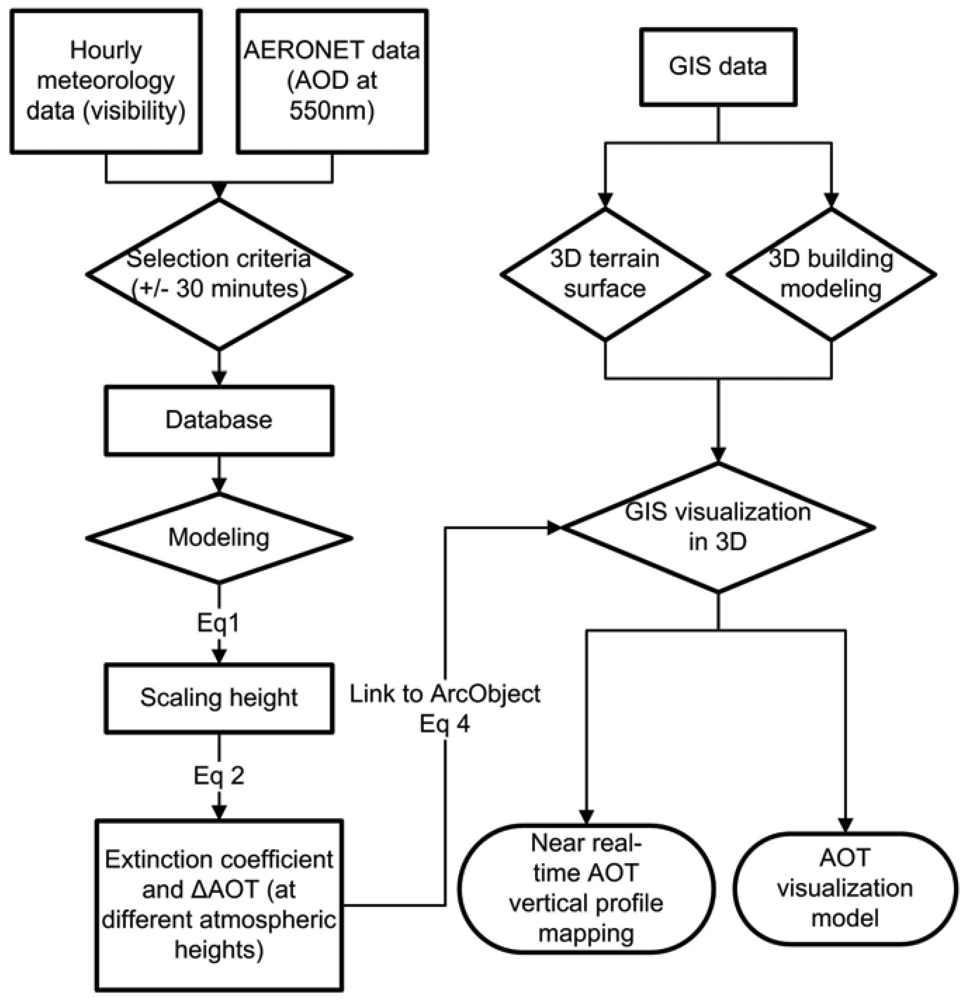
3. Methodology
3.1. Modeling the Aerosol Vertical Profiles Using AERONET and Climatological Data
3.2. Linkage with GIS Platform
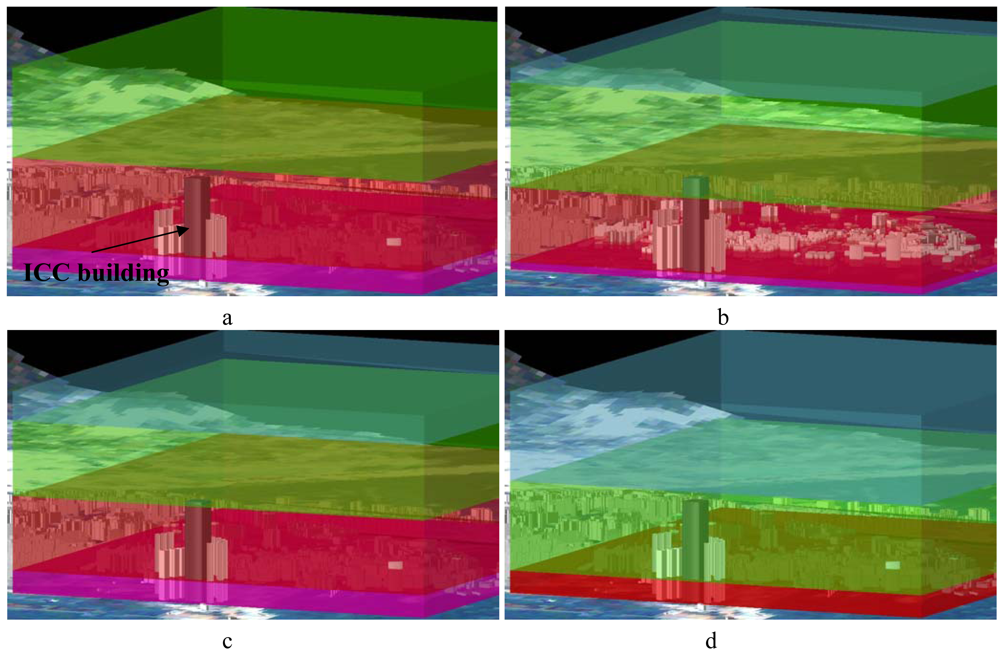
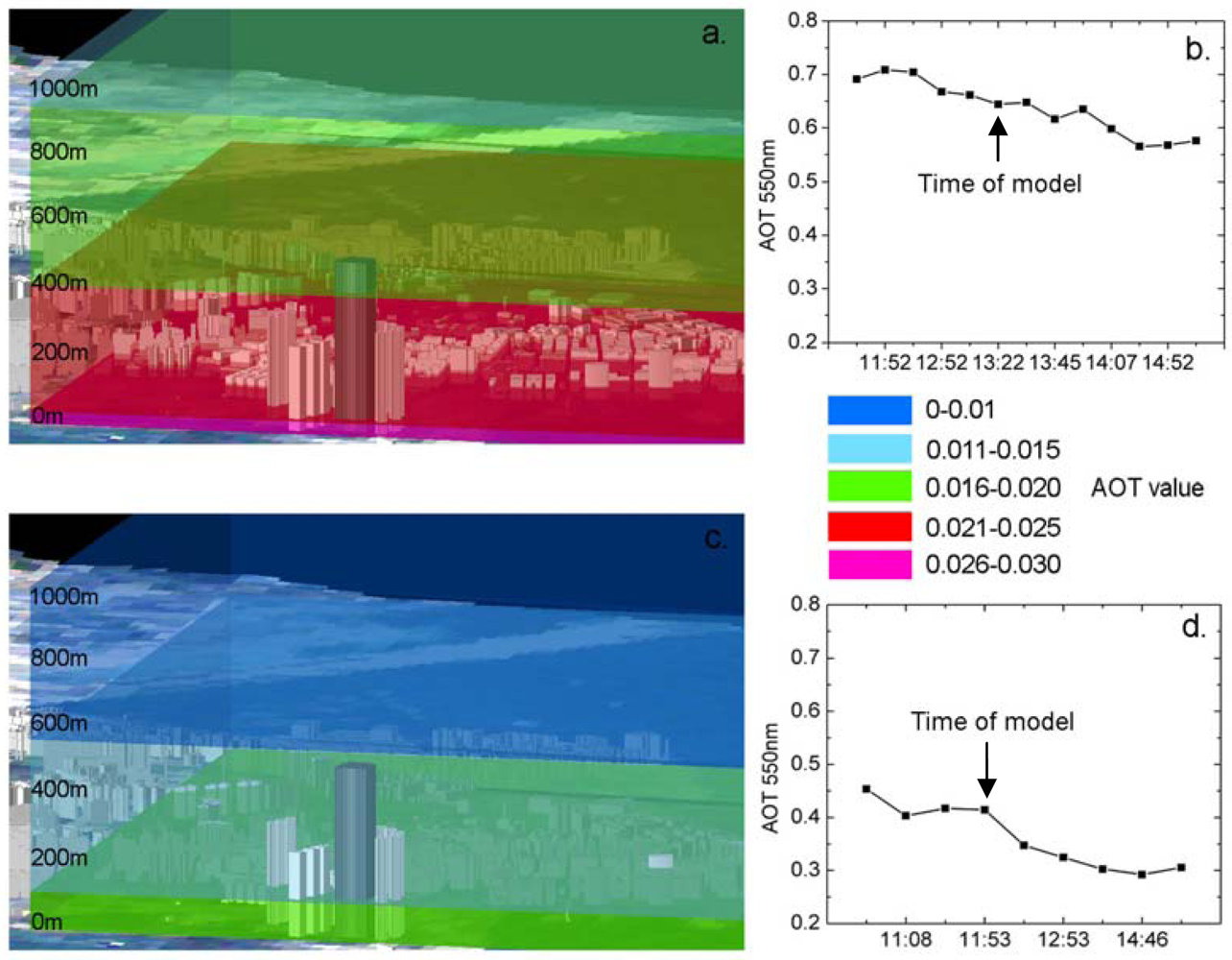
4. Results
5. Discussion and Conclusions
Acknowledgments
References
- Kaufman, Y.J.; Tanré, D.; Gordon, H.R.; Nakajima, T.; Lenoble, J.; Frouin, R.; Grassl, H.; Herman, B.M.; King, M.D.; Teillet, P.M. Passive remote sensing of tropospheric aerosol and atmospheric correction for the aerosol effect. J. Geophys. Res. 1997, 102, 16815–16830. [Google Scholar]
- King, M.D.; Kaufman, Y.J.; Tanré, D.; Nakajima, T. Remote Sensing of Tropospheric Aerosols from Space: Past, Present, and Future. Bull. Amer. Meteor. Soc. 1999, 80, 2229–2259. [Google Scholar]
- Lelieveld, J.; Berresheim, H.; Borrmann, S.; Crutzen, P.J.; Dentener, F.J.; Fischer, H.; Feichter, J.; Flatau, P.J.; Heland, J.; Holzinger, R.; Korrmann, R.; Lawrence, M.G.; Levin, Z.; Markowicz, K.M.; Mihalopoulos, N.; Minikin, A.; Ramanathan, V.; de Reus, M.; Roelofs, G.J.; Scheeren, H.A.; Sciare, J.; Schlager, H.; Schultz, M.; Siegmund, P.; Steil, B.; Stephanou, E.G.; Stier, P.; Traub, M.; Warneke, C.; Williams, J.; Ziereis, H. Global air pollution crossroads over the Mediterranean. Science 2002, 298, 794–799. [Google Scholar]
- Menon, S.; Hansen, J.; Nazarenko, L.; Luo, Y. Climate effects of black carbon aerosols in China and India. Science 2002, 297, 2250–2253. [Google Scholar]
- Ansmann, A.; Riebesell, M.; Weitkamp, C. Measurement of atmospheric aerosol extinction profiles with a Raman lidar. Opt. Lett. 1990, 15, 746–748. [Google Scholar]
- Spinhirne, J.D.; Rall, J.; Scott, V.S. Compact eye-safe lidar systems. Rev. Laser Engin. 1995, 23, 26–32. [Google Scholar]
- Matthias, V.; Freudenthaler, V.; Amodeo, A.; Balin, I.; Balis, D.; Bösenberg, J.; Chaikovsky, A.; Chourdakis, G.; Comeron, A.; Delaval, A.; De Tomasi, F.; Eixmann, R.; Hagard, A.; Komguem, L.; Kreipl, S.; Matthey, R.; Rizi, V.; Rodrigues, J.A.; Wandinger, U.; Wang, X. Aerosol lidar intercomparison in the framework of the EARLINET project. 1. Instruments. Appl. Opt. 2004, 43, 961–976. [Google Scholar]
- Elterman, L. Relationships between vertical attenuation and surface meteorological range. Appl. Opt. 1970, 9, 1804–1810. [Google Scholar]
- Qiu, J. Broadband extinction method to determine aerosol optical depth from accumulated solar direct radiation. J. Appl. Meteor. 2003, 42, 1611–1625. [Google Scholar]
- Qiu, J.; Zong, X.M.; Zhang, X.Y. A study of the scaling height of the tropospheric aerosol and its extinction coefficient profile. J. Aerosol Sci. 2005, 36, 361–371. [Google Scholar]
- Wong, M.S.; Nichol, J.E.; Lee, K.H. A study of aerosol vertical profiles: scaling height and extinction coefficient. Proceedings of 2nd Faculty Postgraduate Research Conference, Hong Kong, China, January 2008.
- Pullar, D.V.; Tidey, M.E. Coupling 3D visualisation to qualitative assessment of built environment designs. Landscape Urban Plan. 2001, 55, 29–40. [Google Scholar]
- Tang, U.W.; Wang, Z.S. Influences of urban forms on traffic-induced noise and air pollution: Results from a modelling system. Environ. Model. Soft. 2007, 22, 1750–1764. [Google Scholar]
- Wang, X.H. Integrating GIS, simulation models, and visualization in traffic impact analysis. Computers, Environ. Urban Sys. 2005, 29, 471–496. [Google Scholar]
- Nichol, J.E.; Wong, M.S. Modelling urban environmental quality in a tropical city. Landscape Urban Plan. 2005, 7, 49–58. [Google Scholar]
- Virtual London and Air Pollution. 3-D Map of Air Pollution in London, The London air quality network; Environmental Research Group, King's College: London, U.K., 2008. Available online: http://www.londonair.org.uk/london/asp/virtualmaps.asp?view=maps.
- Lam, C.Y.; Lee, L.S. GIS Applications in Weather and Geophysical Services in Hong Kong. Proceedings of the Atmospheric Front, Hong Kong, China, November 2006.
- Holben, B.N.; Eck, T.F.; Slutsker, I.; Tanré, D.; Buis, J.P.; Setzer, A.; Vermote, E.; Reagan, J.A.; Kaufman, Y.; Nakajima, T.; Lavenu, F.; Jankowiak, I.; Smirnov, A. AERONET - A federated instrument network and data archive for aerosol characterization. Remote Sens. Environ. 1998, 66, 1–16. [Google Scholar]
- Smirnov, A.; Holben, B.N.; Eck, T.F.; Dubovik, O.; Slutsker, I. Cloud screening and quality control algorithms for the AERONET database. Remote Sens. Environ. 2000, 73, 337–349. [Google Scholar]
- Dubovik, O.; Smirnov, A.; Holben, B.N.; King, M.D.; Kaufman, Y.J.; Eck, T.F.; Slutsker, I. Accuracy assessments of aerosol optical properties retrieved from AERONET sun and sky-radiance measurements. J. Geophys. Res. 2000, 105, 9791–9806. [Google Scholar]
- Wang, T. Study of visibility reduction and its causes in Hong Kong; Final report to the Hong Kong Environmental Protection Department; September 2003. [Google Scholar]
- Turner, D.D.; Ferrare, R.A.; Brasseur, L.A. Average aerosol extinction and water vapor profiles over the Southern Great Plains. Geophys. Res. Lett. 2001, 28, 4441–4444. [Google Scholar]
- Koschmieder, H. Theorie der horizontalen Sichtweite. Beiträge zur Physik der freien Atmosphäre. 1924, 12, 33–53. [Google Scholar]
- WMO (World Meteorological Organization). Guide to meteorological instruments and methods of observation; Secretariat of the World Meteorological Organization: Geneva, Switzerland, 1983. [Google Scholar]
- Bradshaw, B. Using VBA and ArcMap to create and export 3D buildings. Proceedings of ESRI User Conference, San Diego, CA, USA, July 2003.
- Wong, M.S.; Lee, K.H.; Nichol, J.E.; Li, Z.Q. Retrieval of aerosol optical thickness using MODIS 500 × 500m2, a study in Hong Kong and Pearl River Delta region. Proceedings of the International Workshop on Earth Observation and Remote Sensing Applications, Beijing, China, June to July 2008.
- Wong, M.S.; Nichol, J.E.; Lee, K.H.; Li, Z.Q. A new algorithm for retrieving aerosol optical thickness using TERRA/MODIS satellite images. Intern. Asso. Chinese Prof. Geogra. Inform. Sci. 2008, 14, 86–91. [Google Scholar]


| Date | Time | AOT at 550 nm | Visibility (km) | Scaling height za (km) |
|---|---|---|---|---|
| 01-Feb-2007 | 11:52 a.m. | 0.71 | 10 | 1.81 |
| 01-Feb-2007 | 12:52 a.m. | 0.67 | 10 | 1.71 |
| 01-Feb-2007 | 01:22 p.m. | 0.64 | 9 | 1.48 |
| 01-Feb-2007 | 03:07 p.m. | 0.58 | 10 | 1.47 |
| 03-Feb-2007 | 11:53 a.m. | 0.41 | 9 | 0.95 |
© 2009 by the authors; licensee Molecular Diversity Preservation International, Basel, Switzerland. This article is an open access article distributed under the terms and conditions of the Creative Commons Attribution license (http://creativecommons.org/licenses/by/3.0/).
Share and Cite
Wong, M.S.; Nichol, J.E.; Lee, K.H. Modeling of Aerosol Vertical Profiles Using GIS and Remote Sensing. Sensors 2009, 9, 4380-4389. https://doi.org/10.3390/s90604380
Wong MS, Nichol JE, Lee KH. Modeling of Aerosol Vertical Profiles Using GIS and Remote Sensing. Sensors. 2009; 9(6):4380-4389. https://doi.org/10.3390/s90604380
Chicago/Turabian StyleWong, Man Sing, Janet E. Nichol, and Kwon Ho Lee. 2009. "Modeling of Aerosol Vertical Profiles Using GIS and Remote Sensing" Sensors 9, no. 6: 4380-4389. https://doi.org/10.3390/s90604380