<?xml version="1.0" encoding="UTF-8"?>
<!DOCTYPE article PUBLIC "-//NLM//DTD Journal Publishing DTD v2.3 20070202//EN" "journalpublishing.dtd">
<article xmlns:mml="http://www.w3.org/1998/Math/MathML" xmlns:xlink="http://www.w3.org/1999/xlink" xml:lang="en" article-type="research-article">
<front>
<journal-meta>
<journal-id journal-id-type="nlm-ta">Sensors</journal-id>
<journal-title>Sensors</journal-title>
<issn pub-type="epub">1424-8220</issn>
<publisher>
<publisher-name>Molecular Diversity Preservation International (MDPI)</publisher-name></publisher></journal-meta>
<article-meta>
<article-id pub-id-type="doi">10.3390/s90604104</article-id>
<article-id pub-id-type="publisher-id">sensors-09-04104</article-id>
<article-categories>
<subj-group>
<subject>Article</subject></subj-group></article-categories>
<title-group>
<article-title>Synthesis of the System Modeling and Signal Detecting Circuit of a Novel Vacuum Microelectronic Accelerometer</article-title></title-group>
<contrib-group>
<contrib contrib-type="author">
<name><surname>Li</surname><given-names>Dongling</given-names></name><xref ref-type="aff" rid="af1-sensors-09-04104"><sup>1</sup></xref><xref ref-type="aff" rid="af2-sensors-09-04104"><sup>2</sup></xref><xref ref-type="aff" rid="af3-sensors-09-04104"><sup>3</sup></xref><xref ref-type="corresp" rid="c1-sensors-09-04104"><sup>*</sup></xref></contrib>
<contrib contrib-type="author">
<name><surname>Wen</surname><given-names>Zhiyu</given-names></name><xref ref-type="aff" rid="af1-sensors-09-04104"><sup>1</sup></xref><xref ref-type="aff" rid="af2-sensors-09-04104"><sup>2</sup></xref><xref ref-type="aff" rid="af3-sensors-09-04104"><sup>3</sup></xref><email>wzy@cqu.edu.cn</email></contrib>
<contrib contrib-type="author">
<name><surname>Wen</surname><given-names>Zhongquan</given-names></name><xref ref-type="aff" rid="af1-sensors-09-04104"><sup>1</sup></xref><xref ref-type="aff" rid="af2-sensors-09-04104"><sup>2</sup></xref><xref ref-type="aff" rid="af3-sensors-09-04104"><sup>3</sup></xref><email>wen_zq@163.com</email></contrib>
<contrib contrib-type="author">
<name><surname>He</surname><given-names>Xuefeng</given-names></name><xref ref-type="aff" rid="af1-sensors-09-04104"><sup>1</sup></xref><xref ref-type="aff" rid="af2-sensors-09-04104"><sup>2</sup></xref><xref ref-type="aff" rid="af3-sensors-09-04104"><sup>3</sup></xref></contrib>
<contrib contrib-type="author">
<name><surname>Yang</surname><given-names>Yinchuan</given-names></name><xref ref-type="aff" rid="af1-sensors-09-04104"><sup>1</sup></xref><xref ref-type="aff" rid="af2-sensors-09-04104"><sup>2</sup></xref><xref ref-type="aff" rid="af3-sensors-09-04104"><sup>3</sup></xref><email>phinex119@126.com</email></contrib>
<contrib contrib-type="author">
<name><surname>Shang</surname><given-names>Zhengguo</given-names></name><xref ref-type="aff" rid="af1-sensors-09-04104"><sup>1</sup></xref><xref ref-type="aff" rid="af2-sensors-09-04104"><sup>2</sup></xref><xref ref-type="aff" rid="af3-sensors-09-04104"><sup>3</sup></xref><email>shangzhengguos@163.com</email></contrib></contrib-group>
<aff id="af1-sensors-09-04104">
<label>1</label> Key National Lab of Novel Micro/Nano Devices and System Technology, Chongqing 400030, China</aff>
<aff id="af2-sensors-09-04104">
<label>2</label> National Center for International Research of Micro/Nano System and New Materials Technologies, Chongqing 400030, China</aff>
<aff id="af3-sensors-09-04104">
<label>3</label> Microsystem Research Center, and College of Optoelectronic Engineering Chongqing University, Chongqing 400030, China</aff>
<author-notes>
<corresp id="c1-sensors-09-04104">
<label>*</label>Author to whom correspondence should be addressed; E-mail: <email>lidongling1982@163.com</email>; Tel.: +86-13752925461; Fax: +023-6510-4131</corresp></author-notes>
<pub-date pub-type="collection">
<year>2009</year></pub-date>
<pub-date pub-type="epub">
<day>27</day>
<month>5</month>
<year>2009</year></pub-date>
<volume>9</volume>
<issue>6</issue>
<fpage>4104</fpage>
<lpage>4118</lpage>
<history>
<date date-type="received">
<day>5</day>
<month>5</month>
<year>2009</year></date>
<date date-type="rev-recd">
<day>15</day>
<month>5</month>
<year>2009</year></date>
<date date-type="accepted">
<day>22</day>
<month>5</month>
<year>2009</year></date></history>
<permissions>
<copyright-statement>© 2009 by the authors; licensee Molecular Diversity Preservation International, Basel, Switzerland.</copyright-statement>
<copyright-year>2009</copyright-year>
<license>
<p>This article is an open access article distributed under the terms and conditions of the Creative Commons Attribution license (http://creativecommons.org/licenses/by/3.0/).</p></license></permissions>
<abstract>
<p>A novel high-precision vacuum microelectronic accelerometer has been successfully fabricated and tested in our laboratory. This accelerometer has unique advantages of high sensitivity, fast response, and anti-radiation stability. It is a prototype intended for navigation applications and is required to feature micro-g resolution. This paper briefly describes the structure and working principle of our vacuum microelectronic accelerometer, and the mathematical model is also established. The performances of the accelerometer system are discussed after Matlab modeling. The results show that, the dynamic response of the accelerometer system is significantly improved by choosing appropriate parameters of signal detecting circuit, and the signal detecting circuit is designed. In order to attain good linearity and performance, the closed-loop control mode is adopted. Weak current detection technology is studied, and integral T-style feedback network is used in I/V conversion, which will eliminate high-frequency noise at the front of the circuit. According to the modeling parameters, the low-pass filter is designed. This circuit is simple, reliable, and has high precision. Experiments are done and the results show that the vacuum microelectronic accelerometer exhibits good linearity over -1 g to +1 g, an output sensitivity of 543 mV/g, and a nonlinearity of 0.94 %.</p></abstract>
<kwd-group>
<kwd>vacuum microelectronics</kwd>
<kwd>accelerometer</kwd>
<kwd>closed-loop control</kwd>
<kwd>weak current detection</kwd></kwd-group></article-meta></front>
<body>
<sec sec-type="intro">
<label>1.</label>
<title>Introduction</title>
<p>High precision accelerometers find many applications such as acoustic measurement, seismology and navigation. Micro-machined accelerometers have been developed with different working principles [<xref ref-type="bibr" rid="b1-sensors-09-04104">1</xref>-<xref ref-type="bibr" rid="b3-sensors-09-04104">3</xref>]. However, with the fast development of modern science and technology, the micro accelerometers are required to have better performance, such as high precision, good stability and linearity, low power consumption, high temperature resistance, etc. So exploration and research on high performance micro accelerometers is still a hot research topic. For high performance, two aspects are focused on. One is the exploration of new principles and novel structures, and the other is the design of an appropriate signal detecting circuit, which will directly influence the characteristics of the accelerometer system.</p>
<p>Since the vacuum microelectronic technology was proposed in 1988, the possibility of producing a high precision, good performance vacuum microelectronic sensor has been actively explored. The study of vacuum microelectronic sensors started in 1991, and since then many new types of sensors have appeared [<xref ref-type="bibr" rid="b4-sensors-09-04104">4</xref>], such as pressure sensors, accelerometers, magnetism sensors and image sensors. Vacuum microelectronic devices are designed based on field emission theory, and the sensing part works under vacuum conditions. It utilizes the cold cathode to emit electrons, the emission current density is mainly determined by the electric field density near the tip array, which is exponential to the distance between the anode and the cathode tip array. Compared to other common well-developed accelerometers, vacuum microelectronic accelerometer has unique advantages of anti-radiation, small size, high sensitivity and the compatibility for fabrication process with integrated circuits (IC). It is widely required in applications such as small satellites, navigation, dexterous projectiles, tactical missiles and industrial automatic control [<xref ref-type="bibr" rid="b5-sensors-09-04104">5</xref>].</p>
<p>The signal detecting circuit is another essential part for high precision micro accelerometers, and considerable research work has been done in this area too. Analog Devices Company has designed a modulation and demodulation circuit for capacitive accelerometers since the 1990s [<xref ref-type="bibr" rid="b6-sensors-09-04104">6</xref>]. Now it is integrated with an accelerometer on a chip, and the accelerometer has good performance. Stanford Integrated Circuit Laboratory developed a high precision tunneling accelerometer and the corresponding closed-loop control circuit in 1998. This accelerometer can attain micro-g resolution [<xref ref-type="bibr" rid="b7-sensors-09-04104">7</xref>]. Nowadays, several groups have begun to study the influence of signal detecting circuits on the characteristics of accelerometer systems. Based on the system modeling, they do analysis of the system using Matlab software, and then attain appropriate circuit parameters to instruct the design of signal detecting circuits [<xref ref-type="bibr" rid="b8-sensors-09-04104">8</xref>-<xref ref-type="bibr" rid="b9-sensors-09-04104">9</xref>].</p>
<p>The objectives of the present research are to design a signal detecting circuit for a high precision vacuum microelectronic accelerometer, which will ensure good linearity, high sensitivity and fast response of the accelerometer system. In this paper, first the structure and working principles of a vacuum microelectronic accelerometer are introduced, and then the mathematical model is established. We plot and discuss some simulation results of the dynamic performance and stability of the system, and confirm the circuit parameters. The electrostatic force balance technology is adopted in the circuit, and the application range of vacuum microelectronic accelerometer is greatly extended.</p></sec>
<sec>
<label>2.</label>
<title>Structure and Working Principle</title>
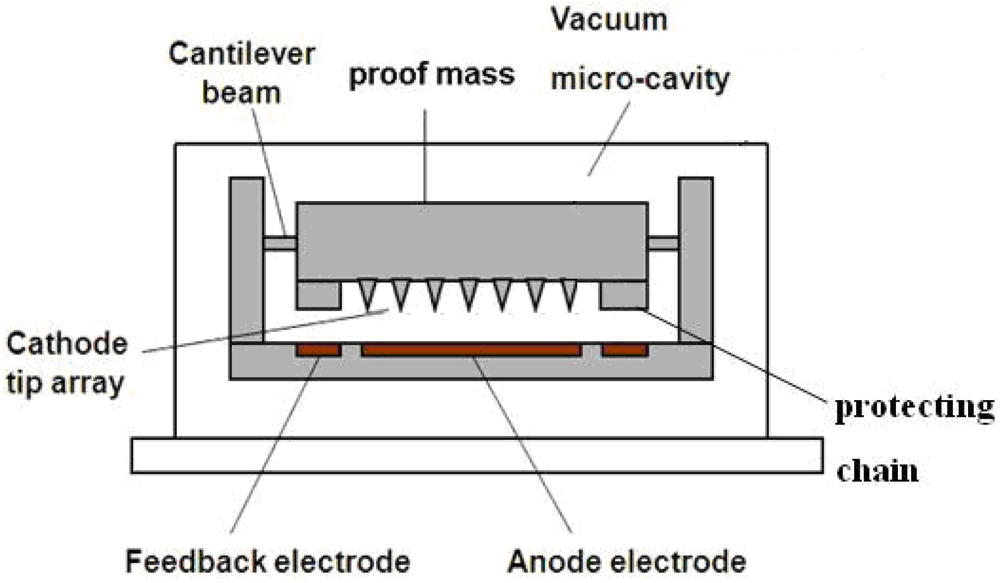
<p>The structure diagram of a vacuum microelectronic accelerometer is illustrated in <xref ref-type="fig" rid="f1-sensors-09-04104">Figure 1</xref>. The mechanical components comprise four cantilever beams, a proof mass and a micro-silicon field emission tip array. The electrodes include a cathode, an anode and a feedback electrode. Meanwhile, the protecting chain is designed. It will prevent the damage of the tip array and realize over loading self-protection. When the acceleration exceeds the measurement range, the anode will contact with the protecting chain, and avoid the collision between the anode and the tip array.</p>
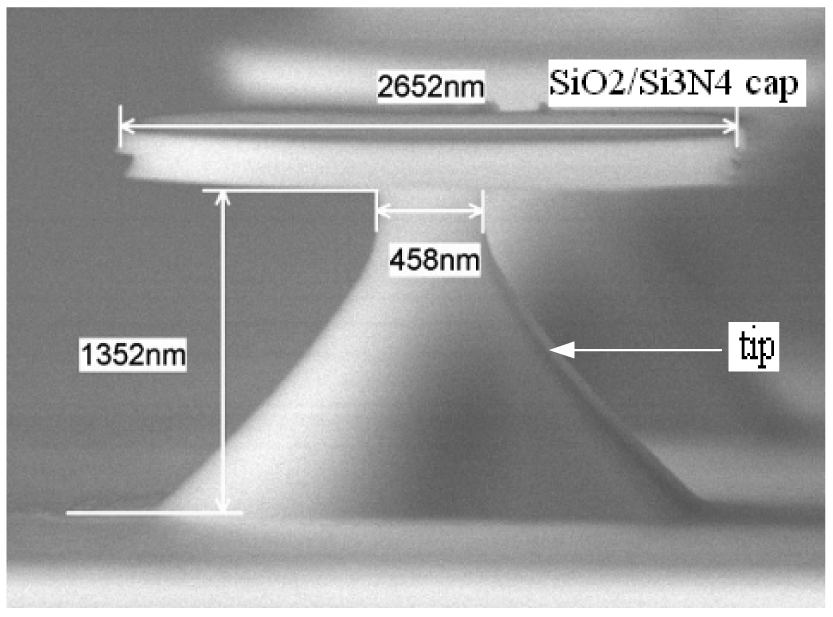
<p>This accelerometer has been designed and fabricated. The dimensions of the accelerometer are obtained. <xref ref-type="fig" rid="f2-sensors-09-04104">Figure 2</xref> is the SEM diagram of single tip. The bottom pyramid is the tip, and the top plate is the SiO<sub>2</sub>/Si<sub>3</sub>N<sub>4</sub> cap protecting the tip from being eroded. Finally, the cap will be removed after the tip acuity. When a big enough DC voltage is added between the tip and the anode electrode, the tip will emit electrons under high electric field.</p>
<p>The vacuum microelectronic accelerometer works in electrostatic force balance mode. The working principle is that by applying a forward bias voltage between the anode and cathode, when the bias voltage is large enough, the tip array begins to emit electrons under high electric field, and then the electrons form a diode forward current. When the bias voltage is constant and there is an acceleration acting on the accelerometer, the proof mass will produce a displacement, and result in the change of emission current. Using current detecting circuit and electrostatic negative feedback system can make the proof mass maintain the balance position, and then the acceleration is obtained by measuring the output voltage.</p></sec>
<sec sec-type="methods">
<label>3.</label>
<title>Mathematical Model and System-Level Analysis</title>
<sec>
<label>3.1.</label>
<title>The Mathematical Model</title>
<p>Matlab was used to build the mathematical model of the vacuum microelectronic accelerometer. The model is composed of different function blocks based on Laplace transforms. In general, a vacuum microelectronic accelerometer with a feedback control system is not a linear system. Assumptions and approximations are used to linearize the system.</p>
<sec>
<label>3.1.1.</label>
<title>The Sensing Part</title>
<p>The proof mass is the sensing part of the accelerometer. It can be considered as a suspended mass-spring-damping system [<xref ref-type="bibr" rid="b10-sensors-09-04104">10</xref>]. Using Laplace transforms, the dynamic performance of the proof mass can be expressed as:
<disp-formula id="FD1">
<label>(1)</label>
<mml:math id="mm1" display="block">
<mml:semantics id="sm1">
<mml:mrow>
<mml:msub>
<mml:mi>G</mml:mi>
<mml:mn>1</mml:mn></mml:msub>
<mml:mo stretchy="false">(</mml:mo>
<mml:mi>s</mml:mi>
<mml:mo stretchy="false">)</mml:mo>
<mml:mo>=</mml:mo>
<mml:mfrac>
<mml:mrow>
<mml:mi mathvariant="normal">Δ</mml:mi>
<mml:mi>x</mml:mi></mml:mrow>
<mml:mrow>
<mml:mi>m</mml:mi>
<mml:mi mathvariant="normal">Δ</mml:mi>
<mml:mi>a</mml:mi></mml:mrow></mml:mfrac>
<mml:mo>=</mml:mo>
<mml:mfrac>
<mml:mn>1</mml:mn>
<mml:mrow>
<mml:mi>m</mml:mi>
<mml:msup>
<mml:mi>s</mml:mi>
<mml:mn>2</mml:mn></mml:msup>
<mml:mo>+</mml:mo>
<mml:mi>b</mml:mi>
<mml:mi>s</mml:mi>
<mml:mo>+</mml:mo>
<mml:mi>k</mml:mi></mml:mrow></mml:mfrac></mml:mrow></mml:semantics></mml:math></disp-formula>where <italic>m, b</italic>, and <italic>k</italic> represent the mass, damping coefficient, and spring constant of the proof mass, respectively. <italic>Δa</italic> is the external acceleration, and <italic>Δx</italic> is the displacement of the proof mass. It is a typical two-order system.</p></sec>
<sec>
<label>3.1.2.</label>
<title>The Change of Displacement to the Current Part and the Circuit Part</title>
<p>According to field emission theory and the prior modeling results [<xref ref-type="bibr" rid="b11-sensors-09-04104">11</xref>], the emission current is exponentially proportional to the change of the displacement of proof mass, so theoretically the vacuum microelectronic accelerometer can attain high sensitivity. The relationship between the displacement of the proof mass and the emission current is approximately given by:
<disp-formula id="FD2">
<label>(2)</label>
<mml:math id="mm2" display="block">
<mml:semantics id="sm2">
<mml:mrow>
<mml:mi>I</mml:mi>
<mml:mo>=</mml:mo>
<mml:msub>
<mml:mi>I</mml:mi>
<mml:mn>0</mml:mn></mml:msub>
<mml:mo>exp</mml:mo>
<mml:mo stretchy="false">(</mml:mo>
<mml:mo>−</mml:mo>
<mml:mi>α</mml:mi>
<mml:mi mathvariant="normal">Δ</mml:mi>
<mml:mi>x</mml:mi>
<mml:mo stretchy="false">)</mml:mo></mml:mrow></mml:semantics></mml:math></disp-formula>where <italic>I<sub>0</sub></italic> is the static emission current, <italic>α</italic> is a constant referring to the structure of vacuum microelectronic accelerometer. As we can see, this is not a linear relationship, so a linearization is required. Since the displacement of the proof mass Δx is very small, <xref rid="FD2" ref-type="disp-formula">Equation (2)</xref> can be developed by Taylor series and as:
<disp-formula id="FD3">
<label>(3)</label>
<mml:math id="mm3" display="block">
<mml:semantics id="sm3">
<mml:mrow>
<mml:mi>I</mml:mi>
<mml:mo>=</mml:mo>
<mml:msub>
<mml:mi>I</mml:mi>
<mml:mn>0</mml:mn></mml:msub>
<mml:mo stretchy="false">(</mml:mo>
<mml:mn>1</mml:mn>
<mml:mo>−</mml:mo>
<mml:mi>α</mml:mi>
<mml:mi mathvariant="normal">Δ</mml:mi>
<mml:mi>x</mml:mi>
<mml:mo stretchy="false">)</mml:mo></mml:mrow></mml:semantics></mml:math></disp-formula></p>
<p>The emission current goes through I/V conversion circuit, and compared with a reference voltage <italic>V<sub>ref</sub></italic>. Then the current is amplified by a main amplifier. The output voltage can be expressed as follows:
<disp-formula id="FD4">
<label>(4)</label>
<mml:math id="mm4" display="block">
<mml:semantics id="sm4">
<mml:mrow>
<mml:mi>V</mml:mi>
<mml:mo>=</mml:mo>
<mml:mi>K</mml:mi>
<mml:mo>⋅</mml:mo>
<mml:mi>R</mml:mi>
<mml:mo>⋅</mml:mo>
<mml:mo stretchy="false">(</mml:mo>
<mml:mi>I</mml:mi>
<mml:mo>−</mml:mo>
<mml:msub>
<mml:mi>I</mml:mi>
<mml:mn>0</mml:mn></mml:msub>
<mml:mo stretchy="false">)</mml:mo>
<mml:mo>=</mml:mo>
<mml:msub>
<mml:mi>I</mml:mi>
<mml:mn>0</mml:mn></mml:msub>
<mml:mo>⋅</mml:mo>
<mml:mi>R</mml:mi>
<mml:mo>⋅</mml:mo>
<mml:mi>K</mml:mi>
<mml:mo>⋅</mml:mo>
<mml:mi>α</mml:mi>
<mml:mo>⋅</mml:mo>
<mml:mi mathvariant="normal">Δ</mml:mi>
<mml:mi>x</mml:mi></mml:mrow></mml:semantics></mml:math></disp-formula></p>
<p><italic>R</italic> is the equivalent resistance of I/V conversion, and <italic>K</italic> is the amplitude of the amplifier. Therefore, the nonlinear relationship is linearized. Otherwise, a low-pass filter with transfer function <italic>H<sub>1</sub>(s)</italic> is needed in the circuit.</p></sec>
<sec>
<label>3.1.3.</label>
<title>The Feedback Control Loop</title>
<p>For an electrostatic force balance accelerometer, the effect of a feedback control loop is to give a static force which is opposite to the acceleration, and make the proof mass maintain the balance position. Ideally, when the acceleration is zero, the proof mass would be at the balance position and the distance between the anode and the cathode is <italic>x<sub>0</sub></italic>; if the acceleration is not zero, the proof mass would produce a small distance <italic>Δx</italic>. In the event that the gain of the closed loop is big enough, there would be a negative electrostatic force produced by the feedback voltage. Then the force loads to the feedback electrode, and makes the proof mass return to the balance position, so in the closed loop control, the proof mass will move in a very small distance, and the linearity of the system is improved.</p>
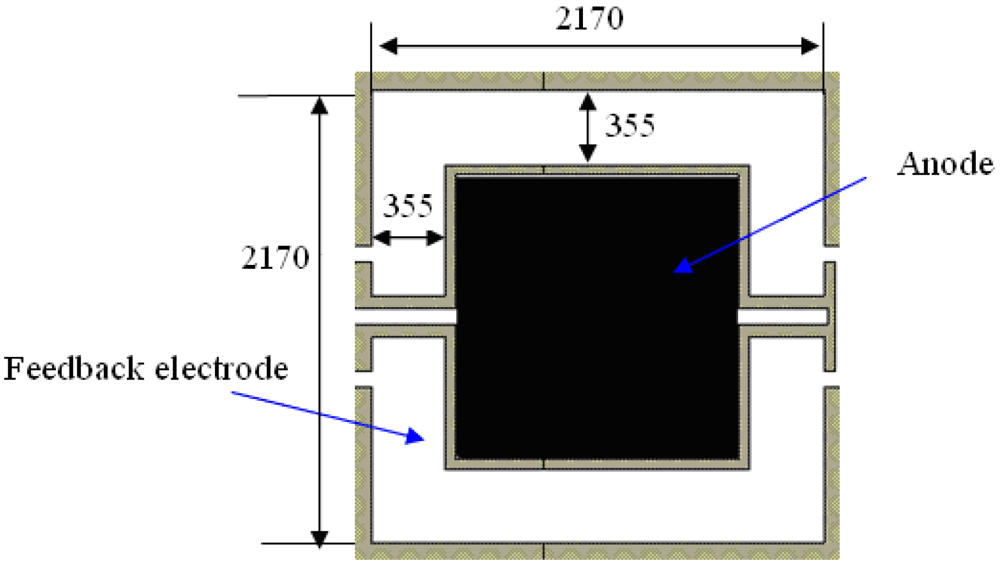
<p><xref ref-type="fig" rid="f3-sensors-09-04104">Figure 3</xref> shows the bottom electrode of the vacuum microelectronic accelerometer. The feedback electrode can be seen as four approximately rectangular plates, and the dimensions (μm) are described in the figure. Referring to <xref ref-type="fig" rid="f1-sensors-09-04104">Figure 1</xref> and the working principle, the actuator can be seen as a parallel capacitor [<xref ref-type="bibr" rid="b12-sensors-09-04104">12</xref>]. Compared to <italic>x<sub>0</sub></italic>, the dimension of the feedback electrode is much bigger and the marginal effect can be neglected. So the feedback electrostatic force <italic>F<sub>f</sub></italic> can be described as:
<disp-formula id="FD5">
<label>(5)</label>
<mml:math id="mm5" display="block">
<mml:semantics id="sm5">
<mml:mrow>
<mml:msub>
<mml:mi>F</mml:mi>
<mml:mi>f</mml:mi></mml:msub>
<mml:mo>=</mml:mo>
<mml:mo>=</mml:mo>
<mml:mfrac>
<mml:mrow>
<mml:msub>
<mml:mi>ε</mml:mi>
<mml:mn>0</mml:mn></mml:msub>
<mml:mi>s</mml:mi>
<mml:msup>
<mml:mrow>
<mml:mo stretchy="false">(</mml:mo>
<mml:msub>
<mml:mi>V</mml:mi>
<mml:mrow>
<mml:mi>d</mml:mi>
<mml:mi>c</mml:mi></mml:mrow></mml:msub>
<mml:mo>+</mml:mo>
<mml:msub>
<mml:mi>V</mml:mi>
<mml:mrow>
<mml:mi>a</mml:mi>
<mml:mi>c</mml:mi></mml:mrow></mml:msub>
<mml:mo stretchy="false">)</mml:mo></mml:mrow>
<mml:mn>2</mml:mn></mml:msup></mml:mrow>
<mml:mrow>
<mml:mn>2</mml:mn>
<mml:msup>
<mml:mrow>
<mml:mo stretchy="false">(</mml:mo>
<mml:msub>
<mml:mi>x</mml:mi>
<mml:mn>0</mml:mn></mml:msub>
<mml:mo>+</mml:mo>
<mml:mi mathvariant="normal">Δ</mml:mi>
<mml:mi>x</mml:mi>
<mml:mo stretchy="false">)</mml:mo></mml:mrow>
<mml:mn>2</mml:mn></mml:msup></mml:mrow></mml:mfrac></mml:mrow></mml:semantics></mml:math></disp-formula>where <italic>V<sub>dc</sub></italic> is the DC deflection voltage ensuring the original working state and <italic>V<sub>ac</sub></italic> is the output voltage which is proportional to the acceleration. <italic>ε<sub>0</sub></italic> is the vacuum dielectric constant and <italic>s</italic> is the overlap area of the feedback electrode to the cathode.</p>
<p>Since <italic>V<sub>dc</sub></italic> (24V) is much bigger than <italic>V<sub>ac</sub></italic> (several mV), and <italic>Δx</italic> is much smaller than <italic>x</italic>, the electrostatic force can be given by:
<disp-formula id="FD6">
<label>(6)</label>
<mml:math id="mm6" display="block">
<mml:semantics id="sm6">
<mml:mrow>
<mml:msub>
<mml:mi>F</mml:mi>
<mml:mi>f</mml:mi></mml:msub>
<mml:mo>=</mml:mo>
<mml:mfrac>
<mml:mrow>
<mml:msub>
<mml:mi>ε</mml:mi>
<mml:mn>0</mml:mn></mml:msub>
<mml:mi>s</mml:mi></mml:mrow>
<mml:mrow>
<mml:mn>2</mml:mn>
<mml:msup>
<mml:mrow>
<mml:msub>
<mml:mi>x</mml:mi>
<mml:mn>0</mml:mn></mml:msub></mml:mrow>
<mml:mn>2</mml:mn></mml:msup></mml:mrow></mml:mfrac>
<mml:mo stretchy="false">(</mml:mo>
<mml:msup>
<mml:mrow>
<mml:msub>
<mml:mi>V</mml:mi>
<mml:mrow>
<mml:mi>d</mml:mi>
<mml:mi>c</mml:mi></mml:mrow></mml:msub></mml:mrow>
<mml:mn>2</mml:mn></mml:msup>
<mml:mo>+</mml:mo>
<mml:mn>2</mml:mn>
<mml:msub>
<mml:mi>V</mml:mi>
<mml:mrow>
<mml:mi>d</mml:mi>
<mml:mi>c</mml:mi></mml:mrow></mml:msub>
<mml:mspace width="0.2em"/>
<mml:msub>
<mml:mi>V</mml:mi>
<mml:mrow>
<mml:mi>a</mml:mi>
<mml:mi>c</mml:mi></mml:mrow></mml:msub>
<mml:mo stretchy="false">)</mml:mo></mml:mrow></mml:semantics></mml:math></disp-formula></p>
<p>The first item is used to set the operation point, and the second item is related to the feedback force applied to the proof mass. At small signal analysis, <xref rid="FD6" ref-type="disp-formula">Equation (6)</xref> can be simplified as:
<disp-formula id="FD7">
<label>(7)</label>
<mml:math id="mm7" display="block">
<mml:semantics id="sm7">
<mml:mrow>
<mml:msub>
<mml:mi>F</mml:mi>
<mml:mi>f</mml:mi></mml:msub>
<mml:mo>=</mml:mo>
<mml:mfrac>
<mml:mrow>
<mml:msub>
<mml:mi>ε</mml:mi>
<mml:mn>0</mml:mn></mml:msub>
<mml:mi>s</mml:mi></mml:mrow>
<mml:mrow>
<mml:msup>
<mml:mrow>
<mml:msub>
<mml:mi>x</mml:mi>
<mml:mn>0</mml:mn></mml:msub></mml:mrow>
<mml:mn>2</mml:mn></mml:msup></mml:mrow></mml:mfrac>
<mml:msub>
<mml:mi>V</mml:mi>
<mml:mrow>
<mml:mi>d</mml:mi>
<mml:mi>c</mml:mi></mml:mrow></mml:msub>
<mml:mspace width="0.2em"/>
<mml:msub>
<mml:mi>V</mml:mi>
<mml:mrow>
<mml:mi>a</mml:mi>
<mml:mi>c</mml:mi></mml:mrow></mml:msub>
<mml:mo>=</mml:mo>
<mml:msub>
<mml:mi>K</mml:mi>
<mml:mi>f</mml:mi></mml:msub>
<mml:mspace width="0.2em"/>
<mml:msub>
<mml:mi>V</mml:mi>
<mml:mrow>
<mml:mi>a</mml:mi>
<mml:mi>c</mml:mi></mml:mrow></mml:msub></mml:mrow></mml:semantics></mml:math></disp-formula></p>
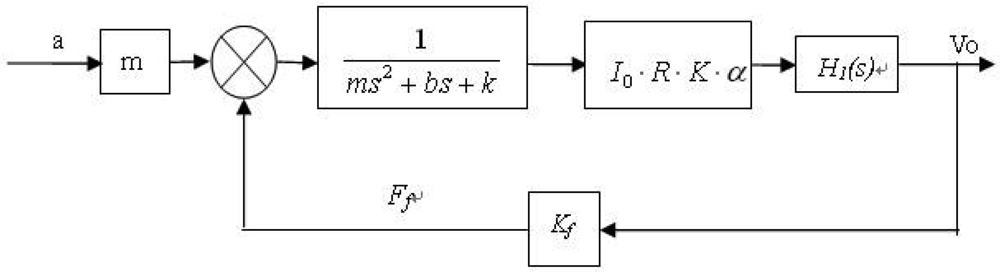
<p>So we obtained the overall transfer function diagram of the system, as shown in <xref ref-type="fig" rid="f4-sensors-09-04104">Figure 4</xref>.</p></sec>
<sec>
<label>3.1.4.</label>
<title>The Linearity of the System</title>
<p>As analysis above, when the acceleration acts on the accelerometer, the proof mass will move beyond a balance position. According to force balance theory, the relationship can be given by:
<disp-formula id="FD8">
<label>(8)</label>
<mml:math id="mm8" display="block">
<mml:semantics id="sm8">
<mml:mrow>
<mml:mi>k</mml:mi>
<mml:mi mathvariant="normal">Δ</mml:mi>
<mml:mi>x</mml:mi>
<mml:mo>=</mml:mo>
<mml:mi>m</mml:mi>
<mml:mi>a</mml:mi>
<mml:mo>−</mml:mo>
<mml:msub>
<mml:mi>F</mml:mi>
<mml:mi>f</mml:mi></mml:msub></mml:mrow></mml:semantics></mml:math></disp-formula>where <italic>m</italic> is the mass and <italic>a</italic> is the external acceleration. For closed-loop control system, the displacement Δx is very small, so <italic>F<sub>f</sub></italic> » <italic>kΔx</italic>. We can obtain: <italic>ma</italic> = <italic>F<sub>f</sub></italic>, and the relationship between output voltage and acceleration can be expressed by <xref rid="FD9" ref-type="disp-formula">Equation (9)</xref>, which illustrates that the vacuum microelectronic system has good linearity:
<disp-formula id="FD9">
<label>(9)</label>
<mml:math id="mm9" display="block">
<mml:semantics id="sm9">
<mml:mrow>
<mml:mi>a</mml:mi>
<mml:mo>=</mml:mo>
<mml:mfrac>
<mml:mrow>
<mml:msub>
<mml:mi>F</mml:mi>
<mml:mi>f</mml:mi></mml:msub></mml:mrow>
<mml:mi>m</mml:mi></mml:mfrac>
<mml:mo>=</mml:mo>
<mml:mfrac>
<mml:mrow>
<mml:msub>
<mml:mi>K</mml:mi>
<mml:mi>f</mml:mi></mml:msub>
<mml:mspace width="0.2em"/>
<mml:msub>
<mml:mi>V</mml:mi>
<mml:mrow>
<mml:mi>a</mml:mi>
<mml:mi>c</mml:mi></mml:mrow></mml:msub></mml:mrow>
<mml:mi>m</mml:mi></mml:mfrac></mml:mrow></mml:semantics></mml:math></disp-formula></p></sec></sec>
<sec>
<label>3.2.</label>
<title>The System-Level Analysis</title>
<p>Based on the linearized mathematical model, the system can be simulated and the characteristics of the accelerometer can be evaluated. The system-level analysis can effectively instruct the design of signal detecting circuit, and enhance the performance of the accelerometer system. Under current encapsulation, the vacuum micro cavity is not under an absolute vacuum condition, so a damping coefficient is exists. It is determined by the structure of vacuum microelectronic accelerometer. When the structure is determined, all the design parameters are obtained. <xref ref-type="table" rid="t1-sensors-09-04104">Table 1</xref> shows the structure parameters of vacuum microelectronic accelerometer.</p>
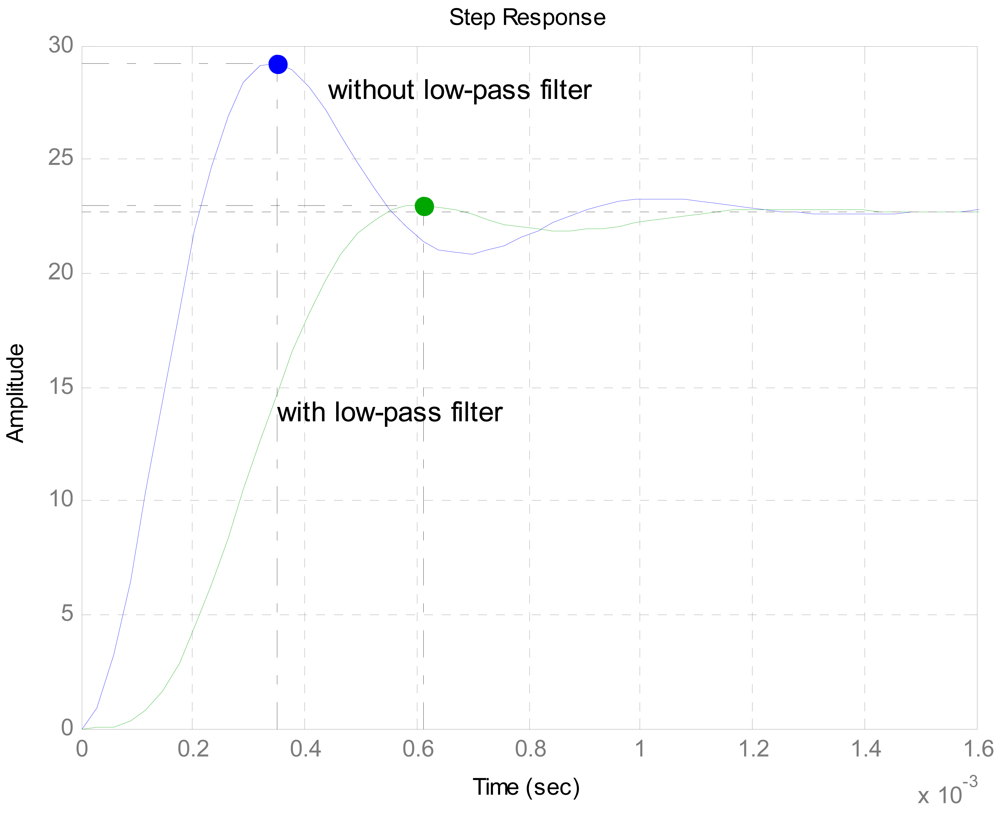
<p><xref ref-type="fig" rid="f5-sensors-09-04104">Figure 5</xref> shows the step response of the system. It illustrates that before adding the low-pass filter, the overshoot is 28.7 %, and the adjusting time is 1.09 ms; after the low-pass filter is added, the overshoot drops to 0.59 %, and the adjusting time becomes 0.97 ms. By calculation the damping ratio of the system is 0.73 and the natural frequency is 674 Hz. It is proven that by adding a proper low-pass filter, the dynamic performance of the accelerometer is remarkably improved and the system has good performance. Here, the low-pass filter is a typical 2-order low-pass filter, and the cut-off frequency is 600 Hz. The transfer function of low-pass filter is given by <xref rid="FD10" ref-type="disp-formula">Equation (10)</xref>. It can be easily realized by a simple circuit using resistors, capacitors and amplifiers:
<disp-formula id="FD10">
<label>(10)</label>
<mml:math id="mm10" display="block">
<mml:semantics id="sm10">
<mml:mrow>
<mml:msub>
<mml:mi>H</mml:mi>
<mml:mn>1</mml:mn></mml:msub>
<mml:mo stretchy="false">(</mml:mo>
<mml:mi>s</mml:mi>
<mml:mo stretchy="false">)</mml:mo>
<mml:mo>=</mml:mo>
<mml:mfrac>
<mml:mn>1</mml:mn>
<mml:mrow>
<mml:mn>5</mml:mn>
<mml:mo>×</mml:mo>
<mml:msup>
<mml:mrow>
<mml:mn>10</mml:mn></mml:mrow>
<mml:mrow>
<mml:mo>−</mml:mo>
<mml:mn>9</mml:mn></mml:mrow></mml:msup>
<mml:msup>
<mml:mi>s</mml:mi>
<mml:mn>2</mml:mn></mml:msup>
<mml:mo>+</mml:mo>
<mml:mn>2.0</mml:mn>
<mml:mo>×</mml:mo>
<mml:msup>
<mml:mrow>
<mml:mn>10</mml:mn></mml:mrow>
<mml:mrow>
<mml:mo>−</mml:mo>
<mml:mn>4</mml:mn></mml:mrow></mml:msup>
<mml:mi>s</mml:mi>
<mml:mo>+</mml:mo>
<mml:mn>1</mml:mn></mml:mrow></mml:mfrac></mml:mrow></mml:semantics></mml:math></disp-formula></p>
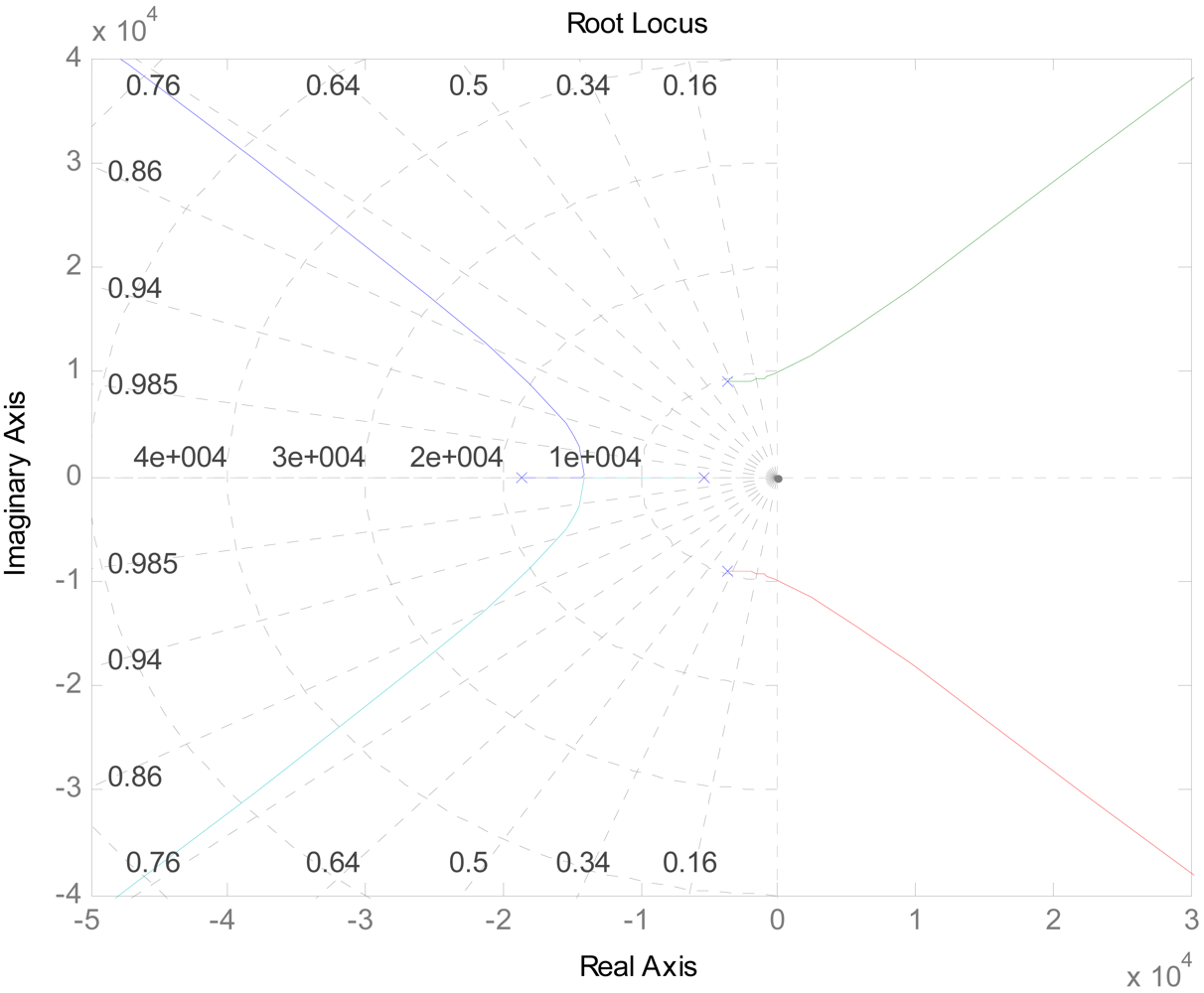
<p>The root locus of the system is shown in <xref ref-type="fig" rid="f6-sensors-09-04104">Figure 6</xref>. It demonstrates that after adding a low-pass filter, two poles on the left side of s-plane are added. The dynamic performance of the accelerometer is improved, but the relative stability is decreased [<xref ref-type="bibr" rid="b13-sensors-09-04104">13</xref>]. All the poles will be located on the left side of the s-plane when the gain is less than 8.5×10<sup>3</sup>, and it will be easily accomplished in the actual circuit.</p></sec></sec>
<sec sec-type="methods">
<label>4.</label>
<title>Design of Signal Detecting Circuit</title>
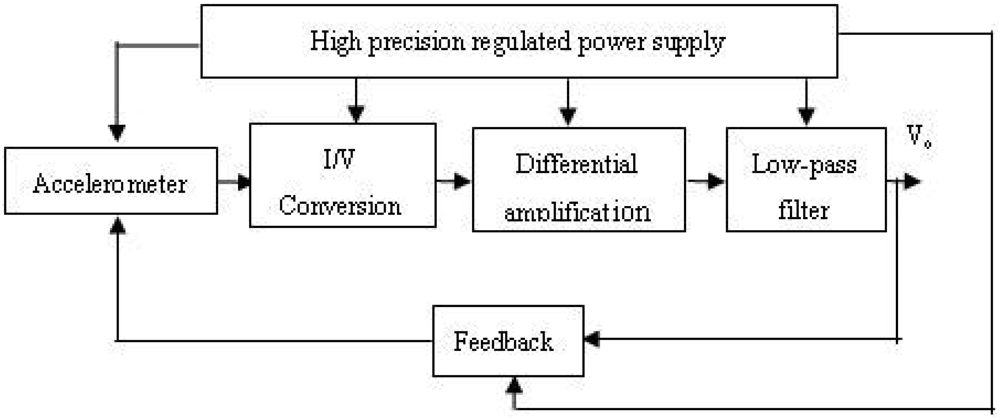
<p>In order to improve the linearity characteristic of the output, the signal detecting circuit works on close-loop mode, as shown in <xref ref-type="fig" rid="f7-sensors-09-04104">Figure 7</xref>. It mainly includes I/V conversion circuit, differential amplifier, low-pass filter, feedback control loop and high precision regulated power supply.</p>
<sec>
<label>4.1.</label>
<title>I/V Conversion Circuit</title>
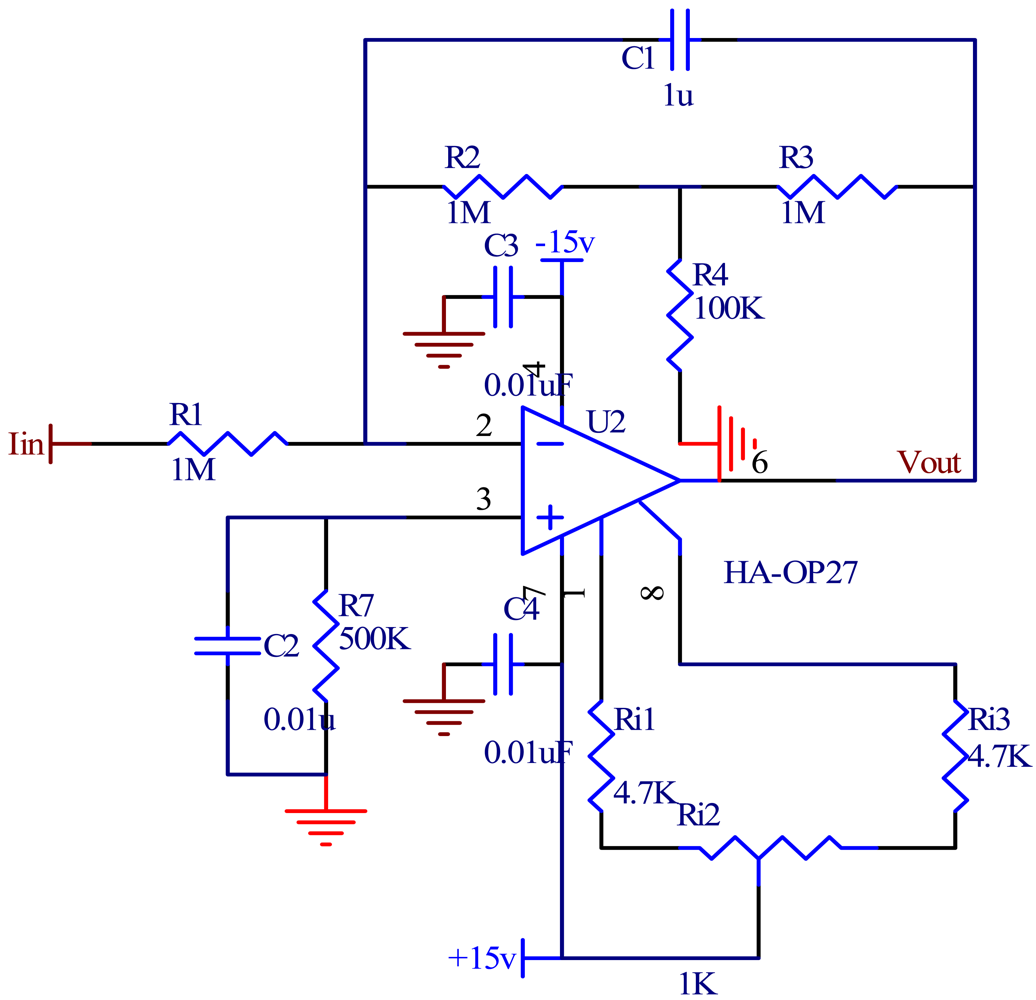
<p>A vacuum microelectronic accelerometer emits electrons by cathode tip array, and then the electrons form a weak emission current. For weak acceleration, the current change value is only nA level, and it is sensitive to the emission voltage (an exponential relationship). The main problem of weak current detection is the noise and drift, so this paper focuses on a high-precision, low-noise I/V conversion. A low noise prepositive amplifier OP27 is chosen, and the maximum equivalent input noise voltage is 3.8 nV/rtHz at 1 kHz. But the amplifier will bring additional resistance thermal noise and active noise which are both random smooth noise, and in accord with Gauss' rule. An integral I/V conversion circuit will eliminate high frequency noises by integral effect. Otherwise, the large gain and high precision are needed in I/V conversion circuit, and the integral T-style feedback network is chosen, as shown in <xref ref-type="fig" rid="f8-sensors-09-04104">Figure 8</xref>. This I/V conversion circuit can use a smaller resistance to attain a higher input resistance and larger gain. It can achieve high-precision I/V conversion, as well as increase load capacity. Furthermore, it can depress high frequency noise, and reduce the influence on the change of bias voltage. Low frequency and DC current signal can directly go through the T-style network and be converted into voltage. While high frequency noise can be eliminated by the integral action of capacitance C<sub>1</sub>, and the noise infection will be controlled by the integration time [<xref ref-type="bibr" rid="b14-sensors-09-04104">14</xref>]. R<sub>7</sub> is a compensating resistance, which can eliminate temperature drift. C<sub>3</sub> and C<sub>4</sub> are decoupling capacitor used to reduce the interference of power lines, as well as prevent the amplifier from producing self-oscillation. R<sub>i1</sub>, R<sub>i2</sub>, R<sub>i3</sub> are used to adjust the offset voltage of OP27. The I/V conversion voltage is given by:
<disp-formula id="FD11">
<label>(11)</label>
<mml:math id="mm11" display="block">
<mml:semantics id="sm11">
<mml:mrow>
<mml:msub>
<mml:mi>V</mml:mi>
<mml:mrow>
<mml:mtext>out</mml:mtext></mml:mrow></mml:msub>
<mml:mo>=</mml:mo>
<mml:mo>−</mml:mo>
<mml:msub>
<mml:mi>R</mml:mi>
<mml:mn>2</mml:mn></mml:msub>
<mml:mo stretchy="false">(</mml:mo>
<mml:mfrac>
<mml:mrow>
<mml:msub>
<mml:mi>R</mml:mi>
<mml:mn>3</mml:mn></mml:msub></mml:mrow>
<mml:mrow>
<mml:msub>
<mml:mi>R</mml:mi>
<mml:mn>2</mml:mn></mml:msub></mml:mrow></mml:mfrac>
<mml:mo>+</mml:mo>
<mml:mfrac>
<mml:mrow>
<mml:msub>
<mml:mi>R</mml:mi>
<mml:mn>2</mml:mn></mml:msub></mml:mrow>
<mml:mrow>
<mml:msub>
<mml:mi>R</mml:mi>
<mml:mn>4</mml:mn></mml:msub></mml:mrow></mml:mfrac>
<mml:mo>+</mml:mo>
<mml:mn>1</mml:mn>
<mml:mo stretchy="false">)</mml:mo>
<mml:msub>
<mml:mi>I</mml:mi>
<mml:mrow>
<mml:mi>i</mml:mi>
<mml:mi>n</mml:mi></mml:mrow></mml:msub>
<mml:mo>=</mml:mo>
<mml:mo>−</mml:mo>
<mml:mi>R</mml:mi>
<mml:msub>
<mml:mi>I</mml:mi>
<mml:mrow>
<mml:mi>i</mml:mi>
<mml:mi>n</mml:mi></mml:mrow></mml:msub></mml:mrow></mml:semantics></mml:math></disp-formula></p>
<p>As analysed in [<xref ref-type="bibr" rid="b15-sensors-09-04104">15</xref>], the input noise of T-style feedback circuit is mainly determined by the resistor R3, and it is far smaller than the equivalent resistance R. So the noise voltage of T-style feedback circuit will be well controlled. The noise can be eliminated at the front of the circuit.</p></sec>
<sec>
<label>4.2.</label>
<title>Differential Amplification</title>
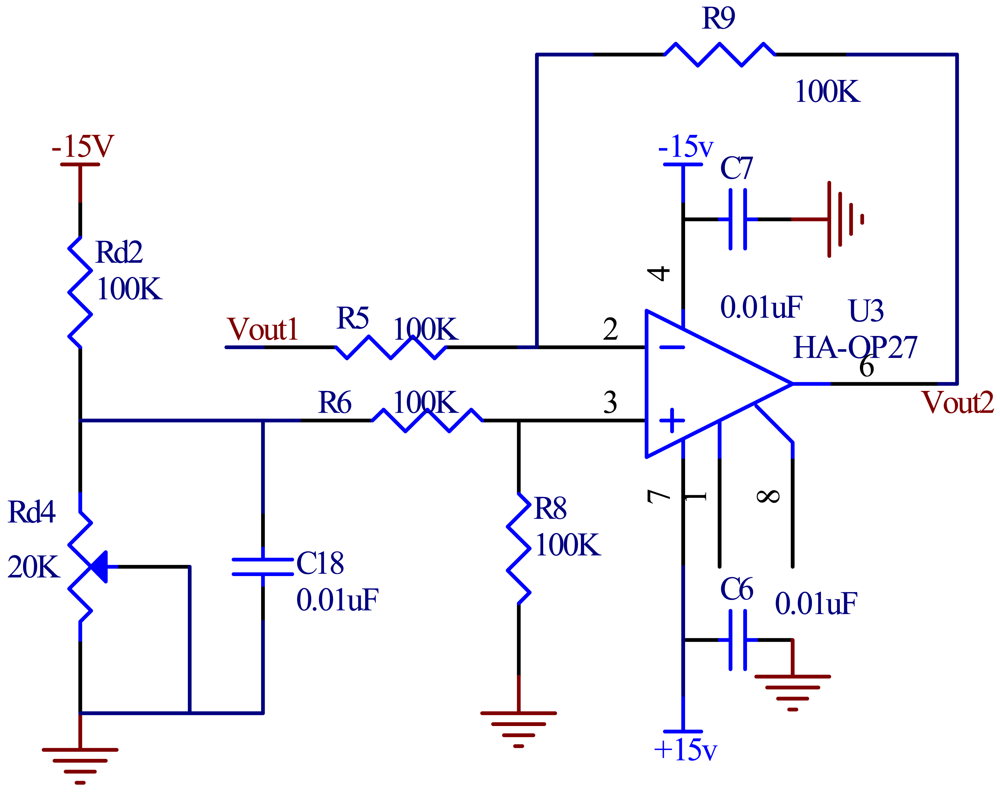
<p>When a vacuum microelectronic accelerometer meets emission conditions, the tip array begins to emit electrons and then the electrons form an emission current, even if there is no acceleration. After I/V conversion, the deflection voltage appears. For precision control, a differential amplification is used to eliminate this deflection voltage. The differential amplification circuit is shown in <xref ref-type="fig" rid="f9-sensors-09-04104">Figure 9</xref>. The reference voltage V<sub>ref</sub> is obtained by the distribution of high precision resistors.</p></sec>
<sec>
<label>4.3.</label>
<title>Low-Pass Filter</title>
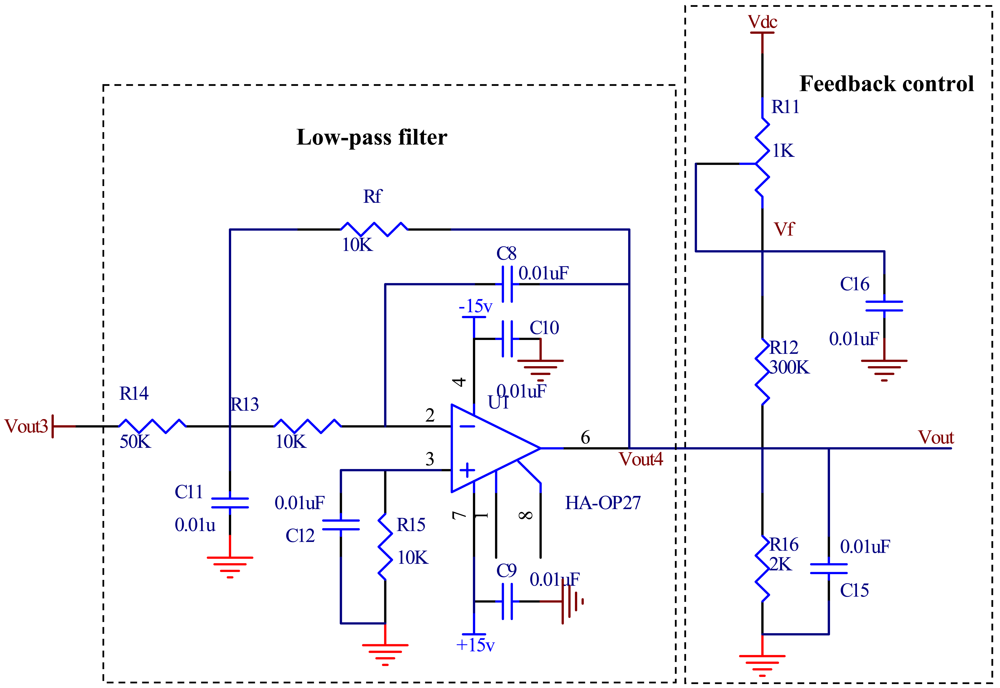
<p>In the light of the modeling parameters analyzed by Matlab, the infinite gain multi-channel feedback 2-order low-pass filter is chosen, as illustrated in <xref ref-type="fig" rid="f10-sensors-09-04104">Figure 10</xref>. The transfer function is given by:
<disp-formula id="FD12">
<label>(12)</label>
<mml:math id="mm12" display="block">
<mml:semantics id="sm12">
<mml:mrow>
<mml:mfrac>
<mml:mrow>
<mml:mo>−</mml:mo>
<mml:mfrac>
<mml:mrow>
<mml:msub>
<mml:mi>R</mml:mi>
<mml:mi>f</mml:mi></mml:msub></mml:mrow>
<mml:mrow>
<mml:msub>
<mml:mi>R</mml:mi>
<mml:mn>1</mml:mn></mml:msub></mml:mrow></mml:mfrac>
<mml:mo stretchy="false">(</mml:mo>
<mml:mfrac>
<mml:mn>1</mml:mn>
<mml:mrow>
<mml:msub>
<mml:mi>R</mml:mi>
<mml:mn>1</mml:mn></mml:msub></mml:mrow></mml:mfrac>
<mml:mo>+</mml:mo>
<mml:mfrac>
<mml:mn>1</mml:mn>
<mml:mrow>
<mml:msub>
<mml:mi>R</mml:mi>
<mml:mn>2</mml:mn></mml:msub></mml:mrow></mml:mfrac>
<mml:mo>+</mml:mo>
<mml:mfrac>
<mml:mn>1</mml:mn>
<mml:mrow>
<mml:msub>
<mml:mi>R</mml:mi>
<mml:mi>f</mml:mi></mml:msub></mml:mrow></mml:mfrac>
<mml:mo stretchy="false">)</mml:mo></mml:mrow>
<mml:mrow>
<mml:msup>
<mml:mi>s</mml:mi>
<mml:mn>2</mml:mn></mml:msup>
<mml:mo>+</mml:mo>
<mml:mfrac>
<mml:mn>1</mml:mn>
<mml:mrow>
<mml:msub>
<mml:mi>C</mml:mi>
<mml:mn>1</mml:mn></mml:msub></mml:mrow></mml:mfrac>
<mml:mo stretchy="false">(</mml:mo>
<mml:mfrac>
<mml:mn>1</mml:mn>
<mml:mrow>
<mml:msub>
<mml:mi>R</mml:mi>
<mml:mn>1</mml:mn></mml:msub></mml:mrow></mml:mfrac>
<mml:mo>+</mml:mo>
<mml:mfrac>
<mml:mn>1</mml:mn>
<mml:mrow>
<mml:msub>
<mml:mi>R</mml:mi>
<mml:mn>2</mml:mn></mml:msub></mml:mrow></mml:mfrac>
<mml:mo>+</mml:mo>
<mml:mfrac>
<mml:mn>1</mml:mn>
<mml:mrow>
<mml:msub>
<mml:mi>R</mml:mi>
<mml:mi>f</mml:mi></mml:msub></mml:mrow></mml:mfrac>
<mml:mo stretchy="false">)</mml:mo>
<mml:mi>s</mml:mi>
<mml:mo>+</mml:mo>
<mml:mfrac>
<mml:mn>1</mml:mn>
<mml:mrow>
<mml:msub>
<mml:mi>C</mml:mi>
<mml:mn>1</mml:mn></mml:msub>
<mml:msub>
<mml:mi>C</mml:mi>
<mml:mn>2</mml:mn></mml:msub>
<mml:msub>
<mml:mi>R</mml:mi>
<mml:mn>2</mml:mn></mml:msub>
<mml:msub>
<mml:mi>R</mml:mi>
<mml:mi>f</mml:mi></mml:msub></mml:mrow></mml:mfrac></mml:mrow></mml:mfrac></mml:mrow></mml:semantics></mml:math></disp-formula></p>
<p>The denominator shows that, the filter can't generate self-oscillation, even if the pass band amplification is too large; the filter has good stability. Otherwise, the transfer function will correlate with <xref rid="FD10" ref-type="disp-formula">Equation (10)</xref> by choosing appropriate resistors and capacitances. The low-pass filter not only effectively suppresses high-frequency noise, but also improves the dynamic performance of the accelerometer system.</p></sec>
<sec>
<label>4.4.</label>
<title>Feedback Control Loop</title>
<p>For the sake of enhancing output linearity and dynamic response range of vacuum microelectronic accelerometer, the electrostatic force balance technology is adopted, and it forms a servo accelerometer. The feedback network uses linear technology which is constituted of resistors and capacitances, as shown in <xref ref-type="fig" rid="f10-sensors-09-04104">Figure 10</xref>. The output voltage of feedback control loop is given by <xref rid="FD13" ref-type="disp-formula">Equation (13)</xref>:
<disp-formula id="FD13">
<label>(13)</label>
<mml:math id="mm13" display="block">
<mml:semantics id="sm13">
<mml:mrow>
<mml:msub>
<mml:mi>V</mml:mi>
<mml:mi>f</mml:mi></mml:msub>
<mml:mo>=</mml:mo>
<mml:mfrac>
<mml:mrow>
<mml:msub>
<mml:mi>R</mml:mi>
<mml:mrow>
<mml:mn>12</mml:mn></mml:mrow></mml:msub>
<mml:mo>+</mml:mo>
<mml:msub>
<mml:mi>R</mml:mi>
<mml:mrow>
<mml:mn>16</mml:mn></mml:mrow></mml:msub></mml:mrow>
<mml:mrow>
<mml:msub>
<mml:mi>R</mml:mi>
<mml:mrow>
<mml:mn>11</mml:mn></mml:mrow></mml:msub>
<mml:mo>+</mml:mo>
<mml:msub>
<mml:mi>R</mml:mi>
<mml:mrow>
<mml:mn>12</mml:mn></mml:mrow></mml:msub>
<mml:mo>+</mml:mo>
<mml:msub>
<mml:mi>R</mml:mi>
<mml:mrow>
<mml:mn>16</mml:mn></mml:mrow></mml:msub></mml:mrow></mml:mfrac>
<mml:mo>×</mml:mo>
<mml:msub>
<mml:mi>V</mml:mi>
<mml:mrow>
<mml:mi>d</mml:mi>
<mml:mi>c</mml:mi></mml:mrow></mml:msub>
<mml:mo>+</mml:mo>
<mml:mfrac>
<mml:mrow>
<mml:msub>
<mml:mi>R</mml:mi>
<mml:mrow>
<mml:mn>11</mml:mn></mml:mrow></mml:msub></mml:mrow>
<mml:mrow>
<mml:msub>
<mml:mi>R</mml:mi>
<mml:mrow>
<mml:mn>11</mml:mn></mml:mrow></mml:msub>
<mml:mo>+</mml:mo>
<mml:msub>
<mml:mi>R</mml:mi>
<mml:mrow>
<mml:mn>12</mml:mn></mml:mrow></mml:msub></mml:mrow></mml:mfrac>
<mml:mo>×</mml:mo>
<mml:msub>
<mml:mi>V</mml:mi>
<mml:mrow>
<mml:mtext mathvariant="italic">out</mml:mtext>
<mml:mn>4</mml:mn></mml:mrow></mml:msub></mml:mrow></mml:semantics></mml:math></disp-formula>where V<sub>dc</sub> is the DC deflection voltage and V<sub>out4</sub> is a negative output voltage of forward circuit. Thus a negative feedback control loop is obtained. It has two effects: first, it adjusts the distance between proof mass and anode plate, and makes the cathode tip array emit electrons; second, when there is acceleration acting on the proof mass, the feedback voltage <italic>V<sub>f</sub></italic> changes, and results in an opposite electrostatic force. The proof mass will return to the balance position. Using linear technology makes the feedback system of vacuum microelectronic accelerometer simple.</p>
<p>In addition, a series of measures are adopted to reduce the interferences, such as accessing decoupling capacitor between power and ground, laying out ground wire reasonably, adding shielding enclosures while testing, and so on. We also utilize zero adjusting resistors to decrease zero drift. This circuit is consistent with the analysis results in Part 3.</p></sec></sec>
<sec>
<label>5.</label>
<title>Experiments</title>
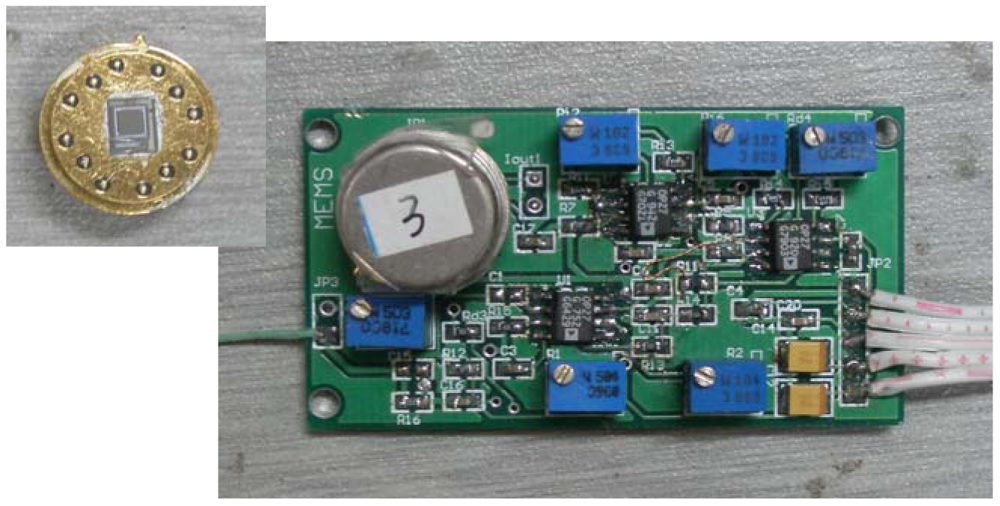
<p>The simulation and debugging of signal detecting circuit are done. <xref ref-type="fig" rid="f11-sensors-09-04104">Figure 11</xref> shows the photograph of vacuum microelectronic accelerometer with signal processing circuit.</p>
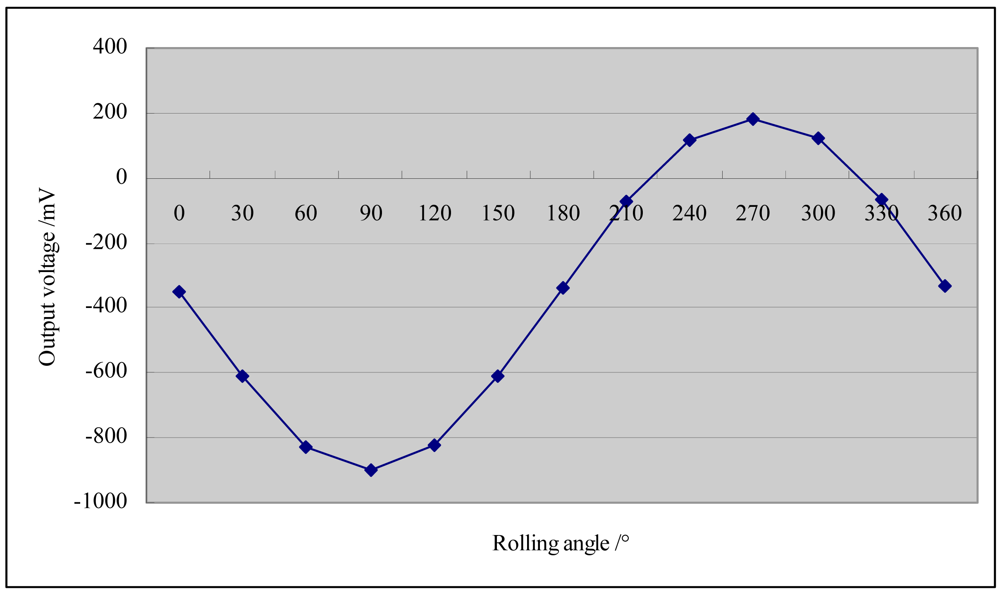
<p>The static rolling experiment in ±1 g gravitational field is done. <xref ref-type="fig" rid="f12-sensors-09-04104">Figure 12</xref> shows the output curve of the acceleration system. Where x-axis is the rolling angle and y-axis is the corresponding output voltage (mV). It illustrates that they satisfy a good sine relationship. The emission voltage is 2.478 V, and the feedback voltage is 5.112 V at 0 g input. A 12 points method is used during the testing, and the interval is 30 so that the accelerometer can be sensitive to different acceleration components [<xref ref-type="bibr" rid="b16-sensors-09-04104">16</xref>].</p>
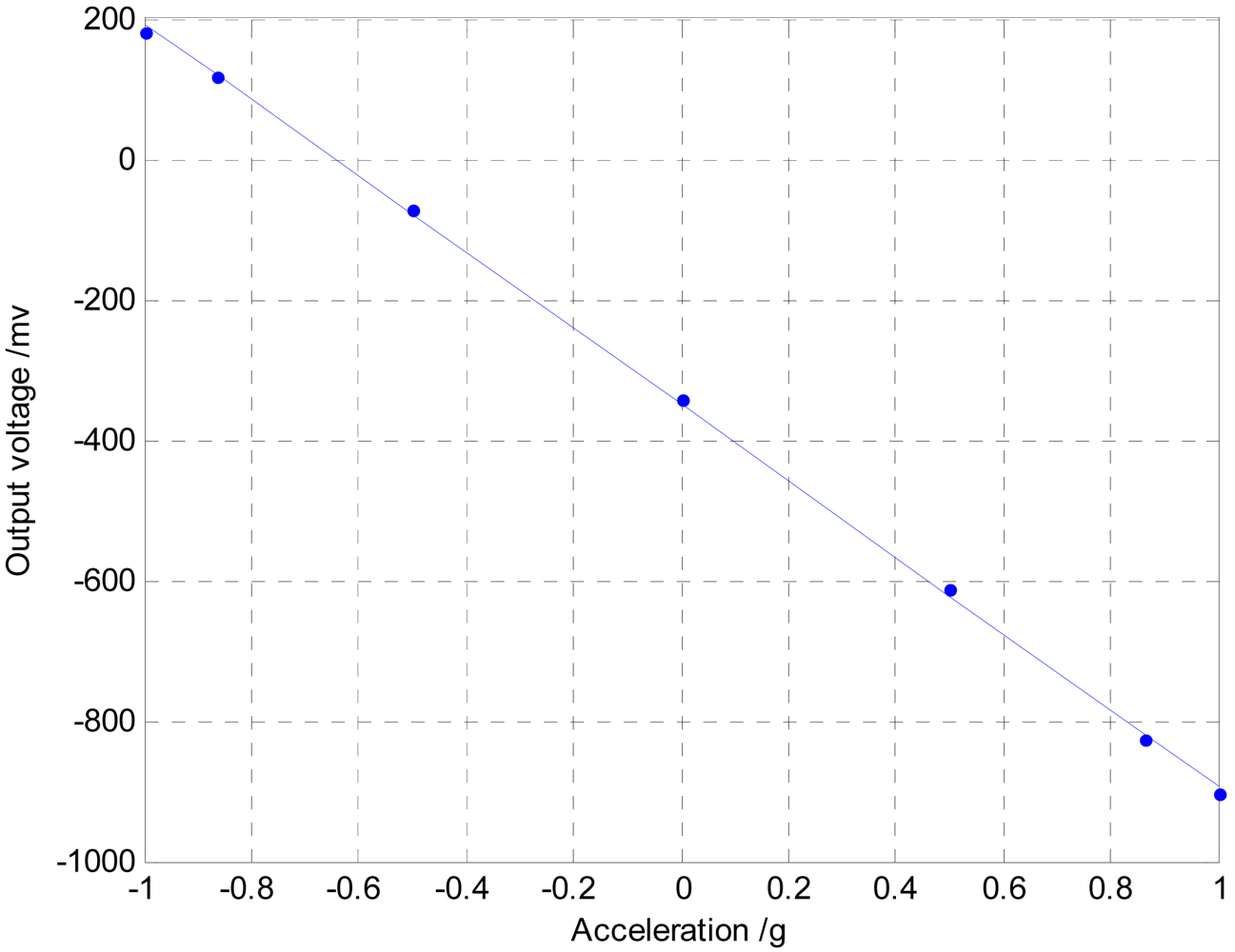
<p><xref ref-type="fig" rid="f13-sensors-09-04104">Figure 13</xref> shows the least-square linear fitting curve of the output voltage and corresponding acceleration, and the linear equation is as follows:
<disp-formula id="FD14">
<label>(14)</label>
<mml:math id="mm14" display="block">
<mml:semantics id="sm14">
<mml:mrow>
<mml:mi>V</mml:mi>
<mml:mo>=</mml:mo>
<mml:mo>−</mml:mo>
<mml:mn>349.955</mml:mn>
<mml:mo>−</mml:mo>
<mml:mn>0.543</mml:mn>
<mml:mi>a</mml:mi></mml:mrow></mml:semantics></mml:math></disp-formula></p>
<p>It shows that the output sensitivity is 543 mV/g, and the nonlinearity is 0.94 % in ±1 g measurement range.</p>
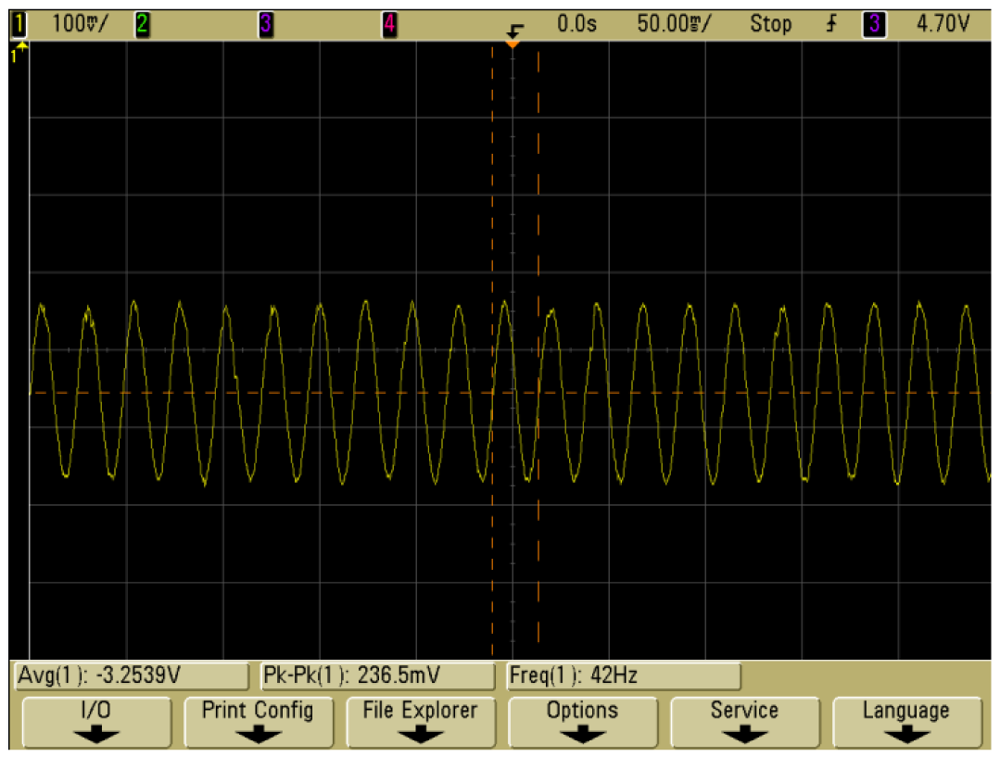
<p><xref ref-type="fig" rid="f14-sensors-09-04104">Figure 14</xref> illustrates the time history response of the output of the vacuum microelectronic accelerometer at 42 Hz when the input acceleration is 0.5 g. It shows that this accelerometer system has stable output and good performance.</p>
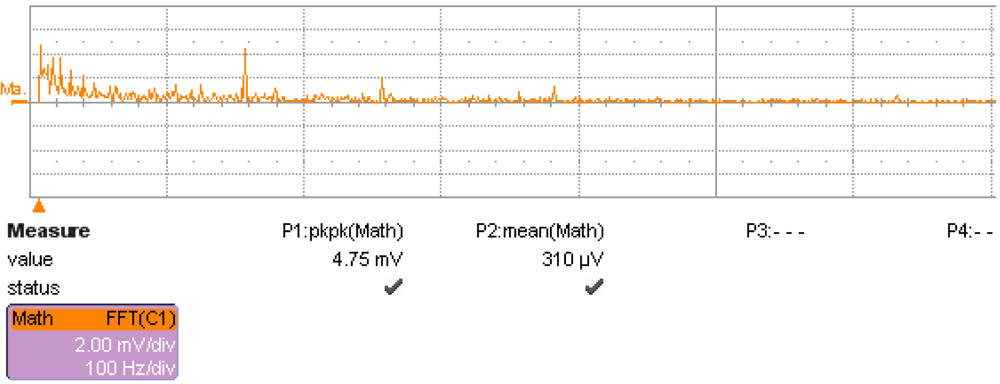
<p>The noise of the accelerometer was measured. <xref ref-type="fig" rid="f15-sensors-09-04104">Figure 15</xref> shows the noise spectrum density with the signal detecting circuit showed together at 0 g position, where the x-axis is the frequency and the y-axis is the peak-to-peak noise spectrum density (mV/rtHz), and the maximal value is 4.75 mV/rtHz. After transfer to the input end, the noise level is 3 mg/rtHz. The low frequency noise plays a major role, showing a 1/f behavior. Other peak values appear at the integral multiple of industrial frequency noise, mainly brought by DC voltage. These noises will influence the resolution to a great extent, and must be decreased as much as possible. Further work must be done to realize higher resolution.</p>
<p>After verifying the fundamental performance of the vacuum microelectronic accelerometer, a rough comparison with a tunneling accelerometer is done. The deflection voltage of a tunneling accelerometer is a high DC voltage of 100 V, but in our design it's only several volts. Therefore the energy consumption will be greatly reduced. In general, the emission distance between the anode and cathode of tunneling accelerometer is only several angstroms. For a vacuum microelectronic accelerometer this distance can reach 0.1 μm, and the motion range of proof mass is broadened. Besides, a vacuum microelectronic accelerometer emits electrons by cathode tip array which contains thousands of single tips, so the output current will be much larger than tunneling accelerometer, and the signal detecting circuit is easier to be achieved.</p></sec>
<sec sec-type="conclusions">
<label>6.</label>
<title>Conclusions</title>
<p>For high sensitivity and good performance, the system analysis and a high precision signal detecting circuit of a vacuum microelectronic accelerometer were studied in this paper. Based on the structure and working principles, a simple but effective mathematical model is established. Matlab is used for system-level analysis. The step response and root locus of the system are also studied and discussed. A 2-order low-pass filter is needed in the circuit so that the accelerometer system has good performance. Otherwise, in order to attain high precision and good linearity, weak signal detecting theory and closed-loop control mode are adopted. Compared to previous examples, this circuit is simply and reliable. Experiments are carried out to verify the characteristics of our vacuum microelectronic accelerometer system. The results show that the output sensitivity of vacuum microelectronic accelerometer is 543 mV/g, and the nonlinearity is 0.94 % in ±1 g measurement range. Work on an application specific integrated vacuum microelectronic accelerometer circuit is underway. The system noise will be evidently reduced and the performance of accelerometer will be improved. Other experimental results will be reported when they become available.</p></sec></body>
<back>
<ack>
<p>The authors would like to thank the National Key Laboratory of Micro/Nano Technology of Peking University for the fabrication process. The authors also would like to thank the two anonymous reviewers for their constructive comments which helped improve the manuscript.</p></ack>
<ref-list>
<title>References</title>
<ref id="b1-sensors-09-04104"><label>1.</label><citation citation-type="journal"><person-group person-group-type="author"><name><surname>Liu</surname><given-names>C.H.</given-names></name><name><surname>Thomas</surname><given-names>W.K.</given-names></name></person-group><article-title>A High-Precision, Wide-Bandwidth Micromachined Tunneling Accelerometer</article-title><source>J. Microelectromechan. Syst.</source><year>2001</year><volume>10</volume><fpage>425</fpage><lpage>432</lpage><pub-id pub-id-type="doi">10.1109/84.946800</pub-id></citation></ref>
<ref id="b2-sensors-09-04104"><label>2.</label><citation citation-type="journal"><person-group person-group-type="author"><name><surname>Liu</surname><given-names>J.</given-names></name><name><surname>Qin</surname><given-names>L.</given-names></name><name><surname>Liu</surname><given-names>J.C.</given-names></name><name><surname>Li</surname><given-names>M.</given-names></name></person-group><article-title>A Novel Differential Piezoelectric Accelerating Sensor</article-title><source>J. Optics Precis. Eng.</source><year>2007</year><volume>6</volume><fpage>903</fpage><lpage>909</lpage></citation></ref>
<ref id="b3-sensors-09-04104"><label>3.</label><citation citation-type="journal"><person-group person-group-type="author"><name><surname>Toshiyuki</surname><given-names>T.Y.</given-names></name><name><surname>Hirofumi</surname><given-names>F.B.</given-names></name></person-group><article-title>A Z-Axis Differential Capacitive SOI Accelerometer with Vertical Comb Electrodes</article-title><source>Sensor. Actuat. A-Phys.</source><year>2004</year><volume>116</volume><fpage>378</fpage><lpage>383</lpage><pub-id pub-id-type="doi">10.1016/j.sna.2004.05.008</pub-id></citation></ref>
<ref id="b4-sensors-09-04104"><label>4.</label><citation citation-type="journal"><person-group person-group-type="author"><name><surname>Xia</surname><given-names>S.H.</given-names></name></person-group><article-title>Research and Development of Vacuum Microelectronic Sensors</article-title><source>J. Mech. Stren.</source><year>2001</year><volume>23</volume><fpage>535</fpage><lpage>538</lpage></citation></ref>
<ref id="b5-sensors-09-04104"><label>5.</label><citation citation-type="journal"><person-group person-group-type="author"><name><surname>Peng</surname><given-names>S.C.</given-names></name><name><surname>Wen</surname><given-names>Z.Y.</given-names></name><name><surname>Wen</surname><given-names>Z.Q.</given-names></name><name><surname>Pan</surname><given-names>Y.S.</given-names></name><name><surname>Li</surname><given-names>X.</given-names></name></person-group><article-title>Finite Element Analysis on Vacuum Microelectronic Acceleration Sensor</article-title><source>J. Micronanoelectronic Technol.</source><year>2003</year><volume>7</volume><fpage>292</fpage><lpage>301</lpage></citation></ref>
<ref id="b6-sensors-09-04104"><label>6.</label><citation citation-type="journal"><person-group person-group-type="author"><name><surname>Rudolf</surname><given-names>F.</given-names></name><name><surname>Jornod.</surname><given-names>A</given-names></name><name><surname>Bergqvist</surname><given-names>J</given-names></name><name><surname>Leuthold</surname><given-names>H.</given-names></name></person-group><article-title>Precision Accelerometer with μg Resolution</article-title><source>Sensor. Actuat. A-Phys.</source><year>1990</year><volume>A21-A23</volume><fpage>297</fpage><lpage>302</lpage></citation></ref>
<ref id="b7-sensors-09-04104"><label>7.</label><citation citation-type="journal"><person-group person-group-type="author"><name><surname>Liu</surname><given-names>C.H.</given-names></name><name><surname>Barzilai</surname><given-names>A.M.</given-names></name><name><surname>Reynolds</surname><given-names>J.K.</given-names></name><name><surname>Partridge</surname><given-names>A.</given-names></name><name><surname>Kenny</surname><given-names>T.W.</given-names></name><name><surname>Grade</surname><given-names>J.D.</given-names></name><name><surname>Rockstad</surname><given-names>H.K.</given-names></name></person-group><article-title>Characterization of a High-Sensitivity Micromachined Tunneling Accelerometer with Micro-g Resolution</article-title><source>J. Microelectromechan. Syst.</source><year>1998</year><volume>7</volume><fpage>235</fpage><lpage>244</lpage><pub-id pub-id-type="doi">10.1109/84.679388</pub-id></citation></ref>
<ref id="b8-sensors-09-04104"><label>8.</label><citation citation-type="journal"><person-group person-group-type="author"><name><surname>Wang</surname><given-names>J.</given-names></name><name><surname>Zhao</surname><given-names>Y.J.</given-names></name><name><surname>Cui</surname><given-names>T.H.</given-names></name><name><surname>Kody</surname><given-names>V.</given-names></name></person-group><article-title>Synthesis of the Modeling and Control Systems of a Tunneling Accelerometer Using the Matlab Simulation</article-title><source>J. Micromech. Microeng.</source><year>2002</year><volume>12</volume><fpage>730</fpage><lpage>735</lpage><pub-id pub-id-type="doi">10.1088/0960-1317/12/6/302</pub-id></citation></ref>
<ref id="b9-sensors-09-04104"><label>9.</label><citation citation-type="confproc"><person-group person-group-type="author"><name><surname>Bhattacharyya</surname><given-names>T.K.</given-names></name><name><surname>Ghosh</surname><given-names>A.</given-names></name></person-group><article-title>Behavioral Modeling of a CMOS Compatible High Precision MEMS Based Electron Tunneling Accelerometer</article-title><conf-name>Proceedings of the 21st International Conference on VLSI Design</conf-name><conf-loc>Hyderabad, India</conf-loc><conf-date>January 2008</conf-date><fpage>595</fpage><lpage>600</lpage></citation></ref>
<ref id="b10-sensors-09-04104"><label>10.</label><citation citation-type="journal"><person-group person-group-type="author"><name><surname>Xue</surname><given-names>W.</given-names></name><name><surname>Wang</surname><given-names>J.</given-names></name><name><surname>Cui</surname><given-names>T.H.</given-names></name></person-group><article-title>Modeling and Design of Polymer-Based Tunneling Accelerometers by ANSYS/MATLAB</article-title><source>J. Trans. Mechatron.</source><year>2005</year><volume>10</volume><fpage>468</fpage><lpage>471</lpage><pub-id pub-id-type="doi">10.1109/TMECH.2005.852451</pub-id></citation></ref>
<ref id="b11-sensors-09-04104"><label>11.</label><citation citation-type="thesis"><person-group person-group-type="author"><name><surname>Chen</surname><given-names>G.Y.</given-names></name><name><surname>Wen</surname><given-names>Z.Y.</given-names></name></person-group><article-title>Research of Vacuum Microelectronic Acceleration Sensor</article-title><source>Master Dissertation</source><publisher-name>University of Chongqing</publisher-name><publisher-loc>Chongqing, China</publisher-loc><year>2002</year></citation></ref>
<ref id="b12-sensors-09-04104"><label>12.</label><citation citation-type="journal"><person-group person-group-type="author"><name><surname>Zhao</surname><given-names>J.</given-names></name><name><surname>Wang</surname><given-names>H.X.</given-names></name><name><surname>Jia</surname><given-names>J.Y.</given-names></name></person-group><article-title>Computation of Electrostatic Forces with Edge Effects for Micro-Structures</article-title><source>J. Micronanoelectron. Technol.</source><year>2006</year><volume>2</volume><fpage>95</fpage><lpage>97</lpage></citation></ref>
<ref id="b13-sensors-09-04104"><label>13.</label><citation citation-type="book"><person-group person-group-type="author"><name><surname>Xie</surname><given-names>K.M.</given-names></name></person-group><source>The Auto Control Theory</source><publisher-name>Electron Industry Press</publisher-name><publisher-loc>Beijing, China</publisher-loc><year>2004</year><fpage>91</fpage><lpage>169</lpage></citation></ref>
<ref id="b14-sensors-09-04104"><label>14.</label><citation citation-type="journal"><person-group person-group-type="author"><name><surname>Chen</surname><given-names>W.X</given-names></name><name><surname>Chen</surname><given-names>X.</given-names></name></person-group><article-title>Micro Current Measurement Based on Integrating Circuit</article-title><source>Anal. Instrum.</source><year>1998</year><volume>3</volume><fpage>22</fpage><lpage>24</lpage></citation></ref>
<ref id="b15-sensors-09-04104"><label>15.</label><citation citation-type="book"><person-group person-group-type="author"><name><surname>Tong</surname><given-names>S.B.</given-names></name><name><surname>Hua</surname><given-names>C.Y.</given-names></name></person-group><source>Fundamentals of Analogy Electron Technique</source><publisher-name>Higher Education Press</publisher-name><publisher-loc>Beijing, China</publisher-loc><year>2001</year><fpage>332</fpage><lpage>346</lpage></citation></ref>
<ref id="b16-sensors-09-04104"><label>16.</label><citation citation-type="book"><person-group person-group-type="author"><name><surname>Huang</surname><given-names>J.X.</given-names></name></person-group><source>Micro Inertial Instruments-Micro Machined Accelerometer</source><publisher-name>Tsinghua University Press</publisher-name><publisher-loc>Beijing, China</publisher-loc><year>2002</year><fpage>227</fpage><lpage>241</lpage></citation></ref></ref-list>
<sec sec-type="display-objects">
<title>Figures and Table</title>
<fig id="f1-sensors-09-04104" position="float">
<label>Figure 1.</label>
<caption>
<p>Structure diagram of vacuum microelectronic accelerometer.</p></caption>
<graphic xlink:href="sensors-09-04104f1.gif"/></fig>
<fig id="f2-sensors-09-04104" position="float">
<label>Figure 2.</label>
<caption>
<p>The SEM diagram of the single tip.</p></caption>
<graphic xlink:href="sensors-09-04104f2.gif"/></fig>
<fig id="f3-sensors-09-04104" position="float">
<label>Figure 3.</label>
<caption>
<p>Bottom electrode of vacuum microelectronic accelerometer.</p></caption>
<graphic xlink:href="sensors-09-04104f3.gif"/></fig>
<fig id="f4-sensors-09-04104" position="float">
<label>Figure 4.</label>
<caption>
<p>Transfer function diagram of vacuum microelectronic accelerometer system.</p></caption>
<graphic xlink:href="sensors-09-04104f4.gif"/></fig>
<fig id="f5-sensors-09-04104" position="float">
<label>Figure 5.</label>
<caption>
<p>Step response of the accelerometer system with and without low-pass filter.</p></caption>
<graphic xlink:href="sensors-09-04104f5.gif"/></fig>
<fig id="f6-sensors-09-04104" position="float">
<label>Figure 6.</label>
<caption>
<p>Root locus of accelerometer system</p></caption>
<graphic xlink:href="sensors-09-04104f6.gif"/></fig>
<fig id="f7-sensors-09-04104" position="float">
<label>Figure 7.</label>
<caption>
<p>Structure diagram of detecting circuit.</p></caption>
<graphic xlink:href="sensors-09-04104f7.gif"/></fig>
<fig id="f8-sensors-09-04104" position="float">
<label>Figure 8.</label>
<caption>
<p>The integral T-style feedback I/V conversion circuit.</p></caption>
<graphic xlink:href="sensors-09-04104f8.gif"/></fig>
<fig id="f9-sensors-09-04104" position="float">
<label>Figure 9.</label>
<caption>
<p>The circuit of differential amplification.</p></caption>
<graphic xlink:href="sensors-09-04104f9.gif"/></fig>
<fig id="f10-sensors-09-04104" position="float">
<label>Figure 10.</label>
<caption>
<p>The circuit of low-pass filter and feedback control loop.</p></caption>
<graphic xlink:href="sensors-09-04104f10.gif"/></fig>
<fig id="f11-sensors-09-04104" position="float">
<label>Figure 11.</label>
<caption>
<p>Photograph of accelerometer with signal processing circuit.</p></caption>
<graphic xlink:href="sensors-09-04104f11.gif"/></fig>
<fig id="f12-sensors-09-04104" position="float">
<label>Figure 12.</label>
<caption>
<p>Output curve of static rolling experiment in ±1g gravitational field.</p></caption>
<graphic xlink:href="sensors-09-04104f12.gif"/></fig>
<fig id="f13-sensors-09-04104" position="float">
<label>Figure 13.</label>
<caption>
<p>Output fitting curve of vacuum microelectronic accelerometer.</p></caption>
<graphic xlink:href="sensors-09-04104f13.gif"/></fig>
<fig id="f14-sensors-09-04104" position="float">
<label>Figure 14.</label>
<caption>
<p>Output voltage of the accelerometer at 42 Hz, 0.5 g input sine acceleration.</p></caption>
<graphic xlink:href="sensors-09-04104f14.gif"/></fig>
<fig id="f15-sensors-09-04104" position="float">
<label>Figure 15.</label>
<caption>
<p>Noise spectrum density of vacuum microelectronic accelerometer.</p></caption>
<graphic xlink:href="sensors-09-04104f15.gif"/></fig>
<table-wrap id="t1-sensors-09-04104" position="float">
<label>Table 1.</label>
<caption>
<p>Design parameters of vacuum microelectronic accelerometer.</p></caption>
<table frame="hsides" rules="groups">
<thead>
<tr>
<th align="center" valign="top">Design parameters</th>
<th align="center" valign="top">Values</th></tr></thead>
<tbody>
<tr>
<td align="left" valign="top">Mass, <italic>m</italic></td>
<td align="center" valign="top">904 μg</td></tr>
<tr>
<td align="left" valign="top">Spring constant, <italic>k</italic></td>
<td align="center" valign="top">88 N/m</td></tr>
<tr>
<td align="left" valign="top">Damping coefficient, <italic>b</italic></td>
<td align="center" valign="top">6.58×10<sup>-3</sup> N·S/m</td></tr>
<tr>
<td align="left" valign="top">Feedback coefficient, <italic>K<sub>f</sub></italic></td>
<td align="center" valign="top">3.39×10<sup>-5</sup> N/V</td></tr>
<tr>
<td align="left" valign="top">Static emission current, <italic>I<sub>0</sub></italic></td>
<td align="center" valign="top">0.1 μA</td></tr></tbody></table></table-wrap></sec></back></article>