<?xml version="1.0" encoding="UTF-8"?>
<!DOCTYPE article PUBLIC "-//NLM//DTD Journal Publishing DTD v2.3 20070202//EN" "journalpublishing.dtd">
<article xmlns:mml="http://www.w3.org/1998/Math/MathML" xmlns:xlink="http://www.w3.org/1999/xlink" xml:lang="en" article-type="research-article">
<front>
<journal-meta>
<journal-id journal-id-type="nlm-ta">Sensors</journal-id>
<journal-title>Sensors</journal-title>
<issn pub-type="epub">1424-8220</issn>
<publisher>
<publisher-name>Molecular Diversity Preservation International (MDPI)</publisher-name></publisher></journal-meta>
<article-meta>
<article-id pub-id-type="doi">10.3390/s91108456</article-id>
<article-id pub-id-type="publisher-id">sensors-09-08456</article-id>
<article-categories>
<subj-group>
<subject>Article</subject></subj-group></article-categories>
<title-group>
<article-title>Best Sensor Configuration and Accommodation Rule Based on Navigation Performance for INS with Seven Inertial Sensors</article-title></title-group>
<contrib-group>
<contrib contrib-type="author">
<name><surname>Yang</surname><given-names>Cheol-Kwan</given-names></name></contrib>
<contrib contrib-type="author">
<name><surname>Shim</surname><given-names>Duk-Sun</given-names></name><xref ref-type="corresp" rid="c1-sensors-09-08456"><sup>*</sup></xref></contrib>
<aff id="af1-sensors-09-08456">School of Electrical and Electronics Engineering, Chung-Ang University, 221 HukSuk-dong, Dongjak ku, Seoul, 156-756, Korea; E-Mail: <email>ckyang92@empal.com</email></aff></contrib-group>
<author-notes>
<corresp id="c1-sensors-09-08456">
<label>*</label>Author to whom correspondence should be addressed; E-Mail: <email>dshim@cau.ac.kr</email>;Tel.: +82-2-820-5329; Fax: +82-2-825-1585.</corresp></author-notes>
<pub-date pub-type="collection">
<year>2009</year></pub-date>
<pub-date pub-type="epub">
<day>27</day>
<month>10</month>
<year>2009</year></pub-date>
<volume>9</volume>
<issue>11</issue>
<fpage>8456</fpage>
<lpage>8472</lpage>
<history>
<date date-type="received">
<day>5</day>
<month>8</month>
<year>2009</year></date>
<date date-type="rev-recd">
<day>25</day>
<month>9</month>
<year>2009</year></date>
<date date-type="accepted">
<day>15</day>
<month>10</month>
<year>2009</year></date></history>
<permissions>
<copyright-statement>© 2009 by the authors; licensee Molecular Diversity Preservation International, Basel, Switzerland.</copyright-statement>
<copyright-year>2009</copyright-year>
<license>
<p>This article is an open access article distributed under the terms and conditions of the Creative Commons Attribution license (http://creativecommons.org/licenses/by/3.0/).</p></license></permissions>
<abstract>
<p>This paper considers the best sensor configuration and fault accommodation problem for inertial navigation systems which use seven inertial sensors such as gyroscopes and accelerometers. We prove that when six inertial sensors are used, the isolation of a double fault cannot be achieved for some combinations of fault magnitudes, whereas when seven inertial sensors are used, the isolation of any double fault can be achieved. There are many configurations which provide the minimum position errors. This paper proposes four configurations which show the best navigation performance and compares their FDI performances. Considering the FDI performance and the complexity of the accommodation rule, we choose one sensor configuration and provide accommodation rules for double faults. A Monte Carlo simulation is performed to show that the accommodation rules work well.</p></abstract>
<kwd-group>
<kwd>fault detection and isolation</kwd>
<kwd>fault accommodation</kwd>
<kwd>inertial sensors</kwd>
<kwd>parity equation</kwd>
<kwd>probability of correct isolation</kwd></kwd-group></article-meta></front>
<body>
<sec sec-type="intro">
<label>1.</label>
<title>Introduction</title>
<p>The reliability of any system can be enhanced by fault detection, isolation, and accommodation (FDIA). FDI methods have been studied since the 1960s in various areas of engineering problems. The reviews [<xref ref-type="bibr" rid="b1-sensors-09-08456">1</xref>-<xref ref-type="bibr" rid="b3-sensors-09-08456">3</xref>] and books [<xref ref-type="bibr" rid="b4-sensors-09-08456">4</xref>,<xref ref-type="bibr" rid="b5-sensors-09-08456">5</xref>] and references therein introduce various methods of FDI and diverse applications in engineering problems.</p>
<p>To make them reliable and enhance their navigation accuracy, inertial navigation systems (INS) often use redundant sensors. Numerous studies have been performed on the use of redundant inertial sensors in FDI, and there are many FDI papers on hardware redundancy, such as those based on look-up tables and the squared error (SE) method [<xref ref-type="bibr" rid="b6-sensors-09-08456">6</xref>,<xref ref-type="bibr" rid="b7-sensors-09-08456">7</xref>], generalized likelihood test(GLT) method [<xref ref-type="bibr" rid="b8-sensors-09-08456">8</xref>], optimal parity test(OPT) method[<xref ref-type="bibr" rid="b9-sensors-09-08456">9</xref>], multiple parity vector method [<xref ref-type="bibr" rid="b10-sensors-09-08456">10</xref>], and reduced-order parity method for double faults [<xref ref-type="bibr" rid="b11-sensors-09-08456">11</xref>].</p>
<p>Yang <italic>et al.</italic> [<xref ref-type="bibr" rid="b10-sensors-09-08456">10</xref>,<xref ref-type="bibr" rid="b12-sensors-09-08456">12</xref>] suggested accommodation rules for single and double faults based on the error covariance of an estimated variable, which is related to the navigation accuracy of INS. These accommodation rules give decision criteria to determine whether faulty sensors should be excluded or not. Yang <italic>et al.</italic> [<xref ref-type="bibr" rid="b12-sensors-09-08456">12</xref>] suggested accommodation rules for six inertial sensors. However, when six inertial sensors are used, a double fault can be detected, but the faults cannot be isolated in some cases. Accommodation rules for seven inertial sensors are suggested in [<xref ref-type="bibr" rid="b13-sensors-09-08456">13</xref>], which is a conference version of this paper and the accommodation rules are obtained for the simplest sensor configuration among the four configurations which provide the best navigation performance.</p>
<p>The present paper proves that when six inertial sensors are used, the isolation of a double fault cannot be achieved for some combinations of fault magnitudes whereas, when seven inertial sensors are used, isolation can be achieved for any double fault. The configuration which shows the best navigation performance is not unique. Actually, there are many configurations which provide minimum position errors. This paper proposes the four best configurations from the navigational viewpoint and provides accommodation rules for double faults for one of them. For the four best sensor configurations, the probability of correct isolation (PCI) is obtained and compared to select the configuration for which the accommodation rules are obtained. Considering the FDI performance and the complexity of the accommodation rule, we choose one sensor configuration among the four suggested configurations and provide accommodation rules for double faults.</p>
<p>This paper is organized as follows. The sensor configuration and null space of the measurement matrix are explained in Section 2. The fact that seven inertial sensors should be used to isolate any double fault is proved, and the four best sensor configurations for navigation performance are given in Section 3. For these four sensor configurations, the PCIs are simulated and compared with each other in Section 3. The accommodation rules for a double fault for seven inertial sensors are given in Section 4. The simulation results and conclusions are given in Sections 5 and 6, respectively.</p></sec>
<sec>
<label>2.</label>
<title>Sensor Configuration and Null Space of Measurement Matrix</title>
<sec>
<label>2.1.</label>
<title>Sensor Configuration</title>
<p>Consider a typical measurement equation for redundant inertial sensors such as their acceleration or angular rate:
<disp-formula id="FD1">
<label>(1)</label>
<mml:math id="mm1" display="block">
<mml:semantics id="sm1">
<mml:mrow>
<mml:mtext>m</mml:mtext>
<mml:mo stretchy="false">(</mml:mo>
<mml:mtext>t</mml:mtext>
<mml:mo stretchy="false">)</mml:mo>
<mml:mo>=</mml:mo>
<mml:mtext>Hx</mml:mtext>
<mml:mo stretchy="false">(</mml:mo>
<mml:mtext>t</mml:mtext>
<mml:mo stretchy="false">)</mml:mo>
<mml:mo>+</mml:mo>
<mml:mtext>f</mml:mtext>
<mml:mo stretchy="false">(</mml:mo>
<mml:mtext>t</mml:mtext>
<mml:mo stretchy="false">)</mml:mo>
<mml:mo>+</mml:mo>
<mml:mrow>
<mml:mi mathvariant="normal">ε</mml:mi>
<mml:mo stretchy="false">(</mml:mo>
<mml:mtext>t</mml:mtext>
<mml:mo stretchy="false">)</mml:mo></mml:mrow></mml:mrow></mml:semantics></mml:math></disp-formula>where:
<list list-type="simple">
<list-item>
<p>m(t) = [m<sub>1</sub> m<sub>2</sub> … m<sub>n</sub>]<sup>T</sup> ∈ R<sup>n</sup> : inertial sensor measurement.</p></list-item>
<list-item>
<p>H(t) = [h<sub>1</sub> h<sub>2</sub> … h<sub>n</sub>]<sup>T</sup>: n×3 measurement matrix of sensor configuration with rank(H) = 3.</p></list-item>
<list-item>
<p>x(t) ∈ R<sup>3</sup> : triad-solution(acceleration or angular rate).</p></list-item>
<list-item>
<p>f(t) = [f<sub>1</sub> f<sub>2</sub> … f<sub>n</sub>]<sup>T</sup> ∈ R<sup>n</sup> : fault vector.</p></list-item>
<list-item>
<p>ε(t) ∼ N(0<sub>n</sub>, σI<sub>n</sub>) : a measurement noise vector with normal distribution(white noise), all sensors are assumed to have the same noise characteristics.</p></list-item>
<list-item>
<p>N(x, y): Gaussian probability density function with mean x and standard deviation y.</p></list-item></list></p>
<p>The triad solution x(t) in (<xref ref-type="disp-formula" rid="FD1">1</xref>) can be obtained by the least square method from the measurement as follows:
<disp-formula id="FD2">
<label>(2)</label>
<mml:math id="mm2" display="block">
<mml:semantics id="sm2">
<mml:mrow>
<mml:mrow>
<mml:mover accent="true">
<mml:mtext>x</mml:mtext>
<mml:mo>^</mml:mo></mml:mover>
<mml:mo stretchy="false">(</mml:mo>
<mml:mtext>t</mml:mtext>
<mml:mo stretchy="false">)</mml:mo></mml:mrow>
<mml:mo>=</mml:mo>
<mml:msup>
<mml:mrow>
<mml:msup>
<mml:mrow>
<mml:mo stretchy="false">(</mml:mo>
<mml:mtext>H</mml:mtext></mml:mrow>
<mml:mtext>T</mml:mtext></mml:msup>
<mml:mtext>H</mml:mtext>
<mml:mo stretchy="false">)</mml:mo></mml:mrow>
<mml:mrow>
<mml:mo>−</mml:mo>
<mml:mn>1</mml:mn></mml:mrow></mml:msup>
<mml:msup>
<mml:mtext>H</mml:mtext>
<mml:mtext>T</mml:mtext></mml:msup>
<mml:mtext>m</mml:mtext>
<mml:mo stretchy="false">(</mml:mo>
<mml:mtext>t</mml:mtext>
<mml:mo stretchy="false">)</mml:mo></mml:mrow></mml:semantics></mml:math></disp-formula></p>
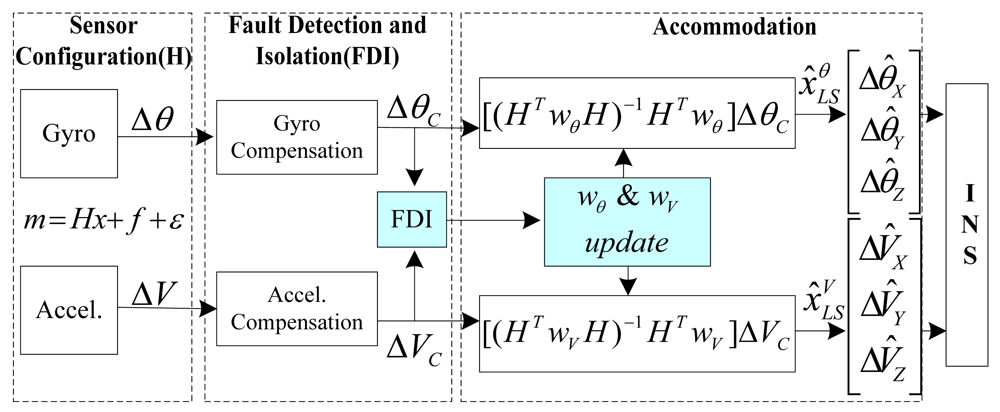
<p>The navigation accuracy of INS depends on the estimation error of the triad solution x(t), as shown in <xref ref-type="fig" rid="f1-sensors-09-08456">Figure 1</xref>. The estimation error of the triad solution x(t) in (<xref ref-type="disp-formula" rid="FD1">1</xref>) depends on the matrix H. Harrison <italic>et al.</italic> [<xref ref-type="bibr" rid="b14-sensors-09-08456">14</xref>] mentioned the condition which provides the least estimation error of x(t) resulting in the best navigation performance.</p>
<sec>
<title>Lemma 1 [<xref ref-type="bibr" rid="b14-sensors-09-08456">14</xref>]</title>
<p>Consider the measurement <xref ref-type="disp-formula" rid="FD1">Equation (1)</xref>, where the matrix H ∈ R<sup>n×3</sup> denotes the sensor configuration. When the eigenvalues of H<sup>T</sup>H are all equivalent to n/3, the sensor configuration provides the minimum estimation error of the triad solution x(t), which gives the best navigation performance.</p></sec></sec>
<sec>
<label>2.2.</label>
<title>Null Space of Measurement Matrix</title>
<p>A parity vector P(t) is obtained from the measurement using a matrix V as follows:
<disp-formula id="FD3">
<label>(3)</label>
<mml:math id="mm3" display="block">
<mml:semantics id="sm3">
<mml:mrow>
<mml:mtext>p</mml:mtext>
<mml:mo stretchy="false">(</mml:mo>
<mml:mtext>t</mml:mtext>
<mml:mo stretchy="false">)</mml:mo>
<mml:mo>=</mml:mo>
<mml:mtext>Vm</mml:mtext>
<mml:mo stretchy="false">(</mml:mo>
<mml:mtext>t</mml:mtext>
<mml:mo stretchy="false">)</mml:mo>
<mml:mo>=</mml:mo>
<mml:mtext>Vf</mml:mtext>
<mml:mo stretchy="false">(</mml:mo>
<mml:mtext>t</mml:mtext>
<mml:mo stretchy="false">)</mml:mo>
<mml:mo>+</mml:mo>
<mml:mrow>
<mml:mtext>V</mml:mtext>
<mml:mi mathvariant="normal">ε</mml:mi>
<mml:mo stretchy="false">(</mml:mo>
<mml:mtext>t</mml:mtext></mml:mrow>
<mml:mo stretchy="false">)</mml:mo></mml:mrow></mml:semantics></mml:math></disp-formula>where the matrix V satisfies:
<disp-formula id="FD4">
<label>(4)</label>
<mml:math id="mm4" display="block">
<mml:semantics id="sm4">
<mml:mrow>
<mml:mtext>VH</mml:mtext>
<mml:mo>=</mml:mo>
<mml:mn>0</mml:mn>
<mml:mo stretchy="false">(</mml:mo>
<mml:mtext>V</mml:mtext>
<mml:mo>∈</mml:mo>
<mml:msup>
<mml:mtext>R</mml:mtext>
<mml:mrow>
<mml:mo stretchy="false">(</mml:mo>
<mml:mtext>n</mml:mtext>
<mml:mo>−</mml:mo>
<mml:mn>3</mml:mn>
<mml:mo stretchy="false">)</mml:mo>
<mml:mo>×</mml:mo>
<mml:mtext>n</mml:mtext></mml:mrow></mml:msup>
<mml:mo stretchy="false">)</mml:mo>
<mml:mo>,</mml:mo>
<mml:msup>
<mml:mrow>
<mml:mtext>VV</mml:mtext></mml:mrow>
<mml:mtext>T</mml:mtext></mml:msup>
<mml:mo>=</mml:mo>
<mml:mrow>
<mml:mtext>I</mml:mtext>
<mml:mo>,</mml:mo>
<mml:mtext>V</mml:mtext></mml:mrow>
<mml:mo>=</mml:mo>
<mml:mrow>
<mml:mo>[</mml:mo>
<mml:mrow>
<mml:msub>
<mml:mtext>v</mml:mtext>
<mml:mn>1</mml:mn></mml:msub>
<mml:mspace width="0.2em"/>
<mml:msub>
<mml:mtext>v</mml:mtext>
<mml:mn>2</mml:mn></mml:msub>
<mml:mo>⋯</mml:mo>
<mml:msub>
<mml:mtext>v</mml:mtext>
<mml:mtext>n</mml:mtext></mml:msub></mml:mrow>
<mml:mo>]</mml:mo>
<mml:mo>.</mml:mo></mml:mrow></mml:mrow></mml:semantics></mml:math></disp-formula></p>
<p>The following Lemma shows the well-known singular value decomposition (SVD) result.</p>
<sec>
<title>Lemma 2</title>
<p>Suppose that n&gt;3. Every matrix H ∈ R<sup>n×3</sup> with rank 3 can be transformed into the form H = UΛ = U[Σ 0]<sup>T</sup>= U<sub>1</sub>Σ</p>
<p>where U and Σ satisfy the following. UU* =U*U=I<sub>n</sub>, U=[U<sub>1</sub> U<sub>2</sub>], U<sub>1</sub> ∈ R<sup>n×3</sup>, U<sub>2</sub> ∈ R<sup>n×(n-3)</sup>, Σ = diag{σ<sub>1</sub>, σ<sub>2</sub>, σ<sub>3</sub>} with σ<sub>1</sub> &gt; σ<sub>2</sub> &gt; σ<sub>3</sub> &gt; 0. ( )* denotes a complex conjugate transpose.</p>
<p>Measurement <xref ref-type="disp-formula" rid="FD1">Equation (1)</xref> can be described as follows:
<disp-formula id="FD5">
<mml:math id="mm5" display="block">
<mml:semantics id="sm5">
<mml:mrow>
<mml:mtext>m</mml:mtext>
<mml:mo>=</mml:mo>
<mml:msub>
<mml:mtext>U</mml:mtext>
<mml:mn>1</mml:mn></mml:msub>
<mml:mo>∑</mml:mo>
<mml:mtext>x</mml:mtext>
<mml:mo>+</mml:mo>
<mml:mtext>f</mml:mtext>
<mml:mo>+</mml:mo>
<mml:mi mathvariant="normal">ε</mml:mi></mml:mrow></mml:semantics></mml:math></disp-formula>and the parity vector can be obtained by multiplying U<sub>2</sub>* on the left:
<disp-formula id="FD6">
<label>(5)</label>
<mml:math id="mm6" display="block">
<mml:semantics id="sm6">
<mml:mrow>
<mml:mi>p</mml:mi>
<mml:mo>=</mml:mo>
<mml:msubsup>
<mml:mi>U</mml:mi>
<mml:mn>2</mml:mn>
<mml:mo>∗</mml:mo></mml:msubsup>
<mml:mi>m</mml:mi>
<mml:mo>=</mml:mo>
<mml:msubsup>
<mml:mi>U</mml:mi>
<mml:mn>2</mml:mn>
<mml:mo>∗</mml:mo></mml:msubsup>
<mml:mo stretchy="false">(</mml:mo>
<mml:mi>f</mml:mi>
<mml:mo>+</mml:mo>
<mml:mi>ε</mml:mi>
<mml:mo stretchy="false">)</mml:mo></mml:mrow></mml:semantics></mml:math></disp-formula></p>
<p>If we temporarily ignore the noise, we can obtain the null space projection of the fault f.
<disp-formula id="FD7">
<mml:math id="mm7" display="block">
<mml:semantics id="sm7">
<mml:mrow>
<mml:msub>
<mml:mrow>
<mml:mover accent="true">
<mml:mtext>f</mml:mtext>
<mml:mo>^</mml:mo></mml:mover></mml:mrow>
<mml:mrow>
<mml:mtext>null</mml:mtext></mml:mrow></mml:msub>
<mml:mo>=</mml:mo>
<mml:msub>
<mml:mtext>U</mml:mtext>
<mml:mn>2</mml:mn></mml:msub>
<mml:mtext>p</mml:mtext>
<mml:mo>=</mml:mo>
<mml:msub>
<mml:mtext>U</mml:mtext>
<mml:mn>2</mml:mn></mml:msub>
<mml:msubsup>
<mml:mtext>U</mml:mtext>
<mml:mn>2</mml:mn>
<mml:mo>∗</mml:mo></mml:msubsup>
<mml:mtext>m</mml:mtext>
<mml:mo>=</mml:mo>
<mml:msub>
<mml:mtext>U</mml:mtext>
<mml:mn>2</mml:mn></mml:msub>
<mml:msubsup>
<mml:mtext>U</mml:mtext>
<mml:mn>2</mml:mn>
<mml:mo>∗</mml:mo></mml:msubsup>
<mml:mtext>f</mml:mtext>
<mml:mo>,</mml:mo></mml:mrow></mml:semantics></mml:math></disp-formula>where U<sub>2</sub>U<sub>2</sub>* is the projector into the null space of the measurement matrix H. Thus, we can estimate the fault by using f̂<sub>null</sub>.</p></sec>
<sec>
<title>Remark 1</title>
<p>The matrix U<sub>2</sub>* in (<xref ref-type="disp-formula" rid="FD6">5</xref>) can be used as V in (<xref ref-type="disp-formula" rid="FD3">3</xref>). There are many solutions satisfying (<xref ref-type="disp-formula" rid="FD4">4</xref>) for matrix V and the SVD method provides one of them.</p></sec></sec></sec>
<sec>
<label>3.</label>
<title>Sensor Configuration for Seven Inertial Sensors</title>
<sec>
<label>3.1.</label>
<title>The Number of Sensors Required to Isolate a Double Fault</title>
<p>It is well-known that two faulty sensors can be isolated among six sensors. Gilmore <italic>et al.</italic> [<xref ref-type="bibr" rid="b6-sensors-09-08456">6</xref>] mentioned that the symmetric configuration with six sensors arranged on dodecahedron enables self-contained failure isolation for up to two out of six sensors. This is correct when two faults occur at different times. However, in the case where two faults occur simultaneously, which is generally referred to as a double fault, the isolation of the two faults cannot be guaranteed, as will be proved in Theorem 1.</p>
<sec>
<title>Theorem 1</title>
<p>Consider the measurement <xref ref-type="disp-formula" rid="FD1">Equation (1)</xref> with n=6. Suppose that the magnitude of the faults differ from each other, i.e., f<sub>i</sub> ≠ f<sub>j</sub> for i ≠ j. Then, the isolation of the double fault cannot always be achieved for some combinations of f<sub>i</sub> and f<sub>j</sub>.</p>
<sec>
<title>Proof</title>
<p>Define a unit vector e<sub>i</sub> for which only the i<sup>th</sup> component is 1 and the other components are zero. Then we obtain double faults as follows:
<disp-formula id="FD8">
<label>(6)</label>
<mml:math id="mm8" display="block">
<mml:semantics id="sm8">
<mml:mrow>
<mml:msub>
<mml:mover accent="true">
<mml:mi>f</mml:mi>
<mml:mo>^</mml:mo></mml:mover>
<mml:mrow>
<mml:mi>j</mml:mi>
<mml:mi>k</mml:mi></mml:mrow></mml:msub>
<mml:mo>=</mml:mo>
<mml:msub>
<mml:mi>U</mml:mi>
<mml:mn>2</mml:mn></mml:msub>
<mml:msubsup>
<mml:mi>U</mml:mi>
<mml:mn>2</mml:mn>
<mml:mo>∗</mml:mo></mml:msubsup>
<mml:mo stretchy="false">(</mml:mo>
<mml:msub>
<mml:mi>f</mml:mi>
<mml:mi>j</mml:mi></mml:msub>
<mml:msub>
<mml:mi>e</mml:mi>
<mml:mi>j</mml:mi></mml:msub>
<mml:mo>+</mml:mo>
<mml:msub>
<mml:mi>f</mml:mi>
<mml:mi>k</mml:mi></mml:msub>
<mml:msub>
<mml:mi>e</mml:mi>
<mml:mi>k</mml:mi></mml:msub>
<mml:mo stretchy="false">)</mml:mo>
<mml:mo>,</mml:mo>
<mml:mn>1</mml:mn>
<mml:mo>≤</mml:mo>
<mml:mi>j</mml:mi>
<mml:mo>&lt;</mml:mo>
<mml:mi>k</mml:mi>
<mml:mo>≤</mml:mo>
<mml:mn>6</mml:mn></mml:mrow></mml:semantics></mml:math></disp-formula></p>
<p>The difference between f̂<sub>jk</sub> and f̂<sub>lm</sub>
<disp-formula id="FD9">
<label>(7)</label>
<mml:math id="mm9" display="block">
<mml:semantics id="sm9">
<mml:mrow>
<mml:msub>
<mml:mover accent="true">
<mml:mi>f</mml:mi>
<mml:mo>^</mml:mo></mml:mover>
<mml:mrow>
<mml:mi>j</mml:mi>
<mml:mi>k</mml:mi></mml:mrow></mml:msub>
<mml:mo>−</mml:mo>
<mml:msub>
<mml:mover accent="true">
<mml:mi>f</mml:mi>
<mml:mo>^</mml:mo></mml:mover>
<mml:mrow>
<mml:mi>l</mml:mi>
<mml:mi>m</mml:mi></mml:mrow></mml:msub>
<mml:mo>=</mml:mo>
<mml:msub>
<mml:mi>U</mml:mi>
<mml:mn>2</mml:mn></mml:msub>
<mml:msubsup>
<mml:mi>U</mml:mi>
<mml:mn>2</mml:mn>
<mml:mo>∗</mml:mo></mml:msubsup>
<mml:mo stretchy="false">(</mml:mo>
<mml:msub>
<mml:mi>f</mml:mi>
<mml:mi>j</mml:mi></mml:msub>
<mml:msub>
<mml:mi>e</mml:mi>
<mml:mi>j</mml:mi></mml:msub>
<mml:mo>+</mml:mo>
<mml:msub>
<mml:mi>f</mml:mi>
<mml:mi>k</mml:mi></mml:msub>
<mml:msub>
<mml:mi>e</mml:mi>
<mml:mi>k</mml:mi></mml:msub>
<mml:mo>−</mml:mo>
<mml:msub>
<mml:mi>f</mml:mi>
<mml:mi>l</mml:mi></mml:msub>
<mml:msub>
<mml:mi>e</mml:mi>
<mml:mi>l</mml:mi></mml:msub>
<mml:mo>−</mml:mo>
<mml:msub>
<mml:mi>f</mml:mi>
<mml:mi>m</mml:mi></mml:msub>
<mml:msub>
<mml:mi>e</mml:mi>
<mml:mi>m</mml:mi></mml:msub>
<mml:mo stretchy="false">)</mml:mo></mml:mrow></mml:semantics></mml:math></disp-formula>can be zero for non-zero f<sub>j</sub>, f<sub>k</sub>, f<sub>l</sub> and f<sub>m</sub> since U<sub>2</sub>U<sub>2</sub>* has a maximum of three independent columns and, thus, there exist some combinations of f<sub>j</sub>, f<sub>k</sub>, f<sub>l</sub> and f<sub>m</sub> which make (<xref ref-type="disp-formula" rid="FD9">7</xref>) zero. Therefore, a double fault cannot be isolated for some combinations of f<sub>i</sub> and f<sub>j</sub>.</p>
<p>The simulation result for Theorem 1 can be seen in [<xref ref-type="bibr" rid="b15-sensors-09-08456">15</xref>]. If we need to isolate a double fault for any combination of f<sub>i</sub> and f<sub>j</sub>, seven sensors should be used.</p></sec></sec>
<sec>
<title>Theorem 2</title>
<p>Consider the measurement <xref ref-type="disp-formula" rid="FD1">Equation (1)</xref> with n=7. Then, the isolation of a double fault can be achieved for all combinations of f<sub>i</sub> and f<sub>j</sub>.</p>
<sec>
<title>Proof</title>
<p>Consider the double fault in (<xref ref-type="disp-formula" rid="FD8">6</xref>), where U<sub>2</sub> ∈ R<sup>7×4</sup>. The difference value:
<disp-formula id="FD10">
<mml:math id="mm10" display="block">
<mml:semantics id="sm10">
<mml:mrow>
<mml:msub>
<mml:mrow>
<mml:mover accent="true">
<mml:mtext>f</mml:mtext>
<mml:mo>^</mml:mo></mml:mover></mml:mrow>
<mml:mrow>
<mml:mtext>jk</mml:mtext></mml:mrow></mml:msub>
<mml:mo>−</mml:mo>
<mml:msub>
<mml:mrow>
<mml:mover accent="true">
<mml:mtext>f</mml:mtext>
<mml:mo>^</mml:mo></mml:mover></mml:mrow>
<mml:mrow>
<mml:mtext>lm</mml:mtext></mml:mrow></mml:msub>
<mml:mo>=</mml:mo>
<mml:msub>
<mml:mtext>U</mml:mtext>
<mml:mn>2</mml:mn></mml:msub>
<mml:msubsup>
<mml:mtext>U</mml:mtext>
<mml:mn>2</mml:mn>
<mml:mo>∗</mml:mo></mml:msubsup>
<mml:mo stretchy="false">(</mml:mo>
<mml:msub>
<mml:mtext>f</mml:mtext>
<mml:mtext>j</mml:mtext></mml:msub>
<mml:msub>
<mml:mtext>e</mml:mtext>
<mml:mtext>j</mml:mtext></mml:msub>
<mml:mo>+</mml:mo>
<mml:msub>
<mml:mtext>f</mml:mtext>
<mml:mtext>k</mml:mtext></mml:msub>
<mml:msub>
<mml:mtext>e</mml:mtext>
<mml:mtext>k</mml:mtext></mml:msub>
<mml:mo>−</mml:mo>
<mml:msub>
<mml:mtext>f</mml:mtext>
<mml:mtext>l</mml:mtext></mml:msub>
<mml:msub>
<mml:mtext>e</mml:mtext>
<mml:mn>l</mml:mn></mml:msub>
<mml:mo>−</mml:mo>
<mml:msub>
<mml:mtext>f</mml:mtext>
<mml:mtext>m</mml:mtext></mml:msub>
<mml:msub>
<mml:mtext>e</mml:mtext>
<mml:mtext>m</mml:mtext></mml:msub>
<mml:mo stretchy="false">)</mml:mo></mml:mrow></mml:semantics></mml:math></disp-formula>cannot be zero for non-zero combinations of f<sub>j</sub>, f<sub>k</sub>, f<sub>l</sub> and f<sub>m</sub> since U<sub>2</sub>U<sub>2</sub>* has a maximum of four independent columns. Thus, a double fault can be isolated for any combination of f<sub>i</sub> and f<sub>j</sub>.</p>
<p>Considering the result of Theorem 2, we need to use seven sensors to isolate double faults in any situation.</p></sec></sec></sec>
<sec>
<label>3.2.</label>
<title>Four Sensor Configurations to Obtain Best Navigation Accuracy</title>
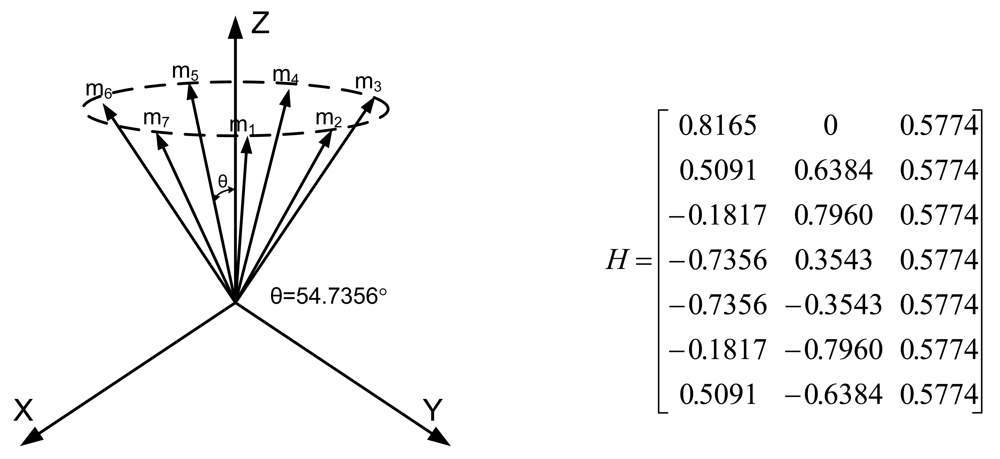
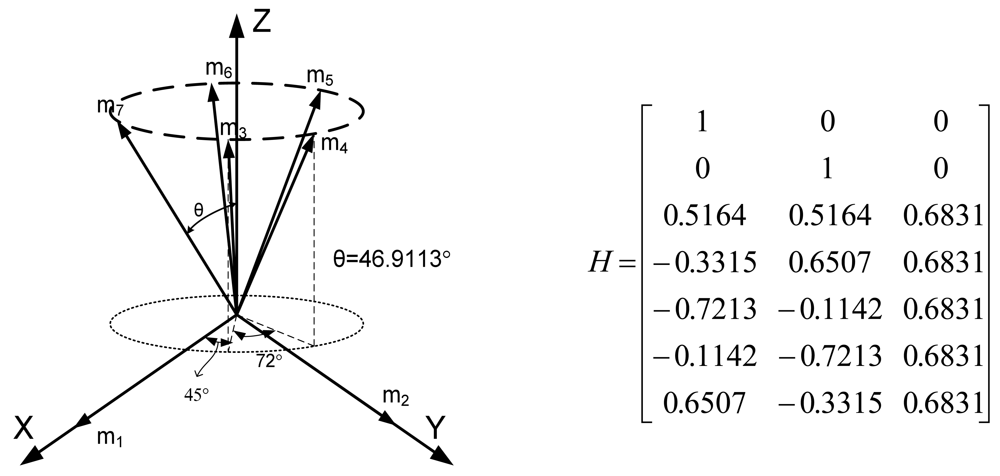
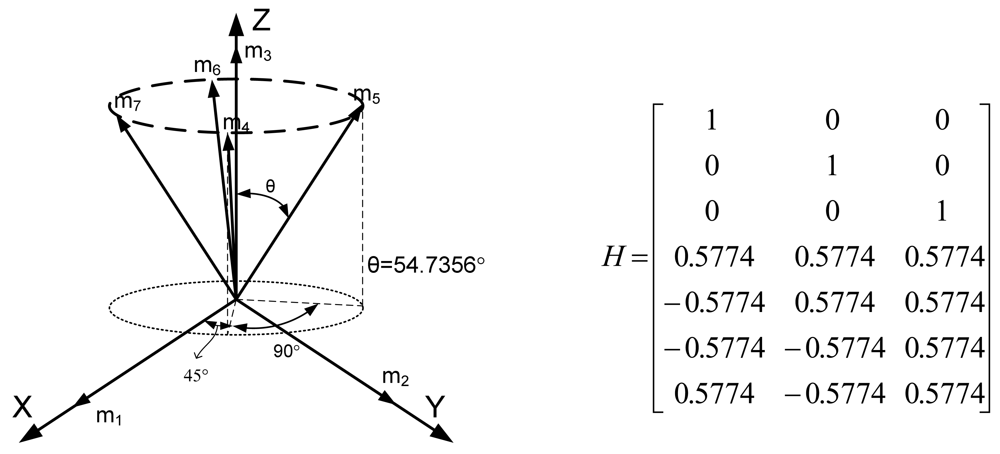
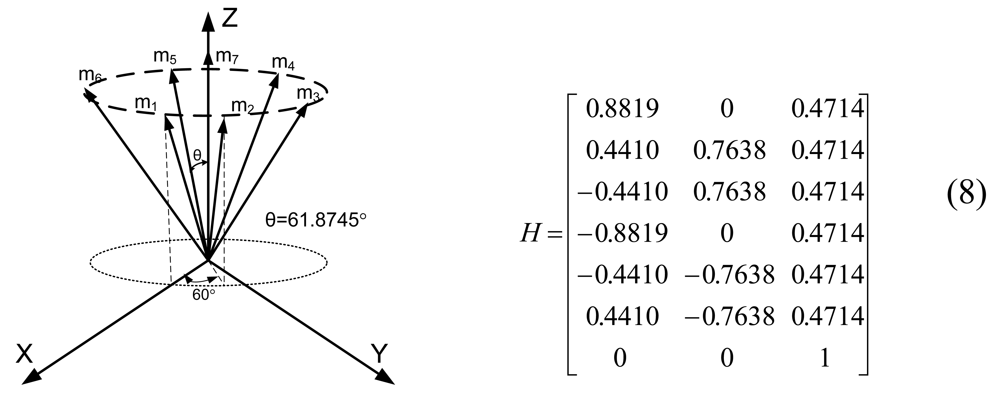
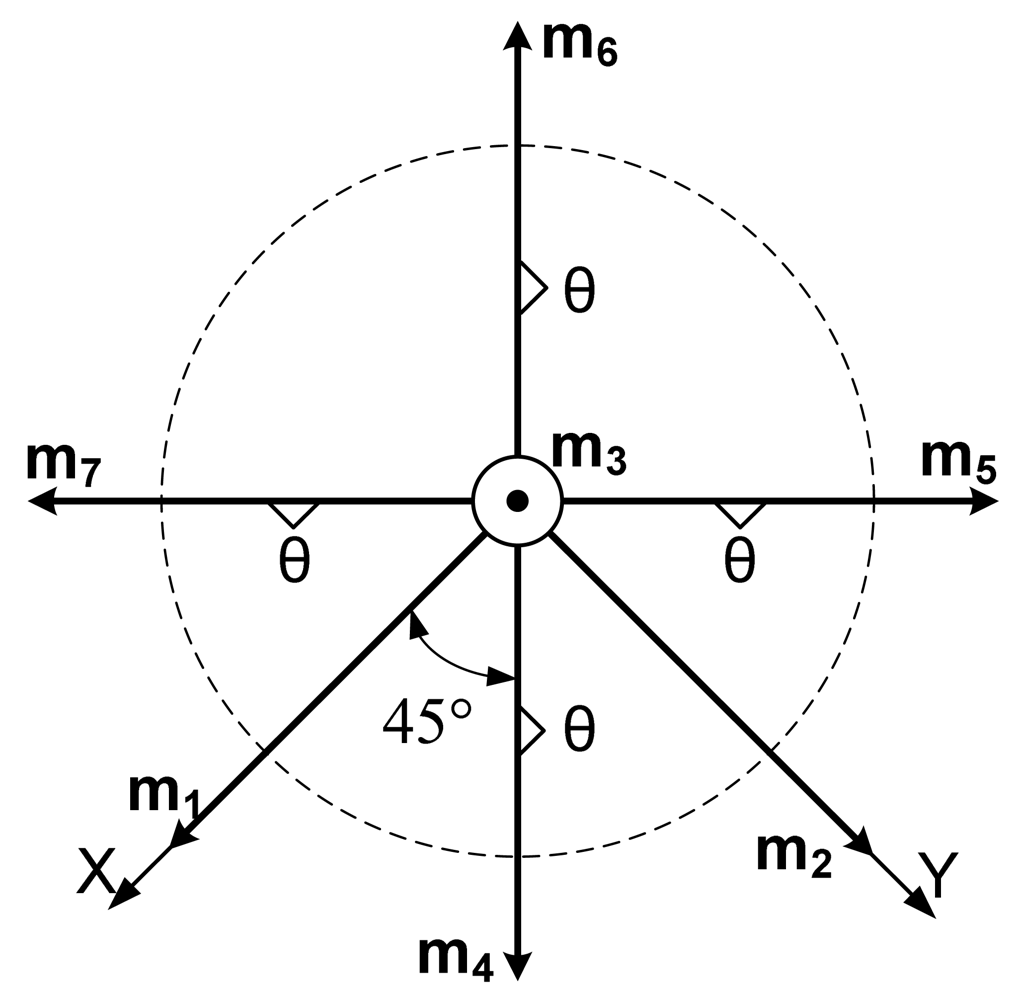
<p>Lemma 1 gives the condition for the sensor configuration to provide the least estimation error of x in (<xref ref-type="disp-formula" rid="FD2">2</xref>). Now we consider seven inertial sensors and there are many configurations which satisfy the condition, H<sup>T</sup>H = 7/3 I<sub>3</sub>. The configurations in <xref ref-type="fig" rid="f2-sensors-09-08456">Figures 2</xref> through <xref ref-type="fig" rid="f5-sensors-09-08456">5</xref> all satisfy the condition, H<sup>T</sup>H = 7/3 I<sub>3</sub>.</p></sec>
<sec>
<label>3.3.</label>
<title>FDI Performances of the Four Sensor Configurations</title>
<p>In this section, we suggest an appropriate sensor configuration in the case where seven inertial sensors are used, which takes into consideration simultaneously the navigation performance, FDI performance, and the complexity of the accommodation rule. This section considers the FDI performances for the four sensor configurations described in Section 3.2. Even though these four configurations all show the best navigation performance, their FDI performances are different from each other. For each configuration, we obtain the probability of correct isolation (PCI) with respective to each sensor. The PCI is obtained from 3,000 simulation runs and the PCI value in <xref ref-type="table" rid="t1-sensors-09-08456">Table 1</xref> denotes the average value of 30 raw PCIs. The GLT method[<xref ref-type="bibr" rid="b8-sensors-09-08456">8</xref>] is used for FDI algorithm with false alarm rate of 1 %.</p>
<p>The FDI performances of the four sensor configurations do not differ from each other very much. However, we can recognize that configuration 1 shows the worst FDI performance among the four configurations, while configurations 2 and 4 are better than configuration 3. Even though the magnitude of the fault varies, the PCI values of the four configurations show similar trends to those in <xref ref-type="table" rid="t1-sensors-09-08456">Table 1</xref>. Actually configuration 4 shows only slightly better PCI performance than configuration 2. However, we chose configuration 2 after considering the complexity of the accommodation rule. Configuration 2 has four sets of accommodation rules, which are explained in detail in Section 4.2, while configuration 4 has 13. The number of different combinations of seven different sensors, taken two at a time, without repetition, is <sub>7</sub>C<sub>2</sub> = 21. <xref ref-type="fig" rid="f6-sensors-09-08456">Figure 6</xref> is redrawn for configuration 4 in <xref ref-type="fig" rid="f5-sensors-09-08456">Figure 5</xref> and it shows symmetry; sensors 1 and 7 correspond to sensors 2 and 5, respectively, with respect to the plane consisting of sensors 3, 4, and 6. Among the 21 cases, eight are mirror images of the remaining 13 cases, as shown in <xref ref-type="table" rid="t2-sensors-09-08456">Table 2</xref>. Because of this complexity, we chose configuration 2 instead of configuration 4.</p></sec></sec>
<sec>
<label>4.</label>
<title>Accommodation Rule for Seven Inertial Sensors</title>
<sec>
<label>4.1.</label>
<title>Accommodation Rule for Single and Double Faults</title>
<p>In this section, the results of [<xref ref-type="bibr" rid="b10-sensors-09-08456">10</xref>,<xref ref-type="bibr" rid="b12-sensors-09-08456">12</xref>] are used for the accommodation rules for single and double faults.</p>
<sec>
<title>Category 0 [<xref ref-type="bibr" rid="b10-sensors-09-08456">10</xref>]</title>
<p>When a single fault satisfies the following inequality 
<inline-formula>
<mml:math id="mm11">
<mml:semantics id="sm11">
<mml:mrow>
<mml:mrow>
<mml:mo stretchy="false">|</mml:mo>
<mml:mrow>
<mml:msub>
<mml:mi>f</mml:mi>
<mml:mi>i</mml:mi></mml:msub></mml:mrow>
<mml:mo stretchy="false">|</mml:mo></mml:mrow>
<mml:mo>≥</mml:mo>
<mml:mfrac>
<mml:mi>σ</mml:mi>
<mml:mrow>
<mml:mrow>
<mml:mo stretchy="false">‖</mml:mo>
<mml:mrow>
<mml:msub>
<mml:mi>v</mml:mi>
<mml:mi>i</mml:mi></mml:msub></mml:mrow>
<mml:mo stretchy="false">‖</mml:mo></mml:mrow></mml:mrow></mml:mfrac></mml:mrow></mml:semantics></mml:math></inline-formula>, the faulty sensor should be excluded. The vector v<sub>i</sub> is the i<sup>th</sup> column of matrix V in (<xref ref-type="disp-formula" rid="FD4">4</xref>).</p></sec>
<sec>
<title>Category I [<xref ref-type="bibr" rid="b12-sensors-09-08456">12</xref>]</title>
<p>When double faults satisfy the following three inequalities:
<list list-type="roman-lower">
<list-item>
<p>
<inline-formula>
<mml:math id="mm12">
<mml:semantics id="sm12">
<mml:mrow>
<mml:msubsup>
<mml:mtext>f</mml:mtext>
<mml:mtext>i</mml:mtext>
<mml:mn>2</mml:mn></mml:msubsup>
<mml:msubsup>
<mml:mrow>
<mml:mrow>
<mml:mo stretchy="false">‖</mml:mo>
<mml:mrow>
<mml:msup>
<mml:mrow>
<mml:msup>
<mml:mrow>
<mml:mo stretchy="false">(</mml:mo>
<mml:mtext>H</mml:mtext></mml:mrow>
<mml:mtext>T</mml:mtext></mml:msup>
<mml:mtext>H</mml:mtext>
<mml:mo stretchy="false">)</mml:mo></mml:mrow>
<mml:mrow>
<mml:mo>−</mml:mo>
<mml:mn>1</mml:mn></mml:mrow></mml:msup>
<mml:msub>
<mml:mtext>h</mml:mtext>
<mml:mtext>i</mml:mtext></mml:msub></mml:mrow>
<mml:mo stretchy="false">‖</mml:mo></mml:mrow></mml:mrow>
<mml:mn>2</mml:mn>
<mml:mn>2</mml:mn></mml:msubsup>
<mml:mo>+</mml:mo>
<mml:msubsup>
<mml:mtext>f</mml:mtext>
<mml:mtext>j</mml:mtext>
<mml:mn>2</mml:mn></mml:msubsup>
<mml:msubsup>
<mml:mrow>
<mml:mrow>
<mml:mo stretchy="false">‖</mml:mo>
<mml:mrow>
<mml:msup>
<mml:mrow>
<mml:msup>
<mml:mrow>
<mml:mo stretchy="false">(</mml:mo>
<mml:mtext>H</mml:mtext></mml:mrow>
<mml:mtext>T</mml:mtext></mml:msup>
<mml:mtext>H</mml:mtext>
<mml:mo stretchy="false">)</mml:mo></mml:mrow>
<mml:mrow>
<mml:mo>−</mml:mo>
<mml:mn>1</mml:mn></mml:mrow></mml:msup>
<mml:msub>
<mml:mtext>h</mml:mtext>
<mml:mtext>j</mml:mtext></mml:msub></mml:mrow>
<mml:mo stretchy="false">‖</mml:mo></mml:mrow></mml:mrow>
<mml:mn>2</mml:mn>
<mml:mn>2</mml:mn></mml:msubsup>
<mml:mo>+</mml:mo>
<mml:mn>2</mml:mn>
<mml:msub>
<mml:mtext>f</mml:mtext>
<mml:mtext>i</mml:mtext></mml:msub>
<mml:msub>
<mml:mtext>f</mml:mtext>
<mml:mtext>j</mml:mtext></mml:msub>
<mml:mo>&lt;</mml:mo>
<mml:msup>
<mml:mrow>
<mml:msup>
<mml:mrow>
<mml:mo stretchy="false">(</mml:mo>
<mml:mtext>H</mml:mtext></mml:mrow>
<mml:mtext>T</mml:mtext></mml:msup>
<mml:mtext>H</mml:mtext>
<mml:mo stretchy="false">)</mml:mo></mml:mrow>
<mml:mrow>
<mml:mo>−</mml:mo>
<mml:mn>1</mml:mn></mml:mrow></mml:msup>
<mml:msub>
<mml:mtext>h</mml:mtext>
<mml:mtext>i</mml:mtext></mml:msub>
<mml:mo>,</mml:mo>
<mml:msup>
<mml:mrow>
<mml:msup>
<mml:mrow>
<mml:mo stretchy="false">(</mml:mo>
<mml:mtext>H</mml:mtext></mml:mrow>
<mml:mtext>T</mml:mtext></mml:msup>
<mml:mtext>H</mml:mtext>
<mml:mo stretchy="false">)</mml:mo></mml:mrow>
<mml:mrow>
<mml:mo>−</mml:mo>
<mml:mn>1</mml:mn></mml:mrow></mml:msup>
<mml:msub>
<mml:mtext>h</mml:mtext>
<mml:mtext>j</mml:mtext></mml:msub>
<mml:mo>&gt;</mml:mo>
<mml:mspace width="0.5em"/>
<mml:mo>&lt;</mml:mo>
<mml:msub>
<mml:mrow>
<mml:mi mathvariant="normal">ζ</mml:mi></mml:mrow>
<mml:mn>1</mml:mn></mml:msub></mml:mrow></mml:semantics></mml:math></inline-formula></p></list-item>
<list-item>
<p>
<inline-formula>
<mml:math id="mm13">
<mml:semantics id="sm13">
<mml:mrow>
<mml:msubsup>
<mml:mtext>f</mml:mtext>
<mml:mtext>i</mml:mtext>
<mml:mn>2</mml:mn></mml:msubsup>
<mml:mo>+</mml:mo>
<mml:msubsup>
<mml:mtext>f</mml:mtext>
<mml:mtext>j</mml:mtext>
<mml:mn>2</mml:mn></mml:msubsup>
<mml:mfrac>
<mml:mrow>
<mml:mrow>
<mml:mo stretchy="false">{</mml:mo>
<mml:mrow>
<mml:msubsup>
<mml:mrow>
<mml:mrow>
<mml:mo stretchy="false">‖</mml:mo>
<mml:mrow>
<mml:msup>
<mml:mrow>
<mml:msup>
<mml:mrow>
<mml:mo stretchy="false">(</mml:mo>
<mml:mtext>H</mml:mtext></mml:mrow>
<mml:mtext>T</mml:mtext></mml:msup>
<mml:mtext>H</mml:mtext>
<mml:mo stretchy="false">)</mml:mo></mml:mrow>
<mml:mrow>
<mml:mo>−</mml:mo>
<mml:mn>1</mml:mn></mml:mrow></mml:msup>
<mml:msub>
<mml:mtext>h</mml:mtext>
<mml:mtext>j</mml:mtext></mml:msub></mml:mrow>
<mml:mo stretchy="false">‖</mml:mo></mml:mrow></mml:mrow>
<mml:mn>2</mml:mn>
<mml:mn>2</mml:mn></mml:msubsup>
<mml:mo>−</mml:mo>
<mml:msubsup>
<mml:mrow>
<mml:mrow>
<mml:mo stretchy="false">‖</mml:mo>
<mml:mrow>
<mml:msup>
<mml:mrow>
<mml:msup>
<mml:mrow>
<mml:mo stretchy="false">(</mml:mo>
<mml:mtext>H</mml:mtext></mml:mrow>
<mml:mtext>T</mml:mtext></mml:msup>
<mml:msub>
<mml:mtext>W</mml:mtext>
<mml:mtext>i</mml:mtext></mml:msub>
<mml:mtext>H</mml:mtext>
<mml:mo stretchy="false">)</mml:mo></mml:mrow>
<mml:mrow>
<mml:mo>−</mml:mo>
<mml:mn>1</mml:mn></mml:mrow></mml:msup>
<mml:msub>
<mml:mtext>h</mml:mtext>
<mml:mtext>j</mml:mtext></mml:msub></mml:mrow>
<mml:mo stretchy="false">‖</mml:mo></mml:mrow></mml:mrow>
<mml:mn>2</mml:mn>
<mml:mn>2</mml:mn></mml:msubsup></mml:mrow>
<mml:mo stretchy="false">}</mml:mo></mml:mrow></mml:mrow>
<mml:mrow>
<mml:msubsup>
<mml:mrow>
<mml:mrow>
<mml:mo stretchy="false">‖</mml:mo>
<mml:mrow>
<mml:msup>
<mml:mrow>
<mml:msup>
<mml:mrow>
<mml:mo stretchy="false">(</mml:mo>
<mml:mtext>H</mml:mtext></mml:mrow>
<mml:mtext>T</mml:mtext></mml:msup>
<mml:mtext>H</mml:mtext>
<mml:mo stretchy="false">)</mml:mo></mml:mrow>
<mml:mrow>
<mml:mo>−</mml:mo>
<mml:mn>1</mml:mn></mml:mrow></mml:msup>
<mml:msub>
<mml:mtext>h</mml:mtext>
<mml:mtext>i</mml:mtext></mml:msub></mml:mrow>
<mml:mo stretchy="false">‖</mml:mo></mml:mrow></mml:mrow>
<mml:mn>2</mml:mn>
<mml:mn>2</mml:mn></mml:msubsup></mml:mrow></mml:mfrac>
<mml:mo>+</mml:mo>
<mml:mfrac>
<mml:mrow>
<mml:mn>2</mml:mn>
<mml:msub>
<mml:mtext>f</mml:mtext>
<mml:mtext>i</mml:mtext></mml:msub>
<mml:msub>
<mml:mtext>f</mml:mtext>
<mml:mtext>j</mml:mtext></mml:msub>
<mml:mo>&lt;</mml:mo>
<mml:msup>
<mml:mrow>
<mml:msup>
<mml:mrow>
<mml:mo stretchy="false">(</mml:mo>
<mml:mtext>H</mml:mtext></mml:mrow>
<mml:mtext>T</mml:mtext></mml:msup>
<mml:mtext>H</mml:mtext>
<mml:mo stretchy="false">)</mml:mo></mml:mrow>
<mml:mrow>
<mml:mo>−</mml:mo>
<mml:mn>1</mml:mn></mml:mrow></mml:msup>
<mml:msub>
<mml:mtext>h</mml:mtext>
<mml:mtext>i</mml:mtext></mml:msub>
<mml:mo>,</mml:mo>
<mml:msup>
<mml:mrow>
<mml:msup>
<mml:mrow>
<mml:mo stretchy="false">(</mml:mo>
<mml:mtext>H</mml:mtext></mml:mrow>
<mml:mtext>T</mml:mtext></mml:msup>
<mml:mtext>H</mml:mtext>
<mml:mo stretchy="false">)</mml:mo></mml:mrow>
<mml:mrow>
<mml:mo>−</mml:mo>
<mml:mn>1</mml:mn></mml:mrow></mml:msup>
<mml:msub>
<mml:mtext>h</mml:mtext>
<mml:mtext>j</mml:mtext></mml:msub>
<mml:mo>&gt;</mml:mo></mml:mrow>
<mml:mrow>
<mml:msubsup>
<mml:mrow>
<mml:mrow>
<mml:mo stretchy="false">‖</mml:mo>
<mml:mrow>
<mml:msup>
<mml:mrow>
<mml:msup>
<mml:mrow>
<mml:mo stretchy="false">(</mml:mo>
<mml:mtext>H</mml:mtext></mml:mrow>
<mml:mtext>T</mml:mtext></mml:msup>
<mml:mtext>H</mml:mtext>
<mml:mo stretchy="false">)</mml:mo></mml:mrow>
<mml:mrow>
<mml:mo>−</mml:mo>
<mml:mn>1</mml:mn></mml:mrow></mml:msup>
<mml:msub>
<mml:mtext>h</mml:mtext>
<mml:mtext>i</mml:mtext></mml:msub></mml:mrow>
<mml:mo stretchy="false">‖</mml:mo></mml:mrow></mml:mrow>
<mml:mn>2</mml:mn>
<mml:mn>2</mml:mn></mml:msubsup></mml:mrow></mml:mfrac>
<mml:mo stretchy="false">〈</mml:mo>
<mml:mfrac>
<mml:mrow>
<mml:msup>
<mml:mi>σ</mml:mi>
<mml:mn>2</mml:mn></mml:msup></mml:mrow>
<mml:mrow>
<mml:msubsup>
<mml:mrow>
<mml:mrow>
<mml:mo stretchy="false">‖</mml:mo>
<mml:mrow>
<mml:msub>
<mml:mtext>v</mml:mtext>
<mml:mtext>i</mml:mtext></mml:msub></mml:mrow>
<mml:mo stretchy="false">‖</mml:mo></mml:mrow></mml:mrow>
<mml:mn>2</mml:mn>
<mml:mn>2</mml:mn></mml:msubsup></mml:mrow></mml:mfrac></mml:mrow></mml:semantics></mml:math></inline-formula></p></list-item>
<list-item>
<p>| f<sub>j</sub> | &lt; | f<sub>i</sub> |</p></list-item></list></p>
<p>where 
<inline-formula>
<mml:math id="mm14">
<mml:semantics id="sm14">
<mml:mrow>
<mml:msub>
<mml:mrow>
<mml:mi mathvariant="normal">ζ</mml:mi></mml:mrow>
<mml:mn>1</mml:mn></mml:msub>
<mml:mo>=</mml:mo>
<mml:msup>
<mml:mrow>
<mml:mi mathvariant="normal">σ</mml:mi></mml:mrow>
<mml:mn>2</mml:mn></mml:msup>
<mml:mfrac>
<mml:mrow>
<mml:msubsup>
<mml:mrow>
<mml:mrow>
<mml:mo stretchy="false">‖</mml:mo>
<mml:msup>
<mml:mrow>
<mml:mo stretchy="false">(</mml:mo>
<mml:msup>
<mml:mtext>H</mml:mtext>
<mml:mtext>T</mml:mtext></mml:msup>
<mml:mtext>H</mml:mtext>
<mml:mo stretchy="false">)</mml:mo></mml:mrow>
<mml:mrow>
<mml:mo>−</mml:mo>
<mml:mn>1</mml:mn></mml:mrow></mml:msup>
<mml:msub>
<mml:mtext>h</mml:mtext>
<mml:mtext>i</mml:mtext></mml:msub>
<mml:mo stretchy="false">‖</mml:mo></mml:mrow></mml:mrow>
<mml:mn>2</mml:mn>
<mml:mn>2</mml:mn></mml:msubsup>
<mml:msubsup>
<mml:mrow>
<mml:mrow>
<mml:mo stretchy="false">‖</mml:mo>
<mml:msub>
<mml:mtext>v</mml:mtext>
<mml:mtext>j</mml:mtext></mml:msub>
<mml:mo stretchy="false">‖</mml:mo></mml:mrow></mml:mrow>
<mml:mn>2</mml:mn>
<mml:mn>2</mml:mn></mml:msubsup>
<mml:mo>+</mml:mo>
<mml:msubsup>
<mml:mrow>
<mml:mrow>
<mml:mo stretchy="false">‖</mml:mo>
<mml:msup>
<mml:mrow>
<mml:mo stretchy="false">(</mml:mo>
<mml:msup>
<mml:mtext>H</mml:mtext>
<mml:mtext>T</mml:mtext></mml:msup>
<mml:mtext>H</mml:mtext>
<mml:mo stretchy="false">)</mml:mo></mml:mrow>
<mml:mrow>
<mml:mo>−</mml:mo>
<mml:mn>1</mml:mn></mml:mrow></mml:msup>
<mml:msub>
<mml:mtext>h</mml:mtext>
<mml:mtext>j</mml:mtext></mml:msub>
<mml:mo stretchy="false">‖</mml:mo></mml:mrow></mml:mrow>
<mml:mn>2</mml:mn>
<mml:mn>2</mml:mn></mml:msubsup>
<mml:msubsup>
<mml:mrow>
<mml:mrow>
<mml:mo stretchy="false">‖</mml:mo>
<mml:msub>
<mml:mtext>v</mml:mtext>
<mml:mtext>i</mml:mtext></mml:msub>
<mml:mo stretchy="false">‖</mml:mo></mml:mrow></mml:mrow>
<mml:mn>2</mml:mn>
<mml:mn>2</mml:mn></mml:msubsup>
<mml:mo>−</mml:mo>
<mml:mi>γ</mml:mi></mml:mrow>
<mml:mrow>
<mml:msubsup>
<mml:mrow>
<mml:mrow>
<mml:mo stretchy="false">‖</mml:mo>
<mml:msup>
<mml:mrow>
<mml:mo stretchy="false">(</mml:mo>
<mml:msup>
<mml:mtext>H</mml:mtext>
<mml:mtext>T</mml:mtext></mml:msup>
<mml:mtext>H</mml:mtext>
<mml:mo stretchy="false">)</mml:mo></mml:mrow>
<mml:mrow>
<mml:mo>−</mml:mo>
<mml:mn>1</mml:mn></mml:mrow></mml:msup>
<mml:msub>
<mml:mtext>h</mml:mtext>
<mml:mtext>i</mml:mtext></mml:msub>
<mml:mo stretchy="false">‖</mml:mo></mml:mrow></mml:mrow>
<mml:mn>2</mml:mn>
<mml:mn>2</mml:mn></mml:msubsup>
<mml:msubsup>
<mml:mrow>
<mml:mrow>
<mml:mo stretchy="false">‖</mml:mo>
<mml:msup>
<mml:mrow>
<mml:mo stretchy="false">(</mml:mo>
<mml:msup>
<mml:mtext>H</mml:mtext>
<mml:mtext>T</mml:mtext></mml:msup>
<mml:mtext>H</mml:mtext>
<mml:mo stretchy="false">)</mml:mo></mml:mrow>
<mml:mrow>
<mml:mo>−</mml:mo>
<mml:mn>1</mml:mn></mml:mrow></mml:msup>
<mml:msub>
<mml:mtext>h</mml:mtext>
<mml:mtext>j</mml:mtext></mml:msub>
<mml:mo stretchy="false">‖</mml:mo></mml:mrow></mml:mrow>
<mml:mn>2</mml:mn>
<mml:mn>2</mml:mn></mml:msubsup>
<mml:msub>
<mml:mtext>D</mml:mtext>
<mml:mrow>
<mml:mtext>ij</mml:mtext></mml:mrow></mml:msub></mml:mrow></mml:mfrac></mml:mrow></mml:semantics></mml:math></inline-formula> and γ = 2 &lt; (H<sup>T</sup>H)<sup>−1</sup>h<sub>i</sub>, (H<sup>T</sup>H)<sup>−1</sup>h<sub>i</sub> &gt; &lt; v<sub>i</sub>, v<sub>j</sub> &gt;, D<sub>ij</sub> = ‖V<sub>i</sub>‖<sup>2</sup>‖V<sub>j</sub>‖<sup>2</sup> − &lt;V<sub>i</sub>, V<sub>j</sub>&gt;<sup>2</sup>.</p>
<p>the two faulty sensors should not be excluded.</p></sec>
<sec>
<title>Category II [<xref ref-type="bibr" rid="b12-sensors-09-08456">12</xref>]</title>
<p>When double faults satisfy the following three inequalities:
<list list-type="roman-lower">
<list-item>
<p>
<inline-formula>
<mml:math id="mm15">
<mml:semantics id="sm15">
<mml:mrow>
<mml:msubsup>
<mml:mtext>f</mml:mtext>
<mml:mtext>i</mml:mtext>
<mml:mn>2</mml:mn></mml:msubsup>
<mml:msubsup>
<mml:mrow>
<mml:mrow>
<mml:mo stretchy="false">‖</mml:mo>
<mml:msup>
<mml:mrow>
<mml:mo stretchy="false">(</mml:mo>
<mml:msup>
<mml:mtext>H</mml:mtext>
<mml:mtext>T</mml:mtext></mml:msup>
<mml:mtext>H</mml:mtext>
<mml:mo stretchy="false">)</mml:mo></mml:mrow>
<mml:mrow>
<mml:mo>−</mml:mo>
<mml:mn>1</mml:mn></mml:mrow></mml:msup>
<mml:msub>
<mml:mtext>h</mml:mtext>
<mml:mtext>i</mml:mtext></mml:msub>
<mml:mo stretchy="false">‖</mml:mo></mml:mrow></mml:mrow>
<mml:mn>2</mml:mn>
<mml:mn>2</mml:mn></mml:msubsup>
<mml:mo>+</mml:mo>
<mml:msubsup>
<mml:mtext>f</mml:mtext>
<mml:mtext>i</mml:mtext>
<mml:mn>2</mml:mn></mml:msubsup>
<mml:msubsup>
<mml:mrow>
<mml:mrow>
<mml:mo stretchy="false">‖</mml:mo>
<mml:msup>
<mml:mrow>
<mml:mo stretchy="false">(</mml:mo>
<mml:msup>
<mml:mtext>H</mml:mtext>
<mml:mtext>T</mml:mtext></mml:msup>
<mml:mtext>H</mml:mtext>
<mml:mo stretchy="false">)</mml:mo></mml:mrow>
<mml:mrow>
<mml:mo>−</mml:mo>
<mml:mn>1</mml:mn></mml:mrow></mml:msup>
<mml:msub>
<mml:mtext>h</mml:mtext>
<mml:mtext>j</mml:mtext></mml:msub>
<mml:mo stretchy="false">‖</mml:mo></mml:mrow></mml:mrow>
<mml:mn>2</mml:mn>
<mml:mn>2</mml:mn></mml:msubsup>
<mml:mo>+</mml:mo>
<mml:mn>2</mml:mn>
<mml:msub>
<mml:mtext>f</mml:mtext>
<mml:mtext>i</mml:mtext></mml:msub>
<mml:msub>
<mml:mtext>f</mml:mtext>
<mml:mtext>j</mml:mtext></mml:msub>
<mml:mo>&lt;</mml:mo>
<mml:msup>
<mml:mrow>
<mml:mo stretchy="false">(</mml:mo>
<mml:msup>
<mml:mtext>H</mml:mtext>
<mml:mtext>T</mml:mtext></mml:msup>
<mml:mtext>H</mml:mtext>
<mml:mo stretchy="false">)</mml:mo></mml:mrow>
<mml:mrow>
<mml:mo>−</mml:mo>
<mml:mn>1</mml:mn></mml:mrow></mml:msup>
<mml:msub>
<mml:mtext>h</mml:mtext>
<mml:mtext>i</mml:mtext></mml:msub>
<mml:mo>,</mml:mo>
<mml:msup>
<mml:mrow>
<mml:mo stretchy="false">(</mml:mo>
<mml:msup>
<mml:mtext>H</mml:mtext>
<mml:mtext>T</mml:mtext></mml:msup>
<mml:mtext>H</mml:mtext>
<mml:mo stretchy="false">)</mml:mo></mml:mrow>
<mml:mrow>
<mml:mo>−</mml:mo>
<mml:mn>1</mml:mn></mml:mrow></mml:msup>
<mml:msub>
<mml:mtext>h</mml:mtext>
<mml:mtext>j</mml:mtext></mml:msub>
<mml:mo>&gt;</mml:mo>
<mml:mspace width="0.5em"/>
<mml:mo>&lt;</mml:mo>
<mml:msub>
<mml:mrow>
<mml:mi mathvariant="normal">ζ</mml:mi></mml:mrow>
<mml:mn>1</mml:mn></mml:msub></mml:mrow></mml:semantics></mml:math></inline-formula></p></list-item>
<list-item>
<p>
<inline-formula>
<mml:math id="mm16">
<mml:semantics id="sm16">
<mml:mrow>
<mml:msubsup>
<mml:mtext>f</mml:mtext>
<mml:mtext>i</mml:mtext>
<mml:mn>2</mml:mn></mml:msubsup>
<mml:mo>+</mml:mo>
<mml:msubsup>
<mml:mtext>f</mml:mtext>
<mml:mtext>i</mml:mtext>
<mml:mn>2</mml:mn></mml:msubsup>
<mml:mfrac>
<mml:mrow>
<mml:mo stretchy="false">{</mml:mo>
<mml:msubsup>
<mml:mrow>
<mml:mrow>
<mml:mo stretchy="false">‖</mml:mo>
<mml:msup>
<mml:mrow>
<mml:mo stretchy="false">(</mml:mo>
<mml:msup>
<mml:mtext>H</mml:mtext>
<mml:mtext>T</mml:mtext></mml:msup>
<mml:mtext>H</mml:mtext>
<mml:mo stretchy="false">)</mml:mo></mml:mrow>
<mml:mrow>
<mml:mo>−</mml:mo>
<mml:mn>1</mml:mn></mml:mrow></mml:msup>
<mml:msub>
<mml:mtext>h</mml:mtext>
<mml:mtext>j</mml:mtext></mml:msub>
<mml:mo stretchy="false">‖</mml:mo></mml:mrow></mml:mrow>
<mml:mn>2</mml:mn>
<mml:mn>2</mml:mn></mml:msubsup>
<mml:mo>−</mml:mo>
<mml:msubsup>
<mml:mrow>
<mml:mrow>
<mml:mo stretchy="false">‖</mml:mo>
<mml:msup>
<mml:mrow>
<mml:mo stretchy="false">(</mml:mo>
<mml:msup>
<mml:mtext>H</mml:mtext>
<mml:mtext>T</mml:mtext></mml:msup>
<mml:msub>
<mml:mtext>W</mml:mtext>
<mml:mtext>i</mml:mtext></mml:msub>
<mml:mtext>H</mml:mtext>
<mml:mo stretchy="false">)</mml:mo></mml:mrow>
<mml:mrow>
<mml:mo>−</mml:mo>
<mml:mn>1</mml:mn></mml:mrow></mml:msup>
<mml:msub>
<mml:mtext>h</mml:mtext>
<mml:mtext>j</mml:mtext></mml:msub>
<mml:mo stretchy="false">‖</mml:mo></mml:mrow></mml:mrow>
<mml:mn>2</mml:mn>
<mml:mn>2</mml:mn></mml:msubsup>
<mml:mo stretchy="false">}</mml:mo></mml:mrow>
<mml:mrow>
<mml:msubsup>
<mml:mrow>
<mml:mrow>
<mml:mo stretchy="false">‖</mml:mo>
<mml:msup>
<mml:mrow>
<mml:mo stretchy="false">(</mml:mo>
<mml:msup>
<mml:mtext>H</mml:mtext>
<mml:mtext>T</mml:mtext></mml:msup>
<mml:mtext>H</mml:mtext>
<mml:mo stretchy="false">)</mml:mo></mml:mrow>
<mml:mrow>
<mml:mo>−</mml:mo>
<mml:mn>1</mml:mn></mml:mrow></mml:msup>
<mml:msub>
<mml:mtext>h</mml:mtext>
<mml:mtext>i</mml:mtext></mml:msub>
<mml:mo stretchy="false">‖</mml:mo></mml:mrow></mml:mrow>
<mml:mn>2</mml:mn>
<mml:mn>2</mml:mn></mml:msubsup></mml:mrow></mml:mfrac>
<mml:mo>+</mml:mo>
<mml:mfrac>
<mml:mrow>
<mml:mn>2</mml:mn>
<mml:msub>
<mml:mtext>f</mml:mtext>
<mml:mtext>i</mml:mtext></mml:msub>
<mml:msub>
<mml:mtext>f</mml:mtext>
<mml:mtext>j</mml:mtext></mml:msub>
<mml:mo>&lt;</mml:mo>
<mml:msup>
<mml:mrow>
<mml:mo stretchy="false">(</mml:mo>
<mml:msup>
<mml:mtext>H</mml:mtext>
<mml:mtext>T</mml:mtext></mml:msup>
<mml:mtext>H</mml:mtext>
<mml:mo stretchy="false">)</mml:mo></mml:mrow>
<mml:mrow>
<mml:mo>−</mml:mo>
<mml:mn>1</mml:mn></mml:mrow></mml:msup>
<mml:msub>
<mml:mtext>h</mml:mtext>
<mml:mtext>i</mml:mtext></mml:msub>
<mml:mo>,</mml:mo>
<mml:msup>
<mml:mrow>
<mml:mo stretchy="false">(</mml:mo>
<mml:msup>
<mml:mtext>H</mml:mtext>
<mml:mtext>T</mml:mtext></mml:msup>
<mml:mtext>H</mml:mtext>
<mml:mo stretchy="false">)</mml:mo></mml:mrow>
<mml:mrow>
<mml:mo>−</mml:mo>
<mml:mn>1</mml:mn></mml:mrow></mml:msup>
<mml:msub>
<mml:mtext>h</mml:mtext>
<mml:mtext>j</mml:mtext></mml:msub>
<mml:mo>&gt;</mml:mo></mml:mrow>
<mml:mrow>
<mml:msubsup>
<mml:mrow>
<mml:mrow>
<mml:mo stretchy="false">‖</mml:mo>
<mml:msup>
<mml:mrow>
<mml:mo stretchy="false">(</mml:mo>
<mml:msup>
<mml:mtext>H</mml:mtext>
<mml:mtext>T</mml:mtext></mml:msup>
<mml:mtext>H</mml:mtext>
<mml:mo stretchy="false">)</mml:mo></mml:mrow>
<mml:mrow>
<mml:mo>−</mml:mo>
<mml:mn>1</mml:mn></mml:mrow></mml:msup>
<mml:msub>
<mml:mtext>h</mml:mtext>
<mml:mtext>i</mml:mtext></mml:msub>
<mml:mo stretchy="false">‖</mml:mo></mml:mrow></mml:mrow>
<mml:mn>2</mml:mn>
<mml:mn>2</mml:mn></mml:msubsup></mml:mrow></mml:mfrac>
<mml:mo>≥</mml:mo>
<mml:mfrac>
<mml:mrow>
<mml:msup>
<mml:mi>σ</mml:mi>
<mml:mn>2</mml:mn></mml:msup></mml:mrow>
<mml:mrow>
<mml:msubsup>
<mml:mrow>
<mml:mo stretchy="false">‖</mml:mo>
<mml:msub>
<mml:mtext>v</mml:mtext>
<mml:mtext>i</mml:mtext></mml:msub>
<mml:mo stretchy="false">‖</mml:mo></mml:mrow>
<mml:mn>2</mml:mn>
<mml:mn>2</mml:mn></mml:msubsup></mml:mrow></mml:mfrac></mml:mrow></mml:semantics></mml:math></inline-formula></p></list-item>
<list-item>
<p>| f<sub>j</sub> | &lt; | f<sub>i</sub> |</p></list-item></list>the i<sup>th</sup> sensor should be excluded, but not the j<sup>th</sup> sensor.</p></sec>
<sec>
<title>Category III [<xref ref-type="bibr" rid="b12-sensors-09-08456">12</xref>]</title>
<p>When double faults satisfy the following three inequalities:
<list list-type="roman-lower">
<list-item>
<p>
<inline-formula>
<mml:math id="mm17">
<mml:semantics id="sm17">
<mml:mrow>
<mml:msubsup>
<mml:mtext>f</mml:mtext>
<mml:mtext>i</mml:mtext>
<mml:mn>2</mml:mn></mml:msubsup>
<mml:msubsup>
<mml:mrow>
<mml:mrow>
<mml:mo stretchy="false">‖</mml:mo>
<mml:msup>
<mml:mrow>
<mml:mo stretchy="false">(</mml:mo>
<mml:msup>
<mml:mtext>H</mml:mtext>
<mml:mtext>T</mml:mtext></mml:msup>
<mml:mtext>H</mml:mtext>
<mml:mo stretchy="false">)</mml:mo></mml:mrow>
<mml:mrow>
<mml:mo>−</mml:mo>
<mml:mn>1</mml:mn></mml:mrow></mml:msup>
<mml:msub>
<mml:mtext>h</mml:mtext>
<mml:mtext>i</mml:mtext></mml:msub>
<mml:mo stretchy="false">‖</mml:mo></mml:mrow></mml:mrow>
<mml:mn>2</mml:mn>
<mml:mn>2</mml:mn></mml:msubsup>
<mml:mo>+</mml:mo>
<mml:msubsup>
<mml:mtext>f</mml:mtext>
<mml:mtext>j</mml:mtext>
<mml:mn>2</mml:mn></mml:msubsup>
<mml:msubsup>
<mml:mrow>
<mml:mrow>
<mml:mo stretchy="false">‖</mml:mo>
<mml:msup>
<mml:mrow>
<mml:mo stretchy="false">(</mml:mo>
<mml:msup>
<mml:mtext>H</mml:mtext>
<mml:mtext>T</mml:mtext></mml:msup>
<mml:mtext>H</mml:mtext>
<mml:mo stretchy="false">)</mml:mo></mml:mrow>
<mml:mrow>
<mml:mo>−</mml:mo>
<mml:mn>1</mml:mn></mml:mrow></mml:msup>
<mml:msub>
<mml:mtext>h</mml:mtext>
<mml:mtext>j</mml:mtext></mml:msub>
<mml:mo stretchy="false">‖</mml:mo></mml:mrow></mml:mrow>
<mml:mn>2</mml:mn>
<mml:mn>2</mml:mn></mml:msubsup>
<mml:mo>+</mml:mo>
<mml:mn>2</mml:mn>
<mml:msub>
<mml:mtext>f</mml:mtext>
<mml:mtext>i</mml:mtext></mml:msub>
<mml:msub>
<mml:mtext>f</mml:mtext>
<mml:mtext>j</mml:mtext></mml:msub>
<mml:mo>&lt;</mml:mo>
<mml:msup>
<mml:mrow>
<mml:mo stretchy="false">(</mml:mo>
<mml:msup>
<mml:mtext>H</mml:mtext>
<mml:mtext>T</mml:mtext></mml:msup>
<mml:mtext>H</mml:mtext>
<mml:mo stretchy="false">)</mml:mo></mml:mrow>
<mml:mrow>
<mml:mo>−</mml:mo>
<mml:mn>1</mml:mn></mml:mrow></mml:msup>
<mml:msub>
<mml:mtext>h</mml:mtext>
<mml:mtext>i</mml:mtext></mml:msub>
<mml:mo>,</mml:mo>
<mml:msup>
<mml:mrow>
<mml:mo stretchy="false">(</mml:mo>
<mml:msup>
<mml:mtext>H</mml:mtext>
<mml:mtext>T</mml:mtext></mml:msup>
<mml:mtext>H</mml:mtext>
<mml:mo stretchy="false">)</mml:mo></mml:mrow>
<mml:mrow>
<mml:mo>−</mml:mo>
<mml:mn>1</mml:mn></mml:mrow></mml:msup>
<mml:msub>
<mml:mtext>h</mml:mtext>
<mml:mtext>j</mml:mtext></mml:msub>
<mml:mo>&gt;</mml:mo>
<mml:mspace width="0.5em"/>
<mml:mo>≥</mml:mo>
<mml:msub>
<mml:mi mathvariant="normal">ζ</mml:mi>
<mml:mn>1</mml:mn></mml:msub></mml:mrow></mml:semantics></mml:math></inline-formula></p></list-item>
<list-item>
<p>
<inline-formula>
<mml:math id="mm18">
<mml:semantics id="sm18">
<mml:mrow>
<mml:msubsup>
<mml:mrow>
<mml:mi>f</mml:mi></mml:mrow>
<mml:mtext>j</mml:mtext>
<mml:mn>2</mml:mn></mml:msubsup>
<mml:mo>&lt;</mml:mo>
<mml:msub>
<mml:mrow>
<mml:mi mathvariant="normal">ζ</mml:mi></mml:mrow>
<mml:mn>2</mml:mn></mml:msub></mml:mrow></mml:semantics></mml:math></inline-formula></p></list-item>
<list-item>
<p>| f<sub>j</sub> | &lt; | f<sub>i</sub> |</p></list-item></list>where 
<inline-formula>
<mml:math id="mm19">
<mml:semantics id="sm19">
<mml:mrow>
<mml:msub>
<mml:mi mathvariant="normal">ζ</mml:mi>
<mml:mn>2</mml:mn></mml:msub>
<mml:mo>=</mml:mo>
<mml:mfrac>
<mml:mrow>
<mml:mi>t</mml:mi>
<mml:mi>r</mml:mi>
<mml:mo stretchy="false">(</mml:mo>
<mml:mi>A</mml:mi>
<mml:mo stretchy="false">)</mml:mo></mml:mrow>
<mml:mrow>
<mml:mi>t</mml:mi>
<mml:mi>r</mml:mi>
<mml:mo stretchy="false">(</mml:mo>
<mml:mi>B</mml:mi>
<mml:mo stretchy="false">)</mml:mo></mml:mrow></mml:mfrac></mml:mrow></mml:semantics></mml:math></inline-formula>,
<disp-formula id="FD11">
<mml:math id="mm20" display="block">
<mml:semantics id="sm20">
<mml:mtable>
<mml:mtd columnalign="left">
<mml:mtr>
<mml:mrow>
<mml:mtext>A</mml:mtext>
<mml:mo>=</mml:mo>
<mml:msup>
<mml:mrow>
<mml:mi mathvariant="normal">σ</mml:mi></mml:mrow>
<mml:mn>2</mml:mn></mml:msup>
<mml:msup>
<mml:mrow>
<mml:mo stretchy="false">(</mml:mo>
<mml:msup>
<mml:mtext>H</mml:mtext>
<mml:mtext>T</mml:mtext></mml:msup>
<mml:mtext>H</mml:mtext>
<mml:mo stretchy="false">)</mml:mo></mml:mrow>
<mml:mrow>
<mml:mo>−</mml:mo>
<mml:mn>1</mml:mn></mml:mrow></mml:msup>
<mml:mrow>
<mml:mo stretchy="true">{</mml:mo>
<mml:mrow>
<mml:mfrac>
<mml:mn>1</mml:mn>
<mml:mrow>
<mml:msub>
<mml:mtext>D</mml:mtext>
<mml:mrow>
<mml:mtext>ij</mml:mtext></mml:mrow></mml:msub></mml:mrow></mml:mfrac>
<mml:mo stretchy="false">[</mml:mo>
<mml:msub>
<mml:mtext>h</mml:mtext>
<mml:mtext>i</mml:mtext></mml:msub>
<mml:msub>
<mml:mtext>h</mml:mtext>
<mml:mtext>j</mml:mtext></mml:msub>
<mml:mo stretchy="false">]</mml:mo>
<mml:mspace width="0.2em"/>
<mml:mrow>
<mml:mo>[</mml:mo>
<mml:mrow>
<mml:mtable>
<mml:mtr>
<mml:mtd>
<mml:mrow>
<mml:msubsup>
<mml:mrow>
<mml:mrow>
<mml:mo stretchy="false">‖</mml:mo>
<mml:mrow>
<mml:msub>
<mml:mtext>v</mml:mtext>
<mml:mtext>j</mml:mtext></mml:msub></mml:mrow>
<mml:mo stretchy="false">‖</mml:mo></mml:mrow></mml:mrow>
<mml:mn>2</mml:mn>
<mml:mn>2</mml:mn></mml:msubsup></mml:mrow></mml:mtd>
<mml:mtd>
<mml:mrow>
<mml:mo>−</mml:mo>
<mml:msup>
<mml:msub>
<mml:mtext>v</mml:mtext>
<mml:mtext>j</mml:mtext></mml:msub>
<mml:mtext>T</mml:mtext></mml:msup>
<mml:msub>
<mml:mtext>v</mml:mtext>
<mml:mtext>i</mml:mtext></mml:msub></mml:mrow></mml:mtd></mml:mtr>
<mml:mtr>
<mml:mtd>
<mml:mrow>
<mml:mo>−</mml:mo>
<mml:msup>
<mml:msub>
<mml:mtext>v</mml:mtext>
<mml:mtext>i</mml:mtext></mml:msub>
<mml:mtext>T</mml:mtext></mml:msup>
<mml:msub>
<mml:mtext>v</mml:mtext>
<mml:mtext>j</mml:mtext></mml:msub></mml:mrow></mml:mtd>
<mml:mtd>
<mml:mrow>
<mml:msubsup>
<mml:mrow>
<mml:mrow>
<mml:mo stretchy="false">‖</mml:mo>
<mml:mrow>
<mml:msub>
<mml:mtext>v</mml:mtext>
<mml:mtext>i</mml:mtext></mml:msub></mml:mrow>
<mml:mo stretchy="false">‖</mml:mo></mml:mrow></mml:mrow>
<mml:mn>2</mml:mn>
<mml:mn>2</mml:mn></mml:msubsup></mml:mrow></mml:mtd></mml:mtr></mml:mtable></mml:mrow>
<mml:mo>]</mml:mo></mml:mrow>
<mml:mspace width="0.2em"/>
<mml:mrow>
<mml:mo>[</mml:mo>
<mml:mrow>
<mml:mtable>
<mml:mtr>
<mml:mtd>
<mml:mrow>
<mml:msup>
<mml:msub>
<mml:mtext>h</mml:mtext>
<mml:mtext>i</mml:mtext></mml:msub>
<mml:mtext>T</mml:mtext></mml:msup></mml:mrow></mml:mtd></mml:mtr>
<mml:mtr>
<mml:mtd>
<mml:mrow>
<mml:msup>
<mml:msub>
<mml:mtext>h</mml:mtext>
<mml:mtext>j</mml:mtext></mml:msub>
<mml:mtext>T</mml:mtext></mml:msup></mml:mrow></mml:mtd></mml:mtr></mml:mtable></mml:mrow>
<mml:mo>]</mml:mo></mml:mrow>
<mml:mo>−</mml:mo>
<mml:mfrac>
<mml:mn>1</mml:mn>
<mml:mrow>
<mml:msup>
<mml:msub>
<mml:mrow>
<mml:mrow>
<mml:mo stretchy="false">‖</mml:mo>
<mml:mrow>
<mml:msub>
<mml:mtext>v</mml:mtext>
<mml:mtext>i</mml:mtext></mml:msub></mml:mrow>
<mml:mo stretchy="false">‖</mml:mo></mml:mrow></mml:mrow>
<mml:mn>2</mml:mn></mml:msub>
<mml:mn>2</mml:mn></mml:msup></mml:mrow></mml:mfrac>
<mml:msub>
<mml:mtext>h</mml:mtext>
<mml:mtext>i</mml:mtext></mml:msub>
<mml:msup>
<mml:msub>
<mml:mtext>h</mml:mtext>
<mml:mtext>i</mml:mtext></mml:msub>
<mml:mi>T</mml:mi></mml:msup></mml:mrow>
<mml:mo stretchy="true">}</mml:mo></mml:mrow>
<mml:msup>
<mml:mrow>
<mml:mo stretchy="false">(</mml:mo>
<mml:msup>
<mml:mtext>H</mml:mtext>
<mml:mtext>T</mml:mtext></mml:msup>
<mml:mtext>H</mml:mtext>
<mml:mo stretchy="false">)</mml:mo></mml:mrow>
<mml:mrow>
<mml:mo>−</mml:mo>
<mml:mn>1</mml:mn></mml:mrow></mml:msup></mml:mrow></mml:mtr></mml:mtd>
<mml:mtd columnalign="right">
<mml:mtr>
<mml:mrow>
<mml:mtext>and</mml:mtext></mml:mrow></mml:mtr></mml:mtd>
<mml:mtd columnalign="left">
<mml:mtr>
<mml:mrow>
<mml:mtext>B</mml:mtext>
<mml:mo>=</mml:mo>
<mml:msup>
<mml:mrow>
<mml:mo stretchy="false">(</mml:mo>
<mml:msup>
<mml:mtext>H</mml:mtext>
<mml:mtext>T</mml:mtext></mml:msup>
<mml:msub>
<mml:mtext>W</mml:mtext>
<mml:mtext>i</mml:mtext></mml:msub>
<mml:mtext>H</mml:mtext>
<mml:mo stretchy="false">)</mml:mo></mml:mrow>
<mml:mrow>
<mml:mo>−</mml:mo>
<mml:mn>1</mml:mn></mml:mrow></mml:msup>
<mml:msub>
<mml:mtext>h</mml:mtext>
<mml:mtext>j</mml:mtext></mml:msub>
<mml:msup>
<mml:msub>
<mml:mtext>h</mml:mtext>
<mml:mtext>j</mml:mtext></mml:msub>
<mml:mtext>T</mml:mtext></mml:msup>
<mml:msup>
<mml:mrow>
<mml:mo stretchy="false">(</mml:mo>
<mml:msup>
<mml:mtext>H</mml:mtext>
<mml:mtext>T</mml:mtext></mml:msup>
<mml:msub>
<mml:mtext>W</mml:mtext>
<mml:mtext>i</mml:mtext></mml:msub>
<mml:mtext>H</mml:mtext>
<mml:mo stretchy="false">)</mml:mo></mml:mrow>
<mml:mrow>
<mml:mo>−</mml:mo>
<mml:mn>1</mml:mn></mml:mrow></mml:msup></mml:mrow></mml:mtr></mml:mtd></mml:mtable></mml:semantics></mml:math></disp-formula>the i-th sensor should be excluded, but not the j-th sensor.</p></sec>
<sec>
<title>Category IV [<xref ref-type="bibr" rid="b12-sensors-09-08456">12</xref>]</title>
<p>When double faults satisfy the following three inequalities:
<list list-type="roman-lower">
<list-item>
<p>
<inline-formula>
<mml:math id="mm21">
<mml:semantics id="sm21">
<mml:mrow>
<mml:msubsup>
<mml:mtext>f</mml:mtext>
<mml:mtext>i</mml:mtext>
<mml:mn>2</mml:mn></mml:msubsup>
<mml:msubsup>
<mml:mrow>
<mml:mrow>
<mml:mo stretchy="false">‖</mml:mo>
<mml:msup>
<mml:mrow>
<mml:mo stretchy="false">(</mml:mo>
<mml:msup>
<mml:mtext>H</mml:mtext>
<mml:mtext>T</mml:mtext></mml:msup>
<mml:mtext>H</mml:mtext>
<mml:mo stretchy="false">)</mml:mo></mml:mrow>
<mml:mrow>
<mml:mo>−</mml:mo>
<mml:mn>1</mml:mn></mml:mrow></mml:msup>
<mml:msub>
<mml:mtext>h</mml:mtext>
<mml:mtext>i</mml:mtext></mml:msub>
<mml:mo stretchy="false">‖</mml:mo></mml:mrow></mml:mrow>
<mml:mn>2</mml:mn>
<mml:mn>2</mml:mn></mml:msubsup>
<mml:mo>+</mml:mo>
<mml:msubsup>
<mml:mtext>f</mml:mtext>
<mml:mtext>j</mml:mtext>
<mml:mn>2</mml:mn></mml:msubsup>
<mml:msubsup>
<mml:mrow>
<mml:mrow>
<mml:mo stretchy="false">‖</mml:mo>
<mml:msup>
<mml:mrow>
<mml:mo stretchy="false">(</mml:mo>
<mml:msup>
<mml:mtext>H</mml:mtext>
<mml:mtext>T</mml:mtext></mml:msup>
<mml:mtext>H</mml:mtext>
<mml:mo stretchy="false">)</mml:mo></mml:mrow>
<mml:mrow>
<mml:mo>−</mml:mo>
<mml:mn>1</mml:mn></mml:mrow></mml:msup>
<mml:msub>
<mml:mtext>h</mml:mtext>
<mml:mtext>j</mml:mtext></mml:msub>
<mml:mo stretchy="false">‖</mml:mo></mml:mrow></mml:mrow>
<mml:mn>2</mml:mn>
<mml:mn>2</mml:mn></mml:msubsup>
<mml:mo>+</mml:mo>
<mml:mn>2</mml:mn>
<mml:msub>
<mml:mtext>f</mml:mtext>
<mml:mtext>i</mml:mtext></mml:msub>
<mml:msub>
<mml:mtext>f</mml:mtext>
<mml:mtext>j</mml:mtext></mml:msub>
<mml:mo>&lt;</mml:mo>
<mml:msup>
<mml:mrow>
<mml:mo stretchy="false">(</mml:mo>
<mml:msup>
<mml:mtext>H</mml:mtext>
<mml:mtext>T</mml:mtext></mml:msup>
<mml:mtext>H</mml:mtext>
<mml:mo stretchy="false">)</mml:mo></mml:mrow>
<mml:mrow>
<mml:mo>−</mml:mo>
<mml:mn>1</mml:mn></mml:mrow></mml:msup>
<mml:msub>
<mml:mtext>h</mml:mtext>
<mml:mtext>i</mml:mtext></mml:msub>
<mml:mo>,</mml:mo>
<mml:msup>
<mml:mrow>
<mml:mo stretchy="false">(</mml:mo>
<mml:msup>
<mml:mtext>H</mml:mtext>
<mml:mtext>T</mml:mtext></mml:msup>
<mml:mtext>H</mml:mtext>
<mml:mo stretchy="false">)</mml:mo></mml:mrow>
<mml:mrow>
<mml:mo>−</mml:mo>
<mml:mn>1</mml:mn></mml:mrow></mml:msup>
<mml:msub>
<mml:mtext>h</mml:mtext>
<mml:mtext>j</mml:mtext></mml:msub>
<mml:mo>&gt;</mml:mo>
<mml:mspace width="0.5em"/>
<mml:mo>≥</mml:mo>
<mml:msub>
<mml:mrow>
<mml:mi mathvariant="normal">ζ</mml:mi></mml:mrow>
<mml:mn>1</mml:mn></mml:msub></mml:mrow></mml:semantics></mml:math></inline-formula></p></list-item>
<list-item>
<p>
<inline-formula>
<mml:math id="mm22">
<mml:semantics id="sm22">
<mml:mrow>
<mml:msubsup>
<mml:mtext>f</mml:mtext>
<mml:mtext>j</mml:mtext>
<mml:mn>2</mml:mn></mml:msubsup>
<mml:mo>≥</mml:mo>
<mml:msub>
<mml:mrow>
<mml:mi mathvariant="normal">ζ</mml:mi></mml:mrow>
<mml:mn>2</mml:mn></mml:msub></mml:mrow></mml:semantics></mml:math></inline-formula></p></list-item>
<list-item>
<p>| f<sub>j</sub> | &lt; | f<sub>i</sub> |</p></list-item></list>the two faulty sensors should be excluded.</p></sec>
<sec>
<title>Remark 2</title>
<p>For categories I through IV above, we consider only half of the first quadrant in two dimensional space. i.e., 0 ≤ θ ≤ π/4.</p></sec></sec>
<sec>
<label>4.2.</label>
<title>Accommodation Rule of Configuration 2</title>
<p>In Section 3.3, we choose sensor configuration 2, as shown in <xref ref-type="fig" rid="f7-sensors-09-08456">Figure 7</xref>, considering the navigation performance, FDI performance, and the complexity of the accommodation rule, altogether.</p>
<p>In this case, the measurement matrix H is given in (8) and has the following relations:
<disp-formula id="FD12">
<mml:math id="mm23" display="block">
<mml:semantics id="sm23">
<mml:mrow>
<mml:msup>
<mml:mtext>H</mml:mtext>
<mml:mtext>T</mml:mtext></mml:msup>
<mml:mtext>H</mml:mtext>
<mml:mo>=</mml:mo>
<mml:mn>7</mml:mn>
<mml:mo>/</mml:mo>
<mml:mn>3</mml:mn>
<mml:msub>
<mml:mtext>I</mml:mtext>
<mml:mn>3</mml:mn></mml:msub>
<mml:mo>,</mml:mo>
<mml:msub>
<mml:mrow>
<mml:mrow>
<mml:mo stretchy="false">‖</mml:mo>
<mml:mrow>
<mml:msub>
<mml:mtext>h</mml:mtext>
<mml:mtext>i</mml:mtext></mml:msub></mml:mrow>
<mml:mo stretchy="false">‖</mml:mo></mml:mrow></mml:mrow>
<mml:mn>2</mml:mn></mml:msub>
<mml:mo>=</mml:mo>
<mml:mn>1</mml:mn>
<mml:mo>,</mml:mo>
<mml:msub>
<mml:mrow>
<mml:mrow>
<mml:mo stretchy="false">‖</mml:mo>
<mml:mrow>
<mml:msub>
<mml:mtext>v</mml:mtext>
<mml:mtext>i</mml:mtext></mml:msub></mml:mrow>
<mml:mo stretchy="false">‖</mml:mo></mml:mrow></mml:mrow>
<mml:mn>2</mml:mn></mml:msub>
<mml:mo>=</mml:mo>
<mml:mn>0.7559</mml:mn>
<mml:mo stretchy="false">(</mml:mo>
<mml:mi mathvariant="normal">i</mml:mi>
<mml:mo>=</mml:mo>
<mml:mn>1</mml:mn>
<mml:mo>,</mml:mo>
<mml:mn>2</mml:mn>
<mml:mo>,</mml:mo>
<mml:mo>…</mml:mo>
<mml:mo>,</mml:mo>
<mml:mn>7</mml:mn>
<mml:mo stretchy="false">)</mml:mo></mml:mrow></mml:semantics></mml:math></disp-formula></p>
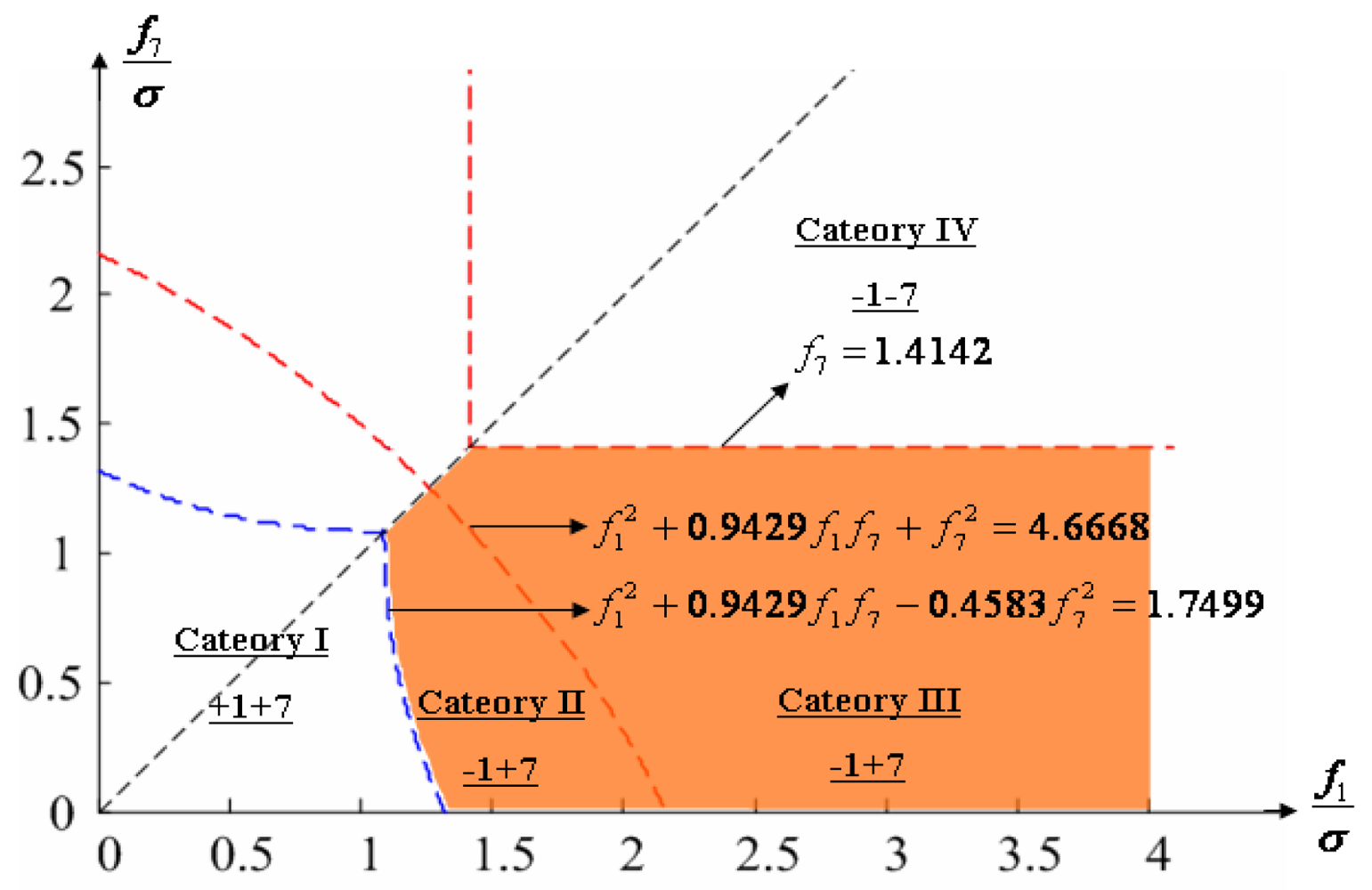
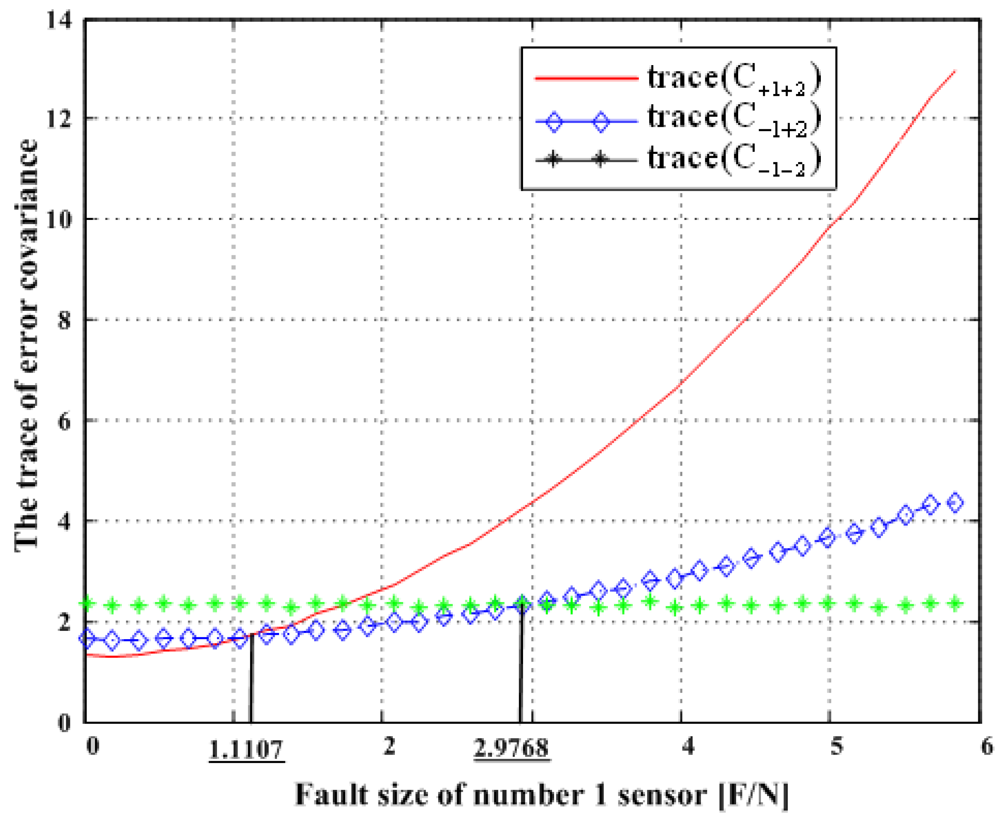
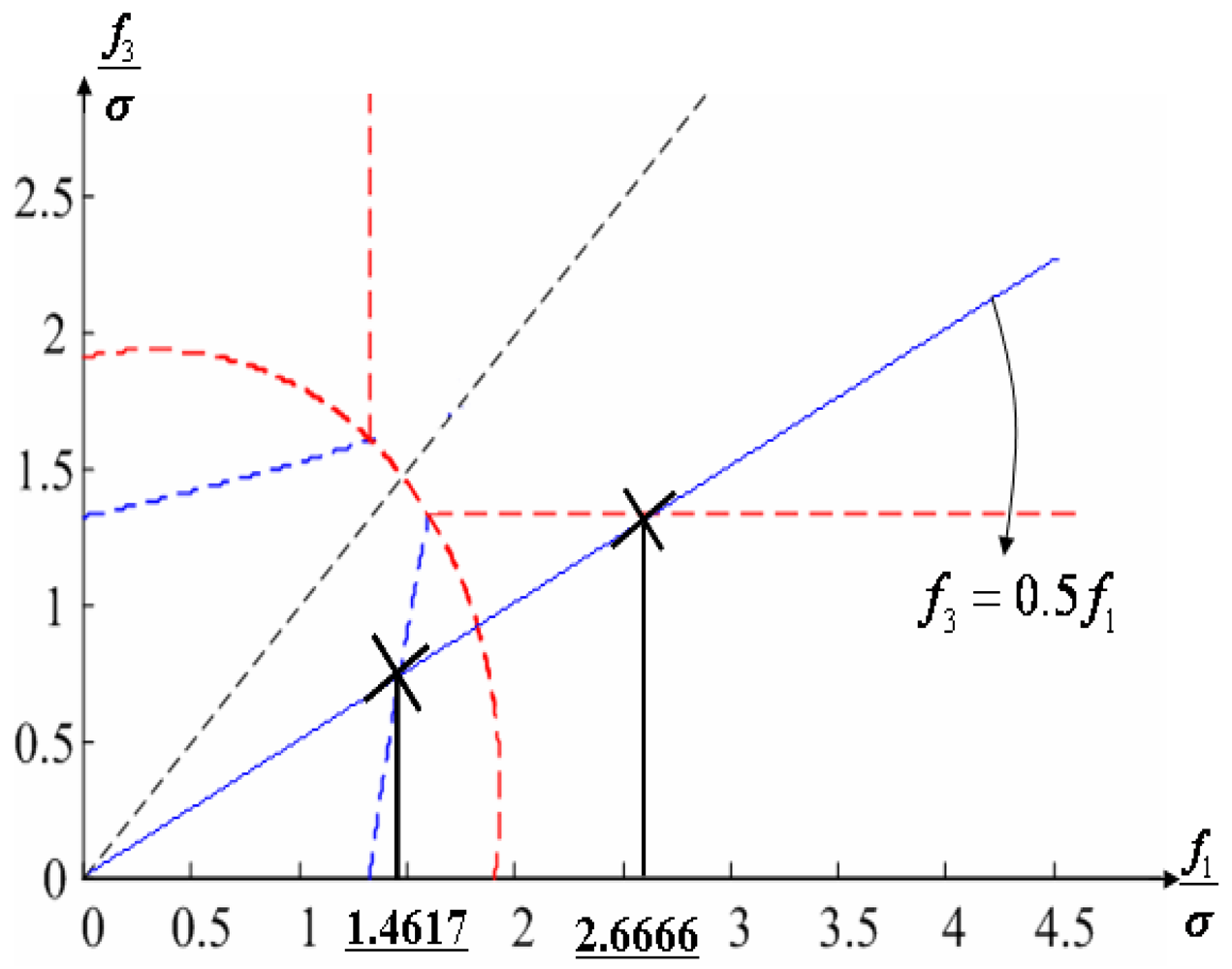
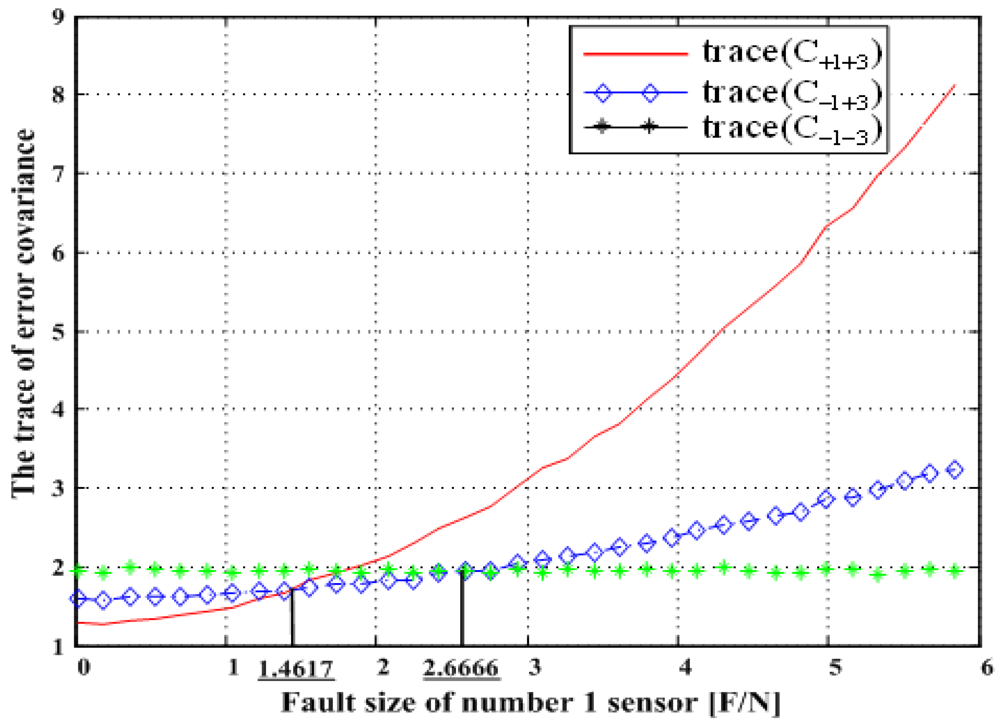
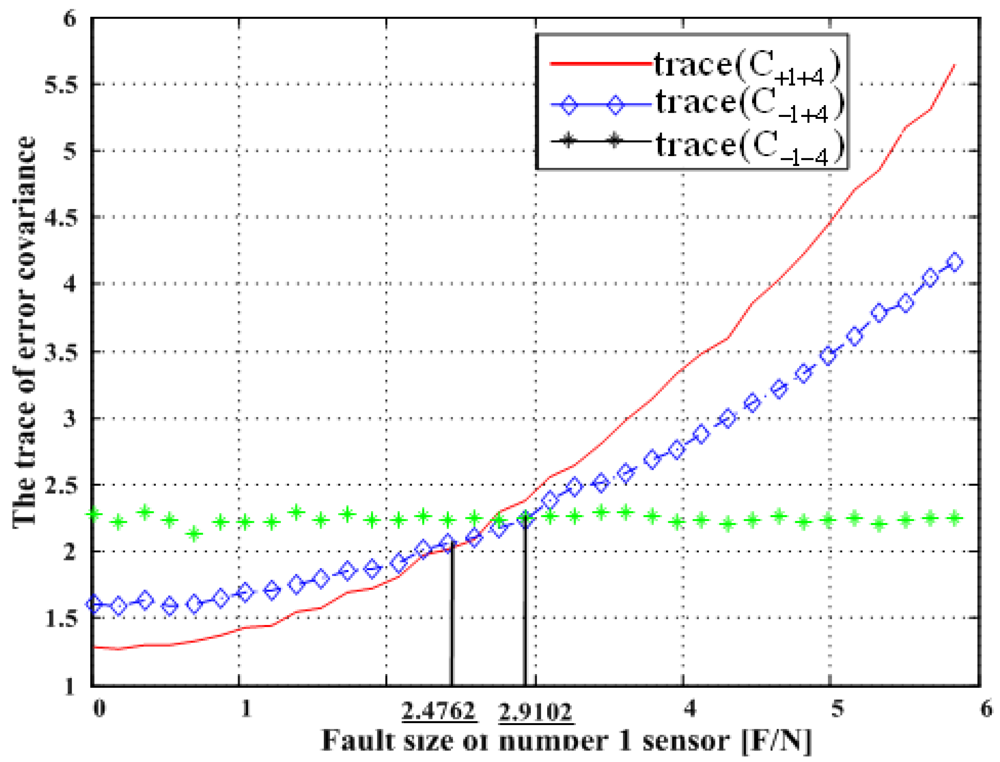
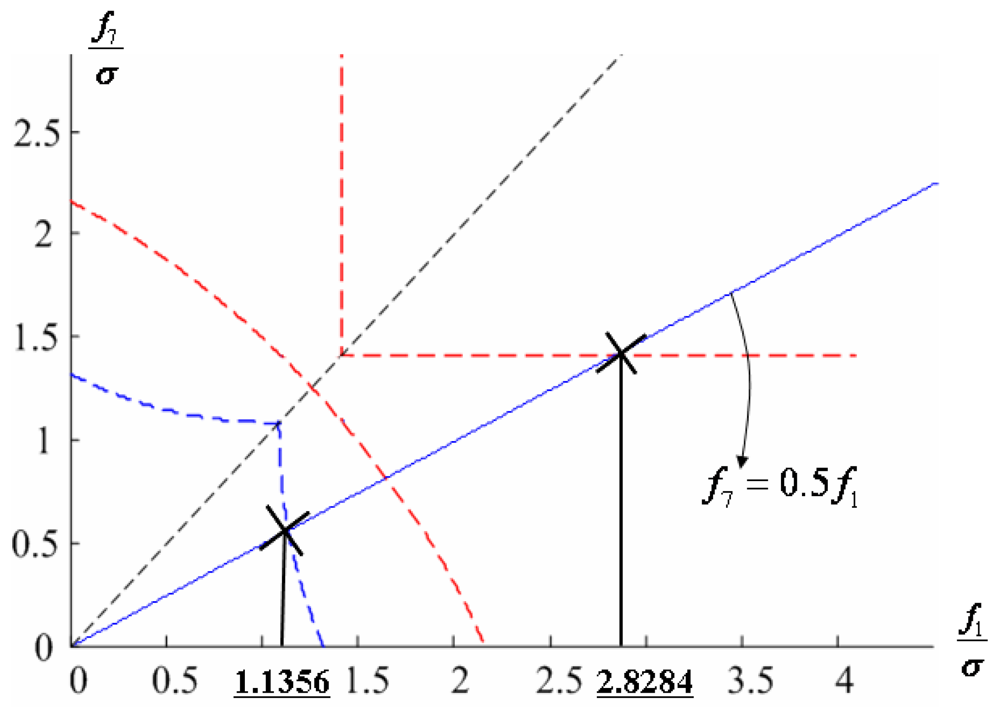
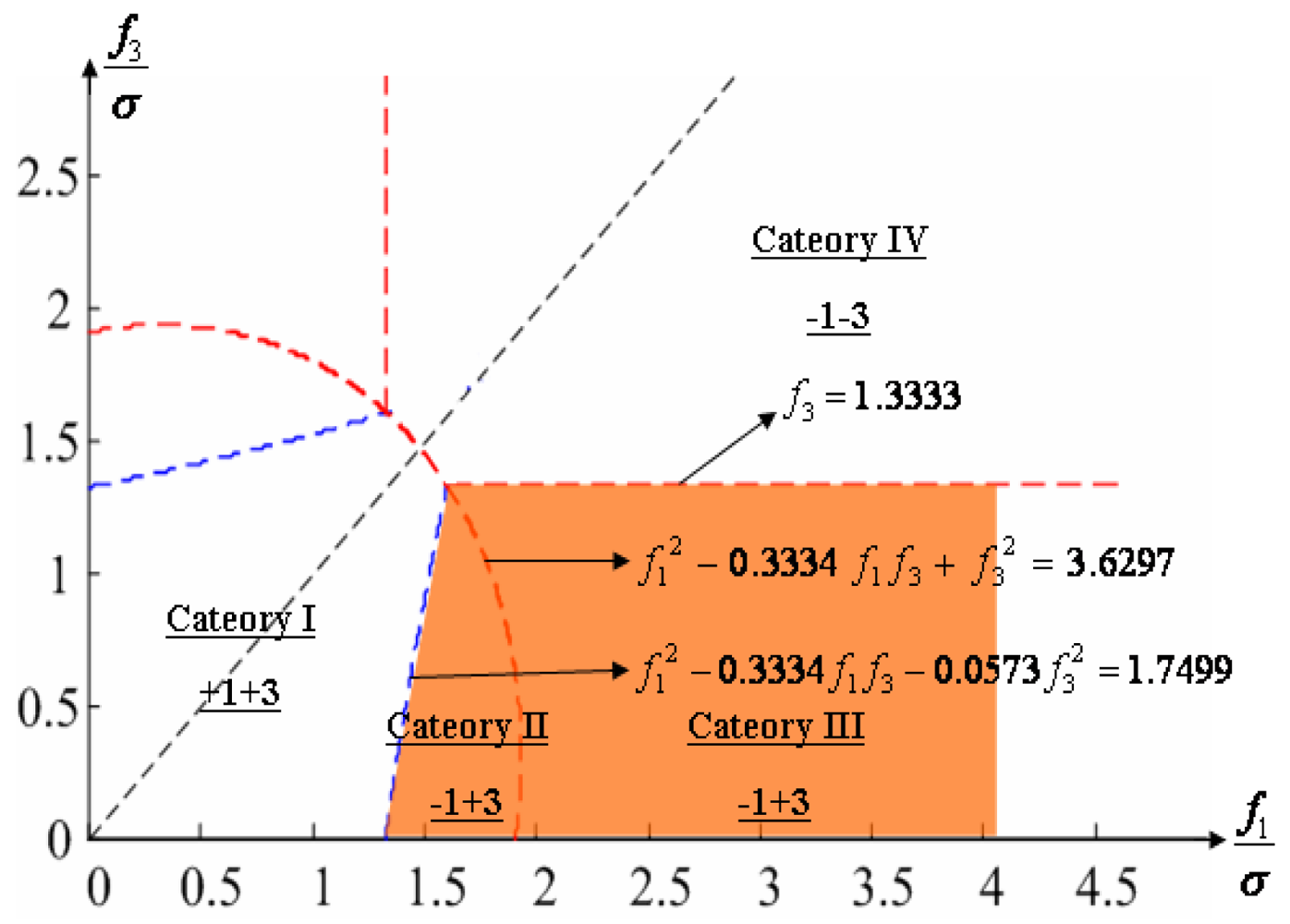
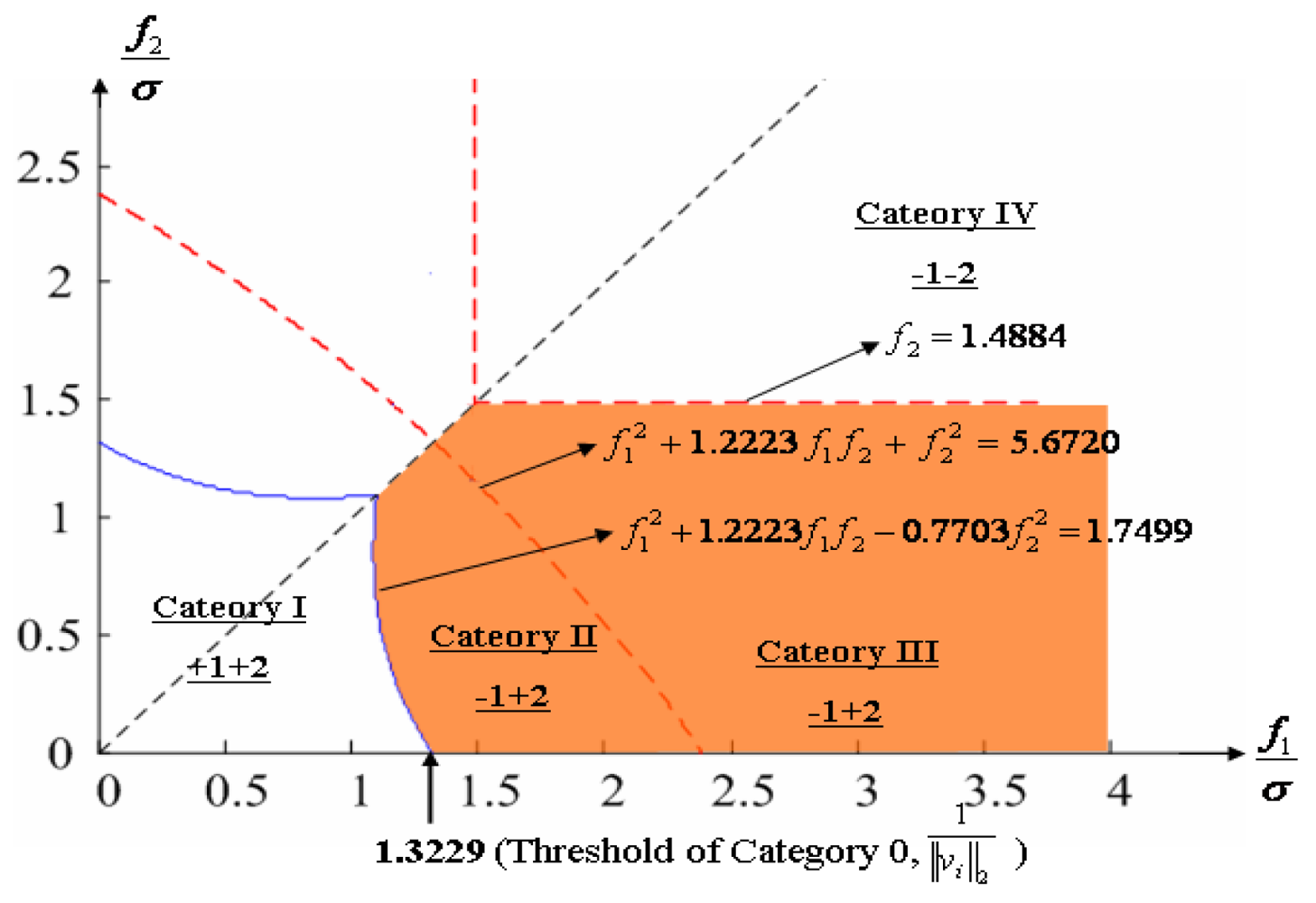
<p>Configuration 2 in <xref ref-type="fig" rid="f7-sensors-09-08456">Figure 7</xref> has six sensor input axes (i=1, …, 6) on the cone with angle 61.8745° from the Z-axis and one sensor input axis (i=7) on the Z-axis. There are four kinds of combinations of double fault. Three double fault combinations take place on the cone (f<sub>i</sub>, i=1, …, 6) : adjacent double faults (f<sub>i</sub> and f<sub>i+1</sub>), double faults skipping a sensor (f<sub>i</sub> and f<sub>i+2</sub>), and double faults skipping two sensors (f<sub>i</sub> and f<sub>i+3</sub>). The other double fault combination takes place between the Z-axis (f<sub>7</sub>) and one sensor on the cone (f<sub>i</sub>, i=1, …, 6). For simplicity, we call these faults the 1<sup>st</sup> and 2<sup>nd</sup>, 1<sup>st</sup> and 3<sup>rd</sup>, 1<sup>st</sup> and 4<sup>th</sup>, and 1<sup>st</sup> and 7<sup>th</sup> faults, respectively. The regions of Category 0 through Category IV in Section 4.1 are shown in <xref ref-type="fig" rid="f8-sensors-09-08456">Figures 8</xref> through <xref ref-type="fig" rid="f11-sensors-09-08456">11</xref>, respectively, where “-i” means that the i<sup>th</sup> sensor should be excluded and “+j” means that the j<sup>th</sup> sensor should be included.</p></sec>
<sec>
<label>4.3.</label>
<title>Implementation of the Accommodation Rules: Update Matrix W</title>
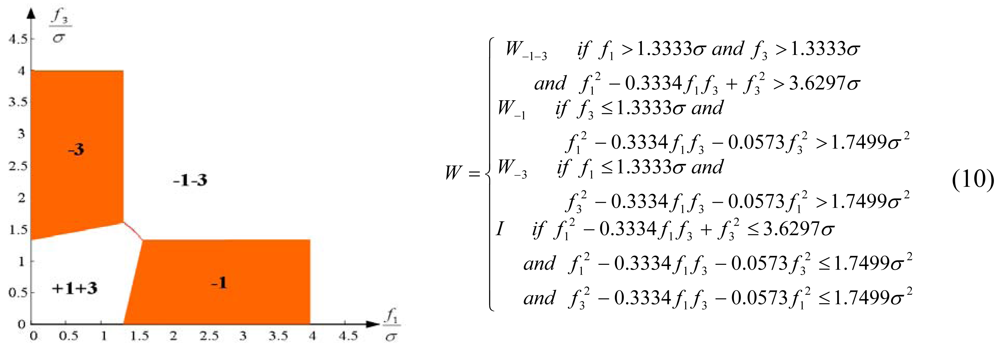
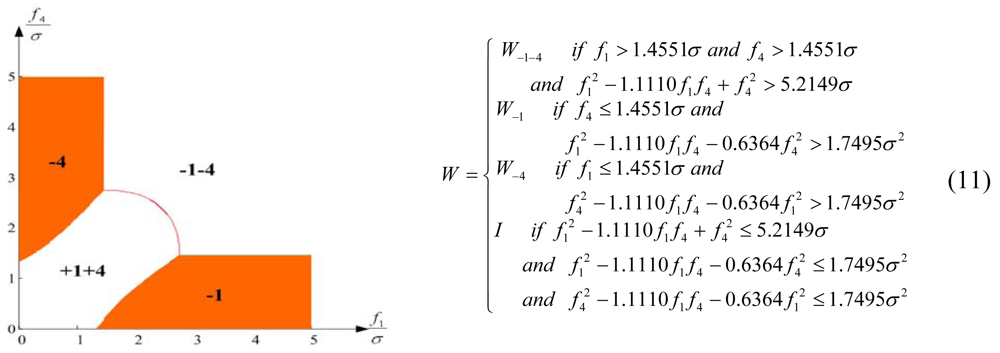
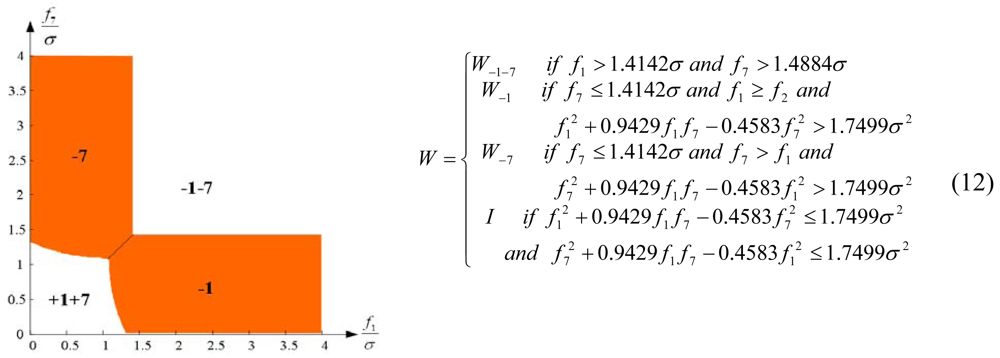
<p>The accommodation rule is implemented by updating matrix W as in (9)–(12), where W<sub>-i-j</sub> denotes the identity matrix with the i<sup>th</sup> and j<sup>th</sup> diagonal components having zero values, and W<sub>-i</sub> denotes the identity matrix with the i<sup>th</sup> diagonal component having zero value. <xref ref-type="fig" rid="f12-sensors-09-08456">Figures 12</xref> through <xref ref-type="fig" rid="f15-sensors-09-08456">15</xref> show the accommodation rule in the first quadrant.</p></sec></sec>
<sec>
<label>5.</label>
<title>Simulations for Accommodation Rules</title>
<p>In this section, Monte Carlo simulations are performed 10,000 times for each double fault combination to confirm that the accommodation rules are correct. Seven identical sensors are used with configuration 2 as shown in <xref ref-type="fig" rid="f7-sensors-09-08456">Figure 7</xref>. For the measurement matrix H in (8), the matrix V satisfying VH = 0 and VV<sup>T</sup> = I can be obtained by using the SVD method as follows:
<disp-formula id="FD13">
<mml:math id="mm24" display="block">
<mml:semantics id="sm24">
<mml:mrow>
<mml:mi>V</mml:mi>
<mml:mo>=</mml:mo>
<mml:mrow>
<mml:mo>[</mml:mo>
<mml:mrow>
<mml:mtable>
<mml:mtr>
<mml:mtd>
<mml:mrow>
<mml:mn>0.3223</mml:mn></mml:mrow></mml:mtd>
<mml:mtd>
<mml:mrow>
<mml:mo>−</mml:mo>
<mml:mn>0.0842</mml:mn></mml:mrow></mml:mtd>
<mml:mtd>
<mml:mrow>
<mml:mo>−</mml:mo>
<mml:mn>0.5298</mml:mn></mml:mrow></mml:mtd>
<mml:mtd>
<mml:mrow>
<mml:mn>0.7189</mml:mn></mml:mrow></mml:mtd>
<mml:mtd>
<mml:mrow>
<mml:mo>−</mml:mo>
<mml:mn>0.2640</mml:mn></mml:mrow></mml:mtd>
<mml:mtd>
<mml:mrow>
<mml:mo>−</mml:mo>
<mml:mn>0.1464</mml:mn></mml:mrow></mml:mtd>
<mml:mtd>
<mml:mrow>
<mml:mo>−</mml:mo>
<mml:mn>0.0168</mml:mn></mml:mrow></mml:mtd></mml:mtr>
<mml:mtr>
<mml:mtd>
<mml:mrow>
<mml:mn>0.1671</mml:mn></mml:mrow></mml:mtd>
<mml:mtd>
<mml:mrow>
<mml:mn>0.3628</mml:mn></mml:mrow></mml:mtd>
<mml:mtd>
<mml:mrow>
<mml:mo>−</mml:mo>
<mml:mn>0.4380</mml:mn></mml:mrow></mml:mtd>
<mml:mtd>
<mml:mrow>
<mml:mo>−</mml:mo>
<mml:mn>0.1871</mml:mn></mml:mrow></mml:mtd>
<mml:mtd>
<mml:mrow>
<mml:mn>0.6654</mml:mn></mml:mrow></mml:mtd>
<mml:mtd>
<mml:mrow>
<mml:mo>−</mml:mo>
<mml:mn>0.3495</mml:mn></mml:mrow></mml:mtd>
<mml:mtd>
<mml:mrow>
<mml:mo>−</mml:mo>
<mml:mn>0.2207</mml:mn></mml:mrow></mml:mtd></mml:mtr>
<mml:mtr>
<mml:mtd>
<mml:mrow>
<mml:mo>−</mml:mo>
<mml:mn>0.2497</mml:mn></mml:mrow></mml:mtd>
<mml:mtd>
<mml:mrow>
<mml:mn>0.5564</mml:mn></mml:mrow></mml:mtd>
<mml:mtd>
<mml:mrow>
<mml:mo>−</mml:mo>
<mml:mn>0.2722</mml:mn></mml:mrow></mml:mtd>
<mml:mtd>
<mml:mrow>
<mml:mn>0.0001</mml:mn></mml:mrow></mml:mtd>
<mml:mtd>
<mml:mrow>
<mml:mo>−</mml:mo>
<mml:mn>0.2381</mml:mn></mml:mrow></mml:mtd>
<mml:mtd>
<mml:mrow>
<mml:mn>0.5899</mml:mn></mml:mrow></mml:mtd>
<mml:mtd>
<mml:mrow>
<mml:mo>−</mml:mo>
<mml:mn>0.3864</mml:mn></mml:mrow></mml:mtd></mml:mtr>
<mml:mtr>
<mml:mtd>
<mml:mrow>
<mml:mo>−</mml:mo>
<mml:mn>0.6142</mml:mn></mml:mrow></mml:mtd>
<mml:mtd>
<mml:mrow>
<mml:mn>0.3510</mml:mn></mml:mrow></mml:mtd>
<mml:mtd>
<mml:mrow>
<mml:mo>−</mml:mo>
<mml:mn>0.1575</mml:mn></mml:mrow></mml:mtd>
<mml:mtd>
<mml:mrow>
<mml:mn>0.1398</mml:mn></mml:mrow></mml:mtd>
<mml:mtd>
<mml:mrow>
<mml:mo>−</mml:mo>
<mml:mn>0.0472</mml:mn></mml:mrow></mml:mtd>
<mml:mtd>
<mml:mrow>
<mml:mo>−</mml:mo>
<mml:mn>0.2826</mml:mn></mml:mrow></mml:mtd>
<mml:mtd>
<mml:mrow>
<mml:mn>0.6108</mml:mn></mml:mrow></mml:mtd></mml:mtr></mml:mtable></mml:mrow>
<mml:mo>]</mml:mo></mml:mrow></mml:mrow></mml:semantics></mml:math></disp-formula>where ‖v<sub>i</sub>‖<sub>2</sub> = 0.7559 (i = 1,2, …, 7).</p>
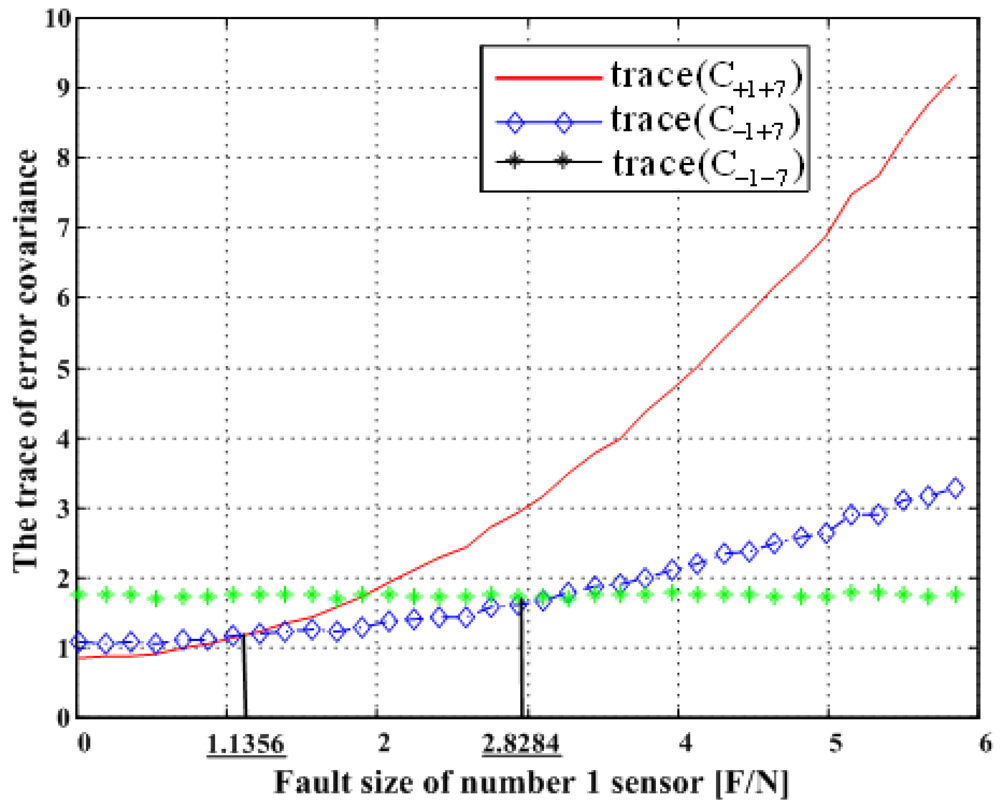
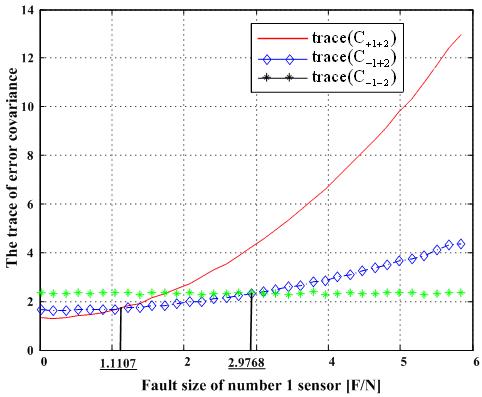
<p>To show the navigation performance, the error covariance of the triad solution x is used. The covariance matrices are defined as follows:
<disp-formula id="FD14">
<label>(13)</label>
<mml:math id="mm25" display="block">
<mml:semantics id="sm25">
<mml:mrow>
<mml:msub>
<mml:mtext>C</mml:mtext>
<mml:mrow>
<mml:mo>+</mml:mo>
<mml:mtext>i</mml:mtext>
<mml:mo>+</mml:mo>
<mml:mtext>j</mml:mtext></mml:mrow></mml:msub>
<mml:mo>=</mml:mo>
<mml:msub>
<mml:mrow>
<mml:mrow>
<mml:mtext>E</mml:mtext>
<mml:mo stretchy="false">[</mml:mo>
<mml:mo stretchy="false">(</mml:mo>
<mml:mover accent="true">
<mml:mtext>x</mml:mtext>
<mml:mo>^</mml:mo></mml:mover></mml:mrow></mml:mrow>
<mml:mrow>
<mml:mo>+</mml:mo>
<mml:mtext>i</mml:mtext>
<mml:mo>+</mml:mo>
<mml:mtext>j</mml:mtext></mml:mrow></mml:msub>
<mml:mo>−</mml:mo>
<mml:mtext>x</mml:mtext>
<mml:mo stretchy="false">)</mml:mo>
<mml:msup>
<mml:mrow>
<mml:mo stretchy="false">(</mml:mo>
<mml:msub>
<mml:mrow>
<mml:mover accent="true">
<mml:mtext>x</mml:mtext>
<mml:mo>^</mml:mo></mml:mover></mml:mrow>
<mml:mrow>
<mml:mo>+</mml:mo>
<mml:mtext>i</mml:mtext>
<mml:mo>+</mml:mo>
<mml:mi>j</mml:mi></mml:mrow></mml:msub>
<mml:mo>−</mml:mo>
<mml:mtext>x</mml:mtext>
<mml:mo stretchy="false">)</mml:mo></mml:mrow>
<mml:mtext>T</mml:mtext></mml:msup>
<mml:mrow>
<mml:mo stretchy="false">]</mml:mo></mml:mrow></mml:mrow></mml:semantics></mml:math></disp-formula>
<disp-formula id="FD15">
<label>(14)</label>
<mml:math id="mm26" display="block">
<mml:semantics id="sm26">
<mml:mrow>
<mml:msub>
<mml:mtext>C</mml:mtext>
<mml:mrow>
<mml:mo>−</mml:mo>
<mml:mtext>i</mml:mtext>
<mml:mo>−</mml:mo>
<mml:mtext>j</mml:mtext></mml:mrow></mml:msub>
<mml:mo>=</mml:mo>
<mml:mtext>E</mml:mtext>
<mml:mo stretchy="false">[</mml:mo>
<mml:msub>
<mml:mrow>
<mml:mrow>
<mml:mo stretchy="false">(</mml:mo>
<mml:mover accent="true">
<mml:mtext>x</mml:mtext>
<mml:mo>^</mml:mo></mml:mover></mml:mrow></mml:mrow>
<mml:mrow>
<mml:mo>−</mml:mo>
<mml:mtext>i</mml:mtext>
<mml:mo>−</mml:mo>
<mml:mtext>j</mml:mtext></mml:mrow></mml:msub>
<mml:mo>−</mml:mo>
<mml:mtext>x</mml:mtext>
<mml:mo stretchy="false">)</mml:mo>
<mml:msup>
<mml:mrow>
<mml:mo stretchy="false">(</mml:mo>
<mml:msub>
<mml:mrow>
<mml:mover accent="true">
<mml:mtext>x</mml:mtext>
<mml:mo>^</mml:mo></mml:mover></mml:mrow>
<mml:mrow>
<mml:mo>−</mml:mo>
<mml:mtext>i</mml:mtext>
<mml:mo>−</mml:mo>
<mml:mi>j</mml:mi></mml:mrow></mml:msub>
<mml:mo>−</mml:mo>
<mml:mtext>x</mml:mtext>
<mml:mo stretchy="false">)</mml:mo></mml:mrow>
<mml:mtext>T</mml:mtext></mml:msup>
<mml:mo stretchy="false">]</mml:mo></mml:mrow></mml:semantics></mml:math></disp-formula>
<disp-formula id="FD16">
<label>(15)</label>
<mml:math id="mm27" display="block">
<mml:semantics id="sm27">
<mml:mrow>
<mml:msub>
<mml:mtext>C</mml:mtext>
<mml:mrow>
<mml:mo>−</mml:mo>
<mml:mtext>i</mml:mtext>
<mml:mo>+</mml:mo>
<mml:mtext>j</mml:mtext></mml:mrow></mml:msub>
<mml:mo>=</mml:mo>
<mml:mtext>E</mml:mtext>
<mml:mo stretchy="false">[</mml:mo>
<mml:mo stretchy="false">(</mml:mo>
<mml:msub>
<mml:mrow>
<mml:mover accent="true">
<mml:mtext>x</mml:mtext>
<mml:mo>^</mml:mo></mml:mover></mml:mrow>
<mml:mrow>
<mml:mo>−</mml:mo>
<mml:mtext>i</mml:mtext>
<mml:mo>+</mml:mo>
<mml:mtext>j</mml:mtext></mml:mrow></mml:msub>
<mml:mo>−</mml:mo>
<mml:mtext>x</mml:mtext>
<mml:mo stretchy="false">)</mml:mo>
<mml:msup>
<mml:mrow>
<mml:mo stretchy="false">(</mml:mo>
<mml:msub>
<mml:mrow>
<mml:mover accent="true">
<mml:mtext>x</mml:mtext>
<mml:mo>^</mml:mo></mml:mover></mml:mrow>
<mml:mrow>
<mml:mo>−</mml:mo>
<mml:mtext>i</mml:mtext>
<mml:mo>+</mml:mo>
<mml:mi>j</mml:mi></mml:mrow></mml:msub>
<mml:mo>−</mml:mo>
<mml:mtext>x</mml:mtext>
<mml:mo stretchy="false">)</mml:mo></mml:mrow>
<mml:mtext>T</mml:mtext></mml:msup>
<mml:mo stretchy="false">]</mml:mo></mml:mrow></mml:semantics></mml:math></disp-formula></p>
<p>Matrix C<sub>+i+j</sub> denotes the error covariance of x̂ including the i<sup>th</sup> and j<sup>th</sup> sensor outputs and C<sub>-i-j</sub> the error covariance of x̂ excluding the i<sup>th</sup> and j<sup>th</sup> sensors, and so on. It is known that the minimization of the trace of the error covariance matrix provides the best navigation performance. The traces of the error covariance matrices (13)–(15) will be calculated and compared with each other for the four accommodation rules, which results are shown in <xref ref-type="fig" rid="f17-sensors-09-08456">Figures 17</xref>, <xref ref-type="fig" rid="f19-sensors-09-08456">19</xref>, <xref ref-type="fig" rid="f21-sensors-09-08456">21</xref>, and <xref ref-type="fig" rid="f23-sensors-09-08456">23</xref>.</p>
<sec>
<label>5.1.</label>
<title>Double Fault of 1<sup>st</sup> and 2<sup>nd</sup> Sensors</title>
<p>Suppose that the first and second sensors have a fault such that f(t) = [f<sub>1</sub> f<sub>2</sub> 0 0 0 0]<sup>T</sup> with f<sub>1</sub> and f<sub>2</sub> being constants. Simulations are performed for each point on the linear line of f<sub>2</sub> = 0.5 f<sub>1</sub> as shown in <xref ref-type="fig" rid="f16-sensors-09-08456">Figure 16</xref>, and the measurement noise is white Gaussian with mean 0 and variance σ = 1.</p>
<p><xref ref-type="fig" rid="f17-sensors-09-08456">Figure 17</xref> shows the results of the accommodation rule for a double fault according to the fault size in <xref ref-type="fig" rid="f16-sensors-09-08456">Figure 16</xref>. When faults f<sub>1</sub> and f<sub>2</sub> belong to the region of Category I, the trace of C<sub>+1+2</sub> is the minimum among the three traces. This means that when faults f<sub>1</sub> and f<sub>2</sub> belong to the region of Category I, the two faulty sensors should be used to obtain the minimum estimation error, in other words, the best navigation accuracy. When faults f<sub>1</sub> and f<sub>2</sub> belong to the region of Categories II or III, the trace of C<sub>-1+2</sub> is the minimum, and when they belong to the region of Category IV, the trace of C<sub>-1-2</sub> is the minimum. In <xref ref-type="fig" rid="f16-sensors-09-08456">Figure 16</xref>, the point at f<sub>1</sub> = 1.1107 is the boundary between Category I and II, and the point at f<sub>1</sub> = 2.2968 is the boundary between Category III and IV. These boundary points correspond to the crossover points between trace(C<sub>+1+2</sub>) and trace(C<sub>-1+2</sub>) and between trace(C<sub>-1+2</sub>) and trace(C<sub>-1-2</sub>), respectively, in <xref ref-type="fig" rid="f17-sensors-09-08456">Figure 17</xref>.</p></sec>
<sec>
<label>5.2.</label>
<title>Double Fault of 1<sup>st</sup> and 3<sup>rd</sup> Sensor</title>
<p><xref ref-type="fig" rid="f19-sensors-09-08456">Figure 19</xref> shows the results of the accommodation rule for a double fault according to the fault size in <xref ref-type="fig" rid="f18-sensors-09-08456">Figure 18</xref>. The results are the same as those in Section 5.1.</p></sec>
<sec>
<label>5.3.</label>
<title>Double Fault of 1<sup>st</sup> and 4<sup>th</sup> Sensors</title>
<p><xref ref-type="fig" rid="f21-sensors-09-08456">Figure 21</xref> shows the results of the accommodation rule for a double fault according to the fault size in <xref ref-type="fig" rid="f20-sensors-09-08456">Figure 20</xref>. The results are the same as those in section 5.1.</p></sec>
<sec>
<label>5.4.</label>
<title>Double Fault of 1<sup>st</sup> and 7<sup>th</sup> Sensors</title>
<p><xref ref-type="fig" rid="f23-sensors-09-08456">Figure 23</xref> shows the results of the accommodation rule for a double fault according to the fault size in <xref ref-type="fig" rid="f22-sensors-09-08456">Figure 22</xref>. The results are the same as those in Section 5.1.</p></sec></sec>
<sec sec-type="conclusions">
<label>6.</label>
<title>Conclusions</title>
<p>For inertial navigation systems which use seven sensors, this paper proves that a double fault can be isolated for any combination of fault magnitudes. This paper suggests the four sensor configurations which provide the best navigation performance when seven sensors are used. The four sensor configurations are as follows: (1) cone configuration, (2) six sensor inputs on the cone surface and one sensor input on the center axis through the cone, (3) two sensors on the x and y axes, respectively, and the other five sensors on the cone surface with the z axis as center axis of the cone, (4) three sensors on the x, y, and z axes, respectively, and the other four sensors on the cone surface with the z axis as the center axis of the cone.</p>
<p>For these four configurations, the PCI is obtained for each sensor in order to compare their FDI performance. The Monte Carlo simulations indicate that configuration 4 shows the best PCI, but which is only slightly better than that of configuration (4). As explained in detail in Sections 3.3 and 4.2, configuration (2) has four sets of accommodation rules, while configuration (4) has 13. Thus, we chose configuration (2) after considering the complexity of the accommodation rule. For sensor configuration (2), four accommodation rules are obtained and a Monte Carlo simulation is performed. The Monte Carlo simulation shows that the suggested accommodation rules are correct and work well.</p></sec></body>
<back>
<ack>
<p>This Research was supported by the Chung-Ang University Research Grants in 2009.</p></ack>
<ref-list>
<title>References</title>
<ref id="b1-sensors-09-08456"><label>1.</label><citation citation-type="journal"><person-group person-group-type="author"><name><surname>Betta</surname><given-names>G.</given-names></name><name><surname>Pietrosanto</surname><given-names>A.</given-names></name></person-group><article-title>Instrument Fault Detection and Isolation: State of the Art and New Research Trends</article-title><source>IEEE Trans. Instrum. Meas.</source><year>2000</year><volume>49</volume><fpage>100</fpage><lpage>107</lpage><pub-id pub-id-type="doi">10.1109/19.836318</pub-id></citation></ref>
<ref id="b2-sensors-09-08456"><label>2.</label><citation citation-type="journal"><person-group person-group-type="author"><name><surname>Chow</surname><given-names>E.Y.</given-names></name><name><surname>Willsky</surname><given-names>A.S.</given-names></name></person-group><article-title>Analytical Redundancy and the Design of Robust Failure Detection Systems</article-title><source>IEEE Trans. Automat. Contr.</source><year>1984</year><volume>29</volume><fpage>603</fpage><lpage>614</lpage><pub-id pub-id-type="doi">10.1109/TAC.1984.1103593</pub-id></citation></ref>
<ref id="b3-sensors-09-08456"><label>3.</label><citation citation-type="journal"><person-group person-group-type="author"><name><surname>Frank</surname><given-names>P.M.</given-names></name></person-group><article-title>Fault Diagnosis in Dynamic Systems Using Analytical and Knowledge-based Redundancy–A Survey and Some New Results</article-title><source>Automatica</source><year>1990</year><volume>26</volume><fpage>459</fpage><lpage>474</lpage><pub-id pub-id-type="doi">10.1016/0005-1098(90)90018-D</pub-id></citation></ref>
<ref id="b4-sensors-09-08456"><label>4.</label><citation citation-type="book"><person-group person-group-type="author"><name><surname>Gertler</surname><given-names>J.J.</given-names></name></person-group><source>Fault Detection and Diagnosis in Engineering Systems</source><publisher-name>Marcel Dekker</publisher-name><publisher-loc>New York, NY, USA</publisher-loc><year>1998</year></citation></ref>
<ref id="b5-sensors-09-08456"><label>5.</label><citation citation-type="book"><person-group person-group-type="author"><name><surname>Patton</surname><given-names>R.J.</given-names></name><name><surname>Frank</surname><given-names>P.M.</given-names></name><name><surname>Clark</surname><given-names>R.N.</given-names></name></person-group><source>Issues of Fault Diagnosis for Dynamics System</source><publisher-name>Springer Verlag</publisher-name><publisher-loc>London, UK</publisher-loc><year>2000</year></citation></ref>
<ref id="b6-sensors-09-08456"><label>6.</label><citation citation-type="journal"><person-group person-group-type="author"><name><surname>Gilmore</surname><given-names>J.P.</given-names></name><name><surname>McKern</surname><given-names>R.A.</given-names></name></person-group><article-title>A Redundant Strapdown Inertial Reference Unite (SIRU)</article-title><source>J. Spacecraft</source><year>1972</year><volume>9</volume><fpage>39</fpage><lpage>47</lpage><pub-id pub-id-type="doi">10.2514/3.61628</pub-id></citation></ref>
<ref id="b7-sensors-09-08456"><label>7.</label><citation citation-type="journal"><person-group person-group-type="author"><name><surname>Wilcox</surname><given-names>J.C.</given-names></name></person-group><article-title>Competitive Evaluation of Failure Detection Algorithms for Strapdown Redundant Inertial Instruments</article-title><source>J. Spacecraft</source><year>1974</year><volume>11</volume><fpage>525</fpage><lpage>530</lpage><pub-id pub-id-type="doi">10.2514/3.62117</pub-id></citation></ref>
<ref id="b8-sensors-09-08456"><label>8.</label><citation citation-type="journal"><person-group person-group-type="author"><name><surname>Daly</surname><given-names>K.C.</given-names></name><name><surname>Gai</surname><given-names>E.</given-names></name><name><surname>Harrison</surname><given-names>J.V.</given-names></name></person-group><article-title>Generalized Likelihood Test for FDI in Redundant Sensor Configurations</article-title><source>J. Guid. Control</source><year>1979</year><volume>2</volume><fpage>9</fpage><lpage>17</lpage></citation></ref>
<ref id="b9-sensors-09-08456"><label>9.</label><citation citation-type="journal"><person-group person-group-type="author"><name><surname>Jin</surname><given-names>H.</given-names></name><name><surname>Zhang</surname><given-names>H.Y.</given-names></name></person-group><article-title>Optimal Parity Vector Sensitive to Designated Sensor Fault</article-title><source>IEEE Trans. Aerosp. Elect. Syst.</source><year>1999</year><volume>35</volume><fpage>1122</fpage><lpage>1128</lpage><pub-id pub-id-type="doi">10.1109/7.805431</pub-id></citation></ref>
<ref id="b10-sensors-09-08456"><label>10.</label><citation citation-type="journal"><person-group person-group-type="author"><name><surname>Yang</surname><given-names>C.-K.</given-names></name><name><surname>Shim</surname><given-names>D.-S.</given-names></name></person-group><article-title>FDI using Multiple Parity Vectors for Redundant Inertial Sensors</article-title><source>Eur. J. Contr.</source><year>2006</year><volume>12</volume><fpage>437</fpage><lpage>449</lpage><pub-id pub-id-type="doi">10.3166/ejc.12.437-449</pub-id></citation></ref>
<ref id="b11-sensors-09-08456"><label>11.</label><citation citation-type="journal"><person-group person-group-type="author"><name><surname>Yang</surname><given-names>C.-K.</given-names></name><name><surname>Shim</surname><given-names>D.-S.</given-names></name></person-group><article-title>Double Faults Isolation based on the Reduced-Order Parity Vectors in Redundant Sensor Configuration</article-title><source>Int. J. Contr. Autom. Syst.</source><year>2007</year><volume>5</volume><fpage>155</fpage><lpage>160</lpage></citation></ref>
<ref id="b12-sensors-09-08456"><label>12.</label><citation citation-type="journal"><person-group person-group-type="author"><name><surname>Yang</surname><given-names>C.-K.</given-names></name><name><surname>Shim</surname><given-names>D.-S.</given-names></name></person-group><article-title>Accommodation Rule Based on Navigation Accuracy for Double Faults in Redundant Inertial Sensor Systems</article-title><source>Int. J. Contr. Autom. Syst.</source><year>2007</year><volume>5</volume><fpage>329</fpage><lpage>336</lpage></citation></ref>
<ref id="b13-sensors-09-08456"><label>13.</label><citation citation-type="confproc"><person-group person-group-type="author"><name><surname>Yang</surname><given-names>C.-K.</given-names></name><name><surname>Shim</surname><given-names>D.-S.</given-names></name></person-group><article-title>Accommodation Rule of Double Faults for Seven Inertial Sensors</article-title><conf-name>Proceedings of 2008 IFAC World Congress</conf-name><conf-loc>Seoul, Korea</conf-loc><conf-date>July 2008</conf-date><fpage>7142</fpage><lpage>7147</lpage></citation></ref>
<ref id="b14-sensors-09-08456"><label>14.</label><citation citation-type="journal"><person-group person-group-type="author"><name><surname>Harrison</surname><given-names>J.V.</given-names></name><name><surname>Gai</surname><given-names>E.G.</given-names></name></person-group><article-title>Evaluating Sensor Orientations for Navigation Performance and Failure Detection</article-title><source>IEEE Trans. Aerosp. Elect. Syst.</source><year>1977</year><volume>13</volume><fpage>631</fpage><lpage>643</lpage><pub-id pub-id-type="doi">10.1109/TAES.1977.308504</pub-id></citation></ref>
<ref id="b15-sensors-09-08456"><label>15.</label><citation citation-type="confproc"><person-group person-group-type="author"><name><surname>Shim</surname><given-names>D.-S.</given-names></name><name><surname>Yang</surname><given-names>C.-K.</given-names></name></person-group><article-title>Geometric FDI based on SVD for Redundant Inertial Sensor Systems</article-title><conf-name>Proceedings of the 2004 Asian Control Conference</conf-name><conf-loc>Melbourne, Australia</conf-loc><conf-date>July 2004</conf-date><fpage>1093</fpage><lpage>1099</lpage></citation></ref></ref-list>
<sec sec-type="display-objects">
<title>Figures and Tables</title>
<fig id="f1-sensors-09-08456" position="float">
<label>Figure 1.</label>
<caption>
<p>INS with redundant inertial sensor configuration and FDIA.</p></caption>
<graphic xlink:href="sensors-09-08456f1.gif"/></fig>
<fig id="f2-sensors-09-08456" position="float">
<label>Figure 2.</label>
<caption>
<p>Configuration 1 of seven inertial sensors.</p></caption>
<graphic xlink:href="sensors-09-08456f2.gif"/></fig>
<fig id="f3-sensors-09-08456" position="float">
<label>Figure 3.</label>
<caption>
<p>Configuration 2 of seven inertial sensors.</p></caption>
<graphic xlink:href="sensors-09-08456f3.gif"/></fig>
<fig id="f4-sensors-09-08456" position="float">
<label>Figure 4.</label>
<caption>
<p>Configuration 3 of seven inertial sensors.</p></caption>
<graphic xlink:href="sensors-09-08456f4.gif"/></fig>
<fig id="f5-sensors-09-08456" position="float">
<label>Figure 5.</label>
<caption>
<p>Configuration 4 of seven inertial sensors.</p></caption>
<graphic xlink:href="sensors-09-08456f5.gif"/></fig>
<fig id="f6-sensors-09-08456" position="float">
<label>Figure 6.</label>
<caption>
<p>Configuration 4 redrawn.</p></caption>
<graphic xlink:href="sensors-09-08456f6.gif"/></fig>
<fig id="f7-sensors-09-08456" position="float">
<label>Figure 7.</label>
<caption>
<p>Configuration 2 with seven inertial sensors.</p></caption>
<graphic xlink:href="sensors-09-08456f7.gif"/></fig>
<fig id="f8-sensors-09-08456" position="float">
<label>Figure 8.</label>
<caption>
<p>Region of categories I through IV for 1<sup>st</sup> and 2<sup>nd</sup> faulty sensors for configuration 2.</p></caption>
<graphic xlink:href="sensors-09-08456f8.gif"/></fig>
<fig id="f9-sensors-09-08456" position="float">
<label>Figure 9.</label>
<caption>
<p>Region of categories I through IV for 1<sup>st</sup> and 3<sup>rd</sup> faulty sensors for configuration 2.</p></caption>
<graphic xlink:href="sensors-09-08456f9.gif"/></fig>
<fig id="f10-sensors-09-08456" position="float">
<label>Figure 10.</label>
<caption>
<p>Region of categories I through IV for 1<sup>st</sup> and 4<sup>th</sup> faulty sensors for configuration 2.</p></caption>
<graphic xlink:href="sensors-09-08456f10.gif"/></fig>
<fig id="f11-sensors-09-08456" position="float">
<label>Figure 11.</label>
<caption>
<p>Region of categories I through IV for 1<sup>st</sup> and 7<sup>th</sup> faulty sensors for configuration 2.</p></caption>
<graphic xlink:href="sensors-09-08456f11.gif"/></fig>
<fig id="f12-sensors-09-08456" position="float">
<label>Figure 12.</label>
<caption>
<p>Accommodation rule for 1<sup>st</sup> and 2<sup>nd</sup> faulty sensors for configuration 2.</p></caption>
<graphic xlink:href="sensors-09-08456f12.gif"/></fig>
<fig id="f13-sensors-09-08456" position="float">
<label>Figure 13.</label>
<caption>
<p>Accommodation rule for 1<sup>st</sup> and 3<sup>rd</sup> faulty sensors for configuration 2.</p></caption>
<graphic xlink:href="sensors-09-08456f13.gif"/></fig>
<fig id="f14-sensors-09-08456" position="float">
<label>Figure 14.</label>
<caption>
<p>Accommodation rule for 1<sup>st</sup> and 4<sup>th</sup> faulty sensors for configuration 2.</p></caption>
<graphic xlink:href="sensors-09-08456f14.gif"/></fig>
<fig id="f15-sensors-09-08456" position="float">
<label>Figure 15.</label>
<caption>
<p>Accommodation rule for 1<sup>st</sup> and 7<sup>th</sup> faulty sensors for configuration 2.</p></caption>
<graphic xlink:href="sensors-09-08456f15.gif"/></fig>
<fig id="f16-sensors-09-08456" position="float">
<label>Figure 16.</label>
<caption>
<p>Accommodation rule for 1<sup>st</sup> and 2<sup>nd</sup> faulty sensors in <xref ref-type="fig" rid="f12-sensors-09-08456">Figure 12</xref>.</p></caption>
<graphic xlink:href="sensors-09-08456f16.gif"/></fig>
<fig id="f17-sensors-09-08456" position="float">
<label>Figure 17.</label>
<caption>
<p>Trace(C<sub>+1+2</sub>), trace(C<sub>-1+2</sub>)and trace(C<sub>-1-2</sub>) with respect to fault magnitude in <xref ref-type="fig" rid="f16-sensors-09-08456">Figure 16</xref>.</p></caption>
<graphic xlink:href="sensors-09-08456f17.gif"/></fig>
<fig id="f18-sensors-09-08456" position="float">
<label>Figure 18.</label>
<caption>
<p>Accommodation rule for 1<sup>st</sup> and 3<sup>rd</sup> faulty sensors in <xref ref-type="fig" rid="f13-sensors-09-08456">Figure 13</xref>.</p></caption>
<graphic xlink:href="sensors-09-08456f18.gif"/></fig>
<fig id="f19-sensors-09-08456" position="float">
<label>Figure 19.</label>
<caption>
<p>Trace(C<sub>+1+3</sub>), trace(C<sub>-1+3</sub>)and trace(C<sub>-1-3</sub>) with respect to fault magnitude in <xref ref-type="fig" rid="f18-sensors-09-08456">Figure 18</xref>.</p></caption>
<graphic xlink:href="sensors-09-08456f19.gif"/></fig>
<fig id="f20-sensors-09-08456" position="float">
<label>Figure 20.</label>
<caption>
<p>Accommodation rule for 1<sup>st</sup> and 4<sup>th</sup> faulty sensors in <xref ref-type="fig" rid="f14-sensors-09-08456">Figure 14</xref>.</p></caption>
<graphic xlink:href="sensors-09-08456f20.gif"/></fig>
<fig id="f21-sensors-09-08456" position="float">
<label>Figure 21.</label>
<caption>
<p>Trace(C<sub>+1+4</sub>), trace(C<sub>-1+4</sub>)and trace(C<sub>-1-4</sub>) with respect to fault magnitude in <xref ref-type="fig" rid="f20-sensors-09-08456">Figure 20</xref>.</p></caption>
<graphic xlink:href="sensors-09-08456f21.gif"/></fig>
<fig id="f22-sensors-09-08456" position="float">
<label>Figure 22.</label>
<caption>
<p>Accommodation rule for 1<sup>st</sup> and 7<sup>th</sup> faulty sensors in <xref ref-type="fig" rid="f15-sensors-09-08456">Figure 15</xref>.</p></caption>
<graphic xlink:href="sensors-09-08456f22.gif"/></fig>
<fig id="f23-sensors-09-08456" position="float">
<label>Figure 23.</label>
<caption>
<p>Trace(C<sub>+1+7</sub>), trace(C<sub>-1+7</sub>)and trace(C<sub>-1-7</sub>) with respect to fault magnitude in <xref ref-type="fig" rid="f22-sensors-09-08456">Figure 22</xref>.</p></caption>
<graphic xlink:href="sensors-09-08456f23.gif"/></fig>
<table-wrap id="t1-sensors-09-08456" position="float">
<label>Table 1.</label>
<caption>
<p>PCI value for single fault (f = 7σ, 3000 simulations, 30 averaged).</p></caption>
<table frame="box" rules="all">
<thead>
<tr>
<th align="center" valign="middle"><bold>Sensors</bold></th>
<th align="center" valign="middle" rowspan="2"><bold>1st</bold></th>
<th align="center" valign="middle" rowspan="2"><bold>2nd</bold></th>
<th align="center" valign="middle" rowspan="2"><bold>3rd</bold></th>
<th align="center" valign="middle" rowspan="2"><bold>4th</bold></th>
<th align="center" valign="middle" rowspan="2"><bold>5th</bold></th>
<th align="center" valign="middle" rowspan="2"><bold>6th</bold></th>
<th align="center" valign="middle" rowspan="2"><bold>7th</bold></th></tr>
<tr>
<th align="center" valign="middle"><bold>Configurations</bold></th></tr></thead>
<tbody>
<tr>
<td align="center" valign="top"><bold>Configuration 1</bold></td>
<td align="center" valign="top">0.964</td>
<td align="center" valign="top">0.963</td>
<td align="center" valign="top">0.965</td>
<td align="center" valign="top">0.964</td>
<td align="center" valign="top">0.963</td></tr>
<tr>
<td align="center" valign="top"><bold>Configuration 2</bold></td>
<td align="center" valign="top">0.969</td>
<td align="center" valign="top">0.968</td>
<td align="center" valign="top">0.967</td>
<td align="center" valign="top">0.970</td></tr>
<tr>
<td align="center" valign="top"><bold>Configuration 3</bold></td>
<td align="center" valign="top">0.966</td>
<td align="center" valign="top">0.967</td>
<td align="center" valign="top">0.969</td>
<td align="center" valign="top">0.966</td>
<td align="center" valign="top">0.967</td></tr>
<tr>
<td align="center" valign="top"><bold><italic>Configuration 4</italic></bold></td>
<td align="center" valign="top"><italic>0.967</italic></td>
<td align="center" valign="top"><italic>0.968</italic></td>
<td align="center" valign="top"><italic>0.969</italic></td>
<td align="center" valign="top"><italic>0.968</italic></td>
<td align="center" valign="top"><italic>0.969</italic></td></tr></tbody></table></table-wrap>
<table-wrap id="t2-sensors-09-08456" position="float">
<label>Table 2.</label>
<caption>
<p>Combinations of accommodation rules for Configuration 4 related to <xref ref-type="fig" rid="f6-sensors-09-08456">Figure 6</xref>.</p></caption>
<table frame="box" rules="all">
<thead>
<tr>
<th align="center" valign="top"/>
<th align="center" valign="top">1</th>
<th align="center" valign="top">2</th>
<th align="center" valign="top">3</th>
<th align="center" valign="top">4</th>
<th align="center" valign="top">5</th>
<th align="center" valign="top">6</th>
<th align="center" valign="top">7</th>
<th align="center" valign="top">8</th>
<th align="center" valign="top">9</th>
<th align="center" valign="top">10</th>
<th align="center" valign="top">11</th>
<th align="center" valign="top">12</th>
<th align="center" valign="top">13</th></tr></thead>
<tbody>
<tr>
<td align="center" valign="middle"><bold>Accommodation combinations</bold></td>
<td align="center" valign="middle"><bold>(1,2)</bold></td>
<td align="center" valign="middle"><bold>(1,3)</bold></td>
<td align="center" valign="middle"><bold>(1,4)</bold></td>
<td align="center" valign="middle"><bold>(1,5)</bold></td>
<td align="center" valign="middle"><bold>(1,6)</bold></td>
<td align="center" valign="middle"><bold>(1,7)</bold></td>
<td align="center" valign="middle"><bold>(3,4)</bold></td>
<td align="center" valign="middle"><bold>(3,5)</bold></td>
<td align="center" valign="middle"><bold>(3,6)</bold></td>
<td align="center" valign="middle"><bold>(4,5)</bold></td>
<td align="center" valign="middle"><bold>(4,6)</bold></td>
<td align="center" valign="middle"><bold>(5,6)</bold></td>
<td align="center" valign="middle"><bold>(5,7)</bold></td></tr>
<tr>
<td align="center" valign="top"><bold>Mirror images</bold></td>
<td align="center" valign="top"/>
<td align="center" valign="top"><bold>(2,3)</bold></td>
<td align="center" valign="top"><bold>(2,4)</bold></td>
<td align="center" valign="top"><bold>(2,7)</bold></td>
<td align="center" valign="top"><bold>(2,6)</bold></td>
<td align="center" valign="top"><bold>(2,5)</bold></td>
<td align="center" valign="top"/>
<td align="center" valign="top"><bold>(3,7)</bold></td>
<td align="center" valign="top"/>
<td align="center" valign="top"><bold>(4,7)</bold></td>
<td align="center" valign="top"/>
<td align="center" valign="top"><bold>(6,7)</bold></td>
<td align="center" valign="top"/></tr></tbody></table></table-wrap></sec></back></article>