<?xml version="1.0" encoding="UTF-8"?>
<!DOCTYPE article PUBLIC "-//NLM//DTD Journal Publishing DTD v2.3 20070202//EN" "journalpublishing.dtd">
<article xmlns:mml="http://www.w3.org/1998/Math/MathML" xmlns:xlink="http://www.w3.org/1999/xlink" xml:lang="en" article-type="research-article">
<front>
<journal-meta>
<journal-id journal-id-type="publisher-id">Sensors</journal-id>
<journal-title>Sensors</journal-title>
<issn pub-type="epub">1424-8220</issn>
<publisher>
<publisher-name>Molecular Diversity Preservation International (MDPI)</publisher-name></publisher></journal-meta>
<article-meta>
<article-id pub-id-type="doi">10.3390/s120810820</article-id>
<article-id pub-id-type="publisher-id">sensors-12-10820</article-id>
<article-categories>
<subj-group>
<subject>Article</subject></subj-group></article-categories>
<title-group>
<article-title>A Linear, Millimetre Displacement-to-Frequency Transducer</article-title></title-group>
<contrib-group>
<contrib contrib-type="author">
<name><surname>Agee</surname><given-names>John T.</given-names></name><xref ref-type="aff" rid="af1-sensors-12-10820"><sup>1</sup></xref><xref ref-type="corresp" rid="c1-sensors-12-10820"><sup>*</sup></xref></contrib>
<contrib contrib-type="author">
<name><surname>Petto</surname><given-names>Four K.</given-names></name><xref ref-type="aff" rid="af2-sensors-12-10820"><sup>2</sup></xref></contrib></contrib-group>
<aff id="af1-sensors-12-10820">
<label>1</label> Department of Electrical Engineering, Tshwane University of Technology, Private Bag X680, Pretoria 0001, South Africa</aff>
<aff id="af2-sensors-12-10820">
<label>2</label> P.O. Box 401783, Broadhurst, Gaborone, Botswana; E-Mail: <email>pettok@bpc.bw</email></aff>
<author-notes>
<corresp id="c1-sensors-12-10820">
<label>*</label>Author to whom correspondence should be addressed; E-Mail: <email>ageejt@tut.ac.za</email>; Tel.: +27-71-500-5901.</corresp></author-notes>
<pub-date pub-type="collection">
<year>2012</year></pub-date>
<pub-date pub-type="epub">
<day>06</day>
<month>08</month>
<year>2012</year></pub-date>
<volume>12</volume>
<issue>8</issue>
<fpage>10820</fpage>
<lpage>10833</lpage>
<history>
<date date-type="received">
<day>01</day>
<month>07</month>
<year>2012</year></date>
<date date-type="rev-recd">
<day>21</day>
<month>07</month>
<year>2012</year></date>
<date date-type="accepted">
<day>26</day>
<month>07</month>
<year>2012</year></date></history>
<permissions>
<copyright-statement>© 2012 by the authors; licensee MDPI, Basel, Switzerland.</copyright-statement>
<copyright-year>2012</copyright-year>
<license>
<p>This article is an open access article distributed under the terms and conditions of the Creative Commons Attribution license (http://creativecommons.org/licenses/by/3.0/).</p></license></permissions>
<abstract>
<p>The paper presents a novel linear, high-fidelity millimetre displacement-to-frequency transducer, based on the resistive conversion of displacement into a proportional voltage, and then frequency. The derivation of the nonlinearity, fidelity and sensitivity of the transducer is presented. Experimental results confirm that a displacement of 0–100 mm is converted into a frequency range of 0–100 kHz, with a normalised fidelity factor of 99.91%, and a worst-case nonlinearity of less than 0.08%. Tests using laboratory standards show that a displacement of 10 mm is transduced with an accuracy of ±0.6%, and a standard deviation of 530 Hz. Estimates included in the paper show that the transducer could cost less than 1% of existing systems for millimeter displacement measurement.</p></abstract>
<kwd-group>
<kwd>millimetre displacement</kwd>
<kwd>displacement-to-frequency</kwd>
<kwd>high-fidelity</kwd></kwd-group></article-meta></front>
<body>
<sec sec-type="intro">
<label>1.</label>
<title>Introduction</title>
<p>Several ultrasound, optical or laser-based devices exist for the measurement of displacements larger than one metre [<xref ref-type="bibr" rid="b1-sensors-12-10820">1</xref>–<xref ref-type="bibr" rid="b4-sensors-12-10820">4</xref>]. The cost of the modifications required for the use of these systems for measuring displacements in the range of a few micrometres to millimetres (submetre) is only justifiable in a few circumstances. For affordable submetre displacement measurements, capacitive and inductive position sensors are often used. However, the frequency dependence of capacitive and inductive sensors limits their domains of application [<xref ref-type="bibr" rid="b5-sensors-12-10820">5</xref>–<xref ref-type="bibr" rid="b7-sensors-12-10820">7</xref>]. In fact, a comparative discourse relating the range of displacement measurable <italic>versus</italic> the sensor recommended, could be found in [<xref ref-type="bibr" rid="b8-sensors-12-10820">8</xref>].</p>
<p>In process and industrial instrumentation systems, several variables are detected using elastic sensors as primary sensing elements. Elastic sensors often generate displacements in the range of several micrometres to millimeters, which have to be conditioned further. <xref ref-type="table" rid="t1-sensors-12-10820">Table 1</xref>, derived from information available in Chapter 8 of [<xref ref-type="bibr" rid="b9-sensors-12-10820">9</xref>], shows example applications of elastic sensors resulting in an intermediate displacement variable. Moreover, physiological changes in biological tissues resulting from dehydration, accumulation of fluid due to disease, <italic>etc.</italic>, can be studied using submetre displacement measurements [<xref ref-type="bibr" rid="b10-sensors-12-10820">10</xref>]. Millimeter displacement is also encountered in the analysis of the integrity of civil structures [<xref ref-type="bibr" rid="b11-sensors-12-10820">11</xref>,<xref ref-type="bibr" rid="b12-sensors-12-10820">12</xref>], where such measurement systems as the GPS-RTS are currently used. A key challenge in the current systems for millimeter-displacement measurement is the high cost of acquisition of such measurement systems. Hence, there is significant motivation for the exploration of cheaper systems for use in small displacement measurement. Moreover, the transducers most suitable for the conditioning of such small displacement signals must have high sensitivity, high fidelity and minimum nonlinearity for acceptable accuracy of transduction. This paper presents the design, analysis and experimental validation of a submetre displacement-to-frequency transducer. The system is based on the sensitivity of some resistive elements to displacement. Resistive sensors are relatively cheap; and their zero-order dynamics make them suitable for both static and dynamic measurements. Unlike time-of-flight devices or phase-based measurement systems, resistive millimeter displacement transducers need be coupled physically to the displacement being measured.</p>
<p>In the rest of the paper, the circuit design, analysis of the basic displacement-to-voltage converter, and the implementation of the primary conditioning amplifier circuit are presented in Section 2. The voltage-to-frequency conversion design is presented in Section 3 of the paper. Circuit realisation, experimental results, and discussions of these results form Section 4 of the paper. Section 5 presents conclusions and the limitation of the transducer circuit. A list of references concludes the paper.</p></sec>
<sec sec-type="methods">
<label>2.</label>
<title>The Basic Displacement Sensor, and the Design and Analysis of the Primary Conditioning Circuit</title>
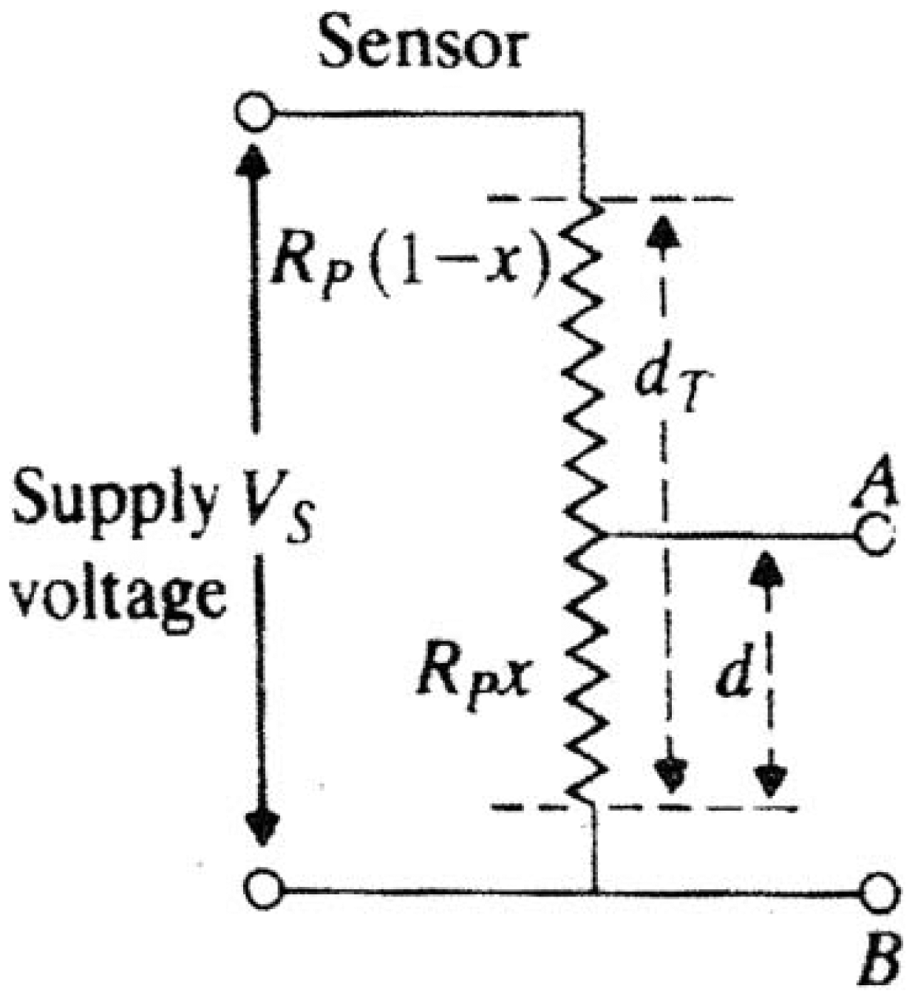
<p>The basic displacement-to-voltage sensor is shown in <xref ref-type="fig" rid="f1-sensors-12-10820">Figure 1</xref>. The sensor consists of a three-terminal potentiometer of total resistance R<sub>P</sub>, supplied by a DC voltage V<sub>s</sub>. The resistance between terminals A and B of the potentiometer is directly related to the displacement <italic>d(t)</italic> (alternatively, the normalised displacement <italic>x</italic>), where 
<inline-formula>
<mml:math id="mm1" display="inline">
<mml:semantics id="sm1">
<mml:mrow>
<mml:mn>0</mml:mn>
<mml:mo>≤</mml:mo>
<mml:mi>x</mml:mi>
<mml:mo>=</mml:mo>
<mml:mfrac>
<mml:mi>d</mml:mi>
<mml:mrow>
<mml:msub>
<mml:mi>d</mml:mi>
<mml:mi>T</mml:mi></mml:msub></mml:mrow></mml:mfrac>
<mml:mo>≤</mml:mo>
<mml:mn>1</mml:mn>
<mml:mo>;</mml:mo></mml:mrow></mml:semantics></mml:math></inline-formula> and <italic>d(t)</italic> = <italic>xd</italic><sub>T</sub>. Then:
<disp-formula id="FD1">
<label>(1)</label>
<mml:math id="mm2" display="block">
<mml:semantics id="sm2">
<mml:mrow>
<mml:mtable>
<mml:mtr>
<mml:mtd>
<mml:mrow>
<mml:mfrac>
<mml:mrow>
<mml:msub>
<mml:mi>E</mml:mi>
<mml:mrow>
<mml:mi>T</mml:mi>
<mml:mi>H</mml:mi></mml:mrow></mml:msub></mml:mrow>
<mml:mrow>
<mml:msub>
<mml:mi>V</mml:mi>
<mml:mi>s</mml:mi></mml:msub></mml:mrow></mml:mfrac>
<mml:mo>=</mml:mo>
<mml:mfrac>
<mml:mrow>
<mml:msub>
<mml:mi>R</mml:mi>
<mml:mi>p</mml:mi></mml:msub>
<mml:mi>x</mml:mi></mml:mrow>
<mml:mrow>
<mml:msub>
<mml:mi>R</mml:mi>
<mml:mi>p</mml:mi></mml:msub></mml:mrow></mml:mfrac></mml:mrow></mml:mtd>
<mml:mtd>
<mml:mrow>
<mml:mi>o</mml:mi>
<mml:mi>r</mml:mi></mml:mrow></mml:mtd></mml:mtr></mml:mtable>
<mml:msub>
<mml:mi>E</mml:mi>
<mml:mrow>
<mml:mi>T</mml:mi>
<mml:mi>H</mml:mi></mml:mrow></mml:msub>
<mml:mo>=</mml:mo>
<mml:msub>
<mml:mi>V</mml:mi>
<mml:mi>s</mml:mi></mml:msub>
<mml:mi>x</mml:mi></mml:mrow></mml:semantics></mml:math></disp-formula></p>
<p>Note that, the maximum value of E<sub>TH</sub> is V<sub>s</sub>, when x = 1. The Thevenin's resistance of the equivalent sensor circuit, <italic>R<sub>TH</sub></italic>, is evaluated to yield [<xref ref-type="bibr" rid="b9-sensors-12-10820">9</xref>]:
<disp-formula id="FD2">
<label>(2)</label>
<mml:math id="mm3" display="block">
<mml:semantics id="sm3">
<mml:mrow>
<mml:msub>
<mml:mi>R</mml:mi>
<mml:mrow>
<mml:mi>T</mml:mi>
<mml:mi>H</mml:mi></mml:mrow></mml:msub>
<mml:mo>=</mml:mo>
<mml:mfrac>
<mml:mrow>
<mml:msub>
<mml:mi>R</mml:mi>
<mml:mi>p</mml:mi></mml:msub>
<mml:mo stretchy="false">(</mml:mo>
<mml:mn>1</mml:mn>
<mml:mo>−</mml:mo>
<mml:mi>x</mml:mi>
<mml:mo stretchy="false">)</mml:mo>
<mml:msub>
<mml:mi>R</mml:mi>
<mml:mi>p</mml:mi></mml:msub>
<mml:mi>x</mml:mi></mml:mrow>
<mml:mrow>
<mml:msub>
<mml:mi>R</mml:mi>
<mml:mi>p</mml:mi></mml:msub>
<mml:mo stretchy="false">(</mml:mo>
<mml:mn>1</mml:mn>
<mml:mo>−</mml:mo>
<mml:mi>x</mml:mi>
<mml:mo stretchy="false">)</mml:mo>
<mml:mo>+</mml:mo>
<mml:msub>
<mml:mi>R</mml:mi>
<mml:mi>p</mml:mi></mml:msub>
<mml:mi>x</mml:mi></mml:mrow></mml:mfrac>
<mml:mo>=</mml:mo>
<mml:msub>
<mml:mi>R</mml:mi>
<mml:mi>P</mml:mi></mml:msub>
<mml:mi>x</mml:mi>
<mml:mo stretchy="false">(</mml:mo>
<mml:mn>1</mml:mn>
<mml:mo>−</mml:mo>
<mml:mi>x</mml:mi>
<mml:mo stretchy="false">)</mml:mo></mml:mrow></mml:semantics></mml:math></disp-formula></p>
<p>The sensitivity of <bold>E<sub>TH</sub></bold> to the normalised displacement <bold>x</bold> is given by:
<disp-formula id="FD3">
<label>(3)</label>
<mml:math id="mm4" display="block">
<mml:semantics id="sm4">
<mml:mrow>
<mml:msubsup>
<mml:mi>S</mml:mi>
<mml:mrow>
<mml:msub>
<mml:mi>E</mml:mi>
<mml:mrow>
<mml:mi>T</mml:mi>
<mml:mi>H</mml:mi></mml:mrow></mml:msub></mml:mrow>
<mml:mi>x</mml:mi></mml:msubsup>
<mml:mo>=</mml:mo>
<mml:mfrac>
<mml:mrow>
<mml:mo>∂</mml:mo>
<mml:msub>
<mml:mi>E</mml:mi>
<mml:mrow>
<mml:mi>T</mml:mi>
<mml:mi>H</mml:mi></mml:mrow></mml:msub></mml:mrow>
<mml:mrow>
<mml:mo>∂</mml:mo>
<mml:mi>x</mml:mi></mml:mrow></mml:mfrac>
<mml:mo>=</mml:mo>
<mml:msub>
<mml:mi>V</mml:mi>
<mml:mi>s</mml:mi></mml:msub></mml:mrow></mml:semantics></mml:math></disp-formula></p>
<p>To avoid excessive power dissipation in the resistance of the potentiometer, V<sub>s</sub> is usually kept small.</p>
<p>Consequently, the sensitivity 
<inline-formula>
<mml:math id="mm5" display="inline">
<mml:semantics id="sm5">
<mml:mrow>
<mml:msubsup>
<mml:mi>S</mml:mi>
<mml:mrow>
<mml:msub>
<mml:mi>E</mml:mi>
<mml:mrow>
<mml:mi>T</mml:mi>
<mml:mi>H</mml:mi></mml:mrow></mml:msub></mml:mrow>
<mml:mi>x</mml:mi></mml:msubsup></mml:mrow></mml:semantics></mml:math></inline-formula> of this basic sensor is small. Additional conditioning is required to improve the sensitivity of the sensor. Now, the normalised sensitivity is given by:
<disp-formula id="FD4">
<label>(4)</label>
<mml:math id="mm6" display="block">
<mml:semantics id="sm6">
<mml:mrow>
<mml:msubsup>
<mml:mi>S</mml:mi>
<mml:mrow>
<mml:mi>μ</mml:mi>
<mml:msub>
<mml:mi>E</mml:mi>
<mml:mrow>
<mml:mi>T</mml:mi>
<mml:mi>H</mml:mi></mml:mrow></mml:msub></mml:mrow>
<mml:mi>x</mml:mi></mml:msubsup>
<mml:mo>=</mml:mo>
<mml:mfrac>
<mml:mn>1</mml:mn>
<mml:mrow>
<mml:msub>
<mml:mi>V</mml:mi>
<mml:mi>s</mml:mi></mml:msub></mml:mrow></mml:mfrac>
<mml:mfrac>
<mml:mrow>
<mml:mo>∂</mml:mo>
<mml:msub>
<mml:mi>E</mml:mi>
<mml:mrow>
<mml:mi>T</mml:mi>
<mml:mi>H</mml:mi></mml:mrow></mml:msub></mml:mrow>
<mml:mrow>
<mml:msub>
<mml:mo>∂</mml:mo>
<mml:mi>x</mml:mi></mml:msub></mml:mrow></mml:mfrac>
<mml:mo>=</mml:mo>
<mml:mn>1</mml:mn></mml:mrow></mml:semantics></mml:math></disp-formula></p>
<sec>
<label>2.1.</label>
<title>Primary Conditioning of Sensor Output</title>
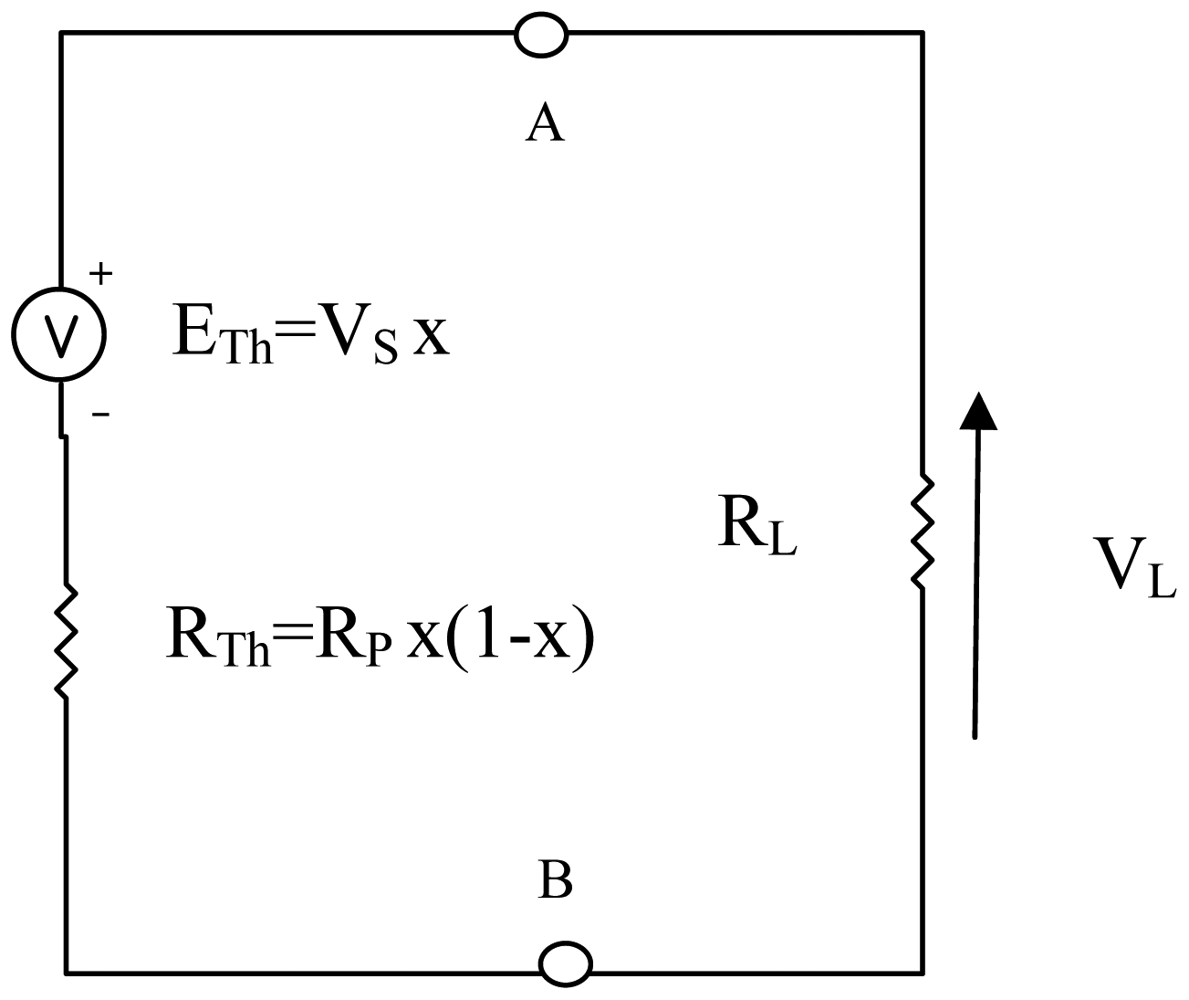
<p>The equivalent circuit resulting from the connection of a primary amplifier of input resistance R<sub>L</sub>, across terminals AB of the sensor circuit is shown in <xref ref-type="fig" rid="f2-sensors-12-10820">Figure 2</xref>. Loading effects tend to degrade the performance of amplifiers. The loading effect of the conditioning circuit modifies the Thevenin's voltage to:
<disp-formula id="FD5">
<label>(5)</label>
<mml:math id="mm7" display="block">
<mml:semantics id="sm7">
<mml:mrow>
<mml:msub>
<mml:mi>V</mml:mi>
<mml:mi>L</mml:mi></mml:msub>
<mml:mo>=</mml:mo>
<mml:mfrac>
<mml:mrow>
<mml:msub>
<mml:mi>R</mml:mi>
<mml:mi>L</mml:mi></mml:msub></mml:mrow>
<mml:mrow>
<mml:msub>
<mml:mi>R</mml:mi>
<mml:mi>L</mml:mi></mml:msub>
<mml:mo>+</mml:mo>
<mml:msub>
<mml:mi>R</mml:mi>
<mml:mrow>
<mml:mi>T</mml:mi>
<mml:mi>H</mml:mi></mml:mrow></mml:msub></mml:mrow></mml:mfrac>
<mml:mo>⋅</mml:mo>
<mml:msub>
<mml:mi>V</mml:mi>
<mml:mi>s</mml:mi></mml:msub>
<mml:mi>x</mml:mi></mml:mrow></mml:semantics></mml:math></disp-formula></p>
<p>The normalised value of this voltage is also derived to be:
<disp-formula id="FD6">
<label>(6)</label>
<mml:math id="mm8" display="block">
<mml:semantics id="sm8">
<mml:mrow>
<mml:msub>
<mml:mi>V</mml:mi>
<mml:mrow>
<mml:mi>L</mml:mi>
<mml:mi>μ</mml:mi></mml:mrow></mml:msub>
<mml:mo>=</mml:mo>
<mml:mfrac>
<mml:mrow>
<mml:msub>
<mml:mi>V</mml:mi>
<mml:mi>L</mml:mi></mml:msub></mml:mrow>
<mml:mrow>
<mml:msub>
<mml:mi>V</mml:mi>
<mml:mi>s</mml:mi></mml:msub></mml:mrow></mml:mfrac>
<mml:mo>=</mml:mo>
<mml:mfrac>
<mml:mrow>
<mml:msub>
<mml:mi>R</mml:mi>
<mml:mi>L</mml:mi></mml:msub>
<mml:mi>x</mml:mi></mml:mrow>
<mml:mrow>
<mml:msub>
<mml:mi>R</mml:mi>
<mml:mi>L</mml:mi></mml:msub>
<mml:mo>+</mml:mo>
<mml:msub>
<mml:mi>R</mml:mi>
<mml:mi>P</mml:mi></mml:msub>
<mml:mi>x</mml:mi>
<mml:mo stretchy="false">(</mml:mo>
<mml:mn>1</mml:mn>
<mml:mo>−</mml:mo>
<mml:mi>x</mml:mi>
<mml:mo stretchy="false">)</mml:mo></mml:mrow></mml:mfrac></mml:mrow></mml:semantics></mml:math></disp-formula></p>
<p>In the next sub-section of the paper, <xref rid="FD5" ref-type="disp-formula">Equations (5)</xref> and <xref rid="FD6" ref-type="disp-formula">(6)</xref> are used to analyse the quality of the displacement-to-voltage conversion amplifier, and to show any additional condition(s) that could be imposed on the conditioning circuit to further improve the performance of the transducer.</p></sec>
<sec>
<label>2.2.</label>
<title>Quality Analysis of the Primary Conditioning Circuit</title>
<p>In this subsection, the analysis of the quality of the primary signal amplification, based on <xref rid="FD5" ref-type="disp-formula">Equation (5)</xref>, is presented.</p>
<sec>
<label>2.2.1.</label>
<title>Fidelity of Primary Amplifier</title>
<p>Fidelity is a measure of how faithfully a circuit has processed a given signal to minimize distortions. The concept of fidelity is usually used in the analysis of high frequency amplifiers. In the current paper, the concept of fidelity is used to quantify the loading effect of the primary conditioning amplifier on the signal produced by the sensor. Now, the voltage drop due to the loading effect of R<sub>L</sub> is obtained to be:
<disp-formula id="FD7">
<label>(7)</label>
<mml:math id="mm9" display="block">
<mml:semantics id="sm9">
<mml:mrow>
<mml:mi mathvariant="normal">Δ</mml:mi>
<mml:mi>V</mml:mi>
<mml:mo>=</mml:mo>
<mml:msub>
<mml:mi>E</mml:mi>
<mml:mrow>
<mml:mi>T</mml:mi>
<mml:mi>H</mml:mi></mml:mrow></mml:msub>
<mml:mo>−</mml:mo>
<mml:msub>
<mml:mi>V</mml:mi>
<mml:mi>L</mml:mi></mml:msub>
<mml:mo>=</mml:mo>
<mml:mfrac>
<mml:mrow>
<mml:msub>
<mml:mi>R</mml:mi>
<mml:mi>P</mml:mi></mml:msub>
<mml:mo stretchy="false">(</mml:mo>
<mml:msup>
<mml:mi>x</mml:mi>
<mml:mn>2</mml:mn></mml:msup>
<mml:mo>−</mml:mo>
<mml:msup>
<mml:mi>x</mml:mi>
<mml:mn>3</mml:mn></mml:msup>
<mml:mo stretchy="false">)</mml:mo></mml:mrow>
<mml:mrow>
<mml:msub>
<mml:mi>R</mml:mi>
<mml:mi>L</mml:mi></mml:msub>
<mml:mo>+</mml:mo>
<mml:msub>
<mml:mi>R</mml:mi>
<mml:mi>P</mml:mi></mml:msub>
<mml:mo stretchy="false">(</mml:mo>
<mml:mi>x</mml:mi>
<mml:mo>−</mml:mo>
<mml:msup>
<mml:mi>x</mml:mi>
<mml:mn>2</mml:mn></mml:msup>
<mml:mo stretchy="false">)</mml:mo></mml:mrow></mml:mfrac>
<mml:msub>
<mml:mi>V</mml:mi>
<mml:mi>s</mml:mi></mml:msub></mml:mrow></mml:semantics></mml:math></disp-formula>or, in normalised form:
<disp-formula id="FD8">
<label>(8)</label>
<mml:math id="mm10" display="block">
<mml:semantics id="sm10">
<mml:mrow>
<mml:mi mathvariant="normal">Δ</mml:mi>
<mml:msub>
<mml:mi>V</mml:mi>
<mml:mi>μ</mml:mi></mml:msub>
<mml:mo>=</mml:mo>
<mml:mfrac>
<mml:mrow>
<mml:mi mathvariant="normal">Δ</mml:mi>
<mml:mi>V</mml:mi></mml:mrow>
<mml:mrow>
<mml:msub>
<mml:mi>V</mml:mi>
<mml:mi>s</mml:mi></mml:msub></mml:mrow></mml:mfrac>
<mml:mo>=</mml:mo>
<mml:mfrac>
<mml:mrow>
<mml:msub>
<mml:mi>R</mml:mi>
<mml:mi>P</mml:mi></mml:msub>
<mml:mo stretchy="false">(</mml:mo>
<mml:msup>
<mml:mi>x</mml:mi>
<mml:mn>2</mml:mn></mml:msup>
<mml:mo>−</mml:mo>
<mml:msup>
<mml:mi>x</mml:mi>
<mml:mn>3</mml:mn></mml:msup>
<mml:mo stretchy="false">)</mml:mo></mml:mrow>
<mml:mrow>
<mml:msub>
<mml:mi>R</mml:mi>
<mml:mi>L</mml:mi></mml:msub>
<mml:mo>+</mml:mo>
<mml:msub>
<mml:mi>R</mml:mi>
<mml:mi>P</mml:mi></mml:msub>
<mml:mo stretchy="false">(</mml:mo>
<mml:mi>x</mml:mi>
<mml:mo>−</mml:mo>
<mml:msup>
<mml:mi>x</mml:mi>
<mml:mn>2</mml:mn></mml:msup>
<mml:mo stretchy="false">)</mml:mo></mml:mrow></mml:mfrac></mml:mrow></mml:semantics></mml:math></disp-formula></p>
<p>The normalised fidelity factor is then given as:
<disp-formula id="FD9">
<label>(9)</label>
<mml:math id="mm11" display="block">
<mml:semantics id="sm11">
<mml:mrow>
<mml:msub>
<mml:mi>F</mml:mi>
<mml:mi>μ</mml:mi></mml:msub>
<mml:mo>=</mml:mo>
<mml:mn>1</mml:mn>
<mml:mo>−</mml:mo>
<mml:mi mathvariant="normal">Δ</mml:mi>
<mml:msub>
<mml:mi>V</mml:mi>
<mml:mi>μ</mml:mi></mml:msub>
<mml:mo>=</mml:mo>
<mml:mfrac>
<mml:mrow>
<mml:mn>1</mml:mn>
<mml:mo>+</mml:mo>
<mml:mi>K</mml:mi>
<mml:mi>x</mml:mi>
<mml:msup>
<mml:mrow>
<mml:mo stretchy="false">(</mml:mo>
<mml:mn>1</mml:mn>
<mml:mo>−</mml:mo>
<mml:mi>x</mml:mi>
<mml:mo stretchy="false">)</mml:mo></mml:mrow>
<mml:mn>2</mml:mn></mml:msup></mml:mrow>
<mml:mrow>
<mml:mn>1</mml:mn>
<mml:mo>+</mml:mo>
<mml:mi>K</mml:mi>
<mml:mi>x</mml:mi>
<mml:mo stretchy="false">(</mml:mo>
<mml:mn>1</mml:mn>
<mml:mo>−</mml:mo>
<mml:mi>x</mml:mi>
<mml:mo stretchy="false">)</mml:mo></mml:mrow></mml:mfrac></mml:mrow></mml:semantics></mml:math></disp-formula></p>
<p>For perfect fidelity, <italic>K</italic> = 0. Practically, this requires that:
<disp-formula id="FD10">
<label>(10)</label>
<mml:math id="mm12" display="block">
<mml:semantics id="sm12">
<mml:mrow>
<mml:mi>K</mml:mi>
<mml:mo>=</mml:mo>
<mml:mfrac>
<mml:mrow>
<mml:msub>
<mml:mi>R</mml:mi>
<mml:mi>P</mml:mi></mml:msub></mml:mrow>
<mml:mrow>
<mml:msub>
<mml:mi>R</mml:mi>
<mml:mi>L</mml:mi></mml:msub></mml:mrow></mml:mfrac>
<mml:mo>→</mml:mo>
<mml:mn>0</mml:mn>
<mml:mo>;</mml:mo>
<mml:msub>
<mml:mi>R</mml:mi>
<mml:mi>L</mml:mi></mml:msub>
<mml:mo>→</mml:mo>
<mml:mo>∞</mml:mo></mml:mrow></mml:semantics></mml:math></disp-formula></p></sec>
<sec>
<label>2.2.2.</label>
<title>Sensitivity Analysis</title>
<p>The sensitivity of the conditioned output is derived to yield:
<disp-formula id="FD11">
<label>(11)</label>
<mml:math id="mm13" display="block">
<mml:semantics id="sm13">
<mml:mrow>
<mml:msubsup>
<mml:mi>S</mml:mi>
<mml:mrow>
<mml:msub>
<mml:mi>V</mml:mi>
<mml:mi>L</mml:mi></mml:msub></mml:mrow>
<mml:mi>x</mml:mi></mml:msubsup>
<mml:mo>=</mml:mo>
<mml:mfrac>
<mml:mrow>
<mml:mo>∂</mml:mo>
<mml:msub>
<mml:mi>V</mml:mi>
<mml:mi>L</mml:mi></mml:msub></mml:mrow>
<mml:mrow>
<mml:mo>∂</mml:mo>
<mml:mi>x</mml:mi></mml:mrow></mml:mfrac>
<mml:mo>=</mml:mo>
<mml:mfrac>
<mml:mrow>
<mml:msubsup>
<mml:mi>R</mml:mi>
<mml:mi>L</mml:mi>
<mml:mn>2</mml:mn></mml:msubsup>
<mml:mo>+</mml:mo>
<mml:msub>
<mml:mi>R</mml:mi>
<mml:mi>L</mml:mi></mml:msub>
<mml:msub>
<mml:mi>R</mml:mi>
<mml:mi>P</mml:mi></mml:msub>
<mml:msup>
<mml:mi>x</mml:mi>
<mml:mn>2</mml:mn></mml:msup></mml:mrow>
<mml:mrow>
<mml:msup>
<mml:mrow>
<mml:mo stretchy="false">[</mml:mo>
<mml:msub>
<mml:mi>R</mml:mi>
<mml:mi>L</mml:mi></mml:msub>
<mml:mo>+</mml:mo>
<mml:msub>
<mml:mi>R</mml:mi>
<mml:mi>P</mml:mi></mml:msub>
<mml:mi>x</mml:mi>
<mml:mo stretchy="false">(</mml:mo>
<mml:mi>x</mml:mi>
<mml:mo>−</mml:mo>
<mml:msup>
<mml:mi>x</mml:mi>
<mml:mn>2</mml:mn></mml:msup>
<mml:mo stretchy="false">)</mml:mo>
<mml:mo stretchy="false">]</mml:mo></mml:mrow>
<mml:mn>2</mml:mn></mml:msup></mml:mrow></mml:mfrac>
<mml:msub>
<mml:mi>V</mml:mi>
<mml:mi>s</mml:mi></mml:msub></mml:mrow></mml:semantics></mml:math></disp-formula></p>
<p>The normalised sensitivity is found to be:
<disp-formula id="FD12">
<label>(12)</label>
<mml:math id="mm14" display="block">
<mml:semantics id="sm14">
<mml:mrow>
<mml:msubsup>
<mml:mi>S</mml:mi>
<mml:mrow>
<mml:msub>
<mml:mi>V</mml:mi>
<mml:mrow>
<mml:mi>L</mml:mi>
<mml:mi>μ</mml:mi></mml:mrow></mml:msub></mml:mrow>
<mml:mi>x</mml:mi></mml:msubsup>
<mml:mo>=</mml:mo>
<mml:mfrac>
<mml:mrow>
<mml:mn>1</mml:mn>
<mml:mo>+</mml:mo>
<mml:mi>K</mml:mi>
<mml:msup>
<mml:mi>x</mml:mi>
<mml:mn>2</mml:mn></mml:msup></mml:mrow>
<mml:mrow>
<mml:msup>
<mml:mrow>
<mml:mo stretchy="false">[</mml:mo>
<mml:mn>1</mml:mn>
<mml:mo>+</mml:mo>
<mml:mi>K</mml:mi>
<mml:mo stretchy="false">(</mml:mo>
<mml:mi>x</mml:mi>
<mml:mo>−</mml:mo>
<mml:msup>
<mml:mi>x</mml:mi>
<mml:mn>2</mml:mn></mml:msup>
<mml:mo stretchy="false">)</mml:mo>
<mml:mo stretchy="false">]</mml:mo></mml:mrow>
<mml:mn>2</mml:mn></mml:msup></mml:mrow></mml:mfrac></mml:mrow></mml:semantics></mml:math></disp-formula></p>
<p>It is required to select the value of K in such a manner, as to minimize variations 
<inline-formula>
<mml:math id="mm15" display="inline">
<mml:semantics id="sm15">
<mml:mrow>
<mml:msubsup>
<mml:mi>S</mml:mi>
<mml:mrow>
<mml:msub>
<mml:mi>V</mml:mi>
<mml:mrow>
<mml:mi>L</mml:mi>
<mml:mi>μ</mml:mi></mml:mrow></mml:msub></mml:mrow>
<mml:mi>x</mml:mi></mml:msubsup></mml:mrow></mml:semantics></mml:math></inline-formula> within the range of measurements.</p></sec>
<sec>
<label>2.2.3.</label>
<title>Nonlinearity Effects</title>
<p>From <xref rid="FD5" ref-type="disp-formula">Equation (5)</xref><italic>V<sub>L</sub></italic> is nonlinear in <bold><italic>x</italic></bold>. The nonlinearity N(x) can be quantified by using:
<disp-formula id="FD13">
<label>(13)</label>
<mml:math id="mm16" display="block">
<mml:semantics id="sm16">
<mml:mrow>
<mml:msub>
<mml:mi>V</mml:mi>
<mml:mi>L</mml:mi></mml:msub>
<mml:mo>=</mml:mo>
<mml:msup>
<mml:mi>m</mml:mi>
<mml:mo>∗</mml:mo></mml:msup>
<mml:mi>x</mml:mi>
<mml:mo>+</mml:mo>
<mml:msup>
<mml:mi>c</mml:mi>
<mml:mo>∗</mml:mo></mml:msup>
<mml:mo>+</mml:mo>
<mml:mi>N</mml:mi>
<mml:mo stretchy="false">(</mml:mo>
<mml:mi>x</mml:mi>
<mml:mo stretchy="false">)</mml:mo></mml:mrow></mml:semantics></mml:math></disp-formula>where the linear part of <italic>V<sub>L</sub></italic> is defined by the following parameters:
<disp-formula id="FD14">
<label>(14)</label>
<mml:math id="mm17" display="block">
<mml:semantics id="sm17">
<mml:mrow>
<mml:mtable columnalign="left">
<mml:mtr columnalign="left">
<mml:mtd columnalign="left">
<mml:mrow>
<mml:msup>
<mml:mi>m</mml:mi>
<mml:mo>∗</mml:mo></mml:msup>
<mml:mo>=</mml:mo>
<mml:mfrac>
<mml:mrow>
<mml:msub>
<mml:mi>V</mml:mi>
<mml:mi>L</mml:mi></mml:msub>
<mml:mo stretchy="false">(</mml:mo>
<mml:msub>
<mml:mi>x</mml:mi>
<mml:mrow>
<mml:mo>max</mml:mo></mml:mrow></mml:msub>
<mml:mo stretchy="false">)</mml:mo>
<mml:mo>−</mml:mo>
<mml:msub>
<mml:mi>V</mml:mi>
<mml:mi>L</mml:mi></mml:msub>
<mml:mo stretchy="false">(</mml:mo>
<mml:msub>
<mml:mi>x</mml:mi>
<mml:mrow>
<mml:mo>min</mml:mo></mml:mrow></mml:msub>
<mml:mo stretchy="false">)</mml:mo></mml:mrow>
<mml:mrow>
<mml:msub>
<mml:mi>x</mml:mi>
<mml:mrow>
<mml:mo>max</mml:mo></mml:mrow></mml:msub>
<mml:mo>−</mml:mo>
<mml:msub>
<mml:mi>x</mml:mi>
<mml:mrow>
<mml:mo>min</mml:mo></mml:mrow></mml:msub></mml:mrow></mml:mfrac>
<mml:msub>
<mml:mi>V</mml:mi>
<mml:mi>S</mml:mi></mml:msub></mml:mrow></mml:mtd></mml:mtr>
<mml:mtr columnalign="left">
<mml:mtd columnalign="left">
<mml:mrow>
<mml:msup>
<mml:mi>c</mml:mi>
<mml:mo>∗</mml:mo></mml:msup>
<mml:mo>=</mml:mo>
<mml:msub>
<mml:mi>V</mml:mi>
<mml:mi>L</mml:mi></mml:msub>
<mml:mo stretchy="false">(</mml:mo>
<mml:msub>
<mml:mi>x</mml:mi>
<mml:mrow>
<mml:mo>min</mml:mo></mml:mrow></mml:msub>
<mml:mo stretchy="false">)</mml:mo>
<mml:mo>−</mml:mo>
<mml:msup>
<mml:mi>m</mml:mi>
<mml:mo>∗</mml:mo></mml:msup>
<mml:msub>
<mml:mi>x</mml:mi>
<mml:mrow>
<mml:mo>min</mml:mo></mml:mrow></mml:msub>
<mml:mo>;</mml:mo>
<mml:msub>
<mml:mi>x</mml:mi>
<mml:mrow>
<mml:mo>max</mml:mo></mml:mrow></mml:msub>
<mml:mo>=</mml:mo>
<mml:mn>1</mml:mn>
<mml:mo>,</mml:mo>
<mml:msub>
<mml:mi>x</mml:mi>
<mml:mrow>
<mml:mo>min</mml:mo></mml:mrow></mml:msub>
<mml:mo>=</mml:mo>
<mml:mn>0</mml:mn>
<mml:mo>,</mml:mo>
<mml:msup>
<mml:mi>c</mml:mi>
<mml:mo>∗</mml:mo></mml:msup>
<mml:mo>=</mml:mo>
<mml:mn>0</mml:mn></mml:mrow></mml:mtd></mml:mtr></mml:mtable></mml:mrow></mml:semantics></mml:math></disp-formula>and the nonlinearity <italic>N(x)</italic> is given as:
<disp-formula id="FD15">
<label>(15)</label>
<mml:math id="mm18" display="block">
<mml:semantics id="sm18">
<mml:mrow>
<mml:mtable columnalign="left">
<mml:mtr columnalign="left">
<mml:mtd columnalign="left">
<mml:mrow>
<mml:mo>∴</mml:mo>
<mml:mi>N</mml:mi>
<mml:mo stretchy="false">(</mml:mo>
<mml:mi>x</mml:mi>
<mml:mo stretchy="false">)</mml:mo>
<mml:mo>=</mml:mo>
<mml:msub>
<mml:mi>V</mml:mi>
<mml:mi>s</mml:mi></mml:msub>
<mml:mi>x</mml:mi>
<mml:mo>−</mml:mo>
<mml:msup>
<mml:mi>m</mml:mi>
<mml:mo>∗</mml:mo></mml:msup>
<mml:mi>x</mml:mi>
<mml:mo>−</mml:mo>
<mml:msup>
<mml:mi>c</mml:mi>
<mml:mo>∗</mml:mo></mml:msup></mml:mrow></mml:mtd></mml:mtr>
<mml:mtr columnalign="left">
<mml:mtd columnalign="left">
<mml:mrow>
<mml:mi>N</mml:mi>
<mml:mo stretchy="false">(</mml:mo>
<mml:mi>x</mml:mi>
<mml:mo stretchy="false">)</mml:mo>
<mml:mo>=</mml:mo>
<mml:msub>
<mml:mi>V</mml:mi>
<mml:mi>s</mml:mi></mml:msub>
<mml:mrow>
<mml:mo>{</mml:mo>
<mml:mrow>
<mml:mfrac>
<mml:mrow>
<mml:mi>K</mml:mi>
<mml:msup>
<mml:mi>x</mml:mi>
<mml:mn>2</mml:mn></mml:msup>
<mml:mo stretchy="false">(</mml:mo>
<mml:mn>1</mml:mn>
<mml:mo>−</mml:mo>
<mml:mi>x</mml:mi>
<mml:mo stretchy="false">)</mml:mo></mml:mrow>
<mml:mrow>
<mml:mn>1</mml:mn>
<mml:mo>+</mml:mo>
<mml:mi>K</mml:mi>
<mml:mi>x</mml:mi>
<mml:mo stretchy="false">(</mml:mo>
<mml:mn>1</mml:mn>
<mml:mo>−</mml:mo>
<mml:mi>x</mml:mi>
<mml:mo stretchy="false">)</mml:mo></mml:mrow></mml:mfrac></mml:mrow>
<mml:mo>}</mml:mo></mml:mrow></mml:mrow></mml:mtd></mml:mtr>
<mml:mtr columnalign="left">
<mml:mtd columnalign="left">
<mml:mrow>
<mml:msub>
<mml:mi>N</mml:mi>
<mml:mi>μ</mml:mi></mml:msub>
<mml:mo stretchy="false">(</mml:mo>
<mml:mi>x</mml:mi>
<mml:mo stretchy="false">)</mml:mo>
<mml:mo>=</mml:mo>
<mml:mfrac>
<mml:mrow>
<mml:mi>K</mml:mi>
<mml:msup>
<mml:mi>x</mml:mi>
<mml:mn>2</mml:mn></mml:msup>
<mml:mo stretchy="false">(</mml:mo>
<mml:mn>1</mml:mn>
<mml:mo>−</mml:mo>
<mml:mi>x</mml:mi>
<mml:mo stretchy="false">)</mml:mo></mml:mrow>
<mml:mrow>
<mml:mn>1</mml:mn>
<mml:mo>+</mml:mo>
<mml:mi>K</mml:mi>
<mml:mi>x</mml:mi>
<mml:mo stretchy="false">(</mml:mo>
<mml:mn>1</mml:mn>
<mml:mo>−</mml:mo>
<mml:mi>x</mml:mi>
<mml:mo stretchy="false">)</mml:mo></mml:mrow></mml:mfrac></mml:mrow></mml:mtd></mml:mtr></mml:mtable></mml:mrow></mml:semantics></mml:math></disp-formula></p>
<p>Nonlinearity is not desirable, and is eliminated as in <xref rid="FD10" ref-type="disp-formula">Equation (10)</xref>. In fact, it is evident from Equations (9), (10) and (15) that <italic>K</italic> → 0 improves linearity and fidelity. This contradicts the requirement for enhanced sensitivity as in <xref rid="FD12" ref-type="disp-formula">Equation (12)</xref>, for which <italic>K</italic> → ∞.The approach in this paper is to select <italic>K</italic> → 0 for fidelity and linearity enhancement; and to effect sensitivity improvement using voltage to frequency conversion.</p></sec>
<sec>
<label>2.2.4.</label>
<title>Practical Realisation of the Signal Conditioning Amplifier</title>
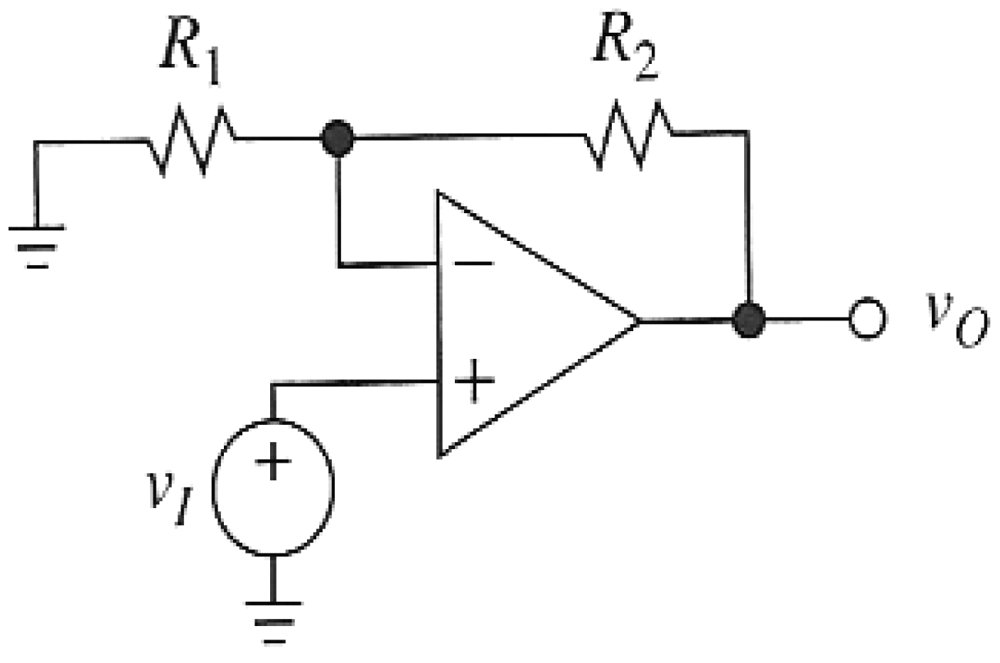
<p>The practical implementation of the primary conditioning amplifier uses the summing amplifier shown in <xref ref-type="fig" rid="f3-sensors-12-10820">Figure 3</xref> [<xref ref-type="bibr" rid="b13-sensors-12-10820">13</xref>,<xref ref-type="bibr" rid="b14-sensors-12-10820">14</xref>], with the amplified voltage given by:
<disp-formula id="FD16">
<label>(16)</label>
<mml:math id="mm19" display="block">
<mml:semantics id="sm19">
<mml:mrow>
<mml:mtable>
<mml:mtr>
<mml:mtd columnalign="left">
<mml:mrow>
<mml:msub>
<mml:mi>v</mml:mi>
<mml:mn>0</mml:mn></mml:msub>
<mml:mo>=</mml:mo>
<mml:mo stretchy="false">(</mml:mo>
<mml:mn>1</mml:mn>
<mml:mo>+</mml:mo>
<mml:msub>
<mml:mi>R</mml:mi>
<mml:mn>2</mml:mn></mml:msub>
<mml:mo>/</mml:mo>
<mml:msub>
<mml:mi>R</mml:mi>
<mml:mn>1</mml:mn></mml:msub>
<mml:mo stretchy="false">)</mml:mo>
<mml:msub>
<mml:mi>V</mml:mi>
<mml:mi>L</mml:mi></mml:msub></mml:mrow></mml:mtd></mml:mtr>
<mml:mtr>
<mml:mtd columnalign="right">
<mml:mrow>
<mml:mo>=</mml:mo>
<mml:mo stretchy="false">(</mml:mo>
<mml:mn>1</mml:mn>
<mml:mo>+</mml:mo>
<mml:msub>
<mml:mi>R</mml:mi>
<mml:mn>2</mml:mn></mml:msub>
<mml:mo>/</mml:mo>
<mml:msub>
<mml:mi>R</mml:mi>
<mml:mn>1</mml:mn></mml:msub>
<mml:mo stretchy="false">)</mml:mo>
<mml:mfrac>
<mml:mrow>
<mml:msub>
<mml:mi>V</mml:mi>
<mml:mi>s</mml:mi></mml:msub></mml:mrow>
<mml:mrow>
<mml:mn>1</mml:mn>
<mml:mo>+</mml:mo>
<mml:mi>K</mml:mi>
<mml:mi>x</mml:mi>
<mml:mo stretchy="false">(</mml:mo>
<mml:mn>1</mml:mn>
<mml:mo>−</mml:mo>
<mml:mi>x</mml:mi>
<mml:mo stretchy="false">)</mml:mo></mml:mrow></mml:mfrac>
<mml:mi>x</mml:mi></mml:mrow></mml:mtd></mml:mtr>
<mml:mtr>
<mml:mtd>
<mml:mrow>
<mml:mo>=</mml:mo>
<mml:mo stretchy="false">(</mml:mo>
<mml:mn>1</mml:mn>
<mml:mo>+</mml:mo>
<mml:msub>
<mml:mi>R</mml:mi>
<mml:mn>2</mml:mn></mml:msub>
<mml:mo>/</mml:mo>
<mml:msub>
<mml:mi>R</mml:mi>
<mml:mn>1</mml:mn></mml:msub>
<mml:mo stretchy="false">)</mml:mo>
<mml:mfrac>
<mml:mrow>
<mml:msub>
<mml:mi>V</mml:mi>
<mml:mi>s</mml:mi></mml:msub></mml:mrow>
<mml:mrow>
<mml:mn>1</mml:mn>
<mml:mo>+</mml:mo>
<mml:mi>K</mml:mi>
<mml:mi>x</mml:mi>
<mml:mo stretchy="false">(</mml:mo>
<mml:mn>1</mml:mn>
<mml:mo>−</mml:mo>
<mml:mi>x</mml:mi>
<mml:mo stretchy="false">)</mml:mo></mml:mrow></mml:mfrac>
<mml:mfrac>
<mml:mrow>
<mml:mi>d</mml:mi>
<mml:mo stretchy="false">(</mml:mo>
<mml:mi>t</mml:mi>
<mml:mo stretchy="false">)</mml:mo></mml:mrow>
<mml:mrow>
<mml:msub>
<mml:mi>d</mml:mi>
<mml:mi>T</mml:mi></mml:msub></mml:mrow></mml:mfrac></mml:mrow></mml:mtd></mml:mtr></mml:mtable></mml:mrow></mml:semantics></mml:math></disp-formula></p>
<p>An amplifier gain of 10 was used for the current work. This yields the normalised sensitivity parameter given in <xref rid="FD17" ref-type="disp-formula">Equation (17)</xref>.</p>
<disp-formula id="FD17">
<label>(17)</label>
<mml:math id="mm20" display="block">
<mml:semantics id="sm20">
<mml:mrow>
<mml:msubsup>
<mml:mi>S</mml:mi>
<mml:mrow>
<mml:msub>
<mml:mi>v</mml:mi>
<mml:mn>0</mml:mn></mml:msub></mml:mrow>
<mml:mi>x</mml:mi></mml:msubsup>
<mml:mo>=</mml:mo>
<mml:mfrac>
<mml:mrow>
<mml:mn>10</mml:mn>
<mml:mo stretchy="false">(</mml:mo>
<mml:mn>1</mml:mn>
<mml:mo>+</mml:mo>
<mml:mi>K</mml:mi>
<mml:msup>
<mml:mi>x</mml:mi>
<mml:mn>2</mml:mn></mml:msup>
<mml:mo stretchy="false">)</mml:mo></mml:mrow>
<mml:mrow>
<mml:msup>
<mml:mrow>
<mml:mo stretchy="false">[</mml:mo>
<mml:mn>1</mml:mn>
<mml:mo>+</mml:mo>
<mml:mi>K</mml:mi>
<mml:mo stretchy="false">(</mml:mo>
<mml:mi>x</mml:mi>
<mml:mo>−</mml:mo>
<mml:msup>
<mml:mi>x</mml:mi>
<mml:mn>2</mml:mn></mml:msup>
<mml:mo stretchy="false">)</mml:mo>
<mml:mo stretchy="false">]</mml:mo></mml:mrow>
<mml:mn>2</mml:mn></mml:msup></mml:mrow></mml:mfrac></mml:mrow></mml:semantics></mml:math></disp-formula>
<p><xref ref-type="table" rid="t2-sensors-12-10820">Table 2</xref> summarises the parameters of the sensor and the amplifying circuit.</p>
<p>Combining the parameter values in <xref ref-type="table" rid="t2-sensors-12-10820">Table 2</xref> with <xref rid="FD5" ref-type="disp-formula">Equations (5)</xref> and <xref rid="FD10" ref-type="disp-formula">(10)</xref> yields:
<disp-formula id="FD18">
<label>(18)</label>
<mml:math id="mm21" display="block">
<mml:semantics id="sm21">
<mml:mrow>
<mml:mn>0.998</mml:mn>
<mml:mi>x</mml:mi>
<mml:mo>≤</mml:mo>
<mml:msub>
<mml:mi>V</mml:mi>
<mml:mi>L</mml:mi></mml:msub>
<mml:mo>=</mml:mo>
<mml:mfrac>
<mml:mrow>
<mml:msub>
<mml:mi>V</mml:mi>
<mml:mi>S</mml:mi></mml:msub></mml:mrow>
<mml:mrow>
<mml:mn>1</mml:mn>
<mml:mo>+</mml:mo>
<mml:mn>0.0056</mml:mn>
<mml:mi>x</mml:mi>
<mml:mo stretchy="false">(</mml:mo>
<mml:mn>1</mml:mn>
<mml:mo>−</mml:mo>
<mml:mi>x</mml:mi>
<mml:mo stretchy="false">)</mml:mo></mml:mrow></mml:mfrac>
<mml:mi>x</mml:mi>
<mml:mo>≤</mml:mo>
<mml:mn>1.006</mml:mn>
<mml:mi>x</mml:mi></mml:mrow></mml:semantics></mml:math></disp-formula></p>
<p>Therefore, within an accuracy of ±0.6%:
<disp-formula id="FD19">
<label>(19)</label>
<mml:math id="mm22" display="block">
<mml:semantics id="sm22">
<mml:mrow>
<mml:msub>
<mml:mi>V</mml:mi>
<mml:mi>L</mml:mi></mml:msub>
<mml:mo>=</mml:mo>
<mml:mi>x</mml:mi>
<mml:mo stretchy="false">[</mml:mo>
<mml:mi>V</mml:mi>
<mml:mo stretchy="false">]</mml:mo></mml:mrow></mml:semantics></mml:math></disp-formula>Similarly:
<disp-formula id="FD20">
<label>(20)</label>
<mml:math id="mm23" display="block">
<mml:semantics id="sm23">
<mml:mrow>
<mml:mtable>
<mml:mtr>
<mml:mtd>
<mml:mrow>
<mml:msub>
<mml:mi>v</mml:mi>
<mml:mn>0</mml:mn></mml:msub>
<mml:mo>=</mml:mo>
<mml:mn>10</mml:mn>
<mml:msub>
<mml:mi>V</mml:mi>
<mml:mi>L</mml:mi></mml:msub>
<mml:mo>=</mml:mo>
<mml:mn>10</mml:mn>
<mml:mi>x</mml:mi>
<mml:mo>=</mml:mo>
<mml:mn>10</mml:mn>
<mml:mfrac>
<mml:mrow>
<mml:mi>d</mml:mi>
<mml:mo stretchy="false">(</mml:mo>
<mml:mi>t</mml:mi>
<mml:mo stretchy="false">)</mml:mo></mml:mrow>
<mml:mrow>
<mml:msub>
<mml:mi>d</mml:mi>
<mml:mi>T</mml:mi></mml:msub></mml:mrow></mml:mfrac>
<mml:mo stretchy="false">[</mml:mo>
<mml:mi>V</mml:mi>
<mml:mo stretchy="false">]</mml:mo>
<mml:mo>;</mml:mo>
<mml:mi>d</mml:mi>
<mml:mo stretchy="false">(</mml:mo>
<mml:mi>t</mml:mi>
<mml:mo stretchy="false">)</mml:mo>
<mml:mo>,</mml:mo>
<mml:msub>
<mml:mi>d</mml:mi>
<mml:mi>T</mml:mi></mml:msub></mml:mrow></mml:mtd>
<mml:mtd>
<mml:mrow>
<mml:mo stretchy="false">[</mml:mo>
<mml:mi>m</mml:mi>
<mml:mi>m</mml:mi>
<mml:mo stretchy="false">]</mml:mo></mml:mrow></mml:mtd></mml:mtr></mml:mtable></mml:mrow></mml:semantics></mml:math></disp-formula>and the sensitivity of the amplified voltage is given by:
<disp-formula id="FD21">
<label>(21)</label>
<mml:math id="mm24" display="block">
<mml:semantics id="sm24">
<mml:mrow>
<mml:msubsup>
<mml:mi>S</mml:mi>
<mml:mrow>
<mml:msub>
<mml:mi>v</mml:mi>
<mml:mn>0</mml:mn></mml:msub></mml:mrow>
<mml:mi>d</mml:mi></mml:msubsup>
<mml:mo>=</mml:mo>
<mml:mn>0.1</mml:mn>
<mml:mo stretchy="false">[</mml:mo>
<mml:mi>V</mml:mi>
<mml:mo>/</mml:mo>
<mml:mi>m</mml:mi>
<mml:mi>m</mml:mi>
<mml:mo stretchy="false">]</mml:mo>
<mml:mo>;</mml:mo>
<mml:msub>
<mml:mi>d</mml:mi>
<mml:mi>T</mml:mi></mml:msub>
<mml:mo>=</mml:mo>
<mml:mn>100</mml:mn>
<mml:mi>m</mml:mi>
<mml:mi>m</mml:mi></mml:mrow></mml:semantics></mml:math></disp-formula></p>
<p>In Section 3, we present a technique to further improve the sensitivity of the transducer, using voltage-to-frequency conversion.</p></sec></sec></sec>
<sec>
<label>3.</label>
<title>Sensitivity Enhancement</title>
<p>As observed above, a small value of K (0.0056) was required to both minimize nonlinearity effects, and to enhance fidelity of the primary conditioning circuit. This value of K however, lowers the sensitivity of the transduction process. Since submetre displacements can be very small, a very high sensitivity transducer is required (as shown in Table 2, ideal sensitivity required is ∞). In the sequel, we present a voltage-to-frequency converter circuit that is used to further enhance the sensitivity of the developed transducer.</p>
<sec>
<label>3.1.</label>
<title>Voltage-to-Frequency (VFC) Conversion</title>
<p>Apart from sensitivity enhancement, the conversion of <italic>v</italic><sub>0</sub> into a frequency signal has several other advantages, including: high noise immunity, high output power, wide dynamic range, and ease of interfacing with digital data acquisition systems. <xref ref-type="table" rid="t3-sensors-12-10820">Table 3</xref> shows key values of <italic>v</italic><sub>0</sub> and their corresponding frequency representations.</p>
<p>The linear relationship between v<sub>0</sub> and frequency in <xref ref-type="table" rid="t3-sensors-12-10820">Table 3</xref> is expressed mathematically as:
<disp-formula id="FD22">
<label>(22)</label>
<mml:math id="mm25" display="block">
<mml:semantics id="sm25">
<mml:mrow>
<mml:msub>
<mml:mi>f</mml:mi>
<mml:mn>0</mml:mn></mml:msub>
<mml:mo>=</mml:mo>
<mml:mn>10000</mml:mn>
<mml:msub>
<mml:mi>v</mml:mi>
<mml:mn>0</mml:mn></mml:msub>
<mml:mo stretchy="false">[</mml:mo>
<mml:mi>H</mml:mi>
<mml:mi>z</mml:mi>
<mml:mo stretchy="false">]</mml:mo></mml:mrow></mml:semantics></mml:math></disp-formula></p>
<p>Applying <xref rid="FD20" ref-type="disp-formula">Equation (20)</xref> in <xref rid="FD22" ref-type="disp-formula">Equation (22)</xref> we obtain:
<disp-formula id="FD23">
<label>(23)</label>
<mml:math id="mm26" display="block">
<mml:semantics id="sm26">
<mml:mrow>
<mml:mtable>
<mml:mtr>
<mml:mtd>
<mml:mrow>
<mml:msub>
<mml:mi>f</mml:mi>
<mml:mn>0</mml:mn></mml:msub>
<mml:mo>=</mml:mo>
<mml:mn>1000</mml:mn>
<mml:mi>d</mml:mi>
<mml:mo stretchy="false">(</mml:mo>
<mml:mi>t</mml:mi>
<mml:mo stretchy="false">)</mml:mo></mml:mrow></mml:mtd>
<mml:mtd>
<mml:mrow>
<mml:mo stretchy="false">[</mml:mo>
<mml:mi>H</mml:mi>
<mml:mi>z</mml:mi>
<mml:mo stretchy="false">]</mml:mo>
<mml:mo>;</mml:mo>
<mml:mi>d</mml:mi>
<mml:mo stretchy="false">(</mml:mo>
<mml:mi>t</mml:mi>
<mml:mo stretchy="false">)</mml:mo></mml:mrow></mml:mtd>
<mml:mtd>
<mml:mrow>
<mml:mo stretchy="false">[</mml:mo>
<mml:mi>m</mml:mi>
<mml:mi>m</mml:mi>
<mml:mo stretchy="false">]</mml:mo></mml:mrow></mml:mtd></mml:mtr></mml:mtable></mml:mrow></mml:semantics></mml:math></disp-formula></p>
<p>It is evident from <xref rid="FD23" ref-type="disp-formula">Equation (23)</xref> that:
<disp-formula id="FD24">
<label>(24)</label>
<mml:math id="mm27" display="block">
<mml:semantics id="sm27">
<mml:mrow>
<mml:mtable>
<mml:mtr>
<mml:mtd>
<mml:mrow>
<mml:mi>d</mml:mi>
<mml:mo stretchy="false">(</mml:mo>
<mml:mi>t</mml:mi>
<mml:mo stretchy="false">)</mml:mo>
<mml:mo>=</mml:mo>
<mml:mfrac>
<mml:mrow>
<mml:msub>
<mml:mi>f</mml:mi>
<mml:mn>0</mml:mn></mml:msub></mml:mrow>
<mml:mrow>
<mml:mn>1000</mml:mn></mml:mrow></mml:mfrac></mml:mrow></mml:mtd>
<mml:mtd>
<mml:mrow>
<mml:mo stretchy="false">[</mml:mo>
<mml:mi>m</mml:mi>
<mml:mi>m</mml:mi>
<mml:mo stretchy="false">]</mml:mo>
<mml:mo>;</mml:mo>
<mml:msub>
<mml:mi>f</mml:mi>
<mml:mn>0</mml:mn></mml:msub></mml:mrow></mml:mtd>
<mml:mtd>
<mml:mrow>
<mml:mo stretchy="false">[</mml:mo>
<mml:mi>H</mml:mi>
<mml:mi>z</mml:mi>
<mml:mo stretchy="false">]</mml:mo></mml:mrow></mml:mtd></mml:mtr></mml:mtable></mml:mrow></mml:semantics></mml:math></disp-formula></p>
<p>The AD 650 voltage-to-frequency converter (VFC) was used for the implementation of the displacement-to-frequency conversion circuit satisfying <xref rid="FD23" ref-type="disp-formula">Equation (23)</xref>. The pin layout of the AD 650 VFC is obtained from the manufacturer's manual for the device [<xref ref-type="bibr" rid="b15-sensors-12-10820">15</xref>]. The selection of components for the VFC circuit is presented in the sequel.</p></sec>
<sec>
<label>3.2.</label>
<title>Component's Selection for the AD 650 VFC</title>
<p>For the AD 650, only four component values must be selected by the user [<xref ref-type="bibr" rid="b15-sensors-12-10820">15</xref>]. Using the manufacturer's notation, these are the input resistance R<sub>IN</sub>, the timing capacitor C<sub>OS</sub>, the logic resistor R<sub>2</sub> and the integration capacitor C<sub>INT</sub>. The first two are determined by the input voltage range and full-scale frequency. Additional relationship between R<sub>IN</sub> and C<sub>OS</sub> is provided through graphs obtainable in [<xref ref-type="bibr" rid="b15-sensors-12-10820">15</xref>]. Sample design for a maximum frequency of 100 KHZ in the data sheet of the AD 650 VFC used R<sub>IN</sub> = 40 kΩ and this has been adopted for the realization in this study. <xref ref-type="table" rid="t4-sensors-12-10820">Table 4</xref> summarizes the components used for the design of the VFC circuit, with C<sub>INT</sub> calculated using the equation:
<disp-formula id="FD25">
<label>(25)</label>
<mml:math id="mm28" display="block">
<mml:semantics id="sm28">
<mml:mrow>
<mml:msub>
<mml:mi>C</mml:mi>
<mml:mrow>
<mml:mtext mathvariant="italic">INT</mml:mtext></mml:mrow></mml:msub>
<mml:mo>=</mml:mo>
<mml:mfrac>
<mml:mrow>
<mml:msup>
<mml:mrow>
<mml:mn>10</mml:mn></mml:mrow>
<mml:mrow>
<mml:mo>−</mml:mo>
<mml:mn>4</mml:mn></mml:mrow></mml:msup>
<mml:mi>F</mml:mi>
<mml:mo>/</mml:mo>
<mml:mo>sec</mml:mo></mml:mrow>
<mml:mrow>
<mml:msub>
<mml:mi>f</mml:mi>
<mml:mrow>
<mml:mtext mathvariant="italic">MAX</mml:mtext></mml:mrow></mml:msub></mml:mrow></mml:mfrac>
<mml:mo>≥</mml:mo>
<mml:mn>1000</mml:mn>
<mml:mi>p</mml:mi>
<mml:mi>F</mml:mi></mml:mrow></mml:semantics></mml:math></disp-formula></p>
<p>The frequency conversion improves the sensitivity of the transducer from the value given by <xref rid="FD17" ref-type="disp-formula">Equation (17)</xref> to:
<disp-formula id="FD26">
<label>(26)</label>
<mml:math id="mm29" display="block">
<mml:semantics id="sm29">
<mml:mrow>
<mml:msubsup>
<mml:mi>S</mml:mi>
<mml:mrow>
<mml:msub>
<mml:mi>v</mml:mi>
<mml:mn>0</mml:mn></mml:msub></mml:mrow>
<mml:mrow>
<mml:mi>H</mml:mi>
<mml:mi>z</mml:mi></mml:mrow></mml:msubsup>
<mml:mo>=</mml:mo>
<mml:mfrac>
<mml:mrow>
<mml:mn>100000</mml:mn>
<mml:mo>−</mml:mo>
<mml:mn>0</mml:mn></mml:mrow>
<mml:mrow>
<mml:mo stretchy="false">(</mml:mo>
<mml:mn>100</mml:mn>
<mml:mo>−</mml:mo>
<mml:mn>0</mml:mn>
<mml:mo stretchy="false">)</mml:mo></mml:mrow></mml:mfrac>
<mml:mo>=</mml:mo>
<mml:msup>
<mml:mrow>
<mml:mn>10</mml:mn></mml:mrow>
<mml:mn>3</mml:mn></mml:msup>
<mml:mtext mathvariant="italic">bits</mml:mtext>
<mml:mo>/</mml:mo>
<mml:mi>m</mml:mi>
<mml:mi>m</mml:mi></mml:mrow></mml:semantics></mml:math></disp-formula>and has also improved the resolution to = 10<sup>−3</sup> mm/bit.</p></sec></sec>
<sec sec-type="results|discussion">
<label>4.</label>
<title>Simulations, Experimental Validation, Results Presentation and Discussions</title>
<p>The indices assessing the quality of the transducer were evaluated by simulation. The rest of the results were obtained through experimental measurements.</p>
<sec>
<label>4.1.</label>
<title>Simulations</title>
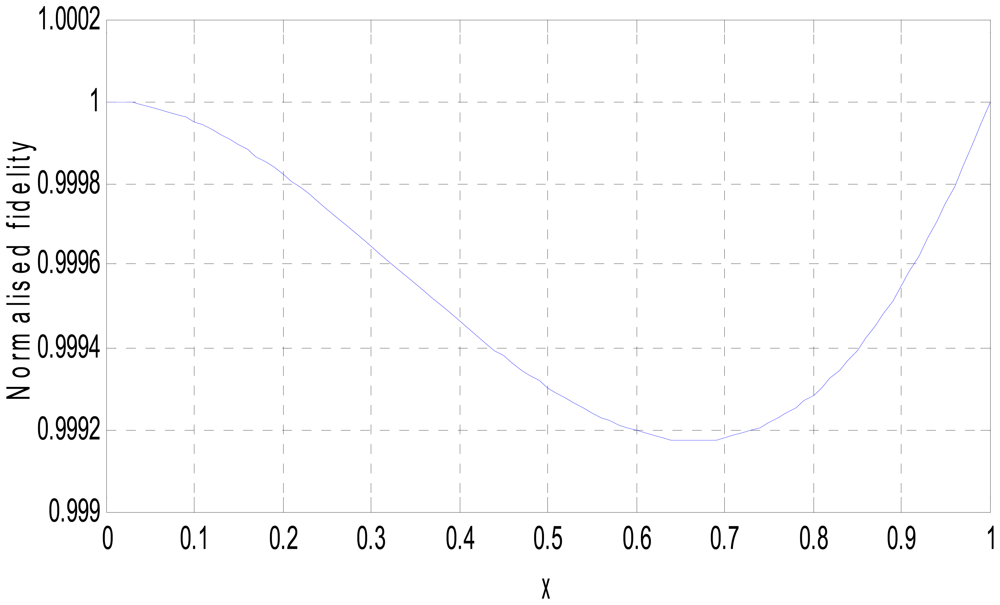
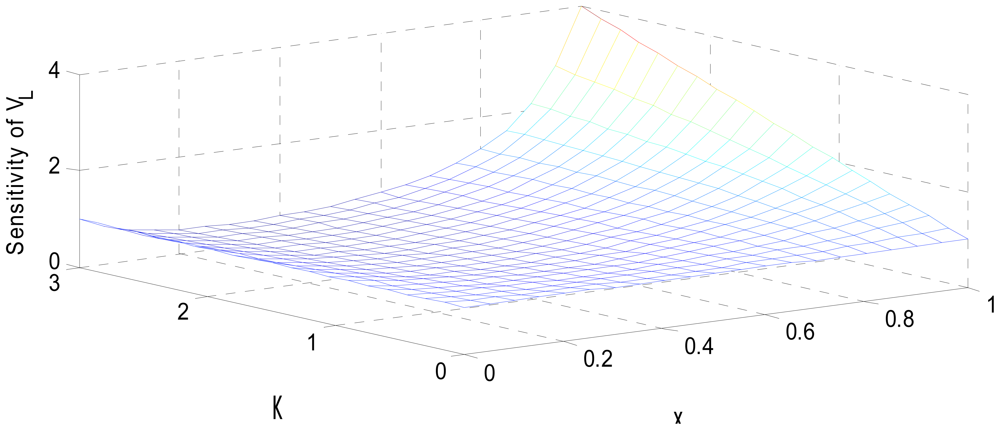
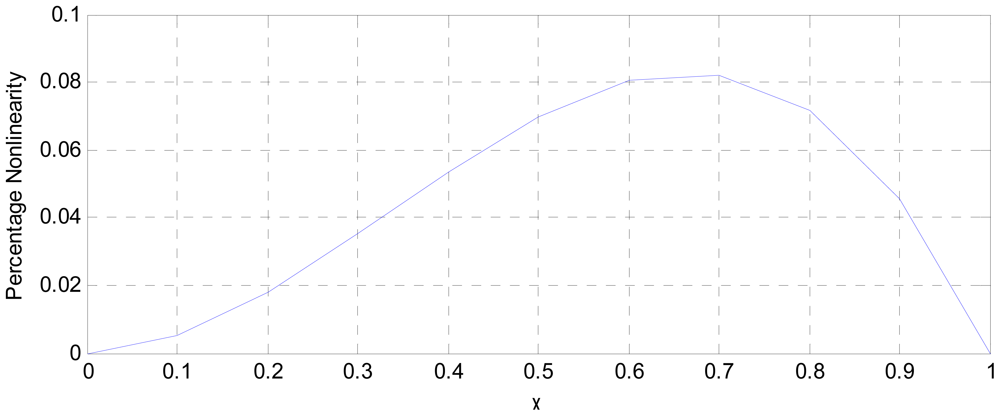
<p>MATLAB simulation of the transducer fidelity, sensitivity and nonlinearity, based on Equations (9), (12) and (15) is presented in <xref ref-type="fig" rid="f4-sensors-12-10820">Figures 4</xref>–<xref ref-type="fig" rid="f6-sensors-12-10820">6</xref>.</p></sec>
<sec>
<label>4.2.</label>
<title>Experimental Validation</title>
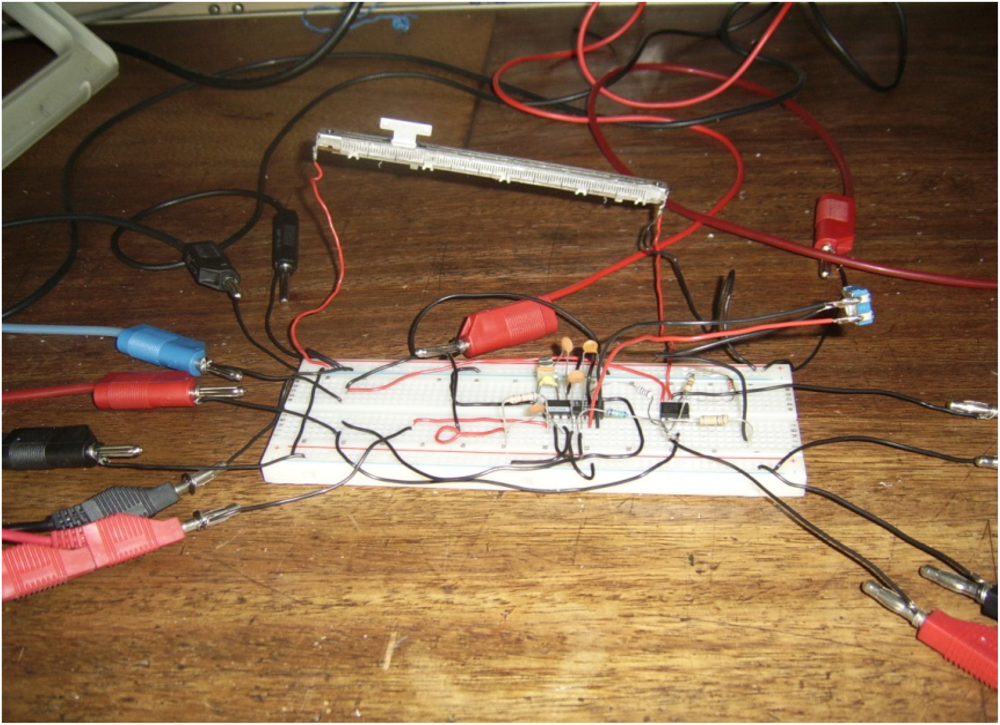
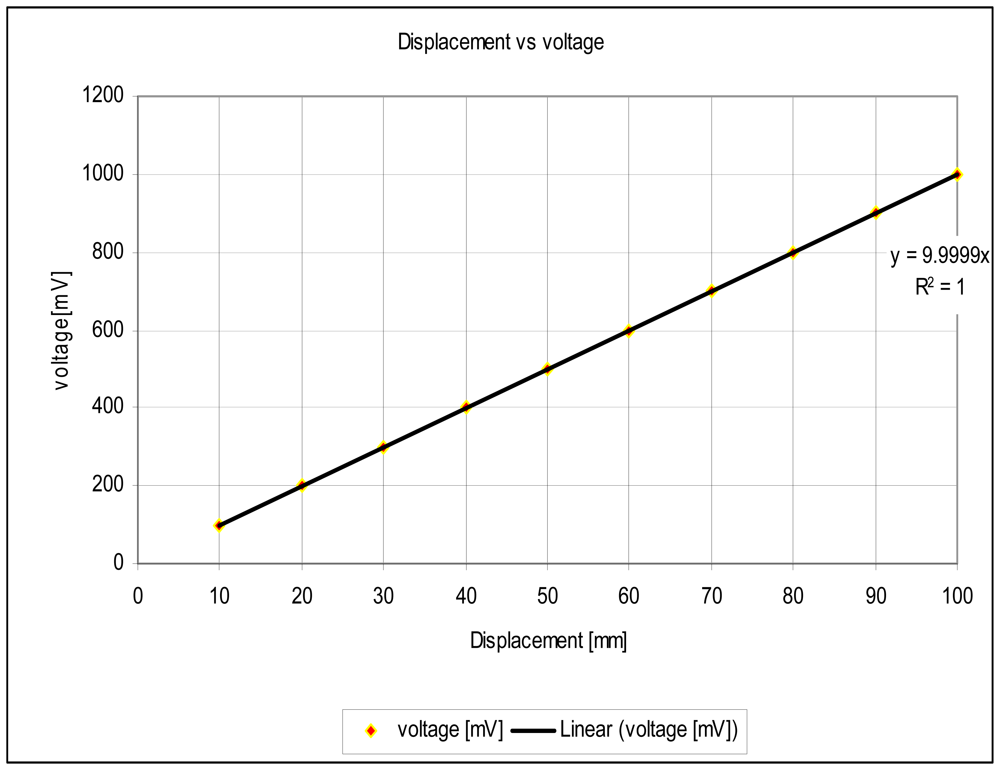
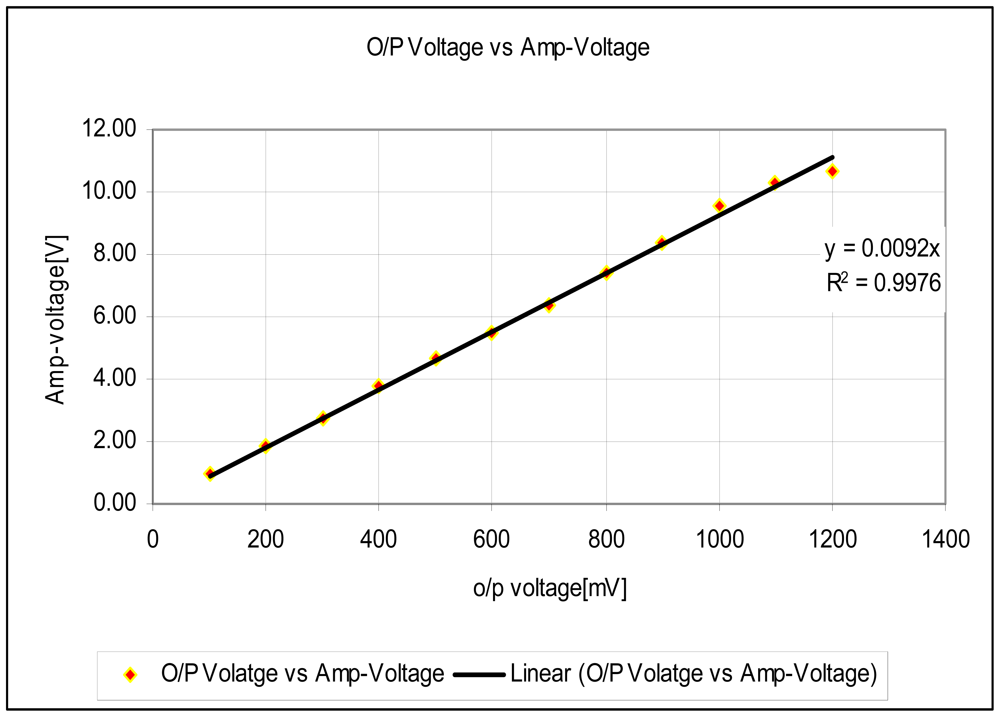
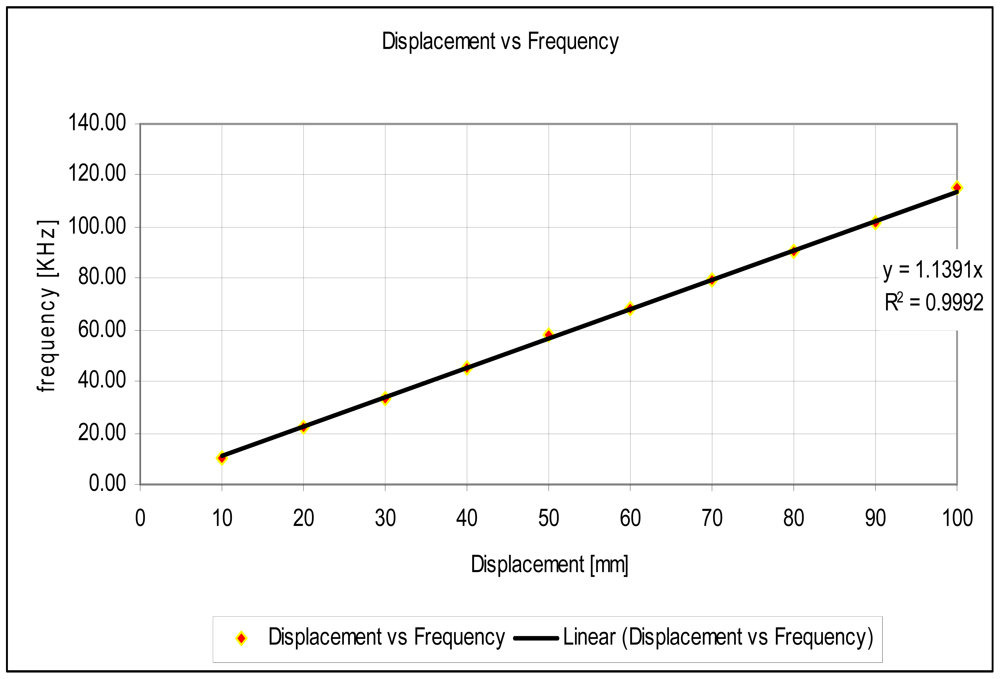
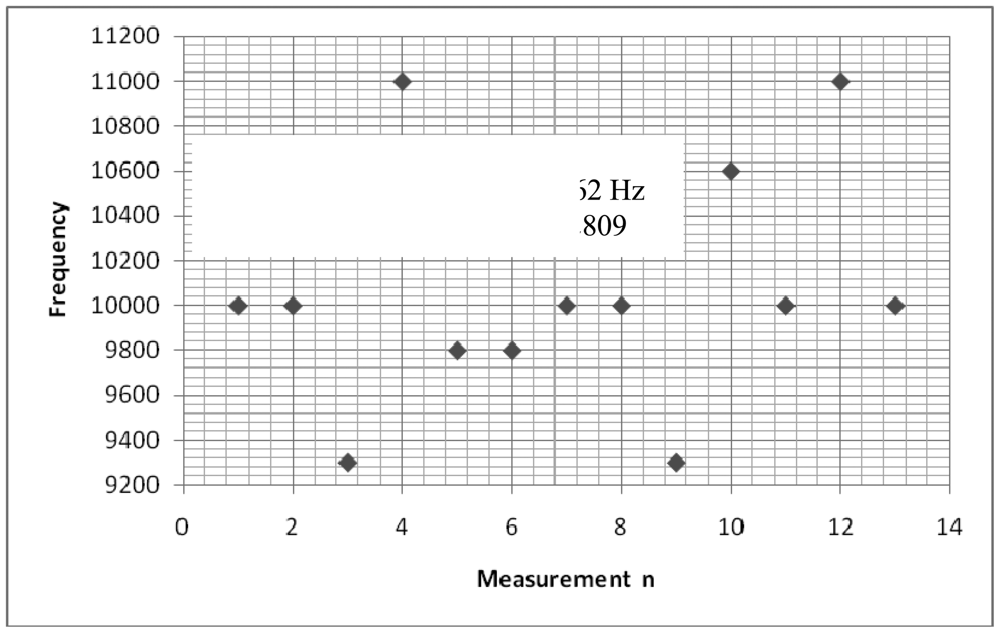
<p>The experimental setup is shown in <xref ref-type="fig" rid="f7-sensors-12-10820">Figure 7</xref>. For the experiments, a slide wire potentiometer was used as the submeter displacement sensor. It had a maximum displacement d<sub>T</sub> = 100 mm = 10<sup>−1</sup> m, and a total resistance of 11.2 kΩ (instead of the design maximum resistance of 10 kΩ). The potentiometer was supplied by a 1volt DC supply. The Thevenin voltage of the sensor, as a function of displacement, is shown in <xref ref-type="fig" rid="f8-sensors-12-10820">Figure 8</xref>. A plot of the amplified sensor voltage as function of detected displacement is shown in <xref ref-type="fig" rid="f9-sensors-12-10820">Figure 9</xref>. The overall displacement-to-frequency transduction is shown in <xref ref-type="fig" rid="f10-sensors-12-10820">Figure 10</xref>. For the analysis of the accuracy and precision of transducing displacement inputs into frequency, repeated measurements of 10 mm displacement were undertaken. The results are shown in <xref ref-type="fig" rid="f11-sensors-12-10820">Figures 11</xref> and <xref ref-type="fig" rid="f12-sensors-12-10820">12</xref>.</p></sec>
<sec>
<label>4.3.</label>
<title>Result Discussions</title>
<p>The simulated fidelity results presented in <xref ref-type="fig" rid="f4-sensors-12-10820">Figure 4</xref> shows that, the conditioning of the sensor signal by the primary amplifier was undertaken with at least 99.91% fidelity. <xref ref-type="fig" rid="f5-sensors-12-10820">Figure 5</xref> shows that the introduction of the conditioning circuit slightly reduced the normalized input sensitivity 
<inline-formula>
<mml:math id="mm30" display="inline">
<mml:semantics id="sm30">
<mml:mrow>
<mml:mo stretchy="false">(</mml:mo>
<mml:msubsup>
<mml:mi>S</mml:mi>
<mml:mrow>
<mml:mi>μ</mml:mi>
<mml:msub>
<mml:mi>E</mml:mi>
<mml:mrow>
<mml:mi>t</mml:mi>
<mml:mi>h</mml:mi></mml:mrow></mml:msub></mml:mrow>
<mml:mi>x</mml:mi></mml:msubsup>
<mml:mo stretchy="false">)</mml:mo></mml:mrow></mml:semantics></mml:math></inline-formula> to a value less than unity (0.988). As shown in <xref ref-type="fig" rid="f6-sensors-12-10820">Figure 6</xref>, the choice of K = 0.0056 has reduced the worst case nonlinearity to 0.18% &lt; 4%, as typically allowed in instrumentation [<xref ref-type="bibr" rid="b9-sensors-12-10820">9</xref>]. The experimental measurements, confirmed the linearity between the displacement and the displacement-dependent voltage E<sub>TH</sub> as in <xref ref-type="fig" rid="f8-sensors-12-10820">Figure 8</xref>. <xref ref-type="fig" rid="f9-sensors-12-10820">Figure 9</xref> shows that, the connection of the voltage amplifier has introduced nearly 0.22% nonlinearity (obtained from the linear correlation coefficient); also slightly reducing the normalized sensitivity from a value of unity to 0.9978. Experimental results of the overall displacement-to-frequency conversion process are shown in <xref ref-type="fig" rid="f10-sensors-12-10820">Figure 10</xref>. It is evident there-from, that the millimetre-to-frequency converter has an overall linearity to 99.92%, or a nonlinearity of 0.08%. Results from the precision analysis of the displacement-to-frequency transducer are shown in <xref ref-type="fig" rid="f11-sensors-12-10820">Figures 11</xref> and <xref ref-type="fig" rid="f12-sensors-12-10820">12</xref>. It is evident from these, that for a 10 mm displacement, a mean measurement of 10,062 Hz (for 100,000 Hz) was obtained, giving a transducer accuracy of ±0.62%; the standard deviation of the measurements was 530 Hz.</p></sec>
<sec sec-type="methods">
<label>4.4.</label>
<title>Cost-Analysis</title>
<p>The reported millimeter-to-frequency transducer consists of one resistive sensor, five resistors, two capacitors, two operational amplifiers and one AD 650 voltage-to-frequency converter. <xref ref-type="table" rid="t5-sensors-12-10820">Table 5</xref> shows the cost estimation for the new transducer based on average component cost, and 30% device production fee. Calculations are shown for two sensor types: potentiometers and strain gauges.</p>
<p>To put the above costs in perspective, <xref ref-type="table" rid="t6-sensors-12-10820">Table 6</xref> compares the cost of the reported transducer with those of existing displacement sensors.</p>
<p>It is evident from <xref ref-type="table" rid="t6-sensors-12-10820">Table 6</xref>, that the reported transducer has a very significant financial advantage over several existing systems for displacement measurements.</p></sec></sec>
<sec sec-type="conclusions">
<label>5.</label>
<title>Conclusions</title>
<p>It is concluded that a cheap, linear, millimetre displacement-to-frequency transducer with both high sensitivity and high fidelity has been successfully realised.</p>
<sec>
<title>Limitations</title>
<p>The design sensor resistance of 10 kΩ was not available. A sensor of total resistance of 11.2 kΩ was used instead. Whereas this larger resistance value did not directly affect the accurate performance of the transducer, it was observed that, the maximum output frequency was 120 kHz (instead of the design maximum frequency of 100 kHz). Temperature variations constitute a significant random impact on sensor performance. Temperature effects have not yet being characterized. The effect of supply voltage variation is also still under investigation. Test measurements were undertaken using laboratory standards. Traceability of accuracy shall be undertaken in subsequent development, using facilities at a national metrology centre.</p></sec></sec></body>
<back>
<ref-list>
<title>References</title>
<ref id="b1-sensors-12-10820"><label>1.</label><citation citation-type="journal"><person-group person-group-type="author"><name><surname>Song</surname><given-names>H.X.</given-names></name><name><surname>Wang</surname><given-names>X.D.</given-names></name><name><surname>Ma</surname><given-names>L.Q.</given-names></name><name><surname>Cai</surname><given-names>M.Z.</given-names></name><name><surname>Cao</surname><given-names>T.Z.</given-names></name></person-group><article-title>Design and performance analysis of a laser displacement sensor based on Position Sensitive Detector (PSD)</article-title><source>J. Phys.</source><year>2006</year><volume>48</volume><fpage>217</fpage><lpage>222</lpage></citation></ref>
<ref id="b2-sensors-12-10820"><label>2.</label><citation citation-type="journal"><person-group person-group-type="author"><name><surname>Riedijk</surname><given-names>F.R.</given-names></name><name><surname>Smith</surname><given-names>T.</given-names></name><name><surname>Huijsing</surname><given-names>J.H.</given-names></name></person-group><article-title>An integrated optical position-sensitive detector with digital output and error correction</article-title><source>Sens. Actuators A Phys.</source><year>1994</year><volume>40</volume><fpage>237</fpage><lpage>242</lpage><pub-id pub-id-type="doi">10.1016/0924-4247(94)87010-1</pub-id></citation></ref>
<ref id="b3-sensors-12-10820"><label>3.</label><citation citation-type="journal"><person-group person-group-type="author"><name><surname>Hofstetter</surname><given-names>D.</given-names></name><name><surname>Zappe</surname><given-names>H.P.</given-names></name><name><surname>Dändliker</surname><given-names>R.</given-names></name></person-group><article-title>Optical displacement measurement with GaAs/AlGaAs-based monolithically integrated michelson interferometers</article-title><source>J. Lightw. Technol.</source><year>1997</year><volume>15</volume><fpage>663</fpage><lpage>670</lpage><pub-id pub-id-type="doi">10.1109/50.566688</pub-id></citation></ref>
<ref id="b4-sensors-12-10820"><label>4.</label><citation citation-type="journal"><person-group person-group-type="author"><name><surname>McCarthy</surname><given-names>M.</given-names></name><name><surname>Duff</surname><given-names>P.</given-names></name><name><surname>Muller</surname><given-names>H.L.</given-names></name><name><surname>Randell</surname><given-names>C.</given-names></name></person-group><article-title>Accessible ultrasonic positioning</article-title><source>IEEE Pervas. Comput.</source><year>2006</year><volume>5</volume><fpage>86</fpage><lpage>93</lpage></citation></ref>
<ref id="b5-sensors-12-10820"><label>5.</label><citation citation-type="journal"><person-group person-group-type="author"><name><surname>Akio</surname><given-names>K.</given-names></name></person-group><article-title>Design and characterization of nano-displacement sensor with high-frequency oscillators</article-title><source>J. Sens.</source><year>2011</year><volume>2011</volume><fpage>360173</fpage></citation></ref>
<ref id="b6-sensors-12-10820"><label>6.</label><citation citation-type="confproc"><person-group person-group-type="author"><name><surname>Yang</surname><given-names>H.</given-names></name><name><surname>Li</surname><given-names>R.</given-names></name><name><surname>Wei</surname><given-names>Q.</given-names></name><name><surname>Liu</surname><given-names>J.</given-names></name></person-group><article-title>The study of high accuracy capacitive displacement sensor used in non-contact precision displacement measurement</article-title><conf-name>Proceedings of the 9th International Conference on Electronic Measurement and Instruments (ICEMI '09)</conf-name><conf-loc>Beijing, China</conf-loc><conf-date>16–19 August 2009</conf-date><fpage>164</fpage><lpage>168</lpage></citation></ref>
<ref id="b7-sensors-12-10820"><label>7.</label><citation citation-type="confproc"><person-group person-group-type="author"><name><surname>Rahal</surname><given-names>M.</given-names></name><name><surname>Demosthenous</surname><given-names>A. D.</given-names></name><name><surname>Jiang</surname><given-names>D.</given-names></name><name><surname>Pal</surname><given-names>D.</given-names></name></person-group><article-title>A signal conditioner for high-frequency inductive position sensors</article-title><conf-name>Proceedings of the 2008 International Conference on Microelectronics (ICM 2008)</conf-name><conf-loc>Sharjah, UAE</conf-loc><conf-date>14–17 December 2008</conf-date><fpage>118</fpage><lpage>122</lpage></citation></ref>
<ref id="b8-sensors-12-10820"><label>8.</label><citation citation-type="journal"><person-group person-group-type="author"><name><surname>Shieh</surname><given-names>J.</given-names></name><name><surname>Huber</surname><given-names>J.E.</given-names></name><name><surname>Fleck</surname><given-names>N.A.</given-names></name><name><surname>Ashby</surname><given-names>M.F.</given-names></name></person-group><article-title>The selection of sensors</article-title><source>Progr. Mater. Sci.</source><year>2001</year><volume>46</volume><fpage>461</fpage><lpage>504</lpage><pub-id pub-id-type="doi">10.1016/S0079-6425(00)00011-6</pub-id></citation></ref>
<ref id="b9-sensors-12-10820"><label>9.</label><citation citation-type="book"><person-group person-group-type="author"><name><surname>Bentley</surname><given-names>J.P.</given-names></name></person-group><article-title>Sensing Elements</article-title><source>Principles of Measurement Systems</source><edition>3rd ed.</edition><publisher-name>Pearson Education Limited</publisher-name><publisher-loc>Edinburgh, UK</publisher-loc><year>1995</year><fpage>135</fpage><lpage>177</lpage></citation></ref>
<ref id="b10-sensors-12-10820"><label>10.</label><citation citation-type="journal"><person-group person-group-type="author"><name><surname>Lion</surname><given-names>K.S.</given-names></name></person-group><article-title>Electric displacement transducers for physiological investigations</article-title><source>Oxf. J. Med. Rheumatol</source><year>1953</year><volume>1</volume><fpage>298</fpage><lpage>306</lpage><pub-id pub-id-type="doi">10.1093/rheumatology/1.8.298</pub-id></citation></ref>
<ref id="b11-sensors-12-10820"><label>11.</label><citation citation-type="journal"><person-group person-group-type="author"><name><surname>Casciati</surname><given-names>F.</given-names></name><name><surname>Fuggini</surname><given-names>C.</given-names></name></person-group><article-title>Engineering vibration monitoring by GPS: Long duration records</article-title><source>Earthq. Eng. Eng. Vib.</source><year>2009</year><volume>8</volume><fpage>459</fpage><lpage>467</lpage><pub-id pub-id-type="doi">10.1007/s11803-009-9058-8</pub-id></citation></ref>
<ref id="b12-sensors-12-10820"><label>12.</label><citation citation-type="journal"><person-group person-group-type="author"><name><surname>Psimoulis</surname><given-names>P.</given-names></name><name><surname>Pytharouli</surname><given-names>S.</given-names></name><name><surname>Karambalis</surname><given-names>D.</given-names></name><name><surname>Stiros</surname><given-names>S.</given-names></name></person-group><article-title>Potential of global positioning system (GPS) to measure frequencies of oscillations of engineering structures</article-title><source>J. Sound Vib.</source><year>2008</year><volume>318</volume><fpage>606</fpage><lpage>623</lpage><pub-id pub-id-type="doi">10.1016/j.jsv.2008.04.036</pub-id></citation></ref>
<ref id="b13-sensors-12-10820"><label>13.</label><citation citation-type="book"><person-group person-group-type="author"><name><surname>George</surname><given-names>B.R.</given-names></name></person-group><source>Operational Amplifiers Integrated and Hybrid Circuits</source><edition>1st ed.</edition><publisher-name>John Wiley and Sons</publisher-name><publisher-loc>New York, NY, USA</publisher-loc><year>1993</year></citation></ref>
<ref id="b14-sensors-12-10820"><label>14.</label><citation citation-type="book"><person-group person-group-type="author"><name><surname>Chirlian</surname><given-names>P.M.</given-names></name></person-group><source>Analysis and Design of Integrated Electronic Circuits</source><edition>2nd ed.</edition><publisher-name>John Wiley and Sons</publisher-name><publisher-loc>New York, NY, USA</publisher-loc><year>1987</year></citation></ref>
<ref id="b15-sensors-12-10820"><label>15.</label><citation citation-type="web"><article-title>Manufacturer's Datasheet for the AD 650 Voltage-to-Frequency Converter</article-title><comment>Available online: <ext-link xlink:href="http://www.datasheetcatalog.com" ext-link-type="uri">http://www.datasheetcatalog.com</ext-link> (accessed on 25 December 2011)</comment></citation></ref></ref-list>
<sec sec-type="display-objects">
<title>Figures and Tables</title>
<fig id="f1-sensors-12-10820" position="float">
<label>Figure 1.</label>
<caption>
<p>Arrangement of potentiometer-type displacement sensor.</p></caption>
<graphic xlink:href="sensors-12-10820f1.gif"/></fig>
<fig id="f2-sensors-12-10820" position="float">
<label>Figure 2.</label>
<caption>
<p>Equivalent circuit of sensor with primary conditioning amplifier.</p></caption>
<graphic xlink:href="sensors-12-10820f2.gif"/></fig>
<fig id="f3-sensors-12-10820" position="float">
<label>Figure 3.</label>
<caption>
<p>Summing amplifier used as the primary conditioning circuit.</p></caption>
<graphic xlink:href="sensors-12-10820f3.gif"/></fig>
<fig id="f4-sensors-12-10820" position="float">
<label>Figure 4.</label>
<caption>
<p>Fidelity of primary voltage conditioning amplifier.</p></caption>
<graphic xlink:href="sensors-12-10820f4.gif"/></fig>
<fig id="f5-sensors-12-10820" position="float">
<label>Figure 5.</label>
<caption>
<p>Sensitivity analysis in displacement-to-voltage conversion.</p></caption>
<graphic xlink:href="sensors-12-10820f5.gif"/></fig>
<fig id="f6-sensors-12-10820" position="float">
<label>Figure 6.</label>
<caption>
<p>Analysis of nonlinearity in displacement to voltage conversion.</p></caption>
<graphic xlink:href="sensors-12-10820f6.gif"/></fig>
<fig id="f7-sensors-12-10820" position="float">
<label>Figure 7.</label>
<caption>
<p>Experimental setup of transducer.</p></caption>
<graphic xlink:href="sensors-12-10820f7.gif"/></fig>
<fig id="f8-sensors-12-10820" position="float">
<label>Figure 8.</label>
<caption>
<p>Basic sub-meter-to-voltage conversion.</p></caption>
<graphic xlink:href="sensors-12-10820f8.gif"/></fig>
<fig id="f9-sensors-12-10820" position="float">
<label>Figure 9.</label>
<caption>
<p>Performance of voltage amplifier.</p></caption>
<graphic xlink:href="sensors-12-10820f9.gif"/></fig>
<fig id="f10-sensors-12-10820" position="float">
<label>Figure 10.</label>
<caption>
<p>Displacement to frequency transduction.</p></caption>
<graphic xlink:href="sensors-12-10820f10.gif"/></fig>
<fig id="f11-sensors-12-10820" position="float">
<label>Figure 11.</label>
<caption>
<p>Sample measurements from transducer for precision analysis.</p></caption>
<graphic xlink:href="sensors-12-10820f11.gif"/></fig>
<fig id="f12-sensors-12-10820" position="float">
<label>Figure 12.</label>
<caption>
<p>Equivalent millimeter output from frequency measurements.</p></caption>
<graphic xlink:href="sensors-12-10820f12.gif"/></fig>
<table-wrap id="t1-sensors-12-10820" position="float">
<label>Table 1.</label>
<caption>
<p>Example of elastic sensors producing submtre displacement as output [<xref ref-type="bibr" rid="b9-sensors-12-10820">9</xref>].</p></caption>
<table frame="box" rules="cols">
<thead>
<tr>
<th align="left" valign="top"><bold>Elastic Sensor</bold></th>
<th align="left" valign="top"><bold>Primary Variable</bold></th></tr>
<tr>
<th align="left" valign="top" colspan="2">
<hr/></th></tr></thead>
<tbody>
<tr>
<td align="left" valign="top">Strain gauge</td>
<td align="left" valign="top">Force</td></tr>
<tr>
<td align="left" valign="top">Parallel plate capacitor</td>
<td align="left" valign="top">Pressure</td></tr>
<tr>
<td align="left" valign="top">Diaphragms</td>
<td align="left" valign="top">Pressure</td></tr>
<tr>
<td align="left" valign="top">Bellows</td>
<td align="left" valign="top">Pressure</td></tr>
<tr>
<td align="left" valign="top">Bourdon tubes</td>
<td align="left" valign="top">Pressure</td></tr>
<tr>
<td align="left" valign="top">Load cells</td>
<td align="left" valign="top">Pressure</td></tr>
<tr>
<td align="left" valign="top">Cantilever sensors</td>
<td align="left" valign="top">Force</td></tr>
<tr>
<td align="left" valign="top">Cylindrical shafts</td>
<td align="left" valign="top">Torque</td></tr>
<tr>
<td align="left" valign="top">Proving ring</td>
<td align="left" valign="top">Force</td></tr></tbody></table></table-wrap>
<table-wrap id="t2-sensors-12-10820" position="float">
<label>Table 2.</label>
<caption>
<p>System parameters.</p></caption>
<table frame="box" rules="cols">
<thead>
<tr>
<th align="center" valign="bottom"><bold>Parameter</bold></th>
<th align="center" valign="bottom"><bold>Design Value</bold></th>
<th align="center" valign="bottom"><bold>Ideal/Used Value</bold></th></tr>
<tr>
<th align="left" valign="top" colspan="3">
<hr/></th></tr></thead>
<tbody>
<tr>
<td align="center" valign="top">d<sub>T</sub></td>
<td align="center" valign="top">100 mm</td>
<td align="center" valign="top"/></tr>
<tr>
<td align="center" valign="top">R<sub>P</sub></td>
<td align="center" valign="top">10 kΩ</td>
<td align="center" valign="top">11.2 kΩ</td></tr>
<tr>
<td align="center" valign="top">R<sub>L</sub></td>
<td align="center" valign="top">2 MΩ</td>
<td align="center" valign="top">∞</td></tr>
<tr>
<td align="center" valign="top">R<sub>1</sub></td>
<td align="center" valign="top">20 kΩ</td>
<td align="center" valign="top"/></tr>
<tr>
<td align="center" valign="top">R<sub>2</sub></td>
<td align="center" valign="top">180 kΩ</td>
<td align="center" valign="top"/></tr>
<tr>
<td align="center" valign="top">V<sub>s</sub></td>
<td align="center" valign="top">1.0 V</td>
<td align="center" valign="top"/></tr>
<tr>
<td align="center" valign="top">K = R<sub>P</sub>/R<sub>L</sub></td>
<td align="center" valign="top">0.0056</td>
<td align="center" valign="top">0</td></tr>
<tr>
<td align="center" valign="top">N<sub>μ</sub>(x)</td>
<td align="center" valign="top">0≤ N<sub>μ</sub>(x) ≤ 0.00083</td>
<td align="center" valign="top">0</td></tr>
<tr>
<td align="center" valign="top"><italic>F<sub>μ</sub></italic></td>
<td align="center" valign="top">0.9992 ≤ <italic>F<sub>μ</sub></italic> ≤ 1.000</td>
<td align="center" valign="top">1</td></tr>
<tr>
<td align="center" valign="top">
<mml:math id="mm31" display="inline">
<mml:semantics id="sm31">
<mml:mrow>
<mml:msubsup>
<mml:mi>S</mml:mi>
<mml:mrow>
<mml:msub>
<mml:mi>V</mml:mi>
<mml:mrow>
<mml:mi>L</mml:mi>
<mml:mi>μ</mml:mi></mml:mrow></mml:msub></mml:mrow>
<mml:mi>x</mml:mi></mml:msubsup></mml:mrow></mml:semantics></mml:math></td>
<td align="center" valign="top">
<mml:math id="mm32" display="inline">
<mml:semantics id="sm32">
<mml:mrow>
<mml:mn>0.9981</mml:mn>
<mml:mo>≤</mml:mo>
<mml:msubsup>
<mml:mi>S</mml:mi>
<mml:mrow>
<mml:msub>
<mml:mi>V</mml:mi>
<mml:mrow>
<mml:mi>L</mml:mi>
<mml:mi>μ</mml:mi></mml:mrow></mml:msub></mml:mrow>
<mml:mi>x</mml:mi></mml:msubsup>
<mml:mo>≤</mml:mo>
<mml:mn>1.0056</mml:mn></mml:mrow></mml:semantics></mml:math></td>
<td align="center" valign="top">∞</td></tr></tbody></table></table-wrap>
<table-wrap id="t3-sensors-12-10820" position="float">
<label>Table 3.</label>
<caption>
<p>Voltage-to-frequency table.</p></caption>
<table frame="box" rules="cols">
<thead>
<tr>
<th align="center" valign="top"><bold>d (mm)</bold></th>
<th align="center" valign="top"><bold>x</bold></th>
<th align="center" valign="top"><bold><italic>v</italic><sub>0</sub> (V)</bold></th>
<th align="center" valign="top"><bold>Frequency (kHz)</bold></th></tr>
<tr>
<th align="left" valign="top" colspan="4">
<hr/></th></tr></thead>
<tbody>
<tr>
<td align="center" valign="top">0</td>
<td align="center" valign="top">0</td></tr>
<tr>
<td align="center" valign="top">100</td>
<td align="center" valign="top">1</td>
<td align="center" valign="top">10</td>
<td align="center" valign="top">100</td></tr></tbody></table></table-wrap>
<table-wrap id="t4-sensors-12-10820" position="float">
<label>Table 4.</label>
<caption>
<p>Parameters of the voltage-to-frequency converter.</p></caption>
<table frame="box" rules="cols">
<thead>
<tr>
<th align="center" valign="top"><bold>Parameter</bold></th>
<th align="center" valign="top"><bold>Value</bold></th></tr>
<tr>
<th align="left" valign="top" colspan="2">
<hr/></th></tr></thead>
<tbody>
<tr>
<td align="center" valign="top">f<sub>max</sub></td>
<td align="center" valign="top">100 kHz</td></tr>
<tr>
<td align="center" valign="top">R<sub>in</sub></td>
<td align="center" valign="top">40 kΩ</td></tr>
<tr>
<td align="center" valign="top">C<sub>INT</sub></td>
<td align="center" valign="top">1,000 pF</td></tr>
<tr>
<td align="center" valign="top">C<sub>OS</sub></td>
<td align="center" valign="top">330 pF</td></tr>
<tr>
<td align="center" valign="top">R<sub>2</sub></td>
<td align="center" valign="top">1.75 kΩ</td></tr></tbody></table></table-wrap>
<table-wrap id="t5-sensors-12-10820" position="float">
<label>Table 5.</label>
<caption>
<p>Cost analysis per unit of the millimeter-to-frequency transducer.</p></caption>
<table frame="box" rules="all">
<tbody>
<tr>
<td align="left" valign="middle">Potentiometer sensor: $11.0/unit</td>
<td colspan="5" align="left" valign="middle"/>
<td align="left" valign="middle">$48.70</td></tr>
<tr>
<td align="left" valign="middle">Components</td>
<td align="left" valign="middle">5× Resistors: $7.50</td>
<td align="left" valign="middle">2× Capacitors: $6.0</td>
<td align="left" valign="middle">2× Op Amp: $2.0</td>
<td align="left" valign="middle">1× AD 650: $11.00</td>
<td align="left" valign="middle">Labour costs at 30%</td>
<td align="left" valign="middle">Total transducer cost</td></tr>
<tr>
<td align="left" valign="middle">Strain gauge: $3.50/unit</td>
<td colspan="5" align="left" valign="middle"/>
<td align="left" valign="middle">$39.00</td></tr></tbody></table></table-wrap>
<table-wrap id="t6-sensors-12-10820" position="float">
<label>Table 6.</label>
<caption>
<p>Cost comparison with some existing position sensors</p></caption>
<table frame="box" rules="cols">
<thead>
<tr>
<th align="left" valign="top"><bold>Sensor</bold></th>
<th align="left" valign="top"><bold>Cost</bold></th>
<th align="left" valign="top"><bold>Source of Information</bold></th></tr>
<tr>
<th align="left" valign="top" colspan="3">
<hr/></th></tr></thead>
<tbody>
<tr>
<td align="left" valign="top">Potentiometer millimeter-to-frequency converter</td>
<td align="left" valign="top">$39,00</td>
<td align="left" valign="top"><xref ref-type="table" rid="t5-sensors-12-10820">Table 5</xref> in the paper</td></tr>
<tr>
<td align="left" valign="top">Strain gauge type Millimeter-to-frequency transducer</td>
<td align="left" valign="top">$48.7.00</td>
<td align="left" valign="top"><xref ref-type="table" rid="t5-sensors-12-10820">Table 5</xref> in the paper</td></tr>
<tr>
<td align="left" valign="top">SwissRanger 4000 (SR4000)</td>
<td align="left" valign="top">$9,000</td>
<td align="left" valign="top"><ext-link xlink:href="http://www.hizook.com/blog/2010/03/28/low-cost-depth-cameras-aka-ranging-cameras-or-rgb-d-cameras-emerge-2010" ext-link-type="uri">http://www.hizook.com/blog/2010/03/28/low-cost-depth-cameras-aka-ranging-cameras-or-rgb-d-cameras-emerge-2010</ext-link></td></tr>
<tr>
<td align="left" valign="top">PMD Technologies CamCube 2.0</td>
<td align="left" valign="top">$12,000</td>
<td align="left" valign="top"><ext-link xlink:href="http://www.hizook.com/blog/2010/03/28/low-cost-depth-cameras-aka-ranging-cameras-or-rgb-d-cameras-emerge-2010" ext-link-type="uri">http://www.hizook.com/blog/2010/03/28/low-cost-depth-cameras-aka-ranging-cameras-or-rgb-d-cameras-emerge-2010</ext-link></td></tr>
<tr>
<td align="left" valign="top">Hewlett Packard model 5525A Laser system</td>
<td align="left" valign="top">$11,500</td>
<td align="left" valign="top"><ext-link xlink:href="http://www.n4mw.com/hp5526/hple.htm" ext-link-type="uri">http://www.n4mw.com/hp5526/hple.htm</ext-link></td></tr></tbody></table></table-wrap></sec></back></article>