
<?xml version="1.0" encoding="UTF-8"?>
<!DOCTYPE article PUBLIC "-//NLM//DTD Journal Publishing DTD v2.3 20070202//EN" "journalpublishing.dtd">
<article xmlns:mml="http://www.w3.org/1998/Math/MathML" xmlns:xlink="http://www.w3.org/1999/xlink" xml:lang="en" article-type="research-article">
<front>
<journal-meta>
<journal-id journal-id-type="nlm-ta">Sensors</journal-id>
<journal-title>Sensors</journal-title>
<issn pub-type="epub">1424-8220</issn>
<publisher>
<publisher-name>Molecular Diversity Preservation International (MDPI)</publisher-name></publisher></journal-meta>
<article-meta>
<article-id pub-id-type="doi">10.3390/s120709363</article-id>
<article-id pub-id-type="publisher-id">sensors-12-09363</article-id>
<article-categories>
<subj-group>
<subject>Article</subject></subj-group></article-categories>
<title-group>
<article-title>Investigating the Quantitative Structure-Activity Relationships for Antibody Recognition of Two Immunoassays for Polycyclic Aromatic Hydrocarbons by Multiple Regression Methods</article-title></title-group>
<contrib-group>
<contrib contrib-type="author">
<name><surname>Zhang</surname><given-names>Yan-Feng</given-names></name><xref ref-type="aff" rid="af1-sensors-12-09363"><sup>1</sup></xref><xref ref-type="corresp" rid="c1-sensors-12-09363"><sup>*</sup></xref></contrib>
<contrib contrib-type="author">
<name><surname>Zhang</surname><given-names>Li</given-names></name><xref ref-type="aff" rid="af1-sensors-12-09363"><sup>1</sup></xref></contrib>
<contrib contrib-type="author">
<name><surname>Gao</surname><given-names>Zhi-Xian</given-names></name><xref ref-type="aff" rid="af2-sensors-12-09363"><sup>2</sup></xref></contrib>
<contrib contrib-type="author">
<name><surname>Dai</surname><given-names>Shu-Gui</given-names></name><xref ref-type="aff" rid="af1-sensors-12-09363"><sup>1</sup></xref></contrib></contrib-group>
<aff id="af1-sensors-12-09363">
<label>1</label> Key Laboratory for Pollution Process and Environmental Criteria of Ministry of Education, College of Environmental Science and Engineering, Nankai University, Tianjin 300071, China; E-Mails: <email>zhangli@nankai.edu.cn</email> (L.Z.); <email>sgdai@nankai.edu.cn</email> (S.-G.D.)</aff>
<aff id="af2-sensors-12-09363">
<label>2</label> Institute of Hygiene and Environmental Medicine, Tianjin 300050, China; E-Mail: <email>gaozhx@163.com</email></aff>
<author-notes>
<corresp id="c1-sensors-12-09363">
<label>*</label>Author to whom correspondence should be addressed; E-Mail: <email>zhangyf@nankai.edu.cn</email>; Tel.: +86-22-2350-3411; Fax: +86-22-2350-8807.</corresp></author-notes>
<pub-date pub-type="collection">
<year>2012</year></pub-date>
<pub-date pub-type="epub">
<day>09</day>
<month>07</month>
<year>2012</year></pub-date>
<volume>12</volume>
<issue>7</issue>
<fpage>9363</fpage>
<lpage>9374</lpage>
<history>
<date date-type="received">
<day>02</day>
<month>05</month>
<year>2012</year></date>
<date date-type="rev-recd">
<day>12</day>
<month>06</month>
<year>2012</year></date>
<date date-type="accepted">
<day>25</day>
<month>06</month>
<year>2012</year></date></history>
<permissions>
<copyright-statement>© 2012 by the authors; licensee MDPI, Basel, Switzerland.</copyright-statement>
<copyright-year>2012</copyright-year>
<license>
<p>This article is an open access article distributed under the terms and conditions of the Creative Commons Attribution license (http://creativecommons.org/licenses/by/3.0/).</p></license></permissions>
<abstract>
<p>Polycyclic aromatic hydrocarbons (PAHs) are ubiquitous contaminants found in the environment. Immunoassays represent useful analytical methods to complement traditional analytical procedures for PAHs. Cross-reactivity (CR) is a very useful character to evaluate the extent of cross-reaction of a cross-reactant in immunoreactions and immunoassays. The quantitative relationships between the molecular properties and the CR of PAHs were established by stepwise multiple linear regression, principal component regression and partial least square regression, using the data of two commercial enzyme-linked immunosorbent assay (ELISA) kits. The objective is to find the most important molecular properties that affect the CR, and predict the CR by multiple regression methods. The results show that the physicochemical, electronic and topological properties of the PAH molecules have an integrated effect on the CR properties for the two ELISAs, among which molar solubility (<italic>S</italic><sub>m</sub>) and valence molecular connectivity index (<sup>3</sup>χ<sup>v</sup>) are the most important factors. The obtained regression equations for Ris<sup>C</sup> kit are all statistically significant (<italic>p</italic> &lt; 0.005) and show satisfactory ability for predicting CR values, while equations for RaPID kit are all not significant (<italic>p</italic> &gt; 0.05) and not suitable for predicting. It is probably because that the Ris<sup>C</sup> immunoassay employs a monoclonal antibody, while the RaPID kit is based on polyclonal antibody. Considering the important effect of solubility on the CR values, cross-reaction potential (CRP) is calculated and used as a complement of CR for evaluation of cross-reactions in immunoassays. Only the compounds with both high CR and high CRP can cause intense cross-reactions in immunoassays.</p></abstract>
<kwd-group>
<kwd>polycyclic aromatic hydrocarbons</kwd>
<kwd>immunoassay</kwd>
<kwd>enzyme-linked immunosorbent assay</kwd>
<kwd>cross-reactivity</kwd>
<kwd>quantitative structure-activity relationship</kwd>
<kwd>hapten</kwd></kwd-group></article-meta></front>
<body>
<sec sec-type="intro">
<label>1.</label>
<title>Introduction</title>
<p>Polycyclic aromatic hydrocarbons (PAHs) are ubiquitous contaminants found in air, water, sediment and soil. They are a large and diverse class of compounds consisting of two or more fused aromatic rings produced by both natural and anthropogenic processes. Since many PAHs and the metabolites are mutagens and carcinogens, PAHs have been listed as priority pollutants in many countries. PAHs rarely occur as individual compounds in the environment, but always as a complex mixture of various compounds. Conventional analytical methods for PAHs are gas chromatography (GC) and high-performance liquid chromatography (HPLC) which require time-consuming pretreatment extraction procedures.</p>
<p>In recent years, immunoassays have represented a fast, sensitive, inexpensive and field-portable analytical method to complement traditional chromatographic procedures for PAHs [<xref ref-type="bibr" rid="b1-sensors-12-09363">1</xref>]. Some immunoassay techniques, such as enzyme-linked immunosorbent assay (ELISA) [<xref ref-type="bibr" rid="b2-sensors-12-09363">2</xref>,<xref ref-type="bibr" rid="b3-sensors-12-09363">3</xref>], fluorescence polarization immunoassay [<xref ref-type="bibr" rid="b4-sensors-12-09363">4</xref>], chemiluminescent immunoassay [<xref ref-type="bibr" rid="b5-sensors-12-09363">5</xref>], real-time immuno-polymerase chain reaction assay [<xref ref-type="bibr" rid="b6-sensors-12-09363">6</xref>] and immunosensor [<xref ref-type="bibr" rid="b7-sensors-12-09363">7</xref>], were developed for PAHs analysis. Several ELISA test kits for PAHs have been produced and are commercially available, among which RaPID and Ris<sup>C</sup> are the most widely studied and used [<xref ref-type="bibr" rid="b8-sensors-12-09363">8</xref>]. They have been used for determination of PAHs in water [<xref ref-type="bibr" rid="b9-sensors-12-09363">9</xref>,<xref ref-type="bibr" rid="b10-sensors-12-09363">10</xref>], soil [<xref ref-type="bibr" rid="b11-sensors-12-09363">11</xref>–<xref ref-type="bibr" rid="b15-sensors-12-09363">15</xref>], biological [<xref ref-type="bibr" rid="b16-sensors-12-09363">16</xref>,<xref ref-type="bibr" rid="b17-sensors-12-09363">17</xref>] and some other samples [<xref ref-type="bibr" rid="b18-sensors-12-09363">18</xref>]. The Ris<sup>C</sup> kit is used in US EPA method 4035 for rapid screening test of PAHs in soil samples.</p>
<p>Cross-reactions are common phenomena in immunoassays, <italic>i.e.</italic>, the antibody responds with compounds structurally related to the analyte. Cross-reactivity (CR) is an essential character to evaluate the extent of cross-reactions in immunoreactions and immunoassays. Although CR affects the specificity of the immunoassay and possibly results in bias in the test result, sometimes it can be explored to identify metabolites or structurally similar compounds of the analyte for class-specific immunoassays. It is believed that the CR of a cross-reactant is determined by the physicochemical and structural properties of the compound.</p>
<p>In our previous work, we found that CR values of PAHs are significantly correlated with the data of logarithm of octanol-water partition coefficient (log <italic>K</italic><sub>ow</sub>), but it seemed that CR cannot be solely explained by log <italic>K</italic><sub>ow</sub> [<xref ref-type="bibr" rid="b19-sensors-12-09363">19</xref>]. In this article, in addition to log <italic>K</italic><sub>ow</sub>, other six representative physicochemical, electronic and topological descriptors are selected to investigate the correlation between CR and the molecular properties of PAHs. Three multiple regression methods, including stepwise multiple linear regression (MLR), principal component regression (PCR) and partial least square regression (PLSR), were employed to develop the quantitative structure-activity relationship (QSAR) models using the data of two commercial PAHs ELISA kits. The objective of this work is to find the most important molecular properties that affect the CR of PAHs in immunoassays, and if possible, to find the feasibility of predicting CR by multiple regression analysis. Moreover, considering the important effect of water solubility on the CR, we calculated cross-reaction potential (CRP) and used it to complement CR for evaluation of cross-reactions in immunoassays.</p></sec>
<sec>
<label>2.</label>
<title>Experimental Section</title>
<sec sec-type="methods">
<label>2.1.</label>
<title>Molecular Descriptor Data Set</title>
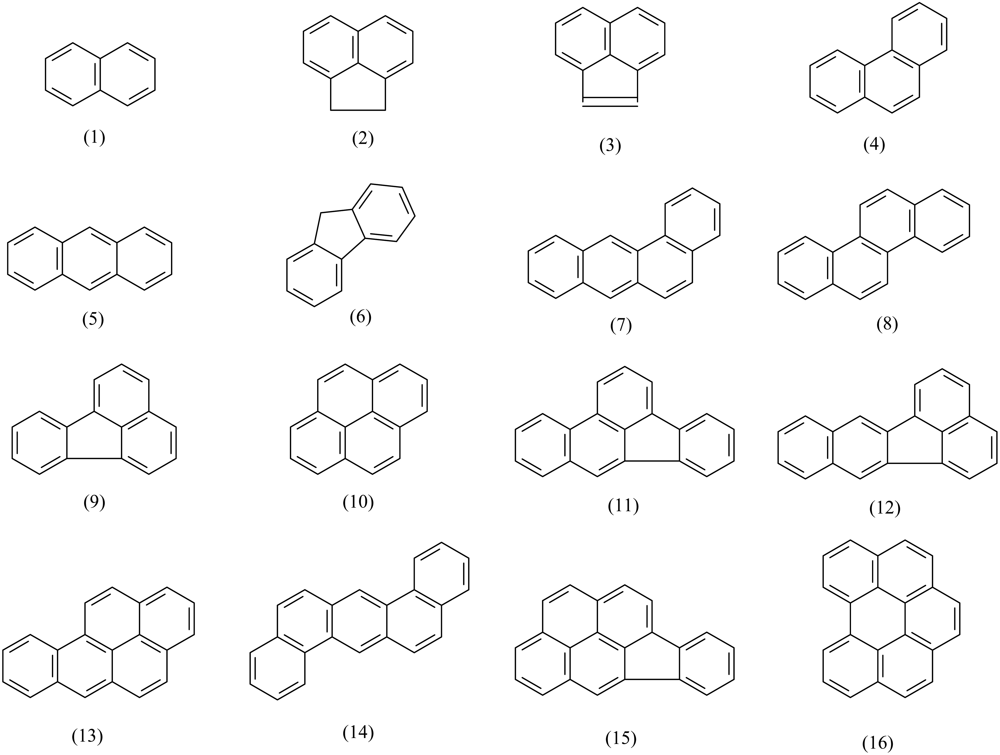
<p>The data of 16 representative PAHs (<xref ref-type="fig" rid="f1-sensors-12-09363">Figure 1</xref>) analyzed by the two ELISA kits were used for modeling. Seven typical physicochemical, electronic and topological descriptors are selected for developing the QSAR models. They are molar solubility (<italic>S</italic><sub>m</sub>), the logarithm of octanol-water partition coefficient (log <italic>K</italic><sub>ow</sub>), the gap between the highest occupied molecular orbital energy and the lowest unoccupied molecular orbital energy (<italic>E</italic><sub>HOMO</sub> − <italic>E</italic><sub>LUMO</sub>), and four valence molecular connectivity indices (<sup>0</sup>χ<sup>v</sup>, <sup>1</sup>χ<sup>v</sup>, <sup>2</sup>χ<sup>v</sup>, <sup>3</sup>χ<sup>v</sup>). The data of solubility (<italic>S</italic>) and log <italic>K</italic><sub>ow</sub> were obtained from Mackay <italic>et al.</italic> [<xref ref-type="bibr" rid="b20-sensors-12-09363">20</xref>]. <italic>S</italic><sub>m</sub> was calculated by dividing <italic>S</italic> with the molecular weight. The data of <italic>E</italic><sub>HOMO</sub> − <italic>E</italic><sub>LUMO</sub> were from de Lima Ribeiro and Ferreira [<xref ref-type="bibr" rid="b21-sensors-12-09363">21</xref>]. The data of <sup>0</sup>χ<sup>v</sup>, <sup>1</sup>χ<sup>v</sup>, <sup>2</sup>χ<sup>v</sup> and <sup>3</sup>χ<sup>v</sup> were cited from Govers and Aiking [<xref ref-type="bibr" rid="b22-sensors-12-09363">22</xref>].</p></sec>
<sec sec-type="methods">
<label>2.2.</label>
<title>Data Set of Cross-Reactivity</title>
<p>The experimental data of cross-reactivity (CR) for the two commercial PAHs ELISA kits, RaPID and Ris<sup>C</sup>, were obtained from Krämer [<xref ref-type="bibr" rid="b8-sensors-12-09363">8</xref>]. Since activity data used for QSARs should be in molar dimensions, CR values were converted to molar cross-reactivity (MCR), <italic>i.e.</italic>, the ratio of the molar IC<sub>50</sub> of target analyte and the cross-reactant, for QSAR modeling [<xref ref-type="bibr" rid="b19-sensors-12-09363">19</xref>]. Then, the predicted MCR was calculated by the QSAR models and converted to CR for comparison with the experimental CR value. We assumed that the CR values “&lt;0.5%” and “&lt;1.6%” were low enough to describe low levels of cross-reactions in the two ELISA kit tests, and reasonably considered the CR value “&lt;” to be “=” for regression modeling [<xref ref-type="bibr" rid="b19-sensors-12-09363">19</xref>].</p></sec>
<sec sec-type="methods">
<label>2.3.</label>
<title>Regression Analysis</title>
<p>The data of 14 compounds of the 16 PAHs were submitted as training set for regression analysis, and anthracene and benzo[a]pyrene were used as the test set. In order to reduce the colinearity and the number of the molecular descriptors, the analysis of the quantitative relationship between log MCR and the molecular descriptors was performed by stepwise MLR, PCR and PLSR employing SAS 8.1 software. In the stepwise MLR procedure, the data of the seven descriptors of the 16 PAHs were collected in a single data matrix, and the key descriptors were selected by adding descriptors one by one to perform a multivariable regression calculation. The variables significant at the 0.15 level were left in the model. In PCR analysis, the original descriptors were subjected to principal component analysis, and the subset of principal components explaining more than 90% of the variance was extracted. Then, the principal components extracted were subjected to multiple linear regression analysis. The PLSR method reduced large volume of descriptors to several components that were most correlative with the CR. These components were the linear combinations of the descriptors and used as new variables for regression analysis. The optimum number of components for regression analysis was obtained by the leave-one-out cross-validation procedure.</p></sec>
<sec>
<label>2.4.</label>
<title>Cross-Reaction Potential</title>
<p>CR is the ratio of the IC<sub>50</sub> (the 50% inhibition concentration) of the target analyte and the IC<sub>50</sub> of the cross-reactant. Considering the effect of water solubility on the CR value and the immunoassay results, we defined cross-reaction potential (or cross-reaction probability, CRP), <italic>i.e.</italic>, 100-fold the ratio between the solubility (<italic>S</italic>) of a cross-reactant and the IC<sub>50</sub> value [<xref rid="FD1" ref-type="disp-formula">Equation (1)</xref>], and used it as a complement of CR to evaluate the extent of cross-reaction. CRP reflects the relative extent of cross-reaction of a non-target cross-reactant compared with the water solubility. The data set of <italic>S</italic> was from Mackay <italic>et al.</italic> [<xref ref-type="bibr" rid="b20-sensors-12-09363">20</xref>], and IC<sub>50</sub> data were from Krämer [<xref ref-type="bibr" rid="b8-sensors-12-09363">8</xref>]. We assumed that the IC<sub>50</sub> value “&gt;1,000 μg·L<sup>−1</sup>” was high enough to be considered as “=1,000 μg·L<sup>−1</sup>” for CRP calculation:
<disp-formula id="FD1">
<label>(1)</label>
<mml:math id="mm1" display="block">
<mml:semantics id="sm1">
<mml:mrow>
<mml:mtext mathvariant="italic">CRP</mml:mtext>
<mml:mo stretchy="false">(</mml:mo>
<mml:mo>%</mml:mo>
<mml:mo stretchy="false">)</mml:mo>
<mml:mo>=</mml:mo>
<mml:mfrac>
<mml:mi>S</mml:mi>
<mml:mrow>
<mml:mi>I</mml:mi>
<mml:msub>
<mml:mi>C</mml:mi>
<mml:mrow>
<mml:mn>50</mml:mn></mml:mrow></mml:msub></mml:mrow></mml:mfrac>
<mml:mo>×</mml:mo>
<mml:mn>100</mml:mn></mml:mrow></mml:semantics></mml:math></disp-formula></p></sec></sec>
<sec sec-type="results|discussion">
<label>3.</label>
<title>Results and Discussion</title>
<sec>
<label>3.1.</label>
<title>Effect of Molecular Properties on Cross-Reactivity</title>
<p>The molecular structures of the 16 PAHs analyzed by the two ELISAs are shown in <xref ref-type="fig" rid="f1-sensors-12-09363">Figure 1</xref>. Since antibodies and antigens in immunoreactions are not mass-equivalent but rather molar-equivalent, molar cross-reactivity (MCR) rather than mass cross-reactivity (CR) is applied to investigate the quantitative structure and cross-reactivity relationships. The obtained stepwise MLR, PCR and PLSR equations and statistical parameters are illustrated in <xref ref-type="table" rid="t1-sensors-12-09363">Table 1</xref>.</p>
<p>It shows that the regression models for Ris<sup>C</sup> kit are all significant (<italic>p</italic> &lt; 0.005), while the models for RaPID kit are all not significant (<italic>p</italic> &gt; 0.05). The probable reason is that Ris<sup>C</sup> immunoassay employs a monoclonal antibody, while RaPID kit is based on polyclonal antibody. In the stepwise MLR procedure for RaPID, only <italic>S</italic><sub>m</sub> enters the regression model, and the other six molecular descriptors are excluded from the regression equation. As for Ris<sup>C</sup>, <italic>S</italic><sub>m</sub> and <sup>3</sup>χ<sup>v</sup> are left in the model. In the PCR procedure, the two most significant principal components (PC1 and PC2) describe respectively 85.7% and 8.3%, and totally 94.0% of the variance. Eigenvectors of the principal components indicate that PC1 demonstrates the integrated character of the seven descriptors, while PC2 mainly represents the character of <italic>S</italic><sub>m</sub>. The regression equations for RaPID and Ris<sup>C</sup> are <xref rid="FD2" ref-type="disp-formula">Equation (2)</xref> and <xref rid="FD3" ref-type="disp-formula">Equation (3)</xref> respectively. In the PLSR procedure, the models are optimized by leave-one-out cross-validation, and the optimum numbers of components are found to be 4 and 2 for RaPID and Ris<sup>C</sup>, respectively. The parameter estimates for centered and scaled data (marked by *) are shown in <xref rid="FD4" ref-type="disp-formula">Equation (4)</xref> and <xref rid="FD5" ref-type="disp-formula">Equation (5)</xref>. The results of stepwise MLR, PCR and PLSR imply that <italic>S</italic><sub>m</sub> plays an important role in affecting the CR property of the PAHs for the two ELISA kits, and <sup>3</sup>χ<sup>v</sup> also affects the CR for Ris<sup>C</sup> kit to some extent:
<disp-formula id="FD2">
<label>(2)</label>
<mml:math id="mm2" display="block">
<mml:semantics id="sm2">
<mml:mrow>
<mml:mrow>
<mml:mtext>For RaPID</mml:mtext>
<mml:mo>:</mml:mo>
<mml:mtext>log MCR</mml:mtext></mml:mrow>
<mml:mo>=</mml:mo>
<mml:mn>1.349</mml:mn>
<mml:mo>+</mml:mo>
<mml:mn>0.07442</mml:mn>
<mml:mo>×</mml:mo>
<mml:mtext>PC</mml:mtext>
<mml:mn>1</mml:mn>
<mml:mo>-</mml:mo>
<mml:mn>0.7234</mml:mn>
<mml:mo>×</mml:mo>
<mml:mtext>PC</mml:mtext>
<mml:mn>2</mml:mn></mml:mrow></mml:semantics></mml:math></disp-formula>
<disp-formula id="FD3">
<label>(3)</label>
<mml:math id="mm3" display="block">
<mml:semantics id="sm3">
<mml:mrow>
<mml:msup>
<mml:mrow>
<mml:mtext>For Ris</mml:mtext></mml:mrow>
<mml:mtext>C</mml:mtext></mml:msup>
<mml:mrow>
<mml:mo>:</mml:mo>
<mml:mtext>log MCR</mml:mtext></mml:mrow>
<mml:mo>=</mml:mo>
<mml:mn>1.178</mml:mn>
<mml:mo>+</mml:mo>
<mml:mn>0.002550</mml:mn>
<mml:mo>×</mml:mo>
<mml:mtext>PC</mml:mtext>
<mml:mn>1</mml:mn>
<mml:mo>-</mml:mo>
<mml:mn>0.9075</mml:mn>
<mml:mo>×</mml:mo>
<mml:mtext>PC</mml:mtext>
<mml:mn>2</mml:mn></mml:mrow></mml:semantics></mml:math></disp-formula>
<disp-formula id="FD4">
<label>(4)</label>
<mml:math id="mm4" display="block">
<mml:semantics id="sm4">
<mml:mrow>
<mml:mtext>For RaPID</mml:mtext>
<mml:mo>:</mml:mo>
<mml:mo>log</mml:mo>
<mml:mtext>MCR</mml:mtext>
<mml:mo>∗</mml:mo>
<mml:mo>=</mml:mo>
<mml:mo>-</mml:mo>
<mml:mn>0.6783</mml:mn>
<mml:mo>×</mml:mo>
<mml:msub>
<mml:mtext>S</mml:mtext>
<mml:mtext>m</mml:mtext></mml:msub>
<mml:mo>∗</mml:mo>
<mml:mo>+</mml:mo>
<mml:mn>1.245</mml:mn>
<mml:mo>×</mml:mo>
<mml:mo>log</mml:mo>
<mml:msub>
<mml:mi>K</mml:mi>
<mml:mrow>
<mml:mtext>ow</mml:mtext></mml:mrow></mml:msub>
<mml:mo>∗</mml:mo>
<mml:mo>-</mml:mo>
<mml:mn>0.6106</mml:mn>
<mml:mo>×</mml:mo>
<mml:mo stretchy="false">(</mml:mo>
<mml:msub>
<mml:mi>E</mml:mi>
<mml:mrow>
<mml:mtext>HOMO</mml:mtext></mml:mrow></mml:msub>
<mml:mo>-</mml:mo>
<mml:msub>
<mml:mi>E</mml:mi>
<mml:mrow>
<mml:mtext>LUMO</mml:mtext></mml:mrow></mml:msub>
<mml:mo stretchy="false">)</mml:mo>
<mml:mo>∗</mml:mo>
<mml:mo>+</mml:mo>
<mml:mn>0.2556</mml:mn>
<mml:mo>×</mml:mo>
<mml:mrow>
<mml:mmultiscripts>
<mml:mi>χ</mml:mi>
<mml:mprescripts/>
<mml:none/>
<mml:mn>0</mml:mn></mml:mmultiscripts>
<mml:msup>
<mml:mrow/>
<mml:mrow>
<mml:mtext>v</mml:mtext>
<mml:mo>∗</mml:mo></mml:mrow></mml:msup></mml:mrow>
<mml:mo>-</mml:mo>
<mml:mn>0.07527</mml:mn>
<mml:mo>×</mml:mo>
<mml:mrow>
<mml:mmultiscripts>
<mml:mi>χ</mml:mi>
<mml:mprescripts/>
<mml:none/>
<mml:mn>1</mml:mn></mml:mmultiscripts>
<mml:msup>
<mml:mrow/>
<mml:mrow>
<mml:mtext>v</mml:mtext>
<mml:mo>∗</mml:mo></mml:mrow></mml:msup></mml:mrow>
<mml:mo>−</mml:mo>
<mml:mn>0.6231</mml:mn>
<mml:mo>×</mml:mo>
<mml:mrow>
<mml:mmultiscripts>
<mml:mi>χ</mml:mi>
<mml:mprescripts/>
<mml:none/>
<mml:mn>2</mml:mn></mml:mmultiscripts>
<mml:msup>
<mml:mrow/>
<mml:mrow>
<mml:mtext>v</mml:mtext>
<mml:mo>∗</mml:mo></mml:mrow></mml:msup></mml:mrow>
<mml:mo>−</mml:mo>
<mml:mn>1.626</mml:mn>
<mml:mo>×</mml:mo>
<mml:mrow>
<mml:mmultiscripts>
<mml:mi>χ</mml:mi>
<mml:mprescripts/>
<mml:none/>
<mml:mn>3</mml:mn></mml:mmultiscripts>
<mml:msup>
<mml:mrow/>
<mml:mrow>
<mml:mtext>v</mml:mtext>
<mml:mo>∗</mml:mo></mml:mrow></mml:msup></mml:mrow></mml:mrow></mml:semantics></mml:math></disp-formula>
<disp-formula id="FD5">
<label>(5)</label>
<mml:math id="mm5" display="block">
<mml:semantics id="sm5">
<mml:mrow>
<mml:msup>
<mml:mtext>For Ris</mml:mtext>
<mml:mtext>C</mml:mtext></mml:msup>
<mml:mo>:</mml:mo>
<mml:mtext>log MCR</mml:mtext>
<mml:mo>∗</mml:mo>
<mml:mo>=</mml:mo>
<mml:mo>-</mml:mo>
<mml:mn>1.042</mml:mn>
<mml:mo>×</mml:mo>
<mml:msub>
<mml:mtext>S</mml:mtext>
<mml:mtext>m</mml:mtext></mml:msub>
<mml:mo>∗</mml:mo>
<mml:mo>-</mml:mo>
<mml:mn>0.06846</mml:mn>
<mml:mo>×</mml:mo>
<mml:mo>log</mml:mo>
<mml:msub>
<mml:mi>K</mml:mi>
<mml:mrow>
<mml:mtext>ow</mml:mtext></mml:mrow></mml:msub>
<mml:mo>∗</mml:mo>
<mml:mo>-</mml:mo>
<mml:mn>0.1012</mml:mn>
<mml:mo>×</mml:mo>
<mml:mo stretchy="false">(</mml:mo>
<mml:msub>
<mml:mi>E</mml:mi>
<mml:mrow>
<mml:mtext>HOMO</mml:mtext></mml:mrow></mml:msub>
<mml:mo>-</mml:mo>
<mml:msub>
<mml:mi>E</mml:mi>
<mml:mrow>
<mml:mtext>LUMO</mml:mtext></mml:mrow></mml:msub>
<mml:mo stretchy="false">)</mml:mo>
<mml:mo>∗</mml:mo>
<mml:mo>-</mml:mo>
<mml:mn>0.1649</mml:mn>
<mml:mo>×</mml:mo>
<mml:mrow>
<mml:mmultiscripts>
<mml:mi>χ</mml:mi>
<mml:mprescripts/>
<mml:none/>
<mml:mn>0</mml:mn></mml:mmultiscripts>
<mml:msup>
<mml:mrow/>
<mml:mrow>
<mml:mtext>v</mml:mtext>
<mml:mo>∗</mml:mo></mml:mrow></mml:msup></mml:mrow>
<mml:mo>-</mml:mo>
<mml:mn>0.1778</mml:mn>
<mml:mo>×</mml:mo>
<mml:mrow>
<mml:mmultiscripts>
<mml:mi>χ</mml:mi>
<mml:mprescripts/>
<mml:none/>
<mml:mn>1</mml:mn></mml:mmultiscripts>
<mml:msup>
<mml:mrow/>
<mml:mrow>
<mml:mtext>v</mml:mtext>
<mml:mo>∗</mml:mo></mml:mrow></mml:msup></mml:mrow>
<mml:mo>-</mml:mo>
<mml:mn>0.2025</mml:mn>
<mml:mo>×</mml:mo>
<mml:mrow>
<mml:mmultiscripts>
<mml:mi>χ</mml:mi>
<mml:mprescripts/>
<mml:none/>
<mml:mn>2</mml:mn></mml:mmultiscripts>
<mml:msup>
<mml:mrow/>
<mml:mrow>
<mml:mtext>v</mml:mtext>
<mml:mo>∗</mml:mo></mml:mrow></mml:msup></mml:mrow>
<mml:mo>-</mml:mo>
<mml:mn>0.2517</mml:mn>
<mml:mo>×</mml:mo>
<mml:mrow>
<mml:mmultiscripts>
<mml:mi>χ</mml:mi>
<mml:mprescripts/>
<mml:none/>
<mml:mn>3</mml:mn></mml:mmultiscripts>
<mml:msup>
<mml:mrow/>
<mml:mrow>
<mml:mtext>v</mml:mtext>
<mml:mo>∗</mml:mo></mml:mrow></mml:msup></mml:mrow></mml:mrow></mml:semantics></mml:math></disp-formula>In immunoreactions and immunoassays, the interaction between antigen and antibody is caused by the complementary spatial distribution and the strong affinity between the antigen and the antibody, such as hydrogen bonds, electrostatic interactions, van der Waals forces and hydrophobic interactions. The strong effect of <italic>S</italic><sub>m</sub> on the CR properties of the two ELISAs reflects the important role of hydrophobic interactions in the PAH-antibody reactions, which confirms the previous result [<xref ref-type="bibr" rid="b19-sensors-12-09363">19</xref>]. It is commonly believed that lower order molecular connectivity indices encode mainly the bulk of a molecule, whereas higher order indices encode more subtle features such as the presence of rings and branching patterns. The result that <sup>3</sup>χ<sup>v</sup> affects CR more than <sup>0</sup>χ<sup>v</sup>, <sup>1</sup>χ<sup>v</sup> and <sup>2</sup>χ<sup>v</sup> implies that molecular shape is more influential than molecular size in the PAH-antibody reactions. It has been reported that <italic>E</italic><sub>HOMO</sub> and <italic>E</italic><sub>LUMO</sub> are responsible for the antibody recognition for phenylurea herbicides and organophosphorus pesticides [<xref ref-type="bibr" rid="b23-sensors-12-09363">23</xref>–<xref ref-type="bibr" rid="b25-sensors-12-09363">25</xref>]. These compounds consist of various functional groups and heteroatoms, while PAHs do not contain substituents and heteroatoms, hence electronic descriptors such as <italic>E</italic><sub>HOMO</sub> and <italic>E</italic><sub>LUMO</sub> may have minor effects on the antibody recognition for PAHs. <italic>E</italic><sub>HOMO</sub> − <italic>E</italic><sub>LUMO</sub> expresses the necessary energy to excite an electron from the highest occupied molecular orbital to the lowest unoccupied molecular orbital. Since immunoreactions are always not accompanied by a rearrangement of electron density, it is not surprising that <italic>E</italic><sub>HOMO</sub> − <italic>E</italic><sub>LUMO</sub> does not exhibit strong effect on the CR in the models.</p></sec>
<sec>
<label>3.2.</label>
<title>Predicting Cross-Reactivity</title>
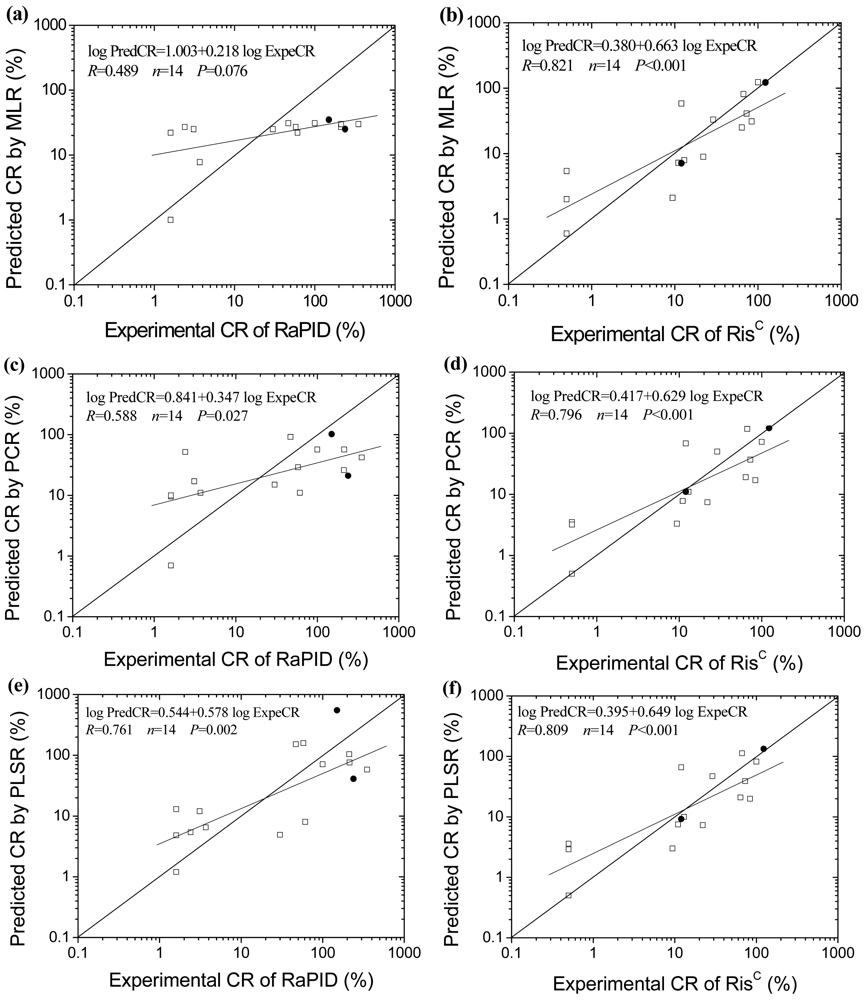
<p>CR is one of the most important characteristics of an ELISA test, and influences the extent of cross-reaction and the results of ELISAs significantly. However, due to the difficulty and expense in term of cost and time, not all of the CR data of the cross-reactants are available. Moreover, it is impractical to directly measure the CR of the cross-reactants which are not commercially available, so predicted CR values of the PAHs for the two ELISA kits were calculated using the obtained MLR, PCR and PLSR models, and compared with the experimental data (<xref ref-type="table" rid="t2-sensors-12-09363">Table 2</xref>, <xref ref-type="fig" rid="f2-sensors-12-09363">Figure 2</xref>). The predicted CR values for Ris<sup>C</sup> agree very well with the experimental data, while the predicted and experimental data for RaPID do not agree well with each other. The models were further external validated using the data of three-ringed anthracene and five-ringed benzo[a]pyrene as test set. The range of predicting error for anthracene is from −1.6% to +8.1%, and for benzo[a]pyrene is from −40.8% to −8.3%. It appears that the obtained models can successfully predict the CR for Ris<sup>C</sup> kit, but present poor predicting ability for RaPID kit.</p></sec>
<sec>
<label>3.3.</label>
<title>Cross-Reaction Potential</title>
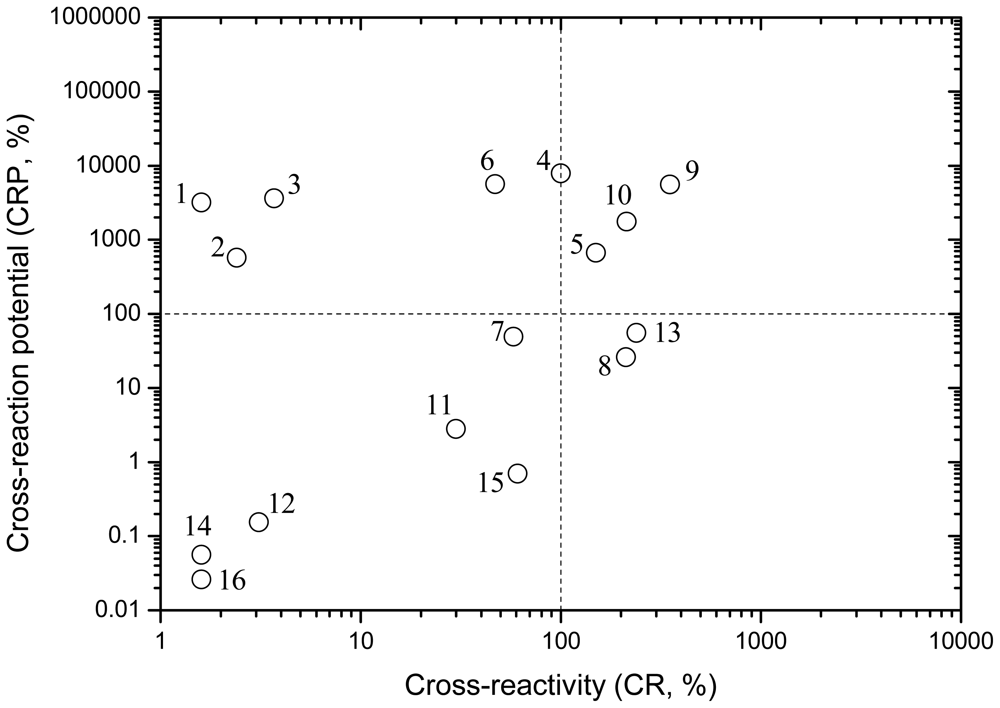
<p>Generally speaking, higher CR values imply higher levels of immunoreactions. However, the antigen-antibody reactions in immunoassays are carried out in water or buffer solutions, so if the solubility of a cross-reactant is much lower than the IC<sub>50</sub> value, it cannot possibly cause intense cross-reactions in the immunoassays. That is to say, the concentration of this compound in real water samples cannot be high enough to evoke high extent cross-reaction in immunoassays, even though the CR is very high. Some of the 16 PAHs are very hydrophobic compounds, and the solubility is much lower than the tested IC<sub>50</sub> value. For example, the IC<sub>50</sub> referring to water analysis for benzo[a]pyrene for the RaPID ELISA kit is 6.9 μg·L<sup>−1</sup>, while the solubility of benzo[a]pyrene is 3.8 μg·L<sup>−1</sup> (<xref ref-type="table" rid="t3-sensors-12-09363">Table 3</xref>), so although benzo[a]pyrene has a high CR of 239% in the RaPID ELISA, the concentration of benzo[a]pyrene in water samples cannot be possibly high enough to evoke a high level of cross-reaction. Hence, considering the important effect of water solubility on immunoreactions and immunoassays, cross-reaction potential (or cross-reaction probability, CRP), <italic>i.e.</italic>, the relative IC<sub>50</sub> of a non-target cross-reactant compared with its water solubility, was defined and used as a complement of CR to evaluate the potential and probability that a cross-reaction would occur.</p>
<p>The IC<sub>50</sub> and CRP data for the 16 PAHs for RaPID kit are shown in <xref ref-type="table" rid="t3-sensors-12-09363">Table 3</xref>. The CRP values for Ris<sup>C</sup> kit are not calculated because the IC<sub>50</sub> values are not available. In addition to the target analyte of phenanthrene, the 15 cross-reactants in RaPID ELISA can be divided into four groups according to CR and CRP (<xref ref-type="fig" rid="f3-sensors-12-09363">Figure 3</xref>): (I) CR &gt; 100%, CRP &gt; 100%; (II) CR &gt; 100%, CRP &lt; 100%; (III) CR &lt; 100%, CRP &gt; 100%; and (IV) CR &lt; 100%, CRP &lt; 100%. The compounds of group (I) might cause intense cross-reactions and affect the determination of phenanthrene, while the group (IV) compounds have little cross-reaction effect on the analysis results. As for the group (II) compounds, the CR is high, while the CPR is low because of the relatively low solubility. The group (III) compounds are two-ringed and three-ringed PAHs, and less cross-reactive but more water soluble. The extent of the cross-reactions of group (II) and (III) compounds depends on both the CR and the CRP properties.</p>
<p>It should be pointed out that the RaPID PAHs ELISA kit is applied not only for water samples [<xref ref-type="bibr" rid="b9-sensors-12-09363">9</xref>,<xref ref-type="bibr" rid="b10-sensors-12-09363">10</xref>], but more often for soil samples [<xref ref-type="bibr" rid="b11-sensors-12-09363">11</xref>,<xref ref-type="bibr" rid="b14-sensors-12-09363">14</xref>,<xref ref-type="bibr" rid="b15-sensors-12-09363">15</xref>]. In the pretreatment procedure, PAHs were usually extracted from the soil samples by methanol and diluted by buffer. PAHs are very hydrophobic molecules and can be adsorbed to soils at very high concentration. In the immunoassays of PAHs, much attention should be paid to the solubility of the compounds during the procedures of solvent extraction and buffer dilution.</p></sec>
<sec>
<label>3.4.</label>
<title>Comparison of the Two Kits</title>
<p>The comparison of RaPID and Ris<sup>C</sup> PAHs ELISA kits based on the character and the applicability are illustrated in <xref ref-type="table" rid="t4-sensors-12-09363">Table 4</xref>. It seems that Ris<sup>C</sup> ELISA is more specific, while RaPID ELISA is applied for more kinds of environmental samples. The selection of appropriate ELISAs for PAHs depends on the objective and request of the analysis.</p></sec></sec>
<sec sec-type="conclusions">
<label>4.</label>
<title>Conclusions</title>
<p>RaPID and Ris<sup>C</sup> are two widely studied ELISA kits used for analysis of PAHs. Three regression methods, including stepwise MLR, PCR and PLSR, were successfully applied to investigate the correlation between the molecular properties and the CR properties of PAHs for the two ELISA kits. It seems that the physicochemical, electronic and topological properties of the PAH molecules have an integrated effect on the CR properties for the two kits. <italic>S</italic><sub>m</sub> and <sup>3</sup>χ<sup>v</sup> show especially strong effects on CR, which implies the important role of hydrophobic interactions and molecular shape in the PAH-antibody reactions. The obtained regression equations for Ris<sup>C</sup> kit are all statistically significant (<italic>p</italic> &lt; 0.005) and show satisfactory ability for predicting CR values, while equations for RaPID kit are all not significant (<italic>p</italic> &gt; 0.05) and not suitable for prediction. It is probably because that the Ris<sup>C</sup> immunoassay employs a monoclonal antibody, while the RaPID kit is based on polyclonal antibody. Considering the important effect of solubility on CR for the two PAHs ELISAs, cross-reaction potential (CRP) is defined and used as a complement of CR to evaluate the extent of cross-reaction in immunoassays. We believe that only the compounds with both high CR and high CRP can cause intense cross-reactions in immunoassays. This work demonstrated the feasibility of multiple regression methods in investigating the quantitative structure-CR relationships and predicting CR in immunoassays.</p></sec></body>
<back>
<ack>
<p>The authors thank Hui-Xuan Gao of the School of Mathematical Sciences of Peking University, China, for her help in statistical analysis.</p></ack>
<ref-list>
<title>References</title>
<ref id="b1-sensors-12-09363"><label>1.</label><citation citation-type="journal"><person-group person-group-type="author"><name><surname>Fähnrich</surname><given-names>K.A.</given-names></name><name><surname>Pravda</surname><given-names>M.</given-names></name><name><surname>Guilbault</surname><given-names>G.G.</given-names></name></person-group><article-title>Immunochemical determination of polycyclic aromatic hydrocarbons (PAHs)</article-title><source>Anal. Lett.</source><year>2002</year><volume>35</volume><fpage>1269</fpage><lpage>1300</lpage><pub-id pub-id-type="doi">10.1081/AL-120006666</pub-id></citation></ref>
<ref id="b2-sensors-12-09363"><label>2.</label><citation citation-type="journal"><person-group person-group-type="author"><name><surname>Matschulat</surname><given-names>D.</given-names></name><name><surname>Deng</surname><given-names>A.</given-names></name><name><surname>Niessner</surname><given-names>R.</given-names></name><name><surname>Knopp</surname><given-names>D.</given-names></name></person-group><article-title>Development of a highly sensitive monoclonal antibody based ELISA for detection of benzo[a]pyrene in potable water</article-title><source>Analyst</source><year>2005</year><volume>130</volume><fpage>1078</fpage><lpage>1086</lpage><pub-id pub-id-type="doi">10.1039/b503636d</pub-id><pub-id pub-id-type="pmid">15965533</pub-id></citation></ref>
<ref id="b3-sensors-12-09363"><label>3.</label><citation citation-type="journal"><person-group person-group-type="author"><name><surname>Spier</surname><given-names>C.R.</given-names></name><name><surname>Bromage</surname><given-names>E.S.</given-names></name><name><surname>Harris</surname><given-names>T.M.</given-names></name><name><surname>Unger</surname><given-names>M.A.</given-names></name><name><surname>Kaattari</surname><given-names>S.L.</given-names></name></person-group><article-title>The development and evaluation of monoclonal antibodies for the detection of polycyclic aromatic hydrocarbons</article-title><source>Anal. Biochem.</source><year>2009</year><volume>387</volume><fpage>287</fpage><lpage>293</lpage><pub-id pub-id-type="doi">10.1016/j.ab.2009.01.020</pub-id><pub-id pub-id-type="pmid">19344658</pub-id></citation></ref>
<ref id="b4-sensors-12-09363"><label>4.</label><citation citation-type="journal"><person-group person-group-type="author"><name><surname>Goryacheva</surname><given-names>I.Y.</given-names></name><name><surname>Eremin</surname><given-names>S.A.</given-names></name><name><surname>Shutaleva</surname><given-names>E.A.</given-names></name><name><surname>Suchanek</surname><given-names>M.</given-names></name><name><surname>Niessner</surname><given-names>R.</given-names></name><name><surname>Knopp</surname><given-names>D.</given-names></name></person-group><article-title>Development of a fluorescence polarization immunoassay for polycyclic aromatic hydrocarbons</article-title><source>Anal. Lett.</source><year>2007</year><volume>40</volume><fpage>1445</fpage><lpage>1460</lpage><pub-id pub-id-type="doi">10.1080/00032710701297034</pub-id></citation></ref>
<ref id="b5-sensors-12-09363"><label>5.</label><citation citation-type="journal"><person-group person-group-type="author"><name><surname>Roda</surname><given-names>A.</given-names></name><name><surname>Simoni</surname><given-names>P.</given-names></name><name><surname>Mirasoli</surname><given-names>M.</given-names></name><name><surname>Baraldini</surname><given-names>M.</given-names></name><name><surname>Violante</surname><given-names>F.S.</given-names></name></person-group><article-title>Development of a chemiluminescent enzyme immunoassay for urinary 1-hydroxypyrene</article-title><source>Anal. Bioanal. Chem.</source><year>2002</year><volume>372</volume><fpage>751</fpage><lpage>758</lpage><pub-id pub-id-type="doi">10.1007/s00216-002-1256-4</pub-id><pub-id pub-id-type="pmid">12012185</pub-id></citation></ref>
<ref id="b6-sensors-12-09363"><label>6.</label><citation citation-type="journal"><person-group person-group-type="author"><name><surname>Zhuang</surname><given-names>H.S.</given-names></name><name><surname>Zhou</surname><given-names>C.</given-names></name></person-group><article-title>Determination of anthracene by real-time immuno-polymerase chain reaction assay</article-title><source>Anal. Chim. Acta</source><year>2009</year><volume>633</volume><fpage>278</fpage><lpage>282</lpage><pub-id pub-id-type="doi">10.1016/j.aca.2008.10.077</pub-id><pub-id pub-id-type="pmid">19166734</pub-id></citation></ref>
<ref id="b7-sensors-12-09363"><label>7.</label><citation citation-type="journal"><person-group person-group-type="author"><name><surname>Wei</surname><given-names>M.Y.</given-names></name><name><surname>Wen</surname><given-names>S.D.</given-names></name><name><surname>Yang</surname><given-names>X.Q.</given-names></name><name><surname>Guo</surname><given-names>L.H.</given-names></name></person-group><article-title>Development of redox-labeled electrochemical immunoassay for polycyclic aromatic hydrocarbons with controlled surface modification and catalytic voltammetric detection</article-title><source>Biosens. Bioelectron.</source><year>2009</year><volume>24</volume><fpage>2909</fpage><lpage>2914</lpage><pub-id pub-id-type="doi">10.1016/j.bios.2009.02.031</pub-id><pub-id pub-id-type="pmid">19321333</pub-id></citation></ref>
<ref id="b8-sensors-12-09363"><label>8.</label><citation citation-type="journal"><person-group person-group-type="author"><name><surname>Krämer</surname><given-names>P.M.</given-names></name></person-group><article-title>A strategy to validate immunoassay test kits for TNT and PAHs as a field screening method for contaminated sites in Germany</article-title><source>Anal. Chim. Acta</source><year>1998</year><volume>376</volume><fpage>3</fpage><lpage>11</lpage><pub-id pub-id-type="doi">10.1016/S0003-2670(98)00446-2</pub-id></citation></ref>
<ref id="b9-sensors-12-09363"><label>9.</label><citation citation-type="journal"><person-group person-group-type="author"><name><surname>Castillo</surname><given-names>M.</given-names></name><name><surname>Oubina</surname><given-names>A.</given-names></name><name><surname>Barceló</surname><given-names>D.</given-names></name></person-group><article-title>Evalution of ELISA kits followed by liquid chromatography-atmospheric pressure chemical ionization-mass spectrometry for the determination of organic pollutants in industrial effluents</article-title><source>Environ. Sci. Technol.</source><year>1998</year><volume>32</volume><fpage>2180</fpage><lpage>2184</lpage><pub-id pub-id-type="doi">10.1021/es971042z</pub-id></citation></ref>
<ref id="b10-sensors-12-09363"><label>10.</label><citation citation-type="journal"><person-group person-group-type="author"><name><surname>Barceló</surname><given-names>D.</given-names></name><name><surname>Oubina</surname><given-names>A.</given-names></name><name><surname>Salau</surname><given-names>J.S.</given-names></name><name><surname>Perez</surname><given-names>S.</given-names></name></person-group><article-title>Determination of PAHs in river water samples by ELISA</article-title><source>Anal. Chim. Acta</source><year>1998</year><volume>376</volume><fpage>49</fpage><lpage>53</lpage><pub-id pub-id-type="doi">10.1016/S0003-2670(98)00447-4</pub-id></citation></ref>
<ref id="b11-sensors-12-09363"><label>11.</label><citation citation-type="journal"><person-group person-group-type="author"><name><surname>Chuang</surname><given-names>J.C.</given-names></name><name><surname>van Emon</surname><given-names>J.M.</given-names></name><name><surname>Chou</surname><given-names>Y.L.</given-names></name><name><surname>Junod</surname><given-names>N.</given-names></name><name><surname>Finegold</surname><given-names>J.K.</given-names></name><name><surname>Wilson</surname><given-names>N.K.</given-names></name></person-group><article-title>Comparison of immunoassay and gas chromatography-mass spectrometry for measurement of polycyclic aromatic hydrocarbons in contaminated soil</article-title><source>Anal. Chim. Acta</source><year>2003</year><volume>486</volume><fpage>31</fpage><lpage>39</lpage><pub-id pub-id-type="doi">10.1016/S0003-2670(03)00499-9</pub-id></citation></ref>
<ref id="b12-sensors-12-09363"><label>12.</label><citation citation-type="journal"><person-group person-group-type="author"><name><surname>Nording</surname><given-names>M.</given-names></name><name><surname>Haglund</surname><given-names>P.</given-names></name></person-group><article-title>Evaluation of the structure/cross-reactivity relationship of polycyclic aromatic compounds using an enzyme-linked immunosorbent assay kit</article-title><source>Anal. Chim. Acta</source><year>2003</year><volume>487</volume><fpage>43</fpage><lpage>50</lpage><pub-id pub-id-type="doi">10.1016/S0003-2670(03)00466-5</pub-id></citation></ref>
<ref id="b13-sensors-12-09363"><label>13.</label><citation citation-type="journal"><person-group person-group-type="author"><name><surname>Nording</surname><given-names>M.</given-names></name><name><surname>Frech</surname><given-names>K.</given-names></name><name><surname>Persson</surname><given-names>Y.</given-names></name><name><surname>Forsman</surname><given-names>M.</given-names></name><name><surname>Haglund</surname><given-names>P.</given-names></name></person-group><article-title>On the semi-quantification of polycyclic aromatic hydrocarbons in contaminated soil by an enzyme-linked immunosorbent assay kit</article-title><source>Anal. Chim. Acta</source><year>2006</year><volume>555</volume><fpage>107</fpage><lpage>113</lpage><pub-id pub-id-type="doi">10.1016/j.aca.2005.08.051</pub-id></citation></ref>
<ref id="b14-sensors-12-09363"><label>14.</label><citation citation-type="journal"><person-group person-group-type="author"><name><surname>Fillmann</surname><given-names>G.</given-names></name><name><surname>Bicego</surname><given-names>M.C.</given-names></name><name><surname>Zamboni</surname><given-names>A.</given-names></name><name><surname>Fileman</surname><given-names>T.W.</given-names></name><name><surname>Depledge</surname><given-names>M.H.</given-names></name><name><surname>Readman</surname><given-names>J.W.</given-names></name></person-group><article-title>Validation of immunoassay methods to determine hydrocarbon contamination in estuarine sediments</article-title><source>J. Braz. Soc.</source><year>2007</year><volume>18</volume><fpage>774</fpage><lpage>781</lpage><pub-id pub-id-type="doi">10.1590/S0103-50532007000400016</pub-id></citation></ref>
<ref id="b15-sensors-12-09363"><label>15.</label><citation citation-type="journal"><person-group person-group-type="author"><name><surname>Rigou</surname><given-names>P.</given-names></name><name><surname>Saini</surname><given-names>S.</given-names></name><name><surname>Setford</surname><given-names>S.J.</given-names></name></person-group><article-title>Field-based supercritical fluid extraction and immunoassay for determination of PAHs in soils</article-title><source>Int. J. Environ. Anal. Chem.</source><year>2004</year><volume>84</volume><fpage>979</fpage><lpage>994</lpage><pub-id pub-id-type="doi">10.1080/03067310410001729628</pub-id></citation></ref>
<ref id="b16-sensors-12-09363"><label>16.</label><citation citation-type="journal"><person-group person-group-type="author"><name><surname>Troisi</surname><given-names>G.M.</given-names></name><name><surname>Borjesson</surname><given-names>L.</given-names></name></person-group><article-title>Development of an immunoassay for the determination of polycyclic aromatic hydrocarbons in plasma samples from oiled seabirds</article-title><source>Environ. Sci. Technol.</source><year>2005</year><volume>39</volume><fpage>3748</fpage><lpage>3755</lpage><pub-id pub-id-type="doi">10.1021/es048935t</pub-id><pub-id pub-id-type="pmid">15952381</pub-id></citation></ref>
<ref id="b17-sensors-12-09363"><label>17.</label><citation citation-type="journal"><person-group person-group-type="author"><name><surname>Fillmann</surname><given-names>G.</given-names></name><name><surname>Watson</surname><given-names>G.M.</given-names></name><name><surname>Howsam</surname><given-names>M.</given-names></name><name><surname>Francioni</surname><given-names>E.</given-names></name><name><surname>Depledge</surname><given-names>M.H.</given-names></name><name><surname>Readman</surname><given-names>J.W.</given-names></name></person-group><article-title>Urinary PAH metabolites biomarkers of exposure in aquatic environments</article-title><source>Environ. Sci. Technol.</source><year>2004</year><volume>38</volume><fpage>2649</fpage><lpage>2656</lpage><pub-id pub-id-type="doi">10.1021/es0350839</pub-id><pub-id pub-id-type="pmid">15180061</pub-id></citation></ref>
<ref id="b18-sensors-12-09363"><label>18.</label><citation citation-type="journal"><person-group person-group-type="author"><name><surname>Kim</surname><given-names>I.S.</given-names></name><name><surname>Ritchie</surname><given-names>L.</given-names></name><name><surname>Setford</surname><given-names>S.</given-names></name><name><surname>Taylor</surname><given-names>J.</given-names></name><name><surname>Allen</surname><given-names>M.</given-names></name><name><surname>Wilson</surname><given-names>G.</given-names></name><name><surname>Heywood</surname><given-names>R.</given-names></name><name><surname>Pahlavanpour</surname><given-names>B.</given-names></name><name><surname>Saini</surname><given-names>S.</given-names></name></person-group><article-title>Quantitative immunoassay for determining polyaromatic hydrocarbons in electrical insulating oils</article-title><source>Anal. Chim. Acta</source><year>2001</year><volume>450</volume><fpage>13</fpage><lpage>25</lpage><pub-id pub-id-type="doi">10.1016/S0003-2670(01)01386-1</pub-id></citation></ref>
<ref id="b19-sensors-12-09363"><label>19.</label><citation citation-type="journal"><person-group person-group-type="author"><name><surname>Zhang</surname><given-names>Y.F.</given-names></name><name><surname>Ma</surname><given-names>Y.</given-names></name><name><surname>Gao</surname><given-names>Z.X.</given-names></name><name><surname>Dai</surname><given-names>S.G.</given-names></name></person-group><article-title>Predicting the cross-reactivities of polycyclic aromatic hydrocarbons in ELISA by regression analysis and CoMFA methods</article-title><source>Anal. Bioanal. Chem.</source><year>2010</year><volume>397</volume><fpage>2551</fpage><lpage>2557</lpage><pub-id pub-id-type="doi">10.1007/s00216-010-3785-6</pub-id><pub-id pub-id-type="pmid">20449576</pub-id></citation></ref>
<ref id="b20-sensors-12-09363"><label>20.</label><citation citation-type="book"><person-group person-group-type="author"><name><surname>Mackay</surname><given-names>D.</given-names></name><name><surname>Shiu</surname><given-names>W.Y.</given-names></name><name><surname>Ma</surname><given-names>K.C.</given-names></name><name><surname>Lee</surname><given-names>S.C.</given-names></name></person-group><source>Handbook of Physical-Chemical Properties and Environmental Fate for Organic Chemicals</source><edition>2nd ed.</edition><publisher-name>Taylor &amp; Francis</publisher-name><publisher-loc>Boca Raton, FL, USA</publisher-loc><year>2006</year></citation></ref>
<ref id="b21-sensors-12-09363"><label>21.</label><citation citation-type="journal"><person-group person-group-type="author"><name><surname>De Lima Ribeiro</surname><given-names>F.A.</given-names></name><name><surname>Ferreira</surname><given-names>M.M.C.</given-names></name></person-group><article-title>QSPR models of boiling point, octanol-water partition coefficient and retention time index of polycyclic aromatic hydrocarbons</article-title><source>J. Mol. Struct. Theochem</source><year>2003</year><volume>663</volume><fpage>109</fpage><lpage>126</lpage><pub-id pub-id-type="doi">10.1016/j.theochem.2003.08.107</pub-id></citation></ref>
<ref id="b22-sensors-12-09363"><label>22.</label><citation citation-type="journal"><person-group person-group-type="author"><name><surname>Govers</surname><given-names>H.</given-names></name><name><surname>Ruepert</surname><given-names>C.</given-names></name><name><surname>Aiking</surname><given-names>H.</given-names></name></person-group><article-title>Quantitative structure-activity relationships for polycyclic aromatic hydrocarbons: Correlation between molecular connectivity, physico-chemical properties, bioconcentration and toxicity in <italic>Daphnia pulex</italic></article-title><source>Chemosphere</source><year>1984</year><volume>13</volume><fpage>227</fpage><lpage>236</lpage><pub-id pub-id-type="doi">10.1016/0045-6535(84)90129-2</pub-id></citation></ref>
<ref id="b23-sensors-12-09363"><label>23.</label><citation citation-type="journal"><person-group person-group-type="author"><name><surname>Xu</surname><given-names>Z.L.</given-names></name><name><surname>Xie</surname><given-names>G.M.</given-names></name><name><surname>Li</surname><given-names>Y.X.</given-names></name><name><surname>Wang</surname><given-names>B.F.</given-names></name><name><surname>Beier</surname><given-names>R.C.</given-names></name><name><surname>Lei</surname><given-names>H.T.</given-names></name><name><surname>Wang</surname><given-names>H.</given-names></name><name><surname>Shen</surname><given-names>Y.D.</given-names></name><name><surname>Sun</surname><given-names>Y.M.</given-names></name></person-group><article-title>Production and characterization of a broad-specificity polyclonal antibody for <italic>O,O</italic>-diethyl organophosphorus pesticides and a quantitative structure-activity relationship study of antibody recognition</article-title><source>Anal. Chim. Acta</source><year>2009</year><volume>647</volume><fpage>90</fpage><lpage>96</lpage><pub-id pub-id-type="doi">10.1016/j.aca.2009.05.025</pub-id><pub-id pub-id-type="pmid">19576391</pub-id></citation></ref>
<ref id="b24-sensors-12-09363"><label>24.</label><citation citation-type="journal"><person-group person-group-type="author"><name><surname>Xu</surname><given-names>Z.L.</given-names></name><name><surname>Shen</surname><given-names>Y.D.</given-names></name><name><surname>Zheng</surname><given-names>W.X.</given-names></name><name><surname>Beier</surname><given-names>R.C.</given-names></name><name><surname>Xie</surname><given-names>G.M.</given-names></name><name><surname>Dong</surname><given-names>J.X.</given-names></name><name><surname>Yang</surname><given-names>J.Y.</given-names></name><name><surname>Wang</surname><given-names>H.</given-names></name><name><surname>Lei</surname><given-names>H.T.</given-names></name><name><surname>She</surname><given-names>Z.G.</given-names></name><etal/></person-group><article-title>Broad-specific immunoassay for <italic>O,O</italic>-diethyl organophosphorus pesticides: Application of molecular modeling to improve assay sensitivity and study antibody recognition</article-title><source>Anal. Chem.</source><year>2010</year><volume>82</volume><fpage>9314</fpage><lpage>9321</lpage><pub-id pub-id-type="doi">10.1021/ac1018414</pub-id><pub-id pub-id-type="pmid">20958019</pub-id></citation></ref>
<ref id="b25-sensors-12-09363"><label>25.</label><citation citation-type="journal"><person-group person-group-type="author"><name><surname>Yuan</surname><given-names>M.</given-names></name><name><surname>Liu</surname><given-names>B.</given-names></name><name><surname>Liu</surname><given-names>E.</given-names></name><name><surname>Sheng</surname><given-names>W.</given-names></name><name><surname>Zhang</surname><given-names>Y.</given-names></name><name><surname>Crossan</surname><given-names>A.</given-names></name><name><surname>Kennedy</surname><given-names>I.</given-names></name><name><surname>Wang</surname><given-names>S.</given-names></name></person-group><article-title>Immunoassay for phenylurea herbicides: Application of molecular modeling and quantitative structure-activity relationship analysis on an antigen-antibody interaction study</article-title><source>Anal. Chem.</source><year>2011</year><volume>83</volume><fpage>4767</fpage><lpage>4774</lpage><pub-id pub-id-type="doi">10.1021/ac200227v</pub-id><pub-id pub-id-type="pmid">21539295</pub-id></citation></ref></ref-list>
<sec sec-type="display-objects">
<title>Figures and Tables</title>
<fig id="f1-sensors-12-09363" position="float">
<label>Figure 1.</label>
<caption>
<p>Molecular structures of the 16 studied PAHs.</p></caption>
<graphic xlink:href="sensors-12-09363f1.gif"/></fig>
<fig id="f2-sensors-12-09363" position="float">
<label>Figure 2.</label>
<caption>
<p>Plotting of predicted cross-reactivity (CR) <italic>versus</italic> experimental values of the PAHs ELISAs.</p></caption>
<graphic xlink:href="sensors-12-09363f2.gif"/></fig>
<fig id="f3-sensors-12-09363" position="float">
<label>Figure 3.</label>
<caption>
<p>Cross-reaction potential (CRP) and cross-reactivity (CR) of 16 PAHs for RaPID ELISA kit.</p></caption>
<graphic xlink:href="sensors-12-09363f3.gif"/></fig>
<table-wrap id="t1-sensors-12-09363" position="float">
<label>Table 1.</label>
<caption>
<p>Regression models for quantitative structure and molar cross-reactivity (MCR) relationships for the PAHs ELISAs.</p></caption>
<table frame="hsides" rules="groups">
<thead>
<tr>
<th align="left" valign="middle" rowspan="3"><bold><italic>ELISA kit</italic></bold>.</th>
<th align="center" valign="middle" rowspan="3"><bold><italic>Regression method</italic></bold></th>
<th align="center" valign="middle" rowspan="3"><bold><italic>Regression Equation</italic></bold></th>
<th colspan="5" align="center" valign="middle"><bold><italic>Statistics</italic></bold></th></tr>
<tr>
<th colspan="5" align="center" valign="middle">
<hr/></th></tr>
<tr>
<th align="center" valign="bottom"><bold><italic>F</italic></bold></th>
<th align="center" valign="bottom"><bold><italic>P</italic></bold></th>
<th align="center" valign="bottom"><bold><italic>R</italic></bold><italic><sup>2</sup></italic></th>
<th align="center" valign="bottom"><bold><italic>n</italic></bold></th>
<th align="center" valign="bottom"><bold>PRESS</bold></th></tr></thead>
<tbody>
<tr>
<td align="center" valign="top" rowspan="3">RaPID</td>
<td align="center" valign="top">MLR</td>
<td align="left" valign="top">log MCR = 1.542 − 0.00676 × <italic>S</italic><sub>m</sub></td>
<td align="center" valign="top">4.30</td>
<td align="center" valign="top">0.0603</td>
<td align="center" valign="top">0.2638</td>
<td align="center" valign="top">14</td>
<td align="center" valign="top">11.30</td></tr>
<tr>
<td align="center" valign="top">PCR</td>
<td align="left" valign="top">log MCR = 4.907 − 0.01004 × <italic>S</italic><sub>m</sub> − 0.07337 × log <italic>K</italic><sub>ow</sub> − 0.2108 × (<italic>E</italic><sub>HOMO</sub> − <italic>E</italic><sub>LUMO</sub>) − 0.04482 × <sup>0</sup>χ<sup>v</sup> − 0.06256 × <sup>1</sup>χ<sup>v</sup> − 0.06708 × χ<sup>v</sup> − 0.4319 × <sup>3</sup>χ<sup>v</sup></td>
<td align="center" valign="top">3.17</td>
<td align="center" valign="top">0.0819</td>
<td align="center" valign="top">0.3656</td>
<td align="center" valign="top">14</td>
<td align="center" valign="top">16.68</td></tr>
<tr>
<td align="center" valign="top">PLSR</td>
<td align="left" valign="top">log MCR = 10.49 − 0.008925 × <italic>S</italic><sub>m</sub> + 1.015 × log <italic>K</italic><sub>ow</sub> − 1.132 × (<italic>E</italic><sub>HOMO</sub> − <italic>E</italic><sub>LUMO</sub>) + 0.1073 × <sup>0</sup>χ<sup>v</sup> − 0.04788 × <sup>1</sup>χ<sup>v</sup> − 0.4657 × <sup>2</sup>χ<sup>v</sup> − 8.925 × <sup>3</sup>χ<sup>v</sup></td>
<td align="center" valign="top">3.30</td>
<td align="center" valign="top">0.0634</td>
<td align="center" valign="top">0.5943</td>
<td align="center" valign="top">14</td>
<td align="center" valign="top">10.88</td></tr>
<tr>
<td align="center" valign="top" rowspan="3">Ris<sup>C</sup></td>
<td align="center" valign="top">MLR</td>
<td align="left" valign="top">log MCR = 3.439 − 0.01270 × <italic>S</italic><sub>m</sub> − 4.041 × <sup>3</sup>χ<sup>v</sup></td>
<td align="center" valign="top">12.19</td>
<td align="center" valign="top">0.0050</td>
<td align="center" valign="top">0.6603</td>
<td align="center" valign="top">14</td>
<td align="center" valign="top">4.62</td></tr>
<tr>
<td align="center" valign="top">PCR</td>
<td align="left" valign="top">log MCR = 5.800 − 0.01231 × <italic>S</italic><sub>m</sub> − 0.1162 × log <italic>K</italic><sub>ow</sub> − 0.2169 × (<italic>E</italic><sub>HOMO</sub> − <italic>E</italic><sub>LUMO</sub>) − 0.06868 × <sup>0</sup>χ<sup>v</sup> − 0.09743 × <sup>1</sup>χ<sup>v</sup> − 0.1065 × <sup>2</sup>χ<sup>v</sup> − 0.7045 × <sup>3</sup>χ<sup>v</sup></td>
<td align="center" valign="top">8.95</td>
<td align="center" valign="top">0.0049</td>
<td align="center" valign="top">0.6193</td>
<td align="center" valign="top">14</td>
<td align="center" valign="top">5.13</td></tr>
<tr>
<td align="center" valign="top">PLSR</td>
<td align="left" valign="top">log MCR = 5.485 − 0.01245 × <italic>S</italic><sub>m</sub> − 0.05071 × log <italic>K</italic><sub>ow</sub> − 0.1704 × (<italic>E</italic><sub>HOMO</sub> − <italic>E</italic><sub>LUMO</sub>) − 0.06290 × <sup>0</sup>χ<sup>v</sup> − 0.1027 × <sup>1</sup>χ<sup>v</sup> − 0.1375 × <sup>2</sup>χ<sup>v</sup> − 1.255 × <sup>3</sup>χ<sup>v</sup></td>
<td align="center" valign="top">9.71</td>
<td align="center" valign="top">0.0037</td>
<td align="center" valign="top">0.6383</td>
<td align="center" valign="top">14</td>
<td align="center" valign="top">4.92</td></tr></tbody></table></table-wrap>
<table-wrap id="t2-sensors-12-09363" position="float">
<label>Table 2.</label>
<caption>
<p>Experimental and predicted cross-reactivity (CR) of the PAHs ELISAs by regression analysis.</p></caption>
<table frame="hsides" rules="groups">
<thead>
<tr>
<th align="left" valign="middle" rowspan="3"><bold><italic>Number</italic></bold></th>
<th align="center" valign="middle" rowspan="3"><bold><italic>Compound</italic></bold></th>
<th colspan="4" align="center" valign="middle"><bold><italic>CR (</italic>%<italic>) of RaPID</italic></bold></th>
<th colspan="4" align="center" valign="middle"><bold><italic>CR (</italic>%<italic>) of Ris</italic></bold><italic><sup>C</sup></italic></th></tr>
<tr>
<th colspan="4" align="center" valign="middle">
<hr/></th>
<th colspan="4" align="center" valign="middle">
<hr/></th></tr>
<tr>
<th align="center" valign="middle"><bold>Experimental</bold> <xref ref-type="table-fn" rid="tfn1-sensors-12-09363"><sup>a</sup></xref></th>
<th align="center" valign="middle"><bold>Predicted by MLR</bold></th>
<th align="center" valign="middle"><bold>Predicted by PCR</bold></th>
<th align="center" valign="middle"><bold>Predicted by PLSR</bold></th>
<th align="center" valign="middle"><bold>Experimental</bold> <xref ref-type="table-fn" rid="tfn1-sensors-12-09363"><sup>a</sup></xref></th>
<th align="center" valign="middle"><bold>Predicted by MLR</bold></th>
<th align="center" valign="middle"><bold>Predicted by PCR</bold></th>
<th align="center" valign="middle"><bold>Predicted by PLSR</bold></th></tr></thead>
<tbody>
<tr>
<td align="center" valign="top">1</td>
<td align="center" valign="top">Naphthalene</td>
<td align="center" valign="top">&lt;1.6</td>
<td align="center" valign="top">1.0</td>
<td align="center" valign="top">0.7</td>
<td align="center" valign="top">1.2</td>
<td align="center" valign="top">0.5</td>
<td align="center" valign="top">0.6</td>
<td align="center" valign="top">0.5</td>
<td align="center" valign="top">0.5</td></tr>
<tr>
<td align="center" valign="top">2</td>
<td align="center" valign="top">Acenaphthene</td>
<td align="center" valign="top">2.4</td>
<td align="center" valign="top">27</td>
<td align="center" valign="top">52</td>
<td align="center" valign="top">5.4</td>
<td align="center" valign="top">12</td>
<td align="center" valign="top">58</td>
<td align="center" valign="top">68</td>
<td align="center" valign="top">66</td></tr>
<tr>
<td align="center" valign="top">3</td>
<td align="center" valign="top">Acenaphthylene</td>
<td align="center" valign="top">3.7</td>
<td align="center" valign="top">7.8</td>
<td align="center" valign="top">11</td>
<td align="center" valign="top">6.5</td>
<td align="center" valign="top">13</td>
<td align="center" valign="top">7.9</td>
<td align="center" valign="top">11</td>
<td align="center" valign="top">10</td></tr>
<tr>
<td align="center" valign="top">4</td>
<td align="center" valign="top">Phenanthrene</td>
<td align="center" valign="top">100</td>
<td align="center" valign="top">31</td>
<td align="center" valign="top">57</td>
<td align="center" valign="top">71</td>
<td align="center" valign="top">100</td>
<td align="center" valign="top">123</td>
<td align="center" valign="top">72</td>
<td align="center" valign="top">82</td></tr>
<tr>
<td align="center" valign="top">5</td>
<td align="center" valign="top">Anthracene</td>
<td align="center" valign="top">150</td>
<td align="center" valign="top">35</td>
<td align="center" valign="top">102</td>
<td align="center" valign="top">550</td>
<td align="center" valign="top">123</td>
<td align="center" valign="top">122</td>
<td align="center" valign="top">121</td>
<td align="center" valign="top">133</td></tr>
<tr>
<td align="center" valign="top">6</td>
<td align="center" valign="top">Fluorene</td>
<td align="center" valign="top">47</td>
<td align="center" valign="top">31</td>
<td align="center" valign="top">92</td>
<td align="center" valign="top">152</td>
<td align="center" valign="top">67</td>
<td align="center" valign="top">81</td>
<td align="center" valign="top">118</td>
<td align="center" valign="top">113</td></tr>
<tr>
<td align="center" valign="top">7</td>
<td align="center" valign="top">Benzo[a]anthracene</td>
<td align="center" valign="top">58</td>
<td align="center" valign="top">27</td>
<td align="center" valign="top">29</td>
<td align="center" valign="top">158</td>
<td align="center" valign="top">64</td>
<td align="center" valign="top">25</td>
<td align="center" valign="top">19</td>
<td align="center" valign="top">21</td></tr>
<tr>
<td align="center" valign="top">8</td>
<td align="center" valign="top">Chrysene</td>
<td align="center" valign="top">212</td>
<td align="center" valign="top">27</td>
<td align="center" valign="top">26</td>
<td align="center" valign="top">104</td>
<td align="center" valign="top">84</td>
<td align="center" valign="top">31</td>
<td align="center" valign="top">17</td>
<td align="center" valign="top">20</td></tr>
<tr>
<td align="center" valign="top">9</td>
<td align="center" valign="top">Fluoranthene</td>
<td align="center" valign="top">351</td>
<td align="center" valign="top">30</td>
<td align="center" valign="top">42</td>
<td align="center" valign="top">58</td>
<td align="center" valign="top">73</td>
<td align="center" valign="top">41</td>
<td align="center" valign="top">37</td>
<td align="center" valign="top">39</td></tr>
<tr>
<td align="center" valign="top">10</td>
<td align="center" valign="top">Pyrene</td>
<td align="center" valign="top">214</td>
<td align="center" valign="top">30</td>
<td align="center" valign="top">57</td>
<td align="center" valign="top">76</td>
<td align="center" valign="top">29</td>
<td align="center" valign="top">33</td>
<td align="center" valign="top">50</td>
<td align="center" valign="top">47</td></tr>
<tr>
<td align="center" valign="top">11</td>
<td align="center" valign="top">Benzo[b]fluoranthene</td>
<td align="center" valign="top">30</td>
<td align="center" valign="top">25</td>
<td align="center" valign="top">15</td>
<td align="center" valign="top">4.9</td>
<td align="center" valign="top">22</td>
<td align="center" valign="top">8.9</td>
<td align="center" valign="top">7.4</td>
<td align="center" valign="top">7.3</td></tr>
<tr>
<td align="center" valign="top">12</td>
<td align="center" valign="top">Benzo[k]fluoranthene</td>
<td align="center" valign="top">3.1</td>
<td align="center" valign="top">25</td>
<td align="center" valign="top">17</td>
<td align="center" valign="top">12</td>
<td align="center" valign="top">11</td>
<td align="center" valign="top">7.2</td>
<td align="center" valign="top">7.8</td>
<td align="center" valign="top">7.5</td></tr>
<tr>
<td align="center" valign="top">13</td>
<td align="center" valign="top">Benzo[a]pyrene</td>
<td align="center" valign="top">239</td>
<td align="center" valign="top">25</td>
<td align="center" valign="top">21</td>
<td align="center" valign="top">41</td>
<td align="center" valign="top">12</td>
<td align="center" valign="top">7.1</td>
<td align="center" valign="top">11</td>
<td align="center" valign="top">9.2</td></tr>
<tr>
<td align="center" valign="top">14</td>
<td align="center" valign="top">Dibenzo[a,h]anthracene</td>
<td align="center" valign="top">&lt;1.6</td>
<td align="center" valign="top">22</td>
<td align="center" valign="top">9.6</td>
<td align="center" valign="top">13</td>
<td align="center" valign="top">&lt;0.5</td>
<td align="center" valign="top">5.4</td>
<td align="center" valign="top">3.5</td>
<td align="center" valign="top">3.6</td></tr>
<tr>
<td align="center" valign="top">15</td>
<td align="center" valign="top">Indeno[1,2,3-cd]pyrene</td>
<td align="center" valign="top">61</td>
<td align="center" valign="top">22</td>
<td align="center" valign="top">11</td>
<td align="center" valign="top">8.0</td>
<td align="center" valign="top">9.4</td>
<td align="center" valign="top">2.1</td>
<td align="center" valign="top">3.3</td>
<td align="center" valign="top">3.0</td></tr>
<tr>
<td align="center" valign="top">16</td>
<td align="center" valign="top">Benzo[g,h,i]perylene</td>
<td align="center" valign="top">&lt;1.6</td>
<td align="center" valign="top">22</td>
<td align="center" valign="top">10</td>
<td align="center" valign="top">4.8</td>
<td align="center" valign="top">&lt;0.5</td>
<td align="center" valign="top">2.0</td>
<td align="center" valign="top">3.2</td>
<td align="center" valign="top">2.9</td></tr></tbody></table>
<table-wrap-foot><fn id="tfn1-sensors-12-09363">
<label>a</label>
<p>Data are from [<xref ref-type="bibr" rid="b8-sensors-12-09363">8</xref>].</p></fn></table-wrap-foot></table-wrap>
<table-wrap id="t3-sensors-12-09363" position="float">
<label>Table 3.</label>
<caption>
<p>Cross-reaction potential (CRP) of PAHs for RaPID ELISA kit.</p></caption>
<table frame="hsides" rules="groups">
<thead>
<tr>
<th align="left" valign="top"><bold><italic>Number</italic></bold></th>
<th align="center" valign="bottom"><bold><italic>Compound</italic></bold></th>
<th align="center" valign="bottom"><bold><italic>S (mg</italic>·<italic>L</italic><sup>−</sup></bold><italic><sup>1</sup></italic>) <xref ref-type="table-fn" rid="tfn2-sensors-12-09363"><sup>a</sup></xref></th>
<th align="center" valign="bottom"><bold><italic>IC</italic></bold><italic><sub>50</sub></italic> <bold>(μ<italic>g</italic>·<italic>L</italic><sup>−</sup></bold><italic><sup>1</sup></italic>) <xref ref-type="table-fn" rid="tfn3-sensors-12-09363"><sup>b</sup></xref></th>
<th align="center" valign="bottom"><bold><italic>CRP (</italic>%)</bold></th></tr></thead>
<tbody>
<tr>
<td align="center" valign="top">1</td>
<td align="center" valign="top">Naphthalene</td>
<td align="center" valign="top">31.7</td>
<td align="center" valign="top">&gt;1,000</td>
<td align="center" valign="top">3,170</td></tr>
<tr>
<td align="center" valign="top">2</td>
<td align="center" valign="top">Acenaphthene</td>
<td align="center" valign="top">3.93</td>
<td align="center" valign="top">688</td>
<td align="center" valign="top">571</td></tr>
<tr>
<td align="center" valign="top">3</td>
<td align="center" valign="top">Acenaphthylene</td>
<td align="center" valign="top">16.1</td>
<td align="center" valign="top">447</td>
<td align="center" valign="top">3,602</td></tr>
<tr>
<td align="center" valign="top">4</td>
<td align="center" valign="top">Phenanthrene</td>
<td align="center" valign="top">1.29</td>
<td align="center" valign="top">16.5</td>
<td align="center" valign="top">7,818</td></tr>
<tr>
<td align="center" valign="top">5</td>
<td align="center" valign="top">Anthracene</td>
<td align="center" valign="top">0.073</td>
<td align="center" valign="top">11</td>
<td align="center" valign="top">664</td></tr>
<tr>
<td align="center" valign="top">6</td>
<td align="center" valign="top">Fluorene</td>
<td align="center" valign="top">1.98</td>
<td align="center" valign="top">35.2</td>
<td align="center" valign="top">5,625</td></tr>
<tr>
<td align="center" valign="top">7</td>
<td align="center" valign="top">Benzo[a]anthracene</td>
<td align="center" valign="top">0.014</td>
<td align="center" valign="top">28.4</td>
<td align="center" valign="top">49</td></tr>
<tr>
<td align="center" valign="top">8</td>
<td align="center" valign="top">Chrysene</td>
<td align="center" valign="top">0.002</td>
<td align="center" valign="top">7.8</td>
<td align="center" valign="top">26</td></tr>
<tr>
<td align="center" valign="top">9</td>
<td align="center" valign="top">Fluoranthene</td>
<td align="center" valign="top">0.26</td>
<td align="center" valign="top">4.7</td>
<td align="center" valign="top">5,532</td></tr>
<tr>
<td align="center" valign="top">10</td>
<td align="center" valign="top">Pyrene</td>
<td align="center" valign="top">0.135</td>
<td align="center" valign="top">7.7</td>
<td align="center" valign="top">1,753</td></tr>
<tr>
<td align="center" valign="top">11</td>
<td align="center" valign="top">Benzo[b]fluoranthene</td>
<td align="center" valign="top">1.5 × 10<sup>−3</sup></td>
<td align="center" valign="top">54.2</td>
<td align="center" valign="top">2.8</td></tr>
<tr>
<td align="center" valign="top">12</td>
<td align="center" valign="top">Benzo[k]fluoranthene</td>
<td align="center" valign="top">8.1 × 10<sup>−4</sup></td>
<td align="center" valign="top">524</td>
<td align="center" valign="top">0.155</td></tr>
<tr>
<td align="center" valign="top">13</td>
<td align="center" valign="top">Benzo[a]pyrene</td>
<td align="center" valign="top">3.8 × 10<sup>−3</sup></td>
<td align="center" valign="top">6.9</td>
<td align="center" valign="top">55</td></tr>
<tr>
<td align="center" valign="top">14</td>
<td align="center" valign="top">Dibenzo[a,h]anthracene</td>
<td align="center" valign="top">5.6 × 10<sup>−4</sup></td>
<td align="center" valign="top">&gt;1,000</td>
<td align="center" valign="top">0.056</td></tr>
<tr>
<td align="center" valign="top">15</td>
<td align="center" valign="top">Indeno[1,2,3-cd]pyrene</td>
<td align="center" valign="top">1.9 × 10<sup>−4</sup></td>
<td align="center" valign="top">27.2</td>
<td align="center" valign="top">0.699</td></tr>
<tr>
<td align="center" valign="top">16</td>
<td align="center" valign="top">Benzo[g,h,i]perylene</td>
<td align="center" valign="top">2.6 × 10<sup>−4</sup></td>
<td align="center" valign="top">&gt;1,000</td>
<td align="center" valign="top">0.026</td></tr></tbody></table>
<table-wrap-foot><fn id="tfn2-sensors-12-09363">
<label>a</label>
<p>Data are from [<xref ref-type="bibr" rid="b20-sensors-12-09363">20</xref>];</p></fn><fn id="tfn3-sensors-12-09363">
<label>b</label>
<p>Data are referring to water analysis and from [<xref ref-type="bibr" rid="b8-sensors-12-09363">8</xref>].</p></fn></table-wrap-foot></table-wrap>
<table-wrap id="t4-sensors-12-09363" position="float">
<label>Table 4.</label>
<caption>
<p>Comparison of the Two PAHs ELISA kits.</p></caption>
<table frame="hsides" rules="groups">
<thead>
<tr>
<th align="left" valign="top"/>
<th align="center" valign="bottom"><bold><italic>RaPID</italic></bold></th>
<th align="center" valign="bottom"><bold><italic>Ris</italic></bold><italic><sup>C</sup></italic></th></tr></thead>
<tbody>
<tr>
<td align="left" valign="top">Reference compound</td>
<td align="left" valign="top">Phenanthrene</td>
<td align="left" valign="top">Phenanthrene</td></tr>
<tr>
<td align="left" valign="top">Analysis mode</td>
<td align="left" valign="top">Competitive heterogeneous ELISA, antibody is coated on tubes</td>
<td align="left" valign="top">Competitive heterogeneous ELISA, antibody is immobilized to magnetic particles</td></tr>
<tr>
<td align="left" valign="top">Cross-reactivity</td>
<td align="left" valign="top">1.6%∼351%</td>
<td align="left" valign="top">0.5%∼123%</td></tr>
<tr>
<td align="left" valign="top">Specificity</td>
<td align="left" valign="top">Not so specific</td>
<td align="left" valign="top">Relatively specific</td></tr>
<tr>
<td align="left" valign="top">Antibody</td>
<td align="left" valign="top">Polyclonal</td>
<td align="left" valign="top">Monoclonal</td></tr>
<tr>
<td align="left" valign="top">Cross-reactant</td>
<td align="left" valign="top">Anthracene, chrysene, fluoranthene, pyrene and benzo[a]pyrene</td>
<td align="left" valign="top">Anthracene</td></tr>
<tr>
<td align="left" valign="top">Samples</td>
<td align="left" valign="top">Water, soil, biological and some other samples</td>
<td align="left" valign="top">Mostly soil samples till now</td></tr></tbody></table></table-wrap></sec></back></article>