
<?xml version="1.0" encoding="UTF-8"?>
<!DOCTYPE article PUBLIC "-//NLM//DTD Journal Publishing DTD v2.3 20070202//EN" "journalpublishing.dtd">
<article xmlns:mml="http://www.w3.org/1998/Math/MathML" xmlns:xlink="http://www.w3.org/1999/xlink" xml:lang="en" article-type="research-article">
<front>
<journal-meta>
<journal-id journal-id-type="nlm-ta">Sensors</journal-id>
<journal-title>Sensors</journal-title>
<issn pub-type="epub">1424-8220</issn>
<publisher>
<publisher-name>Molecular Diversity Preservation International (MDPI)</publisher-name></publisher></journal-meta>
<article-meta>
<article-id pub-id-type="doi">10.3390/s121217094</article-id>
<article-id pub-id-type="publisher-id">sensors-12-17094</article-id>
<article-categories>
<subj-group>
<subject>Article</subject></subj-group></article-categories>
<title-group>
<article-title>CMOS-MEMS Test-Key for Extracting Wafer-Level Mechanical Properties</article-title></title-group>
<contrib-group>
<contrib contrib-type="author">
<name><surname>Chuang</surname><given-names>Wan-Chun</given-names></name><xref ref-type="aff" rid="af1-sensors-12-17094"><sup>1</sup></xref><xref ref-type="corresp" rid="c1-sensors-12-17094"><sup>*</sup></xref></contrib>
<contrib contrib-type="author">
<name><surname>Hu</surname><given-names>Yuh-Chung</given-names></name><xref ref-type="aff" rid="af2-sensors-12-17094"><sup>2</sup></xref></contrib>
<contrib contrib-type="author">
<name><surname>Chang</surname><given-names>Pei-Zen</given-names></name><xref ref-type="aff" rid="af3-sensors-12-17094"><sup>3</sup></xref></contrib></contrib-group>
<aff id="af1-sensors-12-17094">
<label>1</label>Department of Mechanical and Electro-Mechanical Engineering, National Sun Yat-sen University, Kaohsiung 80424, Taiwan</aff>
<aff id="af2-sensors-12-17094">
<label>2</label>Department of Mechanical and Electro-Mechanical Engineering, Center of Green Technology, National ILan University, ILan 260, Taiwan; E-Mail: <email>ychu@niu.edu.tw</email></aff>
<aff id="af3-sensors-12-17094">
<label>3</label>Institute of Applied Mechanics, National Taiwan University, Taipei 10617, Taiwan; E-Mail: <email>changpz@ntu.edu.tw</email></aff>
<author-notes>
<corresp id="c1-sensors-12-17094">
<label>*</label>Author to whom correspondence should be addressed; E-Mail: <email>wcchuang@mail.nsysu.edu.tw</email>; Tel.: +886-7-5252-4228; Fax: +886-7-5252-4299.</corresp></author-notes>
<pub-date pub-type="collection">
<month>12</month>
<year>2012</year></pub-date>
<pub-date pub-type="epub">
<day>12</day>
<month>12</month>
<year>2012</year></pub-date>
<volume>12</volume>
<issue>12</issue>
<fpage>17094</fpage>
<lpage>17111</lpage>
<history>
<date date-type="received">
<day>25</day>
<month>10</month>
<year>2012</year></date>
<date date-type="rev-recd">
<day>28</day>
<month>11</month>
<year>2012</year></date>
<date date-type="accepted">
<day>06</day>
<month>12</month>
<year>2012</year></date></history>
<permissions>
<copyright-statement>© 2012 by the authors; licensee MDPI, Basel, Switzerland</copyright-statement>
<copyright-year>2012</copyright-year>
<license>
<p>This article is an open access article distributed under the terms and conditions of the Creative Commons Attribution license (http://creativecommons.org/licenses/by/3.0/).</p></license></permissions>
<abstract>
<p>This paper develops the technologies of mechanical characterization of CMOS-MEMS devices, and presents a robust algorithm for extracting mechanical properties, such as Young’s modulus, and mean stress, through the external electrical circuit behavior of the micro test-key. An approximate analytical solution for the pull-in voltage of bridge-type test-key subjected to electrostatic load and initial stress is derived based on Euler’s beam model and the minimum energy method. Then one can use the aforesaid closed form solution of the pull-in voltage to extract the Young’s modulus and mean stress of the test structures. The test cases include the test-key fabricated by a TSMC 0.18 μm standard CMOS process, and the experimental results refer to Osterberg’s work on the pull-in voltage of single crystal silicone microbridges. The extracted material properties calculated by the present algorithm are valid. Besides, this paper also analyzes the robustness of this algorithm regarding the dimension effects of test-keys. This mechanical properties extracting method is expected to be applicable to the wafer-level testing in micro-device manufacture and compatible with the wafer-level testing in IC industry since the test process is non-destructive.</p></abstract>
<kwd-group>
<kwd>pull-in voltage</kwd>
<kwd>Young’s modulus</kwd>
<kwd>mean stress</kwd>
<kwd>CMOS-MEMS</kwd></kwd-group></article-meta></front>
<body>
<sec sec-type="intro">
<label>1.</label>
<title>Introduction</title>
<p>Due to the excellent development of the complementary metal oxide semiconductor (CMOS) technology, many micro-electromechanical systems (MEMS) devices such as comb-fingers [<xref ref-type="bibr" rid="b1-sensors-12-17094">1</xref>], micro-mirrors [<xref ref-type="bibr" rid="b2-sensors-12-17094">2</xref>], and resonators [<xref ref-type="bibr" rid="b3-sensors-12-17094">3</xref>], the so-called CMOS-MEMS, can be fabricated by standard CMOS processes. The main advantage of CMOS-MEMS is batch production. Apart from the electrical testing of circuits, the MEMS-side still requires the mechanical testing of micro-sensing or -actuating components. However, there is no standard mechanical testing method for CMOS-MEMS devices. Characterization of the mechanical properties of CMOS-MEMS devices is important since their performance depends on the constitutive properties of the thin film made by the CMOS process. It is known that the properties of thin films are different from those of bulk materials, depending on the fabrication process. Moreover, large residual stress may induce failure of the micro-devices and circuits. Therefore, the material properties, such as Young’s modulus and residual stress, should be controlled as early as possible to ensure the repeatability for each device.</p>
<p>The property-extraction methods for large-scale implementation in MEMS fabrication require additional measurement and actuation equipment or complicated test structure designs. These methods are not compatible with IC metrology technologies. From the mechanical viewpoint of MEMS devices, the important thin-film material parameters are Young’s modulus [<xref ref-type="bibr" rid="b4-sensors-12-17094">4</xref>–<xref ref-type="bibr" rid="b15-sensors-12-17094">15</xref>], residual stress [<xref ref-type="bibr" rid="b7-sensors-12-17094">7</xref>,<xref ref-type="bibr" rid="b9-sensors-12-17094">9</xref>,<xref ref-type="bibr" rid="b15-sensors-12-17094">15</xref>–<xref ref-type="bibr" rid="b18-sensors-12-17094">18</xref>], Poisson’s ratio and shear modulus [<xref ref-type="bibr" rid="b15-sensors-12-17094">15</xref>], residual strain [<xref ref-type="bibr" rid="b8-sensors-12-17094">8</xref>,<xref ref-type="bibr" rid="b19-sensors-12-17094">19</xref>], and hardness [<xref ref-type="bibr" rid="b20-sensors-12-17094">20</xref>]. Among these mentioned parameters, Young’s modulus and residual stress have attracted the most attention. By using appropriate actuation and measurement techniques, these material properties can be extracted by determining the deformation or dynamic response of the test microstructures subjected to given external loads. <xref ref-type="table" rid="t1-sensors-12-17094">Table 1</xref> summarizes six different actuation methods and eight different measurement methods for extracting material properties in MEMS devices.</p>
<p>The electrostatic method employs a bias voltage to deflect the microtest structure downward to the ground plane [<xref ref-type="bibr" rid="b4-sensors-12-17094">4</xref>,<xref ref-type="bibr" rid="b5-sensors-12-17094">5</xref>,<xref ref-type="bibr" rid="b8-sensors-12-17094">8</xref>,<xref ref-type="bibr" rid="b21-sensors-12-17094">21</xref>]. The vibration method adopts comb drivers, piezoelectric shakers, or acoustic waves to vibrate the microtest structure [<xref ref-type="bibr" rid="b6-sensors-12-17094">6</xref>,<xref ref-type="bibr" rid="b22-sensors-12-17094">22</xref>]. Pulsed laser light can also be used to excite micro beams [<xref ref-type="bibr" rid="b23-sensors-12-17094">23</xref>,<xref ref-type="bibr" rid="b24-sensors-12-17094">24</xref>]. The force/pressure method uses the probe of atomic force microscope(AFM) or a nanoindenter to apply a force on the micro test structure or apply barometric pressure on the test membrane [<xref ref-type="bibr" rid="b12-sensors-12-17094">12</xref>,<xref ref-type="bibr" rid="b13-sensors-12-17094">13</xref>]. The thermal method heats the test structure to deform it [<xref ref-type="bibr" rid="b15-sensors-12-17094">15</xref>], yet the heating time, and the uniform temperature field are critical issues in this testing method. The pre-deformation method does not need any actuation as it makes use of the deformation induced by large initial stresses [<xref ref-type="bibr" rid="b16-sensors-12-17094">16</xref>,<xref ref-type="bibr" rid="b17-sensors-12-17094">17</xref>,<xref ref-type="bibr" rid="b19-sensors-12-17094">19</xref>,<xref ref-type="bibr" rid="b25-sensors-12-17094">25</xref>]. In [<xref ref-type="bibr" rid="b16-sensors-12-17094">16</xref>] the detection film on a cantilever beam firstneeds to be deposited, and then the variance of curvature is observedto determine the residual stress. Interferometers are a very common apparatus for measuring deformations or vibrations. For example, in some literatures [<xref ref-type="bibr" rid="b4-sensors-12-17094">4</xref>–<xref ref-type="bibr" rid="b6-sensors-12-17094">6</xref>] the optical signal or dynamic response is detected to extract the mechanical properties of test structures. These methods are manual, and need operators to judge the output signal. AFMs and scanning electron microscopes (SEMs) can also be used to measure the deformation. In [<xref ref-type="bibr" rid="b18-sensors-12-17094">18</xref>] the difference of test beam length due to the residual stress effect is measured, but the detection signal is too small to identify the strain, therefore a specific apparatus is needed to enlarge the output signal. In some literature X-Ray diffraction (XRD) is used to measure the indentation imprint [<xref ref-type="bibr" rid="b14-sensors-12-17094">14</xref>,<xref ref-type="bibr" rid="b20-sensors-12-17094">20</xref>]. The pull-in method detects the pull-in voltage of micro test structures [<xref ref-type="bibr" rid="b9-sensors-12-17094">9</xref>,<xref ref-type="bibr" rid="b26-sensors-12-17094">26</xref>,<xref ref-type="bibr" rid="b27-sensors-12-17094">27</xref>]. Besides, a micro tensile test [<xref ref-type="bibr" rid="b10-sensors-12-17094">10</xref>] is used to determine the Young’s modulus, but the test samples need to be fabricated in specific shape to fit the clamping apparatus of the tensile tester. Nanoindenters [<xref ref-type="bibr" rid="b28-sensors-12-17094">28</xref>] are also a common technique for extracting Young’s modulus and hardness of thin films. Nevertheless, this method can’t extract the residual stress of thin films. The modified Stoney’s equation (<xref ref-type="disp-formula" rid="FD1">Equation (1)</xref>) [<xref ref-type="bibr" rid="b29-sensors-12-17094">29</xref>] to evaluate the film stress is proposed as follows:
<disp-formula id="FD1">
<label>(1)</label>
<mml:math id="mm1" display="block">
<mml:mrow>
<mml:mi>σ</mml:mi>
<mml:mo>=</mml:mo>
<mml:mfrac>
<mml:mrow>
<mml:msup>
<mml:mrow>
<mml:mi mathvariant="italic">Eh</mml:mi></mml:mrow>
<mml:mn>3</mml:mn></mml:msup></mml:mrow>
<mml:mrow>
<mml:mn>6</mml:mn>
<mml:mrow>
<mml:mo>(</mml:mo>
<mml:mrow>
<mml:mn>1</mml:mn>
<mml:mo>−</mml:mo>
<mml:mi>ν</mml:mi></mml:mrow>
<mml:mo>)</mml:mo></mml:mrow>
<mml:msup>
<mml:mrow>
<mml:mi mathvariant="italic">Rt</mml:mi></mml:mrow>
<mml:mn>2</mml:mn></mml:msup>
<mml:mrow>
<mml:mo>(</mml:mo>
<mml:mrow>
<mml:mn>1</mml:mn>
<mml:mo>+</mml:mo>
<mml:mfrac>
<mml:mi>t</mml:mi>
<mml:mi>h</mml:mi></mml:mfrac></mml:mrow>
<mml:mo>)</mml:mo></mml:mrow></mml:mrow></mml:mfrac></mml:mrow></mml:math></disp-formula>where the <italic>σ</italic> is the residual stress of thin film, E/(1 − ν) is the biaxial modulus, <italic>h</italic> is the thickness of the substrate, <italic>t</italic> is the thickness of thin film, and <italic>R</italic> is the radius of curvature of substrate. However, this method needs to determine the biaxial modulus of the thin film first, and it is hard to deal with the case of local areas with extreme variation of radius of curvature. Among these aforementioned techniques, the most common test structures are beams and diaphragms. Ring-type test structures [<xref ref-type="bibr" rid="b15-sensors-12-17094">15</xref>] have also been reported, but their underlying fundamental principles are very complicated and they are difficult to fabricate. A viable test method “must be usable at the wafer level in a manufacturing environment, require only readily available test equipment, and it should be supported with documented structure-design, data-acquisition and data-analysis methods, and calibrated models for quantitative interpretation of results” [<xref ref-type="bibr" rid="b9-sensors-12-17094">9</xref>]. Out of the known methods, the best candidate for meeting the aforementioned requirements was judged to be the measurement of the electric-circuit behavior of the microstructures subjected to electrostatic loads. Compared to the prior art correlated with complicated or even empirical manipulation of numerical means, this paper builds simple and valid approximate analytical models of the CMOS-MEMS test-keys for extracting mechanical properties. These properties, such as Young’s modulus, and mean stress, are investigated, through the external electrical circuit behavior of the CMOS-MEMS test-keys.</p></sec>
<sec>
<label>2.</label>
<title>Electromechanical Behavior of the CMOS-MEMS Bridge Test-key</title>
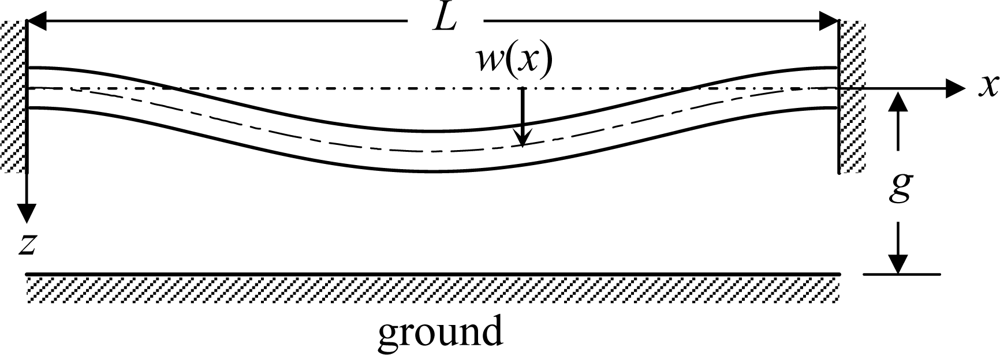
<p>A conceptual diagram of a micro bridge is shown in <xref ref-type="fig" rid="f1-sensors-12-17094">Figure 1</xref>. The beam is of length <italic>L</italic>, width <italic>b</italic>, thickness <italic>h</italic>, and is separated from the ground by an initial gap <italic>g</italic>. As actuated by a constant drive voltage <italic>V</italic>, the electrostatic force causes a position-dependent deflection <italic>w</italic>(<italic>x</italic>). The following assumptions are made to simulate the bridge:
<list list-type="order">
<list-item>
<p>The bridge is homogeneous and with uniform cross section.</p></list-item>
<list-item>
<p>The bridge is within the Euler-Bernoulli model.</p></list-item>
<list-item>
<p>The stress gradient is neglected.</p></list-item>
<list-item>
<p>Small deflection and ideal fixed boundary conditions.</p></list-item></list></p>
<sec>
<label>2.1.</label>
<title>Energy Expression</title>
<p>The mechanical strain energy of an infinitesimal beam element is:
<disp-formula id="FD2">
<label>(2)</label>
<mml:math id="mm2" display="block">
<mml:mrow>
<mml:msub>
<mml:mrow>
<mml:mi mathvariant="italic">dU</mml:mi></mml:mrow>
<mml:mi>m</mml:mi></mml:msub>
<mml:mo>=</mml:mo>
<mml:msub>
<mml:mrow>
<mml:mi>σ</mml:mi></mml:mrow>
<mml:mn>0</mml:mn></mml:msub>
<mml:mrow>
<mml:mo>[</mml:mo>
<mml:mrow>
<mml:mfrac>
<mml:mn>1</mml:mn>
<mml:mn>2</mml:mn></mml:mfrac>
<mml:msup>
<mml:mrow>
<mml:mrow>
<mml:mrow>
<mml:mo>(</mml:mo>
<mml:mrow>
<mml:mfrac>
<mml:mrow>
<mml:mi mathvariant="italic">dw</mml:mi></mml:mrow>
<mml:mrow>
<mml:mi mathvariant="italic">dx</mml:mi></mml:mrow></mml:mfrac></mml:mrow>
<mml:mo>)</mml:mo></mml:mrow></mml:mrow></mml:mrow>
<mml:mn>2</mml:mn></mml:msup></mml:mrow>
<mml:mo>]</mml:mo></mml:mrow>
<mml:mi>d</mml:mi>
<mml:mi>ν</mml:mi>
<mml:mo>+</mml:mo>
<mml:mi>E</mml:mi>
<mml:mrow>
<mml:mo>[</mml:mo>
<mml:mrow>
<mml:mfrac>
<mml:mn>1</mml:mn>
<mml:mn>2</mml:mn></mml:mfrac>
<mml:msup>
<mml:mi>z</mml:mi>
<mml:mn>2</mml:mn></mml:msup>
<mml:msup>
<mml:mrow>
<mml:mrow>
<mml:mrow>
<mml:mo>(</mml:mo>
<mml:mrow>
<mml:mo>−</mml:mo>
<mml:mfrac>
<mml:mrow>
<mml:msup>
<mml:mrow>
<mml:mi>d</mml:mi></mml:mrow>
<mml:mn>2</mml:mn></mml:msup>
<mml:mi>w</mml:mi></mml:mrow>
<mml:mrow>
<mml:msup>
<mml:mi mathvariant="italic">dx</mml:mi>
<mml:mn>2</mml:mn></mml:msup></mml:mrow></mml:mfrac></mml:mrow>
<mml:mo>)</mml:mo></mml:mrow></mml:mrow></mml:mrow>
<mml:mn>2</mml:mn></mml:msup></mml:mrow>
<mml:mo>]</mml:mo></mml:mrow>
<mml:mi>d</mml:mi>
<mml:mi>ν</mml:mi></mml:mrow></mml:math></disp-formula></p>
<p>The total mechanical strain energy of the beam, as shown in <xref ref-type="fig" rid="f1-sensors-12-17094">Figure 1</xref>, can be expressed as:
<disp-formula id="FD3">
<label>(3)</label>
<mml:math id="mm3" display="block">
<mml:mrow>
<mml:mtable columnalign="left">
<mml:mtr columnalign="left">
<mml:mtd columnalign="left">
<mml:mrow>
<mml:msub>
<mml:mrow>
<mml:mi>U</mml:mi></mml:mrow>
<mml:mi>m</mml:mi></mml:msub></mml:mrow></mml:mtd>
<mml:mtd columnalign="left">
<mml:mrow>
<mml:mo>=</mml:mo>
<mml:mrow>
<mml:msubsup>
<mml:mo>∫</mml:mo>
<mml:mn>0</mml:mn>
<mml:mi>L</mml:mi></mml:msubsup>
<mml:mrow>
<mml:msub>
<mml:mrow>
<mml:mi>σ</mml:mi></mml:mrow>
<mml:mn>0</mml:mn></mml:msub></mml:mrow></mml:mrow>
<mml:mrow>
<mml:mo>[</mml:mo>
<mml:mrow>
<mml:mfrac>
<mml:mn>1</mml:mn>
<mml:mn>2</mml:mn></mml:mfrac>
<mml:msup>
<mml:mrow>
<mml:mrow>
<mml:mrow>
<mml:mo>(</mml:mo>
<mml:mrow>
<mml:mfrac>
<mml:mrow>
<mml:mi mathvariant="italic">dw</mml:mi></mml:mrow>
<mml:mrow>
<mml:mi mathvariant="italic">dx</mml:mi></mml:mrow></mml:mfrac></mml:mrow>
<mml:mo>)</mml:mo></mml:mrow></mml:mrow></mml:mrow>
<mml:mn>2</mml:mn></mml:msup></mml:mrow>
<mml:mo>]</mml:mo></mml:mrow>
<mml:mi mathvariant="italic">hbdx</mml:mi>
<mml:mo>+</mml:mo>
<mml:mrow>
<mml:msubsup>
<mml:mo>∫</mml:mo>
<mml:mn>0</mml:mn>
<mml:mi>L</mml:mi></mml:msubsup>
<mml:mrow>
<mml:mi mathvariant="italic">EI</mml:mi></mml:mrow></mml:mrow>
<mml:mrow>
<mml:mo>[</mml:mo>
<mml:mrow>
<mml:mfrac>
<mml:mn>1</mml:mn>
<mml:mn>2</mml:mn></mml:mfrac>
<mml:msup>
<mml:mrow>
<mml:mrow>
<mml:mrow>
<mml:mo>(</mml:mo>
<mml:mrow>
<mml:mo>−</mml:mo>
<mml:mfrac>
<mml:mrow>
<mml:msup>
<mml:mrow>
<mml:mi>d</mml:mi></mml:mrow>
<mml:mn>2</mml:mn></mml:msup>
<mml:mi>w</mml:mi></mml:mrow>
<mml:mrow>
<mml:msup>
<mml:mrow>
<mml:mi mathvariant="italic">dx</mml:mi></mml:mrow>
<mml:mn>2</mml:mn></mml:msup></mml:mrow></mml:mfrac></mml:mrow>
<mml:mo>)</mml:mo></mml:mrow></mml:mrow></mml:mrow>
<mml:mn>2</mml:mn></mml:msup></mml:mrow>
<mml:mo>]</mml:mo></mml:mrow>
<mml:mi mathvariant="italic">dx</mml:mi></mml:mrow></mml:mtd></mml:mtr>
<mml:mtr columnalign="left">
<mml:mtd columnalign="left">
<mml:mrow/></mml:mtd>
<mml:mtd columnalign="left">
<mml:mrow>
<mml:mo>=</mml:mo>
<mml:mrow>
<mml:msubsup>
<mml:mo>∫</mml:mo>
<mml:mn>0</mml:mn>
<mml:mi>L</mml:mi></mml:msubsup>
<mml:mrow>
<mml:mrow>
<mml:mo>[</mml:mo>
<mml:mrow>
<mml:mfrac>
<mml:mrow>
<mml:msub>
<mml:mrow>
<mml:mi>σ</mml:mi></mml:mrow>
<mml:mn>0</mml:mn></mml:msub>
<mml:mi mathvariant="italic">bh</mml:mi></mml:mrow>
<mml:mn>2</mml:mn></mml:mfrac>
<mml:msup>
<mml:mrow>
<mml:mrow>
<mml:mrow>
<mml:mo>(</mml:mo>
<mml:mrow>
<mml:mfrac>
<mml:mrow>
<mml:mi mathvariant="italic">dw</mml:mi></mml:mrow>
<mml:mrow>
<mml:mi mathvariant="italic">dx</mml:mi></mml:mrow></mml:mfrac></mml:mrow>
<mml:mo>)</mml:mo></mml:mrow></mml:mrow></mml:mrow>
<mml:mn>2</mml:mn></mml:msup>
<mml:mo>+</mml:mo>
<mml:mfrac>
<mml:mrow>
<mml:mi mathvariant="italic">EI</mml:mi></mml:mrow>
<mml:mn>2</mml:mn></mml:mfrac>
<mml:msup>
<mml:mrow>
<mml:mrow>
<mml:mrow>
<mml:mo>(</mml:mo>
<mml:mrow>
<mml:mfrac>
<mml:mrow>
<mml:msup>
<mml:mrow>
<mml:mi>d</mml:mi></mml:mrow>
<mml:mn>2</mml:mn></mml:msup>
<mml:mi>w</mml:mi></mml:mrow>
<mml:mrow>
<mml:msup>
<mml:mrow>
<mml:mi mathvariant="italic">dx</mml:mi></mml:mrow>
<mml:mn>2</mml:mn></mml:msup></mml:mrow></mml:mfrac></mml:mrow>
<mml:mo>)</mml:mo></mml:mrow></mml:mrow></mml:mrow>
<mml:mn>2</mml:mn></mml:msup></mml:mrow>
<mml:mo>]</mml:mo></mml:mrow>
<mml:mi mathvariant="italic">dx</mml:mi></mml:mrow></mml:mrow></mml:mrow></mml:mtd></mml:mtr></mml:mtable></mml:mrow></mml:math></disp-formula>where <italic>b</italic>, <italic>E</italic>, <italic>h</italic>, <italic>I</italic>, <italic>L</italic>, and <italic>w</italic> represent the beam width, Young’s modulus, thickness, area inertia moment of beam cross section, beam length, and deflection, respectively. In the integrand of <xref ref-type="disp-formula" rid="FD3">Equation (3)</xref>, the first term is the strain energy induced by initial stress (<italic>σ</italic><sub>0</sub>) and the second term is the bending strain energy induced by external loads. The fringing fields are considerable and must be taken into account when modeling the electrostatic loads. For an infinitesimal beam element with length <italic>dx</italic>, the differential capacitance <italic>dC</italic> is given as [<xref ref-type="bibr" rid="b36-sensors-12-17094">36</xref>]:
<disp-formula id="FD4">
<label>(4)</label>
<mml:math id="mm4" display="block">
<mml:mrow>
<mml:mi mathvariant="italic">dC</mml:mi>
<mml:mo>=</mml:mo>
<mml:mi>ɛ</mml:mi>
<mml:mrow>
<mml:mo>[</mml:mo>
<mml:mrow>
<mml:mrow>
<mml:mo>(</mml:mo>
<mml:mrow>
<mml:mfrac>
<mml:mi>b</mml:mi>
<mml:mrow>
<mml:mi>g</mml:mi>
<mml:mo>−</mml:mo>
<mml:mi>w</mml:mi></mml:mrow></mml:mfrac></mml:mrow>
<mml:mo>)</mml:mo></mml:mrow>
<mml:mo>−</mml:mo>
<mml:mn>1.06</mml:mn>
<mml:mo>+</mml:mo>
<mml:mn>3.31</mml:mn>
<mml:msup>
<mml:mrow>
<mml:mrow>
<mml:mrow>
<mml:mo>(</mml:mo>
<mml:mrow>
<mml:mfrac>
<mml:mi>h</mml:mi>
<mml:mrow>
<mml:mi>g</mml:mi>
<mml:mo>−</mml:mo>
<mml:mi>w</mml:mi></mml:mrow></mml:mfrac></mml:mrow>
<mml:mo>)</mml:mo></mml:mrow></mml:mrow></mml:mrow>
<mml:mrow>
<mml:mn>0.23</mml:mn></mml:mrow></mml:msup>
<mml:mo>+</mml:mo>
<mml:mn>0.73</mml:mn>
<mml:msup>
<mml:mrow>
<mml:mrow>
<mml:mrow>
<mml:mo>(</mml:mo>
<mml:mrow>
<mml:mfrac>
<mml:mi>b</mml:mi>
<mml:mi>h</mml:mi></mml:mfrac></mml:mrow>
<mml:mo>)</mml:mo></mml:mrow></mml:mrow></mml:mrow>
<mml:mrow>
<mml:mn>0.23</mml:mn></mml:mrow></mml:msup></mml:mrow>
<mml:mo>]</mml:mo></mml:mrow>
<mml:mi mathvariant="italic">dx</mml:mi></mml:mrow></mml:math></disp-formula>where <italic>ε</italic> and <italic>g</italic> represent the permittivity of dielectric medium and the initial gap between test beam and ground plane, respectively. Hence, the total electrical potential energy <italic>U<sub>e</sub></italic> is given by:
<disp-formula id="FD5">
<label>(5)</label>
<mml:math id="mm5" display="block">
<mml:mrow>
<mml:msub>
<mml:mrow>
<mml:mi>U</mml:mi></mml:mrow>
<mml:mi>e</mml:mi></mml:msub>
<mml:mo>=</mml:mo>
<mml:mo>−</mml:mo>
<mml:mrow>
<mml:msubsup>
<mml:mo>∫</mml:mo>
<mml:mn>0</mml:mn>
<mml:mi>L</mml:mi></mml:msubsup>
<mml:mrow>
<mml:mfrac>
<mml:mn>1</mml:mn>
<mml:mn>2</mml:mn></mml:mfrac>
<mml:msup>
<mml:mrow>
<mml:mi>ɛ</mml:mi>
<mml:mi>V</mml:mi></mml:mrow>
<mml:mn>2</mml:mn></mml:msup>
<mml:mrow>
<mml:mo>[</mml:mo>
<mml:mrow>
<mml:mrow>
<mml:mo>(</mml:mo>
<mml:mrow>
<mml:mfrac>
<mml:mi>b</mml:mi>
<mml:mrow>
<mml:mi>g</mml:mi>
<mml:mo>−</mml:mo>
<mml:mi>w</mml:mi></mml:mrow></mml:mfrac></mml:mrow>
<mml:mo>)</mml:mo></mml:mrow>
<mml:mo>−</mml:mo>
<mml:mn>1.06</mml:mn>
<mml:mo>+</mml:mo>
<mml:mn>3.31</mml:mn>
<mml:msup>
<mml:mrow>
<mml:mrow>
<mml:mrow>
<mml:mo>(</mml:mo>
<mml:mrow>
<mml:mfrac>
<mml:mi>h</mml:mi>
<mml:mrow>
<mml:mi>g</mml:mi>
<mml:mo>−</mml:mo>
<mml:mi>w</mml:mi></mml:mrow></mml:mfrac></mml:mrow>
<mml:mo>)</mml:mo></mml:mrow></mml:mrow></mml:mrow>
<mml:mrow>
<mml:mn>0.23</mml:mn></mml:mrow></mml:msup>
<mml:mo>+</mml:mo>
<mml:mn>0.73</mml:mn>
<mml:msup>
<mml:mrow>
<mml:mrow>
<mml:mrow>
<mml:mo>(</mml:mo>
<mml:mrow>
<mml:mfrac>
<mml:mi>b</mml:mi>
<mml:mi>h</mml:mi></mml:mfrac></mml:mrow>
<mml:mo>)</mml:mo></mml:mrow></mml:mrow></mml:mrow>
<mml:mrow>
<mml:mn>0.23</mml:mn></mml:mrow></mml:msup></mml:mrow>
<mml:mo>]</mml:mo></mml:mrow>
<mml:mi mathvariant="italic">dx</mml:mi></mml:mrow></mml:mrow></mml:mrow></mml:math></disp-formula>where <italic>V</italic> is the applied bias voltage. In <xref ref-type="disp-formula" rid="FD5">Equation (5)</xref>, the first term is ideal flat plate capacitance, the second term is a length-dependent adjustment parameter, and the third term is the fringing field capacitance due to beam thickness. Then, the total system energy <italic>U</italic> equals the sum of mechanical strain energy and electrical potential energy, <italic>i.e.</italic>,
<disp-formula id="FD6">
<label>(6)</label>
<mml:math id="mm6" display="block">
<mml:mrow>
<mml:mtable columnalign="left">
<mml:mtr columnalign="left">
<mml:mtd columnalign="left">
<mml:mi>U</mml:mi></mml:mtd>
<mml:mtd columnalign="left">
<mml:mrow>
<mml:mo>=</mml:mo>
<mml:mrow>
<mml:msubsup>
<mml:mo>∫</mml:mo>
<mml:mn>0</mml:mn>
<mml:mi>L</mml:mi></mml:msubsup>
<mml:mrow>
<mml:mrow>
<mml:mo>[</mml:mo>
<mml:mrow>
<mml:mfrac>
<mml:mrow>
<mml:msub>
<mml:mrow>
<mml:mi>σ</mml:mi></mml:mrow>
<mml:mn>0</mml:mn></mml:msub>
<mml:mi mathvariant="italic">bh</mml:mi></mml:mrow>
<mml:mn>2</mml:mn></mml:mfrac>
<mml:msup>
<mml:mrow>
<mml:mrow>
<mml:mrow>
<mml:mo>(</mml:mo>
<mml:mrow>
<mml:mfrac>
<mml:mrow>
<mml:mi mathvariant="italic">dw</mml:mi></mml:mrow>
<mml:mrow>
<mml:mi mathvariant="italic">dx</mml:mi></mml:mrow></mml:mfrac></mml:mrow>
<mml:mo>)</mml:mo></mml:mrow></mml:mrow></mml:mrow>
<mml:mn>2</mml:mn></mml:msup>
<mml:mo>+</mml:mo>
<mml:mfrac>
<mml:mrow>
<mml:mi mathvariant="italic">EI</mml:mi></mml:mrow>
<mml:mn>2</mml:mn></mml:mfrac>
<mml:msup>
<mml:mrow>
<mml:mrow>
<mml:mrow>
<mml:mo>(</mml:mo>
<mml:mrow>
<mml:mfrac>
<mml:mrow>
<mml:msup>
<mml:mrow>
<mml:mi>d</mml:mi></mml:mrow>
<mml:mn>2</mml:mn></mml:msup>
<mml:mi>w</mml:mi></mml:mrow>
<mml:mrow>
<mml:msup>
<mml:mrow>
<mml:mi mathvariant="italic">dx</mml:mi></mml:mrow>
<mml:mn>2</mml:mn></mml:msup></mml:mrow></mml:mfrac></mml:mrow>
<mml:mo>)</mml:mo></mml:mrow></mml:mrow></mml:mrow>
<mml:mn>2</mml:mn></mml:msup></mml:mrow>
<mml:mo>]</mml:mo></mml:mrow>
<mml:mi mathvariant="italic">dx</mml:mi></mml:mrow></mml:mrow></mml:mrow></mml:mtd></mml:mtr>
<mml:mtr columnalign="left">
<mml:mtd columnalign="left">
<mml:mrow/></mml:mtd>
<mml:mtd columnalign="left">
<mml:mrow>
<mml:mo>−</mml:mo>
<mml:mrow>
<mml:msubsup>
<mml:mo>∫</mml:mo>
<mml:mn>0</mml:mn>
<mml:mi>L</mml:mi></mml:msubsup>
<mml:mrow>
<mml:mfrac>
<mml:mn>1</mml:mn>
<mml:mn>2</mml:mn></mml:mfrac>
<mml:msup>
<mml:mrow>
<mml:mi>ɛ</mml:mi>
<mml:mi>V</mml:mi></mml:mrow>
<mml:mn>2</mml:mn></mml:msup>
<mml:mrow>
<mml:mo>[</mml:mo>
<mml:mrow>
<mml:mrow>
<mml:mo>(</mml:mo>
<mml:mrow>
<mml:mfrac>
<mml:mi>b</mml:mi>
<mml:mrow>
<mml:mi>g</mml:mi>
<mml:mo>−</mml:mo>
<mml:mi>w</mml:mi></mml:mrow></mml:mfrac></mml:mrow>
<mml:mo>)</mml:mo></mml:mrow>
<mml:mo>−</mml:mo>
<mml:mn>1.06</mml:mn>
<mml:mo>+</mml:mo>
<mml:mn>3.31</mml:mn>
<mml:msup>
<mml:mrow>
<mml:mrow>
<mml:mrow>
<mml:mo>(</mml:mo>
<mml:mrow>
<mml:mfrac>
<mml:mi>h</mml:mi>
<mml:mrow>
<mml:mi>g</mml:mi>
<mml:mo>−</mml:mo>
<mml:mi>w</mml:mi></mml:mrow></mml:mfrac></mml:mrow>
<mml:mo>)</mml:mo></mml:mrow></mml:mrow></mml:mrow>
<mml:mrow>
<mml:mn>0.23</mml:mn></mml:mrow></mml:msup>
<mml:mo>+</mml:mo>
<mml:mn>0.73</mml:mn>
<mml:msup>
<mml:mrow>
<mml:mrow>
<mml:mrow>
<mml:mo>(</mml:mo>
<mml:mrow>
<mml:mfrac>
<mml:mi>b</mml:mi>
<mml:mi>h</mml:mi></mml:mfrac></mml:mrow>
<mml:mo>)</mml:mo></mml:mrow></mml:mrow></mml:mrow>
<mml:mrow>
<mml:mn>0.23</mml:mn></mml:mrow></mml:msup></mml:mrow>
<mml:mo>]</mml:mo></mml:mrow>
<mml:mi mathvariant="italic">dx</mml:mi></mml:mrow></mml:mrow></mml:mrow></mml:mtd></mml:mtr></mml:mtable></mml:mrow></mml:math></disp-formula></p>
<p>It should be mentioned that nonlinearities are simplified with only in the electrostatic part of the model. Indeed, the beam structure is assumed linearly elastic, without any consideration of geometrical nonlinearity in virtue of large deformation. Expanding the electrostatic terms in <xref ref-type="disp-formula" rid="FD6">Equation (6)</xref> by Taylor’s series with respect to the initial equilibrium position, <italic>i.e.</italic>, <italic>w</italic> = 0, and truncate the fifth and higher order terms since (<italic>w/g</italic>)<sup>n</sup> &lt;&lt; 1 for <italic>n</italic>≥5. Therefore, the total system potential energy <italic>U</italic> becomes:
<disp-formula id="FD7">
<label>(7)</label>
<mml:math id="mm7" display="block">
<mml:mrow>
<mml:mtable columnalign="left">
<mml:mtr columnalign="left">
<mml:mtd columnalign="left">
<mml:mi>U</mml:mi></mml:mtd>
<mml:mtd columnalign="left">
<mml:mrow>
<mml:mo>=</mml:mo>
<mml:mrow>
<mml:msubsup>
<mml:mo>∫</mml:mo>
<mml:mn>0</mml:mn>
<mml:mi>L</mml:mi></mml:msubsup>
<mml:mrow>
<mml:mfrac>
<mml:mrow>
<mml:msub>
<mml:mrow>
<mml:mi>σ</mml:mi></mml:mrow>
<mml:mn>0</mml:mn></mml:msub>
<mml:mi mathvariant="italic">bh</mml:mi></mml:mrow>
<mml:mn>2</mml:mn></mml:mfrac>
<mml:msup>
<mml:mrow>
<mml:mrow>
<mml:mrow>
<mml:mo>(</mml:mo>
<mml:mrow>
<mml:mfrac>
<mml:mi mathvariant="italic">dw</mml:mi>
<mml:mi mathvariant="italic">dx</mml:mi></mml:mfrac></mml:mrow>
<mml:mo>)</mml:mo></mml:mrow></mml:mrow></mml:mrow>
<mml:mn>2</mml:mn></mml:msup>
<mml:mi mathvariant="italic">dx</mml:mi>
<mml:mo>+</mml:mo>
<mml:mrow>
<mml:msubsup>
<mml:mo>∫</mml:mo>
<mml:mn>0</mml:mn>
<mml:mi>L</mml:mi></mml:msubsup>
<mml:mrow>
<mml:mfrac>
<mml:mrow>
<mml:mi mathvariant="italic">EI</mml:mi></mml:mrow>
<mml:mn>2</mml:mn></mml:mfrac>
<mml:msup>
<mml:mrow>
<mml:mrow>
<mml:mrow>
<mml:mo>(</mml:mo>
<mml:mrow>
<mml:mfrac>
<mml:mrow>
<mml:msup>
<mml:mrow>
<mml:mi>d</mml:mi></mml:mrow>
<mml:mn>2</mml:mn></mml:msup>
<mml:mi>w</mml:mi></mml:mrow>
<mml:mrow>
<mml:msup>
<mml:mi mathvariant="italic">dx</mml:mi>
<mml:mn>2</mml:mn></mml:msup></mml:mrow></mml:mfrac></mml:mrow>
<mml:mo>)</mml:mo></mml:mrow></mml:mrow></mml:mrow>
<mml:mn>2</mml:mn></mml:msup>
<mml:mi mathvariant="italic">dx</mml:mi></mml:mrow></mml:mrow></mml:mrow></mml:mrow></mml:mrow></mml:mtd></mml:mtr>
<mml:mtr columnalign="left">
<mml:mtd columnalign="left">
<mml:mrow/></mml:mtd>
<mml:mtd columnalign="left">
<mml:mrow>
<mml:mo>−</mml:mo>
<mml:mrow>
<mml:msubsup>
<mml:mo>∫</mml:mo>
<mml:mn>0</mml:mn>
<mml:mi>L</mml:mi></mml:msubsup>
<mml:mrow>
<mml:mfrac>
<mml:mrow>
<mml:msup>
<mml:mrow>
<mml:mi>ɛ</mml:mi>
<mml:mi>V</mml:mi></mml:mrow>
<mml:mn>2</mml:mn></mml:msup>
<mml:mi>b</mml:mi></mml:mrow>
<mml:mrow>
<mml:mn>2</mml:mn>
<mml:mi>g</mml:mi></mml:mrow></mml:mfrac>
<mml:mrow>
<mml:mo>(</mml:mo>
<mml:mrow>
<mml:mn>1</mml:mn>
<mml:mo>+</mml:mo>
<mml:mrow>
<mml:mo>(</mml:mo>
<mml:mrow>
<mml:mfrac>
<mml:mi>w</mml:mi>
<mml:mi>g</mml:mi></mml:mfrac></mml:mrow>
<mml:mo>)</mml:mo></mml:mrow>
<mml:mo>+</mml:mo>
<mml:msup>
<mml:mrow>
<mml:mrow>
<mml:mrow>
<mml:mo>(</mml:mo>
<mml:mrow>
<mml:mfrac>
<mml:mi>w</mml:mi>
<mml:mi>g</mml:mi></mml:mfrac></mml:mrow>
<mml:mo>)</mml:mo></mml:mrow></mml:mrow></mml:mrow>
<mml:mn>2</mml:mn></mml:msup>
<mml:mo>+</mml:mo>
<mml:msup>
<mml:mrow>
<mml:mrow>
<mml:mrow>
<mml:mo>(</mml:mo>
<mml:mrow>
<mml:mfrac>
<mml:mi>w</mml:mi>
<mml:mi>g</mml:mi></mml:mfrac></mml:mrow>
<mml:mo>)</mml:mo></mml:mrow></mml:mrow></mml:mrow>
<mml:mn>3</mml:mn></mml:msup>
<mml:mo>+</mml:mo>
<mml:msup>
<mml:mrow>
<mml:mrow>
<mml:mrow>
<mml:mo>(</mml:mo>
<mml:mrow>
<mml:mfrac>
<mml:mi>w</mml:mi>
<mml:mi>g</mml:mi></mml:mfrac></mml:mrow>
<mml:mo>)</mml:mo></mml:mrow></mml:mrow></mml:mrow>
<mml:mn>4</mml:mn></mml:msup></mml:mrow>
<mml:mo>)</mml:mo></mml:mrow>
<mml:mi mathvariant="italic">dx</mml:mi>
<mml:mo>+</mml:mo>
<mml:mrow>
<mml:msubsup>
<mml:mo>∫</mml:mo>
<mml:mn>0</mml:mn>
<mml:mi>L</mml:mi></mml:msubsup>
<mml:mrow>
<mml:mfrac>
<mml:mrow>
<mml:mn>1.06</mml:mn>
<mml:mi>ɛ</mml:mi>
<mml:msup>
<mml:mrow>
<mml:mi>V</mml:mi></mml:mrow>
<mml:mn>2</mml:mn></mml:msup></mml:mrow>
<mml:mn>2</mml:mn></mml:mfrac>
<mml:mi mathvariant="italic">dx</mml:mi></mml:mrow></mml:mrow></mml:mrow></mml:mrow></mml:mrow></mml:mtd></mml:mtr>
<mml:mtr columnalign="left">
<mml:mtd columnalign="left">
<mml:mrow/></mml:mtd>
<mml:mtd columnalign="left">
<mml:mrow>
<mml:mo>−</mml:mo>
<mml:mrow>
<mml:msubsup>
<mml:mo>∫</mml:mo>
<mml:mn>0</mml:mn>
<mml:mi>L</mml:mi></mml:msubsup>
<mml:mrow>
<mml:mfrac>
<mml:mrow>
<mml:mn>3.31</mml:mn>
<mml:mi>ɛ</mml:mi>
<mml:msup>
<mml:mrow>
<mml:mi>V</mml:mi></mml:mrow>
<mml:mn>2</mml:mn></mml:msup>
<mml:msup>
<mml:mrow>
<mml:mi>h</mml:mi></mml:mrow>
<mml:mrow>
<mml:mn>0.23</mml:mn></mml:mrow></mml:msup></mml:mrow>
<mml:mrow>
<mml:mn>2</mml:mn>
<mml:msup>
<mml:mrow>
<mml:mi>g</mml:mi></mml:mrow>
<mml:mrow>
<mml:mn>0.23</mml:mn></mml:mrow></mml:msup></mml:mrow></mml:mfrac>
<mml:mrow>
<mml:mo>(</mml:mo>
<mml:mrow>
<mml:mn>1</mml:mn>
<mml:mo>+</mml:mo>
<mml:mn>0.23</mml:mn>
<mml:mrow>
<mml:mo>(</mml:mo>
<mml:mrow>
<mml:mfrac>
<mml:mi>w</mml:mi>
<mml:mi>g</mml:mi></mml:mfrac></mml:mrow>
<mml:mo>)</mml:mo></mml:mrow>
<mml:mo>+</mml:mo>
<mml:mfrac>
<mml:mrow>
<mml:mn>0.283</mml:mn></mml:mrow>
<mml:mn>2</mml:mn></mml:mfrac>
<mml:msup>
<mml:mrow>
<mml:mrow>
<mml:mrow>
<mml:mo>(</mml:mo>
<mml:mrow>
<mml:mfrac>
<mml:mi>w</mml:mi>
<mml:mi>g</mml:mi></mml:mfrac></mml:mrow>
<mml:mo>)</mml:mo></mml:mrow></mml:mrow></mml:mrow>
<mml:mn>2</mml:mn></mml:msup>
<mml:mo>+</mml:mo>
<mml:mfrac>
<mml:mrow>
<mml:mn>0.631</mml:mn></mml:mrow>
<mml:mn>6</mml:mn></mml:mfrac>
<mml:msup>
<mml:mrow>
<mml:mrow>
<mml:mrow>
<mml:mo>(</mml:mo>
<mml:mrow>
<mml:mfrac>
<mml:mi>w</mml:mi>
<mml:mi>g</mml:mi></mml:mfrac></mml:mrow>
<mml:mo>)</mml:mo></mml:mrow></mml:mrow></mml:mrow>
<mml:mn>2</mml:mn></mml:msup>
<mml:mo>+</mml:mo>
<mml:mfrac>
<mml:mrow>
<mml:mn>2.038</mml:mn></mml:mrow>
<mml:mrow>
<mml:mn>24</mml:mn></mml:mrow></mml:mfrac>
<mml:msup>
<mml:mrow>
<mml:mrow>
<mml:mrow>
<mml:mo>(</mml:mo>
<mml:mrow>
<mml:mfrac>
<mml:mi>w</mml:mi>
<mml:mi>g</mml:mi></mml:mfrac></mml:mrow>
<mml:mo>)</mml:mo></mml:mrow></mml:mrow></mml:mrow>
<mml:mn>4</mml:mn></mml:msup></mml:mrow>
<mml:mo>)</mml:mo></mml:mrow>
<mml:mi mathvariant="italic">dx</mml:mi></mml:mrow></mml:mrow></mml:mrow></mml:mtd></mml:mtr>
<mml:mtr columnalign="left">
<mml:mtd columnalign="left">
<mml:mrow/></mml:mtd>
<mml:mtd columnalign="left">
<mml:mrow>
<mml:mo>−</mml:mo>
<mml:mrow>
<mml:msubsup>
<mml:mo>∫</mml:mo>
<mml:mn>0</mml:mn>
<mml:mi>L</mml:mi></mml:msubsup>
<mml:mrow>
<mml:mfrac>
<mml:mrow>
<mml:mn>0.73</mml:mn>
<mml:msup>
<mml:mrow>
<mml:mi>ɛ</mml:mi>
<mml:mi>V</mml:mi></mml:mrow>
<mml:mn>2</mml:mn></mml:msup></mml:mrow>
<mml:mn>2</mml:mn></mml:mfrac>
<mml:msup>
<mml:mrow>
<mml:mrow>
<mml:mrow>
<mml:mo>(</mml:mo>
<mml:mrow>
<mml:mfrac>
<mml:mi>b</mml:mi>
<mml:mi>h</mml:mi></mml:mfrac></mml:mrow>
<mml:mo>)</mml:mo></mml:mrow></mml:mrow></mml:mrow>
<mml:mrow>
<mml:mn>0.23</mml:mn></mml:mrow></mml:msup></mml:mrow></mml:mrow>
<mml:mi mathvariant="italic">dx</mml:mi></mml:mrow></mml:mtd></mml:mtr></mml:mtable></mml:mrow></mml:math></disp-formula></p></sec>
<sec>
<label>2.2.</label>
<title>Approximate Analytical Solution to Pull-in Voltage</title>
<p>The exact solution for the electrostatic-actuated beam is difficult to obtain since it is a nonlinear system with the nonlinear electrostatic force coupled with the structural deflection. Thus, such problem is often solved by the approximate analytical solution. Using the assumed mode method [<xref ref-type="bibr" rid="b38-sensors-12-17094">38</xref>], the deflection function <italic>w</italic>(<italic>x</italic>) is expressed as:
<disp-formula id="FD8">
<label>(8)</label>
<mml:math id="mm8" display="block">
<mml:mrow>
<mml:mi>w</mml:mi>
<mml:mrow>
<mml:mo mathvariant="italic">(</mml:mo>
<mml:mi>x</mml:mi>
<mml:mo mathvariant="italic">)</mml:mo></mml:mrow>
<mml:mo>=</mml:mo>
<mml:munderover>
<mml:mo>∑</mml:mo>
<mml:mrow>
<mml:mi>i</mml:mi>
<mml:mo>=</mml:mo>
<mml:mn>1</mml:mn></mml:mrow>
<mml:mi>n</mml:mi></mml:munderover>
<mml:mrow>
<mml:msub>
<mml:mrow>
<mml:mi>η</mml:mi></mml:mrow>
<mml:mi>i</mml:mi></mml:msub>
<mml:msub>
<mml:mrow>
<mml:mi>ϕ</mml:mi></mml:mrow>
<mml:mi>i</mml:mi></mml:msub>
<mml:mrow>
<mml:mo mathvariant="italic">(</mml:mo>
<mml:mi>x</mml:mi>
<mml:mo mathvariant="italic">)</mml:mo></mml:mrow></mml:mrow></mml:mrow></mml:math></disp-formula>where <italic>ϕ<sub>i</sub></italic>(<italic>x</italic>) is the <italic>ith</italic> mode and the coefficient <italic>η<sub>i</sub></italic> to be solved is the associated modal participation factors. Then substituting the assumed deflection function into the system energy expression, one can solve for the coefficient <italic>η<sub>i</sub></italic>. Since the natural mode is the exact solution to the free vibration of structures, it essentially satisfies the boundary conditions and the homogeneous part of the governing equation of a dynamic system. Thus, the natural modes form the foundation for forced response calculations in structural dynamics [<xref ref-type="bibr" rid="b38-sensors-12-17094">38</xref>]. The first natural mode of a fixed-fixed beam is adopted since the electrostatic loads are attractive forces and the deflection is much similar to the first natural mode of fixed-fixed beam. The first natural mode of a fixed-fixed beam is [<xref ref-type="bibr" rid="b38-sensors-12-17094">38</xref>]:
<disp-formula id="FD9">
<label>(9)</label>
<mml:math id="mm9" display="block">
<mml:mrow>
<mml:mi>ϕ</mml:mi>
<mml:mrow>
<mml:mo stretchy="false">(</mml:mo>
<mml:mi>x</mml:mi>
<mml:mo stretchy="false">)</mml:mo></mml:mrow>
<mml:mo>=</mml:mo>
<mml:mrow>
<mml:mo stretchy="false">(</mml:mo>
<mml:mrow>
<mml:mtext>cosh</mml:mtext>
<mml:mi>λ</mml:mi>
<mml:mi>x</mml:mi>
<mml:mo>−</mml:mo>
<mml:mtext>cos</mml:mtext>
<mml:mi>λ</mml:mi>
<mml:mi>x</mml:mi></mml:mrow>
<mml:mo stretchy="false">)</mml:mo></mml:mrow>
<mml:mo>−</mml:mo>
<mml:mi>ζ</mml:mi>
<mml:mrow>
<mml:mo stretchy="false">(</mml:mo>
<mml:mrow>
<mml:mtext>sinh</mml:mtext>
<mml:mi>λ</mml:mi>
<mml:mi>x</mml:mi>
<mml:mo>−</mml:mo>
<mml:mtext>sin</mml:mtext>
<mml:mi>λ</mml:mi>
<mml:mi>x</mml:mi></mml:mrow>
<mml:mo stretchy="false">)</mml:mo></mml:mrow></mml:mrow></mml:math></disp-formula>where the coefficients <italic>ζ</italic> and <italic>λ</italic> satisfy the following equations:
<disp-formula id="FD10">
<label>(10)</label>
<mml:math id="mm10" display="block">
<mml:mrow>
<mml:mi>ζ</mml:mi>
<mml:mo>=</mml:mo>
<mml:mfrac>
<mml:mrow>
<mml:mtext>cosh</mml:mtext>
<mml:mrow>
<mml:mo stretchy="false">(</mml:mo>
<mml:mrow>
<mml:mi>λ</mml:mi>
<mml:mi>L</mml:mi></mml:mrow>
<mml:mo stretchy="false">)</mml:mo></mml:mrow>
<mml:mo>−</mml:mo>
<mml:mtext>cos</mml:mtext>
<mml:mrow>
<mml:mo stretchy="false">(</mml:mo>
<mml:mrow>
<mml:mi>λ</mml:mi>
<mml:mi>L</mml:mi></mml:mrow>
<mml:mo stretchy="false">)</mml:mo></mml:mrow></mml:mrow>
<mml:mrow>
<mml:mtext>sinh</mml:mtext>
<mml:mrow>
<mml:mo stretchy="false">(</mml:mo>
<mml:mrow>
<mml:mi>λ</mml:mi>
<mml:mi>L</mml:mi></mml:mrow>
<mml:mo stretchy="false">)</mml:mo></mml:mrow>
<mml:mo>−</mml:mo>
<mml:mtext>sin</mml:mtext>
<mml:mrow>
<mml:mo stretchy="false">(</mml:mo>
<mml:mrow>
<mml:mi>λ</mml:mi>
<mml:mi>L</mml:mi></mml:mrow>
<mml:mo stretchy="false">)</mml:mo></mml:mrow></mml:mrow></mml:mfrac>
<mml:mo>,</mml:mo>
<mml:mo> </mml:mo>
<mml:mo> </mml:mo>
<mml:mtext>and</mml:mtext>
<mml:mo> </mml:mo>
<mml:mo> </mml:mo>
<mml:mtext>cos</mml:mtext>
<mml:mrow>
<mml:mo stretchy="false">(</mml:mo>
<mml:mrow>
<mml:mi>λ</mml:mi>
<mml:mi>L</mml:mi></mml:mrow>
<mml:mo stretchy="false">)</mml:mo></mml:mrow>
<mml:mo>⋅</mml:mo>
<mml:mtext>cosh</mml:mtext>
<mml:mrow>
<mml:mo stretchy="false">(</mml:mo>
<mml:mrow>
<mml:mi>λ</mml:mi>
<mml:mi>L</mml:mi></mml:mrow>
<mml:mo stretchy="false">)</mml:mo></mml:mrow>
<mml:mo>−</mml:mo>
<mml:mn>1</mml:mn>
<mml:mo>=</mml:mo>
<mml:mn>0</mml:mn></mml:mrow></mml:math></disp-formula></p>
<p>Substituting <xref ref-type="disp-formula" rid="FD8">Equations (8)</xref> and <xref ref-type="disp-formula" rid="FD9">(9)</xref> into <xref ref-type="disp-formula" rid="FD7">Equation (7)</xref> yields:
<disp-formula id="FD11">
<label>(11)</label>
<mml:math id="mm11" display="block">
<mml:mrow>
<mml:mtable columnalign="left">
<mml:mtr columnalign="left">
<mml:mtd columnalign="left">
<mml:mi>U</mml:mi></mml:mtd>
<mml:mtd columnalign="left">
<mml:mrow>
<mml:mo>=</mml:mo>
<mml:mrow>
<mml:msubsup>
<mml:mo>∫</mml:mo>
<mml:mn>0</mml:mn>
<mml:mi>L</mml:mi></mml:msubsup>
<mml:mrow>
<mml:mfrac>
<mml:mrow>
<mml:msub>
<mml:mrow>
<mml:mi>σ</mml:mi></mml:mrow>
<mml:mn>0</mml:mn></mml:msub>
<mml:mi mathvariant="italic">bh</mml:mi></mml:mrow>
<mml:mn>2</mml:mn></mml:mfrac>
<mml:msup>
<mml:mrow>
<mml:mrow>
<mml:mrow>
<mml:mo>(</mml:mo>
<mml:mrow>
<mml:mi>η</mml:mi>
<mml:msup>
<mml:mi>ϕ</mml:mi>
<mml:mo>′</mml:mo></mml:msup></mml:mrow>
<mml:mo>)</mml:mo></mml:mrow></mml:mrow></mml:mrow>
<mml:mn>2</mml:mn></mml:msup>
<mml:mi mathvariant="italic">dx</mml:mi>
<mml:mo>+</mml:mo>
<mml:mrow>
<mml:msubsup>
<mml:mo>∫</mml:mo>
<mml:mn>0</mml:mn>
<mml:mi>L</mml:mi></mml:msubsup>
<mml:mrow>
<mml:mfrac>
<mml:mrow>
<mml:mi mathvariant="italic">EI</mml:mi></mml:mrow>
<mml:mn>2</mml:mn></mml:mfrac>
<mml:msup>
<mml:mrow>
<mml:mrow>
<mml:mrow>
<mml:mo>(</mml:mo>
<mml:mrow>
<mml:mi>η</mml:mi>
<mml:msup>
<mml:mi>ϕ</mml:mi>
<mml:mo>″</mml:mo></mml:msup></mml:mrow>
<mml:mo>)</mml:mo></mml:mrow></mml:mrow></mml:mrow>
<mml:mn>2</mml:mn></mml:msup>
<mml:mi mathvariant="italic">dx</mml:mi></mml:mrow></mml:mrow></mml:mrow></mml:mrow></mml:mrow></mml:mtd></mml:mtr>
<mml:mtr columnalign="left">
<mml:mtd columnalign="left">
<mml:mrow/></mml:mtd>
<mml:mtd columnalign="left">
<mml:mrow>
<mml:mo>−</mml:mo>
<mml:mrow>
<mml:msubsup>
<mml:mo>∫</mml:mo>
<mml:mn>0</mml:mn>
<mml:mi>L</mml:mi></mml:msubsup>
<mml:mrow>
<mml:mfrac>
<mml:mrow>
<mml:msup>
<mml:mrow>
<mml:mi>ɛ</mml:mi>
<mml:mi>V</mml:mi></mml:mrow>
<mml:mn>2</mml:mn></mml:msup>
<mml:mi>b</mml:mi></mml:mrow>
<mml:mrow>
<mml:mn>2</mml:mn>
<mml:mi>g</mml:mi></mml:mrow></mml:mfrac>
<mml:mrow>
<mml:mo>(</mml:mo>
<mml:mrow>
<mml:mn>1</mml:mn>
<mml:mo>+</mml:mo>
<mml:mrow>
<mml:mo>(</mml:mo>
<mml:mrow>
<mml:mfrac>
<mml:mrow>
<mml:mi>η</mml:mi>
<mml:mi>ϕ</mml:mi></mml:mrow>
<mml:mi>g</mml:mi></mml:mfrac></mml:mrow>
<mml:mo>)</mml:mo></mml:mrow>
<mml:mo>+</mml:mo>
<mml:msup>
<mml:mrow>
<mml:mrow>
<mml:mrow>
<mml:mo>(</mml:mo>
<mml:mrow>
<mml:mfrac>
<mml:mrow>
<mml:mi>η</mml:mi>
<mml:mi>ϕ</mml:mi></mml:mrow>
<mml:mi>g</mml:mi></mml:mfrac></mml:mrow>
<mml:mo>)</mml:mo></mml:mrow></mml:mrow></mml:mrow>
<mml:mn>2</mml:mn></mml:msup>
<mml:mo>+</mml:mo>
<mml:msup>
<mml:mrow>
<mml:mrow>
<mml:mrow>
<mml:mo>(</mml:mo>
<mml:mrow>
<mml:mfrac>
<mml:mrow>
<mml:mi>η</mml:mi>
<mml:mi>ϕ</mml:mi></mml:mrow>
<mml:mi>g</mml:mi></mml:mfrac></mml:mrow>
<mml:mo>)</mml:mo></mml:mrow></mml:mrow></mml:mrow>
<mml:mn>3</mml:mn></mml:msup>
<mml:mo>+</mml:mo>
<mml:msup>
<mml:mrow>
<mml:mrow>
<mml:mrow>
<mml:mo>(</mml:mo>
<mml:mrow>
<mml:mfrac>
<mml:mrow>
<mml:mi>η</mml:mi>
<mml:mi>ϕ</mml:mi></mml:mrow>
<mml:mi>g</mml:mi></mml:mfrac></mml:mrow>
<mml:mo>)</mml:mo></mml:mrow></mml:mrow></mml:mrow>
<mml:mn>4</mml:mn></mml:msup></mml:mrow>
<mml:mo>)</mml:mo></mml:mrow>
<mml:mi mathvariant="italic">dx</mml:mi>
<mml:mo>+</mml:mo>
<mml:mrow>
<mml:msubsup>
<mml:mo>∫</mml:mo>
<mml:mn>0</mml:mn>
<mml:mi>L</mml:mi></mml:msubsup>
<mml:mrow>
<mml:mfrac>
<mml:mrow>
<mml:mn>1.06</mml:mn>
<mml:msup>
<mml:mrow>
<mml:mi>ɛ</mml:mi>
<mml:mi>V</mml:mi></mml:mrow>
<mml:mn>2</mml:mn></mml:msup></mml:mrow>
<mml:mn>2</mml:mn></mml:mfrac></mml:mrow></mml:mrow>
<mml:mi mathvariant="italic">dx</mml:mi></mml:mrow></mml:mrow></mml:mrow></mml:mtd></mml:mtr>
<mml:mtr columnalign="left">
<mml:mtd columnalign="left">
<mml:mrow/></mml:mtd>
<mml:mtd columnalign="left">
<mml:mrow>
<mml:mo>−</mml:mo>
<mml:mrow>
<mml:msubsup>
<mml:mo>∫</mml:mo>
<mml:mn>0</mml:mn>
<mml:mi>L</mml:mi></mml:msubsup>
<mml:mrow>
<mml:mfrac>
<mml:mrow>
<mml:mn>3.31</mml:mn>
<mml:msup>
<mml:mrow>
<mml:mi>ɛ</mml:mi>
<mml:mi>V</mml:mi></mml:mrow>
<mml:mn>2</mml:mn></mml:msup>
<mml:msup>
<mml:mrow>
<mml:mi>h</mml:mi></mml:mrow>
<mml:mrow>
<mml:mn>0.23</mml:mn></mml:mrow></mml:msup></mml:mrow>
<mml:mrow>
<mml:mn>2</mml:mn>
<mml:msup>
<mml:mrow>
<mml:mi>g</mml:mi></mml:mrow>
<mml:mrow>
<mml:mn>0.23</mml:mn></mml:mrow></mml:msup></mml:mrow></mml:mfrac>
<mml:mrow>
<mml:mo>(</mml:mo>
<mml:mrow>
<mml:mn>1</mml:mn>
<mml:mo>+</mml:mo>
<mml:mn>0.23</mml:mn>
<mml:mrow>
<mml:mo>(</mml:mo>
<mml:mrow>
<mml:mfrac>
<mml:mrow>
<mml:mi>η</mml:mi>
<mml:mi>ϕ</mml:mi></mml:mrow>
<mml:mi>g</mml:mi></mml:mfrac></mml:mrow>
<mml:mo>)</mml:mo></mml:mrow>
<mml:mo>+</mml:mo>
<mml:mfrac>
<mml:mrow>
<mml:mn>0.283</mml:mn></mml:mrow>
<mml:mn>2</mml:mn></mml:mfrac>
<mml:msup>
<mml:mrow>
<mml:mrow>
<mml:mrow>
<mml:mo>(</mml:mo>
<mml:mrow>
<mml:mfrac>
<mml:mrow>
<mml:mi>η</mml:mi>
<mml:mi>ϕ</mml:mi></mml:mrow>
<mml:mi>g</mml:mi></mml:mfrac></mml:mrow>
<mml:mo>)</mml:mo></mml:mrow></mml:mrow></mml:mrow>
<mml:mn>2</mml:mn></mml:msup>
<mml:mo>+</mml:mo>
<mml:mfrac>
<mml:mrow>
<mml:mn>0.631</mml:mn></mml:mrow>
<mml:mn>6</mml:mn></mml:mfrac>
<mml:msup>
<mml:mrow>
<mml:mrow>
<mml:mrow>
<mml:mo>(</mml:mo>
<mml:mrow>
<mml:mfrac>
<mml:mrow>
<mml:mi>η</mml:mi>
<mml:mi>ϕ</mml:mi></mml:mrow>
<mml:mi>g</mml:mi></mml:mfrac></mml:mrow>
<mml:mo>)</mml:mo></mml:mrow></mml:mrow></mml:mrow>
<mml:mn>3</mml:mn></mml:msup>
<mml:mo>+</mml:mo>
<mml:mfrac>
<mml:mrow>
<mml:mn>2.038</mml:mn></mml:mrow>
<mml:mrow>
<mml:mn>24</mml:mn></mml:mrow></mml:mfrac>
<mml:msup>
<mml:mrow>
<mml:mrow>
<mml:mrow>
<mml:mo>(</mml:mo>
<mml:mrow>
<mml:mfrac>
<mml:mrow>
<mml:mi>η</mml:mi>
<mml:mi>ϕ</mml:mi></mml:mrow>
<mml:mi>g</mml:mi></mml:mfrac></mml:mrow>
<mml:mo>)</mml:mo></mml:mrow></mml:mrow></mml:mrow>
<mml:mn>4</mml:mn></mml:msup></mml:mrow>
<mml:mo>)</mml:mo></mml:mrow>
<mml:mi mathvariant="italic">dx</mml:mi></mml:mrow></mml:mrow></mml:mrow></mml:mtd></mml:mtr>
<mml:mtr columnalign="left">
<mml:mtd columnalign="left">
<mml:mrow/></mml:mtd>
<mml:mtd columnalign="left">
<mml:mrow>
<mml:mo>−</mml:mo>
<mml:mrow>
<mml:msubsup>
<mml:mo>∫</mml:mo>
<mml:mn>0</mml:mn>
<mml:mi>L</mml:mi></mml:msubsup>
<mml:mrow>
<mml:mfrac>
<mml:mrow>
<mml:mn>0.73</mml:mn>
<mml:msup>
<mml:mrow>
<mml:mi>ɛ</mml:mi>
<mml:mi>V</mml:mi></mml:mrow>
<mml:mn>2</mml:mn></mml:msup></mml:mrow>
<mml:mn>2</mml:mn></mml:mfrac>
<mml:msup>
<mml:mrow>
<mml:mrow>
<mml:mrow>
<mml:mo>(</mml:mo>
<mml:mrow>
<mml:mfrac>
<mml:mi>b</mml:mi>
<mml:mi>h</mml:mi></mml:mfrac></mml:mrow>
<mml:mo>)</mml:mo></mml:mrow></mml:mrow></mml:mrow>
<mml:mrow>
<mml:mn>0.23</mml:mn></mml:mrow></mml:msup>
<mml:mi mathvariant="italic">dx</mml:mi></mml:mrow></mml:mrow></mml:mrow></mml:mtd></mml:mtr></mml:mtable></mml:mrow></mml:math></disp-formula></p>
<p>The system is in static equilibrium when the first-order derivative of the total potential energy <italic>U</italic> with respect to the coefficient <italic>η</italic> equals zero, <italic>i.e.</italic>, <italic>dU</italic>/<italic>dη</italic> = 0, then one have:
<disp-formula id="FD12">
<label>(12)</label>
<mml:math id="mm12" display="block">
<mml:mrow>
<mml:mi>η</mml:mi>
<mml:mrow>
<mml:mo>[</mml:mo>
<mml:mrow>
<mml:msub>
<mml:mrow>
<mml:mi>σ</mml:mi></mml:mrow>
<mml:mn>0</mml:mn></mml:msub>
<mml:mrow>
<mml:msubsup>
<mml:mo>∫</mml:mo>
<mml:mn>0</mml:mn>
<mml:mi>L</mml:mi></mml:msubsup>
<mml:mrow>
<mml:mi mathvariant="italic">bh</mml:mi>
<mml:msup>
<mml:mrow>
<mml:mrow>
<mml:mrow>
<mml:mo>(</mml:mo>
<mml:msup>
<mml:mi>ϕ</mml:mi>
<mml:mo>′</mml:mo></mml:msup>
<mml:mo>)</mml:mo></mml:mrow></mml:mrow></mml:mrow>
<mml:mn>2</mml:mn></mml:msup>
<mml:mi mathvariant="italic">dx</mml:mi>
<mml:mo>+</mml:mo>
<mml:mi>E</mml:mi>
<mml:mrow>
<mml:msubsup>
<mml:mo>∫</mml:mo>
<mml:mn>0</mml:mn>
<mml:mi>L</mml:mi></mml:msubsup>
<mml:mrow>
<mml:mi>I</mml:mi>
<mml:msup>
<mml:mrow>
<mml:mrow>
<mml:mrow>
<mml:mo>(</mml:mo>
<mml:msup>
<mml:mi>ϕ</mml:mi>
<mml:mo>″</mml:mo></mml:msup>
<mml:mo>)</mml:mo></mml:mrow></mml:mrow></mml:mrow>
<mml:mn>2</mml:mn></mml:msup>
<mml:mi mathvariant="italic">dx</mml:mi></mml:mrow></mml:mrow></mml:mrow></mml:mrow></mml:mrow>
<mml:mo>]</mml:mo></mml:mrow>
<mml:mo>=</mml:mo>
<mml:mfrac>
<mml:mrow>
<mml:msup>
<mml:mrow>
<mml:mi>ɛ</mml:mi>
<mml:mi>V</mml:mi></mml:mrow>
<mml:mn>2</mml:mn></mml:msup></mml:mrow>
<mml:mn>2</mml:mn></mml:mfrac>
<mml:mrow>
<mml:mo>(</mml:mo>
<mml:mrow>
<mml:msub>
<mml:mrow>
<mml:mi>c</mml:mi></mml:mrow>
<mml:mn>0</mml:mn></mml:msub>
<mml:mo>+</mml:mo>
<mml:msub>
<mml:mrow>
<mml:mi>c</mml:mi></mml:mrow>
<mml:mn>1</mml:mn></mml:msub>
<mml:mi>η</mml:mi>
<mml:mo>+</mml:mo>
<mml:msub>
<mml:mrow>
<mml:mi>c</mml:mi></mml:mrow>
<mml:mn>2</mml:mn></mml:msub>
<mml:msup>
<mml:mrow>
<mml:mi>η</mml:mi></mml:mrow>
<mml:mn>2</mml:mn></mml:msup>
<mml:mo>+</mml:mo>
<mml:msub>
<mml:mrow>
<mml:mi>c</mml:mi></mml:mrow>
<mml:mn>3</mml:mn></mml:msub>
<mml:msup>
<mml:mrow>
<mml:mi>η</mml:mi></mml:mrow>
<mml:mn>3</mml:mn></mml:msup></mml:mrow>
<mml:mo>)</mml:mo></mml:mrow></mml:mrow></mml:math></disp-formula>Where <italic>c<sub>j</sub></italic> (j = 0–3) are shown as below:
<disp-formula id="FD13">
<label>(13)</label>
<mml:math id="mm13" display="block">
<mml:mrow>
<mml:mrow>
<mml:mo>{</mml:mo>
<mml:mtable columnalign="left">
<mml:mtr>
<mml:mtd>
<mml:msub>
<mml:mrow>
<mml:mi>c</mml:mi></mml:mrow>
<mml:mn>0</mml:mn></mml:msub>
<mml:mo>=</mml:mo>
<mml:mrow>
<mml:msubsup>
<mml:mo>∫</mml:mo>
<mml:mn>0</mml:mn>
<mml:mi>L</mml:mi></mml:msubsup>
<mml:mrow>
<mml:mrow>
<mml:mo>(</mml:mo>
<mml:mrow>
<mml:msup>
<mml:mrow>
<mml:mrow>
<mml:mrow>
<mml:mi>b</mml:mi>
<mml:mo>/</mml:mo>
<mml:mi>g</mml:mi></mml:mrow></mml:mrow></mml:mrow>
<mml:mn>2</mml:mn></mml:msup>
<mml:mo>+</mml:mo>
<mml:mrow>
<mml:mrow>
<mml:mn>0.76</mml:mn>
<mml:msup>
<mml:mrow>
<mml:mi>h</mml:mi></mml:mrow>
<mml:mrow>
<mml:mn>0.23</mml:mn></mml:mrow></mml:msup></mml:mrow>
<mml:mo>/</mml:mo>
<mml:mrow>
<mml:msup>
<mml:mrow>
<mml:mi>g</mml:mi></mml:mrow>
<mml:mrow>
<mml:mn>1.23</mml:mn></mml:mrow></mml:msup></mml:mrow></mml:mrow></mml:mrow>
<mml:mo>)</mml:mo></mml:mrow>
<mml:mi>ϕ</mml:mi>
<mml:mi>d</mml:mi>
<mml:mi>x</mml:mi></mml:mrow></mml:mrow></mml:mtd></mml:mtr>
<mml:mtr>
<mml:mtd>
<mml:msub>
<mml:mrow>
<mml:mi>c</mml:mi></mml:mrow>
<mml:mn>1</mml:mn></mml:msub>
<mml:mo>=</mml:mo>
<mml:mrow>
<mml:msubsup>
<mml:mo>∫</mml:mo>
<mml:mn>0</mml:mn>
<mml:mi>L</mml:mi></mml:msubsup>
<mml:mrow>
<mml:mrow>
<mml:mo>(</mml:mo>
<mml:mrow>
<mml:mrow>
<mml:mrow>
<mml:mn>2</mml:mn>
<mml:mi>b</mml:mi></mml:mrow>
<mml:mo>/</mml:mo>
<mml:mrow>
<mml:msup>
<mml:mrow>
<mml:mi>g</mml:mi></mml:mrow>
<mml:mn>3</mml:mn></mml:msup>
<mml:mo>+</mml:mo>
<mml:mrow>
<mml:mrow>
<mml:mn>0.94</mml:mn>
<mml:msup>
<mml:mrow>
<mml:mi>h</mml:mi></mml:mrow>
<mml:mrow>
<mml:mn>0.23</mml:mn></mml:mrow></mml:msup></mml:mrow>
<mml:mo>/</mml:mo>
<mml:mrow>
<mml:msup>
<mml:mrow>
<mml:mi>g</mml:mi></mml:mrow>
<mml:mrow>
<mml:mn>2.23</mml:mn></mml:mrow></mml:msup></mml:mrow></mml:mrow></mml:mrow></mml:mrow></mml:mrow>
<mml:mo>)</mml:mo></mml:mrow>
<mml:msup>
<mml:mrow>
<mml:mi>ϕ</mml:mi></mml:mrow>
<mml:mn>2</mml:mn></mml:msup>
<mml:mi>d</mml:mi>
<mml:mi>x</mml:mi></mml:mrow></mml:mrow></mml:mtd></mml:mtr>
<mml:mtr>
<mml:mtd>
<mml:msub>
<mml:mrow>
<mml:mi>c</mml:mi></mml:mrow>
<mml:mn>2</mml:mn></mml:msub>
<mml:mo>=</mml:mo>
<mml:mrow>
<mml:msubsup>
<mml:mo>∫</mml:mo>
<mml:mn>0</mml:mn>
<mml:mi>L</mml:mi></mml:msubsup>
<mml:mrow>
<mml:mrow>
<mml:mo>(</mml:mo>
<mml:mrow>
<mml:mrow>
<mml:mrow>
<mml:mn>3</mml:mn>
<mml:mi>b</mml:mi></mml:mrow>
<mml:mo>/</mml:mo>
<mml:mrow>
<mml:msup>
<mml:mrow>
<mml:mi>g</mml:mi></mml:mrow>
<mml:mn>4</mml:mn></mml:msup>
<mml:mo>+</mml:mo>
<mml:mrow>
<mml:mrow>
<mml:mn>1.04</mml:mn>
<mml:msup>
<mml:mrow>
<mml:mi>h</mml:mi></mml:mrow>
<mml:mrow>
<mml:mn>0.23</mml:mn></mml:mrow></mml:msup></mml:mrow>
<mml:mo>/</mml:mo>
<mml:mrow>
<mml:msup>
<mml:mrow>
<mml:mi>g</mml:mi></mml:mrow>
<mml:mrow>
<mml:mn>3.23</mml:mn></mml:mrow></mml:msup></mml:mrow></mml:mrow></mml:mrow></mml:mrow></mml:mrow>
<mml:mo>)</mml:mo></mml:mrow>
<mml:msup>
<mml:mrow>
<mml:mi>ϕ</mml:mi></mml:mrow>
<mml:mn>3</mml:mn></mml:msup>
<mml:mi>d</mml:mi>
<mml:mi>x</mml:mi></mml:mrow></mml:mrow></mml:mtd></mml:mtr>
<mml:mtr>
<mml:mtd>
<mml:msub>
<mml:mrow>
<mml:mi>c</mml:mi></mml:mrow>
<mml:mn>3</mml:mn></mml:msub>
<mml:mo>=</mml:mo>
<mml:mrow>
<mml:msubsup>
<mml:mo>∫</mml:mo>
<mml:mn>0</mml:mn>
<mml:mi>L</mml:mi></mml:msubsup>
<mml:mrow>
<mml:mrow>
<mml:mo>(</mml:mo>
<mml:mrow>
<mml:mrow>
<mml:mrow>
<mml:mn>4</mml:mn>
<mml:mi>b</mml:mi></mml:mrow>
<mml:mo>/</mml:mo>
<mml:mrow>
<mml:msup>
<mml:mrow>
<mml:mi>g</mml:mi></mml:mrow>
<mml:mn>5</mml:mn></mml:msup>
<mml:mo>+</mml:mo>
<mml:mrow>
<mml:mrow>
<mml:mn>1.12</mml:mn>
<mml:msup>
<mml:mrow>
<mml:mi>h</mml:mi></mml:mrow>
<mml:mrow>
<mml:mn>0.23</mml:mn></mml:mrow></mml:msup></mml:mrow>
<mml:mo>/</mml:mo>
<mml:mrow>
<mml:msup>
<mml:mrow>
<mml:mi>g</mml:mi></mml:mrow>
<mml:mrow>
<mml:mn>4.23</mml:mn></mml:mrow></mml:msup></mml:mrow></mml:mrow></mml:mrow></mml:mrow></mml:mrow>
<mml:mo>)</mml:mo></mml:mrow>
<mml:msup>
<mml:mrow>
<mml:mi>ϕ</mml:mi></mml:mrow>
<mml:mn>4</mml:mn></mml:msup>
<mml:mi>d</mml:mi>
<mml:mi>x</mml:mi></mml:mrow></mml:mrow></mml:mtd></mml:mtr></mml:mtable></mml:mrow></mml:mrow></mml:math></disp-formula></p>
<p>The coefficients <italic>c<sub>j</sub></italic> depend only on the geometrical parameters of beam. Whether the equilibrium is stable or unstable is determined by the second-order derivative of the total potential energy with respect to <italic>η</italic>. At the transition from a stable to an unstable equilibrium, the second-order derivatives of the total potential energy with respect to <italic>η</italic> also equals zero, <italic>i.e.</italic>, <italic>d</italic><sup>2</sup><italic>U</italic>/<italic>dη</italic><sup>2</sup> = 0, then one has:
<disp-formula id="FD14">
<label>(14)</label>
<mml:math id="mm14" display="block">
<mml:mrow>
<mml:mrow>
<mml:mo>[</mml:mo>
<mml:mrow>
<mml:msub>
<mml:mrow>
<mml:mi>σ</mml:mi></mml:mrow>
<mml:mn>0</mml:mn></mml:msub>
<mml:mrow>
<mml:msubsup>
<mml:mo>∫</mml:mo>
<mml:mn>0</mml:mn>
<mml:mi>L</mml:mi></mml:msubsup>
<mml:mrow>
<mml:mi mathvariant="italic">bh</mml:mi>
<mml:msup>
<mml:mrow>
<mml:mrow>
<mml:mrow>
<mml:mo>(</mml:mo>
<mml:msup>
<mml:mi>ϕ</mml:mi>
<mml:mo>′</mml:mo></mml:msup>
<mml:mo>)</mml:mo></mml:mrow></mml:mrow></mml:mrow>
<mml:mn>2</mml:mn></mml:msup>
<mml:mi mathvariant="italic">dx</mml:mi>
<mml:mo>+</mml:mo>
<mml:mi>E</mml:mi>
<mml:mrow>
<mml:msubsup>
<mml:mo>∫</mml:mo>
<mml:mn>0</mml:mn>
<mml:mi>L</mml:mi></mml:msubsup>
<mml:mrow>
<mml:mi>I</mml:mi>
<mml:msup>
<mml:mrow>
<mml:mrow>
<mml:mrow>
<mml:mo>(</mml:mo>
<mml:msup>
<mml:mi>ϕ</mml:mi>
<mml:mo>″</mml:mo></mml:msup>
<mml:mo>)</mml:mo></mml:mrow></mml:mrow></mml:mrow>
<mml:mn>2</mml:mn></mml:msup>
<mml:mi mathvariant="italic">dx</mml:mi></mml:mrow></mml:mrow></mml:mrow></mml:mrow></mml:mrow>
<mml:mo>]</mml:mo></mml:mrow>
<mml:mo>=</mml:mo>
<mml:mfrac>
<mml:mrow>
<mml:msup>
<mml:mrow>
<mml:mi>ɛ</mml:mi>
<mml:mi>V</mml:mi></mml:mrow>
<mml:mn>2</mml:mn></mml:msup></mml:mrow>
<mml:mn>2</mml:mn></mml:mfrac>
<mml:mrow>
<mml:mo>(</mml:mo>
<mml:mrow>
<mml:msub>
<mml:mrow>
<mml:mi>c</mml:mi></mml:mrow>
<mml:mn>1</mml:mn></mml:msub>
<mml:mo>+</mml:mo>
<mml:msub>
<mml:mrow>
<mml:mn>2</mml:mn>
<mml:mi>c</mml:mi></mml:mrow>
<mml:mn>2</mml:mn></mml:msub>
<mml:mi>η</mml:mi>
<mml:mo>+</mml:mo>
<mml:msub>
<mml:mrow>
<mml:mn>3</mml:mn>
<mml:mi>c</mml:mi></mml:mrow>
<mml:mn>3</mml:mn></mml:msub>
<mml:msup>
<mml:mrow>
<mml:mi>η</mml:mi></mml:mrow>
<mml:mn>2</mml:mn></mml:msup></mml:mrow>
<mml:mo>)</mml:mo></mml:mrow></mml:mrow></mml:math></disp-formula></p>
<p>Substituting <xref ref-type="disp-formula" rid="FD14">Equation (14)</xref> into <xref ref-type="disp-formula" rid="FD12">Equation (12)</xref> gives:
<disp-formula id="FD15">
<label>(15)</label>
<mml:math id="mm15" display="block">
<mml:mrow>
<mml:msub>
<mml:mrow>
<mml:mn>2</mml:mn>
<mml:mi>c</mml:mi></mml:mrow>
<mml:mn>3</mml:mn></mml:msub>
<mml:msup>
<mml:mrow>
<mml:mi>η</mml:mi></mml:mrow>
<mml:mn>3</mml:mn></mml:msup>
<mml:mo>+</mml:mo>
<mml:msub>
<mml:mrow>
<mml:mi>c</mml:mi></mml:mrow>
<mml:mn>2</mml:mn></mml:msub>
<mml:msup>
<mml:mrow>
<mml:mi>η</mml:mi></mml:mrow>
<mml:mn>2</mml:mn></mml:msup>
<mml:mo>−</mml:mo>
<mml:msub>
<mml:mrow>
<mml:mi>c</mml:mi></mml:mrow>
<mml:mn>0</mml:mn></mml:msub>
<mml:mo>=</mml:mo>
<mml:mn>0</mml:mn></mml:mrow></mml:math></disp-formula></p>
<p><xref ref-type="disp-formula" rid="FD15">Equation (15)</xref> is a cubic equation of <italic>η</italic> and can be solved by Cardan solution[<xref ref-type="bibr" rid="b39-sensors-12-17094">39</xref>]. The real number root of <xref ref-type="disp-formula" rid="FD15">Equation (15)</xref> gives rise to the coefficient <italic>η<sub>PI</sub></italic> at pull-in as:
<disp-formula id="FD16">
<label>(16)</label>
<mml:math id="mm16" display="block">
<mml:mrow>
<mml:mtable columnalign="left">
<mml:mtr columnalign="left">
<mml:mtd columnalign="left">
<mml:mrow>
<mml:msub>
<mml:mrow>
<mml:mi>η</mml:mi></mml:mrow>
<mml:mrow>
<mml:mi mathvariant="italic">PI</mml:mi></mml:mrow></mml:msub></mml:mrow></mml:mtd>
<mml:mtd columnalign="left">
<mml:mrow>
<mml:mo>=</mml:mo>
<mml:mroot>
<mml:mrow>
<mml:mrow>
<mml:mo>[</mml:mo>
<mml:mrow>
<mml:mrow>
<mml:mo>(</mml:mo>
<mml:mrow>
<mml:mfrac>
<mml:mn>1</mml:mn>
<mml:mn>4</mml:mn></mml:mfrac>
<mml:mfrac>
<mml:mrow>
<mml:msub>
<mml:mrow>
<mml:mi>c</mml:mi></mml:mrow>
<mml:mn>0</mml:mn></mml:msub></mml:mrow>
<mml:mrow>
<mml:msub>
<mml:mrow>
<mml:mi>c</mml:mi></mml:mrow>
<mml:mn>3</mml:mn></mml:msub></mml:mrow></mml:mfrac></mml:mrow>
<mml:mo>)</mml:mo></mml:mrow>
<mml:mo>−</mml:mo>
<mml:msup>
<mml:mrow>
<mml:mrow>
<mml:mrow>
<mml:mo>(</mml:mo>
<mml:mrow>
<mml:mfrac>
<mml:mn>1</mml:mn>
<mml:mn>6</mml:mn></mml:mfrac>
<mml:mfrac>
<mml:mrow>
<mml:msub>
<mml:mrow>
<mml:mi>c</mml:mi></mml:mrow>
<mml:mn>2</mml:mn></mml:msub></mml:mrow>
<mml:mrow>
<mml:msub>
<mml:mrow>
<mml:mi>c</mml:mi></mml:mrow>
<mml:mn>3</mml:mn></mml:msub></mml:mrow></mml:mfrac></mml:mrow>
<mml:mo>)</mml:mo></mml:mrow></mml:mrow></mml:mrow>
<mml:mn>3</mml:mn></mml:msup></mml:mrow>
<mml:mo>]</mml:mo></mml:mrow>
<mml:mo>+</mml:mo>
<mml:msqrt>
<mml:mrow>
<mml:msup>
<mml:mrow>
<mml:mrow>
<mml:mrow>
<mml:mo>[</mml:mo>
<mml:mrow>
<mml:mrow>
<mml:mo>(</mml:mo>
<mml:mrow>
<mml:mfrac>
<mml:mn>1</mml:mn>
<mml:mn>4</mml:mn></mml:mfrac>
<mml:mfrac>
<mml:mrow>
<mml:msub>
<mml:mrow>
<mml:mi>c</mml:mi></mml:mrow>
<mml:mn>0</mml:mn></mml:msub></mml:mrow>
<mml:mrow>
<mml:msub>
<mml:mrow>
<mml:mi>c</mml:mi></mml:mrow>
<mml:mn>3</mml:mn></mml:msub></mml:mrow></mml:mfrac></mml:mrow>
<mml:mo>)</mml:mo></mml:mrow>
<mml:mo>−</mml:mo>
<mml:msup>
<mml:mrow>
<mml:mrow>
<mml:mrow>
<mml:mo>(</mml:mo>
<mml:mrow>
<mml:mfrac>
<mml:mn>1</mml:mn>
<mml:mn>6</mml:mn></mml:mfrac>
<mml:mfrac>
<mml:mrow>
<mml:msub>
<mml:mrow>
<mml:mi>c</mml:mi></mml:mrow>
<mml:mn>2</mml:mn></mml:msub></mml:mrow>
<mml:mrow>
<mml:msub>
<mml:mrow>
<mml:mi>c</mml:mi></mml:mrow>
<mml:mn>3</mml:mn></mml:msub></mml:mrow></mml:mfrac></mml:mrow>
<mml:mo>)</mml:mo></mml:mrow></mml:mrow></mml:mrow>
<mml:mn>3</mml:mn></mml:msup></mml:mrow>
<mml:mo>]</mml:mo></mml:mrow></mml:mrow></mml:mrow>
<mml:mn>2</mml:mn></mml:msup>
<mml:mo>−</mml:mo>
<mml:mn>8</mml:mn>
<mml:msup>
<mml:mrow>
<mml:mrow>
<mml:mrow>
<mml:mo>(</mml:mo>
<mml:mrow>
<mml:mfrac>
<mml:mn>1</mml:mn>
<mml:mn>6</mml:mn></mml:mfrac>
<mml:mfrac>
<mml:mrow>
<mml:msub>
<mml:mrow>
<mml:mi>c</mml:mi></mml:mrow>
<mml:mn>2</mml:mn></mml:msub></mml:mrow>
<mml:mrow>
<mml:msub>
<mml:mrow>
<mml:mi>c</mml:mi></mml:mrow>
<mml:mn>3</mml:mn></mml:msub></mml:mrow></mml:mfrac></mml:mrow>
<mml:mo>)</mml:mo></mml:mrow></mml:mrow></mml:mrow>
<mml:mn>6</mml:mn></mml:msup></mml:mrow></mml:msqrt></mml:mrow>
<mml:mn>3</mml:mn></mml:mroot></mml:mrow></mml:mtd></mml:mtr>
<mml:mtr columnalign="left">
<mml:mtd columnalign="left">
<mml:mrow/></mml:mtd>
<mml:mtd columnalign="left">
<mml:mrow>
<mml:mo>+</mml:mo>
<mml:mroot>
<mml:mrow>
<mml:mrow>
<mml:mo>[</mml:mo>
<mml:mrow>
<mml:mrow>
<mml:mo>(</mml:mo>
<mml:mrow>
<mml:mfrac>
<mml:mn>1</mml:mn>
<mml:mn>4</mml:mn></mml:mfrac>
<mml:mfrac>
<mml:mrow>
<mml:msub>
<mml:mrow>
<mml:mi>c</mml:mi></mml:mrow>
<mml:mn>0</mml:mn></mml:msub></mml:mrow>
<mml:mrow>
<mml:msub>
<mml:mrow>
<mml:mi>c</mml:mi></mml:mrow>
<mml:mn>3</mml:mn></mml:msub></mml:mrow></mml:mfrac></mml:mrow>
<mml:mo>)</mml:mo></mml:mrow>
<mml:mo>−</mml:mo>
<mml:msup>
<mml:mrow>
<mml:mrow>
<mml:mrow>
<mml:mo>(</mml:mo>
<mml:mrow>
<mml:mfrac>
<mml:mn>1</mml:mn>
<mml:mn>6</mml:mn></mml:mfrac>
<mml:mfrac>
<mml:mrow>
<mml:msub>
<mml:mrow>
<mml:mi>c</mml:mi></mml:mrow>
<mml:mn>2</mml:mn></mml:msub></mml:mrow>
<mml:mrow>
<mml:msub>
<mml:mrow>
<mml:mi>c</mml:mi></mml:mrow>
<mml:mn>3</mml:mn></mml:msub></mml:mrow></mml:mfrac></mml:mrow>
<mml:mo>)</mml:mo></mml:mrow></mml:mrow></mml:mrow>
<mml:mn>3</mml:mn></mml:msup></mml:mrow>
<mml:mo>]</mml:mo></mml:mrow>
<mml:mo>−</mml:mo>
<mml:msqrt>
<mml:mrow>
<mml:msup>
<mml:mrow>
<mml:mrow>
<mml:mrow>
<mml:mo>[</mml:mo>
<mml:mrow>
<mml:mrow>
<mml:mo>(</mml:mo>
<mml:mrow>
<mml:mfrac>
<mml:mn>1</mml:mn>
<mml:mn>4</mml:mn></mml:mfrac>
<mml:mfrac>
<mml:mrow>
<mml:msub>
<mml:mrow>
<mml:mi>c</mml:mi></mml:mrow>
<mml:mn>0</mml:mn></mml:msub></mml:mrow>
<mml:mrow>
<mml:msub>
<mml:mrow>
<mml:mi>c</mml:mi></mml:mrow>
<mml:mn>3</mml:mn></mml:msub></mml:mrow></mml:mfrac></mml:mrow>
<mml:mo>)</mml:mo></mml:mrow>
<mml:mo>−</mml:mo>
<mml:msup>
<mml:mrow>
<mml:mrow>
<mml:mrow>
<mml:mo>(</mml:mo>
<mml:mrow>
<mml:mfrac>
<mml:mn>1</mml:mn>
<mml:mn>6</mml:mn></mml:mfrac>
<mml:mfrac>
<mml:mrow>
<mml:msub>
<mml:mrow>
<mml:mi>c</mml:mi></mml:mrow>
<mml:mn>2</mml:mn></mml:msub></mml:mrow>
<mml:mrow>
<mml:msub>
<mml:mrow>
<mml:mi>c</mml:mi></mml:mrow>
<mml:mn>3</mml:mn></mml:msub></mml:mrow></mml:mfrac></mml:mrow>
<mml:mo>)</mml:mo></mml:mrow></mml:mrow></mml:mrow>
<mml:mn>3</mml:mn></mml:msup></mml:mrow>
<mml:mo>]</mml:mo></mml:mrow></mml:mrow></mml:mrow>
<mml:mn>2</mml:mn></mml:msup>
<mml:mo>−</mml:mo>
<mml:mn>8</mml:mn>
<mml:msup>
<mml:mrow>
<mml:mrow>
<mml:mrow>
<mml:mo>(</mml:mo>
<mml:mrow>
<mml:mfrac>
<mml:mn>1</mml:mn>
<mml:mn>6</mml:mn></mml:mfrac>
<mml:mfrac>
<mml:mrow>
<mml:msub>
<mml:mrow>
<mml:mi>c</mml:mi></mml:mrow>
<mml:mn>2</mml:mn></mml:msub></mml:mrow>
<mml:mrow>
<mml:msub>
<mml:mrow>
<mml:mi>c</mml:mi></mml:mrow>
<mml:mn>3</mml:mn></mml:msub></mml:mrow></mml:mfrac></mml:mrow>
<mml:mo>)</mml:mo></mml:mrow></mml:mrow></mml:mrow>
<mml:mn>6</mml:mn></mml:msup></mml:mrow></mml:msqrt></mml:mrow>
<mml:mn>3</mml:mn></mml:mroot>
<mml:mo>−</mml:mo>
<mml:mrow>
<mml:mo>(</mml:mo>
<mml:mrow>
<mml:mfrac>
<mml:mn>1</mml:mn>
<mml:mn>6</mml:mn></mml:mfrac>
<mml:mfrac>
<mml:mrow>
<mml:msub>
<mml:mrow>
<mml:mi>c</mml:mi></mml:mrow>
<mml:mn>2</mml:mn></mml:msub></mml:mrow>
<mml:mrow>
<mml:msub>
<mml:mrow>
<mml:mi>c</mml:mi></mml:mrow>
<mml:mn>3</mml:mn></mml:msub></mml:mrow></mml:mfrac></mml:mrow>
<mml:mo>)</mml:mo></mml:mrow></mml:mrow></mml:mtd></mml:mtr></mml:mtable></mml:mrow></mml:math></disp-formula></p>
<p>Substituting <xref ref-type="disp-formula" rid="FD16">Equation (16)</xref> into <xref ref-type="disp-formula" rid="FD14">Equation (14)</xref> gives the approximate analytical solution to the pull-in voltage <italic>V<sub>PI</sub></italic> as:
<disp-formula id="FD17">
<label>(17)</label>
<mml:math id="mm17" display="block">
<mml:mrow>
<mml:msubsup>
<mml:mi>V</mml:mi>
<mml:mi mathvariant="italic">PI</mml:mi>
<mml:mn>2</mml:mn></mml:msubsup>
<mml:mo>=</mml:mo>
<mml:mfrac>
<mml:mrow>
<mml:msub>
<mml:mrow>
<mml:mi>σ</mml:mi></mml:mrow>
<mml:mn>0</mml:mn></mml:msub>
<mml:mrow>
<mml:msubsup>
<mml:mo>∫</mml:mo>
<mml:mn>0</mml:mn>
<mml:mi>L</mml:mi></mml:msubsup>
<mml:mrow>
<mml:mn>2</mml:mn>
<mml:mi mathvariant="italic">bh</mml:mi>
<mml:msup>
<mml:mrow>
<mml:mrow>
<mml:mrow>
<mml:mo>(</mml:mo>
<mml:msup>
<mml:mi>ϕ</mml:mi>
<mml:mo>′</mml:mo></mml:msup>
<mml:mo>)</mml:mo></mml:mrow></mml:mrow></mml:mrow>
<mml:mn>2</mml:mn></mml:msup>
<mml:mi mathvariant="italic">dx</mml:mi>
<mml:mo>+</mml:mo>
<mml:mi>E</mml:mi>
<mml:mrow>
<mml:msubsup>
<mml:mo>∫</mml:mo>
<mml:mn>0</mml:mn>
<mml:mi>L</mml:mi></mml:msubsup>
<mml:mrow>
<mml:mn>2</mml:mn>
<mml:mi>I</mml:mi>
<mml:msup>
<mml:mrow>
<mml:mrow>
<mml:mrow>
<mml:mo>(</mml:mo>
<mml:msup>
<mml:mi>ϕ</mml:mi>
<mml:mo>″</mml:mo></mml:msup>
<mml:mo>)</mml:mo></mml:mrow></mml:mrow></mml:mrow>
<mml:mn>2</mml:mn></mml:msup>
<mml:mi mathvariant="italic">dx</mml:mi></mml:mrow></mml:mrow></mml:mrow></mml:mrow></mml:mrow>
<mml:mrow>
<mml:mi>ɛ</mml:mi>
<mml:mrow>
<mml:mo>(</mml:mo>
<mml:mrow>
<mml:msub>
<mml:mrow>
<mml:mi>c</mml:mi></mml:mrow>
<mml:mn>1</mml:mn></mml:msub>
<mml:mo>+</mml:mo>
<mml:msub>
<mml:mrow>
<mml:mn>2</mml:mn>
<mml:mi>c</mml:mi></mml:mrow>
<mml:mn>2</mml:mn></mml:msub>
<mml:msub>
<mml:mrow>
<mml:mi>η</mml:mi></mml:mrow>
<mml:mrow>
<mml:mi mathvariant="italic">PI</mml:mi></mml:mrow></mml:msub>
<mml:mo>+</mml:mo>
<mml:mn>3</mml:mn>
<mml:msub>
<mml:mrow>
<mml:mi>c</mml:mi></mml:mrow>
<mml:mn>3</mml:mn></mml:msub>
<mml:msubsup>
<mml:mrow>
<mml:mi>η</mml:mi></mml:mrow>
<mml:mrow>
<mml:mi mathvariant="italic">PI</mml:mi></mml:mrow>
<mml:mn>2</mml:mn></mml:msubsup></mml:mrow>
<mml:mo>)</mml:mo></mml:mrow></mml:mrow></mml:mfrac></mml:mrow></mml:math></disp-formula></p>
<p>As shown in <xref ref-type="disp-formula" rid="FD17">Equation (17)</xref>, the pull-in voltage contains two terms, the first one is dependent on initial residual stress, and the second one is dependent on beam flexibility. The pull-in voltage increases as the increasing of initial stress (<italic>σ</italic><sub>0</sub>) or Young’s modulus (<italic>E</italic>). A beam is considered as wide beam as <italic>b/h</italic>≥ 5. Wide beams exhibit plane strain conditions; therefore, the Young’s modulus (<italic>E</italic>) should be replaced by the equivalent Young’s modulus <italic>Ẽ</italic> = <italic>E</italic>/(1 –<italic>ν</italic><sup>2</sup>) and the residual stress (<italic>σ</italic><sub>0</sub>) should be replaced by the equivalent residual stress <italic>σ</italic>̃<sub>0</sub>= <italic>σ</italic><sub>0</sub>(1 –<italic>ν</italic><sup>2</sup>). Therefore, <xref ref-type="disp-formula" rid="FD17">Equation (17)</xref> yields:
<disp-formula id="FD18">
<label>(18)</label>
<mml:math id="mm18" display="block">
<mml:mrow>
<mml:msubsup>
<mml:mrow>
<mml:mi>V</mml:mi></mml:mrow>
<mml:mrow>
<mml:mi mathvariant="italic">PI</mml:mi></mml:mrow>
<mml:mn>2</mml:mn></mml:msubsup>
<mml:mo>=</mml:mo>
<mml:mfrac>
<mml:mrow>
<mml:msub>
<mml:mrow>
<mml:mover accent="true">
<mml:mi>σ</mml:mi>
<mml:mo>˜</mml:mo></mml:mover></mml:mrow>
<mml:mn>0</mml:mn></mml:msub>
<mml:mrow>
<mml:msubsup>
<mml:mo>∫</mml:mo>
<mml:mn>0</mml:mn>
<mml:mi>L</mml:mi></mml:msubsup>
<mml:mrow>
<mml:mn>2</mml:mn>
<mml:mi mathvariant="italic">bh</mml:mi>
<mml:msup>
<mml:mrow>
<mml:mrow>
<mml:mrow>
<mml:mo>(</mml:mo>
<mml:msup>
<mml:mi>ϕ</mml:mi>
<mml:mo>′</mml:mo></mml:msup>
<mml:mo>)</mml:mo></mml:mrow></mml:mrow></mml:mrow>
<mml:mn>2</mml:mn></mml:msup>
<mml:mi mathvariant="italic">dx</mml:mi>
<mml:mo>+</mml:mo>
<mml:mover accent="true">
<mml:mi>E</mml:mi>
<mml:mo>˜</mml:mo></mml:mover>
<mml:mrow>
<mml:msubsup>
<mml:mo>∫</mml:mo>
<mml:mn>0</mml:mn>
<mml:mi>L</mml:mi></mml:msubsup>
<mml:mrow>
<mml:mn>2</mml:mn>
<mml:mi>I</mml:mi>
<mml:msup>
<mml:mrow>
<mml:mo mathvariant="italic">(</mml:mo>
<mml:msup>
<mml:mi>ϕ</mml:mi>
<mml:mo>″</mml:mo></mml:msup>
<mml:mo mathvariant="italic">)</mml:mo></mml:mrow>
<mml:mn>2</mml:mn></mml:msup>
<mml:mi mathvariant="italic">dx</mml:mi></mml:mrow></mml:mrow></mml:mrow></mml:mrow></mml:mrow>
<mml:mrow>
<mml:mi>ɛ</mml:mi>
<mml:mrow>
<mml:mo>(</mml:mo>
<mml:mrow>
<mml:msub>
<mml:mrow>
<mml:mi>c</mml:mi></mml:mrow>
<mml:mn>1</mml:mn></mml:msub>
<mml:mo>+</mml:mo>
<mml:mn>2</mml:mn>
<mml:msub>
<mml:mrow>
<mml:mi>c</mml:mi></mml:mrow>
<mml:mn>2</mml:mn></mml:msub>
<mml:msub>
<mml:mrow>
<mml:mi>η</mml:mi></mml:mrow>
<mml:mrow>
<mml:mi mathvariant="italic">PI</mml:mi></mml:mrow></mml:msub>
<mml:mo>+</mml:mo>
<mml:mn>3</mml:mn>
<mml:msub>
<mml:mrow>
<mml:mi>c</mml:mi></mml:mrow>
<mml:mn>3</mml:mn></mml:msub>
<mml:msubsup>
<mml:mrow>
<mml:mi>η</mml:mi></mml:mrow>
<mml:mrow>
<mml:mi mathvariant="italic">PI</mml:mi></mml:mrow>
<mml:mn>2</mml:mn></mml:msubsup></mml:mrow>
<mml:mo>)</mml:mo></mml:mrow></mml:mrow></mml:mfrac></mml:mrow></mml:math></disp-formula></p></sec></sec>
<sec>
<label>3.</label>
<title>Wafer-Level Mechanical Properties Extracting</title>
<sec>
<label>3.1.</label>
<title>Algorithm</title>
<p>The correlation between the pull-in voltage and the material parameters must be formulated quantitatively to realize the idea of extracting mechanical properties from pull-in voltage of the test beam. An equilibrium equation has been derived based on Euler-Bernoulli beam model and the fringing filed capacitance model. The equilibrium equation, <xref ref-type="disp-formula" rid="FD18">Equation (18)</xref> yields:
<disp-formula id="FD19">
<label>(19)</label>
<mml:math id="mm19" display="block">
<mml:mrow>
<mml:mi>S</mml:mi>
<mml:msub>
<mml:mrow>
<mml:mover accent="true">
<mml:mi>σ</mml:mi>
<mml:mo>˜</mml:mo></mml:mover></mml:mrow>
<mml:mn>0</mml:mn></mml:msub>
<mml:mo>+</mml:mo>
<mml:mi>B</mml:mi>
<mml:mover accent="true">
<mml:mi>E</mml:mi>
<mml:mo>˜</mml:mo></mml:mover>
<mml:mo>=</mml:mo>
<mml:msubsup>
<mml:mrow>
<mml:mi>V</mml:mi></mml:mrow>
<mml:mrow>
<mml:mi mathvariant="italic">PI</mml:mi></mml:mrow>
<mml:mn>2</mml:mn></mml:msubsup></mml:mrow></mml:math></disp-formula>where the parameters <italic>S</italic> and <italic>B</italic> depend on the geometrical parameters of micro test beam and are given as:
<disp-formula id="FD20">
<label>(20)</label>
<mml:math id="mm20" display="block">
<mml:mrow>
<mml:mi>S</mml:mi>
<mml:mo>=</mml:mo>
<mml:mfrac>
<mml:mrow>
<mml:mrow>
<mml:msubsup>
<mml:mo>∫</mml:mo>
<mml:mn>0</mml:mn>
<mml:mi>L</mml:mi></mml:msubsup>
<mml:mrow>
<mml:mn>2</mml:mn>
<mml:mi mathvariant="italic">bh</mml:mi>
<mml:msup>
<mml:mrow>
<mml:mrow>
<mml:mrow>
<mml:mo mathvariant="italic">(</mml:mo>
<mml:msup>
<mml:mi>ϕ</mml:mi>
<mml:mo>′</mml:mo></mml:msup>
<mml:mo mathvariant="italic">)</mml:mo></mml:mrow></mml:mrow></mml:mrow>
<mml:mn>2</mml:mn></mml:msup>
<mml:mi mathvariant="italic">dx</mml:mi></mml:mrow></mml:mrow></mml:mrow>
<mml:mrow>
<mml:mi>ɛ</mml:mi>
<mml:mrow>
<mml:mo mathvariant="italic">(</mml:mo>
<mml:mrow>
<mml:msub>
<mml:mrow>
<mml:mi>c</mml:mi></mml:mrow>
<mml:mn>1</mml:mn></mml:msub>
<mml:mo>+</mml:mo>
<mml:mn>2</mml:mn>
<mml:msub>
<mml:mrow>
<mml:mi>c</mml:mi></mml:mrow>
<mml:mn>2</mml:mn></mml:msub>
<mml:msub>
<mml:mrow>
<mml:mi>η</mml:mi></mml:mrow>
<mml:mrow>
<mml:mi mathvariant="italic">PI</mml:mi></mml:mrow></mml:msub>
<mml:mo>+</mml:mo>
<mml:mn>3</mml:mn>
<mml:msub>
<mml:mrow>
<mml:mi>c</mml:mi></mml:mrow>
<mml:mn>3</mml:mn></mml:msub>
<mml:msubsup>
<mml:mrow>
<mml:mi>η</mml:mi></mml:mrow>
<mml:mrow>
<mml:mi mathvariant="italic">PI</mml:mi></mml:mrow>
<mml:mn>2</mml:mn></mml:msubsup></mml:mrow>
<mml:mo stretchy="false">)</mml:mo></mml:mrow></mml:mrow></mml:mfrac></mml:mrow></mml:math></disp-formula>
<disp-formula id="FD21">
<label>(21)</label>
<mml:math id="mm21" display="block">
<mml:mrow>
<mml:mi>B</mml:mi>
<mml:mo>=</mml:mo>
<mml:mfrac>
<mml:mrow>
<mml:mrow>
<mml:msubsup>
<mml:mo>∫</mml:mo>
<mml:mn>0</mml:mn>
<mml:mi>L</mml:mi></mml:msubsup>
<mml:mrow>
<mml:mn>2</mml:mn>
<mml:mi>I</mml:mi>
<mml:msup>
<mml:mrow>
<mml:mo mathvariant="italic">(</mml:mo>
<mml:msup>
<mml:mi>ϕ</mml:mi>
<mml:mo>″</mml:mo></mml:msup>
<mml:mo mathvariant="italic">)</mml:mo></mml:mrow>
<mml:mn>2</mml:mn></mml:msup>
<mml:mi mathvariant="italic">dx</mml:mi></mml:mrow></mml:mrow></mml:mrow>
<mml:mrow>
<mml:mi>ɛ</mml:mi>
<mml:mrow>
<mml:mo>(</mml:mo>
<mml:mrow>
<mml:msub>
<mml:mrow>
<mml:mi>c</mml:mi></mml:mrow>
<mml:mn>1</mml:mn></mml:msub>
<mml:mo>+</mml:mo>
<mml:mn>2</mml:mn>
<mml:msub>
<mml:mrow>
<mml:mi>c</mml:mi></mml:mrow>
<mml:mn>2</mml:mn></mml:msub>
<mml:msub>
<mml:mrow>
<mml:mi>η</mml:mi></mml:mrow>
<mml:mrow>
<mml:mi mathvariant="italic">PI</mml:mi></mml:mrow></mml:msub>
<mml:mo>+</mml:mo>
<mml:mn>3</mml:mn>
<mml:msub>
<mml:mrow>
<mml:mi>c</mml:mi></mml:mrow>
<mml:mn>3</mml:mn></mml:msub>
<mml:msubsup>
<mml:mrow>
<mml:mi>η</mml:mi></mml:mrow>
<mml:mrow>
<mml:mi mathvariant="italic">PI</mml:mi></mml:mrow>
<mml:mn>2</mml:mn></mml:msubsup></mml:mrow>
<mml:mo>)</mml:mo></mml:mrow></mml:mrow></mml:mfrac></mml:mrow></mml:math></disp-formula></p>
<p>For a given beam with the pull-in voltage <italic>V<sub>PI</sub></italic>, there are two unknowns in <xref ref-type="disp-formula" rid="FD19">Equation (19)</xref>, <italic>i.e.</italic>, <italic>σ̃</italic><sub>0</sub> and <italic>Ẽ</italic>. Therefore, one needs two test beams with different length to get the two unknowns. For the two test beams made of the same material, but with different length, they have the same Young’s modulus and mean stress but different pull-in voltages and different <italic>S</italic> and <italic>B</italic> parameters. Then, one has two equations:
<disp-formula id="FD22">
<label>(22)</label>
<mml:math id="mm22" display="block">
<mml:mrow>
<mml:mrow>
<mml:mo>{</mml:mo>
<mml:mtable columnalign="left">
<mml:mtr>
<mml:mtd>
<mml:msub>
<mml:mrow>
<mml:mi>S</mml:mi></mml:mrow>
<mml:mn>1</mml:mn></mml:msub>
<mml:msub>
<mml:mrow>
<mml:mover accent="true">
<mml:mi>σ</mml:mi>
<mml:mo>˜</mml:mo></mml:mover></mml:mrow>
<mml:mn>0</mml:mn></mml:msub>
<mml:mo>+</mml:mo>
<mml:msub>
<mml:mrow>
<mml:mi>B</mml:mi></mml:mrow>
<mml:mn>1</mml:mn></mml:msub>
<mml:mover accent="true">
<mml:mi>E</mml:mi>
<mml:mo>˜</mml:mo></mml:mover>
<mml:mo>=</mml:mo>
<mml:msubsup>
<mml:mrow>
<mml:mi>V</mml:mi></mml:mrow>
<mml:mrow>
<mml:mi mathvariant="italic">PI</mml:mi>
<mml:mn>1</mml:mn></mml:mrow>
<mml:mn>2</mml:mn></mml:msubsup></mml:mtd></mml:mtr>
<mml:mtr>
<mml:mtd>
<mml:msub>
<mml:mrow>
<mml:mi>S</mml:mi></mml:mrow>
<mml:mn>2</mml:mn></mml:msub>
<mml:msub>
<mml:mrow>
<mml:mover accent="true">
<mml:mi>σ</mml:mi>
<mml:mo>˜</mml:mo></mml:mover></mml:mrow>
<mml:mn>0</mml:mn></mml:msub>
<mml:mo>+</mml:mo>
<mml:msub>
<mml:mrow>
<mml:mi>B</mml:mi></mml:mrow>
<mml:mn>2</mml:mn></mml:msub>
<mml:mover accent="true">
<mml:mi>E</mml:mi>
<mml:mo>˜</mml:mo></mml:mover>
<mml:mo>=</mml:mo>
<mml:msubsup>
<mml:mrow>
<mml:mi>V</mml:mi></mml:mrow>
<mml:mrow>
<mml:mi mathvariant="italic">PI</mml:mi>
<mml:mn>2</mml:mn></mml:mrow>
<mml:mn>2</mml:mn></mml:msubsup></mml:mtd></mml:mtr></mml:mtable></mml:mrow></mml:mrow></mml:math></disp-formula></p>
<p>By rearranging <xref ref-type="disp-formula" rid="FD22">Equation (22)</xref>, the mean stress (<italic>σ̃</italic><sub>0</sub>) and Young’s modulus (<italic>Ẽ</italic>) are given as the following matrix operational form:
<disp-formula id="FD23">
<label>(23)</label>
<mml:math id="mm23" display="block">
<mml:mrow>
<mml:mrow>
<mml:mo>{</mml:mo>
<mml:mtable columnalign="left">
<mml:mtr>
<mml:mtd>
<mml:msub>
<mml:mrow>
<mml:mover accent="true">
<mml:mi>σ</mml:mi>
<mml:mo>˜</mml:mo></mml:mover></mml:mrow>
<mml:mn>0</mml:mn></mml:msub></mml:mtd></mml:mtr>
<mml:mtr>
<mml:mtd>
<mml:mover accent="true">
<mml:mi>E</mml:mi>
<mml:mo>˜</mml:mo></mml:mover></mml:mtd></mml:mtr></mml:mtable>
<mml:mo>}</mml:mo></mml:mrow>
<mml:mo>=</mml:mo>
<mml:msup>
<mml:mrow>
<mml:mrow>
<mml:mrow>
<mml:mo>[</mml:mo>
<mml:mrow>
<mml:mtable>
<mml:mtr>
<mml:mtd>
<mml:mrow>
<mml:msub>
<mml:mrow>
<mml:mi>S</mml:mi></mml:mrow>
<mml:mn>1</mml:mn></mml:msub></mml:mrow></mml:mtd>
<mml:mtd>
<mml:mrow>
<mml:msub>
<mml:mrow>
<mml:mi>B</mml:mi></mml:mrow>
<mml:mn>1</mml:mn></mml:msub></mml:mrow></mml:mtd></mml:mtr>
<mml:mtr>
<mml:mtd>
<mml:mrow>
<mml:msub>
<mml:mrow>
<mml:mi>S</mml:mi></mml:mrow>
<mml:mn>2</mml:mn></mml:msub></mml:mrow></mml:mtd>
<mml:mtd>
<mml:mrow>
<mml:msub>
<mml:mrow>
<mml:mi>B</mml:mi></mml:mrow>
<mml:mn>2</mml:mn></mml:msub></mml:mrow></mml:mtd></mml:mtr></mml:mtable></mml:mrow>
<mml:mo>]</mml:mo></mml:mrow></mml:mrow></mml:mrow>
<mml:mrow>
<mml:mo>−</mml:mo>
<mml:mn>1</mml:mn></mml:mrow></mml:msup>
<mml:mrow>
<mml:mo>{</mml:mo>
<mml:mtable columnalign="left">
<mml:mtr>
<mml:mtd>
<mml:msubsup>
<mml:mrow>
<mml:mi>V</mml:mi></mml:mrow>
<mml:mrow>
<mml:mi mathvariant="italic">PI</mml:mi>
<mml:mn>1</mml:mn></mml:mrow>
<mml:mn>2</mml:mn></mml:msubsup></mml:mtd></mml:mtr>
<mml:mtr>
<mml:mtd>
<mml:msubsup>
<mml:mrow>
<mml:mi>V</mml:mi></mml:mrow>
<mml:mrow>
<mml:mi mathvariant="italic">PI</mml:mi>
<mml:mn>2</mml:mn></mml:mrow>
<mml:mn>2</mml:mn></mml:msubsup></mml:mtd></mml:mtr></mml:mtable>
<mml:mo>}</mml:mo></mml:mrow></mml:mrow></mml:math></disp-formula></p>
<p>One can extract Young’s modulus (<italic>Ẽ</italic>) and mean stress (<italic>σ̃</italic><sub>0</sub>) easily by substituting the measured pull-in voltages of the two test beams with different length into <xref ref-type="disp-formula" rid="FD23">Equation (23)</xref>.</p></sec>
<sec>
<label>3.2.</label>
<title>Algorithm Verification</title>
<p>Osterberg [<xref ref-type="bibr" rid="b9-sensors-12-17094">9</xref>] had measured pull-in voltages of numerous fixed-fixed beams with different lengths. The authors selected Osterberg’s measured data of two arbitrary test beams and substituted them into the algorithm to verify the validity of the present method. <xref ref-type="table" rid="t2-sensors-12-17094">Table 2</xref> lists the geometrical parameters and pull-in voltages of the selected fixed-fixed beams which are made of mono-crystalline silicon. There are two groups of fixed-fixed beams listed in <xref ref-type="table" rid="t2-sensors-12-17094">Table 2</xref>; each group contains six beams of different lengths. The difference of the two groups is only the crystalline plane of cross section. The first group is in the (100) crystalline plane while the second one is in the (110) crystalline plane. The author selected two beams from each group and substituted the measured data and beam dimensions into <xref ref-type="disp-formula" rid="FD23">Equation (23)</xref> to extract Young’s modulus (<italic>Ẽ</italic>) and mean stress (<italic>σ̃</italic><sub>0</sub>). Note that the cross-section of the beams of group 1 are in the (100) crystalline plane while that of the group 2 are in the (110) crystalline plane. The Young’s modulus of mono-crystalline silicon in (100) and (110) are 138 GPa and 168 GPa, respectively. The mean stresses of the two beam-samples are 10 MPa [<xref ref-type="bibr" rid="b9-sensors-12-17094">9</xref>].</p>
<p><xref ref-type="table" rid="t3-sensors-12-17094">Tables 3</xref> and <xref ref-type="table" rid="t4-sensors-12-17094">4</xref> list the extracted Young’s modulus (<italic>Ẽ</italic>) and mean stress (<italic>σ̃</italic><sub>0</sub>) of mono-crystalline silicon in (100) and (110), respectively. It is shown that the extracted values of the present algorithm agree well with the average extracted value of Osterberg’s results [<xref ref-type="bibr" rid="b9-sensors-12-17094">9</xref>], but with better convergence than Osterberg’s algorithm. The variety of standard deviation <italic>V<sub>SD</sub></italic> of the extracted Young’s modulus (<italic>Ẽ</italic>) are all within 1% which are almost tenth of the deviations of Osterberg’s results [<xref ref-type="bibr" rid="b9-sensors-12-17094">9</xref>] for both mono-crystalline silicon in (100) and (110). Besides, the <italic>V<sub>SD</sub></italic> of the extracted mean stress (<italic>σ̃</italic><sub>0</sub>) are all within 2%, which are also almost tenth of the deviations of Osterberg’s results [<xref ref-type="bibr" rid="b9-sensors-12-17094">9</xref>] for both mono-crystalline silicon in (100) and (110).</p></sec></sec>
<sec>
<label>4.</label>
<title>Experimental Methodology</title>
<sec>
<label>4.1.</label>
<title>Sample Preparation</title>
<p>This paper takes bridge-type structures as test structures. The test structures are fabricated by a TSMC 0.18 μm 1P6M standard CMOS process. The upper electrode is metal 2, and the bottom electrode is a poly layer. The anchors are composed of metal and poly layers where viasconnect columns between each metal layer, and contact is the connecting column between metal 1 and the poly layer. When a driving voltage is applied between the test structure and ground plane, the test structure will deflect downward to the ground and this results in a capacitance variation. <xref ref-type="fig" rid="f2-sensors-12-17094">Figure 2</xref> reveals the layout of the bridge-type test-key. There are two places which are defined as PAD layers-probing pad location and etching hole. The defined area of PAD layer at anchors is the probing pad location. It should be noticed that the probing location must maintain an appropriate distance away from the test structure to avoid measurement uncertainty. The other defined area of PAD layer between the neighboring passivation layers is the etching hole which makes the sacrificial layer etched by etching solution and then results in the structure release. Since the anchors are composed of metal layer, poly layers, via and contact columns, it can reduce the under-cut effect compared to the anchors composed of metal and poly layer without via and contact columns between that when the structures are soaked in etching solution.</p>
<p><xref ref-type="fig" rid="f3-sensors-12-17094">Figure 3</xref> shows the schematic cross-section of the bridge-type test-key after the CMOS process and after post-process. A silicon dioxide layer between the upper electrode and the bottom electrode is a sacrificial layer (<xref ref-type="fig" rid="f3-sensors-12-17094">Figure 3(a)</xref>). Silox Vapox III is used as the etching solution since it has good etch rate selectivity between the metal and silicon dioxide layer. Soaking the bridge-type test-key after the CMOS process in Silox Vapox III, the etching solution will etch the silicon dioxide layer through the etching hole between the neighboring passivation layers, and form a gap between both electrodes (<xref ref-type="fig" rid="f3-sensors-12-17094">Figure 3(b)</xref>) during post-processing. Next, we utilize the critical point drying (CPD) method to dry the structures without collapsing to release the structures. It should be mentioned that the size of the etching hole affects the release time, and the appropriate design of the etching hole can make the release time shorter. Besides, setting a magnetic stirring rod below the etching solution tank can also shorten the release time, but one must make sure the structures have a protective pattern to prevent the damage caused during the stirring process. Excepting the probing pad location and etching hole, the other places are covered by passivation layers to avoid the damage caused by the etching solution.</p>
<p><xref ref-type="fig" rid="f4-sensors-12-17094">Figure 4</xref> shows SEM pictures of the bridge-type test-key after post-processing, and it is obvious that the test-key is released successfully by soaking in Silox Vapox III for 85 min.</p></sec>
<sec>
<label>4.2.</label>
<title>Pull-in Voltage Detecting</title>
<p>For a deflective microstructure subjected to electrostatic loads, as shown in <xref ref-type="fig" rid="f1-sensors-12-17094">Figure 1</xref>, the structural deflection causes a change in the gap between the upper and bottom electrodes and thus a change in the capacitance. Therefore, the variation of capacitances with the applied bias voltages is equivalent to the deformations to the external loads, and then one can detect the pull-in voltage by tracking the capacitance sensitivities with respect to applied bias voltages. Pull-in will occur when the capacitance shows a sharp increase. Through the capacitance-voltage measurement and the material property extraction algorithms mentioned above, one can obtain the material properties of the test microstructure. The principle of capacitance-voltage measurement is introduced as the following. The main idea is to measure the circuit capacitive reactance <italic>X<sub>C</sub></italic> to yield the capacitance <italic>C</italic>. The capacitive reactance is <italic>X<sub>c</sub></italic> = 1/(2<italic>π·f·C</italic>) where <italic>X<sub>C</sub></italic>, <italic>f</italic>, and <italic>C</italic> represent the circuit capacitive reactance, the testing signal frequency, and the capacitance, respectively. The input driving voltage is a small AC testing signal riding on a large DC bias voltage which induces the structural deflection. Then the capacitance can be calculated from the circuit capacitive reactance. It should be mentioned here that the frequency of the AC testing signal must avoid the resonance frequency of the test microstructure; otherwise the capacitance will show a large fluctuation. The Agilent E4980 precision LCR meter is used to measure the capacitance-voltage (C-V) variation of the test microstructure, as shown in <xref ref-type="fig" rid="f5-sensors-12-17094">Figure 5</xref>.</p>
<p>The frequency and level of the AC testing signal must be set properly since they will affect the accuracy of the capacitance measurement. The authors chose the root mean square value of the test AC signal level as 25 mV and the frequency 1 MHz. The integration time is set to medium (MED). The instrument parameters setting are listed in <xref ref-type="table" rid="t5-sensors-12-17094">Table 5</xref>.</p>
<p>The pull-in voltage is detected by tracking the capacitance sensitivities with respect to the applied bias voltages. Two low noise probes touch the two probing pad of test beam, as shown in <xref ref-type="fig" rid="f5-sensors-12-17094">Figure 5</xref>. The probes are connected to the Agilent E4980 high precision LCR meter, which can supply a test signal of 25 mV/1 MHz riding on the bias voltages ranging from 0 to 40 V. Agilent E4980 exports the capacitance-voltage data to a personal computer and tracks the capacitance sensitivities to the applied bias voltage. <xref ref-type="fig" rid="f6-sensors-12-17094">Figure 6</xref> shows the typical measured capacitance sensitivities results. Pull-in will occur when the capacitance is with sharp increase. Therefore, according to the results from capacitance-voltage measurement, one can obtain the pull-in voltage of the test beam exactly.</p>
<p><xref ref-type="table" rid="t6-sensors-12-17094">Table 6</xref> lists the geometrical parameters of the bridge-type test beams which are fabricated by a TSMC 0.18 μm 1P6M standard CMOS process. The test beams have the same width, gap, and thickness, but different length. One knows that pull-in occurs when capacitance increases sharply. According to <xref ref-type="fig" rid="f6-sensors-12-17094">Figure 6</xref>, it is obvious that the capacitance will rise up to ten fold or even hundred fold compared to the original capacitance when pull-in occurs. Therefore, one can get the pull-in voltage of test beams, and the corresponding data is shown in <xref ref-type="table" rid="t7-sensors-12-17094">Table 7</xref>, where <italic>V<sub>PI-ave</sub></italic> is the average value of measured pull-in voltage for five times of each test beam, and Δ<italic>V<sub>PI</sub></italic> is the corresponding standard deviation.</p></sec></sec>
<sec sec-type="results|discussion">
<label>5.</label>
<title>Results and Discussion</title>
<p>We substitute the experimental results in <xref ref-type="table" rid="t7-sensors-12-17094">Table 7</xref> into <xref ref-type="disp-formula" rid="FD23">Equation (23)</xref> to extract Young’s modulus (<italic>Ẽ</italic>) and mean stress (<italic>σ̃</italic><sub>0</sub>). <xref ref-type="table" rid="t8-sensors-12-17094">Table 8</xref> shows the extracted Young’s modulus (<italic>Ẽ</italic>) and mean stress (<italic>σ̃</italic><sub>0</sub>) of the two test beams when the length difference (Δ<italic>L</italic>) equals 50 μm. The extracted Young’s modulus (<italic>Ẽ</italic>) and mean stress (<italic>σ̃</italic><sub>0</sub>) are 132.01 ± 13.48 GPa and 3.4 ± 0.15 MPa, respectively.</p>
<p>This work presents an algorithm for extracting Young’s modulus (<italic>Ẽ</italic>) and mean stress (<italic>σ̃</italic><sub>0</sub>) of structural materials of CMOS-MEMS devices by detecting the pull-in voltages of two micro bridge-type test beams. The overall deviations of the extracted Young’s modulus (<italic>Ẽ</italic>) and mean stress (<italic>σ̃</italic><sub>0</sub>) of the demonstrated materials are within 11% and 5%, respectively, when the two test beams have a length difference (Δ<italic>L</italic>) equal to 50 μm. The present method is very suitable for the implementation of the mechanical characterization of capacitive CMOS-MEMS devices in wafer level testing. The present algorithm can easily be written as a programming code and accompanied by an LCR meter to realize the wafer-level testing for CMOS-MEMS manufacture.</p>
<p>Since this testing method needs to measure pull-in voltages of two test beams with different length, attention should be paid to the appropriate length design of the two test beams. <xref ref-type="table" rid="t2-sensors-12-17094">Table 2</xref> lists the geometrical parameters and <xref ref-type="fig" rid="f7-sensors-12-17094">Figure 7</xref> shows the measured pull-in voltages of the fixed-fixed beams which are made of mono-crystalline silicon in published work [<xref ref-type="bibr" rid="b9-sensors-12-17094">9</xref>]. The author selected any two beams and substituted the measured data and beam dimensions into <xref ref-type="disp-formula" rid="FD23">Equation (23)</xref> to extract the Young’s modulus (<italic>Ẽ</italic>) and mean stress (<italic>σ̃</italic><sub>0</sub>). The same procedure is used to deal with the experimental results in <xref ref-type="table" rid="t7-sensors-12-17094">Table 7</xref>, where the test beams are fabricated by a TSMC 0.18 μm 1P6M standard CMOS process. According to the extracted results, the extracted values show small standard deviations for large Δ<italic>L</italic> cases but with a large standard deviation for small Δ<italic>L</italic> cases in two kinds of common structural materials, such as the material made by the TSMC 0.18 μm standard CMOS process, and mono-crystalline silicon in (100) and (110) orientations. The relationship between the difference of test beams (Δ<italic>L</italic>) and the variation of the extracted values (<italic>V<sub>SD</sub></italic>) by this work is shown in <xref ref-type="fig" rid="f8-sensors-12-17094">Figure 8</xref>. It indicates that the variation of Young’s modulus(<italic>V<sub>SD_E</sub></italic>) and mean stress (<italic>V<sub>SD_</sub></italic><italic>σ<sub>0</sub></italic>) will reduce by15% when Δ<italic>L</italic> is larger than 50 μm, even being as low as 2% for Δ<italic>L</italic> equal to 225 μm in mono-crystalline silicon testing cases. These evidences show that the algorithm presented in this work is robust in extracting mechanical properties at wafer-level testing when test keys with appropriate length design.</p></sec>
<sec sec-type="conclusions">
<label>6.</label>
<title>Conclusions</title>
<p>This paper presents a robust algorithm for extracting Young’s modulus, and mean stress of structural materials of CMOS-MEMS devices. By detecting the pull-in voltages of two bridge-type test beams, and applying the characteristics to the equivalent electromechanical models, and one can know the mechanical properties of thin films. The contributions of this paper may be described in detail as follows:</p>
<p>First, the paper has demonstrated the present method with two common structural materials, such as the material made by the TSMC 0.18 μm standard CMOS process, and mono-crystalline silicon in (100) and (110) orientations. The extracted values by the present method are summarized in <xref ref-type="table" rid="t9-sensors-12-17094">Table 9</xref>. The overall deviation of the extracted Young’s modulus, mean stress, and gradient stress of the structural materials made by the TSMC 0.18 μm standard CMOS process are within 11% and 5%, respectively. Besides, the deviations of the extracted Young’s modulus and mean stress are within 1% and 2% which are almost tenth of the deviations of Osterberg’s results [<xref ref-type="bibr" rid="b9-sensors-12-17094">9</xref>] for mono-crystalline silicon in (100) and (110) orientations. Second, the study of the robustness of the present method with regards to the dimension effects of the test-key is discussed in this paper. For the dimension effects of the test-key, the variations of Young’s modulus (<italic>V<sub>SD_E</sub></italic>) and mean stress (<italic>V<sub>SD_</sub> σ<sub>0</sub></italic>) are discussed. According to the results shown in <xref ref-type="fig" rid="f8-sensors-12-17094">Figure 8</xref>, the authors infer that the <italic>V<sub>SD_E</sub></italic> and <italic>V<sub>SD_</sub> σ<sub>0</sub></italic>will be reduced within 15% for Δ<italic>L</italic> larger than 50 μm, and even within 2% for Δ<italic>L</italic> larger than 225 μm in mono-crystalline silicon testing cases. Therefore, the authors recommend that the two test beams should have a length difference (<italic>ΔL</italic>) which is larger than 50 μm to decrease the dimension effect. Third, the CMOS-MEMS test-key can be set at the scribe line, and removed after testing. Therefore, it doesn’t need any extra area to proceed with structural material testing. Fourth, the present method is very suitable for the implementation of the mechanical characterization of CMOS-MEMS devices in wafer level testing since the testing signals are electrical signals. Moreover, the present algorithm can easily be written as a programming code and accompanied by an LCR meter to realize wafer-level testing for MEMS manufacture.</p></sec></body>
<back>
<ack>
<p>The authors are thankful for the IC manufacturing support of our research from Taiwan Semiconductor Manufacturing Company (TSMC).</p></ack>
<ref-list>
<title>References</title>
<ref id="b1-sensors-12-17094"><label>1.</label><citation citation-type="journal"><person-group person-group-type="author"><name><surname>Xie</surname><given-names>H.K.</given-names></name><name><surname>Fedder</surname><given-names>G.K.</given-names></name></person-group><article-title>Vertical comb-finger capacitive actuation and sensing for CMOS-MEMS</article-title><source>Sens. Actuators A Phys</source><year>2002</year><volume>95</volume><fpage>212</fpage><lpage>221</lpage><pub-id pub-id-type="doi">10.1016/S0924-4247(01)00740-3</pub-id></citation></ref>
<ref id="b2-sensors-12-17094"><label>2.</label><citation citation-type="journal"><person-group person-group-type="author"><name><surname>Cheng</surname><given-names>Y.-C.</given-names></name><name><surname>Dai</surname><given-names>C.-L.</given-names></name><name><surname>Lee</surname><given-names>C.-Y.</given-names></name><name><surname>Chen</surname><given-names>P.-H.</given-names></name><name><surname>Chang</surname><given-names>P.-Z.</given-names></name></person-group><article-title>A MEMS micromirror fabricated using CMOS post-process</article-title><source>Sens. Actuators A Phys</source><year>2005</year><volume>120</volume><fpage>573</fpage><lpage>581</lpage><pub-id pub-id-type="doi">10.1016/j.sna.2005.02.009</pub-id></citation></ref>
<ref id="b3-sensors-12-17094"><label>3.</label><citation citation-type="journal"><person-group person-group-type="author"><name><surname>Dai</surname><given-names>C.L.</given-names></name><name><surname>Kuo</surname><given-names>C.H.</given-names></name><name><surname>Chiang</surname><given-names>M.C.</given-names></name></person-group><article-title>Microelectromechanical resonator manufactured using CMOS-MEMS technique</article-title><source>Microelectron. J</source><year>2007</year><volume>38</volume><fpage>672</fpage><lpage>677</lpage><pub-id pub-id-type="doi">10.1016/j.mejo.2007.05.008</pub-id></citation></ref>
<ref id="b4-sensors-12-17094"><label>4.</label><citation citation-type="journal"><person-group person-group-type="author"><name><surname>Petersen</surname><given-names>K.E.</given-names></name><name><surname>Guarnieri</surname><given-names>C.R.</given-names></name></person-group><article-title>Young’s modulus measurements of thin films using micromechanics</article-title><source>J. Appl. Phys</source><year>1979</year><volume>50</volume><fpage>6761</fpage><lpage>6766</lpage><pub-id pub-id-type="doi">10.1063/1.325870</pub-id></citation></ref>
<ref id="b5-sensors-12-17094"><label>5.</label><citation citation-type="journal"><person-group person-group-type="author"><name><surname>Zhang</surname><given-names>L.M.</given-names></name><name><surname>Uttamchandani</surname><given-names>D.</given-names></name><name><surname>Culshaw</surname><given-names>B.</given-names></name></person-group><article-title>Measurement of the mechanical properties of silicon microresonators</article-title><source>Sens. Actuators A Phys</source><year>1991</year><volume>29</volume><fpage>79</fpage><lpage>84</lpage><pub-id pub-id-type="doi">10.1016/0924-4247(91)80034-M</pub-id></citation></ref>
<ref id="b6-sensors-12-17094"><label>6.</label><citation citation-type="journal"><person-group person-group-type="author"><name><surname>Kiesewetter</surname><given-names>L.</given-names></name><name><surname>Zhang</surname><given-names>J.M.</given-names></name><name><surname>Houdeau</surname><given-names>D.</given-names></name><name><surname>Steckenborn</surname><given-names>A.</given-names></name></person-group><article-title>Determination of Young’s moduli of micromechanical thin films using the resonance method</article-title><source>Sens. Actuators A Phys</source><year>1992</year><volume>35</volume><fpage>153</fpage><lpage>159</lpage><pub-id pub-id-type="doi">10.1016/0924-4247(92)80154-U</pub-id></citation></ref>
<ref id="b7-sensors-12-17094"><label>7.</label><citation citation-type="journal"><person-group person-group-type="author"><name><surname>Vlassak</surname><given-names>J.J.</given-names></name><name><surname>Nix</surname><given-names>W.D.</given-names></name></person-group><article-title>New bulge test technique for the determination of Young’s modulus and Poisson’s ratio of thin films</article-title><source>J. Mater. Res</source><year>1992</year><volume>7</volume><fpage>3242</fpage><lpage>3249</lpage><pub-id pub-id-type="doi">10.1557/JMR.1992.3242</pub-id></citation></ref>
<ref id="b8-sensors-12-17094"><label>8.</label><citation citation-type="journal"><person-group person-group-type="author"><name><surname>Zou</surname><given-names>Q.</given-names></name><name><surname>Li</surname><given-names>Z.</given-names></name><name><surname>Liu</surname><given-names>L.</given-names></name></person-group><article-title>New methods for measuring mechanical properties of thin films in micromachining: beam pull-in voltage (V<sub>PI</sub>) method and long beam deflection (LBD) method</article-title><source>Sens. Actuators A Phys</source><year>1995</year><volume>48</volume><fpage>137</fpage><lpage>143</lpage><pub-id pub-id-type="doi">10.1016/0924-4247(95)00987-6</pub-id></citation></ref>
<ref id="b9-sensors-12-17094"><label>9.</label><citation citation-type="journal"><person-group person-group-type="author"><name><surname>Osterberg</surname><given-names>P.M.</given-names></name><name><surname>Senturia</surname><given-names>S.D.</given-names></name></person-group><article-title>M-TEST: A test chip for MEMS material property measurement using electrostatically actuated test structures</article-title><source>J. Microelectromech. Syst</source><year>1997</year><volume>6</volume><fpage>107</fpage><lpage>118</lpage><pub-id pub-id-type="doi">10.1109/84.585788</pub-id></citation></ref>
<ref id="b10-sensors-12-17094"><label>10.</label><citation citation-type="journal"><person-group person-group-type="author"><name><surname>Sharpe</surname><given-names>W.N.</given-names><suffix>Jr.</suffix></name><name><surname>Yuan</surname><given-names>B.</given-names></name><name><surname>Edwards</surname><given-names>R.L.</given-names></name></person-group><article-title>New technique for measuring the mechanical properties of thin films</article-title><source>J. Microelectromech. Syst</source><year>1997</year><volume>6</volume><fpage>193</fpage><lpage>199</lpage><pub-id pub-id-type="doi">10.1109/84.623107</pub-id></citation></ref>
<ref id="b11-sensors-12-17094"><label>11.</label><citation citation-type="journal"><person-group person-group-type="author"><name><surname>Johansson</surname><given-names>S.</given-names></name><name><surname>Tenerz</surname><given-names>S.J.A.</given-names></name><name><surname>Tiren</surname><given-names>J.</given-names></name></person-group><article-title>Fracture testing of silicon microelements <italic>in situ</italic> in a scanning electron microscope</article-title><source>J. Appl. Phys</source><year>1988</year><volume>66</volume><fpage>4799</fpage><lpage>4803</lpage></citation></ref>
<ref id="b12-sensors-12-17094"><label>12.</label><citation citation-type="journal"><person-group person-group-type="author"><name><surname>Serre</surname><given-names>C.</given-names></name><name><surname>Gorostiza</surname><given-names>P.</given-names></name><name><surname>Perez-Rodriguez</surname><given-names>A.</given-names></name><name><surname>Sanz</surname><given-names>F.</given-names></name><name><surname>Morante</surname><given-names>J.R.</given-names></name></person-group><article-title>Measurement of micromechanical properties of polysilicon microstructures with an atomic force microscope</article-title><source>Sens. Actuators A Phys</source><year>1998</year><volume>67</volume><fpage>215</fpage><lpage>219</lpage><pub-id pub-id-type="doi">10.1016/S0924-4247(98)00031-4</pub-id></citation></ref>
<ref id="b13-sensors-12-17094"><label>13.</label><citation citation-type="journal"><person-group person-group-type="author"><name><surname>Serre</surname><given-names>C.</given-names></name><name><surname>Perez-Rodriguez</surname><given-names>A.</given-names></name><name><surname>Morante</surname><given-names>J.R.</given-names></name><name><surname>Gorostiza</surname><given-names>P.</given-names></name><name><surname>Esteve</surname><given-names>J.</given-names></name></person-group><article-title>Determination of micromechanical properties of thin films by beam bending measurements with an atomic force microscope</article-title><source>Sens. Actuators A Phys</source><year>1999</year><volume>74</volume><fpage>134</fpage><lpage>138</lpage><pub-id pub-id-type="doi">10.1016/S0924-4247(98)00347-1</pub-id></citation></ref>
<ref id="b14-sensors-12-17094"><label>14.</label><citation citation-type="journal"><person-group person-group-type="author"><name><surname>Chudoba</surname><given-names>T.</given-names></name><name><surname>Schwarzer</surname><given-names>N.</given-names></name><name><surname>Richter</surname><given-names>F.</given-names></name><name><surname>Beck</surname><given-names>U.</given-names></name></person-group><article-title>Determination of mechanical film properties of a bilayer system due to elastic indentation measurements with a spherical indenter</article-title><source>Thin Solid Films</source><year>2000</year><volume>377–378</volume><fpage>366</fpage><lpage>372</lpage></citation></ref>
<ref id="b15-sensors-12-17094"><label>15.</label><citation citation-type="journal"><person-group person-group-type="author"><name><surname>Guckel</surname><given-names>H.</given-names></name><name><surname>Burns</surname><given-names>D.</given-names></name><name><surname>Rutigliano</surname><given-names>C.</given-names></name><name><surname>Lovell</surname><given-names>E.</given-names></name><name><surname>Choi</surname><given-names>B.</given-names></name></person-group><article-title>Diagnostic microstructures for the measurement of intrinsic strain in thin films</article-title><source>J. Micromech. Microeng</source><year>1992</year><volume>2</volume><fpage>86</fpage><lpage>95</lpage><pub-id pub-id-type="doi">10.1088/0960-1317/2/2/004</pub-id></citation></ref>
<ref id="b16-sensors-12-17094"><label>16.</label><citation citation-type="journal"><person-group person-group-type="author"><name><surname>Fang</surname><given-names>W.</given-names></name><name><surname>Wickert</surname><given-names>J.A.</given-names></name></person-group><article-title>Comments on measuring thin-film stresses using bi-layer micromachined beams</article-title><source>J. Micromech. Microeng</source><year>1995</year><volume>5</volume><fpage>276</fpage><lpage>281</lpage><pub-id pub-id-type="doi">10.1088/0960-1317/5/4/003</pub-id></citation></ref>
<ref id="b17-sensors-12-17094"><label>17.</label><citation citation-type="journal"><person-group person-group-type="author"><name><surname>Fang</surname><given-names>W.</given-names></name><name><surname>Wickert</surname><given-names>J.A.</given-names></name></person-group><article-title>Determining mean and gradient residual stresses in thin films using micromachined cantilevers</article-title><source>J. Micromech. Microeng</source><year>1996</year><volume>6</volume><fpage>301</fpage><lpage>309</lpage><pub-id pub-id-type="doi">10.1088/0960-1317/6/3/002</pub-id></citation></ref>
<ref id="b18-sensors-12-17094"><label>18.</label><citation citation-type="journal"><person-group person-group-type="author"><name><surname>Schweitz</surname><given-names>J.-A.</given-names></name><name><surname>Ericson</surname><given-names>F.</given-names></name></person-group><article-title>Evaluation of mechanical materials properties by means of surface micromachined structures</article-title><source>Sens. Actuators A Phys</source><year>1999</year><volume>74</volume><fpage>126</fpage><lpage>133</lpage><pub-id pub-id-type="doi">10.1016/S0924-4247(98)00348-3</pub-id></citation></ref>
<ref id="b19-sensors-12-17094"><label>19.</label><citation citation-type="journal"><person-group person-group-type="author"><name><surname>Fang</surname><given-names>W.</given-names></name><name><surname>Wickert</surname><given-names>J.A.</given-names></name></person-group><article-title>Post buckling of micromachined beams</article-title><source>J. Micromech. Microeng</source><year>1994</year><volume>4</volume><fpage>116</fpage><lpage>122</lpage><pub-id pub-id-type="doi">10.1088/0960-1317/4/3/004</pub-id></citation></ref>
<ref id="b20-sensors-12-17094"><label>20.</label><citation citation-type="journal"><person-group person-group-type="author"><name><surname>Riester</surname><given-names>L.</given-names></name><name><surname>Blau</surname><given-names>P.J.</given-names></name><name><surname>Lara-Curzio</surname><given-names>E.</given-names></name><name><surname>Breder</surname><given-names>K.</given-names></name></person-group><article-title>Nanoindentation with a Knoop indenter</article-title><source>Thin Solid Films</source><year>2000</year><volume>377–378</volume><fpage>635</fpage><lpage>639</lpage></citation></ref>
<ref id="b21-sensors-12-17094"><label>21.</label><citation citation-type="journal"><person-group person-group-type="author"><name><surname>Dai</surname><given-names>C.L.</given-names></name></person-group><article-title><italic>In situ</italic> electrostatic microactuators for measuring the Young’s modulus of CMOS thin films</article-title><source>J. Micromech. Microeng</source><year>2003</year><volume>13</volume><fpage>563</fpage><lpage>567</lpage><pub-id pub-id-type="doi">10.1088/0960-1317/13/5/306</pub-id></citation></ref>
<ref id="b22-sensors-12-17094"><label>22.</label><citation citation-type="journal"><person-group person-group-type="author"><name><surname>Marshall</surname><given-names>J.C.</given-names></name><name><surname>Herman</surname><given-names>D.L.</given-names></name><name><surname>Vernier</surname><given-names>P.T.</given-names></name><name><surname>de Voe</surname><given-names>D.L.</given-names></name><name><surname>Gaitan</surname><given-names>M.</given-names></name></person-group><article-title>Young’s modulus measurements in standard IC CMOS processes using MEMS test structures</article-title><source>IEEE Electron. Dev. Lett</source><year>2007</year><volume>28</volume><fpage>960</fpage><lpage>963</lpage><pub-id pub-id-type="doi">10.1109/LED.2007.906460</pub-id></citation></ref>
<ref id="b23-sensors-12-17094"><label>23.</label><citation citation-type="journal"><person-group person-group-type="author"><name><surname>Li</surname><given-names>X.</given-names></name><name><surname>Ono</surname><given-names>T.</given-names></name><name><surname>Wang</surname><given-names>Y.</given-names></name><name><surname>Esashi</surname><given-names>M.</given-names></name></person-group><article-title>Ultrathin single-crystalline-silicon cantilever resonators: Fabrication technology and significant specimen size effect on Young’s modulus</article-title><source>Appl. Phys. Lett</source><year>2003</year><volume>83</volume><fpage>3081</fpage><lpage>3083</lpage><pub-id pub-id-type="doi">10.1063/1.1618369</pub-id></citation></ref>
<ref id="b24-sensors-12-17094"><label>24.</label><citation citation-type="journal"><person-group person-group-type="author"><name><surname>Yang</surname><given-names>J.</given-names></name><name><surname>Ono</surname><given-names>T.</given-names></name><name><surname>Esashi</surname><given-names>M.</given-names></name></person-group><article-title>Mechanical behavior of ultrathin microcantilever</article-title><source>Sens. Actuators A Phys</source><year>2000</year><volume>82</volume><fpage>102</fpage><lpage>107</lpage><pub-id pub-id-type="doi">10.1016/S0924-4247(99)00319-2</pub-id></citation></ref>
<ref id="b25-sensors-12-17094"><label>25.</label><citation citation-type="journal"><person-group person-group-type="author"><name><surname>Smee</surname><given-names>S.A.</given-names></name><name><surname>Gaitan</surname><given-names>M.</given-names></name><name><surname>Novotny</surname><given-names>D.B.</given-names></name><name><surname>Joshi</surname><given-names>Y.</given-names></name><name><surname>Blackburn</surname><given-names>D.L.</given-names></name></person-group><article-title>IC test structures for multilayer interconnect stress determination</article-title><source>IEEE Electron. Dev. Lett</source><year>2000</year><volume>21</volume><fpage>12</fpage><lpage>14</lpage><pub-id pub-id-type="doi">10.1109/55.817437</pub-id></citation></ref>
<ref id="b26-sensors-12-17094"><label>26.</label><citation citation-type="confproc"><person-group person-group-type="author"><name><surname>Najafi</surname><given-names>K.</given-names></name><name><surname>Suzuki</surname><given-names>K.</given-names></name></person-group><article-title>Novel Technique and Structure for the Measurement of Intrinsic Stress and Young’s Modulus of Thin Films</article-title><conf-name>Proceedings of the Micro Electro Mechanical Systems: An Investigation of Micro Structures, Sensors, Actuators, Machines and Robots</conf-name><conf-loc>Salt Lake, UT, USA</conf-loc><conf-date>20–22 February 1989</conf-date><fpage>96</fpage><lpage>97</lpage></citation></ref>
<ref id="b27-sensors-12-17094"><label>27.</label><citation citation-type="journal"><person-group person-group-type="author"><name><surname>Gupta</surname><given-names>R.K.</given-names></name><name><surname>Osterberg</surname><given-names>P.M.</given-names></name><name><surname>Senturia</surname><given-names>S.D.</given-names></name></person-group><article-title>Material property measurements of micromechanical polysilicon beams</article-title><source>Proc. SPIE Int. Soc. Opt. Eng</source><year>1996</year><volume>2880</volume><fpage>39</fpage><lpage>45</lpage></citation></ref>
<ref id="b28-sensors-12-17094"><label>28.</label><citation citation-type="journal"><person-group person-group-type="author"><name><surname>Oliver</surname><given-names>W.C.</given-names></name><name><surname>Pharr</surname><given-names>G.M.</given-names></name></person-group><article-title>An improved technique for determining hardness and elastic modulus using load and displacement sensing indentation experiments</article-title><source>J. Mat. Res</source><year>1992</year><volume>7</volume><fpage>1564</fpage><lpage>1583</lpage><pub-id pub-id-type="doi">10.1557/JMR.1992.1564</pub-id></citation></ref>
<ref id="b29-sensors-12-17094"><label>29.</label><citation citation-type="journal"><person-group person-group-type="author"><name><surname>Klein</surname><given-names>C.A.</given-names></name></person-group><article-title>How accurate are Stoney’s equation and recent modifications</article-title><source>J. Appl. Phys</source><year>2000</year><volume>88</volume><fpage>5487</fpage><lpage>5489</lpage><pub-id pub-id-type="doi">10.1063/1.1313776</pub-id></citation></ref>
<ref id="b30-sensors-12-17094"><label>30.</label><citation citation-type="confproc"><person-group person-group-type="author"><name><surname>Guckel</surname><given-names>H.</given-names></name><name><surname>Burns</surname><given-names>D.W.</given-names></name><name><surname>Tilmans</surname><given-names>H.A.C.</given-names></name><name><surname>DeRoo</surname><given-names>D.W.</given-names></name><name><surname>Rutigliano</surname><given-names>C.R.</given-names></name></person-group><article-title>Mechanical Properties of Fine Grained Polysilicon—The Repeatability Issue</article-title><conf-name>Proceedings of the Components, Circuits, Devices &amp; Systems; Engineered Materials, Dielectrics &amp; Plasmas; Robotics &amp; Control Systems; Signal Processing &amp; Analysis</conf-name><conf-loc>Hilton Head, SC, USA</conf-loc><conf-date>6–9 June 1988</conf-date><fpage>96</fpage><lpage>99</lpage></citation></ref>
<ref id="b31-sensors-12-17094"><label>31.</label><citation citation-type="confproc"><person-group person-group-type="author"><name><surname>Guckel</surname><given-names>H.</given-names></name><name><surname>Burns</surname><given-names>D.W.</given-names></name><name><surname>Tilmans</surname><given-names>H.A.C.</given-names></name><name><surname>Visser</surname><given-names>C.C.G.</given-names></name><name><surname>DeRoo</surname><given-names>D.W.</given-names></name><name><surname>Christenson</surname><given-names>T.R.</given-names></name><name><surname>Klomberg</surname><given-names>P.J.</given-names></name><name><surname>Sniegowski</surname><given-names>J.J.</given-names></name><name><surname>Jones</surname><given-names>D.H.</given-names></name></person-group><article-title>Processing Conditions for Polysilicon Films with Tensile Strain for Large Aspect Ratio Microstructures</article-title><conf-name>Proceedings of the Components, Circuits, Devices &amp; Systems; Engineered Materials, Dielectrics &amp; Plasmas; Robotics &amp; Control Systems; Signal Processing &amp; Analysis</conf-name><conf-loc>Hilton Head, SC, USA</conf-loc><conf-date>6–9 June 1988</conf-date><fpage>51</fpage><lpage>56</lpage></citation></ref>
<ref id="b32-sensors-12-17094"><label>32.</label><citation citation-type="journal"><person-group person-group-type="author"><name><surname>Guckel</surname><given-names>H.</given-names></name><name><surname>Burns</surname><given-names>D.W.</given-names></name><name><surname>Visser</surname><given-names>C.C.G.</given-names></name><name><surname>Tilmans</surname><given-names>H.A.C.</given-names></name><name><surname>Deroo</surname><given-names>D.</given-names></name></person-group><article-title>Fine-grained polysilicon films with built-in tensile strain</article-title><source>IEEE Trans. Electron. Dev</source><year>1988</year><volume>35</volume><fpage>800</fpage><lpage>801</lpage><pub-id pub-id-type="doi">10.1109/16.2534</pub-id></citation></ref>
<ref id="b33-sensors-12-17094"><label>33.</label><citation citation-type="confproc"><person-group person-group-type="author"><name><surname>Wylde</surname><given-names>J.</given-names></name><name><surname>Hubbard</surname><given-names>T.J.</given-names></name></person-group><article-title>Elastic Properties and Vibration of Micro-Machined Structures Subject to Residual Stresses</article-title><conf-name>Proceedings of the Canadian Conference on Electrical and Computer Engineering</conf-name><conf-loc>Edmonton, Canada</conf-loc><conf-date>9–12 May 1999</conf-date><fpage>1674</fpage><lpage>1679</lpage></citation></ref>
<ref id="b34-sensors-12-17094"><label>34.</label><citation citation-type="journal"><person-group person-group-type="author"><name><surname>Sun</surname><given-names>X.-Q.</given-names></name><name><surname>Li</surname><given-names>Z.</given-names></name><name><surname>Zheng</surname><given-names>X.</given-names></name><name><surname>Liu</surname><given-names>L.</given-names></name></person-group><article-title>Study of fabrication process of a micro electrostatic switch and its application to a micromechanical V-F converter</article-title><source>Sens. Actuators A Phys</source><year>1993</year><volume>35</volume><fpage>189</fpage><lpage>192</lpage><pub-id pub-id-type="doi">10.1016/0924-4247(93)80150-F</pub-id></citation></ref>
<ref id="b35-sensors-12-17094"><label>35.</label><citation citation-type="book"><person-group person-group-type="author"><name><surname>Gupta</surname><given-names>R.K.</given-names></name></person-group><source>Electrostaic Pull-in Test Structure Design for <italic>in situ</italic> Mechanical Property Measurements of Microelectromechanical Systems</source><comment>Ph.D. Dissertation,</comment><publisher-name>Massachusetts Institute of Technology</publisher-name><publisher-loc>Cambridge, MA, USA</publisher-loc><year>1997</year></citation></ref>
<ref id="b36-sensors-12-17094"><label>36.</label><citation citation-type="journal"><person-group person-group-type="author"><name><surname>Lin</surname><given-names>R.M.</given-names></name><name><surname>Wang</surname><given-names>W.J.</given-names></name></person-group><article-title>Structural dynamics of microsystems—Current state of research and future direction</article-title><source>Mech. Syst. Signal Process</source><year>2006</year><volume>20</volume><fpage>1015</fpage><lpage>1043</lpage><pub-id pub-id-type="doi">10.1016/j.ymssp.2005.08.013</pub-id></citation></ref>
<ref id="b37-sensors-12-17094"><label>37.</label><citation citation-type="journal"><person-group person-group-type="author"><name><surname>Chuang</surname><given-names>W.C.</given-names></name><name><surname>Wang</surname><given-names>C.W.</given-names></name><name><surname>Chu</surname><given-names>W.C.</given-names></name><name><surname>Chang</surname><given-names>P.Z.</given-names></name><name><surname>Hu</surname><given-names>Y.C.</given-names></name></person-group><article-title>The fringe capacitance formula of microstructures</article-title><source>J. Micromech. Microeng.</source><year>2012</year><volume>22</volume><pub-id pub-id-type="doi">10.1088/0960-1317/22/2/025015</pub-id></citation></ref>
<ref id="b38-sensors-12-17094"><label>38.</label><citation citation-type="book"><person-group person-group-type="author"><name><surname>Soedel</surname><given-names>W.</given-names></name></person-group><source>Vibrations of Shells and Plates</source><publisher-name>Marcel Dekker</publisher-name><publisher-loc>New York, NY, USA</publisher-loc><year>1993</year></citation></ref>
<ref id="b39-sensors-12-17094"><label>39.</label><citation citation-type="book"><person-group person-group-type="author"><name><surname>Spiegel</surname><given-names>M.R.</given-names></name></person-group><source>Mathematical Handbook of Formulas and Tables</source><publisher-name>McGraw-Hill</publisher-name><publisher-loc>New York, NY, USA</publisher-loc><year>1987</year></citation></ref></ref-list>
<sec sec-type="display-objects">
<title>Figures and Tables</title>
<fig id="f1-sensors-12-17094" position="float">
<label>Figure 1.</label>
<caption>
<p>Schematic of the micro fixed-fixed beam.</p></caption>
<graphic xlink:href="sensors-12-17094f1.gif"/></fig>
<fig id="f2-sensors-12-17094" position="float">
<label>Figure 2.</label>
<caption>
<p>Layout of the bridge-type test-key.</p></caption>
<graphic xlink:href="sensors-12-17094f2.gif"/></fig>
<fig id="f3-sensors-12-17094" position="float">
<label>Figure 3.</label>
<caption>
<p>Scheme cross-section of the bridge-type testkey, (<bold>a</bold>) after the CMOS process; (<bold>b</bold>) after post-process.</p></caption>
<graphic xlink:href="sensors-12-17094f3.gif"/></fig>
<fig id="f4-sensors-12-17094" position="float">
<label>Figure 4.</label>
<caption>
<p>SEM picture of the bridge-type test-key after post-processing.</p></caption>
<graphic xlink:href="sensors-12-17094f4.gif"/></fig>
<fig id="f5-sensors-12-17094" position="float">
<label>Figure 5.</label>
<caption>
<p>Schematic of the experiment setup for pull-in voltage detection.</p></caption>
<graphic xlink:href="sensors-12-17094f5.gif"/></fig>
<fig id="f6-sensors-12-17094" position="float">
<label>Figure 6.</label>
<caption>
<p>Typical sensitivities curves of the capacitances with respect to applied bias voltages of the test beam.</p></caption>
<graphic xlink:href="sensors-12-17094f6.gif"/></fig>
<fig id="f7-sensors-12-17094" position="float">
<label>Figure 7.</label>
<caption>
<p>The measured the pull-in voltages of the fixed-fixed beams made of mono-crystalline siliconin (100) and (110) orientations in Osterberg’s work [<xref ref-type="bibr" rid="b9-sensors-12-17094">9</xref>].</p></caption>
<graphic xlink:href="sensors-12-17094f7.gif"/></fig>
<fig id="f8-sensors-12-17094" position="float">
<label>Figure 8.</label>
<caption>
<p>The variation of the extracted values by this work.</p></caption>
<graphic xlink:href="sensors-12-17094f8.gif"/></fig>
<table-wrap id="t1-sensors-12-17094" position="float">
<label>Table 1.</label>
<caption>
<p>Summary of actuation and measurement methods for extracting material properties.</p></caption>
<table frame="hsides" rules="groups">
<thead>
<tr>
<th align="center" valign="middle" rowspan="2"><bold>Measuring methods</bold></th>
<th colspan="6" align="center" valign="middle"><bold>Actuating methods</bold>
<hr/></th></tr>
<tr>
<th align="center" valign="middle"><bold>Electrostatic</bold></th>
<th align="center" valign="middle"><bold>Vibration</bold></th>
<th align="center" valign="middle"><bold>Pulsed laser light</bold></th>
<th align="center" valign="middle"><bold>Force/Pressure</bold></th>
<th align="center" valign="middle"><bold>Thermal</bold></th>
<th align="center" valign="middle"><bold>Pre-deformation</bold></th></tr></thead>
<tbody>
<tr>
<td align="center" valign="top">Interferometer</td>
<td align="center" valign="top">[<xref ref-type="bibr" rid="b4-sensors-12-17094">4</xref>,<xref ref-type="bibr" rid="b5-sensors-12-17094">5</xref>,<xref ref-type="bibr" rid="b8-sensors-12-17094">8</xref>,<xref ref-type="bibr" rid="b21-sensors-12-17094">21</xref>,<xref ref-type="bibr" rid="b30-sensors-12-17094">30</xref>–<xref ref-type="bibr" rid="b32-sensors-12-17094">32</xref>]</td>
<td align="center" valign="top">[<xref ref-type="bibr" rid="b6-sensors-12-17094">6</xref>,<xref ref-type="bibr" rid="b22-sensors-12-17094">22</xref>]</td>
<td align="center" valign="top">[<xref ref-type="bibr" rid="b23-sensors-12-17094">23</xref>,<xref ref-type="bibr" rid="b24-sensors-12-17094">24</xref>]</td>
<td align="center" valign="top">[<xref ref-type="bibr" rid="b7-sensors-12-17094">7</xref>,<xref ref-type="bibr" rid="b10-sensors-12-17094">10</xref>,<xref ref-type="bibr" rid="b33-sensors-12-17094">33</xref>]</td>
<td align="center" valign="top">[<xref ref-type="bibr" rid="b15-sensors-12-17094">15</xref>,<xref ref-type="bibr" rid="b30-sensors-12-17094">30</xref>–<xref ref-type="bibr" rid="b32-sensors-12-17094">32</xref>]</td>
<td align="center" valign="top">[<xref ref-type="bibr" rid="b16-sensors-12-17094">16</xref>,<xref ref-type="bibr" rid="b17-sensors-12-17094">17</xref>,<xref ref-type="bibr" rid="b19-sensors-12-17094">19</xref>,<xref ref-type="bibr" rid="b25-sensors-12-17094">25</xref>]</td></tr>
<tr>
<td align="center" valign="top">Nanoindenter</td>
<td align="center" valign="top"/>
<td align="center" valign="top">[<xref ref-type="bibr" rid="b14-sensors-12-17094">14</xref>,<xref ref-type="bibr" rid="b20-sensors-12-17094">20</xref>]</td>
<td align="center" valign="top"/>
<td align="center" valign="top"/></tr>
<tr>
<td align="center" valign="top">AFM</td>
<td align="center" valign="top"/>
<td align="center" valign="top">[<xref ref-type="bibr" rid="b12-sensors-12-17094">12</xref>,<xref ref-type="bibr" rid="b13-sensors-12-17094">13</xref>]</td>
<td align="center" valign="top"/>
<td align="center" valign="top"/></tr>
<tr>
<td align="center" valign="top">SEM</td>
<td align="center" valign="top"/>
<td align="center" valign="top">[<xref ref-type="bibr" rid="b11-sensors-12-17094">11</xref>]</td>
<td align="center" valign="top"/>
<td align="center" valign="top"/></tr>
<tr>
<td align="center" valign="top">μ strain gauge</td>
<td align="center" valign="top"/>
<td align="center" valign="top">[<xref ref-type="bibr" rid="b18-sensors-12-17094">18</xref>]</td>
<td align="center" valign="top"/>
<td align="center" valign="top"/></tr>
<tr>
<td align="center" valign="top">XRD</td>
<td align="center" valign="top"/>
<td align="center" valign="top">[<xref ref-type="bibr" rid="b14-sensors-12-17094">14</xref>,<xref ref-type="bibr" rid="b20-sensors-12-17094">20</xref>]</td>
<td align="center" valign="top"/>
<td align="center" valign="top"/></tr>
<tr>
<td align="center" valign="top">V-F converter</td>
<td align="center" valign="top">[<xref ref-type="bibr" rid="b34-sensors-12-17094">34</xref>]</td>
<td align="center" valign="top"/>
<td align="center" valign="top"/></tr>
<tr>
<td align="center" valign="top">Pull-in</td>
<td align="center" valign="top">[<xref ref-type="bibr" rid="b9-sensors-12-17094">9</xref>,<xref ref-type="bibr" rid="b26-sensors-12-17094">26</xref>,<xref ref-type="bibr" rid="b27-sensors-12-17094">27</xref>,<xref ref-type="bibr" rid="b35-sensors-12-17094">35</xref>]</td>
<td align="center" valign="top"/>
<td align="center" valign="top"/></tr></tbody></table></table-wrap>
<table-wrap id="t2-sensors-12-17094" position="float">
<label>Table 2.</label>
<caption>
<p>Geometrical parameters of the mono-crystalline silicon beam samples and the measured pull-in voltages [<xref ref-type="bibr" rid="b9-sensors-12-17094">9</xref>].</p></caption>
<table frame="hsides" rules="groups">
<thead>
<tr>
<th align="center" valign="bottom"><bold>Parameters</bold></th>
<th colspan="6" align="center" valign="bottom"><bold>Values</bold></th></tr></thead>
<tbody>
<tr>
<td align="left" valign="top">Permeability of free space <italic>ε</italic> (F/m)</td>
<td colspan="6" align="center" valign="top">8.85 × 10<sup>−12</sup></td></tr>
<tr>
<td align="left" valign="top">Initial gap <italic>g</italic> (μm)</td>
<td colspan="6" align="center" valign="top">1.05</td></tr>
<tr>
<td align="left" valign="top">Beam width <italic>b</italic> (μm)</td>
<td colspan="6" align="center" valign="top">50</td></tr>
<tr>
<td align="left" valign="top">Beam thickness <italic>h</italic> (μm)</td>
<td colspan="6" align="center" valign="top">2.94</td></tr>
<tr>
<td colspan="7" align="left" valign="top">
<hr/></td></tr>
<tr>
<td align="left" valign="top">Length <italic>L</italic> of group 1</td>
<td align="center" valign="top">175</td>
<td align="center" valign="top">400</td>
<td align="center" valign="top">225</td>
<td align="center" valign="top">450</td>
<td align="center" valign="top">275</td>
<td align="center" valign="top">500</td></tr>
<tr>
<td align="left" valign="top"/>
<td colspan="6" align="left" valign="top">
<hr/></td></tr>
<tr>
<td align="left" valign="top">Measured pull-in voltage <italic>V<sub>PI</sub></italic> (V)</td>
<td align="center" valign="top">77.38</td>
<td align="center" valign="top">16.9</td>
<td align="center" valign="top">47.79</td>
<td align="center" valign="top">13.78</td>
<td align="center" valign="top">32.65</td>
<td align="center" valign="top">11.56</td></tr>
<tr>
<td colspan="7" align="left" valign="top">
<hr/></td></tr>
<tr>
<td align="left" valign="top">Length <italic>L</italic> of group 2</td>
<td align="center" valign="top">175</td>
<td align="center" valign="top">450</td>
<td align="center" valign="top">225</td>
<td align="center" valign="top">500</td>
<td align="center" valign="top">275</td>
<td align="center" valign="top">550</td></tr>
<tr>
<td align="left" valign="top"/>
<td colspan="6" align="left" valign="top">
<hr/></td></tr>
<tr>
<td align="left" valign="top">Measured pull-in voltage <italic>V<sub>PI</sub></italic> (V)</td>
<td align="center" valign="top">85.22</td>
<td align="center" valign="top">14.78</td>
<td align="center" valign="top">52.68</td>
<td align="center" valign="top">12.4</td>
<td align="center" valign="top">36</td>
<td align="center" valign="top">10.61</td></tr></tbody></table></table-wrap>
<table-wrap id="t3-sensors-12-17094" position="float">
<label>Table 3.</label>
<caption>
<p>Extracted Young’s modulus and mean stress of the mono-crystalline silicon in (100) crystalline plane and the comparison with Osterberg’s work [<xref ref-type="bibr" rid="b9-sensors-12-17094">9</xref>].</p></caption>
<table frame="hsides" rules="groups">
<thead>
<tr>
<th colspan="2" align="center" valign="middle"><bold>Length (μm)</bold></th>
<th colspan="2" align="center" valign="middle"><bold>The values extracted by this work</bold></th>
<th colspan="2" align="center" valign="middle"><bold>M-test [<xref ref-type="bibr" rid="b9-sensors-12-17094">9</xref>]</bold></th></tr></thead>
<tbody>
<tr>
<td align="center" valign="top"><italic>L</italic><sub>1</sub></td>
<td align="center" valign="top"><italic>L</italic><sub>2</sub></td>
<td align="center" valign="top"><italic>E</italic> (GPa)</td>
<td align="center" valign="top"><italic>σ</italic><sub>0</sub> (MPa)</td>
<td align="center" valign="top"><italic>E</italic> (GPa)</td>
<td align="center" valign="top"><italic>σ</italic><sub>0</sub> (MPa)</td></tr>
<tr>
<td align="center" valign="top">175</td>
<td align="center" valign="top">400</td>
<td align="center" valign="top">135.35</td>
<td align="center" valign="top">9.97</td>
<td align="center" valign="top"/>
<td align="center" valign="top"/></tr>
<tr>
<td align="center" valign="top">225</td>
<td align="center" valign="top">450</td>
<td align="center" valign="top">135.21</td>
<td align="center" valign="top">9.68</td>
<td align="center" valign="middle">138 ± 4</td>
<td align="center" valign="middle">10 ± 2</td></tr>
<tr>
<td align="center" valign="top">275</td>
<td align="center" valign="top">500</td>
<td align="center" valign="top">134.40</td>
<td align="center" valign="top">9.66</td>
<td align="center" valign="middle"/>
<td align="center" valign="middle"/></tr>
<tr>
<td colspan="2" align="center" valign="top">Average (<italic>X<sub>ave</sub></italic>)</td>
<td align="center" valign="top">134.99</td>
<td align="center" valign="top">9.77</td>
<td align="center" valign="top">138</td>
<td align="center" valign="top">10</td></tr>
<tr>
<td colspan="2" align="center" valign="top">Standard Deviation (Δ<italic>X</italic>)</td>
<td align="center" valign="top">0.42</td>
<td align="center" valign="top">0.14</td>
<td align="center" valign="top">4</td>
<td align="center" valign="top">2</td></tr>
<tr>
<td colspan="2" align="center" valign="top">Variety of Standard Deviation <italic>V<sub>SD</sub></italic> (<italic>V<sub>SD</sub></italic> = Δ<italic>X</italic>/<italic>X<sub>ave</sub></italic>)</td>
<td align="center" valign="top">0.31%</td>
<td align="center" valign="top">1.45%</td>
<td align="center" valign="top">2.90%</td>
<td align="center" valign="top">20.00%</td></tr></tbody></table></table-wrap>
<table-wrap id="t4-sensors-12-17094" position="float">
<label>Table 4.</label>
<caption>
<p>Extracted Young’s modulus and mean stress of the mono-crystalline silicon in (110) crystalline plane and the comparison with Osterberg’s work [<xref ref-type="bibr" rid="b9-sensors-12-17094">9</xref>].</p></caption>
<table frame="hsides" rules="groups">
<thead>
<tr>
<th colspan="2" align="center" valign="middle"><bold>Length (μm)</bold></th>
<th colspan="2" align="center" valign="middle"><bold>The values extracted by this work</bold></th>
<th colspan="2" align="center" valign="middle"><bold>M-test [<xref ref-type="bibr" rid="b9-sensors-12-17094">9</xref>]</bold></th></tr></thead>
<tbody>
<tr>
<td align="center" valign="top"><italic>L</italic><sub>1</sub></td>
<td align="center" valign="top"><italic>L</italic><sub>2</sub></td>
<td align="center" valign="top"><italic>E</italic> (GPa)</td>
<td align="center" valign="top"><italic>σ</italic><sub>0</sub> (MPa)</td>
<td align="center" valign="top"><italic>E</italic> (GPa)</td>
<td align="center" valign="top"><italic>σ</italic><sub>0</sub> (MPa)</td></tr>
<tr>
<td align="center" valign="top">175</td>
<td align="center" valign="top">450</td>
<td align="center" valign="top">166.88</td>
<td align="center" valign="top">9.50</td>
<td align="center" valign="middle" rowspan="3">168 ± 6</td>
<td align="center" valign="middle" rowspan="3">10 ± 1</td></tr>
<tr>
<td align="center" valign="top">225</td>
<td align="center" valign="top">500</td>
<td align="center" valign="top">168.16</td>
<td align="center" valign="top">9.53</td></tr>
<tr>
<td align="center" valign="top">275</td>
<td align="center" valign="top">550</td>
<td align="center" valign="top">167.40</td>
<td align="center" valign="top">9.69</td></tr>
<tr>
<td colspan="2" align="center" valign="top">Average (<italic>X<sub>ave</sub></italic>)</td>
<td align="center" valign="top">167.48</td>
<td align="center" valign="top">9.57</td>
<td align="center" valign="top">168</td>
<td align="center" valign="top">10</td></tr>
<tr>
<td colspan="2" align="center" valign="top">Standard Deviation (Δ<italic>X</italic>)</td>
<td align="center" valign="top">0.53</td>
<td align="center" valign="top">0.08</td>
<td align="center" valign="top">6</td>
<td align="center" valign="top">1</td></tr>
<tr>
<td colspan="2" align="center" valign="top">Variety of Standard Deviation <italic>V<sub>SD</sub></italic> (<italic>V<sub>SD</sub></italic> =Δ<italic>X</italic>/<italic>X<sub>ave</sub></italic>)</td>
<td align="center" valign="top">0.31%</td>
<td align="center" valign="top">0.87%</td>
<td align="center" valign="top">3.57%</td>
<td align="center" valign="top">10.00%</td></tr></tbody></table></table-wrap>
<table-wrap id="t5-sensors-12-17094" position="float">
<label>Table 5.</label>
<caption>
<p>Measurement conditions.</p></caption>
<table frame="hsides" rules="groups">
<thead>
<tr>
<th align="center" valign="middle"><bold>Function</bold></th>
<th align="center" valign="middle"><bold>Cp-D</bold></th></tr></thead>
<tbody>
<tr>
<td align="center" valign="top">Testing Signal Frequency</td>
<td align="center" valign="top">1 MHz</td></tr>
<tr>
<td align="center" valign="top">Testing Signal Level</td>
<td align="center" valign="top">0.025 V</td></tr>
<tr>
<td align="center" valign="top">Bias Voltage Range</td>
<td align="center" valign="top">0–40 V</td></tr>
<tr>
<td align="center" valign="top">Bias Voltage Step</td>
<td align="center" valign="top">0.05 V</td></tr>
<tr>
<td align="center" valign="top">Integration Time</td>
<td align="center" valign="top">Med</td></tr></tbody></table></table-wrap>
<table-wrap id="t6-sensors-12-17094" position="float">
<label>Table 6.</label>
<caption>
<p>Geometrical parameters of the bridge-type test beams.</p></caption>
<table frame="hsides" rules="groups">
<thead>
<tr>
<th align="center" valign="bottom"><bold>Parameters</bold></th>
<th align="center" valign="bottom"><bold>Values</bold></th></tr></thead>
<tbody>
<tr>
<td align="center" valign="top">Beam width <italic>b</italic> (μm)</td>
<td align="center" valign="top">5</td></tr>
<tr>
<td align="center" valign="top">Initial gap <italic>g</italic> (μm)</td>
<td align="center" valign="top">1.93</td></tr>
<tr>
<td align="center" valign="top">Beam thickness <italic>h</italic> (μm)</td>
<td align="center" valign="top">0.53</td></tr>
<tr>
<td align="center" valign="top">Beam length <italic>L</italic> (μm)</td>
<td align="center" valign="top">220−300</td></tr></tbody></table></table-wrap>
<table-wrap id="t7-sensors-12-17094" position="float">
<label>Table 7.</label>
<caption>
<p>The average and standard deviation of pull-in voltage value of each test beam.</p></caption>
<table frame="hsides" rules="groups">
<thead>
<tr>
<th align="center" valign="middle"><bold>Length <italic>L</italic> (μm)</bold></th>
<th align="center" valign="middle"><bold>Vpull-in <italic>V<sub>PI</sub></italic> (V)</bold></th>
<th align="center" valign="middle"><bold>Average <italic>V<sub>PI-ave</sub></italic> (V)</bold></th>
<th align="center" valign="middle"><bold>Standard Deviation <italic>ΔV<sub>PI</sub></italic></bold></th></tr></thead>
<tbody>
<tr>
<td align="center" valign="top">220</td>
<td align="center" valign="top">12.27,12.32,12.32,12.47,12.82</td>
<td align="center" valign="top">12.44</td>
<td align="center" valign="top">0.20</td></tr>
<tr>
<td align="center" valign="top">230</td>
<td align="center" valign="top">11.56,11.71,11.76,12.27,12.37</td>
<td align="center" valign="top">11.93</td>
<td align="center" valign="top">0.32</td></tr>
<tr>
<td align="center" valign="top">240</td>
<td align="center" valign="top">10.91,11.41,11.46,11.51,11.56</td>
<td align="center" valign="top">11.36</td>
<td align="center" valign="top">0.23</td></tr>
<tr>
<td align="center" valign="top">250</td>
<td align="center" valign="top">9.76,10.46,10.71,10.91,11.11</td>
<td align="center" valign="top">10.59</td>
<td align="center" valign="top">0.47</td></tr>
<tr>
<td align="center" valign="top">260</td>
<td align="center" valign="top">9.76,10.06,10.16,10.26,10.56</td>
<td align="center" valign="top">10.16</td>
<td align="center" valign="top">0.26</td></tr>
<tr>
<td align="center" valign="top">270</td>
<td align="center" valign="top">9.01, 9.11,9.52, 9.71, 9.96</td>
<td align="center" valign="top">9.46</td>
<td align="center" valign="top">0.36</td></tr>
<tr>
<td align="center" valign="top">280</td>
<td align="center" valign="top">8.81, 8.86,8.86 ,9.16, 9.51</td>
<td align="center" valign="top">9.04</td>
<td align="center" valign="top">0.27</td></tr>
<tr>
<td align="center" valign="top">290</td>
<td align="center" valign="top">8.06, 8.61, 8.86, 8.86,9.51</td>
<td align="center" valign="top">8.78</td>
<td align="center" valign="top">0.47</td></tr>
<tr>
<td align="center" valign="top">300</td>
<td align="center" valign="top">8.06 ,8.11, 8.31, 8.56,8.61</td>
<td align="center" valign="top">8.33</td>
<td align="center" valign="top">0.22</td></tr></tbody></table></table-wrap>
<table-wrap id="t8-sensors-12-17094" position="float">
<label>Table 8.</label>
<caption>
<p>Extracted Young’s modulus and mean stress of structural material fabricated by TSMC 0.18 μm 1P6M standard CMOS process.</p></caption>
<table frame="hsides" rules="groups">
<thead>
<tr>
<th align="center" valign="bottom"><bold>Length difference (μm)</bold></th>
<th colspan="2" align="center" valign="bottom"><bold>Length (μm)</bold></th>
<th colspan="2" align="center" valign="bottom"><bold>The extracted values by this work</bold></th></tr></thead>
<tbody>
<tr>
<td align="center" valign="top">Δ<italic>L</italic></td>
<td align="center" valign="top"><italic>L</italic><sub>1</sub></td>
<td align="center" valign="top"><italic>L</italic><sub>2</sub></td>
<td align="center" valign="top"><italic>E</italic> (GPa)</td>
<td align="center" valign="top"><italic>σ</italic><sub>0</sub> (MPa)</td></tr>
<tr>
<td align="center" valign="middle" rowspan="4">50</td>
<td align="center" valign="top">220</td>
<td align="center" valign="top">270</td>
<td align="center" valign="top">112.75</td>
<td align="center" valign="top">3.56</td></tr>
<tr>
<td align="center" valign="top">230</td>
<td align="center" valign="top">280</td>
<td align="center" valign="top">147.87</td>
<td align="center" valign="top">3.15</td></tr>
<tr>
<td align="center" valign="top">240</td>
<td align="center" valign="top">290</td>
<td align="center" valign="top">140.74</td>
<td align="center" valign="top">3.41</td></tr>
<tr>
<td align="center" valign="top">250</td>
<td align="center" valign="top">300</td>
<td align="center" valign="top">126.68</td>
<td align="center" valign="top">3.48</td></tr>
<tr>
<td colspan="5" align="left" valign="top">
<hr/></td></tr>
<tr>
<td colspan="3" align="center" valign="top">Average (<italic>X<sub>ave</sub></italic>)</td>
<td align="center" valign="top">132.01</td>
<td align="center" valign="top">3.40</td></tr>
<tr>
<td colspan="3" align="center" valign="top">Standard Deviation (Δ<italic>X</italic>)</td>
<td align="center" valign="top">13.48</td>
<td align="center" valign="top">0.15</td></tr>
<tr>
<td colspan="3" align="center" valign="top">Variety of Standard Deviation <italic>V<sub>SD</sub></italic> (<italic>V<sub>SD</sub></italic> =Δ<italic>X</italic>/<italic>X<sub>ave</sub></italic>)</td>
<td align="center" valign="top">10.21%</td>
<td align="center" valign="top">4.52%</td></tr></tbody></table></table-wrap>
<table-wrap id="t9-sensors-12-17094" position="float">
<label>Table 9.</label>
<caption>
<p>The extracted results for common structural materials.</p></caption>
<table frame="hsides" rules="rows">
<thead>
<tr>
<th align="center" valign="bottom"><bold>Common Structural Material</bold></th>
<th colspan="2" align="center" valign="bottom"><bold>The extracted values by this work</bold></th></tr></thead>
<tbody>
<tr>
<td align="center" valign="middle" rowspan="2">metal 2 made by the TSMC 0.18 μm standard CMOS process</td>
<td align="center" valign="middle"><italic>E</italic>(GPa)</td>
<td align="center" valign="middle"><italic>σ</italic><sub>0</sub>(MPa)</td></tr>
<tr>
<td align="center" valign="middle">132.01 ± 13.48</td>
<td align="center" valign="middle">3.4 ± 0.15</td></tr>
<tr>
<td align="center" valign="middle">mono-crystalline silicon in (100)</td>
<td align="center" valign="middle">134.9 9± 0.42</td>
<td align="center" valign="middle">9.77 ± 0.14</td></tr>
<tr>
<td align="center" valign="middle">mono-crystalline silicon in (110)</td>
<td align="center" valign="middle">167.48 ± 0.53</td>
<td align="center" valign="middle">9.57 ± 0.08</td></tr></tbody></table></table-wrap></sec></back></article>