<?xml version="1.0" encoding="UTF-8"?>
<!DOCTYPE article PUBLIC "-//NLM//DTD Journal Publishing DTD v2.3 20070202//EN" "journalpublishing.dtd">
<article xmlns:mml="http://www.w3.org/1998/Math/MathML" xmlns:xlink="http://www.w3.org/1999/xlink" xml:lang="en" article-type="research-article">
<front>
<journal-meta>
<journal-id journal-id-type="nlm-ta">Sensors</journal-id>
<journal-title>Sensors</journal-title>
<issn pub-type="epub">1424-8220</issn>
<publisher>
<publisher-name>Molecular Diversity Preservation International (MDPI)</publisher-name></publisher></journal-meta>
<article-meta>
<article-id pub-id-type="doi">10.3390/s111009207</article-id>
<article-id pub-id-type="publisher-id">sensors-11-09207</article-id>
<article-categories>
<subj-group>
<subject>Article</subject></subj-group></article-categories>
<title-group>
<article-title>Synthesis of Nanocrystalline SnO<sub>x</sub> (x = 1–2) Thin Film Using a Chemical Bath Deposition Method with Improved Deposition Time, Temperature and pH</article-title></title-group>
<contrib-group>
<contrib contrib-type="author">
<name><surname>Ebrahimiasl</surname><given-names>Saeideh</given-names></name><xref ref-type="aff" rid="af1-sensors-11-09207"><sup>1</sup></xref><xref ref-type="corresp" rid="c1-sensors-11-09207"><sup>*</sup></xref></contrib>
<contrib contrib-type="author">
<name><surname>Yunus</surname><given-names>Wan Md. Zin Wan</given-names></name><xref ref-type="aff" rid="af2-sensors-11-09207"><sup>2</sup></xref><xref ref-type="corresp" rid="c1-sensors-11-09207"><sup>*</sup></xref></contrib>
<contrib contrib-type="author">
<name><surname>Kassim</surname><given-names>Anuar</given-names></name><xref ref-type="aff" rid="af2-sensors-11-09207"><sup>2</sup></xref></contrib>
<contrib contrib-type="author">
<name><surname>Zainal</surname><given-names>Zulkarnain</given-names></name><xref ref-type="aff" rid="af1-sensors-11-09207"><sup>1</sup></xref></contrib></contrib-group>
<aff id="af1-sensors-11-09207">
<label>1</label> Institute of Advanced Technology, University Putra Malaysia, 43400, UPM Serdang, Malaysia; E-Mail: <email>zulkar@science.upm.edu.my</email></aff>
<aff id="af2-sensors-11-09207">
<label>2</label> Department of Chemistry, University Putra Malaysia, 43400, UPM Serdang, Malaysia; E-Mail: <email>anuar@science.upm.edu.my</email></aff>
<author-notes>
<corresp id="c1-sensors-11-09207">
<label>*</label>Authors to whom correspondence should be addressed; E-Mails: <email>ebrahimiasl.saeideh@yahoo.com</email> (S.E.); <email>wanzin@science.upm.edu.my</email> (W.M.Z.W.Y.); Tel.: +603-8946-6601 (S.E.); Fax: +603-894-2538 (S.E.).</corresp></author-notes>
<pub-date pub-type="collection">
<year>2011</year></pub-date>
<pub-date pub-type="epub">
<day>27</day>
<month>9</month>
<year>2011</year></pub-date>
<volume>11</volume>
<issue>10</issue>
<fpage>9207</fpage>
<lpage>9216</lpage>
<history>
<date date-type="received">
<day>24</day>
<month>7</month>
<year>2011</year></date>
<date date-type="rev-recd">
<day>27</day>
<month>8</month>
<year>2011</year></date>
<date date-type="accepted">
<day>21</day>
<month>9</month>
<year>2011</year></date></history>
<permissions>
<copyright-statement>© 2011 by the authors; licensee MDPI, Basel, Switzerland.</copyright-statement>
<copyright-year>2011</copyright-year>
<license>
<p>This article is an open access article distributed under the terms and conditions of the Creative Commons Attribution license (http://creativecommons.org/licenses/by/3.0/).</p></license></permissions>
<abstract>
<p>Nanocrystalline SnO<sub>x</sub> (x = 1–2) thin films were prepared on glass substrates by a simple chemical bath deposition method. Triethanolamine was used as complexing agent to decrease time and temperature of deposition and shift the pH of the solution to the noncorrosive region. The films were characterized for composition, surface morphology, structure and optical properties. X-ray diffraction analysis confirms that SnO<sub>x</sub> thin films consist of a polycrystalline structure with an average grain size of 36 nm. Atomic force microscopy studies show a uniform grain distribution without pinholes. The elemental composition was evaluated by energy dispersive X-ray spectroscopy. The average O/Sn atomic percentage ratio is 1.72. Band gap energy and optical transition were determined from optical absorbance data. The film was found to exhibit direct and indirect transitions in the visible spectrum with band gap values of about 3.9 and 3.7 eV, respectively. The optical transmittance in the visible region is 82%. The SnO<sub>x</sub> nanocrystals exhibit an ultraviolet emission band centered at 392 nm in the vicinity of the band edge, which is attributed to the well-known exciton transition in SnO<sub>x</sub>. Photosensitivity was detected in the positive region under illumination with white light.</p></abstract>
<kwd-group>
<kwd>nanocrystalline</kwd>
<kwd>semiconductor</kwd>
<kwd>chemical bath deposition</kwd>
<kwd>photoluminescence</kwd></kwd-group></article-meta></front>
<body>
<sec sec-type="intro">
<label>1.</label>
<title>Introduction</title>
<p>Tin dioxide is an n-type wide-band gap semiconductor (E<sub>g</sub> = 3.6 eV at 300 K) where inherent oxygen vacancies act as an n-type dopant [<xref ref-type="bibr" rid="b1-sensors-11-09207">1</xref>,<xref ref-type="bibr" rid="b2-sensors-11-09207">2</xref>]. Research on SnO<sub>2</sub> attracts a lot of interest due to its many applications, such as in transparent electrodes, far-infrared detectors and high-efficiency solar cells [<xref ref-type="bibr" rid="b3-sensors-11-09207">3</xref>,<xref ref-type="bibr" rid="b4-sensors-11-09207">4</xref>]. It was recently reported that nanocrystalline SnO<sub>2</sub> has different characteristics from bulk crystals. Nanocrystalline SnO<sub>2</sub> thin films have also garnered attention since higher quality synthesis of SnO<sub>2</sub> thin films was achieved.</p>
<p>A variety of methods, such as gas sensors [<xref ref-type="bibr" rid="b5-sensors-11-09207">5</xref>], vacuum evaporation [<xref ref-type="bibr" rid="b6-sensors-11-09207">6</xref>], chemical vapor deposition [<xref ref-type="bibr" rid="b7-sensors-11-09207">7</xref>] and modified successive ionic layer adsorption and reaction [<xref ref-type="bibr" rid="b8-sensors-11-09207">8</xref>] have been employed to prepare SnO<sub>2</sub> thin films or nanoparticles. In the present investigation, nanocrystalline SnO<sub>2</sub> thin films are prepared by using a simple chemical bath deposition (CBD) method. CBD, which is well known as a low temperature aqueous method for directly depositing large-area thin films of semiconductors has advantages over other techniques because it allows films to be deposited on substrates that might not be chemically or mechanically stable at high temperatures [<xref ref-type="bibr" rid="b9-sensors-11-09207">9</xref>]. Moreover, CBD does not require sophisticated instruments such as vacuum systems. The starting chemicals are inexpensive and readily available and the parameters are easily controlled. Films deposited by this technique are now being developed for use in solar energy and other photonic applications, such as dye-synthesized solar cells [<xref ref-type="bibr" rid="b10-sensors-11-09207">10</xref>], photothermal and photovoltaic conversions [<xref ref-type="bibr" rid="b11-sensors-11-09207">11</xref>]. Decreasing the temperature and time for saving energy and a shift toward noncorrosive pH are the main objectives in chemical synthesis of TCO (transparent conductive oxide) for industry.</p>
<p>There are some literature reported the preparation of SnO<sub>2</sub> films using chemical methods, and most of the films prepared by these methods need high temperatures or long deposition times and are prepared at corrosive pHs [<xref ref-type="bibr" rid="b12-sensors-11-09207">12</xref>,<xref ref-type="bibr" rid="b13-sensors-11-09207">13</xref>]. In this paper we prepared SnO<sub>2</sub> films by a chemical bath deposition method in which a novel chelating reagent, triethanolamine, was used and deposition was conducted in a water bath to decrease the deposition time and temperature. Furthermore, the pH value was shifted to a noncorrosive region in this method. The optical, electrical and compositional characterization help to hasten the study of tin oxide potential application in transparent nanoelectrodes and transparent conductive oxide thin film solar cells.</p></sec>
<sec>
<label>2.</label>
<title>Experimental Section</title>
<sec>
<label>2.1.</label>
<title>Preparation of SnO<sub>x</sub> Thin Films</title>
<p>The substrates used for the deposition of SnO<sub>x</sub> thin films were 76 × 25 mm<sup>2</sup> sized glass slides. Prior to deposition, the glass slides were degreased with ethanol (0.1 M), etched with HCl solution (0.1 M) for 30 min and ultrasonically cleaned with deionized water for 50 min. Aqueous solution of 0.1 M tin chloride dihydrate, 0.5 M hydrogen peroxide, and complexing agents (0.15 M triethanolamine and 0.1 M ethylenediaminetetraacetic acid) were used to deposit SnO<sub>x</sub> thin films. Twenty mL of tin chloride dihydrate solution was mixed with 3.0 mL triethanolamine in a 100 mL beaker. A homogenous solution was obtained after stirring for several minutes. With continuous stirring, 5 mL ethylenediaminetetraacetic acid and 5 mL H<sub>2</sub>O<sub>2</sub> were added. Deionized water was added to make the volume up to 50 mL. The pH values of the samples were adjusted to 2.0, 5.0 and 7.0, using ammonia and HCl solutions. Prior to deposition, substrates were heated to 120 °C and quickly mounted in the cold reaction solution. The reaction vessels were placed in a water bath at 30 °C for 30 min. The samples were removed from the water bath, and dried at room temperature.</p></sec>
<sec>
<label>2.2.</label>
<title>Characterization Techniques</title>
<p>The composition and structure of the films were characterized by X-ray diffraction analysis using a Philips PM 1730 diffractometer from 20° to 80° with CuKα1 radiation (λ = 0.15405 nm). The surface morphology of the deposited films was studied using atomic force microscope (Quetint-250). The chemical composition of SnO<sub>x</sub> films was analyzed by an energy-dispersive X-ray analyzer (EDX) LEO 1455 VPSEM with Oxford Inca software. The optical transmission data in the wavelength range of 200–800 nm was recorded by a Lambda 2S Ultraviolet/Visible Spectrophotometer at room temperature. Thermogravimetric analysis of the powder of SnO<sub>x</sub> nanocrystalline was obtained by a TGA Perkin Elmer Thermal Analyzer. The samples were scanned at room temperature to 600 °C at a heating rate of 10 °C/min in the presence of nitrogen (50 mL/min). The photoluminescence properties were studied at room temperature using a Perkin Elmer LS-55 analyzer. The current-voltage characteristics in the dark as well as illumination (tungsten-halogen lamp with intensity of 100 W/Cm<sup>2</sup>), were measured by an ADCM 6243 DC voltage current source/monitor.</p></sec></sec>
<sec sec-type="results|discussion">
<label>3.</label>
<title>Results and Discussion</title>
<sec sec-type="methods">
<label>3.1.</label>
<title>Composition Analysis</title>
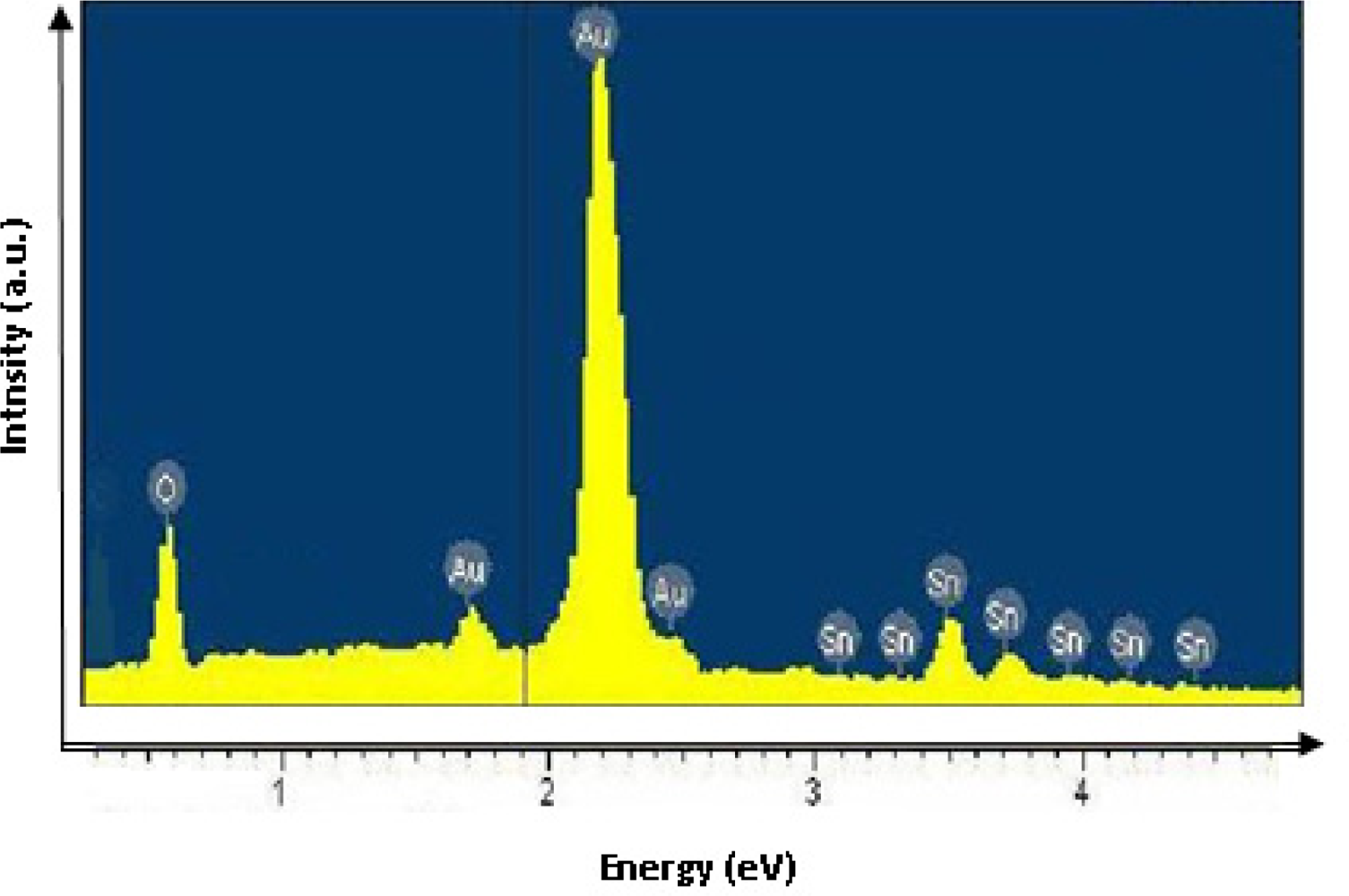
<p>EDX was used to estimate the composition of the SnO<sub>x</sub> thin films. <xref ref-type="fig" rid="f1-sensors-11-09207">Figure 1</xref> shows the EDX spectrum of SnO<sub>x</sub> thin film obtained by chemical bath deposition. The Au coating is reflected in the strong Au peak. The result illustrated in <xref ref-type="fig" rid="f1-sensors-11-09207">Figure 1</xref> indicates the presence of oxygen and tin with a typical O/Sn ratio of 43/25 (or 1.72) which is close to the stoichiometry of the compound SnO<sub>2</sub>. SnO<sub>2</sub> in its stoichiometric form acts as an insulator, but in its oxygen-deficient form tin dioxide behaves as an n-type semiconductor and the conductivity is thought to be due to intrinsic defect formation [<xref ref-type="bibr" rid="b14-sensors-11-09207">14</xref>].</p></sec>
<sec>
<label>3.2.</label>
<title>Structural Studies</title>
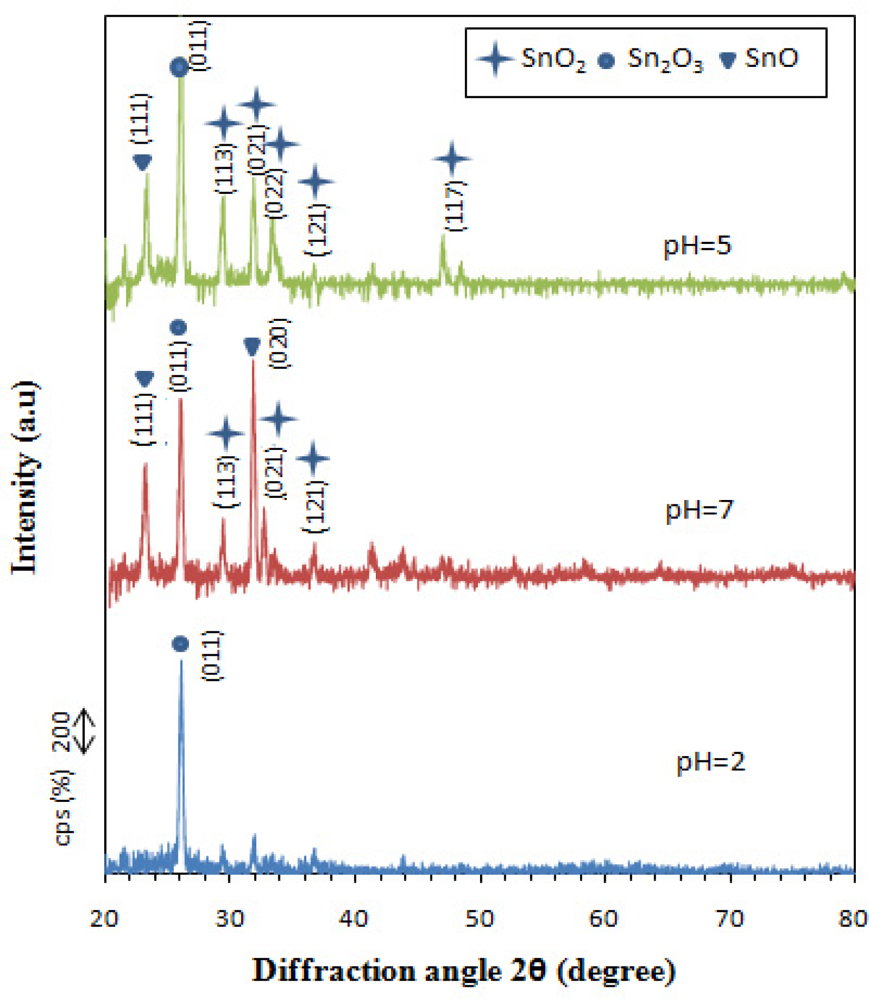
<p>The XRD pattern of SnO<sub>x</sub> thin films (<xref ref-type="fig" rid="f2-sensors-11-09207">Figure 2</xref>) deposited by chemical bath deposition method for 30 min indicate that they are of a polycrystalline nature. From the XRD patterns several SnO<sub>2</sub> peaks are detected for the samples prepared at pH 5.0 and 7.0. The observed d-values are in good agreement with the Joint Committee on Powder Diffraction Standard (JCPDS) data for the orthorhombic structure of SnO<sub>2</sub> (reference code: 078-1063). The Miller indices are shown above the diffractions. For the sample deposited at pH of 5.0 the strongest peak is at 2θ of 31.8° (corresponding to (021) reflection). It indicates that the preferred orientation lies along (021) plane. The other smaller peaks were at 2θs of (29, 33.3, 36.6, and 47) corresponding to the (113), (022), (121) and (117) planes, respectively. The crystallite size on the film was calculated by using Scherrer's formula for the (021) peak for 2θ of 31.8° and was found to be 36 nm.</p>
<p>For the film deposited at pH of 7.0 some SnO peaks were also detected with high intensity, indicating the presence of side product and due to the non-optimum conditions used for the deposition of the SnO<sub>2</sub> thin film. For the film deposited at pH of 2.0 no intense SnO<sub>2</sub> peak was detected.</p></sec>
<sec>
<label>3.3.</label>
<title>Surface Morphology</title>
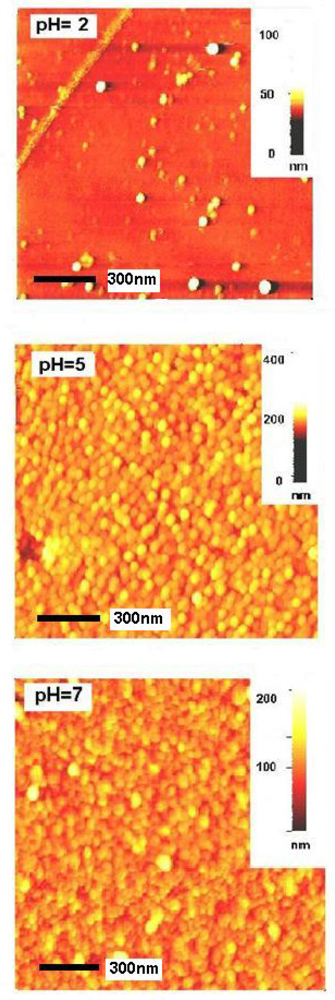
<p>Film morphology was examined using atomic force microscopy (AFM). <xref ref-type="fig" rid="f3-sensors-11-09207">Figure 3</xref> illustrates the two-dimensional images of the films deposited at various pH levels. <xref ref-type="fig" rid="f3-sensors-11-09207">Figure 3</xref> reveals incomplete growth of the films deposited at pH of 2.0 and uniform growth at pH of 5.0 or 7.0.</p>
<p>The formation of spherical, compact and nano sized grains on an amorphous background on films deposited at pH of 5.0 is an indication of nucleation by multiple growths. No pinholes or cracks were seen in the sample. The thickness of the film was 230 nm. The surface roughness of the film was about 8.74 nm, which is due to nucleation of grains by multiple growths that increases the incident light trapping effect of transparent tin oxide thin film for solar cell applications.</p></sec>
<sec>
<label>3.4.</label>
<title>Optical Properties</title>
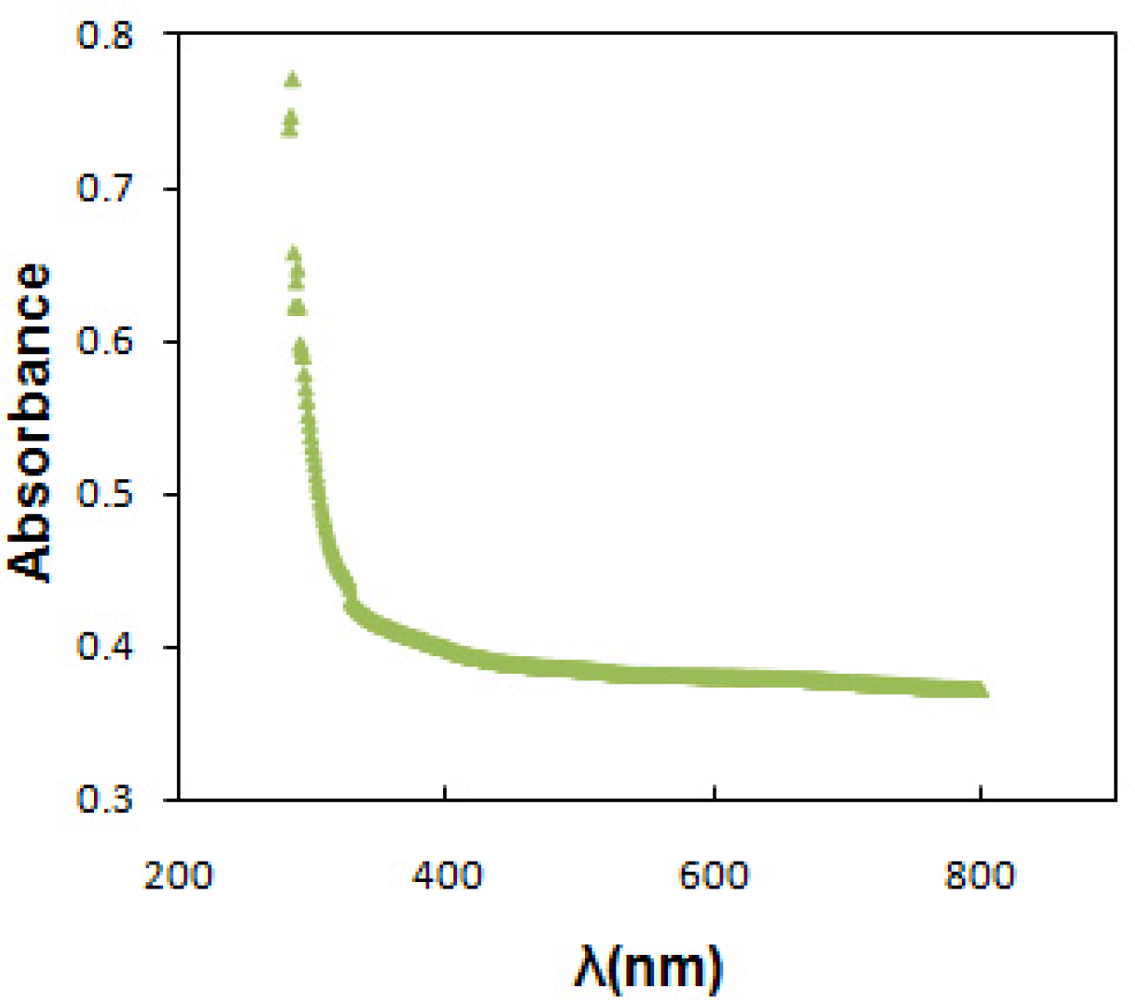
<p>Optical absorption was utilized to estimate band gap and type of optical transition. <xref ref-type="fig" rid="f4-sensors-11-09207">Figure 4</xref> shows the absorption spectrum <italic>versus</italic> wavelength of SnO<sub>x</sub> thin film deposited on glass substrate at pH of 5.0 and temperature of 30 °C. The optical data was then analyzed using the Stern equation for near-edge absorption:
<disp-formula>
<mml:math display="block">
<mml:mrow>
<mml:mtext mathvariant="bold">A</mml:mtext>
<mml:mo>=</mml:mo>
<mml:mfrac>
<mml:mrow>
<mml:mtext mathvariant="bold">K</mml:mtext>
<mml:msup>
<mml:mrow>
<mml:mrow>
<mml:mrow>
<mml:mo>(</mml:mo>
<mml:mrow>
<mml:mtext mathvariant="bold">h</mml:mtext>
<mml:mi mathvariant="bold">υ</mml:mi>
<mml:mo>−</mml:mo>
<mml:msub>
<mml:mrow>
<mml:mtext mathvariant="bold">E</mml:mtext></mml:mrow>
<mml:mtext mathvariant="bold">g</mml:mtext></mml:msub></mml:mrow>
<mml:mo>)</mml:mo></mml:mrow></mml:mrow></mml:mrow>
<mml:mrow>
<mml:mtext mathvariant="bold">n</mml:mtext>
<mml:mo mathvariant="bold">/</mml:mo>
<mml:mn mathvariant="bold">2</mml:mn></mml:mrow></mml:msup></mml:mrow>
<mml:mrow>
<mml:mtext mathvariant="bold">h</mml:mtext>
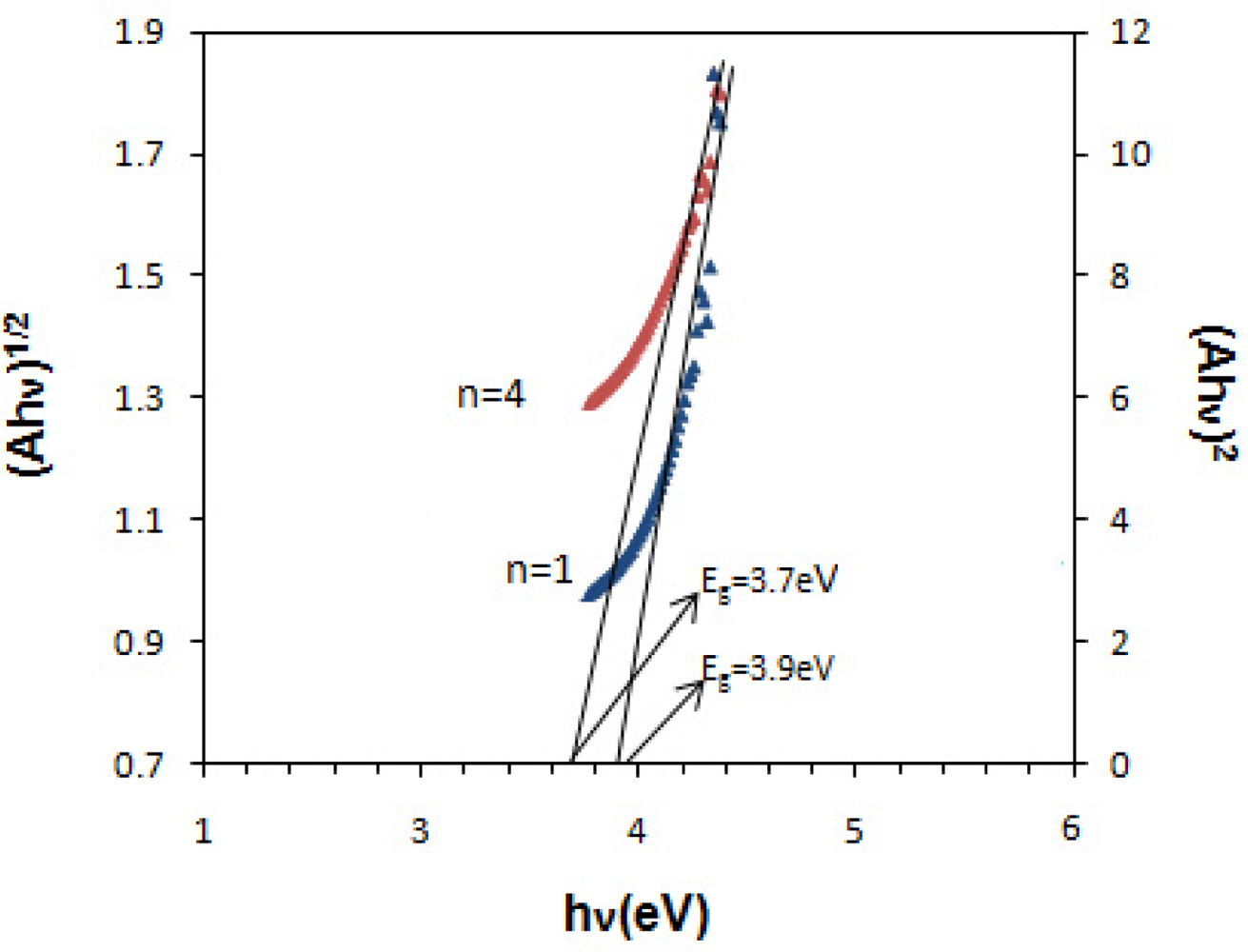
<mml:mi mathvariant="bold">υ</mml:mi></mml:mrow></mml:mfrac></mml:mrow></mml:math></disp-formula>where K is constant, E<sub>g</sub> is the energy separation between the valence and conduction band that called band gap, n is a pure number, that is equal to 1 for direct and 4 for indirect band gap semiconductors. <xref ref-type="fig" rid="f5-sensors-11-09207">Figure 5</xref> shows the (Ahν)<sup>2</sup> and (Ahν)<sup>1/2</sup> plots of the SnO<sub>x</sub> thin film for direct and indirect transition, respectively.</p>
<p>The band gap value were determined from the intercept of the straight line portion in maximum absorbance of the (Ahν)<sup>2/n</sup> against the hν on the hν axis. In this case, the band gap of 3.9 eV and 3.7 eV was estimated for direct and indirect transition between valence and conduction bands of SnO<sub>x</sub> thin film. The wide band gap and minimum absorbance of deposited SnO<sub>x</sub> thin film in the UV-Visible range indicates the potential application of prepared thin films as window layer in solar cell device [<xref ref-type="bibr" rid="b3-sensors-11-09207">3</xref>]. <xref ref-type="table" rid="t1-sensors-11-09207">Table 1</xref> shows the structural and optical characteristics of deposited SnO<sub>x</sub> nanocrystalline thin film on glass substrate.</p>
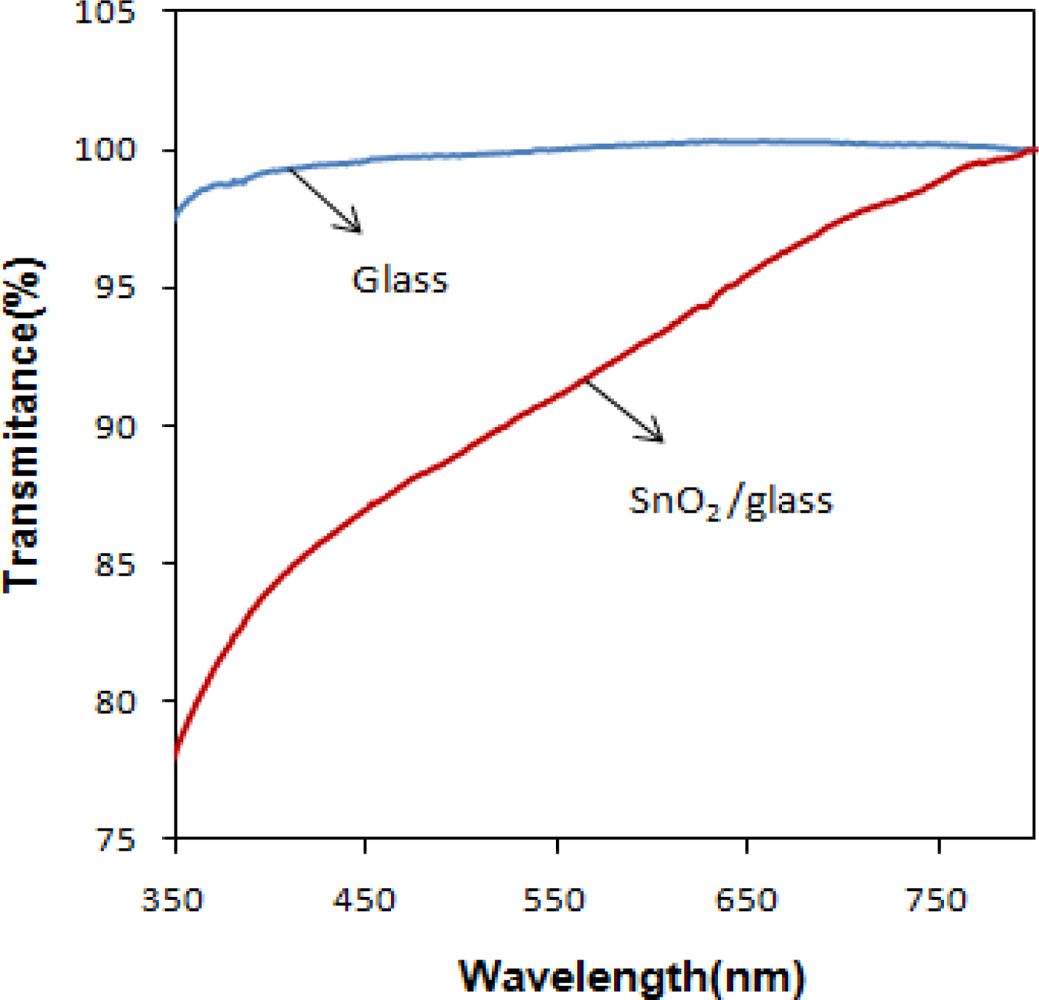
<p>High transmittance at visible-light wavelengths is a key factor for the semiconducting material in a transparent device, such as the SnO<sub>2</sub> thin film solar cell or transistor. <xref ref-type="fig" rid="f6-sensors-11-09207">Figure 6</xref> compares the transmittance of the SnO<sub>x</sub>/glass thin film and glass slides. The glass used has 96% optical transmittance in the visible part of the spectrum. The average transmittance for SnO<sub>x</sub>/glass in the visible part of the spectrum is comparable with glass and is more than 82%. This indicates that the deposited SnO<sub>x</sub> thin film can be used as a transparent conductive oxide layer in solar cell devices.</p></sec>
<sec>
<label>3.5.</label>
<title>Photoluminescence</title>
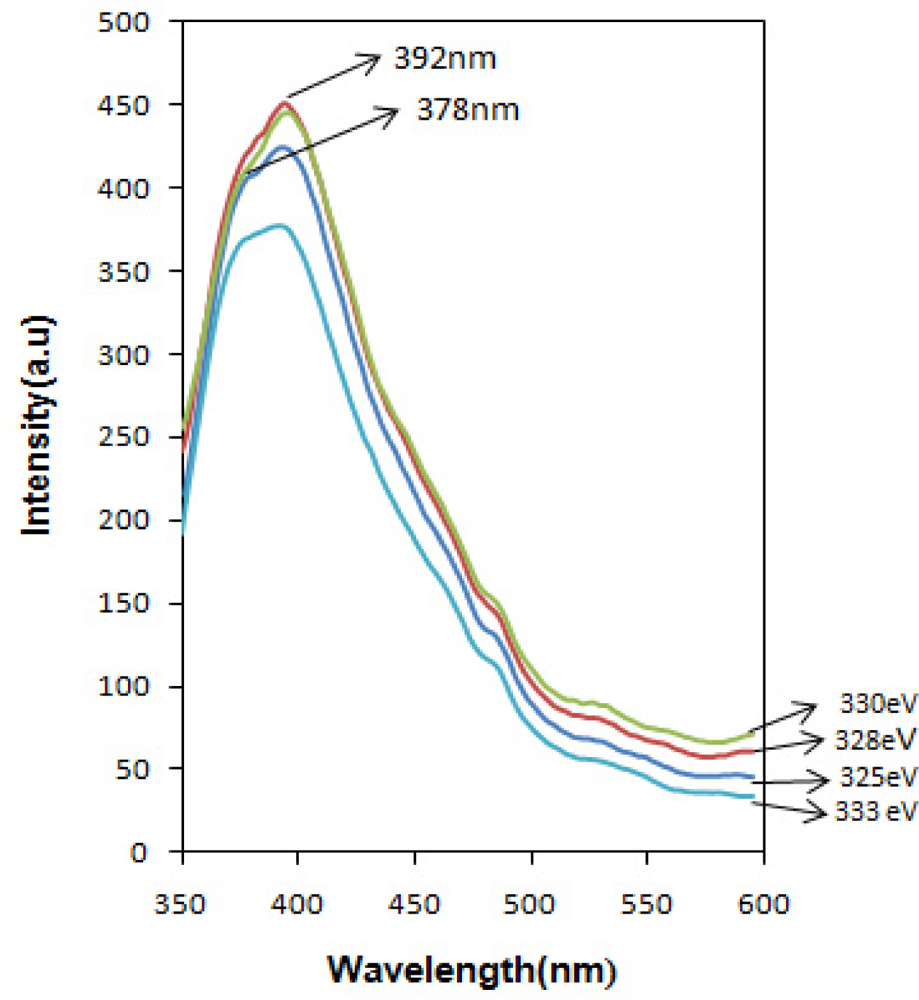
<p>Photoluminescence (PL) spectra of the SnO<sub>x</sub> nanocrystalline were obtained in the wavelength range from 350 to 600 nm. The room temperature optical luminescence (<xref ref-type="fig" rid="f7-sensors-11-09207">Figure 7</xref>) from SnO<sub>x</sub> nanocrystalline excited with various photon energies exhibit a strong emission band at 392 nm (3.17 eV) and a shoulder in 378 nm (3.28 eV). The expected near band edge was detected around 345 nm for direct transition and 335 nm for indirect transition, which is originated from exciton recombination of electron in the Sn ‘4d’ conduction band with a hole in the O ‘2p’ valence band. The observed shift to the visible range can be attributed to the recombination of photo-generated holes with singly ionized charge states in intrinsic defects such as oxygen vacancies, Sn interstitials, or impurities [<xref ref-type="bibr" rid="b15-sensors-11-09207">15</xref>–<xref ref-type="bibr" rid="b17-sensors-11-09207">17</xref>].</p></sec>
<sec>
<label>3.6.</label>
<title>Photosensitivity</title>
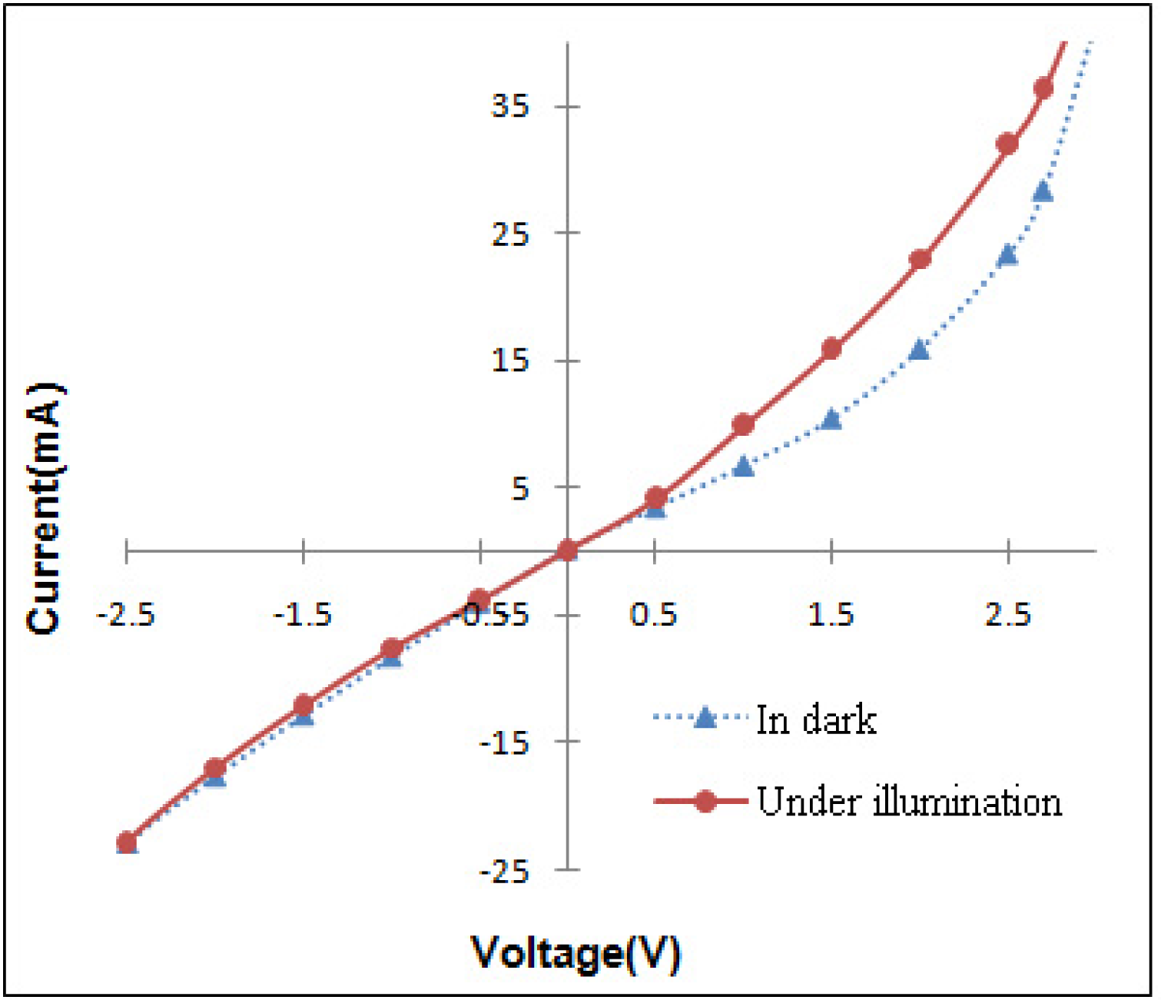
<p>As thin oxide films are expected to be semiconductors they should be sensitive to the light, with energy higher than their E<sub>g</sub> and show a photocurrent in the region corresponding to its minority carrier current flow. <xref ref-type="fig" rid="f8-sensors-11-09207">Figure 8</xref> shows the photosensitivity of the SnO<sub>x</sub> thin film in the dark and under illumination. The lower value corresponds to the dark current, while the upper value of the current corresponds to the photocurrent when the sample, employed as anode, was illuminated. The fact that the photocurrent occurs on the positive potentials region indicates that electrons are minority carriers of the film and their concentration was then enhanced by illumination. Thus, the films prepared are n-type semiconductor and can be deployed as photoanode in the PECs (photoelectrochemical cells) application to facilitate oxidation on the electroactive species in the solution.</p></sec>
<sec sec-type="methods">
<label>3.7.</label>
<title>Thermogravimetric Analysis</title>
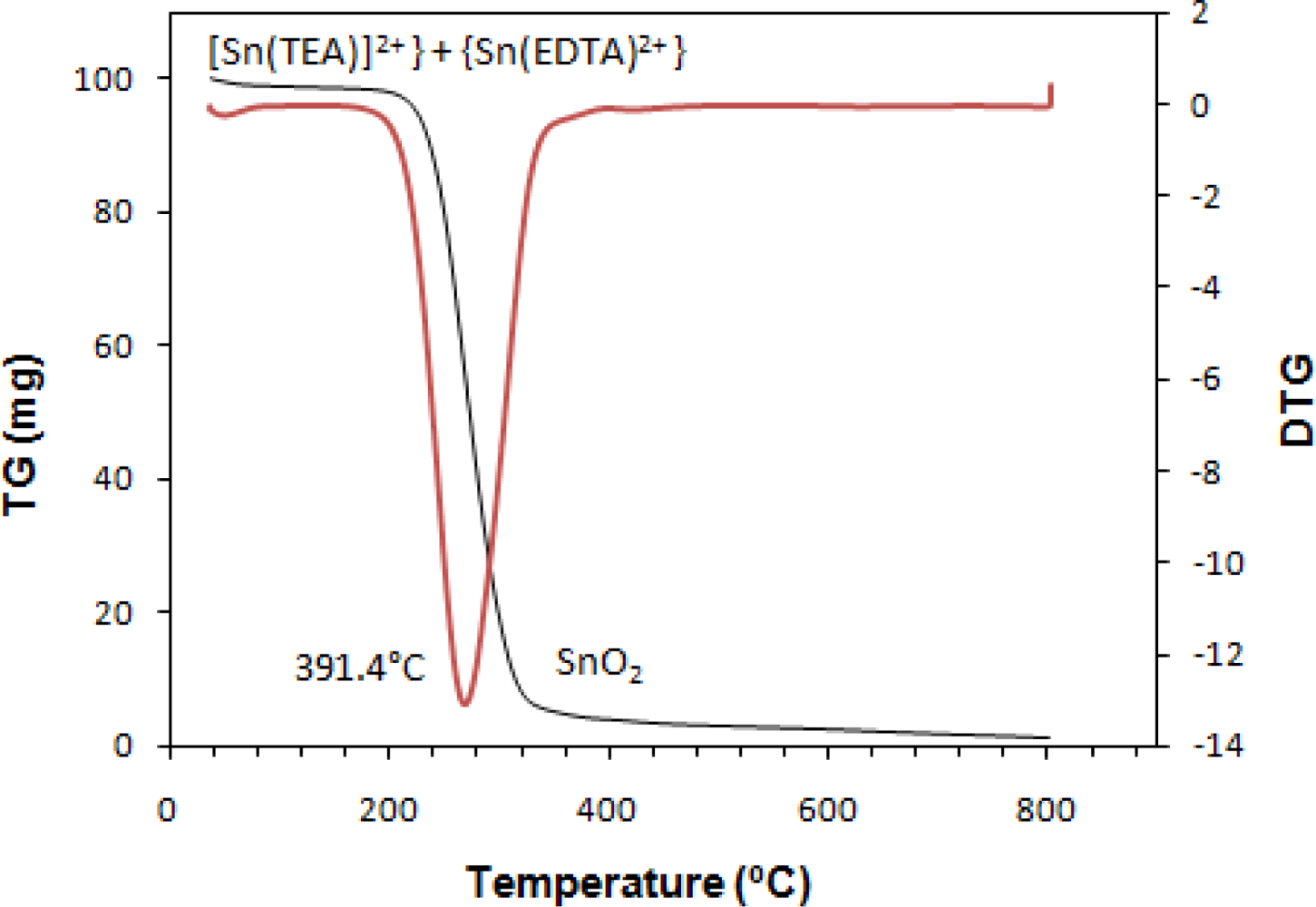
<p>TG-DTG (thermogravimetry-derivative thermogravimetry) analysis was conducted to characterize the effects of heat treatment on the powder obtained from drying of precursor solution for nanocrystalline SnO<sub>x</sub>. However the characteristics of powder and film were not exactly the same, the heat treatment temperature can be obtained from the TG-DTG analysis. <xref ref-type="fig" rid="f9-sensors-11-09207">Figure 9</xref> is the results of thermogravimetric measurements for prepared SnO<sub>x</sub> nanocrystalline.</p>
<p>The weight loss for nanocrystalline SnO<sub>x</sub> occured at a temperature between 184 °C to 269.2 °C, which is related to the decomposition of TEA from the [Sn(TEA)]<sup>2+</sup>complex and evaporation of solvent. It shows a residue retention of 3.9% at T &gt; 320 °C. It can be concluded that to complete the crystallization of SnO<sub>2</sub> and evaporation of complexing agent and water, the heat treatment should be conducted over 269.2 °C.</p></sec></sec>
<sec sec-type="conclusions">
<label>4.</label>
<title>Conclusions</title>
<p>A simple chemical bath deposition technique was successfully utilized to synthesize nanocrystalline SnO<sub>x</sub> thin films with decreased time of deposition and bath temperature and increased pH to the noncorrosive region by using TEA as a complexing agent. The preferred orientation lies along the (021) plane. AFM analysis showed a compact texture with small uniform grains of about 36 nm and 230 nm thick for the film deposited at pH of 5.0. EDX revealed that the average O/Sn atomic percentage is 1.72. Optical data analysis illustrated a direct band gap at 3.9 eV and an indirect transition at 3.7 eV. The wide band gap (3.9) and high transmittance (&gt;82%) makes it possible for these thin films to be used in solar cell devices as transparent conductive oxide layers. The photoluminescence spectra of the nanocrystalline SnO<sub>x</sub> exhibited a strong UV exciton peak at room temperature. The temperature for heat treatment of the as deposited thin film was found to be above 391 °C using TGA analysis.</p></sec></body>
<back>
<ref-list>
<title>References</title>
<ref id="b1-sensors-11-09207"><label>1.</label><citation citation-type="journal"><person-group person-group-type="author"><name><surname>Lee</surname><given-names>SW</given-names></name><name><surname>Kim</surname><given-names>YW</given-names></name><name><surname>Chen</surname><given-names>H</given-names></name></person-group><article-title>Electrical properties of Ta-doped SnO<sub>2</sub> thin films prepared by chemical-vapor deposition method</article-title><source>Appl. Phys. Lett</source><year>2001</year><volume>78</volume><fpage>350</fpage><lpage>352</lpage><pub-id pub-id-type="doi">10.1063/1.1337640</pub-id></citation></ref>
<ref id="b2-sensors-11-09207"><label>2.</label><citation citation-type="journal"><person-group person-group-type="author"><name><surname>Mason</surname><given-names>MG</given-names></name><name><surname>Hung</surname><given-names>LS</given-names></name><name><surname>Tang</surname><given-names>CW</given-names></name><name><surname>Lee</surname><given-names>ST</given-names></name><name><surname>Wong</surname><given-names>KW</given-names></name><name><surname>Wang</surname><given-names>M</given-names></name></person-group><article-title>Characterization of treated indium-tin-oxide surfaces used in electroluminescent devices</article-title><source>J. Appl. Phys</source><year>1999</year><volume>86</volume><fpage>1688</fpage><lpage>1692</lpage><pub-id pub-id-type="doi">10.1063/1.370948</pub-id></citation></ref>
<ref id="b3-sensors-11-09207"><label>3.</label><citation citation-type="journal"><person-group person-group-type="author"><name><surname>Peaker</surname><given-names>AR</given-names></name><name><surname>Horsley</surname><given-names>B</given-names></name></person-group><article-title>Transparent conducting films of Antimony doped tin oxide on glass</article-title><source>Rev. Sci. Instrum</source><year>1971</year><volume>42</volume><fpage>1825</fpage><lpage>1827</lpage><pub-id pub-id-type="doi">10.1063/1.1685015</pub-id></citation></ref>
<ref id="b4-sensors-11-09207"><label>4.</label><citation citation-type="journal"><person-group person-group-type="author"><name><surname>Watson</surname><given-names>J</given-names></name></person-group><article-title>The tin oxide gas sensor and its application</article-title><source>Sens. Actuat</source><year>1984</year><volume>5</volume><fpage>29</fpage><lpage>42</lpage><pub-id pub-id-type="doi">10.1016/0250-6874(84)87004-3</pub-id></citation></ref>
<ref id="b5-sensors-11-09207"><label>5.</label><citation citation-type="journal"><person-group person-group-type="author"><name><surname>Barsan</surname><given-names>N</given-names></name><name><surname>Weimar</surname><given-names>U</given-names></name></person-group><article-title>Understanding the fundamental principles of metal oxide based gas sensors; the example of CO sensing with SnO<sub>2</sub> sensors in the presence of humidity</article-title><source>J. Phys. Condens. Matter</source><year>2003</year><volume>15</volume><fpage>R813</fpage><lpage>R839</lpage><pub-id pub-id-type="doi">10.1088/0953-8984/15/20/201</pub-id></citation></ref>
<ref id="b6-sensors-11-09207"><label>6.</label><citation citation-type="journal"><person-group person-group-type="author"><name><surname>Nuli</surname><given-names>YN</given-names></name><name><surname>Zhao</surname><given-names>SL</given-names></name><name><surname>Qin</surname><given-names>QZ</given-names></name></person-group><article-title>Nanorystalline tin oxides and nickel oxide film anodes for Li-ion batteries</article-title><source>J. Power Sources</source><year>2003</year><volume>114</volume><fpage>113</fpage><lpage>120</lpage><pub-id pub-id-type="doi">10.1016/S0378-7753(02)00531-1</pub-id></citation></ref>
<ref id="b7-sensors-11-09207"><label>7.</label><citation citation-type="journal"><person-group person-group-type="author"><name><surname>Duverneuil</surname><given-names>P</given-names></name><name><surname>Maury</surname><given-names>F</given-names></name><name><surname>Pebere</surname><given-names>N</given-names></name><name><surname>Senocq</surname><given-names>F</given-names></name><name><surname>Vergnes</surname><given-names>H</given-names></name></person-group><article-title>Chemical vapor deposition of SnO<sub>2</sub> coatings on Ti plates for the preparation of electrocatalytic anodes</article-title><source>J Surf Coat Technol</source><year>2002</year><volume>151–152</volume><fpage>9</fpage><lpage>13</lpage></citation></ref>
<ref id="b8-sensors-11-09207"><label>8.</label><citation citation-type="journal"><person-group person-group-type="author"><name><surname>Deshpande</surname><given-names>NG</given-names></name><name><surname>Vyas</surname><given-names>JC</given-names></name><name><surname>Sharma</surname><given-names>R</given-names></name></person-group><article-title>Preparation and characterization of nanocrystalline tin oxide thin films deposited at room temperature</article-title><source>J. Thin Solid Films</source><year>2008</year><volume>516</volume><fpage>8587</fpage><lpage>8593</lpage><pub-id pub-id-type="doi">10.1016/j.tsf.2008.06.016</pub-id></citation></ref>
<ref id="b9-sensors-11-09207"><label>9.</label><citation citation-type="book"><person-group person-group-type="author"><name><surname>Hodes</surname><given-names>G</given-names></name><name><surname>Dekker</surname><given-names>M</given-names></name></person-group><source>Chemical Solution Deposition of Semiconductor Films</source><publisher-name>CRC Press</publisher-name><publisher-loc>Boca Raton, FL, USA</publisher-loc><year>2002</year></citation></ref>
<ref id="b10-sensors-11-09207"><label>10.</label><citation citation-type="journal"><person-group person-group-type="author"><name><surname>Mane</surname><given-names>RS</given-names></name><name><surname>Lee</surname><given-names>WJ</given-names></name><name><surname>Lokhande</surname><given-names>CD</given-names></name><name><surname>Cho</surname><given-names>BW</given-names></name><name><surname>Han</surname><given-names>S-H</given-names></name></person-group><article-title>Controlled repeated chemical growth of SnO films for dye-sensitized solar cells</article-title><source>Curr. Appl. Phys</source><year>2008</year><volume>8</volume><fpage>549</fpage><lpage>553</lpage><pub-id pub-id-type="doi">10.1016/j.cap.2007.10.001</pub-id></citation></ref>
<ref id="b11-sensors-11-09207"><label>11.</label><citation citation-type="journal"><person-group person-group-type="author"><name><surname>Salem</surname><given-names>AM</given-names></name><name><surname>Abou-Helal</surname><given-names>MO</given-names></name></person-group><article-title>Chemical bath deposition of tin selenide thin films</article-title><source>Mater. Chem. Phys</source><year>2003</year><volume>9849</volume><fpage>1</fpage><lpage>6</lpage></citation></ref>
<ref id="b12-sensors-11-09207"><label>12.</label><citation citation-type="journal"><person-group person-group-type="author"><name><surname>Igbinovia</surname><given-names>EO</given-names></name><name><surname>Ilenikhena</surname><given-names>PA</given-names></name></person-group><article-title>Improved chemical deposition and thermal emittance of tin (iv) oxide (SnO<sub>2</sub>) thin films for photothermal conversion of solar energy and possible applications</article-title><source>Int. J. Phys. Sci</source><year>2010</year><volume>5</volume><fpage>1770</fpage><lpage>1775</lpage></citation></ref>
<ref id="b13-sensors-11-09207"><label>13.</label><citation citation-type="journal"><person-group person-group-type="author"><name><surname>Masuda</surname><given-names>Y</given-names></name><name><surname>Ohji</surname><given-names>T</given-names></name><name><surname>Kato</surname><given-names>K</given-names></name></person-group><article-title>Room-temperature synthesis of tin oxide nano-electrodes in aqueous solutions</article-title><source>Thin Solid Films</source><year>2009</year><volume>518</volume><fpage>850</fpage><lpage>852</lpage><pub-id pub-id-type="doi">10.1016/j.tsf.2009.07.102</pub-id></citation></ref>
<ref id="b14-sensors-11-09207"><label>14.</label><citation citation-type="journal"><person-group person-group-type="author"><name><surname>Godinho</surname><given-names>KG</given-names></name><name><surname>Walsh</surname><given-names>A</given-names></name><name><surname>Watson</surname><given-names>GW</given-names></name></person-group><article-title>Energetic and electronic structure analysis of intrinsic defects in SnO<sub>2</sub></article-title><source>J. Phys. Chem. C</source><year>2008</year><volume>113</volume><fpage>439</fpage><lpage>448</lpage></citation></ref>
<ref id="b15-sensors-11-09207"><label>15.</label><citation citation-type="journal"><person-group person-group-type="author"><name><surname>Özgur</surname><given-names>Ü</given-names></name><name><surname>Alivov</surname><given-names>YI</given-names></name><name><surname>Liu</surname><given-names>C</given-names></name><name><surname>Teke</surname><given-names>A</given-names></name><name><surname>Reshchikov</surname><given-names>MA</given-names></name><name><surname>Doğan</surname><given-names>S</given-names></name><name><surname>Avrutin</surname><given-names>V</given-names></name><name><surname>Cho</surname><given-names>S-J</given-names></name><name><surname>Morkoç</surname><given-names>H</given-names></name></person-group><article-title>A comprehensive review of ZnO materials and devices</article-title><source>J Appl Phys</source><year>2005</year><pub-id pub-id-type="doi">10.1063/1.1992666</pub-id></citation></ref>
<ref id="b16-sensors-11-09207"><label>16.</label><citation citation-type="journal"><person-group person-group-type="author"><name><surname>Kim</surname><given-names>T-W</given-names></name><name><surname>Kazawoe</surname><given-names>T</given-names></name><name><surname>Yamazaki</surname><given-names>S</given-names></name><name><surname>Ohtsu</surname><given-names>M</given-names></name><name><surname>Sekiguchi</surname><given-names>T</given-names></name></person-group><article-title>Low-temperature orientation-selective growth and ultraviolet emission of single-crystal ZnO nanowires</article-title><source>J. Appl. Phys. Lett</source><year>2004</year><volume>84</volume><fpage>3358</fpage><lpage>3360</lpage><pub-id pub-id-type="doi">10.1063/1.1723696</pub-id></citation></ref>
<ref id="b17-sensors-11-09207"><label>17.</label><citation citation-type="journal"><person-group person-group-type="author"><name><surname>Qiu</surname><given-names>Z</given-names></name><name><surname>Wong</surname><given-names>KS</given-names></name><name><surname>Wu</surname><given-names>M</given-names></name></person-group><article-title>Microcavity lasing behavior of oriented hexagonal ZnO nanowhiskers grown by hydrothermal</article-title><source>J. Appl. Phys. Lett</source><year>2004</year><volume>84</volume><fpage>2739</fpage><lpage>2741</lpage><pub-id pub-id-type="doi">10.1063/1.1697633</pub-id></citation></ref></ref-list>
<sec sec-type="display-objects">
<title>Figures and Table</title>
<fig id="f1-sensors-11-09207" position="float">
<label>Figure 1.</label>
<caption>
<p>The EDX spectrum of nanocrystalline SnO<sub>x</sub> thin film.</p></caption>
<graphic xlink:href="sensors-11-09207f1.gif"/></fig>
<fig id="f2-sensors-11-09207" position="float">
<label>Figure 2.</label>
<caption>
<p>X-ray diffraction pattern of SnO<sub>x</sub> thin film at various pH levels.</p></caption>
<graphic xlink:href="sensors-11-09207f2.gif"/></fig>
<fig id="f3-sensors-11-09207" position="float">
<label>Figure 3.</label>
<caption>
<p>AFM images of nanocrystalline SnO<sub>x</sub> thin film deposited at various pH levels.</p></caption>
<graphic xlink:href="sensors-11-09207f3.gif"/></fig>
<fig id="f4-sensors-11-09207" position="float">
<label>Figure 4.</label>
<caption>
<p>Absorption spectrum of nanocrystalline SnO<sub>x</sub> thin film (pH = 5.0).</p></caption>
<graphic xlink:href="sensors-11-09207f4.gif"/></fig>
<fig id="f5-sensors-11-09207" position="float">
<label>Figure 5.</label>
<caption>
<p>The plot of direct and indirect transition of the nanocrystalline SnO<sub>x</sub> thin film (pH = 5.0).</p></caption>
<graphic xlink:href="sensors-11-09207f5.gif"/></fig>
<fig id="f6-sensors-11-09207" position="float">
<label>Figure 6.</label>
<caption>
<p>Optical transmittance spectrum of nanocrystalline SnO<sub>x</sub>/glass and glass slide (pH = 5.0).</p></caption>
<graphic xlink:href="sensors-11-09207f6.gif"/></fig>
<fig id="f7-sensors-11-09207" position="float">
<label>Figure 7.</label>
<caption>
<p>Photoluminescence spectrum of nanocrystalline SnO<sub>x</sub> thin film excited with various photon energy (pH = 5.0).</p></caption>
<graphic xlink:href="sensors-11-09207f7.gif"/></fig>
<fig id="f8-sensors-11-09207" position="float">
<label>Figure 8.</label>
<caption>
<p>Photosensitivity of nanocrystalline SnO<sub>x</sub> thin film in dark and under illumination (pH = 5).</p></caption>
<graphic xlink:href="sensors-11-09207f8.gif"/></fig>
<fig id="f9-sensors-11-09207" position="float">
<label>Figure 9.</label>
<caption>
<p>TG and DTG curve of SnO<sub>x</sub> powder (pH = 5.0).</p></caption>
<graphic xlink:href="sensors-11-09207f9.gif"/></fig>
<table-wrap id="t1-sensors-11-09207" position="float">
<label>Table 1.</label>
<caption>
<p>Characteristics of prepared nanocrystalline SnO<sub>x</sub> thin film in different pH.</p></caption>
<table frame="hsides" rules="groups">
<thead>
<tr>
<th align="center" valign="middle" rowspan="2"><bold>pH</bold></th>
<th align="center" valign="middle" rowspan="2"><bold>Crystalline structure</bold></th>
<th align="center" valign="middle" rowspan="2"><bold>t (nm)</bold></th>
<th align="center" valign="middle" rowspan="2"><bold>R<sub>a</sub> (nm)</bold></th>
<th colspan="2" align="center" valign="middle"><bold>E<sub>g</sub>(eV)</bold>
<hr/></th>
<th align="center" valign="middle" rowspan="2"><bold>Size (nm)</bold></th>
<th align="center" valign="middle" rowspan="2"><bold>T (%)</bold></th>
<th colspan="2" align="center" valign="middle"><bold>PL</bold>
<hr/></th></tr>
<tr>
<th align="center" valign="middle"><bold>Direct transition</bold></th>
<th align="center" valign="middle"><bold>Indirect transition</bold></th>
<th align="center" valign="middle"><bold>Intensity %</bold></th>
<th align="center" valign="middle"><bold>Position (nm)</bold></th></tr></thead>
<tbody>
<tr>
<td align="center" valign="top">=5</td>
<td align="center" valign="top">orthorhombic</td>
<td align="center" valign="top">230</td>
<td align="center" valign="top">8.74</td>
<td align="center" valign="top">3.9</td>
<td align="center" valign="top">3.7</td>
<td align="center" valign="top">36</td>
<td align="center" valign="top">&gt;85</td>
<td align="center" valign="top">445</td>
<td align="center" valign="top">392</td></tr>
<tr>
<td align="center" valign="top">=7</td>
<td align="center" valign="top">orthorhombic</td>
<td align="center" valign="top">180</td>
<td align="center" valign="top">17.1</td>
<td align="center" valign="top">4</td>
<td align="center" valign="top">3.8</td>
<td align="center" valign="top">52</td>
<td align="center" valign="top">&gt;76</td>
<td align="center" valign="top">410</td>
<td align="center" valign="top">390</td></tr>
<tr>
<td align="center" valign="top">=2</td>
<td align="center" valign="top">orthorhombic</td>
<td align="center" valign="top">20</td>
<td align="center" valign="top">1.46</td>
<td align="center" valign="top">3.9</td>
<td align="center" valign="top">3.7</td>
<td align="center" valign="top">500</td>
<td align="center" valign="top">&gt;98</td>
<td align="center" valign="top">320</td>
<td align="center" valign="top">392</td></tr></tbody></table>
<table-wrap-foot><fn id="tfn1-sensors-11-09207">
<p>Note: t = thickness, T = transmittance, R<sub>a</sub> = surface roughness.</p></fn></table-wrap-foot></table-wrap></sec></back></article>