
The Role of PAS Kinase in PASsing the Glucose Signal



Abstract
:
1. Introduction
1.1. Times of Plenty and Times of Scarcity
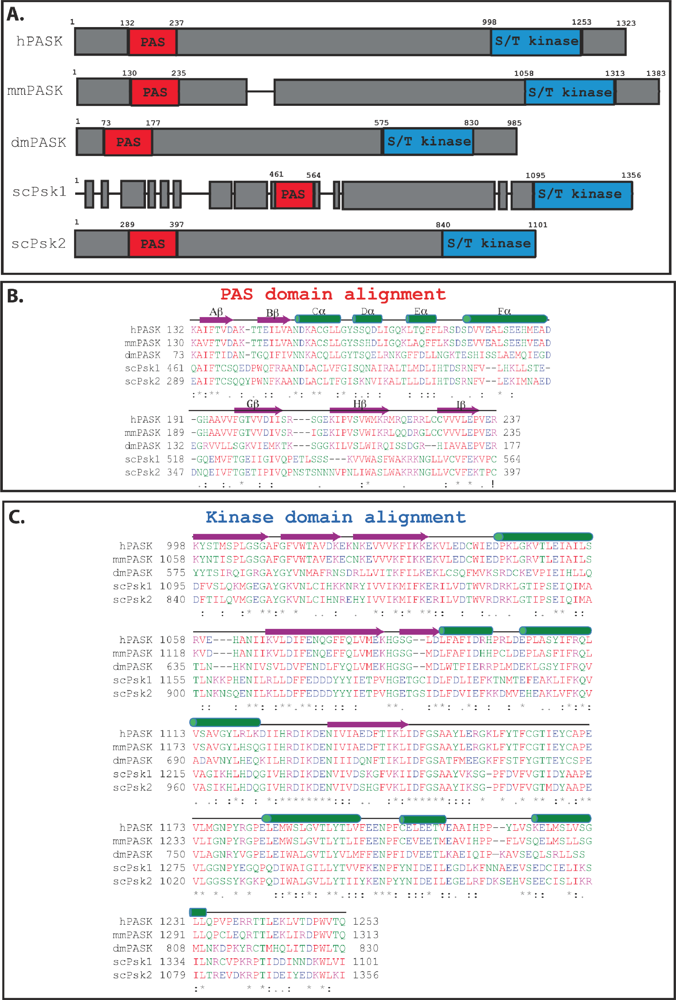
1.2. PAS Kinase Structure
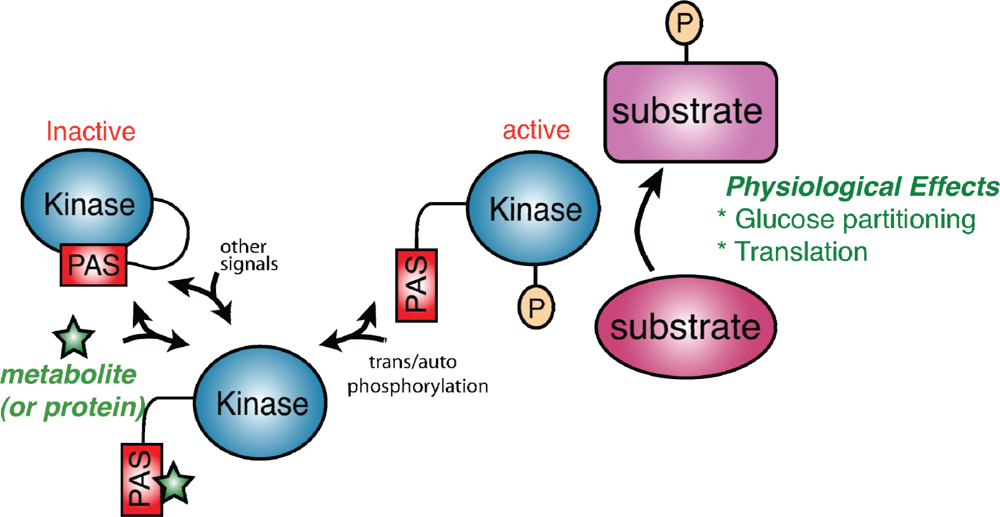
1.3. A Model for PAS Kinase Activation and Function
1.4. Expression and Subcellular Localization
2. PAS Kinase Glucose Sensing
2.1. Mammalian PAS Kinase
2.2 Yeast PAS Kinase
3. PAS Kinase Regulation of Glucose Partitioning
3.1. Glucose Partitioning and the Regulation of Glycogen Biosynthesis
3.2. A Role for PAS Kinase in Translation
4. Conclusions
References
- Hedbacker, K.; Carlson, M. SNF1/AMPK pathways in yeast. Front Biosci 2008, 13, 2408–2420. [Google Scholar]
- Warburg, O. On the origin of cancer cells. Science 1956, 123, 309–314. [Google Scholar]
- Hardie, D.G. AMP-activated/SNF1 protein kinases: Conserved guardians of cellular energy. Nat. Rev. Mol. Cell Biol 2007, 8, 774–785. [Google Scholar]
- Steinberg, G.R.; Kemp, B.E. AMPK in health and disease. Physiol. Rev 2009, 89, 1025–1078. [Google Scholar]
- Martin, D.E.; Hall, M.N. The expanding TOR signaling network. Curr. Opin. Cell Biol 2005, 17, 158–166. [Google Scholar]
- Harris, T.E.; Lawrence, J.C., Jr. TOR signaling. Sci. STKE 2003, 2003. re15.. [Google Scholar]
- Grose, J.H.; Smith, T.L.; Sabic, H.; Rutter, J. Yeast PAS kinase coordinates glucose partitioning in response to metabolic and cell integrity signaling. Embo. J 2007, 26, 4824–4830. [Google Scholar]
- Grose, J.H.; Sundwall, E.; Rutter, J. Regulation and function of yeast PAS kinase: A role in the maintenance of cellular integrity. Cell Cycle 2009, 8, 1824–1832. [Google Scholar]
- Rutter, J.; Probst, B.L.; McKnight, S.L. Coordinate regulation of sugar flux and translation by PAS kinase. Cell 2002, 111, 17–28. [Google Scholar]
- Smith, T.L.; Rutter, J. Regulation of glucose partitioning by PAS kinase and Ugp1 phosphorylation. Mol. Cell 2007, 26, 491–499. [Google Scholar]
- da Silva Xavier, G.; Rutter, J.; Rutter, G.A. Involvement of Per-Arnt-Sim (PAS) kinase in the stimulation of preproinsulin and pancreatic duodenum homeobox 1 gene expression by glucose. Proc. Natl. Acad. Sci. USA 2004, 101, 8319–8324. [Google Scholar]
- Fontes, G.; Semache, M.; Hagman, D.K.; Tremblay, C.; Shah, R.; Rhodes, C.J.; Rutter, J.; Poitout, V. Involvement of Per-Arnt-Sim kinase and extracellular-regulated kinases-1/2 in palmitate inhibition of insulin gene expression in pancreatic beta-cells. Diabetes 2009, 58, 2048–2058. [Google Scholar]
- Hao, H.X.; Cardon, C.M.; Swiatek, W.; Cooksey, R.C.; Smith, T.L.; Wilde, J.; Boudina, S.; Abel, E.D.; McClain, D.A.; Rutter, J. PAS kinase is required for normal cellular energy balance. Proc. Natl. Acad. Sci. USA 2007, 104, 15466–15471. [Google Scholar]
- Hao, H.X.; Rutter, J. The role of PAS kinase in regulating energy metabolism. IUBMB Life 2008, 60, 204–209. [Google Scholar]
- Rutter, J.; Michnoff, C.H.; Harper, S.M.; Gardner, K.H.; McKnight, S.L. PAS kinase: An evolutionarily conserved PAS domain-regulated serine/threonine kinase. Proc. Natl. Acad. Sci. USA 2001, 98, 8991–8996. [Google Scholar]
- Wilson, W.A.; Skurat, A.V.; Probst, B.; de Paoli-Roach, A.; Roach, P.J.; Rutter, J. Control of mammalian glycogen synthase by PAS kinase. Proc. Natl. Acad. Sci. USA 2005, 102, 16596–16601. [Google Scholar]
- Manning, G.; Whyte, D.B.; Martinez, R.; Hunter, T.; Sudarsanam, S. The protein kinase complement of the human genome. Science 2002, 298, 1912–1934. [Google Scholar]
- Gu, Y.Z.; Hogenesch, J.B.; Bradfield, C.A. The PAS superfamily: Sensors of environmental and developmental signals. Annu. Rev. Pharmacol. Toxicol 2000, 40, 519–561. [Google Scholar]
- Moglich, A.; Ayers, R.A.; Moffat, K. Structure and signaling mechanism of Per-ARNT-Sim domains. Structure 2009, 17, 1282–1294. [Google Scholar]
- Sevvana, M.; Vijayan, V.; Zweckstetter, M.; Reinelt, S.; Madden, D.R.; Herbst-Irmer, R.; Sheldrick, G.M.; Bott, M.; Griesinger, C.; Becker, S. A ligand-induced switch in the periplasmic domain of sensor histidine kinase CitA. J. Mol. Biol 2008, 377, 512–523. [Google Scholar]
- Pellequer, J.L.; Wager-Smith, K.A.; Kay, S.A.; Getzoff, E.D. Photoactive yellow protein: A structural prototype for the three-dimensional fold of the PAS domain superfamily. Proc. Natl. Acad. Sci. USA 1998, 95, 5884–5890. [Google Scholar]
- Borgstahl, G.E.; Williams, D.R.; Getzoff, E.D. 1.4 A structure of photoactive yellow protein, a cytosolic photoreceptor: Unusual fold, active site, and chromophore. Biochemistry 1995, 34, 6278–6287. [Google Scholar]
- Monson, E.K.; Weinstein, M.; Ditta, G.S.; Helinski, D.R. The FixL protein of Rhizobium meliloti can be separated into a heme-binding oxygen-sensing domain and a functional C-terminal kinase domain. Proc. Natl. Acad. Sci. USA 1992, 89, 4280–4284. [Google Scholar]
- Moglich, A.; Ayers, R.A.; Moffat, K. Design and signaling mechanism of light-regulated histidine kinases. J. Mol. Biol 2009, 385, 1433–1444. [Google Scholar]
- Lee, J.; Natarajan, M.; Nashine, V.C.; Socolich, M.; Vo, T.; Russ, W.P.; Benkovic, S.J.; Ranganathan, R. Surface sites for engineering allosteric control in proteins. Science 2008, 322, 438–442. [Google Scholar]
- Strickland, D.; Moffat, K.; Sosnick, T.R. Light-activated DNA binding in a designed allosteric protein. Proc. Natl. Acad. Sci. USA 2008, 105, 10709–10714. [Google Scholar]
- Amezcua, C.A.; Harper, S.M.; Rutter, J.; Gardner, K.H. Structure and interactions of PAS kinase N-terminal PAS domain: Model for intramolecular kinase regulation. Structure 2002, 10, 1349–1361. [Google Scholar]
- Dux, P.; Rubinstenn, G.; Vuister, G.W.; Boelens, R.; Mulder, F.A.; Hard, K.; Hoff, W.D.; Kroon, A.R.; Crielaard, W.; Hellingwerf, K.J.; Kaptein, R. Solution structure and backbone dynamics of the photoactive yellow protein. Biochemistry 1998, 37, 12689–12699. [Google Scholar]
- Holdeman, T.C.; Gardner, K.H. 1H, 13C and 15N chemical shift assignments of the N-terminal PAS domain of mNPAS2. J. Biomol. NMR 2001, 21, 383–384. [Google Scholar]
- Gong, W.; Hao, B.; Mansy, S.S.; Gonzalez, G.; Gilles-Gonzalez, M.A.; Chan, M.K. Structure of a biological oxygen sensor: A new mechanism for heme-driven signal transduction. Proc. Natl. Acad. Sci. USA 1998, 95, 15177–15182. [Google Scholar]
- Gong, W.; Hao, B.; Chan, M.K. New mechanistic insights from structural studies of the oxygen-sensing domain of Bradyrhizobium japonicum FixL. Biochemistry 2000, 39, 3955–3962. [Google Scholar]
- Beausoleil, S.A.; Jedrychowski, M.; Schwartz, D.; Elias, J.E.; Villen, J.; Li, J.; Cohn, M.A.; Cantley, L.C.; Gygi, S.P. Large-scale characterization of HeLa cell nuclear phosphoproteins. Proc. Natl. Acad. Sci. USA 2004, 101, 12130–12135. [Google Scholar]
- Marx, A.; Nugoor, C.; Muller, J.; Panneerselvam, S.; Timm, T.; Bilang, M.; Mylonas, E.; Svergun, D.I.; Mandelkow, E.M.; Mandelkow, E. Structural variations in the catalytic and ubiquitin-associated domains of microtubule-associated protein/microtubule affinity regulating kinase (MARK) 1 and MARK2. J. Biol. Chem 2006, 281, 27586–27599. [Google Scholar]
- Chenna, R.; Sugawara, H.; Koike, T.; Lopez, R.; Gibson, T.J.; Higgins, D.G.; Thompson, J.D. Multiple sequence alignment with the Clustal series of programs. Nucleic Acids Res 2003, 31, 3497–3500. [Google Scholar]
- Eckhardt, K.; Troger, J.; Reissmann, J.; Katschinski, D.M.; Wagner, K.F.; Stengel, P.; Paasch, U.; Hunziker, P.; Borter, E.; Barth, S.; Schlafli, P.; Spielmann, P.; Stiehl, D.P.; Camenisch, G.; Wenger, R.H. Male germ cell expression of the PAS domain kinase PASKIN and its novel target eukaryotic translation elongation factor eEF1A1. Cell Physiol. Biochem 2007, 20, 227–240. [Google Scholar]
- Huh, W.K.; Falvo, J.V.; Gerke, L.C.; Carroll, A.S.; Howson, R.W.; Weissman, J.S.; O'Shea, E.K. Global analysis of protein localization in budding yeast. Nature 2003, 425, 686–691. [Google Scholar]
- Hofer, T.; Spielmann, P.; Stengel, P.; Stier, B.; Katschinski, D.M.; Desbaillets, I.; Gassmann, M.; Wenger, R.H. Mammalian PASKIN, a PAS-serine/threonine kinase related to bacterial oxygen sensors. Biochem. Biophys. Res. Commun 2001, 288, 757–764. [Google Scholar]
- Katschinski, D.M.; Marti, H.H.; Wagner, K.F.; Shibata, J.; Eckhardt, K.; Martin, F.; Depping, R.; Paasch, U.; Gassmann, M.; Ledermann, B.; Desbaillets, I.; Wenger, R.H. Targeted disruption of the mouse PAS domain serine/threonine kinase PASKIN. Mol. Cell. Biol 2003, 23, 6780–6789. [Google Scholar]
- Poitout, V.; Robertson, R.P. Glucolipotoxicity: Fuel excess and beta-cell dysfunction. Endocr. Rev 2008, 29, 351–366. [Google Scholar]
- An, R.; da Silva Xavier, G.; Hao, H.X.; Semplici, F.; Rutter, J.; Rutter, G.A. Regulation by Per-Arnt-Sim (PAS) kinase of pancreatic duodenal homeobox-1 nuclear import in pancreatic beta-cells. Biochem. Soc. Trans 2006, 34, 791–793. [Google Scholar]
- Soliz, J.; Soulage, C.; Borter, E.; van Patot, M.T.; Gassmann, M. Ventilatory responses to acute and chronic hypoxia are altered in female but not male Paskin-deficient mice. Am. J. Physiol. Regul. Integr. Comp. Physiol 2008, 295, R649–658. [Google Scholar]
- Schuller, H.J. Transcriptional control of nonfermentative metabolism in the yeast Saccharomyces cerevisiae. Curr. Genet 2003, 43, 139–160. [Google Scholar]
- Kellis, M.; Birren, B.W.; Lander, E.S. Proof and evolutionary analysis of ancient genome duplication in the yeast Saccharomyces cerevisiae. Nature 2004, 428, 617–624. [Google Scholar]
- Bergthorsson, U.; Andersson, D.I.; Roth, J.R. Ohno's dilemma: Evolution of new genes under continuous selection. Proc. Natl. Acad. Sci. USA 2007, 104, 17004–17009. [Google Scholar]
- Conant, G.C.; Wolfe, K.H. Turning a hobby into a job: How duplicated genes find new functions. Nat. Rev. Genet 2008, 9, 938–950. [Google Scholar]
- Wolfe, K. Robustness—It's not where you think it is. Nat. Genet 2000, 25, 3–4. [Google Scholar]
- Parodi, A.J. Role of N-oligosaccharide endoplasmic reticulum processing reactions in glycoprotein folding and degradation. Biochem. J 2000, 348, 1–13. [Google Scholar]
- Probst, B.L.; Xie, S.; Wu, L.F.; Michnoff, C.H.; Jetter, O.; Quin, L.; Rutter, J.; McKnight, S.L. Two distinct high trhoughput screens of PAS kinase yield convergent insight to enzyme function.
- Caprio, S.; Cline, G.; Boulware, S.; Permanente, C.; Shulman, G.I.; Sherwin, R.S.; Tamborlane, W.V. Effects of puberty and diabetes on metabolism of insulin-sensitive fuels. Am. J. Physiol 1994, 266, E885–E891. [Google Scholar]
- Shulman, G.I.; Rothman, D.L.; Jue, T.; Stein, P.; DeFronzo, R.A.; Shulman, R.G. Quantitation of muscle glycogen synthesis in normal subjects and subjects with non-insulin-dependent diabetes by 13C nuclear magnetic resonance spectroscopy. N. Engl. J. Med 1990, 322, 223–228. [Google Scholar]
- Bouche, C.; Serdy, S.; Kahn, C.R.; Goldfine, A.B. The cellular fate of glucose and its relevance in type 2 diabetes. Endocr. Rev 2004, 25, 807–830. [Google Scholar]
- Rayasam, G.V.; Tulasi, V.K.; Sodhi, R.; Davis, J.A.; Ray, A. Glycogen synthase kinase 3: More than a namesake. Br. J. Pharmacol. 2009, 156, 885–898. [Google Scholar]
- MacAulay, K.; Woodgett, J.R. Targeting glycogen synthase kinase-3 (GSK-3) in the treatment of Type 2 diabetes. Expert Opin. Ther. Targets 2008, 12, 1265–1274. [Google Scholar]
- Skurat, A.V.; Roach, P.J. Phosphorylation of sites 3a and 3b (Ser640 and Ser644) in the control of rabbit muscle glycogen synthase. J. Biol. Chem 1995, 270, 12491–12497. [Google Scholar]
- Wei, C.L.; Kainuma, M.; Hershey, J.W. Characterization of yeast translation initiation factor 1A and cloning of its essential gene. J. Biol. Chem 1995, 270, 22788–22794. [Google Scholar]
- Maag, D.; Fekete, C.A.; Gryczynski, Z.; Lorsch, J.R. A conformational change in the eukaryotic translation preinitiation complex and release of eIF1 signal recognition of the start codon. Mol. Cell 2005, 17, 265–275. [Google Scholar]
- Hernandez, G.; Vazquez-Pianzola, P. Functional diversity of the eukaryotic translation initiation factors belonging to eIF4 families. Mech. Dev 2005, 122, 865–876. [Google Scholar]
- Altmann, M.; Schmitz, N.; Berset, C.; Trachsel, H. A novel inhibitor of cap-dependent translation initiation in yeast: P20 competes with eIF4G for binding to eIF4E. EMBO J 1997, 16, 1114–1121. [Google Scholar]
- Zanchin, N.I.; McCarthy, J.E. Characterization of the in vivo phosphorylation sites of the mRNAcap-binding complex proteins eukaryotic initiation factor-4E and p20 in Saccharomyces cerevisiae. J. Biol. Chem 1995, 270, 26505–26510. [Google Scholar]
- Sobel, S.G.; Wolin, S.L. Two yeast La motif-containing proteins are RNA-binding proteins that associate with polyribosomes. Mol. Biol. Cell 1999, 10, 3849–3862. [Google Scholar]
- Hon, T.; Lee, H.C.; Hach, A.; Johnson, J.L.; Craig, E.A.; Erdjument-Bromage, H.; Tempst, P.; Zhang, L. The Hsp70-Ydj1 molecular chaperone represses the activity of the heme activator protein Hap1 in the absence of heme. Mol. Cell Biol 2001, 21, 7923–7932. [Google Scholar]
- Kagami, M.; Toh-e, A.; Matsui, Y. SRO9, a multicopy suppressor of the bud growth defect in the Saccharomyces cerevisiae rho3-deficient cells, shows strong genetic interactions with tropomyosin genes, suggesting its role in organization of the actin cytoskeleton. Genetics 1997, 147, 1003–1016. [Google Scholar]
- Freire, M.A. Translation initiation factor (iso) 4E interacts with BTF3, the beta subunit of the nascent polypeptide-associated complex. Gene 2005, 345, 271–277. [Google Scholar]
- Rhoads, R.E. eIF4E: New family members, new binding partners, new roles. J. Biol. Chem 2009, 284, 16711–16715. [Google Scholar]
- Westermann, P.; Nygard, O.; Bielka, H. Cross-linking of Met-tRNAf to eIF-2β and to the ribosomal proteins S3a and S6 within the eukaryotic inhibition complex, eIF-2-GMPPCP Met-tRNAf-small ribosomal subunit. Nucleic. Acids Res 1981, 9, 2387–2396. [Google Scholar]
- Nygard, O.; Westermann, P.; Hultin, T. Identification of neighbouring components in the quaternary eukaryotic protein synthesis initiation complex, eIF-2.GTP.Met-tRNAf.small ribosomal subunit. Acta. Chem. Scand. B 1981, 35, 57–59. [Google Scholar]
- Martinis, S.A.; Plateau, P.; Cavarelli, J.; Florentz, C. Aminoacyl-tRNA synthetases: A new image for a classical family. Biochimie 1999, 81, 683–700. [Google Scholar]
- Hellen, C.U.; Sarnow, P. Internal ribosome entry sites in eukaryotic mRNA molecules. Genes Dev 2001, 15, 1593–1612. [Google Scholar]
- Nagy, E.; Rigby, W.F. Glyceraldehyde-3-phosphate dehydrogenase selectively binds AU-rich RNA in the NAD(+)-binding region (Rossmann fold). J. Biol. Chem 1995, 270, 2755–2763. [Google Scholar]


| Putative substrate | Site(s) | Species | Evidence | Reference |
|---|---|---|---|---|
| Glucose-partitioning | ||||
| Pancreatic duodenal homeobox 1 (PDX1) | Thr152 | H. sapiens | in vitro phosphorylation | [40] |
| Glycogen synthase (Gsy) | Ser640 | H. sapiens | in vitro phosphorylation; copurification | [16] |
| Ser654 | S. cerevisiae | In vitro phosphorylation; | [9] | |
| UDP-glucose pyrophosphorylase (Ugp1) | Ser11 | S. cerevisiae | in vitro & in vivo phosphorylation | [7,9,10] |
| Translation-related | ||||
| Translation initiation factor eIF1A | Ser125 | S. cerevisiae | in vitro phosphorylation | [9] |
| Thr432 | H. sapiens | in vitro phosphorylation; coimmunoprecipitation; colocalization; yeast 2-hybrid | [35] | |
| Caf20 | Ser58 Ser59 c-term* | S. cerevisiae | in vitro phosphorylation | [9] |
| Sro9 | Thr101 Thr103 | S. cerevisiae | in vitro phosphorylation | [9] |
| Alanyl tRNA Synthetase (Alars) | Ser732 | H. sapiens | in vitro phosphorylation | [48] |
| Basic Transcription Factor 3(BTF3) | Thr38 | H. sapiens | in vitro phosphorylation | [48] |
| Ribosomal Protein S3A (RPS3A) | Ser154 | H. sapiens | in vitro phosphorylation | [48] |
| Ribosomal Protein S2 | H. sapiens | in vitro phosphorylation | [48] | |
| Ribosomal Protein S6 | H. sapiens | in vitro phosphorylation | [48] | |
| Ribosomal Protein S8 | H. sapiens | in vitro phosphorylation | [48] | |
| Ribosomal Protein S10 | H. sapiens | in vitro phosphorylation | [48] | |
| Ribosomal Protein S14 | H. sapiens | in vitro phosphorylation | [48] |
© 2010 by the authors; licensee MDPI, Basel, Switzerland. This article is an open access article distributed under the terms and conditions of the Creative Commons Attribution license (http://creativecommons.org/licenses/by/3.0/).
Share and Cite
Grose, J.H.; Rutter, J. The Role of PAS Kinase in PASsing the Glucose Signal. Sensors 2010, 10, 5668-5682. https://doi.org/10.3390/s100605668
Grose JH, Rutter J. The Role of PAS Kinase in PASsing the Glucose Signal. Sensors. 2010; 10(6):5668-5682. https://doi.org/10.3390/s100605668
Chicago/Turabian StyleGrose, Julianne H., and Jared Rutter. 2010. "The Role of PAS Kinase in PASsing the Glucose Signal" Sensors 10, no. 6: 5668-5682. https://doi.org/10.3390/s100605668
APA StyleGrose, J. H., & Rutter, J. (2010). The Role of PAS Kinase in PASsing the Glucose Signal. Sensors, 10(6), 5668-5682. https://doi.org/10.3390/s100605668