
<?xml version="1.0" encoding="UTF-8"?>
<!DOCTYPE article PUBLIC "-//NLM//DTD Journal Publishing DTD v2.3 20070202//EN" "journalpublishing.dtd">
<article xmlns:mml="http://www.w3.org/1998/Math/MathML" xmlns:xlink="http://www.w3.org/1999/xlink" xml:lang="en" article-type="review-article">
<front>
<journal-meta>
<journal-id journal-id-type="nlm-ta">Sensors</journal-id>
<journal-title>Sensors</journal-title>
<issn pub-type="epub">1424-8220</issn>
<publisher>
<publisher-name>Molecular Diversity Preservation International (MDPI)</publisher-name></publisher></journal-meta>
<article-meta>
<article-id pub-id-type="doi">10.3390/s100402638</article-id>
<article-id pub-id-type="publisher-id">sensors-10-02638</article-id>
<article-categories>
<subj-group>
<subject>Review</subject></subj-group></article-categories>
<title-group>
<article-title>Sensing and Tactile Artificial Muscles from Reactive Materials</article-title></title-group>
<contrib-group>
<contrib contrib-type="author">
<name><surname>Conzuelo</surname><given-names>Laura Valero</given-names></name><xref ref-type="aff" rid="af1-sensors-10-02638"><sup>1</sup></xref><xref ref-type="aff" rid="af2-sensors-10-02638"><sup>2</sup></xref></contrib>
<contrib contrib-type="author">
<name><surname>Arias-Pardilla</surname><given-names>Joaquín</given-names></name><xref ref-type="aff" rid="af1-sensors-10-02638"><sup>1</sup></xref></contrib>
<contrib contrib-type="author">
<name><surname>Cauich-Rodríguez</surname><given-names>Juan V.</given-names></name><xref ref-type="aff" rid="af2-sensors-10-02638"><sup>2</sup></xref></contrib>
<contrib contrib-type="author">
<name><surname>Smit</surname><given-names>Mascha Afra</given-names></name><xref ref-type="aff" rid="af2-sensors-10-02638"><sup>2</sup></xref></contrib>
<contrib contrib-type="author">
<name><surname>Otero</surname><given-names>Toribio Fernández</given-names></name><xref ref-type="aff" rid="af1-sensors-10-02638"><sup>1</sup></xref><xref ref-type="corresp" rid="c1-sensors-10-02638"><sup>*</sup></xref></contrib></contrib-group>
<aff id="af1-sensors-10-02638">
<label>1</label> Center for Electrochemistry and Intelligent Materials (CEMI), Universidad Politécnica de Cartagena, ETSII, E- 30203, Cartagena, Spain; E-Mails: <email>laura.valero@upct.es</email> (L.V.C.); <email>joaquin.arias@upct.es</email> (J.A.-P.)</aff>
<aff id="af2-sensors-10-02638">
<label>2</label> Materials Department, Centro de Investigación Científica de Yucatán (CICY), C.P. 97200 Mérida, Mexico; E-Mails: <email>jvcr@cicy.mx</email> (J.V.C.-R.); <email>mascha@cicy.mx</email> (M.A.S.)</aff>
<author-notes>
<corresp id="c1-sensors-10-02638">
<label>*</label>Author to whom correspondence should be addressed; E-Mail: <email>toribio.fotero@uptc.es</email>; Tel.: +34-968-325-519; Fax: +34-968-325-915.</corresp></author-notes>
<pub-date pub-type="collection">
<year>2010</year></pub-date>
<pub-date pub-type="epub">
<day>25</day>
<month>3</month>
<year>2010</year></pub-date>
<volume>10</volume>
<issue>4</issue>
<fpage>2638</fpage>
<lpage>2674</lpage>
<history>
<date date-type="received">
<day>22</day>
<month>1</month>
<year>2010</year></date>
<date date-type="rev-recd">
<day>17</day>
<month>2</month>
<year>2010</year></date>
<date date-type="accepted">
<day>2</day>
<month>3</month>
<year>2010</year></date></history>
<permissions>
<copyright-statement>© 2010 by the authors; licensee Molecular Diversity Preservation International, Basel, Switzerland.</copyright-statement>
<copyright-year>2010</copyright-year>
<license>
<p>This article is an open-access article distributed under the terms and conditions of the Creative Commons Attribution license (<ext-link xlink:href="http://creativecommons.org/licenses/by/3.0/" ext-link-type="uri">http://creativecommons.org/licenses/by/3.0/</ext-link>).</p></license></permissions>
<abstract>
<p>Films of conducting polymers can be oxidized and reduced in a reversible way. Any intermediate oxidation state determines an electrochemical equilibrium. Chemical or physical variables acting on the film may modify the equilibrium potential, so that the film acts as a sensor of the variable. The working potential of polypyrrole/DBSA (Dodecylbenzenesulfonic acid) films, oxidized or reduced under constant currents, changes as a function of the working conditions: electrolyte concentration, temperature or mechanical stress. During oxidation, the reactive material is a sensor of the ambient, the consumed electrical energy being the sensing magnitude. Devices based on any of the electrochemical properties of conducting polymers must act simultaneously as sensors of the working conditions. Artificial muscles, as electrochemical actuators constituted by reactive materials, respond to the ambient conditions during actuation. In this way, they can be used as actuators, sensing the surrounding conditions during actuation. Actuating and sensing signals are simultaneously included by the same two connecting wires.</p></abstract>
<kwd-group>
<kwd>conducting polymers</kwd>
<kwd>reactive materials</kwd>
<kwd>sensors</kwd>
<kwd>actuators</kwd>
<kwd>artificial muscles</kwd>
<kwd>tactile muscles</kwd>
<kwd>sensing actuators</kwd></kwd-group></article-meta></front>
<body>
<sec sec-type="intro">
<label>1.</label>
<title>Introduction</title>
<p>Most of the technological advances developed by humans are inspired on natural systems, organs, functions or devices present in living creatures and developed through millions of years of biological evolution. Natural systems and devices combine efficiency with intellectual, scientific and technological elegance.</p>
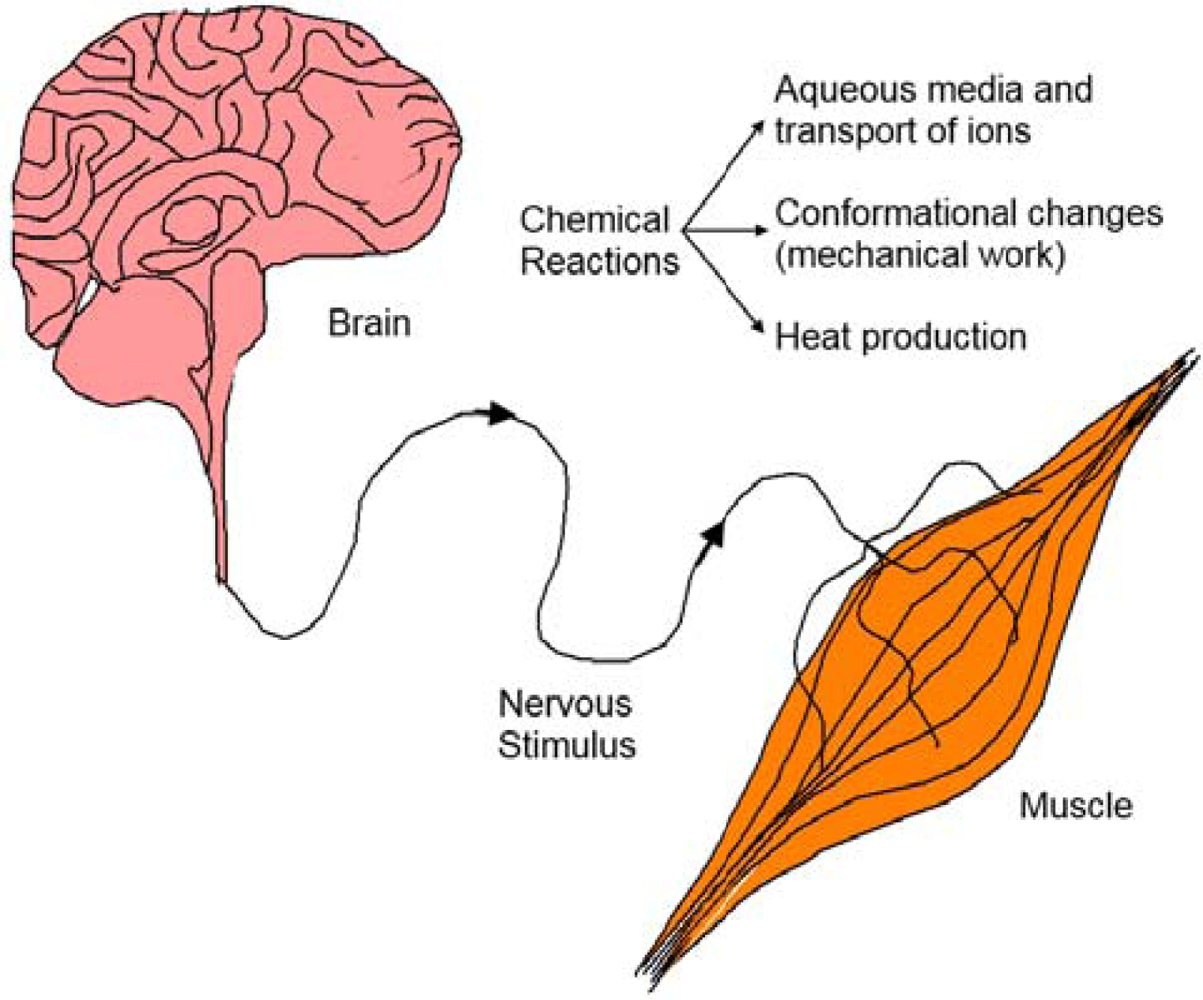
<p>Accordingly, natural muscles are elegant devices developed to transform chemical energy into mechanical energy and heat [<xref ref-type="bibr" rid="b1-sensors-10-02638">1</xref>]. With respect to actuation, the main difference between human technology and natural muscles is that during actuation the chemical composition changes inside the wet organ, meanwhile dry materials from artificial machines keep a constant composition. The actuation of a natural muscle (<xref ref-type="fig" rid="f1-sensors-10-02638">Figure 1</xref>) involves: (a) aqueous media, (b) electric pulses arriving from the brain (the pulse generator) to the muscle through the nervous system, (c) liberation of calcium ions inside the sarcomere, (d) chemical reactions, (e) conformational changes along natural polymeric chains (actin and myosin) with change of the sarcomere volume and (f) water interchange. This natural motor is able to perform elegant and gentle movements still not reproduced by any man-made motor. Moreover, the actuation of the muscle involves simultaneous sensing processes, providing living creatures with a perfect consciousness of characteristics of the mechanical movements and physical interactions between the organ moved by the muscle and its environment.</p>
<p>The chemical and physical processes linked to the electrochemistry of conducting polymers present a great deal of similarities with the above described biological processes, much more similar than those linked to any other artificial material [<xref ref-type="bibr" rid="b2-sensors-10-02638">2</xref>–<xref ref-type="bibr" rid="b6-sensors-10-02638">6</xref>].</p></sec>
<sec>
<label>2.</label>
<title>Conducting Polymers: Classification</title>
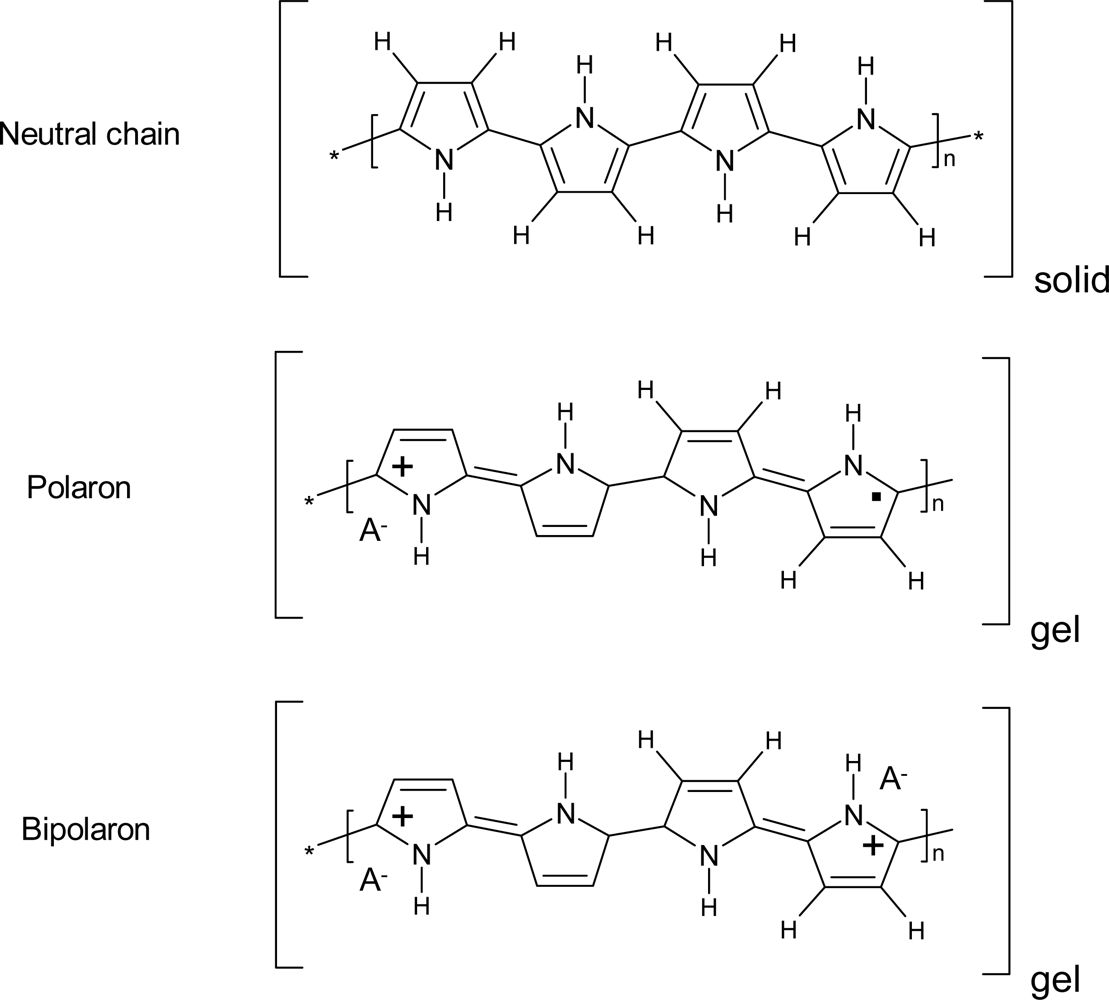
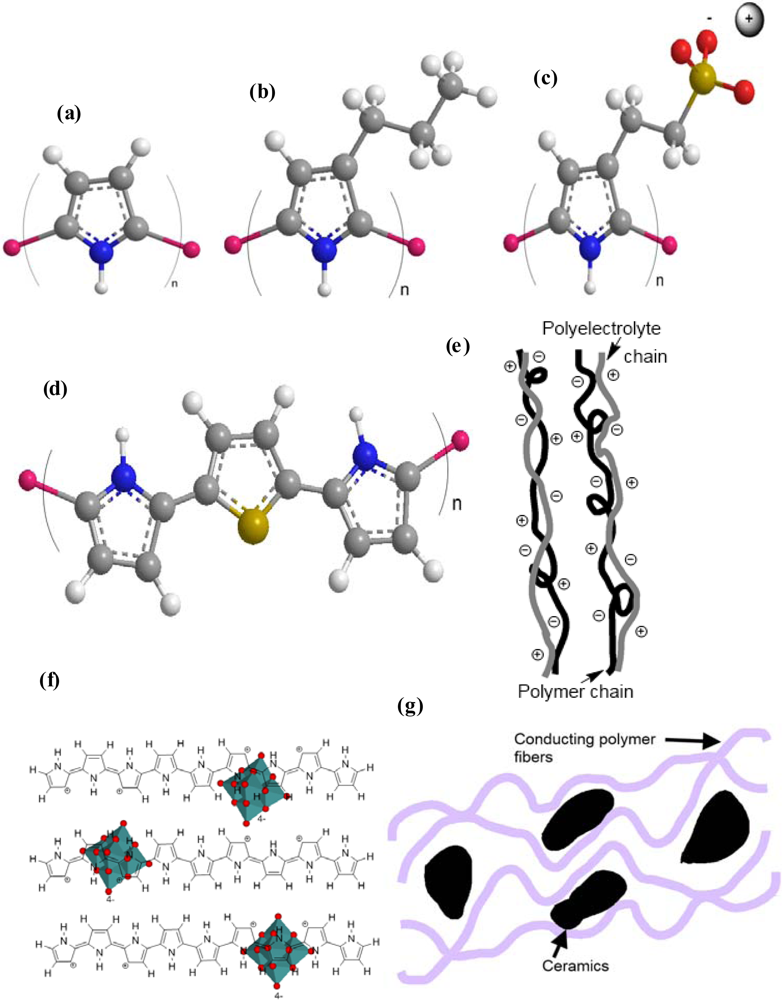
<p>Conducting polymers (CP) are classified into seven different families of materials (<xref ref-type="fig" rid="f2-sensors-10-02638">Figure 2</xref>) [<xref ref-type="bibr" rid="b2-sensors-10-02638">2</xref>]:
<list list-type="alpha-lower">
<list-item>
<p><bold>Basic conducting polymers:</bold> Polypyrrole [<xref ref-type="bibr" rid="b7-sensors-10-02638">7</xref>–<xref ref-type="bibr" rid="b13-sensors-10-02638">13</xref>], polyaniline [<xref ref-type="bibr" rid="b14-sensors-10-02638">14</xref>–<xref ref-type="bibr" rid="b19-sensors-10-02638">19</xref>], polythiophene [<xref ref-type="bibr" rid="b20-sensors-10-02638">20</xref>–<xref ref-type="bibr" rid="b24-sensors-10-02638">24</xref>], polyfurane [<xref ref-type="bibr" rid="b24-sensors-10-02638">24</xref>–<xref ref-type="bibr" rid="b26-sensors-10-02638">26</xref>], polyindole [<xref ref-type="bibr" rid="b24-sensors-10-02638">24</xref>,<xref ref-type="bibr" rid="b27-sensors-10-02638">27</xref>,<xref ref-type="bibr" rid="b28-sensors-10-02638">28</xref>], <italic>etc.</italic></p></list-item>
<list-item>
<p><bold>Substituted polymers</bold> [<xref ref-type="bibr" rid="b27-sensors-10-02638">27</xref>,<xref ref-type="bibr" rid="b29-sensors-10-02638">29</xref>–<xref ref-type="bibr" rid="b31-sensors-10-02638">31</xref>]. One, or several, hydrogen atoms from the basic monomer was replaced by another chemical group. Hundreds of different chemical groups can be used to obtain new substituted monomers and polymers.</p></list-item>
<list-item>
<p><bold>Self-doped polymers</bold> [<xref ref-type="bibr" rid="b32-sensors-10-02638">32</xref>,<xref ref-type="bibr" rid="b33-sensors-10-02638">33</xref>]. One of the substituents is an ionic group.</p></list-item>
<list-item>
<p><bold>Copolymers</bold> [<xref ref-type="bibr" rid="b34-sensors-10-02638">34</xref>–<xref ref-type="bibr" rid="b38-sensors-10-02638">38</xref>]. Two or more monomers are present on the final polymer chain.</p>
<p><bold>Polymer/macro-ion blends</bold>. The synthesized oxidized material contains macro-ions, which are not interchanged during redox processes:</p></list-item>
<list-item>
<p><bold>Polymeric or organic blends</bold> [<xref ref-type="bibr" rid="b39-sensors-10-02638">39</xref>–<xref ref-type="bibr" rid="b42-sensors-10-02638">42</xref>]. The macro-ion is a polyanion or an organic macro-ion.</p></list-item>
<list-item>
<p><bold>Hybrid materials</bold> [<xref ref-type="bibr" rid="b43-sensors-10-02638">43</xref>–<xref ref-type="bibr" rid="b45-sensors-10-02638">45</xref>]. The macro-ion is inorganic</p></list-item>
<list-item>
<p><bold>Composites</bold> [<xref ref-type="bibr" rid="b46-sensors-10-02638">46</xref>–<xref ref-type="bibr" rid="b50-sensors-10-02638">50</xref>]: With different organic or inorganic materials.</p></list-item></list></p>
<p>Every component of a family originates, by electrochemical oxidation or reduction, hundreds of oxidized materials (polymer/counterion/solvent), depending on the salt used in the solution during the electrochemical reaction.</p></sec>
<sec>
<label>3.</label>
<title>Electrochemical Behavior of Conducting Polymers in Solution</title>
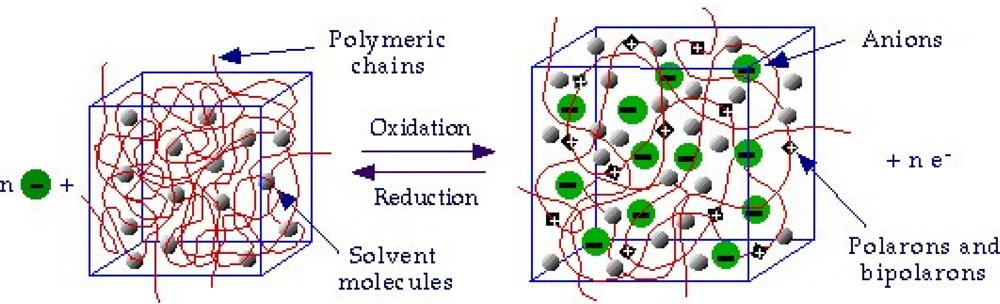
<p>During electrochemical oxidation (or reduction) of neutral polymeric chains, positive (or negative) charges are stored along the polymeric chains (<xref ref-type="fig" rid="f3-sensors-10-02638">Figure 3</xref>) and balancing counterions are forced to penetrate from the solution [<xref ref-type="bibr" rid="b2-sensors-10-02638">2</xref>–<xref ref-type="bibr" rid="b6-sensors-10-02638">6</xref>,<xref ref-type="bibr" rid="b51-sensors-10-02638">51</xref>,<xref ref-type="bibr" rid="b52-sensors-10-02638">52</xref>] to generate a new material (polyelectrolyte).</p>
<p>Depending on the balancing ion, different materials (polyeletrolytes) are obtained. The emerging positive (or negative) charges on the chains induce strong polymer/solvent interactions forcing the entrance of solvent from the solution. A complex material, polymer/ion/solvent is obtained.</p>
<p>There exist two kinds of oxidation processes:
<list list-type="alpha-lower">
<list-item>
<p><bold>prevailing anion interchange</bold>: The polymer swells during oxidation (<xref ref-type="fig" rid="f4-sensors-10-02638">Figure 4</xref>) and shrinks during reduction (accepted for families (a), (b), (f), and (g)) [<xref ref-type="bibr" rid="b14-sensors-10-02638">14</xref>,<xref ref-type="bibr" rid="b53-sensors-10-02638">53</xref>,<xref ref-type="bibr" rid="b54-sensors-10-02638">54</xref>]:
<disp-formula id="FD1">
<label>(1)</label>
<mml:math display="block">
<mml:mtable columnalign="left">
<mml:mtr columnalign="left">
<mml:mtd columnalign="left">
<mml:mrow>
<mml:msub>
<mml:mrow>
<mml:mrow>
<mml:mo>(</mml:mo>
<mml:msup>
<mml:mrow>
<mml:mi>p</mml:mi>
<mml:mi>P</mml:mi>
<mml:mi>y</mml:mi></mml:mrow>
<mml:mn>0</mml:mn></mml:msup>
<mml:mo>)</mml:mo></mml:mrow></mml:mrow>
<mml:mi>s</mml:mi></mml:msub>
<mml:mo>+</mml:mo>
<mml:mi>n</mml:mi>
<mml:msub>
<mml:mrow>
<mml:mrow>
<mml:mo>(</mml:mo>
<mml:msup>
<mml:mrow>
<mml:mi>A</mml:mi></mml:mrow>
<mml:mo>−</mml:mo></mml:msup>
<mml:mo stretchy="false">)</mml:mo></mml:mrow></mml:mrow>
<mml:mrow>
<mml:mi mathvariant="italic">aq</mml:mi></mml:mrow></mml:msub>
<mml:mo>+</mml:mo>
<mml:mi>m</mml:mi>
<mml:mo>(</mml:mo>
<mml:mi mathvariant="italic">Solvent</mml:mi>
<mml:mo>)</mml:mo></mml:mrow></mml:mtd>
<mml:mtd columnalign="left">
<mml:mo>↔</mml:mo></mml:mtd>
<mml:mtd columnalign="left">
<mml:mrow>
<mml:msub>
<mml:mrow>
<mml:mrow>
<mml:mo>[</mml:mo>
<mml:msub>
<mml:mrow>
<mml:mrow>
<mml:mo>(</mml:mo>
<mml:msup>
<mml:mrow>
<mml:mi>p</mml:mi>
<mml:mi>P</mml:mi>
<mml:mi>y</mml:mi></mml:mrow>
<mml:mrow>
<mml:mi>n</mml:mi>
<mml:mo>+</mml:mo></mml:mrow></mml:msup>
<mml:mo>)</mml:mo></mml:mrow></mml:mrow>
<mml:mi>s</mml:mi></mml:msub>
<mml:msub>
<mml:mrow>
<mml:mrow>
<mml:mo>(</mml:mo>
<mml:msup>
<mml:mrow>
<mml:mi>A</mml:mi></mml:mrow>
<mml:mo>−</mml:mo></mml:msup>
<mml:mo>)</mml:mo></mml:mrow></mml:mrow>
<mml:mi>n</mml:mi></mml:msub>
<mml:msub>
<mml:mrow>
<mml:mrow>
<mml:mo stretchy="false">(</mml:mo>
<mml:mi mathvariant="italic">Solvent</mml:mi>
<mml:mo stretchy="false">)</mml:mo></mml:mrow></mml:mrow>
<mml:mi>m</mml:mi></mml:msub>
<mml:mo>]</mml:mo></mml:mrow></mml:mrow>
<mml:mrow>
<mml:mi mathvariant="italic">gel</mml:mi></mml:mrow></mml:msub>
<mml:mo>+</mml:mo>
<mml:mi>n</mml:mi>
<mml:msub>
<mml:mrow>
<mml:mrow>
<mml:mo>(</mml:mo>
<mml:msup>
<mml:mrow>
<mml:mi>e</mml:mi></mml:mrow>
<mml:mo>−</mml:mo></mml:msup>
<mml:mo>)</mml:mo></mml:mrow></mml:mrow>
<mml:mrow>
<mml:mi mathvariant="italic">metal</mml:mi></mml:mrow></mml:msub></mml:mrow></mml:mtd></mml:mtr>
<mml:mtr columnalign="left">
<mml:mtd columnalign="left">
<mml:mrow>
<mml:mi mathvariant="italic">Neutral</mml:mi>
<mml:mi> </mml:mi>
<mml:mtext>chains</mml:mtext></mml:mrow></mml:mtd>
<mml:mtd columnalign="left">
<mml:mrow/></mml:mtd>
<mml:mtd columnalign="left">
<mml:mrow>
<mml:mtext>Oxidized</mml:mtext>
<mml:mi> </mml:mi>
<mml:mtext>chains</mml:mtext></mml:mrow></mml:mtd></mml:mtr></mml:mtable></mml:math></disp-formula></p></list-item>
<list-item>
<p><bold>prevailing cation interchange</bold>: The material shrinks during oxidation and swells during reduction (families (c) and (e)) [<xref ref-type="bibr" rid="b55-sensors-10-02638">55</xref>–<xref ref-type="bibr" rid="b58-sensors-10-02638">58</xref>]:
<disp-formula id="FD2">
<label>(2)</label>
<mml:math display="block">
<mml:mrow>
<mml:mtable>
<mml:mtr>
<mml:mtd>
<mml:mrow>
<mml:msub>
<mml:mrow>
<mml:mrow>
<mml:mo>[</mml:mo>
<mml:mo>(</mml:mo>
<mml:msup>
<mml:mrow>
<mml:mi>p</mml:mi>
<mml:mi>P</mml:mi>
<mml:mi>y</mml:mi></mml:mrow>
<mml:mn>0</mml:mn></mml:msup>
<mml:mo>)</mml:mo>
<mml:msub>
<mml:mrow>
<mml:mo>(</mml:mo>
<mml:msup>
<mml:mrow>
<mml:mi>M</mml:mi>
<mml:mi>A</mml:mi></mml:mrow>
<mml:mo>−</mml:mo></mml:msup>
<mml:mo>)</mml:mo></mml:mrow>
<mml:mi>n</mml:mi></mml:msub>
<mml:msub>
<mml:mrow>
<mml:mrow>
<mml:mo>(</mml:mo>
<mml:msup>
<mml:mrow>
<mml:mi>C</mml:mi></mml:mrow>
<mml:mo>+</mml:mo></mml:msup>
<mml:mo>)</mml:mo></mml:mrow></mml:mrow>
<mml:mi>n</mml:mi></mml:msub>
<mml:mo>]</mml:mo></mml:mrow></mml:mrow>
<mml:mi>s</mml:mi></mml:msub></mml:mrow></mml:mtd>
<mml:mtd>
<mml:mrow>
<mml:mover>
<mml:mo stretchy="true">↔</mml:mo>
<mml:mrow>
<mml:mtext>Re</mml:mtext>
<mml:mi>d</mml:mi>
<mml:mo>/</mml:mo>
<mml:mi mathvariant="italic">Oxid</mml:mi></mml:mrow></mml:mover></mml:mrow></mml:mtd>
<mml:mtd>
<mml:mrow>
<mml:msub>
<mml:mrow>
<mml:mrow>
<mml:mo>[</mml:mo>
<mml:mo>(</mml:mo>
<mml:msup>
<mml:mrow>
<mml:mi>p</mml:mi>
<mml:mi>P</mml:mi>
<mml:mi>y</mml:mi></mml:mrow>
<mml:mrow>
<mml:mi>n</mml:mi>
<mml:mo>+</mml:mo></mml:mrow></mml:msup>
<mml:mo>)</mml:mo>
<mml:msub>
<mml:mrow>
<mml:mrow>
<mml:mo>(</mml:mo>
<mml:msup>
<mml:mrow>
<mml:mi>M</mml:mi>
<mml:mi>A</mml:mi></mml:mrow>
<mml:mo>−</mml:mo></mml:msup>
<mml:mo stretchy="false">)</mml:mo></mml:mrow></mml:mrow>
<mml:mi>n</mml:mi></mml:msub>
<mml:mo>]</mml:mo></mml:mrow></mml:mrow>
<mml:mi>s</mml:mi></mml:msub>
<mml:mo>+</mml:mo>
<mml:mi>n</mml:mi>
<mml:msub>
<mml:mrow>
<mml:mrow>
<mml:mo>(</mml:mo>
<mml:msup>
<mml:mrow>
<mml:mi>C</mml:mi></mml:mrow>
<mml:mo>+</mml:mo></mml:msup>
<mml:mo>)</mml:mo></mml:mrow></mml:mrow>
<mml:mrow>
<mml:mi mathvariant="italic">sol</mml:mi></mml:mrow></mml:msub>
<mml:mo>+</mml:mo>
<mml:mi>n</mml:mi>
<mml:msub>
<mml:mrow>
<mml:mrow>
<mml:mo>(</mml:mo>
<mml:msup>
<mml:mrow>
<mml:mi>e</mml:mi></mml:mrow>
<mml:mo>−</mml:mo></mml:msup>
<mml:mo>)</mml:mo></mml:mrow></mml:mrow>
<mml:mrow>
<mml:mi mathvariant="italic">metal</mml:mi></mml:mrow></mml:msub></mml:mrow></mml:mtd></mml:mtr>
<mml:mtr>
<mml:mtd>
<mml:mrow>
<mml:mi mathvariant="italic">Neutral</mml:mi>
<mml:mi> </mml:mi>
<mml:mtext>chains</mml:mtext></mml:mrow></mml:mtd>
<mml:mtd/>
<mml:mtd>
<mml:mrow>
<mml:mtext>Oxidized</mml:mtext>
<mml:mi> </mml:mi>
<mml:mtext>chains</mml:mtext></mml:mrow></mml:mtd></mml:mtr></mml:mtable></mml:mrow></mml:math></disp-formula></p></list-item></list></p>
<p>Where <italic>s</italic> means solid and <italic>sol</italic> is solution, <italic>MA</italic><sup>−</sup> represents any charge balancing macro-anions trapped inside the CP during polymerization, <italic>pPy</italic> represent the polypyrrole (or any other CP) chains and C<sup>+</sup> represent a cation. The role of the solvent molecules in this case is not clear, due to the permanent presence of ionic species in the material interacting with the solvent dipolar moment. Reactions (1) and (2) produce positive charges on the polymeric chains: those processes are also named ‘p- doping’.</p>
<p>Some conducting polymers, as most of the polythiophene families, can also be reduced and reoxidized from the neutral state, storing negative charges (‘n-doping’) along the chains at high cathodic potential (stable electrolytes are required) interchanging balancing cations [<xref ref-type="bibr" rid="b59-sensors-10-02638">59</xref>,<xref ref-type="bibr" rid="b60-sensors-10-02638">60</xref>]:
<disp-formula id="FD3">
<label>(3)</label>
<mml:math display="block">
<mml:mrow>
<mml:mtable columnalign="left">
<mml:mtr columnalign="left">
<mml:mtd columnalign="left">
<mml:mrow>
<mml:msub>
<mml:mrow>
<mml:mrow>
<mml:mo>(</mml:mo>
<mml:msup>
<mml:mrow>
<mml:mi>p</mml:mi>
<mml:mi>T</mml:mi>
<mml:mi>H</mml:mi></mml:mrow>
<mml:mn>0</mml:mn></mml:msup>
<mml:mo>)</mml:mo></mml:mrow></mml:mrow>
<mml:mi>s</mml:mi></mml:msub></mml:mrow>
<mml:mo>+</mml:mo>
<mml:mi>n</mml:mi>
<mml:msub>
<mml:mrow>
<mml:mrow>
<mml:mo>(</mml:mo>
<mml:msup>
<mml:mrow>
<mml:mi>C</mml:mi></mml:mrow>
<mml:mo>+</mml:mo></mml:msup>
<mml:mo>)</mml:mo></mml:mrow></mml:mrow>
<mml:mrow>
<mml:mi mathvariant="italic">aq</mml:mi></mml:mrow></mml:msub>
<mml:mo>+</mml:mo>
<mml:mi>n</mml:mi>
<mml:msub>
<mml:mrow>
<mml:mrow>
<mml:mo>(</mml:mo>
<mml:msup>
<mml:mrow>
<mml:mi>e</mml:mi></mml:mrow>
<mml:mo>−</mml:mo></mml:msup>
<mml:mo>)</mml:mo></mml:mrow></mml:mrow>
<mml:mrow>
<mml:mi mathvariant="italic">metal</mml:mi></mml:mrow></mml:msub></mml:mtd>
<mml:mtd columnalign="left">
<mml:mo>↔</mml:mo></mml:mtd>
<mml:mtd columnalign="left">
<mml:mrow>
<mml:msub>
<mml:mrow>
<mml:mrow>
<mml:mo>[</mml:mo>
<mml:msub>
<mml:mrow>
<mml:mrow>
<mml:mo>(</mml:mo>
<mml:msup>
<mml:mrow>
<mml:mi>p</mml:mi>
<mml:mi>T</mml:mi>
<mml:mi>H</mml:mi></mml:mrow>
<mml:mrow>
<mml:mi>n</mml:mi>
<mml:mo>−</mml:mo></mml:mrow></mml:msup>
<mml:mo>)</mml:mo></mml:mrow></mml:mrow>
<mml:mi>s</mml:mi></mml:msub>
<mml:msub>
<mml:mrow>
<mml:mrow>
<mml:mo>(</mml:mo>
<mml:msup>
<mml:mrow>
<mml:mi>C</mml:mi></mml:mrow>
<mml:mo>+</mml:mo></mml:msup>
<mml:mo>)</mml:mo></mml:mrow></mml:mrow>
<mml:mi>n</mml:mi></mml:msub>
<mml:msub>
<mml:mrow>
<mml:mrow>
<mml:mo>(</mml:mo>
<mml:mi mathvariant="italic">solvent</mml:mi>
<mml:mo>)</mml:mo></mml:mrow></mml:mrow>
<mml:mi>m</mml:mi></mml:msub>
<mml:mo>]</mml:mo></mml:mrow></mml:mrow>
<mml:mrow>
<mml:mi mathvariant="italic">gel</mml:mi></mml:mrow></mml:msub></mml:mrow></mml:mtd></mml:mtr>
<mml:mtr columnalign="left">
<mml:mtd columnalign="left">
<mml:mrow>
<mml:mi mathvariant="italic">Neutral</mml:mi>
<mml:mi> </mml:mi>
<mml:mtext>chains</mml:mtext></mml:mrow></mml:mtd>
<mml:mtd columnalign="left">
<mml:mrow/></mml:mtd>
<mml:mtd columnalign="left">
<mml:mrow>
<mml:mi> </mml:mi>
<mml:mi> </mml:mi>
<mml:mtext>Reduced</mml:mtext>
<mml:mi> </mml:mi>
<mml:mtext>chains</mml:mtext></mml:mrow></mml:mtd></mml:mtr></mml:mtable></mml:mrow></mml:math></disp-formula></p>
<p>In general, two basic redox processes can occur from CPs:
<disp-formula id="FD4">
<label>(4)</label>
<mml:math display="block">
<mml:mrow>
<mml:mtable>
<mml:mtr>
<mml:mtd>
<mml:mrow>
<mml:mtext>Reduced</mml:mtext>
<mml:mi> </mml:mi>
<mml:mtext>chains</mml:mtext></mml:mrow></mml:mtd>
<mml:mtd>
<mml:mo>↔</mml:mo></mml:mtd>
<mml:mtd>
<mml:mrow>
<mml:mtext>Neutral</mml:mtext>
<mml:mi> </mml:mi>
<mml:mtext>chains</mml:mtext></mml:mrow></mml:mtd>
<mml:mtd>
<mml:mo>↔</mml:mo></mml:mtd>
<mml:mtd>
<mml:mrow>
<mml:mtext>Oxidized</mml:mtext>
<mml:mi> </mml:mi>
<mml:mtext>chains</mml:mtext></mml:mrow></mml:mtd></mml:mtr>
<mml:mtr>
<mml:mtd>
<mml:mrow>
<mml:mi mathvariant="normal">n</mml:mi>
<mml:mi> </mml:mi>
<mml:mtext>doping</mml:mtext></mml:mrow></mml:mtd>
<mml:mtd>
<mml:mrow>
<mml:mo stretchy="false">(</mml:mo>
<mml:mi mathvariant="normal">a</mml:mi>
<mml:mo stretchy="false">)</mml:mo></mml:mrow></mml:mtd>
<mml:mtd>
<mml:mrow/></mml:mtd>
<mml:mtd>
<mml:mrow>
<mml:mo stretchy="false">(</mml:mo>
<mml:mi>b</mml:mi>
<mml:mo stretchy="false">)</mml:mo></mml:mrow></mml:mtd>
<mml:mtd>
<mml:mrow>
<mml:mi mathvariant="normal">p</mml:mi>
<mml:mi> </mml:mi>
<mml:mtext>doping</mml:mtext></mml:mrow></mml:mtd></mml:mtr></mml:mtable></mml:mrow></mml:math></disp-formula></p>
<p>All of the above-described reactions are simplified versions. Any film of a conducting polymer establishes a physical equilibrium between solvent, anions and cations in the polymer matrix and in the electrolyte. So the charge balance is determined by simultaneous interchange of anions, cations and solvent across the polymer/solvent interface [<xref ref-type="bibr" rid="b61-sensors-10-02638">61</xref>–<xref ref-type="bibr" rid="b64-sensors-10-02638">64</xref>]. For each family one of the reactions (1) or (2) prevails. The final result of reactions (1), (2), or (3) is a polymeric salt, a polyelectrolyte.</p></sec>
<sec>
<label>4.</label>
<title>Electrochemical Properties</title>
<p>Any of those electrochemical reactions promotes a continuous movement of anions or cations across the film/solution interface. The obtained polymeric salts are non-stoichiometric compounds [<xref ref-type="bibr" rid="b65-sensors-10-02638">65</xref>,<xref ref-type="bibr" rid="b66-sensors-10-02638">66</xref>]. The three considered reactions are reversible, so the stoichiometry of the material can be adjusted to any intermediate content between non-charged (reduced) polymer and fully oxidized polymer (around 50% of counterion content). Some properties change as a function of the material composition: conductivity, electro-chemo-mechanical effects (change of volume), electrochromic properties, charge storage, chemical storage and electroporosity [<xref ref-type="bibr" rid="b2-sensors-10-02638">2</xref>–<xref ref-type="bibr" rid="b6-sensors-10-02638">6</xref>,<xref ref-type="bibr" rid="b51-sensors-10-02638">51</xref>,<xref ref-type="bibr" rid="b52-sensors-10-02638">52</xref>]. These are described as follows:
<list list-type="simple">
<list-item>
<p>- <bold>Electrochemo-mechanical properties:</bold> the entrance and expulsion of counterions and solvent from the solution, driven by the electrochemical reaction, promotes reversible changes on the material volume, (see <xref ref-type="fig" rid="f4-sensors-10-02638">Figure 4</xref>), which can be applied to generate macroscopic movement and mechanical energy [<xref ref-type="bibr" rid="b67-sensors-10-02638">67</xref>–<xref ref-type="bibr" rid="b70-sensors-10-02638">70</xref>].</p></list-item>
<list-item>
<p>- <bold>Electrochromic properties:</bold> the reversible reorganization of the double bonds along the polymeric chains generates and destroys chromophores (polarons and bipolarons) adsorbing light along the UV-vis and near IR regions of the spectra. The color of the material can be changed reversibly, by controlling the concentration of chromophores, under electrochemical reaction in a continuous and reversible manner [<xref ref-type="bibr" rid="b71-sensors-10-02638">71</xref>–<xref ref-type="bibr" rid="b75-sensors-10-02638">75</xref>].</p></list-item>
<list-item>
<p>- <bold>Charge storage:</bold> transition from neutral to oxidized polymers implies the storage of positive charges along the polymeric chains. Transition from neutral to reduced polymer implies the storage of negative charges along the polymeric chains. Therefore, CPs can be used as electrodic materials for polymeric batteries [<xref ref-type="bibr" rid="b76-sensors-10-02638">76</xref>–<xref ref-type="bibr" rid="b78-sensors-10-02638">78</xref>].</p></list-item>
<list-item>
<p>- <bold>Porosity:</bold> a film of a basic conducting polymer in a neutral state is a porous compacted structure, in which average distances between chains is short. During oxidation, coulombic repulsions among the emerging positive charges in neighboring chains increase the average distance between chains allowing counterions entrance [<xref ref-type="bibr" rid="b54-sensors-10-02638">54</xref>,<xref ref-type="bibr" rid="b79-sensors-10-02638">79</xref>–<xref ref-type="bibr" rid="b81-sensors-10-02638">81</xref>].</p></list-item>
<list-item>
<p>- <bold>Electron/Chemical transduction:</bold> reverse electrochemical reactions are linked to the simultaneous interchange of chemical ions between the CP and the solution. This must be a univoque relationship; each injected electron forces the interchange of an one-valence chemical ion with the ambient electrolyte, suitable for a reversible storage and release of chemical and pharmacological compounds [<xref ref-type="bibr" rid="b82-sensors-10-02638">82</xref>–<xref ref-type="bibr" rid="b84-sensors-10-02638">84</xref>].</p></list-item></list></p></sec>
<sec>
<label>5.</label>
<title>Multifunctional and Biomimicking Properties</title>
<p>The above described properties are linked to any of the electrochemical reactions: (1), (2) or (3), taking place in soft and wet materials, with a composition resembling that of animal organs: solvent, ions and polymeric (organic) molecules. Every property is linked to one or several similar functions occurring in biological organs [<xref ref-type="bibr" rid="b3-sensors-10-02638">3</xref>,<xref ref-type="bibr" rid="b5-sensors-10-02638">5</xref>,<xref ref-type="bibr" rid="b85-sensors-10-02638">85</xref>–<xref ref-type="bibr" rid="b89-sensors-10-02638">89</xref>], as shown in <xref ref-type="table" rid="t1-sensors-10-02638">Table 1</xref>.</p>
<p>The electrochemical oxidation/reduction of any non-stoichiometric CP produces a multifunctional actuation of biomimetic properties. Only one reaction generates multiple properties.</p></sec>
<sec>
<label>6.</label>
<title>Unparalleled Simultaneous Sensing Possibilities</title>
<p>The reverse electrochemical processes, (1), (2) or (3), suppose that any intermediate composition of the material is linked to an electrochemical equilibrium between: polymeric species, counterions and solvent inside the polymer; ions and solvent in solution, and electrons in the metal:
<disp-formula id="FD5">
<label>(5)</label>
<mml:math display="block">
<mml:mrow>
<mml:msub>
<mml:mrow>
<mml:mrow>
<mml:mo stretchy="false">[</mml:mo>
<mml:msub>
<mml:mrow>
<mml:mrow>
<mml:mo stretchy="false">(</mml:mo>
<mml:msup>
<mml:mrow>
<mml:mi>p</mml:mi>
<mml:mi>P</mml:mi>
<mml:mi>y</mml:mi></mml:mrow>
<mml:mrow>
<mml:mi>n</mml:mi>
<mml:mo>+</mml:mo></mml:mrow></mml:msup>
<mml:mo stretchy="false">)</mml:mo></mml:mrow></mml:mrow>
<mml:mi>s</mml:mi></mml:msub>
<mml:msub>
<mml:mrow>
<mml:mrow>
<mml:mo stretchy="false">(</mml:mo>
<mml:msup>
<mml:mrow>
<mml:mi>A</mml:mi></mml:mrow>
<mml:mo>−</mml:mo></mml:msup>
<mml:mo stretchy="false">)</mml:mo></mml:mrow></mml:mrow>
<mml:mi>n</mml:mi></mml:msub>
<mml:msub>
<mml:mrow>
<mml:mrow>
<mml:mo stretchy="false">(</mml:mo>
<mml:msub>
<mml:mrow>
<mml:mi>H</mml:mi></mml:mrow>
<mml:mn>2</mml:mn></mml:msub>
<mml:mi>O</mml:mi>
<mml:mo stretchy="false">)</mml:mo></mml:mrow></mml:mrow>
<mml:mi>m</mml:mi></mml:msub>
<mml:mo stretchy="false">]</mml:mo></mml:mrow></mml:mrow>
<mml:mrow>
<mml:mi mathvariant="italic">gel</mml:mi></mml:mrow></mml:msub>
<mml:mo>+</mml:mo>
<mml:mi>n</mml:mi>
<mml:msub>
<mml:mrow>
<mml:mrow>
<mml:mo stretchy="false">(</mml:mo>
<mml:msup>
<mml:mrow>
<mml:mi>A</mml:mi></mml:mrow>
<mml:mo>−</mml:mo></mml:msup>
<mml:mo stretchy="false">)</mml:mo></mml:mrow></mml:mrow>
<mml:mrow>
<mml:mi mathvariant="italic">sol</mml:mi></mml:mrow></mml:msub>
<mml:mo>+</mml:mo>
<mml:mi>m</mml:mi>
<mml:mo stretchy="false">(</mml:mo>
<mml:msub>
<mml:mrow>
<mml:mi>H</mml:mi></mml:mrow>
<mml:mn>2</mml:mn></mml:msub>
<mml:mi>O</mml:mi>
<mml:mo stretchy="false">)</mml:mo>
<mml:mo>↔</mml:mo>
<mml:msub>
<mml:mrow>
<mml:mrow>
<mml:mo stretchy="false">[</mml:mo>
<mml:msub>
<mml:mrow>
<mml:mrow>
<mml:mo stretchy="false">(</mml:mo>
<mml:msup>
<mml:mrow>
<mml:mi>p</mml:mi>
<mml:mi>P</mml:mi>
<mml:mi>y</mml:mi></mml:mrow>
<mml:mrow>
<mml:mo stretchy="false">(</mml:mo>
<mml:mi>n</mml:mi>
<mml:mo>+</mml:mo>
<mml:mn>1</mml:mn>
<mml:mo stretchy="false">)</mml:mo>
<mml:mo>+</mml:mo></mml:mrow></mml:msup>
<mml:mo stretchy="false">)</mml:mo></mml:mrow></mml:mrow>
<mml:mi>s</mml:mi></mml:msub>
<mml:msub>
<mml:mrow>
<mml:mrow>
<mml:mo stretchy="false">(</mml:mo>
<mml:msup>
<mml:mrow>
<mml:mi>A</mml:mi></mml:mrow>
<mml:mo>−</mml:mo></mml:msup>
<mml:mo stretchy="false">)</mml:mo></mml:mrow></mml:mrow>
<mml:mrow>
<mml:mi>n</mml:mi>
<mml:mo>+</mml:mo>
<mml:mn>1</mml:mn></mml:mrow></mml:msub>
<mml:msub>
<mml:mrow>
<mml:mrow>
<mml:mo stretchy="false">(</mml:mo>
<mml:mi mathvariant="italic">solvent</mml:mi>
<mml:mo stretchy="false">)</mml:mo></mml:mrow></mml:mrow>
<mml:mrow>
<mml:mi>m</mml:mi>
<mml:mo>+</mml:mo>
<mml:mi>a</mml:mi></mml:mrow></mml:msub>
<mml:mo stretchy="false">]</mml:mo></mml:mrow></mml:mrow>
<mml:mrow>
<mml:mi mathvariant="italic">gel</mml:mi></mml:mrow></mml:msub>
<mml:mo>+</mml:mo>
<mml:msub>
<mml:mrow>
<mml:mrow>
<mml:mo stretchy="false">(</mml:mo>
<mml:msup>
<mml:mrow>
<mml:mi>e</mml:mi></mml:mrow>
<mml:mo>−</mml:mo></mml:msup>
<mml:mo stretchy="false">)</mml:mo></mml:mrow></mml:mrow>
<mml:mrow>
<mml:mi mathvariant="italic">metal</mml:mi></mml:mrow></mml:msub></mml:mrow></mml:math></disp-formula></p>
<p>That means that any physical variable, such as mechanical (through ΔV), optical (through [pPy<sup>n+</sup>], polaronic and bipolaronic chromophores), electrical (applied i or E), magnetic (through [pPy<sup>n+</sup>], as radical-cations), <italic>etc.</italic>, or chemical variable, such as counterion concentration [A<sup>−</sup>]<sub>aq</sub>, ionic strength (I), or temperature (through the kinetic coefficient), acting on the electrochemical equilibrium, must promote a simultaneous energetic change of the electrons in the metal, which can be detected by means of a potentiostat. Working under equilibrium conditions the simplified expression of the Nerst equation as a function of the concentrations can be applied:
<disp-formula id="FD6">
<label>(6)</label>
<mml:math display="block">
<mml:mrow>
<mml:mi>E</mml:mi>
<mml:mo>=</mml:mo>
<mml:msub>
<mml:mrow>
<mml:mi>E</mml:mi></mml:mrow>
<mml:mn>0</mml:mn></mml:msub>
<mml:mo>+</mml:mo>
<mml:mfrac>
<mml:mrow>
<mml:mi>R</mml:mi>
<mml:mo>⋅</mml:mo>
<mml:mi>T</mml:mi></mml:mrow>
<mml:mrow>
<mml:mi>n</mml:mi>
<mml:mo>⋅</mml:mo>
<mml:mi>F</mml:mi></mml:mrow></mml:mfrac>
<mml:mi> </mml:mi>
<mml:mtext>ln</mml:mtext>
<mml:mo stretchy="false">(</mml:mo>
<mml:mfrac>
<mml:mrow>
<mml:msub>
<mml:mrow>
<mml:mrow>
<mml:mo stretchy="false">[</mml:mo>
<mml:msub>
<mml:mrow>
<mml:mrow>
<mml:mo stretchy="false">(</mml:mo>
<mml:msup>
<mml:mrow>
<mml:mi>p</mml:mi>
<mml:mi>P</mml:mi>
<mml:mi>y</mml:mi></mml:mrow>
<mml:mrow>
<mml:mo stretchy="false">(</mml:mo>
<mml:mi>n</mml:mi>
<mml:mo>+</mml:mo>
<mml:mn>1</mml:mn>
<mml:mo stretchy="false">)</mml:mo>
<mml:mo>+</mml:mo></mml:mrow></mml:msup>
<mml:mo stretchy="false">)</mml:mo></mml:mrow></mml:mrow>
<mml:mi>s</mml:mi></mml:msub>
<mml:msub>
<mml:mrow>
<mml:mrow>
<mml:mo stretchy="false">(</mml:mo>
<mml:msup>
<mml:mrow>
<mml:mi>A</mml:mi></mml:mrow>
<mml:mo>−</mml:mo></mml:msup>
<mml:mo stretchy="false">)</mml:mo></mml:mrow></mml:mrow>
<mml:mrow>
<mml:mi>n</mml:mi>
<mml:mo>+</mml:mo>
<mml:mn>1</mml:mn></mml:mrow></mml:msub>
<mml:msub>
<mml:mrow>
<mml:mrow>
<mml:mo stretchy="false">(</mml:mo>
<mml:mi mathvariant="italic">solvent</mml:mi>
<mml:mo stretchy="false">)</mml:mo></mml:mrow></mml:mrow>
<mml:mrow>
<mml:mi>m</mml:mi>
<mml:mo>+</mml:mo>
<mml:mi>a</mml:mi></mml:mrow></mml:msub>
<mml:mo stretchy="false">]</mml:mo></mml:mrow></mml:mrow>
<mml:mrow>
<mml:mi mathvariant="italic">gel</mml:mi></mml:mrow></mml:msub></mml:mrow>
<mml:mrow>
<mml:msub>
<mml:mrow>
<mml:mrow>
<mml:mo stretchy="false">[</mml:mo>
<mml:msub>
<mml:mrow>
<mml:mrow>
<mml:mo stretchy="false">(</mml:mo>
<mml:msup>
<mml:mrow>
<mml:mi>p</mml:mi>
<mml:mi>P</mml:mi>
<mml:mi>y</mml:mi></mml:mrow>
<mml:mrow>
<mml:mi>n</mml:mi>
<mml:mo>+</mml:mo></mml:mrow></mml:msup>
<mml:mo stretchy="false">)</mml:mo></mml:mrow></mml:mrow>
<mml:mi>s</mml:mi></mml:msub>
<mml:msub>
<mml:mrow>
<mml:mrow>
<mml:mo stretchy="false">(</mml:mo>
<mml:msup>
<mml:mrow>
<mml:mi>A</mml:mi></mml:mrow>
<mml:mo>−</mml:mo></mml:msup>
<mml:mo stretchy="false">)</mml:mo></mml:mrow></mml:mrow>
<mml:mi>n</mml:mi></mml:msub>
<mml:msub>
<mml:mrow>
<mml:mrow>
<mml:mo stretchy="false">(</mml:mo>
<mml:mi mathvariant="italic">solvent</mml:mi>
<mml:mo stretchy="false">)</mml:mo></mml:mrow></mml:mrow>
<mml:mi>m</mml:mi></mml:msub>
<mml:mo stretchy="false">]</mml:mo></mml:mrow></mml:mrow>
<mml:mrow>
<mml:mi mathvariant="italic">gel</mml:mi></mml:mrow></mml:msub>
<mml:mo>⋅</mml:mo>
<mml:msub>
<mml:mrow>
<mml:mrow>
<mml:mo stretchy="false">[</mml:mo>
<mml:msup>
<mml:mrow>
<mml:mi>A</mml:mi></mml:mrow>
<mml:mo>−</mml:mo></mml:msup>
<mml:mo stretchy="false">]</mml:mo></mml:mrow></mml:mrow>
<mml:mrow>
<mml:mi mathvariant="italic">sol</mml:mi></mml:mrow></mml:msub></mml:mrow></mml:mfrac>
<mml:mo stretchy="false">)</mml:mo></mml:mrow></mml:math></disp-formula></p>
<p>The sensing concept works under equilibrium, and under transition conditions. If we consider a single, lineal and ideal chain of conducting polymer (CP) constituted by <italic>m</italic> monomeric units, the reaction goes, through <italic>n</italic> consecutive oxidation equilibrium steps (<italic>m</italic> &gt; <italic>n</italic>):
<disp-formula id="FD7">
<label>(7)</label>
<mml:math display="block">
<mml:mtable columnalign="left">
<mml:mtr>
<mml:mtd>
<mml:mn>1</mml:mn>
<mml:mo stretchy="false">)</mml:mo>
<mml:mi> </mml:mi>
<mml:mi> </mml:mi>
<mml:mi> </mml:mi>
<mml:mi> </mml:mi>
<mml:mtext>CP</mml:mtext>
<mml:mo>+</mml:mo>
<mml:msub>
<mml:mrow>
<mml:mo stretchy="false">(</mml:mo>
<mml:msup>
<mml:mrow>
<mml:mi mathvariant="normal">A</mml:mi></mml:mrow>
<mml:mo>−</mml:mo></mml:msup>
<mml:mo stretchy="false">)</mml:mo></mml:mrow>
<mml:mrow>
<mml:mtext>sol</mml:mtext></mml:mrow></mml:msub>
<mml:mo>↔</mml:mo>
<mml:mo stretchy="false">(</mml:mo>
<mml:msup>
<mml:mrow>
<mml:mtext>CP</mml:mtext></mml:mrow>
<mml:mo>+</mml:mo></mml:msup>
<mml:mo stretchy="false">)</mml:mo>
<mml:msup>
<mml:mrow>
<mml:mi mathvariant="normal">A</mml:mi></mml:mrow>
<mml:mo>−</mml:mo></mml:msup>
<mml:mo>+</mml:mo>
<mml:msup>
<mml:mrow>
<mml:mi mathvariant="normal">e</mml:mi></mml:mrow>
<mml:mo>−</mml:mo></mml:msup></mml:mtd></mml:mtr>
<mml:mtr>
<mml:mtd>
<mml:mn>2</mml:mn>
<mml:mo stretchy="false">)</mml:mo>
<mml:mi> </mml:mi>
<mml:mo stretchy="false">(</mml:mo>
<mml:msup>
<mml:mrow>
<mml:mtext>CP</mml:mtext></mml:mrow>
<mml:mo>+</mml:mo></mml:msup>
<mml:mo stretchy="false">)</mml:mo>
<mml:msup>
<mml:mrow>
<mml:mi mathvariant="normal">A</mml:mi></mml:mrow>
<mml:mo>−</mml:mo></mml:msup>
<mml:mo>+</mml:mo>
<mml:msub>
<mml:mrow>
<mml:mo stretchy="false">(</mml:mo>
<mml:msup>
<mml:mrow>
<mml:mi mathvariant="normal">A</mml:mi></mml:mrow>
<mml:mo>−</mml:mo></mml:msup>
<mml:mo stretchy="false">)</mml:mo></mml:mrow>
<mml:mrow>
<mml:mtext>sol</mml:mtext></mml:mrow></mml:msub>
<mml:mo>↔</mml:mo>
<mml:mo stretchy="false">(</mml:mo>
<mml:msup>
<mml:mrow>
<mml:mtext>CP</mml:mtext></mml:mrow>
<mml:mrow>
<mml:mn>2</mml:mn>
<mml:mo>+</mml:mo></mml:mrow></mml:msup>
<mml:mo stretchy="false">)</mml:mo>
<mml:msubsup>
<mml:mrow>
<mml:mi mathvariant="normal">A</mml:mi></mml:mrow>
<mml:mn>2</mml:mn>
<mml:mo>−</mml:mo></mml:msubsup>
<mml:mo>+</mml:mo>
<mml:msup>
<mml:mrow>
<mml:mi mathvariant="normal">e</mml:mi></mml:mrow>
<mml:mo>−</mml:mo></mml:msup></mml:mtd></mml:mtr>
<mml:mtr>
<mml:mtd>
<mml:mn>3</mml:mn>
<mml:mo stretchy="false">)</mml:mo>
<mml:mi> </mml:mi>
<mml:mo stretchy="false">(</mml:mo>
<mml:msup>
<mml:mrow>
<mml:mtext>CP</mml:mtext></mml:mrow>
<mml:mrow>
<mml:mn>2</mml:mn>
<mml:mo>+</mml:mo></mml:mrow></mml:msup>
<mml:mo stretchy="false">)</mml:mo>
<mml:msubsup>
<mml:mrow>
<mml:mi mathvariant="normal">A</mml:mi></mml:mrow>
<mml:mn>2</mml:mn>
<mml:mo>−</mml:mo></mml:msubsup>
<mml:mo>+</mml:mo>
<mml:msub>
<mml:mrow>
<mml:mo stretchy="false">(</mml:mo>
<mml:msup>
<mml:mrow>
<mml:mi mathvariant="normal">A</mml:mi></mml:mrow>
<mml:mo>−</mml:mo></mml:msup>
<mml:mo stretchy="false">)</mml:mo></mml:mrow>
<mml:mrow>
<mml:mtext>sol</mml:mtext></mml:mrow></mml:msub>
<mml:mo>↔</mml:mo>
<mml:mo stretchy="false">(</mml:mo>
<mml:msup>
<mml:mrow>
<mml:mtext>CP</mml:mtext></mml:mrow>
<mml:mrow>
<mml:mn>3</mml:mn>
<mml:mo>+</mml:mo></mml:mrow></mml:msup>
<mml:mo stretchy="false">)</mml:mo>
<mml:msubsup>
<mml:mi mathvariant="normal">A</mml:mi>
<mml:mn>3</mml:mn>
<mml:mo>−</mml:mo></mml:msubsup>
<mml:mo>+</mml:mo>
<mml:msup>
<mml:mi mathvariant="normal">e</mml:mi>
<mml:mo>−</mml:mo></mml:msup></mml:mtd></mml:mtr>
<mml:mtr>
<mml:mtd>
<mml:mn>4</mml:mn>
<mml:mo stretchy="false">)</mml:mo>
<mml:mi> </mml:mi>
<mml:mo stretchy="false">(</mml:mo>
<mml:msup>
<mml:mrow>
<mml:mtext>CP</mml:mtext></mml:mrow>
<mml:mrow>
<mml:mn>3</mml:mn>
<mml:mo>+</mml:mo></mml:mrow></mml:msup>
<mml:mo stretchy="false">)</mml:mo>
<mml:msubsup>
<mml:mrow>
<mml:mi mathvariant="normal">A</mml:mi></mml:mrow>
<mml:mn>3</mml:mn>
<mml:mo>−</mml:mo></mml:msubsup>
<mml:mo>+</mml:mo>
<mml:msub>
<mml:mrow>
<mml:mo stretchy="false">(</mml:mo>
<mml:msup>
<mml:mi mathvariant="normal">A</mml:mi>
<mml:mo>−</mml:mo></mml:msup>
<mml:mo stretchy="false">)</mml:mo></mml:mrow>
<mml:mrow>
<mml:mtext>sol</mml:mtext></mml:mrow></mml:msub>
<mml:mo>↔</mml:mo>
<mml:mo stretchy="false">(</mml:mo>
<mml:msup>
<mml:mrow>
<mml:mtext>CP</mml:mtext></mml:mrow>
<mml:mrow>
<mml:mn>4</mml:mn>
<mml:mo>+</mml:mo></mml:mrow></mml:msup>
<mml:mo stretchy="false">)</mml:mo>
<mml:msubsup>
<mml:mrow>
<mml:mi mathvariant="normal">A</mml:mi></mml:mrow>
<mml:mn>4</mml:mn>
<mml:mo>−</mml:mo></mml:msubsup>
<mml:mo>+</mml:mo>
<mml:msup>
<mml:mrow>
<mml:mi mathvariant="normal">e</mml:mi></mml:mrow>
<mml:mo>−</mml:mo></mml:msup></mml:mtd></mml:mtr>
<mml:mtr>
<mml:mtd>
<mml:mn>5</mml:mn>
<mml:mo stretchy="false">)</mml:mo>
<mml:mi> </mml:mi>
<mml:mo stretchy="false">(</mml:mo>
<mml:msup>
<mml:mrow>
<mml:mtext>CP</mml:mtext></mml:mrow>
<mml:mrow>
<mml:mn>4</mml:mn>
<mml:mo>+</mml:mo></mml:mrow></mml:msup>
<mml:mo stretchy="false">)</mml:mo>
<mml:msubsup>
<mml:mrow>
<mml:mi mathvariant="normal">A</mml:mi></mml:mrow>
<mml:mn>4</mml:mn>
<mml:mo>−</mml:mo></mml:msubsup>
<mml:mo>+</mml:mo>
<mml:msub>
<mml:mrow>
<mml:mo stretchy="false">(</mml:mo>
<mml:msup>
<mml:mrow>
<mml:mi mathvariant="normal">A</mml:mi></mml:mrow>
<mml:mo>−</mml:mo></mml:msup>
<mml:mo stretchy="false">)</mml:mo></mml:mrow>
<mml:mrow>
<mml:mtext>sol</mml:mtext></mml:mrow></mml:msub>
<mml:mo>↔</mml:mo>
<mml:mo stretchy="false">(</mml:mo>
<mml:msup>
<mml:mrow>
<mml:mtext>CP</mml:mtext></mml:mrow>
<mml:mrow>
<mml:mn>2</mml:mn>
<mml:mo>+</mml:mo></mml:mrow></mml:msup>
<mml:mo stretchy="false">)</mml:mo>
<mml:msubsup>
<mml:mrow>
<mml:mi mathvariant="normal">A</mml:mi></mml:mrow>
<mml:mn>5</mml:mn>
<mml:mo>−</mml:mo></mml:msubsup>
<mml:mo>+</mml:mo>
<mml:msup>
<mml:mrow>
<mml:mi mathvariant="normal">e</mml:mi></mml:mrow>
<mml:mo>−</mml:mo></mml:msup></mml:mtd></mml:mtr>
<mml:mtr>
<mml:mtd>
<mml:mo>_</mml:mo>
<mml:mo>_</mml:mo>
<mml:mo>_</mml:mo>
<mml:mo>_</mml:mo>
<mml:mo>_</mml:mo>
<mml:mo>_</mml:mo>
<mml:mo>_</mml:mo>
<mml:mo>_</mml:mo>
<mml:mo>_</mml:mo>
<mml:mo>_</mml:mo>
<mml:mo>_</mml:mo>
<mml:mo>_</mml:mo>
<mml:mo>_</mml:mo>
<mml:mo>_</mml:mo>
<mml:mo>_</mml:mo>
<mml:mo>_</mml:mo>
<mml:mo>_</mml:mo>
<mml:mo>_</mml:mo>
<mml:mo>_</mml:mo>
<mml:mo>_</mml:mo>
<mml:mo>_</mml:mo>
<mml:mo>_</mml:mo>
<mml:mo>_</mml:mo>
<mml:mo>_</mml:mo>
<mml:mo>_</mml:mo>
<mml:mo>_</mml:mo>
<mml:mo>_</mml:mo>
<mml:mo>_</mml:mo>
<mml:mo>_</mml:mo>
<mml:mo>_</mml:mo>
<mml:mo>_</mml:mo>
<mml:mo>_</mml:mo>
<mml:mo>_</mml:mo>
<mml:mo>_</mml:mo>
<mml:mo>_</mml:mo>
<mml:mo>_</mml:mo>
<mml:mo>_</mml:mo>
<mml:mo>_</mml:mo></mml:mtd></mml:mtr>
<mml:mtr>
<mml:mtd>
<mml:mi>n</mml:mi>
<mml:mo stretchy="false">)</mml:mo>
<mml:mi> </mml:mi>
<mml:mo stretchy="false">(</mml:mo>
<mml:msup>
<mml:mrow>
<mml:mtext>CP</mml:mtext></mml:mrow>
<mml:mrow>
<mml:mo stretchy="false">(</mml:mo>
<mml:mi mathvariant="normal">n</mml:mi>
<mml:mo>−</mml:mo>
<mml:mn>1</mml:mn>
<mml:mo stretchy="false">)</mml:mo>
<mml:mo>+</mml:mo></mml:mrow></mml:msup>
<mml:mo stretchy="false">)</mml:mo>
<mml:msubsup>
<mml:mrow>
<mml:mi mathvariant="normal">A</mml:mi></mml:mrow>
<mml:mrow>
<mml:mi mathvariant="normal">n</mml:mi>
<mml:mo>−</mml:mo>
<mml:mn>1</mml:mn></mml:mrow>
<mml:mo>−</mml:mo></mml:msubsup>
<mml:mo>+</mml:mo>
<mml:msub>
<mml:mrow>
<mml:mo stretchy="false">(</mml:mo>
<mml:msup>
<mml:mrow>
<mml:mi mathvariant="normal">A</mml:mi></mml:mrow>
<mml:mo>−</mml:mo></mml:msup>
<mml:mo stretchy="false">)</mml:mo></mml:mrow>
<mml:mrow>
<mml:mtext>sol</mml:mtext></mml:mrow></mml:msub>
<mml:mo>↔</mml:mo>
<mml:mo stretchy="false">(</mml:mo>
<mml:msup>
<mml:mrow>
<mml:mtext>CP</mml:mtext></mml:mrow>
<mml:mrow>
<mml:mi mathvariant="normal">n</mml:mi>
<mml:mo>+</mml:mo></mml:mrow></mml:msup>
<mml:mo stretchy="false">)</mml:mo>
<mml:msubsup>
<mml:mrow>
<mml:mi mathvariant="normal">A</mml:mi></mml:mrow>
<mml:mi mathvariant="normal">n</mml:mi>
<mml:mo>−</mml:mo></mml:msubsup>
<mml:mo>+</mml:mo>
<mml:msup>
<mml:mrow>
<mml:mi mathvariant="normal">e</mml:mi></mml:mrow>
<mml:mo>−</mml:mo></mml:msup></mml:mtd></mml:mtr></mml:mtable></mml:math></disp-formula></p>
<p>The reaction goes on through <italic>n</italic> consecutive energetic conformational (electronic) states of the polymeric chain, with increasing conjugated planar segments. Each of those conformational electronic states establishes a fast electronic equilibrium, due to the high conductivity of the material, with electrons in the connecting metal. So, under transition conditions the electrode potential reflects the average conformational electronic state of the chains in the reacting film at any time during the reaction.</p>
<p>Both aspects, the slow chemical equilibrium and the fast electronic equilibrium, include the influence of all the above (reaction 5) chemical and physical variables on the electrode potential both, under equilibrium, or along the reaction. Consequently, any possible devices constructed on the bases of the described electrochemical properties are expected to work, simultaneously, as sensors of the ambient conditions [<xref ref-type="bibr" rid="b90-sensors-10-02638">90</xref>–<xref ref-type="bibr" rid="b93-sensors-10-02638">93</xref>]. Any of those devices should sense the ambient, while working, as the natural organs do, overcoming any unprecedented device that requires separate actuating and sensing systems with separate electrical connections.</p>
<p>The simultaneous actuating/sensing abilities of any electrochemical device based on conducting polymers (or similar organic materials as fullerenes, carbon nanotubes, graphenes,…) must be related to the sensing abilities of the self-supported material films under electrochemical reactions. This behavior will be illustrated for thick polypyrrole/DBSA films.</p></sec>
<sec>
<label>7.</label>
<title>Film preparation of Polypyrrole in Dodecyl Benzene Sulfonate (DBSA) Aqueous Solutions</title>
<p>Polypyrrole films were prepared at room temperature (20 ± 2 °C) in dark conditions in a one-compartment electrochemical cell from an aqueous solution of 0.2 M DBSA and 0.2 M pyrrole. The working electrode was an AISI 316 stainless steel sheet, having a surface area of 5 cm<sup>2</sup> on either side. Deposition was performed on both sides of the electrode. Two larger electrodes (10 cm<sup>2</sup>) of the same material were used as counter electrodes, placed symmetrically on both sides of the working electrode in order to obtain a uniform electrical field. A standard Ag/AgCl electrode from Metrohm was used as reference electrode.</p>
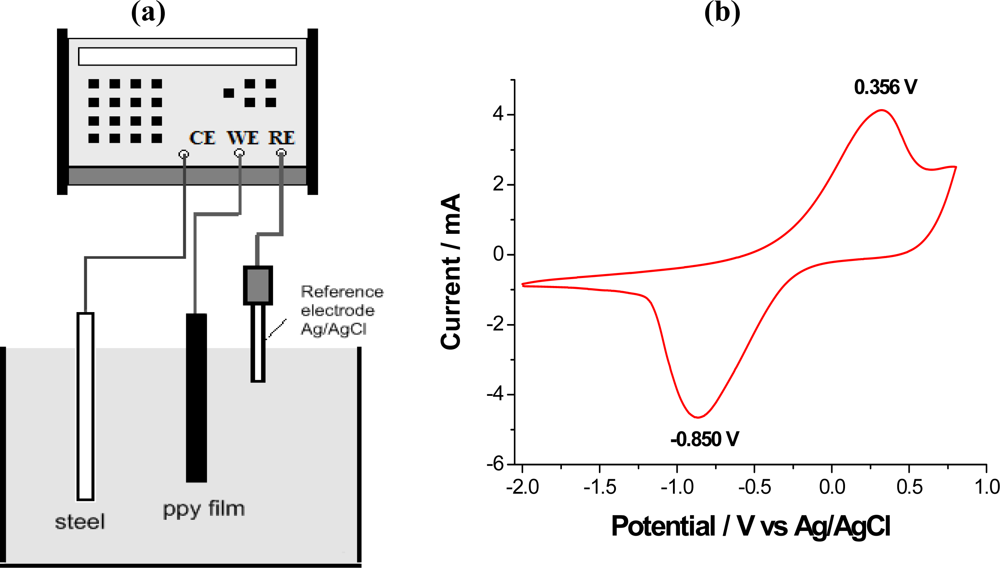
<p>Polypyrrole (pPy) was electrogenerated by applying a constant anodic current density of 2 mA cm<sup>−2</sup> during two hours. The overall charge consumed during the electropolymerization was 72.0 C. Two separate films were obtained, coating each of the electrode faces, with a mass of 32 ± 0.2 mg each, determined by means of a precision balance (±0.1 μg) by weight differences between coated and uncoated electrodes. After peeling from the working electrode, the films were submerged in de-ionized water for 24 hours to remove DBSA excess from the polymer surface. Film thicknesses of 85 ± 10 μm were measured using a COMECTA electronic digital micrometer with a precision of ±1 μm. All electrochemical studies were performed using an Autolab PGSTAT-100 potentiostat/galvanostat controlled by a personal computer using GPES electrochemical software. The electrochemical measurements were carried out in 0.1 M LiClO<sub>4</sub> aqueous solutions, using the self-supported polymer film as the working electrode, a stainless steel counterelectrode and an Ag/AgCl reference electrode (<xref ref-type="fig" rid="f5-sensors-10-02638">Figure 5a</xref>). A Julabo T25 Cryostat/Thermostat (±0.1 °C) was used to study the influence of the temperature. All the other experiments were performed at 20 °C (room temperature).</p>
<sec>
<label>7.1.</label>
<title>Voltammetric Response</title>
<p><xref ref-type="fig" rid="f5-sensors-10-02638">Figure 5b</xref> shows the experimental voltammogram recorded between +0.8 V, as anodic potential limit and −2.0 V, as cathodic potential limit, with 6 mV·s<sup>−1</sup> the scan rate. Only one cathodic maximum, at −0.850 V, and one anodic maximum, at 0.356 V, are observed. The shape of the obtained voltammogram and peak potentials are similar to those reported for thinner pPy/DBS films [<xref ref-type="bibr" rid="b94-sensors-10-02638">94</xref>–<xref ref-type="bibr" rid="b96-sensors-10-02638">96</xref>] in aqueous solutions and quite different to those reported for pPy/ClO<sub>4</sub><sup>−</sup> films [<xref ref-type="bibr" rid="b97-sensors-10-02638">97</xref>]. Here a larger potential separation between anodic and cathodic peaks is observed, which can be attributed to use of a thicker film. These results indicate that dodecyl benzene sulfonate (DBS<sup>−</sup>) is the prevailing counterion inside the material. Due to its large size, the counterion remains trapped, promoting an exchange of Li<sup>+</sup> cations predominately during oxidation/reduction processes. This interchange will promote the insertion of cations and polymeric swelling during reduction and the cations expulsion with polymeric shrinking during oxidation. These volume changes were confirmed by the sense of the angular movements of a pPy/tape actuator under the flow of anodic and cathodic currents.</p>
<p>The electrochemical reaction can be written in a simplified form as:
<disp-formula id="FD8">
<label>(8)</label>
<mml:math display="block">
<mml:mrow>
<mml:msub>
<mml:mrow>
<mml:mo>(</mml:mo>
<mml:mtext>pPy</mml:mtext>
<mml:mi> </mml:mi>
<mml:mtext>chain</mml:mtext>
<mml:mo>)</mml:mo></mml:mrow>
<mml:mi>s</mml:mi></mml:msub>
<mml:msub>
<mml:mrow>
<mml:mrow>
<mml:mo>(</mml:mo>
<mml:msup>
<mml:mrow>
<mml:mrow>
<mml:mtext>DBS</mml:mtext></mml:mrow></mml:mrow>
<mml:mo>−</mml:mo></mml:msup>
<mml:msup>
<mml:mrow>
<mml:mrow>
<mml:mtext>Li</mml:mtext></mml:mrow></mml:mrow>
<mml:mo>+</mml:mo></mml:msup>
<mml:mo>)</mml:mo></mml:mrow></mml:mrow>
<mml:mi mathvariant="normal">n</mml:mi></mml:msub>
<mml:mo>↔</mml:mo>
<mml:mo stretchy="false">(</mml:mo>
<mml:mtext>pPy</mml:mtext>
<mml:mi> </mml:mi>
<mml:msup>
<mml:mrow>
<mml:mrow>
<mml:mtext>chain</mml:mtext></mml:mrow></mml:mrow>
<mml:mrow>
<mml:mi mathvariant="normal">n</mml:mi>
<mml:mo>+</mml:mo></mml:mrow></mml:msup>
<mml:mo stretchy="false">)</mml:mo>
<mml:msub>
<mml:mrow>
<mml:mrow>
<mml:mo stretchy="false">(</mml:mo>
<mml:msup>
<mml:mrow>
<mml:mrow>
<mml:mi mathvariant="italic">DBS</mml:mi></mml:mrow></mml:mrow>
<mml:mo>−</mml:mo></mml:msup>
<mml:mo stretchy="false">)</mml:mo></mml:mrow></mml:mrow>
<mml:mi>n</mml:mi></mml:msub>
<mml:mo>+</mml:mo>
<mml:mi>n</mml:mi>
<mml:mi> </mml:mi>
<mml:msup>
<mml:mrow>
<mml:mrow>
<mml:mtext>Li</mml:mtext></mml:mrow></mml:mrow>
<mml:mo>+</mml:mo></mml:msup>
<mml:mi mathvariant="normal">n</mml:mi>
<mml:mi> </mml:mi>
<mml:msup>
<mml:mrow>
<mml:mrow>
<mml:mi mathvariant="normal">e</mml:mi></mml:mrow></mml:mrow>
<mml:mo>−</mml:mo></mml:msup></mml:mrow></mml:math></disp-formula></p>
<p>The reaction occurring from left to right is the anodic process in which electrons are extracted from the polymeric chains. In <xref ref-type="fig" rid="f5-sensors-10-02638">Figure 5b</xref>, this process occurs during the anodic currents giving the maximum at 0.356 V. The charge extracted during oxidation can be obtained by integration of the maximum. The reaction from the right side towards the left side is the cathodic process, that is, electrons are introduced into the polymeric chains eliminating positive charges. This process is related to the cathodic currents originating the maximum at −0.850 V (negative currents on the voltammogram). The charge injected during reduction can be obtained by integration of this maximum.</p></sec>
<sec>
<label>7.2.</label>
<title>Sensing Abilities under Constant Current</title>
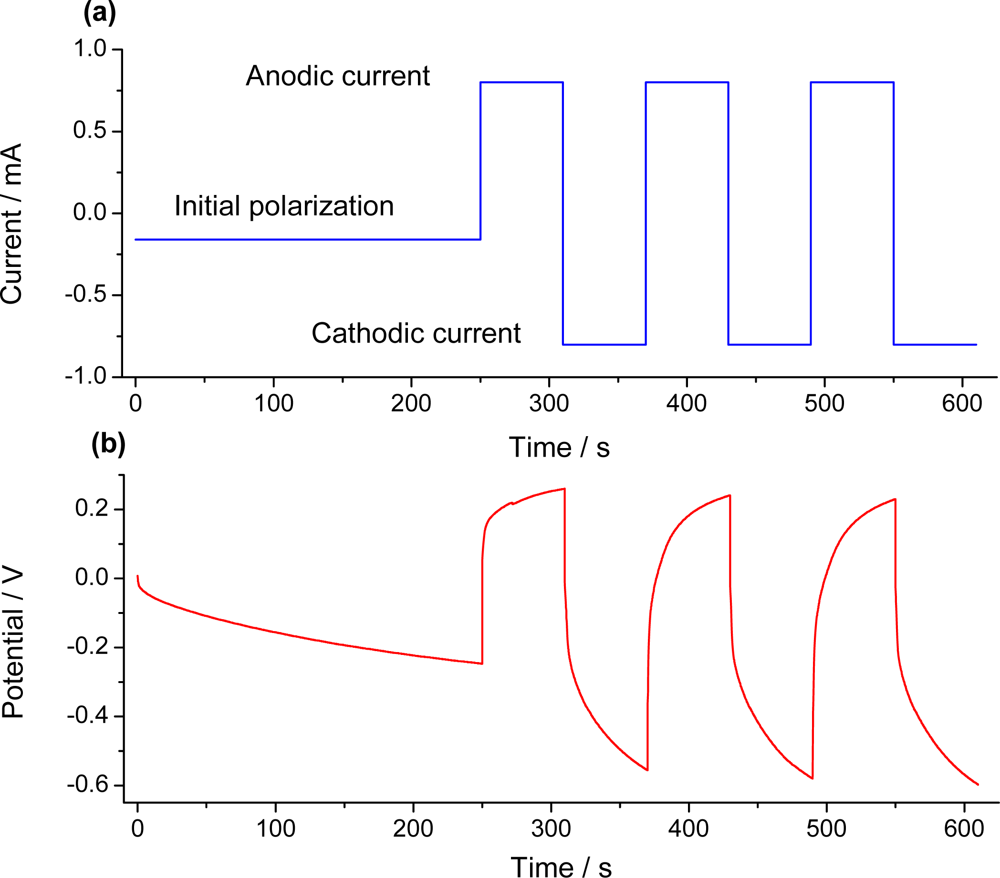
<p>In order to study the response of the material to different experimental variables, a galvanostatic procedure (<xref ref-type="fig" rid="f6-sensors-10-02638">Figure 6</xref>) was designed.</p>
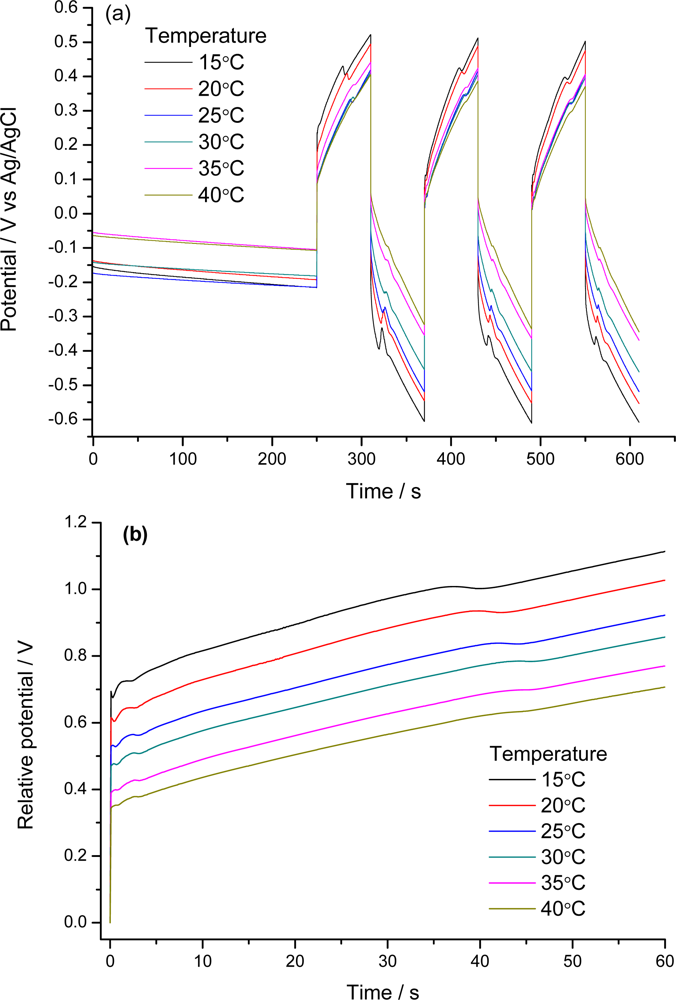
<p>After stabilization of the initial oxidation state by applying a constant current of −0.150 mA for 250 s, the material film was submitted to three consecutive square waves of current (<xref ref-type="fig" rid="f6-sensors-10-02638">Figure 6a</xref>). The chronopotentiometric responses obtained during consecutive oxidation/reduction processes were recorded (<xref ref-type="fig" rid="f6-sensors-10-02638">Figure 6b</xref>).</p>
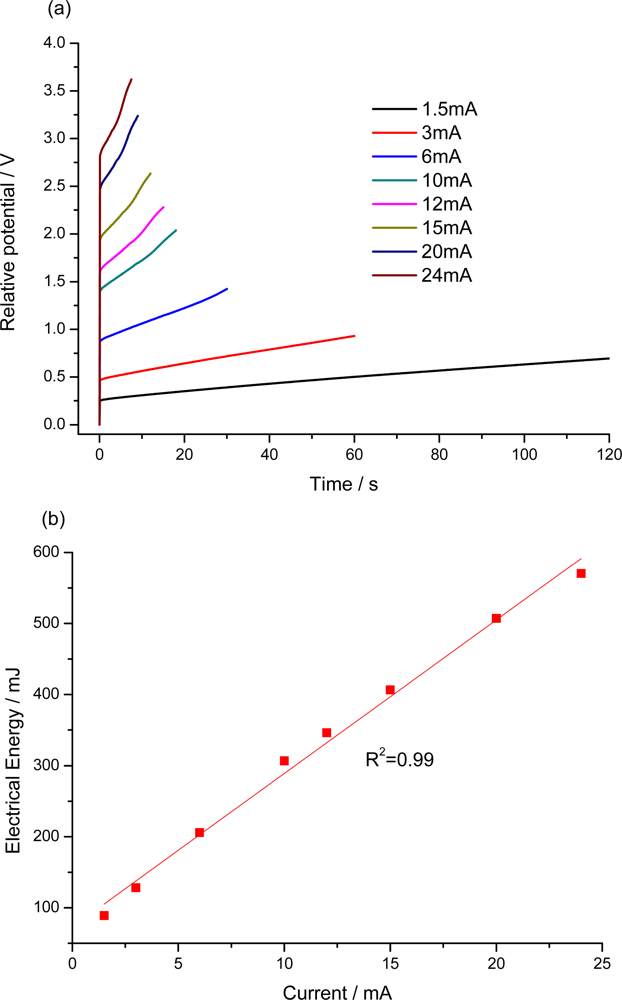
<p>The pPy/DBS film was submitted to different square waves of current ranging from ±1.5 to ±24 mA, passing a constant charge of ±180 mC. <xref ref-type="fig" rid="f7-sensors-10-02638">Figure 7</xref> shows the obtained anodic chronopotentiograms. The potential evolves at higher potentials for higher currents. The higher initial step of the potential for rising currents is related to the different resistances present in the system: film resistance, interface resistance due to ions interchange, solution resistance and reaction resistance. After this initial change, the potential increases for rising anodic currents following the electrode processes. The electrical energy (<italic>E</italic><sub>e</sub>) consumed by the polymer film during each oxidation/reduction was calculated as <italic>E<sub>e</sub></italic> = <italic>i</italic>·∫<italic>E</italic>·<italic>dt</italic>, with <italic>i</italic> the constant current, <italic>E</italic> the electrodic potential at any time, <italic>t</italic>, of the current flow. <xref ref-type="fig" rid="f7-sensors-10-02638">Figure 7b</xref> shows the variation of the electrical energy as a function of the applied current. A linear fit was obtained for both cathodic and anodic processes: the material under reaction senses the applied current.</p></sec>
<sec>
<label>7.3.</label>
<title>Temperature Sensor</title>
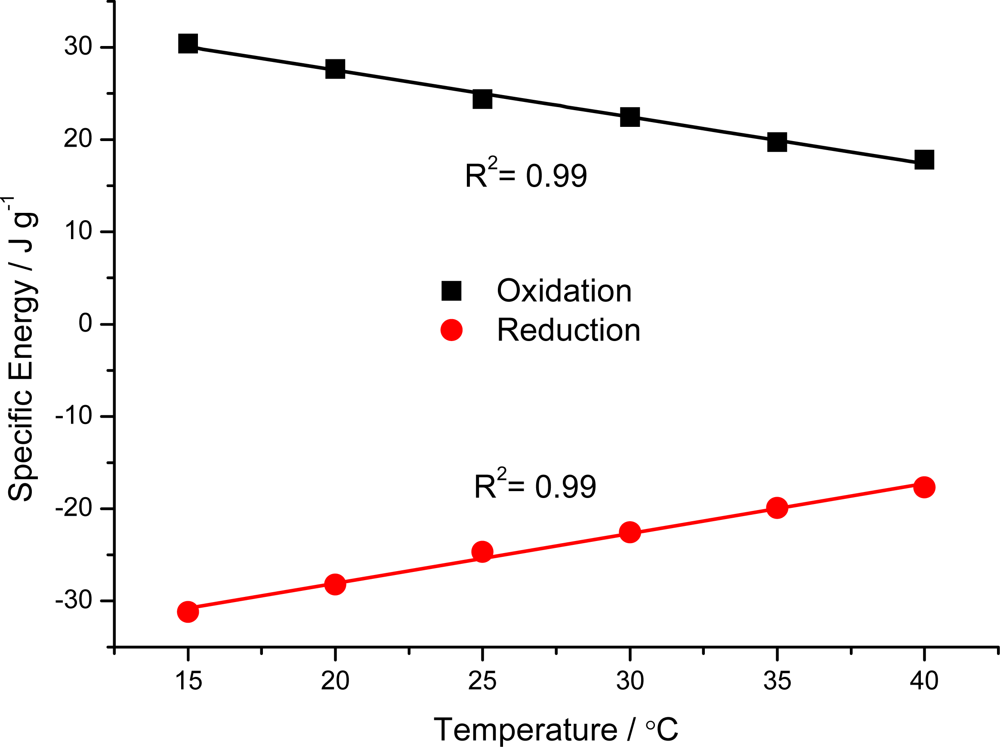
<p>In reaction (1) or (2), as for any other chemical or electrochemical process, the reaction rate (anodic or cathodic) is expected to increase for rising experimental temperatures, due to the Arrhenius dependence of the reaction kinetic coefficient with T. This is equivalent to saying that working at a constant reaction rate, under flow of a constant current; the reaction is expected to occur with a lower reaction resistance (that means lower potentials) for increasing temperatures. In order to gain more knowledge into the sensing abilities of the electroactive material, the film is submitted to square current waves (±4 mA for 60 s every current) at different temperatures (15, 20, 25, 30, 35 and 40 °C). <xref ref-type="fig" rid="f8-sensors-10-02638">Figure 8a</xref> shows the obtained chronopotentiograms in which the evolutions of the reactive film potential for the different temperatures were overlapped. <xref ref-type="fig" rid="f8-sensors-10-02638">Figure 8b</xref> shows the response for the last oxidation step referred to the same arbitrary zero initial potential, in order to obtain the consumed electrical energies by integration of the curves. As expected, for the anodic processes decreasing potentials are observed for the same times of current flow and increasing temperatures. Rising available thermal energies require lower consumption of electrical energies during the reaction. Under constant current this produces lower potentials. <xref ref-type="fig" rid="f9-sensors-10-02638">Figure 9</xref> shows the linear increase of the consumed electrical energy for decreasing working temperatures [<xref ref-type="bibr" rid="b92-sensors-10-02638">92</xref>]. As a partial conclusion the electroactivity of the material, understood as electrochemical reactions of polymeric oxidation or reduction, act as a temperature sensor.</p></sec>
<sec>
<label>7.4.</label>
<title>Concentration Sensor</title>
<p>Similar experiments were performed by changing the electrolyte concentration (0.01, 0.02, 0.05, 0.1, 0.25, 0.5 and 1 M) as shown in <xref ref-type="fig" rid="f10-sensors-10-02638">Figure 10</xref>. For the same time of a constant current flow, decreasing electrode potentials are observed for rising electrolyte concentrations. The effect increases when referred to the same arbitrary zero initial potential. The consumed specific electrical energy changes as a function of the concentration. (<xref ref-type="fig" rid="f10-sensors-10-02638">Figure 10b</xref>) We conclude that the material works as a sensor of the salt concentration in the ambient.</p>
<p>As final conclusions, we can state that the specific energy consumed during oxidation or reduction reactions of the studied film sense the influence of the variables: flowing current, working temperature or electrolyte concentration, on the system. The consumed electrical energy is a linear function of the studied variable.</p></sec>
<sec>
<label>7.5.</label>
<title>Expected Sensing Electrochemical Devices</title>
<p>Those facts described in Sections 7.2 to 7.4 suggest that any device based on an electrochemical property (on the electrochemical reactions) of intrinsically conducting polymers is expected to act simultaneously as a sensor of any ambient and working variables acting on the reaction. Artificial muscles, polymeric batteries, smart membranes, drug delivery devices, electrochromic devices, among others, are expected to wear those simultaneous sensing-actuating properties. The two connecting wires should include both, actuating (<italic>i.e.</italic>, the current) and sensing (<italic>i.e.</italic>, the potential evolution) signals. We will focus our attention here on the present state of the art for those simultaneous actuating/sensing abilities of conducting polymers as reactive materials when used to construct artificial muscles.</p></sec></sec>
<sec>
<label>8.</label>
<title>Muscles and Artificial Muscles</title>
<p>Muscles are efficient devices working at constant temperature to transform chemical energy from glucose, into mechanical energy and heat. The fact that they work under constant temperature, far away from the servitude imposed by the Carnot’s principle, makes natural muscles much more efficient than any parallel human-made machine. Moreover, internal combustion devices, steam engines or turbo-reactors produce quite rudimentary movements, noise (acoustic and electromagnetic) and ambient deterioration, even though very useful for human development [<xref ref-type="bibr" rid="b98-sensors-10-02638">98</xref>–<xref ref-type="bibr" rid="b100-sensors-10-02638">100</xref>].</p>
<p>The actuation of any natural muscle is based on molecular motors constituted by polymeric chains of actin and myosin. The basic structure for the actuation is the sarcomere, where actin and myosin chains are organized as quasi-longitudinal fibers perpendicular to the sarcomere walls. The actuation mechanism of those electro-chemo-mechanical devices was described above.</p>
<sec>
<label>8.1.</label>
<title>Artificial Muscles</title>
<p>In order to mimic natural molecular motors, we shall attempt to include, at least, electric pulses and polymeric chains. Some pioneering devices were constructed in the 1950s using films of polymeric gels immersed in aqueous solutions [<xref ref-type="bibr" rid="b101-sensors-10-02638">101</xref>–<xref ref-type="bibr" rid="b104-sensors-10-02638">104</xref>]. At the beginning of the 1990s, a fast development of devices based on the interaction between electric fields, or electric currents, and polymers took place stimulated by the interest to reproduce commercial piezoelectric or electrostrictive (electromechanical) devices developed with inorganic materials, but using now similar properties from polymeric materials. The beginning of this explosive interest overlapped the discovery of intrinsically conductive polymers and the reverse electrochemical variation of their volume (<xref ref-type="fig" rid="f4-sensors-10-02638">Figure 4</xref>). This controlled volume variation envisaged the construction of new electrochemo-mechanical devices [<xref ref-type="bibr" rid="b67-sensors-10-02638">67</xref>,<xref ref-type="bibr" rid="b105-sensors-10-02638">105</xref>–<xref ref-type="bibr" rid="b107-sensors-10-02638">107</xref>].</p></sec>
<sec>
<label>8.2.</label>
<title>Classification of the Polymeric Artificial Muscles</title>
<p>Any developed device based on the interaction between electricity and polymers uses to be named artificial muscle. We can summarize the present state of the named artificial muscles, which actuation involves polymers, electric fields or electric currents, by their classification in two main areas:
<list list-type="simple">
<list-item>
<p>- <bold>Electromechanical actuators</bold>: Artificial muscles responding mainly to electric fields, E (V), being the dimensions variation of the electroactive polymer proportional to:
<list list-type="simple">
<list-item>
<p>E<sup>2</sup>: Electrostrictive actuators</p></list-item>
<list-item>
<p>E: Piezoelectric actuators</p>
<p>Ferroelectric actuators</p>
<p>Electrostatic actuators</p>
<p>Electrokinetic actuators (electroosmotic)</p></list-item></list></p></list-item>
<list-item>
<p>- <bold>Electrochemomechanical devices</bold>: Artificial muscles responding mainly to electric charges, Q (mC), being the dimensions variation under control of the electrochemical reaction, and proportional to:
<list list-type="simple">
<list-item>
<p>Q: Electrochemical actuators</p></list-item></list></p></list-item></list></p>
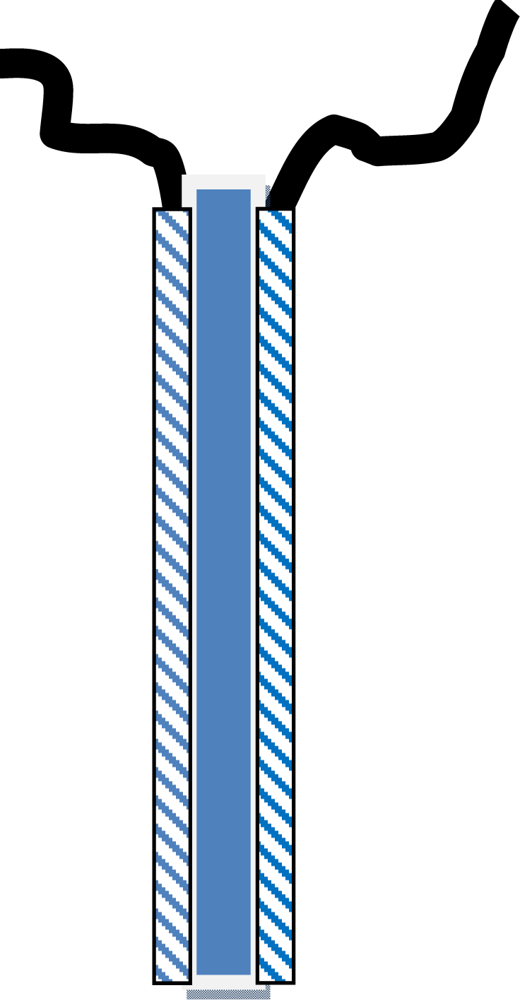
<p>Conventionally electromechanical devices have been manufactured as bending thin films of dry polymer (named electroactive material), both sides coated with a very thin metallic film required to apply the electric field. Any actuator has a triple layer structure: metal/polymer/metal (<xref ref-type="fig" rid="f11-sensors-10-02638">Figure 11</xref>). Linear devices from materials having a large dimension’s change with the electric field are also constructed.</p>
<p>Bending electrochemomechanical actuators can be manufactured as bilayers, using a metallic electrode as counterelectode to allow the current flow, or as three-layers (see below), including working and counterelectrode. In the three-layers structure, the two external films are electroactive (react electrochemically, changing volume) during current flow. The internal film is an adherent, flexible and non-conducting (or ionic conductor) polymeric film.</p>
<p>In the case of linear devices, they can be made of fibers of conducting polymers [<xref ref-type="bibr" rid="b108-sensors-10-02638">108</xref>–<xref ref-type="bibr" rid="b112-sensors-10-02638">112</xref>], or by electropolymerization of a conducting polymer on springs of helical metallic wires until the generation of a tube, or on zigzag metal wires to generate films [<xref ref-type="bibr" rid="b110-sensors-10-02638">110</xref>,<xref ref-type="bibr" rid="b113-sensors-10-02638">113</xref>–<xref ref-type="bibr" rid="b117-sensors-10-02638">117</xref>]. Bundles of films or fibers are checked to produce lineal displacements of weights [<xref ref-type="bibr" rid="b118-sensors-10-02638">118</xref>]. Origami structures form films also provide good linear movements [<xref ref-type="bibr" rid="b119-sensors-10-02638">119</xref>]. Different models have been proposed to describe mechanical behavior or electro-chemomechanical deformations [<xref ref-type="bibr" rid="b120-sensors-10-02638">120</xref>–<xref ref-type="bibr" rid="b122-sensors-10-02638">122</xref>] of this kind of devices.</p></sec>
<sec>
<label>8.3.</label>
<title>Electrochemomechanical Muscles: Volume Variation</title>
<p>Artificial muscles have been developed from films of CP involving electrochemical reactions (1) or (2) as origin of the volume variations. When the interchange of anion prevails (accepted for families a, b, d, e and g) during the redox processes, the volume of the film swells during oxidation and shrinks during reduction. Under prevailing cation interchange (accepted for families c and e), the material shrinks during oxidation and swells during reduction. The important role played by the solvent interchange in both oxidized and reduced materials, is an unsolved point. Dimensional changes parallel to electrochemical reactions, have been followed by different methodologies, or estimated from experimental densities and weights of dried oxidized or reduced films from the pioneering works of the electrochemistry of conducting polymers [<xref ref-type="bibr" rid="b123-sensors-10-02638">123</xref>,<xref ref-type="bibr" rid="b124-sensors-10-02638">124</xref>]. Those changes were confirmed at microscopic level by “<italic>in situ</italic>” AFM [<xref ref-type="bibr" rid="b125-sensors-10-02638">125</xref>–<xref ref-type="bibr" rid="b127-sensors-10-02638">127</xref>], ellipsometry [<xref ref-type="bibr" rid="b128-sensors-10-02638">128</xref>], conductivity [<xref ref-type="bibr" rid="b105-sensors-10-02638">105</xref>] measurements, <italic>in situ</italic> electrogravimetry [<xref ref-type="bibr" rid="b129-sensors-10-02638">129</xref>,<xref ref-type="bibr" rid="b130-sensors-10-02638">130</xref>] and others [<xref ref-type="bibr" rid="b131-sensors-10-02638">131</xref>,<xref ref-type="bibr" rid="b132-sensors-10-02638">132</xref>].</p></sec>
<sec>
<label>8.4.</label>
<title>Electrochemical Basic Molecular Motors and Muscle Similitude</title>
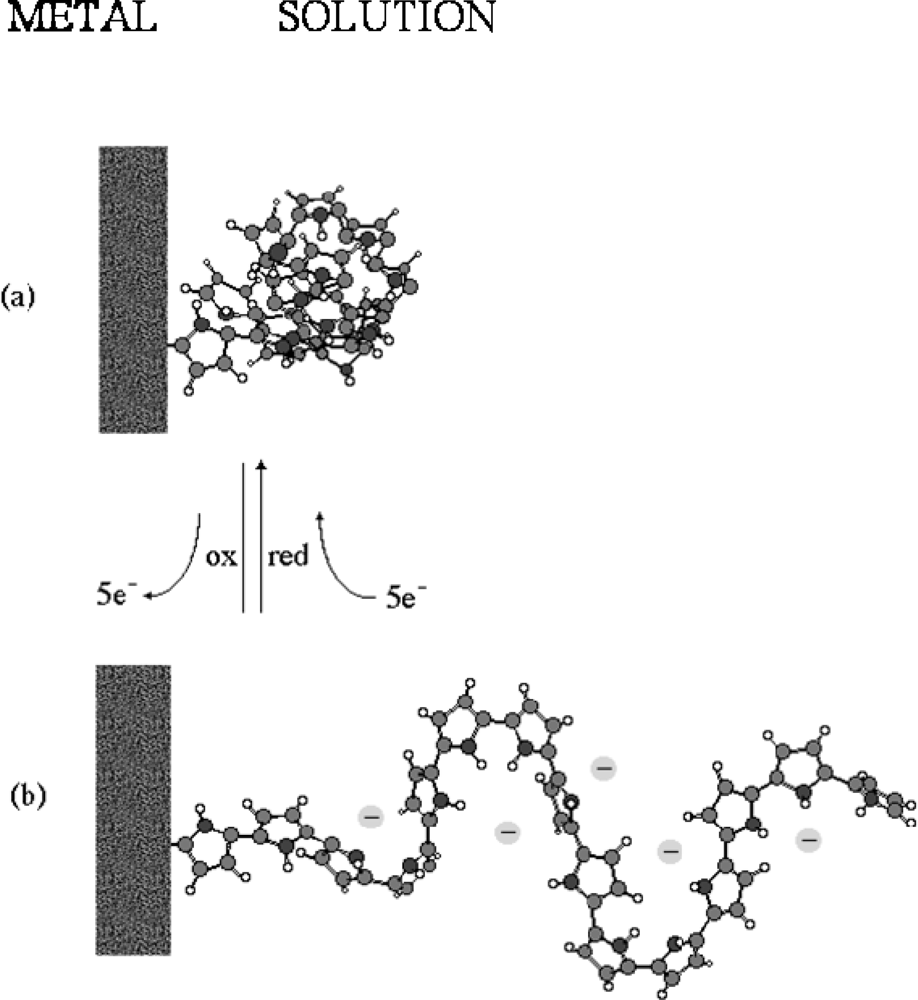
<p>We can imagine an ideal and lineal and neutral polymeric chain connected to a metallic electrode and immersed in an electrolyte (see <xref ref-type="fig" rid="f12-sensors-10-02638">Figure 12</xref>). The strong intramolecular interactions originate a coil compact structure of the chain (<xref ref-type="fig" rid="f12-sensors-10-02638">Figure 12a</xref>). Under oxidation changes on the double bonds distribution and storage of positive charges originate conformational movements until a stick-like structure (<xref ref-type="fig" rid="f12-sensors-10-02638">Figure 12b</xref>). This basic molecular actuator [<xref ref-type="bibr" rid="b133-sensors-10-02638">133</xref>,<xref ref-type="bibr" rid="b134-sensors-10-02638">134</xref>] working in a reversible way driven by electrochemical reactions includes: electric pulses, ions and solvent interchanges between the polymer and the solution, chemical reactions, stimulation of the conformational movements along polymeric chains and changes in the inter- and intramolecular interactions. Those processes occurring in soft and wet materials mimic, at molecular level, the consecutive events involved on the actuation of a natural anisotropic muscle. At the moment it is not known how to construct artificial sarcomere like structures (brushes) with chains of conducting polymers between two metallic (or electronically conducting) films. Only three-dimensional isotropic, microscopic and stable changes of volume are available with films of conducting polymers under electrochemical reactions.</p></sec>
<sec>
<label>8.5.</label>
<title>Devices Giving Macroscopic Movements</title>
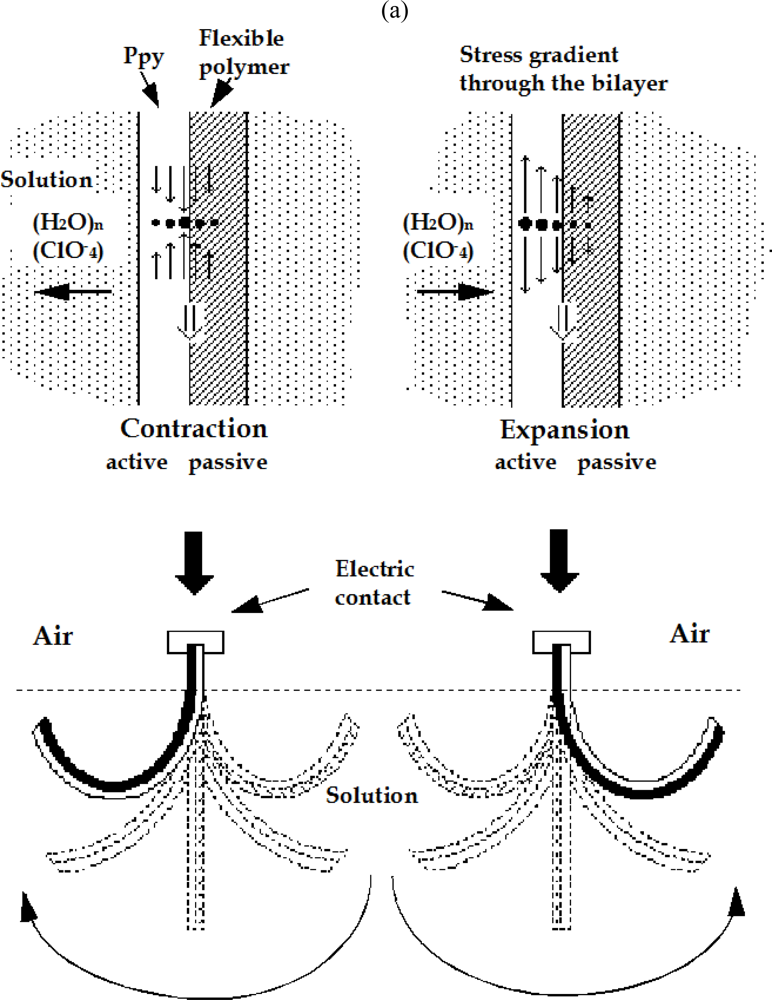
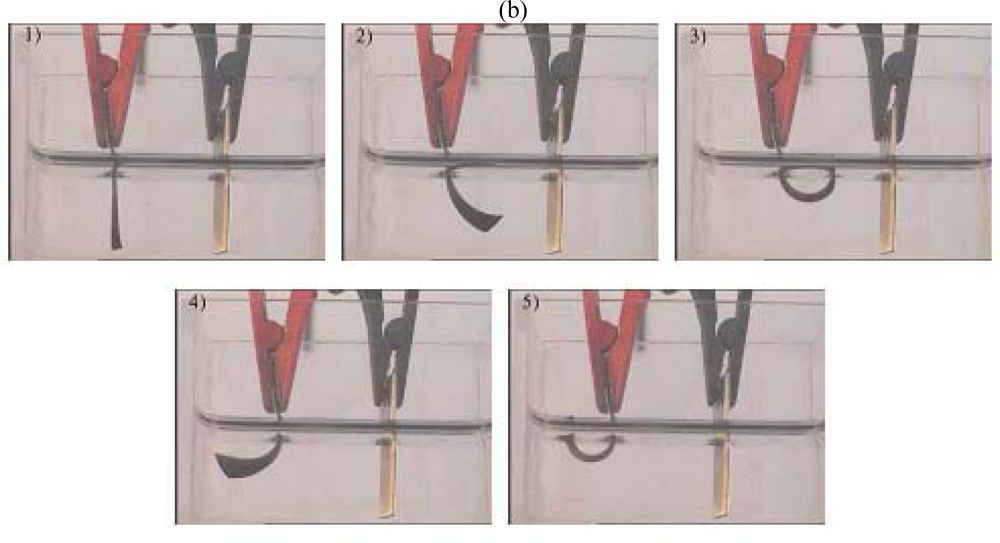
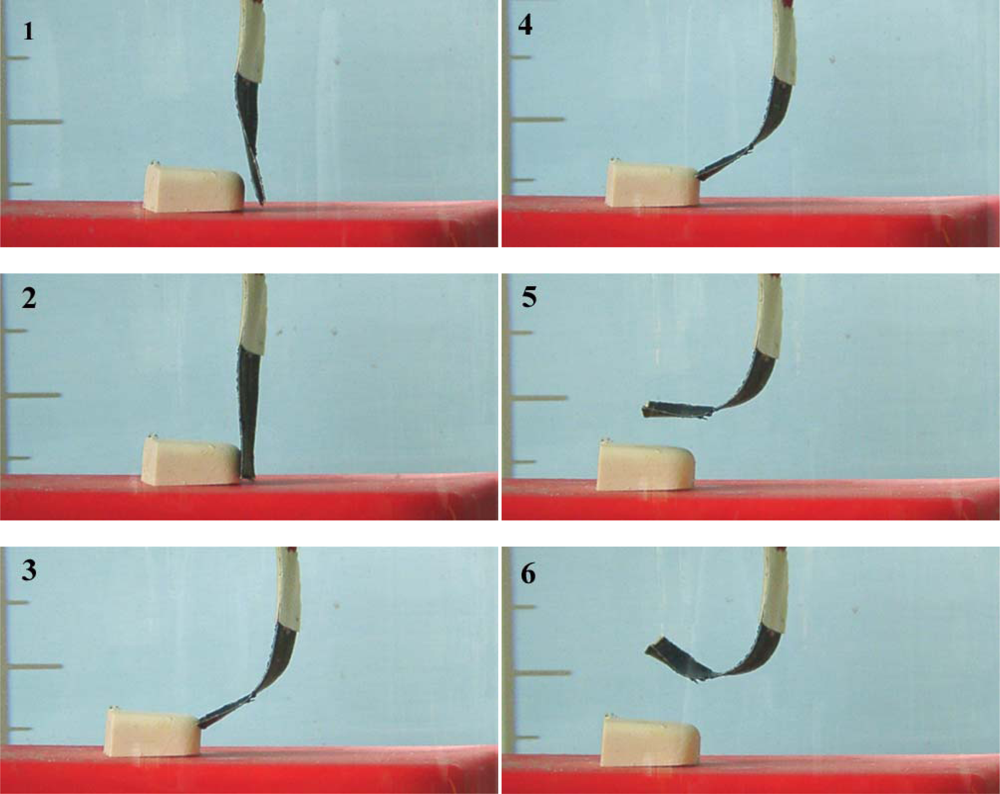
<p>Bilayer structures of conducting polymer (CP) film/adherent polymer film [<xref ref-type="bibr" rid="b67-sensors-10-02638">67</xref>,<xref ref-type="bibr" rid="b106-sensors-10-02638">106</xref>,<xref ref-type="bibr" rid="b107-sensors-10-02638">107</xref>,<xref ref-type="bibr" rid="b135-sensors-10-02638">135</xref>,<xref ref-type="bibr" rid="b136-sensors-10-02638">136</xref>], CP/metal [<xref ref-type="bibr" rid="b137-sensors-10-02638">137</xref>–<xref ref-type="bibr" rid="b139-sensors-10-02638">139</xref>], CP/solid state electrolyte [<xref ref-type="bibr" rid="b140-sensors-10-02638">140</xref>], CP/CP [<xref ref-type="bibr" rid="b141-sensors-10-02638">141</xref>,<xref ref-type="bibr" rid="b142-sensors-10-02638">142</xref>], CP/plastic [<xref ref-type="bibr" rid="b143-sensors-10-02638">143</xref>], CP/paper or CP/thin film of any flexible material metal coated (<italic>i.e.</italic>, by sputtering) [<xref ref-type="bibr" rid="b144-sensors-10-02638">144</xref>] have been elegant solutions to translate the microscopic changes of volume taking place in films of CP into increasing anisotropic mechanical stress gradient across the bilayer interface, generating an uniform macroscopic bending movements (<xref ref-type="fig" rid="f13-sensors-10-02638">Figure 13a</xref>). The presence of a metallic counterelectrode is required to allow the current flow, originating the electrochemical reaction that produces the bending movement. However, an important fraction of the consumed electrical energy is wasted to produce the electrochemical reactions occurring at the counterelectrode (such as solvent dissociation, which requires a high overpotential). Moreover those reactions will generate new chemicals and pH variations, migrating until the muscle and promoting the progressive deterioration of the actuating film.</p>
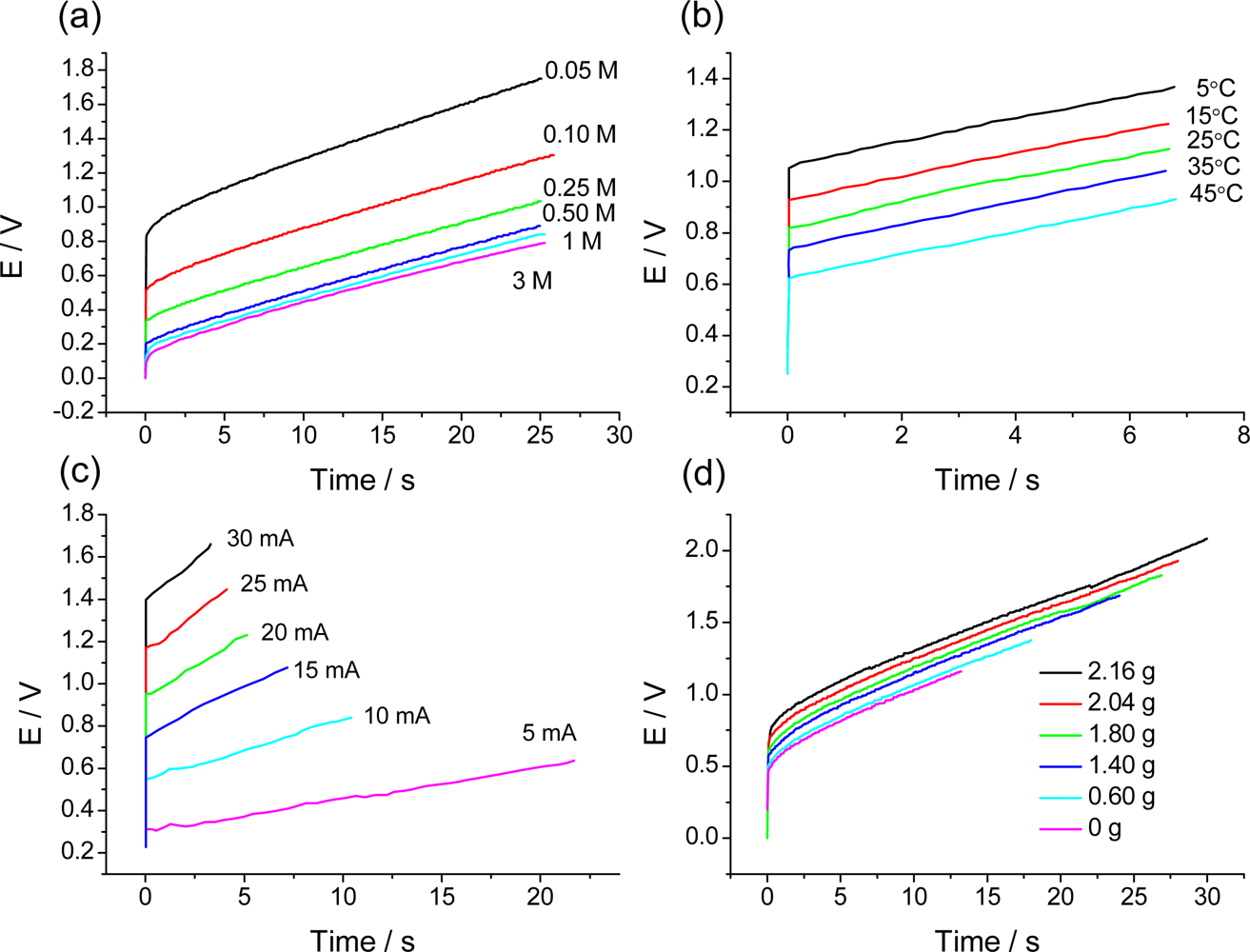
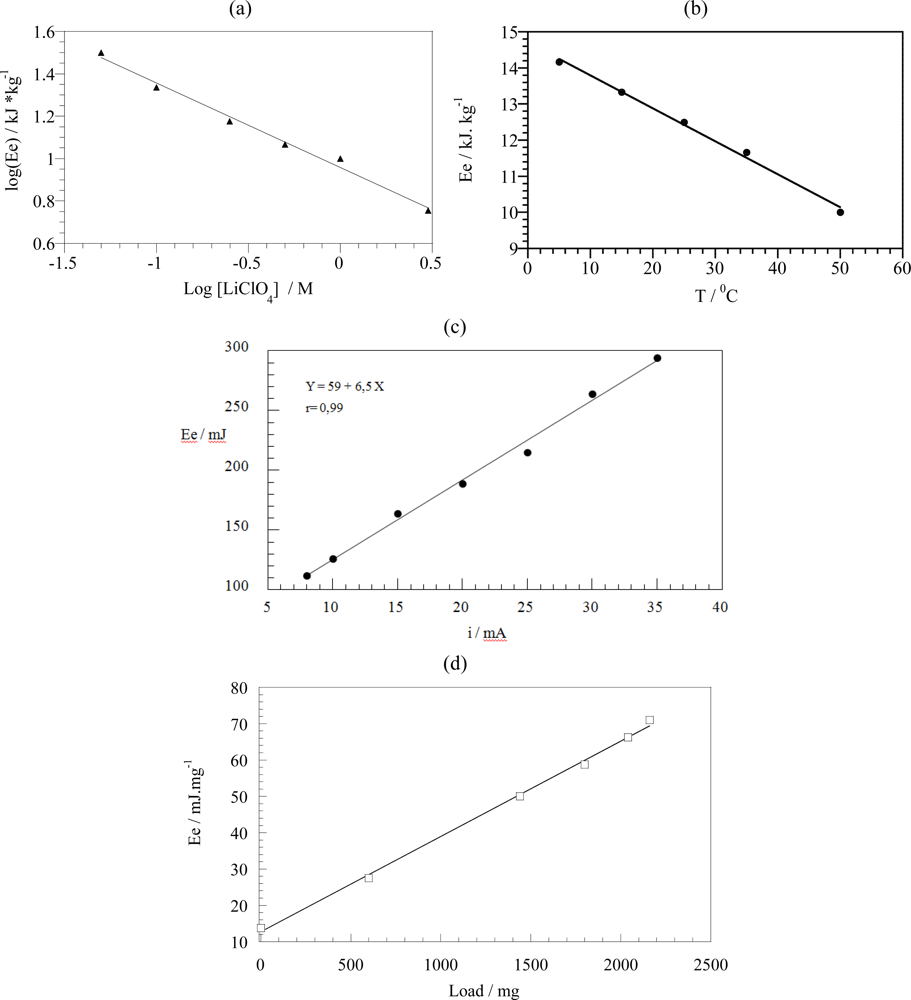
<p>The construction of a triple layer CP/tape/CP [<xref ref-type="bibr" rid="b107-sensors-10-02638">107</xref>] allows a more efficient actuation by using the same current two times to produce opposite volume changes and avoiding the use of metallic counterelectrodes (<xref ref-type="fig" rid="f11-sensors-10-02638">Figure 11</xref>). One of the CP films, the working electrode (WE) acts as the anode, swells (for preferential anionic interchange during the reaction) and pushes the device. The second CP film is the counterelectrode (CE) acts as the cathode shrinks and trails the device. The CE uses to be short-circuited with the reference electrode (RE) output of the potentiostat. On this way we follow the instantaneous potential difference between the two CP films: the muscle potential. The muscle potential evolution under flow of a constant current is a result of the two electrochemical reactions: oxidation at the anode and reduction at the cathode. Consequently we expect those actuating reactions to be influenced by the ambient variables, becoming a sensor of those variables.</p>
<p>The three layers muscles can work outside the liquid electrolytic media using an ionic conducting membrane separating the two films of CP. This membrane can be obtained by solvent evaporation and UV irradiation [<xref ref-type="bibr" rid="b72-sensors-10-02638">72</xref>,<xref ref-type="bibr" rid="b145-sensors-10-02638">145</xref>,<xref ref-type="bibr" rid="b146-sensors-10-02638">146</xref>], or by formation of interpenetrated networks [<xref ref-type="bibr" rid="b147-sensors-10-02638">147</xref>–<xref ref-type="bibr" rid="b152-sensors-10-02638">152</xref>]: the two films of CP are generated by chemical polymerization on the external part of the membrane film.</p>
<p>Different structures can be produced by combination of several double or triple layers to transform bending into linear movements, each of those structures including WE, CE and reference electrode [<xref ref-type="bibr" rid="b153-sensors-10-02638">153</xref>–<xref ref-type="bibr" rid="b155-sensors-10-02638">155</xref>].</p>
<p>The actuating films of CP can be generated by electropolymerization. Electrogeneration is compatible with micro and nanotechnologies [<xref ref-type="bibr" rid="b156-sensors-10-02638">156</xref>] giving elegant and imaginative microdevices[<xref ref-type="bibr" rid="b157-sensors-10-02638">157</xref>] and microtools constituted by bending bilayers [<xref ref-type="bibr" rid="b69-sensors-10-02638">69</xref>,<xref ref-type="bibr" rid="b137-sensors-10-02638">137</xref>–<xref ref-type="bibr" rid="b139-sensors-10-02638">139</xref>,<xref ref-type="bibr" rid="b158-sensors-10-02638">158</xref>–<xref ref-type="bibr" rid="b165-sensors-10-02638">165</xref>] or trilayers [<xref ref-type="bibr" rid="b166-sensors-10-02638">166</xref>].</p></sec>
<sec>
<label>8.6.</label>
<title>Electrochemical Nature of the Movement</title>
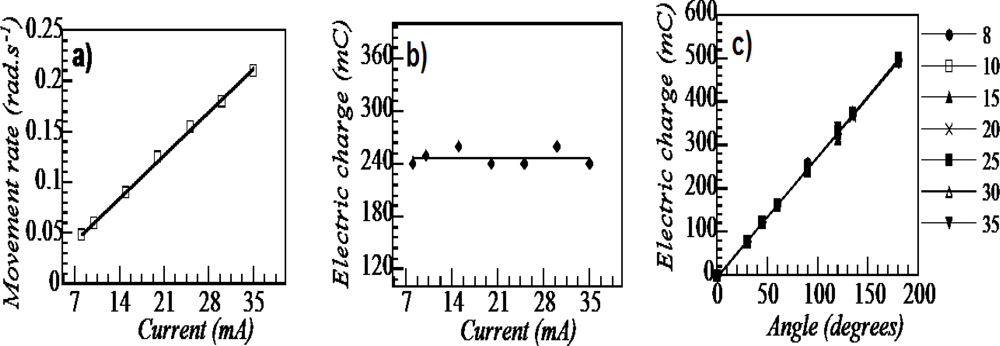
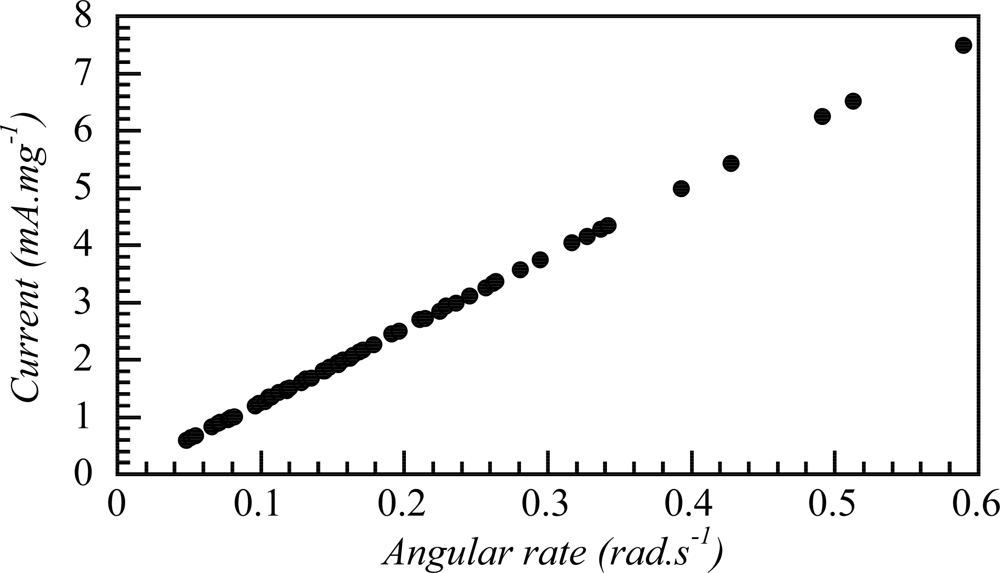
<p>Volume changes per unit of time, and the produced macroscopic movement, are expected (<xref ref-type="disp-formula" rid="FD1">Equation 1</xref>) to be under control of the driving current. The Faraday’s expression should quantify the amount of interchanged ions. For driving current ranging from 8–35 mA, <xref ref-type="fig" rid="f14-sensors-10-02638">Figure 14a</xref> shows the experimental linear relationship between the driving current and the produced angular movement rate:
<disp-formula id="FD9">
<label>(9)</label>
<mml:math display="block">
<mml:mrow>
<mml:mtable>
<mml:mtr>
<mml:mtd>
<mml:mrow>
<mml:mtext>Angular</mml:mtext>
<mml:mi> </mml:mi>
<mml:mtext>movement</mml:mtext>
<mml:mi> </mml:mi>
<mml:mtext>rate</mml:mtext>
<mml:mi> </mml:mi>
<mml:mo stretchy="false">(</mml:mo>
<mml:mtext>rad</mml:mtext>
<mml:mi> </mml:mi>
<mml:msup>
<mml:mi mathvariant="normal">s</mml:mi>
<mml:mrow>
<mml:mo>−</mml:mo>
<mml:mn>1</mml:mn></mml:mrow></mml:msup>
<mml:mo stretchy="false">)</mml:mo>
<mml:mo>=</mml:mo>
<mml:mtext>slope</mml:mtext>
<mml:mi> </mml:mi>
<mml:mo stretchy="false">(</mml:mo>
<mml:mtext>rad</mml:mtext>
<mml:mi> </mml:mi>
<mml:msup>
<mml:mrow>
<mml:mi mathvariant="normal">s</mml:mi></mml:mrow>
<mml:mrow>
<mml:mo>−</mml:mo>
<mml:mn>1</mml:mn></mml:mrow></mml:msup>
<mml:mi> </mml:mi>
<mml:msup>
<mml:mrow>
<mml:mrow>
<mml:mtext>mA</mml:mtext></mml:mrow></mml:mrow>
<mml:mrow>
<mml:mo>−</mml:mo>
<mml:mn>1</mml:mn></mml:mrow></mml:msup>
<mml:mo stretchy="false">)</mml:mo>
<mml:mi> </mml:mi>
<mml:mi mathvariant="normal">x</mml:mi>
<mml:mi> </mml:mi>
<mml:mtext>applied</mml:mtext>
<mml:mi> </mml:mi>
<mml:mtext>current</mml:mtext>
<mml:mi> </mml:mi>
<mml:mo stretchy="false">(</mml:mo>
<mml:mtext>mA</mml:mtext>
<mml:mo stretchy="false">)</mml:mo></mml:mrow></mml:mtd></mml:mtr>
<mml:mtr>
<mml:mtd>
<mml:mrow>
<mml:mi mathvariant="bold">ω</mml:mi>
<mml:mo mathvariant="bold">=</mml:mo>
<mml:mi mathvariant="bold">k</mml:mi>
<mml:mo mathvariant="bold">⋅</mml:mo>
<mml:mi mathvariant="bold">i</mml:mi></mml:mrow></mml:mtd></mml:mtr></mml:mtable></mml:mrow></mml:math></disp-formula></p>
<p>Whatever the applied current, the experimental slope is a constant, as expected for an electrochemically driven motor. Moreover, the experimental charge consumed to perform an angular movement of one degree is constant (<xref ref-type="fig" rid="f14-sensors-10-02638">Figure 14c</xref>) due to the overlapping evolution of the described angle as a function of the consumed charge for different driven constant currents:
<disp-formula id="FD10">
<label>(10)</label>
<mml:math display="block">
<mml:mrow>
<mml:mtable>
<mml:mtr>
<mml:mtd>
<mml:mrow>
<mml:mtext>Described</mml:mtext>
<mml:mi> </mml:mi>
<mml:mtext>angle</mml:mtext>
<mml:mi> </mml:mi>
<mml:mo stretchy="false">(</mml:mo>
<mml:mtext>degrees</mml:mtext>
<mml:mo stretchy="false">)</mml:mo>
<mml:mo>=</mml:mo>
<mml:mtext>slope</mml:mtext>
<mml:mi> </mml:mi>
<mml:mo stretchy="false">(</mml:mo>
<mml:mtext>degree</mml:mtext>
<mml:mi> </mml:mi>
<mml:msup>
<mml:mtext>mC</mml:mtext>
<mml:mrow>
<mml:mo>−</mml:mo>
<mml:mn>1</mml:mn></mml:mrow></mml:msup>
<mml:mo stretchy="false">)</mml:mo>
<mml:mi> </mml:mi>
<mml:mi mathvariant="normal">x</mml:mi>
<mml:mi> </mml:mi>
<mml:mtext>consumed</mml:mtext>
<mml:mi> </mml:mi>
<mml:mtext>charge</mml:mtext>
<mml:mi> </mml:mi>
<mml:mo stretchy="false">(</mml:mo>
<mml:mtext>mC</mml:mtext>
<mml:mo stretchy="false">)</mml:mo></mml:mrow></mml:mtd></mml:mtr>
<mml:mtr>
<mml:mtd>
<mml:mrow>
<mml:mi mathvariant="bold">α</mml:mi>
<mml:mo mathvariant="bold">=</mml:mo>
<mml:mi mathvariant="bold">ω</mml:mi>
<mml:mo mathvariant="bold">⋅</mml:mo>
<mml:mi mathvariant="bold">t</mml:mi>
<mml:mo mathvariant="bold">=</mml:mo>
<mml:mi mathvariant="bold">k</mml:mi>
<mml:mo mathvariant="bold">⋅</mml:mo>
<mml:mi mathvariant="bold">i</mml:mi>
<mml:mo mathvariant="bold">⋅</mml:mo>
<mml:mi mathvariant="bold">t</mml:mi>
<mml:mo mathvariant="bold">=</mml:mo>
<mml:mi mathvariant="bold">k</mml:mi>
<mml:mo mathvariant="bold">⋅</mml:mo>
<mml:mi mathvariant="bold">q</mml:mi></mml:mrow></mml:mtd></mml:mtr></mml:mtable></mml:mrow></mml:math></disp-formula></p>
<p>Consequently, whatever the testing current the same charge is consumed in order to perform the same angular movement (<xref ref-type="fig" rid="f14-sensors-10-02638">Figure 14b</xref>). <xref ref-type="disp-formula" rid="FD10">Equation 10</xref> is a translation of the Faradays laws to bending electro-chemo-mechanical artificial muscles. The charge quantifies the amount of counterions interchanged, so the composition variation, the volume variation of the CP film and the stress gradient at the interface between the polymer films.</p>
<p>The expressions (9) and (10) can be applied to bilayers, triple-layers or complex structures [<xref ref-type="bibr" rid="b91-sensors-10-02638">91</xref>,<xref ref-type="bibr" rid="b92-sensors-10-02638">92</xref>,<xref ref-type="bibr" rid="b167-sensors-10-02638">167</xref>–<xref ref-type="bibr" rid="b169-sensors-10-02638">169</xref>]. <xref ref-type="fig" rid="f14-sensors-10-02638">Figure 14</xref> quantifies the electrochemical nature of the movement. For any specific muscle, we can define the charge required to describe an angular movement of one degree (<bold>a</bold> mC degree<sup>−1</sup>). From <bold>a</bold>, the charge Q required to attain any new position (any new angle) from the actual position can be obtained:
<disp-formula id="FD11">
<label>(11)</label>
<mml:math display="block">
<mml:mrow>
<mml:mi mathvariant="normal">Q</mml:mi>
<mml:mo stretchy="false">(</mml:mo>
<mml:mtext>mC</mml:mtext>
<mml:mo stretchy="false">)</mml:mo>
<mml:mo>=</mml:mo>
<mml:mi mathvariant="normal">a</mml:mi>
<mml:mo stretchy="false">(</mml:mo>
<mml:mtext>mC</mml:mtext>
<mml:mi> </mml:mi>
<mml:msup>
<mml:mrow>
<mml:mrow>
<mml:mtext>degree</mml:mtext></mml:mrow></mml:mrow>
<mml:mrow>
<mml:mo>−</mml:mo>
<mml:mn>1</mml:mn></mml:mrow></mml:msup>
<mml:mo stretchy="false">)</mml:mo>
<mml:mo>⋅</mml:mo>
<mml:mtext>angle</mml:mtext>
<mml:mi> </mml:mi>
<mml:mo stretchy="false">(</mml:mo>
<mml:mtext>degree</mml:mtext>
<mml:mo stretchy="false">)</mml:mo>
<mml:mo>=</mml:mo>
<mml:mi mathvariant="bold">a</mml:mi>
<mml:mo mathvariant="bold">⋅</mml:mo>
<mml:mi mathvariant="bold">α</mml:mi></mml:mrow></mml:math></disp-formula></p>
<p>This is an electrochemo-positioning device. Once defined the charge, Q, required to describe a defined angle, e.g., 90 degrees, the time consumed for the movement is under control of the charge flowing through the device per unit of time: the current [<xref ref-type="bibr" rid="b2-sensors-10-02638">2</xref>,<xref ref-type="bibr" rid="b168-sensors-10-02638">168</xref>].</p>
<p>The electrochemical nature of the device allows to state that different artificial muscles, having different surface area or constructed with pPy films having different film thickness (<italic>i.e.</italic>, weight), must produce the same angular movement rate under variation of the same composition gradient, by flow of analogous charge per unit of time (current) and per unit of CP weight (same variation of the oxidation deep) as confirmed by <xref ref-type="fig" rid="f15-sensors-10-02638">Figure 15</xref>.
<disp-formula>
<mml:math display="block">
<mml:mrow>
<mml:mi>ω</mml:mi>
<mml:mo>/</mml:mo>
<mml:mi mathvariant="normal">w</mml:mi>
<mml:mi> </mml:mi>
<mml:mo stretchy="false">(</mml:mo>
<mml:mtext>rad</mml:mtext>
<mml:mo>⋅</mml:mo>
<mml:msup>
<mml:mrow>
<mml:mi mathvariant="normal">s</mml:mi></mml:mrow>
<mml:mrow>
<mml:mo>−</mml:mo>
<mml:mn>1</mml:mn></mml:mrow></mml:msup>
<mml:mo>⋅</mml:mo>
<mml:msup>
<mml:mrow>
<mml:mrow>
<mml:mtext>mg</mml:mtext></mml:mrow></mml:mrow>
<mml:mrow>
<mml:mo>−</mml:mo>
<mml:mn>1</mml:mn></mml:mrow></mml:msup>
<mml:mo stretchy="false">)</mml:mo>
<mml:mo>=</mml:mo>
<mml:mrow>
<mml:mi mathvariant="normal">k</mml:mi></mml:mrow>
<mml:mo>⋅</mml:mo>
<mml:mi mathvariant="normal">i</mml:mi>
<mml:mo>/</mml:mo>
<mml:mi mathvariant="normal">w</mml:mi>
<mml:mi> </mml:mi>
<mml:mo stretchy="false">(</mml:mo>
<mml:mtext>rad</mml:mtext>
<mml:mo>⋅</mml:mo>
<mml:msup>
<mml:mrow>
<mml:mi mathvariant="normal">s</mml:mi></mml:mrow>
<mml:mrow>
<mml:mo>−</mml:mo>
<mml:mn>1</mml:mn></mml:mrow></mml:msup>
<mml:msup>
<mml:mrow>
<mml:mrow>
<mml:mtext>mA</mml:mtext></mml:mrow></mml:mrow>
<mml:mrow>
<mml:mo>−</mml:mo>
<mml:mn>1</mml:mn></mml:mrow></mml:msup>
<mml:mo stretchy="false">)</mml:mo>
<mml:mi> </mml:mi>
<mml:mo stretchy="false">(</mml:mo>
<mml:mtext>mA</mml:mtext>
<mml:mo stretchy="false">)</mml:mo>
<mml:mi> </mml:mi>
<mml:mo stretchy="false">(</mml:mo>
<mml:msup>
<mml:mrow>
<mml:mrow>
<mml:mtext>mg</mml:mtext></mml:mrow></mml:mrow>
<mml:mrow>
<mml:mo>−</mml:mo>
<mml:mn>1</mml:mn></mml:mrow></mml:msup>
<mml:mo stretchy="false">)</mml:mo></mml:mrow></mml:math></disp-formula></p>
<p>Allowing a more general expression than <xref ref-type="disp-formula" rid="FD9">equation 9</xref>:
<disp-formula id="FD12">
<label>(12)</label>
<mml:math display="block">
<mml:mrow>
<mml:mi mathvariant="normal">Ω</mml:mi>
<mml:mo>=</mml:mo>
<mml:mtext>slope</mml:mtext>
<mml:mo>⋅</mml:mo>
<mml:mi mathvariant="normal">i</mml:mi>
<mml:mo>⋅</mml:mo>
<mml:msup>
<mml:mi mathvariant="normal">w</mml:mi>
<mml:mrow>
<mml:mo>−</mml:mo>
<mml:mn>1</mml:mn></mml:mrow></mml:msup>
<mml:mo>=</mml:mo>
<mml:mtext>slope</mml:mtext>
<mml:mo>⋅</mml:mo>
<mml:mi mathvariant="normal">q</mml:mi>
<mml:mo>⋅</mml:mo>
<mml:msup>
<mml:mrow>
<mml:mi mathvariant="normal">t</mml:mi></mml:mrow>
<mml:mrow>
<mml:mo>−</mml:mo>
<mml:mn>1</mml:mn></mml:mrow></mml:msup>
<mml:mo>⋅</mml:mo>
<mml:msup>
<mml:mrow>
<mml:mi mathvariant="normal">w</mml:mi></mml:mrow>
<mml:mrow>
<mml:mo>−</mml:mo>
<mml:mn>1</mml:mn></mml:mrow></mml:msup>
<mml:mo>=</mml:mo>
<mml:mtext>slope</mml:mtext>
<mml:mo>⋅</mml:mo>
<mml:mi mathvariant="normal">j</mml:mi></mml:mrow></mml:math></disp-formula>where Ω is the angular rate (rad·s<sup>−1</sup>), i is the constant current (mA) flowing though the muscle and w is the weight of the conducting polymer films. Considering j as mC·s<sup>−1</sup>·mg<sup>−1</sup> this expression states that the angular movement, Ω, of any artificial muscle constituted by conducting polymers is under control of the amount of charge flowing through the muscle per second and per weigh unit of the material. This j quantifies the variation of the oxidation rate (counterion’s composition change) per weight unit. As conclusion the angular movement for those artificial muscles is under control of the oxidation rate per unit of weight, as corresponds to any electrochemical device.</p>
<p>Thus, the electrochemical nature of the movement allows an excellent control of both the movement rate (by the applied current) and the angular position (by the charge). This means that we have a perfect electrical machine able to transform the electrical energy into mechanical energy. The electrochemically stimulated conformational movements of the polymeric chains and the concomitant changes of volume are used as transducers from the electrical energy to the mechanical energy.</p></sec>
<sec>
<label>8.7.</label>
<title>Sensing Muscles</title>
<p>Based on the electrochemical nature of the movement, it should be expected that any mechanical, electrical, optical, thermal, magnetic or chemical variable acting on the reaction must influence the potential evolution of the working device. This should be a specific application to artificial muscles of the above described sensing abilities of the reactive material. Rising values of those variables increasing the reaction rate (electrolyte concentration or temperature) will promote an evolution of the muscle potential while moving along the same angle at lower values of the potential for the same time of current flow (<xref ref-type="fig" rid="f16-sensors-10-02638">Figure 16</xref>). Those variables which increase will decrease the reaction rate (mechanical stress) will promote a shift of the potential evolution while moving at higher muscle potentials [<xref ref-type="bibr" rid="b90-sensors-10-02638">90</xref>–<xref ref-type="bibr" rid="b92-sensors-10-02638">92</xref>,<xref ref-type="bibr" rid="b155-sensors-10-02638">155</xref>,<xref ref-type="bibr" rid="b167-sensors-10-02638">167</xref>–<xref ref-type="bibr" rid="b171-sensors-10-02638">171</xref>]. Both, the muscle potential at a defined time of current flow, and the consumed electrical energy (i∫E dt) change linearly as a function of the different variables. (see <xref ref-type="fig" rid="f17-sensors-10-02638">Figure 17</xref>). <xref ref-type="fig" rid="f16-sensors-10-02638">Figures 16d</xref> and <xref ref-type="fig" rid="f17-sensors-10-02638">17d</xref> indicate how the working muscle sense the different weights of steel plates adhered to the bottom of the muscle and trailed during the angular movement.</p></sec>
<sec>
<label>8.8.</label>
<title>Tactile Muscles</title>
<p>The mechanical sensing characteristics (increase of the muscle potential when the trailed weight rises) announce the possibility to develop a tactile sensor. If an obstacle is located in the muscle’s pathway (<xref ref-type="fig" rid="f18-sensors-10-02638">Figure 18</xref>), before reaching the obstacle the muscle moves freely, under constant current: the evolution of the muscle potential overlaps that of the free muscle. When the muscle touches the obstacle, the mechanical resistance influences the anodic and cathodic electrochemical reactions occurring in the two constituent, anode and cathode, polymeric films. Consequently a step is observed on the muscle potential at the contact time, the potential step is proportional to the opposed mechanical resistance. Rising weights of the obstacle produce increasing potential steps (<xref ref-type="fig" rid="f19-sensors-10-02638">Figure 19</xref>). Both, potential step and consumed electrical energy after contact and during shifting times, follow a linear evolution as a function of the obstacle weight [<xref ref-type="bibr" rid="b172-sensors-10-02638">172</xref>–<xref ref-type="bibr" rid="b174-sensors-10-02638">174</xref>]. When the muscle is not able to shift the obstacle the potential steps by several volts. During actuation the muscle potential of the free muscle evolves from a few mV to hundred of mV. The muscle potential gradient at the contact time with the obstacle ranges from a few mV to several V. Actuating and sensing signals are of the same order of magnitude.</p>
<p>These results announce the development of a class of tools and robots where the electrical machines (actuators) are at the same time, and through the same two connecting wires, sensors of the working conditions and of the ambient variables. In contrast to conventional technologies, where actuators and sensors are independent tools, requiring different electrical connections, complexes interfaces with computers and complexes software to develop intelligent machines.</p></sec></sec>
<sec>
<label>9.</label>
<title>Limitations and Challenges</title>
<p>The field of electrochemomechanical actuators is an emerging field for reactive, soft, wet, non-stoichiometric (giant), multifunctional and biomimicking materials. Electrochemical properties and devices show unprecedented simultaneous actuating and sensing abilities. At short term different sensing devices can be constructed, such as: full polymeric batteries sensing the state of charge, the working temperature and the number of remaining living cycles and including ambient friend salts; smart electrochromic devices (windows, goggles, mirrors, <italic>etc.</italic>) sensing the transmission state, the working temperature, the remaining lifetime and the supported mechanical stresses; and smart membranes, or artificial glands for medical or agricultural dosage, or nervous interfaces able to sense different actuating and ambient conditions of work.</p>
<p>There exists some limiting conditions for a fast development of those new devices. The required theoretical models able to integrate Electrochemistry, Polymer Science, Mechanics and Thermodynamics, describing experimental results and predicting new results are starting to emerge. There exists a limited control of the polymerization processes (chemical or electrochemical) to produce tailor-made materials: the polymerization process coexists with degradation and cross-linking processes. The relative weight of the parallel reactions still has not been quantified.</p>
<p>Moreover, different experimental difficulties must be overcome. A triple layer muscle is at the same time a battery, but the electrical energy stored in a triple-layer muscle under actuation still cannot be recovered during the opposite movement.</p>
<p>But difficulties also mean opportunities. A new world of soft and wet, sensing and tactile (conscious) actuating biomimicking machines is a challenge for the intellectual energy and engineering ability of young scientists in the new emerging technological world.</p></sec></body>
<back>
<ack>
<p>Authors acknowledge financial support from Spanish Government (MCI) Project MAT2008-06702, Seneca Foundation Project 08684/PI/08, Consejería de Educación de Murcia, Plan Regional de Ciencia y Tecnología 2007–2010, Mexico Government Project UAEM-PROMEP 103.5/06/1975 and Conacyt (Mexico) Project 47066. J.A.P. also thanks Ministerio de Ciencia e Innovación of Spain for a Juan de la Cierva grant.</p></ack>
<ref-list>
<title>References and Notes</title>
<ref id="b1-sensors-10-02638"><label>1.</label><citation citation-type="book"><person-group person-group-type="author"><name><surname>Stryer</surname><given-names>L.</given-names></name><name><surname>Berg</surname><given-names>J.M.</given-names></name><name><surname>Tymoczko</surname><given-names>J.L.</given-names></name></person-group><source>Biochemistry</source><edition>4th ed.</edition><publisher-name>W.H. Freeman &amp; Company</publisher-name><publisher-loc>New York, NY, USA</publisher-loc><year>1995</year></citation></ref>
<ref id="b2-sensors-10-02638"><label>2.</label><citation citation-type="book"><person-group person-group-type="author"><name><surname>Otero</surname><given-names>T.F.</given-names></name><name><surname>Rodriguez</surname><given-names>J.</given-names></name></person-group><article-title>Electrochemomechanical and electrochemopositioning devices: artifcial muscles</article-title><source>Intrinsically Conducting Polymers: An Emerging Technology</source><person-group person-group-type="editor"><name><surname>Aldissi</surname><given-names>M.</given-names></name></person-group><publisher-name>Kluwer</publisher-name><publisher-loc>Dordrecht, The Netherlands</publisher-loc><year>1993</year><fpage>179</fpage><lpage>190</lpage></citation></ref>
<ref id="b3-sensors-10-02638"><label>3.</label><citation citation-type="book"><person-group person-group-type="author"><name><surname>Otero</surname><given-names>T.F.</given-names></name></person-group><article-title>Conducting polymers, electrochemistry, and biomimicking processes</article-title><source>Modern Aspects of Electrochemistry</source><person-group person-group-type="editor"><name><surname>Bockris</surname><given-names>J.O.M.</given-names></name><name><surname>White</surname><given-names>R.E.</given-names></name><name><surname>Conway</surname><given-names>B.E.</given-names></name></person-group><publisher-name>Kluwer Academic/Plenum Publisher</publisher-name><publisher-loc>New York, NY, USA</publisher-loc><year>1999</year><fpage>307</fpage><lpage>434</lpage></citation></ref>
<ref id="b4-sensors-10-02638"><label>4.</label><citation citation-type="confproc"><person-group person-group-type="author"><name><surname>Otero</surname><given-names>T.F.</given-names></name></person-group><article-title>Electrochemomechanical devices based on conducting polymers</article-title><source>Polymer Sensors and Actuators</source><person-group person-group-type="editor"><name><surname>de Rossi</surname><given-names>D.</given-names></name><name><surname>Osada</surname><given-names>Y.</given-names></name></person-group><publisher-name>Springer</publisher-name><publisher-loc>Berlin, Germany</publisher-loc><year>2000</year><fpage>295</fpage><lpage>323</lpage></citation></ref>
<ref id="b5-sensors-10-02638"><label>5.</label><citation citation-type="book"><person-group person-group-type="author"><name><surname>Otero</surname><given-names>T.F.</given-names></name></person-group><article-title>Biomimicking materials with smart polymers</article-title><source>Structural Biological Materials. Design and Structure-Properties Relationships</source><person-group person-group-type="editor"><name><surname>Elices</surname><given-names>M.</given-names></name><name><surname>Cahn</surname><given-names>R.W.</given-names></name></person-group><publisher-name>Pergamon Materials Series</publisher-name><publisher-loc>Amsterdam, the Netherlands</publisher-loc><year>2000</year><fpage>187</fpage><lpage>220</lpage></citation></ref>
<ref id="b6-sensors-10-02638"><label>6.</label><citation citation-type="book"><person-group person-group-type="author"><name><surname>Otero</surname><given-names>T.F.</given-names></name></person-group><article-title>Artificial muscles, sensing and multifunctionality</article-title><source>Intelligent Materials</source><person-group person-group-type="editor"><name><surname>Shahinpoor</surname><given-names>M.</given-names></name><name><surname>Schenider</surname><given-names>H.-J.</given-names></name></person-group><publisher-name>Royal Society of Chemistry</publisher-name><publisher-loc>Cambridge, UK</publisher-loc><year>2008</year><fpage>142</fpage><lpage>190</lpage></citation></ref>
<ref id="b7-sensors-10-02638"><label>7.</label><citation citation-type="journal"><person-group person-group-type="author"><name><surname>Dallolio</surname><given-names>A.</given-names></name><name><surname>Dascola</surname><given-names>G.</given-names></name><name><surname>Varacca</surname><given-names>V.</given-names></name><name><surname>Bocchi</surname><given-names>V.</given-names></name></person-group><article-title>Electronic paramagnetic resonance and conductivity of a black electrolytic oxypyrrole</article-title><source>Cr. Acad. Sci. C. Chim</source><year>1968</year><volume>267</volume><fpage>433</fpage></citation></ref>
<ref id="b8-sensors-10-02638"><label>8.</label><citation citation-type="journal"><person-group person-group-type="author"><name><surname>Diaz</surname><given-names>A.F.</given-names></name><name><surname>Kanazawa</surname><given-names>K.K.</given-names></name><name><surname>Gardini</surname><given-names>G.P.</given-names></name></person-group><article-title>Electrochemical polymerization of pyrrole</article-title><source>J. Chem. Soc. Chem. Commun</source><year>1979</year><volume>14</volume><fpage>635</fpage><lpage>636</lpage></citation></ref>
<ref id="b9-sensors-10-02638"><label>9.</label><citation citation-type="journal"><person-group person-group-type="author"><name><surname>Diaz</surname><given-names>A.F.</given-names></name><name><surname>Lee</surname><given-names>W.Y.</given-names></name><name><surname>Logan</surname><given-names>A.</given-names></name><name><surname>Green</surname><given-names>D.C.</given-names></name></person-group><article-title>Chemical modification of a polypyrrole electrode surface</article-title><source>J. Electroanal. Chem</source><year>1980</year><volume>108</volume><fpage>377</fpage><lpage>380</lpage><pub-id pub-id-type="doi">10.1016/S0022-0728(80)80348-2</pub-id></citation></ref>
<ref id="b10-sensors-10-02638"><label>10.</label><citation citation-type="journal"><person-group person-group-type="author"><name><surname>Salmon</surname><given-names>M.</given-names></name><name><surname>Kanazawa</surname><given-names>K.K.</given-names></name><name><surname>Diaz</surname><given-names>A.F.</given-names></name><name><surname>Krounbi</surname><given-names>M.</given-names></name></person-group><article-title>A Chemical route to pyrrole polymer-films</article-title><source>J. Polym. Sci. Part C: Polym. Lett</source><year>1982</year><volume>20</volume><fpage>187</fpage><lpage>193</lpage><pub-id pub-id-type="doi">10.1002/pol.1982.130200308</pub-id></citation></ref>
<ref id="b11-sensors-10-02638"><label>11.</label><citation citation-type="journal"><person-group person-group-type="author"><name><surname>Rapi</surname><given-names>S.</given-names></name><name><surname>Bocchi</surname><given-names>V.</given-names></name><name><surname>Gardini</surname><given-names>G.P.</given-names></name></person-group><article-title>Conducting polypyrrole by chemical synthesis in water</article-title><source>Synth. Met</source><year>1988</year><volume>24</volume><fpage>217</fpage><lpage>221</lpage><pub-id pub-id-type="doi">10.1016/0379-6779(88)90259-7</pub-id></citation></ref>
<ref id="b12-sensors-10-02638"><label>12.</label><citation citation-type="book"><person-group person-group-type="author"><name><surname>Rodriguez</surname><given-names>J.</given-names></name><name><surname>Grande</surname><given-names>H.J.</given-names></name><name><surname>Otero</surname><given-names>T.F.</given-names></name></person-group><article-title>Polypyrroles: from basic research to technological applications</article-title><source>Handbook of Organic Conductive Molecules and Polymers</source><person-group person-group-type="editor"><name><surname>Nalwa</surname><given-names>H.S.</given-names></name></person-group><publisher-name>John Wiley &amp; Sons</publisher-name><publisher-loc>Chichester, UK</publisher-loc><year>1997</year><fpage>415</fpage><lpage>468</lpage></citation></ref>
<ref id="b13-sensors-10-02638"><label>13.</label><citation citation-type="book"><person-group person-group-type="author"><name><surname>Wallace</surname><given-names>G.G.</given-names></name><name><surname>Spinks</surname><given-names>G.M.</given-names></name><name><surname>Kane-Maguire</surname><given-names>L.A.P.</given-names></name><name><surname>Teasdale</surname><given-names>P.R.</given-names></name></person-group><article-title>Assembly of polypyrroles</article-title><source>Conductive Electroactive Polymers: Intelligent Materials Systems</source><publisher-name>CRC Press</publisher-name><publisher-loc>Boca Raton, FL, USA</publisher-loc><year>2003</year><fpage>51</fpage><lpage>88</lpage></citation></ref>
<ref id="b14-sensors-10-02638"><label>14.</label><citation citation-type="journal"><person-group person-group-type="author"><name><surname>Huang</surname><given-names>W.S.</given-names></name><name><surname>Humphrey</surname><given-names>B.D.</given-names></name><name><surname>MacDiarmid</surname><given-names>A.G.</given-names></name></person-group><article-title>Polyaniline, A Novel conducting polymer—morphology and chemistry of its oxidation and reduction in aqueous-electrolytes</article-title><source>J. Chem. Soc. Faraday Trans. I</source><year>1986</year><volume>82</volume><fpage>2385</fpage><lpage>2400</lpage><pub-id pub-id-type="doi">10.1039/f19868202385</pub-id></citation></ref>
<ref id="b15-sensors-10-02638"><label>15.</label><citation citation-type="journal"><person-group person-group-type="author"><name><surname>Letheby</surname><given-names>H.</given-names></name></person-group><article-title>XXIX. On the production of a blue substance by the electrolysis of sulphate of aniline</article-title><source>J. Chem. Soc</source><year>1862</year><volume>15</volume><fpage>161</fpage><lpage>163</lpage><pub-id pub-id-type="doi">10.1039/js8621500161</pub-id></citation></ref>
<ref id="b16-sensors-10-02638"><label>16.</label><citation citation-type="journal"><person-group person-group-type="author"><name><surname>Mohilner</surname><given-names>D.M.</given-names></name><name><surname>Argersinger</surname><given-names>W.J.</given-names></name><name><surname>Adams</surname><given-names>R.N.</given-names></name></person-group><article-title>Investigation of kinetics and mechanism of anodic oxidation of aniline in aqueous sulfuric acid solution at a platinum electrode</article-title><source>J. Am. Chem. Soc</source><year>1962</year><volume>84</volume><fpage>3618</fpage><lpage>3622</lpage><pub-id pub-id-type="doi">10.1021/ja00878a003</pub-id></citation></ref>
<ref id="b17-sensors-10-02638"><label>17.</label><citation citation-type="journal"><person-group person-group-type="author"><name><surname>Kitani</surname><given-names>A.</given-names></name><name><surname>Kaya</surname><given-names>M.</given-names></name><name><surname>Sasaki</surname><given-names>K.</given-names></name></person-group><article-title>Performance study of aqueous polyaniline batteries</article-title><source>J. Electrochem. Soc</source><year>1986</year><volume>133</volume><fpage>1069</fpage><lpage>1073</lpage><pub-id pub-id-type="doi">10.1149/1.2108787</pub-id></citation></ref>
<ref id="b18-sensors-10-02638"><label>18.</label><citation citation-type="book"><person-group person-group-type="author"><name><surname>Trivedi</surname><given-names>D.C.</given-names></name></person-group><article-title>Polyanilines</article-title><source>Handbook of Organic Conductive Molecules and Polymers</source><edition>2nd ed.</edition><person-group person-group-type="editor"><name><surname>Nalwa</surname><given-names>H.S.</given-names></name></person-group><publisher-name>John Wiley &amp; Sons</publisher-name><publisher-loc>Chichester, UK</publisher-loc><year>1997</year><fpage>505</fpage><lpage>572</lpage></citation></ref>
<ref id="b19-sensors-10-02638"><label>19.</label><citation citation-type="book"><person-group person-group-type="author"><name><surname>Wallace</surname><given-names>G.G.</given-names></name><name><surname>Spinks</surname><given-names>G.M.</given-names></name><name><surname>Kane-Maguire</surname><given-names>L.A.P.</given-names></name><name><surname>Teasdale</surname><given-names>P.R.</given-names></name></person-group><article-title>Synthesis of polyanilines</article-title><source>Conductive Electroactive Polymers: Intelligent Materials Systems</source><publisher-name>CRC Press</publisher-name><publisher-loc>Boca Raton, FL, USA</publisher-loc><year>2003</year><fpage>121</fpage><lpage>160</lpage></citation></ref>
<ref id="b20-sensors-10-02638"><label>20.</label><citation citation-type="journal"><person-group person-group-type="author"><name><surname>Hotta</surname><given-names>S.</given-names></name><name><surname>Soga</surname><given-names>M.</given-names></name><name><surname>Sonoda</surname><given-names>N.</given-names></name></person-group><article-title>Novel organosynthetic routes to polythiophene and its derivatives</article-title><source>Synth. Met</source><year>1988</year><volume>26</volume><fpage>267</fpage><lpage>279</lpage><pub-id pub-id-type="doi">10.1016/0379-6779(88)90243-3</pub-id></citation></ref>
<ref id="b21-sensors-10-02638"><label>21.</label><citation citation-type="journal"><person-group person-group-type="author"><name><surname>Yamamoto</surname><given-names>T.</given-names></name><name><surname>Sanechika</surname><given-names>K.</given-names></name><name><surname>Yamamoto</surname><given-names>A.</given-names></name></person-group><article-title>Preparation of thermostable and electric-conducting poly(2,5-thienylene)</article-title><source>J. Polym. Sci. Polym. Lett. Ed</source><year>1980</year><volume>18</volume><fpage>9</fpage><lpage>12</lpage><pub-id pub-id-type="doi">10.1002/pol.1980.130180103</pub-id></citation></ref>
<ref id="b22-sensors-10-02638"><label>22.</label><citation citation-type="journal"><person-group person-group-type="author"><name><surname>Diaz</surname><given-names>A.F.</given-names></name><name><surname>Crowley</surname><given-names>J.</given-names></name><name><surname>Bargon</surname><given-names>J.</given-names></name><name><surname>Gardini</surname><given-names>G.P.</given-names></name><name><surname>Torrance</surname><given-names>J. B.</given-names></name></person-group><article-title>Electrooxidation of aromatic oligomers and conducting polymers</article-title><source>J. Electroanal. Chem</source><year>1981</year><volume>121</volume><fpage>355</fpage><lpage>361</lpage><pub-id pub-id-type="doi">10.1016/S0022-0728(81)80592-X</pub-id></citation></ref>
<ref id="b23-sensors-10-02638"><label>23.</label><citation citation-type="book"><person-group person-group-type="author"><name><surname>Wallace</surname><given-names>G.G.</given-names></name><name><surname>Spinks</surname><given-names>G.M.</given-names></name><name><surname>Kane-Maguire</surname><given-names>L.A.P.</given-names></name><name><surname>Teasdale</surname><given-names>P.R.</given-names></name></person-group><article-title>Synthesis and properties of polythiophenes</article-title><source>Conductive Electroactive Polymers: Intelligent Materials Systems</source><publisher-name>CRC Press</publisher-name><publisher-loc>Boca Raton, FL, USA</publisher-loc><year>2003</year><fpage>179</fpage><lpage>206</lpage></citation></ref>
<ref id="b24-sensors-10-02638"><label>24.</label><citation citation-type="journal"><person-group person-group-type="author"><name><surname>Tourillon</surname><given-names>G.</given-names></name><name><surname>Garnier</surname><given-names>F.</given-names></name></person-group><article-title>New electrochemically generated organic conducting polymers</article-title><source>J. Electroanal. Chem</source><year>1982</year><volume>135</volume><fpage>173</fpage><lpage>178</lpage><pub-id pub-id-type="doi">10.1016/0022-0728(82)90015-8</pub-id></citation></ref>
<ref id="b25-sensors-10-02638"><label>25.</label><citation citation-type="journal"><person-group person-group-type="author"><name><surname>Ohsawa</surname><given-names>T.</given-names></name><name><surname>Kaneto</surname><given-names>K.</given-names></name><name><surname>Yoshino</surname><given-names>K.</given-names></name></person-group><article-title>Electrical and optical-properties of electrochemically prepared polyfuran</article-title><source>Jpn. J. Appl. Phys</source><year>1984</year><volume>23</volume><fpage>L663</fpage><lpage>L665</lpage><pub-id pub-id-type="doi">10.1143/JJAP.23.L663</pub-id></citation></ref>
<ref id="b26-sensors-10-02638"><label>26.</label><citation citation-type="journal"><person-group person-group-type="author"><name><surname>Zotti</surname><given-names>G.</given-names></name><name><surname>Schiavon</surname><given-names>G.</given-names></name><name><surname>Comisso</surname><given-names>N.</given-names></name><name><surname>Berlin</surname><given-names>A.</given-names></name><name><surname>Pagani</surname><given-names>G.</given-names></name></person-group><article-title>Electrochemical synthesis and characterization of polyconjugated polyfuran</article-title><source>Synth. Met</source><year>1990</year><volume>36</volume><fpage>337</fpage><lpage>351</lpage><pub-id pub-id-type="doi">10.1016/0379-6779(90)90258-M</pub-id></citation></ref>
<ref id="b27-sensors-10-02638"><label>27.</label><citation citation-type="journal"><person-group person-group-type="author"><name><surname>Waltman</surname><given-names>R.J.</given-names></name><name><surname>Diaz</surname><given-names>A.F.</given-names></name><name><surname>Bargon</surname><given-names>J.</given-names></name></person-group><article-title>Substituent effects in the electropolymerization of aromatic heterocyclic-compounds</article-title><source>J. Phys. Chem</source><year>1984</year><volume>88</volume><fpage>4343</fpage><lpage>4346</lpage><pub-id pub-id-type="doi">10.1021/j150663a030</pub-id></citation></ref>
<ref id="b28-sensors-10-02638"><label>28.</label><citation citation-type="journal"><person-group person-group-type="author"><name><surname>Pandey</surname><given-names>P.C.</given-names></name></person-group><article-title>A new conducting polymer-coated glucose sensor</article-title><source>J. Chem. Soc. Faraday Trans. I</source><year>1988</year><volume>84</volume><fpage>2259</fpage><lpage>2265</lpage><pub-id pub-id-type="doi">10.1039/f19888402259</pub-id></citation></ref>
<ref id="b29-sensors-10-02638"><label>29.</label><citation citation-type="journal"><person-group person-group-type="author"><name><surname>Diaz</surname><given-names>A.F.</given-names></name><name><surname>Castillo</surname><given-names>J.</given-names></name><name><surname>Kanazawa</surname><given-names>K.K.</given-names></name><name><surname>Logan</surname><given-names>J.A.</given-names></name><name><surname>Salmon</surname><given-names>M.</given-names></name><name><surname>Fajardo</surname><given-names>O.</given-names></name></person-group><article-title>Conducting poly-n-alkylpyrrole polymer-films</article-title><source>J. Electroanal. Chem</source><year>1982</year><volume>133</volume><fpage>233</fpage><lpage>239</lpage><pub-id pub-id-type="doi">10.1016/0368-1874(82)85140-X</pub-id></citation></ref>
<ref id="b30-sensors-10-02638"><label>30.</label><citation citation-type="journal"><person-group person-group-type="author"><name><surname>Macinnes</surname><given-names>D.</given-names></name><name><surname>Funt</surname><given-names>B. L.</given-names></name></person-group><article-title>Poly-ortho-methoxyaniline—a new soluble conducting polymer</article-title><source>Synth. Met</source><year>1988</year><volume>25</volume><fpage>235</fpage><lpage>242</lpage><pub-id pub-id-type="doi">10.1016/0379-6779(88)90248-2</pub-id></citation></ref>
<ref id="b31-sensors-10-02638"><label>31.</label><citation citation-type="journal"><person-group person-group-type="author"><name><surname>Somanathan</surname><given-names>N.</given-names></name><name><surname>Radhakrishnan</surname><given-names>S.</given-names></name></person-group><article-title>Optical properties of functionalized polythiophenes</article-title><source>Int. J. Mod. Phys. B</source><year>2005</year><volume>19</volume><fpage>4645</fpage><lpage>4676</lpage><pub-id pub-id-type="doi">10.1142/S0217979205032930</pub-id></citation></ref>
<ref id="b32-sensors-10-02638"><label>32.</label><citation citation-type="book"><person-group person-group-type="author"><name><surname>Abdou</surname><given-names>M.S.A.</given-names></name><name><surname>Holdcroft</surname><given-names>S.</given-names></name></person-group><article-title>Self-doped conductive polymers</article-title><source>Handbook of Organic Conductive Molecules and Polymers</source><edition>2nd ed.</edition><person-group person-group-type="editor"><name><surname>Nalwa</surname><given-names>H.S.</given-names></name></person-group><publisher-name>John Wiley &amp; Sons</publisher-name><publisher-loc>Chichester, UK</publisher-loc><year>1997</year><fpage>833</fpage><lpage>858</lpage></citation></ref>
<ref id="b33-sensors-10-02638"><label>33.</label><citation citation-type="book"><person-group person-group-type="author"><name><surname>Freund</surname><given-names>M.S.</given-names></name><name><surname>Deore</surname><given-names>B.A.</given-names></name></person-group><source>Self-Doped Conducting Polymers</source><publisher-name>John Wiley &amp; Sons</publisher-name><publisher-loc>Chichester, UK</publisher-loc><year>2007</year></citation></ref>
<ref id="b34-sensors-10-02638"><label>34.</label><citation citation-type="journal"><person-group person-group-type="author"><name><surname>Nazzal</surname><given-names>A.I.</given-names></name><name><surname>Street</surname><given-names>G.B.</given-names></name></person-group><article-title>Pyrrole styrene graft-copolymers</article-title><source>J. Chem. Soc. Chem. Commun</source><year>1985</year><volume>6</volume><fpage>375</fpage><lpage>376</lpage></citation></ref>
<ref id="b35-sensors-10-02638"><label>35.</label><citation citation-type="journal"><person-group person-group-type="author"><name><surname>Wei</surname><given-names>Y.</given-names></name><name><surname>Hariharan</surname><given-names>R.</given-names></name><name><surname>Patel</surname><given-names>S.A.</given-names></name></person-group><article-title>Chemical and electrochemical copolymerization of aniline with alkyl ring-substituted anilines</article-title><source>Macromolecules</source><year>1990</year><volume>23</volume><fpage>758</fpage><lpage>764</lpage><pub-id pub-id-type="doi">10.1021/ma00205a011</pub-id></citation></ref>
<ref id="b36-sensors-10-02638"><label>36.</label><citation citation-type="journal"><person-group person-group-type="author"><name><surname>Carrasco</surname><given-names>J.</given-names></name><name><surname>Figueras</surname><given-names>A.</given-names></name><name><surname>Otero</surname><given-names>T.F.</given-names></name><name><surname>Brillas</surname><given-names>E.</given-names></name></person-group><article-title>Anodic electrosynthesis and cathodic electrodissolution of poly(2,5-di-(2-thienyl)pyrrole). A new way of processibility</article-title><source>Synth. Met</source><year>1993</year><volume>61</volume><fpage>253</fpage><lpage>258</lpage><pub-id pub-id-type="doi">10.1016/0379-6779(93)91270-C</pub-id></citation></ref>
<ref id="b37-sensors-10-02638"><label>37.</label><citation citation-type="book"><person-group person-group-type="author"><name><surname>Gumbs</surname><given-names>R.W.</given-names></name></person-group><article-title>Polythiophene and polypyrrole copolymers</article-title><source>Handbook of Organic Conductive Molecules and Polymers</source><edition>2nd ed.</edition><person-group person-group-type="editor"><name><surname>Nalwa</surname><given-names>H.S.</given-names></name></person-group><publisher-name>John Wiley &amp; Sons</publisher-name><publisher-loc>Chichester, UK</publisher-loc><year>1997</year><fpage>469</fpage><lpage>504</lpage></citation></ref>
<ref id="b38-sensors-10-02638"><label>38.</label><citation citation-type="book"><person-group person-group-type="author"><name><surname>Ferraris</surname><given-names>J.P.</given-names></name><name><surname>Guerrero</surname><given-names>D.J.</given-names></name></person-group><article-title>Recent advances in heteroatomic copolymers</article-title><source>Handbook of Conducting Polymers</source><person-group person-group-type="editor"><name><surname>Skotheim</surname><given-names>T.</given-names></name><name><surname>Elsenbaumer</surname><given-names>R.L.</given-names></name><name><surname>Reynolds</surname><given-names>J.R.</given-names></name></person-group><publisher-name>Marcel Dekker</publisher-name><publisher-loc>New York, NY, USA</publisher-loc><year>1997</year><fpage>259</fpage><lpage>276</lpage></citation></ref>
<ref id="b39-sensors-10-02638"><label>39.</label><citation citation-type="journal"><person-group person-group-type="author"><name><surname>Otero</surname><given-names>T.F.</given-names></name><name><surname>Vázquez</surname><given-names>M.V.</given-names></name></person-group><article-title>Electrogeneration of a composite polypyrrole-carboxymethylcellulose: kinetic study</article-title><source>J. Electroanal. Chem</source><year>1995</year><volume>397</volume><fpage>171</fpage><lpage>176</lpage><pub-id pub-id-type="doi">10.1016/0022-0728(95)04168-4</pub-id></citation></ref>
<ref id="b40-sensors-10-02638"><label>40.</label><citation citation-type="journal"><person-group person-group-type="author"><name><surname>Otero</surname><given-names>T.F.</given-names></name><name><surname>Olazábal</surname><given-names>V.</given-names></name></person-group><article-title>Electrogeneration of polypyrrole in presence of polyvinylsulphonate. Kinetic study</article-title><source>Electrochim. Acta</source><year>1996</year><volume>41</volume><fpage>213</fpage><lpage>220</lpage><pub-id pub-id-type="doi">10.1016/0013-4686(95)00308-2</pub-id></citation></ref>
<ref id="b41-sensors-10-02638"><label>41.</label><citation citation-type="journal"><person-group person-group-type="author"><name><surname>Otero</surname><given-names>T.F.</given-names></name><name><surname>González-Tejera</surname><given-names>M.J.</given-names></name></person-group><article-title>Polypyrrole + polyacrylate composites: electrogeneration</article-title><source>J. Electroanal. Chem</source><year>1996</year><volume>410</volume><fpage>69</fpage><lpage>77</lpage><pub-id pub-id-type="doi">10.1016/0022-0728(96)04531-7</pub-id></citation></ref>
<ref id="b42-sensors-10-02638"><label>42.</label><citation citation-type="journal"><person-group person-group-type="author"><name><surname>Otero</surname><given-names>T.F.</given-names></name><name><surname>Sansiñena</surname><given-names>J.M.</given-names></name></person-group><article-title>Influence of synthesis conditions on polypyrrole-poly(styrenesulphonate) composite electroactivity</article-title><source>J. Electroanal. Chem</source><year>1996</year><volume>412</volume><fpage>109</fpage><lpage>116</lpage><pub-id pub-id-type="doi">10.1016/0022-0728(96)04615-3</pub-id></citation></ref>
<ref id="b43-sensors-10-02638"><label>43.</label><citation citation-type="journal"><person-group person-group-type="author"><name><surname>Gómez-Romero</surname><given-names>P.</given-names></name><name><surname>Lira-Cantú</surname><given-names>M.</given-names></name></person-group><article-title>Hybrid organic-inorganic electrodes: the molecular material formed between polypyrrole and the phosphomolybdate anion</article-title><source>Adv. Mater</source><year>1997</year><volume>9</volume><fpage>144</fpage><lpage>147</lpage><pub-id pub-id-type="doi">10.1002/adma.19970090210</pub-id></citation></ref>
<ref id="b44-sensors-10-02638"><label>44.</label><citation citation-type="book"><person-group person-group-type="author"><name><surname>Saunders</surname><given-names>R.</given-names></name><name><surname>Murray</surname><given-names>K.S.</given-names></name><name><surname>Flemming</surname><given-names>R.J.</given-names></name><name><surname>Cervini</surname><given-names>R.</given-names></name><name><surname>Allen</surname><given-names>N. S.</given-names></name></person-group><source>Handbook of Organic Conductive Molecules and Polymers</source><edition>3rd ed.</edition><person-group person-group-type="editor"><name><surname>Nalwa</surname><given-names>H.S.</given-names></name></person-group><publisher-name>John Wiley &amp; Sons</publisher-name><publisher-loc>Chichester, UK</publisher-loc><year>1997</year><fpage>634</fpage><lpage>676</lpage></citation></ref>
<ref id="b45-sensors-10-02638"><label>45.</label><citation citation-type="journal"><person-group person-group-type="author"><name><surname>Clemente-Leon</surname><given-names>M.</given-names></name><name><surname>Coronado</surname><given-names>E.</given-names></name><name><surname>Galan-Mascaros</surname><given-names>J.R.</given-names></name><name><surname>Gimenez-Saiz</surname><given-names>C.</given-names></name><name><surname>Gomez-Garcia</surname><given-names>C.J.</given-names></name><name><surname>Fernandez-Otero</surname><given-names>T.</given-names></name></person-group><article-title>Hybrid molecular materials based on organic molecules and the inorganic magnetic cluster [M-4(H2O)(2)(PW9O34)(2)](10-) (M2+ = Co, Mn)</article-title><source>J. Mater. Chem</source><year>1998</year><volume>8</volume><fpage>309</fpage><lpage>312</lpage><pub-id pub-id-type="doi">10.1039/a706864f</pub-id></citation></ref>
<ref id="b46-sensors-10-02638"><label>46.</label><citation citation-type="journal"><person-group person-group-type="author"><name><surname>Otero</surname><given-names>T.F.</given-names></name><name><surname>Herrasti</surname><given-names>P.</given-names></name><name><surname>Ocon</surname><given-names>P.</given-names></name><name><surname>Alves</surname><given-names>C.R.</given-names></name></person-group><article-title>Electrogeneration of polypyrrole-carboxymethylcellulose composites: electrochemical, microgravimetric and morphological studies</article-title><source>Electrochim. Acta</source><year>1998</year><volume>43</volume><fpage>1089</fpage><lpage>1100</lpage><pub-id pub-id-type="doi">10.1016/S0013-4686(97)00216-8</pub-id></citation></ref>
<ref id="b47-sensors-10-02638"><label>47.</label><citation citation-type="journal"><person-group person-group-type="author"><name><surname>Ruckenstein</surname><given-names>E.</given-names></name><name><surname>Chen</surname><given-names>J.H.</given-names></name></person-group><article-title>Polypyrrole conductive composites prepared by coprecipitation</article-title><source>Polymer</source><year>1991</year><volume>32</volume><fpage>1230</fpage><lpage>1235</lpage><pub-id pub-id-type="doi">10.1016/0032-3861(91)90226-9</pub-id></citation></ref>
<ref id="b48-sensors-10-02638"><label>48.</label><citation citation-type="book"><person-group person-group-type="author"><name><surname>De Paoli</surname><given-names>M.A.</given-names></name></person-group><article-title>Conductive polymer blends and composites</article-title><source>Handbook of Organic Conductive Molecules and Polymers</source><edition>2nd ed.</edition><person-group person-group-type="editor"><name><surname>Nalwa</surname><given-names>H.S.</given-names></name></person-group><publisher-name>John Wiley &amp; Sons</publisher-name><publisher-loc>Chichester, UK</publisher-loc><year>1997</year><fpage>773</fpage><lpage>798</lpage></citation></ref>
<ref id="b49-sensors-10-02638"><label>49.</label><citation citation-type="journal"><person-group person-group-type="author"><name><surname>Huang</surname><given-names>J.C.</given-names></name></person-group><article-title>Carbon black filled conducting polymers and polymer blends</article-title><source>Adv. Polym. Technol</source><year>2002</year><volume>21</volume><fpage>299</fpage><lpage>313</lpage><pub-id pub-id-type="doi">10.1002/adv.10025</pub-id></citation></ref>
<ref id="b50-sensors-10-02638"><label>50.</label><citation citation-type="journal"><person-group person-group-type="author"><name><surname>Otero</surname><given-names>T.F.</given-names></name><name><surname>GonzalezTejera</surname><given-names>M.J.</given-names></name></person-group><article-title>Polypyrrole plus polyacrylate composites, kinetic study</article-title><source>J. Electroanal. Chem</source><year>1997</year><volume>429</volume><fpage>19</fpage><lpage>25</lpage><pub-id pub-id-type="doi">10.1016/S0022-0728(97)00148-4</pub-id></citation></ref>
<ref id="b51-sensors-10-02638"><label>51.</label><citation citation-type="book"><person-group person-group-type="author"><name><surname>Otero</surname><given-names>T.F.</given-names></name></person-group><article-title>Artificial muscles, electrodissolution and redox processes in conducting polymers</article-title><source>Handbook of Organic Conductive Molecules and Polymers</source><person-group person-group-type="editor"><name><surname>Nalwa</surname><given-names>H.S.</given-names></name></person-group><publisher-name>John Wiley &amp; Sons</publisher-name><publisher-loc>New York, NY, USA</publisher-loc><year>1997</year><fpage>517</fpage><lpage>594</lpage></citation></ref>
<ref id="b52-sensors-10-02638"><label>52.</label><citation citation-type="book"><person-group person-group-type="author"><name><surname>Otero</surname><given-names>T.F.</given-names></name></person-group><article-title>Electrochemomechanical devices: artificial muscles based on conducting polymers</article-title><source>Handbook of Conducting Polymers</source><edition>3rd ed.</edition><person-group person-group-type="editor"><name><surname>Skotheim</surname><given-names>T.A.</given-names></name><name><surname>Elsenhaumer</surname><given-names>R.L.</given-names></name><name><surname>Reynolds</surname><given-names>J.R.</given-names></name></person-group><publisher-name>Marcel Dekker Inc</publisher-name><publisher-loc>New York, NY, USA</publisher-loc><year>1998</year><fpage>1015</fpage><lpage>1028</lpage></citation></ref>
<ref id="b53-sensors-10-02638"><label>53.</label><citation citation-type="journal"><person-group person-group-type="author"><name><surname>Inzelt</surname><given-names>G.</given-names></name><name><surname>Horányi</surname><given-names>G.</given-names></name><name><surname>Chambers</surname><given-names>J.Q.</given-names></name></person-group><article-title>Radiotracer study of the sorption of counter- and co-ions in tetracyanoquinodimethane and poly(vinyl ferrocene) modified electrodes</article-title><source>Electrochim. Acta</source><year>1987</year><volume>32</volume><fpage>757</fpage><lpage>763</lpage><pub-id pub-id-type="doi">10.1016/0013-4686(87)85106-X</pub-id></citation></ref>
<ref id="b54-sensors-10-02638"><label>54.</label><citation citation-type="journal"><person-group person-group-type="author"><name><surname>Tsai</surname><given-names>E.W.</given-names></name><name><surname>Pajkossy</surname><given-names>T.</given-names></name><name><surname>Rajeshwar</surname><given-names>K.</given-names></name><name><surname>Reynolds</surname><given-names>J.R.</given-names></name></person-group><article-title>Anion-exchange behavior of polypyrrole membranes</article-title><source>J. Phys. Chem</source><year>1988</year><volume>92</volume><fpage>3560</fpage><lpage>3565</lpage><pub-id pub-id-type="doi">10.1021/j100323a047</pub-id></citation></ref>
<ref id="b55-sensors-10-02638"><label>55.</label><citation citation-type="journal"><person-group person-group-type="author"><name><surname>Shimidzu</surname><given-names>T.</given-names></name><name><surname>Ohtani</surname><given-names>A.</given-names></name><name><surname>Iyoda</surname><given-names>T.</given-names></name><name><surname>Honda</surname><given-names>K.</given-names></name></person-group><article-title>Effective adsorption desorption of cations on a polypyrrole polymer anion composite electrode</article-title><source>J. Chem. Soc. Chem. Commun</source><year>1986</year><volume>18</volume><fpage>1415</fpage><lpage>1417</lpage></citation></ref>
<ref id="b56-sensors-10-02638"><label>56.</label><citation citation-type="journal"><person-group person-group-type="author"><name><surname>Shimidzu</surname><given-names>T.</given-names></name><name><surname>Ohtani</surname><given-names>A.</given-names></name><name><surname>Iyoda</surname><given-names>T.</given-names></name><name><surname>Honda</surname><given-names>K.</given-names></name></person-group><article-title>Charge-controllable polypyrrole polyelectrolyte composite membranes. II. Effect of incorporated anion size on the electrochemical oxidation reduction process</article-title><source>J. Electroanal. Chem</source><year>1987</year><volume>224</volume><fpage>123</fpage><lpage>135</lpage><pub-id pub-id-type="doi">10.1016/0022-0728(87)85088-X</pub-id></citation></ref>
<ref id="b57-sensors-10-02638"><label>57.</label><citation citation-type="journal"><person-group person-group-type="author"><name><surname>Li</surname><given-names>F.B.</given-names></name><name><surname>Albery</surname><given-names>W.J.</given-names></name></person-group><article-title>Electrochemical and <italic>in situ</italic> electron-paramagnetic resonance studies of polypyrrole doped with polystyrene sulfonate</article-title><source>J. Chem. Soc. Faraday Trans. I</source><year>1991</year><volume>87</volume><fpage>2949</fpage><lpage>2954</lpage><pub-id pub-id-type="doi">10.1039/ft9918702949</pub-id></citation></ref>
<ref id="b58-sensors-10-02638"><label>58.</label><citation citation-type="journal"><person-group person-group-type="author"><name><surname>Yue</surname><given-names>J.</given-names></name><name><surname>Wang</surname><given-names>Z.H.</given-names></name><name><surname>Cromack</surname><given-names>K.R.</given-names></name><name><surname>Epstein</surname><given-names>A.J.</given-names></name><name><surname>Macdiarmid</surname><given-names>A.G.</given-names></name></person-group><article-title>Effect of sulfonic-acid group on polyaniline backbone</article-title><source>J. Am. Chem. Soc</source><year>1991</year><volume>113</volume><fpage>2665</fpage><lpage>2671</lpage><pub-id pub-id-type="doi">10.1021/ja00007a046</pub-id></citation></ref>
<ref id="b59-sensors-10-02638"><label>59.</label><citation citation-type="journal"><person-group person-group-type="author"><name><surname>Otero</surname><given-names>T.F.</given-names></name><name><surname>Santos</surname><given-names>F.</given-names></name></person-group><article-title>Polythiophene oxidation: rate coefficients, activation energy and conformational energies</article-title><source>Electrochim. Acta</source><year>2008</year><volume>53</volume><fpage>3166</fpage><lpage>3174</lpage><pub-id pub-id-type="doi">10.1016/j.electacta.2007.10.072</pub-id></citation></ref>
<ref id="b60-sensors-10-02638"><label>60.</label><citation citation-type="journal"><person-group person-group-type="author"><name><surname>Otero</surname><given-names>T.F.</given-names></name><name><surname>Abadias</surname><given-names>R.</given-names></name></person-group><article-title>Potentiostatic oxidation of poly(3-methylthiophene): influence of the prepolarization time at cathodic potentials on the kinetics</article-title><source>J. Electroanal. Chem</source><year>2008</year><volume>618</volume><fpage>39</fpage><lpage>44</lpage><pub-id pub-id-type="doi">10.1016/j.jelechem.2008.02.019</pub-id></citation></ref>
<ref id="b61-sensors-10-02638"><label>61.</label><citation citation-type="journal"><person-group person-group-type="author"><name><surname>Hillman</surname><given-names>A.R.</given-names></name><name><surname>Loveday</surname><given-names>D.C.</given-names></name><name><surname>Swann</surname><given-names>M.J.</given-names></name><name><surname>Eales</surname><given-names>R.M.</given-names></name><name><surname>Hamnett</surname><given-names>A.</given-names></name><name><surname>Higgins</surname><given-names>S.J.</given-names></name><name><surname>Bruckenstein</surname><given-names>S.</given-names></name><name><surname>Wilde</surname><given-names>C.P.</given-names></name></person-group><article-title>Charge transport in electroactive polymer-films</article-title><source>Faraday Discuss. Chem. Soc</source><year>1989</year><volume>88</volume><fpage>151</fpage><lpage>163</lpage><pub-id pub-id-type="doi">10.1039/dc9898800151</pub-id></citation></ref>
<ref id="b62-sensors-10-02638"><label>62.</label><citation citation-type="book"><person-group person-group-type="author"><name><surname>Inzelt</surname><given-names>G.</given-names></name></person-group><article-title>Mechanism of charge transport in polymer-modified electrodes</article-title><source>Electroanalytical Chemistry: A Series of Advances</source><person-group person-group-type="editor"><name><surname>Bard</surname><given-names>A.J.</given-names></name></person-group><publisher-name>Marcel Dekker</publisher-name><publisher-loc>New York, NY, USA</publisher-loc><year>1994</year><fpage>89</fpage><lpage>243</lpage></citation></ref>
<ref id="b63-sensors-10-02638"><label>63.</label><citation citation-type="book"><person-group person-group-type="author"><name><surname>Inzelt</surname><given-names>G.</given-names></name></person-group><article-title>Redox Transformations and Transport Processes</article-title><source>Conducting Polymers</source><person-group person-group-type="editor"><name><surname>Scholz</surname><given-names>F.</given-names></name></person-group><publisher-name>Springer-Verlag</publisher-name><publisher-loc>Berlin: Heidelberg, Germany</publisher-loc><year>2008</year><fpage>169</fpage><lpage>224</lpage></citation></ref>
<ref id="b64-sensors-10-02638"><label>64.</label><citation citation-type="journal"><person-group person-group-type="author"><name><surname>Kiefer</surname><given-names>R.</given-names></name><name><surname>Chu</surname><given-names>S.Y.</given-names></name><name><surname>Kilmartin</surname><given-names>P.A.</given-names></name><name><surname>Bowmaker</surname><given-names>G.A.</given-names></name><name><surname>Cooney</surname><given-names>R.P.</given-names></name><name><surname>Travas-Sejdic</surname><given-names>J.</given-names></name></person-group><article-title>Mixed-ion linear actuation behaviour of polypyrrole</article-title><source>Electrochim. Acta</source><year>2007</year><volume>52</volume><fpage>2386</fpage><lpage>2391</lpage><pub-id pub-id-type="doi">10.1016/j.electacta.2006.08.058</pub-id></citation></ref>
<ref id="b65-sensors-10-02638"><label>65.</label><citation citation-type="journal"><person-group person-group-type="author"><name><surname>Fermín</surname><given-names>D.J.</given-names></name><name><surname>Teruel</surname><given-names>H.</given-names></name><name><surname>Scharifker</surname><given-names>B.R.</given-names></name></person-group><article-title>Changes in the population of neutral species and charge carriers during electrochemical oxidation of polypyrrole</article-title><source>J. Electroanal. Chem</source><year>1996</year><volume>401</volume><fpage>207</fpage><lpage>214</lpage><pub-id pub-id-type="doi">10.1016/0022-0728(95)04284-9</pub-id></citation></ref>
<ref id="b66-sensors-10-02638"><label>66.</label><citation citation-type="journal"><person-group person-group-type="author"><name><surname>Sadki</surname><given-names>S.</given-names></name><name><surname>Schottland</surname><given-names>P.</given-names></name><name><surname>Brodie</surname><given-names>N.</given-names></name><name><surname>Sabouraud</surname><given-names>G.</given-names></name></person-group><article-title>The mechanisms of pyrrole electropolymerization</article-title><source>Chem. Soc. Rev</source><year>2000</year><volume>29</volume><fpage>283</fpage><lpage>293</lpage><pub-id pub-id-type="doi">10.1039/a807124a</pub-id></citation></ref>
<ref id="b67-sensors-10-02638"><label>67.</label><citation citation-type="journal"><person-group person-group-type="author"><name><surname>Otero</surname><given-names>T.F.</given-names></name><name><surname>Angulo</surname><given-names>E.</given-names></name><name><surname>Rodriguez</surname><given-names>J.</given-names></name><name><surname>Santamaria</surname><given-names>C.</given-names></name></person-group><article-title>Electrochemomechanical properties from a bilayer—polypyrrole nonconducting and flexible material artificial muscle</article-title><source>J. Electroanal. Chem</source><year>1992</year><volume>341</volume><fpage>369</fpage><lpage>375</lpage><pub-id pub-id-type="doi">10.1016/0022-0728(92)80495-P</pub-id></citation></ref>
<ref id="b68-sensors-10-02638"><label>68.</label><citation citation-type="journal"><person-group person-group-type="author"><name><surname>Okuzaki</surname><given-names>H.</given-names></name><name><surname>Funasaka</surname><given-names>K.</given-names></name></person-group><article-title>Electromechanical properties of a humido-sensitive conducting polymer film</article-title><source>Macromolecules</source><year>2000</year><volume>33</volume><fpage>8307</fpage><lpage>8311</lpage><pub-id pub-id-type="doi">10.1021/ma0000531</pub-id></citation></ref>
<ref id="b69-sensors-10-02638"><label>69.</label><citation citation-type="journal"><person-group person-group-type="author"><name><surname>Smela</surname><given-names>E.</given-names></name></person-group><article-title>Conjugated polymer actuators for biomedical applications</article-title><source>Adv. Mater</source><year>2003</year><volume>15</volume><fpage>481</fpage><lpage>494</lpage><pub-id pub-id-type="doi">10.1002/adma.200390113</pub-id></citation></ref>
<ref id="b70-sensors-10-02638"><label>70.</label><citation citation-type="journal"><person-group person-group-type="author"><name><surname>Cortes</surname><given-names>M.T.</given-names></name><name><surname>Moreno</surname><given-names>J.C.</given-names></name></person-group><article-title>Artificial muscles based on conducting polymers</article-title><source>E-Polymers</source><year>2003</year><volume>41</volume><fpage>1</fpage><lpage>42</lpage></citation></ref>
<ref id="b71-sensors-10-02638"><label>71.</label><citation citation-type="journal"><person-group person-group-type="author"><name><surname>Kaufman</surname><given-names>F.B.</given-names></name><name><surname>Schroeder</surname><given-names>A.H.</given-names></name><name><surname>Engler</surname><given-names>E.M.</given-names></name><name><surname>Patel</surname><given-names>V.V.</given-names></name></person-group><article-title>Polymer-modified electrodes—a new class of electrochromic materials</article-title><source>Appl. Phys. Lett</source><year>1980</year><volume>36</volume><fpage>422</fpage><lpage>425</lpage><pub-id pub-id-type="doi">10.1063/1.91524</pub-id></citation></ref>
<ref id="b72-sensors-10-02638"><label>72.</label><citation citation-type="journal"><person-group person-group-type="author"><name><surname>Heuer</surname><given-names>H.W.</given-names></name><name><surname>Wehrmann</surname><given-names>R.</given-names></name><name><surname>Kirchmeyer</surname><given-names>S.</given-names></name></person-group><article-title>Electrochromic window based on conducting poly (3,4-ethylenedioxythiophene)poly(styrene sulfonate)</article-title><source>Adv. Funct. Mater</source><year>2002</year><volume>12</volume><fpage>89</fpage><lpage>94</lpage><pub-id pub-id-type="doi">10.1002/1616-3028(20020201)12:2&lt;89::AID-ADFM89&gt;3.0.CO;2-1</pub-id></citation></ref>
<ref id="b73-sensors-10-02638"><label>73.</label><citation citation-type="journal"><person-group person-group-type="author"><name><surname>Mortimer</surname><given-names>R.J.</given-names></name><name><surname>Dyer</surname><given-names>A.L.</given-names></name><name><surname>Reynolds</surname><given-names>J.R.</given-names></name></person-group><article-title>Electrochromic organic and polymeric materials for display applications</article-title><source>Displays</source><year>2006</year><volume>27</volume><fpage>2</fpage><lpage>18</lpage><pub-id pub-id-type="doi">10.1016/j.displa.2005.03.003</pub-id></citation></ref>
<ref id="b74-sensors-10-02638"><label>74.</label><citation citation-type="book"><person-group person-group-type="author"><name><surname>Dyer</surname><given-names>A.L.</given-names></name><name><surname>Reynolds</surname><given-names>J.R.</given-names></name></person-group><article-title>Electrochromism of conjugated conducting polymers</article-title><source>Handbook of Conducting Polymers</source><edition>3rd ed.</edition><person-group person-group-type="editor"><name><surname>Skotheim</surname><given-names>T.A.</given-names></name><name><surname>Elsenbaumer</surname><given-names>R.L.</given-names></name><name><surname>Reynolds</surname><given-names>J.R.</given-names></name></person-group><publisher-name>CRC Press</publisher-name><publisher-loc>Boca Raton, FL, USA</publisher-loc><year>2007</year></citation></ref>
<ref id="b75-sensors-10-02638"><label>75.</label><citation citation-type="journal"><person-group person-group-type="author"><name><surname>Seshadri</surname><given-names>V.</given-names></name><name><surname>Padilla</surname><given-names>J.</given-names></name><name><surname>Bircan</surname><given-names>H.</given-names></name><name><surname>Radmard</surname><given-names>B.</given-names></name><name><surname>Draper</surname><given-names>R.</given-names></name><name><surname>Wood</surname><given-names>M.</given-names></name><name><surname>Otero</surname><given-names>T.F.</given-names></name><name><surname>Sotzing</surname><given-names>G.A.</given-names></name></person-group><article-title>Optimization, preparation, and electrical short evaluation for 30 cm<sup>2</sup> active area dual conjugated polymer electrochromic windows</article-title><source>Org. Electron</source><year>2007</year><volume>8</volume><fpage>367</fpage><lpage>381</lpage><pub-id pub-id-type="doi">10.1016/j.orgel.2007.01.004</pub-id></citation></ref>
<ref id="b76-sensors-10-02638"><label>76.</label><citation citation-type="journal"><person-group person-group-type="author"><name><surname>Feldman</surname><given-names>B.J.</given-names></name><name><surname>Burgmayer</surname><given-names>P.</given-names></name><name><surname>Murray</surname><given-names>R.W.</given-names></name></person-group><article-title>The Potential Dependence of electrical-conductivity and chemical charge storage of poly(pyrrole) films on electrodes</article-title><source>J. Am. Chem. Soc</source><year>1985</year><volume>107</volume><fpage>872</fpage><lpage>878</lpage><pub-id pub-id-type="doi">10.1021/ja00290a024</pub-id></citation></ref>
<ref id="b77-sensors-10-02638"><label>77.</label><citation citation-type="book"><person-group person-group-type="author"><name><surname>Irvin</surname><given-names>J.A.</given-names></name><name><surname>Irvin</surname><given-names>D.J.</given-names></name><name><surname>Stenger-Smith</surname><given-names>J.D.</given-names></name></person-group><article-title>Electroactive polymers for batteries and supercapacitors</article-title><source>Handbook of Conducting Polymers</source><edition>3rd ed.</edition><person-group person-group-type="editor"><name><surname>Skotheim</surname><given-names>T.A.</given-names></name><name><surname>Elsenbaumer</surname><given-names>R.L.</given-names></name><name><surname>Reynolds</surname><given-names>J.R.</given-names></name></person-group><publisher-name>CRC Press</publisher-name><publisher-loc>Boca Raton, FL, USA</publisher-loc><year>2007</year></citation></ref>
<ref id="b78-sensors-10-02638"><label>78.</label><citation citation-type="journal"><person-group person-group-type="author"><name><surname>Peng</surname><given-names>C.</given-names></name><name><surname>Zhang</surname><given-names>S.W.</given-names></name><name><surname>Jewell</surname><given-names>D.</given-names></name><name><surname>Chen</surname><given-names>G.Z.</given-names></name></person-group><article-title>Carbon nanotube and conducting polymer composites for supercapacitors</article-title><source>Prog. Nat. Sci</source><year>2008</year><volume>18</volume><fpage>777</fpage><lpage>788</lpage><pub-id pub-id-type="doi">10.1016/j.pnsc.2008.03.002</pub-id></citation></ref>
<ref id="b79-sensors-10-02638"><label>79.</label><citation citation-type="journal"><person-group person-group-type="author"><name><surname>Burgmayer</surname><given-names>P.</given-names></name><name><surname>Murray</surname><given-names>R.W.</given-names></name></person-group><article-title>An ion gate membrane—electrochemical control of ion permeability through a membrane with an embedded electrode</article-title><source>J. Am. Chem. Soc</source><year>1982</year><volume>104</volume><fpage>6139</fpage><lpage>6140</lpage><pub-id pub-id-type="doi">10.1021/ja00386a061</pub-id></citation></ref>
<ref id="b80-sensors-10-02638"><label>80.</label><citation citation-type="journal"><person-group person-group-type="author"><name><surname>Ehrenbeck</surname><given-names>C.</given-names></name><name><surname>Juttner</surname><given-names>K.</given-names></name></person-group><article-title>Development of an anion cation permeable free-standing membrane based on electrochemical switching of polypyrrole</article-title><source>Electrochim. Acta</source><year>1996</year><volume>41</volume><fpage>511</fpage><lpage>518</lpage><pub-id pub-id-type="doi">10.1016/0013-4686(95)00337-1</pub-id></citation></ref>
<ref id="b81-sensors-10-02638"><label>81.</label><citation citation-type="journal"><person-group person-group-type="author"><name><surname>Chan</surname><given-names>C.</given-names></name><name><surname>Chang</surname><given-names>S.</given-names></name><name><surname>Naguib</surname><given-names>H.E.</given-names></name></person-group><article-title>Development and characterization of polypyrrole bi-layer and tri-layer thin porous films</article-title><source>Smart. Mater. Struct</source><year>2009</year><volume>18</volume><fpage>104022</fpage><pub-id pub-id-type="doi">10.1088/0964-1726/18/10/104022</pub-id></citation></ref>
<ref id="b82-sensors-10-02638"><label>82.</label><citation citation-type="journal"><person-group person-group-type="author"><name><surname>Zinger</surname><given-names>B.</given-names></name><name><surname>Miller</surname><given-names>L.L.</given-names></name></person-group><article-title>Timed release of chemicals from polypyrrole films</article-title><source>J. Am. Chem. Soc</source><year>1984</year><volume>106</volume><fpage>6861</fpage><lpage>6863</lpage><pub-id pub-id-type="doi">10.1021/ja00334a076</pub-id></citation></ref>
<ref id="b83-sensors-10-02638"><label>83.</label><citation citation-type="journal"><person-group person-group-type="author"><name><surname>Miller</surname><given-names>L.L.</given-names></name><name><surname>Zinger</surname><given-names>B.</given-names></name><name><surname>Zhou</surname><given-names>Q.X.</given-names></name></person-group><article-title>Electrically controlled release of hexacyanoferrate(4-) from polypyrrole</article-title><source>J. Am. Chem. Soc</source><year>1987</year><volume>109</volume><fpage>2267</fpage><lpage>2272</lpage><pub-id pub-id-type="doi">10.1021/ja00242a006</pub-id></citation></ref>
<ref id="b84-sensors-10-02638"><label>84.</label><citation citation-type="journal"><person-group person-group-type="author"><name><surname>Zhong</surname><given-names>Y.</given-names></name><name><surname>Bellamkonda</surname><given-names>R.V.</given-names></name></person-group><article-title>Controlled release of anti-inflammatory agent [alpha]-MSH from neural implants</article-title><source>J. Controlled Release</source><year>2005</year><volume>106</volume><fpage>309</fpage><lpage>318</lpage><pub-id pub-id-type="doi">10.1016/j.jconrel.2005.05.012</pub-id></citation></ref>
<ref id="b85-sensors-10-02638"><label>85.</label><citation citation-type="journal"><person-group person-group-type="author"><name><surname>Otero</surname><given-names>T.F.</given-names></name></person-group><article-title>Biomimetics, artificial muSCLES &amp; NANO-BIO 2007: scientists meet doctors</article-title><source>J. Phys. Conf. Ser</source><year>2008</year><volume>127</volume><fpage>011001</fpage><pub-id pub-id-type="doi">10.1088/1742-6596/127/1/011001</pub-id></citation></ref>
<ref id="b86-sensors-10-02638"><label>86.</label><citation citation-type="journal"><person-group person-group-type="author"><name><surname>Binh</surname><given-names>T.T.N.</given-names></name></person-group><article-title>Development of a biomimetic nanoporous membrane for the selective transport of charged proteins</article-title><source>Bioinspir. Biomim</source><year>2008</year><volume>3</volume><fpage>035008</fpage><pub-id pub-id-type="doi">10.1088/1748-3182/3/3/035008</pub-id><pub-id pub-id-type="pmid">18667763</pub-id></citation></ref>
<ref id="b87-sensors-10-02638"><label>87.</label><citation citation-type="journal"><person-group person-group-type="author"><name><surname>Otero</surname><given-names>T.F.</given-names></name></person-group><article-title>Soft, wet, and reactive polymers. Sensing artificial muscles and conformational energy</article-title><source>J. Mater. Chem</source><year>2009</year><volume>19</volume><fpage>681</fpage><lpage>689</lpage><pub-id pub-id-type="doi">10.1039/b809485c</pub-id></citation></ref>
<ref id="b88-sensors-10-02638"><label>88.</label><citation citation-type="journal"><person-group person-group-type="author"><name><surname>Li</surname><given-names>C.</given-names></name><name><surname>Bai</surname><given-names>H.</given-names></name><name><surname>Shi</surname><given-names>G.Q.</given-names></name></person-group><article-title>Conducting polymer nanomaterials: electrosynthesis and applications</article-title><source>Chem. Soc. Rev</source><year>2009</year><volume>38</volume><fpage>2397</fpage><lpage>2409</lpage><pub-id pub-id-type="doi">10.1039/b816681c</pub-id><pub-id pub-id-type="pmid">19623357</pub-id></citation></ref>
<ref id="b89-sensors-10-02638"><label>89.</label><citation citation-type="journal"><person-group person-group-type="author"><name><surname>Otero</surname><given-names>T.F.</given-names></name></person-group><article-title>Electro-chemo-mechanical actuators touching and sensing both, physical and chemical ambient</article-title><source>Adv. Sci. Tech</source><year>2008</year><volume>61</volume><fpage>112</fpage><lpage>121</lpage><pub-id pub-id-type="doi">10.4028/www.scientific.net/AST.61.112</pub-id></citation></ref>
<ref id="b90-sensors-10-02638"><label>90.</label><citation citation-type="book"><person-group person-group-type="author"><name><surname>Sansiñena</surname><given-names>J.M.</given-names></name></person-group><article-title>Músculos artificiales: dispositivos electroquimiomecánicos basados en polímeros conductores</article-title><publisher-name>University of the Basque Country (UPV/EHU)</publisher-name><publisher-loc>San Sebastian, Spain</publisher-loc><year>1998</year></citation></ref>
<ref id="b91-sensors-10-02638"><label>91.</label><citation citation-type="journal"><person-group person-group-type="author"><name><surname>Otero</surname><given-names>T.F.</given-names></name><name><surname>Sansiñena</surname><given-names>J.M.</given-names></name></person-group><article-title>Artificial muscles based on conducting polymers</article-title><source>Bioelectroch. Bioener</source><year>1995</year><volume>38</volume><fpage>411</fpage><lpage>414</lpage><pub-id pub-id-type="doi">10.1016/0302-4598(95)01802-L</pub-id></citation></ref>
<ref id="b92-sensors-10-02638"><label>92.</label><citation citation-type="journal"><person-group person-group-type="author"><name><surname>Otero</surname><given-names>T.F.</given-names></name><name><surname>Cortes</surname><given-names>M.T.</given-names></name></person-group><article-title>A sensing muscle</article-title><source>Sens. Actuators B</source><year>2003</year><volume>96</volume><fpage>152</fpage><lpage>156</lpage><pub-id pub-id-type="doi">10.1016/S0925-4005(03)00518-5</pub-id></citation></ref>
<ref id="b93-sensors-10-02638"><label>93.</label><citation citation-type="confproc"><person-group person-group-type="author"><name><surname>Otero</surname><given-names>T.F.</given-names></name></person-group><article-title>Sensing muscles based on conducting polymers: conformational energy</article-title><conf-name>Proceedings of Actuator 08</conf-name><conf-loc>Bremen, Germany</conf-loc><year>2008</year><fpage>248</fpage><lpage>251</lpage></citation></ref>
<ref id="b94-sensors-10-02638"><label>94.</label><citation citation-type="journal"><person-group person-group-type="author"><name><surname>Shimoda</surname><given-names>S.</given-names></name><name><surname>Smela</surname><given-names>E.</given-names></name></person-group><article-title>The effect of pH on polymerization and volume change in PPy(DBS)</article-title><source>Electrochim. Acta</source><year>1998</year><volume>44</volume><fpage>219</fpage><lpage>238</lpage><pub-id pub-id-type="doi">10.1016/S0013-4686(98)00048-6</pub-id></citation></ref>
<ref id="b95-sensors-10-02638"><label>95.</label><citation citation-type="journal"><person-group person-group-type="author"><name><surname>Maw</surname><given-names>S.</given-names></name><name><surname>Smela</surname><given-names>E.</given-names></name><name><surname>Yoshida</surname><given-names>K.</given-names></name><name><surname>Sommer-Larsen</surname><given-names>P.</given-names></name><name><surname>Stein</surname><given-names>R.B.</given-names></name></person-group><article-title>The effects of varying deposition current density on bending behaviour in PPy(DBS)-actuated bending beams</article-title><source>Sens. Actuators A</source><year>2001</year><volume>89</volume><fpage>175</fpage><lpage>184</lpage><pub-id pub-id-type="doi">10.1016/S0924-4247(00)00512-4</pub-id></citation></ref>
<ref id="b96-sensors-10-02638"><label>96.</label><citation citation-type="journal"><person-group person-group-type="author"><name><surname>Takashima</surname><given-names>W.</given-names></name><name><surname>Pandey</surname><given-names>S.S.</given-names></name><name><surname>Kaneto</surname><given-names>K.</given-names></name></person-group><article-title>Cyclic voltammetric and electrochemomechanical characteristics of freestanding polypyrrole films in diluted media</article-title><source>Thin Solid Films</source><year>2003</year><volume>438–439</volume><fpage>339</fpage><lpage>345</lpage></citation></ref>
<ref id="b97-sensors-10-02638"><label>97.</label><citation citation-type="journal"><person-group person-group-type="author"><name><surname>Otero</surname><given-names>T.F.</given-names></name><name><surname>Ariza</surname><given-names>M.J.</given-names></name></person-group><article-title>Revisiting the electrochemical and polymeric behavior of a polypyrrole free-standing electrode in aqueous solution</article-title><source>J. Phys. Chem. B</source><year>2003</year><volume>107</volume><fpage>13954</fpage><lpage>13961</lpage><pub-id pub-id-type="doi">10.1021/jp0362842</pub-id></citation></ref>
<ref id="b98-sensors-10-02638"><label>98.</label><citation citation-type="book"><person-group person-group-type="author"><name><surname>John</surname><given-names>M.H.</given-names></name><name><surname>Ian</surname><given-names>W.H.</given-names></name><name><surname>John</surname><given-names>B.</given-names></name></person-group><article-title>A comparative analysis of actuator technologies for robotics</article-title><source>The Robotics Review</source><edition>2nd ed.</edition><publisher-name>MIT Press</publisher-name><publisher-loc>Cambridge, MA, USA</publisher-loc><year>1992</year><fpage>299</fpage><lpage>342</lpage></citation></ref>
<ref id="b99-sensors-10-02638"><label>99.</label><citation citation-type="journal"><person-group person-group-type="author"><name><surname>Madden</surname><given-names>J.D.W.</given-names></name><name><surname>Vandesteeg</surname><given-names>N.A.</given-names></name><name><surname>Anquetil</surname><given-names>P.A.</given-names></name><name><surname>Madden</surname><given-names>P.G.A.</given-names></name><name><surname>Takshi</surname><given-names>A.</given-names></name><name><surname>Pytel</surname><given-names>R.Z.</given-names></name><name><surname>Lafontaine</surname><given-names>S.R.</given-names></name><name><surname>Wieringa</surname><given-names>P.A.</given-names></name><name><surname>Hunter</surname><given-names>I.W.</given-names></name></person-group><article-title>Artificial muscle technology: physical principles and naval prospects</article-title><source>IEEE J. Oceanic. Eng</source><year>2004</year><volume>29</volume><fpage>706</fpage><lpage>728</lpage><pub-id pub-id-type="doi">10.1109/JOE.2004.833135</pub-id></citation></ref>
<ref id="b100-sensors-10-02638"><label>100.</label><citation citation-type="journal"><person-group person-group-type="author"><name><surname>Dunn-Rankin</surname><given-names>D.</given-names></name><name><surname>Leal</surname><given-names>E.M.</given-names></name><name><surname>Walther</surname><given-names>D.C.</given-names></name></person-group><article-title>Personal power systems</article-title><source>Progt. Energ. Combust</source><year>2005</year><volume>31</volume><fpage>422</fpage><lpage>465</lpage><pub-id pub-id-type="doi">10.1016/j.pecs.2005.04.001</pub-id></citation></ref>
<ref id="b101-sensors-10-02638"><label>101.</label><citation citation-type="journal"><person-group person-group-type="author"><name><surname>Katchalsky</surname><given-names>A.</given-names></name></person-group><article-title>Rapid swelling and deswelling of reversible gels of polymeric acids by ionization</article-title><source>Experientia</source><year>1949</year><volume>5</volume><fpage>319</fpage><lpage>320</lpage><pub-id pub-id-type="doi">10.1007/BF02172636</pub-id><pub-id pub-id-type="pmid">18138361</pub-id></citation></ref>
<ref id="b102-sensors-10-02638"><label>102.</label><citation citation-type="journal"><person-group person-group-type="author"><name><surname>Katchalsky</surname><given-names>A.</given-names></name><name><surname>Eisenberg</surname><given-names>H.</given-names></name></person-group><article-title>Polyvinylphosphate contractile systems</article-title><source>Nature</source><year>1950</year><volume>166</volume><fpage>267</fpage><lpage>267</lpage><pub-id pub-id-type="pmid">15439276</pub-id></citation></ref>
<ref id="b103-sensors-10-02638"><label>103.</label><citation citation-type="journal"><person-group person-group-type="author"><name><surname>Kuhn</surname><given-names>W.</given-names></name><name><surname>Hargitay</surname><given-names>B.</given-names></name><name><surname>Katchalsky</surname><given-names>A.</given-names></name><name><surname>Eisenberg</surname><given-names>H.</given-names></name></person-group><article-title>Reversible dilation and contraction by changing the state of ionization of high-polymer acid networks</article-title><source>Nature</source><year>1950</year><volume>165</volume><fpage>514</fpage><lpage>516</lpage><pub-id pub-id-type="doi">10.1038/165514a0</pub-id></citation></ref>
<ref id="b104-sensors-10-02638"><label>104.</label><citation citation-type="journal"><person-group person-group-type="author"><name><surname>Katchalsky</surname><given-names>A.</given-names></name><name><surname>Zwick</surname><given-names>M.</given-names></name></person-group><article-title>Mechanochemistry and ion exchange</article-title><source>J. Polym. Sci</source><year>1955</year><volume>16</volume><fpage>221</fpage><lpage>234</lpage><pub-id pub-id-type="doi">10.1002/pol.1955.120168212</pub-id></citation></ref>
<ref id="b105-sensors-10-02638"><label>105.</label><citation citation-type="journal"><person-group person-group-type="author"><name><surname>Pei</surname><given-names>Q. B.</given-names></name><name><surname>Inganas</surname><given-names>O.</given-names></name></person-group><article-title>Conjugated polymers and the bending cantilever method—electrical muscles and smart devices</article-title><source>Adv. Mater</source><year>1992</year><volume>4</volume><fpage>277</fpage><lpage>278</lpage><pub-id pub-id-type="doi">10.1002/adma.19920040406</pub-id></citation></ref>
<ref id="b106-sensors-10-02638"><label>106.</label><citation citation-type="other"><person-group person-group-type="author"><name><surname>Otero</surname><given-names>T.F.</given-names></name><name><surname>Angulo</surname><given-names>E.</given-names></name><name><surname>Rodriguez</surname><given-names>J.</given-names></name><name><surname>Santamaria</surname><given-names>C.</given-names></name></person-group><article-title>Dispositivos laminares que emplean polímeros conductores capaces de provocar movimientos mecánicos</article-title><comment>Spanish patent 1992/1/17.</comment></citation></ref>
<ref id="b107-sensors-10-02638"><label>107.</label><citation citation-type="other"><person-group person-group-type="author"><name><surname>Otero</surname><given-names>T.F.</given-names></name><name><surname>Rodriguez</surname><given-names>J.</given-names></name><name><surname>Santamaria</surname><given-names>C.</given-names></name></person-group><article-title>Músculos artificiales formados por multicapas: polímeros conductores-no conductores</article-title><comment>Spanish patent 1992/12/28.</comment></citation></ref>
<ref id="b108-sensors-10-02638"><label>108.</label><citation citation-type="journal"><person-group person-group-type="author"><name><surname>Mazzoldi</surname><given-names>A.</given-names></name><name><surname>Degl'Innocenti</surname><given-names>C.</given-names></name><name><surname>Michelucci</surname><given-names>M.</given-names></name><name><surname>De Rossi</surname><given-names>D.</given-names></name></person-group><article-title>Actuative properties of polyaniline fibers under electrochemical stimulation</article-title><source>Mat. Sci. Eng. C-Bio</source><year>1998</year><volume>6</volume><fpage>65</fpage><lpage>72</lpage><pub-id pub-id-type="doi">10.1016/S0928-4931(98)00036-8</pub-id></citation></ref>
<ref id="b109-sensors-10-02638"><label>109.</label><citation citation-type="journal"><person-group person-group-type="author"><name><surname>Madden</surname><given-names>J.</given-names></name><name><surname>Hunter</surname><given-names>I.W.</given-names></name><name><surname>Gilbert</surname><given-names>R.J.</given-names></name></person-group><article-title>Development of an artificial muscle fiber composed of the conducting polymer actuator polypyrrole</article-title><source>Gastroenterology</source><year>2002</year><volume>122</volume><fpage>A164</fpage></citation></ref>
<ref id="b110-sensors-10-02638"><label>110.</label><citation citation-type="journal"><person-group person-group-type="author"><name><surname>Ding</surname><given-names>J.</given-names></name><name><surname>Liu</surname><given-names>L.</given-names></name><name><surname>Spinks</surname><given-names>G.M.</given-names></name><name><surname>Zhou</surname><given-names>D.</given-names></name><name><surname>Wallace</surname><given-names>G.G.</given-names></name><name><surname>Gillespie</surname><given-names>J.</given-names></name></person-group><article-title>High performance conducting polymer actuators utilising a tubular geometry and helical wire interconnects</article-title><source>Synth. Met</source><year>2003</year><volume>138</volume><fpage>391</fpage><lpage>398</lpage><pub-id pub-id-type="doi">10.1016/S0379-6779(02)00453-8</pub-id></citation></ref>
<ref id="b111-sensors-10-02638"><label>111.</label><citation citation-type="journal"><person-group person-group-type="author"><name><surname>Yamato</surname><given-names>K.</given-names></name><name><surname>Kaneto</surname><given-names>K.</given-names></name></person-group><article-title>Tubular linear actuators using conducting polymer, polypyrrole</article-title><source>Anal. Chim. Acta</source><year>2006</year><volume>568</volume><fpage>133</fpage><lpage>137</lpage><pub-id pub-id-type="doi">10.1016/j.aca.2005.12.030</pub-id><pub-id pub-id-type="pmid">17761253</pub-id></citation></ref>
<ref id="b112-sensors-10-02638"><label>112.</label><citation citation-type="journal"><person-group person-group-type="author"><name><surname>Foroughi</surname><given-names>J.</given-names></name><name><surname>Spinks</surname><given-names>G.M.</given-names></name><name><surname>Wallace</surname><given-names>G.G.</given-names></name></person-group><article-title>Effect of synthesis conditions on the properties of wet spun polypyrrole fibres</article-title><source>Synth. Met</source><year>2009</year><volume>159</volume><fpage>1837</fpage><lpage>1843</lpage><pub-id pub-id-type="doi">10.1016/j.synthmet.2009.06.006</pub-id></citation></ref>
<ref id="b113-sensors-10-02638"><label>113.</label><citation citation-type="journal"><person-group person-group-type="author"><name><surname>Spinks</surname><given-names>G.M.</given-names></name><name><surname>Zhou</surname><given-names>D.Z.</given-names></name><name><surname>Liu</surname><given-names>L.</given-names></name><name><surname>Wallace</surname><given-names>G.G.</given-names></name></person-group><article-title>The amounts per cycle of polypyrrole electromechanical actuators</article-title><source>Smart. Mater. Struct</source><year>2003</year><volume>12</volume><fpage>468</fpage><lpage>472</lpage><pub-id pub-id-type="doi">10.1088/0964-1726/12/3/318</pub-id></citation></ref>
<ref id="b114-sensors-10-02638"><label>114.</label><citation citation-type="journal"><person-group person-group-type="author"><name><surname>Hara</surname><given-names>S.</given-names></name><name><surname>Zama</surname><given-names>T.</given-names></name><name><surname>Sewa</surname><given-names>S.</given-names></name><name><surname>Takashima</surname><given-names>W.</given-names></name><name><surname>Kaneto</surname><given-names>K.</given-names></name></person-group><article-title>Polypyrrole-metal coil composites as fibrous artificial muscles</article-title><source>Chem. Lett</source><year>2003</year><volume>32</volume><fpage>800</fpage><lpage>801</lpage><pub-id pub-id-type="doi">10.1246/cl.2003.800</pub-id></citation></ref>
<ref id="b115-sensors-10-02638"><label>115.</label><citation citation-type="journal"><person-group person-group-type="author"><name><surname>Hara</surname><given-names>S.</given-names></name><name><surname>Zama</surname><given-names>T.</given-names></name><name><surname>Ametani</surname><given-names>A.</given-names></name><name><surname>Takashima</surname><given-names>W.</given-names></name><name><surname>Kaneto</surname><given-names>K.</given-names></name></person-group><article-title>Enhancement in electrochemical strain of a polypyrrole-metal composite film actuator</article-title><source>J. Mater. Chem</source><year>2004</year><volume>14</volume><fpage>2724</fpage><lpage>2725</lpage><pub-id pub-id-type="doi">10.1039/b409169h</pub-id></citation></ref>
<ref id="b116-sensors-10-02638"><label>116.</label><citation citation-type="journal"><person-group person-group-type="author"><name><surname>Hara</surname><given-names>S.</given-names></name><name><surname>Zama</surname><given-names>T.</given-names></name><name><surname>Takashima</surname><given-names>W.</given-names></name><name><surname>Kaneto</surname><given-names>K.</given-names></name></person-group><article-title>Polypyrrole-metal coil composite actuators as artificial muscle fibres</article-title><source>Synth. Met</source><year>2004</year><volume>146</volume><fpage>47</fpage><lpage>55</lpage><pub-id pub-id-type="doi">10.1016/j.synthmet.2004.06.021</pub-id></citation></ref>
<ref id="b117-sensors-10-02638"><label>117.</label><citation citation-type="journal"><person-group person-group-type="author"><name><surname>Bay</surname><given-names>L.</given-names></name><name><surname>West</surname><given-names>K.</given-names></name><name><surname>Sommer-Larsen</surname><given-names>P.</given-names></name><name><surname>Skaarup</surname><given-names>S.</given-names></name><name><surname>Benslimane</surname><given-names>M.</given-names></name></person-group><article-title>A conducting polymer artificial muscle with 12% linear strain</article-title><source>Adv. Mater</source><year>2003</year><volume>15</volume><fpage>310</fpage><lpage>313</lpage><pub-id pub-id-type="doi">10.1002/adma.200390075</pub-id></citation></ref>
<ref id="b118-sensors-10-02638"><label>118.</label><citation citation-type="journal"><person-group person-group-type="author"><name><surname>Lu</surname><given-names>W.</given-names></name><name><surname>Fadeev</surname><given-names>A.G.</given-names></name><name><surname>Qi</surname><given-names>B.H.</given-names></name><name><surname>Smela</surname><given-names>E.</given-names></name><name><surname>Mattes</surname><given-names>B.R.</given-names></name><name><surname>Ding</surname><given-names>J.</given-names></name><name><surname>Spinks</surname><given-names>G.M.</given-names></name><name><surname>Mazurkiewicz</surname><given-names>J.</given-names></name><name><surname>Zhou</surname><given-names>D.Z.</given-names></name><name><surname>Wallace</surname><given-names>G.G.</given-names></name><name><surname>MacFarlane</surname><given-names>D.R.</given-names></name><name><surname>Forsyth</surname><given-names>S.A.</given-names></name><name><surname>Forsyth</surname><given-names>M.</given-names></name></person-group><article-title>Use of ionic liquids for pi-conjugated polymer electrochemical devices</article-title><source>Science</source><year>2002</year><volume>297</volume><fpage>983</fpage><lpage>987</lpage><pub-id pub-id-type="doi">10.1126/science.1072651</pub-id><pub-id pub-id-type="pmid">12098704</pub-id></citation></ref>
<ref id="b119-sensors-10-02638"><label>119.</label><citation citation-type="journal"><person-group person-group-type="author"><name><surname>Okuzaki</surname><given-names>H.</given-names></name></person-group><article-title>A biomorphic origami actuator fabricated by folding a conducting paper</article-title><source>J. Phys. Conf. Ser</source><year>2008</year><volume>127</volume><fpage>012001</fpage><pub-id pub-id-type="doi">10.1088/1742-6596/127/1/012001</pub-id></citation></ref>
<ref id="b120-sensors-10-02638"><label>120.</label><citation citation-type="journal"><person-group person-group-type="author"><name><surname>Kaneto</surname><given-names>K.</given-names></name><name><surname>Sonoda</surname><given-names>Y.</given-names></name><name><surname>Takashima</surname><given-names>W.</given-names></name></person-group><article-title>Direct measurement and mechanism of electro-chemomechanical expansion and contraction in polypyrrole films</article-title><source>Jpn. J. Appl. Phys.</source><volume>1</volume><year>2000</year><volume>39</volume><fpage>5918</fpage><lpage>5922</lpage><pub-id pub-id-type="doi">10.1143/JJAP.39.5918</pub-id></citation></ref>
<ref id="b121-sensors-10-02638"><label>121.</label><citation citation-type="journal"><person-group person-group-type="author"><name><surname>Pandey</surname><given-names>S.S.</given-names></name><name><surname>Takashima</surname><given-names>W.</given-names></name><name><surname>Kaneto</surname><given-names>K.</given-names></name></person-group><article-title>Structure property correlation: electrochemomechanical deformation in polypyrrole films</article-title><source>Thin Solid Films</source><year>2003</year><volume>438</volume><fpage>206</fpage><lpage>211</lpage><pub-id pub-id-type="doi">10.1016/S0040-6090(03)00754-5</pub-id></citation></ref>
<ref id="b122-sensors-10-02638"><label>122.</label><citation citation-type="journal"><person-group person-group-type="author"><name><surname>Zama</surname><given-names>T.</given-names></name><name><surname>Hara</surname><given-names>S.</given-names></name><name><surname>Takashima</surname><given-names>W.</given-names></name><name><surname>Kaneto</surname><given-names>K.</given-names></name></person-group><article-title>The correlation between electrically induced stress and mechanical tensile strength of polypyrrole actuators</article-title><source>Bull. Chem. Soc. Jpn</source><year>2004</year><volume>77</volume><fpage>1425</fpage><lpage>1426</lpage><pub-id pub-id-type="doi">10.1246/bcsj.77.1425</pub-id></citation></ref>
<ref id="b123-sensors-10-02638"><label>123.</label><citation citation-type="book"><person-group person-group-type="author"><name><surname>Baughman</surname><given-names>R.H.</given-names></name><name><surname>Shacklette</surname><given-names>L.W.</given-names></name></person-group><article-title>Application of dopant-induced structure-property changes of conducting polymers</article-title><source>Science and Application of Conducting Polymers</source><person-group person-group-type="editor"><name><surname>Salaneck</surname><given-names>W.R.</given-names></name><name><surname>Clark</surname><given-names>D.T.</given-names></name><name><surname>Samuelsen</surname><given-names>E.J.</given-names></name></person-group><publisher-name>IOP Publishing Ltd</publisher-name><publisher-loc>Bristol, UK</publisher-loc><year>1991</year><fpage>47</fpage><lpage>61</lpage></citation></ref>
<ref id="b124-sensors-10-02638"><label>124.</label><citation citation-type="journal"><person-group person-group-type="author"><name><surname>Pei</surname><given-names>Q.B.</given-names></name><name><surname>Inganas</surname><given-names>O.</given-names></name></person-group><article-title>Electrochemical applications of the bending beam method. I. Mass-transport and volume changes in polypyrrole during redox</article-title><source>J. Phys. Chem</source><year>1992</year><volume>96</volume><fpage>10507</fpage><lpage>10514</lpage><pub-id pub-id-type="doi">10.1021/j100204a071</pub-id></citation></ref>
<ref id="b125-sensors-10-02638"><label>125.</label><citation citation-type="journal"><person-group person-group-type="author"><name><surname>Suarez</surname><given-names>M.F.</given-names></name><name><surname>Compton</surname><given-names>R.G.</given-names></name></person-group><article-title><italic>In situ</italic> atomic force microscopy study of polypyrrole synthesis and the volume changes induced by oxidation and reduction of the polymer</article-title><source>J. Electroanal. Chem</source><year>1999</year><volume>462</volume><fpage>211</fpage><lpage>221</lpage><pub-id pub-id-type="doi">10.1016/S0022-0728(98)00414-8</pub-id></citation></ref>
<ref id="b126-sensors-10-02638"><label>126.</label><citation citation-type="journal"><person-group person-group-type="author"><name><surname>Smela</surname><given-names>E.</given-names></name><name><surname>Gadegaard</surname><given-names>N.</given-names></name></person-group><article-title>Surprising volume change in PPy(DBS): an atomic force microscopy study</article-title><source>Adv. Mater</source><year>1999</year><volume>11</volume><fpage>953</fpage><lpage>957</lpage><pub-id pub-id-type="doi">10.1002/(SICI)1521-4095(199908)11:11&lt;953::AID-ADMA953&gt;3.0.CO;2-H</pub-id></citation></ref>
<ref id="b127-sensors-10-02638"><label>127.</label><citation citation-type="journal"><person-group person-group-type="author"><name><surname>Smela</surname><given-names>E.</given-names></name><name><surname>Gadegaard</surname><given-names>N.</given-names></name></person-group><article-title>Volume change in polypyrrole studied by atomic force microscopy</article-title><source>J. Phys. Chem. B</source><year>2001</year><volume>105</volume><fpage>9395</fpage><lpage>9405</lpage><pub-id pub-id-type="doi">10.1021/jp004126u</pub-id></citation></ref>
<ref id="b128-sensors-10-02638"><label>128.</label><citation citation-type="journal"><person-group person-group-type="author"><name><surname>Barbero</surname><given-names>C.</given-names></name><name><surname>Kotz</surname><given-names>R.</given-names></name></person-group><article-title>Nanoscale Dimensional changes and optical-properties of polyaniline measured by in-situ spectroscopic ellipsometry</article-title><source>J. Electrochem. Soc</source><year>1994</year><volume>141</volume><fpage>859</fpage><lpage>865</lpage><pub-id pub-id-type="doi">10.1149/1.2054847</pub-id></citation></ref>
<ref id="b129-sensors-10-02638"><label>129.</label><citation citation-type="journal"><person-group person-group-type="author"><name><surname>Ehrenbeck</surname><given-names>C.</given-names></name><name><surname>Juttner</surname><given-names>K.</given-names></name></person-group><article-title>Ion conductivity and permselectivity measurements of polypyrrole membranes at variable states of oxidation</article-title><source>Electrochim. Acta</source><year>1996</year><volume>41</volume><fpage>1815</fpage><lpage>1823</lpage><pub-id pub-id-type="doi">10.1016/0013-4686(95)00500-5</pub-id></citation></ref>
<ref id="b130-sensors-10-02638"><label>130.</label><citation citation-type="journal"><person-group person-group-type="author"><name><surname>Juttner</surname><given-names>K.</given-names></name><name><surname>Ehrenbeck</surname><given-names>C.</given-names></name></person-group><article-title>Electrochemical measurements of the ion conductivity, permselectivity and transference numbers of polypyrrole and polypyrrole derivatives</article-title><source>J. Solid State Electrochem</source><year>1998</year><volume>2</volume><fpage>60</fpage><lpage>66</lpage><pub-id pub-id-type="doi">10.1007/s100080050065</pub-id></citation></ref>
<ref id="b131-sensors-10-02638"><label>131.</label><citation citation-type="journal"><person-group person-group-type="author"><name><surname>Andrade</surname><given-names>E. M.</given-names></name><name><surname>Molina</surname><given-names>F.V.</given-names></name><name><surname>Florit</surname><given-names>M.I.</given-names></name><name><surname>Posadas</surname><given-names>D.</given-names></name></person-group><article-title>Volume changes of poly(2-methylaniline) upon redox switching—anion and relaxation effects</article-title><source>Electrochem. Solid-State Lett</source><year>2000</year><volume>3</volume><fpage>504</fpage><lpage>507</lpage></citation></ref>
<ref id="b132-sensors-10-02638"><label>132.</label><citation citation-type="journal"><person-group person-group-type="author"><name><surname>Lizarraga</surname><given-names>L.</given-names></name><name><surname>Andrade</surname><given-names>E.M.</given-names></name><name><surname>Molina</surname><given-names>F.V.</given-names></name></person-group><article-title>Swelling and volume changes of polyaniline upon redox switching</article-title><source>J. Electroanal. Chem</source><year>2004</year><volume>561</volume><fpage>127</fpage><lpage>135</lpage><pub-id pub-id-type="doi">10.1016/j.jelechem.2003.07.026</pub-id></citation></ref>
<ref id="b133-sensors-10-02638"><label>133.</label><citation citation-type="journal"><person-group person-group-type="author"><name><surname>Davis</surname><given-names>A.P.</given-names></name></person-group><article-title>Nanotechnology—synthetic molecular motors</article-title><source>Nature</source><year>1999</year><volume>401</volume><fpage>120</fpage><lpage>121</lpage><pub-id pub-id-type="pmid">10490015</pub-id></citation></ref>
<ref id="b134-sensors-10-02638"><label>134.</label><citation citation-type="journal"><person-group person-group-type="author"><name><surname>Kay</surname><given-names>E.R.</given-names></name><name><surname>Leigh</surname><given-names>D.A.</given-names></name><name><surname>Zerbetto</surname><given-names>F.</given-names></name></person-group><article-title>Synthetic molecular motors and mechanical machines</article-title><source>Angew. Chem. Int. Edit</source><year>2007</year><volume>46</volume><fpage>72</fpage><lpage>191</lpage><pub-id pub-id-type="doi">10.1002/anie.200504313</pub-id></citation></ref>
<ref id="b135-sensors-10-02638"><label>135.</label><citation citation-type="journal"><person-group person-group-type="author"><name><surname>Pei</surname><given-names>Q.</given-names></name><name><surname>Inganäs</surname><given-names>O.</given-names></name></person-group><article-title>Electrochemical muscles: bending strips built from conjugated polymers</article-title><source>Synth. Met</source><year>1993</year><volume>57</volume><fpage>3718</fpage><lpage>3723</lpage><pub-id pub-id-type="doi">10.1016/0379-6779(93)90503-O</pub-id></citation></ref>
<ref id="b136-sensors-10-02638"><label>136.</label><citation citation-type="journal"><person-group person-group-type="author"><name><surname>Takashima</surname><given-names>W.</given-names></name><name><surname>Kaneko</surname><given-names>M.</given-names></name><name><surname>Kaneto</surname><given-names>K.</given-names></name><name><surname>Macdiarmid</surname><given-names>A.G.</given-names></name></person-group><article-title>The electrochemical actuator using electrochemically-deposited poly-aniline film</article-title><source>Synth. Met</source><year>1995</year><volume>71</volume><fpage>2265</fpage><lpage>2266</lpage><pub-id pub-id-type="doi">10.1016/0379-6779(94)03252-2</pub-id></citation></ref>
<ref id="b137-sensors-10-02638"><label>137.</label><citation citation-type="journal"><person-group person-group-type="author"><name><surname>Smela</surname><given-names>E.</given-names></name><name><surname>Inganäs</surname><given-names>O.</given-names></name><name><surname>Pei</surname><given-names>Q.B.</given-names></name><name><surname>Lundstrom</surname><given-names>I.</given-names></name></person-group><article-title>Electrochemical muscles—micromachining fingers and corkscrews</article-title><source>Adv. Mater</source><year>1993</year><volume>5</volume><fpage>630</fpage><lpage>632</lpage><pub-id pub-id-type="doi">10.1002/adma.19930050905</pub-id></citation></ref>
<ref id="b138-sensors-10-02638"><label>138.</label><citation citation-type="journal"><person-group person-group-type="author"><name><surname>Jager</surname><given-names>E.W.H.</given-names></name><name><surname>Smela</surname><given-names>E.</given-names></name><name><surname>Inganäs</surname><given-names>O.</given-names></name></person-group><article-title>Microfabricating conjugated polymer actuators</article-title><source>Science</source><year>2000</year><volume>290</volume><fpage>1540</fpage><lpage>1545</lpage><pub-id pub-id-type="doi">10.1126/science.290.5496.1540</pub-id><pub-id pub-id-type="pmid">11090345</pub-id></citation></ref>
<ref id="b139-sensors-10-02638"><label>139.</label><citation citation-type="journal"><person-group person-group-type="author"><name><surname>Jager</surname><given-names>E.W.H.</given-names></name><name><surname>Inganäs</surname><given-names>O.</given-names></name><name><surname>Lundstrom</surname><given-names>I.</given-names></name></person-group><article-title>Microrobots for micrometer-size objects in aqueous media: Potential tools for single-cell manipulation</article-title><source>Science</source><year>2000</year><volume>288</volume><fpage>2335</fpage><lpage>2338</lpage><pub-id pub-id-type="doi">10.1126/science.288.5475.2335</pub-id><pub-id pub-id-type="pmid">10875911</pub-id></citation></ref>
<ref id="b140-sensors-10-02638"><label>140.</label><citation citation-type="journal"><person-group person-group-type="author"><name><surname>Baughman</surname><given-names>R.H.</given-names></name></person-group><article-title>Conducting polymer artificial muscles</article-title><source>Synth. Met</source><year>1996</year><volume>78</volume><fpage>339</fpage><lpage>353</lpage><pub-id pub-id-type="doi">10.1016/0379-6779(96)80158-5</pub-id></citation></ref>
<ref id="b141-sensors-10-02638"><label>141.</label><citation citation-type="journal"><person-group person-group-type="author"><name><surname>Takashima</surname><given-names>W.</given-names></name><name><surname>Pandey</surname><given-names>S.S.</given-names></name><name><surname>Kaneto</surname><given-names>K.</given-names></name></person-group><article-title>Investigation of bi-ionic contribution for the enhancement of bending actuation in polypyrrole film</article-title><source>Sens. Actuators B</source><year>2003</year><volume>89</volume><fpage>48</fpage><lpage>52</lpage><pub-id pub-id-type="doi">10.1016/S0925-4005(02)00426-4</pub-id></citation></ref>
<ref id="b142-sensors-10-02638"><label>142.</label><citation citation-type="journal"><person-group person-group-type="author"><name><surname>Han</surname><given-names>G.</given-names></name><name><surname>Shi</surname><given-names>G.</given-names></name></person-group><article-title>Conducting polymer electrochemical actuator made of high-strength three-layered composite films of polythiophene and polypyrrole</article-title><source>Sensor Actuat. B-Chem</source><year>2004</year><volume>99</volume><fpage>525</fpage><lpage>531</lpage><pub-id pub-id-type="doi">10.1016/j.snb.2004.01.001</pub-id></citation></ref>
<ref id="b143-sensors-10-02638"><label>143.</label><citation citation-type="journal"><person-group person-group-type="author"><name><surname>Higgins</surname><given-names>S.J.</given-names></name><name><surname>Lovell</surname><given-names>K.V.</given-names></name><name><surname>Rajapakse</surname><given-names>R.M.G.</given-names></name><name><surname>Walsby</surname><given-names>N.M.</given-names></name></person-group><article-title>Grafting and electrochemical characterisation of poly-(3,4-ethylenedioxythiophene) films, on Nafion and on radiation-grafted polystyrenesulfonate-polyvinylidene fluoride composite surfaces</article-title><source>J. Mater. Chem</source><year>2003</year><volume>13</volume><fpage>2485</fpage><lpage>2489</lpage><pub-id pub-id-type="doi">10.1039/b303424k</pub-id></citation></ref>
<ref id="b144-sensors-10-02638"><label>144.</label><citation citation-type="journal"><person-group person-group-type="author"><name><surname>Deshpande</surname><given-names>S.D.</given-names></name><name><surname>Kim</surname><given-names>J.</given-names></name><name><surname>Yun</surname><given-names>S.R.</given-names></name></person-group><article-title>New electro-active paper actuator using conducting polypyrrole: actuation behaviour in LiClO4 acetonitrile solution</article-title><source>Synth. Met</source><year>2005</year><volume>149</volume><fpage>53</fpage><lpage>58</lpage><pub-id pub-id-type="doi">10.1016/j.synthmet.2004.11.001</pub-id></citation></ref>
<ref id="b145-sensors-10-02638"><label>145.</label><citation citation-type="other"><person-group person-group-type="author"><name><surname>Blonsky</surname><given-names>P. M.</given-names></name><name><surname>Meridian</surname><given-names>I.</given-names></name></person-group><article-title>Structurally stable gelled electrolytes</article-title><year>1997</year></citation></ref>
<ref id="b146-sensors-10-02638"><label>146.</label><citation citation-type="journal"><person-group person-group-type="author"><name><surname>Song</surname><given-names>M.K.</given-names></name><name><surname>Cho</surname><given-names>J.Y.</given-names></name><name><surname>Cho</surname><given-names>B.W.</given-names></name><name><surname>Rhee</surname><given-names>H.W.</given-names></name></person-group><article-title>Characterization of UV-cured gel polymer electrolytes for rechargeable lithium batteries</article-title><source>J. Power Sources</source><year>2002</year><volume>110</volume><fpage>209</fpage><lpage>215</lpage><pub-id pub-id-type="doi">10.1016/S0378-7753(02)00258-6</pub-id></citation></ref>
<ref id="b147-sensors-10-02638"><label>147.</label><citation citation-type="journal"><person-group person-group-type="author"><name><surname>Vidal</surname><given-names>F.</given-names></name><name><surname>Popp</surname><given-names>J.F.</given-names></name><name><surname>Plesse</surname><given-names>C.</given-names></name><name><surname>Chevrot</surname><given-names>C.</given-names></name><name><surname>Teyssie</surname><given-names>D.</given-names></name></person-group><article-title>Feasibility of conducting semi-interpenetrating networks based on a poly(ethylene oxide) network and poly(3,4-ethylenedioxythiophene) in actuator design</article-title><source>J. Appl. Polym. Sci</source><year>2003</year><volume>90</volume><fpage>3569</fpage><lpage>3577</lpage><pub-id pub-id-type="doi">10.1002/app.13055</pub-id></citation></ref>
<ref id="b148-sensors-10-02638"><label>148.</label><citation citation-type="journal"><person-group person-group-type="author"><name><surname>Plesse</surname><given-names>C.</given-names></name><name><surname>Vidal</surname><given-names>F.</given-names></name><name><surname>Randriamahazaka</surname><given-names>H.</given-names></name><name><surname>Teyssie</surname><given-names>D.</given-names></name><name><surname>Chevrot</surname><given-names>C.</given-names></name></person-group><article-title>Synthesis and characterization of conducting interpenetrating polymer networks for new actuators</article-title><source>Polymer</source><year>2005</year><volume>46</volume><fpage>7771</fpage><lpage>7778</lpage><pub-id pub-id-type="doi">10.1016/j.polymer.2005.03.103</pub-id></citation></ref>
<ref id="b149-sensors-10-02638"><label>149.</label><citation citation-type="journal"><person-group person-group-type="author"><name><surname>Plesse</surname><given-names>C.</given-names></name><name><surname>Vidal</surname><given-names>F.</given-names></name><name><surname>Gauthier</surname><given-names>C.</given-names></name><name><surname>Pelletier</surname><given-names>J.M.</given-names></name><name><surname>Chevrot</surname><given-names>C.</given-names></name><name><surname>Teyssié</surname><given-names>D.</given-names></name></person-group><article-title>Poly(ethylene oxide)/polybutadiene based IPNs synthesis and characterization</article-title><source>Polymer</source><year>2007</year><volume>48</volume><fpage>696</fpage><lpage>703</lpage><pub-id pub-id-type="doi">10.1016/j.polymer.2006.11.053</pub-id></citation></ref>
<ref id="b150-sensors-10-02638"><label>150.</label><citation citation-type="journal"><person-group person-group-type="author"><name><surname>Cho</surname><given-names>M.</given-names></name><name><surname>Seo</surname><given-names>H.</given-names></name><name><surname>Nam</surname><given-names>J.</given-names></name><name><surname>Choi</surname><given-names>H.</given-names></name><name><surname>Koo</surname><given-names>J.</given-names></name><name><surname>Lee</surname><given-names>Y.</given-names></name></person-group><article-title>High ionic conductivity and mechanical strength of solid polymer electrolytes based on NBR/ionic liquid and its application to an electrochemical actuator</article-title><source>Sensor Actuat. B-Chem</source><year>2007</year><volume>128</volume><fpage>70</fpage><lpage>74</lpage><pub-id pub-id-type="doi">10.1016/j.snb.2007.05.032</pub-id></citation></ref>
<ref id="b151-sensors-10-02638"><label>151.</label><citation citation-type="journal"><person-group person-group-type="author"><name><surname>Tran-Van</surname><given-names>F.</given-names></name><name><surname>Beouch</surname><given-names>L.</given-names></name><name><surname>Vidal</surname><given-names>F.</given-names></name><name><surname>Yammine</surname><given-names>P.</given-names></name><name><surname>Teyssie</surname><given-names>D.</given-names></name><name><surname>Chevrot</surname><given-names>C.</given-names></name></person-group><article-title>Self-supported semi-interpenetrating polymer networks for new design of electrochromic devices</article-title><source>Electrochim. Acta</source><year>2008</year><volume>53</volume><fpage>4336</fpage><lpage>4343</lpage><pub-id pub-id-type="doi">10.1016/j.electacta.2007.12.087</pub-id></citation></ref>
<ref id="b152-sensors-10-02638"><label>152.</label><citation citation-type="book"><person-group person-group-type="author"><name><surname>Vidal</surname><given-names>F.</given-names></name><name><surname>Plesse</surname><given-names>C.</given-names></name><name><surname>Palaprat</surname><given-names>G.</given-names></name><name><surname>Juger</surname><given-names>J.</given-names></name><name><surname>Citerin</surname><given-names>J.</given-names></name><name><surname>Kheddar</surname><given-names>A.</given-names></name><name><surname>Chevrot</surname><given-names>C.</given-names></name><name><surname>Teyssie</surname><given-names>D.</given-names></name></person-group><article-title>Synthesis and characterization of ipns for electrochemical actuators</article-title><source>Artificial Muscle Actuators Using Electroactive Polymers</source><person-group person-group-type="editor"><name><surname>Vincenzini</surname><given-names>P.</given-names></name><name><surname>BarCohen</surname><given-names>Y.</given-names></name><name><surname>Carpi</surname><given-names>F.</given-names></name></person-group><publisher-name>Trans Tech Publications Ltd</publisher-name><publisher-loc>Stafa-Zurich, Switzerland</publisher-loc><year>2009</year><fpage>8</fpage><lpage>17</lpage></citation></ref>
<ref id="b153-sensors-10-02638"><label>153.</label><citation citation-type="book"><person-group person-group-type="author"><name><surname>Otero</surname><given-names>T.F.</given-names></name><name><surname>Cortes</surname><given-names>M.T.</given-names></name><name><surname>Boyano</surname><given-names>I.</given-names></name></person-group><article-title>Macroscopic devices and complex movements developed with artificial muscles</article-title><source>Smart Structures and Materials 2002: Electroactive Polymer Actuators and Devices (Eapad)</source><publisher-loc>Bellingham, WA, USA</publisher-loc><year>2002</year><fpage>395</fpage><lpage>402</lpage></citation></ref>
<ref id="b154-sensors-10-02638"><label>154.</label><citation citation-type="journal"><person-group person-group-type="author"><name><surname>Otero</surname><given-names>T.F.</given-names></name><name><surname>Cortes</surname><given-names>M.T.</given-names></name><name><surname>Arenas</surname><given-names>G.V.</given-names></name></person-group><article-title>Linear movements from two bending triple-layers</article-title><source>Electrochim. Acta</source><year>2007</year><volume>53</volume><fpage>1252</fpage><lpage>1258</lpage><pub-id pub-id-type="doi">10.1016/j.electacta.2007.01.081</pub-id></citation></ref>
<ref id="b155-sensors-10-02638"><label>155.</label><citation citation-type="journal"><person-group person-group-type="author"><name><surname>Otero</surname><given-names>T.F.</given-names></name><name><surname>Broschart</surname><given-names>M.</given-names></name></person-group><article-title>Polypyrrole artificial muscles: a new rhombic element. Construction and electrochemomechanical characterization</article-title><source>J. Appl. Electrochem</source><year>2006</year><volume>36</volume><fpage>205</fpage><lpage>214</lpage><pub-id pub-id-type="doi">10.1007/s10800-005-9048-0</pub-id></citation></ref>
<ref id="b156-sensors-10-02638"><label>156.</label><citation citation-type="journal"><person-group person-group-type="author"><name><surname>Vozzi</surname><given-names>G.</given-names></name><name><surname>Carpi</surname><given-names>F.</given-names></name><name><surname>Mazzoldi</surname><given-names>A.</given-names></name></person-group><article-title>Realization of conducting polymer actuators using a controlled volume microsyringe system</article-title><source>Smart. Mater. Struct</source><year>2006</year><volume>15</volume><fpage>279</fpage><lpage>287</lpage><pub-id pub-id-type="doi">10.1088/0964-1726/15/2/006</pub-id></citation></ref>
<ref id="b157-sensors-10-02638"><label>157.</label><citation citation-type="journal"><person-group person-group-type="author"><name><surname>Alici</surname><given-names>G.</given-names></name><name><surname>Huynh</surname><given-names>N. N.</given-names></name></person-group><article-title>Performance quantification of conducting polymer actuators for real applications: a microgripping system</article-title><source>IEEE ASME Trans. Mechatronics</source><year>2007</year><volume>12</volume><fpage>73</fpage><lpage>84</lpage><pub-id pub-id-type="doi">10.1109/TMECH.2006.886256</pub-id></citation></ref>
<ref id="b158-sensors-10-02638"><label>158.</label><citation citation-type="journal"><person-group person-group-type="author"><name><surname>Smela</surname><given-names>E.</given-names></name><name><surname>Inganäs</surname><given-names>O.</given-names></name><name><surname>Lundstrom</surname><given-names>I.</given-names></name></person-group><article-title>Controlled folding of micrometer-size structures</article-title><source>Science</source><year>1995</year><volume>268</volume><fpage>1735</fpage><lpage>1738</lpage><pub-id pub-id-type="doi">10.1126/science.268.5218.1735</pub-id><pub-id pub-id-type="pmid">17834992</pub-id></citation></ref>
<ref id="b159-sensors-10-02638"><label>159.</label><citation citation-type="journal"><person-group person-group-type="author"><name><surname>Pede</surname><given-names>D.</given-names></name><name><surname>Smela</surname><given-names>E.</given-names></name><name><surname>Johansson</surname><given-names>T.</given-names></name><name><surname>Johansson</surname><given-names>M.</given-names></name><name><surname>Inganäs</surname><given-names>O.</given-names></name></person-group><article-title>A general-purpose conjugated-polymer device array for imaging</article-title><source>Adv. Mater</source><year>1998</year><volume>10</volume><fpage>233</fpage><lpage>237</lpage><pub-id pub-id-type="doi">10.1002/(SICI)1521-4095(199802)10:3&lt;233::AID-ADMA233&gt;3.0.CO;2-M</pub-id></citation></ref>
<ref id="b160-sensors-10-02638"><label>160.</label><citation citation-type="journal"><person-group person-group-type="author"><name><surname>Smela</surname><given-names>E.</given-names></name><name><surname>Kallenbach</surname><given-names>M.</given-names></name><name><surname>Holdenried</surname><given-names>J.</given-names></name></person-group><article-title>Electrochemically driven polypyrrole bilayers for moving and positioning bulk micromachined silicon plates</article-title><source>J. Microelectromech. S</source><year>1999</year><volume>8</volume><fpage>373</fpage><lpage>383</lpage><pub-id pub-id-type="doi">10.1109/84.809051</pub-id></citation></ref>
<ref id="b161-sensors-10-02638"><label>161.</label><citation citation-type="journal"><person-group person-group-type="author"><name><surname>Smela</surname><given-names>E.</given-names></name></person-group><article-title>A microfabricated movable electrochromic “pixel” based on polypyrrole</article-title><source>Adv. Mater</source><year>1999</year><volume>11</volume><fpage>1343</fpage><lpage>1345</lpage><pub-id pub-id-type="doi">10.1002/(SICI)1521-4095(199911)11:16&lt;1343::AID-ADMA1343&gt;3.0.CO;2-V</pub-id></citation></ref>
<ref id="b162-sensors-10-02638"><label>162.</label><citation citation-type="journal"><person-group person-group-type="author"><name><surname>Jager</surname><given-names>E.W.H.</given-names></name><name><surname>Smela</surname><given-names>E.</given-names></name><name><surname>Inganäs</surname><given-names>O.</given-names></name><name><surname>Lundstrom</surname><given-names>I.</given-names></name></person-group><article-title>Polypyrrole microactuators</article-title><source>Synth. Met</source><year>1999</year><volume>102</volume><fpage>1309</fpage><lpage>1310</lpage><pub-id pub-id-type="doi">10.1016/S0379-6779(98)01000-5</pub-id></citation></ref>
<ref id="b163-sensors-10-02638"><label>163.</label><citation citation-type="journal"><person-group person-group-type="author"><name><surname>Jager</surname><given-names>E.W.H.</given-names></name><name><surname>Inganäs</surname><given-names>O.</given-names></name><name><surname>Lundstrom</surname><given-names>I.</given-names></name></person-group><article-title>Perpendicular actuation with individually controlled polymer microactuators</article-title><source>Adv. Mater</source><year>2001</year><volume>13</volume><fpage>76</fpage><lpage>79</lpage><pub-id pub-id-type="doi">10.1002/1521-4095(200101)13:1&lt;76::AID-ADMA76&gt;3.0.CO;2-I</pub-id></citation></ref>
<ref id="b164-sensors-10-02638"><label>164.</label><citation citation-type="journal"><person-group person-group-type="author"><name><surname>Roemer</surname><given-names>M.</given-names></name><name><surname>Kurzenknabe</surname><given-names>T.</given-names></name><name><surname>Oesterschulze</surname><given-names>E.</given-names></name><name><surname>Nicoloso</surname><given-names>N.</given-names></name></person-group><article-title>Microactuators based on conducting polymers</article-title><source>Anal. Bioanal. Chem</source><year>2002</year><volume>373</volume><fpage>754</fpage><lpage>757</lpage><pub-id pub-id-type="doi">10.1007/s00216-002-1414-8</pub-id><pub-id pub-id-type="pmid">12194034</pub-id></citation></ref>
<ref id="b165-sensors-10-02638"><label>165.</label><citation citation-type="journal"><person-group person-group-type="author"><name><surname>He</surname><given-names>X.M.</given-names></name><name><surname>Li</surname><given-names>C.</given-names></name><name><surname>Chen</surname><given-names>F.G.</given-names></name><name><surname>Shi</surname><given-names>G.Q.</given-names></name></person-group><article-title>Polypyrrole microtubule actuators for seizing and transferring microparticles</article-title><source>Adv. Funct. Mater</source><year>2007</year><volume>17</volume><fpage>2911</fpage><lpage>2917</lpage><pub-id pub-id-type="doi">10.1002/adfm.200600869</pub-id></citation></ref>
<ref id="b166-sensors-10-02638"><label>166.</label><citation citation-type="book"><person-group person-group-type="author"><name><surname>Kiefer</surname><given-names>R.</given-names></name><name><surname>Mandviwalla</surname><given-names>X.</given-names></name><name><surname>Archer</surname><given-names>R.</given-names></name><name><surname>Tjahyono</surname><given-names>S.S.</given-names></name><name><surname>Wang</surname><given-names>H.</given-names></name><name><surname>MacDonald</surname><given-names>B.</given-names></name><name><surname>Bowmaker</surname><given-names>G.A.</given-names></name><name><surname>Kilmartin</surname><given-names>P.A.</given-names></name><name><surname>Travas-Sejdic</surname><given-names>J.</given-names></name></person-group><article-title>The application of polypyrrole trilayer actuators in microfluidics and robotics—art. no. 69271E</article-title><source>Electroactive Polymer Actuators and Devices (Eapad) 2008</source><publisher-loc>Bellingham, WA, USA</publisher-loc><year>2008</year><fpage>E9271</fpage><lpage>E9271</lpage></citation></ref>
<ref id="b167-sensors-10-02638"><label>167.</label><citation citation-type="journal"><person-group person-group-type="author"><name><surname>Otero</surname><given-names>T.F.</given-names></name><name><surname>Cortes</surname><given-names>M.T.</given-names></name></person-group><article-title>Artificial muscle: movement and position control</article-title><source>Chem. Commun</source><year>2004</year><volume>3</volume><fpage>284</fpage><lpage>285</lpage></citation></ref>
<ref id="b168-sensors-10-02638"><label>168.</label><citation citation-type="journal"><person-group person-group-type="author"><name><surname>Otero</surname><given-names>T.F.</given-names></name><name><surname>Sansinena</surname><given-names>J.M.</given-names></name></person-group><article-title>Bilayer dimensions and movement in artificial muscles</article-title><source>Bioelectroch. Bioener</source><year>1997</year><volume>42</volume><fpage>117</fpage><lpage>122</lpage><pub-id pub-id-type="doi">10.1016/S0302-4598(96)05112-4</pub-id></citation></ref>
<ref id="b169-sensors-10-02638"><label>169.</label><citation citation-type="journal"><person-group person-group-type="author"><name><surname>Otero</surname><given-names>T.F.</given-names></name><name><surname>Sansinena</surname><given-names>J.M.</given-names></name></person-group><article-title>Soft and wet conducting polymers for artificial muscles</article-title><source>Adv. Mater</source><year>1998</year><volume>10</volume><fpage>491</fpage><lpage>494</lpage><pub-id pub-id-type="doi">10.1002/(SICI)1521-4095(199804)10:6&lt;491::AID-ADMA491&gt;3.0.CO;2-Q</pub-id><pub-id pub-id-type="pmid">21647986</pub-id></citation></ref>
<ref id="b170-sensors-10-02638"><label>170.</label><citation citation-type="book"><person-group person-group-type="author"><name><surname>Otero</surname><given-names>T.F.</given-names></name><name><surname>Cortes</surname><given-names>M.T.</given-names></name></person-group><article-title>Electrochemical characterization and control triple-layer muscles</article-title><source>Smart Structures and Materials 2000: Electroactive Polymer Actuators and Devices (Eapad)</source><publisher-loc>Bellingham, WA, USA</publisher-loc><year>2000</year><fpage>252</fpage><lpage>260</lpage></citation></ref>
<ref id="b171-sensors-10-02638"><label>171.</label><citation citation-type="book"><person-group person-group-type="author"><name><surname>Otero</surname><given-names>T.F.</given-names></name><name><surname>Cortes</surname><given-names>M.T.</given-names></name></person-group><article-title>Characterization of triple layers</article-title><source>Smart Structures and Materials 2001: Electroactive Polymer Actuators and Devices</source><publisher-loc>Bellingham, WA, USA</publisher-loc><year>2001</year><fpage>93</fpage><lpage>100</lpage></citation></ref>
<ref id="b172-sensors-10-02638"><label>172.</label><citation citation-type="journal"><person-group person-group-type="author"><name><surname>Otero</surname><given-names>T.F.</given-names></name><name><surname>Boyano</surname><given-names>I.</given-names></name><name><surname>Cortes</surname><given-names>M.T.</given-names></name><name><surname>Vazquez</surname><given-names>G.</given-names></name></person-group><article-title>Nucleation, non-stoiquiometry and sensing muscles from conducting polymers</article-title><source>Electrochim. Acta</source><year>2004</year><volume>49</volume><fpage>3719</fpage><lpage>3726</lpage><pub-id pub-id-type="doi">10.1016/j.electacta.2004.01.085</pub-id></citation></ref>
<ref id="b173-sensors-10-02638"><label>173.</label><citation citation-type="journal"><person-group person-group-type="author"><name><surname>Otero</surname><given-names>T.F.</given-names></name><name><surname>Cortes</surname><given-names>M.T.</given-names></name></person-group><article-title>Artificial muscles with tactile sensitivity</article-title><source>Adv. Mater</source><year>2003</year><volume>15</volume><fpage>279</fpage><lpage>282</lpage><pub-id pub-id-type="doi">10.1002/adma.200390066</pub-id></citation></ref>
<ref id="b174-sensors-10-02638"><label>174.</label><citation citation-type="book"><person-group person-group-type="author"><name><surname>Otero</surname><given-names>T.F.</given-names></name><name><surname>Cortes</surname><given-names>M.T.</given-names></name><name><surname>Boyano</surname><given-names>L.</given-names></name><name><surname>Vazquez</surname><given-names>G.</given-names></name></person-group><article-title>Nucleation, non-stoiquiometry, and tactile muscles with conducting polymers</article-title><source>Smart Structures and Materials 2004: Electroactive Polymer Actuators and Devices (Eapad)</source><publisher-loc>Bellingham, WA, USA</publisher-loc><year>2004</year><fpage>425</fpage><lpage>432</lpage></citation></ref></ref-list>
<sec sec-type="display-objects">
<title>Figures and Table</title>
<fig id="f1-sensors-10-02638" position="float">
<label>Figure 1.</label>
<caption>
<p>Actuation of natural muscles involves electric signals, chemical reactions, conformational movements, interchange of ions and water and heat production.</p></caption>
<graphic xlink:href="sensors-10-02638f1.gif"/></fig>
<fig id="f2-sensors-10-02638" position="float">
<label>Figure 2.</label>
<caption>
<p>Classification of conducting polymers, (a) Basic conducting polymer, (b) substituted polymer, (c) self-doped polymer, (d) copolymer, (e) blend, (f) hybrid material and (g) composite.</p></caption>
<graphic xlink:href="sensors-10-02638f2.gif"/></fig>
<fig id="f3-sensors-10-02638" position="float">
<label>Figure 3.</label>
<caption>
<p>Transformation of the chemical bonds during oxidation to form polarons (radical cations). When the chain is saturated of polarons, the extraction of new electrons generates bipolarons (dications). Counterions (A<sup>−</sup>) penetrate from the solution for charge balance.</p></caption>
<graphic xlink:href="sensors-10-02638f3.gif"/></fig>
<fig id="f4-sensors-10-02638" position="float">
<label>Figure 4.</label>
<caption>
<p>Schematic representation of the reversible volume change associated with the electrochemical reactions of polypyrrole in electrolytes (adopted from Reference [<xref ref-type="bibr" rid="b4-sensors-10-02638">4</xref>] with kind permission from Springer Science and Business Media Media).</p></caption>
<graphic xlink:href="sensors-10-02638f4.gif"/></fig>
<fig id="f5-sensors-10-02638" position="float">
<label>Figure 5.</label>
<caption>
<p>(a) Scheme of the electrochemical cell used to follow the electrochemical behavior of self-supported pPy/DBSA films. (b) Control voltammogram recorded at 6 mV s<sup>−1</sup> between −2.0 and 0.80 V in 0.1 M LiClO<sub>4</sub> aqueous solution at room temperature.</p></caption>
<graphic xlink:href="sensors-10-02638f5.gif"/></fig>
<fig id="f6-sensors-10-02638" position="float">
<label>Figure 6.</label>
<caption>
<p>(a) Scheme of the applied current and (b) potential responses to the applied currents during film oxidation (shift to positive potentials) or reduction (shift to negative potentials).</p></caption>
<graphic xlink:href="sensors-10-02638f6.gif"/></fig>
<fig id="f7-sensors-10-02638" position="float">
<label>Figure 7.</label>
<caption>
<p>(a) Chronopotentiograms obtained for different anodic current pulses applied to a self supported pPy/DBSA film, flowing a constant charge of ±180 mC, in 0.1 M LiClO<sub>4</sub> aqueous solution and (b) variation of the consumed electrical energy as a function of the applied current. R<sup>2</sup> is the correlation coefficient of the linear fit.</p></caption>
<graphic xlink:href="sensors-10-02638f7.gif"/></fig>
<fig id="f8-sensors-10-02638" position="float">
<label>Figure 8.</label>
<caption>
<p>(a) Chronopotentiograms obtained following the scheme form <xref ref-type="fig" rid="f6-sensors-10-02638">Figure 6a</xref> at different temperatures by flow of ±4 mA during 60 s per step through a self-supported film of pPy/DBSA in 0.1 M LiClO<sub>4</sub> aqueous solution. (b) The third oxidation chronopotentiograms.</p></caption>
<graphic xlink:href="sensors-10-02638f8.gif"/></fig>
<fig id="f9-sensors-10-02638" position="float">
<label>Figure 9.</label>
<caption>
<p>Variation of the electrical energy consumed during oxidation or reduction of a pPy/DBSA film during 60 s in 0.1 M LiClO<sub>4</sub> aqueous solution as a function of the temperature. R<sup>2</sup> is the correlation coefficient of the linear fit.</p></caption>
<graphic xlink:href="sensors-10-02638f9.gif"/></fig>
<fig id="f10-sensors-10-02638" position="float">
<label>Figure 10.</label>
<caption>
<p>(a) Chronopotentiograms obtained from pPy/DBSA self-supported films for different LiClO<sub>4</sub> concentrations. After stabilization of the initial oxidation state by applying a constant current of −0.01 mA for 250 s, square current waves of ±2.25 mA flowing for 40 s per step, are applied to a pPy/DBSA film. (b) Variation of the electrical energy as a function of the electrolyte concentration. R<sup>2</sup> is the correlation coefficient of the linear fit.</p></caption>
<graphic xlink:href="sensors-10-02638f10.gif"/></fig>
<fig id="f11-sensors-10-02638" position="float">
<label>Figure 11.</label>
<caption>
<p>Three-layer structure for bending polymeric actuators. In electromechanical (EM) actuators, the electroactive polymer constitutes the internal layer, being the two external sputtered metals or electronic conductors. In electrochemomechanical (ECM) actuators, two films of reactive conducting polymers (electroactive polymers) constitute the external layers supported by an internal polymeric, adherent, flexible, non-conducting (or ionic conducting) film.</p></caption>
<graphic xlink:href="sensors-10-02638f11.gif"/></fig>
<fig id="f12-sensors-10-02638" position="float">
<label>Figure 12.</label>
<caption>
<p>Molecular motor: reverse conformational changes (mechanical energy) stimulated by oxidation or reduction of the polymeric chain in an electrolyte. (a) Reduced chain, (b) Oxidized chain (adopted from Reference [<xref ref-type="bibr" rid="b3-sensors-10-02638">3</xref>] with kind permission from Springer Science and Business Media Media).</p></caption>
<graphic xlink:href="sensors-10-02638f12.gif"/></fig>
<fig id="f13-sensors-10-02638" position="float">
<label>Figure 13.</label>
<caption>
<p>(a) Polypyrrole/tape bilayer. Induced stress gradients by electrochemical reactions (Reproduced with kind permission from Springer Science and Business Media [<xref ref-type="bibr" rid="b2-sensors-10-02638">2</xref>]). (b) Angular movement described by the free end of a bilayer muscle (CP–tape) under a current flow of 15 mA (1, 2 and 3), or of 15 mA (4 and 5), the muscle being immersed in a 0.1 M aqueous electrolyte (adopted from References [<xref ref-type="bibr" rid="b2-sensors-10-02638">2</xref>,<xref ref-type="bibr" rid="b52-sensors-10-02638">52</xref>] with kind permissions from Springer Science and Business Media Media and Marcel Dekker Inc).</p></caption>
<graphic xlink:href="sensors-10-02638f13a.gif"/>
<graphic xlink:href="sensors-10-02638f13b.gif"/></fig>
<fig id="f14-sensors-10-02638" position="float">
<label>Figure 14.</label>
<caption>
<p>(a) Linear relationship between the applied current and the angular rate determined from the times required to describe an angular movement of 90 degrees under seven different currents (b) Electrical charge consumed by the triple layer muscle to move through 90 degrees. (c) Electrical charge consumed by the triple layer muscle to describe different angles (30, 45, 60, 90, 120, 135, and 180 degrees) under the different currents studied. Experiments in 1 M LiClO<sub>4</sub> aqueous solution (adopted from Reference [<xref ref-type="bibr" rid="b167-sensors-10-02638">167</xref>] with kind permission from The Royal Society of Chemistry).</p></caption>
<graphic xlink:href="sensors-10-02638f14.gif"/></fig>
<fig id="f15-sensors-10-02638" position="float">
<label>Figure 15.</label>
<caption>
<p>Angular rate measured through a movement of 90 degrees using a triple-layer muscle of different dimensions (including different weights of polypyrrole films: 8.3, 7.8, 7.4, 6, 5.5, 5.1, 5, 4, 3.7, 3.5, 3, 2.3 and 2 mg) in 1M LiClO4 aqueous solution under different currents (10, 15, 20, 25 and 30 mA) (adopted from Reference [<xref ref-type="bibr" rid="b167-sensors-10-02638">167</xref>] with kind permission from The Royal Society of Chemistry).</p></caption>
<graphic xlink:href="sensors-10-02638f15.gif"/></fig>
<fig id="f16-sensors-10-02638" position="float">
<label>Figure 16.</label>
<caption>
<p>Chronopotentiograms obtained when a triple layer (2 × 1.5 cm<sup>2</sup>, 12 mg of PPy) describes 90° (a) in aqueous solutions of LiClO<sub>4</sub> (3, 1, 0.5, 0.25, 0.1, and 0.05 M) under a constant current of 10 mA, (b) in 0.1 M LiClO<sub>4</sub> at different temperatures: 5, 15, 25, 35 and 45 °C. (c) Under flow of different currents: 5, 10, 15, 20, 25, and 30 mA. (d) Shifting different attached steel weights: 0.6, 1.4, 1.8, 2.04, and 2.16 g with a device of 12 mg of polymer weight (adopted from References [<xref ref-type="bibr" rid="b170-sensors-10-02638">170</xref>,<xref ref-type="bibr" rid="b171-sensors-10-02638">171</xref>]).</p></caption>
<graphic xlink:href="sensors-10-02638f16.gif"/></fig>
<fig id="f17-sensors-10-02638" position="float">
<label>Figure 17.</label>
<caption>
<p>Consumed electrical energy in <xref ref-type="fig" rid="f16-sensors-10-02638">Figure 16</xref> by the device as a function of the different studied variables: (a) electrolyte concentration, (b) temperature, (c) current, and (d) shifted weight (adopted from References [<xref ref-type="bibr" rid="b170-sensors-10-02638">170</xref>,<xref ref-type="bibr" rid="b171-sensors-10-02638">171</xref>]).</p></caption>
<graphic xlink:href="sensors-10-02638f17.gif"/></fig>
<fig id="f18-sensors-10-02638" position="float">
<label>Figure 18.</label>
<caption>
<p>(1) The triple layer muscle initiates its movement under a constant current of 5 mA, in 1 M LiClO<sub>4</sub> aqueous solution; (2) 10 s later; (3), (4) the muscle meets the obstacle weighing 6,000 mg, pushing and sliding it; (5) the angular movement allows the muscle to overcome the border of the obstacle; (6) the free movement continues until the current stops. The original position (1) is recovered by flow of -5mA during the same time (adopted from Reference [<xref ref-type="bibr" rid="b173-sensors-10-02638">173</xref>] with kind permission from Wiley Interscience).</p></caption>
<graphic xlink:href="sensors-10-02638f18.gif"/></fig>
<fig id="f19-sensors-10-02638" position="float">
<label>Figure 19.</label>
<caption>
<p>Chronopotentiograms obtained from a triple layer macroscopic muscle containing two polypyrrole films [2 cm × 1.5 cm × 13 μm] weighing 6 mg each, under flow of 5 mA in 1 M LiClO<sub>4</sub>. The muscle moves freely, contacting an obstacle after 10 s and sliding it for 3.5 s, overcomes its border and continues with a full angular movement of 108° (from −18° to +90°). The initial position is recovered by applying a current of −5 mA for 57 s. Obstacles weighing 1.2, 2.4, 3.6, 4.8, 6.0, 7.2, 8.4, 9.6 mg were slid, but the muscle was unable to push and slide an obstacle weighing 14.4 g (adopted from Reference [<xref ref-type="bibr" rid="b173-sensors-10-02638">173</xref>] with kind permission from Wiley Interscience).</p></caption>
<graphic xlink:href="sensors-10-02638f19.gif"/></fig>
<table-wrap id="t1-sensors-10-02638" position="float">
<label>Table 1.</label>
<caption>
<p>Electrochemical properties of conducting polymers, related functions and minded biological organs.</p></caption>
<table frame="box" rules="all">
<thead>
<tr>
<th align="center" valign="middle"><bold>Property</bold></th>
<th align="center" valign="middle"><bold>Action</bold></th>
<th align="center" valign="middle"><bold>Inspired organ</bold></th></tr></thead>
<tbody>
<tr>
<td align="center" valign="top">Electrochemomechanical</td>
<td align="center" valign="top">Change of volume</td>
<td align="center" valign="top">Muscles</td></tr>
<tr>
<td align="center" valign="top">Electrochromic</td>
<td align="center" valign="top">Change of color</td>
<td align="center" valign="top">Mimetic skins</td></tr>
<tr>
<td align="center" valign="top">Charge storage</td>
<td align="center" valign="top">Current generation</td>
<td align="center" valign="top">Electric organs</td></tr>
<tr>
<td align="center" valign="top">Electroporosity</td>
<td align="center" valign="top">Transversal ionic flow</td>
<td align="center" valign="top">Membrane</td></tr>
<tr>
<td align="center" valign="top">Chemical or pharmacological storage</td>
<td align="center" valign="top">Chemical modulation or chemical dosage</td>
<td align="center" valign="top">Glands</td></tr>
<tr>
<td align="center" valign="top">Electron/ion transduction</td>
<td align="center" valign="top">ΔV (Chem/Phys. properties)</td>
<td align="center" valign="top">Bio-sensors</td></tr>
<tr>
<td align="center" valign="top">Electron/neurotransmitter</td>
<td align="center" valign="top">Channel V action</td>
<td align="center" valign="top">Nervous interface</td></tr></tbody></table></table-wrap></sec></back></article>