
<?xml version="1.0" encoding="UTF-8"?>
<!DOCTYPE article PUBLIC "-//NLM//DTD Journal Publishing DTD v2.3 20070202//EN" "journalpublishing.dtd">
<article xmlns:xlink="http://www.w3.org/1999/xlink" xml:lang="en" article-type="review-article">
<front>
<journal-meta>
<journal-id journal-id-type="publisher-id">ijms</journal-id>
<journal-title>International Journal of Molecular Sciences</journal-title>
<abbrev-journal-title>Int. J. Mol. Sci.</abbrev-journal-title>
<issn pub-type="epub">1422-0067</issn>
<publisher>
<publisher-name>Molecular Diversity Preservation International (MDPI)</publisher-name></publisher></journal-meta>
<article-meta>
<article-id pub-id-type="doi">10.3390/ijms14022431</article-id>
<article-id pub-id-type="publisher-id">ijms-14-02431</article-id>
<article-categories>
<subj-group>
<subject>Review</subject></subj-group></article-categories>
<title-group>
<article-title>The Yin-Yang of DNA Damage Response: Roles in Tumorigenesis and Cellular Senescence</article-title></title-group>
<contrib-group>
<contrib contrib-type="author">
<name><surname>Li</surname><given-names>Xiaoman</given-names></name><xref ref-type="aff" rid="af1-ijms-14-02431">1</xref></contrib>
<contrib contrib-type="author">
<name><surname>Xu</surname><given-names>Hongde</given-names></name><xref ref-type="aff" rid="af1-ijms-14-02431">1</xref></contrib>
<contrib contrib-type="author">
<name><surname>Xu</surname><given-names>Chongan</given-names></name><xref ref-type="aff" rid="af2-ijms-14-02431">2</xref></contrib>
<contrib contrib-type="author">
<name><surname>Lin</surname><given-names>Meina</given-names></name><xref ref-type="aff" rid="af1-ijms-14-02431">1</xref></contrib>
<contrib contrib-type="author">
<name><surname>Song</surname><given-names>Xiaoyu</given-names></name><xref ref-type="aff" rid="af1-ijms-14-02431">1</xref></contrib>
<contrib contrib-type="author">
<name><surname>Yi</surname><given-names>Fei</given-names></name><xref ref-type="aff" rid="af1-ijms-14-02431">1</xref></contrib>
<contrib contrib-type="author">
<name><surname>Feng</surname><given-names>Yanling</given-names></name><xref ref-type="aff" rid="af1-ijms-14-02431">1</xref></contrib>
<contrib contrib-type="author">
<name><surname>Coughlan</surname><given-names>Kathleen A.</given-names></name><xref ref-type="aff" rid="af3-ijms-14-02431">3</xref></contrib>
<contrib contrib-type="author">
<name><surname>Cho</surname><given-names>William Chi-shing</given-names></name><xref ref-type="aff" rid="af4-ijms-14-02431">4</xref></contrib>
<contrib contrib-type="author">
<name><surname>Kim</surname><given-names>Sang Soo</given-names></name><xref ref-type="aff" rid="af5-ijms-14-02431">5</xref><xref ref-type="corresp" rid="c1-ijms-14-02431">*</xref></contrib>
<contrib contrib-type="author">
<name><surname>Cao</surname><given-names>Liu</given-names></name><xref ref-type="aff" rid="af1-ijms-14-02431">1</xref><xref ref-type="corresp" rid="c1-ijms-14-02431">*</xref></contrib></contrib-group>
<aff id="af1-ijms-14-02431">
<label>1</label>Key Laboratory of Medical Cell Biology, Ministry of Education, China Medical University, Shenyang 110001, China; E-Mails: <email>disneyer@hotmail.com</email> (X.L.); <email>xuhongdesy@hotmail.com</email> (H.X.); <email>lincmu@126.com</email> (M.L.); <email>xysong@mail.cmu.edu.cn</email> (X.S.); <email>yifei1983105@163.com</email> (F.Y.); <email>nakata_72@163.com</email> (Y.F.)</aff>
<aff id="af2-ijms-14-02431">
<label>2</label>Department of Medical Oncology, The Fourth Affiliated Hospital, China Medical University, Shenyang 110032, China; E-Mail: <email>cmu4h-xca@126.com</email></aff>
<aff id="af3-ijms-14-02431">
<label>3</label>Section of Molecular Medicine, Department of Medicine, University of Oklahoma Health Sciences Center, Oklahoma City, OK 73104, USA; E-Mail: <email>kathleen-coughlan@ouhsc.edu</email></aff>
<aff id="af4-ijms-14-02431">
<label>4</label>Department of Clinical Oncology, Queen Elizabeth Hospital, Hong Kong; E-Mail: <email>williamcscho@gmail.com</email></aff>
<aff id="af5-ijms-14-02431">
<label>5</label>Radiation Medicine Branch, National Cancer Center, Goyang, Gyenggi 410-769, Korea</aff>
<author-notes>
<corresp id="c1-ijms-14-02431">
<label>*</label>Authors to whom correspondence should be addressed; E-Mails: <email>sangsookim@ncc.re.kr</email> (S.S.K.); <email>caoliu@mail.cmu.edu.cn</email> (L.C.); Tel.: +82-31-920-2491 (S.S.K.); +86-24-23256666 (ext. 6014) (L.C.); Fax: +82-31-920-2494 (S.S.K.); +86-24-23264417 (L.C.).</corresp></author-notes>
<pub-date pub-type="collection">
<year>2013</year></pub-date>
<pub-date pub-type="epub">
<day>25</day>
<month>01</month>
<year>2013</year></pub-date>
<volume>14</volume>
<issue>2</issue>
<fpage>2431</fpage>
<lpage>2448</lpage>
<history>
<date date-type="received">
<day>16</day>
<month>11</month>
<year>2012</year></date>
<date date-type="rev-recd">
<day>08</day>
<month>01</month>
<year>2013</year></date>
<date date-type="accepted">
<day>09</day>
<month>01</month>
<year>2013</year></date></history>
<permissions>
<copyright-statement>© 2013 by the authors; licensee Molecular Diversity Preservation International, Basel, Switzerland.</copyright-statement>
<copyright-year>2013</copyright-year>
<license license-type="open-access" xlink:href="http://creativecommons.org/licenses/by/3.0">
<p>This article is an open-access article distributed under the terms and conditions of the Creative Commons Attribution license (http://creativecommons.org/licenses/by/3.0/).</p></license></permissions>
<abstract>
<p>Senescent cells are relatively stable, lacking proliferation capacity yet retaining metabolic activity. In contrast, cancer cells are rather invasive and devastating, with uncontrolled proliferative capacity and resistance to cell death signals. Although tumorigenesis and cellular senescence are seemingly opposite pathological events, they are actually driven by a unified mechanism: DNA damage. Integrity of the DNA damage response (DDR) network can impose a tumorigenesis barrier by navigating abnormal cells to cellular senescence. Compromise of DDR, possibly due to the inactivation of DDR components, may prevent cellular senescence but at the expense of tumor formation. Here we provide an overview of the fundamental role of DDR in tumorigenesis and cellular senescence, under the light of the Yin-Yang concept of Chinese philosophy. Emphasis is placed on discussing DDR outcome in the light of <italic>in vivo</italic> models. This information is critical as it can help make better decisions for clinical treatments of cancer patients.</p></abstract>
<kwd-group>
<kwd>DNA damage response</kwd>
<kwd>cell cycle arrest</kwd>
<kwd>tumorigenesis</kwd>
<kwd>senescence</kwd></kwd-group></article-meta></front>
<body>
<sec sec-type="intro">
<title>1. Introduction</title>
<sec>
<title>1.1. DNA Damage</title>
<p>The integrity and fidelity of DNA is pivotal for accurately passing genetic information from generation to generation. However, over an individual’s lifespan, DNA is constantly exposed to exogenous and endogenous insults. Exogenous sources of damage can come from harmful chemicals, ultraviolet light (UV) and ionizing radiation (IR), whereas endogenous hazards arise from reactive oxygen species (ROS) produced in normal metabolic processes, telomere shortening induced by cell division and “DNA replication stress” imposed by activation of oncogenes or inactivation of tumor suppressor genes. In response to DNA damage, organisms are capable of launching repair mechanisms, predominantly homologous recombination (HR) and non-homologous end joining (NHEJ), to counteract the potential damage. HR is mostly error-free, requiring an intact sister chromatid as a template for repair, by contrast, NHEJ is error-prone due to the lack of an intact template. The molecular mechanisms of DNA damage repair are not the primary focus of our review as this has been comprehensively reviewed by Thompson <italic>et al.</italic>[<xref ref-type="bibr" rid="b1-ijms-14-02431">1</xref>].</p></sec>
<sec>
<title>1.2. DNA Damage Response (DDR)</title>
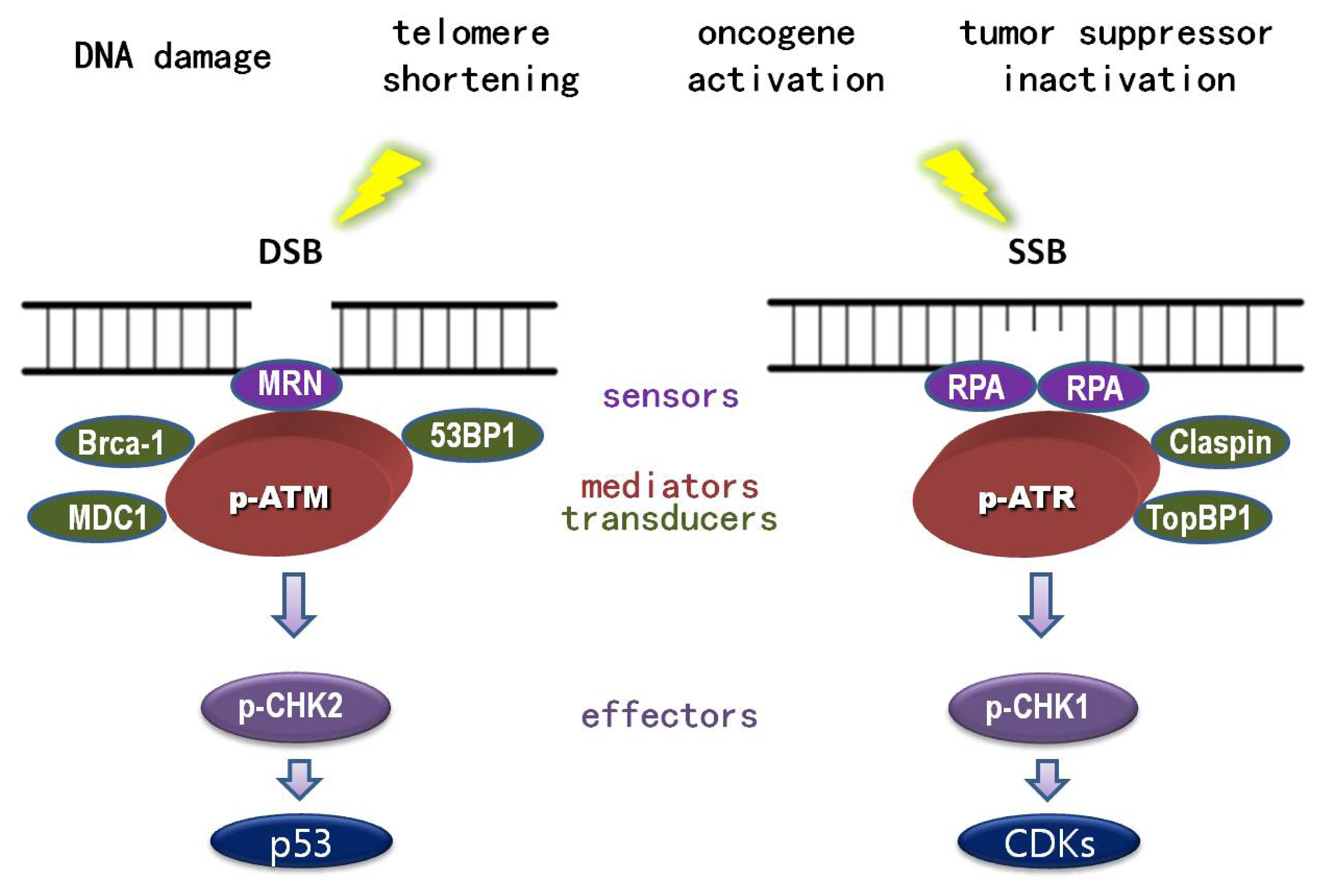
<p>In addition to repair mechanisms, individuals have evolved a so called “DNA damage response”, which is responsible for invoking a myriad of cellular events in response to genotoxic stress. DNA damage response is mainly mediated by the activation of ATM (ataxia telangiectasia mutated)-CHK2 (cell cycle the checkpoint kinase 2)-p53 and ATR (ataxia telangiectasia and rad3-related)-CHK1 (cell cycle checkpoint kinase 1)-CDKs (Cyclin-dependent kinases) pathways. Once activated, these signaling cascades can trigger cell cycle arrest (so called “checkpoint”), thereby gaining time for DNA damage repair and preventing the propagation of damaged cells [<xref ref-type="bibr" rid="b2-ijms-14-02431">2</xref>–<xref ref-type="bibr" rid="b5-ijms-14-02431">5</xref>]. ATM and ATR belong to the same family and share some functional redundancy. However, these proteins are distinct because they respond to different aberrant DNA structures. ATM, in principle, is elicited by double-strand breaks (DSB) and recruited via interaction with DSB sensors, MRN complex (MRE11-RAD50-NBS1) [<xref ref-type="bibr" rid="b6-ijms-14-02431">6</xref>–<xref ref-type="bibr" rid="b12-ijms-14-02431">12</xref>]. In contrast, ATR is induced by single-strand breaks (SSB) and engaged by its partner protein, ATRIP (ATR interacting protein) through interaction with the SSB sensor RPA (replicative protein A) [<xref ref-type="bibr" rid="b13-ijms-14-02431">13</xref>–<xref ref-type="bibr" rid="b17-ijms-14-02431">17</xref>]. Consequently, phosphorylated ATM and ATR, acting as transducer proteins, can active the effector kinases CHK1 and CHK2, with the help of the mediator proteins; MDC1 (mediator of DNA damage checkpoint), 53BP1 (p53-binding protein 1), BRCA1 (breast cancer 1) for ATM, and TopBP1 (topoisomerase-binding protein 1) and Claspin for ATR [<xref ref-type="bibr" rid="b1-ijms-14-02431">1</xref>,<xref ref-type="bibr" rid="b18-ijms-14-02431">18</xref>,<xref ref-type="bibr" rid="b19-ijms-14-02431">19</xref>] (<xref ref-type="fig" rid="f1-ijms-14-02431">Figure 1</xref>). Under normal circumstances, p53 is easily degraded and hence rarely detected. Upon stress, p53 is phosphorylated and stabilized following ATM and, to a less extent, ATR stimulation [<xref ref-type="bibr" rid="b20-ijms-14-02431">20</xref>–<xref ref-type="bibr" rid="b23-ijms-14-02431">23</xref>]. Additionally, p53 stabilization can be achieved through ARF (alternate reading frame) activation imposed by oncogene-induced replication stress [<xref ref-type="bibr" rid="b24-ijms-14-02431">24</xref>]. The stimulation of ARF relieves the inhibitory effect of MDM2 (mouse double minute 2 homolog) on p53 [<xref ref-type="bibr" rid="b25-ijms-14-02431">25</xref>–<xref ref-type="bibr" rid="b27-ijms-14-02431">27</xref>]. Once p53 is stabilized and activated, it can orchestrate a range of cellular stress responses including cell cycle arrest, senescence and apoptosis. The various outcomes are determined by the intensity of stress as well as the tissue and cellular context [<xref ref-type="bibr" rid="b28-ijms-14-02431">28</xref>,<xref ref-type="bibr" rid="b29-ijms-14-02431">29</xref>].</p></sec></sec>
<sec>
<title>2. Pathways of Senescence-Associated Cell Cycle Arrest</title>
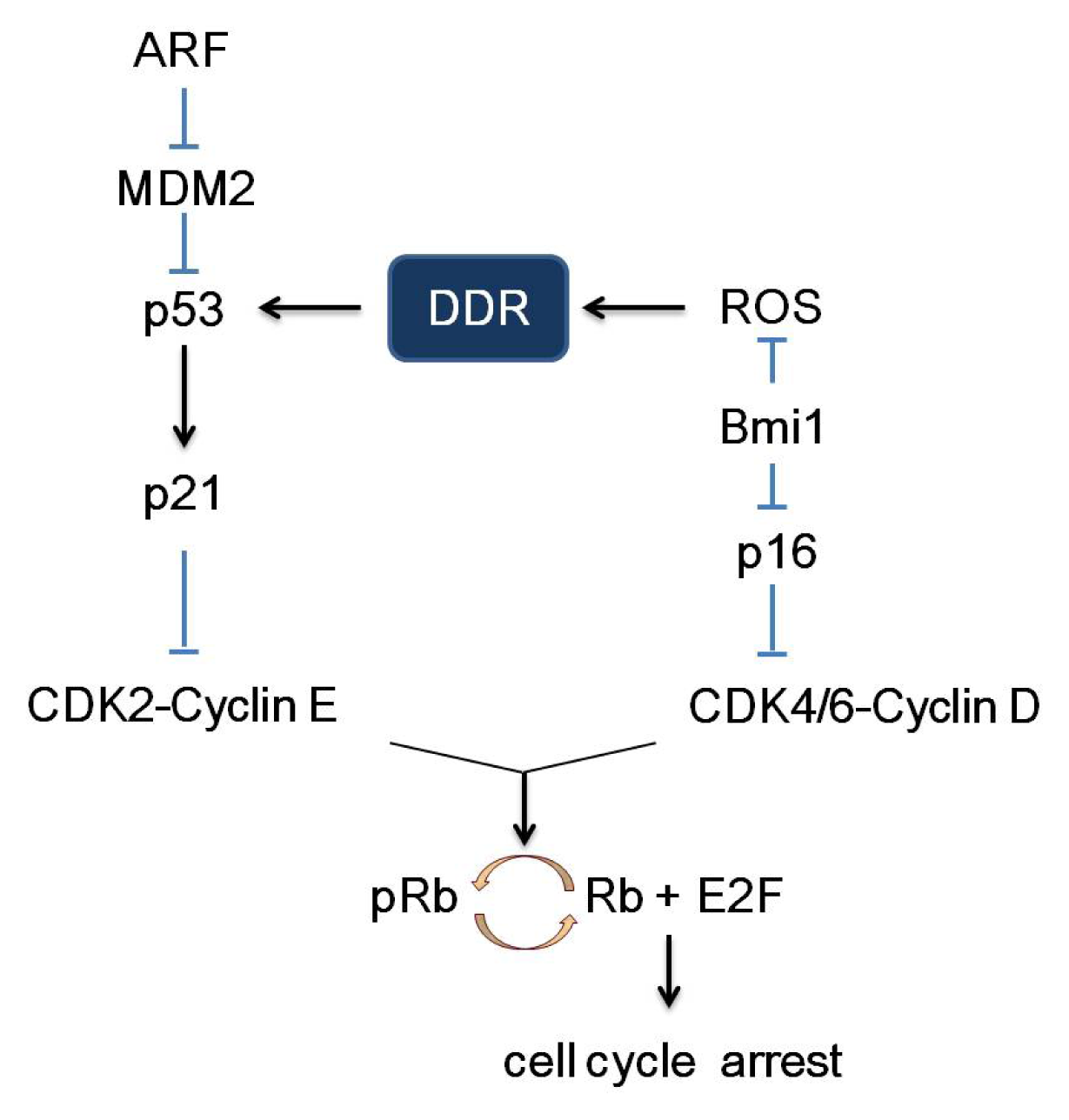
<p>The cell cycle, comprised of S phase (DNA synthesis), M phase (mitosis) and two gap phases (G0 and G1), is coordinately regulated by cell cycle proteins (cyclins), cyclin-dependent kinases (CDKs) and cyclin-dependent kinase inhibitors (CDKIs). CDKIs are negative modulators of cell cycle and hence also viewed as tumor suppressor genes. CDKIs can be grouped into two categories, the KIP/CIP family (p21<sup>Cip1</sup>, p27<sup>Kip1</sup> and p57<sup>KipII</sup>) and the INK4 family (p16<sup>Ink4a</sup>, p15<sup>Ink4b</sup>, p18<sup>Ink4c</sup> and p19<sup>Ink4d</sup>). As illustrated in <xref ref-type="fig" rid="f2-ijms-14-02431">Figure 2</xref>, through cellular events triggered by genomic stress, stimulated p53 transactivates p21, which, in turn, inhibits CDK2/cyclin E and thereby retains Rb (Retinoblastoma) in an inactive unphosphorylated state. Unphosphorylated Rb suppresses the function of the G1/S phase-promoting, E2F, and as a result, cells are subjected to proliferation arrest and DNA damage repair [<xref ref-type="bibr" rid="b30-ijms-14-02431">30</xref>–<xref ref-type="bibr" rid="b32-ijms-14-02431">32</xref>]. Compelling evidence also points to a critical role of p16 as one of the central modulators of cell cycle arrest. The p16 can inhibit the CDK4-6/cyclin D complex thereby reducing Rb phosphorylation and subsequent downstream signal transduction pathways. Thus, cells will arrest in G1 phase and fail to complete the cell cycle. Since both pathways engage pRb, it is plausible to speculate proliferation arrest, in response to cellular stress, which is coordinately regulated by p53/p21/pRb/E2F and p16/pRb/E2F signal transduction pathways.</p>
<p>Senescence is a permanent form of cell-cycle arrest, first discovered in normal human fibroblasts by Hayflick [<xref ref-type="bibr" rid="b34-ijms-14-02431">34</xref>]. Unlike normal cells, senescent cells are relatively stable, lacking proliferation capacity but retaining metabolic activity. These cells possess large and flattened morphology, increased intracellular particles, as well as enhanced senescence-associated β-galactosidase (SA-β-gal) activity. Under normal circumstances, as cells cycles, telomere, a special structure at the ends of chromosomes, is gradually shortened. When the length of the telomere reaches a certain limit, cell proliferation is halted and cellular senescence is elicited [<xref ref-type="bibr" rid="b35-ijms-14-02431">35</xref>]. Such senescence is known as replicative senescence. In addition to the replicative senescence, senescence can also result from DNA damage aroused from oxidative stress or oncogene activation-induced replication stress, which is termed as premature senescence, or oncogene-induced senescence (OIS) [<xref ref-type="bibr" rid="b36-ijms-14-02431">36</xref>–<xref ref-type="bibr" rid="b39-ijms-14-02431">39</xref>].</p>
<p>Consistent with the notion that senescence is a permanent form of cell cycle arrest, factors central to checkpoint events, such as p53, p21, p16 and Rb, are also key regulators of the senescence program. In human cells, replication senescence is commonly dependent on p53/p21/pRb/E2F pathway, whereas premature senescence can be mediated through p53/p21/pRb/E2F pathway, p16/pRb/E2F pathway or both [<xref ref-type="bibr" rid="b35-ijms-14-02431">35</xref>,<xref ref-type="bibr" rid="b40-ijms-14-02431">40</xref>]. Mechanistically, little is known as to how a cell chooses one way over the other, however, some evidence implies that it might be associated with types of stimulus and cell context [<xref ref-type="bibr" rid="b41-ijms-14-02431">41</xref>–<xref ref-type="bibr" rid="b44-ijms-14-02431">44</xref>]. Given the complexity of cellular responses to various stimuli, the chances are that these pathways could be cooperative and intertwined in stress-induced senescence and associated cell cycle arrest [<xref ref-type="bibr" rid="b45-ijms-14-02431">45</xref>,<xref ref-type="bibr" rid="b46-ijms-14-02431">46</xref>].</p></sec>
<sec>
<title>3. DDR Is the Common Link between Tumorigenesis and Senescence</title>
<p>It has been known for decades that constitutive activation of oncogenes, such as Ras, is capable of driving the proliferation of malignant tumor cells [<xref ref-type="bibr" rid="b47-ijms-14-02431">47</xref>]. Together with the observations that expression of the same oncogenes in normal cell culture leads to cell senescence rather than cell transformation [<xref ref-type="bibr" rid="b36-ijms-14-02431">36</xref>,<xref ref-type="bibr" rid="b48-ijms-14-02431">48</xref>,<xref ref-type="bibr" rid="b49-ijms-14-02431">49</xref>], it raises an obvious question as to how oncogenes lead to both tumor and senescence in a similar scenario. One explanation to reconcile the paradox is that oncogene-induced DDR and resultant senescence may occur prior to tumorigenesis, imposing an intrinsic barrier to the development of the malignant tumor. In effect, a large body of emerging evidence from both bench and clinical works supports this conception [<xref ref-type="bibr" rid="b50-ijms-14-02431">50</xref>–<xref ref-type="bibr" rid="b52-ijms-14-02431">52</xref>]. In the early stages of tumor formation, many factors along the DDR pathway, such as ATM, CHK1, CHK 2, p53 and p16, as well as markers of DNA damage foci, such as H2AX and 53BP1, could be detected, mostly in their phosphorylated activated form [<xref ref-type="bibr" rid="b50-ijms-14-02431">50</xref>,<xref ref-type="bibr" rid="b51-ijms-14-02431">51</xref>,<xref ref-type="bibr" rid="b53-ijms-14-02431">53</xref>–<xref ref-type="bibr" rid="b58-ijms-14-02431">58</xref>]. Senescent cells and their specific markers, such as SA-β-Gal, were also present in precancerous lesions [<xref ref-type="bibr" rid="b53-ijms-14-02431">53</xref>,<xref ref-type="bibr" rid="b59-ijms-14-02431">59</xref>–<xref ref-type="bibr" rid="b64-ijms-14-02431">64</xref>]. The correlation between markers of activated DDR with those of cellular senescence reinforces the crucial role of DDR signaling in oncogene-induced senescence [<xref ref-type="bibr" rid="b50-ijms-14-02431">50</xref>,<xref ref-type="bibr" rid="b51-ijms-14-02431">51</xref>,<xref ref-type="bibr" rid="b65-ijms-14-02431">65</xref>]. Remarkably, markers for senescence-associated DDR were attenuated or absent in the later stage of cancer [<xref ref-type="bibr" rid="b53-ijms-14-02431">53</xref>,<xref ref-type="bibr" rid="b59-ijms-14-02431">59</xref>–<xref ref-type="bibr" rid="b62-ijms-14-02431">62</xref>], leading to the speculation that senescence impinges selective pressure on hyper-proliferative tumors with mutations of checkpoint genes. Agreeably, cells escaped from OIS by depletion or inhibition of several important DNA damage signaling factors, such as 53BP1, ATM, CHK1, CHK2, and p53, predisposes to cell proliferation and oncogenic transformation [<xref ref-type="bibr" rid="b36-ijms-14-02431">36</xref>,<xref ref-type="bibr" rid="b50-ijms-14-02431">50</xref>,<xref ref-type="bibr" rid="b51-ijms-14-02431">51</xref>,<xref ref-type="bibr" rid="b53-ijms-14-02431">53</xref>,<xref ref-type="bibr" rid="b54-ijms-14-02431">54</xref>,<xref ref-type="bibr" rid="b57-ijms-14-02431">57</xref>,<xref ref-type="bibr" rid="b58-ijms-14-02431">58</xref>]. Collectively, based on the results summarized above, the following concepts are emerging: (1) DNA damage is the common driving force for both tumorigenesis and cellular senescence (2) senescence-associated DDR acts as a natural barrier for tumorigenesis, and abrogation of the barrier may rescue defective cell growth and limit cell senescence in the incipient malignant form but at the expense of tumor progression [<xref ref-type="bibr" rid="b66-ijms-14-02431">66</xref>–<xref ref-type="bibr" rid="b68-ijms-14-02431">68</xref>]. The outcome as to whether cells predispose to tumor or senescence upon DNA damage is largely dependent on the competence of DDR signaling. To achieve the “Yin-Yang balance” of DDR, signaling is critical for preventing both tumors and senescence. The Yin and Yang of DDR in tumors and senescence could be further exemplified in the light of a number of <italic>in vivo</italic> mice models with genetic deletions of certain genes involved in the DDR pathways.</p>
<sec>
<title>3.1. p53</title>
<p>Given the critical role of p53 as the “guardian of the genome”, its activity must be tightly regulated. Either too much, or too little p53 activity will have adverse effects, as demonstrated comprehensively in various mouse models using gene manipulation to alter p53 levels [<xref ref-type="bibr" rid="b69-ijms-14-02431">69</xref>,<xref ref-type="bibr" rid="b70-ijms-14-02431">70</xref>]. The p53 null mice are largely tumor-prone, consistent with the fact that p53 mutations are the most prevalent mutations in human cancers [<xref ref-type="bibr" rid="b71-ijms-14-02431">71</xref>–<xref ref-type="bibr" rid="b74-ijms-14-02431">74</xref>]. By contrast, mice with high p53 activity, such as p53<sup>+/m</sup> mice, are less cancer-prone compared to the control mice, but display obvious age-related phenotypes such as tissue atrophy [<xref ref-type="bibr" rid="b69-ijms-14-02431">69</xref>,<xref ref-type="bibr" rid="b75-ijms-14-02431">75</xref>]. The overall high p53 activity in p53<sup>+/m</sup> mice was attributed to the stabilization and enhancement of the p53 by the m allele product [<xref ref-type="bibr" rid="b69-ijms-14-02431">69</xref>]. These findings clearly demonstrated the existence of a delicate balance between the tumor suppression and age promoting functions of p53. To optimize the outcome of p53-dependent DNA damage response and tip the Yin-Yang balance between tumor suppression and age promoting it is crucial to involve p53 in clinical applications. Cancer protection without negatively affecting aging was observed in mice containing an extra copy of p53 (super-p53 mice) [<xref ref-type="bibr" rid="b76-ijms-14-02431">76</xref>,<xref ref-type="bibr" rid="b77-ijms-14-02431">77</xref>]. In contrast to the p53<sup>+/m</sup> mice model, the desired phenotype from super-p53 mice might be attributed to the maintenance of the normal regulation of p53 activity. Nevertheless, super-p53 mice raise great hopes of involving p53 as a potential anti-tumor treatment and further studies are needed to ascertain whether this scenario could be sustainable in humans.</p></sec>
<sec>
<title>3.2. p21 and p27</title>
<p>It is commonly noted that p53-induced senescence is executed, at least partly, via p21 upregulation [<xref ref-type="bibr" rid="b45-ijms-14-02431">45</xref>]. The p21 levels are elevated in prematurely senescing fibroblasts in both humans and mice displaying premature aging syndromes, and p21<sup>−/−</sup> mice exhibited deficiencies in senescence response in comparison to WT mice after UV damage [<xref ref-type="bibr" rid="b78-ijms-14-02431">78</xref>–<xref ref-type="bibr" rid="b81-ijms-14-02431">81</xref>]. In support of the notion that p53/p21 is the major determinant in response to telomere-dysfunction-aroused replicative senescence, p21 deficiency could reverse the short lifespan of mice with telomerase deficiency (Terc<sup>−/−</sup>) [<xref ref-type="bibr" rid="b82-ijms-14-02431">82</xref>,<xref ref-type="bibr" rid="b83-ijms-14-02431">83</xref>]. By contrast, lacking p53 increases genomic instability and cancer formation <italic>in vivo</italic>, thereby reducing the lifespan of mice with dysfunctional telomeres [<xref ref-type="bibr" rid="b84-ijms-14-02431">84</xref>,<xref ref-type="bibr" rid="b85-ijms-14-02431">85</xref>]. In the early age of p21<sup>−/−</sup> mice, tumor is rarely detected and an increased tumor formation occurs at an average age of 16 months, with the most common tumor types being sarcomas and B cell lymphomas [<xref ref-type="bibr" rid="b86-ijms-14-02431">86</xref>,<xref ref-type="bibr" rid="b87-ijms-14-02431">87</xref>]. Mice with genetic deletion of DDB2 (damaged DNA binding protein 2), a significant player in recognizing DNA damage in NER (nucleotide excision repair), exhibited reduced senescence response and induced enhanced incidence of UV-induced skin cancers in comparison to wild-type mice [<xref ref-type="bibr" rid="b81-ijms-14-02431">81</xref>,<xref ref-type="bibr" rid="b88-ijms-14-02431">88</xref>–<xref ref-type="bibr" rid="b91-ijms-14-02431">91</xref>]. A stronger inhibition of premature senescence and accelerated tumor formation in the DDB2<sup>−/−</sup> p21<sup>−/−</sup> mice compared to the DDB2<sup>−/−</sup> single knockouts, further support the tumor-suppressive role of p21 [<xref ref-type="bibr" rid="b92-ijms-14-02431">92</xref>]. However, taking into consideration the extremely low incidence of p21 mutations in human cancer and the less drastic tumor-prone phenotype in p21-deficient mice in comparison to mice deficient in other tumor suppressors, such as p53 or p16, the tumor suppressive role of p21 is not viewed as crucial. Recently, the tumor suppressive role of p21 was complicated by findings indicating that p21 has an inhibitory role in apoptosis [<xref ref-type="bibr" rid="b93-ijms-14-02431">93</xref>–<xref ref-type="bibr" rid="b95-ijms-14-02431">95</xref>]. The involvement of p21 in these pathways could confer its oncogenic activities, particularly in lymphomas [<xref ref-type="bibr" rid="b96-ijms-14-02431">96</xref>,<xref ref-type="bibr" rid="b97-ijms-14-02431">97</xref>].</p>
<p>Similar to p21, p27, another member from the KIP/CIP family, binds and inactivates CDK2-cyclin E and CDK2-cyclin A complex thereby inhibiting cell-cycle progression [<xref ref-type="bibr" rid="b98-ijms-14-02431">98</xref>]. The p27 expression is frequently reduced in human epithelial cancers, and is correlated with tumor progression and poor survival [<xref ref-type="bibr" rid="b99-ijms-14-02431">99</xref>–<xref ref-type="bibr" rid="b103-ijms-14-02431">103</xref>]. Targeted disruption of p27 in the mouse model leads to multi-organ hyperplasia, loss of senescence markers and an increased tumor latency [<xref ref-type="bibr" rid="b104-ijms-14-02431">104</xref>–<xref ref-type="bibr" rid="b108-ijms-14-02431">108</xref>].</p></sec>
<sec>
<title>3.3. BRCA1</title>
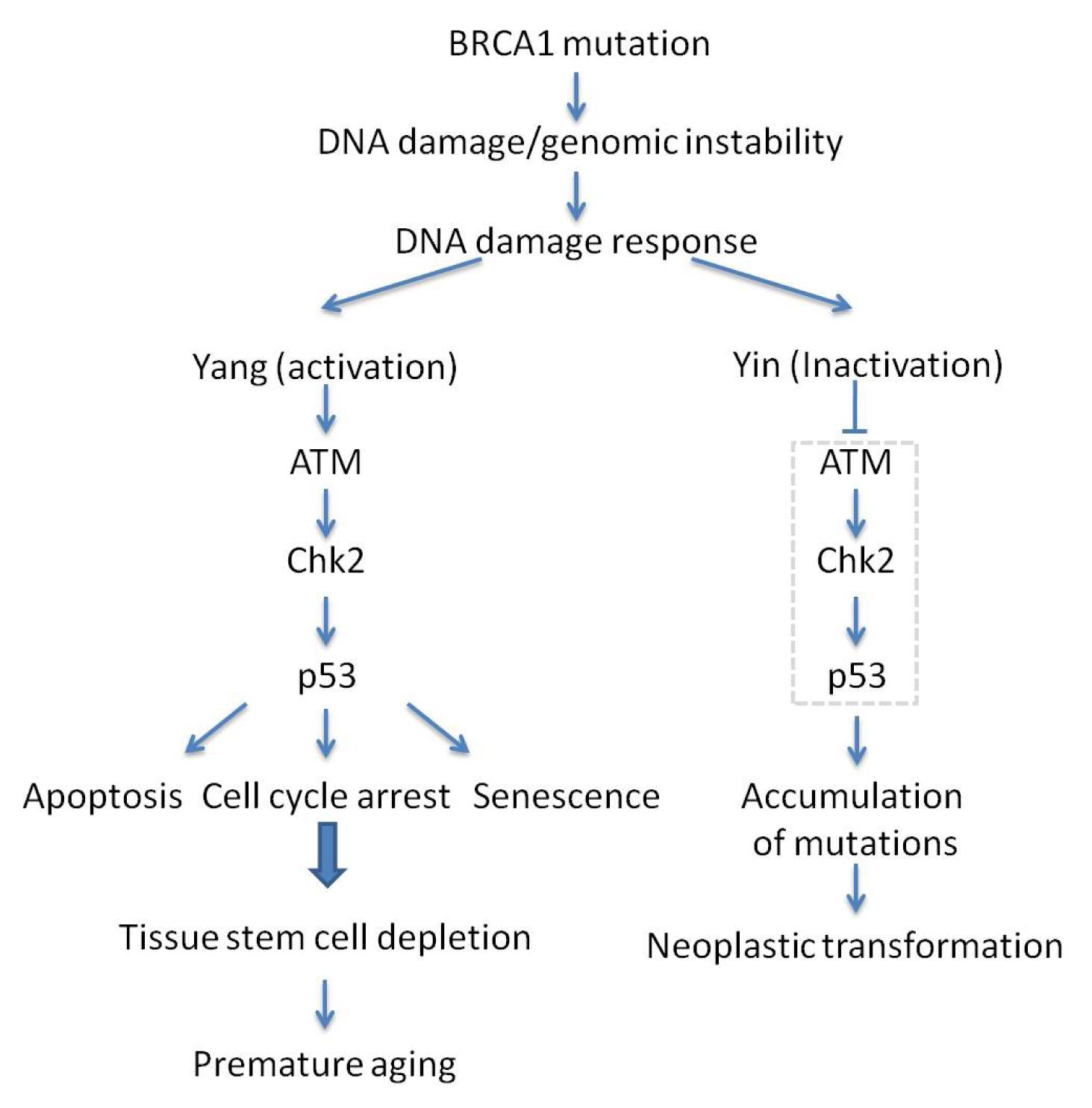
<p>The tumor suppressor BRCA1 is intimately associated with an increased risk of breast and ovarian cancer [<xref ref-type="bibr" rid="b109-ijms-14-02431">109</xref>–<xref ref-type="bibr" rid="b114-ijms-14-02431">114</xref>]. BRCA1 is a DNA damage repair protein crucial for maintaining genomic stability. The abrogation of the full-length isoform leads to genomic instability and embryonic death [<xref ref-type="bibr" rid="b114-ijms-14-02431">114</xref>–<xref ref-type="bibr" rid="b118-ijms-14-02431">118</xref>]. This lethal phenotype is partially due to the excessive activation of the ATM-CHK2-p53 axis which leads to accelerated aging, in response to untimely repaired chromosome breaks in the absence of BRCA1 [<xref ref-type="bibr" rid="b119-ijms-14-02431">119</xref>,<xref ref-type="bibr" rid="b120-ijms-14-02431">120</xref>]. In support of this notion, loss of p53 prolonged the survival of BRCA1 mutant embryos from E7.5 to E9.5 [<xref ref-type="bibr" rid="b121-ijms-14-02431">121</xref>]. Moreover, haploid loss of p53 in BRCA1 null mice (BRCA1<sup>Δ11/Δ11</sup> p53<sup>+/−</sup>) could completely overcome embryonic lethality, but display cancer susceptibility mostly in female mice, and premature aging, mainly in male mice [<xref ref-type="bibr" rid="b119-ijms-14-02431">119</xref>,<xref ref-type="bibr" rid="b122-ijms-14-02431">122</xref>]. The survival of BRCA1<sup>Δ11/Δ11</sup> p53<sup>+/−</sup> mice makes it a surrogate model to study the link between BRCA1 and aging. Consistent with the contribution of DDR cascade in BRCA1 deficiency, enhanced ATM and CHK2 activity was observed in BRCA1<sup>Δ11/Δ11</sup> embryos. Consistently, absence of ATM, CHK2 or 53BP1 can mean escape of embryonic lethality in BRCA1 knockout mice and suppression of accelerated aging albeit at the expense of entering a tumor-prone state [<xref ref-type="bibr" rid="b120-ijms-14-02431">120</xref>,<xref ref-type="bibr" rid="b123-ijms-14-02431">123</xref>] (<xref ref-type="fig" rid="f3-ijms-14-02431">Figure 3</xref>). These observations highlight the critical role of genetic integrity, whose compromise may disturb organismal homeostasis and result in senescence and cancer.</p></sec>
<sec>
<title>3.4. p16 and Bmi1</title>
<p>It is evident that p16, another important component within the DDR network, is largely involved in the senescence program, acting not only as an effector but also a biomarker of senescence [<xref ref-type="bibr" rid="b124-ijms-14-02431">124</xref>–<xref ref-type="bibr" rid="b129-ijms-14-02431">129</xref>]. The expression of p16 is markedly elevated with age in both rodents and human tissues [<xref ref-type="bibr" rid="b128-ijms-14-02431">128</xref>,<xref ref-type="bibr" rid="b129-ijms-14-02431">129</xref>]. Nevertheless, mice deficient in p16 displayed an increased incidence of tumorigenesis and loss of inactivation of p16 accounts for more than 30% of human tumors [<xref ref-type="bibr" rid="b130-ijms-14-02431">130</xref>–<xref ref-type="bibr" rid="b133-ijms-14-02431">133</xref>]. Hence, p16 is ubiquitously linked to both tumorigenesis and senescence. Bmi1, a polycomb group protein, is a transcriptional repressor of p16. Overexpression of Bmi1 could extend the replicative life span of primary cells but promote the formation of lymphomas [<xref ref-type="bibr" rid="b42-ijms-14-02431">42</xref>,<xref ref-type="bibr" rid="b134-ijms-14-02431">134</xref>–<xref ref-type="bibr" rid="b137-ijms-14-02431">137</xref>]. Conversely, mouse embryonic fibroblasts deficient in Bmi1 possess high p16 activity and undergo premature senescence, which can be relieved partially in the absence of p16 [<xref ref-type="bibr" rid="b42-ijms-14-02431">42</xref>]. However, the median survival of Bmi1<sup>−/−</sup> mice cannot be extended by p16 deficiency, but instead it could be improved by complete loss of CHK2 [<xref ref-type="bibr" rid="b33-ijms-14-02431">33</xref>]. It is postulated that this may be due to the inhibition of ROS-induced DDR.</p>
<p>Collectively, p53/p21 and p16/Rb pathways are not only important for DDR signaling, but also critical in maintaining cellular and genomic homeostasis. Several lines of evidence indicate p53/p21 and p16/Rb pathways are collaborative. For instance, MEF derived from p21 and p16 double knockout mice displayed no evidence of cellular senescence to Ras-induced senescence and have a higher incidence of cancer compared to either of the single KO mice [<xref ref-type="bibr" rid="b138-ijms-14-02431">138</xref>,<xref ref-type="bibr" rid="b139-ijms-14-02431">139</xref>].</p></sec></sec>
<sec>
<title>4. Will the Yin-Yang of DDR Be Beneficial for Clinical Treatment of Cancer?</title>
<p>The key mechanism of the most prevalent cancer therapy, radiation therapy and chemotherapy, is to damage DNA and consequently trigger DDR, tumor growth arrest, apoptosis and senescence [<xref ref-type="bibr" rid="b140-ijms-14-02431">140</xref>–<xref ref-type="bibr" rid="b142-ijms-14-02431">142</xref>]. The extensive DNA damage induced by these current therapies inevitably puts patients to severe side effect risk such as hair loss and bone marrow suppression [<xref ref-type="bibr" rid="b143-ijms-14-02431">143</xref>]. Given the frequent loss of critical DDR proteins in cancer, new possibilities for tumor intervention have been postulated to re-establish the barrier or even induce tumor to senescence through exogenously introducing or molecular targeting of proteins involved in the DDR signaling. Recent studies found that chemotherapy or gene therapy, by modulating the activity of p16, p53, pRb or p21, could navigate tumor cells to senescent cells and have a substantial therapeutic effect on tumor inhibition [<xref ref-type="bibr" rid="b61-ijms-14-02431">61</xref>,<xref ref-type="bibr" rid="b144-ijms-14-02431">144</xref>–<xref ref-type="bibr" rid="b146-ijms-14-02431">146</xref>]. More recently, a number of senescence-inducing small molecules entered clinical trials [<xref ref-type="bibr" rid="b147-ijms-14-02431">147</xref>–<xref ref-type="bibr" rid="b151-ijms-14-02431">151</xref>]. Certainly, the safety of pro-senescence therapy needs to be carefully evaluated before translating it into a clinically relevant context. Senescence is frequently accompanied with oxidative stress, altered tissue microenvironment and release of inflammatory cytokines [<xref ref-type="bibr" rid="b147-ijms-14-02431">147</xref>,<xref ref-type="bibr" rid="b152-ijms-14-02431">152</xref>,<xref ref-type="bibr" rid="b153-ijms-14-02431">153</xref>]. All of these could potentially promote cancer and aging phenotypes [<xref ref-type="bibr" rid="b40-ijms-14-02431">40</xref>,<xref ref-type="bibr" rid="b154-ijms-14-02431">154</xref>]. Greater understanding of the molecular mechanisms involved in senescence and tumors will provide valuable new insights into how to bypass undesired side effects in senescence-inducing treatment. In the near future, it is warranted to consider the combination of pro-senescence strategies with already established treatments.</p></sec>
<sec sec-type="conclusions">
<title>5. Conclusions</title>
<p>Organisms are natural perfectionists and dedicated hard workers. In case of any threat, a myriad of mechanisms engage in an intricate interplay to keep damage to a minimum. Networks of molecules have evolved to work coordinately to maintain the homeostasis of the body. However, imbalanced DNA damage response, upon genotoxic stress, can endanger cellular homeostasis, leading to the transition from a healthy to a disease state, including senescence and cancer. As we learned from ancient Chinese philosophy, finding the balance between “Yin and Yang” will ensure both health and longevity.</p></sec></body>
<back>
<ack>
<title>Acknowledgments</title>
<p>This work was supported by grants from the Natural Science Foundation of China to Liu Cao (81130042 and 31171323) and from the University Innovation Team support plan of Liaoning to Liu Cao (LT2011011).</p></ack>
<fn-group><fn id="fn1-ijms-14-02431">
<p><bold>Conflict of Interest</bold></p>
<p>The authors declare no conflict of interest.</p></fn></fn-group>
<ref-list>
<title>References</title>
<ref id="b1-ijms-14-02431"><label>1</label><citation citation-type="journal"><person-group person-group-type="author"><name><surname>Thompson</surname><given-names>L.H.</given-names></name></person-group><article-title>Recognition, signaling, and repair of DNA double-strand breaks produced by ionizing radiation in mammalian cells: The molecular choreography</article-title><source>Mutat. Res</source><year>2012</year><volume>751</volume><fpage>158</fpage><lpage>246</lpage><pub-id pub-id-type="doi">10.1016/j.mrrev.2012.06.002</pub-id><pub-id pub-id-type="pmid">22743550</pub-id></citation></ref>
<ref id="b2-ijms-14-02431"><label>2</label><citation citation-type="journal"><person-group person-group-type="author"><name><surname>Lopez-Girona</surname><given-names>A.</given-names></name><name><surname>Tanaka</surname><given-names>K.</given-names></name><name><surname>Chen</surname><given-names>X.B.</given-names></name><name><surname>Baber</surname><given-names>B.A.</given-names></name><name><surname>McGowan</surname><given-names>C.H.</given-names></name><name><surname>Russell</surname><given-names>P.</given-names></name></person-group><article-title>Serine-345 is required for Rad3-dependent phosphorylation and function of checkpoint kinase Chk1 in fission yeast</article-title><source>Proc. Natl. Acad. Sci. USA</source><year>2001</year><volume>98</volume><fpage>11289</fpage><lpage>11294</lpage><pub-id pub-id-type="doi">10.1073/pnas.191557598</pub-id><pub-id pub-id-type="pmid">11553781</pub-id></citation></ref>
<ref id="b3-ijms-14-02431"><label>3</label><citation citation-type="journal"><person-group person-group-type="author"><name><surname>Reinhardt</surname><given-names>H.C.</given-names></name><name><surname>Yaffe</surname><given-names>M.B.</given-names></name></person-group><article-title>Kinases that control the cell cycle in response to DNA damage: Chk1, Chk2, and MK2</article-title><source>Curr. Opin. Cell Biol</source><year>2009</year><volume>21</volume><fpage>245</fpage><lpage>255</lpage><pub-id pub-id-type="doi">10.1016/j.ceb.2009.01.018</pub-id><pub-id pub-id-type="pmid">19230643</pub-id></citation></ref>
<ref id="b4-ijms-14-02431"><label>4</label><citation citation-type="journal"><person-group person-group-type="author"><name><surname>Guo</surname><given-names>Z.</given-names></name><name><surname>Kumagai</surname><given-names>A.</given-names></name><name><surname>Wang</surname><given-names>S.X.</given-names></name><name><surname>Dunphy</surname><given-names>W.G.</given-names></name></person-group><article-title>Requirement for Atr in phosphorylation of Chk1 and cell cycle regulation in response to DNA replication blocks and UV-damaged DNA in Xenopus egg extracts</article-title><source>Genes Dev</source><year>2000</year><volume>14</volume><fpage>2745</fpage><lpage>2756</lpage><pub-id pub-id-type="doi">10.1101/gad.842500</pub-id><pub-id pub-id-type="pmid">11069891</pub-id></citation></ref>
<ref id="b5-ijms-14-02431"><label>5</label><citation citation-type="journal"><person-group person-group-type="author"><name><surname>Zhao</surname><given-names>H.</given-names></name><name><surname>Piwnica-Worms</surname><given-names>H.</given-names></name></person-group><article-title>ATR-mediated checkpoint pathways regulate phosphorylation and activation of human Chk1</article-title><source>Mol. Cell Biol</source><year>2001</year><volume>21</volume><fpage>4129</fpage><lpage>4139</lpage><pub-id pub-id-type="doi">10.1128/MCB.21.13.4129-4139.2001</pub-id><pub-id pub-id-type="pmid">11390642</pub-id></citation></ref>
<ref id="b6-ijms-14-02431"><label>6</label><citation citation-type="journal"><person-group person-group-type="author"><name><surname>Lee</surname><given-names>J.H.</given-names></name><name><surname>Paull</surname><given-names>T.T.</given-names></name></person-group><article-title>ATM activation by DNA double-strand breaks through the Mre11-Rad50-Nbs1 complex</article-title><source>Science</source><year>2005</year><volume>308</volume><fpage>551</fpage><lpage>554</lpage><pub-id pub-id-type="doi">10.1126/science.1108297</pub-id><pub-id pub-id-type="pmid">15790808</pub-id></citation></ref>
<ref id="b7-ijms-14-02431"><label>7</label><citation citation-type="journal"><person-group person-group-type="author"><name><surname>Suzuki</surname><given-names>K.</given-names></name><name><surname>Kodama</surname><given-names>S.</given-names></name><name><surname>Watanabe</surname><given-names>M.</given-names></name></person-group><article-title>Recruitment of ATM protein to double strand DNA irradiated with ionizing radiation</article-title><source>J. Biol. Chem</source><year>1999</year><volume>274</volume><fpage>25571</fpage><lpage>25575</lpage><pub-id pub-id-type="doi">10.1074/jbc.274.36.25571</pub-id><pub-id pub-id-type="pmid">10464290</pub-id></citation></ref>
<ref id="b8-ijms-14-02431"><label>8</label><citation citation-type="journal"><person-group person-group-type="author"><name><surname>Lee</surname><given-names>J.H.</given-names></name><name><surname>Paull</surname><given-names>T.T.</given-names></name></person-group><article-title>Activation and regulation of ATM kinase activity in response to DNA double-strand breaks</article-title><source>Oncogene</source><year>2007</year><volume>26</volume><fpage>7741</fpage><lpage>7748</lpage><pub-id pub-id-type="doi">10.1038/sj.onc.1210872</pub-id><pub-id pub-id-type="pmid">18066086</pub-id></citation></ref>
<ref id="b9-ijms-14-02431"><label>9</label><citation citation-type="journal"><person-group person-group-type="author"><name><surname>Lee</surname><given-names>J.H.</given-names></name><name><surname>Paull</surname><given-names>T.T.</given-names></name></person-group><article-title>Direct activation of the ATM protein kinase by the Mre11/Rad50/Nbs1 complex</article-title><source>Science</source><year>2004</year><volume>304</volume><fpage>93</fpage><lpage>96</lpage><pub-id pub-id-type="doi">10.1126/science.1091496</pub-id><pub-id pub-id-type="pmid">15064416</pub-id></citation></ref>
<ref id="b10-ijms-14-02431"><label>10</label><citation citation-type="journal"><person-group person-group-type="author"><name><surname>Lisby</surname><given-names>M.</given-names></name><name><surname>Barlow</surname><given-names>J.H.</given-names></name><name><surname>Burgess</surname><given-names>R.C.</given-names></name><name><surname>Rothstein</surname><given-names>R.</given-names></name></person-group><article-title>Choreography of the DNA damage response: Spatiotemporal relationships among checkpoint and repair proteins</article-title><source>Cell</source><year>2004</year><volume>118</volume><fpage>699</fpage><lpage>713</lpage><pub-id pub-id-type="doi">10.1016/j.cell.2004.08.015</pub-id><pub-id pub-id-type="pmid">15369670</pub-id></citation></ref>
<ref id="b11-ijms-14-02431"><label>11</label><citation citation-type="journal"><person-group person-group-type="author"><name><surname>Kim</surname><given-names>J.S.</given-names></name><name><surname>Krasieva</surname><given-names>T.B.</given-names></name><name><surname>Kurumizaka</surname><given-names>H.</given-names></name><name><surname>Chen</surname><given-names>D.J.</given-names></name><name><surname>Taylor</surname><given-names>A.M.</given-names></name><name><surname>Yokomori</surname><given-names>K.</given-names></name></person-group><article-title>Independent and sequential recruitment of NHEJ and HR factors to DNA damage sites in mammalian cells</article-title><source>J. Cell Biol</source><year>2005</year><volume>170</volume><fpage>341</fpage><lpage>347</lpage><pub-id pub-id-type="doi">10.1083/jcb.200411083</pub-id><pub-id pub-id-type="pmid">16061690</pub-id></citation></ref>
<ref id="b12-ijms-14-02431"><label>12</label><citation citation-type="journal"><person-group person-group-type="author"><name><surname>Uziel</surname><given-names>T.</given-names></name><name><surname>Lerenthal</surname><given-names>Y.</given-names></name><name><surname>Moyal</surname><given-names>L.</given-names></name><name><surname>Andegeko</surname><given-names>Y.</given-names></name><name><surname>Mittelman</surname><given-names>L.</given-names></name><name><surname>Shiloh</surname><given-names>Y.</given-names></name></person-group><article-title>Requirement of the MRN complex for ATM activation by DNA damage</article-title><source>EMBO J</source><year>2003</year><volume>22</volume><fpage>5612</fpage><lpage>5621</lpage><pub-id pub-id-type="doi">10.1093/emboj/cdg541</pub-id><pub-id pub-id-type="pmid">14532133</pub-id></citation></ref>
<ref id="b13-ijms-14-02431"><label>13</label><citation citation-type="journal"><person-group person-group-type="author"><name><surname>Dart</surname><given-names>D.A.</given-names></name><name><surname>Adams</surname><given-names>K.E.</given-names></name><name><surname>Akerman</surname><given-names>I.</given-names></name><name><surname>Lakin</surname><given-names>N.D.</given-names></name></person-group><article-title>Recruitment of the cell cycle checkpoint kinase ATR to chromatin during S-phase</article-title><source>J. Biol. Chem</source><year>2004</year><volume>279</volume><fpage>16433</fpage><lpage>16440</lpage><pub-id pub-id-type="doi">10.1074/jbc.M314212200</pub-id><pub-id pub-id-type="pmid">14871897</pub-id></citation></ref>
<ref id="b14-ijms-14-02431"><label>14</label><citation citation-type="journal"><person-group person-group-type="author"><name><surname>Lupardus</surname><given-names>P.J.</given-names></name><name><surname>Byun</surname><given-names>T.</given-names></name><name><surname>Yee</surname><given-names>M.C.</given-names></name><name><surname>Hekmat-Nejad</surname><given-names>M.</given-names></name><name><surname>Cimprich</surname><given-names>K.A.</given-names></name></person-group><article-title>A requirement for replication in activation of the ATR-dependent DNA damage checkpoint</article-title><source>Genes Dev</source><year>2002</year><volume>16</volume><fpage>2327</fpage><lpage>2332</lpage><pub-id pub-id-type="doi">10.1101/gad.1013502</pub-id><pub-id pub-id-type="pmid">12231621</pub-id></citation></ref>
<ref id="b15-ijms-14-02431"><label>15</label><citation citation-type="journal"><person-group person-group-type="author"><name><surname>Zou</surname><given-names>L.</given-names></name><name><surname>Elledge</surname><given-names>S.J.</given-names></name></person-group><article-title>Sensing DNA damage through ATRIP recognition of RPA-ssDNA complexes</article-title><source>Science</source><year>2003</year><volume>300</volume><fpage>1542</fpage><lpage>1548</lpage><pub-id pub-id-type="doi">10.1126/science.1083430</pub-id><pub-id pub-id-type="pmid">12791985</pub-id></citation></ref>
<ref id="b16-ijms-14-02431"><label>16</label><citation citation-type="journal"><person-group person-group-type="author"><name><surname>Smith</surname><given-names>J.</given-names></name><name><surname>Tho</surname><given-names>L.M.</given-names></name><name><surname>Xu</surname><given-names>N.</given-names></name><name><surname>Gillespie</surname><given-names>D.A.</given-names></name></person-group><article-title>The ATM-Chk2 and ATR-Chk1 pathways in DNA damage signaling and cancer</article-title><source>Adv. Cancer Res</source><year>2010</year><volume>108</volume><fpage>73</fpage><lpage>112</lpage><pub-id pub-id-type="pmid">21034966</pub-id></citation></ref>
<ref id="b17-ijms-14-02431"><label>17</label><citation citation-type="journal"><person-group person-group-type="author"><name><surname>Cortez</surname><given-names>D.</given-names></name><name><surname>Guntuku</surname><given-names>S.</given-names></name><name><surname>Qin</surname><given-names>J.</given-names></name><name><surname>Elledge</surname><given-names>S.J.</given-names></name></person-group><article-title>ATR and ATRIP: Partners in checkpoint signaling</article-title><source>Science</source><year>2001</year><volume>294</volume><fpage>1713</fpage><lpage>1716</lpage><pub-id pub-id-type="doi">10.1126/science.1065521</pub-id><pub-id pub-id-type="pmid">11721054</pub-id></citation></ref>
<ref id="b18-ijms-14-02431"><label>18</label><citation citation-type="journal"><person-group person-group-type="author"><name><surname>Noon</surname><given-names>A.T.</given-names></name><name><surname>Goodarzi</surname><given-names>A.A.</given-names></name></person-group><article-title>53BP1-mediated DNA double strand break repair: Insert bad pun here</article-title><source>DNA Repair</source><year>2011</year><volume>10</volume><fpage>1071</fpage><lpage>1076</lpage><pub-id pub-id-type="doi">10.1016/j.dnarep.2011.07.012</pub-id><pub-id pub-id-type="pmid">21868291</pub-id></citation></ref>
<ref id="b19-ijms-14-02431"><label>19</label><citation citation-type="journal"><person-group person-group-type="author"><name><surname>Polo</surname><given-names>S.E.</given-names></name><name><surname>Jackson</surname><given-names>S.P.</given-names></name></person-group><article-title>Dynamics of DNA damage response proteins at DNA breaks: A focus on protein modifications</article-title><source>Genes Dev</source><year>2011</year><volume>25</volume><fpage>409</fpage><lpage>433</lpage><pub-id pub-id-type="doi">10.1101/gad.2021311</pub-id><pub-id pub-id-type="pmid">21363960</pub-id></citation></ref>
<ref id="b20-ijms-14-02431"><label>20</label><citation citation-type="journal"><person-group person-group-type="author"><name><surname>Banin</surname><given-names>S.</given-names></name><name><surname>Moyal</surname><given-names>L.</given-names></name><name><surname>Shieh</surname><given-names>S.</given-names></name><name><surname>Taya</surname><given-names>Y.</given-names></name><name><surname>Anderson</surname><given-names>C.W.</given-names></name><name><surname>Chessa</surname><given-names>L.</given-names></name><name><surname>Smorodinsky</surname><given-names>N.I.</given-names></name><name><surname>Prives</surname><given-names>C.</given-names></name><name><surname>Reiss</surname><given-names>Y.</given-names></name><name><surname>Shiloh</surname><given-names>Y.</given-names></name><name><surname>Ziv</surname><given-names>Y.</given-names></name></person-group><article-title>Enhanced phosphorylation of p53 by ATM in response to DNA damage</article-title><source>Science</source><year>1998</year><volume>281</volume><fpage>1674</fpage><lpage>1677</lpage><pub-id pub-id-type="doi">10.1126/science.281.5383.1674</pub-id><pub-id pub-id-type="pmid">9733514</pub-id></citation></ref>
<ref id="b21-ijms-14-02431"><label>21</label><citation citation-type="journal"><person-group person-group-type="author"><name><surname>Canman</surname><given-names>C.E.</given-names></name><name><surname>Lim</surname><given-names>D.S.</given-names></name><name><surname>Cimprich</surname><given-names>K.A.</given-names></name><name><surname>Taya</surname><given-names>Y.</given-names></name><name><surname>Tamai</surname><given-names>K.</given-names></name><name><surname>Sakaguchi</surname><given-names>K.</given-names></name><name><surname>Appella</surname><given-names>E.</given-names></name><name><surname>Kastan</surname><given-names>M.B.</given-names></name><name><surname>Siliciano</surname><given-names>J.D.</given-names></name></person-group><article-title>Activation of the ATM kinase by ionizing radiation and phosphorylation of p53</article-title><source>Science</source><year>1998</year><volume>281</volume><fpage>1677</fpage><lpage>1679</lpage><pub-id pub-id-type="doi">10.1126/science.281.5383.1677</pub-id><pub-id pub-id-type="pmid">9733515</pub-id></citation></ref>
<ref id="b22-ijms-14-02431"><label>22</label><citation citation-type="journal"><person-group person-group-type="author"><name><surname>Khanna</surname><given-names>K.K.</given-names></name><name><surname>Keating</surname><given-names>K.E.</given-names></name><name><surname>Kozlov</surname><given-names>S.</given-names></name><name><surname>Scott</surname><given-names>S.</given-names></name><name><surname>Gatei</surname><given-names>M.</given-names></name><name><surname>Hobson</surname><given-names>K.</given-names></name><name><surname>Taya</surname><given-names>Y.</given-names></name><name><surname>Gabrielli</surname><given-names>B.</given-names></name><name><surname>Chan</surname><given-names>D.</given-names></name><name><surname>Lees-Miller</surname><given-names>S.P.</given-names></name><name><surname>Lavin</surname><given-names>M.F.</given-names></name></person-group><article-title>ATM associates with and phosphorylates p53: Mapping the region of interaction</article-title><source>Nat. Genet</source><year>1998</year><volume>20</volume><fpage>398</fpage><lpage>400</lpage><pub-id pub-id-type="doi">10.1038/3882</pub-id><pub-id pub-id-type="pmid">9843217</pub-id></citation></ref>
<ref id="b23-ijms-14-02431"><label>23</label><citation citation-type="journal"><person-group person-group-type="author"><name><surname>Lakin</surname><given-names>N.D.</given-names></name><name><surname>Hann</surname><given-names>B.C.</given-names></name><name><surname>Jackson</surname><given-names>S.P.</given-names></name></person-group><article-title>The ataxia-telangiectasia related protein ATR mediates DNA-dependent phosphorylation of p53</article-title><source>Oncogene</source><year>1999</year><volume>18</volume><fpage>3989</fpage><lpage>3995</lpage><pub-id pub-id-type="doi">10.1038/sj.onc.1202973</pub-id><pub-id pub-id-type="pmid">10435622</pub-id></citation></ref>
<ref id="b24-ijms-14-02431"><label>24</label><citation citation-type="journal"><person-group person-group-type="author"><name><surname>Meek</surname><given-names>D.W.</given-names></name></person-group><article-title>Tumour suppression by p53: A role for the DNA damage response?</article-title><source>Nat. Rev. Cancer</source><year>2009</year><volume>9</volume><fpage>714</fpage><lpage>723</lpage><pub-id pub-id-type="pmid">19730431</pub-id></citation></ref>
<ref id="b25-ijms-14-02431"><label>25</label><citation citation-type="journal"><person-group person-group-type="author"><name><surname>Meulmeester</surname><given-names>E.</given-names></name><name><surname>Maurice</surname><given-names>M.M.</given-names></name><name><surname>Boutell</surname><given-names>C.</given-names></name><name><surname>Teunisse</surname><given-names>A.F.</given-names></name><name><surname>Ovaa</surname><given-names>H.</given-names></name><name><surname>Abraham</surname><given-names>T.E.</given-names></name><name><surname>Dirks</surname><given-names>R.W.</given-names></name><name><surname>Jochemsen</surname><given-names>A.G.</given-names></name></person-group><article-title>Loss of HAUSP-mediated deubiquitination contributes to DNA damage-induced destabilization of Hdmx and Hdm2</article-title><source>Mol. Cell</source><year>2005</year><volume>18</volume><fpage>565</fpage><lpage>576</lpage><pub-id pub-id-type="doi">10.1016/j.molcel.2005.04.024</pub-id><pub-id pub-id-type="pmid">15916963</pub-id></citation></ref>
<ref id="b26-ijms-14-02431"><label>26</label><citation citation-type="journal"><person-group person-group-type="author"><name><surname>Meulmeester</surname><given-names>E.</given-names></name><name><surname>Pereg</surname><given-names>Y.</given-names></name><name><surname>Shiloh</surname><given-names>Y.</given-names></name><name><surname>Jochemsen</surname><given-names>A.G.</given-names></name></person-group><article-title>ATM-mediated phosphorylations inhibit Mdmx/Mdm2 stabilization by HAUSP in favor of p53 activation</article-title><source>Cell Cycle</source><year>2005</year><volume>4</volume><fpage>1166</fpage><lpage>1170</lpage><pub-id pub-id-type="doi">10.4161/cc.4.9.1981</pub-id><pub-id pub-id-type="pmid">16082221</pub-id></citation></ref>
<ref id="b27-ijms-14-02431"><label>27</label><citation citation-type="journal"><person-group person-group-type="author"><name><surname>Stommel</surname><given-names>J.M.</given-names></name><name><surname>Wahl</surname><given-names>G.M.</given-names></name></person-group><article-title>Accelerated MDM2 auto-degradation induced by DNA-damage kinases is required for p53 activation</article-title><source>EMBO J</source><year>2004</year><volume>23</volume><fpage>1547</fpage><lpage>1556</lpage><pub-id pub-id-type="doi">10.1038/sj.emboj.7600145</pub-id><pub-id pub-id-type="pmid">15029243</pub-id></citation></ref>
<ref id="b28-ijms-14-02431"><label>28</label><citation citation-type="journal"><person-group person-group-type="author"><name><surname>Oren</surname><given-names>M.</given-names></name></person-group><article-title>Decision making by p53: Life, death and cancer</article-title><source>Cell Death Differ</source><year>2003</year><volume>10</volume><fpage>431</fpage><lpage>442</lpage><pub-id pub-id-type="doi">10.1038/sj.cdd.4401183</pub-id><pub-id pub-id-type="pmid">12719720</pub-id></citation></ref>
<ref id="b29-ijms-14-02431"><label>29</label><citation citation-type="journal"><person-group person-group-type="author"><name><surname>Sionov</surname><given-names>R.V.</given-names></name><name><surname>Haupt</surname><given-names>Y.</given-names></name></person-group><article-title>The cellular response to p53: The decision between life and death</article-title><source>Oncogene</source><year>1999</year><volume>18</volume><fpage>6145</fpage><lpage>6157</lpage><pub-id pub-id-type="doi">10.1038/sj.onc.1203130</pub-id><pub-id pub-id-type="pmid">10557106</pub-id></citation></ref>
<ref id="b30-ijms-14-02431"><label>30</label><citation citation-type="journal"><person-group person-group-type="author"><name><surname>Kuerbitz</surname><given-names>S.J.</given-names></name><name><surname>Plunkett</surname><given-names>B.S.</given-names></name><name><surname>Walsh</surname><given-names>W.V.</given-names></name><name><surname>Kastan</surname><given-names>M.B.</given-names></name></person-group><article-title>Wild-type p53 is a cell cycle checkpoint determinant following irradiation</article-title><source>Proc. Natl. Acad. Sci. USA</source><year>1992</year><volume>89</volume><fpage>7491</fpage><lpage>7495</lpage><pub-id pub-id-type="doi">10.1073/pnas.89.16.7491</pub-id><pub-id pub-id-type="pmid">1323840</pub-id></citation></ref>
<ref id="b31-ijms-14-02431"><label>31</label><citation citation-type="journal"><person-group person-group-type="author"><name><surname>Dulic</surname><given-names>V.</given-names></name><name><surname>Kaufmann</surname><given-names>W.K.</given-names></name><name><surname>Wilson</surname><given-names>S.J.</given-names></name><name><surname>Tlsty</surname><given-names>T.D.</given-names></name><name><surname>Lees</surname><given-names>E.</given-names></name><name><surname>Harper</surname><given-names>J.W.</given-names></name><name><surname>Elledge</surname><given-names>S.J.</given-names></name><name><surname>Reed</surname><given-names>S.I.</given-names></name></person-group><article-title>p53-dependent inhibition of cyclin-dependent kinase activities in human fibroblasts during radiation-induced G1 arrest</article-title><source>Cell</source><year>1994</year><volume>76</volume><fpage>1013</fpage><lpage>1023</lpage><pub-id pub-id-type="doi">10.1016/0092-8674(94)90379-4</pub-id><pub-id pub-id-type="pmid">8137420</pub-id></citation></ref>
<ref id="b32-ijms-14-02431"><label>32</label><citation citation-type="journal"><person-group person-group-type="author"><name><surname>Reed</surname><given-names>S.I.</given-names></name><name><surname>Bailly</surname><given-names>E.</given-names></name><name><surname>Dulic</surname><given-names>V.</given-names></name><name><surname>Hengst</surname><given-names>L.</given-names></name><name><surname>Resnitzky</surname><given-names>D.</given-names></name><name><surname>Slingerland</surname><given-names>J.</given-names></name></person-group><article-title>G1 control in mammalian cells</article-title><source>J. Cell Sci. Suppl</source><year>1994</year><volume>18</volume><fpage>69</fpage><lpage>73</lpage><pub-id pub-id-type="pmid">7883795</pub-id></citation></ref>
<ref id="b33-ijms-14-02431"><label>33</label><citation citation-type="journal"><person-group person-group-type="author"><name><surname>Liu</surname><given-names>J.</given-names></name><name><surname>Cao</surname><given-names>L.</given-names></name><name><surname>Chen</surname><given-names>J.</given-names></name><name><surname>Song</surname><given-names>S.</given-names></name><name><surname>Lee</surname><given-names>I.H.</given-names></name><name><surname>Quijano</surname><given-names>C.</given-names></name><name><surname>Liu</surname><given-names>H.</given-names></name><name><surname>Keyvanfar</surname><given-names>K.</given-names></name><name><surname>Chen</surname><given-names>H.</given-names></name><name><surname>Cao</surname><given-names>L.Y.</given-names></name><etal/></person-group><article-title>Bmi1 regulates mitochondrial function and the DNA damage response pathway</article-title><source>Nature</source><year>2009</year><volume>459</volume><fpage>387</fpage><lpage>392</lpage><pub-id pub-id-type="doi">10.1038/nature08040</pub-id><pub-id pub-id-type="pmid">19404261</pub-id></citation></ref>
<ref id="b34-ijms-14-02431"><label>34</label><citation citation-type="journal"><person-group person-group-type="author"><name><surname>Hayflick</surname><given-names>L.</given-names></name></person-group><article-title>The limited <italic>in vitro</italic> lifetime of human diploid cell strains</article-title><source>Exp. Cell Res</source><year>1965</year><volume>37</volume><fpage>614</fpage><lpage>636</lpage><pub-id pub-id-type="doi">10.1016/0014-4827(65)90211-9</pub-id><pub-id pub-id-type="pmid">14315085</pub-id></citation></ref>
<ref id="b35-ijms-14-02431"><label>35</label><citation citation-type="journal"><person-group person-group-type="author"><name><surname>Herbig</surname><given-names>U.</given-names></name><name><surname>Jobling</surname><given-names>W.A.</given-names></name><name><surname>Chen</surname><given-names>B.P.</given-names></name><name><surname>Chen</surname><given-names>D.J.</given-names></name><name><surname>Sedivy</surname><given-names>J.M.</given-names></name></person-group><article-title>Telomere shortening triggers senescence of human cells through a pathway involving ATM, p53, and p21(CIP1), but not p16(INK4a)</article-title><source>Mol. Cell</source><year>2004</year><volume>14</volume><fpage>501</fpage><lpage>513</lpage><pub-id pub-id-type="doi">10.1016/S1097-2765(04)00256-4</pub-id><pub-id pub-id-type="pmid">15149599</pub-id></citation></ref>
<ref id="b36-ijms-14-02431"><label>36</label><citation citation-type="journal"><person-group person-group-type="author"><name><surname>Serrano</surname><given-names>M.</given-names></name><name><surname>Lin</surname><given-names>A.W.</given-names></name><name><surname>McCurrach</surname><given-names>M.E.</given-names></name><name><surname>Beach</surname><given-names>D.</given-names></name><name><surname>Lowe</surname><given-names>S.W.</given-names></name></person-group><article-title>Oncogenic ras provokes premature cell senescence associated with accumulation of p53 and p16INK4a</article-title><source>Cell</source><year>1997</year><volume>88</volume><fpage>593</fpage><lpage>602</lpage><pub-id pub-id-type="doi">10.1016/S0092-8674(00)81902-9</pub-id><pub-id pub-id-type="pmid">9054499</pub-id></citation></ref>
<ref id="b37-ijms-14-02431"><label>37</label><citation citation-type="journal"><person-group person-group-type="author"><name><surname>Bartek</surname><given-names>J.</given-names></name><name><surname>Lukas</surname><given-names>J.</given-names></name><name><surname>Bartkova</surname><given-names>J.</given-names></name></person-group><article-title>DNA damage response as an anti-cancer barrier: Damage threshold and the concept of ‘conditional haploinsufficiency’</article-title><source>Cell Cycle</source><year>2007</year><volume>6</volume><fpage>2344</fpage><lpage>2347</lpage><pub-id pub-id-type="doi">10.4161/cc.6.19.4754</pub-id><pub-id pub-id-type="pmid">17700066</pub-id></citation></ref>
<ref id="b38-ijms-14-02431"><label>38</label><citation citation-type="journal"><person-group person-group-type="author"><name><surname>Campisi</surname><given-names>J.</given-names></name></person-group><article-title>Cellular senescence as a tumor-suppressor mechanism</article-title><source>Trends Cell Biol</source><year>2001</year><volume>11</volume><fpage>S27</fpage><lpage>S31</lpage><pub-id pub-id-type="pmid">11684439</pub-id></citation></ref>
<ref id="b39-ijms-14-02431"><label>39</label><citation citation-type="journal"><person-group person-group-type="author"><name><surname>Shay</surname><given-names>J.W.</given-names></name><name><surname>Roninson</surname><given-names>I.B.</given-names></name></person-group><article-title>Hallmarks of senescence in carcinogenesis and cancer therapy</article-title><source>Oncogene</source><year>2004</year><volume>23</volume><fpage>2919</fpage><lpage>2933</lpage><pub-id pub-id-type="doi">10.1038/sj.onc.1207518</pub-id><pub-id pub-id-type="pmid">15077154</pub-id></citation></ref>
<ref id="b40-ijms-14-02431"><label>40</label><citation citation-type="journal"><person-group person-group-type="author"><name><surname>Campisi</surname><given-names>J.</given-names></name></person-group><article-title>Senescent cells, tumor suppression, and organismal aging: Good citizens, bad neighbors</article-title><source>Cell</source><year>2005</year><volume>120</volume><fpage>513</fpage><lpage>522</lpage><pub-id pub-id-type="doi">10.1016/j.cell.2005.02.003</pub-id><pub-id pub-id-type="pmid">15734683</pub-id></citation></ref>
<ref id="b41-ijms-14-02431"><label>41</label><citation citation-type="journal"><person-group person-group-type="author"><name><surname>Lundberg</surname><given-names>A.S.</given-names></name><name><surname>Hahn</surname><given-names>W.C.</given-names></name><name><surname>Gupta</surname><given-names>P.</given-names></name><name><surname>Weinberg</surname><given-names>R.A.</given-names></name></person-group><article-title>Genes involved in senescence and immortalization</article-title><source>Curr. Opin. Cell Biol</source><year>2000</year><volume>12</volume><fpage>705</fpage><lpage>709</lpage><pub-id pub-id-type="doi">10.1016/S0955-0674(00)00155-1</pub-id><pub-id pub-id-type="pmid">11063935</pub-id></citation></ref>
<ref id="b42-ijms-14-02431"><label>42</label><citation citation-type="journal"><person-group person-group-type="author"><name><surname>Jacobs</surname><given-names>J.J.</given-names></name><name><surname>Kieboom</surname><given-names>K.</given-names></name><name><surname>Marino</surname><given-names>S.</given-names></name><name><surname>DePinho</surname><given-names>R.A.</given-names></name><name><surname>van Lohuizen</surname><given-names>M.</given-names></name></person-group><article-title>The oncogene and Polycomb-group gene bmi-1 regulates cell proliferation and senescence through the ink4a locus</article-title><source>Nature</source><year>1999</year><volume>397</volume><fpage>164</fpage><lpage>168</lpage><pub-id pub-id-type="doi">10.1038/16476</pub-id><pub-id pub-id-type="pmid">9923679</pub-id></citation></ref>
<ref id="b43-ijms-14-02431"><label>43</label><citation citation-type="journal"><person-group person-group-type="author"><name><surname>Carnero</surname><given-names>A.</given-names></name><name><surname>Hudson</surname><given-names>J.D.</given-names></name><name><surname>Price</surname><given-names>C.M.</given-names></name><name><surname>Beach</surname><given-names>D.H.</given-names></name></person-group><article-title>p16INK4A and p19ARF act in overlapping pathways in cellular immortalization</article-title><source>Nat. Cell Biol</source><year>2000</year><volume>2</volume><fpage>148</fpage><lpage>155</lpage><pub-id pub-id-type="doi">10.1038/35004020</pub-id><pub-id pub-id-type="pmid">10707085</pub-id></citation></ref>
<ref id="b44-ijms-14-02431"><label>44</label><citation citation-type="journal"><person-group person-group-type="author"><name><surname>Sharpless</surname><given-names>N.E.</given-names></name></person-group><article-title>Ink4a/Arf links senescence and aging</article-title><source>Exp. Gerontol</source><year>2004</year><volume>39</volume><fpage>1751</fpage><lpage>1759</lpage><pub-id pub-id-type="doi">10.1016/j.exger.2004.06.025</pub-id><pub-id pub-id-type="pmid">15582292</pub-id></citation></ref>
<ref id="b45-ijms-14-02431"><label>45</label><citation citation-type="journal"><person-group person-group-type="author"><name><surname>Brown</surname><given-names>J.P.</given-names></name><name><surname>Wei</surname><given-names>W.</given-names></name><name><surname>Sedivy</surname><given-names>J.M.</given-names></name></person-group><article-title>Bypass of senescence after disruption of p21CIP1/WAF1 gene in normal diploid human fibroblasts</article-title><source>Science</source><year>1997</year><volume>277</volume><fpage>831</fpage><lpage>834</lpage><pub-id pub-id-type="doi">10.1126/science.277.5327.831</pub-id><pub-id pub-id-type="pmid">9242615</pub-id></citation></ref>
<ref id="b46-ijms-14-02431"><label>46</label><citation citation-type="journal"><person-group person-group-type="author"><name><surname>Zilfou</surname><given-names>J.T.</given-names></name><name><surname>Lowe</surname><given-names>S.W.</given-names></name></person-group><article-title>Tumor suppressive functions of p53</article-title><source>Cold Spring Harb. Perspect. Biol</source><year>2009</year><volume>1</volume><fpage>a001883</fpage><pub-id pub-id-type="doi">10.1101/cshperspect.a001883</pub-id><pub-id pub-id-type="pmid">20066118</pub-id></citation></ref>
<ref id="b47-ijms-14-02431"><label>47</label><citation citation-type="journal"><person-group person-group-type="author"><name><surname>Bos</surname><given-names>J.L.</given-names></name></person-group><article-title>The ras gene family and human carcinogenesis</article-title><source>Mutat. Res</source><year>1988</year><volume>195</volume><fpage>255</fpage><lpage>271</lpage><pub-id pub-id-type="doi">10.1016/0165-1110(88)90004-8</pub-id><pub-id pub-id-type="pmid">3283542</pub-id></citation></ref>
<ref id="b48-ijms-14-02431"><label>48</label><citation citation-type="journal"><person-group person-group-type="author"><name><surname>Braig</surname><given-names>M.</given-names></name><name><surname>Schmitt</surname><given-names>C.A.</given-names></name></person-group><article-title>Oncogene-induced senescence: Putting the brakes on tumor development</article-title><source>Cancer Res</source><year>2006</year><volume>66</volume><fpage>2881</fpage><lpage>2884</lpage><pub-id pub-id-type="doi">10.1158/0008-5472.CAN-05-4006</pub-id><pub-id pub-id-type="pmid">16540631</pub-id></citation></ref>
<ref id="b49-ijms-14-02431"><label>49</label><citation citation-type="journal"><person-group person-group-type="author"><name><surname>Lowe</surname><given-names>S.W.</given-names></name><name><surname>Cepero</surname><given-names>E.</given-names></name><name><surname>Evan</surname><given-names>G.</given-names></name></person-group><article-title>Intrinsic tumour suppression</article-title><source>Nature</source><year>2004</year><volume>432</volume><fpage>307</fpage><lpage>315</lpage><pub-id pub-id-type="doi">10.1038/nature03098</pub-id><pub-id pub-id-type="pmid">15549092</pub-id></citation></ref>
<ref id="b50-ijms-14-02431"><label>50</label><citation citation-type="journal"><person-group person-group-type="author"><name><surname>Bartkova</surname><given-names>J.</given-names></name><name><surname>Rezaei</surname><given-names>N.</given-names></name><name><surname>Liontos</surname><given-names>M.</given-names></name><name><surname>Karakaidos</surname><given-names>P.</given-names></name><name><surname>Kletsas</surname><given-names>D.</given-names></name><name><surname>Issaeva</surname><given-names>N.</given-names></name><name><surname>Vassiliou</surname><given-names>L.V.</given-names></name><name><surname>Kolettas</surname><given-names>E.</given-names></name><name><surname>Niforou</surname><given-names>K.</given-names></name><name><surname>Zoumpourlis</surname><given-names>V.C.</given-names></name><etal/></person-group><article-title>Oncogene-induced senescence is part of the tumorigenesis barrier imposed by DNA damage checkpoints</article-title><source>Nature</source><year>2006</year><volume>444</volume><fpage>633</fpage><lpage>637</lpage><pub-id pub-id-type="doi">10.1038/nature05268</pub-id><pub-id pub-id-type="pmid">17136093</pub-id></citation></ref>
<ref id="b51-ijms-14-02431"><label>51</label><citation citation-type="journal"><person-group person-group-type="author"><name><surname>Di Micco</surname><given-names>R.</given-names></name><name><surname>Fumagalli</surname><given-names>M.</given-names></name><name><surname>Cicalese</surname><given-names>A.</given-names></name><name><surname>Piccinin</surname><given-names>S.</given-names></name><name><surname>Gasparini</surname><given-names>P.</given-names></name><name><surname>Luise</surname><given-names>C.</given-names></name><name><surname>Schurra</surname><given-names>C.</given-names></name><name><surname>Garre</surname><given-names>M.</given-names></name><name><surname>Nuciforo</surname><given-names>P.G.</given-names></name><name><surname>Bensimon</surname><given-names>A.</given-names></name><etal/></person-group><article-title>Oncogene-induced senescence is a DNA damage response triggered by DNA hyper-replication</article-title><source>Nature</source><year>2006</year><volume>444</volume><fpage>638</fpage><lpage>642</lpage><pub-id pub-id-type="doi">10.1038/nature05327</pub-id><pub-id pub-id-type="pmid">17136094</pub-id></citation></ref>
<ref id="b52-ijms-14-02431"><label>52</label><citation citation-type="journal"><person-group person-group-type="author"><name><surname>Collado</surname><given-names>M.</given-names></name><name><surname>Serrano</surname><given-names>M.</given-names></name></person-group><article-title>Senescence in tumours: Evidence from mice and humans</article-title><source>Nat. Rev. Cancer</source><year>2010</year><volume>10</volume><fpage>51</fpage><lpage>57</lpage><pub-id pub-id-type="doi">10.1038/nrc2772</pub-id><pub-id pub-id-type="pmid">20029423</pub-id></citation></ref>
<ref id="b53-ijms-14-02431"><label>53</label><citation citation-type="journal"><person-group person-group-type="author"><name><surname>Bartkova</surname><given-names>J.</given-names></name><name><surname>Horejsi</surname><given-names>Z.</given-names></name><name><surname>Koed</surname><given-names>K.</given-names></name><name><surname>Kramer</surname><given-names>A.</given-names></name><name><surname>Tort</surname><given-names>F.</given-names></name><name><surname>Zieger</surname><given-names>K.</given-names></name><name><surname>Guldberg</surname><given-names>P.</given-names></name><name><surname>Sehested</surname><given-names>M.</given-names></name><name><surname>Nesland</surname><given-names>J.M.</given-names></name><name><surname>Lukas</surname><given-names>C.</given-names></name><etal/></person-group><article-title>DNA damage response as a candidate anti-cancer barrier in early human tumorigenesis</article-title><source>Nature</source><year>2005</year><volume>434</volume><fpage>864</fpage><lpage>870</lpage><pub-id pub-id-type="doi">10.1038/nature03482</pub-id><pub-id pub-id-type="pmid">15829956</pub-id></citation></ref>
<ref id="b54-ijms-14-02431"><label>54</label><citation citation-type="journal"><person-group person-group-type="author"><name><surname>Gorgoulis</surname><given-names>V.G.</given-names></name><name><surname>Vassiliou</surname><given-names>L.V.</given-names></name><name><surname>Karakaidos</surname><given-names>P.</given-names></name><name><surname>Zacharatos</surname><given-names>P.</given-names></name><name><surname>Kotsinas</surname><given-names>A.</given-names></name><name><surname>Liloglou</surname><given-names>T.</given-names></name><name><surname>Venere</surname><given-names>M.</given-names></name><name><surname>Ditullio</surname><given-names>R.A.</given-names><suffix>Jr.</suffix></name><name><surname>Kastrinakis</surname><given-names>N.G.</given-names></name><name><surname>Levy</surname><given-names>B.</given-names></name><etal/></person-group><article-title>Activation of the DNA damage checkpoint and genomic instability in human precancerous lesions</article-title><source>Nature</source><year>2005</year><volume>434</volume><fpage>907</fpage><lpage>913</lpage><pub-id pub-id-type="doi">10.1038/nature03485</pub-id><pub-id pub-id-type="pmid">15829965</pub-id></citation></ref>
<ref id="b55-ijms-14-02431"><label>55</label><citation citation-type="journal"><person-group person-group-type="author"><name><surname>DiTullio</surname><given-names>R.A.</given-names><suffix>Jr</suffix></name><name><surname>Mochan</surname><given-names>T.A.</given-names></name><name><surname>Venere</surname><given-names>M.</given-names></name><name><surname>Bartkova</surname><given-names>J.</given-names></name><name><surname>Sehested</surname><given-names>M.</given-names></name><name><surname>Bartek</surname><given-names>J.</given-names></name><name><surname>Halazonetis</surname><given-names>T.D.</given-names></name></person-group><article-title>53BP1 functions in an ATM-dependent checkpoint pathway that is constitutively activated in human cancer</article-title><source>Nat. Cell Biol.</source><year>2002</year><volume>4</volume><fpage>998</fpage><lpage>1002</lpage><pub-id pub-id-type="doi">10.1038/ncb892</pub-id><pub-id pub-id-type="pmid">12447382</pub-id></citation></ref>
<ref id="b56-ijms-14-02431"><label>56</label><citation citation-type="journal"><person-group person-group-type="author"><name><surname>Bartkova</surname><given-names>J.</given-names></name><name><surname>Bakkenist</surname><given-names>C.J.</given-names></name><name><surname>Rajpert-De Meyts</surname><given-names>E.</given-names></name><name><surname>Skakkebaek</surname><given-names>N.E.</given-names></name><name><surname>Sehested</surname><given-names>M.</given-names></name><name><surname>Lukas</surname><given-names>J.</given-names></name><name><surname>Kastan</surname><given-names>M.B.</given-names></name><name><surname>Bartek</surname><given-names>J.</given-names></name></person-group><article-title>ATM activation in normal human tissues and testicular cancer</article-title><source>Cell Cycle</source><year>2005</year><volume>4</volume><fpage>838</fpage><lpage>845</lpage><pub-id pub-id-type="doi">10.4161/cc.4.6.1742</pub-id><pub-id pub-id-type="pmid">15846060</pub-id></citation></ref>
<ref id="b57-ijms-14-02431"><label>57</label><citation citation-type="journal"><person-group person-group-type="author"><name><surname>Nuciforo</surname><given-names>P.G.</given-names></name><name><surname>Luise</surname><given-names>C.</given-names></name><name><surname>Capra</surname><given-names>M.</given-names></name><name><surname>Pelosi</surname><given-names>G.</given-names></name><name><surname>d’Adda di Fagagna</surname><given-names>F.</given-names></name></person-group><article-title>Complex engagement of DNA damage response pathways in human cancer and in lung tumor progression</article-title><source>Carcinogenesis</source><year>2007</year><volume>28</volume><fpage>2082</fpage><lpage>2088</lpage><pub-id pub-id-type="doi">10.1093/carcin/bgm108</pub-id><pub-id pub-id-type="pmid">17522062</pub-id></citation></ref>
<ref id="b58-ijms-14-02431"><label>58</label><citation citation-type="journal"><person-group person-group-type="author"><name><surname>Fan</surname><given-names>C.</given-names></name><name><surname>Quan</surname><given-names>R.</given-names></name><name><surname>Feng</surname><given-names>X.</given-names></name><name><surname>Gillis</surname><given-names>A.</given-names></name><name><surname>He</surname><given-names>L.</given-names></name><name><surname>Matsumoto</surname><given-names>E.D.</given-names></name><name><surname>Salama</surname><given-names>S.</given-names></name><name><surname>Cutz</surname><given-names>J.C.</given-names></name><name><surname>Kapoor</surname><given-names>A.</given-names></name><name><surname>Tang</surname><given-names>D.</given-names></name></person-group><article-title>ATM activation is accompanied with earlier stages of prostate tumorigenesis</article-title><source>Biochim. Biophys. Acta</source><year>2006</year><volume>1763</volume><fpage>1090</fpage><lpage>1097</lpage><pub-id pub-id-type="doi">10.1016/j.bbamcr.2006.08.026</pub-id><pub-id pub-id-type="pmid">16997395</pub-id></citation></ref>
<ref id="b59-ijms-14-02431"><label>59</label><citation citation-type="journal"><person-group person-group-type="author"><name><surname>Chen</surname><given-names>Z.</given-names></name><name><surname>Trotman</surname><given-names>L.C.</given-names></name><name><surname>Shaffer</surname><given-names>D.</given-names></name><name><surname>Lin</surname><given-names>H.K.</given-names></name><name><surname>Dotan</surname><given-names>Z.A.</given-names></name><name><surname>Niki</surname><given-names>M.</given-names></name><name><surname>Koutcher</surname><given-names>J.A.</given-names></name><name><surname>Scher</surname><given-names>H.I.</given-names></name><name><surname>Ludwig</surname><given-names>T.</given-names></name><name><surname>Gerald</surname><given-names>W.</given-names></name><etal/></person-group><article-title>Crucial role of p53-dependent cellular senescence in suppression of Pten-deficient tumorigenesis</article-title><source>Nature</source><year>2005</year><volume>436</volume><fpage>725</fpage><lpage>730</lpage><pub-id pub-id-type="doi">10.1038/nature03918</pub-id><pub-id pub-id-type="pmid">16079851</pub-id></citation></ref>
<ref id="b60-ijms-14-02431"><label>60</label><citation citation-type="journal"><person-group person-group-type="author"><name><surname>Braig</surname><given-names>M.</given-names></name><name><surname>Lee</surname><given-names>S.</given-names></name><name><surname>Loddenkemper</surname><given-names>C.</given-names></name><name><surname>Rudolph</surname><given-names>C.</given-names></name><name><surname>Peters</surname><given-names>A.H.</given-names></name><name><surname>Schlegelberger</surname><given-names>B.</given-names></name><name><surname>Stein</surname><given-names>H.</given-names></name><name><surname>Dorken</surname><given-names>B.</given-names></name><name><surname>Jenuwein</surname><given-names>T.</given-names></name><name><surname>Schmitt</surname><given-names>C.A.</given-names></name></person-group><article-title>Oncogene-induced senescence as an initial barrier in lymphoma development</article-title><source>Nature</source><year>2005</year><volume>436</volume><fpage>660</fpage><lpage>665</lpage><pub-id pub-id-type="doi">10.1038/nature03841</pub-id><pub-id pub-id-type="pmid">16079837</pub-id></citation></ref>
<ref id="b61-ijms-14-02431"><label>61</label><citation citation-type="journal"><person-group person-group-type="author"><name><surname>Schmitt</surname><given-names>C.A.</given-names></name><name><surname>Fridman</surname><given-names>J.S.</given-names></name><name><surname>Yang</surname><given-names>M.</given-names></name><name><surname>Lee</surname><given-names>S.</given-names></name><name><surname>Baranov</surname><given-names>E.</given-names></name><name><surname>Hoffman</surname><given-names>R.M.</given-names></name><name><surname>Lowe</surname><given-names>S.W.</given-names></name></person-group><article-title>A senescence program controlled by p53 and p16INK4a contributes to the outcome of cancer therapy</article-title><source>Cell</source><year>2002</year><volume>109</volume><fpage>335</fpage><lpage>346</lpage><pub-id pub-id-type="doi">10.1016/S0092-8674(02)00734-1</pub-id><pub-id pub-id-type="pmid">12015983</pub-id></citation></ref>
<ref id="b62-ijms-14-02431"><label>62</label><citation citation-type="journal"><person-group person-group-type="author"><name><surname>Michaloglou</surname><given-names>C.</given-names></name><name><surname>Vredeveld</surname><given-names>L.C.</given-names></name><name><surname>Soengas</surname><given-names>M.S.</given-names></name><name><surname>Denoyelle</surname><given-names>C.</given-names></name><name><surname>Kuilman</surname><given-names>T.</given-names></name><name><surname>van der Horst</surname><given-names>C.M.</given-names></name><name><surname>Majoor</surname><given-names>D.M.</given-names></name><name><surname>Shay</surname><given-names>J.W.</given-names></name><name><surname>Mooi</surname><given-names>W.J.</given-names></name><name><surname>Peeper</surname><given-names>D.S.</given-names></name></person-group><article-title>BRAFE600-associated senescence-like cell cycle arrest of human naevi</article-title><source>Nature</source><year>2005</year><volume>436</volume><fpage>720</fpage><lpage>724</lpage><pub-id pub-id-type="doi">10.1038/nature03890</pub-id><pub-id pub-id-type="pmid">16079850</pub-id></citation></ref>
<ref id="b63-ijms-14-02431"><label>63</label><citation citation-type="journal"><person-group person-group-type="author"><name><surname>Lazzerini Denchi</surname><given-names>E.</given-names></name><name><surname>Attwooll</surname><given-names>C.</given-names></name><name><surname>Pasini</surname><given-names>D.</given-names></name><name><surname>Helin</surname><given-names>K.</given-names></name></person-group><article-title>Deregulated E2F activity induces hyperplasia and senescence-like features in the mouse pituitary gland</article-title><source>Mol. Cell Biol</source><year>2005</year><volume>25</volume><fpage>2660</fpage><lpage>2672</lpage><pub-id pub-id-type="doi">10.1128/MCB.25.7.2660-2672.2005</pub-id><pub-id pub-id-type="pmid">15767672</pub-id></citation></ref>
<ref id="b64-ijms-14-02431"><label>64</label><citation citation-type="journal"><person-group person-group-type="author"><name><surname>Collado</surname><given-names>M.</given-names></name><name><surname>Gil</surname><given-names>J.</given-names></name><name><surname>Efeyan</surname><given-names>A.</given-names></name><name><surname>Guerra</surname><given-names>C.</given-names></name><name><surname>Schuhmacher</surname><given-names>A.J.</given-names></name><name><surname>Barradas</surname><given-names>M.</given-names></name><name><surname>Benguria</surname><given-names>A.</given-names></name><name><surname>Zaballos</surname><given-names>A.</given-names></name><name><surname>Flores</surname><given-names>J.M.</given-names></name><name><surname>Barbacid</surname><given-names>M.</given-names></name><etal/></person-group><article-title>Tumour biology: Senescence in premalignant tumours</article-title><source>Nature</source><year>2005</year><volume>436</volume><fpage>642</fpage><pub-id pub-id-type="doi">10.1038/436642a</pub-id><pub-id pub-id-type="pmid">16079833</pub-id></citation></ref>
<ref id="b65-ijms-14-02431"><label>65</label><citation citation-type="journal"><person-group person-group-type="author"><name><surname>Mallette</surname><given-names>F.A.</given-names></name><name><surname>Gaumont-Leclerc</surname><given-names>M.F.</given-names></name><name><surname>Ferbeyre</surname><given-names>G.</given-names></name></person-group><article-title>The DNA damage signaling pathway is a critical mediator of oncogene-induced senescence</article-title><source>Genes Dev</source><year>2007</year><volume>21</volume><fpage>43</fpage><lpage>48</lpage><pub-id pub-id-type="doi">10.1101/gad.1487307</pub-id><pub-id pub-id-type="pmid">17210786</pub-id></citation></ref>
<ref id="b66-ijms-14-02431"><label>66</label><citation citation-type="journal"><person-group person-group-type="author"><name><surname>Ohtani</surname><given-names>N.</given-names></name><name><surname>Takahashi</surname><given-names>A.</given-names></name><name><surname>Mann</surname><given-names>D.J.</given-names></name><name><surname>Hara</surname><given-names>E.</given-names></name></person-group><article-title>Cellular senescence: A double-edged sword in the fight against cancer</article-title><source>Exp. Dermatol</source><year>2012</year><volume>21</volume><fpage>1</fpage><lpage>4</lpage><pub-id pub-id-type="pmid">22626462</pub-id></citation></ref>
<ref id="b67-ijms-14-02431"><label>67</label><citation citation-type="journal"><person-group person-group-type="author"><name><surname>Giaimo</surname><given-names>S.</given-names></name><name><surname>d’Adda di Fagagna</surname><given-names>F.</given-names></name></person-group><article-title>Is cellular senescence an example of antagonistic pleiotropy?</article-title><source>Aging Cell</source><year>2012</year><volume>11</volume><fpage>378</fpage><lpage>383</lpage><pub-id pub-id-type="doi">10.1111/j.1474-9726.2012.00807.x</pub-id><pub-id pub-id-type="pmid">22329645</pub-id></citation></ref>
<ref id="b68-ijms-14-02431"><label>68</label><citation citation-type="journal"><person-group person-group-type="author"><name><surname>Larsson</surname><given-names>L.G.</given-names></name></person-group><article-title>Oncogene- and tumor suppressor gene-mediated suppression of cellular senescence</article-title><source>Semin. Cancer Biol</source><year>2011</year><volume>21</volume><fpage>367</fpage><lpage>376</lpage><pub-id pub-id-type="doi">10.1016/j.semcancer.2011.10.005</pub-id><pub-id pub-id-type="pmid">22037160</pub-id></citation></ref>
<ref id="b69-ijms-14-02431"><label>69</label><citation citation-type="journal"><person-group person-group-type="author"><name><surname>Tyner</surname><given-names>S.D.</given-names></name><name><surname>Venkatachalam</surname><given-names>S.</given-names></name><name><surname>Choi</surname><given-names>J.</given-names></name><name><surname>Jones</surname><given-names>S.</given-names></name><name><surname>Ghebranious</surname><given-names>N.</given-names></name><name><surname>Igelmann</surname><given-names>H.</given-names></name><name><surname>Lu</surname><given-names>X.</given-names></name><name><surname>Soron</surname><given-names>G.</given-names></name><name><surname>Cooper</surname><given-names>B.</given-names></name><name><surname>Brayton</surname><given-names>C.</given-names></name><etal/></person-group><article-title>p53 mutant mice that display early ageing-associated phenotypes</article-title><source>Nature</source><year>2002</year><volume>415</volume><fpage>45</fpage><lpage>53</lpage><pub-id pub-id-type="doi">10.1038/415045a</pub-id><pub-id pub-id-type="pmid">11780111</pub-id></citation></ref>
<ref id="b70-ijms-14-02431"><label>70</label><citation citation-type="journal"><person-group person-group-type="author"><name><surname>Dumble</surname><given-names>M.</given-names></name><name><surname>Moore</surname><given-names>L.</given-names></name><name><surname>Chambers</surname><given-names>S.M.</given-names></name><name><surname>Geiger</surname><given-names>H.</given-names></name><name><surname>van Zant</surname><given-names>G.</given-names></name><name><surname>Goodell</surname><given-names>M.A.</given-names></name><name><surname>Donehower</surname><given-names>L.A.</given-names></name></person-group><article-title>The impact of altered p53 dosage on hematopoietic stem cell dynamics during aging</article-title><source>Blood</source><year>2007</year><volume>109</volume><fpage>1736</fpage><lpage>1742</lpage><pub-id pub-id-type="doi">10.1182/blood-2006-03-010413</pub-id><pub-id pub-id-type="pmid">17032926</pub-id></citation></ref>
<ref id="b71-ijms-14-02431"><label>71</label><citation citation-type="journal"><person-group person-group-type="author"><name><surname>Donehower</surname><given-names>L.A.</given-names></name><name><surname>Harvey</surname><given-names>M.</given-names></name><name><surname>Slagle</surname><given-names>B.L.</given-names></name><name><surname>McArthur</surname><given-names>M.J.</given-names></name><name><surname>Montgomery</surname><given-names>C.A.</given-names><suffix>Jr</suffix></name><name><surname>Butel</surname><given-names>J.S.</given-names></name><name><surname>Bradley</surname><given-names>A.</given-names></name></person-group><article-title>Mice deficient for p53 are developmentally normal but susceptible to spontaneous tumours</article-title><source>Nature</source><year>1992</year><volume>356</volume><fpage>215</fpage><lpage>221</lpage><pub-id pub-id-type="doi">10.1038/356215a0</pub-id><pub-id pub-id-type="pmid">1552940</pub-id></citation></ref>
<ref id="b72-ijms-14-02431"><label>72</label><citation citation-type="journal"><person-group person-group-type="author"><name><surname>Jacks</surname><given-names>T.</given-names></name><name><surname>Remington</surname><given-names>L.</given-names></name><name><surname>Williams</surname><given-names>B.O.</given-names></name><name><surname>Schmitt</surname><given-names>E.M.</given-names></name><name><surname>Halachmi</surname><given-names>S.</given-names></name><name><surname>Bronson</surname><given-names>R.T.</given-names></name><name><surname>Weinberg</surname><given-names>R.A.</given-names></name></person-group><article-title>Tumor spectrum analysis in p53-mutant mice</article-title><source>Curr. Biol</source><year>1994</year><volume>4</volume><fpage>1</fpage><lpage>7</lpage><pub-id pub-id-type="doi">10.1016/S0960-9822(00)00002-6</pub-id><pub-id pub-id-type="pmid">7922305</pub-id></citation></ref>
<ref id="b73-ijms-14-02431"><label>73</label><citation citation-type="journal"><person-group person-group-type="author"><name><surname>Liu</surname><given-names>G.</given-names></name><name><surname>Chen</surname><given-names>X.</given-names></name></person-group><article-title>Regulation of the p53 transcriptional activity</article-title><source>J. Cell Biochem</source><year>2006</year><volume>97</volume><fpage>448</fpage><lpage>458</lpage><pub-id pub-id-type="doi">10.1002/jcb.20700</pub-id><pub-id pub-id-type="pmid">16288459</pub-id></citation></ref>
<ref id="b74-ijms-14-02431"><label>74</label><citation citation-type="journal"><person-group person-group-type="author"><name><surname>Soussi</surname><given-names>T.</given-names></name><name><surname>Wiman</surname><given-names>K.G.</given-names></name></person-group><article-title>Shaping genetic alterations in human cancer: The p53 mutation paradigm</article-title><source>Cancer Cell</source><year>2007</year><volume>12</volume><fpage>303</fpage><lpage>312</lpage><pub-id pub-id-type="doi">10.1016/j.ccr.2007.10.001</pub-id><pub-id pub-id-type="pmid">17936556</pub-id></citation></ref>
<ref id="b75-ijms-14-02431"><label>75</label><citation citation-type="journal"><person-group person-group-type="author"><name><surname>Rodier</surname><given-names>F.</given-names></name><name><surname>Campisi</surname><given-names>J.</given-names></name><name><surname>Bhaumik</surname><given-names>D.</given-names></name></person-group><article-title>Two faces of p53: Aging and tumor suppression</article-title><source>Nucleic Acids Res</source><year>2007</year><volume>35</volume><fpage>7475</fpage><lpage>7484</lpage><pub-id pub-id-type="doi">10.1093/nar/gkm744</pub-id><pub-id pub-id-type="pmid">17942417</pub-id></citation></ref>
<ref id="b76-ijms-14-02431"><label>76</label><citation citation-type="journal"><person-group person-group-type="author"><name><surname>Garcia-Cao</surname><given-names>I.</given-names></name><name><surname>Garcia-Cao</surname><given-names>M.</given-names></name><name><surname>Martin-Caballero</surname><given-names>J.</given-names></name><name><surname>Criado</surname><given-names>L.M.</given-names></name><name><surname>Klatt</surname><given-names>P.</given-names></name><name><surname>Flores</surname><given-names>J.M.</given-names></name><name><surname>Weill</surname><given-names>J.C.</given-names></name><name><surname>Blasco</surname><given-names>M.A.</given-names></name><name><surname>Serrano</surname><given-names>M.</given-names></name></person-group><article-title>“Super p53” mice exhibit enhanced DNA damage response, are tumor resistant and age normally</article-title><source>EMBO J</source><year>2002</year><volume>21</volume><fpage>6225</fpage><lpage>6235</lpage><pub-id pub-id-type="doi">10.1093/emboj/cdf595</pub-id><pub-id pub-id-type="pmid">12426394</pub-id></citation></ref>
<ref id="b77-ijms-14-02431"><label>77</label><citation citation-type="journal"><person-group person-group-type="author"><name><surname>Serrano</surname><given-names>M.</given-names></name><name><surname>Blasco</surname><given-names>M.A.</given-names></name></person-group><article-title>Cancer and ageing: Convergent and divergent mechanisms</article-title><source>Nat. Rev. Mol. Cell Biol</source><year>2007</year><volume>8</volume><fpage>715</fpage><lpage>722</lpage><pub-id pub-id-type="doi">10.1038/nrm2242</pub-id><pub-id pub-id-type="pmid">17717516</pub-id></citation></ref>
<ref id="b78-ijms-14-02431"><label>78</label><citation citation-type="journal"><person-group person-group-type="author"><name><surname>Benson</surname><given-names>E.K.</given-names></name><name><surname>Zhao</surname><given-names>B.</given-names></name><name><surname>Sassoon</surname><given-names>D.A.</given-names></name><name><surname>Lee</surname><given-names>S.W.</given-names></name><name><surname>Aaronson</surname><given-names>S.A.</given-names></name></person-group><article-title>Effects of p21 deletion in mouse models of premature aging</article-title><source>Cell Cycle</source><year>2009</year><volume>8</volume><fpage>2002</fpage><lpage>2004</lpage><pub-id pub-id-type="doi">10.4161/cc.8.13.8997</pub-id><pub-id pub-id-type="pmid">19535900</pub-id></citation></ref>
<ref id="b79-ijms-14-02431"><label>79</label><citation citation-type="journal"><person-group person-group-type="author"><name><surname>Zhao</surname><given-names>B.</given-names></name><name><surname>Benson</surname><given-names>E.K.</given-names></name><name><surname>Qiao</surname><given-names>R.</given-names></name><name><surname>Wang</surname><given-names>X.</given-names></name><name><surname>Kim</surname><given-names>S.</given-names></name><name><surname>Manfredi</surname><given-names>J.J.</given-names></name><name><surname>Lee</surname><given-names>S.W.</given-names></name><name><surname>Aaronson</surname><given-names>S.A.</given-names></name></person-group><article-title>Cellular senescence and organismal ageing in the absence of p21(CIP1/WAF1) in ku80(−/−) mice</article-title><source>EMBO Rep</source><year>2009</year><volume>10</volume><fpage>71</fpage><lpage>78</lpage><pub-id pub-id-type="doi">10.1038/embor.2008.220</pub-id><pub-id pub-id-type="pmid">19079133</pub-id></citation></ref>
<ref id="b80-ijms-14-02431"><label>80</label><citation citation-type="journal"><person-group person-group-type="author"><name><surname>Davis</surname><given-names>T.</given-names></name><name><surname>Singhrao</surname><given-names>S.K.</given-names></name><name><surname>Wyllie</surname><given-names>F.S.</given-names></name><name><surname>Haughton</surname><given-names>M.F.</given-names></name><name><surname>Smith</surname><given-names>P.J.</given-names></name><name><surname>Wiltshire</surname><given-names>M.</given-names></name><name><surname>Wynford-Thomas</surname><given-names>D.</given-names></name><name><surname>Jones</surname><given-names>C.J.</given-names></name><name><surname>Faragher</surname><given-names>R.G.</given-names></name><name><surname>Kipling</surname><given-names>D.</given-names></name></person-group><article-title>Telomere-based proliferative lifespan barriers in Werner-syndrome fibroblasts involve both p53-dependent and p53-independent mechanisms</article-title><source>J. Cell Sci</source><year>2003</year><volume>116</volume><fpage>1349</fpage><lpage>1357</lpage><pub-id pub-id-type="doi">10.1242/jcs.00331</pub-id><pub-id pub-id-type="pmid">12615976</pub-id></citation></ref>
<ref id="b81-ijms-14-02431"><label>81</label><citation citation-type="journal"><person-group person-group-type="author"><name><surname>Stoyanova</surname><given-names>T.</given-names></name><name><surname>Roy</surname><given-names>N.</given-names></name><name><surname>Bhattacharjee</surname><given-names>S.</given-names></name><name><surname>Kopanja</surname><given-names>D.</given-names></name><name><surname>Valli</surname><given-names>T.</given-names></name><name><surname>Bagchi</surname><given-names>S.</given-names></name><name><surname>Raychaudhuri</surname><given-names>P.</given-names></name></person-group><article-title>p21 cooperates with DDB2 protein in suppression of ultraviolet ray-induced skin malignancies</article-title><source>J. Biol. Chem</source><year>2012</year><volume>287</volume><fpage>3019</fpage><lpage>3028</lpage><pub-id pub-id-type="doi">10.1074/jbc.M111.295816</pub-id><pub-id pub-id-type="pmid">22167187</pub-id></citation></ref>
<ref id="b82-ijms-14-02431"><label>82</label><citation citation-type="journal"><person-group person-group-type="author"><name><surname>Choudhury</surname><given-names>A.R.</given-names></name><name><surname>Ju</surname><given-names>Z.</given-names></name><name><surname>Djojosubroto</surname><given-names>M.W.</given-names></name><name><surname>Schienke</surname><given-names>A.</given-names></name><name><surname>Lechel</surname><given-names>A.</given-names></name><name><surname>Schaetzlein</surname><given-names>S.</given-names></name><name><surname>Jiang</surname><given-names>H.</given-names></name><name><surname>Stepczynska</surname><given-names>A.</given-names></name><name><surname>Wang</surname><given-names>C.</given-names></name><name><surname>Buer</surname><given-names>J.</given-names></name><etal/></person-group><article-title>Cdkn1a deletion improves stem cell function and lifespan of mice with dysfunctional telomeres without accelerating cancer formation</article-title><source>Nat. Genet.</source><year>2007</year><volume>39</volume><fpage>99</fpage><lpage>105</lpage><pub-id pub-id-type="doi">10.1038/ng1937</pub-id><pub-id pub-id-type="pmid">17143283</pub-id></citation></ref>
<ref id="b83-ijms-14-02431"><label>83</label><citation citation-type="journal"><person-group person-group-type="author"><name><surname>Rudolph</surname><given-names>K.L.</given-names></name><name><surname>Chang</surname><given-names>S.</given-names></name><name><surname>Lee</surname><given-names>H.W.</given-names></name><name><surname>Blasco</surname><given-names>M.</given-names></name><name><surname>Gottlieb</surname><given-names>G.J.</given-names></name><name><surname>Greider</surname><given-names>C.</given-names></name><name><surname>DePinho</surname><given-names>R.A.</given-names></name></person-group><article-title>Longevity, stress response, and cancer in aging telomerase-deficient mice</article-title><source>Cell</source><year>1999</year><volume>96</volume><fpage>701</fpage><lpage>712</lpage><pub-id pub-id-type="doi">10.1016/S0092-8674(00)80580-2</pub-id><pub-id pub-id-type="pmid">10089885</pub-id></citation></ref>
<ref id="b84-ijms-14-02431"><label>84</label><citation citation-type="journal"><person-group person-group-type="author"><name><surname>Chin</surname><given-names>L.</given-names></name><name><surname>Artandi</surname><given-names>S.E.</given-names></name><name><surname>Shen</surname><given-names>Q.</given-names></name><name><surname>Tam</surname><given-names>A.</given-names></name><name><surname>Lee</surname><given-names>S.L.</given-names></name><name><surname>Gottlieb</surname><given-names>G.J.</given-names></name><name><surname>Greider</surname><given-names>C.W.</given-names></name><name><surname>DePinho</surname><given-names>R.A.</given-names></name></person-group><article-title>p53 deficiency rescues the adverse effects of telomere loss and cooperates with telomere dysfunction to accelerate carcinogenesis</article-title><source>Cell</source><year>1999</year><volume>97</volume><fpage>527</fpage><lpage>638</lpage><pub-id pub-id-type="doi">10.1016/S0092-8674(00)80762-X</pub-id><pub-id pub-id-type="pmid">10338216</pub-id></citation></ref>
<ref id="b85-ijms-14-02431"><label>85</label><citation citation-type="journal"><person-group person-group-type="author"><name><surname>Artandi</surname><given-names>S.E.</given-names></name><name><surname>Chang</surname><given-names>S.</given-names></name><name><surname>Lee</surname><given-names>S.L.</given-names></name><name><surname>Alson</surname><given-names>S.</given-names></name><name><surname>Gottlieb</surname><given-names>G.J.</given-names></name><name><surname>Chin</surname><given-names>L.</given-names></name><name><surname>DePinho</surname><given-names>R.A.</given-names></name></person-group><article-title>Telomere dysfunction promotes non-reciprocal translocations and epithelial cancers in mice</article-title><source>Nature</source><year>2000</year><volume>406</volume><fpage>641</fpage><lpage>645</lpage><pub-id pub-id-type="doi">10.1038/35020592</pub-id><pub-id pub-id-type="pmid">10949306</pub-id></citation></ref>
<ref id="b86-ijms-14-02431"><label>86</label><citation citation-type="journal"><person-group person-group-type="author"><name><surname>Martin-Caballero</surname><given-names>J.</given-names></name><name><surname>Flores</surname><given-names>J.M.</given-names></name><name><surname>Garcia-Palencia</surname><given-names>P.</given-names></name><name><surname>Serrano</surname><given-names>M.</given-names></name></person-group><article-title>Tumor susceptibility of p21(Waf1/Cip1)-deficient mice</article-title><source>Cancer Res</source><year>2001</year><volume>61</volume><fpage>6234</fpage><lpage>6238</lpage><pub-id pub-id-type="pmid">11507077</pub-id></citation></ref>
<ref id="b87-ijms-14-02431"><label>87</label><citation citation-type="journal"><person-group person-group-type="author"><name><surname>Stivala</surname><given-names>L.A.</given-names></name><name><surname>Cazzalini</surname><given-names>O.</given-names></name><name><surname>Prosperi</surname><given-names>E.</given-names></name></person-group><article-title>The cyclin-dependent kinase inhibitor p21CDKN1A as a target of anti-cancer drugs</article-title><source>Curr. Cancer Drug Targets</source><year>2012</year><volume>12</volume><fpage>85</fpage><lpage>96</lpage><pub-id pub-id-type="doi">10.2174/156800912799095126</pub-id><pub-id pub-id-type="pmid">22165965</pub-id></citation></ref>
<ref id="b88-ijms-14-02431"><label>88</label><citation citation-type="journal"><person-group person-group-type="author"><name><surname>Roy</surname><given-names>N.</given-names></name><name><surname>Stoyanova</surname><given-names>T.</given-names></name><name><surname>Dominguez-Brauer</surname><given-names>C.</given-names></name><name><surname>Park</surname><given-names>H.J.</given-names></name><name><surname>Bagchi</surname><given-names>S.</given-names></name><name><surname>Raychaudhuri</surname><given-names>P.</given-names></name></person-group><article-title>DDB2, an essential mediator of premature senescence</article-title><source>Mol. Cell Biol</source><year>2010</year><volume>30</volume><fpage>2681</fpage><lpage>2692</lpage><pub-id pub-id-type="doi">10.1128/MCB.01480-09</pub-id><pub-id pub-id-type="pmid">20351176</pub-id></citation></ref>
<ref id="b89-ijms-14-02431"><label>89</label><citation citation-type="journal"><person-group person-group-type="author"><name><surname>Itoh</surname><given-names>T.</given-names></name><name><surname>Cado</surname><given-names>D.</given-names></name><name><surname>Kamide</surname><given-names>R.</given-names></name><name><surname>Linn</surname><given-names>S.</given-names></name></person-group><article-title>DDB2 gene disruption leads to skin tumors and resistance to apoptosis after exposure to ultraviolet light but not a chemical carcinogen</article-title><source>Proc. Natl. Acad. Sci. USA</source><year>2004</year><volume>101</volume><fpage>2052</fpage><lpage>2057</lpage><pub-id pub-id-type="doi">10.1073/pnas.0306551101</pub-id><pub-id pub-id-type="pmid">14769931</pub-id></citation></ref>
<ref id="b90-ijms-14-02431"><label>90</label><citation citation-type="journal"><person-group person-group-type="author"><name><surname>Yoon</surname><given-names>T.</given-names></name><name><surname>Chakrabortty</surname><given-names>A.</given-names></name><name><surname>Franks</surname><given-names>R.</given-names></name><name><surname>Valli</surname><given-names>T.</given-names></name><name><surname>Kiyokawa</surname><given-names>H.</given-names></name><name><surname>Raychaudhuri</surname><given-names>P.</given-names></name></person-group><article-title>Tumor-prone phenotype of the DDB2-deficient mice</article-title><source>Oncogene</source><year>2005</year><volume>24</volume><fpage>469</fpage><lpage>478</lpage><pub-id pub-id-type="doi">10.1038/sj.onc.1208211</pub-id><pub-id pub-id-type="pmid">15558025</pub-id></citation></ref>
<ref id="b91-ijms-14-02431"><label>91</label><citation citation-type="journal"><person-group person-group-type="author"><name><surname>Stoyanova</surname><given-names>T.</given-names></name><name><surname>Roy</surname><given-names>N.</given-names></name><name><surname>Kopanja</surname><given-names>D.</given-names></name><name><surname>Bagchi</surname><given-names>S.</given-names></name><name><surname>Raychaudhuri</surname><given-names>P.</given-names></name></person-group><article-title>DDB2 decides cell fate following DNA damage</article-title><source>Proc. Natl. Acad. Sci. USA</source><year>2009</year><volume>106</volume><fpage>10690</fpage><lpage>10695</lpage><pub-id pub-id-type="doi">10.1073/pnas.0812254106</pub-id><pub-id pub-id-type="pmid">19541625</pub-id></citation></ref>
<ref id="b92-ijms-14-02431"><label>92</label><citation citation-type="journal"><person-group person-group-type="author"><name><surname>Stoyanova</surname><given-names>T.</given-names></name><name><surname>Yoon</surname><given-names>T.</given-names></name><name><surname>Kopanja</surname><given-names>D.</given-names></name><name><surname>Mokyr</surname><given-names>M.B.</given-names></name><name><surname>Raychaudhuri</surname><given-names>P.</given-names></name></person-group><article-title>The xeroderma pigmentosum group E gene product DDB2 activates nucleotide excision repair by regulating the level of p21Waf1/Cip1</article-title><source>Mol. Cell Biol</source><year>2008</year><volume>28</volume><fpage>177</fpage><lpage>187</lpage><pub-id pub-id-type="doi">10.1128/MCB.00880-07</pub-id><pub-id pub-id-type="pmid">17967871</pub-id></citation></ref>
<ref id="b93-ijms-14-02431"><label>93</label><citation citation-type="journal"><person-group person-group-type="author"><name><surname>Abbas</surname><given-names>T.</given-names></name><name><surname>Dutta</surname><given-names>A.</given-names></name></person-group><article-title>p21 in cancer: Intricate networks and multiple activities</article-title><source>Nat. Rev. Cancer</source><year>2009</year><volume>9</volume><fpage>400</fpage><lpage>414</lpage><pub-id pub-id-type="doi">10.1038/nrc2657</pub-id><pub-id pub-id-type="pmid">19440234</pub-id></citation></ref>
<ref id="b94-ijms-14-02431"><label>94</label><citation citation-type="journal"><person-group person-group-type="author"><name><surname>Cazzalini</surname><given-names>O.</given-names></name><name><surname>Scovassi</surname><given-names>A.I.</given-names></name><name><surname>Savio</surname><given-names>M.</given-names></name><name><surname>Stivala</surname><given-names>L.A.</given-names></name><name><surname>Prosperi</surname><given-names>E.</given-names></name></person-group><article-title>Multiple roles of the cell cycle inhibitor p21(CDKN1A) in the DNA damage response</article-title><source>Mutat. Res</source><year>2010</year><volume>704</volume><fpage>12</fpage><lpage>20</lpage><pub-id pub-id-type="doi">10.1016/j.mrrev.2010.01.009</pub-id><pub-id pub-id-type="pmid">20096807</pub-id></citation></ref>
<ref id="b95-ijms-14-02431"><label>95</label><citation citation-type="journal"><person-group person-group-type="author"><name><surname>Fotedar</surname><given-names>R.</given-names></name><name><surname>Bendjennat</surname><given-names>M.</given-names></name><name><surname>Fotedar</surname><given-names>A.</given-names></name></person-group><article-title>Role of p21WAF1 in the cellular response to UV</article-title><source>Cell Cycle</source><year>2004</year><volume>3</volume><fpage>134</fpage><lpage>137</lpage><pub-id pub-id-type="pmid">14712074</pub-id></citation></ref>
<ref id="b96-ijms-14-02431"><label>96</label><citation citation-type="journal"><person-group person-group-type="author"><name><surname>Roninson</surname><given-names>I.B.</given-names></name></person-group><article-title>Oncogenic functions of tumour suppressor p21(Waf1/Cip1/Sdi1): Association with cell senescence and tumour-promoting activities of stromal fibroblasts</article-title><source>Cancer Lett</source><year>2002</year><volume>179</volume><fpage>1</fpage><lpage>14</lpage><pub-id pub-id-type="doi">10.1016/S0304-3835(01)00847-3</pub-id><pub-id pub-id-type="pmid">11880176</pub-id></citation></ref>
<ref id="b97-ijms-14-02431"><label>97</label><citation citation-type="journal"><person-group person-group-type="author"><name><surname>Gartel</surname><given-names>A.L.</given-names></name></person-group><article-title>Is p21 an oncogene?</article-title><source>Mol. Cancer Ther</source><year>2006</year><volume>5</volume><fpage>1385</fpage><lpage>1386</lpage><pub-id pub-id-type="doi">10.1158/1535-7163.MCT-06-0163</pub-id><pub-id pub-id-type="pmid">16818495</pub-id></citation></ref>
<ref id="b98-ijms-14-02431"><label>98</label><citation citation-type="journal"><person-group person-group-type="author"><name><surname>Nickeleit</surname><given-names>I.</given-names></name><name><surname>Zender</surname><given-names>S.</given-names></name><name><surname>Kossatz</surname><given-names>U.</given-names></name><name><surname>Malek</surname><given-names>N.P.</given-names></name></person-group><article-title>p27kip1: A target for tumor therapies?</article-title><source>Cell Div</source><year>2007</year><volume>2</volume><fpage>13</fpage><pub-id pub-id-type="doi">10.1186/1747-1028-2-13</pub-id><pub-id pub-id-type="pmid">17488529</pub-id></citation></ref>
<ref id="b99-ijms-14-02431"><label>99</label><citation citation-type="journal"><person-group person-group-type="author"><name><surname>Slingerland</surname><given-names>J.</given-names></name><name><surname>Pagano</surname><given-names>M.</given-names></name></person-group><article-title>Regulation of the cdk inhibitor p27 and its deregulation in cancer</article-title><source>J. Cell Physiol</source><year>2000</year><volume>183</volume><fpage>10</fpage><lpage>17</lpage><pub-id pub-id-type="doi">10.1002/(SICI)1097-4652(200004)183:1&lt;10::AID-JCP2&gt;3.0.CO;2-I</pub-id><pub-id pub-id-type="pmid">10699961</pub-id></citation></ref>
<ref id="b100-ijms-14-02431"><label>100</label><citation citation-type="journal"><person-group person-group-type="author"><name><surname>Loda</surname><given-names>M.</given-names></name><name><surname>Cukor</surname><given-names>B.</given-names></name><name><surname>Tam</surname><given-names>S.W.</given-names></name><name><surname>Lavin</surname><given-names>P.</given-names></name><name><surname>Fiorentino</surname><given-names>M.</given-names></name><name><surname>Draetta</surname><given-names>G.F.</given-names></name><name><surname>Jessup</surname><given-names>J.M.</given-names></name><name><surname>Pagano</surname><given-names>M.</given-names></name></person-group><article-title>Increased proteasome-dependent degradation of the cyclin-dependent kinase inhibitor p27 in aggressive colorectal carcinomas</article-title><source>Nat. Med</source><year>1997</year><volume>3</volume><fpage>231</fpage><lpage>234</lpage><pub-id pub-id-type="doi">10.1038/nm0297-231</pub-id><pub-id pub-id-type="pmid">9018245</pub-id></citation></ref>
<ref id="b101-ijms-14-02431"><label>101</label><citation citation-type="journal"><person-group person-group-type="author"><name><surname>Porter</surname><given-names>P.L.</given-names></name><name><surname>Malone</surname><given-names>K.E.</given-names></name><name><surname>Heagerty</surname><given-names>P.J.</given-names></name><name><surname>Alexander</surname><given-names>G.M.</given-names></name><name><surname>Gatti</surname><given-names>L.A.</given-names></name><name><surname>Firpo</surname><given-names>E.J.</given-names></name><name><surname>Daling</surname><given-names>J.R.</given-names></name><name><surname>Roberts</surname><given-names>J.M.</given-names></name></person-group><article-title>Expression of cell-cycle regulators p27Kip1 and cyclin E, alone and in combination, correlate with survival in young breast cancer patients</article-title><source>Nat. Med</source><year>1997</year><volume>3</volume><fpage>222</fpage><lpage>225</lpage><pub-id pub-id-type="doi">10.1038/nm0297-222</pub-id><pub-id pub-id-type="pmid">9018243</pub-id></citation></ref>
<ref id="b102-ijms-14-02431"><label>102</label><citation citation-type="journal"><person-group person-group-type="author"><name><surname>Yang</surname><given-names>R.M.</given-names></name><name><surname>Naitoh</surname><given-names>J.</given-names></name><name><surname>Murphy</surname><given-names>M.</given-names></name><name><surname>Wang</surname><given-names>H.J.</given-names></name><name><surname>Phillipson</surname><given-names>J.</given-names></name><name><surname>deKernion</surname><given-names>J.B.</given-names></name><name><surname>Loda</surname><given-names>M.</given-names></name><name><surname>Reiter</surname><given-names>R.E.</given-names></name></person-group><article-title>Low p27 expression predicts poor disease-free survival in patients with prostate cancer</article-title><source>J. Urol</source><year>1998</year><volume>159</volume><fpage>941</fpage><lpage>945</lpage><pub-id pub-id-type="doi">10.1016/S0022-5347(01)63776-5</pub-id><pub-id pub-id-type="pmid">9474188</pub-id></citation></ref>
<ref id="b103-ijms-14-02431"><label>103</label><citation citation-type="journal"><person-group person-group-type="author"><name><surname>Chu</surname><given-names>I.M.</given-names></name><name><surname>Hengst</surname><given-names>L.</given-names></name><name><surname>Slingerland</surname><given-names>J.M.</given-names></name></person-group><article-title>The Cdk inhibitor p27 in human cancer: Prognostic potential and relevance to anticancer therapy</article-title><source>Nat. Rev. Cancer</source><year>2008</year><volume>8</volume><fpage>253</fpage><lpage>267</lpage><pub-id pub-id-type="doi">10.1038/nrc2347</pub-id><pub-id pub-id-type="pmid">18354415</pub-id></citation></ref>
<ref id="b104-ijms-14-02431"><label>104</label><citation citation-type="journal"><person-group person-group-type="author"><name><surname>Fero</surname><given-names>M.L.</given-names></name><name><surname>Rivkin</surname><given-names>M.</given-names></name><name><surname>Tasch</surname><given-names>M.</given-names></name><name><surname>Porter</surname><given-names>P.</given-names></name><name><surname>Carow</surname><given-names>C.E.</given-names></name><name><surname>Firpo</surname><given-names>E.</given-names></name><name><surname>Polyak</surname><given-names>K.</given-names></name><name><surname>Tsai</surname><given-names>L.H.</given-names></name><name><surname>Broudy</surname><given-names>V.</given-names></name><name><surname>Perlmutter</surname><given-names>R.M.</given-names></name><name><surname>Kaushansky</surname><given-names>K.</given-names></name><name><surname>Roberts</surname><given-names>J.M.</given-names></name></person-group><article-title>A syndrome of multiorgan hyperplasia with features of gigantism, tumorigenesis, and female sterility in p27(Kip1)-deficient mice</article-title><source>Cell</source><year>1996</year><volume>85</volume><fpage>733</fpage><lpage>744</lpage><pub-id pub-id-type="doi">10.1016/S0092-8674(00)81239-8</pub-id><pub-id pub-id-type="pmid">8646781</pub-id></citation></ref>
<ref id="b105-ijms-14-02431"><label>105</label><citation citation-type="journal"><person-group person-group-type="author"><name><surname>Muraoka</surname><given-names>R.S.</given-names></name><name><surname>Lenferink</surname><given-names>A.E.</given-names></name><name><surname>Law</surname><given-names>B.</given-names></name><name><surname>Hamilton</surname><given-names>E.</given-names></name><name><surname>Brantley</surname><given-names>D.M.</given-names></name><name><surname>Roebuck</surname><given-names>L.R.</given-names></name><name><surname>Arteaga</surname><given-names>C.L.</given-names></name></person-group><article-title>ErbB2/Neu-induced, cyclin D1-dependent transformation is accelerated in p27-haploinsufficient mammary epithelial cells but impaired in p27-null cells</article-title><source>Mol. Cell Biol</source><year>2002</year><volume>22</volume><fpage>2204</fpage><lpage>2219</lpage><pub-id pub-id-type="doi">10.1128/MCB.22.7.2204-2219.2002</pub-id><pub-id pub-id-type="pmid">11884607</pub-id></citation></ref>
<ref id="b106-ijms-14-02431"><label>106</label><citation citation-type="journal"><person-group person-group-type="author"><name><surname>Besson</surname><given-names>A.</given-names></name><name><surname>Gurian-West</surname><given-names>M.</given-names></name><name><surname>Chen</surname><given-names>X.</given-names></name><name><surname>Kelly-Spratt</surname><given-names>K.S.</given-names></name><name><surname>Kemp</surname><given-names>C.J.</given-names></name><name><surname>Roberts</surname><given-names>J.M.</given-names></name></person-group><article-title>A pathway in quiescent cells that controls p27Kip1 stability, subcellular localization, and tumor suppression</article-title><source>Genes Dev</source><year>2006</year><volume>20</volume><fpage>47</fpage><lpage>64</lpage><pub-id pub-id-type="doi">10.1101/gad.1384406</pub-id><pub-id pub-id-type="pmid">16391232</pub-id></citation></ref>
<ref id="b107-ijms-14-02431"><label>107</label><citation citation-type="journal"><person-group person-group-type="author"><name><surname>Cordon-Cardo</surname><given-names>C.</given-names></name><name><surname>Koff</surname><given-names>A.</given-names></name><name><surname>Drobnjak</surname><given-names>M.</given-names></name><name><surname>Capodieci</surname><given-names>P.</given-names></name><name><surname>Osman</surname><given-names>I.</given-names></name><name><surname>Millard</surname><given-names>S.S.</given-names></name><name><surname>Gaudin</surname><given-names>P.B.</given-names></name><name><surname>Fazzari</surname><given-names>M.</given-names></name><name><surname>Zhang</surname><given-names>Z.F.</given-names></name><name><surname>Massague</surname><given-names>J.</given-names></name><name><surname>Scher</surname><given-names>H.I.</given-names></name></person-group><article-title>Distinct altered patterns of p27KIP1 gene expression in benign prostatic hyperplasia and prostatic carcinoma</article-title><source>J. Natl. Cancer Inst</source><year>1998</year><volume>90</volume><fpage>1284</fpage><lpage>1291</lpage><pub-id pub-id-type="doi">10.1093/jnci/90.17.1284</pub-id><pub-id pub-id-type="pmid">9731735</pub-id></citation></ref>
<ref id="b108-ijms-14-02431"><label>108</label><citation citation-type="journal"><person-group person-group-type="author"><name><surname>Fero</surname><given-names>M.L.</given-names></name><name><surname>Randel</surname><given-names>E.</given-names></name><name><surname>Gurley</surname><given-names>K.E.</given-names></name><name><surname>Roberts</surname><given-names>J.M.</given-names></name><name><surname>Kemp</surname><given-names>C.J.</given-names></name></person-group><article-title>The murine gene p27Kip1 is haplo-insufficient for tumour suppression</article-title><source>Nature</source><year>1998</year><volume>396</volume><fpage>177</fpage><lpage>180</lpage><pub-id pub-id-type="doi">10.1038/24179</pub-id><pub-id pub-id-type="pmid">9823898</pub-id></citation></ref>
<ref id="b109-ijms-14-02431"><label>109</label><citation citation-type="journal"><person-group person-group-type="author"><name><surname>Miki</surname><given-names>Y.</given-names></name><name><surname>Swensen</surname><given-names>J.</given-names></name><name><surname>Shattuck-Eidens</surname><given-names>D.</given-names></name><name><surname>Futreal</surname><given-names>P.A.</given-names></name><name><surname>Harshman</surname><given-names>K.</given-names></name><name><surname>Tavtigian</surname><given-names>S.</given-names></name><name><surname>Liu</surname><given-names>Q.</given-names></name><name><surname>Cochran</surname><given-names>C.</given-names></name><name><surname>Bennett</surname><given-names>L.M.</given-names></name><name><surname>Ding</surname><given-names>W.</given-names></name><etal/></person-group><article-title>A strong candidate for the breast and ovarian cancer susceptibility gene BRCA1</article-title><source>Science</source><year>1994</year><volume>266</volume><fpage>66</fpage><lpage>71</lpage><pub-id pub-id-type="doi">10.1126/science.7545954</pub-id><pub-id pub-id-type="pmid">7545954</pub-id></citation></ref>
<ref id="b110-ijms-14-02431"><label>110</label><citation citation-type="journal"><person-group person-group-type="author"><name><surname>Alberg</surname><given-names>A.J.</given-names></name><name><surname>Helzlsouer</surname><given-names>K.J.</given-names></name></person-group><article-title>Epidemiology, prevention, and early detection of breast cancer</article-title><source>Curr. Opin. Oncol</source><year>1997</year><volume>9</volume><fpage>505</fpage><lpage>511</lpage><pub-id pub-id-type="doi">10.1097/00001622-199711000-00003</pub-id><pub-id pub-id-type="pmid">9370070</pub-id></citation></ref>
<ref id="b111-ijms-14-02431"><label>111</label><citation citation-type="journal"><person-group person-group-type="author"><name><surname>Brody</surname><given-names>L.C.</given-names></name><name><surname>Biesecker</surname><given-names>B.B.</given-names></name></person-group><article-title>Breast cancer susceptibility genes. BRCA1 and BRCA2</article-title><source>Medicine</source><year>1998</year><volume>77</volume><fpage>208</fpage><lpage>226</lpage><pub-id pub-id-type="doi">10.1097/00005792-199805000-00006</pub-id><pub-id pub-id-type="pmid">9653432</pub-id></citation></ref>
<ref id="b112-ijms-14-02431"><label>112</label><citation citation-type="journal"><person-group person-group-type="author"><name><surname>Paterson</surname><given-names>J.W.</given-names></name></person-group><article-title>BRCA1: A review of structure and putative functions</article-title><source>Dis. Markers</source><year>1998</year><volume>13</volume><fpage>261</fpage><lpage>274</lpage><pub-id pub-id-type="pmid">9553742</pub-id></citation></ref>
<ref id="b113-ijms-14-02431"><label>113</label><citation citation-type="journal"><person-group person-group-type="author"><name><surname>Rahman</surname><given-names>N.</given-names></name><name><surname>Stratton</surname><given-names>M.R.</given-names></name></person-group><article-title>The genetics of breast cancer susceptibility</article-title><source>Annu. Rev. Genet</source><year>1998</year><volume>32</volume><fpage>95</fpage><lpage>121</lpage><pub-id pub-id-type="doi">10.1146/annurev.genet.32.1.95</pub-id><pub-id pub-id-type="pmid">9928476</pub-id></citation></ref>
<ref id="b114-ijms-14-02431"><label>114</label><citation citation-type="journal"><person-group person-group-type="author"><name><surname>Scully</surname><given-names>R.</given-names></name><name><surname>Livingston</surname><given-names>D.M.</given-names></name></person-group><article-title>In search of the tumour-suppressor functions of BRCA1 and BRCA2</article-title><source>Nature</source><year>2000</year><volume>408</volume><fpage>429</fpage><lpage>432</lpage><pub-id pub-id-type="doi">10.1038/35044000</pub-id><pub-id pub-id-type="pmid">11100717</pub-id></citation></ref>
<ref id="b115-ijms-14-02431"><label>115</label><citation citation-type="journal"><person-group person-group-type="author"><name><surname>Zhang</surname><given-names>J.</given-names></name><name><surname>Powell</surname><given-names>S.N.</given-names></name></person-group><article-title>The role of the BRCA1 tumor suppressor in DNA double-strand break repair</article-title><source>Mol. Cancer Res</source><year>2005</year><volume>3</volume><fpage>531</fpage><lpage>539</lpage><pub-id pub-id-type="doi">10.1158/1541-7786.MCR-05-0192</pub-id><pub-id pub-id-type="pmid">16254187</pub-id></citation></ref>
<ref id="b116-ijms-14-02431"><label>116</label><citation citation-type="journal"><person-group person-group-type="author"><name><surname>Deng</surname><given-names>C.X.</given-names></name><name><surname>Scott</surname><given-names>F.</given-names></name></person-group><article-title>Role of the tumor suppressor gene BRCA1 in genetic stability and mammary gland tumor formation</article-title><source>Oncogene</source><year>2000</year><volume>19</volume><fpage>1059</fpage><lpage>1064</lpage><pub-id pub-id-type="doi">10.1038/sj.onc.1203269</pub-id><pub-id pub-id-type="pmid">10713690</pub-id></citation></ref>
<ref id="b117-ijms-14-02431"><label>117</label><citation citation-type="journal"><person-group person-group-type="author"><name><surname>Zheng</surname><given-names>L.</given-names></name><name><surname>Li</surname><given-names>S.</given-names></name><name><surname>Boyer</surname><given-names>T.G.</given-names></name><name><surname>Lee</surname><given-names>W.H.</given-names></name></person-group><article-title>Lessons learned from BRCA1 and BRCA2</article-title><source>Oncogene</source><year>2000</year><volume>19</volume><fpage>6159</fpage><lpage>6175</lpage><pub-id pub-id-type="doi">10.1038/sj.onc.1203968</pub-id><pub-id pub-id-type="pmid">11156530</pub-id></citation></ref>
<ref id="b118-ijms-14-02431"><label>118</label><citation citation-type="journal"><person-group person-group-type="author"><name><surname>Venkitaraman</surname><given-names>A.R.</given-names></name></person-group><article-title>Cancer susceptibility and the functions of BRCA1 and BRCA2</article-title><source>Cell</source><year>2002</year><volume>108</volume><fpage>171</fpage><lpage>182</lpage><pub-id pub-id-type="doi">10.1016/S0092-8674(02)00615-3</pub-id><pub-id pub-id-type="pmid">11832208</pub-id></citation></ref>
<ref id="b119-ijms-14-02431"><label>119</label><citation citation-type="journal"><person-group person-group-type="author"><name><surname>Cao</surname><given-names>L.</given-names></name><name><surname>Li</surname><given-names>W.</given-names></name><name><surname>Kim</surname><given-names>S.</given-names></name><name><surname>Brodie</surname><given-names>S.G.</given-names></name><name><surname>Deng</surname><given-names>C.X.</given-names></name></person-group><article-title>Senescence, aging, and malignant transformation mediated by p53 in mice lacking the BRCA1 full-length isoform</article-title><source>Genes Dev</source><year>2003</year><volume>17</volume><fpage>201</fpage><lpage>213</lpage><pub-id pub-id-type="doi">10.1101/gad.1050003</pub-id><pub-id pub-id-type="pmid">12533509</pub-id></citation></ref>
<ref id="b120-ijms-14-02431"><label>120</label><citation citation-type="journal"><person-group person-group-type="author"><name><surname>Cao</surname><given-names>L.</given-names></name><name><surname>Kim</surname><given-names>S.</given-names></name><name><surname>Xiao</surname><given-names>C.</given-names></name><name><surname>Wang</surname><given-names>R.H.</given-names></name><name><surname>Coumoul</surname><given-names>X.</given-names></name><name><surname>Wang</surname><given-names>X.</given-names></name><name><surname>Li</surname><given-names>W.M.</given-names></name><name><surname>Xu</surname><given-names>X.L.</given-names></name><name><surname>de Soto</surname><given-names>J.A.</given-names></name><name><surname>Takai</surname><given-names>H.</given-names></name><etal/></person-group><article-title>ATM-Chk2-p53 activation prevents tumorigenesis at an expense of organ homeostasis upon BRCA1 deficiency</article-title><source>EMBO J.</source><year>2006</year><volume>25</volume><fpage>2167</fpage><lpage>2177</lpage><pub-id pub-id-type="doi">10.1038/sj.emboj.7601115</pub-id><pub-id pub-id-type="pmid">16675955</pub-id></citation></ref>
<ref id="b121-ijms-14-02431"><label>121</label><citation citation-type="journal"><person-group person-group-type="author"><name><surname>Hakem</surname><given-names>R.</given-names></name><name><surname>de la Pompa</surname><given-names>J.L.</given-names></name><name><surname>Elia</surname><given-names>A.</given-names></name><name><surname>Potter</surname><given-names>J.</given-names></name><name><surname>Mak</surname><given-names>T.W.</given-names></name></person-group><article-title>Partial rescue of BRCA1 (5–6) early embryonic lethality by p53 or p21 null mutation</article-title><source>Nat. Genet</source><year>1997</year><volume>16</volume><fpage>298</fpage><lpage>302</lpage><pub-id pub-id-type="doi">10.1038/ng0797-298</pub-id><pub-id pub-id-type="pmid">9207798</pub-id></citation></ref>
<ref id="b122-ijms-14-02431"><label>122</label><citation citation-type="journal"><person-group person-group-type="author"><name><surname>Xu</surname><given-names>X.</given-names></name><name><surname>Qiao</surname><given-names>W.</given-names></name><name><surname>Linke</surname><given-names>S.P.</given-names></name><name><surname>Cao</surname><given-names>L.</given-names></name><name><surname>Li</surname><given-names>W.M.</given-names></name><name><surname>Furth</surname><given-names>P.A.</given-names></name><name><surname>Harris</surname><given-names>C.C.</given-names></name><name><surname>Deng</surname><given-names>C.X.</given-names></name></person-group><article-title>Genetic interactions between tumor suppressors BRCA1 and p53 in apoptosis, cell cycle and tumorigenesis</article-title><source>Nat. Genet</source><year>2001</year><volume>28</volume><fpage>266</fpage><lpage>271</lpage><pub-id pub-id-type="doi">10.1038/90108</pub-id><pub-id pub-id-type="pmid">11431698</pub-id></citation></ref>
<ref id="b123-ijms-14-02431"><label>123</label><citation citation-type="journal"><person-group person-group-type="author"><name><surname>Cao</surname><given-names>L.</given-names></name><name><surname>Xu</surname><given-names>X.</given-names></name><name><surname>Bunting</surname><given-names>S.F.</given-names></name><name><surname>Liu</surname><given-names>J.</given-names></name><name><surname>Wang</surname><given-names>R.H.</given-names></name><name><surname>Cao</surname><given-names>L.L.</given-names></name><name><surname>Wu</surname><given-names>J.J.</given-names></name><name><surname>Peng</surname><given-names>T.N.</given-names></name><name><surname>Chen</surname><given-names>J.</given-names></name><name><surname>Nussenzweig</surname><given-names>A.</given-names></name><name><surname>Deng</surname><given-names>C.X.</given-names></name><name><surname>Finkel</surname><given-names>T.</given-names></name></person-group><article-title>A selective requirement for 53BP1 in the biological response to genomic instability induced by BRCA1 deficiency</article-title><source>Mol. Cell</source><year>2009</year><volume>35</volume><fpage>534</fpage><lpage>541</lpage><pub-id pub-id-type="doi">10.1016/j.molcel.2009.06.037</pub-id><pub-id pub-id-type="pmid">19716796</pub-id></citation></ref>
<ref id="b124-ijms-14-02431"><label>124</label><citation citation-type="journal"><person-group person-group-type="author"><name><surname>Wang</surname><given-names>W.</given-names></name><name><surname>Wu</surname><given-names>J.</given-names></name><name><surname>Zhang</surname><given-names>Z.</given-names></name><name><surname>Tong</surname><given-names>T.</given-names></name></person-group><article-title>Characterization of regulatory elements on the promoter region of p16(INK4a) that contribute to overexpression of p16 in senescent fibroblasts</article-title><source>J. Biol. Chem</source><year>2001</year><volume>276</volume><fpage>48655</fpage><lpage>48661</lpage><pub-id pub-id-type="doi">10.1074/jbc.M108278200</pub-id><pub-id pub-id-type="pmid">11598130</pub-id></citation></ref>
<ref id="b125-ijms-14-02431"><label>125</label><citation citation-type="journal"><person-group person-group-type="author"><name><surname>Palmero</surname><given-names>I.</given-names></name><name><surname>McConnell</surname><given-names>B.</given-names></name><name><surname>Parry</surname><given-names>D.</given-names></name><name><surname>Brookes</surname><given-names>S.</given-names></name><name><surname>Hara</surname><given-names>E.</given-names></name><name><surname>Bates</surname><given-names>S.</given-names></name><name><surname>Jat</surname><given-names>P.</given-names></name><name><surname>Peters</surname><given-names>G.</given-names></name></person-group><article-title>Accumulation of p16INK4a in mouse fibroblasts as a function of replicative senescence and not of retinoblastoma gene status</article-title><source>Oncogene</source><year>1997</year><volume>15</volume><fpage>495</fpage><lpage>503</lpage><pub-id pub-id-type="doi">10.1038/sj.onc.1201212</pub-id><pub-id pub-id-type="pmid">9247303</pub-id></citation></ref>
<ref id="b126-ijms-14-02431"><label>126</label><citation citation-type="journal"><person-group person-group-type="author"><name><surname>Tsutsui</surname><given-names>T.</given-names></name><name><surname>Kumakura</surname><given-names>S.</given-names></name><name><surname>Yamamoto</surname><given-names>A.</given-names></name><name><surname>Kanai</surname><given-names>H.</given-names></name><name><surname>Tamura</surname><given-names>Y.</given-names></name><name><surname>Kato</surname><given-names>T.</given-names></name><name><surname>Anpo</surname><given-names>M.</given-names></name><name><surname>Tahara</surname><given-names>H.</given-names></name><name><surname>Barrett</surname><given-names>J.C.</given-names></name></person-group><article-title>Association of p16(INK4a) and pRb inactivation with immortalization of human cells</article-title><source>Carcinogenesis</source><year>2002</year><volume>23</volume><fpage>2111</fpage><lpage>2117</lpage><pub-id pub-id-type="doi">10.1093/carcin/23.12.2111</pub-id><pub-id pub-id-type="pmid">12507935</pub-id></citation></ref>
<ref id="b127-ijms-14-02431"><label>127</label><citation citation-type="journal"><person-group person-group-type="author"><name><surname>Melk</surname><given-names>A.</given-names></name><name><surname>Kittikowit</surname><given-names>W.</given-names></name><name><surname>Sandhu</surname><given-names>I.</given-names></name><name><surname>Halloran</surname><given-names>K.M.</given-names></name><name><surname>Grimm</surname><given-names>P.</given-names></name><name><surname>Schmidt</surname><given-names>B.M.</given-names></name><name><surname>Halloran</surname><given-names>P.F.</given-names></name></person-group><article-title>Cell senescence in rat kidneys <italic>in vivo</italic> increases with growth and age despite lack of telomere shortening</article-title><source>Kidney Int</source><year>2003</year><volume>63</volume><fpage>2134</fpage><lpage>2143</lpage><pub-id pub-id-type="doi">10.1046/j.1523-1755.2003.00032.x</pub-id><pub-id pub-id-type="pmid">12753300</pub-id></citation></ref>
<ref id="b128-ijms-14-02431"><label>128</label><citation citation-type="journal"><person-group person-group-type="author"><name><surname>Nielsen</surname><given-names>G.P.</given-names></name><name><surname>Stemmer-Rachamimov</surname><given-names>A.O.</given-names></name><name><surname>Shaw</surname><given-names>J.</given-names></name><name><surname>Roy</surname><given-names>J.E.</given-names></name><name><surname>Koh</surname><given-names>J.</given-names></name><name><surname>Louis</surname><given-names>D.N.</given-names></name></person-group><article-title>Immunohistochemical survey of p16INK4A expression in normal human adult and infant tissues</article-title><source>Lab Invest</source><year>1999</year><volume>79</volume><fpage>1137</fpage><lpage>1143</lpage><pub-id pub-id-type="pmid">10496532</pub-id></citation></ref>
<ref id="b129-ijms-14-02431"><label>129</label><citation citation-type="journal"><person-group person-group-type="author"><name><surname>Zindy</surname><given-names>F.</given-names></name><name><surname>Quelle</surname><given-names>D.E.</given-names></name><name><surname>Roussel</surname><given-names>M.F.</given-names></name><name><surname>Sherr</surname><given-names>C.J.</given-names></name></person-group><article-title>Expression of the p16INK4a tumor suppressor versus other INK4 family members during mouse development and aging</article-title><source>Oncogene</source><year>1997</year><volume>15</volume><fpage>203</fpage><lpage>211</lpage><pub-id pub-id-type="doi">10.1038/sj.onc.1201178</pub-id><pub-id pub-id-type="pmid">9244355</pub-id></citation></ref>
<ref id="b130-ijms-14-02431"><label>130</label><citation citation-type="journal"><person-group person-group-type="author"><name><surname>Krimpenfort</surname><given-names>P.</given-names></name><name><surname>Quon</surname><given-names>K.C.</given-names></name><name><surname>Mooi</surname><given-names>W.J.</given-names></name><name><surname>Loonstra</surname><given-names>A.</given-names></name><name><surname>Berns</surname><given-names>A.</given-names></name></person-group><article-title>Loss of p16Ink4a confers susceptibility to metastatic melanoma in mice</article-title><source>Nature</source><year>2001</year><volume>413</volume><fpage>83</fpage><lpage>86</lpage><pub-id pub-id-type="doi">10.1038/35092584</pub-id><pub-id pub-id-type="pmid">11544530</pub-id></citation></ref>
<ref id="b131-ijms-14-02431"><label>131</label><citation citation-type="journal"><person-group person-group-type="author"><name><surname>Sharpless</surname><given-names>N.E.</given-names></name><name><surname>Bardeesy</surname><given-names>N.</given-names></name><name><surname>Lee</surname><given-names>K.H.</given-names></name><name><surname>Carrasco</surname><given-names>D.</given-names></name><name><surname>Castrillon</surname><given-names>D.H.</given-names></name><name><surname>Aguirre</surname><given-names>A.J.</given-names></name><name><surname>Wu</surname><given-names>E.A.</given-names></name><name><surname>Horner</surname><given-names>J.W.</given-names></name><name><surname>DePinho</surname><given-names>R.A.</given-names></name></person-group><article-title>Loss of p16Ink4a with retention of p19Arf predisposes mice to tumorigenesis</article-title><source>Nature</source><year>2001</year><volume>413</volume><fpage>86</fpage><lpage>91</lpage><pub-id pub-id-type="doi">10.1038/35092592</pub-id><pub-id pub-id-type="pmid">11544531</pub-id></citation></ref>
<ref id="b132-ijms-14-02431"><label>132</label><citation citation-type="journal"><person-group person-group-type="author"><name><surname>Gil</surname><given-names>J.</given-names></name><name><surname>Peters</surname><given-names>G.</given-names></name></person-group><article-title>Regulation of the INK4b-ARF-INK4a tumour suppressor locus: All for one or one for all</article-title><source>Nat. Rev. Mol. Cell Biol</source><year>2006</year><volume>7</volume><fpage>667</fpage><lpage>677</lpage><pub-id pub-id-type="pmid">16921403</pub-id></citation></ref>
<ref id="b133-ijms-14-02431"><label>133</label><citation citation-type="journal"><person-group person-group-type="author"><name><surname>Kim</surname><given-names>W.Y.</given-names></name><name><surname>Sharpless</surname><given-names>N.E.</given-names></name></person-group><article-title>The regulation of INK4/ARF in cancer and aging</article-title><source>Cell</source><year>2006</year><volume>127</volume><fpage>265</fpage><lpage>275</lpage><pub-id pub-id-type="doi">10.1016/j.cell.2006.10.003</pub-id><pub-id pub-id-type="pmid">17055429</pub-id></citation></ref>
<ref id="b134-ijms-14-02431"><label>134</label><citation citation-type="journal"><person-group person-group-type="author"><name><surname>Van der Lugt</surname><given-names>N.M.</given-names></name><name><surname>Domen</surname><given-names>J.</given-names></name><name><surname>Linders</surname><given-names>K.</given-names></name><name><surname>van Roon</surname><given-names>M.</given-names></name><name><surname>Robanus-Maandag</surname><given-names>E.</given-names></name><name><surname>te Riele</surname><given-names>H.</given-names></name><name><surname>van der Valk</surname><given-names>M.</given-names></name><name><surname>Deschamps</surname><given-names>J.</given-names></name><name><surname>Sofroniew</surname><given-names>M.</given-names></name><name><surname>van Lohuizen</surname><given-names>M.</given-names></name><etal/></person-group><article-title>Posterior transformation, neurological abnormalities, and severe hematopoietic defects in mice with a targeted deletion of the bmi-1 proto-oncogene</article-title><source>Genes Dev.</source><year>1994</year><volume>8</volume><fpage>757</fpage><lpage>769</lpage><pub-id pub-id-type="doi">10.1101/gad.8.7.757</pub-id><pub-id pub-id-type="pmid">7926765</pub-id></citation></ref>
<ref id="b135-ijms-14-02431"><label>135</label><citation citation-type="journal"><person-group person-group-type="author"><name><surname>Haupt</surname><given-names>Y.</given-names></name><name><surname>Alexander</surname><given-names>W.S.</given-names></name><name><surname>Barri</surname><given-names>G.</given-names></name><name><surname>Klinken</surname><given-names>S.P.</given-names></name><name><surname>Adams</surname><given-names>J.M.</given-names></name></person-group><article-title>Novel zinc finger gene implicated as myc collaborator by retrovirally accelerated lymphomagenesis in E mu-myc transgenic mice</article-title><source>Cell</source><year>1991</year><volume>65</volume><fpage>753</fpage><lpage>763</lpage><pub-id pub-id-type="doi">10.1016/0092-8674(91)90383-A</pub-id><pub-id pub-id-type="pmid">1904009</pub-id></citation></ref>
<ref id="b136-ijms-14-02431"><label>136</label><citation citation-type="journal"><person-group person-group-type="author"><name><surname>Van Lohuizen</surname><given-names>M.</given-names></name><name><surname>Verbeek</surname><given-names>S.</given-names></name><name><surname>Scheijen</surname><given-names>B.</given-names></name><name><surname>Wientjens</surname><given-names>E.</given-names></name><name><surname>van der Gulden</surname><given-names>H.</given-names></name><name><surname>Berns</surname><given-names>A.</given-names></name></person-group><article-title>Identification of cooperating oncogenes in E mu-myc transgenic mice by provirus tagging</article-title><source>Cell</source><year>1991</year><volume>65</volume><fpage>737</fpage><lpage>752</lpage><pub-id pub-id-type="doi">10.1016/0092-8674(91)90382-9</pub-id><pub-id pub-id-type="pmid">1904008</pub-id></citation></ref>
<ref id="b137-ijms-14-02431"><label>137</label><citation citation-type="journal"><person-group person-group-type="author"><name><surname>Itahana</surname><given-names>K.</given-names></name><name><surname>Zou</surname><given-names>Y.</given-names></name><name><surname>Itahana</surname><given-names>Y.</given-names></name><name><surname>Martinez</surname><given-names>J.L.</given-names></name><name><surname>Beausejour</surname><given-names>C.</given-names></name><name><surname>Jacobs</surname><given-names>J.J.</given-names></name><name><surname>van Lohuizen</surname><given-names>M.</given-names></name><name><surname>Band</surname><given-names>V.</given-names></name><name><surname>Campisi</surname><given-names>J.</given-names></name><name><surname>Dimri</surname><given-names>G.P.</given-names></name></person-group><article-title>Control of the replicative life span of human fibroblasts by p16 and the polycomb protein Bmi-1</article-title><source>Mol. Cell Biol</source><year>2003</year><volume>23</volume><fpage>389</fpage><lpage>401</lpage><pub-id pub-id-type="doi">10.1128/MCB.23.1.389-401.2003</pub-id><pub-id pub-id-type="pmid">12482990</pub-id></citation></ref>
<ref id="b138-ijms-14-02431"><label>138</label><citation citation-type="journal"><person-group person-group-type="author"><name><surname>Takeuchi</surname><given-names>S.</given-names></name><name><surname>Takahashi</surname><given-names>A.</given-names></name><name><surname>Motoi</surname><given-names>N.</given-names></name><name><surname>Yoshimoto</surname><given-names>S.</given-names></name><name><surname>Tajima</surname><given-names>T.</given-names></name><name><surname>Yamakoshi</surname><given-names>K.</given-names></name><name><surname>Hirao</surname><given-names>A.</given-names></name><name><surname>Yanagi</surname><given-names>S.</given-names></name><name><surname>Fukami</surname><given-names>K.</given-names></name><name><surname>Ishikawa</surname><given-names>Y.</given-names></name><etal/></person-group><article-title>Intrinsic cooperation between p16INK4a and p21Waf1/Cip1 in the onset of cellular senescence and tumor suppression</article-title><source>in vivo. Cancer Res.</source><year>2010</year><volume>70</volume><fpage>9381</fpage><lpage>9390</lpage><pub-id pub-id-type="doi">10.1158/0008-5472.CAN-10-0801</pub-id></citation></ref>
<ref id="b139-ijms-14-02431"><label>139</label><citation citation-type="journal"><person-group person-group-type="author"><name><surname>Carbone</surname><given-names>C.J.</given-names></name><name><surname>Grana</surname><given-names>X.</given-names></name><name><surname>Reddy</surname><given-names>E.P.</given-names></name><name><surname>Haines</surname><given-names>D.S.</given-names></name></person-group><article-title>p21 loss cooperates with INK4 inactivation facilitating immortalization and Bcl-2-mediated anchorage-independent growth of oncogene-transduced primary mouse fibroblasts</article-title><source>Cancer Res</source><year>2007</year><volume>67</volume><fpage>4130</fpage><lpage>4137</lpage><pub-id pub-id-type="doi">10.1158/0008-5472.CAN-07-0499</pub-id><pub-id pub-id-type="pmid">17483323</pub-id></citation></ref>
<ref id="b140-ijms-14-02431"><label>140</label><citation citation-type="journal"><person-group person-group-type="author"><name><surname>Roninson</surname><given-names>I.B.</given-names></name></person-group><article-title>Tumor cell senescence in cancer treatment</article-title><source>Cancer Res</source><year>2003</year><volume>63</volume><fpage>2705</fpage><lpage>2715</lpage><pub-id pub-id-type="pmid">12782571</pub-id></citation></ref>
<ref id="b141-ijms-14-02431"><label>141</label><citation citation-type="journal"><person-group person-group-type="author"><name><surname>Roberson</surname><given-names>R.S.</given-names></name><name><surname>Kussick</surname><given-names>S.J.</given-names></name><name><surname>Vallieres</surname><given-names>E.</given-names></name><name><surname>Chen</surname><given-names>S.Y.</given-names></name><name><surname>Wu</surname><given-names>D.Y.</given-names></name></person-group><article-title>Escape from therapy-induced accelerated cellular senescence in p53-null lung cancer cells and in human lung cancers</article-title><source>Cancer Res</source><year>2005</year><volume>65</volume><fpage>2795</fpage><lpage>2803</lpage><pub-id pub-id-type="doi">10.1158/0008-5472.CAN-04-1270</pub-id><pub-id pub-id-type="pmid">15805280</pub-id></citation></ref>
<ref id="b142-ijms-14-02431"><label>142</label><citation citation-type="journal"><person-group person-group-type="author"><name><surname>Sidi</surname><given-names>R.</given-names></name><name><surname>Pasello</surname><given-names>G.</given-names></name><name><surname>Opitz</surname><given-names>I.</given-names></name><name><surname>Soltermann</surname><given-names>A.</given-names></name><name><surname>Tutic</surname><given-names>M.</given-names></name><name><surname>Rehrauer</surname><given-names>H.</given-names></name><name><surname>Weder</surname><given-names>W.</given-names></name><name><surname>Stahel</surname><given-names>R.A.</given-names></name><name><surname>Felley-Bosco</surname><given-names>E.</given-names></name></person-group><article-title>Induction of senescence markers after neo-adjuvant chemotherapy of malignant pleural mesothelioma and association with clinical outcome: An exploratory analysis</article-title><source>Eur. J. Cancer</source><year>2011</year><volume>47</volume><fpage>326</fpage><lpage>332</lpage><pub-id pub-id-type="doi">10.1016/j.ejca.2010.09.044</pub-id><pub-id pub-id-type="pmid">21036600</pub-id></citation></ref>
<ref id="b143-ijms-14-02431"><label>143</label><citation citation-type="journal"><person-group person-group-type="author"><name><surname>Kastan</surname><given-names>M.B.</given-names></name><name><surname>Bartek</surname><given-names>J.</given-names></name></person-group><article-title>Cell-cycle checkpoints and cancer</article-title><source>Nature</source><year>2004</year><volume>432</volume><fpage>316</fpage><lpage>323</lpage><pub-id pub-id-type="doi">10.1038/nature03097</pub-id><pub-id pub-id-type="pmid">15549093</pub-id></citation></ref>
<ref id="b144-ijms-14-02431"><label>144</label><citation citation-type="journal"><person-group person-group-type="author"><name><surname>Chang</surname><given-names>B.D.</given-names></name><name><surname>Swift</surname><given-names>M.E.</given-names></name><name><surname>Shen</surname><given-names>M.</given-names></name><name><surname>Fang</surname><given-names>J.</given-names></name><name><surname>Broude</surname><given-names>E.V.</given-names></name><name><surname>Roninson</surname><given-names>I.B.</given-names></name></person-group><article-title>Molecular determinants of terminal growth arrest induced in tumor cells by a chemotherapeutic agent</article-title><source>Proc. Natl. Acad. Sci. USA</source><year>2002</year><volume>99</volume><fpage>389</fpage><lpage>394</lpage><pub-id pub-id-type="doi">10.1073/pnas.012602599</pub-id><pub-id pub-id-type="pmid">11752408</pub-id></citation></ref>
<ref id="b145-ijms-14-02431"><label>145</label><citation citation-type="journal"><person-group person-group-type="author"><name><surname>Krtolica</surname><given-names>A.</given-names></name><name><surname>Parrinello</surname><given-names>S.</given-names></name><name><surname>Lockett</surname><given-names>S.</given-names></name><name><surname>Desprez</surname><given-names>P.Y.</given-names></name><name><surname>Campisi</surname><given-names>J.</given-names></name></person-group><article-title>Senescent fibroblasts promote epithelial cell growth and tumorigenesis: A link between cancer and aging</article-title><source>Proc. Natl. Acad. Sci. USA</source><year>2001</year><volume>98</volume><fpage>12072</fpage><lpage>12077</lpage><pub-id pub-id-type="doi">10.1073/pnas.211053698</pub-id><pub-id pub-id-type="pmid">11593017</pub-id></citation></ref>
<ref id="b146-ijms-14-02431"><label>146</label><citation citation-type="journal"><person-group person-group-type="author"><name><surname>Schmitt</surname><given-names>C.A.</given-names></name></person-group><article-title>Cellular senescence and cancer treatment</article-title><source>Biochim. Biophys. Acta</source><year>2007</year><volume>1775</volume><fpage>5</fpage><lpage>20</lpage><pub-id pub-id-type="pmid">17027159</pub-id></citation></ref>
<ref id="b147-ijms-14-02431"><label>147</label><citation citation-type="journal"><person-group person-group-type="author"><name><surname>Coppe</surname><given-names>J.P.</given-names></name><name><surname>Patil</surname><given-names>C.K.</given-names></name><name><surname>Rodier</surname><given-names>F.</given-names></name><name><surname>Sun</surname><given-names>Y.</given-names></name><name><surname>Munoz</surname><given-names>D.P.</given-names></name><name><surname>Goldstein</surname><given-names>J.</given-names></name><name><surname>Nelson</surname><given-names>P.S.</given-names></name><name><surname>Desprez</surname><given-names>P.Y.</given-names></name><name><surname>Campisi</surname><given-names>J.</given-names></name></person-group><article-title>Senescence-associated secretory phenotypes reveal cell-nonautonomous functions of oncogenic RAS and the p53 tumor suppressor</article-title><source>PLoS Biol</source><year>2008</year><volume>6</volume><fpage>2853</fpage><lpage>2868</lpage><pub-id pub-id-type="pmid">19053174</pub-id></citation></ref>
<ref id="b148-ijms-14-02431"><label>148</label><citation citation-type="journal"><person-group person-group-type="author"><name><surname>Rodier</surname><given-names>F.</given-names></name><name><surname>Campisi</surname><given-names>J.</given-names></name></person-group><article-title>Four faces of cellular senescence</article-title><source>J. Cell Biol</source><year>2011</year><volume>192</volume><fpage>547</fpage><lpage>556</lpage><pub-id pub-id-type="doi">10.1083/jcb.201009094</pub-id><pub-id pub-id-type="pmid">21321098</pub-id></citation></ref>
<ref id="b149-ijms-14-02431"><label>149</label><citation citation-type="journal"><person-group person-group-type="author"><name><surname>Sparmann</surname><given-names>A.</given-names></name><name><surname>Bar-Sagi</surname><given-names>D.</given-names></name></person-group><article-title>Ras-induced interleukin-8 expression plays a critical role in tumor growth and angiogenesis</article-title><source>Cancer Cell</source><year>2004</year><volume>6</volume><fpage>447</fpage><lpage>458</lpage><pub-id pub-id-type="doi">10.1016/j.ccr.2004.09.028</pub-id><pub-id pub-id-type="pmid">15542429</pub-id></citation></ref>
<ref id="b150-ijms-14-02431"><label>150</label><citation citation-type="journal"><person-group person-group-type="author"><name><surname>Ancrile</surname><given-names>B.</given-names></name><name><surname>Lim</surname><given-names>K.H.</given-names></name><name><surname>Counter</surname><given-names>C.M.</given-names></name></person-group><article-title>Oncogenic Ras-induced secretion of IL6 is required for tumorigenesis</article-title><source>Genes Dev</source><year>2007</year><volume>21</volume><fpage>1714</fpage><lpage>1719</lpage><pub-id pub-id-type="doi">10.1101/gad.1549407</pub-id><pub-id pub-id-type="pmid">17639077</pub-id></citation></ref>
<ref id="b151-ijms-14-02431"><label>151</label><citation citation-type="journal"><person-group person-group-type="author"><name><surname>Park</surname><given-names>E.J.</given-names></name><name><surname>Lee</surname><given-names>J.H.</given-names></name><name><surname>Yu</surname><given-names>G.Y.</given-names></name><name><surname>He</surname><given-names>G.</given-names></name><name><surname>Ali</surname><given-names>S.R.</given-names></name><name><surname>Holzer</surname><given-names>R.G.</given-names></name><name><surname>Osterreicher</surname><given-names>C.H.</given-names></name><name><surname>Takahashi</surname><given-names>H.</given-names></name><name><surname>Karin</surname><given-names>M.</given-names></name></person-group><article-title>Dietary and genetic obesity promote liver inflammation and tumorigenesis by enhancing IL-6 and TNF expression</article-title><source>Cell</source><year>2010</year><volume>140</volume><fpage>197</fpage><lpage>208</lpage><pub-id pub-id-type="doi">10.1016/j.cell.2009.12.052</pub-id><pub-id pub-id-type="pmid">20141834</pub-id></citation></ref>
<ref id="b152-ijms-14-02431"><label>152</label><citation citation-type="journal"><person-group person-group-type="author"><name><surname>Acosta</surname><given-names>J.C.</given-names></name><name><surname>O’Loghlen</surname><given-names>A.</given-names></name><name><surname>Banito</surname><given-names>A.</given-names></name><name><surname>Guijarro</surname><given-names>M.V.</given-names></name><name><surname>Augert</surname><given-names>A.</given-names></name><name><surname>Raguz</surname><given-names>S.</given-names></name><name><surname>Fumagalli</surname><given-names>M.</given-names></name><name><surname>Da Costa</surname><given-names>M.</given-names></name><name><surname>Brown</surname><given-names>C.</given-names></name><name><surname>Popov</surname><given-names>N.</given-names></name><etal/></person-group><article-title>Chemokine signaling via the CXCR2 receptor reinforces senescence</article-title><source>Cell</source><year>2008</year><volume>133</volume><fpage>1006</fpage><lpage>1018</lpage><pub-id pub-id-type="doi">10.1016/j.cell.2008.03.038</pub-id><pub-id pub-id-type="pmid">18555777</pub-id></citation></ref>
<ref id="b153-ijms-14-02431"><label>153</label><citation citation-type="journal"><person-group person-group-type="author"><name><surname>Kuilman</surname><given-names>T.</given-names></name><name><surname>Michaloglou</surname><given-names>C.</given-names></name><name><surname>Vredeveld</surname><given-names>L.C.</given-names></name><name><surname>Douma</surname><given-names>S.</given-names></name><name><surname>van Doorn</surname><given-names>R.</given-names></name><name><surname>Desmet</surname><given-names>C.J.</given-names></name><name><surname>Aarden</surname><given-names>L.A.</given-names></name><name><surname>Mooi</surname><given-names>W.J.</given-names></name><name><surname>Peeper</surname><given-names>D.S.</given-names></name></person-group><article-title>Oncogene-induced senescence relayed by an interleukin-dependent inflammatory network</article-title><source>Cell</source><year>2008</year><volume>133</volume><fpage>1019</fpage><lpage>1031</lpage><pub-id pub-id-type="doi">10.1016/j.cell.2008.03.039</pub-id><pub-id pub-id-type="pmid">18555778</pub-id></citation></ref>
<ref id="b154-ijms-14-02431"><label>154</label><citation citation-type="journal"><person-group person-group-type="author"><name><surname>Dilley</surname><given-names>T.K.</given-names></name><name><surname>Bowden</surname><given-names>G.T.</given-names></name><name><surname>Chen</surname><given-names>Q.M.</given-names></name></person-group><article-title>Novel mechanisms of sublethal oxidant toxicity: Induction of premature senescence in human fibroblasts confers tumor promoter activity</article-title><source>Exp. Cell Res</source><year>2003</year><volume>290</volume><fpage>38</fpage><lpage>48</lpage><pub-id pub-id-type="doi">10.1016/S0014-4827(03)00308-2</pub-id><pub-id pub-id-type="pmid">14516786</pub-id></citation></ref></ref-list>
<sec sec-type="display-objects">
<title>Figures</title>
<fig id="f1-ijms-14-02431" position="float">
<label>Figure 1</label>
<caption>
<p>DNA damage and DNA damage response (DDR). Both external insults and internal hazards can cause DNA damage. DNA damage response is coordinated by various proteins whose functions can be categorized as DNA damage sensors, transducers, mediators, and effectors. Double strand DNA damage (DSB) can be detected by MRN complex (sensor) to recruit and activate transducer ATM (ataxia Telangiectasia mutated) to activate CHK2 (effector), with the help of DDR mediators MDC1 (mediator of DNA damage checkpoint), 53BP1 (p53-binding protein 1), and BRCA1 (breast cancer 1). In contrast, single strand DNA damage (SSB) could be detected by sensor protein, RPA (replicative protein A), to recruit and activate transducer ATR (ataxia telangiectasia- and Rad3-related), to activate CHK1 (effector), with the help of mediators TopBP1 (topoisomerase-binding protein 1) and Claspin. p53 and CDKs are the major downstream substrates in response to DSB and SSB respectively.</p></caption>
<graphic xlink:href="ijms-14-02431f1.gif"/></fig>
<fig id="f2-ijms-14-02431" position="float">
<label>Figure 2</label>
<caption>
<p>p53/p21/pRb/E2F and p16/pRb/E2F signaling pathway. The <italic>INK4a/ARF</italic> locus encodes both ARF (alternate reading frame) and p16 protein. ARF could stimulate p53 through inhibition and degradation of MDM2 (mouse double minute 2 homolog). Activated p53 transactivates p21, which, in turn, inhibits CDK2/cyclin E with the consequent inhibition of CDK2-dependent phosphorylation of Rb. Unphosphorylated Rb suppresses the function of the G1/S phase-promoting factor, E2F, and as a result, cells are subjected to proliferation arrest and DNA damage repair. Similarly, p16 can inhibit the CDK4-6/cyclin D complex thereby reducing Rb phosphorylation and subsequent downstream signal transduction pathways. Thus, cells will arrest in G1 phase and fail to complete the cell cycle. Bmi1, a polycomb group protein, is a transcriptional repressor of p16. Bim1 also has a potential inhibitory role on reactive oxygen species (ROS) production [<xref ref-type="bibr" rid="b33-ijms-14-02431">33</xref>].</p></caption>
<graphic xlink:href="ijms-14-02431f2.gif"/></fig>
<fig id="f3-ijms-14-02431" position="float">
<label>Figure 3</label>
<caption>
<p>Yin and Yang of the ATM-CHK2-p53 signaling pathway upon BRCA1 mutation-associated premature aging and tumorigenesis. ATM-CHK2-p53 signaling pathway senses DNA damage/genomic instability and acts as a gatekeeper to eliminate mutations, but, as a side effect, it may also lead to premature aging.</p></caption>
<graphic xlink:href="ijms-14-02431f3.gif"/></fig></sec></back></article>