<?xml version="1.0" encoding="UTF-8"?>
<!DOCTYPE article PUBLIC "-//NLM//DTD Journal Publishing DTD v2.3 20070202//EN" "journalpublishing.dtd">
<article xmlns:xlink="http://www.w3.org/1999/xlink" xml:lang="en" article-type="research-article">
<front>
<journal-meta>
<journal-id journal-id-type="publisher-id">ijms</journal-id>
<journal-title>International Journal of Molecular Sciences</journal-title>
<abbrev-journal-title>Int. J. Mol. Sci.</abbrev-journal-title>
<issn pub-type="epub">1422-0067</issn>
<publisher>
<publisher-name>Molecular Diversity Preservation International (MDPI)</publisher-name></publisher></journal-meta>
<article-meta>
<article-id pub-id-type="doi">10.3390/ijms14011179</article-id>
<article-id pub-id-type="publisher-id">ijms-14-01179</article-id>
<article-categories>
<subj-group>
<subject>Articles</subject></subj-group></article-categories>
<title-group>
<article-title>Hedgehog Signaling Pathway in Ovarian Cancer</article-title></title-group>
<contrib-group>
<contrib contrib-type="author">
<name><surname>Szkandera</surname><given-names>Joanna</given-names></name><xref ref-type="aff" rid="af1-ijms-14-01179">1</xref></contrib>
<contrib contrib-type="author">
<name><surname>Kiesslich</surname><given-names>Tobias</given-names></name><xref ref-type="aff" rid="af2-ijms-14-01179">2</xref></contrib>
<contrib contrib-type="author">
<name><surname>Haybaeck</surname><given-names>Johannes</given-names></name><xref ref-type="aff" rid="af3-ijms-14-01179">3</xref></contrib>
<contrib contrib-type="author">
<name><surname>Gerger</surname><given-names>Armin</given-names></name><xref ref-type="aff" rid="af1-ijms-14-01179">1</xref></contrib>
<contrib contrib-type="author">
<name><surname>Pichler</surname><given-names>Martin</given-names></name><xref ref-type="aff" rid="af1-ijms-14-01179">1</xref><xref ref-type="corresp" rid="c1-ijms-14-01179">*</xref></contrib></contrib-group>
<aff id="af1-ijms-14-01179">
<label>1</label>Division of Clinical Oncology, Department of Medicine, Medical University of Graz, 8036 Graz, Austria; E-Mails: <email>joanna.szkandera@medunigraz.at</email> (J.S.); <email>armin.gerger@medunigraz.at</email> (A.G.)</aff>
<aff id="af2-ijms-14-01179">
<label>2</label>Department of Internal Medicine I, Paracelsus Medical University/Salzburger Landeskliniken (SALK), 5020 Salzburg, Austria; E-Mail: <email>t.kiesslich@salk.at</email></aff>
<aff id="af3-ijms-14-01179">
<label>3</label>Institute of Pathology, Medical University of Graz, 8036 Graz, Austria; E-Mail: <email>johannes.haybaeck@medunigraz.at</email></aff>
<author-notes>
<corresp id="c1-ijms-14-01179">
<label>*</label>Author to whom correspondence should be addressed; E-Mail: <email>martin.pichler@medunigraz.at</email>; Tel.: +43-316-385-81320; Fax: +43-316-385-13355.</corresp></author-notes>
<pub-date pub-type="collection">
<year>2013</year></pub-date>
<pub-date pub-type="epub">
<day>09</day>
<month>01</month>
<year>2013</year></pub-date>
<volume>14</volume>
<issue>1</issue>
<fpage>1179</fpage>
<lpage>1196</lpage>
<history>
<date date-type="received">
<day>17</day>
<month>12</month>
<year>2012</year></date>
<date date-type="rev-recd">
<day>30</day>
<month>12</month>
<year>2012</year></date>
<date date-type="accepted">
<day>05</day>
<month>01</month>
<year>2013</year></date></history>
<permissions>
<copyright-statement>© 2013 by the authors; licensee Molecular Diversity Preservation International, Basel, Switzerland.</copyright-statement>
<copyright-year>2013</copyright-year>
<license license-type="open-access" xlink:href="http://creativecommons.org/licenses/by/3.0">
<p>This article is an open-access article distributed under the terms and conditions of the Creative Commons Attribution license (http://creativecommons.org/licenses/by/3.0/).</p></license></permissions>
<abstract>
<p>Despite advances in surgical and chemotherapeutic treatment options, less than 50% of patients with advanced-stage ovarian cancer survive five years after initial diagnosis. In this regard, novel treatment approaches are warranted utilizing molecularly targeted therapies directed against particular components of specific signaling pathways which are required for tumor development and progression. One molecular pathway of interest is the hedgehog (Hh) signaling pathway. Activation of the Hh pathway has been observed in several cancer types, including ovarian cancer. This review highlights the crucial role of Hh signaling in the development and progression of ovarian cancer and might lead to a better understanding of the Hh signaling in ovarian tumorigenesis, thus encouraging the investigation of novel targeted therapies.</p></abstract>
<kwd-group>
<kwd>Hedgehog pathway</kwd>
<kwd>ovarian cancer</kwd>
<kwd>carcinogenesis</kwd>
<kwd>targeted therapy</kwd></kwd-group></article-meta></front>
<body>
<sec sec-type="intro">
<title>1. Introduction</title>
<p>Ovarian cancer is the fifth most lethal gynecologic malignancy in the Western world with an estimated 22,280 new cases and 15,500 deaths in 2012 in the United States alone [<xref ref-type="bibr" rid="b1-ijms-14-01179">1</xref>]. Epithelial ovarian cancer accounts for over 90% of all ovarian malignancies and comprises five histological subtypes: serous, mucinous, endometrioid, undifferentiated and clear cell type. The remainder arises from germ cells or stromal cells [<xref ref-type="bibr" rid="b2-ijms-14-01179">2</xref>]. Due to the lack of appropriate tumor markers and of clinically significant symptoms at early tumor stages, most patients are diagnosed at advanced stage III or IV [<xref ref-type="bibr" rid="b2-ijms-14-01179">2</xref>]. The clinical behavior of this malignancy varies from an excellent prognosis and high probability of cure, to rapid progression and poor prognosis, reflecting variation in the tumors’ biological properties [<xref ref-type="bibr" rid="b2-ijms-14-01179">2</xref>]. Despite good responses to the initial treatment, which involves surgery followed by chemotherapy, the five-year relative survival rate is only 44% [<xref ref-type="bibr" rid="b1-ijms-14-01179">1</xref>]. The major unresolved clinical problems associated with ovarian cancer include malignant progression and rapid emergence of drug resistance against conventionally used chemotherapeutic agents.</p>
<p>Currently, the etiology of ovarian cancer is still not fully understood. It is generally accepted that ovarian carcinoma arises from ovarian surface epithelium (OSE), a primitive mesothelium with both epithelial and mesenchymal characteristics [<xref ref-type="bibr" rid="b3-ijms-14-01179">3</xref>]. The ovarian surface epithelium has the ability to differentiate diversely in response to different stimuli [<xref ref-type="bibr" rid="b3-ijms-14-01179">3</xref>]. Ovarian cancer displays a unique characteristic: in contrast to other cancers, during carcinogenesis, it usually becomes more differentiated than the epithelium from which it originates and shows an increased E-cadherin expression upon progression [<xref ref-type="bibr" rid="b4-ijms-14-01179">4</xref>].</p>
<p>The hedgehog (Hh) signaling pathway was initially discovered in 1980 through genetic analyses of segmentation of the <italic>Drosophila</italic> fruit fly [<xref ref-type="bibr" rid="b5-ijms-14-01179">5</xref>]. In humans, the Hh pathway was identified to function as a key mediator of many fundamental processes during embryonic development. In more detail, the Hh pathway is involved in regulating differentiation and proliferation, including cell fate and number, in brains and spinal cords, and the pattern of limbs and internal organs, so that developing tissue reaches its correct size with the appropriate cell types and adequate degrees of vascularization and innervation. The Hh pathway even controls body heights as well as regulates aging and its associated chronic degenerative and inflammatory diseases [<xref ref-type="bibr" rid="b6-ijms-14-01179">6</xref>–<xref ref-type="bibr" rid="b9-ijms-14-01179">9</xref>]. Furthermore, Hh signaling promotes proliferation, regeneration and differentiation of somatic tissues in adults [<xref ref-type="bibr" rid="b6-ijms-14-01179">6</xref>]. It also plays a pivotal role for maintaining the tissue stem cell population [<xref ref-type="bibr" rid="b10-ijms-14-01179">10</xref>]. Inactivation of this pathway contributes to hereditary developmental defects such as holoprosencephaly, whereas hyperactivation of this pathway by mutations is found in human cancers, such as medulloblastoma, basal cell carcinoma (BCC) and extracutaneous cancers [<xref ref-type="bibr" rid="b11-ijms-14-01179">11</xref>–<xref ref-type="bibr" rid="b14-ijms-14-01179">14</xref>]. In this article, we give an overview regarding the signal transduction of the Hh pathway and discuss the role of Hh signaling in development and progression of cancer with special emphasis on ovarian cancer and its potential impact on future therapeutic strategies.</p></sec>
<sec>
<title>2. Signal Transduction of the Hedgehog Pathway</title>
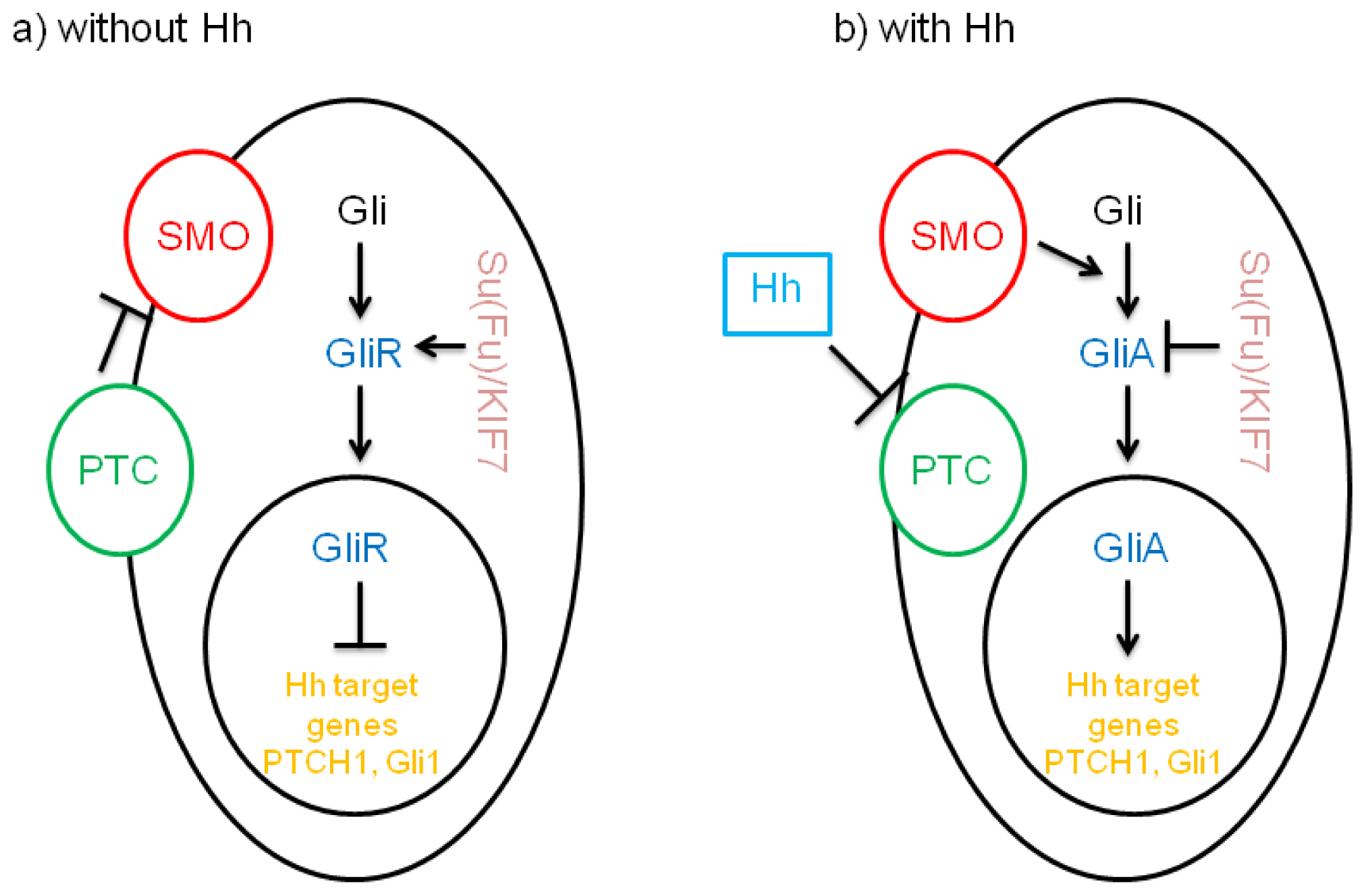
<p>The general signaling mechanisms of the Hh pathway are conserved from insects to humans and are illustrated in <xref ref-type="fig" rid="f1-ijms-14-01179">Figure 1</xref>[<xref ref-type="bibr" rid="b15-ijms-14-01179">15</xref>]. Three Hh homologs with different spatial and temporal distribution patterns have been identified in humans in the early 1990s: Sonic hedgehog (Shh), Indian hedgehog (Ihh) and Desert hedgehog (Dhh) [<xref ref-type="bibr" rid="b16-ijms-14-01179">16</xref>–<xref ref-type="bibr" rid="b18-ijms-14-01179">18</xref>]. Following translation, the Hh protein precursor enters the secretory pathway and undergoes autoprocessing and lipid modifications to release its <italic>N</italic>-terminal fragment (HhN), which is bound to a cholesterol moiety at the <italic>C</italic>-terminal end [<xref ref-type="bibr" rid="b19-ijms-14-01179">19</xref>–<xref ref-type="bibr" rid="b21-ijms-14-01179">21</xref>]. Several molecules are involved in the reception of Hh ligands, with Patched (PTC, one PTC in fly and two PTC in vertebrates—PTCH1 and PTCH2) representing the major receptor [<xref ref-type="bibr" rid="b22-ijms-14-01179">22</xref>]. Hh binding to the PTC on the target cell initiates the Hh signaling cascade [<xref ref-type="bibr" rid="b23-ijms-14-01179">23</xref>]. The Hh-interacting protein (HIP) competes with PTC to bind Hh, leading to a negative regulation of Hh signaling [<xref ref-type="bibr" rid="b24-ijms-14-01179">24</xref>]. In the absence of the Hh ligand, PTC represses the activity of Smoothened (SMO), the seven transmembrane domain-containing protein, which serves as the key signal transducer [<xref ref-type="bibr" rid="b25-ijms-14-01179">25</xref>]. However, it is still not clear how the binding of Hh proteins results in the pathway activation. One hypothesis is that PTC inhibits the function of SMO in the absence of Hh by transporting small endogenous molecules specifically targeted to SMO, such as PI4P, lipoproteins, and pro-vitamin D3 [<xref ref-type="bibr" rid="b26-ijms-14-01179">26</xref>–<xref ref-type="bibr" rid="b28-ijms-14-01179">28</xref>]. Binding of Hh to PTC shuttles PTC out of the cilium, so that it is no longer able to inhibit SMO, resulting in downstream inhibition of molecules by SMO signaling. There are two important events during mammalian SMO signaling. First, the SMO protein passes through conformational changes to favor intermolecular interaction of SMO [<xref ref-type="bibr" rid="b29-ijms-14-01179">29</xref>]. Second, translocation of mammalian SMO to cilia plays an important role during Hh signaling. The function of primary cilium is regulated by large protein complexes involved in intraflagellar transport (IFT), which functions in anterograde and retrograde movement of cargo within the primary cilia [<xref ref-type="bibr" rid="b30-ijms-14-01179">30</xref>]. Several Hh components, including SMO and Gli molecules, are also present at the primary cilium, highlighting the impact of cilium in Hh signaling [<xref ref-type="bibr" rid="b31-ijms-14-01179">31</xref>,<xref ref-type="bibr" rid="b32-ijms-14-01179">32</xref>]. As a transcription factor, Gli protein can regulate target gene expression by association with specific consensus sequences located in the promoter region of the target gene [<xref ref-type="bibr" rid="b33-ijms-14-01179">33</xref>]. It has been reported that SMO mutants lacking a ciliary translocation signal fail to mediate Hh signaling [<xref ref-type="bibr" rid="b34-ijms-14-01179">34</xref>]. However, recent data indicate the translocation of SMO to cilium as not being sufficient to activate Hh signaling [<xref ref-type="bibr" rid="b32-ijms-14-01179">32</xref>,<xref ref-type="bibr" rid="b35-ijms-14-01179">35</xref>]. Using tissue-specific gene knockout, recent studies demonstrate dual roles of cilium in Hh signaling-mediated carcinogenesis in a mouse model by knocking out the cilium component Kifa3 [<xref ref-type="bibr" rid="b32-ijms-14-01179">32</xref>,<xref ref-type="bibr" rid="b36-ijms-14-01179">36</xref>]. Whereas Kifa3 is required for activated SMO-mediated tumor formation, deletion of Kifa3 catalyzes Gli2-mediated carcinogenesis. In <italic>Drosophila</italic>, several molecules, including COS2 and Fused (Fu), have been identified downstream to SMO signaling, but it has to be elucidated how their vertebrate homologs function in Hh signaling. Analysis of the function of vertebrate homologs of COS2, KIF7 and the closely related KIF27 in cultured mammalian cells has led to the conclusion that neither protein has a role in Hh signaling [<xref ref-type="bibr" rid="b37-ijms-14-01179">37</xref>]. However, recent <italic>in vivo</italic> studies suggest a role for Kif7 in coordinating Hh signal transduction in mice, yet no direct interaction between SMO and KIF7 has been detected, thus indicating that the function of COS2 in vertebrates is replaced by other molecules [<xref ref-type="bibr" rid="b38-ijms-14-01179">38</xref>]. In Fu null mice, no changes of Hh signaling have been observed, indicating that Fu is not critical for Hh signaling during embryonic development of vertebrates [<xref ref-type="bibr" rid="b39-ijms-14-01179">39</xref>]. In mammalian cells, several novel cytoplasmic regulators of Hh signaling have been discovered, including Rab23 and tectonic [<xref ref-type="bibr" rid="b40-ijms-14-01179">40</xref>,<xref ref-type="bibr" rid="b41-ijms-14-01179">41</xref>]. Both are negative regulators of Hh signaling situated downstream of SMO. Rab23 is localized in the nucleus as well as in the cytoplasm, implying other yet unknown functions apart from membrane trafficking [<xref ref-type="bibr" rid="b42-ijms-14-01179">42</xref>]. Recent data suggest that Suppressor of Fused (Su(Fu)) operates as a tumor suppressor gene in mammalian cells. Su(Fu) was identified in <italic>Drosophila</italic> by its ability to suppress active fused mutations, but it is not required for the activity of the pathway. Su(Fu) null mouse mutants are inefficient in repressing the pathway and have some phenotypes similar to PTCH1 inactivation [<xref ref-type="bibr" rid="b43-ijms-14-01179">43</xref>]. PTCH1<sup>+/−</sup> mice develop medulloblastoma, rhabdomyosarcoma and basal cell carcinoma following irradiation, whereas Su(Fu)<sup>+/−</sup> mice predominantly develop basaloid epidermal proliferations [<xref ref-type="bibr" rid="b44-ijms-14-01179">44</xref>–<xref ref-type="bibr" rid="b46-ijms-14-01179">46</xref>]. Loss of Su(Fu) results in the activation of Hh signaling, indicating a central role of Su(Fu) in the pathway repression [<xref ref-type="bibr" rid="b43-ijms-14-01179">43</xref>]. At the molecular level, Su(Fu) was found to associate directly with Gli function and is essential for Gli3 processing [<xref ref-type="bibr" rid="b47-ijms-14-01179">47</xref>,<xref ref-type="bibr" rid="b48-ijms-14-01179">48</xref>]. Finally, Hh signaling activates downstream Gli transcription factors, known to regulate target gene expression by binding to a consensus binding site in the promoter of the target gene region [<xref ref-type="bibr" rid="b33-ijms-14-01179">33</xref>,<xref ref-type="bibr" rid="b49-ijms-14-01179">49</xref>,<xref ref-type="bibr" rid="b50-ijms-14-01179">50</xref>]. Several regulatory feedback loops are found in the Hh pathway, maintaining the level of Hh signaling in cells. PTC and HIP provide negative feedback mechanisms. In contrast, Gli1 and GAS1 form positive regulatory loops. Alterations of these loops result in abnormal signaling of the Hh pathway, such as loss of PTCH1 in BCC.</p></sec>
<sec>
<title>3. Activation of the Hedgehog Pathway in Human Cancer</title>
<p>Significant progress in gaining knowledge about Hh signaling in human cancers was achieved by the discovery that mutations of the human homolog of the <italic>Drosophila</italic> patched gene (PTCH1) are associated with a rare hereditary form of BCC (basal cell nevus syndrome, also called Gorlin syndrome) [<xref ref-type="bibr" rid="b51-ijms-14-01179">51</xref>,<xref ref-type="bibr" rid="b52-ijms-14-01179">52</xref>]. Gorlin syndrome is a rare autosomal genetic disorder with two distinct sets of phenotypes: a high risk of BCC and a predisposition to develop medulloblastoma and developmental defects such as bifid ribs and ectopic calcification. The role of PTCH1 has been further demonstrated in knockout mice: mice heterozygous for PTCH1 null mutation showed essential features observed in patients with Gorlin syndrome, such as malignant tumors (medulloblastomas, rhabdomyosarcomas, basal cell carcinomas) and developmental defects, such as spina bifida occulta [<xref ref-type="bibr" rid="b45-ijms-14-01179">45</xref>,<xref ref-type="bibr" rid="b46-ijms-14-01179">46</xref>,<xref ref-type="bibr" rid="b53-ijms-14-01179">53</xref>]. BCC, one of the most common human cancers, regularly shows abnormalities of the Hh pathway arising from mutations in PTCH1 (50%), SMO (10%) and other genes, including Su(Fu) [<xref ref-type="bibr" rid="b54-ijms-14-01179">54</xref>,<xref ref-type="bibr" rid="b55-ijms-14-01179">55</xref>]. About one third of medulloblastomas show activated Hh signaling, and mutations influencing the signaling cascade could be commonly detected within the PTCH1 gene. Increasing evidence supports the notion that the activation of Hh signaling plays an important pathophysiolocial role in many types of human cancer. It is postulated that over 30% of human cancers are presented with activated Hh signaling, including brain tumors, melanomas, leukemias, lymphomas, gastrointestinal, kidney, bladder, pancreatic, liver, prostate, lung, ovarian and breast cancers [<xref ref-type="bibr" rid="b56-ijms-14-01179">56</xref>]. In those cancers, gene mutation is not primarily responsible for activated Hh signaling, but rather caused by ligand-dependent mechanisms or non-canonical Hh signaling activation [<xref ref-type="bibr" rid="b57-ijms-14-01179">57</xref>,<xref ref-type="bibr" rid="b58-ijms-14-01179">58</xref>].</p></sec>
<sec>
<title>4. The Role of Hedgehog Signaling in Cancer Initiation and Progression</title>
<p>Recent data indicate that Hh signaling is involved in different stages of carcinogenesis. In Barrett’s esophagus, an early precursor of esophageal adenocarcinomas, the expression of Shh and Ihh is increased in the epithelium, which is associated with stromal expression of the Hh target genes PTCH1 and BMP4 [<xref ref-type="bibr" rid="b59-ijms-14-01179">59</xref>]. These results suggest that Hh signaling plays a significant role in the initiation of esophageal adenocarcinomas. Furthermore, activation of this pathway was observed in pancreatic intraepithelial neoplasia (PanIN) lesions as well in metastases of pancreatic cancer, suggesting that Hh signaling is also important for pancreatic cancer [<xref ref-type="bibr" rid="b60-ijms-14-01179">60</xref>]. However, transgenic mice with pancreatic-specific expression of Shh or Gli2 develop undifferentiated pancreatic tumors which substantially differ from pancreatic ductal adenocarcinomas (PDAC), indicating that exclusive activation of Hh signaling is not sufficient to trigger PDAC development [<xref ref-type="bibr" rid="b61-ijms-14-01179">61</xref>]. In gastric and prostate cancers, the activation of Hh signaling is associated with cancer progression [<xref ref-type="bibr" rid="b62-ijms-14-01179">62</xref>–<xref ref-type="bibr" rid="b64-ijms-14-01179">64</xref>]. In line with these observations, the inhibition of Hh signaling in prostate and gastric cancer cells reduces tumor cell invasiveness [<xref ref-type="bibr" rid="b63-ijms-14-01179">63</xref>,<xref ref-type="bibr" rid="b65-ijms-14-01179">65</xref>,<xref ref-type="bibr" rid="b66-ijms-14-01179">66</xref>]. Increasing evidence also suggests that Hh signaling plays an important role in the development and progression of glioma, breast cancer, ovarian cancer, leukemia, and B-cell lymphoma [<xref ref-type="bibr" rid="b67-ijms-14-01179">67</xref>–<xref ref-type="bibr" rid="b72-ijms-14-01179">72</xref>]. The modes of Hh signaling in cancer development may vary from one tumor type to another. Several studies have indicated that in the absence of mutation in Hh pathway components, tumor cells synthesize and respond to Hh ligand in an autocrine-juxtacrine manner [<xref ref-type="bibr" rid="b57-ijms-14-01179">57</xref>,<xref ref-type="bibr" rid="b65-ijms-14-01179">65</xref>,<xref ref-type="bibr" rid="b73-ijms-14-01179">73</xref>]. However, recent reports support an alternate model in which tumor-derived Shh or Ihh ligands trigger Hh signaling in the stromal environment in a paracrine manner [<xref ref-type="bibr" rid="b61-ijms-14-01179">61</xref>,<xref ref-type="bibr" rid="b74-ijms-14-01179">74</xref>]. It could be demonstrated that Hh pathway inhibition in pancreatic and colon carcinoma xenograft models blocks paracrine signaling between the tumor and its adjacent stroma [<xref ref-type="bibr" rid="b75-ijms-14-01179">75</xref>]. A study in B-cell lymphomas proposes a different paracrine Hh signaling in which Shh is secreted by stromal cells to activate the Hh pathway in cancer cells [<xref ref-type="bibr" rid="b72-ijms-14-01179">72</xref>,<xref ref-type="bibr" rid="b76-ijms-14-01179">76</xref>]. It is noteworthy that correlation of Hh target gene expression with tumor specimens is not sufficient to clarify the role of Hh signaling in a specific cancer type. Establishing animal models using tissue specific activation of Hh signaling is crucial for understanding the role of Hh signaling in tumor progression. In an orthotopic model of pancreatic cancer, Yang <italic>et al</italic>. observed both paracrine and autocrine Hh signaling [<xref ref-type="bibr" rid="b77-ijms-14-01179">77</xref>]. Increasing evidence indicates that Hh signaling is required for maintenance and function of cancer stem cell population. For example, leukemia stem cell maintenance and expansion was reported to be dependent on hedgehog signaling [<xref ref-type="bibr" rid="b78-ijms-14-01179">78</xref>,<xref ref-type="bibr" rid="b79-ijms-14-01179">79</xref>]. In the absence of SMO or treatment of cyclopamine, a specific inhibitor of the SMO co-receptor, the hematopoietic stem cell population is reduced. Based on cancer stem cell theory, it is assumed that Hh signaling activation may exert chemotherapy or radiotherapy resistance in cancer if this pathway has a major role in cancer stem cell functions [<xref ref-type="bibr" rid="b80-ijms-14-01179">80</xref>]. Indeed, several studies have demonstrated that the activation of Hh signaling is associated with chemotherapy or radiotherapy resistance [<xref ref-type="bibr" rid="b81-ijms-14-01179">81</xref>,<xref ref-type="bibr" rid="b82-ijms-14-01179">82</xref>]. It was recently shown that the Hh signaling inhibitor IPI-926 enhances the delivery of the chemotherapeutical drug gemcitabine in a mouse model of pancreatic cancer [<xref ref-type="bibr" rid="b82-ijms-14-01179">82</xref>]. Upon reviewing the literature on Hh signaling in human cancer, different results have been reported in different tumor types, and sometimes the results are contradictory to each other. These discrepancies are due to several reasons. First, it seems possible that the function of Hh signaling in human cancers may be context-dependent, occurring in some tissues or cell lines but not in others. For example, recent reports indicate that Hh signaling functions in maintaining cancer stem cell proliferation, but not in the proliferation of all cancer cells [<xref ref-type="bibr" rid="b78-ijms-14-01179">78</xref>,<xref ref-type="bibr" rid="b79-ijms-14-01179">79</xref>]. Second, the heterogeneity in tumor tissue is an essential factor in the analysis of Hh target gene expression by real-time PCR. For example, identification of activation of the Hh pathway in prostate cancer specimens can be obtained more frequently from transurethral resection of the prostate (TURP) specimens than from prostatectomy specimens [<xref ref-type="bibr" rid="b63-ijms-14-01179">63</xref>]. Whereas the prostatectomy specimens contain only 5%–10% of tumor cells in the tissue, the TURP specimens generally have more than 70% of tumor cells. Therefore, the data from these two types of specimens may differ due to the percentage of cancer cells in each tissue. Third, different standards have been utilized to define Hh signaling activation. Some groups use elevated expression of Gli1 transcripts as the read-out of Hh signaling activation, whereas others examine the expression level of Hh target genes, such as Gli1, PTCH1, secreted frizzled-related protein 1 (sFRP1 ) and Hh-interacting protein (HIP) [<xref ref-type="bibr" rid="b64-ijms-14-01179">64</xref>,<xref ref-type="bibr" rid="b65-ijms-14-01179">65</xref>,<xref ref-type="bibr" rid="b68-ijms-14-01179">68</xref>,<xref ref-type="bibr" rid="b83-ijms-14-01179">83</xref>–<xref ref-type="bibr" rid="b85-ijms-14-01179">85</xref>]. Similarly, some investigators apply exclusively immunohistochemistry to determine Hh signaling activation, whereas most studies use multiple approaches, including <italic>in situ</italic> hybridization, real-time PCR, and immunohistochemistry [<xref ref-type="bibr" rid="b71-ijms-14-01179">71</xref>,<xref ref-type="bibr" rid="b86-ijms-14-01179">86</xref>]. As the research in this area progresses, our knowledge about Hh-signaling activation in human cancer will also increase, accompanied by the development of appropriate methodological approaches [<xref ref-type="bibr" rid="b87-ijms-14-01179">87</xref>].</p></sec>
<sec>
<title>5. Small Molecule Modulators of Hedgehog Signaling</title>
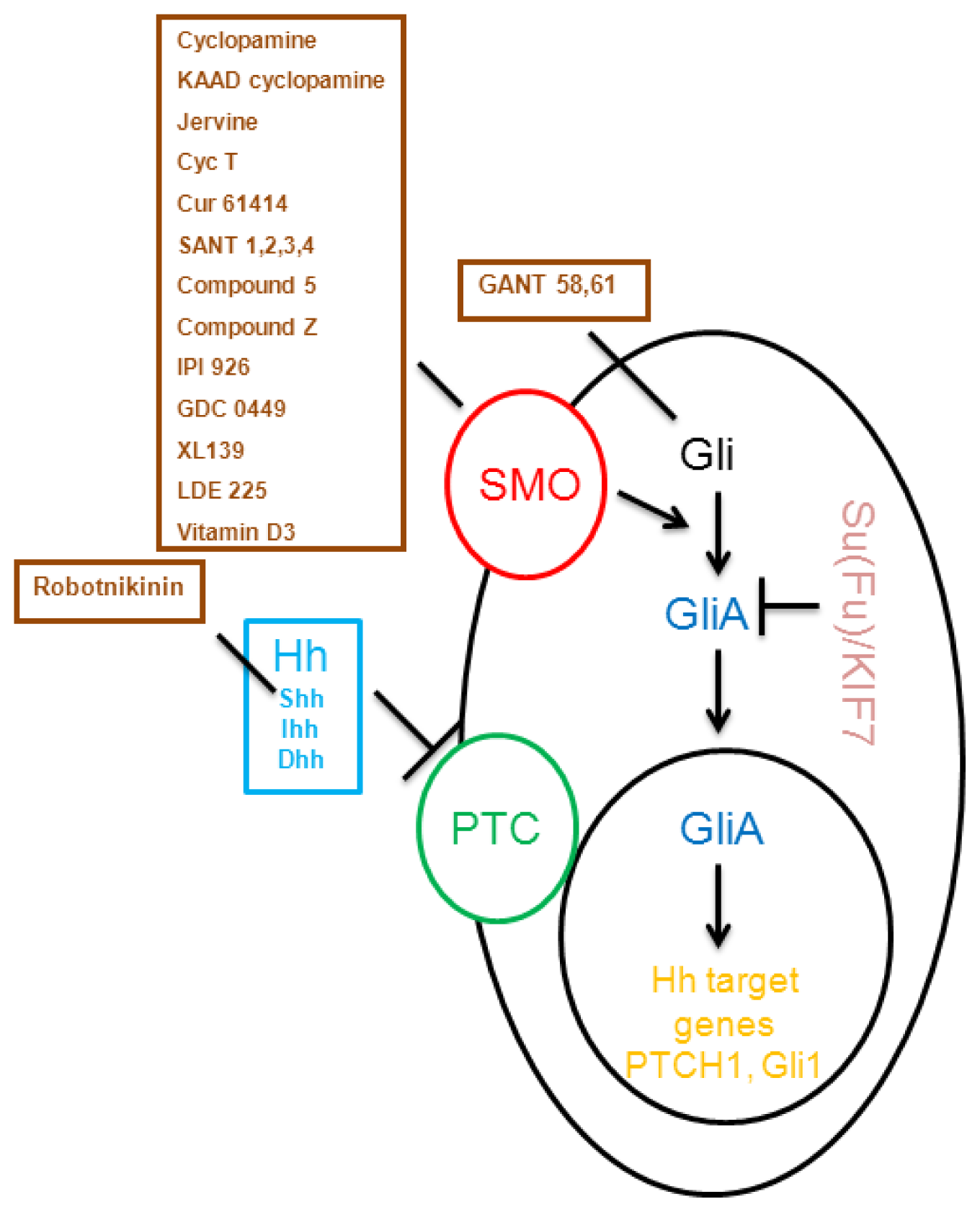
<p>More than 50 compounds known to inhibit Hh signaling have been identified. Among these, five are used in clinical trials [<xref ref-type="bibr" rid="b88-ijms-14-01179">88</xref>–<xref ref-type="bibr" rid="b97-ijms-14-01179">97</xref>]. Three major targeting sites for Hh signaling have been determined: Hh molecules (Shh neutralizing antibodies, small molecule Robotnikinin), SMO protein (cyclopamine and its derivatives IPI-926, Cyc-T and synthetic compounds GDC-0449, Cur61414, XL-139, and LDE-225) and Gli inhibitors (HPI-1, HPI-2, GANT-56, and GANT-61). Hh signaling inhibitors can be divided into three groups: natural products (cyclopamine, its derivatives and other natural products), synthetic small molecules, and Hh signaling modulators. <xref ref-type="table" rid="t1-ijms-14-01179">Table 1</xref> lists the compound currently used in preclinical or phase I/II clinical trials, and <xref ref-type="fig" rid="f2-ijms-14-01179">Figure 2</xref> gives an overview about the mode of action for some of these agents.</p>
<sec>
<title>5.1. Natural Products and Analogs (Cyclopamine, Its Derivatives, and Others)</title>
<p>Cyclopamine is a plant-derived steroidal alkaloid which inhibits Hh signaling through direct binding to the transmembrane helices of SMO [<xref ref-type="bibr" rid="b97-ijms-14-01179">97</xref>]. The discovery of specific, small molecule antagonists of SMO has established new options for the targeted therapy of human cancers associated with Hh signaling. The <italic>in vivo</italic> effect of cyclopamine on tumor shrinkage has been shown in several mouse models [<xref ref-type="bibr" rid="b98-ijms-14-01179">98</xref>–<xref ref-type="bibr" rid="b100-ijms-14-01179">100</xref>]. Cyclopamine derivatives with additional modifications aiming to increase acid stability and aqueous solubility are now available, such as IPI-926 and Cyc-T [<xref ref-type="bibr" rid="b94-ijms-14-01179">94</xref>,<xref ref-type="bibr" rid="b104-ijms-14-01179">104</xref>]. IPI-926 is now in use in clinical trials. In addition, several other synthetic compounds have been identified that directly inhibit SMO activity but with no structural similarity to cyclopamine [<xref ref-type="bibr" rid="b102-ijms-14-01179">102</xref>,<xref ref-type="bibr" rid="b109-ijms-14-01179">109</xref>].</p></sec>
<sec>
<title>5.2. Synthetic Hh Signaling Antagonists</title>
<p>Several synthetic Hh inhibitors have been reported in the literature, most of them directed to SMO (e.g., GDC-0449) and other compounds targeting other Hh signaling components, including Shh and Gli.</p>
<p>A clinical trial with vismodegib (GDC-0449) in a medulloblastoma patient resulted in a rapid reduction of tumor mass, but led to drug resistance due to SMO mutation [<xref ref-type="bibr" rid="b90-ijms-14-01179">90</xref>,<xref ref-type="bibr" rid="b92-ijms-14-01179">92</xref>]. Moreover, vismodegib was evaluated in a phase I, dose-escalation study of patients with refractory solid tumors. Activity was seen in patients with advanced BCC, medulloblastoma and other solid tumors [<xref ref-type="bibr" rid="b89-ijms-14-01179">89</xref>–<xref ref-type="bibr" rid="b91-ijms-14-01179">91</xref>]. A small-molecule inhibitor for Gli1 inhibited tumor cell proliferation <italic>in vitro</italic> and successfully blocked cell growth in an <italic>in vivo</italic> xenograft model using human prostate cancer cells harboring downstream activation of the Hh pathway [<xref ref-type="bibr" rid="b106-ijms-14-01179">106</xref>]. Another small molecule called Robotnikinin was reported to bind Shh protein and to block Shh signaling in cell lines, human primary keratinocytes, and a synthetic model of human skin cancer [<xref ref-type="bibr" rid="b108-ijms-14-01179">108</xref>]. Jervine was shown to block endogenous Shh signaling [<xref ref-type="bibr" rid="b103-ijms-14-01179">103</xref>].</p></sec>
<sec>
<title>5.3. Hh Signaling Modulators</title>
<p>Recent reports suggest that vitamin D3, whose secretion can be facilitated by PTCH1, inhibits SMO signaling through direct binding to SMO [<xref ref-type="bibr" rid="b28-ijms-14-01179">28</xref>]. Promising data indicate that the effect of tazarotene, a retinoid with retinoic acid receptor (RAR) beta/gamma specificity against BCC carcinogenesis is sustained after its withdrawal [<xref ref-type="bibr" rid="b110-ijms-14-01179">110</xref>]. Curcumin, a spice for cooking, has also been reported to block Hh signaling-mediated carcinogenesis. Several natural products, including genistein, EGCG, and resveratrol have also been reported to affect Hh signaling in a mouse model of prostate cancer [<xref ref-type="bibr" rid="b111-ijms-14-01179">111</xref>].</p></sec></sec>
<sec>
<title>6. Hedgehog Signaling and Ovarian Cancer</title>
<p>Ovarian cancer is among the tumor entities where a tumorigenic activation of the Hh signaling pathway has been reported [<xref ref-type="bibr" rid="b68-ijms-14-01179">68</xref>,<xref ref-type="bibr" rid="b112-ijms-14-01179">112</xref>–<xref ref-type="bibr" rid="b115-ijms-14-01179">115</xref>]. Aberrant activation of the Hh pathway is mediated through increased endogenous ligand-dependent expression of Hh or by ligand-independent mutations of PTCH, SMO and Su(Fu) in the pathway [<xref ref-type="bibr" rid="b116-ijms-14-01179">116</xref>,<xref ref-type="bibr" rid="b117-ijms-14-01179">117</xref>]. In a study by Liao <italic>et al.</italic>, overexpression of PTCH and Gli1 protein in ovarian cancers correlated with poor survival of the patients. The subcellular localization of the Hh signal protein may also be important. While Gli1 expression was mainly observed in the cytoplasm of ovarian epithelial tumors, a high level of Gli1 expression in invasive cancer samples was associated with scattered nuclear Gli1 immunoreactivity [<xref ref-type="bibr" rid="b71-ijms-14-01179">71</xref>]. Furthermore, significantly elevated expression of Shh mRNA was observed in ovarian cancers compared to normal tissues and benign ovarian tumors, and was specific for particular histological types.</p>
<p>In addition, ectopic Gli1 overexpression in ovarian cancer cells increased cell proliferation, cell mobility, invasiveness and induced differentiation, identifying Gli1 expression as an independent prognostic marker [<xref ref-type="bibr" rid="b71-ijms-14-01179">71</xref>]. Inhibition of the Hh pathway by treatment with 3-keto-<italic>N</italic>-(aminoethyl-aminocaproyl-dihydrocinnamoyl)-cyclopamine, a specific inhibitor of the Hh pathway, induced cancer cell apoptosis, suppressed cell growth, mobility and invasiveness, and also induced cancer cell dedifferentiation [<xref ref-type="bibr" rid="b71-ijms-14-01179">71</xref>]. According to Chen <italic>et al.</italic>, the expression of Shh, Dhh, PTCH, SMO and Gli1 proteins was not observed in normal OSE, but was increased stepwise in benign, borderline and malignant neoplasms. In addition, immunoreactivity for Shh, Dhh, PTCH, SMO and Gli1 was strongly associated with cell proliferation assessed by Ki-67 [<xref ref-type="bibr" rid="b113-ijms-14-01179">113</xref>]. Blocking the Hh signal using either cyclopamine or Gli1 siRNA resulted in remarkably decreased cell proliferation in ovarian carcinoma cells [<xref ref-type="bibr" rid="b113-ijms-14-01179">113</xref>]. Treatment with cyclopamine induced not only G1 arrest but also apoptosis in ovarian carcinoma cells [<xref ref-type="bibr" rid="b113-ijms-14-01179">113</xref>]. Among the Hh signal molecules, Dhh expression was correlated with poor prognosis of ovarian carcinoma patients [<xref ref-type="bibr" rid="b113-ijms-14-01179">113</xref>]. As demonstrated by Ray <italic>et al.</italic>, the Hh pathway appears to be important in regulating growth of ovarian cancer spheroid-forming cells (SFCs) [<xref ref-type="bibr" rid="b112-ijms-14-01179">112</xref>]. SFCs were treated with Hh agonists (Shh and Ihh) and the Hh inhibitor (cyclopamine) to detect changes in spheroid growth and survival. All four investigated ovarian cancer cell lines’ readily formed spheroids under non-adherent growth conditions, while the normal ovarian epithelial cell line failed to form SFCs. Moreover, compared to a control epithelial cell line, ovarian cancer cell lines demonstrated significant activation of the Hh pathway, determined by increased expression of intranuclear Gli1. Both Hh agonists showed significant increases in spheroid volume of at least 42-fold for Shh-treated cells, and 46-fold for Ihh-treated cells [<xref ref-type="bibr" rid="b112-ijms-14-01179">112</xref>]. Regarding survival, SFCs were 30%–50% more resistant to cyclopamine than their corresponding monolayer cells [<xref ref-type="bibr" rid="b112-ijms-14-01179">112</xref>]. Despite this resistance, inhibition of the Hh pathway with cyclopamine prevented further growth of SFCs. Taken together, the activation and inhibition of the Hh pathway showed significant association to enhanced growth and growth restriction, respectively [<xref ref-type="bibr" rid="b112-ijms-14-01179">112</xref>].</p>
<p>Bhattacharya <italic>et al.</italic> investigated the effect of a specific Hh pathway blocker on clonal growth and proliferation of ovarian cancer cell, both <italic>in vitro</italic> and <italic>in vivo</italic>. Upregulation of the Hh pathway was observed in primary ovarian tumors and all of the human ovarian cancer cell lines tested. There, the authors demonstrated the Hh pathway to help maintaining the clonal growth of human ovarian carcinoma-derived cell lines. Moreover, the inhibition of Hh signaling by cyclopamine resulted in the inhibition of proliferation and clonal growth of all of the ovarian cancer cell lines <italic>in vitro</italic> and arrested the tumor growth <italic>in vivo</italic>. Furthermore, overexpression of PTCH1 inhibited the clonogenic capacity [<xref ref-type="bibr" rid="b68-ijms-14-01179">68</xref>]. In a recent study, Yang <italic>et al.</italic> assessed Hh pathway activation in 34 ovarian epithelial tumor specimens by analyzing target gene expression by <italic>in situ</italic> hybridization, immunohistochemistry, and real-time PCR [<xref ref-type="bibr" rid="b114-ijms-14-01179">114</xref>]. In contrast to previous reports, this group showed that the percentage of hedgehog signaling activation is low in ovarian cancer, suggesting that identification of tumors with activated hedgehog signaling activation will facilitate therapy with hedgehog signaling inhibitors. In addition, the authors found that even in the tumor with elevated expression of the hedgehog target genes Gli1 and PTCH1, expression of Shh is not correlated with Hh target gene expression, suggesting other mechanisms of hedgehog signaling activation in this particular cancer type. Moreover, the fact that hedgehog signaling activation was not associated with any particular subtypes of ovarian cancer implicates that the morphological classification of ovarian cancer may not reflect the molecular pathogenesis of this disease [<xref ref-type="bibr" rid="b114-ijms-14-01179">114</xref>]. In line with this observation, Schmid <italic>et al.</italic> demonstrated that the expression of Hh pathway-related genes varied considerably among the investigated ovarian cancer tissue samples: more than half of the tumor samples showed Hh signaling or pathway activation, either by expression of transcription factors and Hh ligands, or by overexpression of Ihh/Shh and the PTCH1/PTCH2. In addition, gene expression heterogeneity between patient samples of the same histological type and grade was observed [<xref ref-type="bibr" rid="b115-ijms-14-01179">115</xref>]. The conflicting results of the available studies might be due to the fact that different standards have been used to define Hh signaling activation in ovarian cancer, as already mentioned above, and that involvement of Hh signaling may occur only in specific tissues or cancer cell lines.</p></sec>
<sec>
<title>7. Targeting Hedgehog Pathway in Ovarian Cancer</title>
<p>In a recent study the potential role of Gli1 in resistance to anoikis—a cell death that occurs due to detachment of a cell from the extracellular matrix and hence a primary feature of a cell that undergoes metastasis—was demonstrated. Treatment of various ovarian cancer cells by different concentrations of diindolylmethane (DIM) reduced anoikis resistance in a concentration-dependent manner. Reduction in anoikis resistance is correlated with a decrease in the Gli1 expression. Shh treatment not only increased the expression of Gli1, but also blocked anoikis induced by DIM. To confirm the role of Gli1, cyclopamine was used, resulting in significantly reduced anoikis resistance in ovarian cancer cell lines associated with reduced expression of Gli1. Conversely, Shh treatment blocked cyclopamine-induced anoikis. Silencing Gli1 expression induced anoikis in the examined ovarian cancer cells. <italic>In vivo</italic> studies demonstrated that DIM- or cyclopamine-treated ovarian cancer cells under suspension culture conditions drastically lost their ability of tumor formation <italic>in vivo</italic> in mice [<xref ref-type="bibr" rid="b101-ijms-14-01179">101</xref>]. McCann <italic>et al.</italic> investigated if inhibition of the Hh pathway could inhibit serous ovarian cancer growth. They used an <italic>in vivo</italic> preclinical model of serous ovarian cancer to characterize the antitumor activity of cyclopamine and IPI-926. Primary human serous ovarian tumor tissue was utilized to generate tumor xenografts in mice that were subsequently treated with cyclopamine or IPI-926 [<xref ref-type="bibr" rid="b107-ijms-14-01179">107</xref>]. Both compounds showed significant antitumor activity as single agents [<xref ref-type="bibr" rid="b107-ijms-14-01179">107</xref>]. When IPI-926 was used in combination with paclitaxel and carboplatin (T/C), no synergistic effect was observed. Maintaining treatment with IPI-926 after discontinuation of T/C continued to suppress tumor growth. Hh pathway activity was analyzed by RT-PCR to assess changes in Gli1 transcript levels. The results demonstrated that Gli1 expression in the stroma was specifically and significantly reduced within 24 hours of IPI-926 treatment, while expression of Gli1 in tumor cells was unaffected. However, prolonged (21 days) IPI-926 treatment led to significant decreases in both stromal and tumor Gli1 expression. These data suggest that prolonged inhibition of stromal Hh signaling could ultimately lead to decreased Hh signaling in tumor cells. The Gli1 mRNA expression data from the microdissected stroma of human serous ovarian cancer confirmed that the Hh pathway is active in human ovarian stroma, and demonstrated that elevated Gli1 mRNA levels are associated with shorter survival [<xref ref-type="bibr" rid="b107-ijms-14-01179">107</xref>].</p>
<p>In a phase II, randomized, double-blind, placebo-controlled trial, vismodegib (GDC-0449) was tested to provide an estimate of efficacy in the setting of second or third complete remission in 104 ovarian cancer patients. Although numerical improvements were observed, a clinically meaningful improvement in progression-free survival for vismodegib <italic>versus</italic> placebo maintenance could not be demonstrated, and Hedgehog ligand-expression frequency was lower than expected [<xref ref-type="bibr" rid="b93-ijms-14-01179">93</xref>]. One possible explanation for this result is that Hh ligand overexpression is associated with chemotherapy resistance that could prevent patients from achieving complete remission and, therefore, of being eligible for this study. Alternatively, it is also conceivable that Hedgehog ligand overexpression is actually associated with a lower probability of relapse, leading to a lower prevalence of Hh-positive ovarian cancer in this study population [<xref ref-type="bibr" rid="b93-ijms-14-01179">93</xref>]. This report underlines the importance of an appropriate patient selection strategy for further studies.</p></sec>
<sec sec-type="conclusions">
<title>8. Conclusions</title>
<p>The etiology of ovarian cancer is still among the poorest understood of common human malignancies. Even though 70%–80% of affected women achieve a complete clinical response to first line treatment, including surgery, the majority develops recurrent disease. The linkage of Hh signaling activation to various human cancers, including ovarian cancer, and the discovery of novel Hh signaling inhibitors provides promising options for developing novel targeted therapeutic strategies. Despite these advances, there are multiple goals to address for the future. The optimized use of Hh signaling antagonists accompanied by rational patient selection will increase the potential of Hh inhibitors as alternative molecularly targeted anticancer drugs. Well-designed clinical trials are necessary to evaluate the real potential of such pathway inhibitors. A rational patient selection will be based on tumor tissue-based expression or mutational testing with regard to the investigated Hh signaling inhibitor. Overexpression or pathway activation by gene mutations of members of the Hh signaling cascade might predict the efficacy of Hh signaling inhibitors and should therefore be tested and included as a translational research approach in each clinical trial. These steps could lead to the identification of predictive biomarkers to better identify patient subpopulations that will benefit from an Hh-targeted therapy. A better understanding of the underlying mechanisms of resistance is also urgently needed. Achieving these goals will be of paramount importance for designing targeted therapeutic strategies for ovarian cancer.</p></sec></body>
<back>
<fn-group><fn id="fn1-ijms-14-01179">
<p><bold>Conflict of Interest</bold></p>
<p>The authors declare no conflict of interest.</p></fn></fn-group>
<ref-list>
<title>References</title>
<ref id="b1-ijms-14-01179"><label>1</label><citation citation-type="journal"><person-group person-group-type="author"><name><surname>Siegel</surname><given-names>R.</given-names></name><name><surname>Naishadham</surname><given-names>D.</given-names></name><name><surname>Jemal</surname><given-names>A.</given-names></name></person-group><article-title>Cancer statistics, 2012</article-title><source>CA Cancer J. Clin</source><year>2012</year><volume>62</volume><fpage>10</fpage><lpage>29</lpage><pub-id pub-id-type="doi">10.3322/caac.20138</pub-id><pub-id pub-id-type="pmid">22237781</pub-id></citation></ref>
<ref id="b2-ijms-14-01179"><label>2</label><citation citation-type="journal"><person-group person-group-type="author"><name><surname>Rosen</surname><given-names>D.G.</given-names></name><name><surname>Yang</surname><given-names>G.</given-names></name><name><surname>Liu</surname><given-names>G.</given-names></name><name><surname>Mercado-Uribe</surname><given-names>I.</given-names></name><name><surname>Chang</surname><given-names>B.</given-names></name><name><surname>Xiao</surname><given-names>X.S.</given-names></name><name><surname>Zheng</surname><given-names>J.</given-names></name><name><surname>Xue</surname><given-names>F.X.</given-names></name><name><surname>Liu</surname><given-names>J.</given-names></name></person-group><article-title>Ovarian cancer: Pathology, biology, and disease models</article-title><source>Front. Biosci</source><year>2009</year><volume>14</volume><fpage>2089</fpage><lpage>2102</lpage><pub-id pub-id-type="pmid">19273186</pub-id></citation></ref>
<ref id="b3-ijms-14-01179"><label>3</label><citation citation-type="journal"><person-group person-group-type="author"><name><surname>Auersperg</surname><given-names>N.</given-names></name><name><surname>Wong</surname><given-names>A.S.</given-names></name><name><surname>Choi</surname><given-names>K.C.</given-names></name><name><surname>Kang</surname><given-names>S.K.</given-names></name><name><surname>Leung</surname><given-names>P.C.</given-names></name></person-group><article-title>Ovarian surface epithelium: Biology, endocrinology, and pathology</article-title><source>Endocr. Rev</source><year>2001</year><volume>22</volume><fpage>255</fpage><lpage>288</lpage><pub-id pub-id-type="doi">10.1210/er.22.2.255</pub-id><pub-id pub-id-type="pmid">11294827</pub-id></citation></ref>
<ref id="b4-ijms-14-01179"><label>4</label><citation citation-type="journal"><person-group person-group-type="author"><name><surname>Sundfeldt</surname><given-names>K.</given-names></name></person-group><article-title>Cell-cell adhesion in the normal ovary and ovarian tumors of epithelial origin; an exception to the rule</article-title><source>Mol. Cell. Endocrinol</source><year>2003</year><volume>202</volume><fpage>89</fpage><lpage>96</lpage><pub-id pub-id-type="doi">10.1016/S0303-7207(03)00068-6</pub-id><pub-id pub-id-type="pmid">12770736</pub-id></citation></ref>
<ref id="b5-ijms-14-01179"><label>5</label><citation citation-type="journal"><person-group person-group-type="author"><name><surname>Nusslein-Volhard</surname><given-names>C.</given-names></name><name><surname>Wieschaus</surname><given-names>E.</given-names></name></person-group><article-title>Mutations affecting segment number and polarity in Drosophila</article-title><source>Nature</source><year>1980</year><volume>287</volume><fpage>795</fpage><lpage>801</lpage><pub-id pub-id-type="doi">10.1038/287795a0</pub-id><pub-id pub-id-type="pmid">6776413</pub-id></citation></ref>
<ref id="b6-ijms-14-01179"><label>6</label><citation citation-type="journal"><person-group person-group-type="author"><name><surname>Ingham</surname><given-names>P.W.</given-names></name><name><surname>McMahon</surname><given-names>A.P.</given-names></name></person-group><article-title>Hedgehog signaling in animal development: Paradigms and principles</article-title><source>Genes Dev</source><year>2001</year><volume>15</volume><fpage>3059</fpage><lpage>3087</lpage><pub-id pub-id-type="doi">10.1101/gad.938601</pub-id><pub-id pub-id-type="pmid">11731473</pub-id></citation></ref>
<ref id="b7-ijms-14-01179"><label>7</label><citation citation-type="journal"><person-group person-group-type="author"><name><surname>Weedon</surname><given-names>M.N.</given-names></name><name><surname>Lango</surname><given-names>H.</given-names></name><name><surname>Lindgren</surname><given-names>C.M.</given-names></name><name><surname>Wallace</surname><given-names>C.</given-names></name><name><surname>Evans</surname><given-names>D.M.</given-names></name><name><surname>Mangino</surname><given-names>M.</given-names></name><name><surname>Freathy</surname><given-names>R.M.</given-names></name><name><surname>Perry</surname><given-names>J.R.</given-names></name><name><surname>Stevens</surname><given-names>S.</given-names></name><name><surname>Hall</surname><given-names>A.S.</given-names></name><etal/></person-group><article-title>Genome-wide association analysis identifies 20 loci that influence adult height</article-title><source>Nat. Gene</source><year>2008</year><volume>40</volume><fpage>575</fpage><lpage>583</lpage><pub-id pub-id-type="doi">10.1038/ng.121</pub-id></citation></ref>
<ref id="b8-ijms-14-01179"><label>8</label><citation citation-type="journal"><person-group person-group-type="author"><name><surname>Dashti</surname><given-names>M.</given-names></name><name><surname>Peppelenbosch</surname><given-names>M.P.</given-names></name><name><surname>Rezaee</surname><given-names>F.</given-names></name></person-group><article-title>Hedgehog signalling as an antagonist of ageing and its associated diseases</article-title><source>BioEssays</source><year>2012</year><volume>34</volume><fpage>849</fpage><lpage>856</lpage><pub-id pub-id-type="doi">10.1002/bies.201200049</pub-id><pub-id pub-id-type="pmid">22903465</pub-id></citation></ref>
<ref id="b9-ijms-14-01179"><label>9</label><citation citation-type="journal"><person-group person-group-type="author"><name><surname>Neureiter</surname><given-names>D.</given-names></name></person-group><article-title>New in Hedgehog signaling: A possible role in aging, and chronic degenerative and inflammatory diseases? (Comment on DOI 10.1002/bies.201200049)</article-title><source>BioEssays</source><year>2012</year><volume>34</volume><fpage>828</fpage><lpage>829</lpage><pub-id pub-id-type="doi">10.1002/bies.201200107</pub-id><pub-id pub-id-type="pmid">22903575</pub-id></citation></ref>
<ref id="b10-ijms-14-01179"><label>10</label><citation citation-type="journal"><person-group person-group-type="author"><name><surname>Beachy</surname><given-names>P.A.</given-names></name><name><surname>Karhadkar</surname><given-names>S.S.</given-names></name><name><surname>Berman</surname><given-names>D.M.</given-names></name></person-group><article-title>Tissue repair and stem cell renewal in carcinogenesis</article-title><source>Nature</source><year>2004</year><volume>432</volume><fpage>324</fpage><lpage>331</lpage><pub-id pub-id-type="doi">10.1038/nature03100</pub-id><pub-id pub-id-type="pmid">15549094</pub-id></citation></ref>
<ref id="b11-ijms-14-01179"><label>11</label><citation citation-type="journal"><person-group person-group-type="author"><name><surname>Rubin</surname><given-names>L.L.</given-names></name><name><surname>de Sauvage</surname><given-names>F.J.</given-names></name></person-group><article-title>Targeting the Hedgehog pathway in cancer</article-title><source>Nat. Rev. Drug Dis</source><year>2006</year><volume>5</volume><fpage>1026</fpage><lpage>1033</lpage><pub-id pub-id-type="doi">10.1038/nrd2086</pub-id></citation></ref>
<ref id="b12-ijms-14-01179"><label>12</label><citation citation-type="journal"><person-group person-group-type="author"><name><surname>Nieuwenhuis</surname><given-names>E.</given-names></name><name><surname>Hui</surname><given-names>C.C.</given-names></name></person-group><article-title>Hedgehog signaling and congenital malformations</article-title><source>Clin. Genet</source><year>2005</year><volume>67</volume><fpage>193</fpage><lpage>208</lpage><pub-id pub-id-type="pmid">15691355</pub-id></citation></ref>
<ref id="b13-ijms-14-01179"><label>13</label><citation citation-type="journal"><person-group person-group-type="author"><name><surname>Xie</surname><given-names>J.</given-names></name></person-group><article-title>Molecular biology of basal and squamous cell carcinomas</article-title><source>Adv. Exp. Med. Biol</source><year>2008</year><volume>624</volume><fpage>241</fpage><lpage>251</lpage><pub-id pub-id-type="pmid">18348461</pub-id></citation></ref>
<ref id="b14-ijms-14-01179"><label>14</label><citation citation-type="journal"><person-group person-group-type="author"><name><surname>Xie</surname><given-names>J.</given-names></name></person-group><article-title>Hedgehog signaling in prostate cancer</article-title><source>Future Oncol</source><year>2005</year><volume>1</volume><fpage>331</fpage><lpage>338</lpage><pub-id pub-id-type="doi">10.1517/14796694.1.3.331</pub-id><pub-id pub-id-type="pmid">16556007</pub-id></citation></ref>
<ref id="b15-ijms-14-01179"><label>15</label><citation citation-type="journal"><person-group person-group-type="author"><name><surname>Ingham</surname><given-names>P.W.</given-names></name><name><surname>Placzek</surname><given-names>M.</given-names></name></person-group><article-title>Orchestrating ontogenesis: Variations on a theme by sonic hedgehog</article-title><source>Nat. Rev. Genet</source><year>2006</year><volume>7</volume><fpage>841</fpage><lpage>850</lpage><pub-id pub-id-type="doi">10.1038/nrg1969</pub-id><pub-id pub-id-type="pmid">17047684</pub-id></citation></ref>
<ref id="b16-ijms-14-01179"><label>16</label><citation citation-type="journal"><person-group person-group-type="author"><name><surname>Krauss</surname><given-names>S.</given-names></name><name><surname>Concordet</surname><given-names>J.P.</given-names></name><name><surname>Ingham</surname><given-names>P.W.</given-names></name></person-group><article-title>A functionally conserved homolog of the <italic>Drosophila</italic> segment polarity gene hh is expressed in tissues with polarizing activity in zebrafish embryos</article-title><source>Cell</source><year>1993</year><volume>75</volume><fpage>1431</fpage><lpage>1444</lpage><pub-id pub-id-type="doi">10.1016/0092-8674(93)90628-4</pub-id><pub-id pub-id-type="pmid">8269519</pub-id></citation></ref>
<ref id="b17-ijms-14-01179"><label>17</label><citation citation-type="journal"><person-group person-group-type="author"><name><surname>Riddle</surname><given-names>R.D.</given-names></name><name><surname>Johnson</surname><given-names>R.L.</given-names></name><name><surname>Laufer</surname><given-names>E.</given-names></name><name><surname>Tabin</surname><given-names>C.</given-names></name></person-group><article-title>Sonic hedgehog mediates the polarizing activity of the ZPA</article-title><source>Cell</source><year>1993</year><volume>75</volume><fpage>1401</fpage><lpage>1416</lpage><pub-id pub-id-type="doi">10.1016/0092-8674(93)90626-2</pub-id><pub-id pub-id-type="pmid">8269518</pub-id></citation></ref>
<ref id="b18-ijms-14-01179"><label>18</label><citation citation-type="journal"><person-group person-group-type="author"><name><surname>Roelink</surname><given-names>H.</given-names></name><name><surname>Augsburger</surname><given-names>A.</given-names></name><name><surname>Heemskerk</surname><given-names>J.</given-names></name><name><surname>Korzh</surname><given-names>V.</given-names></name><name><surname>Norlin</surname><given-names>S.</given-names></name><name><surname>Ruiz i Altaba</surname><given-names>A.</given-names></name><name><surname>Tanabe</surname><given-names>Y.</given-names></name><name><surname>Placzek</surname><given-names>M.</given-names></name><name><surname>Edlund</surname><given-names>T.</given-names></name><name><surname>Jessell</surname><given-names>T.M.</given-names></name><etal/></person-group><article-title>Floor plate and motor neuron induction by vhh-1, a vertebrate homolog of hedgehog expressed by the notochord</article-title><source>Cell</source><year>1994</year><volume>76</volume><fpage>761</fpage><lpage>775</lpage><pub-id pub-id-type="doi">10.1016/0092-8674(94)90514-2</pub-id><pub-id pub-id-type="pmid">8124714</pub-id></citation></ref>
<ref id="b19-ijms-14-01179"><label>19</label><citation citation-type="journal"><person-group person-group-type="author"><name><surname>Lee</surname><given-names>J.J.</given-names></name><name><surname>Ekker</surname><given-names>S.C.</given-names></name><name><surname>von Kessler</surname><given-names>D.P.</given-names></name><name><surname>Porter</surname><given-names>J.A.</given-names></name><name><surname>Sun</surname><given-names>B.I.</given-names></name><name><surname>Beachy</surname><given-names>P.A.</given-names></name></person-group><article-title>Autoproteolysis in hedgehog protein biogenesis</article-title><source>Science</source><year>1994</year><volume>266</volume><fpage>1528</fpage><lpage>1537</lpage><pub-id pub-id-type="doi">10.1126/science.7985023</pub-id><pub-id pub-id-type="pmid">7985023</pub-id></citation></ref>
<ref id="b20-ijms-14-01179"><label>20</label><citation citation-type="journal"><person-group person-group-type="author"><name><surname>Porter</surname><given-names>J.A.</given-names></name><name><surname>Young</surname><given-names>K.E.</given-names></name><name><surname>Beachy</surname><given-names>P.A.</given-names></name></person-group><article-title>Cholesterol modification of hedgehog signaling proteins in animal development</article-title><source>Science</source><year>1996</year><volume>274</volume><fpage>255</fpage><lpage>259</lpage><pub-id pub-id-type="doi">10.1126/science.274.5285.255</pub-id><pub-id pub-id-type="pmid">8824192</pub-id></citation></ref>
<ref id="b21-ijms-14-01179"><label>21</label><citation citation-type="journal"><person-group person-group-type="author"><name><surname>Porter</surname><given-names>J.A.</given-names></name><name><surname>von Kessler</surname><given-names>D.P.</given-names></name><name><surname>Ekker</surname><given-names>S.C.</given-names></name><name><surname>Young</surname><given-names>K.E.</given-names></name><name><surname>Lee</surname><given-names>J.J.</given-names></name><name><surname>Moses</surname><given-names>K.</given-names></name><name><surname>Beachy</surname><given-names>P.A.</given-names></name></person-group><article-title>The product of hedgehog autoproteolytic cleavage active in local and long-range signalling</article-title><source>Nature</source><year>1995</year><volume>374</volume><fpage>363</fpage><lpage>366</lpage><pub-id pub-id-type="doi">10.1038/374363a0</pub-id><pub-id pub-id-type="pmid">7885476</pub-id></citation></ref>
<ref id="b22-ijms-14-01179"><label>22</label><citation citation-type="journal"><person-group person-group-type="author"><name><surname>Stone</surname><given-names>D.M.</given-names></name><name><surname>Hynes</surname><given-names>M.</given-names></name><name><surname>Armanini</surname><given-names>M.</given-names></name><name><surname>Swanson</surname><given-names>T.A.</given-names></name><name><surname>Gu</surname><given-names>Q.</given-names></name><name><surname>Johnson</surname><given-names>R.L.</given-names></name><name><surname>Scott</surname><given-names>M.P.</given-names></name><name><surname>Pennica</surname><given-names>D.</given-names></name><name><surname>Goddard</surname><given-names>A.</given-names></name><name><surname>Phillips</surname><given-names>H.</given-names></name><etal/></person-group><article-title>The tumour-suppressor gene patched encodes a candidate receptor for Sonic hedgehog</article-title><source>Nature</source><year>1996</year><volume>384</volume><fpage>129</fpage><lpage>134</lpage><pub-id pub-id-type="doi">10.1038/384129a0</pub-id><pub-id pub-id-type="pmid">8906787</pub-id></citation></ref>
<ref id="b23-ijms-14-01179"><label>23</label><citation citation-type="journal"><person-group person-group-type="author"><name><surname>Kalderon</surname><given-names>D.</given-names></name></person-group><article-title>Transducing the hedgehog signal</article-title><source>Cell</source><year>2000</year><volume>103</volume><fpage>371</fpage><lpage>374</lpage><pub-id pub-id-type="doi">10.1016/S0092-8674(00)00129-X</pub-id><pub-id pub-id-type="pmid">11081624</pub-id></citation></ref>
<ref id="b24-ijms-14-01179"><label>24</label><citation citation-type="journal"><person-group person-group-type="author"><name><surname>Chuang</surname><given-names>P.T.</given-names></name><name><surname>McMahon</surname><given-names>A.P.</given-names></name></person-group><article-title>Vertebrate Hedgehog signalling modulated by induction of a Hedgehog-binding protein</article-title><source>Nature</source><year>1999</year><volume>397</volume><fpage>617</fpage><lpage>621</lpage><pub-id pub-id-type="doi">10.1038/17611</pub-id><pub-id pub-id-type="pmid">10050855</pub-id></citation></ref>
<ref id="b25-ijms-14-01179"><label>25</label><citation citation-type="journal"><person-group person-group-type="author"><name><surname>Denef</surname><given-names>N.</given-names></name><name><surname>Neubuser</surname><given-names>D.</given-names></name><name><surname>Perez</surname><given-names>L.</given-names></name><name><surname>Cohen</surname><given-names>S.M.</given-names></name></person-group><article-title>Hedgehog induces opposite changes in turnover and subcellular localization of patched and smoothened</article-title><source>Cell</source><year>2000</year><volume>102</volume><fpage>521</fpage><lpage>531</lpage><pub-id pub-id-type="doi">10.1016/S0092-8674(00)00056-8</pub-id><pub-id pub-id-type="pmid">10966113</pub-id></citation></ref>
<ref id="b26-ijms-14-01179"><label>26</label><citation citation-type="journal"><person-group person-group-type="author"><name><surname>Yavari</surname><given-names>A.</given-names></name><name><surname>Nagaraj</surname><given-names>R.</given-names></name><name><surname>Owusu-Ansah</surname><given-names>E.</given-names></name><name><surname>Folick</surname><given-names>A.</given-names></name><name><surname>Ngo</surname><given-names>K.</given-names></name><name><surname>Hillman</surname><given-names>T.</given-names></name><name><surname>Call</surname><given-names>G.</given-names></name><name><surname>Rohatgi</surname><given-names>R.</given-names></name><name><surname>Scott</surname><given-names>M.P.</given-names></name><name><surname>Banerjee</surname><given-names>U.</given-names></name></person-group><article-title>Role of lipid metabolism in smoothened derepression in hedgehog signaling</article-title><source>Dev. Cell</source><year>2010</year><volume>19</volume><fpage>54</fpage><lpage>65</lpage><pub-id pub-id-type="doi">10.1016/j.devcel.2010.06.007</pub-id><pub-id pub-id-type="pmid">20643350</pub-id></citation></ref>
<ref id="b27-ijms-14-01179"><label>27</label><citation citation-type="journal"><person-group person-group-type="author"><name><surname>Callejo</surname><given-names>A.</given-names></name><name><surname>Culi</surname><given-names>J.</given-names></name><name><surname>Guerrero</surname><given-names>I.</given-names></name></person-group><article-title>Patched, the receptor of Hedgehog, is a lipoprotein receptor</article-title><source>Proc. Natl. Acad. Sci. USA</source><year>2008</year><volume>105</volume><fpage>912</fpage><lpage>917</lpage><pub-id pub-id-type="doi">10.1073/pnas.0705603105</pub-id><pub-id pub-id-type="pmid">18198278</pub-id></citation></ref>
<ref id="b28-ijms-14-01179"><label>28</label><citation citation-type="journal"><person-group person-group-type="author"><name><surname>Bijlsma</surname><given-names>M.F.</given-names></name><name><surname>Spek</surname><given-names>C.A.</given-names></name><name><surname>Zivkovic</surname><given-names>D.</given-names></name><name><surname>van de Water</surname><given-names>S.</given-names></name><name><surname>Rezaee</surname><given-names>F.</given-names></name><name><surname>Peppelenbosch</surname><given-names>M.P.</given-names></name></person-group><article-title>Repression of smoothened by patched-dependent (pro-)vitamin D3 secretion</article-title><source>PLoS Biol</source><year>2006</year><volume>4</volume><fpage>e232</fpage><pub-id pub-id-type="doi">10.1371/journal.pbio.0040232</pub-id><pub-id pub-id-type="pmid">16895439</pub-id></citation></ref>
<ref id="b29-ijms-14-01179"><label>29</label><citation citation-type="journal"><person-group person-group-type="author"><name><surname>Zhao</surname><given-names>Y.</given-names></name><name><surname>Tong</surname><given-names>C.</given-names></name><name><surname>Jiang</surname><given-names>J.</given-names></name></person-group><article-title>Hedgehog regulates smoothened activity by inducing a conformational switch</article-title><source>Nature</source><year>2007</year><volume>450</volume><fpage>252</fpage><lpage>258</lpage><pub-id pub-id-type="doi">10.1038/nature06225</pub-id><pub-id pub-id-type="pmid">17960137</pub-id></citation></ref>
<ref id="b30-ijms-14-01179"><label>30</label><citation citation-type="journal"><person-group person-group-type="author"><name><surname>Scholey</surname><given-names>J.M.</given-names></name><name><surname>Anderson</surname><given-names>K.V.</given-names></name></person-group><article-title>Intraflagellar transport and cilium-based signaling</article-title><source>Cell</source><year>2006</year><volume>125</volume><fpage>439</fpage><lpage>442</lpage><pub-id pub-id-type="doi">10.1016/j.cell.2006.04.013</pub-id><pub-id pub-id-type="pmid">16678091</pub-id></citation></ref>
<ref id="b31-ijms-14-01179"><label>31</label><citation citation-type="journal"><person-group person-group-type="author"><name><surname>Haycraft</surname><given-names>C.J.</given-names></name><name><surname>Banizs</surname><given-names>B.</given-names></name><name><surname>Aydin-Son</surname><given-names>Y.</given-names></name><name><surname>Zhang</surname><given-names>Q.</given-names></name><name><surname>Michaud</surname><given-names>E.J.</given-names></name><name><surname>Yoder</surname><given-names>B.K.</given-names></name></person-group><article-title>Gli2 and Gli3 localize to cilia and require the intraflagellar transport protein polaris for processing and function</article-title><source>PLoS Gene</source><year>2005</year><volume>1</volume><fpage>e53</fpage><pub-id pub-id-type="doi">10.1371/journal.pgen.0010053</pub-id></citation></ref>
<ref id="b32-ijms-14-01179"><label>32</label><citation citation-type="journal"><person-group person-group-type="author"><name><surname>Wang</surname><given-names>Y.</given-names></name><name><surname>Zhou</surname><given-names>Z.</given-names></name><name><surname>Walsh</surname><given-names>C.T.</given-names></name><name><surname>McMahon</surname><given-names>A.P.</given-names></name></person-group><article-title>Selective translocation of intracellular smoothened to the primary cilium in response to Hedgehog pathway modulation</article-title><source>Proc. Natl. Acad. Sci. USA</source><year>2009</year><volume>106</volume><fpage>2623</fpage><lpage>2628</lpage><pub-id pub-id-type="doi">10.1073/pnas.0812110106</pub-id><pub-id pub-id-type="pmid">19196978</pub-id></citation></ref>
<ref id="b33-ijms-14-01179"><label>33</label><citation citation-type="journal"><person-group person-group-type="author"><name><surname>Kinzler</surname><given-names>K.W.</given-names></name><name><surname>Vogelstein</surname><given-names>B.</given-names></name></person-group><article-title>The GLI gene encodes a nuclear protein which binds specific sequences in the human genome</article-title><source>Mol. Cell. Biol</source><year>1990</year><volume>10</volume><fpage>634</fpage><lpage>642</lpage><pub-id pub-id-type="pmid">2105456</pub-id></citation></ref>
<ref id="b34-ijms-14-01179"><label>34</label><citation citation-type="journal"><person-group person-group-type="author"><name><surname>Corbit</surname><given-names>K.C.</given-names></name><name><surname>Aanstad</surname><given-names>P.</given-names></name><name><surname>Singla</surname><given-names>V.</given-names></name><name><surname>Norman</surname><given-names>A.R.</given-names></name><name><surname>Stainier</surname><given-names>D.Y.</given-names></name><name><surname>Reiter</surname><given-names>J.F.</given-names></name></person-group><article-title>Vertebrate smoothened functions at the primary cilium</article-title><source>Nature</source><year>2005</year><volume>437</volume><fpage>1018</fpage><lpage>1021</lpage><pub-id pub-id-type="doi">10.1038/nature04117</pub-id><pub-id pub-id-type="pmid">16136078</pub-id></citation></ref>
<ref id="b35-ijms-14-01179"><label>35</label><citation citation-type="journal"><person-group person-group-type="author"><name><surname>Wilson</surname><given-names>C.W.</given-names></name><name><surname>Chen</surname><given-names>M.H.</given-names></name><name><surname>Chuang</surname><given-names>P.T.</given-names></name></person-group><article-title>Smoothened adopts multiple active and inactive conformations capable of trafficking to the primary cilium</article-title><source>PLoS One</source><year>2009</year><volume>4</volume><fpage>e5182</fpage><pub-id pub-id-type="doi">10.1371/journal.pone.0005182</pub-id><pub-id pub-id-type="pmid">19365551</pub-id></citation></ref>
<ref id="b36-ijms-14-01179"><label>36</label><citation citation-type="journal"><person-group person-group-type="author"><name><surname>Han</surname><given-names>Y.G.</given-names></name><name><surname>Kim</surname><given-names>H.J.</given-names></name><name><surname>Dlugosz</surname><given-names>A.A.</given-names></name><name><surname>Ellison</surname><given-names>D.W.</given-names></name><name><surname>Gilbertson</surname><given-names>R.J.</given-names></name><name><surname>Alvarez-Buylla</surname><given-names>A.</given-names></name></person-group><article-title>Dual and opposing roles of primary cilia in medulloblastoma development</article-title><source>Nat. Med</source><year>2009</year><volume>15</volume><fpage>1062</fpage><lpage>1065</lpage><pub-id pub-id-type="doi">10.1038/nm.2020</pub-id><pub-id pub-id-type="pmid">19701203</pub-id></citation></ref>
<ref id="b37-ijms-14-01179"><label>37</label><citation citation-type="journal"><person-group person-group-type="author"><name><surname>Varjosalo</surname><given-names>M.</given-names></name><name><surname>Li</surname><given-names>S.P.</given-names></name><name><surname>Taipale</surname><given-names>J.</given-names></name></person-group><article-title>Divergence of hedgehog signal transduction mechanism between <italic>Drosophila</italic> and mammals</article-title><source>Dev. Cell</source><year>2006</year><volume>10</volume><fpage>177</fpage><lpage>186</lpage><pub-id pub-id-type="doi">10.1016/j.devcel.2005.12.014</pub-id><pub-id pub-id-type="pmid">16459297</pub-id></citation></ref>
<ref id="b38-ijms-14-01179"><label>38</label><citation citation-type="journal"><person-group person-group-type="author"><name><surname>Endoh-Yamagami</surname><given-names>S.</given-names></name><name><surname>Evangelista</surname><given-names>M.</given-names></name><name><surname>Wilson</surname><given-names>D.</given-names></name><name><surname>Wen</surname><given-names>X.</given-names></name><name><surname>Theunissen</surname><given-names>J.W.</given-names></name><name><surname>Phamluong</surname><given-names>K.</given-names></name><name><surname>Davis</surname><given-names>M.</given-names></name><name><surname>Scales</surname><given-names>S.J.</given-names></name><name><surname>Solloway</surname><given-names>M.J.</given-names></name><name><surname>de Sauvage</surname><given-names>F.J.</given-names></name><etal/></person-group><article-title>The mammalian Cos2 homolog Kif7 plays an essential role in modulating Hh signal transduction during development</article-title><source>Curr. Biol</source><year>2009</year><volume>19</volume><fpage>1320</fpage><lpage>1326</lpage><pub-id pub-id-type="doi">10.1016/j.cub.2009.06.046</pub-id><pub-id pub-id-type="pmid">19592253</pub-id></citation></ref>
<ref id="b39-ijms-14-01179"><label>39</label><citation citation-type="journal"><person-group person-group-type="author"><name><surname>Chen</surname><given-names>M.H.</given-names></name><name><surname>Gao</surname><given-names>N.</given-names></name><name><surname>Kawakami</surname><given-names>T.</given-names></name><name><surname>Chuang</surname><given-names>P.T.</given-names></name></person-group><article-title>Mice deficient in the fused homolog do not exhibit phenotypes indicative of perturbed hedgehog signaling during embryonic development</article-title><source>Mol. Cell. Biol</source><year>2005</year><volume>25</volume><fpage>7042</fpage><lpage>7053</lpage><pub-id pub-id-type="doi">10.1128/MCB.25.16.7042-7053.2005</pub-id><pub-id pub-id-type="pmid">16055716</pub-id></citation></ref>
<ref id="b40-ijms-14-01179"><label>40</label><citation citation-type="journal"><person-group person-group-type="author"><name><surname>Eggenschwiler</surname><given-names>J.T.</given-names></name><name><surname>Espinoza</surname><given-names>E.</given-names></name><name><surname>Anderson</surname><given-names>K.V.</given-names></name></person-group><article-title>Rab23 is an essential negative regulator of the mouse Sonic hedgehog signalling pathway</article-title><source>Nature</source><year>2001</year><volume>412</volume><fpage>194</fpage><lpage>198</lpage><pub-id pub-id-type="doi">10.1038/35084089</pub-id><pub-id pub-id-type="pmid">11449277</pub-id></citation></ref>
<ref id="b41-ijms-14-01179"><label>41</label><citation citation-type="journal"><person-group person-group-type="author"><name><surname>Reiter</surname><given-names>J.F.</given-names></name><name><surname>Skarnes</surname><given-names>W.C.</given-names></name></person-group><article-title>Tectonic, a novel regulator of the Hedgehog pathway required for both activation and inhibition</article-title><source>Genes Dev</source><year>2006</year><volume>20</volume><fpage>22</fpage><lpage>27</lpage><pub-id pub-id-type="doi">10.1101/gad.1363606</pub-id><pub-id pub-id-type="pmid">16357211</pub-id></citation></ref>
<ref id="b42-ijms-14-01179"><label>42</label><citation citation-type="journal"><person-group person-group-type="author"><name><surname>Huang</surname><given-names>S.</given-names></name><name><surname>Yang</surname><given-names>L.</given-names></name><name><surname>An</surname><given-names>Y.</given-names></name><name><surname>Ma</surname><given-names>X.</given-names></name><name><surname>Zhang</surname><given-names>C.</given-names></name><name><surname>Xie</surname><given-names>G.</given-names></name><name><surname>Chen</surname><given-names>Z.Y.</given-names></name><name><surname>Xie</surname><given-names>J.</given-names></name><name><surname>Zhang</surname><given-names>H.</given-names></name></person-group><article-title>Expression of hedgehog signaling molecules in lung cancer</article-title><source>Acta Histochem</source><year>2011</year><volume>113</volume><fpage>564</fpage><lpage>569</lpage><pub-id pub-id-type="doi">10.1016/j.acthis.2010.06.003</pub-id><pub-id pub-id-type="pmid">20656337</pub-id></citation></ref>
<ref id="b43-ijms-14-01179"><label>43</label><citation citation-type="journal"><person-group person-group-type="author"><name><surname>Svard</surname><given-names>J.</given-names></name><name><surname>Heby-Henricson</surname><given-names>K.</given-names></name><name><surname>Persson-Lek</surname><given-names>M.</given-names></name><name><surname>Rozell</surname><given-names>B.</given-names></name><name><surname>Lauth</surname><given-names>M.</given-names></name><name><surname>Bergstrom</surname><given-names>A.</given-names></name><name><surname>Ericson</surname><given-names>J.</given-names></name><name><surname>Toftgard</surname><given-names>R.</given-names></name><name><surname>Teglund</surname><given-names>S.</given-names></name></person-group><article-title>Genetic elimination of Suppressor of fused reveals an essential repressor function in the mammalian Hedgehog signaling pathway</article-title><source>Dev. Cell</source><year>2006</year><volume>10</volume><fpage>187</fpage><lpage>197</lpage><pub-id pub-id-type="doi">10.1016/j.devcel.2005.12.013</pub-id><pub-id pub-id-type="pmid">16459298</pub-id></citation></ref>
<ref id="b44-ijms-14-01179"><label>44</label><citation citation-type="journal"><person-group person-group-type="author"><name><surname>Aszterbaum</surname><given-names>M.</given-names></name><name><surname>Epstein</surname><given-names>J.</given-names></name><name><surname>Oro</surname><given-names>A.</given-names></name><name><surname>Douglas</surname><given-names>V.</given-names></name><name><surname>LeBoit</surname><given-names>P.E.</given-names></name><name><surname>Scott</surname><given-names>M.P.</given-names></name><name><surname>Epstein</surname><given-names>E.H.</given-names><suffix>Jr</suffix></name></person-group><article-title>Ultraviolet and ionizing radiation enhance the growth of BCCs and trichoblastomas in patched heterozygous knockout mice</article-title><source>Nat. Med.</source><year>1999</year><volume>5</volume><fpage>1285</fpage><lpage>1291</lpage><pub-id pub-id-type="doi">10.1038/15242</pub-id><pub-id pub-id-type="pmid">10545995</pub-id></citation></ref>
<ref id="b45-ijms-14-01179"><label>45</label><citation citation-type="journal"><person-group person-group-type="author"><name><surname>Hahn</surname><given-names>H.</given-names></name><name><surname>Wojnowski</surname><given-names>L.</given-names></name><name><surname>Zimmer</surname><given-names>A.M.</given-names></name><name><surname>Hall</surname><given-names>J.</given-names></name><name><surname>Miller</surname><given-names>G.</given-names></name><name><surname>Zimmer</surname><given-names>A.</given-names></name></person-group><article-title>Rhabdomyosarcomas and radiation hypersensitivity in a mouse model of Gorlin syndrome</article-title><source>Nat. Med</source><year>1998</year><volume>4</volume><fpage>619</fpage><lpage>622</lpage><pub-id pub-id-type="doi">10.1038/nm0598-619</pub-id><pub-id pub-id-type="pmid">9585239</pub-id></citation></ref>
<ref id="b46-ijms-14-01179"><label>46</label><citation citation-type="journal"><person-group person-group-type="author"><name><surname>Goodrich</surname><given-names>L.V.</given-names></name><name><surname>Milenkovic</surname><given-names>L.</given-names></name><name><surname>Higgins</surname><given-names>K.M.</given-names></name><name><surname>Scott</surname><given-names>M.P.</given-names></name></person-group><article-title>Altered neural cell fates and medulloblastoma in mouse patched mutants</article-title><source>Science</source><year>1997</year><volume>277</volume><fpage>1109</fpage><lpage>1113</lpage><pub-id pub-id-type="doi">10.1126/science.277.5329.1109</pub-id><pub-id pub-id-type="pmid">9262482</pub-id></citation></ref>
<ref id="b47-ijms-14-01179"><label>47</label><citation citation-type="journal"><person-group person-group-type="author"><name><surname>Barnfield</surname><given-names>P.C.</given-names></name><name><surname>Zhang</surname><given-names>X.</given-names></name><name><surname>Thanabalasingham</surname><given-names>V.</given-names></name><name><surname>Yoshida</surname><given-names>M.</given-names></name><name><surname>Hui</surname><given-names>C.C.</given-names></name></person-group><article-title>Negative regulation of Gli1 and Gli2 activator function by Suppressor of fused through multiple mechanisms</article-title><source>Differentiation</source><year>2005</year><volume>73</volume><fpage>397</fpage><lpage>405</lpage><pub-id pub-id-type="doi">10.1111/j.1432-0436.2005.00042.x</pub-id><pub-id pub-id-type="pmid">16316410</pub-id></citation></ref>
<ref id="b48-ijms-14-01179"><label>48</label><citation citation-type="journal"><person-group person-group-type="author"><name><surname>Kise</surname><given-names>Y.</given-names></name><name><surname>Morinaka</surname><given-names>A.</given-names></name><name><surname>Teglund</surname><given-names>S.</given-names></name><name><surname>Miki</surname><given-names>H.</given-names></name></person-group><article-title>Sufu recruits GSK3beta for efficient processing of Gli3</article-title><source>Biochem. Biophys. Res. Commun</source><year>2009</year><volume>387</volume><fpage>569</fpage><lpage>574</lpage><pub-id pub-id-type="doi">10.1016/j.bbrc.2009.07.087</pub-id><pub-id pub-id-type="pmid">19622347</pub-id></citation></ref>
<ref id="b49-ijms-14-01179"><label>49</label><citation citation-type="journal"><person-group person-group-type="author"><name><surname>Sasaki</surname><given-names>H.</given-names></name><name><surname>Hui</surname><given-names>C.</given-names></name><name><surname>Nakafuku</surname><given-names>M.</given-names></name><name><surname>Kondoh</surname><given-names>H.</given-names></name></person-group><article-title>A binding site for Gli proteins is essential for HNF-3beta floor plate enhancer activity in transgenics and can respond to Shh <italic>in vitro</italic></article-title><source>Development</source><year>1997</year><volume>124</volume><fpage>1313</fpage><lpage>1322</lpage><pub-id pub-id-type="pmid">9118802</pub-id></citation></ref>
<ref id="b50-ijms-14-01179"><label>50</label><citation citation-type="journal"><person-group person-group-type="author"><name><surname>Ruppert</surname><given-names>J.M.</given-names></name><name><surname>Kinzler</surname><given-names>K.W.</given-names></name><name><surname>Wong</surname><given-names>A.J.</given-names></name><name><surname>Bigner</surname><given-names>S.H.</given-names></name><name><surname>Kao</surname><given-names>F.T.</given-names></name><name><surname>Law</surname><given-names>M.L.</given-names></name><name><surname>Seuanez</surname><given-names>H.N.</given-names></name><name><surname>O’Brien</surname><given-names>S.J.</given-names></name><name><surname>Vogelstein</surname><given-names>B.</given-names></name></person-group><article-title>The GLI-Kruppel family of human genes</article-title><source>Mol. Cell. Biol</source><year>1988</year><volume>8</volume><fpage>3104</fpage><lpage>3113</lpage><pub-id pub-id-type="pmid">2850480</pub-id></citation></ref>
<ref id="b51-ijms-14-01179"><label>51</label><citation citation-type="journal"><person-group person-group-type="author"><name><surname>Hahn</surname><given-names>H.</given-names></name><name><surname>Wicking</surname><given-names>C.</given-names></name><name><surname>Zaphiropoulous</surname><given-names>P.G.</given-names></name><name><surname>Gailani</surname><given-names>M.R.</given-names></name><name><surname>Shanley</surname><given-names>S.</given-names></name><name><surname>Chidambaram</surname><given-names>A.</given-names></name><name><surname>Vorechovsky</surname><given-names>I.</given-names></name><name><surname>Holmberg</surname><given-names>E.</given-names></name><name><surname>Unden</surname><given-names>A.B.</given-names></name><name><surname>Gillies</surname><given-names>S.</given-names></name><etal/></person-group><article-title>Mutations of the human homolog of <italic>Drosophila</italic> patched in the nevoid basal cell carcinoma syndrome</article-title><source>Cell</source><year>1996</year><volume>85</volume><fpage>841</fpage><lpage>851</lpage><pub-id pub-id-type="doi">10.1016/S0092-8674(00)81268-4</pub-id><pub-id pub-id-type="pmid">8681379</pub-id></citation></ref>
<ref id="b52-ijms-14-01179"><label>52</label><citation citation-type="journal"><person-group person-group-type="author"><name><surname>Johnson</surname><given-names>R.L.</given-names></name><name><surname>Rothman</surname><given-names>A.L.</given-names></name><name><surname>Xie</surname><given-names>J.</given-names></name><name><surname>Goodrich</surname><given-names>L.V.</given-names></name><name><surname>Bare</surname><given-names>J.W.</given-names></name><name><surname>Bonifas</surname><given-names>J.M.</given-names></name><name><surname>Quinn</surname><given-names>A.G.</given-names></name><name><surname>Myers</surname><given-names>R.M.</given-names></name><name><surname>Cox</surname><given-names>D.R.</given-names></name><name><surname>Epstein</surname><given-names>E.H.</given-names><suffix>Jr</suffix></name><etal/></person-group><source>Science</source><year>1996</year><volume>272</volume><fpage>1668</fpage><lpage>1671</lpage><pub-id pub-id-type="doi">10.1126/science.272.5268.1668</pub-id><pub-id pub-id-type="pmid">8658145</pub-id></citation></ref>
<ref id="b53-ijms-14-01179"><label>53</label><citation citation-type="journal"><person-group person-group-type="author"><name><surname>Aszterbaum</surname><given-names>M.</given-names></name><name><surname>Beech</surname><given-names>J.</given-names></name><name><surname>Epstein</surname><given-names>E.H.</given-names><suffix>Jr</suffix></name></person-group><article-title>Ultraviolet radiation mutagenesis of hedgehog pathway genes in basal cell carcinomas</article-title><source>J. Investig. Dermatol. Symp. Proc.</source><year>1999</year><volume>4</volume><fpage>41</fpage><lpage>45</lpage><pub-id pub-id-type="doi">10.1038/sj.jidsp.5640179</pub-id><pub-id pub-id-type="pmid">10537006</pub-id></citation></ref>
<ref id="b54-ijms-14-01179"><label>54</label><citation citation-type="journal"><person-group person-group-type="author"><name><surname>Reifenberger</surname><given-names>J.</given-names></name><name><surname>Wolter</surname><given-names>M.</given-names></name><name><surname>Knobbe</surname><given-names>C.B.</given-names></name><name><surname>Kohler</surname><given-names>B.</given-names></name><name><surname>Schonicke</surname><given-names>A.</given-names></name><name><surname>Scharwachter</surname><given-names>C.</given-names></name><name><surname>Kumar</surname><given-names>K.</given-names></name><name><surname>Blaschke</surname><given-names>B.</given-names></name><name><surname>Ruzicka</surname><given-names>T.</given-names></name><name><surname>Reifenberger</surname><given-names>G.</given-names></name></person-group><article-title>Somatic mutations in the PTCH, SMOH, SUFUH and TP53 genes in sporadic basal cell carcinomas</article-title><source>Br. J. Dermatol</source><year>2005</year><volume>152</volume><fpage>43</fpage><lpage>51</lpage><pub-id pub-id-type="doi">10.1111/j.1365-2133.2005.06353.x</pub-id><pub-id pub-id-type="pmid">15656799</pub-id></citation></ref>
<ref id="b55-ijms-14-01179"><label>55</label><citation citation-type="journal"><person-group person-group-type="author"><name><surname>Lam</surname><given-names>C.W.</given-names></name><name><surname>Xie</surname><given-names>J.</given-names></name><name><surname>To</surname><given-names>K.F.</given-names></name><name><surname>Ng</surname><given-names>H.K.</given-names></name><name><surname>Lee</surname><given-names>K.C.</given-names></name><name><surname>Yuen</surname><given-names>N.W.</given-names></name><name><surname>Lim</surname><given-names>P.L.</given-names></name><name><surname>Chan</surname><given-names>L.Y.</given-names></name><name><surname>Tong</surname><given-names>S.F.</given-names></name><name><surname>McCormick</surname><given-names>F.</given-names></name></person-group><article-title>A frequent activated smoothened mutation in sporadic basal cell carcinomas</article-title><source>Oncogene</source><year>1999</year><volume>18</volume><fpage>833</fpage><lpage>836</lpage><pub-id pub-id-type="doi">10.1038/sj.onc.1202360</pub-id><pub-id pub-id-type="pmid">9989836</pub-id></citation></ref>
<ref id="b56-ijms-14-01179"><label>56</label><citation citation-type="journal"><person-group person-group-type="author"><name><surname>Kiesslich</surname><given-names>T.</given-names></name><name><surname>Berr</surname><given-names>F.</given-names></name><name><surname>Alinger</surname><given-names>B.</given-names></name><name><surname>Kemmerling</surname><given-names>R.</given-names></name><name><surname>Pichler</surname><given-names>M.</given-names></name><name><surname>Ocker</surname><given-names>M.</given-names></name><name><surname>Neureiter</surname><given-names>D.</given-names></name></person-group><article-title>Current status of therapeutic targeting of developmental signalling pathways in oncology</article-title><source>Curr. Pharm. Biotechnol</source><year>2012</year><volume>13</volume><fpage>2184</fpage><lpage>2220</lpage><pub-id pub-id-type="doi">10.2174/138920112802502114</pub-id><pub-id pub-id-type="pmid">21605074</pub-id></citation></ref>
<ref id="b57-ijms-14-01179"><label>57</label><citation citation-type="journal"><person-group person-group-type="author"><name><surname>Berman</surname><given-names>D.M.</given-names></name><name><surname>Karhadkar</surname><given-names>S.S.</given-names></name><name><surname>Maitra</surname><given-names>A.</given-names></name><name><surname>Montes De Oca</surname><given-names>R.</given-names></name><name><surname>Gerstenblith</surname><given-names>M.R.</given-names></name><name><surname>Briggs</surname><given-names>K.</given-names></name><name><surname>Parker</surname><given-names>A.R.</given-names></name><name><surname>Shimada</surname><given-names>Y.</given-names></name><name><surname>Eshleman</surname><given-names>J.R.</given-names></name><name><surname>Watkins</surname><given-names>D.N.</given-names></name><etal/></person-group><article-title>Widespread requirement for Hedgehog ligand stimulation in growth of digestive tract tumours</article-title><source>Nature</source><year>2003</year><volume>425</volume><fpage>846</fpage><lpage>851</lpage><pub-id pub-id-type="doi">10.1038/nature01972</pub-id><pub-id pub-id-type="pmid">14520411</pub-id></citation></ref>
<ref id="b58-ijms-14-01179"><label>58</label><citation citation-type="journal"><person-group person-group-type="author"><name><surname>Watkins</surname><given-names>D.N.</given-names></name><name><surname>Berman</surname><given-names>D.M.</given-names></name><name><surname>Burkholder</surname><given-names>S.G.</given-names></name><name><surname>Wang</surname><given-names>B.</given-names></name><name><surname>Beachy</surname><given-names>P.A.</given-names></name><name><surname>Baylin</surname><given-names>S.B.</given-names></name></person-group><article-title>Hedgehog signalling within airway epithelial progenitors and in small-cell lung cancer</article-title><source>Nature</source><year>2003</year><volume>422</volume><fpage>313</fpage><lpage>317</lpage><pub-id pub-id-type="doi">10.1038/nature01493</pub-id><pub-id pub-id-type="pmid">12629553</pub-id></citation></ref>
<ref id="b59-ijms-14-01179"><label>59</label><citation citation-type="journal"><person-group person-group-type="author"><name><surname>Wang</surname><given-names>D.H.</given-names></name><name><surname>Clemons</surname><given-names>N.J.</given-names></name><name><surname>Miyashita</surname><given-names>T.</given-names></name><name><surname>Dupuy</surname><given-names>A.J.</given-names></name><name><surname>Zhang</surname><given-names>W.</given-names></name><name><surname>Szczepny</surname><given-names>A.</given-names></name><name><surname>Corcoran-Schwartz</surname><given-names>I.M.</given-names></name><name><surname>Wilburn</surname><given-names>D.L.</given-names></name><name><surname>Montgomery</surname><given-names>E.A.</given-names></name><name><surname>Wang</surname><given-names>J.S.</given-names></name><etal/></person-group><article-title>Aberrant epithelial-mesenchymal Hedgehog signaling characterizes Barrett’s metaplasia</article-title><source>Gastroenterology</source><year>2010</year><volume>138</volume><fpage>1810</fpage><lpage>1822</lpage><pub-id pub-id-type="doi">10.1053/j.gastro.2010.01.048</pub-id><pub-id pub-id-type="pmid">20138038</pub-id></citation></ref>
<ref id="b60-ijms-14-01179"><label>60</label><citation citation-type="journal"><person-group person-group-type="author"><name><surname>Pasca di Magliano</surname><given-names>M.</given-names></name><name><surname>Sekine</surname><given-names>S.</given-names></name><name><surname>Ermilov</surname><given-names>A.</given-names></name><name><surname>Ferris</surname><given-names>J.</given-names></name><name><surname>Dlugosz</surname><given-names>A.A.</given-names></name><name><surname>Hebrok</surname><given-names>M.</given-names></name></person-group><article-title>Hedgehog/Ras interactions regulate early stages of pancreatic cancer</article-title><source>Genes Dev</source><year>2006</year><volume>20</volume><fpage>3161</fpage><lpage>3173</lpage><pub-id pub-id-type="doi">10.1101/gad.1470806</pub-id><pub-id pub-id-type="pmid">17114586</pub-id></citation></ref>
<ref id="b61-ijms-14-01179"><label>61</label><citation citation-type="journal"><person-group person-group-type="author"><name><surname>Nolan-Stevaux</surname><given-names>O.</given-names></name><name><surname>Lau</surname><given-names>J.</given-names></name><name><surname>Truitt</surname><given-names>M.L.</given-names></name><name><surname>Chu</surname><given-names>G.C.</given-names></name><name><surname>Hebrok</surname><given-names>M.</given-names></name><name><surname>Fernandez-Zapico</surname><given-names>M.E.</given-names></name><name><surname>Hanahan</surname><given-names>D.</given-names></name></person-group><article-title>GLI1 is regulated through smoothened-independent mechanisms in neoplastic pancreatic ducts and mediates PDAC cell survival and transformation</article-title><source>Genes Dev</source><year>2009</year><volume>23</volume><fpage>24</fpage><lpage>36</lpage><pub-id pub-id-type="doi">10.1101/gad.1753809</pub-id><pub-id pub-id-type="pmid">19136624</pub-id></citation></ref>
<ref id="b62-ijms-14-01179"><label>62</label><citation citation-type="journal"><person-group person-group-type="author"><name><surname>Fan</surname><given-names>L.</given-names></name><name><surname>Pepicelli</surname><given-names>C.V.</given-names></name><name><surname>Dibble</surname><given-names>C.C.</given-names></name><name><surname>Catbagan</surname><given-names>W.</given-names></name><name><surname>Zarycki</surname><given-names>J.L.</given-names></name><name><surname>Laciak</surname><given-names>R.</given-names></name><name><surname>Gipp</surname><given-names>J.</given-names></name><name><surname>Shaw</surname><given-names>A.</given-names></name><name><surname>Lamm</surname><given-names>M.L.</given-names></name><name><surname>Munoz</surname><given-names>A.</given-names></name><etal/></person-group><article-title>Hedgehog signaling promotes prostate xenograft tumor growth</article-title><source>Endocrinology</source><year>2004</year><volume>145</volume><fpage>3961</fpage><lpage>3970</lpage><pub-id pub-id-type="doi">10.1210/en.2004-0079</pub-id><pub-id pub-id-type="pmid">15132968</pub-id></citation></ref>
<ref id="b63-ijms-14-01179"><label>63</label><citation citation-type="journal"><person-group person-group-type="author"><name><surname>Sheng</surname><given-names>T.</given-names></name><name><surname>Li</surname><given-names>C.</given-names></name><name><surname>Zhang</surname><given-names>X.</given-names></name><name><surname>Chi</surname><given-names>S.</given-names></name><name><surname>He</surname><given-names>N.</given-names></name><name><surname>Chen</surname><given-names>K.</given-names></name><name><surname>McCormick</surname><given-names>F.</given-names></name><name><surname>Gatalica</surname><given-names>Z.</given-names></name><name><surname>Xie</surname><given-names>J.</given-names></name></person-group><article-title>Activation of the hedgehog pathway in advanced prostate cancer</article-title><source>Mol. Cancer</source><year>2004</year><volume>3</volume><fpage>29</fpage><pub-id pub-id-type="doi">10.1186/1476-4598-3-29</pub-id><pub-id pub-id-type="pmid">15482598</pub-id></citation></ref>
<ref id="b64-ijms-14-01179"><label>64</label><citation citation-type="journal"><person-group person-group-type="author"><name><surname>Ma</surname><given-names>X.</given-names></name><name><surname>Chen</surname><given-names>K.</given-names></name><name><surname>Huang</surname><given-names>S.</given-names></name><name><surname>Zhang</surname><given-names>X.</given-names></name><name><surname>Adegboyega</surname><given-names>P.A.</given-names></name><name><surname>Evers</surname><given-names>B.M.</given-names></name><name><surname>Zhang</surname><given-names>H.</given-names></name><name><surname>Xie</surname><given-names>J.</given-names></name></person-group><article-title>Frequent activation of the hedgehog pathway in advanced gastric adenocarcinomas</article-title><source>Carcinogenesis</source><year>2005</year><volume>26</volume><fpage>1698</fpage><lpage>1705</lpage><pub-id pub-id-type="doi">10.1093/carcin/bgi130</pub-id><pub-id pub-id-type="pmid">15905200</pub-id></citation></ref>
<ref id="b65-ijms-14-01179"><label>65</label><citation citation-type="journal"><person-group person-group-type="author"><name><surname>Karhadkar</surname><given-names>S.S.</given-names></name><name><surname>Bova</surname><given-names>G.S.</given-names></name><name><surname>Abdallah</surname><given-names>N.</given-names></name><name><surname>Dhara</surname><given-names>S.</given-names></name><name><surname>Gardner</surname><given-names>D.</given-names></name><name><surname>Maitra</surname><given-names>A.</given-names></name><name><surname>Isaacs</surname><given-names>J.T.</given-names></name><name><surname>Berman</surname><given-names>D.M.</given-names></name><name><surname>Beachy</surname><given-names>P.A.</given-names></name></person-group><article-title>Hedgehog signalling in prostate regeneration, neoplasia and metastasis</article-title><source>Nature</source><year>2004</year><volume>431</volume><fpage>707</fpage><lpage>712</lpage><pub-id pub-id-type="doi">10.1038/nature02962</pub-id><pub-id pub-id-type="pmid">15361885</pub-id></citation></ref>
<ref id="b66-ijms-14-01179"><label>66</label><citation citation-type="journal"><person-group person-group-type="author"><name><surname>He</surname><given-names>J.</given-names></name><name><surname>Sheng</surname><given-names>T.</given-names></name><name><surname>Stelter</surname><given-names>A.A.</given-names></name><name><surname>Li</surname><given-names>C.</given-names></name><name><surname>Zhang</surname><given-names>X.</given-names></name><name><surname>Sinha</surname><given-names>M.</given-names></name><name><surname>Luxon</surname><given-names>B.A.</given-names></name><name><surname>Xie</surname><given-names>J.</given-names></name></person-group><article-title>Suppressing Wnt signaling by the hedgehog pathway through sFRP-1</article-title><source>J. Biol. Chem</source><year>2006</year><volume>281</volume><fpage>35598</fpage><lpage>35602</lpage><pub-id pub-id-type="doi">10.1074/jbc.C600200200</pub-id><pub-id pub-id-type="pmid">17035233</pub-id></citation></ref>
<ref id="b67-ijms-14-01179"><label>67</label><citation citation-type="journal"><person-group person-group-type="author"><name><surname>Ehtesham</surname><given-names>M.</given-names></name><name><surname>Sarangi</surname><given-names>A.</given-names></name><name><surname>Valadez</surname><given-names>J.G.</given-names></name><name><surname>Chanthaphaychith</surname><given-names>S.</given-names></name><name><surname>Becher</surname><given-names>M.W.</given-names></name><name><surname>Abel</surname><given-names>T.W.</given-names></name><name><surname>Thompson</surname><given-names>R.C.</given-names></name><name><surname>Cooper</surname><given-names>M.K.</given-names></name></person-group><article-title>Ligand-dependent activation of the hedgehog pathway in glioma progenitor cells</article-title><source>Oncogene</source><year>2007</year><volume>26</volume><fpage>5752</fpage><lpage>5761</lpage><pub-id pub-id-type="doi">10.1038/sj.onc.1210359</pub-id><pub-id pub-id-type="pmid">17353902</pub-id></citation></ref>
<ref id="b68-ijms-14-01179"><label>68</label><citation citation-type="journal"><person-group person-group-type="author"><name><surname>Bhattacharya</surname><given-names>R.</given-names></name><name><surname>Kwon</surname><given-names>J.</given-names></name><name><surname>Ali</surname><given-names>B.</given-names></name><name><surname>Wang</surname><given-names>E.</given-names></name><name><surname>Patra</surname><given-names>S.</given-names></name><name><surname>Shridhar</surname><given-names>V.</given-names></name><name><surname>Mukherjee</surname><given-names>P.</given-names></name></person-group><article-title>Role of hedgehog signaling in ovarian cancer</article-title><source>Clin. Cancer Res</source><year>2008</year><volume>14</volume><fpage>7659</fpage><lpage>7666</lpage><pub-id pub-id-type="doi">10.1158/1078-0432.CCR-08-1414</pub-id><pub-id pub-id-type="pmid">19047091</pub-id></citation></ref>
<ref id="b69-ijms-14-01179"><label>69</label><citation citation-type="journal"><person-group person-group-type="author"><name><surname>Fiaschi</surname><given-names>M.</given-names></name><name><surname>Rozell</surname><given-names>B.</given-names></name><name><surname>Bergstrom</surname><given-names>A.</given-names></name><name><surname>Toftgard</surname><given-names>R.</given-names></name></person-group><article-title>Development of mammary tumors by conditional expression of GLI1</article-title><source>Cancer Res</source><year>2009</year><volume>69</volume><fpage>4810</fpage><lpage>4817</lpage><pub-id pub-id-type="doi">10.1158/0008-5472.CAN-08-3938</pub-id><pub-id pub-id-type="pmid">19458072</pub-id></citation></ref>
<ref id="b70-ijms-14-01179"><label>70</label><citation citation-type="journal"><person-group person-group-type="author"><name><surname>Kasper</surname><given-names>M.</given-names></name><name><surname>Jaks</surname><given-names>V.</given-names></name><name><surname>Fiaschi</surname><given-names>M.</given-names></name><name><surname>Toftgard</surname><given-names>R.</given-names></name></person-group><article-title>Hedgehog signalling in breast cancer</article-title><source>Carcinogenesis</source><year>2009</year><volume>30</volume><fpage>903</fpage><lpage>911</lpage><pub-id pub-id-type="doi">10.1093/carcin/bgp048</pub-id><pub-id pub-id-type="pmid">19237605</pub-id></citation></ref>
<ref id="b71-ijms-14-01179"><label>71</label><citation citation-type="journal"><person-group person-group-type="author"><name><surname>Liao</surname><given-names>X.</given-names></name><name><surname>Siu</surname><given-names>M.K.</given-names></name><name><surname>Au</surname><given-names>C.W.</given-names></name><name><surname>Wong</surname><given-names>E.S.</given-names></name><name><surname>Chan</surname><given-names>H.Y.</given-names></name><name><surname>Ip</surname><given-names>P.P.</given-names></name><name><surname>Ngan</surname><given-names>H.Y.</given-names></name><name><surname>Cheung</surname><given-names>A.N.</given-names></name></person-group><article-title>Aberrant activation of hedgehog signaling pathway in ovarian cancers: Effect on prognosis, cell invasion and differentiation</article-title><source>Carcinogenesis</source><year>2009</year><volume>30</volume><fpage>131</fpage><lpage>140</lpage><pub-id pub-id-type="pmid">19028702</pub-id></citation></ref>
<ref id="b72-ijms-14-01179"><label>72</label><citation citation-type="journal"><person-group person-group-type="author"><name><surname>Lindemann</surname><given-names>R.K.</given-names></name></person-group><article-title>Stroma-initiated hedgehog signaling takes center stage in B-cell lymphoma</article-title><source>Cancer Res</source><year>2008</year><volume>68</volume><fpage>961</fpage><lpage>964</lpage><pub-id pub-id-type="doi">10.1158/0008-5472.CAN-07-5500</pub-id><pub-id pub-id-type="pmid">18281468</pub-id></citation></ref>
<ref id="b73-ijms-14-01179"><label>73</label><citation citation-type="journal"><person-group person-group-type="author"><name><surname>Thayer</surname><given-names>S.P.</given-names></name><name><surname>di Magliano</surname><given-names>M.P.</given-names></name><name><surname>Heiser</surname><given-names>P.W.</given-names></name><name><surname>Nielsen</surname><given-names>C.M.</given-names></name><name><surname>Roberts</surname><given-names>D.J.</given-names></name><name><surname>Lauwers</surname><given-names>G.Y.</given-names></name><name><surname>Qi</surname><given-names>Y.P.</given-names></name><name><surname>Gysin</surname><given-names>S.</given-names></name><name><surname>Fernandez-del Castillo</surname><given-names>C.</given-names></name><name><surname>Yajnik</surname><given-names>V.</given-names></name><etal/></person-group><article-title>Hedgehog is an early and late mediator of pancreatic cancer tumorigenesis</article-title><source>Nature</source><year>2003</year><volume>425</volume><fpage>851</fpage><lpage>856</lpage><pub-id pub-id-type="doi">10.1038/nature02009</pub-id><pub-id pub-id-type="pmid">14520413</pub-id></citation></ref>
<ref id="b74-ijms-14-01179"><label>74</label><citation citation-type="journal"><person-group person-group-type="author"><name><surname>Tian</surname><given-names>H.</given-names></name><name><surname>Callahan</surname><given-names>C.A.</given-names></name><name><surname>DuPree</surname><given-names>K.J.</given-names></name><name><surname>Darbonne</surname><given-names>W.C.</given-names></name><name><surname>Ahn</surname><given-names>C.P.</given-names></name><name><surname>Scales</surname><given-names>S.J.</given-names></name><name><surname>de Sauvage</surname><given-names>F.J.</given-names></name></person-group><article-title>Hedgehog signaling is restricted to the stromal compartment during pancreatic carcinogenesis</article-title><source>Proc Natl. Acad. Sci. USA</source><year>2009</year><volume>106</volume><fpage>4254</fpage><lpage>4259</lpage><pub-id pub-id-type="doi">10.1073/pnas.0813203106</pub-id><pub-id pub-id-type="pmid">19246386</pub-id></citation></ref>
<ref id="b75-ijms-14-01179"><label>75</label><citation citation-type="journal"><person-group person-group-type="author"><name><surname>Yauch</surname><given-names>R.L.</given-names></name><name><surname>Gould</surname><given-names>S.E.</given-names></name><name><surname>Scales</surname><given-names>S.J.</given-names></name><name><surname>Tang</surname><given-names>T.</given-names></name><name><surname>Tian</surname><given-names>H.</given-names></name><name><surname>Ahn</surname><given-names>C.P.</given-names></name><name><surname>Marshall</surname><given-names>D.</given-names></name><name><surname>Fu</surname><given-names>L.</given-names></name><name><surname>Januario</surname><given-names>T.</given-names></name><name><surname>Kallop</surname><given-names>D.</given-names></name><etal/></person-group><article-title>A paracrine requirement for hedgehog signalling in cancer</article-title><source>Nature</source><year>2008</year><volume>455</volume><fpage>406</fpage><lpage>410</lpage><pub-id pub-id-type="doi">10.1038/nature07275</pub-id><pub-id pub-id-type="pmid">18754008</pub-id></citation></ref>
<ref id="b76-ijms-14-01179"><label>76</label><citation citation-type="journal"><person-group person-group-type="author"><name><surname>Dierks</surname><given-names>C.</given-names></name><name><surname>Grbic</surname><given-names>J.</given-names></name><name><surname>Zirlik</surname><given-names>K.</given-names></name><name><surname>Beigi</surname><given-names>R.</given-names></name><name><surname>Englund</surname><given-names>N.P.</given-names></name><name><surname>Guo</surname><given-names>G.R.</given-names></name><name><surname>Veelken</surname><given-names>H.</given-names></name><name><surname>Engelhardt</surname><given-names>M.</given-names></name><name><surname>Mertelsmann</surname><given-names>R.</given-names></name><name><surname>Kelleher</surname><given-names>J.F.</given-names></name><etal/></person-group><article-title>Essential role of stromally induced hedgehog signaling in B-cell malignancies</article-title><source>Nat. Med</source><year>2007</year><volume>13</volume><fpage>944</fpage><lpage>951</lpage><pub-id pub-id-type="doi">10.1038/nm1614</pub-id><pub-id pub-id-type="pmid">17632527</pub-id></citation></ref>
<ref id="b77-ijms-14-01179"><label>77</label><citation citation-type="journal"><person-group person-group-type="author"><name><surname>Yang</surname><given-names>L.</given-names></name><name><surname>Xie</surname><given-names>G.</given-names></name><name><surname>Fan</surname><given-names>Q.</given-names></name><name><surname>Xie</surname><given-names>J.</given-names></name></person-group><article-title>Activation of the hedgehog-signaling pathway in human cancer and the clinical implications</article-title><source>Oncogene</source><year>2010</year><volume>29</volume><fpage>469</fpage><lpage>481</lpage><pub-id pub-id-type="doi">10.1038/onc.2009.392</pub-id><pub-id pub-id-type="pmid">19935712</pub-id></citation></ref>
<ref id="b78-ijms-14-01179"><label>78</label><citation citation-type="journal"><person-group person-group-type="author"><name><surname>Dierks</surname><given-names>C.</given-names></name><name><surname>Beigi</surname><given-names>R.</given-names></name><name><surname>Guo</surname><given-names>G.R.</given-names></name><name><surname>Zirlik</surname><given-names>K.</given-names></name><name><surname>Stegert</surname><given-names>M.R.</given-names></name><name><surname>Manley</surname><given-names>P.</given-names></name><name><surname>Trussell</surname><given-names>C.</given-names></name><name><surname>Schmitt-Graeff</surname><given-names>A.</given-names></name><name><surname>Landwerlin</surname><given-names>K.</given-names></name><name><surname>Veelken</surname><given-names>H.</given-names></name><etal/></person-group><article-title>Expansion of Bcr-Abl-positive leukemic stem cells is dependent on Hedgehog pathway activation</article-title><source>Cancer Cell</source><year>2008</year><volume>14</volume><fpage>238</fpage><lpage>249</lpage><pub-id pub-id-type="doi">10.1016/j.ccr.2008.08.003</pub-id><pub-id pub-id-type="pmid">18772113</pub-id></citation></ref>
<ref id="b79-ijms-14-01179"><label>79</label><citation citation-type="journal"><person-group person-group-type="author"><name><surname>Zhao</surname><given-names>C.</given-names></name><name><surname>Chen</surname><given-names>A.</given-names></name><name><surname>Jamieson</surname><given-names>C.H.</given-names></name><name><surname>Fereshteh</surname><given-names>M.</given-names></name><name><surname>Abrahamsson</surname><given-names>A.</given-names></name><name><surname>Blum</surname><given-names>J.</given-names></name><name><surname>Kwon</surname><given-names>H.Y.</given-names></name><name><surname>Kim</surname><given-names>J.</given-names></name><name><surname>Chute</surname><given-names>J.P.</given-names></name><name><surname>Rizzieri</surname><given-names>D.</given-names></name><etal/></person-group><article-title>Hedgehog signalling is essential for maintenance of cancer stem cells in myeloid leukaemia</article-title><source>Nature</source><year>2009</year><volume>458</volume><fpage>776</fpage><lpage>779</lpage><pub-id pub-id-type="doi">10.1038/nature07737</pub-id><pub-id pub-id-type="pmid">19169242</pub-id></citation></ref>
<ref id="b80-ijms-14-01179"><label>80</label><citation citation-type="journal"><person-group person-group-type="author"><name><surname>Reya</surname><given-names>T.</given-names></name><name><surname>Morrison</surname><given-names>S.J.</given-names></name><name><surname>Clarke</surname><given-names>M.F.</given-names></name><name><surname>Weissman</surname><given-names>I.L.</given-names></name></person-group><article-title>Stem cells, cancer, and cancer stem cells</article-title><source>Nature</source><year>2001</year><volume>414</volume><fpage>105</fpage><lpage>111</lpage><pub-id pub-id-type="doi">10.1038/35102167</pub-id><pub-id pub-id-type="pmid">11689955</pub-id></citation></ref>
<ref id="b81-ijms-14-01179"><label>81</label><citation citation-type="journal"><person-group person-group-type="author"><name><surname>Sims-Mourtada</surname><given-names>J.</given-names></name><name><surname>Izzo</surname><given-names>J.G.</given-names></name><name><surname>Apisarnthanarax</surname><given-names>S.</given-names></name><name><surname>Wu</surname><given-names>T.T.</given-names></name><name><surname>Malhotra</surname><given-names>U.</given-names></name><name><surname>Luthra</surname><given-names>R.</given-names></name><name><surname>Liao</surname><given-names>Z.</given-names></name><name><surname>Komaki</surname><given-names>R.</given-names></name><name><surname>van der Kogel</surname><given-names>A.</given-names></name><name><surname>Ajani</surname><given-names>J.</given-names></name><etal/></person-group><article-title>Hedgehog: An attribute to tumor regrowth after chemoradiotherapy and a target to improve radiation response</article-title><source>Clin. Cancer Res</source><year>2006</year><volume>12</volume><fpage>6565</fpage><lpage>6572</lpage><pub-id pub-id-type="doi">10.1158/1078-0432.CCR-06-0176</pub-id><pub-id pub-id-type="pmid">17085672</pub-id></citation></ref>
<ref id="b82-ijms-14-01179"><label>82</label><citation citation-type="journal"><person-group person-group-type="author"><name><surname>Olive</surname><given-names>K.P.</given-names></name><name><surname>Jacobetz</surname><given-names>M.A.</given-names></name><name><surname>Davidson</surname><given-names>C.J.</given-names></name><name><surname>Gopinathan</surname><given-names>A.</given-names></name><name><surname>McIntyre</surname><given-names>D.</given-names></name><name><surname>Honess</surname><given-names>D.</given-names></name><name><surname>Madhu</surname><given-names>B.</given-names></name><name><surname>Goldgraben</surname><given-names>M.A.</given-names></name><name><surname>Caldwell</surname><given-names>M.E.</given-names></name><name><surname>Allard</surname><given-names>D.</given-names></name><etal/></person-group><article-title>Inhibition of Hedgehog signaling enhances delivery of chemotherapy in a mouse model of pancreatic cancer</article-title><source>Science</source><year>2009</year><volume>324</volume><fpage>1457</fpage><lpage>1461</lpage><pub-id pub-id-type="doi">10.1126/science.1171362</pub-id><pub-id pub-id-type="pmid">19460966</pub-id></citation></ref>
<ref id="b83-ijms-14-01179"><label>83</label><citation citation-type="journal"><person-group person-group-type="author"><name><surname>Stecca</surname><given-names>B.</given-names></name><name><surname>Mas</surname><given-names>C.</given-names></name><name><surname>Clement</surname><given-names>V.</given-names></name><name><surname>Zbinden</surname><given-names>M.</given-names></name><name><surname>Correa</surname><given-names>R.</given-names></name><name><surname>Piguet</surname><given-names>V.</given-names></name><name><surname>Beermann</surname><given-names>F.</given-names></name><name><surname>Ruiz</surname><given-names>I.A.A.</given-names></name></person-group><article-title>Melanomas require HEDGEHOG-GLI signaling regulated by interactions between GLI1 and the RAS-MEK/AKT pathways</article-title><source>Proc. Natl. Acad. Sci. USA</source><year>2007</year><volume>104</volume><fpage>5895</fpage><lpage>5900</lpage><pub-id pub-id-type="doi">10.1073/pnas.0700776104</pub-id><pub-id pub-id-type="pmid">17392427</pub-id></citation></ref>
<ref id="b84-ijms-14-01179"><label>84</label><citation citation-type="journal"><person-group person-group-type="author"><name><surname>Huang</surname><given-names>S.</given-names></name><name><surname>He</surname><given-names>J.</given-names></name><name><surname>Zhang</surname><given-names>X.</given-names></name><name><surname>Bian</surname><given-names>Y.</given-names></name><name><surname>Yang</surname><given-names>L.</given-names></name><name><surname>Xie</surname><given-names>G.</given-names></name><name><surname>Zhang</surname><given-names>K.</given-names></name><name><surname>Tang</surname><given-names>W.</given-names></name><name><surname>Stelter</surname><given-names>A.A.</given-names></name><name><surname>Wang</surname><given-names>Q.</given-names></name><etal/></person-group><article-title>Activation of the hedgehog pathway in human hepatocellular carcinomas</article-title><source>Carcinogenesis</source><year>2006</year><volume>27</volume><fpage>1334</fpage><lpage>1340</lpage><pub-id pub-id-type="doi">10.1093/carcin/bgi378</pub-id><pub-id pub-id-type="pmid">16501253</pub-id></citation></ref>
<ref id="b85-ijms-14-01179"><label>85</label><citation citation-type="journal"><person-group person-group-type="author"><name><surname>Lee</surname><given-names>Y.</given-names></name><name><surname>Kawagoe</surname><given-names>R.</given-names></name><name><surname>Sasai</surname><given-names>K.</given-names></name><name><surname>Li</surname><given-names>Y.</given-names></name><name><surname>Russell</surname><given-names>H.R.</given-names></name><name><surname>Curran</surname><given-names>T.</given-names></name><name><surname>McKinnon</surname><given-names>P.J.</given-names></name></person-group><article-title>Loss of suppressor-of-fused function promotes tumorigenesis</article-title><source>Oncogene</source><year>2007</year><volume>26</volume><fpage>6442</fpage><lpage>6447</lpage><pub-id pub-id-type="doi">10.1038/sj.onc.1210467</pub-id><pub-id pub-id-type="pmid">17452975</pub-id></citation></ref>
<ref id="b86-ijms-14-01179"><label>86</label><citation citation-type="journal"><person-group person-group-type="author"><name><surname>Kubo</surname><given-names>M.</given-names></name><name><surname>Nakamura</surname><given-names>M.</given-names></name><name><surname>Tasaki</surname><given-names>A.</given-names></name><name><surname>Yamanaka</surname><given-names>N.</given-names></name><name><surname>Nakashima</surname><given-names>H.</given-names></name><name><surname>Nomura</surname><given-names>M.</given-names></name><name><surname>Kuroki</surname><given-names>S.</given-names></name><name><surname>Katano</surname><given-names>M.</given-names></name></person-group><article-title>Hedgehog signaling pathway is a new therapeutic target for patients with breast cancer</article-title><source>Cancer Res</source><year>2004</year><volume>64</volume><fpage>6071</fpage><lpage>6074</lpage><pub-id pub-id-type="doi">10.1158/0008-5472.CAN-04-0416</pub-id><pub-id pub-id-type="pmid">15342389</pub-id></citation></ref>
<ref id="b87-ijms-14-01179"><label>87</label><citation citation-type="journal"><person-group person-group-type="author"><name><surname>Kiesslich</surname><given-names>T.</given-names></name><name><surname>Neureiter</surname><given-names>D.</given-names></name></person-group><article-title>Advances in targeting the Hedgehog signaling pathway in cancer therapy</article-title><source>Expert Opin. Ther. Targets</source><year>2012</year><volume>16</volume><fpage>151</fpage><lpage>156</lpage><pub-id pub-id-type="doi">10.1517/14728222.2012.652948</pub-id><pub-id pub-id-type="pmid">22233124</pub-id></citation></ref>
<ref id="b88-ijms-14-01179"><label>88</label><citation citation-type="journal"><person-group person-group-type="author"><name><surname>Tang</surname><given-names>T.</given-names></name><name><surname>Tang</surname><given-names>J.Y.</given-names></name><name><surname>Li</surname><given-names>D.</given-names></name><name><surname>Reich</surname><given-names>M.</given-names></name><name><surname>Callahan</surname><given-names>C.A.</given-names></name><name><surname>Fu</surname><given-names>L.</given-names></name><name><surname>Yauch</surname><given-names>R.L.</given-names></name><name><surname>Wang</surname><given-names>F.</given-names></name><name><surname>Kotkow</surname><given-names>K.</given-names></name><name><surname>Chang</surname><given-names>K.S.</given-names></name><etal/></person-group><article-title>Targeting superficial or nodular Basal cell carcinoma with topically formulated small molecule inhibitor of smoothened</article-title><source>Clin. Cancer Res</source><year>2011</year><volume>17</volume><fpage>3378</fpage><lpage>3387</lpage><pub-id pub-id-type="doi">10.1158/1078-0432.CCR-10-3370</pub-id><pub-id pub-id-type="pmid">21558397</pub-id></citation></ref>
<ref id="b89-ijms-14-01179"><label>89</label><citation citation-type="journal"><person-group person-group-type="author"><name><surname>Von Hoff</surname><given-names>D.D.</given-names></name><name><surname>LoRusso</surname><given-names>P.M.</given-names></name><name><surname>Rudin</surname><given-names>C.M.</given-names></name><name><surname>Reddy</surname><given-names>J.C.</given-names></name><name><surname>Yauch</surname><given-names>R.L.</given-names></name><name><surname>Tibes</surname><given-names>R.</given-names></name><name><surname>Weiss</surname><given-names>G.J.</given-names></name><name><surname>Borad</surname><given-names>M.J.</given-names></name><name><surname>Hann</surname><given-names>C.L.</given-names></name><name><surname>Brahmer</surname><given-names>J.R.</given-names></name><etal/></person-group><article-title>Inhibition of the hedgehog pathway in advanced basal-cell carcinoma</article-title><source>N. Engl. J. Med</source><year>2009</year><volume>361</volume><fpage>1164</fpage><lpage>1172</lpage><pub-id pub-id-type="doi">10.1056/NEJMoa0905360</pub-id><pub-id pub-id-type="pmid">19726763</pub-id></citation></ref>
<ref id="b90-ijms-14-01179"><label>90</label><citation citation-type="journal"><person-group person-group-type="author"><name><surname>Rudin</surname><given-names>C.M.</given-names></name><name><surname>Hann</surname><given-names>C.L.</given-names></name><name><surname>Laterra</surname><given-names>J.</given-names></name><name><surname>Yauch</surname><given-names>R.L.</given-names></name><name><surname>Callahan</surname><given-names>C.A.</given-names></name><name><surname>Fu</surname><given-names>L.</given-names></name><name><surname>Holcomb</surname><given-names>T.</given-names></name><name><surname>Stinson</surname><given-names>J.</given-names></name><name><surname>Gould</surname><given-names>S.E.</given-names></name><name><surname>Coleman</surname><given-names>B.</given-names></name><etal/></person-group><article-title>Treatment of medulloblastoma with hedgehog pathway inhibitor GDC-0449</article-title><source>N. Engl. J. Med</source><year>2009</year><volume>361</volume><fpage>1173</fpage><lpage>1178</lpage><pub-id pub-id-type="doi">10.1056/NEJMoa0902903</pub-id><pub-id pub-id-type="pmid">19726761</pub-id></citation></ref>
<ref id="b91-ijms-14-01179"><label>91</label><citation citation-type="journal"><person-group person-group-type="author"><name><surname>LoRusso</surname><given-names>P.M.</given-names></name><name><surname>Rudin</surname><given-names>C.M.</given-names></name><name><surname>Reddy</surname><given-names>J.C.</given-names></name><name><surname>Tibes</surname><given-names>R.</given-names></name><name><surname>Weiss</surname><given-names>G.J.</given-names></name><name><surname>Borad</surname><given-names>M.J.</given-names></name><name><surname>Hann</surname><given-names>C.L.</given-names></name><name><surname>Brahmer</surname><given-names>J.R.</given-names></name><name><surname>Chang</surname><given-names>I.</given-names></name><name><surname>Darbonne</surname><given-names>W.C.</given-names></name><etal/></person-group><article-title>Phase I trial of hedgehog pathway inhibitor vismodegib (GDC-0449) in patients with refractory, locally advanced or metastatic solid tumors</article-title><source>Clin. Cancer Res</source><year>2011</year><volume>17</volume><fpage>2502</fpage><lpage>2511</lpage><pub-id pub-id-type="doi">10.1158/1078-0432.CCR-10-2745</pub-id><pub-id pub-id-type="pmid">21300762</pub-id></citation></ref>
<ref id="b92-ijms-14-01179"><label>92</label><citation citation-type="journal"><person-group person-group-type="author"><name><surname>Yauch</surname><given-names>R.L.</given-names></name><name><surname>Dijkgraaf</surname><given-names>G.J.</given-names></name><name><surname>Alicke</surname><given-names>B.</given-names></name><name><surname>Januario</surname><given-names>T.</given-names></name><name><surname>Ahn</surname><given-names>C.P.</given-names></name><name><surname>Holcomb</surname><given-names>T.</given-names></name><name><surname>Pujara</surname><given-names>K.</given-names></name><name><surname>Stinson</surname><given-names>J.</given-names></name><name><surname>Callahan</surname><given-names>C.A.</given-names></name><name><surname>Tang</surname><given-names>T.</given-names></name><etal/></person-group><article-title>Smoothened mutation confers resistance to a Hedgehog pathway inhibitor in medulloblastoma</article-title><source>Science</source><year>2009</year><volume>326</volume><fpage>572</fpage><lpage>574</lpage><pub-id pub-id-type="doi">10.1126/science.1179386</pub-id><pub-id pub-id-type="pmid">19726788</pub-id></citation></ref>
<ref id="b93-ijms-14-01179"><label>93</label><citation citation-type="journal"><person-group person-group-type="author"><name><surname>Kaye</surname><given-names>S.B.</given-names></name><name><surname>Fehrenbacher</surname><given-names>L.</given-names></name><name><surname>Holloway</surname><given-names>R.</given-names></name><name><surname>Amit</surname><given-names>A.</given-names></name><name><surname>Karlan</surname><given-names>B.</given-names></name><name><surname>Slomovitz</surname><given-names>B.</given-names></name><name><surname>Sabbatini</surname><given-names>P.</given-names></name><name><surname>Fu</surname><given-names>L.</given-names></name><name><surname>Yauch</surname><given-names>R.L.</given-names></name><name><surname>Chang</surname><given-names>I.</given-names></name><etal/></person-group><article-title>A phase II, randomized, placebo-controlled study of vismodegib as maintenance therapy in patients with ovarian cancer in second or third complete remission</article-title><source>Clin. Cancer Res</source><year>2012</year><volume>18</volume><fpage>6509</fpage><lpage>6518</lpage><pub-id pub-id-type="doi">10.1158/1078-0432.CCR-12-1796</pub-id><pub-id pub-id-type="pmid">23032746</pub-id></citation></ref>
<ref id="b94-ijms-14-01179"><label>94</label><citation citation-type="book"><person-group person-group-type="author"><name><surname>Xie</surname><given-names>J.</given-names></name><name><surname>Garrossian</surname><given-names>M.</given-names></name></person-group><source>System Tborotuot</source><publisher-name>Adler &amp; Associates</publisher-name><publisher-loc>Houston, TX, USA</publisher-loc><year>2009</year></citation></ref>
<ref id="b95-ijms-14-01179"><label>95</label><citation citation-type="web"><source>BMS 833923 (XL139). NCI clinical trial database</source><comment>Available online: <ext-link xlink:href="http://clinicaltrials.gov/show/NCT00670189" ext-link-type="uri">http://clinicaltrials.gov/show/NCT00670189</ext-link></comment><access-date>accessed on 1 October 2012</access-date></citation></ref>
<ref id="b96-ijms-14-01179"><label>96</label><citation citation-type="web"><source>LDE 225. NCI clinical trial database</source><comment>Available online: <ext-link xlink:href="http://www.cancer.gov/clinicaltrials/search/view?cdrid=725311&amp;version=HealthProfessional" ext-link-type="uri">http://www.cancer.gov/clinicaltrials/search/view?cdrid=725311&amp;version=HealthProfessional</ext-link></comment><access-date>accessed on 1 October 2012</access-date></citation></ref>
<ref id="b97-ijms-14-01179"><label>97</label><citation citation-type="journal"><person-group person-group-type="author"><name><surname>Chen</surname><given-names>J.K.</given-names></name><name><surname>Taipale</surname><given-names>J.</given-names></name><name><surname>Cooper</surname><given-names>M.K.</given-names></name><name><surname>Beachy</surname><given-names>P.A.</given-names></name></person-group><article-title>Inhibition of Hedgehog signaling by direct binding of cyclopamine to smoothened</article-title><source>Genes Dev</source><year>2002</year><volume>16</volume><fpage>2743</fpage><lpage>2748</lpage><pub-id pub-id-type="doi">10.1101/gad.1025302</pub-id><pub-id pub-id-type="pmid">12414725</pub-id></citation></ref>
<ref id="b98-ijms-14-01179"><label>98</label><citation citation-type="journal"><person-group person-group-type="author"><name><surname>Athar</surname><given-names>M.</given-names></name><name><surname>Li</surname><given-names>C.</given-names></name><name><surname>Tang</surname><given-names>X.</given-names></name><name><surname>Chi</surname><given-names>S.</given-names></name><name><surname>Zhang</surname><given-names>X.</given-names></name><name><surname>Kim</surname><given-names>A.L.</given-names></name><name><surname>Tyring</surname><given-names>S.K.</given-names></name><name><surname>Kopelovich</surname><given-names>L.</given-names></name><name><surname>Hebert</surname><given-names>J.</given-names></name><name><surname>Epstein</surname><given-names>E.H.</given-names><suffix>Jr</suffix></name><etal/></person-group><article-title>Inhibition of smoothened signaling prevents ultraviolet B-induced basal cell carcinomas through regulation of Fas expression and apoptosis</article-title><source>Cancer Res.</source><year>2004</year><volume>64</volume><fpage>7545</fpage><lpage>7552</lpage><pub-id pub-id-type="doi">10.1158/0008-5472.CAN-04-1393</pub-id><pub-id pub-id-type="pmid">15492281</pub-id></citation></ref>
<ref id="b99-ijms-14-01179"><label>99</label><citation citation-type="journal"><person-group person-group-type="author"><name><surname>Sanchez</surname><given-names>P.</given-names></name><name><surname>Ruiz i Altaba</surname><given-names>A.</given-names></name></person-group><article-title><italic>In vivo</italic> inhibition of endogenous brain tumors through systemic interference of Hedgehog signaling in mice</article-title><source>Mech. Dev</source><year>2005</year><volume>122</volume><fpage>223</fpage><lpage>230</lpage><pub-id pub-id-type="doi">10.1016/j.mod.2004.10.002</pub-id><pub-id pub-id-type="pmid">15652709</pub-id></citation></ref>
<ref id="b100-ijms-14-01179"><label>100</label><citation citation-type="journal"><person-group person-group-type="author"><name><surname>Berman</surname><given-names>D.M.</given-names></name><name><surname>Karhadkar</surname><given-names>S.S.</given-names></name><name><surname>Hallahan</surname><given-names>A.R.</given-names></name><name><surname>Pritchard</surname><given-names>J.I.</given-names></name><name><surname>Eberhart</surname><given-names>C.G.</given-names></name><name><surname>Watkins</surname><given-names>D.N.</given-names></name><name><surname>Chen</surname><given-names>J.K.</given-names></name><name><surname>Cooper</surname><given-names>M.K.</given-names></name><name><surname>Taipale</surname><given-names>J.</given-names></name><name><surname>Olson</surname><given-names>J.M.</given-names></name><etal/></person-group><article-title>Medulloblastoma growth inhibition by hedgehog pathway blockade</article-title><source>Science</source><year>2002</year><volume>297</volume><fpage>1559</fpage><lpage>1561</lpage><pub-id pub-id-type="doi">10.1126/science.1073733</pub-id><pub-id pub-id-type="pmid">12202832</pub-id></citation></ref>
<ref id="b101-ijms-14-01179"><label>101</label><citation citation-type="journal"><person-group person-group-type="author"><name><surname>Kandala</surname><given-names>P.K.</given-names></name><name><surname>Srivastava</surname><given-names>S.K.</given-names></name></person-group><article-title>Diindolylmethane-mediated Gli1 protein suppression induces anoikis in ovarian cancer cells <italic>in vitro</italic> and blocks tumor formation ability <italic>in vivo</italic></article-title><source>J. Biol. Chem</source><year>2012</year><volume>287</volume><fpage>28745</fpage><lpage>28754</lpage><pub-id pub-id-type="doi">10.1074/jbc.M112.351379</pub-id><pub-id pub-id-type="pmid">22773833</pub-id></citation></ref>
<ref id="b102-ijms-14-01179"><label>102</label><citation citation-type="journal"><person-group person-group-type="author"><name><surname>Chen</surname><given-names>J.K.</given-names></name><name><surname>Taipale</surname><given-names>J.</given-names></name><name><surname>Young</surname><given-names>K.E.</given-names></name><name><surname>Maiti</surname><given-names>T.</given-names></name><name><surname>Beachy</surname><given-names>P.A.</given-names></name></person-group><article-title>Small molecule modulation of smoothened activity</article-title><source>Proc. Natl. Acad. Sci. USA</source><year>2002</year><volume>99</volume><fpage>14071</fpage><lpage>14076</lpage><pub-id pub-id-type="doi">10.1073/pnas.182542899</pub-id><pub-id pub-id-type="pmid">12391318</pub-id></citation></ref>
<ref id="b103-ijms-14-01179"><label>103</label><citation citation-type="journal"><person-group person-group-type="author"><name><surname>Cooper</surname><given-names>M.K.</given-names></name><name><surname>Porter</surname><given-names>J.A.</given-names></name><name><surname>Young</surname><given-names>K.E.</given-names></name><name><surname>Beachy</surname><given-names>P.A.</given-names></name></person-group><article-title>Teratogen-mediated inhibition of target tissue response to Shh signaling</article-title><source>Science</source><year>1998</year><volume>280</volume><fpage>1603</fpage><lpage>1607</lpage><pub-id pub-id-type="doi">10.1126/science.280.5369.1603</pub-id><pub-id pub-id-type="pmid">9616123</pub-id></citation></ref>
<ref id="b104-ijms-14-01179"><label>104</label><citation citation-type="journal"><person-group person-group-type="author"><name><surname>Tremblay</surname><given-names>M.R.</given-names></name><name><surname>Lescarbeau</surname><given-names>A.</given-names></name><name><surname>Grogan</surname><given-names>M.J.</given-names></name><name><surname>Tan</surname><given-names>E.</given-names></name><name><surname>Lin</surname><given-names>G.</given-names></name><name><surname>Austad</surname><given-names>B.C.</given-names></name><name><surname>Yu</surname><given-names>L.C.</given-names></name><name><surname>Behnke</surname><given-names>M.L.</given-names></name><name><surname>Nair</surname><given-names>S.J.</given-names></name><name><surname>Hagel</surname><given-names>M.</given-names></name><etal/></person-group><article-title>Discovery of a potent and orally active hedgehog pathway antagonist (IPI-926)</article-title><source>J. Med. Chem</source><year>2009</year><volume>52</volume><fpage>4400</fpage><lpage>4418</lpage><pub-id pub-id-type="doi">10.1021/jm900305z</pub-id><pub-id pub-id-type="pmid">19522463</pub-id></citation></ref>
<ref id="b105-ijms-14-01179"><label>105</label><citation citation-type="journal"><person-group person-group-type="author"><name><surname>Borzillo</surname><given-names>G.V.</given-names></name><name><surname>Lippa</surname><given-names>B.</given-names></name></person-group><article-title>The Hedgehog signaling pathway as a target for anticancer drug discovery</article-title><source>Curr. Top. Med. Chem</source><year>2005</year><volume>5</volume><fpage>147</fpage><lpage>157</lpage><pub-id pub-id-type="doi">10.2174/1568026053507732</pub-id><pub-id pub-id-type="pmid">15853643</pub-id></citation></ref>
<ref id="b106-ijms-14-01179"><label>106</label><citation citation-type="journal"><person-group person-group-type="author"><name><surname>Lauth</surname><given-names>M.</given-names></name><name><surname>Bergstrom</surname><given-names>A.</given-names></name><name><surname>Shimokawa</surname><given-names>T.</given-names></name><name><surname>Toftgard</surname><given-names>R.</given-names></name></person-group><article-title>Inhibition of GLI-mediated transcription and tumor cell growth by small-molecule antagonists</article-title><source>Proc. Natl. Acad. Sci. USA</source><year>2007</year><volume>104</volume><fpage>8455</fpage><lpage>8460</lpage><pub-id pub-id-type="doi">10.1073/pnas.0609699104</pub-id><pub-id pub-id-type="pmid">17494766</pub-id></citation></ref>
<ref id="b107-ijms-14-01179"><label>107</label><citation citation-type="journal"><person-group person-group-type="author"><name><surname>McCann</surname><given-names>C.K.</given-names></name><name><surname>Growdon</surname><given-names>W.B.</given-names></name><name><surname>Kulkarni-Datar</surname><given-names>K.</given-names></name><name><surname>Curley</surname><given-names>M.D.</given-names></name><name><surname>Friel</surname><given-names>A.M.</given-names></name><name><surname>Proctor</surname><given-names>J.L.</given-names></name><name><surname>Sheikh</surname><given-names>H.</given-names></name><name><surname>Deyneko</surname><given-names>I.</given-names></name><name><surname>Ferguson</surname><given-names>J.A.</given-names></name><name><surname>Vathipadiekal</surname><given-names>V.</given-names></name><etal/></person-group><article-title>Inhibition of Hedgehog signaling antagonizes serous ovarian cancer growth in a primary xenograft model</article-title><source>PLoS One</source><year>2011</year><volume>6</volume><fpage>e28077</fpage><pub-id pub-id-type="doi">10.1371/journal.pone.0028077</pub-id><pub-id pub-id-type="pmid">22140510</pub-id></citation></ref>
<ref id="b108-ijms-14-01179"><label>108</label><citation citation-type="journal"><person-group person-group-type="author"><name><surname>Stanton</surname><given-names>B.Z.</given-names></name><name><surname>Peng</surname><given-names>L.F.</given-names></name><name><surname>Maloof</surname><given-names>N.</given-names></name><name><surname>Nakai</surname><given-names>K.</given-names></name><name><surname>Wang</surname><given-names>X.</given-names></name><name><surname>Duffner</surname><given-names>J.L.</given-names></name><name><surname>Taveras</surname><given-names>K.M.</given-names></name><name><surname>Hyman</surname><given-names>J.M.</given-names></name><name><surname>Lee</surname><given-names>S.W.</given-names></name><name><surname>Koehler</surname><given-names>A.N.</given-names></name><etal/></person-group><article-title>A small molecule that binds Hedgehog and blocks its signaling in human cells</article-title><source>Nat. Chem. Biol</source><year>2009</year><volume>5</volume><fpage>154</fpage><lpage>156</lpage><pub-id pub-id-type="doi">10.1038/nchembio.142</pub-id><pub-id pub-id-type="pmid">19151731</pub-id></citation></ref>
<ref id="b109-ijms-14-01179"><label>109</label><citation citation-type="journal"><person-group person-group-type="author"><name><surname>Frank-Kamenetsky</surname><given-names>M.</given-names></name><name><surname>Zhang</surname><given-names>X.M.</given-names></name><name><surname>Bottega</surname><given-names>S.</given-names></name><name><surname>Guicherit</surname><given-names>O.</given-names></name><name><surname>Wichterle</surname><given-names>H.</given-names></name><name><surname>Dudek</surname><given-names>H.</given-names></name><name><surname>Bumcrot</surname><given-names>D.</given-names></name><name><surname>Wang</surname><given-names>F.Y.</given-names></name><name><surname>Jones</surname><given-names>S.</given-names></name><name><surname>Shulok</surname><given-names>J.</given-names></name><etal/></person-group><article-title>Small-molecule modulators of Hedgehog signaling: Identification and characterization of smoothened agonists and antagonists</article-title><source>J. Biol</source><year>2002</year><volume>1</volume><fpage>10</fpage><pub-id pub-id-type="doi">10.1186/1475-4924-1-10</pub-id><pub-id pub-id-type="pmid">12437772</pub-id></citation></ref>
<ref id="b110-ijms-14-01179"><label>110</label><citation citation-type="journal"><person-group person-group-type="author"><name><surname>So</surname><given-names>P.L.</given-names></name><name><surname>Fujimoto</surname><given-names>M.A.</given-names></name><name><surname>Epstein</surname><given-names>E.H.</given-names><suffix>Jr</suffix></name></person-group><article-title>Pharmacologic retinoid signaling and physiologic retinoic acid receptor signaling inhibit basal cell carcinoma tumorigenesis</article-title><source>Mol. Cancer Ther.</source><year>2008</year><volume>7</volume><fpage>1275</fpage><lpage>1284</lpage><pub-id pub-id-type="doi">10.1158/1535-7163.MCT-07-2043</pub-id><pub-id pub-id-type="pmid">18483315</pub-id></citation></ref>
<ref id="b111-ijms-14-01179"><label>111</label><citation citation-type="journal"><person-group person-group-type="author"><name><surname>Slusarz</surname><given-names>A.</given-names></name><name><surname>Shenouda</surname><given-names>N.S.</given-names></name><name><surname>Sakla</surname><given-names>M.S.</given-names></name><name><surname>Drenkhahn</surname><given-names>S.K.</given-names></name><name><surname>Narula</surname><given-names>A.S.</given-names></name><name><surname>MacDonald</surname><given-names>R.S.</given-names></name><name><surname>Besch-Williford</surname><given-names>C.L.</given-names></name><name><surname>Lubahn</surname><given-names>D.B.</given-names></name></person-group><article-title>Common botanical compounds inhibit the hedgehog signaling pathway in prostate cancer</article-title><source>Cancer Res</source><year>2010</year><volume>70</volume><fpage>3382</fpage><lpage>3390</lpage><pub-id pub-id-type="doi">10.1158/0008-5472.CAN-09-3012</pub-id><pub-id pub-id-type="pmid">20395211</pub-id></citation></ref>
<ref id="b112-ijms-14-01179"><label>112</label><citation citation-type="journal"><person-group person-group-type="author"><name><surname>Ray</surname><given-names>A.</given-names></name><name><surname>Meng</surname><given-names>E.</given-names></name><name><surname>Reed</surname><given-names>E.</given-names></name><name><surname>Shevde</surname><given-names>L.A.</given-names></name><name><surname>Rocconi</surname><given-names>R.P.</given-names></name></person-group><article-title>Hedgehog signaling pathway regulates the growth of ovarian cancer spheroid forming cells</article-title><source>Int. J. Oncol</source><year>2011</year><volume>39</volume><fpage>797</fpage><lpage>804</lpage><pub-id pub-id-type="pmid">21701772</pub-id></citation></ref>
<ref id="b113-ijms-14-01179"><label>113</label><citation citation-type="journal"><person-group person-group-type="author"><name><surname>Chen</surname><given-names>X.</given-names></name><name><surname>Horiuchi</surname><given-names>A.</given-names></name><name><surname>Kikuchi</surname><given-names>N.</given-names></name><name><surname>Osada</surname><given-names>R.</given-names></name><name><surname>Yoshida</surname><given-names>J.</given-names></name><name><surname>Shiozawa</surname><given-names>T.</given-names></name><name><surname>Konishi</surname><given-names>I.</given-names></name></person-group><article-title>Hedgehog signal pathway is activated in ovarian carcinomas, correlating with cell proliferation: It’s inhibition leads to growth suppression and apoptosis</article-title><source>Cancer Sci</source><year>2007</year><volume>98</volume><fpage>68</fpage><lpage>76</lpage><pub-id pub-id-type="doi">10.1111/j.1349-7006.2006.00353.x</pub-id><pub-id pub-id-type="pmid">17083567</pub-id></citation></ref>
<ref id="b114-ijms-14-01179"><label>114</label><citation citation-type="journal"><person-group person-group-type="author"><name><surname>Yang</surname><given-names>L.</given-names></name><name><surname>He</surname><given-names>J.</given-names></name><name><surname>Huang</surname><given-names>S.</given-names></name><name><surname>Zhang</surname><given-names>X.</given-names></name><name><surname>Bian</surname><given-names>Y.</given-names></name><name><surname>He</surname><given-names>N.</given-names></name><name><surname>Zhang</surname><given-names>H.</given-names></name><name><surname>Xie</surname><given-names>J.</given-names></name></person-group><article-title>Activation of hedgehog signaling is not a frequent event in ovarian cancers</article-title><source>Mol. Cancer</source><year>2009</year><volume>8</volume><fpage>112</fpage><pub-id pub-id-type="doi">10.1186/1476-4598-8-112</pub-id><pub-id pub-id-type="pmid">19943941</pub-id></citation></ref>
<ref id="b115-ijms-14-01179"><label>115</label><citation citation-type="journal"><person-group person-group-type="author"><name><surname>Schmid</surname><given-names>S.</given-names></name><name><surname>Bieber</surname><given-names>M.</given-names></name><name><surname>Zhang</surname><given-names>F.</given-names></name><name><surname>Zhang</surname><given-names>M.</given-names></name><name><surname>He</surname><given-names>B.</given-names></name><name><surname>Jablons</surname><given-names>D.</given-names></name><name><surname>Teng</surname><given-names>N.N.</given-names></name></person-group><article-title>Wnt and hedgehog gene pathway expression in serous ovarian cancer</article-title><source>Int. J. Gynecol. Cancer</source><year>2011</year><volume>21</volume><fpage>975</fpage><lpage>980</lpage><pub-id pub-id-type="doi">10.1097/IGC.0b013e31821caa6f</pub-id><pub-id pub-id-type="pmid">21666490</pub-id></citation></ref>
<ref id="b116-ijms-14-01179"><label>116</label><citation citation-type="journal"><person-group person-group-type="author"><name><surname>Evangelista</surname><given-names>M.</given-names></name><name><surname>Tian</surname><given-names>H.</given-names></name><name><surname>de Sauvage</surname><given-names>F.J.</given-names></name></person-group><article-title>The hedgehog signaling pathway in cancer</article-title><source>Clin. Cancer Res</source><year>2006</year><volume>12</volume><fpage>5924</fpage><lpage>5928</lpage><pub-id pub-id-type="doi">10.1158/1078-0432.CCR-06-1736</pub-id><pub-id pub-id-type="pmid">17062662</pub-id></citation></ref>
<ref id="b117-ijms-14-01179"><label>117</label><citation citation-type="journal"><person-group person-group-type="author"><name><surname>Pasca di Magliano</surname><given-names>M.</given-names></name><name><surname>Hebrok</surname><given-names>M.</given-names></name></person-group><article-title>Hedgehog signalling in cancer formation and maintenance</article-title><source>Nat. Rev. Cancer</source><year>2003</year><volume>3</volume><fpage>903</fpage><lpage>911</lpage><pub-id pub-id-type="doi">10.1038/nrc1229</pub-id><pub-id pub-id-type="pmid">14737121</pub-id></citation></ref></ref-list>
<sec sec-type="display-objects">
<title>Figures and Table</title>
<fig id="f1-ijms-14-01179" position="float">
<label>Figure 1</label>
<caption>
<p>Overview of the Hedgehog signaling pathway: a simplified model for Hh signaling in mammalian cells. SMO is the key transducer of the Hh pathway. (<bold>a</bold>) In the absence of the Hh ligands, the putative Hh receptor PTC is localized in the cilium and inhibits SMO signaling. Gli molecules are processed with the help of Su(Fu)/KIF7 molecules into repressor forms, which deactivate the Hh signaling pathway. (<bold>b</bold>) In the presence of Hh, PTC is displaced out of the cilium and unable to inhibit SMO. Hh reception facilitates conformational changes in SMO, promoting Gli activation (GliA) and stimulation of Hh target gene expression. Su(Fu) and KIF7 can inhibit this process.</p></caption>
<graphic xlink:href="ijms-14-01179f1.gif"/></fig>
<fig id="f2-ijms-14-01179" position="float">
<label>Figure 2</label>
<caption>
<p>Overview about currently tested Hedgehog pathway inhibitors and their mode of action.</p></caption>
<graphic xlink:href="ijms-14-01179f2.gif"/></fig>
<table-wrap id="t1-ijms-14-01179" position="float">
<label>Table 1</label>
<caption>
<p>Overview about currently tested Hedgehog signaling inhibitors.</p></caption>
<table frame="hsides" rules="groups">
<thead>
<tr>
<th align="center" valign="bottom">Inhibitor</th>
<th align="center" valign="bottom"><italic>In vitro</italic>/<italic>in vivo</italic> studies</th>
<th align="center" valign="bottom">References</th></tr></thead>
<tbody>
<tr>
<td align="center" valign="top">Cyclopamine</td>
<td align="center" valign="top"><italic>in vitro</italic> and <italic>in vivo</italic> studies</td>
<td align="center" valign="top">[<xref ref-type="bibr" rid="b98-ijms-14-01179">98</xref>–<xref ref-type="bibr" rid="b101-ijms-14-01179">101</xref>]</td></tr>
<tr>
<td align="center" valign="top">KAAD cyclopamine</td>
<td align="center" valign="top"><italic>in vitro</italic> studies</td>
<td align="center" valign="top">[<xref ref-type="bibr" rid="b102-ijms-14-01179">102</xref>]</td></tr>
<tr>
<td align="center" valign="top">Jervine</td>
<td align="center" valign="top"><italic>in vitro</italic> studies</td>
<td align="center" valign="top">[<xref ref-type="bibr" rid="b103-ijms-14-01179">103</xref>]</td></tr>
<tr>
<td align="center" valign="top">Cyc T</td>
<td align="center" valign="top"><italic>in vitro</italic> and <italic>in vivo</italic> studies</td>
<td align="center" valign="top">[<xref ref-type="bibr" rid="b104-ijms-14-01179">104</xref>]</td></tr>
<tr>
<td align="center" valign="top">Cur 61414</td>
<td align="center" valign="top">Phase I clinical trial</td>
<td align="center" valign="top">[<xref ref-type="bibr" rid="b88-ijms-14-01179">88</xref>]</td></tr>
<tr>
<td align="center" valign="top">SANT 1,2,3,4</td>
<td align="center" valign="top"><italic>in vitro</italic> studies</td>
<td align="center" valign="top">[<xref ref-type="bibr" rid="b102-ijms-14-01179">102</xref>]</td></tr>
<tr>
<td align="center" valign="top">Compound 5</td>
<td align="center" valign="top"><italic>in vitro</italic> studies</td>
<td align="center" valign="top">[<xref ref-type="bibr" rid="b105-ijms-14-01179">105</xref>]</td></tr>
<tr>
<td align="center" valign="top">Compound Z</td>
<td align="center" valign="top"><italic>in vitro</italic> studies</td>
<td align="center" valign="top">[<xref ref-type="bibr" rid="b105-ijms-14-01179">105</xref>]</td></tr>
<tr>
<td align="center" valign="top">GANT-58, -61</td>
<td align="center" valign="top"><italic>in vitro</italic> and <italic>in vivo</italic> studies</td>
<td align="center" valign="top">[<xref ref-type="bibr" rid="b106-ijms-14-01179">106</xref>]</td></tr>
<tr>
<td align="center" valign="top">IPI 926</td>
<td align="center" valign="top">Phase I clinical trial and <italic>in vivo</italic> studies</td>
<td align="center" valign="top">[<xref ref-type="bibr" rid="b82-ijms-14-01179">82</xref>,<xref ref-type="bibr" rid="b94-ijms-14-01179">94</xref>,<xref ref-type="bibr" rid="b104-ijms-14-01179">104</xref>,<xref ref-type="bibr" rid="b107-ijms-14-01179">107</xref>]</td></tr>
<tr>
<td align="center" valign="top">GDC-0449 (Vismodegib)</td>
<td align="center" valign="top">Phase I and II clinical trial</td>
<td align="center" valign="top">[<xref ref-type="bibr" rid="b89-ijms-14-01179">89</xref>–<xref ref-type="bibr" rid="b93-ijms-14-01179">93</xref>]</td></tr>
<tr>
<td align="center" valign="top">BMS 833923 (XL139)</td>
<td align="center" valign="top">Phase I clinical trial</td>
<td align="center" valign="top">[<xref ref-type="bibr" rid="b95-ijms-14-01179">95</xref>]</td></tr>
<tr>
<td align="center" valign="top">LDE 225</td>
<td align="center" valign="top">Phase I clinical trial</td>
<td align="center" valign="top">[<xref ref-type="bibr" rid="b96-ijms-14-01179">96</xref>]</td></tr>
<tr>
<td align="center" valign="top">Vitamin D3</td>
<td align="center" valign="top"><italic>in vitro</italic> studies</td>
<td align="center" valign="top">[<xref ref-type="bibr" rid="b28-ijms-14-01179">28</xref>]</td></tr>
<tr>
<td align="center" valign="top">Robotnikinin</td>
<td align="center" valign="top"><italic>in vitro</italic> studies</td>
<td align="center" valign="top">[<xref ref-type="bibr" rid="b108-ijms-14-01179">108</xref>]</td></tr></tbody></table></table-wrap></sec></back></article>