
Identification and Antibacterial Evaluation of Bioactive Compounds from Garcinia kola (Heckel) Seeds

Abstract
:1. Introduction
2. Results and Discussion
2.1. Susceptibility Testing

| Zones of inhibition (mm) at different concentrations (mg/mL) | |||||
|---|---|---|---|---|---|
| Organism | Extract | 50 | 100 | 200 | Ciprofloxacin |
| Ethyl Acetate | 21 ± 1.3 | 23 ± 0.7 | 20 ± 1.2 | 25 | |
| Acetone | 19 ± 0.8 | 22 ± 2.3 | 23 ± 1.6 | 24 | |
| S. pyogenes | Ethanol | 19 ± 0.6 | 19 ± 1.3 | 22 ± 0.9 | 24 |
| Methanol | 20 ± 1.0 | 24 ± 1.1 | 21 ± 2.3 | 23 | |
| Water | 0 | 0 | 0 | 25 | |
| Ethyl Acetate | 17 ± 0.6 | 17 ± 1.6 | 14 ± 1.8 | 26 | |
| Acetone | 19 ± 1.6 | 19 ± 0.6 | 21 ± 1.1 | 24 | |
| S. aureus | Ethanol | 18 ± 1.5 | 23 ± 0.8 | 20 ± 0.3 | 27 |
| Methanol | 21 ± 1.1 | 22 ± 2.3 | 19 ± 1.3 | 23 | |
| Water | 0 | 0 | 0 | 24 | |
| Ethyl Acetate | 0 | 0 | 0 | 30 | |
| Acetone | 0 | 15 ± 1.3 | 12 ± 1.8 | 30 | |
| P. shigelloides | Ethanol | 10 ± 2.3 | 19 ± 1.9 | 11 ± 2.3 | 31 |
| Methanol | 18 ± 1.5 | 21 ± 1.3 | 19 ± 1.6 | 30 | |
| Water | 0 | 0 | 0 | 31 | |
| Ethyl Acetate | 0 | 0 | 0 | 30 | |
| Acetone | 16 ± 1.7 | 14 ± 2.3 | 0 | 30 | |
| S. typhimurium | Ethanol | 0 | 18 ± 1.3 | 14 ± 1.8 | 29 |
| Methanol | 17 ± 0.6 | 18 ± 1.3 | 15 ± 1.2 | 30 | |
| Water | 0 | 0 | 0 | 31 | |
2.2. Minimum Inhibitory Concentration (MIC) and Minimum Bactericidal Concentration (MBC) Determination
| Organism | MIC values of Extract (mg/mL) | MIC values of Ciprofloxacin(mg/mL) | MBC values of Extracts(mg/mL) | MBC values of Ciprofloxacin (mg/mL) |
|---|---|---|---|---|
| S. pyogenes | 0.04 | 0.0012 | 0.081 | 0.0781 |
| S. aureus | 0.04 | 0.0024 | 0.25 | 0.1563 |
| P. shigelloides | 1.25 | 0.0049 | 2.5 | 0.3125 |
| S. typhimurium | 0.63 | 0.0195 | 1.25 | 0.1563 |
2.3. Phytochemical Analysis
2.3.1. Thin Layer Chromatography (TLC)
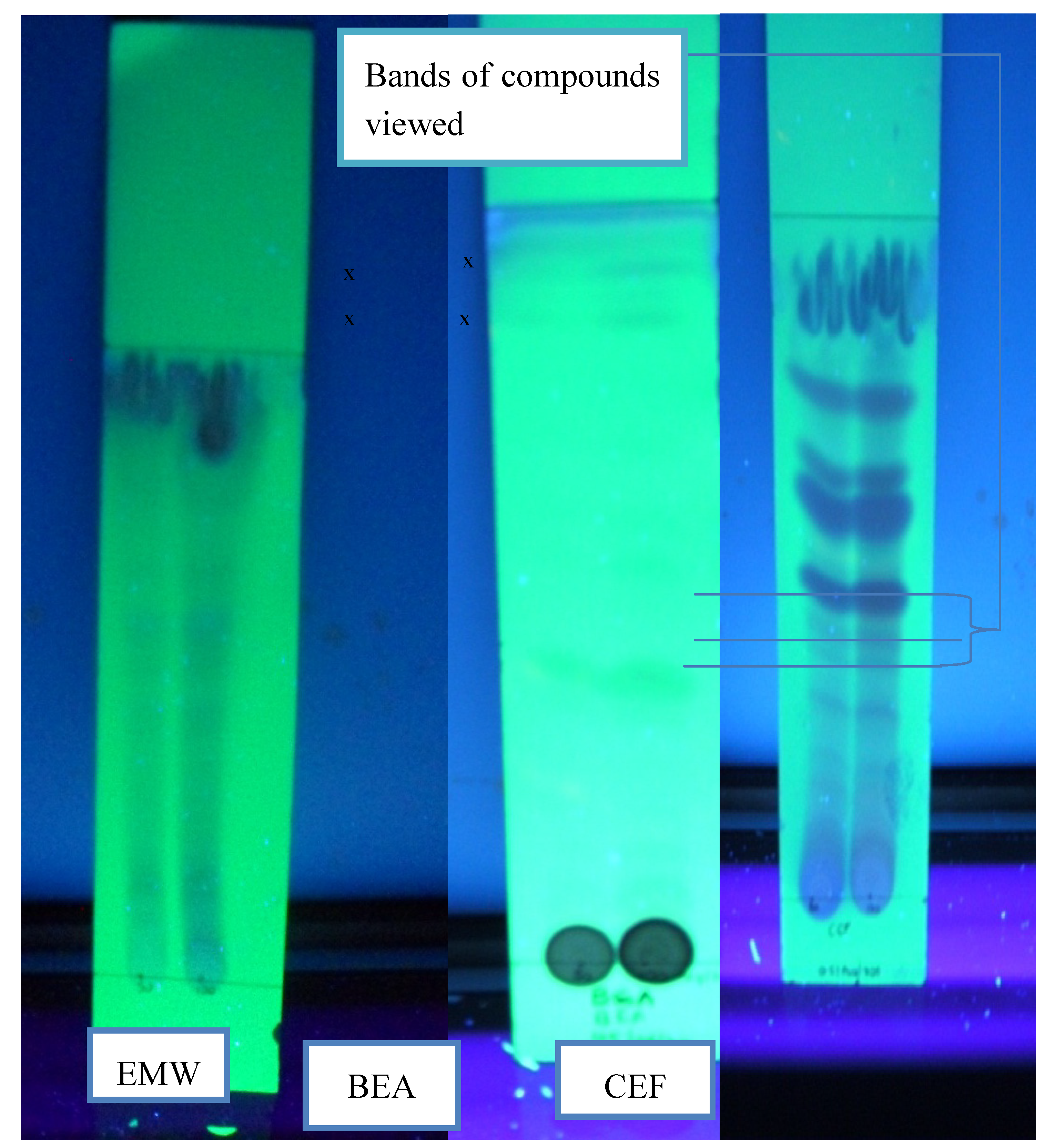
| Solvent systems | |||||||
|---|---|---|---|---|---|---|---|
| Bands | BEA | CEF | EMW | ||||
| 50 | 100 | 50 | 100 | 50 | 100 | ||
| 1 | 0.08 | 0.01 | 0.09 | 0.08 | 0.03 | 0.09 | |
| 2 | 0.1 | 0.13 | 0.14 | 0.11 | 0.08 | 0.16 | |
| 3 | 0.12 | 0.16 | 0.39 | 0.19 | 0.11 | 0.19 | |
| 4 | - | 0.22 | 0.5 | 0.39 | 0.16 | 0.31 | |
| 5 | - | 0.28 | 0.52 | 0.53 | 0.31 | 0.49 | |
| 6 | - | 0.32 | 0.53 | 0.55 | 0.49 | 0.56 | |
| 7 | - | - | 0.63 | 0.63 | 0.56 | 0.64 | |
| 8 | - | - | 0.72 | 0.64 | 0.72 | 0.67 | |
| 9 | - | - | 0.83 | 0.72 | 0.75 | 0.76 | |
| 10 | - | - | 0.87 | 0.83 | - | 0.88 | |
| 11 | - | - | - | 0.85 | - | - | |
| 12 | - | - | - | 0.88 | - | - | |
2.3.2. Antimicrobial Activity Assay by Bioautography
| Organisms | a | b | Solvent system | ||
|---|---|---|---|---|---|
| (50 mg/mL | 100 mg/mL) | (50 mg/mL | 100 mg/mL) | ||
| S. pyogenes | 0.53 | 0.53 | +++ | +++ | CEF |
| 0.64 | 0.64 | +++ | +++ | CEF | |
| 0.30 | 0.31 | + | + | EMW | |
| origin | Origin | ++++ | ++++ | BEA | |
| S. aureus | - | 0.53 | - | + | CEF |
| 0.56 | 0.63 | +++ | +++ | EMW | |
| - | - | - | - | BEA | |
| P. shigelloides | 0.63 | 0.63 | ++ | ++ | CEF |
| 0.73 | 0.72 | ++ | +++ | CEF | |
| - | 0.85 | - | ++ | EMW | |
| 0.75 | 0.76 | ++ | ++ | EMW | |
| - | 0.88 | - | ++ | EMW | |
| - | - | - | - | BEA | |
| S. typhimurium | 0.53 | 0.55 | ++ | ++ | CEF |
| 0.63 | 0.64 | ++++ | +++ | CEF | |
| 0.52 | 0.52 | ++ | +++ | EMW | |
| origin | Origin | ++ | ++ | BEA | |
2.4. Column Chromatography Analysis and MIC90 Determination of Fractions
| Fraction | Rf value of fractionated compounds | MIC90 against test organisms | |||
|---|---|---|---|---|---|
| S. pyogenes | S. aureus | P. shigelloides | S. typhimurium | ||
| C 1 | 0.008, 0.159, 0.31 | ND | ND | ND | ND |
| C2 | 0.09, 0.12, 0.36 | ND | ND | ND | ND |
| C3 | 0.13, 0.17, 0.29 | 0.0195 | 0.00781 | ND | ND |
| C4 | 0.156, 0.286, 0.294 | 0.00871 | 0.0195 | ND | ND |
| CEF 1 | 0.2, 0.366, 0.42 | 0.049 | 0.0098 | 0.625 | 0.3125 |
| CEF 2 | 0.34, 0.4, 0.52 | 0.625 | 0.024 | 0.625 | 1.25 |
| CEF 3 | 0.153 | 0.1563 | 0.0781 | 0.0781 | 0.1563 |
| CEF 4-6 | 0.13, 0.226, 0.3 | ND | 0.024 | 2.5 | 2.5 |
| CEF 7 | 0.2, 0.33 | 0.625 | 0.0049 | ND | 0.1563 |
| CEF 8-10 | 0.16, 0.306, 0.36 | 0.0195 | 0.024 | 2.5 | 2.5 |
| CEF 11 | 0.13 | 0.049 | 0.0006 | 2.5 | 0.012 |
| CEF 12 | 0.15, 0.18 | 0.3125 | 0.635 | 0.0781 | 1.25 |
| CEF 13 | 0.13, 0.18, 0.28 | 0.0049 | 0.024 | 1.25 | ND |
| CEF 14-16 | 0.15, 0.2 | 0.3125 | 1.25 | 1.625 | ND |
| CEF 17 | 0.11, 0.38 | 0.0024 | 0.049 | 0.325 | ND |
| CEF 18 | 0.12, 0.27 | 0.0012 | 0.1563 | 0.0195 | ND |
| Ciprofloxacin | 0.0012 | 0.0049 | 0.012 | 0.0781 | |
2.5. Gas-Chromatography/Mass-Spectrometry (GC-MS)
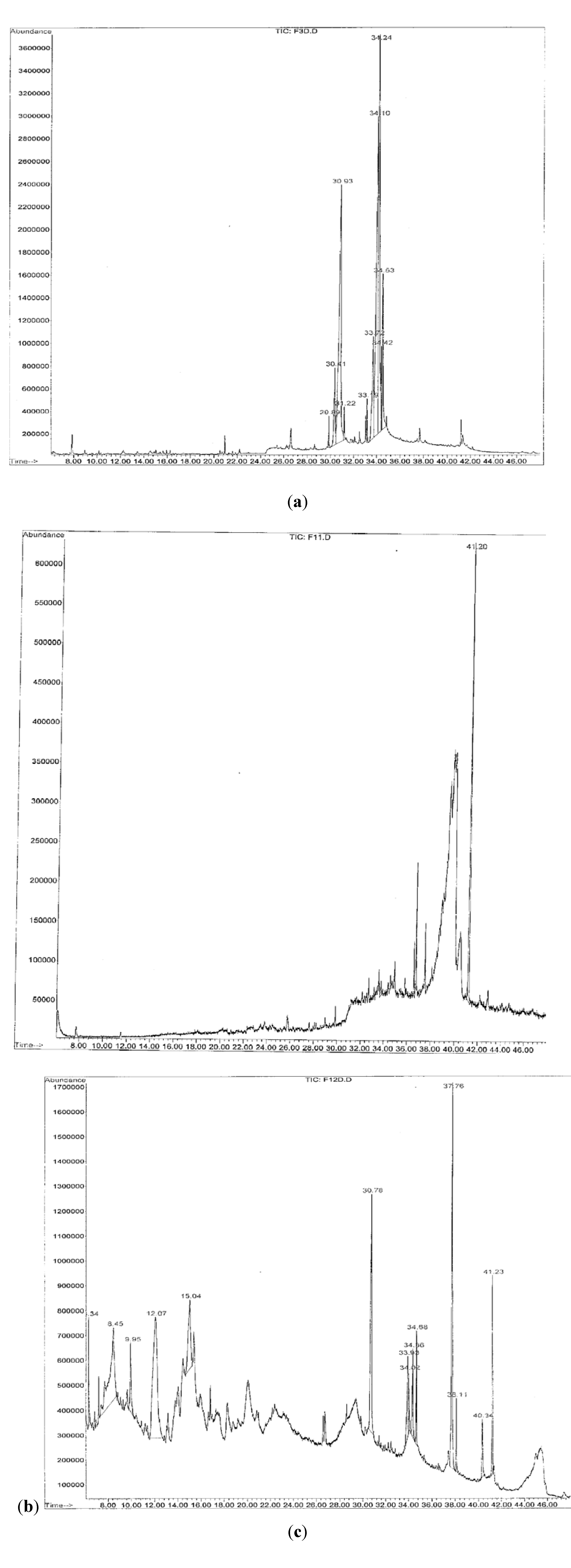
| Fraction | Peak numbers | RT (mins) | Compounds identified | % |
|---|---|---|---|---|
| 1 | 29.89 | Hexadecanoic acid, methyl ester | 0.73 | |
| 2 | 30.42 | Hexadecanoic acid | 4.41 | |
| 3 | 31.93 | Hexadecanoic acid, Palmitic acid | 25.07 | |
| 4 | 31.22 | Hexadecanoic acid, ethyl ester | 0.83 | |
| CEF 3 / F3 | 5 | 33.19 | 9-Octadecenoic acid, methyl ester | 0.91 |
| 6 | 33.71 | Heptadecene-(8)-carbonic acid | 6.63 | |
| 7 | 34.10 | Linoloic acid | 26.60 | |
| 8 | 34.24 | 9-Octadecenoic acid | 24.81 | |
| 9 | 34.42 | 14-Pentadecanoic acid | 2.62 | |
| 10 | 41.20 | Octadenoic acid, Stearic acid | 7.49 | |
| Total | 100 | |||
| CEF 11 / F11 | 1 | 41.20 | 1.2-Benzenedicarboxylic acid | 100 |
| 1 | 6.63 | Formamide, N,N-Diethyl | 2.31 | |
| 2 | 8.45 | 1-Butanol | 15.72 | |
| 3 | 9.95 | 3-Isothiazolecarboxamide | 3.03 | |
| 4 | 12.07 | 2.3-Dihydro-3,5-dihydeoxy-6-methyl ester | 24.16 | |
| 5 | 15.04 | 2.5-Di(hydroxymethyl)-furan | 7.06 | |
| 6 | 30.78 | Palmitic acid | 12.91 | |
| CEF 12 / F12 | 7 | 33.94 | 9-Octadecanoic acid | 4.08 |
| 8 | 34.02 | Cyclohexadecane | 1.84 | |
| 9 | 34.36 | Stearic acid | 3.11 | |
| 10 | 34.68 | n-Tetradecanoic acid amide | 2.55 | |
| 11 | 37.75 | 9-Octadecenamide | 13.82 | |
| 12 | 38.11 | Hexadecanamide | 1.59 | |
| 13 | 40.34 | 3, 4,8-Trimethyl-2-nonenal | 2.07 | |
| Total | 94.24 |
3. Experimental
3.1. Bacterial Strains
3.2. Resuscitation of Bacterial Strains
3.3. Preparation of Plant Extract
3.4. Antimicrobial Susceptibility Testing
3.5. Determination of Minimum Inhibitory Concentration (MIC90)
3.6. Determination of Minimum Bactericidal Concentration (MBC)
3.7. Phytochemical and Antimicrobial Analysis
3.7.1. Thin Layer Chromatography (TLC)

3.7.2. Antimicrobial Activity Assay by Bioautography
3.8. Column Chromatography
3.9. Determination of Minimum Inhibitory Concentration (MIC90) of Fractions
3.10. Gas-Chromatography/Mass-Spectrometry (GC-MS)
3.11. Statistical Analysis
4. Conclusions
Acknowledgements
References and Notes
- Sibanda, T.; Okoh, A.I. In vitro antimicrobial regimes of crude aqueous and acetone extract of Garcinia kola seeds. J. Biol. Sci. 2008, 8, 149–154. [Google Scholar] [CrossRef]
- Rabe, T.; Van Staden, J. Antibacterial activity of South African plants used for medicinal purposes. J. Ethnopharmacol. 1997, 56, 81–87. [Google Scholar] [CrossRef]
- Njume, C.; Afolayan, A.J.; Ndip, R.N. Preliminary phytochemical screening and in vitro anti-Helicobacter pylori activity of acetone and aqueous extracts of the stem bark of Sclerocaryabirrea (Anacardiaceae). Arch. Med. Res. 2011, 42, 252–257. [Google Scholar] [CrossRef]
- Stevens, D.L. Streptoccoccal toxic shock syndrome spectrum of disease pathogenesis and new concepts in treatment. Emerging Infect. Dis. 1995, 1, 69–78. [Google Scholar] [CrossRef]
- Ryan, K.J.; Ray, G. Introduction to Infectious Diseases. Sherris Medical Microbiology, 4th ed; McGraw-Hill: New York, NY, USA, 2004; pp. 146–157. [Google Scholar]
- Smeersters, P.R.; Dreze, P.A.; Biarant, D.; Van Melderen, L.; Vergison, A. Group A Streptococcus virulence and host factors in two toddlers with rheumatic fever following toxic shock syndrome. Int. J. Infect. Dis. 2010, 14, 403–409. [Google Scholar]
- Shibl, A. Pattern of macrolide resistance determinants among Streptoccocus pyogenes and Streptococcus pneumoniae isolates in Saudi Arabia. J. Int. Med. Res. 2005, 33, 349–355. [Google Scholar]
- Oliveira, D.C.; Miheirico, C.; de Lencastre, H. Redefining structural variant of staphylococcal cassette chromosome mec, SCC mec type VI. Antimicrob. Agents Chemother. 2006, 50, 3457–3459. [Google Scholar] [CrossRef]
- Richter, S.S.; Heilmann, K.P.; Dohrn, C.L.; Beekmann, S.E.; Riahi, F.; García-de-Lomas, J.; Ferech, M.; Goossens, H.; Doern, G.V. Increasing telithromycin resistance among Streptococcus pyogenes in Europe. J. Antimicrob. Chemother. 2008, 61, 603–611. [Google Scholar] [CrossRef]
- Yan, J.; Wu, H.; Whang, A.; Fu, H.; Lee, C.; Wu, T. Prevalence of polyclonal mef-A containing isolates among erythromycin resistant group A Streptococci in Southern Taiwan. J. Clin. Microbiol. 2000, 38, 2478–2479. [Google Scholar]
- Ueda, Y.; Suzuki, N.; Furukawa, T.; Takegaki, Y.; Takahashi, N.; Miyagi, K. Analysis of enteropathogenic bacteria at Kansai Airport Quarantine Station from September 4th, 1994 through December 1996. Kansenshogaku Zasshi 1999, 73, 110–121. [Google Scholar]
- McClelland, M.; Sanderson, K.E.; Spieth, J.; Clifton, S.W.; Latreille, P.; Courtney, L.; Porwollik, S.; Ali, J.; Dante, M.; Du, F. Complete genome sequence of Salmonella enterica serovarTyphimurium LT2. Nature 2001, 413, 852–856. [Google Scholar]
- Butaye, P.; Michael, G.B.; Schwarz, S.; Barrett, T.J.; Brisabois, A.; While, D.G. The clonal spread of multidrug-resistant non-typhi Salmonella serotypes. Microb. Infect. 2006, 8, 1891–1897. [Google Scholar] [CrossRef]
- Plowder, C.C. A Manual of Plants Names, 3rd ed; Allen and Unwin: George, UK, 1972; p. 239. [Google Scholar]
- Adeboye, M.F.; Akinpelu, D.A.; Okoh, A.I. The bioactive and phytochemical properties of Garcinia kola Heckel seed extract on some pathogens. Afr. J. Biotechnol. 2008, 7, 3934–3938. [Google Scholar]
- Njume, C.; Afolayan, A.J.; Clarke, A.M.; Ndip, R.N. Crude ethanolic extracts of Garcinia kola seeds Heckel prolong the lag phase of Helicobacter pylori: inhibitory and bactericidal potential. J. Med. Food 2011, 14, 822–827. [Google Scholar] [CrossRef]
- Okunji, C.O.; Tantalia, A.W.; Hicks, R.P.; Iwu, M.M.; Skanchy, D.J. Capillary electrophoresis determination of biflavonones from Garcinia kola in the traditional African medicinal formulations. Plant Med. 2002, 68, 440–444. [Google Scholar] [CrossRef]
- Cotterhill, P.J.; Scheinmann, F.; Stenhouse, T.A. Extractives from Guttiferae: Kolaflavanone, a new biflavanone from the nuts of Garcinia kola Heckel. J. Chem. Soc. Perkin Trans. 1 1978, 1, 246. [Google Scholar]
- Okunji, C.; Komarnytsky, S.; Fear, G.; Poulev, A.; Ribnicky, D.M.; Awachie, P.I.; Raskinn, I. Preparative isolation and identification of tyrosinase inhibitors from the seeds of Garcinia kola by high - speed counter - current chromatography. J. Chromatog. 1151, 45–50. [Google Scholar]
- Eloff, J.N. Which extractant should be used for the screening and isolation of antimicrobial component from plants? J. Ethnopharmacol. 1998, 60, 1–8. [Google Scholar] [CrossRef]
- Ezeifeka, G.O.; Onji, M.U.; Mbata, T.I.; Patrick, A.O. Antimicrobial activities of Cajanus Cajan, Garcinia kola seeds and Xylopia aethiopica on pathogenic microorganisms. J. Biol. Sci. 2004, 1, 49–154. [Google Scholar]
- Jayalakshmi, B.; Raveesha, K.A.; Amrutheth, K.N. Phytochemical investigations and antibacterial activity of some medicinal plants against pathogenic bacteria. J. App. Pharm. Sci. 2011, 1, 124–128. [Google Scholar]
- Vaghasiya, Y.; Batel, H.; Chanda, S. Antibacterial activity of Mangifera inica L seeds against some human pathogenic bacterial strains. Afr. J. Biotechnol. 2011, 10, 15788–15794. [Google Scholar]
- Manetti, A.G.; Zingaretti, C.; Falugi, F.; Capo, S.; Bombaci, M.; Bagnoli, F.; Gambellini, G.; Bensi, G.; Mora, M.; Edwards, A.M.; et al. Streptococcus pyogenes pili promote pharyngeal cell adhesion and biofilm formation. Mol. Microbiol. 2007, 64, 968–983. [Google Scholar] [CrossRef]
- Nwaokorie, C.F.; Akitoye, C.; Folasade, O.; Gaetti-Jardim, E.; Oyedele, G.; Ayanbadejo, P.; Abdurrazaq, T.; Umezudike, A. Antimicrobial activity of Garcinia kola on oral Fusobacterium nucleatum and biofilm. Afr. J. Microbiol. Res. 2010, 4, 509–514. [Google Scholar]
- Masoko, P.; Picard, J.; Eloff, J.N. The antifungal activity of twenty-four Southern African Combretum species (Combretaceae). S. Afr. J. Bot. 2007, 73, 173–183. [Google Scholar] [CrossRef]
- Masoko, P.; Eloff, J.N. The diversity of antifungal compounds of six SA terminalia species Combretaceae determined by bioautography. Afr. J. Biotechnol. 2005, 4, 1425–1431. [Google Scholar]
- Masoko, P.; Mokgotho, M.P.; Mbazima, V.G.; Mampuru, L.J. Biological activities of Typhacapensis (Typhaceae) from Limpopo province South Africa. Afr. J. Biotechnol. 2008, 7, 3743–3748. [Google Scholar]
- McGraw, L.J.; Jager, A.K.; Van Staden, J. Isolation of antibacterial fatty acids from Schotia brachybetala. Fitoterapia 2002, 73, 431–433. [Google Scholar] [CrossRef]
- Seidel, V.; Tailor, P.W. In vitro activity of extracts and constituents of Pelagonium against rapidly growing mycobacteria. Int. J. Antimicrob. Agents 2004, 23, 613–619. [Google Scholar] [CrossRef]
- Russel, A.D. Mechanisms of bacterial resistance of non-antibiotics: Food additives and food pharmaceutical preservatives. J. Appl. Bacteriol. 1991, 71, 191–201. [Google Scholar] [CrossRef]
- Eliyinmi, A.F.; Bressler, D.C.; Isiaka, A.; Sporns, P.; Oshodi, A. Chemical composition of Garcinia kola seed and hulls. Pol. J. Food. Nutr. Sci. 2006, 15, 395–400. [Google Scholar]
- Gopalakrishan, S.; Saroja, K.; Dulcy, E. GC-MS analysis of methanolic extract of leaves of Dipleracanthus patulus. J. Chem. Pharm. Res. 2011, 3, 477–480. [Google Scholar]
- Eloff, J.N.; Famakin, J.O.; Katerere, D.R.P. Isolation of an antibacterial stilbene from Combretum woodii leaves. Afr. J. Biotechnol. 2005, 4, 1161–1166. [Google Scholar]
- Nethathe, B.B.; Ndip, R.N. Bioactivity of Hydonora africana on selected bacterial pathogens: Preliminary phytochemical screening. Afr. J. Microbiol. Res. 2011, 5, 2820–2826. [Google Scholar]
- Nyenje, M.; Ndip, R.N. In-vitro antimicrobial activity of the crude acetone extract of the stem bark of Combretum molle against selected bacterial pathogens of medical importance. J. Med. Plts. Res. 2011, 5, 5315–5320. [Google Scholar]
- Basri, D.F.; Fan, S.H. The potential of aqueous and acetone extracts of gall of Queercus infectoria as antibacterial agents. Indian J. Pham. Sci. 2005, 37, 26–29. [Google Scholar] [CrossRef]
- Irobi, O.N.; Moo-Young, M.; Anderson, W.A.; Daramola, S.O. Antimicrobial activity of bark extracts of Bridelia ferruginea (Euphorbiaceae). J. Ethnopharmacol. 1994, 43, 185–190. [Google Scholar] [CrossRef]
- Njume, C.; Afolayan, A.J.; Green, E.; Ndip, R.N. Volatile compounds in the stem bark of Sclerocarya birrea possess antimicrobial activity against drug resistant strains of Helicobacter pylori. Int. J. Antimicrob. Agents 2011, 38, 319–324. [Google Scholar] [CrossRef]
- Vila, R.; Santana, A.I.; Peez-Roses, R.; Valderrama, A.; Castelli, M.V.; Mendonca, S.; Zacchino, S.; Gapta, M.P.; Salvador, B.A. Composition and biological activity of the essential oil from leaves of Plinia cerrocamanensis, a new source of α-bisabolol. Bioresour. Technol. 2010, 101, 2510–2514. [Google Scholar]
- Adams, P.R. Identification of Essential Oil Components by Ion Trap Mass Spectroscopy; Academic Press: New York, NY, USA, 1989. [Google Scholar]
- Joulain, D.; Koenig, W.A. The Atlas of Spectral Data of Sesquiterpine Hydrocarbons; EB-Verlag: Hamburg, Germany, 1998. [Google Scholar]
© 2012 by the authors; licensee MDPI, Basel, Switzerland. This article is an open-access article distributed under the terms and conditions of the Creative Commons Attribution license (http://creativecommons.org/licenses/by/3.0/).
Share and Cite
Seanego, C.T.; Ndip, R.N. Identification and Antibacterial Evaluation of Bioactive Compounds from Garcinia kola (Heckel) Seeds. Molecules 2012, 17, 6569-6584. https://doi.org/10.3390/molecules17066569
Seanego CT, Ndip RN. Identification and Antibacterial Evaluation of Bioactive Compounds from Garcinia kola (Heckel) Seeds. Molecules. 2012; 17(6):6569-6584. https://doi.org/10.3390/molecules17066569
Chicago/Turabian StyleSeanego, Christinah T., and Roland N. Ndip. 2012. "Identification and Antibacterial Evaluation of Bioactive Compounds from Garcinia kola (Heckel) Seeds" Molecules 17, no. 6: 6569-6584. https://doi.org/10.3390/molecules17066569