
<?xml version="1.0" encoding="UTF-8"?>
<!DOCTYPE article PUBLIC "-//NLM//DTD Journal Publishing DTD v2.3 20070202//EN" "journalpublishing.dtd">
<article xmlns:mml="http://www.w3.org/1998/Math/MathML" xmlns:xlink="http://www.w3.org/1999/xlink" xml:lang="en" article-type="research-article">
  <front>
    <journal-meta>
      <journal-id journal-id-type="publisher-id">molecules</journal-id>
      <journal-title>Molecules</journal-title>
      <abbrev-journal-title abbrev-type="publisher">Molecules</abbrev-journal-title>
      <abbrev-journal-title abbrev-type="pubmed">Molecules</abbrev-journal-title>
      <issn pub-type="epub">1420-3049</issn>
      <publisher>
        <publisher-name>MDPI</publisher-name>
      </publisher>
    </journal-meta>
    <article-meta>
      <article-id pub-id-type="doi">10.3390/molecules17044634</article-id>
      <article-id pub-id-type="publisher-id">molecules-17-04634</article-id>
      <article-categories>
        <subj-group>
          <subject>Article</subject>
        </subj-group>
      </article-categories>
      <title-group>
        <article-title>Synthesis and Antibacterial Evaluation of New <italic>N</italic>-acylhydrazone Derivatives from Dehydroabietic Acid</article-title>
      </title-group>
      
      <contrib-group>
        <contrib contrib-type="author">
          <name>
            <surname>Gu</surname>
            <given-names>Wen</given-names>
          </name>
          <xref rid="c1-molecules-17-04634" ref-type="corresp">*</xref>
        </contrib>
        <contrib contrib-type="author">
          <name>
            <surname>Wu</surname>
            <given-names>Rongrong</given-names>
          </name>
        </contrib>
        <contrib contrib-type="author">
          <name>
            <surname>Qi</surname>
            <given-names>Shilong</given-names>
          </name>
        </contrib>
        <contrib contrib-type="author">
          <name>
            <surname>Gu</surname>
            <given-names>Chenhai</given-names>
          </name>
        </contrib>
        <contrib contrib-type="author">
          <name>
            <surname>Si</surname>
            <given-names>Fanjunnan</given-names>
          </name>
        </contrib>
        <contrib contrib-type="author">
          <name>
            <surname>Chen</surname>
            <given-names>Zhuhui</given-names>
          </name>
        </contrib>
      </contrib-group>
      <aff id="af1-molecules-17-04634">College of Chemical Engineering, Nanjing Forestry University, Nanjing 210037, China</aff>
      <author-notes>
        <corresp id="c1-molecules-17-04634"><label>*</label> Author  to whom correspondence should be addressed; Email: <email>njguwen@163.com</email>; Tel.: +86-25-8542-8369.</corresp>
      </author-notes>
      <pub-date pub-type="epub">
        <day>20</day>
        <month>04</month>
        <year>2012</year>
      </pub-date>
      <pub-date pub-type="collection">
        <month>04</month>
        <year>2012</year>
      </pub-date>
      <volume>17</volume>
      <issue>4</issue>
      <fpage>4634</fpage>
      <lpage>4650</lpage>
      <history>
        <date date-type="received">
          <day>26</day>
          <month>03</month>
          <year>2012</year>
        </date>
        <date date-type="rev-recd">
          <day>01</day>
          <month>04</month>
          <year>2012</year>
        </date>
        <date date-type="accepted">
          <day>05</day>
          <month>04</month>
          <year>2012</year>
        </date>
      </history>
      <permissions>
        <copyright-statement>© 2012 by the authors; licensee MDPI, Basel, Switzerland.</copyright-statement>
        <copyright-year>2012</copyright-year>
        <license xmlns:xlink="http://www.w3.org/1999/xlink" license-type="open-access" xlink:href="http://creativecommons.org/licenses/by/3.0/">
          <p>This article is an open-access article distributed under the terms and conditions of the Creative Commons Attribution license (http://creativecommons.org/licenses/by/3.0/).</p>
        </license>
      </permissions>
      <abstract>
        <p>A series of new <italic>N</italic>-acylhydrazone derivatives were synthesized in good yields through the reactions of dehydroabietic acid hydrazide with a variety of substituted arylaldehydes. The structures of the synthesized compounds were confirmed by IR, <sup>1</sup>H- and <sup>13</sup>C-NMR, ESI-MS, elemental analysis and single crystal X-ray diffraction. From the crystal structure of compound <bold>4l</bold>, the C=N double bonds of these <italic>N</italic>-acylhydrazones showed (<italic>E</italic>)-configuration, while the NMR data of compounds <bold>4a</bold>–<bold>q</bold> indicated the existence of two rotamers for each compound in solution. The target compounds were evaluated for their antibacterial activities against four microbial strains. The result suggested that several compounds exhibited pronounced antibacterial activities. Particularly, compound <bold>4p</bold> exhibited good antibacterial activity against <italic>Staphylococcus aureus</italic> and <italic>Bacillus subtilis</italic> comparable to positive control. The possible antibacterial metabolism and the strategy for further optimization of this compound were also discussed. </p>
      </abstract>
      <kwd-group>
        <kwd><italic>N</italic>-acylhydrazone</kwd>
        <kwd>dehydroabietic acid</kwd>
        <kwd>synthesis</kwd>
        <kwd>antibacterial activity</kwd>
      </kwd-group>
    </article-meta>
  </front>
  <body>
    <sec sec-type="intro">
      <title>1. Introduction</title>
      <p>Microbial infections remain a pressing human health problem because of a combination of factors, including emerging infectious diseases and the rapid development of multi-drug resistance pathogens worldwide [<xref ref-type="bibr" rid="B1-molecules-17-04634">1</xref>,<xref ref-type="bibr" rid="B2-molecules-17-04634">2</xref>]. In spite of many antibiotics and chemotherapeutics available, there will still be a vital need to discover new and effective antimicrobial agents. In recent years, the <italic>N</italic>-acylhydrazone moiety has proved to be an important pharmacophore structure in pharmaceutical research [<xref ref-type="bibr" rid="B3-molecules-17-04634">3</xref>]. These structures have received much attention due to their chemotherapeutic potential in the development of novel antimicrobial agents [<xref ref-type="bibr" rid="B4-molecules-17-04634">4</xref>,<xref ref-type="bibr" rid="B5-molecules-17-04634">5</xref>]. Some widely used antibacterial drugs such as furacilin, furazolidone and ftivazide are known to contain such kind of moieties [<xref ref-type="bibr" rid="B6-molecules-17-04634">6</xref>]. In addition, many <italic>N</italic>-acylhydrazone derivatives have been reported to exhibit an array of biological activities such as antimalarial [<xref ref-type="bibr" rid="B7-molecules-17-04634">7</xref>], antiviral [<xref ref-type="bibr" rid="B8-molecules-17-04634">8</xref>], antitumor [<xref ref-type="bibr" rid="B9-molecules-17-04634">9</xref>], anti-inflammatory [<xref ref-type="bibr" rid="B10-molecules-17-04634">10</xref>], anticonvulsant [<xref ref-type="bibr" rid="B11-molecules-17-04634">11</xref>], antidepressant [<xref ref-type="bibr" rid="B12-molecules-17-04634">12</xref>] and vasodilative activities [<xref ref-type="bibr" rid="B13-molecules-17-04634">13</xref>].</p>
      <p>Naturally occurring diterpenoids with an abietane skeleton are often discovered and isolated from higher plants and their diverse bioactivities have been reported [<xref ref-type="bibr" rid="B14-molecules-17-04634">14</xref>,<xref ref-type="bibr" rid="B15-molecules-17-04634">15</xref>]. Among them, dehydroabietic acid (DHA, <bold>1</bold>) is one of the major tricyclic diterpenoid constituents of pine resin and can be readily obtained from commercial disproportionated rosin. DHA and its derivatives have exhibited a broad spectrum of biological activities such as antimicrobial, antitumor, antiviral, antioxidant, anti-inflammatory and gastroprotective activities [<xref ref-type="bibr" rid="B16-molecules-17-04634">16</xref>,<xref ref-type="bibr" rid="B17-molecules-17-04634">17</xref>,<xref ref-type="bibr" rid="B18-molecules-17-04634">18</xref>,<xref ref-type="bibr" rid="B19-molecules-17-04634">19</xref>,<xref ref-type="bibr" rid="B20-molecules-17-04634">20</xref>,<xref ref-type="bibr" rid="B21-molecules-17-04634">21</xref>], which indicate that the compound is a potentially useful starting material for the synthesis of industrially or pharmacologically important products. In view of these findings, it would be worthwhile to design, synthesize new derivatives of DHA bearing <italic>N</italic>-acylhydrazone moiety and evaluate their potential antimicrobial activities. In continuation of our previous study on new antimicrobial derivatives of resin acids [<xref ref-type="bibr" rid="B22-molecules-17-04634">22</xref>], we report herein the synthesis and characterization of a series of new <italic>N</italic>-acylhydrazones starting from DHA. Their <italic>in vitro</italic> antibacterial activities against several test microbes are also presented.</p>
    </sec>
    <sec sec-type="results">
      <title>2. Results and Discussion</title>
      <sec>
        <title>2.1. Synthesis</title>
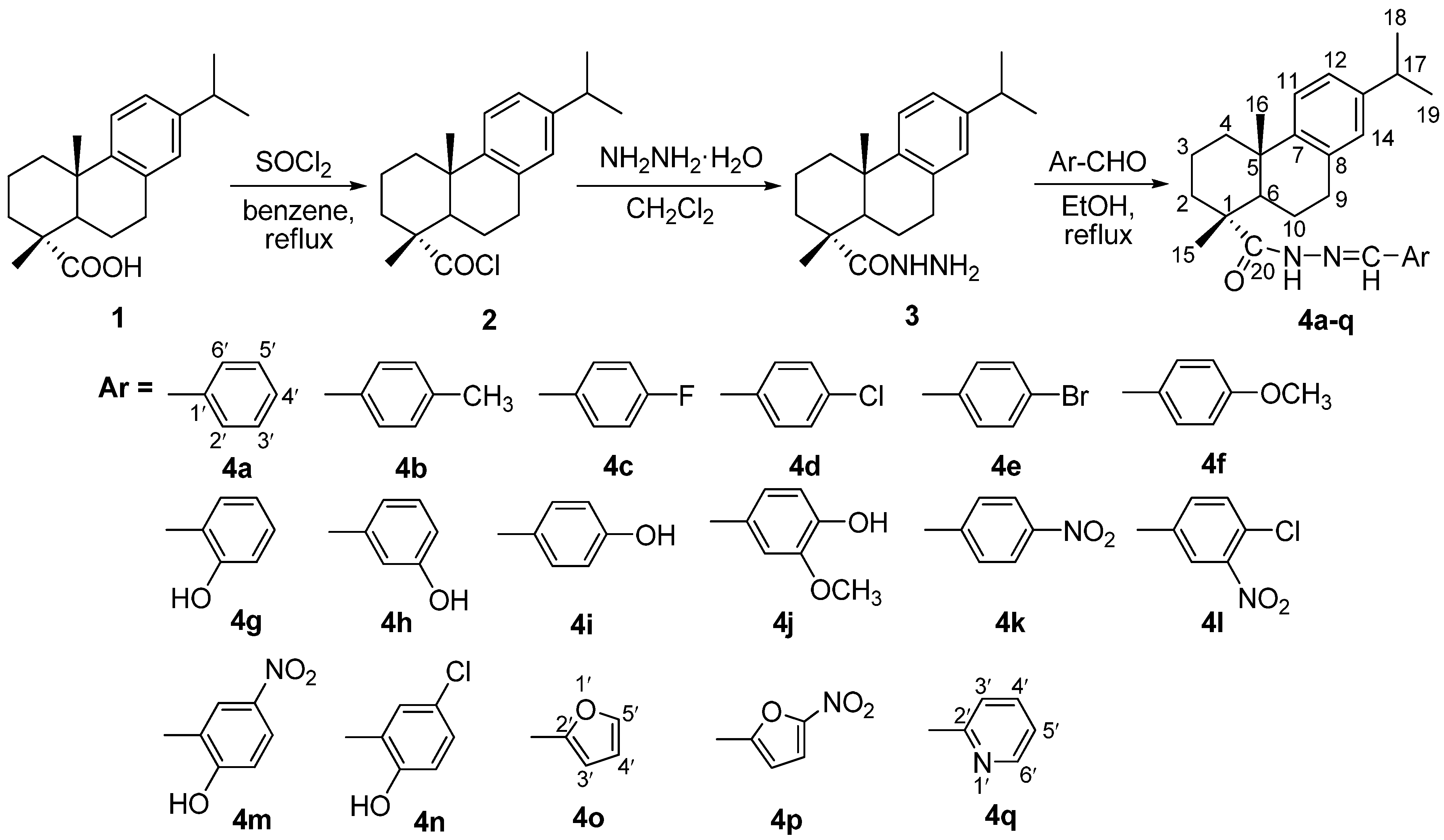
        <p>The synthetic procedures for the target compounds <bold>4a</bold>–<bold>q</bold> are outlined in <xref ref-type="scheme" rid="molecules-17-04634-f001">Scheme 1</xref>. The key intermediate dehydroabietic acid hydrazide (<bold>3</bold>) was synthesized by hydrazination of dehydroabietate chloride (<bold>2</bold>), which was prepared by the reaction of dehydroabietic acid (<bold>1</bold>) with thionyl chloride [<xref ref-type="bibr" rid="B23-molecules-17-04634">23</xref>]. In the former literature, the synthesis of hydrazides was usually carried out by hydrazination of methyl/ethyl esters of the corresponding carboxylic acids [<xref ref-type="bibr" rid="B24-molecules-17-04634">24</xref>,<xref ref-type="bibr" rid="B25-molecules-17-04634">25</xref>]. However, in this case, it was found that ethyl dehydroabietate could hardly be converted to the hydrazide <bold>3</bold>, possibly because of the low reactivity of the ester or the steric hindrance caused by the adjacent moieties of the molecule [<xref ref-type="bibr" rid="B26-molecules-17-04634">26</xref>]. Alternatively the hydrazide could be synthesized in good yield from dehydroabietate chloride (<bold>2</bold>) with higher reactivity. Then the hydrazide <bold>3</bold> was condensed with different substituted aromatic aldehydes in refluxing ethanol to afford the corresponding <italic>N</italic>-acylhydrazones <bold>4a</bold>–<bold>q</bold> in good yield. </p>
        
      </sec>
      <sec>
        <title>2.2. Structural Analysis</title>
        <p>The structures of the synthesized <italic>N</italic>-acylhydrazone derivatives were confirmed on the basis of IR, MS, NMR, elemental analysis and crystallographic methods. The IR spectra of <bold>4a</bold>–<bold>q</bold> exhibited in all cases N-H bands in the range 3,232–3,279 cm<sup>−1</sup>. The strong absorption bands at 1,646–1,658 cm<sup>−1</sup> were due to the C=O stretch vibrations of the hydrazone moieties. The ESI-MS of compounds <bold>4a</bold>–<bold>q</bold> displayed, in all cases, quasimolecular ion peaks which confirmed their molecular weights. The <sup>1</sup>H-NMR spectra of compounds <bold>4a</bold>–<bold>q</bold> were similar except for the aromatic protons. In a typical example, <sup>1</sup>H-NMR spectra of <bold>4a</bold> showed a doublet at <italic>δ</italic> 1.22 (1.20) ppm corresponding to six methyl protons (H-18 and H-19) of the isopropyl group, together with a muliplet at <italic>δ</italic> 2.82 (2.78) ppm due to the vicinal CH proton (H-17). Two singlets at <italic>δ </italic>1.25 (1.24) and 1.40 (1.34) ppm could be assigned to methyl protons at C-16 and C-15, respectively. Resonance peaks attributing to eight aromatic protons in the two benzene rings appeared in the range <italic>δ</italic> 6.82–7.88 ppm. Among them, two doublets coupled with each other at <italic>δ </italic>7.00 (6.95) and 7.16 (7.08) ppm could be assigned to H-12 and H-11, respectively. The singlet at <italic>δ </italic>6.87 (6.82) ppm was due to the signal of H-14. Because of the symmetry of monosubstituted benzene ring, the signals of H-2′ and H-6′ appeared as a doublet at <italic>δ </italic>7.72 (7.88) ppm, while the signals at <italic>δ </italic>7.38–7.52 ppm could be assigned to H-3′, H-4′ and H-5′. The N=CH proton appeared as a singlet at <italic>δ</italic> 8.21 (8.03) ppm, and the amide NH proton resonated as a broad singlet at <italic>δ</italic> 8.83 (9.29) ppm. In the <sup>13</sup>C-NMR spectra, the signal at <italic>δ </italic>23.9 (23.8) ppm could be assigned to C-18 and C-19. The carbon atoms of the two benzene rings resonated as ten pairs of absoption peaks because of the symmetry of substituent. In addition, the peaks at <italic>δ </italic>146.1 (145.8) and 175.2 (176.8) ppm could be attributed to the signals of C=N and C=O carbons, respectively. The <sup>1</sup>H- and <sup>13</sup>C-NMR signals of other <italic>N</italic>-acylhydrazones were assigned by comparing with those of <bold>4a</bold>.</p>
        <fig id="molecules-17-04634-f001" position="anchor">
          <object-id pub-id-type="pii">molecules-17-04634-scheme1_Scheme 1</object-id>
          <label>Scheme 1</label>
          <caption>
            <p>Synthetic route of hydrazone derivatives (<bold>4a</bold>–<bold>q</bold>) from dehydroabietic acid.</p>
          </caption>
          <graphic xmlns:xlink="http://www.w3.org/1999/xlink" xlink:href="molecules-17-04634-g001.tif"/>
        </fig>
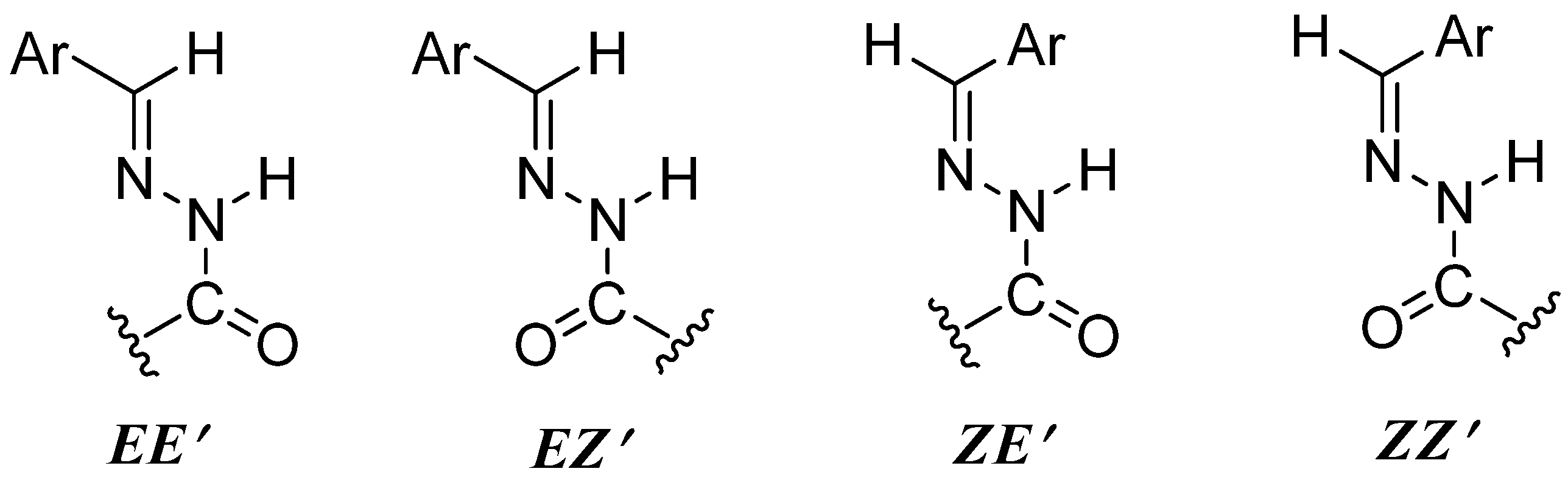
        <p>Interestingly, in their <sup>1</sup>H-NMR spectra, there were, if discriminable, two sets of signals observed for all groups, which resulted from the equilibrium and interconversion between rotamers (and/or configurational isomers) of each compound in solution [<xref ref-type="bibr" rid="B27-molecules-17-04634">27</xref>,<xref ref-type="bibr" rid="B28-molecules-17-04634">28</xref>]. It was known that <italic>N</italic>-acylhydrazones may exist in four possible forms in respect to (<italic>E</italic>/<italic>Z</italic>)-configurational isomers relative to the C=N double bonds and (<italic>E</italic>′/<italic>Z</italic>′)-rotamers caused by the inversion of amide bonds (<xref ref-type="fig" rid="molecules-17-04634-f002">Figure 1</xref>). However, the <italic>E</italic>/<italic>Z</italic> isomerization was not observed since these <italic>N</italic>-acylhydrazones exist primarily or completely in the (<italic>E</italic>)-configuration because of the steric hindrance relative to the moiety [<xref ref-type="bibr" rid="B29-molecules-17-04634">29</xref>], which was supported by means of relative free energy calculations in a former report [<xref ref-type="bibr" rid="B30-molecules-17-04634">30</xref>]. As for the characteristic peaks of <italic>N</italic>-acylhydrazones, the N=CH protons appeared as expected as two separate singlets in the region <italic>δ</italic> 7.71–8.58 ppm. The amide inversion also made the CONH proton present as two broad singlets in the range <italic>δ</italic> 8.71–10.18 ppm. </p>
        <fig id="molecules-17-04634-f002" position="anchor">
          <label>Figure 1</label>
          <caption>
            <p>For possible forms of <italic>N</italic>-acylhydrazone derivatives. </p>
          </caption>
          <graphic xmlns:xlink="http://www.w3.org/1999/xlink" xlink:href="molecules-17-04634-g002.tif"/>
        </fig>
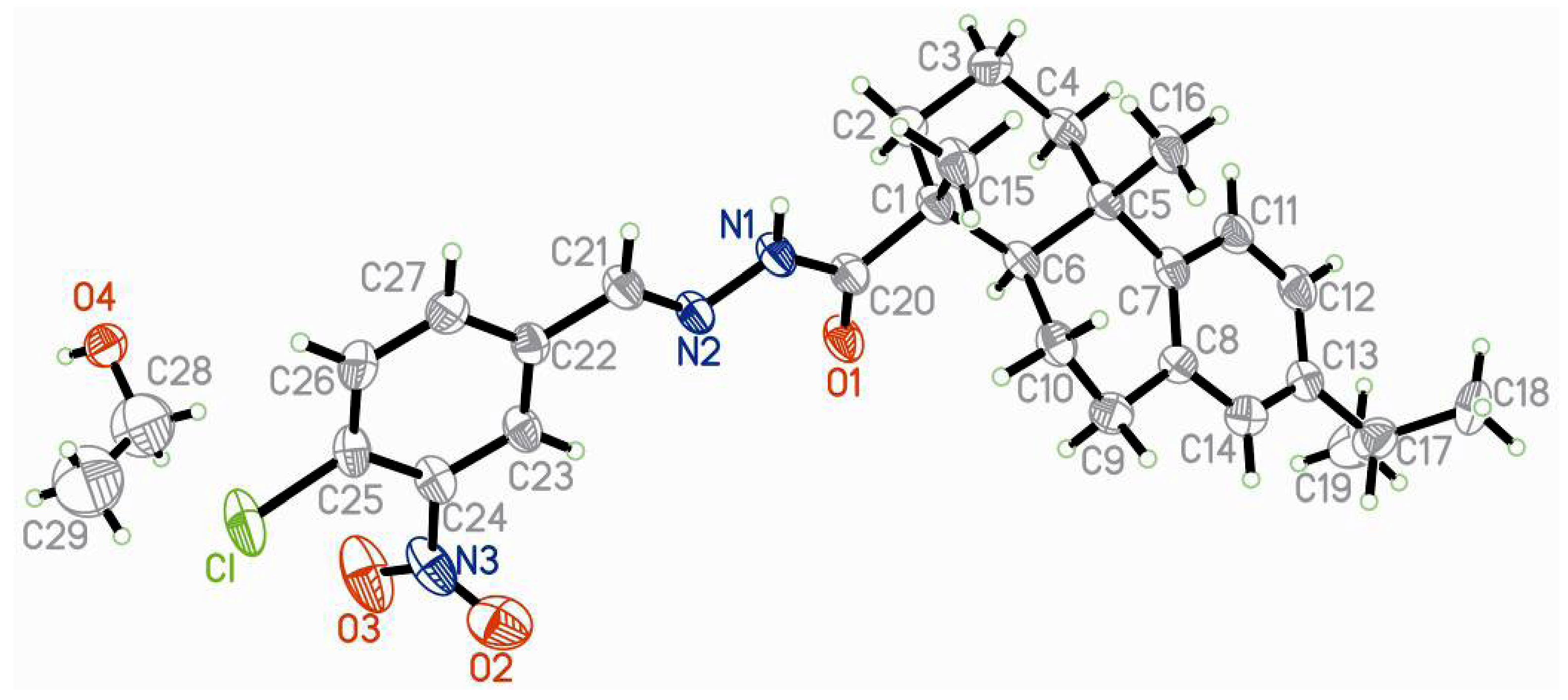
        <p>The single crystal of the representative compound <bold>4l</bold> was recrystallized from ethanol for the X-ray diffraction to confirm the configuration. The crystal data of <bold>4l</bold> are presented in <xref ref-type="table" rid="molecules-17-04634-t001">Table 1</xref>, and its ORTEP drawing with the atom numbering scheme is shown in <xref ref-type="fig" rid="molecules-17-04634-f003">Figure 2</xref>. In accordance with starting material dehydroabietic acid, the two cyclohexane ring A (C1~C6) and B (C5~C10) bearing chair and half-chair conformations, respectively, show a <italic>trans</italic> ring junction, with two methyl groups of C15 and C16 in the axial positions. The molecule displays an <italic>E</italic> configuration with respect to the N2=C21 double bond with a N1-N2-C21-C22 torsion angle of 179.5(3)°, and a <italic>Z</italic>′ conformation due to the amide bond with a N2-N1-C20-O1 torsion angle of 1.4(6)°.</p>
        <table-wrap id="molecules-17-04634-t001" position="anchor">
          <object-id pub-id-type="pii">molecules-17-04634-t001_Table 1</object-id>
          <label>Table 1</label>
          <caption>
            <p>Crystal structure data for compound <bold>4l</bold>.</p>
          </caption>
          <table>
            <tbody>
              <tr>
                <td align="left" valign="middle">Empirical formula</td>
                <td align="left" valign="middle">C<sub>29</sub>H<sub>38</sub>ClN<sub>3</sub>O<sub>4</sub></td>
                <td align="left" valign="middle" style="border-left: solid thin"><italic>F</italic>(0 0 0)</td>
                <td align="left" valign="middle">1128</td>
              </tr>
              <tr>
                <td align="left" valign="middle">Formula weight</td>
                <td align="left" valign="middle">528.07</td>
                <td align="left" valign="middle" style="border-left: solid thin"><italic>θ</italic> range for data collection (°)</td>
                <td align="left" valign="middle">1.93–25.38</td>
              </tr>
              <tr>
                <td align="left" valign="middle">Temperature (K)</td>
                <td align="left" valign="middle">293(2)</td>
                <td align="left" valign="middle" style="border-left: solid thin">Max. and min. transmission</td>
                <td align="left" valign="middle">0.9674 and 0.9516</td>
              </tr>
              <tr>
                <td align="left" valign="middle">Crystal size (mm<sup>3</sup>)</td>
                <td align="left" valign="middle">0.30 × 0.20 × 0.20</td>
                <td align="left" valign="middle" style="border-left: solid thin">Index ranges</td>
                <td align="left" valign="middle">0 ≤ <italic>h</italic> ≤ 15</td>
              </tr>
              <tr>
                <td align="left" valign="middle">Crystal system</td>
                <td align="left" valign="middle">Orthorhombic</td>
                <td align="left" valign="middle" style="border-left: solid thin"> </td>
                <td align="left" valign="middle">0 ≤ <italic>k</italic> ≤ 15</td>
              </tr>
              <tr>
                <td align="left" valign="middle">Space group</td>
                <td align="left" valign="middle"><italic>P</italic>2<sub>1</sub>2<sub>1</sub>2<sub>1</sub></td>
                <td align="left" valign="middle" style="border-left: solid thin"> </td>
                <td align="left" valign="middle">−21 ≤ <italic>l</italic> ≤ 21</td>
              </tr>
              <tr>
                <td align="left" valign="middle"><italic>a</italic> (Å)</td>
                <td align="left" valign="middle">12.537(3)</td>
                <td align="left" valign="middle" style="border-left: solid thin">Reflectons collected</td>
                <td align="left" valign="middle">5870</td>
              </tr>
              <tr>
                <td align="left" valign="middle"><italic>b</italic> (Å)</td>
                <td align="left" valign="middle">13.097(3)</td>
                <td align="left" valign="middle" style="border-left: solid thin">Independent reflections</td>
                <td align="left" valign="middle">5374</td>
              </tr>
              <tr>
                <td align="left" valign="middle"><italic>c</italic> (Å)</td>
                <td align="left" valign="middle">17.855(4)</td>
                <td align="left" valign="middle" style="border-left: solid thin">
                  <italic>R</italic>
                  <sub>int</sub>
                </td>
                <td align="left" valign="middle">0.0253</td>
              </tr>
              <tr>
                <td align="left" valign="middle"><italic>α </italic>(°)</td>
                <td align="left" valign="middle">90</td>
                <td align="left" valign="middle" style="border-left: solid thin">Data/restraints/parameters</td>
                <td align="left" valign="middle">5374/3/328</td>
              </tr>
              <tr>
                <td align="left" valign="middle"><italic>β </italic>(°)</td>
                <td align="left" valign="middle">90</td>
                <td align="left" valign="middle" style="border-left: solid thin">Goodness-of-fit on <italic>F</italic><sup>2</sup></td>
                <td align="left" valign="middle">1.001</td>
              </tr>
              <tr>
                <td align="left" valign="middle"><italic>γ </italic>(°)</td>
                <td align="left" valign="middle">90</td>
                <td align="left" valign="middle" style="border-left: solid thin"><italic>R</italic><sub>1</sub>, <italic>wR</italic><sub>2</sub> [<italic>I</italic> &gt; 2<italic>σ</italic>(<italic>I</italic>)]</td>
                <td align="left" valign="middle">0.0592/0.1567</td>
              </tr>
              <tr>
                <td align="left" valign="middle"><italic>V</italic> (Å<sup>3</sup>)</td>
                <td align="left" valign="middle">2931.7(10)</td>
                <td align="left" valign="middle" style="border-left: solid thin"><italic>R</italic><sub>1</sub>, <italic>wR</italic><sub>2</sub> (all data)</td>
                <td align="left" valign="middle">0.0912/0.1783</td>
              </tr>
              <tr>
                <td align="left" valign="middle">
                  <italic>Z</italic>
                </td>
                <td align="left" valign="middle">4</td>
                <td align="left" valign="middle" style="border-left: solid thin">Flack parameter</td>
                <td align="left" valign="middle">−0.09(13)</td>
              </tr>
              <tr>
                <td align="left" valign="middle"><italic>D<sub>x </sub></italic> (g/cm<sup>−3</sup>)</td>
                <td align="left" valign="middle">1.196</td>
                <td align="left" valign="middle" style="border-left: solid thin">(Δρ)<sub>max</sub> (eÅ<sup>−3</sup>)</td>
                <td align="left" valign="middle">0.520</td>
              </tr>
              <tr>
                <td align="left" valign="middle"><italic>μ</italic> (mm<sup>−1</sup>)</td>
                <td align="left" valign="middle">0.167</td>
                <td align="left" valign="middle" style="border-left: solid thin">(Δρ)<sub>min</sub> (eÅ<sup>−3</sup>)</td>
                <td align="left" valign="middle">−0.373</td>
              </tr>
            </tbody>
          </table>
        </table-wrap>
        <fig id="molecules-17-04634-f003" position="anchor">
          <label>Figure 2</label>
          <caption>
            <p>Crystal structure of compound <bold>4l</bold>.</p>
          </caption>
          <graphic xmlns:xlink="http://www.w3.org/1999/xlink" xlink:href="molecules-17-04634-g003.tif"/>
        </fig>
      </sec>
      <sec>
        <title>2.3. Antibacterial Activity</title>
        <p>The synthesized compounds <bold>3</bold> and <bold>4a</bold>–<bold>q</bold> were evaluated for their antibacterial activities against four bacterial strains. The minimal inhibitory concentration (MIC) values of these compounds against the test microorganisms were listed in <xref ref-type="table" rid="molecules-17-04634-t002">Table 2</xref>. Also included were the MICs of positive control amikacin. The result revealed that the MICs of the tested compounds differed greatly ranging from 1.9 to &gt;100 μg/mL. It was found that compounds <bold>4c</bold>, <bold>4d</bold>, <bold>4l</bold>–<bold>n</bold> and <bold>4p</bold> exhibited significant activities (1.9–7.8 μg/mL) against Gram-positive bacteria (<italic>S. aureus</italic> and <italic>B. subtilis</italic>). Among them, compound <bold>4p</bold> showed the strongest activities against <italic>S. aureus</italic> and <italic>B. subtilis </italic>with MIC values (1.9 μg/mL) comparable to those of amikacin. Compounds <bold>4l</bold>, <bold>4n</bold> and <bold>4p</bold> also showed strong inhibitions (3.9–7.8 μg/mL) against the Gram-negative strains <italic>Escherichia coli</italic> and <italic>Pseudomonas fluorescens</italic>. In addition, compounds <bold>3</bold>, <bold>4a</bold>, <bold>4e</bold>, <bold>4g</bold>, <bold>4h</bold> and <bold>4k</bold> exhibited moderate activities (15.6–31.2 μg/mL) against at least one strain of the four bacteria, while <bold>4b</bold>, <bold>4f</bold>, <bold>4i</bold>, <bold>4j</bold>, <bold>4o</bold> and <bold>4q</bold> showed marginal or no inhibitions against the four strains. </p>
        
        <p>According to structure-activity relationships (SAR) studies, it could be concluded that different substitutions on aromatic rings affected drastically the antibacterial activities of the synthesized compounds. Compounds with electron-withdrawing substituents (halo and nitro) in the aromatic ring showed greater antibacterial activities than those with electron-donating groups (methyl and methoxy). The results of antibacterial assay indicated that the introduction of the halogen atom at 4′-position generally increased antibacterial activity, particularly F and Cl atoms, and compound <bold>4n</bold> with 3′-Cl substituent also showed marked antibacterial activity. Previous literatures revealed that the introduction of halogen atoms into the pharmacophore structure could, in many cases, be beneficial to antibacterial activity [<xref ref-type="bibr" rid="B31-molecules-17-04634">31</xref>,<xref ref-type="bibr" rid="B32-molecules-17-04634">32</xref>]. On the other hand, compounds <bold>4l</bold>, <bold>4m</bold> and <bold>4p</bold> with NO<sub>2</sub> substituents exhibited good activities against the test bacteria, indicating that the introduction of NO<sub>2</sub> group was essential for the antibacterial activity of these compounds. </p>
        <p>Some <italic>N</italic>-acylhydrazone derivatives with nitrophenyl and nitrofuranyl moieties have been reported to demonstrate pronounced antibacterial activities [<xref ref-type="bibr" rid="B33-molecules-17-04634">33</xref>,<xref ref-type="bibr" rid="B34-molecules-17-04634">34</xref>]. Among them, nifuroxazide, a notable example bearing nitrofuran moiety has been used as an intestinal antiseptic [<xref ref-type="bibr" rid="B34-molecules-17-04634">34</xref>]. Previous investigations suggested that the possible antibacterial mechanism of these derivatives could be related to the reduction of the nitro group by microbial nitroreductase together with the formation of toxic intermediates such as nitro radical-anion, nitroso, hydroxylamine derivatives and/or reactive oxygen species [<xref ref-type="bibr" rid="B35-molecules-17-04634">35</xref>,<xref ref-type="bibr" rid="B36-molecules-17-04634">36</xref>]. However, enzymatic nitroreduction of nitrofurans has also been found in animal tissues, implying that toxic and mutagenic effects could also occur in mammalian cells [<xref ref-type="bibr" rid="B36-molecules-17-04634">36</xref>]. A number of literatures demonstrated that some nitrofuran antibiotics such as nitrofurantoin and nitrofurazone showed mutagenic or carcinogenic effects on mammalian cells and tissues [<xref ref-type="bibr" rid="B36-molecules-17-04634">36</xref>,<xref ref-type="bibr" rid="B37-molecules-17-04634">37</xref>]. A prodrug strategy might give some clue to resolve this problem. The functional groups of a drug can be modified by chemical reactions such as esterification, amide formation, <italic>etc.</italic> to prepare a prodrug with better physico-chemical properties, which can be bioconverted to the parental drug <italic>in vivo</italic>. Some recent studies on the prodrugs of metronidazole and nitrofurazone suggested that the prodrug approach may increase the biological activity and decrease the genotoxicity of these nitro compounds by improving the physico-chemical properties [<xref ref-type="bibr" rid="B38-molecules-17-04634">38</xref>]. In light of these findings, further derivatization of compound <bold>4p</bold> such as the introduction of various groups on the benzene ring, together with the in-depth SAR study and mutagenic assay are still required. </p>
        <table-wrap id="molecules-17-04634-t002" position="anchor">
          <object-id pub-id-type="pii">molecules-17-04634-t002_Table 2</object-id>
          <label>Table 2</label>
          <caption>
            <p>Antibacterial activities of compounds <bold>4a</bold>–<bold>q</bold>.</p>
          </caption>
          <table>
            <thead>
              <tr>
                <th rowspan="2" align="left" valign="middle">Test compounds</th>
                <th colspan="4" align="left" valign="middle">Minimum inhibitory concentration (μg/mL)</th>
              </tr>
              <tr style="border-top: solid thin">
                <th align="left" valign="middle">
                  <italic>S. aureus</italic>
                </th>
                <th align="left" valign="middle">
                  <italic>B. subtilis</italic>
                </th>
                <th align="left" valign="middle">
                  <italic>E. coli</italic>
                </th>
                <th align="left" valign="middle">
                  <italic>P. fluorescens</italic>
                </th>
              </tr>
            </thead>
            <tbody>
              <tr>
                <td align="left" valign="middle">
                  <bold>3</bold>
                </td>
                <td align="left" valign="middle">31.2</td>
                <td align="left" valign="middle">31.2</td>
                <td align="left" valign="middle">62.5</td>
                <td align="left" valign="middle">31.2</td>
              </tr>
              <tr>
                <td align="left" valign="middle">
                  <bold>4a</bold>
                </td>
                <td align="left" valign="middle">31.2</td>
                <td align="left" valign="middle">62.5</td>
                <td align="left" valign="middle">&gt;100</td>
                <td align="left" valign="middle">62.5</td>
              </tr>
              <tr>
                <td align="left" valign="middle">
                  <bold>4b</bold>
                </td>
                <td align="left" valign="middle">&gt;100</td>
                <td align="left" valign="middle">62.5</td>
                <td align="left" valign="middle">&gt;100</td>
                <td align="left" valign="middle">&gt;100</td>
              </tr>
              <tr>
                <td align="left" valign="middle">
                  <bold>4c</bold>
                </td>
                <td align="left" valign="middle">7.8</td>
                <td align="left" valign="middle">3.9</td>
                <td align="left" valign="middle">31.2</td>
                <td align="left" valign="middle">&gt;100</td>
              </tr>
              <tr>
                <td align="left" valign="middle">
                  <bold>4d</bold>
                </td>
                <td align="left" valign="middle">7.8</td>
                <td align="left" valign="middle">15.6</td>
                <td align="left" valign="middle">31.2</td>
                <td align="left" valign="middle">62.5</td>
              </tr>
              <tr>
                <td align="left" valign="middle">
                  <bold>4e</bold>
                </td>
                <td align="left" valign="middle">31.2</td>
                <td align="left" valign="middle">31.2</td>
                <td align="left" valign="middle">&gt;100</td>
                <td align="left" valign="middle">&gt;100</td>
              </tr>
              <tr>
                <td align="left" valign="middle">
                  <bold>4f</bold>
                </td>
                <td align="left" valign="middle">&gt;100</td>
                <td align="left" valign="middle">62.5</td>
                <td align="left" valign="middle">&gt;100</td>
                <td align="left" valign="middle">&gt;100</td>
              </tr>
              <tr>
                <td align="left" valign="middle">
                  <bold>4g</bold>
                </td>
                <td align="left" valign="middle">62.5</td>
                <td align="left" valign="middle">15.6</td>
                <td align="left" valign="middle">31.2</td>
                <td align="left" valign="middle">62.5</td>
              </tr>
              <tr>
                <td align="left" valign="middle">
                  <bold>4h</bold>
                </td>
                <td align="left" valign="middle">62.5</td>
                <td align="left" valign="middle">31.2</td>
                <td align="left" valign="middle">&gt;100</td>
                <td align="left" valign="middle">&gt;100</td>
              </tr>
              <tr>
                <td align="left" valign="middle">
                  <bold>4i</bold>
                </td>
                <td align="left" valign="middle">&gt;100</td>
                <td align="left" valign="middle">&gt;100</td>
                <td align="left" valign="middle">&gt;100</td>
                <td align="left" valign="middle">&gt;100</td>
              </tr>
              <tr>
                <td align="left" valign="middle">
                  <bold>4j</bold>
                </td>
                <td align="left" valign="middle">&gt;100</td>
                <td align="left" valign="middle">62.5</td>
                <td align="left" valign="middle">&gt;100</td>
                <td align="left" valign="middle">&gt;100</td>
              </tr>
              <tr>
                <td align="left" valign="middle">
                  <bold>4k</bold>
                </td>
                <td align="left" valign="middle">15.6</td>
                <td align="left" valign="middle">15.6</td>
                <td align="left" valign="middle">31.2</td>
                <td align="left" valign="middle">15.6</td>
              </tr>
              <tr>
                <td align="left" valign="middle">
                  <bold>4l</bold>
                </td>
                <td align="left" valign="middle">3.9</td>
                <td align="left" valign="middle">3.9</td>
                <td align="left" valign="middle">15.6</td>
                <td align="left" valign="middle">7.8</td>
              </tr>
              <tr>
                <td align="left" valign="middle">
                  <bold>4m</bold>
                </td>
                <td align="left" valign="middle">7.8</td>
                <td align="left" valign="middle">3.9</td>
                <td align="left" valign="middle">15.6</td>
                <td align="left" valign="middle">31.2</td>
              </tr>
              <tr>
                <td align="left" valign="middle">
                  <bold>4n</bold>
                </td>
                <td align="left" valign="middle">3.9</td>
                <td align="left" valign="middle">7.8</td>
                <td align="left" valign="middle">15.6</td>
                <td align="left" valign="middle">7.8</td>
              </tr>
              <tr>
                <td align="left" valign="middle">
                  <bold>4o</bold>
                </td>
                <td align="left" valign="middle">&gt;100</td>
                <td align="left" valign="middle">62.5</td>
                <td align="left" valign="middle">&gt;100</td>
                <td align="left" valign="middle">&gt;100</td>
              </tr>
              <tr>
                <td align="left" valign="middle">
                  <bold>4p</bold>
                </td>
                <td align="left" valign="middle">1.9</td>
                <td align="left" valign="middle">1.9</td>
                <td align="left" valign="middle">7.8</td>
                <td align="left" valign="middle">3.9</td>
              </tr>
              <tr>
                <td align="left" valign="middle">
                  <bold>4q</bold>
                </td>
                <td align="left" valign="middle">62.5</td>
                <td align="left" valign="middle">&gt;100</td>
                <td align="left" valign="middle">&gt;100</td>
                <td align="left" valign="middle">&gt;100</td>
              </tr>
              <tr>
                <td align="left" valign="middle">Amikacin</td>
                <td align="left" valign="middle">0.9</td>
                <td align="left" valign="middle">0.9</td>
                <td align="left" valign="middle">1.9</td>
                <td align="left" valign="middle">0.9</td>
              </tr>
            </tbody>
          </table>
        </table-wrap>
      </sec>
    </sec>
    <sec sec-type="methods">
      <title>3. Experimental</title>
      <sec>
        <title>3.1. General</title>
        <p>Melting points were measured on an XT-4 apparatus (Taike Corp., Beijing, China) and were uncorrected. IR spectra were measured on a Nexus 870 FT-IR spectrometer. The ESI-MS spectra were recorded on a Mariner System 5304 mass spectrometer. <sup>1</sup>H-NMR spectra were accomplished in CDCl<sub>3</sub> on a Bruker AV-500 NMR spectrometer using TMS as internal standard. Elemental analyses were performed on a CHN-O-Rapid instrument and were within ±0.4% of the theoretical values. Reactions and the resulted products were monitored by TLC which was carried out on silica gel IB-F flexible sheets from Mallinckrodt Baker Inc., Germany and visualized in UV light (254 nm). Silica gel (300–400 mesh) for column chromatography was purchased from Qingdao Marine Chemical Factory, China. The reagents (chemicals), all being of A.R. grade, were purchased from Shanghai Chemical Reagent Company (Shanghai, China). The substituted aryl aldehydes were purchased from Alfa Aesar Co. (Tianjing, China). Disproportionated rosin was provided by Zhongbang Chemicals Co., Ltd. (Zhaoqing, China), from which dehydroabietic acid (<bold>1</bold>, 97%) was isolated according to the published method [<xref ref-type="bibr" rid="B39-molecules-17-04634">39</xref>].</p>
      </sec>
      <sec>
        <title>3.2. Crystallographic Studies</title>
        <p>X-ray single-crystal diffraction data for compound <bold>4l</bold> was collected on an Enraf-Nonius CAD-4 diffractometer at 293(2) K using MoK<sub>α</sub> radiation (<italic>λ</italic> = 0.71073 Å) by the <italic>ω</italic> scan mode. The structure was solved by direct methods using the SHELXS program of the SHELXTL package and refined by full-matrix least-squares methods with SHELXL [<xref ref-type="bibr" rid="B40-molecules-17-04634">40</xref>]. All non-hydrogen atoms of compound <bold>4l</bold> were refined with anisotropic thermal parameters. All hydrogen atoms were generated theoretically onto the parent atoms and refined with riding model position parameters and fixed isotropic thermal factors. CCDC 848482 contains the supplementary crystallographic data for this paper. These data can be obtained free of charge via <uri>www.ccdc.cam.ac.uk/conts/retrieving.html</uri> (or from the CCDC, 12 Union Road, Cambridge CB2 1EZ, UK; Fax: +44-122-333-6033; E-Mail: <email>deposit@ccdc.cam.ac.uk</email>). </p>
      </sec>
      <sec>
        <title>3.3. Chemistry</title>
        <sec>
          <title>3.3.1. Dehydroabietic Acid Hydrazide (3)</title>
          <p>SOCl<sub>2</sub> (2.18 mL, 3.57 g, 0.03 mol) was added slowly to a solution of dehydroabietic acid (6 g, 0.02 mol) in benzene (20 mL). The mixture was then refluxed for 3 h. After cooling, the solvent and excess SOCl<sub>2</sub> were removed <italic>in vacuo</italic> to yield dehydroabietate chloride (<bold>2</bold>) as a yellow oily product. The product was dissolved in CH<sub>2</sub>Cl<sub>2</sub> (30 mL) and cooled to 0 °C, which was then added dropwise under stirring to a solution of hydrazine hydrate (12 mL, 80%) in CH<sub>2</sub>Cl<sub>2</sub> (30 mL) at 0 °C. The mixture was stirred for 1–2 h, and the reaction progress was monitored by TLC. At the end of the reaction, the mixture was poured into cold water. The aqueous phase was extracted with CH<sub>2</sub>Cl<sub>2</sub> (3 × 100 mL). The organic layer was combined, washed with water and brine, dried over anhydrous Na<sub>2</sub>SO<sub>4</sub> and concentrated to give a crude product, which was subject to a silica gel column chromatography (petroleum ether-acetone 25:1, v/v) to give compound <bold>3</bold> as a whitish solid (4.02 g, 64%), m.p. 166–168 °C, IR (KBr, <italic>υ</italic>, cm<sup>−1</sup>): 3392, 3325, 1652, 1603, 1496, 1445, 1382, 1255, 832. <sup>1</sup>H-NMR (CDCl<sub>3</sub>): 1.22 (d, <italic>J</italic> = 6.8 Hz, 6H, H-18 and H-19), 1.25 (s, 3H, CH<sub>3</sub>, H-16), 1.41 (s, 3H, CH<sub>3</sub>, H-15), 1.52–1.88 (m, 7H, H-2, H-3, H<sub>a</sub>-4 and H-10), 2.27 (d, <italic>J</italic> = 12.0 Hz, 1H, H-6), 2.36 (d, <italic>J</italic> = 12.9 Hz, 1H, H<sub>e</sub>-4), 2.82–2.90 (m, 3H, H-9 and H-17), 4.03 (brs, 2H, NH<sub>2</sub>), 6.89 (s, 1H, H-14), 7.01 (d, <italic>J</italic> = 8.1 Hz, 1H, H-12), 7.16 (d, <italic>J</italic> = 8.1 Hz, 1H, H-11), 8.39 (s, 1H, CONH). MS (ESI) <italic>m</italic>/<italic>z</italic> 315 ([M+H]<sup>+</sup>). Anal. Calcd for C<sub>20</sub>H<sub>30</sub>N<sub>2</sub>O: C, 76.39; H, 9.62, N, 8.91; found C, 76.51; H, 9.79; N, 8.78.</p>
        </sec>
        <sec>
          <title>3.3.2. Gerneral Procedure for the Syntheses of <italic>N</italic>-acylhydrazone Derivatives <bold>4a</bold>–<bold>q</bold></title>
          <p>To a solution of compound <bold>3</bold> (0.63 g, 2 mmol) in absolute EtOH (20 mL) was added 2 mmol of substituted aromatic aldehyde and 2 drops of glacial acetic acid. The mixture was refluxed for 2–3 h and the reaction was monitored by TLC. The mixture was then poured into cold water and left standing for another 4 h. The precipitate formed was filtered, washed with water and recrystalized from ethanol to afford compound <bold>4</bold>.</p>
          <p><italic>Dehydroabietic acid 2-(phenylmethylene)hydrazide</italic> (<bold>4a</bold>). White powder; yield 78%; m.p. 152–156 °C; IR (KBr, <italic>υ</italic>, cm<sup>−1</sup>): 3247, 3058, 2957, 2929, 2868, 1651, 1606, 1538, 1497, 1448, 1362, 1253, 821, 756. <sup>1</sup>H-NMR (CDCl<sub>3</sub>, 500 MHz): 1.22 (1.20) (d, <italic>J</italic> = 7.0 Hz, 6H, H-18 and H-19), 1.25 (1.24) (s, 3H, CH<sub>3</sub>, H-16), 1.40 (1.34) (s, 3H, CH<sub>3</sub>, H-15), 1.50–1.95 (m, 7H, H-2, H-3, H<sub>a</sub>-4 and H-10), 2.27 (2.18) (d, <italic>J</italic> = 12.1 Hz, 1H, H-6), 2.34 (2.30) (d, <italic>J</italic> = 12.7 Hz, 1H, H<sub>e</sub>-4), 2.74–2.96 (m, 3H, H-9 and H-17), 6.87 (6.82) (s, 1H, H-14), 7.00 (6.95) (d, <italic>J</italic> = 8.1 Hz, 1H, H-12), 7.16 (7.08) (d, <italic>J</italic> = 8.3 Hz, 1H, H-11), 7.38–7.52 (m, 3H, H-3′, H-4′ and H-5′), 7.72 (7.88) (d, <italic>J</italic> = 8.2 Hz, 2H, H-2′ and H-6′), 8.21 (8.03) (s, 1H, N=CH), 8.83 (9.29) (s, 1H, CONH). <sup>13</sup>C-NMR (CDCl<sub>3</sub>): 16.3 (15.8), 18.6 (18.4), 21.3 (21.2), 23.9 (23.8) (C-18 and C-19), 25.1 (25.0), 29.6 (29.8), 33.3 (33.2), 37.0 (36.9), 37.1 (37.2), 37.8 (37.7), 45.4 (45.2), 47.3 (47.1), 123.9 (123.8) (C-12), 124.1 (124.0) (C-11), 126.8 (126.7) (C-14), 127.8 (127.4) (C-3′ and C-5′), 129.2 (129.1) (C-2′ and C-6′), 130.6 (130.5) (C-4′), 134.5 (134.4) (C-8), 134.9 (134.8) (C-1′), 145.8 (145.7) (C-13), 146.1 (145.8) (C=N), 146.6 (146.5) (C-7), 175.2 (176.8) (C=O). MS (ESI) <italic>m</italic>/<italic>z</italic> 403 ([M+H]<sup>+</sup>). Anal. Calcd for C<sub>27</sub>H<sub>34</sub>N<sub>2</sub>O: C, 80.55; H, 8.51, N, 6.96; found C, 80.76; H, 8.39; N, 6.84. </p>
          <p><italic>Dehydroabietic acid 2-[(4-methylphenyl)methylene]hydrazide</italic> (<bold>4b</bold>). White powder; yield 86%; m.p. 142–144 °C; IR (KBr, <italic>υ</italic>, cm<sup>−1</sup>): 3247, 2957, 2928, 2868, 1650, 1610, 1541, 1498, 1362, 1255, 819. <sup>1</sup>H-NMR (CDCl<sub>3</sub>): 1.22 (1.21) (d, <italic>J</italic> = 7.0 Hz, 6H, H-18 and H-19), 1.25 (1.24) (s, 3H, CH<sub>3</sub>, H-16), 1.39 (1.34) (s, 3H, CH<sub>3</sub>, H-15), 1.50–1.95 (m, 7H, H-2, H-3, H<sub>a</sub>-4 and H-10), 2.25 (2.19) (d, <italic>J</italic> = 12.1 Hz, 1H, H-6), 2.33 (2.30) (d, <italic>J</italic> = 12.6 Hz, 1H, H<sub>e</sub>-4), 2.36 (2.44) (s, 3H, C<sub>6</sub>H<sub>4</sub>C<italic>H</italic><sub>3</sub>), 2.78–2.95 (m, 3H, H-9 and H-17), 6.86 (6.80) (s, 1H, H-14), 7.00 (6.98) (d, <italic>J</italic> = 8.0 Hz, 1H, H-12), 7.14–7.19 (m, 3H, H-11, H-2′ and H-6′), 7.62 (7.77) (d, <italic>J</italic> = 7.0 Hz, 2H, H-3′ and H-5′), 8.15 (7.82) (s, 1H, N=CH), 8.76 (9.21) (s, 1H, CONH). <sup>13</sup>C-NMR (CDCl<sub>3</sub>): 16.4 (15.8), 18.6 (18.4), 21.2 (21.1), 21.4 (21.5), 23.9 (23.8) (C-18 and C-19), 25.2 (25.0), 29.7 (29.8), 33.4 (33.2), 37.0 (36.9), 37.1 (37.2), 37.8 (37.7), 45.3 (45.2), 47.2 (46.8), 123.8 (123.7) (C-12), 124.0 (123.9) (C-11), 126.9 (126.8) (C-14), 127.6 (127.7) (C-2′ and C-6′), 129.3 (129.4) (C-3′ and C-5′), 131.0 (130.9) (C-1′), 134.6 (134.5) (C-8), 140.6 (140.5) (C-4′), 145.8 (145.7) (C-13), 146.8 (146.6) (C-7), 148.0 (148.4) (C=N), 174.4 (175.1) (C=O). MS (ESI) <italic>m</italic>/<italic>z</italic> 417 ([M+H]<sup>+</sup>). Anal. Calcd for C<sub>28</sub>H<sub>36</sub>N<sub>2</sub>O: C, 80.72; H, 8.71, N, 6.72; found C, 80.96; H, 8.62; N, 6.51.</p>
          <p><italic>Dehydroabietic acid 2-[(4-fluorophenyl)methylene]hydrazide</italic> (<bold>4c</bold>). White powder; yield 74%; m.p. 205–207 °C; IR (KBr, <italic>υ</italic>, cm<sup>−1</sup>): 3255, 2957, 2930, 2869, 1651, 1604, 1508, 1340, 1234, 835. <sup>1</sup>H-NMR (CDCl<sub>3</sub>): 1.22 (1.21) (d, <italic>J</italic> = 7.0 Hz, 6H, H-18 and H-19), 1.25 (1.24) (s, 3H, CH<sub>3</sub>, H-16), 1.39 (1.34) (s, 3H, CH<sub>3</sub>, H-15), 1.51–1.90 (m, 7H, H-2, H-3, H<sub>a</sub>-4 and H-10), 2.26 (2.19) (d, <italic>J</italic> = 12.1 Hz, 1H, H-6), 2.34 (2.30) (d, <italic>J</italic> = 12.9 Hz, 1H, H<sub>e</sub>-4), 2.75–2.96 (m, 3H, H-9 and H-17), 6.87 (6.82) (s, 1H, H-14), 7.00 (6.95) (d, <italic>J</italic> = 8.0 Hz, 1H, H-12), 7.16 (7.08) (d, <italic>J</italic> = 8.0 Hz, 1H, H-11), 7.07 (7.21) (dd, <italic>J</italic> = 8.3, 8.1 Hz, 2H, H-3′ and H-5′), 7.71 (7.91) (dd, <italic>J</italic> = 8.3, 5.4 Hz, 2H, H-2′ and H-6′), 8.22 (8.05) (s, 1H, N=CH), 8.80 (9.28) (s, 1H, CONH). <sup>13</sup>C-NMR (CDCl<sub>3</sub>): 16.4 (15.8), 18.6 (18.4), 21.3 (21.2), 23.9 (23.8) (C-18 and C-19), 25.2 (25.1), 29.7 (29.8), 33.4 (33.2), 37.0 (36.9), 37.1 (37.2), 37.8 (37.7), 45.3 (45.2), 47.3 (46.8), 115.6 (115.8) (<sup>2</sup><italic>J</italic><sub>C-F</sub> = 21.2 Hz, C-3′ and C-5′), 123.8 (123.7) (C-12), 124.0 (123.9) (C-11), 126.8 (126.7) (C-14), 129.3 (129.4) (<sup>3</sup><italic>J</italic><sub>C-F</sub> = 7.5 Hz, C-2′ and C-6′), 130.1 (130.0) (<sup>4</sup><italic>J</italic><sub>C-F</sub> = 2.5 Hz, C-1′), 134.5 (134.4) (C-8), 145.8 (145.7) (C-13), 146.6 (146.5) (C-7), 146.9 (147.4) (C=N), 164.9 (162.9) (<sup>1</sup><italic>J</italic><sub>C-F</sub> = 241.9 Hz, C-4′), 174.4 (174.8) (C=O). MS (ESI) <italic>m</italic>/<italic>z</italic> 421 ([M+H]<sup>+</sup>). Anal. Calcd for C<sub>27</sub>H<sub>33</sub>FN<sub>2</sub>O: C, 77.11; H, 7.91; N, 6.66; found C, 77.02; H, 8.06; N, 6.46. </p>
          <p><italic>Dehydroabietic acid 2-[(4-chlorophenyl)methylene]hydrazide </italic>(<bold>4d</bold>). White powder; yield 70%; m.p. 137–139 °C; IR (KBr, <italic>υ</italic>, cm<sup>−1</sup>): 3243, 2957, 2929, 2869, 1651, 1597, 1538, 1490, 1361, 1254, 1089, 822. <sup>1</sup>H-NMR (CDCl<sub>3</sub>): 1.22 (1.21) (d, <italic>J</italic> = 7.0 Hz, 6H, H-18 and H-19), 1.25 (1.24) (s, 3H, CH<sub>3</sub>, H-16), 1.39 (1.36) (s, 3H, CH<sub>3</sub>, H-15), 1.50–1.89 (m, 7H, H-2, H-3, H<sub>a</sub>-4 and H-10), 2.26 (2.10) (d, <italic>J</italic> = 12.1 Hz, 1H, H-6), 2.34 (2.26) (d, <italic>J</italic> = 12.9 Hz, 1H, H<sub>e</sub>-4), 2.79–2.92 (m, 3H, H-9 and H-17), 6.87 (6.81) (s, 1H, H-14), 7.00 (6.95) (d, <italic>J</italic> = 7.9 Hz, 1H, H-12), 7.16 (7.07) (d, <italic>J</italic> = 7.9 Hz, 1H, H-11), 7.35 (7.52) (d, <italic>J</italic> = 8.2 Hz, 2H, H-3′ and H-5′), 7.65 (7.82) (d, <italic>J</italic> = 7.8 Hz, 2H, H-2′ and H-6′), 8.21 (7.96) (s, 1H, N=CH), 8.84 (9.37) (s, 1H, CONH). <sup>13</sup>C-NMR (CDCl<sub>3</sub>): 16.3 (15.8), 18.5 (18.4), 21.3 (21.2), 23.9 (23.8) (C-18 and C-19), 25.2 (25.1), 29.7 (29.8), 33.4 (33.2), 37.0 (36.9), 37.1 (37.2), 37.8 (37.7), 45.3 (45.2), 47.3 (47.0), 123.8 (123.7) (C-12), 124.0 (123.9) (C-11), 126.8 (126.7) (C-14), 128.6 (128.7) (C-3′ and C-5′), 128.8 (129.0) (C-2′ and C-6′), 132.3 (132.2) (C-1′), 134.5 (134.4) (C-8), 136.1 (136.0) (C-4′), 145.7 (145.6) (C-13), 146.6 (146.5) (C-7), 146.7 (146.9) (C=N), 175.0 (175.6) (C=O). MS (ESI) <italic>m</italic>/<italic>z</italic> 437 ([M+H]<sup>+</sup>). Anal. Calcd for C<sub>27</sub>H<sub>33</sub>ClN<sub>2</sub>O: C, 74.20; H, 7.61, N, 6.41; found C, 74.51; H, 7.36; N, 6.17. </p>
          <p><italic>Dehydroabietic acid 2-[(4-bromophenyl)methylene]hydrazide </italic>(<bold>4e</bold>)<italic>.</italic> White powder; yield 65%; m.p. 115–117 °C; IR (KBr, <italic>υ</italic>, cm<sup>−1</sup>): 3270, 2958, 2929, 2869, 1651, 1606, 1538, 1486, 1382, 1253, 1069, 820. <sup>1</sup>H-NMR (CDCl<sub>3</sub>): 1.22 (1.21) (d, <italic>J</italic> = 7.0 Hz, 6H, H-18 and H-19), 1.25 (1.23) (s, 3H, CH<sub>3</sub>, H-16), 1.39 (1.34) (s, 3H, CH<sub>3</sub>, H-15), 1.50–1.92 (m, 7H, H-2, H-3, H<sub>a</sub>-4 and H-10), 2.25 (2.19) (d, <italic>J</italic> = 12.1 Hz, 1H, H-6), 2.34 (2.31) (d, <italic>J</italic> = 13.0 Hz, 1H, H<sub>e</sub>-4), 2.73–2.95 (m, 3H, H-9 and H-17), 6.87 (6.82) (s, 1H, H-14), 6.99 (6.94) (d, <italic>J</italic> = 8.2 Hz, 1H, H-12), 7.16 (6.07) (d, <italic>J</italic> = 8.3 Hz, 1H, H-11), 7.51 (7.69) (d, <italic>J</italic> = 8.2 Hz, 2H, H-3′ and H-5′), 7.58 (7.75) (d, <italic>J</italic> = 8.0 Hz, 2H, H-2′ and H-6′), 8.21 (8.02) (s, 1H, N=CH), 8.83 (9.41) (s, 1H, CONH). <sup>13</sup>C-NMR (CDCl<sub>3</sub>): 16.4 (15.8), 18.6 (18.4), 21.3 (21.2), 23.9 (23.8) (C-18 and C-19), 25.2 (25.1), 29.7 (29.8), 33.4 (33.2), 37.0 (36.9), 37.1 (37.2), 37.8 (37.3), 45.3 (45.2), 47.3 (46.9), 123.9 (123.8) (C-12), 124.1 (124.0) (C-11), 124.5 (124.2) (C-4′), 126.8 (126.7) (C-14), 128.8 (128.4) (C-2′ and C-6′), 131.8 (131.6) (C-3′ and C-5′), 132.8 (132.4) (C-1′), 134.5 (134.4) (C-8), 145.7 (145.6) (C-13), 146.6 (146.5) (C-7), 146.7 (147.1) (C=N), 174.5 (174.9) (C=O). MS (ESI) <italic>m</italic>/<italic>z</italic> 481, 483 ([M+H]<sup>+</sup>). Anal. Calcd for C<sub>27</sub>H<sub>33</sub>BrN<sub>2</sub>O: C, 67.35; H, 6.91, N, 5.82; found C, 67.12; H, 6.84; N, 5.96. </p>
          <p><italic>Dehydroabietic acid 2-[(4-methoxylphenyl)methylene]hydrazide </italic>(<bold>4f</bold>). White powder; yield 89%; m.p. 130–132 °C; IR (KBr, <italic>υ</italic>, cm<sup>−1</sup>): 3242, 2957, 2930, 2868, 1646, 1606, 1510, 1463, 1381, 1252, 1169, 1033, 830. <sup>1</sup>H-NMR (CDCl<sub>3</sub>): 1.22 (1.21) (d, <italic>J</italic> = 7.0 Hz, 6H, H-18 and H-19), 1.25 (1.24) (s, 3H, CH<sub>3</sub>, H-16), 1.39 (1.34) (s, 3H, CH<sub>3</sub>, H-15), 1.50–1.95 (m, 7H, H-2, H-3, H<sub>a</sub>-4 and H-10), 2.26 (2.18) (d, <italic>J</italic> = 11.5 Hz, 1H, H-6), 2.33 (2.29) (d, <italic>J</italic> = 12.8 Hz, 1H, H<sub>e</sub>-4), 2.78–2.96 (m, 3H, H-9 and H-17), 3.83 (3.89) (s, 3H, OCH<sub>3</sub>), 6.87 (6.88) (s, 1H, H-14), 6.90 (6.92) (d, <italic>J</italic> = 8.5 Hz, 2H, H-3′ and H-5′), 7.00 (7.05) (d, <italic>J</italic> = 7.0 Hz, 1H, H-12), 7.16 (7.14) (d, <italic>J</italic> = 7.0 Hz, 1H, H-11), 7.67 (7.79) (d, <italic>J</italic> = 7.8 Hz, 2H, H-2′ and H-6′), 8.12 (7.84) (s, 1H, N=CH), 8.83 (9.12) (s, 1H, CONH). <sup>13</sup>C-NMR (CDCl<sub>3</sub>): 16.4 (15.8), 18.5 (18.4), 21.3 (21.2), 23.9 (23.8) (C-18 and C-19), 25.2 (25.1), 29.7 (29.8), 33.4 (33.2), 37.0 (36.9), 37.1 (37.2), 37.8 (37.7), 45.3 (45.2), 47.4 (47.1), 55.8 (55.6) (OCH<sub>3</sub>), 114.8 (114.7) (C-3′ and C-5′), 123.8 (123.7) (C-12), 124.0 (123.9) (C-11), 126.8 (126.7) (C-14), 128.0 (127.6) (C-1′), 131.0 (130.8) (C-2′ and C-6′), 134.6 (134.4) (C-8), 144.1 (144.5) (C=N), 145.8 (145.7) (C-13), 146.6 (146.5) (C-7), 161.2 (160.9) (C-4′), 175.7 (176.1) (C=O). MS (ESI) <italic>m</italic>/<italic>z</italic> 433 ([M+H]<sup>+</sup>). Anal. Calcd for C<sub>28</sub>H<sub>36</sub>N<sub>2</sub>O<sub>2</sub>: C, 77.74; H, 8.39, N, 6.48; found C, 77.42; H, 8.11; N, 6.68. </p>
          <p><italic>Dehydroabietic acid 2-[(2-hydroxyphenyl)methylene]hydrazide</italic> (<bold>4g</bold>). White powder; yield 73%; m.p. 153–155 °C; IR (KBr, <italic>υ</italic>, cm<sup>−1</sup>): 3273, 2956, 2928, 2866, 1654, 1609, 1540, 1498, 1458, 1382, 1128, 820. <sup>1</sup>H-NMR (CDCl<sub>3</sub>): 1.21 (1.20) (d, <italic>J</italic> = 7.0 Hz, 6H, H-18 and H-19), 1.26 (1.24) (s, 3H, CH<sub>3</sub>, H-16), 1.39 (1.36) (s, 3H, CH<sub>3</sub>, H-15), 1.50–1.88 (m, 7H, H-2, H-3, H<sub>a</sub>-4 and H-10), 2.25 (2.17) (d, <italic>J</italic> = 11.7 Hz, 1H, H-6), 2.34 (2.29) (d, <italic>J</italic> = 12.9 Hz, 1H, H<sub>e</sub>-4), 2.77–2.95 (m, 3H, H-9 and H-17), 6.85 (6.80) (s, 1H, H-14), 6.96 (7.04) (d, <italic>J</italic> = 8.2 Hz, 1H, H-3′), 7.00 (6.95) (d, <italic>J</italic> = 8.0 Hz, 1H, H-12), 7.08–7.19 (m, 2H, H-11 and H-5′), 7.52–7.67 (m, 2H, H-4′ and H-6′), 8.19 (7.83) (s, 1H, N=CH), 8.84 (9.36) (s, 1H, CONH), 9.91 (10.17) (s, 1H, 2′-OH). <sup>13</sup>C-NMR (CDCl<sub>3</sub>): 16.3 (15.8), 18.5 (18.3), 21.4 (21.2), 23.8 (23.7) (C-18 and C-19), 25.1 (25.0), 29.7 (29.8), 33.3 (33.2), 37.0 (36.9), 37.1 (37.2), 37.8 (37.7), 45.4 (45.1), 47.3 (47.1), 116.9 (116.8) (C-3′), 119.8 (119.6) (C-5′), 120.1 (119.9) (C-1′), 123.9 (123.8) (C-12), 124.1 (124.0) (C-11), 126.8 (126.7) (C-14), 131.2 (130.9) (C-6′), 131.6 (131.3) (C-4′), 134.6 (134.5) (C-8), 145.8 (145.7) (C-13), 146.6 (146.5) (C-7), 146.8 (147.3) (C=N), 157.2 (156.9) (C-2′), 175.3 (175.8) (C=O). MS (ESI) <italic>m</italic>/<italic>z</italic> 419 ([M+H]<sup>+</sup>). Anal. Calcd for C<sub>27</sub>H<sub>34</sub>N<sub>2</sub>O<sub>2</sub>: C, 77.48; H, 8.19, N, 6.69; found C, 77.69; H, 8.37; N, 6.52. </p>
          <p><italic>Dehydroabietic acid 2-[(3-hydroxyphenyl)methylene]hydrazide</italic> (<bold>4h</bold>). White powder; yield 86%; m.p. 135–137 °C; IR (KBr, <italic>υ</italic>, cm<sup>−1</sup>): 3276, 2957, 2930, 2869, 1652, 1602, 1539, 1455, 1382, 1362, 1230, 821. <sup>1</sup>H-NMR (CDCl<sub>3</sub>): 1.21 (1.20) (d, <italic>J</italic> = 7.1 Hz, 6H, H-18 and H-19), 1.24 (1.23) (s, 3H, CH<sub>3</sub>, H-16), 1.37 (1.33) (s, 3H, CH<sub>3</sub>, H-15), 1.51–1.95 (m, 7H, H-2, H-3, H<sub>a</sub>-4 and H-10), 2.26 (2.18) (d, <italic>J</italic> = 11.5 Hz, 1H, H-6), 2.32 (2.21) (d, <italic>J</italic> = 12.3 Hz, 1H, H<sub>e</sub>-4), 2.78–2.92 (m, 3H, H-9 and H-17), 6.84 (6.80) (s, 1H, H-14), 6.88 (6.90) (d, <italic>J</italic> = 7.9 Hz, 1H, H-4′), 6.91–7.04 (m, 2H, H-12 and H-5′), 7.13-7.18 (m, 2H, H-11and H-6′), 7.29 (7.39) (s, 1H, H-2′), 8.01 (7.73) (s, 1H, N=CH), 8.71 (9.09) (s, 1H, CONH), 9.37 (9.72) (s, 1H, 3′-OH). <sup>13</sup>C-NMR (CDCl<sub>3</sub>): 16.3 (15.8), 18.5 (18.4), 21.3 (21.2), 23.9 (23.8) (C-18 and C-19), 25.2 (25.1), 29.7 (29.8), 33.4 (33.2), 37.0 (36.9), 37.1 (37.2), 37.8 (37.7), 45.4 (45.2), 47.3 (47.1), 114.5 (114.2) (C-2′), 118.2 (118.1) (C-4′), 121.8 (121.6) (C-6′), 123.8 (123.7) (C-12), 124.0 (123.9) (C-11), 126.8 (126.7) (C-14), 130.6 (130.5) (C-5′), 134.5 (134.3) (C-8), 138.7 (138.5) (C-1′), 145.7 (145.6) (C-13), 146.6 (146.5) (C-7), 146.9 (147.2) (C=N), 158.6 (158.4) (C-3′), 175.5 (176.0) (C=O). MS (ESI) <italic>m</italic>/<italic>z</italic> 419 ([M+H]<sup>+</sup>). Anal. Calcd for C<sub>27</sub>H<sub>34</sub>N<sub>2</sub>O<sub>2</sub>: C, 77.48; H, 8.19, N, 6.69; found C, 77.70; H, 8.01; N, 6.45. </p>
          <p><italic>Dehydroabietic acid 2-[(4-hydroxyphenyl)methylene]hydrazide </italic>(<bold>4i</bold>). White powder; yield 79%; m.p. 297–298 °C; IR (KBr, <italic>υ</italic>, cm<sup>−1</sup>): 3279, 2958, 2932, 2866, 1653, 1612, 1536, 1452, 1380, 1367, 1227, 830. <sup>1</sup>H-NMR (CDCl<sub>3</sub>): 1.22 (1.21) (d, <italic>J</italic> = 7.1 Hz, 6H, H-18 and H-19), 1.25 (1.24) (s, 3H, CH<sub>3</sub>, H-16), 1.38 (1.34) (s, 3H, CH<sub>3</sub>, H-15), 1.52–1.89 (m, 7H, H-2, H-3, H<sub>a</sub>-4 and H-10), 2.26 (2.19) (d, <italic>J</italic> = 11.2 Hz, 1H, H-6), 2.36 (2.32) (d, <italic>J</italic> = 12.8 Hz, 1H, H<sub>e</sub>-4), 2.80–2.98 (m, 3H, H-9 and H-17), 6.87 (6.81) (s, 1H, H-14), 6.95 (7.05) (d, <italic>J</italic> = 8.1 Hz, 2H, H-3′ and H-5′), 6.99 (6.94) (d, <italic>J</italic> = 8.2 Hz, 1H, H-12), 7.16 (7.08) (d, <italic>J</italic> = 8.0 Hz, 1H, H-11), 7.63 (7.79) (d, <italic>J</italic> = 8.3 Hz, 2H, H-2′ and H-6′), 8.12 (7.88) (s, 1H, N=CH), 8.79 (9.12) (s, 1H, CONH), 9.87 (9.58) (s, 1H, 4′-OH). <sup>13</sup>C-NMR (CDCl<sub>3</sub>): 16.3 (15.8), 18.5 (18.4), 21.3 (21.2), 23.9 (23.8) (C-18 and C-19), 25.2 (25.1), 29.7 (29.8), 33.3 (33.2), 37.0 (36.9), 37.1 (37.2), 37.8 (37.7), 45.3 (45.2), 47.3 (46.9), 116.2 (116.0) (C-3′ and C-5′), 123.8 (123.7) (C-12), 124.0 (123.9) (C-11), 126.1 (126.0) (C-1′), 126.8 (126.7) (C-14), 130.6 (130.4) (C-2′ and C-6′), 134.5 (134.3) (C-8), 144.8 (145.2) (C=N), 145.7 (145.6) (C-13), 146.7 (146.5) (C-7), 160.8 (160.5) (C-4′), 175.1 (175.6) (C=O). MS (ESI) <italic>m</italic>/<italic>z</italic> 419 ([M+H]<sup>+</sup>). Anal. Calcd for C<sub>27</sub>H<sub>34</sub>N<sub>2</sub>O<sub>2</sub>: C, 77.48; H, 8.19, N, 6.69; found C, 77.31; H, 8.36; N, 6.82. </p>
          <p><italic>Dehydroabietic acid 2-[(4-hydroxy-3-methoxylphenyl)methylene]</italic>hydrazide (<bold>4j</bold>). White powder; yield 92%; m.p. 138–140 °C; IR (KBr, <italic>υ</italic>, cm<sup>−1</sup>): 3252, 2958, 2930, 2875, 1651, 1600, 1538, 1455, 1384, 1270, 1052, 820, 742. <sup>1</sup>H-NMR (CDCl<sub>3</sub>): 1.22 (1.21) (d, <italic>J</italic> = 6.8 Hz, 6H, H-18 and H-19), 1.25 (1.24) (s, 3H, CH<sub>3</sub>, H-16), 1.39 (1.34) (s, 3H, CH<sub>3</sub>, H-15), 1.53–1.95 (m, 7H, H-2, H-3, H<sub>a</sub>-4 and H-10), 2.27 (2.18) (d, <italic>J</italic> = 10.4 Hz, 1H, H-6), 2.34 (2.30) (d, <italic>J</italic> = 12.8 Hz, 1H, H<sub>e</sub>-4), 2.80–2.92 (m, 3H, H-9 and H-17), 3.93 (3.99) (s, 3H, OCH<sub>3</sub>), 5.89 (brs, 1H, OH), 6.86 (6.80) (s, 1H, H-14), 6.89 (7.04) (d, <italic>J</italic> = 8.1 Hz, 1H, H-5′), 6.98 (7.12) (d, <italic>J</italic> = 8.4 Hz, 1H, H-6′), 7.00 (6.95) (d, <italic>J</italic> = 8.2 Hz, 1H, H-12), 7.17 (7.06) (d, <italic>J</italic> = 8.2 Hz, 1H, H-11), 7.50 (7.42) (s, 1H, H-2′), 8.05 (7.71) (s, 1H, N=CH), 8.76 (9.08) (s, 1H, CONH). <sup>13</sup>C-NMR (CDCl<sub>3</sub>): 16.3 (15.9), 18.6 (18.5), 21.2(21.1), 23.9 (23.8) (C-18 and C-19), 25.1 (25.0), 29.7 (29.8), 33.4 (33.2), 37.0 (36.9), 37.1 (37.2), 37.8 (37.4), 45.3 (45.2), 47.1 (46.7), 56.1 (56.0) (OCH<sub>3</sub>), 107.7 (107.6) (C-2′), 114.0 (114.2) (C-5′), 123.5 (123.4) (C-6′), 123.8 (123.7) (C-12), 124.0 (123.9) (C-11), 126.1 (126.2) (C-1′), 126.8 (126.7) (C-14), 134.6 (134.4) (C-8), 145.7 (145.6) (C-13), 146.8 (146.7) (C-7), 147.2 (147.5) (C=N), 148.2 (148.0) (C-3′), 148.3 (148.4) (C-4′), 174.7 (175.2) (C=O). MS (ESI) <italic>m</italic>/<italic>z</italic> 449 ([M+H]<sup>+</sup>). Anal. Calcd for C<sub>28</sub>H<sub>36</sub>N<sub>2</sub>O<sub>3</sub>: C, 74.97; H, 8.09, N, 6.24; found C, 74.73; H, 7.96; N, 6.45. </p>
          <p><italic>Dehydroabietic acid 2-[(4-nitrophenyl)methylene]hydrazide </italic>(<bold>4k</bold>). Yellow powder; yield 71%; m.p. 148–150 °C; IR (KBr, <italic>υ</italic>, cm<sup>−1</sup>): 3255, 2956, 2927, 2869, 1657, 1602, 1523, 1473, 1382, 1249, 1172, 830. <sup>1</sup>H-NMR (CDCl<sub>3</sub>): 1.22 (1.21) (d, <italic>J</italic> = 6.8 Hz, 6H, H-18 and H-19), 1.26 (1.24) (s, 3H, CH<sub>3</sub>, H-16), 1.41 (1.38) (s, 3H, CH<sub>3</sub>, H-15), 1.50–1.91 (m, 7H, H-2, H-3, H<sub>a</sub>-4 and H-10), 2.24 (2.17) (d, <italic>J</italic> = 11.6 Hz, 1H, H-6), 2.35 (2.30) (d, <italic>J</italic> = 13.2 Hz, 1H, H<sub>e</sub>-4), 2.75–2.96 (m, 3H, H-9 and H-17), 6.88 (6.82) (s, 1H, H-14), 7.01 (6.95) (d, <italic>J</italic> = 8.1 Hz, 1H, H-12), 7.17 (7.07) (d, <italic>J</italic> = 8.1 Hz, 1H, H-11), 7.87 (8.07) (d, <italic>J</italic> = 8.5 Hz, 2H, H-3′ and H-5′), 8.23 (8.39) (d, <italic>J</italic> = 8.5, 2H, H-2′ and H-6′), 8.44 (8.32) (s, 1H, N=CH), 9.31 (9.87) (s, 1H, CONH). <sup>13</sup>C-NMR (CDCl<sub>3</sub>): 16.3 (15.8), 18.5 (18.4), 21.3 (21.2), 23.9 (23.8) (C-18 and C-19), 25.1 (25.0), 29.7 (29.8), 33.4 (33.2), 37.0 (36.8), 37.1 (37.2), 37.8 (37.7), 45.4 (45.3), 47.5 (46.9), 123.8 (123.6) (C-2′ and C-6′), 123.9 (123.7) (C-12), 124.0 (124.1) (C-11), 126.8 (126.7) (C-14), 127.9 (127.8) (C-3′ and C-5′), 134.3 (134.4) (C-8), 140.0 (140.1) (C-1′), 145.0 (145.5) (C=N), 145.9 (145.8) (C-13), 146.6 (146.5) (C-7), 148.5 (148.6) (C-4′), 174.6 (175.4) (C=O). MS (ESI) <italic>m</italic>/<italic>z</italic> 448 ([M+H]<sup>+</sup>). Anal. Calcd for C<sub>27</sub>H<sub>33</sub>N<sub>3</sub>O<sub>3</sub>: C, 72.46; H, 7.43, N, 9.39; found C, 72.79; H, 7.18; N, 9.12. </p>
          <p><italic>Dehydroabietic acid 2-[(4-chloro-3-nitrophenyl)methylene]hydrazide</italic> (<bold>4l</bold>). Yellow crystals; yield 73%; m.p. 248–250 °C; IR (KBr, <italic>υ</italic>, cm<sup>−1</sup>): 3232, 2957, 2923, 2869, 1658, 1605, 1537, 1473, 1383, 1350, 1246, 1128, 822. <sup>1</sup>H-NMR (CDCl<sub>3</sub>): 1.22 (1.21) (d, <italic>J</italic> = 7.1 Hz, 6H, H-18 and H-19), 1.25 (1.24) (s, 3H, CH<sub>33</sub>, H-16), 1.40 (1.36) (s, 3H, CH<sub>3</sub>, H-15), 1.52–1.90 (m, 7H, H-2, H-3, H<sub>a</sub>-4 and H-10), 2.24 (2.10) (d, <italic>J</italic> = 12.0 Hz, 1H, H-6), 2.35 (2.28) (d, <italic>J</italic> = 13.0 Hz, 1H, H<sub>e</sub>-4), 2.72–2.95 (m, 3H, H-9 and H-17), 6.87 (6.81) (s, 1H, H-14), 7.00 (6.94) (d, <italic>J</italic> = 7.9 Hz, 1H, H-12), 7.17 (7.07) (d, <italic>J</italic> = 8.2 Hz, 1H, H-11), 7.55 (7.76) (d, <italic>J</italic> = 8.4 Hz, 1H, H-5′), 7.89 (8.03) (d, <italic>J</italic> = 8.1 Hz, 1H, H-6′), 8.13 (8.36) (s, 1H, H-2′), 8.44 (8.27) (s, 1H, N=CH), 9.82 (10.18) (s, 1H, CONH). <sup>13</sup>C-NMR (CDCl<sub>3</sub>): 16.4 (15.8), 18.6 (18.4), 21.2 (21.1), 23.9 (23.8) (C-18 and C-19), 25.2 (25.1), 29.7 (29.8), 33.4 (33.2), 37.0 (36.9), 37.1 (37.2), 37.8 (37.4), 45.3 (45.2), 47.2 (46.8), 123.5 (123.2) (C-2′), 123.8 (123.7) (C-12), 124.0 (123.9) (C-11), 126.3 (125.9) (C-1′), 126.8 (126.7) (C-14), 129.2 (129.0) (C-5′), 131.9 (131.5) (C-6′), 134.4 (134.2) (C-4′), 134.6 (134.5) (C-8), 145.7 (145.6) (C-13), 146.6 (146.5) (C-7), 146.8 (147.2) (C=N), 147.9 (147.7) (C-3′), 174.3 (174.7) (C=O). MS (ESI) <italic>m</italic>/<italic>z</italic> 482 ([M+H]<sup>+</sup>). Anal. Calcd for C<sub>27</sub>H<sub>32</sub>ClN<sub>3</sub>O<sub>3</sub>: C, 67.28; H, 6.69, N, 8.72; found C, 67.43; H, 6.91; N, 8.51. </p>
          <p><italic>Dehydroabietic acid 2-[(2-hydroxy-5-nitrophenyl)methylene]hydrazide</italic> (<bold>4m</bold>). Yellow powder; yield 68%; m.p. 158–160 °C; IR (KBr, <italic>υ</italic>, cm<sup>−1</sup>): 3269, 2959, 2928, 2869, 1655, 1610, 1513, 1478, 1383, 1340, 1247, 1174, 822. <sup>1</sup>H-NMR (CDCl<sub>3</sub>): 1.22 (1.21) (d, <italic>J</italic> = 6.8 Hz, 6H, H-18 and H-19), 1.25 (1.24) (s, 3H, CH<sub>3</sub>, H-16), 1.41 (1.35) (s, 3H, CH<sub>3</sub>, H-15), 1.50–1.92 (m, 7H, H-2, H-3, H<sub>a</sub>-4 and H-10), 2.18 (2.10) (d, <italic>J</italic> = 11.8 Hz, 1H, H-6), 2.36 (2.24) (d, <italic>J</italic> = 13.0 Hz, 1H, H<sub>e</sub>-4), 2.80–2.92 (m, 3H, H-9 and H-17), 6.87 (6.82) (s, 1H, H-14), 7.01 (6.95) (d, <italic>J</italic> = 7.8 Hz, 1H, H-12), 7.06 (7.10) (d, <italic>J</italic> = 8.9 Hz, 1H, H-3′), 7.16 (7.08) (d, <italic>J</italic> = 8.2 Hz, 1H, H-11), 8.15 (8.04) (s, 1H, H-6′), 8.17 (8.09) (d, <italic>J</italic> = 8.0 Hz, 1H, H-4′), 8.51 (8.48) (s, 1H, N=CH), 9.03 (9.76) (s, 1H, CONH), 10.02 (s, 1H, 2′-OH). <sup>13</sup>C-NMR (CDCl<sub>3</sub>): 16.2 (15.8), 18.4 (18.3), 21.3 (21.2), 23.9 (23.8) (C-18 and C-19), 25.1 (25.0), 29.6 (29.7), 33.3 (33.2), 37.0 (36.9), 37.1 (37.2), 37.7 (37.6), 45.4 (45.2), 47.3 (47.1), 117.5 (117.4) (C-3′), 117.8 (117.9) (C-1′), 123.7 (123.6) (C-12), 123.9 (123.8) (C-11), 126.4 (126.3) (C-6′), 126.7 (126.6) (C-14), 126.8 (127.0) (C-4′), 134.2 (134.1) (C-8), 140.0 (139.9) (C-5′), 145.8 (145.7) (C-13), 146.5 (146.3) (C-7), 147.7 (148.1) (C=N), 163.7 (163.8) (C-2′), 175.3 (175.8) (C=O). MS (ESI) <italic>m</italic>/<italic>z</italic> 464 ([M+H]<sup>+</sup>). Anal. Calcd for C<sub>27</sub>H<sub>33</sub>N<sub>3</sub>O<sub>4</sub>: C, 69.95; H, 7.18, N, 9.06; found C, 69.78; H, 7.26; N, 8.92. </p>
          <p><italic>Dehydroabietic acid 2-[(5-chloro-2-hydroxyphenyl)methylene]hydrazide </italic>(<bold>4n</bold>). White powder; yield 73%; m.p. 133–134 °C; IR (KBr, <italic>υ</italic>, cm<sup>−1</sup>): 3269, 2957, 2930, 2869, 1650, 1611, 1530, 1478, 1383, 1345, 1272, 952, 821. <sup>1</sup>H-NMR (CDCl<sub>3</sub>): 1.22 (1.21) (d, <italic>J</italic> = 6.8 Hz, 6H, H-18 and H-19), 1.25 (1.24) (s, 3H, CH<sub>3</sub>, H-16), 1.40 (1.36) (s, 3H, CH<sub>3</sub>, H-15), 1.48–1.90 (m, 7H, H-2, H-3, H<sub>a</sub>-4 and H-10), 2.17 (2.08) (d, <italic>J</italic> = 11.8 Hz, 1H, H-6), 2.35 (2.30) (d, <italic>J</italic> = 12.9 Hz, 1H, H<sub>e</sub>-4), 2.72–2.95 (m, 3H, H-9 and H-17), 6.88 (6.81) (s, 1H, H-14), 6.93 (6.96) (d, <italic>J</italic> = 8.8 Hz, 1H, H-3′), 7.01 (7.07) (d, <italic>J</italic> = 8.0 Hz, 1H, H-12), 7.14–7.25 (m, 3H, H-11, H-4′ and H-6′), 8.37 (8.18) (s, 1H, N=CH), 8.83 (8.68) (s, 1H, 2′-OH), 9.84 (10.13) (s, 1H, CONH). <sup>13</sup>C-NMR (CDCl<sub>3</sub>): 16.3 (15.8), 18.5 (18.4), 21.3 (21.2), 23.9 (23.8) (C-18 and C-19), 25.1 (25.0), 29.6 (29.8), 33.4 (33.2), 37.0 (36.9), 37.1 (37.2), 37.8 (37.7), 45.5 (45.3), 47.3 (46.9), 118.6 (118.5) (C-3′), 118.7 (118.8) (C-1′), 123.7 (123.6) (C-5′), 123.9 (123.8) (C-12), 124.0 (124.1) (C-11), 126.9 (126.8) (C-14), 129.7 (129.6) (C-6′), 131.3 (131.1) (C-4′), 134.4 (134.5) (C-8), 145.9 (145.8) (C-13), 146.6 (146.5) (C-7), 148.9 (149.2) (C=N), 157.0 (157.1) (C-2′), 174.7 (175.2) (C=O). MS (ESI) <italic>m</italic>/<italic>z</italic> 453 ([M+H]<sup>+</sup>). Anal. Calcd for C<sub>27</sub>H<sub>33</sub>ClN<sub>2</sub>O<sub>2</sub>: C, 71.58; H, 7.34, N, 6.18; found C, 71.79; H, 7.51; N, 6.02. </p>
          <p><italic>Dehydroabietic acid 2-[(furan-2-yl)methylene]hydrazide </italic>(<bold>4o</bold>). White powder; yield 77%; m.p. 127–129 °C; IR (KBr, <italic>υ</italic>, cm<sup>−1</sup>): 3247, 2957, 2929, 2868, 1652, 1610, 1532, 1474, 1387, 1248, 1134, 952, 820, 742. <sup>1</sup>H-NMR (CDCl<sub>3</sub>): 1.21 (1.20) (d, <italic>J</italic> = 7.0 Hz, 6H, H-18 and H-19), 1.26 (1.24) (s, 3H, CH<sub>3</sub>, H-16), 1.45 (1.38) (s, 3H, CH<sub>3</sub>, H-15), 1.48–1.90 (m, 7H, H-2, H-3, H<sub>a</sub>-4 and H-10), 2.23 (2.16) (d, <italic>J</italic> = 11.9 Hz, 1H, H-6), 2.33 (2.29) (d, <italic>J</italic> = 12.0 Hz, 1H, H<sub>e</sub>-4), 2.75–2.95 (m, 3H, H-9 and H-17), 6.60 (6.48) (dd, <italic>J</italic> = 3.6, 1.8 Hz, 1H, H-4′), 6.86 (6.81) (s, 1H, H-14), 6.73 (6.58) (dd, <italic>J</italic> = 3.6, 0.8 Hz, 1H, H-3′), 6.99 (6.94) (d, <italic>J</italic> = 8.0 Hz, 1H, H-12), 7.16 (7.06) (d, <italic>J</italic> = 8.1 Hz, 1H, H-11), 7.58 (7.52) (dd, <italic>J</italic> = 1.8, 0.8 Hz, 1H, H-5′), 8.45 (7.89) (s, 1H, N=CH), 9.67 (10.11) (s, 1H, CONH). <sup>13</sup>C-NMR (CDCl<sub>3</sub>): 16.4 (15.8), 18.5 (18.4), 21.4 (21.2), 23.9 (23.8) (C-18 and C-19), 25.2 (25.1), 29.7 (29.8), 33.4 (33.2), 37.0 (36.9), 37.1 (37.2), 37.8 (37.7), 45.5 (45.3), 47.3 (46.8), 112.7 (112.5) (C-3′), 113.4 (113.2) (C-4′), 123.7 (123.6) (C-12), 123.9 (123.8) (C-11), 126.8 (126.7) (C-14), 134.2 (134.1) (C-8), 137.2 (137.6) (C=N), 145.4 (145.2) (C-5′), 145.8 (145.7) (C-13), 146.6 (146.5) (C-7), 149.0 (149.6) (C-2′), 175.3 (175.9) (C=O). MS (ESI) <italic>m</italic>/<italic>z</italic> 393 ([M+H]<sup>+</sup>). Anal. Calcd for C<sub>25</sub>H<sub>32</sub>N<sub>2</sub>O<sub>2</sub>: C, 76.49; H, 8.22, N, 7.14; found C, 76.33; H, 8.05; N, 7.36. </p>
          <p><italic>Dehydroabietic acid 2-[(5-nitrofuran-2-yl)methylene]hydrazide </italic>(<bold>4p</bold>). White powder; yield 77%; m.p. 127–129 °C; IR (KBr, <italic>υ</italic>, cm<sup>−1</sup>): 3256, 2959, 2932, 2866, 1651, 1607, 1522, 1465, 1382, 1241, 1136, 823, 755; <sup>1</sup>H-NMR (CDCl<sub>3</sub>): 1.21 (1.20) (d, <italic>J</italic> = 6.8 Hz, 6H, H-18 and H-19), 1.25 (1.24) (s, 3H, CH<sub>3</sub>, H-16), 1.42 (1.36) (s, 3H, CH<sub>3</sub>, H-15), 1.46–1.92 (m, 7H, H-2, H-3, H<sub>a</sub>-4 and H-10), 2.21 (2.15) (d, <italic>J</italic> = 11.7 Hz, 1H, H-6), 2.32 (2.28) (d, <italic>J</italic> = 12.6 Hz, 1H, H<sub>e</sub>-4), 2.78–2.90 (m, 3H, H-9 and H-17), 6.86 (6.80) (s, 1H, H-14), 7.00 (6.94) (d, <italic>J</italic> = 8.1 Hz, 1H, H-12), 7.28 (7.42) (d, <italic>J</italic> = 3.8 Hz, 1H, H-3′), 7.17 (7.05) (d, <italic>J</italic> = 8.1 Hz, 1H, H-11), 7.72 (7.85) (d, <italic>J</italic> = 3.8 Hz, 1H, H-4′), 8.39 (8.11) (s, 1H, N=CH), 9.51 (9.85) (s, 1H, CONH). <sup>13</sup>C-NMR (CDCl<sub>3</sub>): 16.3 (15.8), 18.5 (18.4), 21.3 (21.2), 23.9 (23.8) (C-18 and C-19), 25.2 (25.1), 29.7 (29.8), 33.4 (33.2), 37.0 (36.9), 37.1 (37.2), 37.7 (37.6), 45.4 (45.3), 47.3 (47.0), 114.6 (114.5) (C-3′), 115.1 (115.0) (C-4′), 123.8 (123.7) (C-12), 124.0 (123.8) (C-11), 126.8 (126.7) (C-14), 134.3 (134.2) (C-8), 137.8 (138.2) (C=N), 145.8 (145.7) (C-13), 146.6 (146.5) (C-7), 151.5 (151.2) (C-5′), 152.0 (151.8) (C-2′), 175.1 (175.6) (C=O). MS (ESI) <italic>m</italic>/<italic>z</italic> 438 ([M+H]<sup>+</sup>). Anal. Calcd for C<sub>25</sub>H<sub>31</sub>N<sub>3</sub>O<sub>4</sub>: C, 68.63; H, 7.14, N, 9.60; found C, 68.48; H, 7.21; N, 9.45. </p>
          <p><italic>Dehydroabietic acid 2-[(pyridin-2-yl)methylene]hydrazide </italic>(<bold>4q</bold>). White powder; yield 74%; m.p. 238–240 °C; IR (KBr, <italic>υ</italic>, cm<sup>−1</sup>): 3260, 2957, 2930, 2869, 1652, 1611, 1528, 1470, 1382, 1271, 1132, 820, 776; <sup>1</sup>H-NMR (CDCl<sub>3</sub>): 1.22 (1.21) (d, <italic>J</italic> = 7.0 Hz, 6H, H-18 and H-19), 1.25 (1.24) (s, 3H, CH<sub>3</sub>, H-16), 1.41 (1.36) (s, 3H, CH<sub>3</sub>, H-15), 1.48–1.95 (m, 7H, H-2, H-3, H<sub>a</sub>-4 and H-10), 2.22 (2.16) (d, <italic>J</italic> = 11.6 Hz, 1H, H-6), 2.36 (2.29) (d, <italic>J</italic> = 13.0 Hz, 1H, H<sub>e</sub>-4), 2.75–2.90 (m, 3H, H-9 and H-17), 6.87 (6.82) (s, 1H, H-14), 6.99 (6.95) (d, <italic>J</italic> = 8.0 Hz, 1H, H-12), 7.16 (7.06) (d, <italic>J</italic> = 8.1 Hz, 1H, H-11), 7.46 (7.31) (dd, <italic>J</italic> = 7.8, 4.5 Hz, 1H, H-5′), 7.87 (7.66) (t, <italic>J</italic> = 7.6 Hz, 1H, H-4′), 8.23 (8.38) (d, <italic>J</italic> = 7.6 Hz, 1H, H-3′), 8.54 (8.65) (d, <italic>J</italic> = 4.5 Hz, 1H, H-6′), 8.58 (8.42) (s, 1H, N=CH), 9.16 (9.58) (s, 1H, CONH). <sup>13</sup>C-NMR (CDCl<sub>3</sub>): 16.3 (15.8), 18.6 (18.4), 21.3 (21.2), 23.9 (23.8) (C-18 and C-19), 25.2 (25.1), 29.7 (29.8), 33.4 (33.2), 37.0 (36.9), 37.1 (37.2), 37.8 (37.7), 45.4 (45.2), 47.3 (47.1), 120.2 (119.8) (C-3′), 123.9 (123.8) (C-12), 124.1 (124.0) (C-11), 124.6 (124.5) (C-5′), 126.8 (126.7) (C-14), 134.6 (134.5) (C-8), 137.5 (137.3) (C-4′), 145.8 (145.7) (C-13), 146.2 (146.4) (C=N), 146.6 (146.5) (C-7), 149.8 (149.5) (C-6′), 153.7 (153.8) (C-2′), 175.7 (176.0) (C=O). MS (ESI) <italic>m</italic>/<italic>z</italic> 404 ([M+H]<sup>+</sup>). Anal. Calcd for C<sub>26</sub>H<sub>33</sub>N<sub>3</sub>O: C, 77.38; H, 8.24, N, 10.41; found C, 77.48; H, 8.11; N, 10.32. </p>
        </sec>
      </sec>
      <sec>
        <title>3.4. Antibacterial Studies</title>
        <p>The antibacterial activities of the newly synthesized compounds <bold>4a</bold>–<bold>q</bold> were evaluated against four test bacteria: <italic>Bacillus subtilis</italic> CGMCC1.3343, <italic>Escherichia coli</italic> CGMCC1.3373, <italic>Pseudomonas fluorescens</italic> CGMCC1.1802 and <italic>Staphylococcus aureus</italic> CGMCC1.2465. The four bacteria were obtained from China General Microbiological Culture Collection Center (CGMCC), China. The antibacterial activity was assessed in terms of minimum inhibitory concentrations (MICs) by a modified microdilution method [<xref ref-type="bibr" rid="B22-molecules-17-04634">22</xref>]. Compounds were dissolved in DMSO and serial double dilutions of each compound (50 μL) were prepared in 96 well micro-trays. The same amount of test microorganism suspension in Martin’s broth (~10<sup>5</sup> colony forming unit (CFU)/mL) was added to each well to give final concentrations ranging from 250 to 0.45 μg/mL. Amikacin sulfate was co-assayed as positive control, and DMSO was used as negative control. After incubation at 37 ′C for 24 h, the trays were examined for the growth for the test microorganisms. The MIC was defined as the lowest concentrations of compound at which there was no visual turbidity due to microbial growth. All assays were performed in duplicate.</p>
      </sec>
    </sec>
    <sec sec-type="conclusions">
      <title>4. Conclusions</title>
      <p>In this study, a series of new <italic>N</italic>-acylhydrazone derivatives <bold>4a</bold>–<bold>q</bold> of dehydroabietic acid were synthesized and characterized in approach of new antibacterial agents. All the compounds were evaluated for their <italic>in vitro</italic> antibacterial activities against four bacteria. The MIC results indicated that the activities of the investigated compounds were influenced by the physicochemical properties of the substituent at hydrazone moiety. Compounds with fluoro, chloro and nitro substituents exhibited pronounced antibacterial activities, among which the nitrofuranyl derivative <bold>4p</bold> showed strongest activity against two Gram-positive bacteria. The results highlight these new <italic>N</italic>-acylhydrazone derivatives as potential leads for the further investigation on new antibacterial drug candidates. </p>
      
    </sec>
  </body>
  <back>
    <ack>
      <title>Acknowledgements</title>
      <p>The authors are grateful to the National Natural Science Foundation of China for financial support (Project: 31000273 and 30972316). This work was also supported by a project funded by the Priority Academic Program Development of Jiangsu Higher Education Institutions (PAPD).</p>
    </ack>
    <fn-group><fn><p><italic>Sample Availability</italic>: Samples of the newly synthesized compounds (<bold>4a</bold>-<bold>q</bold>) are available from the authors.</p></fn></fn-group>
    <ref-list>
      <title>References and Notes</title>
      <ref id="B1-molecules-17-04634">
        <label>1.</label>
        <citation citation-type="journal">
          <person-group person-group-type="author">
            <name>
              <surname>Aksoy</surname>
              <given-names>D.Y.</given-names>
            </name>
            <name>
              <surname>Unal</surname>
              <given-names>S.</given-names>
            </name>
          </person-group>
          <article-title>New antimicrobial agents for the treatment of Gram-positive bacterial infections</article-title>
          <source>Clin. Microbiol. Infect.</source>
          <year>2008</year>
          <volume>14</volume>
          <fpage>411</fpage>
          <lpage>420</lpage>
        <pub-id pub-id-type="doi">10.1111/j.1469-0691.2007.01933.x</pub-id><pub-id pub-id-type="pmid">18261129</pub-id></citation>
      </ref>
      <ref id="B2-molecules-17-04634">
        <label>2.</label>
        <citation citation-type="journal">
          <person-group person-group-type="author">
            <name>
              <surname>Kumar</surname>
              <given-names>D.</given-names>
            </name>
            <name>
              <surname>Judge</surname>
              <given-names>V.</given-names>
            </name>
            <name>
              <surname>Narang</surname>
              <given-names>R.</given-names>
            </name>
            <name>
              <surname>Sangwan</surname>
              <given-names>S.</given-names>
            </name>
            <name>
              <surname>De Clercq</surname>
              <given-names>E.</given-names>
            </name>
            <name>
              <surname>Balzarini</surname>
              <given-names>J.</given-names>
            </name>
            <name>
              <surname>Narasimhan</surname>
              <given-names>B.</given-names>
            </name>
          </person-group>
          <article-title>Benzylidene/2-chlorobenzylidene hydrazides: Synthesis, antimicrobial activity, QSAR studies and antiviral evaluation</article-title>
          <source>Eur. J. Med. Chem.</source>
          <year>2010</year>
          <volume>45</volume>
          <fpage>2806</fpage>
          <lpage>2816</lpage>
        <pub-id pub-id-type="doi">10.1016/j.ejmech.2010.03.002</pub-id><pub-id pub-id-type="pmid">20347509</pub-id></citation>
      </ref>
      <ref id="B3-molecules-17-04634">
        <label>3.</label>
        <citation citation-type="journal">
          <person-group person-group-type="author">
            <name>
              <surname>Rollas</surname>
              <given-names>S.</given-names>
            </name>
            <name>
              <surname>Küçükgüzel</surname>
              <given-names>S.G.</given-names>
            </name>
          </person-group>
          <article-title>Biological activities of hydrazone derivatives</article-title>
          <source>Molecules</source>
          <year>2007</year>
          <volume>12</volume>
          <fpage>1910</fpage>
          <lpage>1939</lpage>
        <pub-id pub-id-type="doi">10.3390/12081910</pub-id><pub-id pub-id-type="pmid">17960096</pub-id></citation>
      </ref>
      <ref id="B4-molecules-17-04634">
        <label>4.</label>
        <citation citation-type="journal">
          <person-group person-group-type="author">
            <name>
              <surname>ink</surname>
              <given-names>R.</given-names>
            </name>
            <name>
              <surname>Kovač</surname>
              <given-names>A.</given-names>
            </name>
            <name>
              <surname>Tomašić</surname>
              <given-names>T.</given-names>
            </name>
            <name>
              <surname>Rupnik</surname>
              <given-names>V.</given-names>
            </name>
            <name>
              <surname>Boniface</surname>
              <given-names>A.</given-names>
            </name>
            <name>
              <surname>Bostock</surname>
              <given-names>J.</given-names>
            </name>
            <name>
              <surname>Chopra</surname>
              <given-names>I.</given-names>
            </name>
            <name>
              <surname>Blanot</surname>
              <given-names>D.</given-names>
            </name>
            <name>
              <surname>Mašič</surname>
              <given-names>L.P.</given-names>
            </name>
            <name>
              <surname>Gobec</surname>
              <given-names>S.</given-names>
            </name>
            <etal/>
          </person-group>
          <article-title>Synthesis and biological evaluation of <italic>N</italic>-acylhydrazones as inhibitors of MurC and MurD ligases</article-title>
          <source>ChemMedChem</source>
          <year>2008</year>
          <volume>3</volume>
          <fpage>1362</fpage>
          <lpage>1370</lpage>
          <pub-id pub-id-type="doi">10.1002/cmdc.200800087</pub-id>
        </citation>
      </ref>
      <ref id="B5-molecules-17-04634">
        <label>5.</label>
        <citation citation-type="journal">
          <person-group person-group-type="author">
            <name>
              <surname>Masunari</surname>
              <given-names>A.</given-names>
            </name>
            <name>
              <surname>Tavares</surname>
              <given-names>L.C.</given-names>
            </name>
          </person-group>
          <article-title>A new class of nifuroxazide analogues: Synthesis of 5-nitrothiophene derivatives with antimicrobial activity against multidrug-resistant <italic>Staphylococcus aureus</italic></article-title>
          <source>Bioorg. Med. Chem.</source>
          <year>2007</year>
          <volume>15</volume>
          <fpage>4229</fpage>
          <lpage>4236</lpage>
        <pub-id pub-id-type="doi">10.1016/j.bmc.2007.03.068</pub-id><pub-id pub-id-type="pmid">17419064</pub-id></citation>
      </ref>
      <ref id="B6-molecules-17-04634">
        <label>6.</label>
        <citation citation-type="journal">
          <person-group person-group-type="author">
            <name>
              <surname>Chornous</surname>
              <given-names>V.A.</given-names>
            </name>
            <name>
              <surname>Bratenko</surname>
              <given-names>M.K.</given-names>
            </name>
            <name>
              <surname>Vovk</surname>
              <given-names>M.V.</given-names>
            </name>
            <name>
              <surname>Sidorchuk</surname>
              <given-names>I.I.</given-names>
            </name>
          </person-group>
          <article-title>Synthesis and antimicrobial activity of pyrazole-4-carboxylic acid hydrazides and <italic>N</italic>-(4-Pyrazoyl)hydrazones of aromatic and heteroaromatic aldehydes</article-title>
          <source>Pharm. Chem. J.</source>
          <year>2001</year>
          <volume>35</volume>
          <fpage>203</fpage>
          <lpage>205</lpage>
        <pub-id pub-id-type="doi">10.1023/A:1010432029236</pub-id></citation>
      </ref>
      <ref id="B7-molecules-17-04634">
        <label>7.</label>
        <citation citation-type="journal">
          <person-group person-group-type="author">
            <name>
              <surname>Melnyk</surname>
              <given-names>P.</given-names>
            </name>
            <name>
              <surname>Leroux</surname>
              <given-names>V.</given-names>
            </name>
            <name>
              <surname>Sergheraert</surname>
              <given-names>C.</given-names>
            </name>
            <name>
              <surname>Grellier</surname>
              <given-names>P.</given-names>
            </name>
          </person-group>
          <article-title>Design, synthesis and <italic>in vitro</italic> antimalarial activity of an acylhydrazone library</article-title>
          <source>Bioorg. Med. Chem. Lett.</source>
          <year>2006</year>
          <volume>16</volume>
          <fpage>31</fpage>
          <lpage>35</lpage>
        <pub-id pub-id-type="doi">10.1016/j.bmcl.2005.09.058</pub-id><pub-id pub-id-type="pmid">16263280</pub-id></citation>
      </ref>
      <ref id="B8-molecules-17-04634">
        <label>8.</label>
        <citation citation-type="journal">
          <person-group person-group-type="author">
            <name>
              <surname>Tian</surname>
              <given-names>B.H.</given-names>
            </name>
            <name>
              <surname>He</surname>
              <given-names>M.Z.</given-names>
            </name>
            <name>
              <surname>Tan</surname>
              <given-names>Z.W.</given-names>
            </name>
            <name>
              <surname>Tang</surname>
              <given-names>S.X.</given-names>
            </name>
            <name>
              <surname>Hewlett</surname>
              <given-names>I.</given-names>
            </name>
            <name>
              <surname>Chen</surname>
              <given-names>S.G.</given-names>
            </name>
            <name>
              <surname>Jin</surname>
              <given-names>Y.X.</given-names>
            </name>
            <name>
              <surname>Yang</surname>
              <given-names>M.</given-names>
            </name>
          </person-group>
          <article-title>Synthesis and antiviral evaluation of new <italic>N</italic>-acylhydrazones containing glycine residue</article-title>
          <source>Chem. Biol. Drug Des.</source>
          <year>2011</year>
          <volume>77</volume>
          <fpage>189</fpage>
          <lpage>198</lpage>
        <pub-id pub-id-type="doi">10.1111/j.1747-0285.2010.01050.x</pub-id><pub-id pub-id-type="pmid">21306567</pub-id></citation>
      </ref>
      <ref id="B9-molecules-17-04634">
        <label>9.</label>
        <citation citation-type="journal">
          <person-group person-group-type="author">
            <name>
              <surname>Cui</surname>
              <given-names>Z.N.</given-names>
            </name>
            <name>
              <surname>Li</surname>
              <given-names>Y.</given-names>
            </name>
            <name>
              <surname>Ling</surname>
              <given-names>Y.</given-names>
            </name>
            <name>
              <surname>Huang</surname>
              <given-names>J.A.</given-names>
            </name>
            <name>
              <surname>Cui</surname>
              <given-names>J.R.</given-names>
            </name>
            <name>
              <surname>Wang</surname>
              <given-names>R.Q.</given-names>
            </name>
            <name>
              <surname>Yang</surname>
              <given-names>X.L.</given-names>
            </name>
          </person-group>
          <article-title>New class of potent antitumor acylhydrazone derivatives containing furan</article-title>
          <source>Eur. J. Med. Chem.</source>
          <year>2010</year>
          <volume>45</volume>
          <fpage>5576</fpage>
          <lpage>5584</lpage>
        <pub-id pub-id-type="doi">10.1016/j.ejmech.2010.09.007</pub-id><pub-id pub-id-type="pmid">20884091</pub-id></citation>
      </ref>
      <ref id="B10-molecules-17-04634">
        <label>10.</label>
        <citation citation-type="journal">
          <person-group person-group-type="author">
            <name>
              <surname>da Silva</surname>
              <given-names>Y.K.C.</given-names>
            </name>
            <name>
              <surname>Augusto</surname>
              <given-names>C.V.</given-names>
            </name>
            <name>
              <surname>Barbosa</surname>
              <given-names>M.L.D.</given-names>
            </name>
            <name>
              <surname>Melo</surname>
              <given-names>G.M.D.</given-names>
            </name>
            <name>
              <surname>de Queiroz</surname>
              <given-names>A.C.</given-names>
            </name>
            <name>
              <surname>Dias</surname>
              <given-names>T.D.M.F.</given-names>
            </name>
            <name>
              <surname>Bispo</surname>
              <given-names>W.</given-names>
            </name>
            <name>
              <surname>Barreiro</surname>
              <given-names>E.J.</given-names>
            </name>
            <name>
              <surname>Lima</surname>
              <given-names>L.M.</given-names>
            </name>
            <name>
              <surname>Alexandre-Moreira</surname>
              <given-names>M.S.</given-names>
            </name>
          </person-group>
          <article-title>Synthesis and pharmacological evaluation of pyrazine <italic>N</italic>-acylhydrazone derivatives designed as novel analgesic and anti-inflammatory drug candidates</article-title>
          <source>Bioorg. Med. Chem.</source>
          <year>2010</year>
          <volume>18</volume>
          <fpage>5007</fpage>
          <lpage>5015</lpage>
        <pub-id pub-id-type="doi">10.1016/j.bmc.2010.06.002</pub-id><pub-id pub-id-type="pmid">20598893</pub-id></citation>
      </ref>
      <ref id="B11-molecules-17-04634">
        <label>11.</label>
        <citation citation-type="journal">
          <person-group person-group-type="author">
            <name>
              <surname>Dimmock</surname>
              <given-names>J.R.</given-names>
            </name>
            <name>
              <surname>Vashishtha</surname>
              <given-names>S.C.</given-names>
            </name>
            <name>
              <surname>Stables</surname>
              <given-names>J.P.</given-names>
            </name>
          </person-group>
          <article-title>Anticonvulsant properties of various acetylhydrazones, oxamoylhydrazones and semicarbazones derived from aromatic and unsaturated carbonyl compounds</article-title>
          <source>Eur. J. Med. Chem.</source>
          <year>2000</year>
          <volume>35</volume>
          <fpage>241</fpage>
          <lpage>248</lpage>
        <pub-id pub-id-type="doi">10.1016/S0223-5234(00)00123-9</pub-id><pub-id pub-id-type="pmid">10758285</pub-id></citation>
      </ref>
      <ref id="B12-molecules-17-04634">
        <label>12.</label>
        <citation citation-type="journal">
          <person-group person-group-type="author">
            <name>
              <surname>Ergenç</surname>
              <given-names>N.</given-names>
            </name>
            <name>
              <surname>Günay</surname>
              <given-names>N.S.</given-names>
            </name>
            <name>
              <surname>Demirdamar</surname>
              <given-names>R.</given-names>
            </name>
          </person-group>
          <article-title>Synthesis and antidepressant evaluation of new 3-phenyl-5-sulfonamidoindole derivatives</article-title>
          <source>Eur. J. Med. Chem.</source>
          <year>1998</year>
          <volume>33</volume>
          <fpage>143</fpage>
          <lpage>148</lpage>
        <pub-id pub-id-type="doi">10.1016/S0223-5234(98)80039-1</pub-id></citation>
      </ref>
      <ref id="B13-molecules-17-04634">
        <label>13.</label>
        <citation citation-type="journal">
          <person-group person-group-type="author">
            <name>
              <surname>Zapata-Sudo</surname>
              <given-names>G.</given-names>
            </name>
            <name>
              <surname>Pereira</surname>
              <given-names>S.L.</given-names>
            </name>
            <name>
              <surname>Beiral</surname>
              <given-names>H.J.V.</given-names>
            </name>
            <name>
              <surname>Kummerle</surname>
              <given-names>A.E.</given-names>
            </name>
            <name>
              <surname>Raimundo</surname>
              <given-names>J.M.</given-names>
            </name>
            <name>
              <surname>Antunes</surname>
              <given-names>F.</given-names>
            </name>
            <name>
              <surname>Sudo</surname>
              <given-names>R.</given-names>
            </name>
            <name>
              <surname>Barreiro</surname>
              <given-names>E.J.</given-names>
            </name>
            <name>
              <surname>Fraga</surname>
              <given-names>C.A.M.</given-names>
            </name>
          </person-group>
          <article-title>Pharmacological characterization of (3-thienylidene)-3,4-methylenedioxybenzoylhydrazide: A novel muscarinic agonist with antihypertensive profile</article-title>
          <source>Am. J. Hypertens.</source>
          <year>2010</year>
          <volume>23</volume>
          <fpage>135</fpage>
          <lpage>141</lpage>
        <pub-id pub-id-type="doi">10.1038/ajh.2009.238</pub-id><pub-id pub-id-type="pmid">19959998</pub-id></citation>
      </ref>
      <ref id="B14-molecules-17-04634">
        <label>14.</label>
        <citation citation-type="journal">
          <person-group person-group-type="author">
            <name>
              <surname>Lee</surname>
              <given-names>W.S.</given-names>
            </name>
            <name>
              <surname>Kim</surname>
              <given-names>J.R.</given-names>
            </name>
            <name>
              <surname>Han</surname>
              <given-names>J.M.</given-names>
            </name>
            <name>
              <surname>Jang</surname>
              <given-names>K.C.</given-names>
            </name>
            <name>
              <surname>Sok</surname>
              <given-names>D.E.</given-names>
            </name>
            <name>
              <surname>Jeong</surname>
              <given-names>T.S.</given-names>
            </name>
          </person-group>
          <article-title>Antioxidant activities of abietane diterpenoids isolated from <italic>Torreya nucifera</italic> leaves</article-title>
          <source>J. Agric. Food Chem.</source>
          <year>2006</year>
          <volume>54</volume>
          <fpage>5369</fpage>
          <lpage>5374</lpage>
        <pub-id pub-id-type="doi">10.1021/jf060896c</pub-id><pub-id pub-id-type="pmid">16848519</pub-id></citation>
      </ref>
      <ref id="B15-molecules-17-04634">
        <label>15.</label>
        <citation citation-type="journal">
          <person-group person-group-type="author">
            <name>
              <surname>Chao</surname>
              <given-names>K.P.</given-names>
            </name>
            <name>
              <surname>Hua</surname>
              <given-names>K.F.</given-names>
            </name>
            <name>
              <surname>Hsu</surname>
              <given-names>H.Y.</given-names>
            </name>
            <name>
              <surname>Su</surname>
              <given-names>Y.C.</given-names>
            </name>
            <name>
              <surname>Chang</surname>
              <given-names>S.T.</given-names>
            </name>
          </person-group>
          <article-title>Anti-inflammatory activity of sugiol, a diterpene isolated from <italic>Calocedrus formosana</italic> bark</article-title>
          <source>Planta Med.</source>
          <year>2005</year>
          <volume>71</volume>
          <fpage>300</fpage>
          <lpage>305</lpage>
        <pub-id pub-id-type="doi">10.1055/s-2005-864094</pub-id><pub-id pub-id-type="pmid">15856404</pub-id></citation>
      </ref>
      <ref id="B16-molecules-17-04634">
        <label>16.</label>
        <citation citation-type="journal">
          <person-group person-group-type="author">
            <name>
              <surname>Savluchinske-Feio</surname>
              <given-names>S.</given-names>
            </name>
            <name>
              <surname>Curto</surname>
              <given-names>M.J.M.</given-names>
            </name>
            <name>
              <surname>Gigante</surname>
              <given-names>B.</given-names>
            </name>
            <name>
              <surname>Roseiro</surname>
              <given-names>J.C.</given-names>
            </name>
          </person-group>
          <article-title>Antimicrobial activity of resin acid derivatives</article-title>
          <source>Appl. Microbiol. Biotechnol.</source>
          <year>2006</year>
          <volume>72</volume>
          <fpage>430</fpage>
          <lpage>436</lpage>
        <pub-id pub-id-type="doi">10.1007/s00253-006-0517-0</pub-id><pub-id pub-id-type="pmid">16896605</pub-id></citation>
      </ref>
      <ref id="B17-molecules-17-04634">
        <label>17.</label>
        <citation citation-type="journal">
          <person-group person-group-type="author">
            <name>
              <surname>Córdova</surname>
              <given-names>I.</given-names>
            </name>
            <name>
              <surname>León</surname>
              <given-names>L.G.</given-names>
            </name>
            <name>
              <surname>León</surname>
              <given-names>F.</given-names>
            </name>
            <name>
              <surname>San Andrés</surname>
              <given-names>L.</given-names>
            </name>
            <name>
              <surname>Luis</surname>
              <given-names>J.G.</given-names>
            </name>
            <name>
              <surname>Padrón</surname>
              <given-names>J.M.</given-names>
            </name>
          </person-group>
          <article-title>Synthesis and antiproliferative activity of novel sugiol β-amino alcohol analogs</article-title>
          <source>Eur. J. Med. Chem.</source>
          <year>2006</year>
          <volume>41</volume>
          <fpage>1327</fpage>
          <lpage>1332</lpage>
        <pub-id pub-id-type="doi">10.1016/j.ejmech.2006.06.001</pub-id><pub-id pub-id-type="pmid">16828933</pub-id></citation>
      </ref>
      <ref id="B18-molecules-17-04634">
        <label>18.</label>
        <citation citation-type="journal">
          <person-group person-group-type="author">
            <name>
              <surname>Gigante</surname>
              <given-names>B.</given-names>
            </name>
            <name>
              <surname>Santos</surname>
              <given-names>C.</given-names>
            </name>
            <name>
              <surname>Silva</surname>
              <given-names>A.M.</given-names>
            </name>
            <name>
              <surname>Curto</surname>
              <given-names>M.J.M.</given-names>
            </name>
            <name>
              <surname>Nascimento</surname>
              <given-names>M.S.J.</given-names>
            </name>
            <name>
              <surname>Pinto</surname>
              <given-names>E.</given-names>
            </name>
            <name>
              <surname>Pedro</surname>
              <given-names>M.</given-names>
            </name>
            <name>
              <surname>Cerqueira</surname>
              <given-names>F.</given-names>
            </name>
            <name>
              <surname>Pinto</surname>
              <given-names>M.M.</given-names>
            </name>
            <name>
              <surname>Duarte</surname>
              <given-names>M.P.</given-names>
            </name>
            <etal/>
          </person-group>
          <article-title>Catechols from abietic acid: Synthesis and evaluation as bioactive compounds</article-title>
          <source>Bioorg. Med. Chem.</source>
          <year>2003</year>
          <volume>11</volume>
          <fpage>1631</fpage>
          <lpage>1638</lpage>
        <pub-id pub-id-type="doi">10.1016/S0968-0896(03)00063-4</pub-id><pub-id pub-id-type="pmid">12659748</pub-id></citation>
      </ref>
      <ref id="B19-molecules-17-04634">
        <label>19.</label>
        <citation citation-type="journal">
          <person-group person-group-type="author">
            <name>
              <surname>Fonseca</surname>
              <given-names>T.</given-names>
            </name>
            <name>
              <surname>Gigante</surname>
              <given-names>B.</given-names>
            </name>
            <name>
              <surname>Marques</surname>
              <given-names>M.M.</given-names>
            </name>
            <name>
              <surname>Gilchrist</surname>
              <given-names>T.L.</given-names>
            </name>
            <name>
              <surname>De Clercq</surname>
              <given-names>E.</given-names>
            </name>
          </person-group>
          <article-title>Synthesis and antiviral evaluation of benzimidazoles, quinoxalines and indoles from dehydroabietic acid</article-title>
          <source>Bioorg. Med. Chem.</source>
          <year>2004</year>
          <volume>12</volume>
          <fpage>103</fpage>
          <lpage>112</lpage>
        <pub-id pub-id-type="doi">10.1016/j.bmc.2003.10.013</pub-id><pub-id pub-id-type="pmid">14697775</pub-id></citation>
      </ref>
      <ref id="B20-molecules-17-04634">
        <label>20.</label>
        <citation citation-type="journal">
          <person-group person-group-type="author">
            <name>
              <surname>Kang</surname>
              <given-names>M.S.</given-names>
            </name>
            <name>
              <surname>Hirai</surname>
              <given-names>S.</given-names>
            </name>
            <name>
              <surname>Goto</surname>
              <given-names>T.</given-names>
            </name>
            <name>
              <surname>Kuroyanagi</surname>
              <given-names>K.</given-names>
            </name>
            <name>
              <surname>Lee</surname>
              <given-names>J.Y.</given-names>
            </name>
            <name>
              <surname>Uemura</surname>
              <given-names>T.</given-names>
            </name>
            <name>
              <surname>Ezaki</surname>
              <given-names>Y.</given-names>
            </name>
            <name>
              <surname>Takahashi</surname>
              <given-names>N.</given-names>
            </name>
            <name>
              <surname>Kawada</surname>
              <given-names>T.</given-names>
            </name>
          </person-group>
          <article-title>Dehydroabietic acid, a phytochemical, acts as ligand for PPARs in macrophages and adipocytes to regulate inflammation</article-title>
          <source>Biochem. Biophys. Res. Commun.</source>
          <year>2008</year>
          <volume>369</volume>
          <fpage>333</fpage>
          <lpage>338</lpage>
        <pub-id pub-id-type="doi">10.1016/j.bbrc.2008.02.002</pub-id><pub-id pub-id-type="pmid">18267111</pub-id></citation>
      </ref>
      <ref id="B21-molecules-17-04634">
        <label>21.</label>
        <citation citation-type="journal">
          <person-group person-group-type="author">
            <name>
              <surname>Sepúlveda</surname>
              <given-names>B.</given-names>
            </name>
            <name>
              <surname>Astudillo</surname>
              <given-names>L.</given-names>
            </name>
            <name>
              <surname>Rodríguez</surname>
              <given-names>J.A.</given-names>
            </name>
            <name>
              <surname>Yáñez</surname>
              <given-names>T.</given-names>
            </name>
            <name>
              <surname>Theoduloz</surname>
              <given-names>C.</given-names>
            </name>
            <name>
              <surname>Schmeda-Hirschmann</surname>
              <given-names>G.</given-names>
            </name>
          </person-group>
          <article-title>Gastroprotective and cytotoxic effect of dehydroabietic acid derivatives</article-title>
          <source>Pharmacol. Res.</source>
          <year>2005</year>
          <volume>52</volume>
          <fpage>429</fpage>
          <lpage>437</lpage>
        <pub-id pub-id-type="doi">10.1016/j.phrs.2005.06.004</pub-id><pub-id pub-id-type="pmid">16125407</pub-id></citation>
      </ref>
      <ref id="B22-molecules-17-04634">
        <label>22.</label>
        <citation citation-type="journal">
          <person-group person-group-type="author">
            <name>
              <surname>Gu</surname>
              <given-names>W.</given-names>
            </name>
            <name>
              <surname>Wang</surname>
              <given-names>S.F.</given-names>
            </name>
          </person-group>
          <article-title>Synthesis and antimicrobial activities of novel 1<italic>H</italic>-dibenzo[a,c]carbazoles from dehydroabietic acid</article-title>
          <source>Eur. J. Med. Chem.</source>
          <year>2010</year>
          <volume>45</volume>
          <fpage>4692</fpage>
          <lpage>4696</lpage>
        <pub-id pub-id-type="doi">10.1016/j.ejmech.2010.07.038</pub-id><pub-id pub-id-type="pmid">20702006</pub-id></citation>
      </ref>
      <ref id="B23-molecules-17-04634">
        <label>23.</label>
        <citation citation-type="journal">
          <person-group person-group-type="author">
            <name>
              <surname>Su</surname>
              <given-names>G.F.</given-names>
            </name>
            <name>
              <surname>Guan</surname>
              <given-names>Y.F.</given-names>
            </name>
            <name>
              <surname>Huang</surname>
              <given-names>W.Y.</given-names>
            </name>
            <name>
              <surname>Wang</surname>
              <given-names>H.S.</given-names>
            </name>
            <name>
              <surname>Pan</surname>
              <given-names>Y.M.</given-names>
            </name>
          </person-group>
          <article-title>Synthesis and crystal structure of 2-(4-decarboxydehydroabietyl)-5-<italic>p</italic>-tolyl-[1,3,4]-oxadiazole</article-title>
          <source>Chinese J. Struct. Chem.</source>
          <year>2009</year>
          <volume>28</volume>
          <fpage>881</fpage>
          <lpage>885</lpage>
        </citation>
      </ref>
      <ref id="B24-molecules-17-04634">
        <label>24.</label>
        <citation citation-type="journal">
          <person-group person-group-type="author">
            <name>
              <surname>Shingalapur</surname>
              <given-names>R.V.</given-names>
            </name>
            <name>
              <surname>Hosamani</surname>
              <given-names>K.M.</given-names>
            </name>
            <name>
              <surname>Keri</surname>
              <given-names>R.S.</given-names>
            </name>
            <name>
              <surname>Hugar</surname>
              <given-names>M.H.</given-names>
            </name>
          </person-group>
          <article-title>Derivatives of benzimidazole pharmacophore: Synthesis, anticonvulsant, antidiabetic and DNA cleavage studies</article-title>
          <source>Eur. J. Med. Chem.</source>
          <year>2010</year>
          <volume>45</volume>
          <fpage>1753</fpage>
          <lpage>1759</lpage>
        <pub-id pub-id-type="doi">10.1016/j.ejmech.2010.01.007</pub-id><pub-id pub-id-type="pmid">20122763</pub-id></citation>
      </ref>
      <ref id="B25-molecules-17-04634">
        <label>25.</label>
        <citation citation-type="journal">
          <person-group person-group-type="author">
            <name>
              <surname>Lee</surname>
              <given-names>S.</given-names>
            </name>
            <name>
              <surname>Jung</surname>
              <given-names>K.Y.</given-names>
            </name>
            <name>
              <surname>Park</surname>
              <given-names>J.</given-names>
            </name>
            <name>
              <surname>Cho</surname>
              <given-names>J.H.</given-names>
            </name>
            <name>
              <surname>Kim</surname>
              <given-names>Y.C.</given-names>
            </name>
            <name>
              <surname>Chang</surname>
              <given-names>S.</given-names>
            </name>
          </person-group>
          <article-title>Synthesis of potent chemical inhibitors of dynamin GTPase</article-title>
          <source>Bioorg. Med. Chem. Lett.</source>
          <year>2010</year>
          <volume>20</volume>
          <fpage>4858</fpage>
          <lpage>4864</lpage>
        <pub-id pub-id-type="doi">10.1016/j.bmcl.2010.06.092</pub-id><pub-id pub-id-type="pmid">20621477</pub-id></citation>
      </ref>
      <ref id="B26-molecules-17-04634">
        <label>26.</label>
        <citation citation-type="journal">
          <person-group person-group-type="author">
            <name>
              <surname>Han</surname>
              <given-names>C.R.</given-names>
            </name>
            <name>
              <surname>Song</surname>
              <given-names>Z.Q.</given-names>
            </name>
            <name>
              <surname>Shang</surname>
              <given-names>S.B.</given-names>
            </name>
            <name>
              <surname>Gao</surname>
              <given-names>H.</given-names>
            </name>
          </person-group>
          <article-title>Synthesis and characterization of novel dehydroabietyl-1,3,4-oxadiazoles (in Chinese)</article-title>
          <source>Xiandai Huagong</source>
          <year>2007</year>
          <volume>27</volume>
          <fpage>42</fpage>
          <lpage>44</lpage>
        </citation>
      </ref>
      <ref id="B27-molecules-17-04634">
        <label>27.</label>
        <citation citation-type="journal">
          <person-group person-group-type="author">
            <name>
              <surname>Syakaev</surname>
              <given-names>V.V.</given-names>
            </name>
            <name>
              <surname>Podyachev</surname>
              <given-names>S.N.</given-names>
            </name>
            <name>
              <surname>Buzykin</surname>
              <given-names>B.I.</given-names>
            </name>
            <name>
              <surname>Latypov</surname>
              <given-names>S.K.</given-names>
            </name>
            <name>
              <surname>Habicher</surname>
              <given-names>W.D.</given-names>
            </name>
            <name>
              <surname>Konovalov</surname>
              <given-names>A.I.</given-names>
            </name>
          </person-group>
          <article-title>NMR study of conformation and isomerization of aryl- and heteroarylaldehyde 4-tert-butylphenoxyacetylhydrazones</article-title>
          <source>J. Mol. Struct.</source>
          <year>2006</year>
          <volume>788</volume>
          <fpage>55</fpage>
          <lpage>62</lpage>
        <pub-id pub-id-type="doi">10.1016/j.molstruc.2005.11.018</pub-id></citation>
      </ref>
      <ref id="B28-molecules-17-04634">
        <label>28.</label>
        <citation citation-type="journal">
          <person-group person-group-type="author">
            <name>
              <surname>Nakka</surname>
              <given-names>M.</given-names>
            </name>
            <name>
              <surname>Begum</surname>
              <given-names>M.S.</given-names>
            </name>
            <name>
              <surname>Varaprasad</surname>
              <given-names>B.F.M.</given-names>
            </name>
            <name>
              <surname>Reddy</surname>
              <given-names>L.V.</given-names>
            </name>
            <name>
              <surname>Bhattacharya</surname>
              <given-names>A.</given-names>
            </name>
            <name>
              <surname>Helliwell</surname>
              <given-names>M.</given-names>
            </name>
            <name>
              <surname>Mukherjee</surname>
              <given-names>A.K.</given-names>
            </name>
            <name>
              <surname>Beevi</surname>
              <given-names>S.S.</given-names>
            </name>
            <name>
              <surname>Mangamoori</surname>
              <given-names>L.N.</given-names>
            </name>
            <name>
              <surname>Mukkanti</surname>
              <given-names>K.</given-names>
            </name>
            <etal/>
          </person-group>
          <article-title>Naproxen and ibuprofen based acyl hydrazone derivatives: Synthesis, structure analysis and cytotoxicity studies</article-title>
          <source>J. Chem. Pharm. Res.</source>
          <year>2010</year>
          <volume>2</volume>
          <fpage>393</fpage>
          <lpage>409</lpage>
        </citation>
      </ref>
      <ref id="B29-molecules-17-04634">
        <label>29.</label>
        <citation citation-type="journal">
          <person-group person-group-type="author">
            <name>
              <surname>Palla</surname>
              <given-names>G.</given-names>
            </name>
            <name>
              <surname>Predieri</surname>
              <given-names>G.</given-names>
            </name>
            <name>
              <surname>Domiano</surname>
              <given-names>P.</given-names>
            </name>
            <name>
              <surname>Vignali</surname>
              <given-names>C.</given-names>
            </name>
            <name>
              <surname>Turner</surname>
              <given-names>W.</given-names>
            </name>
          </person-group>
          <article-title>Conformational behaviour and <italic>E</italic>/<italic>Z</italic> isomerization of <italic>N</italic>-acyl and <italic>N</italic>-aroylhydrazones</article-title>
          <source>Tetrahedron</source>
          <year>1986</year>
          <volume>42</volume>
          <fpage>3649</fpage>
          <lpage>3654</lpage>
        <pub-id pub-id-type="doi">10.1016/S0040-4020(01)87332-4</pub-id></citation>
      </ref>
      <ref id="B30-molecules-17-04634">
        <label>30.</label>
        <citation citation-type="journal">
          <person-group person-group-type="author">
            <name>
              <surname>Unsal-Tan</surname>
              <given-names>O.</given-names>
            </name>
            <name>
              <surname>Ozden</surname>
              <given-names>K.</given-names>
            </name>
            <name>
              <surname>Rauk</surname>
              <given-names>A.</given-names>
            </name>
            <name>
              <surname>Balkan</surname>
              <given-names>A.</given-names>
            </name>
          </person-group>
          <article-title>Synthesis and cyclooxygenase inhibitory activities of some <italic>N</italic>-acylhydrazone derivatives of isoxazolo[4,5-d]pyridazin-4(5H)-ones</article-title>
          <source>Eur. J. Med. Chem.</source>
          <year>2010</year>
          <volume>45</volume>
          <fpage>2345</fpage>
          <lpage>2352</lpage>
        <pub-id pub-id-type="doi">10.1016/j.ejmech.2010.02.012</pub-id><pub-id pub-id-type="pmid">20207453</pub-id></citation>
      </ref>
      <ref id="B31-molecules-17-04634">
        <label>31.</label>
        <citation citation-type="journal">
          <person-group person-group-type="author">
            <name>
              <surname>Plech</surname>
              <given-names>T.</given-names>
            </name>
            <name>
              <surname>Wujec</surname>
              <given-names>M.</given-names>
            </name>
            <name>
              <surname>Siwek</surname>
              <given-names>A.</given-names>
            </name>
            <name>
              <surname>Kosikowska</surname>
              <given-names>U.</given-names>
            </name>
            <name>
              <surname>Malm</surname>
              <given-names>A.</given-names>
            </name>
          </person-group>
          <article-title>Synthesis and antimicrobial activity of thiosemicarbazides, s-triazoles and their Mannich bases bearing 3-chlorophenyl moiety</article-title>
          <source>Eur. J. Med. Chem.</source>
          <year>2011</year>
          <volume>46</volume>
          <fpage>241</fpage>
          <lpage>248</lpage>
        <pub-id pub-id-type="doi">10.1016/j.ejmech.2010.11.010</pub-id><pub-id pub-id-type="pmid">21130541</pub-id></citation>
      </ref>
      <ref id="B32-molecules-17-04634">
        <label>32.</label>
        <citation citation-type="journal">
          <person-group person-group-type="author">
            <name>
              <surname>Kossakowski</surname>
              <given-names>J.</given-names>
            </name>
            <name>
              <surname>Krawiecka</surname>
              <given-names>M.</given-names>
            </name>
            <name>
              <surname>Kuran</surname>
              <given-names>B.</given-names>
            </name>
            <name>
              <surname>Stefańska</surname>
              <given-names>J.</given-names>
            </name>
            <name>
              <surname>Wolska</surname>
              <given-names>I.</given-names>
            </name>
          </person-group>
          <article-title>Synthesis and preliminary evaluation of the antimicrobial activity of selected 3-benzofurancarboxylic acid derivatives</article-title>
          <source>Molecules</source>
          <year>2010</year>
          <volume>15</volume>
          <fpage>4737</fpage>
          <lpage>4749</lpage>
        <pub-id pub-id-type="doi">10.3390/molecules15074737</pub-id><pub-id pub-id-type="pmid">20657389</pub-id></citation>
      </ref>
      <ref id="B33-molecules-17-04634">
        <label>33.</label>
        <citation citation-type="journal">
          <person-group person-group-type="author">
            <name>
              <surname>Upadhyay</surname>
              <given-names>A.</given-names>
            </name>
            <name>
              <surname>Srivastava</surname>
              <given-names>S.K.</given-names>
            </name>
            <name>
              <surname>Srivastava</surname>
              <given-names>S.D.</given-names>
            </name>
          </person-group>
          <article-title>Conventional and microwave assisted synthesis of Some new <italic>N</italic>-[(4-oxo-2-substituted aryl-1, 3-thiazolidine)-acetamidyl]-5- nitroindazoles and its antimicrobial activity</article-title>
          <source>Eur. J. Med. Chem.</source>
          <year>2010</year>
          <volume>45</volume>
          <fpage>3541</fpage>
          <lpage>3548</lpage>
        <pub-id pub-id-type="doi">10.1016/j.ejmech.2010.04.029</pub-id><pub-id pub-id-type="pmid">20570024</pub-id></citation>
      </ref>
      <ref id="B34-molecules-17-04634">
        <label>34.</label>
        <citation citation-type="journal">
          <person-group person-group-type="author">
            <name>
              <surname>Küçükgüzel</surname>
              <given-names>S.G.</given-names>
            </name>
            <name>
              <surname>Mazi</surname>
              <given-names>A.</given-names>
            </name>
            <name>
              <surname>Sahin</surname>
              <given-names>F.</given-names>
            </name>
            <name>
              <surname>Öztürk</surname>
              <given-names>S.</given-names>
            </name>
            <name>
              <surname>Stables</surname>
              <given-names>J.</given-names>
            </name>
          </person-group>
          <article-title>Synthesis and biological activities of diflunisal hydrazide-hydrazones</article-title>
          <source>Eur. J. Med. Chem.</source>
          <year>2003</year>
          <volume>38</volume>
          <fpage>1005</fpage>
          <lpage>1013</lpage>
          <pub-id pub-id-type="doi">10.1016/j.ejmech.2003.08.004</pub-id>
        </citation>
      </ref>
      <ref id="B35-molecules-17-04634">
        <label>35.</label>
        <citation citation-type="journal">
          <person-group person-group-type="author">
            <name>
              <surname>Viodé</surname>
              <given-names>C.</given-names>
            </name>
            <name>
              <surname>Bettache</surname>
              <given-names>N.</given-names>
            </name>
            <name>
              <surname>Cenas</surname>
              <given-names>N.</given-names>
            </name>
            <name>
              <surname>Krauth-Siegel</surname>
              <given-names>R.</given-names>
            </name>
            <name>
              <surname>Chauvière</surname>
              <given-names>G.</given-names>
            </name>
            <name>
              <surname>Bakalara</surname>
              <given-names>N.</given-names>
            </name>
            <name>
              <surname>Périé</surname>
              <given-names>J.</given-names>
            </name>
          </person-group>
          <article-title>Enzymatic reduction studies of nitroheterocycles</article-title>
          <source>Biochem. Pharmacol.</source>
          <year>1999</year>
          <volume>57</volume>
          <fpage>549</fpage>
          <lpage>557</lpage>
        <pub-id pub-id-type="doi">10.1016/S0006-2952(98)00324-4</pub-id><pub-id pub-id-type="pmid">9952319</pub-id></citation>
      </ref>
      <ref id="B36-molecules-17-04634">
        <label>36.</label>
        <citation citation-type="journal">
          <person-group person-group-type="author">
            <name>
              <surname>Quillardet</surname>
              <given-names>P.</given-names>
            </name>
            <name>
              <surname>Arrault</surname>
              <given-names>X.</given-names>
            </name>
            <name>
              <surname>Michel</surname>
              <given-names>V.</given-names>
            </name>
            <name>
              <surname>Touati</surname>
              <given-names>E.</given-names>
            </name>
          </person-group>
          <article-title>Organ-targeted mutagenicity of nitrofurantoin in Big Blue transgenic mice</article-title>
          <source>Mutagenesis</source>
          <year>2006</year>
          <volume>21</volume>
          <fpage>305</fpage>
          <lpage>311</lpage>
        <pub-id pub-id-type="doi">10.1093/mutage/gel036</pub-id><pub-id pub-id-type="pmid">16895946</pub-id></citation>
      </ref>
      <ref id="B37-molecules-17-04634">
        <label>37.</label>
        <citation citation-type="journal">
          <person-group person-group-type="author">
            <name>
              <surname>Bartel</surname>
              <given-names>L.C.</given-names>
            </name>
            <name>
              <surname>de Mecca</surname>
              <given-names>M.M.</given-names>
            </name>
            <name>
              <surname>Castro</surname>
              <given-names>J.A.</given-names>
            </name>
          </person-group>
          <article-title>Nitroreductive metabolic activation of some carcinogenic nitro heterocyclic food contaminants in rat mammary tissue cellular fractions</article-title>
          <source>Food Chem. Toxicol.</source>
          <year>2009</year>
          <volume>47</volume>
          <fpage>140</fpage>
          <lpage>144</lpage>
        <pub-id pub-id-type="doi">10.1016/j.fct.2008.09.069</pub-id><pub-id pub-id-type="pmid">19017535</pub-id></citation>
      </ref>
      <ref id="B38-molecules-17-04634">
        <label>38.</label>
        <citation citation-type="journal">
          <person-group person-group-type="author">
            <name>
              <surname>Chung</surname>
              <given-names>M.C.</given-names>
            </name>
            <name>
              <surname>Bosquesi</surname>
              <given-names>P.L.</given-names>
            </name>
            <name>
              <surname>dos Santos</surname>
              <given-names>J.L.</given-names>
            </name>
          </person-group>
          <article-title>A prodrug approach to improve the physico-chemical properties and decrease the genotoxicity of nitro compounds</article-title>
          <source>Curr. Pharm. Design</source>
          <year>2011</year>
          <volume>17</volume>
          <fpage>3515</fpage>
          <lpage>3526</lpage>
        <pub-id pub-id-type="doi">10.2174/138161211798194512</pub-id></citation>
      </ref>
      <ref id="B39-molecules-17-04634">
        <label>39.</label>
        <citation citation-type="journal">
          <person-group person-group-type="author">
            <name>
              <surname>Halbrook</surname>
              <given-names>N.J.</given-names>
            </name>
            <name>
              <surname>Lawrence</surname>
              <given-names>R.V.</given-names>
            </name>
          </person-group>
          <article-title>The isolation of dehydroabietic acid from disproportionated rosin</article-title>
          <source>J. Org. Chem.</source>
          <year>1966</year>
          <volume>31</volume>
          <fpage>4246</fpage>
          <lpage>4247</lpage>
        <pub-id pub-id-type="doi">10.1021/jo01350a510</pub-id></citation>
      </ref>
      <ref id="B40-molecules-17-04634">
        <label>40.</label>
        <citation citation-type="book">
          <person-group person-group-type="author">
            <name>
              <surname>Sheldrick</surname>
              <given-names>G.M.</given-names>
            </name>
          </person-group>
          <source>SHELX-97</source>
          <publisher-name>University of Gǒttingen</publisher-name>
          <publisher-loc>Gǒttingen, Germany</publisher-loc>
          <year>1997</year>
        </citation>
      </ref>
    </ref-list>
  </back>
</article>