
<?xml version="1.0" encoding="UTF-8"?>
<!DOCTYPE article PUBLIC "-//NLM//DTD Journal Publishing DTD v2.3 20070202//EN" "journalpublishing.dtd">
<article xmlns:mml="http://www.w3.org/1998/Math/MathML" xmlns:xlink="http://www.w3.org/1999/xlink" xml:lang="en" article-type="research-article">
  <front>
    <journal-meta>
      <journal-id journal-id-type="publisher-id">molecules</journal-id>
      <journal-title>Molecules</journal-title>
      <abbrev-journal-title abbrev-type="publisher">Molecules</abbrev-journal-title>
      <abbrev-journal-title abbrev-type="pubmed">Molecules</abbrev-journal-title>
      <issn pub-type="epub">1420-3049</issn>
      <publisher>
        <publisher-name>MDPI</publisher-name>
      </publisher>
    </journal-meta>
    <article-meta>
      <article-id pub-id-type="doi">10.3390/molecules17044219</article-id>
      <article-id pub-id-type="publisher-id">molecules-17-04219</article-id>
      <article-categories>
        <subj-group>
          <subject>Article</subject>
        </subj-group>
      </article-categories>
      <title-group>
        <article-title>A Novel Antioxidant Isobenzofuranone Derivative from Fungus <italic>Cephalosporium </italic>sp.AL031</article-title>
      </title-group>
      <contrib-group>
        <contrib contrib-type="author">
          <name>
            <surname>Huang</surname>
            <given-names>Xiang-Zhong</given-names>
          </name>
          <xref rid="af1-molecules-17-04219" ref-type="aff">1</xref>
        </contrib>
        <contrib contrib-type="author">
          <name>
            <surname>Zhu</surname>
            <given-names>Yun</given-names>
          </name>
          <xref rid="af1-molecules-17-04219" ref-type="aff">1</xref>
        </contrib>
        <contrib contrib-type="author">
          <name>
            <surname>Guan</surname>
            <given-names>Xiao-Li</given-names>
          </name>
          <xref rid="af1-molecules-17-04219" ref-type="aff">1</xref>
        </contrib>
        <contrib contrib-type="author">
          <name>
            <surname>Tian</surname>
            <given-names>Kai</given-names>
          </name>
          <xref rid="af1-molecules-17-04219" ref-type="aff">1</xref>
        </contrib>
        <contrib contrib-type="author">
          <name>
            <surname>Guo</surname>
            <given-names>Jun-Ming</given-names>
          </name>
          <xref rid="af1-molecules-17-04219" ref-type="aff">1</xref>
        </contrib>
        <contrib contrib-type="author">
          <name>
            <surname>Wang</surname>
            <given-names>Hong-Bin</given-names>
          </name>
          <xref rid="af1-molecules-17-04219" ref-type="aff">1</xref>
        </contrib>
        <contrib contrib-type="author">
          <name>
            <surname>Fu</surname>
            <given-names>Guang-Miao</given-names>
          </name>
          <xref rid="af2-molecules-17-04219" ref-type="aff">2</xref>
          <xref rid="c1-molecules-17-04219" ref-type="corresp">*</xref>
        </contrib>
      </contrib-group>
      <aff id="af1-molecules-17-04219"><label>1 </label>Key Laboratory of Ethnic Medicine Resource Chemistry, State Ethnic Affairs Commission &amp; Ministry of Education, School of Chemistry and Biotechnology, Yunnan University of Nationalities, Kunming 650500, China</aff>
      <aff id="af2-molecules-17-04219"><label>2 </label>School of Pharmacy, Henan College of Traditional Chinese Medicine, Zhengzhou 450008, China </aff>
      <author-notes>
        <corresp id="c1-molecules-17-04219"><label>*</label> Author to whom correspondence should be addressed; Email: <email>fugmiao@yahoo.com.cn</email>; Tel./Fax: +86-371-6568-0011.</corresp>
      </author-notes>
      <pub-date pub-type="epub">
        <day>05</day>
        <month>04</month>
        <year>2012</year>
      </pub-date>
      <pub-date pub-type="collection">
        <month>04</month>
        <year>2012</year>
      </pub-date>
      <volume>17</volume>
      <issue>4</issue>
      <fpage>4219</fpage>
      <lpage>4224</lpage>
      <history>
        <date date-type="received">
          <day>05</day>
          <month>03</month>
          <year>2012</year>
        </date>
        <date date-type="rev-recd">
          <day>20</day>
          <month>03</month>
          <year>2012</year>
        </date>
        <date date-type="accepted">
          <day>26</day>
          <month>03</month>
          <year>2012</year>
        </date>
      </history>
      <permissions>
        <copyright-statement>© 2012 by the authors; licensee MDPI, Basel, Switzerland.</copyright-statement>
        <copyright-year>2012</copyright-year>
        <license xmlns:xlink="http://www.w3.org/1999/xlink" license-type="open-access" xlink:href="http://creativecommons.org/licenses/by/3.0/">
          <p>This article is an open-access article distributed under the terms and conditions of the Creative Commons Attribution license (http://creativecommons.org/licenses/by/3.0/).</p>
        </license>
      </permissions>
      <abstract>
        <p>Bioassay-guided fractionation of metabolites from the fungus <italic>Cephalosporium </italic>sp.AL031 isolated from <italic>Sinarundinaria nitida</italic> led to the discovery of a new isobenzofuranone derivative, 4,6-dihydroxy-5-methoxy-7-methylphthalide (<bold>1</bold>), together with three known compounds: 4,5,6-trihydroxy-7-methyl-1,3-dihydroisobenzofuran (<bold>2</bold>), 4,6-dihydroxy-5-methoxy-7-methyl-1,3-dihydroisobenzofuran (<bold>3</bold>) and 4,5,6-trihydroxy-7-methylphthalide (<bold>4</bold>). The structure of the new compound <bold>1</bold> was determined based on MS, 1D and 2D NMR spectral data. Compounds <bold>1</bold>–<bold>4</bold> showed potent antioxidant activity with EC<sub>50</sub> values of 10, 7, 22 and 5 μM by 1,1-diphenyl-2-picryhydrazyl (DPPH) radical-scavenging assay.</p>
      </abstract>
      <kwd-group>
        <kwd><italic>Cephalosporium </italic>sp.AL031 fungus</kwd>
        <kwd>isobenzofuranone</kwd>
        <kwd>antioxidant activity</kwd>
      </kwd-group>
    </article-meta>
  </front>
  <body>
    <sec sec-type="intro">
      <title>1. Introduction</title>
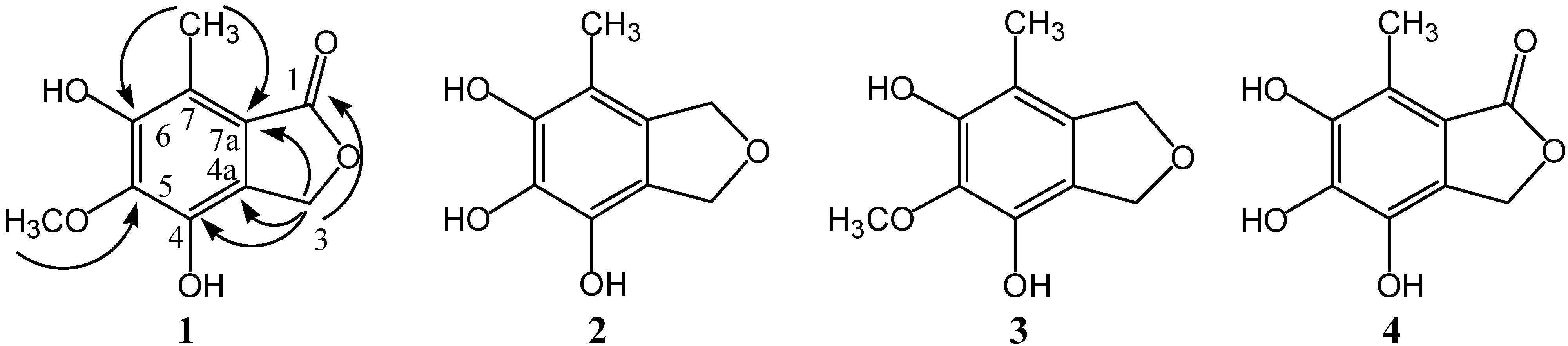
      <p>Isobenzofuranone derivatives are an important class of compounds displaying a variety of biological effects, such as antioxidant, antimicrobial, antiplatelet, cytotoxic activity and antiarrhythmic effects [<xref ref-type="bibr" rid="B1-molecules-17-04219">1</xref>,<xref ref-type="bibr" rid="B2-molecules-17-04219">2</xref>,<xref ref-type="bibr" rid="B3-molecules-17-04219">3</xref>,<xref ref-type="bibr" rid="B4-molecules-17-04219">4</xref>]. As sources of bioactive substance, fungi are now considered as efficient producers of biologically active and chemically novel compounds. Some of the more important sources of naturally occurring isobenzofuranone derivatives are fungi [<xref ref-type="bibr" rid="B5-molecules-17-04219">5</xref>,<xref ref-type="bibr" rid="B6-molecules-17-04219">6</xref>] and higher plants [<xref ref-type="bibr" rid="B7-molecules-17-04219">7</xref>]. In our ongoing research on biologically active metabolites from fungi, we investigated the secondary metabolites produced in culture by <italic>Cephalosporium</italic> sp. AL031. This organism is a fungus that was isolated from <italic>Sinarundinaria nitida</italic> grown at Ailao Mountain (Yunnan, China). Previous phytochemical investigation on the fungus revealed a number of phenolic acids [<xref ref-type="bibr" rid="B8-molecules-17-04219">8</xref>], dihydroisocoumarin glucosides [<xref ref-type="bibr" rid="B9-molecules-17-04219">9</xref>,<xref ref-type="bibr" rid="B10-molecules-17-04219">10</xref>] and pyrone derivatives [<xref ref-type="bibr" rid="B11-molecules-17-04219">11</xref>,<xref ref-type="bibr" rid="B12-molecules-17-04219">12</xref>]. In the present study, we describe the isolation and structure elucidation of a novel isobenzofuranone derivative, namely 4,6-dihydroxy-5-methoxy-7-methylphthalide (<bold>1</bold>), together with three known ones: 4,5,6-trihydroxy-7-methyl-1,3-dihydro-isobenzofuran (<bold>2</bold>), 4,6-dihydroxy-5-methoxy-7-methyl-1,3-dihydroisobenzofuran (<bold>3</bold>) and 4,5,6-trihydroxy-7-methylphthalide (<bold>4</bold>) (<xref ref-type="fig" rid="molecules-17-04219-f001">Figure 1</xref>), from the culture of the fungus <italic>Cephalosporium </italic>sp. AL031. The structure of the new compound <bold>1</bold> was determined based on MS, IR, 1D and 2D NMR spectral data, and the known ones <bold>2</bold>–<bold>4</bold> were identified by comparing their NMR data with those in the literature. The antioxidant activity of compounds <bold>1</bold>–<bold>4</bold> was evaluated by DPPH radical-scavenging assay.</p>
      <fig id="molecules-17-04219-f001" position="anchor">
        <label>Figure 1</label>
        <caption>
          <p>The structures and key HMBC correlations of compounds <bold>1</bold>–<bold>4</bold>.</p>
        </caption>
        <graphic xmlns:xlink="http://www.w3.org/1999/xlink" xlink:href="molecules-17-04219-g001.tif"/>
      </fig>
    </sec>
    <sec sec-type="results">
      <title>2. Results and Discussion</title>
      <p>Compound <bold>1</bold> was obtained as colorless needle-like crystals that gave a positive reaction in the 10% H<sub>2</sub>SO<sub>4</sub>-EtOH test. The molecular formula C<sub>10</sub>H<sub>10</sub>O<sub>5</sub> was deduced from a pseudomolecular ion [M + H]<sup>+</sup> at <italic>m/z</italic> 211.0628 in the HR-ESI-MS (calcd. for C<sub>10</sub>H<sub>11</sub>O<sub>5</sub>, 211.0607), which was in agreement with the <sup>1</sup>H- and <sup>13</sup>C-NMR spectra. The IR spectrum showed characteristic absorption bonds for hydroxyl groups (3365 cm<sup>−1</sup>), saturated methylene (2930 cm<sup>−1</sup>) and a carbonyl group (1685 cm<sup>−1</sup>).</p>
      <p>The <sup>1</sup>H-NMR spectrum of <bold>1</bold>(<xref ref-type="table" rid="molecules-17-04219-t001">Table 1</xref>) exhibited signals attributable to a methoxyl group at <italic>δ</italic> 3.87 (3H, s), an oxymethylene moiety at <italic>δ</italic> 5.12 (2H, brs) and a methyl group at <italic>δ</italic> 2.42 (3H, s). The <sup>13</sup>C-NMR and DEPT spectra of <bold>1</bold>(<xref ref-type="table" rid="molecules-17-04219-t001">Table 1</xref>) also showed the occurrence of three sp<sup>3</sup>-carbon signals related to a methoxyl group (<italic>δ</italic> 59.6), an oxymethylene moiety (<italic>δ</italic> 66.8) and a methyl group (<italic>δ</italic> 8.2). Including one quaternary sp<sup>2</sup>-carbon signal which was attributed to a carbonyl moiety at <italic>δ</italic> 172.7, compound <bold>1</bold> also indicated six quaternary sp<sup>2</sup>-carbon signals at <italic>δ</italic> 125.8, 142.1, 140.8, 149.6, 116.5 and 117.7. The <sup>1</sup>H-NMR and <sup>13</sup>C-NMR data was assigned to an isobenzofuranone skeleton.</p>
      <table-wrap id="molecules-17-04219-t001" position="anchor">
        <object-id pub-id-type="pii">molecules-17-04219-t001_Table 1</object-id>
        <label>Table 1</label>
        <caption>
          <p><sup>1</sup>H- and <sup>13</sup>C-NMR data of <bold>1</bold> and <bold>4</bold> in CD<sub>3</sub>OD. (<sup>1</sup>H at 400 and <sup>13</sup>C at 100 MHz; <italic>J </italic>in Hz).</p>
        </caption>
        <table>
          <thead>
            <tr>
              <th rowspan="2" align="center" valign="middle">Position</th>
              <th colspan="4" align="center" valign="middle">Compound 1 </th>
              <th colspan="2" align="center" valign="middle">Compound 4 </th>
            </tr>
            <tr style="border-top: solid thin">
              <th align="center" valign="middle">δ<sub>C</sub></th>
              <th align="center" valign="middle">DEPT</th>
              <th align="center" valign="middle">δ<sub>H</sub></th>
              <th align="center" valign="middle">HMBC</th>
              <th align="center" valign="middle">δ<sub>C</sub></th>
              <th align="center" valign="middle">δ<sub>H</sub></th>
            </tr>
          </thead>
          <tbody>
            <tr>
              <td align="center" valign="middle">1</td>
              <td align="center" valign="middle">172.7</td>
              <td align="center" valign="middle">C</td>
              <td align="center" valign="middle"> </td>
              <td align="center" valign="middle"> </td>
              <td align="center" valign="middle">175.5</td>
              <td align="center" valign="middle"> </td>
            </tr>
            <tr>
              <td align="center" valign="middle">3</td>
              <td align="center" valign="middle">66.8</td>
              <td align="center" valign="middle">CH<sub>2</sub></td>
              <td align="center" valign="middle">5.12 (2H, brs)</td>
              <td align="center" valign="middle">C-1, C-4, C-4a, C-7a</td>
              <td align="center" valign="middle">68.9</td>
              <td align="center" valign="middle">5.11 (2H, brs)</td>
            </tr>
            <tr>
              <td align="center" valign="middle">4</td>
              <td align="center" valign="middle">142.1</td>
              <td align="center" valign="middle">C</td>
              <td align="center" valign="middle"> </td>
              <td align="center" valign="middle"> </td>
              <td align="center" valign="middle">142.3</td>
              <td align="center" valign="middle"> </td>
            </tr>
            <tr>
              <td align="center" valign="middle">4a</td>
              <td align="center" valign="middle">125.8</td>
              <td align="center" valign="middle">C</td>
              <td align="center" valign="middle"> </td>
              <td align="center" valign="middle"> </td>
              <td align="center" valign="middle">128.8</td>
              <td align="center" valign="middle"> </td>
            </tr>
            <tr>
              <td align="center" valign="middle">5</td>
              <td align="center" valign="middle">140.8</td>
              <td align="center" valign="middle">C</td>
              <td align="center" valign="middle"> </td>
              <td align="center" valign="middle"> </td>
              <td align="center" valign="middle">138.9</td>
              <td align="center" valign="middle"> </td>
            </tr>
            <tr>
              <td align="center" valign="middle">6</td>
              <td align="center" valign="middle">149.6</td>
              <td align="center" valign="middle">C</td>
              <td align="center" valign="middle"> </td>
              <td align="center" valign="middle"> </td>
              <td align="center" valign="middle">147.1</td>
              <td align="center" valign="middle"> </td>
            </tr>
            <tr>
              <td align="center" valign="middle">7</td>
              <td align="center" valign="middle">117.7</td>
              <td align="center" valign="middle">C</td>
              <td align="center" valign="middle"> </td>
              <td align="center" valign="middle"> </td>
              <td align="center" valign="middle">119.2</td>
              <td align="center" valign="middle"> </td>
            </tr>
            <tr>
              <td align="center" valign="middle">7 a</td>
              <td align="center" valign="middle">116.5</td>
              <td align="center" valign="middle">C</td>
              <td align="center" valign="middle"> </td>
              <td align="center" valign="middle"> </td>
              <td align="center" valign="middle">114.9</td>
              <td align="center" valign="middle"> </td>
            </tr>
            <tr>
              <td align="center" valign="middle">8</td>
              <td align="center" valign="middle">8.2</td>
              <td align="center" valign="middle">CH<sub>3</sub></td>
              <td align="center" valign="middle">2.42 (3H, s)</td>
              <td align="center" valign="middle">C-6, C-7a </td>
              <td align="center" valign="middle">10.6</td>
              <td align="center" valign="middle">2.41 (3H, s)</td>
            </tr>
            <tr style="border-top: solid thin">
              <td align="center" valign="middle">9</td>
              <td align="center" valign="middle">59.6</td>
              <td align="center" valign="middle">CH<sub>3</sub></td>
              <td align="center" valign="middle">3.87 (3H, s)</td>
              <td align="center" valign="middle"> </td>
              <td align="center" valign="middle"> </td>
              <td align="center" valign="middle"> </td>
            </tr>
          </tbody>
        </table>
      </table-wrap>
      <p>The <sup>1</sup>H-NMR and <sup>13</sup>C-NMR data of <bold>1</bold> are very similar to those of 4,5,6-trihydroxy-7-methylphthalide [<xref ref-type="bibr" rid="B1-molecules-17-04219">1</xref>] that has been isolated from the fungus <italic>Epicoccum </italic>sp. The only difference between these two compounds is the methoxyl group present in compound <bold>1</bold>. HSQC and HMBC experiments revealed all significant connectivities. The correlation of the methyl group (<italic>δ</italic> 2.42) with C-6 (<italic>δ </italic>149.6) and C-7a (<italic>δ </italic>116.5) in the HMBC spectrum indicated the methyl unit connected to C-7. Similarly, the linkage of the methoxyl moiety at C-5 was deduced from the correlation between the methoxyl group (<italic>δ</italic> 3.87) and C-5 (<italic>δ</italic> 140.8). Furthermore, no correlations were observed between the methyl group (<italic>δ</italic> 2.42) or oxymethylene moiety (<italic>δ</italic> 5.12) and C-5, which unambiguously established the linkage of methoxyl moiety. All NMR data of compound <bold>1</bold> were assigned on the basis of DEPT, HSQC and HMBC experiments. Taken together, compound <bold>1</bold> was determined to be a new isobenzofuranone and named as 4,6-dihydroxy-5-methoxy-7-methylphthalide with the structure shown in <xref ref-type="fig" rid="molecules-17-04219-f001">Figure 1</xref>.</p>
      <p>Together with the new compound <bold>1</bold>, three known compounds <bold>2</bold>–<bold>4</bold> were identified by comparison of their spectroscopic data [<xref ref-type="bibr" rid="B1-molecules-17-04219">1</xref>,<xref ref-type="bibr" rid="B13-molecules-17-04219">13</xref>,<xref ref-type="bibr" rid="B14-molecules-17-04219">14</xref>] with published values. We evaluated the antioxidant activity of isolated compounds <bold>1</bold>–<bold>4</bold> by DPPH radical-scavenging assay, which showed potent activity with the EC<sub>50 </sub>values of 10, 7, 22 and 5 μM, respectively. </p>
    </sec>
    <sec sec-type="methods">
      <title>3. Experimental</title>
      <sec>
        <title>3.1. General</title>
        <p>TLC was preformed with silica gel GF<sub>254</sub> (Marine Chemical Industry Factory, Qingdao, China), and the spots were visualized by spraying with 10% H<sub>2</sub>SO<sub>4</sub>-EtOH reagent, followed by heating. Column chromatography was performed using silica gel (Marine Chemical Industry Factory, Qingdao, China), reverse-phase C<sub>18</sub> silica gel (Merck, Germany) and Sephadex LH-20 (Sigma). All reagents were analytical grade and water was distilled-twice. Melting points were measured with an X-4 melting point apparatus and are uncorrected. Optical rotations were recorded on a Perkin-Elmer 241 polarimeter. IR spectra were obtained on a Perkin-Elmer 577 spectrometer with KBr pellets. UV spectra were obtained on a Perkin-Elmer Lambda 900 UV/VIS/NIR spectrophotometer. NMR Spectra were recorded on a Brüker AV-400 spectrometer at 400 MHz <sup>1</sup>H and 100 MHz for <sup>13</sup>C in MeOD, and chemical shifts are presented as values relative to tetramethylsilane as an internal standard. Low-resolution electrospray-ionization mass spectrometry (ESI-MS) and HR-ESI-MS were recorded on a Finnigan LCQ-Advantage mass spectrometer and a VG Auto-Spec-3000 mass spectrometer. </p>
      </sec>
      <sec>
        <title>3.2. Fungal Material</title>
        <p>The fungus <italic>Cephalosporium</italic> sp. AL031 was isolated from <italic>Sinarundinaria nitida</italic> grown at Ailao Mountain, Yunnan, China. It was identified as <italic>Cephalosporium </italic>sp. (strain number AL031), a member of Moniliaceae, by Professor Fa-Rong Yang in the Department of Biology, Yunnan University, and deposited in Key Laboratory of Industrial Microbial Fermentation Engineering of Yunnan Province, China. The isolated fungus was cultured on slants of potato dextrose agar (PDA) at 27 °C for 5 days, and then the fungus was grown on a medium consisting of rice, wheat bran, cornmeal, sugar cane bagasse with a ratio of 12:2:3:3, and incubated for 7 days at 28 °C.</p>
      </sec>
      <sec>
        <title>3.3. Extraction and Isolation</title>
        <p>The fermented material (1.75 Kg) was extracted twice with EtOAc (9.0 L) for 3 days at room temperature, and the extract was evaporated under vacuum. The EtOAc extract was evaluated for antioxidant activity using a DPPH radical-scavenging assay that showed positive effects with an EC<sub>50</sub> value of 46 µg/mL. A portion of the EtOAc extract (35 g) was subjected to silica gel column chromatography using a stepwise gradient elution of CHCl<sub>3</sub>-MeOH (100:0; 50:1; 20:1; 15:1 and 9:1) to obtain seven fractions (Fr. 1–7). Fr. 1 (5.5 g) was further purified over Sephadex LH-20 column eluted by MeOH, and then recrystallized in CHCl<sub>3</sub> to give compound <bold>1</bold> (20 mg). Fr. 3 (4.8 g) was rechromatographed over silica gel column eluted by gradient CHCl<sub>3</sub>–MeOH (1:0-10:1) to afford compounds <bold>2</bold> (12 mg). Fr. 4 (3.5 g) was subsequently subjected to Sephadex LH-20 (eluted with MeOH), followed by purification over silica gel column chromatography with CHCl<sub>3</sub>–MeOH (1:0-9:1) as mobile phase to yield compound <bold>3</bold> (15 mg). Compound <bold>4</bold> (25 mg) was collected from Fr. 7 (6.2 g) by silica gel column chromatography (eluted with CHCl<sub>3</sub>–MeOH; 50:1-5:1) and then recrystallized in CHCl<sub>3</sub>.</p>
      </sec>
      <sec>
        <title>3.4. Characterization of 4,6-Dihydroxy-5-methoxy-7-methylphthalide (<italic><bold>1</bold></italic>)</title>
        <p>Colorless needle crystal, M.P. 253–255 °C. UV (MeOH): λmax (log ε<sub>max</sub>): 218 (2.60), 268 (1.02), 308 (0.49) nm. IR (KBr): ν = 3365, 3164, 3021, 2930, 1685, 1611, 1402, 1359, 1286, 1099, 929 cm<sup>−1</sup>. ESI-MS: <italic>m/z</italic> = 211 [M + H]<sup>+</sup>. HR-ESI-MS: <italic>m/z </italic>= 211.0628 (calcd. 211.0607 for C<sub>10</sub>H<sub>11</sub>O<sub>5</sub>, [M + H]<sup>+</sup>). <sup>1</sup>H- and <sup>13</sup>C-NMR: see <xref ref-type="table" rid="molecules-17-04219-t001">Table 1</xref>. </p>
      </sec>
      <sec>
        <title>3.5. Bioassay</title>
        <p>The antioxidative properties of compounds <bold>1</bold>–<bold>4</bold> were assessed using the 1,1-diphenyl-2-picryl-hydrazyl (DPPH) radical scavenging assay. DPPH is a stable free radical with a strong UV/VIS absorption band at 517 nm. Addition of radical scavenging compounds to a solution of DPPH results in a decrease of absorption. The inhibitory percentage of DPPH was calculated according to the equation as follows: % scavenging activity = [1 − (As/Ac)] × 100; where As and Ac were the absorbance values at 517 nm of the DPPH solutions with sample and without sample, respectively. According to the previous method [<xref ref-type="bibr" rid="B15-molecules-17-04219">15</xref>], we evaluated the antioxidant activity of isolated compounds <bold>1</bold>–<bold>4</bold> and the positive control gallic acid by DPPH radical-scavenging assay with the EC<sub>50</sub> values of 10, 7, 22, 5 and 2 μM, respectively.</p>
      </sec>
    </sec>
    <sec sec-type="conclusions">
      <title>4. Conclusions</title>
      <p>Repeated column chromatography (including normal-phase silica gel and Sephadex LH-20) of the EtOAc extract of the fermentation of the fungus <italic>Cephalosporium</italic> sp. AL031 has led to the isolation of a novel isobenzofuranone derivative, namely 4,6-dihydroxy-5-methoxy-7-methylphthalide (<bold>1</bold>), together with three known ones: 4,5,6-trihydroxy-7-methyl-1,3-dihydroisobenzofuran (<bold>2</bold>), 4,6-dihydroxy-5-methoxy-7-methyl-1,3-dihydroisobenzofuran (<bold>3</bold>), and 4,5,6-trihydroxy-7-methylphthalide (<bold>4</bold>). The structure of the new compound <bold>1</bold> was determined by spectroscopic methods, including 1D NMR, 2D NMR and MS experiments, and the structures of the known compounds including <bold>2</bold>~<bold>4</bold> were identified by comparing their NMR data with those of ones in the literature. All four compounds showed potent anti-oxidative activity by DPPH radical-scavenging assay, which are potential anti-oxidative agents. Comparing the antioxidant activity of compounds <bold>1</bold> and <bold>4</bold>, <bold>3</bold> and <bold>2</bold>, the latter containing three phenolic hydroxyl groups showed potent activity, which indicated the antioxidant activity correlates with the number of hydroxyl groups in the structure.</p>
    </sec>
  </body>
  <back>
    <ack>
      <title>Acknowledgements</title>
      <p>This investigation was financially supported by the Key Project of Chinese Ministry of Education (No. 209116), the Yunnan Social Development Sci-Tech Plan (applied basic research) Project (No.2009CD100), Program for Innovative Research Team (in Science and Technology) in University of Yunnan Province (IRTSTYN) and Green Chemistry and Functional Materials Research for Yunnan Innovation Team(2011HC008). </p>
    </ack>
    <ref-list>
      <title>References</title>
      <ref id="B1-molecules-17-04219">
        <label>1.</label>
        <citation citation-type="journal">
          <person-group person-group-type="author">
            <name>
              <surname>Ahmed</surname>
              <given-names>A.L.</given-names>
            </name>
            <name>
              <surname>Katja</surname>
              <given-names>M.F.</given-names>
            </name>
            <name>
              <surname>Anthony</surname>
              <given-names>D.W.</given-names>
            </name>
            <name>
              <surname>Gabriele</surname>
              <given-names>M.K.</given-names>
            </name>
          </person-group>
          <article-title>A new antioxidant isobenzofuranone derivative from the algicolous marine fungus</article-title>
          <source>Epicoccum sp. Planta Medica</source>
          <year>2003</year>
          <volume>69</volume>
          <fpage>831</fpage>
          <lpage>834</lpage>
        <pub-id pub-id-type="doi">10.1055/s-2003-43209</pub-id></citation>
      </ref>
      <ref id="B2-molecules-17-04219">
        <label>2.</label>
        <citation citation-type="journal">
          <person-group person-group-type="author">
            <name>
              <surname>Sadek</surname>
              <given-names>B.</given-names>
            </name>
            <name>
              <surname>Limban</surname>
              <given-names>C.</given-names>
            </name>
            <name>
              <surname>Stecoza</surname>
              <given-names>C.E.</given-names>
            </name>
            <name>
              <surname>Elz</surname>
              <given-names>S.</given-names>
            </name>
          </person-group>
          <article-title>Synthesis and antimicrobial evaluation of dibenzo[b,e]oxepin-11(6H)-one O-benzoyloxime derivatives</article-title>
          <source>Sci. Pharm.</source>
          <year>2011</year>
          <volume>79</volume>
          <fpage>749</fpage>
          <lpage>761</lpage>
        <pub-id pub-id-type="doi">10.3797/scipharm.1107-02</pub-id><pub-id pub-id-type="pmid">22145103</pub-id></citation>
      </ref>
      <ref id="B3-molecules-17-04219">
        <label>3.</label>
        <citation citation-type="journal">
          <person-group person-group-type="author">
            <name>
              <surname>Ma</surname>
              <given-names>F.F.</given-names>
            </name>
            <name>
              <surname>Gao</surname>
              <given-names>Y.</given-names>
            </name>
            <name>
              <surname>Qiao</surname>
              <given-names>H.L.</given-names>
            </name>
            <name>
              <surname>Hu</surname>
              <given-names>X.J.</given-names>
            </name>
            <name>
              <surname>Chang</surname>
              <given-names>J.B.</given-names>
            </name>
          </person-group>
          <article-title>Antiplatelet activity of 3-butyl-6-bromo-1(3H)-isobenzofuranone on rat platelet aggregation</article-title>
          <source>J. Thromb. Thrombolys.</source>
          <year>2012</year>
          <volume>33</volume>
          <fpage>64</fpage>
          <lpage>73</lpage>
        <pub-id pub-id-type="doi">10.1007/s11239-011-0647-9</pub-id></citation>
      </ref>
      <ref id="B4-molecules-17-04219">
        <label>4.</label>
        <citation citation-type="journal">
          <person-group person-group-type="author">
            <name>
              <surname>Zhang</surname>
              <given-names>S.L.</given-names>
            </name>
            <name>
              <surname>Liu</surname>
              <given-names>Y.J.</given-names>
            </name>
            <name>
              <surname>Zhao</surname>
              <given-names>Y.F.</given-names>
            </name>
            <name>
              <surname>Guo</surname>
              <given-names>Q.T.</given-names>
            </name>
            <name>
              <surname>Gong</surname>
              <given-names>P.</given-names>
            </name>
          </person-group>
          <article-title>Synthesis and antitumor activity of novel 1,4-substituted phthalazine derivatives</article-title>
          <source>Chin. Chem. Lett.</source>
          <year>2010</year>
          <volume>21</volume>
          <fpage>1071</fpage>
          <lpage>1074</lpage>
        <pub-id pub-id-type="doi">10.1016/j.cclet.2010.04.004</pub-id></citation>
      </ref>
      <ref id="B5-molecules-17-04219">
        <label>5.</label>
        <citation citation-type="journal">
          <person-group person-group-type="author">
            <name>
              <surname>Tsantrizos</surname>
              <given-names>Y.S.</given-names>
            </name>
            <name>
              <surname>Ogilivie</surname>
              <given-names>K.K.</given-names>
            </name>
            <name>
              <surname>Watson</surname>
              <given-names>A.K.</given-names>
            </name>
          </person-group>
          <article-title>Phytotoxic metabolites of <italic>Phomopsis convolvulus</italic>, a host-specific pathogen of field bindweed</article-title>
          <source>Can. J. Chem.</source>
          <year>1992</year>
          <volume>70</volume>
          <fpage>2276</fpage>
          <lpage>2284</lpage>
        <pub-id pub-id-type="doi">10.1139/v92-286</pub-id></citation>
      </ref>
      <ref id="B6-molecules-17-04219">
        <label>6.</label>
        <citation citation-type="journal">
          <person-group person-group-type="author">
            <name>
              <surname>Makino</surname>
              <given-names>M.</given-names>
            </name>
            <name>
              <surname>Endoh</surname>
              <given-names>T.</given-names>
            </name>
            <name>
              <surname>Ogawa</surname>
              <given-names>Y.</given-names>
            </name>
            <name>
              <surname>Watanabe</surname>
              <given-names>K.</given-names>
            </name>
            <name>
              <surname>Fujimoto</surname>
              <given-names>Y.</given-names>
            </name>
          </person-group>
          <article-title>Studies on the metabolites of <italic>Penicillium vulpinum</italic></article-title>
          <source>Heterocycles</source>
          <year>1998</year>
          <volume>48</volume>
          <fpage>1931</fpage>
          <lpage>1934</lpage>
          <pub-id pub-id-type="doi">10.3987/COM-98-8253</pub-id>
        </citation>
      </ref>
      <ref id="B7-molecules-17-04219">
        <label>7.</label>
        <citation citation-type="journal">
          <person-group person-group-type="author">
            <name>
              <surname>Omidbaigi</surname>
              <given-names>R.</given-names>
            </name>
            <name>
              <surname>Sefidkon</surname>
              <given-names>F.</given-names>
            </name>
            <name>
              <surname>Saeedi</surname>
              <given-names>K.</given-names>
            </name>
          </person-group>
          <article-title>Essential oil content and composition of <italic>Kelussia odoratissima</italic> Mozaff as an Iranian endemic plant</article-title>
          <source>J. Essent. Oil Bearing Plants</source>
          <year>2008</year>
          <volume>11</volume>
          <fpage>594</fpage>
          <lpage>597</lpage>
        </citation>
      </ref>
      <ref id="B8-molecules-17-04219">
        <label>8.</label>
        <citation citation-type="journal">
          <person-group person-group-type="author">
            <name>
              <surname>Bi</surname>
              <given-names>Y.M.</given-names>
            </name>
            <name>
              <surname>Bi</surname>
              <given-names>X.B.</given-names>
            </name>
            <name>
              <surname>Zhao</surname>
              <given-names>Q.R.</given-names>
            </name>
            <name>
              <surname>Du</surname>
              <given-names>X.</given-names>
            </name>
          </person-group>
          <article-title>Phenolic acid from culture broth of fungus <italic>Cephalosporium</italic> sp. AL031</article-title>
          <source>J. Chin. Med. Mater.</source>
          <year>2004</year>
          <volume>27</volume>
          <fpage>20</fpage>
          <lpage>22</lpage>
        </citation>
      </ref>
      <ref id="B9-molecules-17-04219">
        <label>9.</label>
        <citation citation-type="journal">
          <person-group person-group-type="author">
            <name>
              <surname>Bi</surname>
              <given-names>Y.M.</given-names>
            </name>
            <name>
              <surname>Bi</surname>
              <given-names>X.B.</given-names>
            </name>
            <name>
              <surname>Zhao</surname>
              <given-names>Q.R.</given-names>
            </name>
            <name>
              <surname>Chen</surname>
              <given-names>Y.T.</given-names>
            </name>
            <name>
              <surname>Xie</surname>
              <given-names>J.L.</given-names>
            </name>
          </person-group>
          <article-title>Four novel dihydroisocoumarin (=3,4-dihydro-1H-2-benzopyran-1-one) glucosides from the fungus <italic>Cephalosporium</italic> sp. AL031</article-title>
          <source>Helv. Chim. Acta</source>
          <year>2004</year>
          <volume>87</volume>
          <fpage>2890</fpage>
          <lpage>2895</lpage>
          <pub-id pub-id-type="doi">10.1002/hlca.200490261</pub-id>
        </citation>
      </ref>
      <ref id="B10-molecules-17-04219">
        <label>10.</label>
        <citation citation-type="journal">
          <person-group person-group-type="author">
            <name>
              <surname>Bi</surname>
              <given-names>Y.M.</given-names>
            </name>
            <name>
              <surname>Bi</surname>
              <given-names>X.B.</given-names>
            </name>
            <name>
              <surname>Chen</surname>
              <given-names>Y.T.</given-names>
            </name>
            <name>
              <surname>Xie</surname>
              <given-names>J.L.</given-names>
            </name>
          </person-group>
          <article-title>Two new dihydroisocoumarins from the fungus <italic>Cephalosporium</italic> sp. AL031</article-title>
          <source>Nat. Prod. Res.</source>
          <year>2005</year>
          <volume>19</volume>
          <fpage>425</fpage>
          <lpage>428</lpage>
          <pub-id pub-id-type="doi">10.1080/14786410500045424</pub-id>
        </citation>
      </ref>
      <ref id="B11-molecules-17-04219">
        <label>11.</label>
        <citation citation-type="journal">
          <person-group person-group-type="author">
            <name>
              <surname>Bi</surname>
              <given-names>Y.M.</given-names>
            </name>
            <name>
              <surname>Bi</surname>
              <given-names>X.B.</given-names>
            </name>
            <name>
              <surname>Zhao</surname>
              <given-names>Q.R.</given-names>
            </name>
            <name>
              <surname>Fang</surname>
              <given-names>A.</given-names>
            </name>
            <name>
              <surname>Chen</surname>
              <given-names>Y.T.</given-names>
            </name>
          </person-group>
          <article-title>A new pyrone derivative from fungus <italic>Cephalosporium</italic> sp. AL031</article-title>
          <source>Chin. Chem. Lett.</source>
          <year>2006</year>
          <volume>17</volume>
          <fpage>344</fpage>
          <lpage>346</lpage>
        </citation>
      </ref>
      <ref id="B12-molecules-17-04219">
        <label>12.</label>
        <citation citation-type="journal">
          <person-group person-group-type="author">
            <name>
              <surname>Bi</surname>
              <given-names>Y.M.</given-names>
            </name>
            <name>
              <surname>Bi</surname>
              <given-names>X.B.</given-names>
            </name>
            <name>
              <surname>Fang</surname>
              <given-names>A.</given-names>
            </name>
            <name>
              <surname>Zhao</surname>
              <given-names>Q.R.</given-names>
            </name>
          </person-group>
          <article-title>Metabolites from the fungus <italic>Cephalosporium</italic> sp. AL031</article-title>
          <source>Arch. Pharmacal Res.</source>
          <year>2007</year>
          <volume>30</volume>
          <fpage>267</fpage>
          <lpage>269</lpage>
          <pub-id pub-id-type="doi">10.1007/BF02977604</pub-id>
        </citation>
      </ref>
      <ref id="B13-molecules-17-04219">
        <label>13.</label>
        <citation citation-type="journal">
          <person-group person-group-type="author">
            <name>
              <surname>Kemami</surname>
              <given-names>W.</given-names>
            </name>
            <name>
              <surname>Hilaire</surname>
              <given-names>V.</given-names>
            </name>
            <name>
              <surname>Ishida</surname>
              <given-names>K.</given-names>
            </name>
            <name>
              <surname>Hertweck</surname>
              <given-names>C.</given-names>
            </name>
          </person-group>
          <article-title>Epicoccalone, a coumarin-type chymotrypsin inhibotor, and isobenzofuran congeners from an <italic>Epicoccum</italic> sp. Associated with a tree fungus</article-title>
          <source>Eur. J. Org. Chem.</source>
          <year>2008</year>
          <volume>22</volume>
          <fpage>3781</fpage>
          <lpage>3784</lpage>
        </citation>
      </ref>
      <ref id="B14-molecules-17-04219">
        <label>14.</label>
        <citation citation-type="journal">
          <person-group person-group-type="author">
            <name>
              <surname>Lee</surname>
              <given-names>N.H.</given-names>
            </name>
            <name>
              <surname>Gloer</surname>
              <given-names>J.B.</given-names>
            </name>
            <name>
              <surname>Wicklow</surname>
              <given-names>D.T.</given-names>
            </name>
          </person-group>
          <article-title>Isolation of chromanone and isobenzofuran derivatives from a fungicolous isolate of <italic>Epicoccum purpurascens</italic></article-title>
          <source>Bull. Kor. Chem. Soc.</source>
          <year>2007</year>
          <volume>28</volume>
          <fpage>877</fpage>
          <lpage>879</lpage>
          <pub-id pub-id-type="doi">10.5012/bkcs.2007.28.5.877</pub-id>
        </citation>
      </ref>
      <ref id="B15-molecules-17-04219">
        <label>15.</label>
        <citation citation-type="journal">
          <person-group person-group-type="author">
            <name>
              <surname>Chu</surname>
              <given-names>Y.H.</given-names>
            </name>
            <name>
              <surname>Chang</surname>
              <given-names>C.L.</given-names>
            </name>
            <name>
              <surname>Hsu</surname>
              <given-names>H.F.</given-names>
            </name>
          </person-group>
          <article-title>Flavonoid content of several vegetables and their antioxidant activity</article-title>
          <source>J. Sci. Food Agric.</source>
          <year>2000</year>
          <volume>80</volume>
          <fpage>561</fpage>
          <lpage>566</lpage>
        <pub-id pub-id-type="doi">10.1002/(SICI)1097-0010(200004)80:5&lt;561::AID-JSFA574&gt;3.0.CO;2-#</pub-id></citation>
      </ref>
    </ref-list>
	<fn-group>
	<fn>
	<p><italic>Sample Availability</italic>: Samples of the compounds <bold>1</bold>–<bold>4</bold> are available from the authors.</p>
	</fn>
	</fn-group>
  </back>
</article>