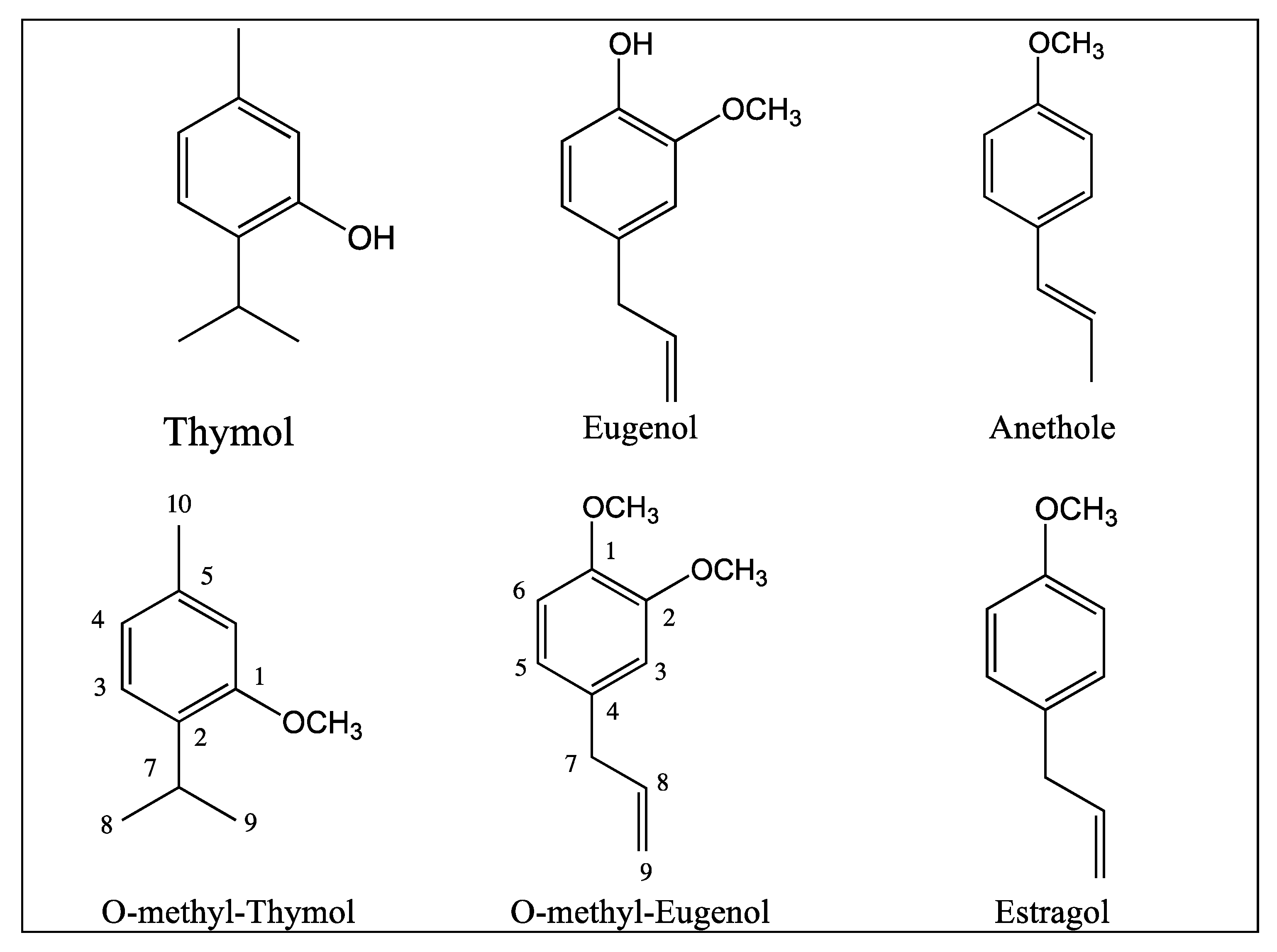
Alkylphenol Activity against Candida spp. and Microsporum canis: A Focus on the Antifungal Activity of Thymol, Eugenol and O-Methyl Derivatives

 ,
,
Abstract
:1. Introduction

2. Results and Discussion

| Growth Inhibition Zones (mm) | ||||||||
| Alkylphenols (10,000 µg/mL) | Controls | |||||||
| Strains | thymol | methyl-thymol | eugenol | methyl-eugenol | anethole | estragole | griseofulvin (1000 µg/mL) | amphotericin B (5 µg/mL) |
| M. canis | ||||||||
| CEMM 01-3-188 | 35 | 22 | 26 | 20 | 16 | 23 | 55 | - |
| CEMM 01-5-190 | 40 | 20 | 30 | 20 | 20 | 20 | 47 | - |
| C. albicans | ||||||||
| CEMM 01-3-075 | 18 | 18 | 12 | 10 | 11 | 11 | - | 14 |
| CEMM 01-3-069 | 17 | 13 | 8 | 7 | 9 | 8 | - | 10 |
| Alkylphenols (µg/mL) | Controls (μg/mL) | |||||||||||||
| Strains | thymol | methyl-thymol | eugenol | methyl-eugenol | anethole | estragole | amphotericin B | griseofulvin | ||||||
| MIC | MFC | MIC | MFC | MIC | MFC | MIC | MFC | MIC | MFC | MIC | MFC | MIC | MIC | |
| C. albicans (n = 4) | 39 (4)a | 78 (4) | 1250 (4) | 2500 (4) | 620 (3) | 1250 (3) | 620 (3) | 1250 (3) | 620 (4) | 1250 (4) | 1250 (3) | 2500 (3) | 0.5 (2) | - |
| 150 (1) | 310 (1) | 310 (1) | 620 (1) | 620 (1) | 1250 (1) | 0.25 (2) | ||||||||
| C. tropicalis (n = 2) | 39 (2) | 78 (2) | 1250 (1) | 2500 (1) | 310 (2) | 620 (2) | 310 (2) | 620 (2) | 620 (2) | 1250 (2) | 620 (2) | 1250 (2) | 1.0 (1) | - |
| 620 (1) | 1250 (1) | 0.5 (1) | ||||||||||||
| C. krusei (n = 1) | 150 | 310 | 1250 | 2500 | 620 | 1250 | 620 | 1250 | 620 | 1250 | 620 | 1250 | 0.5 | - |
| ATCC 22019 | ||||||||||||||
| C. parapsiloses (n = 1) | 150 | 310 | 1250 | 2500 | 620 | 1250 | 620 | 1250 | 620 | 1250 | 620 | 1250 | 2.0 | - |
| ATCC 6528 | ||||||||||||||
| M. canis (n = 6) | 9.7 (3) | 19 (3) | 150 (4) | 310 (4) | 39 (6) | 78 (6) | 150 (2) | 310 (2) | 150 (3) | 310 (3) | 39 (4) | 78 (4) | - | 0.25 (2) |
| 4.8 (3) | 9.7 (3) | 78 (2) | 150 (2) | 78 (4) | 150 (4) | 78 (3) | 150 (3) | 19 (2) | 39 (2) | 0.125 (3) | ||||
| 0.006 (1) | ||||||||||||||
3. Experimental
3.1. General
3.2. Fungal strains
3.3. Agar-well diffusion method
3.4. Broth microdilution method
3.5. Statistical analysis
4. Conclusions
Acknowledgements
References
- Chermette, R.; Ferreiro, L.; Guillot, J. Dermatophytoses in animals. Mycopathologia 2008, 166, 385–405. [Google Scholar] [CrossRef]
- Harris, R. Progress with superficial mycoses using essential oils. Int. J. Aromather. 2002, 12, 83–91. [Google Scholar] [CrossRef]
- Gupta, A.K.; Cooper, E.A. Update in antifungal therapy of dermatophytosis. Mycopathologia 2008, 166, 353–367. [Google Scholar]
- Martinez-Rossi, N.M.; Peres, N.T.; Rossi, A. Antifungal resistance mechanisms in dermatophytes. Mycopathologia 2008, 166, 369–383. [Google Scholar] [CrossRef]
- Lewis, R.E. Overview of the changing epidemiology of candidemia. Curr. Med. Res. Opin. 2009, 25, 1732–1740. [Google Scholar]
- Brito, E.H.S.; Fontenelle, R.O.S.; Brilhante, R.S.N.; Cordeiro, R.A.; Soares Junior, F.A.; Sidrim, J.J.C.; Rocha, M.F.G. Phenotypic characterization and in vitro antifungal sensitivity of Candida spp. and M. pachydermatis strains from dogs. Vet. J. 2007, 174, 147–153. [Google Scholar] [CrossRef]
- Brito, E.H.S.; Brilhante, R.S.N.; Cordeiro, R.A.; Sidrim, J.J.C.; Fontenelle, R.O.S.; Melo, L.M.; Albuquerque, E.S.; Rocha, M.F.G. The anatomical distribution and antimicrobial susceptibility of yeast species isolated from healthy dogs. Vet. J. 2009, 182, 320–326. [Google Scholar] [CrossRef]
- Fontenelle, R.O.S.; Morais, S.M.; Brito, E.H.S.; Kerntopf, M.R.; Brilhante, R.S.N.; Cordeiro, R.A.; Tomé, A.R.; Queiroz, M.G.R.; Nascimento, N.R.F.; Sidrim, J.J.C.; et al. Chemical composition, toxicological aspects and antifungal activity of essential oil from Lippia sidoides Cham. J. Antimicrob. Chem. 2007, 59, 934–940. [Google Scholar]
- Botelho, M.A.; Nogueira, N.A.P.; Bastos, G.M.; Fonseca, S.G.C.; Lemos, T.L.G.; Matos, F.J.A.; Montenegro, D.; Heukelbach, J.; Rao, V.S.; Brito, G.A.C. Antimicrobial activity of the essential oil from Lippia sidoides, carvacrol and thymol against oral pathogens. Braz. J. Med. Biol. Res. 2007, 40, 349–356. [Google Scholar] [CrossRef]
- Fontenelle, R.O.S.; Morais, S.M.; Brito, E.H.S.; Brilhante, R.S.N.; Cordeiro, R.A.; Nascimento, N.R.F.; Kerntopf, M.R.; Sidrim, J.J.C.; Rocha, M.F.G. Antifungal activity of essential oils of Croton species from the Brazilian Caatinga biome. J. Appl. Microbiol. 2008, 104, 1383–1390. [Google Scholar]
- Soković, M.D.; Vukojević, J.; Marin, P.D.; Brkić, D.D.; Vajs, V.; Van Griensven, L.J. Chemical composition of essential oils of Thymus and Mentha species and their antifungal activities. Molecules 2009, 14, 238–249. [Google Scholar] [CrossRef]
- Pinto, E.; Vale-Silva, L.; Cavaleiro, C.; Salgueiro, L. Antifungal activity of the clove essential oil from Syzygium aromaticum on Candida, Aspergillus and dermatophyte species. J. Med. Microbiol. 2009, 58, 1454–1462. [Google Scholar] [CrossRef]
- Furniss, B.S.; Hannaford, A.J.; Smith, P.W.G.; Tatchell, A.R. Vogel’s Textbook of Pratical Organic Chemistry; Longman Scientific & Technical: London, UK, 1989. [Google Scholar]
- Karapinar, M. Inhibitory effects of anethole and eugenol on the growth and toxin production of Aspergillus parasiticus. Food Microbiol. 1990, 10, 193–199. [Google Scholar] [CrossRef]
- Gayoso, C.W.; Lima, E.O.; Oliveira, V.T.; Pereira, F.O.; Souza, E.L.; Lima, I.O.; Navarro, D.F. Sensitivity of fungi isolated from onychomycosis to Eugenia cariophyllata essential oil and eugenol. Fitoterapia 2005, 76, 247–249. [Google Scholar] [CrossRef]
- Fujita, K.; Fujita, T.; Kubo, I. Anethole, a potential antimicrobial synergist, converts a fungistatic dodecanol to a fungicidal agent. Phytother. Res. 2007, 21, 47–51. [Google Scholar]
- Shin, S.; Pyun, M.S. Anti-Candida effects of estragole in combination with ketoconazole or amphotericin B. Phytother. Res. 2002, 18, 827–830. [Google Scholar] [CrossRef]
- Guo, N.; Liu, J.; Wu, X.; Meng, R.; Wang, X.; Xiang, H.; Deng, X.; Yu, L. Antifungal activity of thymol against clinical isolates of fluconazole-sensitive and -resistant Candida albicans. J. Med. Microbiol. 2009, 58, 1074–1079. [Google Scholar] [CrossRef]
- Adams, R.P. Identification of Essential Oil Components by Gas Chromatography/Quadrupole Mass Spectroscopy; Allured Publishing Corporation: Carol Stream, IL, USA, 2005. [Google Scholar]
- Gurgel, L.A.; Sidrim, J.J.C.; Martins, D.T.; Cechinel-Filho, V.; Rao, V.S. In vitro antifungal activity of dragon’s blood from Croton urucurana against dermatophytes. J. Ethnopharmacol. 2005, 97, 409–412. [Google Scholar] [CrossRef]
- National Committee for Clinical Laboratory Standards, Reference Method for Broth Dilution Antifungal Susceptibility Testing of Yeasts-Second Edition: Approved Standard M27-A2; Clinical and Laboratory Standards Institute, NCCLS: Villanova, PA, USA, 2002.
- Jessup, C.J.; Warner, J.; Isham, I.; Hasan, I.; Ghannoum, M.A. Antifungal susceptibility testing of dermatophytes: establishing a medium for inducing conidial growth and evaluation of susceptibility of clinical solates. J. Clin. Microbiol. 2000, 38, 341–344. [Google Scholar]
- Fernandez-Torres, B.; Cabanes, F.J.; Carrillo-Munoz, A.J.; Esteban, A.; Inza, I.; Abarca, L.; Guarro, J. Collaborative evaluation of optimal antifungal susceptibility testing conditions for dermatophytes. J. Clin. Microbiol. 2002, 40, 3999–4003. [Google Scholar]
- Brilhante, R.S.N.; Cordeiro, R.A.; Medrano, D.J.; Monteiro, A.J.; Sidrim, J.J.C.; Rocha, M.F.G. Antifungal susceptibility and genotypical pattern of Microsporum canis strains. Can. J. Microbiol. 2005, 51, 507–510. [Google Scholar]
- National Committee for Clinical Laboratory Standards, Reference Method For Broth Dilution Antifungal Susceptibility Testing of Filamentous Fungi: Approved Standard,M38-A; Clinical and Laboratory Standards Institute, NCCLS: Villanova, PA, USA, 2002.
- Sample Availability: Not available
© 2011 by the authors; licensee MDPI, Basel, Switzerland. This article is an open access article distributed under the terms and conditions of the Creative Commons Attribution license ( http://creativecommons.org/licenses/by/3.0/).
Share and Cite
Fontenelle, R.O.S.; Morais, S.M.; Brito, E.H.S.; Brilhante, R.S.N.; Cordeiro, R.A.; Lima, Y.C.; Brasil, N.V.G.P.S.; Monteiro, A.J.; Sidrim, J.J.C.; Rocha, M.F.G. Alkylphenol Activity against Candida spp. and Microsporum canis: A Focus on the Antifungal Activity of Thymol, Eugenol and O-Methyl Derivatives. Molecules 2011, 16, 6422-6431. https://doi.org/10.3390/molecules16086422
Fontenelle ROS, Morais SM, Brito EHS, Brilhante RSN, Cordeiro RA, Lima YC, Brasil NVGPS, Monteiro AJ, Sidrim JJC, Rocha MFG. Alkylphenol Activity against Candida spp. and Microsporum canis: A Focus on the Antifungal Activity of Thymol, Eugenol and O-Methyl Derivatives. Molecules. 2011; 16(8):6422-6431. https://doi.org/10.3390/molecules16086422
Chicago/Turabian StyleFontenelle, Raquel O.S., Selene M. Morais, Erika H.S. Brito, Raimunda S.N. Brilhante, Rossana A. Cordeiro, Ynayara C. Lima, Nilce V.G.P.S. Brasil, André J. Monteiro, José J.C. Sidrim, and Marcos F.G. Rocha. 2011. "Alkylphenol Activity against Candida spp. and Microsporum canis: A Focus on the Antifungal Activity of Thymol, Eugenol and O-Methyl Derivatives" Molecules 16, no. 8: 6422-6431. https://doi.org/10.3390/molecules16086422