<?xml version="1.0" encoding="UTF-8"?>
<!DOCTYPE article PUBLIC "-//NLM//DTD Journal Publishing DTD v2.3 20070202//EN" "journalpublishing.dtd">
<article xmlns:mml="http://www.w3.org/1998/Math/MathML" xmlns:xlink="http://www.w3.org/1999/xlink" xml:lang="en" article-type="review-article">
  <front>
    <journal-meta>
      <journal-id journal-id-type="publisher-id">biomolecules</journal-id>
      <journal-title>Biomolecules</journal-title>
      <abbrev-journal-title abbrev-type="publisher">Biomolecules</abbrev-journal-title>
      <abbrev-journal-title abbrev-type="pubmed">Biomolecules</abbrev-journal-title>
      <issn pub-type="epub">2218-273X</issn>
      <publisher>
        <publisher-name>MDPI</publisher-name>
      </publisher>
    </journal-meta>
    <article-meta>
      <article-id pub-id-type="doi">10.3390/biom3010124</article-id>
      <article-id pub-id-type="publisher-id">biomolecules-03-00124</article-id>
      <article-categories>
        <subj-group>
          <subject>Review</subject>
        </subj-group>
      </article-categories>
      <title-group>
        <article-title>Regulation of Mammalian Gene Dosage by Long Noncoding RNAs</article-title>
      </title-group>
      <contrib-group>
        <contrib contrib-type="author">
          <name>
            <surname>Hung</surname>
            <given-names>Ko-Hsuan</given-names>
          </name>
          <xref rid="fn1-biomolecules-03-00124" ref-type="fn">†</xref>
        </contrib>
        <contrib contrib-type="author">
          <name>
            <surname>Wang</surname>
            <given-names>Yang</given-names>
          </name>
          <xref rid="fn1-biomolecules-03-00124" ref-type="fn">†</xref>
        </contrib>
        <contrib contrib-type="author">
          <name>
            <surname>Zhao</surname>
            <given-names>Jing Crystal</given-names>
          </name>
          <xref rid="c1-biomolecules-03-00124" ref-type="corresp">*</xref>
        </contrib>
      </contrib-group>
      <aff id="af1-biomolecules-03-00124">RNA biology program, Sanford-Burnham Medical Research Institute, La Jolla, CA 92037, USA; E-Mails: <email>khung@sanfordburnham.org</email> (K.H.); <email>ywang@sanfordburnham.org</email> (Y.W.)</aff>
      <author-notes>
        <fn id="fn1-biomolecules-03-00124">
          <label>† </label>
          <p>These authors contributed equally to this work.</p>
        </fn>
        <corresp id="c1-biomolecules-03-00124"><label>*</label> Author to whom correspondence should be addressed: E-Mail: <email>czhao@sanfordburnham.org</email>; Tel.: +1-858-646-3100.</corresp>
      </author-notes>
      <pub-date pub-type="epub">
        <day>04</day>
        <month>02</month>
        <year>2013</year>
      </pub-date>
      <pub-date pub-type="collection"><month>03</month>
        <year>2013</year>
      </pub-date>
      <volume>3</volume>
      <issue>1</issue>
      <fpage>124</fpage>
      <lpage>142</lpage>
      <history>
        <date date-type="received">
          <day>21</day>
          <month>12</month>
          <year>2012</year>
        </date>
        <date date-type="rev-recd">
          <day>23</day>
          <month>01</month>
          <year>2013</year>
        </date>
        <date date-type="accepted">
          <day>25</day>
          <month>01</month>
          <year>2013</year>
        </date>
      </history>
      <permissions>
        <copyright-statement>©  2013 by the authors; licensee MDPI, Basel, Switzerland.</copyright-statement>
        <copyright-year>2013</copyright-year>
        <license xmlns:xlink="http://www.w3.org/1999/xlink" license-type="open-access" xlink:href="http://creativecommons.org/licenses/by/3.0/">
          <p>This article is an open access article distributed under the terms and conditions of the Creative Commons Attribution license (http://creativecommons.org/licenses/by/3.0/).</p>
        </license>
      </permissions>
      <abstract>
        <p>Recent transcriptome studies suggest that long noncoding RNAs (lncRNAs) are key components of the mammalian genome, and their study has become a new frontier in biomedical research. In fact, lncRNAs in the mammalian genome were identified and studied at particular epigenetic loci, including imprinted loci and X-chromosome inactivation center, at least two decades ago—long before development of high throughput sequencing technology. Since then, researchers have found that lncRNAs play essential roles in various biological processes, mostly during development. Since much of our understanding of lncRNAs originates from our knowledge of these well-established lncRNAs, in this review we will focus on lncRNAs from the X-chromosome inactivation center and the <italic>Dlk1-Dio3</italic> imprinted cluster as examples of lncRNA mechanisms functioning in the epigenetic regulation of mammalian genes.</p>
      </abstract>
      <kwd-group>
        <kwd>epigenetics</kwd>
        <kwd>lncRNA</kwd>
        <kwd>genomic imprinting</kwd>
        <kwd>X-inactivation</kwd>
        <kwd>
          <italic>Gtl2</italic>
        </kwd>
        <kwd>
          <italic>Xist</italic>
        </kwd>
      </kwd-group>
    </article-meta>
  </front>
  <body>
    <sec sec-type="intro">
      <title>1. Introduction</title>
      <p>Long non-coding RNAs are defined as RNAs over 200 nt in length that do not encode proteins. These RNAs were previously considered as transcriptional “noise” or by-products until the development of technologies allowing unbiased high throughput sequencing of transcripts in cells. In 2002, following large-scale sequencing of mouse cDNA libraries, Okazaki <italic>et al</italic>. revealed that a huge proportion of the mammalian transcriptome does not code for proteins and defined lncRNAs as a significant transcript class [<xref ref-type="bibr" rid="B1-biomolecules-03-00124">1</xref>]. The recent ENCODE (Encyclopedia of DNA Elements) study reported over 9640 lncRNA loci in the human genome, roughly half the number of protein-coding genes [<xref ref-type="bibr" rid="B2-biomolecules-03-00124">2</xref>]. These studies have changed our view of the mammalian genome and underscored the importance of understanding lncRNA function at a mechanistic level. Insight into lncRNA function comes mainly from the study of individual lncRNAs, particularly those identified decades ago from specific genomic loci using traditional gene mapping approaches. The most studied lncRNAs are perhaps those transcribed from the X-chromosome inactivation center and from imprinted loci. </p>
    </sec>
    <sec>
      <title>2. <italic>Xist</italic> lncRNA and X-Chromosome Inactivation</title>
      <p>Female mammals have two X-chromosomes and therefore potentially a two-fold excess of X-linked genes relative to XY males. Such an imbalance in X-linked genes would lead to female early embryonic lethality. To overcome this problem, female mammals silence one (Xi) of the two X chromosomes to equalize X-linked gene dosages between the sexes during early development, a process known as X-chromosome inactivation (XCI) [<xref ref-type="bibr" rid="B3-biomolecules-03-00124">3</xref>,<xref ref-type="bibr" rid="B4-biomolecules-03-00124">4</xref>]. A large body of literature exists relevant to different types of XCI (imprinted <italic>vs</italic>. random), how XCI evolved, and the involvement of XCI in cancer development. Those topics are reviewed elsewhere [<xref ref-type="bibr" rid="B5-biomolecules-03-00124">5</xref>,<xref ref-type="bibr" rid="B6-biomolecules-03-00124">6</xref>,<xref ref-type="bibr" rid="B7-biomolecules-03-00124">7</xref>,<xref ref-type="bibr" rid="B8-biomolecules-03-00124">8</xref>,<xref ref-type="bibr" rid="B9-biomolecules-03-00124">9</xref>]; here, we focus on the role played by lncRNAs in XCI. </p>
      <sec>
        <title>2.1. The X Inactivation Center and Xist lncRNA</title>
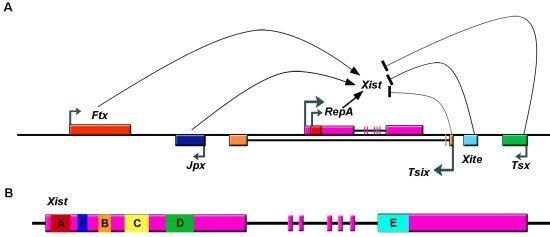
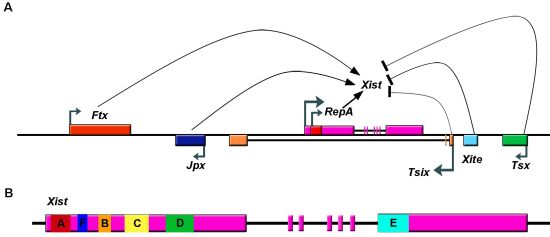
        <p>Early investigators discovered an X-linked locus, the X chromosome inactivation center (Xic), required to trigger X chromosome inactivation [<xref ref-type="bibr" rid="B10-biomolecules-03-00124">10</xref>,<xref ref-type="bibr" rid="B11-biomolecules-03-00124">11</xref>,<xref ref-type="bibr" rid="B12-biomolecules-03-00124">12</xref>]. Amazingly, this center is enriched with lncRNAs, most of them functioning in XCI (<xref ref-type="fig" rid="biomolecules-03-00124-f001">Figure 1</xref>A). The best-studied and most important of these is the 17Kb X-inactivation specific transcript, known as <italic>Xist</italic>, which is expressed exclusively from the inactivated X-chromosome and essential for the establishment of XCI in early development [<xref ref-type="bibr" rid="B13-biomolecules-03-00124">13</xref>,<xref ref-type="bibr" rid="B14-biomolecules-03-00124">14</xref>,<xref ref-type="bibr" rid="B15-biomolecules-03-00124">15</xref>]. XCI is arbitrarily divided into three stages. At the pre-XCI stage, <italic>Xist</italic> is expressed at low levels from two active X-chromosomes. During the initiation stage of XCI, <italic>Xist</italic> is upregulated and begins to “spread” along one of the X-chromosomes and converts that allele into heterochromatin characterized by: (1) genome-wide loss of euchromatic marks; (2) gain of heterochromatic marks; (3) increased DNA methylation; and (4) silencing of gene expression. This very dynamic stage requires <italic>Xist</italic>. Upon establishment of XCI, the inactive X remains silenced throughout subsequent cell divisions. During this maintenance stage, <italic>Xist</italic> remains highly expressed from the inactive X. However, deletion of <italic>Xist</italic> RNA does not result in chromosome-wide gene reactivation [<xref ref-type="bibr" rid="B16-biomolecules-03-00124">16</xref>,<xref ref-type="bibr" rid="B17-biomolecules-03-00124">17</xref>,<xref ref-type="bibr" rid="B18-biomolecules-03-00124">18</xref>]. Therefore, <italic>Xist</italic> RNA is not required at this stage of XCI [<xref ref-type="bibr" rid="B19-biomolecules-03-00124">19</xref>]. </p>
        <fig id="biomolecules-03-00124-f001" position="float">
          <label>Figure 1</label>
          <caption>
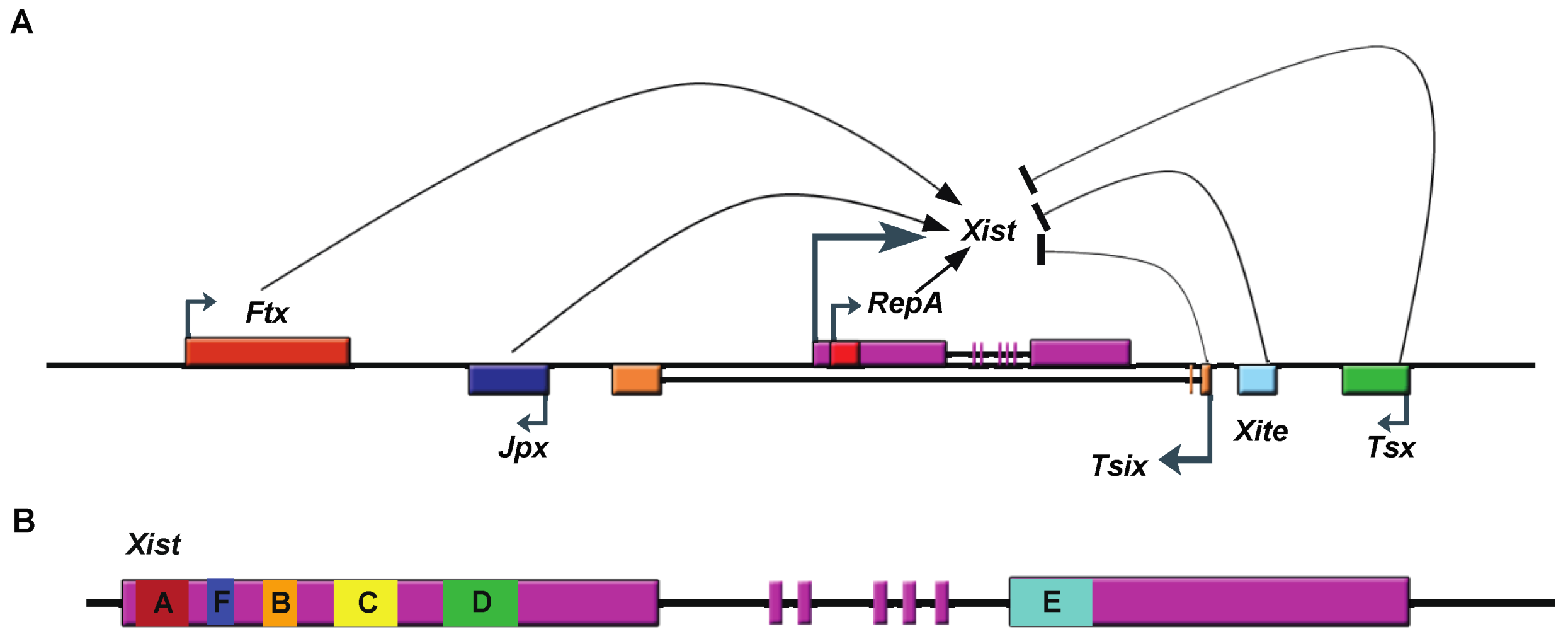
            <p>Schematic drawing of the Xic and of <italic>Xist</italic>. A. lncRNAs transcribed from Xic, a region of the X-chromosome necessary and sufficient to trigger XCI. These lncRNAs include <italic>Xist</italic> (X-inactivation specific transcript), <italic>Tsix</italic> (antisense of Xist), <italic>Tsx</italic> (testis-specific X-linked gene), <italic>Xite</italic> (X-inactivation intergenic transcription element), <italic>RepA</italic> RNA, <italic>Jpx</italic> (also known as <italic>Enox</italic> (Expressed Neighbor of <italic>Xist</italic>)), and <italic>Ftx</italic> (Five prime to <italic>Xist</italic>). <italic>Ftx</italic>, <italic>JPX</italic>, and <italic>RepA</italic> lncRNAs promote <italic>Xist</italic> transcription, while <italic>Tsix</italic>, <italic>Xite</italic> and <italic>Tsx </italic>inhibit it. B. Gene structure of <italic>Xist</italic> RNA showing location of tandem repeats (A-F). Exons are represented as boxes. </p>
          </caption>
          <graphic xmlns:xlink="http://www.w3.org/1999/xlink" xlink:href="biomolecules-03-00124-g001.tif"/>
        </fig>
      </sec>
      <sec>
        <title>2.2. Xist RNA Contains Multiple Functional Domains</title>
        <p>Like proteins, lncRNA also exhibits functional domains. <italic>Xist</italic> RNA contains six different repeat regions (A to F) (<xref ref-type="fig" rid="biomolecules-03-00124-f001">Figure 1</xref>B). The most well studied is the repeat A region located at the <italic>Xist</italic> RNA 5’-end [<xref ref-type="bibr" rid="B20-biomolecules-03-00124">20</xref>]. Transgene studies suggest that <italic>Xist</italic> lacking the repeat A region cannot initiate gene silencing [<xref ref-type="bibr" rid="B20-biomolecules-03-00124">20</xref>]. The function of that region was subsequently investigated <italic>in vivo</italic> using a gene targeting approach. Surprisingly, deletion of the A-repeats altered regulation of the mutant <italic>Xist</italic> allele such that it was not expressed [<xref ref-type="bibr" rid="B21-biomolecules-03-00124">21</xref>], making analysis of that deficiency difficult <italic>in vivo</italic>. <italic>Ex vivo</italic> studies using mouse embryonic stem cells (mESCs) revealed at least two independent mechanisms for the silencing function of the A-repeats. One study suggests that the region is required for proper splicing of <italic>Xist</italic> RNA by directly interacting with splicing factor ASF/SF2 [<xref ref-type="bibr" rid="B22-biomolecules-03-00124">22</xref>]. In another study, we discovered that a shorter transcript within the <italic>Xist</italic> locus is transcribed through the RepA region in mESCs and we named it <italic>RepA</italic> RNA [<xref ref-type="bibr" rid="B23-biomolecules-03-00124">23</xref>]. Knockdown of that <italic>RepA</italic> transcript drastically decreased <italic>Xist</italic> levels, similar to the phenotype observed following <italic>in vivo</italic> deletion of the repeat A region of <italic>Xist</italic>, suggesting that <italic>RepA</italic> RNA is an important regulator of <italic>Xist</italic> expression. We found that both <italic>Xist</italic> and <italic>RepA</italic> RNA can bind the chromatin repressor Polycomb repressive complex 2 (PRC2) through repeat A region and such interactions are required for the establishment of the chromosome-wide H3K27-3me heterochromatic mark during the initiation of XCI. </p>
        <p>Several laboratories have analyzed the structure of the repeat A domain in order to understand the molecular basis for RNA-protein interaction. The A-repeat region contains 7.5–8.5 tandem repeats (variable among different species) of a conserved ~26-mer sequence. Computational analysis indicates that each repeat has a double stem loop structure [<xref ref-type="bibr" rid="B20-biomolecules-03-00124">20</xref>]. However, NMR studies of an <italic>in vitro</italic> transcribed 26-mer showed that only the first predicted hairpin is formed, while the second predicted hairpin mediates duplex formation among different repeats [<xref ref-type="bibr" rid="B24-biomolecules-03-00124">24</xref>,<xref ref-type="bibr" rid="B25-biomolecules-03-00124">25</xref>]. One limitation of NMR studies is that only a short sequence, such as one of the A repeats, can be analyzed. By carrying out a FRET experiment using chemical and enzymatic probes, another study examined the structure of the whole domain and found that the A region contains two long stem-loop structures, each including four repeats [<xref ref-type="bibr" rid="B26-biomolecules-03-00124">26</xref>]. These studies highlighted the importance of RNA’s structure for its function. </p>
        <p>Unlike A repeats, the structure and function of the other <italic>Xist</italic> repeats are not well understood. Nevertheless, Repeat regions C and F have shown to regulate <italic>Xist</italic> RNA localization, potentially through interacting with the transcription factor YY1 [<xref ref-type="bibr" rid="B20-biomolecules-03-00124">20</xref>,<xref ref-type="bibr" rid="B27-biomolecules-03-00124">27</xref>,<xref ref-type="bibr" rid="B28-biomolecules-03-00124">28</xref>,<xref ref-type="bibr" rid="B29-biomolecules-03-00124">29</xref>].</p>
      </sec>
      <sec>
        <title>2.3. Upregulation of Xist RNA during XCI Initiation</title>
        <p>Since <italic>Xist</italic> upregulation is crucial for XCI, much effort has been made to elucidate cis-elements and trans-acting factors that control its expression. The following sections describe how lncRNAs and pluripotency factors regulate <italic>Xist</italic> expression.</p>
        <sec>
          <title>2.3.1. LncRNAs</title>
          <p>In addition to <italic>Xist</italic>, the XIC harbors several lncRNAs (<xref ref-type="fig" rid="biomolecules-03-00124-f001">Figure 1</xref>A). One of them, <italic>Tsix</italic>, is transcribed antisense to <italic>Xist</italic> and covers the entire <italic>Xist</italic> locus [<xref ref-type="bibr" rid="B30-biomolecules-03-00124">30</xref>,<xref ref-type="bibr" rid="B31-biomolecules-03-00124">31</xref>,<xref ref-type="bibr" rid="B32-biomolecules-03-00124">32</xref>,<xref ref-type="bibr" rid="B33-biomolecules-03-00124">33</xref>,<xref ref-type="bibr" rid="B34-biomolecules-03-00124">34</xref>]. At pre-XCI stage, <italic>Tsix</italic> expression exceeds that of <italic>Xist</italic>. When <italic>Tsix</italic> is deleted, <italic>Xist</italic> is non-randomly upregulated from the disrupted allele, suggesting that <italic>Tsix</italic> represses <italic>Xist</italic> expression. Several mechanisms have been proposed to explain this activity. One is that <italic>Tsix</italic> modulates the chromatin state of the <italic>Xist</italic> promoter. Evidence supporting this hypothesis is that the <italic>Xist</italic> promoter exists in different chromatin states in wildtype cells versus cells expressing <italic>Tsix</italic> truncation constructs [<xref ref-type="bibr" rid="B35-biomolecules-03-00124">35</xref>,<xref ref-type="bibr" rid="B36-biomolecules-03-00124">36</xref>,<xref ref-type="bibr" rid="B37-biomolecules-03-00124">37</xref>], and that <italic>Tsix</italic> lacking the last exon, which overlaps with the <italic>Xist</italic> promoter region, fails to regulate <italic>Xist</italic> [<xref ref-type="bibr" rid="B38-biomolecules-03-00124">38</xref>]. Another possible mechanism is that <italic>Tsix</italic> forms an RNA duplex with <italic>Xist</italic> and regulates it through the RNAi pathway [<xref ref-type="bibr" rid="B39-biomolecules-03-00124">39</xref>]. Although Dicer and <italic>Tsix</italic> reportedly regulate <italic>Xist</italic> synergistically in mESCs [<xref ref-type="bibr" rid="B39-biomolecules-03-00124">39</xref>], no microRNA has yet been identified from the <italic>Xist</italic>/<italic>Tsix</italic> locus. We found that <italic>Tsix</italic> RNA can also bind the PRC2 complex and have proposed that <italic>Tsix</italic> controls <italic>Xist</italic> activity by titrating away <italic>Xist</italic>-interacting proteins [<xref ref-type="bibr" rid="B23-biomolecules-03-00124">23</xref>]. Furthermore, <italic>Tsix</italic> couples with several proteins acting as pluripotency factors in early embryos and ESCs to maintain low expression of <italic>Xist</italic> [<xref ref-type="bibr" rid="B40-biomolecules-03-00124">40</xref>]. (This mechanism is discussed below.) In addition to <italic>Tsix</italic>, other studies have shown that lncRNAs <italic>Xite</italic> (X-Inactivation Intergenic Transcription Element) [<xref ref-type="bibr" rid="B41-biomolecules-03-00124">41</xref>] and <italic>Tsx</italic> (Testis Specific X-linked Gene) [<xref ref-type="bibr" rid="B42-biomolecules-03-00124">42</xref>] repress <italic>Xist</italic> expression through <italic>Tsix</italic> activation, while <italic>Jpx</italic> (also known as <italic>Enox</italic> (Expressed Neighbor of Xist)) [<xref ref-type="bibr" rid="B43-biomolecules-03-00124">43</xref>] and <italic>Ftx</italic> (Five prime to Xist) [<xref ref-type="bibr" rid="B44-biomolecules-03-00124">44</xref>] activates <italic>Xist</italic> RNA through unknown mechanisms. </p>
        </sec>
        <sec>
          <title>2.3.2. Pluripotency Factors</title>
          <p>Since undifferentiated female ESCs have two active X chromosomes and express low levels of <italic>Xist</italic> from both, it has long been thought that X-inactivation is coupled to the pluripotency state of mESCs. Recent studies support this hypothesis by showing that pluripotent factors play a repressive role in <italic>Xist</italic> regulation. Conditional knockout of Oct4 (also known as Pou5f1) or Nanog in male mESCs, where <italic>Xist</italic> is expressed at low levels and then silenced after differentiation, results in unexpected <italic>Xist</italic> up-regulation during differentiation [<xref ref-type="bibr" rid="B45-biomolecules-03-00124">45</xref>]. Furthermore, coating of both X chromosomes with <italic>Xist</italic> is seen in female differentiating ES cells following Oct4 knockdown [<xref ref-type="bibr" rid="B46-biomolecules-03-00124">46</xref>]. The first intron of the <italic>Xist</italic> locus exhibits binding sites for Oct4, Nanog, and Sox2 [<xref ref-type="bibr" rid="B45-biomolecules-03-00124">45</xref>,<xref ref-type="bibr" rid="B47-biomolecules-03-00124">47</xref>,<xref ref-type="bibr" rid="B48-biomolecules-03-00124">48</xref>]. However, deletion of intron1 results in a small increase in <italic>Xist</italic> expression, suggesting these factors may alter <italic>Xist</italic> function by binding other genetic elements [<xref ref-type="bibr" rid="B49-biomolecules-03-00124">49</xref>]. Indeed, Oct4 also directly binds and activates <italic>Tsix</italic> and <italic>Xite</italic> to repress <italic>Xist</italic> [<xref ref-type="bibr" rid="B46-biomolecules-03-00124">46</xref>]. In addition to the pluripotency factors noted above, a recent study found the protein encoded by the newly identified pluripotency gene Prdm14 also represses <italic>Xist</italic> RNA expression [<xref ref-type="bibr" rid="B47-biomolecules-03-00124">47</xref>]. </p>
          <p>Interestingly, while one set of pluripotency factors represses <italic>Xist</italic>, a different set of factors activates <italic>Tsix</italic>. For example, expression of Klf4, c-Myc, and Rex1 promotes <italic>Tsix</italic> expression [<xref ref-type="bibr" rid="B40-biomolecules-03-00124">40</xref>], and Rex1 is required for efficient <italic>Tsix</italic> elongation. Factors such as RNF12 (Ring finger protein 12), an X-linked E3 ubiquitin ligase that targets Rex1 for degradation, can activate <italic>Xist</italic> expression even in male mESCs [<xref ref-type="bibr" rid="B50-biomolecules-03-00124">50</xref>] and is essential for XCI initiation [<xref ref-type="bibr" rid="B51-biomolecules-03-00124">51</xref>]. Therefore, <italic>Tsix</italic> and pluripotency factors act synergistically to repress <italic>Xist</italic> in undifferentiated ESCs. </p>
        </sec>
      </sec>
      <sec>
        <title>2.4. Loading and Spreading of Xist on the Inactivated X Chromosome</title>
        <p>The most extraordinary feature of <italic>Xist</italic> is its ability to “coat” almost an entire X-chromosome. How <italic>Xist</italic> RNAs coat and spread to inactivate the X chromosome remains an open question. Interestingly, naturally occurring or induced X:autosome translocations show different degrees of XCI spread from the X into the autosomal DNA segment, suggesting that specific sequences facilitate spreading [<xref ref-type="bibr" rid="B52-biomolecules-03-00124">52</xref>,<xref ref-type="bibr" rid="B53-biomolecules-03-00124">53</xref>]. These observations prompted investigators to look for potential differences in X-chromosome and autosome sequences. LINE (long interspersed elements) are candidates for mediating this effect due to their higher density on the X chromosome compared to autosomes [<xref ref-type="bibr" rid="B54-biomolecules-03-00124">54</xref>]. The theory proposed by Mary Lyon stated that interspersed repetitive LINE elements act as booster elements to promote spread of <italic>Xist</italic> RNA [<xref ref-type="bibr" rid="B54-biomolecules-03-00124">54</xref>]. A transgenic study in mESCs showed that chromosome regions with higher LINE density are inactivated more efficiently by a <italic>Xist</italic> transgene [<xref ref-type="bibr" rid="B53-biomolecules-03-00124">53</xref>]. A recent study suggests that silenced LINE elements contribute to formation of a heterochromatic compartment initiated by <italic>Xist</italic> RNA and that a particular type of active LINEs may participate in local propagation of the XCI into regions that would otherwise escape [<xref ref-type="bibr" rid="B55-biomolecules-03-00124">55</xref>]. Nonetheless, the exact function of LINE elements in XCI remains to be studied.</p>
        <p>In terms of trans-acting factors hnRNPU (also known as SAF-A), a known nuclear scaffold protein, is known to be enriched on the inactive X chromosome [<xref ref-type="bibr" rid="B56-biomolecules-03-00124">56</xref>] and to function in <italic>Xist</italic> RNA loading [<xref ref-type="bibr" rid="B57-biomolecules-03-00124">57</xref>,<xref ref-type="bibr" rid="B58-biomolecules-03-00124">58</xref>]. A recent study showed that YY1, a RNA/DNA binding protein, tethers <italic>Xist</italic> RNA to the inactive X [<xref ref-type="bibr" rid="B27-biomolecules-03-00124">27</xref>]. However, since YY1 binding sites are highly abundant throughout the mammalian genome, it is unclear where the specificity of YY1-specific guidance of <italic>Xist</italic> onto the X-chromosome rather than autosomes lies. Factors mediating this activity remain to be identified. </p>
      </sec>
      <sec>
        <title>2.5. Xist Promotes Formation of a Heterochromatic Xi</title>
        <p><italic>Xist</italic> RNA accumulation on Xi leads to chromatin changes, such as DNA hypermethylation, enrichment of macroH2A, loss of the euchromatic mark H3K4-3me and chromosome-wide establishment of heterochromatic mark H3K27-3me and mono ubiquinated H2A (H2AK119u1) [<xref ref-type="bibr" rid="B19-biomolecules-03-00124">19</xref>,<xref ref-type="bibr" rid="B59-biomolecules-03-00124">59</xref>,<xref ref-type="bibr" rid="B60-biomolecules-03-00124">60</xref>,<xref ref-type="bibr" rid="B61-biomolecules-03-00124">61</xref>,<xref ref-type="bibr" rid="B62-biomolecules-03-00124">62</xref>,<xref ref-type="bibr" rid="B63-biomolecules-03-00124">63</xref>]. How can <italic>Xist</italic> lead to these global changes? Since <italic>Xist</italic> coats an entire X, it has long been postulated that <italic>Xist</italic> RNA binds and carries silencing factors, which are deposited as it coats regions during XCI. Thus, much effort has been applied to identifying <italic>Xist</italic>-interacting proteins.</p>
        <p>The best-studied <italic>Xist</italic>-interacting trans-factors are Polycomb group proteins. These proteins are highly enriched on the inactive X-chromosome during XCI establishment [<xref ref-type="bibr" rid="B60-biomolecules-03-00124">60</xref>,<xref ref-type="bibr" rid="B61-biomolecules-03-00124">61</xref>,<xref ref-type="bibr" rid="B64-biomolecules-03-00124">64</xref>]. Deletion of some Polycomb proteins, such as Eed, leads to reactivation of the silenced X in extra-embryonic tissues, highlighting their essential role in XCI [<xref ref-type="bibr" rid="B65-biomolecules-03-00124">65</xref>]. However, Polycomb proteins do not seem to affect random X-inactivation in embryos and mESCs, suggesting the existence of a functionally redundant mechanism regulating XCI [<xref ref-type="bibr" rid="B66-biomolecules-03-00124">66</xref>]. Polycomb proteins form two major complexes. One of those, Polycomb Repressive Complex 2 or PRC2, is a histone methyltransferase that trimethylates H3 lysine 27 [<xref ref-type="bibr" rid="B67-biomolecules-03-00124">67</xref>]. Upon recognizing H3K27-3me, another complex, PRC1, is recruited to specific genomic loci to establish ubiquinated histone H2A (H2AK119u1) and compact chromatin for gene silencing. Studies using inducible transgenes showed that PRC2 and PRC1 are localized to Xi in a <italic>Xist</italic> RNA-dependent manner [<xref ref-type="bibr" rid="B68-biomolecules-03-00124">68</xref>,<xref ref-type="bibr" rid="B69-biomolecules-03-00124">69</xref>]. As discussed earlier, it has been suggested that PRC2 is recruited onto Xi by directly interacting with <italic>Xist</italic>/<italic>RepA</italic> lncRNAs via repeat A region [<xref ref-type="bibr" rid="B23-biomolecules-03-00124">23</xref>,<xref ref-type="bibr" rid="B26-biomolecules-03-00124">26</xref>,<xref ref-type="bibr" rid="B70-biomolecules-03-00124">70</xref>]. Furthermore, phosphorylation of Ezh2, the catalytic subunit of PRC2, increases PRC2’s RNA binding ability [<xref ref-type="bibr" rid="B71-biomolecules-03-00124">71</xref>]. Notably, a <italic>Xist</italic> mutant lacking the A-repeats retains the ability to recruit PRC2 and PRC1 to Xi [<xref ref-type="bibr" rid="B60-biomolecules-03-00124">60</xref>,<xref ref-type="bibr" rid="B69-biomolecules-03-00124">69</xref>], indicating that other <italic>Xist</italic> sequences can recruit Polycomb proteins directly or indirectly. Interestingly, in cells with the depletion of a key component of PRC2, some PRC1 proteins can localize to induced <italic>Xist</italic> RNA while others cannot, suggesting <italic>Xist</italic> recruits PRC1 by both PRC2 dependent and independent mechanisms [<xref ref-type="bibr" rid="B69-biomolecules-03-00124">69</xref>]. The PRC2 independent mechanism is supported by a study showing PRC1 can find its genomic targets in PRC2-deficient cells through the interaction with RYBP protein [<xref ref-type="bibr" rid="B72-biomolecules-03-00124">72</xref>]. Surprisingly, trithorax proteins, such as Ash2L, which typically antagonize Polycomb function and are primarily linked to gene activation, also bind <italic>Xist</italic>, suggesting that either Trithorax proteins also function in gene repression or that <italic>Xist</italic> RNA can activate specific genes [<xref ref-type="bibr" rid="B58-biomolecules-03-00124">58</xref>]. </p>
      </sec>
      <sec>
        <title>2.6. Perspective</title>
        <p>Studies of <italic>Xist</italic> RNA in the past two decades have greatly advanced our understanding of how lncRNAs regulate gene expression epigenetically. However, many questions remain unanswered. For example, it is unclear how <italic>Xist</italic> specifically spreads along the future Xi but not along the activated X. It is also not yet understood how <italic>Xist</italic> RNA interacts with so many different proteins and what determines the specificity of those interactions. And since Polycomb proteins do not function in establishment of XCI in embryos, the mechanisms used to establish the repressive state of the Xi are not yet identified. </p>
      </sec>
    </sec>
    <sec>
      <title>3. Imprinted lncRNA <italic>Gtl2</italic></title>
      <p>Genomic imprinting is another dosage regulation mechanism used by mammalian cells. While most autosomal genes are expressed from two parental alleles, some genes are expressed monoallelically in a parent-of-origin manner. This epigenetic phenomenon is termed imprinting. To date, over 100 imprinted genes have been validated in mouse (see the Mouse Imprinting Catalog: <uri>http://www.mousebook.org/catalog.php?catalog=imprinting</uri>). </p>
      <p>Like X-inactivation, genomic imprinting is tightly controlled by epigenetic mechanisms such as DNA methylation and chromatin modification [<xref ref-type="bibr" rid="B73-biomolecules-03-00124">73</xref>]. Interestingly, within a cluster in which imprinted genes are co-regulated, at least one gene encodes a lncRNA, suggesting the importance of lncRNA in regulating this process [<xref ref-type="bibr" rid="B74-biomolecules-03-00124">74</xref>]. Indeed, some imprinted lncRNAs, such as Air and Kcnq1OT1, have been shown to interact with chromatin modifiers to silence reciprocally imprinted protein coding genes [<xref ref-type="bibr" rid="B75-biomolecules-03-00124">75</xref>,<xref ref-type="bibr" rid="B76-biomolecules-03-00124">76</xref>,<xref ref-type="bibr" rid="B77-biomolecules-03-00124">77</xref>]. Here, we will use the imprinted <italic>Dlk1-Dio3</italic> locus as an example to assess the functional role of lncRNAs in control of imprinting and discuss possible mechanisms used by <italic>Gtl2</italic> (also named <italic>Meg3</italic>), the maternally expressed lncRNA at the <italic>Dlk1-Dio3</italic> locus, to regulate imprinting at this locus. </p>
      <sec>
        <title>3.1. Discovery of Gtl2</title>
        <p><italic>Gtl2</italic> was discovered following an insertional mutagenesis gene trap screen to isolate genes differentially regulated during mouse embryonic development [<xref ref-type="bibr" rid="B78-biomolecules-03-00124">78</xref>]. The gene trap insertion at a region 2.3 kb upstream from <italic>Gtl2</italic> promoter caused dwarfism in mouse offspring only through paternal inheritance, not via maternal transmission [<xref ref-type="bibr" rid="B78-biomolecules-03-00124">78</xref>,<xref ref-type="bibr" rid="B79-biomolecules-03-00124">79</xref>]. Subsequent isolation of the <italic>Gtl2</italic> gene suggested that its product was a non-coding RNA (ncRNA) based on the observation that the <italic>Gtl2</italic> contained no significant open reading frames [<xref ref-type="bibr" rid="B79-biomolecules-03-00124">79</xref>]. <italic>Gtl2</italic> was mapped to a region of mouse chromosome 12 (12qF1) thought to contain imprinted genes, due to the observation that in that region uniparental disomy led to embryonic lethality [<xref ref-type="bibr" rid="B80-biomolecules-03-00124">80</xref>]. The paternal-specific growth defect emerging from the insertional mutation plus observation of decreased <italic>Gtl2</italic> expression levels in parthenogenetic embryos led to the hypothesis that <italic>Gtl2</italic> is paternally imprinted [<xref ref-type="bibr" rid="B79-biomolecules-03-00124">79</xref>]. However, soon after, several independent studies demonstrated that <italic>Gtl2</italic> is in fact expressed exclusively from the maternal allele [<xref ref-type="bibr" rid="B81-biomolecules-03-00124">81</xref>,<xref ref-type="bibr" rid="B82-biomolecules-03-00124">82</xref>,<xref ref-type="bibr" rid="B83-biomolecules-03-00124">83</xref>]. The growth phenotype observed following the insertional mutagenesis screen was later suggested to result from perturbations in imprinting of the whole locus, particularly the down regulation of several paternally expressed protein coding genes [<xref ref-type="bibr" rid="B84-biomolecules-03-00124">84</xref>,<xref ref-type="bibr" rid="B85-biomolecules-03-00124">85</xref>].</p>
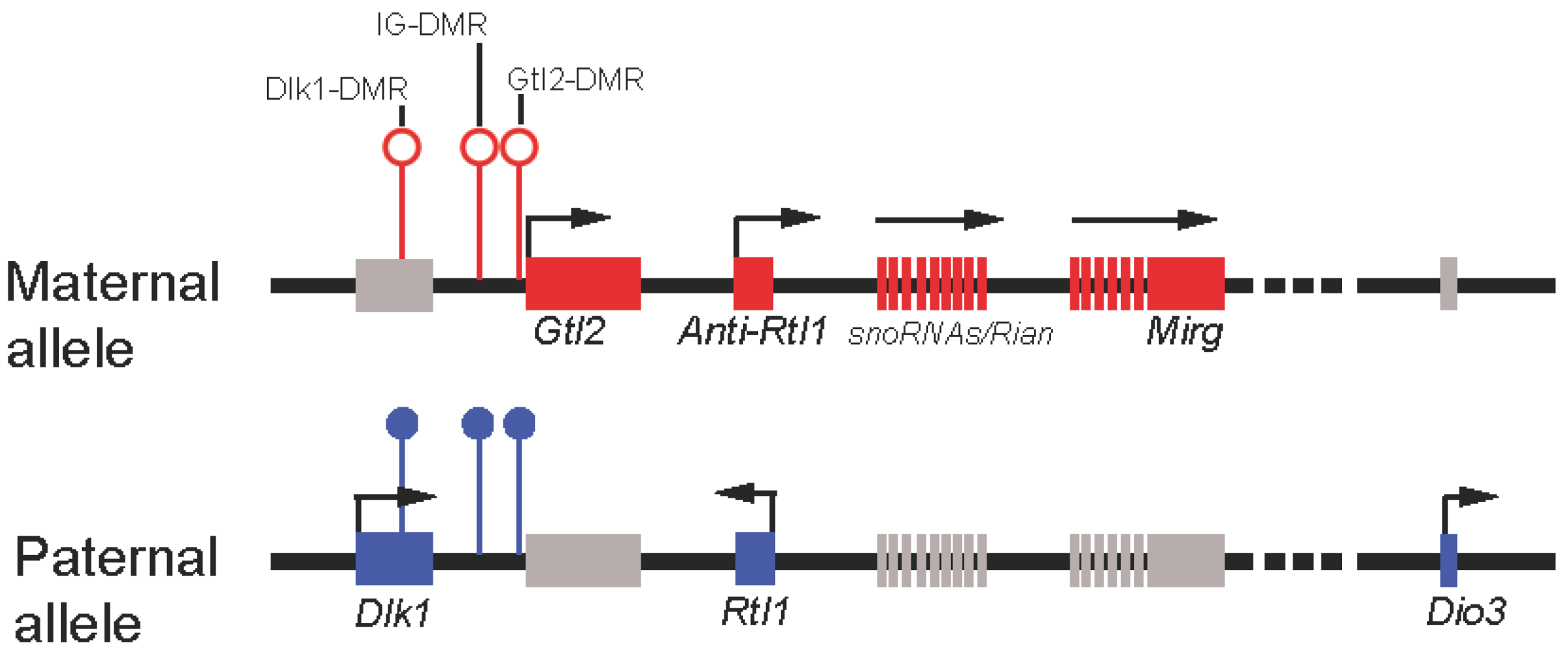
        <p>Not long after the discovery of <italic>Gtl2</italic>, other imprinted genes that form a cluster and are co-regulated with <italic>Gtl2</italic> were also identified [<xref ref-type="bibr" rid="B81-biomolecules-03-00124">81</xref>,<xref ref-type="bibr" rid="B83-biomolecules-03-00124">83</xref>,<xref ref-type="bibr" rid="B86-biomolecules-03-00124">86</xref>,<xref ref-type="bibr" rid="B87-biomolecules-03-00124">87</xref>,<xref ref-type="bibr" rid="B88-biomolecules-03-00124">88</xref>,<xref ref-type="bibr" rid="B89-biomolecules-03-00124">89</xref>]. Interestingly, genes preferentially expressed from the paternally-inherited chromosome are all protein-coding genes, including <italic>Dlk1</italic>, <italic>Rtl1</italic>, and <italic>Dio3</italic> (<xref ref-type="fig" rid="biomolecules-03-00124-f002">Figure 2</xref>), whereas genes expressed maternally all encode ncRNAs, namely, <italic>Gtl2</italic>, <italic>Anti-Rtl1</italic>, <italic>Rian</italic>, <italic>Mirg</italic>, and a large cluster of multiple snoRNAs/microRNAs (<xref ref-type="fig" rid="biomolecules-03-00124-f002">Figure 2</xref>). All maternally-expressed ncRNAs in this locus are transcribed in the same orientation. This combined with tissue-specific expression of those ncRNAs suggested coordinated expression of the maternally-expressed genes at this locus [<xref ref-type="bibr" rid="B90-biomolecules-03-00124">90</xref>]. It has also been suggested that all of those ncRNAs, with the exception of <italic>Gtl2</italic>, may come from a long polycistronic transcript [<xref ref-type="bibr" rid="B90-biomolecules-03-00124">90</xref>]. Imprinting is typically regulated by a <italic>cis</italic>-element called the differentially methylated region (DMR). Three DMRs, located between <italic>Dlk1</italic> and <italic>Gtl2</italic> (hence intergenic DMR or IG-DMR), at the <italic>Gtl2</italic> promoter, and downstream of <italic>Dlk1</italic> have been identified [<xref ref-type="bibr" rid="B91-biomolecules-03-00124">91</xref>]. While IG-DMR has been shown to regulate the imprinting status of all genes at this locus, the function of the other DMRs remains poorly understood. </p>
        <fig id="biomolecules-03-00124-f002" position="float">
          <label>Figure 2</label>
          <caption>
            <p>Schematic representation of the mouse imprinted locus <italic>Dlk1-Dio3</italic>. Red rectangles represent maternally-expressed genes, and blue represent paternally-expressed genes. Gray rectangles represent repressed genes. Open circles represent unmethylated DMRs, and filled represent methylated DMRs. </p>
          </caption>
          <graphic xmlns:xlink="http://www.w3.org/1999/xlink" xlink:href="biomolecules-03-00124-g002.tif"/>
        </fig>
      </sec>
      <sec>
        <title>3.2. Gtl2 Function</title>
        <sec>
          <title>3.2.1. Gtl2 Regulates Genomic Imprinting</title>
          <p>Genetic evidence from <italic>Gtl2</italic> knockout mice suggests that <italic>Gtl2</italic> regulates genomic imprinting. One study showed that mice with maternal deletion (300 bp of the promoter and exons 1–5) of the <italic>Gtl2</italic> gene show bidirectional loss of imprinting of all genes in the <italic>Dlk1-Dio3</italic> locus, whereas no effect was detected when the deletion was transmitted paternally, suggesting that <italic>Gtl2</italic> controls genomic imprinting at this locus [<xref ref-type="bibr" rid="B92-biomolecules-03-00124">92</xref>]. <italic>Gtl2</italic> knockout mice phenocopy IG-DMR knockout mice [<xref ref-type="bibr" rid="B92-biomolecules-03-00124">92</xref>,<xref ref-type="bibr" rid="B93-biomolecules-03-00124">93</xref>], implying that <italic>Gtl2</italic> (and/or its downstream ncRNAs) potentially regulates <italic>Dlk1-Dio3</italic> imprinting. Indeed, the same study showed that maternal deletion of <italic>Gtl2</italic> resulted in increased IG-DMR methylation on the maternal allele [<xref ref-type="bibr" rid="B92-biomolecules-03-00124">92</xref>]. Thus, <italic>Gtl2</italic> and/or its downstream ncRNAs may function to maintain the unmethylated status of the maternal IG-DMR through an unknown mechanism. Interestingly, an earlier study deleting ~4Kb of the <italic>Gtl2</italic> promoter plus exons 1–5 yielded significantly different results [<xref ref-type="bibr" rid="B94-biomolecules-03-00124">94</xref>]. The authors did not observe a change in DNA methylation or the imprinted status of any genes within this region when the deletion was transmitted maternally. However, the aberrant imprinted status of <italic>Dlk1</italic>, <italic>Rian</italic>, and <italic>Mirg</italic> was detected when deletion mutation was transmitted paternally. The difference between these two studies could lie in the variable size of the deletion of the <italic>Gtl2</italic> promoter (300 bp <italic>vs</italic>.~4 Kb). Since the region flanking the <italic>Gtl2</italic> promoter is a well-established DMR, these discrepant results suggest a functional role for the <italic>Gtl2</italic> DMR and underscore the importance of studying <italic>Gtl2</italic> function using approaches that minimally perturb the DMR, such as RNAi. </p>
        </sec>
        <sec>
          <title>3.2.2. Gtl2 Regulates Cellular Reprogramming</title>
          <p>A recent study showed that mouse induced Pluripotent Stem Cells (iPSCs) in which <italic>Gtl2</italic> and its downstream ncRNAs were aberrantly silenced contributed poorly to chimaeras and failed to generate mice in which every cell is contributed by an iPSC (all-iPSC mice) [<xref ref-type="bibr" rid="B95-biomolecules-03-00124">95</xref>]. In contrast, iPSCs showing normal expression of lncRNAs contributed to high-grade chimaeras and generated viable all-iPSC mice [<xref ref-type="bibr" rid="B95-biomolecules-03-00124">95</xref>]. Further investigation of possible mechanisms underlying repression of maternally imprinted genes revealed that in the iPSCs showing aberrant silencing of lncRNAs from this locus, the maternal IG-DMR was hypermethylated and active histone marks such as H3/H4 acetylation and H3K4 methylation were absent at the <italic>Gtl2</italic> promoter [<xref ref-type="bibr" rid="B95-biomolecules-03-00124">95</xref>]. In a subsequent publication, these authors reported that ascorbic acid facilitates cellular reprogramming by preventing silencing of <italic>Gtl2</italic> and downstream lncRNAs [<xref ref-type="bibr" rid="B96-biomolecules-03-00124">96</xref>]. These findings highlight a role for <italic>Gtl2</italic> in preserving the developmental potential of iPSCs during reprogramming.</p>
        </sec>
        <sec>
          <title>3.2.3. Gtl2 Functions in Tumorigenesis</title>
          <p>Loss of <italic>GTL2/MEG3</italic> is seen in many tumor types, including human pituitary adenoma, brain tumors, and liver tumors [<xref ref-type="bibr" rid="B97-biomolecules-03-00124">97</xref>,<xref ref-type="bibr" rid="B98-biomolecules-03-00124">98</xref>,<xref ref-type="bibr" rid="B99-biomolecules-03-00124">99</xref>]. <italic>GTL2/MEG3</italic> overexpression inhibits tumor cell proliferation <italic>in vitro</italic> [<xref ref-type="bibr" rid="B98-biomolecules-03-00124">98</xref>,<xref ref-type="bibr" rid="B99-biomolecules-03-00124">99</xref>,<xref ref-type="bibr" rid="B100-biomolecules-03-00124">100</xref>,<xref ref-type="bibr" rid="B101-biomolecules-03-00124">101</xref>,<xref ref-type="bibr" rid="B102-biomolecules-03-00124">102</xref>]. Interestingly, comparison of gene expression profiles in brain between <italic>Gtl2</italic> knockout and wild-type mice revealed an upregulation of genes correlated with angiogenesis in knockout mouse [<xref ref-type="bibr" rid="B103-biomolecules-03-00124">103</xref>], suggesting <italic>Gtl2</italic> may function as a tumor suppressor in part by inhibiting angiogenesis. Furthermore, it was suggested that a postulated tumor-suppressing function of <italic>Gtl2</italic> might stem from its ability to induce p53 accumulation, thereby activating expression of some p53 target genes [<xref ref-type="bibr" rid="B99-biomolecules-03-00124">99</xref>,<xref ref-type="bibr" rid="B100-biomolecules-03-00124">100</xref>,<xref ref-type="bibr" rid="B101-biomolecules-03-00124">101</xref>]. </p>
        </sec>
      </sec>
      <sec>
        <title>3.3. Molecular Mechanisms Potentially Underlying Gtl2 Regulation of the Dlk1-Dio3 Locus</title>
        <p>lncRNAs employ diverse mechanisms to regulate gene expression at both the transcriptional and post-transcriptional level (reviewed in [<xref ref-type="bibr" rid="B104-biomolecules-03-00124">104</xref>]). Here, we assess possible molecular mechanisms used by <italic>Gtl2</italic> to regulate genes within the <italic>Dlk1-Dio3</italic> locus. The modes of regulation considered are not mutually exclusive: <italic>Gtl2</italic> function might be exerted through combinatorial mechanisms or carried out differentially in response to specific environmental cues.</p>
        <sec>
          <title>3.3.1. Gtl2 Maintains Dlk1-Dio3 Imprinting By Protecting the Maternal IG-DMR from Methylation</title>
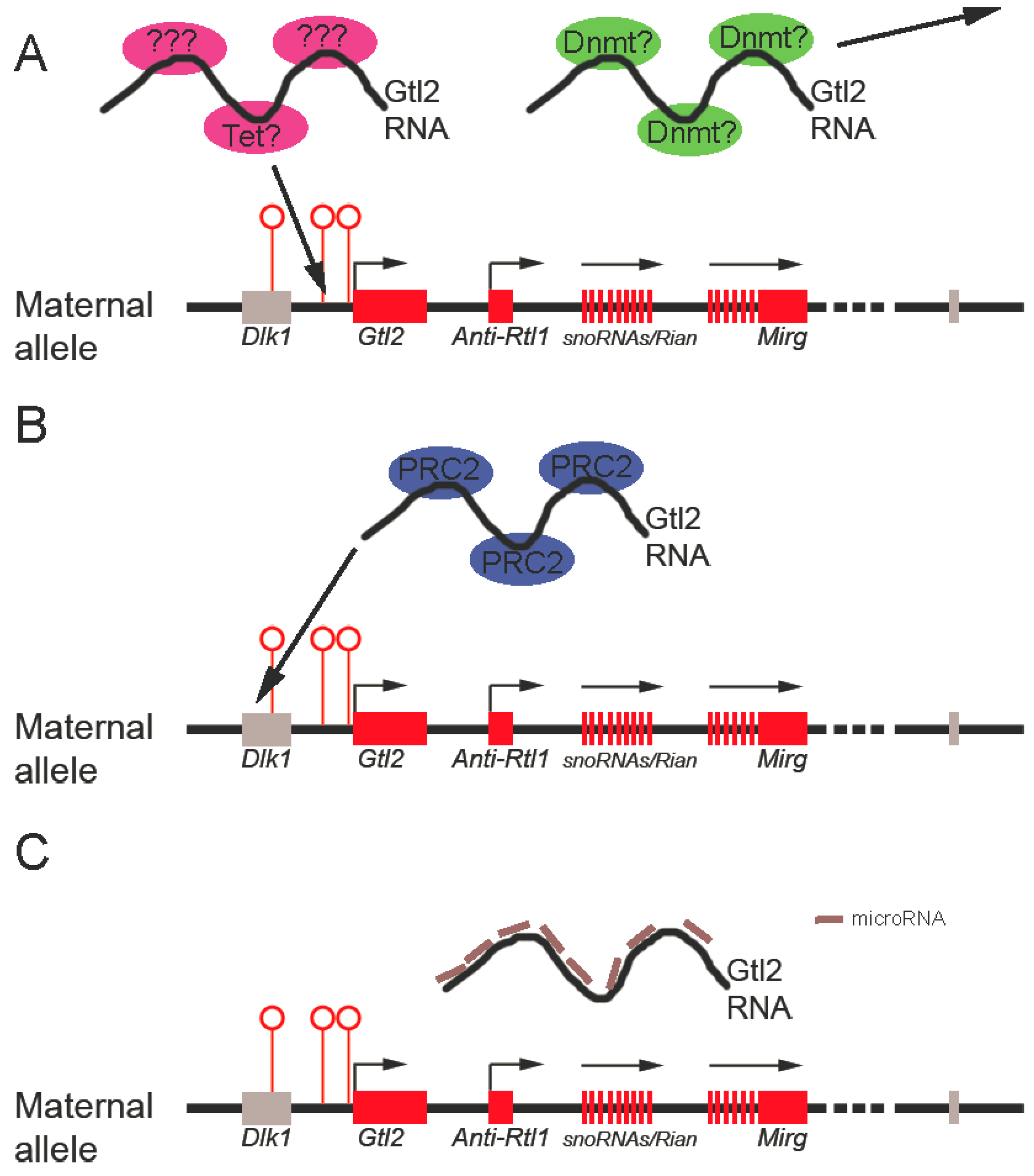
          <p>Maintaining the proper differential methylation status of the germline DMR is crucial for mono-allelic expression within an imprinting cluster. The observation that targeted deletion of the IG-DMR from the mouse <italic>Dlk1-Dio3</italic> locus caused loss of imprinting when the deletion occurred at the maternal rather than the paternal allele demonstrated that the maternally-inherited unmethylated DMR is essential for the imprinting status of the locus [<xref ref-type="bibr" rid="B93-biomolecules-03-00124">93</xref>]. That <italic>Gtl2</italic> knockdown results in hypermethylation of the maternal IG-DMR suggests that <italic>Gtl2</italic> is required to maintain its unmethylated status. Potential mechanisms include <italic>Gtl2</italic> RNA interaction with and sequestration of positive DNA methylation regulators (such as DNA methyltransferases) or by <italic>Gtl2</italic> actively recruiting negative regulators of DNA demethylation (such as Tet proteins) to keep IG-DMR unmethylated (<xref ref-type="fig" rid="biomolecules-03-00124-f003">Figure 3</xref>A). These mechanisms are not yet known. </p>
          <fig id="biomolecules-03-00124-f003" position="float">
            <label>Figure 3</label>
            <caption>
              <p>Possible mechanisms underlying <italic>Gtl2</italic> regulation of the imprinted <italic>Dlk1-Dio3</italic> locus. <bold>A.</bold> <italic>Gtl2</italic> may function to maintain the unmethylated status of the IG-DMR by titrating away DNA methyltransferases (Dnmt in the figure) and/or by recruiting DNA demethylation machinery (such as Tet or unknown proteins). <bold>B.</bold> <italic>Gtl2</italic> could silence <italic>Dlk1</italic> expression by recruiting PRC2 complexes to the <italic>Dlk1 </italic>genomic region. <bold>C.</bold> Finally, <italic>Gtl2</italic> may serve as competitive endogenous RNA (ceRNA) to keep maternally-expressed genes active by titrating away inhibitory microRNAs targeting those genes. Red rectangles represent maternally-expressed genes. Gray rectangles represent repressed genes. Open circles represent unmethylated DMRs.</p>
            </caption>
            <graphic xmlns:xlink="http://www.w3.org/1999/xlink" xlink:href="biomolecules-03-00124-g003.tif"/>
          </fig>
        </sec>
        <sec>
          <title>3.3.2. Gtl2 silences Gene Expression through Recruitment of Chromatin Modifying Machinery</title>
          <p>The role of histone modification in regulating imprinting of the <italic>Dlk1-Dio3</italic> locus is less studied than that of DNA methylation. Nevertheless, one study showed that in midgestation mouse embryos, differential histone acetylation occurred between the maternal and paternal alleles of the <italic>Gtl2</italic>-DMR, but not of the IG-DMR [<xref ref-type="bibr" rid="B105-biomolecules-03-00124">105</xref>]. The <italic>Gtl2</italic>-DMR of the active maternal allele was hyperacetylated on H3 and H4, while the silent paternal allele showed a low level of acetylation of both histones. A more recent study that characterized the allele-specific epigenetic profile of the <italic>Gtl2</italic>-DMR in greater detail confirmed the allele-specific acetylation pattern and revealed enrichment of the active histone methylation mark (H3K4 methylation) in the maternal allele in midgestation mouse embryos [<xref ref-type="bibr" rid="B106-biomolecules-03-00124">106</xref>]. It is not clear whether this differential histone modification is instructive for imprinting, or simply reflects the transcriptional state of the genes. </p>
          <p>Our recent studies demonstrate that <italic>Gtl2</italic> directly binds PRC2, and that <italic>Gtl2</italic> knockdown in mouse ESCs results in a reduced Ezh2 occupancy at the <italic>Dlk1</italic> promoter and increased <italic>Dlk1</italic> expression [<xref ref-type="bibr" rid="B107-biomolecules-03-00124">107</xref>]. This data suggests that <italic>Gtl2</italic> can silence gene expression from the maternal allele of the <italic>Dlk1-Dio3</italic> locus through chromatin modification (<xref ref-type="fig" rid="biomolecules-03-00124-f003">Figure 3</xref>B). It is currently unclear that how <italic>Gtl2</italic> recruits Ezh2 to chromatin and whether <italic>Gtl2</italic> uses the same mechanism to silence genes other than <italic>Dlk1</italic> within the same imprinted locus.</p>
        </sec>
        <sec>
          <title>3.3.3. Gtl2 Acts as a ceRNA to Maintain Expression of Maternally-Expressed ncRNAs</title>
          <p>The observation that <italic>Gtl2</italic> deletion abolishes expression of downstream lncRNAs and that expression of these RNAs is coordinated suggests that <italic>Gtl2</italic> functions to maintain expression of other maternally-expressed ncRNAs from the <italic>Dlk1-Dio3</italic> locus [<xref ref-type="bibr" rid="B90-biomolecules-03-00124">90</xref>,<xref ref-type="bibr" rid="B93-biomolecules-03-00124">93</xref>]. The recently proposed “competitive endogenous RNA” (ceRNA) theory proposes that RNA transcripts that contain sequences similar to microRNA response elements (MREs) may compete with that pool of microRNAs and alter their availability in cells, thus modulating the level of transcripts targeted by those microRNAs [<xref ref-type="bibr" rid="B108-biomolecules-03-00124">108</xref>]. It has also been suggested that ncRNAs may serve as more efficient ceRNAs than protein-coding RNAs because the binding of microRNA to lncRNAs are not interfered by translation [<xref ref-type="bibr" rid="B109-biomolecules-03-00124">109</xref>]. Indeed, a recent study showed that a muscle-specific lincRNA, linc-MD1, can act as a sponge to titrate away miR-133 and regulate the expression of key transcription factors governing muscle differentiation, suggesting the feasibility of this model [<xref ref-type="bibr" rid="B110-biomolecules-03-00124">110</xref>]. Therefore, <italic>Gtl2</italic> may serve as a ceRNA to titrate away microRNAs targeting other maternally-expressed transcripts at the same locus (<xref ref-type="fig" rid="biomolecules-03-00124-f003">Figure 3</xref>C). However, as yet, no study has analyzed potential MREs shared between <italic>Gtl2</italic> and those maternally-expressed transcripts. It will be of interest to determine whether lncRNAs regulate each other through this novel mechanism. </p>
        </sec>
      </sec>
    </sec>
    <sec sec-type="conclusions">
      <title>4. Conclusions</title>
      <p>Since the completion of the Human Genome Project, our perception of the mammalian genome has undergone a dramatic shift. The number of non protein-coding transcripts identified over the past decade has increased exponentially. We now realize that lncRNA is far from the “dark matter” of the genome, but instead plays a critical function in gene regulation. Since XCI and genomic imprinting are two well-defined molecular activities, lncRNAs from XIC or imprinted loci provide ideal systems to understand epigenetic control of how genes are regulated. The mechanisms identified will likely be applicable to newly discovered lncRNAs.</p>
    </sec>
  </body>
  <back>
    <ack>
      <title>Acknowledgements</title>
      <p>This work is supported by an AACR-Aflac, Inc. Career Development Award for Pediatric Cancer Research (J.C.Z.) and a CIRM Training Grant (Y.W.).</p>
    </ack>
    <ref-list>
      <title>References</title>
      <ref id="B1-biomolecules-03-00124">
        <label>1.</label>
        <citation citation-type="journal">
          <person-group person-group-type="author">
            <name>
              <surname>Okazaki</surname>
              <given-names>Y.</given-names>
            </name>
            <name>
              <surname>Furuno</surname>
              <given-names>M.</given-names>
            </name>
            <name>
              <surname>Kasukawa</surname>
              <given-names>T.</given-names>
            </name>
            <name>
              <surname>Adachi</surname>
              <given-names>J.</given-names>
            </name>
            <name>
              <surname>Bono</surname>
              <given-names>H.</given-names>
            </name>
            <name>
              <surname>Kondo</surname>
              <given-names>S.</given-names>
            </name>
            <name>
              <surname>Nikaido</surname>
              <given-names>I.</given-names>
            </name>
            <name>
              <surname>Osato</surname>
              <given-names>N.</given-names>
            </name>
            <name>
              <surname>Saito</surname>
              <given-names>R.</given-names>
            </name>
            <name>
              <surname>Suzuki</surname>
              <given-names>H.</given-names>
            </name>
            <etal/>
          </person-group>
          <article-title>Analysis of the mouse transcriptome based on functional annotation of 60,770 full-length cdnas</article-title>
          <source>Nature</source>
          <year>2002</year>
          <volume>420</volume>
          <fpage>563</fpage>
          <lpage>573</lpage>
          <pub-id pub-id-type="doi">10.1038/nature01266</pub-id>
        </citation>
      </ref>
      <ref id="B2-biomolecules-03-00124">
        <label>2.</label>
        <citation citation-type="journal">
          <person-group person-group-type="author">
            <name>
              <surname>Djebali</surname>
              <given-names>S.</given-names>
            </name>
            <name>
              <surname>Davis</surname>
              <given-names>C.A.</given-names>
            </name>
            <name>
              <surname>Merkel</surname>
              <given-names>A.</given-names>
            </name>
            <name>
              <surname>Dobin</surname>
              <given-names>A.</given-names>
            </name>
            <name>
              <surname>Lassmann</surname>
              <given-names>T.</given-names>
            </name>
            <name>
              <surname>Mortazavi</surname>
              <given-names>A.</given-names>
            </name>
            <name>
              <surname>Tanzer</surname>
              <given-names>A.</given-names>
            </name>
            <name>
              <surname>Lagarde</surname>
              <given-names>J.</given-names>
            </name>
            <name>
              <surname>Lin</surname>
              <given-names>W.</given-names>
            </name>
            <name>
              <surname>Schlesinger</surname>
              <given-names>F.</given-names>
            </name>
            <etal/>
          </person-group>
          <article-title>Landscape of transcription in human cells</article-title>
          <source>Nature</source>
          <year>2012</year>
          <volume>489</volume>
          <fpage>101</fpage>
          <lpage>108</lpage>
        <pub-id pub-id-type="doi">10.1038/nature11233</pub-id><pub-id pub-id-type="pmid">22955620</pub-id></citation>
      </ref>
      <ref id="B3-biomolecules-03-00124">
        <label>3.</label>
        <citation citation-type="journal">
          <person-group person-group-type="author">
            <name>
              <surname>Barr</surname>
              <given-names>M.L.</given-names>
            </name>
            <name>
              <surname>Bertram</surname>
              <given-names>E.G.</given-names>
            </name>
          </person-group>
          <article-title>A morphological distinction between neurones of the male and female, and the behaviour of the nucleolar satellite during accelerated nucleoprotein synthesis</article-title>
          <source>Nature</source>
          <year>1949</year>
          <volume>163</volume>
          <fpage>676</fpage>
          <pub-id pub-id-type="doi">10.1038/163676a0</pub-id>
        </citation>
      </ref>
      <ref id="B4-biomolecules-03-00124">
        <label>4.</label>
        <citation citation-type="journal">
          <person-group person-group-type="author">
            <name>
              <surname>Lyon</surname>
              <given-names>M.F.</given-names>
            </name>
          </person-group>
          <article-title>Gene action in the x-chromosome of the mouse (mus musculus l)</article-title>
          <source>Nature</source>
          <year>1961</year>
          <volume>190</volume>
          <fpage>372</fpage>
          <lpage>373</lpage>
          <pub-id pub-id-type="doi">10.1038/190372a0</pub-id>
        </citation>
      </ref>
      <ref id="B5-biomolecules-03-00124">
        <label>5.</label>
        <citation citation-type="journal">
          <person-group person-group-type="author">
            <name>
              <surname>Barakat</surname>
              <given-names>T.S.</given-names>
            </name>
            <name>
              <surname>Gribnau</surname>
              <given-names>J.</given-names>
            </name>
          </person-group>
          <article-title>X chromosome inactivation in the cycle of life</article-title>
          <source>Development</source>
          <year>2012</year>
          <volume>139</volume>
          <fpage>2085</fpage>
          <lpage>2089</lpage>
          <pub-id pub-id-type="doi">10.1242/dev.069328</pub-id>
        </citation>
      </ref>
      <ref id="B6-biomolecules-03-00124">
        <label>6.</label>
        <citation citation-type="journal">
          <person-group person-group-type="author">
            <name>
              <surname>Gribnau</surname>
              <given-names>J.</given-names>
            </name>
            <name>
              <surname>Grootegoed</surname>
              <given-names>J.A.</given-names>
            </name>
          </person-group>
          <article-title>Origin and evolution of x chromosome inactivation</article-title>
          <source>Curr. Opin. Cell Biol.</source>
          <year>2012</year>
          <volume>24</volume>
          <fpage>397</fpage>
          <lpage>404</lpage>
          <pub-id pub-id-type="doi">10.1016/j.ceb.2012.02.004</pub-id>
        </citation>
      </ref>
      <ref id="B7-biomolecules-03-00124">
        <label>7.</label>
        <citation citation-type="journal">
          <person-group person-group-type="author">
            <name>
              <surname>Lee</surname>
              <given-names>J.T.</given-names>
            </name>
          </person-group>
          <article-title>Gracefully ageing at 50, x-chromosome inactivation becomes a paradigm for rna and chromatin control</article-title>
          <source>Nat. Rev. Mol. Cell Biol.</source>
          <year>2011</year>
          <volume>12</volume>
          <fpage>815</fpage>
          <lpage>826</lpage>
          <pub-id pub-id-type="doi">10.1038/nrm3231</pub-id>
        </citation>
      </ref>
      <ref id="B8-biomolecules-03-00124">
        <label>8.</label>
        <citation citation-type="journal">
          <person-group person-group-type="author">
            <name>
              <surname>Gendrel</surname>
              <given-names>A.V.</given-names>
            </name>
            <name>
              <surname>Heard</surname>
              <given-names>E.</given-names>
            </name>
          </person-group>
          <article-title>Fifty years of x-inactivation research</article-title>
          <source>Development</source>
          <year>2011</year>
          <volume>138</volume>
          <fpage>5049</fpage>
          <lpage>5055</lpage>
          <pub-id pub-id-type="doi">10.1242/dev.068320</pub-id>
        </citation>
      </ref>
      <ref id="B9-biomolecules-03-00124">
        <label>9.</label>
        <citation citation-type="journal">
          <person-group person-group-type="author">
            <name>
              <surname>Agrelo</surname>
              <given-names>R.</given-names>
            </name>
            <name>
              <surname>Wutz</surname>
              <given-names>A.</given-names>
            </name>
          </person-group>
          <article-title>Cancer progenitors and epigenetic contexts: An xisting connection</article-title>
          <source>Epigenetics: Official J. DNA Methyl. Soc.</source>
          <year>2009</year>
          <volume>4</volume>
          <fpage>568</fpage>
          <lpage>570</lpage>
          <pub-id pub-id-type="doi">10.4161/epi.4.8.10186</pub-id>
        </citation>
      </ref>
      <ref id="B10-biomolecules-03-00124">
        <label>10.</label>
        <citation citation-type="journal">
          <person-group person-group-type="author">
            <name>
              <surname>Rastan</surname>
              <given-names>S.</given-names>
            </name>
          </person-group>
          <article-title>Non-random x-chromosome inactivation in mouse x-autosome translocation embryos--location of the inactivation centre</article-title>
          <source>J. Embryol. Exp. Morphol.</source>
          <year>1983</year>
          <volume>78</volume>
          <fpage>1</fpage>
          <lpage>22</lpage>
        <pub-id pub-id-type="pmid">6198418</pub-id></citation>
      </ref>
      <ref id="B11-biomolecules-03-00124">
        <label>11.</label>
        <citation citation-type="journal">
          <person-group person-group-type="author">
            <name>
              <surname>Rastan</surname>
              <given-names>S.</given-names>
            </name>
            <name>
              <surname>Robertson</surname>
              <given-names>E.J.</given-names>
            </name>
          </person-group>
          <article-title>X-chromosome deletions in embryo-derived (ek) cell lines associated with lack of x-chromosome inactivation</article-title>
          <source>J. Embryol. Exp. Morphol.</source>
          <year>1985</year>
          <volume>90</volume>
          <fpage>379</fpage>
          <lpage>388</lpage>
        <pub-id pub-id-type="pmid">3834036</pub-id></citation>
      </ref>
      <ref id="B12-biomolecules-03-00124">
        <label>12.</label>
        <citation citation-type="journal">
          <person-group person-group-type="author">
            <name>
              <surname>Brown</surname>
              <given-names>C.J.</given-names>
            </name>
            <name>
              <surname>Lafreniere</surname>
              <given-names>R.G.</given-names>
            </name>
            <name>
              <surname>Powers</surname>
              <given-names>V.E.</given-names>
            </name>
            <name>
              <surname>Sebastio</surname>
              <given-names>G.</given-names>
            </name>
            <name>
              <surname>Ballabio</surname>
              <given-names>A.</given-names>
            </name>
            <name>
              <surname>Pettigrew</surname>
              <given-names>A.L.</given-names>
            </name>
            <name>
              <surname>Ledbetter</surname>
              <given-names>D.H.</given-names>
            </name>
            <name>
              <surname>Levy</surname>
              <given-names>E.</given-names>
            </name>
            <name>
              <surname>Craig</surname>
              <given-names>I.W.</given-names>
            </name>
            <name>
              <surname>Willard</surname>
              <given-names>H.F.</given-names>
            </name>
          </person-group>
          <article-title>Localization of the x inactivation centre on the human x chromosome in xq13</article-title>
          <source>Nature</source>
          <year>1991</year>
          <volume>349</volume>
          <fpage>82</fpage>
          <lpage>84</lpage>
        <pub-id pub-id-type="doi">10.1038/349082a0</pub-id><pub-id pub-id-type="pmid">1985270</pub-id></citation>
      </ref>
      <ref id="B13-biomolecules-03-00124">
        <label>13.</label>
        <citation citation-type="journal">
          <person-group person-group-type="author">
            <name>
              <surname>Brown</surname>
              <given-names>C.J.</given-names>
            </name>
            <name>
              <surname>Ballabio</surname>
              <given-names>A.</given-names>
            </name>
            <name>
              <surname>Rupert</surname>
              <given-names>J.L.</given-names>
            </name>
            <name>
              <surname>Lafreniere</surname>
              <given-names>R.G.</given-names>
            </name>
            <name>
              <surname>Grompe</surname>
              <given-names>M.</given-names>
            </name>
            <name>
              <surname>Tonlorenzi</surname>
              <given-names>R.</given-names>
            </name>
            <name>
              <surname>Willard</surname>
              <given-names>H.F.</given-names>
            </name>
          </person-group>
          <article-title>A gene from the region of the human x inactivation centre is expressed exclusively from the inactive x chromosome</article-title>
          <source>Nature</source>
          <year>1991</year>
          <volume>349</volume>
          <fpage>38</fpage>
          <lpage>44</lpage>
        <pub-id pub-id-type="doi">10.1038/349038a0</pub-id><pub-id pub-id-type="pmid">1985261</pub-id></citation>
      </ref>
      <ref id="B14-biomolecules-03-00124">
        <label>14.</label>
        <citation citation-type="journal">
          <person-group person-group-type="author">
            <name>
              <surname>Borsani</surname>
              <given-names>G.</given-names>
            </name>
            <name>
              <surname>Tonlorenzi</surname>
              <given-names>R.</given-names>
            </name>
            <name>
              <surname>Simmler</surname>
              <given-names>M.C.</given-names>
            </name>
            <name>
              <surname>Dandolo</surname>
              <given-names>L.</given-names>
            </name>
            <name>
              <surname>Arnaud</surname>
              <given-names>D.</given-names>
            </name>
            <name>
              <surname>Capra</surname>
              <given-names>V.</given-names>
            </name>
            <name>
              <surname>Grompe</surname>
              <given-names>M.</given-names>
            </name>
            <name>
              <surname>Pizzuti</surname>
              <given-names>A.</given-names>
            </name>
            <name>
              <surname>Muzny</surname>
              <given-names>D.</given-names>
            </name>
            <name>
              <surname>Lawrence</surname>
              <given-names>C.</given-names>
            </name>
            <etal/>
          </person-group>
          <article-title>Characterization of a murine gene expressed from the inactive x chromosome</article-title>
          <source>Nature</source>
          <year>1991</year>
          <volume>351</volume>
          <fpage>325</fpage>
          <lpage>329</lpage>
        <pub-id pub-id-type="doi">10.1038/351325a0</pub-id><pub-id pub-id-type="pmid">2034278</pub-id></citation>
      </ref>
      <ref id="B15-biomolecules-03-00124">
        <label>15.</label>
        <citation citation-type="journal">
          <person-group person-group-type="author">
            <name>
              <surname>Brockdorff</surname>
              <given-names>N.</given-names>
            </name>
            <name>
              <surname>Ashworth</surname>
              <given-names>A.</given-names>
            </name>
            <name>
              <surname>Kay</surname>
              <given-names>G.F.</given-names>
            </name>
            <name>
              <surname>Cooper</surname>
              <given-names>P.</given-names>
            </name>
            <name>
              <surname>Smith</surname>
              <given-names>S.</given-names>
            </name>
            <name>
              <surname>McCabe</surname>
              <given-names>V.M.</given-names>
            </name>
            <name>
              <surname>Norris</surname>
              <given-names>D.P.</given-names>
            </name>
            <name>
              <surname>Penny</surname>
              <given-names>G.D.</given-names>
            </name>
            <name>
              <surname>Patel</surname>
              <given-names>D.</given-names>
            </name>
            <name>
              <surname>Rastan</surname>
              <given-names>S.</given-names>
            </name>
          </person-group>
          <article-title>Conservation of position and exclusive expression of mouse xist from the inactive x chromosome</article-title>
          <source>Nature</source>
          <year>1991</year>
          <volume>351</volume>
          <fpage>329</fpage>
          <lpage>331</lpage>
        <pub-id pub-id-type="doi">10.1038/351329a0</pub-id><pub-id pub-id-type="pmid">2034279</pub-id></citation>
      </ref>
      <ref id="B16-biomolecules-03-00124">
        <label>16.</label>
        <citation citation-type="journal">
          <person-group person-group-type="author">
            <name>
              <surname>Brown</surname>
              <given-names>C.J.</given-names>
            </name>
            <name>
              <surname>Willard</surname>
              <given-names>H.F.</given-names>
            </name>
          </person-group>
          <article-title>The human x-inactivation centre is not required for maintenance of x-chromosome inactivation</article-title>
          <source>Nature</source>
          <year>1994</year>
          <volume>368</volume>
          <fpage>154</fpage>
          <lpage>156</lpage>
        <pub-id pub-id-type="doi">10.1038/368154a0</pub-id><pub-id pub-id-type="pmid">8139659</pub-id></citation>
      </ref>
      <ref id="B17-biomolecules-03-00124">
        <label>17.</label>
        <citation citation-type="journal">
          <person-group person-group-type="author">
            <name>
              <surname>Csankovszki</surname>
              <given-names>G.</given-names>
            </name>
            <name>
              <surname>Panning</surname>
              <given-names>B.</given-names>
            </name>
            <name>
              <surname>Bates</surname>
              <given-names>B.</given-names>
            </name>
            <name>
              <surname>Pehrson</surname>
              <given-names>J.R.</given-names>
            </name>
            <name>
              <surname>Jaenisch</surname>
              <given-names>R.</given-names>
            </name>
          </person-group>
          <article-title>Conditional deletion of xist disrupts histone macroh2a localization but not maintenance of x inactivation</article-title>
          <source>Nat. Genet.</source>
          <year>1999</year>
          <volume>22</volume>
          <fpage>323</fpage>
          <lpage>324</lpage>
          <pub-id pub-id-type="doi">10.1038/11887</pub-id>
        </citation>
      </ref>
      <ref id="B18-biomolecules-03-00124">
        <label>18.</label>
        <citation citation-type="journal">
          <person-group person-group-type="author">
            <name>
              <surname>Wutz</surname>
              <given-names>A.</given-names>
            </name>
            <name>
              <surname>Jaenisch</surname>
              <given-names>R.</given-names>
            </name>
          </person-group>
          <article-title>A shift from reversible to irreversible x inactivation is triggered during es cell differentiation</article-title>
          <source>Mol. Cell</source>
          <year>2000</year>
          <volume>5</volume>
          <fpage>695</fpage>
          <lpage>705</lpage>
        <pub-id pub-id-type="doi">10.1016/S1097-2765(00)80248-8</pub-id><pub-id pub-id-type="pmid">10882105</pub-id></citation>
      </ref>
      <ref id="B19-biomolecules-03-00124">
        <label>19.</label>
        <citation citation-type="journal">
          <person-group person-group-type="author">
            <name>
              <surname>Wutz</surname>
              <given-names>A.</given-names>
            </name>
          </person-group>
          <article-title>Gene silencing in x-chromosome inactivation: Advances in understanding facultative heterochromatin formation</article-title>
          <source>Nat. Rev. Genet.</source>
          <year>2011</year>
          <volume>12</volume>
          <fpage>542</fpage>
          <lpage>553</lpage>
          <pub-id pub-id-type="doi">10.1038/nrg3035</pub-id>
        </citation>
      </ref>
      <ref id="B20-biomolecules-03-00124">
        <label>20.</label>
        <citation citation-type="journal">
          <person-group person-group-type="author">
            <name>
              <surname>Wutz</surname>
              <given-names>A.</given-names>
            </name>
            <name>
              <surname>Rasmussen</surname>
              <given-names>T.P.</given-names>
            </name>
            <name>
              <surname>Jaenisch</surname>
              <given-names>R.</given-names>
            </name>
          </person-group>
          <article-title>Chromosomal silencing and localization are mediated by different domains of xist rna</article-title>
          <source>Nat. Genet.</source>
          <year>2002</year>
          <volume>30</volume>
          <fpage>167</fpage>
          <lpage>174</lpage>
        <pub-id pub-id-type="doi">10.1038/ng820</pub-id><pub-id pub-id-type="pmid">11780141</pub-id></citation>
      </ref>
      <ref id="B21-biomolecules-03-00124">
        <label>21.</label>
        <citation citation-type="journal">
          <person-group person-group-type="author">
            <name>
              <surname>Hoki</surname>
              <given-names>Y.</given-names>
            </name>
            <name>
              <surname>Kimura</surname>
              <given-names>N.</given-names>
            </name>
            <name>
              <surname>Kanbayashi</surname>
              <given-names>M.</given-names>
            </name>
            <name>
              <surname>Amakawa</surname>
              <given-names>Y.</given-names>
            </name>
            <name>
              <surname>Ohhata</surname>
              <given-names>T.</given-names>
            </name>
            <name>
              <surname>Sasaki</surname>
              <given-names>H.</given-names>
            </name>
            <name>
              <surname>Sado</surname>
              <given-names>T.</given-names>
            </name>
          </person-group>
          <article-title>A proximal conserved repeat in the xist gene is essential as a genomic element for x-inactivation in mouse</article-title>
          <source>Development</source>
          <year>2009</year>
          <volume>136</volume>
          <fpage>139</fpage>
          <lpage>146</lpage>
        <pub-id pub-id-type="doi">10.1242/dev.026427</pub-id><pub-id pub-id-type="pmid">19036803</pub-id></citation>
      </ref>
      <ref id="B22-biomolecules-03-00124">
        <label>22.</label>
        <citation citation-type="journal">
          <person-group person-group-type="author">
            <name>
              <surname>Royce-Tolland</surname>
              <given-names>M.E.</given-names>
            </name>
            <name>
              <surname>Andersen</surname>
              <given-names>A.A.</given-names>
            </name>
            <name>
              <surname>Koyfman</surname>
              <given-names>H.R.</given-names>
            </name>
            <name>
              <surname>Talbot</surname>
              <given-names>D.J.</given-names>
            </name>
            <name>
              <surname>Wutz</surname>
              <given-names>A.</given-names>
            </name>
            <name>
              <surname>Tonks</surname>
              <given-names>I.D.</given-names>
            </name>
            <name>
              <surname>Kay</surname>
              <given-names>G.F.</given-names>
            </name>
            <name>
              <surname>Panning</surname>
              <given-names>B.</given-names>
            </name>
          </person-group>
          <article-title>The a-repeat links asf/sf2-dependent xist rna processing with random choice during x inactivation</article-title>
          <source>Nat. Struct. Mol. Biol.</source>
          <year>2010</year>
          <volume>17</volume>
          <fpage>948</fpage>
          <lpage>954</lpage>
          <pub-id pub-id-type="doi">10.1038/nsmb.1877</pub-id>
        </citation>
      </ref>
      <ref id="B23-biomolecules-03-00124">
        <label>23.</label>
        <citation citation-type="journal">
          <person-group person-group-type="author">
            <name>
              <surname>Zhao</surname>
              <given-names>J.</given-names>
            </name>
            <name>
              <surname>Sun</surname>
              <given-names>B.K.</given-names>
            </name>
            <name>
              <surname>Erwin</surname>
              <given-names>J.A.</given-names>
            </name>
            <name>
              <surname>Song</surname>
              <given-names>J.J.</given-names>
            </name>
            <name>
              <surname>Lee</surname>
              <given-names>J.T.</given-names>
            </name>
          </person-group>
          <article-title>Polycomb proteins targeted by a short repeat rna to the mouse x chromosome</article-title>
          <source>Science</source>
          <year>2008</year>
          <volume>322</volume>
          <fpage>750</fpage>
          <lpage>756</lpage>
          <pub-id pub-id-type="doi">10.1126/science.1163045</pub-id>
        </citation>
      </ref>
      <ref id="B24-biomolecules-03-00124">
        <label>24.</label>
        <citation citation-type="journal">
          <person-group person-group-type="author">
            <name>
              <surname>Duszczyk</surname>
              <given-names>M.M.</given-names>
            </name>
            <name>
              <surname>Zanier</surname>
              <given-names>K.</given-names>
            </name>
            <name>
              <surname>Sattler</surname>
              <given-names>M.</given-names>
            </name>
          </person-group>
          <article-title>A nmr strategy to unambiguously distinguish nucleic acid hairpin and duplex conformations applied to a xist rna a-repeat</article-title>
          <source>NucleicAcids Res.</source>
          <year>2008</year>
          <volume>36</volume>
          <fpage>7068</fpage>
          <lpage>7077</lpage>
          <pub-id pub-id-type="doi">10.1093/nar/gkn776</pub-id>
        </citation>
      </ref>
      <ref id="B25-biomolecules-03-00124">
        <label>25.</label>
        <citation citation-type="journal">
          <person-group person-group-type="author">
            <name>
              <surname>Duszczyk</surname>
              <given-names>M.M.</given-names>
            </name>
            <name>
              <surname>Sattler</surname>
              <given-names>M.</given-names>
            </name>
          </person-group>
          <article-title>(1)h, (1)(3)c, (1)(5)n and (3)(1)p chemical shift assignments of a human xist rna a-repeat tetraloop hairpin essential for x-chromosome inactivation</article-title>
          <source>Biomolecular NMRAssign.</source>
          <year>2012</year>
          <volume>6</volume>
          <fpage>75</fpage>
          <lpage>77</lpage>
          <pub-id pub-id-type="doi">10.1007/s12104-011-9328-z</pub-id>
        </citation>
      </ref>
      <ref id="B26-biomolecules-03-00124">
        <label>26.</label>
        <citation citation-type="journal">
          <person-group person-group-type="author">
            <name>
              <surname>Maenner</surname>
              <given-names>S.</given-names>
            </name>
            <name>
              <surname>Blaud</surname>
              <given-names>M.</given-names>
            </name>
            <name>
              <surname>Fouillen</surname>
              <given-names>L.</given-names>
            </name>
            <name>
              <surname>Savoye</surname>
              <given-names>A.</given-names>
            </name>
            <name>
              <surname>Marchand</surname>
              <given-names>V.</given-names>
            </name>
            <name>
              <surname>Dubois</surname>
              <given-names>A.</given-names>
            </name>
            <name>
              <surname>Sanglier-Cianferani</surname>
              <given-names>S.</given-names>
            </name>
            <name>
              <surname>Van Dorsselaer</surname>
              <given-names>A.</given-names>
            </name>
            <name>
              <surname>Clerc</surname>
              <given-names>P.</given-names>
            </name>
            <name>
              <surname>Avner</surname>
              <given-names>P.</given-names>
            </name>
            <etal/>
          </person-group>
          <article-title>2-d structure of the a region of xist rna and its implication for prc2 association</article-title>
          <source>PLoS Biol.</source>
          <year>2010</year>
          <volume>8</volume>
          <fpage>e1000276</fpage>
          <pub-id pub-id-type="doi">10.1371/journal.pbio.1000276</pub-id>
        </citation>
      </ref>
      <ref id="B27-biomolecules-03-00124">
        <label>27.</label>
        <citation citation-type="journal">
          <person-group person-group-type="author">
            <name>
              <surname>Jeon</surname>
              <given-names>Y.</given-names>
            </name>
            <name>
              <surname>Lee</surname>
              <given-names>J.T.</given-names>
            </name>
          </person-group>
          <article-title>Yy1 tethers xist rna to the inactive x nucleation center</article-title>
          <source>Cell</source>
          <year>2011</year>
          <volume>146</volume>
          <fpage>119</fpage>
          <lpage>133</lpage>
          <pub-id pub-id-type="doi">10.1016/j.cell.2011.06.026</pub-id>
        </citation>
      </ref>
      <ref id="B28-biomolecules-03-00124">
        <label>28.</label>
        <citation citation-type="journal">
          <person-group person-group-type="author">
            <name>
              <surname>Beletskii</surname>
              <given-names>A.</given-names>
            </name>
            <name>
              <surname>Hong</surname>
              <given-names>Y.K.</given-names>
            </name>
            <name>
              <surname>Pehrson</surname>
              <given-names>J.</given-names>
            </name>
            <name>
              <surname>Egholm</surname>
              <given-names>M.</given-names>
            </name>
            <name>
              <surname>Strauss</surname>
              <given-names>W.M.</given-names>
            </name>
          </person-group>
          <article-title>Pna interference mapping demonstrates functional domains in the noncoding rna xist</article-title>
          <source>Proc. Natl. Acad. Sci. USA</source>
          <year>2001</year>
          <volume>98</volume>
          <fpage>9215</fpage>
          <lpage>9220</lpage>
          <pub-id pub-id-type="doi">10.1073/pnas.161173098</pub-id>
        </citation>
      </ref>
      <ref id="B29-biomolecules-03-00124">
        <label>29.</label>
        <citation citation-type="journal">
          <person-group person-group-type="author">
            <name>
              <surname>Sarma</surname>
              <given-names>K.</given-names>
            </name>
            <name>
              <surname>Levasseur</surname>
              <given-names>P.</given-names>
            </name>
            <name>
              <surname>Aristarkhov</surname>
              <given-names>A.</given-names>
            </name>
            <name>
              <surname>Lee</surname>
              <given-names>J.T.</given-names>
            </name>
          </person-group>
          <article-title>Locked nucleic acids (lnas) reveal sequence requirements and kinetics of xist rna localization to the x chromosome</article-title>
          <source>Proc. Natl. Acad. Sci. USA</source>
          <year>2010</year>
          <volume>107</volume>
          <fpage>22196</fpage>
          <lpage>22201</lpage>
        <pub-id pub-id-type="doi">10.1073/pnas.1009785107</pub-id><pub-id pub-id-type="pmid">21135235</pub-id></citation>
      </ref>
      <ref id="B30-biomolecules-03-00124">
        <label>30.</label>
        <citation citation-type="journal">
          <person-group person-group-type="author">
            <name>
              <surname>Clerc</surname>
              <given-names>P.</given-names>
            </name>
            <name>
              <surname>Avner</surname>
              <given-names>P.</given-names>
            </name>
          </person-group>
          <article-title>Role of the region 3' to xist exon 6 in the counting process of x-chromosome inactivation</article-title>
          <source>Nat. Genet.</source>
          <year>1998</year>
          <volume>19</volume>
          <fpage>249</fpage>
          <lpage>253</lpage>
          <pub-id pub-id-type="doi">10.1038/924</pub-id>
        </citation>
      </ref>
      <ref id="B31-biomolecules-03-00124">
        <label>31.</label>
        <citation citation-type="journal">
          <person-group person-group-type="author">
            <name>
              <surname>Lee</surname>
              <given-names>J.T.</given-names>
            </name>
            <name>
              <surname>Davidow</surname>
              <given-names>L.S.</given-names>
            </name>
            <name>
              <surname>Warshawsky</surname>
              <given-names>D.</given-names>
            </name>
          </person-group>
          <article-title>Tsix, a gene antisense to xist at the x-inactivation centre</article-title>
          <source>Nat. Genet.</source>
          <year>1999</year>
          <volume>21</volume>
          <fpage>400</fpage>
          <lpage>404</lpage>
          <pub-id pub-id-type="doi">10.1038/7734</pub-id>
        </citation>
      </ref>
      <ref id="B32-biomolecules-03-00124">
        <label>32.</label>
        <citation citation-type="journal">
          <person-group person-group-type="author">
            <name>
              <surname>Sado</surname>
              <given-names>T.</given-names>
            </name>
            <name>
              <surname>Wang</surname>
              <given-names>Z.</given-names>
            </name>
            <name>
              <surname>Sasaki</surname>
              <given-names>H.</given-names>
            </name>
            <name>
              <surname>Li</surname>
              <given-names>E.</given-names>
            </name>
          </person-group>
          <article-title>Regulation of imprinted x-chromosome inactivation in mice by tsix</article-title>
          <source>Development</source>
          <year>2001</year>
          <volume>128</volume>
          <fpage>1275</fpage>
          <lpage>1286</lpage>
        <pub-id pub-id-type="pmid">11262229</pub-id></citation>
      </ref>
      <ref id="B33-biomolecules-03-00124">
        <label>33.</label>
        <citation citation-type="journal">
          <person-group person-group-type="author">
            <name>
              <surname>Morey</surname>
              <given-names>C.</given-names>
            </name>
            <name>
              <surname>Arnaud</surname>
              <given-names>D.</given-names>
            </name>
            <name>
              <surname>Avner</surname>
              <given-names>P.</given-names>
            </name>
            <name>
              <surname>Clerc</surname>
              <given-names>P.</given-names>
            </name>
          </person-group>
          <article-title>Tsix-mediated repression of xist accumulation is not sufficient for normal random x inactivation</article-title>
          <source>Hum. Mol. Genet.</source>
          <year>2001</year>
          <volume>10</volume>
          <fpage>1403</fpage>
          <lpage>1411</lpage>
        <pub-id pub-id-type="doi">10.1093/hmg/10.13.1403</pub-id><pub-id pub-id-type="pmid">11440993</pub-id></citation>
      </ref>
      <ref id="B34-biomolecules-03-00124">
        <label>34.</label>
        <citation citation-type="journal">
          <person-group person-group-type="author">
            <name>
              <surname>Morey</surname>
              <given-names>C.</given-names>
            </name>
            <name>
              <surname>Navarro</surname>
              <given-names>P.</given-names>
            </name>
            <name>
              <surname>Debrand</surname>
              <given-names>E.</given-names>
            </name>
            <name>
              <surname>Avner</surname>
              <given-names>P.</given-names>
            </name>
            <name>
              <surname>Rougeulle</surname>
              <given-names>C.</given-names>
            </name>
            <name>
              <surname>Clerc</surname>
              <given-names>P.</given-names>
            </name>
          </person-group>
          <article-title>The region 3' to xist mediates x chromosome counting and h3 lys-4 dimethylation within the xist gene</article-title>
          <source>EMBO J.</source>
          <year>2004</year>
          <volume>23</volume>
          <fpage>594</fpage>
          <lpage>604</lpage>
        <pub-id pub-id-type="doi">10.1038/sj.emboj.7600071</pub-id><pub-id pub-id-type="pmid">14749728</pub-id></citation>
      </ref>
      <ref id="B35-biomolecules-03-00124">
        <label>35.</label>
        <citation citation-type="journal">
          <person-group person-group-type="author">
            <name>
              <surname>Navarro</surname>
              <given-names>P.</given-names>
            </name>
            <name>
              <surname>Page</surname>
              <given-names>D.R.</given-names>
            </name>
            <name>
              <surname>Avner</surname>
              <given-names>P.</given-names>
            </name>
            <name>
              <surname>Rougeulle</surname>
              <given-names>C.</given-names>
            </name>
          </person-group>
          <article-title>Tsix-mediated epigenetic switch of a ctcf-flanked region of the xist promoter determines the xist transcription program</article-title>
          <source>Genes Dev.</source>
          <year>2006</year>
          <volume>20</volume>
          <fpage>2787</fpage>
          <lpage>2792</lpage>
          <pub-id pub-id-type="doi">10.1101/gad.389006</pub-id>
        </citation>
      </ref>
      <ref id="B36-biomolecules-03-00124">
        <label>36.</label>
        <citation citation-type="journal">
          <person-group person-group-type="author">
            <name>
              <surname>Sun</surname>
              <given-names>B.K.</given-names>
            </name>
            <name>
              <surname>Deaton</surname>
              <given-names>A.M.</given-names>
            </name>
            <name>
              <surname>Lee</surname>
              <given-names>J.T.</given-names>
            </name>
          </person-group>
          <article-title>A transient heterochromatic state in xist preempts x inactivation choice without rna stabilization</article-title>
          <source>Mol. Cell</source>
          <year>2006</year>
          <volume>21</volume>
          <fpage>617</fpage>
          <lpage>628</lpage>
          <pub-id pub-id-type="doi">10.1016/j.molcel.2006.01.028</pub-id>
        </citation>
      </ref>
      <ref id="B37-biomolecules-03-00124">
        <label>37.</label>
        <citation citation-type="journal">
          <person-group person-group-type="author">
            <name>
              <surname>Navarro</surname>
              <given-names>P.</given-names>
            </name>
            <name>
              <surname>Pichard</surname>
              <given-names>S.</given-names>
            </name>
            <name>
              <surname>Ciaudo</surname>
              <given-names>C.</given-names>
            </name>
            <name>
              <surname>Avner</surname>
              <given-names>P.</given-names>
            </name>
            <name>
              <surname>Rougeulle</surname>
              <given-names>C.</given-names>
            </name>
          </person-group>
          <article-title>Tsix transcription across the xist gene alters chromatin conformation without affecting xist transcription: Implications for x-chromosome inactivation</article-title>
          <source>Genes Dev.</source>
          <year>2005</year>
          <volume>19</volume>
          <fpage>1474</fpage>
          <lpage>1484</lpage>
          <pub-id pub-id-type="doi">10.1101/gad.341105</pub-id>
        </citation>
      </ref>
      <ref id="B38-biomolecules-03-00124">
        <label>38.</label>
        <citation citation-type="journal">
          <person-group person-group-type="author">
            <name>
              <surname>Ohhata</surname>
              <given-names>T.</given-names>
            </name>
            <name>
              <surname>Hoki</surname>
              <given-names>Y.</given-names>
            </name>
            <name>
              <surname>Sasaki</surname>
              <given-names>H.</given-names>
            </name>
            <name>
              <surname>Sado</surname>
              <given-names>T.</given-names>
            </name>
          </person-group>
          <article-title>Crucial role of antisense transcription across the xist promoter in tsix-mediated xist chromatin modification</article-title>
          <source>Development</source>
          <year>2008</year>
          <volume>135</volume>
          <fpage>227</fpage>
          <lpage>235</lpage>
        <pub-id pub-id-type="pmid">18057104</pub-id></citation>
      </ref>
      <ref id="B39-biomolecules-03-00124">
        <label>39.</label>
        <citation citation-type="journal">
          <person-group person-group-type="author">
            <name>
              <surname>Ogawa</surname>
              <given-names>Y.</given-names>
            </name>
            <name>
              <surname>Sun</surname>
              <given-names>B.K.</given-names>
            </name>
            <name>
              <surname>Lee</surname>
              <given-names>J.T.</given-names>
            </name>
          </person-group>
          <article-title>Intersection of the rna interference and x-inactivation pathways</article-title>
          <source>Science</source>
          <year>2008</year>
          <volume>320</volume>
          <fpage>1336</fpage>
          <lpage>1341</lpage>
        <pub-id pub-id-type="doi">10.1126/science.1157676</pub-id><pub-id pub-id-type="pmid">18535243</pub-id></citation>
      </ref>
      <ref id="B40-biomolecules-03-00124">
        <label>40.</label>
        <citation citation-type="journal">
          <person-group person-group-type="author">
            <name>
              <surname>Navarro</surname>
              <given-names>P.</given-names>
            </name>
            <name>
              <surname>Oldfield</surname>
              <given-names>A.</given-names>
            </name>
            <name>
              <surname>Legoupi</surname>
              <given-names>J.</given-names>
            </name>
            <name>
              <surname>Festuccia</surname>
              <given-names>N.</given-names>
            </name>
            <name>
              <surname>Dubois</surname>
              <given-names>A.</given-names>
            </name>
            <name>
              <surname>Attia</surname>
              <given-names>M.</given-names>
            </name>
            <name>
              <surname>Schoorlemmer</surname>
              <given-names>J.</given-names>
            </name>
            <name>
              <surname>Rougeulle</surname>
              <given-names>C.</given-names>
            </name>
            <name>
              <surname>Chambers</surname>
              <given-names>I.</given-names>
            </name>
            <name>
              <surname>Avner</surname>
              <given-names>P.</given-names>
            </name>
          </person-group>
          <article-title>Molecular coupling of tsix regulation and pluripotency</article-title>
          <source>Nature</source>
          <year>2010</year>
          <volume>468</volume>
          <fpage>457</fpage>
          <lpage>460</lpage>
        <pub-id pub-id-type="doi">10.1038/nature09496</pub-id><pub-id pub-id-type="pmid">21085182</pub-id></citation>
      </ref>
      <ref id="B41-biomolecules-03-00124">
        <label>41.</label>
        <citation citation-type="journal">
          <person-group person-group-type="author">
            <name>
              <surname>Ogawa</surname>
              <given-names>Y.</given-names>
            </name>
            <name>
              <surname>Lee</surname>
              <given-names>J.T.</given-names>
            </name>
          </person-group>
          <article-title>Xite, x-inactivation intergenic transcription elements that regulate the probability of choice</article-title>
          <source>Mol. Cell</source>
          <year>2003</year>
          <volume>11</volume>
          <fpage>731</fpage>
          <lpage>743</lpage>
          <pub-id pub-id-type="doi">10.1016/S1097-2765(03)00063-7</pub-id>
        </citation>
      </ref>
      <ref id="B42-biomolecules-03-00124">
        <label>42.</label>
        <citation citation-type="journal">
          <person-group person-group-type="author">
            <name>
              <surname>Anguera</surname>
              <given-names>M.C.</given-names>
            </name>
            <name>
              <surname>Ma</surname>
              <given-names>W.</given-names>
            </name>
            <name>
              <surname>Clift</surname>
              <given-names>D.</given-names>
            </name>
            <name>
              <surname>Namekawa</surname>
              <given-names>S.</given-names>
            </name>
            <name>
              <surname>Kelleher</surname>
              <given-names>R.J.</given-names>
              <suffix>3rd</suffix>
            </name>
            <name>
              <surname>Lee</surname>
              <given-names>J.T.</given-names>
            </name>
          </person-group>
          <article-title>Tsx produces a long noncoding rna and has general functions in the germline, stem cells, and brain</article-title>
          <source>PLoS Genet.</source>
          <year>2011</year>
          <volume>7</volume>
          <fpage>e1002248</fpage>
          <pub-id pub-id-type="doi">10.1371/journal.pgen.1002248</pub-id>
        </citation>
      </ref>
      <ref id="B43-biomolecules-03-00124">
        <label>43.</label>
        <citation citation-type="journal">
          <person-group person-group-type="author">
            <name>
              <surname>Tian</surname>
              <given-names>D.</given-names>
            </name>
            <name>
              <surname>Sun</surname>
              <given-names>S.</given-names>
            </name>
            <name>
              <surname>Lee</surname>
              <given-names>J.T.</given-names>
            </name>
          </person-group>
          <article-title>The long noncoding rna, jpx, is a molecular switch for x chromosome inactivation</article-title>
          <source>Cell</source>
          <year>2010</year>
          <volume>143</volume>
          <fpage>390</fpage>
          <lpage>403</lpage>
        <pub-id pub-id-type="doi">10.1016/j.cell.2010.09.049</pub-id><pub-id pub-id-type="pmid">21029862</pub-id></citation>
      </ref>
      <ref id="B44-biomolecules-03-00124">
        <label>44.</label>
        <citation citation-type="journal">
          <person-group person-group-type="author">
            <name>
              <surname>Chureau</surname>
              <given-names>C.</given-names>
            </name>
            <name>
              <surname>Chantalat</surname>
              <given-names>S.</given-names>
            </name>
            <name>
              <surname>Romito</surname>
              <given-names>A.</given-names>
            </name>
            <name>
              <surname>Galvani</surname>
              <given-names>A.</given-names>
            </name>
            <name>
              <surname>Duret</surname>
              <given-names>L.</given-names>
            </name>
            <name>
              <surname>Avner</surname>
              <given-names>P.</given-names>
            </name>
            <name>
              <surname>Rougeulle</surname>
              <given-names>C.</given-names>
            </name>
          </person-group>
          <article-title>Ftx is a non-coding rna which affects xist expression and chromatin structure within the x-inactivation center region</article-title>
          <source>Hum. Mol. Genet.</source>
          <year>2011</year>
          <volume>20</volume>
          <fpage>705</fpage>
          <lpage>718</lpage>
          <pub-id pub-id-type="doi">10.1093/hmg/ddq516</pub-id>
        </citation>
      </ref>
      <ref id="B45-biomolecules-03-00124">
        <label>45.</label>
        <citation citation-type="journal">
          <person-group person-group-type="author">
            <name>
              <surname>Navarro</surname>
              <given-names>P.</given-names>
            </name>
            <name>
              <surname>Chambers</surname>
              <given-names>I.</given-names>
            </name>
            <name>
              <surname>Karwacki-Neisius</surname>
              <given-names>V.</given-names>
            </name>
            <name>
              <surname>Chureau</surname>
              <given-names>C.</given-names>
            </name>
            <name>
              <surname>Morey</surname>
              <given-names>C.</given-names>
            </name>
            <name>
              <surname>Rougeulle</surname>
              <given-names>C.</given-names>
            </name>
            <name>
              <surname>Avner</surname>
              <given-names>P.</given-names>
            </name>
          </person-group>
          <article-title>Molecular coupling of xist regulation and pluripotency</article-title>
          <source>Science</source>
          <year>2008</year>
          <volume>321</volume>
          <fpage>1693</fpage>
          <lpage>1695</lpage>
          <pub-id pub-id-type="doi">10.1126/science.1160952</pub-id>
        </citation>
      </ref>
      <ref id="B46-biomolecules-03-00124">
        <label>46.</label>
        <citation citation-type="journal">
          <person-group person-group-type="author">
            <name>
              <surname>Donohoe</surname>
              <given-names>M.E.</given-names>
            </name>
            <name>
              <surname>Silva</surname>
              <given-names>S.S.</given-names>
            </name>
            <name>
              <surname>Pinter</surname>
              <given-names>S.F.</given-names>
            </name>
            <name>
              <surname>Xu</surname>
              <given-names>N.</given-names>
            </name>
            <name>
              <surname>Lee</surname>
              <given-names>J.T.</given-names>
            </name>
          </person-group>
          <article-title>The pluripotency factor oct4 interacts with ctcf and also controls x-chromosome pairing and counting</article-title>
          <source>Nature</source>
          <year>2009</year>
          <volume>460</volume>
          <fpage>128</fpage>
          <lpage>132</lpage>
        <pub-id pub-id-type="doi">10.1038/nature08098</pub-id><pub-id pub-id-type="pmid">19536159</pub-id></citation>
      </ref>
      <ref id="B47-biomolecules-03-00124">
        <label>47.</label>
        <citation citation-type="journal">
          <person-group person-group-type="author">
            <name>
              <surname>Ma</surname>
              <given-names>Z.</given-names>
            </name>
            <name>
              <surname>Swigut</surname>
              <given-names>T.</given-names>
            </name>
            <name>
              <surname>Valouev</surname>
              <given-names>A.</given-names>
            </name>
            <name>
              <surname>Rada-Iglesias</surname>
              <given-names>A.</given-names>
            </name>
            <name>
              <surname>Wysocka</surname>
              <given-names>J.</given-names>
            </name>
          </person-group>
          <article-title>Sequence-specific regulator prdm14 safeguards mouse escs from entering extraembryonic endoderm fates</article-title>
          <source>Nat. Struct. Mol. Biol.</source>
          <year>2011</year>
          <volume>18</volume>
          <fpage>120</fpage>
          <lpage>127</lpage>
          <pub-id pub-id-type="doi">10.1038/nsmb.2000</pub-id>
        </citation>
      </ref>
      <ref id="B48-biomolecules-03-00124">
        <label>48.</label>
        <citation citation-type="journal">
          <person-group person-group-type="author">
            <name>
              <surname>Marson</surname>
              <given-names>A.</given-names>
            </name>
            <name>
              <surname>Levine</surname>
              <given-names>S.S.</given-names>
            </name>
            <name>
              <surname>Cole</surname>
              <given-names>M.F.</given-names>
            </name>
            <name>
              <surname>Frampton</surname>
              <given-names>G.M.</given-names>
            </name>
            <name>
              <surname>Brambrink</surname>
              <given-names>T.</given-names>
            </name>
            <name>
              <surname>Johnstone</surname>
              <given-names>S.</given-names>
            </name>
            <name>
              <surname>Guenther</surname>
              <given-names>M.G.</given-names>
            </name>
            <name>
              <surname>Johnston</surname>
              <given-names>W.K.</given-names>
            </name>
            <name>
              <surname>Wernig</surname>
              <given-names>M.</given-names>
            </name>
            <name>
              <surname>Newman</surname>
              <given-names>J.</given-names>
            </name>
            <etal/>
          </person-group>
          <article-title>Connecting microrna genes to the core transcriptional regulatory circuitry of embryonic stem cells</article-title>
          <source>Cell</source>
          <year>2008</year>
          <volume>134</volume>
          <fpage>521</fpage>
          <lpage>533</lpage>
          <pub-id pub-id-type="doi">10.1016/j.cell.2008.07.020</pub-id>
        </citation>
      </ref>
      <ref id="B49-biomolecules-03-00124">
        <label>49.</label>
        <citation citation-type="journal">
          <person-group person-group-type="author">
            <name>
              <surname>Nesterova</surname>
              <given-names>T.B.</given-names>
            </name>
            <name>
              <surname>Senner</surname>
              <given-names>C.E.</given-names>
            </name>
            <name>
              <surname>Schneider</surname>
              <given-names>J.</given-names>
            </name>
            <name>
              <surname>Alcayna-Stevens</surname>
              <given-names>T.</given-names>
            </name>
            <name>
              <surname>Tattermusch</surname>
              <given-names>A.</given-names>
            </name>
            <name>
              <surname>Hemberger</surname>
              <given-names>M.</given-names>
            </name>
            <name>
              <surname>Brockdorff</surname>
              <given-names>N.</given-names>
            </name>
          </person-group>
          <article-title>Pluripotency factor binding and tsix expression act synergistically to repress xist in undifferentiated embryonic stem cells</article-title>
          <source>Epigenet. Chromatin</source>
          <year>2011</year>
          <volume>4</volume>
          <fpage>17</fpage>
          <pub-id pub-id-type="doi">10.1186/1756-8935-4-17</pub-id>
        </citation>
      </ref>
      <ref id="B50-biomolecules-03-00124">
        <label>50.</label>
        <citation citation-type="journal">
          <person-group person-group-type="author">
            <name>
              <surname>Jonkers</surname>
              <given-names>I.</given-names>
            </name>
            <name>
              <surname>Barakat</surname>
              <given-names>T.S.</given-names>
            </name>
            <name>
              <surname>Achame</surname>
              <given-names>E.M.</given-names>
            </name>
            <name>
              <surname>Monkhorst</surname>
              <given-names>K.</given-names>
            </name>
            <name>
              <surname>Kenter</surname>
              <given-names>A.</given-names>
            </name>
            <name>
              <surname>Rentmeester</surname>
              <given-names>E.</given-names>
            </name>
            <name>
              <surname>Grosveld</surname>
              <given-names>F.</given-names>
            </name>
            <name>
              <surname>Grootegoed</surname>
              <given-names>J.A.</given-names>
            </name>
            <name>
              <surname>Gribnau</surname>
              <given-names>J.</given-names>
            </name>
          </person-group>
          <article-title>Rnf12 is an x-encoded dose-dependent activator of x chromosome inactivation</article-title>
          <source>Cell</source>
          <year>2009</year>
          <volume>139</volume>
          <fpage>999</fpage>
          <lpage>1011</lpage>
        <pub-id pub-id-type="doi">10.1016/j.cell.2009.10.034</pub-id><pub-id pub-id-type="pmid">19945382</pub-id></citation>
      </ref>
      <ref id="B51-biomolecules-03-00124">
        <label>51.</label>
        <citation citation-type="journal">
          <person-group person-group-type="author">
            <name>
              <surname>Shin</surname>
              <given-names>J.</given-names>
            </name>
            <name>
              <surname>Bossenz</surname>
              <given-names>M.</given-names>
            </name>
            <name>
              <surname>Chung</surname>
              <given-names>Y.</given-names>
            </name>
            <name>
              <surname>Ma</surname>
              <given-names>H.</given-names>
            </name>
            <name>
              <surname>Byron</surname>
              <given-names>M.</given-names>
            </name>
            <name>
              <surname>Taniguchi-Ishigaki</surname>
              <given-names>N.</given-names>
            </name>
            <name>
              <surname>Zhu</surname>
              <given-names>X.</given-names>
            </name>
            <name>
              <surname>Jiao</surname>
              <given-names>B.</given-names>
            </name>
            <name>
              <surname>Hall</surname>
              <given-names>L.L.</given-names>
            </name>
            <name>
              <surname>Green</surname>
              <given-names>M.R.</given-names>
            </name>
            <etal/>
          </person-group>
          <article-title>Maternal rnf12/rlim is required for imprinted x-chromosome inactivation in mice</article-title>
          <source>Nature</source>
          <year>2010</year>
          <volume>467</volume>
          <fpage>977</fpage>
          <lpage>981</lpage>
        <pub-id pub-id-type="doi">10.1038/nature09457</pub-id><pub-id pub-id-type="pmid">20962847</pub-id></citation>
      </ref>
      <ref id="B52-biomolecules-03-00124">
        <label>52.</label>
        <citation citation-type="journal">
          <person-group person-group-type="author">
            <name>
              <surname>Surralles</surname>
              <given-names>J.</given-names>
            </name>
            <name>
              <surname>Natarajan</surname>
              <given-names>A.T.</given-names>
            </name>
          </person-group>
          <article-title>Position effect of translocations involving the inactive x chromosome: Physical linkage to xic/xist does not lead to long-range de novo inactivation in human differentiated cells</article-title>
          <source>Cytogenet. Cell Genet.</source>
          <year>1998</year>
          <volume>82</volume>
          <fpage>58</fpage>
          <lpage>66</lpage>
        <pub-id pub-id-type="doi">10.1159/000015065</pub-id><pub-id pub-id-type="pmid">9763661</pub-id></citation>
      </ref>
      <ref id="B53-biomolecules-03-00124">
        <label>53.</label>
        <citation citation-type="journal">
          <person-group person-group-type="author">
            <name>
              <surname>Popova</surname>
              <given-names>B.C.</given-names>
            </name>
            <name>
              <surname>Tada</surname>
              <given-names>T.</given-names>
            </name>
            <name>
              <surname>Takagi</surname>
              <given-names>N.</given-names>
            </name>
            <name>
              <surname>Brockdorff</surname>
              <given-names>N.</given-names>
            </name>
            <name>
              <surname>Nesterova</surname>
              <given-names>T.B.</given-names>
            </name>
          </person-group>
          <article-title>Attenuated spread of x-inactivation in an x;autosome translocation</article-title>
          <source>Proc. Natl. Acad. Sci. USA</source>
          <year>2006</year>
          <volume>103</volume>
          <fpage>7706</fpage>
          <lpage>7711</lpage>
        <pub-id pub-id-type="doi">10.1073/pnas.0602021103</pub-id><pub-id pub-id-type="pmid">16679409</pub-id></citation>
      </ref>
      <ref id="B54-biomolecules-03-00124">
        <label>54.</label>
        <citation citation-type="journal">
          <person-group person-group-type="author">
            <name>
              <surname>Lyon</surname>
              <given-names>M.F.</given-names>
            </name>
          </person-group>
          <article-title>X-chromosome inactivation: A repeat hypothesis</article-title>
          <source>Cytogenet. Cell Genet.</source>
          <year>1998</year>
          <volume>80</volume>
          <fpage>133</fpage>
          <lpage>137</lpage>
          <pub-id pub-id-type="doi">10.1159/000014969</pub-id>
        </citation>
      </ref>
      <ref id="B55-biomolecules-03-00124">
        <label>55.</label>
        <citation citation-type="journal">
          <person-group person-group-type="author">
            <name>
              <surname>Chow</surname>
              <given-names>J.C.</given-names>
            </name>
            <name>
              <surname>Ciaudo</surname>
              <given-names>C.</given-names>
            </name>
            <name>
              <surname>Fazzari</surname>
              <given-names>M.J.</given-names>
            </name>
            <name>
              <surname>Mise</surname>
              <given-names>N.</given-names>
            </name>
            <name>
              <surname>Servant</surname>
              <given-names>N.</given-names>
            </name>
            <name>
              <surname>Glass</surname>
              <given-names>J.L.</given-names>
            </name>
            <name>
              <surname>Attreed</surname>
              <given-names>M.</given-names>
            </name>
            <name>
              <surname>Avner</surname>
              <given-names>P.</given-names>
            </name>
            <name>
              <surname>Wutz</surname>
              <given-names>A.</given-names>
            </name>
            <name>
              <surname>Barillot</surname>
              <given-names>E.</given-names>
            </name>
            <etal/>
          </person-group>
          <article-title>Line-1 activity in facultative heterochromatin formation during x chromosome inactivation</article-title>
          <source>Cell</source>
          <year>2010</year>
          <volume>141</volume>
          <fpage>956</fpage>
          <lpage>969</lpage>
        <pub-id pub-id-type="doi">10.1016/j.cell.2010.04.042</pub-id><pub-id pub-id-type="pmid">20550932</pub-id></citation>
      </ref>
      <ref id="B56-biomolecules-03-00124">
        <label>56.</label>
        <citation citation-type="journal">
          <person-group person-group-type="author">
            <name>
              <surname>Helbig</surname>
              <given-names>R.</given-names>
            </name>
            <name>
              <surname>Fackelmayer</surname>
              <given-names>F.O.</given-names>
            </name>
          </person-group>
          <article-title>Scaffold attachment factor a (saf-a) is concentrated in inactive x chromosome territories through its rgg domain</article-title>
          <source>Chromosoma</source>
          <year>2003</year>
          <volume>112</volume>
          <fpage>173</fpage>
          <lpage>182</lpage>
          <pub-id pub-id-type="doi">10.1007/s00412-003-0258-0</pub-id>
        </citation>
      </ref>
      <ref id="B57-biomolecules-03-00124">
        <label>57.</label>
        <citation citation-type="journal">
          <person-group person-group-type="author">
            <name>
              <surname>Hasegawa</surname>
              <given-names>Y.</given-names>
            </name>
            <name>
              <surname>Brockdorff</surname>
              <given-names>N.</given-names>
            </name>
            <name>
              <surname>Kawano</surname>
              <given-names>S.</given-names>
            </name>
            <name>
              <surname>Tsutui</surname>
              <given-names>K.</given-names>
            </name>
            <name>
              <surname>Nakagawa</surname>
              <given-names>S.</given-names>
            </name>
          </person-group>
          <article-title>The matrix protein hnrnp u is required for chromosomal localization of xist rna</article-title>
          <source>Dev. Cell</source>
          <year>2010</year>
          <volume>19</volume>
          <fpage>469</fpage>
          <lpage>476</lpage>
          <pub-id pub-id-type="doi">10.1016/j.devcel.2010.08.006</pub-id>
        </citation>
      </ref>
      <ref id="B58-biomolecules-03-00124">
        <label>58.</label>
        <citation citation-type="journal">
          <person-group person-group-type="author">
            <name>
              <surname>Pullirsch</surname>
              <given-names>D.</given-names>
            </name>
            <name>
              <surname>Hartel</surname>
              <given-names>R.</given-names>
            </name>
            <name>
              <surname>Kishimoto</surname>
              <given-names>H.</given-names>
            </name>
            <name>
              <surname>Leeb</surname>
              <given-names>M.</given-names>
            </name>
            <name>
              <surname>Steiner</surname>
              <given-names>G.</given-names>
            </name>
            <name>
              <surname>Wutz</surname>
              <given-names>A.</given-names>
            </name>
          </person-group>
          <article-title>The trithorax group protein ash2l and saf-a are recruited to the inactive x chromosome at the onset of stable x inactivation</article-title>
          <source>Development</source>
          <year>2010</year>
          <volume>137</volume>
          <fpage>935</fpage>
          <lpage>943</lpage>
          <pub-id pub-id-type="doi">10.1242/dev.035956</pub-id>
        </citation>
      </ref>
      <ref id="B59-biomolecules-03-00124">
        <label>59.</label>
        <citation citation-type="journal">
          <person-group person-group-type="author">
            <name>
              <surname>Lucchesi</surname>
              <given-names>J.C.</given-names>
            </name>
            <name>
              <surname>Kelly</surname>
              <given-names>W.G.</given-names>
            </name>
            <name>
              <surname>Panning</surname>
              <given-names>B.</given-names>
            </name>
          </person-group>
          <article-title>Chromatin remodeling in dosage compensation</article-title>
          <source>Annu. Rev. Genet.</source>
          <year>2005</year>
          <volume>39</volume>
          <fpage>615</fpage>
          <lpage>651</lpage>
        <pub-id pub-id-type="doi">10.1146/annurev.genet.39.073003.094210</pub-id><pub-id pub-id-type="pmid">16285873</pub-id></citation>
      </ref>
      <ref id="B60-biomolecules-03-00124">
        <label>60.</label>
        <citation citation-type="journal">
          <person-group person-group-type="author">
            <name>
              <surname>Plath</surname>
              <given-names>K.</given-names>
            </name>
            <name>
              <surname>Fang</surname>
              <given-names>J.</given-names>
            </name>
            <name>
              <surname>Mlynarczyk-Evans</surname>
              <given-names>S.K.</given-names>
            </name>
            <name>
              <surname>Cao</surname>
              <given-names>R.</given-names>
            </name>
            <name>
              <surname>Worringer</surname>
              <given-names>K.A.</given-names>
            </name>
            <name>
              <surname>Wang</surname>
              <given-names>H.</given-names>
            </name>
            <name>
              <surname>de la Cruz</surname>
              <given-names>C.C.</given-names>
            </name>
            <name>
              <surname>Otte</surname>
              <given-names>A.P.</given-names>
            </name>
            <name>
              <surname>Panning</surname>
              <given-names>B.</given-names>
            </name>
            <name>
              <surname>Zhang</surname>
              <given-names>Y.</given-names>
            </name>
          </person-group>
          <article-title>Role of histone h3 lysine 27 methylation in x inactivation</article-title>
          <source>Science</source>
          <year>2003</year>
          <volume>300</volume>
          <fpage>131</fpage>
          <lpage>135</lpage>
        <pub-id pub-id-type="doi">10.1126/science.1084274</pub-id><pub-id pub-id-type="pmid">12649488</pub-id></citation>
      </ref>
      <ref id="B61-biomolecules-03-00124">
        <label>61.</label>
        <citation citation-type="journal">
          <person-group person-group-type="author">
            <name>
              <surname>Silva</surname>
              <given-names>J.</given-names>
            </name>
            <name>
              <surname>Mak</surname>
              <given-names>W.</given-names>
            </name>
            <name>
              <surname>Zvetkova</surname>
              <given-names>I.</given-names>
            </name>
            <name>
              <surname>Appanah</surname>
              <given-names>R.</given-names>
            </name>
            <name>
              <surname>Nesterova</surname>
              <given-names>T.B.</given-names>
            </name>
            <name>
              <surname>Webster</surname>
              <given-names>Z.</given-names>
            </name>
            <name>
              <surname>Peters</surname>
              <given-names>A.H.</given-names>
            </name>
            <name>
              <surname>Jenuwein</surname>
              <given-names>T.</given-names>
            </name>
            <name>
              <surname>Otte</surname>
              <given-names>A.P.</given-names>
            </name>
            <name>
              <surname>Brockdorff</surname>
              <given-names>N.</given-names>
            </name>
          </person-group>
          <article-title>Establishment of histone h3 methylation on the inactive x chromosome requires transient recruitment of eed-enx1 polycomb group complexes</article-title>
          <source>Dev. Cell</source>
          <year>2003</year>
          <volume>4</volume>
          <fpage>481</fpage>
          <lpage>495</lpage>
        <pub-id pub-id-type="doi">10.1016/S1534-5807(03)00068-6</pub-id><pub-id pub-id-type="pmid">12689588</pub-id></citation>
      </ref>
      <ref id="B62-biomolecules-03-00124">
        <label>62.</label>
        <citation citation-type="journal">
          <person-group person-group-type="author">
            <name>
              <surname>Fang</surname>
              <given-names>J.</given-names>
            </name>
            <name>
              <surname>Chen</surname>
              <given-names>T.</given-names>
            </name>
            <name>
              <surname>Chadwick</surname>
              <given-names>B.</given-names>
            </name>
            <name>
              <surname>Li</surname>
              <given-names>E.</given-names>
            </name>
            <name>
              <surname>Zhang</surname>
              <given-names>Y.</given-names>
            </name>
          </person-group>
          <article-title>Ring1b-mediated h2a ubiquitination associates with inactive x chromosomes and is involved in initiation of x inactivation</article-title>
          <source>J. Biol. Chem.</source>
          <year>2004</year>
          <volume>279</volume>
          <fpage>52812</fpage>
          <lpage>52815</lpage>
          <pub-id pub-id-type="doi">10.1074/jbc.C400493200</pub-id>
        </citation>
      </ref>
      <ref id="B63-biomolecules-03-00124">
        <label>63.</label>
        <citation citation-type="journal">
          <person-group person-group-type="author">
            <name>
              <surname>de Napoles</surname>
              <given-names>M.</given-names>
            </name>
            <name>
              <surname>Mermoud</surname>
              <given-names>J.E.</given-names>
            </name>
            <name>
              <surname>Wakao</surname>
              <given-names>R.</given-names>
            </name>
            <name>
              <surname>Tang</surname>
              <given-names>Y.A.</given-names>
            </name>
            <name>
              <surname>Endoh</surname>
              <given-names>M.</given-names>
            </name>
            <name>
              <surname>Appanah</surname>
              <given-names>R.</given-names>
            </name>
            <name>
              <surname>Nesterova</surname>
              <given-names>T.B.</given-names>
            </name>
            <name>
              <surname>Silva</surname>
              <given-names>J.</given-names>
            </name>
            <name>
              <surname>Otte</surname>
              <given-names>A.P.</given-names>
            </name>
            <name>
              <surname>Vidal</surname>
              <given-names>M.</given-names>
            </name>
            <etal/>
          </person-group>
          <article-title>Polycomb group proteins ring1a/b link ubiquitylation of histone h2a to heritable gene silencing and x inactivation</article-title>
          <source>Dev. Cell</source>
          <year>2004</year>
          <volume>7</volume>
          <fpage>663</fpage>
          <lpage>676</lpage>
        <pub-id pub-id-type="doi">10.1016/j.devcel.2004.10.005</pub-id><pub-id pub-id-type="pmid">15525528</pub-id></citation>
      </ref>
      <ref id="B64-biomolecules-03-00124">
        <label>64.</label>
        <citation citation-type="journal">
          <person-group person-group-type="author">
            <name>
              <surname>Okamoto</surname>
              <given-names>I.</given-names>
            </name>
            <name>
              <surname>Otte</surname>
              <given-names>A.P.</given-names>
            </name>
            <name>
              <surname>Allis</surname>
              <given-names>C.D.</given-names>
            </name>
            <name>
              <surname>Reinberg</surname>
              <given-names>D.</given-names>
            </name>
            <name>
              <surname>Heard</surname>
              <given-names>E.</given-names>
            </name>
          </person-group>
          <article-title>Epigenetic dynamics of imprinted x inactivation during early mouse development</article-title>
          <source>Science</source>
          <year>2004</year>
          <volume>303</volume>
          <fpage>644</fpage>
          <lpage>649</lpage>
          <pub-id pub-id-type="doi">10.1126/science.1092727</pub-id>
        </citation>
      </ref>
      <ref id="B65-biomolecules-03-00124">
        <label>65.</label>
        <citation citation-type="journal">
          <person-group person-group-type="author">
            <name>
              <surname>Kalantry</surname>
              <given-names>S.</given-names>
            </name>
            <name>
              <surname>Mills</surname>
              <given-names>K.C.</given-names>
            </name>
            <name>
              <surname>Yee</surname>
              <given-names>D.</given-names>
            </name>
            <name>
              <surname>Otte</surname>
              <given-names>A.P.</given-names>
            </name>
            <name>
              <surname>Panning</surname>
              <given-names>B.</given-names>
            </name>
            <name>
              <surname>Magnuson</surname>
              <given-names>T.</given-names>
            </name>
          </person-group>
          <article-title>The polycomb group protein eed protects the inactive x-chromosome from differentiation-induced reactivation</article-title>
          <source>Nat. Cell Biol.</source>
          <year>2006</year>
          <volume>8</volume>
          <fpage>195</fpage>
          <lpage>202</lpage>
          <pub-id pub-id-type="doi">10.1038/ncb1351</pub-id>
        </citation>
      </ref>
      <ref id="B66-biomolecules-03-00124">
        <label>66.</label>
        <citation citation-type="journal">
          <person-group person-group-type="author">
            <name>
              <surname>Kalantry</surname>
              <given-names>S.</given-names>
            </name>
            <name>
              <surname>Magnuson</surname>
              <given-names>T.</given-names>
            </name>
          </person-group>
          <article-title>The polycomb group protein eed is dispensable for the initiation of random x-chromosome inactivation</article-title>
          <source>PLoS Genet.</source>
          <year>2006</year>
          <volume>2</volume>
          <fpage>e66</fpage>
          <pub-id pub-id-type="doi">10.1371/journal.pgen.0020066</pub-id>
        </citation>
      </ref>
      <ref id="B67-biomolecules-03-00124">
        <label>67.</label>
        <citation citation-type="journal">
          <person-group person-group-type="author">
            <name>
              <surname>Margueron</surname>
              <given-names>R.</given-names>
            </name>
            <name>
              <surname>Reinberg</surname>
              <given-names>D.</given-names>
            </name>
          </person-group>
          <article-title>The polycomb complex prc2 and its mark in life</article-title>
          <source>Nature</source>
          <year>2011</year>
          <volume>469</volume>
          <fpage>343</fpage>
          <lpage>349</lpage>
          <pub-id pub-id-type="doi">10.1038/nature09784</pub-id>
        </citation>
      </ref>
      <ref id="B68-biomolecules-03-00124">
        <label>68.</label>
        <citation citation-type="journal">
          <person-group person-group-type="author">
            <name>
              <surname>Kohlmaier</surname>
              <given-names>A.</given-names>
            </name>
            <name>
              <surname>Savarese</surname>
              <given-names>F.</given-names>
            </name>
            <name>
              <surname>Lachner</surname>
              <given-names>M.</given-names>
            </name>
            <name>
              <surname>Martens</surname>
              <given-names>J.</given-names>
            </name>
            <name>
              <surname>Jenuwein</surname>
              <given-names>T.</given-names>
            </name>
            <name>
              <surname>Wutz</surname>
              <given-names>A.</given-names>
            </name>
          </person-group>
          <article-title>A chromosomal memory triggered by xist regulates histone methylation in x inactivation</article-title>
          <source>PLoS Biol.</source>
          <year>2004</year>
          <volume>2</volume>
          <fpage>E171</fpage>
          <pub-id pub-id-type="doi">10.1371/journal.pbio.0020171</pub-id>
        </citation>
      </ref>
      <ref id="B69-biomolecules-03-00124">
        <label>69.</label>
        <citation citation-type="journal">
          <person-group person-group-type="author">
            <name>
              <surname>Schoeftner</surname>
              <given-names>S.</given-names>
            </name>
            <name>
              <surname>Sengupta</surname>
              <given-names>A.K.</given-names>
            </name>
            <name>
              <surname>Kubicek</surname>
              <given-names>S.</given-names>
            </name>
            <name>
              <surname>Mechtler</surname>
              <given-names>K.</given-names>
            </name>
            <name>
              <surname>Spahn</surname>
              <given-names>L.</given-names>
            </name>
            <name>
              <surname>Koseki</surname>
              <given-names>H.</given-names>
            </name>
            <name>
              <surname>Jenuwein</surname>
              <given-names>T.</given-names>
            </name>
            <name>
              <surname>Wutz</surname>
              <given-names>A.</given-names>
            </name>
          </person-group>
          <article-title>Recruitment of prc1 function at the initiation of x inactivation independent of prc2 and silencing</article-title>
          <source>EMBO J.</source>
          <year>2006</year>
          <volume>25</volume>
          <fpage>3110</fpage>
          <lpage>3122</lpage>
          <pub-id pub-id-type="doi">10.1038/sj.emboj.7601187</pub-id>
        </citation>
      </ref>
      <ref id="B70-biomolecules-03-00124">
        <label>70.</label>
        <citation citation-type="journal">
          <person-group person-group-type="author">
            <name>
              <surname>Kanhere</surname>
              <given-names>A.</given-names>
            </name>
            <name>
              <surname>Viiri</surname>
              <given-names>K.</given-names>
            </name>
            <name>
              <surname>Araujo</surname>
              <given-names>C.C.</given-names>
            </name>
            <name>
              <surname>Rasaiyaah</surname>
              <given-names>J.</given-names>
            </name>
            <name>
              <surname>Bouwman</surname>
              <given-names>R.D.</given-names>
            </name>
            <name>
              <surname>Whyte</surname>
              <given-names>W.A.</given-names>
            </name>
            <name>
              <surname>Pereira</surname>
              <given-names>C.F.</given-names>
            </name>
            <name>
              <surname>Brookes</surname>
              <given-names>E.</given-names>
            </name>
            <name>
              <surname>Walker</surname>
              <given-names>K.</given-names>
            </name>
            <name>
              <surname>Bell</surname>
              <given-names>G.W.</given-names>
            </name>
            <etal/>
          </person-group>
          <article-title>Short rnas are transcribed from repressed polycomb target genes and interact with polycomb repressive complex-2</article-title>
          <source>Mol. Cell</source>
          <year>2010</year>
          <volume>38</volume>
          <fpage>675</fpage>
          <lpage>688</lpage>
        <pub-id pub-id-type="doi">10.1016/j.molcel.2010.03.019</pub-id><pub-id pub-id-type="pmid">20542000</pub-id></citation>
      </ref>
      <ref id="B71-biomolecules-03-00124">
        <label>71.</label>
        <citation citation-type="journal">
          <person-group person-group-type="author">
            <name>
              <surname>Kaneko</surname>
              <given-names>S.</given-names>
            </name>
            <name>
              <surname>Li</surname>
              <given-names>G.</given-names>
            </name>
            <name>
              <surname>Son</surname>
              <given-names>J.</given-names>
            </name>
            <name>
              <surname>Xu</surname>
              <given-names>C.F.</given-names>
            </name>
            <name>
              <surname>Margueron</surname>
              <given-names>R.</given-names>
            </name>
            <name>
              <surname>Neubert</surname>
              <given-names>T.A.</given-names>
            </name>
            <name>
              <surname>Reinberg</surname>
              <given-names>D.</given-names>
            </name>
          </person-group>
          <article-title>Phosphorylation of the prc2 component ezh2 is cell cycle-regulated and up-regulates its binding to ncrna</article-title>
          <source>Genes Dev.</source>
          <year>2010</year>
          <volume>24</volume>
          <fpage>2615</fpage>
          <lpage>2620</lpage>
          <pub-id pub-id-type="doi">10.1101/gad.1983810</pub-id>
        </citation>
      </ref>
      <ref id="B72-biomolecules-03-00124">
        <label>72.</label>
        <citation citation-type="journal">
          <person-group person-group-type="author">
            <name>
              <surname>Tavares</surname>
              <given-names>L.</given-names>
            </name>
            <name>
              <surname>Dimitrova</surname>
              <given-names>E.</given-names>
            </name>
            <name>
              <surname>Oxley</surname>
              <given-names>D.</given-names>
            </name>
            <name>
              <surname>Webster</surname>
              <given-names>J.</given-names>
            </name>
            <name>
              <surname>Poot</surname>
              <given-names>R.</given-names>
            </name>
            <name>
              <surname>Demmers</surname>
              <given-names>J.</given-names>
            </name>
            <name>
              <surname>Bezstarosti</surname>
              <given-names>K.</given-names>
            </name>
            <name>
              <surname>Taylor</surname>
              <given-names>S.</given-names>
            </name>
            <name>
              <surname>Ura</surname>
              <given-names>H.</given-names>
            </name>
            <name>
              <surname>Koide</surname>
              <given-names>H.</given-names>
            </name>
            <etal/>
          </person-group>
          <article-title>Rybp-prc1 complexes mediate h2a ubiquitylation at polycomb target sites independently of prc2 and h3k27me3</article-title>
          <source>Cell</source>
          <year>2012</year>
          <volume>148</volume>
          <fpage>664</fpage>
          <lpage>678</lpage>
          <pub-id pub-id-type="doi">10.1016/j.cell.2011.12.029</pub-id>
        </citation>
      </ref>
      <ref id="B73-biomolecules-03-00124">
        <label>73.</label>
        <citation citation-type="journal">
          <person-group person-group-type="author">
            <name>
              <surname>Ferguson-Smith</surname>
              <given-names>A.C.</given-names>
            </name>
          </person-group>
          <article-title>Genomic imprinting: The emergence of an epigenetic paradigm</article-title>
          <source>Nat. Rev. Genet.</source>
          <year>2011</year>
          <volume>12</volume>
          <fpage>565</fpage>
          <lpage>575</lpage>
          <pub-id pub-id-type="doi">10.1038/nrg3032</pub-id>
        </citation>
      </ref>
      <ref id="B74-biomolecules-03-00124">
        <label>74.</label>
        <citation citation-type="journal">
          <person-group person-group-type="author">
            <name>
              <surname>Mohammad</surname>
              <given-names>F.</given-names>
            </name>
            <name>
              <surname>Mondal</surname>
              <given-names>T.</given-names>
            </name>
            <name>
              <surname>Kanduri</surname>
              <given-names>C.</given-names>
            </name>
          </person-group>
          <article-title>Epigenetics of imprinted long noncoding rnas</article-title>
          <source>Epigenetics</source>
          <year>2009</year>
          <volume>4</volume>
          <fpage>277</fpage>
          <lpage>286</lpage>
          <pub-id pub-id-type="doi">10.4161/epi.4.5.9242</pub-id>
        </citation>
      </ref>
      <ref id="B75-biomolecules-03-00124">
        <label>75.</label>
        <citation citation-type="journal">
          <person-group person-group-type="author">
            <name>
              <surname>Nagano</surname>
              <given-names>T.</given-names>
            </name>
            <name>
              <surname>Mitchell</surname>
              <given-names>J.A.</given-names>
            </name>
            <name>
              <surname>Sanz</surname>
              <given-names>L.A.</given-names>
            </name>
            <name>
              <surname>Pauler</surname>
              <given-names>F.M.</given-names>
            </name>
            <name>
              <surname>Ferguson-Smith</surname>
              <given-names>A.C.</given-names>
            </name>
            <name>
              <surname>Feil</surname>
              <given-names>R.</given-names>
            </name>
            <name>
              <surname>Fraser</surname>
              <given-names>P.</given-names>
            </name>
          </person-group>
          <article-title>The air noncoding rna epigenetically silences transcription by targeting g9a to chromatin</article-title>
          <source>Science</source>
          <year>2008</year>
          <volume>322</volume>
          <fpage>1717</fpage>
          <lpage>1720</lpage>
          <pub-id pub-id-type="doi">10.1126/science.1163802</pub-id>
        </citation>
      </ref>
      <ref id="B76-biomolecules-03-00124">
        <label>76.</label>
        <citation citation-type="journal">
          <person-group person-group-type="author">
            <name>
              <surname>Korostowski</surname>
              <given-names>L.</given-names>
            </name>
            <name>
              <surname>Sedlak</surname>
              <given-names>N.</given-names>
            </name>
            <name>
              <surname>Engel</surname>
              <given-names>N.</given-names>
            </name>
          </person-group>
          <article-title>The kcnq1ot1 long non-coding rna affects chromatin conformation and expression of kcnq1, but does not regulate its imprinting in the developing heart</article-title>
          <source>PLoS Genet.</source>
          <year>2012</year>
          <volume>8</volume>
          <fpage>e1002956</fpage>
          <pub-id pub-id-type="doi">10.1371/journal.pgen.1002956</pub-id>
        </citation>
      </ref>
      <ref id="B77-biomolecules-03-00124">
        <label>77.</label>
        <citation citation-type="journal">
          <person-group person-group-type="author">
            <name>
              <surname>Pandey</surname>
              <given-names>R.R.</given-names>
            </name>
            <name>
              <surname>Mondal</surname>
              <given-names>T.</given-names>
            </name>
            <name>
              <surname>Mohammad</surname>
              <given-names>F.</given-names>
            </name>
            <name>
              <surname>Enroth</surname>
              <given-names>S.</given-names>
            </name>
            <name>
              <surname>Redrup</surname>
              <given-names>L.</given-names>
            </name>
            <name>
              <surname>Komorowski</surname>
              <given-names>J.</given-names>
            </name>
            <name>
              <surname>Nagano</surname>
              <given-names>T.</given-names>
            </name>
            <name>
              <surname>Mancini-Dinardo</surname>
              <given-names>D.</given-names>
            </name>
            <name>
              <surname>Kanduri</surname>
              <given-names>C.</given-names>
            </name>
          </person-group>
          <article-title>Kcnq1ot1 antisense noncoding rna mediates lineage-specific transcriptional silencing through chromatin-level regulation</article-title>
          <source>Mol. Cell</source>
          <year>2008</year>
          <volume>32</volume>
          <fpage>232</fpage>
          <lpage>246</lpage>
        <pub-id pub-id-type="doi">10.1016/j.molcel.2008.08.022</pub-id><pub-id pub-id-type="pmid">18951091</pub-id></citation>
      </ref>
      <ref id="B78-biomolecules-03-00124">
        <label>78.</label>
        <citation citation-type="journal">
          <person-group person-group-type="author">
            <name>
              <surname>Schuster-Gossler</surname>
              <given-names>K.</given-names>
            </name>
            <name>
              <surname>Simon-Chazottes</surname>
              <given-names>D.</given-names>
            </name>
            <name>
              <surname>Guenet</surname>
              <given-names>J.L.</given-names>
            </name>
            <name>
              <surname>Zachgo</surname>
              <given-names>J.</given-names>
            </name>
            <name>
              <surname>Gossler</surname>
              <given-names>A.</given-names>
            </name>
          </person-group>
          <article-title>Gtl2lacz, an insertional mutation on mouse chromosome 12 with parental origin-dependent phenotype</article-title>
          <source>Mammal. Genome : Official J. Int. Mammal. Genome Soc.</source>
          <year>1996</year>
          <volume>7</volume>
          <fpage>20</fpage>
          <lpage>24</lpage>
          <pub-id pub-id-type="doi">10.1007/s003359900006</pub-id>
        </citation>
      </ref>
      <ref id="B79-biomolecules-03-00124">
        <label>79.</label>
        <citation citation-type="journal">
          <person-group person-group-type="author">
            <name>
              <surname>Schuster-Gossler</surname>
              <given-names>K.</given-names>
            </name>
            <name>
              <surname>Bilinski</surname>
              <given-names>P.</given-names>
            </name>
            <name>
              <surname>Sado</surname>
              <given-names>T.</given-names>
            </name>
            <name>
              <surname>Ferguson-Smith</surname>
              <given-names>A.</given-names>
            </name>
            <name>
              <surname>Gossler</surname>
              <given-names>A.</given-names>
            </name>
          </person-group>
          <article-title>The mouse gtl2 gene is differentially expressed during embryonic development, encodes multiple alternatively spliced transcripts, and may act as an rna</article-title>
          <source>Dev. Dyn.</source>
          <year>1998</year>
          <volume>212</volume>
          <fpage>214</fpage>
          <lpage>228</lpage>
          <pub-id pub-id-type="doi">10.1002/(SICI)1097-0177(199806)212:2&lt;214::AID-AJA6&gt;3.0.CO;2-K</pub-id>
        </citation>
      </ref>
      <ref id="B80-biomolecules-03-00124">
        <label>80.</label>
        <citation citation-type="journal">
          <person-group person-group-type="author">
            <name>
              <surname>Cattanach</surname>
              <given-names>B.M.</given-names>
            </name>
            <name>
              <surname>Rasberry</surname>
              <given-names>C.</given-names>
            </name>
          </person-group>
          <article-title>Evidence of imprinting involving the distal region of chr. 12</article-title>
          <source>Mouse Genome</source>
          <year>1994</year>
          <volume>91</volume>
          <fpage>858</fpage>
        </citation>
      </ref>
      <ref id="B81-biomolecules-03-00124">
        <label>81.</label>
        <citation citation-type="journal">
          <person-group person-group-type="author">
            <name>
              <surname>Schmidt</surname>
              <given-names>J.V.</given-names>
            </name>
            <name>
              <surname>Matteson</surname>
              <given-names>P.G.</given-names>
            </name>
            <name>
              <surname>Jones</surname>
              <given-names>B.K.</given-names>
            </name>
            <name>
              <surname>Guan</surname>
              <given-names>X.J.</given-names>
            </name>
            <name>
              <surname>Tilghman</surname>
              <given-names>S.M.</given-names>
            </name>
          </person-group>
          <article-title>The dlk1 and gtl2 genes are linked and reciprocally imprinted</article-title>
          <source>GenesDevelop.</source>
          <year>2000</year>
          <volume>14</volume>
          <fpage>1997</fpage>
          <lpage>2002</lpage>
        </citation>
      </ref>
      <ref id="B82-biomolecules-03-00124">
        <label>82.</label>
        <citation citation-type="journal">
          <person-group person-group-type="author">
            <name>
              <surname>Miyoshi</surname>
              <given-names>N.</given-names>
            </name>
            <name>
              <surname>Wagatsuma</surname>
              <given-names>H.</given-names>
            </name>
            <name>
              <surname>Wakana</surname>
              <given-names>S.</given-names>
            </name>
            <name>
              <surname>Shiroishi</surname>
              <given-names>T.</given-names>
            </name>
            <name>
              <surname>Nomura</surname>
              <given-names>M.</given-names>
            </name>
            <name>
              <surname>Aisaka</surname>
              <given-names>K.</given-names>
            </name>
            <name>
              <surname>Kohda</surname>
              <given-names>T.</given-names>
            </name>
            <name>
              <surname>Surani</surname>
              <given-names>M.A.</given-names>
            </name>
            <name>
              <surname>Kaneko-Ishino</surname>
              <given-names>T.</given-names>
            </name>
            <name>
              <surname>Ishino</surname>
              <given-names>F.</given-names>
            </name>
          </person-group>
          <article-title>Identification of an imprinted gene, meg3/gtl2 and its human homologue meg3, first mapped on mouse distal chromosome 12 and human chromosome 14q</article-title>
          <source>Genes Cells</source>
          <year>2000</year>
          <volume>5</volume>
          <fpage>211</fpage>
          <lpage>220</lpage>
          <pub-id pub-id-type="doi">10.1046/j.1365-2443.2000.00320.x</pub-id>
        </citation>
      </ref>
      <ref id="B83-biomolecules-03-00124">
        <label>83.</label>
        <citation citation-type="journal">
          <person-group person-group-type="author">
            <name>
              <surname>Takada</surname>
              <given-names>S.</given-names>
            </name>
            <name>
              <surname>Tevendale</surname>
              <given-names>M.</given-names>
            </name>
            <name>
              <surname>Baker</surname>
              <given-names>J.</given-names>
            </name>
            <name>
              <surname>Georgiades</surname>
              <given-names>P.</given-names>
            </name>
            <name>
              <surname>Campbell</surname>
              <given-names>E.</given-names>
            </name>
            <name>
              <surname>Freeman</surname>
              <given-names>T.</given-names>
            </name>
            <name>
              <surname>Johnson</surname>
              <given-names>M.H.</given-names>
            </name>
            <name>
              <surname>Paulsen</surname>
              <given-names>M.</given-names>
            </name>
            <name>
              <surname>Ferguson-Smith</surname>
              <given-names>A.C.</given-names>
            </name>
          </person-group>
          <article-title>Delta-like and gtl2 are reciprocally expressed, differentially methylated linked imprinted genes on mouse chromosome 12</article-title>
          <source>Curr. Biol.</source>
          <year>2000</year>
          <volume>10</volume>
          <fpage>1135</fpage>
          <lpage>1138</lpage>
          <pub-id pub-id-type="doi">10.1016/S0960-9822(00)00704-1</pub-id>
        </citation>
      </ref>
      <ref id="B84-biomolecules-03-00124">
        <label>84.</label>
        <citation citation-type="journal">
          <person-group person-group-type="author">
            <name>
              <surname>Sekita</surname>
              <given-names>Y.</given-names>
            </name>
            <name>
              <surname>Wagatsuma</surname>
              <given-names>H.</given-names>
            </name>
            <name>
              <surname>Irie</surname>
              <given-names>M.</given-names>
            </name>
            <name>
              <surname>Kobayashi</surname>
              <given-names>S.</given-names>
            </name>
            <name>
              <surname>Kohda</surname>
              <given-names>T.</given-names>
            </name>
            <name>
              <surname>Matsuda</surname>
              <given-names>J.</given-names>
            </name>
            <name>
              <surname>Yokoyama</surname>
              <given-names>M.</given-names>
            </name>
            <name>
              <surname>Ogura</surname>
              <given-names>A.</given-names>
            </name>
            <name>
              <surname>Schuster-Gossler</surname>
              <given-names>K.</given-names>
            </name>
            <name>
              <surname>Gossler</surname>
              <given-names>A.</given-names>
            </name>
            <etal/>
          </person-group>
          <article-title>Aberrant regulation of imprinted gene expression in gtl2lacz mice</article-title>
          <source>Cytogenet. Genome Res.</source>
          <year>2006</year>
          <volume>113</volume>
          <fpage>223</fpage>
          <lpage>229</lpage>
          <pub-id pub-id-type="doi">10.1159/000090836</pub-id>
        </citation>
      </ref>
      <ref id="B85-biomolecules-03-00124">
        <label>85.</label>
        <citation citation-type="journal">
          <person-group person-group-type="author">
            <name>
              <surname>Steshina</surname>
              <given-names>E.Y.</given-names>
            </name>
            <name>
              <surname>Carr</surname>
              <given-names>M.S.</given-names>
            </name>
            <name>
              <surname>Glick</surname>
              <given-names>E.A.</given-names>
            </name>
            <name>
              <surname>Yevtodiyenko</surname>
              <given-names>A.</given-names>
            </name>
            <name>
              <surname>Appelbe</surname>
              <given-names>O.K.</given-names>
            </name>
            <name>
              <surname>Schmidt</surname>
              <given-names>J.V.</given-names>
            </name>
          </person-group>
          <article-title>Loss of imprinting at the dlk1-gtl2 locus caused by insertional mutagenesis in the gtl2 5' region</article-title>
          <source>BMC Genet.</source>
          <year>2006</year>
          <volume>7</volume>
          <fpage>44</fpage>
        <pub-id pub-id-type="pmid">17014736</pub-id></citation>
      </ref>
      <ref id="B86-biomolecules-03-00124">
        <label>86.</label>
        <citation citation-type="journal">
          <person-group person-group-type="author">
            <name>
              <surname>Seitz</surname>
              <given-names>H.</given-names>
            </name>
            <name>
              <surname>Youngson</surname>
              <given-names>N.</given-names>
            </name>
            <name>
              <surname>Lin</surname>
              <given-names>S.P.</given-names>
            </name>
            <name>
              <surname>Dalbert</surname>
              <given-names>S.</given-names>
            </name>
            <name>
              <surname>Paulsen</surname>
              <given-names>M.</given-names>
            </name>
            <name>
              <surname>Bachellerie</surname>
              <given-names>J.P.</given-names>
            </name>
            <name>
              <surname>Ferguson-Smith</surname>
              <given-names>A.C.</given-names>
            </name>
            <name>
              <surname>Cavaille</surname>
              <given-names>J.</given-names>
            </name>
          </person-group>
          <article-title>Imprinted microrna genes transcribed antisense to a reciprocally imprinted retrotransposon-like gene</article-title>
          <source>Nat. Genet.</source>
          <year>2003</year>
          <volume>34</volume>
          <fpage>261</fpage>
          <lpage>262</lpage>
          <pub-id pub-id-type="doi">10.1038/ng1171</pub-id>
        </citation>
      </ref>
      <ref id="B87-biomolecules-03-00124">
        <label>87.</label>
        <citation citation-type="journal">
          <person-group person-group-type="author">
            <name>
              <surname>Tsai</surname>
              <given-names>C.E.</given-names>
            </name>
            <name>
              <surname>Lin</surname>
              <given-names>S.P.</given-names>
            </name>
            <name>
              <surname>Ito</surname>
              <given-names>M.</given-names>
            </name>
            <name>
              <surname>Takagi</surname>
              <given-names>N.</given-names>
            </name>
            <name>
              <surname>Takada</surname>
              <given-names>S.</given-names>
            </name>
            <name>
              <surname>Ferguson-Smith</surname>
              <given-names>A.C.</given-names>
            </name>
          </person-group>
          <article-title>Genomic imprinting contributes to thyroid hormone metabolism in the mouse embryo</article-title>
          <source>Curr. Biol.</source>
          <year>2002</year>
          <volume>12</volume>
          <fpage>1221</fpage>
          <lpage>1226</lpage>
        <pub-id pub-id-type="doi">10.1016/S0960-9822(02)00951-X</pub-id><pub-id pub-id-type="pmid">12176332</pub-id></citation>
      </ref>
      <ref id="B88-biomolecules-03-00124">
        <label>88.</label>
        <citation citation-type="journal">
          <person-group person-group-type="author">
            <name>
              <surname>Yevtodiyenko</surname>
              <given-names>A.</given-names>
            </name>
            <name>
              <surname>Carr</surname>
              <given-names>M.S.</given-names>
            </name>
            <name>
              <surname>Patel</surname>
              <given-names>N.</given-names>
            </name>
            <name>
              <surname>Schmidt</surname>
              <given-names>J.V.</given-names>
            </name>
          </person-group>
          <article-title>Analysis of candidate imprinted genes linked to dlk1-gtl2 using a congenic mouse line</article-title>
          <source>Mammal. Genome: Official J. Int. Mammal. Genome Soc.</source>
          <year>2002</year>
          <volume>13</volume>
          <fpage>633</fpage>
          <lpage>638</lpage>
          <pub-id pub-id-type="doi">10.1007/s00335-002-2208-1</pub-id>
        </citation>
      </ref>
      <ref id="B89-biomolecules-03-00124">
        <label>89.</label>
        <citation citation-type="journal">
          <person-group person-group-type="author">
            <name>
              <surname>Cavaille</surname>
              <given-names>J.</given-names>
            </name>
            <name>
              <surname>Seitz</surname>
              <given-names>H.</given-names>
            </name>
            <name>
              <surname>Paulsen</surname>
              <given-names>M.</given-names>
            </name>
            <name>
              <surname>Ferguson-Smith</surname>
              <given-names>A.C.</given-names>
            </name>
            <name>
              <surname>Bachellerie</surname>
              <given-names>J.P.</given-names>
            </name>
          </person-group>
          <article-title>Identification of tandemly-repeated c/d snorna genes at the imprinted human 14q32 domain reminiscent of those at the prader-willi/angelman syndrome region</article-title>
          <source>Hum. Mol. Genet.</source>
          <year>2002</year>
          <volume>11</volume>
          <fpage>1527</fpage>
          <lpage>1538</lpage>
        <pub-id pub-id-type="doi">10.1093/hmg/11.13.1527</pub-id><pub-id pub-id-type="pmid">12045206</pub-id></citation>
      </ref>
      <ref id="B90-biomolecules-03-00124">
        <label>90.</label>
        <citation citation-type="journal">
          <person-group person-group-type="author">
            <name>
              <surname>Tierling</surname>
              <given-names>S.</given-names>
            </name>
            <name>
              <surname>Dalbert</surname>
              <given-names>S.</given-names>
            </name>
            <name>
              <surname>Schoppenhorst</surname>
              <given-names>S.</given-names>
            </name>
            <name>
              <surname>Tsai</surname>
              <given-names>C.E.</given-names>
            </name>
            <name>
              <surname>Oliger</surname>
              <given-names>S.</given-names>
            </name>
            <name>
              <surname>Ferguson-Smith</surname>
              <given-names>A.C.</given-names>
            </name>
            <name>
              <surname>Paulsen</surname>
              <given-names>M.</given-names>
            </name>
            <name>
              <surname>Walter</surname>
              <given-names>J.</given-names>
            </name>
          </person-group>
          <article-title>High-resolution map and imprinting analysis of the gtl2-dnchc1 domain on mouse chromosome 12</article-title>
          <source>Genomics</source>
          <year>2006</year>
          <volume>87</volume>
          <fpage>225</fpage>
          <lpage>235</lpage>
        <pub-id pub-id-type="doi">10.1016/j.ygeno.2005.09.018</pub-id><pub-id pub-id-type="pmid">16309881</pub-id></citation>
      </ref>
      <ref id="B91-biomolecules-03-00124">
        <label>91.</label>
        <citation citation-type="journal">
          <person-group person-group-type="author">
            <name>
              <surname>Geuns</surname>
              <given-names>E.</given-names>
            </name>
            <name>
              <surname>De Temmerman</surname>
              <given-names>N.</given-names>
            </name>
            <name>
              <surname>Hilven</surname>
              <given-names>P.</given-names>
            </name>
            <name>
              <surname>Van Steirteghem</surname>
              <given-names>A.</given-names>
            </name>
            <name>
              <surname>Liebaers</surname>
              <given-names>I.</given-names>
            </name>
            <name>
              <surname>De Rycke</surname>
              <given-names>M.</given-names>
            </name>
          </person-group>
          <article-title>Methylation analysis of the intergenic differentially methylated region of dlk1-gtl2 in human</article-title>
          <source>Eur. J. Hum. Genet.</source>
          <year>2007</year>
          <volume>15</volume>
          <fpage>352</fpage>
          <lpage>361</lpage>
          <pub-id pub-id-type="doi">10.1038/sj.ejhg.5201759</pub-id>
        </citation>
      </ref>
      <ref id="B92-biomolecules-03-00124">
        <label>92.</label>
        <citation citation-type="journal">
          <person-group person-group-type="author">
            <name>
              <surname>Zhou</surname>
              <given-names>Y.</given-names>
            </name>
            <name>
              <surname>Cheunsuchon</surname>
              <given-names>P.</given-names>
            </name>
            <name>
              <surname>Nakayama</surname>
              <given-names>Y.</given-names>
            </name>
            <name>
              <surname>Lawlor</surname>
              <given-names>M.W.</given-names>
            </name>
            <name>
              <surname>Zhong</surname>
              <given-names>Y.</given-names>
            </name>
            <name>
              <surname>Rice</surname>
              <given-names>K.A.</given-names>
            </name>
            <name>
              <surname>Zhang</surname>
              <given-names>L.</given-names>
            </name>
            <name>
              <surname>Zhang</surname>
              <given-names>X.</given-names>
            </name>
            <name>
              <surname>Gordon</surname>
              <given-names>F.E.</given-names>
            </name>
            <name>
              <surname>Lidov</surname>
              <given-names>H.G.</given-names>
            </name>
            <etal/>
          </person-group>
          <article-title>Activation of paternally expressed genes and perinatal death caused by deletion of the gtl2 gene</article-title>
          <source>Development</source>
          <year>2010</year>
          <volume>137</volume>
          <fpage>2643</fpage>
          <lpage>2652</lpage>
        <pub-id pub-id-type="doi">10.1242/dev.045724</pub-id><pub-id pub-id-type="pmid">20610486</pub-id></citation>
      </ref>
      <ref id="B93-biomolecules-03-00124">
        <label>93.</label>
        <citation citation-type="journal">
          <person-group person-group-type="author">
            <name>
              <surname>Lin</surname>
              <given-names>S.P.</given-names>
            </name>
            <name>
              <surname>Youngson</surname>
              <given-names>N.</given-names>
            </name>
            <name>
              <surname>Takada</surname>
              <given-names>S.</given-names>
            </name>
            <name>
              <surname>Seitz</surname>
              <given-names>H.</given-names>
            </name>
            <name>
              <surname>Reik</surname>
              <given-names>W.</given-names>
            </name>
            <name>
              <surname>Paulsen</surname>
              <given-names>M.</given-names>
            </name>
            <name>
              <surname>Cavaille</surname>
              <given-names>J.</given-names>
            </name>
            <name>
              <surname>Ferguson-Smith</surname>
              <given-names>A.C.</given-names>
            </name>
          </person-group>
          <article-title>Asymmetric regulation of imprinting on the maternal and paternal chromosomes at the dlk1-gtl2 imprinted cluster on mouse chromosome 12</article-title>
          <source>Nat. Genet.</source>
          <year>2003</year>
          <volume>35</volume>
          <fpage>97</fpage>
          <lpage>102</lpage>
          <pub-id pub-id-type="doi">10.1038/ng1233</pub-id>
        </citation>
      </ref>
      <ref id="B94-biomolecules-03-00124">
        <label>94.</label>
        <citation citation-type="journal">
          <person-group person-group-type="author">
            <name>
              <surname>Takahashi</surname>
              <given-names>N.</given-names>
            </name>
            <name>
              <surname>Okamoto</surname>
              <given-names>A.</given-names>
            </name>
            <name>
              <surname>Kobayashi</surname>
              <given-names>R.</given-names>
            </name>
            <name>
              <surname>Shirai</surname>
              <given-names>M.</given-names>
            </name>
            <name>
              <surname>Obata</surname>
              <given-names>Y.</given-names>
            </name>
            <name>
              <surname>Ogawa</surname>
              <given-names>H.</given-names>
            </name>
            <name>
              <surname>Sotomaru</surname>
              <given-names>Y.</given-names>
            </name>
            <name>
              <surname>Kono</surname>
              <given-names>T.</given-names>
            </name>
          </person-group>
          <article-title>Deletion of gtl2, imprinted non-coding rna, with its differentially methylated region induces lethal parent-origin-dependent defects in mice</article-title>
          <source>Hum. Mol. Genet.</source>
          <year>2009</year>
          <volume>18</volume>
          <fpage>1879</fpage>
          <lpage>1888</lpage>
        <pub-id pub-id-type="doi">10.1093/hmg/ddp108</pub-id><pub-id pub-id-type="pmid">19264764</pub-id></citation>
      </ref>
      <ref id="B95-biomolecules-03-00124">
        <label>95.</label>
        <citation citation-type="journal">
          <person-group person-group-type="author">
            <name>
              <surname>Stadtfeld</surname>
              <given-names>M.</given-names>
            </name>
            <name>
              <surname>Apostolou</surname>
              <given-names>E.</given-names>
            </name>
            <name>
              <surname>Akutsu</surname>
              <given-names>H.</given-names>
            </name>
            <name>
              <surname>Fukuda</surname>
              <given-names>A.</given-names>
            </name>
            <name>
              <surname>Follett</surname>
              <given-names>P.</given-names>
            </name>
            <name>
              <surname>Natesan</surname>
              <given-names>S.</given-names>
            </name>
            <name>
              <surname>Kono</surname>
              <given-names>T.</given-names>
            </name>
            <name>
              <surname>Shioda</surname>
              <given-names>T.</given-names>
            </name>
            <name>
              <surname>Hochedlinger</surname>
              <given-names>K.</given-names>
            </name>
          </person-group>
          <article-title>Aberrant silencing of imprinted genes on chromosome 12qf1 in mouse induced pluripotent stem cells</article-title>
          <source>Nature</source>
          <year>2010</year>
          <volume>465</volume>
          <fpage>175</fpage>
          <lpage>181</lpage>
        <pub-id pub-id-type="doi">10.1038/nature09017</pub-id><pub-id pub-id-type="pmid">20418860</pub-id></citation>
      </ref>
      <ref id="B96-biomolecules-03-00124">
        <label>96.</label>
        <citation citation-type="journal">
          <person-group person-group-type="author">
            <name>
              <surname>Stadtfeld</surname>
              <given-names>M.</given-names>
            </name>
            <name>
              <surname>Apostolou</surname>
              <given-names>E.</given-names>
            </name>
            <name>
              <surname>Ferrari</surname>
              <given-names>F.</given-names>
            </name>
            <name>
              <surname>Choi</surname>
              <given-names>J.</given-names>
            </name>
            <name>
              <surname>Walsh</surname>
              <given-names>R.M.</given-names>
            </name>
            <name>
              <surname>Chen</surname>
              <given-names>T.</given-names>
            </name>
            <name>
              <surname>Ooi</surname>
              <given-names>S.S.</given-names>
            </name>
            <name>
              <surname>Kim</surname>
              <given-names>S.Y.</given-names>
            </name>
            <name>
              <surname>Bestor</surname>
              <given-names>T.H.</given-names>
            </name>
            <name>
              <surname>Shioda</surname>
              <given-names>T.</given-names>
            </name>
            <etal/>
          </person-group>
          <article-title>Ascorbic acid prevents loss of dlk1-dio3 imprinting and facilitates generation of all-ips cell mice from terminally differentiated b cells</article-title>
          <source>Nat. Genet.</source>
          <year>2012</year>
          <volume>44</volume>
          <fpage>398</fpage>
          <lpage>S392</lpage>
		  <page-range>398-405, S391-S392</page-range>
          <pub-id pub-id-type="doi">10.1038/ng.1110</pub-id>
        </citation>
      </ref>
      <ref id="B97-biomolecules-03-00124">
        <label>97.</label>
        <citation citation-type="journal">
          <person-group person-group-type="author">
            <name>
              <surname>Lempiainen</surname>
              <given-names>H.</given-names>
            </name>
            <name>
              <surname>Couttet</surname>
              <given-names>P.</given-names>
            </name>
            <name>
              <surname>Bolognani</surname>
              <given-names>F.</given-names>
            </name>
            <name>
              <surname>Muller</surname>
              <given-names>A.</given-names>
            </name>
            <name>
              <surname>Dubost</surname>
              <given-names>V.</given-names>
            </name>
            <name>
              <surname>Luisier</surname>
              <given-names>R.</given-names>
            </name>
            <name>
              <surname>Del Rio Espinola</surname>
              <given-names>A.</given-names>
            </name>
            <name>
              <surname>Vitry</surname>
              <given-names>V.</given-names>
            </name>
            <name>
              <surname>Unterberger</surname>
              <given-names>E.</given-names>
            </name>
            <name>
              <surname>Thomson</surname>
              <given-names>J.P.</given-names>
            </name>
            <etal/>
          </person-group>
          <article-title>Identification of dlk1-dio3 imprinted gene cluster non-coding rnas as novel candidate biomarkers for liver tumor promotion</article-title>
          <source>Toxicol. Sci.: Official J. Soc. Toxicol.</source>
          <year>2012</year>
          <volume>131</volume>
          <fpage>375</fpage>
          <lpage>386</lpage>
        </citation>
      </ref>
      <ref id="B98-biomolecules-03-00124">
        <label>98.</label>
        <citation citation-type="journal">
          <person-group person-group-type="author">
            <name>
              <surname>Zhang</surname>
              <given-names>X.</given-names>
            </name>
            <name>
              <surname>Zhou</surname>
              <given-names>Y.</given-names>
            </name>
            <name>
              <surname>Mehta</surname>
              <given-names>K.R.</given-names>
            </name>
            <name>
              <surname>Danila</surname>
              <given-names>D.C.</given-names>
            </name>
            <name>
              <surname>Scolavino</surname>
              <given-names>S.</given-names>
            </name>
            <name>
              <surname>Johnson</surname>
              <given-names>S.R.</given-names>
            </name>
            <name>
              <surname>Klibanski</surname>
              <given-names>A.</given-names>
            </name>
          </person-group>
          <article-title>A pituitary-derived meg3 isoform functions as a growth suppressor in tumor cells</article-title>
          <source>J. Clin. Endocrinol. Metabol.</source>
          <year>2003</year>
          <volume>88</volume>
          <fpage>5119</fpage>
          <lpage>5126</lpage>
        <pub-id pub-id-type="doi">10.1210/jc.2003-030222</pub-id></citation>
      </ref>
      <ref id="B99-biomolecules-03-00124">
        <label>99.</label>
        <citation citation-type="journal">
          <person-group person-group-type="author">
            <name>
              <surname>Wang</surname>
              <given-names>P.</given-names>
            </name>
            <name>
              <surname>Ren</surname>
              <given-names>Z.</given-names>
            </name>
            <name>
              <surname>Sun</surname>
              <given-names>P.</given-names>
            </name>
          </person-group>
          <article-title>Overexpression of the long non-coding rna meg3 impairs <italic>in vitro</italic> glioma cell proliferation</article-title>
          <source>J. Cell. Biochem.</source>
          <year>2012</year>
          <volume>113</volume>
          <fpage>1868</fpage>
          <lpage>1874</lpage>
          <pub-id pub-id-type="doi">10.1002/jcb.24055</pub-id>
        </citation>
      </ref>
      <ref id="B100-biomolecules-03-00124">
        <label>100.</label>
        <citation citation-type="journal">
          <person-group person-group-type="author">
            <name>
              <surname>Zhang</surname>
              <given-names>X.</given-names>
            </name>
            <name>
              <surname>Gejman</surname>
              <given-names>R.</given-names>
            </name>
            <name>
              <surname>Mahta</surname>
              <given-names>A.</given-names>
            </name>
            <name>
              <surname>Zhong</surname>
              <given-names>Y.</given-names>
            </name>
            <name>
              <surname>Rice</surname>
              <given-names>K.A.</given-names>
            </name>
            <name>
              <surname>Zhou</surname>
              <given-names>Y.</given-names>
            </name>
            <name>
              <surname>Cheunsuchon</surname>
              <given-names>P.</given-names>
            </name>
            <name>
              <surname>Louis</surname>
              <given-names>D.N.</given-names>
            </name>
            <name>
              <surname>Klibanski</surname>
              <given-names>A.</given-names>
            </name>
          </person-group>
          <article-title>Maternally expressed gene 3, an imprinted noncoding rna gene, is associated with meningioma pathogenesis and progression</article-title>
          <source>CancerRes.</source>
          <year>2010</year>
          <volume>70</volume>
          <fpage>2350</fpage>
          <lpage>2358</lpage>
        </citation>
      </ref>
      <ref id="B101-biomolecules-03-00124">
        <label>101.</label>
        <citation citation-type="journal">
          <person-group person-group-type="author">
            <name>
              <surname>Zhou</surname>
              <given-names>Y.</given-names>
            </name>
            <name>
              <surname>Zhong</surname>
              <given-names>Y.</given-names>
            </name>
            <name>
              <surname>Wang</surname>
              <given-names>Y.</given-names>
            </name>
            <name>
              <surname>Zhang</surname>
              <given-names>X.</given-names>
            </name>
            <name>
              <surname>Batista</surname>
              <given-names>D.L.</given-names>
            </name>
            <name>
              <surname>Gejman</surname>
              <given-names>R.</given-names>
            </name>
            <name>
              <surname>Ansell</surname>
              <given-names>P.J.</given-names>
            </name>
            <name>
              <surname>Zhao</surname>
              <given-names>J.</given-names>
            </name>
            <name>
              <surname>Weng</surname>
              <given-names>C.</given-names>
            </name>
            <name>
              <surname>Klibanski</surname>
              <given-names>A.</given-names>
            </name>
          </person-group>
          <article-title>Activation of p53 by meg3 non-coding rna</article-title>
          <source>J. Biol. Chem.</source>
          <year>2007</year>
          <volume>282</volume>
          <fpage>24731</fpage>
          <lpage>24742</lpage>
        <pub-id pub-id-type="doi">10.1074/jbc.M702029200</pub-id><pub-id pub-id-type="pmid">17569660</pub-id></citation>
      </ref>
      <ref id="B102-biomolecules-03-00124">
        <label>102.</label>
        <citation citation-type="journal">
          <person-group person-group-type="author">
            <name>
              <surname>Braconi</surname>
              <given-names>C.</given-names>
            </name>
            <name>
              <surname>Kogure</surname>
              <given-names>T.</given-names>
            </name>
            <name>
              <surname>Valeri</surname>
              <given-names>N.</given-names>
            </name>
            <name>
              <surname>Huang</surname>
              <given-names>N.</given-names>
            </name>
            <name>
              <surname>Nuovo</surname>
              <given-names>G.</given-names>
            </name>
            <name>
              <surname>Costinean</surname>
              <given-names>S.</given-names>
            </name>
            <name>
              <surname>Negrini</surname>
              <given-names>M.</given-names>
            </name>
            <name>
              <surname>Miotto</surname>
              <given-names>E.</given-names>
            </name>
            <name>
              <surname>Croce</surname>
              <given-names>C.M.</given-names>
            </name>
            <name>
              <surname>Patel</surname>
              <given-names>T.</given-names>
            </name>
          </person-group>
          <article-title>Microrna-29 can regulate expression of the long non-coding rna gene meg3 in hepatocellular cancer</article-title>
          <source>Oncogene</source>
          <year>2011</year>
          <volume>30</volume>
          <fpage>4750</fpage>
          <lpage>4756</lpage>
          <pub-id pub-id-type="doi">10.1038/onc.2011.193</pub-id>
        </citation>
      </ref>
      <ref id="B103-biomolecules-03-00124">
        <label>103.</label>
        <citation citation-type="journal">
          <person-group person-group-type="author">
            <name>
              <surname>Gordon</surname>
              <given-names>F.E.</given-names>
            </name>
            <name>
              <surname>Nutt</surname>
              <given-names>C.L.</given-names>
            </name>
            <name>
              <surname>Cheunsuchon</surname>
              <given-names>P.</given-names>
            </name>
            <name>
              <surname>Nakayama</surname>
              <given-names>Y.</given-names>
            </name>
            <name>
              <surname>Provencher</surname>
              <given-names>K.A.</given-names>
            </name>
            <name>
              <surname>Rice</surname>
              <given-names>K.A.</given-names>
            </name>
            <name>
              <surname>Zhou</surname>
              <given-names>Y.</given-names>
            </name>
            <name>
              <surname>Zhang</surname>
              <given-names>X.</given-names>
            </name>
            <name>
              <surname>Klibanski</surname>
              <given-names>A.</given-names>
            </name>
          </person-group>
          <article-title>Increased expression of angiogenic genes in the brains of mouse meg3-null embryos</article-title>
          <source>Endocrinology</source>
          <year>2010</year>
          <volume>151</volume>
          <fpage>2443</fpage>
          <lpage>2452</lpage>
        <pub-id pub-id-type="doi">10.1210/en.2009-1151</pub-id><pub-id pub-id-type="pmid">20392836</pub-id></citation>
      </ref>
      <ref id="B104-biomolecules-03-00124">
        <label>104.</label>
        <citation citation-type="journal">
          <person-group person-group-type="author">
            <name>
              <surname>Wang</surname>
              <given-names>K.C.</given-names>
            </name>
            <name>
              <surname>Chang</surname>
              <given-names>H.Y.</given-names>
            </name>
          </person-group>
          <article-title>Molecular mechanisms of long noncoding rnas</article-title>
          <source>Mol. Cell</source>
          <year>2011</year>
          <volume>43</volume>
          <fpage>904</fpage>
          <lpage>914</lpage>
        <pub-id pub-id-type="doi">10.1016/j.molcel.2011.08.018</pub-id><pub-id pub-id-type="pmid">21925379</pub-id></citation>
      </ref>
      <ref id="B105-biomolecules-03-00124">
        <label>105.</label>
        <citation citation-type="journal">
          <person-group person-group-type="author">
            <name>
              <surname>Carr</surname>
              <given-names>M.S.</given-names>
            </name>
            <name>
              <surname>Yevtodiyenko</surname>
              <given-names>A.</given-names>
            </name>
            <name>
              <surname>Schmidt</surname>
              <given-names>C.L.</given-names>
            </name>
            <name>
              <surname>Schmidt</surname>
              <given-names>J.V.</given-names>
            </name>
          </person-group>
          <article-title>Allele-specific histone modifications regulate expression of the dlk1-gtl2 imprinted domain</article-title>
          <source>Genomics</source>
          <year>2007</year>
          <volume>89</volume>
          <fpage>280</fpage>
          <lpage>290</lpage>
          <pub-id pub-id-type="doi">10.1016/j.ygeno.2006.10.005</pub-id>
        </citation>
      </ref>
      <ref id="B106-biomolecules-03-00124">
        <label>106.</label>
        <citation citation-type="journal">
          <person-group person-group-type="author">
            <name>
              <surname>McMurray</surname>
              <given-names>E.N.</given-names>
            </name>
            <name>
              <surname>Schmidt</surname>
              <given-names>J.V.</given-names>
            </name>
          </person-group>
          <article-title>Identification of imprinting regulators at the meg3 differentially methylated region</article-title>
          <source>Genomics</source>
          <year>2012</year>
          <volume>100</volume>
          <fpage>184</fpage>
          <lpage>194</lpage>
          <pub-id pub-id-type="doi">10.1016/j.ygeno.2012.06.001</pub-id>
        </citation>
      </ref>
      <ref id="B107-biomolecules-03-00124">
        <label>107.</label>
        <citation citation-type="journal">
          <person-group person-group-type="author">
            <name>
              <surname>Zhao</surname>
              <given-names>J.</given-names>
            </name>
            <name>
              <surname>Ohsumi</surname>
              <given-names>T.K.</given-names>
            </name>
            <name>
              <surname>Kung</surname>
              <given-names>J.T.</given-names>
            </name>
            <name>
              <surname>Ogawa</surname>
              <given-names>Y.</given-names>
            </name>
            <name>
              <surname>Grau</surname>
              <given-names>D.J.</given-names>
            </name>
            <name>
              <surname>Sarma</surname>
              <given-names>K.</given-names>
            </name>
            <name>
              <surname>Song</surname>
              <given-names>J.J.</given-names>
            </name>
            <name>
              <surname>Kingston</surname>
              <given-names>R.E.</given-names>
            </name>
            <name>
              <surname>Borowsky</surname>
              <given-names>M.</given-names>
            </name>
            <name>
              <surname>Lee</surname>
              <given-names>J.T.</given-names>
            </name>
          </person-group>
          <article-title>Genome-wide identification of polycomb-associated rnas by rip-seq</article-title>
          <source>Mol. Cell</source>
          <year>2010</year>
          <volume>40</volume>
          <fpage>939</fpage>
          <lpage>953</lpage>
          <pub-id pub-id-type="doi">10.1016/j.molcel.2010.12.011</pub-id>
        </citation>
      </ref>
      <ref id="B108-biomolecules-03-00124">
        <label>108.</label>
        <citation citation-type="journal">
          <person-group person-group-type="author">
            <name>
              <surname>Seitz</surname>
              <given-names>H.</given-names>
            </name>
          </person-group>
          <article-title>Redefining microrna targets</article-title>
          <source>Curr. Biol.</source>
          <year>2009</year>
          <volume>19</volume>
          <fpage>870</fpage>
          <lpage>873</lpage>
          <pub-id pub-id-type="doi">10.1016/j.cub.2009.03.059</pub-id>
        </citation>
      </ref>
      <ref id="B109-biomolecules-03-00124">
        <label>109.</label>
        <citation citation-type="journal">
          <person-group person-group-type="author">
            <name>
              <surname>Gu</surname>
              <given-names>S.</given-names>
            </name>
            <name>
              <surname>Jin</surname>
              <given-names>L.</given-names>
            </name>
            <name>
              <surname>Zhang</surname>
              <given-names>F.</given-names>
            </name>
            <name>
              <surname>Sarnow</surname>
              <given-names>P.</given-names>
            </name>
            <name>
              <surname>Kay</surname>
              <given-names>M.A.</given-names>
            </name>
          </person-group>
          <article-title>Biological basis for restriction of microrna targets to the 3' untranslated region in mammalian mrnas</article-title>
          <source>Nat. Struct. Mol. Biol.</source>
          <year>2009</year>
          <volume>16</volume>
          <fpage>144</fpage>
          <lpage>150</lpage>
        <pub-id pub-id-type="doi">10.1038/nsmb.1552</pub-id><pub-id pub-id-type="pmid">19182800</pub-id></citation>
      </ref>
      <ref id="B110-biomolecules-03-00124">
        <label>110.</label>
        <citation citation-type="journal">
          <person-group person-group-type="author">
            <name>
              <surname>Cesana</surname>
              <given-names>M.</given-names>
            </name>
            <name>
              <surname>Cacchiarelli</surname>
              <given-names>D.</given-names>
            </name>
            <name>
              <surname>Legnini</surname>
              <given-names>I.</given-names>
            </name>
            <name>
              <surname>Santini</surname>
              <given-names>T.</given-names>
            </name>
            <name>
              <surname>Sthandier</surname>
              <given-names>O.</given-names>
            </name>
            <name>
              <surname>Chinappi</surname>
              <given-names>M.</given-names>
            </name>
            <name>
              <surname>Tramontano</surname>
              <given-names>A.</given-names>
            </name>
            <name>
              <surname>Bozzoni</surname>
              <given-names>I.</given-names>
            </name>
          </person-group>
          <article-title>A long noncoding rna controls muscle differentiation by functioning as a competing endogenous rna</article-title>
          <source>Cell</source>
          <year>2011</year>
          <volume>147</volume>
          <fpage>358</fpage>
          <lpage>369</lpage>
          <pub-id pub-id-type="doi">10.1016/j.cell.2011.09.028</pub-id>
        </citation>
      </ref>
    </ref-list>
  </back>
</article>