
<?xml version="1.0" encoding="UTF-8"?>
<!DOCTYPE article PUBLIC "-//NLM//DTD Journal Publishing DTD v2.3 20070202//EN" "journalpublishing.dtd">
<article xmlns:mml="http://www.w3.org/1998/Math/MathML" xmlns:xlink="http://www.w3.org/1999/xlink" xml:lang="en" article-type="review-article">
  <front>
    <journal-meta>
      <journal-id journal-id-type="publisher-id">biomolecules</journal-id>
      <journal-title>Biomolecules</journal-title>
      <abbrev-journal-title abbrev-type="publisher">Biomolecules</abbrev-journal-title>
      <abbrev-journal-title abbrev-type="pubmed">Biomolecules</abbrev-journal-title>
      <issn pub-type="epub">2218-273X</issn>
      <publisher>
        <publisher-name>MDPI</publisher-name>
      </publisher>
    </journal-meta>
    <article-meta>
      <article-id pub-id-type="doi">10.3390/biom2040467</article-id>
      <article-id pub-id-type="publisher-id">biomolecules-02-00467</article-id>
      <article-categories>
        <subj-group>
          <subject>Review</subject>
        </subj-group>
      </article-categories>
      <title-group>
        <article-title>Glycobiology Aspects of the Periodontal Pathogen <italic>Tannerella forsythia</italic></article-title>
      </title-group>
      <contrib-group>
        <contrib contrib-type="author">
          <name>
            <surname>Posch</surname>
            <given-names>Gerald</given-names>
          </name>
        </contrib>
        <contrib contrib-type="author">
          <name>
            <surname>Sekot</surname>
            <given-names>Gerhard</given-names>
          </name>
          <xref rid="fn1-biomolecules-02-00467" ref-type="fn">†</xref>
        </contrib>
        <contrib contrib-type="author">
          <name>
            <surname>Friedrich</surname>
            <given-names>Valentin</given-names>
          </name>
        </contrib>
        <contrib contrib-type="author">
          <name>
            <surname>Megson</surname>
            <given-names>Zoë A.</given-names>
          </name>
        </contrib>
        <contrib contrib-type="author">
          <name>
            <surname>Koerdt</surname>
            <given-names>Andrea</given-names>
          </name>
        </contrib>
        <contrib contrib-type="author">
          <name>
            <surname>Messner</surname>
            <given-names>Paul</given-names>
          </name>
          <xref rid="c1-biomolecules-02-00467" ref-type="corresp">*</xref>
        </contrib>
        <contrib contrib-type="author">
          <name>
            <surname>Schäffer</surname>
            <given-names>Christina</given-names>
          </name>
          <xref rid="c1-biomolecules-02-00467" ref-type="corresp">*</xref>
        </contrib>
      </contrib-group>
      <aff id="af1-biomolecules-02-00467">Department of NanoBiotechnology, NanoGlycobiology Unit, Universität für Bodenkultur Wien, Muthgasse 11, A-1190 Vienna, Austria; Email: <email>gerald.posch@boku.ac.at</email> (G.P.); <email>valentin.friedrich@boku.ac.at</email> (V.F.); <email>zoe.megson@boku.ac.at</email> (Z.A.M.); <email>andrea.koerdt@boku.ac.at</email> (A.K.)</aff>
      <author-notes>
        <fn id="fn1-biomolecules-02-00467">
          <label>† </label>
          <p>Current Address: Austrian Centre of Industrial Biotechnology, Muthgasse 18, A-1190 Vienna, Austria; Email: <email>gerhard.sekot@acib.at</email> (G.S.).</p>
        </fn>
        <corresp id="c1-biomolecules-02-00467"><label>*</label> Authors to whom correspondence should be addressed; Email: <email>christina.schaeffer@boku.ac.at</email> (C.S.); Tel.: +43-1-47654-2203; Fax: +43-1-4789112; Email: <email>paul.messner@boku.ac.at</email> (P.M.); Tel.: +43-1-47654-2202; Fax: +43-1-4789112.</corresp>
      </author-notes>
      <pub-date pub-type="epub">
        <day>11</day>
        <month>10</month>
        <year>2012</year>
      </pub-date>
      <pub-date pub-type="collection">
        <month>12</month>
        <year>2012</year>
      </pub-date>
      <volume>2</volume>
      <issue>4</issue>
      <fpage>467</fpage>
      <lpage>482</lpage>
      <history>
        <date date-type="received">
          <day>02</day>
          <month>09</month>
          <year>2012</year>
        </date>
        <date date-type="rev-recd">
          <day>27</day>
          <month>09</month>
          <year>2012</year>
        </date>
        <date date-type="accepted">
          <day>29</day>
          <month>09</month>
          <year>2012</year>
        </date>
      </history>
      <permissions>
        <copyright-statement>© 2012 by the authors; licensee MDPI, Basel, Switzerland.</copyright-statement>
        <copyright-year>2012</copyright-year>
        <license xmlns:xlink="http://www.w3.org/1999/xlink" license-type="open-access" xlink:href="http://creativecommons.org/licenses/by/3.0/">
          <p>This article is an open-access article distributed under the terms and conditions of the Creative Commons Attribution license (http://creativecommons.org/licenses/by/3.0/).</p>
        </license>
      </permissions>
      <abstract>
        <p>Glycobiology is important for the periodontal pathogen <italic>Tannerella forsythia</italic>, affecting the bacterium’s cellular integrity, its life-style, and virulence potential<italic>. </italic>The bacterium possesses a unique Gram-negative cell envelope with a glycosylated surface (S-) layer as outermost decoration that is proposed to be anchored via a rough lipopolysaccharide. The S-layer glycan has the structure 4‑Me<italic>O</italic>-b-Man<italic>p</italic>NAcCONH<sub>2</sub>-(1→3)-[Pse5Am7Gc-(2→4)-]-b-Man<italic>p</italic>NAcA-(1→4)-[4-Me<italic>O</italic>-a-Gal<italic>p</italic>-(1→2)-]-a-Fuc<italic>p</italic>-(1→4)-[-a-Xyl<italic>p</italic>-(1→3)-]-b-Glc<italic>p</italic>A-(1→3)-[-b-Dig<italic>p</italic>-(1→2)-]-a-Gal<italic>p</italic> and is linked to distinct serine and threonine residues within the D(S/T)(A/I/L/M/T/V) amino acid motif. Also several other <italic>Tannerella</italic> proteins are modified with the S‑layer oligosaccharide, indicating the presence of a general <italic>O</italic>‑glycosylation system. Protein <italic>O</italic>‑glycosylation impacts the life-style of <italic>T. forsythia</italic> since truncated S-layer glycans present in a defined mutant favor biofilm formation. While the S‑layer has also been shown to be a virulence factor and to delay the bacterium's recognition by the innate immune system of the host, the contribution of glycosylation to modulating host immunity is currently unraveling. Recently, it was shown that <italic>Tannerella </italic>surface glycosylation has a role in restraining the Th17-mediated neutrophil infiltration in the gingival tissues. Related to its asaccharolytic physiology, <italic>T. forsythia</italic> expresses a robust enzymatic repertoire, including several glycosidases, such as sialidases, which are linked to specific growth requirements and are involved in triggering host tissue destruction. This review compiles the current knowledge on the glycobiology of <italic>T. forsythia</italic>.</p>
      </abstract>
      <kwd-group>
        <kwd>Biofilm</kwd>
        <kwd>general <italic>O</italic>-glycosylation system</kwd>
        <kwd>Gram-negative oral pathogen</kwd>
        <kwd>glycosidases</kwd>
        <kwd>S-layer glycoproteins</kwd>
        <kwd>
          <italic>Tannerella forsythia</italic>
        </kwd>
        <kwd>virulence</kwd>
      </kwd-group>
    </article-meta>
  </front>
  <body>
    <sec sec-type="intro">
      <title>1. Introduction to <italic>Tannerella forsythia</italic></title>
      <sec>
        <title>1.1. Occurrence of <italic>T. forsythia</italic></title>
        <p>It has been estimated that nearly 700 bacterial taxa, phylotypes and species can colonize the oral cavity of humans [<xref ref-type="bibr" rid="B1-biomolecules-02-00467">1</xref>]. Many of them trigger periodontal diseases which are multifactorial infections implicating interactions with host tissues and cells. These may lead to destruction of the periodontal structures, including the tooth-supporting tissues, alveolar bone, and periodontal ligament [<xref ref-type="bibr" rid="B2-biomolecules-02-00467">2</xref>]. Frequently, the trigger for the initiation of periodontal diseases is the presence of complex microbial biofilms that colonize the sulcular regions between the tooth surface and the gingival margin [<xref ref-type="bibr" rid="B3-biomolecules-02-00467">3</xref>,<xref ref-type="bibr" rid="B4-biomolecules-02-00467">4</xref>]. Recently, the link between oral microbial communities with the change from health to disease was investigated, leading to a classification of the microbiota into bacterial consortia (‘complexes‘) that occur together and are associated with the sequence of colonization on the tooth surface as well as with disease severity [<xref ref-type="bibr" rid="B5-biomolecules-02-00467">5</xref>,<xref ref-type="bibr" rid="B6-biomolecules-02-00467">6</xref>,<xref ref-type="bibr" rid="B7-biomolecules-02-00467">7</xref>]. The ‘red complex’, which has been classified as a late colonizer in multispecies biofilm development, comprises species that are considered periodontal pathogens [<xref ref-type="bibr" rid="B4-biomolecules-02-00467">4</xref>]; these are <italic>Porphyromonas gingivalis</italic>, <italic>Treponema denticola</italic>, and <italic>Tannerella forsythia</italic>.</p>
      </sec>
      <sec>
        <title>1.2. Description of <italic>T. forsythia</italic></title>
        <sec>
          <title>1.2.1. Taxonomic Affiliation</title>
          <p><italic>T. forsythia</italic> was first isolated in the mid-1970s from subjects with progressing advanced periodontitis and described as ‘fusiform <italic>Bacteroides</italic>’ by Tanner <italic>et al.</italic> [<xref ref-type="bibr" rid="B8-biomolecules-02-00467">8</xref>]. Initially, its taxonomic affiliation was unclear because it did not resemble described species of oral or enteric Gram-negative anaerobic rods [<xref ref-type="bibr" rid="B9-biomolecules-02-00467">9</xref>]. The phylogeny of oral <italic>Bacteroides</italic> species in the <italic>Cytophaga–Flavobacterium–Bacteroides</italic> family was reorganized after <italic>Bacteroides forsythus</italic> had been described and eventually clarified in the phylogenetic studies comparing 16S rRNA sequence data [<xref ref-type="bibr" rid="B10-biomolecules-02-00467">10</xref>]. Subsequently, <italic>B. forsythus</italic> was affiliated to the genus <italic>Tannerella</italic> [<xref ref-type="bibr" rid="B11-biomolecules-02-00467">11</xref>]. Here it was first formally classified to <italic>Tannerella forsythensis</italic> but then reclassified to <italic>T. forsythia</italic> [<xref ref-type="bibr" rid="B12-biomolecules-02-00467">12</xref>].</p>
          <p>Recent taxonomic analyses have revealed that <italic>Bacteroides</italic>, <italic>Porphyromonas</italic> and <italic>Tannerella</italic> are all contained in the order <italic>Bacteroidales</italic> and that <italic>Porphyromonas</italic> and <italic>Tannerella</italic> are phylogenetically even more closely related, as both are affiliated to the <italic>Porphyromonadaceae</italic> family [<xref ref-type="bibr" rid="B13-biomolecules-02-00467">13</xref>].</p>
          <p>A preliminary rapid identification of human-derived <italic>T. forsythia</italic> strains can be based on the following eight criteria [<xref ref-type="bibr" rid="B14-biomolecules-02-00467">14</xref>]: positive activity for (i) a‑glucosidase; (ii) b-glucosidase; (iii) sialidase; (iv) trypsin-like enzyme; (v) negative indole production; (vi) requirement for <italic>N</italic>‑acetylmuramic acid; (vii) colonial morphology; and (viii) Gram-stain morphology from blood agar medium deficient in <italic>N</italic>-acetylmuramic acid.</p>
          <p>The full genome sequence of <italic>T. forsythia</italic> ATCC 43037 is available through the Oral Pathogen Sequence Databases at Los Alamos National Laboratory Bioscience Division [<xref ref-type="bibr" rid="B15-biomolecules-02-00467">15</xref>]. The genome consists of 3,405,543 base pairs with 3,034 predicted open reading frames.</p>
        </sec>
        <sec>
          <title>1.2.2. <italic>T. forsythia</italic> as a Periodontal Pathogen</title>
          <p><italic>T. forsythia</italic> meets the criteria for periodontal pathogens postulated by Socransky [<xref ref-type="bibr" rid="B16-biomolecules-02-00467">16</xref>] and Socransky <italic>et al</italic>. [<xref ref-type="bibr" rid="B17-biomolecules-02-00467">17</xref>], (i) because this bacterium is present in increased levels in periodontitis [<xref ref-type="bibr" rid="B17-biomolecules-02-00467">17</xref>]; (ii) there is evidence for host response to its antigens [<xref ref-type="bibr" rid="B18-biomolecules-02-00467">18</xref>,<xref ref-type="bibr" rid="B19-biomolecules-02-00467">19</xref>,<xref ref-type="bibr" rid="B20-biomolecules-02-00467">20</xref>]; (iii) it is able to cause disease in animal models [<xref ref-type="bibr" rid="B21-biomolecules-02-00467">21</xref>,<xref ref-type="bibr" rid="B22-biomolecules-02-00467">22</xref>,<xref ref-type="bibr" rid="B23-biomolecules-02-00467">23</xref>]; and (iv) it expresses virulence factors that can potentially contribute to the disease process [<xref ref-type="bibr" rid="B24-biomolecules-02-00467">24</xref>]. Among the characterized <italic>T. forsythia</italic> virulence factors related to the field of glycobiology are a sialidase [<xref ref-type="bibr" rid="B25-biomolecules-02-00467">25</xref>], an a-D-glucosidase and an <italic>N</italic>-acetyl-b-glucosaminidase [<xref ref-type="bibr" rid="B26-biomolecules-02-00467">26</xref>], as well as the glycosylated surface (S-) layer [<xref ref-type="bibr" rid="B27-biomolecules-02-00467">27</xref>,<xref ref-type="bibr" rid="B28-biomolecules-02-00467">28</xref>,<xref ref-type="bibr" rid="B29-biomolecules-02-00467">29</xref>].</p>
          <p>Despite the growing evidence implicating this bacterium in the pathogenesis of periodontitis, it is up to now a rather poorly studied organism, a fact that can be attributed to its fastidious growth requirements as well as to the lack of molecular tools for genetic manipulation [<xref ref-type="bibr" rid="B24-biomolecules-02-00467">24</xref>].</p>
          <p>Recent evidence suggests that glycobiology is important for defining the life of the periodontal pathogen <italic>T. forsythia</italic>. This review compiles the current state of knowledge about the glycobiology aspects of <italic>T. forsythia</italic>, with relevance for the bacterium’s cellular integrity, its life-style and metabolism as well as its virulence potential.</p>
        </sec>
      </sec>
    </sec>
    <sec>
      <title>2. Cellular Integrity</title>
      <sec>
        <title>2.1. S-Layer Glycosylation of <italic>T. forsythia</italic></title>
        <sec>
          <title>2.1.1. S-Layers in General</title>
          <p>Many bacteria from all phylogenetic lineages are covered by regularly arrayed superficial layers, termed S-layers. The protomeric units of S-layers usually consist of high-molecular-mass proteins or glycoproteins [<xref ref-type="bibr" rid="B30-biomolecules-02-00467">30</xref>,<xref ref-type="bibr" rid="B31-biomolecules-02-00467">31</xref>]. Particularly in Gram-negative bacteria it has been difficult to isolate these structures in a form which truly represents what might occur in the living organism, although some attempts have been made [<xref ref-type="bibr" rid="B32-biomolecules-02-00467">32</xref>,<xref ref-type="bibr" rid="B33-biomolecules-02-00467">33</xref>,<xref ref-type="bibr" rid="B34-biomolecules-02-00467">34</xref>]. Different functions, such as protective covering, molecular sieve and ion trap, phage receptor, providing an adhesion and surface recognition mechanism, as well as involvement in mediation of virulence, have been attributed to S-layers [<xref ref-type="bibr" rid="B30-biomolecules-02-00467">30</xref>,<xref ref-type="bibr" rid="B31-biomolecules-02-00467">31</xref>].</p>
        </sec>
        <sec>
          <title>2.1.2. S-Layer Ultrastructure of <italic>T. forsythia</italic></title>
          <p>About 25 years ago, Kerosuo [<xref ref-type="bibr" rid="B35-biomolecules-02-00467">35</xref>] reported for the first time on the ultrastructure of the <italic>T. forsythia</italic> ATCC 43037<sup>T</sup> S-layer. Later, Sabet <italic>et al.</italic> [<xref ref-type="bibr" rid="B27-biomolecules-02-00467">27</xref>] published their findings regarding the isolation, purification, and initial studies on the virulence potential of the S-layer from <italic>T. forsythia</italic> strains. SDS-PAGE analysis revealed the presence of two high molecular-mass, glyco-positive protein bands [<xref ref-type="bibr" rid="B36-biomolecules-02-00467">36</xref>,<xref ref-type="bibr" rid="B37-biomolecules-02-00467">37</xref>,<xref ref-type="bibr" rid="B38-biomolecules-02-00467">38</xref>], which were later confirmed by our research group to be the components of the S-layer [<xref ref-type="bibr" rid="B39-biomolecules-02-00467">39</xref>]. The ~135-kDa <italic>Tannerella</italic> S-layer protein TfsA and the ~152-kDa S-layer protein TfsB are encoded by the genes <italic>tfsA</italic> (TF2661-2662) and <italic>tfsB</italic> (TF2663), respectively, which are co-transcribed from a single promoter [<xref ref-type="bibr" rid="B38-biomolecules-02-00467">38</xref>]. The two S-layer proteins share 24% amino acid similarity. They do not show overall homology to any other S-layer protein sequence deposited in databases, except for their <italic>C</italic>‑terminal regions, which have profound similarity to putative S‑layer glycoproteins of the phylogenetically closely related bacterium <italic>Bacteroides distasonis</italic> [<xref ref-type="bibr" rid="B40-biomolecules-02-00467">40</xref>]. The <italic>Tannerella</italic> S‑layer proteins exhibit C‑terminal sequence similarity to the CTD (<underline>C</underline>-<underline>T</underline>erminal <underline>D</underline>omain) family proteins of <italic>Porphyromonas gingivalis</italic> which supports the assumption of a novel CTD <italic>Bacteroidales</italic> secretion pathway [<xref ref-type="bibr" rid="B41-biomolecules-02-00467">41</xref>,<xref ref-type="bibr" rid="B42-biomolecules-02-00467">42</xref>].</p>
          <p>Our interest in the S-layer of <italic>T. forsythia</italic> was aroused by the facts that (i) it represents the first glycosylated S-layer of a Gram-negative organism and (ii) it is structurally unique due to the simultaneous presence of two S-layer proteins [<xref ref-type="bibr" rid="B38-biomolecules-02-00467">38</xref>]. Interestingly, in periodontal lesions, another S‑layer-carrying bacterium, namely <italic>Campylobacter rectus</italic> is found. This organism is thought to be capable of inducing pro-inflammatory cytokines and its S-layer may temper this response to facilitate the survival of <italic>C. rectus</italic> at the site of infection [<xref ref-type="bibr" rid="B43-biomolecules-02-00467">43</xref>].</p>
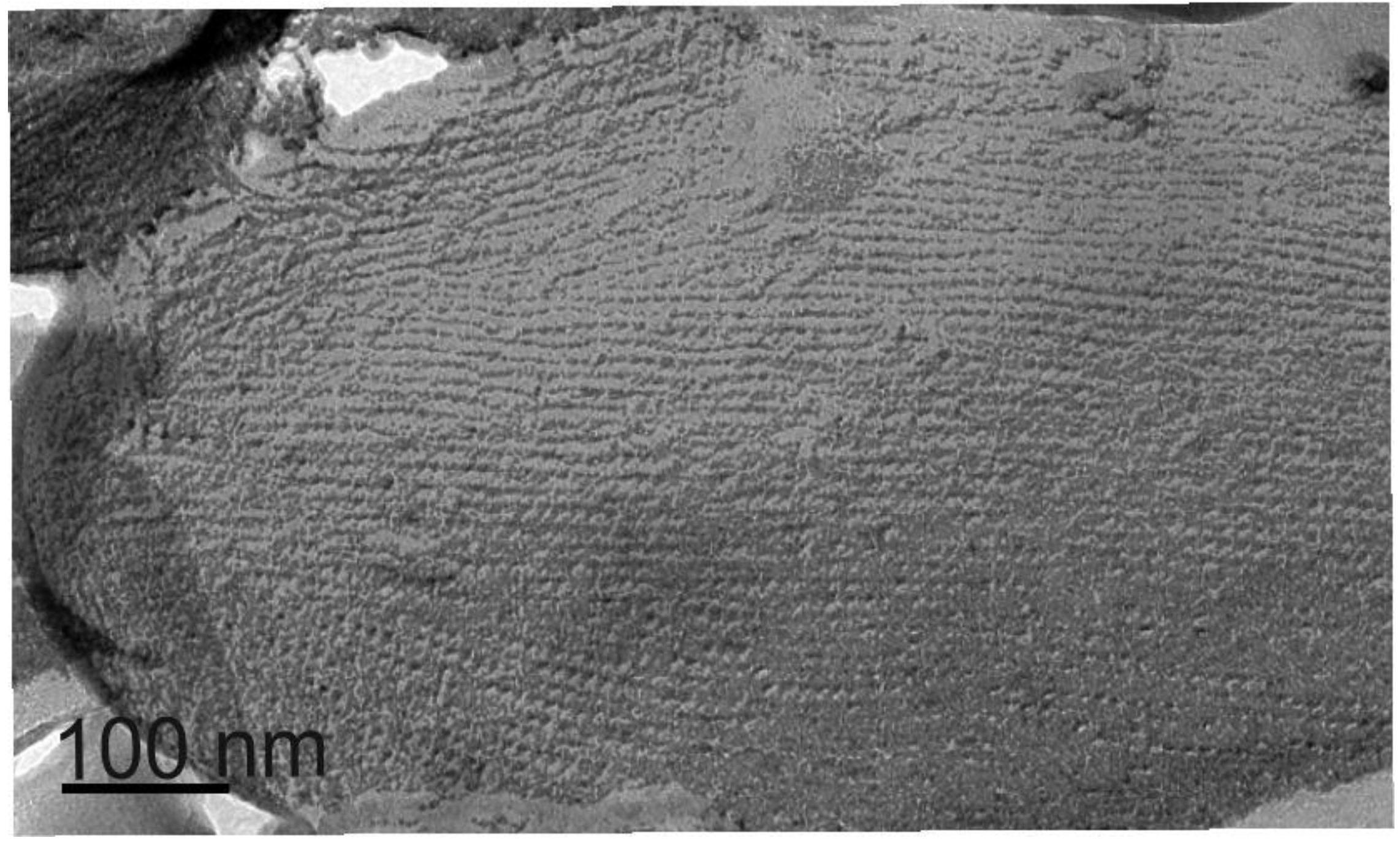
          <p>Recently, Sekot <italic>et al.</italic> [<xref ref-type="bibr" rid="B39-biomolecules-02-00467">39</xref>] extended the previous structural characterization of the <italic>T. forsythia</italic> S‑layer [<xref ref-type="bibr" rid="B35-biomolecules-02-00467">35</xref>] by a combined ultrastructural/immunological approach, showing that the two S-layer glycoproteins TfsA-GP and TfsB-GP are intercalated to form a monolayer on the cell surface of <italic>T. forsythia</italic>. The lattice spacing for the square S-layer lattice was determined to be 10.1 ± 0.7 nm (<xref ref-type="fig" rid="biomolecules-02-00467-f001">Figure 1</xref>) in freeze-etching, freeze-drying, and negative staining experiments, and a thickness of the layer of approximately 22 nm was found in ultrathin sections.</p>
          <p>In that study, sheared flagella with intact hook regions have been identified by freeze-etching [<xref ref-type="bibr" rid="B39-biomolecules-02-00467">39</xref>], which somehow challenges the description of <italic>T. forsythia</italic> as a non-motile species [<xref ref-type="bibr" rid="B44-biomolecules-02-00467">44</xref>]. However, their role in bacterial motility and a possible impact on co-aggregation of <italic>T. forsythia</italic> with other species in the biofilm is still unclear. In this context it should also be mentioned that according to a recent partial annotation of the open reading frames of the <italic>T. forsythia</italic> genome, homologous genes for hook and other pilus/flagella forming units have not been identified [<xref ref-type="bibr" rid="B45-biomolecules-02-00467">45</xref>].</p>
          <fig id="biomolecules-02-00467-f001" position="anchor">
            <label>Figure 1</label>
            <caption>
              <p>Freeze-etched and platinum-carbon shadowed preparation of a <italic>T. forsythia</italic> cell showing the square S-Layer lattice with a lattice spacing of approximately 10 nm × 10 nm.</p>
            </caption>
            <graphic xmlns:xlink="http://www.w3.org/1999/xlink" xlink:href="biomolecules-02-00467-g001.tif"/>
          </fig>
        </sec>
        <sec>
          <title>2.1.3. Glycosylation of the <italic>T. forsythia</italic> S-layer Proteins TfsA and TfsB</title>
          <p>As mentioned above, Lee <italic>et al.</italic> [<xref ref-type="bibr" rid="B38-biomolecules-02-00467">38</xref>] inferred from SDS-PAGE that the two <italic>T. forsythia</italic> S-layer proteins are glycosylated. However, no further compositional or structural details were provided. In our laboratory we focused the efforts on the characterization of the glycoproteome of <italic>T. forsythia</italic>.</p>
          <p>By SDS-PAGE, glycosylation of the two S-layer proteins of <italic>T. forsythia</italic>, the 153-kDa TfsA-GP and the 180-kDa TfsB-GP (calculated molecular masses), could be confirmed. In-gel reductive b-elimination of purified S-layer glycoproteins was employed to release the glycans from the protein backbone [<xref ref-type="bibr" rid="B29-biomolecules-02-00467">29</xref>]. Mass spectrometric analysis revealed a dominant glycan structure of 1,621 Da. Upon CID fragmentation analysis a hetero-oligomer consisting of eight different sugar residues was observed. Mass increments for one pentose, one deoxyhexose, three uronic acids (modified or free), one methylhexose, and one reduced hexose in addition to one, yet non-described, 361-Da sugar residue were identified. Further, some of the oligosaccharides were substituted by one dideoxyhexose and one additional deoxyhexose. Interestingly, the glycans released from either S-layer glycoprotein showed identical glycan mass profiles, indicating the presence of a uniform glycosylation pattern.</p>
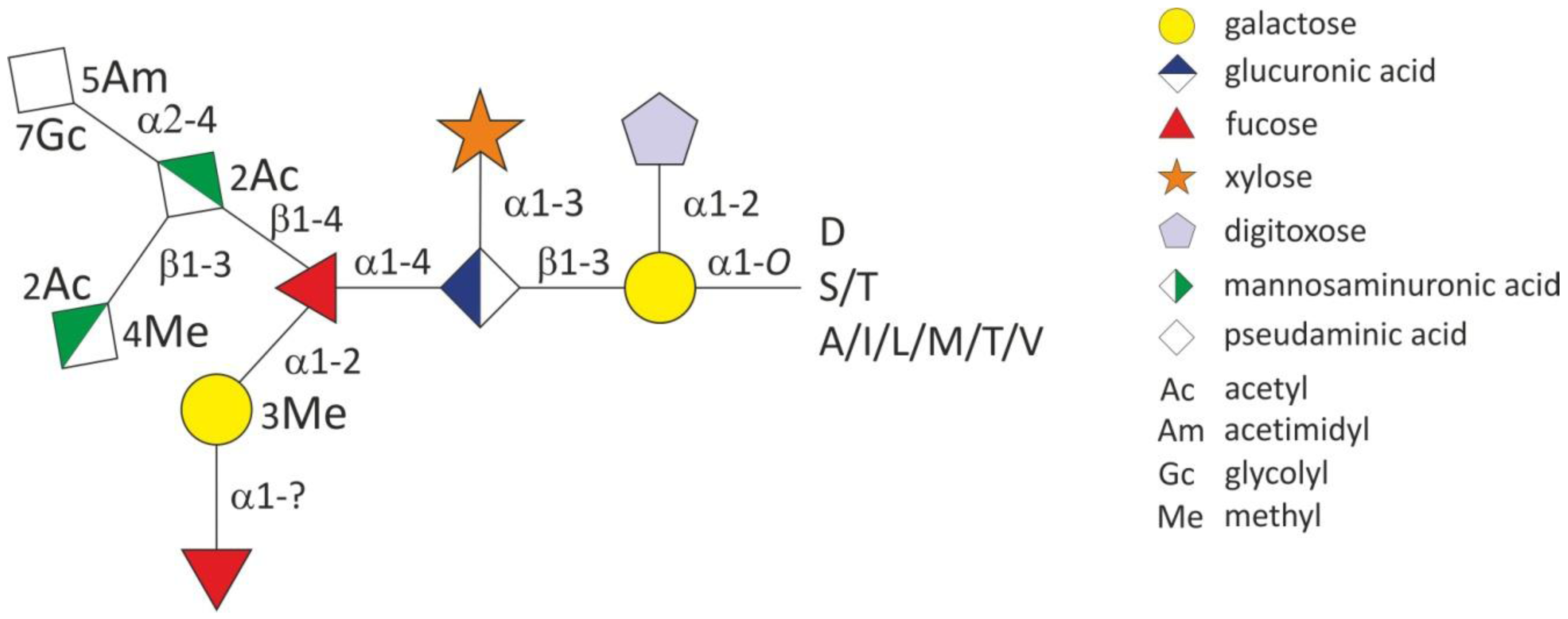
          <p>NMR spectroscopy of the glycan samples was used to identify the methyl-hexose as methyl-galactose and the two <italic>N</italic>-acteylhexosaminuronic acid residues as <italic>N</italic>-acetylmannosaminuronic acid and as <italic>O</italic>-methyl-<italic>N</italic>-acetylmannosaminuronic acid, respectively. The dideoxyhexose that was already observed in the MS/MS fragmentation profile was identified as a digitoxose residue. The identity of the 361-Da sugar residue, however, remained unclear even after high resolution MS/MS and NMR analysis of the intact <italic>O</italic>-glycan. In a screen of nucleotide-activated sugars from the bacterial cytoplasm large amounts of CMP-activated substance matching the 361-Da unit were observed. This was indicative for the presence of an a-keto sugar. Combined NMR analyses of the purified DMB (1,2-diamino-4,5-methylene dioxybenzene dihydrochloride)-labelled 361-Da sugar residue and of the complete oligosaccharide revealed the presence of a non‑2-ulosonic acid carrying two substituents on the amino functions at carbons 5 and 7. Comparison of all recorded NMR spectroscopic data of the <italic>O</italic>-glycan with those of the isolated C<sub>14</sub>H<sub>25</sub>O<sub>9</sub>N<sub>3</sub> compound showed good concordance. The configuration of the non-2-ulosonic acid has been proven by the few detectable coupling constants and NOEs and is in better accordance with those of a pseudaminic acid residue than with those of legionaminic acid. The whole C<sub>14</sub>H<sub>25</sub>O<sub>9</sub>N<sub>3</sub> compound can hence be considered as Pse5Am7Gc, where Am is an amidinyl and Gc a glycolyl group [<xref ref-type="bibr" rid="B29-biomolecules-02-00467">29</xref>]. The structure of the highly complex decaglycan of <italic>T. forsythia</italic> including the so far determined glycosidic linkages is given in <xref ref-type="fig" rid="biomolecules-02-00467-f002">Figure 2</xref>. The heterosaccharide is <italic>O</italic>‑glycosidically linked via the reducing-end a‑galactose to serine and threonine residues of both the TfsA and TfsB S‑layer proteins. Interestingly, all identified glycosylation sites match the D(S/T)(A/I/L/M/T/V) three-amino acid motif that was recently described for the general protein <italic>O</italic>-glycosylation system in <italic>B. fragilis</italic> [<xref ref-type="bibr" rid="B46-biomolecules-02-00467">46</xref>].</p>
          <fig id="biomolecules-02-00467-f002" position="anchor">
            <label>Figure 2</label>
            <caption>
              <p>Schematic drawing of the structure of the abundant <italic>O</italic>-glycan in <italic>T. forsythia</italic>. Modified from [<xref ref-type="bibr" rid="B29-biomolecules-02-00467">29</xref>].</p>
            </caption>
            <graphic xmlns:xlink="http://www.w3.org/1999/xlink" xlink:href="biomolecules-02-00467-g002.tif"/>
          </fig>
        </sec>
      </sec>
      <sec>
        <title>2.2. General O-Glycosylation System of <italic>T. forsythia</italic></title>
        <sec>
          <title>2.2.1. <italic>O</italic>-Glycoproteins of <italic>T. forsythia</italic></title>
          <p>Carbohydrate-stained SDS-PAGE gels of <italic>T. forsythia</italic> whole cell lysates indicated, besides the S-layer glycoproteins, the presence of several other glycosylated proteins in the molecular mass range between 60 and 250 kDa [<xref ref-type="bibr" rid="B29-biomolecules-02-00467">29</xref>]. Some of these bands were also reactive with the fucose-specific <italic>Aleuria aurantia</italic> lectin, which readily detects the S-layer glycan. Upon closer examination, all bands were shown to carry the same glycosylation profile as the S-layer glycoprotein bands, with slight variations detected in their relative ratios and in <italic>O</italic>-methylation of the mannosaminuronamide residue. This demonstrates that the S-layer <italic>O</italic>-glycosylation system is also involved in the glycosylation of other <italic>T. forsythia</italic> proteins [<xref ref-type="bibr" rid="B29-biomolecules-02-00467">29</xref>].</p>
          <p>Among these proteins are the predicted outer-membrane proteins TF2339 and its paralog TF1259, as well as the predicted lipoproteins TF1056 and TF0091. The former two proteins exhibit similarity to the CTD family of <italic>P. gingivalis</italic> [<xref ref-type="bibr" rid="B41-biomolecules-02-00467">41</xref>,<xref ref-type="bibr" rid="B42-biomolecules-02-00467">42</xref>]; the latter show similarity to TonB-dependent receptor associated proteins [<xref ref-type="bibr" rid="B47-biomolecules-02-00467">47</xref>]. Interestingly, all of these glycoproteins are antigenic upon probing with an antiserum raised against a <italic>T. forsythia</italic> outer membrane preparation [<xref ref-type="bibr" rid="B45-biomolecules-02-00467">45</xref>]. The finding that several abundant proteins in <italic>T. forsythia</italic> are modified with the S‑layer glycan is fueled by the recent identification of a rich outer membrane glycoproteome in <italic>T. forsythia</italic> [<xref ref-type="bibr" rid="B45-biomolecules-02-00467">45</xref>].</p>
        </sec>
        <sec id="sec2dot2dot2-biomolecules-02-00467">
          <title>2.2.2. Theoretical analysis of protein <italic>O</italic>‑glycosylation in <italic>T. forsythia</italic></title>
          <p>Initial information about glycosylation in <italic>T. forsythia</italic> was provided by the description of a so-called exopolysaccharide operon [<xref ref-type="bibr" rid="B48-biomolecules-02-00467">48</xref>], of which WecC (TF2055) coding for a predicted UDP-<italic>N</italic>-acetylmannosaminuronic acid dehydrogenase is part of. Closer inspection of that genomic region revealed the presence of a 6.8‑kb gene locus of <italic>T. forsythia</italic> spanning TF2055-TF2049, encoding in addition to WecC (TF2055), a predicted UDP-<italic>N</italic>-acetylglucosamine 2-epimerase (NeuC, TF2054), three predicted glycosyltransferases (TF2053; TF2050; TF2049), a predicted acetyltransferase (TF2052) and one ORF with yet unassigned function (TF2051) [<xref ref-type="bibr" rid="B29-biomolecules-02-00467">29</xref>].</p>
          <p>Since deletion of TF2055 caused truncation of S-layer protein glycans [<xref ref-type="bibr" rid="B48-biomolecules-02-00467">48</xref>] by lacking the 809-Da Pse-containing trisaccharide side branch [<xref ref-type="bibr" rid="B29-biomolecules-02-00467">29</xref>], it is evident that this genomic region carries crucial information for proper <italic>O</italic>‑glycan assembly (see <xref ref-type="sec" rid="sec3dot2-biomolecules-02-00467">Section 3.2</xref>. and <xref ref-type="sec" rid="sec6dot2-biomolecules-02-00467">Section 6.2</xref>.). Interestingly, similar glycosylation loci are also present in other phylogenetically related species, including, for instance, <italic>Bacteroides fragilis</italic> NCTC 9343, <italic>Bacteroides thetaiotaomicron</italic> VPI 5492, <italic>Bacteroides uniformis</italic> ATCC 8492, <italic>Porphyromonas gingivalis</italic> ATCC 33277, and <italic>Parabacteroides distasonis</italic> ATCC 8503.</p>
        </sec>
      </sec>
      <sec>
        <title>2.3. Lipopolysaccharide (LPS) of <italic>T. forsythia</italic></title>
        <p>LPS is an intrinsic feature of Gram-negative bacteria where it is located in the outer leaflet of the outer membrane [<xref ref-type="bibr" rid="B49-biomolecules-02-00467">49</xref>]. So far, structure-function studies on the LPS from <italic>T. forsythia</italic> do not exist but are considered essential to further understand the bacterium’s pathogenesis.</p>
        <p>Currently, we are analyzing the LPS from <italic>T. forsythia</italic> and first results indicate that in the wild-type organism, an R-form LPS is present (G. Posch, O. Andrukhov, B. Lindner, P. Messner, E. Vinogradov, O. Holst, C. Schäffer, manuscript in preparation). Currently it is unknown, if LPS biosynthesis and the S-layer glycosylation pathway have cross-points. In a recent comparison of the LPS isolated from <italic>T. forsythia</italic> wild-type and Δ<italic>wecC</italic> cells by SDS-PAGE, no detectable effect of WecC on the chemical nature of LPS was observed [<xref ref-type="bibr" rid="B50-biomolecules-02-00467">50</xref>].</p>
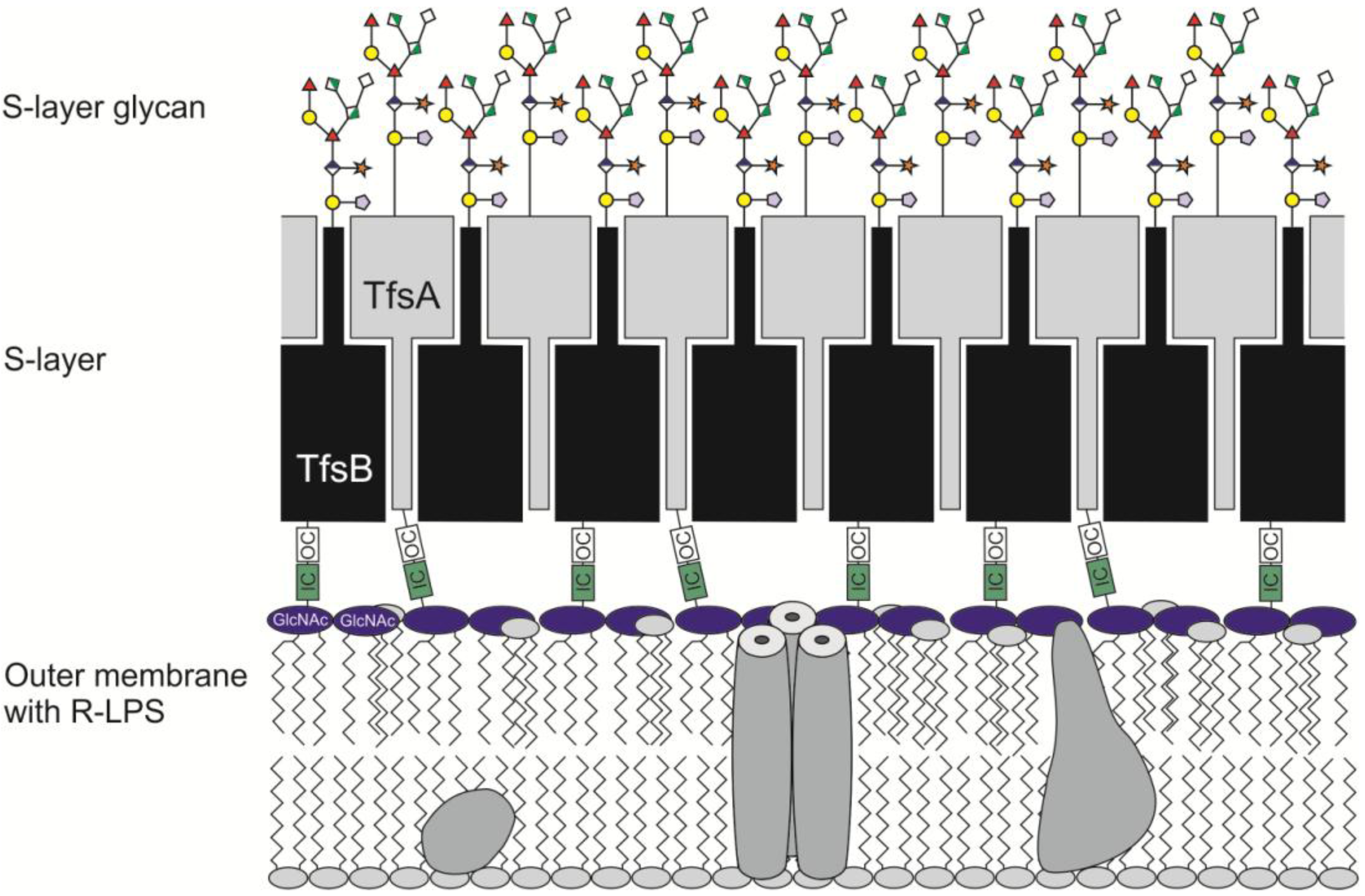
        <p>In this context it is interesting to note that in <italic>Aeromonas salmonicida</italic>, an R-form LPS is assumed to serve as an anchor with defined length for attaching the S-layer protein to the outer membrane [<xref ref-type="bibr" rid="B51-biomolecules-02-00467">51</xref>] (<xref ref-type="fig" rid="biomolecules-02-00467-f003">Figure 3</xref>). Considering that both <italic>T. forsythia</italic> S‑layer proteins TfsA and TfsB have been classified as CTD-proteins [<xref ref-type="bibr" rid="B45-biomolecules-02-00467">45</xref>], it should be noted that in a recent study with <italic>P. gingivalis</italic> it has been shown that LPS attaches to this class of proteins. It was suggested that LPS deacetylation is part of the co-ordinated secretion of LPS and CTD-proteins by a novel secretion and attachment system [<xref ref-type="bibr" rid="B42-biomolecules-02-00467">42</xref>].</p>
        <fig id="biomolecules-02-00467-f003" position="anchor">
          <label>Figure 3</label>
          <caption>
            <p>Theoretical model of the cell envelope architecture of <italic>T. forsythia</italic>. IC (inner core) and OC (outer core) represent partial structures of the rough LPS. Not to scale.</p>
          </caption>
          <graphic xmlns:xlink="http://www.w3.org/1999/xlink" xlink:href="biomolecules-02-00467-g003.tif"/>
        </fig>
      </sec>
    </sec>
    <sec>
      <title>3. Virulence Potential of the Glycosylated S‑Layer of <italic>T. forsythia</italic></title>
      <sec>
        <title>3.1. Virulence and Glycosylation in General</title>
        <p>Virulence is the relative ability of an organism to cause disease or to interfere with a metabolic or physiological function of its host. Thus, virulence factors can have a multitude of functions, including the ability to induce microbe-host interactions such as attachment, to invade the host, to grow in the confines of a host cell, and to evade or even interfere with host defense mechanisms [<xref ref-type="bibr" rid="B4-biomolecules-02-00467">4</xref>].</p>
        <p>Cell surface glycosylation and, in that context, specifically glycosylation of proteins, might serve specific functions in infection and interaction with host tissues [<xref ref-type="bibr" rid="B52-biomolecules-02-00467">52</xref>] as well as modulation of immune responses during pathogenesis [<xref ref-type="bibr" rid="B53-biomolecules-02-00467">53</xref>,<xref ref-type="bibr" rid="B54-biomolecules-02-00467">54</xref>]. Via interaction with components of the immune system, the glycan rather than the amino acid residues represent immuno-dominant epitopes that are recognized by blocking antibodies or modulate the immune response [<xref ref-type="bibr" rid="B52-biomolecules-02-00467">52</xref>].</p>
      </sec>
      <sec id="sec3dot2-biomolecules-02-00467">
        <title>3.2. Immunological Data of <italic>T. forsythia</italic></title>
        <p>The S-layer glycoproteins TfsA-GP and TfsB-GP of <italic>T. forsythia</italic> are strongly antigenic, mediate hemagglutination as well as adherence to- and invasion of KB cells [<xref ref-type="bibr" rid="B38-biomolecules-02-00467">38</xref>,<xref ref-type="bibr" rid="B55-biomolecules-02-00467">55</xref>]. While the levels of IgG antibody against the S‑layer of <italic>T. forsythia</italic> are low in healthy individuals, they are significantly elevated in adult and early-onset periodontitis patients. These results do not only indicate that this major surface protein is antigenic in humans, but also suggest that an increased interaction between host adaptive immune mechanisms and this pathogen occurs during periodontal disease progression [<xref ref-type="bibr" rid="B37-biomolecules-02-00467">37</xref>].</p>
        <p>Data on the virulence potential of the <italic>T. forsythia</italic> S‑layer were also supported in our laboratory by investigating the immune responses of human macrophages and gingival fibroblasts upon stimulation with wild-type <italic>T. forsythia</italic> and an S-layer-deficient mutant [<xref ref-type="bibr" rid="B28-biomolecules-02-00467">28</xref>]. This mutant induced significantly higher levels of the proinflammatory mediators IL-1b, TNF-a, and IL-8 compared with wild-type cells, especially at the early phase of response. This suggests that the S-layer attenuates the host immune response to this pathogen by evading its recognition by the innate immune system of the host [<xref ref-type="bibr" rid="B28-biomolecules-02-00467">28</xref>]. It will be interesting to see, whether this finding can be confirmed in an animal model.</p>
        <p>In a very recent study, first insights into the impact of <italic>Tannerella</italic> cell surface glycosylation on the modulation of the host immunity could be obtained [<xref ref-type="bibr" rid="B50-biomolecules-02-00467">50</xref>]. By comparing the immunological effects evoked with <italic>T. forsythia</italic> wild-type and a Δ<italic>wecC</italic> mutant (see <xref ref-type="sec" rid="sec2dot2dot2-biomolecules-02-00467">Section 2.2.2</xref>. and <xref ref-type="sec" rid="sec6dot2-biomolecules-02-00467">Section 6.2</xref>.), in which the terminal sugar motif consisting of the two subterminal Man<italic>p</italic>NAcA and 4-Me<italic>O</italic>-b-Man<italic>p</italic>NAcCONH<sub>2</sub> residues and the terminal Pse5Am7Gc residue are missing [<xref ref-type="bibr" rid="B29-biomolecules-02-00467">29</xref>], it became evident that the mutant is less virulent in a periodontitis model [<xref ref-type="bibr" rid="B50-biomolecules-02-00467">50</xref>]. There are indications that the glycan decoration on <italic>Tannerella</italic> cells has a role in suppressing Th17-mediated neutrophil infiltration in the gingival tissue, allowing pathogen persistence in the host and induction of disease [<xref ref-type="bibr" rid="B50-biomolecules-02-00467">50</xref>].</p>
      </sec>
    </sec>
    <sec>
      <title>4. Cultivation and growth of <italic>T. forsythia</italic></title>
      <p><italic>T. forsythia</italic> can be cultivated under anaerobic conditions at 37 °C in tryptic soy broth, supplemented with yeast extract (5 g/L), phytone peptone (5 g/L), cysteine (0.2 g/L), horse serum (20 mL/L), hemin (2.5 µg/mL), menadione (2 g/mL), and <italic>N</italic>-acetylmuramic acid (10 µg/mL) [<xref ref-type="bibr" rid="B28-biomolecules-02-00467">28</xref>].</p>
      <p><italic>N</italic>-acetylmuramic acid, which is the monomeric form of the bacterial cell wall component, is an important growth-stimulating factor for <italic>T. forsythia</italic>, both in broth and plate culture [<xref ref-type="bibr" rid="B56-biomolecules-02-00467">56</xref>]. Grown on agar media in presence of <italic>N</italic>-acetylmuramic acid, <italic>T. forsythia</italic> cells appear as regularly-shaped, short, Gram-negative rods, while in the absence of <italic>N</italic>‑acetylmuramic acid growth is retarded and <italic>T. forsythia</italic> cells appear large, filamentous and pleomorphic with tapered (fusiform) ends [<xref ref-type="bibr" rid="B9-biomolecules-02-00467">9</xref>,<xref ref-type="bibr" rid="B14-biomolecules-02-00467">14</xref>]. Since <italic>T. forsythia</italic> lacks a metabolic pathway to synthesize <italic>N</italic>-acetylmuramic acid, the bacterium may possess unique systems to scavenge peptidoglycan degradation products released during cell-wall recycling of oral biofilm bacteria [<xref ref-type="bibr" rid="B24-biomolecules-02-00467">24</xref>]<italic>,</italic> or it derives this compound from sialylated glycoproteins like salivary mucins and fibronectin present in the oral cavity [<xref ref-type="bibr" rid="B57-biomolecules-02-00467">57</xref>].</p>
      <p>Because of its unique growth requirements [<xref ref-type="bibr" rid="B5-biomolecules-02-00467">5</xref>] and the fact that it is quite difficult to grow, the precise role of <italic>T. forsythia</italic> in the severe bone and tissue destruction at sites from which it can be isolated remains to be determined.</p>
    </sec>
    <sec>
      <title>5. Glycosidic Activity of <italic>T. forsythia</italic></title>
      <p>Possibly linked to its asaccharolytic nature, <italic>T. forsythia</italic> possesses genes for at least eight different glycosidases, including sialidases, an a-glucosidase, a b-glucosidase, a fucosidase, an arabinosidase, a glucosaminidase, a galactosidase and a mannosidase; which are able to process terminal glycosidic linkages of the complex oligosaccharides and proteoglycans of the periodontium [<xref ref-type="bibr" rid="B26-biomolecules-02-00467">26</xref>]. This degradation creates a pool of accessible sugars for uptake and nutrition of oral bacteria and affects the functional integrity of the periodontium. Thus, glycan-interaction based processes, such as movement of leukocytes to the site of infection, could potentially be hindered, while protein epitopes for bacterial adhesion are created, further promoting disease progression [<xref ref-type="bibr" rid="B24-biomolecules-02-00467">24</xref>,<xref ref-type="bibr" rid="B58-biomolecules-02-00467">58</xref>]. In this context, an <italic>N</italic>‑acetylneuraminyllactose-sensitive hemagglutinin has been identified in <italic>T. forsythia</italic> [<xref ref-type="bibr" rid="B59-biomolecules-02-00467">59</xref>], which may mediate bacterial binding to host cell-surface sugars exposed by bacterial glycosidases [<xref ref-type="bibr" rid="B24-biomolecules-02-00467">24</xref>].</p>
      <p>One class of enzymes that is active on these host molecules are sialidases which represent a family of glycosylhydrolases that cleave a‑ketosidic linkages between sialic acid and the glycosyl residues of host glycoproteins, glycolipids or colominic acid. Recent evidence suggests that for several periodontal pathogens, but particularly for the ‘red complex’ organism <italic>T. forsythia</italic>, sialic acid‑containing host molecules play an important role <italic>in vivo</italic> [<xref ref-type="bibr" rid="B60-biomolecules-02-00467">60</xref>]. Two different sialidases have been found to be expressed in <italic>T. forsythia</italic>, SiaHI and NanH [<xref ref-type="bibr" rid="B61-biomolecules-02-00467">61</xref>]. Previously, Ishikura <italic>et al.</italic> [<xref ref-type="bibr" rid="B25-biomolecules-02-00467">25</xref>] cloned the <italic>siaHI</italic> gene from <italic>T. forsythia</italic> ATCC 43037. The enzyme is found in a variety of cells, including viruses, bacteria, protozoa, fungi, and metazoans. In the case of <italic>T. forsythia</italic>, no definite function has yet been attributed to this enzyme, although experiments point to it being a periplasmic protein that plays no role in extracellular interactions [<xref ref-type="bibr" rid="B61-biomolecules-02-00467">61</xref>]. These same studies also indicated that mutants of the NanH sialidase, the higher expressed sialidase in <italic>T. forsythia</italic>, had hindered attachment and invasion capabilities on epithelial cells. The enzyme was later on seen to play an important role in biofilm growth on surfaces coated with salivary glycoproteins [<xref ref-type="bibr" rid="B62-biomolecules-02-00467">62</xref>]. Furthermore, sialic acid, glycolylsialic acid, and sialyllactose, all of which are common sugar moieties on a range of important host glycoproteins, were seen to stimulate growth of the pathogen only when cultured as a biofilm. The <italic>nanH</italic> gene is located in a large cluster that expands over a 16-kb section of its genome. This cluster contains all the genes required for sialic acid catabolism, which indicates that the cleaved sialic acid can additionally be up-taken and utilized [<xref ref-type="bibr" rid="B62-biomolecules-02-00467">62</xref>].</p>
      <p>The sialic acid catabolism cluster shows strong sequence and genome organization similarity to sialic acid loci of related gastrointestinal anaerobes and represents a new route differing from the <italic>Escherichia coli</italic> paradigm pathway for sialic acid use [<xref ref-type="bibr" rid="B60-biomolecules-02-00467">60</xref>]. Taken together, these data indicate that sialic acid is a key growth factor for <italic>T. forsythia</italic> and may be the key to its physiology <italic>in vivo</italic>.</p>
    </sec>
    <sec>
      <title>6. Biofilm Life-Style of <italic>T. forsythia</italic></title>
      <sec>
        <title>6.1. General Remarks</title>
        <p>In its native environment of the oral cavity, <italic>T. forsythia</italic> is present in a biofilm, which, in turn, is crucial for the virulence potential of the bacterium. Thus, the knowledge of factors triggering biofilm formation might reveal valuable strategies for interfering with periodontal disease. Despite <italic>T. forsythia</italic> being a late colonizer intercalating with other species from the oral microflora in dental plaque biofilms [<xref ref-type="bibr" rid="B63-biomolecules-02-00467">63</xref>], which is consistent with a polymicrobial disease etiology [<xref ref-type="bibr" rid="B24-biomolecules-02-00467">24</xref>], investigation of monospecies biofilms can also shed light onto factors affecting this specific life style.</p>
      </sec>
      <sec id="sec6dot2-biomolecules-02-00467">
        <title>6.2. Biofilm Life-Style of <italic>T. forsythia</italic> and Glycosylation</title>
        <p>Several studies evaluating the presence of <italic>T. forsythia</italic> in subgingival plaque have demonstrated a significantly higher frequency in diseased subjects compared to healthy controls [<xref ref-type="bibr" rid="B9-biomolecules-02-00467">9</xref>]. Moreover, <italic>T. forsythia</italic> was frequently associated with colonization by <italic>P. gingivalis</italic> and was elevated in groups of older patients [<xref ref-type="bibr" rid="B64-biomolecules-02-00467">64</xref>]. Since biofilms formed by periodontal bacteria are considered important in disease progression and pose difficulties in treatment, the investigation of the underlying mechanism of the <italic>T. forsythia</italic> biofilm formation has been initiated [<xref ref-type="bibr" rid="B48-biomolecules-02-00467">48</xref>]. This was carried out by screening random insertion mutants of <italic>T. forsythia</italic> for alterations in biofilm development. The approach led to the identification of a Δ<italic>wecC</italic> mutant [<xref ref-type="bibr" rid="B48-biomolecules-02-00467">48</xref>], with <italic>wecC</italic> encoded in the predicted S‑layer glycosylation gene locus [<xref ref-type="bibr" rid="B29-biomolecules-02-00467">29</xref>]. This mutant showed increased cell surface hydrophobicity, which would promote bacterial attachment and/or aggregation [<xref ref-type="bibr" rid="B48-biomolecules-02-00467">48</xref>] and increased ability to form biofilms as compared to the parent strain.</p>
        <p>The truncated S‑layer oligosaccharide isolated from the <italic>T. forsythia</italic> Δ<italic>wecC</italic> mutant represents a partial structure of the above described S‑layer oligosaccharide, in which the acidic branch is missing (see <xref ref-type="sec" rid="sec3dot2-biomolecules-02-00467">Section 3.2</xref>) [<xref ref-type="bibr" rid="B29-biomolecules-02-00467">29</xref>]. Considering a pK value of sialic acids of ~2.6, it is evident that under physiological conditions of the basic saliva environment in the oral cavity, the acid function of Pse5Am7Gc is dissociated and, thus contributes to charge repulsive forces which impair biofilm formation. The negative correlation between <italic>wecC</italic> transcription and biofilm formation [<xref ref-type="bibr" rid="B48-biomolecules-02-00467">48</xref>] supports this assumption. However, since no truncated S‑layer glycans could be detected on <italic>T. forsythia</italic> wild-type cells when grown under biofilm conditions, it is conceivable to assume that the specific glycosylation status of the cell surface is a means to balance the tendency for biofilm-formation at a certain level <italic>in vivo</italic>.</p>
        <p>In this context it is interesting to note that, while <italic>wecC</italic> is down-regulated, the <italic>T. forsythia</italic> S‑layer genes <italic>tfsA</italic> and <italic>tfsB</italic> as well as the genes encoding the glycoproteins TF1259 and TF2339 are up-regulated in biofilm formation [<xref ref-type="bibr" rid="B65-biomolecules-02-00467">65</xref>]. This is a further indication of the S‑layer protein O‑glycosylation system to be linked with the biofilm life-style of <italic>T. forsythia</italic>.</p>
      </sec>
    </sec>
    <sec sec-type="conclusions">
      <title>7. Conclusions</title>
      <p><italic>T. forsythia</italic> is a Gram-negative oral pathogen for which sialic acid is a key growth factor that may be crucial for its physiology <italic>in vivo</italic>. Understanding the biology of oral pathogens and their virulence factors is a prerequisite for the maintenance of both general and oral health. Especially those factors that are associated with the bacterial cell envelope and/or exposed to the environment are prime candidates for mediating virulence through their direct involvement in pathogen-host interactions. Given that <italic>T. forsythia</italic> emerged as a crucial periodontal pathogen [<xref ref-type="bibr" rid="B4-biomolecules-02-00467">4</xref>,<xref ref-type="bibr" rid="B9-biomolecules-02-00467">9</xref>,<xref ref-type="bibr" rid="B24-biomolecules-02-00467">24</xref>,<xref ref-type="bibr" rid="B28-biomolecules-02-00467">28</xref>,<xref ref-type="bibr" rid="B60-biomolecules-02-00467">60</xref>], several approaches were undertaken to characterize its cell surface properties including S‑layer topography and glycosylation [<xref ref-type="bibr" rid="B29-biomolecules-02-00467">29</xref>,<xref ref-type="bibr" rid="B35-biomolecules-02-00467">35</xref>,<xref ref-type="bibr" rid="B38-biomolecules-02-00467">38</xref>,<xref ref-type="bibr" rid="B39-biomolecules-02-00467">39</xref>]. Considering the fact that this bacterium can affect systemic health, <italic>T. forsythia</italic> and especially its mechanisms governing pathogenicity deserve detailed investigation.</p>
      <p>Recently, detailed microscopic, biochemical, and molecular analyses from our laboratory revealed that the outer membrane of <italic>T. forsythia</italic> is covered with a so far unique S‑layer. The monolayer has a width of approximately 22 nm and is built up by the co-assembly of the glycosylated S-layer proteins TfsA and TfsB [<xref ref-type="bibr" rid="B39-biomolecules-02-00467">39</xref>]. The <italic>O</italic>-glycosidically linked <italic>T. forsythia</italic> S‑layer oligosaccharide is an overall highly diverse structure containing several rare sugar residues [<xref ref-type="bibr" rid="B29-biomolecules-02-00467">29</xref>] contradicting the so far valid building plan of bacterial S-layer glycans [<xref ref-type="bibr" rid="B66-biomolecules-02-00467">66</xref>,<xref ref-type="bibr" rid="B67-biomolecules-02-00467">67</xref>], and, thus, being reminiscent of archaeal S-layer glycans [<xref ref-type="bibr" rid="B68-biomolecules-02-00467">68</xref>]<italic>. </italic>It is tempting to speculate that the terminal Pse5Am7Gc residue participates in the bacterium-host cross-talk, although the relevance of the modification of the pseudaminic acid remains yet unclear. This notion is supported by the fact that members of this class of sialic acid-like sugars have been found in many Gram-negative bacterial species as constituents of important cell surface glycoconjugates, such as LPS [<xref ref-type="bibr" rid="B69-biomolecules-02-00467">69</xref>], capsules [<xref ref-type="bibr" rid="B70-biomolecules-02-00467">70</xref>], pili [<xref ref-type="bibr" rid="B71-biomolecules-02-00467">71</xref>], and flagella [<xref ref-type="bibr" rid="B72-biomolecules-02-00467">72</xref>,<xref ref-type="bibr" rid="B73-biomolecules-02-00467">73</xref>], all of which are important mediators of pathogenicity, possibly influencing bacterial adhesion, invasion, and immune evasion [<xref ref-type="bibr" rid="B74-biomolecules-02-00467">74</xref>]. It seems plausible that the glycans are recognized by lectin-like receptors that may facilitate adhesion to and invasion of specific host cells [<xref ref-type="bibr" rid="B55-biomolecules-02-00467">55</xref>]. In this context it is interesting to note that a novel sialic acid utilization and uptake system has been described for <italic>T. forsythia</italic> [<xref ref-type="bibr" rid="B56-biomolecules-02-00467">56</xref>]. This opens the possibility of using the sialic acid pathway for biosynthesis of Pse5Am7Gc. On the other hand, it is also possible that the pseudaminic acid might be prone to at least partial degradation by the sialidase system [<xref ref-type="bibr" rid="B60-biomolecules-02-00467">60</xref>].</p>
      <p>Crucial for the overall virulence potential of <italic>T. forsythia</italic> is its specific biofilm life-style. Thus, the knowledge of factors triggering biofilm formation might reveal valuable strategies for interfering with periodontal disease. Surprisingly, increased biofilm formation could be correlated with the presence of truncated S-layer glycans on <italic>T. forsythia</italic>, in which the “acidic” branch of the decasaccharide is missing. In the context of biofilm formation, it is interesting to note that besides the <italic>T. forsythia</italic> S‑layer glycoproteins, two other glycoproteins that have been identified recently [<xref ref-type="bibr" rid="B29-biomolecules-02-00467">29</xref>], are up-regulated in biofilm formation [<xref ref-type="bibr" rid="B65-biomolecules-02-00467">65</xref>]. This is a further indication that the S-layer protein <italic>O</italic>‑glycosylation system is linked with the biofilm life-style of <italic>T. forsythia</italic>. The finding that several abundant proteins in <italic>T. forsythia</italic> are modified with the S-layer glycan (as shown in <xref ref-type="fig" rid="biomolecules-02-00467-f002">Figure 2</xref>) is supported by the recent identification of a rich outer membrane glycoproteome in <italic>T. forsythia</italic> [<xref ref-type="bibr" rid="B45-biomolecules-02-00467">45</xref>]. Our data corroborate and extend this study by Veith <italic>et al.</italic> [<xref ref-type="bibr" rid="B45-biomolecules-02-00467">45</xref>], in which all but one protein (TF0091) have already been identified as glycoproteins.</p>
      <p>Thus, the periodontal pathogen <italic>T. forsythia</italic> possesses a general protein <italic>O</italic>-glycosylation pathway that modifies proteins of yet undefined function at multiple sites with a complex oligosaccharide within the D(S/T)(A/I/L/M/T/V) amino acid motif. The underlying glycosylation machinery as well as the glycosylation ‛sequon’ seems to be conserved within <italic>Bacteroidales</italic> species [<xref ref-type="bibr" rid="B46-biomolecules-02-00467">46</xref>]. The role of protein <italic>O</italic>‑glycosylation in underpinning the pathogenic strategy of <italic>T. forsythia</italic> and in its interaction with other bacteria from the oral microflora will be the subject of future studies.</p>
    </sec>
  </body>
  <back>
    <ack>
      <title>Acknowledgments</title>
      <p>Funding for this work was provided by the Austrian Science Fund FWF, project P20605-B20 and P24317-B22 (to C.S.) and P22791-B11 (to P.M). The financial support by the Programm-Ausschreibung Forschungsinfrastruktur 4 of the Federal Ministry of Science is acknowledged.</p>
    </ack>
    <notes>
      <title>Conflict of Interest</title>
      <p>The authors declare no conflict of interests.</p>
    </notes>
    <ref-list>
      <title>References</title>
      <ref id="B1-biomolecules-02-00467">
        <label>1.</label>
        <citation citation-type="journal">
          <person-group person-group-type="author">
            <name>
              <surname>Partridge</surname>
              <given-names>N.C.</given-names>
            </name>
            <name>
              <surname>Hillyard</surname>
              <given-names>C.J.</given-names>
            </name>
            <name>
              <surname>Nolan</surname>
              <given-names>R.D.</given-names>
            </name>
            <name>
              <surname>Martin</surname>
              <given-names>T.J.</given-names>
            </name>
          </person-group>
          <article-title>Regulation of prostaglandin production by osteoblast-rich calvarial cells</article-title>
          <source>Prostaglandins</source>
          <year>1985</year>
          <volume>30</volume>
          <fpage>527</fpage>
          <lpage>539</lpage>
          <pub-id pub-id-type="doi">10.1016/0090-6980(85)90124-8</pub-id>
        </citation>
      </ref>
      <ref id="B2-biomolecules-02-00467">
        <label>2.</label>
        <citation citation-type="journal">
          <person-group person-group-type="author">
            <name>
              <surname>Kortsik</surname>
              <given-names>C.</given-names>
            </name>
            <name>
              <surname>Elmer</surname>
              <given-names>A.</given-names>
            </name>
            <name>
              <surname>Tamm</surname>
              <given-names>I.</given-names>
            </name>
          </person-group>
          <article-title>Pleural effusion due to <italic>Histoplasma capsulatum</italic> and idiopathic CD14 lymphocytopenia</article-title>
          <source>Respiration</source>
          <year>2003</year>
          <volume>70</volume>
          <fpage>118</fpage>
          <lpage>122</lpage>
          <pub-id pub-id-type="doi">10.1159/000068426</pub-id>
        </citation>
      </ref>
      <ref id="B3-biomolecules-02-00467">
        <label>3.</label>
        <citation citation-type="journal">
          <person-group person-group-type="author">
            <name>
              <surname>Smalley</surname>
              <given-names>J.W.</given-names>
            </name>
            <name>
              <surname>Birss</surname>
              <given-names>A.J.</given-names>
            </name>
            <name>
              <surname>Withnall</surname>
              <given-names>R.</given-names>
            </name>
            <name>
              <surname>Silver</surname>
              <given-names>J.</given-names>
            </name>
          </person-group>
          <article-title>Interactions of <italic>Porphyromonas gingivalis</italic> with oxyhaemoglobin and deoxyhaemoglobin</article-title>
          <source>Biochem. J.</source>
          <year>2002</year>
          <volume>362</volume>
          <fpage>239</fpage>
          <lpage>245</lpage>
          <pub-id pub-id-type="doi">10.1042/0264-6021:3620239</pub-id>
        </citation>
      </ref>
      <ref id="B4-biomolecules-02-00467">
        <label>4.</label>
        <citation citation-type="journal">
          <person-group person-group-type="author">
            <name>
              <surname>Holt</surname>
              <given-names>S.C.</given-names>
            </name>
            <name>
              <surname>Ebersole</surname>
              <given-names>J.L.</given-names>
            </name>
          </person-group>
          <article-title><italic>Porphyromonas gingivalis</italic>, <italic>Treponema denticola</italic>, and <italic>Tannerella forsythia</italic>: the ‘red complex’, a prototype polybacterial pathogenic consortium in periodontitis</article-title>
          <source>Periodontol. 2000</source>
          <year>2005</year>
          <volume>38</volume>
          <fpage>72</fpage>
          <lpage>122</lpage>
          <pub-id pub-id-type="doi">10.1111/j.1600-0757.2005.00113.x</pub-id>
        </citation>
      </ref>
      <ref id="B5-biomolecules-02-00467">
        <label>5.</label>
        <citation citation-type="journal">
          <person-group person-group-type="author">
            <name>
              <surname>Wyss</surname>
              <given-names>C.</given-names>
            </name>
          </person-group>
          <article-title>Dependence of proliferation of <italic>Bacteroides forsythus</italic> on exogenous N‑acetylmuramic acid</article-title>
          <source>Infect. Immun.</source>
          <year>1989</year>
          <volume>57</volume>
          <fpage>1757</fpage>
          <lpage>1759</lpage>
        <pub-id pub-id-type="pmid">2722237</pub-id></citation>
      </ref>
      <ref id="B6-biomolecules-02-00467">
        <label>6.</label>
        <citation citation-type="journal">
          <person-group person-group-type="author">
            <name>
              <surname>Haffajee</surname>
              <given-names>A.D.</given-names>
            </name>
            <name>
              <surname>Socransky</surname>
              <given-names>S.S.</given-names>
            </name>
          </person-group>
          <article-title>Microbial etiological agents of destructive periodontal diseases</article-title>
          <source>Periodontol. 2000</source>
          <year>1994</year>
          <volume>5</volume>
          <fpage>78</fpage>
          <lpage>111</lpage>
          <pub-id pub-id-type="doi">10.1111/j.1600-0757.1994.tb00020.x</pub-id>
        </citation>
      </ref>
      <ref id="B7-biomolecules-02-00467">
        <label>7.</label>
        <citation citation-type="journal">
          <person-group person-group-type="author">
            <name>
              <surname>Socransky</surname>
              <given-names>S.S.</given-names>
            </name>
            <name>
              <surname>Haffajee</surname>
              <given-names>A.D.</given-names>
            </name>
          </person-group>
          <article-title>Periodontal microbial ecology</article-title>
          <source>Periodontol. 2000</source>
          <year>2005</year>
          <volume>38</volume>
          <fpage>135</fpage>
          <lpage>187</lpage>
          <pub-id pub-id-type="doi">10.1111/j.1600-0757.2005.00107.x</pub-id>
        </citation>
      </ref>
      <ref id="B8-biomolecules-02-00467">
        <label>8.</label>
        <citation citation-type="journal">
          <person-group person-group-type="author">
            <name>
              <surname>Tanner</surname>
              <given-names>A.C.R.</given-names>
            </name>
            <name>
              <surname>Haffer</surname>
              <given-names>C.</given-names>
            </name>
            <name>
              <surname>Bratthall</surname>
              <given-names>G.T.</given-names>
            </name>
            <name>
              <surname>Visconti</surname>
              <given-names>R.A.</given-names>
            </name>
            <name>
              <surname>Socransky</surname>
              <given-names>S.S.</given-names>
            </name>
          </person-group>
          <article-title>A study of the bacteria associated with advancing periodontitis in man</article-title>
          <source>J. Clin. Periodontol.</source>
          <year>1979</year>
          <volume>6</volume>
          <fpage>278</fpage>
          <lpage>307</lpage>
          <pub-id pub-id-type="doi">10.1111/j.1600-051X.1979.tb01931.x</pub-id>
        </citation>
      </ref>
      <ref id="B9-biomolecules-02-00467">
        <label>9.</label>
        <citation citation-type="journal">
          <person-group person-group-type="author">
            <name>
              <surname>Tanner</surname>
              <given-names>A.C.R.</given-names>
            </name>
            <name>
              <surname>Izard</surname>
              <given-names>J.</given-names>
            </name>
          </person-group>
          <article-title><italic>Tannerella forsythia</italic>, a periodontal pathogen entering the genomic era</article-title>
          <source>Periodontol. 2000</source>
          <year>2006</year>
          <volume>42</volume>
          <fpage>88</fpage>
          <lpage>113</lpage>
          <pub-id pub-id-type="doi">10.1111/j.1600-0757.2006.00184.x</pub-id>
        </citation>
      </ref>
      <ref id="B10-biomolecules-02-00467">
        <label>10.</label>
        <citation citation-type="journal">
          <person-group person-group-type="author">
            <name>
              <surname>Paster</surname>
              <given-names>B.J.</given-names>
            </name>
            <name>
              <surname>Dewhirst</surname>
              <given-names>F.E.</given-names>
            </name>
            <name>
              <surname>Olsen</surname>
              <given-names>I.</given-names>
            </name>
            <name>
              <surname>Fraser</surname>
              <given-names>G.J.</given-names>
            </name>
          </person-group>
          <article-title>Phylogeny of <italic>Bacteroides</italic>, <italic>Prevotella</italic>, and <italic>Porphyromonas</italic> spp. and related bacteria</article-title>
          <source>J. Bacteriol.</source>
          <year>1994</year>
          <volume>176</volume>
          <fpage>725</fpage>
          <lpage>732</lpage>
        <pub-id pub-id-type="pmid">8300528</pub-id></citation>
      </ref>
      <ref id="B11-biomolecules-02-00467">
        <label>11.</label>
        <citation citation-type="journal">
          <person-group person-group-type="author">
            <name>
              <surname>Sakamoto</surname>
              <given-names>M.</given-names>
            </name>
            <name>
              <surname>Suzuki</surname>
              <given-names>M.</given-names>
            </name>
            <name>
              <surname>Umeda</surname>
              <given-names>M.</given-names>
            </name>
            <name>
              <surname>Ishikawa</surname>
              <given-names>I.</given-names>
            </name>
            <name>
              <surname>Benno</surname>
              <given-names>Y.</given-names>
            </name>
          </person-group>
          <article-title>Reclassification of <italic>Bacteroides forsythus</italic> (Tanner <italic>et al.</italic> 1986) as <italic>Tannerella forsythensis</italic> corrig., gen. nov., comb. nov</article-title>
          <source>Int. J. Syst. Evol. Microbiol.</source>
          <year>2002</year>
          <volume>52</volume>
          <fpage>841</fpage>
          <lpage>849</lpage>
          <pub-id pub-id-type="doi">10.1099/ijs.0.01945-0</pub-id>
        </citation>
      </ref>
      <ref id="B12-biomolecules-02-00467">
        <label>12.</label>
        <citation citation-type="journal">
          <person-group person-group-type="author">
            <name>
              <surname>Maiden</surname>
              <given-names>M.F.J.</given-names>
            </name>
            <name>
              <surname>Cohee</surname>
              <given-names>P.</given-names>
            </name>
            <name>
              <surname>Tanner</surname>
              <given-names>A.C.R.</given-names>
            </name>
          </person-group>
          <article-title>Proposal to conserve the adjectival form of the specific epithet in the reclassification of <italic>Bacteroides forsythus</italic> Tanner <italic>et al.</italic> 1986 to the genus <italic>Tannerella</italic> Sakamoto<italic> et al.</italic> 2002 as <italic>Tannerella forsythia</italic> corrig., gen. nov., comb. nov. Request for an Opinion</article-title>
          <source>Int. J. Syst. Evol. Microbiol.</source>
          <year>2003</year>
          <volume>53</volume>
          <fpage>2111</fpage>
          <lpage>2112</lpage>
          <pub-id pub-id-type="doi">10.1099/ijs.0.02641-0</pub-id>
        </citation>
      </ref>
      <ref id="B13-biomolecules-02-00467">
        <label>13.</label>
        <citation citation-type="journal">
          <person-group person-group-type="author">
            <name>
              <surname>Sakamoto</surname>
              <given-names>M.</given-names>
            </name>
            <name>
              <surname>Benno</surname>
              <given-names>Y.</given-names>
            </name>
          </person-group>
          <article-title>Reclassification of <italic>Bacteroides distasonis</italic>, <italic>Bacteroides goldsteinii</italic> and <italic>Bacteroides merdae</italic> as <italic>Parabacteroides distasonis</italic> gen. nov., comb. nov., <italic>Parabacteroides goldsteinii</italic> comb. nov. and <italic>Parabacteroides merdae</italic> comb. nov</article-title>
          <source>Int. J. Syst. Evol. Microbiol.</source>
          <year>2006</year>
          <volume>56</volume>
          <fpage>1599</fpage>
          <lpage>1605</lpage>
          <pub-id pub-id-type="doi">10.1099/ijs.0.64192-0</pub-id>
        </citation>
      </ref>
      <ref id="B14-biomolecules-02-00467">
        <label>14.</label>
        <citation citation-type="journal">
          <person-group person-group-type="author">
            <name>
              <surname>Braham</surname>
              <given-names>P.H.</given-names>
            </name>
            <name>
              <surname>Moncla</surname>
              <given-names>B.J.</given-names>
            </name>
          </person-group>
          <article-title>Rapid presumptive identification and further characterization of <italic>Bacteroides forsythus</italic></article-title>
          <source>J. Clin. Microbiol.</source>
          <year>1992</year>
          <volume>30</volume>
          <fpage>649</fpage>
          <lpage>654</lpage>
        <pub-id pub-id-type="pmid">1551981</pub-id></citation>
      </ref>
      <ref id="B15-biomolecules-02-00467">
        <label>15.</label>
        <citation citation-type="web">
          <article-title>Los Alamos National Laboratory Oral Pathogen Sequence Databases. Tannerella forsythensis</article-title>
          <access-date>(Accessed on 10 October 2012)</access-date>
          <comment>Available online:<ext-link xmlns:xlink="http://www.w3.org/1999/xlink" xlink:href="http://www.oralgen.lanl.gov/" ext-link-type="uri">http://www.oralgen.lanl.gov/</ext-link></comment>
        </citation>
      </ref>
      <ref id="B16-biomolecules-02-00467">
        <label>16.</label>
        <citation citation-type="journal">
          <person-group person-group-type="author">
            <name>
              <surname>Socransky</surname>
              <given-names>S.S.</given-names>
            </name>
          </person-group>
          <article-title>Criteria for the infectious agents in dental caries and periodontal disease</article-title>
          <source>J. Clin. Periodontol.</source>
          <year>1979</year>
          <volume>6</volume>
          <fpage>16</fpage>
          <lpage>21</lpage>
          <pub-id pub-id-type="doi">10.1111/j.1600-051X.1979.tb02114.x</pub-id>
        </citation>
      </ref>
      <ref id="B17-biomolecules-02-00467">
        <label>17.</label>
        <citation citation-type="journal">
          <person-group person-group-type="author">
            <name>
              <surname>Socransky</surname>
              <given-names>S.S.</given-names>
            </name>
            <name>
              <surname>Haffajee</surname>
              <given-names>A.D.</given-names>
            </name>
            <name>
              <surname>Cugini</surname>
              <given-names>M.A.</given-names>
            </name>
            <name>
              <surname>Smith</surname>
              <given-names>C.</given-names>
            </name>
            <name>
              <surname>Kent</surname>
              <given-names>R.L.</given-names>
              <suffix>Jr.</suffix>
            </name>
          </person-group>
          <article-title>Microbial complexes in subgingival plaque</article-title>
          <source>J. Clin. Periodontol.</source>
          <year>1998</year>
          <volume>25</volume>
          <fpage>134</fpage>
          <lpage>144</lpage>
          <pub-id pub-id-type="doi">10.1111/j.1600-051X.1998.tb02419.x</pub-id>
        </citation>
      </ref>
      <ref id="B18-biomolecules-02-00467">
        <label>18.</label>
        <citation citation-type="journal">
          <person-group person-group-type="author">
            <name>
              <surname>Sharma</surname>
              <given-names>A.</given-names>
            </name>
            <name>
              <surname>Sojar</surname>
              <given-names>H.T.</given-names>
            </name>
            <name>
              <surname>Glurich</surname>
              <given-names>I.</given-names>
            </name>
            <name>
              <surname>Honma</surname>
              <given-names>K.</given-names>
            </name>
            <name>
              <surname>Kuramitsu</surname>
              <given-names>H.K.</given-names>
            </name>
            <name>
              <surname>Genco</surname>
              <given-names>R.J.</given-names>
            </name>
          </person-group>
          <article-title>Cloning, expression, and sequencing of a cell surface antigen containing a leucine-rich repeat motif from <italic>Bacteroides forsythus</italic> ATCC 43037</article-title>
          <source>Infect. Immun.</source>
          <year>1998</year>
          <volume>66</volume>
          <fpage>5703</fpage>
          <lpage>5710</lpage>
        <pub-id pub-id-type="pmid">9826345</pub-id></citation>
      </ref>
      <ref id="B19-biomolecules-02-00467">
        <label>19.</label>
        <citation citation-type="journal">
          <person-group person-group-type="author">
            <name>
              <surname>Bird</surname>
              <given-names>P.S.</given-names>
            </name>
            <name>
              <surname>Shakibaie</surname>
              <given-names>F.</given-names>
            </name>
            <name>
              <surname>Gemmell</surname>
              <given-names>E.</given-names>
            </name>
            <name>
              <surname>Polak</surname>
              <given-names>B.</given-names>
            </name>
            <name>
              <surname>Seymour</surname>
              <given-names>G.J.</given-names>
            </name>
          </person-group>
          <article-title>Immune response to <italic>Bacteroides forsythus</italic> in a murine model</article-title>
          <source>Oral Microbiol. Immunol.</source>
          <year>2001</year>
          <volume>16</volume>
          <fpage>311</fpage>
          <lpage>315</lpage>
          <pub-id pub-id-type="doi">10.1034/j.1399-302x.2001.016005311.x</pub-id>
        </citation>
      </ref>
      <ref id="B20-biomolecules-02-00467">
        <label>20.</label>
        <citation citation-type="journal">
          <person-group person-group-type="author">
            <name>
              <surname>Yoo</surname>
              <given-names>J.Y.</given-names>
            </name>
            <name>
              <surname>Kim</surname>
              <given-names>H.C.</given-names>
            </name>
            <name>
              <surname>Zhu</surname>
              <given-names>W.</given-names>
            </name>
            <name>
              <surname>Kim</surname>
              <given-names>S.M.</given-names>
            </name>
            <name>
              <surname>Sabet</surname>
              <given-names>M.</given-names>
            </name>
            <name>
              <surname>Handfield</surname>
              <given-names>M.</given-names>
            </name>
            <name>
              <surname>Hillman</surname>
              <given-names>J.</given-names>
            </name>
            <name>
              <surname>Progulske-Fox</surname>
              <given-names>A.</given-names>
            </name>
            <name>
              <surname>Lee</surname>
              <given-names>S.W.</given-names>
            </name>
          </person-group>
          <article-title>Identification of <italic>Tannerella forsythia</italic> antigens specifically expressed in patients with periodontal disease</article-title>
          <source>FEMS Microbiol. Lett.</source>
          <year>2007</year>
          <volume>275</volume>
          <fpage>344</fpage>
          <lpage>352</lpage>
          <pub-id pub-id-type="doi">10.1111/j.1574-6968.2007.00906.x</pub-id>
        </citation>
      </ref>
      <ref id="B21-biomolecules-02-00467">
        <label>21.</label>
        <citation citation-type="journal">
          <person-group person-group-type="author">
            <name>
              <surname>Takemoto</surname>
              <given-names>T.</given-names>
            </name>
            <name>
              <surname>Kurihara</surname>
              <given-names>H.</given-names>
            </name>
            <name>
              <surname>Dahlen</surname>
              <given-names>G.</given-names>
            </name>
          </person-group>
          <article-title>Characterization of <italic>Bacteroides forsythus</italic> isolates</article-title>
          <source>J. Clin. Microbiol.</source>
          <year>1997</year>
          <volume>35</volume>
          <fpage>1378</fpage>
          <lpage>1381</lpage>
        <pub-id pub-id-type="pmid">9163447</pub-id></citation>
      </ref>
      <ref id="B22-biomolecules-02-00467">
        <label>22.</label>
        <citation citation-type="journal">
          <person-group person-group-type="author">
            <name>
              <surname>Sharma</surname>
              <given-names>A.</given-names>
            </name>
            <name>
              <surname>Inagaki</surname>
              <given-names>S.</given-names>
            </name>
            <name>
              <surname>Honma</surname>
              <given-names>K.</given-names>
            </name>
            <name>
              <surname>Sfintescu</surname>
              <given-names>C.</given-names>
            </name>
            <name>
              <surname>Baker</surname>
              <given-names>P.J.</given-names>
            </name>
            <name>
              <surname>Evans</surname>
              <given-names>R.T.</given-names>
            </name>
          </person-group>
          <article-title><italic>Tannerella forsythia</italic>-induced alveolar bone loss in mice involves leucine-rich-repeat BspA protein</article-title>
          <source>J. Dent. Res.</source>
          <year>2005</year>
          <volume>84</volume>
          <fpage>462</fpage>
          <lpage>467</lpage>
          <pub-id pub-id-type="doi">10.1177/154405910508400512</pub-id>
        </citation>
      </ref>
      <ref id="B23-biomolecules-02-00467">
        <label>23.</label>
        <citation citation-type="journal">
          <person-group person-group-type="author">
            <name>
              <surname>Kesavalu</surname>
              <given-names>L.</given-names>
            </name>
            <name>
              <surname>Sathishkumar</surname>
              <given-names>S.</given-names>
            </name>
            <name>
              <surname>Bakthavatchalu</surname>
              <given-names>V.</given-names>
            </name>
            <name>
              <surname>Matthews</surname>
              <given-names>C.</given-names>
            </name>
            <name>
              <surname>Dawson</surname>
              <given-names>D.</given-names>
            </name>
            <name>
              <surname>Steffen</surname>
              <given-names>M.</given-names>
            </name>
            <name>
              <surname>Ebersole</surname>
              <given-names>J.L.</given-names>
            </name>
          </person-group>
          <article-title>Rat model of polymicrobial infection, immunity, and alveolar bone resorption in periodontal disease</article-title>
          <source>Infect. Immun.</source>
          <year>2007</year>
          <volume>75</volume>
          <fpage>1704</fpage>
          <lpage>1712</lpage>
          <pub-id pub-id-type="doi">10.1128/IAI.00733-06</pub-id>
        </citation>
      </ref>
      <ref id="B24-biomolecules-02-00467">
        <label>24.</label>
        <citation citation-type="journal">
          <person-group person-group-type="author">
            <name>
              <surname>Sharma</surname>
              <given-names>A.</given-names>
            </name>
          </person-group>
          <article-title>Virulence mechanisms of <italic>Tannerella forsythia</italic></article-title>
          <source>Periodontol. 2000</source>
          <year>2010</year>
          <volume>54</volume>
          <fpage>106</fpage>
          <lpage>116</lpage>
          <pub-id pub-id-type="doi">10.1111/j.1600-0757.2009.00332.x</pub-id>
        </citation>
      </ref>
      <ref id="B25-biomolecules-02-00467">
        <label>25.</label>
        <citation citation-type="journal">
          <person-group person-group-type="author">
            <name>
              <surname>Ishikura</surname>
              <given-names>H.</given-names>
            </name>
            <name>
              <surname>Arakawa</surname>
              <given-names>S.</given-names>
            </name>
            <name>
              <surname>Nakajima</surname>
              <given-names>T.</given-names>
            </name>
            <name>
              <surname>Tsuchida</surname>
              <given-names>N.</given-names>
            </name>
            <name>
              <surname>Ishikawa</surname>
              <given-names>I.</given-names>
            </name>
          </person-group>
          <article-title>Cloning of the <italic>Tannerella forsythensis</italic> (<italic>Bacteroides forsythus</italic>) <italic>siaHI</italic> gene and purification of the sialidase enzyme</article-title>
          <source>J. Med. Microbiol.</source>
          <year>2003</year>
          <volume>52</volume>
          <fpage>1101</fpage>
          <lpage>1107</lpage>
          <pub-id pub-id-type="doi">10.1099/jmm.0.05349-0</pub-id>
        </citation>
      </ref>
      <ref id="B26-biomolecules-02-00467">
        <label>26.</label>
        <citation citation-type="journal">
          <person-group person-group-type="author">
            <name>
              <surname>Hughes</surname>
              <given-names>C.V.</given-names>
            </name>
            <name>
              <surname>Malki</surname>
              <given-names>G.</given-names>
            </name>
            <name>
              <surname>Loo</surname>
              <given-names>C.Y.</given-names>
            </name>
            <name>
              <surname>Tanner</surname>
              <given-names>A.C.R.</given-names>
            </name>
            <name>
              <surname>Ganeshkumar</surname>
              <given-names>N.</given-names>
            </name>
          </person-group>
          <article-title>Cloning and expression of a-D-glucosidase and N-acetyl-b-glucosaminidase from the periodontal pathogen, <italic>Tannerella forsythensis</italic> (<italic>Bacteroides forsythus</italic>.)</article-title>
          <source>Oral Microbiol. Immunol.</source>
          <year>2003</year>
          <volume>18</volume>
          <fpage>309</fpage>
          <lpage>312</lpage>
          <pub-id pub-id-type="doi">10.1034/j.1399-302X.2003.00091.x</pub-id>
        </citation>
      </ref>
      <ref id="B27-biomolecules-02-00467">
        <label>27.</label>
        <citation citation-type="journal">
          <person-group person-group-type="author">
            <name>
              <surname>Sabet</surname>
              <given-names>M.</given-names>
            </name>
            <name>
              <surname>Lee</surname>
              <given-names>S.-W.</given-names>
            </name>
            <name>
              <surname>Nauman</surname>
              <given-names>R.K.</given-names>
            </name>
            <name>
              <surname>Sims</surname>
              <given-names>T.</given-names>
            </name>
            <name>
              <surname>Um</surname>
              <given-names>H.-S.</given-names>
            </name>
          </person-group>
          <article-title>The surface (S-) layer is a virulence factor of <italic>Bacteroides forsythus</italic></article-title>
          <source>Microbiology</source>
          <year>2003</year>
          <volume>149</volume>
          <fpage>3617</fpage>
          <lpage>3627</lpage>
          <pub-id pub-id-type="doi">10.1099/mic.0.26535-0</pub-id>
        </citation>
      </ref>
      <ref id="B28-biomolecules-02-00467">
        <label>28.</label>
        <citation citation-type="journal">
          <person-group person-group-type="author">
            <name>
              <surname>Sekot</surname>
              <given-names>G.</given-names>
            </name>
            <name>
              <surname>Posch</surname>
              <given-names>G.</given-names>
            </name>
            <name>
              <surname>Messner</surname>
              <given-names>P.</given-names>
            </name>
            <name>
              <surname>Matejka</surname>
              <given-names>M.</given-names>
            </name>
            <name>
              <surname>Rausch-Fan</surname>
              <given-names>X.</given-names>
            </name>
            <name>
              <surname>Andrukhov</surname>
              <given-names>O.</given-names>
            </name>
            <name>
              <surname>Schäffer</surname>
              <given-names>C.</given-names>
            </name>
          </person-group>
          <article-title>Potential of the <italic>Tannerella forsythia</italic> S-layer to delay the immune response</article-title>
          <source>J. Dent. Res.</source>
          <year>2011</year>
          <volume>90</volume>
          <fpage>109</fpage>
          <lpage>114</lpage>
          <pub-id pub-id-type="doi">10.1177/0022034510384622</pub-id>
        </citation>
      </ref>
      <ref id="B29-biomolecules-02-00467">
        <label>29.</label>
        <citation citation-type="journal">
          <person-group person-group-type="author">
            <name>
              <surname>Posch</surname>
              <given-names>G.</given-names>
            </name>
            <name>
              <surname>Pabst</surname>
              <given-names>M.</given-names>
            </name>
            <name>
              <surname>Brecker</surname>
              <given-names>L.</given-names>
            </name>
            <name>
              <surname>Altmann</surname>
              <given-names>F.</given-names>
            </name>
            <name>
              <surname>Messner</surname>
              <given-names>P.</given-names>
            </name>
            <name>
              <surname>Schäffer</surname>
              <given-names>C.</given-names>
            </name>
          </person-group>
          <article-title>Characterization and scope of S-layer protein <italic>O</italic>-glycosylation in <italic>Tannerella forsythia</italic></article-title>
          <source>J. Biol. Chem.</source>
          <year>2011</year>
          <volume>286</volume>
          <fpage>38714</fpage>
          <lpage>38724</lpage>
        <pub-id pub-id-type="doi">10.1074/jbc.M111.284893</pub-id><pub-id pub-id-type="pmid">21911490</pub-id></citation>
      </ref>
      <ref id="B30-biomolecules-02-00467">
        <label>30.</label>
        <citation citation-type="journal">
          <person-group person-group-type="author">
            <name>
              <surname>Sleytr</surname>
              <given-names>U.B.</given-names>
            </name>
            <name>
              <surname>Messner</surname>
              <given-names>P.</given-names>
            </name>
          </person-group>
          <article-title>Crystalline surface layers on bacteria</article-title>
          <source>Annu. Rev. Microbiol.</source>
          <year>1983</year>
          <volume>37</volume>
          <fpage>311</fpage>
          <lpage>339</lpage>
          <pub-id pub-id-type="doi">10.1146/annurev.mi.37.100183.001523</pub-id>
        </citation>
      </ref>
      <ref id="B31-biomolecules-02-00467">
        <label>31.</label>
        <citation citation-type="book">
          <person-group person-group-type="author">
            <name>
              <surname>Messner</surname>
              <given-names>P.</given-names>
            </name>
            <name>
              <surname>Schäffer</surname>
              <given-names>C.</given-names>
            </name>
            <name>
              <surname>Egelseer</surname>
              <given-names>E.M.</given-names>
            </name>
            <name>
              <surname>Sleytr</surname>
              <given-names>U.B.</given-names>
            </name>
          </person-group>
          <article-title>Occurrence, structure, chemistry, genetics, morphogenesis, and functions of S-layers</article-title>
          <source>Prokaryotic Cell Wall Compounds-Structure and Biochemistry</source>
          <person-group person-group-type="editor">
            <name>
              <surname>König</surname>
              <given-names>H.</given-names>
            </name>
            <name>
              <surname>Claus</surname>
              <given-names>H.</given-names>
            </name>
            <name>
              <surname>Varma</surname>
              <given-names>A.</given-names>
            </name>
          </person-group>
          <publisher-name>Springer-Verlag</publisher-name>
          <publisher-loc>Berlin, Germany</publisher-loc>
          <year>2010</year>
          <fpage>53</fpage>
          <lpage>109</lpage>
        </citation>
      </ref>
      <ref id="B32-biomolecules-02-00467">
        <label>32.</label>
        <citation citation-type="journal">
          <person-group person-group-type="author">
            <name>
              <surname>Ishiguro</surname>
              <given-names>E.E.</given-names>
            </name>
            <name>
              <surname>Kay</surname>
              <given-names>W.W.</given-names>
            </name>
            <name>
              <surname>Ainsworth</surname>
              <given-names>T.</given-names>
            </name>
            <name>
              <surname>Chamberlain</surname>
              <given-names>J.B.</given-names>
            </name>
            <name>
              <surname>Austen</surname>
              <given-names>R.A.</given-names>
            </name>
            <name>
              <surname>Buckley</surname>
              <given-names>J.T.</given-names>
            </name>
            <name>
              <surname>Trust</surname>
              <given-names>T.J.</given-names>
            </name>
          </person-group>
          <article-title>Loss of virulence during culture of <italic>Aeromonas salmonicidaat</italic> high temperature</article-title>
          <source>J. Bacteriol.</source>
          <year>1981</year>
          <volume>148</volume>
          <fpage>333</fpage>
          <lpage>340</lpage>
        <pub-id pub-id-type="pmid">7287625</pub-id></citation>
      </ref>
      <ref id="B33-biomolecules-02-00467">
        <label>33.</label>
        <citation citation-type="journal">
          <person-group person-group-type="author">
            <name>
              <surname>Borinski</surname>
              <given-names>R.</given-names>
            </name>
            <name>
              <surname>Holt</surname>
              <given-names>S.C.</given-names>
            </name>
          </person-group>
          <article-title>Studies on the surface of <italic>Wolinella recta</italic> ATCC 33238 and human clinical isolates: correlation of structure with function</article-title>
          <source>Infect. Immun.</source>
          <year>1990</year>
          <volume>58</volume>
          <fpage>2770</fpage>
          <lpage>2776</lpage>
        <pub-id pub-id-type="pmid">2387623</pub-id></citation>
      </ref>
      <ref id="B34-biomolecules-02-00467">
        <label>34.</label>
        <citation citation-type="journal">
          <person-group person-group-type="author">
            <name>
              <surname>Garduño</surname>
              <given-names>R.</given-names>
            </name>
            <name>
              <surname>Moore</surname>
              <given-names>A.</given-names>
            </name>
            <name>
              <surname>Olivier</surname>
              <given-names>G.</given-names>
            </name>
            <name>
              <surname>Lizama</surname>
              <given-names>A.L.</given-names>
            </name>
            <name>
              <surname>Garduño</surname>
              <given-names>E.</given-names>
            </name>
            <name>
              <surname>Kay</surname>
              <given-names>W.W.</given-names>
            </name>
          </person-group>
          <article-title>Host cell invasion and intracellular residence by <italic>Aeromonas salmonicida</italic>: role of the S-layer</article-title>
          <source>Can. J. Microbiol.</source>
          <year>2000</year>
          <volume>46</volume>
          <fpage>660</fpage>
          <lpage>668</lpage>
        <pub-id pub-id-type="pmid">10932360</pub-id></citation>
      </ref>
      <ref id="B35-biomolecules-02-00467">
        <label>35.</label>
        <citation citation-type="journal">
          <person-group person-group-type="author">
            <name>
              <surname>Kerosuo</surname>
              <given-names>E.</given-names>
            </name>
          </person-group>
          <article-title>Ultrastructure of the cell envelope of <italic>Bacteroides forsythus</italic> strain ATCC 43037</article-title>
          <source>Oral Microbiol. Immunol.</source>
          <year>1988</year>
          <volume>3</volume>
          <fpage>134</fpage>
          <lpage>137</lpage>
          <pub-id pub-id-type="doi">10.1111/j.1399-302X.1988.tb00098.x</pub-id>
        </citation>
      </ref>
      <ref id="B36-biomolecules-02-00467">
        <label>36.</label>
        <citation citation-type="journal">
          <person-group person-group-type="author">
            <name>
              <surname>Higuchi</surname>
              <given-names>N.</given-names>
            </name>
            <name>
              <surname>Murakami</surname>
              <given-names>Y.</given-names>
            </name>
            <name>
              <surname>Moriguchi</surname>
              <given-names>K.</given-names>
            </name>
            <name>
              <surname>Ohno</surname>
              <given-names>N.</given-names>
            </name>
            <name>
              <surname>Nakamura</surname>
              <given-names>H.</given-names>
            </name>
            <name>
              <surname>Yoshimura</surname>
              <given-names>F.</given-names>
            </name>
          </person-group>
          <article-title>Localization of major, high molecular weight proteins in <italic>Bacteroides forsythus</italic></article-title>
          <source>Microbiol. Immunol.</source>
          <year>2000</year>
          <volume>44</volume>
          <fpage>777</fpage>
          <lpage>780</lpage>
        <pub-id pub-id-type="pmid">11092242</pub-id></citation>
      </ref>
      <ref id="B37-biomolecules-02-00467">
        <label>37.</label>
        <citation citation-type="journal">
          <person-group person-group-type="author">
            <name>
              <surname>Yoneda</surname>
              <given-names>M.</given-names>
            </name>
            <name>
              <surname>Hirofuji</surname>
              <given-names>T.</given-names>
            </name>
            <name>
              <surname>Motooka</surname>
              <given-names>N.</given-names>
            </name>
            <name>
              <surname>Nozoe</surname>
              <given-names>K.</given-names>
            </name>
            <name>
              <surname>Shigenaga</surname>
              <given-names>K.</given-names>
            </name>
            <name>
              <surname>Anan</surname>
              <given-names>H.</given-names>
            </name>
            <name>
              <surname>Miura</surname>
              <given-names>M.</given-names>
            </name>
            <name>
              <surname>Kabashima</surname>
              <given-names>H.</given-names>
            </name>
            <name>
              <surname>Matsumoto</surname>
              <given-names>A.</given-names>
            </name>
            <name>
              <surname>Maeda</surname>
              <given-names>K.</given-names>
            </name>
          </person-group>
          <article-title>2003. Humoral immune responses to S‑layer-like proteins of <italic>Bacteroides forsythus</italic></article-title>
          <source>Clin. Diagn. Lab. Immunol.</source>
          <year>2003</year>
          <volume>10</volume>
          <fpage>383</fpage>
          <lpage>387</lpage>
        <pub-id pub-id-type="pmid">12738635</pub-id></citation>
      </ref>
      <ref id="B38-biomolecules-02-00467">
        <label>38.</label>
        <citation citation-type="journal">
          <person-group person-group-type="author">
            <name>
              <surname>Lee</surname>
              <given-names>S.-W.</given-names>
            </name>
            <name>
              <surname>Sabet</surname>
              <given-names>M.</given-names>
            </name>
            <name>
              <surname>Um</surname>
              <given-names>H.-S.</given-names>
            </name>
            <name>
              <surname>Yang</surname>
              <given-names>J.</given-names>
            </name>
            <name>
              <surname>Kim</surname>
              <given-names>H.C.</given-names>
            </name>
            <name>
              <surname>Zhu</surname>
              <given-names>W.</given-names>
            </name>
          </person-group>
          <article-title>Identification and characterization of the genes encoding a unique surface (S-) layer of <italic>Tannerella forsythia</italic></article-title>
          <source>Gene</source>
          <year>2006</year>
          <volume>371</volume>
          <fpage>102</fpage>
          <lpage>111</lpage>
          <pub-id pub-id-type="doi">10.1016/j.gene.2005.11.027</pub-id>
        </citation>
      </ref>
      <ref id="B39-biomolecules-02-00467">
        <label>39.</label>
        <citation citation-type="journal">
          <person-group person-group-type="author">
            <name>
              <surname>Sekot</surname>
              <given-names>G.</given-names>
            </name>
            <name>
              <surname>Posch</surname>
              <given-names>G.</given-names>
            </name>
            <name>
              <surname>Oh</surname>
              <given-names>Y.J.</given-names>
            </name>
            <name>
              <surname>Zayni</surname>
              <given-names>S.</given-names>
            </name>
            <name>
              <surname>Mayer</surname>
              <given-names>H.F.</given-names>
            </name>
            <name>
              <surname>Pum</surname>
              <given-names>D.</given-names>
            </name>
            <name>
              <surname>Messner</surname>
              <given-names>P.</given-names>
            </name>
            <name>
              <surname>Hinterdorfer</surname>
              <given-names>P.</given-names>
            </name>
            <name>
              <surname>Schäffer</surname>
              <given-names>C.</given-names>
            </name>
          </person-group>
          <article-title>Analysis of the cell surface layer ultrastructure of the oral pathogen <italic>Tannerella forsythia</italic></article-title>
          <source>Arch. Microbiol.</source>
          <year>2012</year>
          <volume>194</volume>
          <fpage>525</fpage>
          <lpage>539</lpage>
          <pub-id pub-id-type="doi">10.1007/s00203-012-0792-3</pub-id>
        </citation>
      </ref>
      <ref id="B40-biomolecules-02-00467">
        <label>40.</label>
        <citation citation-type="journal">
          <person-group person-group-type="author">
            <name>
              <surname>Fletcher</surname>
              <given-names>C.M.</given-names>
            </name>
            <name>
              <surname>Coyne</surname>
              <given-names>M.J.</given-names>
            </name>
            <name>
              <surname>Bentley</surname>
              <given-names>D.L.</given-names>
            </name>
            <name>
              <surname>Villa</surname>
              <given-names>O.F.</given-names>
            </name>
            <name>
              <surname>Comstock</surname>
              <given-names>L.E.</given-names>
            </name>
          </person-group>
          <article-title>Phase-variable expression of a family of glycoproteins imparts a dynamic surface to a symbiont in its human intestinal ecosystem</article-title>
          <source>Proc. Natl. Acad. Sci. USA</source>
          <year>2007</year>
          <volume>104</volume>
          <fpage>2413</fpage>
          <lpage>2418</lpage>
        <pub-id pub-id-type="doi">10.1073/pnas.0608797104</pub-id><pub-id pub-id-type="pmid">17284602</pub-id></citation>
      </ref>
      <ref id="B41-biomolecules-02-00467">
        <label>41.</label>
        <citation citation-type="journal">
          <person-group person-group-type="author">
            <name>
              <surname>Nguyen</surname>
              <given-names>K.A.</given-names>
            </name>
            <name>
              <surname>Travis</surname>
              <given-names>J.</given-names>
            </name>
            <name>
              <surname>Potempa</surname>
              <given-names>J.</given-names>
            </name>
          </person-group>
          <article-title>Does the importance of the C-terminal residues in the maturation of RgpB from <italic>Porphyromonas gingivalis</italic> reveal a novel mechanism for protein export in a subgroup of Gram-negative bacteria?</article-title>
          <source>J. Bacteriol.</source>
          <year>2007</year>
          <volume>189</volume>
          <fpage>833</fpage>
          <lpage>843</lpage>
          <pub-id pub-id-type="doi">10.1128/JB.01530-06</pub-id>
        </citation>
      </ref>
      <ref id="B42-biomolecules-02-00467">
        <label>42.</label>
        <citation citation-type="journal">
          <person-group person-group-type="author">
            <name>
              <surname>Chen</surname>
              <given-names>Y.-Y.</given-names>
            </name>
            <name>
              <surname>Peng</surname>
              <given-names>B.</given-names>
            </name>
            <name>
              <surname>Yang</surname>
              <given-names>Q.</given-names>
            </name>
            <name>
              <surname>Glew</surname>
              <given-names>M.D.</given-names>
            </name>
            <name>
              <surname>Veith</surname>
              <given-names>P.D.</given-names>
            </name>
            <name>
              <surname>Cross</surname>
              <given-names>K.J.</given-names>
            </name>
            <name>
              <surname>Goldie</surname>
              <given-names>K.N.</given-names>
            </name>
            <name>
              <surname>Chen</surname>
              <given-names>D.</given-names>
            </name>
            <name>
              <surname>O’Brien-Simpson</surname>
              <given-names>N.</given-names>
            </name>
            <name>
              <surname>Daspher</surname>
              <given-names>S.G.</given-names>
            </name>
            <name>
              <surname>Reynolds</surname>
              <given-names>E.C.</given-names>
            </name>
          </person-group>
          <article-title>The outer membrane protein LptO is essential for the O-deacetylation of LPS and the co-ordinated secretion and attachment of A-LPS and CTD proteins in <italic>Porphyromonas gingivalis</italic></article-title>
          <source>Mol. Microbiol.</source>
          <year>2011</year>
          <volume>79</volume>
          <fpage>1380</fpage>
          <lpage>1401</lpage>
          <pub-id pub-id-type="doi">10.1111/j.1365-2958.2010.07530.x</pub-id>
        </citation>
      </ref>
      <ref id="B43-biomolecules-02-00467">
        <label>43.</label>
        <citation citation-type="journal">
          <person-group person-group-type="author">
            <name>
              <surname>Wang</surname>
              <given-names>B.N.</given-names>
            </name>
            <name>
              <surname>Kraig</surname>
              <given-names>E.</given-names>
            </name>
            <name>
              <surname>Kolodrubetz</surname>
              <given-names>D.</given-names>
            </name>
          </person-group>
          <article-title>Use of defined mutants to assess the role of the <italic>Campylobacter rectus</italic> S-layer in bacterium-epithelial cell interactions</article-title>
          <source>Infect. Immun.</source>
          <year>2000</year>
          <volume>68</volume>
          <fpage>1465</fpage>
          <lpage>1473</lpage>
          <pub-id pub-id-type="doi">10.1128/IAI.68.3.1465-1473.2000</pub-id>
        </citation>
      </ref>
      <ref id="B44-biomolecules-02-00467">
        <label>44.</label>
        <citation citation-type="journal">
          <person-group person-group-type="author">
            <name>
              <surname>Tanner</surname>
              <given-names>A.C.R.</given-names>
            </name>
            <name>
              <surname>Listgarten</surname>
              <given-names>M.A.</given-names>
            </name>
            <name>
              <surname>Ebersole</surname>
              <given-names>J.L.</given-names>
            </name>
            <name>
              <surname>Strzempko</surname>
              <given-names>M.N.</given-names>
            </name>
          </person-group>
          <article-title><italic>Bacteroides forsythus</italic> sp. nov., a slow-growing, fusiform <italic>Bacteroides</italic> sp. from the human oral cavity</article-title>
          <source>Int. J. Syst. Bacteriol.</source>
          <year>1986</year>
          <volume>36</volume>
          <fpage>213</fpage>
          <lpage>221</lpage>
          <pub-id pub-id-type="doi">10.1099/00207713-36-2-213</pub-id>
        </citation>
      </ref>
      <ref id="B45-biomolecules-02-00467">
        <label>45.</label>
        <citation citation-type="journal">
          <person-group person-group-type="author">
            <name>
              <surname>Veith</surname>
              <given-names>P.D.</given-names>
            </name>
            <name>
              <surname>O’Brien-Simpson</surname>
              <given-names>N.M.</given-names>
            </name>
            <name>
              <surname>Tan</surname>
              <given-names>Y.</given-names>
            </name>
            <name>
              <surname>Djatmiko</surname>
              <given-names>D.C.</given-names>
            </name>
            <name>
              <surname>Dashper</surname>
              <given-names>S.G.</given-names>
            </name>
            <name>
              <surname>Reynolds</surname>
              <given-names>E.C.</given-names>
            </name>
          </person-group>
          <article-title>Outer membrane proteome and antigens of <italic>Tannerella forsythia</italic></article-title>
          <source>J. Proteome Res.</source>
          <year>2009</year>
          <volume>8</volume>
          <fpage>4279</fpage>
          <lpage>4292</lpage>
        <pub-id pub-id-type="doi">10.1021/pr900372c</pub-id><pub-id pub-id-type="pmid">19663511</pub-id></citation>
      </ref>
      <ref id="B46-biomolecules-02-00467">
        <label>46.</label>
        <citation citation-type="journal">
          <person-group person-group-type="author">
            <name>
              <surname>Fletcher</surname>
              <given-names>C.M.</given-names>
            </name>
            <name>
              <surname>Coyne</surname>
              <given-names>M.J.</given-names>
            </name>
            <name>
              <surname>Villa</surname>
              <given-names>O.F.</given-names>
            </name>
            <name>
              <surname>Chatzidaki-Livanis</surname>
              <given-names>M.</given-names>
            </name>
            <name>
              <surname>Comstock</surname>
              <given-names>L.E.</given-names>
            </name>
          </person-group>
          <article-title>A general O‑glycosylation system important to the physiology of a major human intestinal symbiont</article-title>
          <source>Cell</source>
          <year>2009</year>
          <volume>137</volume>
          <fpage>321</fpage>
          <lpage>331</lpage>
          <pub-id pub-id-type="doi">10.1016/j.cell.2009.02.041</pub-id>
        </citation>
      </ref>
      <ref id="B47-biomolecules-02-00467">
        <label>47.</label>
        <citation citation-type="journal">
          <person-group person-group-type="author">
            <name>
              <surname>Koebnik</surname>
              <given-names>R.</given-names>
            </name>
          </person-group>
          <article-title>Ton-B dependent trans-envelope signalling: the exception of the rule?</article-title>
          <source>Trends Microbiol.</source>
          <year>2005</year>
          <volume>13</volume>
          <fpage>343</fpage>
          <lpage>347</lpage>
          <pub-id pub-id-type="doi">10.1016/j.tim.2005.06.005</pub-id>
        </citation>
      </ref>
      <ref id="B48-biomolecules-02-00467">
        <label>48.</label>
        <citation citation-type="journal">
          <person-group person-group-type="author">
            <name>
              <surname>Honma</surname>
              <given-names>K.</given-names>
            </name>
            <name>
              <surname>Inagaki</surname>
              <given-names>S.</given-names>
            </name>
            <name>
              <surname>Okuda</surname>
              <given-names>K.</given-names>
            </name>
            <name>
              <surname>Kuramitsu</surname>
              <given-names>H.K.</given-names>
            </name>
            <name>
              <surname>Sharma</surname>
              <given-names>A.</given-names>
            </name>
          </person-group>
          <article-title>Role of a <italic>Tannerella forsythia</italic> exopolysaccharide synthesis operon in biofilm development</article-title>
          <source>Microb. Pathog.</source>
          <year>2007</year>
          <volume>42</volume>
          <fpage>156</fpage>
          <lpage>166</lpage>
          <pub-id pub-id-type="doi">10.1016/j.micpath.2007.01.003</pub-id>
        </citation>
      </ref>
      <ref id="B49-biomolecules-02-00467">
        <label>49.</label>
        <citation citation-type="journal">
          <person-group person-group-type="author">
            <name>
              <surname>Raetz</surname>
              <given-names>C.R.H.</given-names>
            </name>
            <name>
              <surname>Whitfield</surname>
              <given-names>C.</given-names>
            </name>
          </person-group>
          <article-title>Lipopolysaccharide endotoxins</article-title>
          <source>Annu. Rev. Biochem.</source>
          <year>2002</year>
          <volume>71</volume>
          <fpage>635</fpage>
          <lpage>700</lpage>
          <pub-id pub-id-type="doi">10.1146/annurev.biochem.71.110601.135414</pub-id>
        </citation>
      </ref>
      <ref id="B50-biomolecules-02-00467">
        <label>50.</label>
        <citation citation-type="journal">
          <person-group person-group-type="author">
            <name>
              <surname>Settem</surname>
              <given-names>R.P.</given-names>
            </name>
            <name>
              <surname>Honma</surname>
              <given-names>K.</given-names>
            </name>
            <name>
              <surname>Nakajima</surname>
              <given-names>T.</given-names>
            </name>
            <name>
              <surname>Phansopa</surname>
              <given-names>C.</given-names>
            </name>
            <name>
              <surname>Roy</surname>
              <given-names>S.</given-names>
            </name>
            <name>
              <surname>Stafford</surname>
              <given-names>G.P.</given-names>
            </name>
            <name>
              <surname>Sharma</surname>
              <given-names>A. </given-names>
            </name>
          </person-group>
          <article-title>A bacterial glycan core linked to surface (S)-layer proteins modulates host immunity through Th17 suppression</article-title>
          <source>Mucosal Immunol.</source>
          <year>2012</year>
          <pub-id pub-id-type="doi">10.1038/mi.2012.85</pub-id>
        </citation>
      </ref>
      <ref id="B51-biomolecules-02-00467">
        <label>51.</label>
        <citation citation-type="journal">
          <person-group person-group-type="author">
            <name>
              <surname>Griffiths</surname>
              <given-names>S.G.</given-names>
            </name>
            <name>
              <surname>Lynch</surname>
              <given-names>W.H.</given-names>
            </name>
          </person-group>
          <article-title>Characterization of <italic>Aeromonas salmonicida</italic> variants with altered cell surfaces and their use in studying surface protein assembly</article-title>
          <source>Arch. Microbiol.</source>
          <year>1990</year>
          <volume>154</volume>
          <fpage>308</fpage>
          <lpage>312</lpage>
          <pub-id pub-id-type="doi">10.1007/BF00248973</pub-id>
        </citation>
      </ref>
      <ref id="B52-biomolecules-02-00467">
        <label>52.</label>
        <citation citation-type="journal">
          <person-group person-group-type="author">
            <name>
              <surname>Schmidt</surname>
              <given-names>M.A.</given-names>
            </name>
            <name>
              <surname>Riley</surname>
              <given-names>L.W.</given-names>
            </name>
            <name>
              <surname>Benz</surname>
              <given-names>I.</given-names>
            </name>
          </person-group>
          <article-title>Sweet new world: glycoproteins in bacterial pathogens</article-title>
          <source>Trends Microbiol.</source>
          <year>2003</year>
          <volume>11</volume>
          <fpage>554</fpage>
          <lpage>561</lpage>
          <pub-id pub-id-type="doi">10.1016/j.tim.2003.10.004</pub-id>
        </citation>
      </ref>
      <ref id="B53-biomolecules-02-00467">
        <label>53.</label>
        <citation citation-type="journal">
          <person-group person-group-type="author">
            <name>
              <surname>Lebeer</surname>
              <given-names>S.</given-names>
            </name>
            <name>
              <surname>Vanderleyden</surname>
              <given-names>J.</given-names>
            </name>
            <name>
              <surname>De Keersmaecker</surname>
              <given-names>S.C.</given-names>
            </name>
          </person-group>
          <article-title>Host interactions of probiotic bacterial surface molecules: comparison with commensals and pathogens</article-title>
          <source>Nat. Rev. Microbiol.</source>
          <year>2010</year>
          <volume>8</volume>
          <fpage>171</fpage>
          <lpage>184</lpage>
          <pub-id pub-id-type="doi">10.1038/nrmicro2297</pub-id>
        </citation>
      </ref>
      <ref id="B54-biomolecules-02-00467">
        <label>54.</label>
        <citation citation-type="journal">
          <person-group person-group-type="author">
            <name>
              <surname>Szymanski</surname>
              <given-names>C.M.</given-names>
            </name>
            <name>
              <surname>Wren</surname>
              <given-names>B.W.</given-names>
            </name>
          </person-group>
          <article-title>Protein glycosylation in bacterial mucosal pathogens</article-title>
          <source>Nat. Rev. Microbiol.</source>
          <year>2005</year>
          <volume>3</volume>
          <fpage>225</fpage>
          <lpage>237</lpage>
          <pub-id pub-id-type="doi">10.1038/nrmicro1100</pub-id>
        </citation>
      </ref>
      <ref id="B55-biomolecules-02-00467">
        <label>55.</label>
        <citation citation-type="journal">
          <person-group person-group-type="author">
            <name>
              <surname>Sakakibara</surname>
              <given-names>J.</given-names>
            </name>
            <name>
              <surname>Nagano</surname>
              <given-names>K.</given-names>
            </name>
            <name>
              <surname>Murakami</surname>
              <given-names>Y.</given-names>
            </name>
            <name>
              <surname>Higuchi</surname>
              <given-names>N.</given-names>
            </name>
            <name>
              <surname>Nakamura</surname>
              <given-names>H.</given-names>
            </name>
            <name>
              <surname>Shimozato</surname>
              <given-names>K.</given-names>
            </name>
            <name>
              <surname>Yoshimura</surname>
              <given-names>F.</given-names>
            </name>
          </person-group>
          <article-title>Loss of adherence ability to human gingival epithelial cells in S-layer protein-deficient mutants of <italic>Tannerella forsythensis</italic></article-title>
          <source>Microbiology</source>
          <year>2007</year>
          <volume>153</volume>
          <fpage>866</fpage>
          <lpage>876</lpage>
          <pub-id pub-id-type="doi">10.1099/mic.0.29275-0</pub-id>
        </citation>
      </ref>
      <ref id="B56-biomolecules-02-00467">
        <label>56.</label>
        <citation citation-type="journal">
          <person-group person-group-type="author">
            <name>
              <surname>Roy</surname>
              <given-names>S.</given-names>
            </name>
            <name>
              <surname>Douglas</surname>
              <given-names>C.W.</given-names>
            </name>
            <name>
              <surname>Stafford</surname>
              <given-names>G.P.</given-names>
            </name>
          </person-group>
          <article-title>A novel sialic acid utilization and uptake system in the periodontal pathogen <italic>Tannerella forsythia</italic></article-title>
          <source>J. Bacteriol.</source>
          <year>2010</year>
          <volume>192</volume>
          <fpage>2285</fpage>
          <lpage>2293</lpage>
          <pub-id pub-id-type="doi">10.1128/JB.00079-10</pub-id>
        </citation>
      </ref>
      <ref id="B57-biomolecules-02-00467">
        <label>57.</label>
        <citation citation-type="journal">
          <person-group person-group-type="author">
            <name>
              <surname>Gabriel</surname>
              <given-names>M.O.</given-names>
            </name>
            <name>
              <surname>Grunheid</surname>
              <given-names>T.</given-names>
            </name>
            <name>
              <surname>Zentner</surname>
              <given-names>A.</given-names>
            </name>
          </person-group>
          <article-title>Glycosylation pattern and cell attachment-inhibiting property of human salivary mucins</article-title>
          <source>J. Periodontol.</source>
          <year>2005</year>
          <volume>76</volume>
          <fpage>1175</fpage>
          <lpage>1181</lpage>
          <pub-id pub-id-type="doi">10.1902/jop.2005.76.7.1175</pub-id>
        </citation>
      </ref>
      <ref id="B58-biomolecules-02-00467">
        <label>58.</label>
        <citation citation-type="journal">
          <person-group person-group-type="author">
            <name>
              <surname>Prakobphol</surname>
              <given-names>A.</given-names>
            </name>
            <name>
              <surname>Tangemann</surname>
              <given-names>K.</given-names>
            </name>
            <name>
              <surname>Rosen</surname>
              <given-names>S.D.</given-names>
            </name>
            <name>
              <surname>Hoover</surname>
              <given-names>C.I.</given-names>
            </name>
            <name>
              <surname>Leffler</surname>
              <given-names>H.</given-names>
            </name>
            <name>
              <surname>Fisher</surname>
              <given-names>S.J.</given-names>
            </name>
          </person-group>
          <article-title>Separate oligosaccharide determinants mediate interactions of the low molecular weight salivary mucin with neutrophils and bacteria</article-title>
          <source>Biochemistry</source>
          <year>1999</year>
          <volume>38</volume>
          <fpage>6817</fpage>
          <lpage>6825</lpage>
          <pub-id pub-id-type="doi">10.1021/bi990145m</pub-id>
        </citation>
      </ref>
      <ref id="B59-biomolecules-02-00467">
        <label>59.</label>
        <citation citation-type="journal">
          <person-group person-group-type="author">
            <name>
              <surname>Murakami</surname>
              <given-names>Y.</given-names>
            </name>
            <name>
              <surname>Higuchi</surname>
              <given-names>N.</given-names>
            </name>
            <name>
              <surname>Nakamura</surname>
              <given-names>H.</given-names>
            </name>
            <name>
              <surname>Yoshimura</surname>
              <given-names>F.</given-names>
            </name>
            <name>
              <surname>Oppenheim</surname>
              <given-names>F.G.</given-names>
            </name>
          </person-group>
          <article-title><italic>Bacteroides forsythus</italic> hemagglutinin is inhibited by <italic>N</italic>-acetylneuraminyllactose</article-title>
          <source>Oral Microbiol. Immunol.</source>
          <year>2002</year>
          <volume>17</volume>
          <fpage>125</fpage>
          <lpage>128</lpage>
          <pub-id pub-id-type="doi">10.1046/j.0902-0055.2001.00093.x</pub-id>
        </citation>
      </ref>
      <ref id="B60-biomolecules-02-00467">
        <label>60.</label>
        <citation citation-type="journal">
          <person-group person-group-type="author">
            <name>
              <surname>Stafford</surname>
              <given-names>G.</given-names>
            </name>
            <name>
              <surname>Roy</surname>
              <given-names>S.</given-names>
            </name>
            <name>
              <surname>Honma</surname>
              <given-names>K.</given-names>
            </name>
            <name>
              <surname>Sharma</surname>
              <given-names>A.</given-names>
            </name>
          </person-group>
          <article-title>Sialic acid, periodontal pathogens and <italic>Tannerella forsythia</italic>: stick around and enjoy the feast</article-title>
          <source>Mol. Oral Microbiol.</source>
          <year>2012</year>
          <volume>27</volume>
          <fpage>11</fpage>
          <lpage>22</lpage>
          <pub-id pub-id-type="doi">10.1111/j.2041-1014.2011.00630.x</pub-id>
        </citation>
      </ref>
      <ref id="B61-biomolecules-02-00467">
        <label>61.</label>
        <citation citation-type="journal">
          <person-group person-group-type="author">
            <name>
              <surname>Honma</surname>
              <given-names>K.</given-names>
            </name>
            <name>
              <surname>Mishima</surname>
              <given-names>E.</given-names>
            </name>
            <name>
              <surname>Sharma</surname>
              <given-names>A.</given-names>
            </name>
          </person-group>
          <article-title>Role of <italic>Tannerella forsythia</italic> NanH sialidase in epithelial cell attachment</article-title>
          <source>Infect. Immun.</source>
          <year>2011</year>
          <volume>79</volume>
          <fpage>393</fpage>
          <lpage>401</lpage>
          <pub-id pub-id-type="doi">10.1128/IAI.00629-10</pub-id>
        </citation>
      </ref>
      <ref id="B62-biomolecules-02-00467">
        <label>62.</label>
        <citation citation-type="journal">
          <person-group person-group-type="author">
            <name>
              <surname>Roy</surname>
              <given-names>S.</given-names>
            </name>
            <name>
              <surname>Honma</surname>
              <given-names>K.</given-names>
            </name>
            <name>
              <surname>Douglas</surname>
              <given-names>I.</given-names>
            </name>
            <name>
              <surname>Sharma</surname>
              <given-names>A.</given-names>
            </name>
            <name>
              <surname>Stafford</surname>
              <given-names>G.P.</given-names>
            </name>
          </person-group>
          <article-title>Role of sialidase in glycoprotein utilisation by <italic>Tannerella forsythia</italic></article-title>
          <source>Microbiology</source>
          <year>2011</year>
          <volume>157</volume>
          <fpage>3195</fpage>
          <lpage>3202</lpage>
          <pub-id pub-id-type="doi">10.1099/mic.0.052498-0</pub-id>
        </citation>
      </ref>
      <ref id="B63-biomolecules-02-00467">
        <label>63.</label>
        <citation citation-type="journal">
          <person-group person-group-type="author">
            <name>
              <surname>Marsh</surname>
              <given-names>P.D.</given-names>
            </name>
            <name>
              <surname>Moter</surname>
              <given-names>A.</given-names>
            </name>
            <name>
              <surname>Devine</surname>
              <given-names>D.A.</given-names>
            </name>
          </person-group>
          <article-title>Dental plaque biofilms: communities, conflict and control</article-title>
          <source>Periodontol. 2000</source>
          <year>2011</year>
          <volume>55</volume>
          <fpage>16</fpage>
          <lpage>35</lpage>
          <pub-id pub-id-type="doi">10.1111/j.1600-0757.2009.00339.x</pub-id>
        </citation>
      </ref>
      <ref id="B64-biomolecules-02-00467">
        <label>64.</label>
        <citation citation-type="journal">
          <person-group person-group-type="author">
            <name>
              <surname>Yang</surname>
              <given-names>H.W.</given-names>
            </name>
            <name>
              <surname>Huang</surname>
              <given-names>Y.F.</given-names>
            </name>
            <name>
              <surname>Chou</surname>
              <given-names>M.Y.</given-names>
            </name>
          </person-group>
          <article-title>Occurrence of <italic>Porphyromonas gingivalis</italic> and <italic>Tannerella forsythensis</italic> in periodontally diseased and healthy subjects</article-title>
          <source>J. Periodontol.</source>
          <year>2004</year>
          <volume>75</volume>
          <fpage>1077</fpage>
          <lpage>1083</lpage>
          <pub-id pub-id-type="doi">10.1902/jop.2004.75.8.1077</pub-id>
        </citation>
      </ref>
      <ref id="B65-biomolecules-02-00467">
        <label>65.</label>
        <citation citation-type="journal">
          <person-group person-group-type="author">
            <name>
              <surname>Pham</surname>
              <given-names>T.K.</given-names>
            </name>
            <name>
              <surname>Roy</surname>
              <given-names>S.</given-names>
            </name>
            <name>
              <surname>Noirel</surname>
              <given-names>J.</given-names>
            </name>
            <name>
              <surname>Douglas</surname>
              <given-names>I.</given-names>
            </name>
            <name>
              <surname>Wright</surname>
              <given-names>P.C.</given-names>
            </name>
            <name>
              <surname>Stafford</surname>
              <given-names>G.P.</given-names>
            </name>
          </person-group>
          <article-title>A quantitative proteomic analysis of biofilm adaptation by the periodontal pathogen <italic>Tannerella forsythia</italic></article-title>
          <source>Proteomics</source>
          <year>2010</year>
          <volume>10</volume>
          <fpage>3130</fpage>
          <lpage>3141</lpage>
          <pub-id pub-id-type="doi">10.1002/pmic.200900448</pub-id>
        </citation>
      </ref>
      <ref id="B66-biomolecules-02-00467">
        <label>66.</label>
        <citation citation-type="journal">
          <person-group person-group-type="author">
            <name>
              <surname>Ristl</surname>
              <given-names>R.</given-names>
            </name>
            <name>
              <surname>Steiner</surname>
              <given-names>K.</given-names>
            </name>
            <name>
              <surname>Zarschler</surname>
              <given-names>K.</given-names>
            </name>
            <name>
              <surname>Zayni</surname>
              <given-names>S.</given-names>
            </name>
            <name>
              <surname>Messner</surname>
              <given-names>P.</given-names>
            </name>
            <name>
              <surname>Schäffer</surname>
              <given-names>C.</given-names>
            </name>
          </person-group>
          <article-title>The S-layer glycome – adding to the sugar coat of bacteria</article-title>
          <source>Int. J. Microbiol.</source>
          <year>2011</year>
          <volume>2011</volume>
          <fpage>127870:1</fpage>
          <lpage>127870:16</lpage>
        </citation>
      </ref>
      <ref id="B67-biomolecules-02-00467">
        <label>67.</label>
        <citation citation-type="journal">
          <person-group person-group-type="author">
            <name>
              <surname>Messner</surname>
              <given-names>P.</given-names>
            </name>
            <name>
              <surname>Steiner</surname>
              <given-names>K.</given-names>
            </name>
            <name>
              <surname>Zarschler</surname>
              <given-names>K.</given-names>
            </name>
            <name>
              <surname>Schäffer</surname>
              <given-names>C.</given-names>
            </name>
          </person-group>
          <article-title>S-layer nanoglycobiology of bacteria</article-title>
          <source>Carbohydr. Res.</source>
          <year>2008</year>
          <volume>343</volume>
          <fpage>1934</fpage>
          <lpage>1951</lpage>
          <pub-id pub-id-type="doi">10.1016/j.carres.2007.12.025</pub-id>
        </citation>
      </ref>
      <ref id="B68-biomolecules-02-00467">
        <label>68.</label>
        <citation citation-type="journal">
          <person-group person-group-type="author">
            <name>
              <surname>Calo</surname>
              <given-names>D.</given-names>
            </name>
            <name>
              <surname>Eilam</surname>
              <given-names>Y.</given-names>
            </name>
            <name>
              <surname>Lichtenstein</surname>
              <given-names>R.G.</given-names>
            </name>
            <name>
              <surname>Eichler</surname>
              <given-names>J.</given-names>
            </name>
          </person-group>
          <article-title>Towards glycoengineering in Archaea: replacement of <italic>Haloferax volcanii</italic> AglD with homologous glycosyltransferases from other halophilic archaea</article-title>
          <source>Appl. Environ. Microbiol.</source>
          <year>2010</year>
          <volume>76</volume>
          <fpage>5684</fpage>
          <lpage>5692</lpage>
          <pub-id pub-id-type="doi">10.1128/AEM.00681-10</pub-id>
        </citation>
      </ref>
      <ref id="B69-biomolecules-02-00467">
        <label>69.</label>
        <citation citation-type="journal">
          <person-group person-group-type="author">
            <name>
              <surname>Knirel</surname>
              <given-names>Y.A.</given-names>
            </name>
            <name>
              <surname>Shashkov</surname>
              <given-names>A.S.</given-names>
            </name>
            <name>
              <surname>Tsvetkov</surname>
              <given-names>Y.E.</given-names>
            </name>
            <name>
              <surname>Jansson</surname>
              <given-names>P.-E.</given-names>
            </name>
            <name>
              <surname>Zähringer</surname>
              <given-names>U.</given-names>
            </name>
          </person-group>
          <article-title>5,7-Diamino-3,5,7,9-tetradeoxynon-2-ulosonic acids in bacterial glycopolymers: chemistry and biochemistry</article-title>
          <source>Adv. Carbohydr. Chem. Biochem.</source>
          <year>2003</year>
          <volume>58</volume>
          <fpage>371</fpage>
          <lpage>417</lpage>
          <pub-id pub-id-type="doi">10.1016/S0065-2318(03)58007-6</pub-id>
        </citation>
      </ref>
      <ref id="B70-biomolecules-02-00467">
        <label>70.</label>
        <citation citation-type="journal">
          <person-group person-group-type="author">
            <name>
              <surname>Kiss</surname>
              <given-names>E.</given-names>
            </name>
            <name>
              <surname>Kereszt</surname>
              <given-names>A.</given-names>
            </name>
            <name>
              <surname>Barta</surname>
              <given-names>F.</given-names>
            </name>
            <name>
              <surname>Stephens</surname>
              <given-names>S.</given-names>
            </name>
            <name>
              <surname>Reuhs</surname>
              <given-names>B.L.</given-names>
            </name>
            <name>
              <surname>Kondorosi</surname>
              <given-names>A.</given-names>
            </name>
            <name>
              <surname>Putnoky</surname>
              <given-names>P.</given-names>
            </name>
          </person-group>
          <article-title>The <italic>rkp-3</italic> gene region of <italic>Sinorhizobium meliloti</italic> Rm41 contains strain-specific genes that determine K antigen structure</article-title>
          <source>Mol. Plant-Microbe Interact.</source>
          <year>2001</year>
          <volume>14</volume>
          <fpage>1395</fpage>
          <lpage>1403</lpage>
          <pub-id pub-id-type="doi">10.1094/MPMI.2001.14.12.1395</pub-id>
        </citation>
      </ref>
      <ref id="B71-biomolecules-02-00467">
        <label>71.</label>
        <citation citation-type="journal">
          <person-group person-group-type="author">
            <name>
              <surname>Castric</surname>
              <given-names>P.</given-names>
            </name>
            <name>
              <surname>Cassels</surname>
              <given-names>F.J.</given-names>
            </name>
            <name>
              <surname>Carlson</surname>
              <given-names>R.W.</given-names>
            </name>
          </person-group>
          <article-title>Structural characterization of the <italic>Pseudomonas aeruginosa</italic> 1244 pilin glycan</article-title>
          <source>J. Biol. Chem.</source>
          <year>2001</year>
          <volume>276</volume>
          <fpage>26479</fpage>
          <lpage>26485</lpage>
          <pub-id pub-id-type="doi">10.1074/jbc.M102685200</pub-id>
        </citation>
      </ref>
      <ref id="B72-biomolecules-02-00467">
        <label>72.</label>
        <citation citation-type="journal">
          <person-group person-group-type="author">
            <name>
              <surname>Thibault</surname>
              <given-names>P.</given-names>
            </name>
            <name>
              <surname>Logan</surname>
              <given-names>S.M.</given-names>
            </name>
            <name>
              <surname>Kelly</surname>
              <given-names>J.F.</given-names>
            </name>
            <name>
              <surname>Brisson</surname>
              <given-names>J.-R.</given-names>
            </name>
            <name>
              <surname>Ewing</surname>
              <given-names>C.P.</given-names>
            </name>
            <name>
              <surname>Trust</surname>
              <given-names>T.J.</given-names>
            </name>
            <name>
              <surname>Guerry</surname>
              <given-names>P.</given-names>
            </name>
          </person-group>
          <article-title>Identification of the carbohydrate moieties and glycosylation motifs in <italic>Campylobacter jejuni</italic> flagellin</article-title>
          <source>J. Biol. Chem.</source>
          <year>2001</year>
          <volume>276</volume>
          <fpage>34862</fpage>
          <lpage>34870</lpage>
        <pub-id pub-id-type="doi">10.1074/jbc.M104529200</pub-id><pub-id pub-id-type="pmid">11461915</pub-id></citation>
      </ref>
      <ref id="B73-biomolecules-02-00467">
        <label>73.</label>
        <citation citation-type="journal">
          <person-group person-group-type="author">
            <name>
              <surname>Schoenhofen</surname>
              <given-names>I.C.</given-names>
            </name>
            <name>
              <surname>McNally</surname>
              <given-names>D.J.</given-names>
            </name>
            <name>
              <surname>Brisson</surname>
              <given-names>J.-R.</given-names>
            </name>
            <name>
              <surname>Logan</surname>
              <given-names>S.M.</given-names>
            </name>
          </person-group>
          <article-title>Elucidation of the CMP-pseudaminic acid pathway in <italic>Helicobacter pylori</italic>: synthesis from UDP-<italic>N</italic>-acetylglucosamine by a single enzymatic reaction</article-title>
          <source>Glycobiology</source>
          <year>2006</year>
          <volume>16</volume>
          <fpage>8</fpage>
          <lpage>14</lpage>
          <pub-id pub-id-type="doi">10.1093/glycob/cwl010</pub-id>
        </citation>
      </ref>
      <ref id="B74-biomolecules-02-00467">
        <label>74.</label>
        <citation citation-type="journal">
          <person-group person-group-type="author">
            <name>
              <surname>Hsu</surname>
              <given-names>K.-L.</given-names>
            </name>
            <name>
              <surname>Pilobello</surname>
              <given-names>K.T.</given-names>
            </name>
            <name>
              <surname>Mahal</surname>
              <given-names>L.K.</given-names>
            </name>
          </person-group>
          <article-title>Analyzing the dynamic bacterial glycome with a lectin microarray approach</article-title>
          <source>Nat. Chem. Biol.</source>
          <year>2006</year>
          <volume>2</volume>
          <fpage>153</fpage>
          <lpage>157</lpage>
        <pub-id pub-id-type="doi">10.1038/nchembio767</pub-id><pub-id pub-id-type="pmid">16462751</pub-id></citation>
      </ref>
    </ref-list>
  </back>
</article>