<?xml version="1.0" encoding="UTF-8"?>
<!DOCTYPE article PUBLIC "-//NLM//DTD Journal Publishing DTD v2.3 20070202//EN" "journalpublishing.dtd">
<article xmlns:mml="http://www.w3.org/1998/Math/MathML" xmlns:xlink="http://www.w3.org/1999/xlink" xml:lang="en" article-type="research-article">
  <front>
    <journal-meta>
      <journal-id journal-id-type="publisher-id">biology</journal-id>
      <journal-title>Biology</journal-title>
      <abbrev-journal-title abbrev-type="publisher">Biology</abbrev-journal-title>
      <abbrev-journal-title abbrev-type="pubmed">Biology</abbrev-journal-title>
      <issn pub-type="epub">2079-7737</issn>
      <publisher>
        <publisher-name>MDPI</publisher-name>
      </publisher>
    </journal-meta>
    <article-meta>
      <article-id pub-id-type="doi">10.3390/biology2010177</article-id>
      <article-id pub-id-type="publisher-id">biology-02-00177</article-id>
      <article-categories>
        <subj-group>
          <subject>Article</subject>
        </subj-group>
      </article-categories>
      <title-group>
        <article-title>Novel Cold-Adapted Esterase MHlip from an Antarctic Soil Metagenome</article-title>
      </title-group>
	  <contrib-group>
        <contrib contrib-type="author">
          <name>
            <surname>Berlemont</surname>
            <given-names>Renaud</given-names>
          </name>
          <xref rid="af1-biology-02-00177" ref-type="aff">1</xref>
          <xref rid="af2-biology-02-00177" ref-type="aff">2</xref>
          <xref rid="fn1-biology-02-00177" ref-type="fn">†</xref>
          <xref rid="c1-biology-02-00177" ref-type="corresp">*</xref>
        </contrib>
        <contrib contrib-type="author">
          <name>
            <surname>Jacquin</surname>
            <given-names>Olivier</given-names>
          </name>
          <xref rid="af1-biology-02-00177" ref-type="aff">1</xref>
          <xref rid="fn1-biology-02-00177" ref-type="fn">†</xref>
        </contrib>
        <contrib contrib-type="author">
          <name>
            <surname>Delsaute</surname>
            <given-names>Maud</given-names>
          </name>
          <xref rid="af1-biology-02-00177" ref-type="aff">1</xref>
        </contrib>
        <contrib contrib-type="author">
          <name>
            <surname>Salla</surname>
            <given-names>Marcello La</given-names>
          </name>
          <xref rid="af1-biology-02-00177" ref-type="aff">1</xref>
        </contrib>
        <contrib contrib-type="author">
          <name>
            <surname>Georis</surname>
            <given-names>Jacques</given-names>
          </name>
          <xref rid="af3-biology-02-00177" ref-type="aff">3</xref>
        </contrib>
        <contrib contrib-type="author">
          <name>
            <surname>Verté</surname>
            <given-names>Fabienne</given-names>
          </name>
          <xref rid="af4-biology-02-00177" ref-type="aff">4</xref>
        </contrib>
        <contrib contrib-type="author">
          <name>
            <surname>Galleni</surname>
            <given-names>Moreno</given-names>
          </name>
          <xref rid="af1-biology-02-00177" ref-type="aff">1</xref>
        </contrib>
        <contrib contrib-type="author">
          <name>
            <surname>Power</surname>
            <given-names>Pablo</given-names>
          </name>
          <xref rid="af1-biology-02-00177" ref-type="aff">1</xref>
          <xref rid="af5-biology-02-00177" ref-type="aff">5</xref>
        </contrib>
      </contrib-group>
      
      <aff id="af1-biology-02-00177"><label>1 </label>Laboratory of Biological Macromolecules, Centre for Protein Engineering, University of Liège, Institut de Chimie B6a, Liège, Sart-Tilman (4000), Belgium; E-Mails: <email>ojacquin@ulg.ac.be</email> (O.J.); <email>Maud.Delsaute@doct.ulg.ac.be</email> (M.D.); <email>marlasa@alice.it</email> (M.L.S.); <email>mgalleni@ulg.ac.be</email> (M.G.); <email>ppower@ffyb.uba.ar</email> (P.P.)</aff>
      <aff id="af2-biology-02-00177"><label>2 </label>Department of Earth System Science &amp; Department of Ecology and Evolutionary Biology, University of California Irvine, 3208 Croul Hall, 92697 Irvine CA, USA</aff>
      <aff id="af3-biology-02-00177"><label>3 </label>Puratos Group, Rue Bourrie 12, Andenne, Belgium; E-Mail: <email>JGEO@puratos.com</email></aff>
      <aff id="af4-biology-02-00177"><label>4 </label>Puratos Group, Industrielaan 25, Groot-Bijgarden, Belgium; E-Mail: <email>FVerte@puratos.com</email></aff>
      <aff id="af5-biology-02-00177"><label>5 </label>Department of Microbiology, Immunology and Biotechnology, School of Pharmacy and Biochemistry, University of Buenos Aires, Junin 956 (1113), Buenos Aires, Argentina</aff>
      <author-notes>
        <fn id="fn1-biology-02-00177">
          <label>†</label>
          <p> These authors equally contributed to this work.</p>
        </fn>
        <corresp id="c1-biology-02-00177"><label>*</label> Author to whom correspondence should be addressed; E-Mail: <email>rberlemo@uci.edu</email>; Tel.: +1-949-824-1458; Fax: +1-949-824-3874.</corresp>
      </author-notes>
      <pub-date pub-type="epub">
        <day>25</day>
        <month>01</month>
        <year>2013</year>
      </pub-date>
      <pub-date pub-type="collection">
	  <month>03</month>
        <year>2013</year>
      </pub-date>
      <volume>2</volume>
      <issue>1</issue>
      <fpage>177</fpage>
      <lpage>188</lpage>
      <history>
        <date date-type="received">
          <day>03</day>
          <month>12</month>
          <year>2012</year>
        </date>
        <date date-type="rev-recd">
          <day>04</day>
          <month>01</month>
          <year>2013</year>
        </date>
        <date date-type="accepted">
          <day>11</day>
          <month>01</month>
          <year>2013</year>
        </date>
      </history>
      <permissions>
        <copyright-statement>© 2013 by the authors; licensee MDPI, Basel, Switzerland.</copyright-statement>
        <copyright-year>2013</copyright-year>
        <license xmlns:xlink="http://www.w3.org/1999/xlink" license-type="open-access" xlink:href="http://creativecommons.org/licenses/by/3.0/">
          <p>This article is an open access article distributed under the terms and conditions of the Creative Commons Attribution license (<uri>http://creativecommons.org/licenses/by/3.0/</uri>).</p>
        </license>
      </permissions>
      <abstract>
        <p>An Antarctic soil metagenomic library was screened for lipolytic enzymes and allowed for the isolation of a new cytosolic esterase from the α/β hydrolase family 6, named MHlip. This enzyme is related to hypothetical genes coding esterases, aryl-esterases and peroxydases, among others. MHlip was produced, purified and its activity was determined. The substrate profile of MHlip reveals a high specificity for short <italic>p</italic>-nitrophenyl-esters. The apparent optimal activity of MHlip was measured for <italic>p</italic>-nitrophenyl-acetate, at 33 °C, in the pH range of 6–9. The MHlip thermal unfolding was investigated by spectrophotometric methods, highlighting a transition (Tm) at 50 °C. The biochemical characterization of this enzyme showed its adaptation to cold temperatures, even when it did not present evident signatures associated with cold-adapted proteins. Thus, MHlip adaptation to cold probably results from many discrete structural modifications, allowing the protein to remain active at low temperatures. Functional metagenomics is a powerful approach to isolate new enzymes with tailored biophysical properties (e.g., cold adaptation). In addition, beside the ever growing amount of sequenced DNA, the functional characterization of new catalysts derived from environment is still required, especially for poorly characterized protein families like α/β hydrolases.</p>
      </abstract>
      <kwd-group>
        <kwd>α/β hydrolase</kwd>
        <kwd>lipolytic enzymes</kwd>
        <kwd>metagenomics</kwd>
        <kwd><italic>p</italic>-nitrophenyl-ester</kwd>
        <kwd>cold-adaptation</kwd>
      </kwd-group>
    </article-meta>
  </front>
  <body>
    <sec sec-type="intro">
      <title>1. Introduction</title>
      <p>Lipases and esterases are enzymes active towards different substrates. Some of these enzymes are used to access carbon sources (e.g., cinnamoyl esterase) [<xref ref-type="bibr" rid="B1-biology-02-00177">1</xref>], some of them are regarded as pathogenic factors [<xref ref-type="bibr" rid="B2-biology-02-00177">2</xref>], others are involved in biocide degradation [<xref ref-type="bibr" rid="B3-biology-02-00177">3</xref>], but many of them have as yet uncharacterized physiological functions. Because of the increasing amount of available sequenced genomes and the possibility to construct DNA libraries from uncultured microbial consortia, many new hypothetical enzymes, including lipases and esterases, are now accessible. This finding provides the possibility to isolate new biotechnologically relevant catalysts from extreme environments [<xref ref-type="bibr" rid="B4-biology-02-00177">4</xref>] and to test the robustness of hypotheses derived from cultivable microorganisms [<xref ref-type="bibr" rid="B5-biology-02-00177">5</xref>]. </p>
      <p>Cold-adapted enzymes from psychrophilic organisms are supposed to display higher activity at low and moderate temperature when compared to their mesophilic homologs. Such a high activity at low temperature is associated with higher thermal instability [<xref ref-type="bibr" rid="B6-biology-02-00177">6</xref>]. In cold-adapted enzymes the active site is regarded as the most heat labile structural element whereas some other parts of the proteins can remain correctly folded over a wider range of temperatures [<xref ref-type="bibr" rid="B7-biology-02-00177">7</xref>]. Often, when increasing the temperature, the temperature of inactivation does not correspond to the apparent melting temperature of the protein [<xref ref-type="bibr" rid="B6-biology-02-00177">6</xref>,<xref ref-type="bibr" rid="B8-biology-02-00177">8</xref>]. </p>
      <p>Many cold-adapted enzymes have been characterized; xylanase [<xref ref-type="bibr" rid="B9-biology-02-00177">9</xref>,<xref ref-type="bibr" rid="B10-biology-02-00177">10</xref>,<xref ref-type="bibr" rid="B11-biology-02-00177">11</xref>], cellulase [<xref ref-type="bibr" rid="B12-biology-02-00177">12</xref>], amylase [<xref ref-type="bibr" rid="B13-biology-02-00177">13</xref>,<xref ref-type="bibr" rid="B14-biology-02-00177">14</xref>,<xref ref-type="bibr" rid="B15-biology-02-00177">15</xref>] and lipase-esterase [<xref ref-type="bibr" rid="B16-biology-02-00177">16</xref>,<xref ref-type="bibr" rid="B17-biology-02-00177">17</xref>], among others. Their analysis reveals the molecular basis of protein adaptation to cold. The adaptation to low temperatures is thought to proceed by minor structural changes of the protein through modification of non-covalent interactions leading to an increase of the flexibility of crucial parts of the protein rather than to a global increase of the flexibility [<xref ref-type="bibr" rid="B8-biology-02-00177">8</xref>]. A decrease of the amount of proline and arginine residues and an increase of the amount of glycine are also assumed to contribute to the increase of the flexibility, in some cases [<xref ref-type="bibr" rid="B12-biology-02-00177">12</xref>]. In addition, a more accessible active site is considered as an adaptation to low temperature [<xref ref-type="bibr" rid="B18-biology-02-00177">18</xref>].</p>
      <p>Interestingly, the metagenomic approach offers a unique opportunity for isolating new enzymes from uncultivated psychrophilic microorganisms [<xref ref-type="bibr" rid="B19-biology-02-00177">19</xref>,<xref ref-type="bibr" rid="B20-biology-02-00177">20</xref>]. Although few cold-adapted enzymes have been isolated using the metagenomic approach [<xref ref-type="bibr" rid="B21-biology-02-00177">21</xref>,<xref ref-type="bibr" rid="B22-biology-02-00177">22</xref>,<xref ref-type="bibr" rid="B23-biology-02-00177">23</xref>], little is known about their thermal stability. </p>
      <p>In this work a metagenomic library, constructed from an Antarctic soil sample, was partially screened for lipolytic activity. One clone displaying esterase activity was isolated. After production and purification, its adaptation to cold temperatures was analyzed regarding both the activity and the stability.</p>
    </sec>
    <sec sec-type="results">
      <title>2. Results and Discussion</title>
      <sec>
        <title>2.1. MHlip Isolation and Sequence Characterization</title>
        <p>From the Antarctic soil metagenomic library [<xref ref-type="bibr" rid="B24-biology-02-00177">24</xref>], one clone producing a blue halo after one week incubation at 18 °C on SBA-tributyrin media was selected as a potential esterase/lipase producer. </p>
        <p>Complete DNA sequencing of the insert (3 kb) revealed a unique putative gene, named <italic>mhlip</italic> (Genbank access. number. GU550075). The gene encodes a 262 amino acids hypothetical protein with a theoretical molecular mass of 28,075 Da and a pI of 5.2. The encoded protein, MHlip, displayed 83% amino acid identity to a putative cytosolic α/β hydrolase derived from <italic>Acidovorax delafieldii</italic> 2AN (Acc. Numb. ZP-04765427). The sequence also showed significant identity with many other mesophilic proteins including the arylesterase from <italic>Pseudomonas fluorescens</italic> (PFE-ESTE 26% id., acc. no. P22862.4), the non-heme bromoperoxidase (BPOA2, 30% id., acc. no. P29715.3) and the non-heme chloroperoxidase (PRXC-STRAU, 29% id., acc. no. O31168.1) from <italic>Streptomyces aureofaciens</italic>, and with the crystallized esterase YTXM from <italic>Bacillus subtilis</italic> (id. 26%, acc. no. P23974). </p>
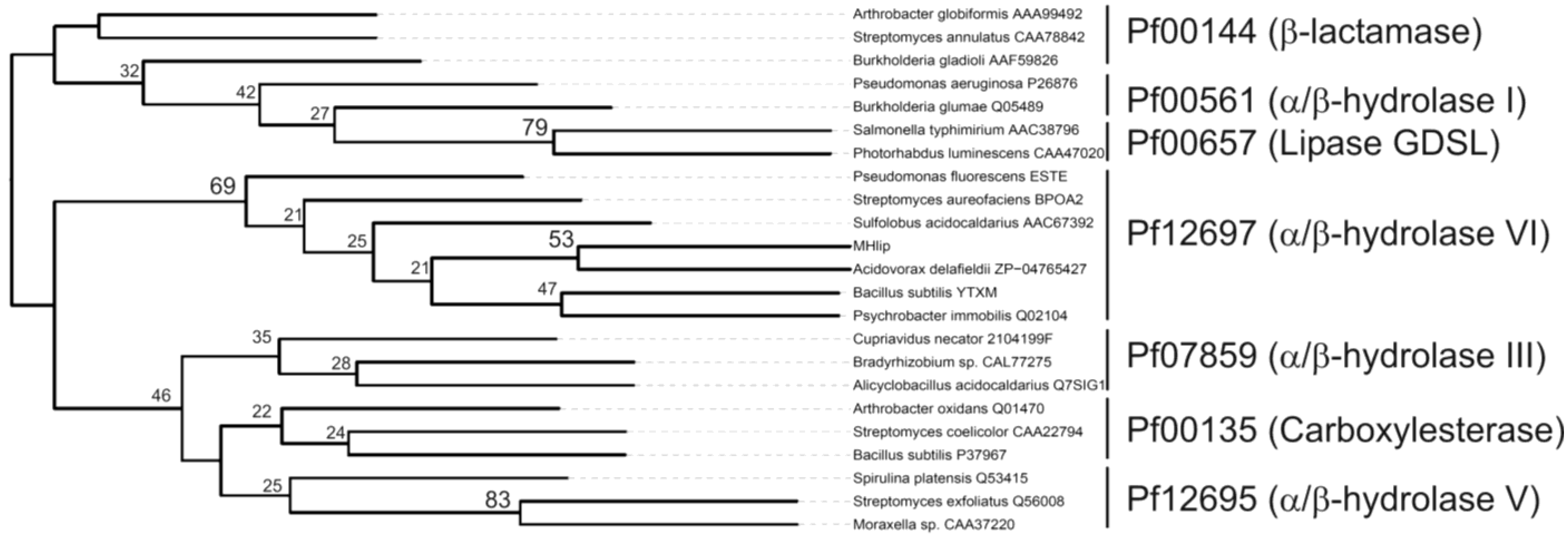
        <p>We constructed a phylogenetic tree using the MHlip sequence and some sequences derived from various esterase-related families [<xref ref-type="bibr" rid="B25-biology-02-00177">25</xref>]. Next, Pfam numbers were assigned to each sequence using Pfam_scan (<uri>http://pfam.sanger.ac.uk/</uri>) [<xref ref-type="bibr" rid="B26-biology-02-00177">26</xref>] (<xref ref-type="fig" rid="biology-02-00177-f001">Figure 1</xref>). MHlip was associated with the α/β hydrolase family 6 (Pf12697). This fold is observed in many enzymes having multiple functions (<italic>i.e.</italic>, transacetylase, lipase, hydroxynitrile lyase, methylesterase, peptidase, haloperoxidase, carboxylesterase) [<xref ref-type="bibr" rid="B27-biology-02-00177">27</xref>]. </p>
        <fig id="biology-02-00177-f001" position="float">
          <label>Figure 1</label>
          <caption>
            <p>Unrooted neighbour-joining tree built with enzymes belonging to different families of esterases. The Jones-Tailor-Thornton method was used to compute distances [<xref ref-type="bibr" rid="B28-biology-02-00177">28</xref>]. Higher bootstrap values are displayed at the nodes and expressed as percentages of 1000 replicates. The Pfam numbers (names) are displayed on the right side of the tree.</p>
          </caption>
          <graphic xmlns:xlink="http://www.w3.org/1999/xlink" xlink:href="biology-02-00177-g001.tif"/>
        </fig>
        <p>Sequences alignment highlighted all the residues considered as involved in substrate binding and catalysis (<xref ref-type="fig" rid="biology-02-00177-f002">Figure 2</xref>) [<xref ref-type="bibr" rid="B29-biology-02-00177">29</xref>]. In addition, residues W<sub>29</sub> and M<sub>95</sub> assumed to limit the active site of PFE-ESTE are displayed. These two residues limit the diffusion of large substrates in the catalytic cleft, independently of any lid structure. Thus resulting in an enzyme having high affinity for short substrates (<italic>i.e.</italic>, pNPA) [<xref ref-type="bibr" rid="B29-biology-02-00177">29</xref>].</p>
        <fig id="biology-02-00177-f002" position="float">
          <label>Figure 2</label>
          <caption>
            <p>Sequences alignment of the MHlip enzyme and some related proteins. PFE-ESTE (P22862.4), aryl esterase from <italic>P. fluorescens</italic>; ZP-04765427, putative α/β hydrolase from <italic>Acidovorax delafieldii</italic>; BPO-A2 (P29715.3), bromoperoxidase from <italic>Streptomyces aureofaciens</italic> and YTXM (P23974.2), lipase from <italic>Bacillus subtilis</italic>. ★ residues forming the catalytic triad (Ser<sub>96</sub>, D<sub>213</sub> and H<sub>241</sub>), ▲ residues forming the oxyanion hole involved in hydrogen bonding interactions, located upstream the active site (HG), ○ conserved residues involved in the formation of the GXSXG conserved pentapeptide containing the active-site serine, ● residues involved in the active site occlusion in PFE-ESTE [<xref ref-type="bibr" rid="B29-biology-02-00177">29</xref>].</p>
          </caption>
          <graphic xmlns:xlink="http://www.w3.org/1999/xlink" xlink:href="biology-02-00177-g002.tif"/>
        </fig>
      </sec>
      <sec>
        <title>2.2. Biochemical Characterization</title>
        <p>The MHlip-encoding gene was PCR-amplified and introduced in the pET22b vector in order to express a C-terminal His-tagged MHlip. The recombinant protein was purified from the cytoplasmic fraction of transformed <italic>E. coli</italic> BL21(DE3) using Ni-NTA columns. </p>
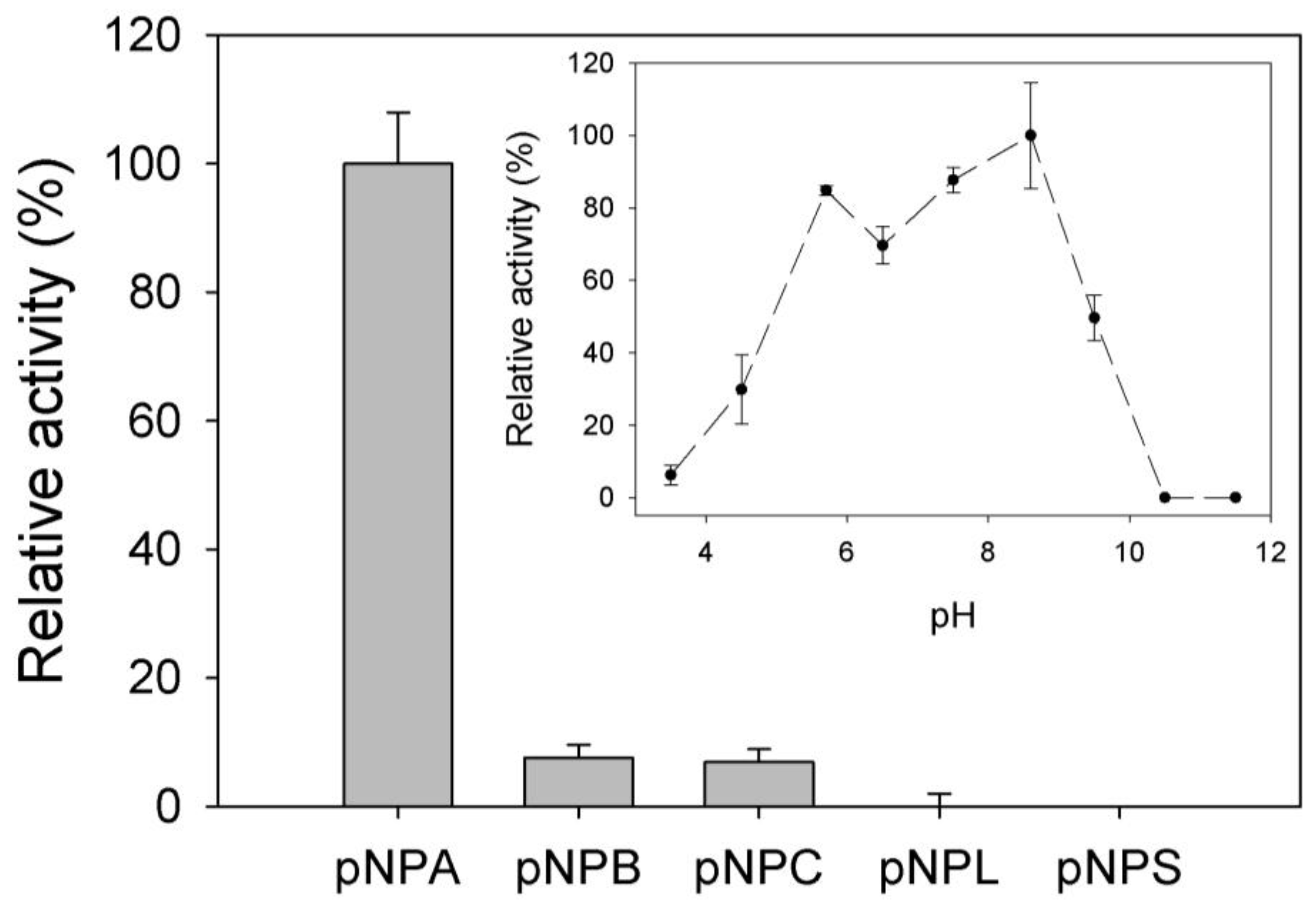
        <p>Since MHlip was first isolated on tributyrin containing media, its activity was investigated on various <italic>p</italic>-nitrophenyl (pNP)-esters at pH 8.0 (<xref ref-type="fig" rid="biology-02-00177-f003">Figure 3</xref>). MHlip is only active on small substrates such as pNPA; activity on pNPB is less than 5% of the pNPA hydrolysis and no activity was detected on substrates with longer acyl-chain lengths.</p>
        <p>The pH-dependence of the MHlip activity on pNPA was investigated by monitoring the absorbance at 348 nm between pH 3.5 and 11.5, in a 20 mM pH-adjusted poly-buffer. MHlip was significantly active over a wide range of pH, from 4.5 to 9 (<xref ref-type="fig" rid="biology-02-00177-f003">Figure 3</xref>). </p>
		<fig id="biology-02-00177-f003" position="float">
          <label>Figure 3</label>
          <caption>
            <p>MHlip substrate specificity measured at pH 8 and influence of the pH on the MHlip activity (the inset).</p>
          </caption>
          <graphic xmlns:xlink="http://www.w3.org/1999/xlink" xlink:href="biology-02-00177-g003.tif"/>
        </fig>
        
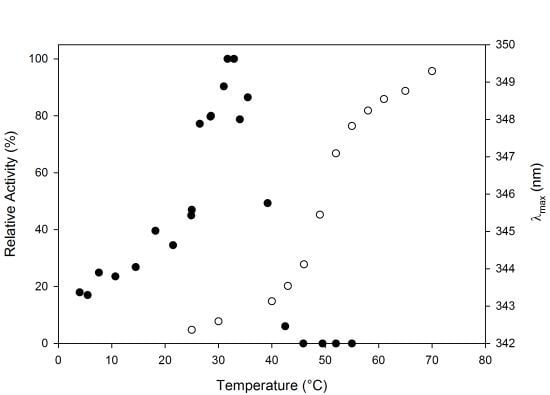
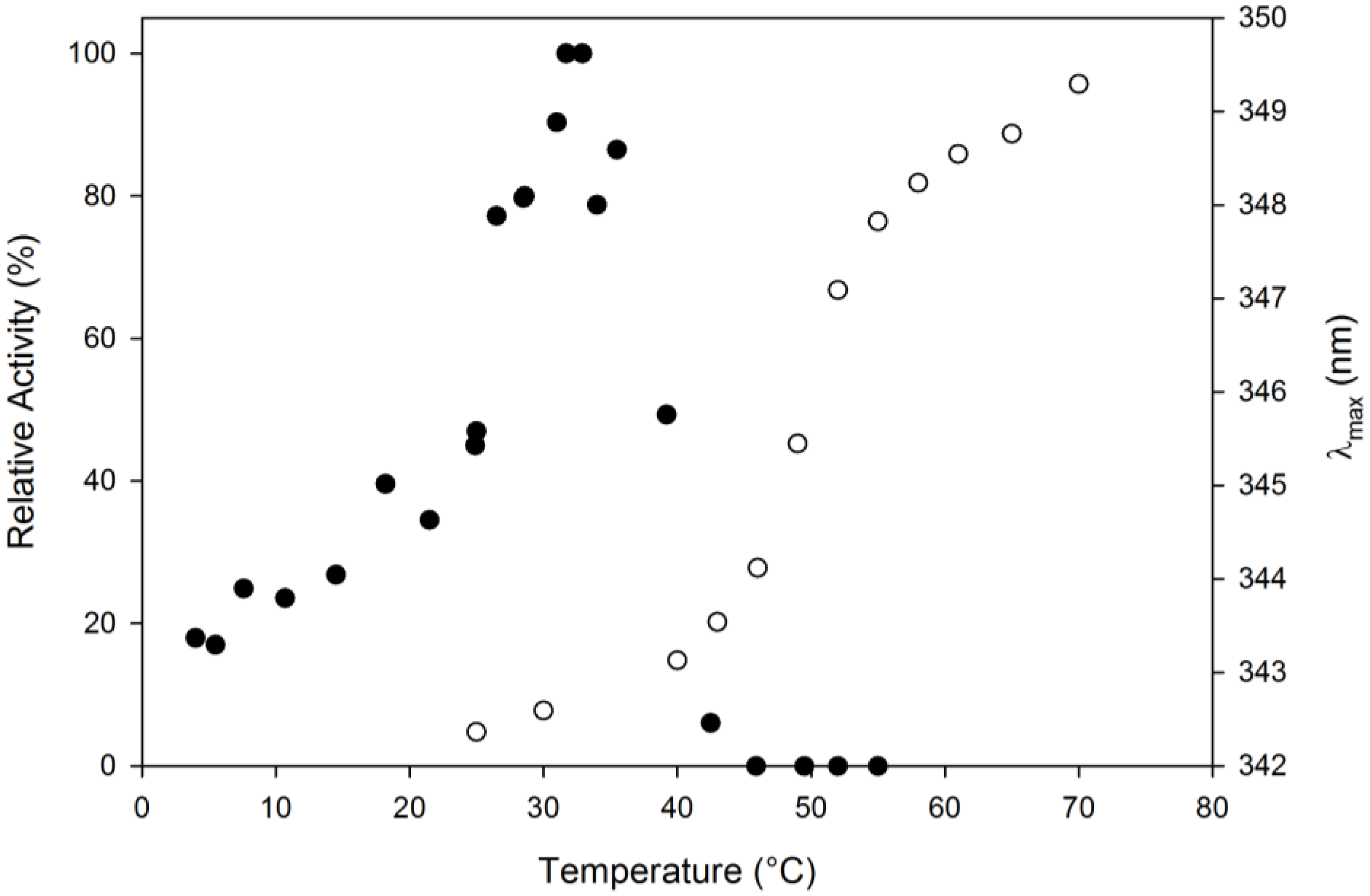
        <p>The thermal sensitivity of the MHlip activity towards pNPA was recorded at pH 8.0 in a thermal gradient ranging from 4 to 55 °C. The rate of pNPA hydrolysis rapidly increased from 4 to 35 °C and then quickly decreased to few percents of residual activity at 45 °C. Interestingly, MHlip remained significantly active when temperature decreased (20% at 4 °C) (<xref ref-type="fig" rid="biology-02-00177-f004">Figure 4</xref>).</p>
        <p>Kinetic parameters for pNPA hydrolysis were determined under initial rate conditions using a nonlinear regression analysis of the Michaelis–Menten equation. Hydrolysis was measured at 30 °C using pNPA as substrate at final concentrations ranging from 0 to 10 mM in 20 mM Tris-HCl (pH 8). For MHlip, the kinetic constants were: K<sub>m </sub>= 1.2~0.1 mM, k<sub>cat </sub>= 3.13.10<sup>−2</sup>~0.2.10<sup>−2</sup> sec<sup>−1</sup> and k<sub>cat</sub>/K<sub>m </sub>= 0.025 mM<sup>−1</sup> sec<sup>−1</sup>.</p>
      </sec>
      <sec>
        <title>2.3. Thermal Stability</title>
        <p>MHlip fluorescence spectra recorded at 20 °C and 90 °C were compared. When MHlip was incubated at 80 °C its fluorescence emission spectrum, compared to the spectrum obtained at 20°C, revealed its unfolding. A bathochromic effect was observed when the temperature increased as the maximum fluorescence was shifted to higher wavelengths (from 338 to 350 nm). In order to determine the MHlip melting temperature, the fluorescence emission at 338 nm was recorded in a thermal gradient, from 20 to 90 °C (data not shown).</p>
        <p>This approach appeared to be inappropriate since the increase of temperature caused a decrease of the fluorescence emission at 338 nm, with no clear transition. The determination of the apparent melting temperature (Tm) was eventually achieved by recording the wavelength of the maximum fluorescence emission (λ<sub>max</sub>) as a function of the temperature. At an excitation wavelength of 280 nm, a clear transition from a native to an unfolded state was observed at ~50 °C (<xref ref-type="fig" rid="biology-02-00177-f004">Figure 4</xref>). </p>
		<fig id="biology-02-00177-f004" position="float">
          <label>Figure 4</label>
          <caption>
            <p>Influence of temperature on the MHlip activity (●). The enzyme was pre-incubated for 5 min at temperature ranging from 4 to 55 °C. Enzyme activity was determined under standard conditions on pNPA, at pH 8.0. The activity measured at 30 °C was taken as 100%. MHlip thermal denaturation following the maximum of fluorescence emission (λ<sub>max</sub>) in a thermal gradient ranging from 20 to 80 °C (○).</p>
          </caption>
          <graphic xmlns:xlink="http://www.w3.org/1999/xlink" xlink:href="biology-02-00177-g004.tif"/>
        </fig>
        
      </sec>
    </sec>
    <sec>
      <title>3. Experimental Section</title>
      <sec>
        <title>3.1. Metagenomic Library Construction and Screening</title>
        <p>A previously described short-insert metagenomic library (average insert size of 5.1 kb) was used for the present work [<xref ref-type="bibr" rid="B19-biology-02-00177">19</xref>]. Screening for lipolytic activity was carried out by plating 3,000 recombinant <italic>E. coli</italic> clones on Spirit-Blue Agar (SBA) Media (BD-Difco, MD) containing chloramphenicol (12.5 µg/mL) and 1% emulsified Tributyrin (Sigma-Aldrich). The plates were incubated at 37 °C for 24 hours and kept at 18 °C for one week.</p>
      </sec>
      <sec>
        <title>3.2. Expression and Purification</title>
        <p>Forward primer (5’-GAGCA<underline>CATATG</underline>CCTTTCGCGCA-3’) and the reverse primer (5’-GCTTCAGAGGCGCT<underline>CTCGAG</underline>CTTGTCGAGA-3’), containing <italic>Nde</italic>I and <italic>Xho</italic>I restriction sites, respectively (underlined), were used for PCR amplification of the full length MHlip-encoding gene. The obtained amplicon was ligated in an <italic>Nde</italic>I/<italic>Xho</italic>I double digested pET22b plasmid (Novagen, NJ) that allowed the production of a C<sub>term</sub>-6×HisTag fused protein. After confirmation of the sequence, the pET22b:MHlip was introduced in competent <italic>E. coli</italic> BL21(DE3) cells (Novagen). Transformed cells were cultivated at 18 °C in LB media containing ampicillin (100 µg/mL). Heterologous protein expression was carried out for four hours by adding 0.4 mM isopropyl-<sc>D</sc>-1-thiogalactopyranoside (IPTG) when the OD<sub>600nm</sub> reached ~0.5. After centrifugation, the cell pellet was resuspended in 20 mM Tris-HCl (pH 8.0) and the cells were disrupted by sonication (3 cycles of 30 sec at amplitude of 10–12 µm). Proteins from the cytoplasmic fractions were recovered by centrifugation at 20,000 × g for 40 min, and MHlip was purified by affinity chromatography on a 5 mL Ni-NTA columns (GE Healthcare) in a linear gradient of imidazole (from 0 to 250 mM). Protein concentration was determined by the Bicinchoninic Acid (BCA)-protein quantitation assay (Pierce) using serum albumin as standard. Finally, 30 mg of pure protein was obtained per litre of culture. The purified protein was subjected to automatic Edman degradation for the determination of the N-terminal amino acid sequence on an Applied Biosystems 492 Protein Sequencer (Perkin Elmer, Waltham, MA, USA). The resulting sequence (MPFAH) was found to match the predicted one. The purified protein was used for further characterization.</p>
      </sec>
      <sec>
        <title>3.3. Activity Assays</title>
        <p>Lipase/esterase activity assays were carried out on <italic>p</italic>-nitrophenyl-esters (pNP-Acetate, pNPA; pNP-Butyrate, pNPB; pNP-Caprilate, pNPC; and pNP-Laurate, pNPL; all purchased from Sigma) by spectrophotometric methods. The assay mixture was prepared as follow: 940 µL of 20 mM Tris-HCl (pH 8.0), 10 µL of 10 mM <italic>p-</italic>nitrophenyl-ester in acetonitrile, and 50 µL of enzyme solution. The release of <italic>p-</italic>nitrophenol was followed taking into account a molar extinction coefficient at 405 nm (ε<sub>405nm</sub>) of 16,500 M<sup>−1</sup>.cm<sup>−1</sup>. </p>
        <p>The pH-dependence of the enzyme’s activity on pNPA, between pH 3.5 and 11.5, was investigated by monitoring the absorbance at 348 nm and replacing the Tris-HCl buffer by a 20 mM pH-adjusted polybuffer consisting of Tris, KCl, Na<sub>2</sub>HPO<sub>4</sub>, CH<sub>3</sub>COO.Na and dihydrogen citrate [<xref ref-type="bibr" rid="B30-biology-02-00177">30</xref>].</p>
        <p>The thermal sensitivity of the MHlip activity toward pNPA was recorded as described above, over a temperature range between 4 and 55 °C.</p>
      </sec>
      <sec>
        <title>3.4. Thermal Stability and Unfolding</title>
        <p>In order to investigate the thermal stability of MHlip, the purified protein was submitted to increasing temperatures and the process of denaturation was followed by intrinsic fluorescence spectra. The spectrum of the native MHlip at 20 °C was recorded on a Perkin Elmer LS50B spectrofluorometer using a 1 cm cell path length. Maximum fluorescence emission was observed at a wavelength of 338 nm using an excitation wavelength of 280 nm. The Tm of the enzyme was determined by plotting the wavelength of the maximum emission (λ<sub>max</sub>), measured at temperatures ranging from 20 to 80 °C. </p>
      </sec>
    </sec>
    <sec sec-type="conclusions">
      <title>4. Conclusions</title>
      <p>The functional metagenomic is a powerful methodology to access the genetic material of environmental microorganisms. By the past, this approach has been used to isolated new enzymes from various environments [<xref ref-type="bibr" rid="B22-biology-02-00177">22</xref>,<xref ref-type="bibr" rid="B23-biology-02-00177">23</xref>,<xref ref-type="bibr" rid="B24-biology-02-00177">24</xref>,<xref ref-type="bibr" rid="B31-biology-02-00177">31</xref>,<xref ref-type="bibr" rid="B32-biology-02-00177">32</xref>,<xref ref-type="bibr" rid="B33-biology-02-00177">33</xref>]. Here, a new esterase form Antarctica is described. </p>
      <p>MHlip belongs to the α/β-hydrolase family 6 and is part of a large group of uncharacterized proteins. The physiological function of these enzymes has not been clearly elucidated [<xref ref-type="bibr" rid="B34-biology-02-00177">34</xref>]. In addition, MHlip displays significant identity (~30%) to various haloperoxidases and proteases. Although similarity between some esterases, oxidases and proteases was reported [<xref ref-type="bibr" rid="B29-biology-02-00177">29</xref>,<xref ref-type="bibr" rid="B35-biology-02-00177">35</xref>,<xref ref-type="bibr" rid="B36-biology-02-00177">36</xref>], MHlip does not show any detectable activity when tested for the conversion of the substrate phenol red to bromophenol blue [<xref ref-type="bibr" rid="B37-biology-02-00177">37</xref>] or azo-casein hydrolysis [<xref ref-type="bibr" rid="B38-biology-02-00177">38</xref>] (data not shown).</p>
      <p>Among the tested substrates, the MHlip activity is highly specific for short esters such as <italic>p</italic>-nitrophenyl-acetate. Similar specificity for short substrates (e.g., pNPA) has been observed for the aryl-esterase derived from the goat rumen metagenome [<xref ref-type="bibr" rid="B39-biology-02-00177">39</xref>] and for the aryl-esterase from <italic>Pseudomonas fluorescens</italic> (PFE) [<xref ref-type="bibr" rid="B29-biology-02-00177">29</xref>]. Concerning PFE, such a high specificity is the consequence of a sterically hidden active site. Indeed, the catalytic cleft of PFE is delimited by W28 and M96 [<xref ref-type="bibr" rid="B29-biology-02-00177">29</xref>,<xref ref-type="bibr" rid="B40-biology-02-00177">40</xref>] whereas cumbersome residues, L29 and Q97, are observed in the corresponding positions of MHlip, and could thus have a similar effect. The kinetic parameters for the pNPA hydrolysis suggest that the MHlip primary function is not yet well understood. However, the measured Km for the pNPA hydrolysis (1.2 mM) is similar to some values obtained for previously characterized aryl-esterases, including the enzyme from Lactobacillus casei [<xref ref-type="bibr" rid="B41-biology-02-00177">41</xref>] and an aryl-esterase derived from the goat rumen metagenome [<xref ref-type="bibr" rid="B39-biology-02-00177">39</xref>].</p>
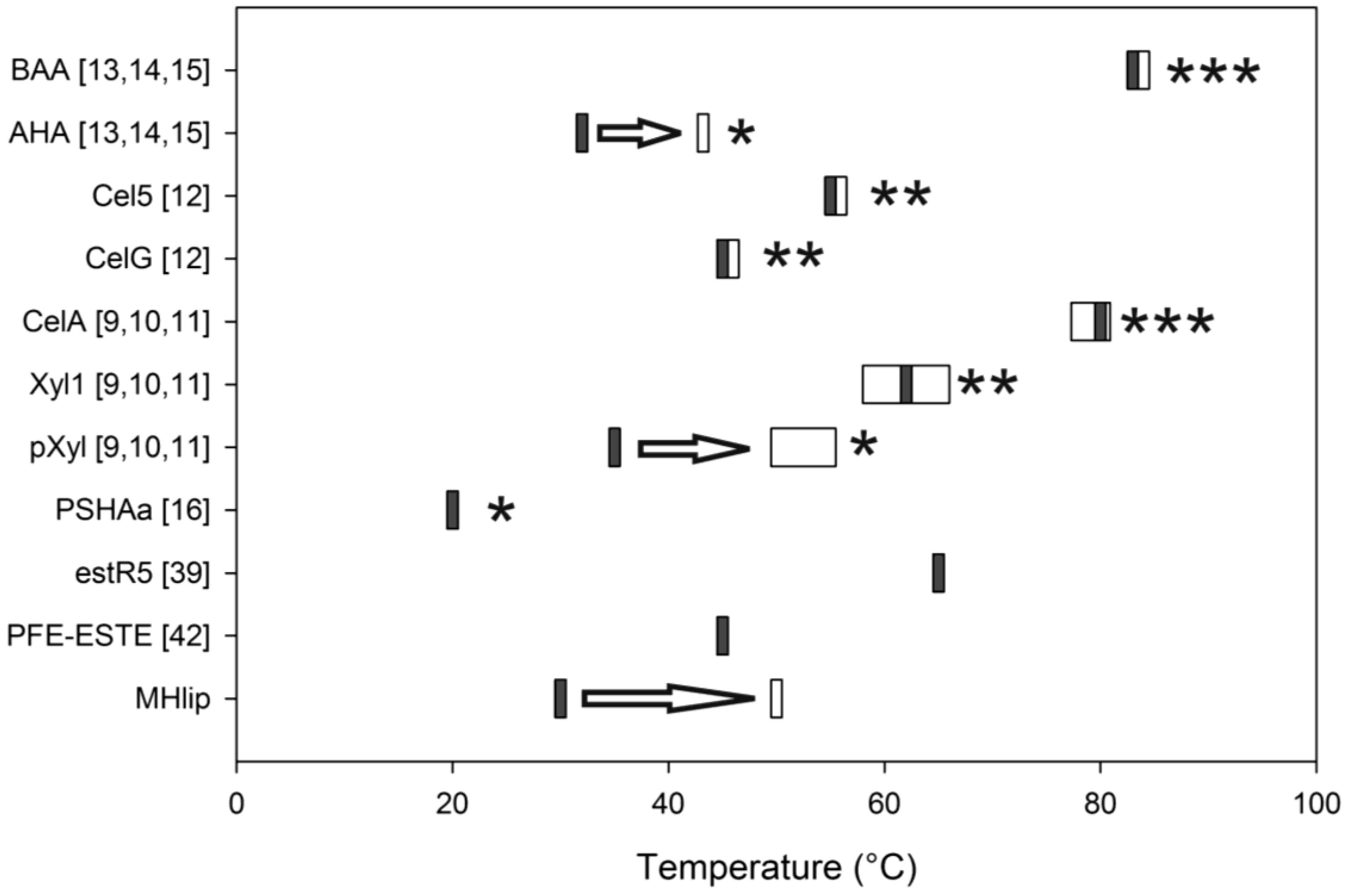
      <p>The characterization of purified MHlip reveals its adaptation to cold temperatures. Indeed, MHlip retains 20% activity at 4 °C. This is consistent with the temperature of the Antarctic soil sample used for the metagenomic library construction [<xref ref-type="bibr" rid="B24-biology-02-00177">24</xref>]. The MHlip activity increases from 4 to ~30 °C and is lost at higher temperatures. This suggests that our screening method, including a long incubation at cold temperature, is suitable for allowing the isolation of this highly thermo-sensitive protein. The aryl-esterases derived form the goat rumen metagenome (estR5) [<xref ref-type="bibr" rid="B39-biology-02-00177">39</xref>] and from <italic>Pseudomonas fluorescens</italic> (PFE) [<xref ref-type="bibr" rid="B42-biology-02-00177">42</xref>] are regarded as mesophilic homologs of MHlip since their optimal activity is observed at 60 and 45 °C, respectively (<xref ref-type="fig" rid="biology-02-00177-f005">Figure 5</xref>).</p>
      <p>The MHlip unfolding begins at 30 °C. At this temperature the MHlip activity is optimal. When increasing the temperature above 30 °C, the protein undergoes a partial denaturation and quickly loses its activity. Complete denaturation is apparently achieved at a temperature higher than 65 °C. Based on the fluorescence transition curve, the apparent T<sub>m</sub> is determined to be 50 °C. </p>
	  <fig id="biology-02-00177-f005" position="float">
        <label>Figure 5</label>
        <caption>
          <p>Shift in the observed optimal temperature of activity (gray rectangle) and the melting temperature (Tm, white rectangle) of some characterized proteins. *, ** and *** stand for protein considered psychrophilic, mesophilic and thermophilic in the corresponding references, respectively.</p>
        </caption>
        <graphic xmlns:xlink="http://www.w3.org/1999/xlink" xlink:href="biology-02-00177-g005.tif"/>
      </fig>
      
      <p>The thorough characterization of cold active proteins unravels different ways for a protein to remain active at low temperatures [<xref ref-type="bibr" rid="B5-biology-02-00177">5</xref>,<xref ref-type="bibr" rid="B6-biology-02-00177">6</xref>,<xref ref-type="bibr" rid="B7-biology-02-00177">7</xref>,<xref ref-type="bibr" rid="B8-biology-02-00177">8</xref>,<xref ref-type="bibr" rid="B43-biology-02-00177">43</xref>]. Among these paths, increasing the length of the unstructured loop has been described in several cases [<xref ref-type="bibr" rid="B44-biology-02-00177">44</xref>,<xref ref-type="bibr" rid="B45-biology-02-00177">45</xref>]. However, MHlip sequence analysis does not reveal any extra stretches of amino acid.. Increasing the accessibility of the active site, as described for a cold adapted protease [<xref ref-type="bibr" rid="B18-biology-02-00177">18</xref>], was reported to increase the activity at low temperature. This is unlikely to occur here since MHlip may present cumbersome residues surrounding its active site. Moreover, the overall amino acid composition of MHlip is not significantly different from that of related proteins from mesophilic organisms. Nevertheless, this new enzyme, like most of the previously characterized cold adapted proteins, is an extremely heat labile enzyme.</p>
      <p>Indeed, the MHlip’s loss of activity corresponds to the early stages of its unfolding. This suggests that the catalytic site is extremely thermo-sensitive compared to the overall protein structure. Shifts between the temperature at which proteins lose their activity and the unfolding temperature (Tm) have been recorded for many cold-adapted enzymes (<xref ref-type="fig" rid="biology-02-00177-f005">Figure 5</xref>) [<xref ref-type="bibr" rid="B6-biology-02-00177">6</xref>,<xref ref-type="bibr" rid="B8-biology-02-00177">8</xref>,<xref ref-type="bibr" rid="B11-biology-02-00177">11</xref>,<xref ref-type="bibr" rid="B12-biology-02-00177">12</xref>,<xref ref-type="bibr" rid="B13-biology-02-00177">13</xref>,<xref ref-type="bibr" rid="B14-biology-02-00177">14</xref>]. Thus, even if no signature associated with cold-adapted protein can be observed, at the sequence level, we assume the MHlip adaptation to cold results from many discrete structural modifications that allow the protein to remain active when temperature is low. </p>
    </sec>
    
  </body>
  <back><ack>
      <title>Acknowledgments</title>
      <p>This project was supported by the First-Postdoc Program, Grant no. 916984 from the Région Wallonne (Belgium) and by a grant from FNRS (FRFC, 2.4561.07) to MG.</p>
      <p>P. Power is a researcher from the Consejo Nacional de Investigaciones Científicas y Técnicas (CONICET), Argentina, and was a recipient of a Postdoctoral fellowship from the Belgian Science Policy Office (BELSPO).</p>
      <p>Authors thank Charles Gerday and Georges Feller for their skilful technical assistance and their discussion of the manuscript. </p>
    </ack>
    <ref-list>
      <title>References and Notes</title>
      <ref id="B1-biology-02-00177">
        <label>1.</label>
        <citation citation-type="journal">
          <person-group person-group-type="author">
            <name>
              <surname>Dalrymple</surname>
              <given-names>B.P.</given-names>
            </name>
            <name>
              <surname>Swadling</surname>
              <given-names>Y.</given-names>
            </name>
            <name>
              <surname>Cybinski</surname>
              <given-names>D.H.</given-names>
            </name>
            <name>
              <surname>Xue</surname>
              <given-names>G.P.</given-names>
            </name>
          </person-group>
          <article-title>Cloning of a gene encoding cinnamoyl ester hydrolase from the ruminal bacterium butyrivibrio fibrisolvens e14 by a novel method</article-title>
          <source>FEMS Microbiol. Lett.</source>
          <year>1996</year>
          <volume>143</volume>
          <fpage>115</fpage>
          <lpage>120</lpage>
          <pub-id pub-id-type="doi">10.1111/j.1574-6968.1996.tb08469.x</pub-id>
        </citation>
      </ref>
      <ref id="B2-biology-02-00177">
        <label>2.</label>
        <citation citation-type="journal">
          <person-group person-group-type="author">
            <name>
              <surname>McQueen</surname>
              <given-names>D.A.</given-names>
            </name>
            <name>
              <surname>Schottel</surname>
              <given-names>J.L.</given-names>
            </name>
          </person-group>
          <article-title>Purification and characterization of a novel extracellular esterase from pathogenic streptomyces scabies that is inducible by zinc</article-title>
          <source>J. Bacteriol.</source>
          <year>1987</year>
          <volume>169</volume>
          <fpage>1967</fpage>
          <lpage>1971</lpage>
        <pub-id pub-id-type="pmid">3571156</pub-id></citation>
      </ref>
      <ref id="B3-biology-02-00177">
        <label>3.</label>
        <citation citation-type="journal">
          <person-group person-group-type="author">
            <name>
              <surname>von der Haar</surname>
              <given-names>B.</given-names>
            </name>
            <name>
              <surname>Walter</surname>
              <given-names>S.</given-names>
            </name>
            <name>
              <surname>Schwapenheuer</surname>
              <given-names>S.</given-names>
            </name>
            <name>
              <surname>Schrempf</surname>
              <given-names>H.</given-names>
            </name>
          </person-group>
          <article-title>A novel fusidic acid resistance gene from streptomyces lividans 66 encodes a highly specific esterase</article-title>
          <source>Microbiology</source>
          <year>1997</year>
          <volume>143</volume>
          <fpage>867</fpage>
          <lpage>874</lpage>
          <pub-id pub-id-type="doi">10.1099/00221287-143-3-867</pub-id>
        </citation>
      </ref>
      <ref id="B4-biology-02-00177">
        <label>4.</label>
        <citation citation-type="journal">
          <person-group person-group-type="author">
            <name>
              <surname>Schloss</surname>
              <given-names>P.D.</given-names>
            </name>
            <name>
              <surname>Handelsman</surname>
              <given-names>J.</given-names>
            </name>
          </person-group>
          <article-title>Metagenomics for studying unculturable microorganisms: Cutting the gordian knot</article-title>
          <source>Genome Biol.</source>
          <year>2005</year>
          <volume>6</volume>
          <fpage>229</fpage>
          <pub-id pub-id-type="doi">10.1186/gb-2005-6-8-229</pub-id>
        </citation>
      </ref>
      <ref id="B5-biology-02-00177">
        <label>5.</label>
        <citation citation-type="journal">
          <person-group person-group-type="author">
            <name>
              <surname>Casanueva</surname>
              <given-names>A.</given-names>
            </name>
            <name>
              <surname>Tuffin</surname>
              <given-names>M.</given-names>
            </name>
            <name>
              <surname>Cary</surname>
              <given-names>C.</given-names>
            </name>
            <name>
              <surname>Cowan</surname>
              <given-names>D.A.</given-names>
            </name>
          </person-group>
          <article-title>Molecular adaptations to psychrophily: The impact of 'omic' technologies</article-title>
          <source>Trends Microbiol.</source>
          <year>2010</year>
          <volume>18</volume>
          <fpage>374</fpage>
          <lpage>381</lpage>
          <pub-id pub-id-type="doi">10.1016/j.tim.2010.05.002</pub-id>
        </citation>
      </ref>
      <ref id="B6-biology-02-00177">
        <label>6.</label>
        <citation citation-type="journal">
          <person-group person-group-type="author">
            <name>
              <surname>D'Amico</surname>
              <given-names>S.</given-names>
            </name>
            <name>
              <surname>Claverie</surname>
              <given-names>P.</given-names>
            </name>
            <name>
              <surname>Collins</surname>
              <given-names>T.</given-names>
            </name>
            <name>
              <surname>Georlette</surname>
              <given-names>D.</given-names>
            </name>
            <name>
              <surname>Gratia</surname>
              <given-names>E.</given-names>
            </name>
            <name>
              <surname>Hoyoux</surname>
              <given-names>A.</given-names>
            </name>
            <name>
              <surname>Meuwis</surname>
              <given-names>M.A.</given-names>
            </name>
            <name>
              <surname>Feller</surname>
              <given-names>G.</given-names>
            </name>
            <name>
              <surname>Gerday</surname>
              <given-names>C.</given-names>
            </name>
          </person-group>
          <article-title>Molecular basis of cold adaptation</article-title>
          <source>Philos Trans. R Soc. Lond B Biol. Sci</source>
          <year>2002</year>
          <volume>357</volume>
          <fpage>917</fpage>
          <lpage>925</lpage>
          <pub-id pub-id-type="doi">10.1098/rstb.2002.1105</pub-id>
        </citation>
      </ref>
      <ref id="B7-biology-02-00177">
        <label>7.</label>
        <citation citation-type="journal">
          <person-group person-group-type="author">
            <name>
              <surname>Feller</surname>
              <given-names>G.</given-names>
            </name>
            <name>
              <surname>Gerday</surname>
              <given-names>C.</given-names>
            </name>
          </person-group>
          <article-title>Psychrophilic enzymes: Hot topics in cold adaptation</article-title>
          <source>Nat. Rev. Microbiol.</source>
          <year>2003</year>
          <volume>1</volume>
          <fpage>200</fpage>
          <lpage>208</lpage>
          <pub-id pub-id-type="doi">10.1038/nrmicro773</pub-id>
        </citation>
      </ref>
      <ref id="B8-biology-02-00177">
        <label>8.</label>
        <citation citation-type="journal">
          <person-group person-group-type="author">
            <name>
              <surname>Marx</surname>
              <given-names>J.C.</given-names>
            </name>
            <name>
              <surname>Collins</surname>
              <given-names>T.</given-names>
            </name>
            <name>
              <surname>D'Amico</surname>
              <given-names>S.</given-names>
            </name>
            <name>
              <surname>Feller</surname>
              <given-names>G.</given-names>
            </name>
            <name>
              <surname>Gerday</surname>
              <given-names>C.</given-names>
            </name>
          </person-group>
          <article-title>Cold-adapted enzymes from marine antarctic microorganisms</article-title>
          <source>Mar. Biotechnol.</source>
          <year>2007</year>
          <volume>9</volume>
          <fpage>293</fpage>
          <lpage>304</lpage>
          <pub-id pub-id-type="doi">10.1007/s10126-006-6103-8</pub-id>
        </citation>
      </ref>
      <ref id="B9-biology-02-00177">
        <label>9.</label>
        <citation citation-type="journal">
          <person-group person-group-type="author">
            <name>
              <surname>Collins</surname>
              <given-names>T.</given-names>
            </name>
            <name>
              <surname>De Vos</surname>
              <given-names>D.</given-names>
            </name>
            <name>
              <surname>Hoyoux</surname>
              <given-names>A.</given-names>
            </name>
            <name>
              <surname>Savvides</surname>
              <given-names>S.N.</given-names>
            </name>
            <name>
              <surname>Gerday</surname>
              <given-names>C.</given-names>
            </name>
            <name>
              <surname>Van Beeumen</surname>
              <given-names>J.</given-names>
            </name>
            <name>
              <surname>Feller</surname>
              <given-names>G.</given-names>
            </name>
          </person-group>
          <article-title>Study of the active site residues of a glycoside hydrolase family 8 xylanase</article-title>
          <source>J. Mol. Biol.</source>
          <year>2005</year>
          <volume>354</volume>
          <fpage>425</fpage>
          <lpage>435</lpage>
          <pub-id pub-id-type="doi">10.1016/j.jmb.2005.09.064</pub-id>
        </citation>
      </ref>
      <ref id="B10-biology-02-00177">
        <label>10.</label>
        <citation citation-type="journal">
          <person-group person-group-type="author">
            <name>
              <surname>Collins</surname>
              <given-names>T.</given-names>
            </name>
            <name>
              <surname>Hoyoux</surname>
              <given-names>A.</given-names>
            </name>
            <name>
              <surname>Dutron</surname>
              <given-names>A.</given-names>
            </name>
            <name>
              <surname>Georis</surname>
              <given-names>J.</given-names>
            </name>
            <name>
              <surname>Genot</surname>
              <given-names>B.</given-names>
            </name>
            <name>
              <surname>Dauvrin</surname>
              <given-names>T.</given-names>
            </name>
            <name>
              <surname>Arnaut</surname>
              <given-names>F.</given-names>
            </name>
            <name>
              <surname>Gerday</surname>
              <given-names>C.</given-names>
            </name>
            <name>
              <surname>Feller</surname>
              <given-names>G.</given-names>
            </name>
          </person-group>
          <article-title>Use of glycoside hydrolase family 8 xylanases in baking</article-title>
          <source>J. Cereal Sci.</source>
          <year>2006</year>
          <volume>43</volume>
          <fpage>79</fpage>
          <lpage>84</lpage>
          <pub-id pub-id-type="doi">10.1016/j.jcs.2005.08.002</pub-id>
        </citation>
      </ref>
      <ref id="B11-biology-02-00177">
        <label>11.</label>
        <citation citation-type="journal">
          <person-group person-group-type="author">
            <name>
              <surname>Collins</surname>
              <given-names>T.</given-names>
            </name>
            <name>
              <surname>Meuwis</surname>
              <given-names>M.A.</given-names>
            </name>
            <name>
              <surname>Gerday</surname>
              <given-names>C.</given-names>
            </name>
            <name>
              <surname>Feller</surname>
              <given-names>G.</given-names>
            </name>
          </person-group>
          <article-title>Activity, stability and flexibility in glycosidases adapted to extreme thermal environments</article-title>
          <source>J. Mol. Biol.</source>
          <year>2003</year>
          <volume>328</volume>
          <fpage>419</fpage>
          <lpage>428</lpage>
          <pub-id pub-id-type="doi">10.1016/S0022-2836(03)00287-0</pub-id>
        </citation>
      </ref>
      <ref id="B12-biology-02-00177">
        <label>12.</label>
        <citation citation-type="journal">
          <person-group person-group-type="author">
            <name>
              <surname>Garsoux</surname>
              <given-names>G.</given-names>
            </name>
            <name>
              <surname>Lamotte</surname>
              <given-names>J.</given-names>
            </name>
            <name>
              <surname>Gerday</surname>
              <given-names>C.</given-names>
            </name>
            <name>
              <surname>Feller</surname>
              <given-names>G.</given-names>
            </name>
          </person-group>
          <article-title>Kinetic and structural optimization to catalysis at low temperatures in a psychrophilic cellulase from the antarctic bacterium pseudoalteromonas haloplanktis</article-title>
          <source>Biochem. J.</source>
          <year>2004</year>
          <volume>384</volume>
          <fpage>247</fpage>
          <lpage>253</lpage>
          <pub-id pub-id-type="doi">10.1042/BJ20040325</pub-id>
        </citation>
      </ref>
      <ref id="B13-biology-02-00177">
        <label>13.</label>
        <citation citation-type="journal">
          <person-group person-group-type="author">
            <name>
              <surname>Feller</surname>
              <given-names>G.</given-names>
            </name>
            <name>
              <surname>d'Amico</surname>
              <given-names>D.</given-names>
            </name>
            <name>
              <surname>Gerday</surname>
              <given-names>C.</given-names>
            </name>
          </person-group>
          <article-title>Thermodynamic stability of a cold-active alpha-amylase from the antarctic bacterium alteromonas haloplanctis</article-title>
          <source>Biochemistry</source>
          <year>1999</year>
          <volume>38</volume>
          <fpage>4613</fpage>
          <lpage>4619</lpage>
          <pub-id pub-id-type="doi">10.1021/bi982650+</pub-id>
        </citation>
      </ref>
      <ref id="B14-biology-02-00177">
        <label>14.</label>
        <citation citation-type="journal">
          <person-group person-group-type="author">
            <name>
              <surname>Siddiqui</surname>
              <given-names>K.S.</given-names>
            </name>
            <name>
              <surname>Feller</surname>
              <given-names>G.</given-names>
            </name>
            <name>
              <surname>D'Amico</surname>
              <given-names>S.</given-names>
            </name>
            <name>
              <surname>Gerday</surname>
              <given-names>C.</given-names>
            </name>
            <name>
              <surname>Giaquinto</surname>
              <given-names>L.</given-names>
            </name>
            <name>
              <surname>Cavicchioli</surname>
              <given-names>R.</given-names>
            </name>
          </person-group>
          <article-title>The active site is the least stable structure in the unfolding pathway of a multidomain cold-adapted alpha-amylase</article-title>
          <source>J. Bacteriol.</source>
          <year>2005</year>
          <volume>187</volume>
          <fpage>6197</fpage>
          <lpage>6205</lpage>
          <pub-id pub-id-type="doi">10.1128/JB.187.17.6197-6205.2005</pub-id>
        </citation>
      </ref>
      <ref id="B15-biology-02-00177">
        <label>15.</label>
        <citation citation-type="journal">
          <person-group person-group-type="author">
            <name>
              <surname>Siddiqui</surname>
              <given-names>K.S.</given-names>
            </name>
            <name>
              <surname>Poljak</surname>
              <given-names>A.</given-names>
            </name>
            <name>
              <surname>Guilhaus</surname>
              <given-names>M.</given-names>
            </name>
            <name>
              <surname>De Francisci</surname>
              <given-names>D.</given-names>
            </name>
            <name>
              <surname>Curmi</surname>
              <given-names>P.M.</given-names>
            </name>
            <name>
              <surname>Feller</surname>
              <given-names>G.</given-names>
            </name>
            <name>
              <surname>D'Amico</surname>
              <given-names>S.</given-names>
            </name>
            <name>
              <surname>Gerday</surname>
              <given-names>C.</given-names>
            </name>
            <name>
              <surname>Uversky</surname>
              <given-names>V.N.</given-names>
            </name>
            <name>
              <surname>Cavicchioli</surname>
              <given-names>R.</given-names>
            </name>
          </person-group>
          <article-title>Role of lysine <italic>versus</italic> arginine in enzyme cold-adaptation: Modifying lysine to homo-arginine stabilizes the cold-adapted alpha-amylase from pseudoalteramonas haloplanktis</article-title>
          <source>Proteins</source>
          <year>2006</year>
          <volume>64</volume>
          <fpage>486</fpage>
          <lpage>501</lpage>
          <pub-id pub-id-type="doi">10.1002/prot.20989</pub-id>
        </citation>
      </ref>
      <ref id="B16-biology-02-00177">
        <label>16.</label>
        <citation citation-type="journal">
          <person-group person-group-type="author">
            <name>
              <surname>Aurilia</surname>
              <given-names>V.</given-names>
            </name>
            <name>
              <surname>Parracino</surname>
              <given-names>A.</given-names>
            </name>
            <name>
              <surname>Saviano</surname>
              <given-names>M.</given-names>
            </name>
            <name>
              <surname>Rossi</surname>
              <given-names>M.</given-names>
            </name>
            <name>
              <surname>D'Auria</surname>
              <given-names>S.</given-names>
            </name>
          </person-group>
          <article-title>The psychrophilic bacterium pseudoalteromonas halosplanktis tac125 possesses a gene coding for a cold-adapted feruloyl esterase activity that shares homology with esterase enzymes from gamma-proteobacteria and yeast</article-title>
          <source>Gene</source>
          <year>2007</year>
          <volume>397</volume>
          <fpage>51</fpage>
          <lpage>57</lpage>
          <pub-id pub-id-type="doi">10.1016/j.gene.2007.04.004</pub-id>
        </citation>
      </ref>
      <ref id="B17-biology-02-00177">
        <label>17.</label>
        <citation citation-type="journal">
          <person-group person-group-type="author">
            <name>
              <surname>de Pascale</surname>
              <given-names>D.</given-names>
            </name>
            <name>
              <surname>Cusano</surname>
              <given-names>A.M.</given-names>
            </name>
            <name>
              <surname>Autore</surname>
              <given-names>F.</given-names>
            </name>
            <name>
              <surname>Parrilli</surname>
              <given-names>E.</given-names>
            </name>
            <name>
              <surname>di Prisco</surname>
              <given-names>G.</given-names>
            </name>
            <name>
              <surname>Marino</surname>
              <given-names>G.</given-names>
            </name>
            <name>
              <surname>Tutino</surname>
              <given-names>M.L.</given-names>
            </name>
          </person-group>
          <article-title>The cold-active lip1 lipase from the antarctic bacterium pseudoalteromonas haloplanktis tac125 is a member of a new bacterial lipolytic enzyme family</article-title>
          <source>Extremophiles</source>
          <year>2008</year>
          <volume>12</volume>
          <fpage>311</fpage>
          <lpage>323</lpage>
          <pub-id pub-id-type="doi">10.1007/s00792-008-0163-9</pub-id>
        </citation>
      </ref>
      <ref id="B18-biology-02-00177">
        <label>18.</label>
        <citation citation-type="journal">
          <person-group person-group-type="author">
            <name>
              <surname>Aghajari</surname>
              <given-names>N.</given-names>
            </name>
            <name>
              <surname>Van Petegem</surname>
              <given-names>F.</given-names>
            </name>
            <name>
              <surname>Villeret</surname>
              <given-names>V.</given-names>
            </name>
            <name>
              <surname>Chessa</surname>
              <given-names>J.P.</given-names>
            </name>
            <name>
              <surname>Gerday</surname>
              <given-names>C.</given-names>
            </name>
            <name>
              <surname>Haser</surname>
              <given-names>R.</given-names>
            </name>
            <name>
              <surname>Van Beeumen</surname>
              <given-names>J.</given-names>
            </name>
          </person-group>
          <article-title>Crystal structures of a psychrophilic metalloprotease reveal new insights into catalysis by cold-adapted proteases</article-title>
          <source>Proteins</source>
          <year>2003</year>
          <volume>50</volume>
          <fpage>636</fpage>
          <lpage>647</lpage>
          <pub-id pub-id-type="doi">10.1002/prot.10264</pub-id>
        </citation>
      </ref>
      <ref id="B19-biology-02-00177">
        <label>19.</label>
        <citation citation-type="journal">
          <person-group person-group-type="author">
            <name>
              <surname>Handelsman</surname>
              <given-names>J.</given-names>
            </name>
            <name>
              <surname>Rondon</surname>
              <given-names>M.R.</given-names>
            </name>
            <name>
              <surname>Brady</surname>
              <given-names>S.F.</given-names>
            </name>
            <name>
              <surname>Clardy</surname>
              <given-names>J.</given-names>
            </name>
            <name>
              <surname>Goodman</surname>
              <given-names>R.M.</given-names>
            </name>
          </person-group>
          <article-title>Molecular biological access to the chemistry of unknown soil microbes: A new frontier for natural products</article-title>
          <source>Chem. Biol.</source>
          <year>1998</year>
          <volume>5</volume>
          <fpage>R245</fpage>
          <lpage>R249</lpage>
          <pub-id pub-id-type="doi">10.1016/S1074-5521(98)90108-9</pub-id>
        </citation>
      </ref>
      <ref id="B20-biology-02-00177">
        <label>20.</label>
        <citation citation-type="journal">
          <person-group person-group-type="author">
            <name>
              <surname>Rondon</surname>
              <given-names>M.R.</given-names>
            </name>
            <name>
              <surname>August</surname>
              <given-names>P.R.</given-names>
            </name>
            <name>
              <surname>Bettermann</surname>
              <given-names>A.D.</given-names>
            </name>
            <name>
              <surname>Brady</surname>
              <given-names>S.F.</given-names>
            </name>
            <name>
              <surname>Grossman</surname>
              <given-names>T.H.</given-names>
            </name>
            <name>
              <surname>Liles</surname>
              <given-names>M.R.</given-names>
            </name>
            <name>
              <surname>Loiacono</surname>
              <given-names>K.A.</given-names>
            </name>
            <name>
              <surname>Lynch</surname>
              <given-names>B.A.</given-names>
            </name>
            <name>
              <surname>MacNeil</surname>
              <given-names>I.A.</given-names>
            </name>
            <name>
              <surname>Minor</surname>
              <given-names>C.</given-names>
            </name>
            <etal/>
          </person-group>
          <article-title>Cloning the soil metagenome: A strategy for accessing the genetic and functional diversity of uncultured microorganisms</article-title>
          <source>Appl. Environ. Microbiol.</source>
          <year>2000</year>
          <volume>66</volume>
          <fpage>2541</fpage>
          <lpage>2547</lpage>
        <pub-id pub-id-type="doi">10.1128/AEM.66.6.2541-2547.2000</pub-id><pub-id pub-id-type="pmid">10831436</pub-id></citation>
      </ref>
      <ref id="B21-biology-02-00177">
        <label>21.</label>
        <citation citation-type="journal">
          <person-group person-group-type="author">
            <name>
              <surname>Heath</surname>
              <given-names>C.</given-names>
            </name>
            <name>
              <surname>Hu</surname>
              <given-names>X.P.</given-names>
            </name>
            <name>
              <surname>Cary</surname>
              <given-names>S.C.</given-names>
            </name>
            <name>
              <surname>Cowan</surname>
              <given-names>D.</given-names>
            </name>
          </person-group>
          <article-title>Identification of a novel alkaliphilic esterase active at low temperatures by screening a metagenomic library from antarctic desert soil</article-title>
          <source>Appl. Environ. Microbiol.</source>
          <year>2009</year>
          <volume>75</volume>
          <fpage>4657</fpage>
          <lpage>4659</lpage>
          <pub-id pub-id-type="doi">10.1128/AEM.02597-08</pub-id>
        </citation>
      </ref>
      <ref id="B22-biology-02-00177">
        <label>22.</label>
        <citation citation-type="journal">
          <person-group person-group-type="author">
            <name>
              <surname>Kim</surname>
              <given-names>E.Y.</given-names>
            </name>
            <name>
              <surname>Oh</surname>
              <given-names>K.H.</given-names>
            </name>
            <name>
              <surname>Lee</surname>
              <given-names>M.H.</given-names>
            </name>
            <name>
              <surname>Kang</surname>
              <given-names>C.H.</given-names>
            </name>
            <name>
              <surname>Oh</surname>
              <given-names>T.K.</given-names>
            </name>
            <name>
              <surname>Yoon</surname>
              <given-names>J.H.</given-names>
            </name>
          </person-group>
          <article-title>Novel cold-adapted alkaline lipase from an intertidal flat metagenome and proposal for a new family of bacterial lipases</article-title>
          <source>Appl. Environ. Microbiol.</source>
          <year>2009</year>
          <volume>75</volume>
          <fpage>257</fpage>
          <lpage>260</lpage>
          <pub-id pub-id-type="doi">10.1128/AEM.01400-08</pub-id>
        </citation>
      </ref>
      <ref id="B23-biology-02-00177">
        <label>23.</label>
        <citation citation-type="journal">
          <person-group person-group-type="author">
            <name>
              <surname>Berlemont</surname>
              <given-names>R.</given-names>
            </name>
            <name>
              <surname>Pipers</surname>
              <given-names>D.</given-names>
            </name>
            <name>
              <surname>Delsaute</surname>
              <given-names>M.</given-names>
            </name>
            <name>
              <surname>Angiono</surname>
              <given-names>F.</given-names>
            </name>
            <name>
              <surname>Feller</surname>
              <given-names>G.</given-names>
            </name>
            <name>
              <surname>Galleni</surname>
              <given-names>M.</given-names>
            </name>
            <name>
              <surname>Power</surname>
              <given-names>P.</given-names>
            </name>
          </person-group>
          <article-title>Exploring the antarctic soil metagenome as a source of novel cold-adapted enzymes and genetic mobile elements</article-title>
          <source>Revista Argentina de microbiologia</source>
          <year>2011</year>
          <volume>43</volume>
          <fpage>94</fpage>
          <lpage>103</lpage>
        <pub-id pub-id-type="pmid">21731970</pub-id></citation>
      </ref>
      <ref id="B24-biology-02-00177">
        <label>24.</label>
        <citation citation-type="journal">
          <person-group person-group-type="author">
            <name>
              <surname>Berlemont</surname>
              <given-names>R.</given-names>
            </name>
            <name>
              <surname>Delsaute</surname>
              <given-names>M.</given-names>
            </name>
            <name>
              <surname>Pipers</surname>
              <given-names>D.</given-names>
            </name>
            <name>
              <surname>D'Amico</surname>
              <given-names>S.</given-names>
            </name>
            <name>
              <surname>Feller</surname>
              <given-names>G.</given-names>
            </name>
            <name>
              <surname>Galleni</surname>
              <given-names>M.</given-names>
            </name>
            <name>
              <surname>Power</surname>
              <given-names>P.</given-names>
            </name>
          </person-group>
          <article-title>Insights into bacterial cellulose biosynthesis by functional metagenomics on antarctic soil samples</article-title>
          <source>ISME J.</source>
          <year>2009</year>
          <volume>3</volume>
          <fpage>1070</fpage>
          <lpage>1081</lpage>
          <pub-id pub-id-type="doi">10.1038/ismej.2009.48</pub-id>
        </citation>
      </ref>
      <ref id="B25-biology-02-00177">
        <label>25.</label>
        <citation citation-type="journal">
          <person-group person-group-type="author">
            <name>
              <surname>Arpigny</surname>
              <given-names>J.L.</given-names>
            </name>
            <name>
              <surname>Jaeger</surname>
              <given-names>K.E.</given-names>
            </name>
          </person-group>
          <article-title>Bacterial lipolytic enzymes: Classification and properties</article-title>
          <source>Biochem. J.</source>
          <year>1999</year>
          <volume>343</volume>
          <fpage>177</fpage>
          <lpage>183</lpage>
          <pub-id pub-id-type="doi">10.1042/0264-6021:3430177</pub-id>
        </citation>
      </ref>
      <ref id="B26-biology-02-00177">
        <label>26.</label>
        <citation citation-type="journal">
          <person-group person-group-type="author">
            <name>
              <surname>Punta</surname>
              <given-names>M.</given-names>
            </name>
            <name>
              <surname>Coggill</surname>
              <given-names>P.C.</given-names>
            </name>
            <name>
              <surname>Eberhardt</surname>
              <given-names>R.Y.</given-names>
            </name>
            <name>
              <surname>Mistry</surname>
              <given-names>J.</given-names>
            </name>
            <name>
              <surname>Tate</surname>
              <given-names>J.</given-names>
            </name>
            <name>
              <surname>Boursnell</surname>
              <given-names>C.</given-names>
            </name>
            <name>
              <surname>Pang</surname>
              <given-names>N.</given-names>
            </name>
            <name>
              <surname>Forslund</surname>
              <given-names>K.</given-names>
            </name>
            <name>
              <surname>Ceric</surname>
              <given-names>G.</given-names>
            </name>
            <name>
              <surname>Clements</surname>
              <given-names>J.</given-names>
            </name>
            <etal/>
          </person-group>
          <article-title>The pfam protein families database</article-title>
          <source>Nucleic Acids Res.</source>
          <year>2012</year>
          <volume>40</volume>
          <fpage>D290</fpage>
          <lpage>D301</lpage>
          <pub-id pub-id-type="doi">10.1093/nar/gkr1065</pub-id>
        </citation>
      </ref>
      <ref id="B27-biology-02-00177">
        <label>27.</label>
        <citation citation-type="journal">
          <person-group person-group-type="author">
            <name>
              <surname>Marchot</surname>
              <given-names>P.</given-names>
            </name>
            <name>
              <surname>Chatonnet</surname>
              <given-names>A.</given-names>
            </name>
          </person-group>
          <article-title>Enzymatic activity and protein interactions in alpha/beta hydrolase fold proteins: Moonlighting <italic>versus</italic> promiscuity</article-title>
          <source>Protein Pept. Lett.</source>
          <year>2012</year>
          <volume>19</volume>
          <fpage>132</fpage>
          <lpage>143</lpage>
          <pub-id pub-id-type="doi">10.2174/092986612799080284</pub-id>
        </citation>
      </ref>
      <ref id="B28-biology-02-00177">
        <label>28.</label>
        <citation citation-type="journal">
          <person-group person-group-type="author">
            <name>
              <surname>Retief</surname>
              <given-names>J.D.</given-names>
            </name>
          </person-group>
          <article-title>Phylogenetic analysis using phylip</article-title>
          <source>Meth. in Mol. Biol.</source>
          <year>2000</year>
          <volume>132</volume>
          <fpage>243</fpage>
          <lpage>258</lpage>
        </citation>
      </ref>
      <ref id="B29-biology-02-00177">
        <label>29.</label>
        <citation citation-type="journal">
          <person-group person-group-type="author">
            <name>
              <surname>Cheeseman</surname>
              <given-names>J.D.</given-names>
            </name>
            <name>
              <surname>Tocilj</surname>
              <given-names>A.</given-names>
            </name>
            <name>
              <surname>Park</surname>
              <given-names>S.</given-names>
            </name>
            <name>
              <surname>Schrag</surname>
              <given-names>J.D.</given-names>
            </name>
            <name>
              <surname>Kazlauskas</surname>
              <given-names>R.J.</given-names>
            </name>
          </person-group>
          <article-title>Structure of an aryl esterase from pseudomonas fluorescens</article-title>
          <source>Acta. Crystallogr. D Biol. Crystallogr.</source>
          <year>2004</year>
          <volume>60</volume>
          <fpage>1237</fpage>
          <lpage>1243</lpage>
          <pub-id pub-id-type="doi">10.1107/S0907444904010522</pub-id>
        </citation>
      </ref>
      <ref id="B30-biology-02-00177">
        <label>30.</label>
        <citation citation-type="journal">
          <person-group person-group-type="author">
            <name>
              <surname>Otero</surname>
              <given-names>C.</given-names>
            </name>
            <name>
              <surname>Fernández-Pérez</surname>
              <given-names>M.</given-names>
            </name>
            <name>
              <surname>Hermoso</surname>
              <given-names>J.A.</given-names>
            </name>
            <name>
              <surname>Ripoll</surname>
              <given-names>M.M.</given-names>
            </name>
          </person-group>
          <article-title>Activation in the family of candida rugosa isolipases by polyethylene glycol</article-title>
          <source>J. Mol. Catal. B Enzym.</source>
          <year>2005</year>
          <volume>32</volume>
          <fpage>225</fpage>
          <lpage>229</lpage>
          <pub-id pub-id-type="doi">10.1016/j.molcatb.2004.12.008</pub-id>
        </citation>
      </ref>
      <ref id="B31-biology-02-00177">
        <label>31.</label>
        <citation citation-type="journal">
          <person-group person-group-type="author">
            <name>
              <surname>Chu</surname>
              <given-names>X.</given-names>
            </name>
            <name>
              <surname>He</surname>
              <given-names>H.</given-names>
            </name>
            <name>
              <surname>Guo</surname>
              <given-names>C.</given-names>
            </name>
            <name>
              <surname>Sun</surname>
              <given-names>B.</given-names>
            </name>
          </person-group>
          <article-title>Identification of two novel esterases from a marine metagenomic library derived from south china sea</article-title>
          <source>Appl. Microbiol. Biotechnol.</source>
          <year>2008</year>
          <volume>80</volume>
          <fpage>615</fpage>
          <lpage>625</lpage>
          <pub-id pub-id-type="doi">10.1007/s00253-008-1566-3</pub-id>
        </citation>
      </ref>
      <ref id="B32-biology-02-00177">
        <label>32.</label>
        <citation citation-type="journal">
          <person-group person-group-type="author">
            <name>
              <surname>Hong</surname>
              <given-names>K.S.</given-names>
            </name>
            <name>
              <surname>Lim</surname>
              <given-names>H.K.</given-names>
            </name>
            <name>
              <surname>Chung</surname>
              <given-names>E.J.</given-names>
            </name>
            <name>
              <surname>Park</surname>
              <given-names>E.J.</given-names>
            </name>
            <name>
              <surname>Lee</surname>
              <given-names>M.H.</given-names>
            </name>
            <name>
              <surname>Kim</surname>
              <given-names>J.C.</given-names>
            </name>
            <name>
              <surname>Choi</surname>
              <given-names>G.J.</given-names>
            </name>
            <name>
              <surname>Cho</surname>
              <given-names>K.Y.</given-names>
            </name>
            <name>
              <surname>Lee</surname>
              <given-names>S.W.</given-names>
            </name>
          </person-group>
          <article-title>Selection and characterization of forest soil metagenome genes encoding lipolytic enzymes</article-title>
          <source>J. Microbiol. Biotechnol.</source>
          <year>2007</year>
          <volume>17</volume>
          <fpage>1655</fpage>
          <lpage>1660</lpage>
        <pub-id pub-id-type="pmid">18156781</pub-id></citation>
      </ref>
      <ref id="B33-biology-02-00177">
        <label>33.</label>
        <citation citation-type="journal">
          <person-group person-group-type="author">
            <name>
              <surname>Wei</surname>
              <given-names>P.</given-names>
            </name>
            <name>
              <surname>Bai</surname>
              <given-names>L.</given-names>
            </name>
            <name>
              <surname>Song</surname>
              <given-names>W.</given-names>
            </name>
            <name>
              <surname>Hao</surname>
              <given-names>G.</given-names>
            </name>
          </person-group>
          <article-title>Characterization of two soil metagenome-derived lipases with high specificity for p-nitrophenyl palmitate</article-title>
          <source>Arch. Microbiol.</source>
          <year>2009</year>
          <volume>191</volume>
          <fpage>233</fpage>
          <lpage>240</lpage>
          <pub-id pub-id-type="doi">10.1007/s00203-008-0448-5</pub-id>
        </citation>
      </ref>
      <ref id="B34-biology-02-00177">
        <label>34.</label>
        <citation citation-type="journal">
          <person-group person-group-type="author">
            <name>
              <surname>Khalameyzer</surname>
              <given-names>V.</given-names>
            </name>
            <name>
              <surname>Fischer</surname>
              <given-names>I.</given-names>
            </name>
            <name>
              <surname>Bornscheuer</surname>
              <given-names>U.T.</given-names>
            </name>
            <name>
              <surname>Altenbuchner</surname>
              <given-names>J.</given-names>
            </name>
          </person-group>
          <article-title>Screening, nucleotide sequence, and biochemical characterization of an esterase from pseudomonas fluorescens with high activity towards lactones</article-title>
          <source>Appl. Environ. Microbiol.</source>
          <year>1999</year>
          <volume>65</volume>
          <fpage>477</fpage>
          <lpage>482</lpage>
        <pub-id pub-id-type="pmid">9925571</pub-id></citation>
      </ref>
      <ref id="B35-biology-02-00177">
        <label>35.</label>
        <citation citation-type="journal">
          <person-group person-group-type="author">
            <name>
              <surname>Itoh</surname>
              <given-names>N.</given-names>
            </name>
            <name>
              <surname>Kawanami</surname>
              <given-names>T.</given-names>
            </name>
            <name>
              <surname>Liu</surname>
              <given-names>J.Q.</given-names>
            </name>
            <name>
              <surname>Dairi</surname>
              <given-names>T.</given-names>
            </name>
            <name>
              <surname>Miyakoshi</surname>
              <given-names>M.</given-names>
            </name>
            <name>
              <surname>Nitta</surname>
              <given-names>C.</given-names>
            </name>
            <name>
              <surname>Kimoto</surname>
              <given-names>Y.</given-names>
            </name>
          </person-group>
          <article-title>Cloning and biochemical characterization of co(2+)-activated bromoperoxidase-esterase (perhydrolase) from pseudomonas putida if-3 strain</article-title>
          <source>Biochim. Biophys. Acta</source>
          <year>2001</year>
          <volume>1545</volume>
          <fpage>53</fpage>
          <lpage>66</lpage>
          <pub-id pub-id-type="doi">10.1016/S0167-4838(00)00261-2</pub-id>
        </citation>
      </ref>
      <ref id="B36-biology-02-00177">
        <label>36.</label>
        <citation citation-type="journal">
          <person-group person-group-type="author">
            <name>
              <surname>Pelletier</surname>
              <given-names>I.</given-names>
            </name>
            <name>
              <surname>Altenbuchner</surname>
              <given-names>J.</given-names>
            </name>
          </person-group>
          <article-title>A bacterial esterase is homologous with non-haem haloperoxidases and displays brominating activity</article-title>
          <source>Microbiology</source>
          <year>1995</year>
          <volume>141</volume>
          <fpage>459</fpage>
          <lpage>468</lpage>
          <pub-id pub-id-type="doi">10.1099/13500872-141-2-459</pub-id>
        </citation>
      </ref>
      <ref id="B37-biology-02-00177">
        <label>37.</label>
        <citation citation-type="journal">
          <person-group person-group-type="author">
            <name>
              <surname>Loo</surname>
              <given-names>T.L.</given-names>
            </name>
            <name>
              <surname>Burger</surname>
              <given-names>J.W.</given-names>
            </name>
            <name>
              <surname>Adamson</surname>
              <given-names>R.H.</given-names>
            </name>
          </person-group>
          <article-title>Bromination of phthalein dyes by the uterus of the dogfish, squalus acanthias</article-title>
          <source>Proc. Soc. Exp. Biol. Med.</source>
          <year>1963</year>
          <volume>114</volume>
          <fpage>60</fpage>
          <lpage>63</lpage>
        <pub-id pub-id-type="pmid">14076913</pub-id></citation>
      </ref>
      <ref id="B38-biology-02-00177">
        <label>38.</label>
        <citation citation-type="journal">
          <person-group person-group-type="author">
            <name>
              <surname>Polgar</surname>
              <given-names>L.</given-names>
            </name>
            <name>
              <surname>Szigetvari</surname>
              <given-names>A.</given-names>
            </name>
            <name>
              <surname>Low</surname>
              <given-names>M.</given-names>
            </name>
            <name>
              <surname>Korodi</surname>
              <given-names>I.</given-names>
            </name>
            <name>
              <surname>Balla</surname>
              <given-names>E.</given-names>
            </name>
          </person-group>
          <article-title>Metalloendopeptidase qg. Isolation from escherichia coli and characterization</article-title>
          <source>Biochem. J.</source>
          <year>1991</year>
          <volume>273</volume>
          <fpage>725</fpage>
          <lpage>731</lpage>
        <pub-id pub-id-type="pmid">1996969</pub-id></citation>
      </ref>
      <ref id="B39-biology-02-00177">
        <label>39.</label>
        <citation citation-type="journal">
          <person-group person-group-type="author">
            <name>
              <surname>Wang</surname>
              <given-names>G.</given-names>
            </name>
            <name>
              <surname>Meng</surname>
              <given-names>K.</given-names>
            </name>
            <name>
              <surname>Luo</surname>
              <given-names>H.</given-names>
            </name>
            <name>
              <surname>Wang</surname>
              <given-names>Y.</given-names>
            </name>
            <name>
              <surname>Huang</surname>
              <given-names>H.</given-names>
            </name>
            <name>
              <surname>Shi</surname>
              <given-names>P.</given-names>
            </name>
            <name>
              <surname>Pan</surname>
              <given-names>X.</given-names>
            </name>
            <name>
              <surname>Yang</surname>
              <given-names>P.</given-names>
            </name>
            <name>
              <surname>Yao</surname>
              <given-names>B.</given-names>
            </name>
          </person-group>
          <article-title>Molecular cloning and characterization of a novel sgnh arylesterase from the goat rumen contents</article-title>
          <source>Appl. Microbiol. Biotechnol.</source>
          <year>2011</year>
          <volume>91</volume>
          <fpage>1561</fpage>
          <lpage>1570</lpage>
          <pub-id pub-id-type="doi">10.1007/s00253-011-3289-0</pub-id>
        </citation>
      </ref>
      <ref id="B40-biology-02-00177">
        <label>40.</label>
        <citation citation-type="journal">
          <person-group person-group-type="author">
            <name>
              <surname>Park</surname>
              <given-names>S.</given-names>
            </name>
            <name>
              <surname>Morley</surname>
              <given-names>K.L.</given-names>
            </name>
            <name>
              <surname>Horsman</surname>
              <given-names>G.P.</given-names>
            </name>
            <name>
              <surname>Holmquist</surname>
              <given-names>M.</given-names>
            </name>
            <name>
              <surname>Hult</surname>
              <given-names>K.</given-names>
            </name>
            <name>
              <surname>Kazlauskas</surname>
              <given-names>R.J.</given-names>
            </name>
          </person-group>
          <article-title>Focusing mutations into the p. Fluorescens esterase binding site increases enantioselectivity more effectively than distant mutations</article-title>
          <source>Chem. Biol.</source>
          <year>2005</year>
          <volume>12</volume>
          <fpage>45</fpage>
          <lpage>54</lpage>
          <pub-id pub-id-type="doi">10.1016/j.chembiol.2004.10.012</pub-id>
        </citation>
      </ref>
      <ref id="B41-biology-02-00177">
        <label>41.</label>
        <citation citation-type="journal">
          <person-group person-group-type="author">
            <name>
              <surname>Fenster</surname>
              <given-names>K.M.</given-names>
            </name>
            <name>
              <surname>Parkin</surname>
              <given-names>K.L.</given-names>
            </name>
            <name>
              <surname>Steele</surname>
              <given-names>J.L.</given-names>
            </name>
          </person-group>
          <article-title>Nucleotide sequencing, purification, and biochemical properties of an arylesterase from lactobacillus casei lila</article-title>
          <source>J. Dairy Sci.</source>
          <year>2003</year>
          <volume>86</volume>
          <fpage>2547</fpage>
          <lpage>2557</lpage>
          <pub-id pub-id-type="doi">10.3168/jds.S0022-0302(03)73849-1</pub-id>
        </citation>
      </ref>
      <ref id="B42-biology-02-00177">
        <label>42.</label>
        <citation citation-type="journal">
          <person-group person-group-type="author">
            <name>
              <surname>Liu</surname>
              <given-names>A.M.F.</given-names>
            </name>
            <name>
              <surname>Somers</surname>
              <given-names>N.A.</given-names>
            </name>
            <name>
              <surname>Kazlauskas</surname>
              <given-names>R.J.</given-names>
            </name>
            <name>
              <surname>Brush</surname>
              <given-names>T.S.</given-names>
            </name>
            <name>
              <surname>Zocher</surname>
              <given-names>F.</given-names>
            </name>
            <name>
              <surname>Enzelberger</surname>
              <given-names>M.M.</given-names>
            </name>
            <name>
              <surname>Bornscheuer</surname>
              <given-names>U.T.</given-names>
            </name>
            <name>
              <surname>Horsman</surname>
              <given-names>G.P.</given-names>
            </name>
            <name>
              <surname>Mezzetti</surname>
              <given-names>A.</given-names>
            </name>
            <name>
              <surname>Schmidt-Dannert</surname>
              <given-names>C.</given-names>
            </name>
            <etal/>
          </person-group>
          <article-title>Mapping the substrate selectivity of new hydrolases using colorimetric screening: Lipases from bacillus thermocatenulatus and ophiostoma piliferum, esterases from pseudomonas fluorescens and streptomyces diastatochromogenes</article-title>
          <source>Tetrahedron Asymmetry</source>
          <year>2001</year>
          <volume>12</volume>
          <fpage>545</fpage>
          <lpage>556</lpage>
          <pub-id pub-id-type="doi">10.1016/S0957-4166(01)00072-6</pub-id>
        </citation>
      </ref>
      <ref id="B43-biology-02-00177">
        <label>43.</label>
        <citation citation-type="journal">
          <person-group person-group-type="author">
            <name>
              <surname>Gerday</surname>
              <given-names>C.</given-names>
            </name>
            <name>
              <surname>Aittaleb</surname>
              <given-names>M.</given-names>
            </name>
            <name>
              <surname>Arpigny</surname>
              <given-names>J.L.</given-names>
            </name>
            <name>
              <surname>Baise</surname>
              <given-names>E.</given-names>
            </name>
            <name>
              <surname>Chessa</surname>
              <given-names>J.P.</given-names>
            </name>
            <name>
              <surname>Garsoux</surname>
              <given-names>G.</given-names>
            </name>
            <name>
              <surname>Petrescu</surname>
              <given-names>I.</given-names>
            </name>
            <name>
              <surname>Feller</surname>
              <given-names>G.</given-names>
            </name>
          </person-group>
          <article-title>Psychrophilic enzymes: A thermodynamic challenge</article-title>
          <source>Biochimica et biophysica acta</source>
          <year>1997</year>
          <volume>1342</volume>
          <fpage>119</fpage>
          <lpage>131</lpage>
          <pub-id pub-id-type="doi">10.1016/S0167-4838(97)00093-9</pub-id>
        </citation>
      </ref>
      <ref id="B44-biology-02-00177">
        <label>44.</label>
        <citation citation-type="journal">
          <person-group person-group-type="author">
            <name>
              <surname>Sonan</surname>
              <given-names>G.K.</given-names>
            </name>
            <name>
              <surname>Receveur-Brechot</surname>
              <given-names>V.</given-names>
            </name>
            <name>
              <surname>Duez</surname>
              <given-names>C.</given-names>
            </name>
            <name>
              <surname>Aghajari</surname>
              <given-names>N.</given-names>
            </name>
            <name>
              <surname>Czjzek</surname>
              <given-names>M.</given-names>
            </name>
            <name>
              <surname>Haser</surname>
              <given-names>R.</given-names>
            </name>
            <name>
              <surname>Gerday</surname>
              <given-names>C.</given-names>
            </name>
          </person-group>
          <article-title>The linker region plays a key role in the adaptation to cold of the cellulase from an antarctic bacterium</article-title>
          <source>Biochem. J.</source>
          <year>2007</year>
          <volume>407</volume>
          <fpage>293</fpage>
          <lpage>302</lpage>
          <pub-id pub-id-type="doi">10.1042/BJ20070640</pub-id>
        </citation>
      </ref>
      <ref id="B45-biology-02-00177">
        <label>45.</label>
        <citation citation-type="journal">
          <person-group person-group-type="author">
            <name>
              <surname>Bauvois</surname>
              <given-names>C.</given-names>
            </name>
            <name>
              <surname>Jacquamet</surname>
              <given-names>L.</given-names>
            </name>
            <name>
              <surname>Huston</surname>
              <given-names>A.L.</given-names>
            </name>
            <name>
              <surname>Borel</surname>
              <given-names>F.</given-names>
            </name>
            <name>
              <surname>Feller</surname>
              <given-names>G.</given-names>
            </name>
            <name>
              <surname>Ferrer</surname>
              <given-names>J.L.</given-names>
            </name>
          </person-group>
          <article-title>Crystal structure of the cold-active aminopeptidase from colwellia psychrerythraea, a close structural homologue of the human bifunctional leukotriene a4 hydrolase</article-title>
          <source>J. Biol. Chem.</source>
          <year>2008</year>
          <volume>283</volume>
          <fpage>23315</fpage>
          <lpage>23325</lpage>
        <pub-id pub-id-type="doi">10.1074/jbc.M802158200</pub-id><pub-id pub-id-type="pmid">18539590</pub-id></citation>
      </ref>
    </ref-list>
  </back>
</article>