
<?xml version="1.0" encoding="UTF-8"?>
<!DOCTYPE article PUBLIC "-//NLM//DTD Journal Publishing DTD v2.3 20070202//EN" "journalpublishing.dtd">
<article xmlns:mml="http://www.w3.org/1998/Math/MathML" xmlns:xlink="http://www.w3.org/1999/xlink" xml:lang="en" article-type="review-article">
  <front>
    <journal-meta>
      <journal-id journal-id-type="publisher-id">agriculture</journal-id>
      <journal-title>Agriculture</journal-title>
      <abbrev-journal-title abbrev-type="publisher">Agriculture</abbrev-journal-title>
      <abbrev-journal-title abbrev-type="pubmed">Agriculture</abbrev-journal-title>
      <issn pub-type="epub">2077-0472</issn>
      <publisher>
        <publisher-name>MDPI</publisher-name>
      </publisher>
    </journal-meta>
    <article-meta>
      <article-id pub-id-type="doi">10.3390/agriculture3010090</article-id>
      <article-id pub-id-type="publisher-id">agriculture-03-00090</article-id>
      <article-categories>
        <subj-group>
          <subject>Review</subject>
        </subj-group>
      </article-categories>
      <title-group>
        <article-title>Pinto Beans (<italic>Phaseolus vulgaris</italic> L.) as a Functional Food: Implications on Human Health</article-title>
      </title-group>
      <contrib-group>
        <contrib contrib-type="author">
          <name>
            <surname>Câmara</surname>
            <given-names>Cristiane R. S.</given-names>
          </name>
          <xref rid="af1-agriculture-03-00090" ref-type="aff">1</xref>
        </contrib>
        <contrib contrib-type="author">
          <name>
            <surname>Urrea</surname>
            <given-names>Carlos A.</given-names>
          </name>
          <xref rid="af2-agriculture-03-00090" ref-type="aff">2</xref>
        </contrib>
        <contrib contrib-type="author">
          <name>
            <surname>Schlegel</surname>
            <given-names>Vicki</given-names>
          </name>
          <xref rid="af1-agriculture-03-00090" ref-type="aff">1</xref>
          <xref rid="c1-agriculture-03-00090" ref-type="corresp">*</xref>
        </contrib>
      </contrib-group>
      <aff id="af1-agriculture-03-00090"><label>1</label> Department of Food Science and Technology, 143 Filley Hall—East Campus, University of Nebraska-Lincoln, Lincoln, NE 68583, USA; E-Mail: <email>nutcris@hotmail.com</email></aff>
      <aff id="af2-agriculture-03-00090"><label>2</label> Department of Agronomy and Horticulture, 4502 Ave I Panhandle Research Extension Center, University of Nebraska-Lincoln, Scottsbluff, NE 69361, USA; E-Mail: <email>currea@unl.edu</email></aff>
      <author-notes>
        <corresp id="c1-agriculture-03-00090"><label>*</label> Author  to whom correspondence should be addressed; E-Mail: <email>vschlegel3@unl.edu</email>; Tel.: +1-402-416-0294.</corresp>
      </author-notes>
      <pub-date pub-type="epub">
        <day>22</day>
        <month>02</month>
        <year>2013</year>
      </pub-date>
      <pub-date pub-type="collection"><month>03</month>
        <year>2013</year>
      </pub-date>
      <volume>3</volume>
      <issue>1</issue>
      <fpage>90</fpage>
      <lpage>111</lpage>
      <history>
        <date date-type="received">
          <day>17</day>
          <month>12</month>
          <year>2012</year>
        </date>
        <date date-type="rev-recd">
          <day>28</day>
          <month>01</month>
          <year>2013</year>
        </date>
        <date date-type="accepted">
          <day>29</day>
          <month>01</month>
          <year>2013</year>
        </date>
      </history>
      <permissions>
        <copyright-statement>©  2013 by the authors; licensee MDPI, Basel, Switzerland.</copyright-statement>
        <copyright-year>2013</copyright-year>
        <license xmlns:xlink="http://www.w3.org/1999/xlink" license-type="open-access" xlink:href="http://creativecommons.org/licenses/by/3.0/">
          <p>This article is an open access article distributed under the terms and conditions of the Creative Commons Attribution license (http://creativecommons.org/licenses/by/3.0/).</p>
        </license>
      </permissions>
      <abstract>
        <p>Most foods are considered functional in terms of providing nutrients and energy to sustain daily life, but dietary systems that are capable of preventing or remediating a stressed or diseased state are classified as functional foods. Dry beans (<italic>Phaseolus vulgaris</italic> L.) contain high levels of chemically diverse components (phenols, resistance starch, vitamins, fructooligosaccharides) that have shown to protect against such conditions as oxidative stress, cardiovascular disease, diabetes, metabolic syndrome, and many types of cancer, thereby positioning this legume as an excellent functional food. Moreover, the United States has a rich dry bean history and is currently a top producer of dry beans in the world with pinto beans accounting for the vast majority. Despite these attributes, dry bean consumption in the US remains relatively low. Therefore, the objective of this manuscript is to review dry beans as an important US agricultural crop and as functional food for the present age with an emphasis on pinto beans.</p>
      </abstract>
      <kwd-group>
        <kwd>pinto beans</kwd>
        <kwd>dry beans</kwd>
        <kwd>functional food</kwd>
        <kwd>phenolic compounds</kwd>
        <kwd>legumes</kwd>
        <kwd>nutraceuticals</kwd>
      </kwd-group>
    </article-meta>
  </front>
  <body>
    <sec sec-type="intro">
      <title>1. Introduction</title>
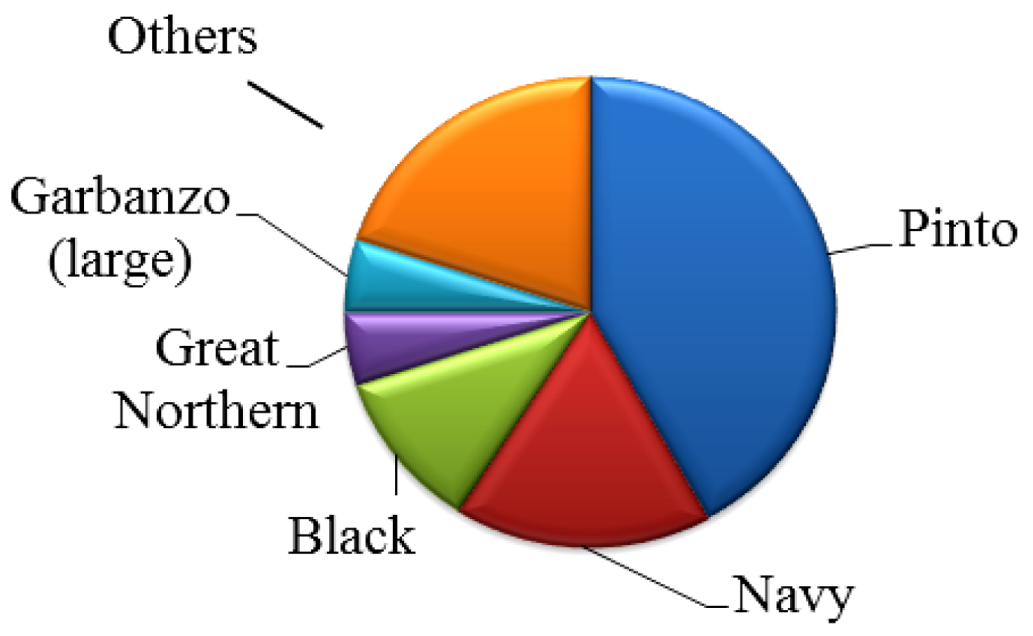
      <p>Dry beans (<italic>Phaseolus vulgaris</italic> L.) or common beans, have been characterized as a nearly perfect food because of their high protein, fiber, prebiotic, vitamin B, and chemically diverse micronutrient composition [<xref ref-type="bibr" rid="B1-agriculture-03-00090">1</xref>,<xref ref-type="bibr" rid="B2-agriculture-03-00090">2</xref>]. Dry beans can also be grown in a variety of eco-agricultural regions and distributed in multiple forms, such as whole unprocessed seeds, as part of mixes, canned products, or as a gluten free wheat flour substitute. As a result, dry beans are used throughout the world representing 50% of the grain legumes consumed as a human food source. Alternatively, overall US intake of dry beans is low despite links to reduced disease risks or states prevalent in western cultures, such as oxidative stress, inflammation, cancer, heart disease, and metabolic syndrome [<xref ref-type="bibr" rid="B3-agriculture-03-00090">3</xref>]. Of the 14 different market classes grown in the US, the pinto bean account for vast majority in terms of production (<xref ref-type="fig" rid="agriculture-03-00090-f001">Figure 1</xref>) and consumption [<xref ref-type="bibr" rid="B4-agriculture-03-00090">4</xref>]. Although all the market classes contain similar major components (protein, fat, carbohydrates, minerals), each have unique minor chemical profiles that can affect their functional food outcomes. Yet, dry beans are understudied with research programs remaining critically underfunded compared to other commodities. Therefore, the objective of this review is to provide information on dry beans as an important crop not only for the US agriculture sector (past and present) but as a potential functional food for western societies with an emphasis on pinto beans. </p>
      <fig id="agriculture-03-00090-f001" position="float">
        <label>Figure 1</label>
        <caption>
          <p>Market classes of dry beans produced (in total percent) (adapted from USDA data [<xref ref-type="bibr" rid="B4-agriculture-03-00090">4</xref>]). (Others include small white, light red kidney, dark red kidney, lima, black-eyed, cranberry, and pink.)</p>
        </caption>
        <graphic xmlns:xlink="http://www.w3.org/1999/xlink" xlink:href="agriculture-03-00090-g001.tif"/>
      </fig>
    </sec>
    <sec>
      <title>2. Agriculture Development of Dry Beans</title>
      <p>The dry bean is truly a “new world crop” originating 7000 years ago in two different parts of the North and South American continents [<xref ref-type="bibr" rid="B5-agriculture-03-00090">5</xref>,<xref ref-type="bibr" rid="B6-agriculture-03-00090">6</xref>]. The clear separation of the two domestication centers, <italic>i.e.</italic>, Mesoamerica (southern Mexico and Guatemala) and regions along the Andes mountain range (principally Peru and Columbia), resulted in the small seeded Mesoamerican beans and the large seeded Andean gene pools. The Mesoamerican beans spread northward during the next several millennia to what is now the US, Canada, and the Caribbean Islands whereas the Andes migrated throughout South America to the eastern coast. </p>
      <p>In the US, dry beans can be traced to 1300 AD, specifically in the northeast where they played an important role in the “three sisters” farming practices of the Native American Indians. As the middle sister to corn and squash, dry beans fixed nitrogen in the soil supplying fertilizer to its two sisters. Corn provided a trellis for the beans to grow while squash served as a cover crop preventing moisture, evaporation and weed pressure. The three sisters in combination provided most of the daily nutrients needed for a balanced diet. </p>
      <p>It was not until the 15–16th century that dry beans crossed the Atlantic Ocean. Spanish and Portuguese explorers first transported dry beans to Europe and Africa, respectively, where beans then spread rapidly to the rest of the world [<xref ref-type="bibr" rid="B2-agriculture-03-00090">2</xref>]. Dry beans have since evolved into multiple market classes and are grown/consumed in most parts of the world. Currently, Brazil is the No. 1 producer growing on average 3.2 million metric tons (mmt) followed by India, Myanmar, and China growing ~3.0 mmt, 1.7 mmt, and 1.2 mmt, respectively, on a per annual basis [<xref ref-type="bibr" rid="B7-agriculture-03-00090">7</xref>]. The US and Mexico fluctuate between the 5th and 6th position producing ~1.0 mmt of dry beans per year [<xref ref-type="bibr" rid="B7-agriculture-03-00090">7</xref>]. </p>
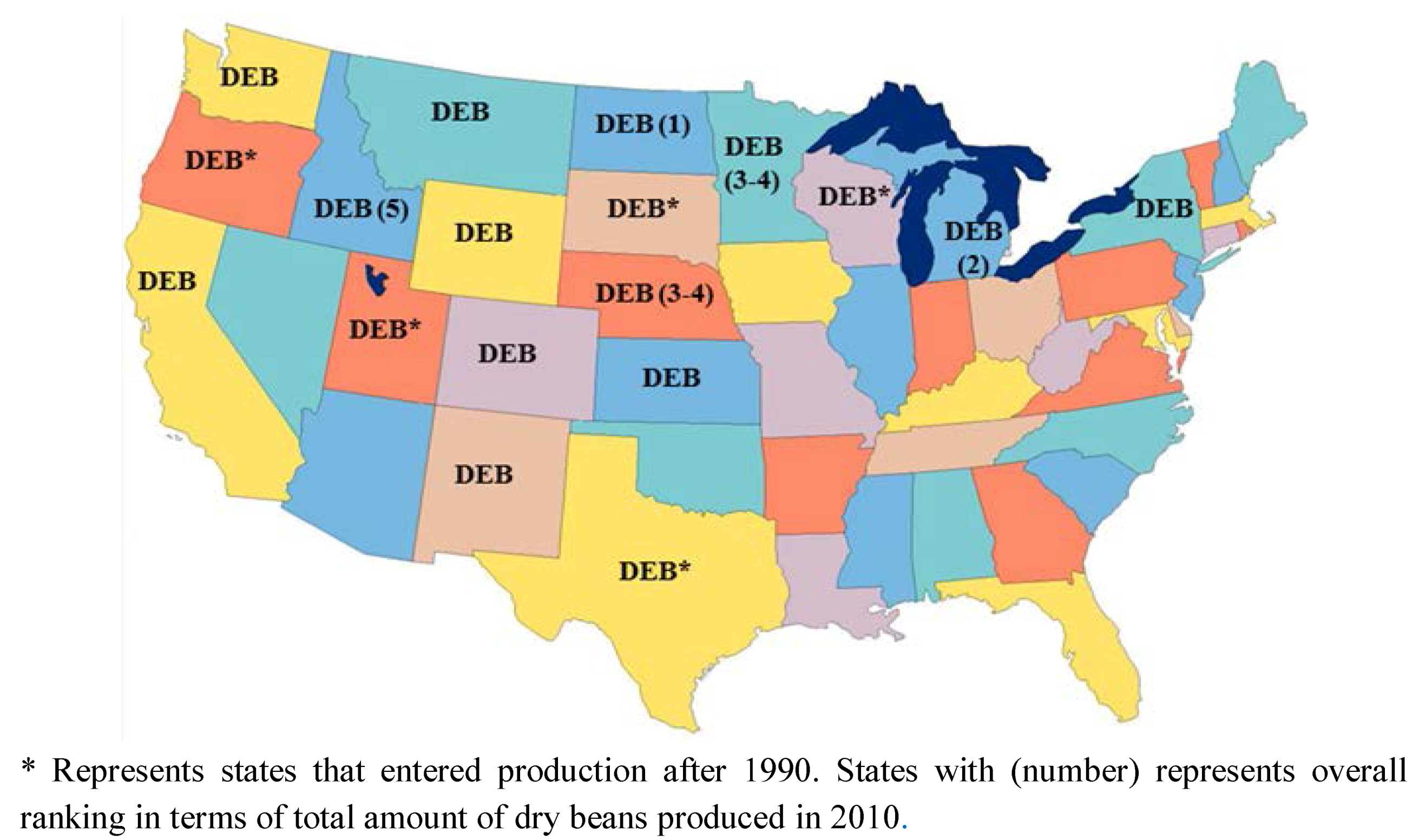
      <p>New York was the first US state on record to grow dry beans and was the leading producer from the 1800s until the early 1900s when Michigan assumed this position. Commercial production of dry beans is now scattered across 19 states with North Dakota, Michigan, Nebraska, Minnesota and Idaho being the leaders relative to total yields (<xref ref-type="fig" rid="agriculture-03-00090-f002">Figure 2</xref>). These states have remained in the top five positions for the last decade with Nebraska and Minnesota switching in the 3rd and 4th ranking depending on the year. Typically, Nebraska exceeds the other top ranking states in yield per acre. According to the USDA 2010 statistics [<xref ref-type="bibr" rid="B8-agriculture-03-00090">8</xref>], Nebraska produced on average 910 kg/acre (2010 lbs/acre) of dry beans followed by Idaho (860 kg/acre, 1900 lbs/acre), Michigan (820 kg/acre, 1800 lbs/acre), and North Dakota (657 kg/acre, 1490 lb/acre). Pinto beans account for the largest market class produced in the US and are grown in most of the dry bean growing states (<xref ref-type="fig" rid="agriculture-03-00090-f002">Figure 2</xref>) with the navy and black beans following a distance 2nd and 3rd [<xref ref-type="bibr" rid="B4-agriculture-03-00090">4</xref>,<xref ref-type="bibr" rid="B9-agriculture-03-00090">9</xref>,<xref ref-type="bibr" rid="B10-agriculture-03-00090">10</xref>] (<xref ref-type="fig" rid="agriculture-03-00090-f001">Figure 1</xref>).</p>
      <fig id="agriculture-03-00090-f002" position="float">
        <label>Figure 2</label>
        <caption>
          <p>States that produce dry beans [<xref ref-type="bibr" rid="B9-agriculture-03-00090">9</xref>]. </p>
        </caption>
        <graphic xmlns:xlink="http://www.w3.org/1999/xlink" xlink:href="agriculture-03-00090-g002.tif"/>
      </fig>
      <p>The dry bean is a staple food in Latin America, Africa, and India [<xref ref-type="bibr" rid="B11-agriculture-03-00090">11</xref>], but intake in the US and other western societies is substantially low in comparison. US consumption of dry beans is on average ~6.5 lbs (2.95 kg) per person per year with pinto beans again being the top choice. Whole pinto beans are usually purchased as canned pre-cooked or plastic packaged dry beans and are then taken to private homes where they are prepared as ingredients for other foods, such as soups, casseroles, Latin American dishes, or salads. Approximately 75%–80% of bean consumption takes place in the home, while the remaining 20%–25% occurs at restaurants, as fast foods, or in cafeterias [<xref ref-type="bibr" rid="B12-agriculture-03-00090">12</xref>]. Mexican Americans or other Hispanics are the highest consumers of pinto beans with equal intake occurring by men and women (31–50) regardless of ethnicity [<xref ref-type="bibr" rid="B3-agriculture-03-00090">3</xref>]. The rising Hispanic population has been credited with the mainstream consumption of all types of cooked beans in the US [<xref ref-type="bibr" rid="B12-agriculture-03-00090">12</xref>]. </p>
    </sec>
    <sec>
      <title>3. Composition of Dry Beans</title>
      <p>The compositional profile of dry beans in general, and pinto beans specifically, are included in this section to provide possible links to their disease protecting properties, as discussed in <xref ref-type="sec" rid="sec4-agriculture-03-00090">Section 4</xref>. Although a critical gap in knowledge exists on these mechanisms, dry beans currently hold two positions on the newly developed US MyPlate nutrition guide [<xref ref-type="bibr" rid="B13-agriculture-03-00090">13</xref>]. Firstly, dry beans are grouped with meat, fish, eggs, nuts as a high source of protein. Dry beans supply approximately 8%–10% of the daily recommended allowance of protein per 100 g serving of cooked beans with methionine being the only absent essential amino acid. Secondly, dry beans are categorized with the vegetable group due in part to their high fiber content. Dry beans are also composed of several types of prebiotics, including resistant starch (RS) and the fructooligosaccharides, stachyose and raffinose [<xref ref-type="bibr" rid="B14-agriculture-03-00090">14</xref>]. These compounds serve as substrates for bacterial fermentation in the human intestine, thereby influencing the microbial ecology of the gastrointestinal (GI) tract and gut metabolism [<xref ref-type="bibr" rid="B15-agriculture-03-00090">15</xref>,<xref ref-type="bibr" rid="B16-agriculture-03-00090">16</xref>]. Additionally, dry beans contain iron and calcium at levels that respectively fulfill ~11 and 2%–6% (100 g serving) of the daily reference intake (DRI) for a 2000 Calorie (kcal) diet. Of the vitamins, the B vitamins are present in particularly high levels. One cup of beans (225 g cooked) supplies ~74% of folic acid (vitamin B9) [<xref ref-type="bibr" rid="B17-agriculture-03-00090">17</xref>]. This nutrient supports multiple biological functions, including synthesis, repair and methylation of DNA, and acts as a cofactor in many reactions [<xref ref-type="bibr" rid="B18-agriculture-03-00090">18</xref>]. Folic acid is needed for healthy blood cell production to prevent anemia in children and adults [<xref ref-type="bibr" rid="B19-agriculture-03-00090">19</xref>]. In addition, one cup of beans provides ~30% of the DRI for vitamin B6 and at least 25% of the DRI for thiamin [<xref ref-type="bibr" rid="B17-agriculture-03-00090">17</xref>]. Lastly, dry beans (100 g cooked) contain vitamins A and C that account for 3%–8% of the DRI. <xref ref-type="table" rid="agriculture-03-00090-t001">Table 1</xref> shows the basic compositional profiles of the cited compounds relative to pinto beans. </p>
      <p>Considerable less fat-soluble nutrients are present in dry beans as total lipid levels are low (1%–2%). Still, the lipid fraction contains the essential vitamins, E and K. One cup of beans provides ~11% and ~5% DRI of Vitamin E and K, respectively [<xref ref-type="bibr" rid="B17-agriculture-03-00090">17</xref>]. Vitamin E is a potent antioxidant and anti-inflammatory agent with the isomers α-tocopherol and γ-tocopherol being the most abundant forms in dry beans [<xref ref-type="bibr" rid="B20-agriculture-03-00090">20</xref>,<xref ref-type="bibr" rid="B21-agriculture-03-00090">21</xref>,<xref ref-type="bibr" rid="B22-agriculture-03-00090">22</xref>]. Vitamin K intake is widely associated with bone health, but has been linked to anti-cancer properties [<xref ref-type="bibr" rid="B23-agriculture-03-00090">23</xref>,<xref ref-type="bibr" rid="B24-agriculture-03-00090">24</xref>,<xref ref-type="bibr" rid="B25-agriculture-03-00090">25</xref>,<xref ref-type="bibr" rid="B26-agriculture-03-00090">26</xref>]. Polyunsaturated fatty acids (PUFAs) represent another important lipid class of compounds present in dry beans, specifically the omega fatty acids (linoleic acid (<italic>n</italic>-6) (LA) and alpha linoleic acid (<italic>n</italic>-3) (ALA)) [<xref ref-type="bibr" rid="B27-agriculture-03-00090">27</xref>]. Epidemiologic studies have shown overall improvement in the health of individuals with coronary heart disease (CHD) when fed the alpha linolenic acid (<italic>n</italic>-3) (ALA) [<xref ref-type="bibr" rid="B28-agriculture-03-00090">28</xref>]. After absorption into a cell, LA is elongated and desaturated to arachidonic acid while ALA is elongated and desaturated into eicosapentaenoic acid (EPA) and then into docosahexaenoic acid (DHA). EPA and DHA are omega-3 fatty acids prevalent in fish that have received intense interest due to their cardioprotective and anti-inflammatory properties [<xref ref-type="bibr" rid="B29-agriculture-03-00090">29</xref>,<xref ref-type="bibr" rid="B30-agriculture-03-00090">30</xref>]. Leukotrienes, prostaglandins, and thromboxanes, metabolic products derived from AA are generally pro-inflammatory and proaggregatory agonists, while those derived from the ALA are able to inhibit platelet aggregation and inflammation. The latter mechanisms are involved in the prevention of cardiovascular disease (CVD), hypertension, type 2 diabetes, chronic obstructive pulmonary disease, among others [<xref ref-type="bibr" rid="B31-agriculture-03-00090">31</xref>]. In particular, pinto beans contain ~0.3 grams of ALA per 100 g of raw portion [<xref ref-type="bibr" rid="B32-agriculture-03-00090">32</xref>]. The fatty acid levels present in pinto beans are shown in <xref ref-type="table" rid="agriculture-03-00090-t001">Table 1</xref> based on their degree of saturation. (The reader is referred to Winham <italic>et al.</italic> [<xref ref-type="bibr" rid="B33-agriculture-03-00090">33</xref>] for compositional information relative to other types of dry beans.) </p>
      <table-wrap id="agriculture-03-00090-t001" position="float">
        <object-id pub-id-type="pii">agriculture-03-00090-t001_Table 1</object-id>
        <label>Table 1</label>
        <caption>
          <p>Nutritional components of raw and cooked pinto beans (USDA database [<xref ref-type="bibr" rid="B34-agriculture-03-00090">34</xref>]). </p>
        </caption>
        <table>
<thead>
            <tr>
              <th rowspan="2" align="center" valign="middle">Nutrient</th>
              <th colspan="2" style="border-bottom:solid thin" align="center" valign="middle">Value per 100 g</th>
            </tr>
            <tr>
              <th align="center" valign="middle">Raw</th>
              <th align="center" valign="middle">Cooked *</th>
            </tr>
          </thead>
          <tbody>
            <tr style="border-bottom:solid thin; border-top:solid thin" align="center">
              <td align="center" valign="middle"><bold>Proximates</bold></td>
              <td align="center" valign="middle"> </td>
              <td align="center" valign="middle"> </td>
            </tr>
            <tr>
              <td align="center" valign="middle">Energy</td>
              <td align="center" valign="middle">347.00 kcal</td>
              <td align="center" valign="middle">143.00 kcal</td>
            </tr>
            <tr>
              <td align="center" valign="middle">Protein</td>
              <td align="center" valign="middle">21.42 g</td>
              <td align="center" valign="middle">9.01 g</td>
            </tr>
            <tr>
              <td align="center" valign="middle">Total fat</td>
              <td align="center" valign="middle">1.23 g</td>
              <td align="center" valign="middle">0.65 g</td>
            </tr>
            <tr>
              <td align="center" valign="middle">Carbohydrate</td>
              <td align="center" valign="middle">62.55 g</td>
              <td align="center" valign="middle">26.22 g</td>
            </tr>
            <tr>
              <td align="center" valign="middle">Fiber, total dietary</td>
              <td align="center" valign="middle">15.50 g</td>
              <td align="center" valign="middle">9.00 g</td>
            </tr>
            <tr>
              <td align="center" valign="middle">Sugars, total</td>
              <td align="center" valign="middle">2.11 g</td>
              <td align="center" valign="middle">0.34 g</td>
            </tr>
            <tr style="border-bottom:solid thin; border-top:solid thin" align="center">
              <td align="center" valign="middle"><bold>Minerals</bold></td>
              <td align="center" valign="middle"> </td>
              <td align="center" valign="middle"> </td>
            </tr>
            <tr>
              <td align="center" valign="middle">Calcium (Ca)</td>
              <td align="center" valign="middle">113 mg</td>
              <td align="center" valign="middle">46 mg</td>
            </tr>
            <tr>
              <td align="center" valign="middle">Iron (Fe)</td>
              <td align="center" valign="middle">5 mg</td>
              <td align="center" valign="middle">2 mg</td>
            </tr>
            <tr>
              <td align="center" valign="middle">Magnesium (Mg)</td>
              <td align="center" valign="middle">176 mg</td>
              <td align="center" valign="middle">50 mg</td>
            </tr>
            <tr>
              <td align="center" valign="middle">Phosphorus (P)</td>
              <td align="center" valign="middle">411 mg</td>
              <td align="center" valign="middle">147 mg</td>
            </tr>
            <tr>
              <td align="center" valign="middle">Potassium (K)</td>
              <td align="center" valign="middle">1393 mg</td>
              <td align="center" valign="middle">436 mg</td>
            </tr>
            <tr>
              <td align="center" valign="middle">Sodium (Na)</td>
              <td align="center" valign="middle">12 mg</td>
              <td align="center" valign="middle">1 mg</td>
            </tr>
            <tr>
              <td align="center" valign="middle">Zinc (Zn)</td>
              <td align="center" valign="middle">2 mg</td>
              <td align="center" valign="middle">1 mg</td>
            </tr>
            <tr style="border-bottom:solid thin; border-top:solid thin" align="center">
              <td align="center" valign="middle"><bold>Vitamins</bold></td>
              <td align="center" valign="middle"> </td>
              <td align="center" valign="middle"> </td>
            </tr>
            <tr>
              <td align="center" valign="middle">Vitamin C (total ascorbic acid)</td>
              <td align="center" valign="middle">6.30 mg</td>
              <td align="center" valign="middle">0.80 mg</td>
            </tr>
            <tr>
              <td align="center" valign="middle">Thiamin</td>
              <td align="center" valign="middle">0.71 mg</td>
              <td align="center" valign="middle">0.19 mg</td>
            </tr>
            <tr>
              <td align="center" valign="middle">Riboflavin</td>
              <td align="center" valign="middle">0.21 mg</td>
              <td align="center" valign="middle">0.06 mg</td>
            </tr>
            <tr>
              <td align="center" valign="middle">Niacin</td>
              <td align="center" valign="middle">1.17 mg</td>
              <td align="center" valign="middle">0.32 mg</td>
            </tr>
            <tr>
              <td align="center" valign="middle">Vitamin B6</td>
              <td align="center" valign="middle">0.47 mg</td>
              <td align="center" valign="middle">0.23 mg</td>
            </tr>
            <tr>
              <td align="center" valign="middle">Folate, DFE</td>
              <td align="center" valign="middle">0.53 mg</td>
              <td align="center" valign="middle">0.17 mg</td>
            </tr>
            <tr>
              <td align="center" valign="middle">Vitamin E (alpha-tocopherol)</td>
              <td align="center" valign="middle">0.21 mg</td>
              <td align="center" valign="middle">0.94 mg</td>
            </tr>
            <tr>
              <td align="center" valign="middle">Vitamin K (phylloquinone)</td>
              <td align="center" valign="middle">5.6 μg</td>
              <td align="center" valign="middle">3.5 μg</td>
            </tr>
            <tr style="border-bottom:solid thin; border-top:solid thin" align="center">
              <td align="center" valign="middle"><bold>Lipids</bold></td>
              <td align="center" valign="middle"> </td>
              <td align="center" valign="middle"> </td>
            </tr>
            <tr>
              <td align="center" valign="middle">Fatty acids (total saturated)</td>
              <td align="center" valign="middle">0.24 g</td>
              <td align="center" valign="middle">0.12 g</td>
            </tr>
            <tr>
              <td align="center" valign="middle">Fatty acids (total monounsaturated)</td>
              <td align="center" valign="middle">0.23 g</td>
              <td align="center" valign="middle">0.13 g</td>
            </tr>
            <tr>
              <td align="center" valign="middle">Fatty acids (total polyunsaturated)</td>
              <td align="center" valign="middle">0.41 g</td>
              <td align="center" valign="middle">0.24 g</td>
            </tr>
          </tbody>
        </table>
    <table-wrap-foot>
      <fn>
        <p>* without addition of salt.</p>
      </fn>
    </table-wrap-foot>	  
	  </table-wrap>
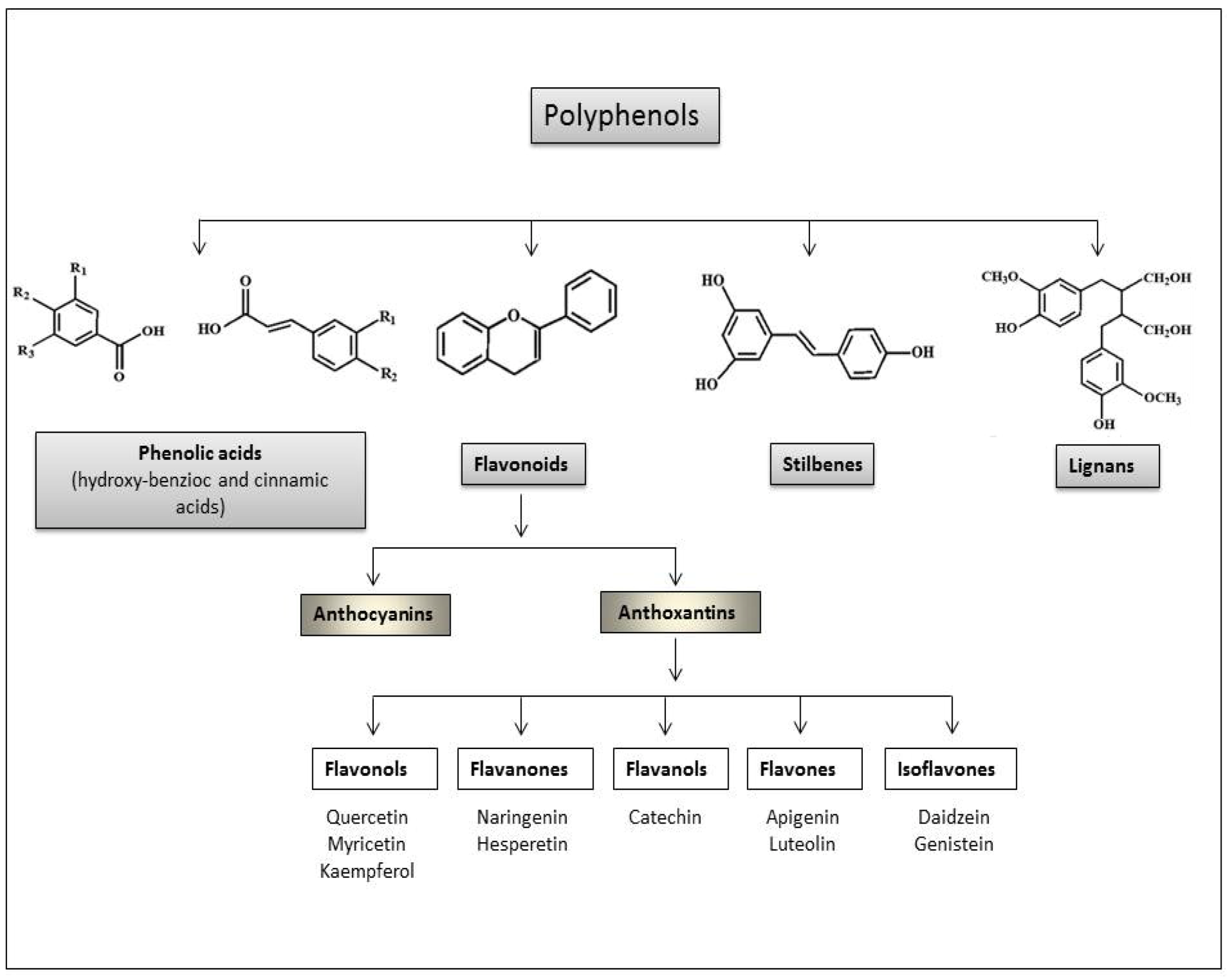
      <p>In addition to the nutrients described previously, other phytochemicals are present in dry beans but at low levels (parts per million or parts per billion). Nonetheless, these phytochemicals (phenolic compounds, lignins, lectins, and trypsin inhibitors) exert potent protective properties against multiple chronic conditions with the phenols playing a major role [<xref ref-type="bibr" rid="B35-agriculture-03-00090">35</xref>,<xref ref-type="bibr" rid="B36-agriculture-03-00090">36</xref>,<xref ref-type="bibr" rid="B37-agriculture-03-00090">37</xref>,<xref ref-type="bibr" rid="B38-agriculture-03-00090">38</xref>,<xref ref-type="bibr" rid="B39-agriculture-03-00090">39</xref>,<xref ref-type="bibr" rid="B40-agriculture-03-00090">40</xref>]. <xref ref-type="fig" rid="agriculture-03-00090-f003">Figure 3</xref> illustrates the different classes phenols based on their chemical structures. As over 8000 structurally distinct phenols have been identified [<xref ref-type="bibr" rid="B41-agriculture-03-00090">41</xref>], numerous quantities and combinations can arise affecting their physiochemical characteristics and thus their bioavailability and biological targets [<xref ref-type="bibr" rid="B42-agriculture-03-00090">42</xref>,<xref ref-type="bibr" rid="B43-agriculture-03-00090">43</xref>]. Phenolic acids are a subclass of the phenolic compounds that contain at least one aromatic ring and one hydroxyl group (<xref ref-type="fig" rid="agriculture-03-00090-f003">Figure 3</xref>). Flavonoids are the largest subclass of polyphenols in the human diet and are characterized by two or more aromatic rings containing at least one hydroxyl group in each and connected with a heterocyclic pyran (<xref ref-type="fig" rid="agriculture-03-00090-f003">Figure 3</xref>). Flavonoids can be sub-divided further into two main groups, anthocyanins (glycosylated derivative of anthocyanidin) and anthoxanthins (<xref ref-type="fig" rid="agriculture-03-00090-f003">Figure 3</xref>). Anthoxanthins are composed of several categories, such as flavones, flavanones, flavonols, flavanols, isoflavones and their glycosides [<xref ref-type="bibr" rid="B44-agriculture-03-00090">44</xref>]. It was generally believed that the phenols exerted their health benefit by directly scavenging free radicals or reactive oxygen species (ROS) or chelating of redox metals, but these properties are now largely attributed to the phenols’ ability to act as signaling agents of cellular endogenous responses [<xref ref-type="bibr" rid="B36-agriculture-03-00090">36</xref>,<xref ref-type="bibr" rid="B45-agriculture-03-00090">45</xref>]. </p>
      <fig id="agriculture-03-00090-f003" position="float">
        <label>Figure 3</label>
        <caption>
          <p>Classification and structure of the main polyphenols classes (adapted from [<xref ref-type="bibr" rid="B46-agriculture-03-00090">46</xref>,<xref ref-type="bibr" rid="B47-agriculture-03-00090">47</xref>]).</p>
        </caption>
        <graphic xmlns:xlink="http://www.w3.org/1999/xlink" xlink:href="agriculture-03-00090-g003.tif"/>
      </fig>
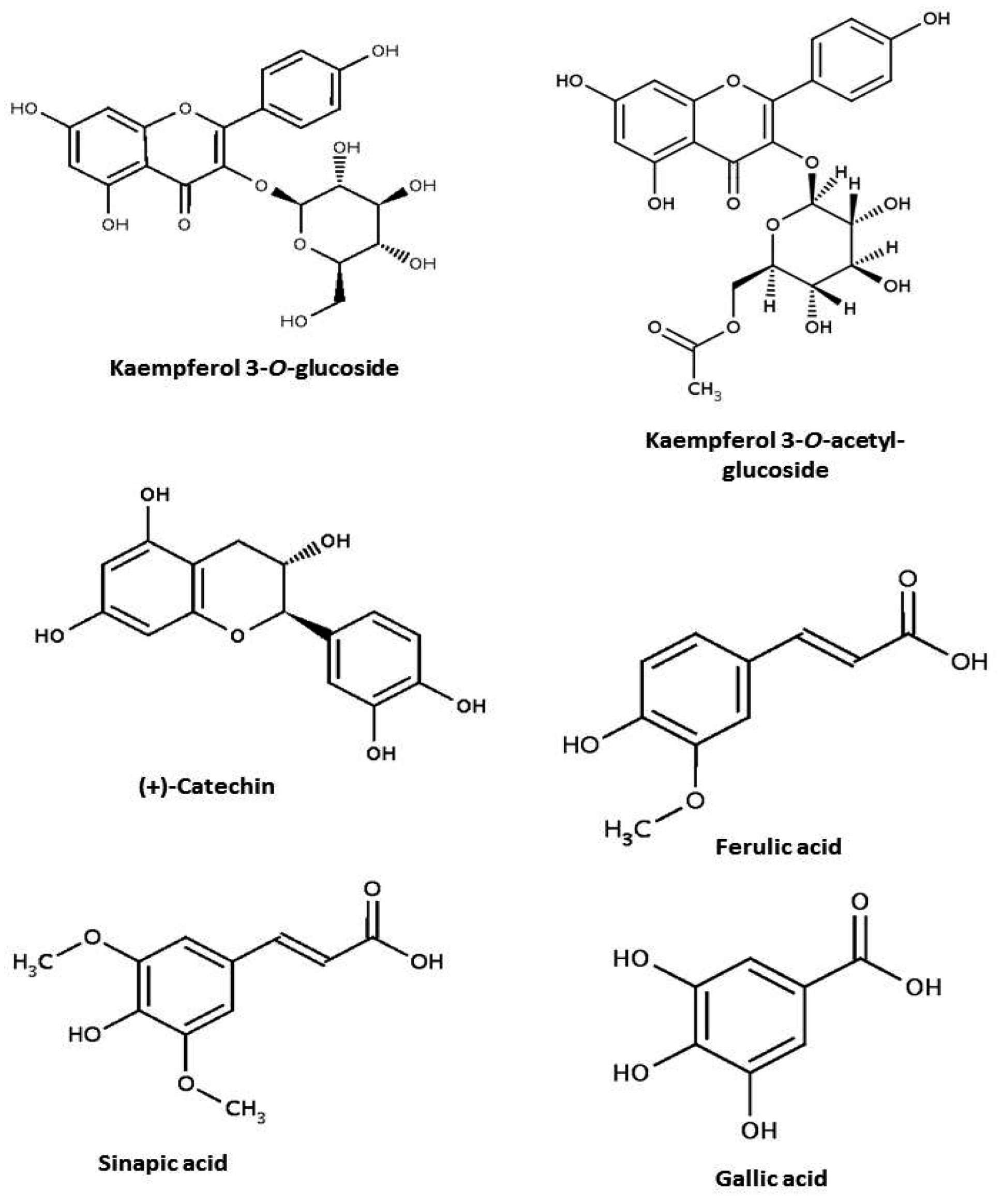
      <p>All plant based systems contain phenolic compounds, but these compounds are typically more diverse and abundant in fruits, vegetables, leaves, and seeds [<xref ref-type="bibr" rid="B48-agriculture-03-00090">48</xref>]. However, dry beans contain various types and quantities of phenolic compounds depending on the market class [<xref ref-type="bibr" rid="B49-agriculture-03-00090">49</xref>,<xref ref-type="bibr" rid="B50-agriculture-03-00090">50</xref>,<xref ref-type="bibr" rid="B51-agriculture-03-00090">51</xref>,<xref ref-type="bibr" rid="B52-agriculture-03-00090">52</xref>,<xref ref-type="bibr" rid="B53-agriculture-03-00090">53</xref>]. As such, different bean market classes can possess different functional food properties. Thompson <italic>et al.</italic> [<xref ref-type="bibr" rid="B52-agriculture-03-00090">52</xref>] showed that cooked bean powders isolated from different market classes were able to reduce cancer tumors in rats, but the response differed based on the type of bean. The response did not correlate to the amount of total phenols present, but rather to the domestication origin of the bean suggesting that the type or combination of bioactive agents were as important if not more so than the quantity. Moreover, as secondary metabolites, phenols can be impacted by the level of stress (environment, farming practices, production location) potentially altering their phenolic compositional profile on a lot to lot basis [<xref ref-type="bibr" rid="B54-agriculture-03-00090">54</xref>]. The pinto bean is especially high in the phenols shown in <xref ref-type="fig" rid="agriculture-03-00090-f004">Figure 4</xref> and listed in <xref ref-type="table" rid="agriculture-03-00090-t002">Table 2</xref> [<xref ref-type="bibr" rid="B55-agriculture-03-00090">55</xref>,<xref ref-type="bibr" rid="B56-agriculture-03-00090">56</xref>]. Additionally, dry beans contain lignin, an indigestible component that cross-links with phenolic compounds changing their structure and solubility [<xref ref-type="bibr" rid="B57-agriculture-03-00090">57</xref>]. Lignins have been shown to promote gastrointestinal health [<xref ref-type="bibr" rid="B58-agriculture-03-00090">58</xref>]. It also must be noted that dry beans are composed of anti-nutrients (phytates, tannins, lectins, protease, a-amylase inhibitors, saponins, among others), although many have been associated with human health benefits [<xref ref-type="bibr" rid="B59-agriculture-03-00090">59</xref>]. For example, phytate has been linked to anticancer activity [<xref ref-type="bibr" rid="B60-agriculture-03-00090">60</xref>], but it also binds cations (<italic>i.e.</italic>, iron and zinc) negatively impacting mineral bioavailability in the intestinal lumen [<xref ref-type="bibr" rid="B61-agriculture-03-00090">61</xref>]. </p>
      <fig id="agriculture-03-00090-f004" position="float">
        <label>Figure 4</label>
        <caption>
          <p>Structure of pinto based phenols (from ChEBI database [<xref ref-type="bibr" rid="B62-agriculture-03-00090">62</xref>]).</p>
        </caption>
        <graphic xmlns:xlink="http://www.w3.org/1999/xlink" xlink:href="agriculture-03-00090-g004.tif"/>
      </fig>
      <table-wrap id="agriculture-03-00090-t002" position="float">
        <object-id pub-id-type="pii">agriculture-03-00090-t002_Table 2</object-id>
        <label>Table 2</label>
        <caption>
          <p>Main phenolic compounds present in pinto beans. </p>
        </caption>
        <table>
          <thead>
            <tr>
              <th align="center" valign="middle">Class</th>
              <th align="center" valign="middle">Subclass</th>
              <th align="center" valign="middle">Content (mg/100g)</th>
              <th align="center" valign="middle">Reference</th>
            </tr>
          </thead>
          <tbody>
            <tr>
              <td rowspan="4" align="center" valign="middle">Phenolic acids</td>
              <td align="center" valign="middle">p-coumaric acid</td>
              <td align="center" valign="middle">4.9 <sup>a</sup></td>
              <td rowspan="4" align="center" valign="middle">Luthria &amp; Pastor-Corrales [<xref ref-type="bibr" rid="B63-agriculture-03-00090">63</xref>]</td>
            </tr>
            <tr>
              <td align="center" valign="middle">Ferulic acid</td>
              <td align="center" valign="middle">18.0 <sup>a</sup></td>
            </tr>
            <tr>
              <td align="center" valign="middle">Sinapic acid</td>
              <td align="center" valign="middle">7.8 <sup>a</sup></td>
            </tr>
            <tr>
              <td align="center" valign="middle">Gallic acid</td>
              <td align="center" valign="middle">8.7</td>
            </tr>
            <tr>
              <td rowspan="2" align="center" valign="middle">Flavonols</td>
              <td align="center" valign="middle">Kaempferol 3-<italic>O</italic>-glucoside</td>
              <td align="center" valign="middle">14.8</td>
              <td rowspan="2" align="center" valign="middle">Xu &amp; Chang [<xref ref-type="bibr" rid="B11-agriculture-03-00090">11</xref>]</td>
            </tr>
            <tr>
              <td align="center" valign="middle">Kaempferol 3-<italic>O</italic>-acetylglucoside</td>
              <td align="center" valign="middle">3.0</td>
            </tr>
          </tbody>
        </table>
    <table-wrap-foot>
      <fn>
        <p><sup>a</sup> mean of three varieties.</p>
      </fn>
    </table-wrap-foot>
	 </table-wrap>
    </sec>
    <sec id="sec4-agriculture-03-00090">
      <title>4. Functional Food Properties of Pinto Beans: Protection against Chronic Cellular Stresses/Diseases</title>
      <p>Chronic conditions such as diabetes, cancer, and heart disease are becoming more prevalent among all ages and ethnic groups throughout the US and other western societies resulting in global economic burdens reaching the $USD trillions [<xref ref-type="bibr" rid="B64-agriculture-03-00090">64</xref>]. A possible contributor to these debilitating diseases may lie in the consumption of overly processed foods and the high cereal:legume consumption ratio that has emerged in the US over the last 60 years. Instead of the recommended 2 cereal:1 legume ratio for optimal consumption, the ratio has reached 8 or 9:1. Moreover, epidemiology studies have shown positive links between legume (bean) rich diets, such as increased longevity [<xref ref-type="bibr" rid="B65-agriculture-03-00090">65</xref>], heart health [<xref ref-type="bibr" rid="B66-agriculture-03-00090">66</xref>,<xref ref-type="bibr" rid="B67-agriculture-03-00090">67</xref>], and reduced risks for many types of cancers [<xref ref-type="bibr" rid="B68-agriculture-03-00090">68</xref>,<xref ref-type="bibr" rid="B69-agriculture-03-00090">69</xref>,<xref ref-type="bibr" rid="B70-agriculture-03-00090">70</xref>,<xref ref-type="bibr" rid="B71-agriculture-03-00090">71</xref>,<xref ref-type="bibr" rid="B72-agriculture-03-00090">72</xref>]. As the pinto bean is the most commonly consumed dry bean in the Americas, this section provides a brief review of the limited but seminal studies on the functional food properties of this market class. A summary of the discussed studies are also shown in <xref ref-type="table" rid="agriculture-03-00090-t003">Table 3</xref>.</p>
      <sec>
        <title>4.1. Oxidative Stress</title>
        <p>Reactive oxygen species (ROS) and other oxidative agents are produced by physiological and biochemical processes that are critical to human health. Oxidative stress occurs when the production of oxidants is offset by the ability of the cell to readily detoxify these agents. Elevated ROS levels can damage cellular lipids, proteins, and DNA, potentially leading to a variety of chronic conditions or diseases, including CVD and atherosclerosis, hypertension, diabetes and Alzheimer's disease [<xref ref-type="bibr" rid="B73-agriculture-03-00090">73</xref>,<xref ref-type="bibr" rid="B74-agriculture-03-00090">74</xref>]. Phenols protect against cellular oxidative caused by inflammation, microbial infection, dietary habits and other effects [<xref ref-type="bibr" rid="B75-agriculture-03-00090">75</xref>,<xref ref-type="bibr" rid="B76-agriculture-03-00090">76</xref>] by several possible mechanisms, including scavenging free radicals, inhibiting or activating redox enzymes, or acting as metal chelators [<xref ref-type="bibr" rid="B77-agriculture-03-00090">77</xref>]. The phenols are typically less potent than pharmaceutical drugs, but most likely exert their long-term physiological effects by their frequent consumption as they are widely distributed in a variety of foods. </p>
      <table-wrap id="agriculture-03-00090-t003" position="float">
        <object-id pub-id-type="pii">agriculture-03-00090-t003_Table 3</object-id>
        <label>Table 3</label>
        <caption>
          <p>Summary of studies on pinto beans and health promotion. </p>
        </caption>
        <table rules="rows">
          <thead>
            <tr>
              <th align="center" valign="middle">Stress-disease</th>
              <th align="center" valign="middle">Model</th>
              <th align="center" valign="middle">Treatment</th>
              <th align="center" valign="middle">Dosage</th>
              <th align="center" valign="middle">Main Outcomes</th>
              <th align="center" valign="middle">References</th>
            </tr>
           </thead>
          <tbody>
            <tr>
              <td align="center" valign="middle">Oxidative stress and inflammation</td>
              <td align="center" valign="middle"><italic>In vitro</italic> (ORAC, COX and 150 LOX kits)</td>
              <td align="center" valign="middle">Hulls extracts from pinto and three types of beans</td>
              <td align="center" valign="middle">Pinto beans-158.20 mg/g <sup>a </sup>of total phenols and 3.04 mg/g of flavonols <sup>b</sup></td>
              <td align="center" valign="middle">Total phenolic content and antioxidant activity of bean hulls were 6–8-fold higher than in whole beans. Extracts from pinto beans exhibited highest antioxidant capacity. Black and pinto beans exhibited the strongest COX-1 and COX-2 inhibitory effects. Pinto showed the strongest LOX inhibitory effect.</td>
              <td align="center" valign="middle">Oomah <italic>et al.</italic> [<xref ref-type="bibr" rid="B56-agriculture-03-00090">56</xref>]</td>
            </tr>
            <tr>
              <td align="center" valign="middle">Cancer and CVD</td>
              <td align="center" valign="middle">40 men and 40 women aged 18–55 y with or without pre MetS</td>
              <td align="center" valign="middle">cooked pinto beans</td>
              <td align="center" valign="middle">1/2 cup (130 g) of beans per day for 12 weeks</td>
              <td align="center" valign="middle">Propionate production was higher in treated groups than in control group. <italic>Eubacterium limosum</italic> was 50% lower in response bean consumption. Beans intake associated with lower blood total cholesterol in the controls (8%) and the pre-MetS group (4%). Bean consumption also resulted in lowered serum HDL-C and LDL-C in both groups.</td>
              <td align="center" valign="middle">Finley <italic>et al.</italic> [<xref ref-type="bibr" rid="B16-agriculture-03-00090">16</xref>]</td>
            </tr>
            <tr>
              <td align="center" valign="middle">CVD and diabetes mellitus</td>
              <td align="center" valign="middle">mildly insulin resistant adults (7 men, 9 women)</td>
              <td align="center" valign="middle">cooked pinto beans</td>
              <td align="center" valign="middle">1/2 cup of beans daily for 8 weeks</td>
              <td align="center" valign="middle">Reduction of serum TC and LDL-C concentrations by over 8%.</td>
              <td align="center" valign="middle">Winham <italic>et al.</italic> [<xref ref-type="bibr" rid="B78-agriculture-03-00090">78</xref>]</td>
            </tr>
            <tr>
              <td align="center" valign="middle">Oxidative stress and bone resorption</td>
              <td align="center" valign="middle">12-month-old male C57BL/6 mice</td>
              <td align="center" valign="middle">bean hull extract</td>
              <td align="center" valign="middle">400 or 800 mg/kg for 3 months</td>
              <td align="center" valign="middle">BHE showed high antioxidant activity and its supplementation for 3 months decreased serum concentration of a bone resorption marker, and increased bone mineral density and trabecular thickness in the L3 vertebra in mice.</td>
              <td align="center" valign="middle">Cao <italic>et al.</italic> [<xref ref-type="bibr" rid="B77-agriculture-03-00090">77</xref>]</td>
            </tr>
            <tr>
              <td align="center" valign="middle">Colon cancer</td>
              <td align="center" valign="middle">5 week old male F344 rats</td>
              <td align="center" valign="middle">Cooked pinto beans</td>
              <td align="center" valign="middle">Adjusted with beans to 18 g of protein/100 g of diet</td>
              <td align="center" valign="middle">Carcinogen azoxymethane induced rats fed a pinto bean rich diet had lower colon adenocarcinoma and tumor multiplicity.</td>
              <td align="center" valign="middle">Hughes <italic>et al.</italic> [<xref ref-type="bibr" rid="B69-agriculture-03-00090">69</xref>]</td>
            </tr>
            <tr>
              <td align="center" valign="middle">Oxidative stress and cancer cell proliferation</td>
              <td align="center" valign="middle">Human gastric adenocarcinoma AGS cells (CAA assay) and 9 human cancer cell lines (anti-proliferation assays)</td>
              <td align="center" valign="middle">Phenolic extracts from dry matured seeds of 13 food legumes, including pinto beans</td>
              <td align="center" valign="middle">0.125, 0.25, 0.5, 1, 2, and 5 mg/mL of phenolic extract</td>
              <td align="center" valign="middle">Pinto beans, lentil and other beans exhibited dose-dependent inhibitory effects on cell proliferation of all tested cancer cell lines. Pinto beans showed the second strongest anti-proliferative activity of all analyzed legumes. Black soybean exhibited the greatest CAA with the lowest IC<sub>50</sub> value followed by black bean and pinto bean.</td>
              <td align="center" valign="middle">Xu &amp; Chang [<xref ref-type="bibr" rid="B79-agriculture-03-00090">79</xref>]</td>
            </tr>
            <tr>
              <td align="center" valign="middle">Oxidative stress and inflammation</td>
              <td align="center" valign="middle">macrophage cell line, RAW 264.7</td>
              <td align="center" valign="middle">Protein hydrolysates Negro 8025 and Pinto Durango beans</td>
              <td align="center" valign="middle">0.5–200 μM (based on soluble protein)</td>
              <td align="center" valign="middle">Hydrolysates of both varieties inhibited inflammation by modulation of NF-κB pathways (reducing its transactivation and the nuclear translocation of p65 subunit)</td>
              <td align="center" valign="middle">Oseguera-Toledo <italic>et al.</italic> [<xref ref-type="bibr" rid="B80-agriculture-03-00090">80</xref>]</td>
            </tr>
            <tr>
              <td align="center" valign="middle">Cardiovascular health</td>
              <td align="center" valign="middle">Normal young men</td>
              <td align="center" valign="middle">Canned pinto beans</td>
              <td align="center" valign="middle">450 g/day</td>
              <td align="center" valign="middle">Average reduction in cholesterol levels (10%).</td>
              <td align="center" valign="middle">Shutler <italic>et al.</italic> [<xref ref-type="bibr" rid="B81-agriculture-03-00090">81</xref>]</td>
            </tr>
            <tr>
              <td align="center" valign="middle">Cardiovascular health</td>
              <td align="center" valign="middle">Hyperlipidemic men</td>
              <td align="center" valign="middle">Whole pinto beans</td>
              <td align="center" valign="middle">120–162 g/day</td>
              <td align="center" valign="middle">Average reduction in serum cholesterol levels (10.4%).</td>
              <td align="center" valign="middle">Anderson <italic>et al.</italic> [<xref ref-type="bibr" rid="B82-agriculture-03-00090">82</xref>]</td>
            </tr>
            <tr>
              <td align="center" valign="middle">Blood glucose levels</td>
              <td align="center" valign="middle"><italic>In vitro</italic> digestibility</td>
              <td align="center" valign="middle">Pinto Bean Starches</td>
              <td align="center" valign="middle">Not applicable</td>
              <td align="center" valign="middle">Pinto bean digested at a slower rate compared to faba beans, which may be more effective in controlling glucose levels.</td>
              <td align="center" valign="middle">Ambigaipalan <italic>et al.</italic> [<xref ref-type="bibr" rid="B83-agriculture-03-00090">83</xref>]</td>
            </tr>
            <tr>
              <td align="center" valign="middle">Gastrointestinal health</td>
              <td align="center" valign="middle"><italic>In vitro</italic> fermentation</td>
              <td align="center" valign="middle">Polysaccharides from cooked pinto beans</td>
              <td align="center" valign="middle">Not applicable</td>
              <td align="center" valign="middle">Higher production of SCFA and altered pH.</td>
              <td align="center" valign="middle">Campos-Vega <italic>et al.</italic> [<xref ref-type="bibr" rid="B84-agriculture-03-00090">84</xref>]</td>
            </tr>
          </tbody>
        </table>
    <table-wrap-foot>
      <fn>
        <p>ORAC: oxygen radical absorbance capacity; COX: cyclooxygenase; LOX: lipooxygenase; HDL-C: High density lipoprotein-cholesterol; LDL-C: low density lipoprotein-cholesterol; TC: total cholesterol; BHE: bean hull extract, <sup>a</sup> milligram equivalents of (+)-catechin per gram of sample; <sup>b</sup> milligram equivalents of quercetin per gram of sample. CAA = cellular antioxidant activity; NF-κB: nuclear factor-kappa B; SCFA = short chain fatty acids. </p>
      </fn>
    </table-wrap-foot>	  
	  </table-wrap>
        <p>Considering their high phenol content [<xref ref-type="bibr" rid="B53-agriculture-03-00090">53</xref>,<xref ref-type="bibr" rid="B85-agriculture-03-00090">85</xref>], the pinto bean as well as other dry beans, probably promotes health in part via antioxidative mechanisms. Xu and Chang [<xref ref-type="bibr" rid="B79-agriculture-03-00090">79</xref>] reported that black soybean, black bean, and pinto bean exerted the highest antioxidant capacity of the 13 legumes analyzed in the study. Beninger and Hosfield [<xref ref-type="bibr" rid="B49-agriculture-03-00090">49</xref>] showed that pure flavonoid (anthocyanins, quercetin glycosides, and proanthocyanidins) isolated from 12 different seed coats of dry beans had significant higher antioxidant activity compared to the Fe<sup>2+</sup> control with the notable exception of kaempferol 3-<italic>O</italic>-glycoside. Using a mice model, Cao <italic>et al.</italic> [<xref ref-type="bibr" rid="B77-agriculture-03-00090">77</xref>] showed that pinto bean hulls with the highest antioxidative activity positively impacted markers for healthy bone metabolism, <italic>i.e.</italic>, such as decreased bone resorption. It must be noted that the antioxidant capacity of beans can be affected by processing or cooking. Xu and Chang [<xref ref-type="bibr" rid="B11-agriculture-03-00090">11</xref>] demonstrated that steamed pinto and black beans exerted higher antioxidant activities compared to those boiled in water. These results were attributed to lower losses of total phenols, individual anthocyanins, individual flavan-3-ols, flavonols, and total flavonols to the water.</p>
      </sec>
      <sec>
        <title>4.2. Inflammation</title>
        <p>Acute inflammation is initiated when infections or tissue damage is recognized by specific receptors in the body [<xref ref-type="bibr" rid="B86-agriculture-03-00090">86</xref>]. Immune cells migrate to the repair site to combat the infection and repair the damage [<xref ref-type="bibr" rid="B87-agriculture-03-00090">87</xref>]. During the inflammatory response, multiple chemical mediators are produced and/or activated, including, but limited to, interleukins (IL), nuclear factor kappa-light-chain-enhancer of activated B cells (NF-κB), tumor necrosis factor-α (TNF-α), cyclooxygenase (COX), prostaglandin E<sub>2</sub> (PGE<sub>2</sub>), inducible nitric oxide synthase (iNOS), and nitric oxide (NO). NF-κB mediates the transcription of many of the pro-inflammatory mediators, including iNOS, COX-2, TNF-α and IL-1β, -6 and -8 [<xref ref-type="bibr" rid="B80-agriculture-03-00090">80</xref>,<xref ref-type="bibr" rid="B81-agriculture-03-00090">81</xref>,<xref ref-type="bibr" rid="B82-agriculture-03-00090">82</xref>,<xref ref-type="bibr" rid="B88-agriculture-03-00090">88</xref>,<xref ref-type="bibr" rid="B89-agriculture-03-00090">89</xref>,<xref ref-type="bibr" rid="B90-agriculture-03-00090">90</xref>,<xref ref-type="bibr" rid="B91-agriculture-03-00090">91</xref>,<xref ref-type="bibr" rid="B92-agriculture-03-00090">92</xref>,<xref ref-type="bibr" rid="B93-agriculture-03-00090">93</xref>,<xref ref-type="bibr" rid="B94-agriculture-03-00090">94</xref>,<xref ref-type="bibr" rid="B95-agriculture-03-00090">95</xref>,<xref ref-type="bibr" rid="B96-agriculture-03-00090">96</xref>,<xref ref-type="bibr" rid="B97-agriculture-03-00090">97</xref>,<xref ref-type="bibr" rid="B98-agriculture-03-00090">98</xref>]. However, if acute inflammation is not stopped, it can progress into self-perpetuating chronic inflammation that can progress into a host of diseases [<xref ref-type="bibr" rid="B88-agriculture-03-00090">88</xref>]. Chronic inflammation can be sustained by diet, pharmacologic substances, unresolved infections, and environmental pollutants. The drugs used to treat acute inflammation, such as steroidal anti-inflammatory drugs, have not been completely effective against the chronic inflammatory condition and can cause side effects, but food components including vitamins and flavonoids can counteract this effect [<xref ref-type="bibr" rid="B74-agriculture-03-00090">74</xref>]. Many anti-inflammatory mechanisms have been associated with flavonoids [<xref ref-type="bibr" rid="B91-agriculture-03-00090">91</xref>,<xref ref-type="bibr" rid="B92-agriculture-03-00090">92</xref>,<xref ref-type="bibr" rid="B93-agriculture-03-00090">93</xref>,<xref ref-type="bibr" rid="B94-agriculture-03-00090">94</xref>] (<xref ref-type="table" rid="agriculture-03-00090-t004">Table 4</xref>). </p>
        <p>As such, the pinto bean may act as an effective anti-inflammatory functional food again due to its anti-oxidative properties [<xref ref-type="bibr" rid="B8-agriculture-03-00090">8</xref>]. Oomah, Corbe and Balasubramanian [<xref ref-type="bibr" rid="B56-agriculture-03-00090">56</xref>] analyzed four types of dry beans, including pinto beans, and reported that the hull extracts were able to inhibit the proinflammatory mediators, COX 1 and COX 2, and lipoxygenase. This effect was attributed to the ability of hull based phenols to stop the formation of inflammatory sustaining ROS. However, the antioxidant activity may not be the only means by which beans stop chronic inflammation. In another study using common beans, Oseguera-Toledo <italic>et al.</italic> [<xref ref-type="bibr" rid="B80-agriculture-03-00090">80</xref>] assessed the antioxidant capacity and anti-inflammatory properties of protein hydrolysates derived from two bean cultivars, Negro 8025 and Pinto Durango. More specifically, the objective of the study was to evaluate the effect of the bean hydrolysates on NO and PGE<sub>2</sub> production as well as iNOS and COX-2 expression in lipopolysaccaride-induced RAW 264.7 macrophages. The results showed that the hydrolysates of both bean varieties inhibited inflammation by modulating the NF-κB pathway (reducing its transactivation and the nuclear translocation of p65 subunit). </p>
        <table-wrap id="agriculture-03-00090-t004" position="float">
          <object-id pub-id-type="pii">agriculture-03-00090-t004_Table 4</object-id>
          <label>Table 4</label>
          <caption>
            <p>Anti-inflammatory mechanisms of flavonoids (adapted from Garcia-Lafuente <italic>et al.</italic> [<xref ref-type="bibr" rid="B91-agriculture-03-00090">91</xref>]).</p>
          </caption>
          <table>
            <thead>
              <tr>
                <th align="center" valign="middle">Activity</th>
                <th align="center" valign="middle">Mechanism</th>
                <th align="center" valign="middle">Consequence</th>
              </tr>
            </thead>
            <tbody>
              <tr>
                <td rowspan="3" align="center" valign="middle">Antioxidant activity</td>
                <td align="center" valign="middle">- Radical scavenging</td>
                <td rowspan="3" align="center" valign="middle">Reduction of free radicals and lipid peroxidation</td>
              </tr>
              <tr>
                <td align="center" valign="middle">- ROS generation inhibition- Pro</td>
              </tr>
              <tr>
                <td align="center" valign="middle">-oxidant enzyme inhibition</td>
              </tr>
              <tr>
                <td rowspan="2" align="center" valign="middle">Modulation of inflammatory cells</td>
                <td align="center" valign="middle">- Modulation of enzymatic activitys</td>
                <td rowspan="2" align="center" valign="middle">Reduction of inflammatory cells activation</td>
              </tr>
              <tr>
                <td align="center" valign="middle">- Modulation of secretory processe</td>
              </tr>
              <tr>
                <td rowspan="2" align="center" valign="middle">Modulation of proinflammatory enzymes</td>
                <td align="center" valign="middle">- Inhibition of arachidonic acid enzymes</td>
                <td rowspan="2" align="center" valign="middle">Reduction of inflammatory mediators (NO, leukotrienes, prostaglandins)</td>
              </tr>
              <tr>
                <td align="center" valign="middle">- Inhibition of NO synthase</td>
              </tr>
              <tr>
                <td align="center" valign="middle">Modulation of proinflammatory mediators</td>
                <td align="center" valign="middle">Modulation of cytokine production</td>
                <td align="center" valign="middle">Reduction of inflammatory cytokines (TNF-α, interleukins)</td>
              </tr>
              <tr>
                <td align="center" valign="middle">Modulation of proinflammatory gene expression</td>
                <td align="center" valign="middle">Modulation of signal transduction</td>
                <td align="center" valign="middle">Reduction of proinflammatory gene transcription</td>
              </tr>
            </tbody>
          </table>
        </table-wrap>
      </sec>
      <sec id="sec4dot3-agriculture-03-00090">
        <title>4.3. Cardiovascular Health</title>
        <p>Atherosclerosis is a pathogenic condition caused by accumulating lipids and fibrous compounds in major arteries [<xref ref-type="bibr" rid="B95-agriculture-03-00090">95</xref>] and is responsible for approximately 50% of reported fatal heart diseases, including CVD [<xref ref-type="bibr" rid="B96-agriculture-03-00090">96</xref>]. Atherosclerosis is diagnosed by established biomarkers, including total cholesterol (TC), and high ratios low density lipoprotein (LDL) to high density lipoprotein (HDL) levels. As oxidized LDL is a significant contributing factor to atherosclerosis [<xref ref-type="bibr" rid="B55-agriculture-03-00090">55</xref>], effective treatment include those able to decrease LDL cholesterol (LDL-C) and/or raise HDL cholesterol (HDL-C) in the bloodstream. </p>
        <p>Specific studies related to pinto beans and cardiovascular health include research completed by Shutler <italic>et al.</italic> [<xref ref-type="bibr" rid="B81-agriculture-03-00090">81</xref>]. These researchers showed a 10% reduction in cholesterol levels of normal young males after ingestion of 450 g/d of canned baked beans compared to the group control. Anderson <italic>et al.</italic> [<xref ref-type="bibr" rid="B82-agriculture-03-00090">82</xref>] also reported a 10% reduction in serum cholesterol levels in hyperlipidemic men fed 120–162 g/d of pinto beans. Other studies that show the positive effects of pinto beans in reducing CVD risk factors on pre metaboloic syndrome subjects are presented in <xref ref-type="sec" rid="sec4dot4-agriculture-03-00090">Section 4.4</xref>. </p>
        <p>Resistant starch is a component of pinto beans that may be partly responsible for the cited effects. The link between RS and blood lipid profiles lies in the production of the short chain fatty acids (SCFA) via RS fermentation by microbes present in the large intestine. In particular, propionate produced by RS fermentation has been correlated with lower blood cholesterol [<xref ref-type="bibr" rid="B97-agriculture-03-00090">97</xref>]. Furthermore, overall higher levels of SCFA resulting from RS fermentation are a plausible protective property provided by dry bean consumption against CVD [<xref ref-type="bibr" rid="B16-agriculture-03-00090">16</xref>]. Additionally, beans contain high polyphenols that have shown to protect LDL against oxidation and decrease the uptake and degradation of cell-modified LDL by macrophages [<xref ref-type="bibr" rid="B74-agriculture-03-00090">74</xref>]. </p>
      </sec>
      <sec id="sec4dot4-agriculture-03-00090">
        <title>4.4. Metabolic Syndrome</title>
        <p>Metabolic syndrome (MetS) is a cluster of metabolic conditions that represent risks for CVD, and Type 2 diabetes [<xref ref-type="bibr" rid="B98-agriculture-03-00090">98</xref>]. Specific markers of MetS include excess of central adiposity, increased serum triglycerides and LDL-C, lower HDL-C, higher serum glucose, and high blood pressure [<xref ref-type="bibr" rid="B16-agriculture-03-00090">16</xref>]. Accordingly, pinto beans may protect against MetS symptoms due to the high levels of unabsorbed carbohydrates [<xref ref-type="bibr" rid="B7-agriculture-03-00090">7</xref>]. For example, the consumption of RS may prevent or remediate MetS by acting on multiple biological targets, such as delaying the delivery of glucose by prolonging tissue absorption, modulating fat utilization, and controlling appetite through increased satiety [<xref ref-type="bibr" rid="B99-agriculture-03-00090">99</xref>,<xref ref-type="bibr" rid="B100-agriculture-03-00090">100</xref>]. SCFAs produced from RS fermentation in the GI tract may also alter metabolic pathways affecting blood lipids profiles by inhibiting cholesterol synthesis in the liver or by altering cholesterol usage from the plasma to the liver. Cholesterol synthesis can be suppressed by metabolizing propionate in the liver [<xref ref-type="bibr" rid="B100-agriculture-03-00090">100</xref>]. Also, GI bacteria can bind bile acids to cholesterol leading to the excretion of bile acid–cholesterol complexes through the feces. Reduced bile acid recycling by the enterohepatic circulation results in cholesterol uptake into the liver for the biosynthesis of bile acids, thereby lowering cholesterol levels and the risk of CVD [<xref ref-type="bibr" rid="B101-agriculture-03-00090">101</xref>].</p>
        <p>Studies cited in <xref ref-type="sec" rid="sec4dot3-agriculture-03-00090">Section 4.3</xref> showed the potential of beans in lowering cholesterol levels albeit the subjects were not diagnosed with MetS [<xref ref-type="bibr" rid="B81-agriculture-03-00090">81</xref>,<xref ref-type="bibr" rid="B82-agriculture-03-00090">82</xref>]. Alternatively, Finley, Burrell and Reeves [<xref ref-type="bibr" rid="B16-agriculture-03-00090">16</xref>] determined that human subjects with or without pre-MetS fed 1/2 cup (130 g) of cooked dried pinto beans per day for 12 weeks resulted in different serum lipid profiles. Both groups presented lower serum HDL-C and LDL-C and lower serum total cholesterol, <italic>i.e.</italic>, 8% for the control and 4% for the pre-MetS group control. Also, propionate production was higher in the group fed the pinto beans than the control group. In another study, Winham, Hutchins and Johnston [<xref ref-type="bibr" rid="B78-agriculture-03-00090">78</xref>] determined whether pinto beans and black eyed peas were able modulate biochemical markers of CVD and diabetes mellitus risks in moderately insulin resistant participants. The results showed decreased serum TC and LDL-C concentrations by over 8% after only 8 weeks of pinto bean consumption. Another study revealed that pinto and black bean starches were able to modulate blood glucose levels more effectively than faba bean starches [<xref ref-type="bibr" rid="B83-agriculture-03-00090">83</xref>]. </p>
        <p>Lastly, reduced carbohydrate hydrolysis caused by amylase inhibition can lead to lower postprandial glucose and insulin levels [<xref ref-type="bibr" rid="B102-agriculture-03-00090">102</xref>]. As in all dry beans, α-amylase inhibitors are high in pinto beans, but the activity is easily destroyed by typical cooking methods [<xref ref-type="bibr" rid="B103-agriculture-03-00090">103</xref>,<xref ref-type="bibr" rid="B104-agriculture-03-00090">104</xref>]. Lastly, foods containing low glycemic index carbohydrates, such as pinto beans, may aid in the management of MetS related abnormalities. Such foods are able to moderate blood glucose, blood insulin, and body weight [<xref ref-type="bibr" rid="B105-agriculture-03-00090">105</xref>], albeit more studies are needed to provide a direct link to pinto beans. Nonetheless, the current studies show the potential of pinto beans as functional food that protects against MetS. </p>
      </sec>
      <sec>
        <title>4.5. Cancer</title>
        <p>Cancer is a leading cause of death in the US, second only to heart disease, [<xref ref-type="bibr" rid="B106-agriculture-03-00090">106</xref>], but an estimated one-third of cancer deaths are related to lifestyle that include diet factors [<xref ref-type="bibr" rid="B107-agriculture-03-00090">107</xref>]. Diets rich in dry beans have been associated with lower risk for cancer as evidenced by several reports but again pinto beans were not typically used [<xref ref-type="bibr" rid="B108-agriculture-03-00090">108</xref>,<xref ref-type="bibr" rid="B109-agriculture-03-00090">109</xref>]. One such study showed that laboratory animals fed black or navy beans presented with a 50% reduced incidence and number of colon tumors [<xref ref-type="bibr" rid="B68-agriculture-03-00090">68</xref>]. In another study using pinto bean [<xref ref-type="bibr" rid="B69-agriculture-03-00090">69</xref>], rats exposed to the carcinogen azoxymethane (AOM) but fed a bean supplemented diet presented with significantly lower colon cancer compared to the control. In addition Xu and Chang [<xref ref-type="bibr" rid="B79-agriculture-03-00090">79</xref>] compared the proliferation of nine different cancer cell lines in response to commonly consumed food legumes. The results showed that pinto bean and other type of legumes exhibited a dose-dependent anti-proliferation effect on all the cancer cell lines tested. Importantly, pinto beans presented the second strongest anti-proliferative activity of all analyzed legumes.</p>
        <p>The anticancer activity of beans has been mainly attributed to their polyphenolic compounds [<xref ref-type="bibr" rid="B60-agriculture-03-00090">60</xref>,<xref ref-type="bibr" rid="B68-agriculture-03-00090">68</xref>,<xref ref-type="bibr" rid="B79-agriculture-03-00090">79</xref>]. As stated previously, polyphenols are able to protect lipids, proteins, and nucleic acids from ROS that if left unchecked can predispose an individual to cancer [<xref ref-type="bibr" rid="B110-agriculture-03-00090">110</xref>]. Polyphenols intake has been associated with lower leukocyte immobilization, apoptosis induction, cell proliferation and angiogenesis inhibition [<xref ref-type="bibr" rid="B110-agriculture-03-00090">110</xref>,<xref ref-type="bibr" rid="B111-agriculture-03-00090">111</xref>]. Also discussed previously, pinto beans contain high levels of RS that act as substrates for bacterial fermentation that also results in the generation SCFAs [<xref ref-type="bibr" rid="B112-agriculture-03-00090">112</xref>]. It is the production of these SCFAs that provide the anti-cancer protection, particularly butyrate [<xref ref-type="bibr" rid="B113-agriculture-03-00090">113</xref>,<xref ref-type="bibr" rid="B114-agriculture-03-00090">114</xref>]. This SCFA has been associated with growth arrest, apoptosis, and differentiation in several colon cancer cell lines [<xref ref-type="bibr" rid="B114-agriculture-03-00090">114</xref>].</p>
      </sec>
      <sec>
        <title>4.6. Gastrointestinal Health</title>
        <p>The symbiotic relationship between human health and the GI environment is currently garnering intense research with diet playing a major role [<xref ref-type="bibr" rid="B115-agriculture-03-00090">115</xref>,<xref ref-type="bibr" rid="B116-agriculture-03-00090">116</xref>,<xref ref-type="bibr" rid="B117-agriculture-03-00090">117</xref>,<xref ref-type="bibr" rid="B118-agriculture-03-00090">118</xref>]. In this capacity, starch and dietary fiber, and the nonstarch polysaccharides (soluble and insoluble, pectins, gums, hemicelluloses, inulin, fructans, stachyose and raffinose) present in pinto beans may impact the GI tract by positively influencing the microbiome and/or its fermentable products [<xref ref-type="bibr" rid="B119-agriculture-03-00090">119</xref>]. Finley, Burrell and Reeves [<xref ref-type="bibr" rid="B16-agriculture-03-00090">16</xref>] monitored the resident GI microbiota and SCFA levels in human subjects fed a pinto bean fiber. Although a specific bacterial population was not affected, subjects who consumed the pinto bean flour presented with higher propionate levels compared to the control group who were fed a non-bean soup. Other studies have shown that only minor changes in the GI propionate levels result in lower total cholesterol levels [<xref ref-type="bibr" rid="B119-agriculture-03-00090">119</xref>,<xref ref-type="bibr" rid="B120-agriculture-03-00090">120</xref>]. In another study, higher butyrate levels were measured in the hindgut of rats fed a diet supplemented with beans, albeit with red kidney [<xref ref-type="bibr" rid="B121-agriculture-03-00090">121</xref>]. Considering that the fiber composition between beans classes are similar, comparable results are expected with pinto beans. As noted above, butyrate has been linked to lower risks for cancer [<xref ref-type="bibr" rid="B112-agriculture-03-00090">112</xref>,<xref ref-type="bibr" rid="B113-agriculture-03-00090">113</xref>,<xref ref-type="bibr" rid="B114-agriculture-03-00090">114</xref>]. Lastly, Campos-Vega <italic>et al.</italic> [<xref ref-type="bibr" rid="B84-agriculture-03-00090">84</xref>] monitored the production of SCFA generated during the <italic>in vitro</italic> fermentation of polysaccharides obtained from four cooked common bean cultivars, including pinto beans. These results suggest that the dry beans are able to protect the colon by positively altering pH over both short (6 h) and prolonged (24 h) fermentation or transit periods. </p>
      </sec>
    </sec>
    <sec sec-type="conclusions">
      <title>5. Conclusions</title>
      <p>Dry beans are an important US agricultural crop with our country being a top world-wide producer and distributor, particularly of pinto beans. Moreover, dry beans are an important source of numerous nutrients and phytochemicals that protect against multiple diseases currently afflicting western cultures. Despite their importance, bean consumption is low in the US. This review therefore provides information on dry beans, with an emphasis on the pinto bean, from a historical context, current production and consumption patterns in the United States, their chemical composition, and links to human health benefits. Although our understanding of the latter attributes are increasing, critical gaps in knowledge still remain on the role that pinto beans as any dry beans play in protecting against multiple disease risks or states. As dry beans contain multiple nutrients and other phytochemicals they most likely exert these effects as synergists or additives within the complex bean system, but again research remains limited in this area. Such studies are particularly important considering that dry beans are consumed primarily as whole products or parts of the product while cooking practices can affect their compositional profiles, both chemically and physically, as can the market class, lines, production location, <italic>etc.</italic> However, the existing studies show the potential of pinto beans and other dry bean market classes as a highly effective functional food capable of providing multiple health benefits.</p>
    </sec>
  </body>
  <back>
    <ref-list>
      <title>References</title>
      <ref id="B1-agriculture-03-00090">
        <label>1.</label>
        <citation citation-type="journal">
          <person-group person-group-type="author">
            <name>
              <surname>Lyimo</surname>
              <given-names>M.</given-names>
            </name>
            <name>
              <surname>Mugula</surname>
              <given-names>J.</given-names>
            </name>
            <name>
              <surname>Elias</surname>
              <given-names>T.</given-names>
            </name>
          </person-group>
          <article-title>Nutritive composition of broth from selected bean varieties cooked for various periods</article-title>
          <source>J. Sci. Food Agric.</source>
          <year>1992</year>
          <volume>58</volume>
          <fpage>535</fpage>
          <lpage>539</lpage>
          <pub-id pub-id-type="doi">10.1002/jsfa.2740580413</pub-id>
        </citation>
      </ref>
      <ref id="B2-agriculture-03-00090">
        <label>2.</label>
        <citation citation-type="journal">
          <person-group person-group-type="author">
            <name>
              <surname>Geil</surname>
              <given-names>P.B.</given-names>
            </name>
            <name>
              <surname>Anderson</surname>
              <given-names>J.W.</given-names>
            </name>
          </person-group>
          <article-title>Nutrition and health implications of dry beans: A review</article-title>
          <source>J. Am. Coll. Nutr.</source>
          <year>1994</year>
          <volume>13</volume>
          <fpage>549</fpage>
          <lpage>558</lpage>
        <pub-id pub-id-type="pmid">7706585</pub-id></citation>
      </ref>
      <ref id="B3-agriculture-03-00090">
        <label>3.</label>
        <citation citation-type="journal">
          <person-group person-group-type="author">
            <name>
              <surname>Mitchell</surname>
              <given-names>D.C.</given-names>
            </name>
            <name>
              <surname>Lawrence</surname>
              <given-names>F.R.</given-names>
            </name>
            <name>
              <surname>Hartman</surname>
              <given-names>T.J.</given-names>
            </name>
            <name>
              <surname>Curran</surname>
              <given-names>J.M.</given-names>
            </name>
          </person-group>
          <article-title>Consumption of dry beans, peas, and lentils could improve diet quality in the US population</article-title>
          <source>J. Am. Diet Assoc.</source>
          <year>2009</year>
          <volume>109</volume>
          <fpage>909</fpage>
          <lpage>913</lpage>
          <pub-id pub-id-type="doi">10.1016/j.jada.2009.02.029</pub-id>
        </citation>
      </ref>
      <ref id="B4-agriculture-03-00090">
        <label>4.</label>
        <citation citation-type="web">
          <article-title>USDA Web site</article-title>
          
          <comment>Available online:<ext-link xmlns:xlink="http://www.w3.org/1999/xlink" xlink:href="http://www.ams.usda.gov/mnreports/lsaba.pdf" ext-link-type="uri">http://www.ams.usda.gov/mnreports/lsaba.pdf</ext-link></comment><access-date>(accessed on 29 November 2012)</access-date>
        </citation>
      </ref>
      <ref id="B5-agriculture-03-00090">
        <label>5.</label>
        <citation citation-type="web">
          <article-title>The Forum on Public Policy Web site</article-title>
          
          <comment>Available online:<ext-link xmlns:xlink="http://www.w3.org/1999/xlink" xlink:href="http://forumonpublicpolicy.com/archive06/uebersax.pdf" ext-link-type="uri">http://forumonpublicpolicy.com/archive06/uebersax.pdf</ext-link></comment><access-date>(accessed on 29 November 2012)</access-date>
        </citation>
      </ref>
      <ref id="B6-agriculture-03-00090">
        <label>6.</label>
        <citation citation-type="journal">
          <person-group person-group-type="author">
            <name>
              <surname>Landon</surname>
              <given-names>A.</given-names>
            </name>
          </person-group>
          <article-title>The “how” of the three sisters: The origins of agriculture in Mesoamerica and the human niche</article-title>
          <source>NE Anthropol.</source>
          <year>2008</year>
          <volume>40</volume>
          <fpage>110</fpage>
          <lpage>124</lpage>
        </citation>
      </ref>
      <ref id="B7-agriculture-03-00090">
        <label>7.</label>
        <citation citation-type="web">
          <article-title>FAO Web site</article-title>
          
          <comment>Available online:<ext-link xmlns:xlink="http://www.w3.org/1999/xlink" xlink:href="http://faostat.fao.org/site/339/default.aspx" ext-link-type="uri">http://faostat.fao.org/site/339/default.aspx</ext-link></comment><access-date>(accessed on 6 December 2012)</access-date>
        </citation>
      </ref>
      <ref id="B8-agriculture-03-00090">
        <label>8.</label>
        <citation citation-type="web">
          <article-title>U.S. Dry Bean Yields per Acre by State, 1950–2010 (Table 050). USDA Web site,</article-title>
          <year>2011</year>
          
          <comment>Available online:<ext-link xmlns:xlink="http://www.w3.org/1999/xlink" xlink:href="http://usda.mannlib.cornell.edu/MannUsda/viewDocumentInfo.do?documentID=1394" ext-link-type="uri">http://usda.mannlib.cornell.edu/MannUsda/viewDocumentInfo.do?documentID=1394</ext-link></comment><access-date>(accessed on 25 November 2012)</access-date>
        </citation>
      </ref>
      <ref id="B9-agriculture-03-00090">
        <label>9.</label>
        <citation citation-type="web">
          <article-title>Nebraska Dry Bean Production by Class, 1919–2010 (Table 030). USDA Web site</article-title>
          <year>2011</year>
          
          <comment>Available online:<ext-link xmlns:xlink="http://www.w3.org/1999/xlink" xlink:href="http://usda.mannlib.cornell.edu/MannUsda/viewDocumentInfo.do?documentID=1394" ext-link-type="uri">http://usda.mannlib.cornell.edu/MannUsda/viewDocumentInfo.do?documentID=1394</ext-link></comment><access-date>(accessed on 25 November 2012)</access-date>
        </citation>
      </ref>
      <ref id="B10-agriculture-03-00090">
        <label>10.</label>
        <citation citation-type="web">
          <article-title>USDA Economic Research Service Web site</article-title>
          
          <comment>Available online:<ext-link xmlns:xlink="http://www.w3.org/1999/xlink" xlink:href="http://www.ers.usda.gov/ Briefing/ DryBeans/PDFs/DBnOutlook.pdf" ext-link-type="uri">http://www.ers.usda.gov/ Briefing/ DryBeans/PDFs/DBnOutlook.pdf</ext-link></comment><access-date>(accessed on 27 October 2012)</access-date>
        </citation>
      </ref>
      <ref id="B11-agriculture-03-00090">
        <label>11.</label>
        <citation citation-type="journal">
          <person-group person-group-type="author">
            <name>
              <surname>Xu</surname>
              <given-names>B.</given-names>
            </name>
            <name>
              <surname>Chang</surname>
              <given-names>S.K.C.</given-names>
            </name>
          </person-group>
          <article-title>Total phenolic, phenolic acid, anthocyanin, flavan-3-ol, and flavonol profiles and antioxidant properties of pinto and black beans (<italic>Phaseolus vulgaris</italic> L.) as affected by thermal processing</article-title>
          <source>J. Agric. Food Chem.</source>
          <year>2009</year>
          <volume>57</volume>
          <fpage>4754</fpage>
          <lpage>4764</lpage>
          <pub-id pub-id-type="doi">10.1021/jf900695s</pub-id>
        </citation>
      </ref>
      <ref id="B12-agriculture-03-00090">
        <label>12.</label>
        <citation citation-type="journal">
          <person-group person-group-type="author">
            <name>
              <surname>Lucier</surname>
              <given-names>G.</given-names>
            </name>
            <name>
              <surname>Lin</surname>
              <given-names>B.H.</given-names>
            </name>
            <name>
              <surname>Allshouse</surname>
              <given-names>J.</given-names>
            </name>
            <name>
              <surname>Kantor</surname>
              <given-names>L.S.</given-names>
            </name>
          </person-group>
          <article-title>Factor affecting dry bean consumption in the United States</article-title>
          <source>Econ. Res. Serv.</source>
          <year>2000</year>
          <volume>VGS-280</volume>
          <fpage>26</fpage>
          <lpage>34</lpage>
        </citation>
      </ref>
      <ref id="B13-agriculture-03-00090">
        <label>13.</label>
        <citation citation-type="web">
          <article-title>USDA Web site</article-title>
          
          <comment>Available online:<ext-link xmlns:xlink="http://www.w3.org/1999/xlink" xlink:href="http://www.cnpp.usda.gov/Publications/USDAFoodPatterns/USDAFoodPatternsSummaryTable.pdf" ext-link-type="uri">http://www.cnpp.usda.gov/Publications/USDAFoodPatterns/USDAFoodPatternsSummaryTable.pdf</ext-link></comment><access-date>(accessed on 6 December 2012)</access-date>
        </citation>
      </ref>
      <ref id="B14-agriculture-03-00090">
        <label>14.</label>
        <citation citation-type="web">
          <article-title>USDA Web site</article-title>
          
          <comment>Available online:<ext-link xmlns:xlink="http://www.w3.org/1999/xlink" xlink:href="http://www.ams.usda.gov/AMSv1.0/getfile?dDocName=STELPRDC5098765" ext-link-type="uri">http://www.ams.usda.gov/AMSv1.0/getfile?dDocName=STELPRDC5098765</ext-link></comment><access-date>(accessed on 9 December 2012)</access-date>
        </citation>
      </ref>
      <ref id="B15-agriculture-03-00090">
        <label>15.</label>
        <citation citation-type="journal">
          <person-group person-group-type="author">
            <name>
              <surname>Blaut</surname>
              <given-names>M.</given-names>
            </name>
          </person-group>
          <article-title>Relationship of prebiotics and food to intestinal microflora</article-title>
          <source>Eur. J. Nutr.</source>
          <year>2002</year>
          <volume>41</volume>
          <fpage>I11</fpage>
          <lpage>I16</lpage>
          <pub-id pub-id-type="doi">10.1007/s00394-002-1102-7</pub-id>
        </citation>
      </ref>
      <ref id="B16-agriculture-03-00090">
        <label>16.</label>
        <citation citation-type="journal">
          <person-group person-group-type="author">
            <name>
              <surname>Finley</surname>
              <given-names>J.W.</given-names>
            </name>
            <name>
              <surname>Burrell</surname>
              <given-names>J.B.</given-names>
            </name>
            <name>
              <surname>Reeves</surname>
              <given-names>P.G.</given-names>
            </name>
          </person-group>
          <article-title>Pinto bean consumption changes SCFA profiles in fecal fermentations, bacterial populations of the lower bowel, and lipid profiles in blood of humans</article-title>
          <source>J. Nutr.</source>
          <year>2007</year>
          <volume>137</volume>
          <fpage>2391</fpage>
          <lpage>2398</lpage>
        <pub-id pub-id-type="pmid">17951475</pub-id></citation>
      </ref>
      <ref id="B17-agriculture-03-00090">
        <label>17.</label>
        <citation citation-type="web">
          <person-group person-group-type="author">
            <name>
              <surname>Lisa</surname>
              <given-names>T.</given-names>
            </name>
          </person-group>
          <article-title>Nutritional Information about Pinto Beans</article-title>
          
          <comment>Available online:<ext-link xmlns:xlink="http://www.w3.org/1999/xlink" xlink:href="http://www.livestrong.com/article/74379-nutritional-information-pinto-beans/" ext-link-type="uri">http://www.livestrong.com/article/74379-nutritional-information-pinto-beans/</ext-link></comment><access-date>(accessed on 13 April 2012)</access-date>
        </citation>
      </ref>
      <ref id="B18-agriculture-03-00090">
        <label>18.</label>
        <citation citation-type="journal">
          <person-group person-group-type="author">
            <name>
              <surname>Weinstein</surname>
              <given-names>S.J.</given-names>
            </name>
            <name>
              <surname>Hartman</surname>
              <given-names>T.J.</given-names>
            </name>
            <name>
              <surname>Stolzenberg-solomon</surname>
              <given-names>R.</given-names>
            </name>
            <name>
              <surname>Pietinen</surname>
              <given-names>P.</given-names>
            </name>
            <name>
              <surname>Barrett</surname>
              <given-names>M.J.</given-names>
            </name>
            <name>
              <surname>Taylor</surname>
              <given-names>P. R.</given-names>
            </name>
            <name>
              <surname>Virtamo</surname>
              <given-names>J.</given-names>
            </name>
            <name>
              <surname>Albanes</surname>
              <given-names>D.</given-names>
            </name>
          </person-group>
          <article-title>Null association between prostate cancer and serum folate, vitamin B6, vitamin B12, and homocysteine</article-title>
          <source>Cancer Epidemiol. Biomarkers Prev.</source>
          <year>2003</year>
          <volume>12</volume>
          <fpage>1271</fpage>
          <lpage>1272</lpage>
        <pub-id pub-id-type="pmid">14652294</pub-id></citation>
      </ref>
      <ref id="B19-agriculture-03-00090">
        <label>19.</label>
        <citation citation-type="journal">
          <person-group person-group-type="author">
            <name>
              <surname>Zittoun</surname>
              <given-names>J.</given-names>
            </name>
          </person-group>
          <article-title>Anemias due to disorder of folate, vitamin B12 and transcobalamin metabolism</article-title>
          <source>Rev. Prat.</source>
          <year>1993</year>
          <volume>43</volume>
          <fpage>1358</fpage>
          <lpage>1363</lpage>
        <pub-id pub-id-type="pmid">8235383</pub-id></citation>
      </ref>
      <ref id="B20-agriculture-03-00090">
        <label>20.</label>
        <citation citation-type="journal">
          <person-group person-group-type="author">
            <name>
              <surname>Engin</surname>
              <given-names>K.N.</given-names>
            </name>
          </person-group>
          <article-title>α-tocopherol: Looking beyond an antioxidant</article-title>
          <source>Mol. Vis.</source>
          <year>2009</year>
          <volume>15</volume>
          <fpage>855</fpage>
          <lpage>860</lpage>
        <pub-id pub-id-type="pmid">19390643</pub-id></citation>
      </ref>
      <ref id="B21-agriculture-03-00090">
        <label>21.</label>
        <citation citation-type="journal">
          <person-group person-group-type="author">
            <name>
              <surname>Jiang</surname>
              <given-names>Q.</given-names>
            </name>
            <name>
              <surname>Christen</surname>
              <given-names>S.</given-names>
            </name>
            <name>
              <surname>Shigenaga</surname>
              <given-names>M.K.</given-names>
            </name>
            <name>
              <surname>Ames</surname>
              <given-names>B.N.</given-names>
            </name>
          </person-group>
          <article-title>γ-Tocopherol, the major form of vitamin E in the US diet deserves more attention</article-title>
          <source>Am. Soc. Clin. Nutr.</source>
          <year>2001</year>
          <volume>74</volume>
          <fpage>714</fpage>
          <lpage>722</lpage>
        </citation>
      </ref>
      <ref id="B22-agriculture-03-00090">
        <label>22.</label>
        <citation citation-type="journal">
          <person-group person-group-type="author">
            <name>
              <surname>Singh</surname>
              <given-names>U.</given-names>
            </name>
            <name>
              <surname>Devaraj</surname>
              <given-names>S.</given-names>
            </name>
            <name>
              <surname>Jialal</surname>
              <given-names>I.</given-names>
            </name>
          </person-group>
          <article-title>Vitamin E, oxidative stress, and inflammation</article-title>
          <source>Annu. Rev. Nutr.</source>
          <year>2005</year>
          <volume>25</volume>
          <fpage>151</fpage>
          <lpage>174</lpage>
          <pub-id pub-id-type="doi">10.1146/annurev.nutr.24.012003.132446</pub-id>
        </citation>
      </ref>
      <ref id="B23-agriculture-03-00090">
        <label>23.</label>
        <citation citation-type="journal">
          <person-group person-group-type="author">
            <name>
              <surname>Cockayne</surname>
              <given-names>S.</given-names>
            </name>
            <name>
              <surname>Adamson</surname>
              <given-names>J.</given-names>
            </name>
            <name>
              <surname>Lanham-New</surname>
              <given-names>S.</given-names>
            </name>
            <name>
              <surname>Shearer</surname>
              <given-names>M.J.</given-names>
            </name>
            <name>
              <surname>Gilbody</surname>
              <given-names>S.</given-names>
            </name>
            <name>
              <surname>Torgerson</surname>
              <given-names>D.J.</given-names>
            </name>
          </person-group>
          <article-title>Vitamin K and the prevention of fractures</article-title>
          <source>Arch. Intern. Med.</source>
          <year>2006</year>
          <volume>166</volume>
          <fpage>1256</fpage>
          <lpage>1261</lpage>
          <pub-id pub-id-type="doi">10.1001/archinte.166.12.1256</pub-id>
        </citation>
      </ref>
      <ref id="B24-agriculture-03-00090">
        <label>24.</label>
        <citation citation-type="journal">
          <person-group person-group-type="author">
            <name>
              <surname>Cheung</surname>
              <given-names>A.M.</given-names>
            </name>
            <name>
              <surname>Tile</surname>
              <given-names>L.</given-names>
            </name>
            <name>
              <surname>Lee</surname>
              <given-names>Y.</given-names>
            </name>
            <name>
              <surname>Tomlinson</surname>
              <given-names>G.</given-names>
            </name>
            <name>
              <surname>Hawker</surname>
              <given-names>G.</given-names>
            </name>
            <name>
              <surname>Scher</surname>
              <given-names>J.</given-names>
            </name>
            <name>
              <surname>Hu</surname>
              <given-names>H.</given-names>
            </name>
            <name>
              <surname>Veith</surname>
              <given-names>R.</given-names>
            </name>
            <name>
              <surname>Thompson</surname>
              <given-names>L.</given-names>
            </name>
            <name>
              <surname>Jamal</surname>
              <given-names>S.</given-names>
            </name>
            <etal/>
          </person-group>
          <article-title>Vitamin K supplementation in postmenopausal women with osteopenia (ECKO Trial): A randomized controlled trial</article-title>
          <source>PLoS Med.</source>
          <year>2008</year>
          <volume>5</volume>
          <fpage>1</fpage>
          <lpage>12</lpage>
          <pub-id pub-id-type="doi">10.1371/journal.pmed.0050001</pub-id>
        </citation>
      </ref>
      <ref id="B25-agriculture-03-00090">
        <label>25.</label>
        <citation citation-type="journal">
          <person-group person-group-type="author">
            <name>
              <surname>Suehiro</surname>
              <given-names>T.</given-names>
            </name>
            <name>
              <surname>Sugimachi</surname>
              <given-names>K.</given-names>
            </name>
            <name>
              <surname>Matsumata</surname>
              <given-names>T.</given-names>
            </name>
            <name>
              <surname>Itasaka</surname>
              <given-names>H.</given-names>
            </name>
            <name>
              <surname>Taketomi</surname>
              <given-names>A.</given-names>
            </name>
            <name>
              <surname>Maeda</surname>
              <given-names>T.</given-names>
            </name>
          </person-group>
          <article-title>Protein induced by Vitamin K absence or antagonist II as a prognostic marker in hepatocellular carcinoma</article-title>
          <source>Cancer</source>
          <year>1994</year>
          <volume>73</volume>
          <fpage>2464</fpage>
          <lpage>2471</lpage>
          <pub-id pub-id-type="doi">10.1002/1097-0142(19940515)73:10&lt;2464::AID-CNCR2820731004&gt;3.0.CO;2-9</pub-id>
        </citation>
      </ref>
      <ref id="B26-agriculture-03-00090">
        <label>26.</label>
        <citation citation-type="journal">
          <person-group person-group-type="author">
            <name>
              <surname>Nimptsch</surname>
              <given-names>K.</given-names>
            </name>
            <name>
              <surname>Rohrmann</surname>
              <given-names>S.</given-names>
            </name>
            <name>
              <surname>Nieters</surname>
              <given-names>A.</given-names>
            </name>
            <name>
              <surname>Linseisen</surname>
              <given-names>J.</given-names>
            </name>
          </person-group>
          <article-title>Serum undercarboxylated osteocalcin as biomarker of Vitamin K intake and risk of prostate cancer: A nested case-control study in the Heidelberg cohort of the European perspective investigation in cancer and nutrition</article-title>
          <source>Cancer Epidemiol. Biomarkers Prev.</source>
          <year>2009</year>
          <volume>18</volume>
          <fpage>49</fpage>
          <lpage>56</lpage>
          <pub-id pub-id-type="doi">10.1158/1055-9965.EPI-08-0554</pub-id>
        </citation>
      </ref>
      <ref id="B27-agriculture-03-00090">
        <label>27.</label>
        <citation citation-type="journal">
          <person-group person-group-type="author">
            <name>
              <surname>Das</surname>
              <given-names>U.N.</given-names>
            </name>
          </person-group>
          <article-title>Essential fatty acids: Biochemistry, physiology and pathology</article-title>
          <source>Biotechnol. J.</source>
          <year>2006</year>
          <volume>1</volume>
          <fpage>420</fpage>
          <lpage>439</lpage>
          <pub-id pub-id-type="doi">10.1002/biot.200600012</pub-id>
        </citation>
      </ref>
      <ref id="B28-agriculture-03-00090">
        <label>28.</label>
        <citation citation-type="journal">
          <person-group person-group-type="author">
            <name>
              <surname>Kris-Etherton</surname>
              <given-names>P.M.</given-names>
            </name>
          </person-group>
          <article-title>Omega-3 fatty acids and cardiovascular disease: New recommendations from the American heart association</article-title>
          <source>Arterioscler. Thromb. Vasc. Biol.</source>
          <year>2003</year>
          <volume>23</volume>
          <fpage>151</fpage>
          <lpage>152</lpage>
          <pub-id pub-id-type="doi">10.1161/01.ATV.0000057393.97337.AE</pub-id>
        </citation>
      </ref>
      <ref id="B29-agriculture-03-00090">
        <label>29.</label>
        <citation citation-type="journal">
          <person-group person-group-type="author">
            <name>
              <surname>Leaf</surname>
              <given-names>A.</given-names>
            </name>
            <name>
              <surname>Kang</surname>
              <given-names>J.X.</given-names>
            </name>
            <name>
              <surname>Xiao</surname>
              <given-names>Y.-F.</given-names>
            </name>
          </person-group>
          <article-title>Fish oil fatty acids as cardiovascular drugs</article-title>
          <source>Curr. Vasc. Pharmacol.</source>
          <year>2008</year>
          <volume>6</volume>
          <fpage>1</fpage>
          <lpage>12</lpage>
          <pub-id pub-id-type="doi">10.2174/157016108783331286</pub-id>
        </citation>
      </ref>
      <ref id="B30-agriculture-03-00090">
        <label>30.</label>
        <citation citation-type="journal">
          <person-group person-group-type="author">
            <name>
              <surname>Harris</surname>
              <given-names>W.S.</given-names>
            </name>
            <name>
              <surname>Miller</surname>
              <given-names>M.</given-names>
            </name>
            <name>
              <surname>Tighe</surname>
              <given-names>A.P.</given-names>
            </name>
            <name>
              <surname>Davidson</surname>
              <given-names>M.H.</given-names>
            </name>
            <name>
              <surname>Schaefer</surname>
              <given-names>E.J.</given-names>
            </name>
          </person-group>
          <article-title>Omega-3 fatty acids and coronary heart disease risk: Clinical and mechanistic perspectives</article-title>
          <source>Atherosclerosis</source>
          <year>2008</year>
          <volume>197</volume>
          <fpage>12</fpage>
          <lpage>24</lpage>
          <pub-id pub-id-type="doi">10.1016/j.atherosclerosis.2007.11.008</pub-id>
        </citation>
      </ref>
      <ref id="B31-agriculture-03-00090">
        <label>31.</label>
        <citation citation-type="journal">
          <person-group person-group-type="author">
            <name>
              <surname>Simopoulos</surname>
              <given-names>A.P.</given-names>
            </name>
          </person-group>
          <article-title>Essential fatty acids in health and chronic disease</article-title>
          <source>Am. J. Clin. Nutr.</source>
          <year>1999</year>
          <volume>70</volume>
          <fpage>560S</fpage>
          <lpage>569S</lpage>
        <pub-id pub-id-type="pmid">10479232</pub-id></citation>
      </ref>
      <ref id="B32-agriculture-03-00090">
        <label>32.</label>
        <citation citation-type="journal">
          <person-group person-group-type="author">
            <name>
              <surname>Harper</surname>
              <given-names>C.R.</given-names>
            </name>
            <name>
              <surname>Jacobson</surname>
              <given-names>T.A.</given-names>
            </name>
          </person-group>
          <article-title>Beyond the Mediterranean diet: The role of omega-3 fatty acids in the prevention of coronary heart disease</article-title>
          <source>Prev. Cardiol.</source>
          <year>2003</year>
          <volume>6</volume>
          <fpage>136</fpage>
          <lpage>146</lpage>
          <pub-id pub-id-type="doi">10.1111/j.1520-037X.2003.1332.x</pub-id>
        </citation>
      </ref>
      <ref id="B33-agriculture-03-00090">
        <label>33.</label>
        <citation citation-type="journal">
          <person-group person-group-type="author">
            <name>
              <surname>Winham</surname>
              <given-names>D.</given-names>
            </name>
            <name>
              <surname>Webb</surname>
              <given-names>D.</given-names>
            </name>
            <name>
              <surname>Barr</surname>
              <given-names>A.</given-names>
            </name>
          </person-group>
          <article-title>Beans and good health</article-title>
          <source>Nutr. Today</source>
          <year>2008</year>
          <volume>5</volume>
          <fpage>201</fpage>
          <lpage>208</lpage>
          <pub-id pub-id-type="doi">10.1097/01.NT.0000303354.21347.45</pub-id>
        </citation>
      </ref>
      <ref id="B34-agriculture-03-00090">
        <label>34.</label>
        <citation citation-type="web">
          <article-title>USDA Web site</article-title>
          
          <comment>Available online:<ext-link xmlns:xlink="http://www.w3.org/1999/xlink" xlink:href="http://ndb.nal.usda.gov/ndb/foods/list?format=&amp;count=&amp;max=25&amp;sort=&amp;fg=Legumes+and+Legume+Products&amp;man=&amp;lfacet=&amp;qlookup=&amp;offset=25" ext-link-type="uri">http://ndb.nal.usda.gov/ndb/foods/list?format=&amp;count=&amp;max=25&amp;sort=&amp;fg=Legumes+and+Legume+Products&amp;man=&amp;lfacet=&amp;qlookup=&amp;offset=25</ext-link></comment><access-date>(accessed on 28 November 2012)</access-date>
        </citation>
      </ref>
      <ref id="B35-agriculture-03-00090">
        <label>35.</label>
        <citation citation-type="book">
          <person-group person-group-type="author">
            <name>
              <surname>Reynoso-Camacho</surname>
              <given-names>R.</given-names>
            </name>
            <name>
              <surname>Ramos-Gomez</surname>
              <given-names>M.</given-names>
            </name>
            <name>
              <surname>Loarca-Pina</surname>
              <given-names>G.</given-names>
            </name>
          </person-group>
          <article-title>Bioactive Components in Common Beans (<italic>Phaseolus vulgaris</italic> L.)</article-title>
          <source>Advances in Agricultural and Food Biotechnology</source>
          <person-group person-group-type="editor">
            <name>
              <surname>Guevara-González</surname>
              <given-names>R.</given-names>
            </name>
            <name>
              <surname>Torres-pacheco</surname>
              <given-names>I.</given-names>
            </name>
          </person-group>
          <publisher-name>Research Signpost</publisher-name>
          <publisher-loc>Trivandrum, India</publisher-loc>
          <year>2006</year>
          <fpage>217</fpage>
          <lpage>236</lpage>
        </citation>
      </ref>
      <ref id="B36-agriculture-03-00090">
        <label>36.</label>
        <citation citation-type="journal">
          <person-group person-group-type="author">
            <name>
              <surname>Del Rio</surname>
              <given-names>D.</given-names>
            </name>
            <name>
              <surname>Rodriguez-Mateos</surname>
              <given-names>A.</given-names>
            </name>
            <name>
              <surname>Spencer</surname>
              <given-names>J.P.E.</given-names>
            </name>
            <name>
              <surname>Tognolini</surname>
              <given-names>M.</given-names>
            </name>
            <name>
              <surname>Borges</surname>
              <given-names>G.</given-names>
            </name>
            <name>
              <surname>Crozier</surname>
              <given-names>A. </given-names>
            </name>
          </person-group>
          <article-title>Dietary polyphenolics in human health: Structures, bioavailability, and evidence of protective effects against chronic diseases</article-title>
          <source>Antioxid. Redox Signal.</source>
          <year>2012</year>
          <pub-id pub-id-type="doi">10.1089/ars.2012.4581</pub-id>
        </citation>
      </ref>
      <ref id="B37-agriculture-03-00090">
        <label>37.</label>
        <citation citation-type="journal">
          <person-group person-group-type="author">
            <name>
              <surname>Clifford</surname>
              <given-names>M.N.</given-names>
            </name>
          </person-group>
          <article-title>Diet-derived phenols in plasma and tissues and their implications for health</article-title>
          <source>Planta Med.</source>
          <year>2004</year>
          <volume>70</volume>
          <fpage>1103</fpage>
          <lpage>1114</lpage>
          <pub-id pub-id-type="doi">10.1055/s-2004-835835</pub-id>
        </citation>
      </ref>
      <ref id="B38-agriculture-03-00090">
        <label>38.</label>
        <citation citation-type="journal">
          <person-group person-group-type="author">
            <name>
              <surname>Pandey</surname>
              <given-names>K.B.</given-names>
            </name>
            <name>
              <surname>Rizvi</surname>
              <given-names>S.I.</given-names>
            </name>
          </person-group>
          <article-title>Current understanding of dietary polyphenols and their role in health and disease</article-title>
          <source>Curr. Nutr. Food Sci.</source>
          <year>2009</year>
          <volume>5</volume>
          <fpage>249</fpage>
          <lpage>263</lpage>
          <pub-id pub-id-type="doi">10.2174/157340109790218058</pub-id>
        </citation>
      </ref>
      <ref id="B39-agriculture-03-00090">
        <label>39.</label>
        <citation citation-type="journal">
          <person-group person-group-type="author">
            <name>
              <surname>Spencer</surname>
              <given-names>J.P.</given-names>
            </name>
            <name>
              <surname>Abd El Mohsen</surname>
              <given-names>M.M.</given-names>
            </name>
            <name>
              <surname>Minihane</surname>
              <given-names>A.M.</given-names>
            </name>
            <name>
              <surname>Mathers</surname>
              <given-names>J.C.</given-names>
            </name>
          </person-group>
          <article-title>Biomarkers of the intake of dietary polyphenols: Strengths, limitations and application in nutrition research</article-title>
          <source>Br. J. Nutr.</source>
          <year>2008</year>
          <volume>99</volume>
          <fpage>12</fpage>
          <lpage>22</lpage>
        <pub-id pub-id-type="pmid">17666146</pub-id></citation>
      </ref>
      <ref id="B40-agriculture-03-00090">
        <label>40.</label>
        <citation citation-type="journal">
          <person-group person-group-type="author">
            <name>
              <surname>Scalbert</surname>
              <given-names>A.</given-names>
            </name>
            <name>
              <surname>Manach</surname>
              <given-names>C.</given-names>
            </name>
            <name>
              <surname>Morand</surname>
              <given-names>C.</given-names>
            </name>
            <name>
              <surname>Remesy</surname>
              <given-names>C.</given-names>
            </name>
          </person-group>
          <article-title>Dietary polyphenols and the prevention of diseases</article-title>
          <source>Crit. Rev. Food Sci. Nutr.</source>
          <year>2005</year>
          <volume>45</volume>
          <fpage>287</fpage>
          <lpage>306</lpage>
          <pub-id pub-id-type="doi">10.1080/1040869059096</pub-id>
        </citation>
      </ref>
      <ref id="B41-agriculture-03-00090">
        <label>41.</label>
        <citation citation-type="journal">
          <person-group person-group-type="author">
            <name>
              <surname>Han</surname>
              <given-names>X.</given-names>
            </name>
            <name>
              <surname>Shen</surname>
              <given-names>T.</given-names>
            </name>
            <name>
              <surname>Lou</surname>
              <given-names>H.</given-names>
            </name>
          </person-group>
          <article-title>Dietary polyphenols and their biological significance</article-title>
          <source>Int. J. Mol. Sci.</source>
          <year>2007</year>
          <volume>8</volume>
          <fpage>950</fpage>
          <lpage>988</lpage>
          <pub-id pub-id-type="doi">10.3390/i8090950</pub-id>
        </citation>
      </ref>
      <ref id="B42-agriculture-03-00090">
        <label>42.</label>
        <citation citation-type="journal">
          <person-group person-group-type="author">
            <name>
              <surname>Bravo</surname>
              <given-names>L.</given-names>
            </name>
          </person-group>
          <article-title>Polyphenols: Chemistry, dietary sources, metabolism, and nutritional significan</article-title>
          <source>Nutr. Rev.</source>
          <year>1998</year>
          <volume>56</volume>
          <fpage>317</fpage>
          <lpage>333</lpage>
          <pub-id pub-id-type="doi">10.1111/j.1753-4887.1998.tb01670.x</pub-id>
        </citation>
      </ref>
      <ref id="B43-agriculture-03-00090">
        <label>43.</label>
        <citation citation-type="journal">
          <person-group person-group-type="author">
            <name>
              <surname>Hollman</surname>
              <given-names>P.C.H.</given-names>
            </name>
          </person-group>
          <article-title>Absorption, bioavailability and metabolism of flavonoids</article-title>
          <source>Pharm. Biol.</source>
          <year>2004</year>
          <volume>42</volume>
          <fpage>74</fpage>
          <lpage>83</lpage>
          <pub-id pub-id-type="doi">10.3109/13880200490893492</pub-id>
        </citation>
      </ref>
      <ref id="B44-agriculture-03-00090">
        <label>44.</label>
        <citation citation-type="journal">
          <person-group person-group-type="author">
            <name>
              <surname>Beecher</surname>
              <given-names>G.R.</given-names>
            </name>
          </person-group>
          <article-title>Overview of dietary flavonoids: Nomenclature, occurrence and intake</article-title>
          <source>J. Nutr.</source>
          <year>2003</year>
          <volume>133</volume>
          <fpage>3248S</fpage>
          <lpage>3254S</lpage>
        <pub-id pub-id-type="pmid">14519822</pub-id></citation>
      </ref>
      <ref id="B45-agriculture-03-00090">
        <label>45.</label>
        <citation citation-type="journal">
          <person-group person-group-type="author">
            <name>
              <surname>Pham-Huy</surname>
              <given-names>L.A.</given-names>
            </name>
            <name>
              <surname>He</surname>
              <given-names>H.</given-names>
            </name>
            <name>
              <surname>Pham-Huy</surname>
              <given-names>C.</given-names>
            </name>
          </person-group>
          <article-title>Free radicals, antioxidants in disease and health</article-title>
          <source>Int. J. Biomed. Sci.</source>
          <year>2008</year>
          <volume>4</volume>
          <fpage>89</fpage>
          <lpage>96</lpage>
        </citation>
      </ref>
      <ref id="B46-agriculture-03-00090">
        <label>46.</label>
        <citation citation-type="journal">
          <person-group person-group-type="author">
            <name>
              <surname>Pandey</surname>
              <given-names>K.B.</given-names>
            </name>
            <name>
              <surname>Rizvi</surname>
              <given-names>S.I.</given-names>
            </name>
          </person-group>
          <article-title>Plant polyphenols as dietary antioxidants in human health and disease</article-title>
          <source>Oxid. Med. Cell. Longev.</source>
          <year>2009</year>
          <volume>2</volume>
          <fpage>270</fpage>
          <lpage>278</lpage>
          <pub-id pub-id-type="doi">10.4161/oxim.2.5.9498</pub-id>
        </citation>
      </ref>
      <ref id="B47-agriculture-03-00090">
        <label>47.</label>
        <citation citation-type="journal">
          <person-group person-group-type="author">
            <name>
              <surname>Tsao</surname>
              <given-names>R.</given-names>
            </name>
          </person-group>
          <article-title>Chemistry and biochemistry of dietary polyphenols</article-title>
          <source>Nutrients</source>
          <year>2010</year>
          <volume>2</volume>
          <fpage>1231</fpage>
          <lpage>1246</lpage>
          <pub-id pub-id-type="doi">10.3390/nu2121231</pub-id>
        </citation>
      </ref>
      <ref id="B48-agriculture-03-00090">
        <label>48.</label>
        <citation citation-type="journal">
          <person-group person-group-type="author">
            <name>
              <surname>Manach</surname>
              <given-names>C.</given-names>
            </name>
            <name>
              <surname>Scalbert</surname>
              <given-names>A.</given-names>
            </name>
            <name>
              <surname>Morand</surname>
              <given-names>C.</given-names>
            </name>
            <name>
              <surname>Rémésy</surname>
              <given-names>C.</given-names>
            </name>
            <name>
              <surname>Jimenez</surname>
              <given-names>L.</given-names>
            </name>
          </person-group>
          <article-title>Polyphenols: Food sources and bioavailability</article-title>
          <source>Am. J. Clin. Nutr.</source>
          <year>2004</year>
          <volume>79</volume>
          <fpage>727</fpage>
          <lpage>747</lpage>
        <pub-id pub-id-type="pmid">15113710</pub-id></citation>
      </ref>
      <ref id="B49-agriculture-03-00090">
        <label>49.</label>
        <citation citation-type="journal">
          <person-group person-group-type="author">
            <name>
              <surname>Beninger</surname>
              <given-names>C.W.</given-names>
            </name>
            <name>
              <surname>Hosfield</surname>
              <given-names>G.L.</given-names>
            </name>
          </person-group>
          <article-title>Antioxidant activity of extracts, condensed tannin fractions, and pure flavonoids from <italic>Phaseolus vulgaris</italic> L. seed coat color genotypes</article-title>
          <source>J. Agric. Food Chem.</source>
          <year>2003</year>
          <volume>51</volume>
          <fpage>7879</fpage>
          <lpage>7883</lpage>
          <pub-id pub-id-type="doi">10.1021/jf0304324</pub-id>
        </citation>
      </ref>
      <ref id="B50-agriculture-03-00090">
        <label>50.</label>
        <citation citation-type="journal">
          <person-group person-group-type="author">
            <name>
              <surname>Macz-Pop</surname>
              <given-names>G.A.</given-names>
            </name>
            <name>
              <surname>González-Paramás</surname>
              <given-names>A.M.</given-names>
            </name>
            <name>
              <surname>Pérez-Alonso</surname>
              <given-names>J.J.</given-names>
            </name>
            <name>
              <surname>Rivas-Gonzalo</surname>
              <given-names>J.C.</given-names>
            </name>
          </person-group>
          <article-title>New flavanol-anthocyanin condensed pigments and anthocyanin composition in guatemalan beans (<italic>Phaseolus</italic> spp.)</article-title>
          <source>J. Agric. Food Chem.</source>
          <year>2006</year>
          <volume>54</volume>
          <fpage>536</fpage>
          <lpage>542</lpage>
          <pub-id pub-id-type="doi">10.1021/jf051913l</pub-id>
        </citation>
      </ref>
      <ref id="B51-agriculture-03-00090">
        <label>51.</label>
        <citation citation-type="journal">
          <person-group person-group-type="author">
            <name>
              <surname>Amarowicz</surname>
              <given-names>R.</given-names>
            </name>
            <name>
              <surname>Pegg</surname>
              <given-names>R.B.</given-names>
            </name>
          </person-group>
          <article-title>Legumes as a source of natural antioxidants</article-title>
          <source>Eur. J. Lipid Sci. Technol.</source>
          <year>2008</year>
          <volume>110</volume>
          <fpage>865</fpage>
          <lpage>878</lpage>
          <pub-id pub-id-type="doi">10.1002/ejlt.200800114</pub-id>
        </citation>
      </ref>
      <ref id="B52-agriculture-03-00090">
        <label>52.</label>
        <citation citation-type="journal">
          <person-group person-group-type="author">
            <name>
              <surname>Thompson</surname>
              <given-names>M.</given-names>
            </name>
            <name>
              <surname>Brick</surname>
              <given-names>M.A.</given-names>
            </name>
            <name>
              <surname>McGinley</surname>
              <given-names>J.N.</given-names>
            </name>
            <name>
              <surname>Thompson</surname>
              <given-names>H.J.</given-names>
            </name>
          </person-group>
          <article-title>Chemical composition and mammary cancer inhibitory activity of dry bean</article-title>
          <source>Crop Sci.</source>
          <year>2009</year>
          <volume>49</volume>
          <fpage>179</fpage>
          <lpage>176</lpage>
          <pub-id pub-id-type="doi">10.2135/cropsci2008.04.0218</pub-id>
        </citation>
      </ref>
      <ref id="B53-agriculture-03-00090">
        <label>53.</label>
        <citation citation-type="journal">
          <person-group person-group-type="author">
            <name>
              <surname>Lin</surname>
              <given-names>L.-Z.</given-names>
            </name>
            <name>
              <surname>Harnly</surname>
              <given-names>J.M.</given-names>
            </name>
            <name>
              <surname>Pastor-Corrales</surname>
              <given-names>M.S.</given-names>
            </name>
            <name>
              <surname>Luthria</surname>
              <given-names>D.L.</given-names>
            </name>
          </person-group>
          <article-title>The polyphenolic profiles of common bean (<italic>Phaseolus vulgaris</italic> L.)</article-title>
          <source>Food Chem.</source>
          <year>2008</year>
          <volume>107</volume>
          <fpage>399</fpage>
          <lpage>410</lpage>
          <pub-id pub-id-type="doi">10.1016/j.foodchem.2007.08.038</pub-id>
        </citation>
      </ref>
      <ref id="B54-agriculture-03-00090">
        <label>54.</label>
        <citation citation-type="journal">
          <person-group person-group-type="author">
            <name>
              <surname>Treutter</surname>
              <given-names>D.</given-names>
            </name>
          </person-group>
          <article-title>Managing phenol contents in crop plants by phytochemical farming and breeding—Visions and constraints</article-title>
          <source>Int. J. Mol. Sci.</source>
          <year>2010</year>
          <volume>11</volume>
          <fpage>807</fpage>
          <lpage>857</lpage>
          <pub-id pub-id-type="doi">10.3390/ijms11030807</pub-id>
        </citation>
      </ref>
      <ref id="B55-agriculture-03-00090">
        <label>55.</label>
        <citation citation-type="journal">
          <person-group person-group-type="author">
            <name>
              <surname>Madhujith</surname>
              <given-names>T.</given-names>
            </name>
            <name>
              <surname>Shahidi</surname>
              <given-names>F.</given-names>
            </name>
          </person-group>
          <article-title>Antioxidant potential of pea beans (<italic>Phaseolus vulgaris</italic> L.)</article-title>
          <source>J. Food Sci.</source>
          <year>2005</year>
          <volume>70</volume>
          <fpage>S85</fpage>
          <lpage>S89</lpage>
          <pub-id pub-id-type="doi">10.1111/j.1365-2621.2005.tb09071.x</pub-id>
        </citation>
      </ref>
      <ref id="B56-agriculture-03-00090">
        <label>56.</label>
        <citation citation-type="journal">
          <person-group person-group-type="author">
            <name>
              <surname>Oomah</surname>
              <given-names>B.D.</given-names>
            </name>
            <name>
              <surname>Corbé</surname>
              <given-names>A.</given-names>
            </name>
            <name>
              <surname>Balasubramanian</surname>
              <given-names>P.</given-names>
            </name>
          </person-group>
          <article-title>Antioxidant and anti-inflammatory activities of bean (<italic>Phaseolus vulgaris</italic> L.) hulls</article-title>
          <source>J. Agric. Food Chem.</source>
          <year>2010</year>
          <volume>58</volume>
          <fpage>8225</fpage>
          <lpage>8230</lpage>
          <pub-id pub-id-type="doi">10.1021/jf1011193</pub-id>
        </citation>
      </ref>
      <ref id="B57-agriculture-03-00090">
        <label>57.</label>
        <citation citation-type="journal">
          <person-group person-group-type="author">
            <name>
              <surname>Susan Marles</surname>
              <given-names>M.A.</given-names>
            </name>
            <name>
              <surname>Coulman</surname>
              <given-names>B.E.</given-names>
            </name>
            <name>
              <surname>Bett</surname>
              <given-names>E.K.</given-names>
            </name>
          </person-group>
          <article-title>Interference of condensed tannin in lignin analyses of dry Bean and forage crops</article-title>
          <source>J. Agric. Food Chem.</source>
          <year>2008</year>
          <volume>56</volume>
          <fpage>9797</fpage>
          <lpage>9802</lpage>
          <pub-id pub-id-type="doi">10.1021/jf800888r</pub-id>
        </citation>
      </ref>
      <ref id="B58-agriculture-03-00090">
        <label>58.</label>
        <citation citation-type="journal">
          <person-group person-group-type="author">
            <name>
              <surname>Ferguson</surname>
              <given-names>L.R.</given-names>
            </name>
            <name>
              <surname>Chavan</surname>
              <given-names>R.R.</given-names>
            </name>
            <name>
              <surname>Harris</surname>
              <given-names>P.J.</given-names>
            </name>
          </person-group>
          <article-title>Changing concepts of dietary fiber: Implications for carcinogenesis</article-title>
          <source>Nutr. Cancer</source>
          <year>2001</year>
          <volume>39</volume>
          <fpage>155</fpage>
          <lpage>169</lpage>
          <pub-id pub-id-type="doi">10.1207/S15327914nc392_1</pub-id>
        </citation>
      </ref>
      <ref id="B59-agriculture-03-00090">
        <label>59.</label>
        <citation citation-type="journal">
          <person-group person-group-type="author">
            <name>
              <surname>Doria</surname>
              <given-names>E.</given-names>
            </name>
            <name>
              <surname>Campion</surname>
              <given-names>B.</given-names>
            </name>
            <name>
              <surname>Sparvoli</surname>
              <given-names>F.</given-names>
            </name>
            <name>
              <surname>Tava</surname>
              <given-names>A.</given-names>
            </name>
            <name>
              <surname>Nielsen</surname>
              <given-names>E.</given-names>
            </name>
          </person-group>
          <article-title>Anti-nutrient components and metabolites with health implications in seeds of 10 common bean (<italic>Phaseolus vulgaris</italic> L. and <italic>Phaseolus lunatus</italic> L.) landraces cultivated in southern Italy</article-title>
          <source>J. Food Compos. Anal.</source>
          <year>2012</year>
          <volume>26</volume>
          <fpage>72</fpage>
          <lpage>80</lpage>
          <pub-id pub-id-type="doi">10.1016/j.jfca.2012.03.005</pub-id>
        </citation>
      </ref>
      <ref id="B60-agriculture-03-00090">
        <label>60.</label>
        <citation citation-type="journal">
          <person-group person-group-type="author">
            <name>
              <surname>Vucenik</surname>
              <given-names>I.</given-names>
            </name>
            <name>
              <surname>Shamsuddin</surname>
              <given-names>A.M.</given-names>
            </name>
          </person-group>
          <article-title>Protection against cancer by dietary IP6 and inositol</article-title>
          <source>Nutr. Cancer</source>
          <year>2006</year>
          <volume>55</volume>
          <fpage>109</fpage>
          <lpage>125</lpage>
          <pub-id pub-id-type="doi">10.1207/s15327914nc5502_1</pub-id>
        </citation>
      </ref>
      <ref id="B61-agriculture-03-00090">
        <label>61.</label>
        <citation citation-type="journal">
          <person-group person-group-type="author">
            <name>
              <surname>Bohn</surname>
              <given-names>L.</given-names>
            </name>
            <name>
              <surname>Meyer</surname>
              <given-names>A.S.</given-names>
            </name>
            <name>
              <surname>Rasmussen</surname>
              <given-names>S.K.</given-names>
            </name>
          </person-group>
          <article-title>Phytate: Impact on environment and human nutrition. A challenge for molecular breeding</article-title>
          <source>J. Zhejiang Univ. Sci. B</source>
          <year>2008</year>
          <volume>9</volume>
          <fpage>165</fpage>
          <lpage>191</lpage>
        <pub-id pub-id-type="pmid">18357620</pub-id></citation>
      </ref>
      <ref id="B62-agriculture-03-00090">
        <label>62.</label>
        <citation citation-type="web">
          <article-title>EMBL-EBI Web site</article-title>
          
          <comment>Available online:<ext-link xmlns:xlink="http://www.w3.org/1999/xlink" xlink:href="http://www.ebi.ac.uk/chebi/" ext-link-type="uri">http://www.ebi.ac.uk/chebi/</ext-link></comment><access-date>(accessed on 10 December 2012)</access-date>
        </citation>
      </ref>
      <ref id="B63-agriculture-03-00090">
        <label>63.</label>
        <citation citation-type="journal">
          <person-group person-group-type="author">
            <name>
              <surname>Luthria</surname>
              <given-names>D.L.</given-names>
            </name>
            <name>
              <surname>Pastor-Corrales</surname>
              <given-names>M.A.</given-names>
            </name>
          </person-group>
          <article-title>Phenolic acids content of fifteen dry edible bean  (<italic>Phaseolus vulgaris</italic> L.) varieties</article-title>
          <source>J. Food Compos. Anal.</source>
          <year>2006</year>
          <volume>19</volume>
          <fpage>205</fpage>
          <lpage>211</lpage>
          <pub-id pub-id-type="doi">10.1016/j.jfca.2005.09.003</pub-id>
        </citation>
      </ref>
      <ref id="B64-agriculture-03-00090">
        <label>64.</label>
        <citation citation-type="web">
          <article-title>WHO Web site</article-title>
          
          <comment>Available online:<ext-link xmlns:xlink="http://www.w3.org/1999/xlink" xlink:href="http://www.who.int/whr/2007/en/index.html" ext-link-type="uri">http://www.who.int/whr/2007/en/index.html</ext-link></comment><access-date>(accessed on 28 November 2012)</access-date>
        </citation>
      </ref>
      <ref id="B65-agriculture-03-00090">
        <label>65.</label>
        <citation citation-type="journal">
          <person-group person-group-type="author">
            <name>
              <surname>Darmadi-Blackberyy</surname>
              <given-names>I.</given-names>
            </name>
            <name>
              <surname>Wahiqvist</surname>
              <given-names>M.L.</given-names>
            </name>
            <name>
              <surname>Kouris-Blazos</surname>
              <given-names>B.</given-names>
            </name>
            <name>
              <surname>Steen</surname>
              <given-names>W.</given-names>
            </name>
            <name>
              <surname>Lukiot</surname>
              <given-names>W.</given-names>
            </name>
            <name>
              <surname>Horie</surname>
              <given-names>Y.</given-names>
            </name>
            <name>
              <surname>Hoire</surname>
              <given-names>K.</given-names>
            </name>
          </person-group>
          <article-title>Legumes: The most important dietary predictor of survival in older people of different ethnicities</article-title>
          <source>Asia Pac. J. Clin. Nutr.</source>
          <year>2004</year>
          <volume>13</volume>
          <fpage>217</fpage>
          <lpage>220</lpage>
        <pub-id pub-id-type="pmid">15228991</pub-id></citation>
      </ref>
      <ref id="B66-agriculture-03-00090">
        <label>66.</label>
        <citation citation-type="journal">
          <person-group person-group-type="author">
            <name>
              <surname>Bazzano</surname>
              <given-names>L.A.</given-names>
            </name>
            <name>
              <surname>Jiang</surname>
              <given-names>H.</given-names>
            </name>
            <name>
              <surname>Ogden</surname>
              <given-names>L.G.</given-names>
            </name>
            <name>
              <surname>Loria</surname>
              <given-names>C.</given-names>
            </name>
            <name>
              <surname>Vupputuri</surname>
              <given-names>S.</given-names>
            </name>
            <name>
              <surname>Myers</surname>
              <given-names>L.</given-names>
            </name>
            <name>
              <surname>Whelton</surname>
              <given-names>P.K.</given-names>
            </name>
          </person-group>
          <article-title>Legume consumption and risk of coronary heart disease in US mean and women</article-title>
          <source>Arch. Intern. Med.</source>
          <year>2001</year>
          <volume>161</volume>
          <fpage>2573</fpage>
          <lpage>2578</lpage>
          <pub-id pub-id-type="doi">10.1001/archinte.161.21.2573</pub-id>
        </citation>
      </ref>
      <ref id="B67-agriculture-03-00090">
        <label>67.</label>
        <citation citation-type="journal">
          <person-group person-group-type="author">
            <name>
              <surname>Hertog</surname>
              <given-names>M.G.</given-names>
            </name>
            <name>
              <surname>Feskens</surname>
              <given-names>E.J.</given-names>
            </name>
            <name>
              <surname>Hollman</surname>
              <given-names>P.C.</given-names>
            </name>
            <name>
              <surname>Katan</surname>
              <given-names>M.B.</given-names>
            </name>
            <name>
              <surname>Kromhout</surname>
              <given-names>D.</given-names>
            </name>
          </person-group>
          <article-title>Dietary antioxidant flavonoids and risk of coronary heart disease: The Zutphen elderly study</article-title>
          <source>Lancet</source>
          <year>1993</year>
          <volume>342</volume>
          <fpage>1007</fpage>
          <lpage>1011</lpage>
        <pub-id pub-id-type="doi">10.1016/0140-6736(93)92876-U</pub-id><pub-id pub-id-type="pmid">8105262</pub-id></citation>
      </ref>
      <ref id="B68-agriculture-03-00090">
        <label>68.</label>
        <citation citation-type="journal">
          <person-group person-group-type="author">
            <name>
              <surname>Hangen</surname>
              <given-names>L.</given-names>
            </name>
            <name>
              <surname>Bennink</surname>
              <given-names>M.R.</given-names>
            </name>
          </person-group>
          <article-title>Consumption of black beans and navy beans (<italic>Phaseolus vulgaris</italic>) reduced azoxymethane-induced colon cancer in rats</article-title>
          <source>Nutr. Cancer</source>
          <year>2002</year>
          <volume>44</volume>
          <fpage>37</fpage>
          <lpage>41</lpage>
        </citation>
      </ref>
      <ref id="B69-agriculture-03-00090">
        <label>69.</label>
        <citation citation-type="journal">
          <person-group person-group-type="author">
            <name>
              <surname>Hughes</surname>
              <given-names>J.S.</given-names>
            </name>
            <name>
              <surname>Ganthavorn</surname>
              <given-names>C.</given-names>
            </name>
            <name>
              <surname>Wilson-Sanders</surname>
              <given-names>S.</given-names>
            </name>
          </person-group>
          <article-title>Dry beans inhibit azoxymethane-induced colon carcinogenesis in F344 rats</article-title>
          <source>J. Nutr.</source>
          <year>1997</year>
          <volume>127</volume>
          <fpage>2328</fpage>
          <lpage>2333</lpage>
        <pub-id pub-id-type="pmid">9405582</pub-id></citation>
      </ref>
      <ref id="B70-agriculture-03-00090">
        <label>70.</label>
        <citation citation-type="journal">
          <person-group person-group-type="author">
            <name>
              <surname>Correa</surname>
              <given-names>P.</given-names>
            </name>
          </person-group>
          <article-title>Epidemiological correlations between diet and cancer frequency</article-title>
          <source>Cancer Res.</source>
          <year>1981</year>
          <volume>41</volume>
          <fpage>3685</fpage>
          <lpage>3690</lpage>
        <pub-id pub-id-type="pmid">6266659</pub-id></citation>
      </ref>
      <ref id="B71-agriculture-03-00090">
        <label>71.</label>
        <citation citation-type="journal">
          <person-group person-group-type="author">
            <name>
              <surname>Fang</surname>
              <given-names>Y.-Z.</given-names>
            </name>
            <name>
              <surname>Yang</surname>
              <given-names>S.</given-names>
            </name>
            <name>
              <surname>Wu</surname>
              <given-names>G.</given-names>
            </name>
          </person-group>
          <article-title>Free radicals, antioxidants, and nutrition</article-title>
          <source>Nutrition</source>
          <year>2002</year>
          <volume>18</volume>
          <fpage>872</fpage>
          <lpage>879</lpage>
          <pub-id pub-id-type="doi">10.1016/S0899-9007(02)00916-4</pub-id>
        </citation>
      </ref>
      <ref id="B72-agriculture-03-00090">
        <label>72.</label>
        <citation citation-type="journal">
          <person-group person-group-type="author">
            <name>
              <surname>Ellis</surname>
              <given-names>E.M.</given-names>
            </name>
          </person-group>
          <article-title>Reactive carbonyls and oxidative stress: Potential for therapeutic intervention</article-title>
          <source>Pharmacol. Ther.</source>
          <year>2007</year>
          <volume>115</volume>
          <fpage>13</fpage>
          <lpage>24</lpage>
          <pub-id pub-id-type="doi">10.1016/j.pharmthera.2007.03.015</pub-id>
        </citation>
      </ref>
      <ref id="B73-agriculture-03-00090">
        <label>73.</label>
        <citation citation-type="journal">
          <person-group person-group-type="author">
            <name>
              <surname>Manach</surname>
              <given-names>C.</given-names>
            </name>
            <name>
              <surname>Mazur</surname>
              <given-names>A.</given-names>
            </name>
            <name>
              <surname>Scalbert</surname>
              <given-names>A.</given-names>
            </name>
          </person-group>
          <article-title>Polyphenols and prevention of cardiovascular diseases</article-title>
          <source>Curr. Opin. Lipidol.</source>
          <year>2005</year>
          <volume>16</volume>
          <fpage>77</fpage>
          <lpage>84</lpage>
        <pub-id pub-id-type="doi">10.1097/00041433-200502000-00013</pub-id><pub-id pub-id-type="pmid">15650567</pub-id></citation>
      </ref>
      <ref id="B74-agriculture-03-00090">
        <label>74.</label>
        <citation citation-type="journal">
          <person-group person-group-type="author">
            <name>
              <surname>Middleton</surname>
              <given-names>E.</given-names>
            </name>
            <name>
              <surname>Kandaswami</surname>
              <given-names>C.</given-names>
            </name>
            <name>
              <surname>Theoharides</surname>
              <given-names>T.C.</given-names>
            </name>
          </person-group>
          <article-title>The effects of plant flavonoids on mammalian cells: Implications for inflammation, heart disease, and cancer</article-title>
          <source>Pharmacol. Rev.</source>
          <year>2000</year>
          <volume>52</volume>
          <fpage>673</fpage>
          <lpage>751</lpage>
        <pub-id pub-id-type="pmid">11121513</pub-id></citation>
      </ref>
      <ref id="B75-agriculture-03-00090">
        <label>75.</label>
        <citation citation-type="journal">
          <person-group person-group-type="author">
            <name>
              <surname>Espín</surname>
              <given-names>J.C.</given-names>
            </name>
            <name>
              <surname>García-Conesa</surname>
              <given-names>M.T.</given-names>
            </name>
            <name>
              <surname>Tomás-Barberán</surname>
              <given-names>F.A.</given-names>
            </name>
          </person-group>
          <article-title>Nutraceuticals: Facts and fiction</article-title>
          <source>Phytochemistry</source>
          <year>2007</year>
          <volume>68</volume>
          <fpage>2986</fpage>
          <lpage>3008</lpage>
          <pub-id pub-id-type="doi">10.1016/j.phytochem.2007.09.014</pub-id>
        </citation>
      </ref>
      <ref id="B76-agriculture-03-00090">
        <label>76.</label>
        <citation citation-type="journal">
          <person-group person-group-type="author">
            <name>
              <surname>Yi</surname>
              <given-names>W.</given-names>
            </name>
            <name>
              <surname>Fischer</surname>
              <given-names>J.</given-names>
            </name>
            <name>
              <surname>Krewer</surname>
              <given-names>G.</given-names>
            </name>
            <name>
              <surname>Akoh</surname>
              <given-names>C.C.</given-names>
            </name>
          </person-group>
          <article-title>Phenolic compounds from blueberries can inhibit colon cancer cell proliferation and induce apoptosis</article-title>
          <source>J. Agric. Food Chem.</source>
          <year>2005</year>
          <volume>53</volume>
          <fpage>7320</fpage>
          <lpage>7329</lpage>
          <pub-id pub-id-type="doi">10.1021/jf051333o</pub-id>
        </citation>
      </ref>
      <ref id="B77-agriculture-03-00090">
        <label>77.</label>
        <citation citation-type="journal">
          <person-group person-group-type="author">
            <name>
              <surname>Cao</surname>
              <given-names>J.J.</given-names>
            </name>
            <name>
              <surname>Gregoire</surname>
              <given-names>B.R.</given-names>
            </name>
            <name>
              <surname>Sheng</surname>
              <given-names>X.</given-names>
            </name>
            <name>
              <surname>Liuzzi</surname>
              <given-names>J.P.</given-names>
            </name>
          </person-group>
          <article-title>Pinto bean hull extract supplementation favorably affects markers of bone metabolism and bone structure in mice</article-title>
          <source>Food Res. Int.</source>
          <year>2010</year>
          <volume>43</volume>
          <fpage>560</fpage>
          <lpage>566</lpage>
          <pub-id pub-id-type="doi">10.1016/j.foodres.2009.07.031</pub-id>
        </citation>
      </ref>
      <ref id="B78-agriculture-03-00090">
        <label>78.</label>
        <citation citation-type="journal">
          <person-group person-group-type="author">
            <name>
              <surname>Winham</surname>
              <given-names>D.M.</given-names>
            </name>
            <name>
              <surname>Hutchins</surname>
              <given-names>A.M.</given-names>
            </name>
            <name>
              <surname>Johnston</surname>
              <given-names>C.S.</given-names>
            </name>
          </person-group>
          <article-title>Pinto bean consumption reduces biomarkers for heart disease risk</article-title>
          <source>J. Am. Coll. Nutr.</source>
          <year>2007</year>
          <volume>26</volume>
          <fpage>243</fpage>
          <lpage>249</lpage>
        <pub-id pub-id-type="pmid">17634169</pub-id></citation>
      </ref>
      <ref id="B79-agriculture-03-00090">
        <label>79.</label>
        <citation citation-type="journal">
          <person-group person-group-type="author">
            <name>
              <surname>Xu</surname>
              <given-names>B.</given-names>
            </name>
            <name>
              <surname>Chang</surname>
              <given-names>S.K.C.</given-names>
            </name>
          </person-group>
          <article-title>Comparative study on antiproliferation properties and cellular antioxidant activities of commonly consumed food legumes against nine human cancer cell lines</article-title>
          <source>Food Chem.</source>
          <year>2012</year>
          <volume>134</volume>
          <fpage>1287</fpage>
          <lpage>1296</lpage>
          <pub-id pub-id-type="doi">10.1016/j.foodchem.2012.02.212</pub-id>
        </citation>
      </ref>
      <ref id="B80-agriculture-03-00090">
        <label>80.</label>
        <citation citation-type="journal">
          <person-group person-group-type="author">
            <name>
              <surname>Oseguera-Toledo</surname>
              <given-names>M.E.</given-names>
            </name>
            <name>
              <surname>de Mejia</surname>
              <given-names>E.G.</given-names>
            </name>
            <name>
              <surname>Dia</surname>
              <given-names>V.P.</given-names>
            </name>
            <name>
              <surname>Amaya-Llano</surname>
              <given-names>S.L.</given-names>
            </name>
          </person-group>
          <article-title>Common bean (<italic>Phaseolus vulgaris</italic> L.) hydrolysates inhibit inflammation in LPS-induced macrophages through suppression of NF-κB pathways</article-title>
          <source>Food Chem.</source>
          <year>2011</year>
          <volume>127</volume>
          <fpage>1175</fpage>
          <lpage>1185</lpage>
          <pub-id pub-id-type="doi">10.1016/j.foodchem.2011.01.121</pub-id>
        </citation>
      </ref>
      <ref id="B81-agriculture-03-00090">
        <label>81.</label>
        <citation citation-type="journal">
          <person-group person-group-type="author">
            <name>
              <surname>Shutler</surname>
              <given-names>S.M.</given-names>
            </name>
            <name>
              <surname>Bircher</surname>
              <given-names>G.M.</given-names>
            </name>
            <name>
              <surname>Tredger</surname>
              <given-names>J.A.</given-names>
            </name>
            <name>
              <surname>Morgan</surname>
              <given-names>L.M.</given-names>
            </name>
            <name>
              <surname>Walker</surname>
              <given-names>A.F.</given-names>
            </name>
            <name>
              <surname>Low</surname>
              <given-names>A.G.</given-names>
            </name>
          </person-group>
          <article-title>The effect of daily baked beans (<italic>Phaseolus vulgaris</italic>) consumption on the plasma lipid levels of young, normo-cholesterolaemicmen</article-title>
          <source>Br. J. Nutr.</source>
          <year>1989</year>
          <volume>61</volume>
          <fpage>257</fpage>
          <lpage>265</lpage>
          <pub-id pub-id-type="doi">10.1079/BJN19890114</pub-id>
        </citation>
      </ref>
      <ref id="B82-agriculture-03-00090">
        <label>82.</label>
        <citation citation-type="journal">
          <person-group person-group-type="author">
            <name>
              <surname>Anderson</surname>
              <given-names>J.W.</given-names>
            </name>
            <name>
              <surname>Gustafson</surname>
              <given-names>N.J.</given-names>
            </name>
            <name>
              <surname>Spencer</surname>
              <given-names>D.B.</given-names>
            </name>
            <name>
              <surname>Tietyen</surname>
              <given-names>J.</given-names>
            </name>
            <name>
              <surname>Bryant</surname>
              <given-names>C.A.</given-names>
            </name>
          </person-group>
          <article-title>Serum lipid response of hypercholesterolemic men to single and divided doses of canned beans</article-title>
          <source>Am. J. Clin. Nutr.</source>
          <year>1990</year>
          <volume>51</volume>
          <fpage>1013</fpage>
          <lpage>1019</lpage>
        <pub-id pub-id-type="pmid">2161614</pub-id></citation>
      </ref>
      <ref id="B83-agriculture-03-00090">
        <label>83.</label>
        <citation citation-type="journal">
          <person-group person-group-type="author">
            <name>
              <surname>Ambigaipalan</surname>
              <given-names>P.</given-names>
            </name>
            <name>
              <surname>Hoover</surname>
              <given-names>R.</given-names>
            </name>
            <name>
              <surname>Donner</surname>
              <given-names>E.</given-names>
            </name>
            <name>
              <surname>Liu</surname>
              <given-names>Q.</given-names>
            </name>
            <name>
              <surname>Jaiswal</surname>
              <given-names>S.</given-names>
            </name>
            <name>
              <surname>Chibbar</surname>
              <given-names>R.</given-names>
            </name>
            <name>
              <surname>Nantanga</surname>
              <given-names>K.K.M.</given-names>
            </name>
            <name>
              <surname>Seetharaman</surname>
              <given-names>K.</given-names>
            </name>
          </person-group>
          <article-title>Structure of faba bean, black bean and pinto bean starches at different levels of granule organization and their physicochemical properties</article-title>
          <source>Food Res. Int.</source>
          <year>2011</year>
          <volume>44</volume>
          <fpage>2962</fpage>
          <lpage>2974</lpage>
          <pub-id pub-id-type="doi">10.1016/j.foodres.2011.07.006</pub-id>
        </citation>
      </ref>
      <ref id="B84-agriculture-03-00090">
        <label>84.</label>
        <citation citation-type="journal">
          <person-group person-group-type="author">
            <name>
              <surname>Campos-Vega</surname>
              <given-names>R.</given-names>
            </name>
            <name>
              <surname>Reynoso-Camacho</surname>
              <given-names>R.</given-names>
            </name>
            <name>
              <surname>Pedraza-Aboytes</surname>
              <given-names>G.</given-names>
            </name>
            <name>
              <surname>Acosta-Gallegos</surname>
              <given-names>J.A.</given-names>
            </name>
            <name>
              <surname>Guzman-Maldonado</surname>
              <given-names>S.H.</given-names>
            </name>
            <name>
              <surname>Paredes-Lopez</surname>
              <given-names>O.</given-names>
            </name>
            <name>
              <surname>Oomah</surname>
              <given-names>B.D.</given-names>
            </name>
            <name>
              <surname>Loarca-Piña</surname>
              <given-names>G.</given-names>
            </name>
          </person-group>
          <article-title>Chemical composition and<italic> in vitro</italic> polysaccharide fermentation of different beans (<italic>Phaseolus vulgaris</italic> L.)</article-title>
          <source>J. Food Sci.</source>
          <year>2009</year>
          <volume>74</volume>
          <fpage>T59</fpage>
        <pub-id pub-id-type="doi">10.1111/j.1750-3841.2009.01292.x</pub-id><pub-id pub-id-type="pmid">19895501</pub-id></citation>
      </ref>
      <ref id="B85-agriculture-03-00090">
        <label>85.</label>
        <citation citation-type="journal">
          <person-group person-group-type="author">
            <name>
              <surname>Beninger</surname>
              <given-names>C.W.</given-names>
            </name>
            <name>
              <surname>Gu</surname>
              <given-names>L.</given-names>
            </name>
            <name>
              <surname>Prior</surname>
              <given-names>R.L.</given-names>
            </name>
            <name>
              <surname>Junk</surname>
              <given-names>D.C.</given-names>
            </name>
            <name>
              <surname>Vandenberg</surname>
              <given-names>A.</given-names>
            </name>
            <name>
              <surname>Bett</surname>
              <given-names>K.E.</given-names>
            </name>
          </person-group>
          <article-title>Changes  in polyphenols of the seed coat during the after-darkening process in pinto beans  (<italic>Phaseolus vulgaris</italic> L.)</article-title>
          <source>J. Agric. Food Chem.</source>
          <year>2005</year>
          <volume>53</volume>
          <fpage>7777</fpage>
          <lpage>7782</lpage>
        <pub-id pub-id-type="doi">10.1021/jf050051l</pub-id><pub-id pub-id-type="pmid">16190630</pub-id></citation>
      </ref>
      <ref id="B86-agriculture-03-00090">
        <label>86.</label>
        <citation citation-type="journal">
          <person-group person-group-type="author">
            <name>
              <surname>Nathan</surname>
              <given-names>C.</given-names>
            </name>
          </person-group>
          <article-title>Points of control in inflammation</article-title>
          <source>Nature</source>
          <year>2002</year>
          <volume>420</volume>
          <fpage>846</fpage>
          <lpage>852</lpage>
          <pub-id pub-id-type="doi">10.1038/nature01320</pub-id>
        </citation>
      </ref>
      <ref id="B87-agriculture-03-00090">
        <label>87.</label>
        <citation citation-type="journal">
          <person-group person-group-type="author">
            <name>
              <surname>Barton</surname>
              <given-names>G.M.</given-names>
            </name>
          </person-group>
          <article-title>A calculated response: Control of inflammation by the innate immune system</article-title>
          <source>J. Clin. Investig.</source>
          <year>2008</year>
          <volume>118</volume>
          <fpage>413</fpage>
          <lpage>420</lpage>
          <pub-id pub-id-type="doi">10.1172/JCI34431</pub-id>
        </citation>
      </ref>
      <ref id="B88-agriculture-03-00090">
        <label>88.</label>
        <citation citation-type="journal">
          <person-group person-group-type="author">
            <name>
              <surname>Dinarello</surname>
              <given-names>C.</given-names>
            </name>
          </person-group>
          <article-title>Anti-inflammatory agents: Present and future</article-title>
          <source>Cell</source>
          <year>2010</year>
          <volume>140</volume>
          <fpage>935</fpage>
          <lpage>950</lpage>
          <pub-id pub-id-type="doi">10.1016/j.cell.2010.02.043</pub-id>
        </citation>
      </ref>
      <ref id="B89-agriculture-03-00090">
        <label>89.</label>
        <citation citation-type="journal">
          <person-group person-group-type="author">
            <name>
              <surname>Kleinert</surname>
              <given-names>H.</given-names>
            </name>
            <name>
              <surname>Schwarz</surname>
              <given-names>P.M.</given-names>
            </name>
            <name>
              <surname>Forstermann</surname>
              <given-names>U.</given-names>
            </name>
          </person-group>
          <article-title>Regulation of the expression of inducible nitric oxide synthase</article-title>
          <source>Biol. Chem.</source>
          <year>2003</year>
          <volume>500</volume>
          <fpage>255</fpage>
          <lpage>266</lpage>
        </citation>
      </ref>
      <ref id="B90-agriculture-03-00090">
        <label>90.</label>
        <citation citation-type="journal">
          <person-group person-group-type="author">
            <name>
              <surname>Alderton</surname>
              <given-names>W.K.</given-names>
            </name>
            <name>
              <surname>Cooper</surname>
              <given-names>C.E.</given-names>
            </name>
            <name>
              <surname>Knowles</surname>
              <given-names>R.G.</given-names>
            </name>
          </person-group>
          <article-title>Nitric oxide synthases: Structure, function and inhibition</article-title>
          <source>Biochem. J.</source>
          <year>2001</year>
          <volume>357</volume>
          <fpage>593</fpage>
          <lpage>615</lpage>
          <pub-id pub-id-type="doi">10.1042/0264-6021:3570593</pub-id>
        </citation>
      </ref>
      <ref id="B91-agriculture-03-00090">
        <label>91.</label>
        <citation citation-type="journal">
          <person-group person-group-type="author">
            <name>
              <surname>García-Lafuente</surname>
              <given-names>A.</given-names>
            </name>
            <name>
              <surname>Guillamón</surname>
              <given-names>E.</given-names>
            </name>
            <name>
              <surname>Villares</surname>
              <given-names>A.</given-names>
            </name>
            <name>
              <surname>Rostagno</surname>
              <given-names>M.A.</given-names>
            </name>
            <name>
              <surname>Martínez</surname>
              <given-names>J.A.</given-names>
            </name>
          </person-group>
          <article-title>Flavonoids as anti-inflammatory agents: Implications in cancer and cardiovascular disease</article-title>
          <source>Inflamm. Res.</source>
          <year>2009</year>
          <volume>58</volume>
          <fpage>537</fpage>
          <lpage>552</lpage>
          <pub-id pub-id-type="doi">10.1007/s00011-009-0037-3</pub-id>
        </citation>
      </ref>
      <ref id="B92-agriculture-03-00090">
        <label>92.</label>
        <citation citation-type="journal">
          <person-group person-group-type="author">
            <name>
              <surname>Yoon</surname>
              <given-names>J.-H.</given-names>
            </name>
            <name>
              <surname>Baek</surname>
              <given-names>S.J.</given-names>
            </name>
          </person-group>
          <article-title>Molecular targets of dietary polyphenols with anti-inflammatory properties</article-title>
          <source>Yonsei Med. J.</source>
          <year>2005</year>
          <volume>46</volume>
          <fpage>585</fpage>
          <lpage>596</lpage>
          <pub-id pub-id-type="doi">10.3349/ymj.2005.46.5.585</pub-id>
        </citation>
      </ref>
      <ref id="B93-agriculture-03-00090">
        <label>93.</label>
        <citation citation-type="journal">
          <person-group person-group-type="author">
            <name>
              <surname>Havsteen</surname>
              <given-names>B.H.</given-names>
            </name>
          </person-group>
          <article-title>The biochemistry and medical significance of the flavonoids</article-title>
          <source>Pharmacol. Ther.</source>
          <year>2002</year>
          <volume>96</volume>
          <fpage>67</fpage>
          <lpage>202</lpage>
          <pub-id pub-id-type="doi">10.1016/S0163-7258(02)00298-X</pub-id>
        </citation>
      </ref>
      <ref id="B94-agriculture-03-00090">
        <label>94.</label>
        <citation citation-type="journal">
          <person-group person-group-type="author">
            <name>
              <surname>Middleton</surname>
              <given-names>E.</given-names>
            </name>
            <name>
              <surname>Kandaswami</surname>
              <given-names>C.</given-names>
            </name>
          </person-group>
          <article-title>Effects of flavonoids on immune and inflammatory cell functions</article-title>
          <source>Biochem. Pharmacol.</source>
          <year>1992</year>
          <volume>43</volume>
          <fpage>1167</fpage>
          <lpage>1179</lpage>
          <pub-id pub-id-type="doi">10.1016/0006-2952(92)90489-6</pub-id>
        </citation>
      </ref>
      <ref id="B95-agriculture-03-00090">
        <label>95.</label>
        <citation citation-type="journal">
          <person-group person-group-type="author">
            <name>
              <surname>Libby</surname>
              <given-names>P.</given-names>
            </name>
          </person-group>
          <article-title>Inflammation in atherosclerosis</article-title>
          <source>Arterioscler. Thromb. Vasc. Biol.</source>
          <year>2012</year>
          <volume>32</volume>
          <fpage>2045</fpage>
          <lpage>2051</lpage>
          <pub-id pub-id-type="doi">10.1161/ATVBAHA.108.179705</pub-id>
        </citation>
      </ref>
      <ref id="B96-agriculture-03-00090">
        <label>96.</label>
        <citation citation-type="journal">
          <person-group person-group-type="author">
            <name>
              <surname>Wang</surname>
              <given-names>S.</given-names>
            </name>
            <name>
              <surname>Wu</surname>
              <given-names>D.</given-names>
            </name>
            <name>
              <surname>Matthan</surname>
              <given-names>N.R.</given-names>
            </name>
            <name>
              <surname>Lamon-Fava</surname>
              <given-names>S.</given-names>
            </name>
            <name>
              <surname>Lecker</surname>
              <given-names>J.L.</given-names>
            </name>
            <name>
              <surname>Lichtenstein</surname>
              <given-names>A.H.</given-names>
            </name>
          </person-group>
          <article-title>Reduction in dietary omega-6 polyunsaturated fatty acids: Eicosapentaenoic acid plus docosahexaenoic acid ratio minimizes atherosclerotic lesion formation and inflammatory response in the LDL receptor null mouse</article-title>
          <source>Atherosclerosis</source>
          <year>2009</year>
          <volume>204</volume>
          <fpage>147</fpage>
          <lpage>155</lpage>
          <pub-id pub-id-type="doi">10.1016/j.atherosclerosis.2008.08.024</pub-id>
        </citation>
      </ref>
      <ref id="B97-agriculture-03-00090">
        <label>97.</label>
        <citation citation-type="journal">
          <person-group person-group-type="author">
            <name>
              <surname>Venter</surname>
              <given-names>C.S.</given-names>
            </name>
            <name>
              <surname>Vorster</surname>
              <given-names>H.H.</given-names>
            </name>
            <name>
              <surname>Cummins</surname>
              <given-names>J.H.</given-names>
            </name>
          </person-group>
          <article-title>Effects of dietary propionate on carbohydrate and lipid metabolism in healthy volunteers</article-title>
          <source>Am. J. Gastroenterol.</source>
          <year>1990</year>
          <volume>85</volume>
          <fpage>549</fpage>
          <lpage>553</lpage>
        <pub-id pub-id-type="pmid">2159696</pub-id></citation>
      </ref>
      <ref id="B98-agriculture-03-00090">
        <label>98.</label>
        <citation citation-type="journal">
          <person-group person-group-type="author">
            <name>
              <surname>Hopps</surname>
              <given-names>E.</given-names>
            </name>
            <name>
              <surname>Noto</surname>
              <given-names>D.</given-names>
            </name>
            <name>
              <surname>Caimi</surname>
              <given-names>G.</given-names>
            </name>
            <name>
              <surname>Averna</surname>
              <given-names>M.R.</given-names>
            </name>
          </person-group>
          <article-title>A novel component of the metabolic syndrome: The oxidative stress</article-title>
          <source>Nutr. Metab. Cardiovasc. Dis.</source>
          <year>2010</year>
          <volume>20</volume>
          <fpage>72</fpage>
          <lpage>77</lpage>
          <pub-id pub-id-type="doi">10.1016/j.numecd.2009.06.002</pub-id>
        </citation>
      </ref>
      <ref id="B99-agriculture-03-00090">
        <label>99.</label>
        <citation citation-type="journal">
          <person-group person-group-type="author">
            <name>
              <surname>Tapsell</surname>
              <given-names>L.C.</given-names>
            </name>
          </person-group>
          <article-title>Diet and metabolic syndrome: Where does resistant starch fit in?</article-title>
          <source>J. AOAC Int.</source>
          <year>2004</year>
          <volume>87</volume>
          <fpage>756</fpage>
          <lpage>760</lpage>
        <pub-id pub-id-type="pmid">15287676</pub-id></citation>
      </ref>
      <ref id="B100-agriculture-03-00090">
        <label>100.</label>
        <citation citation-type="journal">
          <person-group person-group-type="author">
            <name>
              <surname>Beyer-Sehlmeyer</surname>
              <given-names>G.</given-names>
            </name>
            <name>
              <surname>Glei</surname>
              <given-names>M.</given-names>
            </name>
            <name>
              <surname>Hartmann</surname>
              <given-names>E.</given-names>
            </name>
            <name>
              <surname>Hughes</surname>
              <given-names>R.</given-names>
            </name>
            <name>
              <surname>Persin</surname>
              <given-names>C.</given-names>
            </name>
            <name>
              <surname>Böhm</surname>
              <given-names>V.</given-names>
            </name>
            <name>
              <surname>Schubert</surname>
              <given-names>R.</given-names>
            </name>
            <name>
              <surname>Jahreis</surname>
              <given-names>G.</given-names>
            </name>
            <name>
              <surname>Pool-Zobel</surname>
              <given-names>B.L.</given-names>
            </name>
          </person-group>
          <article-title>Butyrate is only one of several growth inhibitors produced during gut flora-mediated fermentation of dietary fiber sources</article-title>
          <source>Br. J. Nutr.</source>
          <year>2007</year>
          <volume>90</volume>
          <fpage>1057</fpage>
          <lpage>1070</lpage>
        </citation>
      </ref>
      <ref id="B101-agriculture-03-00090">
        <label>101.</label>
        <citation citation-type="journal">
          <person-group person-group-type="author">
            <name>
              <surname>St-Onge</surname>
              <given-names>M.P.</given-names>
            </name>
            <name>
              <surname>Farnworth</surname>
              <given-names>E.R.</given-names>
            </name>
            <name>
              <surname>Jones</surname>
              <given-names>P.J.</given-names>
            </name>
          </person-group>
          <article-title>Consumption of fermented and nonfermented dairy products: Effects on cholesterol concentrations and metabolism</article-title>
          <source>Am. J. Clin. Nutr.</source>
          <year>2000</year>
          <volume>71</volume>
          <fpage>674</fpage>
          <lpage>681</lpage>
        <pub-id pub-id-type="pmid">10702159</pub-id></citation>
      </ref>
      <ref id="B102-agriculture-03-00090">
        <label>102.</label>
        <citation citation-type="web">
          <article-title>The Bean Institute Web site</article-title>
          
          <comment>Available online:<ext-link xmlns:xlink="http://www.w3.org/1999/xlink" xlink:href="http://beaninstitute.com/dry-beans-in-the-diet-may-benefit-people-with-diabetes/" ext-link-type="uri">http://beaninstitute.com/dry-beans-in-the-diet-may-benefit-people-with-diabetes/</ext-link></comment><access-date>(accessed on 14 September 2012)</access-date>
        </citation>
      </ref>
      <ref id="B103-agriculture-03-00090">
        <label>103.</label>
        <citation citation-type="journal">
          <person-group person-group-type="author">
            <name>
              <surname>Lajolo</surname>
              <given-names>F.M.</given-names>
            </name>
            <name>
              <surname>Finardi</surname>
              <given-names>F.</given-names>
            </name>
            <name>
              <surname>Menezes</surname>
              <given-names>E.W.</given-names>
            </name>
          </person-group>
          <article-title>Amylase Inhibitors in <italic>Phaseolus</italic> <italic>vulgaris</italic> Beans</article-title>
          <source>Food Technol.</source>
          <year>1991</year>
          <volume>45</volume>
          <fpage>119</fpage>
          <lpage>121</lpage>
        </citation>
      </ref>
      <ref id="B104-agriculture-03-00090">
        <label>104.</label>
        <citation citation-type="journal">
          <person-group person-group-type="author">
            <name>
              <surname>Lajolo</surname>
              <given-names>F.M.</given-names>
            </name>
            <name>
              <surname>Genovese</surname>
              <given-names>M.I.</given-names>
            </name>
          </person-group>
          <article-title>Nutritional significance of lectins and enzyme inhibitors from legumes</article-title>
          <source>J. Agric. Food Chem.</source>
          <year>2002</year>
          <volume>50</volume>
          <fpage>6592</fpage>
          <lpage>6598</lpage>
          <pub-id pub-id-type="doi">10.1021/jf020191k</pub-id>
        </citation>
      </ref>
      <ref id="B105-agriculture-03-00090">
        <label>105.</label>
        <citation citation-type="journal">
          <person-group person-group-type="author">
            <name>
              <surname>Livesey</surname>
              <given-names>G.</given-names>
            </name>
            <name>
              <surname>Taylor</surname>
              <given-names>R.</given-names>
            </name>
            <name>
              <surname>Hulshof</surname>
              <given-names>T.</given-names>
            </name>
            <name>
              <surname>Howlett</surname>
              <given-names>J.</given-names>
            </name>
          </person-group>
          <article-title>Glycemic response and health—A systematic review and meta-analysis: Relations between dietary glycemic properties and health outcomes</article-title>
          <source>Am. J. Clin. Nutr.</source>
          <year>2008</year>
          <volume>87</volume>
          <fpage>258S</fpage>
          <lpage>268S</lpage>
        <pub-id pub-id-type="pmid">18175766</pub-id></citation>
      </ref>
      <ref id="B106-agriculture-03-00090">
        <label>106.</label>
        <citation citation-type="web">
          <article-title>CDC Web site</article-title>
          
          <comment>Available online:<ext-link xmlns:xlink="http://www.w3.org/1999/xlink" xlink:href="http://www.cdc.gov/Features/Cancer" ext-link-type="uri">http://www.cdc.gov/Features/Cancer</ext-link></comment><access-date>Statistics/ (accessed on 16 February 2012)</access-date>
        </citation>
      </ref>
      <ref id="B107-agriculture-03-00090">
        <label>107.</label>
        <citation citation-type="web">
          <article-title>ACS Web site</article-title>
          
          <comment>Available online:<ext-link xmlns:xlink="http://www.w3.org/1999/xlink" xlink:href="http://www.cancer.org/acs/groups/content/@epidemiologysurveilance/documents/document/acspc-031941.pdf" ext-link-type="uri">http://www.cancer.org/acs/groups/content/@epidemiologysurveilance/documents/document/acspc-031941.pdf</ext-link></comment><access-date>(accessed on 30 October 2012)</access-date>
        </citation>
      </ref>
      <ref id="B108-agriculture-03-00090">
        <label>108.</label>
        <citation citation-type="journal">
          <person-group person-group-type="author">
            <name>
              <surname>Bobe</surname>
              <given-names>G.</given-names>
            </name>
            <name>
              <surname>Barrett</surname>
              <given-names>K.G.</given-names>
            </name>
            <name>
              <surname>Mentor-Marcel</surname>
              <given-names>R.A.</given-names>
            </name>
            <name>
              <surname>Saffiotti</surname>
              <given-names>U.</given-names>
            </name>
            <name>
              <surname>Young</surname>
              <given-names>M.R.</given-names>
            </name>
            <name>
              <surname>Colburn</surname>
              <given-names>N.H.</given-names>
            </name>
            <name>
              <surname>Albert</surname>
              <given-names>P.S.</given-names>
            </name>
            <name>
              <surname>Bennink</surname>
              <given-names>M.R.</given-names>
            </name>
            <name>
              <surname>Lanza</surname>
              <given-names>E.</given-names>
            </name>
          </person-group>
          <article-title>Dietary cooked navy beans and their fractions attenuate colon carcinogenesis in azoxymethane-induced <italic>Ob/Ob</italic> mice</article-title>
          <source>Nutr. Cancer</source>
          <year>2008</year>
          <volume>60</volume>
          <fpage>373</fpage>
          <lpage>381</lpage>
          <pub-id pub-id-type="doi">10.1080/01635580701775142</pub-id>
        </citation>
      </ref>
      <ref id="B109-agriculture-03-00090">
        <label>109.</label>
        <citation citation-type="journal">
          <person-group person-group-type="author">
            <name>
              <surname>Bawadi</surname>
              <given-names>H.</given-names>
            </name>
            <name>
              <surname>Bansode</surname>
              <given-names>R.R.</given-names>
            </name>
            <name>
              <surname>Trappey</surname>
              <given-names>A.</given-names>
            </name>
            <name>
              <surname>Truax</surname>
              <given-names>R.E.</given-names>
            </name>
            <name>
              <surname>Losso</surname>
              <given-names>J.N.</given-names>
            </name>
          </person-group>
          <article-title>Inhibition of Caco-2 colon, MCF-7 and Hs578T breast, and DU 145 prostatic cancer cell proliferation by water-soluble black bean condensed tannins</article-title>
          <source>Cancer Lett.</source>
          <year>2005</year>
          <volume>218</volume>
          <fpage>153</fpage>
          <lpage>162</lpage>
          <pub-id pub-id-type="doi">10.1016/j.canlet.2004.06.021</pub-id>
        </citation>
      </ref>
      <ref id="B110-agriculture-03-00090">
        <label>110.</label>
        <citation citation-type="journal">
          <person-group person-group-type="author">
            <name>
              <surname>Nijveldt</surname>
              <given-names>R.J.</given-names>
            </name>
            <name>
              <surname>Nood</surname>
              <given-names>E.</given-names>
            </name>
            <name>
              <surname>Hoorn</surname>
              <given-names>D.E.C.</given-names>
            </name>
            <name>
              <surname>Boelens</surname>
              <given-names>P.G.</given-names>
            </name>
            <name>
              <surname>Norren</surname>
              <given-names>K.</given-names>
            </name>
            <name>
              <surname>Leeuwen</surname>
              <given-names>P.A.M.</given-names>
            </name>
          </person-group>
          <article-title>Flavonoids: A review of probable mechanisms of action and potential applications</article-title>
          <source>Am. J. Clin. Nutr.</source>
          <year>2001</year>
          <volume>74</volume>
          <fpage>418</fpage>
          <lpage>425</lpage>
        <pub-id pub-id-type="pmid">11566638</pub-id></citation>
      </ref>
      <ref id="B111-agriculture-03-00090">
        <label>111.</label>
        <citation citation-type="journal">
          <person-group person-group-type="author">
            <name>
              <surname>Garbisa</surname>
              <given-names>S.</given-names>
            </name>
            <name>
              <surname>Sartor</surname>
              <given-names>L.</given-names>
            </name>
            <name>
              <surname>Biggin</surname>
              <given-names>S.</given-names>
            </name>
            <name>
              <surname>Salvato</surname>
              <given-names>B.</given-names>
            </name>
            <name>
              <surname>Benelli</surname>
              <given-names>R.</given-names>
            </name>
            <name>
              <surname>Albini</surname>
              <given-names>A.</given-names>
            </name>
          </person-group>
          <article-title>Tumor gelatinases and invasion inhibited by the green tea flavanol epigallocatechin-3-gallate</article-title>
          <source>Cancer</source>
          <year>2001</year>
          <volume>91</volume>
          <fpage>822</fpage>
          <lpage>831</lpage>
          <pub-id pub-id-type="doi">10.1002/1097-0142(20010215)91:4&lt;822::AID-CNCR1070&gt;3.0.CO;2-G</pub-id>
        </citation>
      </ref>
      <ref id="B112-agriculture-03-00090">
        <label>112.</label>
        <citation citation-type="journal">
          <person-group person-group-type="author">
            <name>
              <surname>Govers</surname>
              <given-names>M.J.</given-names>
            </name>
            <name>
              <surname>Gannon</surname>
              <given-names>N.J.</given-names>
            </name>
            <name>
              <surname>Dunshea</surname>
              <given-names>F.R.</given-names>
            </name>
            <name>
              <surname>Gibson</surname>
              <given-names>P.R.</given-names>
            </name>
            <name>
              <surname>Muir</surname>
              <given-names>J.G.</given-names>
            </name>
          </person-group>
          <article-title>Wheat bran affects the site of fermentation of resistant starch and luminal indexes related to colon cancer risk: A study in pigs</article-title>
          <source>Gut</source>
          <year>1999</year>
          <volume>45</volume>
          <fpage>840</fpage>
          <lpage>847</lpage>
          <pub-id pub-id-type="doi">10.1136/gut.45.6.840</pub-id>
        </citation>
      </ref>
      <ref id="B113-agriculture-03-00090">
        <label>113.</label>
        <citation citation-type="journal">
          <person-group person-group-type="author">
            <name>
              <surname>Feregrino-Pérez</surname>
              <given-names>A.</given-names>
            </name>
            <name>
              <surname>Berumen</surname>
              <given-names>L.C.</given-names>
            </name>
            <name>
              <surname>García-Alcocer</surname>
              <given-names>G.</given-names>
            </name>
            <name>
              <surname>Guevara-Gonzalez</surname>
              <given-names>R.G.</given-names>
            </name>
            <name>
              <surname>Ramos-Gomez</surname>
              <given-names>M.</given-names>
            </name>
            <name>
              <surname>Reynoso-Camacho</surname>
              <given-names>R.</given-names>
            </name>
            <name>
              <surname>Acosta-Gallegos</surname>
              <given-names>J.</given-names>
            </name>
            <name>
              <surname>Loarca-Piña</surname>
              <given-names>G.</given-names>
            </name>
          </person-group>
          <article-title>Composition and chemopreventive effect of polysaccharides from common beans (<italic>Phaseolus vulgaris</italic> L.)  on azoxymethane-induced colon cancer</article-title>
          <source>J. Agric. Food Chem.</source>
          <year>2008</year>
          <volume>56</volume>
          <fpage>8737</fpage>
          <lpage>8744</lpage>
        <pub-id pub-id-type="doi">10.1021/jf8007162</pub-id><pub-id pub-id-type="pmid">18754663</pub-id></citation>
      </ref>
      <ref id="B114-agriculture-03-00090">
        <label>114.</label>
        <citation citation-type="journal">
          <person-group person-group-type="author">
            <name>
              <surname>Le Leu</surname>
              <given-names>R.K.</given-names>
            </name>
            <name>
              <surname>Brown</surname>
              <given-names>I.L.</given-names>
            </name>
            <name>
              <surname>Hu</surname>
              <given-names>Y.</given-names>
            </name>
            <name>
              <surname>Morita</surname>
              <given-names>T.</given-names>
            </name>
            <name>
              <surname>Esterman</surname>
              <given-names>A.</given-names>
            </name>
            <name>
              <surname>Young</surname>
              <given-names>G.P.</given-names>
            </name>
          </person-group>
          <article-title>Effect of dietary resistant starch and protein on colonic fermentation and intestinal tumourigenesis in rats</article-title>
          <source>Carcinogenesis</source>
          <year>2007</year>
          <volume>28</volume>
          <fpage>1052S</fpage>
          <lpage>1057S</lpage>
        </citation>
      </ref>
      <ref id="B115-agriculture-03-00090">
        <label>115.</label>
        <citation citation-type="journal">
          <person-group person-group-type="author">
            <name>
              <surname>Diamant</surname>
              <given-names>M.</given-names>
            </name>
            <name>
              <surname>Blaak</surname>
              <given-names>E.E.</given-names>
            </name>
            <name>
              <surname>de Vos</surname>
              <given-names>W.M.</given-names>
            </name>
          </person-group>
          <article-title>Do nutrient-gut-microbiota interactions play a role in human obesity, insulin resistance and type 2 diabetes?</article-title>
          <source>Obes. Rev.</source>
          <year>2011</year>
          <volume>12</volume>
          <fpage>272</fpage>
          <lpage>281</lpage>
          <pub-id pub-id-type="doi">10.1111/j.1467-789X.2010.00797.x</pub-id>
        </citation>
      </ref>
      <ref id="B116-agriculture-03-00090">
        <label>116.</label>
        <citation citation-type="journal">
          <person-group person-group-type="author">
            <name>
              <surname>Collins</surname>
              <given-names>M.D.</given-names>
            </name>
            <name>
              <surname>Gibson</surname>
              <given-names>G.R.</given-names>
            </name>
          </person-group>
          <article-title>Probiotics, prebiotics, and synbiotics: Approaches for modulating the microbial ecology of the gut</article-title>
          <source>Am. J. Clin. Nutr.</source>
          <year>1999</year>
          <volume>69</volume>
          <fpage>1052</fpage>
          <lpage>1057</lpage>
        </citation>
      </ref>
      <ref id="B117-agriculture-03-00090">
        <label>117.</label>
        <citation citation-type="journal">
          <person-group person-group-type="author">
            <name>
              <surname>Turnbaugh</surname>
              <given-names>P.J.</given-names>
            </name>
            <name>
              <surname>Ley</surname>
              <given-names>R.E.</given-names>
            </name>
            <name>
              <surname>Mahowald</surname>
              <given-names>M.A.</given-names>
            </name>
            <name>
              <surname>Magrini</surname>
              <given-names>V.</given-names>
            </name>
            <name>
              <surname>Mardis</surname>
              <given-names>E.R.</given-names>
            </name>
            <name>
              <surname>Gordon</surname>
              <given-names>J.I.</given-names>
            </name>
          </person-group>
          <article-title>An obesity-associated gut microbiome with increased capacity for energy harvest</article-title>
          <source>Nature</source>
          <year>2006</year>
          <volume>444</volume>
          <fpage>1027</fpage>
          <lpage>1031</lpage>
        <pub-id pub-id-type="doi">10.1038/nature05414</pub-id><pub-id pub-id-type="pmid">17183312</pub-id></citation>
      </ref>
      <ref id="B118-agriculture-03-00090">
        <label>118.</label>
        <citation citation-type="journal">
          <person-group person-group-type="author">
            <name>
              <surname>Roberfroid</surname>
              <given-names>M.B.</given-names>
            </name>
          </person-group>
          <article-title>Prebiotics: Preferential substrates for specific germs?</article-title>
          <source>2001</source>
          <volume>73</volume>
          <fpage>406S</fpage>
          <lpage>409S</lpage>
        </citation>
      </ref>
      <ref id="B119-agriculture-03-00090">
        <label>119.</label>
        <citation citation-type="journal">
          <person-group person-group-type="author">
            <name>
              <surname>Pereira</surname>
              <given-names>D.I.A.</given-names>
            </name>
            <name>
              <surname>Mccartney</surname>
              <given-names>A.L.</given-names>
            </name>
            <name>
              <surname>Gibson</surname>
              <given-names>G.R.</given-names>
            </name>
          </person-group>
          <article-title>An<italic> in vitro</italic> study of the probiotic potential of a  bile-salt-hydrolyzing <italic>Lactobacillus fermentum</italic> strain, and determination of its cholesterol-lowering properties</article-title>
          <source>Appl. Environ. Microbiol.</source>
          <year>2003</year>
          <volume>69</volume>
          <fpage>4743</fpage>
          <lpage>4752</lpage>
          <pub-id pub-id-type="doi">10.1128/AEM.69.8.4743-4752.2003</pub-id>
        </citation>
      </ref>
      <ref id="B120-agriculture-03-00090">
        <label>120.</label>
        <citation citation-type="journal">
          <person-group person-group-type="author">
            <name>
              <surname>Delzenne</surname>
              <given-names>N.M.</given-names>
            </name>
            <name>
              <surname>Kok</surname>
              <given-names>N.</given-names>
            </name>
          </person-group>
          <article-title>Effects of fructans-type prebiotics on lipid metabolism</article-title>
          <source>Am. J. Clin. Nutr.</source>
          <year>2001</year>
          <volume>73</volume>
          <fpage>456S</fpage>
          <lpage>458S</lpage>
        <pub-id pub-id-type="pmid">11157357</pub-id></citation>
      </ref>
      <ref id="B121-agriculture-03-00090">
        <label>121.</label>
        <citation citation-type="journal">
          <person-group person-group-type="author">
            <name>
              <surname>Henningsson</surname>
              <given-names>Å.M.</given-names>
            </name>
            <name>
              <surname>Margareta</surname>
              <given-names>E.</given-names>
            </name>
            <name>
              <surname>Nyman</surname>
              <given-names>G.L.</given-names>
            </name>
            <name>
              <surname>Björck</surname>
              <given-names>I.M.E.</given-names>
            </name>
          </person-group>
          <article-title>Content of short-chain fatty acids in the hindgut of rats fed processed bean (<italic>Phaseolus vulgaris</italic>) flours varying in distribution and content of indigestible carbohydrates</article-title>
          <source>Br. J. Nutr.</source>
          <year>2007</year>
          <volume>86</volume>
          <fpage>379</fpage>
          <lpage>389</lpage>
        </citation>
      </ref>
    </ref-list>
  </back>
</article>