
<?xml version="1.0" encoding="UTF-8"?>
<!DOCTYPE article PUBLIC "-//NLM//DTD Journal Publishing DTD v2.3 20070202//EN" "journalpublishing.dtd">
<article xmlns:mml="http://www.w3.org/1998/Math/MathML" xmlns:xlink="http://www.w3.org/1999/xlink" xml:lang="en" article-type="review-article">
  <front>
    <journal-meta>
      <journal-id journal-id-type="publisher-id">applsci</journal-id>
      <journal-title>Applied Sciences</journal-title>
      <abbrev-journal-title abbrev-type="publisher">Appl. Sci.</abbrev-journal-title>
      <abbrev-journal-title abbrev-type="pubmed">Appl. Sci.</abbrev-journal-title>
      <issn pub-type="epub">2076-3417</issn>
      <publisher>
        <publisher-name>MDPI</publisher-name>
      </publisher>
    </journal-meta>
    <article-meta>
      <article-id pub-id-type="doi">10.3390/app2040682</article-id>
      <article-id pub-id-type="publisher-id">applsci-02-00682</article-id>
      <article-categories>
        <subj-group>
          <subject>Review</subject>
        </subj-group>
      </article-categories>
      <title-group>
        <article-title>Fluorinated and Non-Fluorinated Electro-Optic Copolymers: Determination of the Time and Temperature Stability of the Induced Electro-Optic Coefficient</article-title>
      </title-group>
	  <contrib-group>
        <contrib contrib-type="author">
          <name>
            <surname>Belardini</surname>
            <given-names>Alessandro</given-names>
          </name>
        </contrib>
      </contrib-group>
      
      <aff id="af1-applsci-02-00682">Dipartimento di Scienze di Base ed Applicate per l’Ingegneria, Sapienza Università di Roma and CNISM/Via A. Scarpa 14, I-00161 Roma, Italy; Email: <email>alessandro.Belardini@uniroma1.it</email>; Tel.: +39-06-4996-800; Fax: +39-06-4424-0183</aff>
      <pub-date pub-type="epub">
        <day>09</day>
        <month>10</month>
        <year>2012</year>
      </pub-date>
      <pub-date pub-type="collection">
	  <month>12</month>
        <year>2012</year>
      </pub-date>
      <volume>2</volume>
      <issue>4</issue>
      <fpage>682</fpage>
      <lpage>708</lpage>
      <history>
        <date date-type="received">
          <day>12</day>
          <month>09</month>
          <year>2012</year>
        </date>
        <date date-type="rev-recd">
          <day>28</day>
          <month>09</month>
          <year>2012</year>
        </date>
        <date date-type="accepted">
          <day>28</day>
          <month>09</month>
          <year>2012</year>
        </date>
      </history>
      <permissions>
        <copyright-statement>©  2012 by the authors; licensee MDPI, Basel, Switzerland.</copyright-statement>
        <copyright-year>2012</copyright-year>
        <license xmlns:xlink="http://www.w3.org/1999/xlink" license-type="open-access" xlink:href="http://creativecommons.org/licenses/by/3.0/">
          <p>This article is an open-access article distributed under the terms and conditions of the Creative Commons Attribution license (<uri>http://creativecommons.org/licenses/by/3.0/</uri>).</p>
        </license>
      </permissions>
      <abstract>
        <p>Organic fluorinated materials demonstrate their excellent electro-optic properties and versatility for technological applications. The partial substitution of hydrogen with fluorine in carbon-halides bounds allows the reduction of absorption losses at the telecommunication wavelengths. In these interesting compounds, the electro-optic coefficient was typically induced by a poling procedure. The magnitude and the time stability of the coefficient is an important issue to be investigated in order to compare copolymer species. Here, a review of different measurement techniques (such as nonlinear ellipsometry, second harmonic generation, temperature scanning and isothermal relaxation) was shown and applied to a variety of fluorinated and non-fluorinated electro-optic compounds.</p>
      </abstract>
      <kwd-group>
        <kwd>electro-optic polymers</kwd>
        <kwd>fluorinated polymers</kwd>
        <kwd>electro-optic time stability</kwd>
      </kwd-group>
    </article-meta>
  </front>
  <body>
    <sec sec-type="intro">
      <title>1. Introduction</title>
      <p>Organic conjugated polymers were thoroughly investigated in recent years due to their interesting and peculiar physical properties, granted by electron delocalization of the π-bonds. Moreover, the extraordinary physical properties shown by organics can be easily tuned by appropriate synthesis processes [<xref ref-type="bibr" rid="B1-applsci-02-00682">1</xref>,<xref ref-type="bibr" rid="B2-applsci-02-00682">2</xref>], providing a beneficial stimulus for applied research. In the last few decades, in particular, a great deal of effort was made to study the optical and electronic properties of organic copolymers. Electrical conductivity, nonlinear optical response, luminescence and electro-luminescence in this class of materials were studied extensively. These studies culminated in the Nobel Prize awarded in 2000 to Heeger, MacDiarmid and Shirakawa for their discoveries on conjugated polymers that allowed to extend the results obtained in the field of inorganic semiconductor electronics and photonics to the field of organics.</p>
      <p>Nowadays, organic materials have emerged from academic research to become useful building blocks of integrated optical devices for light emission, modulation and switching [<xref ref-type="bibr" rid="B3-applsci-02-00682">3</xref>,<xref ref-type="bibr" rid="B4-applsci-02-00682">4</xref>]. </p>
      <p>The large-scale introduction of optical technologies in communication networks has become a reality with an enormous impact on the bandwidth and quality of communication services offered, on the economy of the industrialized countries and also on interpersonal and social relations. Fiber optics has enabled high bit-rate transmission capacity in the core network. Broad-band access, however, is limited because of the high costs of the hardware needed for distributing, routing and switching and eventually generation and detection of the optical signals. Guided by the situation in the field of electronics, the solution should be found in large-scale integration of optical functions in compact optical circuitries. The conversion of source data that are mainly in the electrical domain to optical bits and the dynamical functionality in optical networks require electro-optic or other active optical materials. Hybrid integration of passive wave-guiding structures with these active materials is a route to low-cost, high-performance modules. In this context, progress in organic materials demonstrates the excellent electro-optic properties and versatility for technological applications, for example a polymeric electro-optic modulation, based on a Mach-Zehnder integrated interferometer (MZI) operating at over 200 GHz was demonstrated [<xref ref-type="bibr" rid="B5-applsci-02-00682">5</xref>] or electro-optic modulators based on microring resonator design [<xref ref-type="bibr" rid="B6-applsci-02-00682">6</xref>,<xref ref-type="bibr" rid="B7-applsci-02-00682">7</xref>].</p>
      <p>Among other advantages of organic materials, we can point out the compatibility with a variety of substrates, such as Si, GaAs, or plastics (a high-performance electro-optic polymer modulator on a flexible substrate was fabricated [<xref ref-type="bibr" rid="B8-applsci-02-00682">8</xref>]), the ability to be efficiently integrated with very large scale integration (VLSI) semiconductor electronic circuitry, and the low-cost fabrication techniques. There are critical points that need improvement and are currently under study. Photo and thermal stability of the polymers increased with the synthesis of cross-linkable polymers [<xref ref-type="bibr" rid="B9-applsci-02-00682">9</xref>,<xref ref-type="bibr" rid="B10-applsci-02-00682">10</xref>] and high glass transition temperature (High-Tg) polymers [<xref ref-type="bibr" rid="B11-applsci-02-00682">11</xref>]. Optical losses at the telecommunication wavelength of 1.3 μm and 1.55 μm due to absorption by carbon-hydrogen (C-H) vibrational overtones (typically exceeding 0.5 dB/cm at 1,300 nm and 1 dB/cm at 1,550 nm) was reduced to 0.1 dB/cm by substitution of the hydrogen with heavier halogens like fluorine that has the effect of shifting the overtone peaks to longer wavelengths [<xref ref-type="bibr" rid="B2-applsci-02-00682">2</xref>,<xref ref-type="bibr" rid="B12-applsci-02-00682">12</xref>].</p>
      <p>Here we show a review of the characterization technique used in order to retrieve the magnitude and the thermostability of the electro-optic properties of different species of fluorinated and non-fluorinated polymers.</p>
      <p>In the <xref ref-type="sec" rid="sec2-applsci-02-00682">second section</xref> we briefly introduce the concept of second order susceptibility of molecules, the most frequently used orientation techniques that allow for obtainment of a macroscopic electro-optic response and the theoretical stability of the induced electro-optic coefficient.</p>
      <p>In the <xref ref-type="sec" rid="sec3-applsci-02-00682">third section</xref>, we review the main techniques used in order to measure the magnitude of the electro-optic response, namely the nonlinear ellipsometry or Teng and Man technique (NLE or TMT) [<xref ref-type="bibr" rid="B13-applsci-02-00682">13</xref>,<xref ref-type="bibr" rid="B14-applsci-02-00682">14</xref>,<xref ref-type="bibr" rid="B15-applsci-02-00682">15</xref>,<xref ref-type="bibr" rid="B16-applsci-02-00682">16</xref>] and second harmonic generation (SHG) [<xref ref-type="bibr" rid="B17-applsci-02-00682">17</xref>,<xref ref-type="bibr" rid="B18-applsci-02-00682">18</xref>,<xref ref-type="bibr" rid="B19-applsci-02-00682">19</xref>,<xref ref-type="bibr" rid="B20-applsci-02-00682">20</xref>], then we show how these techniques can be used in order to evaluate the stability of the electro-optic response by performing temperature scanning measurements and isothermal relaxation measurements.</p>
      <p>In the <xref ref-type="sec" rid="sec4-applsci-02-00682">fourth section</xref>, we show how the previous techniques were applied in literature in order to retrieve the stability properties of different fluorinated and non-fluorinated copolymers.</p>
    </sec>
    <sec id="sec2-applsci-02-00682">
      <title>2. Electro-Optic Properties of Polymers</title>
      <sec>
        <title>2.1. Second Order Nonlinear Susceptibility</title>
        <p>In many applications and in a more realistic description of the electromagnetic interaction, the response of a medium immersed in an electromagnetic field cannot be described as a linear response:</p>
        <disp-formula id="applsci-02-00682-i001">
<inline-graphic xmlns:xlink="http://www.w3.org/1999/xlink" xlink:href="applsci-02-00682-i001.tif"/>
<label>(1)</label>
</disp-formula>

        <p>(<italic>i.e.</italic>, by considering that the dielectric susceptibility of the material is not dependent on the amplitude of the electric field). A more complete description of the electric polarization can be expressed in a general way as [<xref ref-type="bibr" rid="B17-applsci-02-00682">17</xref>,<xref ref-type="bibr" rid="B21-applsci-02-00682">21</xref>]:</p>
        <disp-formula id="applsci-02-00682-i002">
<inline-graphic xmlns:xlink="http://www.w3.org/1999/xlink" xlink:href="applsci-02-00682-i002.tif"/>
<label>(2)</label>
</disp-formula>

        <p>Such dependence can be expanded in a power series of the electric field, and in a general case the electric polarization vector can be written as [<xref ref-type="bibr" rid="B17-applsci-02-00682">17</xref>]:</p>
        <disp-formula id="applsci-02-00682-i003">
<inline-graphic xmlns:xlink="http://www.w3.org/1999/xlink" xlink:href="applsci-02-00682-i003.tif"/>
<label>(3)</label>
</disp-formula>

        <p>where the nonlinear susceptivities <italic>χ</italic><sup>(n)</sup> are used (the <italic>χ</italic><sup>(1)</sup> term is responsible for the linear refractive index). In centrosymmetric materials are present only the even term of Equation (3), otherwise in non-centrosymmetric materials the second order term <italic>χ</italic><sup>(2)</sup> can be dominant with respect to the other nonlinear terms.</p>
        <p>We limit our attention only at the second order term that is responsible of the linear electro-optic (EO) effect (or Pockels effect) as well as other interesting phenomena and applications such as second harmonic generation (SHG), frequency mixing, photorefractivity [<xref ref-type="bibr" rid="B17-applsci-02-00682">17</xref>,<xref ref-type="bibr" rid="B22-applsci-02-00682">22</xref>]. </p>
        <p>In Equation (3) if we consider that the driving field oscillates at one frequency <italic>ω</italic>, the only possible effects in the polarization term <italic>P</italic> are second harmonic generation (where <italic>P</italic> oscillates at 2<italic>ω</italic>) and optical rectification (where the solution with <italic>P</italic> that oscillates at <italic>ω</italic> = 0 means that a static field results to be applied at the material when it is shined by the light).</p>
        <p>If the exciting field is composed by an electromagnetic field oscillating at <italic>ω</italic><sub>1</sub><italic> = ω</italic> and an external static electric field that is applied to the material (<italic>ω</italic><sub>2</sub> = 0), the resulting polarization <italic>P</italic> oscillates with the same frequency <inline-graphic xmlns:xlink="http://www.w3.org/1999/xlink" xlink:href="applsci-02-00682-i004.tif"/>of the incident electromagnetic field, like in the case of the linear term <italic>χ</italic><sup>(1)</sup>, but the linear term responsible for the refractive index is modified by the presence of the static field:</p>
        <disp-formula id="applsci-02-00682-i005">
<inline-graphic xmlns:xlink="http://www.w3.org/1999/xlink" xlink:href="applsci-02-00682-i005.tif"/>
<label>(4)</label>
</disp-formula>

        <p>This phenomenon is the EO effect of our interest.</p>
      </sec>
      <sec>
        <title>2.2. Electro-Optic Properties of a Single Molecule</title>
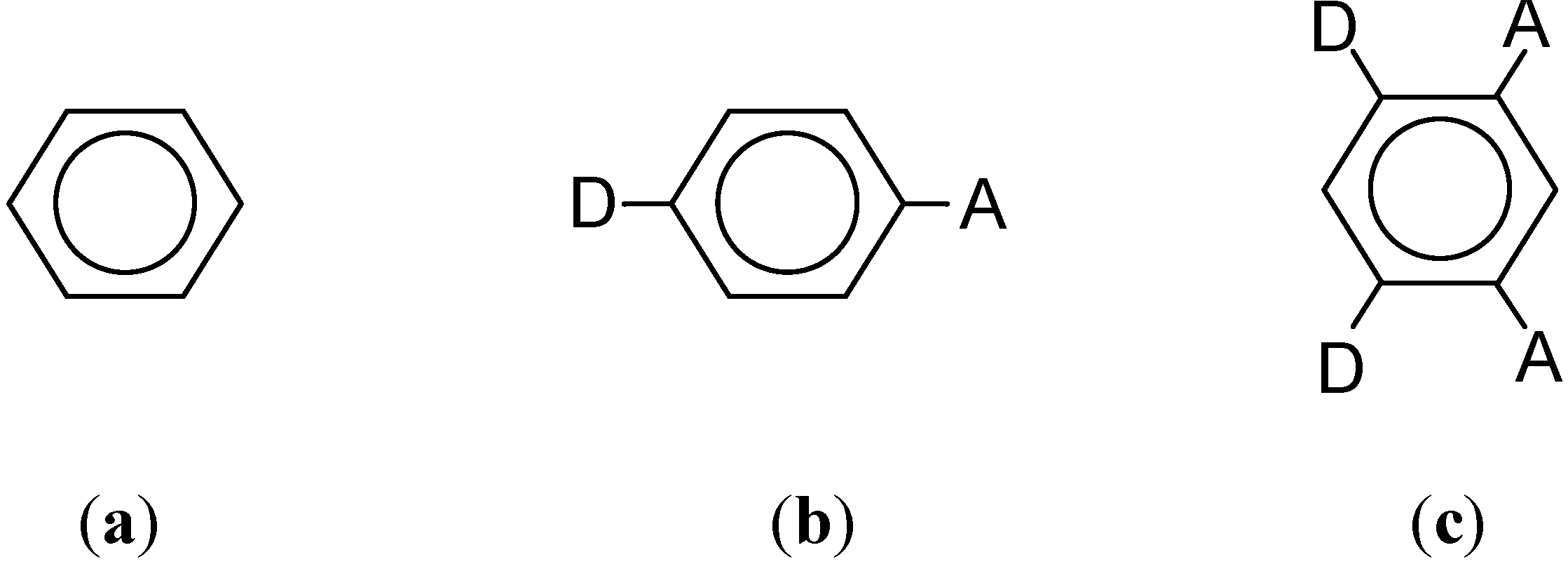
        <p>Organic conjugated molecules and polymers show interesting and peculiar physical properties, given by electron delocalization of the π-bonds [<xref ref-type="bibr" rid="B1-applsci-02-00682">1</xref>]. If we consider benzene (C<sub>6</sub>H<sub>6</sub>), it shows complete delocalization of π-electrons on the aromatic ring (<xref ref-type="fig" rid="applsci-02-00682-f001">Figure 1</xref>(a)). As we saw in the previous chapter, as benzene is a nonpolar molecule and it is centrosymmetric, it does not show any second order nonlinear contribution to the polarization term. </p>
        <fig id="applsci-02-00682-f001" position="anchor">
          <label>Figure 1</label>
          <caption>
            <p>(<bold>a</bold>) Centrosymmetric benzene. (<bold>b</bold><bold>, c</bold>) Non-centrosymmetric donor acceptor substituted benzenes.</p>
          </caption>
          <graphic xmlns:xlink="http://www.w3.org/1999/xlink" xlink:href="applsci-02-00682-g001.tif"/>
        </fig>
        <p>If we substitute some hydrogen atoms with an electron acceptor A (for example NO<sub>2</sub>) or electron donor group D (for example NH<sub>2</sub>) (<xref ref-type="fig" rid="applsci-02-00682-f001">Figure 1</xref>(b,c)), the benzene ring allows the electrical charges to flow from the donor to the acceptor, generating a dipole moment along the conjugation direction. We can expect that non-centrosymmetric molecules, with large mobility of charges will show a large degree of polarization and nonlinear optical terms, especially of the second order.</p>
        <p>For a general molecule, using a description similar to that used in the previous paragraph for macroscopic nonlinear media, we can write down the expression of the induced dipole moment as:</p>
        <disp-formula id="applsci-02-00682-i007">
<inline-graphic xmlns:xlink="http://www.w3.org/1999/xlink" xlink:href="applsci-02-00682-i007.tif"/>
<label>(5)</label>
</disp-formula>

        <p>where <italic>μ</italic><sub>0<italic>i</italic></sub> are the static electric dipole moment components, <italic>α</italic><italic><sub>ij</sub></italic> are the polarizability tensor components, <italic>β</italic><italic><sub>ijk</sub></italic> and <italic>γ</italic><italic><sub>ijkl</sub></italic> are the components of the hyperpolarizabilities tensors of the first and second order, respectively, and finally <italic>F<sub>i</sub></italic> represent the <italic>i</italic> components of the local electric field <inline-graphic xmlns:xlink="http://www.w3.org/1999/xlink" xlink:href="applsci-02-00682-i008.tif"/>that is related to the macroscopic electric field <inline-graphic xmlns:xlink="http://www.w3.org/1999/xlink" xlink:href="applsci-02-00682-i009.tif"/>by the local field factor <italic>f<sup>ω</sup></italic> via the following relation:</p>
        <disp-formula id="applsci-02-00682-i010">
<inline-graphic xmlns:xlink="http://www.w3.org/1999/xlink" xlink:href="applsci-02-00682-i010.tif"/>
<label>(6)</label>
</disp-formula>

        <p>The local field factor in the range of the optical frequencies is given by the Lorenz-Lorentz formula:</p>
        <disp-formula id="applsci-02-00682-i011">
<inline-graphic xmlns:xlink="http://www.w3.org/1999/xlink" xlink:href="applsci-02-00682-i011.tif"/>
<label>(7)</label>
</disp-formula>

        <p>where <italic>n</italic>(<italic>ω</italic>) is the refractive index at <italic>ω</italic>. For static fields, the field factor is given by the Onsager expression:</p>
        <disp-formula id="applsci-02-00682-i012">
<inline-graphic xmlns:xlink="http://www.w3.org/1999/xlink" xlink:href="applsci-02-00682-i012.tif"/>
<label>(8)</label>
</disp-formula>

        <p>where <italic>ε</italic><italic><sub>r</sub></italic><sub>0</sub> is the static relative dielectric constant and <italic>ε</italic><italic><sub>r</sub></italic><sub>∞</sub> is the relative dielectric constant in the range of optical frequencies [<xref ref-type="bibr" rid="B12-applsci-02-00682">12</xref>,<xref ref-type="bibr" rid="B23-applsci-02-00682">23</xref>].</p>
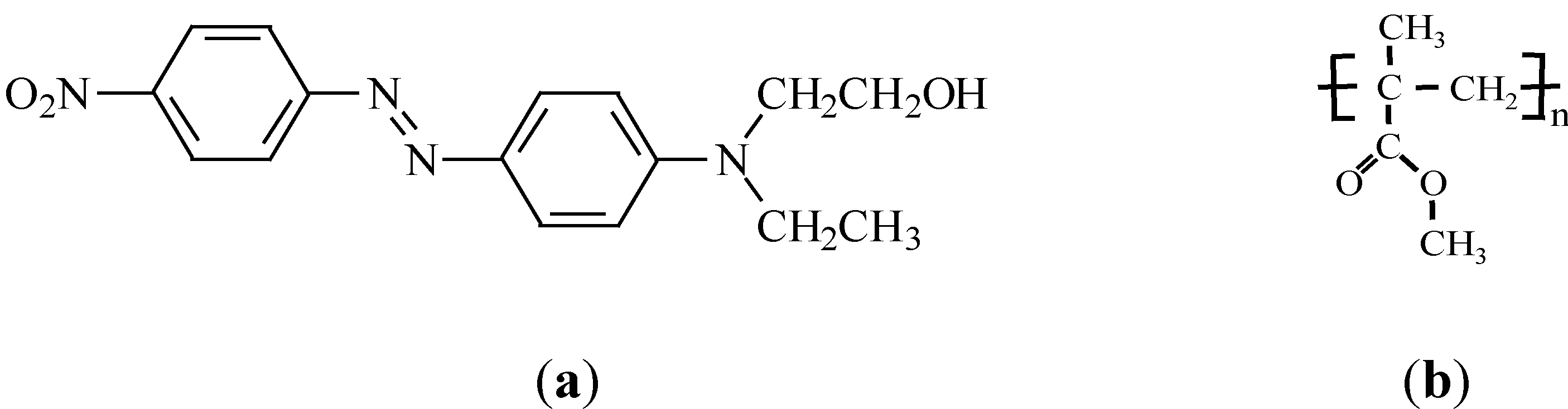
        <p>One of the best known electro-optic chromophore used in applications is the 4-[<italic>N</italic>-ethyl-<italic>N</italic>-(2-hydroxyethyl)]amino-4’-nitroazobenzene (Disperse Red 1; DR1), whose structure is shown in <xref ref-type="fig" rid="applsci-02-00682-f002">Figure 2</xref>(a).</p>
		<fig id="applsci-02-00682-f002" position="anchor">
          <label>Figure 2</label>
          <caption>
            <p>(<bold>a</bold>) Chemical structure of the Disperse Red 1 (DR1) and (<bold>b</bold>) of the (poly)-methyl-metha-acrylate (PMMA).</p>
          </caption>
          <graphic xmlns:xlink="http://www.w3.org/1999/xlink" xlink:href="applsci-02-00682-g002.tif"/>
        </fig>
        
        <p>The main characteristics are reported in <xref ref-type="table" rid="applsci-02-00682-t001">Table 1</xref> [<xref ref-type="bibr" rid="B12-applsci-02-00682">12</xref>,<xref ref-type="bibr" rid="B24-applsci-02-00682">24</xref>,<xref ref-type="bibr" rid="B25-applsci-02-00682">25</xref>,<xref ref-type="bibr" rid="B26-applsci-02-00682">26</xref>,<xref ref-type="bibr" rid="B27-applsci-02-00682">27</xref>,<xref ref-type="bibr" rid="B28-applsci-02-00682">28</xref>,<xref ref-type="bibr" rid="B29-applsci-02-00682">29</xref>]. A comparison between electrostatic units (esu) and International System units (SI), is given in [<xref ref-type="bibr" rid="B30-applsci-02-00682">30</xref>].</p>
        <table-wrap id="applsci-02-00682-t001" position="float">
          <object-id pub-id-type="pii">applsci-02-00682-t001_Table 1</object-id>
          <label>Table 1</label>
          <caption>
            <p>Characteristic data of the Disperse Red 1 (DR1) molecule.</p>
          </caption>
          <table rules="all" style="border:solid thin">
  <thead>
              <tr>
                <th align="center" valign="middle">Chromophore</th>
                <th align="center" valign="middle">λ<sub>max</sub> (nm, CHCl<sub>3</sub>)</th>
                <th align="center" valign="middle">μ<sub>0</sub> (Debye)</th>
                <th align="center" valign="middle">β<sub>0</sub> (10<sup>−3</sup><sup>0</sup> esu)</th>
                <th align="center" valign="middle">β<sub>1.9μm</sub> (10<sup>−3</sup><sup>0</sup> esu)</th>
                <th align="center" valign="middle">μ<sub>0</sub>β<sub> 1.9μm</sub> (10<sup>−48</sup> esu)</th>
              </tr>
  </thead>
  <tbody>
              <tr>
                <td align="center" valign="middle">DR1</td>
                <td align="center" valign="middle">480 (497)</td>
                <td align="center" valign="middle">7.7 (8.7)</td>
                <td align="center" valign="middle">40</td>
                <td align="center" valign="middle">5,046</td>
                <td align="center" valign="middle">580</td>
              </tr>
  </tbody>
          </table>
        </table-wrap>
      </sec>
      <sec>
        <title>2.3. Inducing of the Macroscopic Electro-Optic Properties</title>
        <p>Up to now, we described the nonlinear optical properties of a single molecule. However we are generally interested to the nonlinear optical response of bulk macroscopic materials made out of a large number of such molecules. </p>
        <p>In order to evaluate the nonlinear response of the whole macroscopic material it is not sufficient to know the nonlinear properties of the single molecule, but we need to consider the number of chromophores per volume unit and their orientation inside the macroscopic structure. In particular, the macroscopic nonlinear optical properties increase with the density of oriented chromophores. Considering a system constituted by molecules with large <italic>β</italic>, if they are isotropically oriented in the space, the macroscopic second order dielectric susceptibility <italic>χ</italic><sup>(2)</sup> is zero because the material, as a whole, is centrosymmetric.</p>
        <p>Since we are interested in electro-optic applications, we need to achieve a high <italic>χ</italic><sup>(2)</sup> value and consequently we need to fabricate a structure in which the nonlinear molecules are oriented in a polar order. One way is to realize a solid solution of highly nonlinear molecules in a high optical quality passive polymer matrix. The matrix, in order not to interfere with the optical properties of the chromophore, is in general transparent in the wavelength used for applications and can be considered as optically linear; it is just a host material that gives mechanical stability to the ensemble of nonlinear molecules. One of the most used polymer matrices is the poly-methyl-metha-acrylate (PMMA) [<xref ref-type="bibr" rid="B12-applsci-02-00682">12</xref>] whose chemical structure is shown in <xref ref-type="fig" rid="applsci-02-00682-f002">Figure 2</xref>(b). Usually, the material is deposited onto different types of substrates by spin-coating, producing amorphous thick films (1~2 μm). The chromophores, randomly oriented at the end of the film deposition procedure, must be aligned in a non-centrosymmetric fashion after deposition by means of a poling procedure, as we shall describe later.</p>
        <p>There are several ways of introducing nonlinear optical chromophores into the polymer matrix. The two most common methods are dissolving (guest-host systems) and covalently attaching (functionalized system) the chromophores to the polymer.</p>
        <p>In the guest-host system, nonlinear optic (NLO) chromophores are dissolved, in the polymer host. The principal disadvantages of such a structure are: (i) low nonlinear activity, that it is due to the dopant maximum solubility (largest concentration is about 10% of the host weight), because greater concentrations can lead to chromophores’ aggregation or crystallization; (ii) the presence of optical losses due to scattering originated by the non homogeneity of the structure; (iii) the thermal and temporal instability, in fact, the chromophores are not attached at the polymer matrix and they can move with a higher degree of freedom. In the functionalized systems, the chromophores are attached to the polymer matrix, and the relative dopant concentration can be much higher than in guest-host systems. Moreover functionalized systems are more stable since their orientational mobility is significantly hindered and the order of such systems therefore relaxes more slowly.</p>
        <p>In the functionalized systems nonlinear optical chromophores can be incorporated in the polymer matrix by chemically attaching them into the polymer main-chain (or backbone) or as a pendant side-group. In the side-chain systems, the chromophores can rotate around the attaching point and it is easier to orient them in the poling procedure. Nevertheless, the orientation is maintained longer than in the guest-host systems. For all these reasons, side-chain copolymers are widely used in optical application but also guest-host systems are used because of the relatively easy fabrication process. </p>
        <p>In order to induce non-centrosymmetry after the films deposition, several poling techniques can be used. The most common ones are:</p>
        <p><italic>Contact Poling</italic> or <italic>Electrode Poling</italic>. Chromophores such as DR1 show a large static dipole moment <italic>μ</italic><sub>0</sub>, due to their rod shape with donor and acceptor at the opposite sides. As a result, it is possible to use a large static electric field to orient these polar molecules along the field and thus induce an asymmetric configuration. For contact poling, the sample must be prepared by spinning the polymeric solution on a substrate that was previously covered by an electrode. Then, after spinning and drying, the polymeric film must be topped with another electrode, via sputtering deposition or other techniques, in order to obtain a sandwich structure with the copolymer sandwiched between the two electrodes. Then, the sample is ready for the poling procedure; the temperature of the sample is increased to the glass transition one (<italic>T<sub>g</sub></italic>), where the polymer matrix reaches a large mobility. A large static electric field is then applied between the two electrodes for a sufficient time, in order to align the nonlinear molecules; then with the field still on, the temperature is slowly decreased to Room Temperature and the field is subsequently removed. At Room Temperature the orientational mobility of the molecules is sufficiently low to maintain the chromophores alignment for a long time and consequently giving rise to a long lasting electro-optic coefficient. With such a method it is not possible to apply a very large field, because unavoidable small imperfections in the polymer film can lead to a decrease of the dielectric rigidity of the material and, as a consequence to electrical discharge with complete damage of the sample.</p>
        <p><italic>Corona Poling.</italic> In such a technique [<xref ref-type="bibr" rid="B23-applsci-02-00682">23</xref>] it is not necessary to apply electrodes on the polymeric material, as a consequence, it is possible for example to deposit, by spin coating, a polymeric film directly on a bare substrate. In the corona poling procedure the sample is put on a metal plate that plays simultaneously the role of heater and bottom electrode. The top electrode is given by a layer of ions which are deposited on the film surface. In order to produce the ions, a tungsten needle is placed near the surface of the polymer film at a potential of about 1–10 kV with respect to the substrate. The needle generates an intense electric field that ionizes the surrounding atmosphere (usually an inert gas, nitrogen, for example) and the generated ions are pushed on the film surface where they accumulate. As a consequence, the charges produce a quite uniform high intense field that orients the nonlinear dipoles. As in the case of electrode poling, the temperature is increased close to <italic>T<sub>g</sub></italic> for a suitable time interval during the poling procedure, then it is lowered to Room Temperature, still maintaining the voltage drop between needle and substrate. Corona poling is more efficient than electrode poling because it can generate very intense fields. Also during corona poling procedure, there is the possibility of having electrical discharge due to the high field, but in this case, since the ions are not mobile on the surface of the material, the discharges are localized and the sample does not damage the whole surface. </p>
        <p>The method is, however, the subject of criticism for material characterization purposes: in fact, the real effective poling field remains unknown and it is not well reproducible.</p>
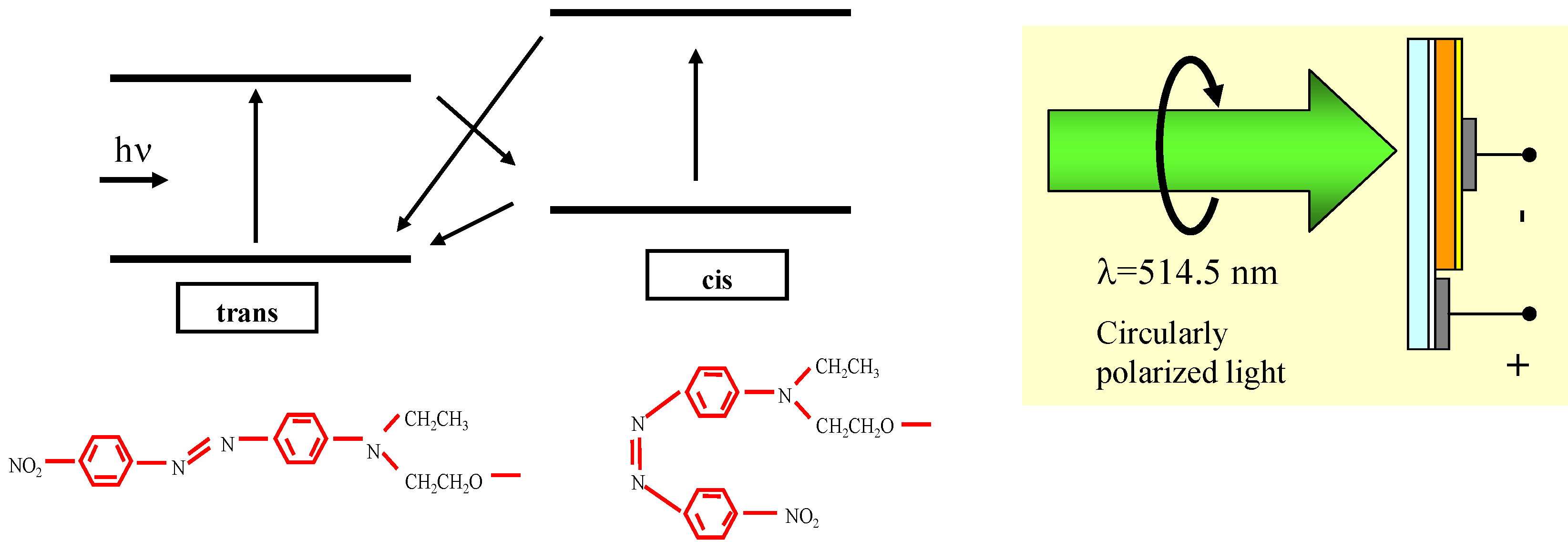
        <p><italic>Photoassisted Poling.</italic> In the previously described techniques it is necessary to pole the sample at a high temperature in order to have sufficient chromophore mobility. Nevertheless, at high temperatures, there is a competition between the alignment effect of the electric field and, on the other side, the thermal motion of the molecules. For high-<italic>T<sub>g</sub></italic> copolymers, poling samples with such techniques can lead to low efficiency. The advantage of photoassisted poling [<xref ref-type="bibr" rid="B31-applsci-02-00682">31</xref>,<xref ref-type="bibr" rid="B32-applsci-02-00682">32</xref>] is that this procedure can be executed also at room temperature. The sample is prepared as in the electrode poling, with the polymer sandwiched between two electrodes, but in this case at least one of the electrodes must be transparent. During poling, a voltage drop is applied between the two electrodes. Meanwhile, the sample is shined, from the transparent electrode side, by a light beam which wavelength is tuned in the region of the absorption resonance of the chromophore. In conjugated molecules with a N=N bridge along the principal axis, as DR1, the light, with a suitable polarization state, is absorbed by the chromophores and produces a trans-cis-trans isomerization (<xref ref-type="fig" rid="applsci-02-00682-f003">Figure 3</xref>). After several <italic>trans-cis-trans</italic> cycles, a net centrosymmetric orientation of the dipoles perpendicular to the pump light field can be achieved. With additionally applied dc electric poling fields, the process permits non-centrosymmetric orientation of chromophores giving rise to a macroscopic electro-optic coefficient even at room temperature.</p>
        <fig id="applsci-02-00682-f003" position="anchor">
          <label>Figure 3</label>
          <caption>
            <p>Photoassisted poling.</p>
          </caption>
          <graphic xmlns:xlink="http://www.w3.org/1999/xlink" xlink:href="applsci-02-00682-g003.tif"/>
        </fig>
        <p>In all the three cases described above, the electro-optic coefficient induced by poling will relax on a long-time scale, because the chromophores’ orientational mobility is not zero, even at room temperature.</p>
      </sec>
      <sec>
        <title>2.4. Steady-State Properties of the Induced Electo-Optic Coefficient</title>
        <p>In this paragraph, we show a theoretical model describing the nonlinear optical response of a medium constituted by nonlinear units (chromophores) dispersed in a linear matrix and oriented along a preferential axis [<xref ref-type="bibr" rid="B33-applsci-02-00682">33</xref>,<xref ref-type="bibr" rid="B34-applsci-02-00682">34</xref>]. We suppose that each molecule is identified by an intrinsic reference system with the axes named 1, 2, 3, and this system can be rotated in respect to the system that describes the whole macroscopic structure with the axes named x, y, z (laboratory axis). Let us consider that the orientation of the nonlinear molecules is described by a statistical angular distribution function <italic>f</italic>(Ω) = <italic>f</italic>(<italic>θ</italic>,<italic>φ</italic>) of the molecular axes, where <italic>θ</italic> and <italic>φ</italic> are shown in <xref ref-type="fig" rid="applsci-02-00682-f004">Figure 4</xref>. <italic>f</italic>(Ω) must fulfill the normalization condition <inline-graphic xmlns:xlink="http://www.w3.org/1999/xlink" xlink:href="applsci-02-00682-i014.tif"/>. In the following we consider that <italic>z</italic> is the direction of the poling field and 3 is the direction of the long axis of the molecule.</p>
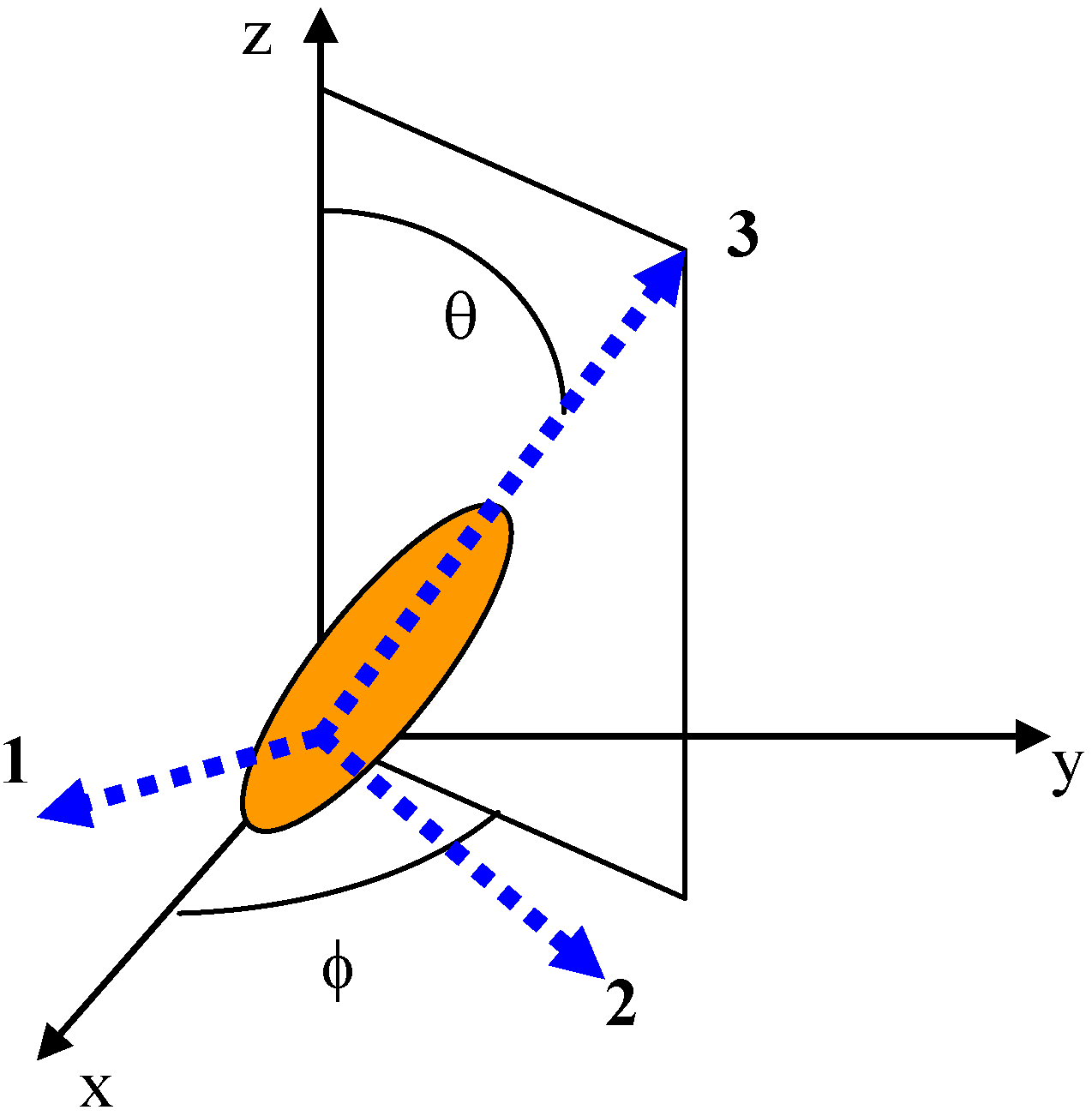
        <fig id="applsci-02-00682-f004" position="anchor">
          <label>Figure 4</label>
          <caption>
            <p>Relationship between the molecular axes 1,2,3 and laboratory axes x,y,z.</p>
          </caption>
          <graphic xmlns:xlink="http://www.w3.org/1999/xlink" xlink:href="applsci-02-00682-g004.tif"/>
        </fig>
        <p>The second order nonlinear dipole moment results in:</p>
        <disp-formula id="applsci-02-00682-i016">
<inline-graphic xmlns:xlink="http://www.w3.org/1999/xlink" xlink:href="applsci-02-00682-i016.tif"/>
<label>(9)</label>
</disp-formula>

        <p>Considering the cylindrical and elongated shape of the chromophores, we can assume that the only nonvanishing component of <italic>β</italic><italic><sub>ijk</sub></italic> is <italic>β</italic><sub>333</sub>.</p>
        <p>The macroscopic electro-optic polarization induced by an external dc field <inline-graphic xmlns:xlink="http://www.w3.org/1999/xlink" xlink:href="applsci-02-00682-i017.tif"/>and by an optical field <inline-graphic xmlns:xlink="http://www.w3.org/1999/xlink" xlink:href="applsci-02-00682-i018.tif"/>, both of them along the <italic>z</italic> direction, is:</p>
        <disp-formula id="applsci-02-00682-i019">
<inline-graphic xmlns:xlink="http://www.w3.org/1999/xlink" xlink:href="applsci-02-00682-i019.tif"/>
<label>(10)</label>
</disp-formula>

        <p>where</p>
        <disp-formula id="applsci-02-00682-i020">
<inline-graphic xmlns:xlink="http://www.w3.org/1999/xlink" xlink:href="applsci-02-00682-i020.tif"/>
<label>(11)</label>
</disp-formula>

        <p>and cos(<inline-graphic xmlns:xlink="http://www.w3.org/1999/xlink" xlink:href="applsci-02-00682-i021.tif"/>,<inline-graphic xmlns:xlink="http://www.w3.org/1999/xlink" xlink:href="applsci-02-00682-i022.tif"/>) is the) cosine of the angle formed by the two directions <inline-graphic xmlns:xlink="http://www.w3.org/1999/xlink" xlink:href="applsci-02-00682-i021.tif"/>, <inline-graphic xmlns:xlink="http://www.w3.org/1999/xlink" xlink:href="applsci-02-00682-i022.tif"/>.</p>
        <p>In order to find another component of the macroscopic nonlinear optical susceptibility, we consider the case where the external dc field is along the <italic>z</italic> direction, and the external optical field is along the <italic>x</italic> direction, <inline-graphic xmlns:xlink="http://www.w3.org/1999/xlink" xlink:href="applsci-02-00682-i023.tif"/>. In this case, the electro-optic susceptibility can be obtained by considering the induced polarization along the <italic>x</italic> direction:</p>
        <disp-formula id="applsci-02-00682-i024">
<inline-graphic xmlns:xlink="http://www.w3.org/1999/xlink" xlink:href="applsci-02-00682-i024.tif"/>
<label>(12)</label>
</disp-formula>

        <p>From the above relations we obtain the following relations for the macroscopic electro-optic susceptibility:</p>
        <disp-formula id="applsci-02-00682-i025">
<inline-graphic xmlns:xlink="http://www.w3.org/1999/xlink" xlink:href="applsci-02-00682-i025.tif"/>
<label>(13)</label>
</disp-formula>

        <disp-formula id="applsci-02-00682-i026">
<inline-graphic xmlns:xlink="http://www.w3.org/1999/xlink" xlink:href="applsci-02-00682-i026.tif"/>
<label>(14)</label>
</disp-formula>

        <p>During poling, two competing mechanisms determine the final steady-state equilibrium distribution. The electric dipole interaction of the molecular dipoles with the dc field favors the alignment of molecular dipoles along the <italic>z</italic> direction, while the thermal agitation tries to disorient the dipoles, leading to the maximum entropy configuration. For a sufficiently high temperature (even room temperature is high enough), the statistical distribution follows, as we said before, a Boltzmann distribution Equation (11): <inline-graphic xmlns:xlink="http://www.w3.org/1999/xlink" xlink:href="applsci-02-00682-i027.tif"/>. The dipole interaction energy is given in the weak poling approximation by <inline-graphic xmlns:xlink="http://www.w3.org/1999/xlink" xlink:href="applsci-02-00682-i028.tif"/>where <inline-graphic xmlns:xlink="http://www.w3.org/1999/xlink" xlink:href="applsci-02-00682-i029.tif"/>with <inline-graphic xmlns:xlink="http://www.w3.org/1999/xlink" xlink:href="applsci-02-00682-i030.tif"/>.</p>

        <p>This expression allows to estimate directly the second order susceptibility terms from Equations (13) and (14):</p>
        <disp-formula id="applsci-02-00682-i031">
<inline-graphic xmlns:xlink="http://www.w3.org/1999/xlink" xlink:href="applsci-02-00682-i031.tif"/>
<label>(15)</label>
</disp-formula>

        <disp-formula id="applsci-02-00682-i032">
<inline-graphic xmlns:xlink="http://www.w3.org/1999/xlink" xlink:href="applsci-02-00682-i032.tif"/>
</disp-formula>

        <p>The Equation (15) give, also, a first order approximation of the ratio<inline-graphic xmlns:xlink="http://www.w3.org/1999/xlink" xlink:href="applsci-02-00682-i033.tif"/>, that results in:</p>
        <disp-formula id="applsci-02-00682-i034">
<inline-graphic xmlns:xlink="http://www.w3.org/1999/xlink" xlink:href="applsci-02-00682-i034.tif"/>
<label>(16)</label>
</disp-formula>

        <p>By applying the relation between the electro-optic tensor with the <inline-graphic xmlns:xlink="http://www.w3.org/1999/xlink" xlink:href="applsci-02-00682-i035.tif"/>tensor [<xref ref-type="bibr" rid="B16-applsci-02-00682">16</xref>], it is possible to apply the previous relations (15–16) to the electro-optic coefficient too.</p>

        <disp-formula id="applsci-02-00682-i036">
<inline-graphic xmlns:xlink="http://www.w3.org/1999/xlink" xlink:href="applsci-02-00682-i036.tif"/>
<label>(17)</label>
</disp-formula>

        <p>The calculations previously exposed neglect the chromophore–chromophore intermolecular electrostatic interactions. In this regime the electro-optic coefficient will increase in a linear manner with chromophore number density <italic>N</italic> (loading) in the host polymer matrix. More realistically, if the chromophore density is high enough, the reciprocal average distance between two nonlinear molecules, is so close to not allow neglecting of electrostatic interaction between the chromophores. Since the chromophores are polar molecules with a static dipole moment <italic>μ</italic><sub>0</sub>, they will interact, thereby minimizing their energy and forming an anti-ferroelectric state, where neighbouring chromophores are preferentially oriented in opposite directions, leading to a decrease of the effective electro-optic coefficient [<xref ref-type="bibr" rid="B27-applsci-02-00682">27</xref>]. In order to avoid the negative interaction between chromophores, non-polar second order nonlinear molecule were proposed [<xref ref-type="bibr" rid="B35-applsci-02-00682">35</xref>]. Unfortunately, in these molecules, since they have no <italic>μ</italic><sub>0</sub>, it is not possible to align them using the standard poling procedure shown previously. A more complicated all-optical poling was proposed [<xref ref-type="bibr" rid="B35-applsci-02-00682">35</xref>].</p>
      </sec>
      <sec>
        <title>2.5. Transient Properties</title>
        <p>At the end of the poling procedure, when temperature has been lowered to the ambient one and the poling field has been turned off, the orientational distribution <italic>f</italic>(Ω) is no longer at thermodynamic equilibrium and will relax via an orientational diffusion process, slowly decreasing the magnitude of the induced electro-optic properties. The distribution function is then time-dependent <italic>f</italic>(Ω, <italic>t</italic>) = <italic>f</italic>(<italic>θ</italic>, <italic>t</italic>). The same happens if we consider the inverse problem, when an isotropic material is subject, since a certain time, to a poling field. </p>
        <p>In order to describe these time-dependent phenomena, we introduce the rotational diffusion equation (Smoluchowski-Einstein) for a molecular dipole [<xref ref-type="bibr" rid="B33-applsci-02-00682">33</xref>]:</p>
        <disp-formula id="applsci-02-00682-i037">
<inline-graphic xmlns:xlink="http://www.w3.org/1999/xlink" xlink:href="applsci-02-00682-i037.tif"/>
<label>(18)</label>
</disp-formula>

        <p>where <italic>D</italic> is a diffusion constant, related to the orientational mobility of the nonlinear dipoles in the polymer matrix.</p>
        <p>However the behavior expected from the model showed above is not always in strong agreement with experimental data, because in the model, it is assumed that the material homogeneously acts on the mobility of the chromophores via a determined diffusion constant <italic>D</italic>. In reality, the polymer matrix is an amorphous inhomogeneous medium and each chromophore feels a different environment with a own diffusion constant <italic>D</italic><italic><sub>i</sub></italic>. The values of the diffusion constants are statistically distributed with a mean value and variance. For example in the guest-host system the chromophores manly feel two time constants [<xref ref-type="bibr" rid="B36-applsci-02-00682">36</xref>], the faster one due to the rotation of the single chormophores around their original position, while the slowest one is due to the relaxation of the polymer host matrix. In side-chain polymers, usually we do not observe a single or double time constant exponential relaxation, but a stretched exponential with a homogeneous distribution of time constants with a given spread. In this case, in order to describe the time dependence of the electro-optic coefficient for an inhomogeneous matrix, the following expression is often used:</p>
        <disp-formula id="applsci-02-00682-i038">
<inline-graphic xmlns:xlink="http://www.w3.org/1999/xlink" xlink:href="applsci-02-00682-i038.tif"/>
<label>(19)</label>
</disp-formula>

        <p>where <italic>r<sub>zz</sub></italic>(∞) is the steady-state electro-optic response, Δ<italic>r<sub>zz</sub></italic>(<italic>E<sub>p</sub></italic>) is the induced electro-optic coefficient for a poling field <italic>E<sub>p</sub></italic> and Φ(<italic>t</italic>) is the Kohlrausch-Williams-Watts (KWW) stretched exponential function given by [<xref ref-type="bibr" rid="B37-applsci-02-00682">37</xref>,<xref ref-type="bibr" rid="B38-applsci-02-00682">38</xref>,<xref ref-type="bibr" rid="B39-applsci-02-00682">39</xref>]:</p>
        <disp-formula id="applsci-02-00682-i039">
<inline-graphic xmlns:xlink="http://www.w3.org/1999/xlink" xlink:href="applsci-02-00682-i039.tif"/>
<label>(20)</label>
</disp-formula>

        <p>Where <italic>β</italic> is a stretching parameter describing the deviation from the simple exponential law. The value of <italic>β</italic> is always between 0 and 1, where 0 represents a wide distribution of time constants and 1 represents a Dirac delta distribution leading to a single exponential relaxation, representative of the Debye model. For <italic>β </italic>≠ 1, the <italic>τ</italic> time constant alone is not meaningful and its average must be taken into account:</p>
        <disp-formula id="applsci-02-00682-i040">
<inline-graphic xmlns:xlink="http://www.w3.org/1999/xlink" xlink:href="applsci-02-00682-i040.tif"/>
<label>(21)</label>
</disp-formula>

        <p>where Γ(<italic>x</italic>) is the Euler gamma-function <inline-graphic xmlns:xlink="http://www.w3.org/1999/xlink" xlink:href="applsci-02-00682-i041.tif"/>.</p>
        <p>The average time constant &lt;<italic>τ</italic>&gt; depends on temperature with different laws: </p>
        <p>For temperature above or equal to <italic>T</italic><sub>0</sub>, a characteristic temperature of the material that is close to, but lower than, the glass transition, the matrix is in a quasi-fluid state and the chromophores can move easily. In this case, the time constant follows the Vogel-Fulcher-Tamann-Hesse (VFTH) or Williams-Landel-Ferry (WLF) law that is typical of semi-fluid glassy systems:</p>
        <disp-formula id="applsci-02-00682-i042">
<inline-graphic xmlns:xlink="http://www.w3.org/1999/xlink" xlink:href="applsci-02-00682-i042.tif"/>
<label>(22)</label>
</disp-formula>

        <p>where <italic>B</italic> is a suitable constant.</p>
        <p>For temperatures below <italic>T</italic><sub>0</sub>, the average time constant follows an Arrhenius behavior:</p>
        <disp-formula id="applsci-02-00682-i043">
<inline-graphic xmlns:xlink="http://www.w3.org/1999/xlink" xlink:href="applsci-02-00682-i043.tif"/>
<label>(23)</label>
</disp-formula>

        <p>where <italic>E<sub>a</sub></italic> is the activation energy of the process and <italic>R</italic> is the universal gas constant (<italic>R</italic> = <italic>K<sub>B</sub>N<sub>a</sub></italic> = 8.31447 J·mol<sup>−1</sup>·K<sup>−1</sup>).</p>
        <p>Also <italic>β</italic> depends on temperature, as it is related to dipole mobility. It was shown that its dependence on temperature can be heuristically described by the expression [<xref ref-type="bibr" rid="B31-applsci-02-00682">31</xref>]:</p>
        <disp-formula id="applsci-02-00682-i044">
<inline-graphic xmlns:xlink="http://www.w3.org/1999/xlink" xlink:href="applsci-02-00682-i044.tif"/>
<label>(24)</label>
</disp-formula>

        <p>Where <italic>β</italic><sub>0</sub>, <italic>T</italic><italic><sub>β</sub></italic> and <italic>A</italic> are suitable constants.</p>
      </sec>
    </sec>
    <sec id="sec3-applsci-02-00682">
      <title>3. Measurement Techniques of the Electro-Optic Coefficient</title>
      <sec id="sec3dot1-applsci-02-00682">
        <title>3.1. Nonlinear Ellipsometry</title>
        <p>Nonlinear ellipsometry (NLE) is based on a single wavelength reflection configuration proposed, independently, by Teng and Man [<xref ref-type="bibr" rid="B13-applsci-02-00682">13</xref>] and Schildkraut [<xref ref-type="bibr" rid="B14-applsci-02-00682">14</xref>] in 1990. Since its introduction, the Teng and Man technique (TMT) has been widely used for the determination of the electro-optic susceptibility of organic polymer films and it demonstrated to be sensitive to a number of contributions to the measured signals that can lead to the evaluation of several nonlinear parameters [<xref ref-type="bibr" rid="B1-applsci-02-00682">1</xref>,<xref ref-type="bibr" rid="B40-applsci-02-00682">40</xref>,<xref ref-type="bibr" rid="B41-applsci-02-00682">41</xref>]. The TMT permits the measurement of both <inline-graphic xmlns:xlink="http://www.w3.org/1999/xlink" xlink:href="applsci-02-00682-i045.tif"/>and <inline-graphic xmlns:xlink="http://www.w3.org/1999/xlink" xlink:href="applsci-02-00682-i046.tif"/> [<xref ref-type="bibr" rid="B42-applsci-02-00682">42</xref>] complex susceptibilities. Moreover, it is sensitive to space distributions of charges trapped in the polymer films [<xref ref-type="bibr" rid="B1-applsci-02-00682">1</xref>,<xref ref-type="bibr" rid="B16-applsci-02-00682">16</xref>,<xref ref-type="bibr" rid="B43-applsci-02-00682">43</xref>]. In order to be applied, the TMT needs to operate on samples in which the polymer film is sandwiched between two electrodes. In the case of polymers for <italic>χ</italic><sup>(2)</sup> applications, the two electrodes are used either to pole the film or to apply a modulating voltage on the polymer film itself in order to measure the <italic>χ</italic><sup>(2)</sup> values. As the TMT is based on the measurement of the electric field induced change of the optical phase difference experienced by the s (perpendicular to the incidence plane) and p (parallel to the incidence plane) components of a laser which propagates through the polymer film, at least one (reflection operation) of the electrodes must be transparent to the probe light.</p>

        <p>Usually, a semiconductive transparent oxide thin layer, deposited on a glass substrate is used as transparent electrode. A polymer film is then deposited by spin coating it and then coating it with a metal electrode. Some researchers used polymer films sandwiched between two transparent electrodes and performed the experiments in a transmittance configuration [<xref ref-type="bibr" rid="B44-applsci-02-00682">44</xref>,<xref ref-type="bibr" rid="B45-applsci-02-00682">45</xref>]; in this case the samples were produced by spin coating pairs of polymer films onto oxide coated glass slides and then sandwiching them face to face; elimination of the air gap was guaranteed by baking at glass transition temperature under mechanical pressure.</p>
        <p>The experimental configuration in reflection mode for TMT is usually composed by a cw laser that impinges on the sample at an incident angle α after passing through a polarizer, which sets its polarization at 45° with respect to the incidence plane, and a phase compensating device that changes the relative phase between the s and p components of the laser beam by an amount <italic>ψ</italic><italic><sub>c</sub></italic>. After reflection at the polymer-metal interface, the beam is analyzed by a polarizer that is crossed with respect to the input one. The power of the beam transmitted by the whole system is detected by a photodiode. Between the electrodes it is applied either a dc voltage <italic>V<sub>p</sub></italic> during the poling procedure, or a modulated voltage <italic>V(t)</italic> during the measurement of the electro-optic coefficient, given by: </p>
        <disp-formula id="applsci-02-00682-i047">
<inline-graphic xmlns:xlink="http://www.w3.org/1999/xlink" xlink:href="applsci-02-00682-i047.tif"/>
<label>(25)</label>
</disp-formula>

        <p>The optical power at the output of the whole system is modulated, due to the response of the polymer film, both at Ω and 2Ω through the linear <italic>χ</italic><sup>(2)</sup> and quadratic <italic>χ</italic><sup>(</sup><sup>3</sup><sup>)</sup> electro-optic response.</p>
        <p>The average output power can be written as:</p>
        <disp-formula id="applsci-02-00682-i048">
<inline-graphic xmlns:xlink="http://www.w3.org/1999/xlink" xlink:href="applsci-02-00682-i048.tif"/>
<label>(26)</label>
</disp-formula>

        <p>where <italic>P</italic><sub>0</sub> is the input beam power after the first polarizer, <italic>ψ</italic><italic><sub>ps</sub></italic> and <italic>ψ<sub>c</sub></italic> are the phase differences between <italic>s</italic> and <italic>p</italic> polarizations originated by the propagation of the light in the polymer and in the phase compensator, respectively. Φis defined by the ellipsometry relation</p>
        <disp-formula id="applsci-02-00682-i049">
<inline-graphic xmlns:xlink="http://www.w3.org/1999/xlink" xlink:href="applsci-02-00682-i049.tif"/>
<label>(27)</label>
</disp-formula>

        <p>where and <italic>r<sub>p</sub></italic> and <italic>r<sub>s</sub></italic> are the Fresnel field reflection coefficients for the <italic>p</italic> and <italic>s</italic> polarization, respectively. </p>
        <p>In the low birefringence approximation, with the assumption of Δ|<italic>r<sub>s</sub></italic>|<sup>2</sup> ≈ 0, the amplitude of the <italic>P<sub>ac</sub></italic> component at Ω is given by:</p>
        <disp-formula id="applsci-02-00682-i050">
<inline-graphic xmlns:xlink="http://www.w3.org/1999/xlink" xlink:href="applsci-02-00682-i050.tif"/>
<label>(28)</label>
</disp-formula>

        <p>with <inline-graphic xmlns:xlink="http://www.w3.org/1999/xlink" xlink:href="applsci-02-00682-i051.tif"/>in the weak poling approximation.</p>
        <p>By varying the phase difference <italic>ψ<sub>c</sub></italic> introduced by the compensator from 0 to 2π, Equations (26) and (28) give the parametric equations of an ellipse.</p>
        <p>There are two working points (labeled 1 and 2) where the <italic>P<sub>dc</sub></italic> reach half of its maximum value: <inline-graphic xmlns:xlink="http://www.w3.org/1999/xlink" xlink:href="applsci-02-00682-i052.tif"/>. Those conditions can be found when: Ψ = Ψ<italic><sub>ps</sub></italic> + Ψ<italic><sub>c</sub></italic> = ± π/2.</p>
        <p>By using a lock-in amplifier, it is possible to measure the effective <italic>P<sub>ac</sub></italic> signal in these two working points and then it is possible to retrieve the electro-optic coefficient by the relation:</p>
        <disp-formula id="applsci-02-00682-i053">
<inline-graphic xmlns:xlink="http://www.w3.org/1999/xlink" xlink:href="applsci-02-00682-i053.tif"/>
<label>(29)</label>
</disp-formula>

        <p>We point out that the measurements in the two working points 1 and 2 are faster than the measurement based on the sampling of the whole ellipse, but suffer from lower accuracy. The faster measurements can be usefully adopted in monitoring the time decay of the electro-optic coefficient, as we will show later.</p>
        <p>Usually, when analyzing experimental data in an ellipsometric measurement, one makes the assumption that the laser beam is passing just twice through the polymer layer. However, if the reflectance of the semiconductor electrode is not negligible at the measurement wavelength, the electrodes system can behave as a Fabry-Perot resonator and the evaluation of the electro-optic coefficient obtained via the application of the simplified single pass model is wrong [<xref ref-type="bibr" rid="B46-applsci-02-00682">46</xref>]. As most researchers are using indium tin oxide (ITO) as the semitransparent electrode, this means that, unless a deeper theoretical approach is used [<xref ref-type="bibr" rid="B45-applsci-02-00682">45</xref>,<xref ref-type="bibr" rid="B47-applsci-02-00682">47</xref>,<xref ref-type="bibr" rid="B48-applsci-02-00682">48</xref>,<xref ref-type="bibr" rid="B49-applsci-02-00682">49</xref>], all the measurements obtained for wavelengths larger than about 1μm are affected by large errors due to the fact that ITO has got its plasma resonance in near-infrared and becomes reflective. Better results can be obtained in the near-infrared region by using aluminium doped zinc oxide (ZnO:Al) or, alternatively, more transparent electrodes [<xref ref-type="bibr" rid="B50-applsci-02-00682">50</xref>,<xref ref-type="bibr" rid="B51-applsci-02-00682">51</xref>].</p>
      </sec>
      <sec id="sec3dot2-applsci-02-00682">
        <title>3.2. Second Harmonic Generation</title>
        <p>Since the EO coefficient <italic>r</italic> is related with the second order susceptibility term <italic>χ</italic><sup>(2)</sup> (see Equation (14)) it is possible to evaluate it by measuring the efficiency of the second harmonic generation process in polymeric films. Second harmonic generation was the first all-optical phenomenon shown in an experiment in nonlinear optics [<xref ref-type="bibr" rid="B52-applsci-02-00682">52</xref>]. The experiment consisted in focusing a ruby laser beam on a crystalline quartz plate and revealing the second harmonic with a prism spectrometer on a photographic plate. The conversion efficiency has greatly improved with respect to the first experiments and second harmonic generation is now ordinarily used in photonic devices and applications. Moreover, due to the fact that the <italic>χ</italic><sup>(2)</sup> coefficient is present only in non-centrosymmetric materials, SHG was widely used in order to study symmetry properties of bulk materials, thin films [<xref ref-type="bibr" rid="B53-applsci-02-00682">53</xref>,<xref ref-type="bibr" rid="B54-applsci-02-00682">54</xref>] or surfaces [<xref ref-type="bibr" rid="B55-applsci-02-00682">55</xref>,<xref ref-type="bibr" rid="B56-applsci-02-00682">56</xref>] with high sensitivity in terms of linear measurements [<xref ref-type="bibr" rid="B57-applsci-02-00682">57</xref>,<xref ref-type="bibr" rid="B58-applsci-02-00682">58</xref>].</p>
        <p>Usually, the polymeric samples used in SHG measurements are film deposited by spin coating on glass substrates. In order to prevent influencing the measurement, the substrate was an amorphous glass slide (no <italic>χ</italic><sup>(2)</sup> contribution) without electrodes on the polymeric film. Since, after deposition, the orientation of the nonlinear chromophores is isotropic, the material must be poled before measurement. In this case, the poling technique used is the corona poling, as it does not require any contact electrode. An alternative poling procedure is the in-plane poling or lateral poling [<xref ref-type="bibr" rid="B59-applsci-02-00682">59</xref>] where the electric field is applied between two coplanar electrodes that are deposited on the polymeric surface beside the region where the SHG measurements are performed. In the case of using an electrode for contact poling, the analysis of the multilayer structure should be performed as in [<xref ref-type="bibr" rid="B60-applsci-02-00682">60</xref>].</p>
        <p>A standard technique used in order to measure the electro-optic coefficient by SHG from poled samples is the Maker fringes scheme [<xref ref-type="bibr" rid="B18-applsci-02-00682">18</xref>,<xref ref-type="bibr" rid="B19-applsci-02-00682">19</xref>,<xref ref-type="bibr" rid="B20-applsci-02-00682">20</xref>] where second harmonic signal is detected as a function of the incidence angle α. The fundamental beam at the angular frequency <italic>ω</italic> is generated by a pulsed laser that can be suitably polarized (e.g., in s or p polarization state); likewise an analyzer selects either <italic>s</italic> or <italic>p</italic> polarization for the signal generated at 2<italic>ω</italic>. The power generated by the sample can be calculated by means of the theoretical expression for the SHG power [<xref ref-type="bibr" rid="B19-applsci-02-00682">19</xref>] given by:</p>
        <disp-formula id="applsci-02-00682-i054">
<inline-graphic xmlns:xlink="http://www.w3.org/1999/xlink" xlink:href="applsci-02-00682-i054.tif"/>
<label>(30)</label>
</disp-formula>

        <p>where <italic>A</italic> is the area of the transverse section of the fundamental beam, <italic>Τ<sub>2</sub></italic><italic><sub>ω</sub></italic> is the intensity transmittance of the output film/air interface at 2<italic>ω</italic>, <italic>t</italic><italic><sub>ω</sub></italic> is the field transmission coefficient of the input air/glass interface at <italic>ω</italic> (neglecting the glass/film interface due to the small refractive index contrast), <italic>W</italic><italic><sub>ω</sub></italic> represents the input power of the fundamental beam, <italic>n</italic><italic><sub>ω</sub></italic>(<italic>α</italic>) and <italic>n<sub>2</sub></italic><italic><sub>ω</sub></italic>(<italic>α</italic>) are the polarization dependent refractive indices at <italic>ω</italic> and 2<italic>ω</italic> and <italic>d<sub>eff</sub></italic> is the effective nonlinearity. The phase factor Ψ(<italic>α</italic>) is given by:</p>
        <disp-formula id="applsci-02-00682-i055">
<inline-graphic xmlns:xlink="http://www.w3.org/1999/xlink" xlink:href="applsci-02-00682-i055.tif"/>
<label>(31)</label>
</disp-formula>

        <p><italic>L</italic> being the sample thickness, <inline-graphic xmlns:xlink="http://www.w3.org/1999/xlink" xlink:href="applsci-02-00682-i056.tif"/>and <inline-graphic xmlns:xlink="http://www.w3.org/1999/xlink" xlink:href="applsci-02-00682-i057.tif"/>the internal refraction angles corresponding to <italic>ω</italic> and 2<italic>ω</italic>.</p>
        <p>In the Equation (30), <italic>d<sub>eff</sub></italic>(<italic>α</italic>) is the effective nonlinearity term depending on the <inline-graphic xmlns:xlink="http://www.w3.org/1999/xlink" xlink:href="applsci-02-00682-i058.tif"/>tensor components, the optical axes orientation with respect to the sample surface and the fundamental beam incidence angle <italic>α</italic>, where the <italic>d</italic> tensor is is related with the <italic>χ</italic><sup>(2)</sup> tensor by the relation</p>
        <disp-formula id="applsci-02-00682-i059">
<inline-graphic xmlns:xlink="http://www.w3.org/1999/xlink" xlink:href="applsci-02-00682-i059.tif"/>
<label>(32)</label>
</disp-formula>

        <p>The expression for <italic>d<sub>eff</sub></italic>(<italic>α</italic>) is generally rather complicated but it becomes significantly simplified for particular symmetries. Specifically, the <inline-graphic xmlns:xlink="http://www.w3.org/1999/xlink" xlink:href="applsci-02-00682-i058.tif"/>tensor corresponding to a poled polymer presents only two nonzero different components, <italic>d</italic><sub>33</sub> and <italic>d</italic><sub>31</sub> = <italic>d</italic><sub>32</sub> = <italic>d</italic><sub>24</sub> = <italic>d</italic><sub>15</sub>. Depending on the polarization of both fundamental and generated beams, it is possible to retrieve separately the value of these components. The <italic>d</italic><sub>31</sub> component can be directly evaluated from SHG measurements obtained in the <italic>s</italic><italic><sub>ω</sub>p<sub>2</sub></italic><italic><sub>ω</sub></italic> configuration, since in this case the expression of <italic>d<sub>eff</sub></italic> is given by:</p>
        <disp-formula id="applsci-02-00682-i060">
<inline-graphic xmlns:xlink="http://www.w3.org/1999/xlink" xlink:href="applsci-02-00682-i060.tif"/>
<label>(33)</label>
</disp-formula>

        <p>Where <italic>α</italic><italic><sub>ω</sub></italic> is the fundamental beam propagation angle in the nonlinear film. The <italic>d</italic><sub>33</sub> coefficient can be obtained from a <italic>p</italic><italic><sub>ω</sub>p<sub>2</sub></italic><italic><sub>ω</sub></italic> SHG measurement, by using the <italic>d</italic><sub>31</sub> evaluated with an independent <italic>s</italic><italic><sub>ω</sub>p<sub>2</sub></italic><italic><sub>ω</sub></italic> measurement, since <italic>d<sub>eff</sub></italic> in the <italic>p</italic><italic><sub>ω</sub>p<sub>2</sub></italic><italic><sub>ω</sub></italic> case is given by:</p>
        <disp-formula id="applsci-02-00682-i061">
<inline-graphic xmlns:xlink="http://www.w3.org/1999/xlink" xlink:href="applsci-02-00682-i061.tif"/>
<label>(34)</label>
</disp-formula>

        <p>Where <italic>α</italic><italic><sub>2</sub></italic><italic><sub>ω</sub></italic> is the SH beam propagation angle in the nonlinear film.</p>
        <p>The previous procedure can be used to find the susceptibility coefficient <inline-graphic xmlns:xlink="http://www.w3.org/1999/xlink" xlink:href="applsci-02-00682-i062.tif"/>via the Equation (32). Then, in order to recover the electro-optic coefficient a modified expression of Equation (17) can be used [<xref ref-type="bibr" rid="B61-applsci-02-00682">61</xref>,<xref ref-type="bibr" rid="B62-applsci-02-00682">62</xref>]:</p>
        <disp-formula id="applsci-02-00682-i063">
<inline-graphic xmlns:xlink="http://www.w3.org/1999/xlink" xlink:href="applsci-02-00682-i063.tif"/>
<label>(35)</label>
</disp-formula>

        <p>where the field factors Equations (7) and (8) are present. We point out that in the two-index simplified notation, <italic>d<sub>ij</sub></italic> is proportional to <italic>r<sub>ji</sub></italic>. SHG measurement evaluates independently <italic>d</italic><sub>31</sub> and <italic>d</italic><sub>33</sub>, so the technique can be used to check the ratio <inline-graphic xmlns:xlink="http://www.w3.org/1999/xlink" xlink:href="applsci-02-00682-i064.tif"/>and, indirectly, verify if the assumption <italic>r</italic><sub>33 </sub>≈ 3<italic>r</italic><sub>13</sub>, used in the nonlinear ellipsometric technique is valid. By continuously measuring the SHG signal, it is possible to perform faster measurements that can be usefully used in monitoring the time decay of the electro-optic coefficient as we will show later. </p>
      </sec>
      <sec>
        <title>3.3. Temperature Scanning Technique</title>
        <p>In order to retrieve preliminary information on the stability of the induced electro-optic coefficient, temperature scanning measurements were performed. This type of measurement consists of the continuous measurement of the electro-optic coefficient of a poled sample while the temperature is increased from room temperature up to temperatures above <italic>T<sub>g</sub></italic> at a fixed rate, typically ranging between 1 °C/min to 5 °C/min.</p>
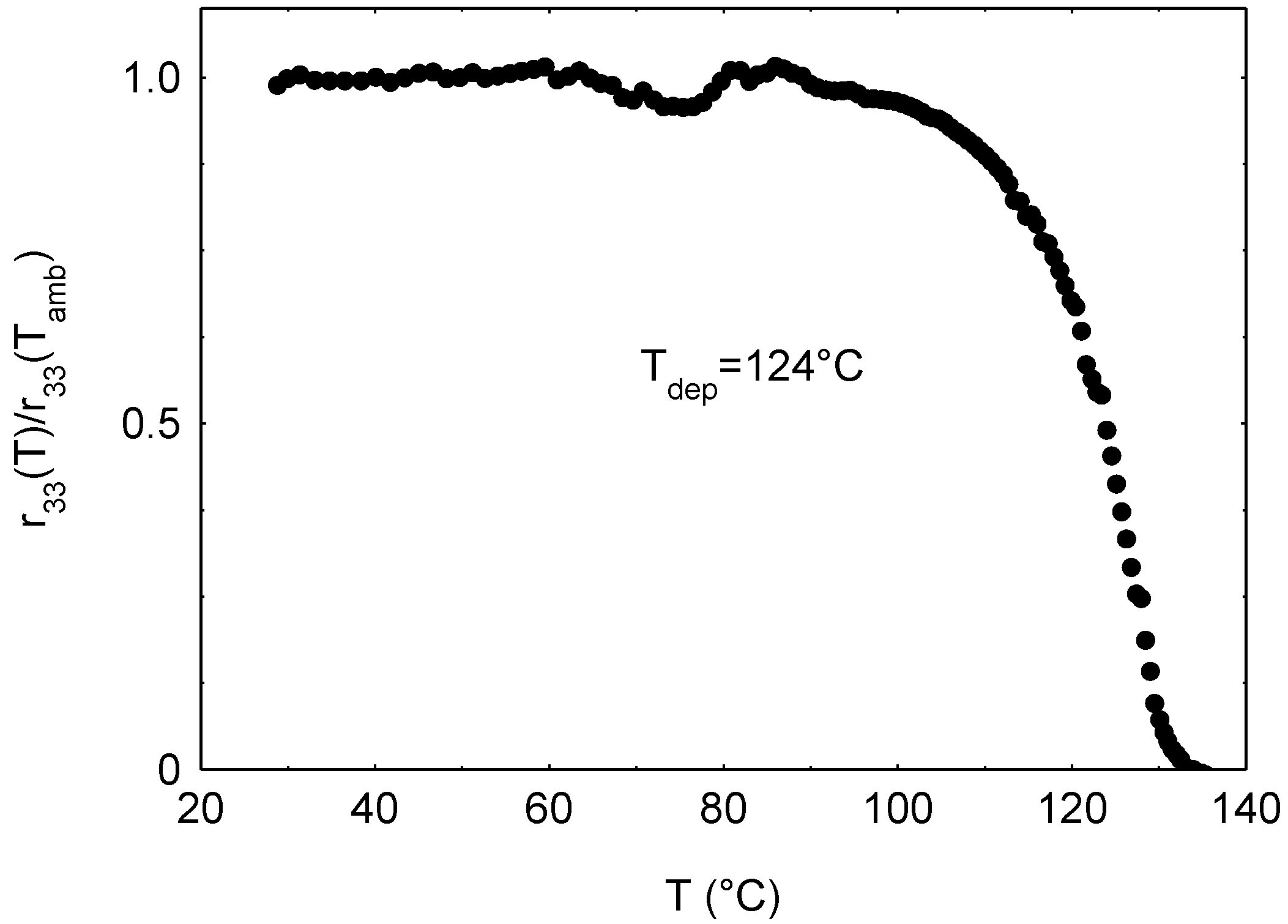
        <p>During the temperature scanning procedure, the polymer electro-optic coefficient quickly relaxes and it is not stable enough to allow the use of the complete ellipsometric technique or the complete Maker fringe technique. In this case, the faster measurements shown previously (at the end of the <xref ref-type="sec" rid="sec3dot1-applsci-02-00682">Section 3.1</xref>, <xref ref-type="sec" rid="sec3dot2-applsci-02-00682">Section 3.2</xref> paragraph) are preferred. The sample must be poled as usual and cooled down to room temperature, then the sample is gradually heated to the glass transition temperature (<italic>T<sub>g</sub></italic>), while the electro-optic coefficient is continuously monitored (by using either fast TMT or fast SHG). At the end of the measurements, the <italic>r</italic><sub>33</sub> is evaluated as a function of the temperature. Typical graphs are given by normalizing the <italic>r</italic><sub>33</sub> value with respect to the <italic>r</italic><sub>33</sub> coefficient measured at the beginning in room temperature condition. As an example, <xref ref-type="fig" rid="applsci-02-00682-f005">Figure 5</xref> reports the measurement performed on a fluorinated electro-optic polymer [<xref ref-type="bibr" rid="B62-applsci-02-00682">62</xref>], the HFIP-DR1AF that we will investigate more extensively in the fourth chapter. It is clear that the electro-optic coefficient remains stable up to a certain temperature, then decreases down to zero when the sample is heated close to <italic>T<sub>g</sub></italic>. It is possible to define a depolarization temperature (<italic>T<sub>dep</sub></italic>) as the temperature at which <italic>r</italic><sub>33</sub> gets half of the initial maximum value at room temperature. In this case, <italic>T<sub>dep</sub></italic> represents an indication of the stability of chromophore orientation in the polymer matrix.</p>
        <p>It is evident that it is possible to compare different polymer types with this technique only if all the measurements are performed under the same conditions, <italic>i.e.</italic>, with the same temperature scanning rate.</p>
		<fig id="applsci-02-00682-f005" position="anchor">
          <label>Figure 5</label>
          <caption>
            <p>Temperature scanning measurement on HFIP-DR1AF. Reprinted with permission from [<xref ref-type="bibr" rid="B62-applsci-02-00682">62</xref>]. Copyright 2005, American Institute of Physics.</p>
          </caption>
          <graphic xmlns:xlink="http://www.w3.org/1999/xlink" xlink:href="applsci-02-00682-g005.tif"/>
        </fig>
        
      </sec>
      <sec>
        <title>3.4. Isothermal Relaxation Measurements</title>
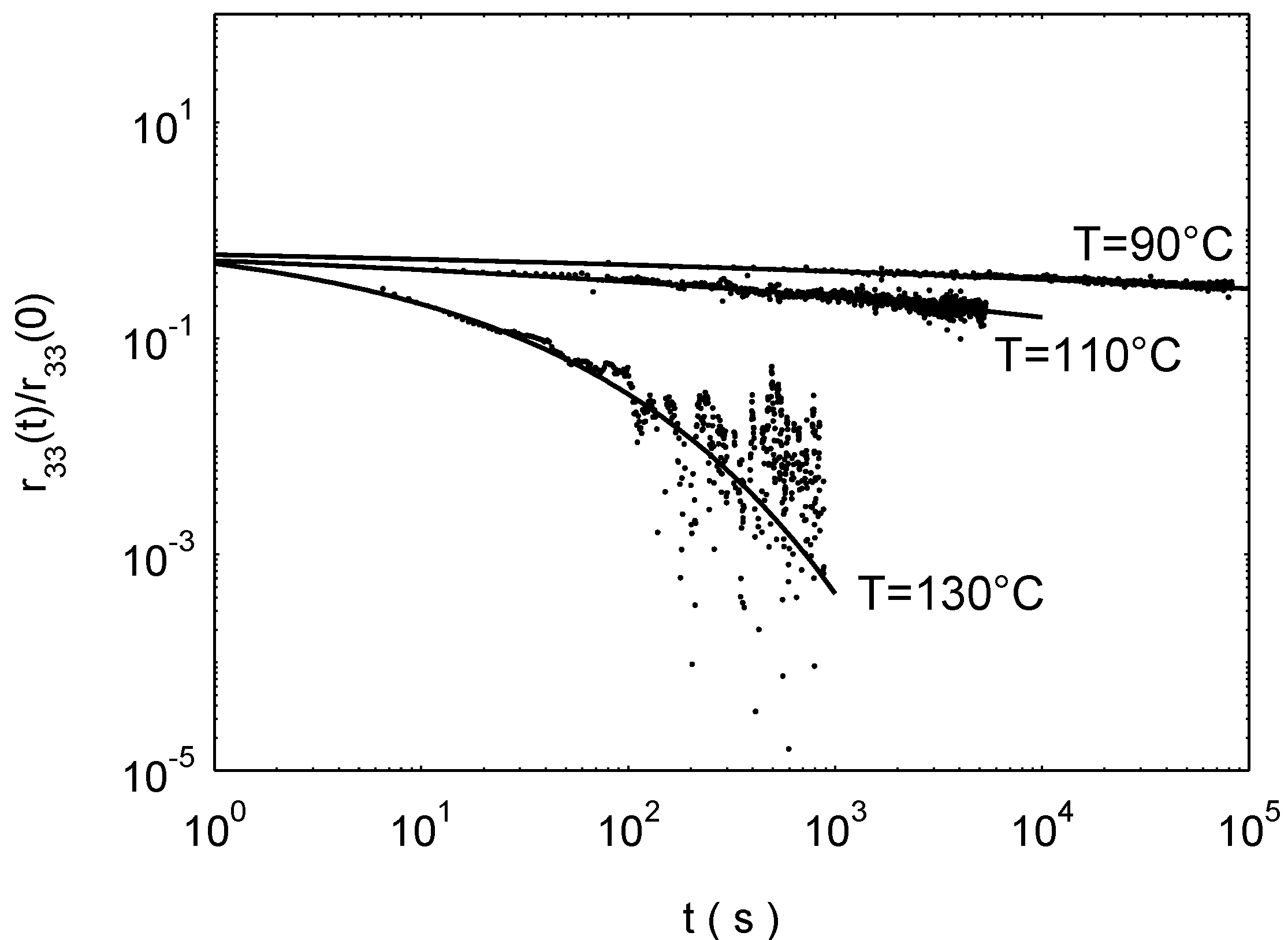
        <p>A more reliable and useful measurement technique to probe stability of the EO properties is the series of isothermal relaxation measurements. In this technique, the sample must be poled, as usual, at the poling temperature T<sub>p</sub> for a time interval ∆t<sub>p</sub> with an applied poling voltage V<sub>p</sub>, then the sample is cooled down to the measurement temperature T<sub>m</sub> maintaining the applied poling field. As soon as the T<sub>m</sub> is reached, the poling field is switched off and the EO coefficient is continuously monitored by using either fast TMT or fast SHG measurements. In this case, the value of r<sub>33</sub> is evaluated as a function of time for the given temperature T<sub>m</sub>. As an example, <xref ref-type="fig" rid="applsci-02-00682-f006">Figure 6</xref> reports the isothermal measurements at 90 °C, 110 °C, 130 °C (in log scale in this example) performed on HFIP-DR1AF [<xref ref-type="bibr" rid="B62-applsci-02-00682">62</xref>].</p>
        <fig id="applsci-02-00682-f006" position="anchor">
          <label>Figure 6</label>
          <caption>
            <p>Isothermal relaxation measurements on HFIP-DR1AF. Reprinted with permission from [<xref ref-type="bibr" rid="B62-applsci-02-00682">62</xref>].Copyright 2005, American Institute of Physics.</p>
          </caption>
          <graphic xmlns:xlink="http://www.w3.org/1999/xlink" xlink:href="applsci-02-00682-g006.tif"/>
        </fig>
        <p>Aligning the behaviour of the EO coefficient with the Kohlrausch-Williams-Watts (KWW) stretched exponential law Equation (20), it is possible to obtain the value of the time constant τ, of the stretching constant β and, from Equation (21), the value of the average time constant &lt;τ&gt; at a given temperature.</p>
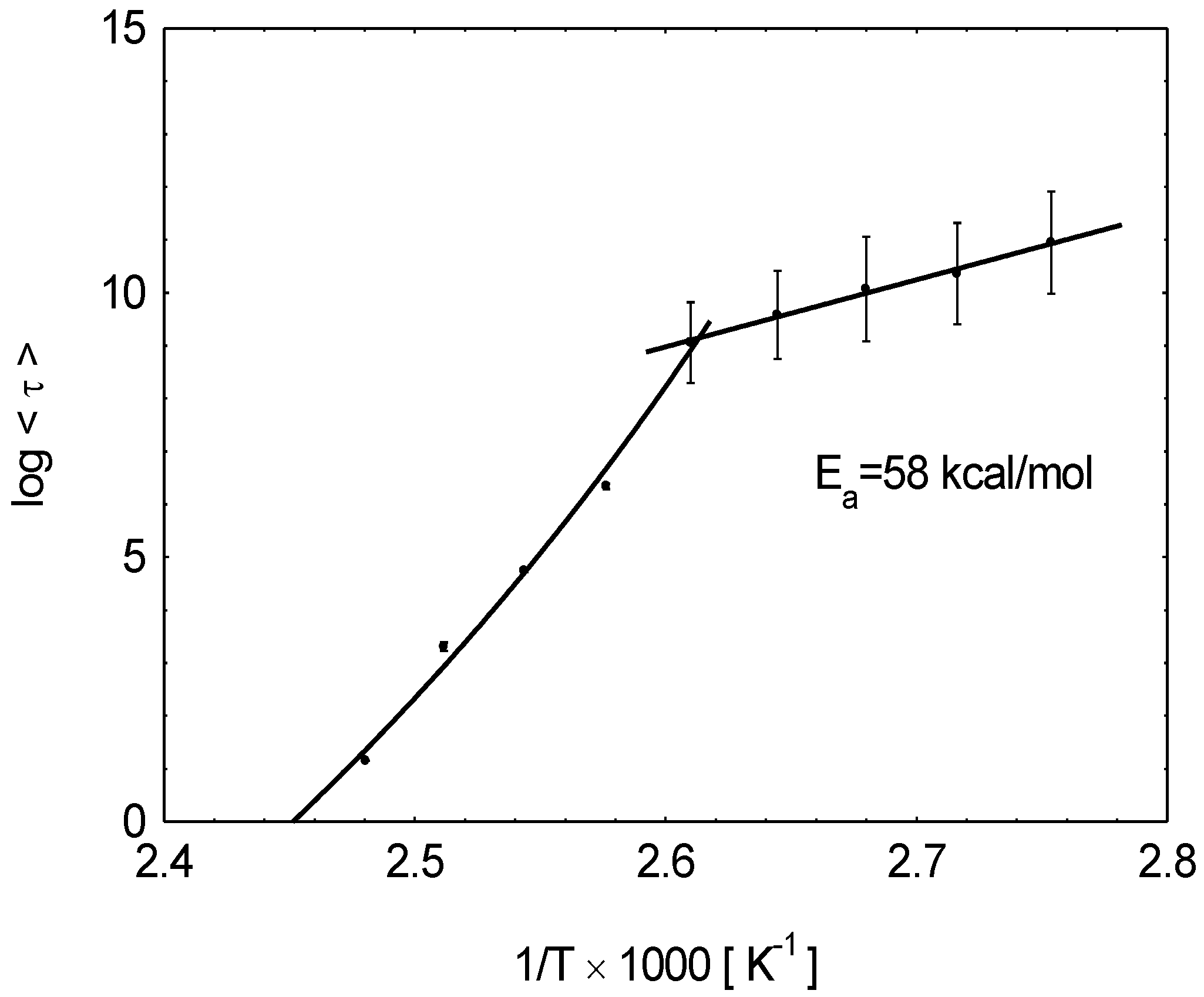
        <p>By comparing the curves for different temperatures, it is possible to retrieve the dependence of βand &lt;τ&gt; as a function of temperature. The β dependence is usually described by the Equation (24), while &lt;τ&gt; is well described by the Equation (22) for temperatures close or greater than T<sub>0</sub>, and by the Equation (23) for temperatures below T<sub>0</sub>. In <xref ref-type="fig" rid="applsci-02-00682-f007">Figure 7</xref>, we report the &lt;τ&gt; values obtained in the previous measurements in logarithmic scale as a function of the reciprocal of the absolute temperature (multiplied by 1,000), as is usually done when describing temperature activated processes [<xref ref-type="bibr" rid="B62-applsci-02-00682">62</xref>]. </p>
        <fig id="applsci-02-00682-f007" position="anchor">
          <label>Figure 7</label>
          <caption>
            <p>Plot of the average relaxation-time constant retrieved from the measurements similar to the one reported in <xref ref-type="fig" rid="applsci-02-00682-f006">Figure 6</xref>. Reprinted with permission from [<xref ref-type="bibr" rid="B62-applsci-02-00682">62</xref>]. Copyright 2005, American Institute of Physics.</p>
          </caption>
          <graphic xmlns:xlink="http://www.w3.org/1999/xlink" xlink:href="applsci-02-00682-g007.tif"/>
        </fig>
        <p>For temperatures below T<sub>0</sub> ≈ 110 °C, (1/T × 1,000 &gt; 2.6 K<sup>−1</sup>), the average time constant follows an Arrhenius behaviour Equation (23). The Arrhenius behavior is described by a straight line in such type of plot. an activation energy <italic>E<sub>a</sub></italic> = 58 kcal/mol is then obtained by fitting the measurements below 110 °C with the Equation (23). For temperatures above 110 °C the relaxation is faster than that predicted by the Arrhenius model and follows the Vogel-Fulcher-Tamann-Hesse (VFTH) behavior (or Williams-Landel-Ferry (WLF)) described in the Equation (22). The activation energy is a parameter that represents the stability of the chromophores orientation in a more complete way than the depolarization temperature reported in the previous paragraph. Moreover, the activation energy can be recovered by performing measurements at relatively high temperatures, and can be used to extrapolate time constants at a lower temperature (room temperature) that cannot easily be measured (because it would take years).</p>
        <p>We point out that, for this purpose, it is necessary to be sure that the measurements are performed in the Arrhenius regime and not in the VFTH regime. This last observation shows that it is not possible to perform relaxation measurements at high temperatures, near <italic>T<sub>g</sub></italic>, (appealing for their convenience, as they are rather quick measurements) in order to extrapolate the relaxation time constants at a low temperature (e.g., 50 °C) by using an Arrhenius type model. From the activation energy <italic>E<sub>a</sub></italic>, by using Equation (23), it is possible to estimate another stability parameter, the one-year stability working temperature (<italic>T<sup>1yr</sup></italic>) that is the working temperature corresponding at an average time constant of one year. </p>
      </sec>
    </sec>
    <sec id="sec4-applsci-02-00682">
      <title>4. Stability of Some Fluorinated Polymers</title>
      <p>Here we show the results of the measurements described above on different fluorinated and non fluorinated electro-optic polymer species that are present in literature. The first four cases regard EO fluorinated polymers that can be used directly in the fabrication of active waveguides, meanwhile the other cases, here presented, are very stable crosslinkable EO polymers that can be used in EO modulators coupled with passive fluorinated waveguides [<xref ref-type="bibr" rid="B63-applsci-02-00682">63</xref>].</p>
      <sec>
        <title>4.1. HFIP-DR1AF</title>
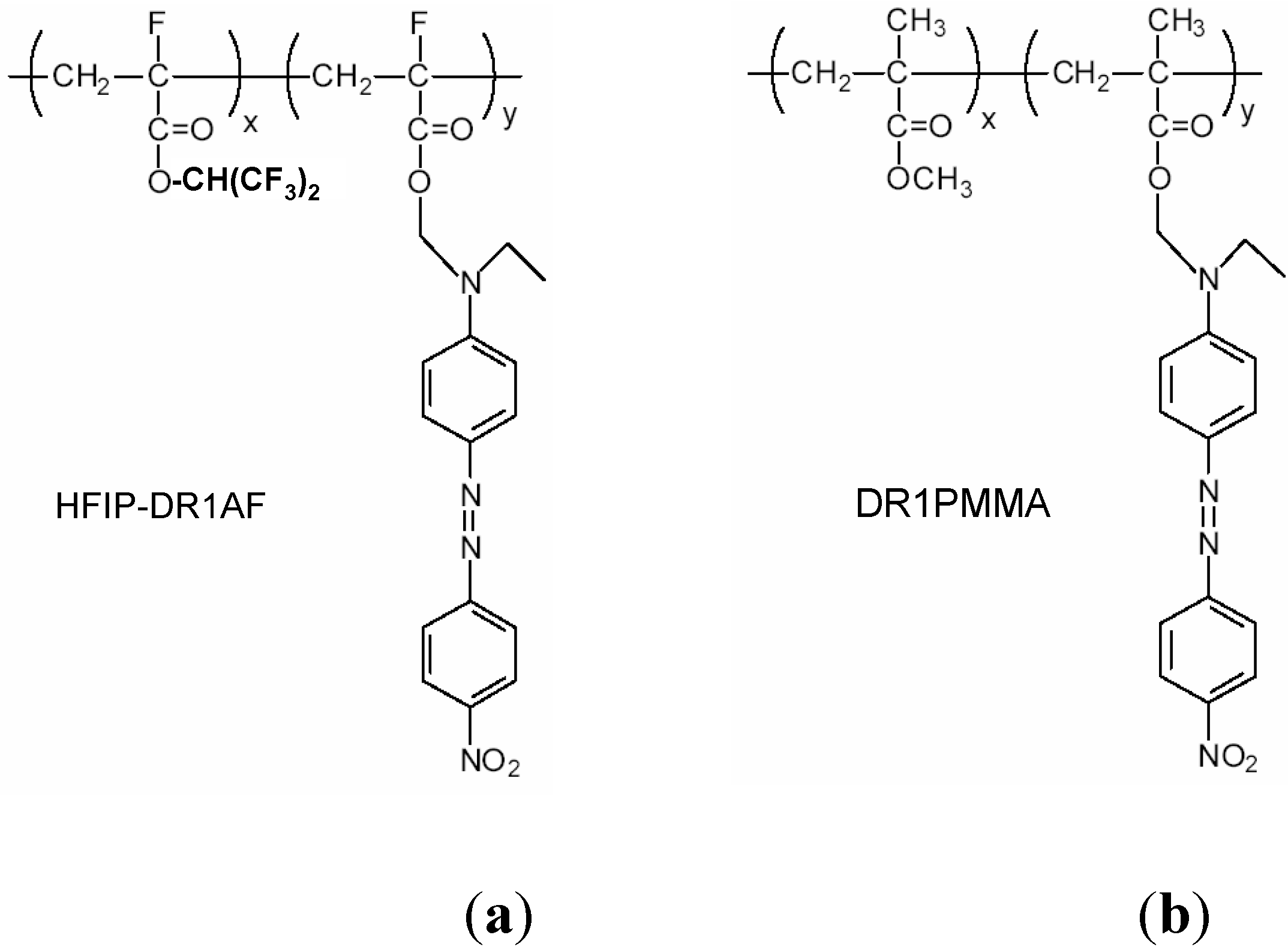
        <p>The copolymer described here is a fluorinated side-chain copolymer, the HFIP-DR1AF [<xref ref-type="bibr" rid="B62-applsci-02-00682">62</xref>], with Tg = 130 °C, whose structure is described in <xref ref-type="fig" rid="applsci-02-00682-f008">Figure 8</xref>(a). It is an evolution of the well-known poly(methylmethacrylate) bearing the DR1 chromophore (DR1PMMA), with structure shown in <xref ref-type="fig" rid="applsci-02-00682-f008">Figure 8</xref>(b), where a part of the C-H groups was substituted with C-F.</p>
        <fig id="applsci-02-00682-f008" position="anchor">
          <label>Figure 8</label>
          <caption>
            <p>(<bold>a</bold>) chemical structure of the HFIP-DR1AF; (<bold>b</bold>) chemical structure of the DR1PMMA. Reprinted with permission from [<xref ref-type="bibr" rid="B62-applsci-02-00682">62</xref>]. Copyright 2005, American Institute of Physics.</p>
          </caption>
          <graphic xmlns:xlink="http://www.w3.org/1999/xlink" xlink:href="applsci-02-00682-g008.tif"/>
        </fig>
        <p>The synthesis of the copolymers was carried out with the hexafluoroisopropyl alphafluoroacrylate monomer (HFIPAF) and the alphafluoroacrylate monomer bearing the Disperse Red 1 (DR1) chromophore (DR1AF). The polymer present 46 % of DR1 substituted group, the electro-optic coefficient of the sample was measured at <italic>λ</italic> = 1,550 nm, resulting to be <italic>r</italic><sub>33</sub> = (4.6 ± 0.5) pm/V, for a poling field of <italic>E<sub>p</sub></italic> = 43 V/μm.</p>
        <p>Thermal stability of the poling induced electro-optic coefficient was measured by means of both temperature scanning and isothermal relaxation measurements as shown in <xref ref-type="fig" rid="applsci-02-00682-f005">Figure 5</xref>, <xref ref-type="fig" rid="applsci-02-00682-f006">Figure 6</xref> and <xref ref-type="fig" rid="applsci-02-00682-f007">Figure 7</xref>. We scanned the temperature from the ambient one up to 140 °C, above the <italic>T<sub>g</sub></italic>, at the rate <italic>dT</italic>/<italic>dt</italic> = 5 °C/min. From <xref ref-type="fig" rid="applsci-02-00682-f005">Figure 5</xref> it results a depolarization temperature <italic>T<sub>dep</sub></italic> = 124 °C, close to, but lower than, the polymer glass-transition temperature <italic>T<sub>g</sub></italic>. </p>
        <p>We then performed isothermal relaxation measurements (<xref ref-type="fig" rid="applsci-02-00682-f006">Figure 6</xref>) for different temperatures ranging between 90 °C and 130 °C. The retrieved activation energy is <italic>E</italic><italic><sub>A</sub></italic> ≈ 58 kcal/mol.</p>
      </sec>
      <sec>
        <title>4.2. FATRIFE-DR1AF</title>
        <p>The copolymer described here is a fluorinated side-chain copolymer, the FATRIFE-DR1AF [<xref ref-type="bibr" rid="B64-applsci-02-00682">64</xref>] with <italic>T<sub>g</sub></italic> = 112 °C, whose structure is similar to the one described in <xref ref-type="fig" rid="applsci-02-00682-f008">Figure 8</xref>(a) except that the side group –CH(CF<sub>3</sub>)<sub>2</sub> is substituted by the side group –CH<sub>2</sub>CF<sub>3</sub>. It is an evolution of DR1PMMA, with structure shown in <xref ref-type="fig" rid="applsci-02-00682-f008">Figure 8</xref>b, where a part of the C-H groups was substituted with C-F. The polymer constitute 30% of the DR1 substituted group; the electro-optic coefficient of the sample was measured at <italic>λ</italic> = 1550 nm, resulting to be <italic>r</italic><sub>33</sub> = (4.7 ± 0.5) pm/V, for a poling field of <italic>E<sub>p</sub></italic> = 48 V/μm.</p>
        <p>Thermal stability of the poling induced electro-optic coefficient was measured by means of both temperature scanning and isothermal relaxation measurements [<xref ref-type="bibr" rid="B64-applsci-02-00682">64</xref>]. We scanned the temperature from the ambient one up to 140 °C, above the <italic>T<sub>g</sub></italic>, at the rate <italic>dT</italic>/<italic>dt</italic> = 5 °C/min. The resulting depolarization temperature <italic>T<sub>dep</sub></italic> = 114 °C, close to, but lower than, the polymer glass-transition temperature <italic>T<sub>g</sub></italic>. </p>
        <p>We then performed isothermal relaxation measurements for different temperatures ranging between 60 °C and 110 °C. The retrieved activation energy is <italic>E<sub>A</sub></italic> ≈ 60 kcal/mol. </p>
      </sec>
      <sec>
        <title>4.3. ADAMANTANE-DR1AF</title>
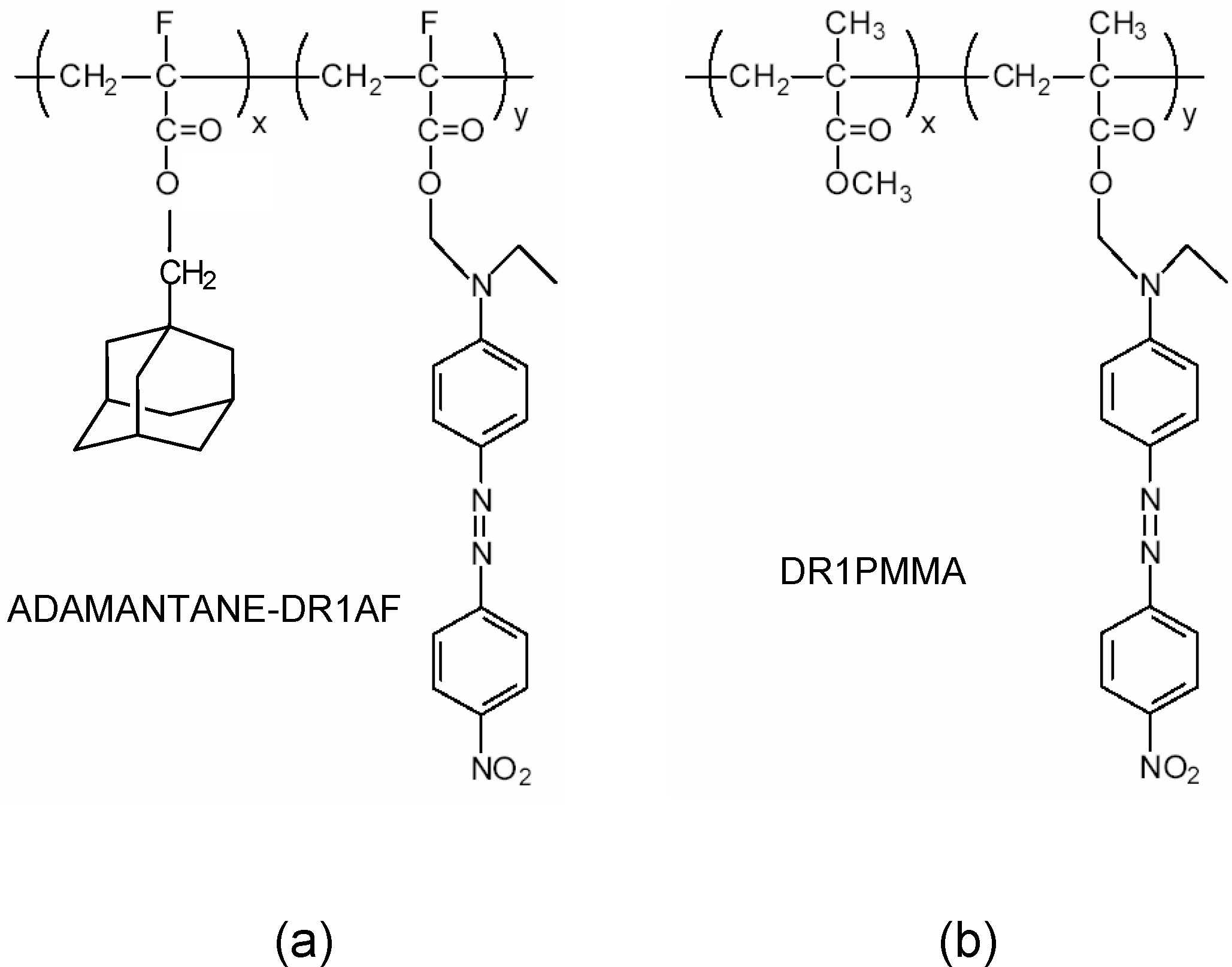
        <p>The copolymer described here is a fluorinated side-chain copolymer, the ADAMANTANE-DR1AF [<xref ref-type="bibr" rid="B11-applsci-02-00682">11</xref>] with <italic>T<sub>g</sub></italic> = 148 °C. The synthesis of the copolymer was carried out with a molar fraction <italic>x</italic> = 73% of the α-fluoroacrylate monomer bearing a heavy stabilizing diamond-like side group, the adamantane (–CH<sub>2</sub>-C<sub>10</sub>H<sub>15</sub>), and a molar fraction y = 27% of the α-fluoroacrylate monomer bearing the Disperse Red 1 (DR1) chromophore (DR1AF). The general structure is given in <xref ref-type="fig" rid="applsci-02-00682-f009">Figure 9</xref>(a). Also the ADAMANTANE-DR1AF is an evolution of the DR1PMMA (<xref ref-type="fig" rid="applsci-02-00682-f009">Figure 9</xref>(b)) [<xref ref-type="bibr" rid="B11-applsci-02-00682">11</xref>], where a part of the C-H groups was substituted with C-F and with the adamantane as a supplementary side group.</p>
        <fig id="applsci-02-00682-f009" position="anchor">
          <label>Figure 9</label>
          <caption>
            <p>(<bold>a</bold>) chemical structure of the ADAMANTANE-DR1AF; (<bold>b</bold>) chemical structure of the DR1PMMA. Reprinted with permission from [<xref ref-type="bibr" rid="B11-applsci-02-00682">11</xref>]. Copyright 2006, American Institute of Physics.</p>
          </caption>
          <graphic xmlns:xlink="http://www.w3.org/1999/xlink" xlink:href="applsci-02-00682-g009.tif"/>
        </fig>
        <p>The electro-optic coefficient of the sample fabricated with ADAMANTANE-DR1AF was measured at <italic>λ</italic> = 1,550 nm and it becomes <italic>r</italic><sub>33</sub> = (2.8 ± 0.3) pm/V, for a poling field of <italic>E<sub>p</sub></italic> = 43 V/μm.</p>
        <p>Thermal stability of the poling induced electro-optic coefficient was measured by means of both temperature scanning and isothermal relaxation measurements [<xref ref-type="bibr" rid="B11-applsci-02-00682">11</xref>].</p>
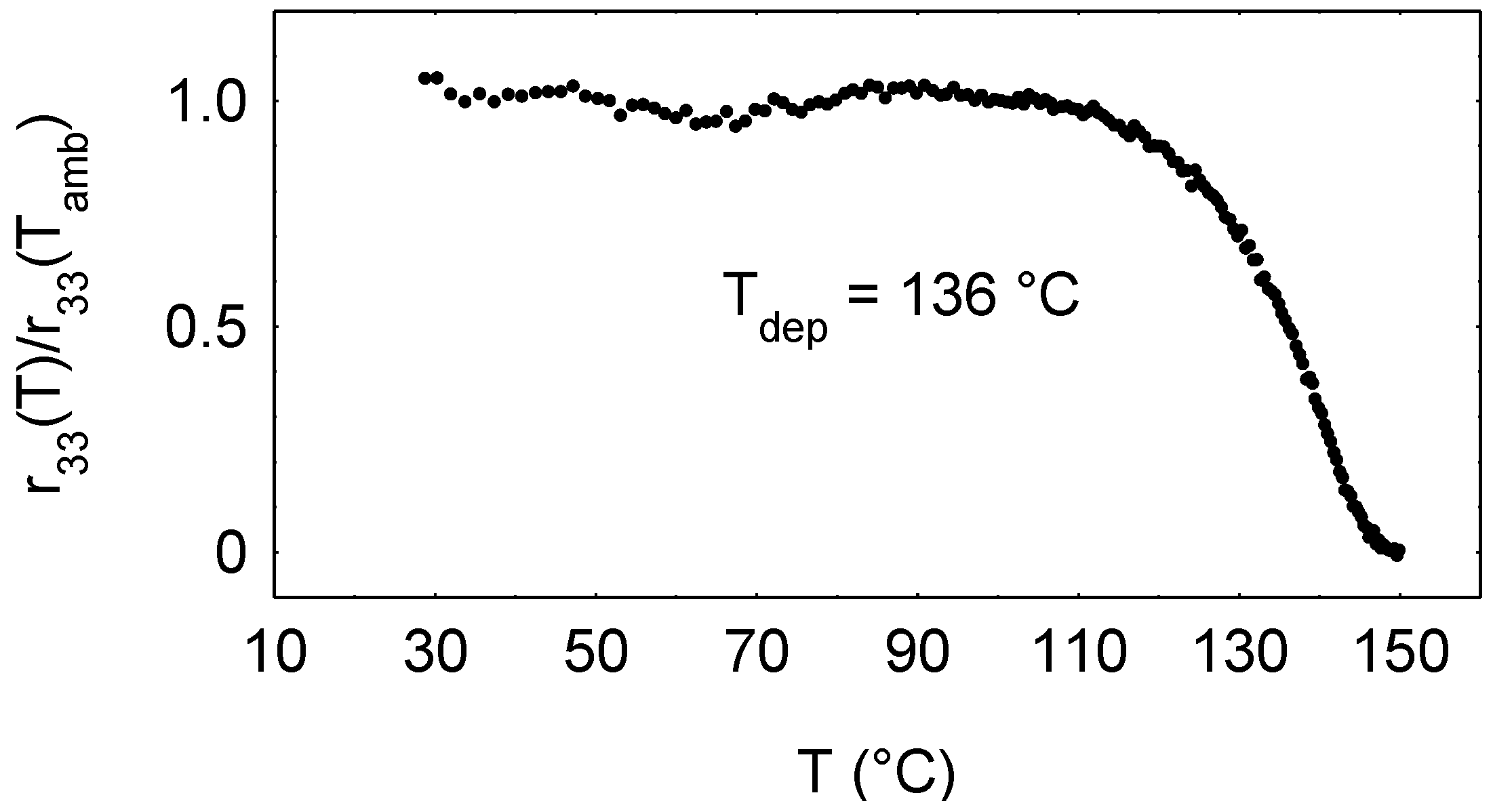
        <p>We scanned the temperature from the ambient one up to 150 °C, above the <italic>T<sub>g</sub></italic>, at a constant rate ∆<italic>T</italic>/∆<italic>t</italic> = 5 °C/min. In <xref ref-type="fig" rid="applsci-02-00682-f010">Figure 10</xref>, the results obtained for the ADAMANTANE-DR1AF copolymer is shown. From the measurements, the results show <italic>T<sub>dep</sub></italic> = 136 °C, close to, but lower than, the polymer glass-transition temperature <italic>T<sub>g</sub></italic>.</p>
        <fig id="applsci-02-00682-f010" position="anchor">
          <label>Figure 10</label>
          <caption>
            <p>Temperature scanning measurements on ADAMANTANE-DR1AF. Reprinted with permission from [<xref ref-type="bibr" rid="B11-applsci-02-00682">11</xref>]. Copyright 2006, American Institute of Physics.</p>
          </caption>
          <graphic xmlns:xlink="http://www.w3.org/1999/xlink" xlink:href="applsci-02-00682-g010.tif"/>
        </fig>
        <p>We then performed isothermal relaxation measurements on the ADAMANTANE-DR1AF sample for different temperatures ranging between 110 °C and 140 °C. In <xref ref-type="fig" rid="applsci-02-00682-f011">Figure 11</xref> we show the isothermal relaxation of the EO coefficient normalized to the initial value <italic>r</italic><sub>33</sub>(<italic>t</italic>)/<italic>r</italic><sub>33</sub>(0), for the three different fluorinated compounds presented so far, performed at the same temperatures <italic>T<sub>m</sub></italic>= 110 °C. The increase of the thermo-stability of the ADAMANTANE-DR1AF copolymer with respect to the other species is evident.</p>
        <fig id="applsci-02-00682-f011" position="anchor">
          <label>Figure 11</label>
          <caption>
            <p>Isothermal relaxation measurements at <italic>T<sub>m</sub></italic>=110 °C for three fluorinated copolymers: ADAMANTANE-DR1AF, FATRIFE-DR1AF, and HFIP-DR1AF . Reprinted with permission from [<xref ref-type="bibr" rid="B11-applsci-02-00682">11</xref>]. Copyright 2006, American Institute of Physics.</p>
          </caption>
          <graphic xmlns:xlink="http://www.w3.org/1999/xlink" xlink:href="applsci-02-00682-g011.tif"/>
        </fig>
        <p>In <xref ref-type="fig" rid="applsci-02-00682-f012">Figure 12</xref>, we plot the values of log&lt;τ&gt; <italic>vs</italic>. 1000/T for the ADAMANTANE-DR1AF copolymer. The graph shows that relaxation of the chromophores orientation can be described by the Arrhenius law with activation energy <italic>E<sub>A</sub></italic>≈ 105 kcal/mol. This result must be compared with the value <italic>E<sub>A</sub></italic>≈ 58 kcal/mol obtained for the HFIP-DR1AF [<xref ref-type="bibr" rid="B62-applsci-02-00682">62</xref>] and <italic>E<sub>A</sub></italic>≈ 60 kcal/mol for the FATRIFE-DR1AF [<xref ref-type="bibr" rid="B64-applsci-02-00682">64</xref>]). This high activation energy, together with the high <italic>T<sub>dep</sub></italic>, leads to a high thermo-stability of the EO properties even at a high operative temperature, compared with other similar fluorinated DR1 based compounds.</p>
        <fig id="applsci-02-00682-f012" position="anchor">
          <label>Figure 12</label>
          <caption>
            <p>Arrhenius plot of the average relaxation time constants retrieved from the isothermal relaxation measurements performed on the ADAMANTANE-DR1AF copolymer at different temperatures. Reprinted with permission from [<xref ref-type="bibr" rid="B11-applsci-02-00682">11</xref>]. Copyright 2006, American Institute of Physics.</p>
          </caption>
          <graphic xmlns:xlink="http://www.w3.org/1999/xlink" xlink:href="applsci-02-00682-g012.tif"/>
        </fig>
      </sec>
      <sec>
        <title>4.4. Polyimides-EHNT</title>
        <p>The copolymer described here [<xref ref-type="bibr" rid="B65-applsci-02-00682">65</xref>] is a fluorinated side-chain copolymer formed by a backbone of polyimides, whose synthesis was carried out by following the procedure in [<xref ref-type="bibr" rid="B65-applsci-02-00682">65</xref>] with a 43% concentration in weight of 2-[4’-(N-ethyl-N-2-hydroxyethyl)-amino-phenylazo]-5-nitrothiazole (EHNT) of the chromophore side group [<xref ref-type="bibr" rid="B65-applsci-02-00682">65</xref>]. The EHNT chromophore show a larger second order hyperpolarizability with respect to the DR1 chromophore shown previously. The Polyimides-EHNT shows a very high glass transition temperature of <italic>T<sub>g</sub></italic> = 200 °C.</p>
        <p>The electro-optic coefficient of a sample fabricated with Polyimides-EHNT was measured at <italic>λ</italic> = 1,550 nm, resulting in <italic>r</italic><sub>33</sub> = 18 pm/V, after a corona poling procedure of one hour with an applied voltage of 8.5 kV at 190 °C. </p>
        <p>Thermal stability of the poling induced electro-optic coefficient was measured by means of isothermal relaxation measurements performed at 80 °C and 120 °C, showing that at 120 °C the poled polymer maintains the 84% of its original <italic>r</italic><sub>33</sub> value after 200 h [<xref ref-type="bibr" rid="B65-applsci-02-00682">65</xref>]. </p>
      </sec>
      <sec>
        <title>4.5. Phenyltetraenic and AJL8 in Antrhracene Crosslinkable Matrix</title>
        <p>In [<xref ref-type="bibr" rid="B66-applsci-02-00682">66</xref>], three different types of acrylate functionalized dendritic nonlinear optical chromophores were dispersed in high-Tg temperature anthracene crosslinkable matrix. The synthesis of the guest-host system was carried out by following the procedure in [<xref ref-type="bibr" rid="B66-applsci-02-00682">66</xref>] with a chormophore concentration of about 17% in weight. The glass transition temperature of the host matrix (labelled P2 in [<xref ref-type="bibr" rid="B66-applsci-02-00682">66</xref>]) is exceptionally high <italic>T<sub>g</sub></italic> = 215 °C, meanwhile the Tg of the chromophores (labeled C1, C2, C3) ranges from 84 °C to 102 °C.</p>
        <p>The electro-optic coefficient of the P2/C3 sample is the highest one with a value of <italic>r</italic><sub>33</sub> = 126 pm/V (measured at <italic>λ</italic> = 1,310 nm) after a poling procedure at 185 °C.</p>
        <p>Thermal stability of the poling induced electro-optic coefficient was measured by means of TMT isothermal relaxation measurements performed at 150 °C, showing that the poled polymer maintains 88% of its original <italic>r</italic><sub>33</sub> value after 500 h [<xref ref-type="bibr" rid="B66-applsci-02-00682">66</xref>].</p>
      </sec>
      <sec>
        <title>4.6. FTC-EGDMA</title>
        <p>The polymer described in [<xref ref-type="bibr" rid="B10-applsci-02-00682">10</xref>] is a side-chain copolymer formed with 38% of the weight of the chromophore denoted in FTC [<xref ref-type="bibr" rid="B10-applsci-02-00682">10</xref>] linked to a crosslinkable matrix formed by methylmethacrylate (MMA), dimetyl-azobisisobuthlate (MAIB) and methacryloyloxyyetyl isocyanata (MOI). The glass transition temperature results show <italic>T<sub>g</sub></italic> = 170 °C, and the electro-optic coefficient measured at <italic>λ</italic> = 1,310nm is 139 pm/V. By performing isothermal relaxation measurements at 85 °C, the poled polymer maintains 83% of its original <italic>r</italic><sub>33</sub> value after 500 h. </p>
      </sec>
    </sec>
    <sec sec-type="conclusions">
      <title>5. Conclusions</title>
      <p>Electro-optic fluorinated copolymers are very useful materials for technological applications in the telecommunication domain. The presence of fluorine reduces optical losses at the telecom wavelength of 1,550 nm. Meanwhile, the electro-optic coefficient can be optimized by using suitable nonlinear chromophores, as appeared here as an example with the well-known Disperse Red 1 (DR1) and also the hetarylazo EHNT chromophore that presents a larger electro-optic coefficient and other chromophores. In this context, the time stability of the externally induced electro-optic coefficient is an important issue in technological design and can be optimized by developing a crosslinkable high-Tg polymers host. Here, we have shown different measurement techniques that can be utilized in the characterization of the time stability of the EO coefficient. A review of the application of these techniques to different copolymer species was given, showing the high potentiality of the fluorinated EO copolymers in this field of application.</p>
    </sec>
  </body>
  <back><ack>
      <title>Acknowledgments</title>
      <p>The author grateful acknowledge F. Michelotti for his teachings and for his support.</p>
    </ack>
    <ref-list>
      <title>References</title>
      <ref id="B1-applsci-02-00682">
        <label>1.</label>
        <citation citation-type="book">
          <person-group person-group-type="author">
            <name>
              <surname>Zyss</surname>
              <given-names>J.</given-names>
            </name>
          </person-group>
          <source>Molecular Nonlinear Optics</source>
          <publisher-name>Academic Press Inc.</publisher-name>
          <publisher-loc>San Diego, CA, USA</publisher-loc>
          <year>1994</year>
        </citation>
      </ref>
      <ref id="B2-applsci-02-00682">
        <label>2.</label>
        <citation citation-type="journal">
          <person-group person-group-type="author">
            <name>
              <surname>Rousseau</surname>
              <given-names>A.</given-names>
            </name>
            <name>
              <surname>Boutevin</surname>
              <given-names>B.</given-names>
            </name>
          </person-group>
          <article-title>Synthesis and characterization of organic materials for integrated optical devices</article-title>
          <source>AIP Conf. Proc.</source>
          <year>2003</year>
          <volume>709</volume>
          <fpage>214</fpage>
          <lpage>232</lpage>
        </citation>
      </ref>
      <ref id="B3-applsci-02-00682">
        <label>3.</label>
        <citation citation-type="journal">
          <person-group person-group-type="author">
            <name>
              <surname>Pyayt</surname>
              <given-names>A.L.</given-names>
            </name>
          </person-group>
          <article-title>Guiding light in electro-optic polymers</article-title>
          <source>Polymers</source>
          <year>2011</year>
          <volume>3</volume>
          <fpage>1591</fpage>
          <lpage>1599</lpage>
          <pub-id pub-id-type="doi">10.3390/polym3041591</pub-id>
        </citation>
      </ref>
      <ref id="B4-applsci-02-00682">
        <label>4.</label>
        <citation citation-type="journal">
          <person-group person-group-type="author">
            <name>
              <surname>Oh</surname>
              <given-names>M.-C.</given-names>
            </name>
            <name>
              <surname>Kim</surname>
              <given-names>K.-J.</given-names>
            </name>
            <name>
              <surname>Chu</surname>
              <given-names>W.-S.</given-names>
            </name>
            <name>
              <surname>Kim</surname>
              <given-names>J.-W.</given-names>
            </name>
            <name>
              <surname>Seo</surname>
              <given-names>J.-K.</given-names>
            </name>
            <name>
              <surname>Noh</surname>
              <given-names>Y.-O.</given-names>
            </name>
            <name>
              <surname>Lee</surname>
              <given-names>H.-J.</given-names>
            </name>
          </person-group>
          <article-title>Integrated photonic devices incorporating low-loss fluorinated polymer materials</article-title>
          <source>Polymers</source>
          <year>2011</year>
          <volume>3</volume>
          <fpage>975</fpage>
          <lpage>997</lpage>
          <pub-id pub-id-type="doi">10.3390/polym3030975</pub-id>
        </citation>
      </ref>
      <ref id="B5-applsci-02-00682">
        <label>5.</label>
        <citation citation-type="journal">
          <person-group person-group-type="author">
            <name>
              <surname>Lee</surname>
              <given-names>M.</given-names>
            </name>
            <name>
              <surname>Katz</surname>
              <given-names>H.E.</given-names>
            </name>
            <name>
              <surname>Erben</surname>
              <given-names>C.</given-names>
            </name>
            <name>
              <surname>Gill</surname>
              <given-names>D.M.</given-names>
            </name>
            <name>
              <surname>Gopalan</surname>
              <given-names>P.</given-names>
            </name>
            <name>
              <surname>Heber</surname>
              <given-names>J.D.</given-names>
            </name>
            <name>
              <surname>McGee</surname>
              <given-names>D.J.</given-names>
            </name>
          </person-group>
          <article-title>Broadband modulation of light by using an electro-optic polymer</article-title>
          <source>Science</source>
          <year>2002</year>
          <volume>298</volume>
          <fpage>1401</fpage>
          <lpage>1403</lpage>
        <pub-id pub-id-type="doi">10.1126/science.1077446</pub-id><pub-id pub-id-type="pmid">12434054</pub-id></citation>
      </ref>
      <ref id="B6-applsci-02-00682">
        <label>6.</label>
        <citation citation-type="journal">
          <person-group person-group-type="author">
            <name>
              <surname>Sun</surname>
              <given-names>H.</given-names>
            </name>
            <name>
              <surname>Chen</surname>
              <given-names>A.</given-names>
            </name>
            <name>
              <surname>Olbricht</surname>
              <given-names>B.C.</given-names>
            </name>
            <name>
              <surname>Davies</surname>
              <given-names>J.A.</given-names>
            </name>
            <name>
              <surname>Sullivan</surname>
              <given-names>P.A.</given-names>
            </name>
            <name>
              <surname>Liao</surname>
              <given-names>Y.</given-names>
            </name>
            <name>
              <surname>Dalton</surname>
              <given-names>L.R.</given-names>
            </name>
          </person-group>
          <article-title>Direct electron beam writing of electro-optic polymer microring resonators</article-title>
          <source>Opt. Express</source>
          <year>2008</year>
          <volume>16</volume>
          <fpage>6592</fpage>
          <lpage>6599</lpage>
        <pub-id pub-id-type="doi">10.1364/OE.16.006592</pub-id><pub-id pub-id-type="pmid">18545362</pub-id></citation>
      </ref>
      <ref id="B7-applsci-02-00682">
        <label>7.</label>
        <citation citation-type="journal">
          <person-group person-group-type="author">
            <name>
              <surname>Sun</surname>
              <given-names>H.</given-names>
            </name>
            <name>
              <surname>Chen</surname>
              <given-names>A.</given-names>
            </name>
            <name>
              <surname>Olbricht</surname>
              <given-names>B.C.</given-names>
            </name>
            <name>
              <surname>Davies</surname>
              <given-names>J.A.</given-names>
            </name>
            <name>
              <surname>Sullivan</surname>
              <given-names>P.A.</given-names>
            </name>
            <name>
              <surname>Liao</surname>
              <given-names>Y.</given-names>
            </name>
            <name>
              <surname>Dalton</surname>
              <given-names>L.R. </given-names>
            </name>
          </person-group>
          <article-title>Microring resonators fabricated by electron beam bleaching of chromophore doped polymers</article-title>
          <source>Appl. Phys. Lett.</source>
          <year>2008</year>
          <volume>92</volume>
          <fpage>193305:1</fpage>
          <lpage>193305:3</lpage>
        </citation>
      </ref>
      <ref id="B8-applsci-02-00682">
        <label>8.</label>
        <citation citation-type="journal">
          <person-group person-group-type="author">
            <name>
              <surname>Song</surname>
              <given-names>H.-C.</given-names>
            </name>
            <name>
              <surname>Oh</surname>
              <given-names>M.-C.</given-names>
            </name>
            <name>
              <surname>Ahn</surname>
              <given-names>S.-W.</given-names>
            </name>
            <name>
              <surname>Steier</surname>
              <given-names>W.H.</given-names>
            </name>
            <name>
              <surname>Fetterman</surname>
              <given-names>H.R.</given-names>
            </name>
            <name>
              <surname>Zhang</surname>
              <given-names>C.</given-names>
            </name>
          </person-group>
          <article-title>Flexible low-voltage electro-optic polymer modulators</article-title>
          <source>Appl. Phys. Lett.</source>
          <year>2003</year>
          <volume>82</volume>
          <fpage>4432</fpage>
          <lpage>4434</lpage>
        <pub-id pub-id-type="doi">10.1063/1.1586474</pub-id></citation>
      </ref>
      <ref id="B9-applsci-02-00682">
        <label>9.</label>
        <citation citation-type="journal">
          <person-group person-group-type="author">
            <name>
              <surname>Belardini</surname>
              <given-names>A.</given-names>
            </name>
            <name>
              <surname>Larciprete</surname>
              <given-names>M.C.</given-names>
            </name>
            <name>
              <surname>Cianci</surname>
              <given-names>E.</given-names>
            </name>
            <name>
              <surname>Foglietti</surname>
              <given-names>V.</given-names>
            </name>
            <name>
              <surname>Ratsimihety</surname>
              <given-names>A.</given-names>
            </name>
            <name>
              <surname>Rousseau</surname>
              <given-names>A.</given-names>
            </name>
            <name>
              <surname>Michelotti</surname>
              <given-names>F.</given-names>
            </name>
          </person-group>
          <article-title>Direct E-beam writing of electro-optic polymer channel waveguides</article-title>
          <source>AIP Conf. Proc.</source>
          <year>2003</year>
          <volume>709</volume>
          <fpage>427</fpage>
          <lpage>428</lpage>
        </citation>
      </ref>
      <ref id="B10-applsci-02-00682">
        <label>10.</label>
        <citation citation-type="journal">
          <person-group person-group-type="author">
            <name>
              <surname>Mori</surname>
              <given-names>Y.</given-names>
            </name>
            <name>
              <surname>Nakaya</surname>
              <given-names>K.</given-names>
            </name>
            <name>
              <surname>Piao</surname>
              <given-names>X.</given-names>
            </name>
            <name>
              <surname>Yamamoto</surname>
              <given-names>K.</given-names>
            </name>
            <name>
              <surname>Otomo</surname>
              <given-names>A.</given-names>
            </name>
            <name>
              <surname>Yokoyama</surname>
              <given-names>S.</given-names>
            </name>
          </person-group>
          <article-title>Large electro-optic activity and enhanced temporal stability of methacrylate-based crosslinking hyperbranched nonlinear optical polymer</article-title>
          <source>J. Polym. Sci. A Polym. Chem.</source>
          <year>2012</year>
          <volume>50</volume>
          <fpage>1254</fpage>
          <lpage>1260</lpage>
          <pub-id pub-id-type="doi">10.1002/pola.25915</pub-id>
        </citation>
      </ref>
      <ref id="B11-applsci-02-00682">
        <label>11.</label>
        <citation citation-type="journal">
          <person-group person-group-type="author">
            <name>
              <surname>Belardini</surname>
              <given-names>A.</given-names>
            </name>
            <name>
              <surname>Dominici</surname>
              <given-names>L.</given-names>
            </name>
            <name>
              <surname>Larciprete</surname>
              <given-names>M.C.</given-names>
            </name>
            <name>
              <surname>Michelotti</surname>
              <given-names>F.</given-names>
            </name>
            <name>
              <surname>Rousseau</surname>
              <given-names>A.</given-names>
            </name>
            <name>
              <surname>Ratsimihety</surname>
              <given-names>A.</given-names>
            </name>
          </person-group>
          <article-title>Enhanced stability of the second order optical properties of high-Tg fluorinated electro-optic copolymer</article-title>
          <source>Appl. Phys. Lett.</source>
          <year>2006</year>
          <volume>89</volume>
          <fpage>231110:1</fpage>
          <lpage>231110:3</lpage>
        </citation>
      </ref>
      <ref id="B12-applsci-02-00682">
        <label>12.</label>
        <citation citation-type="journal">
          <person-group person-group-type="author">
            <name>
              <surname>Pliška</surname>
              <given-names>T.</given-names>
            </name>
            <name>
              <surname>Cho</surname>
              <given-names>W.-R.</given-names>
            </name>
            <name>
              <surname>Meier</surname>
              <given-names>J.</given-names>
            </name>
            <name>
              <surname>Le Duff</surname>
              <given-names>A.-C.</given-names>
            </name>
            <name>
              <surname>Ricci</surname>
              <given-names>V.</given-names>
            </name>
            <name>
              <surname>Otomo</surname>
              <given-names>A.</given-names>
            </name>
            <name>
              <surname>Canva</surname>
              <given-names>M.</given-names>
            </name>
            <name>
              <surname>Stegeman</surname>
              <given-names>G.I.</given-names>
            </name>
            <name>
              <surname>Raimond</surname>
              <given-names>P.</given-names>
            </name>
            <name>
              <surname>Kajzar</surname>
              <given-names>F.</given-names>
            </name>
          </person-group>
          <article-title>Comparative study of nonlinear-optical polymers for guided-wave second-harmonic generation at telecommunication wavelengths</article-title>
          <source>J. Opt. Soc. Am. B</source>
          <year>2000</year>
          <volume>17</volume>
          <fpage>1554</fpage>
          <lpage>1564</lpage>
          <pub-id pub-id-type="doi">10.1364/JOSAB.17.001554</pub-id>
        </citation>
      </ref>
      <ref id="B13-applsci-02-00682">
        <label>13.</label>
        <citation citation-type="journal">
          <person-group person-group-type="author">
            <name>
              <surname>Teng</surname>
              <given-names>C.C.</given-names>
            </name>
            <name>
              <surname>Man</surname>
              <given-names>H.T.</given-names>
            </name>
          </person-group>
          <article-title>Simple reflection technique for measuring the electro-optic coefficient of poled polymers</article-title>
          <source>Appl. Phys. Lett.</source>
          <year>1990</year>
          <volume>56</volume>
          <fpage>1734</fpage>
          <lpage>1736</lpage>
          <pub-id pub-id-type="doi">10.1063/1.103107</pub-id>
        </citation>
      </ref>
      <ref id="B14-applsci-02-00682">
        <label>14.</label>
        <citation citation-type="journal">
          <person-group person-group-type="author">
            <name>
              <surname>Schildkraut</surname>
              <given-names>J.S.</given-names>
            </name>
          </person-group>
          <article-title>Determination of the electrooptic coefficient of a poled polymer film</article-title>
          <source>Appl. Opt.</source>
          <year>1990</year>
          <volume>29</volume>
          <fpage>2839</fpage>
          <lpage>2841</lpage>
          <pub-id pub-id-type="doi">10.1364/AO.29.002839</pub-id>
        </citation>
      </ref>
      <ref id="B15-applsci-02-00682">
        <label>15.</label>
        <citation citation-type="journal">
          <person-group person-group-type="author">
            <name>
              <surname>Michelotti</surname>
              <given-names>F.</given-names>
            </name>
            <name>
              <surname>Nicolao</surname>
              <given-names>G.</given-names>
            </name>
            <name>
              <surname>Tesi</surname>
              <given-names>F.</given-names>
            </name>
            <name>
              <surname>Bertolotti</surname>
              <given-names>M.</given-names>
            </name>
          </person-group>
          <article-title>On the measurement of the electro-optic properties of poled side-chain copolymer films with a modified Teng-Man technique</article-title>
          <source>Chem. Phys.</source>
          <year>1999</year>
          <volume>245</volume>
          <fpage>311</fpage>
          <lpage>326</lpage>
          <pub-id pub-id-type="doi">10.1016/S0301-0104(99)00150-0</pub-id>
        </citation>
      </ref>
      <ref id="B16-applsci-02-00682">
        <label>16.</label>
        <citation citation-type="journal">
          <person-group person-group-type="author">
            <name>
              <surname>Dominici</surname>
              <given-names>L.</given-names>
            </name>
            <name>
              <surname>Michelotti</surname>
              <given-names>F.</given-names>
            </name>
            <name>
              <surname>Whitelegg</surname>
              <given-names>S.</given-names>
            </name>
            <name>
              <surname>Campbell</surname>
              <given-names>A.</given-names>
            </name>
            <name>
              <surname>Bradley</surname>
              <given-names>D.D.C.</given-names>
            </name>
          </person-group>
          <article-title>Comparative study of space-charge effects in polymer light emitting diodes by means of reflection electro-optic and electroabsorption techniques</article-title>
          <source>Phys. Rev. B</source>
          <year>2004</year>
          <volume>69</volume>
          <fpage>054201:1</fpage>
          <lpage>054201:10</lpage>
        </citation>
      </ref>
      <ref id="B17-applsci-02-00682">
        <label>17.</label>
        <citation citation-type="book">
          <person-group person-group-type="author">
            <name>
              <surname>Yariv</surname>
              <given-names>A.</given-names>
            </name>
          </person-group>
          <source>Optical Electronics</source>
          <edition>4th</edition>
          <publisher-name>Saunders College Publishing</publisher-name>
          <publisher-loc>Philadelphia, PA, USA</publisher-loc>
          <year>1991</year>
        </citation>
      </ref>
      <ref id="B18-applsci-02-00682">
        <label>18.</label>
        <citation citation-type="journal">
          <person-group person-group-type="author">
            <name>
              <surname>Maker</surname>
              <given-names>P.D.</given-names>
            </name>
            <name>
              <surname>Terhune</surname>
              <given-names>R.W.</given-names>
            </name>
            <name>
              <surname>Nisenhoff</surname>
              <given-names>M.</given-names>
            </name>
            <name>
              <surname>Savage</surname>
              <given-names>C.M.</given-names>
            </name>
          </person-group>
          <article-title>Effects of dispersion and focusing on the production of optical harmonics</article-title>
          <source>Phys. Rev. Lett.</source>
          <year>1962</year>
          <volume>8</volume>
          <fpage>21</fpage>
          <lpage>22</lpage>
          <pub-id pub-id-type="doi">10.1103/PhysRevLett.8.21</pub-id>
        </citation>
      </ref>
      <ref id="B19-applsci-02-00682">
        <label>19.</label>
        <citation citation-type="journal">
          <person-group person-group-type="author">
            <name>
              <surname>Jerphagnon</surname>
              <given-names>J.</given-names>
            </name>
            <name>
              <surname>Kurtz</surname>
              <given-names>S.K.</given-names>
            </name>
          </person-group>
          <article-title>Maker fringes: a detailed comparison of theory and experiment for isotropic and uniaxial crystals</article-title>
          <source>J. Appl. Phys.</source>
          <year>1970</year>
          <volume>41</volume>
          <fpage>1667</fpage>
          <lpage>1681</lpage>
          <pub-id pub-id-type="doi">10.1063/1.1659090</pub-id>
        </citation>
      </ref>
      <ref id="B20-applsci-02-00682">
        <label>20.</label>
        <citation citation-type="journal">
          <person-group person-group-type="author">
            <name>
              <surname>Herman</surname>
              <given-names>W.N.</given-names>
            </name>
            <name>
              <surname>Hayden</surname>
              <given-names>L.M.</given-names>
            </name>
          </person-group>
          <article-title>Maker fringes revisited: second-harmonic generation from birefringent or absorbing materials</article-title>
          <source>J. Opt. Soc. Am. B</source>
          <year>1995</year>
          <volume>12</volume>
          <fpage>416</fpage>
          <lpage>427</lpage>
          <pub-id pub-id-type="doi">10.1364/JOSAB.12.000416</pub-id>
        </citation>
      </ref>
      <ref id="B21-applsci-02-00682">
        <label>21.</label>
        <citation citation-type="book">
          <person-group person-group-type="author">
            <name>
              <surname>Bloembergen</surname>
              <given-names>N.</given-names>
            </name>
          </person-group>
          <source>Nonlinear Optics</source>
          <edition>4th</edition>
          <publisher-name>World Scientific Publication Co. Pte. Ltd.</publisher-name>
          <publisher-loc>River Edge, NJ, USA</publisher-loc>
          <year>1996</year>
        </citation>
      </ref>
      <ref id="B22-applsci-02-00682">
        <label>22.</label>
        <citation citation-type="journal">
          <person-group person-group-type="author">
            <name>
              <surname>Fazio</surname>
              <given-names>E.</given-names>
            </name>
            <name>
              <surname>Ramadan</surname>
              <given-names>W.</given-names>
            </name>
            <name>
              <surname>Belardini</surname>
              <given-names>A.</given-names>
            </name>
            <name>
              <surname>Bosco</surname>
              <given-names>A.</given-names>
            </name>
            <name>
              <surname>Bertolotti</surname>
              <given-names>M.</given-names>
            </name>
            <name>
              <surname>Petris</surname>
              <given-names>A.</given-names>
            </name>
            <name>
              <surname>Vlad</surname>
              <given-names>V.I. </given-names>
            </name>
          </person-group>
          <article-title>(2+1)D vortex soliton-like propagation in photorefractive Bi<sub>12</sub>SiO<sub>20</sub> crystals</article-title>
          <source>Phys. Rev. E</source>
          <year>2003</year>
          <volume>67</volume>
          <fpage>026611:1</fpage>
          <lpage>026611:8</lpage>
        </citation>
      </ref>
      <ref id="B23-applsci-02-00682">
        <label>23.</label>
        <citation citation-type="journal">
          <person-group person-group-type="author">
            <name>
              <surname>Singer</surname>
              <given-names>K.D.</given-names>
            </name>
            <name>
              <surname>Kuzyk</surname>
              <given-names>M.G.</given-names>
            </name>
            <name>
              <surname>Sohn</surname>
              <given-names>J.E.</given-names>
            </name>
          </person-group>
          <article-title>Second-order nonlinear-optical processes in orientationally ordered materials: relationship between molecular and macroscopic properties</article-title>
          <source>J. Opt. Soc. Am. B</source>
          <year>1987</year>
          <volume>4</volume>
          <fpage>968</fpage>
          <lpage>976</lpage>
          <pub-id pub-id-type="doi">10.1364/JOSAB.4.000968</pub-id>
        </citation>
      </ref>
      <ref id="B24-applsci-02-00682">
        <label>24.</label>
        <citation citation-type="journal">
          <person-group person-group-type="author">
            <name>
              <surname>Harper</surname>
              <given-names>A.W.</given-names>
            </name>
            <name>
              <surname>Sun</surname>
              <given-names>S.</given-names>
            </name>
            <name>
              <surname>Dalton</surname>
              <given-names>L.R.</given-names>
            </name>
            <name>
              <surname>Garner</surname>
              <given-names>S.M.</given-names>
            </name>
            <name>
              <surname>Chen</surname>
              <given-names>A.</given-names>
            </name>
            <name>
              <surname>Kalluri</surname>
              <given-names>S.</given-names>
            </name>
            <name>
              <surname>Steier</surname>
              <given-names>W.H.</given-names>
            </name>
            <name>
              <surname>Robinson</surname>
              <given-names>B.H.</given-names>
            </name>
          </person-group>
          <article-title>Translating microscopic optical nonlinearity into macroscopic optical nonlinearity: the role of chromophore chromophore electrostatic interactions</article-title>
          <source>J. Opt. Soc. Am. B</source>
          <year>1998</year>
          <volume>15</volume>
          <fpage>329</fpage>
          <lpage>337</lpage>
          <pub-id pub-id-type="doi">10.1364/JOSAB.15.000329</pub-id>
        </citation>
      </ref>
      <ref id="B25-applsci-02-00682">
        <label>25.</label>
        <citation citation-type="journal">
          <person-group person-group-type="author">
            <name>
              <surname>Cheng</surname>
              <given-names>L.T.</given-names>
            </name>
            <name>
              <surname>Tam</surname>
              <given-names>W.</given-names>
            </name>
            <name>
              <surname>Stevenson</surname>
              <given-names>S.H.</given-names>
            </name>
            <name>
              <surname>Meredith</surname>
              <given-names>G.R.</given-names>
            </name>
            <name>
              <surname>Rikken</surname>
              <given-names>G.</given-names>
            </name>
            <name>
              <surname>Marder</surname>
              <given-names>S.R.</given-names>
            </name>
          </person-group>
          <article-title>Experimental investigations of organic molecular nonlinear optical polarizabilities. 1. Methods and results on benzene and stilbene derivatives</article-title>
          <source>J. Phys. Chem.</source>
          <year>1991</year>
          <volume>95</volume>
          <fpage>10631</fpage>
          <lpage>10643</lpage>
        <pub-id pub-id-type="doi">10.1021/j100179a026</pub-id></citation>
      </ref>
      <ref id="B26-applsci-02-00682">
        <label>26.</label>
        <citation citation-type="journal">
          <person-group person-group-type="author">
            <name>
              <surname>Cheng</surname>
              <given-names>L.T.</given-names>
            </name>
            <name>
              <surname>Tam</surname>
              <given-names>W.</given-names>
            </name>
            <name>
              <surname>Stevenson</surname>
              <given-names>S.H.</given-names>
            </name>
            <name>
              <surname>Meredith</surname>
              <given-names>G.R.</given-names>
            </name>
            <name>
              <surname>Rikken</surname>
              <given-names>G.</given-names>
            </name>
            <name>
              <surname>Marder</surname>
              <given-names>S.R.</given-names>
            </name>
          </person-group>
          <article-title>Experimental investigations of organic molecular nonlinear optical polarizabilities. 2. A study of conjugation dependences</article-title>
          <source>J. Phys. Chem.</source>
          <year>1991</year>
          <volume>95</volume>
          <fpage>10643</fpage>
          <lpage>10652</lpage>
          <pub-id pub-id-type="doi">10.1021/j100179a027</pub-id>
        </citation>
      </ref>
      <ref id="B27-applsci-02-00682">
        <label>27.</label>
        <citation citation-type="journal">
          <person-group person-group-type="author">
            <name>
              <surname>Dalton</surname>
              <given-names>L.R.</given-names>
            </name>
            <name>
              <surname>Steier</surname>
              <given-names>W.H.</given-names>
            </name>
            <name>
              <surname>Robinson</surname>
              <given-names>B.H.</given-names>
            </name>
            <name>
              <surname>Zhang</surname>
              <given-names>C.</given-names>
            </name>
            <name>
              <surname>Ren</surname>
              <given-names>A.</given-names>
            </name>
            <name>
              <surname>Garner</surname>
              <given-names>S.</given-names>
            </name>
            <name>
              <surname>Chen</surname>
              <given-names>A.</given-names>
            </name>
            <name>
              <surname>Londergan</surname>
              <given-names>T.</given-names>
            </name>
            <name>
              <surname>Irwin</surname>
              <given-names>L.</given-names>
            </name>
            <name>
              <surname>Carlson</surname>
              <given-names>B.</given-names>
            </name>
            <name>
              <surname>Fifield</surname>
              <given-names>L.</given-names>
            </name>
            <name>
              <surname>Phelan</surname>
              <given-names>G.</given-names>
            </name>
            <name>
              <surname>Kincaid</surname>
              <given-names>C.</given-names>
            </name>
            <name>
              <surname>Amend</surname>
              <given-names>J.</given-names>
            </name>
            <name>
              <surname>Jen</surname>
              <given-names>A.</given-names>
            </name>
          </person-group>
          <article-title>From molecules to opto-chips: Organic electro-optic materials</article-title>
          <source>J. Mater. Chem.</source>
          <year>1999</year>
          <volume>9</volume>
          <fpage>1905</fpage>
          <lpage>1920</lpage>
          <pub-id pub-id-type="doi">10.1039/a902659b</pub-id>
        </citation>
      </ref>
      <ref id="B28-applsci-02-00682">
        <label>28.</label>
        <citation citation-type="journal">
          <person-group person-group-type="author">
            <name>
              <surname>Dalton</surname>
              <given-names>L.</given-names>
            </name>
            <name>
              <surname>Harper</surname>
              <given-names>A.</given-names>
            </name>
            <name>
              <surname>Ren</surname>
              <given-names>A.</given-names>
            </name>
            <name>
              <surname>Wang</surname>
              <given-names>F.</given-names>
            </name>
            <name>
              <surname>Todorova</surname>
              <given-names>G.</given-names>
            </name>
            <name>
              <surname>Chen</surname>
              <given-names>J.</given-names>
            </name>
            <name>
              <surname>Zhang</surname>
              <given-names>C.</given-names>
            </name>
            <name>
              <surname>Lee</surname>
              <given-names>M.</given-names>
            </name>
          </person-group>
          <article-title>Polymeric electro-optic modulators: From chromophore design to integration with semiconductor very large scale integration electronics and silica fiber optics</article-title>
          <source>Ind. Eng. Chem. Res.</source>
          <year>1999</year>
          <volume>38</volume>
          <fpage>8</fpage>
          <lpage>33</lpage>
          <pub-id pub-id-type="doi">10.1021/ie9705970</pub-id>
        </citation>
      </ref>
      <ref id="B29-applsci-02-00682">
        <label>29.</label>
        <citation citation-type="journal">
          <person-group person-group-type="author">
            <name>
              <surname>Moylan</surname>
              <given-names>C.R.</given-names>
            </name>
            <name>
              <surname>Twieg</surname>
              <given-names>R.J.</given-names>
            </name>
            <name>
              <surname>Lee</surname>
              <given-names>V.Y.</given-names>
            </name>
            <name>
              <surname>Swanson</surname>
              <given-names>S.A.</given-names>
            </name>
            <name>
              <surname>Betterton</surname>
              <given-names>K.M.</given-names>
            </name>
            <name>
              <surname>Miller</surname>
              <given-names>R.D.</given-names>
            </name>
          </person-group>
          <article-title>Nonlinear optical chromophores with large hyperpolarizabilities and enhanced thermal stabilities</article-title>
          <source>J. Am. Chem. Soc.</source>
          <year>1993</year>
          <volume>115</volume>
          <fpage>12599</fpage>
          <lpage>12600</lpage>
          <pub-id pub-id-type="doi">10.1021/ja00079a055</pub-id>
        </citation>
      </ref>
      <ref id="B30-applsci-02-00682">
        <label>30.</label>
        <citation citation-type="journal">
          <person-group person-group-type="author">
            <name>
              <surname>Skinner</surname>
              <given-names>I.M.</given-names>
            </name>
            <name>
              <surname>Garth</surname>
              <given-names>S.J.</given-names>
            </name>
          </person-group>
          <article-title>Reconciliation of esu and mksa units in nonlinear optics</article-title>
          <source>Am. J. Phys.</source>
          <year>1990</year>
          <volume>58</volume>
          <fpage>177</fpage>
          <lpage>181</lpage>
          <pub-id pub-id-type="doi">10.1119/1.16231</pub-id>
        </citation>
      </ref>
      <ref id="B31-applsci-02-00682">
        <label>31.</label>
        <citation citation-type="journal">
          <person-group person-group-type="author">
            <name>
              <surname>Blanchard</surname>
              <given-names>D.M.</given-names>
            </name>
            <name>
              <surname>Mitchell</surname>
              <given-names>G.R.</given-names>
            </name>
          </person-group>
          <article-title>A comparison of photoinduced poling and thermal poling of azo-dye-doped polymer films for second order nonlinear optical applications</article-title>
          <source>Appl. Phys. Lett.</source>
          <year>1993</year>
          <volume>63</volume>
          <fpage>2038</fpage>
          <lpage>2040</lpage>
          <pub-id pub-id-type="doi">10.1063/1.110584</pub-id>
        </citation>
      </ref>
      <ref id="B32-applsci-02-00682">
        <label>32.</label>
        <citation citation-type="journal">
          <person-group person-group-type="author">
            <name>
              <surname>Bauer-Gogonea</surname>
              <given-names>S.</given-names>
            </name>
            <name>
              <surname>Bauer</surname>
              <given-names>S.</given-names>
            </name>
            <name>
              <surname>Wirges</surname>
              <given-names>W.</given-names>
            </name>
            <name>
              <surname>Gerhard-Multhaupt</surname>
              <given-names>R.</given-names>
            </name>
          </person-group>
          <article-title>Pyroelectrical investigation of the dipole orientation in nonlinear optical polymers during and after photoinduced poling</article-title>
          <source>J. Appl. Phys.</source>
          <year>1994</year>
          <volume>76</volume>
          <fpage>2627</fpage>
          <lpage>2635</lpage>
          <pub-id pub-id-type="doi">10.1063/1.357559</pub-id>
        </citation>
      </ref>
      <ref id="B33-applsci-02-00682">
        <label>33.</label>
        <citation citation-type="journal">
          <person-group person-group-type="author">
            <name>
              <surname>Wu</surname>
              <given-names>J.W.</given-names>
            </name>
          </person-group>
          <article-title>Birefringent and electro-optic effects in poled polymer films: Steady-state and transient properties</article-title>
          <source>J. Opt. Soc. Am. B</source>
          <year>1991</year>
          <volume>8</volume>
          <fpage>142</fpage>
          <lpage>152</lpage>
          <pub-id pub-id-type="doi">10.1364/JOSAB.8.000142</pub-id>
        </citation>
      </ref>
      <ref id="B34-applsci-02-00682">
        <label>34.</label>
        <citation citation-type="journal">
          <person-group person-group-type="author">
            <name>
              <surname>Michelotti</surname>
              <given-names>F.</given-names>
            </name>
            <name>
              <surname>Toussaere</surname>
              <given-names>E.</given-names>
            </name>
          </person-group>
          <article-title>Pulse poling of side-chain and crosslinkable copolymers</article-title>
          <source>J. Appl. Phys.</source>
          <year>1997</year>
          <volume>82</volume>
          <fpage>5728</fpage>
          <lpage>5744</lpage>
          <pub-id pub-id-type="doi">10.1063/1.366437</pub-id>
        </citation>
      </ref>
      <ref id="B35-applsci-02-00682">
        <label>35.</label>
        <citation citation-type="journal">
          <person-group person-group-type="author">
            <name>
              <surname>Brasselet</surname>
              <given-names>S.</given-names>
            </name>
            <name>
              <surname>Zyss</surname>
              <given-names>J.</given-names>
            </name>
          </person-group>
          <article-title>Multipolar molecules and multipolar fields: Probing and controlling the tensorial nature of nonlinear molecular media</article-title>
          <source>J. Opt. Soc. Am. B</source>
          <year>1998</year>
          <volume>15</volume>
          <fpage>257</fpage>
          <lpage>288</lpage>
          <pub-id pub-id-type="doi">10.1364/JOSAB.15.000257</pub-id>
        </citation>
      </ref>
      <ref id="B36-applsci-02-00682">
        <label>36.</label>
        <citation citation-type="journal">
          <person-group person-group-type="author">
            <name>
              <surname>Quatela</surname>
              <given-names>A.</given-names>
            </name>
            <name>
              <surname>De Matteis</surname>
              <given-names>F.</given-names>
            </name>
            <name>
              <surname>Casalboni</surname>
              <given-names>M.</given-names>
            </name>
            <name>
              <surname>Stella</surname>
              <given-names>F.</given-names>
            </name>
            <name>
              <surname>Colombo</surname>
              <given-names>M.</given-names>
            </name>
            <name>
              <surname>Zaopo</surname>
              <given-names>A.</given-names>
            </name>
          </person-group>
          <article-title>Order relaxation of a poled azo dye in a high Tg, fully aromatic polyimide</article-title>
          <source>J. Appl. Phys.</source>
          <year>2007</year>
          <volume>101</volume>
          <fpage>023116:1</fpage>
          <lpage>023116:6</lpage>
        </citation>
      </ref>
      <ref id="B37-applsci-02-00682">
        <label>37.</label>
        <citation citation-type="journal">
          <person-group person-group-type="author">
            <name>
              <surname>Scher</surname>
              <given-names>H.</given-names>
            </name>
            <name>
              <surname>Shlesinger</surname>
              <given-names>M.F.</given-names>
            </name>
            <name>
              <surname>Bendler</surname>
              <given-names>J.T.</given-names>
            </name>
          </person-group>
          <article-title>Time scale invariance in transport and relaxation</article-title>
          <source>Phys. Today</source>
          <year>1991</year>
          <volume>44</volume>
          <fpage>26</fpage>
          <lpage>34</lpage>
          <pub-id pub-id-type="doi">10.1063/1.881289</pub-id>
        </citation>
      </ref>
      <ref id="B38-applsci-02-00682">
        <label>38.</label>
        <citation citation-type="journal">
          <person-group person-group-type="author">
            <name>
              <surname>Williams</surname>
              <given-names>G.</given-names>
            </name>
            <name>
              <surname>Watts</surname>
              <given-names>D.C.</given-names>
            </name>
          </person-group>
          <article-title>Non-symmetrical dielectric relaxation behaviour arising from a simple empirical decay function</article-title>
          <source>Trans. Faraday Soc.</source>
          <year>1970</year>
          <volume>66</volume>
          <fpage>80</fpage>
          <lpage>85</lpage>
          <pub-id pub-id-type="doi">10.1039/tf9706600080</pub-id>
        </citation>
      </ref>
      <ref id="B39-applsci-02-00682">
        <label>39.</label>
        <citation citation-type="journal">
          <person-group person-group-type="author">
            <name>
              <surname>Ghebremichael</surname>
              <given-names>F.</given-names>
            </name>
            <name>
              <surname>Kuzyk</surname>
              <given-names>M.G.</given-names>
            </name>
          </person-group>
          <article-title>Optical second-harmonic generation as a probe of the temperature dependence of the distribution of sites in a poly(methyl methacrylate) polymer doped with disperse red 1 azo dye</article-title>
          <source>J. Appl. Phys.</source>
          <year>1995</year>
          <volume>77</volume>
          <fpage>2896</fpage>
          <lpage>2901</lpage>
          <pub-id pub-id-type="doi">10.1063/1.358704</pub-id>
        </citation>
      </ref>
      <ref id="B40-applsci-02-00682">
        <label>40.</label>
        <citation citation-type="journal">
          <person-group person-group-type="author">
            <name>
              <surname>Michelotti</surname>
              <given-names>F.</given-names>
            </name>
            <name>
              <surname>Taggi</surname>
              <given-names>V.</given-names>
            </name>
            <name>
              <surname>Bertolotti</surname>
              <given-names>M.</given-names>
            </name>
            <name>
              <surname>Gabler</surname>
              <given-names>T.</given-names>
            </name>
            <name>
              <surname>Hörhold</surname>
              <given-names>H.H.</given-names>
            </name>
            <name>
              <surname>Bräuer</surname>
              <given-names>A.</given-names>
            </name>
          </person-group>
          <article-title>Reflection electro-optical measurements on electroluminescent polymer films: A good tool for investigating charge injection and space charge effects</article-title>
          <source>J. Appl. Phys.</source>
          <year>1998</year>
          <volume>83</volume>
          <fpage>7886</fpage>
          <lpage>7895</lpage>
        <pub-id pub-id-type="doi">10.1063/1.367966</pub-id></citation>
      </ref>
      <ref id="B41-applsci-02-00682">
        <label>41.</label>
        <citation citation-type="journal">
          <person-group person-group-type="author">
            <name>
              <surname>Michelotti</surname>
              <given-names>F.</given-names>
            </name>
            <name>
              <surname>Bussi</surname>
              <given-names>S.</given-names>
            </name>
            <name>
              <surname>Dominici</surname>
              <given-names>L.</given-names>
            </name>
            <name>
              <surname>Bertolotti</surname>
              <given-names>M.</given-names>
            </name>
            <name>
              <surname>Bao</surname>
              <given-names>Z.</given-names>
            </name>
          </person-group>
          <article-title>Space charge effects in polymer-based light-emitting diodes studied by means of a polarization sensitive electroreflectance technique</article-title>
          <source>J. Appl. Phys.</source>
          <year>2002</year>
          <volume>91</volume>
          <fpage>5521</fpage>
          <lpage>5532</lpage>
          <pub-id pub-id-type="doi">10.1063/1.1459771</pub-id>
        </citation>
      </ref>
      <ref id="B42-applsci-02-00682">
        <label>42.</label>
        <citation citation-type="journal">
          <person-group person-group-type="author">
            <name>
              <surname>Miniewicz</surname>
              <given-names>A.</given-names>
            </name>
            <name>
              <surname>Michelotti</surname>
              <given-names>F.</given-names>
            </name>
            <name>
              <surname>Belardini</surname>
              <given-names>A.</given-names>
            </name>
          </person-group>
          <article-title>Photoconducting polymer-liquid crystal structure studied by electroreflectance</article-title>
          <source>J. Appl. Phys.</source>
          <year>2004</year>
          <volume>95</volume>
          <fpage>1141</fpage>
          <lpage>1147</lpage>
          <pub-id pub-id-type="doi">10.1063/1.1637706</pub-id>
        </citation>
      </ref>
      <ref id="B43-applsci-02-00682">
        <label>43.</label>
        <citation citation-type="journal">
          <person-group person-group-type="author">
            <name>
              <surname>Michelotti</surname>
              <given-names>F.</given-names>
            </name>
            <name>
              <surname>Dominici</surname>
              <given-names>L.</given-names>
            </name>
            <name>
              <surname>Belardini</surname>
              <given-names>A.</given-names>
            </name>
          </person-group>
          <article-title>Charge injection and trapping contributions to the electro-optic response of mesoscopic polymer systems</article-title>
          <source>AIP Conf. Proc.</source>
          <year>2003</year>
          <volume>709</volume>
          <fpage>233</fpage>
          <lpage>251</lpage>
        </citation>
      </ref>
      <ref id="B44-applsci-02-00682">
        <label>44.</label>
        <citation citation-type="journal">
          <person-group person-group-type="author">
            <name>
              <surname>Jespersen</surname>
              <given-names>K.G.</given-names>
            </name>
            <name>
              <surname>Pedersen</surname>
              <given-names>T.G.</given-names>
            </name>
            <name>
              <surname>Johansen</surname>
              <given-names>P.M.</given-names>
            </name>
          </person-group>
          <article-title>Electro-optic response of chromophores in a viscoelastic polymer matrix to a combined dc and ac poling field</article-title>
          <source>J. Opt. Soc. Am. B</source>
          <year>2003</year>
          <volume>20</volume>
          <fpage>2179</fpage>
          <lpage>2188</lpage>
        </citation>
      </ref>
      <ref id="B45-applsci-02-00682">
        <label>45.</label>
        <citation citation-type="journal">
          <person-group person-group-type="author">
            <name>
              <surname>Nagtegaele</surname>
              <given-names>P.</given-names>
            </name>
            <name>
              <surname>Brasselet</surname>
              <given-names>E.</given-names>
            </name>
            <name>
              <surname>Zyss</surname>
              <given-names>J.</given-names>
            </name>
          </person-group>
          <article-title>Anisotropy and dispersion of a Pockels tensor: A benchmark for electro-optic organic thin-film assessment</article-title>
          <source>J. Opt. Soc. Am. B</source>
          <year>2003</year>
          <volume>20</volume>
          <fpage>1932</fpage>
          <lpage>1936</lpage>
          <pub-id pub-id-type="doi">10.1364/JOSAB.20.001932</pub-id>
        </citation>
      </ref>
      <ref id="B46-applsci-02-00682">
        <label>46.</label>
        <citation citation-type="journal">
          <person-group person-group-type="author">
            <name>
              <surname>Michelotti</surname>
              <given-names>F.</given-names>
            </name>
            <name>
              <surname>Belardini</surname>
              <given-names>A.</given-names>
            </name>
            <name>
              <surname>Larciprete</surname>
              <given-names>M.C.</given-names>
            </name>
            <name>
              <surname>Bertolotti</surname>
              <given-names>M.</given-names>
            </name>
            <name>
              <surname>Rousseau</surname>
              <given-names>A.</given-names>
            </name>
            <name>
              <surname>Ratsimihety</surname>
              <given-names>A.</given-names>
            </name>
            <name>
              <surname>Schoer</surname>
              <given-names>G.</given-names>
            </name>
            <name>
              <surname>Mueller</surname>
              <given-names>J.</given-names>
            </name>
          </person-group>
          <article-title>Measurement of the electro-optic properties of poled polymers at λ = 1.55μm by means of sandwich structures with zinc oxide transparent electrode</article-title>
          <source>Appl. Phys. Lett.</source>
          <year>2003</year>
          <volume>83</volume>
          <fpage>4477</fpage>
          <lpage>4479</lpage>
        <pub-id pub-id-type="doi">10.1063/1.1622798</pub-id></citation>
      </ref>
      <ref id="B47-applsci-02-00682">
        <label>47.</label>
        <citation citation-type="journal">
          <person-group person-group-type="author">
            <name>
              <surname>Park</surname>
              <given-names>D.H.</given-names>
            </name>
            <name>
              <surname>Lee</surname>
              <given-names>C.H.</given-names>
            </name>
            <name>
              <surname>Herman</surname>
              <given-names>W.N.</given-names>
            </name>
          </person-group>
          <article-title>Analysis of multiple reflection effects in reflective measurements of electro-optic coefficients of poled polymers in multilayer structures</article-title>
          <source>Opt. Express</source>
          <year>2006</year>
          <volume>14</volume>
          <fpage>8866</fpage>
          <lpage>8884</lpage>
          <pub-id pub-id-type="doi">10.1364/OE.14.008866</pub-id>
        </citation>
      </ref>
      <ref id="B48-applsci-02-00682">
        <label>48.</label>
        <citation citation-type="journal">
          <person-group person-group-type="author">
            <name>
              <surname>Hou</surname>
              <given-names>A.</given-names>
            </name>
            <name>
              <surname>Liu</surname>
              <given-names>H.</given-names>
            </name>
            <name>
              <surname>Sun</surname>
              <given-names>J.</given-names>
            </name>
            <name>
              <surname>Zhang</surname>
              <given-names>D.</given-names>
            </name>
            <name>
              <surname>Yi</surname>
              <given-names>M.</given-names>
            </name>
          </person-group>
          <article-title>Measurement of the electro-optic coefficient of polymer thin films with better spatial resolution</article-title>
          <source>Optics &amp; Laser Tech.</source>
          <year>2007</year>
          <volume>39</volume>
          <fpage>411</fpage>
          <lpage>414</lpage>
        <pub-id pub-id-type="doi">10.1016/j.optlastec.2005.06.033</pub-id></citation>
      </ref>
      <ref id="B49-applsci-02-00682">
        <label>49.</label>
        <citation citation-type="journal">
          <person-group person-group-type="author">
            <name>
              <surname>Park</surname>
              <given-names>D.H.</given-names>
            </name>
            <name>
              <surname>Luo</surname>
              <given-names>J.</given-names>
            </name>
            <name>
              <surname>Jen</surname>
              <given-names>A.K.-Y.</given-names>
            </name>
            <name>
              <surname>Herman</surname>
              <given-names>W.N.</given-names>
            </name>
          </person-group>
          <article-title>Simplified reflection Fabry-Perot method for determination of electro-optic coefficients of poled polymer thin films</article-title>
          <source>Polymers</source>
          <year>2011</year>
          <volume>3</volume>
          <fpage>1310</fpage>
          <lpage>1324</lpage>
          <pub-id pub-id-type="doi">10.3390/polym3031310</pub-id>
        </citation>
      </ref>
      <ref id="B50-applsci-02-00682">
        <label>50.</label>
        <citation citation-type="journal">
          <person-group person-group-type="author">
            <name>
              <surname>Michelotti</surname>
              <given-names>F.</given-names>
            </name>
            <name>
              <surname>Belardini</surname>
              <given-names>A.</given-names>
            </name>
            <name>
              <surname>Rousseau</surname>
              <given-names>A.</given-names>
            </name>
            <name>
              <surname>Ratsimihety</surname>
              <given-names>A.</given-names>
            </name>
            <name>
              <surname>Schoer</surname>
              <given-names>G.</given-names>
            </name>
            <name>
              <surname>Muller</surname>
              <given-names>J.</given-names>
            </name>
          </person-group>
          <article-title>Use of sandwich structures with ZnO:Al transparent electrodes for the measurement of the electro-optic properties of standard and fluorinated poled copolymers at λ = 1.55 μm</article-title>
          <source>J. Non-Crystalline Solids</source>
          <year>2006</year>
          <volume>352</volume>
          <fpage>2339</fpage>
          <lpage>2342</lpage>
          <pub-id pub-id-type="doi">10.1016/j.jnoncrysol.2006.03.042</pub-id>
        </citation>
      </ref>
      <ref id="B51-applsci-02-00682">
        <label>51.</label>
        <citation citation-type="journal">
          <person-group person-group-type="author">
            <name>
              <surname>Michelotti</surname>
              <given-names>F.</given-names>
            </name>
            <name>
              <surname>Canali</surname>
              <given-names>R.</given-names>
            </name>
            <name>
              <surname>Dominici</surname>
              <given-names>L.</given-names>
            </name>
            <name>
              <surname>Belardini</surname>
              <given-names>A.</given-names>
            </name>
            <name>
              <surname>Menchini</surname>
              <given-names>F.</given-names>
            </name>
            <name>
              <surname>Schoer</surname>
              <given-names>G.</given-names>
            </name>
            <name>
              <surname>Muller</surname>
              <given-names>J. </given-names>
            </name>
          </person-group>
          <article-title>Second order optical nonlinearity of ZnO/ZnO:Al bilayers deposited on glass by low temperature radio frequency sputtering</article-title>
          <source>Appl. Phys. Lett.</source>
          <year>2007</year>
          <volume>90</volume>
          <fpage>181110:1</fpage>
          <lpage>181110:3</lpage>
        </citation>
      </ref>
      <ref id="B52-applsci-02-00682">
        <label>52.</label>
        <citation citation-type="journal">
          <person-group person-group-type="author">
            <name>
              <surname>Franken</surname>
              <given-names>P.A.</given-names>
            </name>
            <name>
              <surname>Hill</surname>
              <given-names>A.E.</given-names>
            </name>
            <name>
              <surname>Peters</surname>
              <given-names>C.W.</given-names>
            </name>
            <name>
              <surname>Weinreich</surname>
              <given-names>G.</given-names>
            </name>
          </person-group>
          <article-title>Generation of optical harmonics</article-title>
          <source>Phys. Rev. Lett.</source>
          <year>1961</year>
          <volume>7</volume>
          <fpage>118</fpage>
          <lpage>119</lpage>
          <pub-id pub-id-type="doi">10.1103/PhysRevLett.7.118</pub-id>
        </citation>
      </ref>
      <ref id="B53-applsci-02-00682">
        <label>53.</label>
        <citation citation-type="journal">
          <person-group person-group-type="author">
            <name>
              <surname>Cattaneo</surname>
              <given-names>S.</given-names>
            </name>
            <name>
              <surname>Kauranen</surname>
              <given-names>M.</given-names>
            </name>
          </person-group>
          <article-title>Determination of second-order susceptibility components of thin films by two-beam second-harmonic generation</article-title>
          <source>Opt. Lett.</source>
          <year>2003</year>
          <volume>28</volume>
          <fpage>1445</fpage>
          <lpage>1447</lpage>
          <pub-id pub-id-type="doi">10.1364/OL.28.001445</pub-id>
        </citation>
      </ref>
      <ref id="B54-applsci-02-00682">
        <label>54.</label>
        <citation citation-type="journal">
          <person-group person-group-type="author">
            <name>
              <surname>Larciprete</surname>
              <given-names>M.C.</given-names>
            </name>
            <name>
              <surname>Bovino</surname>
              <given-names>F.A.</given-names>
            </name>
            <name>
              <surname>Giardina</surname>
              <given-names>M.</given-names>
            </name>
            <name>
              <surname>Belardini</surname>
              <given-names>A.</given-names>
            </name>
            <name>
              <surname>Centini</surname>
              <given-names>M.</given-names>
            </name>
            <name>
              <surname>Sibilia</surname>
              <given-names>C.</given-names>
            </name>
            <name>
              <surname>Bertolotti</surname>
              <given-names>M.</given-names>
            </name>
            <name>
              <surname>Passaseo</surname>
              <given-names>A.</given-names>
            </name>
            <name>
              <surname>Tasco</surname>
              <given-names>V.</given-names>
            </name>
          </person-group>
          <article-title>Mapping the nonlinear optical susceptibility by noncollinear second-harmonic generation</article-title>
          <source>Opt. Lett.</source>
          <year>2009</year>
          <volume>34</volume>
          <fpage>2189</fpage>
          <lpage>2191</lpage>
          <pub-id pub-id-type="doi">10.1364/OL.34.002189</pub-id>
        </citation>
      </ref>
      <ref id="B55-applsci-02-00682">
        <label>55.</label>
        <citation citation-type="journal">
          <person-group person-group-type="author">
            <name>
              <surname>Verbiest</surname>
              <given-names>T.</given-names>
            </name>
            <name>
              <surname>Kauranen</surname>
              <given-names>M.</given-names>
            </name>
            <name>
              <surname>Van Rompaey</surname>
              <given-names>Y.</given-names>
            </name>
            <name>
              <surname>Persoonson</surname>
              <given-names>A.</given-names>
            </name>
          </person-group>
          <article-title>Optical activity of anisotropic achiral surfaces</article-title>
          <source>Phys. Rev. Lett.</source>
          <year>1996</year>
          <volume>77</volume>
          <fpage>1456</fpage>
          <lpage>1459</lpage>
          <pub-id pub-id-type="doi">10.1103/PhysRevLett.77.1456</pub-id>
        </citation>
      </ref>
      <ref id="B56-applsci-02-00682">
        <label>56.</label>
        <citation citation-type="journal">
          <person-group person-group-type="author">
            <name>
              <surname>Belardini</surname>
              <given-names>A.</given-names>
            </name>
            <name>
              <surname>Larciprete</surname>
              <given-names>M.C.</given-names>
            </name>
            <name>
              <surname>Centini</surname>
              <given-names>M.</given-names>
            </name>
            <name>
              <surname>Fazio</surname>
              <given-names>E.</given-names>
            </name>
            <name>
              <surname>Sibilia</surname>
              <given-names>C.</given-names>
            </name>
            <name>
              <surname>Chiappe</surname>
              <given-names>D.</given-names>
            </name>
            <name>
              <surname>Martella</surname>
              <given-names>C.</given-names>
            </name>
            <name>
              <surname>Toma</surname>
              <given-names>A.</given-names>
            </name>
            <name>
              <surname>Giordano</surname>
              <given-names>M.</given-names>
            </name>
            <name>
              <surname>Buatier de Mongeot</surname>
              <given-names>F.</given-names>
            </name>
          </person-group>
          <article-title>Circular dichroism in the optical second-harmonic emission of curved gold metal nanowires</article-title>
          <source>Phys. Rev. Lett.</source>
          <year>2011</year>
          <volume>107</volume>
          <fpage>257401:1</fpage>
          <lpage>257401:5</lpage>
        </citation>
      </ref>
      <ref id="B57-applsci-02-00682">
        <label>57.</label>
        <citation citation-type="book">
          <person-group person-group-type="author">
            <name>
              <surname>Verbiest</surname>
              <given-names>T.</given-names>
            </name>
            <name>
              <surname>Clays</surname>
              <given-names>K.</given-names>
            </name>
            <name>
              <surname>Rodriguez</surname>
              <given-names>V.</given-names>
            </name>
          </person-group>
          <article-title>Second-Order Nonlinear Optical Characterization Techniques</article-title>
          <publisher-name>CRC Press</publisher-name>
          <publisher-loc>NY, USA</publisher-loc>
          <year>2009</year>
        </citation>
      </ref>
      <ref id="B58-applsci-02-00682">
        <label>58.</label>
        <citation citation-type="journal">
          <person-group person-group-type="author">
            <name>
              <surname>Belardini</surname>
              <given-names>A.</given-names>
            </name>
            <name>
              <surname>Pannone</surname>
              <given-names>F.</given-names>
            </name>
            <name>
              <surname>Leahu</surname>
              <given-names>G.</given-names>
            </name>
            <name>
              <surname>Larciprete</surname>
              <given-names>M.C.</given-names>
            </name>
            <name>
              <surname>Centini</surname>
              <given-names>M.</given-names>
            </name>
            <name>
              <surname>Sibilia</surname>
              <given-names>C.</given-names>
            </name>
            <name>
              <surname>Martella</surname>
              <given-names>C.</given-names>
            </name>
            <name>
              <surname>Giordano</surname>
              <given-names>M.</given-names>
            </name>
            <name>
              <surname>Chiappe</surname>
              <given-names>D.</given-names>
            </name>
            <name>
              <surname>Buatier de Mongeot</surname>
              <given-names>F.</given-names>
            </name>
          </person-group>
          <article-title>Evidence of anomalous refraction of self-assembled curved gold nanowires</article-title>
          <source>Appl. Phys. Lett.</source>
          <year>2012</year>
          <volume>100</volume>
          <fpage>251109:1</fpage>
          <lpage>251109:5</lpage>
        </citation>
      </ref>
      <ref id="B59-applsci-02-00682">
        <label>59.</label>
        <citation citation-type="journal">
          <person-group person-group-type="author">
            <name>
              <surname>Palazzesi</surname>
              <given-names>C.</given-names>
            </name>
            <name>
              <surname>Stella</surname>
              <given-names>F.</given-names>
            </name>
            <name>
              <surname>de Matteis</surname>
              <given-names>F.</given-names>
            </name>
            <name>
              <surname>Casalboni</surname>
              <given-names>M.</given-names>
            </name>
          </person-group>
          <article-title>In-plane poling characterization of organic electro-optical polymer</article-title>
          <source>J. Appl. Phys.</source>
          <year>2010</year>
          <volume>107</volume>
          <fpage>113101:1</fpage>
          <lpage>113101:5</lpage>
        </citation>
      </ref>
      <ref id="B60-applsci-02-00682">
        <label>60.</label>
        <citation citation-type="journal">
          <person-group person-group-type="author">
            <name>
              <surname>Park</surname>
              <given-names>D.H.</given-names>
            </name>
            <name>
              <surname>Herman</surname>
              <given-names>W.N.</given-names>
            </name>
          </person-group>
          <article-title>Closed-form Maker fringe formulas for poled polymer thin films in multilayer structures</article-title>
          <source>Opt. Express</source>
          <year>2012</year>
          <volume>20</volume>
          <fpage>173</fpage>
          <lpage>185</lpage>
          <pub-id pub-id-type="doi">10.1364/OE.20.000173</pub-id>
        </citation>
      </ref>
      <ref id="B61-applsci-02-00682">
        <label>61.</label>
        <citation citation-type="journal">
          <person-group person-group-type="author">
            <name>
              <surname>Large</surname>
              <given-names>M.J.</given-names>
            </name>
            <name>
              <surname>Kajzar</surname>
              <given-names>F.</given-names>
            </name>
            <name>
              <surname>Raimond</surname>
              <given-names>P.</given-names>
            </name>
          </person-group>
          <article-title>Modulation of second harmonic generation in photochromic materials by the application of electric fields and low intensity light</article-title>
          <source>Appl. Phys. Lett.</source>
          <year>1998</year>
          <volume>73</volume>
          <fpage>3635</fpage>
          <lpage>3637</lpage>
          <pub-id pub-id-type="doi">10.1063/1.122846</pub-id>
        </citation>
      </ref>
      <ref id="B62-applsci-02-00682">
        <label>62.</label>
        <citation citation-type="journal">
          <person-group person-group-type="author">
            <name>
              <surname>Belardini</surname>
              <given-names>A.</given-names>
            </name>
            <name>
              <surname>Larciprete</surname>
              <given-names>M.C.</given-names>
            </name>
            <name>
              <surname>Passeri</surname>
              <given-names>D.</given-names>
            </name>
            <name>
              <surname>Michelotti</surname>
              <given-names>F.</given-names>
            </name>
            <name>
              <surname>Ratsimihety</surname>
              <given-names>A.</given-names>
            </name>
            <name>
              <surname>Rousseau</surname>
              <given-names>A.</given-names>
            </name>
            <name>
              <surname>Menchini</surname>
              <given-names>F.</given-names>
            </name>
            <name>
              <surname>Nichelatti</surname>
              <given-names>E.</given-names>
            </name>
          </person-group>
          <article-title>Concentration dependence of the optical nonlinearity in extremely doped fluorinated organic copolymers</article-title>
          <source>J. Appl. Phys.</source>
          <year>2005</year>
          <volume>98</volume>
          <fpage>093521:1</fpage>
          <lpage>093521:8</lpage>
        </citation>
      </ref>
      <ref id="B63-applsci-02-00682">
        <label>63.</label>
        <citation citation-type="journal">
          <person-group person-group-type="author">
            <name>
              <surname>Ahn</surname>
              <given-names>S.-W.</given-names>
            </name>
            <name>
              <surname>Steier</surname>
              <given-names>W.H.</given-names>
            </name>
            <name>
              <surname>Kuo</surname>
              <given-names>Y.-H.</given-names>
            </name>
            <name>
              <surname>Oh</surname>
              <given-names>M.-C.</given-names>
            </name>
            <name>
              <surname>Lee</surname>
              <given-names>H.-J.</given-names>
            </name>
            <name>
              <surname>Zhang</surname>
              <given-names>C.</given-names>
            </name>
            <name>
              <surname>Fetterman</surname>
              <given-names>H.R.</given-names>
            </name>
          </person-group>
          <article-title>Integration of electro-optic polymer modulators with low-loss fluorinated polymer waveguides</article-title>
          <source>Opt. Lett.</source>
          <year>2002</year>
          <volume>27</volume>
          <fpage>2109</fpage>
          <lpage>2111</lpage>
          <pub-id pub-id-type="doi">10.1364/OL.27.002109</pub-id>
        </citation>
      </ref>
      <ref id="B64-applsci-02-00682">
        <label>64.</label>
        <citation citation-type="journal">
          <person-group person-group-type="author">
            <name>
              <surname>Belardini</surname>
              <given-names>A.</given-names>
            </name>
            <name>
              <surname>Michelotti</surname>
              <given-names>F.</given-names>
            </name>
            <name>
              <surname>Rousseau</surname>
              <given-names>A.</given-names>
            </name>
            <name>
              <surname>Ratsimihety</surname>
              <given-names>A.</given-names>
            </name>
          </person-group>
          <article-title>Temperature stability of the electro-optic response of highly fluorinated side chain organic copolymers</article-title>
          <source>Ferroelectrics</source>
          <year>2007</year>
          <volume>352</volume>
          <fpage>35</fpage>
          <lpage>41</lpage>
          <pub-id pub-id-type="doi">10.1080/00150190701354901</pub-id>
        </citation>
      </ref>
      <ref id="B65-applsci-02-00682">
        <label>65.</label>
        <citation citation-type="journal">
          <person-group person-group-type="author">
            <name>
              <surname>He</surname>
              <given-names>M.</given-names>
            </name>
            <name>
              <surname>Zhou</surname>
              <given-names>Y.</given-names>
            </name>
            <name>
              <surname>Dai</surname>
              <given-names>J.</given-names>
            </name>
            <name>
              <surname>Liu</surname>
              <given-names>R.</given-names>
            </name>
            <name>
              <surname>Cui</surname>
              <given-names>Y.</given-names>
            </name>
            <name>
              <surname>Zhang</surname>
              <given-names>T.</given-names>
            </name>
          </person-group>
          <article-title>Synthesis and nonlinear optical properties of soluble fluorinated polyimides containing hetarylazo chromophores with large hyperpolarizability</article-title>
          <source>Polymer</source>
          <year>2009</year>
          <volume>50</volume>
          <fpage>3924</fpage>
          <lpage>3931</lpage>
          <pub-id pub-id-type="doi">10.1016/j.polymer.2009.06.057</pub-id>
        </citation>
      </ref>
      <ref id="B66-applsci-02-00682">
        <label>66.</label>
        <citation citation-type="journal">
          <person-group person-group-type="author">
            <name>
              <surname>Shi</surname>
              <given-names>Z.</given-names>
            </name>
            <name>
              <surname>Luo</surname>
              <given-names>J.</given-names>
            </name>
            <name>
              <surname>Huang</surname>
              <given-names>S.</given-names>
            </name>
            <name>
              <surname>Polishak</surname>
              <given-names>B.M.</given-names>
            </name>
            <name>
              <surname>Zhou</surname>
              <given-names>X.-H.</given-names>
            </name>
            <name>
              <surname>Liff</surname>
              <given-names>S.</given-names>
            </name>
            <name>
              <surname>Younkin</surname>
              <given-names>T.R.</given-names>
            </name>
            <name>
              <surname>Block</surname>
              <given-names>B.A.</given-names>
            </name>
            <name>
              <surname>Jen</surname>
              <given-names>A.K.-J.</given-names>
            </name>
          </person-group>
          <article-title>Achieving excellent electro-optic activity and thermal stability in poled polymers through an expeditious crosslinking process</article-title>
          <source>J. Mater. Chem.</source>
          <year>2012</year>
          <volume>22</volume>
          <fpage>951</fpage>
          <lpage>959</lpage>
        <pub-id pub-id-type="doi">10.1039/c1jm14254b</pub-id></citation>
      </ref>
    </ref-list>
  </back>
</article>