<?xml version="1.0" encoding="UTF-8"?>
<!DOCTYPE article PUBLIC "-//NLM//DTD Journal Publishing DTD v2.3 20070202//EN" "journalpublishing.dtd">
<article xmlns:mml="http://www.w3.org/1998/Math/MathML" xmlns:xlink="http://www.w3.org/1999/xlink" xml:lang="en" article-type="research-article">
  <front>
    <journal-meta>
      <journal-id journal-id-type="publisher-id">applsci</journal-id>
      <journal-title>Applied Sciences</journal-title>
      <abbrev-journal-title abbrev-type="publisher">Appl. Sci.</abbrev-journal-title>
      <abbrev-journal-title abbrev-type="pubmed">Appl. Sci.</abbrev-journal-title>
      <issn pub-type="epub">2076-3417</issn>
      <publisher>
        <publisher-name>MDPI</publisher-name>
      </publisher>
    </journal-meta>
    <article-meta>
      <article-id pub-id-type="doi">10.3390/app2020260</article-id>
      <article-id pub-id-type="publisher-id">applsci-02-00260</article-id>
      <article-categories>
        <subj-group>
          <subject>Article</subject>
        </subj-group>
      </article-categories>
      <title-group>
        <article-title>Magnetically Separable Base Catalysts: Heterogeneous Catalysis <italic>vs. Quasi</italic>-Homogeneous Catalysis</article-title>
      </title-group>
      <contrib-group>
        <contrib contrib-type="author">
          <name>
            <surname>Abu-Reziq</surname>
            <given-names>Raed</given-names>
          </name>
          <xref rid="af1-applsci-02-00260" ref-type="aff">1</xref>
        </contrib>
        <contrib contrib-type="author">
          <name>
            <surname>Alper</surname>
            <given-names>Howard</given-names>
          </name>
          <xref rid="af2-applsci-02-00260" ref-type="aff">2</xref>
          <xref rid="c1-applsci-02-00260" ref-type="corresp">*</xref>
        </contrib>
      </contrib-group>
      <aff id="af1-applsci-02-00260"><label>1</label> Institute of Chemistry, Casali Institute of Applied Chemistry, Center for Nanoscience and Nanotechnology, The Hebrew University of Jerusalem, Jerusalem 91904, Israel; Email: <email>Raed.Abu-Reziq@mail.huji.ac.il</email></aff>
      <aff id="af2-applsci-02-00260"><label>2</label> Centre for Catalysis Research and Innovation, University of Ottawa, 10 Marie Curie, Ottawa, Ontario, K1N 6N5, Canada</aff>
      <author-notes>
        <corresp id="c1-applsci-02-00260"><label>*</label> Author to whom correspondence should be addressed; Email: <email>howard.alper@uottawa.ca</email>; Tel: +1-613-562-5189; Fax: +1-613-562-5871.</corresp>
      </author-notes>
      <pub-date pub-type="epub">
        <day>26</day>
        <month>03</month>
        <year>2012</year>
      </pub-date>
      <pub-date pub-type="collection"><month>06</month>
        <year>2012</year>
      </pub-date>
      <volume>2</volume>
      <issue>2</issue>
      <fpage>260</fpage>
      <lpage>276</lpage>
      <history>
        <date date-type="received">
          <day>21</day>
          <month>02</month>
          <year>2012</year>
        </date>
        <date date-type="rev-recd">
          <day>12</day>
          <month>03</month>
          <year>2012</year>
        </date>
        <date date-type="accepted">
          <day>15</day>
          <month>03</month>
          <year>2012</year>
        </date>
      </history>
      <permissions>
        <copyright-statement>©  2012 by the authors; licensee MDPI, Basel, Switzerland.</copyright-statement>
        <copyright-year>2012</copyright-year>
        <license xmlns:xlink="http://www.w3.org/1999/xlink" license-type="open-access" xlink:href="http://creativecommons.org/licenses/by/3.0/">
          <p>This article is an open-access article distributed under the terms and conditions of the Creative Commons Attribution license (http://creativecommons.org/licenses/by/3.0/).</p>
        </license>
      </permissions>
      <abstract>
        <p>The synthesis of magnetically separable <italic>quasi</italic>-homogeneous base catalyst and heterogeneous base catalyst is described. The <italic>quasi</italic>-homogeneous catalyst is achieved by supporting silane monomers functionalized with different amine groups directly on the surface of magnetite nanoparticles. The heterogeneous catalyst is prepared via a sol-gel process in which silane monomers containing different amine groups are copolymerized with tetraethoxysilane in the presence of magnetite nanoparticles functionalized with ionic liquid moieties. The reactivity of the <italic>quasi</italic>-homogeneous and the heterogeneous base catalysts is compared in the nitroaldol condensation. </p>
      </abstract>
      <kwd-group>
        <kwd>magnetic nanoparticles</kwd>
        <kwd>sol-gel chemistry</kwd>
        <kwd>heterogeneous catalysis</kwd>
        <kwd><italic>quasi</italic>-homogeneous catalysis</kwd>
        <kwd>base catalysis</kwd>
      </kwd-group>
    </article-meta>
  </front>
  <body>
    <sec sec-type="intro">
      <title>1. Introduction</title>
      <p>Intensive investigations for heterogenizing homogeneous catalysts have been carried out during the last three decades that aim to combine the advantages of both homogeneous and heterogeneous catalysis [<xref ref-type="bibr" rid="B1-applsci-02-00260">1</xref>]. Indeed, several methods of heterogenizing catalysts have been developed and applied successfully to the heterogenization of different types of catalysts. These methods, which include the binding of catalysts to organic polymer solids or inorganic solids, could facilitate the separation and the recycling of the heterogenized catalysts. However, the reactivity and the selectivity of these catalysts were significantly lower than with their homogeneous analogues. A Sol-gel process, which is based on the hydrolysis and polycondensation of metal alkoxides, has been also utilized extensively for the preparation of heterogenized catalysts [<xref ref-type="bibr" rid="B2-applsci-02-00260">2</xref>,<xref ref-type="bibr" rid="B3-applsci-02-00260">3</xref>,<xref ref-type="bibr" rid="B4-applsci-02-00260">4</xref>,<xref ref-type="bibr" rid="B5-applsci-02-00260">5</xref>,<xref ref-type="bibr" rid="B6-applsci-02-00260">6</xref>]. According to this method, the heterogenization process can be achieved via physical encapsulation of homogeneous catalyst or by covalent binding of catalysts functionalized with trialkoxysilane groups. </p>
      <p>Recently, <italic>quasi</italic>-homogeneous catalysis has emerged as a new stream in catalysis that is considered as a promising way for bridging homogeneous and heterogeneous catalysis [<xref ref-type="bibr" rid="B7-applsci-02-00260">7</xref>,<xref ref-type="bibr" rid="B8-applsci-02-00260">8</xref>]. This method is based on immobilization of homogeneous catalysts on supports of nanometric dimensions such as gold nanoparticles. Because these nano-supports have a large surface area, they can preserve the reactivity and selectivity of the immobilized catalysts. In spite of that, the separation and the recycling of such catalytic systems usually require a cumbersome procedure. </p>
      <p>Magnetic nanoparticles (MNP) have been investigated due to their potential biomedical applications in various fields such as drug delivery [<xref ref-type="bibr" rid="B9-applsci-02-00260">9</xref>,<xref ref-type="bibr" rid="B10-applsci-02-00260">10</xref>], magnetic resonance imaging [<xref ref-type="bibr" rid="B11-applsci-02-00260">11</xref>], biomolecular sensors [<xref ref-type="bibr" rid="B12-applsci-02-00260">12</xref>,<xref ref-type="bibr" rid="B13-applsci-02-00260">13</xref>], bioseparations [<xref ref-type="bibr" rid="B14-applsci-02-00260">14</xref>,<xref ref-type="bibr" rid="B15-applsci-02-00260">15</xref>], and magneto-thermal therapy [<xref ref-type="bibr" rid="B16-applsci-02-00260">16</xref>,<xref ref-type="bibr" rid="B17-applsci-02-00260">17</xref>]. In addition, recent studies show that magnetic nanoparticles are excellent supports for various catalysts [<xref ref-type="bibr" rid="B18-applsci-02-00260">18</xref>,<xref ref-type="bibr" rid="B19-applsci-02-00260">19</xref>,<xref ref-type="bibr" rid="B20-applsci-02-00260">20</xref>,<xref ref-type="bibr" rid="B21-applsci-02-00260">21</xref>]. The supported catalysts proved to be effective and easily separated from the reaction media by applying an external magnetic field. Moreover, the ability of magnetic nanoparticles to serve efficiently as nano-support for organocatalytic systems has been recently reported [<xref ref-type="bibr" rid="B22-applsci-02-00260">22</xref>,<xref ref-type="bibr" rid="B23-applsci-02-00260">23</xref>,<xref ref-type="bibr" rid="B24-applsci-02-00260">24</xref>,<xref ref-type="bibr" rid="B25-applsci-02-00260">25</xref>,<xref ref-type="bibr" rid="B26-applsci-02-00260">26</xref>,<xref ref-type="bibr" rid="B27-applsci-02-00260">27</xref>,<xref ref-type="bibr" rid="B28-applsci-02-00260">28</xref>,<xref ref-type="bibr" rid="B29-applsci-02-00260">29</xref>,<xref ref-type="bibr" rid="B30-applsci-02-00260">30</xref>,<xref ref-type="bibr" rid="B31-applsci-02-00260">31</xref>,<xref ref-type="bibr" rid="B32-applsci-02-00260">32</xref>]. We have described the highly selective hydroformylation reaction using rhodium catalysts supported on dendronized magnetic nanoparticles [<xref ref-type="bibr" rid="B33-applsci-02-00260">33</xref>]. We have also developed a catalytic system for the chemoselective hydrogenation of α, β-unsaturated aldehydes and alkynes, based on platinum nanoparticles supported on nano-magnetite, Fe<sub>3</sub>O<sub>4</sub>, modified with ionic liquid groups [<xref ref-type="bibr" rid="B34-applsci-02-00260">34</xref>]. Furthermore, in our recent work we showed a method based on magnetic nanoparticles and sol-gel process that facilitates the separation of two solid catalysts after catalyzing one-pot reactions in a single vessel and enables their reuse in other catalytic reactions [<xref ref-type="bibr" rid="B35-applsci-02-00260">35</xref>]. </p>
      <p>The condensations of activated methylene groups with aldehydes, in particular Knoevenagel [<xref ref-type="bibr" rid="B36-applsci-02-00260">36</xref>] and nitroaldol [<xref ref-type="bibr" rid="B37-applsci-02-00260">37</xref>] condensations, are efficient carbon-carbon bond forming reactions. These reactions are utilized widely in the synthesis of valuable organic compounds that are of importance to different biological and pharmaceutical applications. Usually, these condensations are catalyzed under homogeneous conditions by bases such as primary, secondary and tertiary amines. During the last decades, different solid base catalysts have been utilized to perform the Knoevenagel and nitroaldol condensations [<xref ref-type="bibr" rid="B38-applsci-02-00260">38</xref>,<xref ref-type="bibr" rid="B39-applsci-02-00260">39</xref>,<xref ref-type="bibr" rid="B40-applsci-02-00260">40</xref>,<xref ref-type="bibr" rid="B41-applsci-02-00260">41</xref>,<xref ref-type="bibr" rid="B42-applsci-02-00260">42</xref>,<xref ref-type="bibr" rid="B43-applsci-02-00260">43</xref>,<xref ref-type="bibr" rid="B44-applsci-02-00260">44</xref>,<xref ref-type="bibr" rid="B45-applsci-02-00260">45</xref>,<xref ref-type="bibr" rid="B46-applsci-02-00260">46</xref>,<xref ref-type="bibr" rid="B47-applsci-02-00260">47</xref>,<xref ref-type="bibr" rid="B48-applsci-02-00260">48</xref>,<xref ref-type="bibr" rid="B49-applsci-02-00260">49</xref>,<xref ref-type="bibr" rid="B50-applsci-02-00260">50</xref>,<xref ref-type="bibr" rid="B51-applsci-02-00260">51</xref>,<xref ref-type="bibr" rid="B52-applsci-02-00260">52</xref>,<xref ref-type="bibr" rid="B53-applsci-02-00260">53</xref>,<xref ref-type="bibr" rid="B54-applsci-02-00260">54</xref>]. In addition, recent investigations show that magnetic nanoparticles functionalized with amine groups are effective catalysts in Knoevenagel condensation [<xref ref-type="bibr" rid="B55-applsci-02-00260">55</xref>,<xref ref-type="bibr" rid="B56-applsci-02-00260">56</xref>,<xref ref-type="bibr" rid="B57-applsci-02-00260">57</xref>]. In kinetic studies, Jones <italic>et al.</italic> found that CoFe<sub>2</sub>O<sub>4</sub> nanoparticles functionalized with a diamine group are even more efficient in Knoevenagel reactions than amino-functionalized porous silica catalysts [<xref ref-type="bibr" rid="B55-applsci-02-00260">55</xref>]. Moreover, mesoporous Mg-Fe bi-metal oxides [<xref ref-type="bibr" rid="B58-applsci-02-00260">58</xref>] and CoFe<sub>2</sub>O<sub>4</sub> [<xref ref-type="bibr" rid="B59-applsci-02-00260">59</xref>] were recently reported as magnetically separable catalysts for Knoevenagel reactions. </p>
      <p>Here we report the synthesis of two types of magnetically separable base catalysts. The first catalyst is <italic>quasi</italic>-homogeneous and was synthesized by functionalizing the surface of magnetite nanoparticles with different amine groups. The second catalyst is heterogeneous and was prepared using a sol-gel process in which silane monomers functionalized with different amine groups were polycondensed with tetraethoxysilane (TEOS) in the presence of magnetite nanoparticles. The <italic>quasi</italic>-homogeneous and heterogeneous base catalysts were applied in the nitroaldol condensation and their activity in this reaction was compared. </p>
    </sec>
    <sec>
      <title>2. Experimental Section</title>
      <sec>
        <title>2.1. Synthesis of 1-(2-(Dimethylamino)ethyl)-3-(3-(rimethoxysilyl)propyl)urea</title>
        <p><italic>N</italic>,<italic>N</italic>-dimethylethylenediamine (12.6 mL, 115.3 mmol) was added to 3-isocyanatopropyl-(trimethoxy)silane (23.7 g, 115.3 mmol) and triethylamine (24 mL, 172 mmol) dissolved in 200 mL dry dichloromethane. The resulted mixture was stirred at room temperature for 24 h, and then it was concentrated by evaporation. 32.6 g of bright yellow liquid was obtained (yield 96.6%). <sup>1</sup>H NMR (300 MHz, CDCl<sub>3</sub>): δ 0.66 (t, 7.8 Hz, 2H), 1.61 (q, 8.7 Hz, 2H), 2.25 (s, 6H), 2.426 (t, 5.7 Hz, 2H), 3.16 (q, 6 Hz, 2H), 3.25 (q, 6.9 Hz, 2H), 3.57 (s, 9H), 5.0 (s, 1H), 5.1 (s, 1H). <sup>13</sup>C NMR (300 MHz, CDCl<sub>3</sub>): δ 6.8, 23.8, 38.4, 43.3, 45.6, 50.9, 59.4, 159.1. IR (cm<sup>−1</sup>): 3312, 2939, 2840, 2772, 1637, 1554, 1462, 1081. Elemental Analysis: calculated for C<sub>11</sub>H<sub>27</sub>N<sub>3</sub>O<sub>4</sub>Si, C: 45.02, H: 9.27, N: 14.32; found C: 44.47, H: 9.41, N: 14.01.</p>
      </sec>
      <sec>
        <title>2.2. Synthesis of 1-Butyl-3-(3-trimethoxysilylpropyl)-1H-imidazol-3-ium chloride [<xref ref-type="bibr" rid="B34-applsci-02-00260">34</xref>]</title>
        <p>Thirty-five milliliters (192 mmol) of (3-chloropropyl)trimethoxysilane and 25.2 mL (192 mmol) of 1-butylimidazole were heated under N<sub>2</sub> at 120 °C. The progress of the reaction was monitored by <sup>1</sup>H NMR, and the reaction was completed after 8 h. The mixture was cooled to room temperature and 60.4 g of honey-like, orange viscous liquid was obtained (97% yield). <sup>1</sup>H NMR (300 MHz, CDCl<sub>3</sub>):δ 0.616–0.672 (m, 2H), 0.967 (t, <italic>J</italic> = 7.5 Hz, 3H), 1.352 (dt, <italic>J</italic> = 8.1 Hz, 2H), 1.872–2.075 (m, 4H), 3.571 (s, 9H), 4.334 (dt, <italic>J</italic> = 4.2 Hz, 4H), 7.45 (t, <italic>J</italic> = 1.2 Hz, 1H), 7.568 (t, <italic>J</italic> = 1.8 Hz, 1H), 10.796 (s, 1H). <sup>13</sup>C NMR (300 MHz, CDCl<sub>3</sub>): δ 5.94, 13.48, 19.51, 24.21, 32.21, 49.79, 50.75, 51.7, 121.91, 122.07, 137.84. IR (cm<sup>−1</sup>): 3128, 3044, 2943, 2843, 1560. Elemental Analysis: calculated for C<sub>13</sub>H<sub>27</sub>ClN<sub>2</sub>O<sub>3</sub>Si, C: 48.35, H: 8.43, N: 8.68; found C: 48.78, H: 8.78, N: 9.05.</p>
      </sec>
      <sec id="sec2dot3-applsci-02-00260">
        <title>2.3. Procedure for Supporting 1-Butyl-3-(3-trimethoxysilylpropyl)-1H-imidazol-3-ium Chloride on Magnetite Nanoparticles [<xref ref-type="bibr" rid="B34-applsci-02-00260">34</xref>]</title>
        <p>Eleven point six grams of FeCl<sub>3</sub>·6H<sub>2</sub>O and 4.3 g of FeCl<sub>2</sub>·4H<sub>2</sub>O were mixed in 400 mL of degassed water. The mixture was heated at 85 °C, and then 15 mL of concentrated ammonia (28%) were added quickly. The heating was continued for another 30 min. After cooling to room temperature, the solution was decanted and the black precipitate was washed five times with 200 mL water. The black magnetite nanoparticles were suspended in 500 mL of ethanol (95%) and sonicated for 60 min. The resulted suspension was mechanically stirred and a solution of 100 mL ethanol (95%) containing 30 mmol of 1-butyl-3-(3-trimethoxysilylpropyl)-1<italic>H</italic>-imidazol-3-ium chloride and 2 mL of concentrated ammonia (28%) were added. Stirring under N<sub>2</sub> was continued for 36 h. The modified magnetite nanoparticles were magnetically separated and washed three times with 100 mL of ethanol (95%) and then dissolved in 400 mL of methanol and stirred mechanically for 30 min. One hundred milliliters of ether were added and the modified nanoparticles were magnetically separated, washed with 100 mL of ether and dried under a vacuum of 0.2 mmHg for 24 h. Typically, 6–6.5 g of brownish-black powder could be obtained. </p>
      </sec>
      <sec>
        <title>2.4. General Procedure for Functionalization of Magnetite Nanoparticles with Amine Groups</title>
        <p>The magnetite nanoparticles were prepared following the procedure described in <xref ref-type="sec" rid="sec2dot3-applsci-02-00260">Section 2.3</xref> and the same amounts of reagents were used. The prepared magnetite was dispersed in 500 mL ethanol (95%) and sonicated for 60 min. After sonication, the suspension was mechanically stirred and 46.2 mmol of 1-(2-(dimethylamino)ethyl)-3-(3-(trimethoxysilyl)propyl)urea or <italic>N</italic>-[3-(trimethoxysilyl)propyl]--ethylenediamine dissolved in 100 mL ethanol (95%) were added. The mixture was stirred under N<sub>2</sub> for 36 h. The magnetite nanoparticles were separated from the mixture by application of an external magnetic field, and they were washed twice with ethanol (95%) followed by washing three times with methanol. The washed magnetite nanoparticles were dispersed again in 100 mL methanol and the resulted suspension was sonicated for 30 min. The concentration of the magnetite nanoparticles functionalized with amine groups was 50–54 mg/mL. Before any use, the suspension was sonicated for 10 min. </p>
      </sec>
      <sec id="sec2dot5-applsci-02-00260">
        <title>2.5. General Procedure for Preparing Magnetically Separable Silica Sol-Gel Matrices Functionalized with Amine Groups</title>
        <p>Two hundred milligrams of magnetic nanoparticles modified with 1-butyl-3-(3-trimethoxysilylpropyl)-1<italic>H</italic>-imidazol-3-ium chloride were dispersed in 5 mL methanol. This suspension was added to tetraethoxysilane (6 mL, 27.1 mmol) and distilled water (3.2 mL, 177.8 mmol). Then, 0.05 mL of HCl (0.1 N) were added and the mixture was stirred at room temperature for 2 h. After that, 4.6 mmol of 1-(2-(dimethylamino)ethyl)-3-(3-(trimethoxysilyl)propyl)urea or <italic>N</italic>-[3-(trimethoxysilyl)propyl]-ethylenediamine dissolved in 2 mL methanol were added to the mixture. A gellation of the mixture occurred after stirring for 4 h and the wet gel was aged at room temperature for 16 h. The resulting gel was dried under a vacuum of 0.2 mmHg at 60 °C for 24 h. Typically, 2.4–2.7 g of black xerogel were obtained as a final product. </p>
      </sec>
      <sec>
        <title>2.6. General Procedure for the Nitroaldol Reaction Catalyzed by Magnetite Nanoparticles Modified with Amine Groups</title>
        <p>Magnetite nanoparticles containing 0.19 mmol of the desired amine group were separated magnetically from the methanol and re-dispersed directly in 5 mL of a proper solvent. Then, 1.64 mmol of the desired aldehyde and nitroethane (0.17 mL, 2.39 mmol) were added. The resulting mixture was heated at 80 °C for 16 h. After cooling the mixture to room temperature, the catalyst was separated by applying an external magnetic field, and then the solution was decanted and dried over MgSO<sub>4</sub>. The solvent was evaporated and the resulting products were analyzed by spectral methods. When Dimethyl sulfoxide (DMSO) was used as a solvent for the catalytic reaction, it was mixed with 10 mL of water after separation of the catalyst and the products were extracted three times with 20 mL of ether. The combined solutions of ether were washed three times with 15 mL water and then dried over MgSO<sub>4</sub>. The ether was evaporated and the products were analyzed by spectral methods. </p>
      </sec>
      <sec>
        <title>2.7. General Procedure for the Nitroaldol Reaction Catalyzed by Magnetically Separable Silica Xerogel Modified with Amine Groups</title>
        <p>One hundred milligrams of silica xerogels containing 0.19 mmol of the desired amine groups were dispersed in 5 mL of a proper solvent. 1.64 mmol of the desired aldehyde and mitroethane (0.17 mL, 2.39 mmol) were added to the mixture. The resulting mixture was heated at 80 °C for 16 h and then cooled to room temperature. After magnetic separation of the catalyst, the solution was decanted and dried over MgSO<sub>4</sub>. The solution was concentrated and the resulting products were analyzed by spectral methods. When DMSO was used as a solvent, the products were isolated from the solvent in the same manner as it is described in <xref ref-type="sec" rid="sec2dot5-applsci-02-00260">Section 2.5</xref>.</p>
      </sec>
    </sec>
    <sec sec-type="results">
      <title>3. Results and Discussion</title>
      <sec>
        <title>3.1. Preparation of Magnetically Separable <italic>Quasi</italic>-Homogeneous Base Catalysts</title>
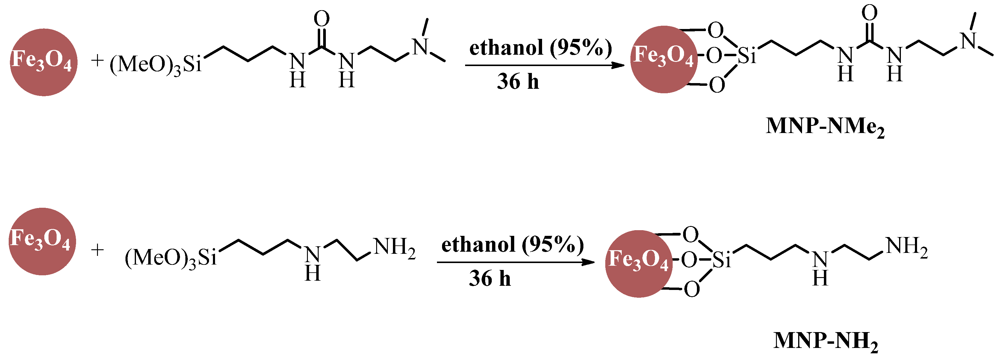
        <p>As shown in <xref ref-type="scheme" rid="applsci-02-00260-scheme1">Scheme 1</xref>, two base catalysts functionalized with a trimethoxysilane group were anchored to the magnetite nanoparticles by a condensation reaction under basic conditions between the trimethoxysilane group and the hydroxyl groups existing on the surface of the magnetite nanoparticles. The first base catalyst, 1-(2-(dimethylamino)ethyl)-3-(3-(trimethoxysilyl)propyl)urea, contains tertiary amine groups and was prepared by the reaction of 3-isocyanatopropyl(trimethoxy)silane and <italic>N</italic>,<italic>N</italic>-dimethylethylenediamine. The second base catalyst, <italic>N</italic>-[3-(trimethoxysilyl)propyl]ethylenediamine, contains primary and secondary amine groups. </p>
        <fig id="applsci-02-00260-scheme1" position="anchor">
          <object-id pub-id-type="pii">applsci-02-00260-scheme1_Scheme 1</object-id>
          <label>Scheme 1</label>
          <caption>
            <p>Supporting different base catalysts on the surface of magnetite nanoparticles</p>
          </caption>
          <graphic xmlns:xlink="http://www.w3.org/1999/xlink" xlink:href="applsci-02-00260-g008.tif"/>
        </fig>
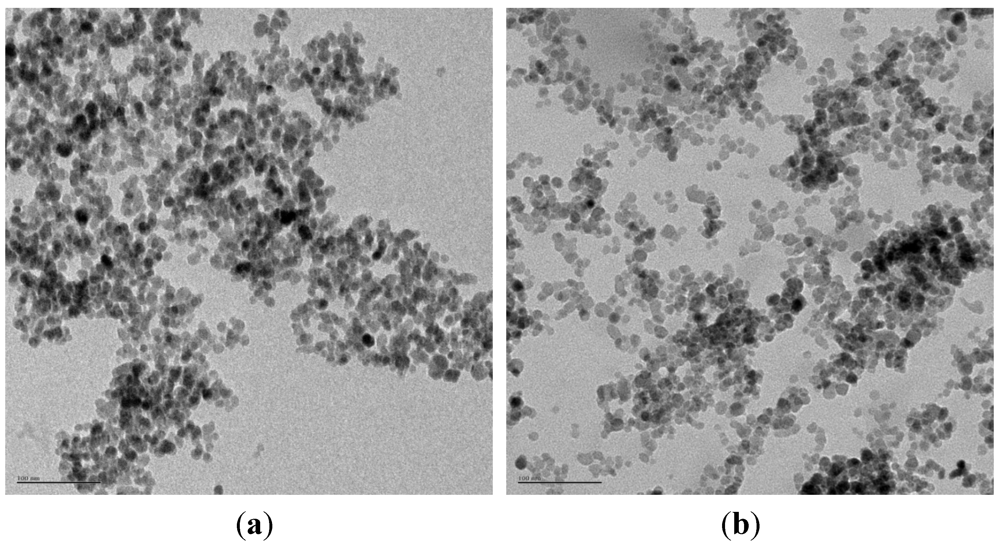
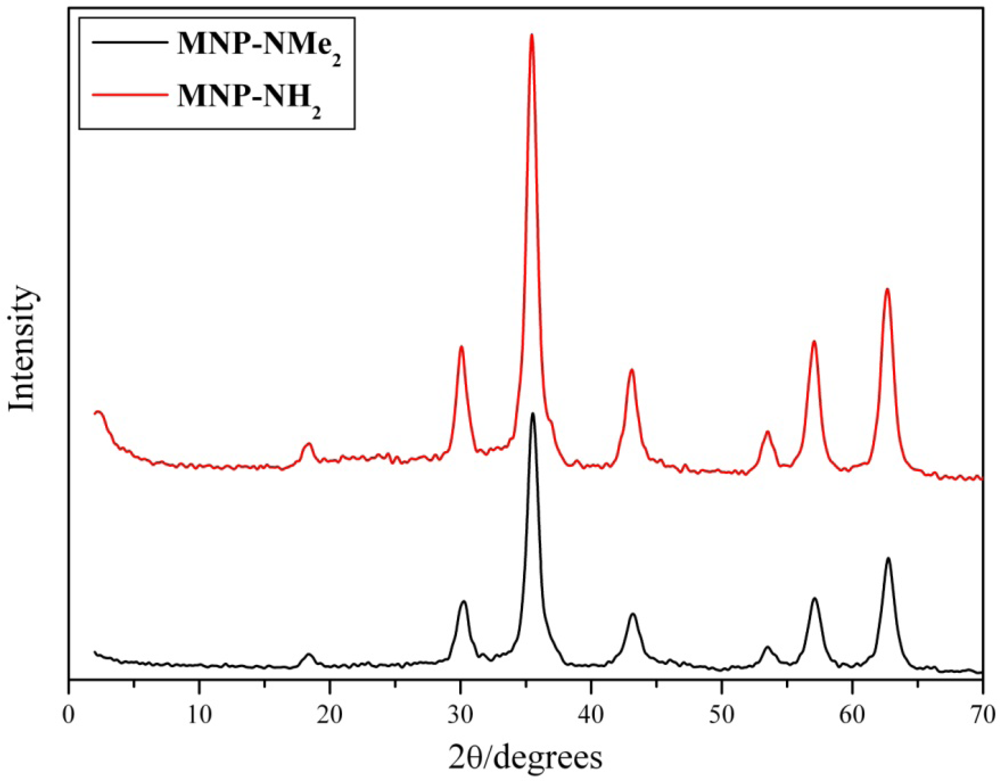
        <p>After supporting the base catalysts on the magnetite nanoparticles the resulting materials <bold>MNP-NMe<sub>2</sub></bold> and <bold>MNP-NH<sub>2</sub></bold> were characterized by Transmission Electron Microscopy (TEM), X-ray Diffraction (XRD), thermogravimetric analysis-differential thermal analysis (TGA-DTA) and infrared (IR) methods. The results of the TEM analysis (<xref ref-type="fig" rid="applsci-02-00260-f001">Figure 1</xref>) show that the average size of <bold>MNP-NMe<sub>2</sub></bold> and <bold>MNP-NH<sub>2</sub></bold> lies in the range of 10<bold>–</bold>15 nm. The shape of the magnetite nanoparticles modified with amine groups is spherical in both cases. In addition, TEM analysis confirms that a silica shell is not constructed on the surface of the magnetite nanoparticles even though the silane monomers were added in large excess. This result is also confirmed by XRD analysis (<xref ref-type="fig" rid="applsci-02-00260-f002">Figure 2</xref>) that shows just characteristic peaks of magnetite nanoparticles at 2<italic>θ</italic> = 30.1°, 35.5°, 43.3°, 53.6°, 57° and 62.6°. These peaks are attributed respectively to (2 2 0), (3 1 1), (4 0 0), (4 2 2), (5 1 1) and (4 4 0) phases of a cubic unit cell.</p>
        <fig id="applsci-02-00260-f001" position="anchor">
          <label>Figure 1</label>
          <caption>
            <p>Transmission Electron Microscopy (TEM) micrographs of base catalysts supported on magnetite nanoparticles: (<bold>a</bold>) <bold>MNP-NH<sub>2</sub></bold>, scale bar 100 nm; (<bold>b</bold>) <bold>MNP-NMe<sub>2</sub></bold>, scale bar 100 nm.</p>
          </caption>
          <graphic xmlns:xlink="http://www.w3.org/1999/xlink" xlink:href="applsci-02-00260-g001.tif"/>
        </fig>
        <fig id="applsci-02-00260-f002" position="anchor">
          <label>Figure 2</label>
          <caption>
            <p>Powder X-ray Diffraction (XRD) patterns of base catalysts supported on magnetite nanoparticles.</p>
          </caption>
          <graphic xmlns:xlink="http://www.w3.org/1999/xlink" xlink:href="applsci-02-00260-g002.tif"/>
        </fig>
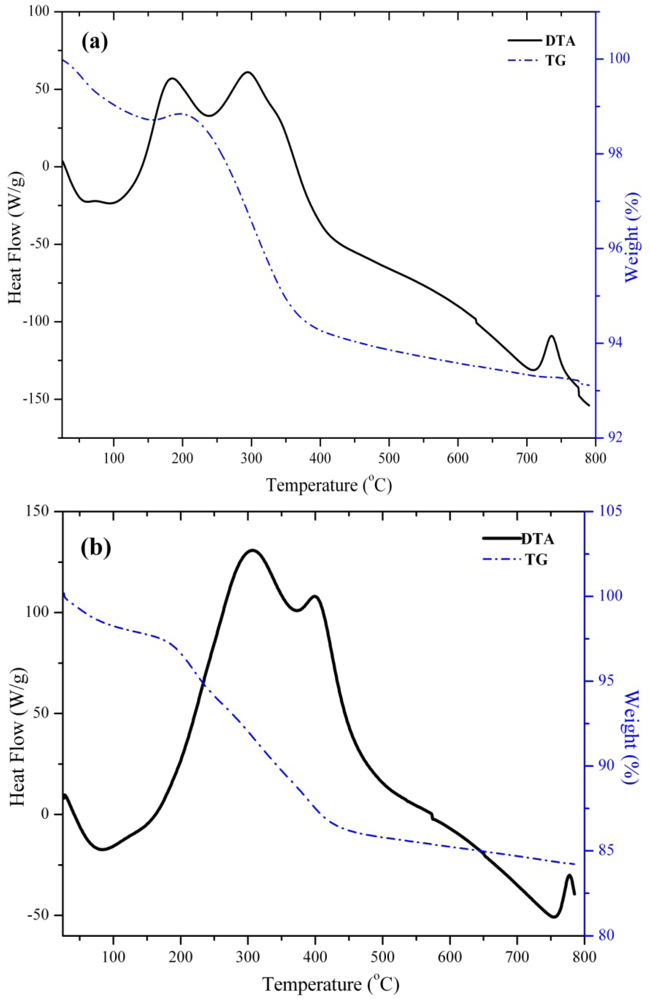
        <p>The loading of the amine groups in the magnetically separable base catalysts was determined by TGA analysis that was performed under air atmosphere. This analysis shows that <bold>MNP-NH<sub>2</sub></bold> contains about 0.46 mmol/g amine groups while <bold>MNP-NMe<sub>2</sub></bold> contains about 0.63 mmol/g amine groups. <xref ref-type="fig" rid="applsci-02-00260-f003">Figure 3</xref>(a) shows TGA-DTA curves of the catalysts <bold>MNP-NH<sub>2</sub></bold>. The DTA curve contains four distinct derivative peaks, which correspond to four mass losses in the TGA curve. Between 80 °C and 118 °C there is an endothermic peak which belongs to desorption of volatile organic solvents and the percentage of the mass loss is 1.3%. At temperatures of 186 °C and 294 °C there are two exothermic peaks accompanied with mass loss of 4.5%, the first peak most likely corresponds to the decomposition of the amine groups and the second peak corresponds to the decomposition of the entire organic groups. The exothermic peak at 737 °C most probably corresponds to a phase transition in which magnetite is converted to FeO. This phase transition is accompanied by a mass loss of 1.1%. The TGA-DTA curves of <bold>MNP-NMe<sub>2</sub></bold> (<xref ref-type="fig" rid="applsci-02-00260-f003">Figure 3</xref>(b)) show four steps of mass loss. The first mass loss of 2.7% at 80 °C takes place because of desorption of volatile organic solvents. The decomposition of the organic groups supported on the magnetite nanoparticles occurs at temperatures of 305 °C and 401 °C. In this case, the mass losses for the degradation of the organic groups are about 10.9%. According to the DTA curve for catalyst <bold>MNP-NMe<sub>2</sub></bold>, the phase transition of magnetite to FeO happens at a temperature of 775 °C. </p>
        <fig id="applsci-02-00260-f003" position="anchor">
          <label>Figure 3</label>
          <caption>
            <p>Thermogravimetric analysis-differential thermal analysis (TGA-DTA) curves of (<bold>a</bold>) <bold>MNP-NH<sub>2</sub></bold> catalyst and (<bold>b</bold>) <bold>MNP-NMe<sub>2</sub></bold> catalyst.</p>
          </caption>
          <graphic xmlns:xlink="http://www.w3.org/1999/xlink" xlink:href="applsci-02-00260-g003.tif"/>
        </fig>
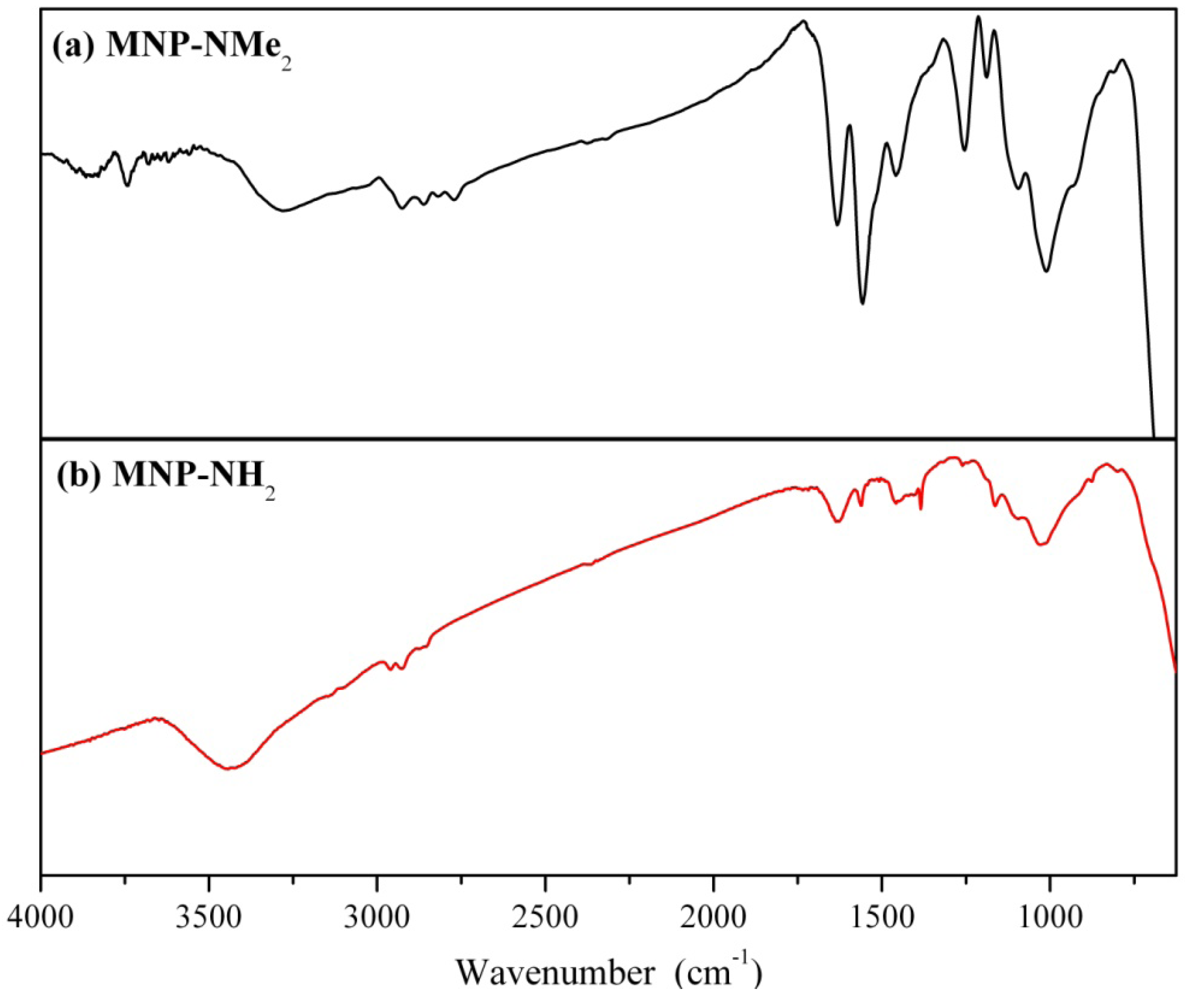
        <p>The IR spectrum of catalyst <bold>MNP-NH<sub>2</sub></bold> (<xref ref-type="fig" rid="applsci-02-00260-f004">Figure 4</xref> (b)) shows a broad absorption band at 3430 cm<sup>−1</sup> that is attributed to N-H stretching. The peaks that appear at 1631 cm<sup>−1</sup> and 1560 cm<sup>−1</sup> belong to primary N-H bending vibration while the band at 1462 cm<sup>−1</sup> corresponds to secondary N-H bending vibration. <xref ref-type="fig" rid="applsci-02-00260-f004">Figure 4</xref> (a) shows the IR spectrum of the catalyst <bold>MNP-NMe<sub>2</sub></bold>. In this spectrum, it can be seen that there is a broad peak at 3277 cm<sup>−1</sup>, which is attributed to N-H stretching vibration of the urea group. The absorption band at 1625 cm<sup>−1</sup> belongs to C=O stretching vibration while the peak at 1555 cm<sup>−1</sup> is due to N-H bending vibration. The peak that appears at 1254 cm<sup>−1</sup> is ascribed to C-N stretching vibration. </p>
        <fig id="applsci-02-00260-f004" position="anchor">
          <label>Figure 4</label>
          <caption>
            <p>Infrared (FT-IR) spectrums of the catalysts (<bold>a</bold>) <bold>MNP-NMe<sub>2</sub></bold> and (<bold>b</bold>) <bold>MNP-NH<sub>2</sub></bold>.</p>
          </caption>
          <graphic xmlns:xlink="http://www.w3.org/1999/xlink" xlink:href="applsci-02-00260-g004.tif"/>
        </fig>
      </sec>
      <sec>
        <title>3.2. Preparation of Magnetically Separable Heterogeneous Base Catalysts</title>
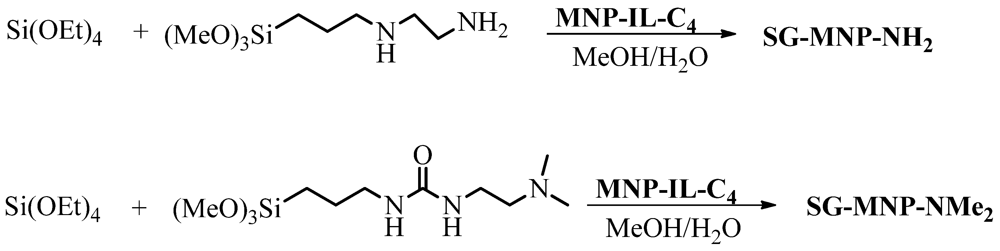
        <p>The magnetically separable heterogeneous base catalysts were prepared using a sol-gel process. Thus, the process of preparation (<xref ref-type="scheme" rid="applsci-02-00260-scheme2">Scheme 2</xref>) was based on copolymerization of either 1-(2-(dimethylamino)ethyl)-3-(3-(trimethoxysilyl)propyl)urea or <italic>N</italic>-[3-(trimethoxysilyl)propyl]-ethylenediamine with tetraethoxysilane (TEOS) in the presence of magnetite nanoparticles supported with ionic liquid groups (<bold>MNP-IL-C<sub>4</sub></bold>) that were prepared by reacting Fe<sub>3</sub>O<sub>4</sub> nanoparticles with 1-butyl-3-(3-trimethoxysilylpropyl)-1<italic>H</italic>-imidazol-3-ium chloride in ethanol. <bold>MNP-IL-C<sub>4</sub></bold> was utilized in this process as it is highly dispersible in methanol, which was used as a medium for preparing the silica sol-gel matrices. TEOS was first hydrolyzed using acid catalyst, and then the silane monomers functionalized with amine groups were added. Since the hydrolysis of the silane monomers containing amine groups is much faster than with TEOS, we decided to first hydrolyze TEOS under acidic conditions in order to bring on the end of the process to homogeneous distribution of the amine groups on the formed silica sol-gel backbone. After the copolymerization process was completed, black wet gels were obtained that were then dried to give black xerogels that could be strongly attracted to an external magnetic field. By this way of preparation, two types of magnetically separable heterogeneous base catalysts were synthesized: the first catalyst contains secondary and primary amine groups (<bold>SG-MNP-NH<sub>2</sub></bold>) while the second catalyst contains tertiary amine groups (<bold>SG-MNP-NMe<sub>2</sub></bold>). </p>
        <fig id="applsci-02-00260-scheme2" position="anchor">
          <object-id pub-id-type="pii">applsci-02-00260-scheme2_Scheme 2</object-id>
          <label>Scheme 2</label>
          <caption>
            <p>Preparation of magnetically separable heterogeneous base catalysts.</p>
          </caption>
          <graphic xmlns:xlink="http://www.w3.org/1999/xlink" xlink:href="applsci-02-00260-g009.tif"/>
        </fig>
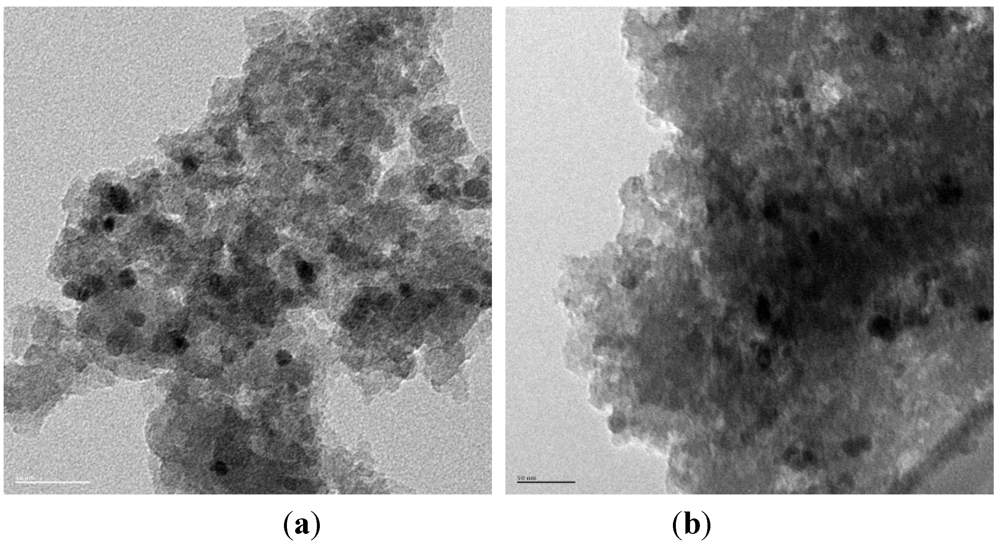
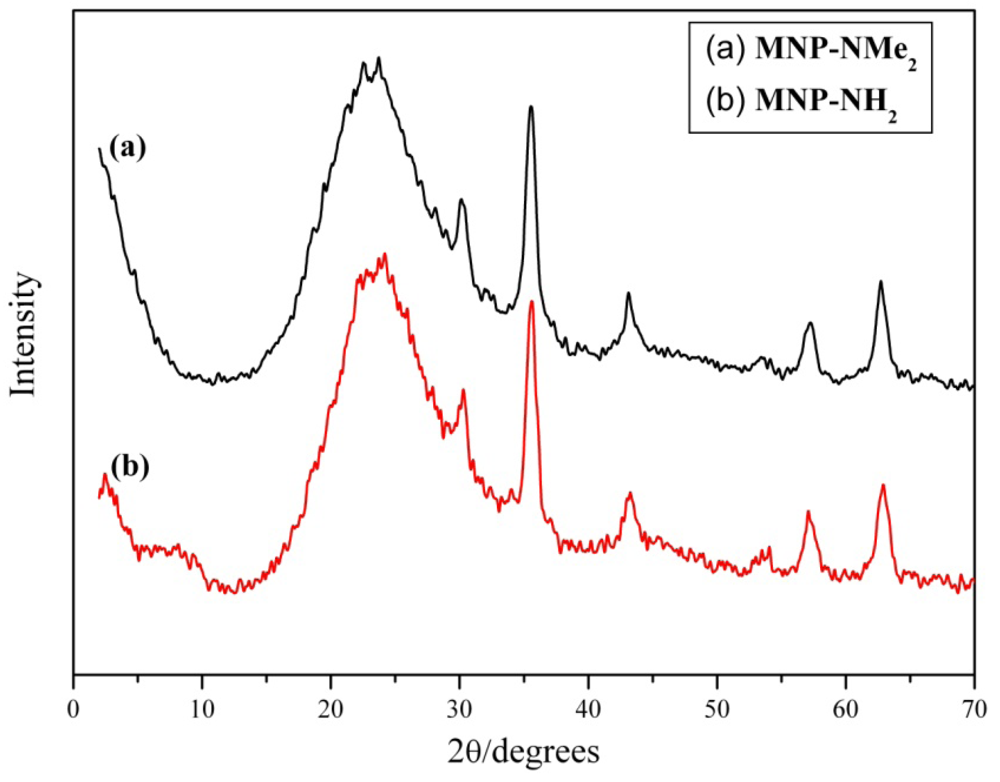
        <p>The two heterogeneous base catalysts, <bold>SG-MNP-NH<sub>2</sub></bold> and <bold>SG-MNP-NMe<sub>2</sub></bold>, were characterized by TEM, TGA-DTA and XRD methods. According to TEM analysis (<xref ref-type="fig" rid="applsci-02-00260-f005">Figure 5</xref>), it can be seen for both heterogeneous catalysts that the magnetic nanoparticles supported with ionic liquid groups (<bold>MNP-IL-C<sub>4</sub></bold>) are embedded in the silica sol-gel matrices. It seems that the distribution of the magnetic nanoparticles in the silica sol-gel matrices is homogeneous in the case of <bold>SG-MNP-NH<sub>2</sub></bold> while it is not uniform in the case of <bold>SG-MNP-NMe<sub>2</sub></bold>. XRD analysis (<xref ref-type="fig" rid="applsci-02-00260-f006">Figure 6</xref>) confirmed the presence of magnetic nanoparticles in the silica sol-gel matrices. Thus, the XPD patterns of <bold>SG-MNP-NH<sub>2</sub></bold> (<xref ref-type="fig" rid="applsci-02-00260-f006">Figure 6</xref> (b)) and <bold>SG-MNP-NMe<sub>2</sub></bold> (<xref ref-type="fig" rid="applsci-02-00260-f006">Figure 6</xref> (a)) contain the characteristic peaks of the magnetite nanoparticles in addition to the broad peaks between 2<italic>θ</italic> = 12° and 2<italic>θ</italic> = 33° that correspond to amorphous silica produced by the sol-gel process.</p>
        <fig id="applsci-02-00260-f005" position="anchor">
          <label>Figure 5</label>
          <caption>
            <p>TEM micrographs of magnetically separable heterogeneous base catalysts: (<bold>a</bold>) <bold>SG-MNP-NH<sub>2</sub></bold>, scale bar 50 nm; (<bold>b</bold>) <bold>SG-MNP-NMe<sub>2</sub></bold>, scale bar 50 nm.</p>
          </caption>
          <graphic xmlns:xlink="http://www.w3.org/1999/xlink" xlink:href="applsci-02-00260-g005.tif"/>
        </fig>
        <fig id="applsci-02-00260-f006" position="anchor">
          <label>Figure 6</label>
          <caption>
            <p>Powder XRD patterns of magnetically separable heterogeneous base catalysts: (<bold>a</bold>) <bold>SG-MNP-NMe<sub>2</sub></bold> and (<bold>b</bold>)<bold>SG-MNP-NH<sub>2</sub></bold>.</p>
          </caption>
          <graphic xmlns:xlink="http://www.w3.org/1999/xlink" xlink:href="applsci-02-00260-g006.tif"/>
        </fig>
        <fig id="applsci-02-00260-f007" position="anchor">
          <label>Figure 7</label>
          <caption>
            <p>TGA-DTA curves of (<bold>a</bold>) <bold>SG-MNP-NH<sub>2</sub></bold> catalyst and (<bold>b</bold>) <bold>SG-MNP-NMe<sub>2</sub></bold> catalyst.</p>
          </caption>
          <graphic xmlns:xlink="http://www.w3.org/1999/xlink" xlink:href="applsci-02-00260-g007.tif"/>
        </fig>
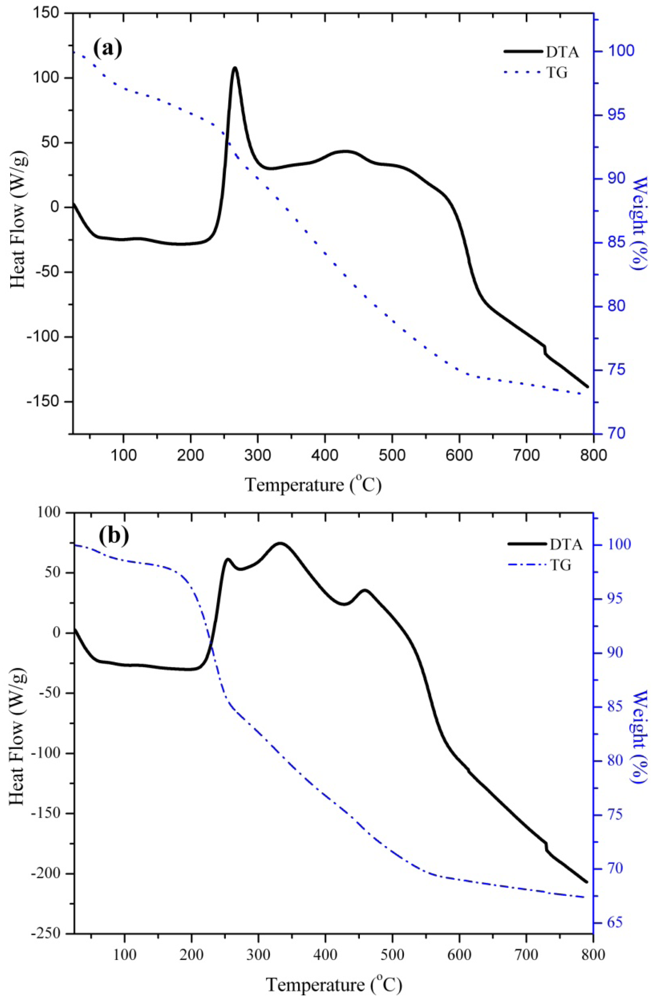
        <p>In addition, TGA-DTA techniques were utilized to determine the thermal behavior of the catalysts <bold>SG-MNP-NH<sub>2</sub></bold> and <bold>SG-MNP-NMe<sub>2</sub></bold>. The representative thermograms are shown in <xref ref-type="fig" rid="applsci-02-00260-f007">Figure 7</xref>. The DTA results of the catalyst <bold>SG-MNP-NH<sub>2</sub></bold> (<xref ref-type="fig" rid="applsci-02-00260-f007">Figure 7</xref>(a)) show a broad endothermic peak centered at 125 °C which can be attributed to the removal of physical adsorbed organic volatiles and water. The mass loss after this desorption process is about 6%. In addition, the strong exothermic peak at 266 °C and the weak exothermic peak at 425 °C are accompanied by a mass loss of 12%. These peaks correspond to the combustion of the organic groups in the silica sol-gel matrix. The broad exothermic peak in a temperature range of 480<bold>–</bold>630 °C is likely to be attributed to the dehydroxylation of the silica sol-gel and the phase transition from gel to glass. These processes are accompanied by a mass loss of 7%. The DTA curve of the catalyst<bold> SG-MNP-NMe<sub>2</sub></bold> (<xref ref-type="fig" rid="applsci-02-00260-f007">Figure 7</xref>(b)) shows a broad endothermic peak centered at 134 °C, which belongs to the desorption of organic solvents and water. The mass loss of this desorption process is 2.5%. The combustion of the organic groups of the catalyst <bold>SG-MNP-NMe<sub>2</sub></bold> occurs at temperatures of 255 °C and 332 °C, and this process leads to a mass loss of 21.5%. On the other hand, the exothermic peak at 485 °C accompanied with a mass loss of 7%, can be attributed to the dehydroxylation of the silica sol-gel. </p>
      </sec>
      <sec>
        <title>3.3. Catalytic Studies of the <italic>Quasi</italic>-Homogeneous and Heterogeneous Base Catalysts</title>
        <p>Our catalytic studies were initiated by testing the activity of the <italic>quasi</italic>-homogeneous base catalysts <bold>MNP-NH<sub>2</sub></bold> and <bold>MNP-NMe<sub>2</sub></bold> in a Knoevenagel reaction. Thus, malononitrile and benzaldehyde were reacted at 80 °C in the presence of 2 mol of the base catalysts dispersed in different solvents: DMSO, DMF, ethanol and water. We chose to use these polar solvents as a medium for the condensation reaction because the catalysts were more dispersible in them than in non-polar solvents like toluene, cyclohexane and heptane. After 1 h, the two catalysts gave quantitative yields of the condensation product in all of these experiments and no significant influence was observed for the type of the solvent used in these reactions. The activity of the two catalysts in the Knoevenagel condensation was similar to magnetically separable systems reported before [<xref ref-type="bibr" rid="B55-applsci-02-00260">55</xref>,<xref ref-type="bibr" rid="B56-applsci-02-00260">56</xref>,<xref ref-type="bibr" rid="B57-applsci-02-00260">57</xref>,<xref ref-type="bibr" rid="B58-applsci-02-00260">58</xref>,<xref ref-type="bibr" rid="B59-applsci-02-00260">59</xref>]. </p>
        <p>In the second stage of our study, we investigated the reactivity of the catalysts <bold>MNP-NH<sub>2</sub></bold> and <bold>MNP-NMe<sub>2 </sub></bold>in nitroaldol reaction. Thus, nitroethane and <italic>p</italic>-anisaldehyde were reacted at 80 °C for 16 h and in the presence of one of the two <italic>quasi</italic>-homogeneous catalysts dispersed in different solvents. In these experiments, the type of the solvent and the type of the catalyst utilized in the nitroaldol reaction could significantly affect the catalytic performance. When the reaction was performed in DMSO using <bold>MNP-NH<sub>2</sub></bold> as a catalyst, only 25% of the desired product, (<italic>E</italic>)-1-methoxy-4-(2-nitroprop-1-en-1-yl)benzene, was obtained. The use of the same catalyst dispersed in ethanol led to the formation of the desired product in a yield of 68%. The condensation reaction catalyzed by <bold>MNP-NH<sub>2</sub></bold> in toluene, cyclohexane and heptane did not yield any product. It is worth mentioning that the catalyst was not dispersible in these solvents and in fact worked as a heterogeneous catalytic system. It seems that the strong aggregation of the catalyst <bold>MNP-NH<sub>2</sub></bold> in non-polar solvents lead to a limited accessibility to the active sites of the catalyst. When <bold>MNP-NMe<sub>2</sub></bold> was utilized as a catalyst for the nitroaldol condensation in different solvents, no products were detected. </p>
        <p>The nitroaldol reaction of nitroethane with <italic>p</italic>-anisaldehyde was also investigated using <bold>SG-MNP-NH<sub>2</sub></bold> and <bold>SG-MNP-NMe<sub>2</sub></bold> as magnetically separable heterogeneous base catalysts. The heterogeneous condensation reaction was optimized using different organic solvents. The results are summarized in <xref ref-type="table" rid="applsci-02-00260-t001">Table 1</xref>. The results clearly show that non-polar solvents are preferable as a medium for the condensation reaction to polar solvents. The highest yield of the product (<italic>E</italic>)-1-methoxy-4-(2-nitroprop-1-en-1-yl)benzene was obtained when cyclohexane was applied as solvent. The heterogeneous catalyst <bold>SG-MNP-NMe<sub>2</sub></bold> led to the formation of 1-(4-methoxyphenyl)-2-nitropropan-1-ol as main product. In this case, it was also found that non-polars solvent are preferable to polar solvent as the product was produced a higher yield.</p>
        <table-wrap id="applsci-02-00260-t001" position="anchor">
          <object-id pub-id-type="pii">applsci-02-00260-t001_Table 1</object-id>
          <label>Table 1</label>
          <caption>
            <p>Nitroaldol condensation of nitroethane with <italic>p</italic>-anisaldehyde in different organic solvents catalyzed by magnetically separable heterogeneous base catalysts<italic><sup> a</sup></italic>.</p><p> <inline-graphic xmlns:xlink="http://www.w3.org/1999/xlink" xlink:href="applsci-02-00260-i001.tif"/></p>
          </caption>
          <table>
            <thead>
              <tr>
                <th align="left" valign="middle">Entry</th>
                <th align="left" valign="middle">Catalyst</th>
                <th align="left" valign="middle">Solvent</th>
                <th align="left" valign="middle">Yield (%)</th>
              </tr>
</thead>
            <tbody>
              <tr>
                <td align="left" valign="middle">1</td>
                <td align="left" valign="middle"><bold>SG-MNP-NH<sub>2</sub></bold></td>
                <td align="left" valign="middle">acetonitrile</td>
                <td align="left" valign="middle">47</td>
              </tr>
              <tr>
                <td align="left" valign="middle">2</td>
                <td align="left" valign="middle"><bold>SG-MNP-NH<sub>2</sub></bold></td>
                <td align="left" valign="middle">dimethylformamide</td>
                <td align="left" valign="middle">68</td>
              </tr>
              <tr>
                <td align="left" valign="middle">3</td>
                <td align="left" valign="middle"><bold>SG-MNP-NH<sub>2</sub></bold></td>
                <td align="left" valign="middle">dioxane</td>
                <td align="left" valign="middle">53</td>
              </tr>
              <tr>
                <td align="left" valign="middle">4</td>
                <td align="left" valign="middle"><bold>SG-MNP-NH<sub>2</sub></bold></td>
                <td align="left" valign="middle">dimethyl sulfoxide</td>
                <td align="left" valign="middle">34</td>
              </tr>
              <tr>
                <td align="left" valign="middle">5</td>
                <td align="left" valign="middle"><bold>SG-MNP-NH<sub>2</sub></bold></td>
                <td align="left" valign="middle">ethanol (95%)</td>
                <td align="left" valign="middle">48</td>
              </tr>
              <tr>
                <td align="left" valign="middle">6</td>
                <td align="left" valign="middle"><bold>SG-MNP-NH<sub>2</sub></bold></td>
                <td align="left" valign="middle">ethanol (dry)</td>
                <td align="left" valign="middle">80</td>
              </tr>
              <tr>
                <td align="left" valign="middle">7</td>
                <td align="left" valign="middle"><bold>SG-MNP-NH<sub>2</sub></bold></td>
                <td align="left" valign="middle">benzene</td>
                <td align="left" valign="middle">87</td>
              </tr>
              <tr>
                <td align="left" valign="middle">8</td>
                <td align="left" valign="middle"><bold>SG-MNP-NH<sub>2</sub></bold></td>
                <td align="left" valign="middle">heptane</td>
                <td align="left" valign="middle">88</td>
              </tr>
              <tr>
                <td align="left" valign="middle">9</td>
                <td align="left" valign="middle"><bold>SG-MNP-NH<sub>2</sub></bold></td>
                <td align="left" valign="middle">cyclohexane</td>
                <td align="left" valign="middle">90</td>
              </tr>
              <tr>
                <td align="left" valign="middle">10</td>
                <td align="left" valign="middle"><bold>SG-MNP-NH<sub>2</sub></bold></td>
                <td align="left" valign="middle">toluene</td>
                <td align="left" valign="middle">85</td>
              </tr>
              <tr>
                <td align="left" valign="middle">11</td>
                <td align="left" valign="middle"><bold>SG-MNP-NMe<sub>2</sub></bold></td>
                <td align="left" valign="middle">toluene</td>
                <td align="left" valign="middle">72<sup>b</sup></td>
              </tr>
              <tr>
                <td align="left" valign="middle">12</td>
                <td align="left" valign="middle"><bold>SG-MNP-NMe<sub>2</sub></bold></td>
                <td align="left" valign="middle">ethanol (dry)</td>
                <td align="left" valign="middle">23<sup>b</sup></td>
              </tr>
              <tr>
                <td align="left" valign="middle">13</td>
                <td align="left" valign="middle"><bold>SG-MNP-NMe<sub>2</sub></bold></td>
                <td align="left" valign="middle">dimethyl sulfoxide</td>
                <td align="left" valign="middle">-</td>
              </tr>
            </tbody>
          </table>
    <table-wrap-foot>
      <fn>
        <p><italic><sup>a</sup></italic> Reaction conditions: 100 mg catalyst, 1.64 mmol <italic>p</italic>-anisaldehyde, 2.39 mmol nitroethane, 5 ml solvent, 80 °C, 16 h. </p>
      </fn>
      <fn>
        <p><italic><sup>b</sup></italic> Only 1-(4-methoxyphenyl)-2-nitropropan-1-ol was formed.</p>
      </fn>
    </table-wrap-foot>		
		</table-wrap>
        <p>The heterogeneous nitroaldol reaction using the catalyst <bold>SG-MNP-NH<sub>2</sub></bold> was then tested in the condensation of several aromatic aldehydes with nitroethane. The condensation reactions were performed at 80 °C and cyclohexane was applied as a solvent for these reactions. The results of these reactions are presented in <xref ref-type="table" rid="applsci-02-00260-t002">Table 2</xref>. The results show that the steric effect in this heterogeneous condensation reaction is negligible. Thus, when 2-methoxybenzaldehyde or 2-chlorobenzaldehyde is utilized as a substrate, high yields of the desired products are obtained. Aromatic aldehydes substituted with strong electron withdrawing groups lead to the formation of the condensation products in moderate yield. On the other hand, aromatic aldehydes containing electron-donating groups such as isopropyl give excellent yields of the condensation products. In addition, the catalyst <bold>SG-MNP-NH<sub>2 </sub></bold>can be recycled in the condensation of <italic>p</italic>-anisaldehyde with nitroethane for four consecutive runs without significant decrease in its activity or selectivity. </p>
        <table-wrap id="applsci-02-00260-t002" position="anchor">
          <object-id pub-id-type="pii">applsci-02-00260-t002_Table 2</object-id>
          <label>Table 2</label>
          <caption>
            <p>Nitroaldol condensation of nitroethane with different aromatic aldehydes catalyzed by the catalyst <bold>SG-MNP-NH<sub>2</sub><italic><sup> a</sup></italic></bold>.</p><p> <inline-graphic xmlns:xlink="http://www.w3.org/1999/xlink" xlink:href="applsci-02-00260-i002.tif"/></p>
          </caption>
          <table>
            <thead>
              <tr>
                <th align="left" valign="middle">Entry</th>
                <th align="left" valign="middle">Aromatic aldehyde</th>
                <th align="left" valign="middle">Yield (%)</th>
              </tr>
            </thead>
            <tbody>
              <tr>
                <td align="left" valign="middle">1</td>
                <td align="left" valign="middle">benzaldehyde</td>
                <td align="left" valign="middle">&gt;99</td>
              </tr>
              <tr>
                <td align="left" valign="middle">2</td>
                <td align="left" valign="middle">3-methoxybenzaldehyde</td>
                <td align="left" valign="middle">95</td>
              </tr>
              <tr>
                <td align="left" valign="middle">3</td>
                <td align="left" valign="middle">2-methoxybenzaldehyde</td>
                <td align="left" valign="middle">97</td>
              </tr>
              <tr>
                <td align="left" valign="middle">4</td>
                <td align="left" valign="middle">4-nitrobenzaldehyde</td>
                <td align="left" valign="middle">78</td>
              </tr>
              <tr>
                <td align="left" valign="middle">5</td>
                <td align="left" valign="middle">3-nitrobenzaldehyde</td>
                <td align="left" valign="middle">69</td>
              </tr>
              <tr>
                <td align="left" valign="middle">7</td>
                <td align="left" valign="middle">4-chlorobenzaldehyde</td>
                <td align="left" valign="middle">99</td>
              </tr>
              <tr>
                <td align="left" valign="middle">8</td>
                <td align="left" valign="middle">2-chlorobenzaldehyde</td>
                <td align="left" valign="middle">98</td>
              </tr>
              <tr>
                <td align="left" valign="middle">9</td>
                <td align="left" valign="middle">4-isopropylbenzaldehyde</td>
                <td align="left" valign="middle">95</td>
              </tr>
              <tr>
                <td align="left" valign="middle">10</td>
                <td align="left" valign="middle">1-naphthaldehyde</td>
                <td align="left" valign="middle">99</td>
              </tr>
            </tbody>
          </table>
    <table-wrap-foot>
      <fn>
        <p><italic><sup>a</sup></italic> Reaction conditions: 100 mg catalyst, 1.64 mmol aromatic aldehyde, 2.39 mmol nitroethane, 5 ml cyclohexane, 80 °C, 16 h. </p>
      </fn>
    </table-wrap-foot>		
		</table-wrap>
      </sec>
    </sec>
    <sec sec-type="conclusions">
      <title>4. Conclusions</title>
      <p>In conclusion, two types of magnetically separable base catalysts were prepared: <italic>quasi</italic>-homogeneous and heterogeneous catalysts. The <italic>quasi</italic>-homogeneous base catalysts were synthesized by supporting silane monomers functionalized with different amine groups directly on the surface of magnetite nanoparticles. Although these catalysts exhibited excellent activity in Knoevenagel reactions, their application in nitroaldol condensation led to obtaining poor to moderate yields of the desired products. Their activity in the nitroaldol reactions was highly dependent on the type of the organic solvents used. Non-polar solvents depressed the activity of the <italic>quasi</italic>-homogeneous catalysts due to strong aggregations of the catalysts and limitation of the accessibility of the substrates to their active sites. The magnetically separable heterogeneous base catalysts were achieved by copolymerization of tetraethoxysilane with silane monomers containing different amine groups by sol-gel process and in the presence of magnetite supported with ionic liquid groups. These catalysts were active in the nitroaldol reactions and, contrary to the <italic>quasi</italic>-homogeneous base catalysts, they showed high activity in non-polar solvents. </p>
    </sec>
  </body>
  <back>
    <notes>
      <title>Conflict of Interest</title>
      <p>State any potential conflicts of interest here or “The authors declare no conflict of interest”. </p>
    </notes>
    <ref-list>
      <title>References and Notes</title>
      <ref id="B1-applsci-02-00260">
        <label>1.</label>
        <citation citation-type="book">
          <source>Recoverable and Recyclable Catalysts</source>
          <person-group person-group-type="editor">
            <name>
              <surname>Benaglia</surname>
              <given-names>M.</given-names>
            </name>
          </person-group>
          <publisher-name>John Wiley &amp; Sons</publisher-name>
          <publisher-loc>Chichester, UK</publisher-loc>
          <year>2009</year>
        </citation>
      </ref>
      <ref id="B2-applsci-02-00260">
        <label>2.</label>
        <citation citation-type="journal">
          <person-group person-group-type="author">
            <name>
              <surname>Lu</surname>
              <given-names>Z.</given-names>
            </name>
            <name>
              <surname>Lindner</surname>
              <given-names>E.</given-names>
            </name>
            <name>
              <surname>Mayer</surname>
              <given-names>H.A.</given-names>
            </name>
          </person-group>
          <article-title>Applications of sol-gel-processed interphase catalysts</article-title>
          <source>Chem. Rev.</source>
          <year>2002</year>
          <volume>102</volume>
          <fpage>3543</fpage>
          <lpage>3578</lpage>
          <pub-id pub-id-type="doi">10.1021/cr010358t</pub-id>
        </citation>
      </ref>
      <ref id="B3-applsci-02-00260">
        <label>3.</label>
        <citation citation-type="journal">
          <person-group person-group-type="author">
            <name>
              <surname>Marr</surname>
              <given-names>A.C.</given-names>
            </name>
            <name>
              <surname>Marr</surname>
              <given-names>P.C.</given-names>
            </name>
          </person-group>
          <article-title>Entrapping homogeneous catalysts by sol-gel methods: The bottom-up synthesis of catalysts that recycle and cascade</article-title>
          <source>Dalton Trans.</source>
          <year>2011</year>
          <volume>40</volume>
          <fpage>20</fpage>
          <lpage>26</lpage>
          <pub-id pub-id-type="doi">10.1039/c0dt00888e</pub-id>
        </citation>
      </ref>
      <ref id="B4-applsci-02-00260">
        <label>4.</label>
        <citation citation-type="journal">
          <person-group person-group-type="author">
            <name>
              <surname>Zamboulis</surname>
              <given-names>A.</given-names>
            </name>
            <name>
              <surname>Moitra</surname>
              <given-names>N.</given-names>
            </name>
            <name>
              <surname>Moreau</surname>
              <given-names>J.J.E.</given-names>
            </name>
            <name>
              <surname>Cattoën</surname>
              <given-names>X.</given-names>
            </name>
            <name>
              <surname>Wong Chi Man</surname>
              <given-names>M.</given-names>
            </name>
          </person-group>
          <article-title>Hybrid materials: Versatile matrices for supporting homogeneous catalysts</article-title>
          <source>J. Mater. Chem.</source>
          <year>2010</year>
          <volume>20</volume>
          <fpage>9322</fpage>
          <lpage>9338</lpage>
          <pub-id pub-id-type="doi">10.1039/c000334d</pub-id>
        </citation>
      </ref>
      <ref id="B5-applsci-02-00260">
        <label>5.</label>
        <citation citation-type="journal">
          <person-group person-group-type="author">
            <name>
              <surname>Ciriminna</surname>
              <given-names>R.</given-names>
            </name>
            <name>
              <surname>Demma Carà</surname>
              <given-names>P.</given-names>
            </name>
            <name>
              <surname>Sciortino</surname>
              <given-names>M.</given-names>
            </name>
            <name>
              <surname>Pagliaro</surname>
              <given-names>M.</given-names>
            </name>
          </person-group>
          <article-title>Catalysis with doped sol-gel silicates</article-title>
          <source>Adv. Synth. Catal.</source>
          <year>2011</year>
          <volume>353</volume>
          <fpage>677</fpage>
          <lpage>687</lpage>
          <pub-id pub-id-type="doi">10.1002/adsc.201000731</pub-id>
        </citation>
      </ref>
      <ref id="B6-applsci-02-00260">
        <label>6.</label>
        <citation citation-type="journal">
          <person-group person-group-type="author">
            <name>
              <surname>Ciriminna</surname>
              <given-names>R.</given-names>
            </name>
            <name>
              <surname>Pagliaro</surname>
              <given-names>M.</given-names>
            </name>
          </person-group>
          <article-title>Recent uses of sol-gel doped catalysts in the fine chemicals and pharmaceutical industry</article-title>
          <source>Org. Process Res. Dev.</source>
          <year>2006</year>
          <volume>10</volume>
          <fpage>320</fpage>
          <lpage>326</lpage>
        <pub-id pub-id-type="doi">10.1021/op050211u</pub-id></citation>
      </ref>
      <ref id="B7-applsci-02-00260">
        <label>7.</label>
        <citation citation-type="journal">
          <person-group person-group-type="author">
            <name>
              <surname>Schätz</surname>
              <given-names>A.</given-names>
            </name>
            <name>
              <surname>Reiser</surname>
              <given-names>O.</given-names>
            </name>
            <name>
              <surname>Stark</surname>
              <given-names>W.J.</given-names>
            </name>
          </person-group>
          <article-title>Nanoparticles as semi-heterogeneous catalyst supports</article-title>
          <source>Chem. Eur. J.</source>
          <year>2010</year>
          <volume>16</volume>
          <fpage>8950</fpage>
          <lpage>8967</lpage>
          <pub-id pub-id-type="doi">10.1002/chem.200903462</pub-id>
        </citation>
      </ref>
      <ref id="B8-applsci-02-00260">
        <label>8.</label>
        <citation citation-type="journal">
          <person-group person-group-type="author">
            <name>
              <surname>Astruc</surname>
              <given-names>D.</given-names>
            </name>
            <name>
              <surname>Lu</surname>
              <given-names>F.</given-names>
            </name>
            <name>
              <surname>Aranzaes</surname>
              <given-names>J.R.</given-names>
            </name>
          </person-group>
          <article-title>Nanoparticles as recyclable catalysts: The frontier between homogeneous and heterogeneous catalysis</article-title>
          <source>Angew. Chem. Int. Ed.</source>
          <year>2005</year>
          <volume>44</volume>
          <fpage>7852</fpage>
          <lpage>7872</lpage>
          <pub-id pub-id-type="doi">10.1002/anie.200500766</pub-id>
        </citation>
      </ref>
      <ref id="B9-applsci-02-00260">
        <label>9.</label>
        <citation citation-type="journal">
          <person-group person-group-type="author">
            <name>
              <surname>Gupta</surname>
              <given-names>A.K.</given-names>
            </name>
            <name>
              <surname>Curtis</surname>
              <given-names>A.S.G.</given-names>
            </name>
          </person-group>
          <article-title>Surface modified superparamagnetic nanoparticles for drug delivery: Interaction studies with human fibroblasts in culture</article-title>
          <source>J. Mater. Sci. Mater. Med.</source>
          <year>2004</year>
          <volume>15</volume>
          <fpage>493</fpage>
          <lpage>496</lpage>
          <pub-id pub-id-type="doi">10.1023/B:JMSM.0000021126.32934.20</pub-id>
        </citation>
      </ref>
      <ref id="B10-applsci-02-00260">
        <label>10.</label>
        <citation citation-type="journal">
          <person-group person-group-type="author">
            <name>
              <surname>Neuberger</surname>
              <given-names>T.</given-names>
            </name>
            <name>
              <surname>Schoepf</surname>
              <given-names>B.</given-names>
            </name>
            <name>
              <surname>Hofmann</surname>
              <given-names>H.</given-names>
            </name>
            <name>
              <surname>Hofmann</surname>
              <given-names>M.</given-names>
            </name>
            <name>
              <surname>von Rechenberg</surname>
              <given-names>B.</given-names>
            </name>
          </person-group>
          <article-title>Superparamagnetic nanoparticles for biomedical applications: possibilities and limitations of a new drug delivery system</article-title>
          <source>J. Magn. Magn. Mater.</source>
          <year>2005</year>
          <volume>293</volume>
          <fpage>483</fpage>
          <lpage>496</lpage>
          <pub-id pub-id-type="doi">10.1016/j.jmmm.2005.01.064</pub-id>
        </citation>
      </ref>
      <ref id="B11-applsci-02-00260">
        <label>11.</label>
        <citation citation-type="journal">
          <person-group person-group-type="author">
            <name>
              <surname>Pankhurst</surname>
              <given-names>Q.A.</given-names>
            </name>
            <name>
              <surname>Connolly</surname>
              <given-names>J.</given-names>
            </name>
            <name>
              <surname>Jones</surname>
              <given-names>S.K.</given-names>
            </name>
            <name>
              <surname>Dobson</surname>
              <given-names>J.</given-names>
            </name>
          </person-group>
          <article-title>Applications of magnetic nanoparticles in biomedicine</article-title>
          <source>J. Phys. D: Appl. Phys.</source>
          <year>2003</year>
          <volume>36</volume>
          <fpage>R167</fpage>
          <lpage>R181</lpage>
          <pub-id pub-id-type="doi">10.1088/0022-3727/36/13/201</pub-id>
        </citation>
      </ref>
      <ref id="B12-applsci-02-00260">
        <label>12.</label>
        <citation citation-type="journal">
          <person-group person-group-type="author">
            <name>
              <surname>Perez</surname>
              <given-names>J.M.</given-names>
            </name>
            <name>
              <surname>Simeone</surname>
              <given-names>F.J.</given-names>
            </name>
            <name>
              <surname>Saeki</surname>
              <given-names>Y.</given-names>
            </name>
            <name>
              <surname>Josephson</surname>
              <given-names>L.</given-names>
            </name>
            <name>
              <surname>Weissleder</surname>
              <given-names>R.</given-names>
            </name>
          </person-group>
          <article-title>Viral-induced self-assembly of magnetic nanoparticles allows the detection of viral particles in biological media</article-title>
          <source>J. Am. Chem. Soc.</source>
          <year>2003</year>
          <volume>125</volume>
          <fpage>10192</fpage>
          <lpage>10193</lpage>
        <pub-id pub-id-type="doi">10.1021/ja036409g</pub-id><pub-id pub-id-type="pmid">12926940</pub-id></citation>
      </ref>
      <ref id="B13-applsci-02-00260">
        <label>13.</label>
        <citation citation-type="journal">
          <person-group person-group-type="author">
            <name>
              <surname>Graham</surname>
              <given-names>D.L.</given-names>
            </name>
            <name>
              <surname>Ferreira</surname>
              <given-names>H.A.</given-names>
            </name>
            <name>
              <surname>Freitas</surname>
              <given-names>P.P.</given-names>
            </name>
          </person-group>
          <article-title>Magnetoresistive-based biosensors and biochips</article-title>
          <source>Trends Biotechnol.</source>
          <year>2004</year>
          <volume>22</volume>
          <fpage>455</fpage>
          <lpage>462</lpage>
          <pub-id pub-id-type="doi">10.1016/j.tibtech.2004.06.006</pub-id>
        </citation>
      </ref>
      <ref id="B14-applsci-02-00260">
        <label>14.</label>
        <citation citation-type="journal">
          <person-group person-group-type="author">
            <name>
              <surname>Wang</surname>
              <given-names>D.</given-names>
            </name>
            <name>
              <surname>He</surname>
              <given-names>J.</given-names>
            </name>
            <name>
              <surname>Rosenzweig</surname>
              <given-names>N.</given-names>
            </name>
            <name>
              <surname>Rosenzweig</surname>
              <given-names>Z.</given-names>
            </name>
          </person-group>
          <source>Nano Lett.</source>
          <year>2004</year>
          <volume>4</volume>
          <fpage>409</fpage>
          <lpage>413</lpage>
        <pub-id pub-id-type="doi">10.1021/nl035010n</pub-id></citation>
      </ref>
      <ref id="B15-applsci-02-00260">
        <label>15.</label>
        <citation citation-type="journal">
          <person-group person-group-type="author">
            <name>
              <surname>Xu</surname>
              <given-names>C.</given-names>
            </name>
            <name>
              <surname>Xu</surname>
              <given-names>K.</given-names>
            </name>
            <name>
              <surname>Gu</surname>
              <given-names>H.</given-names>
            </name>
            <name>
              <surname>Zheng</surname>
              <given-names>R.</given-names>
            </name>
            <name>
              <surname>Liu</surname>
              <given-names>H.</given-names>
            </name>
            <name>
              <surname>Zhang</surname>
              <given-names>X.</given-names>
            </name>
            <name>
              <surname>Guo</surname>
              <given-names>Z.</given-names>
            </name>
            <name>
              <surname>Xu</surname>
              <given-names>B.</given-names>
            </name>
          </person-group>
          <article-title>Dopamine as a robust anchor to immobilize functional molecules on the iron oxide shell of magnetic nanoparticles</article-title>
          <source>J. Am. Chem. Soc.</source>
          <year>2004</year>
          <volume>126</volume>
          <fpage>9938</fpage>
          <lpage>9939</lpage>
        <pub-id pub-id-type="doi">10.1021/ja0464802</pub-id><pub-id pub-id-type="pmid">15303865</pub-id></citation>
      </ref>
      <ref id="B16-applsci-02-00260">
        <label>16.</label>
        <citation citation-type="journal">
          <person-group person-group-type="author">
            <name>
              <surname>Hiergeist</surname>
              <given-names>R.</given-names>
            </name>
            <name>
              <surname>Andra</surname>
              <given-names>W.</given-names>
            </name>
            <name>
              <surname>Buske</surname>
              <given-names>N.</given-names>
            </name>
            <name>
              <surname>Hergt</surname>
              <given-names>R.</given-names>
            </name>
            <name>
              <surname>Hilger</surname>
              <given-names>I.</given-names>
            </name>
            <name>
              <surname>Richter</surname>
              <given-names>U.</given-names>
            </name>
            <name>
              <surname>Kaiser</surname>
              <given-names>W.</given-names>
            </name>
          </person-group>
          <article-title>Application of magnetite ferrofluids for hyperthermia</article-title>
          <source>J. Magn. Magn. Mater.</source>
          <year>1999</year>
          <volume>201</volume>
          <fpage>420</fpage>
          <lpage>422</lpage>
          <pub-id pub-id-type="doi">10.1016/S0304-8853(99)00145-6</pub-id>
        </citation>
      </ref>
      <ref id="B17-applsci-02-00260">
        <label>17.</label>
        <citation citation-type="journal">
          <person-group person-group-type="author">
            <name>
              <surname>Jordan</surname>
              <given-names>A.</given-names>
            </name>
            <name>
              <surname>Scholz</surname>
              <given-names>R.</given-names>
            </name>
            <name>
              <surname>Wust</surname>
              <given-names>P.</given-names>
            </name>
            <name>
              <surname>Fahling</surname>
              <given-names>H.</given-names>
            </name>
            <name>
              <surname>Felix</surname>
              <given-names>R.</given-names>
            </name>
          </person-group>
          <article-title>Magnetic fluid hyperthermia (MFH): Cancer treatment with AC magnetic field induced excitation of biocompatible superparamagnetic nanoparticles</article-title>
          <source>J. Magn. Magn. Mater.</source>
          <year>1999</year>
          <volume>201</volume>
          <fpage>413</fpage>
          <lpage>419</lpage>
          <pub-id pub-id-type="doi">10.1016/S0304-8853(99)00088-8</pub-id>
        </citation>
      </ref>
      <ref id="B18-applsci-02-00260">
        <label>18.</label>
        <citation citation-type="journal">
          <person-group person-group-type="author">
            <name>
              <surname>Polshettiwar</surname>
              <given-names>V.</given-names>
            </name>
            <name>
              <surname>Luque</surname>
              <given-names>R.</given-names>
            </name>
            <name>
              <surname>Fihri</surname>
              <given-names>A.</given-names>
            </name>
            <name>
              <surname>Zhu</surname>
              <given-names>H.</given-names>
            </name>
            <name>
              <surname>Bouhrara</surname>
              <given-names>M.</given-names>
            </name>
            <name>
              <surname>Basset</surname>
              <given-names>J.M.</given-names>
            </name>
          </person-group>
          <article-title>Magnetically recoverable nanocatalysts</article-title>
          <source>Chem. Rev.</source>
          <year>2011</year>
          <volume>111</volume>
          <fpage>3036</fpage>
          <lpage>3075</lpage>
          <pub-id pub-id-type="doi">10.1021/cr100230z</pub-id>
        </citation>
      </ref>
      <ref id="B19-applsci-02-00260">
        <label>19.</label>
        <citation citation-type="journal">
          <person-group person-group-type="author">
            <name>
              <surname>Shyles</surname>
              <given-names>S.</given-names>
            </name>
            <name>
              <surname>Schünemann</surname>
              <given-names>V.</given-names>
            </name>
            <name>
              <surname>Thiel</surname>
              <given-names>W.R.</given-names>
            </name>
          </person-group>
          <article-title>Magnetically separable nanocatalysts: Bridges between homogeneous and heterogeneous catalysis</article-title>
          <source>Angew. Chem. Int. Ed.</source>
          <year>2010</year>
          <volume>49</volume>
          <fpage>3428</fpage>
          <lpage>3459</lpage>
        <pub-id pub-id-type="doi">10.1002/anie.200905684</pub-id></citation>
      </ref>
      <ref id="B20-applsci-02-00260">
        <label>20.</label>
        <citation citation-type="journal">
          <person-group person-group-type="author">
            <name>
              <surname>Zhu</surname>
              <given-names>Y.</given-names>
            </name>
            <name>
              <surname>Stubbs</surname>
              <given-names>L.P.</given-names>
            </name>
            <name>
              <surname>Ho</surname>
              <given-names>F.</given-names>
            </name>
            <name>
              <surname>Liu</surname>
              <given-names>R.</given-names>
            </name>
            <name>
              <surname>Ship</surname>
              <given-names>C.P.</given-names>
            </name>
            <name>
              <surname>Maguire</surname>
              <given-names>J.A.</given-names>
            </name>
            <name>
              <surname>Hosmane</surname>
              <given-names>N.S.</given-names>
            </name>
          </person-group>
          <article-title>Magnetic nanocomposites: A new perspective in catalysis</article-title>
          <source>ChemCatChem</source>
          <year>2010</year>
          <volume>2</volume>
          <fpage>365</fpage>
          <lpage>374</lpage>
          <pub-id pub-id-type="doi">10.1002/cctc.200900314</pub-id>
        </citation>
      </ref>
      <ref id="B21-applsci-02-00260">
        <label>21.</label>
        <citation citation-type="journal">
          <person-group person-group-type="author">
            <name>
              <surname>Polshettiwar</surname>
              <given-names>V.</given-names>
            </name>
            <name>
              <surname>Varma</surname>
              <given-names>R.S.</given-names>
            </name>
          </person-group>
          <article-title>Green chemistry by nano-catalysis</article-title>
          <source>Green Chem.</source>
          <year>2010</year>
          <volume>12</volume>
          <fpage>743</fpage>
          <lpage>754</lpage>
          <pub-id pub-id-type="doi">10.1039/b921171c</pub-id>
        </citation>
      </ref>
      <ref id="B22-applsci-02-00260">
        <label>22.</label>
        <citation citation-type="journal">
          <person-group person-group-type="author">
            <name>
              <surname>Kawamura</surname>
              <given-names>M.</given-names>
            </name>
            <name>
              <surname>Sato</surname>
              <given-names>K.</given-names>
            </name>
          </person-group>
          <article-title>Magnetically separable phase-transfer catalysts</article-title>
          <source>Chem. Commun.</source>
          <year>2006</year>
          <fpage>4718</fpage>
          <lpage>4719</lpage>
          <pub-id pub-id-type="doi">10.1039/b611906a</pub-id>
        </citation>
      </ref>
      <ref id="B23-applsci-02-00260">
        <label>23.</label>
        <citation citation-type="journal">
          <person-group person-group-type="author">
            <name>
              <surname>Lee</surname>
              <given-names>D.</given-names>
            </name>
            <name>
              <surname>Lee</surname>
              <given-names>J.</given-names>
            </name>
            <name>
              <surname>Lee</surname>
              <given-names>H.</given-names>
            </name>
            <name>
              <surname>Jin</surname>
              <given-names>S.</given-names>
            </name>
            <name>
              <surname>Hyeon</surname>
              <given-names>T.</given-names>
            </name>
            <name>
              <surname>Kim</surname>
              <given-names>B.M.</given-names>
            </name>
          </person-group>
          <article-title>Filtration-free recyclable catalytic asymmetric dihydroxylation using a ligand immobilized on magnetic mesocellular mesoporous silica</article-title>
          <source>Adv. Synth. Catal.</source>
          <year>2006</year>
          <volume>348</volume>
          <fpage>41</fpage>
          <lpage>46</lpage>
          <pub-id pub-id-type="doi">10.1002/adsc.200505354</pub-id>
        </citation>
      </ref>
      <ref id="B24-applsci-02-00260">
        <label>24.</label>
        <citation citation-type="journal">
          <person-group person-group-type="author">
            <name>
              <surname>Luo</surname>
              <given-names>S.</given-names>
            </name>
            <name>
              <surname>Zheng</surname>
              <given-names>X.</given-names>
            </name>
            <name>
              <surname>Xu</surname>
              <given-names>H.</given-names>
            </name>
            <name>
              <surname>Mi</surname>
              <given-names>X.</given-names>
            </name>
            <name>
              <surname>Zhang</surname>
              <given-names>L.</given-names>
            </name>
            <name>
              <surname>Cheng</surname>
              <given-names>J.P.</given-names>
            </name>
          </person-group>
          <article-title>Magnetic nanoparticle-supported Morita-Baylis-Hillman catalysts</article-title>
          <source>Adv. Synth. Catal.</source>
          <year>2007</year>
          <volume>349</volume>
          <fpage>2431</fpage>
          <lpage>2434</lpage>
          <pub-id pub-id-type="doi">10.1002/adsc.200700318</pub-id>
        </citation>
      </ref>
      <ref id="B25-applsci-02-00260">
        <label>25.</label>
        <citation citation-type="journal">
          <person-group person-group-type="author">
            <name>
              <surname>Dálaigh</surname>
              <given-names>C.Ó.</given-names>
            </name>
            <name>
              <surname>Corr</surname>
              <given-names>S.A.</given-names>
            </name>
            <name>
              <surname>Gun'ko</surname>
              <given-names>Y.</given-names>
            </name>
            <name>
              <surname>Connon</surname>
              <given-names>S.J.</given-names>
            </name>
          </person-group>
          <article-title>A magnetic-nanoparticle-supported 4-<italic>N</italic>,<italic>N</italic>-dialkylaminopyridine catalyst: Excellent reactivity combined with facile catalyst recovery and recyclability</article-title>
          <source>Angew. Chem. Int. Ed.</source>
          <year>2007</year>
          <volume>46</volume>
          <fpage>4329</fpage>
          <lpage>4332</lpage>
        <pub-id pub-id-type="doi">10.1002/anie.200605216</pub-id></citation>
      </ref>
      <ref id="B26-applsci-02-00260">
        <label>26.</label>
        <citation citation-type="journal">
          <person-group person-group-type="author">
            <name>
              <surname>Luo</surname>
              <given-names>S.</given-names>
            </name>
            <name>
              <surname>Zheng</surname>
              <given-names>X.</given-names>
            </name>
            <name>
              <surname>Cheng</surname>
              <given-names>J.-P.</given-names>
            </name>
          </person-group>
          <article-title>Asymmetric bifunctional primary aminocatalysis on magnetic nanoparticles</article-title>
          <source>Chem. Commun.</source>
          <year>2008</year>
          <fpage>5719</fpage>
          <lpage>5721</lpage>
        </citation>
      </ref>
      <ref id="B27-applsci-02-00260">
        <label>27.</label>
        <citation citation-type="journal">
          <person-group person-group-type="author">
            <name>
              <surname>Schätz</surname>
              <given-names>A.</given-names>
            </name>
            <name>
              <surname>Grass</surname>
              <given-names>R.N.</given-names>
            </name>
            <name>
              <surname>Stark</surname>
              <given-names>W.J.J.</given-names>
            </name>
            <name>
              <surname>Reiser</surname>
              <given-names>O.</given-names>
            </name>
          </person-group>
          <article-title>TEMPO supported on magnetic C/Co-nanoparticles: A highly active and recyclable organocatalyst</article-title>
          <source>Chem. Eur. J.</source>
          <year>2008</year>
          <volume>14</volume>
          <fpage>8262</fpage>
          <lpage>8266</lpage>
        <pub-id pub-id-type="doi">10.1002/chem.200801001</pub-id><pub-id pub-id-type="pmid">18666291</pub-id></citation>
      </ref>
      <ref id="B28-applsci-02-00260">
        <label>28.</label>
        <citation citation-type="journal">
          <person-group person-group-type="author">
            <name>
              <surname>Gleeson</surname>
              <given-names>O.</given-names>
            </name>
            <name>
              <surname>Tekoriute</surname>
              <given-names>R.</given-names>
            </name>
            <name>
              <surname>Gun'ko</surname>
              <given-names>Y.K.</given-names>
            </name>
            <name>
              <surname>Connon</surname>
              <given-names>S.J.</given-names>
            </name>
          </person-group>
          <article-title>The first magnetic nanoparticle-supported chiral DMAP analogue: Highly enantioselective acylation and excellent recyclability</article-title>
          <source>Chem. Eur. J.</source>
          <year>2009</year>
          <volume>15</volume>
          <fpage>5669</fpage>
          <lpage>5673</lpage>
          <pub-id pub-id-type="doi">10.1002/chem.200900532</pub-id>
        </citation>
      </ref>
      <ref id="B29-applsci-02-00260">
        <label>29.</label>
        <citation citation-type="journal">
          <person-group person-group-type="author">
            <name>
              <surname>Wang</surname>
              <given-names>B.G.</given-names>
            </name>
            <name>
              <surname>Ma</surname>
              <given-names>B.C.</given-names>
            </name>
            <name>
              <surname>Wang</surname>
              <given-names>Q.</given-names>
            </name>
            <name>
              <surname>Wang</surname>
              <given-names>W.</given-names>
            </name>
          </person-group>
          <article-title>Superparamagnetic nanoparticle-supported (S)-diphenyl-prolinol trimethylsilyl ether as a recyclable catalyst for asymmetric Michael addition in water</article-title>
          <source>Adv. Synth. Catal.</source>
          <year>2010</year>
          <volume>352</volume>
          <fpage>2923</fpage>
          <lpage>2928</lpage>
          <pub-id pub-id-type="doi">10.1002/adsc.201000508</pub-id>
        </citation>
      </ref>
      <ref id="B30-applsci-02-00260">
        <label>30.</label>
        <citation citation-type="journal">
          <person-group person-group-type="author">
            <name>
              <surname>Polshettiwar</surname>
              <given-names>V.</given-names>
            </name>
            <name>
              <surname>Baruwati</surname>
              <given-names>B.</given-names>
            </name>
            <name>
              <surname>Varma</surname>
              <given-names>R.S.</given-names>
            </name>
          </person-group>
          <article-title>Magnetic nanoparticle-supported glutathione: A conceptually sustainable organocatalyst</article-title>
          <source>Chem. Commun.</source>
          <year>2009</year>
          <fpage>1837</fpage>
          <lpage>1839</lpage>
        </citation>
      </ref>
      <ref id="B31-applsci-02-00260">
        <label>31.</label>
        <citation citation-type="journal">
          <person-group person-group-type="author">
            <name>
              <surname>Polshettiwar</surname>
              <given-names>V.</given-names>
            </name>
            <name>
              <surname>Varma</surname>
              <given-names>R.S.</given-names>
            </name>
          </person-group>
          <article-title>Nano-organocatalyst: Magnetically retrievable ferrite-anchored glutathione for microwave-assisted Paal-Knorr reaction, aza-Michael addition, and pyrazole synthesis</article-title>
          <source>Tetrahedron</source>
          <year>2010</year>
          <volume>66</volume>
          <fpage>1091</fpage>
          <lpage>1097</lpage>
          <pub-id pub-id-type="doi">10.1016/j.tet.2009.11.015</pub-id>
        </citation>
      </ref>
      <ref id="B32-applsci-02-00260">
        <label>32.</label>
        <citation citation-type="journal">
          <person-group person-group-type="author">
            <name>
              <surname>Riente</surname>
              <given-names>P.</given-names>
            </name>
            <name>
              <surname>Mendoza</surname>
              <given-names>C.</given-names>
            </name>
            <name>
              <surname>Pericás</surname>
              <given-names>M.A.</given-names>
            </name>
          </person-group>
          <article-title>Functionalization of Fe3O4 magnetic nanoparticles for organocatalytic Michael reactions</article-title>
          <source>J. Mater. Chem.</source>
          <year>2011</year>
          <volume>21</volume>
          <fpage>7350</fpage>
          <lpage>7355</lpage>
        <pub-id pub-id-type="doi">10.1039/c1jm10535c</pub-id></citation>
      </ref>
      <ref id="B33-applsci-02-00260">
        <label>33.</label>
        <citation citation-type="journal">
          <person-group person-group-type="author">
            <name>
              <surname>Abu-Reziq</surname>
              <given-names>R.</given-names>
            </name>
            <name>
              <surname>Alper</surname>
              <given-names>H.</given-names>
            </name>
            <name>
              <surname>Wang</surname>
              <given-names>D.</given-names>
            </name>
            <name>
              <surname>Post</surname>
              <given-names>M.L.</given-names>
            </name>
          </person-group>
          <article-title>Metal supported on dendronized magnetic nanoparticles: Highly selective hydroformylation catalysts</article-title>
          <source>J. Am. Chem. Soc.</source>
          <year>2006</year>
          <volume>128</volume>
          <fpage>5279</fpage>
          <lpage>5282</lpage>
        <pub-id pub-id-type="doi">10.1021/ja060140u</pub-id><pub-id pub-id-type="pmid">16608364</pub-id></citation>
      </ref>
      <ref id="B34-applsci-02-00260">
        <label>34.</label>
        <citation citation-type="journal">
          <person-group person-group-type="author">
            <name>
              <surname>Abu-Reziq</surname>
              <given-names>R.</given-names>
            </name>
            <name>
              <surname>Wang</surname>
              <given-names>D.</given-names>
            </name>
            <name>
              <surname>Post</surname>
              <given-names>M.L.</given-names>
            </name>
            <name>
              <surname>Alper</surname>
              <given-names>H.</given-names>
            </name>
          </person-group>
          <article-title>Platinum nanoparticles supported on ionic liquid-modified magnetic nanoparticles: Selective hydrogenation catalysts</article-title>
          <source>Adv. Synth. Catal.</source>
          <year>2007</year>
          <volume>349</volume>
          <fpage>2145</fpage>
          <lpage>2150</lpage>
          <pub-id pub-id-type="doi">10.1002/adsc.200700129</pub-id>
        </citation>
      </ref>
      <ref id="B35-applsci-02-00260">
        <label>35.</label>
        <citation citation-type="journal">
          <person-group person-group-type="author">
            <name>
              <surname>Abu-Reziq</surname>
              <given-names>R.</given-names>
            </name>
            <name>
              <surname>Wang</surname>
              <given-names>D.</given-names>
            </name>
            <name>
              <surname>Post</surname>
              <given-names>M.L.</given-names>
            </name>
            <name>
              <surname>Alper</surname>
              <given-names>H.</given-names>
            </name>
          </person-group>
          <article-title>Separable catalysts in one-pot syntheses for greener chemistry</article-title>
          <source>Chem. Mater.</source>
          <year>2008</year>
          <volume>20</volume>
          <fpage>2544</fpage>
          <lpage>2550</lpage>
        <pub-id pub-id-type="doi">10.1021/cm703208w</pub-id></citation>
      </ref>
      <ref id="B36-applsci-02-00260">
        <label>36.</label>
        <citation citation-type="journal">
          <person-group person-group-type="author">
            <name>
              <surname>Jones</surname>
              <given-names>G.</given-names>
            </name>
          </person-group>
          <article-title>The Knoevenagel condensation</article-title>
          <source>Org. React.</source>
          <year>1967</year>
          <volume>15</volume>
          <fpage>204</fpage>
          <lpage>599</lpage>
        </citation>
      </ref>
      <ref id="B37-applsci-02-00260">
        <label>37.</label>
        <citation citation-type="journal">
          <person-group person-group-type="author">
            <name>
              <surname>Barret</surname>
              <given-names>A.G.M.</given-names>
            </name>
            <name>
              <surname>Graboski</surname>
              <given-names>G.G.</given-names>
            </name>
          </person-group>
          <article-title>Conjugated nitroalkenes: Versatile intermediates in organic synthesis</article-title>
          <source>Chem. Rev.</source>
          <year>1986</year>
          <volume>86</volume>
          <fpage>751</fpage>
          <lpage>762</lpage>
        <pub-id pub-id-type="doi">10.1021/cr00075a002</pub-id></citation>
      </ref>
      <ref id="B38-applsci-02-00260">
        <label>38.</label>
        <citation citation-type="journal">
          <person-group person-group-type="author">
            <name>
              <surname>Ballini</surname>
              <given-names>R.</given-names>
            </name>
            <name>
              <surname>Bosica</surname>
              <given-names>G.</given-names>
            </name>
            <name>
              <surname>Fiorini</surname>
              <given-names>D.</given-names>
            </name>
            <name>
              <surname>Palmieri</surname>
              <given-names>A.</given-names>
            </name>
          </person-group>
          <article-title>One-pot synthesis of 1,3-dinitroalkanes under heterogeneous catalysis</article-title>
          <source>Synthesis</source>
          <year>2004</year>
          <fpage>1938</fpage>
          <lpage>1940</lpage>
        </citation>
      </ref>
      <ref id="B39-applsci-02-00260">
        <label>39.</label>
        <citation citation-type="journal">
          <person-group person-group-type="author">
            <name>
              <surname>Kantam</surname>
              <given-names>M.L.</given-names>
            </name>
            <name>
              <surname>Choudary</surname>
              <given-names>B.M.</given-names>
            </name>
            <name>
              <surname>Reddy</surname>
              <given-names>C.V.</given-names>
            </name>
            <name>
              <surname>Rao</surname>
              <given-names>K.K.</given-names>
            </name>
            <name>
              <surname>Figueras</surname>
              <given-names>F.</given-names>
            </name>
          </person-group>
          <article-title>Aldol and Knoevenagel condensations catalysed by modified Mg-Al hydrotalcite: A solid base as catalyst useful in synthetic organic chemistry</article-title>
          <source>Chem Commun.</source>
          <year>1998</year>
          <fpage>1033</fpage>
          <lpage>1034</lpage>
        </citation>
      </ref>
      <ref id="B40-applsci-02-00260">
        <label>40.</label>
        <citation citation-type="journal">
          <person-group person-group-type="author">
            <name>
              <surname>Bulbule</surname>
              <given-names>V.J.</given-names>
            </name>
            <name>
              <surname>Deshpande</surname>
              <given-names>V.H.</given-names>
            </name>
            <name>
              <surname>Velu</surname>
              <given-names>S.</given-names>
            </name>
            <name>
              <surname>Sudalai</surname>
              <given-names>A.</given-names>
            </name>
            <name>
              <surname>Sivasankar</surname>
              <given-names>S.</given-names>
            </name>
            <name>
              <surname>Sathe</surname>
              <given-names>V.T.</given-names>
            </name>
          </person-group>
          <article-title>Heterogeneous Henry reaction of aldehydes: Diastereoselective synthesis of nitroalcohol derivatives over Mg-Al hydrotalcites</article-title>
          <source>Tetrahedron</source>
          <year>1999</year>
          <volume>55</volume>
          <fpage>9325</fpage>
          <lpage>9332</lpage>
          <pub-id pub-id-type="doi">10.1016/S0040-4020(99)00494-9</pub-id>
        </citation>
      </ref>
      <ref id="B41-applsci-02-00260">
        <label>41.</label>
        <citation citation-type="journal">
          <person-group person-group-type="author">
            <name>
              <surname>Akutu</surname>
              <given-names>K.</given-names>
            </name>
            <name>
              <surname>Kabashima</surname>
              <given-names>H.</given-names>
            </name>
            <name>
              <surname>Seki</surname>
              <given-names>T.</given-names>
            </name>
            <name>
              <surname>Hattori</surname>
              <given-names>H.</given-names>
            </name>
          </person-group>
          <article-title>Nitroaldol reaction over solid base catalysts</article-title>
          <source>Appl. Catal.A</source>
          <year>2003</year>
          <volume>247</volume>
          <fpage>65</fpage>
          <lpage>74</lpage>
          <pub-id pub-id-type="doi">10.1016/S0926-860X(03)00124-8</pub-id>
        </citation>
      </ref>
      <ref id="B42-applsci-02-00260">
        <label>42.</label>
        <citation citation-type="journal">
          <person-group person-group-type="author">
            <name>
              <surname>Khan</surname>
              <given-names>F.A.</given-names>
            </name>
            <name>
              <surname>Dash</surname>
              <given-names>J.</given-names>
            </name>
            <name>
              <surname>Satapathy</surname>
              <given-names>R.</given-names>
            </name>
            <name>
              <surname>Upadhyay</surname>
              <given-names>S.K.</given-names>
            </name>
          </person-group>
          <article-title>Hydrotalcite catalysis in ionic liquid medium: A recyclable reaction system for heterogeneous Knoevenagel and nitroaldol condensation</article-title>
          <source>Tetraheron Lett.</source>
          <year>2004</year>
          <volume>45</volume>
          <fpage>3055</fpage>
          <lpage>3058</lpage>
        <pub-id pub-id-type="doi">10.1016/j.tetlet.2004.02.103</pub-id></citation>
      </ref>
      <ref id="B43-applsci-02-00260">
        <label>43.</label>
        <citation citation-type="journal">
          <person-group person-group-type="author">
            <name>
              <surname>Choudary</surname>
              <given-names>B.M.</given-names>
            </name>
            <name>
              <surname>Kantam</surname>
              <given-names>M.L.</given-names>
            </name>
            <name>
              <surname>Reddy</surname>
              <given-names>C.V.</given-names>
            </name>
            <name>
              <surname>Rao</surname>
              <given-names>K.K.</given-names>
            </name>
            <name>
              <surname>Figueras</surname>
              <given-names>F.</given-names>
            </name>
          </person-group>
          <article-title>Henry reactions catalysed by modified Mg-Al hydrotalcite: An efficient reusable solid base for selective synthesis of beta-nitroalkanols</article-title>
          <source>Green Chem.</source>
          <year>1999</year>
          <fpage>187</fpage>
          <lpage>189</lpage>
        </citation>
      </ref>
      <ref id="B44-applsci-02-00260">
        <label>44.</label>
        <citation citation-type="journal">
          <person-group person-group-type="author">
            <name>
              <surname>Saito</surname>
              <given-names>T.</given-names>
            </name>
            <name>
              <surname>Goto</surname>
              <given-names>H.</given-names>
            </name>
            <name>
              <surname>Honda</surname>
              <given-names>K.</given-names>
            </name>
            <name>
              <surname>Fujii</surname>
              <given-names>T.T.</given-names>
            </name>
          </person-group>
          <article-title>Acid-base catalysts derived from weakly acidic ion-exchange resin:Efficiency in the Knoevenagel condensation</article-title>
          <source>Tetrahedron Lett.</source>
          <year>1992</year>
          <volume>33</volume>
          <fpage>7535</fpage>
          <lpage>7538</lpage>
          <pub-id pub-id-type="doi">10.1016/S0040-4039(00)60817-1</pub-id>
        </citation>
      </ref>
      <ref id="B45-applsci-02-00260">
        <label>45.</label>
        <citation citation-type="journal">
          <person-group person-group-type="author">
            <name>
              <surname>Hein</surname>
              <given-names>R.W.</given-names>
            </name>
            <name>
              <surname>Astle</surname>
              <given-names>M.J.</given-names>
            </name>
            <name>
              <surname>Shelton</surname>
              <given-names>J.R.</given-names>
            </name>
          </person-group>
          <article-title>Ion-exchange Resin Catalysis of the Knoevenagel Condensation of Ketones</article-title>
          <source>J. Org. Chem.</source>
          <year>1961</year>
          <volume>26</volume>
          <fpage>4874</fpage>
          <lpage>4878</lpage>
          <pub-id pub-id-type="doi">10.1021/jo01070a022</pub-id>
        </citation>
      </ref>
      <ref id="B46-applsci-02-00260">
        <label>46.</label>
        <citation citation-type="journal">
          <person-group person-group-type="author">
            <name>
              <surname>Ballini</surname>
              <given-names>R.</given-names>
            </name>
            <name>
              <surname>Bosica</surname>
              <given-names>G.</given-names>
            </name>
            <name>
              <surname>Forconi</surname>
              <given-names>P.</given-names>
            </name>
          </person-group>
          <article-title>Nitroaldol (Henry) reaction catalyzed by Amberlyst A-21 as a far superior heterogeneous catalyst</article-title>
          <source>Tetrahedron</source>
          <year>1996</year>
          <volume>52</volume>
          <fpage>1677</fpage>
          <lpage>1684</lpage>
          <pub-id pub-id-type="doi">10.1016/0040-4020(95)00996-5</pub-id>
        </citation>
      </ref>
      <ref id="B47-applsci-02-00260">
        <label>47.</label>
        <citation citation-type="journal">
          <person-group person-group-type="author">
            <name>
              <surname>Angeletti</surname>
              <given-names>E.</given-names>
            </name>
            <name>
              <surname>Canepa</surname>
              <given-names>C.</given-names>
            </name>
            <name>
              <surname>Martinetti</surname>
              <given-names>G.</given-names>
            </name>
            <name>
              <surname>Venturello</surname>
              <given-names>P.</given-names>
            </name>
          </person-group>
          <article-title>Amino-groups immobilized on silica-gel—An efficient reusable heterogeneous catalyst for the Knoevenagel condensation</article-title>
          <source>J. Chem. Soc., Perkin Trans.</source>
          <year>1989</year>
          <volume>1</volume>
          <fpage>105</fpage>
          <lpage>107</lpage>
        </citation>
      </ref>
      <ref id="B48-applsci-02-00260">
        <label>48.</label>
        <citation citation-type="journal">
          <person-group person-group-type="author">
            <name>
              <surname>Ballini</surname>
              <given-names>R.</given-names>
            </name>
            <name>
              <surname>Bosica</surname>
              <given-names>G.</given-names>
            </name>
            <name>
              <surname>Livi</surname>
              <given-names>D.</given-names>
            </name>
            <name>
              <surname>Palmieri</surname>
              <given-names>A.</given-names>
            </name>
            <name>
              <surname>Maggi</surname>
              <given-names>R.</given-names>
            </name>
            <name>
              <surname>Sartori</surname>
              <given-names>G.</given-names>
            </name>
          </person-group>
          <article-title>Use of heterogeneous catalyst KG-60-NEt<sub>2</sub> in Michael and Henry reactions involving nitroalkanes</article-title>
          <source>Tetrahedron Lett.</source>
          <year>2003</year>
          <volume>44</volume>
          <fpage>2271</fpage>
          <lpage>2273</lpage>
        <pub-id pub-id-type="doi">10.1016/S0040-4039(03)00274-0</pub-id></citation>
      </ref>
      <ref id="B49-applsci-02-00260">
        <label>49.</label>
        <citation citation-type="journal">
          <person-group person-group-type="author">
            <name>
              <surname>Corma</surname>
              <given-names>A.</given-names>
            </name>
            <name>
              <surname>Fornes</surname>
              <given-names>V.</given-names>
            </name>
            <name>
              <surname>Martin-Aranda</surname>
              <given-names>R.M.</given-names>
            </name>
            <name>
              <surname>Garcia</surname>
              <given-names>H.</given-names>
            </name>
            <name>
              <surname>Primo</surname>
              <given-names>J.</given-names>
            </name>
          </person-group>
          <article-title>Zeolite as base catalysts— Condensation of aldehydes with derivatives of malonic esters</article-title>
          <source>Appl. Catal.</source>
          <year>1990</year>
          <volume>59</volume>
          <fpage>237</fpage>
          <lpage>248</lpage>
          <pub-id pub-id-type="doi">10.1016/S0166-9834(00)82201-0</pub-id>
        </citation>
      </ref>
      <ref id="B50-applsci-02-00260">
        <label>50.</label>
        <citation citation-type="journal">
          <person-group person-group-type="author">
            <name>
              <surname>Kubota</surname>
              <given-names>Y.</given-names>
            </name>
            <name>
              <surname>Nishizaki</surname>
              <given-names>Y.</given-names>
            </name>
            <name>
              <surname>Ikeya</surname>
              <given-names>H.</given-names>
            </name>
            <name>
              <surname>Saeki</surname>
              <given-names>M.</given-names>
            </name>
            <name>
              <surname>Hida</surname>
              <given-names>T.</given-names>
            </name>
            <name>
              <surname>Kawazu</surname>
              <given-names>S.</given-names>
            </name>
            <name>
              <surname>Yoshida</surname>
              <given-names>M.</given-names>
            </name>
            <name>
              <surname>Fujii</surname>
              <given-names>H.</given-names>
            </name>
            <name>
              <surname>Sugi</surname>
              <given-names>Y.</given-names>
            </name>
          </person-group>
          <article-title>Organic-silicate hybrid catalysts based on various defined structures for Knoevenagel condensation</article-title>
          <source>Micropor. Mesopor. Mater.</source>
          <year>2004</year>
          <volume>70</volume>
          <fpage>135</fpage>
          <lpage>149</lpage>
          <pub-id pub-id-type="doi">10.1016/j.micromeso.2004.02.017</pub-id>
        </citation>
      </ref>
      <ref id="B51-applsci-02-00260">
        <label>51.</label>
        <citation citation-type="journal">
          <person-group person-group-type="author">
            <name>
              <surname>Jaenicke</surname>
              <given-names>S.</given-names>
            </name>
            <name>
              <surname>Chuah</surname>
              <given-names>G.K.</given-names>
            </name>
            <name>
              <surname>Lin</surname>
              <given-names>X.H.</given-names>
            </name>
            <name>
              <surname>Hu</surname>
              <given-names>X.C.</given-names>
            </name>
          </person-group>
          <article-title>Organic-inorganic hybrid catalysts for acid- and base-catalyzed reactions</article-title>
          <source>Micropor. Mesopor. Mater.</source>
          <year>2000</year>
          <volume>35-36</volume>
          <fpage>143</fpage>
          <lpage>153</lpage>
          <pub-id pub-id-type="doi">10.1016/S1387-1811(99)00215-2</pub-id>
        </citation>
      </ref>
      <ref id="B52-applsci-02-00260">
        <label>52.</label>
        <citation citation-type="journal">
          <person-group person-group-type="author">
            <name>
              <surname>Inaki</surname>
              <given-names>Y.</given-names>
            </name>
            <name>
              <surname>Kajita</surname>
              <given-names>Y.</given-names>
            </name>
            <name>
              <surname>Yoshida</surname>
              <given-names>H.</given-names>
            </name>
            <name>
              <surname>Ito</surname>
              <given-names>K.</given-names>
            </name>
            <name>
              <surname>Hattori</surname>
              <given-names>T.</given-names>
            </name>
          </person-group>
          <article-title>New basic mesoporous silica catalyst obtained by ammonia grafting</article-title>
          <source>Chem. Commun.</source>
          <year>2001</year>
          <fpage>2358</fpage>
          <lpage>2359</lpage>
        </citation>
      </ref>
      <ref id="B53-applsci-02-00260">
        <label>53.</label>
        <citation citation-type="journal">
          <person-group person-group-type="author">
            <name>
              <surname>Huh</surname>
              <given-names>S.</given-names>
            </name>
            <name>
              <surname>Chen</surname>
              <given-names>H.-T.</given-names>
            </name>
            <name>
              <surname>Wiench</surname>
              <given-names>J.W.</given-names>
            </name>
            <name>
              <surname>Pruski</surname>
              <given-names>M.</given-names>
            </name>
            <name>
              <surname>Lin</surname>
              <given-names>V.S.-Y.</given-names>
            </name>
          </person-group>
          <article-title>Controlling the selectivity of competitive nitroaldol condensation by using a bifunctionalized mesoporous silica nanosphere-based catalytic system</article-title>
          <source>J. Am.Chem. Soc.</source>
          <year>2004</year>
          <volume>126</volume>
          <fpage>1010</fpage>
          <lpage>1011</lpage>
        <pub-id pub-id-type="doi">10.1021/ja0398161</pub-id><pub-id pub-id-type="pmid">14746455</pub-id></citation>
      </ref>
      <ref id="B54-applsci-02-00260">
        <label>54.</label>
        <citation citation-type="journal">
          <person-group person-group-type="author">
            <name>
              <surname>Rodriguez</surname>
              <given-names>I.</given-names>
            </name>
            <name>
              <surname>Iborra</surname>
              <given-names>S.</given-names>
            </name>
            <name>
              <surname>Corma</surname>
              <given-names>A.</given-names>
            </name>
            <name>
              <surname>Rey</surname>
              <given-names>F.</given-names>
            </name>
            <name>
              <surname>Jordá</surname>
              <given-names>J.L.</given-names>
            </name>
          </person-group>
          <article-title>MCM-41-Quaternary organic tetraalkylammonium hydroxide composites as strong and stable Bronsted base catalysts</article-title>
          <source>Chem. Commun.</source>
          <year>1999</year>
          <fpage>593</fpage>
          <lpage>594</lpage>
        </citation>
      </ref>
      <ref id="B55-applsci-02-00260">
        <label>55.</label>
        <citation citation-type="journal">
          <person-group person-group-type="author">
            <name>
              <surname>Phan</surname>
              <given-names>N.T.S.</given-names>
            </name>
            <name>
              <surname>Jones</surname>
              <given-names>C.W.</given-names>
            </name>
          </person-group>
          <article-title>Highly accessible catalytic sites on recyclable organosilane-functionalized magnetic nanoparticles: An alternative to functionalized porous silica catalysts</article-title>
          <source>J. Mol. Catal. A: Chem.</source>
          <year>2006</year>
          <volume>253</volume>
          <fpage>123</fpage>
          <lpage>131</lpage>
          <pub-id pub-id-type="doi">10.1016/j.molcata.2006.03.019</pub-id>
        </citation>
      </ref>
      <ref id="B56-applsci-02-00260">
        <label>56.</label>
        <citation citation-type="journal">
          <person-group person-group-type="author">
            <name>
              <surname>Zhang</surname>
              <given-names>Y.</given-names>
            </name>
            <name>
              <surname>Zhao</surname>
              <given-names>Y.</given-names>
            </name>
            <name>
              <surname>Xia</surname>
              <given-names>C.</given-names>
            </name>
          </person-group>
          <article-title>Basic ionic liquids supported on hydroxyapatite-encapsulated γ-Fe<sub>2</sub>O<sub>3</sub> nanocrystallites: An efficient magnetic and recyclable heterogeneous catalyst for aqueous Knoevenagel condensation</article-title>
          <source>J. Mol. Catal. A: Chem.</source>
          <year>2009</year>
          <volume>306</volume>
          <fpage>107</fpage>
          <lpage>112</lpage>
          <pub-id pub-id-type="doi">10.1016/j.molcata.2009.02.032</pub-id>
        </citation>
      </ref>
      <ref id="B57-applsci-02-00260">
        <label>57.</label>
        <citation citation-type="journal">
          <person-group person-group-type="author">
            <name>
              <surname>Gill</surname>
              <given-names>C.G.</given-names>
            </name>
            <name>
              <surname>Long</surname>
              <given-names>W.</given-names>
            </name>
            <name>
              <surname>Jones</surname>
              <given-names>C.W.</given-names>
            </name>
          </person-group>
          <article-title>Magnetic nanoparticle polymer brush catalysts: Alternative hybrid organic/inorganic structures to obtain high, local catalyst loadings for use in organic transformations</article-title>
          <source>Catal. Lett.</source>
          <year>2009</year>
          <volume>131</volume>
          <fpage>425</fpage>
          <lpage>431</lpage>
          <pub-id pub-id-type="doi">10.1007/s10562-009-0099-4</pub-id>
        </citation>
      </ref>
      <ref id="B58-applsci-02-00260">
        <label>58.</label>
        <citation citation-type="journal">
          <person-group person-group-type="author">
            <name>
              <surname>Gao</surname>
              <given-names>Z.</given-names>
            </name>
            <name>
              <surname>Zhou</surname>
              <given-names>J.</given-names>
            </name>
            <name>
              <surname>Cui</surname>
              <given-names>F.</given-names>
            </name>
            <name>
              <surname>Zhu</surname>
              <given-names>Y.</given-names>
            </name>
            <name>
              <surname>Hua</surname>
              <given-names>Z.</given-names>
            </name>
            <name>
              <surname>Shi</surname>
              <given-names>J.</given-names>
            </name>
          </person-group>
          <article-title>Superparamagnetic mesoporous Mg-Fe bi-metal oxides as efficient magnetic solid-base catalysts for Knoevenagel condensations</article-title>
          <source>Dalton Trans.</source>
          <year>2010</year>
          <volume>39</volume>
          <fpage>11132</fpage>
          <lpage>11135</lpage>
        <pub-id pub-id-type="doi">10.1039/c0dt00710b</pub-id><pub-id pub-id-type="pmid">20978668</pub-id></citation>
      </ref>
      <ref id="B59-applsci-02-00260">
        <label>59.</label>
        <citation citation-type="journal">
          <person-group person-group-type="author">
            <name>
              <surname>Senapati</surname>
              <given-names>K.K.</given-names>
            </name>
            <name>
              <surname>Borgohain</surname>
              <given-names>C.</given-names>
            </name>
            <name>
              <surname>Phukan</surname>
              <given-names>P.</given-names>
            </name>
          </person-group>
          <article-title>Synthesis of highly stable CoFe<sub>2</sub>O<sub>4</sub> nanoparticles and their use as magnetically separable catalyst for Knoevenagel reaction in aqueous medium</article-title>
          <source>J. Mol. Catal. A: Chem.</source>
          <year>2011</year>
          <volume>339</volume>
          <fpage>24</fpage>
          <lpage>31</lpage>
          <pub-id pub-id-type="doi">10.1016/j.molcata.2011.02.007</pub-id>
        </citation>
      </ref>
    </ref-list>
  </back>
</article>