<?xml version="1.0" encoding="UTF-8"?>
<!DOCTYPE article PUBLIC "-//NLM//DTD Journal Publishing DTD v2.3 20070202//EN" "journalpublishing.dtd">
<article xmlns:mml="http://www.w3.org/1998/Math/MathML" xmlns:xlink="http://www.w3.org/1999/xlink" xml:lang="en" article-type="research-article">
  <front>
    <journal-meta>
      <journal-id journal-id-type="publisher-id">animals</journal-id>
      <journal-title>Animals</journal-title>
      <abbrev-journal-title abbrev-type="publisher">Animals</abbrev-journal-title>
      <abbrev-journal-title abbrev-type="pubmed">Animals</abbrev-journal-title>
      <issn pub-type="epub">2076-2615</issn>
      <publisher>
        <publisher-name>MDPI</publisher-name>
      </publisher>
    </journal-meta>
    <article-meta>
      <article-id pub-id-type="doi">10.3390/ani2030347</article-id>
      <article-id pub-id-type="publisher-id">animals-02-00347</article-id>
      <article-categories>
        <subj-group>
          <subject>Article</subject>
        </subj-group>
      </article-categories>
      <title-group>
        <article-title>Changes in Habitat Structure May Explain Decrease in Reintroduced Mohor Gazelle Population in the Guembeul Fauna Reserve, Senegal</article-title>
      </title-group>
	  <contrib-group>
        <contrib contrib-type="author">
          <name>
            <surname>Moreno</surname>
            <given-names>Eulalia</given-names>
          </name>
          <xref rid="af1-animals-02-00347" ref-type="aff">1</xref>
          <xref rid="c1-animals-02-00347" ref-type="corresp">*</xref>
        </contrib>
        <contrib contrib-type="author">
          <name>
            <surname>Sane</surname>
            <given-names>Abibou</given-names>
          </name>
          <xref rid="af2-animals-02-00347" ref-type="aff">2</xref>
        </contrib>
        <contrib contrib-type="author">
          <name>
            <surname>Benzal</surname>
            <given-names>Jesús</given-names>
          </name>
          <xref rid="af1-animals-02-00347" ref-type="aff">1</xref>
        </contrib>
        <contrib contrib-type="author">
          <name>
            <surname>Ibáñez</surname>
            <given-names>Belén</given-names>
          </name>
          <xref rid="af1-animals-02-00347" ref-type="aff">1</xref>
        </contrib>
        <contrib contrib-type="author">
          <name>
            <surname>Sanz-Zuasti</surname>
            <given-names>Joaquín</given-names>
          </name>
          <xref rid="af3-animals-02-00347" ref-type="aff">3</xref>
        </contrib>
        <contrib contrib-type="author">
          <name>
            <surname>Espeso</surname>
            <given-names>Gerardo</given-names>
          </name>
          <xref rid="af1-animals-02-00347" ref-type="aff">1</xref>
        </contrib>
      </contrib-group>
      
      <aff id="af1-animals-02-00347"><label>1 </label>Department of Functional and Evolutionary Ecology, Estación Experimental de Zonas Áridas, CSIC, Carretera de Sacramento s/n, La Cañada de San Urbano, E-04120 Almería, Spain; Email: <email>jbenzal@eeza.csic.es</email> (J.B.); <email>belen@eeza.csic.es</email> (B.I.); <email>gerardo@eeza.csic.es</email> (G.E.)</aff>
      <aff id="af2-animals-02-00347"><label>2 </label>Direction des Parc Nationaux, PB 5135 Dakar-Fann, Senegal; Email: <email>abibousane@gmail.com</email></aff>
      <aff id="af3-animals-02-00347"><label>3 </label>Camino de Zafara, 8, Tudera-Fariza, E-49214 Zamora, Spain; Email: <email>j.sanz-zuasti@hotmail.com</email></aff>
      <author-notes>
        <corresp id="c1-animals-02-00347"><label>*</label> Author to whom correspondence should be addressed; Email: <email>emoreno@eeza.csic.es</email>; Tel.: +34-950-281-045; Fax: +34-950-277-111.</corresp>
      </author-notes>
      <pub-date pub-type="epub">
        <day>08</day>
        <month>08</month>
        <year>2012</year>
      </pub-date>
      <pub-date pub-type="collection">
	  <month>09</month>
        <year>2012</year>
      </pub-date>
      <volume>2</volume>
      <issue>3</issue>
      <fpage>347</fpage>
      <lpage>360</lpage>
      <history>
        <date date-type="received">
          <day>31</day>
          <month>05</month>
          <year>2012</year>
        </date>
        <date date-type="rev-recd">
          <day>23</day>
          <month>07</month>
          <year>2012</year>
        </date>
        <date date-type="accepted">
          <day>03</day>
          <month>08</month>
          <year>2012</year>
        </date>
      </history>
      <permissions>
        <copyright-statement>©  2012 by the authors; licensee MDPI, Basel, Switzerland.</copyright-statement>
        <copyright-year>2012</copyright-year>
        <license xmlns:xlink="http://www.w3.org/1999/xlink" license-type="open-access" xlink:href="http://creativecommons.org/licenses/by/3.0/">
          <p>This article is an open-access article distributed under the terms and conditions of the Creative Commons Attribution license (<uri>http://creativecommons.org/licenses/by/3.0/</uri>).</p>
        </license>
      </permissions>
      <abstract>
	  <sec>
	  <title>Simple Summary</title>
	  <p>The reintroduction of plants and animals to the wild is an important technique to save endangered species from extinction. To perform post release monitoring is crucial to evaluate reintroduction outcomes. A Mohor gazelle reintroduction programme took place in Senegal in 1984. We attempt to explain why the size of the reintroduced gazelle population has diminished in recent years. We suggest that changes in habitat structure occurred over time and have very likely reduced the amount of suitable habitat for this species.</p>
	  </sec>
	  <sec>
	  <title>Abstract</title>
        <p>Reintroduction is a widespread method for saving populations of endangered species from extinction. In spite of recent reviews, it is difficult to reach general conclusions about its value as a conservation tool, as authors are reluctant to publish unsuccessful results. The Mohor gazelle is a North African gazelle, extinct in the wild. Eight individuals were reintroduced in Senegal in 1984. The population grew progressively, albeit slowly, during the first 20 years after release, but then declined dramatically, until the population in 2009 was estimated at no more than 13–15 individuals. This study attempts to determine the likelihood of gazelle-habitat relationships to explain why the size of the gazelle population has diminished. Our results show that the Mohor gazelle in Guembeul is found in open habitats with less developed canopy where the grass is shorter, suggesting the possibility that changes in habitat structure have taken place during the time the gazelles have been in the Reserve, reducing the amount of suitable habitat. Reintroduction design usually concentrates on short-term factors that may affect survival of the released animals and their descendants (short-term achievement), while the key factors for assessing its success may be those that affect the long-term evolution of the population.</p>
		</sec>
      </abstract>
      <kwd-group>
        <kwd>evaluation of reintroduction</kwd>
        <kwd>habitat structure</kwd>
        <kwd>
          <italic>Nanger dama mhorr</italic>
        </kwd>
        <kwd>post release monitoring</kwd>
        <kwd>Senegal</kwd>
      </kwd-group>
    </article-meta>
  </front>
  <body>
    <sec sec-type="intro">
      <title>1. Introduction</title>
      <p>Reintroduction has emerged as a widespread method for saving endangered species from extinction, representing a particularly suitable conservation strategy when <italic>in situ</italic> and <italic>ex situ</italic> measures have been shown to be insufficient. However, published research on its outcome has been limited [<xref ref-type="bibr" rid="B1-animals-02-00347">1</xref>], as most authors prefer to publish their “successful” results than to report failures or even uncertainties. In recent years reintroduction reviews have been increasing [<xref ref-type="bibr" rid="B2-animals-02-00347">2</xref>,<xref ref-type="bibr" rid="B3-animals-02-00347">3</xref>,<xref ref-type="bibr" rid="B4-animals-02-00347">4</xref>,<xref ref-type="bibr" rid="B5-animals-02-00347">5</xref>]. Most of them strongly recommend carrying out periodically post-release monitoring as well as reporting of results, as differences over time in the known and unknown outcomes of reintroduction programs (success, failure, and uncertain) have been shown. Reviews also show that reintroduction programs do not have high success rates (26% of success reported by Fischer &amp; Lindenmayer [<xref ref-type="bibr" rid="B1-animals-02-00347">1</xref>]; 42% of success reported by Germano &amp; Bishop [<xref ref-type="bibr" rid="B4-animals-02-00347">4</xref>]; 46% of success reported by Sheean and co-workers [<xref ref-type="bibr" rid="B5-animals-02-00347">5</xref>]), particularly when captive-bred animals are used. Captive breeding seems to induce significant evolutionary changes in ways that compromise fitness in natural environments [<xref ref-type="bibr" rid="B6-animals-02-00347">6</xref>,<xref ref-type="bibr" rid="B7-animals-02-00347">7</xref>]. </p>
      <p>The Mohor gazelle (<italic>Nanger dama mhorr</italic> Bennett, 1833) is the largest gazelle species known (males: 40–75 kg; females: 35–40 kg [<xref ref-type="bibr" rid="B8-animals-02-00347">8</xref>]). It is a North African species believed to be extinct in the wild [<xref ref-type="bibr" rid="B8-animals-02-00347">8</xref>]. Its range coincided more or less with the oceanic and suboceanic Atlantic Sahara, a cold-current coastal attenuated desert comprising a sub-littoral zone where steppes and acacia woodlands abound. The species inhabited areas with sparse vegetation [<xref ref-type="bibr" rid="B8-animals-02-00347">8</xref>], grazing gramineous or non-graminid herbaceous plants, and browsing the foliage of ligneous species, which played a particularly important role in the ecological requirements of this species [<xref ref-type="bibr" rid="B9-animals-02-00347">9</xref>]. Two more subspecies are widely recognized within <italic>N. dama: N. d. dama</italic> (in the western and central Sahel) and <italic>N. d. ruficollis</italic> (in the eastern Sahel; see [<xref ref-type="bibr" rid="B8-animals-02-00347">8</xref>] for a review). In Senegal, the Mohor gazelle has been known since at least the 18th century in the Sahelian zone [<xref ref-type="bibr" rid="B10-animals-02-00347">10</xref>]. Sournia &amp; Dupuy [<xref ref-type="bibr" rid="B11-animals-02-00347">11</xref>], however, thought that it was only a dry season visitor (see also [<xref ref-type="bibr" rid="B12-animals-02-00347">12</xref>]). An <italic>ex situ</italic> conservation programme began at “La Hoya” Experimental Field Station (EEZA-CSIC) in Almería (Spain) in 1971, and its world’s captive population is currently about 180 individuals [<xref ref-type="bibr" rid="B13-animals-02-00347">13</xref>]. This species was first reintroduced in Senegal in 1984 [<xref ref-type="bibr" rid="B14-animals-02-00347">14</xref>]. Eight individuals (2 males: 6 females) were taken from Almería to the Réserve Spéciale de Faune de Guembeul (RF Guembeul) in Senegal. The population grew gradually to around 49 individuals in 2002 [<xref ref-type="bibr" rid="B15-animals-02-00347">15</xref>]. But due to unknown causes, the population has declined dramatically in last ten years, the species having disappeared from the western part of the Reserve according to information provided by rangers. In 2009, the population size was 15 individuals [<xref ref-type="bibr" rid="B16-animals-02-00347">16</xref>], some authors having recommended a reinforcement of the species [<xref ref-type="bibr" rid="B8-animals-02-00347">8</xref>]. Along with the Mohor gazelles, a small group (1 male: 2 females) of dorcas gazelles were moved from La Hoya Experimental Field Station to RF Guembeul in 1984 as well, but all of them died from traumatic accidents during the first two days after arrival [<xref ref-type="bibr" rid="B17-animals-02-00347">17</xref>].</p>
      <p>Another reintroduction an attempt took place in Senegal in 1999, when eight (3 males: 5 females) Scimitar-horned Oryx (<italic>Oryx dammah</italic>) from the Hai Bar Zoo Reserve in Israel were transferred to RF Guembeul [<xref ref-type="bibr" rid="B18-animals-02-00347">18</xref>]. In 2002, two males and two females were added to this founder population from the Vincennes Zoo in Paris [<xref ref-type="bibr" rid="B19-animals-02-00347">19</xref>]. Contrary to the Mohor gazelles, the Scimitar-horned oryx population at the Reserve appears to be growing, albeit slowly, with normal births each year [<xref ref-type="bibr" rid="B20-animals-02-00347">20</xref>], and was comprised of 40 individuals in 2009 [<xref ref-type="bibr" rid="B16-animals-02-00347">16</xref>]. Comparison of the outcomes of the two reintroduction initiatives made the need to investigate the likely causes of the decline in the Mohor population evident. In 2010, the “Organismo Autónomo Parques Nacionales” (a dependency of the Spanish Ministry of Agriculture and Environment) and UNESCO funded a project to investigate the likely reasons for the decrease in the Mohor gazelle population observed in RF Guembeul, in agreement with the Senegalese “Direction des Parcs Nationaux” (DPN). </p>
      <p>Many factors have been shown to have an effect on the success/failure of reintroduction projects [<xref ref-type="bibr" rid="B7-animals-02-00347">7</xref>,<xref ref-type="bibr" rid="B21-animals-02-00347">21</xref>,<xref ref-type="bibr" rid="B22-animals-02-00347">22</xref>,<xref ref-type="bibr" rid="B23-animals-02-00347">23</xref>], such as availability of suitable habitat to cover the vital requirements of animals [<xref ref-type="bibr" rid="B24-animals-02-00347">24</xref>,<xref ref-type="bibr" rid="B25-animals-02-00347">25</xref>,<xref ref-type="bibr" rid="B26-animals-02-00347">26</xref>,<xref ref-type="bibr" rid="B27-animals-02-00347">27</xref>]. In this paper we examined gazelle-habitat relationships in the Réserve Spéciale de Faune de Guembeul. As the species used to live in Sahelian grasslands, savanna and sub-desert steppes, where the presence and density of trees appears to condition its distribution [<xref ref-type="bibr" rid="B28-animals-02-00347">28</xref>], we presently test the hypothesis that Mohor gazelle habitat preferences could partially explain its distribution (presence <italic>vs.</italic> absence) in Guembeul, a hypothesis which would provide a plausible explanation for the current decline of the species observed in this Reserve. We suggest that it is very likely paralleled by changes in habitat structure at RF Guembeul in the last 9–10 years. If this hypothesis is true, we would expect Mohor gazelles to be absent from the most vegetated, covered areas in Guembeul, the species preferably inhabiting its simplest structured habitat. </p>
    </sec>
    <sec sec-type="methods">
      <title>2. Methods</title>
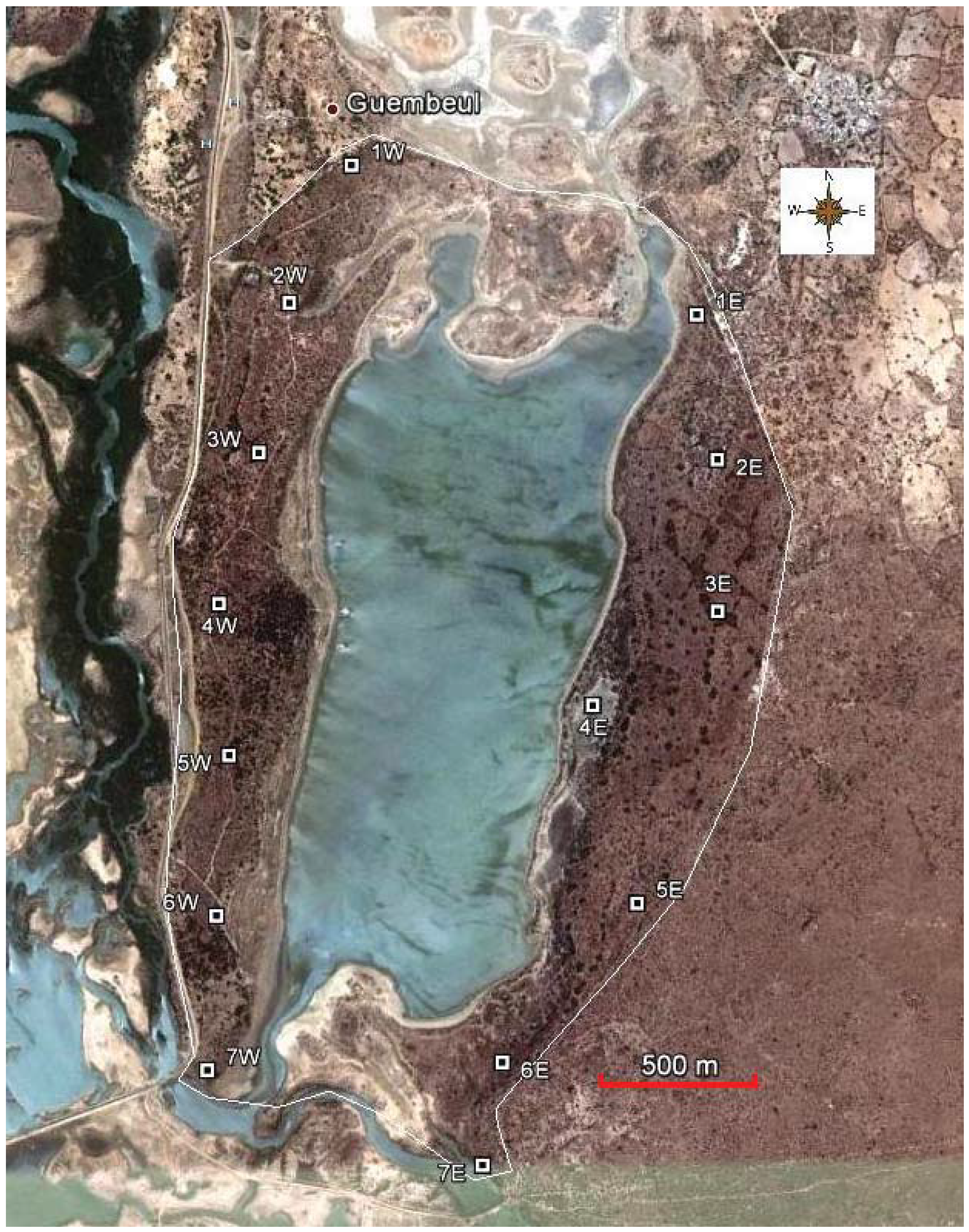
      <p>The RF Guembeul (a 720-ha fenced off area; 15°55'N; 16°28'W) is about 12 km south of Saint Louis (Sahelian zone in northern Senegal). Created in 1983, it is one of the three connected reserves in the network of lagoons and creeks which follow the Senegal River to its mouth. It was set aside primarily to protect a variety of resident and migrant water birds. In 1986, it was designated as a Ramsar Wetlands. The centerpiece of the Reserve (about 1/3 of its total area) is a large lagoon which divides RF Guembeul in two (called “West” and “East” for the purposes of this study, <xref ref-type="fig" rid="animals-02-00347-f001">Figure 1</xref>). It is in a shallow depression with sandy shores surrounded by thorn-bush savannah dominated by <italic>Acacia</italic> sp. and <italic>Balanites aegyptiaca</italic> [<xref ref-type="bibr" rid="B29-animals-02-00347">29</xref>], and scattered <italic>Boscia senegalensis, Salvadora persica</italic> and <italic>Commiphora africana</italic> shrubs, among others. <italic>Opuntia tuna</italic> thickly covers some parts of the Reserve. In the eighties, it was restricted to a small area in the southwest [<xref ref-type="bibr" rid="B14-animals-02-00347">14</xref>], but as an exotic weed, this cactus species has become more widespread, especially in the West where it appears quite evenly distributed.</p>
      <fig id="animals-02-00347-f001" position="anchor">
        <label>Figure 1</label>
        <caption>
          <p>Map of the Reserve of Fauna of Guembeul showing plots where habitat structure has been sampled (15°55'N; 16°28'W). The central lagoon divides the Reserve into a western part and an eastern part, each of them containing seven sampling plots (1W–7W; 1E–7E). The white line around denotes a perimetral fence. Photo taken from Google©.</p>
        </caption>
        <graphic xmlns:xlink="http://www.w3.org/1999/xlink" xlink:href="animals-02-00347-g001.tif"/>
      </fig>
      <p>Reintroduced Mohor gazelles were part of the species EEP (European Endangered Species Programme), and were identified with the following studbook numbers [<xref ref-type="bibr" rid="B13-animals-02-00347">13</xref>]: ND176, ND229 (males), ND39, ND114, ND172, ND191, ND241, ND247 (females). Female ND247 died during transport. Upon arrival, a breeding group was placed in a 400-m<sup>2</sup> pen (male ND176 and all of the females), and the remaining male (ND229) was kept alone in a 100-m<sup>2</sup> pen. Details of the evolution of the stock released until 1992 can be found in [<xref ref-type="bibr" rid="B14-animals-02-00347">14</xref>].</p>
      <p>We made a thorough review of the literature in an attempt to find out as much information as possible on how the released stock has evolved since its reintroduction in 1984. However, published information is scattered and sometimes contradictory, with gaps for which there is no information at all. Published information on the evolution of the Scimitar-horned oryx reintroduced in RF Guembeul was also reviewed for purposes of comparison.</p>
      <p>Fieldwork was undertaken in 2011. To study habitat structure, 14 plots were selected (<xref ref-type="fig" rid="animals-02-00347-f001">Figure 1</xref>). Seven were located in the West of the Reserve and seven in the East, where the remaining population of gazelles has been observed by rangers in recent years. Plots were sampled twice (once in January and once in November). Every plot consisted of a square 25 m per side separated from the closest plot by about 500 m. Each plot was geo-referenced (information available upon request). The following predictor variables were taken for each plot: tree cover (percentage), grass cover (percentage), <italic>Opuntia tuna</italic> cover (percentage), bare ground cover (percentage), mean tree height, mean grass height, minimum browsing height and species richness (defined as the number of different species of trees and ligneous bushes inside the plot). Data on gazelles were collected in two censuses on different days (16 and 17 November) beginning at 06:00 AM by means of a “census party” of nine people moving together from south to north over East RF Guembeul. They were distributed horizontally from the shore of the lagoon to the outer (perimetral) fence (about 600 m wide). Each person was separated from his neighbour by a distance such that each could see the one on both right and left. We were therefore sure that all animals were seen by at least one person in the census party. We recorded the number of individuals seen (Mohor gazelle or Scimitar-horned oryx), the GPS coordinate where it was observed, and whether they were solitary or in a group.</p>
      <p>The Mohor gazelle is considered to be absent from the West of Guembeul, as none have been observed by RF Guembeul rangers in the last few years. Counts of Scimitar-horned oryx were made on 16–17 November in one-day drives and walking (another day), always at dusk. As East and West Guembeul were completely separated by the central lagoon in November, we were sure that individuals counted early in the morning in the East were different from those counted at dusk in the West, because they are unable to cross the water. In accord with previous rangers’ information, we found no Mohor gazelle in West RF Guembeul.</p>
      <p>We performed a General Discriminant Analysis to test for differences in habitat structure between East and West RF Guembeul. To control the probability of a sampling date effect (January <italic>vs.</italic> November), we included this variable as a categorical predictor. To check for lack of relationships between sampling date and significant continuous predictors (plot variables), we tested their interactions. For reaching normalization, variables taken as percentages were arcsine transformed and linear variables were log-transformed. Analysis was performed using Statistica 7.0 [<xref ref-type="bibr" rid="B30-animals-02-00347">30</xref>]. </p>
    </sec>
    <sec sec-type="results">
      <title>3. Results and Discussion</title>
      <p><xref ref-type="table" rid="animals-02-00347-t001">Table 1</xref> shows the evolution of the Mohor gazelle and Scimitar-horned oryx populations in RF Guembeul according to published information. The gazelle population grew from 7 to 13 individuals (6 males: 7 females) from 1984 to December 1992. Eighteen deaths were recorded during this eight year period (see [<xref ref-type="bibr" rid="B14-animals-02-00347">14</xref>] for more details on yearly evolution of the population and herd management). From 1992 to 2002 the Mohor gazelle population seemed to grow gradually to 49 [<xref ref-type="bibr" rid="B15-animals-02-00347">15</xref>]. The Senegalese DPN took advantage of the increased population of this gazelle at RF Guembeul to transfer nine of them (2 males: 7 females) to the Réserve de Faune du Ferlo Nord in 2003 (482.000 ha of protected Sahel in Northern Senegal [<xref ref-type="bibr" rid="B20-animals-02-00347">20</xref>,<xref ref-type="bibr" rid="B31-animals-02-00347">31</xref>]). In 2005, only 20 Mohor gazelles were left in RF Guembeul [<xref ref-type="bibr" rid="B20-animals-02-00347">20</xref>] representing the population’s first recorded decrease. We have been unable to find published information on the evolution of the Mohor population in RF Guembeul from 2005 to 2009, when, as we were informed by DPN technicians, only 13–15 gazelles were left in the Reserve (see also [<xref ref-type="bibr" rid="B16-animals-02-00347">16</xref>]). </p>
      <table-wrap id="animals-02-00347-t001" position="anchor">
        <object-id pub-id-type="pii">animals-02-00347-t001_Table 1</object-id>
        <label>Table 1</label>
        <caption>
          <p>Evolution of the Mohor gazelle and Scimitar-horned oryx populations at RF Guembeul since their respective years of reintroduction (1984 and 1999) according to published information. References are included. </p>
        </caption>
        <table>
          <thead>
            <tr>
              <th align="center" valign="middle">Species</th>
              <th align="center" valign="middle">Date</th>
              <th align="center" valign="middle">Population size</th>
              <th align="center" valign="middle">Reference</th>
            </tr>
          </thead>
          <tbody>
            <tr>
              <td align="center" valign="middle"><italic>N. d. mhorr</italic></td>
              <td align="center" valign="middle">1984</td>
              <td align="center" valign="middle">8</td>
              <td align="center" valign="middle">[<xref ref-type="bibr" rid="B14-animals-02-00347">14</xref>]</td>
            </tr>
            <tr>
              <td align="center" valign="middle"> </td>
              <td align="center" valign="middle">1992</td>
              <td align="center" valign="middle">13</td>
              <td align="center" valign="middle">[<xref ref-type="bibr" rid="B14-animals-02-00347">14</xref>]</td>
            </tr>
            <tr>
              <td align="center" valign="middle"> </td>
              <td align="center" valign="middle">2001</td>
              <td align="center" valign="middle">44</td>
              <td align="center" valign="middle">[<xref ref-type="bibr" rid="B32-animals-02-00347">32</xref>]</td>
            </tr>
            <tr>
              <td align="center" valign="middle"> </td>
              <td align="center" valign="middle">2002</td>
              <td align="center" valign="middle">49</td>
              <td align="center" valign="middle">[<xref ref-type="bibr" rid="B15-animals-02-00347">15</xref>]</td>
            </tr>
            <tr>
              <td align="center" valign="middle"> </td>
              <td align="center" valign="middle">2003</td>
              <td align="center" valign="middle">(40) 9 individuals to Ferlo</td>
              <td align="center" valign="middle">[<xref ref-type="bibr" rid="B16-animals-02-00347">16</xref>,<xref ref-type="bibr" rid="B20-animals-02-00347">20</xref>]</td>
            </tr>
            <tr>
              <td align="center" valign="middle"> </td>
              <td align="center" valign="middle">2005</td>
              <td align="center" valign="middle">20</td>
              <td align="center" valign="middle">[<xref ref-type="bibr" rid="B20-animals-02-00347">20</xref>]</td>
            </tr>
            <tr>
              <td align="center" valign="middle"> </td>
              <td align="center" valign="middle">2009</td>
              <td align="center" valign="middle">15</td>
              <td align="center" valign="middle">[<xref ref-type="bibr" rid="B16-animals-02-00347">16</xref>]</td>
            </tr>
            <tr>
              <td align="center" valign="middle"> </td>
              <td align="center" valign="middle">2011</td>
              <td align="center" valign="middle">10</td>
              <td align="center" valign="middle">Current study</td>
            </tr>
            <tr>
              <td align="center" valign="middle"><italic>O. dammah</italic></td>
              <td align="center" valign="middle">1999</td>
              <td align="center" valign="middle">8</td>
              <td align="center" valign="middle">[<xref ref-type="bibr" rid="B18-animals-02-00347">18</xref>,<xref ref-type="bibr" rid="B19-animals-02-00347">19</xref>]</td>
            </tr>
            <tr>
              <td align="center" valign="middle"> </td>
              <td align="center" valign="middle">2001</td>
              <td align="center" valign="middle">14</td>
              <td align="center" valign="middle">[<xref ref-type="bibr" rid="B19-animals-02-00347">19</xref>]</td>
            </tr>
            <tr>
              <td align="center" valign="middle"> </td>
              <td align="center" valign="middle">2002</td>
              <td align="center" valign="middle">23</td>
              <td align="center" valign="middle">[<xref ref-type="bibr" rid="B15-animals-02-00347">15</xref>]</td>
            </tr>
            <tr>
              <td align="center" valign="middle"> </td>
              <td align="center" valign="middle">2003</td>
              <td align="center" valign="middle">26</td>
              <td align="center" valign="middle">[<xref ref-type="bibr" rid="B18-animals-02-00347">18</xref>,<xref ref-type="bibr" rid="B19-animals-02-00347">19</xref>]</td>
            </tr>
            <tr>
              <td align="center" valign="middle"> </td>
              <td align="center" valign="middle">2003</td>
              <td align="center" valign="middle">(18) 8 individuals to Ferlo</td>
              <td align="center" valign="middle">[<xref ref-type="bibr" rid="B20-animals-02-00347">20</xref>]</td>
            </tr>
            <tr>
              <td align="center" valign="middle"> </td>
              <td align="center" valign="middle">2004</td>
              <td align="center" valign="middle">18</td>
              <td align="center" valign="middle">[<xref ref-type="bibr" rid="B19-animals-02-00347">19</xref>]</td>
            </tr>
            <tr>
              <td align="center" valign="middle"> </td>
              <td align="center" valign="middle">2005</td>
              <td align="center" valign="middle">18</td>
              <td align="center" valign="middle">[<xref ref-type="bibr" rid="B20-animals-02-00347">20</xref>]</td>
            </tr>
            <tr>
              <td align="center" valign="middle"> </td>
              <td align="center" valign="middle">2009</td>
              <td align="center" valign="middle">40</td>
              <td align="center" valign="middle">[<xref ref-type="bibr" rid="B16-animals-02-00347">16</xref>]</td>
            </tr>
            <tr>
              <td align="center" valign="middle"> </td>
              <td align="center" valign="middle">2011</td>
              <td align="center" valign="middle">70</td>
              <td align="center" valign="middle">Current study</td>
            </tr>
          </tbody>
        </table>
      </table-wrap>
      <p>Available information on the reintroduction of the Scimitar-horned oryx in RF Guembeul tells a different story. It started 15 years later than the Mohor; reinforcement (2:2 individuals) took place after initial reintroduction (3:5); the population has progressively evolved up to now even though eight individuals (2:6) were taken from RF Guembeul to Ferlo Nord in 2003 within the broad DPN initiative for reintroducing Sahel Saharan antelopes there, including the Mohor gazelle.</p>
      <p>We found that West and East RF Guembeul had different habitat structures (<xref ref-type="table" rid="animals-02-00347-t002">Table 2</xref>). Tree cover, <italic>Opuntia</italic> cover and grass height were significantly different whether sampled in January or in November (no significant interaction). East RF Guembeul is a more open habitat, where trees and <italic>Opuntia</italic> are less abundant (mean tree cover = 38.6%; mean <italic>Opuntia</italic> cover = 0.48%) than in the West (mean tree cover = 71.43%; mean <italic>Opuntia</italic> cover = 17.85%), and the canopy is significantly less developed. Grass height is also lower in the East (mean grass height = 35 cm; in West Guembeul mean grass height = 56.9 cm). The discriminant function correctly classified 100% of plots sampled in East RF Guembeul and 97% in the West. </p>
      <p>We found the same Mohor gazelle population size on both census days. In the East there are 10 individuals distributed as follows: one breeding group formed by one adult male and seven females, and two solitary males. The Scimitar-horned oryx population, on the other hand, was composed of 46 individuals in this part of RF Guembeul; most of them in a large herd (n = 37) with a dominant male, several younger males and many females and their calves. We also detected two family groups of five and three individuals respectively, and one solitary male. In the West, we counted up to 24 individuals, all included in a single herd. This means that the Scimitar-horned oryx population at RF Guembeul had grown to 70 individuals by November 2011.</p>
	  <table-wrap id="animals-02-00347-t002" position="anchor">
        <object-id pub-id-type="pii">animals-02-00347-t002_Table 2</object-id>
        <label>Table 2</label>
        <caption>
          <p>Results of the General Discriminant Analysis performed to test for differences in habitat structure between East and West RF Guembeul. The interaction between sampling dates (January <italic>vs.</italic> November) and the three significant variables are also shown.</p>
        </caption>
        <table>
          <thead>
            <tr>
              <th align="left" valign="middle">Variable</th>
              <th align="center" valign="middle">F</th>
              <th align="center" valign="middle">Effect df</th>
              <th align="center" valign="middle">Error df</th>
              <th align="center" valign="middle">
                <italic>p</italic>
              </th>
            </tr>
          </thead>
          <tbody>
            <tr>
              <td align="left" valign="middle">Species richness</td>
              <td align="center" valign="middle">0.072</td>
              <td align="center" valign="middle">1</td>
              <td align="center" valign="middle">18</td>
              <td align="center" valign="middle">0.792</td>
            </tr>
            <tr>
              <td align="left" valign="middle">Bare Ground</td>
              <td align="center" valign="middle">1.612</td>
              <td align="center" valign="middle">1</td>
              <td align="center" valign="middle">18</td>
              <td align="center" valign="middle">0.220</td>
            </tr>
            <tr>
              <td align="left" valign="middle"><italic>Opuntia</italic> cover</td>
              <td align="center" valign="middle">21.289</td>
              <td align="center" valign="middle">1</td>
              <td align="center" valign="middle">18</td>
              <td align="center" valign="middle">
                <bold>&lt;0.001</bold>
              </td>
            </tr>
            <tr>
              <td align="left" valign="middle">Tree cover</td>
              <td align="center" valign="middle">12.849</td>
              <td align="center" valign="middle">1</td>
              <td align="center" valign="middle">18</td>
              <td align="center" valign="middle">
                <bold>0.002</bold>
              </td>
            </tr>
            <tr>
              <td align="left" valign="middle">Grass cover</td>
              <td align="center" valign="middle">2.207</td>
              <td align="center" valign="middle">1</td>
              <td align="center" valign="middle">18</td>
              <td align="center" valign="middle">0.155</td>
            </tr>
            <tr>
              <td align="left" valign="middle">Tree height</td>
              <td align="center" valign="middle">0.021</td>
              <td align="center" valign="middle">1</td>
              <td align="center" valign="middle">18</td>
              <td align="center" valign="middle">0.886</td>
            </tr>
            <tr>
              <td align="left" valign="middle">Grass height</td>
              <td align="center" valign="middle">18.981</td>
              <td align="center" valign="middle">1</td>
              <td align="center" valign="middle">18</td>
              <td align="center" valign="middle">
                <bold>&lt;0.001</bold>
              </td>
            </tr>
            <tr>
              <td align="left" valign="middle">Minimum browsing height</td>
              <td align="center" valign="middle">3.316</td>
              <td align="center" valign="middle">1</td>
              <td align="center" valign="middle">18</td>
              <td align="center" valign="middle">0.085</td>
            </tr>
            <tr>
              <td align="left" valign="middle">Sampling date (January <italic>vs.</italic> November)</td>
              <td align="center" valign="middle">0.904</td>
              <td align="center" valign="middle">1</td>
              <td align="center" valign="middle">18</td>
              <td align="center" valign="middle">0.354</td>
            </tr>
            <tr>
              <td align="left" valign="middle">Sampling date* <italic>Opuntia</italic> cover</td>
              <td align="center" valign="middle">0.026</td>
              <td align="center" valign="middle">1</td>
              <td align="center" valign="middle">20</td>
              <td align="center" valign="middle">0.873</td>
            </tr>
            <tr>
              <td align="left" valign="middle">Sampling date* Tree cover</td>
              <td align="center" valign="middle">0.002</td>
              <td align="center" valign="middle">1</td>
              <td align="center" valign="middle">20</td>
              <td align="center" valign="middle">0.969</td>
            </tr>
            <tr>
              <td align="left" valign="middle">Sampling date* Grass height</td>
              <td align="center" valign="middle">0.008</td>
              <td align="center" valign="middle">1</td>
              <td align="center" valign="middle">20</td>
              <td align="center" valign="middle">0.930</td>
            </tr>
          </tbody>
        </table>
      </table-wrap>
      
      <p>The Mohor gazelle population that was reintroduced in RF Guembeul has experienced a decline in recent years after a post-release increase up to 2002–2003. This gazelle is a desert/semi-desert species [<xref ref-type="bibr" rid="B8-animals-02-00347">8</xref>]. The presence and density of trees appears to condition its distribution throughout its range. Numerous observations have been made in the Atlantic-Sahara desert, mostly in open habitats [<xref ref-type="bibr" rid="B33-animals-02-00347">33</xref>,<xref ref-type="bibr" rid="B34-animals-02-00347">34</xref>,<xref ref-type="bibr" rid="B35-animals-02-00347">35</xref>]. In Niger, its strong preference has been documented for the major “wadis” and their flood plains, secondarily for the steppes in zones of water movement and the dunes invading the “wadi” beds [<xref ref-type="bibr" rid="B28-animals-02-00347">28</xref>]. In Termit Massif it occupies rocky, open areas and sandy fields of barkhan with green pastures and other annual plants [<xref ref-type="bibr" rid="B36-animals-02-00347">36</xref>]. As predicted from its ecological preferences, we found Mohor gazelles currently absent in those zones of RF Guembeul with denser canopy, and where grass is taller, occupying preferably areas characterized by more open, simpler habitats with shorter grass height. This result led us to suggest the possibility that there have been changes in habitat structure during this time in Guembeul, which have reduced the amount of suitable habitat for this gazelle in the Reserve. </p>
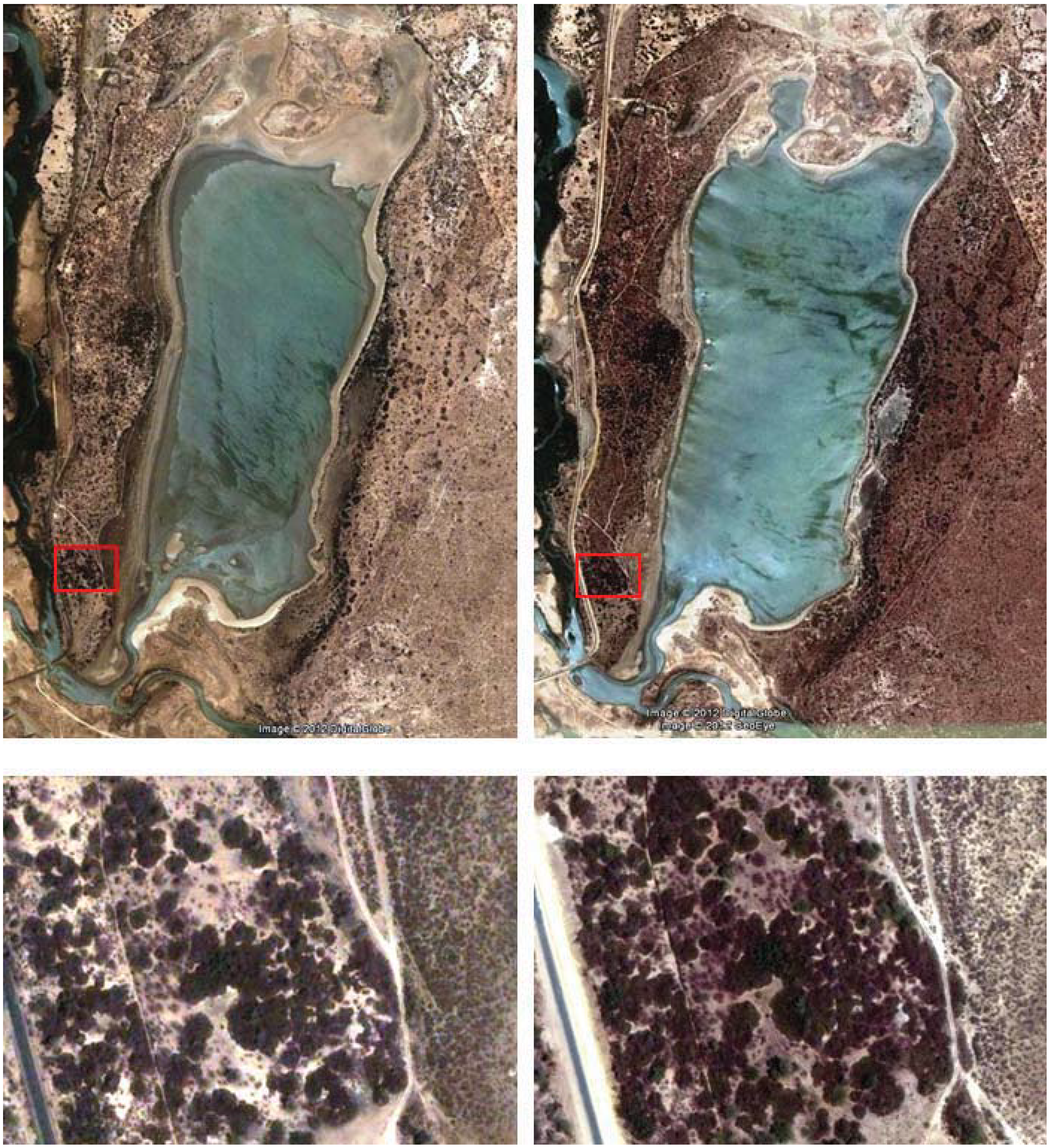
      <p>A few months after creation, RF Guembeul was completely fenced off to protect the area from livestock grazing. At that time, it was a rather impoverished sandy habitat due mainly to overgrazing. However, fencing promoted recovery of vegetation, and four years later important changes in its landscape were reported [<xref ref-type="bibr" rid="B14-animals-02-00347">14</xref>]: In 1984 “<italic>Acacia</italic> spp shoots about 25–30 cm high were scattered around the Reserve, with very few mature trees”. In 1988 “the acacias and other trees had grown to a height of 3–5 m and were distributed fairly evenly some 6–10 m apart” and “a small area to the south-west is thickly covered by <italic>Opuntia tuna</italic>”. This has also changed with time, and this cactus is much more widely extended, especially in the West where it appeared in all plots sampled (<xref ref-type="table" rid="animals-02-00347-t003">Table 3</xref>). Unfortunately there is no quantified data available on habitat structure in the RF Guembeul in the past that would provide an accurate image of the hypothesized habitat changes over the past years, and which presumably could explain Mohor gazelle decline parallel to an increase in vegetation cover. However, by using historical as well as current Google© images of the Reserve (<xref ref-type="fig" rid="animals-02-00347-f002">Figure 2</xref>), we can observe changes in the extent of the canopy roughly by comparing pictures taken in 2003 and pictures taken in 2011, and this change is much more pronounced in West Guembeul, very likely associated with the expansion of <italic>Opuntia</italic> in this part of the Reserve. Remote sensing techniques could probably be used in a future follow up study to underpin our current results. </p>
      <table-wrap id="animals-02-00347-t003" position="anchor">
        <object-id pub-id-type="pii">animals-02-00347-t003_Table 3</object-id>
        <label>Table 3</label>
        <caption>
          <p>Main tree and thorn-bush species found within the sampled plots. Plots are coded as in <xref ref-type="fig" rid="animals-02-00347-f001">Figure 1</xref> (1E–7E, eastern part of RF Guembeul; 1W–7W western part). Abbreviations: OT, <italic>Opuntia tuna;</italic> Asp, <italic>Acacia</italic> sp; BA, <italic>Balanites aegyptiaca;</italic> GT, <italic>Grewia tenax</italic>; CP, <italic>Cocculus pendulus</italic>; AD, <italic>Adansonia digitalis</italic>; PJ, <italic>Prosopis juliflora;</italic> SP, <italic>Salvadora persica</italic>; EB, <italic>Euphorbia balsamifera</italic>; CA, <italic>Commiphora africana</italic>; BS, <italic>Boscia senegalensis</italic>; TS, <italic>Tamarix senegalensis</italic>.</p>
        </caption>
        <table>
<thead>
            <tr>
              <th align="center" valign="middle">Plot</th>
              <th align="center" valign="middle">OT</th>
              <th align="center" valign="middle">Asp</th>
              <th align="center" valign="middle">BA</th>
              <th align="center" valign="middle">GT</th>
              <th align="center" valign="middle">CP</th>
              <th align="center" valign="middle">AD</th>
              <th align="center" valign="middle">PJ</th>
              <th align="center" valign="middle">SP</th>
              <th align="center" valign="middle">EB</th>
              <th align="center" valign="middle">CA</th>
              <th align="center" valign="middle">BS</th>
              <th align="center" valign="middle">TS</th>
            </tr>
          </thead>
          <tbody>
            <tr>
              <td align="center" valign="middle">1E</td>
              <td align="center" valign="middle">X</td>
              <td align="center" valign="middle"> </td>
              <td align="center" valign="middle"> </td>
              <td align="center" valign="middle"> </td>
              <td align="center" valign="middle"> </td>
              <td align="center" valign="middle"> </td>
              <td align="center" valign="middle">X</td>
              <td align="center" valign="middle"> </td>
              <td align="center" valign="middle">X</td>
              <td align="center" valign="middle"> </td>
              <td align="center" valign="middle"> </td>
              <td align="center" valign="middle"> </td>
            </tr>
            <tr>
              <td align="center" valign="middle">2E</td>
              <td align="center" valign="middle"> </td>
              <td align="center" valign="middle">X</td>
              <td align="center" valign="middle">X</td>
              <td align="center" valign="middle">X</td>
              <td align="center" valign="middle"> </td>
              <td align="center" valign="middle"> </td>
              <td align="center" valign="middle"> </td>
              <td align="center" valign="middle"> </td>
              <td align="center" valign="middle"> </td>
              <td align="center" valign="middle">X</td>
              <td align="center" valign="middle"> </td>
              <td align="center" valign="middle"> </td>
            </tr>
            <tr>
              <td align="center" valign="middle">3E</td>
              <td align="center" valign="middle"> </td>
              <td align="center" valign="middle">X</td>
              <td align="center" valign="middle"> </td>
              <td align="center" valign="middle">X</td>
              <td align="center" valign="middle"> </td>
              <td align="center" valign="middle">X</td>
              <td align="center" valign="middle">X</td>
              <td align="center" valign="middle">X</td>
              <td align="center" valign="middle">X</td>
              <td align="center" valign="middle">X</td>
              <td align="center" valign="middle"> </td>
              <td align="center" valign="middle"> </td>
            </tr>
            <tr>
              <td align="center" valign="middle">4E</td>
              <td align="center" valign="middle"> </td>
              <td align="center" valign="middle"> </td>
              <td align="center" valign="middle"> </td>
              <td align="center" valign="middle"> </td>
              <td align="center" valign="middle"> </td>
              <td align="center" valign="middle"> </td>
              <td align="center" valign="middle"> </td>
              <td align="center" valign="middle"> </td>
              <td align="center" valign="middle"> </td>
              <td align="center" valign="middle"> </td>
              <td align="center" valign="middle"> </td>
              <td align="center" valign="middle">X</td>
            </tr>
            <tr>
              <td align="center" valign="middle">5E</td>
              <td align="center" valign="middle"> </td>
              <td align="center" valign="middle">X</td>
              <td align="center" valign="middle"> </td>
              <td align="center" valign="middle"> </td>
              <td align="center" valign="middle"> </td>
              <td align="center" valign="middle">X</td>
              <td align="center" valign="middle">X</td>
              <td align="center" valign="middle">X</td>
              <td align="center" valign="middle"> </td>
              <td align="center" valign="middle">X</td>
              <td align="center" valign="middle">X</td>
              <td align="center" valign="middle"> </td>
            </tr>
            <tr>
              <td align="center" valign="middle">6E</td>
              <td align="center" valign="middle"> </td>
              <td align="center" valign="middle">X</td>
              <td align="center" valign="middle"> </td>
              <td align="center" valign="middle">X</td>
              <td align="center" valign="middle"> </td>
              <td align="center" valign="middle"> </td>
              <td align="center" valign="middle">X</td>
              <td align="center" valign="middle">X</td>
              <td align="center" valign="middle"> </td>
              <td align="center" valign="middle"> </td>
              <td align="center" valign="middle"> </td>
              <td align="center" valign="middle">X</td>
            </tr>
            <tr>
              <td align="center" valign="middle">7E</td>
              <td align="center" valign="middle">X</td>
              <td align="center" valign="middle">X</td>
              <td align="center" valign="middle"> </td>
              <td align="center" valign="middle"> </td>
              <td align="center" valign="middle"> </td>
              <td align="center" valign="middle"> </td>
              <td align="center" valign="middle">X</td>
              <td align="center" valign="middle">X</td>
              <td align="center" valign="middle"> </td>
              <td align="center" valign="middle"> </td>
              <td align="center" valign="middle"> </td>
              <td align="center" valign="middle"> </td>
            </tr>
            <tr>
              <td align="center" valign="middle">1W</td>
              <td align="center" valign="middle">X</td>
              <td align="center" valign="middle">X</td>
              <td align="center" valign="middle"> </td>
              <td align="center" valign="middle"> </td>
              <td align="center" valign="middle"> </td>
              <td align="center" valign="middle"> </td>
              <td align="center" valign="middle">X</td>
              <td align="center" valign="middle"> </td>
              <td align="center" valign="middle">X</td>
              <td align="center" valign="middle"> </td>
              <td align="center" valign="middle"> </td>
              <td align="center" valign="middle"> </td>
            </tr>
            <tr>
              <td align="center" valign="middle">2W</td>
              <td align="center" valign="middle">X</td>
              <td align="center" valign="middle">X</td>
              <td align="center" valign="middle">X</td>
              <td align="center" valign="middle"> </td>
              <td align="center" valign="middle"> </td>
              <td align="center" valign="middle"> </td>
              <td align="center" valign="middle">X</td>
              <td align="center" valign="middle"> </td>
              <td align="center" valign="middle"> </td>
              <td align="center" valign="middle"> </td>
              <td align="center" valign="middle"> </td>
              <td align="center" valign="middle"> </td>
            </tr>
            <tr>
              <td align="center" valign="middle">3W</td>
              <td align="center" valign="middle">X</td>
              <td align="center" valign="middle">X</td>
              <td align="center" valign="middle">X</td>
              <td align="center" valign="middle"> </td>
              <td align="center" valign="middle">X</td>
              <td align="center" valign="middle"> </td>
              <td align="center" valign="middle"> </td>
              <td align="center" valign="middle">X</td>
              <td align="center" valign="middle"> </td>
              <td align="center" valign="middle">X</td>
              <td align="center" valign="middle"> </td>
              <td align="center" valign="middle"> </td>
            </tr>
            <tr>
              <td align="center" valign="middle">4W</td>
              <td align="center" valign="middle">X</td>
              <td align="center" valign="middle">X</td>
              <td align="center" valign="middle">X</td>
              <td align="center" valign="middle"> </td>
              <td align="center" valign="middle"> </td>
              <td align="center" valign="middle"> </td>
              <td align="center" valign="middle"> </td>
              <td align="center" valign="middle"> </td>
              <td align="center" valign="middle">X</td>
              <td align="center" valign="middle">X</td>
              <td align="center" valign="middle"> </td>
              <td align="center" valign="middle"> </td>
            </tr>
            <tr>
              <td align="center" valign="middle">5W</td>
              <td align="center" valign="middle">X</td>
              <td align="center" valign="middle">X</td>
              <td align="center" valign="middle">X</td>
              <td align="center" valign="middle"> </td>
              <td align="center" valign="middle"> </td>
              <td align="center" valign="middle"> </td>
              <td align="center" valign="middle">X</td>
              <td align="center" valign="middle">X</td>
              <td align="center" valign="middle"> </td>
              <td align="center" valign="middle">X</td>
              <td align="center" valign="middle"> </td>
              <td align="center" valign="middle"> </td>
            </tr>
            <tr>
              <td align="center" valign="middle">6W</td>
              <td align="center" valign="middle">X</td>
              <td align="center" valign="middle">X</td>
              <td align="center" valign="middle"> </td>
              <td align="center" valign="middle">X</td>
              <td align="center" valign="middle"> </td>
              <td align="center" valign="middle"> </td>
              <td align="center" valign="middle">X</td>
              <td align="center" valign="middle">X</td>
              <td align="center" valign="middle"> </td>
              <td align="center" valign="middle"> </td>
              <td align="center" valign="middle"> </td>
              <td align="center" valign="middle">X</td>
            </tr>
            <tr>
              <td align="center" valign="middle">7W</td>
              <td align="center" valign="middle">X</td>
              <td align="center" valign="middle">X</td>
              <td align="center" valign="middle"> </td>
              <td align="center" valign="middle"> </td>
              <td align="center" valign="middle"> </td>
              <td align="center" valign="middle"> </td>
              <td align="center" valign="middle">X</td>
              <td align="center" valign="middle"> </td>
              <td align="center" valign="middle"> </td>
              <td align="center" valign="middle">X</td>
              <td align="center" valign="middle"> </td>
              <td align="center" valign="middle"> </td>
            </tr>
          </tbody>
        </table>
      </table-wrap>
      <p>It is of interest to analyse the likely causes explaining differences in outcomes of the Scimitar-horned oryx reintroduction relative to the outcomes of the Mohor gazelle reintroduction. Contrary to the latter species, the reintroduced Scimitar-horned oryx population has been increasing progressively in RF Guembeul since 1999. This arid grassland species occupies the same ecological zones as the Mohor gazelle, and the ecology of both species was very similar when sharing their historical range [<xref ref-type="bibr" rid="B8-animals-02-00347">8</xref>]. However, changes observed in habitat structure in our study site do not seem to have had effects on the Scimitar-horned oryx population. One likely explanation is competition. The fact that the Mohor gazelle population decline occurs roughly in parallel to the Scimitar-horned oryx population increase seems to support this explanation. Theory suggests that species that share ecological features may compete. Competing species are expected to develop ways to limit competitive interactions, e.g., niche shift [<xref ref-type="bibr" rid="B37-animals-02-00347">37</xref>]. The Scimitar-horned oryx being much bigger (150–165 kg, [<xref ref-type="bibr" rid="B38-animals-02-00347">38</xref>]), might have taken advantage displacing the smaller Mohor gazelle from their most preferred sites in RF Guembeul, the latter species responding to the presence of the competitor by restricting its niche to a smaller subset (<italic>i.e.</italic>, West Guembeul) of the habitat than it would otherwise do (<italic>i.e.</italic>, the whole Reserve). Alternatively, competing species may reduce interactions by partitioning the available resources (niche partitioning, [<xref ref-type="bibr" rid="B39-animals-02-00347">39</xref>]). Although there does not seem to be any first-hand information on the precise ecology of the Scimitar-horned oryx in its entire ecological zone, but rather that it has been described by extrapolation of the Sahelian information combined with other sparse data [<xref ref-type="bibr" rid="B8-animals-02-00347">8</xref>], it seems that in Niger this species assures shade (an essential element of its habitat during the hot months) by accessing thickly wooded sites. Here <italic>Commiphora africana</italic>, various acacias, and several other Sahelian trees form fairly dense woods in its preferred zones of occupation [<xref ref-type="bibr" rid="B8-animals-02-00347">8</xref>]. Moreover, contrary to Mohor gazelle, during the dry season the Scimitar-horned oryx can feed on succulent plants as a water provider [<xref ref-type="bibr" rid="B8-animals-02-00347">8</xref>]. It is plausible to argue that under a niche partitioning scenario to avoid competition, Mohor gazelle and Scimitar-horned oryx could coexist at Guembeul in the past, populations of both species growing in accordance with their respective ecological demands. However, habitat changes reported in this study, very likely has facilitated the Scimitar-horned population increase and impeded to some extent that of the Mohor gazelle. If this were the case, changes in habitat structure occurred in RF Guembeul in the last 9–10 years could be still claimed as the proxy of the Mohor population decline.</p>
	  <fig id="animals-02-00347-f002" position="anchor">
        <label>Figure 2</label>
        <caption>
          <p>Photos showing changes occurred in vegetation cover in RF Guembeul: left side pictures taken in 13 March 2003; right side pictures taken in 5 April 2011. General view is shown above; details of plots in red, below. Photos have been taken from Google©; accessed on 28 May 2012.</p>
        </caption>
        <graphic xmlns:xlink="http://www.w3.org/1999/xlink" xlink:href="animals-02-00347-g002.tif"/>
      </fig>
      
      <p>There are other, non-mutually exclusive possibilities for explaining Mohor gazelle decline in Guembeul that might exist: inbreeding, diseases, stochastic effects, and drought together with the inability to move to follow sporadic rainfall in the fenced area of Guembeul, predation. Very likely, there is not one sole factor affecting its decline, and all these alternative hypotheses should be tested to establish the precise causes of its population decrease. High standard data sets to test them all are not available yet. However, this study is only intended to be the very first step of a post-release monitoring agenda that should be developed to gather those key parameters enabling us to evaluate the outcome of the Mohor reintroduction programme which took place in Senegal in 1984. </p>
    </sec>
    <sec sec-type="conclusions">
      <title>4. Conclusions</title>
      <p>Among the number of complex dilemmas faced by conservationists and managers of reintroduction programmes, the definition of “success” is of major importance. There is no agreement on what constitutes successful reintroduction, although several definitions have been discussed [<xref ref-type="bibr" rid="B40-animals-02-00347">40</xref>], including breeding by the first wild-born generation [<xref ref-type="bibr" rid="B41-animals-02-00347">41</xref>], a three-year breeding population with recruitment exceeding adult death rate [<xref ref-type="bibr" rid="B42-animals-02-00347">42</xref>], and an unsupported wild population of at least 500 individuals [<xref ref-type="bibr" rid="B43-animals-02-00347">43</xref>] among others. Following IUCN Guidelines [<xref ref-type="bibr" rid="B44-animals-02-00347">44</xref>], a reintroduction project attempts to re-establish species within their historical ranges through the release of wild or captive-bred individuals following extirpation or extinction in the wild. As the re-establishment of the species is its final goal, for the purpose of this study we consider reintroduction to be successful if it achieves establishment of a self-sustaining population [<xref ref-type="bibr" rid="B45-animals-02-00347">45</xref>], even if it takes a long time [<xref ref-type="bibr" rid="B46-animals-02-00347">46</xref>]. Accordingly, the reintroduction of the Mohor gazelle in RF Guembeul cannot yet be considered successful, as its population size is presently declining. Our current study is a post-release initiative to investigate the likely reasons for that decline in the interest of bringing the reintroduction programme initiated in 1984 to a successful end. Although reinforcement of the population at RF Guembeul has been recommended elsewhere [<xref ref-type="bibr" rid="B8-animals-02-00347">8</xref>], the likely causes of failure must be identified so that, as strongly recommended by the IUCN [<xref ref-type="bibr" rid="B44-animals-02-00347">44</xref>], those causes may be removed first. In the light of our results, it seems that a key to the long-term survival of the Mohor gazelle in the Reserve is maintenance of a minimum area of suitable habitat in it, avoiding distinct changes in the extent of vegetation cover. Clearing vegetation by periodically cutting down some trees might be an appropriate management policy in Guembeul. These actions could represent a community-based initiative that would significantly increase the effectiveness of biodiversity conservation in Guembeul as for people living around the Reserve its value would be enhanced for them as a job provider. For local authorities this could also be a way to promote sustainable livelihoods for resident populations as well as improve local involvement in management of protected areas. </p>
      <p>Reintroduction should not be undertaken purely as a management practice, but be designated to meet research objectives as well [<xref ref-type="bibr" rid="B3-animals-02-00347">3</xref>], testing hypotheses associated with reintroduction [<xref ref-type="bibr" rid="B47-animals-02-00347">47</xref>,<xref ref-type="bibr" rid="B48-animals-02-00347">48</xref>,<xref ref-type="bibr" rid="B49-animals-02-00347">49</xref>,<xref ref-type="bibr" rid="B50-animals-02-00347">50</xref>]. While reintroduction design usually gives much more attention to short-term factors that may affect survival of the released animals and their descendants (short-term achievement), the key factors for assessing its success may be those that affect the long-term evolution of the population (e.g., the observed changes in habitat structures in RF Guembeul). Most reintroduction projects take place in protected areas, many of them after the area has been fenced in to protect it from livestock grazing. By doing this, wild vegetation is recovered, assuring food resources for animals. However, sometimes protection also has detrimental effects, as is the case of the excessive development of canopy in our Senegalese study area.</p>
    </sec>
    
  </body>
  <back><ack>
      <title>Acknowledgments</title>
      <p>This work has been funded by the Organismo Autónomo Parques Nacionales (belonging to the Spanish Ministry of Environment) under the UNESCO contract No. 4500124567. BI and JB have been supported by project CGL 2008-00562/BOS of the Spanish Ministry of Science and Innovation, and by the European Regional Development Fund. The authors are deeply in debt to Francisco Valera for his advice and support during the whole study; also with Coronel Mame Balla Gueye of the Direction des Parc Nationaux du Sénégal who has sustained this project and provided us with the logistical support we needed; we also thank all technicians and rangers in Guembeul, who kindly helped us while doing the field work; and we thank Deborah Fuldauer for correcting the language. Two anonymous reviewers made useful comments on an earlier version of the manuscript. </p>
    </ack>
    <notes>
      <title>Conflict of Interest</title>
      <p>The authors declare no conflict of interest. </p>
    </notes>
    <ref-list>
      <title>References</title>
      <ref id="B1-animals-02-00347">
        <label>1.</label>
        <citation citation-type="journal">
          <person-group person-group-type="author">
            <name>
              <surname>Fischer</surname>
              <given-names>J.</given-names>
            </name>
            <name>
              <surname>Lindenmayer</surname>
              <given-names>D.B.</given-names>
            </name>
          </person-group>
          <article-title>An assessment of the published results of animal relocations</article-title>
          <source>Biol. Conserv.</source>
          <year>2000</year>
          <volume>96</volume>
          <fpage>1</fpage>
          <lpage>11</lpage>
          <pub-id pub-id-type="doi">10.1016/S0006-3207(00)00048-3</pub-id>
        </citation>
      </ref>
      <ref id="B2-animals-02-00347">
        <label>2.</label>
        <citation citation-type="journal">
          <person-group person-group-type="author">
            <name>
              <surname>Stanley Price</surname>
              <given-names>M.R.</given-names>
            </name>
            <name>
              <surname>Soorae</surname>
              <given-names>P.S.</given-names>
            </name>
          </person-group>
          <article-title>Reintroductions: Whence and whither?</article-title>
          <source>Int. Zoo Yearbook</source>
          <year>2003</year>
          <volume>38</volume>
          <fpage>61</fpage>
          <lpage>75</lpage>
          <pub-id pub-id-type="doi">10.1111/j.1748-1090.2003.tb02065.x</pub-id>
        </citation>
      </ref>
      <ref id="B3-animals-02-00347">
        <label>3.</label>
        <citation citation-type="journal">
          <person-group person-group-type="author">
            <name>
              <surname>Seddon</surname>
              <given-names>P.J.</given-names>
            </name>
            <name>
              <surname>Armstrong</surname>
              <given-names>D.P.</given-names>
            </name>
            <name>
              <surname>Maloney</surname>
              <given-names>R.F.</given-names>
            </name>
          </person-group>
          <article-title>Developing the science of reintroduction biology</article-title>
          <source>Conserv. Biol.</source>
          <year>2007</year>
          <volume>21</volume>
          <fpage>303</fpage>
          <lpage>312</lpage>
          <pub-id pub-id-type="doi">10.1111/j.1523-1739.2006.00627.x</pub-id>
        </citation>
      </ref>
      <ref id="B4-animals-02-00347">
        <label>4.</label>
        <citation citation-type="journal">
          <person-group person-group-type="author">
            <name>
              <surname>Germano</surname>
              <given-names>J.M.</given-names>
            </name>
            <name>
              <surname>Bishop</surname>
              <given-names>P.J.</given-names>
            </name>
          </person-group>
          <article-title>Suitability of Amphibians and Reptiles for Translocation</article-title>
          <source>Conserv. Biol.</source>
          <year>2009</year>
          <volume>23</volume>
          <fpage>7</fpage>
          <lpage>15</lpage>
          <pub-id pub-id-type="doi">10.1111/j.1523-1739.2008.01123.x</pub-id>
        </citation>
      </ref>
      <ref id="B5-animals-02-00347">
        <label>5.</label>
        <citation citation-type="journal">
          <person-group person-group-type="author">
            <name>
              <surname>Sheean</surname>
              <given-names>V.A.</given-names>
            </name>
            <name>
              <surname>Manning</surname>
              <given-names>A.D.</given-names>
            </name>
            <name>
              <surname>Lindenmayer</surname>
              <given-names>D.B.</given-names>
            </name>
          </person-group>
          <article-title>An assessment of scientific approaches towards species relocations in Australia</article-title>
          <source>Austr. Ecol.</source>
          <year>2012</year>
          <volume>37</volume>
          <fpage>204</fpage>
          <lpage>215</lpage>
          <pub-id pub-id-type="doi">10.1111/j.1442-9993.2011.02264.x</pub-id>
        </citation>
      </ref>
      <ref id="B6-animals-02-00347">
        <label>6.</label>
        <citation citation-type="journal">
          <person-group person-group-type="author">
            <name>
              <surname>Bremner-Harrison</surname>
              <given-names>S.</given-names>
            </name>
            <name>
              <surname>Prodohl</surname>
              <given-names>P.A.</given-names>
            </name>
            <name>
              <surname>Elwood</surname>
              <given-names>R.W.</given-names>
            </name>
          </person-group>
          <article-title>Behavioural trait assessment as a release criterion: Boldness predicts early death in a reintroduction programme of captive-bred swift fox <italic>(Vulpes velox)</italic></article-title>
          <source>Anim. Conserv.</source>
          <year>2004</year>
          <volume>7</volume>
          <fpage>313</fpage>
          <lpage>320</lpage>
          <pub-id pub-id-type="doi">10.1017/S1367943004001490</pub-id>
        </citation>
      </ref>
      <ref id="B7-animals-02-00347">
        <label>7.</label>
        <citation citation-type="journal">
          <person-group person-group-type="author">
            <name>
              <surname>Robert</surname>
              <given-names>A.</given-names>
            </name>
          </person-group>
          <article-title>Captive breeding genetics and reintroduction success</article-title>
          <source>Biol. Conserv.</source>
          <year>2009</year>
          <volume>142</volume>
          <fpage>2915</fpage>
          <lpage>2922</lpage>
          <pub-id pub-id-type="doi">10.1016/j.biocon.2009.07.016</pub-id>
        </citation>
      </ref>
      <ref id="B8-animals-02-00347">
        <label>8.</label>
        <citation citation-type="book">
          <person-group person-group-type="author">
            <name>
              <surname>Beudels</surname>
              <given-names>R.C.</given-names>
            </name>
            <name>
              <surname>Devillers</surname>
              <given-names>P.</given-names>
            </name>
            <name>
              <surname>Lafontaine</surname>
              <given-names>R.-M.</given-names>
            </name>
            <name>
              <surname>Devillers-Terschuren</surname>
              <given-names>J.</given-names>
            </name>
            <name>
              <surname>Beudels</surname>
              <given-names>M.-O.</given-names>
            </name>
          </person-group>
          <source>Sahelo-Saharan Antelopes. Status and Perspectives</source>
          <publisher-name>UNEP/CMS Secretariat</publisher-name>
          <publisher-loc>Bonn, Germany</publisher-loc>
          <year>2005</year>
        </citation>
      </ref>
      <ref id="B9-animals-02-00347">
        <label>9.</label>
        <citation citation-type="journal">
          <person-group person-group-type="author">
            <name>
              <surname>Grettenberger</surname>
              <given-names>J.J.</given-names>
            </name>
            <name>
              <surname>Newby</surname>
              <given-names>J.E.</given-names>
            </name>
          </person-group>
          <article-title>The status and ecology of the Dama Gazelle in the Aïr and Ténéré National Nature Reserve, Niger</article-title>
          <source>Biol. Conserv.</source>
          <year>1986</year>
          <volume>38</volume>
          <fpage>207</fpage>
          <lpage>216</lpage>
          <pub-id pub-id-type="doi">10.1016/0006-3207(86)90121-7</pub-id>
        </citation>
      </ref>
      <ref id="B10-animals-02-00347">
        <label>10.</label>
        <citation citation-type="book">
          <person-group person-group-type="author">
            <name>
              <surname>Sclater</surname>
              <given-names>P.L.</given-names>
            </name>
            <name>
              <surname>Thomas</surname>
              <given-names>O.</given-names>
            </name>
          </person-group>
          <source>The Book of Antelopes</source>
          <publisher-name>R.H. Porter</publisher-name>
          <publisher-loc>London, UK</publisher-loc>
          <year>1898</year>
		  <volume>III</volume>
        </citation>
      </ref>
      <ref id="B11-animals-02-00347">
        <label>11.</label>
        <citation citation-type="book">
          <person-group person-group-type="author">
            <name>
              <surname>Sournia</surname>
              <given-names>G.</given-names>
            </name>
            <name>
              <surname>Dupuy</surname>
              <given-names>A.R.</given-names>
            </name>
          </person-group>
          <article-title>Global survey and regional action plans. Part 3. West and Central Africa Senegal</article-title>
          <source>Antelopes</source>
          <person-group person-group-type="editor">
            <name>
              <surname>East</surname>
              <given-names>R.</given-names>
            </name>
          </person-group>
          <publisher-name>IUCN</publisher-name>
          <publisher-loc>Gland, Switzerland</publisher-loc>
          <year>1990</year>
          <fpage>29</fpage>
          <lpage>32</lpage>
        </citation>
      </ref>
      <ref id="B12-animals-02-00347">
        <label>12.</label>
        <citation citation-type="journal">
          <person-group person-group-type="author">
            <name>
              <surname>Poulet</surname>
              <given-names>A.R.</given-names>
            </name>
          </person-group>
          <article-title>Recherches écologiques sur une savane sahélienne du Ferlo septentrional, Sénégal: les mammifères</article-title>
          <source>La Terre et la Vie</source>
          <year>1972</year>
          <volume>26</volume>
          <fpage>440</fpage>
          <lpage>472</lpage>
        </citation>
      </ref>
      <ref id="B13-animals-02-00347">
        <label>13.</label>
        <citation citation-type="web">
          <person-group person-group-type="author">
            <name>
              <surname>Espeso</surname>
              <given-names>G.</given-names>
            </name>
            <name>
              <surname>Barbosa</surname>
              <given-names>A.</given-names>
            </name>
          </person-group>
          <source>International Studbook for Mohor gazelle, Gazella dama mhorr.</source>
          <year>2010</year>
          <access-date>(accessed 12 December 2011)</access-date>
          <comment>Available online:<ext-link xmlns:xlink="http://www.w3.org/1999/xlink" xlink:href="http://www.eeza.csic.es/eeza/STBDA.txt" ext-link-type="uri">http://www.eeza.csic.es/eeza/STBDA.txt</ext-link></comment>
        </citation>
      </ref>
      <ref id="B14-animals-02-00347">
        <label>14.</label>
        <citation citation-type="journal">
          <person-group person-group-type="author">
            <name>
              <surname>Cano</surname>
              <given-names>M.</given-names>
            </name>
            <name>
              <surname>Abáigar</surname>
              <given-names>T.</given-names>
            </name>
            <name>
              <surname>Vericad</surname>
              <given-names>J.R.</given-names>
            </name>
          </person-group>
          <article-title>Establishment of a group of Dama gazelle <italic>(Gazella dama)</italic> for reintroduction in Senegal</article-title>
          <source>Int. Zoo Yearbook</source>
          <year>1993</year>
          <volume>32</volume>
          <fpage>98</fpage>
          <lpage>107</lpage>
        </citation>
      </ref>
      <ref id="B15-animals-02-00347">
        <label>15.</label>
        <citation citation-type="confproc">
          <person-group person-group-type="author">
            <name>
              <surname>Clark</surname>
              <given-names>B.</given-names>
            </name>
          </person-group>
          <article-title><italic>Oryx dammah</italic> have achieved a second filial generation birth</article-title>
          <source>Proceedings of the Third Annual Sahelo-Saharan Interest Group Meeting</source>
          <conf-loc>Bratislava, Slovakia</conf-loc>
          <conf-date>20–22 May 2002</conf-date>
          <fpage>42</fpage>
          <lpage>46</lpage>
        </citation>
      </ref>
      <ref id="B16-animals-02-00347">
        <label>16.</label>
        <citation citation-type="journal">
          <person-group person-group-type="author">
            <name>
              <surname>Abáigar</surname>
              <given-names>T.</given-names>
            </name>
            <name>
              <surname>Youm</surname>
              <given-names>B.</given-names>
            </name>
            <name>
              <surname>Niaga</surname>
              <given-names>M.</given-names>
            </name>
            <name>
              <surname>Ensenyat</surname>
              <given-names>C.</given-names>
            </name>
            <name>
              <surname>Cano</surname>
              <given-names>M.</given-names>
            </name>
          </person-group>
          <article-title>The role of Senegal in the recovery of the Sahelo-Saharan antelope species: The case of the reintroduction of Dorcas Gazelle</article-title>
          <source>Gnusletter</source>
          <year>2009</year>
          <volume>28</volume>
          <fpage>6</fpage>
          <lpage>8</lpage>
        </citation>
      </ref>
      <ref id="B17-animals-02-00347">
        <label>17.</label>
        <citation citation-type="confproc">
          <person-group person-group-type="author">
            <name>
              <surname>Abáigar</surname>
              <given-names>T.</given-names>
            </name>
            <name>
              <surname>Clark</surname>
              <given-names>B.</given-names>
            </name>
          </person-group>
          <article-title>Feasibility study of reintroduction of dorcas gazelle in Senegal</article-title>
          <source>Proceedings of the Fourth Annual Sahelo-Saharan Interest Group Meeting</source>
          <conf-loc>Agadir, Morocco</conf-loc>
          <conf-date>7–9 May 2003</conf-date>
          <fpage>31</fpage>
          <lpage>35</lpage>
        </citation>
      </ref>
      <ref id="B18-animals-02-00347">
        <label>18.</label>
        <citation citation-type="confproc">
          <person-group person-group-type="author">
            <name>
              <surname>Mamadou Ba</surname>
              <given-names>D.</given-names>
            </name>
          </person-group>
          <article-title>Rapport National. Sénégal</article-title>
          <source>Proceedings of the Second Regional Seminar on the Conservation and Restoration of Sahelo Saharan Antelopes</source>
          <person-group person-group-type="editor">
            <name>
              <surname>Ankouz</surname>
              <given-names>M.</given-names>
            </name>
            <name>
              <surname>Müller-Helmbrecht</surname>
              <given-names>A.</given-names>
            </name>
            <name>
              <surname>Beudels-Jamar</surname>
              <given-names>R.C.</given-names>
            </name>
            <name>
              <surname>de Smet</surname>
              <given-names>K.</given-names>
            </name>
          </person-group>
          <publisher-name>UNEP/CMS Secretariat</publisher-name>
          <publisher-loc>Bonn, Germany, 2003</publisher-loc>
          <fpage>164</fpage>
          <lpage>168</lpage>
        </citation>
      </ref>
      <ref id="B19-animals-02-00347">
        <label>19.</label>
        <citation citation-type="book">
          <person-group person-group-type="author">
            <name>
              <surname>Gilbert</surname>
              <given-names>T.</given-names>
            </name>
            <name>
              <surname>Woodfine</surname>
              <given-names>T.</given-names>
            </name>
          </person-group>
          <source>The Biology, Husbandry and Conservation of Scimitar-Horned Oryx (Oryx dammah)</source>
          <publisher-name>Marwell Preservation Trust Ltd.</publisher-name>
          <publisher-loc>Winchester, UK</publisher-loc>
          <year>2004</year>
        </citation>
      </ref>
      <ref id="B20-animals-02-00347">
        <label>20.</label>
        <citation citation-type="confproc">
          <person-group person-group-type="author">
            <name>
              <surname>Jebali</surname>
              <given-names>A.</given-names>
            </name>
          </person-group>
          <article-title>The Re-Introduction of Scimitar-Horned Oryx, <italic>Oryx dammah</italic>, and Dama Gazelle, <italic>Gazella dama mhorr</italic> to Ferlo, Senegal: Two Years After</article-title>
          <source>Proceedings of the Sixth Annual Sahelo-Saharan Interest Group Meeting</source>
          <conf-loc>Haute Touche, France</conf-loc>
          <conf-date>11–13 May 2005</conf-date>
          <fpage>84</fpage>
          <lpage>90</lpage>
        </citation>
      </ref>
      <ref id="B21-animals-02-00347">
        <label>21.</label>
        <citation citation-type="journal">
          <person-group person-group-type="author">
            <name>
              <surname>Biggins</surname>
              <given-names>D.E.</given-names>
            </name>
            <name>
              <surname>Vargas</surname>
              <given-names>A.</given-names>
            </name>
            <name>
              <surname>Godbey</surname>
              <given-names>J.L.</given-names>
            </name>
            <name>
              <surname>Anderson</surname>
              <given-names>S.H.</given-names>
            </name>
          </person-group>
          <article-title>Influence of prerelease experience on reintroduced black-footed ferrets <italic>(Mustela nigripes)</italic></article-title>
          <source>Biol. Conserv.</source>
          <year>1999</year>
          <volume>89</volume>
          <fpage>121</fpage>
          <lpage>129</lpage>
          <pub-id pub-id-type="doi">10.1016/S0006-3207(98)00158-X</pub-id>
        </citation>
      </ref>
      <ref id="B22-animals-02-00347">
        <label>22.</label>
        <citation citation-type="journal">
          <person-group person-group-type="author">
            <name>
              <surname>Araki</surname>
              <given-names>H.</given-names>
            </name>
            <name>
              <surname>Cooper</surname>
              <given-names>B.</given-names>
            </name>
            <name>
              <surname>Blouin</surname>
              <given-names>M.S.</given-names>
            </name>
          </person-group>
          <article-title>Genetic effects of captive breeding cause a rapid, cumulative fitness decline in the wild</article-title>
          <source>Science</source>
          <year>2007</year>
          <volume>318</volume>
          <fpage>100</fpage>
          <lpage>103</lpage>
        <pub-id pub-id-type="doi">10.1126/science.1145621</pub-id><pub-id pub-id-type="pmid">17916734</pub-id></citation>
      </ref>
      <ref id="B23-animals-02-00347">
        <label>23.</label>
        <citation citation-type="journal">
          <person-group person-group-type="author">
            <name>
              <surname>Morellet</surname>
              <given-names>N.</given-names>
            </name>
            <name>
              <surname>Van Moorter</surname>
              <given-names>B.</given-names>
            </name>
            <name>
              <surname>Cargnelutti</surname>
              <given-names>B.</given-names>
            </name>
            <name>
              <surname>Angibault</surname>
              <given-names>J.M.</given-names>
            </name>
            <name>
              <surname>Lourter</surname>
              <given-names>B.</given-names>
            </name>
            <name>
              <surname>Merlrt</surname>
              <given-names>J.</given-names>
            </name>
            <name>
              <surname>Ladte</surname>
              <given-names>S.</given-names>
            </name>
            <name>
              <surname>Hewison</surname>
              <given-names>A.J.M.</given-names>
            </name>
          </person-group>
          <article-title>Landscape composition influences roe deer habitat selection at both home range and landscape scale</article-title>
          <source>Landscape Ecol.</source>
          <year>2011</year>
          <volume>26</volume>
          <fpage>999</fpage>
          <lpage>1010</lpage>
          <pub-id pub-id-type="doi">10.1007/s10980-011-9624-0</pub-id>
        </citation>
      </ref>
      <ref id="B24-animals-02-00347">
        <label>24.</label>
        <citation citation-type="journal">
          <person-group person-group-type="author">
            <name>
              <surname>Corp</surname>
              <given-names>N.</given-names>
            </name>
            <name>
              <surname>Spalton</surname>
              <given-names>A.</given-names>
            </name>
            <name>
              <surname>Gorman</surname>
              <given-names>M.L.</given-names>
            </name>
          </person-group>
          <article-title>The influence of rainfall on range in a female desert ungulate: The Arabian oryx <italic>(Oryx leucoryx)</italic> in the Sudanate of Oman</article-title>
          <source>J. Zool. (London)</source>
          <year>1998</year>
          <volume>246</volume>
          <fpage>369</fpage>
          <lpage>377</lpage>
        </citation>
      </ref>
      <ref id="B25-animals-02-00347">
        <label>25.</label>
        <citation citation-type="journal">
          <person-group person-group-type="author">
            <name>
              <surname>Mésochina</surname>
              <given-names>P.</given-names>
            </name>
            <name>
              <surname>Bedin</surname>
              <given-names>E.</given-names>
            </name>
            <name>
              <surname>Ostrowski</surname>
              <given-names>S.</given-names>
            </name>
          </person-group>
          <article-title>Reintroducing antelopes into arid areas: Lessons learnt from the Oryx in Saudi Arabia</article-title>
          <source>Comptes Rendus Biologies</source>
          <year>2003</year>
          <volume>326</volume>
          <fpage>158</fpage>
          <lpage>165</lpage>
          <pub-id pub-id-type="doi">10.1016/S1631-0691(03)00053-2</pub-id>
        </citation>
      </ref>
      <ref id="B26-animals-02-00347">
        <label>26.</label>
        <citation citation-type="journal">
          <person-group person-group-type="author">
            <name>
              <surname>Frair</surname>
              <given-names>J.</given-names>
            </name>
            <name>
              <surname>Merrill</surname>
              <given-names>E.H.</given-names>
            </name>
            <name>
              <surname>Allen</surname>
              <given-names>J.R.</given-names>
            </name>
            <name>
              <surname>Boyce</surname>
              <given-names>M.</given-names>
            </name>
          </person-group>
          <article-title>Know the enemy: Experience affects elk translocation success in risky landscapes</article-title>
          <source>J. Wildlife Manag.</source>
          <year>2007</year>
          <volume>71</volume>
          <fpage>541</fpage>
          <lpage>554</lpage>
          <pub-id pub-id-type="doi">10.2193/2006-141</pub-id>
        </citation>
      </ref>
      <ref id="B27-animals-02-00347">
        <label>27.</label>
        <citation citation-type="journal">
          <person-group person-group-type="author">
            <name>
              <surname>Goettert</surname>
              <given-names>T.</given-names>
            </name>
            <name>
              <surname>Schone</surname>
              <given-names>J.</given-names>
            </name>
            <name>
              <surname>Zinner</surname>
              <given-names>D.</given-names>
            </name>
            <name>
              <surname>Hodges</surname>
              <given-names>J.K.</given-names>
            </name>
            <name>
              <surname>Boeer</surname>
              <given-names>M.</given-names>
            </name>
          </person-group>
          <article-title>Habitat use and spatial organization of relocated black rhinos in Namibia</article-title>
          <source>Mammalia</source>
          <year>2010</year>
          <volume>74</volume>
          <fpage>35</fpage>
          <lpage>42</lpage>
          <pub-id pub-id-type="doi">10.1515/MAMM.2010.012</pub-id>
        </citation>
      </ref>
      <ref id="B28-animals-02-00347">
        <label>28.</label>
        <citation citation-type="book">
          <person-group person-group-type="author">
            <name>
              <surname>Grettenberger</surname>
              <given-names>J.F.</given-names>
            </name>
            <name>
              <surname>Newby</surname>
              <given-names>J.E.</given-names>
            </name>
          </person-group>
          <article-title>Niger. Global survey and regional action plans</article-title>
          <source>Antelopes</source>
          <person-group person-group-type="editor">
            <name>
              <surname>East</surname>
              <given-names>R.</given-names>
            </name>
          </person-group>
          <publisher-name>IUCN</publisher-name>
          <publisher-loc>Gland, Switzerland</publisher-loc>
          <year>1986</year>
          <volume>3</volume>
          <fpage>14</fpage>
          <lpage>22</lpage>
        </citation>
      </ref>
      <ref id="B29-animals-02-00347">
        <label>29.</label>
        <citation citation-type="web">
          <article-title>ACCC (Adaptation to Climate and Coastal Changes) Inventory of coastal resources vulnerable to climate and shoreline change. Background document (Gambia); National Environment Agency and Adaptation to climate and Coastal Changes Project; GEF/UNDP &amp; UNESCO/IOC</article-title>
          <year>2006</year>
          <access-date>(accessed 29 February 2012)</access-date>
          <comment>Available online:<ext-link xmlns:xlink="http://www.w3.org/1999/xlink" xlink:href="http://ioc3.unesco.org/accc/images/stories/File/Documents/ACCCInventories01071.pdf" ext-link-type="uri">http://ioc3.unesco.org/accc/images/stories/File/Documents/ACCCInventories01071.pdf</ext-link></comment>
        </citation>
      </ref>
      <ref id="B30-animals-02-00347">
        <label>30.</label>
        <citation citation-type="other">
          <source>STATISTICA (Data Analysis Software System); Version 7.0</source>
          <publisher-name>StatSoft</publisher-name>
          <publisher-loc>Tulsa, OK, USA</publisher-loc>
          <year>2004</year>
        </citation>
      </ref>
      <ref id="B31-animals-02-00347">
        <label>31.</label>
        <citation citation-type="book">
          <person-group person-group-type="author">
            <name>
              <surname>Jebali</surname>
              <given-names>A.</given-names>
            </name>
          </person-group>
          <source>Report on the Reintroduction of Scimitar-Horned Oryx and Mhorr Gazelle in the North Ferlo Wildlife Reserve, Senegal</source>
		  <supplement>Unpublished Report</supplement>
          <publisher-name>Muséun National d’Histoire Naturelle</publisher-name>
          <publisher-loc>Paris, France</publisher-loc>
          <year>2003</year>
        </citation>
      </ref>
      <ref id="B32-animals-02-00347">
        <label>32.</label>
        <citation citation-type="confproc">
          <person-group person-group-type="author">
            <name>
              <surname>Clark</surname>
              <given-names>B.</given-names>
            </name>
          </person-group>
          <article-title>Atelope programs in Senegal</article-title>
          <source>Proceedings of the Second Annual Sahelo-Saharan Interest Group Meeting</source>
          <conf-loc>Almería, Spain</conf-loc>
          <conf-date>9–10 May 2001</conf-date>
          <fpage>20</fpage>
          <lpage>21</lpage>
        </citation>
      </ref>
      <ref id="B33-animals-02-00347">
        <label>33.</label>
        <citation citation-type="journal">
          <person-group person-group-type="author">
            <name>
              <surname>Morales-Agacino</surname>
              <given-names>E.</given-names>
            </name>
          </person-group>
          <article-title>Datos y observaciones sobre ciertos mamíferos del Sahara Occidental e Ifni</article-title>
          <source>Boletín de la Real Sociedad Española de Historia Natural</source>
          <year>1950</year>
          <volume>47</volume>
          <fpage>13</fpage>
          <lpage>44</lpage>
        </citation>
      </ref>
      <ref id="B34-animals-02-00347">
        <label>34.</label>
        <citation citation-type="book">
          <person-group person-group-type="author">
            <name>
              <surname>Valverde</surname>
              <given-names>J.A.</given-names>
            </name>
          </person-group>
          <source>Aves del Sáhara español (estudio ecológico del desierto)</source>
          <publisher-name>Instituto de Estudios Africanos (CSIC)</publisher-name>
          <publisher-loc>Madrid, Spain</publisher-loc>
          <year>1957</year>
          <fpage>1</fpage>
          <lpage>487</lpage>
        </citation>
      </ref>
      <ref id="B35-animals-02-00347">
        <label>35.</label>
        <citation citation-type="journal">
          <person-group person-group-type="author">
            <name>
              <surname>Loggers</surname>
              <given-names>C.</given-names>
            </name>
            <name>
              <surname>Thevenot</surname>
              <given-names>M.</given-names>
            </name>
            <name>
              <surname>Aulagnier</surname>
              <given-names>S.</given-names>
            </name>
          </person-group>
          <article-title>Status and distribution of Moroccan wild ungulates</article-title>
          <source>Biol. Conserv.</source>
          <year>1992</year>
          <volume>59</volume>
          <fpage>9</fpage>
          <lpage>18</lpage>
          <pub-id pub-id-type="doi">10.1016/0006-3207(92)90708-U</pub-id>
        </citation>
      </ref>
      <ref id="B36-animals-02-00347">
        <label>36.</label>
        <citation citation-type="web">
          <person-group person-group-type="author">
            <name>
              <surname>Rabeil</surname>
              <given-names>T.</given-names>
            </name>
            <name>
              <surname>Beudels</surname>
              <given-names>R.</given-names>
            </name>
            <name>
              <surname>Greth</surname>
              <given-names>A.</given-names>
            </name>
          </person-group>
          <article-title>Antelopes Sahelo Sahariennes. Mission in Kellé and Termit. Tin Toumma</article-title>
          <access-date>(accessed 29 February 2012)</access-date>
          <comment>Available online:<ext-link xmlns:xlink="http://www.w3.org/1999/xlink" xlink:href="http://www.saharaconservation.org/IMG/pdf/Mission_Report_Termit_10-02.pdf" ext-link-type="uri">http://www.saharaconservation.org/IMG/pdf/Mission_Report_Termit_10-02.pdf</ext-link></comment>
        </citation>
      </ref>
      <ref id="B37-animals-02-00347">
        <label>37.</label>
        <citation citation-type="book">
          <person-group person-group-type="author">
            <name>
              <surname>Pianka</surname>
              <given-names>E.R.</given-names>
            </name>
          </person-group>
          <article-title>Competition and niche theory</article-title>
          <source>Theoretical Ecology: Principles and Applications</source>
          <person-group person-group-type="editor">
            <name>
              <surname>May</surname>
              <given-names>R.M.</given-names>
            </name>
          </person-group>
          <publisher-name>Blackwell</publisher-name>
          <publisher-loc>Oxford, UK</publisher-loc>
          <year>1976</year>
          <fpage>114</fpage>
          <lpage>141</lpage>
        </citation>
      </ref>
      <ref id="B38-animals-02-00347">
        <label>38.</label>
        <citation citation-type="journal">
          <person-group person-group-type="author">
            <name>
              <surname>Brouin</surname>
              <given-names>G.</given-names>
            </name>
          </person-group>
          <article-title>Notes sur les ongulés du Cercle d'Agadez et leur chasse</article-title>
          <source>Mémoires de l'InstitutFrançais d'Afrique Noire</source>
          <year>1950</year>
          <volume>10</volume>
          <fpage>425</fpage>
          <lpage>455</lpage>
        </citation>
      </ref>
      <ref id="B39-animals-02-00347">
        <label>39.</label>
        <citation citation-type="journal">
          <person-group person-group-type="author">
            <name>
              <surname>Pianka</surname>
              <given-names>E.R.</given-names>
            </name>
          </person-group>
          <article-title>The structure of lizard communities</article-title>
          <source>Ann. Rev. Ecol. Syst.</source>
          <year>1974</year>
          <volume>4</volume>
          <fpage>53</fpage>
          <lpage>74</lpage>
        </citation>
      </ref>
      <ref id="B40-animals-02-00347">
        <label>40.</label>
        <citation citation-type="journal">
          <person-group person-group-type="author">
            <name>
              <surname>Seddon</surname>
              <given-names>P.J.</given-names>
            </name>
          </person-group>
          <article-title>Persistence without intervention: Assessing success in wildlife reintroductions</article-title>
          <source>Trend. Ecol. Evol.</source>
          <year>1999</year>
          <volume>14</volume>
          <fpage>503</fpage>
          <pub-id pub-id-type="doi">10.1016/S0169-5347(99)01720-6</pub-id>
        </citation>
      </ref>
      <ref id="B41-animals-02-00347">
        <label>41.</label>
        <citation citation-type="journal">
          <person-group person-group-type="author">
            <name>
              <surname>Serrazin</surname>
              <given-names>F.</given-names>
            </name>
            <name>
              <surname>Legendre</surname>
              <given-names>S.</given-names>
            </name>
          </person-group>
          <article-title>Demographic approach to releasing adults <italic>versus</italic> young individuals in reintroductions</article-title>
          <source>Conserv. Biol.</source>
          <year>2000</year>
          <volume>14</volume>
          <fpage>488</fpage>
          <lpage>500</lpage>
          <pub-id pub-id-type="doi">10.1046/j.1523-1739.2000.97305.x</pub-id>
        </citation>
      </ref>
      <ref id="B42-animals-02-00347">
        <label>42.</label>
        <citation citation-type="journal">
          <person-group person-group-type="author">
            <name>
              <surname>Sarrazin</surname>
              <given-names>F.</given-names>
            </name>
            <name>
              <surname>Barbault</surname>
              <given-names>B.</given-names>
            </name>
          </person-group>
          <article-title>Reintroducions: Challenges and lessons for basic ecology</article-title>
          <source>Trend. Ecol. Evol.</source>
          <year>1996</year>
          <volume>11</volume>
          <fpage>474</fpage>
          <lpage>478</lpage>
          <pub-id pub-id-type="doi">10.1016/0169-5347(96)20092-8</pub-id>
        </citation>
      </ref>
      <ref id="B43-animals-02-00347">
        <label>43.</label>
        <citation citation-type="book">
          <person-group person-group-type="author">
            <name>
              <surname>Beck</surname>
              <given-names>B.B.</given-names>
            </name>
            <name>
              <surname>Rapaport</surname>
              <given-names>L.G.</given-names>
            </name>
            <name>
              <surname>Stanley Price</surname>
              <given-names>M.R.</given-names>
            </name>
          </person-group>
          <article-title>Reintroduction of captive-born animals</article-title>
          <source>Creative Conservation: Interactive Management of Wild and Captive Animals</source>
          <person-group person-group-type="editor">
            <name>
              <surname>Olney</surname>
              <given-names>P.J.S.</given-names>
            </name>
            <name>
              <surname>Mace</surname>
              <given-names>G.M.</given-names>
            </name>
            <name>
              <surname>Feistner</surname>
              <given-names>A.T.C.</given-names>
            </name>
          </person-group>
          <publisher-name>Chapman &amp; Hall</publisher-name>
          <publisher-loc>London, UK</publisher-loc>
          <year>1994</year>
          <fpage>265</fpage>
          <lpage>286</lpage>
        </citation>
      </ref>
      <ref id="B44-animals-02-00347">
        <label>44.</label>
        <citation citation-type="book">
		<collab>IUCN/SSC Re-Introduction Specialist Group</collab>
          <publisher-name>IUCN</publisher-name>
          <publisher-loc>Gland, Switzerland; Cambridge, UK</publisher-loc>
          <year>1998</year>
          <fpage>1</fpage>
          <lpage>12</lpage>
        </citation>
      </ref>
      <ref id="B45-animals-02-00347">
        <label>45.</label>
        <citation citation-type="journal">
          <person-group person-group-type="author">
            <name>
              <surname>Griffith</surname>
              <given-names>B.</given-names>
            </name>
            <name>
              <surname>Scott</surname>
              <given-names>J.M.</given-names>
            </name>
            <name>
              <surname>Carpenter</surname>
              <given-names>J.W.</given-names>
            </name>
            <name>
              <surname>Reed</surname>
              <given-names>C.</given-names>
            </name>
          </person-group>
          <article-title>Translocation as a species conservation tool: Status and strategy</article-title>
          <source>Science</source>
          <year>1989</year>
          <volume>245</volume>
          <fpage>477</fpage>
          <lpage>482</lpage>
        <pub-id pub-id-type="doi">10.1126/science.245.4917.477</pub-id><pub-id pub-id-type="pmid">17750257</pub-id></citation>
      </ref>
      <ref id="B46-animals-02-00347">
        <label>46.</label>
        <citation citation-type="journal">
          <person-group person-group-type="author">
            <name>
              <surname>Dodd</surname>
              <given-names>C.K.</given-names>
              <suffix>Jr.</suffix>
            </name>
            <name>
              <surname>Siegel</surname>
              <given-names>R.A.</given-names>
            </name>
          </person-group>
          <article-title>Relocation, repatriation and translocation of amphibian and reptiles: Are they conservation strategies that work?</article-title>
          <source>Herpetologica</source>
          <year>1991</year>
          <volume>47</volume>
          <fpage>336</fpage>
          <lpage>350</lpage>
        </citation>
      </ref>
      <ref id="B47-animals-02-00347">
        <label>47.</label>
        <citation citation-type="journal">
          <person-group person-group-type="author">
            <name>
              <surname>Wolf</surname>
              <given-names>C.M.</given-names>
            </name>
            <name>
              <surname>Griffith</surname>
              <given-names>B.</given-names>
            </name>
            <name>
              <surname>Reed</surname>
              <given-names>C.</given-names>
            </name>
            <name>
              <surname>Temple</surname>
              <given-names>S.A.</given-names>
            </name>
          </person-group>
          <article-title>Avian and mammalian translocations: Update and reanalysis of 1987 survey data</article-title>
          <source>Conserv. Biol.</source>
          <year>1996</year>
          <volume>10</volume>
          <fpage>1142</fpage>
          <lpage>1154</lpage>
        <pub-id pub-id-type="doi">10.1046/j.1523-1739.1996.10041142.x</pub-id></citation>
      </ref>
      <ref id="B48-animals-02-00347">
        <label>48.</label>
        <citation citation-type="journal">
          <person-group person-group-type="author">
            <name>
              <surname>Armstrong</surname>
              <given-names>D.P.</given-names>
            </name>
            <name>
              <surname>Perrott</surname>
              <given-names>J.K.</given-names>
            </name>
          </person-group>
          <article-title>An experiment testing whether condition and survival are limited by food supply in a reintroduced Hihi population</article-title>
          <source>Conserv. Biol.</source>
          <year>2000</year>
          <volume>14</volume>
          <fpage>1171</fpage>
          <lpage>1181</lpage>
          <pub-id pub-id-type="doi">10.1046/j.1523-1739.2000.98069.x</pub-id>
        </citation>
      </ref>
      <ref id="B49-animals-02-00347">
        <label>49.</label>
        <citation citation-type="journal">
          <person-group person-group-type="author">
            <name>
              <surname>Bar-David</surname>
              <given-names>S.</given-names>
            </name>
            <name>
              <surname>Saltz</surname>
              <given-names>D.</given-names>
            </name>
            <name>
              <surname>Tayan</surname>
              <given-names>T.</given-names>
            </name>
            <name>
              <surname>Perelberg</surname>
              <given-names>A.</given-names>
            </name>
            <name>
              <surname>Dolev</surname>
              <given-names>A.</given-names>
            </name>
          </person-group>
          <article-title>Demographic models and reality in reintroductions: Persian fallow deer in Israel</article-title>
          <source>Conserv. Biol.</source>
          <year>2005</year>
          <volume>19</volume>
          <fpage>131</fpage>
          <lpage>138</lpage>
          <pub-id pub-id-type="doi">10.1111/j.1523-1739.2005.00371.x</pub-id>
        </citation>
      </ref>
      <ref id="B50-animals-02-00347">
        <label>50.</label>
        <citation citation-type="journal">
          <person-group person-group-type="author">
            <name>
              <surname>Bretagnolle</surname>
              <given-names>V.</given-names>
            </name>
            <name>
              <surname>Inchausti</surname>
              <given-names>P.</given-names>
            </name>
          </person-group>
          <article-title>Modelling population reinforcement at a large spatial scale as a conservation strategy for the declining little bustard <italic>(Tetrax tetrax)</italic> in agricultural habitats</article-title>
          <source>Anim. Conserv.</source>
          <year>2005</year>
          <volume>8</volume>
          <fpage>59</fpage>
          <lpage>68</lpage>
          <pub-id pub-id-type="doi">10.1017/S1367943004001866</pub-id>
        </citation>
      </ref>
    </ref-list>
  </back>
</article>