<?xml version="1.0" encoding="UTF-8"?>
<!DOCTYPE article PUBLIC "-//NLM//DTD Journal Publishing DTD v2.3 20070202//EN" "journalpublishing.dtd">
<article xmlns:mml="http://www.w3.org/1998/Math/MathML" xmlns:xlink="http://www.w3.org/1999/xlink" xml:lang="en" article-type="research-article">
  <front>
    <journal-meta>
      <journal-id journal-id-type="publisher-id">buildings</journal-id>
      <journal-title>Buildings</journal-title>
      <abbrev-journal-title abbrev-type="publisher">Buildings</abbrev-journal-title>
      <abbrev-journal-title abbrev-type="pubmed">Buildings</abbrev-journal-title>
      <issn pub-type="epub">2075-5309</issn>
      <publisher>
        <publisher-name>MDPI</publisher-name>
      </publisher>
    </journal-meta>
    <article-meta>
      <article-id pub-id-type="doi">10.3390/buildings3010220</article-id>
      <article-id pub-id-type="publisher-id">buildings-03-00220</article-id>
      <article-categories>
        <subj-group>
          <subject>Article</subject>
        </subj-group>
      </article-categories>
      <title-group>
        <article-title>The Eco-Refurbishment of a 19th Century Terraced House: Energy and Cost Performance for Current and Future UK Climates</article-title>
      </title-group>
	  <contrib-group>
        <contrib contrib-type="author">
          <name>
            <surname>Mohammadpourkarbasi</surname>
            <given-names>Haniyeh</given-names>
          </name>
        </contrib>
        <contrib contrib-type="author">
          <name>
            <surname>Sharples</surname>
            <given-names>Steve</given-names>
          </name>
          <xref rid="c1-buildings-03-00220" ref-type="corresp">*</xref>
        </contrib>
      </contrib-group>
      
      <aff id="af1-buildings-03-00220">School of Architecture, University of Liverpool, Abercromby Square, Liverpool L69 7ZN, UK; E-Mail: <email>hanimpk@liverpool.ac.uk</email></aff>
      <author-notes>
        <corresp id="c1-buildings-03-00220"><label>*</label> Author to whom correspondence should be addressed; E-Mail: <email>steve.sharples@liverpool.ac.uk</email>; Tel.: +44-0151-794-2607.</corresp>
      </author-notes>
      <pub-date pub-type="epub">
        <day>21</day>
        <month>02</month>
        <year>2013</year>
      </pub-date>
      <pub-date pub-type="collection">
	  <month>03</month>
        <year>2013</year>
      </pub-date>
      <volume>3</volume>
      <issue>1</issue>
      <fpage>220</fpage>
      <lpage>244</lpage>
      <history>
        <date date-type="received">
          <day>20</day>
          <month>12</month>
          <year>2012</year>
        </date>
        <date date-type="rev-recd">
          <day>25</day>
          <month>01</month>
          <year>2013</year>
        </date>
        <date date-type="accepted">
          <day>30</day>
          <month>01</month>
          <year>2013</year>
        </date>
      </history>
      <permissions>
        <copyright-statement>© 2013 by the authors; licensee MDPI, Basel, Switzerland.</copyright-statement>
        <copyright-year>2013</copyright-year>
        <license xmlns:xlink="http://www.w3.org/1999/xlink" license-type="open-access" xlink:href="http://creativecommons.org/licenses/by/3.0/">
          <p>This article is an open access article distributed under the terms and conditions of the Creative Commons Attribution license (<uri>http://creativecommons.org/licenses/by/3.0/</uri>).</p>
        </license>
      </permissions>
      <abstract>
        <p>The UK government, responding to concerns over climate change impacts, has undertaken to reduce CO<sub>2</sub> emissions to 80% of 1990 levels by 2050. This scale of reduction will require major improvements in the energy efficiency of the existing UK building stock, which is the dominant consumer of fossil fuel-generated energy. Housing is a key sector, and since 70% of all current homes in the UK will still exist in 2050 then low carbon refurbishment is critical if CO<sub>2</sub> reduction goals are to be met. This paper uses computer modeling to examine the annual operational energy performance, long term energy cost savings and internal thermal conditions for a 19th century terraced house that was eco-refurbished to near a Passivhaus standard. The dwelling was modeled for three locations (Edinburgh, Manchester and London) using current and future climate scenarios (2020s and 2050s under high carbon emission scenarios). Simulation results suggest that there would be very little diminution in heating demand in the future for the house with no refurbishment, whilst the eco-refurbishment produced a significant reduction in energy demand and CO<sub>2</sub> emissions. Analysis of the payback period and net present value indicate that the economic optimum varies according to energy prices and that the high construction costs incurred for an eco-refurbishment to a near Passivhaus standard could not be justified in terms of a cost/benefit analysis.</p>
      </abstract>
      <kwd-group>
        <kwd>climate change</kwd>
        <kwd>low carbon housing refurbishment</kwd>
        <kwd>19th century house</kwd>
      </kwd-group>
    </article-meta>
  </front>
  <body>
    <sec sec-type="intro">
      <title>1. Introduction</title>
      <sec>
        <title>1.1. Climate Change and the UK Housing Stock</title>
        <p>Fossil reserves are limited and finite and dependence on fossil-based energy should be minimized. In addition, recent climate change and global warming trends are believed to be due to the anthropogenic burning of fossil fuels. The target is to limit global warming to 2 °C above pre-industrial levels by 2050 and this requires keeping the concentration of CO<sub>2</sub> below 400 parts per million. To achieve this an 80% reduction in emissions is needed [<xref ref-type="bibr" rid="B1-buildings-03-00220">1</xref>]. According to the UK government’s Department of Energy and Climate Change (DECC), in 2009, the residential sector accounted for 27% of final-user emissions. In order to meet the national target of 80% CO<sub>2</sub> reductions by 2050, and to react to higher energy prices, it is critical that energy conservation in dwellings is a major performance objective in the design or rehabilitation of buildings. One step towards this objective in the UK is the requirement that from 2016 all new dwellings will have to be “zero carbon”. Due to the very low numbers of new dwellings that are built each year the impact of this requirement will be incremental rather than immediately significant. Since 70% of all current homes in the UK will still exist in 2050, the drive to reduce carbon emissions from housing has shifted from new-build to retrofit. As a result, eco-refurbishment is critical if reduction goals are to be met [<xref ref-type="bibr" rid="B2-buildings-03-00220">2</xref>]. </p>
        <p>This study considers the eco-refurbishment of a 19th century solid wall end-terraced house. The aim of the eco-refurbishment was to go beyond current UK thermal building regulations criteria and to try and achieve the more exacting German Passivhaus standard. This standard sets strict limits on the overall U-value of the external envelope (≤ 0.15 W/m<sup>2</sup>K); airtightness@50Pa (≤ 0.6 air changes per hour@50Pa and the use of mechanical ventilation with heat recovery); the elimination of cold bridges and the overall energy use for space heating (≤ 15 kWh/m<sup>2</sup> of floor area per year). Compliance with the Passivhaus standard is checked by assessing the building using the Passivhaus Planning Package (PHPP) [<xref ref-type="bibr" rid="B3-buildings-03-00220">3</xref>]. It is has been estimated that applying the Passivhaus standard to a typical UK building would reduce overall CO<sub>2</sub> emissions by approximately 80% [<xref ref-type="bibr" rid="B4-buildings-03-00220">4</xref>]. </p>
      </sec>
      <sec>
        <title>1.2. Eco-Refurbishment</title>
        <p>In the context of carbon reduction, eco-refurbishment is about making buildings more thermally efficient and sustainable. The emphasis is on energy services, rather than energy purchase. It is about shifting the debate on to demand reduction rather than energy supply. As with the Passivhaus standard, eco-refurbishment also concentrates on three areas: improving the air-tightness of the house, reducing heat bridges, and, to a lesser extent, considering heat gain from the sun. In addition, eco-refurbishment means having energy services that use fuels with low carbon intensity and incorporating building integrated renewable energy systems. Essentially, a typical eco-refurbished house is air-tight and super-insulated, with mechanical ventilation and heat recovery (MVHR) to solve the issue of internal air quality and with a small heating element within the ventilation system. In addition, generally, windows are triple glazed [<xref ref-type="bibr" rid="B5-buildings-03-00220">5</xref>]. The overall aim of eco-refurbishment is to find methods by which the UK government’s commitment to an 80% reduction in CO<sub>2</sub> emissions by 2050 (compared to 1990 levels) might be met within the existing housing stock. </p>
      </sec>
      <sec>
        <title>1.3. Case Study</title>
        <p>The dwelling used for the eco-refurbishment study was a solid wall, 19th century terraced house in Liverpool. In March 2009 the UK’s Technology Strategy Board (TSB) launched a competition, <italic>Retrofit for the Future</italic>, to encourage and enable building and renovation companies to retrofit and refurbish existing housing to make deep cuts in carbon emissions [<xref ref-type="bibr" rid="B6-buildings-03-00220">6</xref>]. The <italic>Retrofit for the Future</italic> targets were linked to the Climate Change Act and, for the purpose of the competition, the following targets were set:
        <list list-type="order">
          <list-item>
            <p>Maximum CO<sub>2</sub> emissions—17 kg/m<sup>2</sup>yr;</p>
          </list-item>
          <list-item>
            <p>Maximum primary energy use—115 kWh/m<sup>2</sup>yr.</p>
          </list-item>
        </list></p>
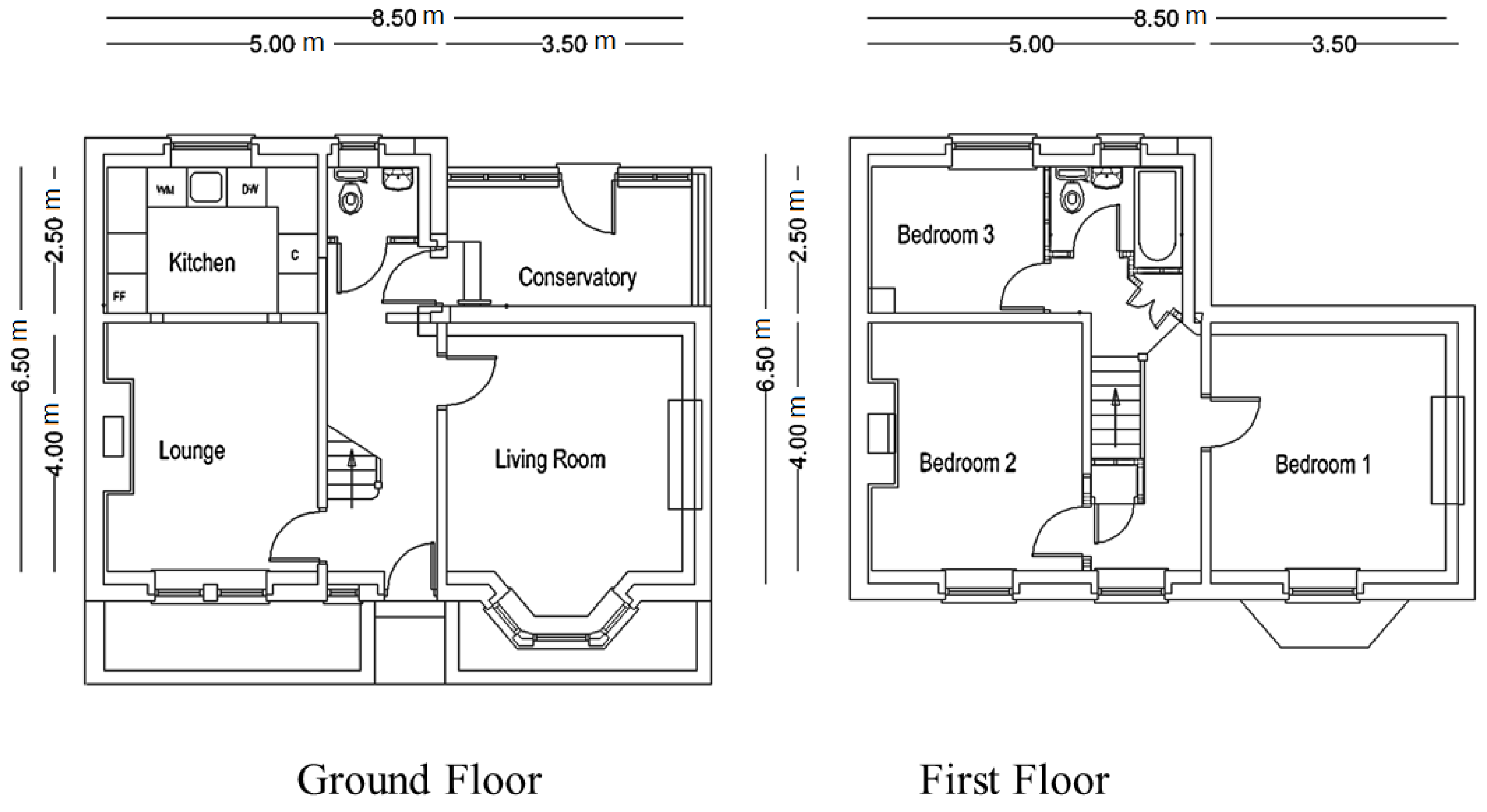
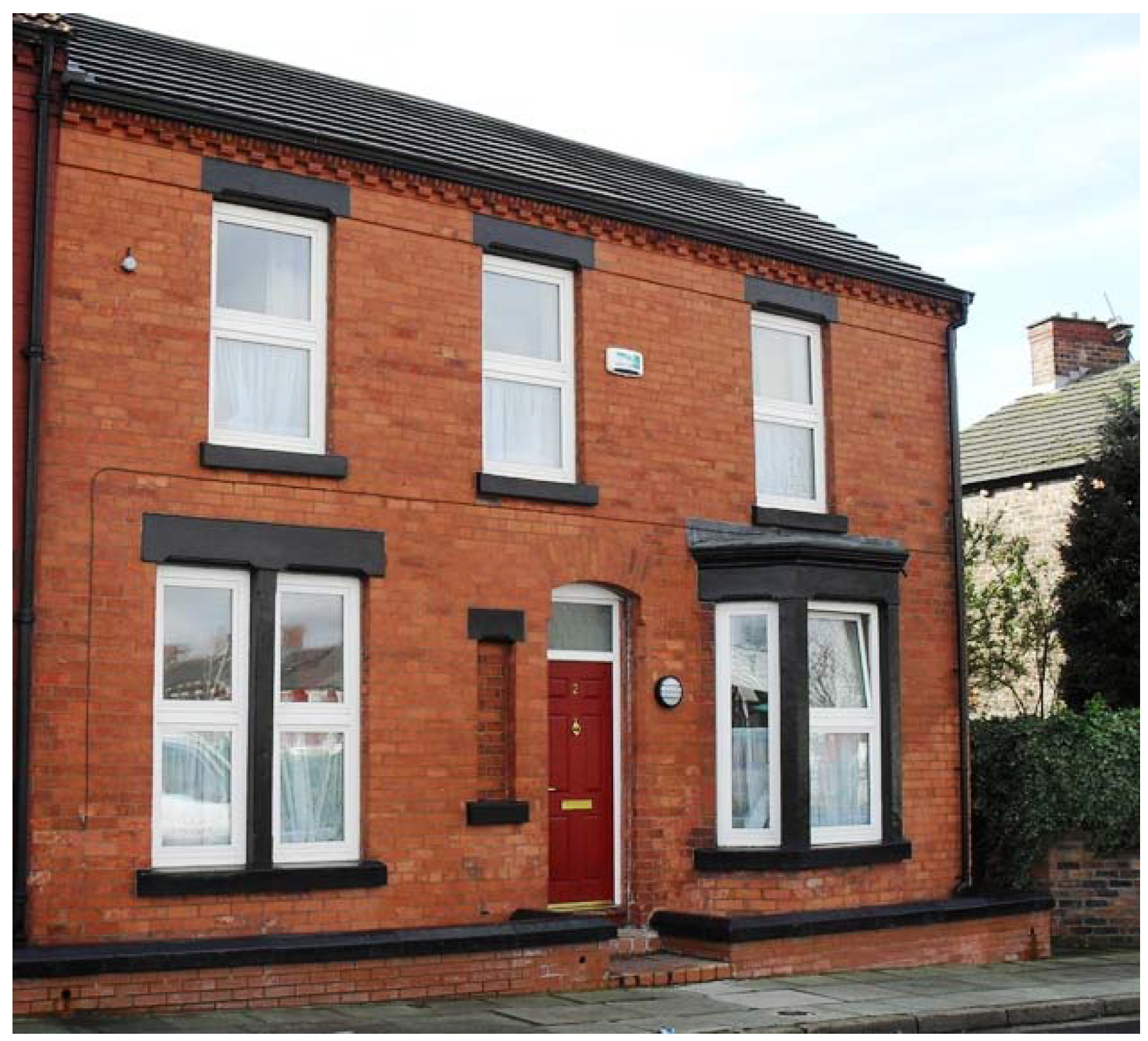
        <p>The primary energy consumption figure includes all the energy used in the house, including that for appliances (white goods) and consumer electronics [<xref ref-type="bibr" rid="B6-buildings-03-00220">6</xref>]. The <italic>Retrofit for the Future</italic> competition was looking for creativity in developing 100 “exemplar” retrofit projects across the UK. The TSB offered 100% funding to each proposal and eventually 87 schemes were approved. Six were in the North West of England, including the terraced house, which was chosen as the case study for this research project [<xref ref-type="bibr" rid="B7-buildings-03-00220">7</xref>]. <xref ref-type="fig" rid="buildings-03-00220-f001">Figure 1</xref>, <xref ref-type="fig" rid="buildings-03-00220-f002">Figure 2</xref> show the selected case study which was refurbished by the Plus Dane Group with the aim of achieving Passivhaus standards as far as possible by applying 21st century solutions to a 19th century end terraced house. Passivhaus and/or sustainability principles were introduced in the demonstration project. The retrofit of the building included: very high levels of insulation, timber framed triple glazed windows, very high levels of airtightness@50Pa (1.0 ACH@50Pa), mechanical ventilation with heat recovery, solar gain via a new conservatory, LED lighting in the kitchen and bathroom, and A-rated low energy appliances [<xref ref-type="bibr" rid="B7-buildings-03-00220">7</xref>]. </p>
        <fig id="buildings-03-00220-f001" position="float">
          <label>Figure 1</label>
          <caption>
            <p>Terraced house plans.</p>
          </caption>
          <graphic xmlns:xlink="http://www.w3.org/1999/xlink" xlink:href="buildings-03-00220-g001.tif"/>
        </fig>
        <fig id="buildings-03-00220-f002" position="float">
          <label>Figure 2</label>
          <caption>
            <p>Terraced house after refurbishment.</p>
          </caption>
          <graphic xmlns:xlink="http://www.w3.org/1999/xlink" xlink:href="buildings-03-00220-g002.tif"/>
        </fig>
        <p>There were several reasons for choosing this 19th century terraced house as a case study of the feasibility of eco-refurbishment to a Passivhaus standard. Firstly, although over 20,000 Passivhaus accredited properties exist, the UK has only three of them. Secondly, Passivhaus refurbishment has not been tried before in the UK on an old terraced house. Thirdly, virtually all old terraced housing has a single skin, uninsulated solid wall structure, making them hard and expensive to treat and therefore not many have been subject to major refurbishment [<xref ref-type="bibr" rid="B8-buildings-03-00220">8</xref>]. Finally, with more than 6 million 19th century terrace houses in the UK, they represent an important part of the country’s housing resource and architectural heritage. Consequently, research on the experience of Passivhaus and low energy retrofit of such buildings can examine the challenges and opportunities of significant retrofits in conservation areas.</p>
      </sec>
      <sec>
        <title>1.4. Research Objectives</title>
        <p>The primary objective of this paper was to evaluate the benefits of sustainable refurbishment on the energy performance of 19th century type end-terrace houses under current and future climates. To do so a regional approach was adopted to assess innovations in the eco-refurbishment agenda. Locally and regionally, UK housing has quite different characteristics. There is also a geographical diversity, which causes different energy demands in different parts of the UK. Heating demand is typically higher in Scottish cities than in, say, Manchester, whilst the changing climate may lead to a significant increase in demand for summer cooling in London and the south east of the UK, but not necessarily elsewhere. A second objective of this study was to consider how to apply the knowledge and technologies of eco-refurbishment in the context of future climates and to make well-founded decisions based on these considerations. A final objective was to see how savings (which are increased by reusing and refurbishing an existing building) might relate to the operational costs during the building’s life cycle. </p>
      </sec>
    </sec>
    <sec sec-type="methods">
      <title>2. Methodology</title>
      <sec>
        <title>2.1. Modelling</title>
        <p>The 19th century type end-terraced house was modeled (before and after refurbishment) using the advanced thermal simulation package DesignBuilder. As there was not enough information about the previous condition of the house the characteristics of the typical terraced houses in the neighborhood were studied to create a pre-refurbishment model of the existing house in the chosen software (DesignBuilder). <xref ref-type="table" rid="buildings-03-00220-t001">Table 1</xref>, <xref ref-type="table" rid="buildings-03-00220-t002">Table 2</xref> compare the pre and post refurbishment thermal features of the house. The occupancy densities and occupied period profiles were selected based on the real house schedules obtained from monitoring results for a family of four (two adults and two children). In addition, internal heat gain allowances were selected according to the activity of each zone in the building. Then, simulations were carried out with all treated zones assumed to be kept to a nominal set point temperature of 21 °C and heated to set points of between 19 °C and 21 °C (depending on the nature of usage). Current weather data for Liverpool were used to evaluate the effect of eco-refurbishment on energy consumption and CO<sub>2</sub> emissions.</p>
        <table-wrap id="buildings-03-00220-t001" position="float">
          <object-id pub-id-type="pii">buildings-03-00220-t001_Table 1</object-id>
          <label>Table 1</label>
          <caption>
            <p>Pre-refurbishment thermal features of a 19th century terraced house [<xref ref-type="bibr" rid="B9-buildings-03-00220">9</xref>]. </p>
          </caption>
          <table>
<thead>
              <tr>
                <th align="center" valign="middle">&nbsp;</th>
                <th align="center" valign="middle">Element</th>
                <th align="center" valign="middle">Fabric U-value</th>
              </tr>
            </thead>
            <tbody>
              <tr>
                <th align="center" valign="middle">&nbsp;</th>
                <td align="center" valign="middle">Insulated roof-100mm mineral wool</td>
                <td align="center" valign="middle">0.40 W/m<sup>2</sup>K</td>
              </tr>
              <tr>
                <th align="center" valign="middle">&nbsp;</th>
                <td align="center" valign="middle">Solid Walls-215mm thick brick work</td>
                <td align="center" valign="middle">2.10 W/m<sup>2</sup>K</td>
              </tr>
              <tr>
                <th align="center" valign="middle"><bold>Typical existing construction</bold></th>
                <td align="center" valign="middle">Uninsulated suspended timber floor</td>
                <td align="center" valign="middle">0.50 W/m<sup>2</sup>K</td>
              </tr>
              <tr>
                <th align="center" valign="middle">&nbsp;</th>
                <td align="center" valign="middle">Windows-single glazed timber frames</td>
                <td align="center" valign="middle">4.80 W/m<sup>2</sup>K</td>
              </tr>
              <tr>
                <th align="center" valign="middle">&nbsp;</th>
                <td align="center" valign="middle">Doors-unglazed solid timber</td>
                <td align="center" valign="middle">3.00 W/m<sup>2</sup>K</td>
              </tr>
            </tbody>
          </table>
        </table-wrap>
        <table-wrap id="buildings-03-00220-t002" position="float">
          <object-id pub-id-type="pii">buildings-03-00220-t002_Table 2</object-id>
          <label>Table 2</label>
          <caption>
            <p>Post-refurbishment thermal features of the terraced house [<xref ref-type="bibr" rid="B10-buildings-03-00220">10</xref>].</p>
          </caption>
          <table>
<thead>
              <tr>
                <th align="center" valign="middle">&nbsp;</th>
                <th align="center" valign="middle">Element</th>
                <th align="center" valign="middle">Fabric U-value</th>
              </tr>
            </thead>
            <tbody>
              <tr>
                <th align="center" valign="middle">&nbsp;</th>
                <td align="center" valign="middle">Insulated roof-400mm Rockwool</td>
                <td align="center" valign="middle">0.15 W/m<sup>2</sup>K</td>
              </tr>
              <tr>
                <th align="center" valign="middle">&nbsp;</th>
                <td align="center" valign="middle">Solid wall-internal insulation (using Supa Wall)</td>
                <td align="center" valign="middle">0.11 W/m<sup>2</sup>K</td>
              </tr>
              <tr>
                <th align="center" valign="middle"><bold>Upgraded fabric construction</bold></th>
                <td align="center" valign="middle">Concrete floor slab, Supa floor panels</td>
                <td align="center" valign="middle">0.12 W/m<sup>2</sup>K</td>
              </tr>
              <tr>
                <th align="center" valign="middle">&nbsp;</th>
                <td align="center" valign="middle">Windows-triple glazed</td>
                <td align="center" valign="middle">0.78 W/m<sup>2</sup>K</td>
              </tr>
              <tr>
                <th align="center" valign="middle">&nbsp;</th>
                <td align="center" valign="middle">FD20 rated fire doors in frames containing intumescent seals</td>
                <td align="center" valign="middle">1.00 W/m<sup>2</sup>K</td>
              </tr>
            </tbody>
          </table>
        </table-wrap>
        <p>In addition, the energy and CO<sub>2</sub> performances of the same pre and post refurbishment dwellings were examined for current and future climates at three other cities across the UK.</p>
      </sec>
      <sec id="sec2dot2-buildings-03-00220">
        <title>2.2. Weather Data for Simulation</title>
        <p>The Intergovernmental Panel on Climate Change (IPCC) stated in its Technical Summary for their Fourth Assessment Report that an increase in global average surface temperature would occur towards the end of the 21 century [<xref ref-type="bibr" rid="B11-buildings-03-00220">11</xref>]. For UK specific climate projections the UK Climate Impacts Programme (UKCIP), a UK based agency, in conjunction with the UK’s Meteorological Office’s Hadley Centre, published its first climate change projections in 1998, which were substantially updated in 2002 and again in 2009. For the purpose of this research climate change scenarios and future hourly weather data released by the UK’s Charted Institution of Building Services Engineers (CIBSE), which incorporated the UKCIP02 projections for three timelines (2020s, 2050s, 2080s) and four carbon emissions scenarios (low, medium-low, medium-high and high), have been used. These data are in TRY (Test Reference Year) format but need to be generated in the EPW (EnergyPlus Weather) format to be readable in DesignBuilder. No TRY files existed for Liverpool at the time of this study and only current weather data in the EPW format were available. However, current TRY weather data were available for three UK locations (Edinburgh, Manchester and London). These TRY files were morphed in to future weather data using the software CCWeatherGen [<xref ref-type="bibr" rid="B12-buildings-03-00220">12</xref>] (time slices: 2020s, 2050s, 2080s; carbon emission scenarios: low, medium and high). Therefore, the same dwelling was assumed to be located in these three cities and simulated using these weather data to model the effect of climate change and geographical diversity on CO<sub>2</sub> emissions, heating and cooling energy usage. In this paper only the results from 2020 to 2050 high emission scenarios will be presented.</p>
        <p>CCWeatherGen transforms CIBSE/Met Office TRY/DSY weather files into future EPW weather files [<xref ref-type="bibr" rid="B12-buildings-03-00220">12</xref>]. UKCIP02 data were used for this research because, at the time of the analysis, CCWeatherGen used the UKCIP2002 climate change scenario predictions to generate future weather files that were ready to use in building performance simulation programs (<italic>i.e.</italic>, in EPW format). The PROMETHEUS project in Exeter University has recently produced a number of EPW future weather files using the UKCP09 weather generator, which can be used to “future-proof” buildings against predicted climate change. The key difference between UKCP02 and UKCP09 is the use of probabilistic information within UKCP09, which represents a random sampling of a probability distribution function and hence the probability of a particular level of climate change [<xref ref-type="bibr" rid="B13-buildings-03-00220">13</xref>].</p>
      </sec>
      <sec>
        <title>2.3. Model Validation</title>
        <p>Simulation software is a useful tool to study the impact of climate change on building energy performance. However, it is important to validate the results from simulation to ensure confidence in the results. The Plus Dane Group used the Passive House Planning Package (PHPP) for its simulation of the terraced house (<xref ref-type="table" rid="buildings-03-00220-t003">Table 3</xref>). Their predicted results were used for initial validation of the model created in DesignBuilder. This preliminary comparison showed a small percentage difference between the PHPP and DesignBuilder outcomes.</p>
        <table-wrap id="buildings-03-00220-t003" position="float">
          <object-id pub-id-type="pii">buildings-03-00220-t003_Table 3</object-id>
          <label>Table 3</label>
          <caption>
            <p>Comparison of PHPP results with DesignBuilder for terraced house pre-refurbishment.</p>
          </caption>
          <table>
<thead>
              <tr>
                <th align="center" valign="middle">Measures</th>
                <th align="center" valign="middle">PHPP</th>
                <th align="center" valign="middle">DesignBuilder</th>
              </tr>
            </thead>
            <tbody>
              <tr>
                <td align="center" valign="middle">Annual CO<sub>2</sub> emissions (kg CO<sub>2</sub>/m<sup>2</sup>yr)</td>
                <td align="center" valign="middle">77</td>
                <td align="center" valign="middle">72</td>
              </tr>
              <tr>
                <td align="center" valign="middle">Primary energy requirement (kWh/m<sup>2</sup>yr)</td>
                <td align="center" valign="middle">380</td>
                <td align="center" valign="middle">320</td>
              </tr>
            </tbody>
          </table>
        </table-wrap>
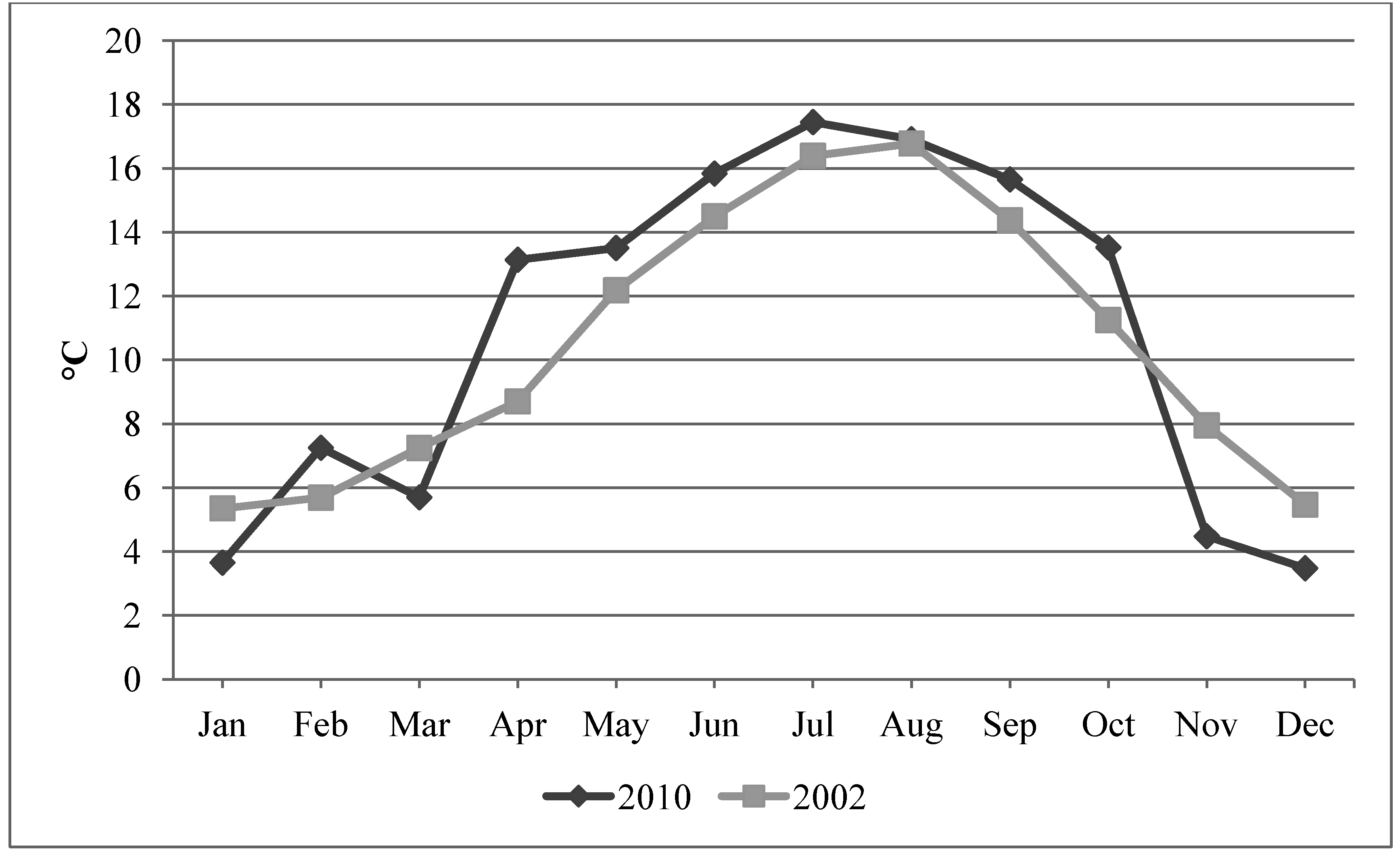
        <p>In addition, the Plus Dane Group has been monitoring many parameters in the house at five minute intervals since it was first occupied after refurbishment in November 2010. Large amounts of data have been measured such as internal carbon dioxide levels, floor, wall and ceiling surface temperatures, external air temperatures and electricity, water and gas consumption. One complete year of monitored data was made available for this study. These data were compared with the DesignBuilder simulations as part of the validation procedure. To start the validation a comparison of the weather data was necessary. DesignBuilder simulation results were based on 2002 CIBSE weather data whilst the monitoring was carried out between November 2010 and October 2011. <xref ref-type="fig" rid="buildings-03-00220-f003">Figure 3</xref> shows 2002 (CIBSE) average monthly external air temperatures with 2010 (measured) weather data for Liverpool. There is generally reasonable agreement but it can be seen that the average temperatures generally increased over the period.</p>
        <fig id="buildings-03-00220-f003" position="float">
          <label>Figure 3</label>
          <caption>
            <p>Comparison of 2002 (CIBSE) weather data (external air temperature in °C) with 2010 (monitored results) weather data for Liverpool, UK.</p>
          </caption>
          <graphic xmlns:xlink="http://www.w3.org/1999/xlink" xlink:href="buildings-03-00220-g003.tif"/>
        </fig>
        <p>A comparison of monitored and predicted annual CO<sub>2</sub> emissions and primary energy requirements can be seen in <xref ref-type="table" rid="buildings-03-00220-t004">Table 4</xref>. There are small differences between the results, which could be attributed to the small differences in the weather data.</p>
        <table-wrap id="buildings-03-00220-t004" position="float">
          <object-id pub-id-type="pii">buildings-03-00220-t004_Table 4</object-id>
          <label>Table 4</label>
          <caption>
            <p>Monitored results and DesignBuilder predictions for the refurbished terraced house.</p>
          </caption>
          <table>
<thead>
              <tr>
                <th align="center" valign="middle">Measures </th>
                <th align="center" valign="middle">Monitored</th>
                <th align="center" valign="middle">DesignBuilder</th>
              </tr>
            </thead>
            <tbody>
              <tr>
                <td align="center" valign="middle">Annual CO<sub>2</sub> emissions (kg CO<sub>2</sub>/m<sup>2</sup>yr)</td>
                <td align="center" valign="middle">16</td>
                <td align="center" valign="middle">18</td>
              </tr>
              <tr>
                <td align="center" valign="middle">Primary energy requirement (kWh/m<sup>2</sup>yr)</td>
                <td align="center" valign="middle">105</td>
                <td align="center" valign="middle">119</td>
              </tr>
            </tbody>
          </table>
        </table-wrap>
        <p>Having validated the program made it possible to investigate how the same refurbished terraced house might perform in different current and future climate scenarios. </p>
      </sec>
      <sec>
        <title>2.4. Whole Life-Cycle Costing</title>
        <p>In the process of fulfilling an 80% reduction goal and meeting eco-refurbishment benchmarks, one of the most important questions is that of economic feasibility. The question arises due to several potential alternative investment options and the importance of finding the most economical choice in the long term. In this paper a Whole Life Cycle Costing (WLCC) technique has been used for comparative cost assessments over a 40 year period of time, taking into account the present value of initial capital costs, future operational costs and savings from this type of eco-refurbishment.</p>
        <sec>
          <title>2.4.1. Definition</title>
          <p>Whole Life Cycle Costs consider the total expense of a project over the six stages of Non-Construction Costs, Construction Costs, Operation Costs (including energy expenditures), Maintenance Costs, Replacement Costs and Disposal Costs. For the purpose of this paper the effects and savings on heating consumption from improving construction have been evaluated. The WLCC of fitting wall and roof insulation and replacing windows and doors has been assessed. The cost and effect of improvement and replacement of lighting and mechanical equipment are not considered in this part of the analysis.</p>
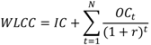
          <p>Whole Life Cycle Cost is defined as [<xref ref-type="bibr" rid="B14-buildings-03-00220">14</xref>]:
          <disp-formula id="buildings-03-00220-i001"><inline-graphic xmlns:xlink="http://www.w3.org/1999/xlink" xlink:href="buildings-03-00220-i001.tif"/><label>(1)</label></disp-formula>
          where WLCC = Whole Life Cycle Cost (£); IC = Total Initial Cost (£); ∑ = Sum over the lifetime from year 1 to year N, where N = lifetime of appliance (years); OC<sub>t</sub> = Operating Cost (£); r = Discount rate; t = Year for which operating cost is being determined.</p>
        </sec>
        <sec>
          <title>2.4.2. Total Initial Costs Inputs</title>
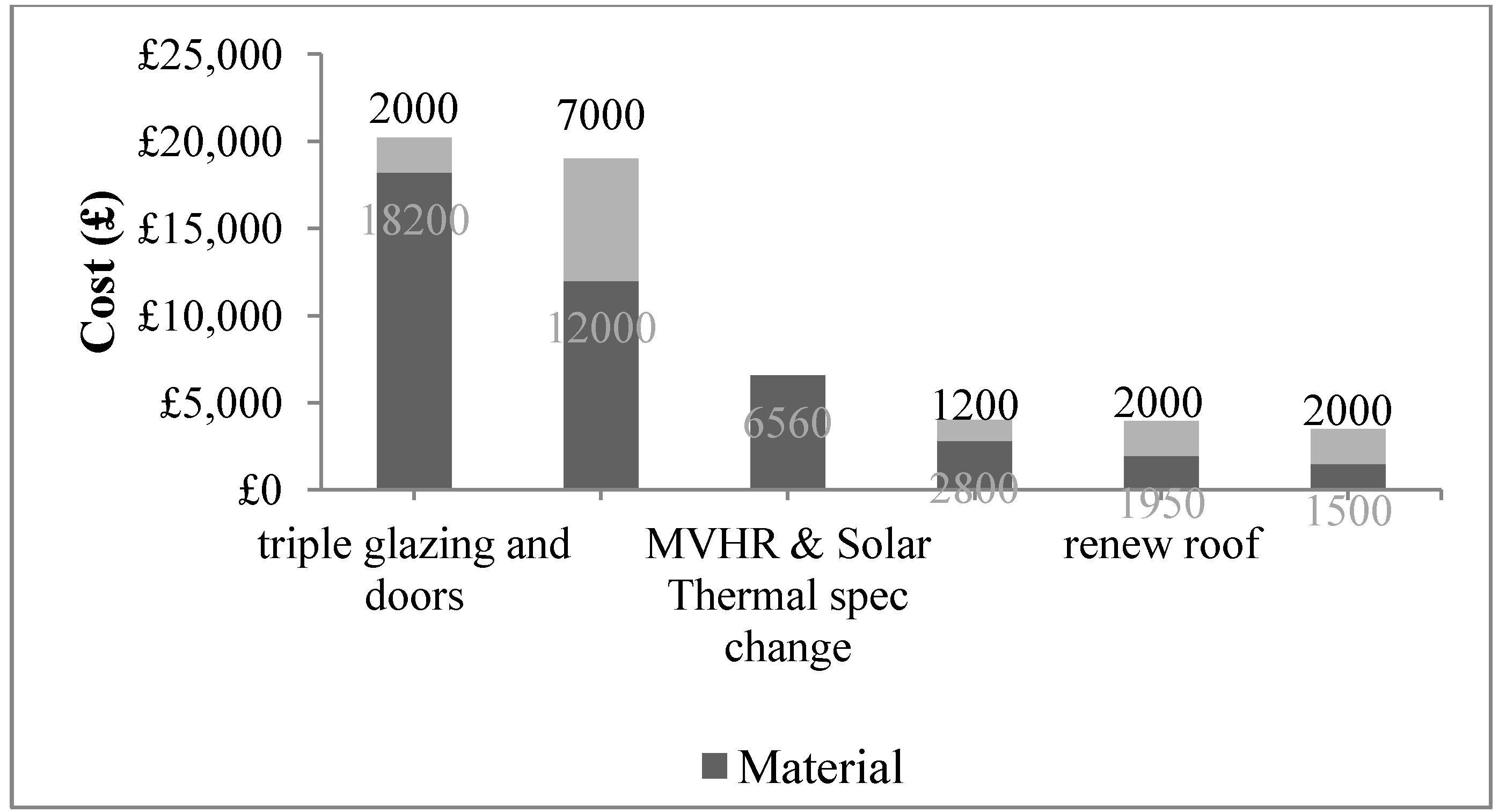
          <p>For the purpose of this study, the initial cost of the project consists of the cost of new construction materials and labor. <xref ref-type="table" rid="buildings-03-00220-t005">Table 5</xref> shows the total initial outlay and capital cost of the construction improvement and replacement for the terraced house. All doors and windows were replaced.</p>
          <table-wrap id="buildings-03-00220-t005" position="float">
            <object-id pub-id-type="pii">buildings-03-00220-t005_Table 5</object-id>
            <label>Table 5</label>
            <caption>
              <p>Cost breakdown for the terraced house’s refurbishment.</p>
            </caption>
            <table>
  <thead>
                <tr>
                  <th align="center" valign="middle">Item</th>
                  <th align="center" valign="middle">Material</th>
                  <th align="center" valign="middle">Labor</th>
                  <th align="center" valign="middle">Total</th>
                </tr>
  </thead>
  <tbody>
                <tr>
                  <td align="center" valign="middle">Insulation</td>
                  <td align="center" valign="middle">£ 12,000</td>
                  <td align="center" valign="middle">£ 7,000</td>
                  <td align="center" valign="middle">£ 19,000</td>
                </tr>
                <tr>
                  <td align="center" valign="middle">New roof</td>
                  <td align="center" valign="middle">£ 1,950</td>
                  <td align="center" valign="middle">£ 2,000</td>
                  <td align="center" valign="middle">£ 3,950</td>
                </tr>
                <tr>
                  <td align="center" valign="middle">Triple glazing and doors</td>
                  <td align="center" valign="middle">£ 18,200</td>
                  <td align="center" valign="middle">£ 2,000</td>
                  <td align="center" valign="middle">£ 20,200</td>
                </tr>
                <tr>
                  <td align="center" valign="middle">Total initial cost of construction</td>
                  <td align="center" valign="middle">-</td>
                  <td align="center" valign="middle">-</td>
                  <td align="center" valign="middle">£ 43,150</td>
                </tr>
  </tbody>
            </table>
          </table-wrap>
        </sec>
        <sec>
          <title>2.4.3. Operating Cost Inputs</title>
          <p>Energy expenditure, repair costs and maintenance costs all together are defined as the operating cost. The processes during the in-use life phase are an important factor as a significant proportion of the impact of the building occurs after construction and installation of systems. In this study, it is assumed that the life of the construction in this refurbished property will be more than 40 years. Any recurring impact (repair and maintenance costs) is not considered as the building was refurbished to have a very low maintenance cost. However, the maintenance costs of a building can contribute significantly to the total cost of it [<xref ref-type="bibr" rid="B15-buildings-03-00220">15</xref>]. Required inputs for calculating operating costs are: energy consumption, energy cost savings, gas prices (the refurbished house is heated by gas), predicted gas price trends in the future and assumed discount rate.</p>
        </sec>
        <sec>
          <title>2.4.4. Heating Energy Savings</title>
          <p>The total annual heating energy saving is the difference between the heating consumptions of the original house and the retrofit house, and results from the lower gas heating consumption arising from a more efficient construction and lower heat losses through the insulation and triple-glazed windows.</p>
        <sec>
          <title>2.4.4.1. Effect of Climate Change on Annual Savings</title>
          <p>It is not only regional weather differences but also climate change that will impact upon heating consumption in the pre and post-refurbished house. Accordingly, the annual savings change for different climate scenarios have been considered and predicted by running simulations for different types of weather scenarios (see <xref ref-type="sec" rid="sec2dot2-buildings-03-00220">Section 2.2</xref>).</p>
        </sec>
        <sec>
          <title>2.4.4.2. Instability of Future Gas Price and Annual Savings</title>
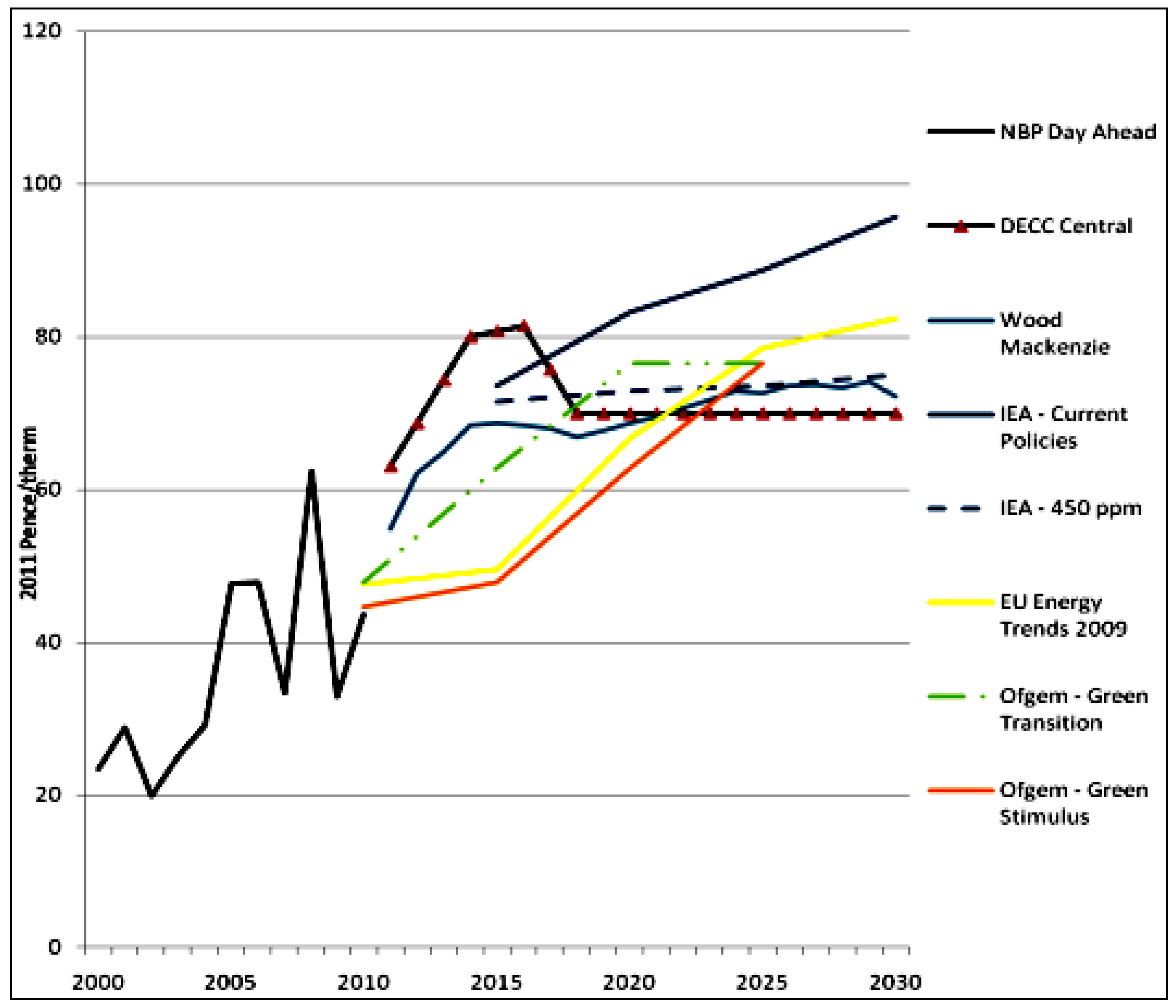
          <p>Experts in the field of energy economics believe that the main question about future gas prices is not “will prices rise?” but “by how much?” <xref ref-type="fig" rid="buildings-03-00220-f004">Figure 4</xref> compares gas price projections from eight different sources [<xref ref-type="bibr" rid="B16-buildings-03-00220">16</xref>]. </p>
          <p>Five elements that contribute to a consumer’s energy bill are the wholesale cost of fuel, the cost of supply transmission, distribution and metering, the costs of Government/EU policy, VAT and supplier margins. Ofgem estimates shown in <xref ref-type="table" rid="buildings-03-00220-t006">Table 6</xref> confirm that wholesale fuel costs and the costs of supply are the largest elements effecting gas prices; incidentally, VAT has remained at 5% since 1997 [<xref ref-type="bibr" rid="B17-buildings-03-00220">17</xref>]. Therefore, less dependence on imports, more domestic production and the extent to which the technology is increasing, will have a big impact on gas prices. Shale gas, and in particular the process of “fracking” which is used to extract it, can be a solution for the first concern. In the USA a rapid revolution in gas production from “unconventional” sources—in particular shale and coal bed gas—has transformed the market. The USA is now self-sufficient in gas. Some analysts claim that this could also eventually happen in the UK [<xref ref-type="bibr" rid="B17-buildings-03-00220">17</xref>].</p>
		  <fig id="buildings-03-00220-f004" position="float">
            <label>Figure 4</label>
            <caption>
              <p>DECC gas price projections, October 2011 [<xref ref-type="bibr" rid="B16-buildings-03-00220">16</xref>].</p>
            </caption>
            <graphic xmlns:xlink="http://www.w3.org/1999/xlink" xlink:href="buildings-03-00220-g004.tif"/>
          </fig>
          
          <table-wrap id="buildings-03-00220-t006" position="float">
            <object-id pub-id-type="pii">buildings-03-00220-t006_Table 6</object-id>
            <label>Table 6</label>
            <caption>
              <p>Estimated contributory factors to domestic energy price rise February 2004 to January 2011.</p>
            </caption>
            <table>
  <thead>
                <tr>
                  <th align="center" valign="middle">&nbsp;</th>
                  <th align="center" valign="middle">Increase in unit costs due to </th>
                  <th align="center" valign="middle">Gas%</th>
                </tr>
  </thead>
  <tbody>
                <tr>
                  <th align="center" valign="middle">&nbsp;</th>
                  <td align="center" valign="middle">Whole sale energy</td>
                  <td align="center" valign="middle">66</td>
                </tr>
                <tr>
                  <th align="center" valign="middle">&nbsp;</th>
                  <td align="center" valign="middle">Transmission, distribution and metering</td>
                  <td align="center" valign="middle">20</td>
                </tr>
                <tr>
                  <th align="center" valign="middle">&nbsp;</th>
                  <td align="center" valign="middle">Carbon price</td>
                  <td align="center" valign="middle">-</td>
                </tr>
                <tr>
                  <th align="center" valign="middle"><bold>Estimated increase in annual bill</bold></th>
                  <td align="center" valign="middle">Renewables</td>
                  <td align="center" valign="middle">-</td>
                </tr>
                <tr>
                  <th align="center" valign="middle">&nbsp;</th>
                  <td align="center" valign="middle">Energy efficiency funding</td>
                  <td align="center" valign="middle">7</td>
                </tr>
                <tr>
                  <th align="center" valign="middle">&nbsp;</th>
                  <td align="center" valign="middle">VAT</td>
                  <td align="center" valign="middle">5</td>
                </tr>
                <tr>
                  <th align="center" valign="middle">&nbsp;</th>
                  <td align="center" valign="middle">Overall price increase</td>
                  <td align="center" valign="middle">121</td>
                </tr>
                <tr>
                  <th align="center" valign="middle">&nbsp;</th>
                  <td align="center" valign="middle">Estimated increase in annual bill (2004 to 2010)</td>
                  <td align="center" valign="middle">£295</td>
                </tr>
  </tbody>
            </table>
          </table-wrap>
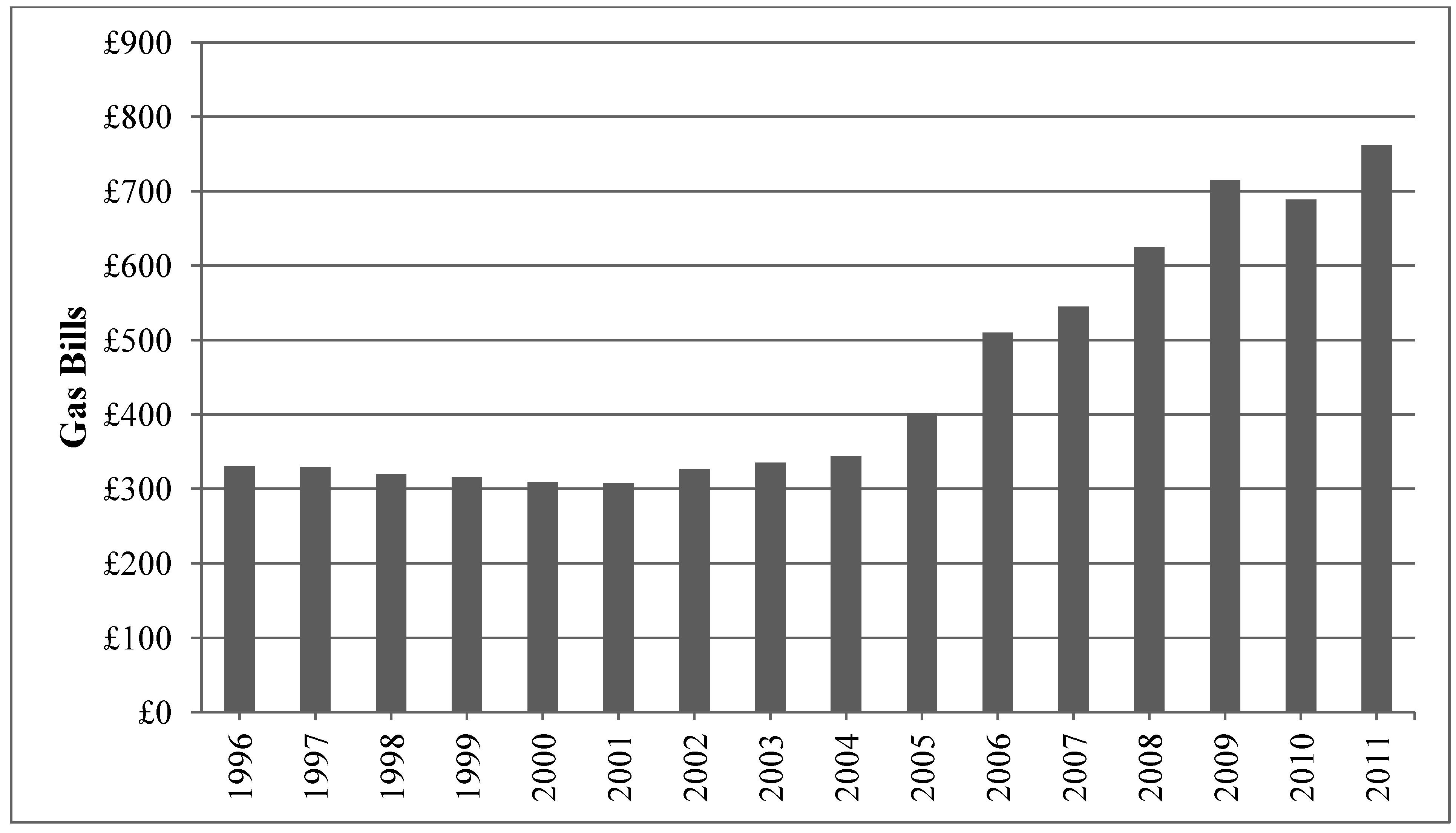
          <p>Energy prices will not remain constant in real terms over time but, by using historic data, it is possible to predict the range of probable future prices and have some idea of which prices are more likely to occur [<xref ref-type="bibr" rid="B18-buildings-03-00220">18</xref>]. <xref ref-type="fig" rid="buildings-03-00220-f005">Figure 5</xref> (which illustrates the average annual standard gas bills for a typical residential gas consumer for 16 years since 1996) shows that the price of gas is unstable in the UK and there is uncertainty in any assumption about constant or future gas prices [<xref ref-type="bibr" rid="B19-buildings-03-00220">19</xref>]. Three “waves” of rising, falling and steady domestic gas prices since the late 1996s show that a rising price for gas is not the only possibility.</p>
          <fig id="buildings-03-00220-f005" position="float">
            <label>Figure 5</label>
            <caption>
              <p>Average annual standard gas bills for a typical residential gas consumer since 1996.</p>
            </caption>
            <graphic xmlns:xlink="http://www.w3.org/1999/xlink" xlink:href="buildings-03-00220-g005.tif"/>
          </fig>
        </sec>
        </sec>
        <sec>
          <title>2.4.5. Standard Deviation and Binomial Tree</title>
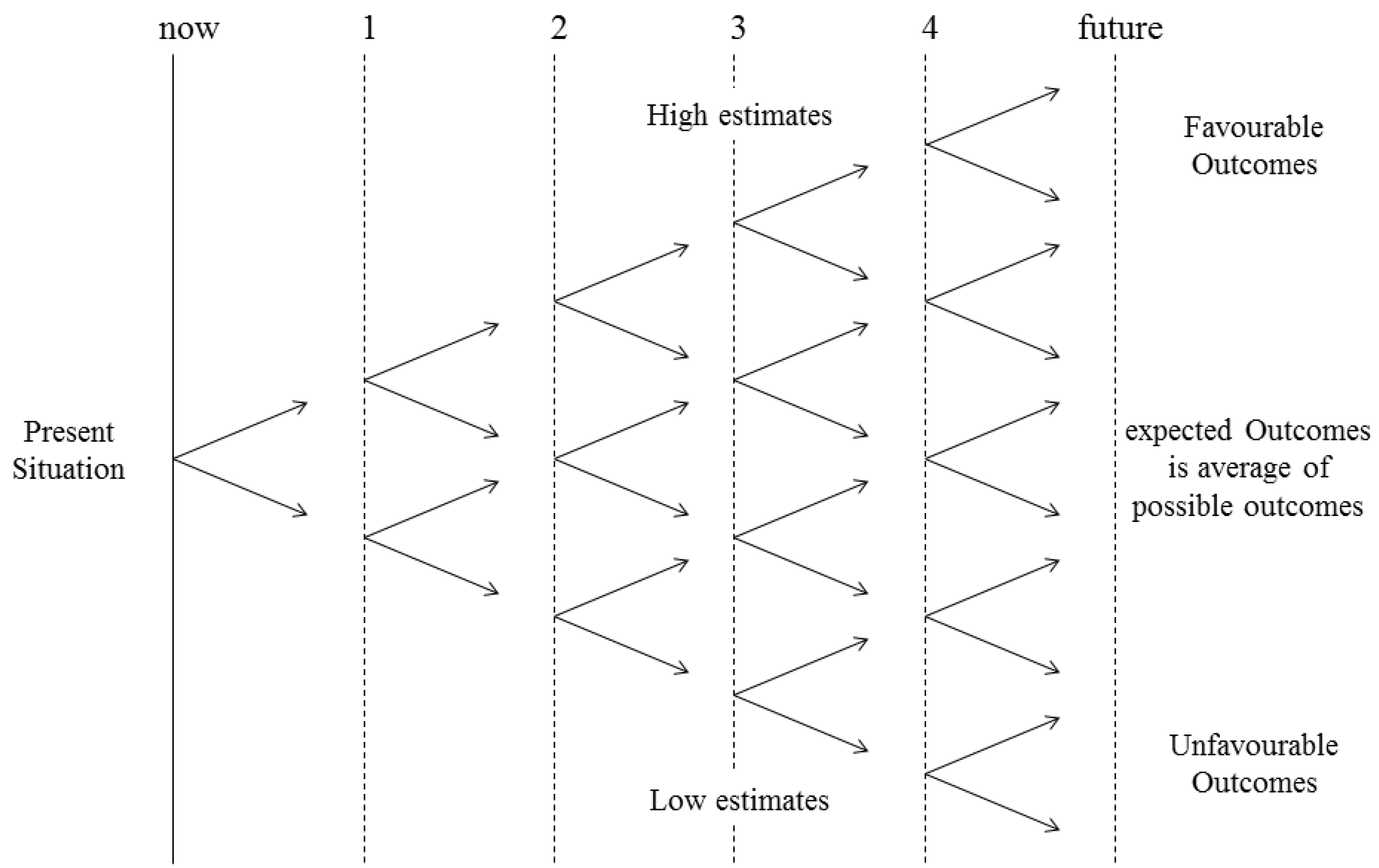
          <p>The amount of uncertainty in the future price of a commodity such as gas can be calculated by drawing a binomial tree. In this study, 16 years of gas price datasets were used to adjust the projection of future uncertainty, predict future gas prices and find the future outcomes. The instability of a data series is measured by its standard deviation(s), which can be used to indicate the rising and falling values by means of a binomial tree [<xref ref-type="bibr" rid="B18-buildings-03-00220">18</xref>]. Drawing a binomial tree (<xref ref-type="fig" rid="buildings-03-00220-f006">Figure 6</xref>) helps to predict the expected future gas prices and related savings. The expected value in each year is the average of all possible outcomes, weighted by their probability. </p>
          <fig id="buildings-03-00220-f006" position="float">
            <label>Figure 6</label>
            <caption>
              <p>Binomial tree.</p>
            </caption>
            <graphic xmlns:xlink="http://www.w3.org/1999/xlink" xlink:href="buildings-03-00220-g006.tif"/>
          </fig>
        </sec>
        <sec>
          <title>2.4.6. Time Preference, Discount Rate and Net Present Value</title>
          <p>The discount rate r is the rate at which future expenditures are discounted to establish their present value. It is defined as the value society attaches to present, as opposed to future, consumption [<xref ref-type="bibr" rid="B20-buildings-03-00220">20</xref>]. This rate is needed to put the costs of paying future liabilities in to present-day terms, a parameter called the net present value (NPV) [<xref ref-type="bibr" rid="B18-buildings-03-00220">18</xref>]. A discount rate of 3.5% has been chosen as this is used by the UK Government for economic decision making. Inflation has not been taken into account in this research [<xref ref-type="bibr" rid="B21-buildings-03-00220">21</xref>]. Applying this 3.5% discount rate to the savings enabled the NPV of the savings to be calculated. If all the expenditures and incomes in a cash flow (v0, v1, v2,…,vn) are discounted to their present values using the chosen discount rate and then summed, the result is the net present value of the cash flow and will be given by [<xref ref-type="bibr" rid="B18-buildings-03-00220">18</xref>]:
          <disp-formula id="buildings-03-00220-i002"><inline-graphic xmlns:xlink="http://www.w3.org/1999/xlink" xlink:href="buildings-03-00220-i002.tif"/><label>(2)</label></disp-formula></p>
        </sec>
        <sec>
          <title>2.4.7. Payback Period</title>
          <p>The payback period is calculated by deducting the fuel cost saved each year from the capital cost of the energy saving measures. </p>
        </sec>
      </sec>
    </sec>
    <sec sec-type="results">
      <title>3. Results and Discussion</title>
      <sec>
        <title>3.1. Effect of the Terraced House’s Eco-Refurbishment on Heating Consumption and CO<sub>2</sub> Emissions for Current and Future Weather Conditions</title>
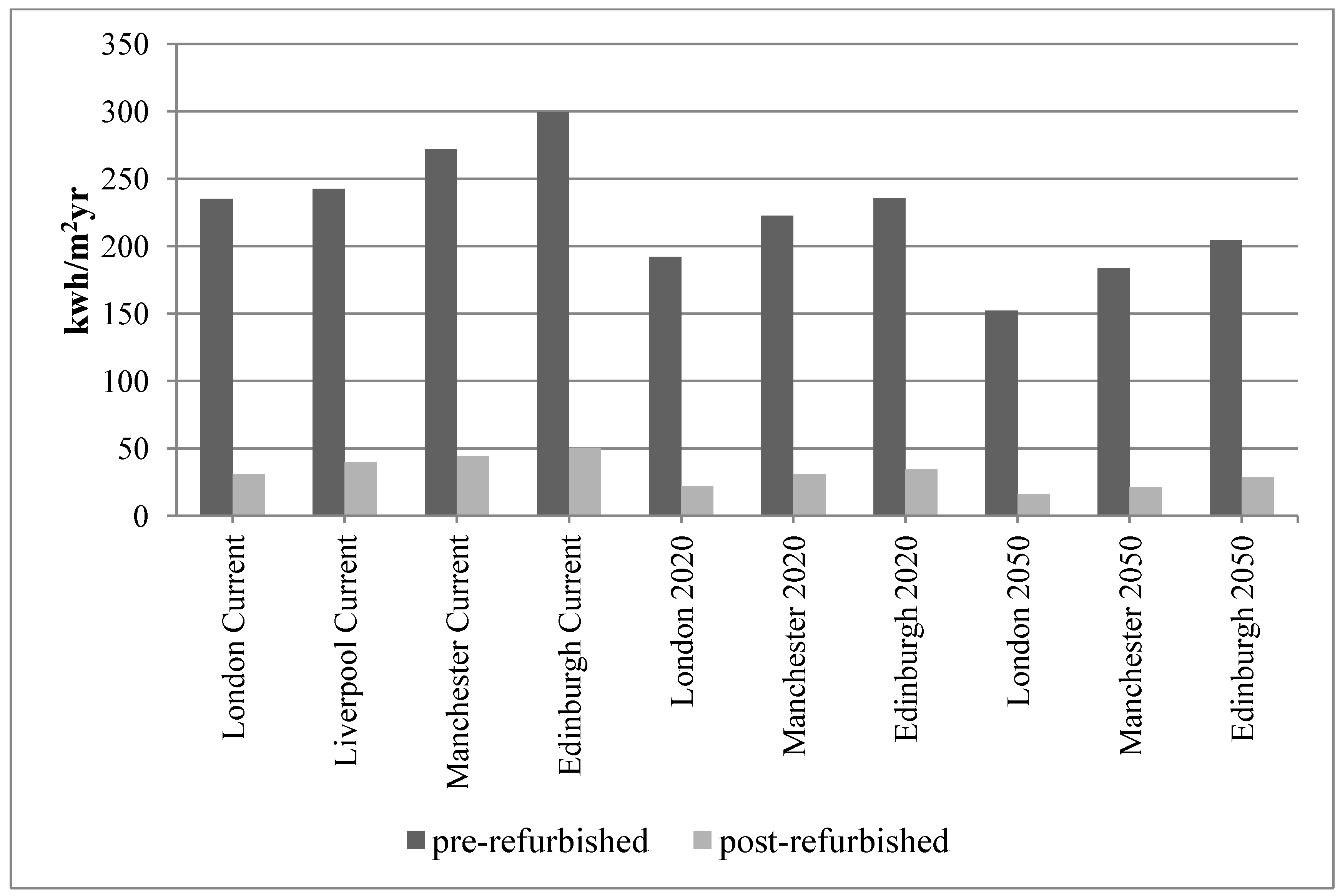
        <p>Pre and post-refurbished houses in different cities under current and future weather condition and different scenarios were simulated to see if the UK’s 80% carbon reduction target was achievable by refurbishment. Simulation results given in <xref ref-type="fig" rid="buildings-03-00220-f007">Figure 7</xref> show the annual heating demand for the pre and post-refurbished houses in different cities and different scenarios. Significant heating demand reductions can be seen after refurbishment in all four cities. <xref ref-type="fig" rid="buildings-03-00220-f007">Figure 7</xref> also confirms that, despite the fact that heating energy consumptions are affected by climate change, there is very little decline in future heating demand for the house with no refurbishment, while the eco-refurbished dwelling shows a sharp reduction of more than 70% in energy demand. </p>
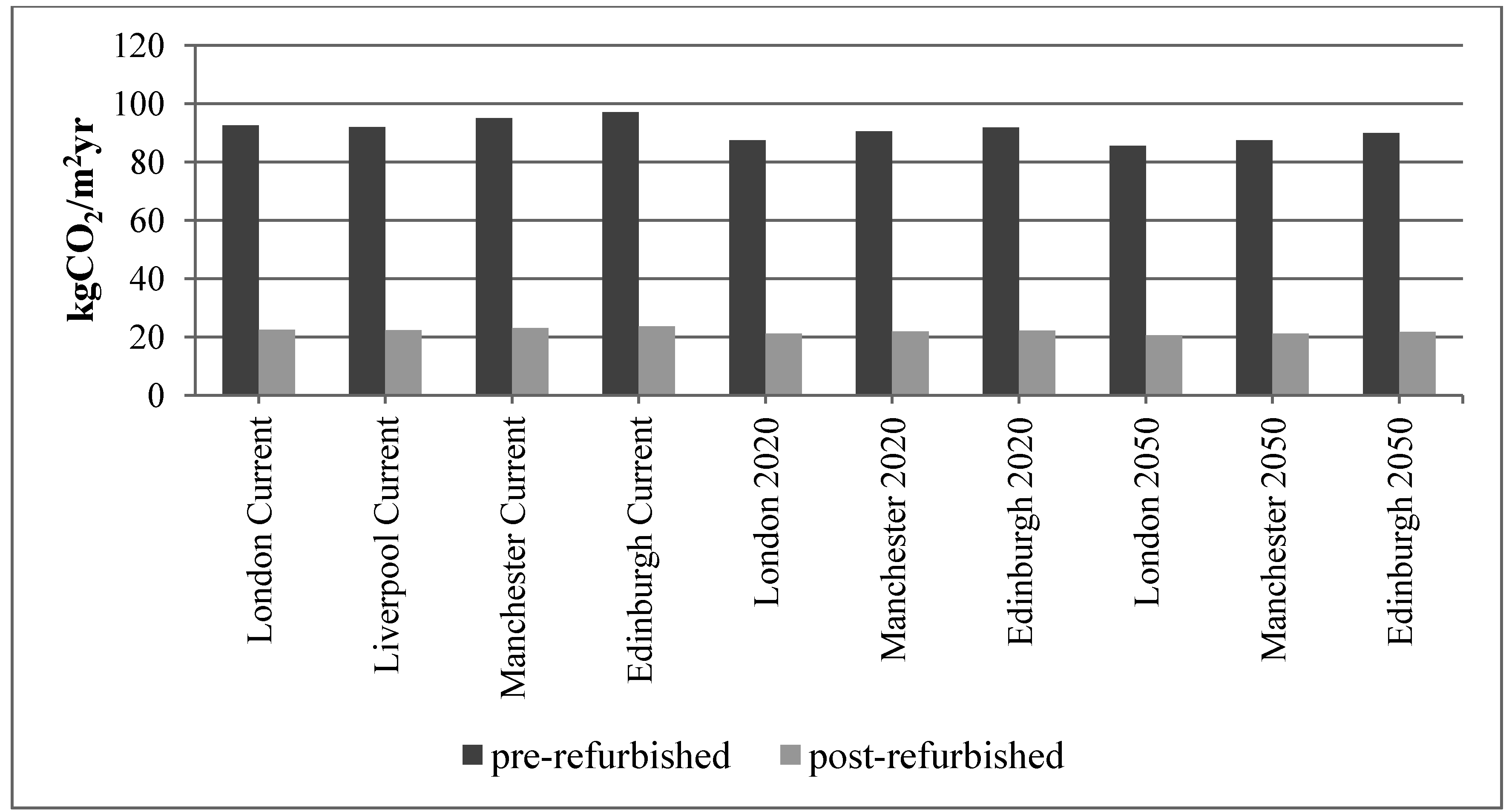
        <p>Changes of CO<sub>2</sub> emissions in London, Liverpool, Manchester and Edinburgh for pre and post-refurbished house are shown in <xref ref-type="fig" rid="buildings-03-00220-f008">Figure 8</xref>. It can be seen that there is a large reduction of around 83% for the house when located in Liverpool and London and 80% reduction in CO<sub>2</sub> emissions for the house in Manchester and Edinburgh following refurbishment. CO<sub>2</sub> emissions are affected by climate change and show a slight downward trend for the house with no refurbishment, but the eco-refurbished dwellings show sharp reduction in CO<sub>2</sub> emissions. </p>
		<fig id="buildings-03-00220-f007" position="float">
          <label>Figure 7</label>
          <caption>
            <p>Annual heating demand for the pre and post-refurbished terrace house in different cities for current and future weather data.</p>
          </caption>
          <graphic xmlns:xlink="http://www.w3.org/1999/xlink" xlink:href="buildings-03-00220-g007.tif"/>
        </fig>
        
        <fig id="buildings-03-00220-f008" position="float">
          <label>Figure 8</label>
          <caption>
            <p>Annual CO<sub>2</sub> emissions (kgCO<sub>2</sub>/m<sup>2</sup>yr) from pre and post-refurbished house in different cities under current and future weather conditions.</p>
          </caption>
          <graphic xmlns:xlink="http://www.w3.org/1999/xlink" xlink:href="buildings-03-00220-g008.tif"/>
        </fig>
      </sec>
      <sec>
        <title>3.2. Summer and Winter Discomfort Hours</title>
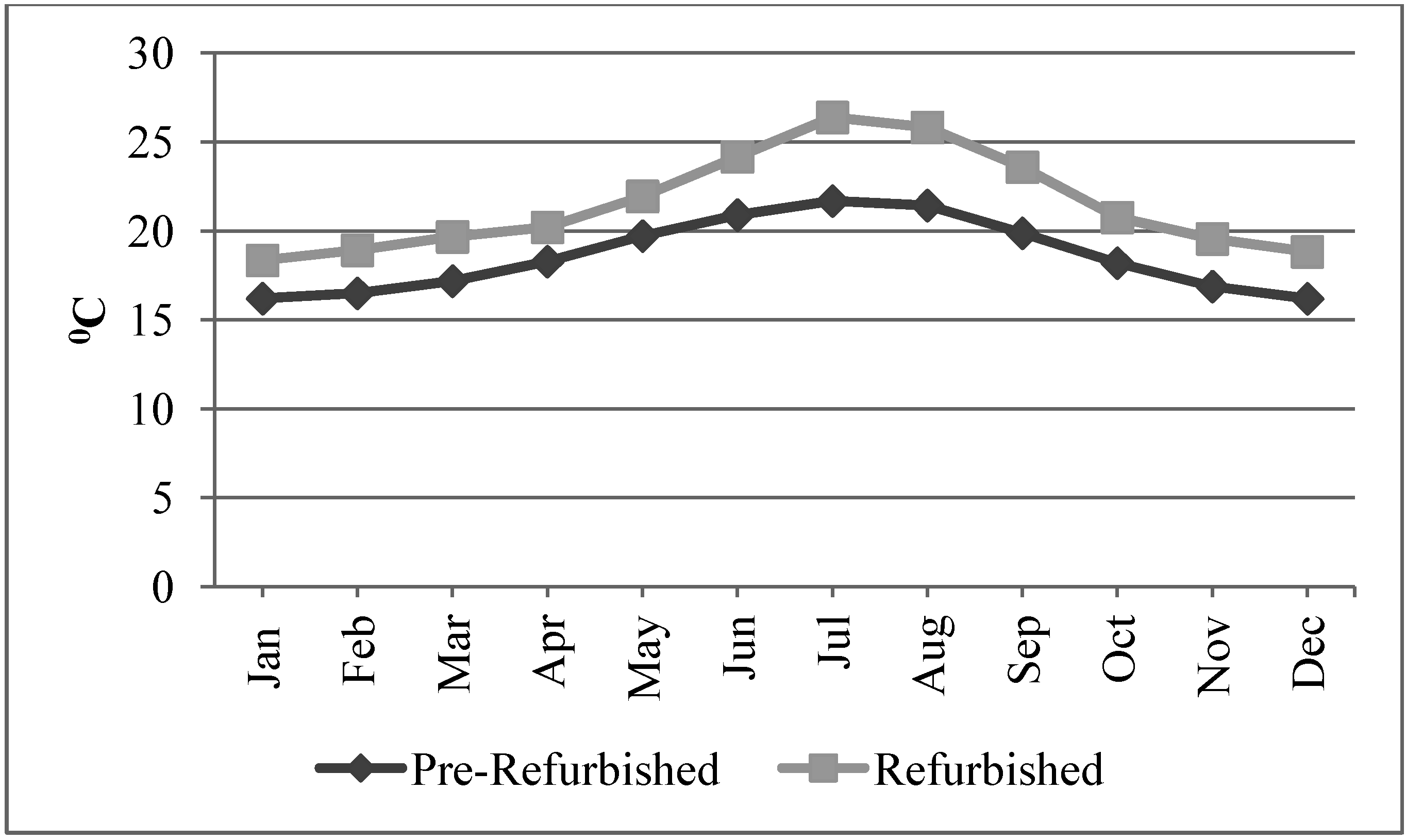
        <p><xref ref-type="fig" rid="buildings-03-00220-f009">Figure 9</xref> compares the operative temperature (the average of the internal air and mean radiant temperatures) of the post and pre refurbished house with natural ventilation. It can be concluded from the results that during the summer months the mean peak operative temperature may exceed 25 °C after refurbishment and so there could be a risk of thermal discomfort if no adaptive measures were taken. However, for most of the year the refurbishment is greatly enhancing thermal comfort in the house. There is a suggestion from <xref ref-type="fig" rid="buildings-03-00220-f009">Figure 9</xref> that some take-back could occur in the refurbished house <italic>i.e.</italic>, occupants enjoying a higher internal temperature in the heating season than they might have experienced in the pre refurbished house.</p>
        <fig id="buildings-03-00220-f009" position="float">
          <label>Figure 9</label>
          <caption>
            <p>Monthly mean operative temperature (°C) from pre and post-refurbished house under current weather conditions (Liverpool).</p>
          </caption>
          <graphic xmlns:xlink="http://www.w3.org/1999/xlink" xlink:href="buildings-03-00220-g009.tif"/>
        </fig>
      </sec>
      <sec>
        <title>3.3. Efficiency of Various Technologies in Reducing Carbon Emission and Costs in the Terraced House</title>
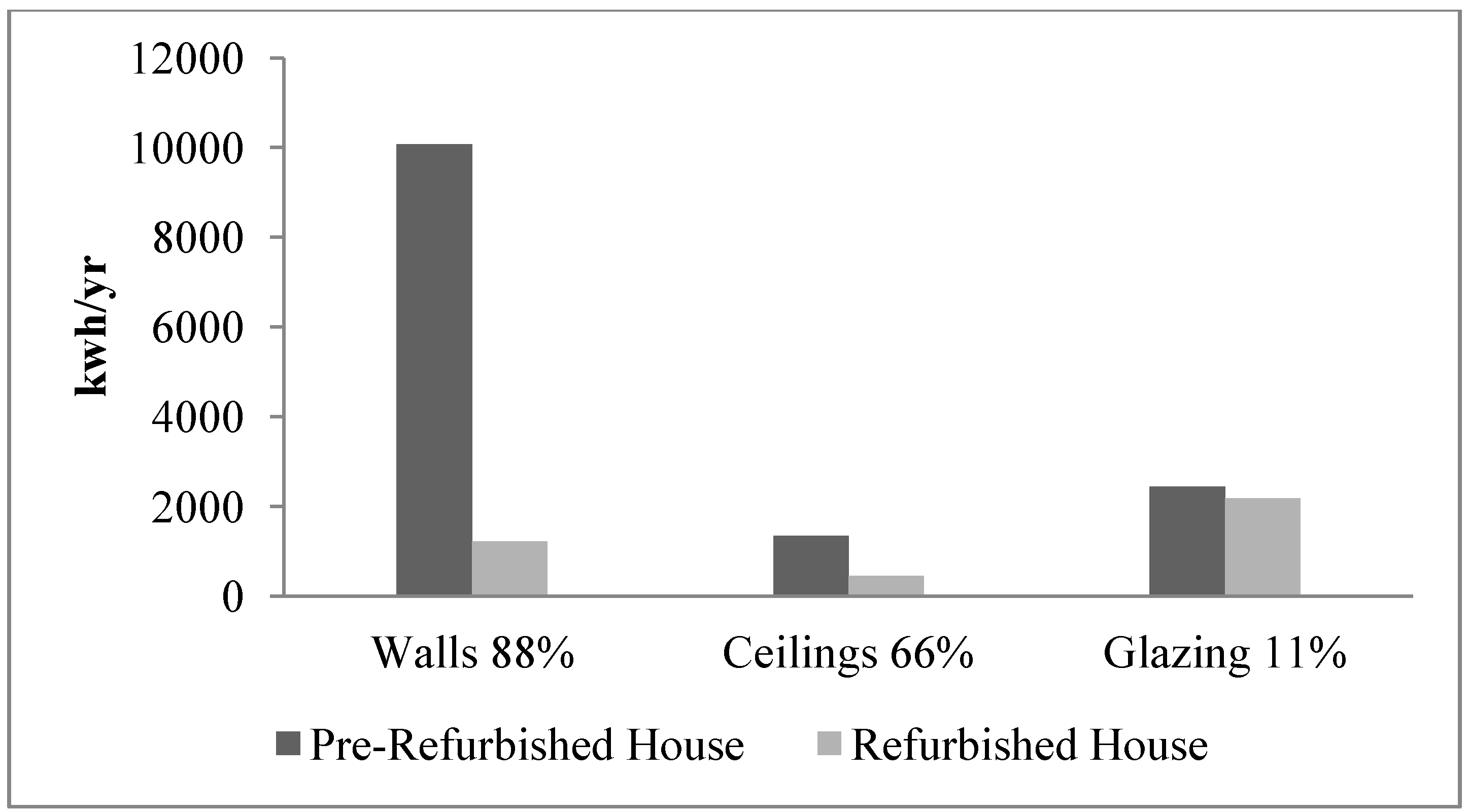
        <p>Although results indicate that an 80% reduction in CO<sub>2</sub> emissions is achievable by refurbishment, it is important to consider the time and costs required to reach that target. <xref ref-type="fig" rid="buildings-03-00220-f010">Figure 10</xref> illustrates typical heat losses from each major construction element in the terraced house, with the main sources of heat loss being the walls and loft. Consequently, improving wall and loft insulation levels can be the most effective way of improving the energy performance of buildings. Therefore, it would useful to also look at the economic performance of these components. <xref ref-type="fig" rid="buildings-03-00220-f011">Figure 11</xref> indicates the cost of applying each technology.</p>
        <fig id="buildings-03-00220-f010" position="float">
          <label>Figure 10</label>
          <caption>
            <p>Typical heat losses from pre and post refurbished building envelope components of the terraced house, showing % reduction.</p>
          </caption>
          <graphic xmlns:xlink="http://www.w3.org/1999/xlink" xlink:href="buildings-03-00220-g010.tif"/>
        </fig>
        <fig id="buildings-03-00220-f011" position="float">
          <label>Figure 11</label>
          <caption>
            <p>Cost of various low carbon technologies for the terraced house.</p>
          </caption>
          <graphic xmlns:xlink="http://www.w3.org/1999/xlink" xlink:href="buildings-03-00220-g011.tif"/>
        </fig>
      </sec>
      <sec>
        <title>3.4. Annual Savings for the Terraced House, Liverpool</title>
        <p>Energy savings cost is the difference between DesignBuilder simulation results for the heating consumption of the existing house and the retrofit house. <xref ref-type="table" rid="buildings-03-00220-t007">Table 7</xref> illustrates the average internal temperature of the living room during the heating season (December, January, February) as modeled by DesignBuilder(DB) for pre and post refurbished house compared to monitoring results. </p>
        <table-wrap id="buildings-03-00220-t007" position="float">
          <object-id pub-id-type="pii">buildings-03-00220-t007_Table 7</object-id>
          <label>Table 7</label>
          <caption>
            <p>Average internal temperature of living room during the heating season—Liverpool current weather data.</p>
          </caption>
          <table>
  <thead>
              <tr>
                <th align="center" valign="middle">&nbsp;</th>
                <th align="center" valign="middle">Measures</th>
                <th align="center" valign="middle">Operative temperature °C</th>
              </tr>
  </thead>
  <tbody>
              <tr>
                <th align="center" valign="middle">&nbsp;</th>
                <td align="center" valign="middle">DB Pre-Refurbished</td>
                <td align="center" valign="middle">16.3</td>
              </tr>
              <tr>
                <th align="center" valign="middle"><bold>Average internal temperature</bold></th>
                <td align="center" valign="middle">DB Refurbished</td>
                <td align="center" valign="middle">19.6</td>
              </tr>
              <tr>
                <th align="center" valign="middle">&nbsp;</th>
                <td align="center" valign="middle">Monitoring</td>
                <td align="center" valign="middle">25.4</td>
              </tr>
  </tbody>
          </table>
        </table-wrap>
        <p>As gas is the primary energy source for heating in this case study, the energy cost is calculated by use of a mean gas price of 0.0475 £/kWh. The annual benefit (the financial saving) is calculated by multiplying energy saving by current gas price of 0.0475 £/kWh for the first year in the cash flow. The numerical results for different cities are listed in <xref ref-type="table" rid="buildings-03-00220-t008">Table 8</xref>.</p>
        <table-wrap id="buildings-03-00220-t008" position="float">
          <object-id pub-id-type="pii">buildings-03-00220-t008_Table 8</object-id>
          <label>Table 8</label>
          <caption>
            <p>Annual savings from lower gas consumption for heating—current weather data.</p>
          </caption>
          <table>
<thead>
              <tr>
                <th align="center" valign="middle">Climate scenarios</th>
                <th align="center" valign="middle">Estimated annual heating load for existing house (kWh)</th>
                <th align="center" valign="middle">Estimated annual heating load for refurbished house (kWh)</th>
                <th align="center" valign="middle">Heating reduction (kWh)</th>
                <th align="center" valign="middle">Annual energy cost savings (£) for a gas price of 0.0475 £/kWh</th>
              </tr>
            </thead>
            <tbody>
              <tr>
                <td align="center" valign="middle">London-Current</td>
                <td align="center" valign="middle">12,336</td>
                <td align="center" valign="middle">2527</td>
                <td align="center" valign="middle">9808</td>
                <td align="center" valign="middle">466</td>
              </tr>
              <tr>
                <td align="center" valign="middle">Liverpool-Current</td>
                <td align="center" valign="middle">12,628</td>
                <td align="center" valign="middle">2587</td>
                <td align="center" valign="middle">10,041</td>
                <td align="center" valign="middle">477</td>
              </tr>
              <tr>
                <td align="center" valign="middle">Manchester-Current</td>
                <td align="center" valign="middle">13,500</td>
                <td align="center" valign="middle">2878</td>
                <td align="center" valign="middle">10,622</td>
                <td align="center" valign="middle">505</td>
              </tr>
              <tr>
                <td align="center" valign="middle">Edinburgh-Current</td>
                <td align="center" valign="middle">15,200</td>
                <td align="center" valign="middle">3114</td>
                <td align="center" valign="middle">12,086</td>
                <td align="center" valign="middle">574</td>
              </tr>
            </tbody>
          </table>
        </table-wrap>
        <p>To calculate the future annual savings three factors must be considered: effect of climate change on annual savings, instability of future gas prices and time preference and discount rate.</p>
      </sec>
      <sec>
        <title>3.5. Future Climate Change and Annual Savings</title>
        <p>Climate change affects heating consumption and accordingly the annual energy savings. <xref ref-type="table" rid="buildings-03-00220-t009">Table 9</xref> shows the reduction of heating consumption for different climate scenarios and different cities. </p>
        <table-wrap id="buildings-03-00220-t009" position="float">
          <object-id pub-id-type="pii">buildings-03-00220-t009_Table 9</object-id>
          <label>Table 9</label>
          <caption>
            <p>Annual energy savings for future climate scenarios.</p>
          </caption>
          <table>
<thead>
              <tr>
                <th align="center" valign="middle">Climate scenarios</th>
                <th align="center" valign="middle">Estimated annual heating load for existing house (kWh)</th>
                <th align="center" valign="middle">Estimated annual heating load for refurbished house (kWh)</th>
                <th align="center" valign="middle">Reduction (kWh) (%)</th>
              </tr>
            </thead>
            <tbody>
              <tr>
                <td align="center" valign="middle">London 2020</td>
                <td align="center" valign="middle">11,419</td>
                <td align="center" valign="middle">1908</td>
                <td align="center" valign="middle">9511 (83%)</td>
              </tr>
              <tr>
                <td align="center" valign="middle">Edinburgh 2020</td>
                <td align="center" valign="middle">12,188</td>
                <td align="center" valign="middle">2497</td>
                <td align="center" valign="middle">9691 (80%)</td>
              </tr>
              <tr>
                <td align="center" valign="middle">Manchester 2020</td>
                <td align="center" valign="middle">10,675</td>
                <td align="center" valign="middle">2168</td>
                <td align="center" valign="middle">8507 (80%)</td>
              </tr>
              <tr>
                <td align="center" valign="middle">London 2050</td>
                <td align="center" valign="middle">8148</td>
                <td align="center" valign="middle">1669</td>
                <td align="center" valign="middle">6479 (80%)</td>
              </tr>
              <tr>
                <td align="center" valign="middle">Edinburgh 2050</td>
                <td align="center" valign="middle">10,762</td>
                <td align="center" valign="middle">2205</td>
                <td align="center" valign="middle">8557 (80%)</td>
              </tr>
              <tr>
                <td align="center" valign="middle">Manchester 2050</td>
                <td align="center" valign="middle">9483</td>
                <td align="center" valign="middle">1833</td>
                <td align="center" valign="middle">7650 (81%)</td>
              </tr>
            </tbody>
          </table>
        </table-wrap>
      </sec>
      <sec>
        <title>3.6. Future Gas Prices and Annual Savings</title>
        <p>As any cost benefit analysis is performed over the lifetime of a house, a changing rate has to be introduced in the cost calculations to correspond with reality. Looking at historical data suggests that not only will energy prices not remain constant but that there is also a possibility of both downward and upward trends as well. Therefore, different scenarios should be investigated that take in to account different trends. To measure the amount of uncertainty and to predict gas price trends 16 years of gas price datasets were used and the change over time (standard deviation) was calculated (<xref ref-type="table" rid="buildings-03-00220-t010">Table 10</xref>). The instability of the annual variation was calculated in this case to be 8.6% (see Equation 3). </p>
        <table-wrap id="buildings-03-00220-t010" position="float">
          <object-id pub-id-type="pii">buildings-03-00220-t010_Table 10</object-id>
          <label>Table 10</label>
          <caption>
            <p>Average annual standard credit bills (£) for a typical residential gas consumer for 16 years since 1996 source [<xref ref-type="bibr" rid="B19-buildings-03-00220">19</xref>].</p>
          </caption>
          <table>
<thead>
              <tr>
                <th align="center" valign="middle">Year</th>
                <th align="center" valign="middle">Gas prices in real terms(£)</th>
                <th align="center" valign="middle">Annual % variation</th>
                <th align="center" valign="middle">Instability</th>
              </tr>
            </thead>
            <tbody>
              <tr>
                <td align="center" valign="middle">1996</td>
                <td align="center" valign="middle">330</td>
                <td align="center" valign="middle">-</td>
                <td align="center" valign="middle">-</td>
              </tr>
              <tr>
                <td align="center" valign="middle">1997</td>
                <td align="center" valign="middle">329</td>
                <td align="center" valign="middle">−0.3</td>
                <td align="center" valign="middle">−6.3</td>
              </tr>
              <tr>
                <td align="center" valign="middle">1998</td>
                <td align="center" valign="middle">320</td>
                <td align="center" valign="middle">−2.7</td>
                <td align="center" valign="middle">−8.8</td>
              </tr>
              <tr>
                <td align="center" valign="middle">1999</td>
                <td align="center" valign="middle">316</td>
                <td align="center" valign="middle">−1.2</td>
                <td align="center" valign="middle">−7.3</td>
              </tr>
              <tr>
                <td align="center" valign="middle">2000</td>
                <td align="center" valign="middle">309</td>
                <td align="center" valign="middle">−2.2</td>
                <td align="center" valign="middle">−8.3</td>
              </tr>
              <tr>
                <td align="center" valign="middle">2001</td>
                <td align="center" valign="middle">308</td>
                <td align="center" valign="middle">−0.3</td>
                <td align="center" valign="middle">−6.4</td>
              </tr>
              <tr>
                <td align="center" valign="middle">2002</td>
                <td align="center" valign="middle">326</td>
                <td align="center" valign="middle">5.8</td>
                <td align="center" valign="middle">−0.2</td>
              </tr>
              <tr>
                <td align="center" valign="middle">2003</td>
                <td align="center" valign="middle">335</td>
                <td align="center" valign="middle">2.7</td>
                <td align="center" valign="middle">−3.3</td>
              </tr>
              <tr>
                <td align="center" valign="middle">2004</td>
                <td align="center" valign="middle">344</td>
                <td align="center" valign="middle">2.6</td>
                <td align="center" valign="middle">−3.4</td>
              </tr>
              <tr>
                <td align="center" valign="middle">2005</td>
                <td align="center" valign="middle">402</td>
                <td align="center" valign="middle">16.8</td>
                <td align="center" valign="middle">10.8</td>
              </tr>
              <tr>
                <td align="center" valign="middle">2006</td>
                <td align="center" valign="middle">510</td>
                <td align="center" valign="middle">26.8</td>
                <td align="center" valign="middle">20.8</td>
              </tr>
              <tr>
                <td align="center" valign="middle">2007</td>
                <td align="center" valign="middle">545</td>
                <td align="center" valign="middle">6.8</td>
                <td align="center" valign="middle">0.8</td>
              </tr>
              <tr>
                <td align="center" valign="middle">2008</td>
                <td align="center" valign="middle">625</td>
                <td align="center" valign="middle">14.6</td>
                <td align="center" valign="middle">8.7</td>
              </tr>
              <tr>
                <td align="center" valign="middle">2009</td>
                <td align="center" valign="middle">715</td>
                <td align="center" valign="middle">14.4</td>
                <td align="center" valign="middle">8.3</td>
              </tr>
              <tr>
                <td align="center" valign="middle">2010</td>
                <td align="center" valign="middle">689</td>
                <td align="center" valign="middle">−3.6</td>
                <td align="center" valign="middle">−9.7</td>
              </tr>
              <tr>
                <td align="center" valign="middle">2011</td>
                <td align="center" valign="middle">762</td>
                <td align="center" valign="middle">10.6</td>
                <td align="center" valign="middle">4.5</td>
              </tr>
              <tr>
                <td align="center" valign="middle">Average</td>
                <td align="center" valign="middle">-</td>
                <td align="center" valign="middle">6.07</td>
                <td align="center" valign="middle">-</td>
              </tr>
            </tbody>
          </table>
        </table-wrap>
        <p><disp-formula id="buildings-03-00220-i003"><inline-graphic xmlns:xlink="http://www.w3.org/1999/xlink" xlink:href="buildings-03-00220-i003.tif"/><label>(3)</label></disp-formula></p>
        <p>Finding the ratio that controls the rising and falling values allows a binomial tree of gas price trends to be constructed for the next 16 years. To predict the gas prices for year 16–40 the standard deviation was calculated again using years 1 to 16 predicted gas prices and was found to be 23%. </p>
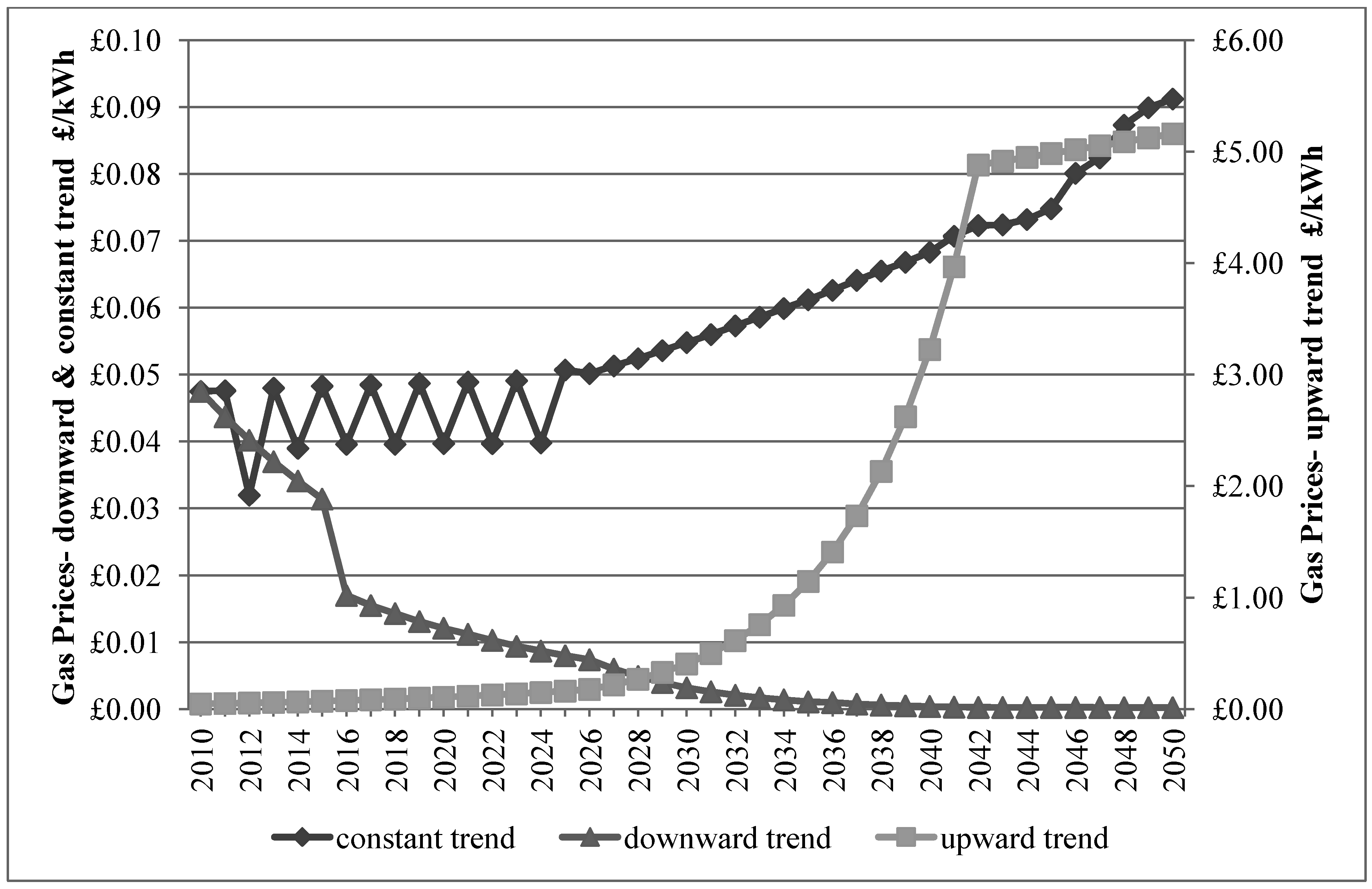
        <p><xref ref-type="fig" rid="buildings-03-00220-f012">Figure 12</xref> illustrates the predicted different possible gas prices in each year. The expected gas price in each year is the sum of all possibilities weighted by their probabilities. The right vertical axis shows the predicted prices for an upward trend and the left vertical axis illustrates the projected gas prices for a downward and current trend. After each 16 years, the previous 16 years of data were used to predict the new gas prices. For a better comparison, a different scale has been chosen on the right hand side for the upward trend. Expected gas prices in the next 40 years can be seen in <xref ref-type="table" rid="buildings-03-00220-t011">Table 11</xref>.</p>
		<fig id="buildings-03-00220-f012" position="float">
          <label>Figure 12</label>
          <caption>
            <p>Predicted possible Index upwards or downwards prices for gas.</p>
          </caption>
          <graphic xmlns:xlink="http://www.w3.org/1999/xlink" xlink:href="buildings-03-00220-g012.tif"/>
        </fig>
      
        <table-wrap id="buildings-03-00220-t011" position="float">
          <object-id pub-id-type="pii">buildings-03-00220-t011_Table 11</object-id>
          <label>Table 11</label>
          <caption>
            <p>Future energy saving costs for constant prices in London for 2010–2020.</p>
          </caption>
          <table>
<thead>
              <tr>
                <th align="center" valign="middle">year</th>
                <th align="center" valign="middle">Refurbished annual heating load (kWh)</th>
                <th align="center" valign="middle">Existing annual heating load (kWh)</th>
                <th align="center" valign="middle">Gas prices (p/kWh)</th>
                <th align="center" valign="middle">Refurbished annual heating cost (£)</th>
                <th align="center" valign="middle">Existing annual heating cost (£) </th>
                <th align="center" valign="middle">Annual savings (£)</th>
                <th align="center" valign="middle">Annual savings, NPV at 3.5%/3% discount</th>
              </tr>
            </thead>
            <tbody>
              <tr>
                <td align="center" valign="middle">2010</td>
                <td align="center" valign="middle">2527</td>
                <td align="center" valign="middle">12336</td>
                <td align="center" valign="middle">4.75</td>
                <td align="center" valign="middle">120.03</td>
                <td align="center" valign="middle">585.94</td>
                <td align="center" valign="middle">465.91</td>
                <td align="center" valign="middle">465.91</td>
              </tr>
              <tr>
                <td align="center" valign="middle">2011</td>
                <td align="center" valign="middle">2458</td>
                <td align="center" valign="middle">12236</td>
                <td align="center" valign="middle">4.76</td>
                <td align="center" valign="middle">117.01</td>
                <td align="center" valign="middle">582.33</td>
                <td align="center" valign="middle">465.32</td>
                <td align="center" valign="middle">449.58</td>
              </tr>
              <tr>
                <td align="center" valign="middle">2012</td>
                <td align="center" valign="middle">2389</td>
                <td align="center" valign="middle">12132</td>
                <td align="center" valign="middle">3.20</td>
                <td align="center" valign="middle">76.46</td>
                <td align="center" valign="middle">388.22</td>
                <td align="center" valign="middle">311.76</td>
                <td align="center" valign="middle">291.03</td>
              </tr>
              <tr>
                <td align="center" valign="middle">2013</td>
                <td align="center" valign="middle">2321</td>
                <td align="center" valign="middle">12030</td>
                <td align="center" valign="middle">4.80</td>
                <td align="center" valign="middle">111.40</td>
                <td align="center" valign="middle">577.45</td>
                <td align="center" valign="middle">466.05</td>
                <td align="center" valign="middle">420.35</td>
              </tr>
              <tr>
                <td align="center" valign="middle">2014</td>
                <td align="center" valign="middle">2252</td>
                <td align="center" valign="middle">11928</td>
                <td align="center" valign="middle">3.90</td>
                <td align="center" valign="middle">87.83</td>
                <td align="center" valign="middle">465.21</td>
                <td align="center" valign="middle">377.37</td>
                <td align="center" valign="middle">328.86</td>
              </tr>
              <tr>
                <td align="center" valign="middle">2015</td>
                <td align="center" valign="middle">2183</td>
                <td align="center" valign="middle">11827</td>
                <td align="center" valign="middle">4.83</td>
                <td align="center" valign="middle">105.46</td>
                <td align="center" valign="middle">571.23</td>
                <td align="center" valign="middle">465.76</td>
                <td align="center" valign="middle">392.16</td>
              </tr>
              <tr>
                <td align="center" valign="middle">2016</td>
                <td align="center" valign="middle">2115</td>
                <td align="center" valign="middle">11725</td>
                <td align="center" valign="middle">3.96</td>
                <td align="center" valign="middle">83.74</td>
                <td align="center" valign="middle">464.30</td>
                <td align="center" valign="middle">380.56</td>
                <td align="center" valign="middle">309.58</td>
              </tr>
              <tr>
                <td align="center" valign="middle">2017</td>
                <td align="center" valign="middle">2046</td>
                <td align="center" valign="middle">11623</td>
                <td align="center" valign="middle">4.85</td>
                <td align="center" valign="middle">99.23</td>
                <td align="center" valign="middle">563.72</td>
                <td align="center" valign="middle">464.48</td>
                <td align="center" valign="middle">365.08</td>
              </tr>
              <tr>
                <td align="center" valign="middle">2018</td>
                <td align="center" valign="middle">1977</td>
                <td align="center" valign="middle">11521</td>
                <td align="center" valign="middle">3.96</td>
                <td align="center" valign="middle">78.30</td>
                <td align="center" valign="middle">456.24</td>
                <td align="center" valign="middle">377.94</td>
                <td align="center" valign="middle">287.01</td>
              </tr>
              <tr>
                <td align="center" valign="middle">2019</td>
                <td align="center" valign="middle">1909</td>
                <td align="center" valign="middle">11419</td>
                <td align="center" valign="middle">4.87</td>
                <td align="center" valign="middle">92.95</td>
                <td align="center" valign="middle">556.12</td>
                <td align="center" valign="middle">463.17</td>
                <td align="center" valign="middle">339.84</td>
              </tr>
              <tr>
                <td align="center" valign="middle">2020</td>
                <td align="center" valign="middle">1908</td>
                <td align="center" valign="middle">11419</td>
                <td align="center" valign="middle">3.97</td>
                <td align="center" valign="middle">75.74</td>
                <td align="center" valign="middle">453.33</td>
                <td align="center" valign="middle">377.58</td>
                <td align="center" valign="middle">267.68</td>
              </tr>
            </tbody>
          </table>
        </table-wrap>
        </sec>
      <sec>
        <title>3.7. Future Energy Saving Costs</title>
        <p>Estimating future gas prices makes it possible to calculate savings for the building’s energy expenditure. As these savings happen for different operations taking place at different times, it is essential to convert to current costs using a discounted cash flow method that incorporates the discount rate of 3.5% for the first 30 years and 3% thereafter (<xref ref-type="table" rid="buildings-03-00220-t011">Table 11</xref> shows the values for London for the period 2010–2020). </p>
      </sec>
      <sec>
        <title>3.8. Whole Life Cycle Costing</title>
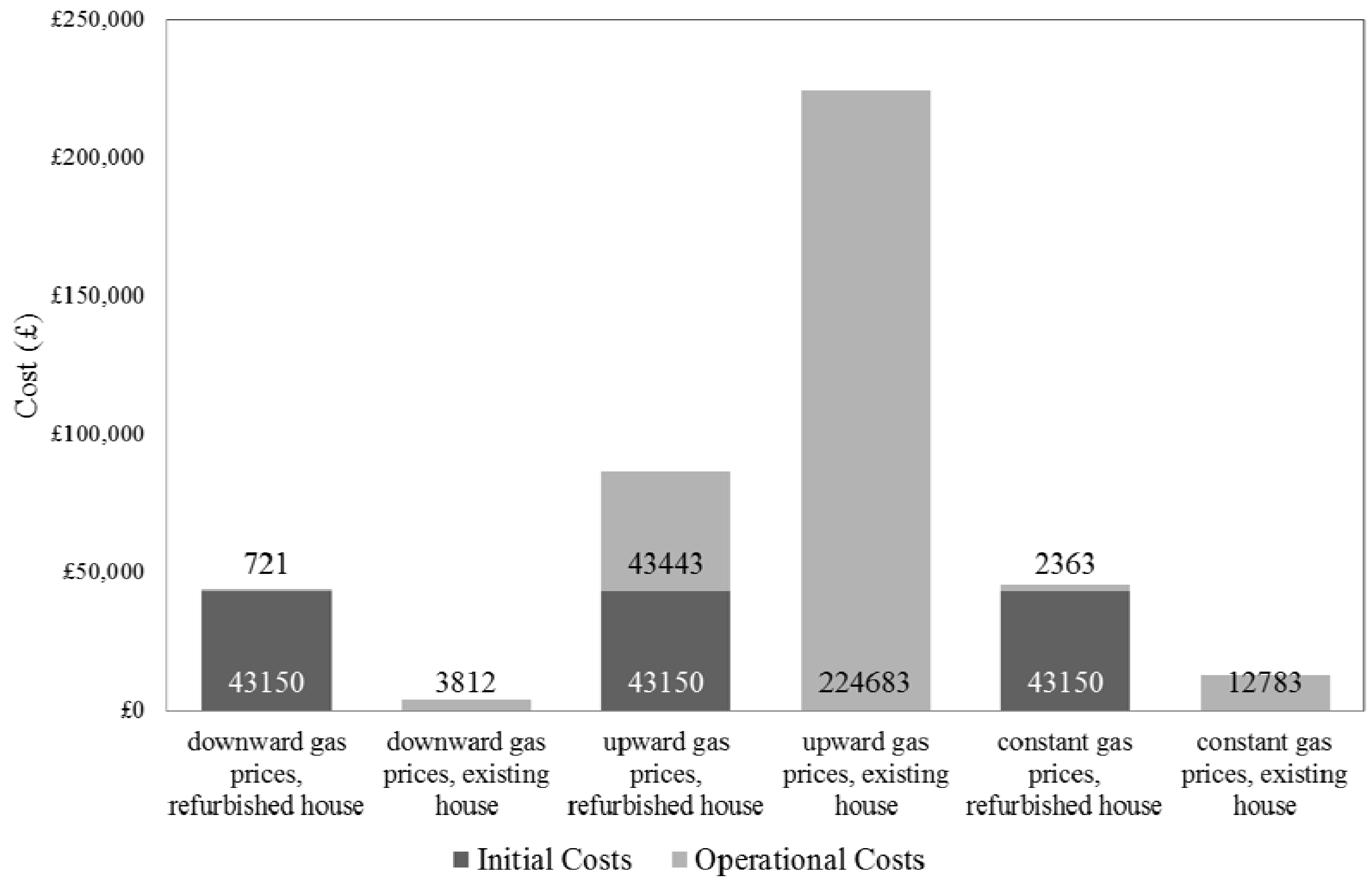
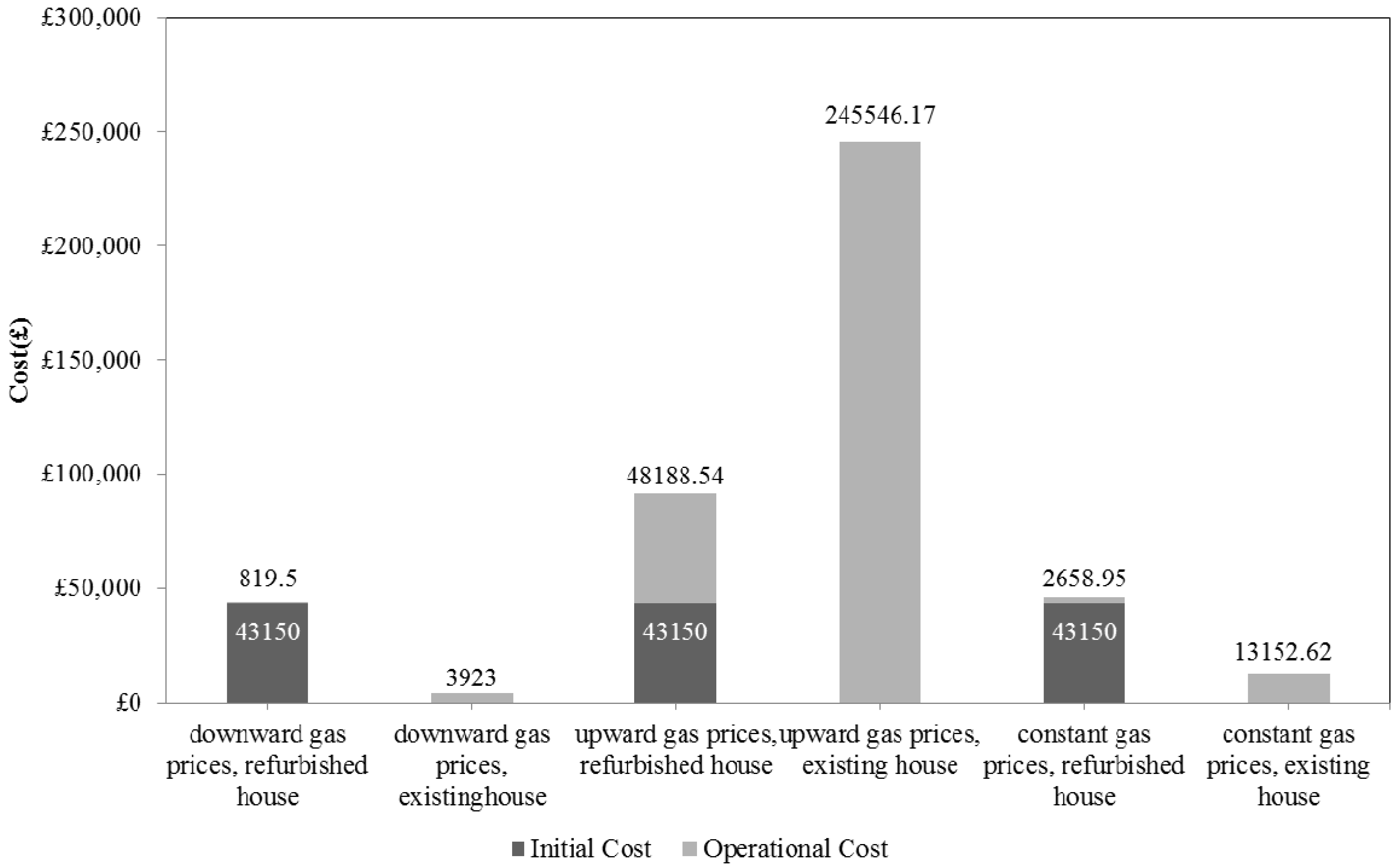
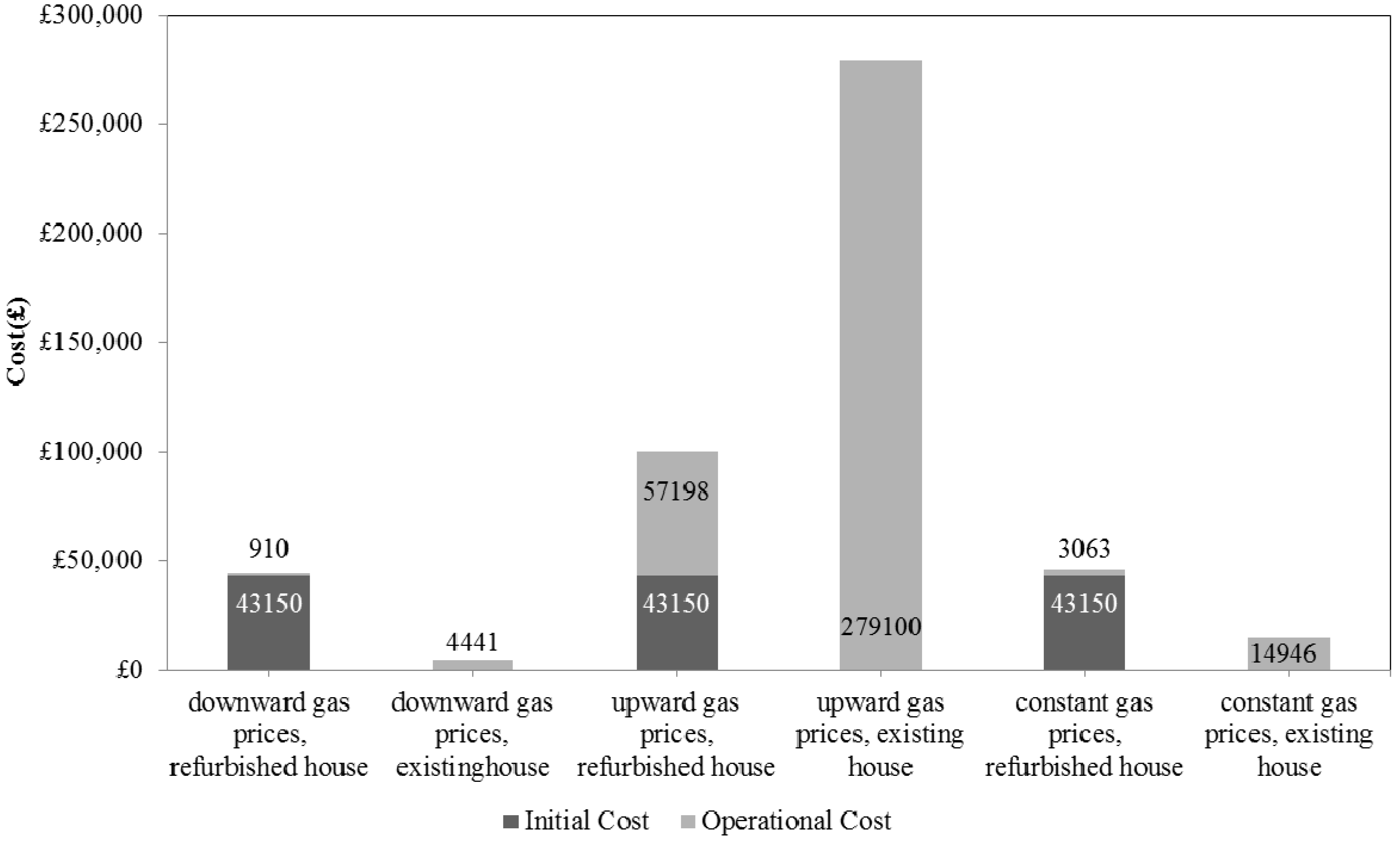
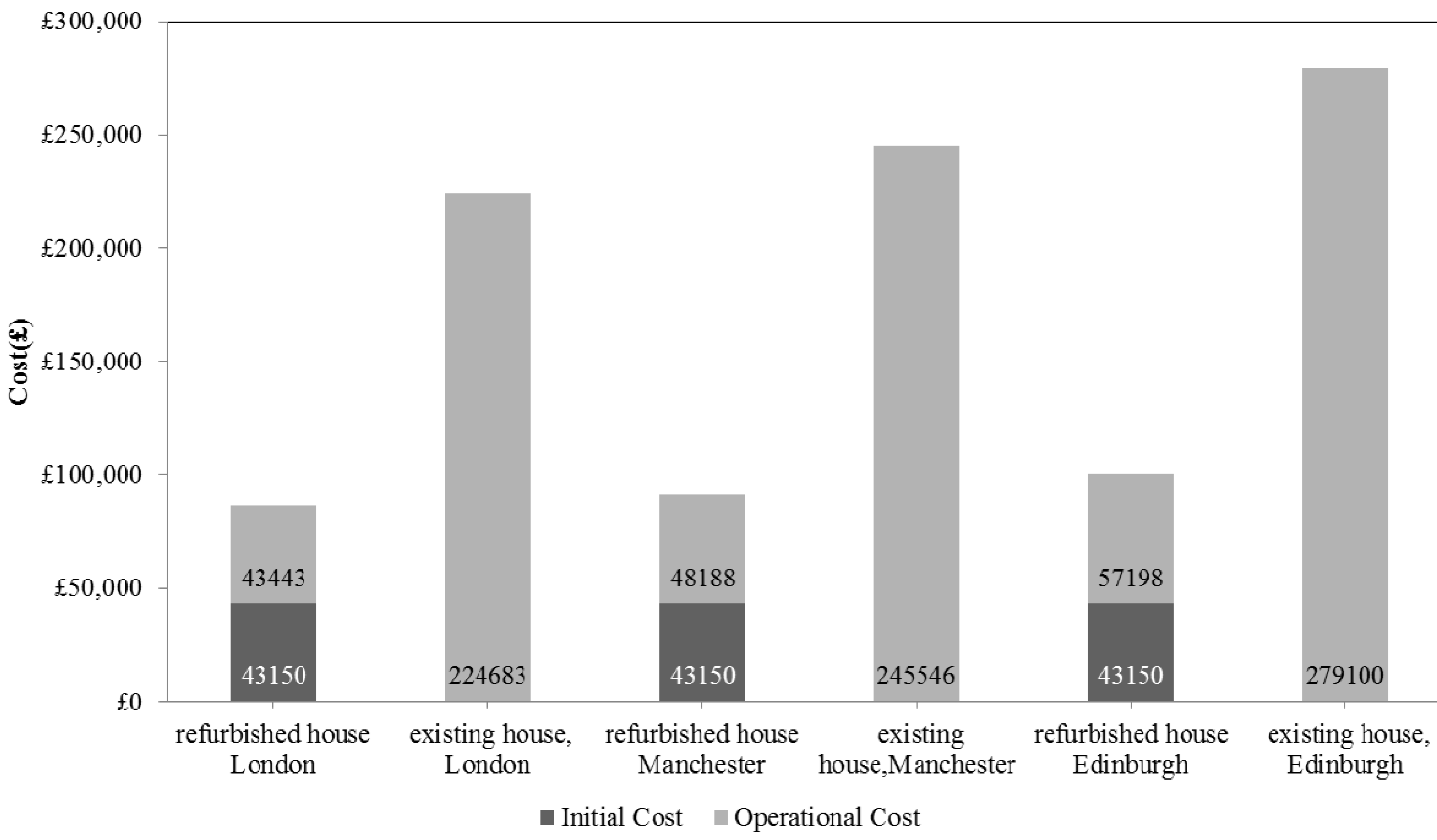
        <p>Discounted accumulated whole life cycle costs over 40 years for three gas prices and three weather scenarios are shown in <xref ref-type="fig" rid="buildings-03-00220-f013">Figure 13</xref>, <xref ref-type="fig" rid="buildings-03-00220-f014">Figure 14</xref>, <xref ref-type="fig" rid="buildings-03-00220-f015">Figure 15</xref> for the terraced house located in London, Manchester and Edinburgh. A comparison of WLCC for all cities shows that this type of refurbishment is economically attractive only with the rising gas prices scenario. Clearly, adding the maintenance and replacement costs to the analysis will change these findings dramatically in favor of the refurbished house’s WLCC. </p>
        <p>Comparing the most favorable outcomes (with upward prices) for all three cities it can be seen in <xref ref-type="fig" rid="buildings-03-00220-f016">Figure 16</xref> that the total present value for Edinburgh is the most beneficial option over 40 years (£ 178,752 savings), before Manchester (£ 154,208 savings) and London (£ 138,090 savings), for the given conditions (3% discount rate, 8.6% yearly increase in energy costs for the first 16 years and 23% increase in energy costs after that).</p>
		<fig id="buildings-03-00220-f013" position="float">
          <label>Figure 13</label>
          <caption>
            <p>Whole Life Cycle Cost (WLCC) of the pre and post refurbished house for current and future London weather data over 40 years for different gas price trends.</p>
          </caption>
          <graphic xmlns:xlink="http://www.w3.org/1999/xlink" xlink:href="buildings-03-00220-g013.tif"/>
        </fig>
        <fig id="buildings-03-00220-f014" position="float">
          <label>Figure 14</label>
          <caption>
            <p>Whole Life Cycle Cost (WLCC) of the post and pre refurbished house for current and future Manchester weather data over 40 years for different gas price trends.</p>
          </caption>
          <graphic xmlns:xlink="http://www.w3.org/1999/xlink" xlink:href="buildings-03-00220-g014.tif"/>
        </fig>
        <fig id="buildings-03-00220-f015" position="float">
          <label>Figure 15</label>
          <caption>
            <p>Whole Life Cycle Cost (WLCC) of the post and pre refurbished house for current and future Edinburgh weather data over 40 years for different gas price trends. </p>
          </caption>
          <graphic xmlns:xlink="http://www.w3.org/1999/xlink" xlink:href="buildings-03-00220-g015.tif"/>
        </fig>
        
        <fig id="buildings-03-00220-f016" position="float">
          <label>Figure 16</label>
          <caption>
            <p>Whole Life Cycle Cost (WLCC) of the post and pre refurbished house for current and future weather data of London, Edinburgh and Manchester over 40 years for upward gas price trends.</p>
          </caption>
          <graphic xmlns:xlink="http://www.w3.org/1999/xlink" xlink:href="buildings-03-00220-g016.tif"/>
        </fig>
      </sec>
      <sec>
        <title>3.9. Payback Period</title>
        <sec>
          <title>3.9.1. London</title>
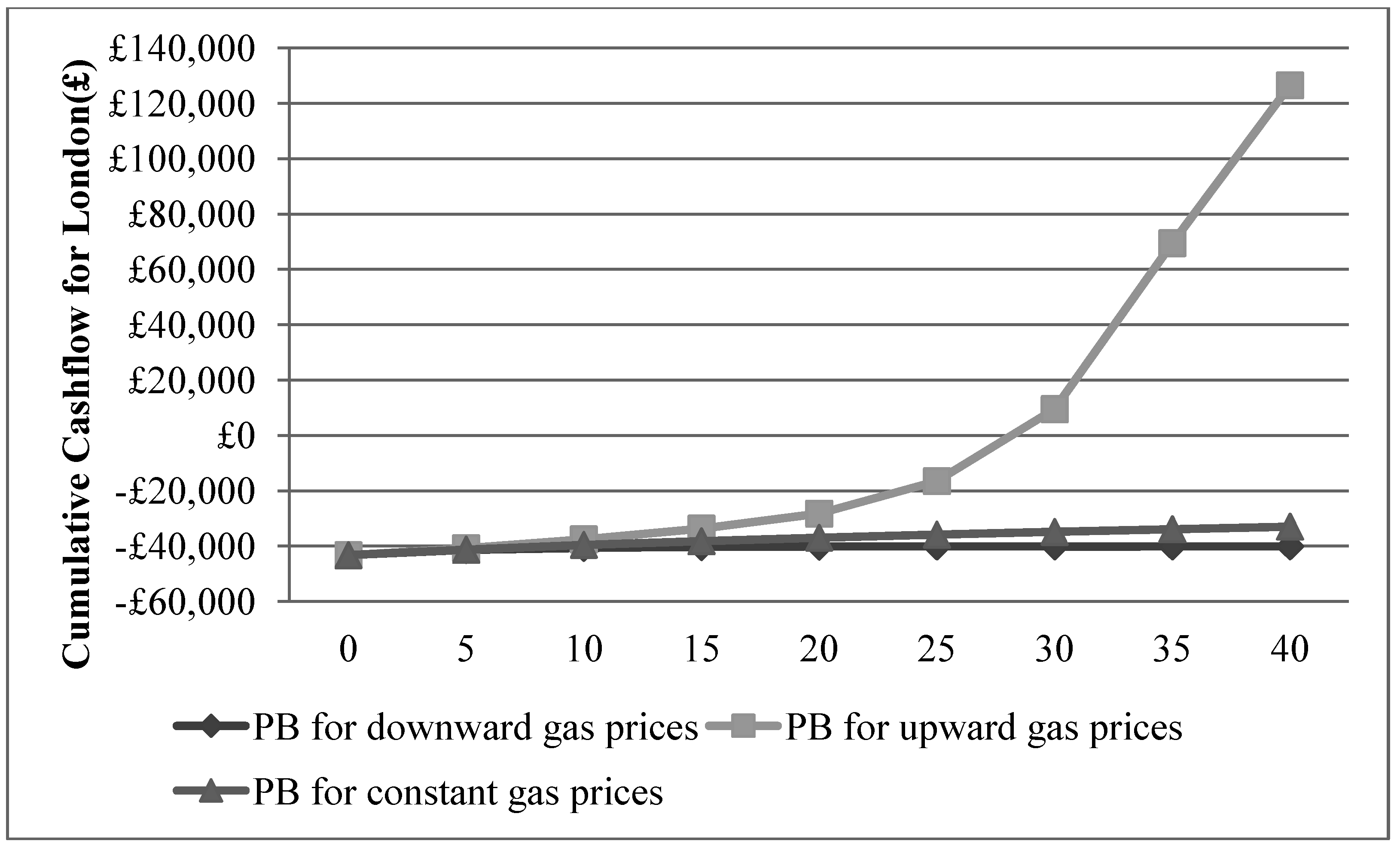
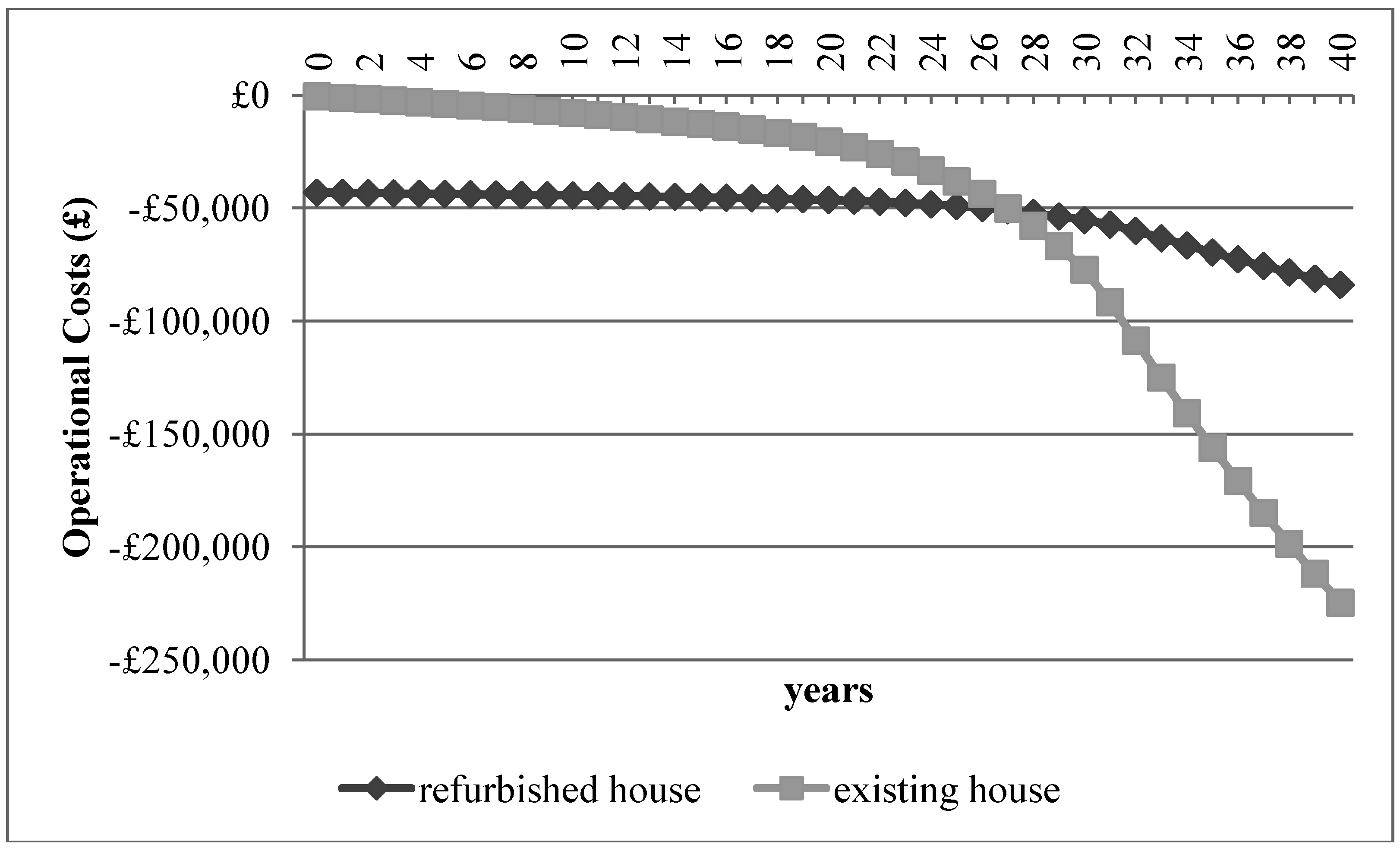
          <p><xref ref-type="fig" rid="buildings-03-00220-f017">Figure 17</xref> showing the time needed to recover the initial costs of eco-refurbishment with constant, growing and decreasing energy prices. The figure of—£ 43,150 shows the initial cost of construction with the amount of corresponding discounted saving costs added every year. The cumulative cash flow of the refurbished house for various trends shows that the payback time from heating saved by improving wall and roof insulation, glazing and doors to near Passivhaus standards for a 19th century terraced house in London will be 27 years with upward prices and may never realistically pay back if prices fall or remain constant. <xref ref-type="fig" rid="buildings-03-00220-f018">Figure 18</xref> shows the evolution of the energy costs over 40 years for upward gas prices. If the energy cost grows annually at 8.6% per year in the first 16 years and at 23% per year in the second 16 years then after 27 years, the refurbished house will have recovered the cost of the refurbishment. </p>
          <fig id="buildings-03-00220-f017" position="float">
            <label>Figure 17</label>
            <caption>
              <p>Cumulative cash flow of the refurbished house for current and future London weather data over 40 years for different gas price trends.</p>
            </caption>
            <graphic xmlns:xlink="http://www.w3.org/1999/xlink" xlink:href="buildings-03-00220-g017.tif"/>
          </fig>
          <fig id="buildings-03-00220-f018" position="float">
            <label>Figure 18</label>
            <caption>
              <p>Comparison of the pre and post refurbished house’s cumulative discounted operational costs for London current and future weather data over 40 years imposing an upward gas price trend.</p>
            </caption>
            <graphic xmlns:xlink="http://www.w3.org/1999/xlink" xlink:href="buildings-03-00220-g018.tif"/>
          </fig>
        </sec>
        <sec>
          <title>3.9.2. Manchester</title>
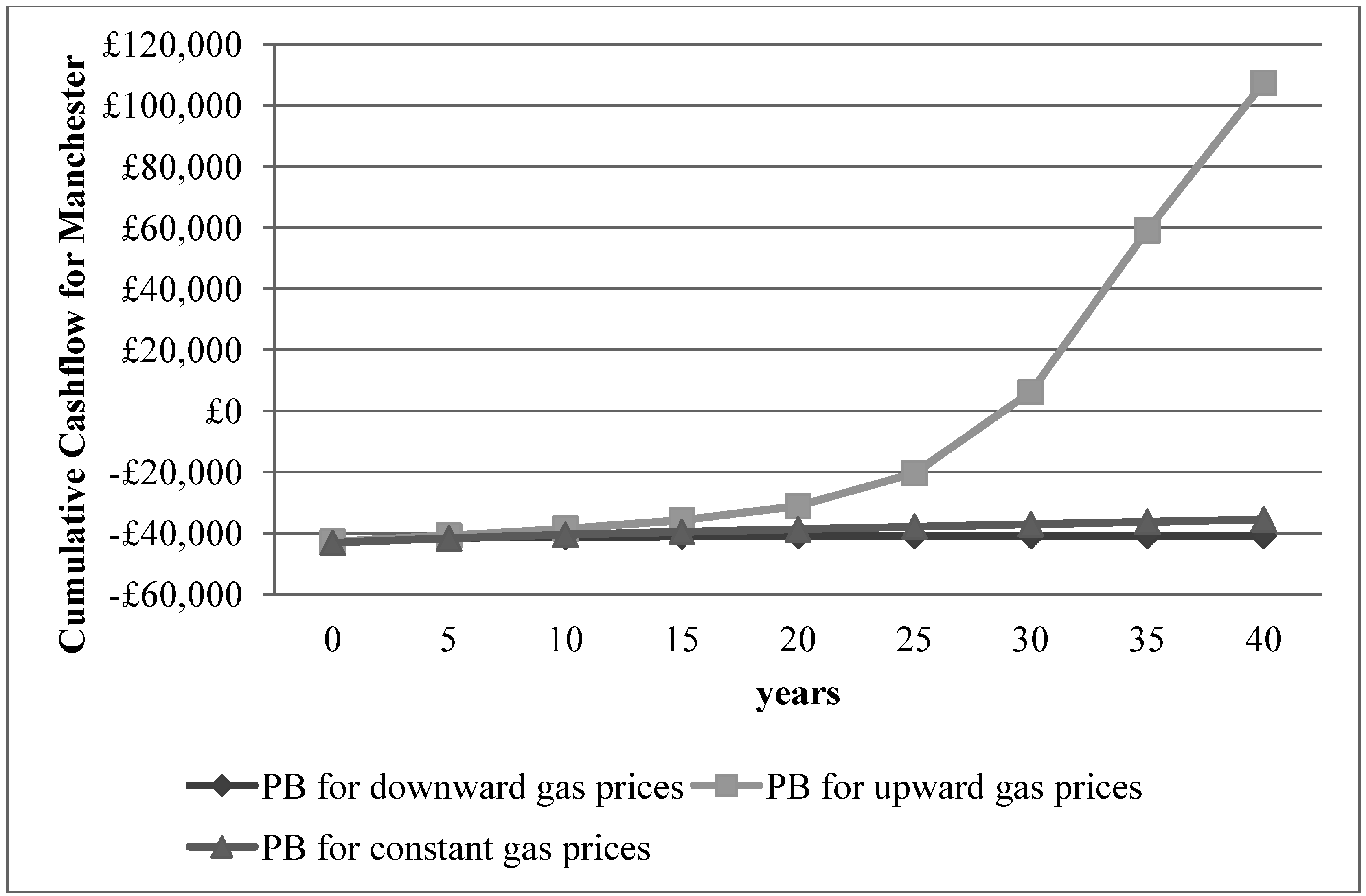
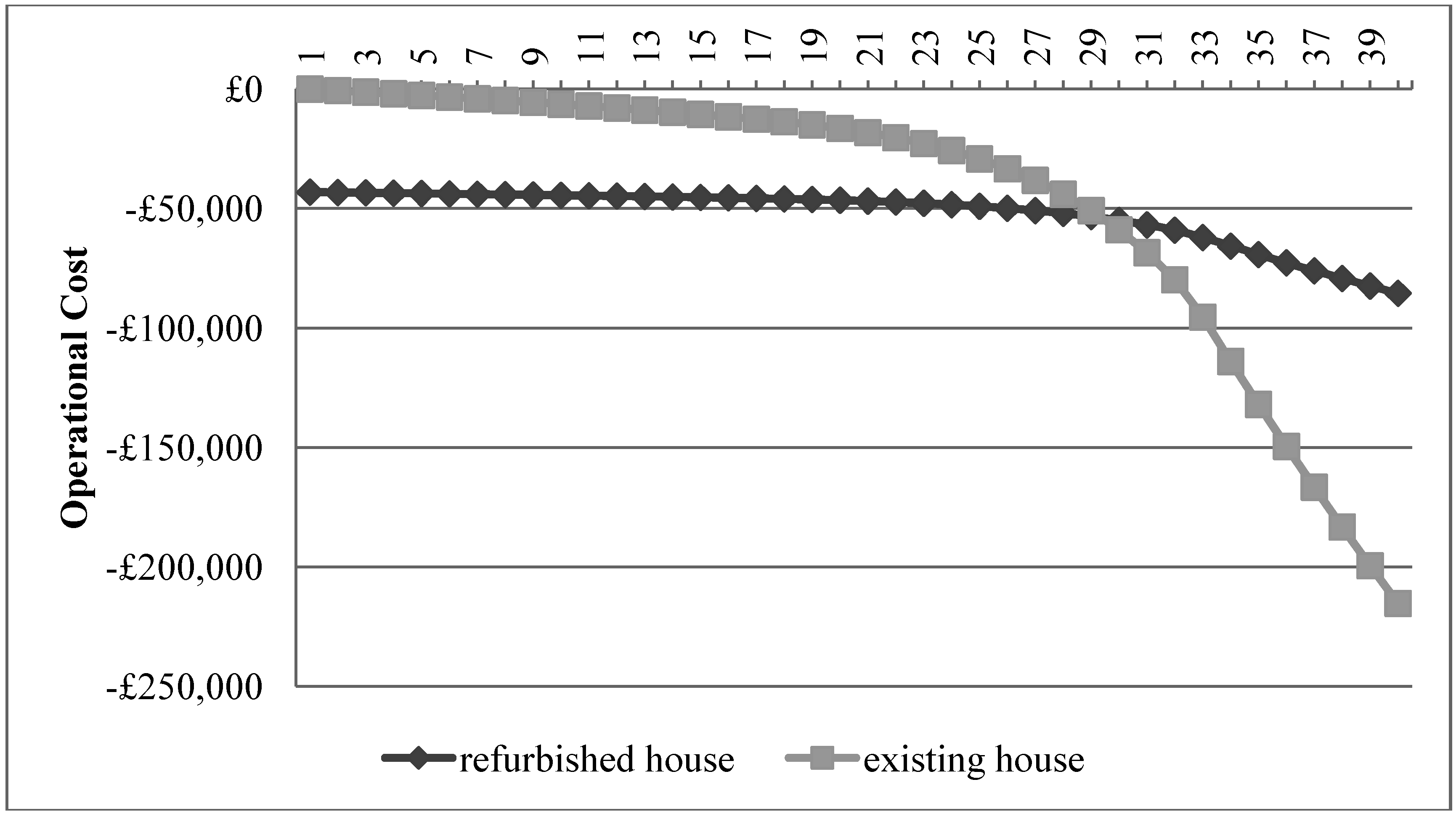
          <p>The same assumptions for gas prices were made to observe the cost benefit of refurbishment in Manchester. It is apparent from <xref ref-type="fig" rid="buildings-03-00220-f019">Figure 19</xref> that the discounted payback period will be 29 years with upward prices and again, realistically, may never pay back if the prices fall or remain constant. In the case of an increase in energy prices, in year 29 the difference between the non-retrofitted and house will be £ 1,885.57 in favor of the refurbished house (see <xref ref-type="fig" rid="buildings-03-00220-f020">Figure 20</xref>). </p>
          <fig id="buildings-03-00220-f019" position="float">
            <label>Figure 19</label>
            <caption>
              <p>Cumulative cash flow of the refurbished house for current and future Manchester weather data over 40 years for different gas price trends.</p>
            </caption>
            <graphic xmlns:xlink="http://www.w3.org/1999/xlink" xlink:href="buildings-03-00220-g019.tif"/>
          </fig>
          <fig id="buildings-03-00220-f020" position="float">
            <label>Figure 20</label>
            <caption>
              <p>Comparison of the pre and post refurbished house’s cumulative discounted operational costs for Manchester current and future weather data over 40 years imposing an upward gas price trend.</p>
            </caption>
            <graphic xmlns:xlink="http://www.w3.org/1999/xlink" xlink:href="buildings-03-00220-g020.tif"/>
          </fig>
        </sec>
        <sec>
          <title>3.9.3. Edinburgh</title>
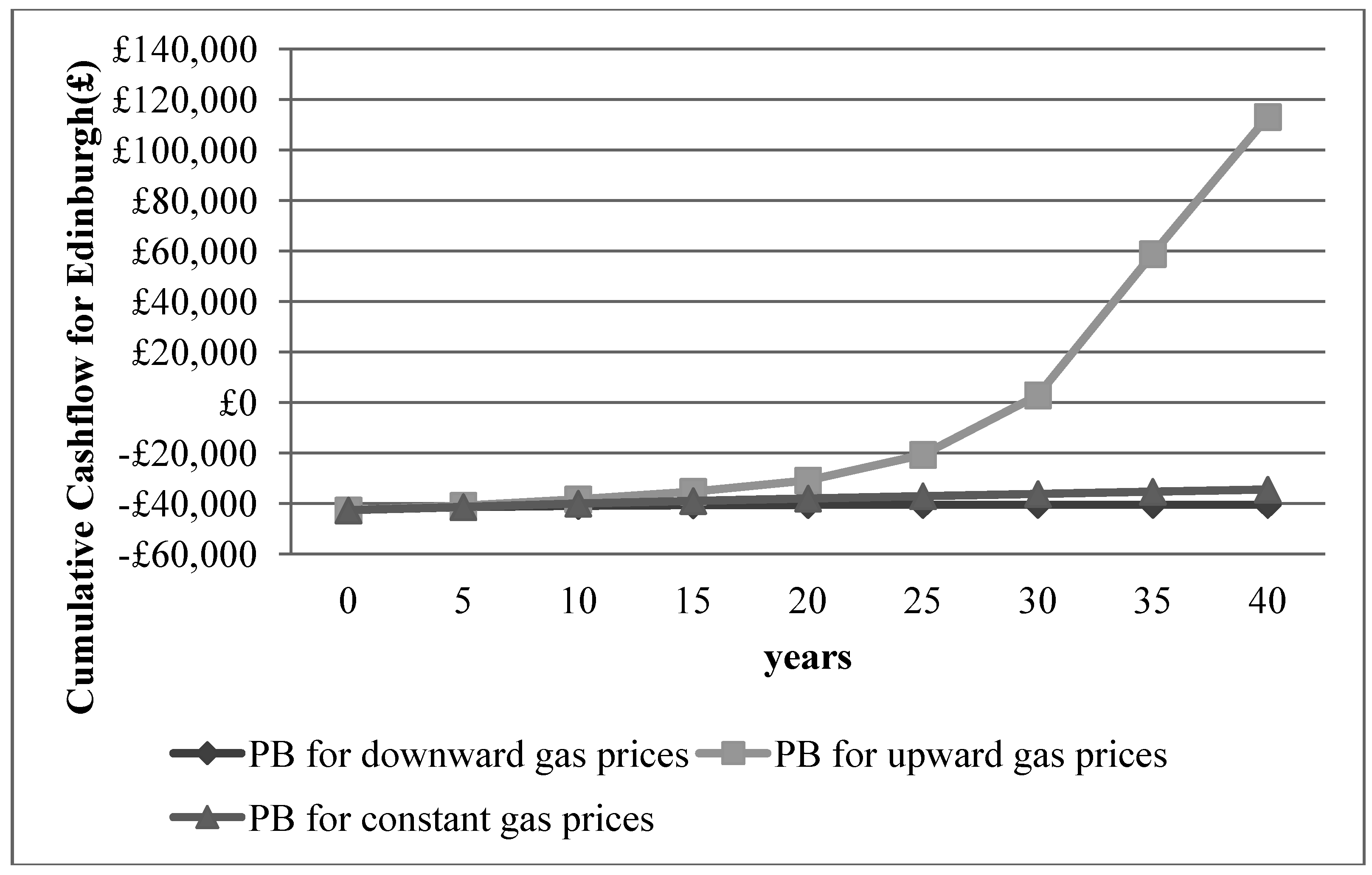
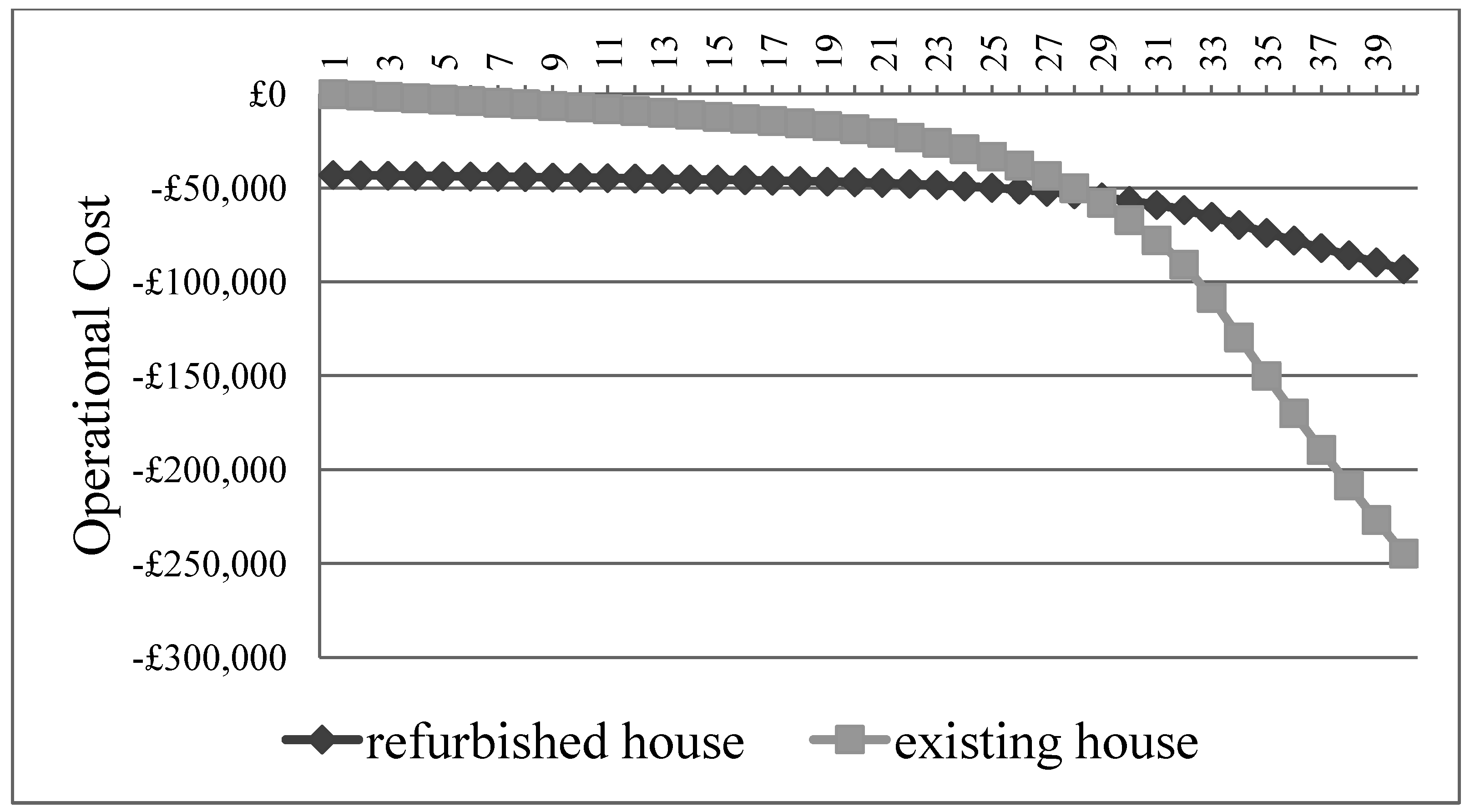
          <p>Comparison of net present value cash flow of the refurbished house for different gas price trends for Edinburgh weather data can be seen in <xref ref-type="fig" rid="buildings-03-00220-f021">Figure 21</xref>. <xref ref-type="fig" rid="buildings-03-00220-f022">Figure 22</xref> shows that for this case the time needed to recover the construction cost of refurbishing to near Passivhaus standards is 28 years and, as a result, a positive impact on the annual budget will happen after 28 years. </p>
          <fig id="buildings-03-00220-f021" position="float">
            <label>Figure 21</label>
            <caption>
              <p>Cumulative cash flow of the refurbished house for current and future Edinburgh weather data over 40 years for different gas price trends.</p>
            </caption>
            <graphic xmlns:xlink="http://www.w3.org/1999/xlink" xlink:href="buildings-03-00220-g021.tif"/>
          </fig>
          <fig id="buildings-03-00220-f022" position="float">
            <label>Figure 22</label>
            <caption>
              <p>Comparison of the pre and post refurbished house’s cumulative discounted operational costs for Edinburgh current and future weather data over 40 years imposing an upward gas price trend.</p>
            </caption>
            <graphic xmlns:xlink="http://www.w3.org/1999/xlink" xlink:href="buildings-03-00220-g022.tif"/>
          </fig>
        </sec>
      </sec>
    </sec>
    <sec sec-type="conclusions">
      <title>4. Conclusions</title>
      <p>This analysis of a 19th century terraced house refurbished to near Passivhaus standards has been divided into two stages: first, the energy consumption and CO<sub>2</sub> emission were determined and, second, a cost analysis of the construction type (improving the glazing type, wall and loft insulation) was undertaken. In the first step, applying all strategies were studied to determine the possibility of reaching an 80% emissions reduction by eco-refurbishment. Results indicate that energy demands and CO<sub>2</sub> emissions experience a sharp decline following eco-refurbishment. Comparing the cost of this type of refurbishment shows that the most efficient measures are also the most costly ones as well. Accordingly, based on the different future gas prices, energy costs were calculated for the house in different cities. From the second stage of this study, it can be concluded that the payback time and WLCC of this type of refurbishment is very dependent on the growth of the energy prices and that energy prices are unpredictable. The most favorable energy bill savings occurred by imposing the rising prices - this gave a payback time of less than 30 years for all cities. </p>
    </sec>
    
  </body>
  <back><ack>
      <title>Acknowledgments</title>
      <p>This paper builds on work carried out as part of TSB’s <italic>Retrofit for the Future</italic> programme. Martin Gladwin, project leader at the Plus Dane Group for the terraced house refurbishment, kindly shared his experiences and monitored data, and the authors gratefully acknowledge his support,</p>
    </ack>
    <notes>
      <title>Conflict of Interest</title>
      <p>The authors declare no conflict of interest.</p>
    </notes>
    <ref-list>
      <title>References</title>
      <ref id="B1-buildings-03-00220">
        <label>1.</label>
        <citation citation-type="web">
          <article-title>Building a Greener Britain</article-title>
          
          <comment>Available online:<ext-link xmlns:xlink="http://www.w3.org/1999/xlink" xlink:href="http://www.fmb.org.uk/news/campaigns/building-a-greener-britain/" ext-link-type="uri">http://www.fmb.org.uk/news/campaigns/building-a-greener-britain/</ext-link></comment>
		  <access-date>(accessed on 11 November 2012)</access-date>
        </citation>
      </ref>
      <ref id="B2-buildings-03-00220">
        <label>2.</label>
        <citation citation-type="web">
          <article-title>Department of Energy and Climate Change</article-title>
          
          <comment>Available online:<ext-link xmlns:xlink="http://www.w3.org/1999/xlink" xlink:href="http://www.decc.gov.uk/assets/decc/What%20we%20do/A%20low%20carbon%20UK/1358-the-carbon-plan.pdf" ext-link-type="uri">http://www.decc.gov.uk/assets/decc/What%20we%20do/A%20low%20carbon%20UK/1358-the-carbon-plan.pdf</ext-link></comment>
		  <access-date>(accessed on 11 November 2012)</access-date>
        </citation>
      </ref>
      <ref id="B3-buildings-03-00220">
        <label>3.</label>
        <citation citation-type="web">
          <article-title>PASSIVHAUS</article-title>
          
          <comment>Available online:<ext-link xmlns:xlink="http://www.w3.org/1999/xlink" xlink:href="http://www.passivhaus.org.uk/standard.jsp?id=122" ext-link-type="uri">http://www.passivhaus.org.uk/standard.jsp?id=122</ext-link></comment>
		  <access-date>(accessed on 31 October 2012)</access-date>
        </citation>
      </ref>
      <ref id="B4-buildings-03-00220">
        <label>4.</label>
        <citation citation-type="web">
          <article-title>AECB, Carbon Lite</article-title>
          
          <comment>Available online:<ext-link xmlns:xlink="http://www.w3.org/1999/xlink" xlink:href="http://www.carbonlite.org.uk/carbonlite/passivhaus.php" ext-link-type="uri">http://www.carbonlite.org.uk/carbonlite/passivhaus.php</ext-link></comment>
		  <access-date>(accessed on 31 October 2012)</access-date>
        </citation>
      </ref>
      <ref id="B5-buildings-03-00220">
        <label>5.</label>
        <citation citation-type="web">
          <article-title>Trafford Eco House</article-title>
          
          <comment>Available online:<ext-link xmlns:xlink="http://www.w3.org/1999/xlink" xlink:href="http://traffordecohouse.wordpress.com/2009/01/03/a-passivhaus-passive-house-renovation/" ext-link-type="uri">http://traffordecohouse.wordpress.com/2009/01/03/a-passivhaus-passive-house-renovation/</ext-link></comment>
		  <access-date>(accessed on 19 September 2012)</access-date>
        </citation>
      </ref>
      <ref id="B6-buildings-03-00220">
        <label>6.</label>
        <citation citation-type="web">
          <article-title>Technology Strategy Board</article-title>
          
          <comment>Available online:<ext-link xmlns:xlink="http://www.w3.org/1999/xlink" xlink:href="http://www.innovateuk.org/ourstrategy/innovationplatforms/lowimpactbuilding/retrofit-.ashx" ext-link-type="uri">http://www.innovateuk.org/ourstrategy/innovationplatforms/lowimpactbuilding/retrofit-.ashx</ext-link></comment>
		  <access-date>(accessed on 11 November 2012)</access-date>
        </citation>
      </ref>
      <ref id="B7-buildings-03-00220">
        <label>7.</label>
        <citation citation-type="web">
          <article-title>Plus Dane Group</article-title>
          
          <comment>Available online:<ext-link xmlns:xlink="http://www.w3.org/1999/xlink" xlink:href="http://www.plusgroupltd.org.uk/article.asp?id=389" ext-link-type="uri">http://www.plusgroupltd.org.uk/article.asp?id=389</ext-link></comment>
		  <access-date>(accessed on 25 September 2012)</access-date>
        </citation>
      </ref>
      <ref id="B8-buildings-03-00220">
        <label>8.</label>
        <citation citation-type="web">
          <person-group person-group-type="author">
            <name>
              <surname>Bonfield</surname>
              <given-names>P.</given-names>
            </name>
          </person-group>
          <article-title>Rising to the refurbishment challenge</article-title>
          <source>Green Build</source>
          <day>4</day>
          <month>July</month>
          <year>2012</year>
          
          <comment>Available online:<ext-link xmlns:xlink="http://www.w3.org/1999/xlink" xlink:href="http://www.environmentmagazine.co.uk/features/green-build/760-rising-to-the-refurbishment-challenge" ext-link-type="uri">http://www.environmentmagazine.co.uk/features/green-build/760-rising-to-the-refurbishment-challenge</ext-link></comment>
		  <access-date>(accessed on 25 September 2012)</access-date>
        </citation>
      </ref>
      <ref id="B9-buildings-03-00220">
        <label>9.</label>
        <citation citation-type="web">
          <article-title>Appendix S: Reduced Data SAP for existing dwellings</article-title>
          
          <comment>Available online:<ext-link xmlns:xlink="http://www.w3.org/1999/xlink" xlink:href="http://www.bre.co.uk/filelibrary/accreditation/scheme_standards/SAP_2009_9-91_Appendix_S_January_2012.pdf" ext-link-type="uri">http://www.bre.co.uk/filelibrary/accreditation/scheme_standards/SAP_2009_9-91_Appendix_S_January_2012.pdf</ext-link></comment>
		  <access-date>(accessed on 18 December 2012)</access-date>
        </citation>
      </ref>
      <ref id="B10-buildings-03-00220">
        <label>10.</label>
        <citation citation-type="web">
          <article-title>Low Energy Building Database</article-title>
          
          <comment>Available online:<ext-link xmlns:xlink="http://www.w3.org/1999/xlink" xlink:href="http://retrofitforthefuture.org/projectPDF.php?id=77" ext-link-type="uri">http://retrofitforthefuture.org/projectPDF.php?id=77</ext-link></comment>
		  <access-date>(accessed on 18 December 2012)</access-date>
        </citation>
      </ref>
      <ref id="B11-buildings-03-00220">
        <label>11.</label>
        <citation citation-type="gov">
		<collab>IPCC (Intergovernmental Panel on Climate Change)</collab>
          <source>The Physical Science Basis: Contribution of Working Group I 2007</source>
          <publisher-name>Cambridge University Press</publisher-name>
          <publisher-loc>Cambridge, UK</publisher-loc>
          <year>2007</year>
        </citation>
      </ref>
      <ref id="B12-buildings-03-00220">
        <label>12.</label>
        <citation citation-type="web">
          <article-title>University of Southampton, Sustainable Energy Research Group</article-title>
          
          <comment>Available online:<ext-link xmlns:xlink="http://www.w3.org/1999/xlink" xlink:href="http://www.serg.soton.ac.uk/ccweathergen/" ext-link-type="uri">http://www.serg.soton.ac.uk/ccweathergen/</ext-link></comment>
		  <access-date>(accessed on 19 September 2012)</access-date>
        </citation>
      </ref>
      <ref id="B13-buildings-03-00220">
        <label>13.</label>
        <citation citation-type="journal">
          <person-group person-group-type="author">
            <name>
              <surname>Eames</surname>
              <given-names>M.</given-names>
            </name>
            <name>
              <surname>Kershaw</surname>
              <given-names>T.</given-names>
            </name>
            <name>
              <surname>Coley</surname>
              <given-names>D.</given-names>
            </name>
          </person-group>
          <article-title>On the creation of future probabilistic design weather years from UKCP09</article-title>
          <source>Build. Serv. Eng.</source>
          <year>2010</year>
          <volume>32</volume>
          <fpage>127</fpage>
          <lpage>142</lpage>
          <pub-id pub-id-type="doi">10.1177/0143624410379934</pub-id>
        </citation>
      </ref>
      <ref id="B14-buildings-03-00220">
        <label>14.</label>
        <citation citation-type="web">
		<collab>ISO (International Organization for Standardization)</collab>
          <article-title>Task Group 4: Life Cycle Costs in Construction</article-title>
          <source>LCC as a contribution to sustainable construction—Final</source>
          <publisher-name>David Langdon Management Consulting</publisher-name>
          <publisher-loc>London, UK</publisher-loc>
          <year>2003</year>
          
          <comment>Available online:<ext-link xmlns:xlink="http://www.w3.org/1999/xlink" xlink:href="www.ceetb.eu/docs/Reports/LCC FINAL REPORT-2.pdf" ext-link-type="uri">www.ceetb.eu/docs/Reports/LCC FINAL REPORT-2.pdf</ext-link></comment>
		  <access-date>(accessed on 15 February 2013)</access-date>
        </citation>
      </ref>
      <ref id="B15-buildings-03-00220">
        <label>15.</label>
        <citation citation-type="confproc">
          <person-group person-group-type="author">
            <name>
              <surname>Sodagar</surname>
              <given-names>B.</given-names>
            </name>
            <name>
              <surname>Rai</surname>
              <given-names>D.</given-names>
            </name>
            <name>
              <surname>Murphy</surname>
              <given-names>J.</given-names>
            </name>
            <name>
              <surname>Altan</surname>
              <given-names>H.</given-names>
            </name>
          </person-group>
          <article-title>The role of eco-refurbishment in sustainable construction and built environment</article-title>
          <source>Proceedings of the 3rd CIB International Conference on Smart and Sustainable Built Environments</source>
          <conf-loc>Delft, The Netherlands</conf-loc>
          <conf-date>15–19 June 2009</conf-date>
        </citation>
      </ref>
      <ref id="B16-buildings-03-00220">
        <label>16.</label>
        <citation citation-type="web">
          <person-group person-group-type="author">
            <name>
              <surname>Bolton</surname>
              <given-names>P.</given-names>
            </name>
          </person-group>
          <article-title>Energy Price Rises and Their Impact on Demand—Commons Library Standard Note</article-title>
          
          <comment>Available online:<ext-link xmlns:xlink="http://www.w3.org/1999/xlink" xlink:href="http://www.parliament.uk/briefing-papers/SN04850" ext-link-type="uri">http://www.parliament.uk/briefing-papers/SN04850</ext-link></comment>
		  <access-date>(accessed on 19 September 2012)</access-date>
        </citation>
      </ref>
      <ref id="B17-buildings-03-00220">
        <label>17.</label>
        <citation citation-type="web">
          <article-title>Friends of the Earth</article-title>
          
          <comment>Available online:<ext-link xmlns:xlink="http://www.w3.org/1999/xlink" xlink:href="http://www.foe.co.uk/resource/briefings/gas_price_briefing.pdf" ext-link-type="uri">http://www.foe.co.uk/resource/briefings/gas_price_briefing.pdf</ext-link></comment>
		  <access-date>(accessed on 19 September 2012)</access-date>
        </citation>
      </ref>
      <ref id="B18-buildings-03-00220">
        <label>18.</label>
        <citation citation-type="book">
          <person-group person-group-type="author">
            <name>
              <surname>Ellingham</surname>
              <given-names>I.</given-names>
            </name>
            <name>
              <surname>Fawcett</surname>
              <given-names>W.</given-names>
            </name>
          </person-group>
          <article-title>The option to refurbish</article-title>
          <source>New Generation of Whole-Life Costing: Property and Construction Decision-Making under Uncertainty</source>
          <publisher-name>Taylor &amp; Francis</publisher-name>
          <publisher-loc>New York, NY, USA</publisher-loc>
          <year>2006</year>
          <fpage>140</fpage>
          <lpage>141</lpage>
        </citation>
      </ref>
      <ref id="B19-buildings-03-00220">
        <label>19.</label>
        <citation citation-type="web">
          <article-title>DECC (Department of Energy and Climate Change)</article-title>
          
          <comment>Available online:<ext-link xmlns:xlink="http://www.w3.org/1999/xlink" xlink:href="http://www.decc.gov.uk/en/content/cms/statistics/energy_stats/prices/prices.aspx" ext-link-type="uri">http://www.decc.gov.uk/en/content/cms/statistics/energy_stats/prices/prices.aspx</ext-link></comment>
		  <access-date>(accessed on 19 September 2012)</access-date>
        </citation>
      </ref>
      <ref id="B20-buildings-03-00220">
        <label>20.</label>
        <citation citation-type="web">
          <person-group person-group-type="author">
            <name>
              <surname>Hanton</surname>
              <given-names>A.</given-names>
            </name>
          </person-group>
          <article-title>Small Number with Surprisingly Large Consequences—Why the Government Choice of Discount Rate Should Interest Everyone</article-title>
          
          <comment>Available online:<ext-link xmlns:xlink="http://www.w3.org/1999/xlink" xlink:href="http://www.storage.co.uk/downloads/a-small-number.pdf" ext-link-type="uri">http://www.storage.co.uk/downloads/a-small-number.pdf</ext-link></comment>
		  <access-date>(accessed on 10 Aug 2012)</access-date>
        </citation>
      </ref>
      <ref id="B21-buildings-03-00220">
        <label>21.</label>
        <citation citation-type="web">
          <article-title>Green Book</article-title>
          
          <comment>Available online:<ext-link xmlns:xlink="http://www.w3.org/1999/xlink" xlink:href="http://www.hm-treasury.gov.uk/d/green_book_complete.pdf" ext-link-type="uri">http://www.hm-treasury.gov.uk/d/green_book_complete.pdf</ext-link></comment>
		  <access-date>(accessed on 19 September 2012)</access-date>
        </citation>
      </ref>
    </ref-list>
  </back>
</article>