<?xml version="1.0" encoding="UTF-8"?>
<!DOCTYPE article PUBLIC "-//NLM//DTD Journal Publishing DTD v2.3 20070202//EN" "journalpublishing.dtd">
<article xmlns:mml="http://www.w3.org/1998/Math/MathML" xmlns:xlink="http://www.w3.org/1999/xlink" xml:lang="en" article-type="research-article">
  <front>
    <journal-meta>
      <journal-id journal-id-type="publisher-id">insects</journal-id>
      <journal-title>Insects</journal-title>
      <abbrev-journal-title abbrev-type="publisher">Insects</abbrev-journal-title>
      <abbrev-journal-title abbrev-type="pubmed">Insects</abbrev-journal-title>
      <issn pub-type="epub">2075-4450</issn>
      <publisher>
        <publisher-name>MDPI</publisher-name>
      </publisher>
    </journal-meta>
    <article-meta>
      <article-id pub-id-type="doi">10.3390/insects3010062</article-id>
      <article-id pub-id-type="publisher-id">insects-03-00062</article-id>
      <article-categories>
        <subj-group>
          <subject>Article</subject>
        </subj-group>
      </article-categories>
      <title-group>
        <article-title><italic>Reticulitermes nelsonae</italic>, a New Species of Subterranean Termite (Rhinotermitidae) from the Southeastern United States </article-title>

      </title-group>
      <contrib-group>
        <contrib contrib-type="author">
          <name>
            <surname>Lim</surname>
            <given-names>Su Yee</given-names>
          </name>
          <xref rid="c1-insects-03-00062" ref-type="corresp">*</xref>
        </contrib>
        <contrib contrib-type="author">
          <name>
            <surname>Forschler</surname>
            <given-names>Brian T.</given-names>
          </name>
        </contrib>
      </contrib-group>
      <aff id="af1-insects-03-00062">Household and Structural Entomology Laboratory, Department of Entomology, 413 Biosciences Building, 120 Cedar St., University of Georgia, Athens, GA 30602, USA; Email: <email>bfor@uga.edu</email></aff>
      <author-notes>
        <corresp id="c1-insects-03-00062"><label>*</label> Author to whom correspondence should be addressed; Email: <email>suyee03@gmail.com</email>; Tel.: +1-706-542-0078; Fax: +1-706-542-2279.</corresp>
      </author-notes>
      <pub-date pub-type="epub">
        <day>06</day>
        <month>01</month>
        <year>2012</year>
      </pub-date>
      <pub-date pub-type="collection">
        <month>03</month>
        <year>2012</year>
      </pub-date>
      <volume>3</volume>
      <issue>1</issue>
      <fpage>62</fpage>
      <lpage>90</lpage>
      <history>
        <date date-type="received">
          <day>02</day>
          <month>12</month>
          <year>2011</year>
        </date>
        <date date-type="rev-recd">
          <day>17</day>
          <month>12</month>
          <year>2011</year>
        </date>
        <date date-type="accepted">
          <day>31</day>
          <month>12</month>
          <year>2011</year>
        </date>
      </history>
      <permissions>
        <copyright-statement>© 2012 by the authors; licensee MDPI, Basel, Switzerland.</copyright-statement>
        <copyright-year>2012</copyright-year>
        <license xmlns:xlink="http://www.w3.org/1999/xlink" license-type="open-access" xlink:href="http://creativecommons.org/licenses/by/3.0/">
          <p>This article is an open-access article distributed under the terms and conditions of the Creative Commons Attribution license (http://creativecommons.org/licenses/by/3.0/).</p>
        </license>
      </permissions>
      <abstract>
        <p><italic>Reticulitermes nelsonae</italic>, a new species of Rhinotermitidae (Isoptera) is described based on specimens from Sapelo Island, GA, Thomasville, GA, Havelock, NC, and Branford, FL. Adult (alate) and soldier forms are described. Diagnostic characters are provided and incorporated into a supplemental couplet of a dichotomous key to the known species of <italic>Reticulitermes</italic> found in Georgia, USA.</p>
      </abstract>
      <kwd-group>
        <kwd>new species</kwd>
        <kwd>taxonomy</kwd>
        <kwd>phylogenetics</kwd>
        <kwd>morphometrics</kwd>
        <kwd>dichotomous key</kwd>
        <kwd>Isoptera</kwd>
        <kwd>Termitoidea</kwd>
      </kwd-group>
    </article-meta>
  </front>
  <body>
    <sec sec-type="intro">
      <title>1. Introduction</title>
      <p>Members of the family Rhinotermitidae, commonly known as “subterranean termites”, have a cryptic lifestyle making them difficult to study [<xref ref-type="bibr" rid="B1-insects-03-00062">1</xref>,<xref ref-type="bibr" rid="B2-insects-03-00062">2</xref>]. In the United States, the genus <italic>Reticulitermes</italic> includes several economically notorious species that cause billions of dollars in structural damage every year [<xref ref-type="bibr" rid="B3-insects-03-00062">3</xref>,<xref ref-type="bibr" rid="B4-insects-03-00062">4</xref>,<xref ref-type="bibr" rid="B5-insects-03-00062">5</xref>,<xref ref-type="bibr" rid="B6-insects-03-00062">6</xref>,<xref ref-type="bibr" rid="B7-insects-03-00062">7</xref>]. Proper identification is critical to understanding the economic and ecological importance of these insects [<xref ref-type="bibr" rid="B8-insects-03-00062">8</xref>,<xref ref-type="bibr" rid="B9-insects-03-00062">9</xref>], and although there are four described species of <italic>Reticulitermes</italic> endemic to the southeastern United States, the current keys only address three [<xref ref-type="bibr" rid="B10-insects-03-00062">10</xref>,<xref ref-type="bibr" rid="B11-insects-03-00062">11</xref>,<xref ref-type="bibr" rid="B12-insects-03-00062">12</xref>]. Proper identification is complicated by intraspecific morphological variation which is characteristic of this genus as demonstrated by the quantitative measures that provide overlapping ranges for a number of characters for species collected in the United States [<xref ref-type="bibr" rid="B13-insects-03-00062">13</xref>,<xref ref-type="bibr" rid="B14-insects-03-00062">14</xref>,<xref ref-type="bibr" rid="B15-insects-03-00062">15</xref>,<xref ref-type="bibr" rid="B16-insects-03-00062">16</xref>]. The greatest diversity of <italic>Reticulitermes</italic> in the USA is in the eastern states where authors have suggested the presence of additional species [<xref ref-type="bibr" rid="B16-insects-03-00062">16</xref>,<xref ref-type="bibr" rid="B17-insects-03-00062">17</xref>,<xref ref-type="bibr" rid="B18-insects-03-00062">18</xref>,<xref ref-type="bibr" rid="B19-insects-03-00062">19</xref>,<xref ref-type="bibr" rid="B20-insects-03-00062">20</xref>,<xref ref-type="bibr" rid="B21-insects-03-00062">21</xref>,<xref ref-type="bibr" rid="B22-insects-03-00062">22</xref>].</p>
      <p>Kollar (1837) [<xref ref-type="bibr" rid="B23-insects-03-00062">23</xref>] described the first extant member of the genus, <italic>R. flavipes</italic> from specimens found in Vienna, Austria, and this species was later found to be endemic to the eastern United States [<xref ref-type="bibr" rid="B10-insects-03-00062">10</xref>]. Three additional species were subsequently described from the eastern USA, including <italic>Reticulitermes (Termes) virginicus</italic> Banks 1907 [<xref ref-type="bibr" rid="B24-insects-03-00062">24</xref>], <italic>R. hageni</italic> Banks 1920 [<xref ref-type="bibr" rid="B10-insects-03-00062">10</xref>] and <italic>R. malletei</italic> Clément <italic>et al.</italic> 1986 [<xref ref-type="bibr" rid="B11-insects-03-00062">11</xref>]. Scheffrahn <italic>et al.</italic> (2001) [<xref ref-type="bibr" rid="B25-insects-03-00062">25</xref>] proposed that <italic>R. malletei</italic> was a <italic>nomen nudum </italic>yet Austin <italic>et al.</italic> (2007) [<xref ref-type="bibr" rid="B12-insects-03-00062">12</xref>] provided 16SrRNA sequence data and morphometrics supporting species status for <italic>R. malletei</italic> and showed that all nomenclatural requirements for the designation were met<italic>. Reticulitermes santonensis </italic>Feytaud 1924 [<xref ref-type="bibr" rid="B26-insects-03-00062">26</xref>] has been synonymized with <italic>R. flavipes</italic> [<xref ref-type="bibr" rid="B27-insects-03-00062">27</xref>,<xref ref-type="bibr" rid="B28-insects-03-00062">28</xref>]. <xref ref-type="table" rid="insects-03-00062-t001">Table 1</xref> summarizes the taxonomic literature on <italic>Reticulitermes</italic> that mention the species endemic to the southeastern USA.</p>
      <p>Herewith we provide a formal description for a new species collected in the southeastern USA, with diagnostic morphological characters and genetic corroboration. We also identify specific quantifiable morphological characters in combination with selected qualitative characters that are included in dichotomous keys to the soldier and alate of <italic>Reticulitermes</italic> species found in Georgia, USA.</p>
      <table-wrap id="insects-03-00062-t001" position="anchor">
        <object-id pub-id-type="pii">insects-03-00062-t001_Table 1</object-id>
        <label>Table 1</label>
        <caption>
          <p>Summary of taxonomic literature that provide morphology and life history information on <italic>Reticulitermes</italic> spp. found in the southeastern United States, parenthetical letters are defined as follows: a = alate, s = soldier, species abbreviations are defined as follows: Rf = <italic>R. flavipes</italic>, Rv = <italic>R. virginicus</italic>, Rh = <italic>R. hageni</italic>, Rm = <italic>R. malletei</italic>, Ra = <italic>R. arenincola</italic>, Rhp = <italic>R. hesperus</italic>, Rt = <italic>R. tibialis</italic>. </p>
        </caption>
        <table rules="rows">
          <thead>
            <tr>
              <th align="left" valign="middle">Reference citation</th>
              <th align="left" valign="middle">Caste, notes</th>
              <th align="left" valign="middle">Pages</th>
              <th align="left" valign="middle">Species from USA</th>
            </tr>
          </thead>
          <tbody>
            <tr>
              <td align="left" valign="middle">Banks, N. &amp; Snyder, T.E. (1920)</td>
              <td align="left" valign="middle">(a, s) descriptions, illustrations, key, flight times</td>
              <td align="left" valign="middle">42–47, 148–164</td>
              <td align="left" valign="middle">Rf, Rv, Rh, Rhp, Rt</td>
            </tr>
            <tr>
              <td align="left" valign="middle">Goellner, E. J. (1931)</td>
              <td align="left" valign="middle">(a, s) descriptions, illustrations, ecology</td>
              <td align="left" valign="middle">227–234</td>
              <td align="left" valign="middle">Rf, Rt, Ra</td>
            </tr>
            <tr>
              <td align="left" valign="middle">Kofoid, C.A. (1934)</td>
              <td align="left" valign="middle">(a), descriptions, flight times</td>
              <td align="left" valign="middle">193–194</td>
              <td align="left" valign="middle">Rf, Rv, Rh, Ra, Rhp, Rt</td>
            </tr>
            <tr>
              <td align="left" valign="middle">Miller, E.M. &amp; Miller, D.B. (1943)</td>
              <td align="left" valign="middle">(a, s) descriptions, illustrations, flight times</td>
              <td align="left" valign="middle">101–107</td>
              <td align="left" valign="middle">Rf, Rv, Rh</td>
            </tr>
            <tr>
              <td align="left" valign="middle">Banks, F.A. (1946)</td>
              <td align="left" valign="middle">(a, s) descriptions, illustrations, key, flight times</td>
              <td align="left" valign="middle">1–29</td>
              <td align="left" valign="middle">Rf, Rv, Ra, Rt</td>
            </tr>
            <tr>
              <td align="left" valign="middle">Miller E.M. (1949)</td>
              <td align="left" valign="middle">(a, s) descriptions, illustrations, key, flight times</td>
              <td align="left" valign="middle">6–7, 14–15, 20–22, 26</td>
              <td align="left" valign="middle">Rf, Rv, Rh</td>
            </tr>
            <tr>
              <td align="left" valign="middle">Snyder, T.E. (1954)</td>
              <td align="left" valign="middle">(a, s) descriptions, illustrations, key, flight times</td>
              <td align="left" valign="middle">26, 51–56</td>
              <td align="left" valign="middle">Rf, Rv, Rh, Ra</td>
            </tr>
            <tr>
              <td align="left" valign="middle">Miller E. M. (1964)</td>
              <td align="left" valign="middle">(a) flight times</td>
              <td align="left" valign="middle">5, 16</td>
              <td align="left" valign="middle">Rf, Rv, Rh</td>
            </tr>
            <tr>
              <td align="left" valign="middle">Weesner, F.M. (1965)</td>
              <td align="left" valign="middle">(a) descriptions, illustrations, key, flight times</td>
              <td align="left" valign="middle">36–44, 51</td>
              <td align="left" valign="middle">Rf, Rv, Rh, Ra, Rhp, Rt</td>
            </tr>
            <tr>
              <td align="left" valign="middle">Clément, J.L., Howard, R., Blum, M. &amp; Lloyd, H. (1986)</td>
              <td align="left" valign="middle">(a, s) descriptions, life history</td>
              <td align="left" valign="middle">67–70</td>
              <td align="left" valign="middle">Rf, Rv, Rh, Rm</td>
            </tr>
            <tr>
              <td align="left" valign="middle">Nutting, W.L. (1990)</td>
              <td align="left" valign="middle">(a, s) descriptions, illustrations, key, flight times</td>
              <td align="left" valign="middle">997–1030</td>
              <td align="left" valign="middle">Rf, Rv, Rh, Ra, Rhp, Rt</td>
            </tr>
            <tr>
              <td align="left" valign="middle">Scheffrahn RH, Su N-Y. (1994)</td>
              <td align="left" valign="middle">(a, s) descriptions, illustrations, key, flight times</td>
              <td align="left" valign="middle">465–473</td>
              <td align="left" valign="middle">Rf, Rv, Rh</td>
            </tr>
            <tr>
              <td align="left" valign="middle">Hostettler, N.C., Hall, D.W. &amp; Scheffrahn, R.H. (1995)</td>
              <td align="left" valign="middle">(s) descriptions, photographs</td>
              <td align="left" valign="middle">119–129</td>
              <td align="left" valign="middle">Rf, Rv, Rh</td>
            </tr>
            <tr>
              <td align="left" valign="middle">Ye, W., Lee, C.-Y., Scheffrahn, R.H., Aleong, J.M., Su, N.-Y., Bennett, G.W., Scharf, M.E., (2004)</td>
              <td align="left" valign="middle">(s) descriptions, photographs</td>
              <td align="left" valign="middle">815–822</td>
              <td align="left" valign="middle">Rf, Rv, Rh, Ra</td>
            </tr>
            <tr>
              <td align="left" valign="middle">Brown, K., Kard, B. &amp; Payton, M. (2005)</td>
              <td align="left" valign="middle">(a, s) descriptions, photograph</td>
              <td align="left" valign="middle">277–284</td>
              <td align="left" valign="middle">Rf, Rv, Rh</td>
            </tr>
            <tr>
              <td align="left" valign="middle">Austin, J.W., Bagnères, A.-G., Szalanski, A.L., Scheffrahn, R.H., Heintschel, B.P., Messenger, M.T., Clement, J.-L. &amp; Gold, R.E. (2007)</td>
              <td align="left" valign="middle">(a, s) descriptions, illustrations, photographs, flight times</td>
              <td align="left" valign="middle">1–26</td>
              <td align="left" valign="middle">Rf, Rv, Rh, Rm, Ra, Rhp, Rt</td>
            </tr>
            <tr>
              <td align="left" valign="middle">Wang, C., Zhou, X., Li, S., Schwinghammer, M., Scharf, M., Buczkowski, G. &amp; Bennett, G. (2009)</td>
              <td align="left" valign="middle">(a, s) descriptions, key, photographs</td>
              <td align="left" valign="middle">1029–1036</td>
              <td align="left" valign="middle">Rf, Rv, Rh, Ra, Rt</td>
            </tr>
          </tbody>
        </table>
      </table-wrap>
    </sec>
    <sec>
      <title>2. Materials and Methods</title>
      <sec>
        <title>2.1. Specimens</title>
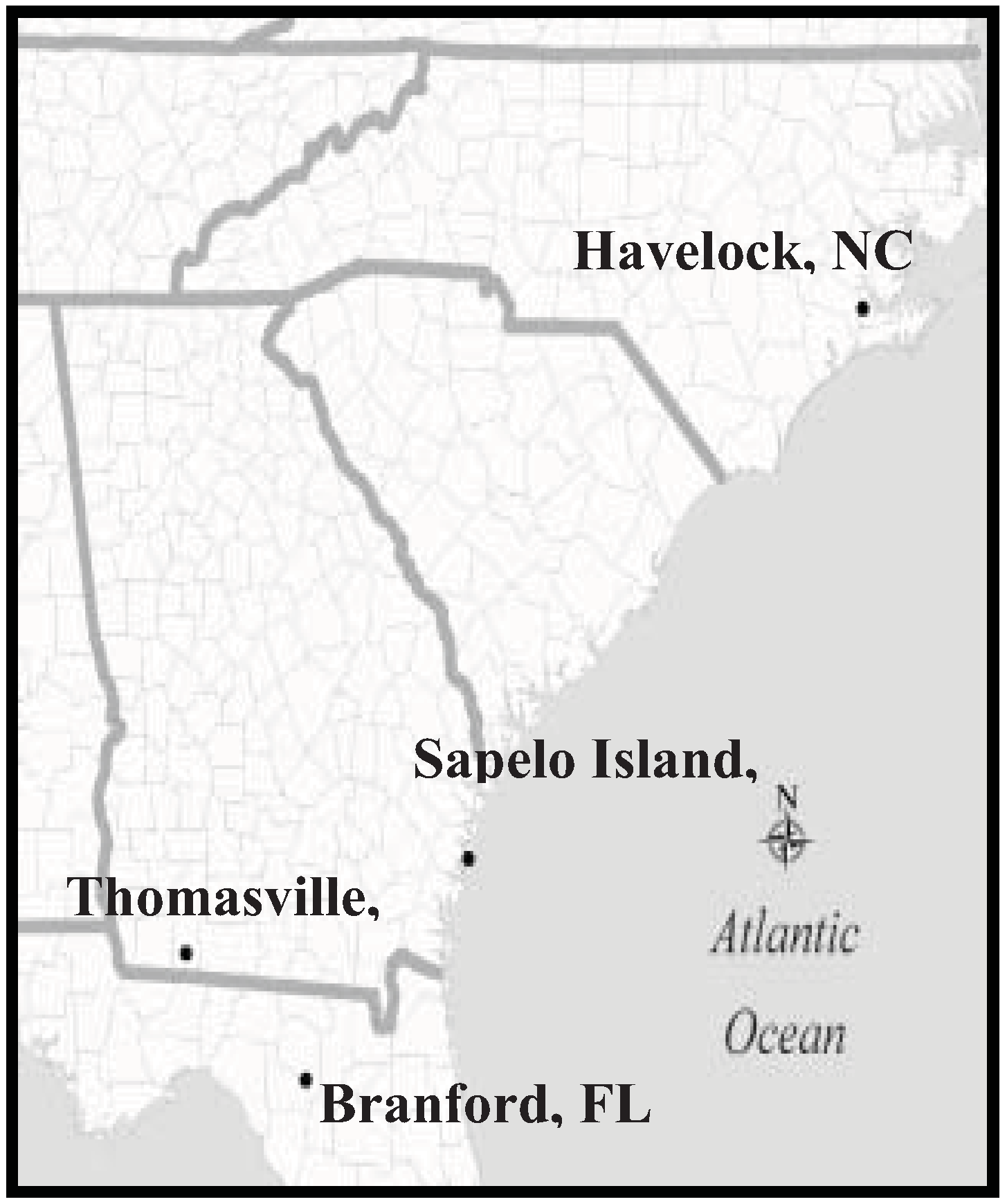
        <p>The morphological data for the new species were obtained from 96 soldiers, 141 alates, and 20 soldier mandible pairs. The number of soldier and alate specimens examined for the four previously described species ranged from 32 to 431 [<xref ref-type="bibr" rid="B29-insects-03-00062">29</xref>]. Genetic data for the new species were obtained from 156 specimens collected from Sapelo Island, GA (McIntosh Co.), Thomasville, GA (Thomas Co.), Havelock, NC (Craven Co.) and Branford, FL (Suwannee Co.).</p>
        <p>All specimens were preserved in 70–100% ethanol. The number of specimens examined and collection information for the new species description are listed in <xref ref-type="table" rid="insects-03-00062-t002">Table 2</xref>.</p>
        <table-wrap id="insects-03-00062-t002" position="anchor">
          <object-id pub-id-type="pii">insects-03-00062-t002_Table 2</object-id>
          <label>Table 2</label>
          <caption>
            <p>Collection information by site number, county (McIntosh Co. = Sapelo Island, Thomas Co. = Thomasville), sample size, and collection date by caste (s = soldier, a = alate) for specimens of <italic>R. nelsonae</italic> used for morphological measurements.</p>
          </caption>
          <table>
            <tbody>
              <tr>
                <td colspan="4" align="left" valign="middle">
                  <bold>Soldier</bold>
                </td>
              </tr>
              <tr style="border-top: solid thin; border-bottom: solid thin">
                <td align="center" valign="middle">
                  <bold>Site ID</bold>
                </td>
                <td align="center" valign="middle">
                  <bold>County</bold>
                </td>
                <td align="center" valign="middle">
                  <bold>Sample Size</bold>
                </td>
                <td align="center" valign="middle">
                  <bold>Collection Date</bold>
                </td>
              </tr>
              <tr>
                <td align="center" valign="middle">Site 1s</td>
                <td align="center" valign="middle">McIntosh Co.</td>
                <td align="center" valign="middle">7</td>
                <td align="center" valign="middle">Nov 2007</td>
              </tr>
              <tr>
                <td align="center" valign="middle">Site 2s</td>
                <td align="center" valign="middle">McIntosh Co.</td>
                <td align="center" valign="middle">16</td>
                <td align="center" valign="middle">Feb 2007</td>
              </tr>
              <tr>
                <td align="center" valign="middle">Site 3s</td>
                <td align="center" valign="middle">McIntosh Co.</td>
                <td align="center" valign="middle">9</td>
                <td align="center" valign="middle">Feb 2007</td>
              </tr>
              <tr>
                <td align="center" valign="middle">Site 4s</td>
                <td align="center" valign="middle">McIntosh Co.</td>
                <td align="center" valign="middle">2</td>
                <td align="center" valign="middle">Feb 2007</td>
              </tr>
              <tr>
                <td align="center" valign="middle">Site 5s</td>
                <td align="center" valign="middle">McIntosh Co.</td>
                <td align="center" valign="middle">3</td>
                <td align="center" valign="middle">Feb 2007</td>
              </tr>
              <tr>
                <td align="center" valign="middle">Site 6s</td>
                <td align="center" valign="middle">McIntosh Co.</td>
                <td align="center" valign="middle">4</td>
                <td align="center" valign="middle">Feb 2007</td>
              </tr>
              <tr>
                <td align="center" valign="middle">Site 7s</td>
                <td align="center" valign="middle">McIntosh Co.</td>
                <td align="center" valign="middle">11</td>
                <td align="center" valign="middle">Feb 2007</td>
              </tr>
              <tr>
                <td align="center" valign="middle">Site 8s</td>
                <td align="center" valign="middle">McIntosh Co.</td>
                <td align="center" valign="middle">2</td>
                <td align="center" valign="middle">Jul 2009</td>
              </tr>
              <tr>
                <td align="center" valign="middle">Site 9s</td>
                <td align="center" valign="middle">McIntosh Co.</td>
                <td align="center" valign="middle">1</td>
                <td align="center" valign="middle">Jul 2009</td>
              </tr>
              <tr>
                <td align="center" valign="middle">Site 10s</td>
                <td align="center" valign="middle">McIntosh Co.</td>
                <td align="center" valign="middle">2</td>
                <td align="center" valign="middle">Jul 2009</td>
              </tr>
              <tr>
                <td align="center" valign="middle">Site 11s</td>
                <td align="center" valign="middle">McIntosh Co.</td>
                <td align="center" valign="middle">2</td>
                <td align="center" valign="middle">Jul 2009</td>
              </tr>
              <tr>
                <td align="center" valign="middle">Site 12s</td>
                <td align="center" valign="middle">Thomas Co.</td>
                <td align="center" valign="middle">1</td>
                <td align="center" valign="middle">Nov 2009</td>
              </tr>
              <tr>
                <td align="center" valign="middle">Site 13s</td>
                <td align="center" valign="middle">Thomas Co.</td>
                <td align="center" valign="middle">2</td>
                <td align="center" valign="middle">Nov 2009</td>
              </tr>
              <tr>
                <td align="center" valign="middle">Site 14s</td>
                <td align="center" valign="middle">Thomas Co.</td>
                <td align="center" valign="middle">4</td>
                <td align="center" valign="middle">Nov 2009</td>
              </tr>
              <tr>
                <td align="center" valign="middle">Site 15s</td>
                <td align="center" valign="middle">Thomas Co.</td>
                <td align="center" valign="middle">1</td>
                <td align="center" valign="middle">Nov 2009</td>
              </tr>
              <tr>
                <td align="center" valign="middle">Site 16s</td>
                <td align="center" valign="middle">Thomas Co.</td>
                <td align="center" valign="middle">2</td>
                <td align="center" valign="middle">Nov 2009</td>
              </tr>
              <tr>
                <td align="center" valign="middle">Site 17s</td>
                <td align="center" valign="middle">Thomas Co.</td>
                <td align="center" valign="middle">1</td>
                <td align="center" valign="middle">Nov 2009</td>
              </tr>
              <tr>
                <td align="center" valign="middle">Site 18s</td>
                <td align="center" valign="middle">Thomas Co.</td>
                <td align="center" valign="middle">2</td>
                <td align="center" valign="middle">Nov 2009</td>
              </tr>
              <tr>
                <td align="center" valign="middle">Site 19s</td>
                <td align="center" valign="middle">Thomas Co.</td>
                <td align="center" valign="middle">1</td>
                <td align="center" valign="middle">Nov 2009</td>
              </tr>
              <tr>
                <td align="center" valign="middle">Site 20s</td>
                <td align="center" valign="middle">Thomas Co.</td>
                <td align="center" valign="middle">2</td>
                <td align="center" valign="middle">Nov 2009</td>
              </tr>
              <tr>
                <td align="center" valign="middle">Site 21s</td>
                <td align="center" valign="middle">Thomas Co.</td>
                <td align="center" valign="middle">2</td>
                <td align="center" valign="middle">Nov 2009</td>
              </tr>
              <tr>
                <td align="center" valign="middle">Site 22s</td>
                <td align="center" valign="middle">Thomas Co.</td>
                <td align="center" valign="middle">1</td>
                <td align="center" valign="middle">Nov 2009</td>
              </tr>
              <tr>
                <td align="center" valign="middle">Site 23s</td>
                <td align="center" valign="middle">Thomas Co.</td>
                <td align="center" valign="middle">1</td>
                <td align="center" valign="middle">Nov 2009</td>
              </tr>
              <tr>
                <td align="center" valign="middle">Site 24s</td>
                <td align="center" valign="middle">Thomas Co.</td>
                <td align="center" valign="middle">1</td>
                <td align="center" valign="middle">Nov 2009</td>
              </tr>
              <tr>
                <td align="center" valign="middle">Site 25s</td>
                <td align="center" valign="middle">Thomas Co.</td>
                <td align="center" valign="middle">1</td>
                <td align="center" valign="middle">Nov 2009</td>
              </tr>
              <tr>
                <td align="center" valign="middle">Site 26s</td>
                <td align="center" valign="middle">Thomas Co.</td>
                <td align="center" valign="middle">1</td>
                <td align="center" valign="middle">Nov 2009</td>
              </tr>
              <tr>
                <td align="center" valign="middle">Site 27s</td>
                <td align="center" valign="middle">Thomas Co.</td>
                <td align="center" valign="middle">2</td>
                <td align="center" valign="middle">Nov 2009</td>
              </tr>
              <tr>
                <td align="center" valign="middle">Site 28s</td>
                <td align="center" valign="middle">Thomas Co.</td>
                <td align="center" valign="middle">3</td>
                <td align="center" valign="middle">Nov 2009</td>
              </tr>
              <tr>
                <td align="center" valign="middle">Site 29s</td>
                <td align="center" valign="middle">Thomas Co.</td>
                <td align="center" valign="middle">2</td>
                <td align="center" valign="middle">Nov 2009</td>
              </tr>
              <tr>
                <td align="center" valign="middle">Site 30s</td>
                <td align="center" valign="middle">Thomas Co.</td>
                <td align="center" valign="middle">2</td>
                <td align="center" valign="middle">Nov 2009</td>
              </tr>
              <tr>
                <td align="center" valign="middle">Site 31s</td>
                <td align="center" valign="middle">Thomas Co.</td>
                <td align="center" valign="middle">1</td>
                <td align="center" valign="middle">Nov 2009</td>
              </tr>
              <tr>
                <td align="center" valign="middle">Site 32s</td>
                <td align="center" valign="middle">Thomas Co.</td>
                <td align="center" valign="middle">1</td>
                <td align="center" valign="middle">Nov 2009</td>
              </tr>
              <tr>
                <td align="center" valign="middle">Site 33s</td>
                <td align="center" valign="middle">Thomas Co.</td>
                <td align="center" valign="middle">1</td>
                <td align="center" valign="middle">Jan 2010</td>
              </tr>
              <tr>
                <td align="center" valign="middle">Site 34s</td>
                <td align="center" valign="middle">Thomas Co.</td>
                <td align="center" valign="middle">1</td>
                <td align="center" valign="middle">Jan 2010</td>
              </tr>
              <tr>
                <td align="center" valign="middle">Site 35s</td>
                <td align="center" valign="middle">Thomas Co.</td>
                <td align="center" valign="middle">2</td>
                <td align="center" valign="middle">Mar 2010</td>
              </tr>
              <tr style="border-top: solid thin; border-bottom: solid thin">
                <td align="center" valign="middle">Total = 35</td>
                <td align="center" valign="middle"> </td>
                <td align="center" valign="middle">N = 96</td>
                <td align="center" valign="middle"> </td>
              </tr>
              <tr style="border-bottom: solid thin">
                <td colspan="4" align="left" valign="middle">
                  <bold>Alate</bold>
                </td>
              </tr>
              <tr>
                <td align="center" valign="middle">
                  <bold>Site ID</bold>
                </td>
                <td align="center" valign="middle">
                  <bold>County</bold>
                </td>
                <td align="center" valign="middle">
                  <bold>Sample Size</bold>
                </td>
                <td align="center" valign="middle">
                  <bold>Collection Date</bold>
                </td>
              </tr>
              <tr>
                <td align="center" valign="middle">Site 4a</td>
                <td align="center" valign="middle">McIntosh Co.</td>
                <td align="center" valign="middle">14</td>
                <td align="center" valign="middle">Feb 2007</td>
              </tr>
              <tr>
                <td align="center" valign="middle">Site 6a</td>
                <td align="center" valign="middle">McIntosh Co.</td>
                <td align="center" valign="middle"> 6</td>
                <td align="center" valign="middle">Feb 2007</td>
              </tr>
              <tr>
                <td align="center" valign="middle">Site 4a</td>
                <td align="center" valign="middle">McIntosh Co.</td>
                <td align="center" valign="middle">19</td>
                <td align="center" valign="middle">Mar 2007</td>
              </tr>
              <tr>
                <td align="center" valign="middle">Site 36a</td>
                <td align="center" valign="middle">McIntosh Co.</td>
                <td align="center" valign="middle">19</td>
                <td align="center" valign="middle">Mar 2007</td>
              </tr>
              <tr>
                <td align="center" valign="middle">Site 3a</td>
                <td align="center" valign="middle">McIntosh Co.</td>
                <td align="center" valign="middle"> 5</td>
                <td align="center" valign="middle">Feb 2007</td>
              </tr>
              <tr>
                <td align="center" valign="middle">Site 2a</td>
                <td align="center" valign="middle">McIntosh Co.</td>
                <td align="center" valign="middle">14</td>
                <td align="center" valign="middle">Feb 2007</td>
              </tr>
              <tr>
                <td align="center" valign="middle">Site 5a</td>
                <td align="center" valign="middle">McIntosh Co.</td>
                <td align="center" valign="middle"> 1</td>
                <td align="center" valign="middle">Feb 2007</td>
              </tr>
              <tr>
                <td align="center" valign="middle">Site 7a</td>
                <td align="center" valign="middle">McIntosh Co.</td>
                <td align="center" valign="middle">13</td>
                <td align="center" valign="middle">Feb 2007</td>
              </tr>
              <tr style="border-bottom: solid thin">
                <td align="center" valign="middle">Site 37a</td>
                <td align="center" valign="middle">McIntosh Co.</td>
                <td align="center" valign="middle">50</td>
                <td align="center" valign="middle">May 2005</td>
              </tr>
              <tr>
                <td align="center" valign="middle">Total = 9</td>
                <td align="center" valign="middle"> </td>
                <td align="center" valign="middle">N = 141</td>
                <td align="center" valign="middle"> </td>
              </tr>
            </tbody>
          </table>
        </table-wrap>
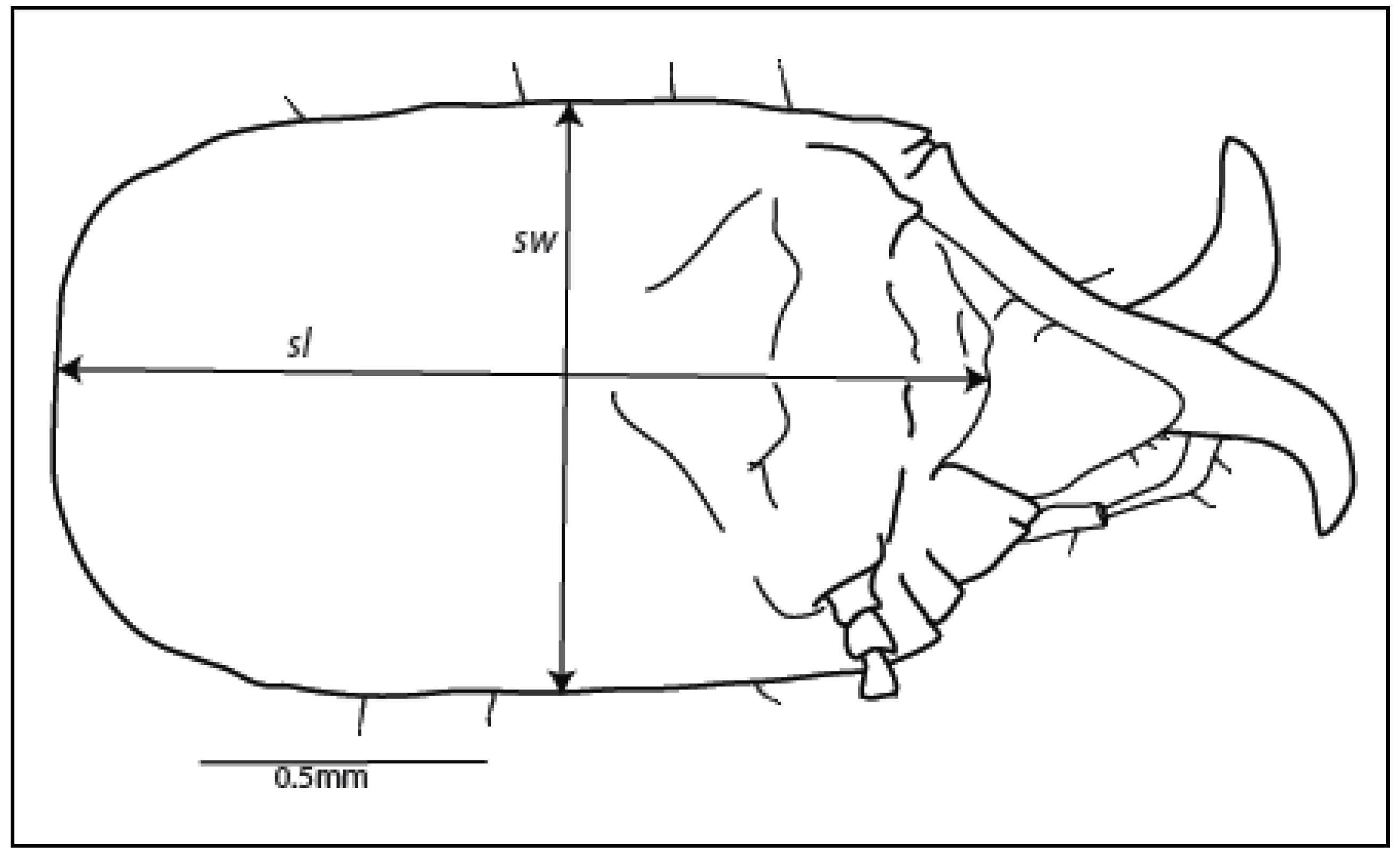
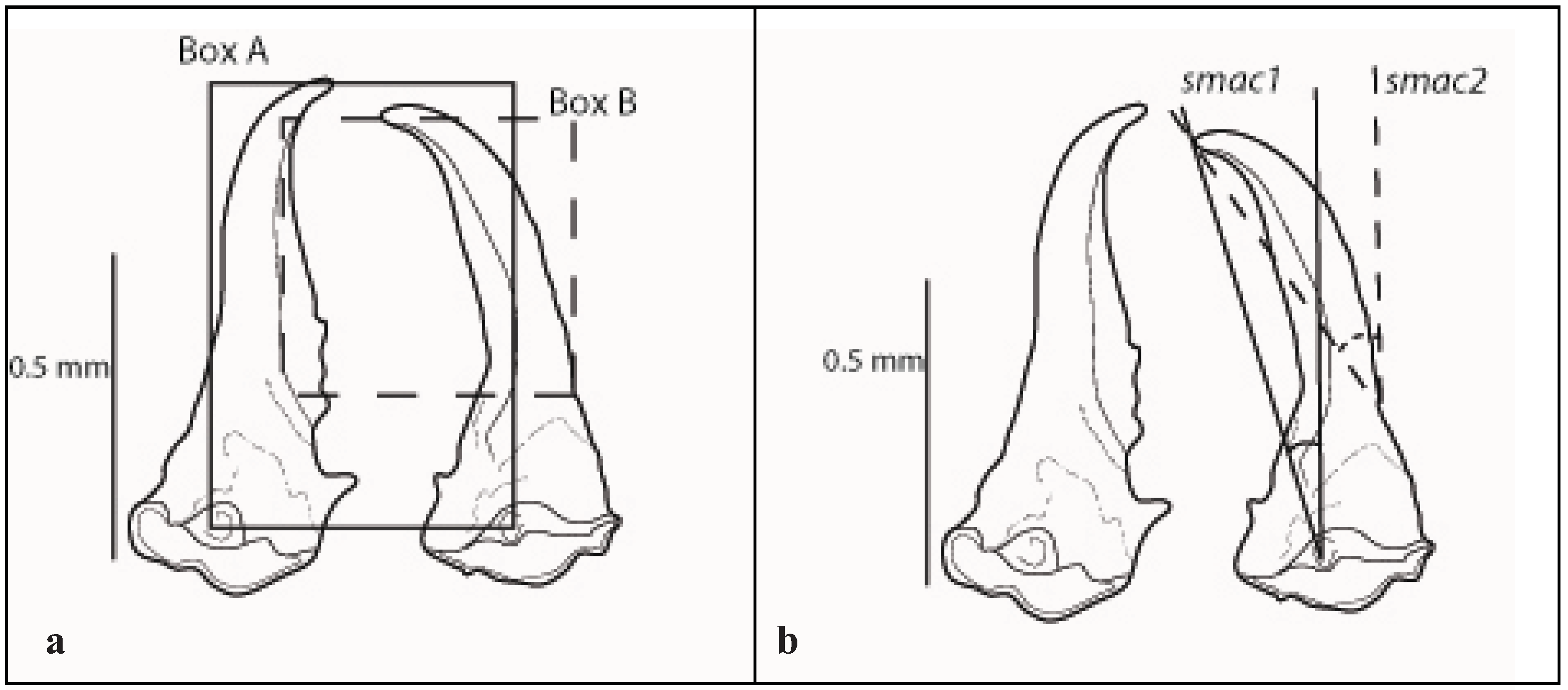
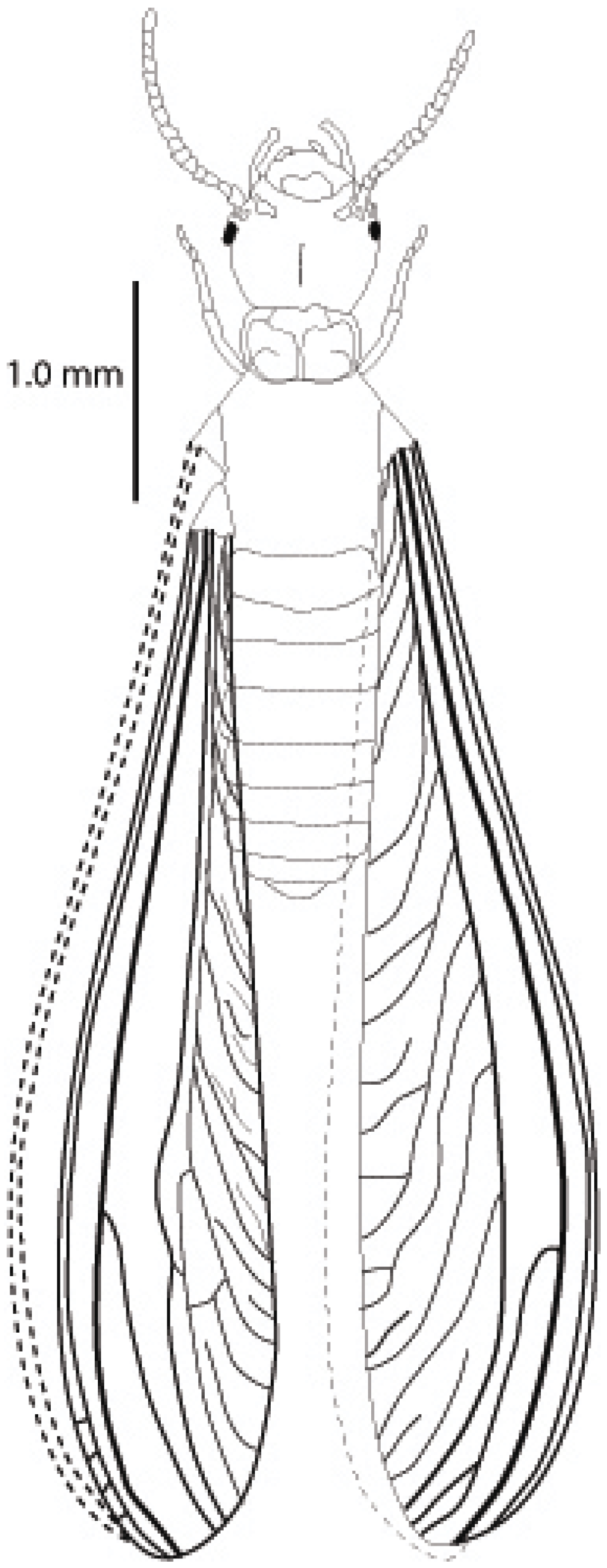
        <p>Accurate <italic>Reticulitermes</italic> species attributions are best determined using both soldiers and alates from the same collection site supported by genetic and behavioral information. The specific measurement points used for the quantitative dataset are shown in <xref ref-type="fig" rid="insects-03-00062-f001">Figure 1</xref> and <xref ref-type="fig" rid="insects-03-00062-f002">Figure 2</xref>. </p>
        <fig id="insects-03-00062-f001" position="anchor">
          <label>Figure 1</label>
          <caption>
            <p>Standard measurements for soldier head capsule length (<italic>sl</italic>) and width (<italic>sw</italic>). Note that the length (<italic>sl</italic>) measurement does not include mandibles. Scale bar = 0.5 mm. </p>
          </caption>
          <graphic xmlns:xlink="http://www.w3.org/1999/xlink" xlink:href="insects-03-00062-g001.tif"/>
        </fig>
        <fig id="insects-03-00062-f002" position="anchor">
          <label>Figure 2</label>
          <caption>
            <p>Diagram of soldier mandibles, dorsal view. Illustrating (<bold>a</bold>) the box method used to determine the 90° for measurement, (<bold>b</bold>) angles measured for <italic>smac1</italic> (Box A) and <italic>smac2 </italic>(Box B). Scale bar = 0.5 mm.</p>
          </caption>
          <graphic xmlns:xlink="http://www.w3.org/1999/xlink" xlink:href="insects-03-00062-g002.tif"/>
        </fig>
      </sec>
      <sec>
        <title>2.2. Soldier</title>
        <p>Four characters were measured on soldier head capsules: length without mandibles (<italic>sl</italic>), width (<italic>sw</italic>), and two separate angles of curvature for the right mandible (<italic>smac1</italic>, <italic>smac2</italic>). A fifth character, ratio of length:width (<italic>sl:sw</italic>), was calculated to determine its usefulness as a character for species separation.</p>
        <p>Soldier head capsules were removed from the body and mounted by placing a minuten pin into the occipital foramen. The opposite end of the minuten was positioned into a cube of foam mounted on a standard size # 2 insect pin. Soldier head capsule length (<italic>sl</italic>) was measured from the clypeal sulcus to the posterior edge as seen from a dorsal view (near the occipital foramen), and width (<italic>sw</italic>) was measured at a 90° angle from the mid-point of <italic>sl</italic> (<xref ref-type="fig" rid="insects-03-00062-f001">Figure 1</xref>). </p>
        <p>Soldier mandibles were dissected from head capsules and mounted on two-sided tape positioned inside a 2 mm × 2 mm grid box. Mandibles were positioned dorsal side up and parallel to the bottom line of the grid box to establish a 90° vertical line for the right mandible angle of curvature measurement (<xref ref-type="fig" rid="insects-03-00062-f002">Figure 2</xref>a). The soldier right mandible angle of curvature (<italic>smac</italic>) was measured from two positions: the dorsal condyle (<italic>smac1</italic>) and external curvature inflexion point (<italic>smac2</italic>) (<xref ref-type="fig" rid="insects-03-00062-f002">Figure 2</xref>b).</p>
      </sec>
      <sec>
        <title>2.3. Alate</title>
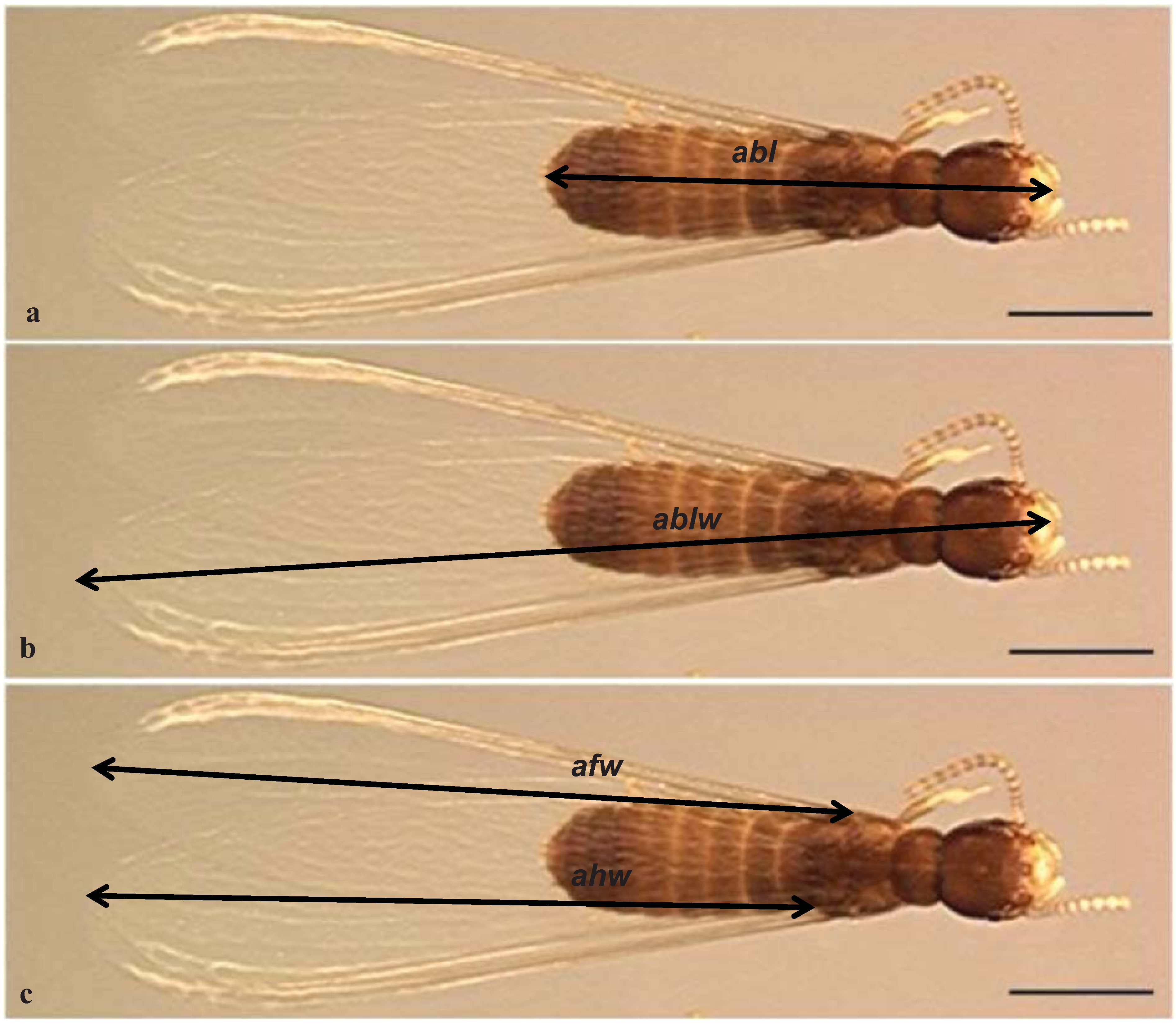
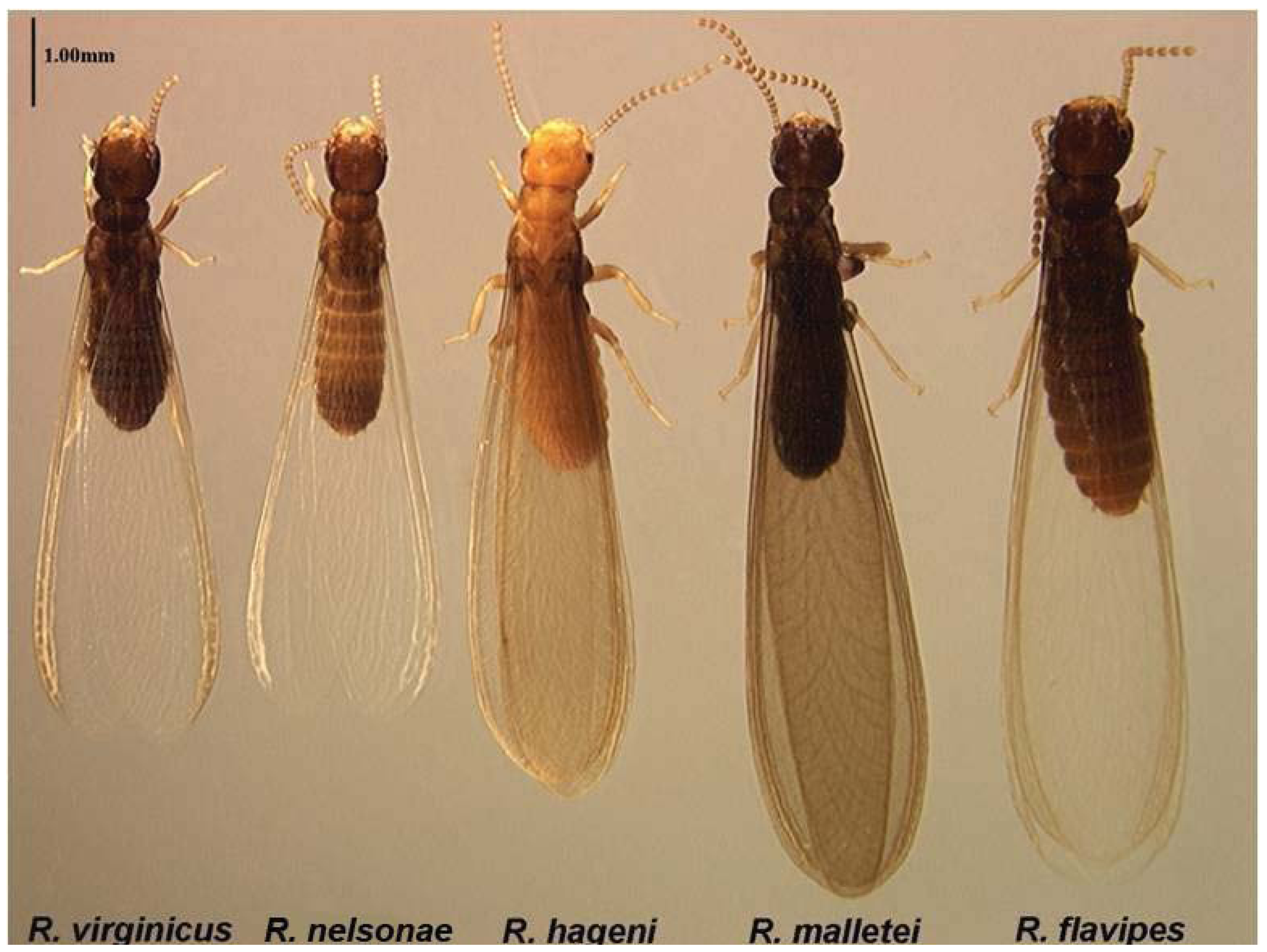
        <p>Alates were mounted between a glass slide and cover slip in 100% ethanol [<xref ref-type="bibr" rid="B29-insects-03-00062">29</xref>]. Qualitative characters included body color (<italic>abc</italic>) and wing pigmentation (<italic>awp</italic>). Quantitative characters included body length (<italic>abl</italic>), body length including wings (<italic>ablw</italic>), average forewing length (<italic>afw</italic>) and average hind wing length (<italic>ahw</italic>) (<xref ref-type="fig" rid="insects-03-00062-f003">Figure 3</xref>a–c).</p>
        <fig id="insects-03-00062-f003" position="anchor">
          <label>Figure 3</label>
          <caption>
            <p>Standard measurements for alate characters: length of body only (<italic>abl</italic>) body-wing (<italic>ablw</italic>), wings (<italic>afw</italic> and <italic>ahw</italic>) measuremements. Scale bar = 1.0 mm.</p>
          </caption>
          <graphic xmlns:xlink="http://www.w3.org/1999/xlink" xlink:href="insects-03-00062-g003.tif"/>
        </fig>
      </sec>
      <sec>
        <title>2.4. Morphometrics, Imaging and Statistics</title>
        <p>Soldier and alate specimen were prepared under a binocular dissecting microscope (CIT-OVAL2, Carl Zeiss aus Jena, Jena, Germany and Leica WILD M10, Wetzlar, Germany). Images were taken with a Sony DKC-5000 camera attached to a Leica WILD M10 stereomicroscope (Wetzlar, Germany) using Adobe Photoshop v.8.0 (Adobe Systems, San Jose, CA, USA). All soldier and alate images were taken at 25× and 20× magnification respectively, and calibrated with a micrometer using the internal preset calibration setting in AutoMontage Pro, v.5.0.1 (Cambridge, UK). Morphometric measurements were recorded using the AutoMontage Pro, v.5.0.1 and exported to Microsoft Office Excel (Redmond, Washington, USA). All statistical analyses of mean, standard deviation and simulation of sample size were performed using SAS v.9.2 (SAS Institute Inc., Cary, NC, USA), one-way analyses of variance (ANOVA) performed on each character state to determine if it contributed significantly to species separation. Sequential t-tests with LSD (protected least square deviation) pair-wise comparison were used to determine species differences for all characters measured. Step-Wise Discriminant Analysis (SWDA) was used to determine which morphological characters were most useful in species separation. The reliability and accuracy of each character state was determined using multiple Discriminant Function Analyses (DFA) [<xref ref-type="bibr" rid="B29-insects-03-00062">29</xref>].</p>
      </sec>
      <sec>
        <title>2.5. Behavior</title>
        <p>Fully developed, not-yet flown, winged alates of the new species were collected from infested wood on Sapelo Island on three separate dates.</p>
      </sec>
      <sec>
        <title>2.6. Dichotomous Key</title>
        <p>A dichotomous key for the <italic>Reticulitermes</italic> species of Georgia was constructed using morphological and behavioral (flight phenology) data. </p>
      </sec>
      <sec>
        <title>2.7. Molecular Data</title>
        <p>Sequence data for two mtDNA genes obtained from workers, soldiers and alates were employed to provide additional support for the new species. Genomic DNA was extracted from selected specimens using either Promega’s Wizard Genomic DNA Purification Kit or Qiagen’s DNeasy Extraction Kit, following a modified protocol [<xref ref-type="bibr" rid="B22-insects-03-00062">22</xref>]. Primers used for amplification of the entire length of the mitochondrial COII and partial COI genes are listed in <xref ref-type="table" rid="insects-03-00062-t003">Table 3</xref>. Amplified PCR products were sequenced at Molecular Cloning Laboratories (South San Francisco, CA, USA) or Eurofins MWG Operon (Huntsville, AL, USA).</p>
        <p>Sequences were curated with Sequencher 4.5 (Gene Codes Corp., Ann Arbor, MI, USA) and aligned with MUSCLE (MEGA 5 [<xref ref-type="bibr" rid="B30-insects-03-00062">30</xref>], or Phylogeny.fr: Robust Phylogenetic Analysis For The Non-Specialist [<xref ref-type="bibr" rid="B31-insects-03-00062">31</xref>]) using the default settings. Gaps were coded as missing. An estimate of net evolutionary divergence was calculated between the five Southeastern <italic>Reticulitermes</italic> using MEGA 5 by determining the number of base substitutions per site. The sequence data were used to infer optimal phylogenetic trees employing the following tree estimation methods as implemented by the listed software package: Maximum Likelihood (PHYML) and Maximum Parsimony (MEGA 5) [<xref ref-type="bibr" rid="B26-insects-03-00062">26</xref>,<xref ref-type="bibr" rid="B27-insects-03-00062">27</xref>,<xref ref-type="bibr" rid="B28-insects-03-00062">28</xref>,<xref ref-type="bibr" rid="B29-insects-03-00062">29</xref>,<xref ref-type="bibr" rid="B30-insects-03-00062">30</xref>,<xref ref-type="bibr" rid="B31-insects-03-00062">31</xref>,<xref ref-type="bibr" rid="B32-insects-03-00062">32</xref>]. ML (Maximum Likelihood) analysis for COI and COII was performed with PHYML 3.0 on the Phylogeny.fr: Robust Phylogenetic Analysis For The Non-Specialist [<xref ref-type="bibr" rid="B31-insects-03-00062">31</xref>]web server using the GTR+G+I model. The MP (Maximum Parsimony) analysis of COI and COII sequence used MEGA 5 with Close-Neighbor-Interchange (CNI) search and 1000 bootstrap replicates. Graphical representations of the resulting trees were improved using FigTree [<xref ref-type="bibr" rid="B32-insects-03-00062">32</xref>].</p>
        <table-wrap id="insects-03-00062-t003" position="anchor">
          <object-id pub-id-type="pii">insects-03-00062-t003_Table 3</object-id>
          <label>Table 3</label>
          <caption>
            <p>Primer sequences used for amplification and gene sequencing.</p>
          </caption>
          <table>
            <thead>
              <tr>
                <th align="center" valign="middle">Gene of interest</th>
                <th align="center" valign="middle">Primer pair (forward and reverse)</th>
                <th align="center" valign="middle">Sequences (5’→3’)</th>
              </tr>
            </thead>
            <tbody>
              <tr>
                <td rowspan="2" align="center" valign="middle">COII (685 bp)</td>
                <td align="center" valign="middle">TL2-J-3037</td>
                <td align="left" valign="middle">ATG GCA GAT TAG TGC AAT GG</td>
              </tr>
              <tr>
                <td align="center" valign="middle">TK-N-3785</td>
                <td align="left" valign="middle">GTT TAA GAG ACC AGT ACT TG</td>
              </tr>
              <tr style="border-top: solid thin">
                <td rowspan="2" align="center" valign="middle">COI (~800 bp) (partial sequence)</td>
                <td align="center" valign="middle">C1-J-2195</td>
                <td align="left" valign="middle">TTG ATT CTT TTG GTC ACT CCA TGA AGT</td>
              </tr>
              <tr>
                <td align="center" valign="middle">TL2-N-3014</td>
                <td align="left" valign="middle">TCC TAA TTG CAC TTA ATC TGC CAT ATT</td>
              </tr>
            </tbody>
          </table>
        </table-wrap>
        <p>Phylogenetic relationships of <italic>Reticulitermes</italic> from the southeastern USA were compared to GenBank sequences from other regions of the world to support the hypothesis that the new species was not previously described. Primary molecular voucher specimens were deposited at the University of Georgia Collection of Arthropods (UGCA), Georgia Museum of Natural History, Athens, Georgia, USA. DNA extraction vouchers were deposited in HSERP Laboratory, University of Georgia, Athens, GA, USA. </p>
      </sec>
    </sec>
    <sec sec-type="results">
      <title>3. Results and Discussion</title>
      <sec>
        <title>3.1. Morphological Characters</title>
        <p>The new species had the smallest range of measurements for both alate and soldier samples for all morphological characters examined with the exception of soldier head capsule ratio (<italic>sl</italic>:<italic>sw</italic>), and soldier right mandible angles of curvature (<italic>smac1</italic> and <italic>smac2</italic>) (<xref ref-type="table" rid="insects-03-00062-t004">Table 4a</xref>). The range of <italic>sl</italic>:<italic>sw</italic> was similar to <italic>R. virginicus</italic>, and <italic>smac1 </italic>and <italic>smac2</italic> were similar to <italic>R. flavipes </italic>(<xref ref-type="table" rid="insects-03-00062-t004">Table 4a</xref>). </p>
        <p>The range of soldier head capsule measurements for the new species was 1.14–1.72 mm for <italic>sl</italic> and 0.70–0.99 mm for <italic>sw</italic> (<xref ref-type="table" rid="insects-03-00062-t004">Table 4a</xref>). The <italic>sl</italic>:<italic>sw</italic> for soldier head capsules ranged from 1.52–1.98 (<xref ref-type="table" rid="insects-03-00062-t004">Table 4a</xref>). The range for the soldier right mandible angle of curvature was 7.2–14.6° for <italic>smac1</italic> and 24.1–34.0° for <italic>smac2</italic> (<xref ref-type="table" rid="insects-03-00062-t004">Table 4a</xref>). Alate body length without wing (<italic>abl</italic>) ranged from 3.26–4.63 mm, and alate body length including wing (<italic>ablw</italic>) ranged from 6.53–7.88 mm (<xref ref-type="table" rid="insects-03-00062-t005">Table 4b</xref>). The length of average forewings (<italic>afw</italic>) was slightly longer than the average hind wings (<italic>ahw</italic>), ranging from 4.94–5.98 mm, and 4.81–6.21 mm, respectively (<xref ref-type="table" rid="insects-03-00062-t005">Table 4b</xref>).</p>
      </sec>
      <sec>
        <title>3.2. Behavior</title>
        <p>Alate samples were collected from Sapelo Island on 12 May 2005, 6 February 2007 and 6 March 2007. All samples of fully developed, sclerotized and winged, alates were collected directly from sampling devices prior to flight. We predict that flights of the new species would occur during the same time frame as the alates were fully sclerotized and winged.</p>
	  <table-wrap-group id="insects-03-00062-t004" position="anchor">
          <label>Table 4a</label>
          <caption>
            <p>List of soldier characters measured by species showing mean, standard deviation, range of values and range of mean ± one std. dev.</p>
          </caption>
        <table-wrap id="insects-03-00062-t004a-01" position="anchor">
          <object-id pub-id-type="pii">insects-03-00062-t004_Table 4a_01</object-id>
          <table>
            <thead>
              <tr style="border-bottom: solid thin">
                <th colspan="16" align="center" valign="middle">Soldier head capsule</th>
              </tr>
              <tr>
                <th rowspan="2" align="center" valign="middle">Species</th>
                <th colspan="5" align="center" valign="middle">Length (<italic>sl</italic>), mm</th>
                <th colspan="5" align="center" valign="middle">Width (<italic>sw</italic>), mm</th>
                <th colspan="5" align="center" valign="middle">Ratio of length: width (<italic>sl:sw</italic>)</th>
              </tr>
              <tr style="border-top: solid thin">
                <th align="center" valign="middle">Mean</th>
                <th align="center" valign="middle">Std. dev.</th>
                <th align="center" valign="middle">Min. <sup>a</sup></th>
                <th align="center" valign="middle">Max. <sup>b</sup></th>
                <th align="center" valign="middle" style="background: #9FD3A4">Range of mean ± 1</th>
                <th align="center" valign="middle">Mean</th>
                <th align="center" valign="middle">Std. dev.</th>
                <th align="center" valign="middle">Min. <sup>a</sup></th>
                <th align="center" valign="middle">Max. <sup>b</sup></th>
                <th align="center" valign="middle" style="background: #9FD3A4">Range of mean ± 1</th>
                <th align="center" valign="middle">Mean</th>
                <th align="center" valign="middle">Std. dev.</th>
                <th align="center" valign="middle">Min. <sup>a</sup></th>
                <th align="center" valign="middle">Max. <sup>b</sup></th>
                <th align="center" valign="middle" style="background: #9FD3A4">Range of mean ± 1</th>
              </tr>
            </thead>
            <tbody>
              <tr>
                <td align="center" valign="middle">
                  <italic>R. flavipes</italic>
                </td>
                <td align="center" valign="middle">1.693</td>
                <td align="center" valign="middle">0.119</td>
                <td align="center" valign="middle">1.21</td>
                <td align="center" valign="middle">1.91</td>
                <td align="center" valign="middle" style="background: #9FD3A4">1.57–1.81</td>
                <td align="center" valign="middle">1.044</td>
                <td align="center" valign="middle">0.074</td>
                <td align="center" valign="middle">0.73</td>
                <td align="center" valign="middle">1.17</td>
                <td align="center" valign="middle" style="background: #9FD3A4">0.97–1.12</td>
                <td align="center" valign="middle">1.625</td>
                <td align="center" valign="middle">0.084</td>
                <td align="center" valign="middle">1.43</td>
                <td align="center" valign="middle">1.83</td>
                <td align="center" valign="middle" style="background: #9FD3A4">1.54–1.71</td>
              </tr>
              <tr>
                <td align="center" valign="middle">
                  <italic>R. virginicus</italic>
                </td>
                <td align="center" valign="middle">1.625</td>
                <td align="center" valign="middle">0.068</td>
                <td align="center" valign="middle">1.37</td>
                <td align="center" valign="middle">1.84</td>
                <td align="center" valign="middle" style="background: #9FD3A4">1.56–1.69</td>
                <td align="center" valign="middle">0.920</td>
                <td align="center" valign="middle">0.039</td>
                <td align="center" valign="middle">0.76</td>
                <td align="center" valign="middle">1.01</td>
                <td align="center" valign="middle" style="background: #9FD3A4">0.88–0.96</td>
                <td align="center" valign="middle">1.767</td>
                <td align="center" valign="middle">0.063</td>
                <td align="center" valign="middle">1.56</td>
                <td align="center" valign="middle">1.95</td>
                <td align="center" valign="middle" style="background: #9FD3A4">1.70–1.83</td>
              </tr>
              <tr>
                <td align="center" valign="middle">
                  <italic>R. hageni</italic>
                </td>
                <td align="center" valign="middle">1.434</td>
                <td align="center" valign="middle">0.092</td>
                <td align="center" valign="middle">1.16</td>
                <td align="center" valign="middle">1.59</td>
                <td align="center" valign="middle" style="background: #9FD3A4">1.34–1.53</td>
                <td align="center" valign="middle">0.862</td>
                <td align="center" valign="middle">0.030</td>
                <td align="center" valign="middle">0.75</td>
                <td align="center" valign="middle">0.91</td>
                <td align="center" valign="middle" style="background: #9FD3A4">0.82–0.90</td>
                <td align="center" valign="middle">1.656</td>
                <td align="center" valign="middle">0.073</td>
                <td align="center" valign="middle">1.44</td>
                <td align="center" valign="middle">1.78</td>
                <td align="center" valign="middle" style="background: #9FD3A4">1.58–1.73</td>
              </tr>
              <tr>
                <td align="center" valign="middle">
                  <italic>R. malletei</italic>
                </td>
                <td align="center" valign="middle">1.490</td>
                <td align="center" valign="middle">0.058</td>
                <td align="center" valign="middle">1.33</td>
                <td align="center" valign="middle">1.64</td>
                <td align="center" valign="middle" style="background: #9FD3A4">1.43–1.55</td>
                <td align="center" valign="middle">0.879</td>
                <td align="center" valign="middle">0.029</td>
                <td align="center" valign="middle">0.78</td>
                <td align="center" valign="middle">0.95</td>
                <td align="center" valign="middle" style="background: #9FD3A4">0.85–0.91</td>
                <td align="center" valign="middle">1.695</td>
                <td align="center" valign="middle">0.066</td>
                <td align="center" valign="middle">1.52</td>
                <td align="center" valign="middle">1.87</td>
                <td align="center" valign="middle" style="background: #9FD3A4">1.63–1.76</td>
              </tr>
              <tr>
                <td align="center" valign="middle"><italic>R. nelsonae</italic></td>
                <td align="center" valign="middle">1.407</td>
                <td align="center" valign="middle">0.127</td>
                <td align="center" valign="middle">1.14</td>
                <td align="center" valign="middle">1.72</td>
                <td align="center" valign="middle" style="background: #9FD3A4">1.28–1.42</td>
                <td align="center" valign="middle">0.784</td>
                <td align="center" valign="middle">0.054</td>
                <td align="center" valign="middle">0.70</td>
                <td align="center" valign="middle">0.99</td>
                <td align="center" valign="middle" style="background: #9FD3A4">0.73–0.84</td>
                <td align="center" valign="middle">1.793</td>
                <td align="center" valign="middle">0.092</td>
                <td align="center" valign="middle">1.52</td>
                <td align="center" valign="middle">1.98</td>
                <td align="center" valign="middle" style="background: #9FD3A4">1.70–1.89</td>
              </tr>
            </tbody>
          </table>
        </table-wrap>
        <table-wrap id="insects-03-00062-t004a-02" position="anchor">
          <object-id pub-id-type="pii">insects-03-00062-t008_Table 4a_02</object-id>
          <table>
            <thead>
              <tr style="border-bottom: solid thin">
                <th colspan="11" align="center" valign="middle">Soldier mandible angle of curvature</th>
              </tr>
              <tr>
                <th rowspan="2" align="center" valign="middle">Species</th>
                <th colspan="5" align="center" valign="middle"><italic>smac1</italic>, °</th>
                <th colspan="5" align="center" valign="middle"><italic>smac2</italic>, °</th>
              </tr>
              <tr style="border-top: solid thin">
                <th align="center" valign="middle">Mean</th>
                <th align="center" valign="middle">Std. dev.</th>
                <th align="center" valign="middle">Min. <sup>a</sup></th>
                <th align="center" valign="middle">Max. <sup>b</sup></th>
                <th align="center" valign="middle" style="background: #9FD3A4">Range of Mean ± 1</th>
                <th align="center" valign="middle">Mean</th>
                <th align="center" valign="middle">Std. dev.</th>
                <th align="center" valign="middle">Min. <sup>a</sup></th>
                <th align="center" valign="middle">Max. <sup>b</sup></th>
                <th align="center" valign="middle" style="background: #9FD3A4">Range of Mean ± 1</th>
              </tr>
            </thead>
            <tbody>
              <tr>
                <td align="center" valign="middle">
                  <italic>R. flavipes</italic>
                </td>
                <td align="center" valign="middle">10.61</td>
                <td align="center" valign="middle">2.089</td>
                <td align="center" valign="middle">7.3</td>
                <td align="center" valign="middle">15.1</td>
                <td align="center" valign="middle" style="background: #9FD3A4">8.0–13.0</td>
                <td align="center" valign="middle">27.29</td>
                <td align="center" valign="middle">2.730</td>
                <td align="center" valign="middle">22.1</td>
                <td align="center" valign="middle">31.4</td>
                <td align="center" valign="middle" style="background: #9FD3A4">25.0–30.0</td>
              </tr>
              <tr>
                <td align="center" valign="middle">
                  <italic>R. virginicus</italic>
                </td>
                <td align="center" valign="middle">13.62</td>
                <td align="center" valign="middle">1.719</td>
                <td align="center" valign="middle">11.7</td>
                <td align="center" valign="middle">18.1</td>
                <td align="center" valign="middle" style="background: #9FD3A4">12.0–15.0</td>
                <td align="center" valign="middle">32.60</td>
                <td align="center" valign="middle">2.003</td>
                <td align="center" valign="middle">29.4</td>
                <td align="center" valign="middle">36.7</td>
                <td align="center" valign="middle" style="background: #9FD3A4">31.0–35.0</td>
              </tr>
              <tr>
                <td align="center" valign="middle">
                  <italic>R. hageni</italic>
                </td>
                <td align="center" valign="middle">8.39</td>
                <td align="center" valign="middle">1.199</td>
                <td align="center" valign="middle">6.9</td>
                <td align="center" valign="middle">11.2</td>
                <td align="center" valign="middle" style="background: #9FD3A4">7.0–10.0</td>
                <td align="center" valign="middle">23.39</td>
                <td align="center" valign="middle">1.307</td>
                <td align="center" valign="middle">21.5</td>
                <td align="center" valign="middle">27.3</td>
                <td align="center" valign="middle" style="background: #9FD3A4">22.0–25.0</td>
              </tr>
              <tr>
                <td align="center" valign="middle">
                  <italic>R. malletei</italic>
                </td>
                <td align="center" valign="middle">10.51</td>
                <td align="center" valign="middle">1.366</td>
                <td align="center" valign="middle">8.1</td>
                <td align="center" valign="middle">13.2</td>
                <td align="center" valign="middle" style="background: #9FD3A4">9.0–12.0</td>
                <td align="center" valign="middle">25.85</td>
                <td align="center" valign="middle">2.282</td>
                <td align="center" valign="middle">22.4</td>
                <td align="center" valign="middle">32.9</td>
                <td align="center" valign="middle" style="background: #9FD3A4">24.0–28.0</td>
              </tr>
              <tr>
                <td align="center" valign="middle"><italic>R. nelsonae</italic></td>
                <td align="center" valign="middle">10.66</td>
                <td align="center" valign="middle">2.206</td>
                <td align="center" valign="middle">7.2</td>
                <td align="center" valign="middle">14.6</td>
                <td align="center" valign="middle" style="background: #9FD3A4">8.0–13.0</td>
                <td align="center" valign="middle">27.27</td>
                <td align="center" valign="middle">2.654</td>
                <td align="center" valign="middle">24.1</td>
                <td align="center" valign="middle">34.0</td>
                <td align="center" valign="middle" style="background: #9FD3A4">25.0–30.0</td>
              </tr>
            </tbody>
          </table>
		  <table-wrap-foot>
		  <fn>
          <p>Note: Shaded boxes represent values that were used in building the dichotomous key for soldiers and alates.</p>
		  </fn>
		  </table-wrap-foot>
        </table-wrap>
		</table-wrap-group>
		<table-wrap-group id="insects-03-00062-t005" position="anchor">
          <label>Table 4b</label>
          <caption>
            <p>List of alate characters measured by species showing mean, standard deviation, range of values and range of mean ± one std. dev.</p>
          </caption>
        <table-wrap id="insects-03-00062-t004b-01" position="anchor">
          <object-id pub-id-type="pii">insects-03-00062-t005_Table 4b_01</object-id>
          <table>
            <thead>
              <tr>
                <th rowspan="2" align="center" valign="middle">Species</th>
                <th colspan="5" align="center" valign="middle" style="border-bottom: solid thin">Body (<italic>abl</italic>), mm</th>
                <th colspan="5" align="center" valign="middle" style="border-bottom: solid thin">Body-wing (<italic>ablw</italic>), mm</th>
              </tr>
              <tr>
                <th align="center" valign="middle">Mean</th>
                <th align="center" valign="middle">Std. dev.</th>
                <th align="center" valign="middle">Min. <sup>a</sup></th>
                <th align="center" valign="middle">Max. <sup>b</sup></th>
                <th align="center" valign="middle" style="background: #9FD3A4">Range of mean ± 1</th>
                <th align="center" valign="middle">Mean</th>
                <th align="center" valign="middle">Std. dev.</th>
                <th align="center" valign="middle">Min. <sup>a</sup></th>
                <th align="center" valign="middle">Max. <sup>b</sup></th>
                <th align="center" valign="middle" style="background: #9FD3A4">Range of mean ± 1</th>
              </tr>
            </thead>
            <tbody>
              <tr>
                <td align="center" valign="middle">
                  <italic>R. flavipes</italic>
                </td>
                <td align="center" valign="middle">4.783</td>
                <td align="center" valign="middle">0.383</td>
                <td align="center" valign="middle">3.77</td>
                <td align="center" valign="middle">5.83</td>
                <td align="center" valign="middle" style="background: #9FD3A4">4.40–5.17</td>
                <td align="center" valign="middle">8.973</td>
                <td align="center" valign="middle">0.402</td>
                <td align="center" valign="middle">8.05</td>
                <td align="center" valign="middle">9.94</td>
                <td align="center" valign="middle" style="background: #9FD3A4">8.57–9.38</td>
              </tr>
              <tr>
                <td align="center" valign="middle">
                  <italic>R. virginicus</italic>
                </td>
                <td align="center" valign="middle">4.021</td>
                <td align="center" valign="middle">0.214</td>
                <td align="center" valign="middle">3.56</td>
                <td align="center" valign="middle">4.44</td>
                <td align="center" valign="middle" style="background: #9FD3A4">3.81–4.24</td>
                <td align="center" valign="middle">7.414</td>
                <td align="center" valign="middle">0.213</td>
                <td align="center" valign="middle">6.89</td>
                <td align="center" valign="middle">7.90</td>
                <td align="center" valign="middle" style="background: #9FD3A4">7.20–7.63</td>
              </tr>
              <tr>
                <td align="center" valign="middle">
                  <italic>R. hageni</italic>
                </td>
                <td align="center" valign="middle">4.083</td>
                <td align="center" valign="middle">0.323</td>
                <td align="center" valign="middle">3.41</td>
                <td align="center" valign="middle">5.35</td>
                <td align="center" valign="middle" style="background: #9FD3A4">3.76–4.41</td>
                <td align="center" valign="middle">7.810</td>
                <td align="center" valign="middle">0.318</td>
                <td align="center" valign="middle">7.25</td>
                <td align="center" valign="middle">8.64</td>
                <td align="center" valign="middle" style="background: #9FD3A4">7.49–8.13</td>
              </tr>
              <tr>
                <td align="center" valign="middle">
                  <italic>R. malletei</italic>
                </td>
                <td align="center" valign="middle">4.023</td>
                <td align="center" valign="middle">0.302</td>
                <td align="center" valign="middle">3.53</td>
                <td align="center" valign="middle">4.99</td>
                <td align="center" valign="middle" style="background: #9FD3A4">3.72–4.33</td>
                <td align="center" valign="middle">8.238</td>
                <td align="center" valign="middle">0.394</td>
                <td align="center" valign="middle">6.91</td>
                <td align="center" valign="middle">9.28</td>
                <td align="center" valign="middle" style="background: #9FD3A4">7.84–8.63</td>
              </tr>
              <tr>
                <td align="center" valign="middle"><italic>R. nelsonae</italic></td>
                <td align="center" valign="middle">3.928</td>
                <td align="center" valign="middle">0.236</td>
                <td align="center" valign="middle">3.26</td>
                <td align="center" valign="middle">4.63</td>
                <td align="center" valign="middle" style="background: #9FD3A4">3.69–4.16</td>
                <td align="center" valign="middle">7.080</td>
                <td align="center" valign="middle">0.291</td>
                <td align="center" valign="middle">6.53</td>
                <td align="center" valign="middle">7.88</td>
                <td align="center" valign="middle" style="background: #9FD3A4">6.79–7.37</td>
              </tr>
            </tbody>
          </table>
        </table-wrap>
        <table-wrap id="insects-03-00062-t004b-02" position="anchor">
          <object-id pub-id-type="pii">insects-03-00062-t009_Table 4b_02</object-id>
          <table>
            <thead>
              <tr>
                <th rowspan="2" align="center" valign="middle">Species</th>
                <th colspan="5" align="center" valign="middle" style="border-bottom: solid thin">Forewing (<italic>afw</italic>), mm</th>
                <th colspan="5" align="center" valign="middle" style="border-bottom: solid thin">Hind wing (<italic>ahw</italic>), mm</th>
              </tr>
              <tr>
                <th align="center" valign="middle">Mean</th>
                <th align="center" valign="middle">Std. dev.</th>
                <th align="center" valign="middle">Min. <sup>a</sup></th>
                <th align="center" valign="middle">Max. <sup>b</sup></th>
                <th align="center" valign="middle" style="background: #9FD3A4">Range of mean ± 1</th>
                <th align="center" valign="middle">Mean</th>
                <th align="center" valign="middle">Std. dev.</th>
                <th align="center" valign="middle">Min. <sup>a</sup></th>
                <th align="center" valign="middle">Max. <sup>b</sup></th>
                <th align="center" valign="middle" style="background: #9FD3A4">Range of mean ± 1</th>
              </tr>
            </thead>
            <tbody>
              <tr>
                <td align="center" valign="middle">
                  <italic>R. flavipes</italic>
                </td>
                <td align="center" valign="middle">6.810</td>
                <td align="center" valign="middle">0.331</td>
                <td align="center" valign="middle">5.97</td>
                <td align="center" valign="middle">7.74</td>
                <td align="center" valign="middle" style="background: #9FD3A4">6.48–7.14</td>
                <td align="center" valign="middle">6.550</td>
                <td align="center" valign="middle">0.332</td>
                <td align="center" valign="middle">5.70</td>
                <td align="center" valign="middle">7.44</td>
                <td align="center" valign="middle" style="background: #9FD3A4">1.29–1.35</td>
              </tr>
              <tr>
                <td align="center" valign="middle">
                  <italic>R. virginicus</italic>
                </td>
                <td align="center" valign="middle">5.532</td>
                <td align="center" valign="middle">0.193</td>
                <td align="center" valign="middle">5.15</td>
                <td align="center" valign="middle">6.05</td>
                <td align="center" valign="middle" style="background: #9FD3A4">5.34–5.73</td>
                <td align="center" valign="middle">5.418</td>
                <td align="center" valign="middle">0.193</td>
                <td align="center" valign="middle">4.78</td>
                <td align="center" valign="middle">5.78</td>
                <td align="center" valign="middle" style="background: #9FD3A4">1.32–1.37</td>
              </tr>
              <tr>
                <td align="center" valign="middle">
                  <italic>R. hageni</italic>
                </td>
                <td align="center" valign="middle">5.965</td>
                <td align="center" valign="middle">0.263</td>
                <td align="center" valign="middle">5.47</td>
                <td align="center" valign="middle">6.52</td>
                <td align="center" valign="middle" style="background: #9FD3A4">5.70–6.23</td>
                <td align="center" valign="middle">5.739</td>
                <td align="center" valign="middle">0.257</td>
                <td align="center" valign="middle">5.24</td>
                <td align="center" valign="middle">6.19</td>
                <td align="center" valign="middle" style="background: #9FD3A4">1.28–1.34</td>
              </tr>
              <tr>
                <td align="center" valign="middle">
                  <italic>R. malletei</italic>
                </td>
                <td align="center" valign="middle">6.375</td>
                <td align="center" valign="middle">0.328</td>
                <td align="center" valign="middle">5.13</td>
                <td align="center" valign="middle">7.31</td>
                <td align="center" valign="middle" style="background: #9FD3A4">6.04–6.70</td>
                <td align="center" valign="middle">6.100</td>
                <td align="center" valign="middle">0.339</td>
                <td align="center" valign="middle">4.92</td>
                <td align="center" valign="middle">6.95</td>
                <td align="center" valign="middle" style="background: #9FD3A4">1.27–1.32</td>
              </tr>
              <tr>
                <td align="center" valign="middle"><italic>R. nelsonae</italic></td>
                <td align="center" valign="middle">5.430</td>
                <td align="center" valign="middle">0.212</td>
                <td align="center" valign="middle">4.94</td>
                <td align="center" valign="middle">5.98</td>
                <td align="center" valign="middle" style="background: #9FD3A4">5.22–5.64</td>
                <td align="center" valign="middle">5.315</td>
                <td align="center" valign="middle">0.297</td>
                <td align="center" valign="middle">4.81</td>
                <td align="center" valign="middle">6.21</td>
                <td align="center" valign="middle" style="background: #9FD3A4">1.27–1.31</td>
              </tr>
            </tbody>
          </table>
		  <table-wrap-foot>
		  <fn>
          <p>Note: Shaded boxes represent values that were used in building the dichotomous key for soldiers and alates.</p>
		  </fn>
		  </table-wrap-foot>
        </table-wrap>
		</table-wrap-group>
      </sec>
      <sec>
        <title>3.3. Dichotomous Key</title>
        <p>Keys to the soldiers and alates of the <italic>Reticulitermes</italic> species of Georgia, USA, were constructed (Appendix 1, Appendix 2, respectively) based on values shown in <xref ref-type="table" rid="insects-03-00062-t004">Table 4a</xref>-<xref ref-type="table" rid="insects-03-00062-t005">Table 4b</xref> in shaded boxes representing the mean ± 1 std. dev. values for each character, with the exception of <italic>sl:sw</italic>. A minimum of 9 soldier head capsules are recommended to obtain a 95% confidence level for correct identification of <italic>R. flavipes</italic>, <italic>R. virginicus</italic>, and the new species, and 29 specimens for separating <italic>R. malletei</italic> from <italic>R. hageni</italic>. The minimum number of alate specimens recommended to obtain a 95% confidence level for discriminating all five species is 6. A more detailed discussion of the statistical analyses and generation of minimum sample size can be found in Lim (2011) [<xref ref-type="bibr" rid="B29-insects-03-00062">29</xref>].</p>
      </sec>
      <sec>
        <title>3.4. Molecular Data</title>
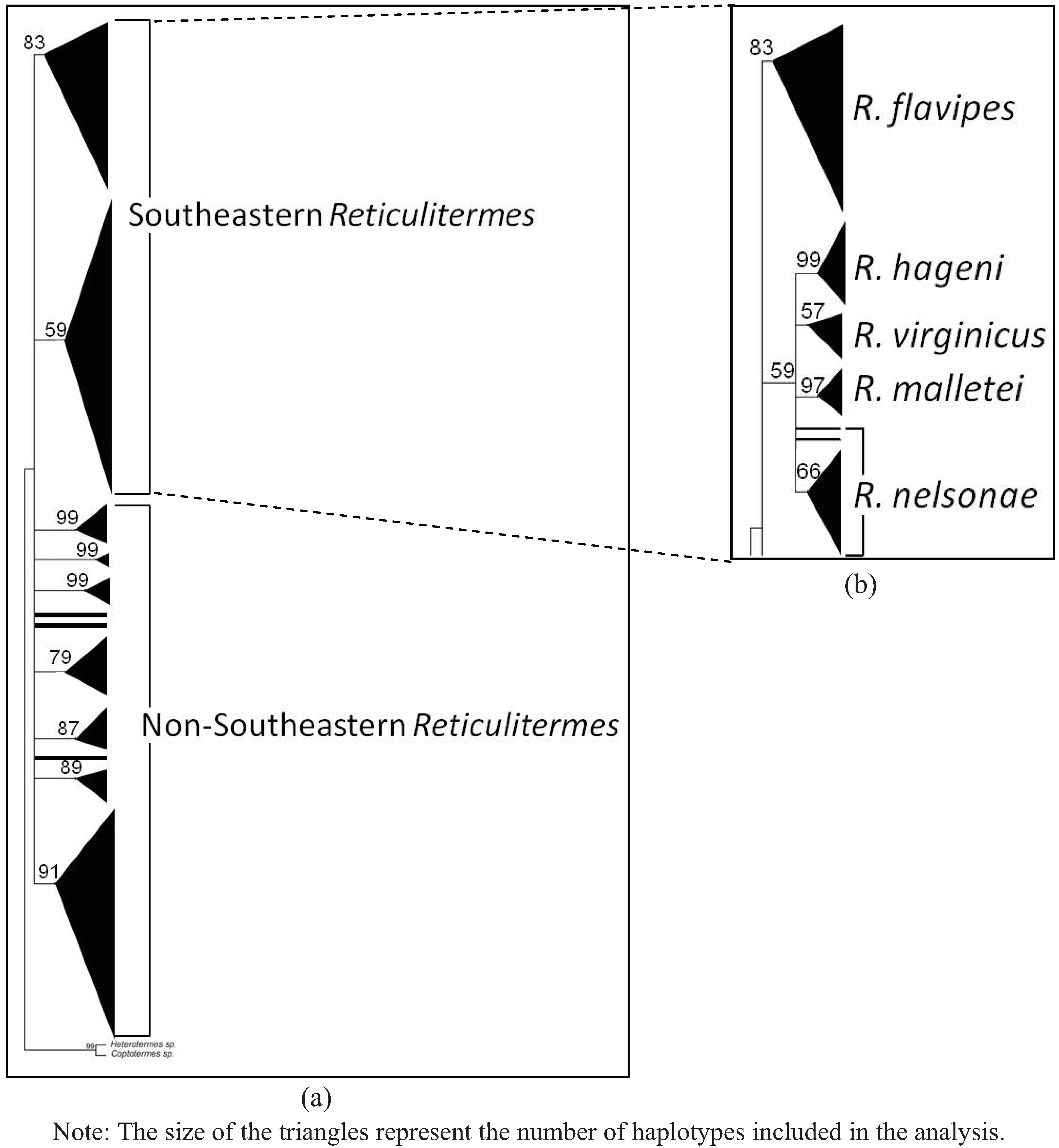
        <p>A total of 102 COII and 49 COI sequences were analyzed providing 20 new haplotypes for COII and 21 new haplotypes for COI. The estimated net evolutionary divergence among the five Southeastern <italic>Reticulitermes</italic> is shown in <xref ref-type="table" rid="insects-03-00062-t006">Table 5a</xref> and <xref ref-type="table" rid="insects-03-00062-t007">Table 5b</xref> for COII and COI respectively. The values indicate that <italic>R. nelsonae</italic> evolutionary divergence is comparable to the net evolutionary divergence observed between other described species from that region (<xref ref-type="table" rid="insects-03-00062-t006">Table 5a</xref> and <xref ref-type="table" rid="insects-03-00062-t007">Table 5b</xref>). Similar clades were recovered in all phylogenies from the COII and COI sequence data (<xref ref-type="fig" rid="insects-03-00062-f004">Figure 4</xref>, <xref ref-type="fig" rid="insects-03-00062-f005">Figure 5</xref>, <xref ref-type="fig" rid="insects-03-00062-f006">Figure 6</xref> and <xref ref-type="fig" rid="insects-03-00062-f007">Figure 7</xref>). There are five reference sequences (labeled as α in <xref ref-type="fig" rid="insects-03-00062-f012">Figure S1</xref>, <xref ref-type="fig" rid="insects-03-00062-f013">Figure S2</xref>, <xref ref-type="fig" rid="insects-03-00062-f014">Figure S3</xref> and <xref ref-type="fig" rid="insects-03-00062-f015">Figure S4</xref>) obtained from specimens where both alates and soldiers from that same collection point and date matched the described morphological criteria for the respective species (<xref ref-type="fig" rid="insects-03-00062-f004">Figure 4</xref>, <xref ref-type="fig" rid="insects-03-00062-f005">Figure 5</xref>, <xref ref-type="fig" rid="insects-03-00062-f006">Figure 6</xref> and <xref ref-type="fig" rid="insects-03-00062-f007">Figure 7</xref>). Two sequences in the <italic>R. malletei</italic> clade for COII and COI were labeled β (<xref ref-type="fig" rid="insects-03-00062-f012">Figure S1</xref>, <xref ref-type="fig" rid="insects-03-00062-f013">Figure S2</xref>, <xref ref-type="fig" rid="insects-03-00062-f014">Figure S3</xref> and <xref ref-type="fig" rid="insects-03-00062-f015">Figure S4</xref>) to signify that these sequences were corroborated with the original 16SrRNA haplotype sequences in Austin <italic>et al.</italic> (2007). </p>
        <table-wrap id="insects-03-00062-t006" position="anchor">
          <object-id pub-id-type="pii">insects-03-00062-t006_Table 5a</object-id>
          <label>Table 5a</label>
          <caption>
            <p>Estimate of net evolutionary divergence between species for COII.</p>
          </caption>
          <table>
            <thead>
              <tr>
                <th align="center" valign="middle">Species</th>
                <th align="center" valign="middle">
                  <italic>R. flavipes</italic>
                </th>
                <th align="center" valign="middle">
                  <italic>R. virginicus</italic>
                </th>
                <th align="center" valign="middle">
                  <italic>R. hageni</italic>
                </th>
                <th align="center" valign="middle">
                  <italic>R. malletei</italic>
                </th>
                <th align="center" valign="middle">
                  <italic>R. nelsonae</italic>
                </th>
              </tr>
            </thead>
            <tbody>
              <tr>
                <td align="center" valign="middle">
                  <italic>R. flavipes</italic>
                </td>
                <td align="center" valign="middle" style="background: #7F7F7F"> </td>
                <td align="center" valign="middle" style="background: #7F7F7F"> </td>
                <td align="center" valign="middle" style="background: #7F7F7F"> </td>
                <td align="center" valign="middle" style="background: #7F7F7F"> </td>
                <td align="center" valign="middle" style="background: #7F7F7F"> </td>
              </tr>
              <tr>
                <td align="center" valign="middle">
                  <italic>R. virginicus</italic>
                </td>
                <td align="center" valign="middle">0.052</td>
                <td align="center" valign="middle" style="background: #7F7F7F"> </td>
                <td align="center" valign="middle" style="background: #7F7F7F"> </td>
                <td align="center" valign="middle" style="background: #7F7F7F"> </td>
                <td align="center" valign="middle" style="background: #7F7F7F"> </td>
              </tr>
              <tr>
                <td align="center" valign="middle">
                  <italic>R. hageni</italic>
                </td>
                <td align="center" valign="middle">0.047</td>
                <td align="center" valign="middle">0.033</td>
                <td align="center" valign="middle" style="background: #7F7F7F"> </td>
                <td align="center" valign="middle" style="background: #7F7F7F"> </td>
                <td align="center" valign="middle" style="background: #7F7F7F"> </td>
              </tr>
              <tr>
                <td align="center" valign="middle">
                  <italic>R. malletei</italic>
                </td>
                <td align="center" valign="middle">0.046</td>
                <td align="center" valign="middle">0.036</td>
                <td align="center" valign="middle">0.031</td>
                <td align="center" valign="middle" style="background: #7F7F7F"> </td>
                <td align="center" valign="middle" style="background: #7F7F7F"> </td>
              </tr>
              <tr>
                <td align="center" valign="middle">
                  <italic>R. nelsonae</italic>
                </td>
                <td align="center" valign="middle">0.059</td>
                <td align="center" valign="middle">0.049</td>
                <td align="center" valign="middle">0.044</td>
                <td align="center" valign="middle">0.039</td>
                <td align="center" valign="middle" style="background: #7F7F7F"> </td>
              </tr>
            </tbody>
          </table>
        </table-wrap>
        <table-wrap id="insects-03-00062-t007" position="anchor">
          <object-id pub-id-type="pii">insects-03-00062-t007_Table 5b</object-id>
          <label>Table 5b</label>
          <caption>
            <p>Estimate of net evolutionary divergence between species for COI.</p>
          </caption>
          <table>
            <thead>
              <tr>
                <th align="center" valign="middle">Species</th>
                <th align="center" valign="middle">
                  <italic>R. flavipes</italic>
                </th>
                <th align="center" valign="middle">
                  <italic>R. virginicus</italic>
                </th>
                <th align="center" valign="middle">
                  <italic>R. hageni</italic>
                </th>
                <th align="center" valign="middle">
                  <italic>R. malletei</italic>
                </th>
                <th align="center" valign="middle">
                  <italic>R. nelsonae</italic>
                </th>
              </tr>
            </thead>
            <tbody>
              <tr>
                <td align="center" valign="middle">
                  <italic>R. flavipes</italic>
                </td>
                <td align="center" valign="middle" style="background: #7F7F7F"> </td>
                <td align="center" valign="middle" style="background: #7F7F7F"> </td>
                <td align="center" valign="middle" style="background: #7F7F7F"> </td>
                <td align="center" valign="middle" style="background: #7F7F7F"> </td>
                <td align="center" valign="middle" style="background: #7F7F7F"> </td>
              </tr>
              <tr>
                <td align="center" valign="middle">
                  <italic>R. virginicus</italic>
                </td>
                <td align="center" valign="middle">0.051</td>
                <td align="center" valign="middle" style="background: #7F7F7F"> </td>
                <td align="center" valign="middle" style="background: #7F7F7F"> </td>
                <td align="center" valign="middle" style="background: #7F7F7F"> </td>
                <td align="center" valign="middle" style="background: #7F7F7F"> </td>
              </tr>
              <tr>
                <td align="center" valign="middle">
                  <italic>R. hageni</italic>
                </td>
                <td align="center" valign="middle">0.048</td>
                <td align="center" valign="middle">0.040</td>
                <td align="center" valign="middle" style="background: #7F7F7F"> </td>
                <td align="center" valign="middle" style="background: #7F7F7F"> </td>
                <td align="center" valign="middle" style="background: #7F7F7F"> </td>
              </tr>
              <tr>
                <td align="center" valign="middle">
                  <italic>R. malletei</italic>
                </td>
                <td align="center" valign="middle">0.042</td>
                <td align="center" valign="middle">0.037</td>
                <td align="center" valign="middle">0.027</td>
                <td align="center" valign="middle" style="background: #7F7F7F"> </td>
                <td align="center" valign="middle" style="background: #7F7F7F"> </td>
              </tr>
              <tr>
                <td align="center" valign="middle">
                  <italic>R. nelsonae</italic>
                </td>
                <td align="center" valign="middle">0.050</td>
                <td align="center" valign="middle">0.044</td>
                <td align="center" valign="middle">0.036</td>
                <td align="center" valign="middle">0.029</td>
                <td align="center" valign="middle" style="background: #7F7F7F"> </td>
              </tr>
            </tbody>
          </table>
        </table-wrap>
        <fig id="insects-03-00062-f004" position="anchor">
          <label>Figure 4</label>
          <caption>
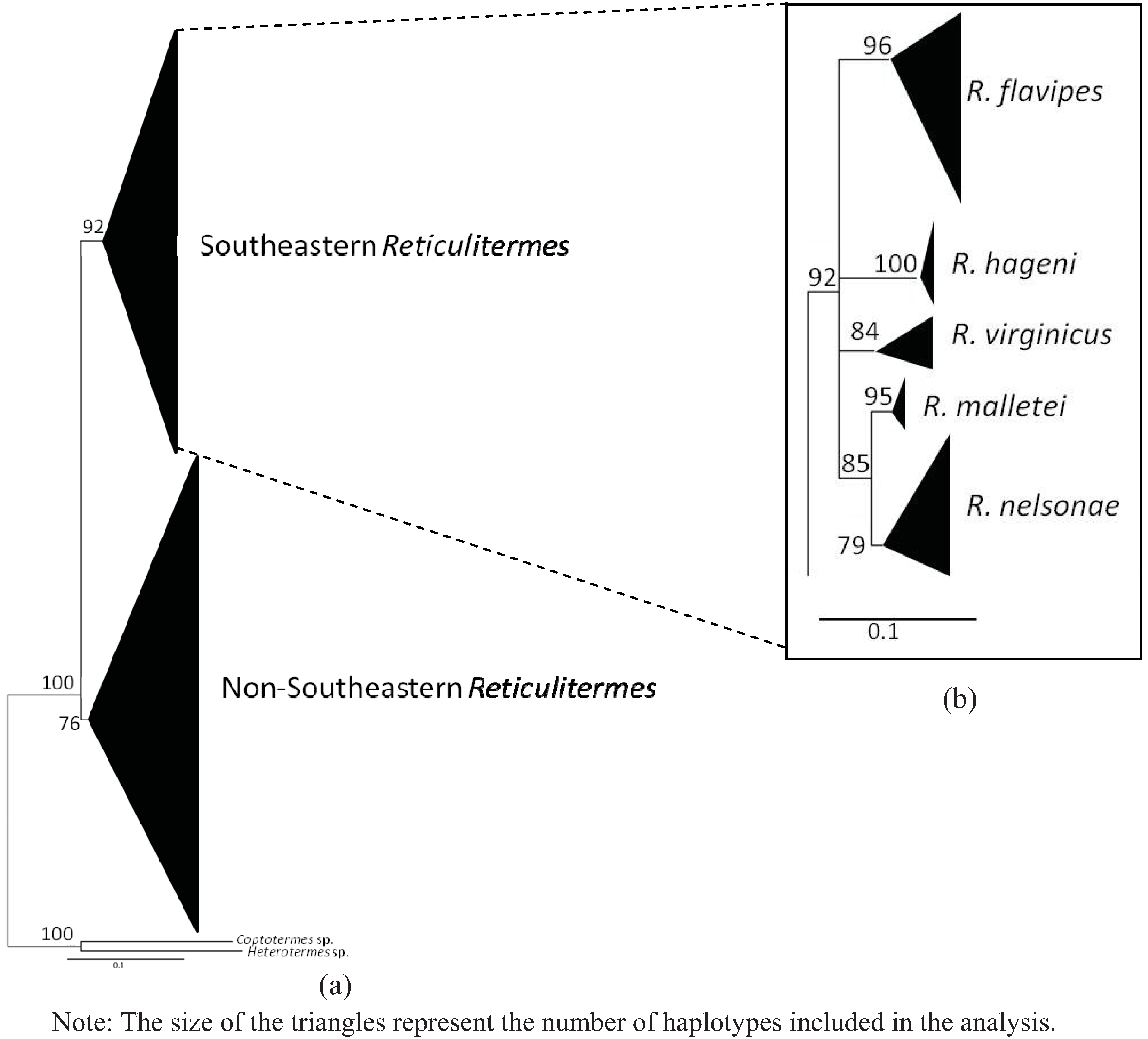
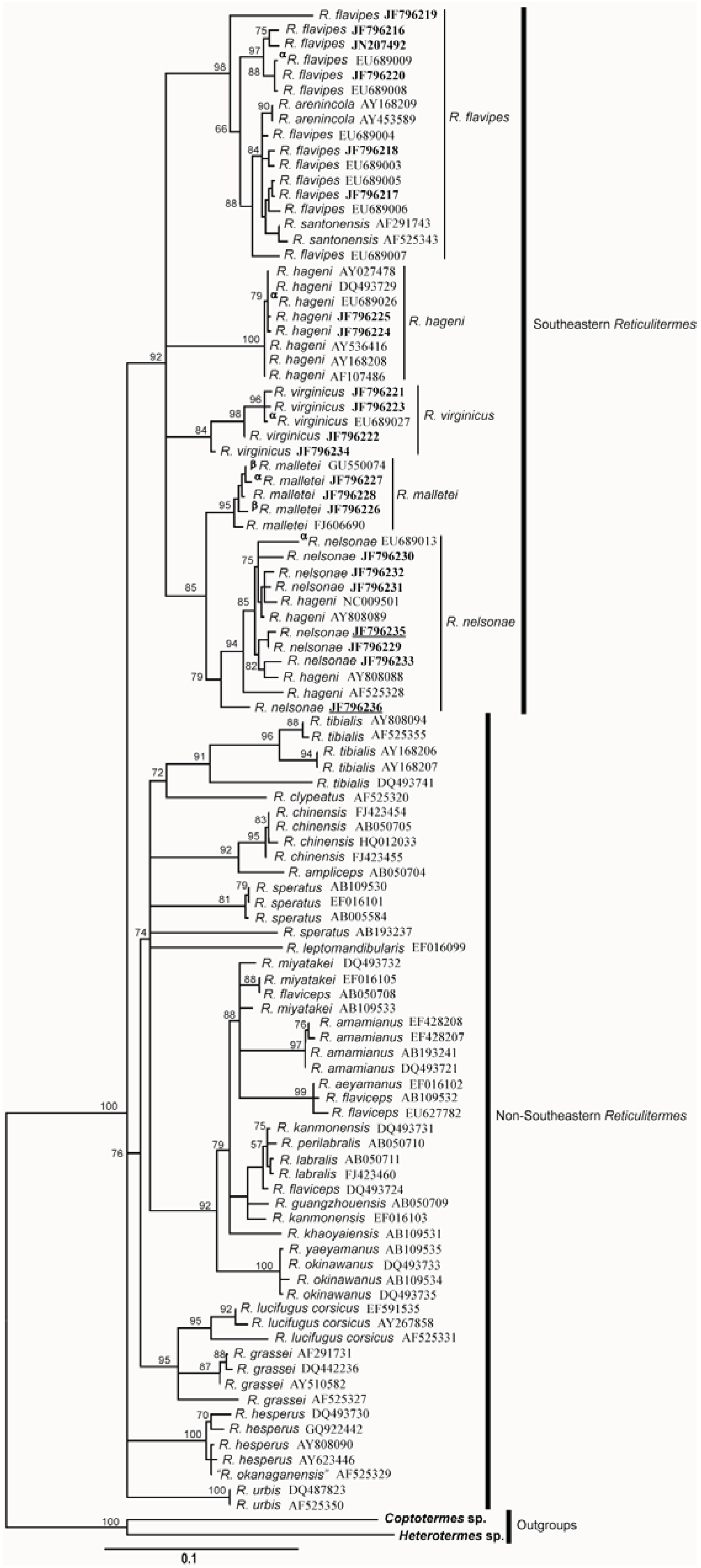
            <p>Maximum Likehood (ML) estimate of the <italic>Reticulitermes</italic> phylogeny based on mitochondrial cytochromeoxidase II (COII) gene data (665 bp). The scale bar represents 0.1 substitution/ site. (<bold>a</bold>) Collapsed tree topology illustrating the branch support and clades formed by <italic>Reticulitermes</italic> species from the southeastern USA and other regions of the world. (<bold>b</bold>) Collapsed tree topology illustrating the branch support and clades formed by <italic>Reticulitermes</italic> from southeastern USA.</p>
          </caption>
          <graphic xmlns:xlink="http://www.w3.org/1999/xlink" xlink:href="insects-03-00062-g004.tif"/>
        </fig>
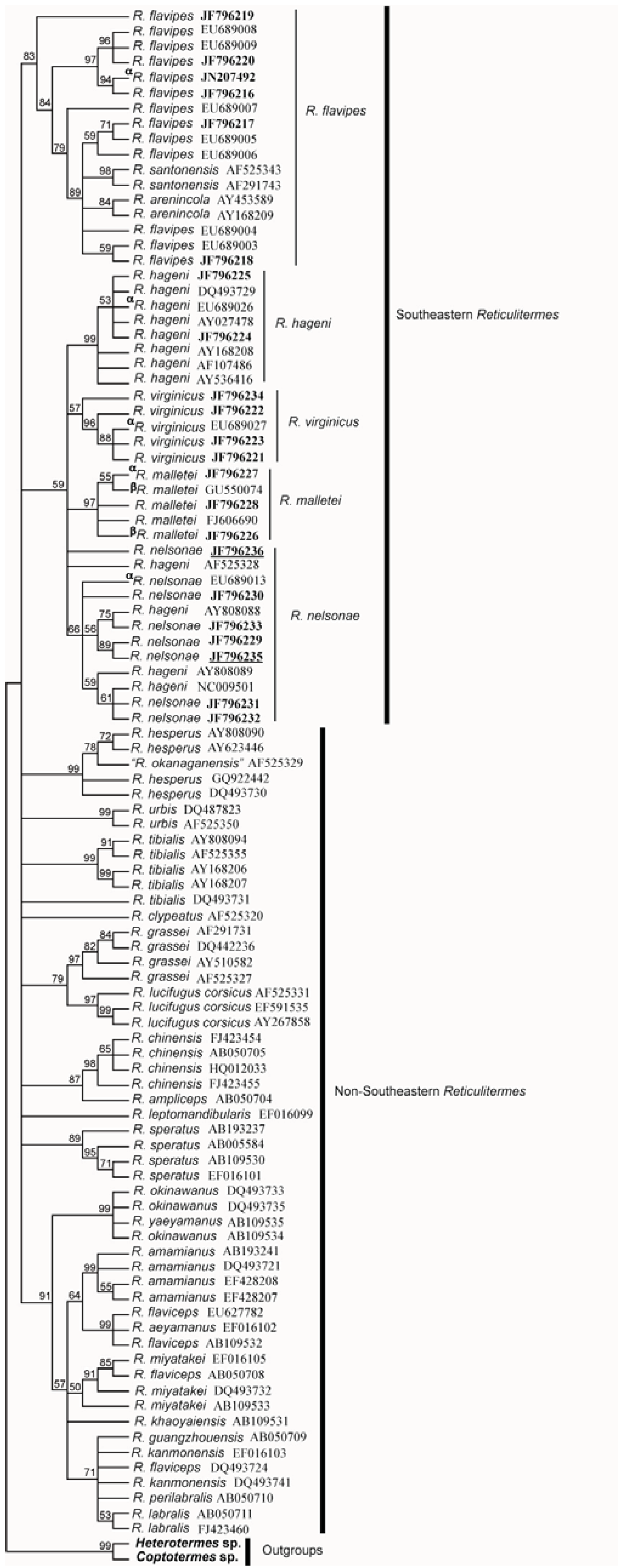
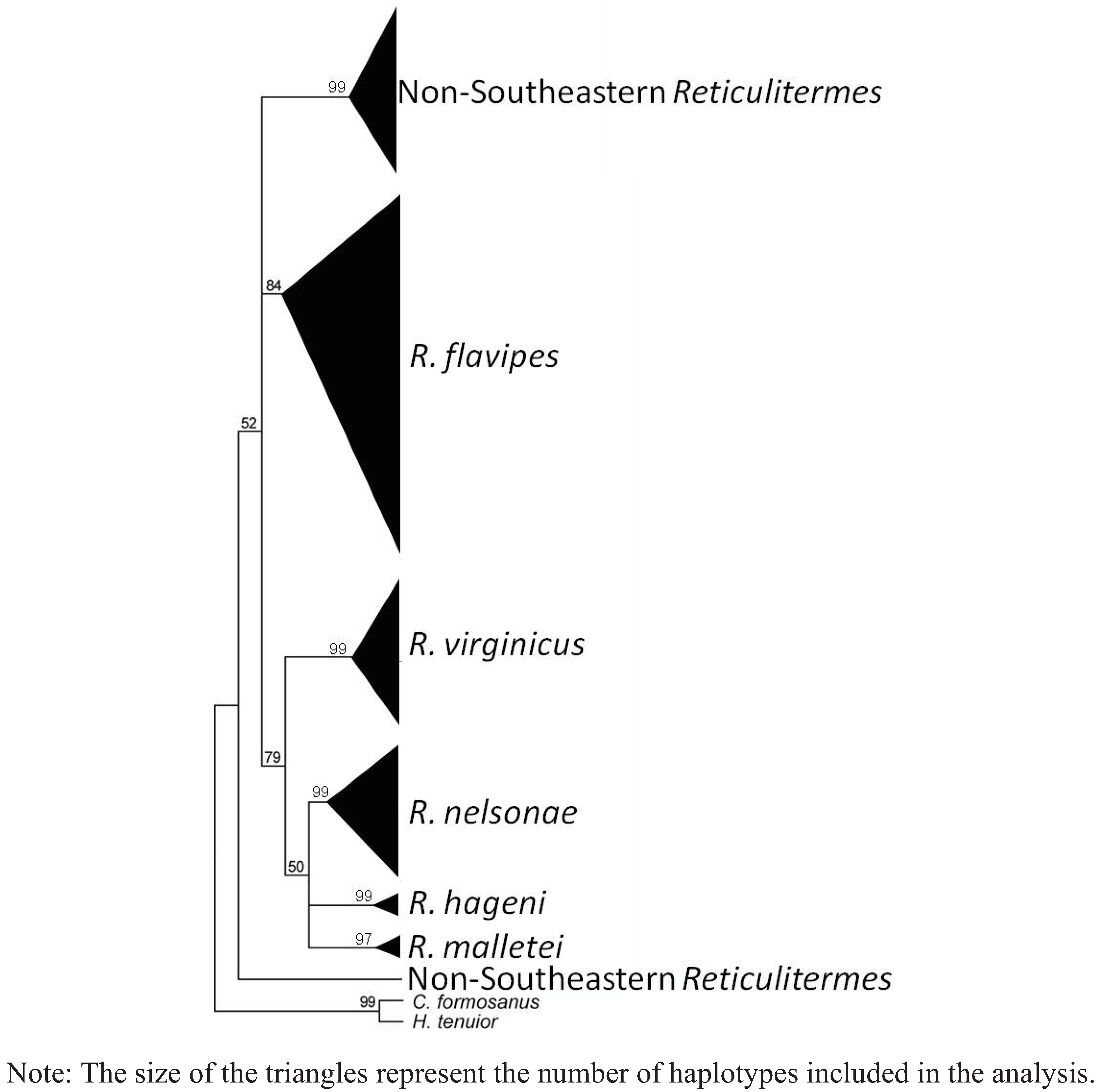
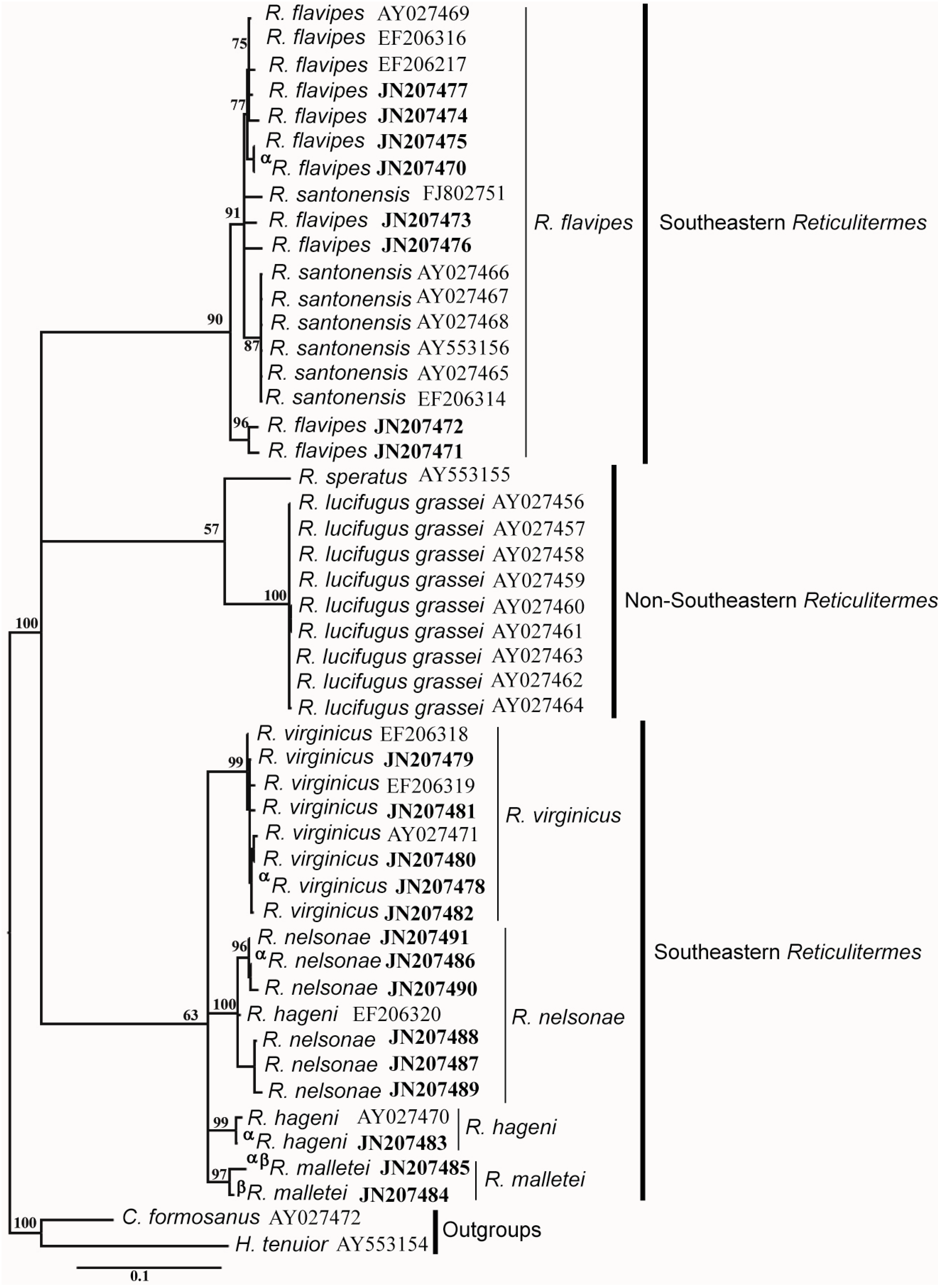
        <p>The COII alignment included 665 bp of the 685 bp full length to size-match the length of some sequences retrieved from GenBank. The comparisons yielded 216 variable sites, of which 178 were parsimony-informative. Maximum likelihood (ML) and maximum parsimony (MP) were employed to construct phylogenetic trees that included selected GenBank sequences (as of 8 March 2011) for <italic>Reticulitermes</italic>. All inferred phylogenetic trees were well resolved for the Southeastern <italic>Reticulitermes</italic> showing consistent and strongly corroborated topologies with the exception of two haplotypes in the <italic>R. nelsonae</italic> clade (JF796236 and AF525328) from the MP phylogeny that are recovered as polytomies containing <italic>R. nelsonae</italic>, <italic>R. malletei</italic>, <italic>R. virginicus</italic> and <italic>R. hageni</italic> (<xref ref-type="fig" rid="insects-03-00062-f004">Figure 4</xref>, <xref ref-type="fig" rid="insects-03-00062-f005">Figure 5</xref>, <xref ref-type="fig" rid="insects-03-00062-f012">Figure S1</xref> and <xref ref-type="fig" rid="insects-03-00062-f013">Figure S2</xref>). The inferred ML tree shows high branch support (&gt;84) for all species clades within the Southeastern <italic>Reticulitermes</italic> group with Ln likelihood = −5075.935 (<xref ref-type="fig" rid="insects-03-00062-f004">Figure 4</xref>). The MP analysis resulted in 42 most parsimonious trees (length = 854, CI = 0.33, RI = 0.82) (<xref ref-type="fig" rid="insects-03-00062-f005">Figure 5</xref>). The composite index for all sites = 0.300, and a composite index for parsimony-informative sites = 0.270 that used 1000 bootstraps to generate the consensus tree (<xref ref-type="fig" rid="insects-03-00062-f005">Figure 5</xref>). COII sequences were deposited in GenBank (EU689013, JF796229-JF796233, and JF796235-JF796236) and are listed in bold in the supplemental phylogenies (<xref ref-type="fig" rid="insects-03-00062-f012">Figure S1</xref> and <xref ref-type="fig" rid="insects-03-00062-f013">Figure S2</xref>). The ML and MP phylogeny for COII showed separation between <italic>Reticulitermes</italic> from the southeastern USA and <italic>Reticulitermes</italic> from other regions (<xref ref-type="fig" rid="insects-03-00062-f004">Figure 4</xref> and <xref ref-type="fig" rid="insects-03-00062-f005">Figure 5</xref>). </p>
        <fig id="insects-03-00062-f005" position="anchor">
          <label>Figure 5</label>
          <caption>
            <p>Maximum parsimony (MP) estimate of the <italic>Reticulitermes</italic> phylogeny based on mitochondrial ribosomal gene COII (665 bp) data. (<bold>a</bold>) Collapsed tree topology illustrating the branch support and clades formed by <italic>Reticulitermes</italic> species from the southeastern USA and other regions of the world. (<bold>b</bold>) Collapsed tree topology illustrating the branch support and clades formed by <italic>Reticulitermes</italic> from southeastern USA.</p>
          </caption>
          <graphic xmlns:xlink="http://www.w3.org/1999/xlink" xlink:href="insects-03-00062-g005.tif"/>
        </fig>
        <fig id="insects-03-00062-f006" position="anchor">
          <label>Figure 6</label>
          <caption>
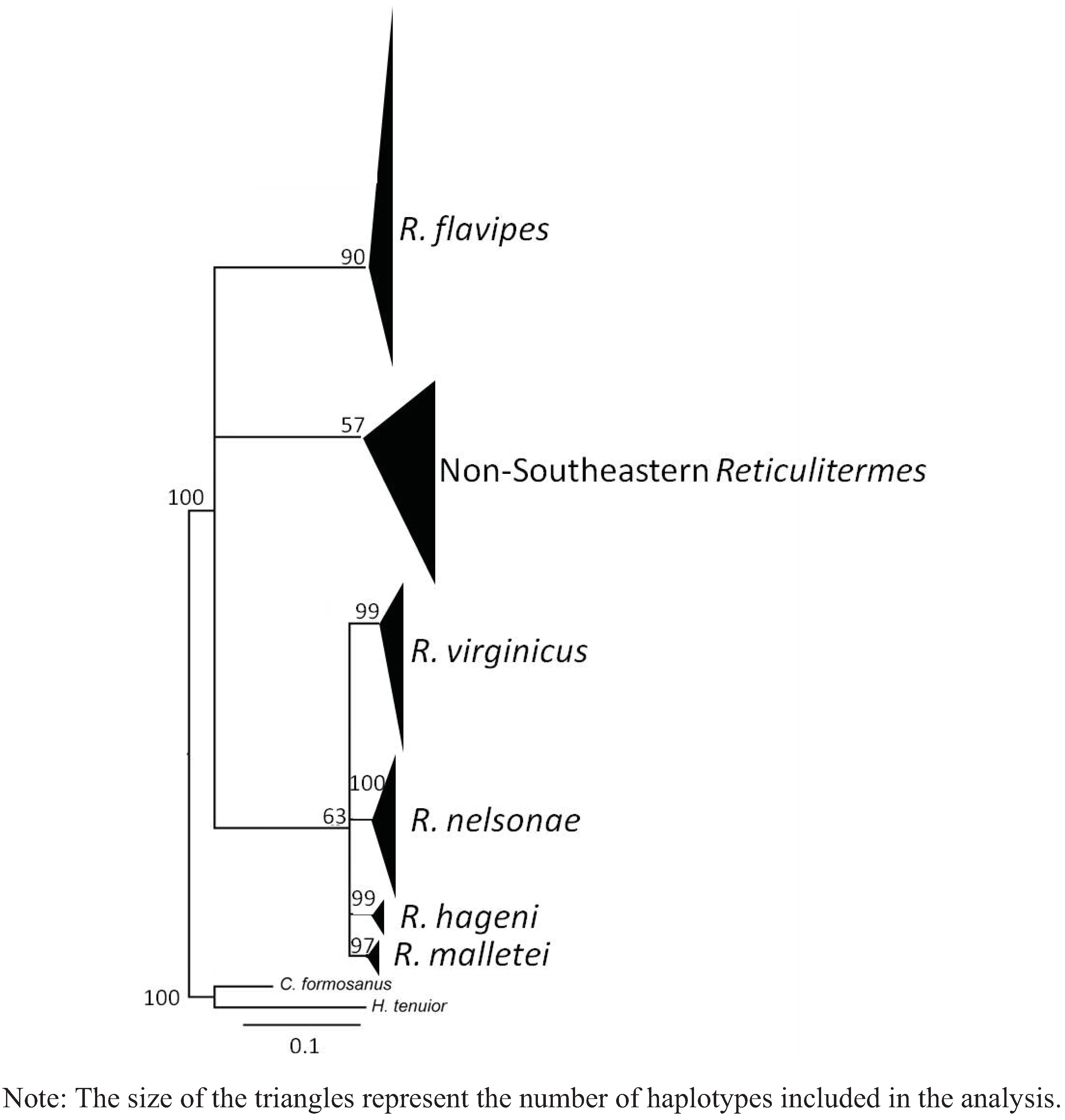
            <p>Maximum likelihood (ML) estimate of <italic>Reticulitermes</italic> phylogeny based on mitochondrial ribosomal gene COI (767 bp) data. Collapsed tree topology illustrating the branch support and clades formed by <italic>Reticulitermes</italic>.</p>
          </caption>
          <graphic xmlns:xlink="http://www.w3.org/1999/xlink" xlink:href="insects-03-00062-g006.tif"/>
        </fig>
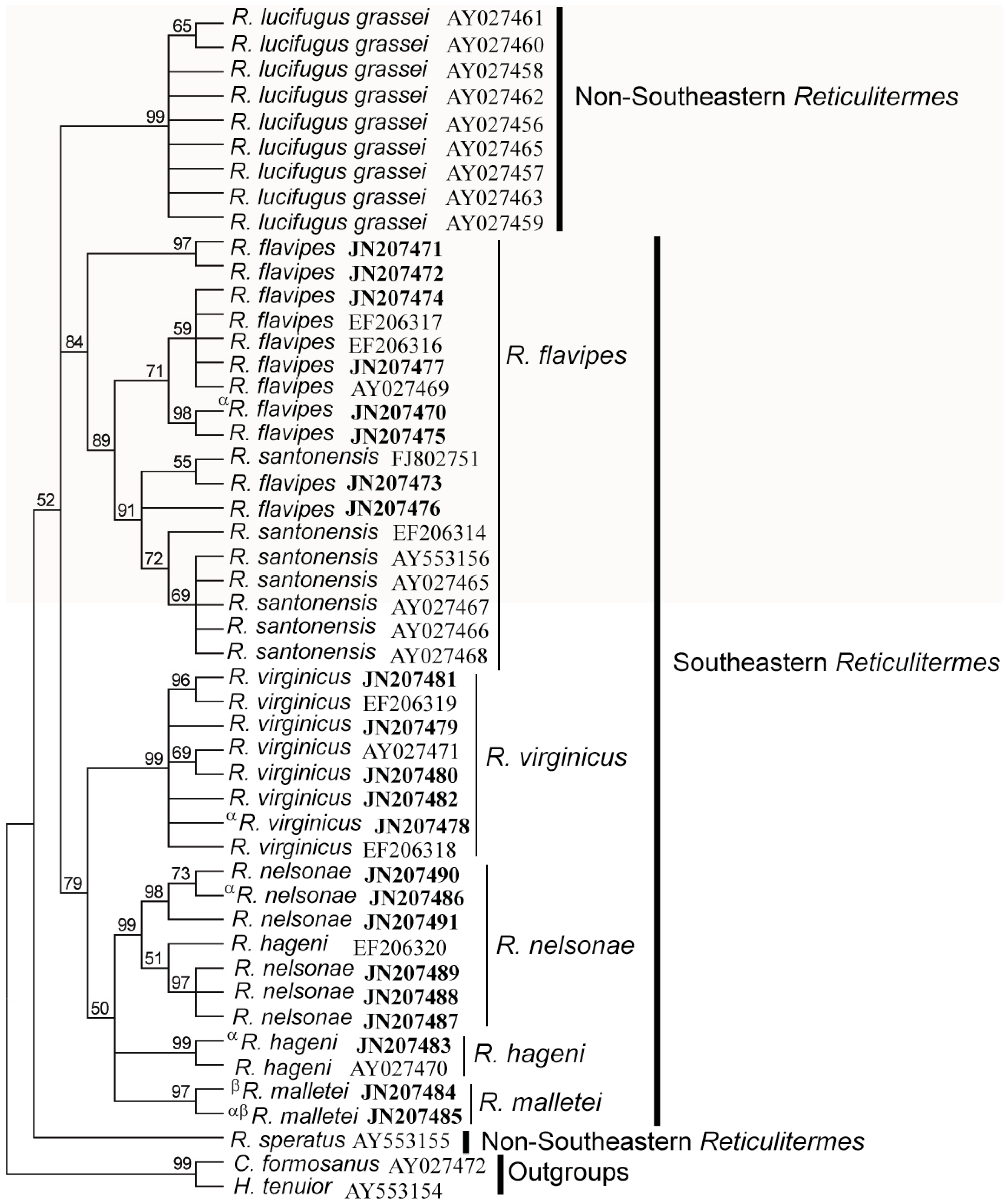
        <p>The alignment of COI included 767 bp of the 801 bp partial length to size-match with some of the GenBank sequences retrieved for this analysis, Results showed 146 variable sites of which 113 were parsimony-informative. Inferred ML tree shows high branch support for most clades with Ln likelihood = −2905.620 (<xref ref-type="fig" rid="insects-03-00062-f006">Figure 6</xref>). MP analysis resulted in 33 most parsimonious trees of 366 steps with a consistency index = 0.556, a retention index = 0.892, a composite index for all = 0.565, and a composite index for parsimony-informative sites = 0.496 that used 1000 bootstraps to generate the consensus tree that was similar in tree topology to the ML analysis (<xref ref-type="fig" rid="insects-03-00062-f006">Figure 6</xref> and <xref ref-type="fig" rid="insects-03-00062-f007">Figure 7</xref>). COI sequences also were deposited in GenBank (JN207486-JN207491) and are listed in bold in the supplemental phylogenies (<xref ref-type="fig" rid="insects-03-00062-f014">Figure S3</xref> and <xref ref-type="fig" rid="insects-03-00062-f015">Figure S4</xref>).</p>
        <p>The phylogenetic trees from ML and MP analyses using the COI data also recovered genetic separation between <italic>Reticulitermes</italic> from the southeastern region of the USA and <italic>Reticulitermes</italic> from other parts of the world (<xref ref-type="fig" rid="insects-03-00062-f006">Figure 6</xref> and <xref ref-type="fig" rid="insects-03-00062-f007">Figure 7</xref>). No COI sequences were found in GenBank for <italic>Reticulitermes</italic> from the western USA.</p>
        <fig id="insects-03-00062-f007" position="anchor">
          <label>Figure 7</label>
          <caption>
            <p>Maximum parsimony (MP) estimate of the <italic>Reticulitermes</italic> phylogeny based on mitochondrial ribosomal gene COI (767 bp) data. Collapsed tree topology illustrating the branch support and clades formed by <italic>Reticulitermes</italic>.</p>
          </caption>
          <graphic xmlns:xlink="http://www.w3.org/1999/xlink" xlink:href="insects-03-00062-g007.tif"/>
        </fig>
      </sec>
    </sec>
    <sec>
      <title>4. Systematics</title>
      <p><italic>Reticulitermes  nelsonae</italic> Lim and Forschler, new species</p>
      <p>(<xref ref-type="fig" rid="insects-03-00062-f001">Figure 1</xref>, <xref ref-type="fig" rid="insects-03-00062-f003">Figure 3</xref>, <xref ref-type="fig" rid="insects-03-00062-f008">Figure 8</xref>, <xref ref-type="fig" rid="insects-03-00062-f009">Figure 9</xref> and <xref ref-type="fig" rid="insects-03-00062-f010">Figure 10</xref>)</p>
      <p>HOLOTYPE (alate, ♀): “USA: Georgia, McIntosh Co., Sapelo Island, 31°23'43.32"N </p>
      <p>81°16'38.23"W, 6.II .2007, D. Sillam-Dussès” (AMNH).</p>
      <p>ALLOTYPE (alate, ♂): “USA: Georgia, McIntosh Co., Sapelo Island, 31°23'43.32"N </p>
      <p>81°16'38.23"W, 6. II. 2007, D. Sillam-Dussès” (AMNH).</p>
      <p>PARATYPES (alate): USA: Georgia: McIntosh Co., Sapelo Island, 31°23'43.32"N</p>
      <p>81°16'38.23"W, 6.II.2007, D. Sillam-Dussès (1 ♂, 1♀, UGCA; 1 ♂, 1 ♀, NMNH).</p>
      <p>PARATYPES (soldier): USA: Georgia: McIntosh Co., Sapelo Island, 31°23'43.32"N</p>
      <p>81°16'38.23"W, 6.II.2007, D. Sillam-Dussès (1 ♂, 1♀, UGCA; 1 ♂, 1 ♀, NMNH).</p>
      <p>PARATYPES (worker): USA: Georgia: McIntosh Co., Sapelo Island, 31°23'43.32"N</p>
      <p>81°16'38.23"W, 6.II.2007, D. Sillam-Dussès (1 ♂, 1♀, UGCA; 1 ♂, 1 ♀, NMNH).</p>
      <fig id="insects-03-00062-f008" position="anchor">
        <label>Figure 8</label>
        <caption>
          <p><italic>Reticulitermes nelsonae, </italic>diagnostic morphological characters for species identification: (<bold>a</bold>) Alate, dorsal, scale bar = 1.0 mm, (<bold>b</bold>) Soldier head capsule, dorsal, scale bar = 0.5 mm, and (<bold>c</bold>) Soldier mandible pair, dorsal, scale bar = 1.0 mm.</p>
        </caption>
        <graphic xmlns:xlink="http://www.w3.org/1999/xlink" xlink:href="insects-03-00062-g008.tif"/>
      </fig>
      <sec>
        <title>4.1. Diagnosis</title>
        <p><italic><underline>Soldier</underline></italic> (<xref ref-type="table" rid="insects-03-00062-t004">Table 4a</xref>, <xref ref-type="fig" rid="insects-03-00062-f008">Figure 8</xref>b and 8c): Head capsule small (mean <italic>sl</italic> 1.407 mm, mean <italic>sw</italic> 0.054 mm, mean <italic>sl:sw</italic> 1.793 mm) (<xref ref-type="table" rid="insects-03-00062-t004">Table 4a</xref>). </p>
        <p><italic><underline>Alate</underline></italic> (<xref ref-type="table" rid="insects-03-00062-t005">Table 4b</xref>, <xref ref-type="fig" rid="insects-03-00062-f008">Figure 8</xref>a, <xref ref-type="fig" rid="insects-03-00062-f009">Figure 9</xref> and <xref ref-type="fig" rid="insects-03-00062-f010">Figure 10</xref>): Body length, with (<italic>ablw</italic>) and without (<italic>abl</italic>) wing, small (mean <italic>abl</italic> 3.93 mm, mean <italic>ablw</italic> 7.080 mm), body color pale brown and wings non-pigmented (<xref ref-type="fig" rid="insects-03-00062-f008">Figure 8</xref>a, <xref ref-type="fig" rid="insects-03-00062-f009">Figure 9</xref> and <xref ref-type="fig" rid="insects-03-00062-f010">Figure 10</xref>). </p>
      <fig id="insects-03-00062-f009" position="anchor">
        <label>Figure 9</label>
        <caption>
          <p>Habitus drawing of <italic>R. nelsonae</italic> alate, showing fore- and hind wing along with wing venation. Scale bar is 1.0 mm.</p>
        </caption>
        <graphic xmlns:xlink="http://www.w3.org/1999/xlink" xlink:href="insects-03-00062-g009.tif"/>
      </fig>
      </sec>
      <sec>
        <title>4.2. Description</title>
        <p>There is little sexual dimorphism for soldier or alates, males and females can however, be differentiated by the form of the 8th sternal plate (Zimet &amp; Stuart, 1982).</p>
        <p><italic><underline>Soldier</underline></italic> Head capsule rectangular in shape, typically longer than wide (<xref ref-type="fig" rid="insects-03-00062-f008">Figure 8</xref>b). Head capsule color yellowish with dark brown to black mandibles (<xref ref-type="fig" rid="insects-03-00062-f008">Figure 8</xref>b). Body color light yellowish to white. Mean head capsule length (<italic>sl</italic>) 1.41 mm ± 0.13 (<xref ref-type="table" rid="insects-03-00062-t004">Table 4a</xref>), mean width (<italic>sw</italic>) 0.78 mm ± 0.05 (<xref ref-type="table" rid="insects-03-00062-t004">Table 4a</xref>), mean ratio length-to-width (<italic>sl : sw</italic>) 1.793 ± 0.09 (<xref ref-type="table" rid="insects-03-00062-t004">Table 4a</xref>). Mean mandible curvature angles: <italic>smac1 </italic>= 10.7° ± 2.21, <italic>smac2 </italic>= 27.27° ± 2.65 (<xref ref-type="table" rid="insects-03-00062-t004">Table 4a</xref>). </p>
        <p><italic><underline>Alate</underline></italic> Body color pale brown with 14 antennal segments (<xref ref-type="fig" rid="insects-03-00062-f008">Figure 8</xref>a and <xref ref-type="fig" rid="insects-03-00062-f010">Figure 10</xref>). Wings non-pigmented (<xref ref-type="fig" rid="insects-03-00062-f008">Figure 8</xref>a and <xref ref-type="fig" rid="insects-03-00062-f010">Figure 10</xref>). Legs light to dark brownish with 14 antennal segments (<xref ref-type="fig" rid="insects-03-00062-f008">Figure 8</xref>a and <xref ref-type="fig" rid="insects-03-00062-f010">Figure 10</xref>). Mean body length without wing (<italic>abl</italic>) 3.93 mm ± 0.24 (<xref ref-type="table" rid="insects-03-00062-t005">Table 4b</xref>). Mean body length with wings (<italic>ablw</italic>) 7.08 mm ± 0.29 (<xref ref-type="table" rid="insects-03-00062-t005">Table 4b</xref>). Mean forewing length (<italic>afw</italic>) 5.43 mm ± 0.21. Mean hind wing length (<italic>ahw</italic>) 5.32 mm ± 0.30 (<xref ref-type="table" rid="insects-03-00062-t005">Table 4b</xref>).</p>
      </sec>
      <sec>
        <title>4.3. Etymology</title>
        <p>This patronym was established to honor Lori J. Nelson (USDA Forest Service, Buchanan, CA, USA) who realized in 1996 that specimens collected on Sapelo Island, a barrier island off the Atlantic coast of Georgia, were notably different from all previously described <italic>Reticulitermes</italic> species based on analysis of cuticular hydrocarbons [<xref ref-type="bibr" rid="B17-insects-03-00062">17</xref>,<xref ref-type="bibr" rid="B18-insects-03-00062">18</xref>,<xref ref-type="bibr" rid="B19-insects-03-00062">19</xref>].</p>
        <p>
          <italic>Behavior </italic>
        </p>
        <p><italic>Reticulitermes  nelsonae</italic> is expected to swarm from February to May. <italic>Reticulitermes hageni</italic> swarms from August to October. <italic>Reticulitermes flavipes</italic> flights have been recorded from November through April thus overlapping with <italic>R. nelsonae </italic>[<xref ref-type="bibr" rid="B29-insects-03-00062">29</xref>]. <italic>Reticulitermes nelsonae </italic>flight times also overlap with <italic>R. virginicus</italic> and <italic>R. malletei</italic>, both of which have been recorded in May [<xref ref-type="bibr" rid="B10-insects-03-00062">10</xref>,<xref ref-type="bibr" rid="B13-insects-03-00062">13</xref>,<xref ref-type="bibr" rid="B33-insects-03-00062">33</xref>].</p>
        <fig id="insects-03-00062-f010" position="anchor">
          <label>Figure 10</label>
          <caption>
            <p><italic>Reticulitermes</italic> species alates from the southeastern USA. From left to right: <italic>R. virginicus</italic>, <italic>R. nelsonae</italic>, <italic>R. hageni</italic>, <italic>R. malletei</italic>, <italic>R . flavipes</italic>. Scale bar = 1.00 mm.</p>
          </caption>
          <graphic xmlns:xlink="http://www.w3.org/1999/xlink" xlink:href="insects-03-00062-g010.tif"/>
        </fig>
      </sec>
      <sec>
        <title>4.4. Distribution</title>
        <p><italic>Reticulitermes  nelsonae</italic> is found in the southeastern region of the United States, in the Atlantic Coastal Flatwoods and South Coastal Plain soil provinces (<xref ref-type="table" rid="insects-03-00062-t002">Table 2</xref>, <xref ref-type="fig" rid="insects-03-00062-f011">Figure 11</xref>). The species has not been detected in the Piedmont soil province despite sampling in that region. In addition to the type locality on Sapelo Island, GA, this species has been collected in Croatan National Forest in Havelock, NC, Greenwood Plantation in Thomasville, GA, and Branford, FL (<xref ref-type="table" rid="insects-03-00062-t002">Table 2</xref>, <xref ref-type="fig" rid="insects-03-00062-f011">Figure 11</xref>).</p>
      </sec>
      <sec>
        <title>4.5. Comments/Remarks</title>
        <p><italic><underline>Soldier</underline> Reticulitermes nelsonae</italic> head capsule length (<italic>sl</italic>) is at least 0.2 mm shorter than <italic>R. flavipes</italic> and <italic>R. virginicus </italic>(<xref ref-type="table" rid="insects-03-00062-t004">Table 4a</xref>). <italic>Reticulitermes nelsonae</italic> head capsule width (<italic>sw )</italic> at least 0.1 mm smaller than <italic>R. flavipes</italic> and <italic>R. virginicus </italic>(<xref ref-type="table" rid="insects-03-00062-t004">Table 4a</xref>). The <italic>sl</italic> and <italic>sw</italic> are also more than 0.1 mm smaller than <italic>R. malletei</italic> (<xref ref-type="table" rid="insects-03-00062-t004">Table 4a</xref>). The <italic>R. nelsonae smac2</italic> is more than 24° (typically 24°–30°), while <italic>R. hageni smac2</italic> is less than 25° (typically 22°–25°) (<xref ref-type="table" rid="insects-03-00062-t004">Table 4a</xref>). </p>
        <p><italic><underline>Alate</underline> Reticulitermes nelsonae abl </italic>and <italic>ablw</italic> are typically 3.7 mm–4.2 mm and 6.8 mm–7.4 mm, whereas in <italic>R. flavipes </italic>those same characters are more than 4.4 mm and 8.6 mm, respectively (<xref ref-type="table" rid="insects-03-00062-t005">Table 4b</xref>). <italic>Reticulitermes nelsonae afw</italic> and <italic>ahw</italic> are 1.0 mm shorter than <italic>R. flavipes </italic>(<xref ref-type="table" rid="insects-03-00062-t005">Table 4b</xref>). Body color differs from that of <italic>R. hageni’s </italic>yellowish to yellowish-brown body color (<xref ref-type="fig" rid="insects-03-00062-f010">Figure 10</xref>). <italic>Reticulitermes nelsonae </italic>wings are non-pigmented, while <italic>R. malletei</italic> has pigmented wings (Austin <italic>et al.</italic>, 2007) and forewing (<italic>afw</italic>) measurements are 0.4 mm shorter than <italic>R. malletei</italic>. <italic>Reticulitermes nelsonae</italic> and <italic>R. virginicus</italic> share similar morphometric ranges, but differ in body color, with <italic>R. nelsonae </italic>having light brown color and <italic>R. virginicus</italic> dark brown. The ratio of mean body length including wings to mean forewing length (<italic>ablw</italic>: <italic>afw</italic>) is typically 1.27–1.31 for <italic>R. nelsonae</italic>, while for <italic>R. virginicus</italic> it is 1.32–1.37 (<xref ref-type="table" rid="insects-03-00062-t005">Table 4b</xref>).</p>
      </sec>
      <sec>
        <title>4.6. Genetics</title>
        <p>Sequences from cytochrome oxidase I (COI) and cytochrome oxidase II (COII) genes generated data that showed <italic>R. nelsonae</italic> was genetically unique as its haplotypes consistently formed a separate clade from the other described species (<xref ref-type="fig" rid="insects-03-00062-f004">Figure 4</xref>, <xref ref-type="fig" rid="insects-03-00062-f005">Figure 5</xref>, <xref ref-type="fig" rid="insects-03-00062-f006">Figure 6</xref> and <xref ref-type="fig" rid="insects-03-00062-f007">Figure 7</xref>).</p>
        <fig id="insects-03-00062-f011" position="anchor">
          <label>Figure 11</label>
          <caption>
            <p>Distribution map of locales where the new species, <italic>Reticulitermes nelsonae</italic> have been collected<italic>.</italic></p>
          </caption>
          <graphic xmlns:xlink="http://www.w3.org/1999/xlink" xlink:href="insects-03-00062-g011.tif"/>
        </fig>
      </sec>
    </sec>
    <sec sec-type="discussion">
      <title>5. Discussion</title>
      <p>The genus <italic>Reticulitermes</italic> is in need of a thorough taxonomic revision, so describing new species is a task beset with numerous difficulties. Broad intraspecific morphological variation exacerbates the issue of species discrimination, yet multiple independent lines of evidence (listed below) support recognition of <italic>R. nelsonae </italic>as a new species. The description of a single new species within taxa of economic and ecological significance, like <italic>Reticulitermes</italic>, is justifiable outside of the context of an exhaustive revision. It is our hope that this work will serve as a foundation toward a revision of <italic>Reticulitermes</italic>.</p>
      <sec>
        <title>5.1. Cuticular Hydrocarbon</title>
        <p>An examination of Haverty <italic>et al.</italic> (1999) [<xref ref-type="bibr" rid="B18-insects-03-00062">18</xref>] and Jenkins <italic>et al.</italic> (2000) [<xref ref-type="bibr" rid="B19-insects-03-00062">19</xref>] indicates that the hydrocarbon phenotypes GA-L and GA-I most likely correspond to <italic>R. nelsonae</italic>. Jenkins <italic>et al.</italic> (2000) [<xref ref-type="bibr" rid="B19-insects-03-00062">19</xref>] observed that two of their collections were “different morphologically, chemically and genetically”. We now believe these samples, identified as haplotypes BH25 (JF796235) and HH11 (JF796236), are <italic>R. nelsonae</italic> because we recovered those haplotypes in the <italic>R. nelsonae</italic> clade for the COII gene (haplotypes are underlined in <xref ref-type="fig" rid="insects-03-00062-f012">Figure S1</xref> and <xref ref-type="fig" rid="insects-03-00062-f013">Figure S2</xref>). We, therefore, reason that the cuticular hydrocarbon phenotypes GA-L and GA-I reported by [<xref ref-type="bibr" rid="B17-insects-03-00062">17</xref>,<xref ref-type="bibr" rid="B18-insects-03-00062">18</xref>] belong to <italic>R. nelsonae</italic>. </p>
      </sec>
      <sec>
        <title>5.2. Morphology</title>
        <p>Morphological separation of <italic>Reticulitermes</italic> species is notoriously difficult. Our morphometric measurements provided a range of overlap consistent with past reports for the genus [<xref ref-type="bibr" rid="B13-insects-03-00062">13</xref>,<xref ref-type="bibr" rid="B14-insects-03-00062">14</xref>,<xref ref-type="bibr" rid="B16-insects-03-00062">16</xref>,<xref ref-type="bibr" rid="B17-insects-03-00062">17</xref>,<xref ref-type="bibr" rid="B21-insects-03-00062">21</xref>,<xref ref-type="bibr" rid="B34-insects-03-00062">34</xref>]. Dichotomous keys for soldiers and alates of <italic>Reticulitermes</italic> species collected in Georgia (Appendixes 1 and 2) were prepared to distinguish the five species endemic to the southeastern USA. The measurements used to build the soldier key can separate <italic>R. nelsonae</italic> soldiers from all previously described species with the exception of <italic>R. hageni</italic>, which overlap on all measures at the upper range for <italic>R. nelsonae</italic> (<xref ref-type="table" rid="insects-03-00062-t004">Table 4a</xref> and Appendix 1). Alates of all species can be separated based on the combination of body color, morphometric measurements, and flight times (<xref ref-type="table" rid="insects-03-00062-t005">Table 4b</xref> and Appendix 2). </p>
        <p>The first author has prepared a more extensive study of the literature on morphological variation in <italic>Reticulitermes</italic> species from the southeastern USA [<xref ref-type="bibr" rid="B29-insects-03-00062">29</xref>]. We recommend that 6 alates and/or 29 soldiers specimens be used to achieve a 95% confidence in morphometric-based species diagnosis [<xref ref-type="bibr" rid="B29-insects-03-00062">29</xref>]. </p>
      </sec>
      <sec>
        <title>5.3. Genetics</title>
        <p>Congruent and similar phylogenies were obtained from ML and MP analyses for both COII and COI sequences (<xref ref-type="fig" rid="insects-03-00062-f004">Figure 4</xref>, <xref ref-type="fig" rid="insects-03-00062-f005">Figure 5</xref>, <xref ref-type="fig" rid="insects-03-00062-f006">Figure 6</xref> and <xref ref-type="fig" rid="insects-03-00062-f007">Figure 7</xref>). Genetics of <italic>Reticulitermes</italic> from the southeastern USA were consistently differentiated from that of <italic>Reticulitermes</italic> from other regions of the world and haplotypes of <italic>Reticulitermes nelsonae </italic>were further differentiated within the ‘Southeastern <italic>Reticulitermes</italic>’ grouping and thus are genetically unique from previously described <italic>Reticulitermes</italic> (<xref ref-type="fig" rid="insects-03-00062-f004">Figure 4</xref>, <xref ref-type="fig" rid="insects-03-00062-f005">Figure 5</xref>, <xref ref-type="fig" rid="insects-03-00062-f006">Figure 6</xref> and <xref ref-type="fig" rid="insects-03-00062-f007">Figure 7</xref>). The net evolutionary distance dataset demonstrates that the ‘genetic uniqueness’ of <italic>R. nelsonae</italic> is within the range of the already described species (<xref ref-type="table" rid="insects-03-00062-t006">Table 5a</xref> and <xref ref-type="table" rid="insects-03-00062-t007">Table 5b</xref>).</p>
        <p>Three <italic>Reticulitermes</italic> species (<italic>R. virginicus</italic>, <italic>R. hageni</italic> and <italic>R. malletei</italic>) from the southeastern USA have clear separation between COII haplotype designations within their respective species clades, while mixed haplotype designations were observed in the <italic>R. flavipes</italic> and <italic>R. nelsonae</italic> clade (see supplementary <xref ref-type="fig" rid="insects-03-00062-f012">Figure S1</xref> and <xref ref-type="fig" rid="insects-03-00062-f013">Figure S2</xref>). The <italic>R. flavipes</italic> clade includes <italic>R. santonensis</italic> (which has been synonymized as <italic>R. flavipes</italic>) and <italic>R. arenincola </italic>haplotypes (<xref ref-type="fig" rid="insects-03-00062-f012">Figure S1</xref> and <xref ref-type="fig" rid="insects-03-00062-f013">Figure S2</xref>). Previous reports on <italic>R. arenincola</italic> support our findings showing <italic>R. arenincola</italic> is genetically similar to <italic>R. flavipes</italic> [<xref ref-type="bibr" rid="B35-insects-03-00062">35</xref>,<xref ref-type="bibr" rid="B36-insects-03-00062">36</xref>,<xref ref-type="bibr" rid="B37-insects-03-00062">37</xref>].The <italic>R. nelsonae</italic> clade includes four GenBank sequences that were designated as <italic>R. hageni</italic> (NC009501, AY808088, AY808089, and AF525328) (<xref ref-type="fig" rid="insects-03-00062-f012">Figure S1</xref> and <xref ref-type="fig" rid="insects-03-00062-f013">Figure S2</xref>). Voucher specimens for these GenBank accessions have been requested and to date two examined (AY808088, AY808089). The mistaken GenBank accessions are most likely the result of the fact that only 3 of the 5 species endemic to the southeastern USA are listed in published keys and the available taxonomic keys would have identified <italic>R. nelsonae</italic> specimens as <italic>R. hageni</italic> [<xref ref-type="bibr" rid="B13-insects-03-00062">13</xref>,<xref ref-type="bibr" rid="B14-insects-03-00062">14</xref>,<xref ref-type="bibr" rid="B15-insects-03-00062">15</xref>].</p>
        <p>The 767 bp COI gene phylogenies also indicate that haplotypes of <italic>Reticulitermes</italic> species from the southeastern USA are different from <italic>Reticulitermes</italic> found in other areas of the USA (<xref ref-type="fig" rid="insects-03-00062-f004">Figure 4</xref>, <xref ref-type="fig" rid="insects-03-00062-f005">Figure 5</xref>, <xref ref-type="fig" rid="insects-03-00062-f006">Figure 6</xref> and <xref ref-type="fig" rid="insects-03-00062-f007">Figure 7</xref>). <italic>Reticulitermes santonensis</italic> was again recovered within the <italic>R. flavipes</italic> clade further supporting junior synonym status (<xref ref-type="fig" rid="insects-03-00062-f014">Figure S3</xref> and <xref ref-type="fig" rid="insects-03-00062-f015">Figure S4</xref>). One GenBank <italic>R. hageni</italic> sequence (EF 206320) was recovered within the <italic>R. nelsonae</italic> clade (<xref ref-type="fig" rid="insects-03-00062-f014">Figure S3</xref> and <xref ref-type="fig" rid="insects-03-00062-f015">Figure S4</xref>) which is not surprising, and as mentioned, the specimen would have been identified as <italic>R. hageni</italic> based on published keys [<xref ref-type="bibr" rid="B13-insects-03-00062">13</xref>,<xref ref-type="bibr" rid="B14-insects-03-00062">14</xref>,<xref ref-type="bibr" rid="B15-insects-03-00062">15</xref>]. </p>
        <p>Molecular phylogenies are an estimation of plausible species relationships and therefore detailed research and comparison is warranted to accurately identify species designations for gene sequence data. Cytochrome oxidase II (COII), with a length of 685 bp, has been a valuable marker for identification of <italic>Reticulitermes</italic> species [<xref ref-type="bibr" rid="B19-insects-03-00062">19</xref>,<xref ref-type="bibr" rid="B22-insects-03-00062">22</xref>,<xref ref-type="bibr" rid="B38-insects-03-00062">38</xref>,<xref ref-type="bibr" rid="B39-insects-03-00062">39</xref>] as evidenced by Sillam-Dusses and Forschler (2010) who reported an undescribed species based on genetics alone [<xref ref-type="bibr" rid="B22-insects-03-00062">22</xref>]. We recovered <italic>R. arenincola</italic> Goellner 1931 in the <italic>R. flavipes</italic> clade lending support for synonymy with <italic>R. flavipes</italic> (<xref ref-type="fig" rid="insects-03-00062-f004">Figure 4</xref> and <xref ref-type="fig" rid="insects-03-00062-f005">Figure 5</xref>) [<xref ref-type="bibr" rid="B12-insects-03-00062">12</xref>,<xref ref-type="bibr" rid="B35-insects-03-00062">35</xref>,<xref ref-type="bibr" rid="B36-insects-03-00062">36</xref>,<xref ref-type="bibr" rid="B37-insects-03-00062">37</xref>,<xref ref-type="bibr" rid="B40-insects-03-00062">40</xref>]. </p>
        <p>We suggest that future genetic analysis provide reference sequences for COII and COI genes that are from specimens corroborated with morphological descriptions for <italic>Reticulitermes</italic> species (as denoted by α in <xref ref-type="fig" rid="insects-03-00062-f012">Figure S1</xref>, <xref ref-type="fig" rid="insects-03-00062-f013">Figure S2</xref>, <xref ref-type="fig" rid="insects-03-00062-f014">Figure S3</xref> and <xref ref-type="fig" rid="insects-03-00062-f015">Figure S4</xref>).</p>
      </sec>
    </sec>
    <sec sec-type="conclusions">
      <title>6. Conclusions</title>
      <p>We echo past recommendations that species discrimination based on morphology should include data from both alates and soldiers, from the same collection, for accurate identification [<xref ref-type="bibr" rid="B13-insects-03-00062">13</xref>,<xref ref-type="bibr" rid="B14-insects-03-00062">14</xref>]. A prominent conclusion from this study is that <italic>Reticulitermes</italic> species discrimination should be attempted using morphometric characters from both castes accompanied by genetic and or other chemical evidence [<xref ref-type="bibr" rid="B21-insects-03-00062">21</xref>,<xref ref-type="bibr" rid="B41-insects-03-00062">41</xref>,<xref ref-type="bibr" rid="B42-insects-03-00062">42</xref>,<xref ref-type="bibr" rid="B43-insects-03-00062">43</xref>]. Based on the data obtained in this study, <italic>R. nelsonae</italic> is a true entity that satisfies the following species concepts: the morphological [<xref ref-type="bibr" rid="B44-insects-03-00062">44</xref>], phylogenetic [<xref ref-type="bibr" rid="B44-insects-03-00062">44</xref>,<xref ref-type="bibr" rid="B45-insects-03-00062">45</xref>], genetic [<xref ref-type="bibr" rid="B46-insects-03-00062">46</xref>], ecological and reproductive isolation species concepts [<xref ref-type="bibr" rid="B44-insects-03-00062">44</xref>,<xref ref-type="bibr" rid="B47-insects-03-00062">47</xref>]. Further examination will determine if the distribution of <italic>R. nelsonae</italic> is restricted, as currently described to the Atlantic Coastal Flatwoods and South Coastal Plain soil provinces across the southeastern United States.</p>
      <p>Additional studies of the morphological and haplotype diversity of <italic>Reticulitermes</italic> are needed throughout the distributional range. Data sets combining cuticular hydrocarbon phenotypes, genetics, and morphology, should be explored further to facilitate identification of species within this taxonomically challenging genus.</p>
    </sec>
  </body>
  <back>
    <ack>
      <title>Acknowledgments</title>
      <p>We would like to thank all individuals who helped in this project, especially Joseph V. McHugh, Tracie M. Jenkins, Michael I. Haverty and Lori J. Nelson and several anonymous reviewers for their critical review, comments and suggestions. The authors also would like to thank Joe Eger, Marty Jurgensen, Debbie Dumroese, Joanne Tirocke, Robert Eaton, Felipe Sanchez, Tabitha Hayes, and Charles Dixon and the Dixon Exterminating team for their help in obtaining samples from Branford, FL, Havelock, NC and Thomasville, GA. We also would like to thank David Grimaldi, Kumar Krishna and Tam Nguyen at the American Museum of National History and the late Margaret Collins at the National Museum of National History for their kind assistance in allowing access to type specimens of <italic>Reticulitermes</italic> species. We also thank Rudolf Scheffrahn, Seemanti Chakrabarti and Nan-Yao Su for loaning voucher specimens from their study. The authors would also like to thank the University of Georgia Marine Institute (UGA MI) and Sapelo Island National Estuary Research Reserve (SINERR) for their assistance and access to land use. Finally, we thank the Georgia Department of Agriculture for partial funding pursuant to Rule 620-3-.01(2) of the Georgia Pest Control Act.</p>
    </ack>
    <ref-list>
      <title>References</title>
      <ref id="B1-insects-03-00062">
        <label>1.</label>
        <citation citation-type="book">
          <person-group person-group-type="author">
            <name>
              <surname>Miller</surname>
              <given-names>E.M.</given-names>
            </name>
          </person-group>
          <source>Biology of Termites</source>
          <publisher-name>University of Miami Press</publisher-name>
          <publisher-loc>Coral Gables, FL, USA</publisher-loc>
          <year>1964</year>
          <fpage>30</fpage>
        </citation>
      </ref>
      <ref id="B2-insects-03-00062">
        <label>2.</label>
        <citation citation-type="journal">
          <person-group person-group-type="author">
            <name>
              <surname>Thorne</surname>
              <given-names>B.L.</given-names>
            </name>
            <name>
              <surname>Russek-Cohen</surname>
              <given-names>E.</given-names>
            </name>
            <name>
              <surname>Forschler</surname>
              <given-names>B.T.</given-names>
            </name>
            <name>
              <surname>Breisch</surname>
              <given-names>N.L.</given-names>
            </name>
            <name>
              <surname>Traniello</surname>
              <given-names>J.F.A.</given-names>
            </name>
          </person-group>
          <article-title>Evaluation for mark-release-recapture methods for estimating forager population size of subterranean termite (Isoptera: Rhinotermitidae) colonies</article-title>
          <source>Environ. Entomol.</source>
          <year>1996</year>
          <volume>25</volume>
          <fpage>938</fpage>
          <lpage>951</lpage>
        </citation>
      </ref>
      <ref id="B3-insects-03-00062">
        <label>3.</label>
        <citation citation-type="journal">
          <person-group person-group-type="author">
            <name>
              <surname>Su</surname>
              <given-names>N.-Y.</given-names>
            </name>
            <name>
              <surname>Scheffrahn</surname>
              <given-names>R.H.</given-names>
            </name>
          </person-group>
          <article-title>Economically important termites in the United States and their control</article-title>
          <source>Sociobiology</source>
          <year>1990</year>
          <volume>17</volume>
          <fpage>77</fpage>
          <lpage>94</lpage>
        </citation>
      </ref>
      <ref id="B4-insects-03-00062">
        <label>4.</label>
        <citation citation-type="book">
          <person-group person-group-type="author">
            <name>
              <surname>Mallis</surname>
              <given-names>A.</given-names>
            </name>
          </person-group>
          <source>Handbook of Pest Control</source>
          <edition>10</edition>
          <publisher-name>The Mallis Handbook Company</publisher-name>
          <publisher-loc>Cleveland, Ohio, USA</publisher-loc>
          <year>2011</year>
          <fpage>1599</fpage>
        </citation>
      </ref>
      <ref id="B5-insects-03-00062">
        <label>5.</label>
        <citation citation-type="book">
          <person-group person-group-type="author">
            <name>
              <surname>Thorne</surname>
              <given-names>B.L.</given-names>
            </name>
            <name>
              <surname>Forschler</surname>
              <given-names>B.T.</given-names>
            </name>
          </person-group>
          <source>NPMA Research Report on Subterranean Termite: Biology of Subterranean Termites of the Genus Reticulitermes &amp; Subterranean Termite Biology in Relation to Prevention and Removal of Structural Infestation</source>
          <publisher-name>NPMA</publisher-name>
          <publisher-loc>Dunn Loring, VA, USA</publisher-loc>
          <year>1999</year>
        </citation>
      </ref>
      <ref id="B6-insects-03-00062">
        <label>6.</label>
        <citation citation-type="book">
          <person-group person-group-type="author">
            <name>
              <surname>Abe</surname>
              <given-names>T.</given-names>
            </name>
            <name>
              <surname>Bignell</surname>
              <given-names>D.E.</given-names>
            </name>
            <name>
              <surname>Higashi</surname>
              <given-names>M.</given-names>
            </name>
          </person-group>
          <source>Termites: Evolution, Sociality, Symbioses, Ecology</source>
          <publisher-name>Kluwer Academic Publishers</publisher-name>
          <publisher-loc>Dordrecht, The Netherlands; Boston, MA, USA</publisher-loc>
          <year>2000</year>
          <fpage>xxii</fpage>
		  <fpage>466</fpage>
        </citation>
      </ref>
      <ref id="B7-insects-03-00062">
        <label>7.</label>
        <citation citation-type="book">
          <person-group person-group-type="author">
            <name>
              <surname>Su</surname>
              <given-names>N.Y.</given-names>
            </name>
            <name>
              <surname>Scheffrahn</surname>
              <given-names>R.H.</given-names>
            </name>
            <name>
              <surname>Cabrera</surname>
              <given-names>B.</given-names>
            </name>
          </person-group>
          <source>Native Subterranean Termites: Reticulitermes Flavipes (Kollar),Reticultiermes Virginicus (Banks),Reticulitermes Hageni Banks (Insecta: Isoptera: Rhinotermitidae)</source>
          <publisher-name>University of Florida Cooperative Extension Service</publisher-name>
          <publisher-loc>Lackawanna, PA, USA</publisher-loc>
          <year>2001</year>
          <comment>Publication #EENY-212</comment>
        </citation>
      </ref>
      <ref id="B8-insects-03-00062">
        <label>8.</label>
        <citation citation-type="journal">
          <person-group person-group-type="author">
            <name>
              <surname>Logan</surname>
              <given-names>J.W.M.</given-names>
            </name>
            <name>
              <surname>Rajagopal</surname>
              <given-names>D.</given-names>
            </name>
            <name>
              <surname>Wightman</surname>
              <given-names>J.A.</given-names>
            </name>
            <name>
              <surname>Pearce</surname>
              <given-names>M.J.</given-names>
            </name>
          </person-group>
          <article-title>Control of termites and other soil pests of groundnuts with special reference to controlled release formulations of non-persistent insecticides in India and Sudan</article-title>
          <source>Bull. Environ. Res.</source>
          <year>1992</year>
          <volume>82</volume>
          <fpage>57</fpage>
          <lpage>66</lpage>
          <pub-id pub-id-type="doi">10.1017/S000748530005149X</pub-id>
        </citation>
      </ref>
      <ref id="B9-insects-03-00062">
        <label>9.</label>
        <citation citation-type="book">
          <person-group person-group-type="author">
            <name>
              <surname>Pearce</surname>
              <given-names>M.J.</given-names>
            </name>
          </person-group>
          <source>Termites: Biology and Pest Management</source>
          <publisher-name>CAB International</publisher-name>
          <publisher-loc>Cambridge, MA, USA</publisher-loc>
          <year>1997</year>
        </citation>
      </ref>
      <ref id="B10-insects-03-00062">
        <label>10.</label>
        <citation citation-type="book">
          <person-group person-group-type="author">
            <name>
              <surname>Banks</surname>
              <given-names>N.</given-names>
            </name>
            <name>
              <surname>Snyder</surname>
              <given-names>T.E.</given-names>
            </name>
          </person-group>
          <source>A Revision of the Nearctic Termites</source>
          <publisher-name>Smithsonian Institution, United States National Museum</publisher-name>
          <publisher-loc>Washington DC, USA</publisher-loc>
          <year>1920</year>
          <volume>108</volume>
          <fpage>228</fpage>
        </citation>
      </ref>
      <ref id="B11-insects-03-00062">
        <label>11.</label>
        <citation citation-type="journal">
          <person-group person-group-type="author">
            <name>
              <surname>Clément</surname>
              <given-names>J.L.</given-names>
            </name>
            <name>
              <surname>Howard</surname>
              <given-names>R.</given-names>
            </name>
            <name>
              <surname>Blum</surname>
              <given-names>M.</given-names>
            </name>
            <name>
              <surname>Lloyd</surname>
              <given-names>H.</given-names>
            </name>
          </person-group>
          <article-title>L'isolement spécifique des termites du genre <italic>Reticulitermes</italic> (Isoptera) du sud-est des États-Unis. Mise en evidence grace a la chimie et au portement d' une espéce jumelle de <italic>R. virginicus</italic> = <italic>R. malletei</italic> sp.nov. et d' une semi-species de <italic>R. flavipes</italic></article-title>
          <source>Comptesrendus de l'Académie des sciences.Série 3, Sciences de la vie</source>
          <year>1986</year>
          <volume>302</volume>
          <fpage>67</fpage>
          <lpage>70</lpage>
        </citation>
      </ref>
      <ref id="B12-insects-03-00062">
        <label>12.</label>
        <citation citation-type="journal">
          <person-group person-group-type="author">
            <name>
              <surname>Austin</surname>
              <given-names>J.W.</given-names>
            </name>
            <name>
              <surname>Bagnères</surname>
              <given-names>A.-G.</given-names>
            </name>
            <name>
              <surname>Szalanski</surname>
              <given-names>A.L.</given-names>
            </name>
            <name>
              <surname>Scheffrahn</surname>
              <given-names>R.H.</given-names>
            </name>
            <name>
              <surname>Heintschel</surname>
              <given-names>B.P.</given-names>
            </name>
            <name>
              <surname>Messenger</surname>
              <given-names>M.T.</given-names>
            </name>
            <name>
              <surname>Clement</surname>
              <given-names>J.-L.</given-names>
            </name>
            <name>
              <surname>Gold</surname>
              <given-names>R.E.</given-names>
            </name>
          </person-group>
          <article-title><italic>Reticulitermesmalletei</italic> (Isoptera: Rhinotermitidae): A valid Nearctic subterranean termite from Eastern North America</article-title>
          <source>Zootaxa</source>
          <year>2007</year>
          <volume>1554</volume>
          <fpage>1</fpage>
          <lpage>26</lpage>
        </citation>
      </ref>
      <ref id="B13-insects-03-00062">
        <label>13.</label>
        <citation citation-type="book">
          <person-group person-group-type="author">
            <name>
              <surname>Weesner</surname>
              <given-names>F.M.</given-names>
            </name>
          </person-group>
          <source>The Termites of the United States: A Handbook</source>
          <publisher-name>The National Pest Control Association</publisher-name>
          <publisher-loc>Elizabeth, NJ, USA</publisher-loc>
          <year>1965</year>
          <fpage>70</fpage>
        </citation>
      </ref>
      <ref id="B14-insects-03-00062">
        <label>14.</label>
        <citation citation-type="book">
          <person-group person-group-type="author">
            <name>
              <surname>Nutting</surname>
              <given-names>W.L.</given-names>
            </name>
          </person-group>
		  <article-title>Insecta: Isoptera</article-title>
          <source>Soil Biology Guide</source>
          <person-group person-group-type="editor">
            <name>
              <surname>Dindal</surname>
              <given-names>D.L.</given-names>
            </name>
          </person-group>
          <publisher-name>John Wiley &amp; Sons</publisher-name>
          <publisher-loc>New York, NY, USA</publisher-loc>
          <year>1990</year>
          <volume>33</volume>
          <fpage>997</fpage>
          <lpage>1032</lpage>
        </citation>
      </ref>
      <ref id="B15-insects-03-00062">
        <label>15.</label>
        <citation citation-type="journal">
          <person-group person-group-type="author">
            <name>
              <surname>Scheffrahn</surname>
              <given-names>R.H.</given-names>
            </name>
            <name>
              <surname>Su</surname>
              <given-names>N.-Y.</given-names>
            </name>
          </person-group>
          <article-title>Keys to soldier and winged adult termites (Isoptera) of Florida</article-title>
          <source>Fla. Entomol.</source>
          <year>1994</year>
          <volume>77</volume>
          <fpage>460</fpage>
          <lpage>474</lpage>
        <pub-id pub-id-type="doi">10.2307/3495700</pub-id></citation>
      </ref>
      <ref id="B16-insects-03-00062">
        <label>16.</label>
        <citation citation-type="journal">
          <person-group person-group-type="author">
            <name>
              <surname>Hostettler</surname>
              <given-names>N.C.</given-names>
            </name>
            <name>
              <surname>Hall</surname>
              <given-names>D.W.</given-names>
            </name>
            <name>
              <surname>Scheffrahn</surname>
              <given-names>R.H.</given-names>
            </name>
          </person-group>
          <article-title>Intracolonymorphometric variation and labral shape in Florida <italic>Reticulitermes</italic> (Isoptera: Rhinotermitidae) soldiers: Significance for identification</article-title>
          <source>Fla. Entomol.</source>
          <year>1995</year>
          <volume>78</volume>
          <fpage>119</fpage>
          <lpage>129</lpage>
        <pub-id pub-id-type="doi">10.2307/3495675</pub-id></citation>
      </ref>
      <ref id="B17-insects-03-00062">
        <label>17.</label>
        <citation citation-type="journal">
          <person-group person-group-type="author">
            <name>
              <surname>Haverty</surname>
              <given-names>M.I.</given-names>
            </name>
            <name>
              <surname>Forschler</surname>
              <given-names>B.T.</given-names>
            </name>
            <name>
              <surname>Nelson</surname>
              <given-names>L.J.</given-names>
            </name>
          </person-group>
          <article-title>An assessment of the taxonomy of <italic>Reticulitermes</italic> (Isoptera: Rhinotermitidae) from the Southeastern United States based on cuticular hydrocarbons</article-title>
          <source>Sociobiology</source>
          <year>1996</year>
          <volume>28</volume>
          <fpage>287</fpage>
          <lpage>318</lpage>
        </citation>
      </ref>
      <ref id="B18-insects-03-00062">
        <label>18.</label>
        <citation citation-type="journal">
          <person-group person-group-type="author">
            <name>
              <surname>Haverty</surname>
              <given-names>M.I.</given-names>
            </name>
            <name>
              <surname>Nelson</surname>
              <given-names>L.J.</given-names>
            </name>
            <name>
              <surname>Forschler</surname>
              <given-names>B.T.</given-names>
            </name>
          </person-group>
          <article-title>New cuticular hydrocarbon phenotypes of <italic>Reticulitermes</italic> (Isoptera: Rhinotermitidae) from the United States</article-title>
          <source>Sociobiology</source>
          <year>1999</year>
          <volume>34</volume>
          <fpage>1</fpage>
          <lpage>21</lpage>
        </citation>
      </ref>
      <ref id="B19-insects-03-00062">
        <label>19.</label>
        <citation citation-type="journal">
          <person-group person-group-type="author">
            <name>
              <surname>Jenkins</surname>
              <given-names>T.M.</given-names>
            </name>
            <name>
              <surname>Haverty</surname>
              <given-names>M.I.</given-names>
            </name>
            <name>
              <surname>Basten</surname>
              <given-names>C.J.</given-names>
            </name>
            <name>
              <surname>Nelson</surname>
              <given-names>L.J.</given-names>
            </name>
            <name>
              <surname>Page</surname>
              <given-names>M.</given-names>
            </name>
            <name>
              <surname>Forschler</surname>
              <given-names>B.T.</given-names>
            </name>
          </person-group>
          <article-title>Correlation of mitochondrial haplotypes with cuticular hydrocarbon phenotypes of sympatric <italic>Reticulitermes</italic> species from the southeastern United States</article-title>
          <source>J. Chem. Ecol.</source>
          <year>2000</year>
          <volume>26</volume>
          <fpage>1525</fpage>
          <lpage>1542</lpage>
          <pub-id pub-id-type="doi">10.1023/A:1005548111591</pub-id>
        </citation>
      </ref>
      <ref id="B20-insects-03-00062">
        <label>20.</label>
        <citation citation-type="journal">
          <person-group person-group-type="author">
            <name>
              <surname>Nelson</surname>
              <given-names>L.J.</given-names>
            </name>
            <name>
              <surname>Cool</surname>
              <given-names>L.G.</given-names>
            </name>
            <name>
              <surname>Forschler</surname>
              <given-names>B.T.</given-names>
            </name>
            <name>
              <surname>Haverty</surname>
              <given-names>M.I.</given-names>
            </name>
          </person-group>
          <article-title>Correspondence of soldier defense secretion mixtures with cuticular hydrocarbon phenotypes for chemotaxonomy of the termite genus <italic>Reticulitermes</italic> in North America</article-title>
          <source>J. Chem. Ecol.</source>
          <year>2001</year>
          <volume>27</volume>
          <fpage>1449</fpage>
          <lpage>1479</lpage>
          <pub-id pub-id-type="doi">10.1023/A:1010325511844</pub-id>
        </citation>
      </ref>
      <ref id="B21-insects-03-00062">
        <label>21.</label>
        <citation citation-type="journal">
          <person-group person-group-type="author">
            <name>
              <surname>Nelson</surname>
              <given-names>L.J.</given-names>
            </name>
            <name>
              <surname>Cool</surname>
              <given-names>L.G.</given-names>
            </name>
            <name>
              <surname>Solek</surname>
              <given-names>C.W.</given-names>
            </name>
            <name>
              <surname>Haverty</surname>
              <given-names>M.I.</given-names>
            </name>
          </person-group>
          <article-title>Cuticular hydrocarbons and soldier defense secretions of <italic>Reticulitermes</italic> in Southern California: A critical analysis of taxonomy of the Genus in North America</article-title>
          <source>J. Chem. Ecol.</source>
          <year>2008</year>
          <volume>34</volume>
          <fpage>1452</fpage>
          <lpage>1475</lpage>
          <pub-id pub-id-type="doi">10.1007/s10886-008-9548-6</pub-id>
        </citation>
      </ref>
      <ref id="B22-insects-03-00062">
        <label>22.</label>
        <citation citation-type="journal">
          <person-group person-group-type="author">
            <name>
              <surname>Sillam-Dussès</surname>
              <given-names>D.</given-names>
            </name>
            <name>
              <surname>Forschler</surname>
              <given-names>B.T.</given-names>
            </name>
          </person-group>
          <article-title>A dominant and undescribed species of <italic>Reticulitermes</italic> in Sapelo Island (Georgia, USA)</article-title>
          <source>Sociobiology</source>
          <year>2010</year>
          <volume>46</volume>
          <fpage>137</fpage>
          <lpage>147</lpage>
        </citation>
      </ref>
      <ref id="B23-insects-03-00062">
        <label>23.</label>
        <citation citation-type="journal">
          <person-group person-group-type="author">
            <name>
              <surname>Kollar</surname>
              <given-names>V.</given-names>
            </name>
          </person-group>
          <article-title>Naturgeschichte der Schadlichen Insekten</article-title>
          <source>Verh. Landwirthschaft Gesellshaft in Wien</source>
          <year>1837</year>
          <volume>5</volume>
          <fpage>411</fpage>
        </citation>
      </ref>
      <ref id="B24-insects-03-00062">
        <label>24.</label>
        <citation citation-type="confproc">
          <person-group person-group-type="author">
            <name>
              <surname>Banks</surname>
              <given-names>N.</given-names>
            </name>
          </person-group>
          <article-title>A New Species of <italic>Termes</italic></article-title>
          <source>Entomological News and Proceedings of the Entomological Section Academy of Natural Sciences of Philadephia</source>
          <publisher-name>Academy of Natural Sciences of Philadelphia</publisher-name>
          <publisher-loc>Philadelphia, PA, USA</publisher-loc>
          <year>1907</year>
          <volume>18</volume>
          <fpage>392</fpage>
          <lpage>393</lpage>
        </citation>
      </ref>
      <ref id="B25-insects-03-00062">
        <label>25.</label>
        <citation citation-type="journal">
          <person-group person-group-type="author">
            <name>
              <surname>Scheffrahn</surname>
              <given-names>R.H.</given-names>
            </name>
            <name>
              <surname>Su</surname>
              <given-names>N.-Y.</given-names>
            </name>
            <name>
              <surname>Chase</surname>
              <given-names>J.A.</given-names>
            </name>
            <name>
              <surname>Forschler</surname>
              <given-names>B.T.</given-names>
            </name>
          </person-group>
          <article-title>New termite (Isoptera: Kalotermitidae, rhinotermitidae) records from Georgia</article-title>
          <source>J. Entomol. Sci.</source>
          <year>2001</year>
          <volume>36</volume>
          <fpage>109</fpage>
          <lpage>113</lpage>
        </citation>
      </ref>
      <ref id="B26-insects-03-00062">
        <label>26.</label>
        <citation citation-type="journal">
          <person-group person-group-type="author">
            <name>
              <surname>Feytaud</surname>
              <given-names>J.</given-names>
            </name>
          </person-group>
          <article-title>Le termite de saintonge</article-title>
          <source>C.R. Acad. Sc. Paris</source>
          <year>1924</year>
          <volume>178</volume>
          <fpage>241</fpage>
          <lpage>244</lpage>
        </citation>
      </ref>
      <ref id="B27-insects-03-00062">
        <label>27.</label>
        <citation citation-type="journal">
          <person-group person-group-type="author">
            <name>
              <surname>Austin</surname>
              <given-names>J.W.</given-names>
            </name>
            <name>
              <surname>Szalanski</surname>
              <given-names>A.L.</given-names>
            </name>
            <name>
              <surname>Scheffrahn</surname>
              <given-names>R.H.</given-names>
            </name>
            <name>
              <surname>Messenger</surname>
              <given-names>M.T.</given-names>
            </name>
            <name>
              <surname>Dronnet</surname>
              <given-names>S.</given-names>
            </name>
            <name>
              <surname>Bagneres</surname>
              <given-names>A.-G.</given-names>
            </name>
          </person-group>
          <article-title>Genetic evidence for the synonymy of two reticulitermes species: <italic>Reticulitermes flavipes </italic>and <italic>Reticulitermes santonensis</italic></article-title>
          <source>Ann. Entomol. Soc. Am.</source>
          <year>2005</year>
          <volume>98</volume>
          <fpage>395</fpage>
          <lpage>401</lpage>
          <pub-id pub-id-type="doi">10.1603/0013-8746(2005)098[0395:GEFTSO]2.0.CO;2</pub-id>
        </citation>
      </ref>
      <ref id="B28-insects-03-00062">
        <label>28.</label>
        <citation citation-type="journal">
          <person-group person-group-type="author">
            <name>
              <surname>Jenkins</surname>
              <given-names>T.M.</given-names>
            </name>
            <name>
              <surname>Dean</surname>
              <given-names>R.E.</given-names>
            </name>
            <name>
              <surname>Verkerk</surname>
              <given-names>R.</given-names>
            </name>
            <name>
              <surname>Forschler</surname>
              <given-names>B.T.</given-names>
            </name>
          </person-group>
          <article-title>Phylogenetic analyses of two mitochondrial genes and one nuclear intron region illuminate European subterranean termite (Isoptera: Rhinotermitidae) gene flow, taxonomy, and introduction dynamics</article-title>
          <source>Mol. Phylogenet. Evol.</source>
          <year>2001</year>
          <volume>20</volume>
          <fpage>286</fpage>
          <lpage>293</lpage>
          <pub-id pub-id-type="doi">10.1006/mpev.2001.0966</pub-id>
        </citation>
      </ref>
      <ref id="B29-insects-03-00062">
        <label>29.</label>
        <citation citation-type="book">
          <person-group person-group-type="author">
            <name>
              <surname>Lim</surname>
              <given-names>S.Y.</given-names>
            </name>
          </person-group>
          <source>Taxonomic Review and Biogeography of Reticulitermes (Rhinotermitidae) Termites of Georgia</source>
          <publisher-name>University of Georgia</publisher-name>
          <publisher-loc>Athens, GA, USA</publisher-loc>
          <year>2011</year>
        </citation>
      </ref>
      <ref id="B30-insects-03-00062">
        <label>30.</label>
        <citation citation-type="journal">
          <person-group person-group-type="author">
            <name>
              <surname>Tamura</surname>
              <given-names>K.</given-names>
            </name>
            <name>
              <surname>Peterson</surname>
              <given-names>D.</given-names>
            </name>
            <name>
              <surname>Peterson</surname>
              <given-names>N.</given-names>
            </name>
            <name>
              <surname>Stecher</surname>
              <given-names>G.</given-names>
            </name>
            <name>
              <surname>Nei</surname>
              <given-names>M.</given-names>
            </name>
            <name>
              <surname>Kumar</surname>
              <given-names>S.</given-names>
            </name>
          </person-group>
          <article-title>MEGA5: Molecular Evolutionary Genetics Analysis using Maximum Likelihood, Evolutionary Distance, and Maximum Parsimony Methods</article-title>
          <source>Mol. Biol. Evol.</source>
          <year>2011</year>
          <pub-id pub-id-type="doi">10.1093/molbev/msr121</pub-id>
        </citation>
      </ref>
      <ref id="B31-insects-03-00062">
        <label>31.</label>
        <citation citation-type="journal">
          <person-group person-group-type="author">
            <name>
              <surname>Dereeper</surname>
              <given-names>A.</given-names>
            </name>
            <name>
              <surname>Guignon</surname>
              <given-names>V.</given-names>
            </name>
            <name>
              <surname>Blanc</surname>
              <given-names>G.</given-names>
            </name>
            <name>
              <surname>Audic</surname>
              <given-names>S.</given-names>
            </name>
            <name>
              <surname>Buffet</surname>
              <given-names>S.</given-names>
            </name>
            <name>
              <surname>Chevenet</surname>
              <given-names>F.</given-names>
            </name>
            <name>
              <surname>Dufayar</surname>
              <given-names>J.-F.</given-names>
            </name>
            <name>
              <surname>Guindon</surname>
              <given-names>S.</given-names>
            </name>
            <name>
              <surname>Lefort</surname>
              <given-names>V.</given-names>
            </name>
            <name>
              <surname>Lescot</surname>
              <given-names>M.</given-names>
            </name>
			<etal/>
          </person-group>
          <article-title>Phylogeny.fr: robust phylogenetic analysis for the non-specialist</article-title>
          <source>Nucleic Acids Res.</source>
          <year>2008</year>
          <volume>1</volume>
          <fpage>W465</fpage>
          <lpage>W469</lpage>
        </citation>
      </ref>
      <ref id="B32-insects-03-00062">
        <label>32.</label>
        <citation citation-type="web">
          <article-title>Molecular evolution, phylogenetics and epidemiology. FigTree</article-title>
          <access-date>(accessed on 2 December 2011)</access-date>
          <comment>Available online:<ext-link xmlns:xlink="http://www.w3.org/1999/xlink" xlink:href="http://tree.bio.ed.ac.uk/software/figtree/" ext-link-type="uri">http://tree.bio.ed.ac.uk/software/figtree/</ext-link></comment>
        </citation>
      </ref>
      <ref id="B33-insects-03-00062">
        <label>33.</label>
        <citation citation-type="book">
          <person-group person-group-type="author">
            <name>
              <surname>Krishna</surname>
              <given-names>K.</given-names>
            </name>
            <name>
              <surname>Weesner</surname>
              <given-names>F.M.</given-names>
            </name>
          </person-group>
          <source>Biology of Termites</source>
          <publisher-name>Academic Press Inc.</publisher-name>
          <publisher-loc>New York, NY, USA</publisher-loc>
          <year>1970</year>
        </citation>
      </ref>
      <ref id="B34-insects-03-00062">
        <label>34.</label>
        <citation citation-type="journal">
          <person-group person-group-type="author">
            <name>
              <surname>Wang</surname>
              <given-names>C.</given-names>
            </name>
            <name>
              <surname>Zhou</surname>
              <given-names>X.</given-names>
            </name>
            <name>
              <surname>Li</surname>
              <given-names>S.</given-names>
            </name>
            <name>
              <surname>Schwinghammer</surname>
              <given-names>M.</given-names>
            </name>
            <name>
              <surname>Scharf</surname>
              <given-names>M.</given-names>
            </name>
            <name>
              <surname>Buczkowski</surname>
              <given-names>G.</given-names>
            </name>
            <name>
              <surname>Bennett</surname>
              <given-names>G.</given-names>
            </name>
          </person-group>
          <article-title>Survey and Identification of Termites (Isoptera: Rhinotermitidae) in Indiana</article-title>
          <source>Ann. Entomol. Soc. Am.</source>
          <year>2009</year>
          <volume>102</volume>
          <fpage>1029</fpage>
          <lpage>1036</lpage>
          <pub-id pub-id-type="doi">10.1603/008.102.0611</pub-id>
        </citation>
      </ref>
      <ref id="B35-insects-03-00062">
        <label>35.</label>
        <citation citation-type="journal">
          <person-group person-group-type="author">
            <name>
              <surname>Austin</surname>
              <given-names>J.W.</given-names>
            </name>
            <name>
              <surname>Szalanski</surname>
              <given-names>A.L.</given-names>
            </name>
            <name>
              <surname>Cabrera</surname>
              <given-names>B.J.</given-names>
            </name>
          </person-group>
          <article-title>Phylogenetic analysis of the subterranean termite family Rhinotermitidae (Isoptera) by using the mitochondrial cytochromeoxidase II gene</article-title>
          <source>Ann. Entomol. Soc. Am.</source>
          <year>2004</year>
          <volume>97</volume>
          <fpage>548</fpage>
          <lpage>555</lpage>
          <pub-id pub-id-type="doi">10.1603/0013-8746(2004)097[0548:PAOTST]2.0.CO;2</pub-id>
        </citation>
      </ref>
      <ref id="B36-insects-03-00062">
        <label>36.</label>
        <citation citation-type="journal">
          <person-group person-group-type="author">
            <name>
              <surname>Austin</surname>
              <given-names>J.W.</given-names>
            </name>
            <name>
              <surname>Szalanski</surname>
              <given-names>A.L.</given-names>
            </name>
            <name>
              <surname>Scheffrahn</surname>
              <given-names>R.H.</given-names>
            </name>
            <name>
              <surname>Messenger</surname>
              <given-names>M.T.</given-names>
            </name>
          </person-group>
          <article-title>Genetic variation of <italic>Reticulitermes flavipes</italic> (Isoptera: Rhinotermitidae) in north america applying the mitochondrial rRNA 16S gene</article-title>
          <source>Ann. Entomol. Soc. Am.</source>
          <year>2005</year>
          <volume>98</volume>
          <fpage>980</fpage>
          <lpage>988</lpage>
          <pub-id pub-id-type="doi">10.1603/0013-8746(2005)098[0980:GVORFI]2.0.CO;2</pub-id>
        </citation>
      </ref>
      <ref id="B37-insects-03-00062">
        <label>37.</label>
        <citation citation-type="journal">
          <person-group person-group-type="author">
            <name>
              <surname>Vargo</surname>
              <given-names>E.L.</given-names>
            </name>
            <name>
              <surname>Husseneder</surname>
              <given-names>C.</given-names>
            </name>
          </person-group>
          <article-title>Biology of subterranean termites: Insights from molecular studies of <italic>Reticulitermes</italic> and <italic>Coptotermes</italic></article-title>
          <source>Annu.Rev. Entomol.</source>
          <year>2009</year>
          <volume>54</volume>
          <fpage>379</fpage>
          <lpage>403</lpage>
          <pub-id pub-id-type="doi">10.1146/annurev.ento.54.110807.090443</pub-id>
        </citation>
      </ref>
      <ref id="B38-insects-03-00062">
        <label>38.</label>
        <citation citation-type="journal">
          <person-group person-group-type="author">
            <name>
              <surname>Copren</surname>
              <given-names>K.A.</given-names>
            </name>
            <name>
              <surname>Nelson</surname>
              <given-names>L.J.</given-names>
            </name>
            <name>
              <surname>Vargo</surname>
              <given-names>E.L.</given-names>
            </name>
            <name>
              <surname>Haverty</surname>
              <given-names>M.I.</given-names>
            </name>
          </person-group>
          <article-title>Phylogenetic analyses of mtDNA sequences corroborate taxonomic designations based on cuticular hydrocarbons in subterranean termites</article-title>
          <source>Mol. Phylogenet. Evol.</source>
          <year>2005</year>
          <volume>35</volume>
          <fpage>689</fpage>
          <lpage>700</lpage>
          <pub-id pub-id-type="doi">10.1016/j.ympev.2005.03.002</pub-id>
        </citation>
      </ref>
      <ref id="B39-insects-03-00062">
        <label>39.</label>
        <citation citation-type="journal">
          <person-group person-group-type="author">
            <name>
              <surname>Cameron</surname>
              <given-names>S.L.</given-names>
            </name>
            <name>
              <surname>Whiting</surname>
              <given-names>M.F.</given-names>
            </name>
          </person-group>
          <article-title>Mitochondrial genomic comparisons of the subterranean termites from the Genus <italic>Reticulitermes</italic> (Insects: Isoptera: Rhinotermitidae)</article-title>
          <source>Genome</source>
          <year>2007</year>
          <volume>50</volume>
          <fpage>188</fpage>
          <lpage>202</lpage>
          <pub-id pub-id-type="doi">10.1139/g06-148</pub-id>
        </citation>
      </ref>
      <ref id="B40-insects-03-00062">
        <label>40.</label>
        <citation citation-type="journal">
          <person-group person-group-type="author">
            <name>
              <surname>Ye</surname>
              <given-names>W.</given-names>
            </name>
            <name>
              <surname>Lee</surname>
              <given-names>C.-Y.</given-names>
            </name>
            <name>
              <surname>Scheffrahn</surname>
              <given-names>R.H.</given-names>
            </name>
            <name>
              <surname>Aleong</surname>
              <given-names>J.M.</given-names>
            </name>
            <name>
              <surname>Su</surname>
              <given-names>N.-Y.</given-names>
            </name>
            <name>
              <surname>Bennett</surname>
              <given-names>G.W.</given-names>
            </name>
            <name>
              <surname>Scharf</surname>
              <given-names>M.E.</given-names>
            </name>
          </person-group>
          <article-title>Phylogenetic relationships of neartic <italic>Reticulitermes</italic> species (Isoptera: Rhinotermitidae) with particular reference to <italic>Reticulitermes arenincola</italic> Goellner</article-title>
          <source>Mol. Biol. Evol.</source>
          <year>2004</year>
          <volume>30</volume>
          <fpage>815</fpage>
          <lpage>822</lpage>
        </citation>
      </ref>
      <ref id="B41-insects-03-00062">
        <label>41.</label>
        <citation citation-type="journal">
          <person-group person-group-type="author">
            <name>
              <surname>Forschler</surname>
              <given-names>B.T.</given-names>
            </name>
            <name>
              <surname>Jenkins</surname>
              <given-names>T.M.</given-names>
            </name>
          </person-group>
          <article-title>Evaluation of subterranean termite biology using genetic, chemotaxonomic, and morphometric markers and ecological data: A testimonial for multi-disciplinary efforts</article-title>
          <source>Trends Entomol.</source>
          <year>1999</year>
          <volume>2</volume>
          <fpage>71</fpage>
          <lpage>80</lpage>
        </citation>
      </ref>
      <ref id="B42-insects-03-00062">
        <label>42.</label>
        <citation citation-type="journal">
          <person-group person-group-type="author">
            <name>
              <surname>Lee</surname>
              <given-names>M.S.Y.</given-names>
            </name>
          </person-group>
          <article-title>The molecularisation of taxonomy</article-title>
          <source>Invertebr.Syst.</source>
          <year>2004</year>
          <volume>18</volume>
          <fpage>1</fpage>
          <lpage>6</lpage>
          <pub-id pub-id-type="doi">10.1071/IS03021</pub-id>
        </citation>
      </ref>
      <ref id="B43-insects-03-00062">
        <label>43.</label>
        <citation citation-type="journal">
          <person-group person-group-type="author">
            <name>
              <surname>Cognato</surname>
              <given-names>A.I.</given-names>
            </name>
          </person-group>
          <article-title>Standard percent DNA sequence difference for insects does not predict species boundaries</article-title>
          <source>Entomol.Soc. Am.</source>
          <year>2006</year>
          <fpage>1037</fpage>
          <lpage>1045</lpage>
        </citation>
      </ref>
      <ref id="B44-insects-03-00062">
        <label>44.</label>
        <citation citation-type="book">
          <person-group person-group-type="author">
            <name>
              <surname>Winston</surname>
              <given-names>J.E.</given-names>
            </name>
          </person-group>
          <source>Describing Species: Practical Taxonomic Procedure for Biologists</source>
          <publisher-name>Columbia University Press</publisher-name>
          <publisher-loc>New York, NY, USA</publisher-loc>
          <year>1999</year>
          <fpage>513</fpage>
        </citation>
      </ref>
      <ref id="B45-insects-03-00062">
        <label>45.</label>
        <citation citation-type="book">
          <person-group person-group-type="author">
            <name>
              <surname>Cracraft</surname>
              <given-names>J.</given-names>
            </name>
          </person-group>
          <article-title>Speciation and Its Ontology: The Empirical Consequences of Alternative Species Concepts for Understanding Patterns and Processes of Differentiation</article-title>
          <source>Speciation and Its Consequences</source>
          <person-group person-group-type="editor">
            <name>
              <surname>Otte</surname>
              <given-names>D.</given-names>
            </name>
            <name>
              <surname>Endleer</surname>
              <given-names>J.A.</given-names>
            </name>
          </person-group>
          <publisher-name>Sinauer Associates</publisher-name>
          <publisher-loc>Sunderland, MA, USA</publisher-loc>
          <year>1989</year>
          <fpage>28</fpage>
          <lpage>59</lpage>
        </citation>
      </ref>
      <ref id="B46-insects-03-00062">
        <label>46.</label>
        <citation citation-type="journal">
          <person-group person-group-type="author">
            <name>
              <surname>Baker</surname>
              <given-names>R.J.</given-names>
            </name>
            <name>
              <surname>Bradley</surname>
              <given-names>R.D.</given-names>
            </name>
          </person-group>
          <article-title>Speciation in mammals and the genetic species concept</article-title>
          <source>J. Mammal.</source>
          <year>2006</year>
          <volume>87</volume>
          <fpage>643</fpage>
          <lpage>662</lpage>
          <pub-id pub-id-type="doi">10.1644/06-MAMM-F-038R2.1</pub-id>
        </citation>
      </ref>
      <ref id="B47-insects-03-00062">
        <label>47.</label>
        <citation citation-type="book">
          <person-group person-group-type="author">
            <name>
              <surname>Wilkins</surname>
              <given-names>S.J.</given-names>
            </name>
          </person-group>
          <source>Defining Species: A Sourcebook from Antiquity to Today</source>
          <publisher-name>Peter Lang Publishing</publisher-name>
          <publisher-loc>New York, NY, USA</publisher-loc>
          <year>2009</year>
          <fpage>224</fpage>
        </citation>
      </ref>
    </ref-list>
	<app-group>
	<app>
      <title>Appendix 1: Key 1</title>
      <p>1 Head capsule length without mandible (<italic>sl</italic>) typically ≥ 1.56 mm (<xref ref-type="fig" rid="insects-03-00062-f001">Figure 1</xref>) ………… 2</p>
      <p>- Head capsule length without mandible (<italic>sl</italic>) typically ≤ 1.55 mm (<xref ref-type="fig" rid="insects-03-00062-f001">Figure 1</xref>) ………… 3</p>
      <p>2 Head capsule width (<italic>sw</italic>) mean 0.92 mm typically 0.88–0.96 mm (<xref ref-type="fig" rid="insects-03-00062-f001">Figure 1</xref>). Right mandible curvature angle (<italic>smac2</italic>) mean 32.6° typically ≥ 31° (31°–35°) (<xref ref-type="fig" rid="insects-03-00062-f002">Figure 2</xref>) ……………….<bold><italic>R. virginicus</italic></bold></p>
      <p>- Head capsule width (<italic>sw</italic>) mean 1.0 mm typically 0.97–1.12mm (<xref ref-type="fig" rid="insects-03-00062-f001">Figure 1</xref>). Right mandible curvature angle (<italic>smac2</italic>) mean 27.3° typically ≤ 25° (25°–30°) (<xref ref-type="fig" rid="insects-03-00062-f002">Figure 2</xref>)..………………….………<italic><bold>R. flavipes</bold></italic></p>
      <p>3 Head capsule width (<italic>sw</italic>) mean 0.86 mm typically 0.82–0.90 mm (<xref ref-type="fig" rid="insects-03-00062-f001">Figure 1</xref>).</p>
      <p> Right mandible angle of curvature (<italic>smac2</italic>) mean 23.39° typically ≤ 25° (22°–25°) (<xref ref-type="fig" rid="insects-03-00062-f002">Figure 2</xref>).</p>
      <p> Head capsule length without mandible (<italic>sl</italic>) mean 1.43 mm typically 1.34–1.53 mm (<xref ref-type="fig" rid="insects-03-00062-f001">Figure 1</xref>).</p>
      <p> ………………………………………………………………………………... <italic><bold>R. hageni</bold></italic></p>
      <p>- Head capsule width (<italic>sw</italic>) mean 0.88 mm typically 0.85–0.91 mm (<xref ref-type="fig" rid="insects-03-00062-f001">Figure 1</xref>).</p>
      <p> Right mandible angle of curvature (<italic>smac2</italic>) mean 25.85° typically ≥ 25° (25°–30°) (<xref ref-type="fig" rid="insects-03-00062-f002">Figure 2</xref>).</p>
      <p> Head capsule length without mandible (<italic>sl</italic>) mean 1.49 mm typically ≥1.43 mm (1.43–1.55 mm) (<xref ref-type="fig" rid="insects-03-00062-f001">Figure 1</xref>).……………………………………………………………………….. <italic><bold>R. malletei</bold></italic></p>
      <p>- Head capsule width (<italic>sw</italic>) mean 0.78 mm typically 0.73 mm–0.84 mm (<xref ref-type="fig" rid="insects-03-00062-f001">Figure 1</xref>). </p>
      <p> Right mandible angle of curvature (<italic>smac2</italic>) mean 27.27° typically 24–28° (<xref ref-type="fig" rid="insects-03-00062-f002">Figure 2</xref>). Head capsule length without mandible (<italic>sl</italic>) mean 1.41mm typically ≤1.42 mm (1.28–1.42 mm) (<xref ref-type="fig" rid="insects-03-00062-f001">Figure 1</xref>).………………………………………………………………………………..<italic><bold>R. nelsonae</bold></italic></p>
	  </app>
	  <app>
      <title>Appendix 2: Key 2</title>
      <p>1- Body color light yellowish brown, pigmented wings (<xref ref-type="fig" rid="insects-03-00062-f011">Figure 11</xref>). Swarm dates August–October</p>
      <p>…………………………………………………………………………………………... <italic><bold>R. hageni</bold></italic></p>
      <p>- Body color pale brown to dark brown, blackish, pigmented or non-pigmented wings (<xref ref-type="fig" rid="insects-03-00062-f011">Figure 11</xref>). </p>
      <p> Swarm dates November - May ….……………………………………………………. 2</p>
      <p>2- Body length including wings (<italic>ablw</italic>) mean 8.97 mm typically ≥ 8.57 mm (8.57–9.38 mm) (<xref ref-type="fig" rid="insects-03-00062-f006">Figure 6</xref> and <xref ref-type="fig" rid="insects-03-00062-f007">Figure 7</xref>). Body length without wings (<italic>abl</italic>) mean 4.78 mm typically ≥ 4.40 mm (4.40–5.17 mm) (<xref ref-type="fig" rid="insects-03-00062-f006">Figure 6</xref> and <xref ref-type="fig" rid="insects-03-00062-f007">Figure 7</xref>)……………………………………………… <bold><italic><bold>R. flavipes</bold></italic></bold></p>
      <p>- Body length including wings (<italic>ablw</italic>) typically ≤ 8.57 mm (6.79–8.57 mm) (<xref ref-type="fig" rid="insects-03-00062-f006">Figure 6</xref> and <xref ref-type="fig" rid="insects-03-00062-f007">Figure 7</xref>). </p>
      <p> Body length without wings (<italic>abl</italic>) typically ≤ 4.41mm (3.69–4.41 mm) (<xref ref-type="fig" rid="insects-03-00062-f006">Figure 6</xref> and <xref ref-type="fig" rid="insects-03-00062-f007">Figure 7</xref>)….3</p>
      <p>3- Average forewing length (<italic>afw</italic>) mean 6.37 mm ≥ 6.04 mm (6.04–6.70 mm) (<xref ref-type="fig" rid="insects-03-00062-f006">Figure 6</xref> and <xref ref-type="fig" rid="insects-03-00062-f007">Figure 7</xref>). </p>
      <p> Average hind wing length (<italic>ahw</italic>) mean 6.10 mm typically ≥ 5.76 mm (5.76–6.44 mm) (<xref ref-type="fig" rid="insects-03-00062-f006">Figure 6</xref> and <xref ref-type="fig" rid="insects-03-00062-f007">Figure 7</xref>)……………………………………………………………………………………<italic><bold>R. malletei</bold></italic></p>
      <p>- Average forewing length (<italic>afw</italic>) ≤ 5.70 mm (5.22–5.73 mm) (<xref ref-type="fig" rid="insects-03-00062-f006">Figure 6</xref> and <xref ref-type="fig" rid="insects-03-00062-f007">Figure 7</xref>).</p>
      <p> Average hind wing length (<italic>ahw</italic>) typically ≤ 5.61 mm (5.02–5.61 mm) (<xref ref-type="fig" rid="insects-03-00062-f006">Figure 6</xref> and <xref ref-type="fig" rid="insects-03-00062-f007">Figure 7</xref>)…… 4</p>
      <p>4-Body color dark brown to black, non-pigmented wings (<xref ref-type="fig" rid="insects-03-00062-f010">Figure 10</xref>). Ratio of body length with wing (<italic>ablw</italic>) to average forewing (<italic>afw</italic>) typically 1.32–1.37. Swarm dates April–May ……. <italic><bold>R. virginicus</bold></italic></p>
      <p>- Body color pale brown, non-pigmented wings (<xref ref-type="fig" rid="insects-03-00062-f010">Figure 10</xref>). Ratio of body length with wing (<italic>ablw</italic>) to average forewing (<italic>afw</italic>) typically 1.27–1.31. Swarm season February–May….……… <italic><bold>R. nelsonae</bold></italic></p>
	  </app>
	  <app>
	  <title/>
      <fig id="insects-03-00062-f012" position="anchor">
        <label>Supplementary 1</label>
        <caption>
          <p>Maximum likelihood (ML) estimate of the <italic>Reticulitermes</italic> phylogeny based on mitochondrial ribosomal gene COII (665 bp) data. Bold Accession numbers indicate sequence from specimens matched with collections used in the morphometric portion of this study. Underlined Accession numbers are BH25 = JF796235, HH11 = JF796236.</p>
        </caption>
        <graphic xmlns:xlink="http://www.w3.org/1999/xlink" xlink:href="insects-03-00062-g012.tif"/>
      </fig>
      <fig id="insects-03-00062-f013" position="anchor">
        <label>Supplementary 2</label>
        <caption>
          <p>Maximum parsimony (MP) estimate of the <italic>Reticulitermes</italic> phylogeny based on mitochondrial ribosomal gene COII (665 bp) data. Bold Accession numbers indicate sequence from specimens matched with collections used in the morphometric portion of this study. Underlined Accession numbers are BH25 = JF796235, HH11 = JF796236.</p>
        </caption>
        <graphic xmlns:xlink="http://www.w3.org/1999/xlink" xlink:href="insects-03-00062-g013.tif"/>
      </fig>
      <fig id="insects-03-00062-f014" position="anchor">
        <label>Supplementary 3</label>
        <caption>
          <p>Maximum likelihood (ML) estimate of the <italic>Reticulitermes</italic> phylogeny based on mitochondrial ribosomal gene COI (767 bp) data.Bold Accession numbers indicate sequence from specimens matched with collections used in the morphometric portion of this study.</p>
        </caption>
        <graphic xmlns:xlink="http://www.w3.org/1999/xlink" xlink:href="insects-03-00062-g014.tif"/>
      </fig>
      <fig id="insects-03-00062-f015" position="anchor">
        <label>Supplementary 4</label>
        <caption>
          <p>Maximum parsimony (MP) estimate of the <italic>Reticulitermes</italic> phylogeny based on mitochondrial ribosomal gene COI (767 bp) data. Bold Accession numbers indicate sequence from specimens matched with collections used in the morphometric portion of this study.</p>
        </caption>
        <graphic xmlns:xlink="http://www.w3.org/1999/xlink" xlink:href="insects-03-00062-g015.tif"/>
      </fig>
	  </app>
	</app-group>
  </back>
</article>