<?xml version="1.0" encoding="UTF-8"?>
<!DOCTYPE article PUBLIC "-//NLM//DTD Journal Publishing DTD v2.3 20070202//EN" "journalpublishing.dtd">
<article xmlns:mml="http://www.w3.org/1998/Math/MathML" xmlns:xlink="http://www.w3.org/1999/xlink" xml:lang="en" article-type="review-article">
  <front>
    <journal-meta>
      <journal-id journal-id-type="publisher-id">insects</journal-id>
      <journal-title>Insects</journal-title>
      <abbrev-journal-title abbrev-type="publisher">Insects</abbrev-journal-title>
      <abbrev-journal-title abbrev-type="pubmed">Insects</abbrev-journal-title>
      <issn pub-type="epub">2075-4450</issn>
      <publisher>
        <publisher-name>MDPI</publisher-name>
      </publisher>
    </journal-meta>
    <article-meta>
      <article-id pub-id-type="doi">10.3390/insects3010041</article-id>
      <article-id pub-id-type="publisher-id">insects-03-00041</article-id>
      <article-categories>
        <subj-group>
          <subject>Review</subject>
        </subj-group>
      </article-categories>
      <title-group>
        <article-title>The Evolutionary Innovation of Nutritional Symbioses in Leaf-Cutter Ants</article-title>
      </title-group>
     
      <contrib-group>
        <contrib contrib-type="author">
          <name>
            <surname>Aylward</surname>
            <given-names>Frank O.</given-names>
          </name>
          <xref rid="af1-insects-03-00041" ref-type="aff">1</xref>
          <xref rid="af2-insects-03-00041" ref-type="aff">2</xref>
        </contrib>
        <contrib contrib-type="author">
          <name>
            <surname>Currie</surname>
            <given-names>Cameron R.</given-names>
          </name>
          <xref rid="af1-insects-03-00041" ref-type="aff">1</xref>
          <xref rid="af2-insects-03-00041" ref-type="aff">2</xref>
        </contrib>
        <contrib contrib-type="author">
          <name>
            <surname>Suen</surname>
            <given-names>Garret</given-names>
          </name>
          <xref rid="af1-insects-03-00041" ref-type="aff">1</xref>
          <xref rid="c1-insects-03-00041" ref-type="corresp">*</xref>
        </contrib>
      </contrib-group>
       <aff id="af1-insects-03-00041"><label>1 </label>Department of Bacteriology, Microbial Sciences Building, 1550 Linden Drive, University of Wisconsin-Madison, Madison, WI 53706, USA; Email: <email>faylward@wisc.edu</email> (F.O.A.); <email>currie@bact.wisc.edu</email> (C.R.C.)</aff>
      <aff id="af2-insects-03-00041"><label>2 </label>Department of Energy Great Lakes Bioenergy Research Center, 1550 Linden Drive, University of Wisconsin-Madison, Madison, WI 53706, USA</aff>
      <author-notes>
        <corresp id="c1-insects-03-00041"><label>*</label> Author  to whom correspondence should be addressed: Email: <email>gsuen@wisc.edu</email>; Tel.: +1-608-890-3972; Fax: +1-608-262-9865.</corresp>
      </author-notes>
      <pub-date pub-type="epub">
        <day>06</day>
        <month>01</month>
        <year>2012</year>
      </pub-date>
      <pub-date pub-type="collection"><month>03</month>
        <year>2012</year>
      </pub-date>
      <volume>3</volume>
      <issue>1</issue>
      <fpage>41</fpage>
      <lpage>61</lpage>
      <history>
        <date date-type="received">
          <day>03</day>
          <month>12</month>
          <year>2011</year>
        </date>
        <date date-type="rev-recd">
          <day>16</day>
          <month>12</month>
          <year>2011</year>
        </date>
        <date date-type="accepted">
          <day>20</day>
          <month>12</month>
          <year>2011</year>
        </date>
      </history>
      <permissions>
        <copyright-statement>©  2012 by the authors; licensee MDPI, Basel, Switzerland.</copyright-statement>
        <copyright-year>2012</copyright-year>
        <license xmlns:xlink="http://www.w3.org/1999/xlink" license-type="open-access" xlink:href="http://creativecommons.org/licenses/by/3.0/">
          <p>This article is an open-access article distributed under the terms and conditions of the Creative Commons Attribution license (http://creativecommons.org/licenses/by/3.0/).</p>
        </license>
      </permissions>
      <abstract>
        <p>Fungus-growing ants gain access to nutrients stored in plant biomass through their association with a mutualistic fungus they grow for food. This 50 million-year-old obligate mutualism likely facilitated some of these species becoming dominant Neotropical herbivores that can achieve immense colony sizes. Recent culture-independent investigations have shed light on the conversion of plant biomass into nutrients within ant fungus gardens, revealing that this process involves both the fungal cultivar and a symbiotic community of bacteria including <italic>Enterobacter</italic>, <italic>Klebsiella</italic>, <italic>and Pantoea</italic> species. Moreover, the genome sequences of the leaf-cutter ants <italic>Atta cephalotes</italic> and <italic>Acromyrmex echinatior</italic> have provided key insights into how this symbiosis has shaped the evolution of these ants at a genetic level. Here we summarize the findings of recent research on the microbial community dynamics within fungus-growing ant fungus gardens and discuss their implications for this ancient symbiosis.</p>
      </abstract>
      <kwd-group>
        <kwd>symbiosis</kwd>
        <kwd>attine ants</kwd>
        <kwd>
          <italic>Leucoagaricus</italic>
        </kwd>
        <kwd>co-evolution</kwd>
        <kwd>microbial consortia</kwd>
      </kwd-group>
    </article-meta>
  </front>
  <body>
    <sec sec-type="intro">
      <title>1. Introduction</title>
      <p>Symbioses between microbes and metazoans are widespread in nature [<xref ref-type="bibr" rid="B1-insects-03-00041">1</xref>,<xref ref-type="bibr" rid="B2-insects-03-00041">2</xref>,<xref ref-type="bibr" rid="B3-insects-03-00041">3</xref>]. Although these associations form for a variety of reasons, often the diverse metabolic capabilities of symbiotic microbes allow host organisms to occupy ecological niches that would otherwise be unavailable. These symbioses can involve one or a few symbionts, but many associations in nature involve complex communities of microbes. The taxonomic and physiological diversity of these communities can be massive, and research has only recently shed light on the extent to which they have shaped the evolution and ecology of metazoans [<xref ref-type="bibr" rid="B2-insects-03-00041">2</xref>,<xref ref-type="bibr" rid="B4-insects-03-00041">4</xref>,<xref ref-type="bibr" rid="B5-insects-03-00041">5</xref>,<xref ref-type="bibr" rid="B6-insects-03-00041">6</xref>]. Some of the best studied examples of associations between metazoans and complex microbial communities are in herbivores, where communities of microbes have been shown to be largely responsible for the deconstruction and conversion of recalcitrant plant material into nutrients for their hosts. Symbiotic microbial communities that provide this service have been shown to be associated with a vast array of hosts, including insects, mammals, and even molluscs [<xref ref-type="bibr" rid="B4-insects-03-00041">4</xref>,<xref ref-type="bibr" rid="B7-insects-03-00041">7</xref>,<xref ref-type="bibr" rid="B8-insects-03-00041">8</xref>,<xref ref-type="bibr" rid="B9-insects-03-00041">9</xref>,<xref ref-type="bibr" rid="B10-insects-03-00041">10</xref>]. </p>
      <p>The association between attine ants and their fungus gardens is a paradigmatic example of symbiosis between herbivores and microbial communities. Thought to have originated 45–50 million years ago in the Amazon basin [<xref ref-type="bibr" rid="B11-insects-03-00041">11</xref>], the symbiosis between these ants and their symbiotic fungus allowed for the subsequent diversification into &gt;230 species ranging from Argentina to the shores of New Jersey in the USA [<xref ref-type="bibr" rid="B12-insects-03-00041">12</xref>,<xref ref-type="bibr" rid="B13-insects-03-00041">13</xref>,<xref ref-type="bibr" rid="B14-insects-03-00041">14</xref>]. Although many species form small colonies of only a few dozen ant workers, the most derived species, the leaf-cutter ants, have evolved to become dominant Neotropical herbivores capable of foraging on up to 17% of the foliar biomass in some ecosystems [<xref ref-type="bibr" rid="B15-insects-03-00041">15</xref>]. Moreover, the size of attine colonies varies dramatically, with the largest containing upwards of 8 million ants, 7 orders of magnitude more than colonies of the smallest species [<xref ref-type="bibr" rid="B14-insects-03-00041">14</xref>,<xref ref-type="bibr" rid="B16-insects-03-00041">16</xref>]. The diversity of these ants and their symbiosis with fungus garden communities have made them a model system for the study of the ecological and evolutionary implications of symbiosis. </p>
      <p>In this review, we focus on recent research on the association between fungus-growing ants and their fungus gardens, with an emphasis on how the evolution and ecology of the organisms in this system have been shaped through symbiosis. We pay particular attention to how the microbial communities associated with these ants mediate the deconstruction and conversion of plant biomass into usable energy. Furthermore, we discuss how the recently sequenced genomes of two leaf-cutter ant species provide insight into how this ancient symbiosis has impacted the ants on a genetic and physiological level [<xref ref-type="bibr" rid="B17-insects-03-00041">17</xref>,<xref ref-type="bibr" rid="B18-insects-03-00041">18</xref>]. Finally, we discuss how our view of this system has changed with the recent discovery of additional microbial symbionts, and suggest future avenues of research that will yield novel insights into this complex symbiotic system. </p>
    </sec>
    <sec>
      <title>2. The Fungus Garden Ecosystem</title>
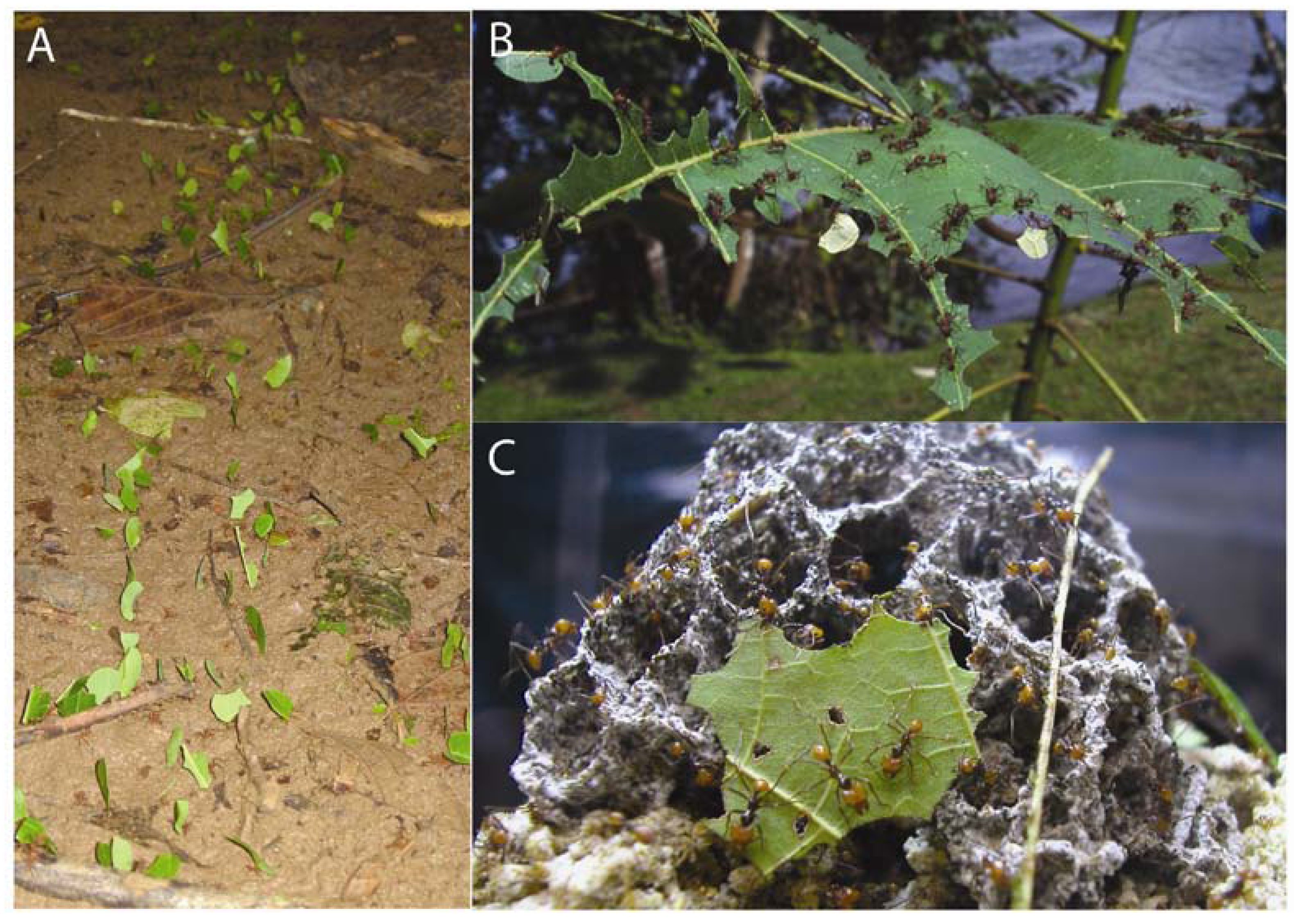
      <p>The most conspicuous symbiont of fungus-growing ants is the basidiomycetous fungus they grow for food. Although in the majority of species this is a lepiotaceious fungus of the genus <italic>Leucoagaricus</italic>, a small number of fungus-growing ant species culture a distantly-related pterulaceous group [<xref ref-type="bibr" rid="B19-insects-03-00041">19</xref>,<xref ref-type="bibr" rid="B20-insects-03-00041">20</xref>]. In most cases, the fungus is cultured by the ants on plant forage and subsequently consumed for food (<xref ref-type="fig" rid="insects-03-00041-f001">Figure 1</xref>) [<xref ref-type="bibr" rid="B21-insects-03-00041">21</xref>,<xref ref-type="bibr" rid="B22-insects-03-00041">22</xref>]. The most derived group of fungus-farmers, referred to as the “higher attines”, culture a specific clade of the fungus, among which is the well-studied species <italic>Leucoagaricus gongylophorus</italic>. This fungus produces nutrient-rich hyphal swellings, called gongylidia, which nourish the queen and brood of a colony [<xref ref-type="bibr" rid="B19-insects-03-00041">19</xref>,<xref ref-type="bibr" rid="B23-insects-03-00041">23</xref>]. The less-derived groups, or “lower attines”, culture a broader range of fungal symbionts, and appear to have re-acquired cultivars from the environment multiple times in the course of their evolutionary history [<xref ref-type="bibr" rid="B19-insects-03-00041">19</xref>,<xref ref-type="bibr" rid="B24-insects-03-00041">24</xref>]. </p>
      <fig id="insects-03-00041-f001" position="anchor">
        <label>Figure 1</label>
        <caption>
          <p>(<bold>a</bold><bold>, b</bold>) Leaf-cutter ants forage on large quantities of fresh foliar biomass. (<bold>c</bold>) They bring this material into their subterranean nests, where it is integrated into symbiotic fungus gardens they cultivate for food. [Photo credits: A; Jarrod J. Scott, B; Christian R. Linder, used under the GNU Free Documentation License, Version 1.2, C; Austin D. Lynch.].</p>
        </caption>
        <graphic xmlns:xlink="http://www.w3.org/1999/xlink" xlink:href="insects-03-00041-g001.tif"/>
      </fig>
      <p>Only recently have efforts been focused on characterizing microbes in this ecosystem other than the fungal cultivar. Fungus gardens of leaf-cutter ants have so far been found to contain numerous microbial groups in addition to the dominant fungal mutualist (<xref ref-type="table" rid="insects-03-00041-t001">Table 1</xref>). The most well-described symbionts include a specialized parasite of the fungal cultivar, <italic>Escovopsis</italic>, as well as an antibiotic-producing Actinobacterium (genus <italic>Pseudonocardia</italic>) found to defend against it [<xref ref-type="bibr" rid="B25-insects-03-00041">25</xref>,<xref ref-type="bibr" rid="B26-insects-03-00041">26</xref>,<xref ref-type="bibr" rid="B27-insects-03-00041">27</xref>]. Research on these two symbionts has previously been reviewed [<xref ref-type="bibr" rid="B28-insects-03-00041">28</xref>,<xref ref-type="bibr" rid="B29-insects-03-00041">29</xref>], and will be discussed here only briefly. Numerous other microfungi and yeasts have also been found associated with the fungus gardens of many ant species [<xref ref-type="bibr" rid="B30-insects-03-00041">30</xref>,<xref ref-type="bibr" rid="B31-insects-03-00041">31</xref>,<xref ref-type="bibr" rid="B32-insects-03-00041">32</xref>,<xref ref-type="bibr" rid="B33-insects-03-00041">33</xref>,<xref ref-type="bibr" rid="B34-insects-03-00041">34</xref>,<xref ref-type="bibr" rid="B35-insects-03-00041">35</xref>,<xref ref-type="bibr" rid="B36-insects-03-00041">36</xref>,<xref ref-type="bibr" rid="B37-insects-03-00041">37</xref>,<xref ref-type="bibr" rid="B38-insects-03-00041">38</xref>]. While filamentous fungi likely represent garden “weeds” [<xref ref-type="bibr" rid="B34-insects-03-00041">34</xref>,<xref ref-type="bibr" rid="B39-insects-03-00041">39</xref>], it is unclear if the yeasts have a deleterious effect on the fungus garden ecosystem. One study even found evidence that yeasts may antagonize microfungal pests [<xref ref-type="bibr" rid="B33-insects-03-00041">33</xref>]. Of the bacteria cultured from fungus gardens, many have been proposed to have important roles in the fungus garden ecosystem ranging from antibiotic-mediated exclusion of pathogens to nutrient biosynthesis [<xref ref-type="bibr" rid="B40-insects-03-00041">40</xref>,<xref ref-type="bibr" rid="B41-insects-03-00041">41</xref>,<xref ref-type="bibr" rid="B42-insects-03-00041">42</xref>]. However, the consistent presence of many of these microbes has yet to be demonstrated, and it remains a possibility that they represent allochthonous groups introduced from the incoming foliar material or surrounding soil. </p>
     
      <p>Recently, culture-independent techniques have begun to shed light on bacterial groups thought to be common constituents of fungus gardens (<xref ref-type="table" rid="insects-03-00041-t001">Table 1</xref>). Membrane lipid profiles have shown that different leaf-cutter ant fungus gardens are highly similar, and that Gram-negative bacteria likely dominate the prokaryotic component of these ecosystems [<xref ref-type="bibr" rid="B43-insects-03-00041">43</xref>]. Subsequent 16S libraries have confirmed this, and further indicated that γ-proteobacteria are particularly diverse in these environments, although sequences matching to α-, β- and δ-Proteobacteria, Bacteriodetes, Firmicutes, Actinobacteria, Acidobacteria, and several other phyla were also recovered [<xref ref-type="bibr" rid="B44-insects-03-00041">44</xref>]. The most recent metagenomic investigation of leaf-cutter ant fungus gardens has indicated that γ-proteobacteria in the genera <italic>Enterobacter</italic>, <italic>Pantoea</italic>, <italic>Klebsiella</italic>, <italic>Citrobacter</italic>, and <italic>Escherichia</italic> may constitute a core prokaryotic community [<xref ref-type="bibr" rid="B45-insects-03-00041">45</xref>]. In addition to culture-independent work, one study successfully cultured <italic>Klebsiella</italic> and <italic>Pantoea</italic> isolates from a variety of leaf-cutter ant nests and demonstrated their capacity to fix nitrogen [<xref ref-type="bibr" rid="B46-insects-03-00041">46</xref>]. Moreover, this study traced nitrogen in fungus gardens to the biomass of the ants themselves, indicating that bacteria could be playing an important nutritional role in these ecosystems. Nitrogen fixation was proposed to be a critical process in fungus gardens given the relatively high nitrogen content of ant biomass compared to the incoming plant forage and the surrounding ecosystem. </p>
    </sec>
    <sec>
      <title>3. The Ancillary Gut Hypothesis</title>
      <p>Some authors have postulated that the fungus garden ecosystem serves as an external gut for the entire ant colony [<xref ref-type="bibr" rid="B44-insects-03-00041">44</xref>,<xref ref-type="bibr" rid="B45-insects-03-00041">45</xref>,<xref ref-type="bibr" rid="B46-insects-03-00041">46</xref>]. Fungus-growing ants have previously been described as a “superorganism” in that the worker castes are not reproductively viable, and survival of the colony hinges completely on the queen [<xref ref-type="bibr" rid="B14-insects-03-00041">14</xref>]. Given that colonies of fungus growing ants are superorganisms rather than conglomerations of individuals, it follows that fungus gardens can be viewed as “organs” responsible for nutrient conversion and assimilation, similar to the digestive gut of other herbivores. </p>
      <p>The external gut hypothesis goes deeper than analogy. For example, both true guts and fungus gardens are specialized structures that harbor populations of bacteria that assist in the conversion of dietary material into nutrients for the host [<xref ref-type="bibr" rid="B44-insects-03-00041">44</xref>,<xref ref-type="bibr" rid="B47-insects-03-00041">47</xref>,<xref ref-type="bibr" rid="B48-insects-03-00041">48</xref>]. Prokaryotic populations in both true guts and fungus gardens have been implicated in the biosynthesis of nutrients for their hosts [<xref ref-type="bibr" rid="B45-insects-03-00041">45</xref>,<xref ref-type="bibr" rid="B46-insects-03-00041">46</xref>,<xref ref-type="bibr" rid="B48-insects-03-00041">48</xref>,<xref ref-type="bibr" rid="B49-insects-03-00041">49</xref>]. Perhaps the largest difference between these ecosystems is that the structural integrity of fungus gardens is provided by the fungal symbiont, whereas the prokaryotic component of true guts is harbored directly within the host. Moreover, the fungus garden ecosystem is dominated by the fungal cultivar, whereas true guts have a relatively smaller and more diverse fungal component [<xref ref-type="bibr" rid="B50-insects-03-00041">50</xref>,<xref ref-type="bibr" rid="B51-insects-03-00041">51</xref>,<xref ref-type="bibr" rid="B52-insects-03-00041">52</xref>]. </p>
      <p>Non-taxonomic similarities in prokaryotic diversity are also evident when comparing fungus gardens and mammalian guts. Low-phylum level and high strain-level diversity have been observed in both of these ecosystems when 16S ribosomal genes have been sequenced [<xref ref-type="bibr" rid="B4-insects-03-00041">4</xref>,<xref ref-type="bibr" rid="B5-insects-03-00041">5</xref>,<xref ref-type="bibr" rid="B44-insects-03-00041">44</xref>,<xref ref-type="bibr" rid="B45-insects-03-00041">45</xref>,<xref ref-type="bibr" rid="B53-insects-03-00041">53</xref>]. This pattern is independent of microbial taxonomy, as many mammalian guts are composed of primarily Bacteriodetes and Firmicutes [<xref ref-type="bibr" rid="B4-insects-03-00041">4</xref>,<xref ref-type="bibr" rid="B5-insects-03-00041">5</xref>,<xref ref-type="bibr" rid="B8-insects-03-00041">8</xref>,<xref ref-type="bibr" rid="B53-insects-03-00041">53</xref>,<xref ref-type="bibr" rid="B54-insects-03-00041">54</xref>,<xref ref-type="bibr" rid="B55-insects-03-00041">55</xref>,<xref ref-type="bibr" rid="B56-insects-03-00041">56</xref>], whereas γ-proteobacteria appear to dominate the prokaryotic component of fungus gardens. The causes of this distinct diversity profile are unclear, although in mammals it has been hypothesized that it may be the result of an adaptive radiation of a few initial prokaryotic “colonists” [<xref ref-type="bibr" rid="B5-insects-03-00041">5</xref>]. The relatively recent origin of these symbiotic niches compared to free living environments on the planet has also been implicated in limiting the number of microbial phyla that have evolved to live in them [<xref ref-type="bibr" rid="B5-insects-03-00041">5</xref>]. </p>
       <table-wrap id="insects-03-00041-t001" position="anchor">
        <object-id pub-id-type="pii">insects-03-00041-t001_Table 1</object-id>
        <label>Table 1</label>
        <caption>
          <p>Recent research on microbial diversity and plant biomass degradation in attine fungus gardens.</p>
        </caption>
                 <table rules="all" style="border: solid thin"> 
          <thead>
            <tr>
              <th align="center" valign="middle">Ant Genera</th>
              <th align="center" valign="middle">Collection Location</th>
              <th align="center" valign="middle">Microbes Analyzed</th>
              <th align="center" valign="middle">Plant Polymers Analyzed</th>
              <th align="center" valign="middle">Methods</th>
              <th align="center" valign="middle">Principle Findings</th>
              <th align="center" valign="middle">Reference</th>
            </tr>
          </thead>
          <tbody>
            <tr>
              <td align="center" valign="middle">
                <italic>Atta</italic>
              </td>
              <td align="center" valign="middle">Brazil</td>
              <td align="center" valign="middle">
                <italic>L. gongylophorus</italic>
              </td>
              <td align="center" valign="middle">Cellulose</td>
              <td align="center" valign="middle">Growth assays, enzymatic assays.</td>
              <td align="left" valign="middle">Evidence that <italic>L. gongylophorus</italic> can grow on cellulose in pure culture and hydrolyze this polymer efficiently.</td>
              <td align="center" valign="middle">[<xref ref-type="bibr" rid="B57-insects-03-00041">57</xref>]</td>
            </tr>
            <tr>
              <td align="center" valign="middle">
                <italic>Atta</italic>
              </td>
              <td align="center" valign="middle">Brazil</td>
              <td align="center" valign="middle">Bacteria</td>
              <td align="center" valign="middle">Gelatin, cellulose, cellobiose, casein</td>
              <td align="center" valign="middle">Directed culturing.</td>
              <td align="left" valign="middle">Isolation of plant polymer-degrading bacteria from fungus gardens.</td>
              <td align="center" valign="middle">[<xref ref-type="bibr" rid="B58-insects-03-00041">58</xref>]</td>
            </tr>
            <tr>
              <td align="center" valign="middle"><italic>Acromyrmex</italic>, <italic>Atta</italic>, <italic>Myrmicocrypta</italic>, <italic>Trachymyrmex</italic>, <italic>Cyphomyrmex</italic></td>
              <td align="center" valign="middle">Brazil, Texas, Trinidad and Tobago</td>
              <td align="center" valign="middle">Microfungi, yeasts,</td>
              <td align="center" valign="middle">NA</td>
              <td align="center" valign="middle">Culturing, bioassays.</td>
              <td align="left" valign="middle">Isolation and characterization of microfungi and yeasts from fungus gardens, especially those of the genera<italic> Escovopsis</italic>, <italic>Fusarium</italic>, and <italic>Trichoderma; </italic>evidence that yeasts may antagonize potential garden pathogens; Identification of a novel <italic>Trichosporon</italic> species in fungus gardens.</td>
              <td align="center" valign="middle">[<xref ref-type="bibr" rid="B26-insects-03-00041">26</xref>,<xref ref-type="bibr" rid="B27-insects-03-00041">27</xref>,<xref ref-type="bibr" rid="B30-insects-03-00041">30</xref>,<xref ref-type="bibr" rid="B31-insects-03-00041">31</xref>,<xref ref-type="bibr" rid="B32-insects-03-00041">32</xref>,<xref ref-type="bibr" rid="B33-insects-03-00041">33</xref>,<xref ref-type="bibr" rid="B35-insects-03-00041">35</xref>,<xref ref-type="bibr" rid="B37-insects-03-00041">37</xref>,<xref ref-type="bibr" rid="B38-insects-03-00041">38</xref>,<xref ref-type="bibr" rid="B39-insects-03-00041">39</xref>]</td>
            </tr>
            <tr>
              <td align="center" valign="middle"><italic>Acromyrmex</italic>, <italic>Atta</italic></td>
              <td align="center" valign="middle">Argentina</td>
              <td align="center" valign="middle">
                <italic>L. gongylophorus</italic>
              </td>
              <td align="center" valign="middle">Cellulose</td>
              <td align="center" valign="middle">Pure culture growth assays, estimation of lignin and cellulose content.</td>
              <td align="left" valign="middle">Indication that <italic>L. gongylophorus</italic> does not degrade cellulose in pure culture.</td>
              <td align="center" valign="middle">[<xref ref-type="bibr" rid="B59-insects-03-00041">59</xref>,<xref ref-type="bibr" rid="B60-insects-03-00041">60</xref>]</td>
            </tr>
            <tr>
              <td align="center" valign="middle"><italic>Acromyrmex</italic>, <italic>Atta</italic></td>
              <td align="center" valign="middle">Brazil, Panama</td>
              <td align="center" valign="middle">Whole fungus garden, ants, larvae</td>
              <td align="center" valign="middle">Polysaccharides, heterosides, oligosaccharides</td>
              <td align="center" valign="middle">Enzymatic activity assays on workers, larvae, and fungus gardens.</td>
              <td align="left" valign="middle">Enzymatic activity profiles for the fungus garden and host ants were largely non-overlapping; xylanase, amylase, laminarinase, cellulase, and lichenanase activities identified in fungus garden samples; evidence for high variability in the enzymatic activities of fungus gardens between different nests and ant species.</td>
              <td align="center" valign="middle">[<xref ref-type="bibr" rid="B61-insects-03-00041">61</xref>,<xref ref-type="bibr" rid="B62-insects-03-00041">62</xref>]</td>
            </tr>
            <tr>
              <td align="center" valign="middle"><italic>Acromyrmex</italic>, <italic>Atta</italic></td>
              <td align="center" valign="middle">Panama</td>
              <td align="center" valign="middle">
                <italic>L. gongylophorus</italic>
              </td>
              <td align="center" valign="middle">Pectin, CMC, ABTS (laccase substrate), protein</td>
              <td align="center" valign="middle">Isoelectric focusing, enzymatic assays.</td>
              <td align="left" valign="middle">Identification of fungal pectinases, CMCases, proteinases, and laccases concentrated by leaf-cutter ants in their fecal droplets.</td>
              <td align="center" valign="middle">[<xref ref-type="bibr" rid="B63-insects-03-00041">63</xref>]</td>
            </tr>
            <tr>
              <td align="center" valign="middle">
                <italic>Atta</italic>
              </td>
              <td align="center" valign="middle">Brazil</td>
              <td align="center" valign="middle">
                <italic>L. gongylophorus</italic>
              </td>
              <td align="center" valign="middle">Starch, pectin, xylan, cellulose, CMC</td>
              <td align="center" valign="middle">Growth and enzymatic assays.</td>
              <td align="left" valign="middle">Rapid growth of <italic>L. gongylophorus</italic> on xylan and starch, but poor growth on cellulose; Production of pectinases, xylanases, cellulases, and amylases by <italic>L. gongylophorus</italic> when grown in pure culture on different carbon sources; Identification of potential mechanisms for regulation of <italic>L. gongylophorus</italic> starch metabolism by the ant hosts.</td>
              <td align="center" valign="middle">[<xref ref-type="bibr" rid="B64-insects-03-00041">64</xref>,<xref ref-type="bibr" rid="B65-insects-03-00041">65</xref>,<xref ref-type="bibr" rid="B66-insects-03-00041">66</xref>]</td>
            </tr>
            <tr>
              <td align="center" valign="middle">
                <italic>Atta</italic>
              </td>
              <td align="center" valign="middle">Brazil</td>
              <td align="center" valign="middle">Whole fungus garden</td>
              <td align="center" valign="middle">All biomass</td>
              <td align="center" valign="middle">Estimation of cellulose and lignin content.</td>
              <td align="left" valign="middle">Evidence that the lignin:cellulose ratio is higher in fungus garden waste than leaf material.</td>
              <td align="center" valign="middle">[<xref ref-type="bibr" rid="B67-insects-03-00041">67</xref>]</td>
            </tr>
            <tr>
              <td align="center" valign="middle">
                <italic>Acromyrmex</italic>
              </td>
              <td align="center" valign="middle">Panama</td>
              <td align="center" valign="middle">
                <italic>L. gongylophorus</italic>
              </td>
              <td align="center" valign="middle">Xylan</td>
              <td align="center" valign="middle">Activity measurements of a xylanase, AZCL-based colorimetric assays.</td>
              <td align="left" valign="middle">Identification and characterization of an <italic>L. gongylophorus</italic> xylanase.</td>
              <td align="center" valign="middle">[<xref ref-type="bibr" rid="B68-insects-03-00041">68</xref>]</td>
            </tr>
            <tr>
              <td align="center" valign="middle">
                <italic>Acromyrmex</italic>
              </td>
              <td align="center" valign="middle">Brazil</td>
              <td align="center" valign="middle">Whole fungus garden, 
              <italic>L. gongylophorus </italic>pure cultures</td>
              <td align="center" valign="middle">Numerous polysaccharides</td>
              <td align="center" valign="middle">Enzymatic activity assays on 
              <italic>L. gongylophorus</italic> and whole fungus gardens, SEM.</td>
              <td align="left" valign="middle">Demonstration of broad lignocellulolytic capabilities of <italic>L. gongylophorus</italic> and whole fungus gardens, including activity against, laminarin, chitin, pectin, and CMC.</td>
              <td align="center" valign="middle">[<xref ref-type="bibr" rid="B69-insects-03-00041">69</xref>]</td>
            </tr>
            <tr>
              <td align="center" valign="middle">Cross phylogeny</td>
              <td align="center" valign="middle">Panama</td>
              <td align="center" valign="middle">Whole fungus gardens</td>
              <td align="center" valign="middle">Numerous polysaccharides</td>
              <td align="center" valign="middle">AZCL-based colorimetric assays.</td>
              <td align="left" valign="middle">Evidence for an evolutionary transition towards more efficient proteinase and amylase activity in leaf-cutter ant fungus gardens; evidence for broad lignocellulolytic capacity in lower attine fungus gardens.</td>
              <td align="center" valign="middle">[<xref ref-type="bibr" rid="B70-insects-03-00041">70</xref>]</td>
            </tr>
            <tr>
              <td align="center" valign="middle">
                <italic>Atta</italic>
              </td>
              <td align="center" valign="middle">Texas, Panama</td>
              <td align="center" valign="middle">
                <italic>L. gongylophorus</italic>
              </td>
              <td align="center" valign="middle">NA</td>
              <td align="center" valign="middle">Microsattelite profiling of 
              <italic>L. gongylophorus </italic>from different ant nests and time points.</td>
              <td align="left" valign="middle">Confirms that a single strain of <italic>L. gongylophorus</italic> is cultured in leaf-cutter ant fungus gardens.</td>
              <td align="center" valign="middle">[<xref ref-type="bibr" rid="B23-insects-03-00041">23</xref>]</td>
            </tr>
            <tr>
              <td align="center" valign="middle"><italic>Atta</italic>, <italic>Acromyrmex</italic></td>
              <td align="center" valign="middle">Panama, Costa Rica, Argentina</td>
              <td align="center" valign="middle"><italic>Pantoea</italic>, <italic>Klebsiella</italic></td>
              <td align="center" valign="middle">NA</td>
              <td align="center" valign="middle">Directed culturing, stable isotope analysis, acetylene reduction analysis, phylogenetic comparisons.</td>
              <td align="left" valign="middle">Identification of nitrogen-fixing <italic>Klebsiella</italic> and <italic>Pantoea </italic>isolates in fungus gardens; Evidence that nitrogen fixed in fungus gardens is integrated into ant biomass.</td>
              <td align="center" valign="middle">[<xref ref-type="bibr" rid="B46-insects-03-00041">46</xref>]</td>
            </tr>
            <tr>
              <td align="center" valign="middle">
                <italic>Acromyrmex</italic>
              </td>
              <td align="center" valign="middle">Panama</td>
              <td align="center" valign="middle">
                <italic>L. gongylophorus</italic>
              </td>
              <td align="center" valign="middle">Pectin</td>
              <td align="center" valign="middle">Proteomics, RT-qPCR, enzymatic assays.</td>
              <td align="left" valign="middle">Identification of diverse fungal pectinases concentrated in the fecal droplets of the ants; evidence that <italic>L. gongylophorus</italic> produces enzymes specifically in the hyphal swellings fed to the ants.</td>
              <td align="center" valign="middle">[<xref ref-type="bibr" rid="B71-insects-03-00041">71</xref>]</td>
            </tr>
            <tr>
              <td align="center" valign="middle"><italic>Atta</italic>, <italic>Acromyrmex</italic></td>
              <td align="center" valign="middle">Panama, Argentina</td>
              <td align="center" valign="middle">Primarily Gram-negative bacteria</td>
              <td align="center" valign="middle">NA</td>
              <td align="center" valign="middle">Lipid profiling using PLFA and FAME.</td>
              <td align="left" valign="middle">Evidence that ant fungus gardens and refuse dumps contain distinct microbial communities; evidence that the prokaryotic fraction of fungus gardens is dominated by Gram-negative bacteria.</td>
              <td align="center" valign="middle">[<xref ref-type="bibr" rid="B43-insects-03-00041">43</xref>]</td>
            </tr>
            <tr>
              <td align="center" valign="middle">
                <italic>Atta</italic>
              </td>
              <td align="center" valign="middle">Panama</td>
              <td align="center" valign="middle">γ-proteobacteria, primarily 
              <italic>Klebsiella</italic> and <italic>Pantoea</italic></td>
              <td align="center" valign="middle">Cellulose, hemicelluloses</td>
              <td align="center" valign="middle">Community metagenomics, 16S surveys, genome sequencing, enzymatic assays, sugar composition analysis.</td>
              <td align="left" valign="middle">Survey of bacterial diversity in fungus gardens; Identification of abundant <italic>Klebsiella</italic> and <italic>Pantoea</italic> populations; characterization of bacterial glycoside hydrolases; Evidence for significant amounts of cellulose degradation in fungus gardens.</td>
              <td align="center" valign="middle">[<xref ref-type="bibr" rid="B44-insects-03-00041">44</xref>]</td>
            </tr>
            <tr>
              <td align="center" valign="middle">
                <italic>Atta</italic>
              </td>
              <td align="center" valign="middle"> </td>
              <td align="center" valign="middle">Whole fungus garden</td>
              <td align="center" valign="middle">Numerous polysaccharides</td>
              <td align="center" valign="middle">AZCL-based colorimetric assays</td>
              <td align="left" valign="middle">Evidence that enzyme profiles in fungus gardens shift rapidly when integrated foliar biomass changes.</td>
              <td align="center" valign="middle">[<xref ref-type="bibr" rid="B72-insects-03-00041">72</xref>]</td>
            </tr>
            <tr>
              <td align="center" valign="middle">
                <italic>Acromyrmex</italic>
              </td>
              <td align="center" valign="middle">Panama</td>
              <td align="center" valign="middle">Whole fungus garden</td>
              <td align="center" valign="middle">Pectin, xylose</td>
              <td align="center" valign="middle">Antibody and CBM-based polysaccharide microarray profiling, AZCL-based colorimetric assays.</td>
              <td align="left" valign="middle">Evidence for the degradation of xylan and pectin, but not cellulose, in fungus gardens; Indication that plant material is only partially degraded in these ecosystems.</td>
              <td align="center" valign="middle">[<xref ref-type="bibr" rid="B73-insects-03-00041">73</xref>]</td>
            </tr>
            <tr>
              <td align="center" valign="middle">
                <italic>Atta</italic>
              </td>
              <td align="center" valign="middle">Brazil</td>
              <td align="center" valign="middle">
                <italic>L. gongylophorus</italic>
              </td>
              <td align="center" valign="middle">All biomass</td>
              <td align="center" valign="middle">Dye and photomicrography of plant biomass.</td>
              <td align="left" valign="middle">Evidence for substantial degradation of all non-lignified plant tissues in fungus gardens; indication that <italic>L. gongylophorus</italic> may degrade a large quantity of cellulose in fungus gardens</td>
              <td align="center" valign="middle">[<xref ref-type="bibr" rid="B74-insects-03-00041">74</xref>]</td>
            </tr>
            <tr>
              <td align="center" valign="middle">Cross phylogeny</td>
              <td align="center" valign="middle">Panama</td>
              <td align="center" valign="middle">
                <italic>L. gongylophorus</italic>
              </td>
              <td align="center" valign="middle">Protein</td>
              <td align="center" valign="middle">Enzymatic assays, pH and buffering analysis.</td>
              <td align="left" valign="middle">Indication that the fungal cultivars of higher attines have evolved proteinases with activity optima at pH ~5, closer to the pH of fungus gardens; characterization of different proteinase classes and buffing capacities in different fungus gardens</td>
              <td align="center" valign="middle">[<xref ref-type="bibr" rid="B75-insects-03-00041">75</xref>]</td>
            </tr>
            <tr>
              <td align="center" valign="middle">
                <italic>Atta</italic>
              </td>
              <td align="center" valign="middle">Panama</td>
              <td align="center" valign="middle">Bacteria</td>
              <td align="center" valign="middle">Cellulose, hemicelluloses</td>
              <td align="center" valign="middle">Community metagenomics, 16S surveys, metaproteomics.</td>
              <td align="left" valign="middle">Identification of abundant <italic>Enterobacter</italic> population in fungus gardens; Further characterization of <italic>Klebsiella</italic> and <italic>Pantoea</italic> populations; Proteomic identification of bacterial glycoside hydrolases; Identification of bacteriophage in fungus gardens</td>
              <td align="center" valign="middle">[<xref ref-type="bibr" rid="B45-insects-03-00041">45</xref>]</td>
            </tr>
          </tbody>
        </table>
      </table-wrap>
    </sec>
    <sec>
      <title>4. Evolution of Hygiene in the Attines</title>
      <p>The finding that fungus gardens are composed predominantly of one fungal symbiont and 5–6 bacterial groups has led to the question of how this community composition is maintained. The partially-degraded plant material present in fungus gardens could potentially be used as a substrate for countless microorganisms, yet somehow only a small number predominate. Furthermore, the composition of the fungus garden community has been shown to be relatively consistent between fungus garden strata irrespective of the extent of biomass degradation [<xref ref-type="bibr" rid="B44-insects-03-00041">44</xref>,<xref ref-type="bibr" rid="B45-insects-03-00041">45</xref>], suggesting the existence of selective pressures to maintain a consistent community.</p>
      <p>A number of factors likely contribute to the low diversity in fungus gardens (<xref ref-type="table" rid="insects-03-00041-t002">Table 2</xref>). The meticulous cleaning of fungus gardens by the ants is likely paramount, both for maintaining healthy cultures of the fungal symbiont and a consistent prokaryotic assemblage. Three main hygienic behaviors have been documented in fungus-growing ants. The first, termed weeding, is characterized by the specific removal of whole fragments of fungus garden material [<xref ref-type="bibr" rid="B76-insects-03-00041">76</xref>]. The ants weed their gardens to remove dead fungal debris as well as areas infected with pests, especially the specialized parasite <italic>Escovopsis</italic>. Some species of leaf-cutter ants have been shown to maintain specialized waste dumps for their agricultural waste, and the separation between these refuse heaps and fungus gardens is likely key to the maintenance of overall nest hygiene. </p>
      <table-wrap id="insects-03-00041-t002" position="anchor">
        <object-id pub-id-type="pii">insects-03-00041-t002_Table 2</object-id>
        <label>Table 2</label>
        <caption>
          <p>Factors contributing to microbial assemblage composition in attine ant fungus gardens.</p>
        </caption>
        <table rules="all" style="border: solid thin">

		<tbody>
            <tr>
              <td align="left" valign="middle">Factors limiting diversity</td>
              <td align="left" valign="middle">Weeding and grooming of fungus gardens, application of glandular secretions, application of antimicrobials from <italic>Pseudonocardia</italic>, antibiotics produced by the fungal cultivar, fecal droplets of the ants</td>
            </tr>
            <tr>
              <td align="left" valign="middle">Factors promoting diversity</td>
              <td align="left" valign="middle">Complex, nutrient rich substrate</td>
            </tr>
            <tr>
              <td align="left" valign="middle">Potential sources of microbial groups</td>
              <td align="left" valign="middle">Maternal transmission from parent colony, phyllosphere microbes on foliar biomass, surrounding soil, the ants themselves</td>
            </tr>
          </tbody>
        </table>
      </table-wrap>
      <p>The second behavior, termed ‘fungus grooming’, is characterized by the licking of fungus garden material by the ants and selective filtering of foreign spores into infrabuccal pockets located in their oral cavities [<xref ref-type="bibr" rid="B76-insects-03-00041">76</xref>]. This behavior appears to be critical for removing spores of foreign fungi that could lead to future infection. Both weeding and grooming have been stimulated in experimental ant nests by the addition of foreign fungal spores, suggesting that the ants have acute mechanisms for assessing the composition and health of their gardens [<xref ref-type="bibr" rid="B76-insects-03-00041">76</xref>]. </p>
      <p>The third behavior involves the application of fecal droplets to the fungus garden matrix. Some species of attines have been shown to concentrate fungal chitinases and lignocellulases in these droplets, and their integration into fungus gardens has been hypothesized to contribute both to plant biomass degradation and the removal of fungal pests [<xref ref-type="bibr" rid="B63-insects-03-00041">63</xref>,<xref ref-type="bibr" rid="B77-insects-03-00041">77</xref>,<xref ref-type="bibr" rid="B78-insects-03-00041">78</xref>]. These drastic changes in the behavior of attines highlight how the long-term maintenance of symbiosis can have profound impacts on the life history of host organisms.</p>
      <p>Glandular secretions of the ants themselves have also been shown to play a role in maintaining the hygiene of fungus gardens. Although known to ward off infection in all ants [<xref ref-type="bibr" rid="B79-insects-03-00041">79</xref>,<xref ref-type="bibr" rid="B80-insects-03-00041">80</xref>,<xref ref-type="bibr" rid="B81-insects-03-00041">81</xref>], metapleural glands may also be used by fungus-growing ants to remove unwanted microbial groups from their fungus gardens. For example, studies have found that ants consistently rub their legs against their metapleural glands while weeding and grooming so as to apply glandular secretions to the fungus garden [<xref ref-type="bibr" rid="B82-insects-03-00041">82</xref>,<xref ref-type="bibr" rid="B83-insects-03-00041">83</xref>]. Moreover, the application of metapleural gland secretions increases with weeding and grooming behavior when foreign fungal spores are experimentally introduced into a nest [<xref ref-type="bibr" rid="B82-insects-03-00041">82</xref>,<xref ref-type="bibr" rid="B83-insects-03-00041">83</xref>]. Chemical analysis of leaf-cutter ant metapleural gland secretions identified phenylacetic acid and number of short-chain fatty acids known to have antimicrobial properties [<xref ref-type="bibr" rid="B84-insects-03-00041">84</xref>,<xref ref-type="bibr" rid="B85-insects-03-00041">85</xref>]. Bioassays have confirmed that these glandular secretions have broad antifungal and antibacterial activity [<xref ref-type="bibr" rid="B86-insects-03-00041">86</xref>,<xref ref-type="bibr" rid="B87-insects-03-00041">87</xref>]. Secretions of the mandibular gland have also been implicated in potentially inhibiting the germination of alien fungi [<xref ref-type="bibr" rid="B78-insects-03-00041">78</xref>]. Because glandular secretions could potentially inhibit the growth of the fungal cultivar if consistently introduced to fungus gardens, the ants may rely only on selective application of these secretions to areas thought to be infected. </p>
      <p>The fungus itself may also produce compounds that selectively inhibit or promote the growth of other microbes in its environment. Basidiomycetes in general are a rich source of secondary metabolites [<xref ref-type="bibr" rid="B88-insects-03-00041">88</xref>], and novel antimicrobial compounds have previously been identified from <italic>Leucoagaricus</italic> species [<xref ref-type="bibr" rid="B89-insects-03-00041">89</xref>]. Moreover, the fungus cultured by the ants has been implicated in the production of organohalogens [<xref ref-type="bibr" rid="B90-insects-03-00041">90</xref>], which may be involved in lignocellulose degradation or antibiosis in basidiomycetes [<xref ref-type="bibr" rid="B91-insects-03-00041">91</xref>]. Antibiosis of cultivated <italic>Leucoagaricus</italic> isolates against <italic>Escovopsis</italic> species has also been shown, suggesting these fungi have at least some capacity for the production of secondary metabolites [<xref ref-type="bibr" rid="B92-insects-03-00041">92</xref>]. </p>
      <p>Lastly, fungus-growing ants have been shown to constrain microbial diversity in their fungus gardens through association with antibiotic-producing Actinobacteria [<xref ref-type="bibr" rid="B25-insects-03-00041">25</xref>,<xref ref-type="bibr" rid="B29-insects-03-00041">29</xref>,<xref ref-type="bibr" rid="B42-insects-03-00041">42</xref>,<xref ref-type="bibr" rid="B93-insects-03-00041">93</xref>,<xref ref-type="bibr" rid="B94-insects-03-00041">94</xref>,<xref ref-type="bibr" rid="B95-insects-03-00041">95</xref>,<xref ref-type="bibr" rid="B96-insects-03-00041">96</xref>,<xref ref-type="bibr" rid="B97-insects-03-00041">97</xref>]. Bacteria of the genus <italic>Pseudonocardia</italic> have been shown to produce compounds that inhibit the specialized garden parasite <italic>Escovopsis</italic> [<xref ref-type="bibr" rid="B25-insects-03-00041">25</xref>,<xref ref-type="bibr" rid="B98-insects-03-00041">98</xref>], and experimental evidence suggests these microbes play a role in maintaining garden hygiene [<xref ref-type="bibr" rid="B93-insects-03-00041">93</xref>,<xref ref-type="bibr" rid="B94-insects-03-00041">94</xref>]. Other Actinobacteria isolated from ant colonies have also been proposed to play a role in the defense against garden pathogens, but the consistent presence of these microbes in attine nests has yet to be determined [<xref ref-type="bibr" rid="B42-insects-03-00041">42</xref>,<xref ref-type="bibr" rid="B99-insects-03-00041">99</xref>,<xref ref-type="bibr" rid="B100-insects-03-00041">100</xref>]. Regardless, the combination of compounds produced by Actinobacteria and the fungal cultivar, together with the glandular secretions of the ants, likely produces a potent antimicrobial cocktail that could be critical for shaping microbial diversity in fungus gardens.</p>
    </sec>
    <sec>
      <title>5. Plant Biomass Degradation in Fungus Gardens</title>
      <p>The conversion of plant biomass into nutrients usable by the ants is the central role of fungus gardens. Despite the central importance of this process, the mechanisms through which plant biomass is degraded in these ecosystems are only beginning to be elucidated (<xref ref-type="table" rid="insects-03-00041-t001">Table 1</xref>). In general, the plant biomass integrated into fungus gardens is a rich source of cellulose, hemicelluloses, protein, lignin, simple sugars, and various other compounds. In the fungus gardens of higher attines, this is converted into hyphal swellings called gongylidia, which are rich in lipids, carbohydrates, and other nutrients produced by the fungal cultivar [<xref ref-type="bibr" rid="B101-insects-03-00041">101</xref>,<xref ref-type="bibr" rid="B102-insects-03-00041">102</xref>]. Importantly, gongylidia serve as a primary food source for the entire ant colony, and are the exclusive nutrient source for the developing larvae and brood [<xref ref-type="bibr" rid="B14-insects-03-00041">14</xref>,<xref ref-type="bibr" rid="B22-insects-03-00041">22</xref>]. Identification of the mechanisms through which biomass is degraded, how it is converted into energy for the ants, and which microbes are taking part in these processes is critical to a fundamental understanding of the ant-fungus garden symbiosis. </p>
      <p>Most work has focused on the lignocellulolytic capacity of <italic>L. gongylophorus</italic>, the species of fungus cultured by leaf-cutter ants. Numerous growth- and enzyme-based assays have indicated that pure cultures of this organism can degrade and grow rapidly on both starch and xylan [<xref ref-type="bibr" rid="B64-insects-03-00041">64</xref>,<xref ref-type="bibr" rid="B65-insects-03-00041">65</xref>,<xref ref-type="bibr" rid="B66-insects-03-00041">66</xref>]. Furthermore, while pectin is degraded rapidly by this organism, this polymer supports only intermediate growth [<xref ref-type="bibr" rid="B64-insects-03-00041">64</xref>,<xref ref-type="bibr" rid="B66-insects-03-00041">66</xref>]. Numerous pectinases and one xylanase have been identified in <italic>L. gongylophorus </italic>[<xref ref-type="bibr" rid="B68-insects-03-00041">68</xref>,<xref ref-type="bibr" rid="B71-insects-03-00041">71</xref>], providing evidence that it possesses coding potential typical of other saprotrophic basidiomycetes. </p>
      <p>Analysis of whole fungus garden extract has indicated that a wide variety of plant polymers are degraded in fungus gardens, including xylan, pectin, starch, laminarin, cellulose, lichenan, and chitin [<xref ref-type="bibr" rid="B61-insects-03-00041">61</xref>,<xref ref-type="bibr" rid="B62-insects-03-00041">62</xref>,<xref ref-type="bibr" rid="B69-insects-03-00041">69</xref>,<xref ref-type="bibr" rid="B70-insects-03-00041">70</xref>,<xref ref-type="bibr" rid="B72-insects-03-00041">72</xref>]. One study sought to compare enzymatic profiles of fungus gardens across the phylogeny of the attines [<xref ref-type="bibr" rid="B70-insects-03-00041">70</xref>]. This analysis found that the fungus gardens of leaf-cutter ants had higher amylase activity than fungus gardens of the lower attines [<xref ref-type="bibr" rid="B70-insects-03-00041">70</xref>]. Moreover, the overall proteinase activity was significantly higher in all higher attine fungus gardens compared to the fungus gardens of lower attines [<xref ref-type="bibr" rid="B70-insects-03-00041">70</xref>]. Another study found that the pH optima of proteinases in leaf-cutter ant fungus gardens was lower than those in lower attine fungus gardens, and that the buffering capacity in leaf-cutter ant fungus gardens was also higher [<xref ref-type="bibr" rid="B75-insects-03-00041">75</xref>]. Together these results suggest that multiple evolutionary transitions throughout the history of the ant-fungus garden association have led to a specialized form of biomass degradation in leaf-cutter ant fungus gardens [<xref ref-type="bibr" rid="B70-insects-03-00041">70</xref>,<xref ref-type="bibr" rid="B75-insects-03-00041">75</xref>]. </p>
      <p>The most controversial aspect of plant biomass degradation in fungus gardens is the deconstruction of cellulose. Early work found support for the hypothesis that cellulose was the primary polymer supporting fungal growth in these environments, and it was estimated that up to 45% of the cellulose in foliar biomass was degraded in fungus gardens [<xref ref-type="bibr" rid="B103-insects-03-00041">103</xref>]. More recently, however, studies have challenged this hypothesis, reporting that <italic>L. gongylophorus</italic> cannot grow in pure culture with cellulose as the sole carbon source [<xref ref-type="bibr" rid="B57-insects-03-00041">57</xref>,<xref ref-type="bibr" rid="B59-insects-03-00041">59</xref>,<xref ref-type="bibr" rid="B60-insects-03-00041">60</xref>], suggesting that the secreted proteins of this fungus have only limited cellulolytic activity [<xref ref-type="bibr" rid="B64-insects-03-00041">64</xref>,<xref ref-type="bibr" rid="B66-insects-03-00041">66</xref>]. Measurements of cellulose degradation in fungus gardens have also varied, with sugar composition analyses indicating that ~30% of the cellulose in foliar biomass is degraded in fungus gardens [<xref ref-type="bibr" rid="B44-insects-03-00041">44</xref>], while a polysaccharide microarray approach documented only limited degradation of this polymer [<xref ref-type="bibr" rid="B73-insects-03-00041">73</xref>]. One microscopy-based study examined plant biomass in fungus gardens throughout different stages of decomposition and found strong support for the degradation of parenchyma, endodermis, and vascular bundle cells, indicating that all plant polymers in the plant cell wall, with the exception of lignin, were degraded extensively [<xref ref-type="bibr" rid="B74-insects-03-00041">74</xref>]. </p>
      <p>High variability in the lignocellulolytic activity in fungus gardens may explain some of these conflicting results. Measurements of the enzymatic activity of whole fungus garden protein extracts typically vary over a wide range, even when fungus gardens of the same species of ant are compared [<xref ref-type="bibr" rid="B62-insects-03-00041">62</xref>,<xref ref-type="bibr" rid="B70-insects-03-00041">70</xref>]. One study even documented a rapid shift in enzymatic activity in this environment when laboratory ant colonies were switched from a diet of foliar biomass to one of starch-rich rice [<xref ref-type="bibr" rid="B72-insects-03-00041">72</xref>]. It is thus possible that large quantities of cellulose are degraded in fungus gardens, but that this amount varies depending on the foliar biomass provided by the ants. Indeed, because such a variety of plants are harvested by leaf-cutter ants [<xref ref-type="bibr" rid="B104-insects-03-00041">104</xref>,<xref ref-type="bibr" rid="B105-insects-03-00041">105</xref>,<xref ref-type="bibr" rid="B106-insects-03-00041">106</xref>], it may be crucial that <italic>L. gongylophorus</italic> is capable of both degrading a variety of plant polymers and changing its lignocellulolytic activity to match the plant substrate available. The selection of plant polymers degraded by <italic>L. gongylophorus</italic> may also depend on the nutritional status of the host colony, as more recalcitrant polymers present a vast food supply but require the input of additional resources for effective degradation. </p>
      <p>A potential explanation to the limited lignocellulolytic capacity of <italic>L. gongylophorus </italic>pure cultures is that the host ants enhance the biodegradative capacity of this organism <italic>in situ</italic>. Attines are known to concentrate lignocellulolytic enzymes in fecal droplets that they deposit on freshly integrated plant biomass in fungus gardens, presumably to assist in the first stages of biomass degradation, or, as mentioned above, to inhibit potential garden pests [<xref ref-type="bibr" rid="B77-insects-03-00041">77</xref>,<xref ref-type="bibr" rid="B107-insects-03-00041">107</xref>,<xref ref-type="bibr" rid="B108-insects-03-00041">108</xref>,<xref ref-type="bibr" rid="B109-insects-03-00041">109</xref>]. Recent work has confirmed these enzymes originate from the fungal gongylidia consumed by the ants, and that a variety of pectinases, carboxymethylcellulases, amylases, and even laccases are present in this cocktail [<xref ref-type="bibr" rid="B63-insects-03-00041">63</xref>,<xref ref-type="bibr" rid="B71-insects-03-00041">71</xref>]. The relative importance of this pre-treatment step to overall biomass degradation in fungus gardens is not known, nor is the full extent of the enzymes that may be present in fecal droplets. </p>
      <p>It is also possible that microbes other than the fungal cultivar are essential for plant biomass degradation, either by deconstructing plant polymers directly or by enhancing the lignocellulolytic activity of the fungal cultivar. There is precedent for bacterial-fungal interactions promoting fungal lignocellulose degradation in other systems, but the mechanisms for these phenomena remain unclear [<xref ref-type="bibr" rid="B110-insects-03-00041">110</xref>]. Lignocellulolytic bacteria have also been cultured directly from fungus gardens [<xref ref-type="bibr" rid="B58-insects-03-00041">58</xref>], indicating that these microbes could participate directly in biomass processing. Recent metagenomic analyses have confirmed that bacteria in fungus gardens possess a variety of glycoside hydrolase genes that could potentially deconstruct plant polysaccharides directly [<xref ref-type="bibr" rid="B44-insects-03-00041">44</xref>,<xref ref-type="bibr" rid="B45-insects-03-00041">45</xref>], and proteomic work has confirmed that at least some of these genes are expressed in fungus gardens [<xref ref-type="bibr" rid="B45-insects-03-00041">45</xref>]. A number of studies have investigated microfungi and yeasts in fungus gardens (<xref ref-type="table" rid="insects-03-00041-t001">Table 1</xref>), but the lignocellulolytic capacities of these organisms have yet to be investigated. </p>
      <p>Regardless if specific microbe-microbe or ant-microbe interactions are significantly influencing biomass degradation, it is clear that the physiology of fungus garden microbes in pure culture do not fully reflect their <italic>in situ</italic> physiology. The diverse lignocellulolytic activities repeatedly measured from both <italic>L. gongylophorus </italic>and directly from fungus gardens indicate that a wide variety of plant polymers, including cellulose, are likely degraded in this ecosystem [<xref ref-type="bibr" rid="B44-insects-03-00041">44</xref>,<xref ref-type="bibr" rid="B57-insects-03-00041">57</xref>,<xref ref-type="bibr" rid="B61-insects-03-00041">61</xref>,<xref ref-type="bibr" rid="B62-insects-03-00041">62</xref>,<xref ref-type="bibr" rid="B68-insects-03-00041">68</xref>,<xref ref-type="bibr" rid="B69-insects-03-00041">69</xref>,<xref ref-type="bibr" rid="B70-insects-03-00041">70</xref>,<xref ref-type="bibr" rid="B72-insects-03-00041">72</xref>,<xref ref-type="bibr" rid="B74-insects-03-00041">74</xref>]. However, the amount of degradation may vary greatly depending on the foliar biomass harvested by the ants and other community-level processes that have yet to be elucidated [<xref ref-type="bibr" rid="B62-insects-03-00041">62</xref>,<xref ref-type="bibr" rid="B70-insects-03-00041">70</xref>,<xref ref-type="bibr" rid="B72-insects-03-00041">72</xref>]. Confirming the extent to which the fungal cultivar, resident bacteria, and other microbes in fungus gardens contribute to lignocellulose degradation, and more thoroughly characterizing the <italic>in situ</italic> physiology of this ecosystem, remains an important future direction in this field. </p>
    </sec>
    <sec>
      <title>6. Reciprocal Adaptation of the Ant Genome</title>
      <p>The application of sequenced-based approaches to investigate the fungus-growing ant system has advanced to include the ants themselves. The recently sequenced genomes of the leaf-cutter ants <italic>Atta cephalotes</italic> and <italic>Acromyrmex echinatior</italic> have provided a wealth of information for studying the symbiosis between these ants and their fungus gardens [<xref ref-type="bibr" rid="B17-insects-03-00041">17</xref>,<xref ref-type="bibr" rid="B18-insects-03-00041">18</xref>]. The obligate dependence of these ants on their cultivated fungi has been thought to lead to reductions at the genomic level, as has previously been observed in other model nutritional symbiosis such as between the pea aphid and its nutrient-producing bacterial endosymbionts [<xref ref-type="bibr" rid="B111-insects-03-00041">111</xref>]. In the pea aphid system, the host genome was found to lack genes for the biosynthesis of specific amino acids known to be produced by its endosymbiont <italic>Buchnera</italic> [<xref ref-type="bibr" rid="B111-insects-03-00041">111</xref>,<xref ref-type="bibr" rid="B112-insects-03-00041">112</xref>]. Similarly, both genomes of the leaf-cutter ants were found to lack genes required for arginine biosynthesis, in contrast to other ant genomes that contain the entire pathway [<xref ref-type="bibr" rid="B17-insects-03-00041">17</xref>,<xref ref-type="bibr" rid="B18-insects-03-00041">18</xref>]. One hypothesis is that the fungus may provide arginine to the ants, thereby limiting the need for this particular pathway. Previous work documenting the compounds in an <italic>Atta colombica</italic> cultivar has shown the presence of free arginine, providing some support for this hypothesis [<xref ref-type="bibr" rid="B101-insects-03-00041">101</xref>]. The <italic>A. cephalotes</italic> genome was also found to be missing a hexamerin gene thought to be involved in amino acid sequestration during larval development [<xref ref-type="bibr" rid="B18-insects-03-00041">18</xref>], potentially indicating that these ants have a reduced need to store amino acids since larvae may get these nutrients from the fungal cultivar.</p>
      <p>Serine proteases, which are potentially important in the degradation of proteins in the diet, were also found to be reduced in the <italic>A. cephalotes</italic> genome compared to other insects [<xref ref-type="bibr" rid="B18-insects-03-00041">18</xref>]. As with the loss of arginine biosynthesis and hexamerins, this may reflect a decreased capacity of leaf-cutter ants to acquire nutrients from their environment coincident with their dependence on <italic>L. gongylophorus</italic> for food. Another possible hypothesis is that this reduction in proteases is related to the ants’ ability to concentrate fungal enzymes in their fecal droplets. Because extensive degradation of proteins in the diet would preclude the concentration and application of fungal enzymes to the fungus gardens, it is possible that the lack of these genes is a result of millions of years of this peculiar behavior. </p>
      <p>Overall these data are consistent with the hypothesis that fungus-growing ants have lost some capacity to acquire nutrients over the course of their 50 million year co-evolutionary history with their obligate fungal mutualist. It is interesting to note that co-evolved symbioses, characterized by the evolutionary innovation provided by both partners, appear to be accompanied by physiological restrictions in the hosts. Perhaps most striking is the possibility that a behavioral innovation of the ants—the concentration of lignocellulolytic and potentially antimicrobial fungal enzymes in fecal droplets—may have also resulted in profound genomic changes. These results, together with what is known for other symbioses such as the pea aphid-<italic>Buchnera</italic> system, suggest a common theme in nutritional symbioses: prolonged reliance by the host on a single symbiont for nutrition resulting in extensive and elaborate evolutionary transitions towards obligate association. </p>
    </sec>
    <sec sec-type="conclusions">
      <title>7. Conclusions and Future Outlook</title>
      <p>Attine ants have long been a model system for the study of symbiosis, co-evolution, and evolutionary innovation. The intriguing symbiosis between these ants and their fungus-bacteria consortia is remarkable both because of its stability (~50 million years) and the drastic effects it has had on both partners (production of hyphal swellings and shifts in enzymatic profiles by the fungal cultivar, and genomic and behavioral changes in the host ants). Here we have reviewed how advances in genome sequencing and culture-independent investigations of microbial communities, together with more traditional approaches, have transformed our understanding of co-evolution and evolutionary innovation in the fungus-growing ants. Future work answering key questions of plant biomass degradation and nutrient conversion in fungus gardens, reciprocal ant-fungus co-evolution, and fungus garden microbial diversity will allow for a more fundamental understanding of this remarkable system. For example, advances in proteomics and <italic>in situ</italic> analyses of microbial communities will shed light on the degradation of cellulose in fungus gardens, and the role different microbial groups play in biomass processing. Moreover, by leveraging the large amount of sequence information now available for the organisms in this symbiosis, it will soon be possible to understand the degree of metabolic integration between the ants and their fungus, and the extent to which the behavior of the host has been altered by genetic and physiological constraints of the symbiosis. Given the prevalence of symbiotic microbial communities in nature, gaining a fundamental understanding of the ant-fungus garden system will likely have far-reaching implications for understanding broader trends in the ecology and evolution of metazoans. </p>
    </sec>
  </body>
  <back>
    <ack>
      <title>Acknowledgements</title>
      <p>We thank members of the Currie lab for their feedback on earlier versions of this manuscript. This work was funded by the DOE Great Lakes Bioenergy Research Center (DOE BER Office of Science DE-FC02-07ER64494) and by the National Science Foundation grant DEB-0747002 to C.R.C.</p>
    </ack>
    <ref-list>
      <title>References</title>
      <ref id="B1-insects-03-00041">
        <label>1.</label>
        <citation citation-type="journal">
          <person-group person-group-type="author">
            <name>
              <surname>Moran</surname>
              <given-names>N.A.</given-names>
            </name>
          </person-group>
          <article-title>Symbiosis</article-title>
          <source>Curr. Biol.</source>
          <year>2006</year>
          <volume>16</volume>
          <fpage>R866</fpage>
          <lpage>R871</lpage>
          <pub-id pub-id-type="doi">10.1016/j.cub.2006.09.019</pub-id>
        </citation>
      </ref>
      <ref id="B2-insects-03-00041">
        <label>2.</label>
        <citation citation-type="journal">
          <person-group person-group-type="author">
            <name>
              <surname>Zilber-Rosenberg</surname>
              <given-names>I.</given-names>
            </name>
            <name>
              <surname>Rosenberg</surname>
              <given-names>E.</given-names>
            </name>
          </person-group>
          <article-title>Role of microorganisms in the evolution of animals and plants: The hologenome theory of evolution</article-title>
          <source>FEMS Microbiol. Rev.</source>
          <year>2008</year>
          <volume>32</volume>
          <fpage>723</fpage>
          <lpage>735</lpage>
          <pub-id pub-id-type="doi">10.1111/j.1574-6976.2008.00123.x</pub-id>
        </citation>
      </ref>
      <ref id="B3-insects-03-00041">
        <label>3.</label>
        <citation citation-type="book">
          <person-group person-group-type="author">
            <name>
              <surname>Douglas</surname>
              <given-names>A.E.</given-names>
            </name>
          </person-group>
          <source>The Symbiotic Habit</source>
          <publisher-name>Princeton University Press</publisher-name>
          <publisher-loc>Princeton, NJ, USA</publisher-loc>
          <year>2010</year>
        </citation>
      </ref>
      <ref id="B4-insects-03-00041">
        <label>4.</label>
        <citation citation-type="journal">
          <person-group person-group-type="author">
            <name>
              <surname>Ley</surname>
              <given-names>R.E.</given-names>
            </name>
            <name>
              <surname>Hamady</surname>
              <given-names>M.</given-names>
            </name>
            <name>
              <surname>Lozupone</surname>
              <given-names>C.</given-names>
            </name>
            <name>
              <surname>Turnbaugh</surname>
              <given-names>P.J.</given-names>
            </name>
            <name>
              <surname>Ramey</surname>
              <given-names>R.R.</given-names>
            </name>
            <name>
              <surname>Bircher</surname>
              <given-names>J.S.</given-names>
            </name>
            <name>
              <surname>Schlegel</surname>
              <given-names>M.L.</given-names>
            </name>
            <name>
              <surname>Tucker</surname>
              <given-names>T.A.</given-names>
            </name>
            <name>
              <surname>Schrenzel</surname>
              <given-names>M.D.</given-names>
            </name>
            <name>
              <surname>Knight</surname>
              <given-names>R.</given-names>

            </name>
            <etal/>
          </person-group>
          <article-title>Evolution of mammals and their gut microbes</article-title>
          <source>Science</source>
          <year>2008</year>
          <volume>320</volume>
          <fpage>1647</fpage>
          <lpage>1651</lpage>
        <pub-id pub-id-type="doi">10.1126/science.1155725</pub-id><pub-id pub-id-type="pmid">18497261</pub-id></citation>
      </ref>
      <ref id="B5-insects-03-00041">
        <label>5.</label>
        <citation citation-type="journal">
          <person-group person-group-type="author">
            <name>
              <surname>Ley</surname>
              <given-names>R.E.</given-names>
            </name>
            <name>
              <surname>Peterson</surname>
              <given-names>D.A.</given-names>
            </name>
            <name>
              <surname>Gordon</surname>
              <given-names>J.I.</given-names>
            </name>
          </person-group>
          <article-title>Ecological and evolutionary forces shaping microbial diversity in the human intestine</article-title>
          <source>Cell</source>
          <year>2006</year>
          <volume>124</volume>
          <fpage>837</fpage>
          <lpage>848</lpage>
          <pub-id pub-id-type="doi">10.1016/j.cell.2006.02.017</pub-id>
        </citation>
      </ref>
      <ref id="B6-insects-03-00041">
        <label>6.</label>
        <citation citation-type="journal">
          <person-group person-group-type="author">
            <name>
              <surname>Woyke</surname>
              <given-names>T.</given-names>
            </name>
            <name>
              <surname>Teeling</surname>
              <given-names>H.</given-names>
            </name>
            <name>
              <surname>Ivanova</surname>
              <given-names>N.N.</given-names>
            </name>
            <name>
              <surname>Huntemann</surname>
              <given-names>M.</given-names>
            </name>
            <name>
              <surname>Richter</surname>
              <given-names>M.</given-names>
            </name>
            <name>
              <surname>Gloeckner</surname>
              <given-names>F.O.</given-names>
            </name>
            <name>
              <surname>Boffelli</surname>
              <given-names>D.</given-names>
            </name>
            <name>
              <surname>Anderson</surname>
              <given-names>I.J.</given-names>
            </name>
            <name>
              <surname>Barry</surname>
              <given-names>K.W.</given-names>
            </name>
            <name>
              <surname>Shapiro</surname>
              <given-names>H.J.</given-names>

            </name>
            <etal/>
          </person-group>
          <article-title>Symbiosis insights through metagenomic analysis of a microbial consortium</article-title>
          <source>Nature</source>
          <year>2006</year>
          <volume>443</volume>
          <fpage>950</fpage>
          <lpage>955</lpage>
        <pub-id pub-id-type="doi">10.1038/nature05192</pub-id><pub-id pub-id-type="pmid">16980956</pub-id></citation>
      </ref>
      <ref id="B7-insects-03-00041">
        <label>7.</label>
        <citation citation-type="journal">
          <person-group person-group-type="author">
            <name>
              <surname>Warnecke</surname>
              <given-names>F.</given-names>
            </name>
            <name>
              <surname>Luginbuhl</surname>
              <given-names>P.</given-names>
            </name>
            <name>
              <surname>Ivanova</surname>
              <given-names>N.</given-names>
            </name>
            <name>
              <surname>Ghassemian</surname>
              <given-names>M.</given-names>
            </name>
            <name>
              <surname>Richardson</surname>
              <given-names>T.H.</given-names>
            </name>
            <name>
              <surname>Stege</surname>
              <given-names>J.T.</given-names>
            </name>
            <name>
              <surname>Cayouette</surname>
              <given-names>M.</given-names>
            </name>
            <name>
              <surname>McHardy</surname>
              <given-names>A.C.</given-names>
            </name>
            <name>
              <surname>Djordjevic</surname>
              <given-names>G.</given-names>
            </name>
            <name>
              <surname>Aboushadi</surname>
              <given-names>N.</given-names>
            </name>
            <etal/>
          </person-group>
          <article-title>Metagenomic and functional analysis of hindgut microbiota of a wood-feeding higher termite</article-title>
          <source>Nature</source>
          <year>2007</year>
          <volume>450</volume>
          <fpage>560</fpage>
          <lpage>565</lpage>
        <pub-id pub-id-type="doi">10.1038/nature06269</pub-id><pub-id pub-id-type="pmid">18033299</pub-id></citation>
      </ref>
      <ref id="B8-insects-03-00041">
        <label>8.</label>
        <citation citation-type="journal">
          <person-group person-group-type="author">
            <name>
              <surname>ope</surname>
              <given-names>P.B.</given-names>
            </name>
            <name>
              <surname>Denman</surname>
              <given-names>S.E.</given-names>
            </name>
            <name>
              <surname>Jones</surname>
              <given-names>M.</given-names>
            </name>
            <name>
              <surname>Tringe</surname>
              <given-names>S.G.</given-names>
            </name>
            <name>
              <surname>Barry</surname>
              <given-names>K.</given-names>
            </name>
            <name>
              <surname>Malfatti</surname>
              <given-names>S.A.</given-names>
            </name>
            <name>
              <surname>McHardy</surname>
              <given-names>A.C.</given-names>
            </name>
            <name>
              <surname>Cheng</surname>
              <given-names>J.F.</given-names>
            </name>
            <name>
              <surname>Hugenholtz</surname>
              <given-names>P.</given-names>
            </name>
            <name>
              <surname>McSweeney</surname>
              <given-names>C.S.</given-names>

            </name>
            <etal/>
          </person-group>
          <article-title>Adaptation to herbivory by the Tammar wallaby includes bacterial and glycoside hydrolase profiles different from other herbivores</article-title>
          <source>Proc. Natl. Acad. Sci. USA</source>
          <year>2010</year>
          <volume>107</volume>
          <fpage>14793</fpage>
          <lpage>14798</lpage>
        <pub-id pub-id-type="doi">10.1073/pnas.1005297107</pub-id><pub-id pub-id-type="pmid">20668243</pub-id></citation>
      </ref>
      <ref id="B9-insects-03-00041">
        <label>9.</label>
        <citation citation-type="journal">
          <person-group person-group-type="author">
            <name>
              <surname>Distel</surname>
              <given-names>D.L.</given-names>
            </name>
            <name>
              <surname>Roberts</surname>
              <given-names>S.J.</given-names>
            </name>
          </person-group>
          <article-title>Bacterial endosymbionts in the gills of the deep-sea wood-boring bivalves Xylophaga atlantica and Xylophaga washingtona</article-title>
          <source>Biol. Bull.</source>
          <year>1997</year>
          <volume>192</volume>
          <fpage>253</fpage>
          <lpage>261</lpage>
          <pub-id pub-id-type="doi">10.2307/1542719</pub-id>
        </citation>
      </ref>
      <ref id="B10-insects-03-00041">
        <label>10.</label>
        <citation citation-type="journal">
          <person-group person-group-type="author">
            <name>
              <surname>Yang</surname>
              <given-names>J.C.</given-names>
            </name>
            <name>
              <surname>Madupu</surname>
              <given-names>R.</given-names>
            </name>
            <name>
              <surname>Durkin</surname>
              <given-names>A.S.</given-names>
            </name>
            <name>
              <surname>Ekborg</surname>
              <given-names>N.A.</given-names>
            </name>
            <name>
              <surname>Pedamallu</surname>
              <given-names>C.S.</given-names>
            </name>
            <name>
              <surname>Hostetler</surname>
              <given-names>J.B.</given-names>
            </name>
            <name>
              <surname>Radune</surname>
              <given-names>D.</given-names>
            </name>
            <name>
              <surname>Toms</surname>
              <given-names>B.S.</given-names>
            </name>
            <name>
              <surname>Henrissat</surname>
              <given-names>B.</given-names>
            </name>
            <name>
              <surname>Coutinho</surname>
              <given-names>P.M.</given-names>

            </name>
            <etal/>
          </person-group>
          <article-title>The complete genome of <italic>Teredinibacter turnerae</italic> T7901: An intracellular endosymbiont of marine wood-boring bivalves (shipworms)</article-title>
          <source>PLoS One</source>
          <year>2009</year>
          <volume>4</volume>
          <fpage>e6085</fpage>
        <pub-id pub-id-type="doi">10.1371/journal.pone.0006085</pub-id><pub-id pub-id-type="pmid">19568419</pub-id></citation>
      </ref>
      <ref id="B11-insects-03-00041">
        <label>11.</label>
        <citation citation-type="journal">
          <person-group person-group-type="author">
            <name>
              <surname>Schultz</surname>
              <given-names>T.R.</given-names>
            </name>
            <name>
              <surname>Brady</surname>
              <given-names>S.G.</given-names>
            </name>
          </person-group>
          <article-title>Major evolutionary transitions in ant agriculture</article-title>
          <source>Proc. Natl. Acad. Sci. USA</source>
          <year>2008</year>
          <volume>105</volume>
          <fpage>5435</fpage>
          <lpage>5440</lpage>
          <pub-id pub-id-type="doi">10.1073/pnas.0711024105</pub-id>
        </citation>
      </ref>
      <ref id="B12-insects-03-00041">
        <label>12.</label>
        <citation citation-type="journal">
          <person-group person-group-type="author">
            <name>
              <surname>Mayhe-Nunes</surname>
              <given-names>A.J.</given-names>
            </name>
            <name>
              <surname>Jaffe</surname>
              <given-names>K.</given-names>
            </name>
          </person-group>
          <article-title>On the biogeography of Attini (Hymenoptera: Formicidae)</article-title>
          <source>Ecotropicos</source>
          <year>1998</year>
          <volume>11</volume>
          <fpage>45</fpage>
          <lpage>54</lpage>
        </citation>
      </ref>
      <ref id="B13-insects-03-00041">
        <label>13.</label>
        <citation citation-type="book">
          <person-group person-group-type="author">
            <name>
              <surname>Hölldobler</surname>
              <given-names>B.</given-names>
            </name>
            <name>
              <surname>Wilson</surname>
              <given-names>E.O.</given-names>
            </name>
          </person-group>
          <source>The Ants</source>
          <publisher-name>Harvard University Press</publisher-name>
          <publisher-loc>Cambridge, MA, USA</publisher-loc>
          <year>1990</year>
        </citation>
      </ref>
      <ref id="B14-insects-03-00041">
        <label>14.</label>
        <citation citation-type="book">
          <person-group person-group-type="author">
            <name>
              <surname>Hölldobler</surname>
              <given-names>B.</given-names>
            </name>
            <name>
              <surname>Wilson</surname>
              <given-names>E.O.</given-names>
            </name>
          </person-group>
          <source>The Superorganism: The Beauty, Elegance, and Strangeness of Insect Societies</source>
          <publisher-name>W.W. Norton &amp; Company</publisher-name>
          <publisher-loc>New York, NY, USA</publisher-loc>
          <year>2008</year>
        </citation>
      </ref>
      <ref id="B15-insects-03-00041">
        <label>15.</label>
        <citation citation-type="journal">
          <person-group person-group-type="author">
            <name>
              <surname>Costa</surname>
              <given-names>A.N.</given-names>
            </name>
            <name>
              <surname>Vasconcelos</surname>
              <given-names>H.L.</given-names>
            </name>
            <name>
              <surname>Vieira-Neto</surname>
              <given-names>E.H.M.</given-names>
            </name>
            <name>
              <surname>Bruna</surname>
              <given-names>E.M.</given-names>
            </name>
          </person-group>
          <article-title>Do herbivores exert top-down effects in Neotropical savannas? Estimates of biomass consumption by leaf-cutter ants</article-title>
          <source>J. Veg. Sci.</source>
          <year>2009</year>
          <volume>19</volume>
          <fpage>849</fpage>
          <lpage>854</lpage>
        </citation>
      </ref>
      <ref id="B16-insects-03-00041">
        <label>16.</label>
        <citation citation-type="book">
          <person-group person-group-type="author">
            <name>
              <surname>Hölldobler</surname>
              <given-names>B.</given-names>
            </name>
            <name>
              <surname>Wilson</surname>
              <given-names>E.O.</given-names>
            </name>
          </person-group>
          <source>The Leafcutter Ants: Civilization by Instinct</source>
          <publisher-name>W.W. Norton and Company, Inc.</publisher-name>
          <publisher-loc>New York, NY, USA</publisher-loc>
          <year>2010</year>
        </citation>
      </ref>
      <ref id="B17-insects-03-00041">
        <label>17.</label>
        <citation citation-type="journal">
          <person-group person-group-type="author">
            <name>
              <surname>Nygaard</surname>
              <given-names>S.</given-names>
            </name>
            <name>
              <surname>Zhang</surname>
              <given-names>G.</given-names>
            </name>
            <name>
              <surname>Schiott</surname>
              <given-names>M.</given-names>
            </name>
            <name>
              <surname>Li</surname>
              <given-names>C.</given-names>
            </name>
            <name>
              <surname>Wurm</surname>
              <given-names>Y.</given-names>
            </name>
            <name>
              <surname>Hu</surname>
              <given-names>H.</given-names>
            </name>
            <name>
              <surname>Zhou</surname>
              <given-names>J.</given-names>
            </name>
            <name>
              <surname>Ji</surname>
              <given-names>L.</given-names>
            </name>
            <name>
              <surname>Qiu</surname>
              <given-names>F.</given-names>
            </name>
            <name>
              <surname>Rasmussen</surname>
              <given-names>M.</given-names>
            </name>
            <etal/>
          </person-group>
          <article-title>The genome of the leaf-cutting ant <italic>Acromyrmex echinatior</italic> suggests key adaptations to advanced social life and fungus farming</article-title>
          <source>Genome Res.</source>
          <year>2011</year>
          <volume>21</volume>
          <fpage>1339</fpage>
          <lpage>1348</lpage>
          <pub-id pub-id-type="doi">10.1101/gr.121392.111</pub-id>
        </citation>
      </ref>
      <ref id="B18-insects-03-00041">
        <label>18.</label>
        <citation citation-type="journal">
          <person-group person-group-type="author">
            <name>
              <surname>Suen</surname>
              <given-names>G.</given-names>
            </name>
            <name>
              <surname>Teiling</surname>
              <given-names>C.</given-names>
            </name>
            <name>
              <surname>Li</surname>
              <given-names>L.</given-names>
            </name>
            <name>
              <surname>Holt</surname>
              <given-names>C.</given-names>
            </name>
            <name>
              <surname>Abouheif</surname>
              <given-names>E.</given-names>
            </name>
            <name>
              <surname>Bornberg-Bauer</surname>
              <given-names>E.</given-names>
            </name>
            <name>
              <surname>Bouffard</surname>
              <given-names>P.</given-names>
            </name>
            <name>
              <surname>Caldera</surname>
              <given-names>E.J.</given-names>
            </name>
            <name>
              <surname>Cash</surname>
              <given-names>E.</given-names>
            </name>
            <name>
              <surname>Cavanaugh</surname>
              <given-names>A.</given-names>
            </name>
            <etal/>
          </person-group>
          <article-title>The genome sequence of the leaf-cutter ant <italic>Atta cephalotes</italic> reveals insights into its obligate symbiotic lifestyle</article-title>
          <source>PLoS Genet.</source>
          <year>2011</year>
          <volume>7</volume>
          <fpage>e1002007</fpage>
        <pub-id pub-id-type="doi">10.1371/journal.pgen.1002007</pub-id><pub-id pub-id-type="pmid">21347285</pub-id></citation>
      </ref>
      <ref id="B19-insects-03-00041">
        <label>19.</label>
        <citation citation-type="journal">
          <person-group person-group-type="author">
            <name>
              <surname>Chapela</surname>
              <given-names>I.H.</given-names>
            </name>
            <name>
              <surname>Rehner</surname>
              <given-names>S.A.</given-names>
            </name>
            <name>
              <surname>Schultz</surname>
              <given-names>T.R.</given-names>
            </name>
            <name>
              <surname>Mueller</surname>
              <given-names>U.G.</given-names>
            </name>
          </person-group>
          <article-title>Evolutionary history of the symbiosis between fungus-growing ants and their fungi</article-title>
          <source>Science</source>
          <year>1994</year>
          <volume>266</volume>
          <fpage>1691</fpage>
          <lpage>1694</lpage>
        <pub-id pub-id-type="doi">10.1126/science.266.5191.1691</pub-id><pub-id pub-id-type="pmid">17775630</pub-id></citation>
      </ref>
      <ref id="B20-insects-03-00041">
        <label>20.</label>
        <citation citation-type="journal">
          <person-group person-group-type="author">
            <name>
              <surname>Villesen</surname>
              <given-names>P.</given-names>
            </name>
            <name>
              <surname>Mueller</surname>
              <given-names>U.G.</given-names>
            </name>
            <name>
              <surname>Schultz</surname>
              <given-names>T.R.</given-names>
            </name>
            <name>
              <surname>Adams</surname>
              <given-names>R.M.</given-names>
            </name>
            <name>
              <surname>Bouck</surname>
              <given-names>A.C.</given-names>
            </name>
          </person-group>
          <article-title>Evolution of ant-cultivar specialization and cultivar switching in Apterostigma fungus-growing ants</article-title>
          <source>Evolution</source>
          <year>2004</year>
          <volume>58</volume>
          <fpage>2252</fpage>
          <lpage>2265</lpage>
        <pub-id pub-id-type="pmid">15562688</pub-id></citation>
      </ref>
      <ref id="B21-insects-03-00041">
        <label>21.</label>
        <citation citation-type="journal">
          <person-group person-group-type="author">
            <name>
              <surname>Weber</surname>
              <given-names>N.A.</given-names>
            </name>
          </person-group>
          <article-title>The fungus-culturing behavior of ants</article-title>
          <source>Am. Zool.</source>
          <year>1972</year>
          <volume>12</volume>
          <fpage>577</fpage>
          <lpage>587</lpage>
        </citation>
      </ref>
      <ref id="B22-insects-03-00041">
        <label>22.</label>
        <citation citation-type="journal">
          <person-group person-group-type="author">
            <name>
              <surname>Weber</surname>
              <given-names>N.A.</given-names>
            </name>
          </person-group>
          <article-title>Fungus-growing ants</article-title>
          <source>Science</source>
          <year>1966</year>
          <volume>153</volume>
          <fpage>587</fpage>
          <lpage>604</lpage>
        <pub-id pub-id-type="doi">10.1126/science.153.3736.587</pub-id><pub-id pub-id-type="pmid">17757227</pub-id></citation>
      </ref>
      <ref id="B23-insects-03-00041">
        <label>23.</label>
        <citation citation-type="journal">
          <person-group person-group-type="author">
            <name>
              <surname>Mueller</surname>
              <given-names>U.G.</given-names>
            </name>
            <name>
              <surname>Scott</surname>
              <given-names>J.J.</given-names>
            </name>
            <name>
              <surname>Ishak</surname>
              <given-names>H.D.</given-names>
            </name>
            <name>
              <surname>Cooper</surname>
              <given-names>M.</given-names>
            </name>
            <name>
              <surname>Rodrigues</surname>
              <given-names>A.</given-names>
            </name>
          </person-group>
          <article-title>Monoculture of leafcutter ant gardens</article-title>
          <source>PLoS One</source>
          <year>2010</year>
          <volume>5</volume>
        </citation>
      </ref>
      <ref id="B24-insects-03-00041">
        <label>24.</label>
        <citation citation-type="journal">
          <person-group person-group-type="author">
            <name>
              <surname>Mikheyev</surname>
              <given-names>A.S.</given-names>
            </name>
            <name>
              <surname>Mueller</surname>
              <given-names>U.G.</given-names>
            </name>
            <name>
              <surname>Abbot</surname>
              <given-names>P.</given-names>
            </name>
          </person-group>
          <article-title>Comparative dating of attine ant and lepiotaceous cultivar phylogenies reveals coevolutionary synchrony and discord</article-title>
          <source>Am. Nat.</source>
          <year>2010</year>
          <volume>175</volume>
          <fpage>E126</fpage>
          <lpage>E133</lpage>
          <pub-id pub-id-type="doi">10.1086/652472</pub-id>
        </citation>
      </ref>
      <ref id="B25-insects-03-00041">
        <label>25.</label>
        <citation citation-type="journal">
          <person-group person-group-type="author">
            <name>
              <surname>Currie</surname>
              <given-names>C.R.</given-names>
            </name>
            <name>
              <surname>Scott</surname>
              <given-names>J.A.</given-names>
            </name>
            <name>
              <surname>Summerbell</surname>
              <given-names>R.C.</given-names>
            </name>
            <name>
              <surname>Malloch</surname>
              <given-names>D.</given-names>
            </name>
          </person-group>
          <article-title>Fungus-growing ants use antibiotic-producing bacteria to control garden parasites</article-title>
          <source>Nature</source>
          <year>1999</year>
          <volume>398</volume>
          <fpage>701</fpage>
          <lpage>704</lpage>
          <pub-id pub-id-type="doi">10.1038/19519</pub-id>
        </citation>
      </ref>
      <ref id="B26-insects-03-00041">
        <label>26.</label>
        <citation citation-type="journal">
          <person-group person-group-type="author">
            <name>
              <surname>Currie</surname>
              <given-names>C.R.</given-names>
            </name>
            <name>
              <surname>Mueller</surname>
              <given-names>U.G.</given-names>
            </name>
            <name>
              <surname>Malloch</surname>
              <given-names>D.</given-names>
            </name>
          </person-group>
          <article-title>The agricultural pathology of ant fungus gardens</article-title>
          <source>Proc. Natl. Acad. Sci. USA</source>
          <year>1999</year>
          <volume>96</volume>
          <fpage>7998</fpage>
          <lpage>8002</lpage>
        <pub-id pub-id-type="doi">10.1073/pnas.96.14.7998</pub-id><pub-id pub-id-type="pmid">10393936</pub-id></citation>
      </ref>
      <ref id="B27-insects-03-00041">
        <label>27.</label>
        <citation citation-type="journal">
          <person-group person-group-type="author">
            <name>
              <surname>Currie</surname>
              <given-names>C.R.</given-names>
            </name>
          </person-group>
          <article-title>Prevalence and impact of a virulent parasite on a tripartite mutualism</article-title>
          <source>Oecologia</source>
          <year>2001</year>
          <volume>128</volume>
          <fpage>99</fpage>
          <lpage>106</lpage>
          <pub-id pub-id-type="doi">10.1007/s004420100630</pub-id>
        </citation>
      </ref>
      <ref id="B28-insects-03-00041">
        <label>28.</label>
        <citation citation-type="journal">
          <person-group person-group-type="author">
            <name>
              <surname>Caldera</surname>
              <given-names>E.J.</given-names>
            </name>
            <name>
              <surname>Poulsen</surname>
              <given-names>M.</given-names>
            </name>
            <name>
              <surname>Suen</surname>
              <given-names>G.</given-names>
            </name>
            <name>
              <surname>Currie</surname>
              <given-names>C.R.</given-names>
            </name>
          </person-group>
          <article-title>Insect symbioses: A case study of past, present, and future fungus-growing ant research</article-title>
          <source>Environ. Entomol.</source>
          <year>2009</year>
          <volume>38</volume>
          <fpage>78</fpage>
          <lpage>92</lpage>
          <pub-id pub-id-type="doi">10.1603/022.038.0110</pub-id>
        </citation>
      </ref>
      <ref id="B29-insects-03-00041">
        <label>29.</label>
        <citation citation-type="journal">
          <person-group person-group-type="author">
            <name>
              <surname>Currie</surname>
              <given-names>C.R.</given-names>
            </name>
          </person-group>
          <article-title>A community of ants, fungi, and bacteria: A multilateral approach to studying symbiosis</article-title>
          <source>Annu. Rev. Microbiol.</source>
          <year>2001</year>
          <volume>55</volume>
          <fpage>357</fpage>
          <lpage>380</lpage>
          <pub-id pub-id-type="doi">10.1146/annurev.micro.55.1.357</pub-id>
        </citation>
      </ref>
      <ref id="B30-insects-03-00041">
        <label>30.</label>
        <citation citation-type="journal">
          <person-group person-group-type="author">
            <name>
              <surname>Carreiro</surname>
              <given-names>S.C.</given-names>
            </name>
            <name>
              <surname>Pagnocca</surname>
              <given-names>F.C.</given-names>
            </name>
            <name>
              <surname>Bacci</surname>
              <given-names>M.</given-names>
              <suffix>Jr.</suffix>
            </name>
            <name>
              <surname>Bueno</surname>
              <given-names>O.C.</given-names>
            </name>
            <name>
              <surname>Hebling</surname>
              <given-names>M.J.</given-names>
            </name>
            <name>
              <surname>Middelhoven</surname>
              <given-names>W.J.</given-names>
            </name>
          </person-group>
          <article-title>Occurrence of killer yeasts in leaf-cutting ant nests</article-title>
          <source>Folia Microbiol (Praha)</source>
          <year>2002</year>
          <volume>47</volume>
          <fpage>259</fpage>
          <lpage>262</lpage>
          <pub-id pub-id-type="doi">10.1007/BF02817648</pub-id>
        </citation>
      </ref>
      <ref id="B31-insects-03-00041">
        <label>31.</label>
        <citation citation-type="journal">
          <person-group person-group-type="author">
            <name>
              <surname>Rodrigues</surname>
              <given-names>A.</given-names>
            </name>
            <name>
              <surname>Pagnocca</surname>
              <given-names>F.C.</given-names>
            </name>
            <name>
              <surname>Bacci</surname>
              <given-names>M.J.</given-names>
            </name>
            <name>
              <surname>Hebling</surname>
              <given-names>M.J.</given-names>
            </name>
            <name>
              <surname>Bueno</surname>
              <given-names>O.C.</given-names>
            </name>
            <name>
              <surname>Pfenning</surname>
              <given-names>L.H.</given-names>
            </name>
          </person-group>
          <article-title>Variability of non-mutualistic filamentous fungi associated with <italic>Atta sexdens rubropilosa</italic> nests</article-title>
          <source>Folia Microbiol (Praha)</source>
          <year>2005</year>
          <volume>50</volume>
          <fpage>421</fpage>
          <lpage>425</lpage>
          <pub-id pub-id-type="doi">10.1007/BF02931424</pub-id>
        </citation>
      </ref>
      <ref id="B32-insects-03-00041">
        <label>32.</label>
        <citation citation-type="journal">
          <person-group person-group-type="author">
            <name>
              <surname>Rodrigues</surname>
              <given-names>A.</given-names>
            </name>
            <name>
              <surname>Mueller</surname>
              <given-names>U.G.</given-names>
            </name>
            <name>
              <surname>Ishak</surname>
              <given-names>H.D.</given-names>
            </name>
            <name>
              <surname>Bacci</surname>
              <given-names>M.</given-names>
              <suffix>Jr.</suffix>
            </name>
            <name>
              <surname>Pagnocca</surname>
              <given-names>F.C.</given-names>
            </name>
          </person-group>
          <article-title>Ecology of microfungal communities in gardens of fungus-growing ants (Hymenoptera: Formicidae): A year-long survey of three species of attine ants in Central Texas</article-title>
          <source>FEMS Microbiol. Ecol.</source>
          <year>2011</year>
          <volume>78</volume>
          <fpage>244</fpage>
          <lpage>255</lpage>
          <pub-id pub-id-type="doi">10.1111/j.1574-6941.2011.01152.x</pub-id>
        </citation>
      </ref>
      <ref id="B33-insects-03-00041">
        <label>33.</label>
        <citation citation-type="journal">
          <person-group person-group-type="author">
            <name>
              <surname>Rodrigues</surname>
              <given-names>A.</given-names>
            </name>
            <name>
              <surname>Cable</surname>
              <given-names>R.N.</given-names>
            </name>
            <name>
              <surname>Mueller</surname>
              <given-names>U.G.</given-names>
            </name>
            <name>
              <surname>Bacci</surname>
              <given-names>M.</given-names>
              <suffix>Jr.</suffix>
            </name>
            <name>
              <surname>Pagnocca</surname>
              <given-names>F.C.</given-names>
            </name>
          </person-group>
          <article-title>Antagonistic interactions between garden yeasts and microfungal garden pathogens of leaf-cutting ants</article-title>
          <source>A. Van Leeuw. J. Microb.</source>
          <year>2009</year>
          <volume>96</volume>
          <fpage>331</fpage>
          <lpage>342</lpage>
          <pub-id pub-id-type="doi">10.1007/s10482-009-9350-7</pub-id>
        </citation>
      </ref>
      <ref id="B34-insects-03-00041">
        <label>34.</label>
        <citation citation-type="journal">
          <person-group person-group-type="author">
            <name>
              <surname>Rodrigues</surname>
              <given-names>A.</given-names>
            </name>
            <name>
              <surname>Bacci</surname>
              <given-names>M.</given-names>
              <suffix>Jr.</suffix>
            </name>
            <name>
              <surname>Mueller</surname>
              <given-names>U.G.</given-names>
            </name>
            <name>
              <surname>Ortiz</surname>
              <given-names>A.</given-names>
            </name>
            <name>
              <surname>Pagnocca</surname>
              <given-names>F.C.</given-names>
            </name>
          </person-group>
          <article-title>Microfungal“weeds” in the leafcutter ant symbiosis</article-title>
          <source>Microb. Ecol.</source>
          <year>2008</year>
          <volume>56</volume>
          <fpage>604</fpage>
          <lpage>614</lpage>
          <pub-id pub-id-type="doi">10.1007/s00248-008-9380-0</pub-id>
        </citation>
      </ref>
      <ref id="B35-insects-03-00041">
        <label>35.</label>
        <citation citation-type="journal">
          <person-group person-group-type="author">
            <name>
              <surname>Pagnocca</surname>
              <given-names>F.C.</given-names>
            </name>
            <name>
              <surname>Legaspe</surname>
              <given-names>M.F.</given-names>
            </name>
            <name>
              <surname>Rodrigues</surname>
              <given-names>A.</given-names>
            </name>
            <name>
              <surname>Ruivo</surname>
              <given-names>C.C.</given-names>
            </name>
            <name>
              <surname>Nagamoto</surname>
              <given-names>N.S.</given-names>
            </name>
            <name>
              <surname>Bacci</surname>
              <given-names>M.</given-names>
              <suffix>Jr.</suffix>
            </name>
            <name>
              <surname>Forti</surname>
              <given-names>L.C.</given-names>
            </name>
          </person-group>
          <article-title>Yeasts isolated from a fungus-growing ant nest, including the description of Trichosporon chiarellii sp. nov., an anamorphic basidiomycetous yeast</article-title>
          <source>Int. J. Syst. Evol. Microbiol.</source>
          <year>2010</year>
          <volume>60</volume>
          <fpage>1454</fpage>
          <lpage>1459</lpage>
          <pub-id pub-id-type="doi">10.1099/ijs.0.015727-0</pub-id>
        </citation>
      </ref>
      <ref id="B36-insects-03-00041">
        <label>36.</label>
        <citation citation-type="journal">
          <person-group person-group-type="author">
            <name>
              <surname>Carreiro</surname>
              <given-names>S.C.</given-names>
            </name>
            <name>
              <surname>Pagnocca</surname>
              <given-names>F.C.</given-names>
            </name>
            <name>
              <surname>Bueno</surname>
              <given-names>O.C.</given-names>
            </name>
            <name>
              <surname>Bacci</surname>
              <given-names>M.J.</given-names>
            </name>
            <name>
              <surname>Hebling</surname>
              <given-names>M.J.</given-names>
            </name>
            <name>
              <surname>da Silva</surname>
              <given-names>O.A.</given-names>
            </name>
          </person-group>
          <article-title>Yeasts associated with nests of the leaf-cutting ant <italic>Atta sexdens rubropilosa </italic>Forel, 1908</article-title>
          <source>A. Van Leeuw. J. Microb.</source>
          <year>1997</year>
          <volume>71</volume>
          <fpage>243</fpage>
          <lpage>248</lpage>
          <pub-id pub-id-type="doi">10.1023/A:1000182108648</pub-id>
        </citation>
      </ref>
      <ref id="B37-insects-03-00041">
        <label>37.</label>
        <citation citation-type="journal">
          <person-group person-group-type="author">
            <name>
              <surname>Carreiro</surname>
              <given-names>S.C.</given-names>
            </name>
            <name>
              <surname>Pagnocca</surname>
              <given-names>F.C.</given-names>
            </name>
            <name>
              <surname>Bacci</surname>
              <given-names>M.</given-names>
              <suffix>Jr.</suffix>
            </name>
            <name>
              <surname>Lachance</surname>
              <given-names>M.A.</given-names>
            </name>
            <name>
              <surname>Bueno</surname>
              <given-names>O.C.</given-names>
            </name>
            <name>
              <surname>Hebling</surname>
              <given-names>M.J.</given-names>
            </name>
            <name>
              <surname>Ruivo</surname>
              <given-names>C.C.</given-names>
            </name>
            <name>
              <surname>Rosa</surname>
              <given-names>C.A.</given-names>
            </name>
          </person-group>
          <article-title><italic>Sympodiomyces attinorum</italic> sp. nov., a yeast species associated with nests of the leaf-cutting ant <italic>Atta sexdens</italic></article-title>
          <source>Int. J. Syst. Evol. Microbiol.</source>
          <year>2004</year>
          <volume>54</volume>
          <fpage>1891</fpage>
          <lpage>1894</lpage>
          <pub-id pub-id-type="doi">10.1099/ijs.0.63200-0</pub-id>
        </citation>
      </ref>
      <ref id="B38-insects-03-00041">
        <label>38.</label>
        <citation citation-type="journal">
          <person-group person-group-type="author">
            <name>
              <surname>Fisher</surname>
              <given-names>P.J.</given-names>
            </name>
            <name>
              <surname>Stradling</surname>
              <given-names>D.J.</given-names>
            </name>
            <name>
              <surname>Sutton</surname>
              <given-names>B.C.</given-names>
            </name>
            <name>
              <surname>Petrini</surname>
              <given-names>L.E.</given-names>
            </name>
          </person-group>
          <article-title>Microfungi in the fungus gardens of the leaf-cutting ant <italic>Atta cephalotes</italic>: A preliminary study</article-title>
          <source>Mycol. Res.</source>
          <year>1996</year>
          <volume>100</volume>
          <fpage>541</fpage>
          <lpage>546</lpage>
          <pub-id pub-id-type="doi">10.1016/S0953-7562(96)80006-2</pub-id>
        </citation>
      </ref>
      <ref id="B39-insects-03-00041">
        <label>39.</label>
        <citation citation-type="journal">
          <person-group person-group-type="author">
            <name>
              <surname>Silva</surname>
              <given-names>A.</given-names>
            </name>
            <name>
              <surname>Rodrigues</surname>
              <given-names>A.</given-names>
            </name>
            <name>
              <surname>Bacci</surname>
              <given-names>M.</given-names>
              <suffix>Jr.</suffix>
            </name>
            <name>
              <surname>Pagnocca</surname>
              <given-names>F.C.</given-names>
            </name>
            <name>
              <surname>Bueno</surname>
              <given-names>O.C.</given-names>
            </name>
          </person-group>
          <article-title>Susceptibility of the ant-cultivated fungus <italic>Leucoagaricus gongylophorus</italic> (Agaricales: Basidiomycota) towards microfungi</article-title>
          <source>Mycopathologia</source>
          <year>2006</year>
          <volume>162</volume>
          <fpage>115</fpage>
          <lpage>119</lpage>
          <pub-id pub-id-type="doi">10.1007/s11046-006-0037-6</pub-id>
        </citation>
      </ref>
      <ref id="B40-insects-03-00041">
        <label>40.</label>
        <citation citation-type="journal">
          <person-group person-group-type="author">
            <name>
              <surname>Mueller</surname>
              <given-names>U.</given-names>
            </name>
            <name>
              <surname>Gerardo</surname>
              <given-names>N.</given-names>
            </name>
            <name>
              <surname>Aanen</surname>
              <given-names>D.</given-names>
            </name>
            <name>
              <surname>Six</surname>
              <given-names>D.</given-names>
            </name>
            <name>
              <surname>Schultz</surname>
              <given-names>T.</given-names>
            </name>
          </person-group>
          <article-title>The evolution of agriculture in insects</article-title>
          <source>Ann. Rev. Ecol. Evol. Syst.</source>
          <year>2005</year>
          <volume>36</volume>
          <fpage>563</fpage>
          <lpage>595</lpage>
          <pub-id pub-id-type="doi">10.1146/annurev.ecolsys.36.102003.152626</pub-id>
        </citation>
      </ref>
      <ref id="B41-insects-03-00041">
        <label>41.</label>
        <citation citation-type="journal">
          <person-group person-group-type="author">
            <name>
              <surname>Santos</surname>
              <given-names>A.V.</given-names>
            </name>
            <name>
              <surname>Dillon</surname>
              <given-names>R.J.</given-names>
            </name>
            <name>
              <surname>Dillon</surname>
              <given-names>V.M.</given-names>
            </name>
            <name>
              <surname>Reynolds</surname>
              <given-names>S.E.</given-names>
            </name>
            <name>
              <surname>Samuels</surname>
              <given-names>R.I.</given-names>
            </name>
          </person-group>
          <article-title>Ocurrence of the antibiotic producing bacterium <italic>Burkholderia</italic> sp. in colonies of the leaf-cutting ant <italic>Atta sexdens rubropilosa</italic></article-title>
          <source>FEMS Microbiol. Lett.</source>
          <year>2004</year>
          <volume>239</volume>
          <fpage>319</fpage>
          <lpage>323</lpage>
          <pub-id pub-id-type="doi">10.1016/j.femsle.2004.09.005</pub-id>
        </citation>
      </ref>
      <ref id="B42-insects-03-00041">
        <label>42.</label>
        <citation citation-type="journal">
          <person-group person-group-type="author">
            <name>
              <surname>Haeder</surname>
              <given-names>S.</given-names>
            </name>
            <name>
              <surname>Wirth</surname>
              <given-names>R.</given-names>
            </name>
            <name>
              <surname>Herz</surname>
              <given-names>H.</given-names>
            </name>
            <name>
              <surname>Spiteller</surname>
              <given-names>D.</given-names>
            </name>
          </person-group>
          <article-title>Candicidin-producing <italic>Streptomyces</italic> support leaf-cutting ants to protect their fungus garden against the pathogenic fungus <italic>Escovopsis</italic></article-title>
          <source>Proc. Natl. Acad. Sci. USA</source>
          <year>2009</year>
          <volume>106</volume>
          <fpage>4742</fpage>
          <lpage>4746</lpage>
        <pub-id pub-id-type="doi">10.1073/pnas.0812082106</pub-id><pub-id pub-id-type="pmid">19270078</pub-id></citation>
      </ref>
      <ref id="B43-insects-03-00041">
        <label>43.</label>
        <citation citation-type="journal">
          <person-group person-group-type="author">
            <name>
              <surname>Scott</surname>
              <given-names>J.J.</given-names>
            </name>
            <name>
              <surname>Budsberg</surname>
              <given-names>K.J.</given-names>
            </name>
            <name>
              <surname>Suen</surname>
              <given-names>G.</given-names>
            </name>
            <name>
              <surname>Wixon</surname>
              <given-names>D.L.</given-names>
            </name>
            <name>
              <surname>Balser</surname>
              <given-names>T.C.</given-names>
            </name>
            <name>
              <surname>Currie</surname>
              <given-names>C.R.</given-names>
            </name>
          </person-group>
          <article-title>Microbial community structure of leaf-cutter ant fungus gardens and refuse dumps</article-title>
          <source>PLoS One</source>
          <year>2010</year>
          <volume>5</volume>
          <fpage>e9922</fpage>
        <pub-id pub-id-type="doi">10.1371/journal.pone.0009922</pub-id><pub-id pub-id-type="pmid">20360970</pub-id></citation>
      </ref>
      <ref id="B44-insects-03-00041">
        <label>44.</label>
        <citation citation-type="journal">
          <person-group person-group-type="author">
            <name>
              <surname>Suen</surname>
              <given-names>G.</given-names>
            </name>
            <name>
              <surname>Scott</surname>
              <given-names>J.J.</given-names>
            </name>
            <name>
              <surname>Aylward</surname>
              <given-names>F.O.</given-names>
            </name>
            <name>
              <surname>Adams</surname>
              <given-names>S.M.</given-names>
            </name>
            <name>
              <surname>Tringe</surname>
              <given-names>S.G.</given-names>
            </name>
            <name>
              <surname>Pinto-Tomas</surname>
              <given-names>A.A.</given-names>
            </name>
            <name>
              <surname>Foster</surname>
              <given-names>C.E.</given-names>
            </name>
            <name>
              <surname>Pauly</surname>
              <given-names>M.</given-names>
            </name>
            <name>
              <surname>Weimer</surname>
              <given-names>P.J.</given-names>
            </name>
            <name>
              <surname>Barry</surname>
              <given-names>K.W.</given-names>
            </name>
            <etal/>
          </person-group>
          <article-title>An insect herbivore microbiome with high plant biomass-degrading capacity</article-title>
          <source>PLoS Genet</source>
          <year>2010</year>
          <volume>6</volume>
        </citation>
      </ref>
      <ref id="B45-insects-03-00041">
        <label>45.</label>
        <citation citation-type="journal">
          <person-group person-group-type="author">
            <name>
              <surname>Aylward</surname>
              <given-names>F.O.</given-names>
            </name>
            <name>
              <surname>Burnum</surname>
              <given-names>K.E.</given-names>
            </name>
            <name>
              <surname>Scott</surname>
              <given-names>J.J.</given-names>
            </name>
            <name>
              <surname>Suen</surname>
              <given-names>G.</given-names>
            </name>
            <name>
              <surname>Tringe</surname>
              <given-names>S.G.</given-names>
            </name>
            <name>
              <surname>Adams</surname>
              <given-names>S.M.</given-names>
            </name>
            <name>
              <surname>Barry</surname>
              <given-names>K.W.</given-names>
            </name>
            <name>
              <surname>Nicora</surname>
              <given-names>C.D.</given-names>
            </name>
            <name>
              <surname>Piehowski</surname>
              <given-names>P.D.</given-names>
            </name>
            <name>
              <surname>Purvine</surname>
              <given-names>S.O.</given-names>
            </name>
            <etal/>
          </person-group>
          <article-title>Metagenomic and metaproteomic insights into leaf-cutter ant fungus gardens</article-title>
          <source>ISME J.</source>
          <year>2011</year>
          <comment>submitted.</comment>
        </citation>
      </ref>
      <ref id="B46-insects-03-00041">
        <label>46.</label>
        <citation citation-type="journal">
          <person-group person-group-type="author">
            <name>
              <surname>Pinto-Tomas</surname>
              <given-names>A.A.</given-names>
            </name>
            <name>
              <surname>Anderson</surname>
              <given-names>M.A.</given-names>
            </name>
            <name>
              <surname>Suen</surname>
              <given-names>G.</given-names>
            </name>
            <name>
              <surname>Stevenson</surname>
              <given-names>D.M.</given-names>
            </name>
            <name>
              <surname>Chu</surname>
              <given-names>F.S.</given-names>
            </name>
            <name>
              <surname>Cleland</surname>
              <given-names>W.W.</given-names>
            </name>
            <name>
              <surname>Weimer</surname>
              <given-names>P.J.</given-names>
            </name>
            <name>
              <surname>Currie</surname>
              <given-names>C.R.</given-names>
            </name>
          </person-group>
          <article-title>Symbiotic nitrogen fixation in the fungus gardens of leaf-cutter ants</article-title>
          <source>Science</source>
          <year>2009</year>
          <volume>326</volume>
          <fpage>1120</fpage>
          <lpage>1123</lpage>
        <pub-id pub-id-type="doi">10.1126/science.1173036</pub-id><pub-id pub-id-type="pmid">19965433</pub-id></citation>
      </ref>
      <ref id="B47-insects-03-00041">
        <label>47.</label>
        <citation citation-type="journal">
          <person-group person-group-type="author">
            <name>
              <surname>Backhed</surname>
              <given-names>F.</given-names>
            </name>
            <name>
              <surname>Ding</surname>
              <given-names>H.</given-names>
            </name>
            <name>
              <surname>Wang</surname>
              <given-names>T.</given-names>
            </name>
            <name>
              <surname>Hooper</surname>
              <given-names>L.V.</given-names>
            </name>
            <name>
              <surname>Koh</surname>
              <given-names>G.Y.</given-names>
            </name>
            <name>
              <surname>Nagy</surname>
              <given-names>A.</given-names>
            </name>
            <name>
              <surname>Semenkovich</surname>
              <given-names>C.F.</given-names>
            </name>
            <name>
              <surname>Gordon</surname>
              <given-names>J.I.</given-names>
            </name>
          </person-group>
          <article-title>The gut microbiota as an environmental factor that regulates fat storage</article-title>
          <source>Proc. Natl. Acad. Sci. USA</source>
          <year>2004</year>
          <volume>101</volume>
          <fpage>15718</fpage>
          <lpage>15723</lpage>
        <pub-id pub-id-type="doi">10.1073/pnas.0407076101</pub-id><pub-id pub-id-type="pmid">15505215</pub-id></citation>
      </ref>
      <ref id="B48-insects-03-00041">
        <label>48.</label>
        <citation citation-type="journal">
          <person-group person-group-type="author">
            <name>
              <surname>Backhed</surname>
              <given-names>F.</given-names>
            </name>
            <name>
              <surname>Ley</surname>
              <given-names>R.E.</given-names>
            </name>
            <name>
              <surname>Sonnenburg</surname>
              <given-names>J.L.</given-names>
            </name>
            <name>
              <surname>Peterson</surname>
              <given-names>D.A.</given-names>
            </name>
            <name>
              <surname>Gordon</surname>
              <given-names>J.I.</given-names>
            </name>
          </person-group>
          <article-title>Host-bacterial mutualism in the human intestine</article-title>
          <source>Science</source>
          <year>2005</year>
          <volume>307</volume>
          <fpage>1915</fpage>
          <lpage>1920</lpage>
        <pub-id pub-id-type="doi">10.1126/science.1104816</pub-id><pub-id pub-id-type="pmid">15790844</pub-id></citation>
      </ref>
      <ref id="B49-insects-03-00041">
        <label>49.</label>
        <citation citation-type="journal">
          <person-group person-group-type="author">
            <name>
              <surname>Gill</surname>
              <given-names>S.R.</given-names>
            </name>
            <name>
              <surname>Pop</surname>
              <given-names>M.</given-names>
            </name>
            <name>
              <surname>Deboy</surname>
              <given-names>R.T.</given-names>
            </name>
            <name>
              <surname>Eckburg</surname>
              <given-names>P.B.</given-names>
            </name>
            <name>
              <surname>Turnbaugh</surname>
              <given-names>P.J.</given-names>
            </name>
            <name>
              <surname>Samuel</surname>
              <given-names>B.S.</given-names>
            </name>
            <name>
              <surname>Gordon</surname>
              <given-names>J.I.</given-names>
            </name>
            <name>
              <surname>Relman</surname>
              <given-names>D.A.</given-names>
            </name>
            <name>
              <surname>Fraser-Liggett</surname>
              <given-names>C.M.</given-names>
            </name>
            <name>
              <surname>Nelson</surname>
              <given-names>K.E.</given-names>
            </name>
          </person-group>
          <article-title>Metagenomic analysis of the human distal gut microbiome</article-title>
          <source>Science</source>
          <year>2006</year>
          <volume>312</volume>
          <fpage>1355</fpage>
          <lpage>1359</lpage>
        <pub-id pub-id-type="doi">10.1126/science.1124234</pub-id><pub-id pub-id-type="pmid">16741115</pub-id></citation>
      </ref>
      <ref id="B50-insects-03-00041">
        <label>50.</label>
        <citation citation-type="journal">
          <person-group person-group-type="author">
            <name>
              <surname>Brookman</surname>
              <given-names>J.L.</given-names>
            </name>
            <name>
              <surname>Mennim</surname>
              <given-names>G.</given-names>
            </name>
            <name>
              <surname>Trinci</surname>
              <given-names>A.P.</given-names>
            </name>
            <name>
              <surname>Theodorou</surname>
              <given-names>M.K.</given-names>
            </name>
            <name>
              <surname>Tuckwell</surname>
              <given-names>D.S.</given-names>
            </name>
          </person-group>
          <article-title>Identification and characterization of anaerobic gut fungi using molecular methodologies based on ribosomal ITS1 and 185 rRNA</article-title>
          <source>Microbiology</source>
          <year>2000</year>
          <volume>146</volume>
          <fpage>393</fpage>
          <lpage>403</lpage>
        <pub-id pub-id-type="pmid">10708378</pub-id></citation>
      </ref>
      <ref id="B51-insects-03-00041">
        <label>51.</label>
        <citation citation-type="journal">
          <person-group person-group-type="author">
            <name>
              <surname>Liggenstoffer</surname>
              <given-names>A.S.</given-names>
            </name>
            <name>
              <surname>Youssef</surname>
              <given-names>N.H.</given-names>
            </name>
            <name>
              <surname>Couger</surname>
              <given-names>M.B.</given-names>
            </name>
            <name>
              <surname>Elshahed</surname>
              <given-names>M.S.</given-names>
            </name>
          </person-group>
          <article-title>Phylogenetic diversity and community structure of anaerobic gut fungi (phylum Neocallimastigomycota) in ruminant and non-ruminant herbivores</article-title>
          <source>ISME J.</source>
          <year>2010</year>
          <volume>4</volume>
          <fpage>1225</fpage>
          <lpage>1235</lpage>
          <pub-id pub-id-type="doi">10.1038/ismej.2010.49</pub-id>
        </citation>
      </ref>
      <ref id="B52-insects-03-00041">
        <label>52.</label>
        <citation citation-type="journal">
          <person-group person-group-type="author">
            <name>
              <surname>Teunissen</surname>
              <given-names>M.J.</given-names>
            </name>
            <name>
              <surname>Op den Camp</surname>
              <given-names>H.J.</given-names>
            </name>
          </person-group>
          <article-title>Anaerobic fungi and their cellulolytic and xylanolytic enzymes</article-title>
          <source>Antonie Van Leeuwenhoek</source>
          <year>1993</year>
          <volume>63</volume>
          <fpage>63</fpage>
          <lpage>76</lpage>
        <pub-id pub-id-type="doi">10.1007/BF00871733</pub-id><pub-id pub-id-type="pmid">8480994</pub-id></citation>
      </ref>
      <ref id="B53-insects-03-00041">
        <label>53.</label>
        <citation citation-type="journal">
          <person-group person-group-type="author">
            <name>
              <surname>Ley</surname>
              <given-names>R.E.</given-names>
            </name>
            <name>
              <surname>Backhed</surname>
              <given-names>F.</given-names>
            </name>
            <name>
              <surname>Turnbaugh</surname>
              <given-names>P.</given-names>
            </name>
            <name>
              <surname>Lozupone</surname>
              <given-names>C.A.</given-names>
            </name>
            <name>
              <surname>Knight</surname>
              <given-names>R.D.</given-names>
            </name>
            <name>
              <surname>Gordon</surname>
              <given-names>J.I.</given-names>
            </name>
          </person-group>
          <article-title>Obesity alters gut microbial ecology</article-title>
          <source>Proc. Natl. Acad. Sci. USA</source>
          <year>2005</year>
          <volume>102</volume>
          <fpage>11070</fpage>
          <lpage>11075</lpage>
        <pub-id pub-id-type="doi">10.1073/pnas.0504978102</pub-id><pub-id pub-id-type="pmid">16033867</pub-id></citation>
      </ref>
      <ref id="B54-insects-03-00041">
        <label>54.</label>
        <citation citation-type="journal">
          <person-group person-group-type="author">
            <name>
              <surname>Hess</surname>
              <given-names>M.</given-names>
            </name>
            <name>
              <surname>Sczyrba</surname>
              <given-names>A.</given-names>
            </name>
            <name>
              <surname>Egan</surname>
              <given-names>R.</given-names>
            </name>
            <name>
              <surname>Kim</surname>
              <given-names>T.W.</given-names>
            </name>
            <name>
              <surname>Chokhawala</surname>
              <given-names>H.</given-names>
            </name>
            <name>
              <surname>Schroth</surname>
              <given-names>G.</given-names>
            </name>
            <name>
              <surname>Luo</surname>
              <given-names>S.</given-names>
            </name>
            <name>
              <surname>Clark</surname>
              <given-names>D.S.</given-names>
            </name>
            <name>
              <surname>Chen</surname>
              <given-names>F.</given-names>
            </name>
            <name>
              <surname>Zhang</surname>
              <given-names>T.</given-names>
            </name>
            <etal/>
          </person-group>
          <article-title>Metagenomic discovery of biomass-degrading genes and genomes from cow rumen</article-title>
          <source>Science</source>
          <year>2011</year>
          <volume>331</volume>
          <fpage>463</fpage>
          <lpage>467</lpage>
        <pub-id pub-id-type="doi">10.1126/science.1200387</pub-id><pub-id pub-id-type="pmid">21273488</pub-id></citation>
      </ref>
      <ref id="B55-insects-03-00041">
        <label>55.</label>
        <citation citation-type="journal">
          <person-group person-group-type="author">
            <name>
              <surname>Eckburg</surname>
              <given-names>P.B.</given-names>
            </name>
            <name>
              <surname>Bik</surname>
              <given-names>E.M.</given-names>
            </name>
            <name>
              <surname>Bernstein</surname>
              <given-names>C.N.</given-names>
            </name>
            <name>
              <surname>Purdom</surname>
              <given-names>E.</given-names>
            </name>
            <name>
              <surname>Dethlefsen</surname>
              <given-names>L.</given-names>
            </name>
            <name>
              <surname>Sargent</surname>
              <given-names>M.</given-names>
            </name>
            <name>
              <surname>Gill</surname>
              <given-names>S.R.</given-names>
            </name>
            <name>
              <surname>Nelson</surname>
              <given-names>K.E.</given-names>
            </name>
            <name>
              <surname>Relman</surname>
              <given-names>D.A.</given-names>
            </name>
          </person-group>
          <article-title>Diversity of the human intestinal microbial flora</article-title>
          <source>Science</source>
          <year>2005</year>
          <volume>308</volume>
          <fpage>1635</fpage>
          <lpage>1638</lpage>
        <pub-id pub-id-type="doi">10.1126/science.1110591</pub-id><pub-id pub-id-type="pmid">15831718</pub-id></citation>
      </ref>
      <ref id="B56-insects-03-00041">
        <label>56.</label>
        <citation citation-type="journal">
          <person-group person-group-type="author">
            <name>
              <surname>Brulc</surname>
              <given-names>J.M.</given-names>
            </name>
            <name>
              <surname>Antonopoulos</surname>
              <given-names>D.A.</given-names>
            </name>
            <name>
              <surname>Miller</surname>
              <given-names>M.E.</given-names>
            </name>
            <name>
              <surname>Wilson</surname>
              <given-names>M.K.</given-names>
            </name>
            <name>
              <surname>Yannarell</surname>
              <given-names>A.C.</given-names>
            </name>
            <name>
              <surname>Dinsdale</surname>
              <given-names>E.A.</given-names>
            </name>
            <name>
              <surname>Edwards</surname>
              <given-names>R.E.</given-names>
            </name>
            <name>
              <surname>Frank</surname>
              <given-names>E.D.</given-names>
            </name>
            <name>
              <surname>Emerson</surname>
              <given-names>J.B.</given-names>
            </name>
            <name>
              <surname>Wacklin</surname>
              <given-names>P.</given-names>
            </name>
          </person-group>
          <article-title>Gene-centric metagenomics of the fiber-adherent bovine rumen microbiome reveals forage specific glycoside hydrolases</article-title>
          <source>Proc. Natl. Acad. Sci. USA</source>
          <year>2009</year>
          <volume>106</volume>
          <fpage>1948</fpage>
          <lpage>1953</lpage>
        <pub-id pub-id-type="doi">10.1073/pnas.0806191105</pub-id><pub-id pub-id-type="pmid">19181843</pub-id></citation>
      </ref>
      <ref id="B57-insects-03-00041">
        <label>57.</label>
        <citation citation-type="journal">
          <person-group person-group-type="author">
            <name>
              <surname>Bacci</surname>
              <given-names>M.</given-names>
            </name>
            <name>
              <surname>Anversa</surname>
              <given-names>M.M.</given-names>
            </name>
            <name>
              <surname>Pagnocca</surname>
              <given-names>F.C.</given-names>
            </name>
          </person-group>
          <article-title>Cellulose degradation by <italic>Leucocoprinus gongylophorus</italic>, the fungus cultured by the leaf-cutting ant <italic>Atta sexdens rubropilosa</italic></article-title>
          <source>A. Van Leeuw. J. Microb.</source>
          <year>1995</year>
          <volume>67</volume>
          <fpage>385</fpage>
          <lpage>386</lpage>
          <pub-id pub-id-type="doi">10.1007/BF00872939</pub-id>
        </citation>
      </ref>
      <ref id="B58-insects-03-00041">
        <label>58.</label>
        <citation citation-type="journal">
          <person-group person-group-type="author">
            <name>
              <surname>Bacci</surname>
              <given-names>M.</given-names>
            </name>
            <name>
              <surname>Ribeiro</surname>
              <given-names>S.B.</given-names>
            </name>
            <name>
              <surname>Casarotto</surname>
              <given-names>M.E.F.</given-names>
            </name>
            <name>
              <surname>Pagnocca</surname>
              <given-names>F.C.</given-names>
            </name>
          </person-group>
          <article-title>Biopolymer-degrading bacteria from nests of the leaf-cutting ant <italic>Atta sexdens Rubropilosa</italic></article-title>
          <source>Braz. J. Med. Biol. Res.</source>
          <year>1995</year>
          <volume>28</volume>
          <fpage>79</fpage>
          <lpage>82</lpage>
        </citation>
      </ref>
      <ref id="B59-insects-03-00041">
        <label>59.</label>
        <citation citation-type="journal">
          <person-group person-group-type="author">
            <name>
              <surname>Abril</surname>
              <given-names>A.B.</given-names>
            </name>
            <name>
              <surname>Bucher</surname>
              <given-names>E.H.</given-names>
            </name>
          </person-group>
          <article-title>Evidence that the fungus cultured by leaf-cutting ants does not metabolize cellulose</article-title>
          <source>Ecol. Lett.</source>
          <year>2002</year>
          <volume>5</volume>
          <fpage>325</fpage>
          <lpage>328</lpage>
          <pub-id pub-id-type="doi">10.1046/j.1461-0248.2002.00327.x</pub-id>
        </citation>
      </ref>
      <ref id="B60-insects-03-00041">
        <label>60.</label>
        <citation citation-type="journal">
          <person-group person-group-type="author">
            <name>
              <surname>Abril</surname>
              <given-names>A.B.</given-names>
            </name>
            <name>
              <surname>Bucher</surname>
              <given-names>E.H.</given-names>
            </name>
          </person-group>
          <article-title>Nutritional sources of the fungus cultured by leaf-cutting ants</article-title>
          <source>App. Soil Ecol.</source>
          <year>2004</year>
          <volume>26</volume>
          <fpage>243</fpage>
          <lpage>247</lpage>
          <pub-id pub-id-type="doi">10.1016/j.apsoil.2003.12.008</pub-id>
        </citation>
      </ref>
      <ref id="B61-insects-03-00041">
        <label>61.</label>
        <citation citation-type="journal">
          <person-group person-group-type="author">
            <name>
              <surname>D’Ettorre</surname>
              <given-names>P.</given-names>
            </name>
            <name>
              <surname>Mora</surname>
              <given-names>P.</given-names>
            </name>
            <name>
              <surname>Dibangou</surname>
              <given-names>V.</given-names>
            </name>
            <name>
              <surname>Rouland</surname>
              <given-names>C.</given-names>
            </name>
            <name>
              <surname>Errard</surname>
              <given-names>C.</given-names>
            </name>
          </person-group>
          <article-title>The role of the symbiotic fungus in the digestive metabolism of two species of fungus-growing ants</article-title>
          <source>J. Comp. Physiol. B</source>
          <year>2002</year>
          <volume>172</volume>
          <fpage>169</fpage>
          <lpage>176</lpage>
          <pub-id pub-id-type="doi">10.1007/s00360-001-0241-0</pub-id>
        </citation>
      </ref>
      <ref id="B62-insects-03-00041">
        <label>62.</label>
        <citation citation-type="journal">
          <person-group person-group-type="author">
            <name>
              <surname>Richard</surname>
              <given-names>F.J.</given-names>
            </name>
            <name>
              <surname>Mora</surname>
              <given-names>P.</given-names>
            </name>
            <name>
              <surname>Errard</surname>
              <given-names>C.</given-names>
            </name>
            <name>
              <surname>Rouland</surname>
              <given-names>C.</given-names>
            </name>
          </person-group>
          <article-title>Digestive capacities of leaf-cutting ants and the contribution of their fungal cultivar to the degradation of plant material</article-title>
          <source>J. Comp. Physiol. B</source>
          <year>2005</year>
          <volume>175</volume>
          <fpage>297</fpage>
          <lpage>303</lpage>
          <pub-id pub-id-type="doi">10.1007/s00360-005-0485-1</pub-id>
        </citation>
      </ref>
      <ref id="B63-insects-03-00041">
        <label>63.</label>
        <citation citation-type="journal">
          <person-group person-group-type="author">
            <name>
              <surname>Ronhede</surname>
              <given-names>S.</given-names>
            </name>
            <name>
              <surname>Boomsma</surname>
              <given-names>J.J.</given-names>
            </name>
            <name>
              <surname>Rosendahl</surname>
              <given-names>S.</given-names>
            </name>
          </person-group>
          <article-title>Fungal enzymes transferred by leaf-cutting ants in their fungus gardens</article-title>
          <source>Mycol. Res.</source>
          <year>2004</year>
          <volume>108</volume>
          <fpage>101</fpage>
          <lpage>106</lpage>
          <pub-id pub-id-type="doi">10.1017/S0953756203008931</pub-id>
        </citation>
      </ref>
      <ref id="B64-insects-03-00041">
        <label>64.</label>
        <citation citation-type="journal">
          <person-group person-group-type="author">
            <name>
              <surname>Silva</surname>
              <given-names>A.</given-names>
            </name>
            <name>
              <surname>Bacci</surname>
              <given-names>M.</given-names>
              <suffix>Jr.</suffix>
            </name>
            <name>
              <surname>Pagnocca</surname>
              <given-names>F.C.</given-names>
            </name>
            <name>
              <surname>Bueno</surname>
              <given-names>O.C.</given-names>
            </name>
            <name>
              <surname>Hebling</surname>
              <given-names>M.J.</given-names>
            </name>
          </person-group>
          <article-title>Production of polysaccharidases in different carbon sources by <italic>Leucoagaricus gongylophorus</italic> Moller (Singer), the symbiotic fungus of the leaf-cutting ant <italic>Atta sexdens</italic> Linnaeus</article-title>
          <source>Curr. Microbiol.</source>
          <year>2006</year>
          <volume>53</volume>
          <fpage>68</fpage>
          <lpage>71</lpage>
        <pub-id pub-id-type="doi">10.1007/s00284-005-0431-1</pub-id><pub-id pub-id-type="pmid">16775790</pub-id></citation>
      </ref>
      <ref id="B65-insects-03-00041">
        <label>65.</label>
        <citation citation-type="journal">
          <person-group person-group-type="author">
            <name>
              <surname>Silva</surname>
              <given-names>A.</given-names>
            </name>
            <name>
              <surname>Bacci</surname>
              <given-names>M.</given-names>
              <suffix>Jr.</suffix>
            </name>
            <name>
              <surname>Pagnocca</surname>
              <given-names>F.C.</given-names>
            </name>
            <name>
              <surname>Bueno</surname>
              <given-names>O.C.</given-names>
            </name>
            <name>
              <surname>Hebling</surname>
              <given-names>M.J.</given-names>
            </name>
          </person-group>
          <article-title>Starch metabolism in <italic>Leucoagaricus gongylophorus</italic>, the symbiotic fungus of leaf-cutting ants</article-title>
          <source>Microbiol. Res.</source>
          <year>2006</year>
          <volume>161</volume>
          <fpage>299</fpage>
          <lpage>303</lpage>
          <pub-id pub-id-type="doi">10.1016/j.micres.2005.11.001</pub-id>
        </citation>
      </ref>
      <ref id="B66-insects-03-00041">
        <label>66.</label>
        <citation citation-type="journal">
          <person-group person-group-type="author">
            <name>
              <surname>Gomes De Siqueira</surname>
              <given-names>C.</given-names>
            </name>
            <name>
              <surname>Bacci</surname>
              <given-names>M.</given-names>
              <suffix>Jr.</suffix>
            </name>
            <name>
              <surname>Pagnocca</surname>
              <given-names>F.C.</given-names>
            </name>
            <name>
              <surname>Bueno</surname>
              <given-names>O.C.</given-names>
            </name>
            <name>
              <surname>Hebling</surname>
              <given-names>M.J.A.</given-names>
            </name>
          </person-group>
          <article-title>Metabolism of plant polysaccharides by <italic>Leucoagaricus gongylophorus</italic>, the symbiotic fungus of the leaf-cutting ant <italic>Atta sexdens</italic></article-title>
          <source>Appl. Environ. Microbiol.</source>
          <year>1998</year>
          <volume>64</volume>
          <fpage>4820</fpage>
          <lpage>4822</lpage>
        <pub-id pub-id-type="pmid">9835568</pub-id></citation>
      </ref>
      <ref id="B67-insects-03-00041">
        <label>67.</label>
        <citation citation-type="journal">
          <person-group person-group-type="author">
            <name>
              <surname>Sousa-Souto</surname>
              <given-names>L.</given-names>
            </name>
            <name>
              <surname>Guerra</surname>
              <given-names>M.B.B.</given-names>
            </name>
            <name>
              <surname>Schoereder</surname>
              <given-names>J.H.</given-names>
            </name>
            <name>
              <surname>Ernesto</surname>
              <given-names>C.</given-names>
            </name>
            <name>
              <surname>Schaefer</surname>
              <given-names>G.R.</given-names>
            </name>
            <name>
              <surname>d. Silva</surname>
              <given-names>W.L.</given-names>
            </name>
          </person-group>
          <article-title>Determination of the conversion factor in colonies of <italic>Atta sexdens rubropilosa </italic>(<italic>Hymenoptera: Formicidae</italic>) and its relationship with the quality of harvested leaf substrate</article-title>
          <source>Revista Arvore</source>
          <year>2007</year>
          <volume>31</volume>
          <fpage>163</fpage>
          <lpage>166</lpage>
          <pub-id pub-id-type="doi">10.1590/S0100-67622007000100018</pub-id>
        </citation>
      </ref>
      <ref id="B68-insects-03-00041">
        <label>68.</label>
        <citation citation-type="journal">
          <person-group person-group-type="author">
            <name>
              <surname>Schiott</surname>
              <given-names>M.</given-names>
            </name>
            <name>
              <surname>de Fine Licht</surname>
              <given-names>H.H.</given-names>
            </name>
            <name>
              <surname>Lange</surname>
              <given-names>L.</given-names>
            </name>
            <name>
              <surname>Boomsma</surname>
              <given-names>J.J.</given-names>
            </name>
          </person-group>
          <article-title>Towards a molecular understanding of symbiont function: Identification of a fungal gene for the degradation of xylan in the fungus gardens of leaf-cutting ants</article-title>
          <source>BMC Microbiol.</source>
          <year>2008</year>
          <volume>8</volume>
        <pub-id pub-id-type="doi">10.1186/1471-2180-8-163</pub-id><pub-id pub-id-type="pmid">18823567</pub-id></citation>
      </ref>
      <ref id="B69-insects-03-00041">
        <label>69.</label>
        <citation citation-type="journal">
          <person-group person-group-type="author">
            <name>
              <surname>Erthal</surname>
              <given-names>M.</given-names>
              <suffix>Jr.</suffix>
            </name>
            <name>
              <surname>Silva</surname>
              <given-names>C.P.</given-names>
            </name>
            <name>
              <surname>Cooper</surname>
              <given-names>R.M.</given-names>
            </name>
            <name>
              <surname>Samuels</surname>
              <given-names>R.I.</given-names>
            </name>
          </person-group>
          <article-title>Hydrolytic enzymes of leaf-cutting ant fungi</article-title>
          <source>Comp. Biochem. Physiol. B</source>
          <year>2009</year>
          <volume>152</volume>
          <fpage>54</fpage>
          <lpage>59</lpage>
          <pub-id pub-id-type="doi">10.1016/j.cbpb.2008.09.086</pub-id>
        </citation>
      </ref>
      <ref id="B70-insects-03-00041">
        <label>70.</label>
        <citation citation-type="journal">
          <person-group person-group-type="author">
            <name>
              <surname>De Fine Licht</surname>
              <given-names>H.H.</given-names>
            </name>
            <name>
              <surname>Schiott</surname>
              <given-names>M.</given-names>
            </name>
            <name>
              <surname>Mueller</surname>
              <given-names>U.G.</given-names>
            </name>
            <name>
              <surname>Boomsma</surname>
              <given-names>J.J.</given-names>
            </name>
          </person-group>
          <article-title>Evolutionary transitions in enzyme activity of ant fungus gardens</article-title>
          <source>Evolution</source>
          <year>2010</year>
          <volume>64</volume>
          <fpage>2055</fpage>
          <lpage>2069</lpage>
        <pub-id pub-id-type="pmid">20067517</pub-id></citation>
      </ref>
      <ref id="B71-insects-03-00041">
        <label>71.</label>
        <citation citation-type="journal">
          <person-group person-group-type="author">
            <name>
              <surname>Schiott</surname>
              <given-names>M.</given-names>
            </name>
            <name>
              <surname>Rogowska-Wrzesinska</surname>
              <given-names>A.</given-names>
            </name>
            <name>
              <surname>Roepstorff</surname>
              <given-names>P.</given-names>
            </name>
            <name>
              <surname>Boomsma</surname>
              <given-names>J.J.</given-names>
            </name>
          </person-group>
          <article-title>Leaf-cutting ant fungi produce cell wall degrading pectinase complexes reminiscent of phytopathogenic fungi</article-title>
          <source>BMC Biol.</source>
          <year>2010</year>
          <volume>8</volume>
          <fpage>156</fpage>
        <pub-id pub-id-type="doi">10.1186/1741-7007-8-156</pub-id><pub-id pub-id-type="pmid">21194476</pub-id></citation>
      </ref>
      <ref id="B72-insects-03-00041">
        <label>72.</label>
        <citation citation-type="journal">
          <person-group person-group-type="author">
            <name>
              <surname>Kooij</surname>
              <given-names>P.W.</given-names>
            </name>
            <name>
              <surname>Schiott</surname>
              <given-names>M.</given-names>
            </name>
            <name>
              <surname>Boomsma</surname>
              <given-names>J.J.</given-names>
            </name>
            <name>
              <surname>de Fine Licht</surname>
              <given-names>H.H.</given-names>
            </name>
          </person-group>
          <article-title>Rapid shifts in <italic>Atta cephalotes </italic>fungus-garden enzyme activity after a change in fungal substrate (Attini, Formicidae)</article-title>
          <source>InsectesSoc.</source>
          <year>2011</year>
          <volume>58</volume>
          <fpage>145</fpage>
          <lpage>151</lpage>
        </citation>
      </ref>
      <ref id="B73-insects-03-00041">
        <label>73.</label>
        <citation citation-type="journal">
          <person-group person-group-type="author">
            <name>
              <surname>Moller</surname>
              <given-names>I.E.</given-names>
            </name>
            <name>
              <surname>de Fine Licht</surname>
              <given-names>H.H.</given-names>
            </name>
            <name>
              <surname>Harholt</surname>
              <given-names>J.</given-names>
            </name>
            <name>
              <surname>Willats</surname>
              <given-names>W.G.</given-names>
            </name>
            <name>
              <surname>Boomsma</surname>
              <given-names>J.J.</given-names>
            </name>
          </person-group>
          <article-title>The dynamics of plant cell-wall polysaccharide decomposition in leaf-cutting ant fungus gardens</article-title>
          <source>PLoS One</source>
          <year>2011</year>
          <volume>6</volume>
        </citation>
      </ref>
      <ref id="B74-insects-03-00041">
        <label>74.</label>
        <citation citation-type="journal">
          <person-group person-group-type="author">
            <name>
              <surname>Nagamoto</surname>
              <given-names>N.S.</given-names>
            </name>
            <name>
              <surname>Garcia</surname>
              <given-names>M.G.</given-names>
            </name>
            <name>
              <surname>Forti</surname>
              <given-names>L.C.</given-names>
            </name>
            <name>
              <surname>Verza</surname>
              <given-names>S.S.</given-names>
            </name>
            <name>
              <surname>Noronha</surname>
              <given-names>N.C.</given-names>
            </name>
            <name>
              <surname>Rodella</surname>
              <given-names>R.A. </given-names>
            </name>
          </person-group>
          <article-title>Microscopic evidence supports the hypothesis of high cellulose degradation capacity by the symbiotic fungus of leaf-cutting ants</article-title>
          <source>Journal of Biological Research-Thessaloniki</source>
          <year>2011</year>
          <volume>16</volume>
          <fpage>308</fpage>
          <lpage>312</lpage>
        </citation>
      </ref>
      <ref id="B75-insects-03-00041">
        <label>75.</label>
        <citation citation-type="journal">
          <person-group person-group-type="author">
            <name>
              <surname>Semenova</surname>
              <given-names>T.A.</given-names>
            </name>
            <name>
              <surname>Hughes</surname>
              <given-names>D.P.</given-names>
            </name>
            <name>
              <surname>Boomsma</surname>
              <given-names>J.J.</given-names>
            </name>
            <name>
              <surname>Schiott</surname>
              <given-names>M.</given-names>
            </name>
          </person-group>
          <article-title>Evolutionary patterns of proteinase activity in attine ant fungus gardens</article-title>
          <source>BMC Microbiol</source>
          <year>2011</year>
          <volume>11</volume>
          <fpage>15</fpage>
          <pub-id pub-id-type="doi">10.1186/1471-2180-11-15</pub-id>
        </citation>
      </ref>
      <ref id="B76-insects-03-00041">
        <label>76.</label>
        <citation citation-type="journal">
          <person-group person-group-type="author">
            <name>
              <surname>Currie</surname>
              <given-names>C.R.</given-names>
            </name>
            <name>
              <surname>Stuart</surname>
              <given-names>A.E.</given-names>
            </name>
          </person-group>
          <article-title>Weeding and grooming of pathogens in agriculture by ants</article-title>
          <source>Proc. R. Soc. London Ser. B Biol. Sci.</source>
          <year>2001</year>
          <volume>268</volume>
          <fpage>1033</fpage>
          <lpage>1039</lpage>
          <pub-id pub-id-type="doi">10.1098/rspb.2001.1605</pub-id>
        </citation>
      </ref>
      <ref id="B77-insects-03-00041">
        <label>77.</label>
        <citation citation-type="journal">
          <person-group person-group-type="author">
            <name>
              <surname>Martin</surname>
              <given-names>M.M.</given-names>
            </name>
            <name>
              <surname>Gieselmann</surname>
              <given-names>M.J.</given-names>
            </name>
            <name>
              <surname>Martin</surname>
              <given-names>J.S.</given-names>
            </name>
          </person-group>
          <article-title>Rectal enzymes of attine ants. α-Amylase and chitinase</article-title>
          <source>J. Insect Physiol.</source>
          <year>1970</year>
          <volume>19</volume>
          <fpage>1409</fpage>
          <lpage>1416</lpage>
        </citation>
      </ref>
      <ref id="B78-insects-03-00041">
        <label>78.</label>
        <citation citation-type="journal">
          <person-group person-group-type="author">
            <name>
              <surname>Rodrigues</surname>
              <given-names>A.</given-names>
            </name>
            <name>
              <surname>Carletti</surname>
              <given-names>C.D.</given-names>
            </name>
            <name>
              <surname>BuenoI</surname>
              <given-names>O.C.</given-names>
            </name>
            <name>
              <surname>PagnoccaI</surname>
              <given-names>F.C.</given-names>
            </name>
          </person-group>
          <article-title>Leaf-cutting ant faecal fluid and mandibular gland secretion: Effects on microfungi spore germination</article-title>
          <source>Braz. J. Microbiol.</source>
          <year>2008</year>
          <volume>39</volume>
          <fpage>64</fpage>
          <lpage>67</lpage>
          <pub-id pub-id-type="doi">10.1590/S1517-83822008000100016</pub-id>
        </citation>
      </ref>
      <ref id="B79-insects-03-00041">
        <label>79.</label>
        <citation citation-type="journal">
          <person-group person-group-type="author">
            <name>
              <surname>Beattie</surname>
              <given-names>A.J.</given-names>
            </name>
            <name>
              <surname>Turnbull</surname>
              <given-names>C.L.</given-names>
            </name>
            <name>
              <surname>Hough</surname>
              <given-names>T.</given-names>
            </name>
            <name>
              <surname>Knox</surname>
              <given-names>R.B.</given-names>
            </name>
          </person-group>
          <article-title>Antibiotic production: A possible function for the metapleural glands of ants (Hymenoptera: Formicidae)</article-title>
          <source>Ann. Entomol. Soc. Am.</source>
          <year>1986</year>
          <volume>79</volume>
          <fpage>448</fpage>
          <lpage>450</lpage>
        </citation>
      </ref>
      <ref id="B80-insects-03-00041">
        <label>80.</label>
        <citation citation-type="journal">
          <person-group person-group-type="author">
            <name>
              <surname>Veal</surname>
              <given-names>D.A.</given-names>
            </name>
            <name>
              <surname>Trimble</surname>
              <given-names>J.E.</given-names>
            </name>
            <name>
              <surname>Beattie</surname>
              <given-names>A.J.</given-names>
            </name>
          </person-group>
          <article-title>Antimicrobial properties of secretions from the metapleural glands of Myrmeciagulosa (the Australian bull ant)</article-title>
          <source>J. Appl. Bacteriol.</source>
          <year>1992</year>
          <volume>72</volume>
          <fpage>188</fpage>
          <lpage>194</lpage>
          <pub-id pub-id-type="doi">10.1111/j.1365-2672.1992.tb01822.x</pub-id>
        </citation>
      </ref>
      <ref id="B81-insects-03-00041">
        <label>81.</label>
        <citation citation-type="journal">
          <person-group person-group-type="author">
            <name>
              <surname>Hölldobler</surname>
              <given-names>B.</given-names>
            </name>
            <name>
              <surname>Engel-Siegel</surname>
              <given-names>H.</given-names>
            </name>
          </person-group>
          <article-title>On the metapleural gland of ants</article-title>
          <source>Psyche</source>
          <year>1984</year>
          <volume>91</volume>
          <fpage>201</fpage>
          <lpage>224</lpage>
        <pub-id pub-id-type="doi">10.1155/1984/70141</pub-id></citation>
      </ref>
      <ref id="B82-insects-03-00041">
        <label>82.</label>
        <citation citation-type="journal">
          <person-group person-group-type="author">
            <name>
              <surname>Fernandez-Marin</surname>
              <given-names>H.</given-names>
            </name>
            <name>
              <surname>Zimmerman</surname>
              <given-names>J.K.</given-names>
            </name>
            <name>
              <surname>Rehner</surname>
              <given-names>S.A.</given-names>
            </name>
            <name>
              <surname>Wcislo</surname>
              <given-names>W.T.</given-names>
            </name>
          </person-group>
          <article-title>Active use of the metapleural glands by ants in controlling fungal infection</article-title>
          <source>Proc. Biol. Sci.</source>
          <year>2006</year>
          <volume>273</volume>
          <fpage>1689</fpage>
          <lpage>1695</lpage>
          <pub-id pub-id-type="doi">10.1098/rspb.2006.3492</pub-id>
        </citation>
      </ref>
      <ref id="B83-insects-03-00041">
        <label>83.</label>
        <citation citation-type="journal">
          <person-group person-group-type="author">
            <name>
              <surname>Fernandez-Marin</surname>
              <given-names>H.</given-names>
            </name>
            <name>
              <surname>Zimmerman</surname>
              <given-names>J.K.</given-names>
            </name>
            <name>
              <surname>Nash</surname>
              <given-names>D.R.</given-names>
            </name>
            <name>
              <surname>Boomsma</surname>
              <given-names>J.J.</given-names>
            </name>
            <name>
              <surname>Wcislo</surname>
              <given-names>W.T.</given-names>
            </name>
          </person-group>
          <article-title>Reduced biological control and enhanced chemical pest management in the evolution of fungus farming in ants</article-title>
          <source>Proc. R. Soc. B</source>
          <year>2009</year>
          <volume>276</volume>
          <fpage>2263</fpage>
          <lpage>2269</lpage>
          <pub-id pub-id-type="doi">10.1098/rspb.2009.0184</pub-id>
        </citation>
      </ref>
      <ref id="B84-insects-03-00041">
        <label>84.</label>
        <citation citation-type="journal">
          <person-group person-group-type="author">
            <name>
              <surname>Ortius-Lechner</surname>
              <given-names>D.</given-names>
            </name>
            <name>
              <surname>Maile</surname>
              <given-names>R.</given-names>
            </name>
            <name>
              <surname>Morgan</surname>
              <given-names>E.D.</given-names>
            </name>
            <name>
              <surname>Boomsma</surname>
              <given-names>J.J.</given-names>
            </name>
          </person-group>
          <article-title>Metapleural gland secretion of the leaf-cutter ant <italic>Acromyrmex octospinosus</italic>: New compounds and their functional significance</article-title>
          <source>J. Chem. Ecol.</source>
          <year>2000</year>
          <volume>26</volume>
          <fpage>1667</fpage>
          <lpage>1683</lpage>
          <pub-id pub-id-type="doi">10.1023/A:1005543030518</pub-id>
        </citation>
      </ref>
      <ref id="B85-insects-03-00041">
        <label>85.</label>
        <citation citation-type="journal">
          <person-group person-group-type="author">
            <name>
              <surname>Do Nascimento</surname>
              <given-names>R.R.</given-names>
            </name>
            <name>
              <surname>Schoeters</surname>
              <given-names>E.</given-names>
            </name>
            <name>
              <surname>Morgan</surname>
              <given-names>E.D.</given-names>
            </name>
            <name>
              <surname>Billen</surname>
              <given-names>J.</given-names>
            </name>
            <name>
              <surname>Stradling</surname>
              <given-names>D.J.</given-names>
            </name>
          </person-group>
          <article-title>Chemistry of metapleural gland secretions of three attine ants, <italic>Atta sexdens rubropilosa</italic>, <italic>Atta cephalotes</italic>, and <italic>Acromyrmex octospinosus</italic> (Hymenoptera: Formicidae)</article-title>
          <source>J. Chem. Ecol.</source>
          <year>1996</year>
          <volume>22</volume>
          <fpage>987</fpage>
          <lpage>1000</lpage>
        <pub-id pub-id-type="doi">10.1007/BF02029949</pub-id></citation>
      </ref>
      <ref id="B86-insects-03-00041">
        <label>86.</label>
        <citation citation-type="journal">
          <person-group person-group-type="author">
            <name>
              <surname>Mendonca Ade</surname>
              <given-names>L.</given-names>
            </name>
            <name>
              <surname>da Silva</surname>
              <given-names>C.E.</given-names>
            </name>
            <name>
              <surname>de Mesquita</surname>
              <given-names>F.L.</given-names>
            </name>
            <name>
              <surname>Campos Rda</surname>
              <given-names>S.</given-names>
            </name>
            <name>
              <surname>Do Nascimento</surname>
              <given-names>R.R.</given-names>
            </name>
            <name>
              <surname>Ximenes</surname>
              <given-names>E.C.</given-names>
            </name>
            <name>
              <surname>Sant'Ana</surname>
              <given-names>A.E.</given-names>
            </name>
          </person-group>
          <article-title>Antimicrobial activities of components of the glandular secretions of leaf cutting ants of the genus Atta</article-title>
          <source>A. Van Leeuw. J. Microb.</source>
          <year>2009</year>
          <volume>95</volume>
          <fpage>295</fpage>
          <lpage>303</lpage>
          <pub-id pub-id-type="doi">10.1007/s10482-009-9312-0</pub-id>
        </citation>
      </ref>
      <ref id="B87-insects-03-00041">
        <label>87.</label>
        <citation citation-type="journal">
          <person-group person-group-type="author">
            <name>
              <surname>Bot</surname>
              <given-names>A.</given-names>
            </name>
            <name>
              <surname>Ortius-Lechner</surname>
              <given-names>D.</given-names>
            </name>
            <name>
              <surname>Finster</surname>
              <given-names>K.</given-names>
            </name>
            <name>
              <surname>Maile</surname>
              <given-names>R.</given-names>
            </name>
            <name>
              <surname>Boomsma</surname>
              <given-names>J.</given-names>
            </name>
          </person-group>
          <article-title>Variable sensitivity of fungi and bacteria to compounds produced by the metapleural glands of leaf-cutting ants</article-title>
          <source>Insectes Soc.</source>
          <year>2002</year>
          <volume>49</volume>
          <fpage>363</fpage>
          <lpage>370</lpage>
          <pub-id pub-id-type="doi">10.1007/PL00012660</pub-id>
        </citation>
      </ref>
      <ref id="B88-insects-03-00041">
        <label>88.</label>
        <citation citation-type="journal">
          <person-group person-group-type="author">
            <name>
              <surname>Lorenzen</surname>
              <given-names>K.</given-names>
            </name>
            <name>
              <surname>Anke</surname>
              <given-names>T.</given-names>
            </name>
          </person-group>
          <article-title>Basidiomycetes as a source for new bioactive natural products</article-title>
          <source>Curr. Org. Chem.</source>
          <year>1998</year>
          <volume>2</volume>
          <fpage>329</fpage>
          <lpage>364</lpage>
        </citation>
      </ref>
      <ref id="B89-insects-03-00041">
        <label>89.</label>
        <citation citation-type="journal">
          <person-group person-group-type="author">
            <name>
              <surname>Huff</surname>
              <given-names>T.</given-names>
            </name>
            <name>
              <surname>Kuball</surname>
              <given-names>H.G.</given-names>
            </name>
            <name>
              <surname>Anke</surname>
              <given-names>T.</given-names>
            </name>
          </person-group>
          <article-title>7-Chloro-4,6-dimethoxy-1(3H)-isobenzofuranone and basidalin: antibiotic secondary metabolites from <italic>Leucoagaricus carneifolia</italic> Gillet (basidiomycetes) [corrected]</article-title>
          <source>Z Naturforsch C</source>
          <year>1994</year>
          <volume>49</volume>
          <fpage>407</fpage>
          <lpage>410</lpage>
        <pub-id pub-id-type="pmid">7945669</pub-id></citation>
      </ref>
      <ref id="B90-insects-03-00041">
        <label>90.</label>
        <citation citation-type="journal">
          <person-group person-group-type="author">
            <name>
              <surname>Mead</surname>
              <given-names>M.I.</given-names>
            </name>
            <name>
              <surname>Khan</surname>
              <given-names>A.H.</given-names>
            </name>
            <name>
              <surname>Nickless</surname>
              <given-names>G.</given-names>
            </name>
            <name>
              <surname>Greally</surname>
              <given-names>B.R.</given-names>
            </name>
            <name>
              <surname>Tainton</surname>
              <given-names>D.</given-names>
            </name>
            <name>
              <surname>Shallcross</surname>
              <given-names>D.E.</given-names>
            </name>
          </person-group>
          <article-title>Leaf cutter ants: A possible missing source of biogenic halocarbons</article-title>
          <source>Environ. chem.</source>
          <year>2008</year>
          <volume>5</volume>
          <fpage>5</fpage>
          <lpage>10</lpage>
          <pub-id pub-id-type="doi">10.1071/EN07068</pub-id>
        </citation>
      </ref>
      <ref id="B91-insects-03-00041">
        <label>91.</label>
        <citation citation-type="journal">
          <person-group person-group-type="author">
            <name>
              <surname>De Jong</surname>
              <given-names>E.</given-names>
            </name>
            <name>
              <surname>Field</surname>
              <given-names>J.A.</given-names>
            </name>
          </person-group>
          <article-title>Sulfur tuft and turkey tail: Biosynthesis and biodegradation of organohalogens by Basidiomycetes</article-title>
          <source>Annu. Rev. Microbiol.</source>
          <year>1997</year>
          <volume>51</volume>
          <fpage>375</fpage>
          <lpage>414</lpage>
          <pub-id pub-id-type="doi">10.1146/annurev.micro.51.1.375</pub-id>
        </citation>
      </ref>
      <ref id="B92-insects-03-00041">
        <label>92.</label>
        <citation citation-type="journal">
          <person-group person-group-type="author">
            <name>
              <surname>Gerardo</surname>
              <given-names>N.M.</given-names>
            </name>
            <name>
              <surname>Jacobs</surname>
              <given-names>S.R.</given-names>
            </name>
            <name>
              <surname>Currie</surname>
              <given-names>C.R.</given-names>
            </name>
            <name>
              <surname>Mueller</surname>
              <given-names>U.G.</given-names>
            </name>
          </person-group>
          <article-title>Ancient host-pathogen associations maintained by specificity of chemotaxis and antibiosis</article-title>
          <source>PLoSBiol.</source>
          <year>2006</year>
          <volume>4</volume>
          <fpage>e235</fpage>
        </citation>
      </ref>
      <ref id="B93-insects-03-00041">
        <label>93.</label>
        <citation citation-type="journal">
          <person-group person-group-type="author">
            <name>
              <surname>Currie</surname>
              <given-names>C.R.</given-names>
            </name>
            <name>
              <surname>Bot</surname>
              <given-names>A.N.M.</given-names>
            </name>
            <name>
              <surname>Boomsma</surname>
              <given-names>J.J.</given-names>
            </name>
          </person-group>
          <article-title>Experimental evidence of a tripartite mutualism: Bacteria protect ant fungus gardens from specialized parasites</article-title>
          <source>Oikos</source>
          <year>2003</year>
          <volume>101</volume>
          <fpage>91</fpage>
          <lpage>102</lpage>
          <pub-id pub-id-type="doi">10.1034/j.1600-0706.2003.12036.x</pub-id>
        </citation>
      </ref>
      <ref id="B94-insects-03-00041">
        <label>94.</label>
        <citation citation-type="journal">
          <person-group person-group-type="author">
            <name>
              <surname>Poulsen</surname>
              <given-names>M.</given-names>
            </name>
            <name>
              <surname>Cafaro</surname>
              <given-names>M.</given-names>
            </name>
            <name>
              <surname>Erhardt</surname>
              <given-names>D.</given-names>
            </name>
            <name>
              <surname>Little</surname>
              <given-names>A.</given-names>
            </name>
            <name>
              <surname>NM</surname>
              <given-names>G.</given-names>
            </name>
            <name>
              <surname>Tebbets</surname>
              <given-names>B.</given-names>
            </name>
            <name>
              <surname>Klein</surname>
              <given-names>B.</given-names>
            </name>
            <name>
              <surname>Currie</surname>
              <given-names>C.</given-names>
            </name>
          </person-group>
          <article-title>Variation in Pseudonocardia antibiotic defence helps govern parasite-induced morbidity in Acromyrmex leaf-cutting ants</article-title>
          <source>Environ. Microbiol. Rep.</source>
          <year>2010</year>
          <volume>2</volume>
          <fpage>534</fpage>
          <lpage>540</lpage>
        <pub-id pub-id-type="pmid">22896766</pub-id></citation>
      </ref>
      <ref id="B95-insects-03-00041">
        <label>95.</label>
        <citation citation-type="journal">
          <person-group person-group-type="author">
            <name>
              <surname>Cafaro</surname>
              <given-names>M.J.</given-names>
            </name>
            <name>
              <surname>Poulsen</surname>
              <given-names>M.</given-names>
            </name>
            <name>
              <surname>Little</surname>
              <given-names>A.E.</given-names>
            </name>
            <name>
              <surname>Price</surname>
              <given-names>S.L.</given-names>
            </name>
            <name>
              <surname>Gerardo</surname>
              <given-names>N.M.</given-names>
            </name>
            <name>
              <surname>Wong</surname>
              <given-names>B.</given-names>
            </name>
            <name>
              <surname>Stuart</surname>
              <given-names>A.E.</given-names>
            </name>
            <name>
              <surname>Larget</surname>
              <given-names>B.</given-names>
            </name>
            <name>
              <surname>Abbot</surname>
              <given-names>P.</given-names>
            </name>
            <name>
              <surname>Currie</surname>
              <given-names>C.R.</given-names>
            </name>
          </person-group>
          <article-title>Specificity in the symbiotic association between fungus-growing ants and protective <italic>Pseudonocardia</italic> bacteria</article-title>
          <source>Proc. Biol. Sci.</source>
          <year>2011</year>
          <volume>278</volume>
          <fpage>1814</fpage>
          <lpage>1822</lpage>
          <pub-id pub-id-type="doi">10.1098/rspb.2010.2118</pub-id>
        </citation>
      </ref>
      <ref id="B96-insects-03-00041">
        <label>96.</label>
        <citation citation-type="journal">
          <person-group person-group-type="author">
            <name>
              <surname>Sen</surname>
              <given-names>R.</given-names>
            </name>
            <name>
              <surname>Ishak</surname>
              <given-names>H.D.</given-names>
            </name>
            <name>
              <surname>Estrada</surname>
              <given-names>D.</given-names>
            </name>
            <name>
              <surname>Dowd</surname>
              <given-names>S.E.</given-names>
            </name>
            <name>
              <surname>Hong</surname>
              <given-names>E.</given-names>
            </name>
            <name>
              <surname>Mueller</surname>
              <given-names>U.G.</given-names>
            </name>
          </person-group>
          <article-title>Generalized antifungal activity and 454-screening of Pseudonocardia and Amycolatopsis bacteria in nests of fungus-growing ants</article-title>
          <source>Proc. Natl. Acad. Sci. USA</source>
          <year>2009</year>
          <volume>106</volume>
          <fpage>17805</fpage>
          <lpage>17810</lpage>
        <pub-id pub-id-type="doi">10.1073/pnas.0904827106</pub-id><pub-id pub-id-type="pmid">19805175</pub-id></citation>
      </ref>
      <ref id="B97-insects-03-00041">
        <label>97.</label>
        <citation citation-type="journal">
          <person-group person-group-type="author">
            <name>
              <surname>Mueller</surname>
              <given-names>U.G.</given-names>
            </name>
            <name>
              <surname>Dash</surname>
              <given-names>D.</given-names>
            </name>
            <name>
              <surname>Rabeling</surname>
              <given-names>C.</given-names>
            </name>
            <name>
              <surname>Rodrigues</surname>
              <given-names>A.</given-names>
            </name>
          </person-group>
          <article-title>Coevolution between attine ants and actinomycete bacteria: A reevaluation</article-title>
          <source>Evolution</source>
          <year>2008</year>
          <volume>62</volume>
          <fpage>2894</fpage>
          <lpage>2912</lpage>
          <pub-id pub-id-type="doi">10.1111/j.1558-5646.2008.00501.x</pub-id>
        </citation>
      </ref>
      <ref id="B98-insects-03-00041">
        <label>98.</label>
        <citation citation-type="journal">
          <person-group person-group-type="author">
            <name>
              <surname>Oh</surname>
              <given-names>D.C.</given-names>
            </name>
            <name>
              <surname>Poulsen</surname>
              <given-names>M.</given-names>
            </name>
            <name>
              <surname>Currie</surname>
              <given-names>C.R.</given-names>
            </name>
            <name>
              <surname>Clardy</surname>
              <given-names>J.</given-names>
            </name>
          </person-group>
          <article-title>Dentigerumycin: A bacterial mediator of an ant-fungus symbiosis</article-title>
          <source>Nat. Chem. Biol.</source>
          <year>2009</year>
          <volume>5</volume>
          <fpage>391</fpage>
          <lpage>393</lpage>
          <pub-id pub-id-type="doi">10.1038/nchembio.159</pub-id>
        </citation>
      </ref>
      <ref id="B99-insects-03-00041">
        <label>99.</label>
        <citation citation-type="journal">
          <person-group person-group-type="author">
            <name>
              <surname>Barke</surname>
              <given-names>J.</given-names>
            </name>
            <name>
              <surname>Seipke</surname>
              <given-names>R.F.</given-names>
            </name>
            <name>
              <surname>Gruschow</surname>
              <given-names>S.</given-names>
            </name>
            <name>
              <surname>Heavens</surname>
              <given-names>D.</given-names>
            </name>
            <name>
              <surname>Drou</surname>
              <given-names>N.</given-names>
            </name>
            <name>
              <surname>Bibb</surname>
              <given-names>M.J.</given-names>
            </name>
            <name>
              <surname>Goss</surname>
              <given-names>R.J.</given-names>
            </name>
            <name>
              <surname>Yu</surname>
              <given-names>D.W.</given-names>
            </name>
            <name>
              <surname>Hutchings</surname>
              <given-names>M.I.</given-names>
            </name>
          </person-group>
          <article-title>A mixed community of actinomycetes produce multiple antibiotics for the fungus farming ant Acromyrmex octospinosus</article-title>
          <source>BMC Biol.</source>
          <year>2010</year>
          <volume>8</volume>
          <fpage>109</fpage>
        <pub-id pub-id-type="doi">10.1186/1741-7007-8-109</pub-id><pub-id pub-id-type="pmid">20796277</pub-id></citation>
      </ref>
      <ref id="B100-insects-03-00041">
        <label>100.</label>
        <citation citation-type="journal">
          <person-group person-group-type="author">
            <name>
              <surname>Seipke</surname>
              <given-names>R.F.</given-names>
            </name>
            <name>
              <surname>Barke</surname>
              <given-names>J.</given-names>
            </name>
            <name>
              <surname>Brearley</surname>
              <given-names>C.</given-names>
            </name>
            <name>
              <surname>Hill</surname>
              <given-names>L.</given-names>
            </name>
            <name>
              <surname>Yu</surname>
              <given-names>D.W.</given-names>
            </name>
            <name>
              <surname>Goss</surname>
              <given-names>R.J.</given-names>
            </name>
            <name>
              <surname>Hutchings</surname>
              <given-names>M.I.</given-names>
            </name>
          </person-group>
          <article-title>A single Streptomyces symbiont makes multiple antifungals to support the fungus farming ant Acromyrmex octospinosus</article-title>
          <source>PLoS One</source>
          <year>2011</year>
          <volume>6</volume>
        </citation>
      </ref>
      <ref id="B101-insects-03-00041">
        <label>101.</label>
        <citation citation-type="journal">
          <person-group person-group-type="author">
            <name>
              <surname>Martin</surname>
              <given-names>M.M.</given-names>
            </name>
            <name>
              <surname>Carman</surname>
              <given-names>R.M.</given-names>
            </name>
            <name>
              <surname>Macconnell</surname>
              <given-names>J.G.</given-names>
            </name>
          </person-group>
          <article-title>Nutrients derived from the fungus cultured by the fungus-growing ant <italic>Atta colombica </italic>tonsipes</article-title>
          <source>Ann. Entom. Soc. Am.</source>
          <year>1969</year>
          <volume>62</volume>
          <fpage>11</fpage>
          <lpage>13</lpage>
        </citation>
      </ref>
      <ref id="B102-insects-03-00041">
        <label>102.</label>
        <citation citation-type="journal">
          <person-group person-group-type="author">
            <name>
              <surname>Mueller</surname>
              <given-names>U.G.</given-names>
            </name>
            <name>
              <surname>Schultz</surname>
              <given-names>T.R.</given-names>
            </name>
            <name>
              <surname>Currie</surname>
              <given-names>C.R.</given-names>
            </name>
            <name>
              <surname>Adams</surname>
              <given-names>R.M.</given-names>
            </name>
            <name>
              <surname>Malloch</surname>
              <given-names>D.</given-names>
            </name>
          </person-group>
          <article-title>The origin of the attine ant-fungus mutualism</article-title>
          <source>Q. Rev. Biol.</source>
          <year>2001</year>
          <volume>76</volume>
          <fpage>169</fpage>
          <lpage>197</lpage>
        <pub-id pub-id-type="doi">10.1086/393867</pub-id><pub-id pub-id-type="pmid">11409051</pub-id></citation>
      </ref>
      <ref id="B103-insects-03-00041">
        <label>103.</label>
        <citation citation-type="journal">
          <person-group person-group-type="author">
            <name>
              <surname>Martin</surname>
              <given-names>M.M.</given-names>
            </name>
            <name>
              <surname>Weber</surname>
              <given-names>N.A.</given-names>
            </name>
          </person-group>
          <article-title>The cellulose-utilizing capability of the fungus cultured by the attine ant Atta colombica tonsipes</article-title>
          <source>Ann. Entomol. Soc. Am.</source>
          <year>1969</year>
          <volume>62</volume>
          <fpage>1386</fpage>
          <lpage>1387</lpage>
        <pub-id pub-id-type="pmid">5374175</pub-id></citation>
      </ref>
      <ref id="B104-insects-03-00041">
        <label>104.</label>
        <citation citation-type="book">
          <person-group person-group-type="author">
            <name>
              <surname>Wirth</surname>
              <given-names>R.</given-names>
            </name>
            <name>
              <surname>Herz</surname>
              <given-names>H.</given-names>
            </name>
            <name>
              <surname>Ryel</surname>
              <given-names>R.J.</given-names>
            </name>
            <name>
              <surname>Beyschlag</surname>
              <given-names>W.</given-names>
            </name>
            <name>
              <surname>Hoelldobler</surname>
              <given-names>B.</given-names>
            </name>
          </person-group>
          <source>Herbivoryof Leaf-Cutting Ants: A Case Study on Atta Colombica in the Tropical Rainforest of Panama</source>
          <publisher-name>Springer</publisher-name>
          <publisher-loc>New York, NY, USA</publisher-loc>
          <year>2003</year>
        </citation>
      </ref>
      <ref id="B105-insects-03-00041">
        <label>105.</label>
        <citation citation-type="journal">
          <person-group person-group-type="author">
            <name>
              <surname>De Fine Licht</surname>
              <given-names>H.H.</given-names>
            </name>
            <name>
              <surname>Boomsma</surname>
              <given-names>J.</given-names>
            </name>
          </person-group>
          <article-title>Forage collection, substrate preparation, and diet composition in fungus-growing ants</article-title>
          <source>Ecol. Ent.</source>
          <year>2010</year>
          <volume>35</volume>
          <fpage>259</fpage>
          <lpage>269</lpage>
          <pub-id pub-id-type="doi">10.1111/j.1365-2311.2010.01193.x</pub-id>
        </citation>
      </ref>
      <ref id="B106-insects-03-00041">
        <label>106.</label>
        <citation citation-type="journal">
          <person-group person-group-type="author">
            <name>
              <surname>Rockwood</surname>
              <given-names>L.L.</given-names>
            </name>
          </person-group>
          <article-title>The effects of seasonality on foraging in two species of leaf-cutting ants (Atta) in Guanacaste province, Costa Rica</article-title>
          <source>Biotropica</source>
          <year>1975</year>
          <volume>7</volume>
          <fpage>176</fpage>
          <lpage>193</lpage>
          <pub-id pub-id-type="doi">10.2307/2989622</pub-id>
        </citation>
      </ref>
      <ref id="B107-insects-03-00041">
        <label>107.</label>
        <citation citation-type="journal">
          <person-group person-group-type="author">
            <name>
              <surname>Martin</surname>
              <given-names>M.M.</given-names>
            </name>
            <name>
              <surname>Martin</surname>
              <given-names>J.S.</given-names>
            </name>
          </person-group>
          <article-title>The presence of protease activity in the rectal fluid of primitive attine ants</article-title>
          <source>J. Insect Physiol.</source>
          <year>1971</year>
          <volume>17</volume>
          <fpage>1897</fpage>
          <lpage>1906</lpage>
          <pub-id pub-id-type="doi">10.1016/0022-1910(71)90134-X</pub-id>
        </citation>
      </ref>
      <ref id="B108-insects-03-00041">
        <label>108.</label>
        <citation citation-type="journal">
          <person-group person-group-type="author">
            <name>
              <surname>Martin</surname>
              <given-names>J.S.</given-names>
            </name>
            <name>
              <surname>Martin</surname>
              <given-names>M.M.</given-names>
            </name>
          </person-group>
          <article-title>The presence of protease activity in the rectal fluid of attine ants</article-title>
          <source>J. Insect Physiol.</source>
          <year>1970</year>
          <volume>16</volume>
          <fpage>227</fpage>
          <lpage>232</lpage>
          <pub-id pub-id-type="doi">10.1016/0022-1910(70)90164-2</pub-id>
        </citation>
      </ref>
      <ref id="B109-insects-03-00041">
        <label>109.</label>
        <citation citation-type="journal">
          <person-group person-group-type="author">
            <name>
              <surname>Martin</surname>
              <given-names>M.M.</given-names>
            </name>
            <name>
              <surname>Gieselmann</surname>
              <given-names>M.J.</given-names>
            </name>
            <name>
              <surname>Martin</surname>
              <given-names>J.S.</given-names>
            </name>
          </person-group>
          <article-title>Rectal enzymes of attine ants. α-Amylase and chitinase</article-title>
          <source>J. Insect Physiol.</source>
          <year>1970</year>
          <volume>19</volume>
          <fpage>1409</fpage>
          <lpage>1416</lpage>
        </citation>
      </ref>
      <ref id="B110-insects-03-00041">
        <label>110.</label>
        <citation citation-type="journal">
          <person-group person-group-type="author">
            <name>
              <surname>Boer</surname>
              <given-names>W.</given-names>
            </name>
            <name>
              <surname>Folman</surname>
              <given-names>L.B.</given-names>
            </name>
            <name>
              <surname>Summerbell</surname>
              <given-names>R.C.</given-names>
            </name>
            <name>
              <surname>Boddy</surname>
              <given-names>L.</given-names>
            </name>
          </person-group>
          <article-title>Living in a fungal world: Impact of fungi on soil bacterial niche development</article-title>
          <source>FEMS Microbiol. Rev.</source>
          <year>2005</year>
          <volume>29</volume>
          <fpage>795</fpage>
          <lpage>811</lpage>
          <pub-id pub-id-type="doi">10.1016/j.femsre.2004.11.005</pub-id>
        </citation>
      </ref>
      <ref id="B111-insects-03-00041">
        <label>111.</label>
        <citation citation-type="journal">
		  <collab>International Aphid Genome Consortium</collab>
           <article-title>Genome sequence of the pea aphid <italic>Acyrthosiphon pisum</italic></article-title>
          <source>PLoS Biol.</source>
          <year>2010</year>
          <volume>8</volume>
        </citation>
      </ref>
      <ref id="B112-insects-03-00041">
        <label>112.</label>
        <citation citation-type="journal">
          <person-group person-group-type="author">
            <name>
              <surname>Shigenobu</surname>
              <given-names>S.</given-names>
            </name>
            <name>
              <surname>Watanabe</surname>
              <given-names>H.</given-names>
            </name>
            <name>
              <surname>Hattori</surname>
              <given-names>M.</given-names>
            </name>
            <name>
              <surname>Sakaki</surname>
              <given-names>Y.</given-names>
            </name>
            <name>
              <surname>Ishikawa</surname>
              <given-names>H.</given-names>
            </name>
          </person-group>
          <article-title>Genome sequence of the endocellular bacterial symbiont of aphids Buchnera sp. APS</article-title>
          <source>Nature</source>
          <year>2000</year>
          <volume>407</volume>
          <fpage>81</fpage>
          <lpage>86</lpage>
        <pub-id pub-id-type="doi">10.1038/35024074</pub-id><pub-id pub-id-type="pmid">10993077</pub-id></citation>
      </ref>
    </ref-list>
  </back>
</article>