
<?xml version="1.0" encoding="UTF-8"?>
<!DOCTYPE article PUBLIC "-//NLM//DTD Journal Publishing DTD v2.3 20070202//EN" "journalpublishing.dtd">
<article xmlns:mml="http://www.w3.org/1998/Math/MathML" xmlns:xlink="http://www.w3.org/1999/xlink" xml:lang="en" article-type="research-article">
  <front>
    <journal-meta>
      <journal-id journal-id-type="publisher-id">water</journal-id>
      <journal-title>Water</journal-title>
      <abbrev-journal-title abbrev-type="publisher">Water</abbrev-journal-title>
      <abbrev-journal-title abbrev-type="pubmed">water</abbrev-journal-title>
      <issn pub-type="epub">2073-4441</issn>
      <publisher>
        <publisher-name>MDPI</publisher-name>
      </publisher>
    </journal-meta>
    <article-meta>
      <article-id pub-id-type="doi">10.3390/w4040815</article-id>
      <article-id pub-id-type="publisher-id">water-04-00815</article-id>
      <article-categories>
        <subj-group>
          <subject>Article</subject>
        </subj-group>
      </article-categories>
      <title-group>
        <article-title>Characterization of the Water Quality Status on a Stretch of River Lérez around a Small Hydroelectric Power Station</article-title>
      </title-group>
     
      <contrib-group>
        <contrib contrib-type="author">
          <name>
            <surname>Valero</surname>
            <given-names>Enrique</given-names>
          </name>
        </contrib>
      </contrib-group>
      <aff id="af1-water-04-00815">Research Group AF4, Department of Natural Resources and Environment Engineering, School of Forestry Engineering, University of Vigo, Campus A Xunqueira s/n., Pontevedra 36005, Spain; Email: <email>evalero@uvigo.es</email>;   Tel.: +34-986-801-903; Fax: +34-986-801-907</aff>
      <pub-date pub-type="epub">
        <day>15</day>
        <month>10</month>
        <year>2012</year>
      </pub-date>
      <pub-date pub-type="collection"><month>12</month>
        <year>2012</year>
      </pub-date>
      <volume>4</volume>
      <issue>4</issue>
      <fpage>815</fpage>
      <lpage>834</lpage>
      <history>
        <date date-type="received">
          <day>16</day>
          <month>08</month>
          <year>2012</year>
        </date>
        <date date-type="rev-recd">
          <day>13</day>
          <month>09</month>
          <year>2012</year>
        </date>
        <date date-type="accepted">
          <day>13</day>
          <month>09</month>
          <year>2012</year>
        </date>
      </history>
      <permissions>
        <copyright-statement>©  2012 by the authors; licensee MDPI, Basel, Switzerland.</copyright-statement>
        <copyright-year>2012</copyright-year>
        <license xmlns:xlink="http://www.w3.org/1999/xlink" license-type="open-access" xlink:href="http://creativecommons.org/licenses/by/3.0/">
          <p>This article is an open-access article distributed under the terms and conditions of the Creative Commons Attribution license (http://creativecommons.org/licenses/by/3.0/).</p>
        </license>
      </permissions>
      <abstract>
        <p>The renewable energy emerged as a solution to the environmental problems caused by the conventional sources of energy. Small hydropower (SHP) is claimed to cause negligible effects on the ecosystem, although some environmental values are threatened and maintenance of an adequate water quality should be ensured. This work provides a characterization of the water quality status in a river stretch around a SHP plant on river Lérez, northwest Spain, for four years after its construction. The ecological and chemical status of the water as well as the ecological quality of the riparian habitat, were used as measures of quality. Data were compared with the water quality requirements. The variations in the quality parameters were analyzed over time and over the river sections with respect to the SHP plant elements. Two years after construction, the temperature and dissolved oxygen values achieved conditions for salmonid water and close to the reference condition, while pH values were low. The Iberian Biological Monitoring Working Party (IBMWP) index showed a positive trend from two years after the construction and stabilized at “unpolluted or not considerably altered water”. Quality parameters did not present significant differences between sampling points. The SHP plant construction momentarily altered the quality characteristics of the water.</p>
      </abstract>
      <kwd-group>
        <kwd>biological index</kwd>
        <kwd>IBMWP</kwd>
        <kwd>riparian forest quality index (QBR)</kwd>
        <kwd>macrobenthos</kwd>
        <kwd>physicochemical</kwd>
        <kwd>SHP plant</kwd>
      </kwd-group>
    </article-meta>
  </front>
  <body>
    <sec sec-type="intro">
      <title>1. Introduction</title>
      <p>Human society needs energy for industry, transportation, household heat and electricity; in developed countries our lifestyle is totally dependent on electricity. Electricity accounted for 21% of the energy consumption of European Union (EU) in 2007: 27.4% for the industrial sector and 39.5% for service and households [<xref ref-type="bibr" rid="B1-water-04-00815">1</xref>]; its demand has increased at an average rate of 2% annually since 1990 and the prediction is that this growth will continue in the future [<xref ref-type="bibr" rid="B1-water-04-00815">1</xref>].</p>
      <p>Electrical generation by conventional sources of energy, <italic>i.e</italic>., thermal electricity generated by fossil fuels (coal, petroleum, or gas) burning, remain the main source of electricity generation with a contribution of 54.5% to the total electricity production in the EU27 in 2010 [<xref ref-type="bibr" rid="B2-water-04-00815">2</xref>]. However, the conventional energy system model has problems linked to the depletion of the world’s non-renewable energy sources [<xref ref-type="bibr" rid="B3-water-04-00815">3</xref>], the problematic dependence on fossil fuels and the emergence of environmental problems [<xref ref-type="bibr" rid="B4-water-04-00815">4</xref>]. Main environmental issues related with electric energy production from fossil fuel combustion are: (a) acid rain; (b) ozone depletion caused by NO<sub>x</sub> emissions; and (c) the greenhouse effect or global warming [<xref ref-type="bibr" rid="B3-water-04-00815">3</xref>,<xref ref-type="bibr" rid="B5-water-04-00815">5</xref>].</p>
      <p>Renewable energy technologies emerged as the most important solution to these environmental problems [<xref ref-type="bibr" rid="B3-water-04-00815">3</xref>,<xref ref-type="bibr" rid="B4-water-04-00815">4</xref>]. Promotion of renewable energy is a key strategy for reducing greenhouse gas emissions, and thus contributes to the achievement of the climate change mitigation goals of the Kyoto Protocol. Due to their environmental benefits, and in order to diversify the energy supply, its development has been one of the central objectives of community energy policy [<xref ref-type="bibr" rid="B4-water-04-00815">4</xref>]. Renewable energy technologies convert renewable sources to useful forms of energy such as heat, electricity, mechanical power or fuels. Among them, green power is the electricity generated from wind, solar, small hydro, geothermal and biomass sources [<xref ref-type="bibr" rid="B6-water-04-00815">6</xref>].</p>
      <p>Hydropower is the most traditional clean renewable energy source and the most important for electrical power production worldwide; specifically it provides about 17% of EU electricity supply [<xref ref-type="bibr" rid="B7-water-04-00815">7</xref>]. The energy source of hydropower is running water from rivers or streams. In run-of-river small hydro power (SHP) schemes, part of the flow of the stream is diverted through a pipe which takes the water to a penstock where it is forced to fall into hydro-turbines situated in the powerhouse. These turbines convert water pressure into mechanical shaft power, which can be used to drive an electricity generator. Afterwards the flow comes back to the stream [<xref ref-type="bibr" rid="B7-water-04-00815">7</xref>]. Usually, the fall is enhanced and the diversion facilitated by constructing a small dam which increases the head (elevation difference between the water’s surface and the turbine), although these dams are quite small and generally little or no water is stored [<xref ref-type="bibr" rid="B7-water-04-00815">7</xref>]. SHP is one of the most cost-effective renewable energy technology with a high capacity utilization factor [<xref ref-type="bibr" rid="B6-water-04-00815">6</xref>]. SHP has many other advantages as an extremely robust technology, since systems can last for 50 years or more with little maintenance, and it is claimed to be one of the most environmentally benign energy technologies available [<xref ref-type="bibr" rid="B7-water-04-00815">7</xref>].</p>
      <p>There is still no internationally agreed definition of SHP. A maximum of 10 MW is the most widely accepted value worldwide although the definition in China stands officially at 25 MW [<xref ref-type="bibr" rid="B7-water-04-00815">7</xref>]. In Europe, SHP is defined as below 10 MW [<xref ref-type="bibr" rid="B8-water-04-00815">8</xref>]. In 2002, Galicia (region in the northwest Spain) had 81 small hydro stations with a total installed capacity of 169 MW, which represented 7.5% of installed small hydro capacity in Spain [<xref ref-type="bibr" rid="B4-water-04-00815">4</xref>]. The region of Galicia is suitable for hydraulic power schemes and specially for SHP due to its climatic and topographic characteristics: an average annual precipitation of 1180 mm [<xref ref-type="bibr" rid="B9-water-04-00815">9</xref>], a granitic geological composition and a relief which produce a wide river network [<xref ref-type="bibr" rid="B10-water-04-00815">10</xref>], combined with an abrupt topography.</p>
      <p>Despite the environmental benefits of the SHP, some ecological values are still threatened by this form of renewable energy. SHP plants are located in such important stream ecosystems, generally in areas of high ecological value. Main harmful effects are related with: stream ecosystem fragmentation and fish passage [<xref ref-type="bibr" rid="B11-water-04-00815">11</xref>,<xref ref-type="bibr" rid="B12-water-04-00815">12</xref>], alteration of the natural hydrologic regime [<xref ref-type="bibr" rid="B13-water-04-00815">13</xref>] and of the water quality with respect to physicochemical conditions and benthic communities affected [<xref ref-type="bibr" rid="B13-water-04-00815">13</xref>,<xref ref-type="bibr" rid="B14-water-04-00815">14</xref>,<xref ref-type="bibr" rid="B15-water-04-00815">15</xref>,<xref ref-type="bibr" rid="B16-water-04-00815">16</xref>], and lack of SHP equipment and constructions integration in the landscape [<xref ref-type="bibr" rid="B8-water-04-00815">8</xref>].</p>
      <p>Rivers need adequate water quality to sustain ecological processes and species associated, as well as to ensure providing associated goods and services. Uses established in rivers should not jeopardize the remaining functions and uses of these ecosystems. In this way, SHP plants should be compatible with the maintenance of an adequate water quality in affected reaches.</p>
      <p>The requirements about water quality in European rivers is determined by the Water Framework Directive of the European Union (WFD; Directive 2000/60/EC [<xref ref-type="bibr" rid="B17-water-04-00815">17</xref>]), from now WFD. The purpose of the WFD is to establish a framework for the protection of inland surface waters (between others). This directive aims to prevent further deterioration, protect and enhance the status of aquatic ecosystems, at the same time that promotes sustainable water use based on a long-term protection of these resources. Surface water status is defined in the article 2 of [<xref ref-type="bibr" rid="B17-water-04-00815">17</xref>] as the general expression of the status of a body of surface water, determined by the poorer of its ecological status and its chemical status. In order to describe the status of the waters, WFD includes consideration of: (1) biological elements such aquatic flora, benthic invertebrates and fish; (2) hydromorphological elements such as water flow, groundwater dynamics, river depth, width and continuity; and (3) chemical and physiochemical elements such as thermal and oxygenation conditions, salinity, acidification, nutrients, and specific pollutants [<xref ref-type="bibr" rid="B18-water-04-00815">18</xref>]. To achieve of WFD goals, the EU has established the “Blueprint to Safeguard Europe’s Water”, aimed to outline a strategy that will ensure good quality water in sufficient quantities for all legitimate uses by 2020. This more holistic view, that incorporates ecosystem services, is contemplated in the freshwater ecosystem “vulnerability” concept.</p>
      <p>The aim of this research is to describe the quality of the riverine ecosystem on a river stretch which includes a SHP plant on river Lérez, Galicia (northwest Spain). The ecological and physicochemical status of the stream water as well as the ecological quality of the riparian vegetation, were used as measures of quality. For this aim, the variations existing in the quality parameters were analyzed according to the location of the sampling points with respect to the plant elements, and through the time from the plant installation. Data were compared with the closest station belonging to the Aguas de Galicia Water Quality Control Network, with the Reference Conditions in the same type rivers and with the quality requirements according to the WFD.</p>
    </sec>
    <sec>
      <title>2. Materials and Methods</title>
      <sec>
        <title>2.1. Study Area</title>
        <p>The San Xusto SHP station is situated in the middle reaches of the Lérez River, in the southwest of Galicia. The climate in the area is oceanic: the average annual rainfall is between 1246 mm (Pontevedra) and 2000 mm (Campolameiro) and the average temperature is 14.8 °C [<xref ref-type="bibr" rid="B9-water-04-00815">9</xref>,<xref ref-type="bibr" rid="B19-water-04-00815">19</xref>].</p>
        <p>River Lérez belongs to the Atlantic watershed of Galicia, and drains into the Ría de Pontevedra. It has a total length of 57 km [<xref ref-type="bibr" rid="B20-water-04-00815">20</xref>] and its flow is 14.4 m<sup>3</sup>/s 3 km downstream the SHP station and 21.2 m<sup>3</sup>/s in the river mouth [<xref ref-type="bibr" rid="B21-water-04-00815">21</xref>]. The flow regime of the water flows in Galicia is related with the rainfall distribution [<xref ref-type="bibr" rid="B10-water-04-00815">10</xref>]. The periods of highest flow is between December and March, and minimum occurs in September and the bedrock of the watershed is mainly granitic [<xref ref-type="bibr" rid="B21-water-04-00815">21</xref>] leading to low water conductivity and low pH [<xref ref-type="bibr" rid="B22-water-04-00815">22</xref>]. Natural vegetation in the riversides is Atlantic deciduous forest with oak (<italic>Quercus robur</italic>), black alder (<italic>Alnus glutinosa</italic>), willow (<italic>Salix atrocinerea</italic>), hazel tree (<italic>Corylus avellana</italic>), elder (<italic>Sambucus nigra</italic>) and ash (<italic>Fraxinus</italic> sp.). This forest is narrow and restricted to the river banks due to the pressure of other productive uses of the land as eucalyptus (<italic>Eucalyptus globulus</italic>) plantations and pastures, as well as the spread of invasive species as <italic>Acacia melanoxylon</italic> and <italic>Acacia dealbata</italic>.</p>
        <p>The Lérez stream has been classified as salmonid waters [<xref ref-type="bibr" rid="B23-water-04-00815">23</xref>], <italic>i.e.</italic>, waters which support or become capable of supporting fish belonging to species such as salmon (<italic>Salmo salar</italic>), trout (<italic>Salmo trutta</italic>), or other species in other areas of Europe (Directive 2006/44/EC [<xref ref-type="bibr" rid="B24-water-04-00815">24</xref>]). Currently, there is a population of salmon inhabiting the Lérez after being close to extinction early in the 1990s [<xref ref-type="bibr" rid="B25-water-04-00815">25</xref>]. The stretch of the river where the San Xusto SHP plant is situated has been classified as CEDEX type 21: Cantabric-Atlantic siliceous rivers [<xref ref-type="bibr" rid="B26-water-04-00815">26</xref>].</p>
        <p>The human population density in municipality where this reaches of the river belongs is 32.1–32.9 inhabitants/km<sup>2</sup>, but the neighbouring municipality of Pontevedra has 693 inhabitats/km<sup>2</sup> [<xref ref-type="bibr" rid="B27-water-04-00815">27</xref>], so a recreational use of the river downstream the SHP station as well as a conservationist concern exists. Some fishing grounds exist both downstream and upstream the dam [<xref ref-type="bibr" rid="B21-water-04-00815">21</xref>].</p>
      </sec>
      <sec>
        <title>2.2. Small Hydroelectric Power Station and River Lérez Reach</title>
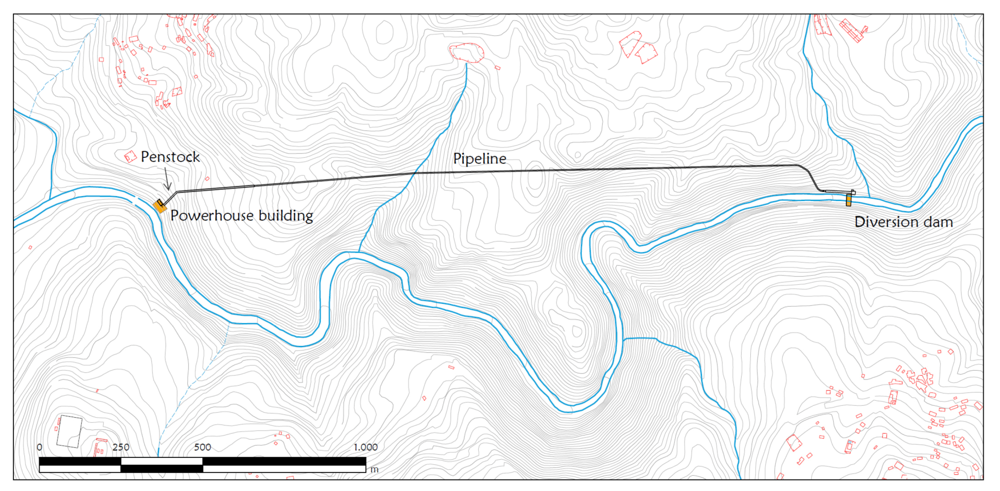
        <p>The San Xusto SHP station is made up of a diversion dam, to block the river and divert the water, a pipeline which draws the water from a high level to the powerhouse, a penstock and a powerhouse building (<xref ref-type="fig" rid="water-04-00815-f001">Figure 1</xref>).</p>
        
        <p>The dam has a fish ladder, which was completed in November 2006. The dam (UTM: 29T 541585; 4708041; 153 m above sea level (a.s.l.)) coronation has a length of 53 m and a height of 164 m a.s.l. and 11.05 m above the river. The surface of the water in the reservoir is 160 m high. The diversion pipe is 1960 m long and the penstock is 116 m long. The length of the river stretch between the dam and the tailrace is 3400 m. The power house (UTM: 29T 539412; 4708029; 83 m a.s.l.) has 2 turbines of 10 m<sup>3</sup>/s and 5.91 MW each. The gross head is 70 m. The discharge is 20 m<sup>3</sup>/s. and the station takes 59% of the water flow. The power is 11.81 MW and the total production is 37.81 GWh/year.</p>
        <fig id="water-04-00815-f001" position="anchor">
          <label>Figure 1</label>
          <caption>
            <p>Map of the elements of the San Xusto Small hydropower (SHP) plant on river Lérez.</p>
          </caption>
          <graphic xmlns:xlink="http://www.w3.org/1999/xlink" xlink:href="water-04-00815-g001.tif"/>
        </fig>
      </sec>
      <sec>
        <title>2.3. Environmental Parameters, Water Status Indicators and Quality Criteria</title>
        <p>The Water Framework Directive 2000/60/EC (WFD) [<xref ref-type="bibr" rid="B17-water-04-00815">17</xref>] was created to maintain and improve the aquatic environment in the EU countries. According to its article 2, the surface water status should be determined by its ecological and its chemical status. WFD establish that Member States shall ensure the establishment of programs to monitor the water status, which for surface waters shall cover: the volume and level of flow and the ecological and chemical status. WFD Annex V of [<xref ref-type="bibr" rid="B17-water-04-00815">17</xref>] include the quality elements suggested for the classification of the ecological status of the surface water, including biological, hydromorphological and physicochemical elements, as well as criteria for definition of ecological status using that elements. Although these programs should be developed by the regional administrations, the indicators established by the WFD are useful to assess the water status that should be ideally achieved in reaches affected by small hydropower. Consequently, some of the water quality elements, established by WFD, have been taken in consideration in this work.</p>
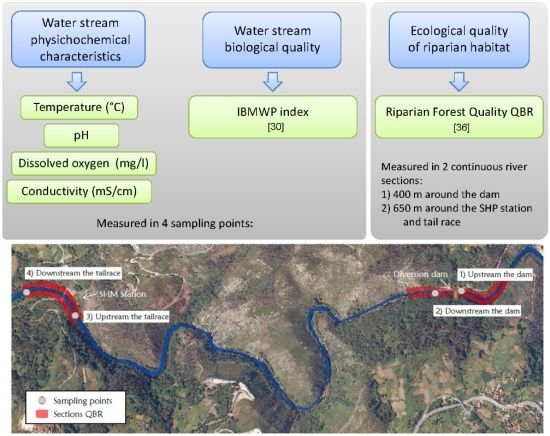
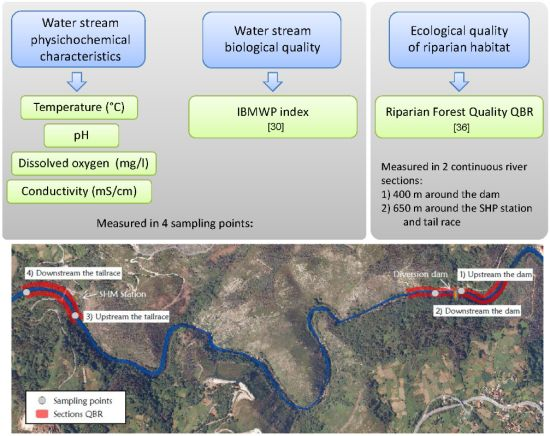
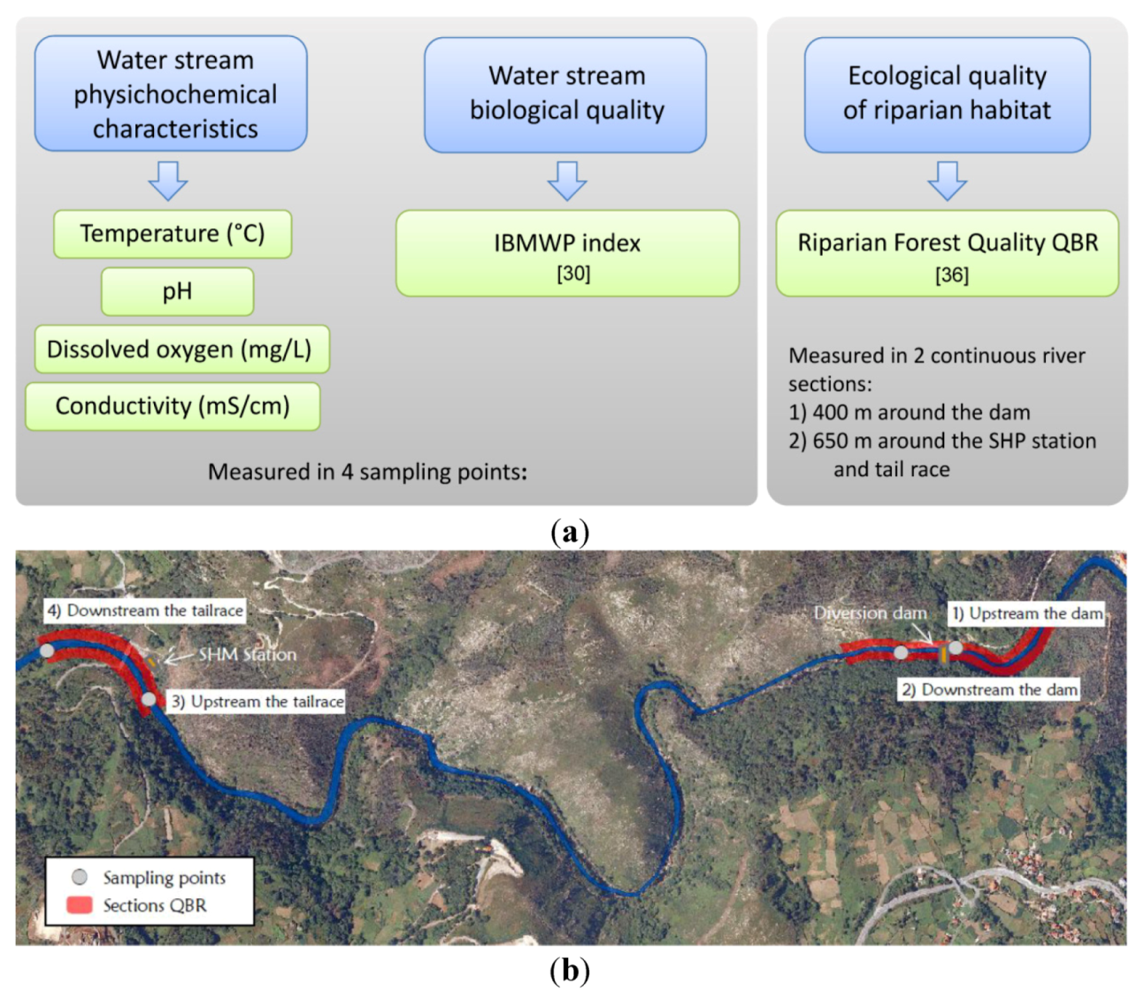
        <p>In order to describe the quality of the aquatic ecosystem in a river stretch including the San Xusto SHP station of the Lérez River, the physicochemical characteristics of the water, the biological quality of the water, and the ecological quality of riparian habitat were considered (<xref ref-type="fig" rid="water-04-00815-f002">Figure 2</xref>).</p>
        
        <p>Between several chemical and physicochemical elements described in Annex V of WFD, the following physicochemical parameters were considered: water temperature (°C), conductivity (mS/cm), dissolved oxygen (DO, mg/L), and pH. It was used a handheld multiparameter instrument YSI 556MPS (YSI, Yellow Springs, OH, USA), accompanied by the following sensors types: YSI Temperature Precision™ thermistor, 4-electrode cell with auto ranging, steady state polarographic, platinum button, glass combination electrode (see specifications in [<xref ref-type="bibr" rid="B28-water-04-00815">28</xref>]). According to WFD, physicochemical conditions are considered good if the parameters do not reach levels outside the range established to ensure the functioning of the specific type of ecosystem. Then, the ranges established for salmonid waters in Directive 2006/44/EC [<xref ref-type="bibr" rid="B24-water-04-00815">24</xref>] on the quality of fresh waters needing protection or improvement in order to support fish life were considered<italic>. </italic>The values registered for the parameters were compared with those registered in the closest station belonging to the Water Quality Control Network from Aguas de Galicia, as well as with the reference condition in Cantabric-Atlantic siliceous rivers (CEDEX type 21: Instrucciones de Planificación Hidrológica<italic>, </italic>henceforth IPH 2008 [<xref ref-type="bibr" rid="B29-water-04-00815">29</xref>]).</p>
        <fig id="water-04-00815-f002" position="anchor">
          <label>Figure 2</label>
          <caption>
            <p>(<bold>a</bold>) Schematic overview of the methodology; (<bold>b</bold>) environmental characteristics assessed, parameters and index used, and location of the sampling points (grey circles) and riparian habitat sections where the QBR (riparian forest quality index ) was calculated (red).</p>
          </caption>
          <graphic xmlns:xlink="http://www.w3.org/1999/xlink" xlink:href="water-04-00815-g002.tif"/>
        </fig>
        <p>According to WFD, biological elements that should be taken in consideration in order to define the ecological quality are: composition and abundance of aquatic flora, composition and abundance of benthic invertebrate fauna and composition, abundance and age structure of fish fauna. The biological quality of the water was assessed using the index Iberian Biological Monitoring Working Party IBMWP [<xref ref-type="bibr" rid="B30-water-04-00815">30</xref>,<xref ref-type="bibr" rid="B31-water-04-00815">31</xref>]. This index is widely accepted and extensively used in Spain. It has been adapted from the British Biological Monitoring Working Party BMWP to the Iberian macroinvertebrates [<xref ref-type="bibr" rid="B30-water-04-00815">30</xref>]. It is also easily applicable: the taxa of machobenthonic fauna found in the stream is identified to family level, a predefined score is allocated for each family and the total IBMWP score for a sample is a summation of the scores of all the families found. The scores of the IBMWP (0 – &gt;100) have been grouped in 5 quality classes [<xref ref-type="bibr" rid="B30-water-04-00815">30</xref>]. Other index as NFAM (number of families) and IASPT (Iberian Average Score per Taxon) [<xref ref-type="bibr" rid="B26-water-04-00815">26</xref>,<xref ref-type="bibr" rid="B32-water-04-00815">32</xref>] were also obtained. The Equivalent Quality Ratio (EQR) was obtained  [<xref ref-type="bibr" rid="B33-water-04-00815">33</xref>,<xref ref-type="bibr" rid="B34-water-04-00815">34</xref>]. IBMWP was scored according to [<xref ref-type="bibr" rid="B30-water-04-00815">30</xref>] and was compared with the reference conditions in Cantabric-Atlantic siliceous rivers [<xref ref-type="bibr" rid="B35-water-04-00815">35</xref>]. The WFD defines reference conditions as the values of biological, hydromorphological and physical–chemical quality elements at high ecological status.</p>
        <p>Between the hydromorphological characteristics, high status is found weather the hydrological regime, river continuity, morphological conditions, structure and condition of the riparian zones correspond totally or nearly totally to undisturbed conditions. Nevertheless, when dealing with SHP stations, alterations occur. In this case good status is achieved if the hydro morphologic conditions are consistent with the achievement of the values specified above for the biological quality.</p>
        <p>Although measures of the conservation status of riparian habitat are not often used to describe river health [<xref ref-type="bibr" rid="B36-water-04-00815">36</xref>], the SHP building can affect the characteristics of the vegetation in the banks of the river. The Riparian Forest Quality or QBR index [<xref ref-type="bibr" rid="B36-water-04-00815">36</xref>] has been used to assess the ecological quality of the riparian habitat in the reaches affected by the SHP plant construction. The index QBR varies between 0 and 100 and it is based on four components of riparian habitat: total riparian vegetation cover, cover structure, cover quality and channel alterations for the different geomorphology of the river from its headwaters to the lower reaches. After completing the analysis, the sum of scores for the four components gives the final QBR index.</p>
      </sec>
      <sec sec-type="methods">
        <title>2.4. Sampling and Methodology</title>
        <p>In order to measure the physicochemical parameters of the water, 4 sampling points have been selected in places where the entry does not entail risk and trying to select areas accessible in the future in spite of changes in the flow, building works or vegetation changes (<xref ref-type="fig" rid="water-04-00815-f002">Figure 2</xref>, <xref ref-type="table" rid="water-04-00815-t001">Table 1</xref>). The position of the sampling points was registered with a GPS GPSMAP 60CSx (Garmin, Olathe, KS, USA) and pictures were taken to describe them. They were situated in a zone with no excessive sunshine, excessively high or low stream velocity and medium depth.</p>
        <table-wrap id="water-04-00815-t001" position="float">
          <object-id pub-id-type="pii">water-04-00815-t001_Table 1</object-id>
          <label>Table 1</label>
          <caption>
            <p>Location of the sampling points and samples taken.</p>
          </caption>
          <table>
            <thead>
              <tr>
                <th align="left" valign="middle">Sampling points</th>
                <th align="left" valign="middle">Location</th>
                <th align="left" valign="middle">UTM</th>
                <th align="left" valign="middle">Sampling</th>
              </tr>
            </thead>
            <tbody>
              <tr>
                <td align="center" valign="top">1</td>
                <td align="left" valign="top">Upstream the dam</td>
                <td align="left" valign="top">29T 541617–4708067</td>
                <td align="left" valign="top">Physicochemical parameters</td>
              </tr>
              <tr>
                <td rowspan="2" align="center" valign="top">2</td>
                <td rowspan="2" align="left" valign="top">Downstream the dam</td>
                <td rowspan="2" align="left" valign="top">29T 541471–4708055</td>
                <td align="left" valign="top">Physicochemical parameters</td>
              </tr>
              <tr>
                <td align="left" valign="top">Biological index (stream section)</td>
              </tr>
              <tr>
                <td rowspan="2" align="center" valign="top">3</td>
                <td rowspan="2" align="left" valign="top">Upstream the tailrace</td>
                <td rowspan="2" align="left" valign="top">29T 539467–4707928</td>
                <td align="left" valign="top">Physicochemical parameters</td>
              </tr>
              <tr>
                <td align="left" valign="top">Biological index (stream section)</td>
              </tr>
              <tr>
                <td rowspan="2" align="center" valign="top">4</td>
                <td rowspan="2" align="left" valign="top">Downstream the tailrace</td>
                <td rowspan="2" align="left" valign="top">29T 539195–4708058</td>
                <td align="left" valign="top">Physicochemical parameters</td>
              </tr>
              <tr>
                <td align="left" valign="top">Biological index (stream section)</td>
              </tr>
            </tbody>
          </table>
        </table-wrap>
        <p>On each sampling point, the handheld multiparameter instrument was immersed in the watercourse and, after a stabilization of 20 min, the instrument was keep registering during 20 min more in order to obtain representative data. Previous laboratory calibration was performed for all sensors following the procedures described by YSI Environmental [<xref ref-type="bibr" rid="B37-water-04-00815">37</xref>].</p>
        <p>For the biological characteristics of the water, a 50 m radius-river stretches around the described points 2–4 were sampled (<xref ref-type="table" rid="water-04-00815-t001">Table 1</xref>, <xref ref-type="fig" rid="water-04-00815-f002">Figure 2</xref>). The position of the borders of these stretches was registered with a GPS and photos of the sampled stretches were taken. The protocol [<xref ref-type="bibr" rid="B38-water-04-00815">38</xref>] was followed: in the sampling stretches selected, different types of habitats were identified according to depth, flow velocity, substratum, and vegetation; each habitat was sampled; captures were identified over a white tray on the field using an atlas and key [<xref ref-type="bibr" rid="B39-water-04-00815">39</xref>] and putting back the identified individuals into the river. Benthos which could not be identified in the field were kept in bottles with alcohol 70% to be identified in the laboratory.</p>
        <p>The QBR index was calculated following the protocol [<xref ref-type="bibr" rid="B36-water-04-00815">36</xref>] with some modifications. A river stretch of 400 m around the dam, and another river stretch of 650 m around the SHP station and tail race were selected (<xref ref-type="fig" rid="water-04-00815-f002">Figure 2</xref>). These reaches were divided in sections with similar characteristics and we calculated QBR index for each one. Points between two sections with different QBR were located with GPS. The creators of the index [<xref ref-type="bibr" rid="B36-water-04-00815">36</xref>] established that both river banks should be considered together. Nevertheless, since some SHP plant elements only affect one bank, we calculate one QBR index for each bank.</p>
      </sec>
      <sec>
        <title>2.5. Sampling Period and Frequency</title>
        <p>During the 36 months period between December 2007 and November 2010, all the points were sampled every 3 months for the physicochemical and biological water quality: in March, June, September/October and November/December. QBR index was calculated twice a year: once in March and once in September. For the physicochemical parameters we used data registered by the SHP station owners previously with the same methodology on points 1–4: in March and September 2005, March, August, September and November 2006, and September 2007.</p>
      </sec>
      <sec>
        <title>2.6. Analyses</title>
        <p>The software Ecowatch was used to download and process physicochemical data taken by the multiparameter instrument. When data was registered for more than 20 min, the series was trimmed to 200 samples or 20 min. We calculated descriptive for each 20 min sampling series: mean, standard deviation, maximum and minimum.</p>
        <p>In the laboratory, we identified the captured macroinvertebrates taxa to family level [<xref ref-type="bibr" rid="B38-water-04-00815">38</xref>] using a glass Motic ST-37 20–80× (Motic, Xiamen, China).</p>
        <p>The values of the mean physicochemical variables of the series registered in each sampling point, as well as the IBMWP index were plotted over time to assess if their values stabilized themselves across time, as well as to observe differences between points. Differences between years and points were analyzed using Kruskal–Wallis tests. pH, temperature and DO were compared with extreme values allowed in salmonid waters (Directive 2006/44/EC [<xref ref-type="bibr" rid="B24-water-04-00815">24</xref>]). Values of pH, temperature, DO and conductivity were compared with those registered during the same time of the year in the closest river Lérez Station 14RW03070 [<xref ref-type="bibr" rid="B40-water-04-00815">40</xref>] from the Water Quality Control Network belonging to Augas de Galicia, which is situated 2.4 km downstream the Power Station. IBMWP scores were classified according to [<xref ref-type="bibr" rid="B30-water-04-00815">30</xref>]. Physicochemical variables and biological index were compared with the Reference Condition in Cantabric-Atlantic siliceous rivers from IPH 2008 and [<xref ref-type="bibr" rid="B35-water-04-00815">35</xref>].</p>
      </sec>
    </sec>
    <sec sec-type="results">
      <title>3. Results and Discussion</title>
      <sec>
        <title>3.1. Physicochemical Characteristics of the Water</title>
        <p>The physicochemical  parameters pH, temperature, dissolved oxygen, and conductivity did not show statistically significant differences between sampling points (<xref ref-type="table" rid="water-04-00815-t002">Table 2</xref>). Previous studies neither observed significant influence of the presence of SHP plants on the physical and chemical quality of the water [<xref ref-type="bibr" rid="B13-water-04-00815">13</xref>,<xref ref-type="bibr" rid="B41-water-04-00815">41</xref>].</p>
        <table-wrap id="water-04-00815-t002" position="float">
          <object-id pub-id-type="pii">water-04-00815-t002_Table 2</object-id>
          <label>Table 2</label>
          <caption>
            <p>Physicochemical parameters of the water: mean and standard deviation values in the four sampling points for the study period (2007–2010), as well as Kruskal–Wallis test for the resulting differences.</p>
          </caption>
          <table>
            <thead>
              <tr>
                <th rowspan="2" align="center" valign="middle">Parameters</th>
                <th colspan="2" align="center" valign="middle">Point 1</th>
                <th colspan="2" align="center" valign="middle">Point 2</th>
                <th colspan="2" align="center" valign="middle">Point 3</th>
                <th colspan="2" align="center" valign="middle">Point 4</th>
                <th rowspan="2" align="center" valign="middle">Kruskal–Wallis test</th>
              </tr>
              <tr style="border-top: solid thin">
                <th align="center" valign="middle">Mean</th>
                <th align="center" valign="middle">SD</th>
                <th align="center" valign="middle">Mean</th>
                <th align="center" valign="middle">SD</th>
                <th align="center" valign="middle">Mean</th>
                <th align="center" valign="middle">SD</th>
                <th align="center" valign="middle">Mean</th>
                <th align="center" valign="middle">SD</th>
              </tr>
            </thead>
            <tbody>
              <tr style="border-top: solid thin">
                <td align="left" valign="middle">pH</td>
                <td align="center" valign="middle">5.97</td>
                <td align="center" valign="middle">0.56</td>
                <td align="center" valign="middle">5.98</td>
                <td align="center" valign="middle">0.34</td>
                <td align="center" valign="middle">6.15</td>
                <td align="center" valign="middle">0.30</td>
                <td align="center" valign="middle">5.99</td>
                <td align="center" valign="middle">0.76</td>
                <td align="center" valign="middle">2.452, <italic>p</italic> = 0.484</td>
              </tr>
              <tr>
                <td align="left" valign="middle">Temperature (°C)</td>
                <td align="center" valign="middle">12.10</td>
                <td align="center" valign="middle">3.90</td>
                <td align="center" valign="middle">12.43</td>
                <td align="center" valign="middle">3.91</td>
                <td align="center" valign="middle">12.89</td>
                <td align="center" valign="middle">3.95</td>
                <td align="center" valign="middle">12.27</td>
                <td align="center" valign="middle">4.05</td>
                <td align="center" valign="middle">0.249, <italic>p</italic> = 0.969</td>
              </tr>
              <tr>
                <td align="left" valign="middle">Dissolved oxygen (mg/L)</td>
                <td align="center" valign="middle">10.67</td>
                <td align="center" valign="middle">1.32</td>
                <td align="center" valign="middle">11.43</td>
                <td align="center" valign="middle">1.16</td>
                <td align="center" valign="middle">11.13</td>
                <td align="center" valign="middle">1.11</td>
                <td align="center" valign="middle">11.54</td>
                <td align="center" valign="middle">1.53</td>
                <td align="center" valign="middle">3.557, <italic>p</italic> = 0.313</td>
              </tr>
              <tr>
                <td align="left" valign="middle">Conductivity (mS/cm)</td>
                <td align="center" valign="middle">0.040</td>
                <td align="center" valign="middle">0.013</td>
                <td align="center" valign="middle">0.037</td>
                <td align="center" valign="middle">0.005</td>
                <td align="center" valign="middle">0.038</td>
                <td align="center" valign="middle">0.005</td>
                <td align="center" valign="middle">0.040</td>
                <td align="center" valign="middle">0.010</td>
                <td align="center" valign="middle">0.642, <italic>p</italic> = 0.887</td>
              </tr>
            </tbody>
          </table>
        </table-wrap>
        <sec>
          <title>3.1.1. pH</title>
          <p>The mean pH between all sampling points for the study period (2007–2010) was 6.02 (SD = 0.52; n = 50). pH was not statistically different between spring–summer (mean = 6.03; SD = 0.33) and autumn–winter (6.02; SD = 0.66; Mann–Whitney U = 315.500; <italic>p</italic> = 0.946; n = 50), although higher pH values during the hottest months are usual [<xref ref-type="bibr" rid="B13-water-04-00815">13</xref>]. The low pH values obtained (<xref ref-type="table" rid="water-04-00815-t002">Table 2</xref>) can be related to a large extent to the natural characteristics of the stream waters in Galicia, which are acid due to the granitic substrate. The geological substrate of the watershed is the main factor constraining the physicochemical characteristics of unpolluted watercourses in Galicia [<xref ref-type="bibr" rid="B10-water-04-00815">10</xref>]. In river Tea, Pontevedra Province, mean annual pH observed was 6.18 [<xref ref-type="bibr" rid="B42-water-04-00815">42</xref>], while in Galician rivers with low mineralization via marine influence mean values of 6.6 (range = 5.2–7.1) were observed [<xref ref-type="bibr" rid="B22-water-04-00815">22</xref>]. In the stretch of river Lérez studied pH values were lower to those observed by these authors.</p>
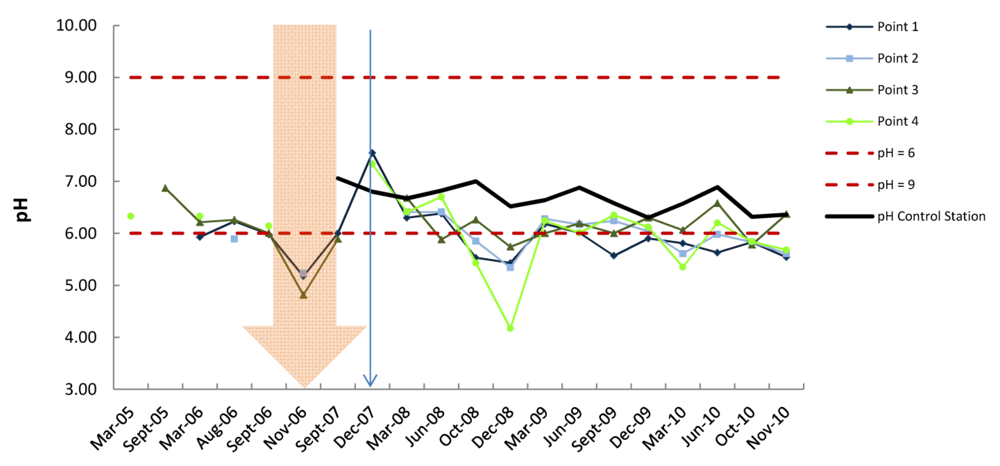
          <p>According to Directive 2006/44/EC [<xref ref-type="bibr" rid="B24-water-04-00815">24</xref>], artificial pH variations with respect to the unaffected values shall not exceed ±0.5 of a pH unit within the limits falling between 6.0 and 9.0 provided that these variations do not increase the harmfulness of other substances present in the water. We have observed low pH values in the 4 sampling points (<xref ref-type="table" rid="water-04-00815-t002">Table 2</xref>, <xref ref-type="fig" rid="water-04-00815-f003">Figure 3</xref>), close to the lower limit allowed for salmonid water: 6 (Directive 2006/44/EC). The pH observed were also lower than the pH values registered in the Aguas de Galicia Water Quality Control Station situated 2.4 km downstream (mean = 6.7; SD = 0.3; n = 15; period 2007–2011). Comparing to Reference Condition (<xref ref-type="table" rid="water-04-00815-t003">Table 3</xref>), the water quality in the river stretch was classified according with its pH as moderate water condition.</p>
          <p>During the SHP infrastructures and station construction (November 2006) and in the first year after, pH values were unbalanced. In the construction phase, pH decreased to values around 5 and the lower limits allowed for salmonid water (Directive 2006/44/EC [<xref ref-type="bibr" rid="B24-water-04-00815">24</xref>]) were exceeded (<xref ref-type="fig" rid="water-04-00815-f003">Figure 3</xref>). In December 2007, pH soared to values higher than 7.5, which is a high value for rivers from Galician granitic watersheds [<xref ref-type="bibr" rid="B21-water-04-00815">21</xref>]), but during the construction phase could be related with the contact of river water with concrete, cement, or other construction materials, containing calcium hydroxide, which is a caustic agent. Differences of pH between years were statistically significant only if 2007 is included in the analysis (Kruskal–Wallis test = 9.550; df = 3; <italic>p</italic> = 0.023; n = 50). No significant variation was observed in the pH between points (<xref ref-type="table" rid="water-04-00815-t002">Table 2</xref>), although pH at point 3 (before the station and the tailrace) was usually higher than in point 4 (downstream the tailrace) (<xref ref-type="table" rid="water-04-00815-t002">Table 2</xref>, <xref ref-type="fig" rid="water-04-00815-f003">Figure 3</xref>). We observed the higher, most acceptable, pH values in point 3, before the tailrace, which could be related to the riverbed conditions at this point.</p>
          <table-wrap id="water-04-00815-t003" position="float">
            <object-id pub-id-type="pii">water-04-00815-t003_Table 3</object-id>
            <label>Table 3</label>
            <caption>
              <p>Reference condition in Cantabric-Atlantic siliceous rivers according to [<xref ref-type="bibr" rid="B35-water-04-00815">35</xref>], or according to IPH 2008 [<xref ref-type="bibr" rid="B29-water-04-00815">29</xref>] those marked with *.</p>
            </caption>
            <table>
              <thead>
                <tr>
                  <th align="center" valign="middle">Parameters</th>
                  <th align="center" valign="middle">Reference condition</th>
                  <th align="center" valign="middle">Threshold good/moderate</th>
                  <th align="center" valign="middle">Threshold moderate/bad</th>
                </tr>
              </thead>
              <tbody>
                <tr>
                  <td align="left" valign="middle">Temperature (°C)</td>
                  <td align="center" valign="middle">13.00</td>
                  <td align="center" valign="middle">10.4–15.6</td>
                  <td align="center" valign="middle">- -</td>
                </tr>
                <tr>
                  <td align="left" valign="middle">Conductivity (µS/cm) *</td>
                  <td align="center" valign="middle">40.00</td>
                  <td align="center" valign="middle">&lt;300</td>
                  <td align="center" valign="middle"/>
                </tr>
                <tr>
                  <td align="left" valign="middle">Dissolved oxygen (mg/L) *</td>
                  <td align="center" valign="middle">9.00</td>
                  <td align="center" valign="middle">6.70</td>
                  <td align="center" valign="middle">- -</td>
                </tr>
                <tr>
                  <td align="left" valign="middle">pH *</td>
                  <td align="center" valign="middle">7.00</td>
                  <td align="center" valign="middle">6.0–8.4</td>
                  <td align="center" valign="middle">- -</td>
                </tr>
                <tr>
                  <td align="left" valign="middle">IBMWP</td>
                  <td align="center" valign="middle">230.00</td>
                  <td align="center" valign="middle">162.00</td>
                  <td align="center" valign="middle">20.20</td>
                </tr>
                <tr>
                  <td align="left" valign="middle">NFAM</td>
                  <td align="center" valign="middle">37.00</td>
                  <td align="center" valign="middle">25.50</td>
                  <td align="center" valign="middle">3.20</td>
                </tr>
                <tr>
                  <td align="left" valign="middle">IASPT</td>
                  <td align="center" valign="middle">6.30</td>
                  <td align="center" valign="middle">4.40</td>
                  <td align="center" valign="middle">0.60</td>
                </tr>
              </tbody>
            </table>
          </table-wrap>
          <fig id="water-04-00815-f003" position="anchor">
            <label>Figure 3</label>
            <caption>
              <p>pH values measured through the survey period whose start is showed by a blue arrow. SHP station construction time is showed as the orange arrow. In red, pH range allowed for salmonid water (Directive 2006/44/EC [<xref ref-type="bibr" rid="B24-water-04-00815">24</xref>]). In black, pH values measured in the Water Quality Control Station.</p>
            </caption>
            <graphic xmlns:xlink="http://www.w3.org/1999/xlink" xlink:href="water-04-00815-g003.tif"/>
          </fig>
          
        </sec>
        <sec>
          <title>3.1.2. Temperature</title>
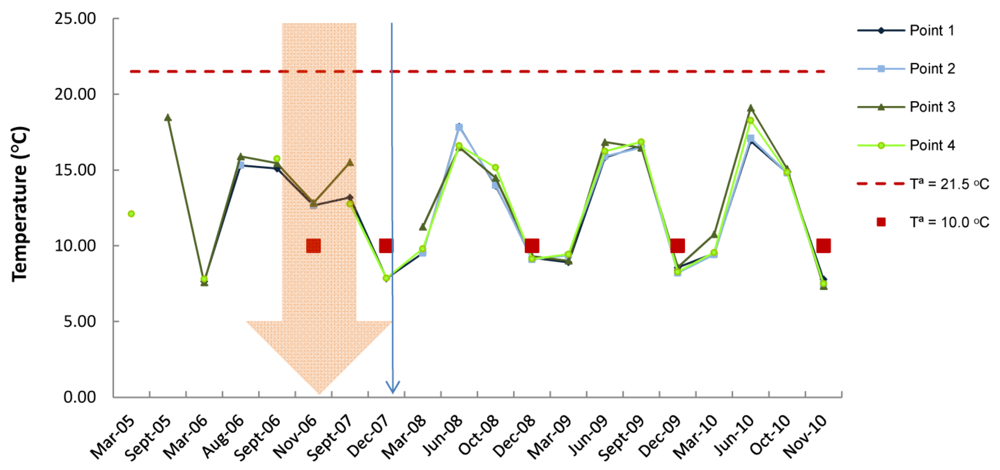
          <p>Mean water temperature for the study period was 12.41 (SD = 3.84; n = 50). This value was slightly lower than the temperature registered in the Aguas de Galicia Water Quality Control Station for the same period (mean = 13.37; SD = 3.37; n = 14). Temperature values were close to Reference Condition (<xref ref-type="table" rid="water-04-00815-t003">Table 3</xref>). Slightly higher temperatures were registered in points 2 and 3 than in the remaining sampling points, although statistically significant differences were not found between sampling points (<xref ref-type="table" rid="water-04-00815-t002">Table 2</xref>). The mean water temperature was 8.92 (SD = 0.97; n = 26) in autumn-winter and 16.19 (SD = 1.35; n = 24) in spring-summer (Mann–Whitney U = 236.50; <italic>p</italic> &lt; 0.001; n = 50). <xref ref-type="fig" rid="water-04-00815-f004">Figure 4</xref> show seasonal variation of the temperature. In river Tea, the mean annual water temperature registered was 14.0 °C, with maximum values in August-September (19.8 °C) and minimum between November and January (9.3 °C) [<xref ref-type="bibr" rid="B42-water-04-00815">42</xref>]; thus, more extreme values than those registered by us in the San Xusto SHP station, probably due to the more extreme air temperatures in river Tea.</p>
          <fig id="water-04-00815-f004" position="anchor">
            <label>Figure 4</label>
            <caption>
              <p>Water temperature (°C) through the survey period whose start is shown by a blue arrow. SHP station construction time is shown by the orange arrow. The red line and points indicate the upper temperature limit which should not be exceeded in salmonid waters (Directive 2006/44/EC [<xref ref-type="bibr" rid="B24-water-04-00815">24</xref>]).</p>
            </caption>
            <graphic xmlns:xlink="http://www.w3.org/1999/xlink" xlink:href="water-04-00815-g004.tif"/>
          </fig>
          <p>According to Directive 2006/44/EC [<xref ref-type="bibr" rid="B24-water-04-00815">24</xref>], thermal discharges must not cause the temperature downstream of the point of thermal discharge to exceed 21.5 °C in salmonid waters. This temperature limit was not exceeded in any sampling point for any season (<xref ref-type="fig" rid="water-04-00815-f004">Figure 4</xref>). In the same way, Directive 2006/44/EC lays down that water temperature measured downstream a thermal discharge cannot exceed 10 °C during breeding periods of species which need cold water for reproduction in waters which may contain such species. Therefore, for salmon in Galicia, whose reproductive season is between November and January [<xref ref-type="bibr" rid="B20-water-04-00815">20</xref>], temperature values from the sampling carried out in those months should not exceed 10 °C. Temperature registered in all samplings between November and January was &lt;10°C, although during the SHP station construction, temperature in points 1–3 exceeded this value (<xref ref-type="fig" rid="water-04-00815-f004">Figure 4</xref>). The temperature of the water before (point 3) and after (point 4) the tail race did not showed significant difference (Mann–Whitney U = 73.00; p = 0.786; n = 25) and the increment was below 1.5 °C during the sampling period, so it fulfilled the requirement of Directive 2006/44/EC [<xref ref-type="bibr" rid="B24-water-04-00815">24</xref>]: temperature measured downstream of a point of thermal discharge must not exceed the unaffected temperature in more than 1.5 °C. The water temperature difference between points 4 and 3 was usually &lt;0, which indicate that the pass of water through the pipes and turbines results in a slight decrease of temperature. This is probably caused by water circulating through subterranean pipes.</p>
        </sec>
        <sec>
          <title>3.1.3. Dissolved Oxygen</title>
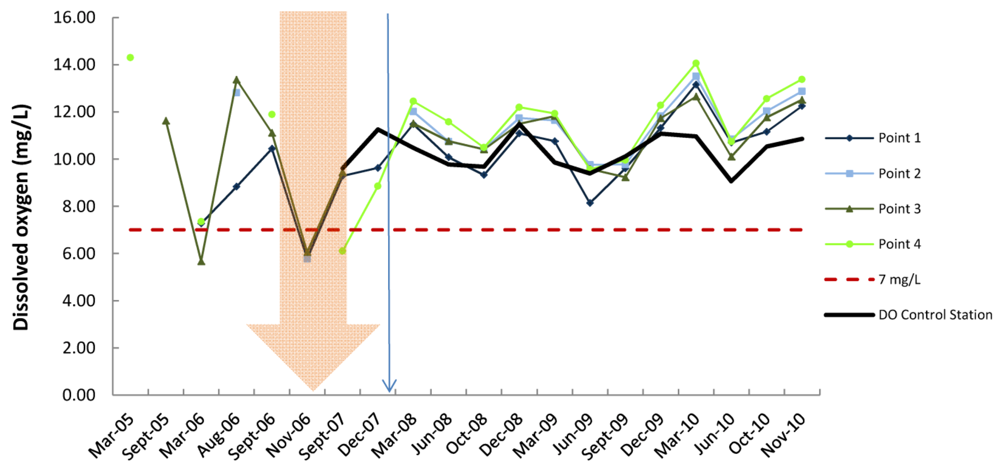
          <p>Mean dissolved oxygen in the river stretch studied was 11.19 mg/L (SD = 1.30; n = 50). It was higher in autumn–winter (11.93 mg/L; SD = 1.11; n = 26), coinciding with maximum flow and minimum temperature, than in spring–summer (mean = 10.39 mg/L; SD = 0.99; n = 24) (Mann–Whitney U = 624.00; <italic>p</italic> &lt; 0.001; n = 50), being that dissolved oxygen is inversely related to temperature and directly related with the water flow [<xref ref-type="bibr" rid="B13-water-04-00815">13</xref>]. A lower value of annual mean DO was observed in river Tea: 9.6 (±0.2) mg/L with maximum values between January and February (11.0 ± 0.2 mg/L) and minimum between August and September (7.9 ± 0.4 mg/L) [<xref ref-type="bibr" rid="B42-water-04-00815">42</xref>]. DO value was minimum in sampling point 1 (before the dam) as it was expected, and maximum in point 4 (downstream the tailrace) and point 2 (downstream the dam), although differences in dissolved oxygen between points were not statistically different (<xref ref-type="table" rid="water-04-00815-t002">Table 2</xref>, <xref ref-type="fig" rid="water-04-00815-f005">Figure 5</xref>). DO explains the occurrence of fish communities [<xref ref-type="bibr" rid="B42-water-04-00815">42</xref>] so it is a basic parameter to asses water quality. DO values in all the sampling points were higher than the one observed in river Tea [<xref ref-type="bibr" rid="B42-water-04-00815">42</xref>]. In comparison with Reference Condition the values registered in San Xusto were also higher (<xref ref-type="table" rid="water-04-00815-t003">Table 3</xref>).</p>
          <fig id="water-04-00815-f005" position="anchor">
            <label>Figure 5</label>
            <caption>
              <p>Dissolved oxygen (mg/L) through the survey period whose start is shown by a blue arrow. SHP station construction time is shown by the orange arrow. The red line indicates the limit which should not be exceeded in salmonid waters (Directive 2006/44/EC [<xref ref-type="bibr" rid="B24-water-04-00815">24</xref>]). In black, DO values measured in the Water Quality Control Station.</p>
            </caption>
            <graphic xmlns:xlink="http://www.w3.org/1999/xlink" xlink:href="water-04-00815-g005.tif"/>
          </fig>
          <p>On the Water Quality Control Station, DO presented fluctuations related to the seasonal flow changes, but stayed stable between years, whereas around San Xusto SHP station an increasing trend of the DO was observed (Kruskal–Wallis test = 15.742; df = 3; <italic>p</italic> = 0.001; n = 50) and values higher to those registered in the Water Quality Control Station (<xref ref-type="fig" rid="water-04-00815-f005">Figure 5</xref>). Usually SHP schemes have an effect decreasing the DO [<xref ref-type="bibr" rid="B43-water-04-00815">43</xref>]. One of the environmental changes often associated with hydropower is the low dissolved oxygen content of the water released from hydropower reservoirs, especially during the summer and at large projects with deep reservoirs, low flushing rates, or warm climates [<xref ref-type="bibr" rid="B44-water-04-00815">44</xref>]. In San Xusto SHP this problem was evident only during the construction phase, after which values increased.</p>
          <p>During the SHP infrastructures and station construction (November 2006) the flow was minimum since the river was interrupted, which could explain the plunge of the dissolved oxygen in that time (<xref ref-type="fig" rid="water-04-00815-f005">Figure 5</xref>), when it fell down the allowed level for salmonids waters (Directive 2006/44/EC [<xref ref-type="bibr" rid="B24-water-04-00815">24</xref>]). Since then, the dissolved oxygen values climbed (<xref ref-type="fig" rid="water-04-00815-f005">Figure 5</xref>), with minimum values in summer as a result of seasonal warming, staying always inside the limits allowed for salmonid water.</p>
        </sec>
        <sec>
          <title>3.1.4. Conductivity</title>
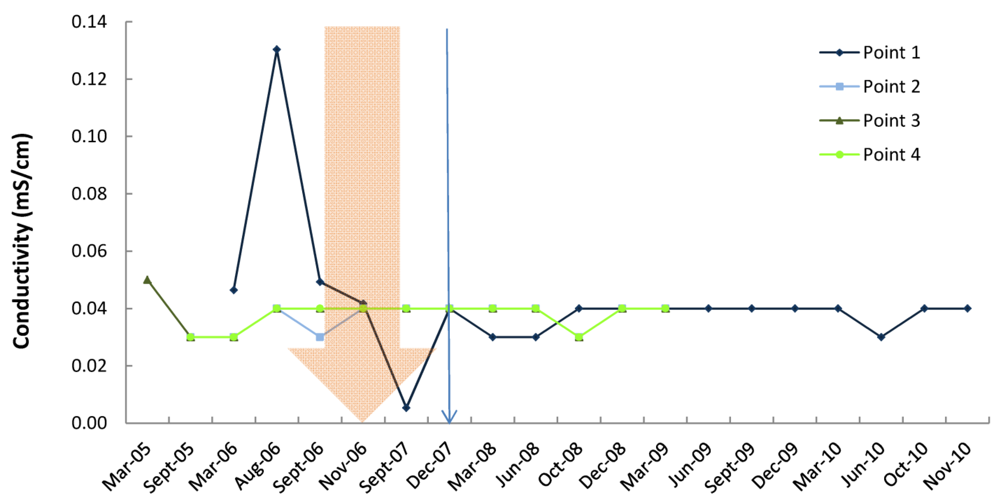
          <p>Although significant changes in the conductivity were observed during the construction phase, 2 years after the conductivity values bounced back and remained constant around 0.03–0.04 mS/cm (<xref ref-type="fig" rid="water-04-00815-f006">Figure 6</xref>). The difference in conductivity between years was statistically significant (Kruskal–Wallis test = 21.436; df = 3; <italic>p</italic> = 0.001; n = 50). The values observed (mean = 37.60 µS/cm, SD = 4.76; n = 50) are in the range of conductivity measured in other rivers in Galicia: 40.3 ± 1.0 µS/cm in river Tea [<xref ref-type="bibr" rid="B42-water-04-00815">42</xref>], 52 µS/cm for rivers with mineralization via marine influence in Galicia [<xref ref-type="bibr" rid="B10-water-04-00815">10</xref>]. On the Water Quality Control Station, the conductivity was lower (mean = 35.18 µS/cm; SD = 3.24; n = 14). Mean values registered in the river stretch studied were 2.4 µS/cm lower than the conductivity for the Reference Condition. The data suggest that water conductivity in the river stretch studied could has been altered by the construction of the SHP plant but after 2 year values were already inside de normal range, even closer to the Reference Condition than the Control Station situated 2.4 km downstream.</p>
          <fig id="water-04-00815-f006" position="anchor">
            <label>Figure 6</label>
            <caption>
              <p>Conductivity (mS/cm) through the survey period whose start is shown by a blue arrow. SHP station construction time is shown by the orange arrow.</p>
            </caption>
            <graphic xmlns:xlink="http://www.w3.org/1999/xlink" xlink:href="water-04-00815-g006.tif"/>
          </fig>
        </sec>
      </sec>
      <sec>
        <title>3.2. Biological Status of the Water</title>
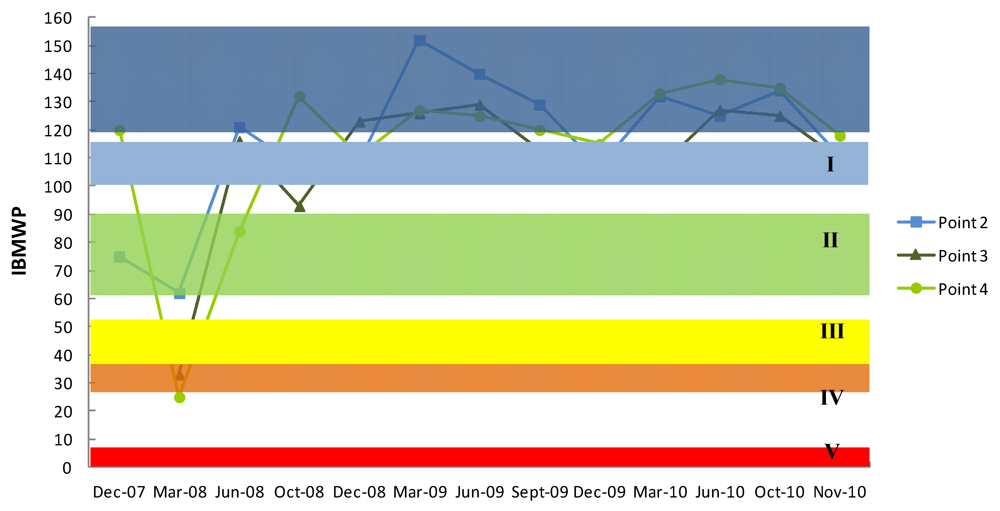
        <p>Lower scores for the IBMWP index were observed in point 3, upstream the power station (mean IBMWP = 110; SD = 26) compared with point 2 (mean IBMWP = 115; SD = 15) and point 4 (mean IBMWP = 114; SD = 30), although differences between points were not statistically significant (Kruskal–Wallis test = 1.756; df = 2; <italic>p</italic> = 0.416; n = 37).</p>
        <p>Some studies did not observed severe adverse consequences on benthic macroinvertebrate community due to the SHP schemes [<xref ref-type="bibr" rid="B45-water-04-00815">45</xref>,<xref ref-type="bibr" rid="B46-water-04-00815">46</xref>], and even some observed a slight increase in the benthic fauna [<xref ref-type="bibr" rid="B46-water-04-00815">46</xref>]. Others observed a lower density and specific richness of invertebrates in the points situated downstream the SHP plant compared to the points situated upstream [<xref ref-type="bibr" rid="B14-water-04-00815">14</xref>]. Mean index during the study period were scored inside biological quality class I: unpolluted or not considerably altered water [<xref ref-type="bibr" rid="B30-water-04-00815">30</xref>]. In a river stretch around a small hydroelectric power plan in the Ardena river (Portugal), the benthic macroinvertebrate communities have presented high richness, diversity and equitability [<xref ref-type="bibr" rid="B15-water-04-00815">15</xref>]), although some decrease of the water quality and an alteration of the structure and composition of the benthic macroinvertebrate community due to the operation of a SHP plant was observed by these authors.</p>
        <p>IBMWP index showed a positive trend from 2 years after the construction of the SHP plant and its values stabilized themselves on biological quality I. In December 2007, one year after the SHP station construction, only points 2 and 4 were sampled for biological status of the water. IBMWP in point 2 showed a score of 75 (quality II: some effects of pollution are evident) and in point 4 a score of 120 (quality I: unpolluted or not considerably altered water) (<xref ref-type="fig" rid="water-04-00815-f007">Figure 7</xref>). In March 2008, 16 months after the construction, the IBMWP scores observed in point 2 (downstream the dam) showed a water-biological quality II (moderate effect of pollution are evident), and scores observed in points 3 and 4 showed quality IV (very polluted water). Since this moment, when the worse biological quality of the waters were observed, biological conditions were improving until to the point, in December 2008, when the IBMWP scores on the three sampling points level off in status I (very clean waters and unpolluted or not considerably altered water). Nevertheless, our results suggest, that river stretches around SHP plants operational conserve the conditions for the development of well-structured biotic communities as well as observed in other works [<xref ref-type="bibr" rid="B13-water-04-00815">13</xref>]. In this sense it was previously observed that in the aestival period, with the suspension of the operations of the small hydroelectric plant, there was an almost total recovery of the communities [<xref ref-type="bibr" rid="B13-water-04-00815">13</xref>].</p>
        <fig id="water-04-00815-f007" position="anchor">
          <label>Figure 7</label>
          <caption>
            <p>Evolution of the water biological quality index IBMWP during the period of study: I (&gt;120) very clean waters; I (101–120) unpolluted or not considerably altered water; II (61–100) moderate effects of pollution are evident; III (36–60) polluted water; IV (16–35) very polluted water; V (&lt;15) guspolluted water.</p>
          </caption>
          <graphic xmlns:xlink="http://www.w3.org/1999/xlink" xlink:href="water-04-00815-g007.tif"/>
        </fig>
        <p>For the rivers classified as type 21, reference conditions related with IBMWP has not been defined in the IPH 2008. So, in order to classify the biological quality of the water, the ecological index were compared with the reference condition given by [<xref ref-type="bibr" rid="B35-water-04-00815">35</xref>] (<xref ref-type="table" rid="water-04-00815-t004">Table 4</xref>). The IBMWP EQR was calculated and compared with the IPH 2008 limits of the river type which was considered more similar and for which IPH 2008 provide reference conditions for (rivers type 25: IPH 2008). The river Lérez stretch studied showed an unfavourable ecological status according with [<xref ref-type="bibr" rid="B35-water-04-00815">35</xref>], or a moderate ecological quality according with IPH 2008, except for the year 2008 when it was deficient (EQR &lt; 0.42, <xref ref-type="table" rid="water-04-00815-t004">Table 4</xref>). The NFAM show a unfavourable status every year [<xref ref-type="bibr" rid="B35-water-04-00815">35</xref>]. Nevertheless, IASPT showed higher values than the reference condition and EQR &gt;1. These results suggest that the diversity of macrobenthos in this stretch of the river around the San Xusto SHP plant is lower than the reference condition, but the present families have high ecological value. This effects had been described previously [<xref ref-type="bibr" rid="B45-water-04-00815">45</xref>]) in Wales, where these authors also obtained a low score of the index BMWP but the taxa present indicated good quality, thus giving a reasonable ASPT.</p>
        <table-wrap id="water-04-00815-t004" position="float">
          <object-id pub-id-type="pii">water-04-00815-t004_Table 4</object-id>
          <label>Table 4</label>
          <caption>
            <p>Ecological index IBMWP, NFAM (number of families), IASPT (Iberian Average Score per Taxon) per year in the stretch of river studied, compared to the Reference Condition in Cantabric-Atlantic siliceous rivers using the EQR (Equivalent Quality Ratio).</p>
          </caption>
          <table>
            <thead>
              <tr>
                <th rowspan="2" align="center" valign="middle">Index</th>
                <th rowspan="2" align="center" valign="middle">Reference condition River type 21</th>
                <th colspan="4" align="center" valign="middle">San Xusto SHP plant</th>
              </tr>
              <tr style="border-top: solid thin">
                <th align="center" valign="middle">2007</th>
                <th align="center" valign="middle">2008</th>
                <th align="center" valign="middle">2009</th>
                <th align="center" valign="middle">2010</th>
              </tr>
            </thead>
            <tbody>
              <tr>
                <td align="left" valign="middle">IBMWP</td>
                <td align="center" valign="middle">230.00</td>
                <td align="center" valign="middle">120.00</td>
                <td align="center" valign="middle">92.25</td>
                <td align="center" valign="middle">123.83</td>
                <td align="center" valign="middle">124.58</td>
              </tr>
              <tr>
                <td align="left" valign="middle">EQR-IBMWP %</td>
                <td align="center" valign="middle"/>
                <td align="center" valign="middle">0.52</td>
                <td align="center" valign="middle">0.40</td>
                <td align="center" valign="middle">0.54</td>
                <td align="center" valign="middle">0.54</td>
              </tr>
              <tr>
                <td align="left" valign="middle">NFAM</td>
                <td align="center" valign="middle">37.00</td>
                <td align="center" valign="middle"/>
                <td align="center" valign="middle">13.75</td>
                <td align="center" valign="middle">18.33</td>
                <td align="center" valign="middle">18.58</td>
              </tr>
              <tr>
                <td align="left" valign="middle">EQR-Taxa %</td>
                <td align="center" valign="middle"/>
                <td align="center" valign="middle"/>
                <td align="center" valign="middle">0.37</td>
                <td align="center" valign="middle">0.50</td>
                <td align="center" valign="middle">0.50</td>
              </tr>
              <tr>
                <td align="left" valign="middle">IASPT</td>
                <td align="center" valign="middle">6.30</td>
                <td align="center" valign="middle"/>
                <td align="center" valign="middle">6.75</td>
                <td align="center" valign="middle">6.76</td>
                <td align="center" valign="middle">6.73</td>
              </tr>
              <tr>
                <td align="left" valign="middle">EQR-IASPT %</td>
                <td align="center" valign="middle"/>
                <td align="center" valign="middle"/>
                <td align="center" valign="middle">1.07</td>
                <td align="center" valign="middle">1.07</td>
                <td align="center" valign="middle">1.07</td>
              </tr>
            </tbody>
          </table>
        </table-wrap>
        <p>Biological status relies also on the composition, abundance and age structure of fish fauna. Moderate status occurs when the composition and abundance of fish species differ moderately from the type-specific communities attributable to anthropogenic impacts on physico-chemical or hydromorphological quality elements (Directive 2000/60/EC, Annex V. 1.2.1 [<xref ref-type="bibr" rid="B17-water-04-00815">17</xref>]). The San Xusto SHP plant incorporates a fish ladder, managed by the regional government (Xunta de Galicia). This ladder, if used, would reduce the negative impact of the dam on the fish population [<xref ref-type="bibr" rid="B11-water-04-00815">11</xref>], but we registered no use of this ladder and consequently a probable effect of the dam on the fish population. Diversion dams of SHP plant hinder the passage of eels [<xref ref-type="bibr" rid="B47-water-04-00815">47</xref>,<xref ref-type="bibr" rid="B48-water-04-00815">48</xref>]), and also alter the populations of other fish species [<xref ref-type="bibr" rid="B41-water-04-00815">41</xref>,<xref ref-type="bibr" rid="B46-water-04-00815">46</xref>,<xref ref-type="bibr" rid="B49-water-04-00815">49</xref>]. Some authors [<xref ref-type="bibr" rid="B41-water-04-00815">41</xref>,<xref ref-type="bibr" rid="B46-water-04-00815">46</xref>] found differences in population size–structure among sites upstream and downstream from SHPs with suitable fish passes for <italic>Barbus bocagei </italic>and <italic>Squalius carolitertii</italic>, as well as for <italic>B.bocagei</italic>, <italic>S. carolitertii</italic> and <italic>Salmo trutta</italic> in SHPs with unsuitable fish passes. Specifically there have been observed a change in the structure of fish assemblages when comparing before and after SHP plant started to operate [<xref ref-type="bibr" rid="B49-water-04-00815">49</xref>]. Elements of SHP plants, specially dams, are not always complete barriers for fish [<xref ref-type="bibr" rid="B50-water-04-00815">50</xref>] even if they are fitted with no effective fish passes [<xref ref-type="bibr" rid="B41-water-04-00815">41</xref>]. Mitigation measures, such as environmental flows and fish passage facilities made it possible to limit to some extent the negative impacts of the SHP plants, although every obstruction in the river, even fitted with effective fish passage facilities creates a delay in migration [<xref ref-type="bibr" rid="B12-water-04-00815">12</xref>].</p>
      </sec>
      <sec>
        <title>3.3. Ecological Status of the Riparian Zones</title>
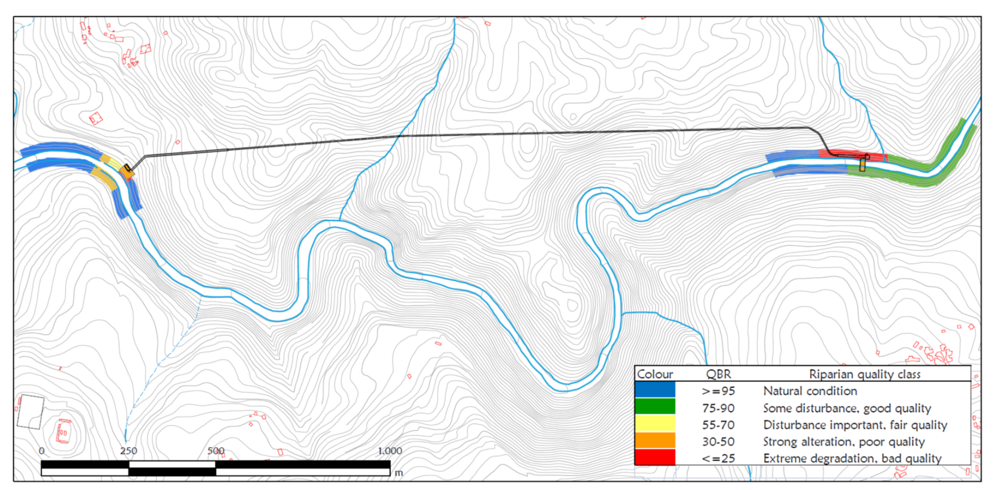
        <p>The evaluation of the riparian habitat showed two river bank sections with extreme degradation (QBR ≤ 25, <xref ref-type="fig" rid="water-04-00815-f008">Figure 8</xref>): (1) a right bank stretch of 200 m situated around the dam, the diversion pipe and fish ladder; (2) a right bank stretch of 50 m where the power house is situated. Around the power house we observed a river stretch of 110 m, on both river banks, with alterations from extreme degradation, on the power house, to important disturbance. In the remaining sections the riparian habitat was classified as good quality (QBR = 75–90), or even natural condition (QBR ≥ 95). SHP plant effect on riparian habitat was only observed in the sections affected by the constructions, totalling a stretch of 300 m.</p>
        <fig id="water-04-00815-f008" position="anchor">
          <label>Figure 8</label>
          <caption>
            <p>Riparian habitat quality index QBR [<xref ref-type="bibr" rid="B36-water-04-00815">36</xref>] in the reaches affected by the SHP plant.</p>
          </caption>
          <graphic xmlns:xlink="http://www.w3.org/1999/xlink" xlink:href="water-04-00815-g008.tif"/>
        </fig>
      </sec>
    </sec>
    <sec>
      <title>4. Summary and Conclusions</title>
      <p>Our results suggest that SHP plant construction momentarily disturbed the physical-chemical characteristics of the water. It caused a pH destabilization, which fell to values &lt;5.5 during the construction and soared to values unusually high in the second year after construction. At the same time, temperature exceeded the threshold value of 10 °C during breeding periods of salmo. The interrupted flow and the high temperatures of water caused a plunge in the dissolved oxygen, to below the allowed level for salmonids waters. Significant changes in conductivity were also observed during construction. However, two years after construction both temperature and dissolved oxygen values achieved conditions for normal development of the aquatic life, while pH values were close and even under the lower limit allowed for salmonid water: 6 (Directive 2006/44/EC [<xref ref-type="bibr" rid="B24-water-04-00815">24</xref>]). No statistically significant differences were observed in the IBMWP between downstream the dam, upstream and downstream (tail race), suggesting no significant influence of the SHP scheme plant on the water’s biological quality during operation. The IBMWP index showed a positive trend from two years after the construction of the SHP plant and its values stabilized on biological quality I. The IBMWP observed, suggest that the diversity of macrobenthos in this stretch of the river around the San Xusto SHP plant, is lower than the reference conditions, but the families present are of high ecological value.</p>
      <p>This suggests that the construction of the SHP plant caused an adverse effect in the ecosystem with respect of the physicochemical parameters and biological quality of the water. However, this was a transitory situation and, within two years, both physicochemical parameters and the biological quality of the water achieved conditions ecologically compatible, as has been observed in previous studies [<xref ref-type="bibr" rid="B13-water-04-00815">13</xref>,<xref ref-type="bibr" rid="B14-water-04-00815">14</xref>,<xref ref-type="bibr" rid="B41-water-04-00815">41</xref>]. Some measures which could minimize the existing adverse environmental impacts are: decrease of land excavations and blasting during construction, assurance of maintaining minimal river flow downstream of the dam according to relevant legislation.</p>
      <p>With respect to the riparian vegetation, the SHP scheme had a severe effect on the riparian habitat but this was only observed in the sections affected by the construction. In order to achieve a minimum effect on the riparian vegetation restoration of the vegetation is needed, i.e. replanting of trees species native to the area. For the visual integration of the constructions in the landscape, the SHP building and other elements should be constructed using rustic materials esthetically harmonized with the environment.</p>
    </sec>
   
  </body>
  <back>
   <ack>
      <title>Acknowledgments</title>
      <p>This work was possible thanks to the projects developed by the group AF4 for the company TASGA Renovables. Roberto Pérez Lodos and Juan Jesus Berzosa Aránguez from TASGA facilitated the work. I acknowledge Aguas de Galicia, especially Belén Quinteiro Seoane, Mónica Velo Cid and Raquel Piñeiro Rebolo, the information facilitated. The author is grateful to all the technicians participating in the samplings.</p>
    </ack>
    <ref-list>
      <title>References</title>
      <ref id="B1-water-04-00815">
        <label>1.</label>
        <citation citation-type="web">
          <person-group person-group-type="author">
            <name>
              <surname>Tzimas</surname>
              <given-names>E.</given-names>
            </name>
            <name>
              <surname>Georgakaki</surname>
              <given-names>A.</given-names>
            </name>
            <name>
              <surname>Peteves</surname>
              <given-names>S.D.</given-names>
            </name>
          </person-group>
          <source>Future Fossil Fuel Electricity Generation in Europe: Options and Consequence</source>
          <publisher-name>Joint Research Center, European Commission</publisher-name>
          <publisher-loc>Petten, The Netherlands</publisher-loc>
          <year>2009</year>
          <access-date>(accessed on 10 July 2012)</access-date>
          <comment>Available online:<ext-link xmlns:xlink="http://www.w3.org/1999/xlink" xlink:href="http://ec.europa.eu/dgs/jrc/downloads/jrc_reference_report_200907_fossil_fuel_electricity.pdf" ext-link-type="uri">http://ec.europa.eu/dgs/jrc/downloads/jrc_reference_report_200907_fossil_fuel_electricity.pdf</ext-link></comment>
        </citation>
      </ref>
      <ref id="B2-water-04-00815">
        <label>2.</label>
        <citation citation-type="web">
        <collab>Eurostat</collab>
         
          <article-title>Electricity Production And Supply Statistics</article-title>
          <access-date>(accessed on 5 March 2012)</access-date>
          <comment>Available online:<ext-link xmlns:xlink="http://www.w3.org/1999/xlink" xlink:href="http://epp.eurostat.ec.europa.eu/statistics_explained/index.php/Electricity_production_and_supply_statistics" ext-link-type="uri">http://epp.eurostat.ec.europa.eu/statistics_explained/index.php/Electricity_production_and_supply_statistics</ext-link></comment>
        </citation>
      </ref>
      <ref id="B3-water-04-00815">
        <label>3.</label>
        <citation citation-type="journal">
          <person-group person-group-type="author">
            <name>
              <surname>Dincer</surname>
              <given-names>I.</given-names>
            </name>
          </person-group>
          <article-title>Renewable energy and sustainable development: A crucial review</article-title>
          <source>Renew. Sustain. Energy Rev.</source>
          <year>2000</year>
          <volume>4</volume>
          <fpage>157</fpage>
          <lpage>175</lpage>
          <pub-id pub-id-type="doi">10.1016/S1364-0321(99)00011-8</pub-id>
        </citation>
      </ref>
      <ref id="B4-water-04-00815">
        <label>4.</label>
        <citation citation-type="journal">
          <person-group person-group-type="author">
            <name>
              <surname>Míguez</surname>
              <given-names>J.L.</given-names>
            </name>
            <name>
              <surname>López-Gonzalez</surname>
              <given-names>L.M.</given-names>
            </name>
            <name>
              <surname>Sala</surname>
              <given-names>J.M.</given-names>
            </name>
            <name>
              <surname>Porteiro</surname>
              <given-names>J.</given-names>
            </name>
            <name>
              <surname>Granada</surname>
              <given-names>E.</given-names>
            </name>
            <name>
              <surname>Morán</surname>
              <given-names>J.C.</given-names>
            </name>
            <name>
              <surname>Juárez</surname>
              <given-names>M.C.</given-names>
            </name>
          </person-group>
          <article-title>Review of compliance with EU-2010 targets on renewable energy in Galicia (Spain)</article-title>
          <source>Renew. Sustain. Energy Rev.</source>
          <year>2006</year>
          <volume>10</volume>
          <fpage>225</fpage>
          <lpage>247</lpage>
          <pub-id pub-id-type="doi">10.1016/j.rser.2004.09.009</pub-id>
        </citation>
      </ref>
      <ref id="B5-water-04-00815">
        <label>5.</label>
        <citation citation-type="journal">
          <person-group person-group-type="author">
            <name>
              <surname>Dincer</surname>
              <given-names>I.</given-names>
            </name>
            <name>
              <surname>Rosen</surname>
              <given-names>M.A.</given-names>
            </name>
          </person-group>
          <article-title>A worldwide perspective on energy, environment and sustainable development</article-title>
          <source>Int. J. Energy Res.</source>
          <year>1998</year>
          <volume>22</volume>
          <fpage>1305</fpage>
          <lpage>1321</lpage>
          <pub-id pub-id-type="doi">10.1002/(SICI)1099-114X(199812)22:15&lt;1305::AID-ER417&gt;3.0.CO;2-H</pub-id>
        </citation>
      </ref>
      <ref id="B6-water-04-00815">
        <label>6.</label>
        <citation citation-type="journal">
          <person-group person-group-type="author">
            <name>
              <surname>Islam</surname>
              <given-names>M.</given-names>
            </name>
            <name>
              <surname>Fartaj</surname>
              <given-names>A.</given-names>
            </name>
            <name>
              <surname>Ting</surname>
              <given-names>D.S.K.</given-names>
            </name>
          </person-group>
          <article-title>Current utilization and future prospects of emerging renewable energy applications in Canada</article-title>
          <source>Renew. Sustain. Energy Rev.</source>
          <year>2004</year>
          <volume>8</volume>
          <fpage>493</fpage>
          <lpage>519</lpage>
          <pub-id pub-id-type="doi">10.1016/j.rser.2003.12.006</pub-id>
        </citation>
      </ref>
      <ref id="B7-water-04-00815">
        <label>7.</label>
        <citation citation-type="journal">
          <person-group person-group-type="author">
            <name>
              <surname>Paish</surname>
              <given-names>O.</given-names>
            </name>
          </person-group>
          <article-title>Small hydro power: Technology and current status</article-title>
          <source>Renew. Sustain. Energy Rev.</source>
          <year>2002</year>
          <volume>6</volume>
          <fpage>537</fpage>
          <lpage>556</lpage>
          <pub-id pub-id-type="doi">10.1016/S1364-0321(02)00006-0</pub-id>
        </citation>
      </ref>
      <ref id="B8-water-04-00815">
        <label>8.</label>
        <citation citation-type="web">
        <collab>Thematic Network on Small Hydropower</collab>
         
           <source>Proposals for a European Strategy of Research, Development and Demonstration for Renewable Energy from Small Hydropower</source>
          <publisher-name>The European Small Hydropower Association (ESHA)</publisher-name>
          <publisher-loc>Brussels, Belgium</publisher-loc>
          <year>2005</year>
          <access-date>(accessed on 9 March 2012)</access-date>
          <comment>Available online:<ext-link xmlns:xlink="http://www.w3.org/1999/xlink" xlink:href="http://www.esha.be/publications/publications.html" ext-link-type="uri">http://www.esha.be/publications/publications.html</ext-link></comment>
        </citation>
      </ref>
      <ref id="B9-water-04-00815">
        <label>9.</label>
        <citation citation-type="book">
          <person-group person-group-type="author">
            <name>
              <surname>Martínez Cortizas</surname>
              <given-names>A.</given-names>
            </name>
            <name>
              <surname>Pérez Alberti</surname>
              <given-names>A.</given-names>
            </name>
          </person-group>
          <source>Climate Atlas of Galicia (in Spanish)</source>
          <publisher-name>Xunta de Galicia, Consellería de Medio Ambiente</publisher-name>
          <publisher-loc>Santiago de Compostela, Spain</publisher-loc>
          <year>2000</year>
        </citation>
      </ref>
      <ref id="B10-water-04-00815">
        <label>10.</label>
        <citation citation-type="journal">
          <person-group person-group-type="author">
            <name>
              <surname>Martínez-Ansemil</surname>
              <given-names>E.</given-names>
            </name>
            <name>
              <surname>Membiela</surname>
              <given-names>P.</given-names>
            </name>
          </person-group>
          <article-title>The low mineralized and fast turnover watercourses of galicia</article-title>
          <source>Limnetica</source>
          <year>1992</year>
          <volume>8</volume>
          <fpage>125</fpage>
          <lpage>130</lpage>
        </citation>
      </ref>
      <ref id="B11-water-04-00815">
        <label>11.</label>
        <citation citation-type="journal">
          <person-group person-group-type="author">
            <name>
              <surname>Larinier</surname>
              <given-names>M.</given-names>
            </name>
          </person-group>
          <article-title>Fish passage experience at small-scale hydro-electric power plants in France</article-title>
          <source>Hydrobiologia</source>
          <year>2008</year>
          <volume>609</volume>
          <fpage>97</fpage>
          <lpage>108</lpage>
          <pub-id pub-id-type="doi">10.1007/s10750-008-9398-9</pub-id>
        </citation>
      </ref>
      <ref id="B12-water-04-00815">
        <label>12.</label>
        <citation citation-type="journal">
          <person-group person-group-type="author">
            <name>
              <surname>Abbasi</surname>
              <given-names>T.</given-names>
            </name>
            <name>
              <surname>Abbasi</surname>
              <given-names>S.A.</given-names>
            </name>
          </person-group>
          <article-title>Small hydro and the environmental implications of its extensive utilization</article-title>
          <source>Renew. Sustain. Energy Rev.</source>
          <year>2011</year>
          <volume>15</volume>
          <fpage>2134</fpage>
          <lpage>2143</lpage>
          <pub-id pub-id-type="doi">10.1016/j.rser.2010.11.050</pub-id>
        </citation>
      </ref>
      <ref id="B13-water-04-00815">
        <label>13.</label>
        <citation citation-type="journal">
          <person-group person-group-type="author">
            <name>
              <surname>Jesus</surname>
              <given-names>T.</given-names>
            </name>
            <name>
              <surname>Formigo</surname>
              <given-names>N.</given-names>
            </name>
            <name>
              <surname>Santos</surname>
              <given-names>P.</given-names>
            </name>
            <name>
              <surname>Tavares</surname>
              <given-names>G.R.</given-names>
            </name>
          </person-group>
          <article-title>Impact evaluation of the Vila Viçosa small hydroelectric power plant (Portugal) on the water quality and on the dynamics of the benthic macroinvertebrate communities of the Ardena river</article-title>
          <source>Limnetica</source>
          <year>2004</year>
          <volume>23</volume>
          <fpage>241</fpage>
          <lpage>256</lpage>
        </citation>
      </ref>
      <ref id="B14-water-04-00815">
        <label>14.</label>
        <citation citation-type="journal">
          <person-group person-group-type="author">
            <name>
              <surname>Fu</surname>
              <given-names>X.</given-names>
            </name>
            <name>
              <surname>Wu</surname>
              <given-names>N.</given-names>
            </name>
            <name>
              <surname>Zhou</surname>
              <given-names>S.</given-names>
            </name>
            <name>
              <surname>Jiang</surname>
              <given-names>W.</given-names>
            </name>
            <name>
              <surname>Li</surname>
              <given-names>F.</given-names>
            </name>
            <name>
              <surname>Cai</surname>
              <given-names>Q.</given-names>
            </name>
          </person-group>
          <article-title>Impacts of a small hydropower plant on macroinvertebrate habitat and an initial estimate for ecological water requirement of Xiangxi river</article-title>
          <source>Acta Ecol. Sin.</source>
          <year>2008</year>
          <volume>28</volume>
          <fpage>1942</fpage>
          <lpage>1948</lpage>
        </citation>
      </ref>
      <ref id="B15-water-04-00815">
        <label>15.</label>
        <citation citation-type="journal">
          <person-group person-group-type="author">
            <name>
              <surname>Fu</surname>
              <given-names>X.</given-names>
            </name>
            <name>
              <surname>Tang</surname>
              <given-names>T.</given-names>
            </name>
            <name>
              <surname>Jiang</surname>
              <given-names>W.</given-names>
            </name>
            <name>
              <surname>Li</surname>
              <given-names>F.</given-names>
            </name>
            <name>
              <surname>Wu</surname>
              <given-names>N.</given-names>
            </name>
            <name>
              <surname>Zhou</surname>
              <given-names>S.</given-names>
            </name>
            <name>
              <surname>Cai</surname>
              <given-names>Q.</given-names>
            </name>
          </person-group>
          <article-title>Impacts of small hydropower plants on macroinvertebrate communities</article-title>
          <source>Acta Ecol. Sin.</source>
          <year>2008</year>
          <volume>28</volume>
          <fpage>45</fpage>
          <lpage>52</lpage>
          <pub-id pub-id-type="doi">10.1016/S1872-2032(08)60019-0</pub-id>
        </citation>
      </ref>
      <ref id="B16-water-04-00815">
        <label>16.</label>
        <citation citation-type="journal">
          <person-group person-group-type="author">
            <name>
              <surname>Wu</surname>
              <given-names>N.C.</given-names>
            </name>
            <name>
              <surname>Jiang</surname>
              <given-names>W.X.</given-names>
            </name>
            <name>
              <surname>Fu</surname>
              <given-names>X.C.</given-names>
            </name>
            <name>
              <surname>Zhou</surname>
              <given-names>S.C.</given-names>
            </name>
            <name>
              <surname>Li</surname>
              <given-names>F.Q.</given-names>
            </name>
            <name>
              <surname>Cai</surname>
              <given-names>Q.H.</given-names>
            </name>
            <name>
              <surname>Fohrer</surname>
              <given-names>N.</given-names>
            </name>
          </person-group>
          <article-title>Temporal impacts of a small hydropower plant on benthic algal community</article-title>
          <source>Fundam.Appl. Limnol.</source>
          <year>2010</year>
          <volume>177</volume>
          <fpage>257</fpage>
          <lpage>266</lpage>
          <pub-id pub-id-type="doi">10.1127/1863-9135/2010/0177-0257</pub-id>
        </citation>
      </ref>
      <ref id="B17-water-04-00815">
        <label>17.</label>
        <citation citation-type="book">
          <source>Directive 2000/60/EC of the European Parliament and the Council of 23 October 2000 Establishing a Framework for Community Action in the Field of Water Policy</source>
          <publisher-name>Official Journal of the European Communities</publisher-name>
          <publisher-loc>Brussel, Belgium</publisher-loc>
          <year>2000</year>
        </citation>
      </ref>
      <ref id="B18-water-04-00815">
        <label>18.</label>
        <citation citation-type="journal">
          <person-group person-group-type="author">
            <name>
              <surname>Stalzer</surname>
              <given-names>W.</given-names>
            </name>
            <name>
              <surname>Bloch</surname>
              <given-names>H.</given-names>
            </name>
          </person-group>
          <article-title>Preface: The Austrian approach</article-title>
          <source>Hydrobiologia</source>
          <year>2000</year>
          <volume>422–423</volume>
          <fpage>XIX</fpage>
          <lpage>XXI</lpage>
        </citation>
      </ref>
      <ref id="B19-water-04-00815">
        <label>19.</label>
        <citation citation-type="book">
          <person-group person-group-type="author">
            <name>
              <surname>Carballeira</surname>
              <given-names>A.</given-names>
            </name>
            <name>
              <surname>Devesa</surname>
              <given-names>C.</given-names>
            </name>
            <name>
              <surname>Retuerto</surname>
              <given-names>R.</given-names>
            </name>
            <name>
              <surname>Santillán</surname>
              <given-names>E.</given-names>
            </name>
            <name>
              <surname>Ucieda</surname>
              <given-names>F.</given-names>
            </name>
          </person-group>
          <source>Bioclimatology of Galicia (in Spanish)</source>
          <publisher-name>Fundación Pedro Barrie de la Maza</publisher-name>
          <publisher-loc>Vigo, Spain</publisher-loc>
          <year>1983</year>
        </citation>
      </ref>
      <ref id="B20-water-04-00815">
        <label>20.</label>
        <citation citation-type="book">
        <collab>Xunta de Galicia</collab>
        
          <source>Galician Plan of Management of Fish Resources and Continental Acuatic Ecosystems (in Spanish)</source>
          <publisher-name>Xunta de Galicia</publisher-name>
          <publisher-loc>Santiago de Compostela, Spain</publisher-loc>
          <year>2005</year>
        </citation>
      </ref>
      <ref id="B21-water-04-00815">
        <label>21.</label>
        <citation citation-type="web">
        <collab>Consellería do Medio Rural e do Mar</collab>
          
          <source>Espacios protegidos.ZEPVN Río Lérez Protected Areas. Areas with Special Protection of Natural Values. River Lérez</source>
          <publisher-name>Xunta de Galicia</publisher-name>
          <publisher-loc>Santiago de Compostela, Spain</publisher-loc>
          <year>2012</year>
          <access-date>(accessed on 21 February 2012)</access-date>
          <comment>Available online:<ext-link xmlns:xlink="http://www.w3.org/1999/xlink" xlink:href="http://mediorural.xunta.es/es/areas/conservacion/espazos_protexidos/rede_galega/zepvn/rio_lerez/" ext-link-type="uri">http://mediorural.xunta.es/es/areas/conservacion/espazos_protexidos/rede_galega/zepvn/rio_lerez/</ext-link></comment>
        </citation>
      </ref>
      <ref id="B22-water-04-00815">
        <label>22.</label>
        <citation citation-type="journal">
          <person-group person-group-type="author">
            <name>
              <surname>Membiela</surname>
              <given-names>P.</given-names>
            </name>
            <name>
              <surname>Montes</surname>
              <given-names>C.</given-names>
            </name>
            <name>
              <surname>Martínez-Ansemil</surname>
              <given-names>E.</given-names>
            </name>
          </person-group>
          <article-title>Hydrochemical characteristics of the rivers of Galicia (NW Iberian Peninsula) (in Spanish)</article-title>
          <source>Limnetica</source>
          <year>1991</year>
          <volume>7</volume>
          <fpage>163</fpage>
          <lpage>174</lpage>
        </citation>
      </ref>
      <ref id="B23-water-04-00815">
        <label>23.</label>
        <citation citation-type="web">
        <collab>Ministerio de Medio Ambiente</collab>
        
          <source>Manual of the Directive 78/659/CEE on the Quality of Fresh Waters Needing Protection or Improvement to Be Suitable for the Life of Fish (in Spanish)</source>
          <publisher-name>Ministerio de Medio Ambiente</publisher-name>
          <publisher-loc>Madrid, Spain</publisher-loc>
          <year>2004</year>
          <access-date>(accessed on 1 February 2012)</access-date>
          <comment>Available online:<ext-link xmlns:xlink="http://www.w3.org/1999/xlink" xlink:href="http://www.magrama.gob.es/es/agua/publicaciones/02_manual_directiva_78_659_cee_tcm7-28958.pdf" ext-link-type="uri">http://www.magrama.gob.es/es/agua/publicaciones/02_manual_directiva_78_659_cee_tcm7-28958.pdf</ext-link></comment>
        </citation>
      </ref>
      <ref id="B24-water-04-00815">
        <label>24.</label>
        <citation citation-type="gov">
          <source>Directive 2006/44/EC of the European Parliament and of the Council of 6 September 2006 on the Quality of Fresh Waters Needing Protection or Improvement in Order to Support Fish Life</source>
          <publisher-name>Official Journal of the European Communities</publisher-name>
          <publisher-loc>Brussel, Belgium</publisher-loc>
          <year>2006</year>
        </citation>
      </ref>
      <ref id="B25-water-04-00815">
        <label>25.</label>
        <citation citation-type="journal">
          <person-group person-group-type="author">
            <name>
              <surname>Saura</surname>
              <given-names>M.</given-names>
            </name>
            <name>
              <surname>Caballero</surname>
              <given-names>P.</given-names>
            </name>
            <name>
              <surname>Caballero</surname>
              <given-names>A.</given-names>
            </name>
            <name>
              <surname>Moran</surname>
              <given-names>P.</given-names>
            </name>
          </person-group>
          <article-title>Genetic variation in restored atlantic salmon (<italic>Salmo salar</italic> L.) populations in the Ulla an Lérez rivers, Galicia, Spain</article-title>
          <source>Ices J. Mar. Sci.</source>
          <year>2006</year>
          <volume>63</volume>
          <fpage>1290</fpage>
          <lpage>1296</lpage>
          <pub-id pub-id-type="doi">10.1016/j.icesjms.2006.03.005</pub-id>
        </citation>
      </ref>
      <ref id="B26-water-04-00815">
        <label>26.</label>
        <citation citation-type="web">
          <article-title>Aguas de Galicia and Consellería de Medio Ambiente, Territorio e Infraestructuras</article-title>
          <source>Hydrological Plan—River Basin of Galicia-Costa. Chapter 2. Overview of the River Basin (in Spanish)</source>
          <publisher-name>Aguas de Galicia</publisher-name>
          <publisher-loc>Santiago de Compostela, Spain</publisher-loc>
          <year>2010</year>
          <access-date>(accessed on 13 June 2012)</access-date>
          <comment>Available online:<ext-link xmlns:xlink="http://www.w3.org/1999/xlink" xlink:href="http://www.planhidroloxicogc.com/web/documentacion" ext-link-type="uri">http://www.planhidroloxicogc.com/web/documentacion</ext-link></comment>
        </citation>
      </ref>
      <ref id="B27-water-04-00815">
        <label>27.</label>
        <citation citation-type="web">
          <source>Figures about Galicia: Population, Population Centers and Density (in Spanish)</source>
          <publisher-name>Instituto Galego de Estadística</publisher-name>
          <publisher-loc>Santiago de Compostela, Spain</publisher-loc>
          <year>2010</year>
          <access-date>(accessed on 23 February 2012)</access-date>
          <comment>Available online:<ext-link xmlns:xlink="http://www.w3.org/1999/xlink" xlink:href="http://www.ige.eu/igebdt/selector.jsp?COD=4705&amp;paxina=001&amp;c=0501" ext-link-type="uri">http://www.ige.eu/igebdt/selector.jsp?COD=4705&amp;paxina=001&amp;c=0501</ext-link></comment>
        </citation>
      </ref>
      <ref id="B28-water-04-00815">
        <label>28.</label>
        <citation citation-type="web">
          <source>YSI 556 Multiparameter System Specifications</source>
          <publisher-name>YSI Environmental</publisher-name>
          <publisher-loc>Yellow Springs, OH, USA</publisher-loc>
          <year>2009</year>
          <access-date>(accessed on 16 February 2012)</access-date>
          <comment>Available online:<ext-link xmlns:xlink="http://www.w3.org/1999/xlink" xlink:href="http://www.ysi.com/media/pdfs/" ext-link-type="uri">http://www.ysi.com/media/pdfs/</ext-link></comment>
        </citation>
      </ref>
      <ref id="B29-water-04-00815">
        <label>29.</label>
        <citation citation-type="journal">
        <collab>Ministerio de Agricultura</collab>
        <collab>Alimentación y Medio Ambiente</collab>
       
          <article-title>ORDEN ARM/2656/2008, de 10 de septiembre, por la que se aprueba la instrucción de planificación hidrológica</article-title>
          <source>Boletín Oficial del Estado</source>
          <year>2008</year>
          <volume>229</volume>
          <fpage>38472</fpage>
          <lpage>38582</lpage>
          <comment>BOE-A-2008-15340</comment>
        </citation>
      </ref>
      <ref id="B30-water-04-00815">
        <label>30.</label>
        <citation citation-type="journal">
          <person-group person-group-type="author">
            <name>
              <surname>Alba-Tercedor</surname>
              <given-names>J.</given-names>
            </name>
            <name>
              <surname>Sánchez-Ortega</surname>
              <given-names>A.</given-names>
            </name>
          </person-group>
          <article-title>A simple and quick method to evaluate the biological quality of running freshwater based on Hellawell (1978) (in Spanish)</article-title>
          <source>Limnética</source>
          <year>1988</year>
          <volume>4</volume>
          <fpage>51</fpage>
          <lpage>56</lpage>
        </citation>
      </ref>
      <ref id="B31-water-04-00815">
        <label>31.</label>
        <citation citation-type="journal">
          <person-group person-group-type="author">
            <name>
              <surname>Alba-Tercedor</surname>
              <given-names>J.</given-names>
            </name>
            <name>
              <surname>Jáimez-Cuéllar</surname>
              <given-names>P.</given-names>
            </name>
            <name>
              <surname>Álvarez</surname>
              <given-names>M.</given-names>
            </name>
            <name>
              <surname>Avilés</surname>
              <given-names>J.</given-names>
            </name>
            <name>
              <surname>Bonada</surname>
              <given-names>N.</given-names>
            </name>
            <name>
              <surname>Casas</surname>
              <given-names>J.</given-names>
            </name>
            <name>
              <surname>Mellado</surname>
              <given-names>A.</given-names>
            </name>
            <name>
              <surname>Ortega</surname>
              <given-names>M.</given-names>
            </name>
            <name>
              <surname>Pardo</surname>
              <given-names>I.</given-names>
            </name>
            <name>
              <surname>Prat</surname>
              <given-names>N.</given-names>
            </name>
            <etal/>
          </person-group>
          <article-title>Characterization of the ecological status of the Iberian Mediterranean rivers using the index IBWP (former BMWP’) (in Spanish)</article-title>
          <source>Limnetica</source>
          <year>2002</year>
          <volume>21</volume>
          <fpage>175</fpage>
          <lpage>185</lpage>
        </citation>
      </ref>
      <ref id="B32-water-04-00815">
        <label>32.</label>
        <citation citation-type="journal">
          <person-group person-group-type="author">
            <name>
              <surname>Armitage</surname>
              <given-names>P.D.</given-names>
            </name>
            <name>
              <surname>Moss</surname>
              <given-names>D.</given-names>
            </name>
            <name>
              <surname>Wright</surname>
              <given-names>J.F.</given-names>
            </name>
            <name>
              <surname>Furse</surname>
              <given-names>M.T.</given-names>
            </name>
          </person-group>
          <article-title>The performance of a new biological water quality score system based on macroinvertebrates over a wide range of unpolluted running-water sites</article-title>
          <source>Water Res.</source>
          <year>1983</year>
          <volume>17</volume>
          <fpage>333</fpage>
          <lpage>347</lpage>
          <pub-id pub-id-type="doi">10.1016/0043-1354(83)90188-4</pub-id>
        </citation>
      </ref>
      <ref id="B33-water-04-00815">
        <label>33.</label>
        <citation citation-type="book">
          <person-group person-group-type="author">
            <name>
              <surname>Pardo</surname>
              <given-names>I.</given-names>
            </name>
            <name>
              <surname>García</surname>
              <given-names>L.</given-names>
            </name>
            <name>
              <surname>Delgado</surname>
              <given-names>C.</given-names>
            </name>
            <name>
              <surname>Costas</surname>
              <given-names>N.</given-names>
            </name>
            <name>
              <surname>Abraín</surname>
              <given-names>R.</given-names>
            </name>
          </person-group>
          <source>Sampling Protocols Riverine Aquatic Biological Communities in the area of the Minho-Sil River Basin and Cantabrian (in Spanish); Convenio entre la Universidad de Vigo y las Confederaciones Hidrográficas del Miño-Sil y Cantábrico</source>
          <publisher-name>Universidad de Vigo</publisher-name>
          <publisher-loc>Vigo, Spain</publisher-loc>
          <year>2010</year>
        </citation>
      </ref>
      <ref id="B34-water-04-00815">
        <label>34.</label>
        <citation citation-type="journal">
          <person-group person-group-type="author">
            <name>
              <surname>Valladolid</surname>
              <given-names>M.</given-names>
            </name>
            <name>
              <surname>Arauzo</surname>
              <given-names>M.</given-names>
            </name>
            <name>
              <surname>Martínez-Bastida</surname>
              <given-names>J.J.</given-names>
            </name>
          </person-group>
          <article-title>Ecological Status of the River Oja (Ebro basin, La Rioja, España), through macroinvertebrates indicators (in Spanish)</article-title>
          <source>Limnetica</source>
          <year>2010</year>
          <volume>29</volume>
          <fpage>393</fpage>
          <lpage>406</lpage>
        </citation>
      </ref>
      <ref id="B35-water-04-00815">
        <label>35.</label>
        <citation citation-type="book">
          <person-group person-group-type="author">
            <name>
              <surname>Toro</surname>
              <given-names>M.</given-names>
            </name>
            <name>
              <surname>Robles</surname>
              <given-names>S.</given-names>
            </name>
            <name>
              <surname>Tejero</surname>
              <given-names>I.</given-names>
            </name>
            <name>
              <surname>Cristóbal</surname>
              <given-names>E.</given-names>
            </name>
            <name>
              <surname>Velasco</surname>
              <given-names>S.</given-names>
            </name>
            <name>
              <surname>Sáchez</surname>
              <given-names>J.R.</given-names>
            </name>
            <name>
              <surname>Pujante</surname>
              <given-names>A.</given-names>
            </name>
          </person-group>
          <source>Group 32. Ecological Type 21. Siliceous Cantabric-Atlantic Rivers. Preliminary Ecological Basis for Conservation of Habitat Types of Community Interest in Spain (in Spanish)</source>
          <publisher-name>Ministerio de Medio Ambiente y Medio Rural y Marino</publisher-name>
          <publisher-loc>Madrid, Spain</publisher-loc>
          <year>2009</year>
        </citation>
      </ref>
      <ref id="B36-water-04-00815">
        <label>36.</label>
        <citation citation-type="journal">
          <person-group person-group-type="author">
            <name>
              <surname>Munné</surname>
              <given-names>A.</given-names>
            </name>
            <name>
              <surname>Prat</surname>
              <given-names>N.</given-names>
            </name>
            <name>
              <surname>Solà</surname>
              <given-names>C.</given-names>
            </name>
            <name>
              <surname>Bonada</surname>
              <given-names>N.</given-names>
            </name>
            <name>
              <surname>Rieradevall</surname>
              <given-names>M.</given-names>
            </name>
          </person-group>
          <article-title>A simple field method for assessing the ecological quality of riparian habitat in rivers and streams: QBR index</article-title>
          <source>Aquat. Conserv. Mar. Freshw. Ecosyst.</source>
          <year>2003</year>
          <volume>13</volume>
          <fpage>147</fpage>
          <lpage>163</lpage>
          <pub-id pub-id-type="doi">10.1002/aqc.529</pub-id>
        </citation>
      </ref>
      <ref id="B37-water-04-00815">
        <label>37.</label>
        <citation citation-type="web">
          <source>Ysi 556 Multi Probe System Operations Manual</source>
          <publisher-name>YSI Environmental</publisher-name>
          <publisher-loc>Yellow Springs, OH, USA</publisher-loc>
          <year>2009</year>
          <access-date>(accessed on 16 February 2012)</access-date>
          <comment>Available online:<ext-link xmlns:xlink="http://www.w3.org/1999/xlink" xlink:href="http://www.ysi.com/media/pdfs/" ext-link-type="uri">http://www.ysi.com/media/pdfs/</ext-link></comment>
        </citation>
      </ref>
      <ref id="B38-water-04-00815">
        <label>38.</label>
        <citation citation-type="book">
          <person-group person-group-type="author">
            <name>
              <surname>Alba-Tercedor</surname>
              <given-names>J.</given-names>
            </name>
            <name>
              <surname>Pardo</surname>
              <given-names>I.</given-names>
            </name>
            <name>
              <surname>Prat</surname>
              <given-names>N.</given-names>
            </name>
            <name>
              <surname>Pujante</surname>
              <given-names>A.</given-names>
            </name>
          </person-group>
          <source>Methodology for Establishing the Ecological Status under the Water Framework Directive. Sampling and Analysis Protocol for Benthic Invertebrates (in Spanish)</source>
          <publisher-name>Ministerio de Medio Ambiente</publisher-name>
          <publisher-loc>Madrid, Spain</publisher-loc>
          <year>2005</year>
        </citation>
      </ref>
      <ref id="B39-water-04-00815">
        <label>39.</label>
        <citation citation-type="book">
          <person-group person-group-type="author">
            <name>
              <surname>Sansoni</surname>
              <given-names>G.</given-names>
            </name>
          </person-group>
          <source>Atlas for the Identification of Macroinvertebrates from the Italian Watercourses (in Spanish)</source>
          <publisher-name>Provincia Autonoma di Trento, Agenzia Provinciale per la Protezione dell’Ambiente</publisher-name>
          <publisher-loc>Trento, Italy</publisher-loc>
          <year>1998</year>
        </citation>
      </ref>
      <ref id="B40-water-04-00815">
        <label>40.</label>
        <citation citation-type="web">
          <source>Estaciones Redes Antiguas; Xunta de Galicia Web site</source>
          <access-date>(accessed on 24 July 2012)</access-date>
          <comment>Available online:<ext-link xmlns:xlink="http://www.w3.org/1999/xlink" xlink:href="http://augasdegalicia.xunta.es/es/Estacions_continentais.htm" ext-link-type="uri">http://augasdegalicia.xunta.es/es/Estacions_continentais.htm</ext-link></comment>
        </citation>
      </ref>
      <ref id="B41-water-04-00815">
        <label>41.</label>
        <citation citation-type="journal">
          <person-group person-group-type="author">
            <name>
              <surname>Santos</surname>
              <given-names>J.M.</given-names>
            </name>
            <name>
              <surname>Ferreira</surname>
              <given-names>M.T.</given-names>
            </name>
            <name>
              <surname>Pinheiro</surname>
              <given-names>A.N.</given-names>
            </name>
            <name>
              <surname>Bochechas</surname>
              <given-names>J.H.</given-names>
            </name>
          </person-group>
          <article-title>Effects of small hydropower plants on fish assemblages in medium-sized streams in central and northern Portugal</article-title>
          <source>Aquat. Conserv. Mar. Freshw. Ecosyst.</source>
          <year>2006</year>
          <volume>16</volume>
          <fpage>373</fpage>
          <lpage>388</lpage>
          <pub-id pub-id-type="doi">10.1002/aqc.735</pub-id>
        </citation>
      </ref>
      <ref id="B42-water-04-00815">
        <label>42.</label>
        <citation citation-type="journal">
          <person-group person-group-type="author">
            <name>
              <surname>Costas</surname>
              <given-names>N.</given-names>
            </name>
            <name>
              <surname>Alvarez Jiménez</surname>
              <given-names>M.</given-names>
            </name>
            <name>
              <surname>Pardo Gamundí</surname>
              <given-names>I.</given-names>
            </name>
          </person-group>
          <article-title>Characterization of an atlantic salmon “<italic>Salmo salar</italic>” Stream at the southern limit of its eastern atlantic distribution</article-title>
          <source>J. Fish Biol.</source>
          <year>2009</year>
          <volume>75</volume>
          <fpage>2552</fpage>
          <lpage>2570</lpage>
          <pub-id pub-id-type="doi">10.1111/j.1095-8649.2009.02445.x</pub-id>
        </citation>
      </ref>
      <ref id="B43-water-04-00815">
        <label>43.</label>
        <citation citation-type="book">
          <person-group person-group-type="author">
            <name>
              <surname>Peterson</surname>
              <given-names>M.J.</given-names>
            </name>
            <name>
              <surname>Cada</surname>
              <given-names>G.F.</given-names>
            </name>
            <name>
              <surname>Sale</surname>
              <given-names>M.J.</given-names>
            </name>
            <name>
              <surname>Eddlemon</surname>
              <given-names>G.K.</given-names>
            </name>
          </person-group>
          <source>Regulatory Approaches for Addressing Dissolved Oxygen Concerns at Hydropower Facilities</source>
          <publisher-name>U.S. Department of Energy</publisher-name>
          <publisher-loc>Washington, DC, USA</publisher-loc>
          <year>2003</year>
        </citation>
      </ref>
      <ref id="B44-water-04-00815">
        <label>44.</label>
        <citation citation-type="book">
          <person-group person-group-type="author">
            <name>
              <surname>Sale</surname>
              <given-names>M.J.</given-names>
            </name>
            <name>
              <surname>Cada</surname>
              <given-names>G.F.</given-names>
            </name>
            <name>
              <surname>Chang</surname>
              <given-names>L.H.</given-names>
            </name>
            <name>
              <surname>Christensen</surname>
              <given-names>S.W.</given-names>
            </name>
            <name>
              <surname>Railsback</surname>
              <given-names>S.F.</given-names>
            </name>
            <name>
              <surname>Francfort</surname>
              <given-names>J.E.</given-names>
            </name>
            <name>
              <surname>Rinehart</surname>
              <given-names>B.N.</given-names>
            </name>
            <name>
              <surname>Sommers</surname>
              <given-names>G.L.</given-names>
            </name>
          </person-group>
          <source>Environmental Mitigation at Hydroelectric Projects. Volume 1. Current Practices for Instream Flow Needs, Dissolved Oxygen, and Fish Passage</source>
          <publisher-name>U.S. Department of Energy</publisher-name>
          <publisher-loc>Washington, DC, USA</publisher-loc>
          <year>1991</year>
        </citation>
      </ref>
      <ref id="B45-water-04-00815">
        <label>45.</label>
        <citation citation-type="journal">
          <person-group person-group-type="author">
            <name>
              <surname>Copeman</surname>
              <given-names>V.A.</given-names>
            </name>
          </person-group>
          <article-title>The impact of micro-hydropower on the aquatic environment</article-title>
          <source>J. Chart. Inst. Water Environ. Manag.</source>
          <year>1997</year>
          <volume>11</volume>
          <fpage>431</fpage>
          <lpage>436</lpage>
          <pub-id pub-id-type="doi">10.1111/j.1747-6593.1997.tb01376.x</pub-id>
        </citation>
      </ref>
      <ref id="B46-water-04-00815">
        <label>46.</label>
        <citation citation-type="journal">
          <person-group person-group-type="author">
            <name>
              <surname>Almodovar</surname>
              <given-names>A.</given-names>
            </name>
            <name>
              <surname>Nicola</surname>
              <given-names>G.G.</given-names>
            </name>
          </person-group>
          <article-title>Effects of a small hydropower station upon brown trout <italic>Salmo trutta</italic> L. in the river Hoz Seca (Tagus Basin, Spain) one year after regulation</article-title>
          <source>Regul. Rivers Res. Manag.</source>
          <year>1999</year>
          <volume>15</volume>
          <fpage>477</fpage>
          <lpage>484</lpage>
          <pub-id pub-id-type="doi">10.1002/(SICI)1099-1646(199909/10)15:5&lt;477::AID-RRR560&gt;3.0.CO;2-B</pub-id>
        </citation>
      </ref>
      <ref id="B47-water-04-00815">
        <label>47.</label>
        <citation citation-type="journal">
          <person-group person-group-type="author">
            <name>
              <surname>Boubee</surname>
              <given-names>J.A.T.</given-names>
            </name>
            <name>
              <surname>Williams</surname>
              <given-names>E.K.</given-names>
            </name>
          </person-group>
          <article-title>Downstream passage of silver eels at a small hydroelectric facility</article-title>
          <source>Fish. Manag. Ecol.</source>
          <year>2006</year>
          <volume>13</volume>
          <fpage>165</fpage>
          <lpage>176</lpage>
          <pub-id pub-id-type="doi">10.1111/j.1365-2400.2006.00489.x</pub-id>
        </citation>
      </ref>
      <ref id="B48-water-04-00815">
        <label>48.</label>
        <citation citation-type="journal">
          <person-group person-group-type="author">
            <name>
              <surname>Travade</surname>
              <given-names>F.</given-names>
            </name>
            <name>
              <surname>Larinier</surname>
              <given-names>M.</given-names>
            </name>
            <name>
              <surname>Subra</surname>
              <given-names>S.</given-names>
            </name>
            <name>
              <surname>Gomes</surname>
              <given-names>P.</given-names>
            </name>
            <name>
              <surname>de Oliveira</surname>
              <given-names>E.</given-names>
            </name>
          </person-group>
          <article-title>Behaviour and passage of european silver eels (<italic>Anguilla anguilla</italic>) at a small hydropower plant during their downstream migration</article-title>
          <source>Knowl. Manag. Aquat. Ecosyst.</source>
          <year>2010</year>
          <volume>398</volume>
          <fpage>1</fpage>
          <lpage>19</lpage>
        </citation>
      </ref>
      <ref id="B49-water-04-00815">
        <label>49.</label>
        <citation citation-type="journal">
          <person-group person-group-type="author">
            <name>
              <surname>Capel</surname>
              <given-names>F.M.</given-names>
            </name>
            <name>
              <surname>Rodríguez</surname>
              <given-names>F.H.</given-names>
            </name>
            <name>
              <surname>de Jalón Lastra</surname>
              <given-names>D.G.</given-names>
            </name>
            <name>
              <surname>de los Terreros</surname>
              <given-names>M.S.</given-names>
            </name>
          </person-group>
          <article-title>Assessing impacts of a hydropower plant: Ebro river, Spain</article-title>
          <source>Hung. J. Ind. Chem. Veszpr.</source>
          <year>2000</year>
          <volume>2</volume>
          <fpage>1</fpage>
          <lpage>6</lpage>
        </citation>
      </ref>
      <ref id="B50-water-04-00815">
        <label>50.</label>
        <citation citation-type="book">
          <person-group person-group-type="author">
            <name>
              <surname>Durif</surname>
              <given-names>C.</given-names>
            </name>
            <name>
              <surname>Elie</surname>
              <given-names>P.</given-names>
            </name>
            <name>
              <surname>Gosset</surname>
              <given-names>C.</given-names>
            </name>
            <name>
              <surname>Rives</surname>
              <given-names>J.</given-names>
            </name>
            <name>
              <surname>Travade</surname>
              <given-names>F.</given-names>
            </name>
            <name>
              <surname>Dixon</surname>
              <given-names>D.A.</given-names>
            </name>
          </person-group>
          <article-title>Behavioral study of downstream migrating eels by radio-telemetry at a small hydroelectric power plant</article-title>
          <source>Biology, Management, and Protection of Catadromous</source>
          <person-group person-group-type="editor">
            <name>
              <surname>Dixon</surname>
              <given-names>D.A.</given-names>
            </name>
          </person-group>
          <publisher-name>American ﬁsheries Society</publisher-name>
          <publisher-loc>Bethesda, MD, USA</publisher-loc>
          <year>2003</year>
          <fpage>343</fpage>
          <lpage>356</lpage>
          <comment>Symposium 33</comment>
        </citation>
      </ref>
    </ref-list>
  </back>
</article>