
<?xml version="1.0" encoding="UTF-8"?>
<!DOCTYPE article PUBLIC "-//NLM//DTD Journal Publishing DTD v2.3 20070202//EN" "journalpublishing.dtd">
<article xmlns:mml="http://www.w3.org/1998/Math/MathML" xmlns:xlink="http://www.w3.org/1999/xlink" xml:lang="en" article-type="review-article">
  <front>
    <journal-meta>
      <journal-id journal-id-type="publisher-id">genes</journal-id>
      <journal-title>Genes</journal-title>
      <abbrev-journal-title abbrev-type="publisher">Genes</abbrev-journal-title>
      <abbrev-journal-title abbrev-type="pubmed">Genes</abbrev-journal-title>
      <issn pub-type="epub">2073-4425</issn>
      <publisher>
        <publisher-name>MDPI</publisher-name>
      </publisher>
    </journal-meta>
    <article-meta>
      <article-id pub-id-type="doi">10.3390/genes3010019</article-id>
      <article-id pub-id-type="publisher-id">genes-03-00019</article-id>
      <article-categories>
        <subj-group>
          <subject>Review</subject>
        </subj-group>
      </article-categories>
      <title-group>
        <article-title>Discriminating Gene Expression Signature of Radiation-Induced Thyroid Tumors after Either External Exposure or Internal Contamination</article-title>
      </title-group>
      <contrib-group>
        <contrib contrib-type="author">
          <name>
            <surname>Ory</surname>
            <given-names>Catherine</given-names>
          </name>
          <xref rid="af1-genes-03-00019" ref-type="aff">1</xref>
          <xref rid="c1-genes-03-00019" ref-type="corresp">*</xref>
        </contrib>
        <contrib contrib-type="author">
          <name>
            <surname>Ugolin</surname>
            <given-names>Nicolas</given-names>
          </name>
          <xref rid="af1-genes-03-00019" ref-type="aff">1</xref>
        </contrib>
        <contrib contrib-type="author">
          <name>
            <surname>Schlumberger</surname>
            <given-names>Martin</given-names>
          </name>
          <xref rid="af2-genes-03-00019" ref-type="aff">2</xref>
        </contrib>
        <contrib contrib-type="author">
          <name>
            <surname>Hofman</surname>
            <given-names>Paul</given-names>
          </name>
          <xref rid="af3-genes-03-00019" ref-type="aff">3</xref>
          <xref rid="af4-genes-03-00019" ref-type="aff">4</xref>
          <xref rid="af5-genes-03-00019" ref-type="aff">5</xref>
        </contrib>
        <contrib contrib-type="author">
          <name>
            <surname>Chevillard</surname>
            <given-names>Sylvie</given-names>
          </name>
          <xref rid="af1-genes-03-00019" ref-type="aff">1</xref>
        </contrib>
      </contrib-group>
      <aff id="af1-genes-03-00019"><label>1 </label>CEA, DSV, IRCM, SREIT, Laboratoire de Cancérologie Expérimentale, BP6, Fontenay-aux-Roses, F-92265, France; E-Mails: <email>nicolas.ugolin@cea.fr</email> (N.U.); <email>sylvie.chevillard@cea.fr</email> (S.C.)</aff>
      <aff id="af2-genes-03-00019"><label>2 </label>Institut Gustave Roussy, Department on Nuclear Medicine and Endocrine Oncology, Villejuif, and University Paris-Sud, F-94800, France; E-Mail: <email>Martin.SCHLUMBERGER@igr.fr</email></aff>
      <aff id="af3-genes-03-00019"><label>3 </label>INSERM ERI-21, Nice, F-06002, France; E-Mail: <email>HOFMAN.P@chu-nice.fr</email></aff>
      <aff id="af4-genes-03-00019"><label>4 </label>University of Nice-Sophia Antipolis, IFR 50, Nice, F-06002, France</aff>
      <aff id="af5-genes-03-00019"><label>5 </label>Laboratory of Clinical and Experimental Pathology and CHU-CRLCC-UNSA tumour tissue bank of Nice area, Louis Pasteur Hospital, Nice, F-06002, France</aff>
      <author-notes>
        <corresp id="c1-genes-03-00019"><label>* </label>Author to whom correspondence should be addressed; E-Mail: <email>catherine.ory@cea.fr</email>; Tel.: +33-146-547-045; Fax: +33-146-548-886.</corresp>
      </author-notes>
      <pub-date pub-type="epub">
        <day>21</day>
        <month>12</month>
        <year>2011</year>
      </pub-date>
      <pub-date pub-type="collection"><month>03</month>
        <year>2012</year>
      </pub-date>
      <volume>3</volume>
      <issue>1</issue>
      <fpage>19</fpage>
      <lpage>34</lpage>
      <history>
        <date date-type="received">
          <day>03</day>
          <month>11</month>
          <year>2011</year>
        </date>
        <date date-type="rev-recd">
          <day>06</day>
          <month>12</month>
          <year>2011</year>
        </date>
        <date date-type="accepted">
          <day>09</day>
          <month>12</month>
          <year>2011</year>
        </date>
      </history>
      <permissions>
        <copyright-statement>© 2012 by the authors; licensee MDPI, Basel, Switzerland.</copyright-statement>
        <copyright-year>2012</copyright-year>
        <license xmlns:xlink="http://www.w3.org/1999/xlink" license-type="open-access" xlink:href="http://creativecommons.org/licenses/by/3.0/">
          <p>This article is an open access article distributed under the terms and conditions of the Creative Commons Attribution license (http://creativecommons.org/licenses/by/3.0/).</p>
        </license>
      </permissions>
      <abstract>
        <p>Both external radiation exposure and internal radionuclide contamination are well known risk factors in the development of thyroid epithelial tumors. The identification of specific molecular markers deregulated in radiation-induced thyroid tumors is important for the etiological diagnosis since neither histological features nor genetic alterations can discriminate between sporadic and radiation-induced tumors. Identification of highly discriminating markers in radiation-induced tumors is challenging as it relies on the ability to identify marker deregulation which is associated with a cellular stress that occurred many years before in the thyroid cells. The existence of such a signature is still controversial, as it was not found in several studies while a highly discriminating signature was found in both post-radiotherapy and post-Chernobyl series in other studies. Overall, published studies searching for radiation-induced thyroid tumor specificities, using transcriptomic, proteomic and comparative genomic hybridization approaches, and bearing in mind the analytical constraints required to analyze such small series of tumors, suggest that such a molecular signature could be found. In comparison with sporadic tumors, we highlight molecular similarities and specificities in tumors occurring after high-dose external radiation exposure, such as radiotherapy, and in post-Chernobyl tumors that occurred after internal <sup>131</sup>I contamination. We discuss the relevance of signature extrapolation from series of tumors developing after high and low doses in the identification of tumors induced at very low doses of radiation.</p>
      </abstract>
      <kwd-group>
        <kwd>thyroid</kwd>
        <kwd>radiation-induced tumors</kwd>
        <kwd>transcriptomic signature</kwd>
        <kwd>molecular epidemiology</kwd>
      </kwd-group>
    </article-meta>
  </front>
  <body>
    <sec>
      <title>1. Radiosensitivity of Thyroid Tissue in Childhood</title>
      <p>Radiation exposure during childhood is a well demonstrated pro-tumorigenic factor for thyroid tissues. Increased risk of developing a thyroid tumor has been reported in epidemiologic studies on cohorts of children or young adults externally exposed during radiotherapy for benign diseases or for a primary cancer [<xref ref-type="bibr" rid="B1-genes-03-00019">1</xref>,<xref ref-type="bibr" rid="B2-genes-03-00019">2</xref>,<xref ref-type="bibr" rid="B3-genes-03-00019">3</xref>] and after the atomic bombing of Japan [<xref ref-type="bibr" rid="B4-genes-03-00019">4</xref>] or internally contaminated by <sup>131</sup>I after Chernobyl fallout [<xref ref-type="bibr" rid="B5-genes-03-00019">5</xref>,<xref ref-type="bibr" rid="B6-genes-03-00019">6</xref>]. Thyroid tissue radiosensitivity in adults is much lower than for children, if it exists [<xref ref-type="bibr" rid="B7-genes-03-00019">7</xref>,<xref ref-type="bibr" rid="B8-genes-03-00019">8</xref>]. The reported excess relative risk of thyroid cancer exposure is at its highest when exposure occurs in early childhood and decreases with exposure at older age; some other factors, such as gender or iodine supply, may modify the risk [<xref ref-type="bibr" rid="B7-genes-03-00019">7</xref>,<xref ref-type="bibr" rid="B8-genes-03-00019">8</xref>]. It was an estimated 1.31 per Gray (Gy) in a study analyzing a cohort of childhood cancer survivors [<xref ref-type="bibr" rid="B2-genes-03-00019">2</xref>], 1.91 per Gray (Gy) in a recent study analyzing a post-Chernobyl Ukrainian cohort [<xref ref-type="bibr" rid="B9-genes-03-00019">9</xref>], 7.7 per Gy in a meta-analysis of several studies of externally exposed cohorts [<xref ref-type="bibr" rid="B10-genes-03-00019">10</xref>], and even higher in Hiroshima-Nagasaki cohorts. The risk is significant for doses as low as 0.1 Gy [<xref ref-type="bibr" rid="B10-genes-03-00019">10</xref>], increases linearly with doses up to 15–20 Gy [<xref ref-type="bibr" rid="B2-genes-03-00019">2</xref>], and then decreases because of a cell-killing effect at higher doses. Analysis of the Israël tinea capitis cohort, covering a dose range below 0.1 Gy, by Ron <italic>et al.</italic> and Sadetzki <italic>et al</italic>.; reported an ERR per Gy of 32.5 and 20.2, respectively [<xref ref-type="bibr" rid="B10-genes-03-00019">10</xref>,<xref ref-type="bibr" rid="B11-genes-03-00019">11</xref>]. However, estimation of the risk measured with this series is much higher than any other series and may not be extrapolated to others series since unique genetic background is suspected [<xref ref-type="bibr" rid="B11-genes-03-00019">11</xref>]. The risk peaks 15 years after exposure but remains significant over decades, more than 40 years in the study by Ron <italic>et al.</italic> [<xref ref-type="bibr" rid="B10-genes-03-00019">10</xref>]. Accordingly, an excess of thyroid cancer is still being observed post-Chernobyl, mainly in people exposed at younger ages [<xref ref-type="bibr" rid="B9-genes-03-00019">9</xref>].</p>
    </sec>
    <sec>
      <title>2. Do Radiation-Induced Thyroid Tumors Show Specific Clinical Features?</title>
      <p>Radiation-induced thyroid cancers are mainly papillary thyroid carcinomas (PTCs) which are also predominantly found in sporadic tumors. PTCs are found almost exclusively among short latency post-Chernobyl tumors, and include a high percentage of solid PTC variants, but this is related more to the association of the solid PTC variant with younger age of diagnosis of the tumor rather than with the radiation exposure [<xref ref-type="bibr" rid="B12-genes-03-00019">12</xref>,<xref ref-type="bibr" rid="B13-genes-03-00019">13</xref>]. The effect of low-iodine diet has also been reported as a risk factor for the development of these thyroid tumors, both by increasing the uptake of radioiodine in the thyroid and therefore the dose of radiation delivered to the thyroid gland and by promoting thyroid cancer growth [<xref ref-type="bibr" rid="B14-genes-03-00019">14</xref>,<xref ref-type="bibr" rid="B15-genes-03-00019">15</xref>]. Follicular adenomas and a few follicular carcinomas are also found in cohorts exposed to radiation [<xref ref-type="bibr" rid="B12-genes-03-00019">12</xref>,<xref ref-type="bibr" rid="B15-genes-03-00019">15</xref>,<xref ref-type="bibr" rid="B16-genes-03-00019">16</xref>,<xref ref-type="bibr" rid="B17-genes-03-00019">17</xref>,<xref ref-type="bibr" rid="B18-genes-03-00019">18</xref>].</p>
      <p>An increased frequency of RET/PTC rearrangement over BRAF mutations is associated with radiation-induced DNA breakdown, but such an increase is also found in the absence of radiation exposure in young patients as compared with adult tumors. A disequilibrium of RET/PTC3 over RET/PTC1 has been described, and is associated with the short latency solid variant of PTC. Increased aggressiveness of radiation-induced tumors is also a feature associated with short latency pediatric tumors, including solid PTC variants [<xref ref-type="bibr" rid="B14-genes-03-00019">14</xref>,<xref ref-type="bibr" rid="B15-genes-03-00019">15</xref>,<xref ref-type="bibr" rid="B19-genes-03-00019">19</xref>,<xref ref-type="bibr" rid="B20-genes-03-00019">20</xref>], indicating that age at diagnosis more than radiation exposure is the parameter correlated with aggressiveness [<xref ref-type="bibr" rid="B19-genes-03-00019">19</xref>]. The nature and the frequency of molecular alterations found in radiation-induced tumors are associated with many parameters (age at radiation exposure, radiation dose, latency for tumor occurrence or histological subtype or other factors) unrelated to radiation exposure [<xref ref-type="bibr" rid="B21-genes-03-00019">21</xref>,<xref ref-type="bibr" rid="B22-genes-03-00019">22</xref>,<xref ref-type="bibr" rid="B23-genes-03-00019">23</xref>,<xref ref-type="bibr" rid="B24-genes-03-00019">24</xref>,<xref ref-type="bibr" rid="B25-genes-03-00019">25</xref>,<xref ref-type="bibr" rid="B26-genes-03-00019">26</xref>,<xref ref-type="bibr" rid="B27-genes-03-00019">27</xref>]. Thus, no etiology imprinting is currently suspected in a given tumor regarding clinical data, histopathological features and molecular alterations.</p>
    </sec>
    <sec>
      <title>3. High-Throughput Molecular Studies of Radiation-Induced Thyroid Tumors: Can They Identify Discriminating Radiation-Induced Markers?</title>
      <p>Radiation-induced molecular specificities have been sought using transcriptome analysis [<xref ref-type="bibr" rid="B28-genes-03-00019">28</xref>,<xref ref-type="bibr" rid="B29-genes-03-00019">29</xref>,<xref ref-type="bibr" rid="B30-genes-03-00019">30</xref>,<xref ref-type="bibr" rid="B31-genes-03-00019">31</xref>,<xref ref-type="bibr" rid="B32-genes-03-00019">32</xref>,<xref ref-type="bibr" rid="B33-genes-03-00019">33</xref>,<xref ref-type="bibr" rid="B34-genes-03-00019">34</xref>], proteome analysis [<xref ref-type="bibr" rid="B35-genes-03-00019">35</xref>,<xref ref-type="bibr" rid="B36-genes-03-00019">36</xref>] and genomic analysis [<xref ref-type="bibr" rid="B32-genes-03-00019">32</xref>,<xref ref-type="bibr" rid="B37-genes-03-00019">37</xref>,<xref ref-type="bibr" rid="B38-genes-03-00019">38</xref>,<xref ref-type="bibr" rid="B39-genes-03-00019">39</xref>]. Few studies have been published to date and most have focused on post-Chernobyl tumors due to internal <sup>131</sup>I contamination; only one study has reported the identification of a discriminating transcriptomic radiation-induced signature after external exposure (post-radiotherapy) [<xref ref-type="bibr" rid="B33-genes-03-00019">33</xref>].</p>
      <p>In two of these studies, molecular specificities of post-Chernobyl tumors were sought but not found at the transcriptomic level [<xref ref-type="bibr" rid="B28-genes-03-00019">28</xref>,<xref ref-type="bibr" rid="B31-genes-03-00019">31</xref>], and the authors suggested that radiation-induced and sporadic thyroid tumors have very similar transcriptomic patterns. However, the other studies have found sets of deregulated genes/proteins that more or less accurately identified post-Chernobyl [<xref ref-type="bibr" rid="B29-genes-03-00019">29</xref>,<xref ref-type="bibr" rid="B30-genes-03-00019">30</xref>,<xref ref-type="bibr" rid="B34-genes-03-00019">34</xref>,<xref ref-type="bibr" rid="B35-genes-03-00019">35</xref>], or post-radiotherapy induced tumors [<xref ref-type="bibr" rid="B33-genes-03-00019">33</xref>] from sporadic tumors (<xref ref-type="table" rid="genes-03-00019-t001">Table 1</xref>). However, only one group went one step further, by testing the robustness of the signatures by blind identification of the etiology of an independent series of thyroid tumors [<xref ref-type="bibr" rid="B33-genes-03-00019">33</xref>,<xref ref-type="bibr" rid="B34-genes-03-00019">34</xref>].</p>
      <p>To date, limited overlap exists between the genes found to be deregulated in these studies (<xref ref-type="supplementary-material" rid="genes-03-00019-s002">Supplementary table</xref>) and this may be due to differences in microarray platforms, data analysis and normalization, false positive rate, methods of tumor clustering, small size of the series [<xref ref-type="bibr" rid="B40-genes-03-00019">40</xref>], and/or specificities of the series of tumors (<xref ref-type="table" rid="genes-03-00019-t001">Table 1</xref>). For example, in comparison with other series of tumors, Abend <italic>et al</italic>. studied the transcriptome and the proteome of post-Chernobyl PTCs of shorter latency and compared them with those of sporadic tumors diagnosed in older patients as compared with other series. As expected, their markers suggested a higher aggressiveness of radiation-induced compared to sporadic tumors [<xref ref-type="bibr" rid="B30-genes-03-00019">30</xref>,<xref ref-type="bibr" rid="B35-genes-03-00019">35</xref>]. Other possible explanations of this low overlap between deregulated genes in the literature stem from the fact that published studies have not explored or reported full microarray data. Published sets of genes are sometimes limited to subsets of the identified deregulated genes [<xref ref-type="bibr" rid="B30-genes-03-00019">30</xref>] or to genes deregulated in post-Chernobyl <italic>versus</italic> normal tissue by subtraction of the genes already deregulated in sporadic PTCs <italic>versus</italic> normal tissue, thus eliminating genes that could be deregulated in both cases but at different levels [<xref ref-type="bibr" rid="B32-genes-03-00019">32</xref>]. Moreover, some authors focused on molecular mechanisms related to DNA repair, radiation, H<sub>2</sub>O<sub>2</sub> or stress cellular response, and removed from analysis all genes of the immune response [<xref ref-type="bibr" rid="B29-genes-03-00019">29</xref>,<xref ref-type="bibr" rid="B41-genes-03-00019">41</xref>], these are however one of the radiation-associated features in other studies [<xref ref-type="bibr" rid="B30-genes-03-00019">30</xref>,<xref ref-type="bibr" rid="B33-genes-03-00019">33</xref>].</p>
      <p>Molecular specificities of radiation-induced tumors are also sustained by a recent genomic approach used to analyze age at diagnosis- and ethnicity-matched sporadic and post-Chernobyl pediatric PTCs and identified a radiation-induced specific gain on chromosome 7q11.22–11.23 [<xref ref-type="bibr" rid="B38-genes-03-00019">38</xref>]. This locus includes genes involved in DNA repair, response to DNA damage and cell adhesion, and these categories of genes were previously reported to be abnormally expressed in several transcriptomic studies [<xref ref-type="bibr" rid="B29-genes-03-00019">29</xref>,<xref ref-type="bibr" rid="B30-genes-03-00019">30</xref>,<xref ref-type="bibr" rid="B33-genes-03-00019">33</xref>,<xref ref-type="bibr" rid="B34-genes-03-00019">34</xref>].</p>
      <p>All this data suggests that molecular markers for classifying radiation-induced and sporadic thyroid tumors do exist, but most authors have not fully explored their data. Moreover, not all the usual bioinformatic tools for transcriptomic analysis are fully appropriate for the analysis of small series of radiation-induced tumors [<xref ref-type="bibr" rid="B31-genes-03-00019">31</xref>,<xref ref-type="bibr" rid="B34-genes-03-00019">34</xref>].</p>
    </sec>
    <sec sec-type="methods">
      <title>4. Highly Discriminating Radiation-Induced Thyroid Tumor Signature: Is It a Question of Methodology?</title>
      <p>Whatever the tumor type a transcriptomic signature for classifying tumors could be masked or spoiled by the background noise inherent in the microarray technique, because most levels of gene expression do not differ significantly from one group to another and because of the possible heterogeneity of gene expression within a given subgroup of tumors [<xref ref-type="bibr" rid="B42-genes-03-00019">42</xref>]. Moreover, confounding factors such as age at irradiation and diagnosis, histology, gender, and gene alterations could, as a function of the methodology, result in biased selection of genes. Finally, the validation of the signature, by testing if it is suitable to blindly discriminate tumors, necessitates keeping apart a group of tumors. Of course, all these limitations are even more crucial when working with rare tumors (small series) such as radiation-induced tumors (<xref ref-type="table" rid="genes-03-00019-t001">Table 1</xref>). It is therefore hard to find the balance between a number of tumors that is large enough to find the signature, while having also enough tumors for the statistical validation of the signature prediction. Consequently, well-known conventional microarray analysis methods, which were successfully used in large tumor series and/or in series displaying a limited intra-group heterogeneity, appeared unsuitable for small series of radiation-induced thyroid tumors. Specifically, unsupervised or supervised tumor classification, generalized partial least-square, random forest, linear kernel support vector machine, prediction analysis of microarray, significance analysis of microarrays, gene expression bar code, top-scoring pair(s) and a PCA-based method applied by us and others, have either identified signatures of poor robustness [<xref ref-type="bibr" rid="B29-genes-03-00019">29</xref>,<xref ref-type="bibr" rid="B34-genes-03-00019">34</xref>], or have failed to find any signature [<xref ref-type="bibr" rid="B28-genes-03-00019">28</xref>,<xref ref-type="bibr" rid="B31-genes-03-00019">31</xref>] in post-radiotherapy or post-Chernobyl series.</p>
      <table-wrap id="genes-03-00019-t001" position="float">
        <object-id pub-id-type="pii">genes-03-00019-t001_Table 1</object-id>
        <label>Table 1</label>
        <caption>
          <p>Published studies analyzing molecular transcriptomic or proteomic specificities of radiation-induced thyroid cancers.</p>
        </caption>
		<table cellspacing="0" cellpadding="0">
		  <tr>
		 <td align="center"/>
		 <td align="center"><bold>Study</bold></td>
		 <td align="center"><bold>Port <italic>et al.</italic>; 2007</bold></td>
		 <td align="center"><bold>Detours <italic>et al.</italic>; 2007</bold></td>
		 <td align="center"><bold>Stein <italic>et al.</italic>; 2010 1</bold></td>
		 <td align="center"><bold>Ugolin <italic>et al.</italic>; 2,3</bold></td>
		 <td align="center"><bold>Ory <italic>et al.</italic>; 2011 3</bold></td>
		 <td align="center"><bold>Boltze <italic>et al.</italic>; 2009</bold></td>
		  </tr>
		  <tr>
		 <td/>
		 <td align="center"><bold>Exposure</bold></td>
		 <td>Post-Chernobyl</td>
		 <td>Post-Chernobyl</td>
		 <td>Post-Chernobyl</td>
		 <td>Post-Chernobyl</td>
		 <td>Post-radiotherapy</td>
		 <td>Post-Chernobyl</td>
		  </tr>
		  <tr>
		 <td rowspan="9"><bold>Radiation-induced</bold></td>
		 <td rowspan="2" align="center"><bold>Tumor set</bold></td>
		 <td>11 PTC 6</td>
		 <td>12 PTC</td>
		 <td>10 PTC</td>
		 <td>Learning set: 6 PTC</td>
		 <td>Learning set: 7 rPTC, 7rFTA</td>
		 <td>86 PTC</td>
		  </tr>
		  <tr>
		 <td>3 males, 8 females</td>
		 <td>4 males, 8 females</td>
		 <td>Half male and half female</td>
		 <td>3 males, 3 females</td>
		 <td>4 males, 10 females</td>
		 <td>40 males, 46 females</td>
		  </tr>
		  <tr>
		 <td align="center"><bold>Age at IR</bold></td>
		 <td>/</td>
		 <td>1b–16 years(M = 8.6 years)</td>
		 <td>2 monthb–14 years (M = 6 years)</td>
		 <td>10b–16 years (M = 12.7 years)</td>
		 <td>3b–14 years (M = 8.6 years)</td>
		 <td>3b–23 years (M = 11.8 years)</td>
		  </tr>
		  <tr>
		 <td align="center"><bold>Age at diagnosis</bold></td>
		 <td>15b–22 years (M = 18 years)</td>
		 <td>16b–33 years (M = 24 years)</td>
		 <td>14b–28 years (M = 20 years)</td>
		 <td>27b–33 years (M = 29.2 years)</td>
		 <td>20b–56 years (M = 35.1 years)</td>
		 <td>12b–28 years (M = 18.6 years)</td>
		  </tr>
		  <tr>
		 <td align="center"><bold>Latency</bold></td>
		 <td>Up to 15 years after 1986</td>
		 <td>15b–17 years (M = 16 years)</td>
		 <td>14b–16 years (M = 13.6 years)</td>
		 <td>16b–17 years (M = 16.5 years)</td>
		 <td>11b–48 years (M = 26.5 years)</td>
		 <td>Up to 15 years after 1986 (mean = 6.8 years)</td>
		  </tr>
		  <tr>
		 <td align="center"><bold>Dosimetry</bold></td>
		 <td>90% at 0.15-1Gy 4</td>
		 <td>/</td>
		 <td>/</td>
		 <td>/</td>
		 <td>12b–42.5 Gy (M = 14.1 Gy)</td>
		 <td>90% at 0.15-1Gy 4</td>
		  </tr>
		  <tr>
		 <td align="center"><bold>Histology</bold></td>
		 <td>PTC</td>
		 <td>8 PTC, 3 FVPTC, 1 PTC</td>
		 <td>PTC</td>
		 <td>? 7</td>
		 <td>7 FTA; 6 PTC; 1 FVPTC</td>
		 <td>PTC</td>
		  </tr>
		  <tr>
		 <td align="center"><bold>Mutations</bold></td>
		 <td>2 PTC1; PTC3 6</td>
		 <td>5 BRAF; 5 PTC</td>
		 <td>1 PTC; 1 PTC3</td>
		 <td>4 BRAF; 1 RET/PTC</td>
		 <td>1 BRAF; 1 RAS</td>
		 <td/>
		  </tr>
		  <tr>
		 <td align="center"><bold>Others</bold></td>
		 <td>T2N0M0 to T4N1M1</td>
		 <td>/</td>
		 <td>/</td>
		 <td>/</td>
		 <td>5 with chemotherapy</td>
		 <td/>
		  </tr>
		  <tr>
		 <td rowspan="6"><bold>Sporadic</bold></td>
		 <td rowspan="2" align="center"><bold>Tumor set</bold></td>
		 <td>41 PTC</td>
		 <td>14 PTC 7</td>
		 <td>20 PTC from He 
		 <italic>et al.</italic> study 5</td>
		 <td>Learning set: 7 PTC</td>
		 <td>Learning set: 7 sPTC, 7sFTA</td>
		 <td>91 PTC</td>
		  </tr>
		  <tr>
		 <td>19 males, 22 females</td>
		 <td>5 males, 9 females</td>
		 <td>8 males, 12 females</td>
		 <td>4 males, 3 females</td>
		 <td>5 males, 9 females</td>
		 <td>49 males, 42 females</td>
		  </tr>
		  <tr>
		 <td align="center"><bold>Age at diagnosis</bold></td>
		 <td>15b–83years (M = 60 years)</td>
		 <td>29b–68 years (M = 47 years)</td>
		 <td>13b–65 years (M = 44.4 years)</td>
		 <td>29b–38 years (M = 34.6 years)</td>
		 <td>21b–63 years (M = 37.6 years)</td>
		 <td>15b–83 years (M = 50.1 years)</td>
		  </tr>
		  <tr>
		 <td align="center"><bold>Histology</bold></td>
		 <td>PTC 6</td>
		 <td>9 PTC, 4 FVPTC, 1 tPTC</td>
		 <td>14 PTC; 5 FVPTC; 1 HCC7</td>
		 <td>/ 7</td>
		 <td>7 FTA; 5 PTC; 2 FVPTC</td>
		 <td>PTC</td>
		  </tr>
		  <tr>
		 <td align="center"><bold>Mutations</bold></td>
		 <td>5 PTC1</td>
		 <td>5/14 BRAF; 3/14 RET/PTC</td>
		 <td>/</td>
		 <td>2 BRAF; 1 RET/PTC</td>
		 <td>4 BRAF; 2 RAS, 1 PTC1, 1 PTC3</td>
		 <td/>
		  </tr>
		  <tr>
		 <td align="center"><bold>Others</bold></td>
		 <td>T1N0-1M0 (n = 26)  to T3N1M0</td>
		 <td>/</td>
		 <td>/</td>
		 <td/>
		 <td>None with chemotherapy</td>
		 <td/>
		  </tr>
		  <tr>
		 <td rowspan="2"/>
		 <td rowspan="2" align="center"><bold>Arrays</bold></td>
		 <td rowspan="2">Human genome survey microarray V2.0 (Applied Biosystems) (33,000 probes)</td>
		 <td>Human 1 cDNA Microarray slides (Agilent Technologies). (19,000 probes)</td>
		 <td>Affymetrix U133A Array (20,000 probes) (Stein 
		 <italic>et al.</italic>)</td>
		 <td rowspan="2">Dataset  retrieved from GEO (GSE3950)</td>
		 <td>Human 25K 50b–52mer oligo-microarrays (national genomic platform)</td>
		 <td rowspan="2">(Not relevant) </td>
		  </tr>
		  <tr>
		 <td>Hybridized with normal matched tissue</td>
		 <td>Affymetrix U133 Plus 2.0 Array (50,000 probes) (He 
		 <italic>et al.</italic>) Hybridized with normal matched tissue</td>
		 <td>Hybridized with an internal reference (pool of normal thyroid tissues)</td>
		  </tr>
		  <tr>
		 <td rowspan="2"/>
		 <td rowspan="2" align="center"><bold>Analysis</bold></td>
		 <td>Identified 1300 genes up- or downregulated at least fivefold  (pool of 10 rPTC <italic>vs.</italic> pool of 10 sPTC)</td>
		 <td>(1) Several methods applied for tumor classification</td>
		 <td>Compared two sets of deregulated genes obtained separately: (1) post-Chernobyl PTC <italic>vs.</italic> normal tissues and; (2) sporadic PTC <italic>vs.</italic> normal tissues</td>
		 <td>106 genes discriminating signature identified by applying the EMts_PCA on the learning/training set </td>
		 <td>322-gene discriminating signature identified by applying the EMts_PCA to the learning/training set </td>
		 <td>Identification of protein markers by MALDI-TOF mass spectrophotometry</td>
		  </tr>
		  <tr>
		 <td>Validation of 92 more deregulated genes in the full tumor series by RT-PCR</td>
		 <td>(2) Same methods applied for tumor classification by using a γ-irradiation <italic>vs.</italic> H2O2 lymphocyte response signature.</td>
		 <td>Retained the genes deregulated in post-Chernobyl PTC only</td>
		 <td>651 deregulated genes identified</td>
		 <td>1900 deregulated genes identified</td>
		 <td>20 candidate protein markers analyzed by immunochemistry</td>
		  </tr>
		  <tr>
		 <td/>
		 <td align="center"><bold>Results</bold></td>
		 <td>10 genes for complete separation of the groups (no validation on an independent tumor sets)</td>
		 <td>In both cases classification with error rate errors of 8 to 42% for sporadic tumors and 7 to 29% for post-Chernobyl tumors</td>
		 <td>Identified 177 deregulated genes unique to the radiation-induced tumors</td>
		 <td>Etiology prediction of the 13 remaining tumors using the 106 gene signature (1 unclassified, non misclassified) </td>
		 <td>Blind prediction of etiology of the 29 remaining tumors (tumors (13 rPTC or FTA; 16 sPTC FTA) (1 unclassified, 2 misclassified)</td>
		 <td>Combination of 6 of these markers separates the groups (no validation on an independent tumor sets)</td>
		  </tr>
		</table>
<table-wrap-foot>
		<fn>
        <p>PTC: Papillary thyroid carcinoma; FVPTC: PTC, follicular variant, tPTC: PTC, trabecular variant; PTCs: PTC, solid variant; HCC: Hurthle cell carcinoma (HCC with follicular and papillary features); FTA: follicular thyroid adenoma; rPTC, rFTA: radiation-induced PTC; FTA; sPTC, sFTA: sporadic PTC; FTA; RAS: mutation in NRAS, HRAS or KRAS gene; BRAF: V600E BRAF mutation; PTC (unspecified), PTC1, PTC3: RET/PTC rearrangement; M: mean; <sup>1</sup> Transcriptome analysis was performed on 10 out 14 PTC tumors described in Stein <italic>et al</italic>. [<xref ref-type="bibr" rid="B32-genes-03-00019">32</xref>]. Clinical data are given for the full tumor set; <sup>2</sup> From Detours <italic>et al</italic>. [<xref ref-type="bibr" rid="B29-genes-03-00019">29</xref>]. For the analysis described in Ugolin <italic>et al</italic>. [<xref ref-type="bibr" rid="B34-genes-03-00019">34</xref>], 6 out of 12 post-Chernobyl PTCs and 7 out 14 sporadic PTCs of the tumor set described by Detours <italic>et al</italic>. [<xref ref-type="bibr" rid="B29-genes-03-00019">29</xref>], were used as a learning/training set for signature identification, the remaining tumors were used as testing set. Clinical data are given for the learning/training set; <sup>3</sup> Clinical data are given for the learning/training set; <sup>4</sup> Estimation from general dosimetry data; <sup>5</sup> From the He <italic>et al</italic>. study, 2005 (GSE3467); <sup>6</sup> No indication of the 10 tumors used for pool; <sup>7</sup> No indication of the precise histology by tumor.</p>
		</fn>
		</table-wrap-foot>
      </table-wrap>
      <p>To circumvent these limitations, we have proposed a new microarray analysis strategy, the EMts_2PCA method ([<xref ref-type="bibr" rid="B34-genes-03-00019">34</xref>], see <xref ref-type="supplementary-material" rid="genes-03-00019-s001">supplementary data</xref>), which is specifically adapted to identify sets of genes with a high discriminating potential by using small series of samples (as small as 6–7 tumors in each sporadic and radiation-induced group) and which greatly limits the effect of confounding factors (sex, age at diagnosis, gene alteration, histology, TNM classification..) in the signature of interest, as the search for discriminating genes can be focused specifically on one criterion, for example the etiology. Robustness of the signature is then assessed by the blind validation on an independent set of tumors at least of the same size as the tumor set used to identify the signature [<xref ref-type="bibr" rid="B34-genes-03-00019">34</xref>]. This strategy was successfully used to find discriminating signatures in series of post-radiotherapy and post-Chernobyl thyroid tumors [<xref ref-type="bibr" rid="B33-genes-03-00019">33</xref>,<xref ref-type="bibr" rid="B34-genes-03-00019">34</xref>], but also in radiation-induced sarcomas [<xref ref-type="bibr" rid="B43-genes-03-00019">43</xref>], and in radiation-induced breast tumors by reanalyzing the published dataset of Broeks <italic>et al.</italic> [<xref ref-type="bibr" rid="B34-genes-03-00019">34</xref>,<xref ref-type="bibr" rid="B44-genes-03-00019">44</xref>].</p>
      <p>Thus, by using a dedicated method, such as EMts_2PCA, focused on the identification of markers of high potential for etiology prediction and which greatly limits the effect of confounding factors, a radiation-induced highly discriminating signature was identified in both post-Chernobyl and post-radiotherapy thyroid tumors.</p>
    </sec>
    <sec>
      <title>5. Are Specific Molecular Pathways Deregulated in Radiation-Induced Thyroid Tumors?</title>
      <p>Despite the limited overlap in term of genes markers, analysis of the deregulated genes identified in radiation-induced tumors, in terms of functional categories or molecular pathways, give some preliminary indications about thyroid radiation-induced tumorigenesis. Upregulated genes identified by Port <italic>et al</italic>. are mainly associated with signal transduction (G proteins, VEGF-A, PDGF-B and EGF signaling pathways) and metabolic processes (oxidoreductases related to fatty acid desaturation, and steroid metabolism). Downregulated genes are mainly associated with the immune response, signal transduction (G protein and cytokines/chemokines) and cell communication/adhesion [<xref ref-type="bibr" rid="B30-genes-03-00019">30</xref>]. Immune response and signal transduction pathways including EGFR, MAPK, Rac/cdc42, hedgehog, TGF/BMP, calcium signaling and WNT canonical and noncanonical pathways are also deregulated in post-radiotherapy tumors [<xref ref-type="bibr" rid="B33-genes-03-00019">33</xref>]. Detours, <italic>et al</italic>. suggested that genes deregulated in post-Chernobyl tumors are mainly involved in cellular responses to γ-radiation and DNA double-strand break repair while sporadic tumors deregulated genes seem to bear the hallmark of the oxidative stress response [<xref ref-type="bibr" rid="B29-genes-03-00019">29</xref>]. However, analysis of the same series of tumors showed that post-Chernobyl tumors displayed a pattern of both DNA repair (including double-strand breaks, base and mismatch repair) and oxidative stress response [<xref ref-type="bibr" rid="B34-genes-03-00019">34</xref>]. The set of markers identified by Stein <italic>et al</italic>. [<xref ref-type="bibr" rid="B32-genes-03-00019">32</xref>] included predominant functional categories such as connective tissue development, cancer, cell cycle, gene expression, with a significant tendency to nucleic acid metabolism, the latter being also highly deregulated in the study by Ugolin <italic>et al</italic>. [<xref ref-type="bibr" rid="B34-genes-03-00019">34</xref>]. In the study of Stein <italic>et al</italic>., most of the post-Chernobyl deregulated genes were associated with an ESR1 and/or TERT focused network [<xref ref-type="bibr" rid="B32-genes-03-00019">32</xref>], while both ESR1 and ESR2 were found to be downregulated in post-radiotherapy tumors [<xref ref-type="bibr" rid="B33-genes-03-00019">33</xref>].</p>
      <p>Interestingly, genes identified as participants in the response of the non-tumorigenic human thyroid epithelial cell line Htori-3 to high-linear energy transfer particles [<xref ref-type="bibr" rid="B45-genes-03-00019">45</xref>], in the human thyroid papillary carcinoma cell line TPC-1 to various doses of X-rays [<xref ref-type="bibr" rid="B46-genes-03-00019">46</xref>], or as participants in the specific response of human thyroid tissue transplanted in SCID mice to <sup>137</sup>Cs or neutrons [<xref ref-type="bibr" rid="B47-genes-03-00019">47</xref>], are also found deregulated in radiation-induced thyroid tumors both in post-Chernobyl and post-radiotherapy series and may be markers of radiation exposure whatever the dose, dose rate, external radiation or internal contamination (<xref ref-type="supplementary-material" rid="genes-03-00019-s002">Supplementary table</xref>).</p>
    </sec>
    <sec>
      <title>6. Imprinting of Radiation-Induced Thyroid Tumors: Impact of the Mode of Exposure, Dose and Dose Rate</title>
      <p>Both external exposure and contamination can induce thyroid tumors, but the relevance of extrapolation of conclusions from data on tumors occurring after exposure to external radiation, such as radiotherapy, to post-Chernobyl tumors that occurred after internal <sup>131</sup>I contamination still has not been investigated. Chernobyl-exposed people received a median radiation dose of 0.37 Gy to the thyroid, and the dose ranged from less than 0.1 Gy to 10 Gy [<xref ref-type="bibr" rid="B48-genes-03-00019">48</xref>,<xref ref-type="bibr" rid="B49-genes-03-00019">49</xref>] while, in the case of thyroid tumors that develop after radiotherapy for a primary cancer during childhood, such as Hodgkin disease, the dose to the thyroid could easily be above the 15–20 Gy limit for observation of the cell-killing effect in thyroid tissue [<xref ref-type="bibr" rid="B2-genes-03-00019">2</xref>,<xref ref-type="bibr" rid="B33-genes-03-00019">33</xref>]. Thus, the impact of the dose to the thyroid may also be determinant for the selection of specific molecular mechanisms in the tumor in relation to the amount of DNA damage and the severity and nature of the cellular stress which the damaged thyrocytes will have to survive to lead to a tumor. In the context of the identification of a radiation-induced signature, the extent of similarity and specificities of molecular mechanisms in external exposure-induced and contamination-induced tumorigenesis and the impact of the dose are crucial as this should determine the possibility of identifying a general radiation-induced signature or should limit the use of mode of exposure- and dose range specific signatures for high robustness prediction.</p>
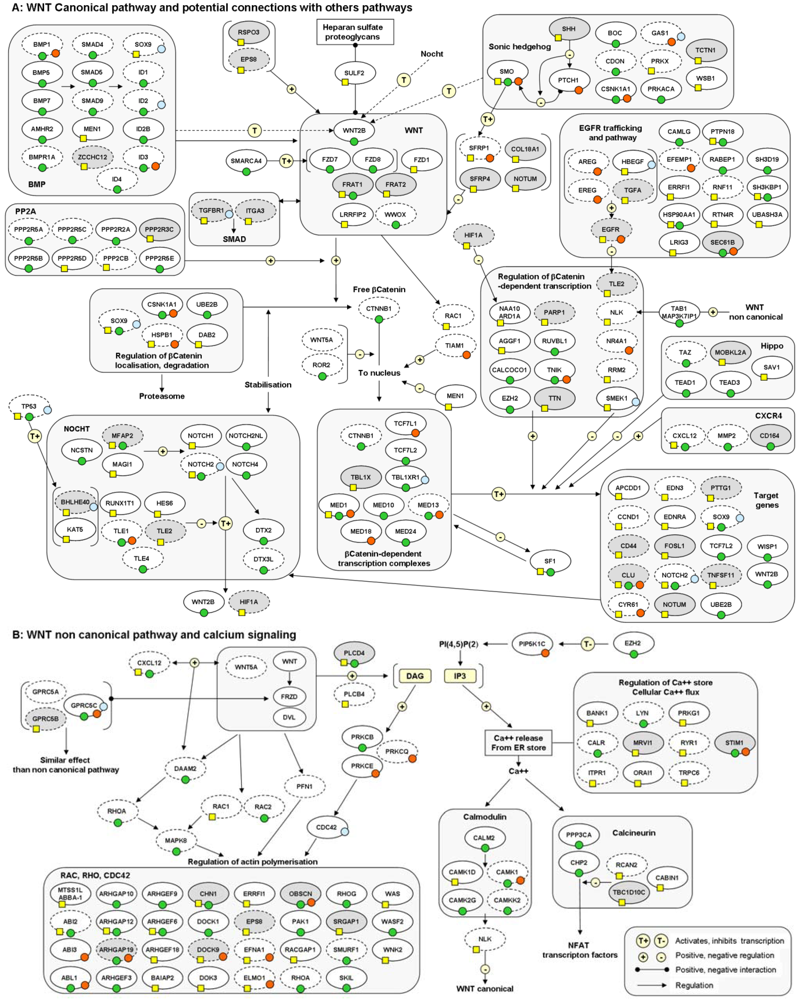
      <p>Comparative analysis of the pathways deregulated in a post-radiotherapy and in a post-Chernobyl series [<xref ref-type="bibr" rid="B33-genes-03-00019">33</xref>,<xref ref-type="bibr" rid="B34-genes-03-00019">34</xref>], with the restriction that the series were not analyzed by using the same arrays, showed, however, that both post-Chernobyl and post-radiotherapy PTCs are deregulated in common molecular pathways associated with cellular response to radiation and oxidative stress, or signal transduction [<xref ref-type="bibr" rid="B50-genes-03-00019">50</xref>]. Particularly, the WNT canonical and noncanonical pathways, and other potentially co-deregulated pathways (Sonic hedgehog, Notch, and EGF pathways), which were first identified in post-radiotherapy tumors [<xref ref-type="bibr" rid="B33-genes-03-00019">33</xref>], were also deregulated in post-Chernobyl tumors (<xref ref-type="fig" rid="genes-03-00019-f001">Figure 1</xref>). This strongly suggests that post-Chernobyl and post-radiotherapy tumors display a common core of molecular markers, while a fully comparable analysis of post-radiotherapy and post-Chernobyl tumors is needed to decide on the similarities and specificities of thyroid tumors following external exposure or contamination. Moreover, the 5-gene overlap between the 106-gene post-Chernobyl and the 322-gene post-radiotherapy discriminating signatures can classify both series of tumors [<xref ref-type="bibr" rid="B50-genes-03-00019">50</xref>]. Overall, this data suggests that the molecular imprinting found in radiation-induced tumors likely includes the molecular consequences of the initial stress associated with radiation exposure in thyroid tissues and that part of this imprinting is independent of dose, dose rate and route of exposure, at least for doses above 0.1 Gy.</p>
      <p>These data are in agreement with the similar risk factors found for thyroid tumors either at Chernobyl or following external radiation exposure. It should also be noted that a common signature was found for both thyroid adenomas and PTC [<xref ref-type="bibr" rid="B33-genes-03-00019">33</xref>], which is also in accordance with epidemiological data that showed similar risk factors for both.</p>
      <p>Whether this imprinting denotes exposure to previous radiation or is a hallmark of radiation-tumorigenesis remains to be shown, by comparing gene expression in non tumoral thyroid tissue previously exposed or not to radiation. </p>
      <fig id="genes-03-00019-f001" position="float">
        <label>Figure 1</label>
        <caption>
          <p>Signal transduction pathways associated with the WNT canonical and noncanonical pathways deregulated in radiation-induced thyroid tumors.The figure gives a simplified overview of the WNT canonical pathway with potential connections with the EGFR, SHH, NOTCH and BMP pathways (<bold>A</bold>) and the WNT noncanonical pathway (<bold>B</bold>). Genes deregulated in post-radiotherapy tumors are indicated by a yellow square, and green or orange circles indicate the genes deregulated in post-Chernobyl tumors, from Ugolin <italic>et al</italic>. [<xref ref-type="bibr" rid="B34-genes-03-00019">34</xref>], or from other studies, respectively. Genes selected in either the post-radiotherapy or the post-Chernobyl signatures (high discriminating potential, see <xref ref-type="supplementary-material" rid="genes-03-00019-s002">supplementary data</xref>) [<xref ref-type="bibr" rid="B33-genes-03-00019">33</xref>,<xref ref-type="bibr" rid="B34-genes-03-00019">34</xref>], are indicated in grey boxes. Blue circles indicate the genes deregulated in studies analyzing the cellular response of thyroid models to radiation exposure. The dotted line indicates the genes reported to be deregulated (mRNA or protein) in studies of sporadic thyroid tumorigenesis.</p>
        </caption>
        <graphic xmlns:xlink="http://www.w3.org/1999/xlink" xlink:href="genes-03-00019-g001.tif"/>
      </fig>
    </sec>
    <sec>
      <title>7. The Persistent Problem of Low Doses: Can We Evaluate the Risk of Thyroid Cancers for Doses Lower Than 0.1 Gy?</title>
      <p>As reported in the studies mentioned above and many others, an increase in thyroid tumor incidence is expected and could be measured by conventional epidemiology for doses above 0.1 Gy, but for lower doses, the risk is not proven. For radiation protection purposes, a linear non-threshold model is applied to extrapolate the risk observed at high doses to low doses [<xref ref-type="bibr" rid="B51-genes-03-00019">51</xref>,<xref ref-type="bibr" rid="B52-genes-03-00019">52</xref>,<xref ref-type="bibr" rid="B53-genes-03-00019">53</xref>]. But strictly, evaluation of such a risk is outside the limits of conventional epidemiology and we do not know to date if a thyroid exposure to such low doses could effectively lead to the development of thyroid tumors.</p>
      <p>In any case at low doses, if this risk does exist, a very low number of radiation-induced thyroid tumors is expected and will be masked among the high number of sporadic tumors which has regularly increased all over the world for more than 25 years due to better detection and diagnosis of thyroid diseases [<xref ref-type="bibr" rid="B54-genes-03-00019">54</xref>,<xref ref-type="bibr" rid="B55-genes-03-00019">55</xref>,<xref ref-type="bibr" rid="B56-genes-03-00019">56</xref>,<xref ref-type="bibr" rid="B57-genes-03-00019">57</xref>]. To be used for the detection of these radiation-induced tumors, any test should have predictive values close to 100%.</p>
      <p>Because of a lack of identified low-dose radiation induced thyroid tumors, we do not know if the molecular signatures found in tumors that developed after exposure to doses higher than 0.1 Gy are relevant for screening tumors induced by radiation at very low doses. The initial level of stress may lead to molecular variations in the cellular response and to the selection of different molecular pathways/markers in the tumors. Moreover, radiation-induced tumorigenesis may be modulated by specific genetic backgrounds conferring increased radiosensitivity and/or thyroid cancer-prone susceptibility as suggested by Detours <italic>et al</italic>. [<xref ref-type="bibr" rid="B29-genes-03-00019">29</xref>], which could be suspected to have a greater weight at low doses.</p>
    </sec>
    <sec sec-type="conclusions">
      <title>8. Conclusions and Perspectives</title>
      <p>Enough data are now available to show that radiation exposure of the thyroid leads to the deregulation of molecular markers that can be identified and possibly used for etiology prediction, at least for the range of doses for which a significant increase in thyroid tumors can be measured by conventional epidemiology (more than 0.1 Gy). However, all the data presented here should be considered as preliminary and special caution should be taken to avoid specific pitfalls when analyzing molecular specificities of small series of radiation-induced thyroid tumors. All these data should be confirmed using larger series of tumors of good quality in terms of RNA Integrity Number (RIN) index [<xref ref-type="bibr" rid="B58-genes-03-00019">58</xref>], with the same microarray and hybridization techniques for easier comparisons. For example, some studies used tumor-paired normal thyroid tissue for data normalization while others used a pool of normal thyroid tissues as an external reference. The methods used to find the signature should be adapted to small series of samples. This point is important in fully exploring tumor heterogeneity and in limiting the impact of confounding factors. Blind validation of the signatures on independent sets of tumors as large as possible is essential to check the pertinence of the signatures. As some data suggests that thyroid tumors that develop after external exposure (radiotherapy) or <sup>131</sup>I contamination display a common core of molecular markers, co-analysis of post-radiotherapy and post-Chernobyl tumors may lead to the identification of a “general” radiation-induced signature (for doses higher than 0.1 Gy). This will also help to improve knowledge of radiation-induced tumorigenesis by allowing full and rigorous analysis of the specificities and similarities of the molecular mechanisms selected as a function of the mode of exposure, the dose and the dose rate. Prospective studies will also have to determine what is behind the observed deregulation in radiation-induced tumors: initial stress effect and/or individual susceptibility to radiation exposure and/or thyroid cancer-prone susceptibility. To date, we have no clue to estimate what could be the influence of susceptibility compared with the impact of the initial stress in radiation-induced thyroid tumors.</p>
      <p>For the moment the identified signatures cannot be used to screen for tumors induced by very-low-dose radiation, for 2 main reasons: (1) the impact of very-low-dose exposure on thyroid tumor risk is still unproved, and if it does exist it is extremely small and any biological test should have predictive values close to 100% to be used for diagnosis of the few radiation induced thyroid tumors among a much larger number of sporadic ones; (2) if the risk exists, we do not know what the signature is and if it has something in common with high-dose signatures. Radiation exposure at very low doses in animal models that do not develop spontaneous thyroid tumors is needed to estimate the risk. If tumors are observed, comparison of molecular signatures of tumors that develop in mice after very low and high-dose radiation exposure should be made to define molecular markers and similarities and specificities according to doses. </p>
    </sec>
  </body>
  <back>
    <ack>
      <title>Acknowledgments</title>
      <p>Studies performed in S. Chevillard’s laboratory were supported by Electricité de France and by the European Union 6th Framework GenRiskT.</p>
    </ack>
    <ref-list>
      <title>References</title>
      <ref id="B1-genes-03-00019">
        <label>1.</label>
        <citation citation-type="journal">
          <person-group person-group-type="author">
            <name>
              <surname>Duffy</surname>
              <given-names>B.J.</given-names>
              <suffix>Jr.</suffix>
            </name>
            <name>
              <surname>Fitzgerald</surname>
              <given-names>P.J.</given-names>
            </name>
          </person-group>
          <article-title>Thyroid cancer in childhood and adolescence; a report on 28 cases.</article-title>
          <source>Cancer</source>
          <year>1950</year>
          <volume>3</volume>
          <fpage>1018</fpage>
          <lpage>1032</lpage>
          <pub-id pub-id-type="doi">10.1002/1097-0142(1950)3:6&lt;1018::AID-CNCR2820030611&gt;3.0.CO;2-H</pub-id>
        </citation>
      </ref>
      <ref id="B2-genes-03-00019">
        <label>2.</label>
        <citation citation-type="journal">
          <person-group person-group-type="author">
            <name>
              <surname>Ronckers</surname>
              <given-names>C.M.</given-names>
            </name>
            <name>
              <surname>Sigurdson</surname>
              <given-names>A.J.</given-names>
            </name>
            <name>
              <surname>Stovall</surname>
              <given-names>M.</given-names>
            </name>
            <name>
              <surname>Smith</surname>
              <given-names>S.A.</given-names>
            </name>
            <name>
              <surname>Mertens</surname>
              <given-names>A.C.</given-names>
            </name>
            <name>
              <surname>Liu</surname>
              <given-names>Y.</given-names>
            </name>
            <name>
              <surname>Hammond</surname>
              <given-names>S.</given-names>
            </name>
            <name>
              <surname>Land</surname>
              <given-names>C.E.</given-names>
            </name>
            <name>
              <surname>Neglia</surname>
              <given-names>J.P.</given-names>
            </name>
            <name>
              <surname>Donaldson</surname>
              <given-names>S.S.</given-names>
            </name>
            <etal/>
          </person-group>
          <article-title>Thyroid cancer in childhood cancer survivors: A detailed evaluation of radiation dose response and its modifiers</article-title>
          <source>Radiat. Res.</source>
          <year>2006</year>
          <volume>166</volume>
          <fpage>618</fpage>
          <lpage>628</lpage>
          <pub-id pub-id-type="doi">10.1667/RR3605.1</pub-id>
        </citation>
      </ref>
      <ref id="B3-genes-03-00019">
        <label>3.</label>
        <citation citation-type="journal">
          <person-group person-group-type="author">
            <name>
              <surname>Bhatti</surname>
              <given-names>P.</given-names>
            </name>
            <name>
              <surname>Veiga</surname>
              <given-names>L.H.</given-names>
            </name>
            <name>
              <surname>Ronckers</surname>
              <given-names>C.M.</given-names>
            </name>
            <name>
              <surname>Sigurdson</surname>
              <given-names>A.J.</given-names>
            </name>
            <name>
              <surname>Stovall</surname>
              <given-names>M.</given-names>
            </name>
            <name>
              <surname>Smith</surname>
              <given-names>S.A.</given-names>
            </name>
            <name>
              <surname>Weathers</surname>
              <given-names>R.</given-names>
            </name>
            <name>
              <surname>Leisenring</surname>
              <given-names>W.</given-names>
            </name>
            <name>
              <surname>Mertens</surname>
              <given-names>A.C.</given-names>
            </name>
            <name>
              <surname>Hammond</surname>
              <given-names>S.</given-names>
            </name>
            <etal/>
          </person-group>
          <article-title>Risk of second primary thyroid cancer after radiotherapy for a childhood cancer in a large cohort study: An update from the childhood cancer survivor study</article-title>
          <source>Radiat. Res.</source>
          <year>2010</year>
          <volume>174</volume>
          <fpage>741</fpage>
          <lpage>752</lpage>
          <pub-id pub-id-type="doi">10.1667/RR2240.1</pub-id>
        </citation>
      </ref>
      <ref id="B4-genes-03-00019">
        <label>4.</label>
        <citation citation-type="journal">
          <person-group person-group-type="author">
            <name>
              <surname>Preston</surname>
              <given-names>D.L.</given-names>
            </name>
            <name>
              <surname>Ron</surname>
              <given-names>E.</given-names>
            </name>
            <name>
              <surname>Tokuoka</surname>
              <given-names>S.</given-names>
            </name>
            <name>
              <surname>Funamoto</surname>
              <given-names>S.</given-names>
            </name>
            <name>
              <surname>Nishi</surname>
              <given-names>N.</given-names>
            </name>
            <name>
              <surname>Soda</surname>
              <given-names>M.</given-names>
            </name>
            <name>
              <surname>Mabuchi</surname>
              <given-names>K.</given-names>
            </name>
            <name>
              <surname>Kodama</surname>
              <given-names>K.</given-names>
            </name>
          </person-group>
          <article-title>Solid cancer incidence in atomic bomb survivors: 1958-1998.</article-title>
          <source>Radiat. Res.</source>
          <year>2007</year>
          <volume>168</volume>
          <fpage>1</fpage>
          <lpage>64</lpage>
          <pub-id pub-id-type="doi">10.1667/RR0763.1</pub-id>
        </citation>
      </ref>
      <ref id="B5-genes-03-00019">
        <label>5.</label>
        <citation citation-type="journal">
          <person-group person-group-type="author">
            <name>
              <surname>Tronko</surname>
              <given-names>M.D.</given-names>
            </name>
            <name>
              <surname>Howe</surname>
              <given-names>G.R.</given-names>
            </name>
            <name>
              <surname>Bogdanova</surname>
              <given-names>T.I.</given-names>
            </name>
            <name>
              <surname>Bouville</surname>
              <given-names>A.C.</given-names>
            </name>
            <name>
              <surname>Epstein</surname>
              <given-names>O.V.</given-names>
            </name>
            <name>
              <surname>Brill</surname>
              <given-names>A.B.</given-names>
            </name>
            <name>
              <surname>Likhtarev</surname>
              <given-names>I.A.</given-names>
            </name>
            <name>
              <surname>Fink</surname>
              <given-names>D.J.</given-names>
            </name>
            <name>
              <surname>Markov</surname>
              <given-names>V.V.</given-names>
            </name>
            <name>
              <surname>Greenebaum</surname>
              <given-names>E.</given-names>
            </name>
            <etal/>
          </person-group>
          <article-title>A cohort study of thyroid cancer and other thyroid diseases after the chornobyl accident: Thyroid cancer in Ukraine detected during first screening</article-title>
          <source>J. Natl. Cancer Inst.</source>
          <year>2006</year>
          <volume>98</volume>
          <fpage>897</fpage>
          <lpage>903</lpage>
          <pub-id pub-id-type="doi">10.1093/jnci/djj244</pub-id>
        </citation>
      </ref>
      <ref id="B6-genes-03-00019">
        <label>6.</label>
        <citation citation-type="journal">
          <person-group person-group-type="author">
            <name>
              <surname>Zablotska</surname>
              <given-names>L.B.</given-names>
            </name>
            <name>
              <surname>Ron</surname>
              <given-names>E.</given-names>
            </name>
            <name>
              <surname>Rozhko</surname>
              <given-names>A.V.</given-names>
            </name>
            <name>
              <surname>Hatch</surname>
              <given-names>M.</given-names>
            </name>
            <name>
              <surname>Polyanskaya</surname>
              <given-names>O.N.</given-names>
            </name>
            <name>
              <surname>Brenner</surname>
              <given-names>A.V.</given-names>
            </name>
            <name>
              <surname>Lubin</surname>
              <given-names>J.</given-names>
            </name>
            <name>
              <surname>Romanov</surname>
              <given-names>G.N.</given-names>
            </name>
            <name>
              <surname>McConnell</surname>
              <given-names>R.J.</given-names>
            </name>
            <name>
              <surname>O’Kane</surname>
              <given-names>P.</given-names>
            </name>
            <etal/>
          </person-group>
          <article-title>Thyroid cancer risk in Belarus among children and adolescents exposed to radioiodine after the Chornobyl accident</article-title>
          <source>Br. J. Cancer</source>
          <year>2011</year>
          <volume>104</volume>
          <fpage>181</fpage>
          <lpage>187</lpage>
          <pub-id pub-id-type="doi">10.1038/sj.bjc.6605967</pub-id>
        </citation>
      </ref>
      <ref id="B7-genes-03-00019">
        <label>7.</label>
        <citation citation-type="journal">
          <person-group person-group-type="author">
            <name>
              <surname>Ron</surname>
              <given-names>E.</given-names>
            </name>
          </person-group>
          <article-title>Thyroid cancer incidence among people living in areas contaminated by radiation from the Chernobyl accident.</article-title>
          <source>Health Phys.</source>
          <year>2007</year>
          <volume>93</volume>
          <fpage>502</fpage>
          <lpage>511</lpage>
          <pub-id pub-id-type="doi">10.1097/01.HP.0000279018.93081.29</pub-id>
        </citation>
      </ref>
      <ref id="B8-genes-03-00019">
        <label>8.</label>
        <citation citation-type="journal">
          <person-group person-group-type="author">
            <name>
              <surname>Cardis</surname>
              <given-names>E.</given-names>
            </name>
            <name>
              <surname>Hatch</surname>
              <given-names>M.</given-names>
            </name>
          </person-group>
          <article-title>The Chernobyl accident-an epidemiological perspective</article-title>
          <source>Clin. Oncol. (R. Coll. Radiol.)</source>
          <year>2011</year>
          <volume>23</volume>
          <fpage>251</fpage>
          <lpage>260</lpage>
          <pub-id pub-id-type="doi">10.1016/j.clon.2011.01.510</pub-id>
        </citation>
      </ref>
      <ref id="B9-genes-03-00019">
        <label>9.</label>
        <citation citation-type="journal">
          <person-group person-group-type="author">
            <name>
              <surname>Brenner</surname>
              <given-names>A.V.</given-names>
            </name>
            <name>
              <surname>Tronko</surname>
              <given-names>M.D.</given-names>
            </name>
            <name>
              <surname>Hatch</surname>
              <given-names>M.</given-names>
            </name>
            <name>
              <surname>Bogdanova</surname>
              <given-names>T.I.</given-names>
            </name>
            <name>
              <surname>Oliynik</surname>
              <given-names>V.A.</given-names>
            </name>
            <name>
              <surname>Lubin</surname>
              <given-names>J.H.</given-names>
            </name>
            <name>
              <surname>Zablotska</surname>
              <given-names>L.B.</given-names>
            </name>
            <name>
              <surname>Tereschenko</surname>
              <given-names>V.P.</given-names>
            </name>
            <name>
              <surname>McConnell</surname>
              <given-names>R.J.</given-names>
            </name>
            <name>
              <surname>Zamotaeva</surname>
              <given-names>G.A.</given-names>
            </name>
            <etal/>
          </person-group>
          <article-title>I-131 dose response for incident thyroid cancers in ukraine related to the chornobyl accident.</article-title>
          <source>Environ. Health Perspect.</source>
          <year>2011</year>
          <volume>119</volume>
          <fpage>933</fpage>
          <lpage>939</lpage>
          <pub-id pub-id-type="doi">10.1289/ehp.1002674</pub-id>
        </citation>
      </ref>
      <ref id="B10-genes-03-00019">
        <label>10.</label>
        <citation citation-type="journal">
          <person-group person-group-type="author">
            <name>
              <surname>Ron</surname>
              <given-names>E.</given-names>
            </name>
            <name>
              <surname>Lubin</surname>
              <given-names>J.H.</given-names>
            </name>
            <name>
              <surname>Shore</surname>
              <given-names>R.E.</given-names>
            </name>
            <name>
              <surname>Mabuchi</surname>
              <given-names>K.</given-names>
            </name>
            <name>
              <surname>Modan</surname>
              <given-names>B.</given-names>
            </name>
            <name>
              <surname>Pottern</surname>
              <given-names>L.M.</given-names>
            </name>
            <name>
              <surname>Schneider</surname>
              <given-names>A.B.</given-names>
            </name>
            <name>
              <surname>Tucker</surname>
              <given-names>M.A.</given-names>
            </name>
            <name>
              <surname>Boice</surname>
              <given-names>J.D.</given-names>
              <suffix>Jr.</suffix>
            </name>
          </person-group>
          <article-title>Thyroid cancer after exposure to external radiation: A pooled analysis of seven studies.</article-title>
          <source>Radiat. Res.</source>
          <year>1995</year>
          <volume>141</volume>
          <fpage>259</fpage>
          <lpage>277</lpage>
          <pub-id pub-id-type="doi">10.2307/3579003</pub-id>
        </citation>
      </ref>
      <ref id="B11-genes-03-00019">
        <label>11.</label>
        <citation citation-type="journal">
          <person-group person-group-type="author">
            <name>
              <surname>Sadetzki</surname>
              <given-names>S.</given-names>
            </name>
            <name>
              <surname>Chetrit</surname>
              <given-names>A.</given-names>
            </name>
            <name>
              <surname>Lubina</surname>
              <given-names>A.</given-names>
            </name>
            <name>
              <surname>Stovall</surname>
              <given-names>M.</given-names>
            </name>
            <name>
              <surname>Novikov</surname>
              <given-names>I.</given-names>
            </name>
          </person-group>
          <article-title>Risk of thyroid cancer after childhood exposure to ionizing radiation for tinea capitis.</article-title>
          <source>J. Clin. Endocrinol. Metab.</source>
          <year>2006</year>
          <volume>91</volume>
          <fpage>4798</fpage>
          <lpage>4804</lpage>
          <pub-id pub-id-type="doi">10.1210/jc.2006-0743</pub-id>
        </citation>
      </ref>
      <ref id="B12-genes-03-00019">
        <label>12.</label>
        <citation citation-type="journal">
          <person-group person-group-type="author">
            <name>
              <surname>Tronko</surname>
              <given-names>M.D.</given-names>
            </name>
            <name>
              <surname>Bogdanova</surname>
              <given-names>T.I.</given-names>
            </name>
            <name>
              <surname>Komissarenko</surname>
              <given-names>I.V.</given-names>
            </name>
            <name>
              <surname>Epstein</surname>
              <given-names>O.V.</given-names>
            </name>
            <name>
              <surname>Oliynyk</surname>
              <given-names>V.</given-names>
            </name>
            <name>
              <surname>Kovalenko</surname>
              <given-names>A.</given-names>
            </name>
            <name>
              <surname>Likhtarev</surname>
              <given-names>I.A.</given-names>
            </name>
            <name>
              <surname>Kairo</surname>
              <given-names>I.</given-names>
            </name>
            <name>
              <surname>Peters</surname>
              <given-names>S.B.</given-names>
            </name>
            <name>
              <surname>LiVolsi</surname>
              <given-names>V.A.</given-names>
            </name>
          </person-group>
          <article-title>Thyroid carcinoma in children and adolescents in Ukraine after the Chernobyl nuclear accident: Statistical data and clinicomorphologic characteristics.</article-title>
          <source>Cancer</source>
          <year>1999</year>
          <volume>86</volume>
          <fpage>149</fpage>
          <lpage>156</lpage>
          <pub-id pub-id-type="doi">10.1002/(SICI)1097-0142(19990701)86:1&lt;149::AID-CNCR21&gt;3.0.CO;2-A</pub-id>
        </citation>
      </ref>
      <ref id="B13-genes-03-00019">
        <label>13.</label>
        <citation citation-type="journal">
          <person-group person-group-type="author">
            <name>
              <surname>LiVolsi</surname>
              <given-names>V.A.</given-names>
            </name>
            <name>
              <surname>Abrosimov</surname>
              <given-names>A.A.</given-names>
            </name>
            <name>
              <surname>Bogdanova</surname>
              <given-names>T.</given-names>
            </name>
            <name>
              <surname>Fadda</surname>
              <given-names>G.</given-names>
            </name>
            <name>
              <surname>Hunt</surname>
              <given-names>J.L.</given-names>
            </name>
            <name>
              <surname>Ito</surname>
              <given-names>M.</given-names>
            </name>
            <name>
              <surname>Zablotska</surname>
              <given-names>L.B.</given-names>
            </name>
            <name>
              <surname>Tronko</surname>
              <given-names>M.D.</given-names>
            </name>
          </person-group>
          <article-title>The Chernobyl thyroid cancer experience: Pathology</article-title>
          <source>Clin. Oncol. (R. Coll. Radiol.)</source>
          <year>2011</year>
          <volume>23</volume>
          <fpage>261</fpage>
          <lpage>267</lpage>
          <pub-id pub-id-type="doi">10.1016/j.clon.2011.01.160</pub-id>
        </citation>
      </ref>
      <ref id="B14-genes-03-00019">
        <label>14.</label>
        <citation citation-type="journal">
          <person-group person-group-type="author">
            <name>
              <surname>Williams</surname>
              <given-names>E.D.</given-names>
            </name>
            <name>
              <surname>Abrosimov</surname>
              <given-names>A.</given-names>
            </name>
            <name>
              <surname>Bogdanova</surname>
              <given-names>T.</given-names>
            </name>
            <name>
              <surname>Demidchik</surname>
              <given-names>E.P.</given-names>
            </name>
            <name>
              <surname>Ito</surname>
              <given-names>M.</given-names>
            </name>
            <name>
              <surname>LiVolsi</surname>
              <given-names>V.</given-names>
            </name>
            <name>
              <surname>Lushnikov</surname>
              <given-names>E.</given-names>
            </name>
            <name>
              <surname>Rosai</surname>
              <given-names>J.</given-names>
            </name>
            <name>
              <surname>Sidorov</surname>
              <given-names>Y.</given-names>
            </name>
            <name>
              <surname>Tronko</surname>
              <given-names>M.D.</given-names>
            </name>
            <etal/>
          </person-group>
          <article-title>Thyroid carcinoma after Chernobyl latent period, morphology and aggressiveness.</article-title>
          <source>Br. J. Cancer</source>
          <year>2004</year>
          <volume>90</volume>
          <fpage>2219</fpage>
          <lpage>2224</lpage>
          <pub-id pub-id-type="doi">10.1038/sj.bjc.6601860</pub-id>
        </citation>
      </ref>
      <ref id="B15-genes-03-00019">
        <label>15.</label>
        <citation citation-type="journal">
          <person-group person-group-type="author">
            <name>
              <surname>LiVolsi</surname>
              <given-names>V.A.</given-names>
            </name>
            <name>
              <surname>Abrosimov</surname>
              <given-names>A.A.</given-names>
            </name>
            <name>
              <surname>Bogdanova</surname>
              <given-names>T.</given-names>
            </name>
            <name>
              <surname>Fadda</surname>
              <given-names>G.</given-names>
            </name>
            <name>
              <surname>Hunt</surname>
              <given-names>J.L.</given-names>
            </name>
            <name>
              <surname>Ito</surname>
              <given-names>M.</given-names>
            </name>
            <name>
              <surname>Rosai</surname>
              <given-names>J.</given-names>
            </name>
            <name>
              <surname>Thomas</surname>
              <given-names>G.A.</given-names>
            </name>
            <name>
              <surname>Williams</surname>
              <given-names>E.D.</given-names>
            </name>
          </person-group>
          <article-title>The Chernobyl thyroid cancer experience: Pathology.</article-title>
          <source>Clin. Oncol. (R. Coll. Radiol.)</source>
          <year>2011</year>
          <volume>23</volume>
          <fpage>261</fpage>
          <lpage>267</lpage>
          <pub-id pub-id-type="doi">10.1016/j.clon.2011.01.160</pub-id>
        </citation>
      </ref>
      <ref id="B16-genes-03-00019">
        <label>16.</label>
        <citation citation-type="journal">
          <person-group person-group-type="author">
            <name>
              <surname>Zablotska</surname>
              <given-names>L.B.</given-names>
            </name>
            <name>
              <surname>Bogdanova</surname>
              <given-names>T.I.</given-names>
            </name>
            <name>
              <surname>Ron</surname>
              <given-names>E.</given-names>
            </name>
            <name>
              <surname>Epstein</surname>
              <given-names>O.V.</given-names>
            </name>
            <name>
              <surname>Robbins</surname>
              <given-names>J.</given-names>
            </name>
            <name>
              <surname>Likhtarev</surname>
              <given-names>I.A.</given-names>
            </name>
            <name>
              <surname>Hatch</surname>
              <given-names>M.</given-names>
            </name>
            <name>
              <surname>Markov</surname>
              <given-names>V.V.</given-names>
            </name>
            <name>
              <surname>Bouville</surname>
              <given-names>A.C.</given-names>
            </name>
            <name>
              <surname>Olijnyk</surname>
              <given-names>V.A.</given-names>
            </name>
            <etal/>
          </person-group>
          <article-title>A cohort study of thyroid cancer and other thyroid diseases after the Chornobyl accident: Dose-response analysis of thyroid follicular adenomas detected during first screening in Ukraine (1998-2000).</article-title>
          <source>Am. J. Epidemiol.</source>
          <year>2008</year>
          <volume>167</volume>
          <fpage>305</fpage>
          <lpage>312</lpage>
          <pub-id pub-id-type="doi">10.1093/aje/kwm301</pub-id>
        </citation>
      </ref>
      <ref id="B17-genes-03-00019">
        <label>17.</label>
        <citation citation-type="journal">
          <person-group person-group-type="author">
            <name>
              <surname>Taylor</surname>
              <given-names>A.J.</given-names>
            </name>
            <name>
              <surname>Croft</surname>
              <given-names>A.P.</given-names>
            </name>
            <name>
              <surname>Palace</surname>
              <given-names>A.M.</given-names>
            </name>
            <name>
              <surname>Winter</surname>
              <given-names>D.L.</given-names>
            </name>
            <name>
              <surname>Reulen</surname>
              <given-names>R.C.</given-names>
            </name>
            <name>
              <surname>Stiller</surname>
              <given-names>C.A.</given-names>
            </name>
            <name>
              <surname>Stevens</surname>
              <given-names>M.C.</given-names>
            </name>
            <name>
              <surname>Hawkins</surname>
              <given-names>M.M.</given-names>
            </name>
          </person-group>
          <article-title>Risk of thyroid cancer in survivors of childhood cancer: Results from the British Childhood Cancer Survivor Study.</article-title>
          <source>Int. J. Cancer</source>
          <year>2009</year>
          <volume>125</volume>
          <fpage>2400</fpage>
          <lpage>2405</lpage>
          <pub-id pub-id-type="doi">10.1002/ijc.24581</pub-id>
        </citation>
      </ref>
      <ref id="B18-genes-03-00019">
        <label>18.</label>
        <citation citation-type="journal">
          <person-group person-group-type="author">
            <name>
              <surname>Ron</surname>
              <given-names>E.</given-names>
            </name>
            <name>
              <surname>Brenner</surname>
              <given-names>A.</given-names>
            </name>
          </person-group>
          <article-title>Non-malignant thyroid diseases after a wide range of radiation exposures.</article-title>
          <source>Radiat. Res.</source>
          <year>2011</year>
          <volume>174</volume>
          <fpage>877</fpage>
          <lpage>888</lpage>
          <pub-id pub-id-type="doi">10.1667/RR1953.1</pub-id>
        </citation>
      </ref>
      <ref id="B19-genes-03-00019">
        <label>19.</label>
        <citation citation-type="journal">
          <person-group person-group-type="author">
            <name>
              <surname>Naing</surname>
              <given-names>S.</given-names>
            </name>
            <name>
              <surname>Collins</surname>
              <given-names>B.J.</given-names>
            </name>
            <name>
              <surname>Schneider</surname>
              <given-names>A.B.</given-names>
            </name>
          </person-group>
          <article-title>Clinical behavior of radiation-induced thyroid cancer: Factors related to recurrence.</article-title>
          <source>Thyroid</source>
          <year>2009</year>
          <volume>19</volume>
          <fpage>479</fpage>
          <lpage>485</lpage>
          <pub-id pub-id-type="doi">10.1089/thy.2008.0343</pub-id>
        </citation>
      </ref>
      <ref id="B20-genes-03-00019">
        <label>20.</label>
        <citation citation-type="journal">
          <person-group person-group-type="author">
            <name>
              <surname>Tuttle</surname>
              <given-names>R.M.</given-names>
            </name>
            <name>
              <surname>Vaisman</surname>
              <given-names>F.</given-names>
            </name>
            <name>
              <surname>Tronko</surname>
              <given-names>M.D.</given-names>
            </name>
          </person-group>
          <article-title>Clinical presentation and clinical outcomes in Chernobyl-related paediatric thyroid cancers: What do we know now? What can we expect in the future?</article-title>
          <source>Clin. Oncol. (R. Coll. Radiol.)</source>
          <year>2011</year>
          <volume>23</volume>
          <fpage>268</fpage>
          <lpage>275</lpage>
          <pub-id pub-id-type="doi">10.1016/j.clon.2011.01.178</pub-id>
        </citation>
      </ref>
      <ref id="B21-genes-03-00019">
        <label>21.</label>
        <citation citation-type="journal">
          <person-group person-group-type="author">
            <name>
              <surname>Smida</surname>
              <given-names>J.</given-names>
            </name>
            <name>
              <surname>Salassidis</surname>
              <given-names>K.</given-names>
            </name>
            <name>
              <surname>Hieber</surname>
              <given-names>L.</given-names>
            </name>
            <name>
              <surname>Zitzelsberger</surname>
              <given-names>H.</given-names>
            </name>
            <name>
              <surname>Kellerer</surname>
              <given-names>A.M.</given-names>
            </name>
            <name>
              <surname>Demidchik</surname>
              <given-names>E.P.</given-names>
            </name>
            <name>
              <surname>Negele</surname>
              <given-names>T.</given-names>
            </name>
            <name>
              <surname>Spelsberg</surname>
              <given-names>F.</given-names>
            </name>
            <name>
              <surname>Lengfelder</surname>
              <given-names>E.</given-names>
            </name>
            <name>
              <surname>Werner</surname>
              <given-names>M.</given-names>
            </name>
            <etal/>
          </person-group>
          <article-title>Distinct frequency of ret rearrangements in papillary thyroid carcinomas of children and adults from Belarus</article-title>
          <source>Int. J. Cancer</source>
          <year>1999</year>
          <volume>80</volume>
          <fpage>32</fpage>
          <lpage>38</lpage>
          <pub-id pub-id-type="doi">10.1002/(SICI)1097-0215(19990105)80:1&lt;32::AID-IJC7&gt;3.0.CO;2-L</pub-id>
        </citation>
      </ref>
      <ref id="B22-genes-03-00019">
        <label>22.</label>
        <citation citation-type="journal">
          <person-group person-group-type="author">
            <name>
              <surname>Thomas</surname>
              <given-names>G.A.</given-names>
            </name>
            <name>
              <surname>Bunnell</surname>
              <given-names>H.</given-names>
            </name>
            <name>
              <surname>Cook</surname>
              <given-names>H.A.</given-names>
            </name>
            <name>
              <surname>Williams</surname>
              <given-names>E.D.</given-names>
            </name>
            <name>
              <surname>Nerovnya</surname>
              <given-names>A.</given-names>
            </name>
            <name>
              <surname>Cherstvoy</surname>
              <given-names>E.D.</given-names>
            </name>
            <name>
              <surname>Tronko</surname>
              <given-names>N.D.</given-names>
            </name>
            <name>
              <surname>Bogdanova</surname>
              <given-names>T.I.</given-names>
            </name>
            <name>
              <surname>Chiappetta</surname>
              <given-names>G.</given-names>
            </name>
            <name>
              <surname>Viglietto</surname>
              <given-names>G.</given-names>
            </name>
            <etal/>
          </person-group>
          <article-title>High prevalence of RET/PTC rearrangements in Ukrainian and Belarussian post-Chernobyl thyroid papillary carcinomas: A strong correlation between RET/PTC3 and the solid-follicular variant.</article-title>
          <source>J. Clin. Endocrinol. Metab.</source>
          <year>1999</year>
          <volume>84</volume>
          <fpage>4232</fpage>
          <lpage>4238</lpage>
          <pub-id pub-id-type="doi">10.1210/jc.84.11.4232</pub-id>
        </citation>
      </ref>
      <ref id="B23-genes-03-00019">
        <label>23.</label>
        <citation citation-type="journal">
          <person-group person-group-type="author">
            <name>
              <surname>Powell</surname>
              <given-names>N.</given-names>
            </name>
            <name>
              <surname>Jeremiah</surname>
              <given-names>S.</given-names>
            </name>
            <name>
              <surname>Morishita</surname>
              <given-names>M.</given-names>
            </name>
            <name>
              <surname>Dudley</surname>
              <given-names>E.</given-names>
            </name>
            <name>
              <surname>Bethel</surname>
              <given-names>J.</given-names>
            </name>
            <name>
              <surname>Bogdanova</surname>
              <given-names>T.</given-names>
            </name>
            <name>
              <surname>Tronko</surname>
              <given-names>M.</given-names>
            </name>
            <name>
              <surname>Thomas</surname>
              <given-names>G.</given-names>
            </name>
          </person-group>
          <article-title>Frequency of BRAF T1796A mutation in papillary thyroid carcinoma relates to age of patient at diagnosis and not to radiation exposure.</article-title>
          <source>J. Pathol.</source>
          <year>2005</year>
          <volume>205</volume>
          <fpage>558</fpage>
          <lpage>564</lpage>
          <pub-id pub-id-type="doi">10.1002/path.1736</pub-id>
        </citation>
      </ref>
      <ref id="B24-genes-03-00019">
        <label>24.</label>
        <citation citation-type="journal">
          <person-group person-group-type="author">
            <name>
              <surname>Unger</surname>
              <given-names>K.</given-names>
            </name>
            <name>
              <surname>Zurnadzhy</surname>
              <given-names>L.</given-names>
            </name>
            <name>
              <surname>Walch</surname>
              <given-names>A.</given-names>
            </name>
            <name>
              <surname>Mall</surname>
              <given-names>M.</given-names>
            </name>
            <name>
              <surname>Bogdanova</surname>
              <given-names>T.</given-names>
            </name>
            <name>
              <surname>Braselmann</surname>
              <given-names>H.</given-names>
            </name>
            <name>
              <surname>Hieber</surname>
              <given-names>L.</given-names>
            </name>
            <name>
              <surname>Tronko</surname>
              <given-names>N.</given-names>
            </name>
            <name>
              <surname>Hutzler</surname>
              <given-names>P.</given-names>
            </name>
            <name>
              <surname>Jeremiah</surname>
              <given-names>S.</given-names>
            </name>
            <etal/>
          </person-group>
          <article-title>RET rearrangements in post-Chernobyl papillary thyroid carcinomas with a short latency analysed by interphase FISH.</article-title>
          <source>Br. J. Cancer</source>
          <year>2006</year>
          <volume>94</volume>
          <fpage>1472</fpage>
          <lpage>1477</lpage>
          <pub-id pub-id-type="doi">10.1038/sj.bjc.6603109</pub-id>
        </citation>
      </ref>
      <ref id="B25-genes-03-00019">
        <label>25.</label>
        <citation citation-type="journal">
          <person-group person-group-type="author">
            <name>
              <surname>Hamatani</surname>
              <given-names>K.</given-names>
            </name>
            <name>
              <surname>Eguchi</surname>
              <given-names>H.</given-names>
            </name>
            <name>
              <surname>Ito</surname>
              <given-names>R.</given-names>
            </name>
            <name>
              <surname>Mukai</surname>
              <given-names>M.</given-names>
            </name>
            <name>
              <surname>Takahashi</surname>
              <given-names>K.</given-names>
            </name>
            <name>
              <surname>Taga</surname>
              <given-names>M.</given-names>
            </name>
            <name>
              <surname>Imai</surname>
              <given-names>K.</given-names>
            </name>
            <name>
              <surname>Cologne</surname>
              <given-names>J.</given-names>
            </name>
            <name>
              <surname>Soda</surname>
              <given-names>M.</given-names>
            </name>
            <name>
              <surname>Arihiro</surname>
              <given-names>K.</given-names>
            </name>
            <etal/>
          </person-group>
          <article-title>RET/PTC rearrangements preferentially occurred in papillary thyroid cancer among atomic bomb survivors exposed to high radiation dose.</article-title>
          <source>Cancer Res.</source>
          <year>2008</year>
          <volume>68</volume>
          <fpage>7176</fpage>
          <lpage>7182</lpage>
          <pub-id pub-id-type="doi">10.1158/0008-5472.CAN-08-0293</pub-id>
        </citation>
      </ref>
      <ref id="B26-genes-03-00019">
        <label>26.</label>
        <citation citation-type="journal">
          <person-group person-group-type="author">
            <name>
              <surname>Williams</surname>
              <given-names>E.D.</given-names>
            </name>
            <name>
              <surname>Abrosimov</surname>
              <given-names>A.</given-names>
            </name>
            <name>
              <surname>Bogdanova</surname>
              <given-names>T.</given-names>
            </name>
            <name>
              <surname>Demidchik</surname>
              <given-names>E.P.</given-names>
            </name>
            <name>
              <surname>Ito</surname>
              <given-names>M.</given-names>
            </name>
            <name>
              <surname>LiVolsi</surname>
              <given-names>V.</given-names>
            </name>
            <name>
              <surname>Lushnikov</surname>
              <given-names>E.</given-names>
            </name>
            <name>
              <surname>Rosai</surname>
              <given-names>J.</given-names>
            </name>
            <name>
              <surname>Tronko</surname>
              <given-names>M.D.</given-names>
            </name>
            <name>
              <surname>Tsyb</surname>
              <given-names>A.F.</given-names>
            </name>
            <etal/>
          </person-group>
          <article-title>Morphologic characteristics of Chernobyl-related childhood papillary thyroid carcinomas are independent of radiation exposure but vary with iodine intake</article-title>
          <source>Thyroid</source>
          <year>2008</year>
          <volume>18</volume>
          <fpage>847</fpage>
          <lpage>852</lpage>
          <pub-id pub-id-type="doi">10.1089/thy.2008.0039</pub-id>
        </citation>
      </ref>
      <ref id="B27-genes-03-00019">
        <label>27.</label>
        <citation citation-type="journal">
          <person-group person-group-type="author">
            <name>
              <surname>Tuttle</surname>
              <given-names>R.M.</given-names>
            </name>
            <name>
              <surname>Lukes</surname>
              <given-names>Y.</given-names>
            </name>
            <name>
              <surname>Onstad</surname>
              <given-names>L.</given-names>
            </name>
            <name>
              <surname>Lushnikov</surname>
              <given-names>E.</given-names>
            </name>
            <name>
              <surname>Abrosimov</surname>
              <given-names>A.</given-names>
            </name>
            <name>
              <surname>Troshin</surname>
              <given-names>V.</given-names>
            </name>
            <name>
              <surname>Tsyb</surname>
              <given-names>A.</given-names>
            </name>
            <name>
              <surname>Davis</surname>
              <given-names>S.</given-names>
            </name>
            <name>
              <surname>Kopecky</surname>
              <given-names>K.J.</given-names>
            </name>
            <name>
              <surname>Francis</surname>
              <given-names>G.</given-names>
            </name>
          </person-group>
          <article-title>ret/PTC activation is not associated with individual radiation dose estimates in a pilot study of neoplastic thyroid nodules arising in Russian children and adults exposed to Chernobyl fallout.</article-title>
          <source>Thyroid</source>
          <year>2008</year>
          <volume>18</volume>
          <fpage>839</fpage>
          <lpage>846</lpage>
          <pub-id pub-id-type="doi">10.1089/thy.2008.0072</pub-id>
        </citation>
      </ref>
      <ref id="B28-genes-03-00019">
        <label>28.</label>
        <citation citation-type="journal">
          <person-group person-group-type="author">
            <name>
              <surname>Detours</surname>
              <given-names>V.</given-names>
            </name>
            <name>
              <surname>Wattel</surname>
              <given-names>S.</given-names>
            </name>
            <name>
              <surname>Venet</surname>
              <given-names>D.</given-names>
            </name>
            <name>
              <surname>Hutsebaut</surname>
              <given-names>N.</given-names>
            </name>
            <name>
              <surname>Bogdanova</surname>
              <given-names>T.</given-names>
            </name>
            <name>
              <surname>Tronko</surname>
              <given-names>M.D.</given-names>
            </name>
            <name>
              <surname>Dumont</surname>
              <given-names>J.E.</given-names>
            </name>
            <name>
              <surname>Franc</surname>
              <given-names>B.</given-names>
            </name>
            <name>
              <surname>Thomas</surname>
              <given-names>G.</given-names>
            </name>
            <name>
              <surname>Maenhaut</surname>
              <given-names>C.</given-names>
            </name>
          </person-group>
          <article-title>Absence of a specific radiation signature in post-Chernobyl thyroid cancers.</article-title>
          <source>Br. J. Cancer</source>
          <year>2005</year>
          <volume>92</volume>
          <fpage>1545</fpage>
          <lpage>1552</lpage>
          <pub-id pub-id-type="doi">10.1038/sj.bjc.6602521</pub-id>
        </citation>
      </ref>
      <ref id="B29-genes-03-00019">
        <label>29.</label>
        <citation citation-type="journal">
          <person-group person-group-type="author">
            <name>
              <surname>Detours</surname>
              <given-names>V.</given-names>
            </name>
            <name>
              <surname>Delys</surname>
              <given-names>L.</given-names>
            </name>
            <name>
              <surname>Libert</surname>
              <given-names>F.</given-names>
            </name>
            <name>
              <surname>Weiss Solis</surname>
              <given-names>D.</given-names>
            </name>
            <name>
              <surname>Bogdanova</surname>
              <given-names>T.</given-names>
            </name>
            <name>
              <surname>Dumont</surname>
              <given-names>J.E.</given-names>
            </name>
            <name>
              <surname>Franc</surname>
              <given-names>B.</given-names>
            </name>
            <name>
              <surname>Thomas</surname>
              <given-names>G.</given-names>
            </name>
            <name>
              <surname>Maenhaut</surname>
              <given-names>C.</given-names>
            </name>
          </person-group>
          <article-title>Genome-wide gene expression profiling suggests distinct radiation susceptibilities in sporadic and post-Chernobyl papillary thyroid cancers.</article-title>
          <source>Br. J. Cancer</source>
          <year>2007</year>
          <volume>97</volume>
          <fpage>818</fpage>
          <lpage>825</lpage>
          <pub-id pub-id-type="doi">10.1038/sj.bjc.6603938</pub-id>
        </citation>
      </ref>
      <ref id="B30-genes-03-00019">
        <label>30.</label>
        <citation citation-type="journal">
          <person-group person-group-type="author">
            <name>
              <surname>Port</surname>
              <given-names>M.</given-names>
            </name>
            <name>
              <surname>Boltze</surname>
              <given-names>C.</given-names>
            </name>
            <name>
              <surname>Wang</surname>
              <given-names>Y.</given-names>
            </name>
            <name>
              <surname>Roper</surname>
              <given-names>B.</given-names>
            </name>
            <name>
              <surname>Meineke</surname>
              <given-names>V.</given-names>
            </name>
            <name>
              <surname>Abend</surname>
              <given-names>M.</given-names>
            </name>
          </person-group>
          <article-title>A radiation-induced gene signature distinguishes post-chernobyl from sporadic papillary thyroid cancers.</article-title>
          <source>Radiat. Res.</source>
          <year>2007</year>
          <volume>168</volume>
          <fpage>639</fpage>
          <lpage>649</lpage>
          <pub-id pub-id-type="doi">10.1667/RR0968.1</pub-id>
        </citation>
      </ref>
      <ref id="B31-genes-03-00019">
        <label>31.</label>
        <citation citation-type="journal">
          <person-group person-group-type="author">
            <name>
              <surname>Maenhaut</surname>
              <given-names>C.</given-names>
            </name>
            <name>
              <surname>Detours</surname>
              <given-names>V.</given-names>
            </name>
            <name>
              <surname>Dom</surname>
              <given-names>G.</given-names>
            </name>
            <name>
              <surname>Handkiewicz-Junak</surname>
              <given-names>D.</given-names>
            </name>
            <name>
              <surname>Oczko-Wojciechowska</surname>
              <given-names>M.</given-names>
            </name>
            <name>
              <surname>Jarzab</surname>
              <given-names>B.</given-names>
            </name>
          </person-group>
          <article-title>Gene expression profiles for radiation-induced thyroid cancer</article-title>
          <source>Clin. Oncol. (R. Coll. Radiol.)</source>
          <year>2011</year>
          <volume>23</volume>
          <fpage>282</fpage>
          <lpage>288</lpage>
          <pub-id pub-id-type="doi">10.1016/j.clon.2011.01.509</pub-id>
        </citation>
      </ref>
      <ref id="B32-genes-03-00019">
        <label>32.</label>
        <citation citation-type="journal">
          <person-group person-group-type="author">
            <name>
              <surname>Stein</surname>
              <given-names>L.</given-names>
            </name>
            <name>
              <surname>Rothschild</surname>
              <given-names>J.</given-names>
            </name>
            <name>
              <surname>Luce</surname>
              <given-names>J.</given-names>
            </name>
            <name>
              <surname>Cowell</surname>
              <given-names>J.K.</given-names>
            </name>
            <name>
              <surname>Thomas</surname>
              <given-names>G.</given-names>
            </name>
            <name>
              <surname>Bogdanova</surname>
              <given-names>T.I.</given-names>
            </name>
            <name>
              <surname>Tronko</surname>
              <given-names>M.D.</given-names>
            </name>
            <name>
              <surname>Hawthorn</surname>
              <given-names>L.</given-names>
            </name>
          </person-group>
          <article-title>Copy number and gene expression alterations in radiation-induced papillary thyroid carcinoma from chernobyl pediatric patients.</article-title>
          <source>Thyroid</source>
          <year>2010</year>
          <volume>20</volume>
          <fpage>475</fpage>
          <lpage>487</lpage>
          <pub-id pub-id-type="doi">10.1089/thy.2009.0008</pub-id>
        </citation>
      </ref>
      <ref id="B33-genes-03-00019">
        <label>33.</label>
        <citation citation-type="journal">
          <person-group person-group-type="author">
            <name>
              <surname>Ory</surname>
              <given-names>C.</given-names>
            </name>
            <name>
              <surname>Ugolin</surname>
              <given-names>N.</given-names>
            </name>
            <name>
              <surname>Levalois</surname>
              <given-names>C.</given-names>
            </name>
            <name>
              <surname>Lacroix</surname>
              <given-names>L.</given-names>
            </name>
            <name>
              <surname>Caillou</surname>
              <given-names>B.</given-names>
            </name>
            <name>
              <surname>Bidart</surname>
              <given-names>J.M.</given-names>
            </name>
            <name>
              <surname>Schlumberger</surname>
              <given-names>M.</given-names>
            </name>
            <name>
              <surname>Diallo</surname>
              <given-names>I.</given-names>
            </name>
            <name>
              <surname>de Vathaire</surname>
              <given-names>F.</given-names>
            </name>
            <name>
              <surname>Hofman</surname>
              <given-names>P.</given-names>
            </name>
            <etal/>
          </person-group>
          <article-title>Gene expression signature discriminates sporadic from post-radiotherapy-induced thyroid tumors</article-title>
          <source>Endocr. Relat. Cancer</source>
          <year>2011</year>
          <volume>18</volume>
          <fpage>193</fpage>
          <lpage>206</lpage>
          <pub-id pub-id-type="doi">10.1677/ERC-10-0205</pub-id>
        </citation>
      </ref>
      <ref id="B34-genes-03-00019">
        <label>34.</label>
        <citation citation-type="journal">
          <person-group person-group-type="author">
            <name>
              <surname>Ugolin</surname>
              <given-names>N.</given-names>
            </name>
            <name>
              <surname>Ory</surname>
              <given-names>C.</given-names>
            </name>
            <name>
              <surname>Lefevre</surname>
              <given-names>E.</given-names>
            </name>
            <name>
              <surname>Benhabiles</surname>
              <given-names>N.</given-names>
            </name>
            <name>
              <surname>Hofman</surname>
              <given-names>P.</given-names>
            </name>
            <name>
              <surname>Schlumberger</surname>
              <given-names>M.</given-names>
            </name>
            <name>
              <surname>Chevillard</surname>
              <given-names>S.</given-names>
            </name>
          </person-group>
          <article-title>Stategy to find molecular signatures in a small series of rare cancers: Validation for radiation-induced breast and thyroid tumors</article-title>
          <source>PloS One</source>
          <year>2011</year>
          <volume>6</volume>
          <pub-id pub-id-type="doi">10.1371/journal.pone.0023581</pub-id>
        </citation>
      </ref>
      <ref id="B35-genes-03-00019">
        <label>35.</label>
        <citation citation-type="journal">
          <person-group person-group-type="author">
            <name>
              <surname>Boltze</surname>
              <given-names>C.</given-names>
            </name>
            <name>
              <surname>Riecke</surname>
              <given-names>A.</given-names>
            </name>
            <name>
              <surname>Ruf</surname>
              <given-names>C.G.</given-names>
            </name>
            <name>
              <surname>Port</surname>
              <given-names>M.</given-names>
            </name>
            <name>
              <surname>Nizze</surname>
              <given-names>H.</given-names>
            </name>
            <name>
              <surname>Kugler</surname>
              <given-names>C.</given-names>
            </name>
            <name>
              <surname>Miethke</surname>
              <given-names>C.</given-names>
            </name>
            <name>
              <surname>Wiest</surname>
              <given-names>N.</given-names>
            </name>
            <name>
              <surname>Abend</surname>
              <given-names>M.</given-names>
            </name>
          </person-group>
          <article-title>Sporadic and radiation-associated papillary thyroid cancers can be distinguished using routine immunohistochemistry.</article-title>
          <source>Oncol. Rep.</source>
          <year>2009</year>
          <volume>22</volume>
          <fpage>459</fpage>
          <lpage>467</lpage>
          <pub-id pub-id-type="doi">10.3892/or_00000457</pub-id>
        </citation>
      </ref>
      <ref id="B36-genes-03-00019">
        <label>36.</label>
        <citation citation-type="journal">
          <person-group person-group-type="author">
            <name>
              <surname>Achille</surname>
              <given-names>M.</given-names>
            </name>
            <name>
              <surname>Boukheris</surname>
              <given-names>H.</given-names>
            </name>
            <name>
              <surname>Caillou</surname>
              <given-names>B.</given-names>
            </name>
            <name>
              <surname>Talbot</surname>
              <given-names>M.</given-names>
            </name>
            <name>
              <surname>de Vathaire</surname>
              <given-names>F.</given-names>
            </name>
            <name>
              <surname>Sabatier</surname>
              <given-names>L.</given-names>
            </name>
            <name>
              <surname>Desmaze</surname>
              <given-names>C.</given-names>
            </name>
            <name>
              <surname>Schlumberger</surname>
              <given-names>M.</given-names>
            </name>
            <name>
              <surname>Soria</surname>
              <given-names>J.C.</given-names>
            </name>
          </person-group>
          <article-title>Expression of cell cycle biomarkers and telomere length in papillary thyroid carcinoma: A comparative study between radiation-associated and spontaneous cancers.</article-title>
          <source>Am. J. Clin. Oncol.</source>
          <year>2009</year>
          <volume>32</volume>
          <fpage>1</fpage>
          <lpage>8</lpage>
          <pub-id pub-id-type="doi">10.1097/COC.0b013e3181783336</pub-id>
        </citation>
      </ref>
      <ref id="B37-genes-03-00019">
        <label>37.</label>
        <citation citation-type="journal">
          <person-group person-group-type="author">
            <name>
              <surname>Kimmel</surname>
              <given-names>R.R.</given-names>
            </name>
            <name>
              <surname>Zhao</surname>
              <given-names>L.P.</given-names>
            </name>
            <name>
              <surname>Nguyen</surname>
              <given-names>D.</given-names>
            </name>
            <name>
              <surname>Lee</surname>
              <given-names>S.</given-names>
            </name>
            <name>
              <surname>Aronszajn</surname>
              <given-names>M.</given-names>
            </name>
            <name>
              <surname>Cheng</surname>
              <given-names>C.</given-names>
            </name>
            <name>
              <surname>Troshin</surname>
              <given-names>V.P.</given-names>
            </name>
            <name>
              <surname>Abrosimov</surname>
              <given-names>A.</given-names>
            </name>
            <name>
              <surname>Delrow</surname>
              <given-names>J.</given-names>
            </name>
            <name>
              <surname>Tuttle</surname>
              <given-names>R.M.</given-names>
            </name>
            <etal/>
          </person-group>
          <article-title>Microarray comparative genomic hybridization reveals genome-wide patterns of DNA gains and losses in post-Chernobyl thyroid cancer</article-title>
          <source>Radiat. Res.</source>
          <year>2006</year>
          <volume>166</volume>
          <fpage>519</fpage>
          <lpage>531</lpage>
          <pub-id pub-id-type="doi">10.1667/RR0547.1</pub-id>
        </citation>
      </ref>
      <ref id="B38-genes-03-00019">
        <label>38.</label>
        <citation citation-type="journal">
          <person-group person-group-type="author">
            <name>
              <surname>Hess</surname>
              <given-names>J.</given-names>
            </name>
            <name>
              <surname>Thomas</surname>
              <given-names>G.</given-names>
            </name>
            <name>
              <surname>Braselmann</surname>
              <given-names>H.</given-names>
            </name>
            <name>
              <surname>Bauer</surname>
              <given-names>V.</given-names>
            </name>
            <name>
              <surname>Bogdanova</surname>
              <given-names>T.</given-names>
            </name>
            <name>
              <surname>Wienberg</surname>
              <given-names>J.</given-names>
            </name>
            <name>
              <surname>Zitzelsberger</surname>
              <given-names>H.</given-names>
            </name>
            <name>
              <surname>Unger</surname>
              <given-names>K.</given-names>
            </name>
          </person-group>
          <article-title>Gain of chromosome band 7q11 in papillary thyroid carcinomas of young patients is associated with exposure to low-dose irradiation.</article-title>
          <source>Proc. Natl. Acad. Sci. USA</source>
          <year>2011</year>
          <volume>108</volume>
          <fpage>9595</fpage>
          <lpage>9600</lpage>
          <pub-id pub-id-type="doi">10.1073/pnas.1017137108</pub-id>
        </citation>
      </ref>
      <ref id="B39-genes-03-00019">
        <label>39.</label>
        <citation citation-type="journal">
          <person-group person-group-type="author">
            <name>
              <surname>Zitzelsberger</surname>
              <given-names>H.</given-names>
            </name>
            <name>
              <surname>Unger</surname>
              <given-names>K.</given-names>
            </name>
          </person-group>
          <article-title>DNA copy number alterations in radiation-induced thyroid cancer</article-title>
          <source>Clin. Oncol. (R. Coll. Radiol.)</source>
          <year>2011</year>
          <volume>23</volume>
          <fpage>289</fpage>
          <lpage>296</lpage>
          <pub-id pub-id-type="doi">10.1016/j.clon.2011.01.154</pub-id>
        </citation>
      </ref>
      <ref id="B40-genes-03-00019">
        <label>40.</label>
        <citation citation-type="journal">
          <person-group person-group-type="author">
            <name>
              <surname>Ein-Dor</surname>
              <given-names>L.</given-names>
            </name>
            <name>
              <surname>Zuk</surname>
              <given-names>O.</given-names>
            </name>
            <name>
              <surname>Domany</surname>
              <given-names>E.</given-names>
            </name>
          </person-group>
          <article-title>Thousands of samples are needed to generate a robust gene list for predicting outcome in cancer.</article-title>
          <source>Proc. Natl. Acad. Sci. USA</source>
          <year>2006</year>
          <volume>103</volume>
          <fpage>5923</fpage>
          <lpage>5928</lpage>
          <pub-id pub-id-type="doi">10.1073/pnas.0601231103</pub-id>
        </citation>
      </ref>
      <ref id="B41-genes-03-00019">
        <label>41.</label>
        <citation citation-type="journal">
          <person-group person-group-type="author">
            <name>
              <surname>Amundson</surname>
              <given-names>S.A.</given-names>
            </name>
            <name>
              <surname>Do</surname>
              <given-names>K.T.</given-names>
            </name>
            <name>
              <surname>Vinikoor</surname>
              <given-names>L.</given-names>
            </name>
            <name>
              <surname>Koch-Paiz</surname>
              <given-names>C.A.</given-names>
            </name>
            <name>
              <surname>Bittner</surname>
              <given-names>M.L.</given-names>
            </name>
            <name>
              <surname>Trent</surname>
              <given-names>J.M.</given-names>
            </name>
            <name>
              <surname>Meltzer</surname>
              <given-names>P.</given-names>
            </name>
            <name>
              <surname>Fornace</surname>
              <given-names>A.J.</given-names>
              <suffix>Jr.</suffix>
            </name>
          </person-group>
          <article-title>Stress-specific signatures: Expression profiling of p53 wild-type and -null human cells.</article-title>
          <source>Oncogene</source>
          <year>2005</year>
          <volume>24</volume>
          <fpage>4572</fpage>
          <lpage>4579</lpage>
          <pub-id pub-id-type="doi">10.1038/sj.onc.1208653</pub-id>
        </citation>
      </ref>
      <ref id="B42-genes-03-00019">
        <label>42.</label>
        <citation citation-type="journal">
          <person-group person-group-type="author">
            <name>
              <surname>Quackenbush</surname>
              <given-names>J.</given-names>
            </name>
          </person-group>
          <article-title>Microarray analysis and tumor classification.</article-title>
          <source>N. Engl. J. Med.</source>
          <year>2006</year>
          <volume>354</volume>
          <fpage>2463</fpage>
          <lpage>2472</lpage>
          <pub-id pub-id-type="doi">10.1056/NEJMra042342</pub-id>
        </citation>
      </ref>
      <ref id="B43-genes-03-00019">
        <label>43.</label>
        <citation citation-type="journal">
          <person-group person-group-type="author">
            <name>
              <surname>Hadj-Hamou</surname>
              <given-names>N.S.</given-names>
            </name>
            <name>
              <surname>Ugolin</surname>
              <given-names>N.</given-names>
            </name>
            <name>
              <surname>Ory</surname>
              <given-names>C.</given-names>
            </name>
            <name>
              <surname>Britzen-Laurent</surname>
              <given-names>N.</given-names>
            </name>
            <name>
              <surname>Sastre-Garau</surname>
              <given-names>X.</given-names>
            </name>
            <name>
              <surname>Chevillard</surname>
              <given-names>S.</given-names>
            </name>
            <name>
              <surname>Malfoy</surname>
              <given-names>B.</given-names>
            </name>
          </person-group>
          <article-title>A transcriptome signature distinguished sporadic from postradiotherapy radiation-induced sarcomas.</article-title>
          <source>Carcinogenesis</source>
          <year>2011</year>
          <volume>32</volume>
          <fpage>929</fpage>
          <lpage>934</lpage>
          <pub-id pub-id-type="doi">10.1093/carcin/bgr064</pub-id>
        </citation>
      </ref>
      <ref id="B44-genes-03-00019">
        <label>44.</label>
        <citation citation-type="journal">
          <person-group person-group-type="author">
            <name>
              <surname>Broeks</surname>
              <given-names>A.</given-names>
            </name>
            <name>
              <surname>Braaf</surname>
              <given-names>L.M.</given-names>
            </name>
            <name>
              <surname>Wessels</surname>
              <given-names>L.F.</given-names>
            </name>
            <name>
              <surname>van de Vijver</surname>
              <given-names>M.</given-names>
            </name>
            <name>
              <surname>de Bruin</surname>
              <given-names>M.L.</given-names>
            </name>
            <name>
              <surname>Stovall</surname>
              <given-names>M.</given-names>
            </name>
            <name>
              <surname>Russell</surname>
              <given-names>N.S.</given-names>
            </name>
            <name>
              <surname>van Leeuwen</surname>
              <given-names>F.E.</given-names>
            </name>
            <name>
              <surname>van ’t Veer</surname>
              <given-names>L.J.</given-names>
            </name>
          </person-group>
          <article-title>Radiation-associated breast tumors display a distinct gene expression profile.</article-title>
          <source>Int. J. Radiat. Oncol. Biol. Phys.</source>
          <year>2010</year>
          <volume>76</volume>
          <fpage>540</fpage>
          <lpage>547</lpage>
          <pub-id pub-id-type="doi">10.1016/j.ijrobp.2009.09.004</pub-id>
        </citation>
      </ref>
      <ref id="B45-genes-03-00019">
        <label>45.</label>
        <citation citation-type="journal">
          <person-group person-group-type="author">
            <name>
              <surname>Sanzari</surname>
              <given-names>J.K.</given-names>
            </name>
            <name>
              <surname>Nuth</surname>
              <given-names>M.</given-names>
            </name>
            <name>
              <surname>Kennedy</surname>
              <given-names>A.R.</given-names>
            </name>
          </person-group>
          <article-title>Induction of cytokine gene expression in human thyroid epithelial cells irradiated with HZE particles (iron ions).</article-title>
          <source>Radiat. Res.</source>
          <year>2009</year>
          <volume>172</volume>
          <fpage>437</fpage>
          <lpage>443</lpage>
          <pub-id pub-id-type="doi">10.1667/RR1363.1</pub-id>
        </citation>
      </ref>
      <ref id="B46-genes-03-00019">
        <label>46.</label>
        <citation citation-type="journal">
          <person-group person-group-type="author">
            <name>
              <surname>Abou-El-Ardat</surname>
              <given-names>K.</given-names>
            </name>
            <name>
              <surname>Monsieurs</surname>
              <given-names>P.</given-names>
            </name>
            <name>
              <surname>Anastasov</surname>
              <given-names>N.</given-names>
            </name>
            <name>
              <surname>Atkinson</surname>
              <given-names>M.</given-names>
            </name>
            <name>
              <surname>Derradji</surname>
              <given-names>H.</given-names>
            </name>
            <name>
              <surname>de Meyer</surname>
              <given-names>T.</given-names>
            </name>
            <name>
              <surname>Bekaert</surname>
              <given-names>S.</given-names>
            </name>
            <name>
              <surname>van Criekinge</surname>
              <given-names>W.</given-names>
            </name>
            <name>
              <surname>Baatout</surname>
              <given-names>S.</given-names>
            </name>
          </person-group>
          <article-title>Low dose irradiation of thyroid cells reveals a unique transcriptomic and epigenetic signature in RET/PTC-positive cells</article-title>
          <source>Mutat. Res.</source>
          <year>2011</year>
          <pub-id pub-id-type="doi">10.1016/j.mrfmmm.2011.10.006</pub-id>
        </citation>
      </ref>
      <ref id="B47-genes-03-00019">
        <label>47.</label>
        <citation citation-type="journal">
          <person-group person-group-type="author">
            <name>
              <surname>Adachi</surname>
              <given-names>S.</given-names>
            </name>
            <name>
              <surname>Ryo</surname>
              <given-names>H.</given-names>
            </name>
            <name>
              <surname>Hongyo</surname>
              <given-names>T.</given-names>
            </name>
            <name>
              <surname>Nakajima</surname>
              <given-names>H.</given-names>
            </name>
            <name>
              <surname>Tsuboi-Kikuya</surname>
              <given-names>R.</given-names>
            </name>
            <name>
              <surname>Tokita</surname>
              <given-names>Y.</given-names>
            </name>
            <name>
              <surname>Matsuzuka</surname>
              <given-names>F.</given-names>
            </name>
            <name>
              <surname>Hiramatsu</surname>
              <given-names>K.</given-names>
            </name>
            <name>
              <surname>Fujikawa</surname>
              <given-names>K.</given-names>
            </name>
            <name>
              <surname>Itoh</surname>
              <given-names>T.</given-names>
            </name>
            <etal/>
          </person-group>
          <article-title>Effects of fission neutrons on human thyroid tissues maintained in SCID mice.</article-title>
          <source>Mutat. Res.</source>
          <year>2010</year>
          <volume>696</volume>
          <fpage>107</fpage>
          <lpage>113</lpage>
          <pub-id pub-id-type="doi">10.1016/j.mrgentox.2009.12.017</pub-id>
        </citation>
      </ref>
      <ref id="B48-genes-03-00019">
        <label>48.</label>
        <citation citation-type="journal">
          <person-group person-group-type="author">
            <name>
              <surname>Bouville</surname>
              <given-names>A.</given-names>
            </name>
            <name>
              <surname>Likhtarev</surname>
              <given-names>I.A.</given-names>
            </name>
            <name>
              <surname>Kovgan</surname>
              <given-names>L.N.</given-names>
            </name>
            <name>
              <surname>Minenko</surname>
              <given-names>V.F.</given-names>
            </name>
            <name>
              <surname>Shinkarev</surname>
              <given-names>S.M.</given-names>
            </name>
            <name>
              <surname>Drozdovitch</surname>
              <given-names>V.V.</given-names>
            </name>
          </person-group>
          <article-title>Radiation dosimetry for highly contaminated Belarusian, Russian and Ukrainian populations, and for less contaminated populations in Europe</article-title>
          <source>Health Phys.</source>
          <year>2007</year>
          <volume>93</volume>
          <fpage>487</fpage>
          <lpage>501</lpage>
          <pub-id pub-id-type="doi">10.1097/01.HP.0000279019.23900.62</pub-id>
        </citation>
      </ref>
      <ref id="B49-genes-03-00019">
        <label>49.</label>
        <citation citation-type="journal">
          <person-group person-group-type="author">
            <name>
              <surname>Drozdovitch</surname>
              <given-names>V.</given-names>
            </name>
            <name>
              <surname>Khrouch</surname>
              <given-names>V.</given-names>
            </name>
            <name>
              <surname>Maceika</surname>
              <given-names>E.</given-names>
            </name>
            <name>
              <surname>Zvonova</surname>
              <given-names>I.</given-names>
            </name>
            <name>
              <surname>Vlasov</surname>
              <given-names>O.</given-names>
            </name>
            <name>
              <surname>Bratilova</surname>
              <given-names>A.</given-names>
            </name>
            <name>
              <surname>Gavrilin</surname>
              <given-names>Y.</given-names>
            </name>
            <name>
              <surname>Goulko</surname>
              <given-names>G.</given-names>
            </name>
            <name>
              <surname>Hoshi</surname>
              <given-names>M.</given-names>
            </name>
            <name>
              <surname>Kesminiene</surname>
              <given-names>A.</given-names>
            </name>
            <etal/>
          </person-group>
          <article-title>Reconstruction of radiation doses in a case-control study of thyroid cancer following the Chernobyl accident</article-title>
          <source>Health Phys.</source>
          <year>2010</year>
          <volume>99</volume>
          <fpage>1</fpage>
          <lpage>16</lpage>
          <pub-id pub-id-type="doi">10.1097/HP.0b013e3181c910dd</pub-id>
        </citation>
      </ref>
      <ref id="B50-genes-03-00019">
        <label>50.</label>
        <citation citation-type="other">
          <person-group person-group-type="author">
            <name>
              <surname>Ory</surname>
              <given-names>C.</given-names>
            </name>
            <name>
              <surname>Ugolin</surname>
              <given-names>N.</given-names>
            </name>
            <name>
              <surname>Hofman</surname>
              <given-names>P.</given-names>
            </name>
            <name>
              <surname>Schlumberger</surname>
              <given-names>M.</given-names>
            </name>
            <name>
              <surname>Chevillard</surname>
              <given-names>S.</given-names>
            </name>
          </person-group>
          <year>2011</year>
          <comment>Unpublished work</comment>
        </citation>
      </ref>
      <ref id="B51-genes-03-00019">
        <label>51.</label>
        <citation citation-type="book">
          <collab>ICRP</collab>
          <source>The 2007 Recommendations of the International Commission on Radiological Protection</source>
          <publisher-name>Elsevier Science</publisher-name>
          <publisher-loc>Oxford, UK</publisher-loc>
          <year>2007</year>
          <volume>103</volume>
        </citation>
      </ref>
      <ref id="B52-genes-03-00019">
        <label>52.</label>
        <citation citation-type="journal">
          <person-group person-group-type="author">
            <name>
              <surname>Land</surname>
              <given-names>C.E.</given-names>
            </name>
          </person-group>
          <article-title>Low-dose extrapolation of radiation health risks: Some implications of uncertainty for radiation protection at low doses.</article-title>
          <source>Health Phys.</source>
          <year>2009</year>
          <volume>97</volume>
          <fpage>407</fpage>
          <lpage>415</lpage>
          <pub-id pub-id-type="doi">10.1097/HP.0b013e3181b1871b</pub-id>
        </citation>
      </ref>
      <ref id="B53-genes-03-00019">
        <label>53.</label>
        <citation citation-type="journal">
          <person-group person-group-type="author">
            <name>
              <surname>Mobbs</surname>
              <given-names>S.F.</given-names>
            </name>
            <name>
              <surname>Muirhead</surname>
              <given-names>C.R.</given-names>
            </name>
            <name>
              <surname>Harrison</surname>
              <given-names>J.D.</given-names>
            </name>
          </person-group>
          <article-title>Risks from ionising radiation: An HPA viewpoint paper for Safegrounds.</article-title>
          <source>J. Radiol. Prot.</source>
          <year>2011</year>
          <volume>31</volume>
          <fpage>289</fpage>
          <lpage>307</lpage>
          <pub-id pub-id-type="doi">10.1088/0952-4746/31/3/R01</pub-id>
        </citation>
      </ref>
      <ref id="B54-genes-03-00019">
        <label>54.</label>
        <citation citation-type="journal">
          <person-group person-group-type="author">
            <name>
              <surname>Leenhardt</surname>
              <given-names>L.</given-names>
            </name>
            <name>
              <surname>Bernier</surname>
              <given-names>M.O.</given-names>
            </name>
            <name>
              <surname>Boin-Pineau</surname>
              <given-names>M.H.</given-names>
            </name>
            <name>
              <surname>Conte Devolx</surname>
              <given-names>B.</given-names>
            </name>
            <name>
              <surname>Marechaud</surname>
              <given-names>R.</given-names>
            </name>
            <name>
              <surname>Niccoli-Sire</surname>
              <given-names>P.</given-names>
            </name>
            <name>
              <surname>Nocaudie</surname>
              <given-names>M.</given-names>
            </name>
            <name>
              <surname>Orgiazzi</surname>
              <given-names>J.</given-names>
            </name>
            <name>
              <surname>Schlumberger</surname>
              <given-names>M.</given-names>
            </name>
            <name>
              <surname>Wemeau</surname>
              <given-names>J.L.</given-names>
            </name>
            <etal/>
          </person-group>
          <article-title>Advances in diagnostic practices affect thyroid cancer incidence in France</article-title>
          <source>Eur. J. Endocrinol.</source>
          <year>2004</year>
          <volume>150</volume>
          <fpage>133</fpage>
          <lpage>139</lpage>
          <pub-id pub-id-type="doi">10.1530/eje.0.1500133</pub-id>
        </citation>
      </ref>
      <ref id="B55-genes-03-00019">
        <label>55.</label>
        <citation citation-type="journal">
          <person-group person-group-type="author">
            <name>
              <surname>Davies</surname>
              <given-names>L.</given-names>
            </name>
            <name>
              <surname>Welch</surname>
              <given-names>H.G.</given-names>
            </name>
          </person-group>
          <article-title>Increasing incidence of thyroid cancer in the United States, 1973-2002.</article-title>
          <source>JAMA</source>
          <year>2006</year>
          <volume>295</volume>
          <fpage>2164</fpage>
          <lpage>2167</lpage>
          <pub-id pub-id-type="doi">10.1001/jama.295.18.2164</pub-id>
        </citation>
      </ref>
      <ref id="B56-genes-03-00019">
        <label>56.</label>
        <citation citation-type="journal">
          <person-group person-group-type="author">
            <name>
              <surname>Albores-Saavedra</surname>
              <given-names>J.</given-names>
            </name>
            <name>
              <surname>Henson</surname>
              <given-names>D.E.</given-names>
            </name>
            <name>
              <surname>Glazer</surname>
              <given-names>E.</given-names>
            </name>
            <name>
              <surname>Schwartz</surname>
              <given-names>A.M.</given-names>
            </name>
          </person-group>
          <article-title>Changing patterns in the incidence and survival of thyroid cancer with follicular phenotype--papillary, follicular, and anaplastic: A morphological and epidemiological study</article-title>
          <source>Endocr. Pathol.</source>
          <year>2007</year>
          <volume>18</volume>
          <fpage>1</fpage>
          <lpage>7</lpage>
          <pub-id pub-id-type="doi">10.1007/s12022-007-0002-z</pub-id>
        </citation>
      </ref>
      <ref id="B57-genes-03-00019">
        <label>57.</label>
        <citation citation-type="journal">
          <person-group person-group-type="author">
            <name>
              <surname>Colonna</surname>
              <given-names>M.</given-names>
            </name>
            <name>
              <surname>Guizard</surname>
              <given-names>A.V.</given-names>
            </name>
            <name>
              <surname>Schvartz</surname>
              <given-names>C.</given-names>
            </name>
            <name>
              <surname>Velten</surname>
              <given-names>M.</given-names>
            </name>
            <name>
              <surname>Raverdy</surname>
              <given-names>N.</given-names>
            </name>
            <name>
              <surname>Molinie</surname>
              <given-names>F.</given-names>
            </name>
            <name>
              <surname>Delafosse</surname>
              <given-names>P.</given-names>
            </name>
            <name>
              <surname>Franc</surname>
              <given-names>B.</given-names>
            </name>
            <name>
              <surname>Grosclaude</surname>
              <given-names>P.</given-names>
            </name>
          </person-group>
          <article-title>A time trend analysis of papillary and follicular cancers as a function of tumour size: A study of data from six cancer registries in France (1983-2000).</article-title>
          <source>Eur. J. Cancer</source>
          <year>2007</year>
          <volume>43</volume>
          <fpage>891</fpage>
          <lpage>900</lpage>
          <pub-id pub-id-type="doi">10.1016/j.ejca.2006.11.024</pub-id>
        </citation>
      </ref>
      <ref id="B58-genes-03-00019">
        <label>58.</label>
        <citation citation-type="journal">
          <person-group person-group-type="author">
            <name>
              <surname>Schroeder</surname>
              <given-names>A.</given-names>
            </name>
            <name>
              <surname>Mueller</surname>
              <given-names>O.</given-names>
            </name>
            <name>
              <surname>Stocker</surname>
              <given-names>S.</given-names>
            </name>
            <name>
              <surname>Salowsky</surname>
              <given-names>R.</given-names>
            </name>
            <name>
              <surname>Leiber</surname>
              <given-names>M.</given-names>
            </name>
            <name>
              <surname>Gassmann</surname>
              <given-names>M.</given-names>
            </name>
            <name>
              <surname>Lightfoot</surname>
              <given-names>S.</given-names>
            </name>
            <name>
              <surname>Menzel</surname>
              <given-names>W.</given-names>
            </name>
            <name>
              <surname>Granzow</surname>
              <given-names>M.</given-names>
            </name>
            <name>
              <surname>Ragg</surname>
              <given-names>T.</given-names>
            </name>
          </person-group>
          <article-title>The RIN: An RNA integrity number for assigning integrity values to RNA measurements</article-title>
          <source>BMC Mol. Biol.</source>
          <year>2006</year>
          <volume>7</volume>
          <pub-id pub-id-type="doi">10.1186/1471-2199-7-3</pub-id>
        </citation>
      </ref>
    </ref-list>
  </back>
	<app-group>
	<app>
	<title>Supplementary Files</title>
		<supplementary-material xmlns:xlink="http://www.w3.org/1999/xlink" id="genes-03-00019-s001" xlink:href="genes-03-00019-s001.doc">
		<label>Supplementary File 1</label>
		<caption><p>DOC-Document (DOC, 30 KB)</p></caption>
		</supplementary-material>
		<supplementary-material xmlns:xlink="http://www.w3.org/1999/xlink" id="genes-03-00019-s002" xlink:href="genes-03-00019-s002.xls">
		<label>Supplementary File 2</label>
		<caption><p>XLS-Document (XLS, 2373 KB)</p></caption>
		</supplementary-material>
	</app>
	</app-group>
</article>