<?xml version="1.0" encoding="UTF-8"?>
<!DOCTYPE article PUBLIC "-//NLM//DTD Journal Publishing DTD v2.3 20070202//EN" "journalpublishing.dtd">
<article xmlns:mml="http://www.w3.org/1998/Math/MathML" xmlns:xlink="http://www.w3.org/1999/xlink" xml:lang="en" article-type="review-article">
  <front>
    <journal-meta>
      <journal-id journal-id-type="publisher-id">polymers</journal-id>
      <journal-title>Polymers</journal-title>
      <abbrev-journal-title abbrev-type="publisher">Polymers</abbrev-journal-title>
      <abbrev-journal-title abbrev-type="pubmed">polymers</abbrev-journal-title>
      <issn pub-type="epub">2073-4360</issn>
      <publisher>
        <publisher-name>MDPI</publisher-name>
      </publisher>
    </journal-meta>
    <article-meta>
      <article-id pub-id-type="doi">10.3390/polym4020997</article-id>
      <article-id pub-id-type="publisher-id">polymers-04-00997</article-id>
      <article-categories>
        <subj-group>
          <subject>Review</subject>
        </subj-group>
      </article-categories>
      <title-group>
        <article-title>Hydrogels from Biopolymer Hybrid for Biomedical, Food, and Functional Food Applications</article-title>
      </title-group>
      <contrib-group>
        <contrib contrib-type="author">
          <name>
            <surname>Liu</surname>
            <given-names>Lin Shu</given-names>
          </name>
          <xref rid="af1-polymers-04-00997" ref-type="aff">1</xref>
          <xref rid="c1-polymers-04-00997" ref-type="corresp">*</xref>
        </contrib>
        <contrib contrib-type="author">
          <name>
            <surname>Kost</surname>
            <given-names>Joseph</given-names>
          </name>
          <xref rid="af2-polymers-04-00997" ref-type="aff">2</xref>
        </contrib>
        <contrib contrib-type="author">
          <name>
            <surname>Yan</surname>
            <given-names>Fang</given-names>
          </name>
          <xref rid="af3-polymers-04-00997" ref-type="aff">3</xref>
        </contrib>
        <contrib contrib-type="author">
          <name>
            <surname>Spiro</surname>
            <given-names>Robert C.</given-names>
          </name>
          <xref rid="af4-polymers-04-00997" ref-type="aff">4</xref>
        </contrib>
      </contrib-group>
      <aff id="af1-polymers-04-00997"><label>1 </label>Eastern Regional Research Center, U.S. Department of Agriculture, 600 East Mermaid Lane, Wyndmoor, PA 19038, USA</aff>
      <aff id="af2-polymers-04-00997"><label>2 </label>Ben-Gurion University, Beer-Sheva, 84105, Israel; Email: <email>kost@exchange.bgu.ac.il</email></aff>
      <aff id="af3-polymers-04-00997"><label>3 </label>School of Medicine, Vanderbilt University, 2215 Garland Avenue, MRB IV 1035J, Nashville, TN 37232, USA; Email: <email>fang.yan@vanderbilt.edu</email></aff>
      <aff id="af4-polymers-04-00997"><label>4 </label>RCS Consulting, 213 Central Avenue, Half Moon Bay, CA 94019, USA; Email: <email>spiro@sbcglobal.net</email></aff>
      <author-notes>
        <corresp id="c1-polymers-04-00997"><label>*</label> Author  to whom correspondence should be addressed; Email: <email>linshu.liu@ars.usda.gov</email>; Tel.: +1-215-233-6486; Fax: +1-215-233-6795.</corresp>
      </author-notes>
      <pub-date pub-type="epub">
        <day>13</day>
        <month>04</month>
        <year>2012</year>
      </pub-date>
      <pub-date pub-type="collection">
        <month>04</month><year>2012</year>
      </pub-date>
      <volume>4</volume>
      <issue>2</issue>
      <fpage>997</fpage>
      <lpage>1011</lpage>
      <history>
        <date date-type="received">
          <day>01</day>
          <month>03</month>
          <year>2012</year>
        </date>
        <date date-type="rev-recd">
          <day>27</day>
          <month>03</month>
          <year>2012</year>
        </date>
        <date date-type="accepted">
          <day>29</day>
          <month>03</month>
          <year>2012</year>
        </date>
      </history>
      <permissions>
        <copyright-statement>© 2012 by the authors; licensee MDPI, Basel, Switzerland.</copyright-statement>
        <copyright-year>2012</copyright-year>
        <license xmlns:xlink="http://www.w3.org/1999/xlink" license-type="open-access" xlink:href="http://creativecommons.org/licenses/by/3.0/">
          <p>This article is an open-access article distributed under the terms and conditions of the Creative Commons Attribution license (http://creativecommons.org/licenses/by/3.0/).</p>
        </license>
      </permissions>
      <abstract>
        <p>Hybrid hydrogels from biopolymers have been applied for various indications across a wide range of biomedical, pharmaceutical, and functional food industries. In particular, hybrid hydrogels synthesized from two biopolymers have attracted increasing attention. The inclusion of a second biopolymer strengthens the stability of resultant hydrogels and enriches its functionalities by bringing in new functional groups or optimizing the micro-environmental conditions for certain biological and biochemical processes. This article presents approaches that have been used by our groups to synthesize biopolymer hybrid hydrogels for effective uses for immunotherapy, tissue regeneration, food and functional food applications. The research has achieved some challenging results, such as stabilizing physical structure, increasing mucoadhesiveness, and the creation of an artificial extracellular matrix to aid in guiding tissue differentiation.</p>
      </abstract>
      <kwd-group>
        <kwd>hydrogel</kwd>
        <kwd>biopolymer</kwd>
        <kwd>hybrid</kwd>
        <kwd>controlled drug delivery</kwd>
        <kwd>tissue engineering</kwd>
        <kwd>functional food</kwd>
      </kwd-group>
    </article-meta>
  </front>
  <body>
    <sec sec-type="intro">
      <title>1. Introduction</title>
      <p>Hydrogels are polymeric networks having high affinity for water, but are prevented from dissolving due to their chemically or physically cross-linked structure [<xref ref-type="bibr" rid="B1-polymers-04-00997">1</xref>]. Hydrogels are prepared from macromolecules containing hydrophilic groups, such as -OH, -COOH, -SO<sub>3</sub>H, -CONH-, and -CONH<sub>2</sub>-, either embedded in or grafted to their polymeric back bones. Owing to the presence of hydrophilic groups and domains, hydrogels may absorb from an only fraction or up to thousands of times of their dry weight in water or physiological fluids [<xref ref-type="bibr" rid="B2-polymers-04-00997">2</xref>]. When fully hydrated, some physical properties of hydrogels resemble those of living tissue and natural rubber. They are soft and smooth, and can rapidly recover to their original dimension from relatively small deformation. Furthermore, hydrogels possess low surface energy that facilitates their biocompatibility and minimizes protein and cell adhesion from surrounding tissues after implantation. The use of hydrogels is now considered ubiquitous across a wide range of biomedical, pharmaceutical, and functional food industries.</p>
      <p>Hydrogels can be prepared from synthetic polymers, such as poly (<italic>N</italic>-isopropyl acrylamide) (pNiPAAM) and poly(hydroxyethyl methacrylate) (pHEMA) [<xref ref-type="bibr" rid="B1-polymers-04-00997">1</xref>,<xref ref-type="bibr" rid="B3-polymers-04-00997">3</xref>], or naturally occurring polymers, such as collagen (CLN) and alginate (AG) [<xref ref-type="bibr" rid="B1-polymers-04-00997">1</xref>,<xref ref-type="bibr" rid="B4-polymers-04-00997">4</xref>]. Hydrogels from synthetic polymers are attractive because they have precise chemical structure and can be designed at molecular level. This has resulted in the creation of a wide range of environmentally responsive hydrogels. But many of the synthetic hydrogels are not biodegradable and often induce local inflammation and toxicity from trace chemicals. Biohydrogels from plants or animal derived macromolecules, in general, are biodegradable, because they are susceptible to human enzymes. Of the many carbohydrate-based biopolymers, chitosan (CT), hyaluronate (HA), pectin (PN), heparin sulfate (HP), and AG have a long history of safe use, and are well documented for biocompatibility, biodegradability, and low toxicity. </p>
      <p>Hydrogels can also be prepared from the hybrids of a synthetic polymer and a biopolymer, two different biopolymers, or two different synthetic polymers. By integrating one type of macromolecule with another, the new entities can be expected to:</p>
      <list list-type="order">
        <list-item>
          <p>better mimic the structure and functionality of a living tissue, or</p>
        </list-item>
        <list-item>
          <p>complement with new functionality for enhanced performance, or</p>
        </list-item>
        <list-item>
          <p>have a synergistic effect, or</p>
        </list-item>
        <list-item>
          <p>improve stability or change the biodegradability profile.</p>
        </list-item>
      </list>
      <p>Hybrid hydrogels from two biopolymers will be reviewed in this article with the focus on our research on drug delivery systems, tissue engineering, and food applications.</p>
    </sec>
    <sec>
      <title>2. Alginate and Alginate/Chitosan</title>
      <p>Alginate is a well known biopolymer used in biohydrogel construction for biomedical applications. Alginate is a linear polysaccharide derived from brown seaweed. The alginic acid family of linear 1→4-linked glycuronans are copolymers composed of β-D-mannopyranuronic acid (M) residues and α-L-gulupyranuronic acid residues (G) that are arranged in homopolymeric blocks (GG and MM) and heteropolymeric (GM) sequences in varying proportions and distribution patterns. Multivalent cations, such as calcium, magnesium, manganese, and aluminum are used for alginate cross-linking. The use of calcium cross-linked alginate beads for pancreatic islet cell encapsulation to produce insulin is considered the pioneering work in this field [<xref ref-type="bibr" rid="B2-polymers-04-00997">2</xref>,<xref ref-type="bibr" rid="B5-polymers-04-00997">5</xref>]. The coacervation of alginate with calcium ions to form a semipermeable membrane under mild conditions has demonstrated the effective and practical approach for vulnerable drug and cell encapsulation [<xref ref-type="bibr" rid="B6-polymers-04-00997">6</xref>,<xref ref-type="bibr" rid="B7-polymers-04-00997">7</xref>].</p>
      <p>The major disadvantages to alginate/Ca<sup>++</sup> systems are that (1) the gelation rate is hard to control to form a uniform structure; (2) the swelling degree, and thus the porosity of alginate beads is the function of solution ionic strength, solution pH, and the length of time in use, making it difficult to control the release kinetics of the encapsulated drugs; and (3) the beads degrade via a process involving the loss of multivalent ions into the surrounding medium [<xref ref-type="bibr" rid="B4-polymers-04-00997">4</xref>,<xref ref-type="bibr" rid="B8-polymers-04-00997">8</xref>,<xref ref-type="bibr" rid="B9-polymers-04-00997">9</xref>]. Therefore, cross-linking with a second macromolecule has been adopted in attempt to precisely control the mechanical and swelling properties of alginate beads [<xref ref-type="bibr" rid="B10-polymers-04-00997">10</xref>,<xref ref-type="bibr" rid="B11-polymers-04-00997">11</xref>]. Although both the formation of complexes with macromolecules and coacervates with small inorganic cations are based on ionic interaction, the macromolecular complexes possess additional macromolecular chain physical entanglement properties that are much stronger than other secondary binding mechanisms, such as hydrogen bonding and van der Waals interactions. A group of second polymers, including D-glucono-δ-lactone, polyols, chitosan, and polycationic polymers, have been used to obtain alginate/Ca<sup>++</sup> beads with a more even structure by altering the cross-linking process [<xref ref-type="bibr" rid="B8-polymers-04-00997">8</xref>,<xref ref-type="bibr" rid="B12-polymers-04-00997">12</xref>,<xref ref-type="bibr" rid="B13-polymers-04-00997">13</xref>,<xref ref-type="bibr" rid="B14-polymers-04-00997">14</xref>,<xref ref-type="bibr" rid="B15-polymers-04-00997">15</xref>]. Among these polymers, chitosan has gained increased attention as a safe and active component in the preparation of drug delivery systems. Chitosan consists of repeating D-glucosamine and <italic>N</italic>-acetyl-D-glucosamine units, generated by the deacetylation of chitin, is a biodegradable polysaccharide that is essentially non-toxic in animals and humans, with an LD50 in rats of 16 g/kg [<xref ref-type="bibr" rid="B16-polymers-04-00997">16</xref>]. The hybrid hydrogels developed from alginate, calcium, and chitosan (AG/Ca<sup>++</sup>/CT) can provide a more stable structure with consistent porosity. The most recent example is the use of AG/Ca<sup>++</sup>/CT for human pluripotent stem cell (hPSC) self-renewal [<xref ref-type="bibr" rid="B17-polymers-04-00997">17</xref>]. The engineered 3-D microfiber system was reported to be capable of efficiently supporting long-term hPSCs self-renewal.</p>
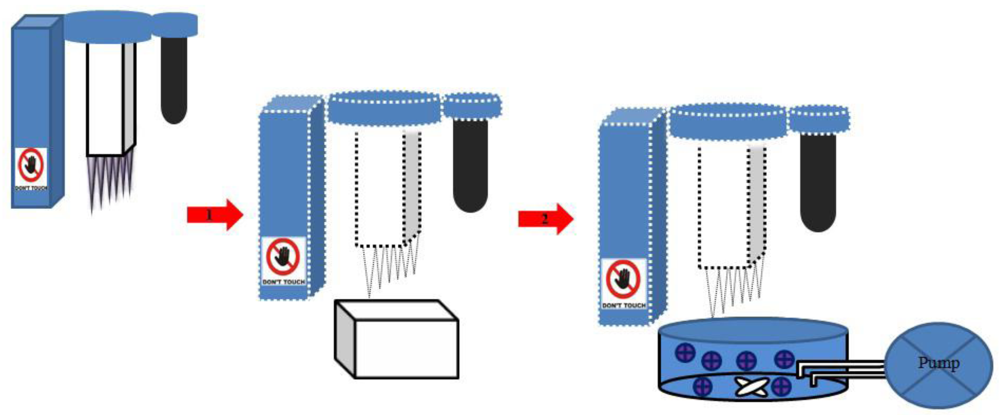
      <p>In addition, the cross-linking density of alginate/Ca<sup>++</sup> beads can be controlled by the use of a robot-operated formulation apparatus modified from an Eppendorf <italic>epMotion</italic> 5070 (<xref ref-type="fig" rid="polymers-04-00997-f001">Figure 1</xref>). Since the reaction time is pre-programmed and all drops have same volume, the resultant particles possess an even size, consistent mechanical properties, porosity, mass permeability, and degradability. </p>
      <fig id="polymers-04-00997-f001" position="anchor">
        <label>Figure 1</label>
        <caption>
          <p>Apparatus used for AG/Ca<sup>++ </sup>bead preparation. The robot-operated Eppendorf pipet takes a fraction of AG solutions (1) and drops them into calcium chloride; (2) under magnetic stirring. At the end of designed reaction time, the calcium chloride solution is pumped out and a washing solution or a solution containing the second polymer is pumped in. </p>
        </caption>
        <graphic xmlns:xlink="http://www.w3.org/1999/xlink" xlink:href="polymers-04-00997-g001.tif"/>
      </fig>
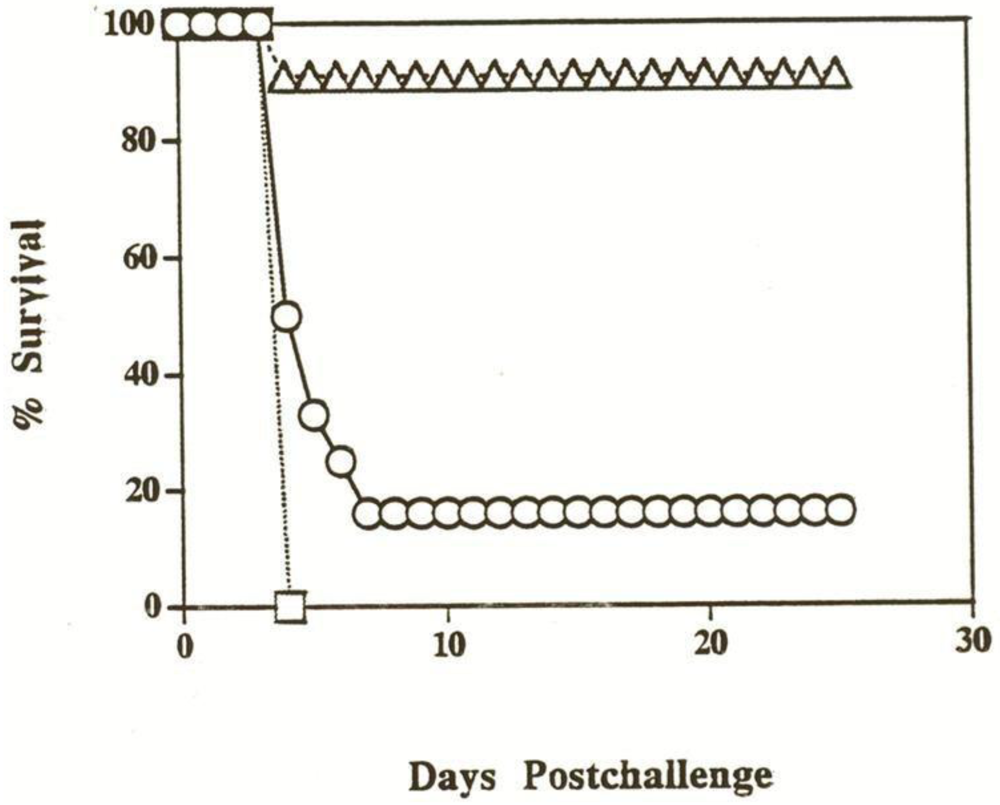
      <p>The AG/Ca<sup>++</sup>/CT hybrid hydrogels have also demonstrated great potential in vaccine delivery [<xref ref-type="bibr" rid="B18-polymers-04-00997">18</xref>]. The <italic>in vivo</italic> immunological activity of the AG/Ca<sup>++</sup>/CT beads loaded with ricin toxoid vaccine has been demonstrated in healthy adult mice administered a single dose of vaccine containing beads. Solution vaccine and blank phosphate saline buffer were used as controls. Six weeks post immunization the mice were exposed to ricin by means of an aerosol spray at the dose of 60 μg/kg whole body. All control non-immunized mice died 4 days after exposure to ricin; 16% of mice immunized with solution vaccine and 95% of mice immunized with encapsulated vaccine were alive 4 weeks after challenge (<xref ref-type="fig" rid="polymers-04-00997-f002">Figure 2</xref>). </p>
      <fig id="polymers-04-00997-f002" position="anchor">
        <label>Figure 2</label>
        <caption>
          <p>Percentage (%) of rat survival immunized with RT encapsulated (triangle) or in PBS for 1 dose (square) and 3 dose (circle) [<xref ref-type="bibr" rid="B18-polymers-04-00997">18</xref>].</p>
        </caption>
        <graphic xmlns:xlink="http://www.w3.org/1999/xlink" xlink:href="polymers-04-00997-g002.tif"/>
      </fig>
      <p>In other studies, the AG/Ca<sup>++</sup>/CT beads were used for the sequestration and sustained release of interlukin-2 (IL-2) [<xref ref-type="bibr" rid="B15-polymers-04-00997">15</xref>,<xref ref-type="bibr" rid="B18-polymers-04-00997">18</xref>], and as a carrier of concanavalin-A (Con-A) immobilization [<xref ref-type="bibr" rid="B19-polymers-04-00997">19</xref>]. Both the encapsulated interlukin-2 and immobilized Con-A were shown to enhance the activity of cytotoxic T-lymphocytes (CTL) against tumor cells. CTL have been widely investigated as effective killer cells for cancer immunotherapy. CTL can be induced by co-culturing tumor cells and peripheral immune cells, such as peripheral blood mononuclear monocytes, in the presence of IL-2. However, due to the short half-life of IL-2, high dose and multiple injections of IL-2 are required, which is inconvenient and is associated with serious side-effects. With the use of AG/Ca<sup>++</sup>/CT beads, the tumor-specific lymphocytes, CTLs, were induced in response to the sustained release of IL-2 pre-encapsulated in the beads. In contrast, only one half of the level of induction was achieved by the daily addition of identical levels of free IL-2. The CTLs induced by IL-2 released from the beads attacked and solubilized the target tumor cells with the same specificity as those induced by free-IL-2. These results indicate that controlled delivery of IL-2 encapsulated in alginate/chitosan beads is more efficient. The CTL cytokine production can also be induced from peripheral blood mononuclear cells by stimulation with the plant-derived lectin, concanavalin A (Con-A). When Con-A was immobilized on carrier beads, a continuous growth and enhancement of tumor-specific CTL activity was stimulated without the direct toxic effect usually observed with free Con-A. The enhanced expression of the surface adhesion molecule, CD11b, observed in these cultures is one mechanism whereby a strong and more sustained contact of the CTLs with tumor cells could result in more efficient tumor cell cytotoxicity [<xref ref-type="bibr" rid="B19-polymers-04-00997">19</xref>].</p>
      <p>Although alginate lacks a specific cell-recognition site, the introduction of specific cell adhesive motifs into the structure of alginate-based biohydrogels imparts the ability to react specifically with mammalian cells or function as an artificial extracellular matrix to promote cell adhesion, proliferation and guide cell differentiation. This further broadens the applications of alginate biohydrogels in regenerative medicine into areas such as wound healing, bone and cartilage regeneration, construction of blood vessels, and many others [<xref ref-type="bibr" rid="B10-polymers-04-00997">10</xref>,<xref ref-type="bibr" rid="B20-polymers-04-00997">20</xref>,<xref ref-type="bibr" rid="B21-polymers-04-00997">21</xref>,<xref ref-type="bibr" rid="B22-polymers-04-00997">22</xref>,<xref ref-type="bibr" rid="B23-polymers-04-00997">23</xref>,<xref ref-type="bibr" rid="B24-polymers-04-00997">24</xref>,<xref ref-type="bibr" rid="B25-polymers-04-00997">25</xref>,<xref ref-type="bibr" rid="B26-polymers-04-00997">26</xref>]. The injection of in situ-forming, bioabsorbable alginate hydrogels has been shown to be an effective acellular strategy that prevents adverse cardiac remodeling and dysfunction in new and old myocardial infarction in rats [<xref ref-type="bibr" rid="B27-polymers-04-00997">27</xref>].</p>
    </sec>
    <sec>
      <title>3. Pectin and Pectin/Zein</title>
      <p>Pectin is a plant cell wall polysaccharide, heterogeneous with respect to its chemical structure. The backbone of pectin consists of “smooth” regions that are homopolymeric partially methylated poly-α-(1→4)-D-galacturonic acid residues (galacturonan), and “hairy” regions that are heteropolymeric α-(1→2)-L-rhamnosy-α-(1→4)-D-galacturonosyl sections containing branch-points with mostly neutral side chains (1–20 residues) of mainly L-arabinose and D-galactose (rhamnogalacturonan I). Pectins may also contain rhamnogalacturonan II with sidechains containing other residues such as D-xylose, L-fucose, D-glucuronic acid, 3-deoxy-D-manno-2-octulosonic acid, D-apiose and 3-deoxy-D-lyxo-2-heptulosonic acid attached to poly-α-(1→4)-D-galacturonic acid regions. Pectin molecules do not adopt a straight conformation in cell walls or in technical formulations, their conformation is always extended and curved with a large amount of flexibility. The carboxylate groups tend to expand the structure of pectin and the methylation of these groups tends to make the molecules more hydrophobic, which has different effects on the structure of surrounding water [<xref ref-type="bibr" rid="B28-polymers-04-00997">28</xref>]. </p>
      <p>In the food industry, pectin is used as gelling and thickening reagent. The inclusion of pectin in gel-like products achieves the desired firmness and alters the texture of the gels. For these reasons, pectin has been used in foods, cosmetics, and environmental conditioning applications to modify the release of fragrance compounds and enhance the perception of flavours [<xref ref-type="bibr" rid="B29-polymers-04-00997">29</xref>,<xref ref-type="bibr" rid="B30-polymers-04-00997">30</xref>]. </p>
      <p>Similar to alginate, pectins with a low degree of esterification (DE) can react with calcium ions to form coacervates. This type of complex has been studied for the controlled release of organic chemicals, volatiles, or proteins [<xref ref-type="bibr" rid="B31-polymers-04-00997">31</xref>,<xref ref-type="bibr" rid="B32-polymers-04-00997">32</xref>]. For example, by taking a non-polar volatile sample of citronella, the chelating of calcium ion and the carboxyl groups in the macromolecules were able to enhance the hydrophobic interaction between the pectin chains and the citronella, thereby providing a physical barrier that inhibited citronella diffusion [<xref ref-type="bibr" rid="B32-polymers-04-00997">32</xref>]. The incorporation of the coacervates in an additional pectin gel further inhibited citronella release.</p>
      <p>In contrast to alginate, pectin contains branches rich in galactose residues, which serve as potential ligands for the interaction with cell membrane receptors. Modified cationic pectins were able to interact with DNA to form a compact transportable unit that is biocompatible and biodegradable, and demonstrated high transfection efficiency. Pectin’s galactose residues contributes to DNA transfection, suggesting that modified pectin is a promising non-viral carrier for targeted gene delivery to cells with galactose-binding lectins on their surface [<xref ref-type="bibr" rid="B33-polymers-04-00997">33</xref>]. </p>
      <p>Like other hydrophilic polymers, pectin-derived hydrogels have mucoadhesive and bioadhesive characteristics. Pectin readily re-associates or aggregates to form networks, and interacts with proteins and other polysaccharides via ionic linkage, hydrogen bonding, or hydrophobic interactions that enhance drug residence time and tissue permeability [<xref ref-type="bibr" rid="B34-polymers-04-00997">34</xref>]. We have compared the binding efficiency of porcine intestinal mucin to three pectins: P-25, the pectin with 25% DE; P-94, the pectin with the DE of 94; and P-N, the pectin carrying side-chain primary amine groups derived from P-25. The mixtures of the three pectins with mucin were examined by rheological analysis. The rheological synergism parameter, storage modulus G” and loss modulus G’ were calculated as the differences between the actual viscoelastic values of the pectins/mucin mixtures and the sum of the values of the individual components:</p>
      <p>   ∆G” = G”<sub>(mixture)</sub> − [G”<sub>(pectin)</sub> + G”<sub>(mucin)</sub>] and ∆G’ = G’<sub>(mixture)</sub> − [G’<sub>(pectin)</sub> + G’<sub>(mucin)</sub>]</p>
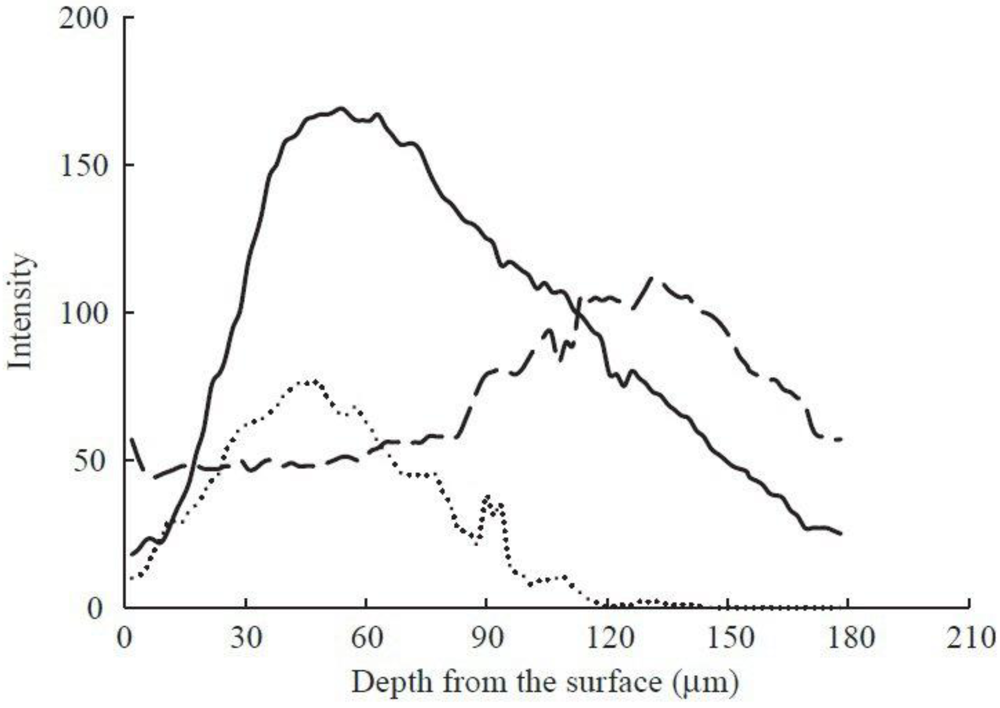
      <p>The positive rheological synergism values, in the order of P-N &gt; P-25 &gt; P-94, is evidence that dispersion of pectin reinforced the mucin gel structure. In particular, hydrogen bonding and ionic interactions of pectins form a rigid gel with mucus glycoproteins. The results were confirmed by measuring the fluorescent intensity using confocal laser microscopy (<xref ref-type="fig" rid="polymers-04-00997-f003">Figure 3</xref>). The peak position of P-94 and P-N was near the lumen, but the P-N produced much higher fluorescent intensity than the P-94. The low DE pectin, P-25, showed the highest activity in penetrating into the mucin. The high DE pectin remaining in a hydrocolloid state is easily entrapped in the mucus to form complex gels that lack mobility to penetrate deeply into the mucus layer. In regard to the P-N, it is more susceptible to ionic binding, thus the P-N easily forms the strongest network with mucin upon contact in comparison with the others [<xref ref-type="bibr" rid="B34-polymers-04-00997">34</xref>]. This work demonstrates how residence time can be altered for pectin-derived drug carriers for colon-specific drug delivery.</p>
      <fig id="polymers-04-00997-f003" position="anchor">
        <label>Figure 3</label>
        <caption>
          <p>Fluorescent intensity of pectin formulations extending from the surface of the lumen to deep within the wall made through the stacks of optical sections. P-N (solid line), P-25 (broken line) and P-94 (dotted line) [<xref ref-type="bibr" rid="B34-polymers-04-00997">34</xref>].</p>
        </caption>
        <graphic xmlns:xlink="http://www.w3.org/1999/xlink" xlink:href="polymers-04-00997-g003.tif"/>
      </fig>
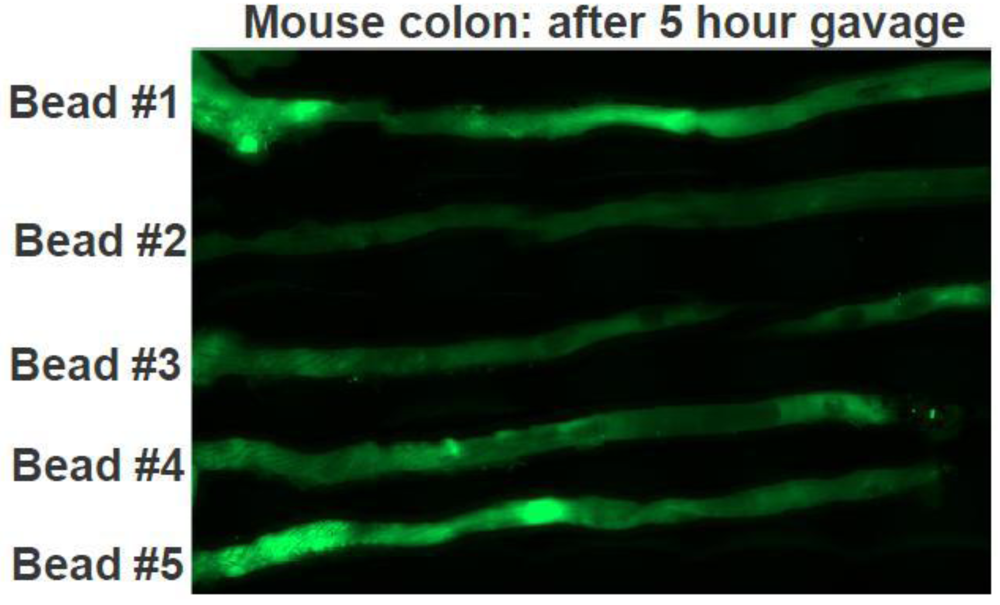
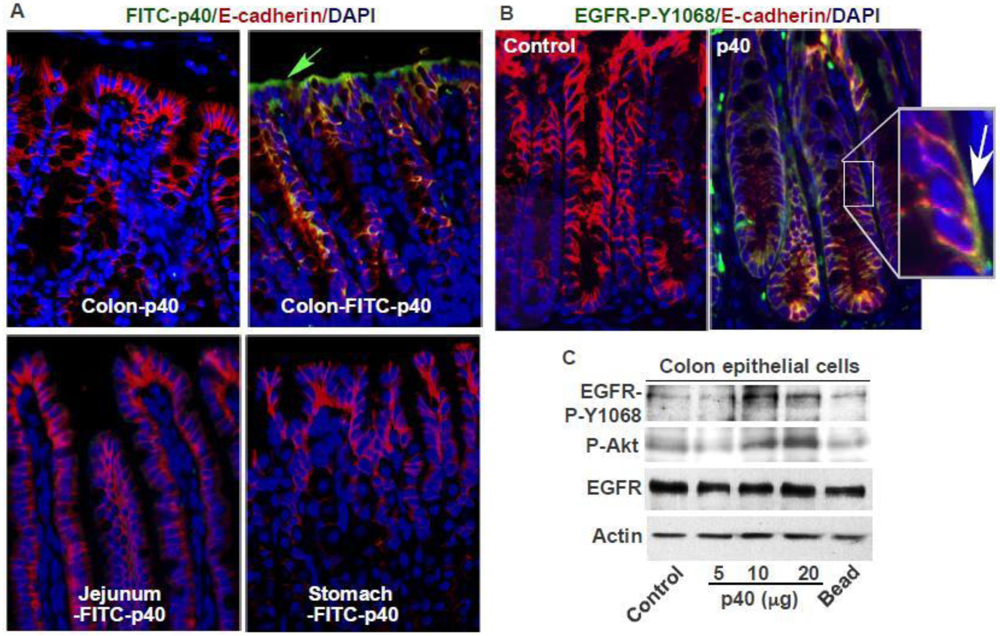
      <p>Ingested pectin remains intact in the upper gastrointestinal tract and is then degraded by colonic microflora. The composition of colonic microflora remains relatively consistent across a diverse human population, making the potential use of pectin for colon-specific drug delivery very promising. Pectin and zein complexes were designed for this purpose. Zein is a major storage protein of corn kernels. The hydrophobic nature of zein and its capability to adhere to or coat other surfaces have attracted several industrial applications [<xref ref-type="bibr" rid="B35-polymers-04-00997">35</xref>]. Pectin/zein hybrid hydrogels were prepared by addition of pectin into 85% ethanol containing zein and calcium chloride [<xref ref-type="bibr" rid="B36-polymers-04-00997">36</xref>]. The ionic chelation of pectin and calcium is much faster than the macromolecular interactions between the protein and the polysaccharide. As revealed by fluorescence microscopy, pectin/Ca<sup>++</sup> formed the main architecture; zein was mainly located around the periphery of the structure, but also migrated into the beads. The migrated protein chains were either bound to the pectin/Ca<sup>++</sup> networks or aligned as densely packed fibers. The hydrogel beads did not swell in physiological environments, but hydrolyzed in the presence of pectinase. By altering the ratio of pectin to zein and the mass density, orally administrated pectin/zein beads can be delivered at the colon site or at both the small intestine and the colon sites (<xref ref-type="fig" rid="polymers-04-00997-f004">Figure 4</xref>). The beads were used to encapsulate protein p40, which was derived from a probiotic bacterium, <italic>Lactobacillus rhamnosus</italic> GG. Administration of p40-containing beads to mice specifically delivered p40 to the colon site, which activated epidermal growth factor receptor (EGFR) in colon epithelial cells, reduced intestinal epithelial apoptosis and disruption of barrier function in the colon epithelium, and prevented dextran sulfate sodium-induced intestinal injury and acute colitis, as well as oxazolone-induced Th2 cytokine-derived chronic colitis in C57BL/6 mice (<xref ref-type="fig" rid="polymers-04-00997-f005">Figure 5</xref>a–c). These results provide evidence that the administration of pectin/Ca<sup>++</sup>/zein containing p40 has beneficial effect on the prevention and treatment of intestinal inflammatory disorders [<xref ref-type="bibr" rid="B37-polymers-04-00997">37</xref>]. </p>
      <fig id="polymers-04-00997-f004" position="anchor">
        <label>Figure 4</label>
        <caption>
          <p>Detection of the capacity of the beads to deliver protein to the colon. Mice were gavaged with beads containing FITC-labeled albumin. After 5 h, mice were sacrificed and colon was dissected and observed using fluorescence microscopy for detecting FITC-albumin delivery to the colon. Green: FITC-labeled albumin. #1. pectin/zein in 85% alcohol; #2. Dried pectin/zein sample; #3. dried pectin/calcium beads; #4. dried pectin/calcium beads coated with poly-lysine; #5. pectin/calcium beads coated with poly-lysine prepared in different conditions.</p>
        </caption>
        <graphic xmlns:xlink="http://www.w3.org/1999/xlink" xlink:href="polymers-04-00997-g004.tif"/>
      </fig>
      <p>Taking advantage of the film forming property of pectin, when used in combination with various food grade proteins, such as gelatin and soybean proteins, pectin forms edible hydrogels that are used for foods packaging and wrapping. Bacteriocidins, such as nisin, or other antibacterial actives such as allyl isothiocyanate can also be pre-incorporated into gels. The resultant biopolymer hybrids have been shown to prolong the shelf-life and protect overall food quality [<xref ref-type="bibr" rid="B38-polymers-04-00997">38</xref>,<xref ref-type="bibr" rid="B39-polymers-04-00997">39</xref>,<xref ref-type="bibr" rid="B40-polymers-04-00997">40</xref>].</p>
      <fig id="polymers-04-00997-f005" position="anchor">
        <label>Figure 5</label>
        <caption>
          <p>Delivery of p40 to the colon using pectin/zein hydrogel beads activates EGFR in colon epithelial cells. Pectin/zein beads containing p40 or FITC-labeled p40 (10 μg p40 in A and B, or at the indicated dose in (<bold>C</bold>), or pectin/zein beads only without p40 (control) were administered to wt C57BL/6 mice by gavage. Mice were sacrificed 4 h after gavage. Paraffin-embedded tissue sections were prepared for immunohistochemistry to detect p40 delivery (green staining) (<bold>A</bold>), EGFR activation using a rabbit anti-EGFR-phospho (P) Tyr1068 antibody and FITC-conjugated secondary antibody (Green staining) (<bold>B</bold>), an epithelial cell marker using a mouse anti-E-cadherin antibody and Cy3-conjugated secondary antibody (red staining) (<bold>A-B</bold>), and nuclei using DAPI staining (blue staining) (<bold>A-B</bold>). Green arrow in (<bold>A</bold>) indicating FITC-p40 detected in the intestine. The white arrow in (<bold>B</bold>) indicates EGFR-Tyr1068 phosphorylation in cells staining positively for E-cadherin. Colon epithelial cells were isolated for Western blot analysis to detect EGFR and Akt activation [<xref ref-type="bibr" rid="B37-polymers-04-00997">37</xref>].</p>
        </caption>
        <graphic xmlns:xlink="http://www.w3.org/1999/xlink" xlink:href="polymers-04-00997-g005.tif"/>
      </fig>
    </sec>
    <sec>
      <title>4. Hyaluronate and Hyaluronate/Collagen</title>
      <p>Hyaluronic acid or its sodium salt, hyaluronate (HA) consists of alternating residues of D-glucuronic acid and <italic>N</italic>-acetyl-D-glucosamine. HA is a water soluble polymer naturally found in nearly all tissues, especially in the extracellular matrix, the eyes and synovial fluid of joints [<xref ref-type="bibr" rid="B41-polymers-04-00997">41</xref>]. HA is a highly hygroscopic polysaccharide; hyaluronate gels typically possess low mechanical properties. To be used as implants for tissue engineering applications, such as artificial skin, would healing, facial intradermal implants, cartilage repair, and soft tissue augmentation [<xref ref-type="bibr" rid="B42-polymers-04-00997">42</xref>,<xref ref-type="bibr" rid="B43-polymers-04-00997">43</xref>,<xref ref-type="bibr" rid="B44-polymers-04-00997">44</xref>], stable HA hydrogels are required. This can be achieved by covalent cross-linking the polysaccharide with various multifunctional reagents, such as a group of epoxides, tresyl chloride, divinyl sulfone, or hydrazide derivatives [<xref ref-type="bibr" rid="B45-polymers-04-00997">45</xref>,<xref ref-type="bibr" rid="B46-polymers-04-00997">46</xref>], or to form hybrids with other biopolymer, such as collagen (COL; type I, II), and mineralized collagen. The resultant hybrid hydrogels have been shown to possess some functional properties of the extracellular matrix of human tissues [<xref ref-type="bibr" rid="B47-polymers-04-00997">47</xref>,<xref ref-type="bibr" rid="B48-polymers-04-00997">48</xref>,<xref ref-type="bibr" rid="B49-polymers-04-00997">49</xref>]. </p>
      <p>Engineered HA/COL matrices have shown great potential in bone and cartilage repair [<xref ref-type="bibr" rid="B47-polymers-04-00997">47</xref>,<xref ref-type="bibr" rid="B48-polymers-04-00997">48</xref>,<xref ref-type="bibr" rid="B49-polymers-04-00997">49</xref>,<xref ref-type="bibr" rid="B50-polymers-04-00997">50</xref>,<xref ref-type="bibr" rid="B51-polymers-04-00997">51</xref>,<xref ref-type="bibr" rid="B52-polymers-04-00997">52</xref>,<xref ref-type="bibr" rid="B53-polymers-04-00997">53</xref>]. The bio-polymer/polymer hybrids were prepared by a ring-opening oxidization reaction resulting in HA with active aldehyde groups attached to the sugar chains, which were then reacted with COL under conditions so that the covalent bonds were formed between the two biopolymers. In this case, HA functions as both a bioactive component and chemical cross-linker, excluding the use of traditional organic chemicals [<xref ref-type="bibr" rid="B53-polymers-04-00997">53</xref>]. The amount of aldehyde groups produced in this manner can be stoichiometrically controlled. The ratio of HA to COL can be varied to change the physical properties of the matrices. A higher proportion of COL resulted in a more porous sponge-like matrix that is more elastic. A higher proportion of HA resulted in a more gel-like structure that is more viscous. By using type I COL or mineralized type I COL, the resultant biopolymer hybrid hydrogels are preferred for bone growth; whereas, the matrices from type II COL and HA are more suitable for cartilage growth. Evaluation of HA and type I COL matrices in a rat cranial defect model showed excellent biocompatibility and osteoconductivity. The implanted hydrogel matrices were completely integrated into the new reparative bone. More bony healing was observed in HA/COL implants than in glutaraldehyde cross-linked COL, indicating the HA presence enhanced new bone formation [<xref ref-type="bibr" rid="B52-polymers-04-00997">52</xref>]. </p>
      <p>Therapeutic agents and growth factors, such as bone morphogenetic protein (BMP), or recombinant human growth and differentiation factor-5 (rhGDF-5)- a potent member of the BMP family, or fibroblast growth factor (FGF), and platelet-derived growth factor (PDGF) can be loaded into the HA/COL matrices to augment bone and cartilage growth, or for soft tissue repair. A series of <italic>in vitro</italic> assays and <italic>in vivo</italic> examinations of HA/COL loaded with GDF-5 implants have shown a dose-depended increase in alkaline phosphatase activity and chondrogenesis [<xref ref-type="bibr" rid="B49-polymers-04-00997">49</xref>,<xref ref-type="bibr" rid="B54-polymers-04-00997">54</xref>,<xref ref-type="bibr" rid="B55-polymers-04-00997">55</xref>]. The <italic>in vitro</italic> response to rhGDF-5 resulted in the formation of chondrogenic nodules in fetal rat calvarial cells cultured in the context of HA/COL extracellular matrices. Matrices loaded with rhGDF-5 induced ectopic cartilaginous and osseous tissue when implanted into subcutaneous or intramuscular sites. </p>
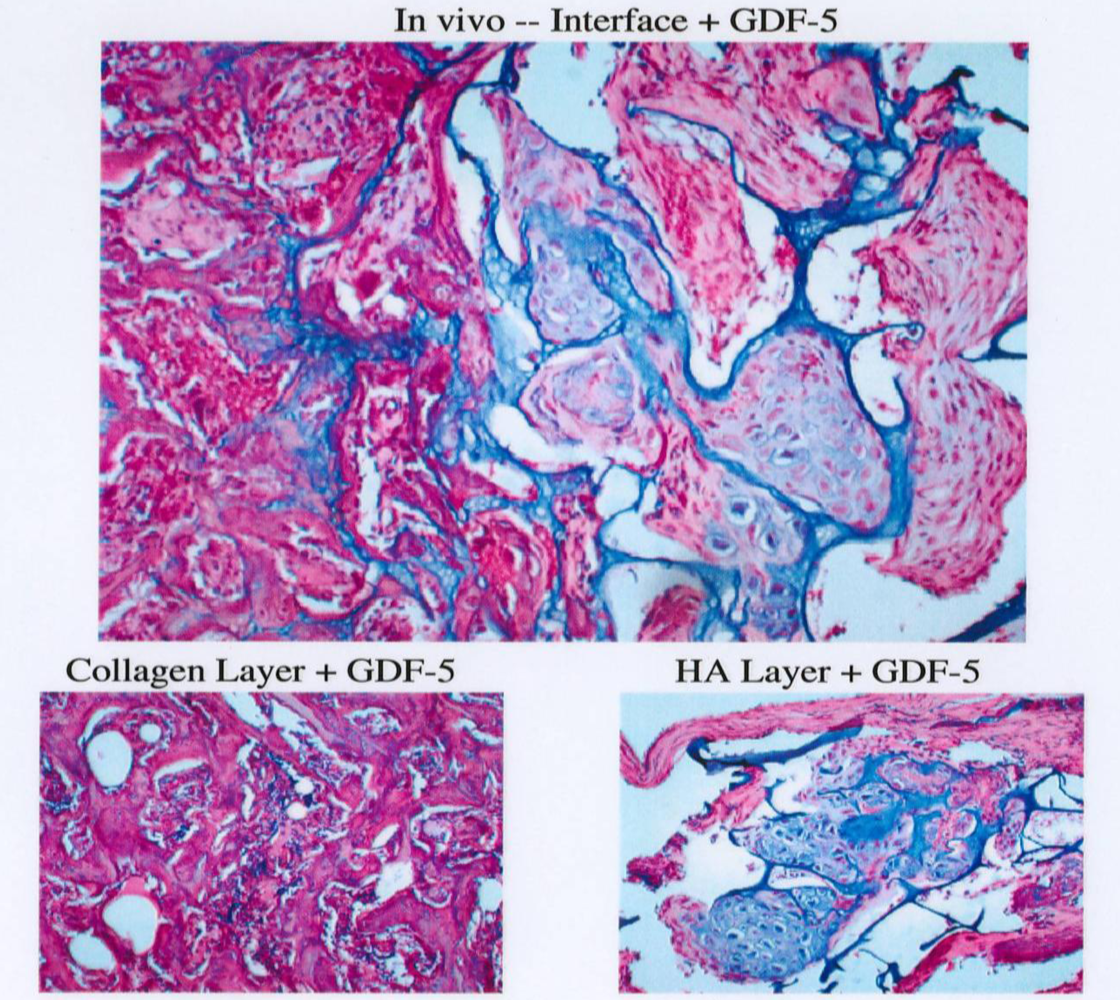
      <p>The biopolymer hybrid hydrogels can be constructed as to have a bilayered structure, where each layers has its own chemical composition, porosity, and biological activity. The two layers can mechanically interpenetrate with each other; or be chemically cross-linked together [<xref ref-type="bibr" rid="B56-polymers-04-00997">56</xref>,<xref ref-type="bibr" rid="B57-polymers-04-00997">57</xref>,<xref ref-type="bibr" rid="B58-polymers-04-00997">58</xref>,<xref ref-type="bibr" rid="B59-polymers-04-00997">59</xref>,<xref ref-type="bibr" rid="B60-polymers-04-00997">60</xref>]. Rat progenitor cells cultured on HA/COL bilayer matrices demonstrated that the differentiation of the cells could be controlled through alterations in matrix composition and structure. This was supported by the <italic>in vivo</italic> experiment in a rat intramuscular model, where distinct tissues grew in different layers of the matrix. This holds promise for tissue repair indications, particularly for defects that involve more than one type of tissue (<xref ref-type="fig" rid="polymers-04-00997-f006">Figure 6</xref>).</p>
      <fig id="polymers-04-00997-f006" position="anchor">
        <label>Figure 6</label>
        <caption>
          <p>HA/COL Bilayered matrix was loaded with rhGDF-5 and implanted in rats intramuscularly. Two weeks post implantation, rats were sacrificed, and the implants with surrounding tissues were examined for histology. The top is the interface between the two layers, the HA layer is on the left side, the COL layer is on the right side. The COL layer induces a significant amount of bone formation and a trace of cartilage, whereas cartilage and young bone are predominated in the HA layer [<xref ref-type="bibr" rid="B60-polymers-04-00997">60</xref>].</p>
        </caption>
        <graphic xmlns:xlink="http://www.w3.org/1999/xlink" xlink:href="polymers-04-00997-g006.tif"/>
      </fig>
      <p>Using the same approach, HA and heparin conjugate gels were synthesized and used as a FGF-2 carrier that delivered the growth factor at damaged tissue site. HA was modified to possess primary amine groups. HP was modified to carry active aldehyde groups. HA/HP conjugate hydrogels were obtained by cross-linking the two modified biopolymers via either imine bonding or more stable amine linkage, depending on the reaction conditions. The hybrid hydrogels retained the viscoelastic properties of free HA, and could be injected to damaged tissue sites. The hybrid also functions as a depot of FGF-2 via HP specific FGF-2 binding sites [<xref ref-type="bibr" rid="B47-polymers-04-00997">47</xref>,<xref ref-type="bibr" rid="B61-polymers-04-00997">61</xref>]. In addition to the release from the hybrid gels in free form, FGF could also be released in the form of HP/FGF-2 complex. The sulfated glycosaminoglycan segments could be released from imine-bonded gels via the hydrolysis of the reversible imine bonds. HP released from the amine-bonded gels requires the degradation of HA backbone that may occur by enzymatic hydrolysis or hydroxyl radical attack, which might be generated at sites of inflammation. Thus, there are several parameters that contributed to the release of FGF-2 from the hydrogels, such as the viscosity of the formulations, the dissociation of FGF from the HP binding sites and the deformation of the gels.</p>
      <p>By classical chemistry, cell adhesive RGD containing peptides can be immobilized on the HA molecular chains, and the HA solutions frozen and lyophilized to form a 3-D, sponge-like structure. The RGD peptide is an oligopeptide derived from proteins such as fibronectin, laminin, or collagen, and has demonstrated excellent properties in stimulating cell adhesion and cell proliferation. HA sponges with immobilized RGD containing peptides are useful in aiding wound healing by providing a temporary matrix for skin regeneration. Testing the matrices in guinea pigs full thickness wound models, fibroblast ingrowth into the matrices was observed at approximately 4–5 days. No inflammatory reaction occurred throughout the matrices [<xref ref-type="bibr" rid="B45-polymers-04-00997">45</xref>]. </p>
    </sec>
    <sec sec-type="conclusions">
      <title>5. Conclusions</title>
      <p>Research in the area of biohydrogels for drug delivery, tissue engineering, and food applications has been well established over the past decade. In particular, hybrid hydrogels synthesized from two biopolymers have attracted increasing attention. The inclusion of a second biopolymer strengthens the stability of resultant hydrogels and enriches its functionalities by bringing in new functional groups or optimizing the micro-environmental conditions for certain biological and biochemical processes. The above examples present some approaches that have been used by our groups to synthesize biopolymer hybrid hydrogels for effective uses for immunotherapy, tissue regeneration, food and functional food applications. The research has achieved some challenging results, such as stabilizing physical structure, increasing mucoadhesiveness, and the creation of an artificial extracellular matrix to aid in guiding tissue differentiation. We expect that future developments of biopolymer hybrid hydrogels will be even more case-specific. Each type of organic entity, either those to be encapsulated or those to be targeted, has its own chemical, physical, and biological features. Biohydrogels should be able to meet the sophisticated demands and special requirements across a wide range of uses.</p>
    </sec>
  </body>
  <back>
    <ref-list>
      <title>References</title>
      <ref id="B1-polymers-04-00997">
        <label>1.</label>
        <citation citation-type="journal">
          <person-group person-group-type="author">
            <name>
              <surname>Peppas</surname>
              <given-names>N.A.</given-names>
            </name>
            <name>
              <surname>Hilt</surname>
              <given-names>J.Z.</given-names>
            </name>
            <name>
              <surname>Khademhosseini</surname>
              <given-names>A.</given-names>
            </name>
            <name>
              <surname>Langer</surname>
              <given-names>R.</given-names>
            </name>
          </person-group>
          <article-title>Hydrogels in biology and medicine: from molecular principles to bionanotechnology</article-title>          <source>Adv. Mater.</source>
          <year>2006</year>
          <volume>18</volume>
          <fpage>1345</fpage>
          <lpage>1360</lpage>
          <pub-id pub-id-type="doi">10.1002/adma.200501612</pub-id>
        </citation>
      </ref>
      <ref id="B2-polymers-04-00997">
        <label>2.</label>
        <citation citation-type="journal">
          <person-group person-group-type="author">
            <name>
              <surname>Hoffman</surname>
              <given-names>A.S.</given-names>
            </name>
          </person-group>
          <article-title>Hydrogels for biomedical applications</article-title>          <source>Adv. Drug Deliv. Rev.</source>
          <year>2002</year>
          <volume>43</volume>
          <fpage>3</fpage>
          <lpage>12</lpage>
          <pub-id pub-id-type="doi">10.1016/S0169-409X(01)00239-3</pub-id>
        </citation>
      </ref>
      <ref id="B3-polymers-04-00997">
        <label>3.</label>
        <citation citation-type="journal">
          <person-group person-group-type="author">
            <name>
              <surname>Klouda</surname>
              <given-names>L.</given-names>
            </name>
            <name>
              <surname>Mikos</surname>
              <given-names>A.G.</given-names>
            </name>
          </person-group>
          <article-title>Thermoresponsive hydrogels in biomedical applications</article-title>          <source>Eur. J. Pharm. Biopharm.</source>
          <year>2008</year>
          <volume>68</volume>
          <fpage>34</fpage>
          <lpage>45</lpage>
          <pub-id pub-id-type="doi">10.1016/j.ejpb.2007.02.025</pub-id>
        </citation>
      </ref>
      <ref id="B4-polymers-04-00997">
        <label>4.</label>
        <citation citation-type="journal">
          <person-group person-group-type="author">
            <name>
              <surname>Lee</surname>
              <given-names>K.Y.</given-names>
            </name>
            <name>
              <surname>Mooney</surname>
              <given-names>D.</given-names>
            </name>
          </person-group>
          <article-title>Hydrogels for tissue engineering</article-title>          <source>Chem. Rev.</source>
          <year>2001</year>
          <volume>101</volume>
          <fpage>1869</fpage>
          <lpage>1879</lpage>
          <pub-id pub-id-type="doi">10.1021/cr000108x</pub-id>
        </citation>
      </ref>
      <ref id="B5-polymers-04-00997">
        <label>5.</label>
        <citation citation-type="journal">
          <person-group person-group-type="author">
            <name>
              <surname>Lim</surname>
              <given-names>F.</given-names>
            </name>
            <name>
              <surname>Sun</surname>
              <given-names>A.M.</given-names>
            </name>
          </person-group>
          <article-title>Microencapsulated islets as bioartificial endocrine pancreas</article-title>          <source>Science</source>
          <year>1980</year>
          <volume>210</volume>
          <fpage>908</fpage>
          <lpage>910</lpage>
        <pub-id pub-id-type="doi">10.1126/science.6776628</pub-id><pub-id pub-id-type="pmid">6776628</pub-id></citation>
      </ref>
      <ref id="B6-polymers-04-00997">
        <label>6.</label>
        <citation citation-type="journal">
          <person-group person-group-type="author">
            <name>
              <surname>Vlierberghe</surname>
              <given-names>S.V.</given-names>
            </name>
            <name>
              <surname>Dubruel</surname>
              <given-names>P.</given-names>
            </name>
            <name>
              <surname>Schacht</surname>
              <given-names>E.</given-names>
            </name>
          </person-group>
          <article-title>Biopolymer-based hydrogels as scaffolds for tissue engineering applications: a review</article-title>          <source>Biomacromolecules</source>
          <year>2011</year>
          <volume>12</volume>
          <fpage>1387</fpage>
          <lpage>1408</lpage>
          <pub-id pub-id-type="doi">10.1021/bm200083n</pub-id>
        </citation>
      </ref>
      <ref id="B7-polymers-04-00997">
        <label>7.</label>
        <citation citation-type="journal">
          <person-group person-group-type="author">
            <name>
              <surname>Hamidi</surname>
              <given-names>M.</given-names>
            </name>
            <name>
              <surname>Azadi</surname>
              <given-names>A.</given-names>
            </name>
            <name>
              <surname>Rafiei</surname>
              <given-names>P.</given-names>
            </name>
          </person-group>
          <article-title>Hydrogel nanoparticles in drug delivery</article-title>          <source>Adv. Drug Deliv. Rev.</source>
          <year>2008</year>
          <volume>60</volume>
          <fpage>1638</fpage>
          <lpage>1649</lpage>
          <pub-id pub-id-type="doi">10.1016/j.addr.2008.08.002</pub-id>
        </citation>
      </ref>
      <ref id="B8-polymers-04-00997">
        <label>8.</label>
        <citation citation-type="journal">
          <person-group person-group-type="author">
            <name>
              <surname>Kuo</surname>
              <given-names>C.</given-names>
            </name>
            <name>
              <surname>Ma</surname>
              <given-names>P.X.</given-names>
            </name>
          </person-group>
          <article-title>Ionically crosslinked alginate hydrogels as scaffolds for tissue engineering: part 1. structure, gelation rate and mechanical properties</article-title>
          <source>Biomaterials</source>
          <year>2001</year>
          <volume>22</volume>
          <fpage>511</fpage>
          <lpage>521</lpage>
          <pub-id pub-id-type="doi">10.1016/S0142-9612(00)00201-5</pub-id>
        </citation>
      </ref>
      <ref id="B9-polymers-04-00997">
        <label>9.</label>
        <citation citation-type="journal">
          <person-group person-group-type="author">
            <name>
              <surname>Liu</surname>
              <given-names>L.S.</given-names>
            </name>
            <name>
              <surname>Liu</surname>
              <given-names>S.-Q.</given-names>
            </name>
            <name>
              <surname>Ng</surname>
              <given-names>S.Y.</given-names>
            </name>
            <name>
              <surname>Froix</surname>
              <given-names>M.</given-names>
            </name>
            <name>
              <surname>Ohno</surname>
              <given-names>T.</given-names>
            </name>
            <name>
              <surname>Heller</surname>
              <given-names>J.</given-names>
            </name>
          </person-group>
          <article-title>Controlled release of interleukin-2 for tumour immunotherapy using alginate/chitosan porous microspheres</article-title>          <source>J. Control. Release</source>
          <year>1997</year>
          <volume>43</volume>
          <fpage>65</fpage>
          <lpage>74</lpage>
          <pub-id pub-id-type="doi">10.1016/S0168-3659(96)01471-X</pub-id>
        </citation>
      </ref>
      <ref id="B10-polymers-04-00997">
        <label>10.</label>
        <citation citation-type="journal">
          <person-group person-group-type="author">
            <name>
              <surname>Lee</surname>
              <given-names>K.Y.</given-names>
            </name>
            <name>
              <surname>Rowley</surname>
              <given-names>J.A.</given-names>
            </name>
            <name>
              <surname>Eiselt</surname>
              <given-names>P.</given-names>
            </name>
            <name>
              <surname>Moy</surname>
              <given-names>E.M.</given-names>
            </name>
            <name>
              <surname>Bouhadir</surname>
              <given-names>K.H.</given-names>
            </name>
            <name>
              <surname>Mooney</surname>
              <given-names>D.J.</given-names>
            </name>
          </person-group>
          <article-title>Controlling mechanical and swelling properties of alginates hydrogels independently by cross-linking type and cross-linking density</article-title>          <source>Macromolecules</source>
          <year>2000</year>
          <volume>33</volume>
          <fpage>4291</fpage>
          <lpage>4297</lpage>
        <pub-id pub-id-type="doi">10.1021/ma9921347</pub-id></citation>
      </ref>
      <ref id="B11-polymers-04-00997">
        <label>11.</label>
        <citation citation-type="journal">
          <person-group person-group-type="author">
            <name>
              <surname>Bouhadir</surname>
              <given-names>K.H.</given-names>
            </name>
            <name>
              <surname>Hausman</surname>
              <given-names>D.S.</given-names>
            </name>
            <name>
              <surname>Mooney</surname>
              <given-names>D.J.</given-names>
            </name>
          </person-group>
          <article-title>Synthesis of cross-linked poly(aldehyde-guluronate) hydrogels</article-title>
          <source>Polymer</source>
          <year>1999</year>
          <volume>40</volume>
          <fpage>3575</fpage>
          <lpage>3584</lpage>
          <pub-id pub-id-type="doi">10.1016/S0032-3861(98)00550-3</pub-id>
        </citation>
      </ref>
      <ref id="B12-polymers-04-00997">
        <label>12.</label>
        <citation citation-type="journal">
          <person-group person-group-type="author">
            <name>
              <surname>Baldwin</surname>
              <given-names>A.D.</given-names>
            </name>
            <name>
              <surname>Kiick</surname>
              <given-names>K.L.</given-names>
            </name>
          </person-group>
          <article-title>Polysaccharide-modified synthetic polymeric biomaterials</article-title>          <source>Biopolymers</source>
          <year>2010</year>
          <volume>94</volume>
          <fpage>128</fpage>
          <lpage>140</lpage>
          <pub-id pub-id-type="doi">10.1002/bip.21334</pub-id>
        </citation>
      </ref>
      <ref id="B13-polymers-04-00997">
        <label>13.</label>
        <citation citation-type="journal">
          <person-group person-group-type="author">
            <name>
              <surname>Sundar</surname>
              <given-names>S.</given-names>
            </name>
            <name>
              <surname>Kundu</surname>
              <given-names>J.</given-names>
            </name>
            <name>
              <surname>Kundu</surname>
              <given-names>S.C.</given-names>
            </name>
          </person-group>
          <article-title>Biopolymeric nanoparticles</article-title>          <source>Sci. Technol. Adv. Mater.</source>
          <year>2010</year>
          <volume>11</volume>
          <fpage>10</fpage>
          <lpage>14</lpage>
        </citation>
      </ref>
      <ref id="B14-polymers-04-00997">
        <label>14.</label>
        <citation citation-type="journal">
          <person-group person-group-type="author">
            <name>
              <surname>Abbah</surname>
              <given-names>S.A.</given-names>
            </name>
            <name>
              <surname>Lu</surname>
              <given-names>W.W.</given-names>
            </name>
            <name>
              <surname>Chang</surname>
              <given-names>D.</given-names>
            </name>
            <name>
              <surname>Cheung</surname>
              <given-names>K.M.C.</given-names>
            </name>
            <name>
              <surname>Liu</surname>
              <given-names>W.G.</given-names>
            </name>
            <name>
              <surname>Zhao</surname>
              <given-names>F.</given-names>
            </name>
          </person-group>
          <article-title>Osteogenic behavior of alginate encapsulated bone marrows stromal cells: an <italic>in vitro</italic> study</article-title>          <source>J. Mater. Sci. Mater. Med.</source>
          <year>2008</year>
          <volume>19</volume>
          <fpage>2113</fpage>
          <lpage>2119</lpage>
          <pub-id pub-id-type="doi">10.1007/s10856-006-0013-1</pub-id>
        </citation>
      </ref>
      <ref id="B15-polymers-04-00997">
        <label>15.</label>
        <citation citation-type="patent">
          <person-group person-group-type="author">
            <name>
              <surname>Liu</surname>
              <given-names>L.S.</given-names>
            </name>
            <name>
              <surname>Froix</surname>
              <given-names>M.</given-names>
            </name>
            <name>
              <surname>Heller</surname>
              <given-names>J.</given-names>
            </name>
            <name>
              <surname>Ng</surname>
              <given-names>S.Y.</given-names>
            </name>
          </person-group>
          <article-title>Bioerodible porous compositions</article-title>          <source>US Patent</source>
          <patent>6,238,705</patent>
          <day>29</day>
          <month>May</month>
          <year>2001</year>
        </citation>
      </ref>
      <ref id="B16-polymers-04-00997">
        <label>16.</label>
        <citation citation-type="journal">
          <person-group person-group-type="author">
            <name>
              <surname>Mao</surname>
              <given-names>S.</given-names>
            </name>
            <name>
              <surname>Sun</surname>
              <given-names>W.</given-names>
            </name>
            <name>
              <surname>Kissel</surname>
              <given-names>T.</given-names>
            </name>
          </person-group>
          <article-title>Chitosan-based formulations for delivery of DNA and siRNA</article-title>          <source>Adv. Drug Deliv. Rev.</source>
          <year>2010</year>
          <volume>62</volume>
          <fpage>12</fpage>
          <lpage>27</lpage>
          <pub-id pub-id-type="doi">10.1016/j.addr.2009.08.004</pub-id>
        </citation>
      </ref>
      <ref id="B17-polymers-04-00997">
        <label>17.</label>
        <citation citation-type="journal">
          <person-group person-group-type="author">
            <name>
              <surname>Lu</surname>
              <given-names>H.F.</given-names>
            </name>
            <name>
              <surname>Narayanan</surname>
              <given-names>K.</given-names>
            </name>
            <name>
              <surname>Lim</surname>
              <given-names>S.-X.</given-names>
            </name>
            <name>
              <surname>Gao</surname>
              <given-names>S.</given-names>
            </name>
            <name>
              <surname>Leong</surname>
              <given-names>M.F.</given-names>
            </name>
            <name>
              <surname>Wan</surname>
              <given-names>A.C.</given-names>
            </name>
          </person-group>
          <article-title>A 3D microfibrous scaffold for long-term human pluripotent stem cell self-renewal under chemically defined conditions</article-title>          <source>Biomaterials</source>
          <year>2012</year>
          <volume>33</volume>
          <fpage>2419</fpage>
          <lpage>2430</lpage>
          <pub-id pub-id-type="doi">10.1016/j.biomaterials.2011.11.077</pub-id>
        </citation>
      </ref>
      <ref id="B18-polymers-04-00997">
        <label>18.</label>
        <citation citation-type="patent">
          <person-group person-group-type="author">
            <name>
              <surname>Liu</surname>
              <given-names>L.S.</given-names>
            </name>
            <name>
              <surname>Froix</surname>
              <given-names>M.</given-names>
            </name>
            <name>
              <surname>Heller</surname>
              <given-names>J.</given-names>
            </name>
            <name>
              <surname>Ng</surname>
              <given-names>S.Y.</given-names>
            </name>
          </person-group>
          <article-title>Bioerodible porous compositions</article-title>          <source>US Patent</source>
          <patent>6,090,344</patent>
          <day>1</day>
          <month>August</month>
          <year>2000</year>
        </citation>
      </ref>
      <ref id="B19-polymers-04-00997">
        <label>19.</label>
        <citation citation-type="journal">
          <person-group person-group-type="author">
            <name>
              <surname>Liu</surname>
              <given-names>S.-Q.</given-names>
            </name>
            <name>
              <surname>Liu</surname>
              <given-names>L.S.</given-names>
            </name>
            <name>
              <surname>Ohno</surname>
              <given-names>T.</given-names>
            </name>
          </person-group>
          <article-title>Growth stimulation of tumor-specific cytotoxic T lymphocytes on concanavalin A-immobilized carrier beads</article-title>          <source>Cytotechnology</source>
          <year>1998</year>
          <volume>26</volume>
          <fpage>13</fpage>
          <lpage>21</lpage>
        <pub-id pub-id-type="doi">10.1023/A:1007924430570</pub-id><pub-id pub-id-type="pmid">22359002</pub-id></citation>
      </ref>
      <ref id="B20-polymers-04-00997">
        <label>20.</label>
        <citation citation-type="journal">
          <person-group person-group-type="author">
            <name>
              <surname>Chou</surname>
              <given-names>A.I.</given-names>
            </name>
            <name>
              <surname>Akintoye</surname>
              <given-names>S.O.</given-names>
            </name>
            <name>
              <surname>Nicoll</surname>
              <given-names>S.B.</given-names>
            </name>
          </person-group>
          <article-title>Photo-crosslinked alginate hydrogels support enhanced matrix accumulation by nucleus pulposus cells <italic>in vivo</italic></article-title>          <source>Osteoarthr. Cartilage</source>
          <year>2009</year>
          <volume>17</volume>
          <fpage>1377</fpage>
          <lpage>1384</lpage>
          <pub-id pub-id-type="doi">10.1016/j.joca.2009.04.012</pub-id>
        </citation>
      </ref>
      <ref id="B21-polymers-04-00997">
        <label>21.</label>
        <citation citation-type="journal">
          <person-group person-group-type="author">
            <name>
              <surname>Li</surname>
              <given-names>X.</given-names>
            </name>
            <name>
              <surname>Liu</surname>
              <given-names>T.</given-names>
            </name>
            <name>
              <surname>Song</surname>
              <given-names>K.</given-names>
            </name>
            <name>
              <surname>Yao</surname>
              <given-names>L.</given-names>
            </name>
            <name>
              <surname>Ge</surname>
              <given-names>D.</given-names>
            </name>
            <name>
              <surname>Bao</surname>
              <given-names>C.</given-names>
            </name>
          </person-group>
          <article-title>Culture of neutral stern cells in calcium alginate beads</article-title>          <source>Biotechnol. Prog.</source>
          <year>2006</year>
          <volume>22</volume>
          <fpage>1683</fpage>
          <lpage>1689</lpage>
        <pub-id pub-id-type="pmid">17137318</pub-id></citation>
      </ref>
      <ref id="B22-polymers-04-00997">
        <label>22.</label>
        <citation citation-type="journal">
          <person-group person-group-type="author">
            <name>
              <surname>Rowley</surname>
              <given-names>J.A.</given-names>
            </name>
            <name>
              <surname>Madlambayan</surname>
              <given-names>G.</given-names>
            </name>
            <name>
              <surname>Mooney</surname>
              <given-names>D.J.</given-names>
            </name>
          </person-group>
          <article-title>Alginate hydrogels as synthetic extracellular matrix materials</article-title>          <source>Biomaterials</source>
          <year>1999</year>
          <volume>20</volume>
          <fpage>45</fpage>
          <lpage>53</lpage>
          <pub-id pub-id-type="doi">10.1016/S0142-9612(98)00107-0</pub-id>
        </citation>
      </ref>
      <ref id="B23-polymers-04-00997">
        <label>23.</label>
        <citation citation-type="journal">
          <person-group person-group-type="author">
            <name>
              <surname>August</surname>
              <given-names>A.D.</given-names>
            </name>
            <name>
              <surname>Kong</surname>
              <given-names>H.J.</given-names>
            </name>
            <name>
              <surname>Mooney</surname>
              <given-names>D.J.</given-names>
            </name>
          </person-group>
          <article-title>Alginate hydrogels as biomaterials</article-title>          <source>Macromol. Biosci.</source>
          <year>2006</year>
          <volume>8</volume>
          <fpage>623</fpage>
          <lpage>633</lpage>
        </citation>
      </ref>
      <ref id="B24-polymers-04-00997">
        <label>24.</label>
        <citation citation-type="journal">
          <person-group person-group-type="author">
            <name>
              <surname>Dvir-Ginzberg</surname>
              <given-names>M.</given-names>
            </name>
            <name>
              <surname>Elkayam</surname>
              <given-names>T.</given-names>
            </name>
            <name>
              <surname>Cohen</surname>
              <given-names>S.</given-names>
            </name>
          </person-group>
          <article-title>Induced differentiation and maturation of newborn liver cells into functional hepatic tissue in macroporous alginate scaffolds</article-title>          <source>FASEB J.</source>
          <year>2008</year>
          <volume>22</volume>
          <fpage>1440</fpage>
          <lpage>1449</lpage>
          <pub-id pub-id-type="doi">10.1096/fj.07-9277com</pub-id>
        </citation>
      </ref>
      <ref id="B25-polymers-04-00997">
        <label>25.</label>
        <citation citation-type="journal">
          <person-group person-group-type="author">
            <name>
              <surname>Fuji</surname>
              <given-names>T.</given-names>
            </name>
            <name>
              <surname>Anada</surname>
              <given-names>T.</given-names>
            </name>
            <name>
              <surname>Honda</surname>
              <given-names>Y.</given-names>
            </name>
            <name>
              <surname>Koike</surname>
              <given-names>H.</given-names>
            </name>
            <name>
              <surname>Kamakura</surname>
              <given-names>S.</given-names>
            </name>
            <name>
              <surname>Sasaki</surname>
              <given-names>H.</given-names>
            </name>
            <name>
              <surname>Suzuki</surname>
              <given-names>Q.</given-names>
            </name>
          </person-group>
          <article-title>Octacalcium phosphate-precipitated alginate scaffold for bone regeneration</article-title>          <source>Tissue Eng. A</source>
          <year>2009</year>
          <volume>15</volume>
          <fpage>3525</fpage>
          <lpage>3535</lpage>
          <pub-id pub-id-type="doi">10.1089/ten.tea.2009.0048</pub-id>
        </citation>
      </ref>
      <ref id="B26-polymers-04-00997">
        <label>26.</label>
        <citation citation-type="journal">
          <person-group person-group-type="author">
            <name>
              <surname>Maquire</surname>
              <given-names>T.</given-names>
            </name>
            <name>
              <surname>Davidovich</surname>
              <given-names>A.E.</given-names>
            </name>
            <name>
              <surname>Wallenstein</surname>
              <given-names>E.J.</given-names>
            </name>
            <name>
              <surname>Novik</surname>
              <given-names>E.</given-names>
            </name>
            <name>
              <surname>Sharma</surname>
              <given-names>N.</given-names>
            </name>
            <name>
              <surname>Pedersen</surname>
              <given-names>H.</given-names>
            </name>
          </person-group>
          <article-title>Control of hepatic differentiation via cellular aggregation in an alginate microenvironment</article-title>          <source>Biotechnol. Bioeng.</source>
          <year>2007</year>
          <volume>98</volume>
          <fpage>631</fpage>
          <lpage>644</lpage>
          <pub-id pub-id-type="doi">10.1002/bit.21435</pub-id>
        </citation>
      </ref>
      <ref id="B27-polymers-04-00997">
        <label>27.</label>
        <citation citation-type="journal">
          <person-group person-group-type="author">
            <name>
              <surname>Landa</surname>
              <given-names>N.</given-names>
            </name>
            <name>
              <surname>Miller</surname>
              <given-names>L.</given-names>
            </name>
            <name>
              <surname>Feinberg</surname>
              <given-names>M.</given-names>
            </name>
            <name>
              <surname>Holbova</surname>
              <given-names>R.</given-names>
            </name>
            <name>
              <surname>Shachar</surname>
              <given-names>M.</given-names>
            </name>
            <name>
              <surname>Freeman</surname>
              <given-names>I.</given-names>
            </name>
            <name>
              <surname>Cohen</surname>
              <given-names>S.</given-names>
            </name>
          </person-group>
          <article-title>Effect of injectable alginate implant on cardiac remodeling and function after recent and old infarcts in rat</article-title>          <source>Circulation</source>
          <year>2008</year>
          <volume>117</volume>
          <fpage>1388</fpage>
          <lpage>1396</lpage>
          <pub-id pub-id-type="doi">10.1161/CIRCULATIONAHA.107.727420</pub-id>
        </citation>
      </ref>
      <ref id="B28-polymers-04-00997">
        <label>28.</label>
        <citation citation-type="book">
          <person-group person-group-type="author">
            <name>
              <surname>Schols</surname>
              <given-names>H.A.</given-names>
            </name>
            <name>
              <surname>Voragen</surname>
              <given-names>A.G.J.</given-names>
            </name>
          </person-group>
          <article-title>Pectin structure</article-title>
          <source>Pectin and Pectinase</source>
          <person-group person-group-type="editor">
            <name>
              <surname>Visser</surname>
              <given-names>J.</given-names>
            </name>
            <name>
              <surname>Voragen</surname>
              <given-names>A.G.J.</given-names>
            </name>
          </person-group>
          <publisher-name>Elsevier Science</publisher-name>
          <publisher-loc>Amsterdam, The Netherlands</publisher-loc>
          <year>1996</year>
          <fpage>3</fpage>
          <lpage>19</lpage>
        </citation>
      </ref>
      <ref id="B29-polymers-04-00997">
        <label>29.</label>
        <citation citation-type="journal">
          <person-group person-group-type="author">
            <name>
              <surname>Yapo</surname>
              <given-names>B.M.</given-names>
            </name>
          </person-group>
          <article-title>Pectic substances: from simple polysaccharides to complex pectins—a new hypothetical model</article-title>          
		  <source>Carbohydr. Polym.</source>
          <year>2011</year>
          <volume>86</volume>
          <fpage>373</fpage>
          <lpage>385</lpage>
          <pub-id pub-id-type="doi">10.1016/j.carbpol.2011.05.065</pub-id>
        </citation>
      </ref>
      <ref id="B30-polymers-04-00997">
        <label>30.</label>
        <citation citation-type="journal">
          <person-group person-group-type="author">
            <name>
              <surname>Markov</surname>
              <given-names>P.A.</given-names>
            </name>
            <name>
              <surname>Popov</surname>
              <given-names>S.V.</given-names>
            </name>
            <name>
              <surname>Nikitina</surname>
              <given-names>I.R.</given-names>
            </name>
            <name>
              <surname>Ovodova</surname>
              <given-names>R.G.</given-names>
            </name>
            <name>
              <surname>Ovodov</surname>
              <given-names>Y.S.</given-names>
            </name>
          </person-group>
          <article-title>Anti-Inflammatory Activity of Pectins and Their Galacturonan Backbone</article-title>          <source>Russ. J. Bioorg. Chem.</source>
          <year>2011</year>
          <volume>7</volume>
          <fpage>817</fpage>
          <lpage>821</lpage>
        </citation>
      </ref>
      <ref id="B31-polymers-04-00997">
        <label>31.</label>
        <citation citation-type="journal">
          <person-group person-group-type="author">
            <name>
              <surname>Murarin</surname>
              <given-names>F.</given-names>
            </name>
            <name>
              <surname>Petrini</surname>
              <given-names>P.</given-names>
            </name>
            <name>
              <surname>Farè</surname>
              <given-names>S.</given-names>
            </name>
            <name>
              <surname>Tanzi</surname>
              <given-names>M.C.</given-names>
            </name>
          </person-group>
          <article-title>Structural properties of polysaccharide-based microcapsules for soft tissue repair</article-title>          <source>J. Mater. Sci. Mater. Med.</source>
          <year>2010</year>
          <volume>21</volume>
          <fpage>363</fpage>
          <lpage>375</lpage>
        </citation>
      </ref>
      <ref id="B32-polymers-04-00997">
        <label>32.</label>
        <citation citation-type="journal">
          <person-group person-group-type="author">
            <name>
              <surname>Liu</surname>
              <given-names>L.S.</given-names>
            </name>
            <name>
              <surname>Chen</surname>
              <given-names>G.</given-names>
            </name>
            <name>
              <surname>Fishman</surname>
              <given-names>M.L.</given-names>
            </name>
            <name>
              <surname>Hicks</surname>
              <given-names>K.B.</given-names>
            </name>
          </person-group>
          <article-title>Pectin gel vehicles for controlled fragrance delivery</article-title>          <source>Drug Deliv.</source>
          <year>2005</year>
          <volume>12</volume>
          <fpage>149</fpage>
          <lpage>157</lpage>
          <pub-id pub-id-type="doi">10.1080/10717540590929966</pub-id>
        </citation>
      </ref>
      <ref id="B33-polymers-04-00997">
        <label>33.</label>
        <citation citation-type="journal">
          <person-group person-group-type="author">
            <name>
              <surname>Katav</surname>
              <given-names>T.</given-names>
            </name>
            <name>
              <surname>Liu</surname>
              <given-names>L.S.</given-names>
            </name>
            <name>
              <surname>Traitel</surname>
              <given-names>T.</given-names>
            </name>
            <name>
              <surname>Goldbart</surname>
              <given-names>R.</given-names>
            </name>
            <name>
              <surname>Wolfson</surname>
              <given-names>R.</given-names>
            </name>
            <name>
              <surname>Kost</surname>
              <given-names>J.</given-names>
            </name>
          </person-group>
          <article-title>Modified pectin-based carrier for gene delivery: cellular barriers in gene delivery course</article-title>          <source>J. Control. Release</source>
          <year>2008</year>
          <volume>130</volume>
          <fpage>183</fpage>
          <lpage>191</lpage>
          <pub-id pub-id-type="doi">10.1016/j.jconrel.2008.06.002</pub-id>
        </citation>
      </ref>
      <ref id="B34-polymers-04-00997">
        <label>34.</label>
        <citation citation-type="journal">
          <person-group person-group-type="author">
            <name>
              <surname>Liu</surname>
              <given-names>L.S.</given-names>
            </name>
            <name>
              <surname>Fishman</surname>
              <given-names>M.L.</given-names>
            </name>
            <name>
              <surname>Hick</surname>
              <given-names>K.B.</given-names>
            </name>
            <name>
              <surname>Kende</surname>
              <given-names>M.</given-names>
            </name>
          </person-group>
          <article-title>Interaction of various pectin formulations with porcine colonic tissues</article-title>          <source>Biomaterials</source>
          <year>2005</year>
          <volume>26</volume>
          <fpage>5907</fpage>
          <lpage>5916</lpage>
          <pub-id pub-id-type="doi">10.1016/j.biomaterials.2005.03.005</pub-id>
        </citation>
      </ref>
      <ref id="B35-polymers-04-00997">
        <label>35.</label>
        <citation citation-type="journal">
          <person-group person-group-type="author">
            <name>
              <surname>Shukla</surname>
              <given-names>R.</given-names>
            </name>
            <name>
              <surname>Munir</surname>
              <given-names>C.</given-names>
            </name>
          </person-group>
          <article-title>Zein: the industrial protein from corn</article-title>          <source>Ind. Crop. Prod.</source>
          <year>2001</year>
          <volume>13</volume>
          <fpage>171</fpage>
          <lpage>192</lpage>
          <pub-id pub-id-type="doi">10.1016/S0926-6690(00)00064-9</pub-id>
        </citation>
      </ref>
      <ref id="B36-polymers-04-00997">
        <label>36.</label>
        <citation citation-type="journal">
          <person-group person-group-type="author">
            <name>
              <surname>Liu</surname>
              <given-names>L.S.</given-names>
            </name>
            <name>
              <surname>Fishman</surname>
              <given-names>M.L.</given-names>
            </name>
            <name>
              <surname>Hick</surname>
              <given-names>K.B.</given-names>
            </name>
            <name>
              <surname>Kende</surname>
              <given-names>M.</given-names>
            </name>
            <name>
              <surname>Ruthel</surname>
              <given-names>G.</given-names>
            </name>
          </person-group>
          <article-title>Pectin/zein beads for potential colon-specific drug delivery: synthesis and <italic>in vitro</italic> evaluation</article-title>          <source>Drug Deliv.</source>
          <year>2006</year>
          <volume>13</volume>
          <fpage>417</fpage>
          <lpage>423</lpage>
          <pub-id pub-id-type="doi">10.1080/10717540500394935</pub-id>
        </citation>
      </ref>
      <ref id="B37-polymers-04-00997">
        <label>37.</label>
        <citation citation-type="journal">
          <person-group person-group-type="author">
            <name>
              <surname>Yan</surname>
              <given-names>F.</given-names>
            </name>
            <name>
              <surname>Cao</surname>
              <given-names>H.</given-names>
            </name>
            <name>
              <surname>Cover</surname>
              <given-names>T.L.</given-names>
            </name>
            <name>
              <surname>Washington</surname>
              <given-names>M.K.</given-names>
            </name>
            <name>
              <surname>Shi</surname>
              <given-names>Y.</given-names>
            </name>
            <name>
              <surname>Liu</surname>
              <given-names>L.S.</given-names>
            </name>
            <name>
              <surname>Chatuvedi</surname>
              <given-names>R.</given-names>
            </name>
            <name>
              <surname>Peek</surname>
              <given-names>R.M.</given-names>
              <suffix>Jr.</suffix>
            </name>
            <name>
              <surname>Wilson</surname>
              <given-names>K.</given-names>
            </name>
          </person-group>
          <article-title>. Colon-specific delivery of a probiotic-derived soluble protein ameliorates intestinal inflammation in mice through an EGFR-dependent mechanism</article-title>          <source>J. Clin. Invest.</source>
          <year>2011</year>
          <volume>121</volume>
          <fpage>2242</fpage>
          <lpage>2253</lpage>
          <pub-id pub-id-type="doi">10.1172/JCI44031</pub-id>
        </citation>
      </ref>
      <ref id="B38-polymers-04-00997">
        <label>38.</label>
        <citation citation-type="journal">
          <person-group person-group-type="author">
            <name>
              <surname>Liu</surname>
              <given-names>L.S.</given-names>
            </name>
            <name>
              <surname>Liu</surname>
              <given-names>C.-K.</given-names>
            </name>
            <name>
              <surname>Fishman</surname>
              <given-names>M.L.</given-names>
            </name>
            <name>
              <surname>Hicks</surname>
              <given-names>K.B.</given-names>
            </name>
          </person-group>
          <article-title>Composite films from pectin and fish skin gelatin or soybean flour protein</article-title>          <source>J. Agric. Food Chem.</source>
          <year>2007</year>
          <volume>55</volume>
          <fpage>2349</fpage>
          <lpage>2355</lpage>
        <pub-id pub-id-type="doi">10.1021/jf062612u</pub-id><pub-id pub-id-type="pmid">17311396</pub-id></citation>
      </ref>
      <ref id="B39-polymers-04-00997">
        <label>39.</label>
        <citation citation-type="journal">
          <person-group person-group-type="author">
            <name>
              <surname>Liu</surname>
              <given-names>L.S.</given-names>
            </name>
            <name>
              <surname>Jin</surname>
              <given-names>T.</given-names>
            </name>
            <name>
              <surname>Liu</surname>
              <given-names>C.-K.</given-names>
            </name>
            <name>
              <surname>Hicks</surname>
              <given-names>K.B.</given-names>
            </name>
            <name>
              <surname>Mohanty</surname>
              <given-names>A.K.</given-names>
            </name>
            <name>
              <surname>Bhardwaj</surname>
              <given-names>R.</given-names>
            </name>
            <name>
              <surname>Misra</surname>
              <given-names>M.A.</given-names>
            </name>
          </person-group>
          <article-title>A preliminary study on edible, antimicrobial extruded films made from pectin and other food hydrocolloids</article-title>          <source>J. Nat. Fiber</source>
          <year>2008</year>
          <volume>5</volume>
          <fpage>366</fpage>
          <lpage>382</lpage>
          <pub-id pub-id-type="doi">10.1080/15440470802460643</pub-id>
        </citation>
      </ref>
      <ref id="B40-polymers-04-00997">
        <label>40.</label>
        <citation citation-type="journal">
          <person-group person-group-type="author">
            <name>
              <surname>Farris</surname>
              <given-names>S.</given-names>
            </name>
            <name>
              <surname>Schaich</surname>
              <given-names>K.M.</given-names>
            </name>
            <name>
              <surname>Liu</surname>
              <given-names>L.S.</given-names>
            </name>
            <name>
              <surname>Cooke</surname>
              <given-names>P.H.</given-names>
            </name>
            <name>
              <surname>Piergiovanni</surname>
              <given-names>L.</given-names>
            </name>
            <name>
              <surname>Yam</surname>
              <given-names>K.L.</given-names>
            </name>
          </person-group>
          <article-title>Gelatin-pectin composite films from polyion-complex hydrogels</article-title>          <source>Trend Food Sci. Technol.</source>
          <year>2009</year>
          <volume>20</volume>
          <fpage>316</fpage>
          <lpage>332</lpage>
          <pub-id pub-id-type="doi">10.1016/j.tifs.2009.04.003</pub-id>
        </citation>
      </ref>
      <ref id="B41-polymers-04-00997">
        <label>41.</label>
        <citation citation-type="book">
          <person-group person-group-type="author">
            <name>
              <surname>Rodén</surname>
              <given-names>L.</given-names>
            </name>
          </person-group>
          <article-title>Glycosaminoglycan</article-title>          <source>The Biochemistry of Glycoproteins and Proteoglycans</source>
          <person-group person-group-type="editor">
            <name>
              <surname>Lennarz</surname>
              <given-names>W.Z.</given-names>
            </name>
          </person-group>
          <publisher-name>Plenum Press</publisher-name>
          <publisher-loc>New York, NY, USA</publisher-loc>
          <year>1981</year>
          <fpage>275</fpage>
          <lpage>286</lpage>
        </citation>
      </ref>
      <ref id="B42-polymers-04-00997">
        <label>42.</label>
        <citation citation-type="journal">
          <person-group person-group-type="author">
            <name>
              <surname>Yeom</surname>
              <given-names>J.J.</given-names>
            </name>
            <name>
              <surname>Chang</surname>
              <given-names>S.</given-names>
            </name>
            <name>
              <surname>Park</surname>
              <given-names>J.K.</given-names>
            </name>
            <name>
              <surname>Je</surname>
              <given-names>J.H.</given-names>
            </name>
            <name>
              <surname>Yang</surname>
              <given-names>D.J.</given-names>
            </name>
            <name>
              <surname>Choi</surname>
              <given-names>S.K.</given-names>
            </name>
            <name>
              <surname>Shin</surname>
              <given-names>H.I.</given-names>
            </name>
            <name>
              <surname>Hahn</surname>
              <given-names>S.K.</given-names>
            </name>
          </person-group>
          <article-title>Artificial bone substitute of HGSB and hyaluronate hydrogels</article-title>          <source>Bioceram.Dev.Appl.</source>
          <year>2011</year>
          <volume>1</volume>
          <fpage>162</fpage>
          <lpage>166</lpage>
        </citation>
      </ref>
      <ref id="B43-polymers-04-00997">
        <label>43.</label>
        <citation citation-type="journal">
          <person-group person-group-type="author">
            <name>
              <surname>Burdick</surname>
              <given-names>J.</given-names>
            </name>
            <name>
              <surname>Prestwich</surname>
              <given-names>G.D.</given-names>
            </name>
          </person-group>
          <article-title>Hyaluronic acid hydrogels for biomedical applications</article-title>          <source>Adv. Mater.</source>
          <year>2011</year>
          <volume>23</volume>
          <fpage>H41</fpage>
          <lpage>H56</lpage>
          <pub-id pub-id-type="doi">10.1002/adma.201003963</pub-id>
        </citation>
      </ref>
      <ref id="B44-polymers-04-00997">
        <label>44.</label>
        <citation citation-type="journal">
          <person-group person-group-type="author">
            <name>
              <surname>Elia</surname>
              <given-names>R.</given-names>
            </name>
            <name>
              <surname>Fuegy</surname>
              <given-names>P.W.</given-names>
            </name>
            <name>
              <surname>VanDelden</surname>
              <given-names>A.</given-names>
            </name>
            <name>
              <surname>Firpo</surname>
              <given-names>M.A.</given-names>
            </name>
            <name>
              <surname>Prestwich</surname>
              <given-names>G.D.</given-names>
            </name>
            <name>
              <surname>Peattie</surname>
              <given-names>R.A.</given-names>
            </name>
          </person-group>
          <article-title>Stimulation of <italic>in vitro</italic> angiogenesis by <italic>in situ</italic> cross-linked, dual growth factor-loaded glycosaminoglycan hydrogels</article-title>          <source>Biomaterials</source>
          <year>2010</year>
          <volume>31</volume>
          <fpage>4630</fpage>
          <lpage>4638</lpage>
          <pub-id pub-id-type="doi">10.1016/j.biomaterials.2010.02.043</pub-id>
        </citation>
      </ref>
      <ref id="B45-polymers-04-00997">
        <label>45.</label>
        <citation citation-type="patent">
          <person-group person-group-type="author">
            <name>
              <surname>Dickerson</surname>
              <given-names>K.T.</given-names>
            </name>
            <name>
              <surname>Glass</surname>
              <given-names>J.</given-names>
            </name>
            <name>
              <surname>Liu</surname>
              <given-names>L.S.</given-names>
            </name>
            <name>
              <surname>Polarek</surname>
              <given-names>J.W.</given-names>
            </name>
          </person-group>
          <article-title>Immobilization of peptides to hyaluronate</article-title>          <source>US Patent</source>
          <patent>5,677,276</patent>
          <day>14</day>
          <month>October</month>
          <year>1997</year>
        </citation>
      </ref>
      <ref id="B46-polymers-04-00997">
        <label>46.</label>
        <citation citation-type="journal">
          <person-group person-group-type="author">
            <name>
              <surname>Vercruysse</surname>
              <given-names>K.P.</given-names>
            </name>
            <name>
              <surname>Marcecak</surname>
              <given-names>D.M.</given-names>
            </name>
            <name>
              <surname>Marcecak</surname>
              <given-names>J.F.</given-names>
            </name>
            <name>
              <surname>Prestwich</surname>
              <given-names>S.D.</given-names>
            </name>
          </person-group>
          <article-title>Synthesis and <italic>in vitro</italic> degradation of new polyvalent hydrazide cross-linked hydrogels of Hyaluronic acid</article-title>          <source>Bioconjugate Chem.</source>
          <year>1997</year>
          <volume>8</volume>
          <fpage>686</fpage>
          <lpage>694</lpage>
          <pub-id pub-id-type="doi">10.1021/bc9701095</pub-id>
        </citation>
      </ref>
      <ref id="B47-polymers-04-00997">
        <label>47.</label>
        <citation citation-type="journal">
          <person-group person-group-type="author">
            <name>
              <surname>Liu</surname>
              <given-names>L.S.</given-names>
            </name>
            <name>
              <surname>Ng</surname>
              <given-names>C.-K.</given-names>
            </name>
            <name>
              <surname>Thompson</surname>
              <given-names>A.Y.</given-names>
            </name>
            <name>
              <surname>Poser</surname>
              <given-names>J.W.</given-names>
            </name>
            <name>
              <surname>Spiro</surname>
              <given-names>R.C.</given-names>
            </name>
          </person-group>
          <article-title>Hyaluronate-heparin conjugate gels for the delivery of basic fibroblast growth factor (FGF-2)</article-title>          <source>J. Biomed. Mater. Res.</source>
          <year>2002</year>
          <volume>62</volume>
          <fpage>128</fpage>
          <lpage>135</lpage>
        <pub-id pub-id-type="doi">10.1002/jbm.10238</pub-id><pub-id pub-id-type="pmid">12124794</pub-id></citation>
      </ref>
      <ref id="B48-polymers-04-00997">
        <label>48.</label>
        <citation citation-type="patent">
          <person-group person-group-type="author">
            <name>
              <surname>Liu</surname>
              <given-names>L.S.</given-names>
            </name>
            <name>
              <surname>Spiro</surname>
              <given-names>R.C.</given-names>
            </name>
          </person-group>
          <article-title>Mineralized collagen/polysaccharide matrix for bone and cartilage repair</article-title>          <source>WIPO Patent</source>
          <patent>02/36147 A1</patent>
          <day>10</day>
          <month>May</month>
          <year>3614</year>
        </citation>
      </ref>
      <ref id="B49-polymers-04-00997">
        <label>49.</label>
        <citation citation-type="journal">
          <person-group person-group-type="author">
            <name>
              <surname>Spiro</surname>
              <given-names>R.C.</given-names>
            </name>
            <name>
              <surname>Liu</surname>
              <given-names>L.S.</given-names>
            </name>
            <name>
              <surname>Heidaran</surname>
              <given-names>M.A.</given-names>
            </name>
            <name>
              <surname>Thompson</surname>
              <given-names>A.T.</given-names>
            </name>
            <name>
              <surname>Ng</surname>
              <given-names>C.-K.</given-names>
            </name>
            <name>
              <surname>Poh</surname>
              <given-names>J.</given-names>
            </name>
            <name>
              <surname>Poser</surname>
              <given-names>J.W.</given-names>
            </name>
          </person-group>
          <article-title>Inductive activity of recombinant human growth and differentiation factor-5</article-title>          <source>Biochem. Soc. Trans.</source>
          <year>2000</year>
          <volume>28</volume>
          <fpage>362</fpage>
          <lpage>368</lpage>
          <pub-id pub-id-type="doi">10.1042/0300-5127:0280362</pub-id>
        </citation>
      </ref>
      <ref id="B50-polymers-04-00997">
        <label>50.</label>
        <citation citation-type="patent">
          <person-group person-group-type="author">
            <name>
              <surname>Liu</surname>
              <given-names>L.S.</given-names>
            </name>
            <name>
              <surname>Spiro</surname>
              <given-names>R.C.</given-names>
            </name>
          </person-group>
          <article-title>Collagen-polysaccharide matrix for bone and cartilage repair</article-title>          <source>US Patent</source>
          <patent>5,866,165</patent>
          <day>2</day>
          <month>February</month>
          <year>1999</year>
        </citation>
      </ref>
      <ref id="B51-polymers-04-00997">
        <label>51.</label>
        <citation citation-type="patent">
          <person-group person-group-type="author">
            <name>
              <surname>Liu</surname>
              <given-names>L.S.</given-names>
            </name>
            <name>
              <surname>Spiro</surname>
              <given-names>R.C.</given-names>
            </name>
          </person-group>
          <article-title>Collagen-polysaccharide matrix for bone and cartilage repair</article-title>          <source>US Patent</source>
          <patent>5,972,385</patent>
          <day>26</day>
          <month>October</month>
          <year>1999</year>
        </citation>
      </ref>
      <ref id="B52-polymers-04-00997">
        <label>52.</label>
        <citation citation-type="journal">
          <person-group person-group-type="author">
            <name>
              <surname>Liu</surname>
              <given-names>L.S.</given-names>
            </name>
            <name>
              <surname>Thompson</surname>
              <given-names>A.Y.</given-names>
            </name>
            <name>
              <surname>Heidaran</surname>
              <given-names>M.A.</given-names>
            </name>
            <name>
              <surname>Poser</surname>
              <given-names>J.W.</given-names>
            </name>
            <name>
              <surname>Spiro</surname>
              <given-names>R.C.</given-names>
            </name>
          </person-group>
          <article-title>An osteoconductive collagen/hyaluronate matrix for bone regeneration</article-title>          <source>Biomaterials</source>
          <year>1999</year>
          <volume>20</volume>
          <fpage>1097</fpage>
          <lpage>1108</lpage>
          <pub-id pub-id-type="doi">10.1016/S0142-9612(99)00006-X</pub-id>
        </citation>
      </ref>
      <ref id="B53-polymers-04-00997">
        <label>53.</label>
        <citation citation-type="journal">
          <person-group person-group-type="author">
            <name>
              <surname>Rehakova</surname>
              <given-names>M.</given-names>
            </name>
            <name>
              <surname>Bakos</surname>
              <given-names>D.</given-names>
            </name>
            <name>
              <surname>Vizarova</surname>
              <given-names>K.</given-names>
            </name>
            <name>
              <surname>Soldan</surname>
              <given-names>M.</given-names>
            </name>
            <name>
              <surname>Jurickova</surname>
              <given-names>M.</given-names>
            </name>
          </person-group>
          <article-title>Properties of collagen and Hyaluronic acid composite materials and their modification by chemical cross-linking</article-title>          <source>J. Biomed. Mater. Res.</source>
          <year>1996</year>
          <volume>30</volume>
          <fpage>369</fpage>
          <lpage>372</lpage>
          <pub-id pub-id-type="doi">10.1002/(SICI)1097-4636(199603)30:3&lt;369::AID-JBM11&gt;3.0.CO;2-F</pub-id>
        </citation>
      </ref>
      <ref id="B54-polymers-04-00997">
        <label>54.</label>
        <citation citation-type="patent">
          <person-group person-group-type="author">
            <name>
              <surname>Heidaran</surname>
              <given-names>M.A.</given-names>
            </name>
            <name>
              <surname>Spiro</surname>
              <given-names>R.C.</given-names>
            </name>
            <name>
              <surname>Daverman</surname>
              <given-names>R.</given-names>
            </name>
            <name>
              <surname>Liu</surname>
              <given-names>LS.</given-names>
            </name>
          </person-group>
          <article-title>Method of inducing or enhancing chondrogenesis with extracellular matrix containing GDF-5</article-title>          <source>US Patent</source>
          <patent>6,586,406</patent>
          <day>1</day>
          <month>July</month>
          <year>2003</year>
        </citation>
      </ref>
      <ref id="B55-polymers-04-00997">
        <label>55.</label>
        <citation citation-type="patent">
          <person-group person-group-type="author">
            <name>
              <surname>Heidaran</surname>
              <given-names>M.A.</given-names>
            </name>
            <name>
              <surname>Spiro</surname>
              <given-names>R.C.</given-names>
            </name>
            <name>
              <surname>Daverman</surname>
              <given-names>R.</given-names>
            </name>
            <name>
              <surname>Liu</surname>
              <given-names>L.S.</given-names>
            </name>
          </person-group>
          <article-title>Method of inducing or enhancing chondrogenesis with extracellular matrix containing GDF-5</article-title>          <source>US Patent</source>
          <patent>6,849,606</patent>
          <day>1</day>
          <month>February</month>
          <year>2005</year>
        </citation>
      </ref>
      <ref id="B56-polymers-04-00997">
        <label>56.</label>
        <citation citation-type="patent">
          <person-group person-group-type="author">
            <name>
              <surname>Spiro</surname>
              <given-names>R.C.</given-names>
            </name>
            <name>
              <surname>Liu</surname>
              <given-names>L.S.</given-names>
            </name>
          </person-group>
          <article-title>Collagen/polysaccharide bilayer matrix</article-title>          <source>US Patent</source>
          <patent>6,773,723</patent>
          <day>10</day>
          <month>August</month>
          <year>2004</year>
        </citation>
      </ref>
      <ref id="B57-polymers-04-00997">
        <label>57.</label>
        <citation citation-type="patent">
          <person-group person-group-type="author">
            <name>
              <surname>Spiro</surname>
              <given-names>R.C.</given-names>
            </name>
            <name>
              <surname>Liu</surname>
              <given-names>L.S.</given-names>
            </name>
          </person-group>
          <article-title>Collagen/polysaccharide bilayer matrix</article-title>          <source>US Patent</source>
          <patent>6,896,904</patent>
          <day>24</day>
          <month>May</month>
          <year>2005</year>
        </citation>
      </ref>
      <ref id="B58-polymers-04-00997">
        <label>58.</label>
        <citation citation-type="patent">
          <person-group person-group-type="author">
            <name>
              <surname>Spiro</surname>
              <given-names>R.C.</given-names>
            </name>
            <name>
              <surname>Liu</surname>
              <given-names>L.S.</given-names>
            </name>
          </person-group>
          <article-title>Collagen/polysaccharide bilayer matrix</article-title>          <source>US Patent</source>
          <patent>6,936,276</patent>
          <day>30</day>
          <month>August</month>
          <year>2005</year>
        </citation>
      </ref>
      <ref id="B59-polymers-04-00997">
        <label>59.</label>
        <citation citation-type="patent">
          <person-group person-group-type="author">
            <name>
              <surname>Spiro</surname>
              <given-names>R.C.</given-names>
            </name>
            <name>
              <surname>Liu</surname>
              <given-names>L.S.</given-names>
            </name>
          </person-group>
          <article-title>Collagen/polysaccharide bilayer matrix</article-title>          <source>US Patent</source>
          <patent>6,939,562</patent>
          <day>6</day>
          <month>September</month>
          <year>2005</year>
        </citation>
      </ref>
      <ref id="B60-polymers-04-00997">
        <label>60.</label>
        <citation citation-type="book">
          <person-group person-group-type="author">
            <name>
              <surname>Liu</surname>
              <given-names>L.S.</given-names>
            </name>
            <name>
              <surname>Thompson</surname>
              <given-names>A.</given-names>
            </name>
            <name>
              <surname>Daverman</surname>
              <given-names>R.</given-names>
            </name>
            <name>
              <surname>Poser</surname>
              <given-names>J.W.</given-names>
            </name>
            <name>
              <surname>Spiro</surname>
              <given-names>R.C.</given-names>
            </name>
          </person-group>
          <article-title>Evaluation of a collagen-hyaluronate bilayer matrix for bone and cartilage repair</article-title>
          <source>Biomaterials for Drug Delivery and Tissue Engineering</source>
          <person-group person-group-type="editor">
            <name>
              <surname>Mallapragada</surname>
              <given-names>S.</given-names>
            </name>
            <name>
              <surname>Tracy</surname>
              <given-names>M.</given-names>
            </name>
            <name>
              <surname>Narasimhan</surname>
              <given-names>B.</given-names>
            </name>
            <name>
              <surname>Mathiowitz</surname>
              <given-names>E.</given-names>
            </name>
            <name>
              <surname>Korsmeyer</surname>
              <given-names>R.</given-names>
            </name>
          </person-group>
          <publisher-name>MRS Press</publisher-name>
          <publisher-loc>Warrendale, PA, USA</publisher-loc>
          <year>2000</year>
          <fpage>1</fpage>
        </citation>
      </ref>
      <ref id="B61-polymers-04-00997">
        <label>61.</label>
        <citation citation-type="patent">
          <person-group person-group-type="author">
            <name>
              <surname>Spiro</surname>
              <given-names>R.C.</given-names>
            </name>
            <name>
              <surname>Liu</surname>
              <given-names>L.S.</given-names>
            </name>
          </person-group>
          <article-title>Injectable hyaluronate-sulfated polysaccharide conjugates</article-title>          <source>US Patent</source>
          <patent>6,288,043</patent>
          <day>11</day>
          <month>September</month>
          <year>2001</year>
        </citation>
      </ref>
    </ref-list>
  </back>
</article>