<?xml version="1.0" encoding="UTF-8"?>
<!DOCTYPE article PUBLIC "-//NLM//DTD Journal Publishing DTD v2.3 20070202//EN" "journalpublishing.dtd">
<article xmlns:mml="http://www.w3.org/1998/Math/MathML" xmlns:xlink="http://www.w3.org/1999/xlink" xml:lang="en" article-type="research-article">
  <front>
    <journal-meta>
      <journal-id journal-id-type="publisher-id">crystals</journal-id>
      <journal-title>Crystals</journal-title>
      <abbrev-journal-title abbrev-type="publisher">Crystals</abbrev-journal-title>
      <abbrev-journal-title abbrev-type="pubmed">Crystals</abbrev-journal-title>
      <issn pub-type="epub">2073-4352</issn>
      <publisher>
        <publisher-name>MDPI</publisher-name>
      </publisher>
    </journal-meta>
    <article-meta>
      <article-id pub-id-type="doi">10.3390/cryst2020362</article-id>
      <article-id pub-id-type="publisher-id">crystals-02-00362</article-id>
      <article-categories>
        <subj-group>
          <subject>Article</subject>
        </subj-group>
      </article-categories>
      <title-group>
        <article-title>Polyoxotungstate-Surfactant Layered Crystal toward Conductive Inorganic-Organic Hybrid</article-title>
      </title-group>
      <contrib-group>
        <contrib contrib-type="author">
          <name>
            <surname>Ito</surname>
            <given-names>Takeru</given-names>
          </name>
          <xref rid="af1-crystals-02-00362" ref-type="aff">1</xref>
          <xref rid="c1-crystals-02-00362" ref-type="corresp">*</xref>
        </contrib>
        <contrib contrib-type="author">
          <name>
            <surname>Fujimoto</surname>
            <given-names>Nozomu</given-names>
          </name>
          <xref rid="af1-crystals-02-00362" ref-type="aff">1</xref>
        </contrib>
        <contrib contrib-type="author">
          <name>
            <surname>Uchida</surname>
            <given-names>Sayaka</given-names>
          </name>
          <xref rid="af2-crystals-02-00362" ref-type="aff">2</xref>
          <xref rid="af3-crystals-02-00362" ref-type="aff">3</xref>
        </contrib>
        <contrib contrib-type="author">
          <name>
            <surname>Iijima</surname>
            <given-names>Jun</given-names>
          </name>
          <xref rid="af4-crystals-02-00362" ref-type="aff">4</xref>
        </contrib>
        <contrib contrib-type="author">
          <name>
            <surname>Naruke</surname>
            <given-names>Haruo</given-names>
          </name>
          <xref rid="af4-crystals-02-00362" ref-type="aff">4</xref>
        </contrib>
        <contrib contrib-type="author">
          <name>
            <surname>Mizuno</surname>
            <given-names>Noritaka</given-names>
          </name>
          <xref rid="af2-crystals-02-00362" ref-type="aff">2</xref>
        </contrib>
      </contrib-group>
      <aff id="af1-crystals-02-00362"><label>1 </label>Department of Chemistry, School of Science, Tokai University, 4-1-1 Kitakaname, Hiratsuka 259-1292, Japan; Email: <email>fujinz1985@gmail.com</email></aff>
      <aff id="af2-crystals-02-00362"><label>2 </label>Department of Applied Chemistry, School of Engineering, The University of Tokyo, 7-3-1 Hongo, Bunkyo-ku, Tokyo 113-8656, Japan; Email: <email>csayaka@mail.ecc.u-tokyo.ac.jp</email> (S.U.); <email>tmizuno@mail.ecc.u-tokyo.ac.jp</email> (N.M.) </aff>
      <aff id="af3-crystals-02-00362"><label>3 </label>Department of Basic Science, Graduate School of Arts and Sciences, The University of Tokyo, 3-8-1 Komaba, Meguro-ku, Tokyo 153-8902, Japan</aff>
      <aff id="af4-crystals-02-00362"><label>4 </label>Chemical Resources Laboratory, Tokyo Institute of Technology, 4259-R1-23, Nagatsuta, Midori-ku, Yokohama 226-8503, Japan; Email: <email>jun-3.futsal@inm.res.titech.ac.jp</email> (J.I.); <email>hnaruke@gmail.com</email> (H.N.)</aff>
      <author-notes>
        <corresp id="c1-crystals-02-00362"><label>*</label> Author to whom correspondence should be addressed; Email: <email>takeito@keyaki.cc.u-tokai.ac.jp</email>; Tel.: +81-463-58-1211 (ext. 3737); Fax: +81-463-50-2094.</corresp>
      </author-notes>
      <pub-date pub-type="epub">
        <day>03</day>
        <month>05</month>
        <year>2012</year>
      </pub-date>
      <pub-date pub-type="collection">
        <month>06</month>
        <year>2012</year>
      </pub-date>
      <volume>2</volume>
      <issue>2</issue>
      <fpage>362</fpage>
      <lpage>373</lpage>
      <history>
        <date date-type="received">
          <day>12</day>
          <month>02</month>
          <year>2012</year>
        </date>
        <date date-type="rev-recd">
          <day>17</day>
          <month>04</month>
          <year>2012</year>
        </date>
        <date date-type="accepted">
          <day>27</day>
          <month>04</month>
          <year>2012</year>
        </date>
      </history>
      <permissions>
        <copyright-statement>© 2012 by the authors; licensee MDPI, Basel, Switzerland.</copyright-statement>
        <copyright-year>2012</copyright-year>
        <license xmlns:xlink="http://www.w3.org/1999/xlink" license-type="open-access" xlink:href="http://creativecommons.org/licenses/by/3.0/">
          <p>This article is an open-access article distributed under the terms and conditions of the Creative Commons Attribution license (http://creativecommons.org/licenses/by/3.0/).</p>
        </license>
      </permissions>
      <abstract>
        <p>A polyoxotungstate-surfactant hybrid layered compound was synthesized as a single phase by using decatungstate ([W<sub>10</sub>O<sub>32</sub>]<sup>4−</sup>, W<sub>10</sub>) and hexadecylpyridinium (C<sub>16</sub>py). The X-ray structure analysis combined with infrared spectroscopy and elemental analysis revealed the formula to be (C<sub>16</sub>py)<sub>4</sub>[W<sub>10</sub>O<sub>32</sub>] (C<sub>16</sub>py-W<sub>10</sub>). The layered structure consisted of alternative stacking of W<sub>10</sub> inorganic monolayers and interdigitated C<sub>16</sub>py bilayers with layered periodicity of 23.3 Å. Each W<sub>10</sub> anion in the W<sub>10</sub> inorganic monolayers was isolated by the hydrophilic heads of C<sub>16</sub>py. The hybrid crystals of C<sub>16</sub>py-W<sub>10</sub> decomposed at around 500 K. The conductivity of the hybrid layered crystal was estimated to be 4.8 × 10<sup>−6</sup> S cm<sup>−1</sup> at 423 K by alternating current (AC) impedance spectroscopy.</p>
      </abstract>
      <kwd-group>
        <kwd>inorganic-organic hybrid</kwd>
        <kwd>layered crystal</kwd>
        <kwd>polyoxometalate</kwd>
        <kwd>surfactant </kwd>
      </kwd-group>
    </article-meta>
  </front>
  <body>
    <sec sec-type="intro">
      <title>1. Introduction</title>
      <p>Inorganic-organic hybrid layered compounds exhibit higher structural flexibility than purely inorganic compounds owing to their organic components [<xref ref-type="bibr" rid="B1-crystals-02-00362">1</xref>,<xref ref-type="bibr" rid="B2-crystals-02-00362">2</xref>,<xref ref-type="bibr" rid="B3-crystals-02-00362">3</xref>,<xref ref-type="bibr" rid="B4-crystals-02-00362">4</xref>,<xref ref-type="bibr" rid="B5-crystals-02-00362">5</xref>,<xref ref-type="bibr" rid="B6-crystals-02-00362">6</xref>,<xref ref-type="bibr" rid="B7-crystals-02-00362">7</xref>,<xref ref-type="bibr" rid="B8-crystals-02-00362">8</xref>]. The synergy of inorganic and organic character is beneficial for synthesizing functional materials. Conductive hybrid compounds composed of organic cations and inorganic anions have been reported, and the molecular structures and arrangements of components have been precisely controlled for the emergence of conductive functions [<xref ref-type="bibr" rid="B1-crystals-02-00362">1</xref>,<xref ref-type="bibr" rid="B2-crystals-02-00362">2</xref>,<xref ref-type="bibr" rid="B3-crystals-02-00362">3</xref>,<xref ref-type="bibr" rid="B4-crystals-02-00362">4</xref>,<xref ref-type="bibr" rid="B5-crystals-02-00362">5</xref>,<xref ref-type="bibr" rid="B6-crystals-02-00362">6</xref>]. </p>
      <p>Combination of polyoxometalates (POMs) and surfactant cations [<xref ref-type="bibr" rid="B9-crystals-02-00362">9</xref>,<xref ref-type="bibr" rid="B10-crystals-02-00362">10</xref>,<xref ref-type="bibr" rid="B11-crystals-02-00362">11</xref>] leads to promising functional inorganic-organic layered hybrids. POMs can add various physicochemical properties to the hybrids as inorganic components [<xref ref-type="bibr" rid="B12-crystals-02-00362">12</xref>,<xref ref-type="bibr" rid="B13-crystals-02-00362">13</xref>,<xref ref-type="bibr" rid="B14-crystals-02-00362">14</xref>,<xref ref-type="bibr" rid="B15-crystals-02-00362">15</xref>,<xref ref-type="bibr" rid="B16-crystals-02-00362">16</xref>], while surfactants enable the control of layered structures as structure-directing organic components [<xref ref-type="bibr" rid="B17-crystals-02-00362">17</xref>,<xref ref-type="bibr" rid="B18-crystals-02-00362">18</xref>,<xref ref-type="bibr" rid="B19-crystals-02-00362">19</xref>]. While there are many types of POM-surfactant hybrid [<xref ref-type="bibr" rid="B9-crystals-02-00362">9</xref>,<xref ref-type="bibr" rid="B10-crystals-02-00362">10</xref>,<xref ref-type="bibr" rid="B11-crystals-02-00362">11</xref>,<xref ref-type="bibr" rid="B20-crystals-02-00362">20</xref>,<xref ref-type="bibr" rid="B21-crystals-02-00362">21</xref>,<xref ref-type="bibr" rid="B22-crystals-02-00362">22</xref>,<xref ref-type="bibr" rid="B23-crystals-02-00362">23</xref>,<xref ref-type="bibr" rid="B24-crystals-02-00362">24</xref>,<xref ref-type="bibr" rid="B25-crystals-02-00362">25</xref>], POM-surfactant single crystals are rare [<xref ref-type="bibr" rid="B26-crystals-02-00362">26</xref>,<xref ref-type="bibr" rid="B27-crystals-02-00362">27</xref>,<xref ref-type="bibr" rid="B28-crystals-02-00362">28</xref>,<xref ref-type="bibr" rid="B29-crystals-02-00362">29</xref>,<xref ref-type="bibr" rid="B30-crystals-02-00362">30</xref>,<xref ref-type="bibr" rid="B31-crystals-02-00362">31</xref>,<xref ref-type="bibr" rid="B32-crystals-02-00362">32</xref>]. These POM-surfactant hybrids can allow fine tuning of the structures and functions, and are promising conducting materials as precedented inorganic-organic hybrid conductors [<xref ref-type="bibr" rid="B2-crystals-02-00362">2</xref>,<xref ref-type="bibr" rid="B3-crystals-02-00362">3</xref>]. In addition, polyoxotungstate-surfactant hybrids are less reducible, and more structurally stable than those of polyoxomolybdates [<xref ref-type="bibr" rid="B12-crystals-02-00362">12</xref>,<xref ref-type="bibr" rid="B16-crystals-02-00362">16</xref>]. Among several polyoxotungstates, a decatungstate (W<sub>10</sub>O<sub>32</sub><sup>4−</sup>, W<sub>10</sub>) works as a characteristic electron acceptor [<xref ref-type="bibr" rid="B33-crystals-02-00362">33</xref>,<xref ref-type="bibr" rid="B34-crystals-02-00362">34</xref>,<xref ref-type="bibr" rid="B35-crystals-02-00362">35</xref>]. The conductivity of the hybrid crystals is expected to be enhanced by the π-electrons of surfactants such as hexadecylpyridinium ([C<sub>5</sub>H<sub>5</sub>N(C<sub>16</sub>H<sub>33</sub>)]<sup>+</sup>, C<sub>16</sub>py). However, there is no polyoxotungstate-surfactant hybrid analyzed by single crystal X-ray crystallography, while a few polyoxotungstate crystals containing a long methylene moiety (~6 methylene groups) have been reported [<xref ref-type="bibr" rid="B36-crystals-02-00362">36</xref>,<xref ref-type="bibr" rid="B37-crystals-02-00362">37</xref>,<xref ref-type="bibr" rid="B38-crystals-02-00362">38</xref>]. </p>
      <p>Here we report the synthesis of a hybrid compound of C<sub>16</sub>py and W<sub>10</sub> (C<sub>16</sub>py-W<sub>10</sub>). The crystal structure was successfully determined by the X-ray structure analysis. The conductive property was also investigated.</p>
    </sec>
    <sec sec-type="results">
      <title>2. Results and Discussion</title>
      <sec>
        <title>2.1. Crystal Structure of C<sub>16</sub>py-W<sub>10</sub></title>
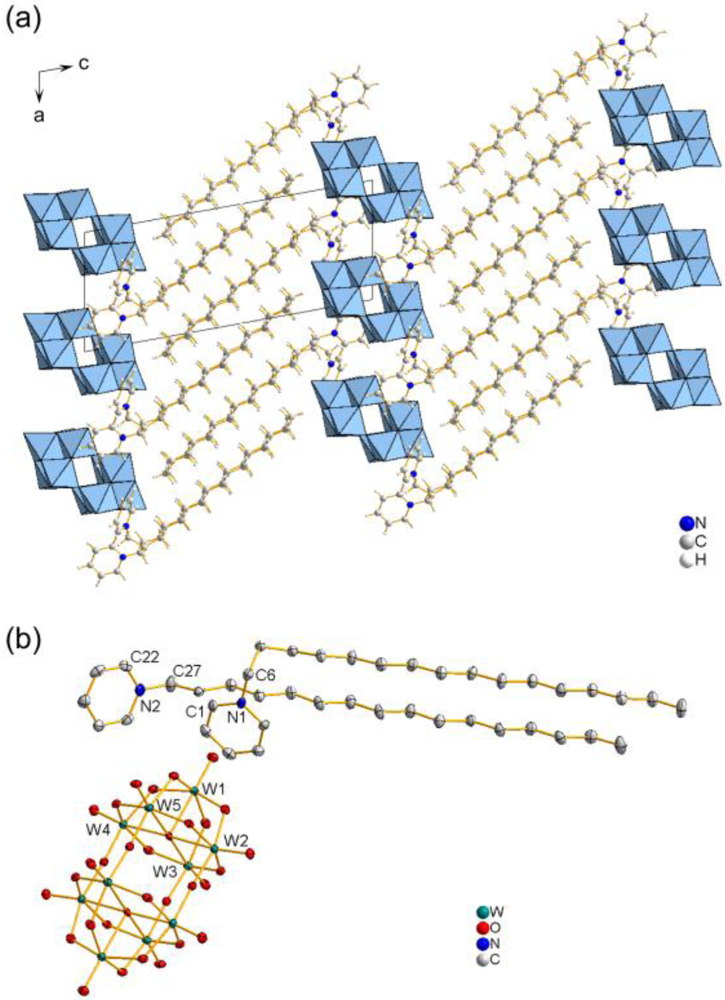
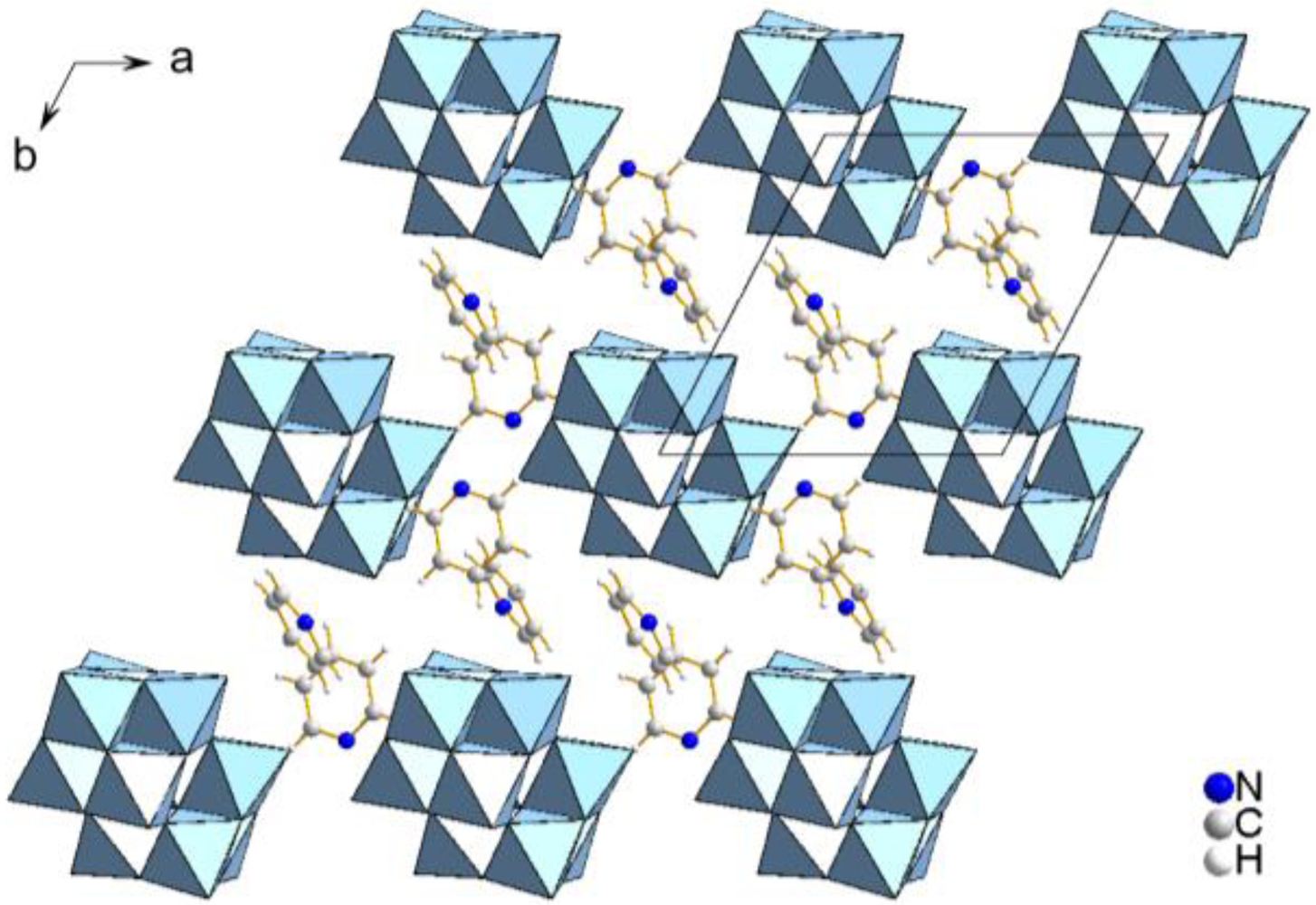
        <p>IR spectra of as-prepared precipitates, recrystallized samples, and crystals prepared with Na-W<sub>10</sub> showed the presence of C<sub>16</sub>py cations and W<sub>10</sub> anions. The single crystal X-ray structure analysis combined with the elemental analysis revealed the formula of C<sub>16</sub>py-W<sub>10</sub> to be [C<sub>5</sub>H<sub>5</sub>N(C<sub>16</sub>H<sub>33</sub>)]<sub>4</sub>[W<sub>10</sub>O<sub>32</sub>] (<xref ref-type="table" rid="crystals-02-00362-t001">Table 1</xref>). Four C<sub>16</sub>py cations (1+ charge) were associated with one W<sub>10</sub> anion (4− charge), and C<sub>16</sub>py-W<sub>10</sub> did not contain any H<sup>+</sup>. <xref ref-type="fig" rid="crystals-02-00362-f001">Figure 1</xref> shows the crystal structure of C<sub>16</sub>py-W<sub>10</sub>. The crystal packing consisted of alternating W<sub>10</sub> inorganic layers and C<sub>16</sub>py organic layers with periodicity of 23.3 Å (<xref ref-type="fig" rid="crystals-02-00362-f001">Figure 1</xref>). The W<sub>10</sub> anions formed monolayers, while the hexadecyl chains of C<sub>16</sub>py interdigitated to form a bilayer structure, which is a typical structure for most POM-surfactant hybrid crystals [<xref ref-type="bibr" rid="B26-crystals-02-00362">26</xref>,<xref ref-type="bibr" rid="B27-crystals-02-00362">27</xref>,<xref ref-type="bibr" rid="B28-crystals-02-00362">28</xref>,<xref ref-type="bibr" rid="B29-crystals-02-00362">29</xref>,<xref ref-type="bibr" rid="B30-crystals-02-00362">30</xref>,<xref ref-type="bibr" rid="B31-crystals-02-00362">31</xref>,<xref ref-type="bibr" rid="B32-crystals-02-00362">32</xref>]. All C–C bonds in the hexadecyl chains showed <italic>anti</italic> conformation except one C–C bond (C7–C8). While both C<sub>16</sub>py-W<sub>10</sub> and C<sub>16</sub>pyCl·H<sub>2</sub>O [<xref ref-type="bibr" rid="B39-crystals-02-00362">39</xref>] contained interdigitated bilayers of C<sub>16</sub>py with the pyridine ring inserted into the hydrophilic layers, the packing of hydrophilic layers was different; the W<sub>10</sub> monolayers for C<sub>16</sub>py-W<sub>10</sub> and the Cl<sup>–</sup>–H<sub>2</sub>O bilayers for C<sub>16</sub>pyCl·H<sub>2</sub>O. </p>
        <table-wrap id="crystals-02-00362-t001" position="anchor">
          <object-id pub-id-type="pii">crystals-02-00362-t001_Table 1</object-id>
          <label>Table 1</label>
          <caption>
            <p>Crystallographic data for C<sub>16</sub>py-W<sub>10</sub>.</p>
          </caption>
          <table>
            <tbody>
              <tr>
                <td align="left" valign="middle">Chemical formula</td>
                <td align="left" valign="middle">C<sub>84</sub>H<sub>152</sub>N<sub>4</sub>W<sub>10</sub>O<sub>32</sub></td>
              </tr>
              <tr>
                <td align="left" valign="middle">Formula weight</td>
                <td align="left" valign="middle">3568.54</td>
              </tr>
              <tr>
                <td align="left" valign="middle">Crystal system</td>
                <td align="left" valign="middle">triclinic</td>
              </tr>
              <tr>
                <td align="left" valign="middle">Space group </td>
                <td align="left" valign="middle"><italic>P </italic><inline-graphic xmlns:xlink="http://www.w3.org/1999/xlink" xlink:href="crystals-02-00362-i001.tif"/> (No.2)</td>
              </tr>
              <tr>
                <td align="left" valign="middle"><italic>a</italic> (Å)</td>
                <td align="left" valign="middle">10.7727 (12)</td>
              </tr>
              <tr>
                <td align="left" valign="middle"><italic>b</italic> (Å)</td>
                <td align="left" valign="middle">11.3734 (12)</td>
              </tr>
              <tr>
                <td align="left" valign="middle"><italic>c</italic> (Å)</td>
                <td align="left" valign="middle">23.982 (3)</td>
              </tr>
              <tr>
                <td align="left" valign="middle"><italic>α</italic> (°)</td>
                <td align="left" valign="middle">98.566 (4)</td>
              </tr>
              <tr>
                <td align="left" valign="middle"><italic>β</italic> (°)</td>
                <td align="left" valign="middle">95.298 (4)</td>
              </tr>
              <tr>
                <td align="left" valign="middle"><italic>γ</italic> (°)</td>
                <td align="left" valign="middle">116.168 (4)</td>
              </tr>
              <tr>
                <td align="left" valign="middle"><italic>V</italic> (Å<sup>3</sup>)</td>
                <td align="left" valign="middle">2566.1 (5)</td>
              </tr>
              <tr>
                <td align="left" valign="middle">
                  <italic>Z</italic>
                </td>
                <td align="left" valign="middle">1</td>
              </tr>
              <tr>
                <td align="left" valign="middle"><italic>ρ</italic><sub>calcd</sub> (g cm<sup>−3</sup>)</td>
                <td align="left" valign="middle">2.309</td>
              </tr>
              <tr>
                <td align="left" valign="middle"><italic>T</italic> (K)</td>
                <td align="left" valign="middle">213 (2)</td>
              </tr>
              <tr>
                <td align="left" valign="middle"><italic>μ</italic> (Mo Kα) (mm<sup>−1</sup>)</td>
                <td align="left" valign="middle">11.230</td>
              </tr>
              <tr>
                <td align="left" valign="middle">No. of reflections measured</td>
                <td align="left" valign="middle">41418</td>
              </tr>
              <tr>
                <td align="left" valign="middle">No. of independent reflections </td>
                <td align="left" valign="middle">11736</td>
              </tr>
              <tr>
                <td align="left" valign="middle">
                  <italic>R</italic>
                  <sub>int</sub>
                </td>
                <td align="left" valign="middle">0.0635</td>
              </tr>
              <tr>
                <td align="left" valign="middle">No. of parameters</td>
                <td align="left" valign="middle">587</td>
              </tr>
              <tr>
                <td align="left" valign="middle"><italic>R</italic><sub>1</sub> (<italic>I</italic> &gt; 2<italic>σ</italic>(<italic>I</italic>))</td>
                <td align="left" valign="middle">0.0354</td>
              </tr>
              <tr>
                <td align="left" valign="middle"><italic>wR</italic><sub>2</sub> (all data)</td>
                <td align="left" valign="middle">0.0842</td>
              </tr>
            </tbody>
          </table>
        </table-wrap>
        <fig id="crystals-02-00362-f001" position="anchor">
          <label>Figure 1</label>
          <caption>
            <p>Crystal structure of C<sub>16</sub>py-W<sub>10</sub>. (<bold>a</bold>) Packing diagram along <italic>b</italic> axis (W<sub>10</sub> in polyhedral representations); (<bold>b</bold>) Asymmetric unit together with atoms generated by the symmetry operation (−<italic>x</italic>, −<italic>y</italic>, −<italic>z</italic>,) to complete W<sub>10</sub> anion. Displacement ellipsoids are drawn at the 30% probability level, and H atoms are omitted for clarity. </p>
          </caption>
          <graphic xmlns:xlink="http://www.w3.org/1999/xlink" xlink:href="crystals-02-00362-g001.tif"/>
        </fig>
        <p>The hydrophilic heads of C<sub>16</sub>py penetrated into the W<sub>10</sub> inorganic monolayers and isolated each W<sub>10</sub> anion (<xref ref-type="fig" rid="crystals-02-00362-f002">Figure 2</xref>) in a similar way to that in the crystal of C<sub>16</sub>py-hexamolybdate (C<sub>16</sub>py-Mo<sub>6</sub>) [<xref ref-type="bibr" rid="B31-crystals-02-00362">31</xref>] or C<sub>16</sub>py-α-octamolybdate (C<sub>16</sub>py-α-Mo<sub>8</sub>) [<xref ref-type="bibr" rid="B32-crystals-02-00362">32</xref>]. On the other hand, two independent C<sub>16</sub>py cations were not parallel (angle: 52.6°) without π–π stacking, different from C<sub>16</sub>py-Mo<sub>6</sub> [<xref ref-type="bibr" rid="B31-crystals-02-00362">31</xref>] and C<sub>16</sub>py-α-Mo<sub>8</sub> [<xref ref-type="bibr" rid="B32-crystals-02-00362">32</xref>]. The C–H···π(centroid) distance was 3.32 Ǻ, and the nearest C–H bond (C24–H24) was not directed to the center of the pyridine ring. The shortest interatomic distance (C3···H24, 2.88 Ǻ) between the pyridine rings was almost the same as the sum of the van der Waals radii (2.90 Ǻ). Therefore, C–H···π interaction [<xref ref-type="bibr" rid="B40-crystals-02-00362">40</xref>,<xref ref-type="bibr" rid="B41-crystals-02-00362">41</xref>] was hardly observed in the present C<sub>16</sub>py-W<sub>10</sub>. </p>
        <fig id="crystals-02-00362-f002" position="anchor">
          <label>Figure 2</label>
          <caption>
            <p>Molecular arrangements in the inorganic layers of C<sub>16</sub>py-W<sub>10</sub>. The hexadecyl groups are omitted for clarity.</p>
          </caption>
          <graphic xmlns:xlink="http://www.w3.org/1999/xlink" xlink:href="crystals-02-00362-g002.tif"/>
        </fig>
        <p>C<sub>16</sub>py-W<sub>10</sub> had two-dimensionally confined monolayers of the W<sub>10</sub> anions (<xref ref-type="fig" rid="crystals-02-00362-f002">Figure 2</xref>). The distance between the nearest W<sub>10</sub> anions was 3.23 Å, much shorter than that for W<sub>10</sub> crystals composed of <italic>n</italic>-butyl- [<xref ref-type="bibr" rid="B42-crystals-02-00362">42</xref>,<xref ref-type="bibr" rid="B43-crystals-02-00362">43</xref>] or <italic>n</italic>-propylammonium [<xref ref-type="bibr" rid="B44-crystals-02-00362">44</xref>] (5.4–5.8 Å). The close distance between W<sub>10</sub> would contribute to the emergence of conductivity for C<sub>16</sub>py-W<sub>10</sub>. </p>
        <p>C<sub>16</sub>py-W<sub>10</sub> had C–H···O hydrogen bonds [<xref ref-type="bibr" rid="B40-crystals-02-00362">40</xref>] at the interface between the W<sub>10</sub> and C<sub>16</sub>py layers. The C···O distances were 3.28–3.88 Å (<xref ref-type="table" rid="crystals-02-00362-t002">Table 2</xref>). The mean value was 3.51 Å, and was shorter than the mean C···O distances (~3.6 Å) in other POM hybrid crystals containing the C<sub>16</sub>py cation [<xref ref-type="bibr" rid="B31-crystals-02-00362">31</xref>,<xref ref-type="bibr" rid="B32-crystals-02-00362">32</xref>]. These shorter hydrogen bonds as well as electrostatic interactions between C<sub>16</sub>py and W<sub>10</sub> would stabilize the layered crystal structure of C<sub>16</sub>py-W<sub>10</sub> with rigid packing. Most hydrogen bonds were formed between oxygen atoms of W<sub>10</sub> and the hydrophilic head of C<sub>16</sub>py (<italic>i.e.</italic>, pyridine rings or methylene groups near nitrogen).</p>
        <table-wrap id="crystals-02-00362-t002" position="anchor">
          <object-id pub-id-type="pii">crystals-02-00362-t002_Table 2</object-id>
          <label>Table 2</label>
          <caption>
            <p>C–H···O hydrogen bonds in C<sub>16</sub>py-W<sub>10</sub><italic>.</italic></p>
          </caption>
          <table>
            <thead>
              <tr>
                <th align="left" valign="middle"/>
                <th align="center" valign="middle">H···O (Ǻ)</th>
                <th align="center" valign="middle">C···O (Ǻ)</th>
                <th align="center" valign="middle">C-H···O (deg)</th>
              </tr>
            </thead>
            <tbody>
              <tr>
                <td align="left" valign="middle">C1 <sup>i</sup>–H1 <sup>i</sup>···O15</td>
                <td align="center" valign="middle">2.967(5)</td>
                <td align="center" valign="middle">3.880(9)</td>
                <td align="center" valign="middle">164.3(5)</td>
              </tr>
              <tr>
                <td align="left" valign="middle">C28 <sup>i</sup>–H28B <sup>i</sup>···O8</td>
                <td align="center" valign="middle">2.410(4)</td>
                <td align="center" valign="middle">3.318(7)</td>
                <td align="center" valign="middle">154.1(4)</td>
              </tr>
              <tr>
                <td align="left" valign="middle">C28–H28A···O5</td>
                <td align="center" valign="middle">2.795(3)</td>
                <td align="center" valign="middle">3.730(6)</td>
                <td align="center" valign="middle">159.8(4)</td>
              </tr>
              <tr>
                <td align="left" valign="middle">C3–H3···O2</td>
                <td align="center" valign="middle">2.634(4)</td>
                <td align="center" valign="middle">3.550(8)</td>
                <td align="center" valign="middle">164.7(5)</td>
              </tr>
              <tr>
                <td align="left" valign="middle">C21 <sup>iii</sup>–H21A <sup>iii</sup>···O2</td>
                <td align="center" valign="middle">2.476(4)</td>
                <td align="center" valign="middle">3.380(11)</td>
                <td align="center" valign="middle">155.2(5)</td>
              </tr>
              <tr>
                <td align="left" valign="middle">C26–H26···O4</td>
                <td align="center" valign="middle">2.534(4)</td>
                <td align="center" valign="middle">3.448(7)</td>
                <td align="center" valign="middle">164.5(5)</td>
              </tr>
              <tr>
                <td align="left" valign="middle">C6 <sup>ii</sup>–H6A <sup>ii</sup>···O4</td>
                <td align="center" valign="middle">2.384(5)</td>
                <td align="center" valign="middle">3.278(9)</td>
                <td align="center" valign="middle">151.3(4)</td>
              </tr>
            </tbody>
          </table>
		  <table-wrap-foot>
		  <fn>
          <p>Symmetry codes: (i) −1 + <italic>x</italic>, −1 + <italic>y</italic>, <italic>z</italic>; (ii) <italic>x</italic>, −1 + <italic>y</italic>, <italic>z</italic>; (iii) −<italic>x</italic>, 2-<italic>y</italic>, 1-<italic>z</italic>.</p>
		  </fn>
		  </table-wrap-foot>
        </table-wrap>
      </sec>
      <sec>
        <title>2.2. Powder X-Ray Diffraction (XRD) Patterns of C<sub>16</sub>py-W<sub>10</sub></title>
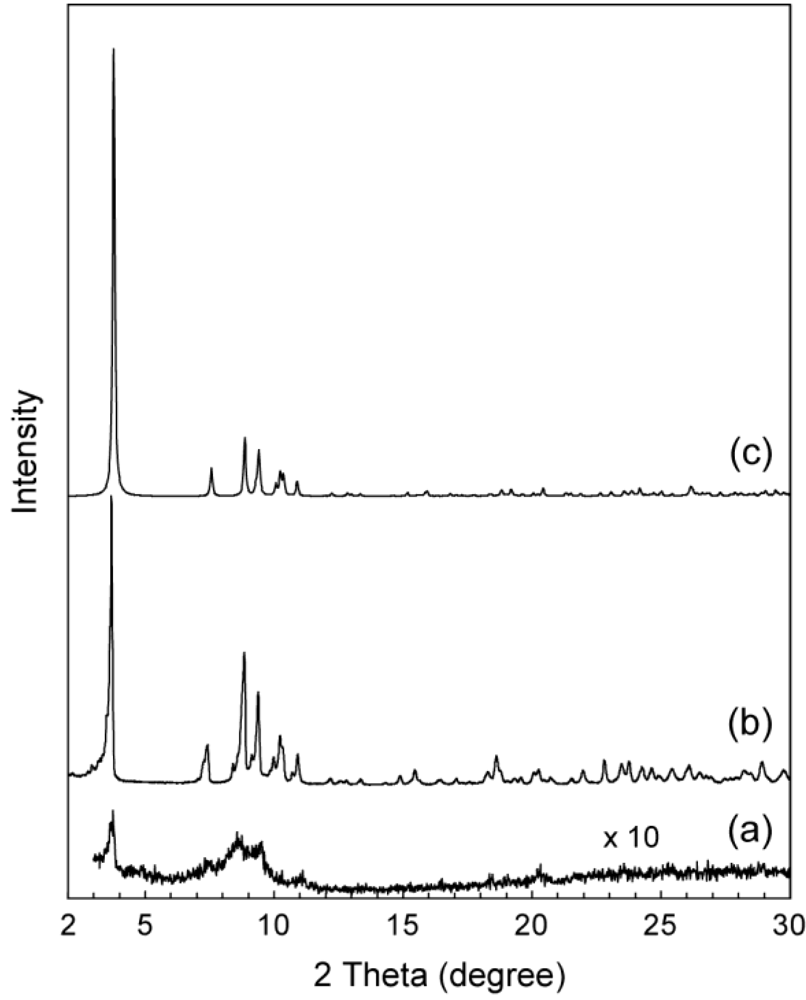
        <p>Powder XRD patterns of C<sub>16</sub>py-W<sub>10</sub> were measured at room temperature (<xref ref-type="fig" rid="crystals-02-00362-f003">Figure 3</xref>). The XRD pattern of as-prepared C<sub>16</sub>py-W<sub>10</sub> exhibited weak and broad peaks (<xref ref-type="fig" rid="crystals-02-00362-f003">Figure 3</xref>a). The XRD pattern of recrystallized C<sub>16</sub>py-W<sub>10</sub> showed much sharper and stronger peaks (<xref ref-type="fig" rid="crystals-02-00362-f003">Figure 3</xref>b), while the peak positions were close to those of the as-prepared C<sub>16</sub>py-W<sub>10</sub> (<xref ref-type="fig" rid="crystals-02-00362-f003">Figure 3</xref>a). This demonstrates that the structure of as-prepared C<sub>16</sub>py-W<sub>10</sub> is not changed by the recrystallization from hot acetonitrile. The pattern of the recrystallized C<sub>16</sub>py-W<sub>10</sub> (<xref ref-type="fig" rid="crystals-02-00362-f003">Figure 3</xref>b, <italic>a</italic> = 10.7588, <italic>b</italic> = 11.5068, <italic>c</italic> = 24.7480 Å, <italic>α</italic> = 99.914, <italic>β</italic> = 93.577, <italic>γ</italic> = 116.664°, <italic>V</italic> = 2662.9 Å<sup>3</sup> [<xref ref-type="bibr" rid="B45-crystals-02-00362">45</xref>]) was almost the same as that calculated with the single crystal X-ray analysis data (<xref ref-type="fig" rid="crystals-02-00362-f003">Figure 3</xref>c), indicating that the recrystallized C<sub>16</sub>py-W<sub>10</sub> is a single phase.</p>
        <fig id="crystals-02-00362-f003" position="anchor">
          <label>Figure 3</label>
          <caption>
            <p>Powder X-ray diffraction patterns of (<bold>a</bold>) as-prepared C<sub>16</sub>py-W<sub>10</sub> and (<bold>b</bold>) recrystallized C<sub>16</sub>py-W<sub>10</sub>, and that (<bold>c</bold>) calculated with single crystal data.</p>
          </caption>
          <graphic xmlns:xlink="http://www.w3.org/1999/xlink" xlink:href="crystals-02-00362-g003.tif"/>
        </fig>
      </sec>
      <sec>
        <title>2.3. Conductivity of C<sub>16</sub>py-W<sub>10</sub></title>
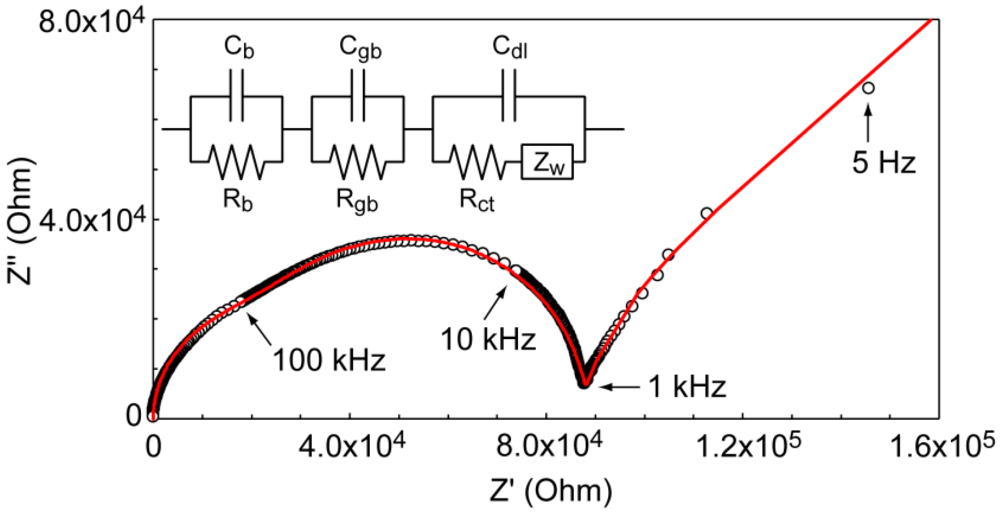
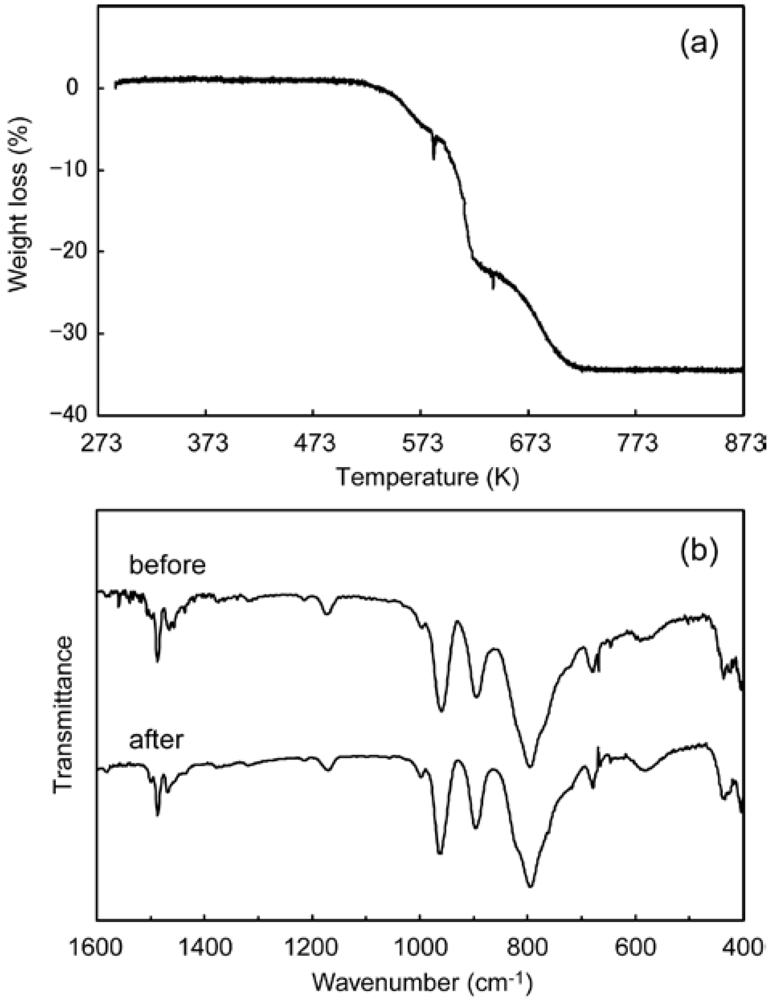
        <p><xref ref-type="fig" rid="crystals-02-00362-f004">Figure 4</xref> shows an impedance spectrum for the recrystallized C<sub>16</sub>py-W<sub>10</sub> at 423 K. The spectrum showed a suppressed half circle in the high- and medium-frequency regions and an inclined line in the low-frequency region. The suppressed half circle consisted of two partially overlapped semicircles due to bulk and grain boundary resistances. The linear part in the low-frequency region would result from a combination of charge transfer resistance and Warburg impedance related to the diffusion of the carrier. The equivalent circuit [<xref ref-type="bibr" rid="B46-crystals-02-00362">46</xref>,<xref ref-type="bibr" rid="B47-crystals-02-00362">47</xref>,<xref ref-type="bibr" rid="B48-crystals-02-00362">48</xref>] is shown in <xref ref-type="fig" rid="crystals-02-00362-f004">Figure 4</xref>: <italic>R</italic><sub>b</sub> and <italic>C</italic><sub>b</sub> are the resistance and capacitance of the bulk, respectively. <italic>R</italic><sub>gb</sub> and <italic>C</italic><sub>gb</sub> are the resistance and capacitance, respectively, of the grain boundary. <italic>R</italic><sub>ct</sub> and <italic>C</italic><sub>dl</sub> are the charge transfer resistance and double layer capacitance, respectively. <italic>Z</italic><sub>W</sub> is the Warburg impedance. The red line in <xref ref-type="fig" rid="crystals-02-00362-f004">Figure 4</xref> represents fitted data with the equivalent circuit described above (<xref ref-type="fig" rid="crystals-02-00362-f004">Figure 4</xref>, inset), which successfully reproduces the measured impedance spectrum. The value of <italic>R</italic><sub>b</sub> obtained by the fitting was 2.25 × 10<sup>4</sup> Ω, from which the conductivity of the bulk C<sub>16</sub>py-W<sub>10</sub> was estimated to be 4.8 × 10<sup>−6</sup> S cm<sup>−1</sup> considering uncertainty. The estimated value of <italic>C</italic><sub>b</sub> was 1.01 × 10<sup>−6</sup> F, resulting in the time constant for the process in the bulk (<italic>R</italic><sub>b</sub> × <italic>C</italic><sub>b</sub>) of 2.27 × 10<sup>−2</sup> s. This short time constant suggests that the bulk process occurs by electronic conduction [<xref ref-type="bibr" rid="B47-crystals-02-00362">47</xref>], in good agreement with the fact that C<sub>16</sub>py-W<sub>10</sub> contains no easily moving ion such as H<sup>+</sup>. <xref ref-type="fig" rid="crystals-02-00362-f005">Figure 5</xref> shows the thermogravimetric (TG) curve and IR spectra of recrystallized C<sub>16</sub>py-W<sub>10</sub>. No weight loss was observed below 523 K. The weight of C<sub>16</sub>py-W<sub>10</sub> decreased by 36% from 523 K to 723 K (<xref ref-type="fig" rid="crystals-02-00362-f005">Figure 5</xref>a), which was attributed to the decomposition and removal of the C<sub>16</sub>py cations. The crystallinity of C<sub>16</sub>py-W<sub>10</sub> revealed by powder XRD decreased after the impedance spectroscopy measurements (not shown). However, IR spectra before and after the measurements at 423 K (<xref ref-type="fig" rid="crystals-02-00362-f005">Figure 5</xref>b) exhibited characteristic peaks for the W<sub>10</sub> anion in the range of 400–1000 cm<sup>−1</sup> [<xref ref-type="bibr" rid="B49-crystals-02-00362">49</xref>], demonstrating that the molecular structure of W<sub>10</sub> was retained after heating at 423 K. These results indicate that C<sub>16</sub>py-W<sub>10</sub> is thermally stable below 423 K. </p>
        <fig id="crystals-02-00362-f004" position="anchor">
          <label>Figure 4</label>
          <caption>
            <p>Nyquist spectrum (open circles) of recrystallized C<sub>16</sub>py-W<sub>10</sub> at 423 K and simulated spectrum (red line) based on an equivalent electronic circuit in the figure. The parameters obtained by the fitting (see text) are as follows: <italic>R</italic><sub>b</sub> = 2.25 × 10<sup>4</sup> Ω, <italic>C</italic><sub>b</sub> = 1.01 × 10<sup>−6</sup> F, <italic>R</italic><sub>gb</sub> = 6.55 × 10<sup>4</sup> Ω, <italic>C</italic><sub>gb</sub> = 2.50 × 10<sup>−6</sup> F, <italic>R</italic><sub>ct</sub> = 3.50 × 10<sup>4</sup> Ω, <italic>C</italic><sub>dl</sub> = 9.0 × 10<sup>−4</sup> F, <italic>σ</italic> = 4.2 × 10<sup>3</sup> Ω s<sup>−1/2</sup> (<italic>Z</italic><sub>w</sub> = <inline-graphic xmlns:xlink="http://www.w3.org/1999/xlink" xlink:href="crystals-02-00362-i002.tif"/>).</p>
          </caption>
          <graphic xmlns:xlink="http://www.w3.org/1999/xlink" xlink:href="crystals-02-00362-g004.tif"/>
        </fig>
        <fig id="crystals-02-00362-f005" position="anchor">
          <label>Figure 5</label>
          <caption>
            <p>(<bold>a</bold>) TG curve of recrystallized C<sub>16</sub>py-W<sub>10</sub>; (<bold>b</bold>) IR spectra of recrystallized C<sub>16</sub>py-W<sub>10</sub> before and after the impedance spectroscopy measurements at 423 K.</p>
          </caption>
          <graphic xmlns:xlink="http://www.w3.org/1999/xlink" xlink:href="crystals-02-00362-g005.tif"/>
        </fig>
        <p>The conductivity of C<sub>16</sub>py-W<sub>10</sub>was much lower than the radical salts of POM containing organic donor such as <italic>bis</italic>(ethylenedithio)tetrathiafulvalene [<xref ref-type="bibr" rid="B2-crystals-02-00362">2</xref>,<xref ref-type="bibr" rid="B3-crystals-02-00362">3</xref>]. These radical salts have conductive layers of organic donor, which possibly leads to three-dimensional conduction. On the other hand, the conductivity of C<sub>16</sub>py-W<sub>10</sub>is considered to be two-dimensional along the inorganic layers composed of W<sub>10</sub> and pyridinium hydrophilic heads (<italic>ab</italic> plane in the crystal). The anisotropy of the conductivity was difficult to investigate because large single crystals were not obtained. The conductivity of C<sub>16</sub>py-W<sub>10</sub> reported here was measured for pelletized ground powder, and is considered to be averaged and overall conductivity. Although the conductivity of C<sub>16</sub>py-W<sub>10</sub> was not so high, these results suggest that appropriate combination of POMs as electron reservoirs and surfactants with π-electrons would pave the way to another class of hybrid conductors. </p>
      </sec>
    </sec>
    <sec>
      <title>3. Experimental Section</title>
      <sec>
        <title>3.1. Syntheses and Methods</title>
        <p>All chemical reagents were obtained from commercial sources. C<sub>16</sub>py-W<sub>10</sub> was synthesized according to a modified procedure of the preparation of tetrabutylammonium salt of W<sub>10</sub> [<xref ref-type="bibr" rid="B49-crystals-02-00362">49</xref>]. 4.0 g (12.1 mmol) of Na<sub>2</sub>WO<sub>4</sub>·2H<sub>2</sub>O was dissolved in 25 mL of water, and then the solution was boiled and acidified with 8.4 mL of boiling 3 M HCl solution (25 mmol) with vigorous stirring. After boiling for 2 min, 1.9 g (5.3 mmol) of [C<sub>5</sub>H<sub>5</sub>N(C<sub>16</sub>H<sub>33</sub>)]Cl·H<sub>2</sub>O (C<sub>16</sub>pyCl·H<sub>2</sub>O) in water/ethanol (20 mL, 1:1 (<italic>v</italic>/<italic>v</italic>)) was added to form white precipitates followed by filtration and suction to dryness. Recrystallization of the crude product from hot acetonitrile gave colorless plates. The single crystals were obtained by drying up an acetonitrile solution of C<sub>16</sub>py-W<sub>10</sub>, which was obtained by the cation exchange of sodium salt of W<sub>10</sub> (Na-W<sub>10</sub>) [<xref ref-type="bibr" rid="B34-crystals-02-00362">34</xref>]. Data for C<sub>16</sub>py-W<sub>10</sub> (single crystals): Anal. Calcd for C<sub>84</sub>H<sub>152</sub>N<sub>4</sub>W<sub>10</sub>O<sub>32</sub>: C, 28.3; H, 4.3; N, 1.6%. Found: C, 28.4; H, 3.8; N, 1.6%. IR (KBr disk): 952 (m), 917 (s), 859 (m), 806 (s), 720 (w), 668 (m), 554 (w) cm<sup>−1</sup>. </p>
        <p>IR spectra (as KBr pellet) were recorded on Jasco FT-IR 5000 and Horiba FT-710 spectrometers. Thermogravimetric and differential thermal analyses (TG-DTA) were performed on an ULVAC MTS9000 + TGD9600 system. Conductivity measurements were carried out by the alternating current (AC) impedance method in a frequency range from 5 Hz to 13 MHz using an Agilent 4192A inductance-capacitance-resistance (LCR) meter. Pelletized powder samples of recrystallized C<sub>16</sub>py-W<sub>10</sub> (10 mm in diameter, 0.854 mm in thickness) were sandwiched with Pt electrodes, and the impedance was measured under a dry Ar atmosphere at 423 K. Bulk resistances and conductivities of C<sub>16</sub>py-W<sub>10</sub> were estimated by the fitting of typical Nyquist plots.</p>
      </sec>
      <sec>
        <title>3.2. X-ray Diffraction Measurements</title>
        <p>Single crystal X-ray diffraction measurements for C<sub>16</sub>py-W<sub>10</sub> were made on a Rigaku RAXIS RAPID imaging plate diffractometer with graphite monochromated Mo-Kα radiation (<italic>λ</italic> = 0.71075 Å). Diffraction data were collected for a platelet crystal (0.30 × 0.30 × 0.02 mm) and processed with PROCESS-AUTO [<xref ref-type="bibr" rid="B50-crystals-02-00362">50</xref>]. The structure was solved by heavy-atom Patterson methods [<xref ref-type="bibr" rid="B51-crystals-02-00362">51</xref>] and expanded using Fourier techniques [<xref ref-type="bibr" rid="B52-crystals-02-00362">52</xref>]. The refinement procedure was performed by the full-matrix least-squares using SHELXL97 [<xref ref-type="bibr" rid="B53-crystals-02-00362">53</xref>]. All calculations were performed using the CrystalStructure [<xref ref-type="bibr" rid="B54-crystals-02-00362">54</xref>] software package. Numerical absorption correction was performed for the observed data. In the refinement procedure, all non-hydrogen atoms were refined anisotropically, and the hydrogen atoms on C atoms were located in calculated positions. Further details of the crystal structure investigation may be obtained free of charge from the Cambridge Crystallographic Data Centre, 12 Union Road, Cambridge CB2 1EZ, UK; Fax: +44-1223-336-033; or Email: deposit@ccdc.cam.ac.uk (CCDC-865932).</p>
        <p>Powder X-ray diffraction (XRD) patterns for C<sub>16</sub>py-W<sub>10</sub> were measured with a XRD-DSCII (Rigaku Corporation) diffractometer by using Cu <italic>K</italic>α radiation (<italic>λ</italic> = 1.54056 Å, 50 kV-300 mA) at ambient temperature. A powder C<sub>16</sub>py-W<sub>10</sub> sample was sieved in a 200 mesh sieve to remove large particles and to avoid preferred orientation. Diffraction data were collected in the range of 2<italic>θ</italic> = 2–30° at 0.01° point and 5 s/step. The lattice parameters were calculated using Materials Studio Softwares (Accelrys Inc.) by the peak profile fitting using the Pawley refinement [<xref ref-type="bibr" rid="B55-crystals-02-00362">55</xref>].</p>
      </sec>
    </sec>
    <sec sec-type="conclusions">
      <title>4. Conclusions</title>
      <p>Decatungstate-hexadecylpyridinium hybrid layered crystal, [C<sub>5</sub>H<sub>5</sub>N(C<sub>16</sub>H<sub>33</sub>)]<sub>4</sub>[W<sub>10</sub>O<sub>32</sub>] (C<sub>16</sub>py-W<sub>10</sub>), was successfully synthesized by a simple cation-exchange reaction. C<sub>16</sub>py-W<sub>10</sub> was obtained as a single phase, and the crystal structure was determined by single crystal X-ray diffraction. C<sub>16</sub>py-W<sub>10</sub> contained the stacking of W<sub>10</sub> monolayers and C<sub>16</sub>py interdigitated bilayers. The alternating current (AC) impedance spectroscopy measurements revealed the conductivity of C<sub>16</sub>py-W<sub>10</sub> to be 4.8 × 10<sup>−6</sup> S cm<sup>−1</sup> at 423 K. Although the conductivity was considerably lower than the radical salts of POM [<xref ref-type="bibr" rid="B2-crystals-02-00362">2</xref>,<xref ref-type="bibr" rid="B3-crystals-02-00362">3</xref>] or other layered materials [<xref ref-type="bibr" rid="B5-crystals-02-00362">5</xref>,<xref ref-type="bibr" rid="B6-crystals-02-00362">6</xref>], C<sub>16</sub>py-W<sub>10</sub> shows the potential of polyoxometalate-surfactant hybrid crystals as conductive materials.</p>
    </sec>
  </body>
  <back>
    <ack>
      <title>Acknowledgments</title>
      <p>This work was supported in part by JSPS Grant-in-Aid for Scientific Research (No. 23750246), Nippon Sheet Glass Foundation, and Iketani Science and Technology Foundation.</p>
    </ack>
    <ref-list>
      <title>References and Notes</title>
      <ref id="B1-crystals-02-00362">
        <label>1.</label>
        <citation citation-type="book">
          <person-group person-group-type="author">
            <name>
              <surname>Batail</surname>
              <given-names>P.</given-names>
            </name>
          </person-group>
          <article-title>Molecular Conductors</article-title>
          <source>Chemical Reviews</source>
          <person-group person-group-type="editor">
            <name>
              <surname>Josef</surname>
              <given-names>Michl</given-names>
            </name>
          </person-group>
          <publisher-name>American Chemical Society</publisher-name>
          <publisher-loc>Washington, DC, USA</publisher-loc>
          <year>2004</year>
          <volume>104</volume>
          <fpage>4887</fpage>
          <lpage>5782</lpage>
        </citation>
      </ref>
      <ref id="B2-crystals-02-00362">
        <label>2.</label>
        <citation citation-type="journal">
          <person-group person-group-type="author">
            <name>
              <surname>Coronado</surname>
              <given-names>E.</given-names>
            </name>
            <name>
              <surname>Gómez-García</surname>
              <given-names>C.J.</given-names>
            </name>
          </person-group>
          <article-title>Polyoxometalate-based molecular materials</article-title>
          <source>Chem. Rev.</source>
          <year>1998</year>
          <volume>98</volume>
          <fpage>273</fpage>
          <lpage>296</lpage>
        <pub-id pub-id-type="doi">10.1021/cr970471c</pub-id><pub-id pub-id-type="pmid">11851506</pub-id></citation>
      </ref>
      <ref id="B3-crystals-02-00362">
        <label>3.</label>
        <citation citation-type="journal">
          <person-group person-group-type="author">
            <name>
              <surname>Coronado</surname>
              <given-names>E.</given-names>
            </name>
            <name>
              <surname>Giménez-Saiz</surname>
              <given-names>C.</given-names>
            </name>
            <name>
              <surname>Gómez-García</surname>
              <given-names>C.J.</given-names>
            </name>
          </person-group>
          <article-title>Recent advances in polyoxometalate-containing molecular conductors</article-title>
          <source>Coord. Chem. Rev.</source>
          <year>2005</year>
          <volume>249</volume>
          <fpage>1776</fpage>
          <lpage>1796</lpage>
        <pub-id pub-id-type="doi">10.1016/j.ccr.2005.02.017</pub-id></citation>
      </ref>
      <ref id="B4-crystals-02-00362">
        <label>4.</label>
        <citation citation-type="journal">
          <person-group person-group-type="author">
            <name>
              <surname>Kato</surname>
              <given-names>R.</given-names>
            </name>
          </person-group>
          <article-title>Conductive copper salts of 2,5-disubstituted <italic>N</italic>,<italic>N'</italic>-dicyanobenzoquinonediimines (DCNQIs): structural and physical properties</article-title>
          <source>Bull. Chem. Soc. Jpn.</source>
          <year>2000</year>
          <volume>73</volume>
          <fpage>515</fpage>
          <lpage>534</lpage>
          <pub-id pub-id-type="doi">10.1246/bcsj.73.515</pub-id>
        </citation>
      </ref>
      <ref id="B5-crystals-02-00362">
        <label>5.</label>
        <citation citation-type="book">
          <person-group person-group-type="author">
            <name>
              <surname>Casciola</surname>
              <given-names>M.</given-names>
            </name>
          </person-group>
          <article-title>Ionic Conductivity in Layered Materials</article-title>
          <source>Comprehensive Supramolecular Chemistry</source>
          <person-group person-group-type="editor">
            <name>
              <surname>Atwood</surname>
              <given-names>J.L.</given-names>
            </name>
            <name>
              <surname>Davies</surname>
              <given-names>J.E.D.</given-names>
            </name>
            <name>
              <surname>MacNicol</surname>
              <given-names>D.D.</given-names>
            </name>
            <name>
              <surname>Vögtle</surname>
              <given-names>F.</given-names>
            </name>
          </person-group>
          <publisher-name>Elsevier Science</publisher-name>
          <publisher-loc>Oxford, UK</publisher-loc>
          <year>1996</year>
          <volume>7</volume>
          <fpage>355</fpage>
          <lpage>378</lpage>
        </citation>
      </ref>
      <ref id="B6-crystals-02-00362">
        <label>6.</label>
        <citation citation-type="journal">
          <person-group person-group-type="author">
            <name>
              <surname>Wu</surname>
              <given-names>C.-G.</given-names>
            </name>
            <name>
              <surname>DeGroot</surname>
              <given-names>D.C.</given-names>
            </name>
            <name>
              <surname>Marcy</surname>
              <given-names>H.O.</given-names>
            </name>
            <name>
              <surname>Schindler</surname>
              <given-names>J.L.</given-names>
            </name>
            <name>
              <surname>Kannewurf</surname>
              <given-names>C.R.</given-names>
            </name>
            <name>
              <surname>Liu</surname>
              <given-names>Y.-J.</given-names>
            </name>
            <name>
              <surname>Hirpo</surname>
              <given-names>W.</given-names>
            </name>
            <name>
              <surname>Kanatzidis</surname>
              <given-names>M.G.</given-names>
            </name>
          </person-group>
          <article-title>Redox intercalative polymerization of aniline in V<sub>2</sub>O<sub>5</sub> xerogel. the postintercalative intralamellar polymer growth in polyaniline/metal oxide nanocomposites is facilitated by molecular oxygen</article-title>
          <source>Chem. Mater.</source>
          <year>1996</year>
          <volume>8</volume>
          <fpage>1992</fpage>
          <lpage>2004</lpage>
        <pub-id pub-id-type="doi">10.1021/cm9600236</pub-id></citation>
      </ref>
      <ref id="B7-crystals-02-00362">
        <label>7.</label>
        <citation citation-type="journal">
          <person-group person-group-type="author">
            <name>
              <surname>Ruiz-Hitzky</surname>
              <given-names>E.</given-names>
            </name>
            <name>
              <surname>Aranda</surname>
              <given-names>P.</given-names>
            </name>
            <name>
              <surname>Darder</surname>
              <given-names>M.</given-names>
            </name>
            <name>
              <surname>Ogawa</surname>
              <given-names>M.</given-names>
            </name>
          </person-group>
          <article-title>Hybrid and biohybrid silicate based materials: Molecular <italic>vs.</italic> block-assembling bottom–up processes</article-title>
          <source>Chem. Soc. Rev.</source>
          <year>2011</year>
          <volume>40</volume>
          <fpage>801</fpage>
          <lpage>828</lpage>
          <pub-id pub-id-type="doi">10.1039/c0cs00052c</pub-id>
        </citation>
      </ref>
      <ref id="B8-crystals-02-00362">
        <label>8.</label>
        <citation citation-type="journal">
          <person-group person-group-type="author">
            <name>
              <surname>Cao</surname>
              <given-names>M.</given-names>
            </name>
            <name>
              <surname>Djerdj</surname>
              <given-names>I.</given-names>
            </name>
            <name>
              <surname>Jagličić</surname>
              <given-names>Z.</given-names>
            </name>
            <name>
              <surname>Antonietti</surname>
              <given-names>M.</given-names>
            </name>
            <name>
              <surname>Niederberger</surname>
              <given-names>M.</given-names>
            </name>
          </person-group>
          <article-title>Layered hybrid organic–inorganic nanobelts exhibiting a field-inducedmagnetic transition</article-title>
          <source>Phys. Chem. Chem. Phys.</source>
          <year>2009</year>
          <volume>11</volume>
          <fpage>6166</fpage>
          <lpage>6172</lpage>
        <pub-id pub-id-type="doi">10.1039/b820913h</pub-id><pub-id pub-id-type="pmid">19606326</pub-id></citation>
      </ref>
      <ref id="B9-crystals-02-00362">
        <label>9.</label>
        <citation citation-type="journal">
          <person-group person-group-type="author">
            <name>
              <surname>Song</surname>
              <given-names>Y.-F.</given-names>
            </name>
            <name>
              <surname>McMillan</surname>
              <given-names>N.</given-names>
            </name>
            <name>
              <surname>Long</surname>
              <given-names>D.-L.</given-names>
            </name>
            <name>
              <surname>Thiel</surname>
              <given-names>J.</given-names>
            </name>
            <name>
              <surname>Ding</surname>
              <given-names>Y.</given-names>
            </name>
            <name>
              <surname>Chen</surname>
              <given-names>H.</given-names>
            </name>
            <name>
              <surname>Gadegaard</surname>
              <given-names>N.</given-names>
            </name>
            <name>
              <surname>Cronin</surname>
              <given-names>L.</given-names>
            </name>
          </person-group>
          <article-title>Design of hydrophobic polyoxometalate hybrid assemblies beyond surfactant encapsulation</article-title>
          <source>Chem. Eur. J.</source>
          <year>2008</year>
          <volume>14</volume>
          <fpage>2349</fpage>
          <lpage>2354</lpage>
        <pub-id pub-id-type="doi">10.1002/chem.200701629</pub-id><pub-id pub-id-type="pmid">18260071</pub-id></citation>
      </ref>
      <ref id="B10-crystals-02-00362">
        <label>10.</label>
        <citation citation-type="journal">
          <person-group person-group-type="author">
            <name>
              <surname>Yan</surname>
              <given-names>Y.</given-names>
            </name>
            <name>
              <surname>Wang</surname>
              <given-names>H.</given-names>
            </name>
            <name>
              <surname>Li</surname>
              <given-names>B.</given-names>
            </name>
            <name>
              <surname>Hou</surname>
              <given-names>G.</given-names>
            </name>
            <name>
              <surname>Yin</surname>
              <given-names>Z.</given-names>
            </name>
            <name>
              <surname>Wu</surname>
              <given-names>L.</given-names>
            </name>
            <name>
              <surname>Yam</surname>
              <given-names>V.W.W.</given-names>
            </name>
          </person-group>
          <article-title>Smart self-assemblies based on a surfactant-encapsulated photoresponsive polyoxometalate complex</article-title>
          <source>Angew. Chem. Int. Ed.</source>
          <year>2010</year>
          <volume>49</volume>
          <fpage>9233</fpage>
          <lpage>9236</lpage>
        <pub-id pub-id-type="doi">10.1002/anie.201004143</pub-id></citation>
      </ref>
      <ref id="B11-crystals-02-00362">
        <label>11.</label>
        <citation citation-type="journal">
          <person-group person-group-type="author">
            <name>
              <surname>Inumaru</surname>
              <given-names>K.</given-names>
            </name>
            <name>
              <surname>Ishihara</surname>
              <given-names>T.</given-names>
            </name>
            <name>
              <surname>Kamiya</surname>
              <given-names>Y.</given-names>
            </name>
            <name>
              <surname>Okuhara</surname>
              <given-names>T.</given-names>
            </name>
            <name>
              <surname>Yamanaka</surname>
              <given-names>S.</given-names>
            </name>
          </person-group>
          <article-title>Water-tolerant, highly active solid acid catalysts composed of the Keggin-type polyoxometalate H<sub>3</sub>PW<sub>12</sub>O<sub>40</sub> immobilized in hydrophobic nanospaces of organomodified mesoporous silica</article-title>
          <source>Angew. Chem. Int. Ed.</source>
          <year>2007</year>
          <volume>46</volume>
          <fpage>7625</fpage>
          <lpage>7628</lpage>
        <pub-id pub-id-type="doi">10.1002/anie.200702478</pub-id></citation>
      </ref>
      <ref id="B12-crystals-02-00362">
        <label>12.</label>
        <citation citation-type="book">
          <person-group person-group-type="author">
            <name>
              <surname>Pope</surname>
              <given-names>M.T.</given-names>
            </name>
          </person-group>
          <source>Heteropoly and Isopoly Oxometalates</source>
          <publisher-name>Springer</publisher-name>
          <publisher-loc>Berlin, Germany</publisher-loc>
          <year>1983</year>
        </citation>
      </ref>
      <ref id="B13-crystals-02-00362">
        <label>13.</label>
        <citation citation-type="journal">
          <person-group person-group-type="author">
            <name>
              <surname>Long</surname>
              <given-names>D.-L.</given-names>
            </name>
            <name>
              <surname>Burkholder</surname>
              <given-names>E.</given-names>
            </name>
            <name>
              <surname>Cronin</surname>
              <given-names>L.</given-names>
            </name>
          </person-group>
          <article-title>Polyoxometalate clusters, nanostructures and materials: From self assembly to designer materials and devices</article-title>
          <source>Chem. Soc. Rev.</source>
          <year>2007</year>
          <volume>36</volume>
          <fpage>105</fpage>
          <lpage>121</lpage>
        <pub-id pub-id-type="doi">10.1039/b502666k</pub-id><pub-id pub-id-type="pmid">17173149</pub-id></citation>
      </ref>
      <ref id="B14-crystals-02-00362">
        <label>14.</label>
        <citation citation-type="journal">
          <person-group person-group-type="author">
            <name>
              <surname>Proust</surname>
              <given-names>A.</given-names>
            </name>
            <name>
              <surname>Thouvenot</surname>
              <given-names>R.</given-names>
            </name>
            <name>
              <surname>Gouzerh</surname>
              <given-names>P.</given-names>
            </name>
          </person-group>
          <article-title>Functionalization of polyoxometalates: Towards advanced applications in catalysis and materials science</article-title>
          <source>Chem. Commun.</source>
          <year>2008</year>
          <fpage>1837</fpage>
          <lpage>1852</lpage>
        </citation>
      </ref>
      <ref id="B15-crystals-02-00362">
        <label>15.</label>
        <citation citation-type="journal">
          <person-group person-group-type="author">
            <name>
              <surname>Okuhara</surname>
              <given-names>T.</given-names>
            </name>
            <name>
              <surname>Mizuno</surname>
              <given-names>N.</given-names>
            </name>
            <name>
              <surname>Misono</surname>
              <given-names>M.</given-names>
            </name>
          </person-group>
          <article-title>Catalytic chemistry of heteropoly compounds</article-title>
          <source>Adv. Catal.</source>
          <year>1996</year>
          <volume>41</volume>
          <fpage>113</fpage>
          <lpage>252</lpage>
        </citation>
      </ref>
      <ref id="B16-crystals-02-00362">
        <label>16.</label>
        <citation citation-type="journal">
          <person-group person-group-type="author">
            <name>
              <surname>Sadakane</surname>
              <given-names>M.</given-names>
            </name>
            <name>
              <surname>Steckhan</surname>
              <given-names>E.</given-names>
            </name>
          </person-group>
          <article-title>Electrochemical properties of polyoxometalates as electrocatalysts</article-title>
          <source>Chem. Rev.</source>
          <year>1998</year>
          <volume>98</volume>
          <fpage>219</fpage>
          <lpage>237</lpage>
        <pub-id pub-id-type="doi">10.1021/cr960403a</pub-id><pub-id pub-id-type="pmid">11851504</pub-id></citation>
      </ref>
      <ref id="B17-crystals-02-00362">
        <label>17.</label>
        <citation citation-type="journal">
          <person-group person-group-type="author">
            <name>
              <surname>Huo</surname>
              <given-names>Q.</given-names>
            </name>
            <name>
              <surname>Margolese</surname>
              <given-names>D.I.</given-names>
            </name>
            <name>
              <surname>Ciesla</surname>
              <given-names>U.</given-names>
            </name>
            <name>
              <surname>Demuth</surname>
              <given-names>D.G.</given-names>
            </name>
            <name>
              <surname>Feng</surname>
              <given-names>P.</given-names>
            </name>
            <name>
              <surname>Gier</surname>
              <given-names>T.E.</given-names>
            </name>
            <name>
              <surname>Sieger</surname>
              <given-names>P.</given-names>
            </name>
            <name>
              <surname>Firouzi</surname>
              <given-names>A.</given-names>
            </name>
            <name>
              <surname>Chmelka</surname>
              <given-names>B.F.</given-names>
            </name>
            <name>
              <surname>Schüth</surname>
              <given-names>F.</given-names>
            </name>
            <etal/>
          </person-group>
          <article-title>Organization of organic molecules with inorganic molecular species into nanocomposite biphase arrays</article-title>
          <source>Chem. Mater.</source>
          <year>1994</year>
          <volume>6</volume>
          <fpage>1176</fpage>
          <lpage>1191</lpage>
          <pub-id pub-id-type="doi">10.1021/cm00044a016</pub-id>
        </citation>
      </ref>
      <ref id="B18-crystals-02-00362">
        <label>18.</label>
        <citation citation-type="journal">
          <person-group person-group-type="author">
            <name>
              <surname>Kanatzidis</surname>
              <given-names>M.G.</given-names>
            </name>
          </person-group>
          <article-title>Beyond silica: Nonoxidic mesostructured materials</article-title>
          <source>Adv. Mater.</source>
          <year>2007</year>
          <volume>19</volume>
          <fpage>1165</fpage>
          <lpage>1181</lpage>
        <pub-id pub-id-type="doi">10.1002/adma.200601763</pub-id></citation>
      </ref>
      <ref id="B19-crystals-02-00362">
        <label>19.</label>
        <citation citation-type="journal">
          <person-group person-group-type="author">
            <name>
              <surname>Yamauchi</surname>
              <given-names>Y.</given-names>
            </name>
            <name>
              <surname>Kuroda</surname>
              <given-names>K.</given-names>
            </name>
          </person-group>
          <article-title>Rational design of mesoporous metals and related nanomaterials by a soft-template approach</article-title>
          <source>Chem. Asian J.</source>
          <year>2008</year>
          <volume>3</volume>
          <fpage>664</fpage>
          <lpage>676</lpage>
        <pub-id pub-id-type="doi">10.1002/asia.200700350</pub-id><pub-id pub-id-type="pmid">18327878</pub-id></citation>
      </ref>
      <ref id="B20-crystals-02-00362">
        <label>20.</label>
        <citation citation-type="journal">
          <person-group person-group-type="author">
            <name>
              <surname>Stein</surname>
              <given-names>A.</given-names>
            </name>
            <name>
              <surname>Fendorf</surname>
              <given-names>M.</given-names>
            </name>
            <name>
              <surname>Jarvie</surname>
              <given-names>T.P.</given-names>
            </name>
            <name>
              <surname>Mueller</surname>
              <given-names>K.T.</given-names>
            </name>
            <name>
              <surname>Benesi</surname>
              <given-names>A.J.</given-names>
            </name>
            <name>
              <surname>Mallouk</surname>
              <given-names>T.E.</given-names>
            </name>
          </person-group>
          <article-title>Salt-gel synthesis of porous transition-metal oxides</article-title>
          <source>Chem. Mater.</source>
          <year>1995</year>
          <volume>7</volume>
          <fpage>304</fpage>
          <lpage>313</lpage>
        <pub-id pub-id-type="doi">10.1021/cm00050a012</pub-id></citation>
      </ref>
      <ref id="B21-crystals-02-00362">
        <label>21.</label>
        <citation citation-type="journal">
          <person-group person-group-type="author">
            <name>
              <surname>Janauer</surname>
              <given-names>G.G.</given-names>
            </name>
            <name>
              <surname>Dobley</surname>
              <given-names>A.</given-names>
            </name>
            <name>
              <surname>Guo</surname>
              <given-names>J.</given-names>
            </name>
            <name>
              <surname>Zavalij</surname>
              <given-names>P.</given-names>
            </name>
            <name>
              <surname>Whittingham</surname>
              <given-names>M.S.</given-names>
            </name>
          </person-group>
          <article-title>Novel tungsten, molybdenum, and vanadium oxides containing surfactant ions</article-title>
          <source>Chem. Mater.</source>
          <year>1996</year>
          <volume>8</volume>
          <fpage>2096</fpage>
          <lpage>2101</lpage>
          <pub-id pub-id-type="doi">10.1021/cm960111q</pub-id>
        </citation>
      </ref>
      <ref id="B22-crystals-02-00362">
        <label>22.</label>
        <citation citation-type="journal">
          <person-group person-group-type="author">
            <name>
              <surname>Taguchi</surname>
              <given-names>A.</given-names>
            </name>
            <name>
              <surname>Abe</surname>
              <given-names>T.</given-names>
            </name>
            <name>
              <surname>Iwamoto</surname>
              <given-names>M.</given-names>
            </name>
          </person-group>
          <article-title>Non-silica-based mesostructured materials: Hexagonally mesostructured array of surfactant micelles and 11-tungstophosphoric heteropoly anions</article-title>
          <source>Adv. Mater.</source>
          <year>1998</year>
          <volume>10</volume>
          <fpage>667</fpage>
          <lpage>669</lpage>
        <pub-id pub-id-type="doi">10.1002/(SICI)1521-4095(199806)10:9&lt;667::AID-ADMA667&gt;3.0.CO;2-Y</pub-id></citation>
      </ref>
      <ref id="B23-crystals-02-00362">
        <label>23.</label>
        <citation citation-type="journal">
          <person-group person-group-type="author">
            <name>
              <surname>Do</surname>
              <given-names>J.</given-names>
            </name>
            <name>
              <surname>Jacobson</surname>
              <given-names>A.J.</given-names>
            </name>
          </person-group>
          <article-title>Mesostructured lamellar phases containing six-membered vanadium borophosphate cluster anions</article-title>
          <source>Chem. Mater.</source>
          <year>2001</year>
          <volume>13</volume>
          <fpage>2436</fpage>
          <lpage>2440</lpage>
        <pub-id pub-id-type="doi">10.1021/cm010044m</pub-id></citation>
      </ref>
      <ref id="B24-crystals-02-00362">
        <label>24.</label>
        <citation citation-type="journal">
          <person-group person-group-type="author">
            <name>
              <surname>Polarz</surname>
              <given-names>S.</given-names>
            </name>
            <name>
              <surname>Smarsly</surname>
              <given-names>B.</given-names>
            </name>
            <name>
              <surname>Antonietti</surname>
              <given-names>M.</given-names>
            </name>
          </person-group>
          <article-title>Colloidal organization and clusters: self-assembly of polyoxometalate-surfactant complexes towards three-dimensional organized structures</article-title>
          <source>ChemPhysChem</source>
          <year>2001</year>
          <fpage>457</fpage>
          <lpage>461</lpage>
        </citation>
      </ref>
      <ref id="B25-crystals-02-00362">
        <label>25.</label>
        <citation citation-type="journal">
          <person-group person-group-type="author">
            <name>
              <surname>Zhang</surname>
              <given-names>G.</given-names>
            </name>
            <name>
              <surname>Ke</surname>
              <given-names>H.</given-names>
            </name>
            <name>
              <surname>He</surname>
              <given-names>T.</given-names>
            </name>
            <name>
              <surname>Xiao</surname>
              <given-names>D.</given-names>
            </name>
            <name>
              <surname>Chen</surname>
              <given-names>Z.</given-names>
            </name>
            <name>
              <surname>Yang</surname>
              <given-names>W.</given-names>
            </name>
            <name>
              <surname>Yao</surname>
              <given-names>J.</given-names>
            </name>
          </person-group>
          <article-title>Synthesis and characterization of new layered polyoxometallates-1,10-decanediamine intercalative nanocomposites</article-title>
          <source>J. Mater. Res.</source>
          <year>2004</year>
          <volume>19</volume>
          <fpage>496</fpage>
          <lpage>500</lpage>
        <pub-id pub-id-type="doi">10.1557/jmr.2004.19.2.496</pub-id></citation>
      </ref>
      <ref id="B26-crystals-02-00362">
        <label>26.</label>
        <citation citation-type="journal">
          <person-group person-group-type="author">
            <name>
              <surname>Janauer</surname>
              <given-names>G.G.</given-names>
            </name>
            <name>
              <surname>Dobley</surname>
              <given-names>A.D.</given-names>
            </name>
            <name>
              <surname>Zavalij</surname>
              <given-names>P.Y.</given-names>
            </name>
            <name>
              <surname>Whittingham</surname>
              <given-names>M.S.</given-names>
            </name>
          </person-group>
          <article-title>Evidence for decavanadate clusters in the lamellar surfactant ion phase</article-title>
          <source>Chem. Mater.</source>
          <year>1997</year>
          <volume>9</volume>
          <fpage>647</fpage>
          <lpage>649</lpage>
        <pub-id pub-id-type="doi">10.1021/cm9606235</pub-id></citation>
      </ref>
      <ref id="B27-crystals-02-00362">
        <label>27.</label>
        <citation citation-type="journal">
          <person-group person-group-type="author">
            <name>
              <surname>Spahr</surname>
              <given-names>M.E.</given-names>
            </name>
            <name>
              <surname>Nesper</surname>
              <given-names>R.</given-names>
            </name>
          </person-group>
          <article-title>Anhydrous octamolybdate with trimethyl hexadecyl ammoniumu cations</article-title>
          <source>Z. Anorg. Allg. Chem.</source>
          <year>2001</year>
          <volume>627</volume>
          <fpage>2133</fpage>
          <lpage>2138</lpage>
        <pub-id pub-id-type="doi">10.1002/1521-3749(200109)627:9&lt;2133::AID-ZAAC2133&gt;3.0.CO;2-T</pub-id></citation>
      </ref>
      <ref id="B28-crystals-02-00362">
        <label>28.</label>
        <citation citation-type="journal">
          <person-group person-group-type="author">
            <name>
              <surname>Nyman</surname>
              <given-names>M.</given-names>
            </name>
            <name>
              <surname>Ingersoll</surname>
              <given-names>D.</given-names>
            </name>
            <name>
              <surname>Singh</surname>
              <given-names>S.</given-names>
            </name>
            <name>
              <surname>Bonhomme</surname>
              <given-names>F.</given-names>
            </name>
            <name>
              <surname>Alam</surname>
              <given-names>T.M.</given-names>
            </name>
            <name>
              <surname>Brinker</surname>
              <given-names>C.J.</given-names>
            </name>
            <name>
              <surname>Rodriguez</surname>
              <given-names>M.A.</given-names>
            </name>
          </person-group>
          <article-title>Comparative study of inorganic cluster-surfactant arrays</article-title>
          <source>Chem. Mater.</source>
          <year>2005</year>
          <volume>17</volume>
          <fpage>2885</fpage>
          <lpage>2895</lpage>
        <pub-id pub-id-type="doi">10.1021/cm0503174</pub-id></citation>
      </ref>
      <ref id="B29-crystals-02-00362">
        <label>29.</label>
        <citation citation-type="journal">
          <person-group person-group-type="author">
            <name>
              <surname>Nyman</surname>
              <given-names>M.</given-names>
            </name>
            <name>
              <surname>Rodriguez</surname>
              <given-names>M.A.</given-names>
            </name>
            <name>
              <surname>Anderson</surname>
              <given-names>T.M.</given-names>
            </name>
            <name>
              <surname>Ingersoll</surname>
              <given-names>D.</given-names>
            </name>
          </person-group>
          <article-title>Two structures toward understanding evolution from surfactant-polyoxometalate lamellae to surfactant-encapsulated polyoxometalates</article-title>
          <source>Cryst. Growth Des.</source>
          <year>2009</year>
          <volume>9</volume>
          <fpage>3590</fpage>
          <lpage>3597</lpage>
        <pub-id pub-id-type="doi">10.1021/cg9003356</pub-id></citation>
      </ref>
      <ref id="B30-crystals-02-00362">
        <label>30.</label>
        <citation citation-type="journal">
          <person-group person-group-type="author">
            <name>
              <surname>Ito</surname>
              <given-names>T.</given-names>
            </name>
            <name>
              <surname>Sawada</surname>
              <given-names>K.</given-names>
            </name>
            <name>
              <surname>Yamase</surname>
              <given-names>T.</given-names>
            </name>
          </person-group>
          <article-title>Crystal structure of <italic>bis</italic>(dimethyldioctadecylammonium) hexamolybdate:A molecular model of Langmuir–Blodgett films</article-title>
          <source>Chem. Lett.</source>
          <year>2003</year>
          <volume>32</volume>
          <fpage>938</fpage>
          <lpage>939</lpage>
        <pub-id pub-id-type="doi">10.1246/cl.2003.938</pub-id></citation>
      </ref>
      <ref id="B31-crystals-02-00362">
        <label>31.</label>
        <citation citation-type="journal">
          <person-group person-group-type="author">
            <name>
              <surname>Ito</surname>
              <given-names>T.</given-names>
            </name>
            <name>
              <surname>Yamase</surname>
              <given-names>T.</given-names>
            </name>
          </person-group>
          <article-title>Inorganic-organic hybrid layered crystal composed of polyoxomolybdate and surfactant with π electrons</article-title>
          <source>Chem. Lett.</source>
          <year>2009</year>
          <volume>38</volume>
          <fpage>370</fpage>
          <lpage>371</lpage>
          <pub-id pub-id-type="doi">10.1246/cl.2009.370</pub-id>
        </citation>
      </ref>
      <ref id="B32-crystals-02-00362">
        <label>32.</label>
        <citation citation-type="journal">
          <person-group person-group-type="author">
            <name>
              <surname>Ito</surname>
              <given-names>T.</given-names>
            </name>
            <name>
              <surname>Mikurube</surname>
              <given-names>K.</given-names>
            </name>
            <name>
              <surname>Abe</surname>
              <given-names>Y.</given-names>
            </name>
            <name>
              <surname>Koroki</surname>
              <given-names>T.</given-names>
            </name>
            <name>
              <surname>Saito</surname>
              <given-names>M.</given-names>
            </name>
            <name>
              <surname>Iijima</surname>
              <given-names>J.</given-names>
            </name>
            <name>
              <surname>Naruke</surname>
              <given-names>H.</given-names>
            </name>
            <name>
              <surname>Ozeki</surname>
              <given-names>T.</given-names>
            </name>
          </person-group>
          <article-title>Hybrid inorganic-organic crystals composed of octamolybdate isomers and pyridinium surfactant</article-title>
          <source>Chem. Lett.</source>
          <year>2010</year>
          <volume>39</volume>
          <fpage>1323</fpage>
          <lpage>1325</lpage>
        <pub-id pub-id-type="doi">10.1246/cl.2010.1323</pub-id></citation>
      </ref>
      <ref id="B33-crystals-02-00362">
        <label>33.</label>
        <citation citation-type="journal">
          <person-group person-group-type="author">
            <name>
              <surname>Yamase</surname>
              <given-names>T.</given-names>
            </name>
          </person-group>
          <article-title>Photo- and electrochromism of polyoxometalates and related materials</article-title>
          <source>Chem. Rev.</source>
          <year>1998</year>
          <volume>98</volume>
          <fpage>307</fpage>
          <lpage>325</lpage>
        <pub-id pub-id-type="doi">10.1021/cr9604043</pub-id><pub-id pub-id-type="pmid">11851508</pub-id></citation>
      </ref>
      <ref id="B34-crystals-02-00362">
        <label>34.</label>
        <citation citation-type="journal">
          <person-group person-group-type="author">
            <name>
              <surname>Renneke</surname>
              <given-names>R.F.</given-names>
            </name>
            <name>
              <surname>Pasquali</surname>
              <given-names>M.</given-names>
            </name>
            <name>
              <surname>Hill</surname>
              <given-names>C.L.</given-names>
            </name>
          </person-group>
          <article-title>Polyoxometalate systems for the catalytic selective production of nonthermodynamic alkenes from alkanes. Nature of excited-state deactivation processes and control of subsequent thermal processes in polyoxometalate photoredox chemistry</article-title>
          <source>J. Am. Chem. Soc.</source>
          <year>1990</year>
          <volume>112</volume>
          <fpage>6585</fpage>
          <lpage>6594</lpage>
          <pub-id pub-id-type="doi">10.1021/ja00174a020</pub-id>
        </citation>
      </ref>
      <ref id="B35-crystals-02-00362">
        <label>35.</label>
        <citation citation-type="journal">
          <person-group person-group-type="author">
            <name>
              <surname>Moriguchi</surname>
              <given-names>I.</given-names>
            </name>
            <name>
              <surname>Orishikida</surname>
              <given-names>K.</given-names>
            </name>
            <name>
              <surname>Tokuyama</surname>
              <given-names>Y.</given-names>
            </name>
            <name>
              <surname>Watabe</surname>
              <given-names>H.</given-names>
            </name>
            <name>
              <surname>Kagawa</surname>
              <given-names>S.</given-names>
            </name>
            <name>
              <surname>Teraoka</surname>
              <given-names>Y.</given-names>
            </name>
          </person-group>
          <article-title>Photocatalytic property of a decatungstate-containing bilayer system for the conversion of 2-propanol to acetone</article-title>
          <source>Chem. Mater.</source>
          <year>2001</year>
          <volume>13</volume>
          <fpage>2430</fpage>
          <lpage>2435</lpage>
        <pub-id pub-id-type="doi">10.1021/cm010007v</pub-id></citation>
      </ref>
      <ref id="B36-crystals-02-00362">
        <label>36.</label>
        <citation citation-type="journal">
          <person-group person-group-type="author">
            <name>
              <surname>Hölscher</surname>
              <given-names>M.</given-names>
            </name>
            <name>
              <surname>Englert</surname>
              <given-names>U.</given-names>
            </name>
            <name>
              <surname>Zibrowius</surname>
              <given-names>B.</given-names>
            </name>
            <name>
              <surname>Hölderich</surname>
              <given-names>W.F.</given-names>
            </name>
          </person-group>
          <article-title>H<sub>3</sub>N(CH<sub>2</sub>)<sub>6</sub>NH<sub>3</sub>)<sub>4</sub>[W<sub>18</sub>P<sub>2</sub>O<sub>62</sub>]·3H<sub>2</sub>O, a microporous solid from Dawson anions and 1,6-diaminohexane</article-title>
          <source>Angew. Chem. Int. Ed.</source>
          <year>1994</year>
          <volume>33</volume>
          <fpage>2491</fpage>
          <lpage>2493</lpage>
        </citation>
      </ref>
      <ref id="B37-crystals-02-00362">
        <label>37.</label>
        <citation citation-type="journal">
          <person-group person-group-type="author">
            <name>
              <surname>Gabriel</surname>
              <given-names>J.-C.P.</given-names>
            </name>
            <name>
              <surname>Nagarajan</surname>
              <given-names>R.</given-names>
            </name>
            <name>
              <surname>Natarajan</surname>
              <given-names>S.</given-names>
            </name>
            <name>
              <surname>Cheetham</surname>
              <given-names>A.K.</given-names>
            </name>
            <name>
              <surname>Rao</surname>
              <given-names>C.N.R.</given-names>
            </name>
          </person-group>
          <article-title>Hydrothermal synthesis and structure of a mixed valent heteropoly-oxometallate Keggin salt: [PMo<sub>4.27</sub>W<sub>7.73</sub>O<sub>40</sub><sup>6−</sup>][H<sub>3</sub>N(CH<sub>2</sub>)<sub>6</sub>NH<sub>3</sub><sup>2+</sup>]<sub>3</sub></article-title>
          <source>J. Solid State Chem.</source>
          <year>1997</year>
          <volume>129</volume>
          <fpage>257</fpage>
          <lpage>262</lpage>
          <pub-id pub-id-type="doi">10.1006/jssc.1996.7230</pub-id>
        </citation>
      </ref>
      <ref id="B38-crystals-02-00362">
        <label>38.</label>
        <citation citation-type="journal">
          <person-group person-group-type="author">
            <name>
              <surname>Zhang</surname>
              <given-names>Z.</given-names>
            </name>
            <name>
              <surname>Liu</surname>
              <given-names>J.</given-names>
            </name>
            <name>
              <surname>Wang</surname>
              <given-names>E.</given-names>
            </name>
            <name>
              <surname>Qin</surname>
              <given-names>C.</given-names>
            </name>
            <name>
              <surname>Li</surname>
              <given-names>Y.</given-names>
            </name>
            <name>
              <surname>Qi</surname>
              <given-names>Y.</given-names>
            </name>
            <name>
              <surname>Wang</surname>
              <given-names>X.</given-names>
            </name>
          </person-group>
          <article-title>Two extended structures constructed from sandwich-type polyoxometalates functionalized by organic amines</article-title>
          <source>Dalton Trans.</source>
          <year>2008</year>
          <fpage>463</fpage>
          <lpage>468</lpage>
        </citation>
      </ref>
      <ref id="B39-crystals-02-00362">
        <label>39.</label>
        <citation citation-type="journal">
          <person-group person-group-type="author">
            <name>
              <surname>Paradies</surname>
              <given-names>H.H.</given-names>
            </name>
            <name>
              <surname>Habben</surname>
              <given-names>F.</given-names>
            </name>
          </person-group>
          <article-title>Structure of <italic>n</italic>-hexadeeylpyridinium chloride monohydrate</article-title>
          <source>Acta Crystallogr., Sect. C</source>
          <year>1993</year>
          <volume>49</volume>
          <fpage>744</fpage>
          <lpage>747</lpage>
          <pub-id pub-id-type="doi">10.1107/S010827019201179X</pub-id>
        </citation>
      </ref>
      <ref id="B40-crystals-02-00362">
        <label>40.</label>
        <citation citation-type="book">
          <person-group person-group-type="author">
            <name>
              <surname>Desiraju</surname>
              <given-names>G.R.</given-names>
            </name>
            <name>
              <surname>Steiner</surname>
              <given-names>T.</given-names>
            </name>
          </person-group>
          <source>The Weak Hydrogen Bond in Structural Chemistry and Biology</source>
          <publisher-name>Oxford University Press</publisher-name>
          <publisher-loc>New York, NY, USA</publisher-loc>
          <year>1999</year>
        </citation>
      </ref>
      <ref id="B41-crystals-02-00362">
        <label>41.</label>
        <citation citation-type="journal">
          <person-group person-group-type="author">
            <name>
              <surname>Suezawa</surname>
              <given-names>H.</given-names>
            </name>
            <name>
              <surname>Yoshida</surname>
              <given-names>T.</given-names>
            </name>
            <name>
              <surname>Umezawa</surname>
              <given-names>Y.</given-names>
            </name>
            <name>
              <surname>Tsuboyama</surname>
              <given-names>S.</given-names>
            </name>
            <name>
              <surname>Nishio</surname>
              <given-names>M.</given-names>
            </name>
          </person-group>
          <article-title>CH/π interactions implicated in the crystal structure of transition metal compounds—a database study</article-title>
          <source>Eur. J. Inorg. Chem.</source>
          <year>2002</year>
          <fpage>3148</fpage>
          <lpage>3155</lpage>
        </citation>
      </ref>
      <ref id="B42-crystals-02-00362">
        <label>42.</label>
        <citation citation-type="journal">
          <person-group person-group-type="author">
            <name>
              <surname>Fuchs</surname>
              <given-names>J.</given-names>
            </name>
            <name>
              <surname>Hartl</surname>
              <given-names>H.</given-names>
            </name>
            <name>
              <surname>Schiller</surname>
              <given-names>W.</given-names>
            </name>
            <name>
              <surname>Gerlach</surname>
              <given-names>U.</given-names>
            </name>
          </person-group>
          <article-title>Die kristallstruktur des tributylammoniumdekawolframats [(C<sub>4</sub>H<sub>9</sub>)<sub>3</sub>NH]<sub>4</sub>W<sub>10</sub>O<sub>32</sub></article-title>
          <source>Acta Crystallogr. Sect. B</source>
          <year>1976</year>
          <volume>32</volume>
          <fpage>740</fpage>
          <lpage>749</lpage>
        <pub-id pub-id-type="doi">10.1107/S0567740876003907</pub-id></citation>
      </ref>
      <ref id="B43-crystals-02-00362">
        <label>43.</label>
        <citation citation-type="commun">
          <person-group person-group-type="author">
            <name>
              <surname>Clegg</surname>
              <given-names>W.</given-names>
            </name>
            <name>
              <surname>Harrington</surname>
              <given-names>R.W.</given-names>
            </name>
          </person-group>
          <article-title>Private communication</article-title>
          <publisher-name>University of Newcastle</publisher-name>
          <publisher-loc>Newcastle Upon Tyne, UK</publisher-loc>
          <year>2005</year>
        </citation>
      </ref>
      <ref id="B44-crystals-02-00362">
        <label>44.</label>
        <citation citation-type="journal">
          <person-group person-group-type="author">
            <name>
              <surname>Long</surname>
              <given-names>D.-L.</given-names>
            </name>
            <name>
              <surname>Kögerler</surname>
              <given-names>P.</given-names>
            </name>
            <name>
              <surname>Parenty</surname>
              <given-names>A.D.C.</given-names>
            </name>
            <name>
              <surname>Fielden</surname>
              <given-names>J.</given-names>
            </name>
            <name>
              <surname>Cronin</surname>
              <given-names>L.</given-names>
            </name>
          </person-group>
          <article-title>Discovery of a family of isopolyoxotungstates [H<sub>4</sub>W<sub>19</sub>O<sub>62</sub>]<sup>6−</sup> encapsulating a {WO<sub>6</sub>} moiety within a {W<sub>18</sub>} Dawson-like cluster cage</article-title>
          <source>Angew. Chem. Int. Ed.</source>
          <year>2006</year>
          <volume>45</volume>
          <fpage>4798</fpage>
          <lpage>4803</lpage>
        <pub-id pub-id-type="doi">10.1002/anie.200504600</pub-id></citation>
      </ref>
      <ref id="B45-crystals-02-00362">
        <label>45.</label>
        <note>
          <p>Slight expansion in the volume of the lattice (~3%) was observed at room temperature, which is common for the compounds with long aliphatic chain. See also ref. 32 and references therein.</p>
        </note>
      </ref>
      <ref id="B46-crystals-02-00362">
        <label>46.</label>
        <citation citation-type="book">
          <person-group person-group-type="author">
            <name>
              <surname>Barsoukov</surname>
              <given-names>E.</given-names>
            </name>
            <name>
              <surname>Macdonald</surname>
              <given-names>J.R.</given-names>
            </name>
          </person-group>
          <source>Impedance Spectroscopy: Theory, Experiment, and Applications</source>
          <edition>2nd</edition>
          <publisher-name>Wiley-Interscience</publisher-name>
          <publisher-loc>Hoboken, NJ, USA</publisher-loc>
          <year>2005</year>
        </citation>
      </ref>
      <ref id="B47-crystals-02-00362">
        <label>47.</label>
        <citation citation-type="journal">
          <person-group person-group-type="author">
            <name>
              <surname>Eder</surname>
              <given-names>D.</given-names>
            </name>
            <name>
              <surname>Kramer</surname>
              <given-names>R.</given-names>
            </name>
          </person-group>
          <article-title>Electric impedance spectroscopy of titania: Influence of gas treatment and of surface area</article-title>
          <source>J. Phys. Chem. B</source>
          <year>2004</year>
          <volume>108</volume>
          <fpage>14823</fpage>
          <lpage>14829</lpage>
        <pub-id pub-id-type="doi">10.1021/jp0367373</pub-id></citation>
      </ref>
      <ref id="B48-crystals-02-00362">
        <label>48.</label>
        <citation citation-type="journal">
          <person-group person-group-type="author">
            <name>
              <surname>Naruke</surname>
              <given-names>H.</given-names>
            </name>
            <name>
              <surname>Kajitani</surname>
              <given-names>N.</given-names>
            </name>
            <name>
              <surname>Konya</surname>
              <given-names>T.</given-names>
            </name>
          </person-group>
          <article-title>Insertion-release of guest species and ionic conduction in polyoxometalate solids with a layer-like Anderson structure</article-title>
          <source>J. Solid. State Chem.</source>
          <year>2011</year>
          <volume>184</volume>
          <fpage>770</fpage>
          <lpage>777</lpage>
        <pub-id pub-id-type="doi">10.1016/j.jssc.2011.01.033</pub-id></citation>
      </ref>
      <ref id="B49-crystals-02-00362">
        <label>49.</label>
        <citation citation-type="journal">
          <person-group person-group-type="author">
            <name>
              <surname>Fournier</surname>
              <given-names>M.</given-names>
            </name>
          </person-group>
          <article-title>Tetrabutylammonium decatungstate(VI)</article-title>
          <source>Inorg. Synth.</source>
          <year>1990</year>
          <volume>27</volume>
          <fpage>81</fpage>
          <lpage>83</lpage>
        </citation>
      </ref>
      <ref id="B50-crystals-02-00362">
        <label>50.</label>
        <citation citation-type="web">
          <source>PROCESS-AUTO</source>
          <publisher-name>Rigaku Corporation</publisher-name>
          <publisher-loc>Tokyo, Japan</publisher-loc>
          <year>2002</year>
        </citation>
      </ref>
      <ref id="B51-crystals-02-00362">
        <label>51.</label>
        <citation citation-type="book">
          <person-group person-group-type="author">
            <name>
              <surname>Beurskens</surname>
              <given-names>P.T.</given-names>
            </name>
            <name>
              <surname>Admiraal</surname>
              <given-names>G.</given-names>
            </name>
            <name>
              <surname>Beurskens</surname>
              <given-names>G.</given-names>
            </name>
            <name>
              <surname>Bosman</surname>
              <given-names>W.P.</given-names>
            </name>
            <name>
              <surname>Garcia-Granda</surname>
              <given-names>S.</given-names>
            </name>
            <name>
              <surname>Gould</surname>
              <given-names>R.O.</given-names>
            </name>
            <name>
              <surname>Smits</surname>
              <given-names>J.M.M.</given-names>
            </name>
            <name>
              <surname>Smykalla</surname>
              <given-names>C.</given-names>
            </name>
          </person-group>
          <source>PATTY</source>
          <publisher-name>University of Nijmegen</publisher-name>
          <publisher-loc>Nijmegen, The Netherlands</publisher-loc>
          <year>1992</year>
        </citation>
      </ref>
      <ref id="B52-crystals-02-00362">
        <label>52.</label>
        <citation citation-type="other">
          <person-group person-group-type="author">
            <name>
              <surname>Beurskens</surname>
              <given-names>P.T.</given-names>
            </name>
            <name>
              <surname>Admiraal</surname>
              <given-names>G.</given-names>
            </name>
            <name>
              <surname>Beurskens</surname>
              <given-names>G.</given-names>
            </name>
            <name>
              <surname>Bosman</surname>
              <given-names>W.P.</given-names>
            </name>
            <name>
              <surname>de Gelder</surname>
              <given-names>R.</given-names>
            </name>
            <name>
              <surname>Israel</surname>
              <given-names>R.</given-names>
            </name>
            <name>
              <surname>Smits</surname>
              <given-names>J.M.M.</given-names>
            </name>
          </person-group>
          <source>DIRDIF99</source>
          <publisher-name>University of Nijmegen</publisher-name>
          <publisher-loc>Nijmegen, The Netherlands</publisher-loc>
          <year>1999</year>
        </citation>
      </ref>
      <ref id="B53-crystals-02-00362">
        <label>53.</label>
        <citation citation-type="book">
          <person-group person-group-type="author">
            <name>
              <surname>Sheldrick</surname>
              <given-names>G.M.</given-names>
            </name>
          </person-group>
          <source>SHELX-97</source>
          <publisher-name>University of Göttingen</publisher-name>
          <publisher-loc>Göttingen, Germany</publisher-loc>
          <year>1997</year>
        </citation>
      </ref>
      <ref id="B54-crystals-02-00362">
        <label>54.</label>
        <citation citation-type="other">
          <source>CrystalStructure 3.8</source>
          <publisher-name>Rigaku/MSC</publisher-name>
          <publisher-loc>Woodlands, TX, USA</publisher-loc>
          <year>2006</year>
        </citation>
      </ref>
      <ref id="B55-crystals-02-00362">
        <label>55.</label>
        <citation citation-type="journal">
          <person-group person-group-type="author">
            <name>
              <surname>Pawley</surname>
              <given-names>G.S.</given-names>
            </name>
          </person-group>
          <article-title>Unit-cell refinement from powder diffraction scans</article-title>
          <source>J. Appl. Crystallogr.</source>
          <year>1981</year>
          <volume>14</volume>
          <fpage>357</fpage>
        <pub-id pub-id-type="doi">10.1107/S0021889881009618</pub-id></citation>
      </ref>
    </ref-list>
  </back>
</article>