<?xml version="1.0" encoding="UTF-8"?>
<!DOCTYPE article PUBLIC "-//NLM//DTD Journal Publishing DTD v2.3 20070202//EN" "journalpublishing.dtd">
<article xmlns:mml="http://www.w3.org/1998/Math/MathML" xmlns:xlink="http://www.w3.org/1999/xlink" xml:lang="en" article-type="research-article">
  <front>
    <journal-meta>
      <journal-id journal-id-type="publisher-id">crystals</journal-id>
      <journal-title>Crystals</journal-title>
      <abbrev-journal-title abbrev-type="publisher">Crystals</abbrev-journal-title>
      <abbrev-journal-title abbrev-type="pubmed">Crystals</abbrev-journal-title>
      <issn pub-type="epub">2073-4352</issn>
      <publisher>
        <publisher-name>MDPI</publisher-name>
      </publisher>
    </journal-meta>
    <article-meta>
      <article-id pub-id-type="doi">10.3390/cryst2020306</article-id>
      <article-id pub-id-type="publisher-id">crystals-02-00306</article-id>
      <article-categories>
        <subj-group>
          <subject>Article</subject>
        </subj-group>
      </article-categories>
      <title-group>
        <article-title>Polymorphism and Metallic Behavior in BEDT-TTF Radical Salts with Polycyano Anions</article-title>
      </title-group>
      
      <contrib-group>
        <contrib contrib-type="author">
          <name>
            <surname>Benmansour</surname>
            <given-names>Samia</given-names>
          </name>
          <xref rid="af1-crystals-02-00306" ref-type="aff">1</xref>
        </contrib>
        <contrib contrib-type="author">
          <name>
            <surname>Marchivie</surname>
            <given-names>Mathieu</given-names>
          </name>
          <xref rid="af2-crystals-02-00306" ref-type="aff">2</xref>
          <xref rid="af3-crystals-02-00306" ref-type="aff">3</xref>
        </contrib>
        <contrib contrib-type="author">
          <name>
            <surname>Triki</surname>
            <given-names>Smail</given-names>
          </name>
          <xref rid="af2-crystals-02-00306" ref-type="aff">2</xref>
        </contrib>
        <contrib contrib-type="author">
          <name>
            <surname>Gómez-García</surname>
            <given-names>Carlos J.</given-names>
          </name>
          <xref rid="af1-crystals-02-00306" ref-type="aff">1</xref>
          <xref rid="c1-crystals-02-00306" ref-type="corresp">*</xref>
        </contrib>
      </contrib-group>
      <aff id="af1-crystals-02-00306"><label>1 </label>Institute of Molecular Science (ICMol), University of Valencia, 46980 Paterna, Valencia, Spain; Email: <email>sam.ben@uv.es</email></aff>
      <aff id="af2-crystals-02-00306"><label>2 </label>European University of Brittany (University of Brest), UMR CNRS 6521, 6 Av. V. Le Gorgeu, C.S. 93837, 29238 Brest, France; Email: <email>mathieu.marchivie@u-bordeaux2.fr</email> (M.M.); <email>Smail.Triki@univ-brest.fr</email> (S.T.)</aff>
      <aff id="af3-crystals-02-00306"><label>3 </label>University of Bordeaux, CNRS FRE 3396, 146, rue Léo Saignat, 33076 Bordeaux, France</aff>
      <author-notes>
        <corresp id="c1-crystals-02-00306"><label>*</label> Author to whom correspondence should be addressed; Email: <email>carlos.gomez@uv.es</email>; Tel.: +34-963544423; Fax: +34-963543723. </corresp>
      </author-notes>
      <pub-date pub-type="epub">
        <day>23</day>
        <month>04</month>
        <year>2012</year>
      </pub-date>
      <pub-date pub-type="collection"><month>06</month>
        <year>2012</year>
      </pub-date>
      <volume>2</volume>
      <issue>2</issue>
      <fpage>306</fpage>
      <lpage>326</lpage>
      <history>
        <date date-type="received">
          <day>27</day>
          <month>03</month>
          <year>2012</year>
        </date>
        <date date-type="rev-recd">
          <day>12</day>
          <month>04</month>
          <year>2012</year>
        </date>
        <date date-type="accepted">
          <day>13</day>
          <month>04</month>
          <year>2012</year>
        </date>
      </history>
      <permissions>
        <copyright-statement>©  2012 by the authors; licensee MDPI, Basel, Switzerland.</copyright-statement>
        <copyright-year>2012</copyright-year>
        <license xmlns:xlink="http://www.w3.org/1999/xlink" license-type="open-access" xlink:href="http://creativecommons.org/licenses/by/3.0/">
          <p>This article is an open-access article distributed under the terms and conditions of the Creative Commons Attribution license (http://creativecommons.org/licenses/by/3.0/).</p>
        </license>
      </permissions>
      <abstract>
        <p>Up to five different crystalline radical salts have been prepared with the organic donor BEDT-TTF and three different polynitrile anions. With the polynitrile dianion tcpd<sup>2−</sup> (=C[C(CN)<sub>2</sub>]<sub>3</sub><sup>2−</sup>), two closely related radical salts: α'-(ET)<sub>4</sub>tcpd·THF (<bold>1</bold>) (THF = tetrahydrofurane) and α'-(ET)<sub>4</sub>tcpd·H<sub>2</sub>O (<bold>2</bold>) have been prepared, depending on the solvent used in the synthesis. With the mono-anion tcnoetOH<sup>−</sup> (=[(NC)<sub>2</sub>CC(OCH<sub>2</sub>CH<sub>2</sub>OH)C(CN)<sub>2</sub>]<sup>−</sup>) two polymorphs with similar physical properties but different crystal packings have been synthesized: θ-(ET)<sub>2</sub>(tcnoetOH) (<bold>3</bold>) and β''-(ET)<sub>2</sub>(tcnoetOH) (<bold>4</bold>). Finally, with the mono-anion tcnoprOH<sup>−</sup> (=[(NC)<sub>2</sub>CC(OCH<sub>2</sub>CH<sub>2</sub>CH<sub>2</sub>OH)C(CN)<sub>2</sub>]<sup>−</sup>) we have prepared a metallic radical salt: β''-(ET)<sub>2</sub>(tcnoprOH)(CH<sub>2</sub>Cl<sub>2</sub>CH<sub>3</sub>Cl)<sub>0.5</sub> (<bold>5</bold>). Salts <bold>1</bold>‑<bold>4</bold> are semiconductors with high room temperature conductivities and activation energies in the range 0.1–0.5 eV, whereas salt <bold>5</bold> is metallic down to 0.4 K although it does not show any superconducting transition above this temperature.</p>
      </abstract>
      <kwd-group>
        <kwd>bis(ethylenedithio)tetrathiafulvalene</kwd>
        <kwd>polycyano anions</kwd>
        <kwd>molecular conductors</kwd>
        <kwd>synthetic metals</kwd>
      </kwd-group>
    </article-meta>
  </front>
  <body>
    <sec sec-type="intro">
      <title>1. Introduction</title>
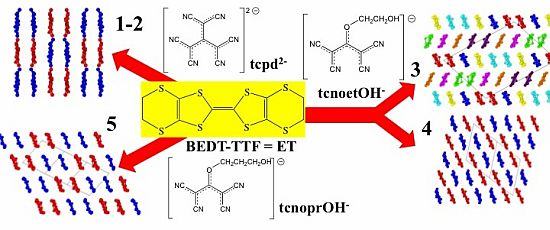
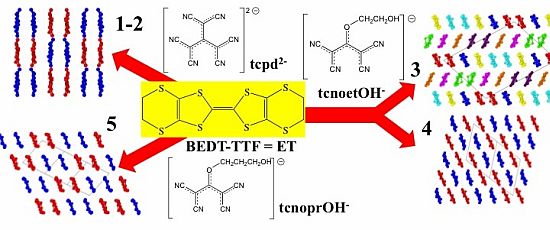
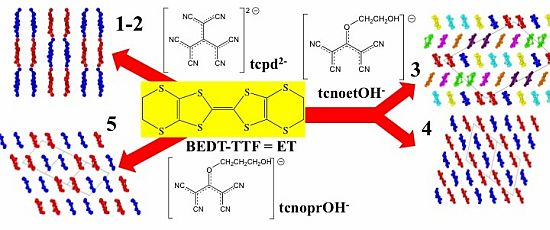
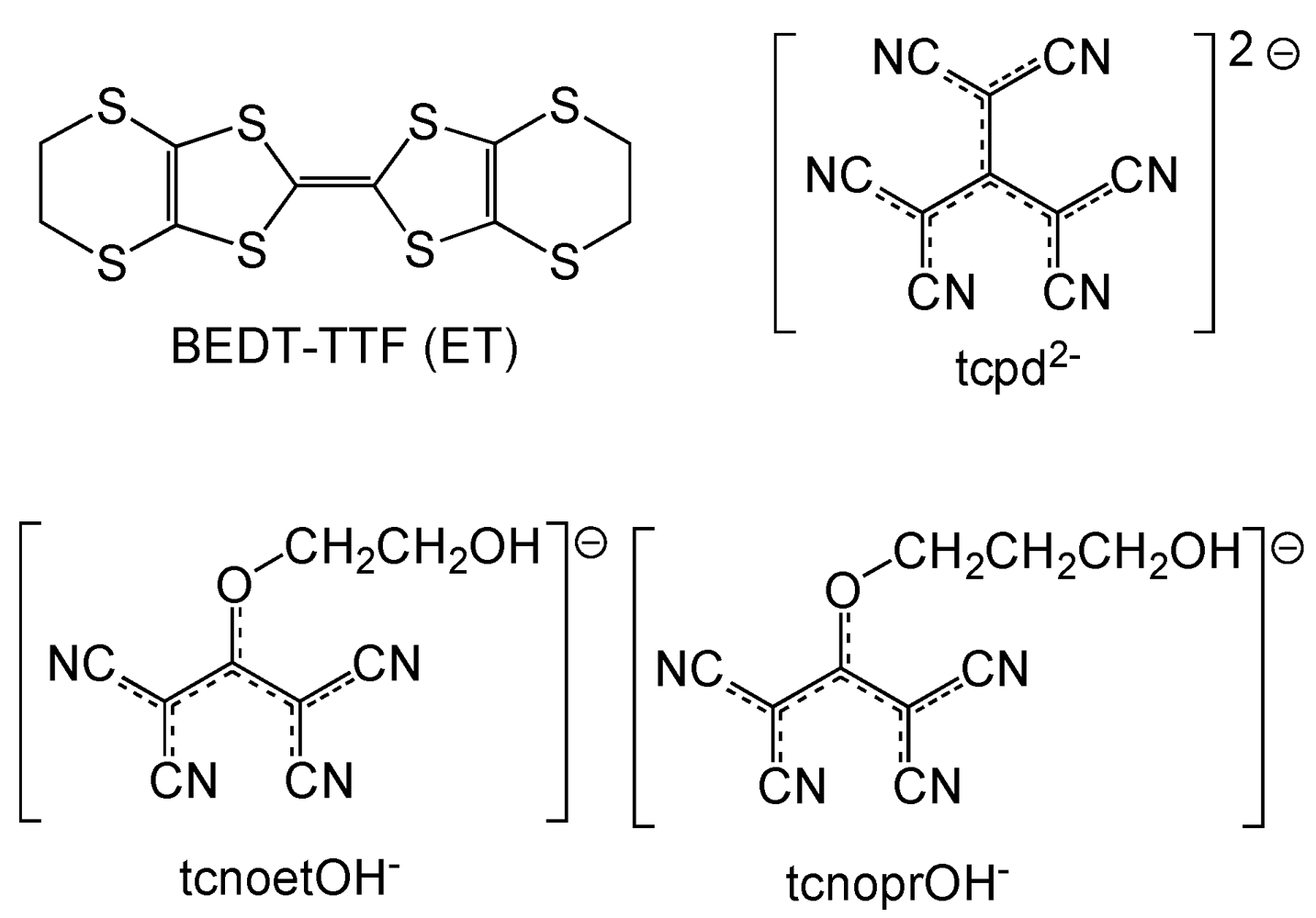
      <p>Since the discovery of metallic conductivity in the charge transfer complex TTF-TCNQ [<xref ref-type="bibr" rid="B1-crystals-02-00306">1</xref>] (TTF = tetrathiafulvalene, TCNQ = tetracyanoquinodimethane) and, especially superconductivity in the Bechgard salts [<xref ref-type="bibr" rid="B2-crystals-02-00306">2</xref>], the number of charge transfer complexes and radical salts containing TTF and its derivatives has not ceased to increase. Thus, the CCDC database updated in February 2012 shows <italic>ca</italic>. 2600 different structurally characterized compounds containing TTF or any of its numerous derivatives. Among these, the most common is the organic donor bis(ethylenedithio)tetrathiafulvalene (BEDT-TTF or ET, <xref ref-type="fig" rid="crystals-02-00306-f008">Scheme 1</xref>), with almost 500 different compounds known to date. The main reason for this popularity of ET is the fact that almost one half of the <italic>ca</italic>. 100 molecular superconductors prepared to date is based on this donor.</p>
      <fig id="crystals-02-00306-f008" position="anchor">
        <object-id pub-id-type="pii">crystals-02-00306-scheme1_Scheme 1</object-id>
        <label>Scheme 1</label>
        <caption>
          <p>BEDT-TTF and the polycyano anions used in this work.</p>
        </caption>
        <graphic xmlns:xlink="http://www.w3.org/1999/xlink" xlink:href="crystals-02-00306-g008.tif"/>
      </fig>
      <p>The number of anions combined with TTF-type donors is also very large, ranging from simple halides and oxo-anions to paramagnetic metal complexes as [MX<sub>4</sub>]<italic><sup>n</sup></italic><sup>−</sup> [<xref ref-type="bibr" rid="B3-crystals-02-00306">3</xref>,<xref ref-type="bibr" rid="B4-crystals-02-00306">4</xref>,<xref ref-type="bibr" rid="B5-crystals-02-00306">5</xref>] and [M(C<sub>2</sub>O<sub>4</sub>)<sub>3</sub>]<sup>3−</sup> [<xref ref-type="bibr" rid="B6-crystals-02-00306">6</xref>,<xref ref-type="bibr" rid="B7-crystals-02-00306">7</xref>,<xref ref-type="bibr" rid="B8-crystals-02-00306">8</xref>,<xref ref-type="bibr" rid="B9-crystals-02-00306">9</xref>,<xref ref-type="bibr" rid="B10-crystals-02-00306">10</xref>,<xref ref-type="bibr" rid="B11-crystals-02-00306">11</xref>] to polyoxometalates with large sizes and charges [<xref ref-type="bibr" rid="B12-crystals-02-00306">12</xref>,<xref ref-type="bibr" rid="B13-crystals-02-00306">13</xref>,<xref ref-type="bibr" rid="B14-crystals-02-00306">14</xref>,<xref ref-type="bibr" rid="B15-crystals-02-00306">15</xref>,<xref ref-type="bibr" rid="B16-crystals-02-00306">16</xref>] and even extended ferromagnetic layers [<xref ref-type="bibr" rid="B17-crystals-02-00306">17</xref>,<xref ref-type="bibr" rid="B18-crystals-02-00306">18</xref>,<xref ref-type="bibr" rid="B19-crystals-02-00306">19</xref>,<xref ref-type="bibr" rid="B20-crystals-02-00306">20</xref>].</p>
      <p>Among the hundreds of different anions combined with TTF-type donors, the one leading to the highest superconducting transition temperatures is dicyanamide ([N(CN)<sub>2</sub>]<sup>−</sup> = dca<sup>−</sup>). Thus, the salts (ET)<sub>2</sub>[Cu(dca)X], with <italic>T</italic><sub>c</sub> = 11.6, 10.7 and 12.8 K for X = Br<sup>−</sup> [<xref ref-type="bibr" rid="B21-crystals-02-00306">21</xref>], CN<sup>−</sup> [<xref ref-type="bibr" rid="B22-crystals-02-00306">22</xref>] and Cl<sup>−</sup> [<xref ref-type="bibr" rid="B23-crystals-02-00306">23</xref>], respectively, present the highest transition temperatures among all the TTF-type superconductors. However, despite these high critical temperatures and the fact that the first metal with TTF was prepared with TCNQ, that also contains two juxtaposed cyano groups [–C(CN)<sub>2</sub>], the number of anions containing this functional group combined with TTF-type donors is still limited, as clearly shown by Geiser and Schlueter in an excellent review on these and many other anions (<xref ref-type="table" rid="crystals-02-00306-t001">Table 1</xref>–<xref ref-type="table" rid="crystals-02-00306-t003">Table 3</xref>) [<xref ref-type="bibr" rid="B24-crystals-02-00306">24</xref>].</p>
      <table-wrap id="crystals-02-00306-t001" position="anchor">
        <object-id pub-id-type="pii">crystals-02-00306-t001_Table 1</object-id>
        <label>Table 1</label>
        <caption>
          <p>ET salts with TCNQ derivatives.</p>
        </caption>
        <table>
          <thead>
            <tr>
              <th align="left" valign="middle">Compound</th>
              <th align="left" valign="middle">CCDC code</th>
              <th align="left" valign="middle">Anion</th>
              <th align="left" valign="middle">Ref.</th>
            </tr>
          </thead>
          <tbody>
            <tr>
              <td align="left" valign="middle">(ET)(Me<sub>2</sub>TCNQ)</td>
              <td align="left" valign="middle">ASAVIZ</td>
              <td align="left" valign="middle">Me<sub>2</sub>TCNQ</td>
              <td align="left" valign="middle">[<xref ref-type="bibr" rid="B25-crystals-02-00306">25</xref>]</td>
            </tr>
            <tr>
              <td align="left" valign="middle">(ET)(ClMeTCNQ)</td>
              <td align="left" valign="middle">ASAVOF</td>
              <td align="left" valign="middle">ClMeTCNQ</td>
              <td align="left" valign="middle">[<xref ref-type="bibr" rid="B25-crystals-02-00306">25</xref>]</td>
            </tr>
            <tr>
              <td align="left" valign="middle">(ET)(FTCNQ)</td>
              <td align="left" valign="middle">RIQBOI</td>
              <td align="left" valign="middle">FTCNQ</td>
              <td align="left" valign="middle">[<xref ref-type="bibr" rid="B26-crystals-02-00306">26</xref>]</td>
            </tr>
            <tr>
              <td align="left" valign="middle">(ET)(F<sub>2</sub>TCNQ)<sub>0.5</sub>(TCNQ)<sub>0.5</sub></td>
              <td align="left" valign="middle">-</td>
              <td align="left" valign="middle">FTCNQ/TCNQ</td>
              <td align="left" valign="middle">[<xref ref-type="bibr" rid="B26-crystals-02-00306">26</xref>]</td>
            </tr>
            <tr>
              <td align="left" valign="middle">(ET)(TCNQ)</td>
              <td align="left" valign="middle">FAHLEF</td>
              <td align="left" valign="middle">TCNQ</td>
              <td align="left" valign="middle">[<xref ref-type="bibr" rid="B27-crystals-02-00306">27</xref>]</td>
            </tr>
          </tbody>
        </table>
      </table-wrap>
      <table-wrap id="crystals-02-00306-t002" position="anchor">
        <object-id pub-id-type="pii">crystals-02-00306-t002_Table 2</object-id>
        <label>Table 2</label>
        <caption>
          <p>ET salts with polycyano anions.</p>
        </caption>
        <table>
          <thead>
            <tr>
              <th align="left" valign="middle">Formula</th>
              <th align="left" valign="middle">CCDC code</th>
              <th align="left" valign="middle">Anion</th>
              <th align="left" valign="middle">Ref.</th>
            </tr>
          </thead>
          <tbody>
            <tr>
              <td align="left" valign="middle">δ'-(ET)<sub>2</sub>[C(CN)<sub>3</sub>]</td>
              <td align="left" valign="middle">KADGUR</td>
              <td align="left" valign="middle">[C(CN)<sub>3</sub>]<sup>−</sup></td>
              <td align="left" valign="middle">[<xref ref-type="bibr" rid="B28-crystals-02-00306">28</xref>]</td>
            </tr>
            <tr>
              <td align="left" valign="middle">α'-(ET)<sub>2</sub>(tcpd)</td>
              <td align="left" valign="middle">-</td>
              <td align="left" valign="middle">tcpd<sup>2−</sup></td>
              <td align="left" valign="middle">[<xref ref-type="bibr" rid="B29-crystals-02-00306">29</xref>]</td>
            </tr>
            <tr>
              <td align="left" valign="middle">α'-(ET)<sub>4</sub>(tcpd)·THF</td>
              <td align="left" valign="middle">-</td>
              <td align="left" valign="middle">tcpd<sup>2−</sup></td>
              <td align="left" valign="middle">this work</td>
            </tr>
            <tr>
              <td align="left" valign="middle">α'-(ET)<sub>4</sub>(tcpd)·2H<sub>2</sub>O</td>
              <td align="left" valign="middle">-</td>
              <td align="left" valign="middle">tcpd<sup>2−</sup></td>
              <td align="left" valign="middle">this work</td>
            </tr>
            <tr>
              <td align="left" valign="middle">δ'-(ET)<sub>2</sub>[C<sub>5</sub>(CN)<sub>5</sub>](TCE)<italic><sub>x</sub></italic></td>
              <td align="left" valign="middle">VERTAN</td>
              <td align="left" valign="middle">[C<sub>5</sub>(CN)<sub>5</sub>]<sup>−</sup></td>
              <td align="left" valign="middle">[<xref ref-type="bibr" rid="B30-crystals-02-00306">30</xref>]</td>
            </tr>
            <tr>
              <td align="left" valign="middle">β''-(ET)<sub>4</sub>[C<sub>6</sub>(CN)<sub>8</sub>](THF)<sub>2</sub></td>
              <td align="left" valign="middle">QOTHEM</td>
              <td align="left" valign="middle">[C<sub>6</sub>(CN)<sub>8</sub>]<sup>−</sup></td>
              <td align="left" valign="middle">[<xref ref-type="bibr" rid="B31-crystals-02-00306">31</xref>]</td>
            </tr>
            <tr>
              <td align="left" valign="middle">(ET)[C<sub>6</sub>S<sub>2</sub>(CN)<sub>4</sub>]</td>
              <td align="left" valign="middle">GERYOR</td>
              <td align="left" valign="middle">[C<sub>6</sub>S<sub>2</sub>(CN)<sub>4</sub>]<sup>−</sup></td>
              <td align="left" valign="middle">[<xref ref-type="bibr" rid="B32-crystals-02-00306">32</xref>]</td>
            </tr>
            <tr>
              <td align="left" valign="middle">β''-(ET)<sub>2</sub>{[(CN)<sub>2</sub>C]<sub>2</sub>CO(CH<sub>2</sub>)<sub>2</sub>CH<sub>3</sub>}</td>
              <td align="left" valign="middle">-</td>
              <td align="left" valign="middle">{[(CN)<sub>2</sub>C]<sub>2</sub>CO(CH<sub>2</sub>)<sub>2</sub>CH<sub>3</sub>}<sup>−</sup></td>
              <td align="left" valign="middle">[<xref ref-type="bibr" rid="B33-crystals-02-00306">33</xref>]</td>
            </tr>
            <tr>
              <td align="left" valign="middle">θ-(ET)<sub>2</sub>(tcnoetOH)</td>
              <td align="left" valign="middle">-</td>
              <td align="left" valign="middle">tcnoetOH<sup>−</sup></td>
              <td align="left" valign="middle">this work</td>
            </tr>
            <tr>
              <td align="left" valign="middle">β''-(ET)<sub>2</sub>(tcnoetOH)</td>
              <td align="left" valign="middle">-</td>
              <td align="left" valign="middle">tcnoetOH<sup>−</sup></td>
              <td align="left" valign="middle">this work</td>
            </tr>
            <tr>
              <td align="left" valign="middle">β''-(ET)<sub>2</sub>(tcnoprO)(CH<sub>2</sub>ClCHCl<sub>2</sub>)<sub>0.5</sub></td>
              <td align="left" valign="middle">-</td>
              <td align="left" valign="middle">tcnoprOH<sup>−</sup></td>
              <td align="left" valign="middle">this work</td>
            </tr>
            <tr>
              <td align="left" valign="middle">(ET){N[C<sub>2</sub>(CN)<sub>3</sub>]<sub>2</sub>}</td>
              <td align="left" valign="middle">-</td>
              <td align="left" valign="middle">{N[C<sub>2</sub>(CN)<sub>3</sub>]<sub>2</sub>}<sup>−</sup></td>
              <td align="left" valign="middle">[<xref ref-type="bibr" rid="B34-crystals-02-00306">34</xref>]</td>
            </tr>
          </tbody>
        </table>
      </table-wrap>
      <table-wrap id="crystals-02-00306-t003" position="anchor">
        <object-id pub-id-type="pii">crystals-02-00306-t003_Table 3</object-id>
        <label>Table 3</label>
        <caption>
          <p>ET salts with the dicyanamide (dca) anion.</p>
        </caption>
        <table>
          <thead>
            <tr>
              <th align="left" valign="middle">Formula</th>
              <th align="left" valign="middle">CCDC code</th>
              <th align="left" valign="middle">Anion</th>
              <th align="left" valign="middle">Ref.</th>
            </tr>
          </thead>
          <tbody>
            <tr>
              <td align="left" valign="middle">(ET)<sub>2</sub>(dca)·2H<sub>2</sub>O</td>
              <td align="left" valign="middle">SOXWUY</td>
              <td align="left" valign="middle">dca<sup>−</sup></td>
              <td align="left" valign="middle">[<xref ref-type="bibr" rid="B35-crystals-02-00306">35</xref>]</td>
            </tr>
            <tr>
              <td align="left" valign="middle">δ'-(ET)<sub>2</sub>(dca)</td>
              <td align="left" valign="middle">-</td>
              <td align="left" valign="middle">dca<sup>−</sup></td>
              <td align="left" valign="middle">[<xref ref-type="bibr" rid="B36-crystals-02-00306">36</xref>]</td>
            </tr>
            <tr>
              <td align="left" valign="middle">(ET)(dca)·H<sub>2</sub>O</td>
              <td align="left" valign="middle">-</td>
              <td align="left" valign="middle">dca<sup>−</sup></td>
              <td align="left" valign="middle">[<xref ref-type="bibr" rid="B24-crystals-02-00306">24</xref>]</td>
            </tr>
            <tr>
              <td align="left" valign="middle">(ET)<sub>2</sub>[Cu(dca)Cl]</td>
              <td align="left" valign="middle">WEHJAV</td>
              <td align="left" valign="middle">[Cu(dca)Cl]<sup>−</sup></td>
              <td align="left" valign="middle">[<xref ref-type="bibr" rid="B23-crystals-02-00306">23</xref>]</td>
            </tr>
            <tr>
              <td align="left" valign="middle">(ET)<sub>2</sub>[Cu(dca)Br]</td>
              <td align="left" valign="middle">JESDUG</td>
              <td align="left" valign="middle">[Cu(dca)Br]<sup>−</sup></td>
              <td align="left" valign="middle">[<xref ref-type="bibr" rid="B21-crystals-02-00306">21</xref>]</td>
            </tr>
            <tr>
              <td align="left" valign="middle">(ET)<sub>2</sub>[Cu(dca)CN]</td>
              <td align="left" valign="middle">VORNAR</td>
              <td align="left" valign="middle">[Cu(dca)(CN)]<sup>−</sup></td>
              <td align="left" valign="middle">[<xref ref-type="bibr" rid="B22-crystals-02-00306">22</xref>]</td>
            </tr>
            <tr>
              <td align="left" valign="middle">(ET)<sub>2</sub>[Mn(dca)<sub>3</sub>]</td>
              <td align="left" valign="middle">-</td>
              <td align="left" valign="middle">[Mn(dca)<sub>3</sub>]<sup>−</sup></td>
              <td align="left" valign="middle">[<xref ref-type="bibr" rid="B37-crystals-02-00306">37</xref>]</td>
            </tr>
            <tr>
              <td align="left" valign="middle">(ET)<sub>2</sub>[CuMn(dca)<sub>4</sub>]</td>
              <td align="left" valign="middle">QIXSOG</td>
              <td align="left" valign="middle">[MnCu(dca)<sub>4</sub>]<sup>−</sup></td>
              <td align="left" valign="middle">[<xref ref-type="bibr" rid="B38-crystals-02-00306">38</xref>]</td>
            </tr>
          </tbody>
        </table>
      </table-wrap>
      <p>If we limit the search to ET, there are only five salts prepared with TCNQ and its derivatives (<xref ref-type="table" rid="crystals-02-00306-t001">Table 1</xref>): (ET)(Me<sub>2</sub>TCNQ), (ET)(ClMeTCNQ) [<xref ref-type="bibr" rid="B25-crystals-02-00306">25</xref>], (ET)(F-TCNQ), (ET)(F<sub>2</sub>TCNQ)<sub>0.5</sub>(TCNQ)<sub>0.5</sub> [<xref ref-type="bibr" rid="B26-crystals-02-00306">26</xref>], and (ET)(TCNQ) [<xref ref-type="bibr" rid="B27-crystals-02-00306">27</xref>], seven salts with polycyano anions (<xref ref-type="table" rid="crystals-02-00306-t002">Table 2</xref>): (ET)<sub>2</sub>[C(CN)<sub>3</sub>] [<xref ref-type="bibr" rid="B28-crystals-02-00306">28</xref>], (ET)<sub>2</sub>[C<sub>4</sub>(CN)<sub>6</sub>] [<xref ref-type="bibr" rid="B29-crystals-02-00306">29</xref>], (ET)<sub>2</sub>[C<sub>5</sub>(CN)<sub>5</sub>](TCE)<italic><sub>x</sub></italic>[<xref ref-type="bibr" rid="B30-crystals-02-00306">30</xref>], (ET)<sub>4</sub>[C<sub>6</sub>(CN)<sub>8</sub>](THF)<sub>2</sub> [<xref ref-type="bibr" rid="B31-crystals-02-00306">31</xref>], (ET)[C<sub>6</sub>S<sub>2</sub>(C(CN)<sub>2</sub>)<sub>2</sub>] [<xref ref-type="bibr" rid="B32-crystals-02-00306">32</xref>], (ET)<sub>2</sub>(tcnopr) [<xref ref-type="bibr" rid="B33-crystals-02-00306">33</xref>] (tcnopr<sup>−</sup> = [(NC)<sub>2</sub>CC(OCH<sub>2</sub>CH<sub>2</sub>CH<sub>3</sub>)C(CN)<sub>2</sub>]<sup>−</sup>) and (ET){N[C<sub>2</sub>(CN)<sub>3</sub>]<sub>2</sub>} [<xref ref-type="bibr" rid="B34-crystals-02-00306">34</xref>], three phases with dca<sup>−</sup> (<xref ref-type="table" rid="crystals-02-00306-t003">Table 3</xref>) [<xref ref-type="bibr" rid="B24-crystals-02-00306">24</xref>,<xref ref-type="bibr" rid="B35-crystals-02-00306">35</xref>,<xref ref-type="bibr" rid="B36-crystals-02-00306">36</xref>] and five other compounds involving the dca<sup>−</sup> anion and transition metal ions: (ET)<sub>2</sub>[Cu(dca)(CN)] [<xref ref-type="bibr" rid="B22-crystals-02-00306">22</xref>], (ET)<sub>2</sub>[Cu(dca)Cl] [<xref ref-type="bibr" rid="B23-crystals-02-00306">23</xref>], (ET)<sub>2</sub>[Cu(dca)Br] [<xref ref-type="bibr" rid="B21-crystals-02-00306">21</xref>], (ET)<sub>2</sub>Mn(dca)<sub>3</sub> [<xref ref-type="bibr" rid="B37-crystals-02-00306">37</xref>] and (ET)<sub>2</sub>[CuMn(dca)<sub>4</sub>] [<xref ref-type="bibr" rid="B21-crystals-02-00306">21</xref>,<xref ref-type="bibr" rid="B38-crystals-02-00306">38</xref>]. A possible reason explaining this lack of radical salts with this kind of anions may be the difficulty of obtaining single crystals of these compounds given the rigidity of the cyano groups and the lack of planarity of the –X(CN)<sub>2</sub> groups in the corresponding anions (except in the dca<sup>−</sup> anion, which, accordingly, is the most successful one). Although ET is the most used donor with this kind of anions, other donors such as bis(ethylenediseleno)tetrathiafulvalene (BETS-TTF) [<xref ref-type="bibr" rid="B39-crystals-02-00306">39</xref>], bis(ethylenedioxy)tetrathiafulvalene (BEDO-TTF) [<xref ref-type="bibr" rid="B40-crystals-02-00306">40</xref>,<xref ref-type="bibr" rid="B41-crystals-02-00306">41</xref>], TTF [<xref ref-type="bibr" rid="B42-crystals-02-00306">42</xref>], and tetrathiotetracene (TTT) [<xref ref-type="bibr" rid="B43-crystals-02-00306">43</xref>] have been used with these polycyano anions.</p>
      
      <p>Besides their use in the aforementioned radical salts, polycyano anions have also been extensively used as original ligands with several transition metal ions [<xref ref-type="bibr" rid="B44-crystals-02-00306">44</xref>] to yield coordination compounds with dimensionalities ranging from discrete clusters [<xref ref-type="bibr" rid="B45-crystals-02-00306">45</xref>] to extended 1D [<xref ref-type="bibr" rid="B46-crystals-02-00306">46</xref>], 2D [<xref ref-type="bibr" rid="B47-crystals-02-00306">47</xref>] and 3D [<xref ref-type="bibr" rid="B48-crystals-02-00306">48</xref>] structures. The ability of these polycyano anions to form extended coordination polymers is mainly due to the rigidity of their two or more –C(CN)<sub>2</sub> groups, that avoids a chelating coordination mode and facilitates different bridging modes, including the unusual formation of linkage isomers [<xref ref-type="bibr" rid="B49-crystals-02-00306">49</xref>,<xref ref-type="bibr" rid="B50-crystals-02-00306">50</xref>]. Furthermore, the presence of cyano groups able to create appropriate ligand fields has also been exploited to prepare spin crossover complexes with transition temperatures above room temperature [<xref ref-type="bibr" rid="B51-crystals-02-00306">51</xref>,<xref ref-type="bibr" rid="B52-crystals-02-00306">52</xref>].</p>
      <p>Here we report the synthesis, structural and physical characterization of five novel molecular conductors prepared with the organic donor ET and three different polycyano anions: tcpd<sup>2−</sup>, tcnoetOH<sup>−</sup> and tcnoprOH<sup>−</sup> (<xref ref-type="fig" rid="crystals-02-00306-f008">Scheme 1</xref>). The tcpd<sup>2−</sup> dianion gives rise to two salts with the same formula but with different solvate molecules: α'-(ET)<sub>4</sub>(tcpd)·THF (<bold>1</bold>) and α'-(ET)<sub>4</sub>(tcpd)·2H<sub>2</sub>O (<bold>2</bold>). The tcnoetOH<sup>−</sup> anion yields two different polymorphs formulated as θ-(ET)<sub>2</sub>(tcnoetOH) (<bold>3</bold>) and β''-(ET)<sub>2</sub>(tcnoetOH) (<bold>4</bold>). Finally, with the tcnoprOH<sup>−</sup> anion we have obtained a metallic salt formulated as: β''-(ET)<sub>2</sub>(tcnoprOH)(CHCl<sub>2</sub>CH<sub>2</sub>Cl)<sub>0.5</sub> (<bold>5</bold>).</p>
    </sec>
    <sec sec-type="results">
      <title>2. Results and Discussion</title>
      <sec>
        <title>2.1. Synthesis</title>
        <p>All the radical salts have been prepared with the electrocrystallization method using the K<sup>+</sup> salts of the corresponding polycyano anions: K<sub>2</sub>(tcpd)·2H<sub>2</sub>O, KtcnoetOH, and KtcnoprOH, except compound <bold>5</bold>, that was prepared using the Cu(tcnoprOH)<sub>2</sub> salt. The THF solvate α'-(ET)<sub>4</sub>(tcpd)·THF (<bold>1</bold>) has been obtained as dark brown prisms by using a mixture of THF and CH<sub>2</sub>Cl<sub>2</sub> whereas the H<sub>2</sub>O solvate α'-(ET)<sub>4</sub>(tcpd)·2H<sub>2</sub>O (<bold>2</bold>) was obtained as black prisms when a EtOH/CH<sub>2</sub>Cl<sub>2</sub>/CHCl<sub>2</sub>CH<sub>2</sub>Cl mixture is used with two drops of water. In contrast to compounds <bold>1</bold> and <bold>2</bold>, where the synthetic conditions were not exactly the same, compounds <bold>3</bold> and <bold>4</bold> were obtained simultaneously in the same electrocrystallization cell, using a EtOH/CH<sub>2</sub>Cl<sub>2</sub>/CHCl<sub>2</sub>CH<sub>2</sub>Cl mixture. They were easily distinguished because the polymorph θ-(ET)<sub>2</sub>(tcnoetOH) (<bold>3</bold>) is obtained as black plate-like crystals whereas the phase β''-(ET)<sub>2</sub>(tcnoetOH) (<bold>4</bold>) crystallizes as long black needles. β''-(ET)<sub>2</sub>(tcnoprOH)(CHCl<sub>2</sub>CH<sub>2</sub>Cl)<sub>0.5</sub> (<bold>5</bold>) was obtained as brown shiny prisms with a mixture of EtOH/CHCl<sub>2</sub>CH<sub>2</sub>Cl (see <xref ref-type="sec" rid="sec3-catalysts-02-00038">experimental Section</xref>).</p>
      </sec>
      <sec>
        <title>2.2. Crystal Structures</title>
        <sec>
          <title>2.2.1. Structures of α'-(ET)<sub>4</sub>(tcpd)·THF (<bold>1</bold>) and α'-(ET)<sub>4</sub>(tcpd)·2H<sub>2</sub>O (<bold>2</bold>)</title>
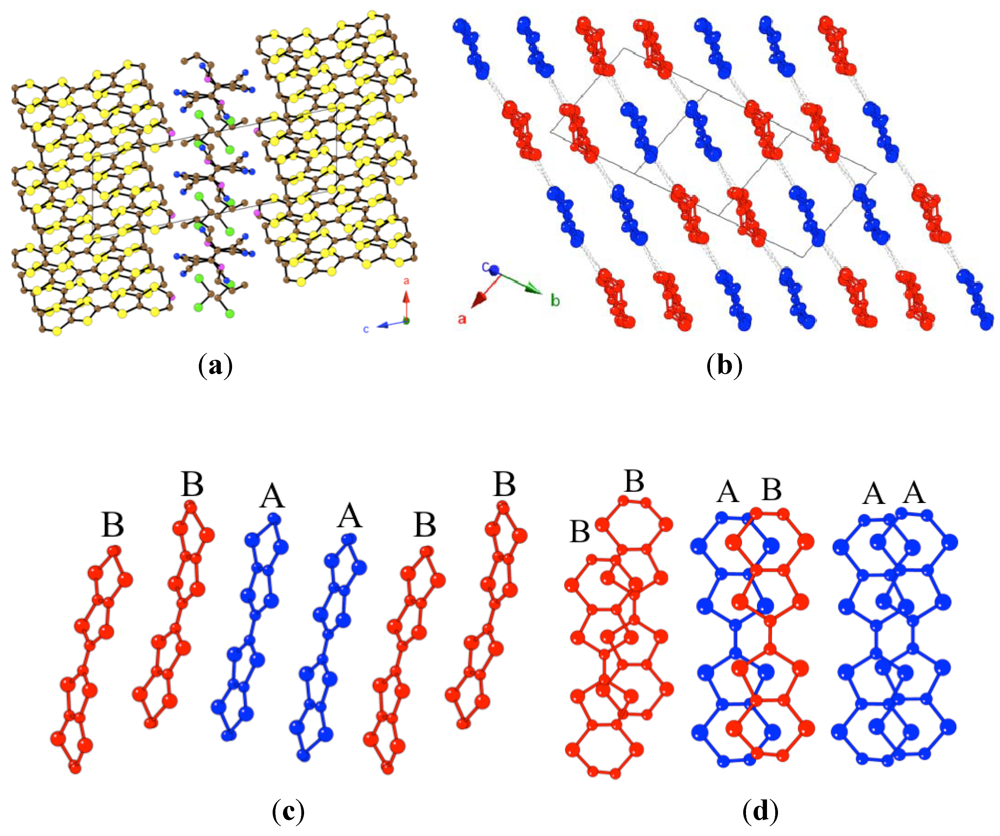
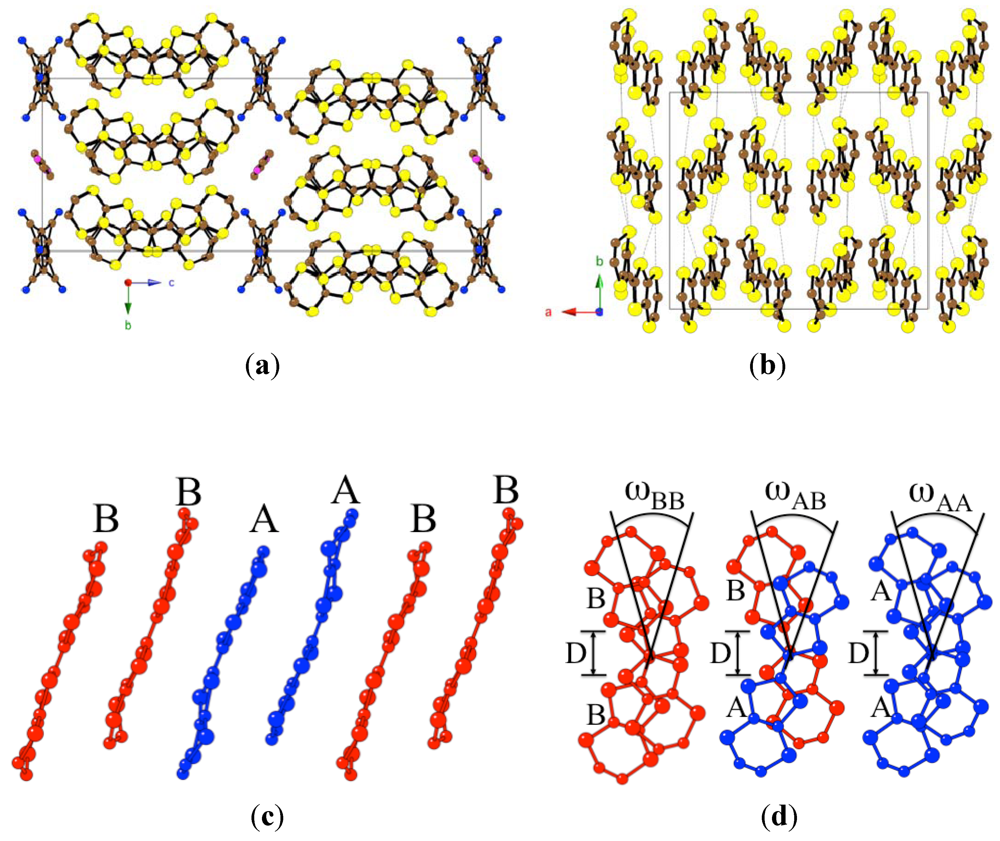
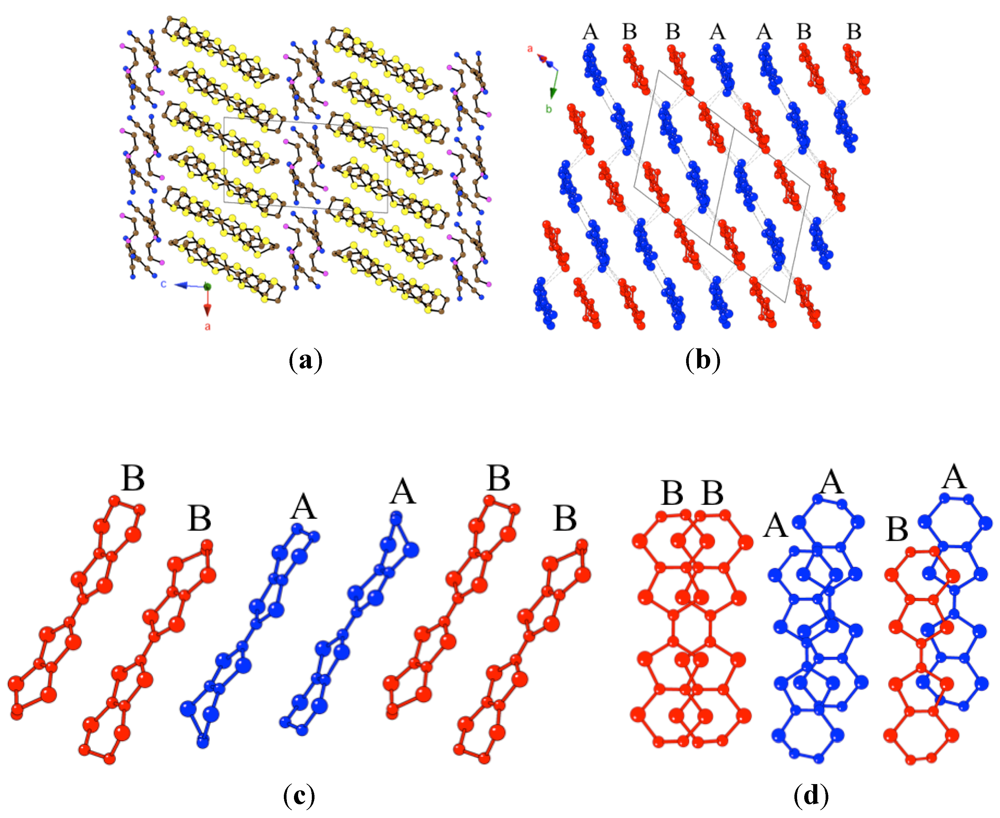
          <p>Compounds <bold>1</bold> and <bold>2</bold> are isostructural and crystallize in the monoclinic space group C2/c. Crystal and refinement data are shown in <xref ref-type="table" rid="crystals-02-00306-t004">Table 4</xref>. The only difference is the presence of a disordered THF molecule in the anionic layer in compound <bold>1</bold> and two water molecules in compound <bold>2</bold>. Both compounds present cationic ET layers alternating along the <italic>c</italic> axis with layers containing the tcpd<sup>2−</sup> anions and the solvent molecules (<xref ref-type="fig" rid="crystals-02-00306-f001">Figure 1</xref>).</p>
          <p>The ET molecules show the so-called α' packing in which the organic donors form chains where all the ET molecular planes are parallel [<xref ref-type="bibr" rid="B53-crystals-02-00306">53</xref>]. The difference with other parallel packings is that now the long axes of the ET molecules are not parallel but form a twist angle (ω, in the range 32–34° in compounds <bold>1</bold> and <bold>2</bold>) with the neighboring molecules in the chain (<xref ref-type="fig" rid="crystals-02-00306-f001">Figure 1</xref>). Besides the twisting, there is a displacement of the center of adjacent ET molecules, noted as D in <xref ref-type="fig" rid="crystals-02-00306-f001">Figure 1</xref>. Note that the so-called δ and δ' phases are very similar but in these phases the overlap between adjacent ET molecules in the chains follows the alternating sequence ...-RA-twisted-... (RA = ring-over-atom) and ...-RB-twisted-... (RB = ring-over-bond), respectively, whereas in the α' phase the overlap is always twisted [<xref ref-type="bibr" rid="B53-crystals-02-00306">53</xref>].</p>
          <table-wrap id="crystals-02-00306-t004" position="anchor">
            <object-id pub-id-type="pii">crystals-02-00306-t004_Table 4</object-id>
            <label>Table 4</label>
            <caption>
              <p>Crystal data for compounds α'-ET<sub>4</sub>(tcpd)(THF) (<bold>1</bold>) and α'-ET<sub>4</sub>(tcpd)(H<sub>2</sub>O)<sub>2</sub> (<bold>2</bold>).</p>
            </caption>
                        <table>
              <thead>
                <tr>
                  <th align="left" valign="middle">Compound</th>
                  <th align="right" valign="middle">1</th>
                  <th align="right" valign="middle">2</th>
                </tr>
              </thead>
              <tbody>
                <tr>
                  <td align="left" valign="middle">Formula</td>
                  <td align="right" valign="middle">C<sub>54</sub>H<sub>40</sub>N<sub>6</sub>OS<sub>32</sub></td>
                  <td align="right" valign="middle">C<sub>50</sub>H<sub>36</sub>N<sub>6</sub>O<sub>2</sub>S<sub>32</sub></td>
                </tr>
                <tr>
                  <td align="left" valign="middle">
                    <italic>M</italic>
                  </td>
                  <td align="right" valign="middle">1814.84</td>
                  <td align="right" valign="middle">1778.76</td>
                </tr>
                <tr>
                  <td align="left" valign="middle">Cryst. Syst.</td>
                  <td align="right" valign="middle">Monoclinic</td>
                  <td align="right" valign="middle">Monoclinic</td>
                </tr>
                <tr>
                  <td align="left" valign="middle">Space group</td>
                  <td align="right" valign="middle">C2/c</td>
                  <td align="right" valign="middle">C2/c</td>
                </tr>
                <tr>
                  <td align="left" valign="middle"><italic>a</italic> (Å)</td>
                  <td align="right" valign="middle">15.7423(13)</td>
                  <td align="right" valign="middle">15.5152 (13)</td>
                </tr>
                <tr>
                  <td align="left" valign="middle"><italic>b</italic> (Å)</td>
                  <td align="right" valign="middle">13.2947(11)</td>
                  <td align="right" valign="middle">13.2644(10)</td>
                </tr>
                <tr>
                  <td align="left" valign="middle"><italic>c</italic> (Å)</td>
                  <td align="right" valign="middle">33.810(3)</td>
                  <td align="right" valign="middle">33.673(2)</td>
                </tr>
                <tr>
                  <td align="left" valign="middle">β (°)</td>
                  <td align="right" valign="middle">96.701(6)</td>
                  <td align="right" valign="middle">97.443(6)</td>
                </tr>
                <tr>
                  <td align="left" valign="middle"><italic>V</italic> (Å<sup>3</sup>)</td>
                  <td align="right" valign="middle">7027.7(10)</td>
                  <td align="right" valign="middle">6871.5(9)</td>
                </tr>
                <tr>
                  <td align="left" valign="middle">
                    <italic>Z</italic>
                  </td>
                  <td align="right" valign="middle">4</td>
                  <td align="right" valign="middle">4</td>
                </tr>
                <tr>
                  <td align="left" valign="middle"><italic>T</italic> (K)</td>
                  <td align="right" valign="middle">293(2)</td>
                  <td align="right" valign="middle">170(2)</td>
                </tr>
                <tr>
                  <td align="left" valign="middle">ρ<sub>calc</sub> (g·cm<sup>−3</sup>)</td>
                  <td align="right" valign="middle">1.708</td>
                  <td align="right" valign="middle">1.719</td>
                </tr>
                <tr>
                  <td align="left" valign="middle">μ (cm<sup>−1</sup>)</td>
                  <td align="right" valign="middle">9.406</td>
                  <td align="right" valign="middle">10.36</td>
                </tr>
                <tr>
                  <td align="left" valign="middle"><italic>F</italic>(000)</td>
                  <td align="right" valign="middle">3672</td>
                  <td align="right" valign="middle">3624</td>
                </tr>
                <tr>
                  <td align="left" valign="middle">Refl. Collec.</td>
                  <td align="right" valign="middle">40764</td>
                  <td align="right" valign="middle">16,092</td>
                </tr>
                <tr>
                  <td align="left" valign="middle">Refl. Uniq.</td>
                  <td align="right" valign="middle">5029</td>
                  <td align="right" valign="middle">3379</td>
                </tr>
                <tr>
                  <td align="left" valign="middle">
                    <italic>R</italic>
                    <sub>int</sub>
                  </td>
                  <td align="right" valign="middle">0.0588</td>
                  <td align="right" valign="middle">0.0807</td>
                </tr>
                <tr>
                  <td align="left" valign="middle">Refl. Obs <italic>I</italic> &gt; 2σ(<italic>I</italic>)</td>
                  <td align="right" valign="middle">2614</td>
                  <td align="right" valign="middle">2051</td>
                </tr>
                <tr>
                  <td align="left" valign="middle">
                    <italic>N</italic>
                    <sub>v</sub>
                  </td>
                  <td align="right" valign="middle">568</td>
                  <td align="right" valign="middle">274</td>
                </tr>
                <tr>
                  <td align="left" valign="middle"><sup>a</sup> <italic>R</italic>1</td>
                  <td align="right" valign="middle">0.0790</td>
                  <td align="right" valign="middle">0.1562</td>
                </tr>
                <tr>
                  <td align="left" valign="middle"><sup>b</sup> <italic>wR</italic>2</td>
                  <td align="right" valign="middle">0.2542</td>
                  <td align="right" valign="middle">0.4738</td>
                </tr>
                <tr>
                  <td align="left" valign="middle"><sup>c</sup> <italic>GooF</italic></td>
                  <td align="right" valign="middle">0.963</td>
                  <td align="right" valign="middle">1.730</td>
                </tr>
                <tr>
                  <td align="left" valign="middle">∆ρ<sub>max</sub> (eÅ<sup>−3</sup>)</td>
                  <td align="right" valign="middle">0.690</td>
                  <td align="right" valign="middle">+2.271</td>
                </tr>
                <tr>
                  <td align="left" valign="middle">∆ρ<sub>min</sub> (eÅ<sup>−3</sup>)</td>
                  <td align="right" valign="middle">−0.409</td>
                  <td align="right" valign="middle">−1.359</td>
                </tr>
              </tbody>
            </table>
            <table-wrap-foot>
            <fn>
            <p><sup>a</sup> <italic>R</italic>1 = ∑|<italic>F</italic><sub>o</sub> − <italic>F</italic><sub>c</sub>|/<italic>F</italic><sub>o</sub>; <sup>b</sup> <italic>wR</italic>2= {∑<italic>w</italic>(<italic>F</italic><sub>o</sub><sup>2</sup> − <italic>F</italic><sub>c</sub><sup>2</sup>)<sup>2</sup>/∑(<italic>wF</italic><sub>o</sub><sup>2</sup>)<sup>2</sup>}<sup>1/2</sup>; <sup>c</sup> <italic>GooF</italic> = {∑<italic>w</italic>(<italic>F<sub>o</sub><sup>2</sup></italic> − <italic>F</italic><sub>c</sub><sup>2</sup>)<sup>2</sup>/(<italic>N</italic><sub>obs</sub> − <italic>N</italic><sub>var</sub>)}<sup>1/2</sup>.</p>
            </fn>
            </table-wrap-foot>
          </table-wrap>
          <fig id="crystals-02-00306-f001" position="anchor">
            <label>Figure 1</label>
            <caption>
              <p>(<bold>a</bold>) View of the alternating cationic and anionic layers in compound <bold>1</bold> along the c axis (similar structure for compound <bold>2</bold>); (<bold>b</bold>) View of the ET layer. Dotted lines indicate the S···S contacts shorter than the sum of the van der Waals radii; (<bold>c</bold>) Side view of the ET chains; (<bold>d</bold>) View of the overlap between neighboring ET molecules in the chain.</p>
            </caption>
            <graphic xmlns:xlink="http://www.w3.org/1999/xlink" xlink:href="crystals-02-00306-g001.tif"/>
          </fig>
          
          
          <p>Since the chains are formed by two crystallographically independent ET molecules (noted as A and B) following the sequence ...–AABB–..., there are three different intra-chain overlaps: A–A, A–B and B‑B, all with similar twisting angles (ω) and displacements (<italic>D</italic>): ω<sub>AA</sub> = 34.0°, <italic>D</italic><sub>AA</sub> = 1.39 Å, ω<sub>AB</sub> = 33.2°, <italic>D</italic><sub>AB</sub> = 1.38 Å, ω<sub>BB</sub> = 32.4° and <italic>D</italic><sub>BB</sub> = 1.41 Å, in compound <bold>1</bold> and ω<sub>AA</sub> = 34.0°, <italic>D</italic><sub>AA</sub> = 1.39 Å, ω<sub>AB</sub> = 32.8°, <italic>D</italic><sub>AB</sub> = 1.32 Å, ω<sub>BB</sub> = 32.0° and <italic>D</italic><sub>BB</sub> = 1.28 Å in compound <bold>2</bold> (<xref ref-type="fig" rid="crystals-02-00306-f001">Figure 1</xref>).</p>
          <p>The two terminal ethylene groups of the A-type ET molecule in compound <bold>1</bold> present a boat conformation and are staggered whereas those on the B-type ET molecule present a half-chair conformation and are also staggered. In compound <bold>2</bold> the A-type molecule presents a boat conformation in one of the ethylene groups and a half chair in the other whereas the B-type molecules presents a staggered half chair conformation in both ethylene groups.</p>
          <p>As observed in other α' phases [<xref ref-type="bibr" rid="B53-crystals-02-00306">53</xref>], there are many intermolecular S···S contacts shorter than the sum of the van der Waals radii in both compounds (<xref ref-type="table" rid="crystals-02-00306-t005">Table 5</xref>). Although the structure of compound <bold>2</bold> is not very precise, the analysis of the bond lengths in the central TTF skeleton of the ET molecules in both compounds [<xref ref-type="bibr" rid="B54-crystals-02-00306">54</xref>] suggests an homogeneous charge distribution where both ET molecules bear similar charges, close to +0.5, giving an overall charge of +2 for the four ET molecules, in agreement with the −2 charge of the anion and the stoichiometry of the salts (4:1).</p>
          <table-wrap id="crystals-02-00306-t005" position="anchor">
            <object-id pub-id-type="pii">crystals-02-00306-t005_Table 5</object-id>
            <label>Table 5</label>
            <caption>
              <p>Intermolecular S···S distances (in Å) shorter than the sum of the van der Waals radii (3.6 Å) in compounds <bold>1</bold> and <bold>2</bold>.</p>
            </caption>
            <table>
              <thead>
                <tr>
                  <th colspan="2" align="center" valign="middle">Compound 1</th>
                  <th colspan="4" align="center" valign="middle">Compound 2</th>
                </tr>
                <tr style="border-top: solid thin">
                  <th align="center" valign="middle">Atoms</th>
                  <th align="center" valign="middle">Distance</th>
                  <th align="center" valign="middle">Atoms</th>
                  <th align="center" valign="middle">Distance</th>
                  <th align="center" valign="middle">Atoms</th>
                  <th align="center" valign="middle">Distance</th>
                </tr>
              </thead>
              <tbody>
                <tr>
                  <td align="center" valign="middle">S1···S10</td>
                  <td align="center" valign="middle">3.524(3)</td>
                  <td align="center" valign="middle">S1A-S3B</td>
                  <td align="center" valign="middle">3.59(1)</td>
                  <td align="center" valign="middle">S6A-S1B</td>
                  <td align="center" valign="middle">3.43(1)</td>
                </tr>
                <tr>
                  <td align="center" valign="middle">S2A···S9</td>
                  <td align="center" valign="middle">3.477(7)</td>
                  <td align="center" valign="middle">S1A-S6B</td>
                  <td align="center" valign="middle">3.48(1)</td>
                  <td align="center" valign="middle">S6A-S5B</td>
                  <td align="center" valign="middle">3.42(1)</td>
                </tr>
                <tr>
                  <td align="center" valign="middle">S2A···S12</td>
                  <td align="center" valign="middle">3.426(7)</td>
                  <td align="center" valign="middle">S3A-S1B</td>
                  <td align="center" valign="middle">3.59(1)</td>
                  <td align="center" valign="middle">S7A-S4B</td>
                  <td align="center" valign="middle">3.32(1)</td>
                </tr>
                <tr>
                  <td align="center" valign="middle">S4···S10</td>
                  <td align="center" valign="middle">3.527(3)</td>
                  <td align="center" valign="middle">S4A-S7B</td>
                  <td align="center" valign="middle">3.55(1)</td>
                  <td align="center" valign="middle">S7A-S8B</td>
                  <td align="center" valign="middle">3.38(1)</td>
                </tr>
                <tr>
                  <td align="center" valign="middle">S6···S16</td>
                  <td align="center" valign="middle">3.468(3)</td>
                  <td align="center" valign="middle">S5A-S6B</td>
                  <td align="center" valign="middle">3.57(1)</td>
                  <td align="center" valign="middle">S8A-S7B</td>
                  <td align="center" valign="middle">3.50(1)</td>
                </tr>
                <tr>
                  <td align="center" valign="middle">S7···S16</td>
                  <td align="center" valign="middle">3.534(3)</td>
                  <td align="center" valign="middle"> </td>
                  <td align="center" valign="middle"> </td>
                  <td align="center" valign="middle"> </td>
                  <td align="center" valign="middle"> </td>
                </tr>
                <tr>
                  <td align="center" valign="middle">S8···S14</td>
                  <td align="center" valign="middle">3.438(3)</td>
                  <td align="center" valign="middle"> </td>
                  <td align="center" valign="middle"> </td>
                  <td align="center" valign="middle"> </td>
                  <td align="center" valign="middle"> </td>
                </tr>
                <tr>
                  <td align="center" valign="middle">S8···S15</td>
                  <td align="center" valign="middle">3.429(3)</td>
                  <td align="center" valign="middle"> </td>
                  <td align="center" valign="middle"> </td>
                  <td align="center" valign="middle"> </td>
                  <td align="center" valign="middle"> </td>
                </tr>
              </tbody>
            </table>
          </table-wrap>
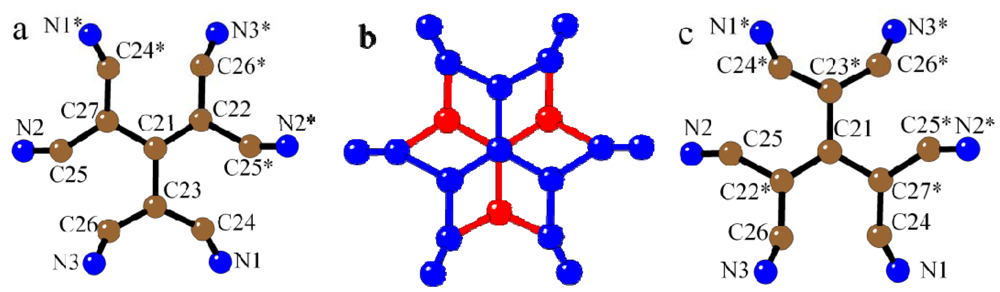
          <p>The anionic layer (in the <italic>ab</italic> plane) is formed by tcpd<sup>2−</sup> anions that appear disordered since they are located on an inversion center on the central carbon atom (C21). This inversion center generates two superimposed anions, as clearly shown in <xref ref-type="fig" rid="crystals-02-00306-f002">Figure 2</xref> and already observed in a Fe(II) chain with tcpd<sup>2−</sup> [<xref ref-type="bibr" rid="B55-crystals-02-00306">55</xref>]. The solvent molecules (disordered THF in <bold>1</bold> and two water molecules in <bold>2</bold>) are located between the tcpd<sup>2−</sup> anions.</p>
          <fig id="crystals-02-00306-f002" position="anchor">
            <label>Figure 2</label>
            <caption>
              <p>View of the statistical disorder of the tcpd<sup>2−</sup> anion in compound <bold>1</bold> (similar in <bold>2</bold>). Symmetry operation: * = −x, −y, −z.</p>
            </caption>
            <graphic xmlns:xlink="http://www.w3.org/1999/xlink" xlink:href="crystals-02-00306-g002.tif"/>
          </fig>
        </sec>
        <sec>
          <title>2.2.2. Structures of θ-(ET)<sub>2</sub>(tcnoetOH) (<bold>3</bold>) and β''-(ET)2(tcnoetOH) (<bold>4</bold>)</title>
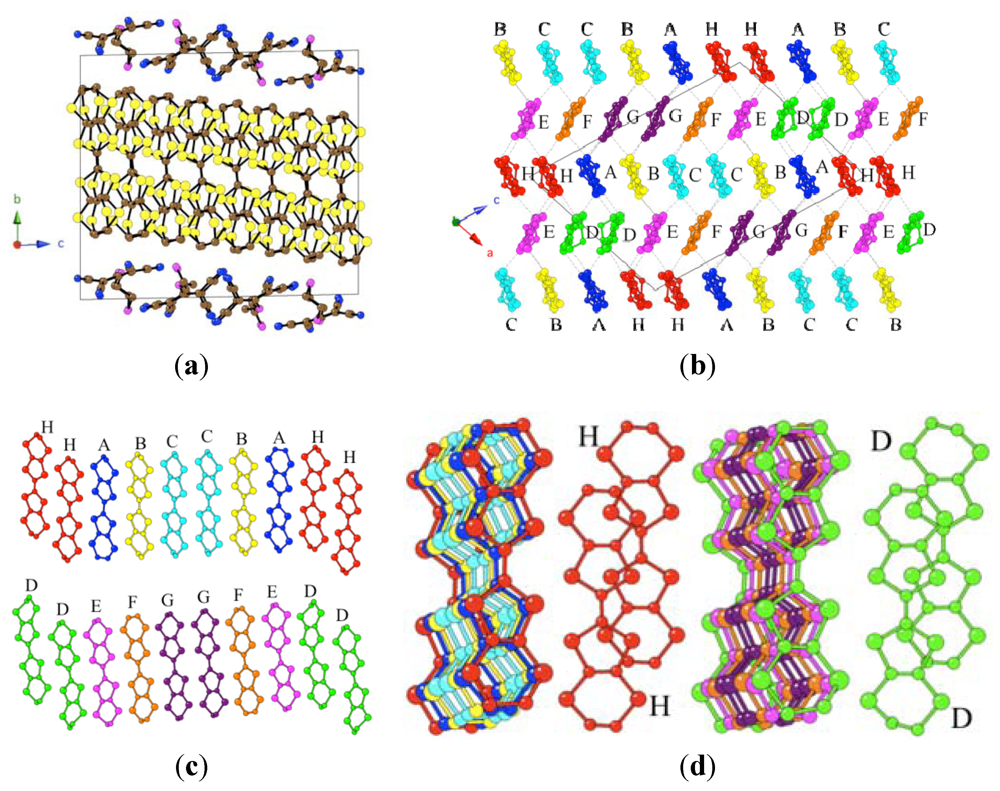
          <p>Compounds <bold>3</bold> and <bold>4</bold> crystallize in the triclinic space group P-1 but show different ET packings. Crystal and refinement data are shown in <xref ref-type="table" rid="crystals-02-00306-t006">Table 6</xref>. According to the asymmetric unit the chemical formula of compound <bold>3</bold> should be θ-(ET)<sub>8</sub>(tcnoetOH)<sub>4</sub> (see description below), but the chemical formula θ-(ET)<sub>2</sub>(tcnoetOH) was preferred to facilitate its crystal structure description. This compound presents layers of ET molecules parallel to the <italic>ac</italic> plane alternating with layers of the tcnoetOH<sup>−</sup> anions (<xref ref-type="fig" rid="crystals-02-00306-f003">Figure 3</xref>). The ET molecules are packed in parallel chains although the molecules of one chain are twisted with respect to those of adjacent chains forming the so-called α and θ packings [<xref ref-type="bibr" rid="B56-crystals-02-00306">56</xref>]. Note that although compound <bold>3</bold> could be considered as an α phase (since there is only one different cationic layer), following Mori’s suggestion to unify both notations [<xref ref-type="bibr" rid="B56-crystals-02-00306">56</xref>], we should call compound <bold>3</bold> as a θ<sub>80+80</sub> multiple θ phase, since there are two different chains in the layers and each chain contains a repeating unit formed by eight eclipsed molecules with no dislocation (see <xref ref-type="fig" rid="crystals-02-00306-f003">Figure 3</xref>).</p>
          <table-wrap id="crystals-02-00306-t006" position="anchor">
            <object-id pub-id-type="pii">crystals-02-00306-t006_Table 6</object-id>
            <label>Table 6</label>
            <caption>
              <p>Crystal data for compounds θ-ET<sub>2</sub>(tcnoetOH) (<bold>3</bold>) and β''-ET<sub>2</sub>(tcnoetOH) (<bold>4</bold>).</p>
            </caption>
                          <table>
              <thead>
                <tr>
                  <th align="center" valign="middle">Compounds</th>
                  <th align="center" valign="middle">3</th>
                  <th align="center" valign="middle">4</th>
                </tr>
              </thead>
              <tbody>
                <tr>
                  <td align="center" valign="middle">Formula</td>
                  <td align="right" valign="middle">C<sub>116</sub>H<sub>84</sub>N<sub>16</sub>O<sub>8</sub>S<sub>64</sub></td>
                  <td align="right" valign="middle">C<sub>29</sub>H<sub>21</sub>N<sub>4</sub>O<sub>2</sub>S<sub>16</sub></td>
                </tr>
                <tr>
                  <td align="center" valign="middle">
                    <italic>M</italic>
                  </td>
                  <td align="right" valign="middle">3881.83</td>
                  <td align="right" valign="middle">970.46</td>
                </tr>
                <tr>
                  <td align="center" valign="middle">Cryst. Syst.</td>
                  <td align="right" valign="middle">Triclinic</td>
                  <td align="right" valign="middle">Triclinic</td>
                </tr>
                <tr>
                  <td align="center" valign="middle">Space group</td>
                  <td align="right" valign="middle">P-1</td>
                  <td align="right" valign="middle">P-1</td>
                </tr>
                <tr>
                  <td align="center" valign="middle"><italic>a</italic> (Å)</td>
                  <td align="right" valign="middle">17.3403(13)</td>
                  <td align="right" valign="middle">10.2496(7)</td>
                </tr>
                <tr>
                  <td align="center" valign="middle"><italic>b</italic> (Å)</td>
                  <td align="right" valign="middle">20.1481(15)</td>
                  <td align="right" valign="middle">11.2314(10)</td>
                </tr>
                <tr>
                  <td align="center" valign="middle"><italic>c</italic> (Å)</td>
                  <td align="right" valign="middle">23.9412(18)</td>
                  <td align="right" valign="middle">18.0649(11)</td>
                </tr>
                <tr>
                  <td align="center" valign="middle">α (°)</td>
                  <td align="right" valign="middle">84.225(6)</td>
                  <td align="right" valign="middle">96.525(6)</td>
                </tr>
                <tr>
                  <td align="center" valign="middle">β (°)</td>
                  <td align="right" valign="middle">69.596(7)</td>
                  <td align="right" valign="middle">90.593(5)</td>
                </tr>
                <tr>
                  <td align="center" valign="middle">γ (°)</td>
                  <td align="right" valign="middle">76.254(6)</td>
                  <td align="right" valign="middle">115.397(7)</td>
                </tr>
                <tr>
                  <td align="center" valign="middle"><italic>V</italic> (Å<sup>3</sup>)</td>
                  <td align="right" valign="middle">7613.6(10)</td>
                  <td align="right" valign="middle">1,862.4(2)</td>
                </tr>
                <tr>
                  <td align="center" valign="middle">
                    <italic>Z</italic>
                  </td>
                  <td align="right" valign="middle">2</td>
                  <td align="right" valign="middle">2</td>
                </tr>
                <tr>
                  <td align="center" valign="middle"><italic>T</italic> (K)</td>
                  <td align="right" valign="middle">293(2)</td>
                  <td align="right" valign="middle">170(2)</td>
                </tr>
                <tr>
                  <td align="center" valign="middle">ρ<sub>calc</sub> (g·cm<sup>−3</sup>)</td>
                  <td align="right" valign="middle">1.693</td>
                  <td align="right" valign="middle">1.731</td>
                </tr>
                <tr>
                  <td align="center" valign="middle">μ (cm<sup>−1</sup>)</td>
                  <td align="right" valign="middle">9.46</td>
                  <td align="right" valign="middle">9.67</td>
                </tr>
                <tr>
                  <td align="center" valign="middle"><italic>F</italic>(000)</td>
                  <td align="right" valign="middle">3960</td>
                  <td align="right" valign="middle">990</td>
                </tr>
                <tr>
                  <td align="center" valign="middle">Refl. Collec.</td>
                  <td align="right" valign="middle">66,331</td>
                  <td align="right" valign="middle">19,184</td>
                </tr>
                <tr>
                  <td align="center" valign="middle">Refl. Uniq.</td>
                  <td align="right" valign="middle">42,071</td>
                  <td align="right" valign="middle">11,234</td>
                </tr>
                <tr>
                  <td align="center" valign="middle">
                    <italic>R</italic>
                    <sub>int</sub>
                  </td>
                  <td align="right" valign="middle">0.1655</td>
                  <td align="right" valign="middle">0.0361</td>
                </tr>
                <tr>
                  <td align="center" valign="middle">Refl. Obs 
                  <italic>I</italic> &gt; 2σ(<italic>I</italic>)</td>
                  <td align="right" valign="middle">4381</td>
                  <td align="right" valign="middle">6269</td>
                </tr>
                <tr>
                  <td align="center" valign="middle">
                    <italic>N</italic>
                    <sub>v</sub>
                  </td>
                  <td align="right" valign="middle">1257</td>
                  <td align="right" valign="middle">461</td>
                </tr>
                <tr>
                  <td align="center" valign="middle"><sup>a</sup> <italic>R</italic>1</td>
                  <td align="right" valign="middle">0.1015 </td>
                  <td align="right" valign="middle">0.0487 </td>
                </tr>
                <tr>
                  <td align="center" valign="middle"><sup>b</sup> <italic>wR</italic>2</td>
                  <td align="right" valign="middle">0.1793</td>
                  <td align="right" valign="middle">0.1171</td>
                </tr>
                <tr>
                  <td align="center" valign="middle"><sup>c</sup> <italic>GooF</italic></td>
                  <td align="right" valign="middle">0.758</td>
                  <td align="right" valign="middle">0.888</td>
                </tr>
                <tr>
                  <td align="center" valign="middle">∆ρ<sub>max</sub> (eÅ<sup>−3</sup>)</td>
                  <td align="right" valign="middle">+0.673</td>
                  <td align="right" valign="middle">+1.107</td>
                </tr>
                <tr>
                  <td align="center" valign="middle">∆ρ<sub>min</sub> (eÅ<sup>−3</sup>)</td>
                  <td align="right" valign="middle">−0.503</td>
                  <td align="right" valign="middle">−0.677</td>
                </tr>
              </tbody>
            </table>
            <table-wrap-foot>
            <fn>
            <p><sup>a</sup> <italic>R</italic>1 = ∑|<italic>F</italic><sub>o</sub> − <italic>F</italic><sub>c</sub>|/<italic>F</italic><sub>o</sub>; <sup>b</sup> <italic>wR</italic>2 = {∑<italic>w</italic>(<italic>F</italic><sub>o</sub><sup>2</sup>− <italic>F</italic><sub>c</sub><sup>2</sup>)<sup>2</sup>/∑(<italic>wF</italic><sub>o</sub><sup>2</sup>)<sup>2</sup>]}<sup>1/2</sup>; <sup>c</sup> <italic>GooF</italic> = {∑<italic>w</italic>(<italic>F</italic><sub>o</sub><sup>2</sup> − <italic>F</italic><sub>c</sub><sup>2</sup>)<sup>2</sup>/(<italic>N</italic><sub>obs</sub> − <italic>N</italic><sub>var</sub>)}<sup>1/2</sup>.</p>
            </fn>
            </table-wrap-foot>
          </table-wrap>
          <fig id="crystals-02-00306-f003" position="anchor">
            <label>Figure 3</label>
            <caption>
              <p>(<bold>a</bold>) View of the alternating cationic and anionic layers in compound <bold>3</bold> along the <italic>b</italic> axis; (<bold>b</bold>) View of the ET layer. Dotted lines indicate the S···S contacts shorter than the sum of the van der Waals radii; (<bold>c</bold>) Side view of the ET chains; (<bold>d</bold>) View of the overlap between neighboring ET molecules in the chain.</p>
            </caption>
            <graphic xmlns:xlink="http://www.w3.org/1999/xlink" xlink:href="crystals-02-00306-g003.tif"/>
          </fig>
          
          <p>There are eight independent ET molecules (noted as A–H). Molecules A, B, C and H form one of the chains following the sequence ...CBAHHABC...and the remaining ET molecules (D, E, F and G) form the other chain with the sequence ...GFEDDEFG... (<xref ref-type="fig" rid="crystals-02-00306-f003">Figure 3</xref>). All the ethylene groups of the ET molecules have half chair conformations and are eclipsed except for A and F molecules where they are staggered.</p>
          <p>As it is usual in other θ phases, there are many inter-chains S···S contacts shorter than the sum of the van der Waals radii (3.60 Å) (<xref ref-type="table" rid="crystals-02-00306-t007">Table 7</xref>). Furthermore, there are also three short cation-anion S···N contacts shorter than the sum of the van der Walls radii (3.35 Å) implying ET molecules of B, C and E-type (<xref ref-type="table" rid="crystals-02-00306-t007">Table 7</xref>). The analysis of the charge of each ET molecule shows an inhomogeneous charge distribution with approximate charges of 0.9, 0.3, 0.7, 0.4, 0.3, 0.4, 0.6 and 0.2 for molecules A‑H, respectively, giving a total charge of <italic>ca.</italic> +4 for the eight ET molecules, in agreement with the stoichiometry of compound <bold>3</bold> and with the presence of four tcnoetOH<sup>−</sup> anions in the anionic layer per eight ET molecules [<xref ref-type="bibr" rid="B54-crystals-02-00306">54</xref>].</p>
          <table-wrap id="crystals-02-00306-t007" position="anchor">
            <object-id pub-id-type="pii">crystals-02-00306-t007_Table 7</object-id>
            <label>Table 7</label>
            <caption>
              <p>Intermolecular S···S and S···N distances (in Å) shorter than the sum of the van der Waals radii (3.60 and 3.35 Å, respectively) in compound <bold>3</bold>.</p>
            </caption>
            <table>
              <thead>
                <tr>
                  <th align="center" valign="middle">Atoms</th>
                  <th align="center" valign="middle">Distance</th>
                  <th align="center" valign="middle">Atoms</th>
                  <th align="center" valign="middle">Distance</th>
                  <th align="center" valign="middle">Atoms</th>
                  <th align="center" valign="middle">Distance</th>
                </tr>
              </thead>
              <tbody>
                <tr>
                  <td align="center" valign="middle">S3A-S8G</td>
                  <td align="center" valign="middle">3.490(6)</td>
                  <td align="center" valign="middle">S3B-S5G</td>
                  <td align="center" valign="middle">3.552(6)</td>
                  <td align="center" valign="middle">S3C-S5F</td>
                  <td align="center" valign="middle">3.559(6)</td>
                </tr>
                <tr>
                  <td align="center" valign="middle">S5A-S6G</td>
                  <td align="center" valign="middle">3.582(6)</td>
                  <td align="center" valign="middle">S5B-S2G</td>
                  <td align="center" valign="middle">3.575(6)</td>
                  <td align="center" valign="middle">S6C-S5E</td>
                  <td align="center" valign="middle">3.548(6)</td>
                </tr>
                <tr>
                  <td align="center" valign="middle">S5A-S2F</td>
                  <td align="center" valign="middle">3.553(7)</td>
                  <td align="center" valign="middle">S7B-S5G</td>
                  <td align="center" valign="middle">3.526(6)</td>
                  <td align="center" valign="middle">S7C-S5F</td>
                  <td align="center" valign="middle">3.442(6)</td>
                </tr>
                <tr>
                  <td align="center" valign="middle">S6A-S5D</td>
                  <td align="center" valign="middle">3.547(8)</td>
                  <td align="center" valign="middle">S8B-S3E</td>
                  <td align="center" valign="middle">3.531(7)</td>
                  <td align="center" valign="middle">S8C-S7F</td>
                  <td align="center" valign="middle">3.592(8)</td>
                </tr>
                <tr>
                  <td align="center" valign="middle">S7A-S8G</td>
                  <td align="center" valign="middle">3.551(6)</td>
                  <td align="center" valign="middle">S8B-S7E</td>
                  <td align="center" valign="middle">3.462(8)</td>
                  <td align="center" valign="middle">S2E-S5H</td>
                  <td align="center" valign="middle">3.596(6)</td>
                </tr>
                <tr>
                  <td align="center" valign="middle">S8A-S6D</td>
                  <td align="center" valign="middle">3.525(6)</td>
                  <td align="center" valign="middle">S4D-S6H</td>
                  <td align="center" valign="middle">3.527(7)</td>
                  <td align="center" valign="middle">S7B-N32</td>
                  <td align="center" valign="middle">3.30(1)</td>
                </tr>
                <tr>
                  <td align="center" valign="middle">S8A-S7D</td>
                  <td align="center" valign="middle">3.484(8)</td>
                  <td align="center" valign="middle">S8F-S3H</td>
                  <td align="center" valign="middle">3.494(6)</td>
                  <td align="center" valign="middle">S7C-N34</td>
                  <td align="center" valign="middle">3.17(1)</td>
                </tr>
                <tr>
                  <td align="center" valign="middle">S8E-S6H</td>
                  <td align="center" valign="middle">3.536(6)</td>
                  <td align="center" valign="middle">S6E-S8H</td>
                  <td align="center" valign="middle">3.520(6)</td>
                  <td align="center" valign="middle">S8E-N14</td>
                  <td align="center" valign="middle">3.28(1)</td>
                </tr>
              </tbody>
            </table>
          </table-wrap>
          <p>Compound <bold>4</bold> also presents a layered structure (<xref ref-type="fig" rid="crystals-02-00306-f004">Figure 4</xref>) with anionic and cationic layers alternating along the <italic>c</italic> axis. The cationic layer is formed by two independent ET molecules (A and B) packed in parallel chains with all the molecules parallel and tilted with respect to the chain direction, giving rise to the so-called β'' phase (<xref ref-type="fig" rid="crystals-02-00306-f004">Figure 4</xref>) [<xref ref-type="bibr" rid="B57-crystals-02-00306">57</xref>]. The chains present a repeating unit formed by four ET molecules following the sequence ...AABB... and present three dislocations along this repeating unit, giving rise to a β''<sub>43</sub> phase according to Mori’s notation [<xref ref-type="bibr" rid="B57-crystals-02-00306">57</xref>].</p>
          <fig id="crystals-02-00306-f004" position="anchor">
            <label>Figure 4</label>
            <caption>
              <p>(<bold>a</bold>) View of the alternating cationic and anionic layers in compound <bold>4</bold> along the <italic>c</italic> axis; (<bold>b</bold>) View of the ET layer. Dotted lines indicate the S···S contacts shorter than the sum of the van der Waals radii; (<bold>c</bold>) Side view of the ET chains; (<bold>d</bold>) View of the overlap between neighboring ET molecules in the chain.</p>
            </caption>
            <graphic xmlns:xlink="http://www.w3.org/1999/xlink" xlink:href="crystals-02-00306-g004.tif"/>
          </fig>
          <p>The ethylene groups of the A-type ET molecules present a half-chair and a boat conformation whereas the B-type molecules present a staggered half chair conformation. As in other β'' phases, there are many inter-chain S···S contacts shorter than the sum of the van der Waals radii (<xref ref-type="table" rid="crystals-02-00306-t008">Table 8</xref>).</p>
          <table-wrap id="crystals-02-00306-t008" position="anchor">
            <object-id pub-id-type="pii">crystals-02-00306-t008_Table 8</object-id>
            <label>Table 8</label>
            <caption>
              <p>Intermolecular S···S distances (in Å) shorter than the sum of the van der Waals radii (3.6 Å) in compound <bold>4</bold>.</p>
            </caption>
            <table>
              <thead>
                <tr>
                  <th align="center" valign="middle">atoms</th>
                  <th align="center" valign="middle">distance</th>
                  <th align="center" valign="middle">atoms</th>
                  <th align="center" valign="middle">distance</th>
                </tr>
              </thead>
              <tbody>
                <tr>
                  <td align="center" valign="middle">S1A-S7B</td>
                  <td align="center" valign="middle">3.502(1)</td>
                  <td align="center" valign="middle">S7A-S1B</td>
                  <td align="center" valign="middle">3.506(2)</td>
                </tr>
                <tr>
                  <td align="center" valign="middle">S4A-S6A</td>
                  <td align="center" valign="middle">3.494(1)</td>
                  <td align="center" valign="middle">S7A-S4B</td>
                  <td align="center" valign="middle">3.501(1)</td>
                </tr>
                <tr>
                  <td align="center" valign="middle">S5A-S7B</td>
                  <td align="center" valign="middle">3.529(1)</td>
                  <td align="center" valign="middle">S7A-S5B</td>
                  <td align="center" valign="middle">3.354(2)</td>
                </tr>
                <tr>
                  <td align="center" valign="middle">S6A-S8A</td>
                  <td align="center" valign="middle">3.357(1)</td>
                  <td align="center" valign="middle">S7A-S8B</td>
                  <td align="center" valign="middle">3.573(1)</td>
                </tr>
              </tbody>
            </table>
          </table-wrap>
          <p>An estimation of the charge of the two ET molecules show a checkerboard-type charge distribution (<xref ref-type="fig" rid="crystals-02-00306-f004">Figure 4</xref>b) since the A-type ET molecule presents an approximate charge of +1/4 whereas the B-type molecule bears a charge of <italic>ca.</italic> +3/4, giving an overall charge of +1 per two ET molecules, in agreement with the single negative charge of the tcnoetOH<sup>−</sup> anion and the stoichiometry of the salt [<xref ref-type="bibr" rid="B54-crystals-02-00306">54</xref>].</p>
        </sec>
        <sec>
          <title>2.2.3. Structure of β''-(ET)<sub>2</sub>(tcnoprOH)·(CHCl<sub>2</sub>CH<sub>2</sub>Cl)<sub>0.5</sub> (<bold>5</bold>)</title>
          <p>Compound <bold>5</bold> crystallizes in the triclinic space group P-1. Crystal and refinement data are shown in <xref ref-type="table" rid="crystals-02-00306-t009">Table 9</xref>.</p>
          <table-wrap id="crystals-02-00306-t009" position="anchor">
            <object-id pub-id-type="pii">crystals-02-00306-t009_Table 9</object-id>
            <label>Table 9</label>
            <caption>
              <p>Crystal data for compound β''-ET<sub>2</sub>(tcnoprOH)(CHCl<sub>2</sub>CH<sub>2</sub>Cl)<sub>0.5</sub> (<bold>5</bold>).</p>
            </caption>
            <table>
              <thead>
                <tr>
                  <th align="left" valign="middle">Compound</th>
                  <th align="right" valign="middle">5</th>
                </tr>
              </thead>
              <tbody>
                <tr>
                  <td align="left" valign="middle">Formula</td>
                  <td align="right" valign="middle">C<sub>31</sub>H<sub>24.5</sub>Cl<sub>1.5</sub>N<sub>4</sub>O<sub>2</sub>S<sub>16</sub></td>
                </tr>
                <tr>
                  <td align="left" valign="middle">
                    <italic>M</italic>
                  </td>
                  <td align="right" valign="middle">1051.18</td>
                </tr>
                <tr>
                  <td align="left" valign="middle">Cryst Syst</td>
                  <td align="right" valign="middle">Triclinic</td>
                </tr>
                <tr>
                  <td align="left" valign="middle">Space group</td>
                  <td align="right" valign="middle">P-1</td>
                </tr>
                <tr>
                  <td align="left" valign="middle"><italic>a</italic> (Å)</td>
                  <td align="right" valign="middle">7.6688(3)</td>
                </tr>
                <tr>
                  <td align="left" valign="middle"><italic>b</italic> (Å)</td>
                  <td align="right" valign="middle">12.6432(4)</td>
                </tr>
                <tr>
                  <td align="left" valign="middle"><italic>c</italic> (Å)</td>
                  <td align="right" valign="middle">22.6204(5)</td>
                </tr>
                <tr>
                  <td align="left" valign="middle">α (°)</td>
                  <td align="right" valign="middle">98.430(2)</td>
                </tr>
                <tr>
                  <td align="left" valign="middle">β (°)</td>
                  <td align="right" valign="middle">98.463(2)</td>
                </tr>
                <tr>
                  <td align="left" valign="middle">γ (°)</td>
                  <td align="right" valign="middle">106.246(3)</td>
                </tr>
                <tr>
                  <td align="left" valign="middle"><italic>V</italic> (Å<sup>3</sup>)</td>
                  <td align="right" valign="middle">2041.60(11)</td>
                </tr>
                <tr>
                  <td align="left" valign="middle">
                    <italic>Z</italic>
                  </td>
                  <td align="right" valign="middle">2</td>
                </tr>
                <tr>
                  <td align="left" valign="middle"><italic>T</italic> (K)</td>
                  <td align="right" valign="middle">120(2)</td>
                </tr>
                <tr>
                  <td align="left" valign="middle">ρ<sub>calc</sub> (g·cm<sup>−3</sup>)</td>
                  <td align="right" valign="middle">1.71</td>
                </tr>
                <tr>
                  <td align="left" valign="middle">μ (cm<sup>−1</sup>)</td>
                  <td align="right" valign="middle">9.84</td>
                </tr>
                <tr>
                  <td align="left" valign="middle"><italic>F</italic>(000)</td>
                  <td align="right" valign="middle">1072</td>
                </tr>
                <tr>
                  <td align="left" valign="middle">Refl. Collec.</td>
                  <td align="right" valign="middle">27108</td>
                </tr>
                <tr>
                  <td align="left" valign="middle">Refl. Uniq.</td>
                  <td align="right" valign="middle">10518</td>
                </tr>
                <tr>
                  <td align="left" valign="middle">
                    <italic>R</italic>
                    <sub>int</sub>
                  </td>
                  <td align="right" valign="middle">0.0491</td>
                </tr>
                <tr>
                  <td align="left" valign="middle">Refl. Obs <italic>I</italic> &gt; 2σ(<italic>I</italic>)</td>
                  <td align="right" valign="middle">8669</td>
                </tr>
                <tr>
                  <td align="left" valign="middle">
                    <italic>N</italic>
                    <sub>v</sub>
                  </td>
                  <td align="right" valign="middle">524</td>
                </tr>
                <tr>
                  <td align="left" valign="middle"><sup>a</sup> <italic>R</italic>1</td>
                  <td align="right" valign="middle">0.0358</td>
                </tr>
                <tr>
                  <td align="left" valign="middle"><sup>b</sup> <italic>wR</italic>2</td>
                  <td align="right" valign="middle">0.1033</td>
                </tr>
                <tr>
                  <td align="left" valign="middle"><sup>c</sup> <italic>GooF</italic></td>
                  <td align="right" valign="middle">1.049</td>
                </tr>
                <tr>
                  <td align="left" valign="middle">∆ρ<sub>max</sub> (eÅ<sup>−3</sup>)</td>
                  <td align="right" valign="middle">0.743</td>
                </tr>
                <tr>
                  <td align="left" valign="middle">∆ρ<sub>min</sub> (eÅ<sup>−3</sup>)</td>
                  <td align="right" valign="middle">−0.566</td>
                </tr>
              </tbody>
            </table>
            <table-wrap-foot>
            <fn>
            <p><sup>a</sup> <italic>R</italic>1 = ∑|<italic>F</italic><sub>o</sub> − <italic>F</italic><sub>c</sub>|/<italic>F</italic><sub>o</sub>; <sup>b</sup> <italic>wR</italic>2= {∑<italic>w</italic>(<italic>F</italic><sub>o</sub><sup>2</sup> − <italic>F</italic><sub>c</sub><sup>2</sup>)<sup>2</sup>]/∑(<italic>wF</italic><sub>o</sub><sup>2</sup>)<sup>2</sup>}<sup>1/2</sup>; <sup>c</sup> <italic>GooF</italic> = {∑<italic>w</italic>(<italic>F</italic><sub>o</sub><sup>2</sup> − <italic>F</italic><sub>c</sub><sup>2</sup>)<sup>2</sup>/(<italic>N</italic><sub>obs</sub> − <italic>N</italic><sub>var</sub>)}<sup>1/2</sup>.</p>
            </fn>
            </table-wrap-foot>
          </table-wrap>
          
          <p>Compound <bold>5</bold> presents an alternating layered structure with the ET molecules forming a β'' packing (see above) (<xref ref-type="fig" rid="crystals-02-00306-f005">Figure 5</xref>). As observed in compound <bold>4</bold>, the chains are formed by two independent ET molecules (A and B) and present a repeating unit formed by four ET molecules following the sequence ...AABB... although now there are no dislocations along this repeating unit, giving rise to a β''<sub>40</sub> phase according to Mori’s notation (<xref ref-type="fig" rid="crystals-02-00306-f005">Figure 5</xref>) [<xref ref-type="bibr" rid="B57-crystals-02-00306">57</xref>].</p>
          <fig id="crystals-02-00306-f005" position="anchor">
            <label>Figure 5</label>
            <caption>
              <p>(<bold>a</bold>) View of the alternating cationic and anionic layers in compound <bold>5</bold> along the <italic>c</italic> axis; (<bold>b</bold>) View of the ET layer. Dotted lines indicate the S···S contacts shorter than the sum of the van der Waals radii; (<bold>c</bold>) Side view of the ET chains; (<bold>d</bold>) View of the overlap between neighboring ET molecules in the chain. The disorder on the ET molecule, the tcnoprOH<sup>−</sup> anion and the solvent has been removed for clarity.</p>
            </caption>
            <graphic xmlns:xlink="http://www.w3.org/1999/xlink" xlink:href="crystals-02-00306-g005.tif"/>
          </fig>
          <p>The ethylene groups of the ET molecules present an eclipsed half-chair conformation although we have observed a partial disorder in the ethylene group C9–C10 of one ET molecule corresponding to two positions with occupancies factors of 0.28 and 0.72, labelled as C9A/C9B and C10A/C10B, respectively. An additional small disorder has also been detected on the –CH<sub>2</sub>CH<sub>2</sub>OH group of the tcnoprOH<sup>−</sup> anion leading to two statistical positions for carbon C29 and C30, labelled as C29A/C29B and C30A/C30B with occupancies factors of 0.89 and 0.11 for A and B positions, respectively. As is common in the β'' phases, compound <bold>5</bold> presents several S···S contacts shorter than the sum of the van der Waals radii (<xref ref-type="table" rid="crystals-02-00306-t010">Table 10</xref>).</p>
          <table-wrap id="crystals-02-00306-t010" position="anchor">
            <object-id pub-id-type="pii">crystals-02-00306-t010_Table 10</object-id>
            <label>Table 10</label>
            <caption>
              <p>Intermolecular S···S distances (in Å) shorter than the sum of the van der Waals radii (3.60 Å) in compound <bold>5</bold>.</p>
            </caption>
            <table>
              <thead>
                <tr>
                  <th align="center" valign="middle">atoms</th>
                  <th align="center" valign="middle">distance</th>
                  <th align="center" valign="middle">atoms</th>
                  <th align="center" valign="middle">distance</th>
                </tr>
              </thead>
              <tbody>
                <tr>
                  <td align="center" valign="middle">S3-S16</td>
                  <td align="center" valign="middle">3.446(1)</td>
                  <td align="center" valign="middle">S6-S9</td>
                  <td align="center" valign="middle">3.441(1)</td>
                </tr>
                <tr>
                  <td align="center" valign="middle">S4-S15</td>
                  <td align="center" valign="middle">3.404(1)</td>
                  <td align="center" valign="middle">S6-S13</td>
                  <td align="center" valign="middle">3.424(1)</td>
                </tr>
                <tr>
                  <td align="center" valign="middle">S5-S14</td>
                  <td align="center" valign="middle">3.376(1)</td>
                  <td align="center" valign="middle">S7-S16</td>
                  <td align="center" valign="middle">3.429(1)</td>
                </tr>
                <tr>
                  <td align="center" valign="middle">S5-S10</td>
                  <td align="center" valign="middle">3.396(1)</td>
                  <td align="center" valign="middle">S8-S15</td>
                  <td align="center" valign="middle">3.370(1)</td>
                </tr>
              </tbody>
            </table>
          </table-wrap>
          <p>The analysis of the bond lengths in compound <bold>5</bold> shows an homogeneous charge distribution with both ET molecules (A and B) bearing a charge close to +0.5, in agreement with the stoichiometry (2:1) and the anionic charge (−1) [<xref ref-type="bibr" rid="B54-crystals-02-00306">54</xref>].</p>
          <p>The anionic layers, parallel to the <italic>ac</italic> plane, contain tcnoprOH<sup>−</sup> anions and half a disordered CHCl<sub>2</sub>CH<sub>2</sub>Cl molecule.</p>
        </sec>
      </sec>
      <sec>
        <title>2.3. Electrical Properties</title>
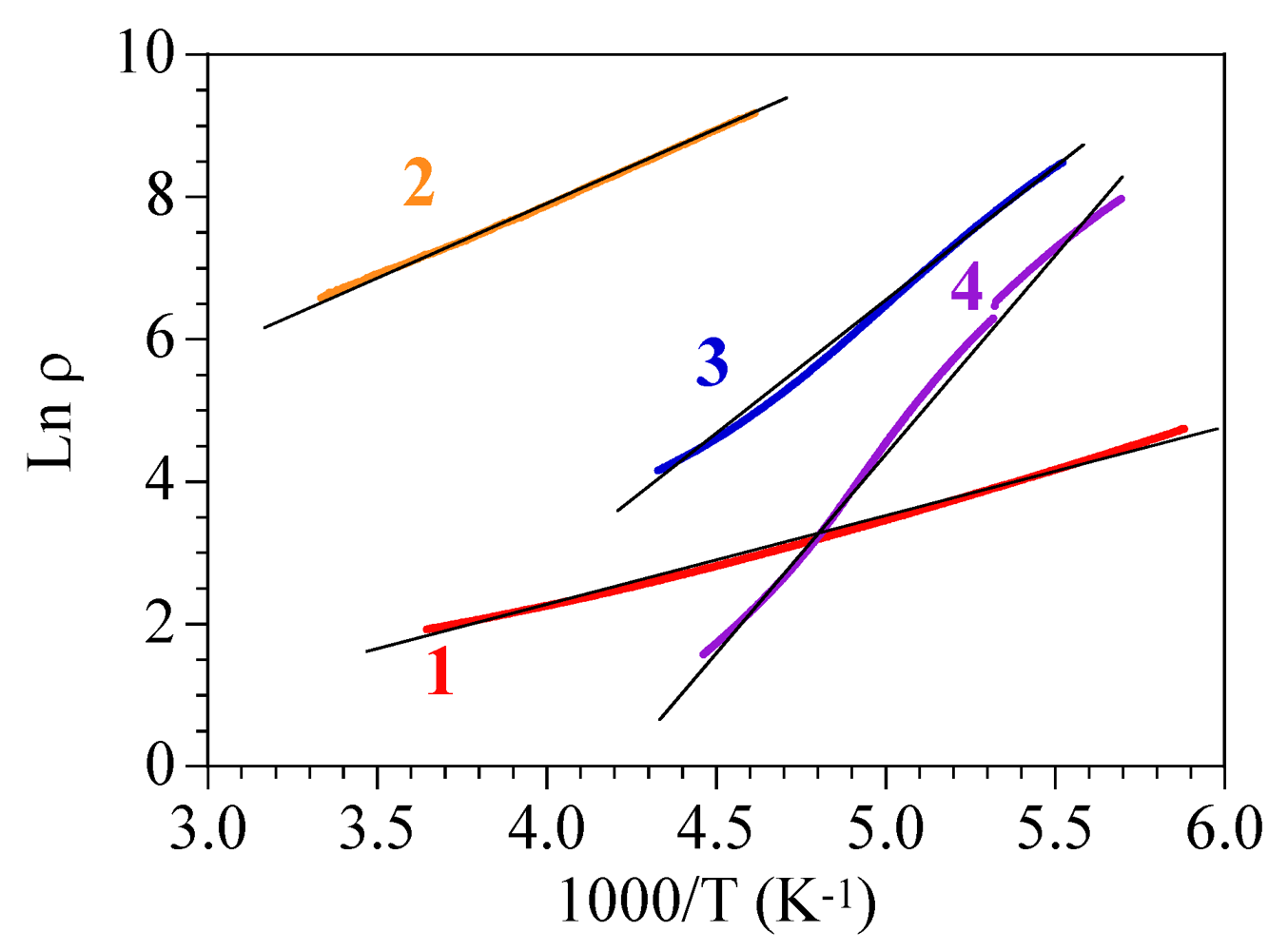
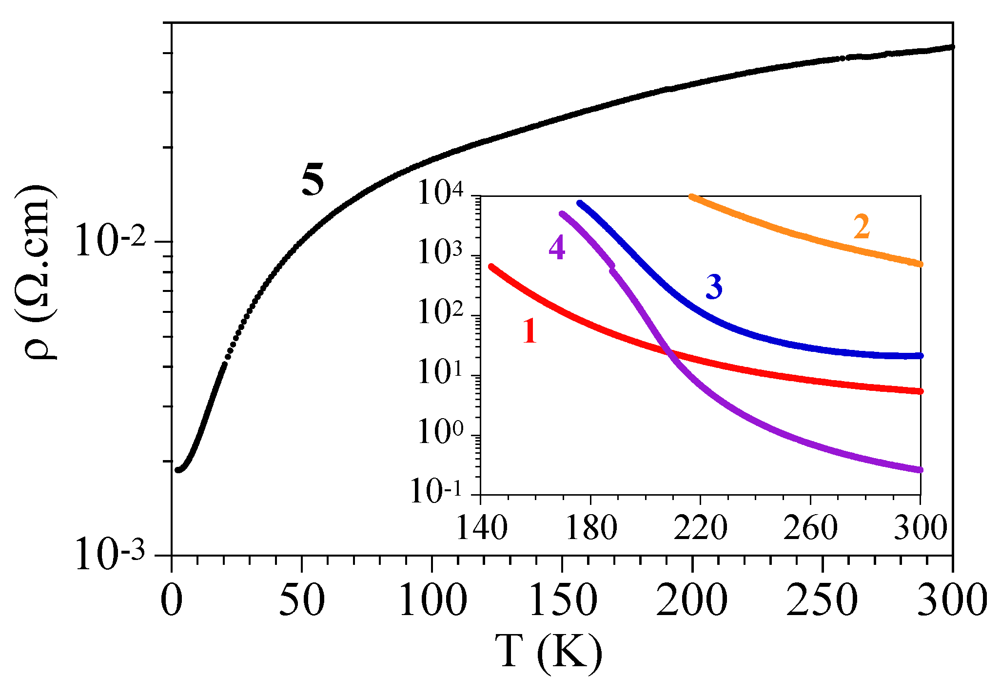
        <p>The dc electrical conductivity of compounds <bold>1</bold>–<bold>4</bold> shows similar thermal behaviors although with different room temperature conductivities values ranging from 10<sup>−4</sup> S·cm<sup>−1</sup> in compound <bold>2</bold> to 3.8 S·cm<sup>−1</sup> in compound <bold>4</bold> (<xref ref-type="table" rid="crystals-02-00306-t011">Table 11</xref>). When the temperature is decreased, the resistivity of compounds <bold>1</bold>–<bold>4</bold> increases and reaches the limiting resistance of our equipment at temperatures in the range 150–250 K (<xref ref-type="fig" rid="crystals-02-00306-f006">Figure 6</xref>). This thermal behavior suggests that compounds <bold>1</bold>–<bold>4</bold> are semiconductors as confirmed by the Arrhenius plots (<xref ref-type="fig" rid="crystals-02-00306-f007">Figure 7</xref>) that show straight lines in all cases with activations energies in the range 110–510 meV (<xref ref-type="table" rid="crystals-02-00306-t011">Table 11</xref>).</p>
        <table-wrap id="crystals-02-00306-t011" position="anchor">
          <object-id pub-id-type="pii">crystals-02-00306-t011_Table 11</object-id>
          <label>Table 11</label>
          <caption>
            <p>Room temperature electrical conductivity values, activation energies and approximate charge distributions in compounds <bold>1</bold>–<bold>5</bold>.</p>
          </caption>
                      <table>
            <thead>
              <tr>
                <th align="center" valign="middle">Compound</th>
                <th align="right" valign="middle">σ<sub>300K</sub> (S·cm<sup>−1</sup>)</th>
                <th align="right" valign="middle"><italic>E</italic><sub>a</sub> (meV)</th>
                <th align="right" valign="middle">ET Charge</th>
              </tr>
            </thead>
            <tbody>
              <tr>
                <td align="center" valign="middle">
                  <bold>1</bold>
                </td>
                <td align="right" valign="middle">0.18</td>
                <td align="right" valign="middle">110</td>
                <td align="right" valign="middle">0.5/0.5</td>
              </tr>
              <tr>
                <td align="center" valign="middle">
                  <bold>2</bold>
                </td>
                <td align="right" valign="middle">10<sup>−4</sup></td>
                <td align="right" valign="middle">175</td>
                <td align="right" valign="middle">0.5/0.5</td>
              </tr>
              <tr>
                <td align="center" valign="middle">
                  <bold>3</bold>
                </td>
                <td align="right" valign="middle">0.05</td>
                <td align="right" valign="middle">326</td>
                <td align="right" valign="middle">0.9/0.3/0.7/0.40.3/0.4/0.6/0.2</td>
              </tr>
              <tr>
                <td align="center" valign="middle">
                  <bold>4</bold>
                </td>
                <td align="right" valign="middle">3.8</td>
                <td align="right" valign="middle">510</td>
                <td align="right" valign="middle">0.25/0.75</td>
              </tr>
              <tr>
                <td align="center" valign="middle">
                  <bold>5</bold>
                </td>
                <td align="right" valign="middle">24</td>
                <td align="right" valign="middle">-</td>
                <td align="right" valign="middle">0.5/0.5</td>
              </tr>
            </tbody>
          </table>
        </table-wrap>
        <fig id="crystals-02-00306-f006" position="anchor">
          <label>Figure 6</label>
          <caption>
            <p>Thermal variation of the dc electrical conductivity of compounds <bold>1</bold>–<bold>5</bold>.</p>
          </caption>
          <graphic xmlns:xlink="http://www.w3.org/1999/xlink" xlink:href="crystals-02-00306-g006.tif"/>
        </fig>
        <fig id="crystals-02-00306-f007" position="anchor">
          <label>Figure 7</label>
          <caption>
            <p>Arrhenius plot of the dc conductivity for compounds <bold>1</bold>–<bold>4</bold>.</p>
          </caption>
          <graphic xmlns:xlink="http://www.w3.org/1999/xlink" xlink:href="crystals-02-00306-g007.tif"/>
        </fig>
        <p>The relatively high conductivities found in compounds <bold>1</bold> and <bold>3</bold>–<bold>5</bold> may be attributed to the presence in all the salts of partial oxidation degrees and of many intermolecular S···S short contacts. The lower conductivity found in compound <bold>2</bold> compared with all the others, agrees with the much lower quality of the single crystals, as also observed in the X-ray diffraction study (see below). The activation energies found in compounds <bold>1</bold>–<bold>4</bold> correlate well with the approximate charge distribution. Thus, compounds <bold>1</bold> and <bold>2</bold> present homogeneous charge distributions and the lowest activation energies (<xref ref-type="table" rid="crystals-02-00306-t011">Table 11</xref>) whereas compounds <bold>3</bold> and <bold>4</bold> present inhomogeneous charge distributions and the highest activation energies. As expected, the metallic salt 5 presents a homogeneous charge distribution (<xref ref-type="table" rid="crystals-02-00306-t011">Table 11</xref>).</p>
        <p>Compound <bold>5</bold> shows a higher room temperature conductivity (24 S·cm<sup>−1</sup>) and interestingly, its resistivity decreases as the temperature is decreased, in a typical metallic behavior, reaching a conductivity value of <italic>ca.</italic> 530 S·cm<sup>−1</sup> at the lowest measured temperature (0.4 K). Note that no superconducting transition is observed in any of the six measured crystals of this compound and, in fact, some of them show a smooth broad minimum in the resistivity plot at very low temperatures, suggesting the presence of a metal-semiconducting transition at low temperatures.</p>
      </sec>
    </sec>
    <sec id="sec3-catalysts-02-00038">
      <title>3. Experimental Section</title>
      <sec>
        <title>3.1. Synthesis</title>
        <p>The five salts have been prepared by electrochemical oxidation of the donor (ET) in the presence of the corresponding anions (tcpd<sup>2−</sup> for <bold>1</bold> and <bold>2</bold>, tcnoetOH<sup>−</sup> for <bold>3</bold> and <bold>4</bold> and tcnoprOH<sup>−</sup> for <bold>5</bold>). The precursor polycyano salts used in compounds <bold>1</bold>–<bold>4</bold> are the corresponding K<sup>+</sup> salts: K<sub>2</sub>(tcpd) [<xref ref-type="bibr" rid="B58-crystals-02-00306">58</xref>] and K(tcnoetOH) [<xref ref-type="bibr" rid="B59-crystals-02-00306">59</xref>]. For the synthesis of compound <bold>5</bold> we have used the Cu(tcnoprOH)<sub>2</sub> precursor salt [<xref ref-type="bibr" rid="B49-crystals-02-00306">49</xref>], which was prepared by metathesis of the corresponding K<sup>+</sup> salt with CuCl<sub>2</sub> in aqueous medium [<xref ref-type="bibr" rid="B50-crystals-02-00306">50</xref>]. The exact synthetic conditions used to obtain compounds <bold>1</bold>–<bold>5</bold> are indicated in <xref ref-type="table" rid="crystals-02-00306-t012">Table 12</xref>.</p>
        <table-wrap id="crystals-02-00306-t012" position="anchor">
          <object-id pub-id-type="pii">crystals-02-00306-t012_Table 12</object-id>
          <label>Table 12</label>
          <caption>
            <p>Experimental conditions used for the synthesis of compounds <bold>1</bold>–<bold>5</bold>.</p>
          </caption>
                    <table>
            <thead>
              <tr>
                <th align="center" valign="middle">Salt</th>
                <th align="center" valign="middle">Anode</th>
                <th align="center" valign="middle">Cathode</th>
                <th align="center" valign="middle">Current (μA)</th>
                <th align="center" valign="middle">Days</th>
                <th align="center" valign="middle">Aspect</th>
              </tr>
            </thead>
            <tbody>
              <tr style="border-top: solid thin">
                <td rowspan="2" align="center" valign="middle">
                  <bold>1</bold>                </td>
                <td align="center" valign="middle">10 mg ET</td>
                <td align="center" valign="middle">28 mg K<sub>2</sub>tcpd·2H<sub>2</sub>O</td>
                <td rowspan="2" align="center" valign="middle">0.5 μA</td>
                <td rowspan="2" align="center" valign="middle">30</td>
                <td align="center" valign="middle">dark brown</td>
              </tr>
              <tr>
                <td align="center" valign="middle">10 mL CH<sub>2</sub>Cl<sub>2</sub></td>
                <td align="center" valign="middle">10 mL THF</td>
                <td align="center" valign="middle">prisms</td>
              </tr>
              <tr style="border-top: solid thin">
                <td rowspan="4" align="center" valign="middle">
                  <bold>2</bold>                </td>
                <td align="center" valign="middle">10 mg ET</td>
                <td align="center" valign="middle">28 mg K<sub>2</sub>tcpd·2H<sub>2</sub>O</td>
                <td rowspan="4" align="center" valign="middle">0.5 μA</td>
                <td rowspan="4" align="center" valign="middle">32</td>
                <td rowspan="4" align="center" valign="middle">black prisms</td>
              </tr>
              <tr>
                <td align="center" valign="middle">10 mL CH<sub>2</sub>Cl<sub>2</sub></td>
                <td align="center" valign="middle">10 mL TCE</td>
              </tr>
              <tr>
                <td align="center" valign="middle">2 mL EtOH</td>
                <td align="center" valign="middle">2 mL EtOH</td>
              </tr>
              <tr>
                <td align="center" valign="middle">2 drops H<sub>2</sub>O</td>
                <td align="center" valign="middle">2 drops H<sub>2</sub>O</td>
              </tr>
              <tr style="border-top: solid thin">
                <td rowspan="4" align="center" valign="middle">
                  <bold>3/4</bold>                </td>
                <td rowspan="3" align="center" valign="middle">10 mg ET</td>
                <td align="center" valign="middle">24 mg K(tcnoetOH)</td>
                <td rowspan="4" align="center" valign="middle">0.5 μA</td>
                <td rowspan="4" align="center" valign="middle">20</td>
                <td rowspan="3" align="center" valign="middle">black plates (<bold>3</bold>)</td>
              </tr>
              <tr>
                <td align="center" valign="middle">10 mL TCE</td>
              </tr>
              <tr>
                <td rowspan="2" align="center" valign="middle">2 mL EtOH</td>
              </tr>
              <tr>
                <td align="center" valign="middle">10 mL CH<sub>2</sub>Cl<sub>2</sub></td>
                <td align="center" valign="middle">black  needles(<bold>4</bold>)</td>
              </tr>
              <tr style="border-top: solid thin">
                <td rowspan="3" align="center" valign="middle">
                  <bold>5</bold>                </td>
                <td align="center" valign="middle">10 mg ET</td>
                <td align="center" valign="middle">40 mg Cu(tcnoprOH)<sub>2</sub></td>
                <td rowspan="3" align="center" valign="middle">0.5 μA</td>
                <td rowspan="3" align="center" valign="middle">30</td>
                <td rowspan="3" align="center" valign="middle">brown shinyprisms</td>
              </tr>
              <tr>
                <td align="center" valign="middle">10 mL TCE</td>
                <td align="center" valign="middle">10 mL TCE</td>
              </tr>
              <tr>
                <td align="center" valign="middle">1 mL EtOH</td>
                <td align="center" valign="middle">1 mL EtOH</td>
              </tr>
            </tbody>
          </table>

        </table-wrap>
      </sec>
      <sec>
        <title>3.2. X-ray Crystallography</title>
        <p>Crystallographic data of compound <bold>1</bold> were collected at 293 K with a R-Axis Rapid Rigaku MSC diffractometer with monochromatic Cu-Kα radiation (λ = 1.54178 Å) and a curved image plate detector. A small crystal was used to collect the data. At 293 K, the full sphere data collection was performed using φ scans and ω scans with an exposure time of 36 s per degree. The unit cell determination and data reduction were performed using the crystal clear program suite [<xref ref-type="bibr" rid="B60-crystals-02-00306">60</xref>] on the full set of data. Crystallographic data were collected using an Oxford Diffraction Xcalibur κ-CCD diffractometer (for compounds <bold>2</bold>-<bold>4</bold>) and an Oxford Diffraction Supernova diffractometer (for compound <bold>5</bold>) with Mo-Kα radiation (λ = 0.71073 Å). The full sphere data collection was performed using φ scans and ω scans. The unit cell determination and data reduction were performed using the CrysAlis program suite [<xref ref-type="bibr" rid="B61-crystals-02-00306">61</xref>] on the full set of data. For the five compounds, the crystal structures were solved by direct methods and successive Fourier difference syntheses with the SIR97 program [<xref ref-type="bibr" rid="B62-crystals-02-00306">62</xref>] for compounds <bold>2</bold>–<bold>4</bold> and SHELXS-97 program [<xref ref-type="bibr" rid="B63-crystals-02-00306">63</xref>] for compounds <bold>1</bold> and <bold>5.</bold> The refinements of the crystal structure were performed on <italic>F</italic><sup>2</sup> by weighted anisotropic or mixed isotropic/anisotropic full-matrix least squares methods using the SHELXL97 program [<xref ref-type="bibr" rid="B63-crystals-02-00306">63</xref>] for all compounds. Both pieces of software were used within the WINGX or the OLEX2 package [<xref ref-type="bibr" rid="B64-crystals-02-00306">64</xref>,<xref ref-type="bibr" rid="B65-crystals-02-00306">65</xref>]. No absorption correction was needed owing to the low absorption coefficient of these complexes. Due to the low quality and the small size of the crystals, anisotropic/isotropic mixed model were used for compounds <bold>2</bold> and <bold>3</bold>. Thus, an anisotropic refinement has been performed for the S, O and N atoms for compound <bold>3</bold> whereas only the S atoms have been anisotropically refined for compound <bold>2</bold>. For compound <bold>1</bold>, <bold>4</bold> and <bold>5</bold>, all non-H atoms were refined anisotropically. For all compounds, H atoms were treated according to the riding model during refinement with isotropic displacement parameters, corresponding to the C atom they are linked to.</p>
        <p>Additionally, the crystal of <bold>1</bold> presents a small fraction of twinned part that may be due to a rotation of π radians around the <italic>a</italic> and the <italic>c</italic> crystallographic axes. This twin generates a small disorder of the whole crystal structure. According to the low fraction of the twinned part that can be estimated to 8%, such a disorder could be solved only for the sulfur atoms of the ET molecules and refined isotropically. The disordered ET molecules appear to be twisted of about 30° and in the same plane that the ET molecules from the main crystal part.</p>
        <p>Crystallographic data have been deposited in the Cambridge Crystallographic Data Centre (CCDC numbers 855227, 871616, 871618, 871619 and 871625 for <bold>1</bold>–<bold>5</bold> respectively). Copies of this data can be obtained free of charge from the Director, CCDC, 12 Union Road, Cambridge, CB2 1EZ, UK or via the web application [<xref ref-type="bibr" rid="B66-crystals-02-00306">66</xref>].</p>
      </sec>
      <sec>
        <title>3.3. Electrical Conductivity Measurements</title>
        <p>DC electrical conductivity measurements were carried out with the four contacts method on several single crystals of samples <bold>1</bold>–<bold>4</bold> in the temperature range 300–2 K (300–0.4 K for <bold>5</bold>), although, given the dimensions of the crystals and their high resistivity, in most cases the detection limit of our equipment (5 × 10<sup>9</sup> Ω) was attained between 100 and 200 K. The contacts were made with Pt wires (25 μm diameter) using graphite paste. The samples were measured in Quantum Design PPMS-9 equipment. All the conductivity quoted values have been measured in the voltage range where the crystals are Ohmic conductors. For each compound all the measured crystals showed similar conductivity values and thermal behaviors. The cooling and warming rates were 0.5 and 1 K/min and the results were, within experimental error, identical in the cooling and warming scans.</p>
      </sec>
    </sec>
    <sec sec-type="conclusions">
      <title>4. Conclusions</title>
      <p>We have shown that polycyano anions as tcpd<sup>2−</sup>, tcnoetOH<sup>−</sup> and tcnoprOH<sup>−</sup> can be used to prepare up to five novel conducting radical salts with the organic donor ET. All the structures show the typical alternating cationic (ET) and anionic (polycyano plus solvent) layers. Interestingly, in the case of the anion tcnoetOH<sup>−</sup> we have been able to prepare two different polymorphs: θ-ET<sub>2</sub>(tcnoetOH) (<bold>3</bold>) and β''-ET<sub>2</sub>(tcnoetOH) (<bold>4</bold>) with the same stoichiometry and under the same synthetic conditions. The anion tcpd<sup>2−</sup> has yielded two different salts with slightly different synthetic conditions: α'-(ET)<sub>4</sub>(tcpd)·THF (<bold>1</bold>) and α'-(ET)<sub>4</sub>(tcpd)·2H<sub>2</sub>O (<bold>2</bold>) showing the same phase and composition but different solvent molecules in the anionic layers. Finally, the anion tcnoprOH<sup>−</sup> has given rise to a β'' phase: β''-(ET)<sub>2</sub>(tcnoprOH)(CHCl<sub>2</sub>CH<sub>2</sub>Cl)<sub>0.5</sub> (<bold>5</bold>) containing half a CHCl<sub>2</sub>CH<sub>2</sub>Cl molecule in the anionic layer. The homogeneous charge distribution and the presence of many short intermolecular S···S contacts give rise to high conductivity values in all cases except in compound <bold>2</bold>, probably due to the low quality of the single crystals. Compound <bold>5</bold>, shows a metallic behavior although no superconducting transition above 0.4 K.</p>
    </sec>
    
  </body>
  <back>
   <ack>
      <title>Acknowledgments</title>
      <p>We thank the Spanish Ministerio de Economía y Competitividad (Projects Consolider-Ingenio in Molecular Nanoscience CSD2007-00010 and CTQ-2011-26507), the Generalitat Valenciana (Project Prometeo 2009/95) and Centre National de la Recherche Scientifique, CNRS (PICS project number 5137) for financial support.</p>
    </ack>
    <notes>
      <title>Conflict of Interest</title>
      <p>The authors declare no conflict of interest. </p>
    </notes>
    <ref-list>
      <title>References</title>
      <ref id="B1-crystals-02-00306">
        <label>1.</label>
        <citation citation-type="journal">
          <person-group person-group-type="author">
            <name>
              <surname>Ferraris</surname>
              <given-names>J.</given-names>
            </name>
            <name>
              <surname>Cowan</surname>
              <given-names>D.O.</given-names>
            </name>
            <name>
              <surname>Walatka</surname>
              <given-names>V.</given-names>
            </name>
            <name>
              <surname>Perlstein</surname>
              <given-names>J.H.</given-names>
            </name>
          </person-group>
          <article-title>Electron transfer in a new highly conducting donor-acceptor complex</article-title>
          <source>J. Am. Chem. Soc.</source>
          <year>1973</year>
          <volume>95</volume>
          <fpage>948</fpage>
          <lpage>949</lpage>
        <pub-id pub-id-type="doi">10.1021/ja00784a066</pub-id></citation>
      </ref>
      <ref id="B2-crystals-02-00306">
        <label>2.</label>
        <citation citation-type="journal">
          <person-group person-group-type="author">
            <name>
              <surname>Jerome</surname>
              <given-names>D.</given-names>
            </name>
            <name>
              <surname>Mazaud</surname>
              <given-names>A.</given-names>
            </name>
            <name>
              <surname>Ribault</surname>
              <given-names>M.</given-names>
            </name>
            <name>
              <surname>Bechgaard</surname>
              <given-names>K.</given-names>
            </name>
          </person-group>
          <article-title>Superconductivity in a synthetic organic conductor (TMTSF)<sub>2</sub>PF<sub>6</sub></article-title>
          <source>J. Phys. Lett.</source>
          <year>1980</year>
          <volume>41</volume>
          <fpage>95</fpage>
          <lpage>98</lpage>
          <pub-id pub-id-type="doi">10.1051/jphyslet:0198000410409500</pub-id>
        </citation>
      </ref>
      <ref id="B3-crystals-02-00306">
        <label>3.</label>
        <citation citation-type="journal">
          <person-group person-group-type="author">
            <name>
              <surname>Enoki</surname>
              <given-names>T.</given-names>
            </name>
            <name>
              <surname>Miyazaki</surname>
              <given-names>A.</given-names>
            </name>
          </person-group>
          <article-title>Magnetic TTF-based charge-transfer complexes</article-title>
          <source>Chem. Rev.</source>
          <year>2004</year>
          <volume>104</volume>
          <fpage>5449</fpage>
          <lpage>5478</lpage>
          <pub-id pub-id-type="doi">10.1021/cr0306438</pub-id>
        </citation>
      </ref>
      <ref id="B4-crystals-02-00306">
        <label>4.</label>
        <citation citation-type="journal">
          <person-group person-group-type="author">
            <name>
              <surname>Kobayashi</surname>
              <given-names>H.</given-names>
            </name>
            <name>
              <surname>Kobayashi</surname>
              <given-names>A.</given-names>
            </name>
            <name>
              <surname>Cassoux</surname>
              <given-names>P.</given-names>
            </name>
          </person-group>
          <article-title>BETS as a source of molecular magnetic superconductors (BETS = bis(ethylenedithio)tetraselenafulvalene)</article-title>
          <source>Chem. Soc. Rev.</source>
          <year>2000</year>
          <volume>29</volume>
          <fpage>325</fpage>
          <lpage>333</lpage>
        <pub-id pub-id-type="doi">10.1039/b002095h</pub-id></citation>
      </ref>
      <ref id="B5-crystals-02-00306">
        <label>5.</label>
        <citation citation-type="journal">
          <person-group person-group-type="author">
            <name>
              <surname>Kobayashi</surname>
              <given-names>H.</given-names>
            </name>
            <name>
              <surname>Tomita</surname>
              <given-names>H.</given-names>
            </name>
            <name>
              <surname>Naito</surname>
              <given-names>T.</given-names>
            </name>
            <name>
              <surname>Kobayashi</surname>
              <given-names>A.</given-names>
            </name>
            <name>
              <surname>Sakai</surname>
              <given-names>F.</given-names>
            </name>
            <name>
              <surname>Watanabe</surname>
              <given-names>T.</given-names>
            </name>
            <name>
              <surname>Cassoux</surname>
              <given-names>P.</given-names>
            </name>
          </person-group>
          <article-title>New BETS conductors with magnetic anions (BETS = bis(ethylenedithio)tetraselenafulvalene)</article-title>
          <source>J. Am. Chem. Soc.</source>
          <year>1996</year>
          <volume>118</volume>
          <fpage>368</fpage>
          <lpage>377</lpage>
        <pub-id pub-id-type="doi">10.1021/ja9523350</pub-id></citation>
      </ref>
      <ref id="B6-crystals-02-00306">
        <label>6.</label>
        <citation citation-type="journal">
          <person-group person-group-type="author">
            <name>
              <surname>Graham</surname>
              <given-names>A.W.</given-names>
            </name>
            <name>
              <surname>Kurmoo</surname>
              <given-names>M.</given-names>
            </name>
            <name>
              <surname>Day</surname>
              <given-names>P.</given-names>
            </name>
          </person-group>
          <article-title>β''(BEDT-TTF)<sub>4</sub>[(H<sub>2</sub>O)Fe(C<sub>2</sub>O<sub>4</sub>)<sub>3</sub>].PhCN: The first molecular superconductor containing paramagnetic metal Ions</article-title>
          <source>J. Chem. Soc. Chem. Commun.</source>
          <year>1995</year>
        </citation>
      </ref>
      <ref id="B7-crystals-02-00306">
        <label>7.</label>
        <citation citation-type="journal">
          <person-group person-group-type="author">
            <name>
              <surname>Coronado</surname>
              <given-names>E.</given-names>
            </name>
            <name>
              <surname>Curreli</surname>
              <given-names>S.</given-names>
            </name>
            <name>
              <surname>Gimenez-Saiz</surname>
              <given-names>C.</given-names>
            </name>
            <name>
              <surname>Gómez-García</surname>
              <given-names>C.J.</given-names>
            </name>
          </person-group>
          <article-title>The series of molecular conductors and superconductors ET<sub>4</sub>[AFe(C<sub>2</sub>O<sub>4</sub>)<sub>3</sub>]·PhX (ET = bis(ethylenedithio)tetrathia-fulvalene; (C<sub>2</sub>O<sub>4</sub>)<sup>2−</sup> = Oxalate; A<sup>+</sup> = H<sub>3</sub>O<sup>+</sup>, K<sup>+</sup>; X = F, Cl, Br, and I): Influence of the halobenzene guest molecules on the crystal structure and superconducting properties</article-title>
          <source>Inorg. Chem.</source>
          <year>2012</year>
          <volume>51</volume>
          <fpage>1111</fpage>
          <lpage>1126</lpage>
        <pub-id pub-id-type="doi">10.1021/ic202269x</pub-id><pub-id pub-id-type="pmid">22220827</pub-id></citation>
      </ref>
      <ref id="B8-crystals-02-00306">
        <label>8.</label>
        <citation citation-type="journal">
          <person-group person-group-type="author">
            <name>
              <surname>Kurmoo</surname>
              <given-names>M.</given-names>
            </name>
            <name>
              <surname>Graham</surname>
              <given-names>A.W.</given-names>
            </name>
            <name>
              <surname>Day</surname>
              <given-names>P.</given-names>
            </name>
            <name>
              <surname>Coles</surname>
              <given-names>S.J.</given-names>
            </name>
            <name>
              <surname>Hursthouse</surname>
              <given-names>M.B.</given-names>
            </name>
            <name>
              <surname>Caulfield</surname>
              <given-names>J.L.</given-names>
            </name>
            <name>
              <surname>Singleton</surname>
              <given-names>J.</given-names>
            </name>
            <name>
              <surname>Pratt</surname>
              <given-names>F.L.</given-names>
            </name>
            <name>
              <surname>Hayes</surname>
              <given-names>W.</given-names>
            </name>
          </person-group>
          <article-title>Superconducting and semiconducting magnetic charge transfer salts: (BEDT-TTF)<sub>4</sub>AFe(C<sub>2</sub>O<sub>4</sub>)<sub>3</sub>.C<sub>6</sub>H<sub>5</sub>CN (A = H<sub>2</sub>O, K, NH<sub>4</sub>)</article-title>
          <source>J. Am. Chem. Soc.</source>
          <year>1995</year>
          <volume>117</volume>
          <fpage>12209</fpage>
          <lpage>12217</lpage>
        <pub-id pub-id-type="doi">10.1021/ja00154a022</pub-id></citation>
      </ref>
      <ref id="B9-crystals-02-00306">
        <label>9.</label>
        <citation citation-type="journal">
          <person-group person-group-type="author">
            <name>
              <surname>Martin</surname>
              <given-names>L.</given-names>
            </name>
            <name>
              <surname>Turner</surname>
              <given-names>S.S.</given-names>
            </name>
            <name>
              <surname>Day</surname>
              <given-names>P.</given-names>
            </name>
            <name>
              <surname>Guionneau</surname>
              <given-names>P.</given-names>
            </name>
            <name>
              <surname>Howard</surname>
              <given-names>J.A.K.</given-names>
            </name>
            <name>
              <surname>Hibbs</surname>
              <given-names>D.E.</given-names>
            </name>
            <name>
              <surname>Light</surname>
              <given-names>M.E.</given-names>
            </name>
            <name>
              <surname>Hursthouse</surname>
              <given-names>M.B.</given-names>
            </name>
            <name>
              <surname>Uruichi</surname>
              <given-names>M.</given-names>
            </name>
            <name>
              <surname>Yakushi</surname>
              <given-names>K.</given-names>
            </name>
          </person-group>
          <article-title>Crystal chemistry and physical properties of superconducting and semiconducting charge transfer salts of the type (BEDT-TTF)<sub>4</sub>[A<sup>I</sup>M<sup>III</sup>(C<sub>2</sub>O<sub>4</sub>)<sub>3</sub>].PhCN (A<sup>I</sup> = H<sub>3</sub>O, NH<sub>4</sub>, K; M<sup>III</sup> = Cr, Fe, Co, Al; BEDT-TTF = bis(ethylenedithio)tetrathiafulvalene)</article-title>
          <source>Inorg. Chem.</source>
          <year>2001</year>
          <volume>40</volume>
          <fpage>1363</fpage>
          <lpage>1371</lpage>
        <pub-id pub-id-type="doi">10.1021/ic001193u</pub-id><pub-id pub-id-type="pmid">11300843</pub-id></citation>
      </ref>
      <ref id="B10-crystals-02-00306">
        <label>10.</label>
        <citation citation-type="journal">
          <person-group person-group-type="author">
            <name>
              <surname>Coronado</surname>
              <given-names>E.</given-names>
            </name>
            <name>
              <surname>Day</surname>
              <given-names>P.</given-names>
            </name>
          </person-group>
          <article-title>Magnetic molecular conductors</article-title>
          <source>Chem. Rev.</source>
          <year>2004</year>
          <volume>104</volume>
          <fpage>5419</fpage>
          <lpage>5448</lpage>
          <pub-id pub-id-type="doi">10.1021/cr030641n</pub-id>
        </citation>
      </ref>
      <ref id="B11-crystals-02-00306">
        <label>11.</label>
        <citation citation-type="journal">
          <person-group person-group-type="author">
            <name>
              <surname>Prokhorova</surname>
              <given-names>T.G.</given-names>
            </name>
            <name>
              <surname>Buravov</surname>
              <given-names>L.I.</given-names>
            </name>
            <name>
              <surname>Yagubskii</surname>
              <given-names>E.B.</given-names>
            </name>
            <name>
              <surname>Zorina</surname>
              <given-names>L.V.</given-names>
            </name>
            <name>
              <surname>Khasanov</surname>
              <given-names>S.S.</given-names>
            </name>
            <name>
              <surname>Simonov</surname>
              <given-names>S.V.</given-names>
            </name>
            <name>
              <surname>Shibaeva</surname>
              <given-names>R.P.</given-names>
            </name>
            <name>
              <surname>Korobenko</surname>
              <given-names>A.V.</given-names>
            </name>
            <name>
              <surname>Zverev</surname>
              <given-names>V.N.</given-names>
            </name>
          </person-group>
          <article-title>Effect of electrocrystallization medium on quality, structural features, and conducting properties of single crystals of the (BEDT-TTF)<sub>4</sub>A<sup>I</sup>[Fe<sup>III</sup>(C<sub>2</sub>O<sub>4</sub>)<sub>3</sub>.G family</article-title>
          <source> CrystEngComm</source>
          <year>2011</year>
          <volume>13</volume>
          <fpage>537</fpage>
          <lpage>545</lpage>
        <pub-id pub-id-type="doi">10.1039/c0ce00095g</pub-id></citation>
      </ref>
      <ref id="B12-crystals-02-00306">
        <label>12.</label>
        <citation citation-type="journal">
          <person-group person-group-type="author">
            <name>
              <surname>Coronado</surname>
              <given-names>E.</given-names>
            </name>
            <name>
              <surname>Gómez-García</surname>
              <given-names>C.J.</given-names>
            </name>
          </person-group>
          <article-title>Polyoxometalates—from magnetic clusters to molecular materials</article-title>
          <source>Comments Inorg. Chem.</source>
          <year>1995</year>
          <volume>17</volume>
          <fpage>255</fpage>
          <lpage>281</lpage>
          <pub-id pub-id-type="doi">10.1080/02603599508032707</pub-id>
        </citation>
      </ref>
      <ref id="B13-crystals-02-00306">
        <label>13.</label>
        <citation citation-type="journal">
          <person-group person-group-type="author">
            <name>
              <surname>Gómez-García</surname>
              <given-names>C.J.</given-names>
            </name>
            <name>
              <surname>Gimenezsaiz</surname>
              <given-names>C.</given-names>
            </name>
            <name>
              <surname>Triki</surname>
              <given-names>S.</given-names>
            </name>
            <name>
              <surname>Coronado</surname>
              <given-names>E.</given-names>
            </name>
            <name>
              <surname>Lemagueres</surname>
              <given-names>P.</given-names>
            </name>
            <name>
              <surname>Ouahab</surname>
              <given-names>L.</given-names>
            </name>
            <name>
              <surname>Ducasse</surname>
              <given-names>L.</given-names>
            </name>
            <name>
              <surname>Sourisseau</surname>
              <given-names>C.</given-names>
            </name>
            <name>
              <surname>Delhaes</surname>
              <given-names>P.</given-names>
            </name>
          </person-group>
          <article-title>Coexistence of magnetic and delocalized electrons in hybrid molecular materials—The series of organic-inorganic radical salts (BEDT-TTF)<sub>8</sub>[XW<sub>12</sub>O<sub>40</sub>] (Solv)<italic><sub>n</sub></italic>(X = 2(H<sup>+</sup>), B<sup>III</sup>, Si<sup>IV</sup>, Cu<sup>II</sup>, Co<sup>II</sup>, Fe<sup>III</sup> Solv = H<sub>2</sub>O, CH<sub>3</sub>CN)</article-title>
          <source>Inorg. Chem.</source>
          <year>1995</year>
          <volume>34</volume>
          <fpage>4139</fpage>
          <lpage>4151</lpage>
        <pub-id pub-id-type="doi">10.1021/ic00120a019</pub-id></citation>
      </ref>
      <ref id="B14-crystals-02-00306">
        <label>14.</label>
        <citation citation-type="journal">
          <person-group person-group-type="author">
            <name>
              <surname>Gómez-García</surname>
              <given-names>C.J.</given-names>
            </name>
            <name>
              <surname>Ouahab</surname>
              <given-names>L.</given-names>
            </name>
            <name>
              <surname>Gimenez-Saiz</surname>
              <given-names>C.</given-names>
            </name>
            <name>
              <surname>Triki</surname>
              <given-names>S.</given-names>
            </name>
            <name>
              <surname>Coronado</surname>
              <given-names>E.</given-names>
            </name>
            <name>
              <surname>Delhaes</surname>
              <given-names>P.</given-names>
            </name>
          </person-group>
          <article-title>Coexistence of mobile and localized-electrons in bis(ethylene)dithiotetrathiafulvalene (BEDT-TTF) radical salts with paramagnetic polyoxometalates—Synthesis and physical-properties of (BEDT-TTF)<sub>8</sub>[CoW<sub>12</sub>O<sub>40</sub>] 5.5H<sub>2</sub>O</article-title>
          <source>Angew. Chem. Int. Ed. Engl.</source>
          <year>1994</year>
          <volume>33</volume>
          <fpage>223</fpage>
          <lpage>226</lpage>
        <pub-id pub-id-type="doi">10.1002/anie.199402231</pub-id></citation>
      </ref>
      <ref id="B15-crystals-02-00306">
        <label>15.</label>
        <citation citation-type="journal">
          <person-group person-group-type="author">
            <name>
              <surname>Coronado</surname>
              <given-names>E.</given-names>
            </name>
            <name>
              <surname>Galan-Mascaros</surname>
              <given-names>J.R.</given-names>
            </name>
            <name>
              <surname>Gimenez-Saiz</surname>
              <given-names>C.</given-names>
            </name>
            <name>
              <surname>Gómez-García</surname>
              <given-names>C.J.</given-names>
            </name>
            <name>
              <surname>Triki</surname>
              <given-names>S.</given-names>
            </name>
          </person-group>
          <article-title>Hybrid molecular materials based upon magnetic polyoxometalates and organic pi-electron donors: Syntheses, structures, and properties of bis(ethylenedithio)tetrathiafulvalene radical salts with monosubstituted keggin polyoxoanions</article-title>
          <source>J. Am. Chem. Soc.</source>
          <year>1998</year>
          <volume>120</volume>
          <fpage>4671</fpage>
          <lpage>4681</lpage>
        <pub-id pub-id-type="doi">10.1021/ja973856l</pub-id></citation>
      </ref>
      <ref id="B16-crystals-02-00306">
        <label>16.</label>
        <citation citation-type="journal">
          <person-group person-group-type="author">
            <name>
              <surname>Coronado</surname>
              <given-names>E.</given-names>
            </name>
            <name>
              <surname>GalanMascaros</surname>
              <given-names>J.R.</given-names>
            </name>
            <name>
              <surname>GimenezSaiz</surname>
              <given-names>C.</given-names>
            </name>
            <name>
              <surname>Gómez-García</surname>
              <given-names>C.J.</given-names>
            </name>
            <name>
              <surname>Laukhin</surname>
              <given-names>V.N.</given-names>
            </name>
          </person-group>
          <article-title>The first radical salt of the polyoxometalate cluster [P<sub>2</sub>W<sub>18</sub>O<sub>62</sub>]<sup>6−</sup> with bis(ethylenedithio)-tetrathiafulvalene (ET): ET<sub>11</sub>[P<sub>2</sub>W<sub>18</sub>O<sub>62</sub>] 3H<sub>2</sub>O</article-title>
          <source>Adv Mater</source>
          <year>1996</year>
          <volume>8</volume>
          <fpage>801</fpage>
          <lpage>803</lpage>
          <pub-id pub-id-type="doi">10.1002/adma.19960081005</pub-id>
        </citation>
      </ref>
      <ref id="B17-crystals-02-00306">
        <label>17.</label>
        <citation citation-type="journal">
          <person-group person-group-type="author">
            <name>
              <surname>Coronado</surname>
              <given-names>E.</given-names>
            </name>
            <name>
              <surname>Galan-Mascaros</surname>
              <given-names>J.R.</given-names>
            </name>
            <name>
              <surname>Gómez-García</surname>
              <given-names>C.J.</given-names>
            </name>
            <name>
              <surname>Laukhin</surname>
              <given-names>V.</given-names>
            </name>
          </person-group>
          <article-title>Coexistence of ferromagnetism and metallic conductivity in a molecule-based layered compound</article-title>
          <source>Nature</source>
          <year>2000</year>
          <volume>408</volume>
          <fpage>447</fpage>
          <lpage>449</lpage>
        <pub-id pub-id-type="doi">10.1038/35044035</pub-id><pub-id pub-id-type="pmid">11100721</pub-id></citation>
      </ref>
      <ref id="B18-crystals-02-00306">
        <label>18.</label>
        <citation citation-type="journal">
          <person-group person-group-type="author">
            <name>
              <surname>Alberola</surname>
              <given-names>A.</given-names>
            </name>
            <name>
              <surname>Coronado</surname>
              <given-names>E.</given-names>
            </name>
            <name>
              <surname>Galan-Mascaros</surname>
              <given-names>J.R.</given-names>
            </name>
            <name>
              <surname>Gimenez-Saiz</surname>
              <given-names>C.</given-names>
            </name>
            <name>
              <surname>Gómez-García</surname>
              <given-names>C.J.</given-names>
            </name>
          </person-group>
          <article-title>A molecular metal ferromagnet from the organic donor bis(ethylenedithio)tetraselenafulvalene and bimetallic oxalate complexes</article-title>
          <source>J. Am. Chem. Soc.</source>
          <year>2003</year>
          <volume>125</volume>
          <fpage>10774</fpage>
          <lpage>10775</lpage>
        <pub-id pub-id-type="doi">10.1021/ja035772k</pub-id><pub-id pub-id-type="pmid">12952442</pub-id></citation>
      </ref>
      <ref id="B19-crystals-02-00306">
        <label>19.</label>
        <citation citation-type="journal">
          <person-group person-group-type="author">
            <name>
              <surname>Coronado</surname>
              <given-names>E.</given-names>
            </name>
            <name>
              <surname>Galan-Mascaros</surname>
              <given-names>J.R.</given-names>
            </name>
            <name>
              <surname>Gómez-García</surname>
              <given-names>C.J.</given-names>
            </name>
            <name>
              <surname>Martinez-Ferrero</surname>
              <given-names>E.</given-names>
            </name>
            <name>
              <surname>van Smaalen</surname>
              <given-names>S.</given-names>
            </name>
          </person-group>
          <article-title>Incommensurate nature of the multilayered molecular ferromagnetic metals based on bis(ethylenedithio)tetrathiafulvalene and bimetallic oxalate complexes</article-title>
          <source>Inorg. Chem.</source>
          <year>2004</year>
          <volume>43</volume>
          <fpage>4808</fpage>
          <lpage>4810</lpage>
        <pub-id pub-id-type="doi">10.1021/ic049424a</pub-id><pub-id pub-id-type="pmid">15285651</pub-id></citation>
      </ref>
      <ref id="B20-crystals-02-00306">
        <label>20.</label>
        <citation citation-type="journal">
          <person-group person-group-type="author">
            <name>
              <surname>Alberola</surname>
              <given-names>A.</given-names>
            </name>
            <name>
              <surname>Coronado</surname>
              <given-names>E.</given-names>
            </name>
            <name>
              <surname>Galan-Mascaros</surname>
              <given-names>J.R.</given-names>
            </name>
            <name>
              <surname>Gimenez-Saiz</surname>
              <given-names>C.</given-names>
            </name>
            <name>
              <surname>Gómez-García</surname>
              <given-names>C.J.</given-names>
            </name>
            <name>
              <surname>Martinez-Ferrero</surname>
              <given-names>E.</given-names>
            </name>
            <name>
              <surname>Murcia-Martinez</surname>
              <given-names>A.</given-names>
            </name>
          </person-group>
          <article-title>Multifunctionality in hybrid molecular materials: Design of ferromagnetic molecular metals</article-title>
          <source>Synth. Met.</source>
          <year>2003</year>
          <volume>135</volume>
          <fpage>687</fpage>
          <lpage>689</lpage>
          <pub-id pub-id-type="doi">10.1016/S0379-6779(02)00785-3</pub-id>
        </citation>
      </ref>
      <ref id="B21-crystals-02-00306">
        <label>21.</label>
        <citation citation-type="journal">
          <person-group person-group-type="author">
            <name>
              <surname>Kini</surname>
              <given-names>A.M.</given-names>
            </name>
            <name>
              <surname>Geiser</surname>
              <given-names>U.</given-names>
            </name>
            <name>
              <surname>Wang</surname>
              <given-names>H.H.</given-names>
            </name>
            <name>
              <surname>Carlson</surname>
              <given-names>K.D.</given-names>
            </name>
            <name>
              <surname>Williams</surname>
              <given-names>J.M.</given-names>
            </name>
            <name>
              <surname>Kwok</surname>
              <given-names>W.K.</given-names>
            </name>
            <name>
              <surname>Vandervoort</surname>
              <given-names>K.G.</given-names>
            </name>
            <name>
              <surname>Thompson</surname>
              <given-names>J.E.</given-names>
            </name>
            <name>
              <surname>Stupka</surname>
              <given-names>D.L.</given-names>
            </name>
          </person-group>
          <article-title>A new ambient-pressure organic superconductor, κ-(ET)<sub>2</sub>Cu[N(CN)<sub>2</sub>]Br, with the highest transition temperature yet observed (Inductive Onset <italic>T</italic><sub>c</sub> = 11.6 K, Resistive Onset = 12.5 K)</article-title>
          <source>Inorg. Chem.</source>
          <year>1990</year>
          <volume>29</volume>
          <fpage>2555</fpage>
          <lpage>2557</lpage>
        <pub-id pub-id-type="doi">10.1021/ic00339a004</pub-id></citation>
      </ref>
      <ref id="B22-crystals-02-00306">
        <label>22.</label>
        <citation citation-type="journal">
          <person-group person-group-type="author">
            <name>
              <surname>Komatsu</surname>
              <given-names>T.</given-names>
            </name>
            <name>
              <surname>Nakamura</surname>
              <given-names>T.</given-names>
            </name>
            <name>
              <surname>Matsukawa</surname>
              <given-names>N.</given-names>
            </name>
            <name>
              <surname>Yamochi</surname>
              <given-names>H.</given-names>
            </name>
            <name>
              <surname>Saito</surname>
              <given-names>G.</given-names>
            </name>
            <name>
              <surname>Ito</surname>
              <given-names>H.</given-names>
            </name>
            <name>
              <surname>Ishiguro</surname>
              <given-names>T.</given-names>
            </name>
            <name>
              <surname>Kusunoki</surname>
              <given-names>M.</given-names>
            </name>
            <name>
              <surname>Sakaguchi</surname>
              <given-names>K.</given-names>
            </name>
          </person-group>
          <article-title>New ambient-pressure organic superconductors based on BEDT-TTF, Cu, N(CN)<sub>2</sub> and CN with <italic>T</italic><sub>c</sub> = 1.7 K and 3.8 K</article-title>
          <source>Solid State Commun.</source>
          <year>1991</year>
          <volume>80</volume>
          <fpage>843</fpage>
          <lpage>847</lpage>
        <pub-id pub-id-type="doi">10.1016/0038-1098(91)90518-Z</pub-id></citation>
      </ref>
      <ref id="B23-crystals-02-00306">
        <label>23.</label>
        <citation citation-type="journal">
          <person-group person-group-type="author">
            <name>
              <surname>Kushch</surname>
              <given-names>N.D.</given-names>
            </name>
            <name>
              <surname>Kazakova</surname>
              <given-names>A.V.</given-names>
            </name>
            <name>
              <surname>Buravov</surname>
              <given-names>L.I.</given-names>
            </name>
            <name>
              <surname>Chekhlov</surname>
              <given-names>A.N.</given-names>
            </name>
            <name>
              <surname>Dubrovskii</surname>
              <given-names>A.D.</given-names>
            </name>
            <name>
              <surname>Yagubskii</surname>
              <given-names>E.B.</given-names>
            </name>
            <name>
              <surname>Canadell</surname>
              <given-names>E.</given-names>
            </name>
          </person-group>
          <article-title>The First Polymorph, κ''-(ET)<sub>2</sub>Cu[N(CN)<sub>2</sub>]Cl, in the Family of κ-(ET)<sub>2</sub>Cu[N(CN)<sub>2</sub>]X (X = Cl, Br, I) radical cation salts</article-title>
          <source>J. Solid State Chem.</source>
          <year>2009</year>
          <volume>182</volume>
          <fpage>617</fpage>
          <lpage>621</lpage>
          <pub-id pub-id-type="doi">10.1016/j.jssc.2008.10.035</pub-id>
        </citation>
      </ref>
      <ref id="B24-crystals-02-00306">
        <label>24.</label>
        <citation citation-type="journal">
          <person-group person-group-type="author">
            <name>
              <surname>Geiser</surname>
              <given-names>U.</given-names>
            </name>
            <name>
              <surname>Schlueter</surname>
              <given-names>J.A.</given-names>
            </name>
          </person-group>
          <article-title>Conducting organic radical cation salts with organic and organometallic anions</article-title>
          <source>Chem. Rev.</source>
          <year>2004</year>
          <volume>104</volume>
          <fpage>5203</fpage>
          <lpage>5242</lpage>
          <pub-id pub-id-type="doi">10.1021/cr0306844</pub-id>
        </citation>
      </ref>
      <ref id="B25-crystals-02-00306">
        <label>25.</label>
        <citation citation-type="journal">
          <person-group person-group-type="author">
            <name>
              <surname>Hasegawa</surname>
              <given-names>T.</given-names>
            </name>
            <name>
              <surname>Mochida</surname>
              <given-names>T.</given-names>
            </name>
            <name>
              <surname>Kondo</surname>
              <given-names>R.</given-names>
            </name>
            <name>
              <surname>Kagoshima</surname>
              <given-names>S.</given-names>
            </name>
            <name>
              <surname>Iwasa</surname>
              <given-names>Y.</given-names>
            </name>
            <name>
              <surname>Akutagawa</surname>
              <given-names>T.</given-names>
            </name>
            <name>
              <surname>Nakamura</surname>
              <given-names>T.</given-names>
            </name>
            <name>
              <surname>Saito</surname>
              <given-names>G.</given-names>
            </name>
          </person-group>
          <article-title>Mixed-stack organic charge-transfer complexes with intercolumnar networks</article-title>
          <source>Phys. Rev. B</source>
          <year>2000</year>
          <volume>62</volume>
          <fpage>10059</fpage>
          <lpage>10066</lpage>
        <pub-id pub-id-type="doi">10.1103/PhysRevB.62.10059</pub-id></citation>
      </ref>
      <ref id="B26-crystals-02-00306">
        <label>26.</label>
        <citation citation-type="journal">
          <person-group person-group-type="author">
            <name>
              <surname>Hasegawa</surname>
              <given-names>T.</given-names>
            </name>
            <name>
              <surname>Inukai</surname>
              <given-names>K.</given-names>
            </name>
            <name>
              <surname>Kagoshima</surname>
              <given-names>S.</given-names>
            </name>
            <name>
              <surname>Sugawara</surname>
              <given-names>T.</given-names>
            </name>
            <name>
              <surname>Mochida</surname>
              <given-names>T.</given-names>
            </name>
            <name>
              <surname>Sugiura</surname>
              <given-names>S.</given-names>
            </name>
            <name>
              <surname>Iwasa</surname>
              <given-names>Y.</given-names>
            </name>
          </person-group>
          <article-title>(BEDT-TTF)(F<sub>1</sub>TCNQ) and (BEDT-TTF)(F<sub>2</sub>TCNQ)<sub>x</sub>(TCNQ)<sub>1 − <italic>x</italic></sub> (<italic>x</italic> ≈ 0.5): All-organic metals down to 2 K</article-title>
          <source>Chem. Commun.</source>
          <year>1997</year>
        </citation>
      </ref>
      <ref id="B27-crystals-02-00306">
        <label>27.</label>
        <citation citation-type="journal">
          <person-group person-group-type="author">
            <name>
              <surname>Mori</surname>
              <given-names>T.</given-names>
            </name>
            <name>
              <surname>Inokuchi</surname>
              <given-names>H.</given-names>
            </name>
          </person-group>
          <article-title>Structural and electrical properties of (BEDT-TTF)(TCNQ)</article-title>
          <source>Solid State Commun.</source>
          <year>1986</year>
          <volume>59</volume>
          <fpage>355</fpage>
          <lpage>359</lpage>
        <pub-id pub-id-type="doi">10.1016/0038-1098(86)90562-4</pub-id></citation>
      </ref>
      <ref id="B28-crystals-02-00306">
        <label>28.</label>
        <citation citation-type="journal">
          <person-group person-group-type="author">
            <name>
              <surname>Beno</surname>
              <given-names>M.A.</given-names>
            </name>
            <name>
              <surname>Wang</surname>
              <given-names>H.H.</given-names>
            </name>
            <name>
              <surname>Soderholm</surname>
              <given-names>L.</given-names>
            </name>
            <name>
              <surname>Carlson</surname>
              <given-names>K.D.</given-names>
            </name>
            <name>
              <surname>Hall</surname>
              <given-names>L.N.</given-names>
            </name>
            <name>
              <surname>Nunez</surname>
              <given-names>L.</given-names>
            </name>
            <name>
              <surname>Rummens</surname>
              <given-names>H.</given-names>
            </name>
            <name>
              <surname>Anderson</surname>
              <given-names>B.</given-names>
            </name>
            <name>
              <surname>Schlueter</surname>
              <given-names>J.A.</given-names>
            </name>
            <name>
              <surname>Williams</surname>
              <given-names>J.M.</given-names>
            </name>
            <name>
              <surname>Whangbo</surname>
              <given-names>M.H.</given-names>
            </name>
            <name>
              <surname>Evain</surname>
              <given-names>M.</given-names>
            </name>
          </person-group>
          <article-title>Synthesis of the new organic metal (ET)<sub>2</sub>C(CN)<sub>3</sub> and characterization of its metal-insulator phase-transition at approximately-180-K</article-title>
          <source>Inorg. Chem.</source>
          <year>1989</year>
          <volume>28</volume>
          <fpage>150</fpage>
          <lpage>154</lpage>
        <pub-id pub-id-type="doi">10.1021/ic00300a033</pub-id></citation>
      </ref>
      <ref id="B29-crystals-02-00306">
        <label>29.</label>
        <citation citation-type="journal">
          <person-group person-group-type="author">
            <name>
              <surname>Yamochi</surname>
              <given-names>H.</given-names>
            </name>
            <name>
              <surname>Tsuji</surname>
              <given-names>T.</given-names>
            </name>
            <name>
              <surname>Saito</surname>
              <given-names>G.</given-names>
            </name>
            <name>
              <surname>Suzuki</surname>
              <given-names>T.</given-names>
            </name>
            <name>
              <surname>Miyashi</surname>
              <given-names>T.</given-names>
            </name>
            <name>
              <surname>Kabuto</surname>
              <given-names>C.</given-names>
            </name>
          </person-group>
          <article-title>BEDT-TTF complexes with percyano substituted organic anions</article-title>
          <source>Synth. Met.</source>
          <year>1988</year>
          <volume>27</volume>
          <fpage>A479</fpage>
          <lpage>A484</lpage>
          <pub-id pub-id-type="doi">10.1016/0379-6779(88)90442-0</pub-id>
        </citation>
      </ref>
      <ref id="B30-crystals-02-00306">
        <label>30.</label>
        <citation citation-type="journal">
          <person-group person-group-type="author">
            <name>
              <surname>Watson</surname>
              <given-names>W.H.</given-names>
            </name>
            <name>
              <surname>Kini</surname>
              <given-names>A.M.</given-names>
            </name>
            <name>
              <surname>Beno</surname>
              <given-names>M.A.</given-names>
            </name>
            <name>
              <surname>Montgomery</surname>
              <given-names>L.K.</given-names>
            </name>
            <name>
              <surname>Wang</surname>
              <given-names>H.H.</given-names>
            </name>
            <name>
              <surname>Carlson</surname>
              <given-names>K.D.</given-names>
            </name>
            <name>
              <surname>Gates</surname>
              <given-names>B.D.</given-names>
            </name>
            <name>
              <surname>Tytko</surname>
              <given-names>S.F.</given-names>
            </name>
            <name>
              <surname>Derose</surname>
              <given-names>J.</given-names>
            </name>
            <name>
              <surname>Cariss</surname>
              <given-names>C.</given-names>
            </name>
            <name>
              <surname>Rohl</surname>
              <given-names>C.A.</given-names>
            </name>
            <name>
              <surname>Williams</surname>
              <given-names>J.M.</given-names>
            </name>
          </person-group>
          <article-title>Crystal structure and electrical properties of (BEDT-TTF)<sub>2</sub>Cp(CN)<sub>5</sub>(Solvent)<sub>x</sub></article-title>
          <source>Synth. Met.</source>
          <year>1989</year>
          <volume>33</volume>
          <fpage>1</fpage>
          <lpage>9</lpage>
          <pub-id pub-id-type="doi">10.1016/0379-6779(89)90851-5</pub-id>
        </citation>
      </ref>
      <ref id="B31-crystals-02-00306">
        <label>31.</label>
        <citation citation-type="journal">
          <person-group person-group-type="author">
            <name>
              <surname>Saito</surname>
              <given-names>G.</given-names>
            </name>
            <name>
              <surname>Sekizaki</surname>
              <given-names>S.</given-names>
            </name>
            <name>
              <surname>Konsha</surname>
              <given-names>A.</given-names>
            </name>
            <name>
              <surname>Yamochi</surname>
              <given-names>H.</given-names>
            </name>
            <name>
              <surname>Matsumoto</surname>
              <given-names>K.</given-names>
            </name>
            <name>
              <surname>Kusunoki</surname>
              <given-names>M.</given-names>
            </name>
            <name>
              <surname>Sakaguchi</surname>
              <given-names>K.</given-names>
            </name>
          </person-group>
          <article-title>A stable and flexible dianion: 2-Dicyanomethylene-1,1,3,4,5,5-Hexacyanopentenediide (DHCP), and its complex formation</article-title>
          <source>J. Mater. Chem.</source>
          <year>2001</year>
          <volume>11</volume>
          <fpage>364</fpage>
          <lpage>373</lpage>
        <pub-id pub-id-type="doi">10.1039/b006426m</pub-id></citation>
      </ref>
      <ref id="B32-crystals-02-00306">
        <label>32.</label>
        <citation citation-type="journal">
          <person-group person-group-type="author">
            <name>
              <surname>Aso</surname>
              <given-names>Y.</given-names>
            </name>
            <name>
              <surname>Yui</surname>
              <given-names>K.</given-names>
            </name>
            <name>
              <surname>Ishida</surname>
              <given-names>H.</given-names>
            </name>
            <name>
              <surname>Otsubo</surname>
              <given-names>T.</given-names>
            </name>
            <name>
              <surname>Ogura</surname>
              <given-names>F.</given-names>
            </name>
            <name>
              <surname>Kawamoto</surname>
              <given-names>A.</given-names>
            </name>
            <name>
              <surname>Tanaka</surname>
              <given-names>J.</given-names>
            </name>
          </person-group>
          <article-title>Crystal structure of 2,5-bis(dicyanomethylene)-2,5-dihydrothieno[3,2-<italic>b</italic>]thiophene and bis(ethylenedithio)-tetrathiafulvalene complex</article-title>
          <source>Chem. Lett.</source>
          <year>1988</year>
          <volume>17</volume>
          <fpage>1069</fpage>
          <lpage>1072</lpage>
        </citation>
      </ref>
      <ref id="B33-crystals-02-00306">
        <label>33.</label>
        <citation citation-type="journal">
          <person-group person-group-type="author">
            <name>
              <surname>Yamochi</surname>
              <given-names>H.</given-names>
            </name>
            <name>
              <surname>Tada</surname>
              <given-names>C.</given-names>
            </name>
            <name>
              <surname>Sekizaki</surname>
              <given-names>S.</given-names>
            </name>
            <name>
              <surname>Saito</surname>
              <given-names>G.</given-names>
            </name>
            <name>
              <surname>Kusunoki</surname>
              <given-names>M.</given-names>
            </name>
            <name>
              <surname>Sakaguchi</surname>
              <given-names>K.</given-names>
            </name>
          </person-group>
          <article-title>Conductive radical cation salts with organic anions of {RO-C[C(CN)<sub>2</sub>]<sub>2</sub>}</article-title>
          <source>Mol. Cryst. Liquid Cryst.</source>
          <year>1996</year>
          <volume>284</volume>
          <fpage>379</fpage>
          <lpage>390</lpage>
          <pub-id pub-id-type="doi">10.1080/10587259608037940</pub-id>
        </citation>
      </ref>
      <ref id="B34-crystals-02-00306">
        <label>34.</label>
        <citation citation-type="journal">
          <person-group person-group-type="author">
            <name>
              <surname>Sekizaki</surname>
              <given-names>S.</given-names>
            </name>
            <name>
              <surname>Matsukawa</surname>
              <given-names>N.</given-names>
            </name>
            <name>
              <surname>Yamochi</surname>
              <given-names>H.</given-names>
            </name>
            <name>
              <surname>Saito</surname>
              <given-names>G.</given-names>
            </name>
          </person-group>
          <article-title>Variety of BEDT-TTF salts with organic polycyano anions</article-title>
          <source>Synth. Met.</source>
          <year>2003</year>
          <volume>133–134</volume>
          <fpage>455</fpage>
          <lpage>457</lpage>
          <pub-id pub-id-type="doi">10.1016/S0379-6779(02)00301-6</pub-id>
        </citation>
      </ref>
      <ref id="B35-crystals-02-00306">
        <label>35.</label>
        <citation citation-type="journal">
          <person-group person-group-type="author">
            <name>
              <surname>Kazakova</surname>
              <given-names>A.V.</given-names>
            </name>
            <name>
              <surname>Kushch</surname>
              <given-names>N.D.</given-names>
            </name>
            <name>
              <surname>Chekhlov</surname>
              <given-names>A.N.</given-names>
            </name>
            <name>
              <surname>Dubrovskii</surname>
              <given-names>A.D.</given-names>
            </name>
            <name>
              <surname>Yagubskii</surname>
              <given-names>E.B.</given-names>
            </name>
            <name>
              <surname>Van</surname>
              <given-names>K.V.</given-names>
            </name>
          </person-group>
          <article-title>New multicomponent organic semiconductors based on ET with Polymeric anions: α'-(ET)<sub>2</sub>N(CN)<sub>2</sub>·2H<sub>2</sub>O and α''-(ET)<sub>6</sub>(NO<sub>3</sub>)<sub>3</sub>·2C<sub>2</sub>H<sub>5</sub>O<sub>2</sub>N<sub>3</sub></article-title>
          <source>Russ. J. Gen. Chem.</source>
          <year>2008</year>
          <volume>78</volume>
          <fpage>6</fpage>
          <lpage>13</lpage>
        <pub-id pub-id-type="doi">10.1134/S1070363208010027</pub-id></citation>
      </ref>
      <ref id="B36-crystals-02-00306">
        <label>36.</label>
        <citation citation-type="journal">
          <person-group person-group-type="author">
            <name>
              <surname>Bu</surname>
              <given-names>X.</given-names>
            </name>
            <name>
              <surname>Coppens</surname>
              <given-names>P.</given-names>
            </name>
            <name>
              <surname>Lederle</surname>
              <given-names>B.</given-names>
            </name>
            <name>
              <surname>Naughton</surname>
              <given-names>M.J.</given-names>
            </name>
          </person-group>
          <article-title>Structure of (BEDT-TTF)<sub>2</sub>N(CN)<sub>2</sub></article-title>
          <source>Acta Cryst. C</source>
          <year>1992</year>
          <volume>48</volume>
          <fpage>1560</fpage>
          <lpage>1561</lpage>
        <pub-id pub-id-type="doi">10.1107/S0108270192005262</pub-id></citation>
      </ref>
      <ref id="B37-crystals-02-00306">
        <label>37.</label>
        <citation citation-type="journal">
          <person-group person-group-type="author">
            <name>
              <surname>Schlueter</surname>
              <given-names>J.</given-names>
            </name>
            <name>
              <surname>Geiser</surname>
              <given-names>U.</given-names>
            </name>
            <name>
              <surname>Manson</surname>
              <given-names>J.</given-names>
            </name>
          </person-group>
          <article-title>Anionic dicyanamide frameworks as possible components of multifunctional materials</article-title>
          <source>J. Phys. IV</source>
          <year>2004</year>
          <volume>114</volume>
          <fpage>475</fpage>
          <lpage>479</lpage>
        </citation>
      </ref>
      <ref id="B38-crystals-02-00306">
        <label>38.</label>
        <citation citation-type="journal">
          <person-group person-group-type="author">
            <name>
              <surname>Kushch</surname>
              <given-names>N.D.</given-names>
            </name>
            <name>
              <surname>Kazakova</surname>
              <given-names>A.V.</given-names>
            </name>
            <name>
              <surname>Dubrovskii</surname>
              <given-names>A.D.</given-names>
            </name>
            <name>
              <surname>Shilov</surname>
              <given-names>G.V.</given-names>
            </name>
            <name>
              <surname>Buravov</surname>
              <given-names>L.I.</given-names>
            </name>
            <name>
              <surname>Morgunov</surname>
              <given-names>R.B.</given-names>
            </name>
            <name>
              <surname>Kurganova</surname>
              <given-names>E.V.</given-names>
            </name>
            <name>
              <surname>Tanimoto</surname>
              <given-names>Y.</given-names>
            </name>
            <name>
              <surname>Yagubskii</surname>
              <given-names>E.B.</given-names>
            </name>
          </person-group>
          <article-title>Molecular magnetic semiconductors formed by cationic and anionic networks: (ET)<sub>2</sub>Mn[N(CN)<sub>2</sub>]<sub>3</sub> and (ET)<sub>2</sub>CuMn[N(CN)<sub>2</sub>]<sub>4</sub></article-title>
          <source>J. Mater. Chem.</source>
          <year>2007</year>
          <volume>17</volume>
          <fpage>4407</fpage>
          <lpage>4413</lpage>
        <pub-id pub-id-type="doi">10.1039/b706129c</pub-id></citation>
      </ref>
      <ref id="B39-crystals-02-00306">
        <label>39.</label>
        <citation citation-type="journal">
          <person-group person-group-type="author">
            <name>
              <surname>Narymbetov</surname>
              <given-names>B.Z.</given-names>
            </name>
            <name>
              <surname>Canadell</surname>
              <given-names>E.</given-names>
            </name>
            <name>
              <surname>Togonidze</surname>
              <given-names>T.</given-names>
            </name>
            <name>
              <surname>Khasanov</surname>
              <given-names>S.S.</given-names>
            </name>
            <name>
              <surname>Zorina</surname>
              <given-names>L.V.</given-names>
            </name>
            <name>
              <surname>Shibaeva</surname>
              <given-names>R.P.</given-names>
            </name>
            <name>
              <surname>Kobayashi</surname>
              <given-names>H.</given-names>
            </name>
          </person-group>
          <article-title>First-order phase transition in the organic metal κ-(BETS)<sub>2</sub>[C(CN)<sub>3</sub>]</article-title>
          <source>J. Mater. Chem.</source>
          <year>2001</year>
          <volume>11</volume>
          <fpage>332</fpage>
          <lpage>336</lpage>
        <pub-id pub-id-type="doi">10.1039/b007174i</pub-id></citation>
      </ref>
      <ref id="B40-crystals-02-00306">
        <label>40.</label>
        <citation citation-type="journal">
          <person-group person-group-type="author">
            <name>
              <surname>Horiuchi</surname>
              <given-names>S.</given-names>
            </name>
            <name>
              <surname>Yamochi</surname>
              <given-names>H.</given-names>
            </name>
            <name>
              <surname>Saito</surname>
              <given-names>G.</given-names>
            </name>
            <name>
              <surname>Sakaguchi</surname>
              <given-names>K.</given-names>
            </name>
            <name>
              <surname>Kusunoki</surname>
              <given-names>M.</given-names>
            </name>
          </person-group>
          <article-title>Nature and origin of stable metallic state in organic charge-transfer complexes of bis(ethylenedioxy)tetrathiafulvalene</article-title>
          <source>J. Am. Chem. Soc.</source>
          <year>1996</year>
          <volume>118</volume>
          <fpage>8604</fpage>
          <lpage>8622</lpage>
          <pub-id pub-id-type="doi">10.1021/ja960393v</pub-id>
        </citation>
      </ref>
      <ref id="B41-crystals-02-00306">
        <label>41.</label>
        <citation citation-type="journal">
          <person-group person-group-type="author">
            <name>
              <surname>Sekizaki</surname>
              <given-names>S.</given-names>
            </name>
            <name>
              <surname>Konsha</surname>
              <given-names>A.</given-names>
            </name>
            <name>
              <surname>Yamochi</surname>
              <given-names>H.</given-names>
            </name>
            <name>
              <surname>Saito</surname>
              <given-names>G.</given-names>
            </name>
          </person-group>
          <article-title>Cation radical salts with flexible polycyano anions having tetracyanoallyl skeleton</article-title>
          <source>Mol. Cryst. Liquid Cryst.</source>
          <year>2002</year>
          <volume>376</volume>
          <fpage>207</fpage>
          <lpage>212</lpage>
          <pub-id pub-id-type="doi">10.1080/10587250210748</pub-id>
        </citation>
      </ref>
      <ref id="B42-crystals-02-00306">
        <label>42.</label>
        <citation citation-type="journal">
          <person-group person-group-type="author">
            <name>
              <surname>Yamochi</surname>
              <given-names>H.</given-names>
            </name>
            <name>
              <surname>Konsha</surname>
              <given-names>A.</given-names>
            </name>
            <name>
              <surname>Saito</surname>
              <given-names>G.</given-names>
            </name>
            <name>
              <surname>Matsumoto</surname>
              <given-names>K.</given-names>
            </name>
            <name>
              <surname>Kusunoki</surname>
              <given-names>M.</given-names>
            </name>
            <name>
              <surname>Sakaguchi</surname>
              <given-names>K.</given-names>
            </name>
          </person-group>
          <article-title>Molecular and crystal structures of 2-dicyanomethylene-1,1,3,4,5,5-Hexacyanopentenediide (DHCP) and its tetrathiafulvalene (TTF) complex</article-title>
          <source>Mol. Cryst. Liquid Cryst.</source>
          <year>2000</year>
          <volume>350</volume>
          <fpage>265</fpage>
          <lpage>271</lpage>
          <pub-id pub-id-type="doi">10.1080/10587250008025249</pub-id>
        </citation>
      </ref>
      <ref id="B43-crystals-02-00306">
        <label>43.</label>
        <citation citation-type="journal">
          <person-group person-group-type="author">
            <name>
              <surname>Sekizaki</surname>
              <given-names>S.</given-names>
            </name>
            <name>
              <surname>Tada</surname>
              <given-names>C.</given-names>
            </name>
            <name>
              <surname>Yamochi</surname>
              <given-names>H.</given-names>
            </name>
            <name>
              <surname>Saito</surname>
              <given-names>G.</given-names>
            </name>
          </person-group>
          <article-title>tructural aspects of a series of cation radical salts of tetrathiotetracene (TTT) with 2-alkoxy-1,1,3,3-tetracyanoallyl anions (RO-TCA; R = Me, Et, Pr, Bu)</article-title>
          <source>J. Mater. Chem.</source>
          <year>2001</year>
          <volume>11</volume>
          <fpage>2293</fpage>
          <lpage>2302</lpage>
          <pub-id pub-id-type="doi">10.1039/b105340j</pub-id>
        </citation>
      </ref>
      <ref id="B44-crystals-02-00306">
        <label>44.</label>
        <citation citation-type="journal">
          <person-group person-group-type="author">
            <name>
              <surname>Benmansour</surname>
              <given-names>S.</given-names>
            </name>
            <name>
              <surname>Atmani</surname>
              <given-names>C.</given-names>
            </name>
            <name>
              <surname>Setifi</surname>
              <given-names>F.</given-names>
            </name>
            <name>
              <surname>Triki</surname>
              <given-names>S.</given-names>
            </name>
            <name>
              <surname>Marchivie</surname>
              <given-names>M.</given-names>
            </name>
            <name>
              <surname>Gómez-García</surname>
              <given-names>C.J.</given-names>
            </name>
          </person-group>
          <article-title>Polynitrile anions as ligands: From magnetic polymeric architectures to spin crossover materials</article-title>
          <source>Coord. Chem. Rev.</source>
          <year>2010</year>
          <volume>254</volume>
          <fpage>1468</fpage>
          <lpage>1478</lpage>
          <pub-id pub-id-type="doi">10.1016/j.ccr.2009.11.011</pub-id>
        </citation>
      </ref>
      <ref id="B45-crystals-02-00306">
        <label>45.</label>
        <citation citation-type="journal">
          <person-group person-group-type="author">
            <name>
              <surname>Thétiot</surname>
              <given-names>F.</given-names>
            </name>
            <name>
              <surname>Triki</surname>
              <given-names>S.</given-names>
            </name>
            <name>
              <surname>Sala Pala</surname>
              <given-names>J.</given-names>
            </name>
            <name>
              <surname>Galán-Mascarós</surname>
              <given-names>J.</given-names>
            </name>
            <name>
              <surname>Martínez-Agudo</surname>
              <given-names>J.</given-names>
            </name>
            <name>
              <surname>Dunbar</surname>
              <given-names>K.</given-names>
            </name>
          </person-group>
          <article-title>Discrete dinuclear complexes and two-dimensional architectures from bridging polynitrile and bipyrimidine (bpym) ligands: Syntheses, structures and magnetic properties of [M<sub>2</sub>(bpym)(dcne)<sub>4</sub>(H<sub>2</sub>O)<sub>2</sub>] (M = Mn<sup>II</sup>, Co<sup>II</sup>) and [M<sub>2</sub>(bpym)(dcne)<sub>4</sub>(H<sub>2</sub>O)<sub>4</sub>]·2H<sub>2</sub>O (M = Fe<sup>II</sup>, Cu<sup>II</sup>) (dcne<sup>−</sup> = [(CN)<sub>2</sub>CC(O)OEt)]<sup>−</sup>)</article-title>
          <source>Eur. J. Inorg. Chem.</source>
          <year>2004</year>
          <volume>2004</volume>
          <fpage>3783</fpage>
          <lpage>3791</lpage>
        <pub-id pub-id-type="doi">10.1002/ejic.200400203</pub-id></citation>
      </ref>
      <ref id="B46-crystals-02-00306">
        <label>46.</label>
        <citation citation-type="journal">
          <person-group person-group-type="author">
            <name>
              <surname>Thetiot</surname>
              <given-names>F.</given-names>
            </name>
            <name>
              <surname>Triki</surname>
              <given-names>S.</given-names>
            </name>
            <name>
              <surname>Pala</surname>
              <given-names>J.S.</given-names>
            </name>
            <name>
              <surname>Gómez-García</surname>
              <given-names>C.J.</given-names>
            </name>
          </person-group>
          <article-title>New coordination polymers with a 2,2-dicyano-1-ethoxyethenolate (dcne<sup>−</sup>) bridging ligand: Syntheses, structural characterisation and magnetic properties of [M(dcne)<sub>2</sub>(H<sub>2</sub>O)<sub>2</sub>] (M = Mn<sup>II</sup>, Fe<sup>II</sup>, Co<sup>II</sup>, Ni<sup>II</sup> and Zn<sup>II</sup>) and [Cu(dcne)<sub>2</sub>(H<sub>2</sub>O)]</article-title>
          <source>J. Chem. Soc. Dalton Trans.</source>
          <year>2002</year>
        </citation>
      </ref>
      <ref id="B47-crystals-02-00306">
        <label>47.</label>
        <citation citation-type="journal">
          <person-group person-group-type="author">
            <name>
              <surname>Benmansour</surname>
              <given-names>S.</given-names>
            </name>
            <name>
              <surname>Setifi</surname>
              <given-names>F.</given-names>
            </name>
            <name>
              <surname>Triki</surname>
              <given-names>S.</given-names>
            </name>
            <name>
              <surname>Salaun</surname>
              <given-names>J.Y.</given-names>
            </name>
            <name>
              <surname>Vandevelde</surname>
              <given-names>F.</given-names>
            </name>
            <name>
              <surname>Sala-Pala</surname>
              <given-names>J.</given-names>
            </name>
            <name>
              <surname>Gómez-García</surname>
              <given-names>C.J.</given-names>
            </name>
            <name>
              <surname>Roisnel</surname>
              <given-names>T.</given-names>
            </name>
          </person-group>
          <article-title>New multidimensional coordination polymers with μ<sub>2</sub>and μ<sub>3</sub>-dcno cyano carbanion ligand {dcno− = [(NC)<sub>2</sub>CC(O)O(CH<sub>2</sub>)<sub>2</sub>OH]<sup>−</sup>}</article-title>
          <source>Eur. J. Inorg. Chem.</source>
          <year>2007</year>
        </citation>
      </ref>
      <ref id="B48-crystals-02-00306">
        <label>48.</label>
        <citation citation-type="journal">
          <person-group person-group-type="author">
            <name>
              <surname>Triki</surname>
              <given-names>S.</given-names>
            </name>
            <name>
              <surname>Sala Pala</surname>
              <given-names>J.</given-names>
            </name>
            <name>
              <surname>Decoster</surname>
              <given-names>M.</given-names>
            </name>
            <name>
              <surname>Molinié</surname>
              <given-names>P.</given-names>
            </name>
            <name>
              <surname>Toupet</surname>
              <given-names>L.</given-names>
            </name>
          </person-group>
          <article-title>Novel infinite three-dimensional networks with highly conjugated polynitrile ligands: Syntheses, crystal structures, and magnetic properties of [Cu{C[C(CN)<sub>2</sub>]<sub>3</sub>}(H<sub>2</sub>O)<sub>2</sub>]<italic><sub>n</sub></italic> and [Cu{C[C(CN)<sub>2</sub>]<sub>3</sub>}(en)]<italic><sub>n</sub></italic> (en = NH<sub>2</sub>CH<sub>2</sub>CH<sub>2</sub>NH<sub>2</sub>)</article-title>
          <source>Angew. Chem. Int. Ed.</source>
          <year>1999</year>
          <volume>38</volume>
          <fpage>113</fpage>
          <lpage>115</lpage>
          <pub-id pub-id-type="doi">10.1002/(SICI)1521-3773(19990115)38:1/2&lt;113::AID-ANIE113&gt;3.0.CO;2-9</pub-id>
        </citation>
      </ref>
      <ref id="B49-crystals-02-00306">
        <label>49.</label>
        <citation citation-type="journal">
          <person-group person-group-type="author">
            <name>
              <surname>Benmansour</surname>
              <given-names>S.</given-names>
            </name>
            <name>
              <surname>Setifi</surname>
              <given-names>F.</given-names>
            </name>
            <name>
              <surname>Gómez-García</surname>
              <given-names>C.J.</given-names>
            </name>
            <name>
              <surname>Triki</surname>
              <given-names>S.</given-names>
            </name>
            <name>
              <surname>Coronado</surname>
              <given-names>E.</given-names>
            </name>
            <name>
              <surname>Salaun</surname>
              <given-names>J.Y.</given-names>
            </name>
          </person-group>
          <article-title>A novel polynitrile ligand with different coordination modes: Synthesis, structure and magnetic properties of the series [M(tcnoprOH)<sub>2</sub>(H<sub>2</sub>O)<sub>2</sub>] (M = Mn, Co and Cu) (tcnoprOH<sup>−</sup> = [(NC)<sub>2</sub>CC(OCH<sub>2</sub>CH<sub>2</sub>CH<sub>2</sub>OH)C(CN)<sub>2</sub>]<sup>−</sup>)</article-title>
          <source>J. Mol. Struct.</source>
          <year>2008</year>
          <volume>890</volume>
          <fpage>255</fpage>
          <lpage>262</lpage>
          <pub-id pub-id-type="doi">10.1016/j.molstruc.2008.04.044</pub-id>
        </citation>
      </ref>
      <ref id="B50-crystals-02-00306">
        <label>50.</label>
        <citation citation-type="journal">
          <person-group person-group-type="author">
            <name>
              <surname>Benmansour</surname>
              <given-names>S.</given-names>
            </name>
            <name>
              <surname>Setifi</surname>
              <given-names>F.</given-names>
            </name>
            <name>
              <surname>Triki</surname>
              <given-names>S.</given-names>
            </name>
            <name>
              <surname>Gómez-García</surname>
              <given-names>C.J.</given-names>
            </name>
          </person-group>
          <article-title>Linkage Isomerism in Coordination Polymers</article-title>
          <source>Inorg. Chem.</source>
          <year>2012</year>
          <volume>51</volume>
          <fpage>2359</fpage>
          <lpage>2365</lpage>
        <pub-id pub-id-type="doi">10.1021/ic202361p</pub-id><pub-id pub-id-type="pmid">22296602</pub-id></citation>
      </ref>
      <ref id="B51-crystals-02-00306">
        <label>51.</label>
        <citation citation-type="journal">
          <person-group person-group-type="author">
            <name>
              <surname>Atmani</surname>
              <given-names>C.</given-names>
            </name>
            <name>
              <surname>El Hajj</surname>
              <given-names>F.</given-names>
            </name>
            <name>
              <surname>Benmansour</surname>
              <given-names>S.</given-names>
            </name>
            <name>
              <surname>Marchivie</surname>
              <given-names>M.</given-names>
            </name>
            <name>
              <surname>Triki</surname>
              <given-names>S.</given-names>
            </name>
            <name>
              <surname>Conan</surname>
              <given-names>F.</given-names>
            </name>
            <name>
              <surname>Patinec</surname>
              <given-names>V.</given-names>
            </name>
            <name>
              <surname>Handel</surname>
              <given-names>H.</given-names>
            </name>
            <name>
              <surname>Dupouy</surname>
              <given-names>G.</given-names>
            </name>
            <name>
              <surname>Gómez-García</surname>
              <given-names>C.J.</given-names>
            </name>
          </person-group>
          <article-title>Guidelines to design new spin crossover materials</article-title>
          <source>Coord. Chem. Rev.</source>
          <year>2010</year>
          <volume>254</volume>
          <fpage>1559</fpage>
          <lpage>1569</lpage>
        <pub-id pub-id-type="doi">10.1016/j.ccr.2009.11.004</pub-id></citation>
      </ref>
      <ref id="B52-crystals-02-00306">
        <label>52.</label>
        <citation citation-type="journal">
          <person-group person-group-type="author">
            <name>
              <surname>Dupouy</surname>
              <given-names>G.</given-names>
            </name>
            <name>
              <surname>Marchivie</surname>
              <given-names>M.</given-names>
            </name>
            <name>
              <surname>Triki</surname>
              <given-names>S.</given-names>
            </name>
            <name>
              <surname>Sala-Pala</surname>
              <given-names>J.</given-names>
            </name>
            <name>
              <surname>Salaun</surname>
              <given-names>J.Y.</given-names>
            </name>
            <name>
              <surname>Gómez-García</surname>
              <given-names>C.J.</given-names>
            </name>
            <name>
              <surname>Guionneau</surname>
              <given-names>P.</given-names>
            </name>
          </person-group>
          <article-title>The key role of the intermolecular π-π interactions in the presence of spin crossover in neutral [Fe(abpt)<sub>2</sub>A<sub>2</sub>] complexes (A = Terminal Monoanion N Ligand)</article-title>
          <source>Inorg. Chem.</source>
          <year>2008</year>
          <volume>47</volume>
          <fpage>8921</fpage>
          <lpage>8931</lpage>
        <pub-id pub-id-type="doi">10.1021/ic800955r</pub-id><pub-id pub-id-type="pmid">18686945</pub-id></citation>
      </ref>
      <ref id="B53-crystals-02-00306">
        <label>53.</label>
        <citation citation-type="journal">
          <person-group person-group-type="author">
            <name>
              <surname>Mori</surname>
              <given-names>T.</given-names>
            </name>
          </person-group>
          <article-title>Structural genealogy of BEDT-TTF-based organic conductors III. Twisted molecules: Delta and alpha' phases</article-title>
          <source>Bull. Chem. Soc. Jpn.</source>
          <year>1999</year>
          <volume>72</volume>
          <fpage>2011</fpage>
          <lpage>2027</lpage>
          <pub-id pub-id-type="doi">10.1246/bcsj.72.2011</pub-id>
        </citation>
      </ref>
      <ref id="B54-crystals-02-00306">
        <label>54.</label>
        <citation citation-type="journal">
          <person-group person-group-type="author">
            <name>
              <surname>Guionneau</surname>
              <given-names>P.</given-names>
            </name>
            <name>
              <surname>Kepert</surname>
              <given-names>C.J.</given-names>
            </name>
            <name>
              <surname>Bravic</surname>
              <given-names>G.</given-names>
            </name>
            <name>
              <surname>Chasseau</surname>
              <given-names>D.</given-names>
            </name>
            <name>
              <surname>Truter</surname>
              <given-names>M.R.</given-names>
            </name>
            <name>
              <surname>Kurmoo</surname>
              <given-names>M.</given-names>
            </name>
            <name>
              <surname>Day</surname>
              <given-names>P.</given-names>
            </name>
          </person-group>
          <article-title>Determining the charge distribution in BEDT-TTF salts</article-title>
          <source>Synth. Met.</source>
          <year>1997</year>
          <volume>86</volume>
          <fpage>1973</fpage>
          <lpage>1974</lpage>
          <pub-id pub-id-type="doi">10.1016/S0379-6779(97)80983-6</pub-id>
        </citation>
      </ref>
      <ref id="B55-crystals-02-00306">
        <label>55.</label>
        <citation citation-type="journal">
          <person-group person-group-type="author">
            <name>
              <surname>Dupouy</surname>
              <given-names>G.</given-names>
            </name>
            <name>
              <surname>Triki</surname>
              <given-names>S.</given-names>
            </name>
            <name>
              <surname>Marchivie</surname>
              <given-names>M.</given-names>
            </name>
            <name>
              <surname>Cosquer</surname>
              <given-names>N.</given-names>
            </name>
            <name>
              <surname>Gómez-García</surname>
              <given-names>C.J.</given-names>
            </name>
            <name>
              <surname>Pillet</surname>
              <given-names>S.</given-names>
            </name>
            <name>
              <surname>Bendeif</surname>
              <given-names>E.-E.</given-names>
            </name>
            <name>
              <surname>Lecomte</surname>
              <given-names>C.</given-names>
            </name>
            <name>
              <surname>Asthana</surname>
              <given-names>S.</given-names>
            </name>
            <name>
              <surname>Létard</surname>
              <given-names>J.-F.</given-names>
            </name>
          </person-group>
          <article-title>Cyanocarbanion-based spin-crossover materials: Photocrystallographic and photomagnetic studies of a new iron(II) neutral chain</article-title>
          <source>Inorg. Chem.</source>
          <year>2010</year>
          <volume>49</volume>
          <fpage>9358</fpage>
          <lpage>9368</lpage>
        <pub-id pub-id-type="doi">10.1021/ic101038z</pub-id><pub-id pub-id-type="pmid">20849107</pub-id></citation>
      </ref>
      <ref id="B56-crystals-02-00306">
        <label>56.</label>
        <citation citation-type="journal">
          <person-group person-group-type="author">
            <name>
              <surname>Mori</surname>
              <given-names>T.</given-names>
            </name>
            <name>
              <surname>Mori</surname>
              <given-names>H.</given-names>
            </name>
            <name>
              <surname>Tanaka</surname>
              <given-names>S.</given-names>
            </name>
          </person-group>
          <article-title>Structural genealogy of BEDT-TTF-based organic conductors—II. Inclined molecules: Theta, alpha, and chi phases</article-title>
          <source>Bull. Chem. Soc. Jpn.</source>
          <year>1999</year>
          <volume>72</volume>
          <fpage>179</fpage>
          <lpage>197</lpage>
          <pub-id pub-id-type="doi">10.1246/bcsj.72.179</pub-id>
        </citation>
      </ref>
      <ref id="B57-crystals-02-00306">
        <label>57.</label>
        <citation citation-type="journal">
          <person-group person-group-type="author">
            <name>
              <surname>Mori</surname>
              <given-names>T.</given-names>
            </name>
          </person-group>
          <article-title>Structural genealogy of BEDT-TTF-based organic conductors I. Parallel molecules: Beta and beta'' phases</article-title>
          <source>Bull. Chem. Soc. Jpn.</source>
          <year>1998</year>
          <volume>71</volume>
          <fpage>2509</fpage>
          <lpage>2526</lpage>
          <pub-id pub-id-type="doi">10.1246/bcsj.71.2509</pub-id>
        </citation>
      </ref>
      <ref id="B58-crystals-02-00306">
        <label>58.</label>
        <citation citation-type="journal">
          <person-group person-group-type="author">
            <name>
              <surname>Triki</surname>
              <given-names>S.</given-names>
            </name>
            <name>
              <surname>Thetiot</surname>
              <given-names>F.</given-names>
            </name>
            <name>
              <surname>Vandevelde</surname>
              <given-names>F.</given-names>
            </name>
            <name>
              <surname>Sala-Pala</surname>
              <given-names>J.</given-names>
            </name>
            <name>
              <surname>Gómez-García</surname>
              <given-names>C.J.</given-names>
            </name>
          </person-group>
          <article-title>New magnetic copper(II) coordination polymers with the polynitrile ligand (C[C(CN)<sub>2</sub>]<sub>3</sub>)2<sup>−</sup>) and N-Donor Co-Ligands</article-title>
          <source>Inorg. Chem.</source>
          <year>2005</year>
          <volume>44</volume>
          <fpage>4086</fpage>
          <lpage>4093</lpage>
        <pub-id pub-id-type="doi">10.1021/ic050235h</pub-id><pub-id pub-id-type="pmid">15907138</pub-id></citation>
      </ref>
      <ref id="B59-crystals-02-00306">
        <label>59.</label>
        <citation citation-type="journal">
          <person-group person-group-type="author">
            <name>
              <surname>Benmansour</surname>
              <given-names>S.</given-names>
            </name>
            <name>
              <surname>Setifi</surname>
              <given-names>F.</given-names>
            </name>
            <name>
              <surname>Gómez-García</surname>
              <given-names>C.J.</given-names>
            </name>
            <name>
              <surname>Triki</surname>
              <given-names>S.</given-names>
            </name>
            <name>
              <surname>Coronado</surname>
              <given-names>E.</given-names>
            </name>
          </person-group>
          <article-title>New coordination polymers based on a novel polynitrile ligand: Synthesis, structure and magnetic properties of the series [M(tcnoetOH)<sub>2</sub>(4,4'-bpy)(H<sub>2</sub>O)<sub>2</sub>](tcnoetOH<sup>−</sup> = [(NC)<sub>2</sub>CC(OCH<sub>2</sub>CH<sub>2</sub>OH)C(CN)<sub>2</sub>]<sup>−</sup>; M = Fe, Co and Ni)</article-title>
          <source>Inorg. Chim. Acta</source>
          <year>2008</year>
          <volume>361</volume>
          <fpage>3856</fpage>
          <lpage>3862</lpage>
          <pub-id pub-id-type="doi">10.1016/j.ica.2008.02.046</pub-id>
        </citation>
      </ref>
      <ref id="B60-crystals-02-00306">
        <label>60.</label>
        <citation citation-type="book">
          <source>PROCESS</source>
          <publisher-name>Rigaku Corporation</publisher-name>
          <publisher-loc>Tokyo, Japan</publisher-loc>
          <year>1996</year>
        </citation>
      </ref>
      <ref id="B61-crystals-02-00306">
        <label>61.</label>
        <citation citation-type="book">
          <source>Xcalibur CCD/RED System</source>
          <publisher-name>Oxford Diffraction</publisher-name>
          <publisher-loc>Abingdon, UK</publisher-loc>
          <year>2006</year>
        </citation>
      </ref>
      <ref id="B62-crystals-02-00306">
        <label>62.</label>
        <citation citation-type="journal">
          <person-group person-group-type="author">
            <name>
              <surname>Altomare</surname>
              <given-names>A.</given-names>
            </name>
            <name>
              <surname>Burla</surname>
              <given-names>M.C.</given-names>
            </name>
            <name>
              <surname>Camalli</surname>
              <given-names>M.</given-names>
            </name>
            <name>
              <surname>Cascarano</surname>
              <given-names>G.L.</given-names>
            </name>
            <name>
              <surname>Giacovazzo</surname>
              <given-names>C.</given-names>
            </name>
            <name>
              <surname>Guagliardi</surname>
              <given-names>A.</given-names>
            </name>
            <name>
              <surname>Moliterni</surname>
              <given-names>A.G.G.</given-names>
            </name>
            <name>
              <surname>Polidori</surname>
              <given-names>G.</given-names>
            </name>
            <name>
              <surname>Spagna</surname>
              <given-names>R.</given-names>
            </name>
          </person-group>
          <article-title>SIR97: A New tool for crystal structure determination and refinement</article-title>
          <source>J. Appl. Cryst.</source>
          <year>1999</year>
          <volume>32</volume>
          <fpage>115</fpage>
          <lpage>119</lpage>
          <pub-id pub-id-type="doi">10.1107/S0021889898007717</pub-id>
        </citation>
      </ref>
      <ref id="B63-crystals-02-00306">
        <label>63.</label>
        <citation citation-type="journal">
          <person-group person-group-type="author">
            <name>
              <surname>Sheldrick</surname>
              <given-names>G.M.</given-names>
            </name>
          </person-group>
          <article-title>A short history of SHELX</article-title>
          <source>Acta Crystallogr. Sect. A</source>
          <year>2008</year>
          <volume>64</volume>
          <fpage>112</fpage>
          <lpage>122</lpage>
          <pub-id pub-id-type="doi">10.1107/S0108767307043930</pub-id>
        </citation>
      </ref>
      <ref id="B64-crystals-02-00306">
        <label>64.</label>
        <citation citation-type="journal">
          <person-group person-group-type="author">
            <name>
              <surname>Farrugia</surname>
              <given-names>L.J.</given-names>
            </name>
          </person-group>
          <article-title>WinGX suite for small-molecule single-crystal crystallography</article-title>
          <source>J. Appl. Cryst.</source>
          <year>1999</year>
          <volume>32</volume>
          <fpage>837</fpage>
          <lpage>838</lpage>
          <pub-id pub-id-type="doi">10.1107/S0021889899006020</pub-id>
        </citation>
      </ref>
      <ref id="B65-crystals-02-00306">
        <label>65.</label>
        <citation citation-type="journal">
          <person-group person-group-type="author">
            <name>
              <surname>Dolomanov</surname>
              <given-names>O.V.</given-names>
            </name>
            <name>
              <surname>Bourhis</surname>
              <given-names>L.J.</given-names>
            </name>
            <name>
              <surname>Gildea</surname>
              <given-names>R.J.</given-names>
            </name>
            <name>
              <surname>Howard</surname>
              <given-names>J.A.K.</given-names>
            </name>
            <name>
              <surname>Puschmann</surname>
              <given-names>H.</given-names>
            </name>
          </person-group>
          <article-title>OLEX2: A complete structure solution, refinement and analysis program</article-title>
          <source>J. Appl. Cryst.</source>
          <year>2009</year>
          <volume>42</volume>
          <fpage>339</fpage>
          <lpage>341</lpage>
          <pub-id pub-id-type="doi">10.1107/S0021889808042726</pub-id>
        </citation>
      </ref>
      <ref id="B66-crystals-02-00306">
        <label>66.</label>
        <citation citation-type="web">
          <article-title>CCDC CIF Depository Request Form for data published from 1994</article-title>
          <access-date>(accessed on 19 April 2012)</access-date>
          <comment>Available online:<ext-link xmlns:xlink="http://www.w3.org/1999/xlink" xlink:href="http://www.ccdc.cam.ac.uk/data_request/cif" ext-link-type="uri">http://www.ccdc.cam.ac.uk/data_request/cif</ext-link></comment>
        </citation>
      </ref>
    </ref-list>
  </back>
</article>