<?xml version="1.0" encoding="UTF-8"?>
<!DOCTYPE article PUBLIC "-//NLM//DTD Journal Publishing DTD v2.3 20070202//EN" "journalpublishing.dtd">
<article xmlns:xlink="http://www.w3.org/1999/xlink" xml:lang="en" article-type="research-article">
<front>
<journal-meta>
<journal-id journal-id-type="publisher-id">Cancers</journal-id>
<journal-title>Cancers</journal-title>
<issn pub-type="epub">2072-6694</issn>
<publisher>
<publisher-name>Molecular Diversity Preservation International (MDPI)</publisher-name></publisher></journal-meta>
<article-meta>
<article-id pub-id-type="doi">10.3390/cancers3043714</article-id>
<article-id pub-id-type="publisher-id">cancers-03-03714</article-id>
<article-categories>
<subj-group>
<subject>Article</subject></subj-group></article-categories>
<title-group>
<article-title>DNA Methylation and the HOXC6 Paradox in Prostate Cancer</article-title></title-group>
<contrib-group>
<contrib contrib-type="author">
<name><surname>Vinarskaja</surname><given-names>Anna</given-names></name></contrib>
<contrib contrib-type="author">
<name><surname>Yamanaka</surname><given-names>Masanori</given-names></name></contrib>
<contrib contrib-type="author">
<name><surname>Ingenwerth</surname><given-names>Marc</given-names></name></contrib>
<contrib contrib-type="author">
<name><surname>Schulz</surname><given-names>Wolfgang A.</given-names></name><xref ref-type="corresp" rid="c1-cancers-03-03714"><sup>*</sup></xref></contrib>
<aff id="af1-cancers-03-03714">Department of Urology, Heinrich Heine University, Moorenstr. 5, 40225 Düsseldorf, Germany; E-Mails: <email>vifanna@t-online.de</email> (A.V); <email>chi016@ndmc.ac.jp</email> (M.Y.); <email>marc.ingenwerth@uni-duesseldorf.de</email> (M.I.)</aff></contrib-group>
<author-notes>
<corresp id="c1-cancers-03-03714">
<label>*</label> Author to whom correspondence should be addressed; E-Mail: <email>wolfgang.schulz@uni-duesseldorf.de</email>; Tel.: +49-211-81-18966; Fax: +49-211-81-15846.</corresp></author-notes>
<pub-date pub-type="collection">
<year>2011</year></pub-date>
<pub-date pub-type="epub">
<day>27</day>
<month>09</month>
<year>2011</year></pub-date>
<volume>3</volume>
<issue>4</issue>
<fpage>3714</fpage>
<lpage>3725</lpage>
<history>
<date date-type="received">
<day>04</day>
<month>08</month>
<year>2011</year></date>
<date date-type="rev-recd">
<day>08</day>
<month>09</month>
<year>2011</year></date>
<date date-type="accepted">
<day>22</day>
<month>09</month>
<year>2011</year></date></history>
<permissions>
<copyright-statement>© 2011 by the authors; licensee MDPI, Basel, Switzerland.</copyright-statement>
<copyright-year>2011</copyright-year>
<license>
<p>This article is an open access article distributed under the terms and conditions of the Creative Commons Attribution license (http://creativecommons.org/licenses/by/3.0/).</p></license></permissions>
<abstract>
<p>Overexpression of the classical homeobox transcription factor HOXC6 is frequent in prostate cancers and correlates with adverse clinical parameters. Since surprisingly many HOXC6 target genes are downregulated in prostate cancer, it has been posited that oncogenic effects of HOXC6 in prostate cancer may be unmasked by concurrent epigenetic downregulation of target genes exerting tumor suppressive effects. To test this hypothesis, we have studied the expression of three HOXC6 target genes, <italic>CNTN1</italic> (encoding a cell adhesion protein), <italic>DKK3</italic> and <italic>WIF1</italic> (encoding WNT growth factor antagonists) as well as DNA methylation of <italic>DKK3</italic> and <italic>WIF1</italic>. HOXC6 upregulation and association with poor prognosis were confirmed in our tissue series. The three target genes were each significantly downregulated in cancer tissues and expression of each one correlated inversely with that of HOXC6. Cases with lower <italic>WIF1</italic> expression showed significantly earlier recurrence (p = 0.021), whereas no statistical significance was reached for <italic>CNTN1</italic> and <italic>DKK3</italic>. Hypermethylation of <italic>DKK3</italic> or <italic>WIF1</italic> gene promoters was observed in a subset of cancers with downregulated expression, but was often weak. Our data support the hypothesis that HOXC6 target genes exerting tumor-suppressive effects are epigenetically downregulated in prostate cancer, but DNA methylation appears to follow or bolster rather than to cause their transcriptional inactivation.</p></abstract>
<kwd-group>
<kwd>prostate cancer</kwd>
<kwd>epigenetic silencing</kwd>
<kwd>DNA methylation</kwd>
<kwd>homeobox transcription factors</kwd>
<kwd>WNT signaling</kwd></kwd-group></article-meta></front>
<body>
<sec sec-type="intro">
<label>1.</label>
<title>Introduction</title>
<p>Prostate cancer is distinguished by a profusion of epigenetic alterations, which include consistent hypermethylation of several genes, frequent hypermethylation of numerous others, genome-wide hypomethylation of repeat sequences, changes in histone modifications and altered expression of chromatin regulatory factors [<xref ref-type="bibr" rid="b1-cancers-03-03714">1</xref>,<xref ref-type="bibr" rid="b2-cancers-03-03714">2</xref>]. Some of these epigenetic changes, notably hypermethylation of genes like <italic>GSTP1</italic>, appear to be associated with earlier stages of tumor development, whereas others are rather associated with tumor progression. The latter changes include hypermethylation of additional genes, hypomethylation of retroelements and overexpression of the histone methyltransferase EZH2. Accordingly, there is considerable interest in exploiting epigenetic changes associated with early development for the detection of prostate cancer on the one hand and alterations associated with progression for classification, molecular staging and prognostic purposes on the other hand [<xref ref-type="bibr" rid="b3-cancers-03-03714">3</xref>,<xref ref-type="bibr" rid="b4-cancers-03-03714">4</xref>].</p>
<p>Among the prominent targets of epigenetic alterations in human cancers are classical HOX genes encoding transcription factors regulating cell fate and differentiation [<xref ref-type="bibr" rid="b5-cancers-03-03714">5</xref>,<xref ref-type="bibr" rid="b6-cancers-03-03714">6</xref>]. These genes are located in four clusters. Whereas normal prostate expresses predominantly posterior genes from the A and B clusters, genes from the C and D clusters become activated in cancer tissues [<xref ref-type="bibr" rid="b7-cancers-03-03714">7</xref>-<xref ref-type="bibr" rid="b12-cancers-03-03714">12</xref>]. Both the causes and consequences of cancer-associated changes in HOX gene expression are insufficiently understood. Nevertheless, it is now well established that individual classical HOX genes can act as oncogenes or tumor suppressors in various human cancers [<xref ref-type="bibr" rid="b6-cancers-03-03714">6</xref>,<xref ref-type="bibr" rid="b13-cancers-03-03714">13</xref>].</p>
<p>In the prostate, specifically, there is convincing evidence for an oncogenic function of HOXC6. Its mRNA and protein have been found to be strongly overexpressed in many prostate cancers compared to their low expression in benign tissues [<xref ref-type="bibr" rid="b7-cancers-03-03714">7</xref>,<xref ref-type="bibr" rid="b10-cancers-03-03714">10</xref>,<xref ref-type="bibr" rid="b14-cancers-03-03714">14</xref>,<xref ref-type="bibr" rid="b15-cancers-03-03714">15</xref>]. The degree of HOXC overexpression parallels several clinical parameters of tumor progression, including Gleason scores [<xref ref-type="bibr" rid="b10-cancers-03-03714">10</xref>,<xref ref-type="bibr" rid="b14-cancers-03-03714">14</xref>,<xref ref-type="bibr" rid="b16-cancers-03-03714">16</xref>]. Analyses of genes affected by <italic>HoxC6</italic> knockout in murine prostates or by up- or downregulation of HOXC6 in human prostatic cells identified targets in the WNT and Notch signaling pathways as well as <italic>BMP7, FGFR2</italic> and <italic>PDGFRA</italic> [<xref ref-type="bibr" rid="b15-cancers-03-03714">15</xref>]. These target genes are upregulated by HOXC6 and could plausibly mediate its effects on prostate cancer progression and metastasis. Curiously, however, about half of the genes positively regulated by HOXC6 in experimental models are actually downregulated in prostate cancers, including three genes encoding inhibitors of WNT signaling, <italic>WIF1, DKK3</italic> and <italic>SFRP1</italic> [<xref ref-type="bibr" rid="b15-cancers-03-03714">15</xref>]. Moreno [<xref ref-type="bibr" rid="b17-cancers-03-03714">17</xref>] has proposed an elegant explanation for this apparent discrepancy. According to this hypothesis, HOXC6 can activate both target genes promoting and preventing prostate cancer progression, but epigenetic inactivation of its tumor-suppressive targets would restrict its effect to cancer-promoting genes. Indeed, all three WNT inhibitor genes have been reported to be downregulated or hypermethylated in prostate cancer [<xref ref-type="bibr" rid="b18-cancers-03-03714">18</xref>-<xref ref-type="bibr" rid="b26-cancers-03-03714">26</xref>]. Therefore, DNA methylation of these genes may prevent their activation by HOXC6. However, this hypothesis has not been investigated explicitly by studying expression of HOXC6 together with methylation and expression of these target genes in prostatic tissue samples.</p>
<p>Here we report an expression analysis of <italic>HOXC6</italic> and three of its target genes in a well-characterized series of prostate cancer tissues. Our data confirm the reported correlation of <italic>HOXC6</italic> expression with clinical parameters of prostate cancer progression. As predicted, <italic>WIF1</italic> and <italic>DKK3</italic> downregulation was related to <italic>HOXC6</italic> overexpression. Both genes were hypermethylated in some prostate cancer samples, but their hypermethylation was not well correlated with downregulation. Likewise, a third HOXC6 target gene, <italic>CNTN1</italic>, was concordantly downregulated. Taken together, our data suggest that downregulation of <italic>HOXC6</italic> target genes are often accompanied by DNA methylation but can occur independently of this epigenetic modification.</p></sec>
<sec sec-type="results|discussion">
<label>2.</label>
<title>Results and Discussion</title>
<sec>
<label>2.1.</label>
<title>Expression of HOXC6 in Prostate Cancer Tissues</title>
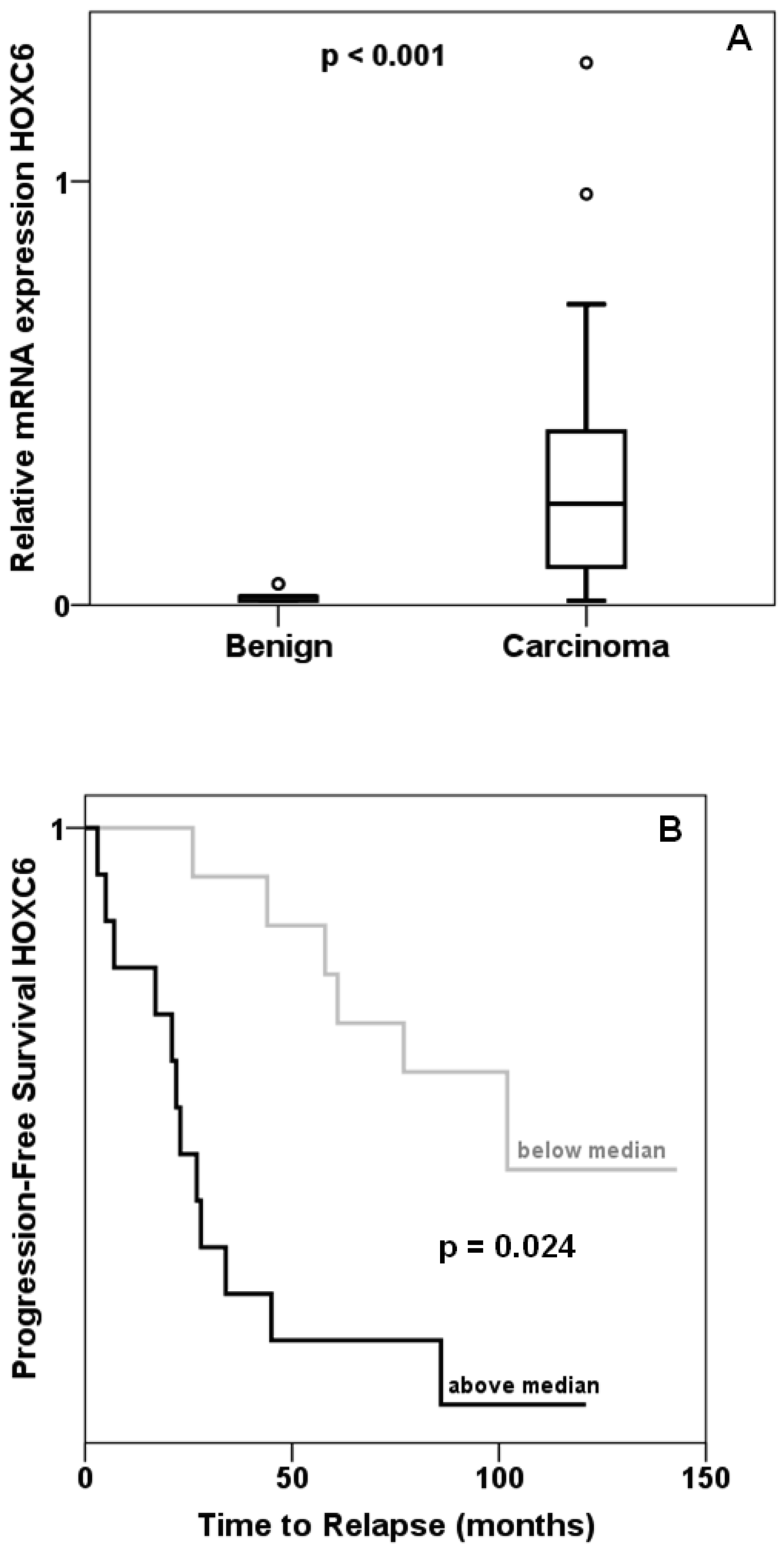
<p>Expression of HOXC6 was determined by quantitative RT-PCR in 45 prostate cancer and 13 benign tissues collected from prostatectomies. The majority of cancer tissues displayed—often grossly— elevated levels of HOXC6 mRNA resulting in an overall highly significant difference compared to benign tissues (<xref ref-type="fig" rid="f1-cancers-03-03714">Figure 1A</xref>). As reported by others, cancers with high <italic>HOXC6</italic> expression had significantly higher T stage, had more often spread to lymph nodes and were assigned higher Gleason scores. Expression of <italic>MKI67</italic> encoding the proliferation marker Ki67 was likewise enhanced in these cases (Mann-Whitney test: p = 0.004). Cancers with above median <italic>HOXC6</italic> expression recurred significantly (log-rank p = 0.024) earlier than cancers with below median expression (<xref ref-type="fig" rid="f1-cancers-03-03714">Figure 1B</xref>). These data confirm previous reports on frequent <italic>HOXC6</italic> overexpression in prostate cancer [<xref ref-type="bibr" rid="b7-cancers-03-03714">7</xref>,<xref ref-type="bibr" rid="b10-cancers-03-03714">10</xref>,<xref ref-type="bibr" rid="b14-cancers-03-03714">14</xref>,<xref ref-type="bibr" rid="b15-cancers-03-03714">15</xref>] and the association of increasing <italic>HOXC6</italic> overexpression with adverse clinical parameters.</p></sec>
<sec>
<label>2.2.</label>
<title>Expression of Presumed HOXC6 Target Genes in Prostate Cancer Tissues</title>
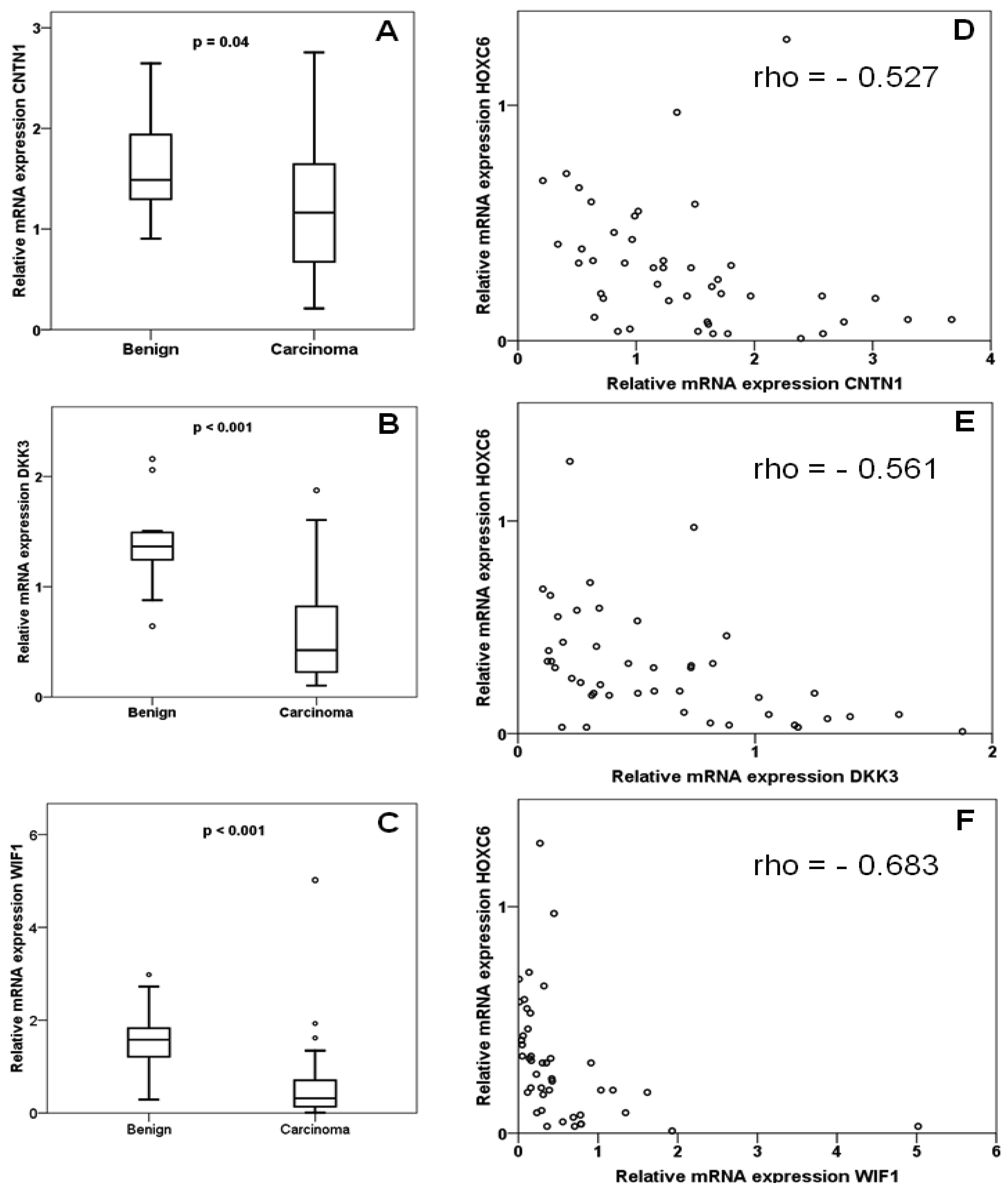
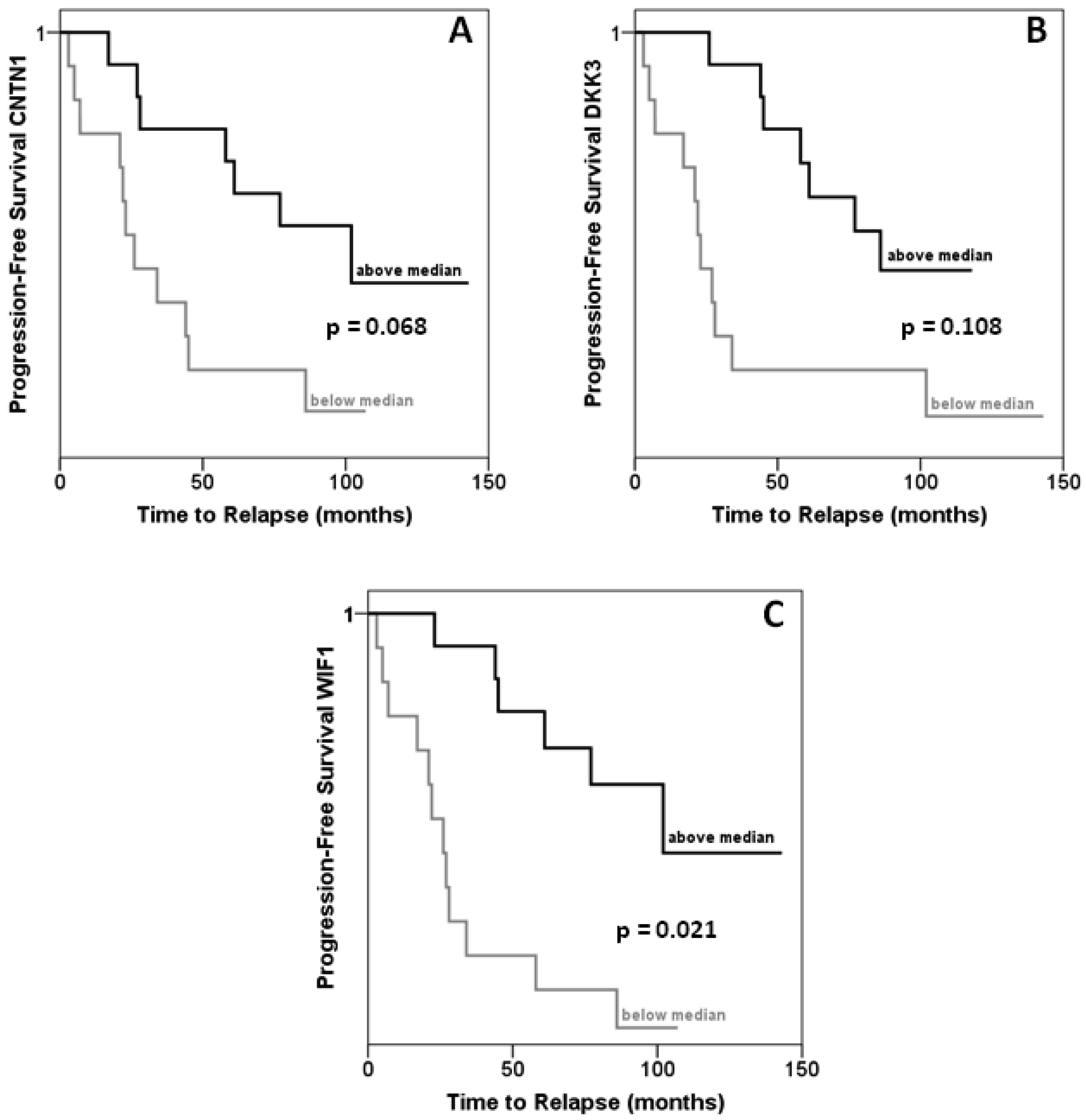
<p>In the same set of samples, expression of <italic>DKK3, WIF1</italic> and <italic>CNTN1</italic> was observed to be significantly decreased (<xref ref-type="fig" rid="f2-cancers-03-03714">Figures 2A–C</xref>). Expression of each gene correlated inversely with that of <italic>HOXC6</italic> in a statistically significant (each p &lt; 0.001) manner (<xref ref-type="fig" rid="f2-cancers-03-03714">Figures 2D–F</xref>). Accordingly, expression of each target gene correlated significantly positively with that of each other, with Spearman rho coefficients between 0.4 and 0.6. Cases with lower than median expression of each target gene, <italic>CNTN1, DKK3</italic> or <italic>WIF1</italic>, showed earlier recurrence, but the association was only significant at the p &lt; 0.05 level for <italic>WIF1</italic> (<xref ref-type="fig" rid="f3-cancers-03-03714">Figures 3A–C</xref>). In addition, low <italic>WIF1</italic> expression was significantly associated with lymph node involvement (p = 0.036) and higher Gleason scores (p = 0.026), but not with tumor stage (pT2 <italic>vs.</italic> pT3). Expression of <italic>CNTN1</italic> or <italic>DKK3</italic> was not significantly associated with any histopathological parameter in our series.</p>
<p>Our measurements confirm the reported downregulation of the WNT factor antagonists DKK3 and WIF1 in prostate cancer [<xref ref-type="bibr" rid="b18-cancers-03-03714">18</xref>,<xref ref-type="bibr" rid="b21-cancers-03-03714">21</xref>-<xref ref-type="bibr" rid="b23-cancers-03-03714">23</xref>,<xref ref-type="bibr" rid="b25-cancers-03-03714">25</xref>,<xref ref-type="bibr" rid="b26-cancers-03-03714">26</xref>]. In addition, our data hint at an association of stronger WIF1 downregulation with worse prognosis. Most importantly, our study demonstrates for the first time explicitly that expression of certain target genes is inversely correlated with overexpression of HOXC6. This is also the first report on <italic>CNTN1</italic> in prostate cancer. The gene encodes a member of the contactin family which serves as a membrane receptor for chondroitin sulfate and regulates receptor tyrosine phosphatases. The function of contactin 1 has mainly been studied in neuronal and glial cells, where it regulates cell-cell and cell-substrate adhesion. Two studies in lung cancers and gliomas suggest that this function may also be relevant for cancer cell invasion and metastasis [<xref ref-type="bibr" rid="b27-cancers-03-03714">27</xref>,<xref ref-type="bibr" rid="b28-cancers-03-03714">28</xref>]. Investigations on the function of contactin 1 in prostate cancer and of the epigenetic regulation of its complex gene might therefore be rewarding.</p></sec>
<sec>
<label>2.3.</label>
<title>Methylation of Presumed HOXC6 Target Genes in Prostate Cancer Tissues</title>
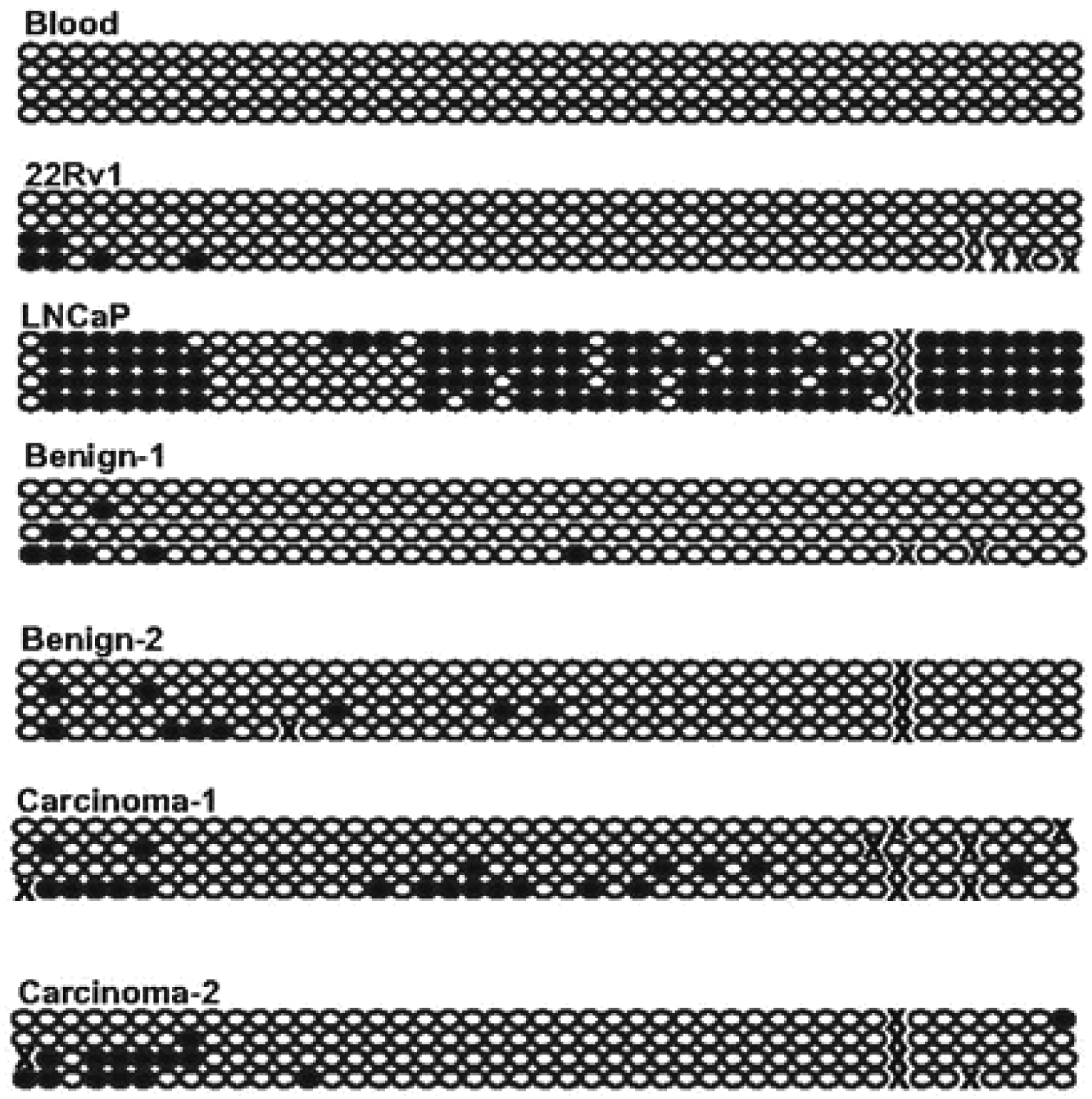
<p>Methylation of <italic>DKK3</italic> and <italic>WIF1</italic> promoter CpG-islands was analyzed by methylation-specific PCR as described in previous publications [<xref ref-type="bibr" rid="b21-cancers-03-03714">21</xref>,<xref ref-type="bibr" rid="b29-cancers-03-03714">29</xref>]. Methylation of <italic>DKK3</italic> was observed in 16 of the 92 carcinoma samples, but not in benign controls. It was significantly more frequent in cases with lymph node involvement and significantly less frequent in cases with Gleason score &lt; 6 (χ<sup>2</sup> test, p &lt; 0.05). However, expression of <italic>DKK3</italic> was not significantly different between carcinoma samples with or without hypermethylation. <italic>WIF1</italic> methylation was more prevalent, being detectable in 31 of 92 carcinoma samples, but also in eight of 17 benign controls. The latter finding may relate to previous findings [<xref ref-type="bibr" rid="b18-cancers-03-03714">18</xref>] suggesting that <italic>WIF1</italic> downregulation may commence at early stages of prostate cancer. As for <italic>DKK3, WIF1</italic> hypermethylation and the extent of downregulation of expression were not significantly related to each other. Because the bands obtained in the <italic>WIF1</italic> MS-PCR assay with the methylated-specific primers were often weak (except in LNCaP cells used as a positive control), bisulfite sequencing was conducted across the region interrogated by the assay in prostate tissue samples and controls (<xref ref-type="fig" rid="f4-cancers-03-03714">Figure 4</xref>). The analyzed part of the <italic>WIF1</italic> CpG-island was completely unmethylated in blood leukocytes, but was quite densely methylated in the prostate cancer cell line LNCaP which lacks <italic>WIF1</italic> expression. In contrast, only occasional sites were methylated in the expressing 22Rv1 line. In all benign and carcinoma tissues, only patchy and weak methylation was found, as suggested by the results of the MS-PCR assay. Of note, we have previously shown that in this set of prostate cancer tissues <italic>GSTP1, EPB41L3</italic> and several other genes are each hypermethylated at frequencies of 60%–80%, often displaying dense methylation [<xref ref-type="bibr" rid="b19-cancers-03-03714">19</xref>,<xref ref-type="bibr" rid="b30-cancers-03-03714">30</xref>]. Thus, <italic>DKK3</italic> and <italic>WIF1</italic> hypermethylation was much less widespread than downregulation and was often weak if it occurred.</p></sec></sec>
<sec>
<label>3.</label>
<title>Experimental Section</title>
<sec sec-type="subjects">
<label>3.1.</label>
<title>Patients and Tissue Samples</title>
<p>High quality RNA was prepared from 13 normal prostate tissues from cancer-carrying prostates and 45 carcinomas from patients aged 59–74 years undergoing total prostatectomy as described [<xref ref-type="bibr" rid="b19-cancers-03-03714">19</xref>]. According to the IUAC 2007 TNM classification, tumors were staged as pT2 in 20, pT3 in 23 and pT4 in 2 cases. A Gleason score of 7 was detected in 26 tumors, &lt; 7 in 13 tumors and &gt; 7 in 6 tumors. None of the patients had distant metastases, but 11 cancers had spread to local lymph nodes. High quality DNA was available from 92 cancer tissues encompassing the specimens used for RNA analysis. Of these, 43 were staged as pT2 and 49 as pT3 or pT4. Sixteen patients had lymph node metastases, but none distant metastases. Each 27 carcinomas were assigned a Gleason score &gt; 7 or &lt; 7 and 38 a score of 7. The median follow-up period was 98 months. The study was approved by the ethics committee of the Heinrich Heine University medical faculty.</p></sec>
<sec>
<label>3.2.</label>
<title>RNA Extraction and Quantitative RT-PCR</title>
<p>Total RNA was isolated from preconfluent cells using the RNeasy <sup>®</sup> Mini Kit (Qiagen, Hilden, Germany). Two μg RNA were reversed transcribed using SuperscriptII (Invitrogen, Karlsruhe, Germany) with oligo-dT primers according to the manufacturer's protocol. Quantitative real-time PCR for <italic>CNTN1, DKK3, WIF1</italic>, and the reference gene <italic>TBP</italic> was performed using SYBR-Green reaction mix (Qiagen) with 0.4 μM of each primer in an ABI Prism 7900HT instrument (Applied Biosystems, Darmstadt, Germany) with the following conditions: activation at 95 °C for 15 minutes followed by 45 cycles of denaturation at 94 °C for 15 s, elongation at 72 °C for 30 s and measuring at 88 °C for 15 s. Amplification lasted 30 s with temperatures at 55 °C for <italic>CNTN1</italic>, 57 °C for <italic>DKK3</italic> and <italic>WIF1</italic>, 61 °C for <italic>TBP</italic>. The quality of the amplification was assured by a melting curve established by incubation at 95 °C, 60 °C and 99 °C for 15 s each. <italic>HOXC6</italic> expression was measured by Taqman assays Hs00171690 mL (Applied Biosystems). Duplicate measurements gave &lt; 10% difference. For each gene, a standard curve was constructed using a reference cell line with high expression and expression in the samples was expressed relative to this standard. The same procedure was performed for the <italic>TBP</italic> control, to which the measurements were then adjusted.</p></sec>
<sec>
<label>3.3.</label>
<title>DNA Extraction and Methylation Analyses</title>
<p>High-quality DNA was extracted from tissues and prostate carcinoma cell lines as described [<xref ref-type="bibr" rid="b19-cancers-03-03714">19</xref>]. The EZ DNA Methylation Kit (Zymo Research, Orange, CA, USA) was used for bisulfite conversion. PCRs were performed in a 50 μL reaction mixture consisting of 1 × buffer, 150 μM dNTPs, 15 pmol of each primer, 1 U Hotstar Taq polymerase, water and 2 μL bisulfite-converted DNA each. The following program was used: initial Taq activation at 94 °C for 15 min, followed denaturation at 95 °C for 30 s, annealing for 30 s, elongation at 72 °C for 45 s, with a final elongation for 10 min. MS-PCR amplification was performed for <italic>DKK3</italic> unmethylated/methylated for 36/38 cycles with annealing at 61/65 °C, for <italic>WIF1</italic> unmethylated/methylated MS-PCR amplification was performed for 34/36 cycles with annealing at 53 °C for both genes. Fully methylated and completely methylated controls were carried in each reaction as described [<xref ref-type="bibr" rid="b19-cancers-03-03714">19</xref>]. For <italic>WIF1</italic> bisulfite sequencing PCR was conducted for 35 cycles with annealing at 60 °C. PCR products were examined by agarose gel electrophoresis. For bisulfite sequencing PCR products were cloned into the <italic>E. coli</italic> TOPO 10 vector (TOPO TA Cloning Kit, Invitrogen). Four clones from each sample were sequenced using standard methods. Primer sequences are compiled in <xref ref-type="table" rid="t1-cancers-03-03714">Table 1</xref>.</p></sec>
<sec sec-type="methods">
<label>3.4.</label>
<title>Statistical Methods</title>
<p>Statistical calculations were performed using SPSS 19.0.</p></sec></sec>
<sec sec-type="conclusions">
<label>4.</label>
<title>Conclusions</title>
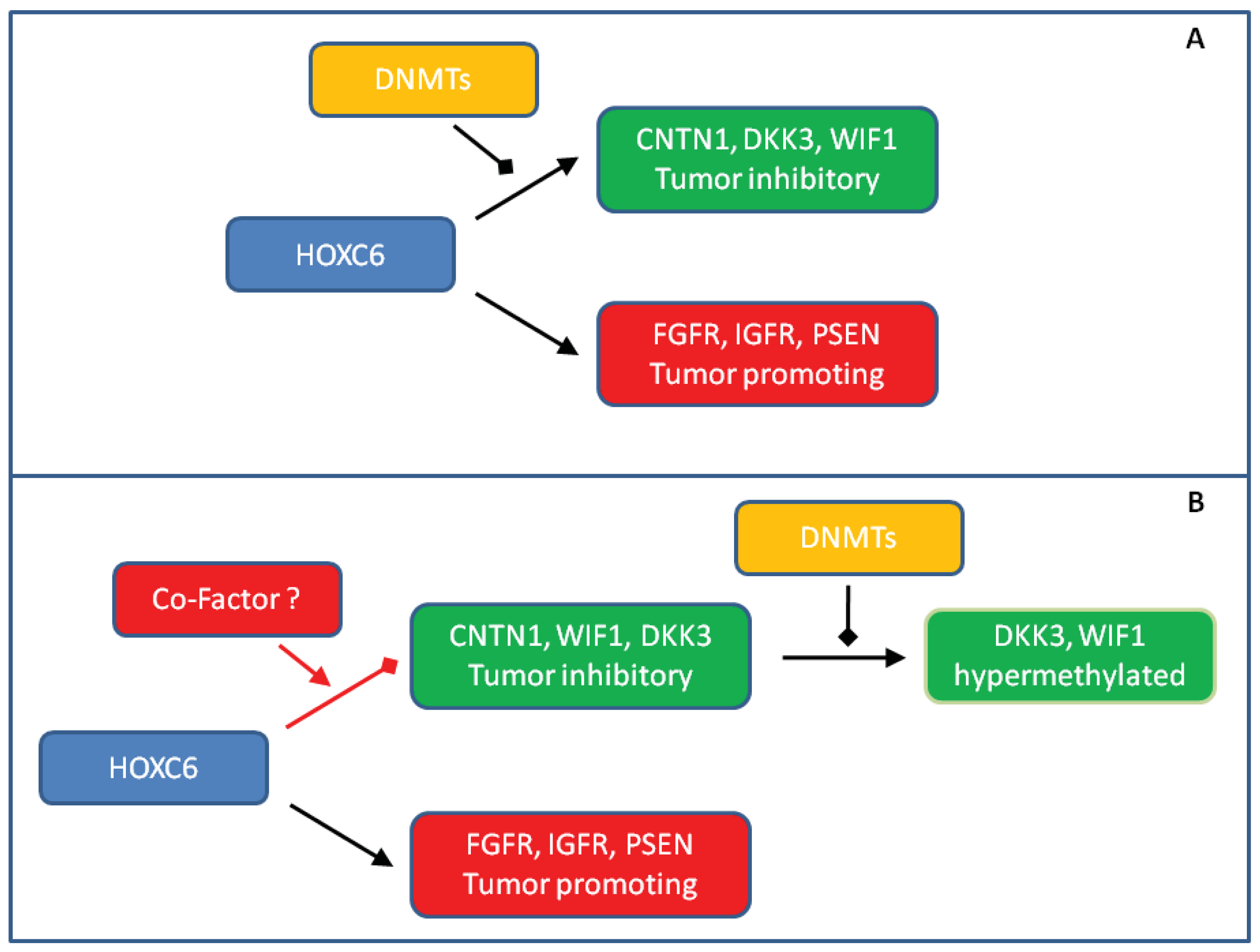
<p>We observed striking <italic>HOXC6</italic> overexpression in our small, but well-characterized prostate cancer tissue series. Our findings underscore that the previously described strong association of <italic>HOXC6</italic> overexpression with adverse clinical parameters [<xref ref-type="bibr" rid="b7-cancers-03-03714">7</xref>,<xref ref-type="bibr" rid="b10-cancers-03-03714">10</xref>,<xref ref-type="bibr" rid="b14-cancers-03-03714">14</xref>,<xref ref-type="bibr" rid="b15-cancers-03-03714">15</xref>] is robust and deserves to be explored for the purposes of developing prognostic and molecular staging biomarkers. Our confirmation of these relationships accentuates the question of how HOXC6 contributes to oncogenesis and tumor progression in the prostate. Obviously, the answer is not trivial. Since HOXC6 is well-established as a transcription activator, it is most likely to act by regulating gene expression. Indeed, a range of positively regulated target genes have been defined by various experimental approaches. As reviewed by Moreno [<xref ref-type="bibr" rid="b17-cancers-03-03714">17</xref>], among them are plausible candidates for promoting oncogenesis in the prostate, e.g., through WNT, BMP, FGF and NOTCH signaling pathways. However, it seems paradoxical that several genes activated by HOXC6 in experimental settings would be expected to counteract tumorigenesis <italic>in vivo</italic>, especially antagonists of WNT signaling like <italic>DKK3</italic> and <italic>WIF1</italic> [<xref ref-type="bibr" rid="b22-cancers-03-03714">22</xref>,<xref ref-type="bibr" rid="b26-cancers-03-03714">26</xref>,<xref ref-type="bibr" rid="b32-cancers-03-03714">32</xref>]. These have indeed been reported to be downregulated or hypermethylated in prostate cancer in other studies [<xref ref-type="bibr" rid="b16-cancers-03-03714">16</xref>,<xref ref-type="bibr" rid="b21-cancers-03-03714">21</xref>,<xref ref-type="bibr" rid="b23-cancers-03-03714">23</xref>]. One plausible explanation for the paradox is that genes antagonizing tumor development become hypermethylated in prostate by independent mechanisms and are no longer accessible to transcriptional activation by HOXC6 (<xref ref-type="fig" rid="f5-cancers-03-03714">Figure 5A</xref>).</p>
<p>Several results from the present study argue against this hypothesis in its most simple form. First, although we observed <italic>DKK3</italic> and <italic>WIF1</italic> hypermethylation in some cases, it was relatively weak and transcriptional downregulation was more generalized. Of note, we have previously found that hypermethylation of another HOXC6 target, <italic>SFRP1</italic>, is also relatively rare in our tissue series, whereas around 80% of the cases harbor hypermethylated GSTP1, as expected [<xref ref-type="bibr" rid="b19-cancers-03-03714">19</xref>]. According results have been published by others [<xref ref-type="bibr" rid="b25-cancers-03-03714">25</xref>]. Second, hypermethylation was not well correlated with transcriptional downregulation and was also observed in many benign adjacent tissues in the case of <italic>WIF1</italic>. These findings argue that DNA methylation is not the primary cause of transcriptional silencing of these genes, but may rather follow and bolster their initial downregulation by other epigenetic mechanisms (<xref ref-type="fig" rid="f5-cancers-03-03714">Figure 5B</xref>).</p>
<p>Third, we found the strongest downregulation of <italic>CNTN1, DKK3</italic> and <italic>WIF1</italic> in cases with high <italic>HOXC6</italic> expression suggesting that transcriptional silencing of these HOXC6 target genes might be elicited by the factor itself. This idea seems unlikely at first glance, since classical HOX factors act predominantly as transcriptional activators. There are however exceptions to the rule. For instance, HOX target genes may become repressed upon interactions with SMAD proteins that are activated by BMP signaling [<xref ref-type="bibr" rid="b33-cancers-03-03714">33</xref>]. In order to explain our findings, we would like to propose the idea that the changed composition of transcription factors (and cofactors) in the nuclear milieu of prostate cancer cells may lead to a switch of HOXC6 function at some of its target genes (<xref ref-type="fig" rid="f5-cancers-03-03714">Figure 5B</xref>). An analogous case in prostate cancer is the altered target gene spectrum of the androgen receptor caused by changes in the expression of interacting transcription factors like HOXB13 and FOXA1 [<xref ref-type="bibr" rid="b34-cancers-03-03714">34</xref>,<xref ref-type="bibr" rid="b35-cancers-03-03714">35</xref>]. Accordingly, our data call for further detailed research on the HOXC6 paradox in prostate cancer which should yield important results for clinical application as well as insights into basic mechanisms of transcription.</p></sec></body>
<back>
<sec sec-type="display-objects">
<title>Figures and Table</title>
<fig id="f1-cancers-03-03714" position="float">
<label>Figure 1.</label>
<caption>
<p>Expression of <italic>HOXC6</italic> in prostate cancer. (<bold>A</bold>) Expression of <italic>HOXC6</italic> mRNA as measured by quantitative RT-PCR in 45 prostate carcinoma and 13 benign prostate tissues; (<bold>B</bold>) Kaplan-Meier analysis of effect of <italic>HOXC6</italic> expression on biochemical recurrence.</p></caption>
<graphic xlink:href="cancers-03-03714f1.gif"/></fig>
<fig id="f2-cancers-03-03714" position="float">
<label>Figure 2.</label>
<caption>
<p>Expression of HOXC6 target genes in prostate cancer. (<bold>A</bold>) Expression of <italic>CNTN1</italic> mRNA as measured by quantitative RT-PCR in 45 prostate carcinoma and 13 benign prostate tissues; (<bold>B</bold>) Expression of <italic>DKK3</italic> mRNA in the same set of tissues; (<bold>C</bold>) Expression of WIF1 mRNA in the same set of tissues; (<bold>D–F</bold>) Plots of <italic>CNTN1, DKK3</italic> and <italic>WIF1</italic> expression against <italic>HOXC6</italic> expression. In each case, there was a highly significant (p &lt; 0.001) inverse correlation.</p></caption>
<graphic xlink:href="cancers-03-03714f2.gif"/></fig>
<fig id="f3-cancers-03-03714" position="float">
<label>Figure 3.</label>
<caption>
<p>Relation of HOXC6 target gene expression to prostate cancer recurrence. Kaplan-Meier analysis of relation of <italic>CNTN1</italic> (<bold>A</bold>), <italic>DKK3</italic> (<bold>B</bold>) and <italic>WIF1</italic> (<bold>C</bold>) expression to progression-free survival, measured as biochemical recurrence. Samples were stratified by median for each gene.</p></caption>
<graphic xlink:href="cancers-03-03714f3.gif"/></fig>
<fig id="f4-cancers-03-03714" position="float">
<label>Figure 4.</label>
<caption>
<p><italic>WIF1</italic> methylation in prostate cancer. Bisulfite sequencing analysis of <italic>WIF1</italic> promoter methylation in blood leukocytes, prostate cancer cell lines with high (22Rv1) and low (LNCaP) expression, benign and carcinoma prostate tissues. Each line represents one cloned PCR product, each circle represents one CpG site. Dark circles indicate methylated and light circles unmethylated sites. Some sites at the 3′-end of the sequence were difficult to read and are labeled by x.</p></caption>
<graphic xlink:href="cancers-03-03714f4.gif"/></fig>
<fig id="f5-cancers-03-03714" position="float">
<label>Figure 5.</label>
<caption>
<p>Hypotheses on the function of DNA methylation in inactivation of HOXC6 target genes in prostate cancer. (<bold>A</bold>) initial hypothesis based on ref. [<xref ref-type="bibr" rid="b14-cancers-03-03714">14</xref>]; (<bold>B</bold>) hypothesis modified to explain the results of our study.</p></caption>
<graphic xlink:href="cancers-03-03714f5.gif"/></fig>
<table-wrap id="t1-cancers-03-03714" position="float">
<label>Table 1.</label>
<caption>
<p>Primers Used.</p></caption>
<table frame="box" rules="all">
<thead>
<tr content-type="background-color:#DCDDDE">
<th align="left" valign="top"><bold>Primer names</bold></th>
<th align="left" valign="top"><bold>Forward 5′ → 3′</bold></th>
<th align="left" valign="top"><bold>Reverse 5′ → 3′</bold></th>
<th align="center" valign="top"><bold>Product size (bp)</bold></th>
<th align="center" valign="top"><bold>Reference</bold></th></tr></thead>
<tbody>
<tr>
<td align="left" valign="top">DKK3-MS-PCR (meth.)</td>
<td align="left" valign="top">GGG GCG GGC GGC GGG GC</td>
<td align="left" valign="top">ACA TCT CCG CTC TAC GCC CG</td>
<td align="center" valign="middle">120</td>
<td align="center" valign="middle">[<xref ref-type="bibr" rid="b29-cancers-03-03714">29</xref>]</td></tr>
<tr>
<td align="left" valign="top">DKK3-MS-PCR (unmeth.)</td>
<td align="left" valign="top">TTA GGG GTG GGT GGT GGG GT</td>
<td align="left" valign="top">CTA CAT CTC CAC TCT ACA CCC A</td>
<td align="center" valign="middle">125</td>
<td align="center" valign="middle">[<xref ref-type="bibr" rid="b29-cancers-03-03714">29</xref>]</td></tr>
<tr>
<td align="left" valign="middle">DKK3-qRT-PCR</td>
<td align="left" valign="top">TTG CCA GCT TCC AGT ACA CC</td>
<td align="left" valign="top">TGC AGT GAC CCC AGA CAC A</td>
<td align="center" valign="middle">105</td>
<td align="center" valign="middle">self-designed</td></tr>
<tr>
<td align="left" valign="top">WIF1-MS-PCR (meth.)</td>
<td align="left" valign="top">CGT TTT ATT GGG CGT ATC GT</td>
<td align="left" valign="top">ACT AAC GCG AAC GAA ATA CGA</td>
<td align="center" valign="middle">145</td>
<td align="center" valign="middle">[<xref ref-type="bibr" rid="b29-cancers-03-03714">29</xref>]</td></tr>
<tr>
<td align="left" valign="middle">WIF1-MS-PCR (unmeth.)</td>
<td align="left" valign="middle">GGG TGT TTT ATT GGG TGT ATT GT</td>
<td align="left" valign="top">AAA AAA ACT AAC ACA AAC AAA ATA CAA AC</td>
<td align="center" valign="middle">154</td>
<td align="center" valign="middle">[<xref ref-type="bibr" rid="b29-cancers-03-03714">29</xref>]</td></tr>
<tr>
<td align="left" valign="middle">WIF1-qRT-PCR</td>
<td align="left" valign="top">TAA TGG AGG GAC CTG TTT CTA CC</td>
<td align="left" valign="top">CCA TTT CGA CAG GGT TGT G</td>
<td align="center" valign="middle">102</td>
<td align="center" valign="middle">self-designed</td></tr>
<tr>
<td align="left" valign="top">WIF1-Bisulfite sequencing-PCR</td>
<td align="left" valign="top">GTT TTA GGG GTT TTT GAG TGT T</td>
<td align="left" valign="top">CAA CTC CCT CAA CCA AAA CTA</td>
<td align="center" valign="middle">463</td>
<td align="center" valign="middle">[<xref ref-type="bibr" rid="b31-cancers-03-03714">31</xref>]</td></tr></tbody></table></table-wrap></sec>
<ack>
<p>We thank our lab members Christiane Hader and Christian Arsov for help and support as well as Rainer Engers for histopathological evaluation of the tissue samples used. We gratefully acknowledge financial support by the Deutsche Krebshilfe and Deutsche Forschungsgemeinschaft.</p></ack>
<ref-list>
<title>References and Notes</title>
<ref id="b1-cancers-03-03714"><label>1.</label><citation citation-type="journal"><person-group person-group-type="author"><name><surname>Nelson</surname><given-names>W.G.</given-names></name><name><surname>de Marzo</surname><given-names>A.M.</given-names></name><name><surname>Yegnasubramanian</surname><given-names>S.</given-names></name></person-group><article-title>Epigenetic alterations in human prostate cancers</article-title><source>Endocrinology</source><year>2009</year><volume>150</volume><fpage>3991</fpage><lpage>4002</lpage><pub-id pub-id-type="doi">10.1210/en.2009-0573</pub-id><pub-id pub-id-type="pmid">19520778</pub-id></citation></ref>
<ref id="b2-cancers-03-03714"><label>2.</label><citation citation-type="journal"><person-group person-group-type="author"><name><surname>Schulz</surname><given-names>W.A.</given-names></name><name><surname>Hoffmann</surname><given-names>M.J.</given-names></name></person-group><article-title>Epigenetic mechanisms in the biology of prostate cancer</article-title><source>Semin. Cancer Biol.</source><year>2009</year><volume>19</volume><fpage>172</fpage><lpage>180</lpage><pub-id pub-id-type="doi">10.1016/j.semcancer.2009.02.006</pub-id><pub-id pub-id-type="pmid">19429481</pub-id></citation></ref>
<ref id="b3-cancers-03-03714"><label>3.</label><citation citation-type="journal"><person-group person-group-type="author"><name><surname>Hoque</surname><given-names>M.O.</given-names></name></person-group><article-title>DNA methylation changes in prostate cancer: Current developments and future clinical implementation</article-title><source>Expert Rev. Mol. Diagn.</source><year>2009</year><volume>9</volume><fpage>243</fpage><lpage>257</lpage><pub-id pub-id-type="doi">10.1586/erm.09.10</pub-id><pub-id pub-id-type="pmid">19379083</pub-id></citation></ref>
<ref id="b4-cancers-03-03714"><label>4.</label><citation citation-type="journal"><person-group person-group-type="author"><name><surname>Perry</surname><given-names>A.S.</given-names></name><name><surname>Watson</surname><given-names>R.W.</given-names></name><name><surname>Lawler</surname><given-names>M.</given-names></name><name><surname>Hollywood</surname><given-names>D.</given-names></name></person-group><article-title>The epigenome as a therapeutic target in prostate cancer</article-title><source>Nat. Rev. Urol.</source><year>2010</year><volume>7</volume><fpage>668</fpage><lpage>680</lpage><pub-id pub-id-type="doi">10.1038/nrurol.2010.185</pub-id><pub-id pub-id-type="pmid">21060342</pub-id></citation></ref>
<ref id="b5-cancers-03-03714"><label>5.</label><citation citation-type="journal"><person-group person-group-type="author"><name><surname>Pfeifer</surname><given-names>G.P.</given-names></name><name><surname>Rauch</surname><given-names>T.A.</given-names></name></person-group><article-title>DNA methylation patterns in lung carcinomas</article-title><source>Semin. Cancer Biol.</source><year>2009</year><volume>19</volume><fpage>181</fpage><lpage>187</lpage><pub-id pub-id-type="doi">10.1016/j.semcancer.2009.02.008</pub-id><pub-id pub-id-type="pmid">19429482</pub-id></citation></ref>
<ref id="b6-cancers-03-03714"><label>6.</label><citation citation-type="journal"><person-group person-group-type="author"><name><surname>Shah</surname><given-names>N.</given-names></name><name><surname>Sukumar</surname><given-names>S.</given-names></name></person-group><article-title>The Hox genes and their roles in oncogenesis</article-title><source>Nat. Rev. Cancer</source><year>2010</year><volume>10</volume><fpage>361</fpage><lpage>371</lpage><pub-id pub-id-type="doi">10.1038/nrc2826</pub-id><pub-id pub-id-type="pmid">20357775</pub-id></citation></ref>
<ref id="b7-cancers-03-03714"><label>7.</label><citation citation-type="journal"><person-group person-group-type="author"><name><surname>Waltregny</surname><given-names>D.</given-names></name><name><surname>Alami</surname><given-names>Y.</given-names></name><name><surname>Clausse</surname><given-names>N.</given-names></name><name><surname>de Leval</surname><given-names>J.</given-names></name><name><surname>Castronovo</surname><given-names>V.</given-names></name></person-group><article-title>Overexpression of the homeobox gene HOXC8 in human prostate cancer correlates with loss of tumor differentiation</article-title><source>Prostate</source><year>2002</year><volume>50</volume><fpage>162</fpage><lpage>169</lpage><pub-id pub-id-type="doi">10.1002/pros.10045</pub-id><pub-id pub-id-type="pmid">11813208</pub-id></citation></ref>
<ref id="b8-cancers-03-03714"><label>8.</label><citation citation-type="journal"><person-group person-group-type="author"><name><surname>Economides</surname><given-names>K.D.</given-names></name><name><surname>Capecchi</surname><given-names>M.R.</given-names></name></person-group><article-title>Hoxb13 is required for normal differentiation and secretory function of the ventral prostate</article-title><source>Development</source><year>2003</year><volume>130</volume><fpage>2061</fpage><lpage>2069</lpage><pub-id pub-id-type="doi">10.1242/dev.00432</pub-id><pub-id pub-id-type="pmid">12668621</pub-id></citation></ref>
<ref id="b9-cancers-03-03714"><label>9.</label><citation citation-type="journal"><person-group person-group-type="author"><name><surname>Hombría</surname><given-names>J.C.</given-names></name><name><surname>Lovegrove</surname><given-names>B.</given-names></name></person-group><article-title>Beyond homeosis—HOX function in morphogenesis and organogenesis</article-title><source>Differentiation</source><year>2003</year><volume>71</volume><fpage>461</fpage><lpage>476</lpage><pub-id pub-id-type="doi">10.1046/j.1432-0436.2003.7108004.x</pub-id><pub-id pub-id-type="pmid">14641327</pub-id></citation></ref>
<ref id="b10-cancers-03-03714"><label>10.</label><citation citation-type="journal"><person-group person-group-type="author"><name><surname>Miller</surname><given-names>G.J.</given-names></name><name><surname>Miller</surname><given-names>H.L.</given-names></name><name><surname>van Bokhoven</surname><given-names>A.</given-names></name><name><surname>Lambert</surname><given-names>J.R.</given-names></name><name><surname>Werahera</surname><given-names>P.N.</given-names></name><name><surname>Schirripa</surname><given-names>O.</given-names></name><name><surname>Lucia</surname><given-names>M.S.</given-names></name><name><surname>Nordeen</surname><given-names>S.K.</given-names></name></person-group><article-title>Aberrant HOXC expression accompanies the malignant phenotype in human prostate</article-title><source>Cancer Res.</source><year>2003</year><volume>63</volume><fpage>5879</fpage><lpage>5888</lpage><pub-id pub-id-type="pmid">14522913</pub-id></citation></ref>
<ref id="b11-cancers-03-03714"><label>11.</label><citation citation-type="journal"><person-group person-group-type="author"><name><surname>Huang</surname><given-names>L.</given-names></name><name><surname>Pu</surname><given-names>Y.</given-names></name><name><surname>Hepps</surname><given-names>D.</given-names></name><name><surname>Danielpour</surname><given-names>D.</given-names></name><name><surname>Prins</surname><given-names>G.S.</given-names></name></person-group><article-title>Posterior Hox gene expression and differential androgen regulation in the developing and adult rat prostate lobes</article-title><source>Endocrinology</source><year>2007</year><volume>148</volume><fpage>1235</fpage><lpage>1245</lpage><pub-id pub-id-type="pmid">17138648</pub-id></citation></ref>
<ref id="b12-cancers-03-03714"><label>12.</label><citation citation-type="journal"><person-group person-group-type="author"><name><surname>Ke</surname><given-names>X.S.</given-names></name><name><surname>Qu</surname><given-names>Y.</given-names></name><name><surname>Rostad</surname><given-names>K.</given-names></name><name><surname>Li</surname><given-names>W.C.</given-names></name><name><surname>Lin</surname><given-names>B.</given-names></name><name><surname>Halvorsen</surname><given-names>O.J.</given-names></name><name><surname>Haukaas</surname><given-names>S.A.</given-names></name><name><surname>Jonassen</surname><given-names>I.</given-names></name><name><surname>Petersen</surname><given-names>K.</given-names></name><name><surname>Goldfinger</surname><given-names>N.</given-names></name><etal/></person-group><article-title>Genome-wide profiling of histone h3 lysine 4 and lysine 27 trimethylation reveals an epigenetic signature in prostate carcinogenesis</article-title><source>PLoS One</source><year>2009</year><volume>4</volume><fpage>e4687</fpage><pub-id pub-id-type="doi">10.1371/journal.pone.0004687</pub-id><pub-id pub-id-type="pmid">19262738</pub-id></citation></ref>
<ref id="b13-cancers-03-03714"><label>13.</label><citation citation-type="journal"><person-group person-group-type="author"><name><surname>Shen</surname><given-names>M.M.</given-names></name><name><surname>Abate-Shen</surname><given-names>C.</given-names></name></person-group><article-title>Molecular genetics of prostate cancer: New prospects for old challenges</article-title><source>Genes Dev.</source><year>2010</year><volume>24</volume><fpage>1967</fpage><lpage>2000</lpage><pub-id pub-id-type="doi">10.1101/gad.1965810</pub-id><pub-id pub-id-type="pmid">20844012</pub-id></citation></ref>
<ref id="b14-cancers-03-03714"><label>14.</label><citation citation-type="journal"><person-group person-group-type="author"><name><surname>Ramachandran</surname><given-names>S.</given-names></name><name><surname>Liu</surname><given-names>P.</given-names></name><name><surname>Young</surname><given-names>A.N.</given-names></name><name><surname>Yin-Goen</surname><given-names>Q.</given-names></name><name><surname>Lim</surname><given-names>S.D.</given-names></name><name><surname>Laycock</surname><given-names>N.</given-names></name><name><surname>Amin</surname><given-names>M.B.</given-names></name><name><surname>Carney</surname><given-names>J.K.</given-names></name><name><surname>Marshall</surname><given-names>F.F.</given-names></name><name><surname>Petros</surname><given-names>J.A.</given-names></name><name><surname>Moreno</surname><given-names>C.S.</given-names></name></person-group><article-title>Loss of HOXC6 expression induces apoptosis in prostate cancer cells</article-title><source>Oncogene</source><year>2005</year><volume>24</volume><fpage>188</fpage><lpage>198</lpage><pub-id pub-id-type="doi">10.1038/sj.onc.1207906</pub-id><pub-id pub-id-type="pmid">15637592</pub-id></citation></ref>
<ref id="b15-cancers-03-03714"><label>15.</label><citation citation-type="journal"><person-group person-group-type="author"><name><surname>McCabe</surname><given-names>C.D.</given-names></name><name><surname>Spyropoulos</surname><given-names>D.D.</given-names></name><name><surname>Martin</surname><given-names>D.</given-names></name><name><surname>Moreno</surname><given-names>C.S.</given-names></name></person-group><article-title>Genome-wide analysis of the homeobox C6 transcriptional network in prostate cancer</article-title><source>Cancer Res.</source><year>2008</year><volume>68</volume><fpage>1988</fpage><lpage>1996</lpage><pub-id pub-id-type="doi">10.1158/0008-5472.CAN-07-5843</pub-id><pub-id pub-id-type="pmid">18339881</pub-id></citation></ref>
<ref id="b16-cancers-03-03714"><label>16.</label><citation citation-type="journal"><person-group person-group-type="author"><name><surname>Bibikova</surname><given-names>M.</given-names></name><name><surname>Chudin</surname><given-names>E.</given-names></name><name><surname>Arsanjani</surname><given-names>A.</given-names></name><name><surname>Zhou</surname><given-names>L.</given-names></name><name><surname>Garcia</surname><given-names>E.W.</given-names></name><name><surname>Modder</surname><given-names>J.</given-names></name><name><surname>Kostelec</surname><given-names>M.</given-names></name><name><surname>Barker</surname><given-names>D.</given-names></name><name><surname>Downs</surname><given-names>T.</given-names></name><name><surname>Fan</surname><given-names>J.B.</given-names></name><etal/></person-group><article-title>Expression signatures that correlated with Gleason score and relapse in prostate cancer</article-title><source>Genomics</source><year>2007</year><volume>89</volume><fpage>666</fpage><lpage>672</lpage><pub-id pub-id-type="doi">10.1016/j.ygeno.2007.02.005</pub-id><pub-id pub-id-type="pmid">17459658</pub-id></citation></ref>
<ref id="b17-cancers-03-03714"><label>17.</label><citation citation-type="journal"><person-group person-group-type="author"><name><surname>Moreno</surname><given-names>C.S.</given-names></name></person-group><article-title>The Sex-determining region Y-box 4 and homeobox C6 transcriptional networks in prostate cancer progression: Crosstalk with the Wnt, Notch, and PI3K pathways</article-title><source>Am. J. Pathol.</source><year>2010</year><volume>176</volume><fpage>518</fpage><lpage>527</lpage><pub-id pub-id-type="doi">10.2353/ajpath.2010.090657</pub-id><pub-id pub-id-type="pmid">20019190</pub-id></citation></ref>
<ref id="b18-cancers-03-03714"><label>18.</label><citation citation-type="journal"><person-group person-group-type="author"><name><surname>Wissmann</surname><given-names>C.</given-names></name><name><surname>Wild</surname><given-names>P.J.</given-names></name><name><surname>Kaiser</surname><given-names>S.</given-names></name><name><surname>Roepcke</surname><given-names>S.</given-names></name><name><surname>Stoehr</surname><given-names>R.</given-names></name><name><surname>Woenckhaus</surname><given-names>M.</given-names></name><name><surname>Kristiansen</surname><given-names>G.</given-names></name><name><surname>Hsieh</surname><given-names>J.C.</given-names></name><name><surname>Hofstaedter</surname><given-names>F.</given-names></name><name><surname>Hartmann</surname><given-names>A.</given-names></name><etal/></person-group><article-title>WIF1, a component of the Wnt pathway, is down-regulated in prostate, breast, lung, and bladder cancer</article-title><source>J. Pathol.</source><year>2003</year><volume>201</volume><fpage>204</fpage><lpage>212</lpage><pub-id pub-id-type="doi">10.1002/path.1449</pub-id><pub-id pub-id-type="pmid">14517837</pub-id></citation></ref>
<ref id="b19-cancers-03-03714"><label>19.</label><citation citation-type="journal"><person-group person-group-type="author"><name><surname>Florl</surname><given-names>A.R.</given-names></name><name><surname>Steinhoff</surname><given-names>C.</given-names></name><name><surname>Müller</surname><given-names>M.</given-names></name><name><surname>Seifert</surname><given-names>H.H.</given-names></name><name><surname>Hader</surname><given-names>C.</given-names></name><name><surname>Engers</surname><given-names>R.</given-names></name><name><surname>Ackermann</surname><given-names>R.</given-names></name><name><surname>Schulz</surname><given-names>W.A.</given-names></name></person-group><article-title>Coordinate hypermethylation at specific genes in prostate carcinoma precedes LINE-1 hypomethylation</article-title><source>Br. J. Cancer</source><year>2004</year><volume>91</volume><fpage>985</fpage><lpage>994</lpage><pub-id pub-id-type="pmid">15292941</pub-id></citation></ref>
<ref id="b20-cancers-03-03714"><label>20.</label><citation citation-type="journal"><person-group person-group-type="author"><name><surname>Joesting</surname><given-names>M.S.</given-names></name><name><surname>Perrin</surname><given-names>S.</given-names></name><name><surname>Elenbaas</surname><given-names>B.</given-names></name><name><surname>Fawell</surname><given-names>S.E.</given-names></name><name><surname>Rubin</surname><given-names>J.S.</given-names></name><name><surname>Franco</surname><given-names>O.E.</given-names></name><name><surname>Hayward</surname><given-names>S.W.</given-names></name><name><surname>Cunha</surname><given-names>G.R.</given-names></name><name><surname>Marker</surname><given-names>P.C.</given-names></name></person-group><article-title>Identification of SFRP1 as a candidate mediator of stromal-to-epithelial signaling in prostate cancer</article-title><source>Cancer Res.</source><year>2005</year><volume>65</volume><fpage>10423</fpage><lpage>10430</lpage><pub-id pub-id-type="doi">10.1158/0008-5472.CAN-05-0824</pub-id><pub-id pub-id-type="pmid">16288033</pub-id></citation></ref>
<ref id="b21-cancers-03-03714"><label>21.</label><citation citation-type="journal"><person-group person-group-type="author"><name><surname>Lodygin</surname><given-names>D.</given-names></name><name><surname>Epanchintsev</surname><given-names>A.</given-names></name><name><surname>Menssen</surname><given-names>A.</given-names></name><name><surname>Diebold</surname><given-names>J.</given-names></name><name><surname>Hermeking</surname><given-names>H.</given-names></name></person-group><article-title>Functional epigenomics identifies genes frequently silenced in prostate cancer</article-title><source>Cancer Res.</source><year>2005</year><volume>65</volume><fpage>4218</fpage><lpage>4227</lpage><pub-id pub-id-type="doi">10.1158/0008-5472.CAN-04-4407</pub-id><pub-id pub-id-type="pmid">15899813</pub-id></citation></ref>
<ref id="b22-cancers-03-03714"><label>22.</label><citation citation-type="journal"><person-group person-group-type="author"><name><surname>Kawano</surname><given-names>Y.</given-names></name><name><surname>Kitaoka</surname><given-names>M.</given-names></name><name><surname>Hamada</surname><given-names>Y.</given-names></name><name><surname>Walker</surname><given-names>M.M.</given-names></name><name><surname>Waxman</surname><given-names>J.</given-names></name><name><surname>Kypta</surname><given-names>R.M.</given-names></name></person-group><article-title>Regulation of prostate cell growth and morphogenesis by Dickkopf-3</article-title><source>Oncogene</source><year>2006</year><volume>25</volume><fpage>6528</fpage><lpage>6537</lpage><pub-id pub-id-type="doi">10.1038/sj.onc.1209661</pub-id><pub-id pub-id-type="pmid">16751809</pub-id></citation></ref>
<ref id="b23-cancers-03-03714"><label>23.</label><citation citation-type="journal"><person-group person-group-type="author"><name><surname>Zenzmaier</surname><given-names>C.</given-names></name><name><surname>Untergasser</surname><given-names>G.</given-names></name><name><surname>Hermann</surname><given-names>M.</given-names></name><name><surname>Dirnhofer</surname><given-names>S.</given-names></name><name><surname>Sampson</surname><given-names>N.</given-names></name><name><surname>Berger</surname><given-names>P.</given-names></name></person-group><article-title>Dysregulation of Dkk-3 expression in benign and malignant prostatic tissue</article-title><source>Prostate</source><year>2008</year><volume>68</volume><fpage>540</fpage><lpage>547</lpage><pub-id pub-id-type="doi">10.1002/pros.20711</pub-id><pub-id pub-id-type="pmid">18247400</pub-id></citation></ref>
<ref id="b24-cancers-03-03714"><label>24.</label><citation citation-type="journal"><person-group person-group-type="author"><name><surname>Kawano</surname><given-names>Y.</given-names></name><name><surname>Diez</surname><given-names>S.</given-names></name><name><surname>Uysal-Onganer</surname><given-names>P.</given-names></name><name><surname>Darrington</surname><given-names>R.S.</given-names></name><name><surname>Waxman</surname><given-names>J.</given-names></name><name><surname>Kypta</surname><given-names>R.M.</given-names></name></person-group><article-title>Secreted Frizzled-related protein-1 is a negative regulator of androgen receptor activity in prostate cancer</article-title><source>Br. J. Cancer.</source><year>2009</year><volume>100</volume><fpage>1165</fpage><lpage>1174</lpage><pub-id pub-id-type="doi">10.1038/sj.bjc.6604976</pub-id><pub-id pub-id-type="pmid">19277043</pub-id></citation></ref>
<ref id="b25-cancers-03-03714"><label>25.</label><citation citation-type="journal"><person-group person-group-type="author"><name><surname>Costa</surname><given-names>V.L.</given-names></name><name><surname>Henrique</surname><given-names>R.</given-names></name><name><surname>Ribeiro</surname><given-names>F.R.</given-names></name><name><surname>Carvalho</surname><given-names>J.R.</given-names></name><name><surname>Oliveira</surname><given-names>J.</given-names></name><name><surname>Lobo</surname><given-names>F.</given-names></name><name><surname>Teixeira</surname><given-names>M.R.</given-names></name><name><surname>Jerónimo</surname><given-names>C.</given-names></name></person-group><article-title>Epigenetic regulation of Wnt signaling pathway in urological cancer</article-title><source>Epigenetics</source><year>2010</year><volume>5</volume><fpage>343</fpage><lpage>351</lpage><pub-id pub-id-type="doi">10.4161/epi.5.4.11749</pub-id><pub-id pub-id-type="pmid">20421722</pub-id></citation></ref>
<ref id="b26-cancers-03-03714"><label>26.</label><citation citation-type="journal"><person-group person-group-type="author"><name><surname>Yee</surname><given-names>D.S.</given-names></name><name><surname>Tang</surname><given-names>Y.</given-names></name><name><surname>Li</surname><given-names>X.</given-names></name><name><surname>Liu</surname><given-names>Z.</given-names></name><name><surname>Guo</surname><given-names>Y.</given-names></name><name><surname>Ghaffar</surname><given-names>S.</given-names></name><name><surname>McQueen</surname><given-names>P.</given-names></name><name><surname>Atreya</surname><given-names>D.</given-names></name><name><surname>Xie</surname><given-names>J.</given-names></name><name><surname>Simoneau</surname><given-names>A.R.</given-names></name><etal/></person-group><article-title>The Wnt inhibitory factor 1 restoration in prostate cancer cells was associated with reduced tumor growth, decreased capacity of cell migration and invasion and a reversal of epithelial to mesenchymal transition</article-title><source>Mol. Cancer</source><year>2010</year><volume>9</volume><fpage>162</fpage><pub-id pub-id-type="doi">10.1186/1476-4598-9-162</pub-id><pub-id pub-id-type="pmid">20573255</pub-id></citation></ref>
<ref id="b27-cancers-03-03714"><label>27.</label><citation citation-type="journal"><person-group person-group-type="author"><name><surname>Eckerich</surname><given-names>C.</given-names></name><name><surname>Zapf</surname><given-names>S.</given-names></name><name><surname>Ulbricht</surname><given-names>U.</given-names></name><name><surname>Müller</surname><given-names>S.</given-names></name><name><surname>Fillbrandt</surname><given-names>R.</given-names></name><name><surname>Westphal</surname><given-names>M.</given-names></name><name><surname>Lamszus</surname><given-names>K.</given-names></name></person-group><article-title>Contactin is expressed in human astrocytic gliomas and mediates repulsive effects</article-title><source>GLIA</source><year>2006</year><volume>53</volume><fpage>1</fpage><lpage>12</lpage><pub-id pub-id-type="doi">10.1002/glia.20254</pub-id><pub-id pub-id-type="pmid">16078236</pub-id></citation></ref>
<ref id="b28-cancers-03-03714"><label>28.</label><citation citation-type="journal"><person-group person-group-type="author"><name><surname>Su</surname><given-names>J.L.</given-names></name><name><surname>Yang</surname><given-names>C.Y.</given-names></name><name><surname>Shih</surname><given-names>J.Y.</given-names></name><name><surname>Wei</surname><given-names>L.H.</given-names></name><name><surname>Hsieh</surname><given-names>C.Y.</given-names></name><name><surname>Jeng</surname><given-names>Y.M.</given-names></name><name><surname>Wang</surname><given-names>M.Y.</given-names></name><name><surname>Yang</surname><given-names>P.C.</given-names></name><name><surname>Kuo</surname><given-names>M.L.</given-names></name></person-group><article-title>Knockdown of contactin-1 expression suppresses invasion and metastasis of lung adenocarcinoma</article-title><source>Cancer Res.</source><year>2006</year><volume>66</volume><fpage>2553</fpage><lpage>2561</lpage><pub-id pub-id-type="doi">10.1158/0008-5472.CAN-05-2645</pub-id><pub-id pub-id-type="pmid">16510572</pub-id></citation></ref>
<ref id="b29-cancers-03-03714"><label>29.</label><citation citation-type="journal"><person-group person-group-type="author"><name><surname>Veeck</surname><given-names>J.</given-names></name><name><surname>Wild</surname><given-names>P.J.</given-names></name><name><surname>Fuchs</surname><given-names>T.</given-names></name><name><surname>Schuffler</surname><given-names>P.J.</given-names></name><name><surname>Hartmann</surname><given-names>A.</given-names></name><name><surname>Knüchel</surname><given-names>R.</given-names></name><name><surname>Dahl</surname><given-names>E.</given-names></name></person-group><article-title>Prognostic relevance of Wnt-inhibitory factor-1 (WIF1) and Dickkopf-3 (DKK3) promoter methylation in human breast cancer</article-title><source>BMC Cancer</source><year>2009</year><volume>9</volume><fpage>217</fpage><pub-id pub-id-type="doi">10.1186/1471-2407-9-217</pub-id><pub-id pub-id-type="pmid">19570204</pub-id></citation></ref>
<ref id="b30-cancers-03-03714"><label>30.</label><citation citation-type="journal"><person-group person-group-type="author"><name><surname>Schulz</surname><given-names>W.A.</given-names></name><name><surname>Alexa</surname><given-names>A.</given-names></name><name><surname>Jung</surname><given-names>V.</given-names></name><name><surname>Hader</surname><given-names>C.</given-names></name><name><surname>Hoffmann</surname><given-names>M.J.</given-names></name><name><surname>Yamanaka</surname><given-names>M.</given-names></name><name><surname>Fritzsche</surname><given-names>S.</given-names></name><name><surname>Wlazlinski</surname><given-names>A.</given-names></name><name><surname>Müller</surname><given-names>M.</given-names></name><name><surname>Lengauer</surname><given-names>T.</given-names></name><etal/></person-group><article-title>Factor interaction analysis for chromosome 8 and DNA methylation alterations highlights innate immune response suppression and cytoskeletal changes in prostate cancer</article-title><source>Mol. Cancer</source><year>2007</year><volume>6</volume><fpage>14</fpage><pub-id pub-id-type="doi">10.1186/1476-4598-6-14</pub-id><pub-id pub-id-type="pmid">17280610</pub-id></citation></ref>
<ref id="b31-cancers-03-03714"><label>31.</label><citation citation-type="journal"><person-group person-group-type="author"><name><surname>Chan</surname><given-names>S.L.</given-names></name><name><surname>Cui</surname><given-names>Y.</given-names></name><name><surname>van Hasselt</surname><given-names>A.</given-names></name><name><surname>Li</surname><given-names>H.</given-names></name><name><surname>Srivastava</surname><given-names>G.</given-names></name><name><surname>Jin</surname><given-names>H.</given-names></name><name><surname>Ng</surname><given-names>K.M.</given-names></name><name><surname>Wang</surname><given-names>Y.</given-names></name><name><surname>Lee</surname><given-names>K.Y.</given-names></name><name><surname>Tsao</surname><given-names>G.S.</given-names></name><etal/></person-group><article-title>The tumor suppressor Wnt inhibitory factor 1 is frequently methylated in nasopharyngeal and esophageal carcinomas</article-title><source>Lab. Invest.</source><year>2007</year><volume>87</volume><fpage>644</fpage><lpage>650</lpage><pub-id pub-id-type="doi">10.1038/labinvest.3700547</pub-id><pub-id pub-id-type="pmid">17384664</pub-id></citation></ref>
<ref id="b32-cancers-03-03714"><label>32.</label><citation citation-type="journal"><person-group person-group-type="author"><name><surname>Marques</surname><given-names>R.B.</given-names></name><name><surname>Dits</surname><given-names>N.F.</given-names></name><name><surname>Erkens-Schulze</surname><given-names>S.</given-names></name><name><surname>van Weerden</surname><given-names>W.M.</given-names></name><name><surname>Jenster</surname><given-names>G.</given-names></name></person-group><article-title>Bypass mechanisms of the androgen receptor pathway in therapy-resistant prostate cancer cell models</article-title><source>PLoS One</source><year>2010</year><volume>5</volume><fpage>e13500</fpage><pub-id pub-id-type="doi">10.1371/journal.pone.0013500</pub-id><pub-id pub-id-type="pmid">20976069</pub-id></citation></ref>
<ref id="b33-cancers-03-03714"><label>33.</label><citation citation-type="journal"><person-group person-group-type="author"><name><surname>Li</surname><given-names>X.</given-names></name><name><surname>Nie</surname><given-names>S.</given-names></name><name><surname>Chang</surname><given-names>C.</given-names></name><name><surname>Qiu</surname><given-names>T.</given-names></name><name><surname>Cao</surname><given-names>X.</given-names></name></person-group><article-title>Smads oppose Hox transcriptional activities</article-title><source>Exp. Cell Res.</source><year>2006</year><volume>312</volume><fpage>854</fpage><lpage>864</lpage><pub-id pub-id-type="doi">10.1016/j.yexcr.2005.12.002</pub-id><pub-id pub-id-type="pmid">16405960</pub-id></citation></ref>
<ref id="b34-cancers-03-03714"><label>34.</label><citation citation-type="journal"><person-group person-group-type="author"><name><surname>Norris</surname><given-names>J.D.</given-names></name><name><surname>Chang</surname><given-names>C.Y.</given-names></name><name><surname>Wittmann</surname><given-names>B.M.</given-names></name><name><surname>Kunder</surname><given-names>R.S.</given-names></name><name><surname>Cui</surname><given-names>H.</given-names></name><name><surname>Fan</surname><given-names>D.</given-names></name><name><surname>Joseph</surname><given-names>J.D.</given-names></name><name><surname>McDonnell</surname><given-names>D.P.</given-names></name></person-group><article-title>The homeodomain protein HOXB13 regulates the cellular response to androgens</article-title><source>Mol. Cell</source><year>2009</year><volume>35</volume><fpage>405</fpage><lpage>416</lpage></citation></ref>
<ref id="b35-cancers-03-03714"><label>35.</label><citation citation-type="journal"><person-group person-group-type="author"><name><surname>Wang</surname><given-names>D.</given-names></name><name><surname>Garcia-Bassets</surname><given-names>I.</given-names></name><name><surname>Benner</surname><given-names>C.</given-names></name><name><surname>Li</surname><given-names>W.</given-names></name><name><surname>Su</surname><given-names>X.</given-names></name><name><surname>Zhou</surname><given-names>Y.</given-names></name><name><surname>Qiu</surname><given-names>J.</given-names></name><name><surname>Liu</surname><given-names>W.</given-names></name><name><surname>Kaikkonen</surname><given-names>M.U.</given-names></name><name><surname>Ohgi</surname><given-names>K.A.</given-names></name><etal/></person-group><article-title>Reprogramming transcription by distinct classes of enhancers functionally defined by eRNA</article-title><source>Nature</source><year>2011</year><volume>474</volume><fpage>390</fpage><lpage>394</lpage><pub-id pub-id-type="doi">10.1038/nature10006</pub-id><pub-id pub-id-type="pmid">21572438</pub-id></citation></ref></ref-list></back></article>