
<?xml version="1.0" encoding="UTF-8"?>
<!DOCTYPE article PUBLIC "-//NLM//DTD Journal Publishing DTD v2.3 20070202//EN" "journalpublishing.dtd">
<article xmlns:xlink="http://www.w3.org/1999/xlink" xml:lang="en" article-type="review-article">
<front>
<journal-meta>
<journal-id journal-id-type="publisher-id">Cancers</journal-id>
<journal-title>Cancers</journal-title>
<issn pub-type="epub">2072-6694</issn>
<publisher>
<publisher-name>Molecular Diversity Preservation International (MDPI)</publisher-name></publisher></journal-meta>
<article-meta>
<article-id pub-id-type="doi">10.3390/cancers3022402</article-id>
<article-id pub-id-type="publisher-id">cancers-03-02402</article-id>
<article-categories>
<subj-group>
<subject>Review</subject></subj-group></article-categories>
<title-group>
<article-title>Differentiation Therapy of Acute Myeloid Leukemia</article-title></title-group>
<contrib-group>
<contrib contrib-type="author">
<name><surname>Gocek</surname><given-names>Elzbieta</given-names></name></contrib>
<contrib contrib-type="author">
<name><surname>Marcinkowska</surname><given-names>Ewa</given-names></name><xref ref-type="corresp" rid="c1-cancers-03-02402"><sup>*</sup></xref></contrib>
<aff id="af1-cancers-03-02402">Department of Biotechnology, University of Wroclaw, ul Tamka 2, Wroclaw 50-137, Poland; E-Mail: <email>ela@protein.pl</email> (E.G.)</aff></contrib-group>
<author-notes>
<corresp id="c1-cancers-03-02402">
<label>*</label> Author to whom correspondence should be addressed; E-Mail: <email>ema@cs.uni.wroc.pl</email>; Tel.: +48-71-3752929; Fax: +48-71-3752608.</corresp></author-notes>
<pub-date pub-type="collection">
<year>2011</year></pub-date>
<pub-date pub-type="epub">
<day>16</day>
<month>05</month>
<year>2011</year></pub-date>
<volume>3</volume>
<issue>2</issue>
<fpage>2402</fpage>
<lpage>2420</lpage>
<history>
<date date-type="received">
<day>30</day>
<month>01</month>
<year>2011</year></date>
<date date-type="rev-recd">
<day>29</day>
<month>04</month>
<year>2011</year></date>
<date date-type="accepted">
<day>05</day>
<month>05</month>
<year>2011</year></date></history>
<permissions>
<copyright-statement>© 2011 by the authors; licensee MDPI, Basel, Switzerland.</copyright-statement>
<copyright-year>2011</copyright-year>
<license>
<p>This article is an open access article distributed under the terms and conditions of the Creative Commons Attribution license (http://creativecommons.org/licenses/by/3.0/).</p></license></permissions>
<abstract>
<p>Acute Myeloid Leukemia (AML) is a predominant acute leukemia among adults, characterized by accumulation of malignantly transformed immature myeloid precursors. A very attractive way to treat myeloid leukemia, which is now called ‘differentiation therapy’, was proposed as <italic>in vitro</italic> studies have shown that a variety of agents stimulate differentiation of the cell lines isolated from leukemic patients. One of the differentiation-inducing agents, all-trans retinoic acid (ATRA), which can induce granulocytic differentiation in myeloid leukemic cell lines, has been introduced into clinics to treat patients with acute promyelocytic leukemia (APL) in which a PML-RARA fusion protein is generated by a t(15;17)(q22;q12) chromosomal translocation. Because differentiation therapy using ATRA has significantly improved prognosis for patients with APL, many efforts have been made to find alternative differentiating agents. Since 1,25-dihydroxyvitamin D<sub>3</sub> (1,25D) is capable of inducing <italic>in vitro</italic> monocyte/macrophage differentiation of myeloid leukemic cells, clinical trials have been performed to estimate its potential to treat patients with AML or myelodysplastic syndrome (MDS). Unfortunately therapeutic concentrations of 1,25D can induce potentially fatal systemic hypercalcemia, thus limiting clinical utility of that compound. Attempts to overcome this problem have focused on the synthesis of 1,25D analogs (VDAs) which retain differentiation inducing potential, but lack its hypercalcemic effects. This review aims to discuss current problems and potential solutions in differentiation therapy of AML.</p></abstract>
<kwd-group>
<kwd>acute myeloid leukemia</kwd>
<kwd>targeted therapy</kwd>
<kwd>differentiation</kwd>
<kwd>all-trans retinoic acid</kwd>
<kwd>acute promyelocytic leukemia</kwd>
<kwd>1,25-dihydroxyvitamin D<sub>3</sub></kwd>
<kwd>vitamin D analogs</kwd></kwd-group></article-meta></front>
<body>
<sec sec-type="intro">
<label>1.</label>
<title>Introduction</title>
<p>Leukemia is a disease of the blood or bone marrow, which is characterized by increased numbers of abnormal white blood cells. The abnormality of leukemic cells lies in their inhibited differentiation and increased proliferation rate. Leukemia is divided into acute and chronic, and further subdivided into lymphocytic and myeloid [<xref ref-type="bibr" rid="b1-cancers-03-02402">1</xref>]. Within these groups further divisions are often necessary. The most heterogeneous group being a group of acute myeloid leukemias (AML) [<xref ref-type="bibr" rid="b2-cancers-03-02402">2</xref>]. In leukemias differentiation block occurs in early hematopoietic progenitors, and resulting malignant cells are named blast cells. Acute leukemias are diagnosed either on the basis of presence of over 20% of blasts in the blood or in bone marrow or on the basis of presence of specific cytogenetic or molecular abnormalities [<xref ref-type="bibr" rid="b1-cancers-03-02402">1</xref>]. There are more than 200 known chromosome translocations and mutations in leukemic cells of patients diagnosed with AML [<xref ref-type="bibr" rid="b3-cancers-03-02402">3</xref>]. Which of these 200 are initial mutations responsible for clonal expansion of abnormal cells, and which are accumulated during the progress of disease, is largely unknown. AML is rare in children, it constitutes 80–85% of acute leukemia in adults, and its incidence increases with age [<xref ref-type="bibr" rid="b4-cancers-03-02402">4</xref>]. The progress in understanding molecular background of the disease has led to significant changes in the classification of AML subtypes. Before 2001, the French-American-British (FAB) classification was used, in which AML was divided into eight subtypes (M0—M7), based on the type of cell from which the leukemia developed and on its degree of maturity [<xref ref-type="bibr" rid="b5-cancers-03-02402">5</xref>]. In 2001 WHO introduced a more accurate division that incorporates cytogenetic abnormalities and prognostic significance. WHO classification was further revised in 2008 and has classified AML into four main groups: AML with recurrent genetic abnormalities, AML with myelodysplasia-related changes, therapy-related myeloid neoplasms, and AML not otherwise specified [<xref ref-type="bibr" rid="b6-cancers-03-02402">6</xref>]. It should be also remembered that the disease is not common. In our country, Poland, with a population of about 38 million people, there are about 1000 cases of AML diagnosed per year [<xref ref-type="bibr" rid="b7-cancers-03-02402">7</xref>]. Taking together the numbers and the variety of genetic alterations, it becomes clear that finding of a specific treatment for AML is not an easy task.</p></sec>
<sec>
<label>2.</label>
<title>A Paradigm of Targeted Cancer Therapies</title>
<p>The idea of targeted therapies is not new. In his speech at the ceremonial opening of the Georg-Speyer-Haus in September 1906, Paul Ehrlich proposed that drugs should work as “magic bullets” that kill pathogens, and leave normal tissue unaffected [<xref ref-type="bibr" rid="b8-cancers-03-02402">8</xref>]. Ehrlich's “magic bullets” were directed towards microorganisms, but later on the idea was adopted for anticancer treatment. Of course, every drug has its target, and most of the currently used anticancer chemotherapeutic drugs target, in a more or less direct manner, synthesis of DNA and cell division. Since cancer cells are not the only ones that need to proliferate in human body, chemotherapeutic drugs are often toxic and cannot be considered as “magic bullets” or in other words, targeted drugs. Therefore targeted anticancer therapies should be based on compounds that interfere with cellular components that are altered or present only in cancer cells [<xref ref-type="bibr" rid="b9-cancers-03-02402">9</xref>].</p>
<p>Paradigmatic targeted therapy is embodied by treatment of patients with chronic myeloid leukemia (CML) using Imatinib [<xref ref-type="bibr" rid="b10-cancers-03-02402">10</xref>]. Over 90% of CML patients carry chromosomal abnormality called the Philadelphia (Ph) chromosome [<xref ref-type="bibr" rid="b11-cancers-03-02402">11</xref>,<xref ref-type="bibr" rid="b12-cancers-03-02402">12</xref>]. Therefore the drug that interferes selectively with the tyrosine kinase activity of the fusion protein Bcr-Abl, should be toxic only to CML malignant cells [<xref ref-type="bibr" rid="b13-cancers-03-02402">13</xref>]. The introduction of Imatinib (and similar specific inhibitors of Bcr-Abl) has revolutionized treatment of CML patients and increased rates of complete hematological response to 97% and complete cytogenetic response to 85% [<xref ref-type="bibr" rid="b14-cancers-03-02402">14</xref>].</p>
<p>The most important difficulty in finding appropriate regimens of targeted therapy for AML patients originates from the above mentioned heterogeneity of the disease. Among 200 known chromosome translocations and mutations in AML, some are more common than others. One of the most common mutations seen in AML is internal tandem duplication in fms-like tyrosine kinase 3 (FLT3-ITD). This mutation is apparent in about 25% of all AML patients and confers unfavorable prognosis [<xref ref-type="bibr" rid="b2-cancers-03-02402">2</xref>,<xref ref-type="bibr" rid="b15-cancers-03-02402">15</xref>]. There is also another mutation in FLT3 receptor, point mutation in the tyrosine kinase domain (FLT3-TDK), seen in approximately 7–8% of AML patients, with less defined prognostic significance [<xref ref-type="bibr" rid="b2-cancers-03-02402">2</xref>,<xref ref-type="bibr" rid="b16-cancers-03-02402">16</xref>]. FLT3 receptor tyrosine kinase is normally expressed in immature precursors of myeloid and B-lymphoid lineages [<xref ref-type="bibr" rid="b17-cancers-03-02402">17</xref>,<xref ref-type="bibr" rid="b18-cancers-03-02402">18</xref>]. FLT3 ligand (FLT3-L) together with other colony stimulating factors and interleukins can stimulate proliferation of hematopoietic cells [<xref ref-type="bibr" rid="b19-cancers-03-02402">19</xref>,<xref ref-type="bibr" rid="b20-cancers-03-02402">20</xref>]. The two above mentioned mutations result in a ligand-independent activation of the receptor and give survival advantage to blast cells over their normal counterparts [<xref ref-type="bibr" rid="b21-cancers-03-02402">21</xref>]. Aberrant FLT3 receptor seemed to be an attractive therapeutic target in AML, so several small molecules FLT3 tyrosine kinase inhibitors (TKI) have been developed and examined <italic>in vitro</italic> and <italic>in vivo</italic>. Eight of them, after successful preclinical screening, have been introduced into clinical trials [<xref ref-type="bibr" rid="b22-cancers-03-02402">22</xref>]. The data available at the moment show that TKIs, used as single agents did not fulfill expectations and that the quality of clinical response was unsatisfactory [<xref ref-type="bibr" rid="b22-cancers-03-02402">22</xref>].</p></sec>
<sec>
<label>3.</label>
<title>Differentiation Therapies for Leukemia</title>
<p>Leukemic cells are inhibited in their hematopoietic differentiation by either genetic abnormalities or by gene expression abnormalities [<xref ref-type="bibr" rid="b2-cancers-03-02402">2</xref>]. These cells proliferate rapidly, but often do not express proteins important for function of their normal counterparts. Even though white blood cells counts are high in these patients, the immune functions are lacking. Therefore, finding a method of forced differentiation of leukemic cells always seemed attractive to researchers and clinicians. Differentiation therapy seems to be a particularly attractive solution for AML patients. These patients are often elderly and rapidly progressing disease causes poor tolerability of intensive cytotoxic protocols [<xref ref-type="bibr" rid="b1-cancers-03-02402">1</xref>]. Forced differentiation of myloid precursors should, in principle, improve the immune status of patients without massive lysis of blast cells seen in some cytotoxic regimens [<xref ref-type="bibr" rid="b23-cancers-03-02402">23</xref>].</p>
<p>It should be remembered that inhibited differentiation may result not only from presence of mutated proteins, but also from epigenetic changes like DNA hypermetylation or aberrant acetylation of histones [<xref ref-type="bibr" rid="b9-cancers-03-02402">9</xref>]. On the contrary to the loss of gene function caused by mutations, epigenetic changes can be reversed via pharmacologic inhibition of DNA methyltransferases (DnmT) and histone deacetylases (HDAC). In normal cells, histone acetylation and DNA methylation are maintained in equilibrium, allowing temporal expression of the genes. In leukemic cells, this balance is disturbed, hypermethylation occurs, HDACs are overexpressed, what leads to the transcriptional repression [<xref ref-type="bibr" rid="b24-cancers-03-02402">24</xref>]. Therefore, several HDAC and DnmT inhibitors have been under development for the treatment of patients with hematological malignancies, such as AML or MDS, either as monotherapies or in combination with other agents [<xref ref-type="bibr" rid="b25-cancers-03-02402">25</xref>-<xref ref-type="bibr" rid="b28-cancers-03-02402">28</xref>]. Treatment of leukemia cells with such inhibitors, results in chromatin remodeling that unblocks a set of genes whose transcriptional activation induces cellular differentiation, cell cycle arrest, apoptosis or autophagy [<xref ref-type="bibr" rid="b26-cancers-03-02402">26</xref>,<xref ref-type="bibr" rid="b29-cancers-03-02402">29</xref>,<xref ref-type="bibr" rid="b30-cancers-03-02402">30</xref>]. miRs, small non-coding RNAs 19–25 nucleotides long, provide an additional level of control between proliferation and differentiation [<xref ref-type="bibr" rid="b31-cancers-03-02402">31</xref>,<xref ref-type="bibr" rid="b32-cancers-03-02402">32</xref>]. They regulate gene expression post-transcriptionally via degradation of target mRNAs or/and via inhibition of protein translation [<xref ref-type="bibr" rid="b33-cancers-03-02402">33</xref>,<xref ref-type="bibr" rid="b34-cancers-03-02402">34</xref>]. A single miR can control levels of hundreds different target genes. Many miRs have been linked to the specification of hematopoietic cell lineages, and have been found altered by chromosomal translocations associated with leukemia and therefore constitute potential therapeutic targets [<xref ref-type="bibr" rid="b35-cancers-03-02402">35</xref>-<xref ref-type="bibr" rid="b38-cancers-03-02402">38</xref>].</p></sec>
<sec>
<label>4.</label>
<title>New Treatments for Acute Promyelocytic Leukemia as Examples of Differentiation Therapy</title>
<p>Acute Promyelocytic Leukemia (APL) is the first hematological malignancy in which therapeutic approach specifically targeting the underlying molecular lesion has been successfully introduced into clinical practice. APL is a subset of AML characterized by uncontrolled expansion of leukemic blast cells, blocked at promyelocytic stage of hematopoiesis, in the bone marrow [<xref ref-type="bibr" rid="b39-cancers-03-02402">39</xref>]. Morphologically, it is classified as a subtype M3 of AML [<xref ref-type="bibr" rid="b5-cancers-03-02402">5</xref>], cytogenetically is characterized by a reciprocal translocation between the long arms of chromosomes 15 and 17 [t(15;17)] [<xref ref-type="bibr" rid="b40-cancers-03-02402">40</xref>-<xref ref-type="bibr" rid="b43-cancers-03-02402">43</xref>]. These aberrations lead to the fusion between promyelocytic leukemia (PML) gene located on chromosome 15q21, and retinoic acid receptor α (RARA) gene from chromosome 17q21, and to the formation of the resultant chimeric oncoprotein PML-RARA [<xref ref-type="bibr" rid="b42-cancers-03-02402">42</xref>,<xref ref-type="bibr" rid="b44-cancers-03-02402">44</xref>]. The fusion transcript of PML-RARA is detectable in more than 95% of APL patients with t(15;17), and becomes a major player disturbing proper promyelocytic differentiation, as well as a molecular marker for this disease [<xref ref-type="bibr" rid="b41-cancers-03-02402">41</xref>,<xref ref-type="bibr" rid="b45-cancers-03-02402">45</xref>]. In the remaining minority of patients, alternative fusions of RARA may occur [<xref ref-type="bibr" rid="b46-cancers-03-02402">46</xref>-<xref ref-type="bibr" rid="b49-cancers-03-02402">49</xref>]. These findings enabled the introduction of all- <italic>trans</italic>-retinoic acid (ATRA) as a differentiation agent for APL treatment.</p>
<sec>
<label>4.1.</label>
<title>PML-RARA-Induced Transcriptional Repression in APL Cells</title>
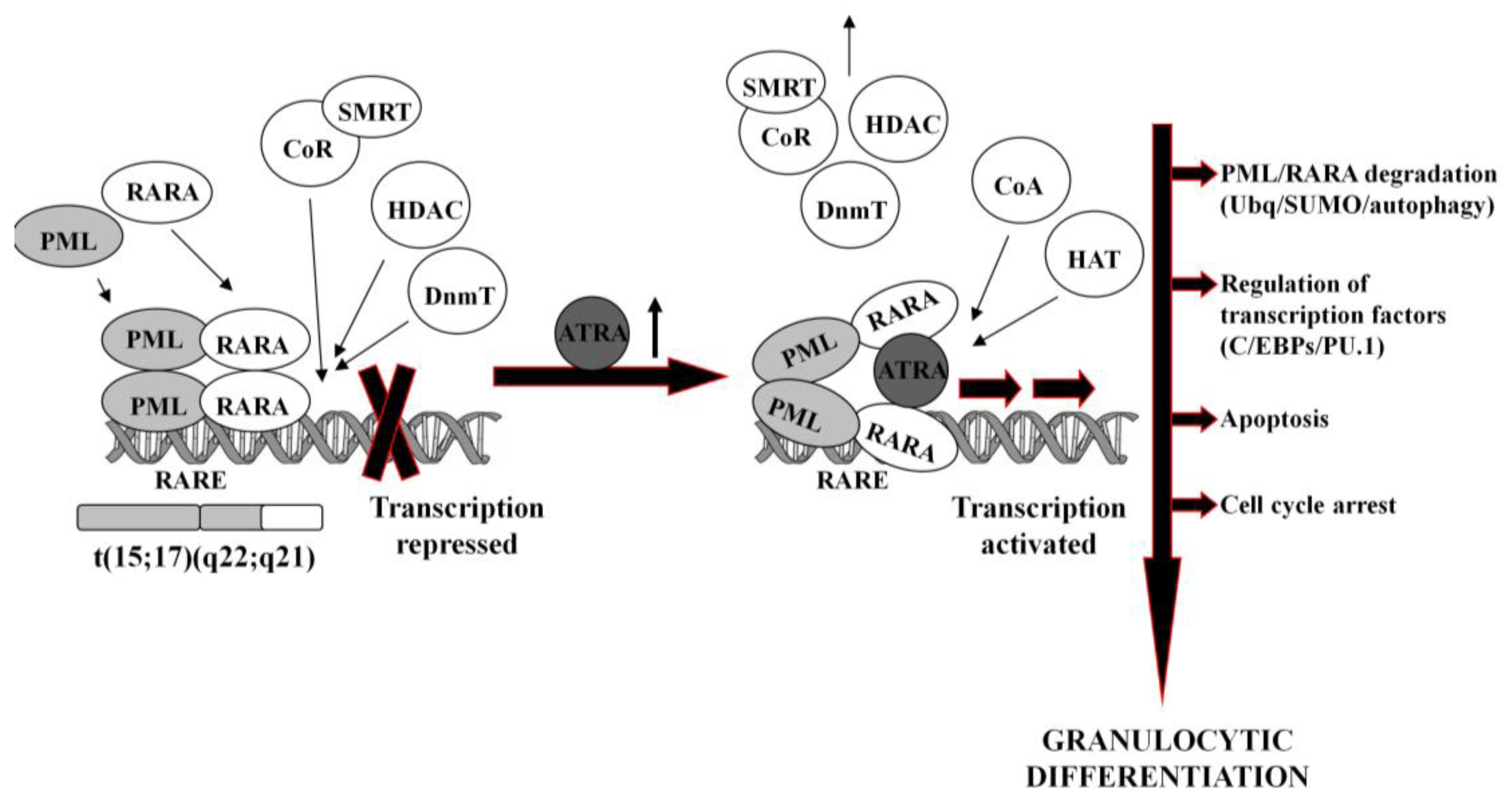
<p>In normal hematopoietic cells, retinoids play multiple physiological roles in maturation and differentiation [<xref ref-type="bibr" rid="b50-cancers-03-02402">50</xref>-<xref ref-type="bibr" rid="b52-cancers-03-02402">52</xref>]. These compounds function through binding to their receptors (RAR and RXR), which belong to the superfamily of nuclear ligand-activated transcription factors [<xref ref-type="bibr" rid="b53-cancers-03-02402">53</xref>,<xref ref-type="bibr" rid="b54-cancers-03-02402">54</xref>]. In the absence of a ligand, RARA forms heterodimers with the RXR, binds to the retinoid acid response elements (RARE) in the promoter region of the target genes and recruits co-repressor (CoR) complex. CoR is composed of several proteins, including nuclear receptor co-repressor (NCoR), silencing mediator for retinoid and thyroid hormone receptors (SMRT) [<xref ref-type="bibr" rid="b55-cancers-03-02402">55</xref>]. These proteins recruit DNA DnmT1 and DnmT3a and HDAC1 [<xref ref-type="bibr" rid="b56-cancers-03-02402">56</xref>-<xref ref-type="bibr" rid="b58-cancers-03-02402">58</xref>]. Deacetylated histones cause chromatin condensation and transcriptional repression [<xref ref-type="bibr" rid="b56-cancers-03-02402">56</xref>,<xref ref-type="bibr" rid="b59-cancers-03-02402">59</xref>]. At physiological concentrations (10<sup>−9</sup>–10<sup>−8</sup>M), ATRA binds to the RARA-RXR hetrodimer and induces dissociation of CoR, interchangeably with association of the co-activators (CoA) complex, containing histone acetyltransferase (HAT). Acetylated histones cause chromatin decondensation and activation of the transcription [<xref ref-type="bibr" rid="b56-cancers-03-02402">56</xref>,<xref ref-type="bibr" rid="b59-cancers-03-02402">59</xref>].</p>
<p>In APL, RARA heterodimerizes with promyelocytic leukemia (PML) nuclear protein, normally responsible for the formation of the nuclear bodies and regulation of the stem cells self-renewal [<xref ref-type="bibr" rid="b60-cancers-03-02402">60</xref>,<xref ref-type="bibr" rid="b61-cancers-03-02402">61</xref>]. PML-RARA fusion protein acts as an oncogene, causing enhanced proliferation and inhibited terminal differentiation of the hematopoietic cells. PML-RARA heterodimers act in a dominant negative manner over RARA, and have higher affinity to CoR and HDAC than RARA-RXR, resulting in enhanced hyper-methylation of the DNA [<xref ref-type="bibr" rid="b62-cancers-03-02402">62</xref>,<xref ref-type="bibr" rid="b63-cancers-03-02402">63</xref>]. Furthermore, PML-RARA oligomerizes in a different manner to RXR-RARA and may not only homodimerize, but also heterodimerize with wild-type PML and RXR [<xref ref-type="bibr" rid="b64-cancers-03-02402">64</xref>]. This may cause sequesteration of those proteins and recruiting enzymes in a large complex, which augments transcriptional repression [<xref ref-type="bibr" rid="b62-cancers-03-02402">62</xref>,<xref ref-type="bibr" rid="b65-cancers-03-02402">65</xref>]. An example of genes repressed by PML-RARA is the one encoding protein p21<sup>Cip1</sup>, what may contribute to the final effect of enhanced proliferation of APL cells [<xref ref-type="bibr" rid="b64-cancers-03-02402">64</xref>,<xref ref-type="bibr" rid="b66-cancers-03-02402">66</xref>,<xref ref-type="bibr" rid="b67-cancers-03-02402">67</xref>]. Heterodimerization with PML-RARA turns off pro-apoptotic and growth inhibiting properties of PML [<xref ref-type="bibr" rid="b68-cancers-03-02402">68</xref>,<xref ref-type="bibr" rid="b69-cancers-03-02402">69</xref>]. Interfering with the normal function of both, RARA and PML, the fusion protein reveals double dominant negative activity [<xref ref-type="bibr" rid="b68-cancers-03-02402">68</xref>]. PML-RARA also binds promyelocytic leukemia zinc finger (PLZF) protein, and affects its functions as a growth suppressor [<xref ref-type="bibr" rid="b70-cancers-03-02402">70</xref>]. Moreover, it appears that PML-RARA can enhance pro-proliferative and pro-survival functions of FLT3 [<xref ref-type="bibr" rid="b71-cancers-03-02402">71</xref>,<xref ref-type="bibr" rid="b72-cancers-03-02402">72</xref>]. It is important to note that PML-RARA often targets PU.1-regulated promoters through both protein-protein interactions, as well as DNA binding via RARE half sites [<xref ref-type="bibr" rid="b73-cancers-03-02402">73</xref>]. Genes containing these PML-RARA-targeted promoters are transcriptionally suppressed in APL and most likely constitute a major mechanism of transcriptional repression occurring in APL [<xref ref-type="bibr" rid="b73-cancers-03-02402">73</xref>]. Molecular disturbances mentioned above contribute to the blockage of granulocytic differentiation, and constitute the main reason for the inability of ATRA to unblock transcriptional repression at its physiological concentration.</p></sec>
<sec>
<label>4.2.</label>
<title>ATRA-Induced Differentiation and Elimination of APL Cells</title>
<p>It is generally accepted that at pharmacological concentrations (10<sup>−7</sup>–10<sup>−6</sup>M) ATRA causes conformational changes of PML-RARA, which enable dissociation of the CoR and association of the CoA. As a result, chromatin structure becomes relaxed, transcriptional repression relieved, and APL cells undergo terminal differentiation into granulocytes (<xref ref-type="fig" rid="f1-cancers-03-02402">Figure 1</xref>) [<xref ref-type="bibr" rid="b74-cancers-03-02402">74</xref>,<xref ref-type="bibr" rid="b75-cancers-03-02402">75</xref>]. It has been reported that several miRs (<italic>i.e.</italic>, miR-223, let-7a) play an important role of a regulatory circuit involving C/EBPα and NFI-A, master regulatory transcription factors that control granulocytic differentiation in ATRA-treated APL cells [<xref ref-type="bibr" rid="b36-cancers-03-02402">36</xref>,<xref ref-type="bibr" rid="b76-cancers-03-02402">76</xref>]. Moreover, it has been shown that several miRs (<italic>i.e.</italic>, miR-210, miR23a/24-2) which are transcriptionally repressed by the APL-associated PML-RARA oncogene, become activated after treatment with ATRA [<xref ref-type="bibr" rid="b77-cancers-03-02402">77</xref>-<xref ref-type="bibr" rid="b79-cancers-03-02402">79</xref>].</p>
<p>ATRA-induced degradation of PML-RARA is the basic therapeutic mechanism in APL cells [<xref ref-type="bibr" rid="b42-cancers-03-02402">42</xref>,<xref ref-type="bibr" rid="b80-cancers-03-02402">80</xref>]. Recent results have revealed several ways leading to the destruction of the fusion oncogene, such as ubiquitination [<xref ref-type="bibr" rid="b81-cancers-03-02402">81</xref>], sumoylation [<xref ref-type="bibr" rid="b82-cancers-03-02402">82</xref>] or authophagy [<xref ref-type="bibr" rid="b83-cancers-03-02402">83</xref>]. PML-RARA degradation is accompanied by the activation or inhibition of a number of various ATRA-response genes. These include transcription factors (for example C/EBPε or PU.1) [<xref ref-type="bibr" rid="b73-cancers-03-02402">73</xref>,<xref ref-type="bibr" rid="b84-cancers-03-02402">84</xref>], chromatin-regulating factors [<xref ref-type="bibr" rid="b63-cancers-03-02402">63</xref>,<xref ref-type="bibr" rid="b85-cancers-03-02402">85</xref>], cell cycle regulators [<xref ref-type="bibr" rid="b86-cancers-03-02402">86</xref>,<xref ref-type="bibr" rid="b87-cancers-03-02402">87</xref>], as well as protein synthesis inhibitors [<xref ref-type="bibr" rid="b88-cancers-03-02402">88</xref>].</p>
<p>Effectiveness of ATRA in the treatment of APL is unquestionable. In more than 90% of the patients such a therapy leads to the complete remission [<xref ref-type="bibr" rid="b89-cancers-03-02402">89</xref>,<xref ref-type="bibr" rid="b90-cancers-03-02402">90</xref>]. Treatment regiments combining ATRA with arsenic trioxide (ASO) further improved curability of the patients, especially these with ATRA-resistance, usually occurring after long-term use of the drug [<xref ref-type="bibr" rid="b90-cancers-03-02402">90</xref>,<xref ref-type="bibr" rid="b91-cancers-03-02402">91</xref>]. The possible reason for the relapse is that ATRA used as a single agent, in spite of inducing complete remission, is unable to cause complete molecular remission. Therefore a fraction of leukemia initiating cells (LIC) may remain after initial successful ATRA treatment [<xref ref-type="bibr" rid="b80-cancers-03-02402">80</xref>]. In contrast, ATRA/ASO combination therapy has been shown to produce final clearance of LICs [<xref ref-type="bibr" rid="b80-cancers-03-02402">80</xref>,<xref ref-type="bibr" rid="b92-cancers-03-02402">92</xref>]. In leukemic cells ASO supports ATRA-induced differentiation, but this is not enough for eradication of the disease. Even though ASO has been known as a therapeutic agent for ages, its mode of action remained obscure until recently [<xref ref-type="bibr" rid="b93-cancers-03-02402">93</xref>]. At present we know that it affects cells in many different ways, one of the most important effects in APL cells is degradation of PML-RARA oncogene, a step necessary for eradication of LICs [<xref ref-type="bibr" rid="b94-cancers-03-02402">94</xref>]. As mentioned above, similar effect of PML-RARA degradation may be obtained with ATRA alone, but only when its high intracellular levels are obtained. ATRA/ASO combination therapy synergizes molecular effects of both drugs [<xref ref-type="bibr" rid="b92-cancers-03-02402">92</xref>]. At a molecular level ASO targets PML moiety in fusion PML-RARA protein where it triggers formation of arsenic-cysteine bonds that favor protein aggregation. PML-RARA in aggregates undergo ubiquitination, sumoylation and resulting degradation in proteasomes [<xref ref-type="bibr" rid="b93-cancers-03-02402">93</xref>]. At a cellular level ASO induces apoptosis, mainly through the mitochondria-mediated intrinsic apoptotic pathway [<xref ref-type="bibr" rid="b95-cancers-03-02402">95</xref>].</p>
<p>In its first description APL was considered to be the most malignant form of AML, accompanied by severe bleeding and short survival time, and now it is the most curable one [<xref ref-type="bibr" rid="b39-cancers-03-02402">39</xref>,<xref ref-type="bibr" rid="b90-cancers-03-02402">90</xref>]. Successful molecular-targeted therapy with ATRA/ASO, has opened a new area in cancer therapy, and raised the possibility that other diseases may be treated by different compounds in a similar way. Since 1,25-dihydroxyvitamin D<sub>3</sub> (1,25D) is capable of inducing monocytic differentiation of AML cells <italic>in vitro</italic> [<xref ref-type="bibr" rid="b96-cancers-03-02402">96</xref>,<xref ref-type="bibr" rid="b97-cancers-03-02402">97</xref>], it is one of the best prospects for use in clinical applications [<xref ref-type="bibr" rid="b98-cancers-03-02402">98</xref>].</p></sec>
<sec>
<label>4.3.</label>
<title>ATRA in Non-APL Subtypes of AML</title>
<p>The possibility to induce differentiation of HL60 cells using ATRA has been known for over 30 years [<xref ref-type="bibr" rid="b99-cancers-03-02402">99</xref>]. However, at the time of this discovery HL60 cells were believed to be APL, it only manifested later that they originate from subtype M2 of AML, according to FAB classification [<xref ref-type="bibr" rid="b100-cancers-03-02402">100</xref>]. Further studies have shown that there are more non-APL AML cell lines that respond to ATRA. For example in THP-1 cells ATRA up-regulates expression of C/EBPα and β transcription factors [<xref ref-type="bibr" rid="b101-cancers-03-02402">101</xref>], which are key regulators in myeloid cell differentiation and also important regulators of ATRA-induced differentiation of APL cells [<xref ref-type="bibr" rid="b102-cancers-03-02402">102</xref>]. Such findings stimulated clinical attempts to combine ATRA with chemotherapy for non-APL AML patients. Some early clinical trials have been conducted, but resulting conclusions were confusing. Some trials did not show benefits of combination therapy for patients [<xref ref-type="bibr" rid="b103-cancers-03-02402">103</xref>,<xref ref-type="bibr" rid="b104-cancers-03-02402">104</xref>], while others did [<xref ref-type="bibr" rid="b105-cancers-03-02402">105</xref>]. Therefore a search for more specific differentiation agents for non-APL AML is underway and will be discussed below.</p></sec></sec>
<sec>
<label>5.</label>
<title>1,25D and Its Low-Calcemic Analogs for Differentiation Therapy</title>
<p>The major role of 1,25D in human body is maintenance of calcium/phosphate homeostasis, but many other so called non-classical actions of 1,25D are known. One of these non-classical actions is, the above mentioned, monocytic differentiation of AML cells [<xref ref-type="bibr" rid="b96-cancers-03-02402">96</xref>,<xref ref-type="bibr" rid="b97-cancers-03-02402">97</xref>]. In order to separate calcemic properties of 1,25D from other activities of the compound, many low-calcemic vitamin D analogs (VDAs) have been synthesized for various clinical purposes [<xref ref-type="bibr" rid="b106-cancers-03-02402">106</xref>-<xref ref-type="bibr" rid="b108-cancers-03-02402">108</xref>]. Some VDAs have shown very promising anti-leukemic activities <italic>in vitro</italic> and <italic>in vivo</italic> [<xref ref-type="bibr" rid="b109-cancers-03-02402">109</xref>-<xref ref-type="bibr" rid="b113-cancers-03-02402">113</xref>]. Encouraged by early observations of 1,25D-induced differentiation of AML cells, few clinical trials were conducted to test the ability of 1,25D to treat myelodysplastic syndrome (MDS) and AML [<xref ref-type="bibr" rid="b114-cancers-03-02402">114</xref>,<xref ref-type="bibr" rid="b115-cancers-03-02402">115</xref>]. Since hypercalcemia is a limiting factor in clinical use of 1,25D in cancer patients, a low-calcemic analog, paricalcitol was also used to treat MDS in a small clinical trial [<xref ref-type="bibr" rid="b116-cancers-03-02402">116</xref>]. Results of these trials were disappointing, therefore at present the use of VDAs in combination therapy is postulated. Several different combinations of drugs for use together with VDAs have been proposed and in most of them the goal is to potentiate differentiating effects of 1,25D or VDAs. This way calcemic effects could be avoided by lowering doses of 1,25D or VDAs necessary to obtain differentiation of leukemic cells. A series of papers has shown that antioxidants, such as carnosic acid, silibinin and curcumin effectively potentiate 1,25D-induced cell differentiation <italic>in vitro</italic> [<xref ref-type="bibr" rid="b117-cancers-03-02402">117</xref>-<xref ref-type="bibr" rid="b119-cancers-03-02402">119</xref>] and extend the life span of mice inoculated with murine leukemia [<xref ref-type="bibr" rid="b110-cancers-03-02402">110</xref>,<xref ref-type="bibr" rid="b120-cancers-03-02402">120</xref>]. Similar effect of enhanced differentiation could be obtained using everolismus, immunosuppressant used in transplantation medicine and in oncology, which inhibits mammalian target of rapamycin (mTOR) [<xref ref-type="bibr" rid="b121-cancers-03-02402">121</xref>]. Interestingly inhibitors of p38 kinases α and β [<xref ref-type="bibr" rid="b122-cancers-03-02402">122</xref>], as well as inhibitors of phospholipase A<sub>2</sub> [<xref ref-type="bibr" rid="b123-cancers-03-02402">123</xref>] and non-specific inhibitors of cyclooxygenase (COX) [<xref ref-type="bibr" rid="b124-cancers-03-02402">124</xref>] do the same. All compounds mentioned above share the ability to interfere with 1,25D-induced cell signaling in leukemic cells and, what is important, most of them are accepted drugs. The second strategy is to combine 1,25D or VDAs with agents that trigger cell death, for example with nutlin-3, which enhanced pro-apoptotic and downregulated anti-apoptotic proteins [<xref ref-type="bibr" rid="b125-cancers-03-02402">125</xref>]. Many studies have shown that 1,25D potentiates the anti-tumor activities of chemotherapeutics agents [<xref ref-type="bibr" rid="b126-cancers-03-02402">126</xref>], predominantly in solid cancers. However, there are also examples of clinical usefulness of 1,25D and cytarabine combination, which prolonged remission in elderly patients with acute AML and MDS [<xref ref-type="bibr" rid="b127-cancers-03-02402">127</xref>,<xref ref-type="bibr" rid="b128-cancers-03-02402">128</xref>].</p>
<p>Another approach is to select from a great variety of AMLs, only these which are susceptible to 1,25D. A good analogy exists in ATRA treatment, which is very effective in APL patients, but not in other subtypes of AML. It has been shown that individual responses of <italic>ex vivo</italic> cultured blast cells from patients with AML to differentiation-inducing effect of 1,25D are variable [<xref ref-type="bibr" rid="b118-cancers-03-02402">118</xref>]. The analysis performed in order to look for correlations between mutations that are often diagnosed in blast cells of AML patients, with the susceptibility of the blasts towards VDA-induced differentiation, has shown that the most susceptible cells are these that carry monosomy 7 or partial loss of 7q [<xref ref-type="bibr" rid="b129-cancers-03-02402">129</xref>]. Monosomy 7 or losses in the long arm of this chromosome occur in about 18% of the AML cases [<xref ref-type="bibr" rid="b130-cancers-03-02402">130</xref>] and are often connected with prior MDS or with earlier therapy with alkylating agents [<xref ref-type="bibr" rid="b131-cancers-03-02402">131</xref>]. Adult patients with this mutation have a very aggressive disease, great susceptibility to infections and poor prognosis [<xref ref-type="bibr" rid="b131-cancers-03-02402">131</xref>]. If the correlation found in <italic>ex vivo</italic> cultured blasts could be translated into therapeutic use of VDAs in patients with monosomy 7 or partial loss of 7q, the differentiation-inducing activity of analogs together with their immunostimulating potential [<xref ref-type="bibr" rid="b132-cancers-03-02402">132</xref>] might have beneficial effects in this group of patients.</p>
<sec>
<label>5.1.</label>
<title>1,25D Signaling Pathways of Cell Differentiation in Brief</title>
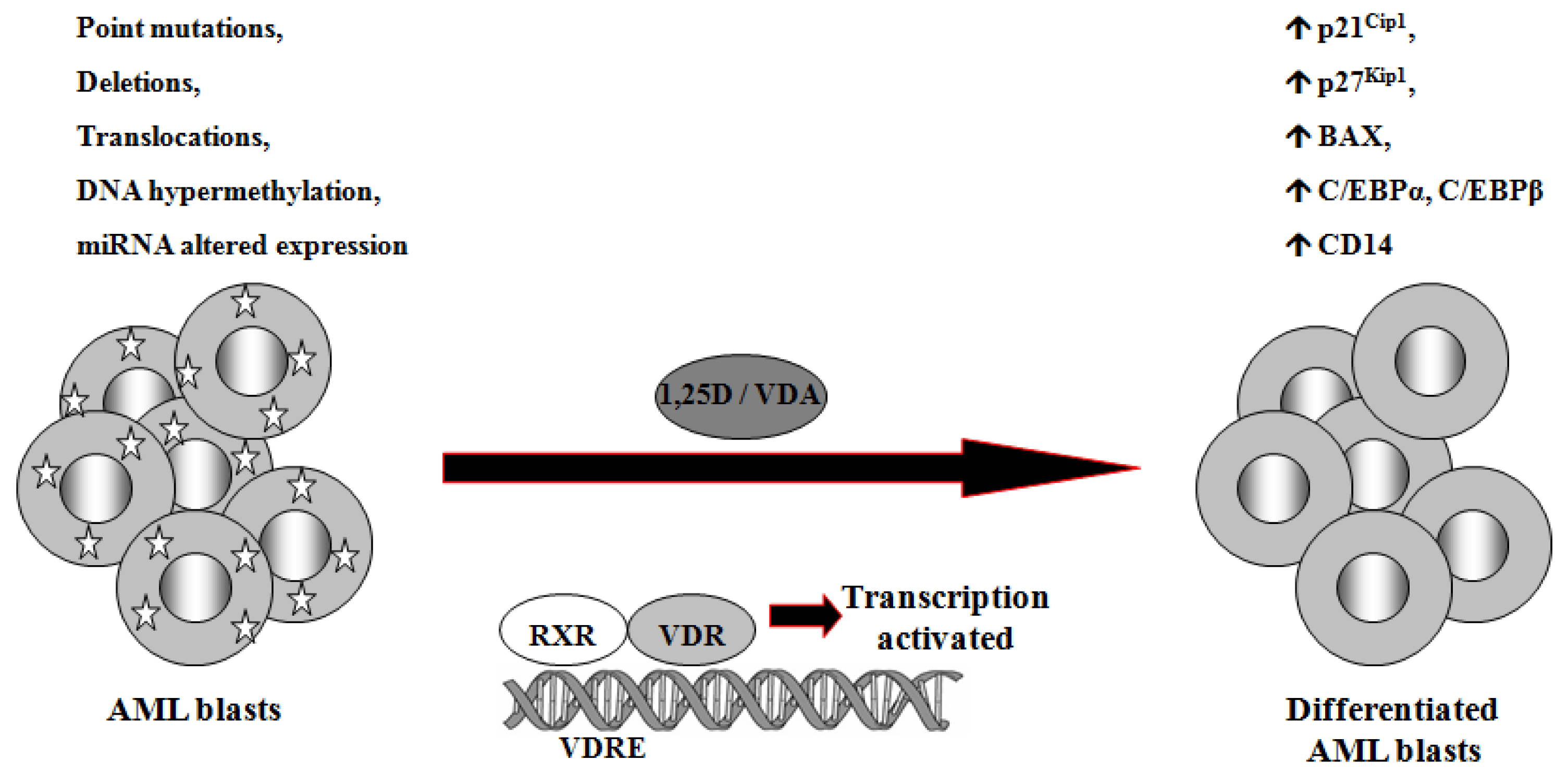
<p>1,25D is one of the steroid hormones that exert biological activity through interaction with their specific nuclear receptors. Vitamin D receptor (VDR) belongs to the same superfamily of nuclear receptors as RAR and RXR. VDR is a ligand-induced transcription factor and a major regulator of 1,25D effects [<xref ref-type="bibr" rid="b133-cancers-03-02402">133</xref>]. After ligation with 1,25D or VDAs, VDR becomes protected from degradation [<xref ref-type="bibr" rid="b134-cancers-03-02402">134</xref>] and translocates from cell cytosol to the nucleus [<xref ref-type="bibr" rid="b135-cancers-03-02402">135</xref>,<xref ref-type="bibr" rid="b136-cancers-03-02402">136</xref>]. VDAs with high pro-differentiating potential efficiently stabilize VDR protein and cause its accumulation in the nuclei of the target cells [<xref ref-type="bibr" rid="b111-cancers-03-02402">111</xref>]. VDR target genes are connected with the calcium/phosphate homeostasis, but also with anti-proliferative, pro-apoptotic and pro-differentiating actions of 1,25D in non-calcemic tissues. Among such genes are inhibitors of cell cycle, such as p21<sup>Cip1</sup> and p27<sup>Kip1</sup> [<xref ref-type="bibr" rid="b137-cancers-03-02402">137</xref>], pro-apoptotic Bax [<xref ref-type="bibr" rid="b138-cancers-03-02402">138</xref>] and transcription factors of monocytic lineage differentiation, such as C/EBPα and β [<xref ref-type="bibr" rid="b139-cancers-03-02402">139</xref>,<xref ref-type="bibr" rid="b140-cancers-03-02402">140</xref>]. C/EBPα and β regulate transcription of many downstream genes that encode proteins important for proper macrophage function, such as CD14 cell surface molecule, a component of the innate immune system, acting as a co-receptor of bacterial lipopolysaccharide [<xref ref-type="bibr" rid="b139-cancers-03-02402">139</xref>,<xref ref-type="bibr" rid="b141-cancers-03-02402">141</xref>]. Regulation of target genes by 1,25D may be obtained not only through transcription. It has been documented that 1,25D-induced increase in p27<sup>Kip1</sup> at both mRNA and protein levels results from decreased expression of in p27<sup>Kip1</sup> inhibitors miR181a/b. Forced expression of pre-miR181a in leukemic cells not only abrogated 1,25D-induced increase in p27<sup>Kip1</sup>, but also blunted differentiation effect and reduced cell cycle arrest in 1,25D-treated cells [<xref ref-type="bibr" rid="b142-cancers-03-02402">142</xref>]. However, VDR seems not to be crucial in normal hematopoiesis, since VDR null mice do not show major defects in blood cells development [<xref ref-type="bibr" rid="b143-cancers-03-02402">143</xref>]. Therefore it is likely that 1,25D and VDAs through upregulation of C/EBPα and β transcription factors, their downstream target genes, and by other 1,25D-dependent mechanisms might bypass normal pathways of myeloid differentiation [<xref ref-type="bibr" rid="b144-cancers-03-02402">144</xref>], which are blocked in some leukemic blasts (<xref ref-type="fig" rid="f2-cancers-03-02402">Figure 2</xref>).</p></sec></sec>
<sec sec-type="conclusions">
<label>6.</label>
<title>Conclusions</title>
<p>Significant clinical improvement of patients with APL treated with ATRA raised reasonable hope for other agents, such as 1,25D and VDAs, to be effective differentiation-inducing drugs. Further improvements of APL therapy with ASO and detailed understanding of molecular mechanisms of both drugs have shown that therapies may be tailored for specific abnormalities present in neoplastic cells. Novel insights into the etiology of leukemia are of major importance for clinical utility in future drugs [<xref ref-type="bibr" rid="b144-cancers-03-02402">144</xref>-<xref ref-type="bibr" rid="b146-cancers-03-02402">146</xref>] and may help to select susceptible targets for differentiation therapy using 1,25D and VDAs. It is obvious that the new therapeutic approach should be directed towards leukemic cells, without general cytotoxicity to the organism.</p></sec></body>
<back>
<sec sec-type="display-objects">
<title>Figures</title>
<fig id="f1-cancers-03-02402" position="float">
<label>Figure 1.</label>
<caption>
<p>Molecular mechanism of ATRA-induced differentiation of APL cells.</p>
<p>In APL cells, PML-RARA hereodimerization leads to the sequestration of CoR complex, DNA hypermethylation and histones deacetylation, resulting in transcriptional repression. In the presence of high-dose of ATRA the CoR is replaced by CoA, allowing transcriptional activation and terminal differentiation of the APL cells into granulocytes. PML-RARA fusion protein undergoes degradation by several ways, including ubiquitination, sumoylation or authophagy. (PML: promyelocytic leukemia; RARA: retinoic acid receptor; RARE: retinoid acid response elements; CoR: co-repressor; SMRT: silencing mediator for retinoid and thyroid hormone receptors; HDAC: histone deacetylase; DnmT: DNA methyltransferases; CoA: co-activators; HAT: histone acetyltransferase; Ubq :ubiquitin; SUMO: sumoylation).</p></caption>
<graphic xlink:href="cancers-03-02402f1.gif"/></fig>
<fig id="f2-cancers-03-02402" position="float">
<label>Figure 2.</label>
<caption>
<p>1,25D-induced differentiation of AML cells.</p>
<p>AML cells are characterized by a block at various stages of hematopoietic differentiation, that leads to uncontrolled proliferation and accumulation of immature myeloid blast cells in bone marrow and peripheral blood. Differentiation blockage is often caused by various mutations, DNA hypermethylation, as well as miRNA altered expression. AML blasts, when exposed to 1,25D or VDA, acquire features of normal monocytes and become arrested in the G1 phase of the cell cycle. (1,25D: 1,25-dihydroxyvitamin D<sub>3</sub>; VDA: 1,25D analog; RXR: retinoid X receptor; VDR: Vitamin D Receptor; VDRE: vitamin D response elements).</p></caption>
<graphic xlink:href="cancers-03-02402f2.gif"/></fig></sec>
<ack>
<p>This work was supported by the Polish Ministry of Science and Higher Education (Grant Number 2132/B/P01/2008/34) and by the Foundation for Polish Science to E.G.</p></ack>
<ref-list>
<title>References</title>
<ref id="b1-cancers-03-02402"><label>1.</label><citation citation-type="book"><person-group person-group-type="author"><name><surname>Hoffbrand</surname><given-names>A.</given-names></name><name><surname>Moss</surname><given-names>P.</given-names></name><name><surname>Pettit</surname><given-names>J.</given-names></name></person-group><source>Essential Haematolog</source><edition>5th ed.</edition><publisher-name>Blackwell Publishing</publisher-name><publisher-loc>Oxford, United Kingdom, UK</publisher-loc><year>2006</year></citation></ref>
<ref id="b2-cancers-03-02402"><label>2.</label><citation citation-type="journal"><person-group person-group-type="author"><name><surname>Lowenberg</surname><given-names>B.</given-names></name></person-group><article-title>Acute myeloid leukemia: The challenge of capturing disease variety</article-title><source>Hematology</source><year>2008</year><fpage>1</fpage><lpage>11</lpage></citation></ref>
<ref id="b3-cancers-03-02402"><label>3.</label><citation citation-type="journal"><person-group person-group-type="author"><name><surname>Lowenberg</surname><given-names>B.</given-names></name><name><surname>Griffin</surname><given-names>J.</given-names></name><name><surname>Tallman</surname><given-names>M.</given-names></name></person-group><article-title>Acute myeloid leukemia and acute promyelocytic leukemia</article-title><source>Hematology</source><year>2003</year><fpage>82</fpage><lpage>101</lpage></citation></ref>
<ref id="b4-cancers-03-02402"><label>4.</label><citation citation-type="journal"><person-group person-group-type="author"><name><surname>Sandler</surname><given-names>D.</given-names></name><name><surname>Ross</surname><given-names>J.</given-names></name></person-group><article-title>Epidemiology of acute leukemia in children and adults</article-title><source>Semin. Oncol.</source><year>1997</year><volume>24</volume><fpage>3</fpage><lpage>16</lpage><pub-id pub-id-type="pmid">9045302</pub-id></citation></ref>
<ref id="b5-cancers-03-02402"><label>5.</label><citation citation-type="journal"><person-group person-group-type="author"><name><surname>Bennett</surname><given-names>J.</given-names></name><name><surname>Catovsky</surname><given-names>D.</given-names></name><name><surname>Daniel</surname><given-names>M.</given-names></name><name><surname>Flandrin</surname><given-names>G.</given-names></name><name><surname>Galton</surname><given-names>D.</given-names></name><name><surname>Gralnick</surname><given-names>H.</given-names></name><name><surname>Sultan</surname><given-names>C.</given-names></name></person-group><article-title>Proposals for the classification of the acute leukaemias. French-American-British (FAB) co-operative group</article-title><source>Br. J. Haematol.</source><year>1976</year><volume>33</volume><fpage>451</fpage><lpage>458</lpage><pub-id pub-id-type="doi">10.1111/j.1365-2141.1976.tb03563.x</pub-id><pub-id pub-id-type="pmid">188440</pub-id></citation></ref>
<ref id="b6-cancers-03-02402"><label>6.</label><citation citation-type="book"><person-group person-group-type="author"><name><surname>Swerdlow</surname><given-names>S.</given-names></name><name><surname>Campo</surname><given-names>E.</given-names></name><name><surname>Harris</surname><given-names>N.</given-names></name><name><surname>Jaffe</surname><given-names>E.</given-names></name><name><surname>Pileri</surname><given-names>S.</given-names></name><name><surname>Stein</surname><given-names>H.</given-names></name><name><surname>Theile</surname><given-names>J.</given-names></name><name><surname>Vardiman</surname><given-names>J.</given-names></name></person-group><source>WHO Classification of Tumours of Haematopoietic and Lymphoid Tissues</source><edition>4th ed.</edition><publisher-name>IARC Press</publisher-name><publisher-loc>Lyon, France</publisher-loc><year>2008</year><fpage>109</fpage><lpage>138</lpage></citation></ref>
<ref id="b7-cancers-03-02402"><label>7.</label><citation citation-type="book"><source>Hematologia Molekularna, Patogeneza, Patomechanizmy i Metody Badawcze</source><person-group person-group-type="editor"><name><surname>Witt</surname><given-names>M.</given-names></name><name><surname>Szczepanski</surname><given-names>T.</given-names></name><name><surname>Dawidowska</surname><given-names>M.</given-names></name></person-group><publisher-name>Ośrodek Wydawnictw Naukowych</publisher-name><publisher-loc>Poznań, Poland</publisher-loc><year>2009</year></citation></ref>
<ref id="b8-cancers-03-02402"><label>8.</label><citation citation-type="web"><article-title>Biography of Ehrlich, in Whonamedit? A dictionary of medical eponyms Home Page</article-title><comment>Available online: <ext-link xlink:href="http://www.whonamedit.com/doctor.cfm/83.html/" ext-link-type="uri">http://www.whonamedit.com/doctor.cfm/83.html/</ext-link> (accessed 10 December 2010)</comment></citation></ref>
<ref id="b9-cancers-03-02402"><label>9.</label><citation citation-type="journal"><person-group person-group-type="author"><name><surname>Zelent</surname><given-names>A.</given-names></name><name><surname>Petrie</surname><given-names>K.</given-names></name><name><surname>Chen</surname><given-names>Z.</given-names></name><name><surname>Lotan</surname><given-names>R.</given-names></name><name><surname>Lubbert</surname><given-names>M.</given-names></name><name><surname>Tallman</surname><given-names>M.</given-names></name><name><surname>Ohno</surname><given-names>R.</given-names></name><name><surname>Degos</surname><given-names>L.</given-names></name><name><surname>Waxman</surname><given-names>S.</given-names></name></person-group><article-title>Molecular target-based treatment of human cancer: Summary of the 10th international conference on differentiation therapy</article-title><source>Cancer Res.</source><year>2005</year><volume>65</volume><fpage>1117</fpage><lpage>1123</lpage><pub-id pub-id-type="doi">10.1158/0008-5472.CAN-04-3603</pub-id><pub-id pub-id-type="pmid">15734991</pub-id></citation></ref>
<ref id="b10-cancers-03-02402"><label>10.</label><citation citation-type="journal"><person-group person-group-type="author"><name><surname>An</surname><given-names>X.</given-names></name><name><surname>Tiwari</surname><given-names>A.</given-names></name><name><surname>Sun</surname><given-names>Y.</given-names></name><name><surname>Ding</surname><given-names>P.</given-names></name><name><surname>Ashby</surname><given-names>C.J.</given-names></name><name><surname>Chen</surname><given-names>Z.</given-names></name></person-group><article-title>BCR-ABL tyrosine kinase inhibitors in the treatment of Philadelphia chromosome positive chronic myeloid leukemia: A review</article-title><source>Leuk. Res.</source><year>2010</year><volume>34</volume><fpage>1255</fpage><lpage>1268</lpage><pub-id pub-id-type="doi">10.1016/j.leukres.2010.04.016</pub-id><pub-id pub-id-type="pmid">20537386</pub-id></citation></ref>
<ref id="b11-cancers-03-02402"><label>11.</label><citation citation-type="journal"><person-group person-group-type="author"><name><surname>Nowell</surname><given-names>P.</given-names></name><name><surname>Hungerford</surname><given-names>D.</given-names></name></person-group><article-title>A minute chromosome in human chronic granulocytic leukemia</article-title><source>Science</source><year>1960</year><volume>132</volume><fpage>1497</fpage></citation></ref>
<ref id="b12-cancers-03-02402"><label>12.</label><citation citation-type="journal"><person-group person-group-type="author"><name><surname>Erikson</surname><given-names>J.</given-names></name><name><surname>Griffin</surname><given-names>C.</given-names></name><name><surname>ar-Rushdi</surname><given-names>A.</given-names></name><name><surname>Valtieri</surname><given-names>M.</given-names></name><name><surname>Hoxie</surname><given-names>J.</given-names></name><name><surname>Finan</surname><given-names>J.</given-names></name><name><surname>Emanuel</surname><given-names>B.</given-names></name><name><surname>Rovera</surname><given-names>G.</given-names></name><name><surname>Nowell</surname><given-names>P.</given-names></name><name><surname>Croce</surname><given-names>C.</given-names></name></person-group><article-title>Heterogeneity of chromosome 22 breakpoint in Philadelphia-positive (Ph+) acute lymphocytic leukemia</article-title><source>Proc. Natl. Acad. Sci. USA</source><year>1986</year><volume>83</volume><fpage>1807</fpage><lpage>1811</lpage><pub-id pub-id-type="doi">10.1073/pnas.83.6.1807</pub-id><pub-id pub-id-type="pmid">3513189</pub-id></citation></ref>
<ref id="b13-cancers-03-02402"><label>13.</label><citation citation-type="journal"><person-group person-group-type="author"><name><surname>Druker</surname><given-names>B.</given-names></name><name><surname>Tamura</surname><given-names>S.</given-names></name><name><surname>Buchdunger</surname><given-names>E.</given-names></name><name><surname>Ohno</surname><given-names>S.</given-names></name><name><surname>Segal</surname><given-names>G.</given-names></name><name><surname>Fanning</surname><given-names>S.</given-names></name><name><surname>Zimmermann</surname><given-names>J.</given-names></name><name><surname>Lydon</surname><given-names>N.</given-names></name></person-group><article-title>Effects of a selective inhibitor of the Abl tyrosine kinase on the growth of Bcr-Abl positive cells</article-title><source>Nat. Med.</source><year>1996</year><volume>2</volume><fpage>561</fpage><lpage>566</lpage><pub-id pub-id-type="doi">10.1038/nm0596-561</pub-id><pub-id pub-id-type="pmid">8616716</pub-id></citation></ref>
<ref id="b14-cancers-03-02402"><label>14.</label><citation citation-type="journal"><person-group person-group-type="author"><name><surname>Cilloni</surname><given-names>D.</given-names></name><name><surname>Saglio</surname><given-names>G.</given-names></name></person-group><article-title>CML: A model for targeted therapy</article-title><source>Best Pract. Res. Clin. Haematol.</source><year>2009</year><volume>22</volume><fpage>285</fpage><lpage>294</lpage><pub-id pub-id-type="doi">10.1016/j.beha.2009.04.004</pub-id><pub-id pub-id-type="pmid">19959080</pub-id></citation></ref>
<ref id="b15-cancers-03-02402"><label>15.</label><citation citation-type="journal"><person-group person-group-type="author"><name><surname>Stirewalt</surname><given-names>D.</given-names></name><name><surname>Radich</surname><given-names>J.</given-names></name></person-group><article-title>The role of FLT3 in haematopoietic malignancies</article-title><source>Nat. Rev. Cancer</source><year>2003</year><volume>3</volume><fpage>650</fpage><lpage>665</lpage><pub-id pub-id-type="doi">10.1038/nrc1169</pub-id><pub-id pub-id-type="pmid">12951584</pub-id></citation></ref>
<ref id="b16-cancers-03-02402"><label>16.</label><citation citation-type="journal"><person-group person-group-type="author"><name><surname>Yamamoto</surname><given-names>Y.</given-names></name><name><surname>Kiyoi</surname><given-names>H.</given-names></name><name><surname>Nakano</surname><given-names>Y.</given-names></name><name><surname>Suzuki</surname><given-names>R.</given-names></name><name><surname>Kodera</surname><given-names>Y.</given-names></name><name><surname>Miyawaki</surname><given-names>S.</given-names></name><name><surname>Asou</surname><given-names>N.</given-names></name><name><surname>Kuriyama</surname><given-names>K.</given-names></name><name><surname>Yagasaki</surname><given-names>F.</given-names></name><name><surname>Shimazaki</surname><given-names>C.</given-names></name><etal/></person-group><article-title>Activating mutation of D835 within the activation loop of FLT3 in human hematologic malignancies</article-title><source>Blood</source><year>2001</year><volume>97</volume><fpage>2434</fpage><lpage>2439</lpage><pub-id pub-id-type="doi">10.1182/blood.V97.8.2434</pub-id><pub-id pub-id-type="pmid">11290608</pub-id></citation></ref>
<ref id="b17-cancers-03-02402"><label>17.</label><citation citation-type="journal"><person-group person-group-type="author"><name><surname>Rosnet</surname><given-names>O.</given-names></name><name><surname>Birnbaum</surname><given-names>D.</given-names></name></person-group><article-title>Hematopoietic receptors of class III receptor-type tyrosine kinases</article-title><source>Crit. Rev. Oncog.</source><year>1993</year><volume>4</volume><fpage>595</fpage><lpage>613</lpage><pub-id pub-id-type="pmid">7506935</pub-id></citation></ref>
<ref id="b18-cancers-03-02402"><label>18.</label><citation citation-type="journal"><person-group person-group-type="author"><name><surname>Rosnet</surname><given-names>O.</given-names></name><name><surname>Schiff</surname><given-names>C.</given-names></name><name><surname>Pébusque</surname><given-names>M.</given-names></name><name><surname>Marchetto</surname><given-names>S.</given-names></name><name><surname>Tonnelle</surname><given-names>C.</given-names></name><name><surname>Toiron</surname><given-names>Y.</given-names></name><name><surname>Birg</surname><given-names>F.</given-names></name><name><surname>Birnbaum</surname><given-names>D.</given-names></name></person-group><article-title>Human FLT3/FLK2 gene: cDNA cloning and expression in hematopoietic cells</article-title><source>Blood</source><year>1993</year><volume>82</volume><fpage>1110</fpage><lpage>1119</lpage><pub-id pub-id-type="pmid">8394751</pub-id></citation></ref>
<ref id="b19-cancers-03-02402"><label>19.</label><citation citation-type="journal"><person-group person-group-type="author"><name><surname>Lyman</surname><given-names>S.</given-names></name></person-group><article-title>Biology of flt3 ligand and receptor</article-title><source>Int. J. Hematol.</source><year>1995</year><volume>62</volume><fpage>63</fpage><lpage>73</lpage><pub-id pub-id-type="doi">10.1016/0925-5710(95)00389-A</pub-id><pub-id pub-id-type="pmid">8590775</pub-id></citation></ref>
<ref id="b20-cancers-03-02402"><label>20.</label><citation citation-type="journal"><person-group person-group-type="author"><name><surname>McKenna</surname><given-names>H.</given-names></name><name><surname>Stocking</surname><given-names>K.</given-names></name><name><surname>Miller</surname><given-names>R.</given-names></name><name><surname>Brasel</surname><given-names>K.</given-names></name><name><surname>De Smedt</surname><given-names>T.</given-names></name><name><surname>Maraskovsky</surname><given-names>E.</given-names></name><name><surname>Maliszewski</surname><given-names>C.</given-names></name><name><surname>Lynch</surname><given-names>D.</given-names></name><name><surname>Smith</surname><given-names>J.</given-names></name><name><surname>Pulendran</surname><given-names>B.</given-names></name><etal/></person-group><article-title>Mice lacking flt3 ligand have deficient hematopoiesis affecting hematopoietic progenitor cells, dendritic cells, and natural killer cells</article-title><source>Blood</source><year>2000</year><volume>95</volume><fpage>3489</fpage><lpage>3497</lpage><pub-id pub-id-type="pmid">10828034</pub-id></citation></ref>
<ref id="b21-cancers-03-02402"><label>21.</label><citation citation-type="journal"><person-group person-group-type="author"><name><surname>Tse</surname><given-names>K.</given-names></name><name><surname>Mukherjee</surname><given-names>G.</given-names></name><name><surname>Small</surname><given-names>D.</given-names></name></person-group><article-title>Constitutive activation of FLT3 stimulates multiple intracellular signal transducers and results in transformation</article-title><source>Leukemia</source><year>2000</year><volume>14</volume><fpage>1766</fpage><lpage>1776</lpage><pub-id pub-id-type="doi">10.1038/sj.leu.2401905</pub-id><pub-id pub-id-type="pmid">11021752</pub-id></citation></ref>
<ref id="b22-cancers-03-02402"><label>22.</label><citation citation-type="journal"><person-group person-group-type="author"><name><surname>Kindler</surname><given-names>T.</given-names></name><name><surname>Lipka</surname><given-names>D.</given-names></name><name><surname>Fischer</surname><given-names>T.</given-names></name></person-group><article-title>FLT3 as a therapeutic target in AML: Still challenging after all these years</article-title><source>Blood</source><year>2010</year><volume>116</volume><fpage>5089</fpage><lpage>5102</lpage><pub-id pub-id-type="doi">10.1182/blood-2010-04-261867</pub-id><pub-id pub-id-type="pmid">20705759</pub-id></citation></ref>
<ref id="b23-cancers-03-02402"><label>23.</label><citation citation-type="journal"><person-group person-group-type="author"><name><surname>Mughal</surname><given-names>T.</given-names></name><name><surname>Ejaz</surname><given-names>A.</given-names></name><name><surname>Foringer</surname><given-names>J.</given-names></name><name><surname>Coiffier</surname><given-names>B.</given-names></name></person-group><article-title>An integrated clinical approach for the identification, prevention, and treatment of tumor lysis syndrome</article-title><source>Cancer Treat. Rev.</source><year>2010</year><volume>36</volume><fpage>164</fpage><lpage>176</lpage><pub-id pub-id-type="doi">10.1016/j.ctrv.2009.11.001</pub-id><pub-id pub-id-type="pmid">20031331</pub-id></citation></ref>
<ref id="b24-cancers-03-02402"><label>24.</label><citation citation-type="journal"><person-group person-group-type="author"><name><surname>Ferguson</surname><given-names>L.</given-names></name><name><surname>Tatham</surname><given-names>A.</given-names></name><name><surname>Lin</surname><given-names>Z.</given-names></name><name><surname>Denny</surname><given-names>W.</given-names></name></person-group><article-title>Epigenetic regulation of gene expression as an anticancer drug target</article-title><source>Curr. Cancer Drug Targets</source><year>2011</year><volume>11</volume><fpage>199</fpage><lpage>212</lpage><pub-id pub-id-type="doi">10.2174/156800911794328510</pub-id><pub-id pub-id-type="pmid">21158714</pub-id></citation></ref>
<ref id="b25-cancers-03-02402"><label>25.</label><citation citation-type="journal"><person-group person-group-type="author"><name><surname>Blum</surname><given-names>W.</given-names></name><name><surname>Marcucci</surname><given-names>G.</given-names></name></person-group><article-title>Targeting epigenetic changes in acute myeloid leukemia</article-title><source>Clin. Adv. Hematol. Oncol.</source><year>2005</year><volume>3</volume><fpage>855</fpage><lpage>865</lpage><pub-id pub-id-type="pmid">16491631</pub-id></citation></ref>
<ref id="b26-cancers-03-02402"><label>26.</label><citation citation-type="journal"><person-group person-group-type="author"><name><surname>Wei</surname><given-names>Y.</given-names></name><name><surname>Kadia</surname><given-names>T.</given-names></name><name><surname>Tong</surname><given-names>W.</given-names></name><name><surname>Zhang</surname><given-names>M.</given-names></name><name><surname>Jia</surname><given-names>Y.</given-names></name><name><surname>Yang</surname><given-names>H.</given-names></name><name><surname>Hu</surname><given-names>Y.</given-names></name><name><surname>Viallet</surname><given-names>J.</given-names></name><name><surname>O'Brien</surname><given-names>S.</given-names></name><name><surname>Garcia-Manero</surname><given-names>G.</given-names></name></person-group><article-title>The combination of a histone deacetylase inhibitor with the BH3-mimetic GX15-070 has synergistic antileukemia activity by activating both apoptosis and autophagy</article-title><source>Autophagy</source><year>2010</year><volume>6</volume><fpage>976</fpage><lpage>978</lpage><pub-id pub-id-type="doi">10.4161/auto.6.7.13117</pub-id><pub-id pub-id-type="pmid">20729640</pub-id></citation></ref>
<ref id="b27-cancers-03-02402"><label>27.</label><citation citation-type="journal"><person-group person-group-type="author"><name><surname>de Lima</surname><given-names>M.</given-names></name><name><surname>Giralt</surname><given-names>S.</given-names></name><name><surname>Thall</surname><given-names>P.</given-names></name><name><surname>de Padua Silva</surname><given-names>L.</given-names></name><name><surname>Jones</surname><given-names>R.</given-names></name><name><surname>Komanduri</surname><given-names>K.</given-names></name><name><surname>Braun</surname><given-names>T.</given-names></name><name><surname>Nguyen</surname><given-names>H.</given-names></name><name><surname>Champlin</surname><given-names>R.</given-names></name><name><surname>Garcia-Manero</surname><given-names>G.</given-names></name></person-group><article-title>Maintenance therapy with low-dose azacitidine after allogeneic hematopoietic stem cell transplantation for recurrent acute myelogenous leukemia or myelodysplastic syndrome: A dose and schedule finding study</article-title><source>Cancer</source><year>2010</year><volume>116</volume><fpage>5420</fpage><lpage>5431</lpage><pub-id pub-id-type="doi">10.1002/cncr.25500</pub-id><pub-id pub-id-type="pmid">20672358</pub-id></citation></ref>
<ref id="b28-cancers-03-02402"><label>28.</label><citation citation-type="journal"><person-group person-group-type="author"><name><surname>Quintás-Cardama</surname><given-names>A.</given-names></name><name><surname>Santos</surname><given-names>F.</given-names></name><name><surname>Garcia-Manero</surname><given-names>G.</given-names></name></person-group><article-title>Histone deacetylase inhibitors for the treatment of myelodysplastic syndrome and acute myeloid leukemia</article-title><source>Leukemia</source><year>2011</year><volume>25</volume><fpage>226</fpage><lpage>235</lpage><pub-id pub-id-type="doi">10.1038/leu.2010.276</pub-id><pub-id pub-id-type="pmid">21116282</pub-id></citation></ref>
<ref id="b29-cancers-03-02402"><label>29.</label><citation citation-type="journal"><person-group person-group-type="author"><name><surname>Maeda</surname><given-names>T.</given-names></name><name><surname>Towatari</surname><given-names>M.</given-names></name><name><surname>Kosugi</surname><given-names>H.</given-names></name><name><surname>Saito</surname><given-names>H.</given-names></name></person-group><article-title>Up-regulation of costimulatory/adhesion molecules by histone deacetylase inhibitors in acute myeloid leukemia cells</article-title><source>Blood</source><year>2000</year><volume>96</volume><fpage>3847</fpage><lpage>3856</lpage><pub-id pub-id-type="pmid">11090069</pub-id></citation></ref>
<ref id="b30-cancers-03-02402"><label>30.</label><citation citation-type="journal"><person-group person-group-type="author"><name><surname>Venugopal</surname><given-names>B.</given-names></name><name><surname>Evans</surname><given-names>T.</given-names></name></person-group><article-title>Developing histone deacetylase inhibitors as anti-cancer therapeutics</article-title><source>Curr. Med. Chem.</source><year>2011</year><volume>18</volume><fpage>1658</fpage><lpage>1671</lpage><pub-id pub-id-type="doi">10.2174/092986711795471284</pub-id><pub-id pub-id-type="pmid">21428881</pub-id></citation></ref>
<ref id="b31-cancers-03-02402"><label>31.</label><citation citation-type="journal"><person-group person-group-type="author"><name><surname>Bartel</surname><given-names>D.</given-names></name></person-group><article-title>MicroRNAs: Genomics, biogenesis, mechanism, and function</article-title><source>Cell</source><year>2004</year><volume>116</volume><fpage>281</fpage><lpage>297</lpage><pub-id pub-id-type="doi">10.1016/S0092-8674(04)00045-5</pub-id><pub-id pub-id-type="pmid">14744438</pub-id></citation></ref>
<ref id="b32-cancers-03-02402"><label>32.</label><citation citation-type="journal"><person-group person-group-type="author"><name><surname>Schickel</surname><given-names>R.</given-names></name><name><surname>Boyerinas</surname><given-names>B.</given-names></name><name><surname>Park</surname><given-names>S.</given-names></name><name><surname>Peter</surname><given-names>M.</given-names></name></person-group><article-title>MicroRNAs: Key players in the immune system, differentiation, tumorigenesis and cell death</article-title><source>Oncogene</source><year>2008</year><volume>27</volume><fpage>5959</fpage><lpage>5974</lpage><pub-id pub-id-type="doi">10.1038/onc.2008.274</pub-id><pub-id pub-id-type="pmid">18836476</pub-id></citation></ref>
<ref id="b33-cancers-03-02402"><label>33.</label><citation citation-type="journal"><person-group person-group-type="author"><name><surname>Engels</surname><given-names>B.</given-names></name><name><surname>Hutvagner</surname><given-names>G.</given-names></name></person-group><article-title>Principles and effects of microRNA-mediated post-transcriptional gene regulation</article-title><source>Oncogene</source><year>2006</year><volume>25</volume><fpage>6163</fpage><lpage>6169</lpage><pub-id pub-id-type="doi">10.1038/sj.onc.1209909</pub-id><pub-id pub-id-type="pmid">17028595</pub-id></citation></ref>
<ref id="b34-cancers-03-02402"><label>34.</label><citation citation-type="journal"><person-group person-group-type="author"><name><surname>Zeng</surname><given-names>Y.</given-names></name></person-group><article-title>Principles of micro-RNA production and maturation</article-title><source>Oncogene</source><year>2006</year><volume>25</volume><fpage>6156</fpage><lpage>6162</lpage><pub-id pub-id-type="doi">10.1038/sj.onc.1209908</pub-id><pub-id pub-id-type="pmid">17028594</pub-id></citation></ref>
<ref id="b35-cancers-03-02402"><label>35.</label><citation citation-type="journal"><person-group person-group-type="author"><name><surname>Chen</surname><given-names>C.</given-names></name><name><surname>Li</surname><given-names>L.</given-names></name><name><surname>Lodish</surname><given-names>H.</given-names></name><name><surname>Bartel</surname><given-names>D.</given-names></name></person-group><article-title>MicroRNAs modulate hematopoietic lineage differentiation</article-title><source>Science</source><year>2004</year><volume>303</volume><fpage>83</fpage><lpage>86</lpage><pub-id pub-id-type="doi">10.1126/science.1091903</pub-id><pub-id pub-id-type="pmid">14657504</pub-id></citation></ref>
<ref id="b36-cancers-03-02402"><label>36.</label><citation citation-type="journal"><person-group person-group-type="author"><name><surname>Garzon</surname><given-names>R.</given-names></name><name><surname>Pichiorri</surname><given-names>F.</given-names></name><name><surname>Palumbo</surname><given-names>T.</given-names></name><name><surname>Visentini</surname><given-names>M.</given-names></name><name><surname>Aqeilan</surname><given-names>R.</given-names></name><name><surname>Cimmino</surname><given-names>A.</given-names></name><name><surname>Wang</surname><given-names>H.</given-names></name><name><surname>Sun</surname><given-names>H.</given-names></name><name><surname>Volinia</surname><given-names>S.</given-names></name><name><surname>Alder</surname><given-names>H.</given-names></name><etal/></person-group><article-title>MicroRNA gene expression during retinoic acid-induced differentiation of human acute promyelocytic leukemia</article-title><source>Oncogene</source><year>2007</year><volume>26</volume><fpage>4148</fpage><lpage>4157</lpage><pub-id pub-id-type="doi">10.1038/sj.onc.1210186</pub-id><pub-id pub-id-type="pmid">17260024</pub-id></citation></ref>
<ref id="b37-cancers-03-02402"><label>37.</label><citation citation-type="journal"><person-group person-group-type="author"><name><surname>Fabbri</surname><given-names>M.</given-names></name><name><surname>Garzon</surname><given-names>R.</given-names></name><name><surname>Andreeff</surname><given-names>M.</given-names></name><name><surname>Kantarjian</surname><given-names>H.</given-names></name><name><surname>Garcia-Manero</surname><given-names>G.</given-names></name><name><surname>Calin</surname><given-names>G.</given-names></name></person-group><article-title>MicroRNAs and noncoding RNAs in hematological malignancies: Molecular, clinical and therapeutic implications</article-title><source>Leukemia</source><year>2008</year><volume>22</volume><fpage>1095</fpage><lpage>1105</lpage><pub-id pub-id-type="doi">10.1038/leu.2008.30</pub-id><pub-id pub-id-type="pmid">18323801</pub-id></citation></ref>
<ref id="b38-cancers-03-02402"><label>38.</label><citation citation-type="journal"><person-group person-group-type="author"><name><surname>Li</surname><given-names>Z.</given-names></name><name><surname>Lu</surname><given-names>J.</given-names></name><name><surname>Sun</surname><given-names>M.</given-names></name><name><surname>Mi</surname><given-names>S.</given-names></name><name><surname>Zhang</surname><given-names>H.</given-names></name><name><surname>Luo</surname><given-names>R.</given-names></name><name><surname>Chen</surname><given-names>P.</given-names></name><name><surname>Wang</surname><given-names>Y.</given-names></name><name><surname>Yan</surname><given-names>M.</given-names></name><name><surname>Qian</surname><given-names>Z.</given-names></name><etal/></person-group><article-title>Distinct microRNA expression profiles in acute myeloid leukemia with common translocations</article-title><source>Proc. Natl. Acad. Sci. USA</source><year>2008</year><volume>105</volume><fpage>15535</fpage><lpage>15540</lpage><pub-id pub-id-type="doi">10.1073/pnas.0808266105</pub-id><pub-id pub-id-type="pmid">18832181</pub-id></citation></ref>
<ref id="b39-cancers-03-02402"><label>39.</label><citation citation-type="journal"><person-group person-group-type="author"><name><surname>Hillestad</surname><given-names>L.</given-names></name></person-group><article-title>Acute promyelocytic leukemia</article-title><source>Acta Med. Scand.</source><year>1957</year><volume>159</volume><fpage>189</fpage><lpage>194</lpage><pub-id pub-id-type="pmid">13508085</pub-id></citation></ref>
<ref id="b40-cancers-03-02402"><label>40.</label><citation citation-type="journal"><person-group person-group-type="author"><name><surname>Rowley</surname><given-names>J.</given-names></name><name><surname>Golomb</surname><given-names>H.</given-names></name><name><surname>Dougherty</surname><given-names>C.</given-names></name></person-group><article-title>15/17 translocation, a consistent chromosomal change in acute promyelocytic leukaemia</article-title><source>Lancet</source><year>1977</year><volume>1</volume><fpage>549</fpage><lpage>550</lpage><pub-id pub-id-type="pmid">65649</pub-id></citation></ref>
<ref id="b41-cancers-03-02402"><label>41.</label><citation citation-type="journal"><person-group person-group-type="author"><name><surname>Kakizuka</surname><given-names>A.</given-names></name><name><surname>Miller</surname><given-names>W.J.</given-names></name><name><surname>Umesono</surname><given-names>K.</given-names></name><name><surname>Warrell</surname><given-names>R.J.</given-names></name><name><surname>Frankel</surname><given-names>S.</given-names></name><name><surname>Murty</surname><given-names>V.</given-names></name><name><surname>Dmitrovsky</surname><given-names>E.</given-names></name><name><surname>Evans</surname><given-names>R.</given-names></name></person-group><article-title>Chromosomal translocation t(15;17) in human acute promyelocytic leukemia fuses RAR alpha with a novel putative transcription factor, PML</article-title><source>Cell</source><year>1991</year><volume>66</volume><fpage>663</fpage><lpage>674</lpage><pub-id pub-id-type="doi">10.1016/0092-8674(91)90112-C</pub-id><pub-id pub-id-type="pmid">1652368</pub-id></citation></ref>
<ref id="b42-cancers-03-02402"><label>42.</label><citation citation-type="journal"><person-group person-group-type="author"><name><surname>de Thé</surname><given-names>H.</given-names></name><name><surname>Lavau</surname><given-names>C.</given-names></name><name><surname>Marchio</surname><given-names>A.</given-names></name><name><surname>Chomienne</surname><given-names>C.</given-names></name><name><surname>Degos</surname><given-names>L.</given-names></name><name><surname>Dejean</surname><given-names>A.</given-names></name></person-group><article-title>The PML-RAR alpha fusion mRNA generated by the t(15;17) translocation in acute promyelocytic leukemia encodes a functionally altered RAR</article-title><source>Cell</source><year>1991</year><volume>66</volume><fpage>675</fpage><lpage>684</lpage><pub-id pub-id-type="doi">10.1016/0092-8674(91)90113-D</pub-id><pub-id pub-id-type="pmid">1652369</pub-id></citation></ref>
<ref id="b43-cancers-03-02402"><label>43.</label><citation citation-type="journal"><person-group person-group-type="author"><name><surname>Borrow</surname><given-names>J.</given-names></name><name><surname>Goddard</surname><given-names>A.</given-names></name><name><surname>Sheer</surname><given-names>D.</given-names></name><name><surname>Solomon</surname><given-names>E.</given-names></name></person-group><article-title>Molecular analysis of acute promyelocytic leukemia breakpoint cluster region on chromosome 17</article-title><source>Science</source><year>1990</year><volume>249</volume><fpage>1577</fpage><lpage>1580</lpage><pub-id pub-id-type="doi">10.1126/science.2218500</pub-id><pub-id pub-id-type="pmid">2218500</pub-id></citation></ref>
<ref id="b44-cancers-03-02402"><label>44.</label><citation citation-type="journal"><person-group person-group-type="author"><name><surname>Dong</surname><given-names>S.</given-names></name><name><surname>Geng</surname><given-names>J.</given-names></name><name><surname>Tong</surname><given-names>J.</given-names></name><name><surname>Wu</surname><given-names>Y.</given-names></name><name><surname>Cai</surname><given-names>J.</given-names></name><name><surname>Sun</surname><given-names>G.</given-names></name><name><surname>Chen</surname><given-names>S.</given-names></name><name><surname>Wang</surname><given-names>Z.</given-names></name><name><surname>Larsen</surname><given-names>C.</given-names></name><name><surname>Berger</surname><given-names>R.</given-names></name><name><surname>Chen</surname><given-names>S.</given-names></name><name><surname>Chen</surname><given-names>Z.</given-names></name></person-group><article-title>Breakpoint clusters of the PML gene in acute promyelocytic leukemia: Primary structure of the reciprocal products of the PML-RARA gene in a patient with t(15;17)</article-title><source>Gene. Chromosome.Canc.</source><year>1993</year><volume>6</volume><fpage>133</fpage><lpage>139</lpage><pub-id pub-id-type="doi">10.1002/gcc.2870060302</pub-id></citation></ref>
<ref id="b45-cancers-03-02402"><label>45.</label><citation citation-type="journal"><person-group person-group-type="author"><name><surname>Akagi</surname><given-names>T.</given-names></name><name><surname>Shih</surname><given-names>L.</given-names></name><name><surname>Kato</surname><given-names>M.</given-names></name><name><surname>Kawamata</surname><given-names>N.</given-names></name><name><surname>Yamamoto</surname><given-names>G.</given-names></name><name><surname>Sanada</surname><given-names>M.</given-names></name><name><surname>Okamoto</surname><given-names>R.</given-names></name><name><surname>Miller</surname><given-names>C.</given-names></name><name><surname>Liang</surname><given-names>D.</given-names></name><name><surname>Ogawa</surname><given-names>S.</given-names></name><name><surname>Koeffler</surname><given-names>H.</given-names></name></person-group><article-title>Hidden abnormalities and novel classification of t(15;17) acute promyelocytic leukemia (APL) based on genomic alterations</article-title><source>Blood</source><year>2009</year><volume>113</volume><fpage>1741</fpage><lpage>1748</lpage><pub-id pub-id-type="doi">10.1182/blood-2007-12-130260</pub-id><pub-id pub-id-type="pmid">19109227</pub-id></citation></ref>
<ref id="b46-cancers-03-02402"><label>46.</label><citation citation-type="journal"><person-group person-group-type="author"><name><surname>Rego</surname><given-names>E.</given-names></name><name><surname>Ruggero</surname><given-names>D.</given-names></name><name><surname>Tribioli</surname><given-names>C.</given-names></name><name><surname>Cattoretti</surname><given-names>G.</given-names></name><name><surname>Kogan</surname><given-names>S.</given-names></name><name><surname>Redner</surname><given-names>R.</given-names></name><name><surname>Pandolfi</surname><given-names>P.</given-names></name></person-group><article-title>Leukemia with distinct phenotypes in transgenic mice expressing PML/RAR alpha, PLZF/RAR alpha or NPM/RAR alpha</article-title><source>Oncogene</source><year>2006</year><volume>25</volume><fpage>1974</fpage><lpage>1979</lpage><pub-id pub-id-type="doi">10.1038/sj.onc.1209216</pub-id><pub-id pub-id-type="pmid">16331271</pub-id></citation></ref>
<ref id="b47-cancers-03-02402"><label>47.</label><citation citation-type="journal"><person-group person-group-type="author"><name><surname>McConnell</surname><given-names>M.</given-names></name><name><surname>Licht</surname><given-names>J.</given-names></name></person-group><article-title>The PLZF gene of t (11;17)-associated APL</article-title><source>Curr. Top. Microbiol. Immunol.</source><year>2007</year><volume>313</volume><fpage>31</fpage><lpage>48</lpage><pub-id pub-id-type="pmid">17217037</pub-id></citation></ref>
<ref id="b48-cancers-03-02402"><label>48.</label><citation citation-type="journal"><person-group person-group-type="author"><name><surname>Falini</surname><given-names>B.</given-names></name><name><surname>Nicoletti</surname><given-names>I.</given-names></name><name><surname>Bolli</surname><given-names>N.</given-names></name><name><surname>Martelli</surname><given-names>M.</given-names></name><name><surname>Liso</surname><given-names>A.</given-names></name><name><surname>Gorello</surname><given-names>P.</given-names></name><name><surname>Mandelli</surname><given-names>F.</given-names></name><name><surname>Mecucci</surname><given-names>C.</given-names></name><name><surname>Martelli</surname><given-names>M.</given-names></name></person-group><article-title>Translocations and mutations involving the nucleophosmin (NPM1) gene in lymphomas and leukemias</article-title><source>Haematologica</source><year>2007</year><volume>92</volume><fpage>519</fpage><lpage>532</lpage><pub-id pub-id-type="doi">10.3324/haematol.11007</pub-id><pub-id pub-id-type="pmid">17488663</pub-id></citation></ref>
<ref id="b49-cancers-03-02402"><label>49.</label><citation citation-type="journal"><person-group person-group-type="author"><name><surname>Redner</surname><given-names>R.</given-names></name></person-group><article-title>Variations on a theme: The alternate translocations in APL</article-title><source>Leukemia</source><year>2002</year><volume>16</volume><fpage>1927</fpage><lpage>1932</lpage><pub-id pub-id-type="doi">10.1038/sj.leu.2402720</pub-id><pub-id pub-id-type="pmid">12357344</pub-id></citation></ref>
<ref id="b50-cancers-03-02402"><label>50.</label><citation citation-type="journal"><person-group person-group-type="author"><name><surname>Collins</surname><given-names>S.</given-names></name></person-group><article-title>Retinoic acid receptors, hematopoiesis and leukemogenesis</article-title><source>Curr. Opin. Hematol.</source><year>2008</year><volume>15</volume><fpage>346</fpage><lpage>351</lpage><pub-id pub-id-type="doi">10.1097/MOH.0b013e3283007edf</pub-id><pub-id pub-id-type="pmid">18536573</pub-id></citation></ref>
<ref id="b51-cancers-03-02402"><label>51.</label><citation citation-type="journal"><person-group person-group-type="author"><name><surname>Tsai</surname><given-names>S.</given-names></name><name><surname>Collins</surname><given-names>S.</given-names></name></person-group><article-title>A dominant negative retinoic acid receptor blocks neutrophil differentiation at the promyelocyte stage</article-title><source>Proc. Natl. Acad. Sci. USA</source><year>1993</year><volume>90</volume><fpage>7153</fpage><lpage>7157</lpage><pub-id pub-id-type="doi">10.1073/pnas.90.15.7153</pub-id><pub-id pub-id-type="pmid">8394011</pub-id></citation></ref>
<ref id="b52-cancers-03-02402"><label>52.</label><citation citation-type="journal"><person-group person-group-type="author"><name><surname>Drumea</surname><given-names>K.</given-names></name><name><surname>Yang</surname><given-names>Z.</given-names></name><name><surname>Rosmarin</surname><given-names>A.</given-names></name></person-group><article-title>Retinoic acid signaling in myelopoiesis</article-title><source>Curr. Opin. Hematol.</source><year>2008</year><volume>15</volume><fpage>37</fpage><lpage>41</lpage><pub-id pub-id-type="doi">10.1097/MOH.0b013e3282f20a9c</pub-id><pub-id pub-id-type="pmid">18043244</pub-id></citation></ref>
<ref id="b53-cancers-03-02402"><label>53.</label><citation citation-type="journal"><person-group person-group-type="author"><name><surname>Zhang</surname><given-names>J.</given-names></name><name><surname>Wang</surname><given-names>J.</given-names></name><name><surname>Chen</surname><given-names>S.</given-names></name><name><surname>Chen</surname><given-names>Z.</given-names></name></person-group><article-title>Mechanisms of all-trans retinoic acid-induced differentiation of acute promyelocytic leukemia cells</article-title><source>J. Biosci.</source><year>2000</year><volume>25</volume><fpage>275</fpage><lpage>284</lpage><pub-id pub-id-type="doi">10.1007/BF02703936</pub-id><pub-id pub-id-type="pmid">11022230</pub-id></citation></ref>
<ref id="b54-cancers-03-02402"><label>54.</label><citation citation-type="journal"><person-group person-group-type="author"><name><surname>Freedman</surname><given-names>L.</given-names></name></person-group><article-title>Increasing the complexity of coactivation in nuclear receptor signaling</article-title><source>Cell</source><year>1999</year><volume>97</volume><fpage>5</fpage><lpage>8</lpage><pub-id pub-id-type="doi">10.1016/S0092-8674(00)80708-4</pub-id><pub-id pub-id-type="pmid">10199396</pub-id></citation></ref>
<ref id="b55-cancers-03-02402"><label>55.</label><citation citation-type="journal"><person-group person-group-type="author"><name><surname>Hou</surname><given-names>Z.</given-names></name><name><surname>Peng</surname><given-names>H.</given-names></name><name><surname>White</surname><given-names>D.</given-names></name><name><surname>Negorev</surname><given-names>D.</given-names></name><name><surname>Maul</surname><given-names>G.</given-names></name><name><surname>Feng</surname><given-names>Y.</given-names></name><name><surname>Longmore</surname><given-names>G.</given-names></name><name><surname>Waxman</surname><given-names>S.</given-names></name><name><surname>Zelent</surname><given-names>A.</given-names></name><name><surname>Rauscher</surname><given-names>F.r.</given-names></name></person-group><article-title>LIM protein Ajuba functions as a nuclear receptor corepressor and negatively regulates retinoic acid signaling</article-title><source>Proc. Natl. Acad. Sci. USA</source><year>2010</year><volume>107</volume><fpage>2938</fpage><lpage>2943</lpage><pub-id pub-id-type="doi">10.1073/pnas.0908656107</pub-id><pub-id pub-id-type="pmid">20133701</pub-id></citation></ref>
<ref id="b56-cancers-03-02402"><label>56.</label><citation citation-type="journal"><person-group person-group-type="author"><name><surname>Chen</surname><given-names>J.</given-names></name><name><surname>Evans</surname><given-names>R.</given-names></name></person-group><article-title>A transcriptional co-repressor that interacts with nuclear hormone receptors</article-title><source>Nature</source><year>1995</year><volume>377</volume><fpage>454</fpage><lpage>457</lpage><pub-id pub-id-type="doi">10.1038/377454a0</pub-id><pub-id pub-id-type="pmid">7566127</pub-id></citation></ref>
<ref id="b57-cancers-03-02402"><label>57.</label><citation citation-type="journal"><person-group person-group-type="author"><name><surname>Nagy</surname><given-names>L.</given-names></name><name><surname>Kao</surname><given-names>H.</given-names></name><name><surname>Chakravarti</surname><given-names>D.</given-names></name><name><surname>Lin</surname><given-names>R.</given-names></name><name><surname>Hassig</surname><given-names>C.</given-names></name><name><surname>Ayer</surname><given-names>D.</given-names></name><name><surname>Schreiber</surname><given-names>S.</given-names></name><name><surname>Evans</surname><given-names>R.</given-names></name></person-group><article-title>Nuclear receptor repression mediated by a complex containing SMRT, mSin3A, and histone deacetylase</article-title><source>Cell</source><year>1997</year><volume>89</volume><fpage>373</fpage><lpage>380</lpage><pub-id pub-id-type="doi">10.1016/S0092-8674(00)80218-4</pub-id><pub-id pub-id-type="pmid">9150137</pub-id></citation></ref>
<ref id="b58-cancers-03-02402"><label>58.</label><citation citation-type="journal"><person-group person-group-type="author"><name><surname>Lo-Coco</surname><given-names>F.</given-names></name><name><surname>Ammatuna</surname><given-names>E.</given-names></name></person-group><article-title>The biology of acute promyelocytic leukemia and its impact on diagnosis and treatment</article-title><source>Hematology</source><year>2006</year><volume>514</volume><fpage>156</fpage><lpage>161</lpage></citation></ref>
<ref id="b59-cancers-03-02402"><label>59.</label><citation citation-type="journal"><person-group person-group-type="author"><name><surname>Nowak</surname><given-names>D.</given-names></name><name><surname>Stewart</surname><given-names>D.</given-names></name><name><surname>Koeffler</surname><given-names>H.</given-names></name></person-group><article-title>Differentiation therapy of leukemia: 3 decades of development</article-title><source>Blood</source><year>2009</year><volume>113</volume><fpage>3655</fpage><lpage>3665</lpage><pub-id pub-id-type="doi">10.1182/blood-2009-01-198911</pub-id><pub-id pub-id-type="pmid">19221035</pub-id></citation></ref>
<ref id="b60-cancers-03-02402"><label>60.</label><citation citation-type="journal"><person-group person-group-type="author"><name><surname>Dyck</surname><given-names>J.</given-names></name><name><surname>Maul</surname><given-names>G.</given-names></name><name><surname>Miller</surname><given-names>W.J.</given-names></name><name><surname>Chen</surname><given-names>J.</given-names></name><name><surname>Kakizuka</surname><given-names>A.</given-names></name><name><surname>Evans</surname><given-names>R.</given-names></name></person-group><article-title>A novel macromolecular structure is a target of the promyelocyte-retinoic acid receptor oncoprotein</article-title><source>Cell</source><year>1994</year><volume>76</volume><fpage>333</fpage><lpage>343</lpage><pub-id pub-id-type="doi">10.1016/0092-8674(94)90340-9</pub-id><pub-id pub-id-type="pmid">8293467</pub-id></citation></ref>
<ref id="b61-cancers-03-02402"><label>61.</label><citation citation-type="journal"><person-group person-group-type="author"><name><surname>Bernardi</surname><given-names>R.</given-names></name><name><surname>Pandolfi</surname><given-names>P.</given-names></name></person-group><article-title>Structure, dynamics and functions of promyelocytic leukaemia nuclear bodies</article-title><source>Nat. Rev. Mol. Cell. Bio.l</source><year>2007</year><volume>8</volume><fpage>1006</fpage><lpage>1016</lpage><pub-id pub-id-type="doi">10.1038/nrm2277</pub-id></citation></ref>
<ref id="b62-cancers-03-02402"><label>62.</label><citation citation-type="journal"><person-group person-group-type="author"><name><surname>Melnick</surname><given-names>A.</given-names></name><name><surname>Licht</surname><given-names>J.</given-names></name></person-group><article-title>Deconstructing a disease: RARalpha, its fusion partners, and their roles in the pathogenesis of acute promyelocytic leukemia</article-title><source>Blood</source><year>1999</year><volume>93</volume><fpage>3167</fpage><lpage>3215</lpage><pub-id pub-id-type="pmid">10233871</pub-id></citation></ref>
<ref id="b63-cancers-03-02402"><label>63.</label><citation citation-type="journal"><person-group person-group-type="author"><name><surname>Di Croce</surname><given-names>L.</given-names></name><name><surname>Raker</surname><given-names>V.</given-names></name><name><surname>Corsaro</surname><given-names>M.</given-names></name><name><surname>Fazi</surname><given-names>F.</given-names></name><name><surname>Fanelli</surname><given-names>M.</given-names></name><name><surname>Faretta</surname><given-names>M.</given-names></name><name><surname>Fuks</surname><given-names>F.</given-names></name><name><surname>Lo Coco</surname><given-names>F.</given-names></name><name><surname>Kouzarides</surname><given-names>T.</given-names></name><name><surname>Nervi</surname><given-names>C.</given-names></name><name><surname>Minucci</surname><given-names>S.</given-names></name><name><surname>Pelicci</surname><given-names>P.</given-names></name></person-group><article-title>Methyltransferase recruitment and DNA hypermethylation of target promoters by an oncogenic transcription factor</article-title><source>Science</source><year>2002</year><volume>295</volume><fpage>1079</fpage><lpage>1082</lpage><pub-id pub-id-type="doi">10.1126/science.1065173</pub-id><pub-id pub-id-type="pmid">11834837</pub-id></citation></ref>
<ref id="b64-cancers-03-02402"><label>64.</label><citation citation-type="journal"><person-group person-group-type="author"><name><surname>Kamashev</surname><given-names>D.</given-names></name><name><surname>Vitoux</surname><given-names>D.</given-names></name><name><surname>De Thé</surname><given-names>H.</given-names></name></person-group><article-title>PML-RARA-RXR oligomers mediate retinoid and rexinoid/cAMP cross-talk in acute promyelocytic leukemia cell differentiation</article-title><source>J. Exp. Med.</source><year>2004</year><volume>199</volume><fpage>1163</fpage><lpage>1174</lpage><pub-id pub-id-type="doi">10.1084/jem.20032226</pub-id><pub-id pub-id-type="pmid">15096541</pub-id></citation></ref>
<ref id="b65-cancers-03-02402"><label>65.</label><citation citation-type="journal"><person-group person-group-type="author"><name><surname>Lin</surname><given-names>R.</given-names></name><name><surname>Evans</surname><given-names>R.</given-names></name></person-group><article-title>Acquisition of oncogenic potential by RAR chimeras in acute promyelocytic leukemia through formation of homodimers</article-title><source>Mol. Cell.</source><year>2000</year><volume>5</volume><fpage>821</fpage><lpage>830</lpage><pub-id pub-id-type="doi">10.1016/S1097-2765(00)80322-6</pub-id><pub-id pub-id-type="pmid">10882118</pub-id></citation></ref>
<ref id="b66-cancers-03-02402"><label>66.</label><citation citation-type="journal"><person-group person-group-type="author"><name><surname>Hoemme</surname><given-names>C.</given-names></name><name><surname>Peerzada</surname><given-names>A.</given-names></name><name><surname>Behre</surname><given-names>G.</given-names></name><name><surname>Wang</surname><given-names>Y.</given-names></name><name><surname>McClelland</surname><given-names>M.</given-names></name><name><surname>Nieselt</surname><given-names>K.</given-names></name><name><surname>Zschunke</surname><given-names>M.</given-names></name><name><surname>Disselhoff</surname><given-names>C.</given-names></name><name><surname>Agrawal</surname><given-names>S.</given-names></name><name><surname>Isken</surname><given-names>F.</given-names></name><etal/></person-group><article-title>Chromatin modifications induced by PML-RARalpha repress critical targets in leukemogenesis as analyzed by ChIP-Chip</article-title><source>Blood</source><year>2008</year><volume>111</volume><fpage>2887</fpage><lpage>2895</lpage><pub-id pub-id-type="doi">10.1182/blood-2007-03-079921</pub-id><pub-id pub-id-type="pmid">18024792</pub-id></citation></ref>
<ref id="b67-cancers-03-02402"><label>67.</label><citation citation-type="journal"><person-group person-group-type="author"><name><surname>Viale</surname><given-names>A.</given-names></name><name><surname>De Franco</surname><given-names>F.</given-names></name><name><surname>Orleth</surname><given-names>A.</given-names></name><name><surname>Cambiaghi</surname><given-names>V.</given-names></name><name><surname>Giuliani</surname><given-names>V.</given-names></name><name><surname>Bossi</surname><given-names>D.</given-names></name><name><surname>Ronchini</surname><given-names>C.</given-names></name><name><surname>Ronzoni</surname><given-names>S.</given-names></name><name><surname>Muradore</surname><given-names>I.</given-names></name><name><surname>Monestiroli</surname><given-names>S.</given-names></name><etal/></person-group><article-title>Cell-cycle restriction limits DNA damage and maintains self-renewal of leukaemia stem cells</article-title><source>Nature</source><year>2009</year><volume>457</volume><fpage>51</fpage><lpage>56</lpage><pub-id pub-id-type="doi">10.1038/nature07618</pub-id><pub-id pub-id-type="pmid">19122635</pub-id></citation></ref>
<ref id="b68-cancers-03-02402"><label>68.</label><citation citation-type="journal"><person-group person-group-type="author"><name><surname>Salomoni</surname><given-names>P.</given-names></name><name><surname>Pandolfi</surname><given-names>P.</given-names></name></person-group><article-title>The role of PML in tumor suppression</article-title><source>Cell</source><year>2002</year><volume>108</volume><fpage>165</fpage><lpage>170</lpage><pub-id pub-id-type="doi">10.1016/S0092-8674(02)00626-8</pub-id><pub-id pub-id-type="pmid">11832207</pub-id></citation></ref>
<ref id="b69-cancers-03-02402"><label>69.</label><citation citation-type="journal"><person-group person-group-type="author"><name><surname>Jensen</surname><given-names>K.</given-names></name><name><surname>Shiels</surname><given-names>C.</given-names></name><name><surname>Freemont</surname><given-names>P.</given-names></name></person-group><article-title>PML protein isoforms and the RBCC/TRIM motif</article-title><source>Oncogene</source><year>2001</year><volume>20</volume><fpage>7223</fpage><lpage>7233</lpage><pub-id pub-id-type="doi">10.1038/sj.onc.1204765</pub-id><pub-id pub-id-type="pmid">11704850</pub-id></citation></ref>
<ref id="b70-cancers-03-02402"><label>70.</label><citation citation-type="journal"><person-group person-group-type="author"><name><surname>Scaglioni</surname><given-names>P.</given-names></name><name><surname>Pandolfi</surname><given-names>P.</given-names></name></person-group><article-title>The theory of APL revisited</article-title><source>Curr. Top. Microbiol. Immunol.</source><year>2007</year><volume>313</volume><fpage>85</fpage><lpage>100</lpage><pub-id pub-id-type="pmid">17217040</pub-id></citation></ref>
<ref id="b71-cancers-03-02402"><label>71.</label><citation citation-type="journal"><person-group person-group-type="author"><name><surname>Shih</surname><given-names>L.</given-names></name><name><surname>Kuo</surname><given-names>M.</given-names></name><name><surname>Liang</surname><given-names>D.</given-names></name><name><surname>Huang</surname><given-names>C.</given-names></name><name><surname>Lin</surname><given-names>T.</given-names></name><name><surname>Wu</surname><given-names>J.</given-names></name><name><surname>Wang</surname><given-names>P.</given-names></name><name><surname>Dunn</surname><given-names>P.</given-names></name><name><surname>Lai</surname><given-names>C.</given-names></name></person-group><article-title>Internal tandem duplication and Asp835 mutations of the FMS-like tyrosine kinase 3 (FLT3) gene in acute promyelocytic leukemia</article-title><source>Cancer</source><year>2003</year><volume>98</volume><fpage>1206</fpage><lpage>1216</lpage><pub-id pub-id-type="doi">10.1002/cncr.11636</pub-id><pub-id pub-id-type="pmid">12973844</pub-id></citation></ref>
<ref id="b72-cancers-03-02402"><label>72.</label><citation citation-type="journal"><person-group person-group-type="author"><name><surname>Sritana</surname><given-names>N.</given-names></name><name><surname>Auewarakul</surname><given-names>C.</given-names></name></person-group><article-title>KIT and FLT3 receptor tyrosine kinase mutations in acute myeloid leukemia with favorable cytogenetics: Two novel mutations and selective occurrence in leukemia subtypes and age groups</article-title><source>Exp. Mol. Pathol.</source><year>2008</year><volume>85</volume><fpage>227</fpage><lpage>231</lpage><pub-id pub-id-type="doi">10.1016/j.yexmp.2008.09.004</pub-id><pub-id pub-id-type="pmid">18977345</pub-id></citation></ref>
<ref id="b73-cancers-03-02402"><label>73.</label><citation citation-type="journal"><person-group person-group-type="author"><name><surname>Wang</surname><given-names>K.</given-names></name><name><surname>Wang</surname><given-names>P.</given-names></name><name><surname>Shi</surname><given-names>J.</given-names></name><name><surname>Zhu</surname><given-names>X.</given-names></name><name><surname>He</surname><given-names>M.</given-names></name><name><surname>Jia</surname><given-names>X.</given-names></name><name><surname>Yang</surname><given-names>X.</given-names></name><name><surname>Qiu</surname><given-names>F.</given-names></name><name><surname>Jin</surname><given-names>W.</given-names></name><name><surname>Qian</surname><given-names>M.</given-names></name><etal/></person-group><article-title>PML/RARalpha targets promoter regions containing PU.1 consensus and RARE half sites in acute promyelocytic leukemia</article-title><source>Cancer Cell</source><year>2010</year><volume>17</volume><fpage>186</fpage><lpage>197</lpage><pub-id pub-id-type="doi">10.1016/j.ccr.2009.12.045</pub-id><pub-id pub-id-type="pmid">20159610</pub-id></citation></ref>
<ref id="b74-cancers-03-02402"><label>74.</label><citation citation-type="journal"><person-group person-group-type="author"><name><surname>Glass</surname><given-names>C.</given-names></name><name><surname>Rosenfeld</surname><given-names>M.</given-names></name></person-group><article-title>The coregulator exchange in transcriptional functions of nuclear receptors</article-title><source>Gene. Dev.</source><year>2000</year><volume>14</volume><fpage>121</fpage><lpage>141</lpage><pub-id pub-id-type="pmid">10652267</pub-id></citation></ref>
<ref id="b75-cancers-03-02402"><label>75.</label><citation citation-type="journal"><person-group person-group-type="author"><name><surname>Minucci</surname><given-names>S.</given-names></name><name><surname>Maccarana</surname><given-names>M.</given-names></name><name><surname>Cioce</surname><given-names>M.</given-names></name><name><surname>De Luca</surname><given-names>P.</given-names></name><name><surname>Gelmetti</surname><given-names>V.</given-names></name><name><surname>Segalla</surname><given-names>S.</given-names></name><name><surname>Di Croce</surname><given-names>L.</given-names></name><name><surname>Giavara</surname><given-names>S.</given-names></name><name><surname>Matteucci</surname><given-names>C.</given-names></name><name><surname>Gobbi</surname><given-names>A.</given-names></name><etal/></person-group><article-title>Oligomerization of RAR and AML1 transcription factors as a novel mechanism of oncogenic activation</article-title><source>Mol. Cell.</source><year>2000</year><volume>5</volume><fpage>811</fpage><lpage>820</lpage><pub-id pub-id-type="doi">10.1016/S1097-2765(00)80321-4</pub-id><pub-id pub-id-type="pmid">10882117</pub-id></citation></ref>
<ref id="b76-cancers-03-02402"><label>76.</label><citation citation-type="journal"><person-group person-group-type="author"><name><surname>Fazi</surname><given-names>F.</given-names></name><name><surname>Rosa</surname><given-names>A.</given-names></name><name><surname>Fatica</surname><given-names>A.</given-names></name><name><surname>Gelmetti</surname><given-names>V.</given-names></name><name><surname>De Marchis</surname><given-names>M.</given-names></name><name><surname>Nervi</surname><given-names>C.</given-names></name><name><surname>Bozzoni</surname><given-names>I.</given-names></name></person-group><article-title>A minicircuitry comprised of microRNA-223 and transcription factors NFI-A and C/EBPalpha regulates human granulopoiesis</article-title><source>Cell</source><year>2005</year><volume>123</volume><fpage>819</fpage><lpage>831</lpage><pub-id pub-id-type="doi">10.1016/j.cell.2005.09.023</pub-id><pub-id pub-id-type="pmid">16325577</pub-id></citation></ref>
<ref id="b77-cancers-03-02402"><label>77.</label><citation citation-type="journal"><person-group person-group-type="author"><name><surname>Saumet</surname><given-names>A.</given-names></name><name><surname>Vetter</surname><given-names>G.</given-names></name><name><surname>Bouttier</surname><given-names>M</given-names></name><name><surname>Portales-Casamar</surname><given-names>E.</given-names></name><name><surname>Wasserman</surname><given-names>W.</given-names></name><name><surname>Maurin</surname><given-names>T.</given-names></name><name><surname>Mari</surname><given-names>B.</given-names></name><name><surname>Barbry</surname><given-names>P.</given-names></name><name><surname>Vallar</surname><given-names>L.</given-names></name><name><surname>Friederich</surname><given-names>E.</given-names></name><etal/></person-group><article-title>Transcriptional repression of microRNA genes by PML-RARA increases expression of key cancer proteins in acute promyelocytic leukemia</article-title><source>Blood</source><year>2009</year><volume>113</volume><fpage>412</fpage><lpage>421</lpage><pub-id pub-id-type="pmid">18941112</pub-id></citation></ref>
<ref id="b78-cancers-03-02402"><label>78.</label><citation citation-type="journal"><person-group person-group-type="author"><name><surname>De Marchis</surname><given-names>M.</given-names></name><name><surname>Ballarino</surname><given-names>M.</given-names></name><name><surname>Salvatori</surname><given-names>B.</given-names></name><name><surname>Puzzolo</surname><given-names>M.</given-names></name><name><surname>Bozzoni</surname><given-names>I.</given-names></name><name><surname>Fatica</surname><given-names>A.</given-names></name></person-group><article-title>A new molecular network comprising PU.1, interferon regulatory factor proteins and miR-342 stimulates ATRA-mediated granulocytic differentiation of acute promyelocytic leukemia cells</article-title><source>Leukemia</source><year>2009</year><volume>23</volume><fpage>856</fpage><lpage>862</lpage><pub-id pub-id-type="doi">10.1038/leu.2008.372</pub-id><pub-id pub-id-type="pmid">19151778</pub-id></citation></ref>
<ref id="b79-cancers-03-02402"><label>79.</label><citation citation-type="journal"><person-group person-group-type="author"><name><surname>Careccia</surname><given-names>S.</given-names></name><name><surname>Mainardi</surname><given-names>S.</given-names></name><name><surname>Pelosi</surname><given-names>A.</given-names></name><name><surname>Gurtner</surname><given-names>A.</given-names></name><name><surname>Diverio</surname><given-names>D.</given-names></name><name><surname>Riccioni</surname><given-names>R.</given-names></name><name><surname>Testa</surname><given-names>U.</given-names></name><name><surname>Pelosi</surname><given-names>E.</given-names></name><name><surname>Piaggio</surname><given-names>G.</given-names></name><name><surname>Sacchi</surname><given-names>A.</given-names></name><etal/></person-group><article-title>A restricted signature of miRNAs distinguishes APL blasts from normal promyelocytes</article-title><source>Oncogene</source><year>2009</year><volume>28</volume><fpage>4034</fpage><lpage>4040</lpage><pub-id pub-id-type="doi">10.1038/onc.2009.255</pub-id><pub-id pub-id-type="pmid">19749800</pub-id></citation></ref>
<ref id="b80-cancers-03-02402"><label>80.</label><citation citation-type="journal"><person-group person-group-type="author"><name><surname>Nasr</surname><given-names>R.</given-names></name><name><surname>Guillemin</surname><given-names>M.</given-names></name><name><surname>Ferhi</surname><given-names>O.</given-names></name><name><surname>Soilihi</surname><given-names>H.</given-names></name><name><surname>Peres</surname><given-names>L.</given-names></name><name><surname>Berthier</surname><given-names>C.</given-names></name><name><surname>Rousselot</surname><given-names>P.</given-names></name><name><surname>Robledo-Sarmiento</surname><given-names>M.</given-names></name><name><surname>Lallemand-Breitenbach</surname><given-names>V.</given-names></name><name><surname>Gourmel</surname><given-names>B.</given-names></name><etal/></person-group><article-title>Eradication of acute promyelocytic leukemia-initiating cells through PML-RARA degradation</article-title><source>Nat. Med.</source><year>2008</year><volume>14</volume><fpage>1333</fpage><lpage>1342</lpage><pub-id pub-id-type="doi">10.1038/nm.1891</pub-id><pub-id pub-id-type="pmid">19029980</pub-id></citation></ref>
<ref id="b81-cancers-03-02402"><label>81.</label><citation citation-type="journal"><person-group person-group-type="author"><name><surname>Kitareewan</surname><given-names>S.</given-names></name><name><surname>Pitha-Rowe</surname><given-names>I.</given-names></name><name><surname>Sekula</surname><given-names>D.</given-names></name><name><surname>Lowrey</surname><given-names>C.</given-names></name><name><surname>Nemeth</surname><given-names>M.</given-names></name><name><surname>Golub</surname><given-names>T.</given-names></name><name><surname>Freemantle</surname><given-names>S.</given-names></name><name><surname>Dmitrovsky</surname><given-names>E.</given-names></name></person-group><article-title>UBE1L is a retinoid target that triggers PML/RARalpha degradation and apoptosis in acute promyelocytic leukemia</article-title><source>Proc. Natl. Acad. Sci. USA</source><year>2002</year><volume>99</volume><fpage>3806</fpage><lpage>3811</lpage><pub-id pub-id-type="doi">10.1073/pnas.052011299</pub-id><pub-id pub-id-type="pmid">11891284</pub-id></citation></ref>
<ref id="b82-cancers-03-02402"><label>82.</label><citation citation-type="journal"><person-group person-group-type="author"><name><surname>Huang</surname><given-names>Y.</given-names></name><name><surname>Qiu</surname><given-names>J.</given-names></name><name><surname>Chen</surname><given-names>G.</given-names></name><name><surname>Dong</surname><given-names>S.</given-names></name></person-group><article-title>Coiled-coil domain of PML is essential for the aberrant dynamics of PML-RARalpha, resulting in sequestration and decreased mobility of SMRT</article-title><source>Biochem. Biophys. Res. Commun.</source><year>2008</year><volume>365</volume><fpage>258</fpage><lpage>265</lpage><pub-id pub-id-type="doi">10.1016/j.bbrc.2007.10.184</pub-id><pub-id pub-id-type="pmid">17991421</pub-id></citation></ref>
<ref id="b83-cancers-03-02402"><label>83.</label><citation citation-type="journal"><person-group person-group-type="author"><name><surname>Isakson</surname><given-names>P.</given-names></name><name><surname>Bjørås</surname><given-names>M.</given-names></name><name><surname>Bøe</surname><given-names>S.</given-names></name><name><surname>Simonsen</surname><given-names>A.</given-names></name></person-group><article-title>Autophagy contributes to therapy-induced degradation of the PML/RARA oncoprotein</article-title><source>Blood</source><year>2010</year><volume>116</volume><fpage>2324</fpage><lpage>2331</lpage><pub-id pub-id-type="doi">10.1182/blood-2010-01-261040</pub-id><pub-id pub-id-type="pmid">20574048</pub-id></citation></ref>
<ref id="b84-cancers-03-02402"><label>84.</label><citation citation-type="journal"><person-group person-group-type="author"><name><surname>Park</surname><given-names>D.</given-names></name><name><surname>Chumakov</surname><given-names>A.</given-names></name><name><surname>Vuong</surname><given-names>P.</given-names></name><name><surname>Chih</surname><given-names>D.</given-names></name><name><surname>Gombart</surname><given-names>A.</given-names></name><name><surname>Miller</surname><given-names>W.J.</given-names></name><name><surname>Koeffler</surname><given-names>H.</given-names></name></person-group><article-title>CCAAT/enhancer binding protein epsilon is a potential retinoid target gene in acute promyelocytic leukemia treatment</article-title><source>J. Clin. Invest.</source><year>1999</year><volume>103</volume><fpage>1399</fpage><lpage>1408</lpage><pub-id pub-id-type="doi">10.1172/JCI2887</pub-id><pub-id pub-id-type="pmid">10330422</pub-id></citation></ref>
<ref id="b85-cancers-03-02402"><label>85.</label><citation citation-type="journal"><person-group person-group-type="author"><name><surname>Carbone</surname><given-names>R.</given-names></name><name><surname>Botrugno</surname><given-names>O.</given-names></name><name><surname>Ronzoni</surname><given-names>S.</given-names></name><name><surname>Insinga</surname><given-names>A.</given-names></name><name><surname>Di Croce</surname><given-names>L.</given-names></name><name><surname>Pelicci</surname><given-names>P.</given-names></name><name><surname>Minucci</surname><given-names>S.</given-names></name></person-group><article-title>Recruitment of the histone methyltransferase SUV39H1 and its role in the oncogenic properties of the leukemia-associated PML-retinoic acid receptor fusion protein</article-title><source>Mol. Cell. Biol.</source><year>2006</year><volume>26</volume><fpage>1288</fpage><lpage>1296</lpage><pub-id pub-id-type="doi">10.1128/MCB.26.4.1288-1296.2006</pub-id><pub-id pub-id-type="pmid">16449642</pub-id></citation></ref>
<ref id="b86-cancers-03-02402"><label>86.</label><citation citation-type="journal"><person-group person-group-type="author"><name><surname>Liu</surname><given-names>M.</given-names></name><name><surname>Iavarone</surname><given-names>A.</given-names></name><name><surname>Freedman</surname><given-names>L.</given-names></name></person-group><article-title>Transcriptional activation of the human p21(WAF1/CIP1) gene by retinoic acid receptor. Correlation with retinoid induction of U937 cell differentiation</article-title><source>J. Biol. Chem.</source><year>1996</year><volume>271</volume><fpage>31723</fpage><lpage>31728</lpage><pub-id pub-id-type="doi">10.1074/jbc.271.49.31723</pub-id><pub-id pub-id-type="pmid">8940196</pub-id></citation></ref>
<ref id="b87-cancers-03-02402"><label>87.</label><citation citation-type="journal"><person-group person-group-type="author"><name><surname>Bocchia</surname><given-names>M.</given-names></name><name><surname>Xu</surname><given-names>Q.</given-names></name><name><surname>Wesley</surname><given-names>U.</given-names></name><name><surname>Xu</surname><given-names>Y.</given-names></name><name><surname>Korontsvit</surname><given-names>T.</given-names></name><name><surname>Loganzo</surname><given-names>F.</given-names></name><name><surname>Albino</surname><given-names>A.</given-names></name><name><surname>Scheinberg</surname><given-names>D.</given-names></name></person-group><article-title>Modulation of p53, WAF1/p21 and BCL-2 expression during retinoic acid-induced differentiation of NB4 promyelocytic cells</article-title><source>Leuk. Res.</source><year>1997</year><volume>21</volume><fpage>439</fpage><lpage>447</lpage><pub-id pub-id-type="doi">10.1016/S0145-2126(96)00085-9</pub-id><pub-id pub-id-type="pmid">9225073</pub-id></citation></ref>
<ref id="b88-cancers-03-02402"><label>88.</label><citation citation-type="journal"><person-group person-group-type="author"><name><surname>Harris</surname><given-names>M.</given-names></name><name><surname>Ozpolat</surname><given-names>B.</given-names></name><name><surname>Abdi</surname><given-names>F.</given-names></name><name><surname>Gu</surname><given-names>S.</given-names></name><name><surname>Legler</surname><given-names>A.</given-names></name><name><surname>Mawuenyega</surname><given-names>K.</given-names></name><name><surname>Tirado-Gomez</surname><given-names>M.</given-names></name><name><surname>Lopez-Berestein</surname><given-names>G.</given-names></name><name><surname>Chen</surname><given-names>X.</given-names></name></person-group><article-title>Comparative proteomic analysis of all-trans-retinoic acid treatment reveals systematic posttranscriptional control mechanisms in acute promyelocytic leukemia</article-title><source>Blood</source><year>2004</year><volume>104</volume><fpage>1314</fpage><lpage>1323</lpage><pub-id pub-id-type="doi">10.1182/blood-2004-01-0046</pub-id><pub-id pub-id-type="pmid">15142884</pub-id></citation></ref>
<ref id="b89-cancers-03-02402"><label>89.</label><citation citation-type="journal"><person-group person-group-type="author"><name><surname>Lo-Coco</surname><given-names>F.</given-names></name><name><surname>Avvisati</surname><given-names>G.</given-names></name><name><surname>Vignetti</surname><given-names>M.</given-names></name><name><surname>Breccia</surname><given-names>M.</given-names></name><name><surname>Gallo</surname><given-names>E.</given-names></name><name><surname>Rambaldi</surname><given-names>A.</given-names></name><name><surname>Paoloni</surname><given-names>F.</given-names></name><name><surname>Fioritoni</surname><given-names>G.</given-names></name><name><surname>Ferrara</surname><given-names>F.</given-names></name><name><surname>Specchia</surname><given-names>G.</given-names></name><etal/></person-group><article-title>Front-line treatment of acute promyelocytic leukemia with AIDA induction followed by risk-adapted consolidation for adults younger than 61 years: results of the AIDA-2000 trial of the GIMEMA Group</article-title><source>Blood</source><year>2010</year><volume>116</volume><fpage>3171</fpage><lpage>3179</lpage><pub-id pub-id-type="doi">10.1182/blood-2010-03-276196</pub-id><pub-id pub-id-type="pmid">20644121</pub-id></citation></ref>
<ref id="b90-cancers-03-02402"><label>90.</label><citation citation-type="journal"><person-group person-group-type="author"><name><surname>Wang</surname><given-names>Z.</given-names></name><name><surname>Chen</surname><given-names>Z.</given-names></name></person-group><article-title>Acute promyelocytic leukemia: from highly fatal to highly curable</article-title><source>Blood</source><year>2008</year><volume>111</volume><fpage>2505</fpage><lpage>2515</lpage><pub-id pub-id-type="doi">10.1182/blood-2007-07-102798</pub-id><pub-id pub-id-type="pmid">18299451</pub-id></citation></ref>
<ref id="b91-cancers-03-02402"><label>91.</label><citation citation-type="journal"><person-group person-group-type="author"><name><surname>Shen</surname><given-names>Y.</given-names></name><name><surname>Shen</surname><given-names>Z.</given-names></name><name><surname>Yan</surname><given-names>H.</given-names></name><name><surname>Chen</surname><given-names>J.</given-names></name><name><surname>Zeng</surname><given-names>X.</given-names></name><name><surname>Li</surname><given-names>J.</given-names></name><name><surname>Li</surname><given-names>X.</given-names></name><name><surname>Wu</surname><given-names>W.</given-names></name><name><surname>Xiong</surname><given-names>S.</given-names></name><name><surname>Zhao</surname><given-names>W.</given-names></name><etal/></person-group><article-title>Studies on the clinical efficacy and pharmacokinetics of low-dose arsenic trioxide in the treatment of relapsed acute promyelocytic leukemia: A comparison with conventional dosage</article-title><source>Leukemia</source><year>2001</year><volume>15</volume><fpage>735</fpage><lpage>741</lpage><pub-id pub-id-type="doi">10.1038/sj.leu.2402106</pub-id><pub-id pub-id-type="pmid">11368433</pub-id></citation></ref>
<ref id="b92-cancers-03-02402"><label>92.</label><citation citation-type="journal"><person-group person-group-type="author"><name><surname>Nasr</surname><given-names>R.</given-names></name><name><surname>de Thé</surname><given-names>H.</given-names></name></person-group><article-title>Eradication of acute promyelocytic leukemia-initiating cells by PML/RARA-targeting</article-title><source>Int. J. Hematol.</source><year>2010</year><volume>91</volume><fpage>742</fpage><lpage>747</lpage><pub-id pub-id-type="doi">10.1007/s12185-010-0582-0</pub-id><pub-id pub-id-type="pmid">20455087</pub-id></citation></ref>
<ref id="b93-cancers-03-02402"><label>93.</label><citation citation-type="journal"><person-group person-group-type="author"><name><surname>Chen</surname><given-names>S.</given-names></name><name><surname>Zhou</surname><given-names>G.</given-names></name><name><surname>Zhang</surname><given-names>X.</given-names></name><name><surname>Mao</surname><given-names>J.</given-names></name><name><surname>de The</surname><given-names>H.</given-names></name><name><surname>Chen</surname><given-names>Z.</given-names></name></person-group><article-title>From an old remedy to a magic bullet: Molecular mechanisms underlying the therapeutic effects of arsenic in fighting leukemia</article-title><source>Blood</source><year>2011</year><comment>Epub ahead of print</comment></citation></ref>
<ref id="b94-cancers-03-02402"><label>94.</label><citation citation-type="journal"><person-group person-group-type="author"><name><surname>Ablain</surname><given-names>J.</given-names></name><name><surname>de The</surname><given-names>H.</given-names></name></person-group><article-title>Revisiting the differentiation paradigm in acute promyelocytic leukemia</article-title><source>Blood</source><year>2011</year><comment>Epub ahead of print</comment></citation></ref>
<ref id="b95-cancers-03-02402"><label>95.</label><citation citation-type="journal"><person-group person-group-type="author"><name><surname>Chen</surname><given-names>G.</given-names></name><name><surname>Shi</surname><given-names>X.</given-names></name><name><surname>Tang</surname><given-names>W.</given-names></name><name><surname>Xiong</surname><given-names>S.</given-names></name><name><surname>Zhu</surname><given-names>J.</given-names></name><name><surname>Cai</surname><given-names>X.</given-names></name><name><surname>Han</surname><given-names>Z.</given-names></name><name><surname>Ni</surname><given-names>J.</given-names></name><name><surname>Shi</surname><given-names>G.</given-names></name><name><surname>Jia</surname><given-names>P.</given-names></name><etal/></person-group><article-title>Use of arsenic trioxide (As2O3) in the treatment of acute promyelocytic leukemia (APL): I. As2O3 exerts dose-dependent dual effects on APL cells</article-title><source>Blood</source><year>1997</year><volume>89</volume><fpage>3345</fpage><lpage>3353</lpage><pub-id pub-id-type="pmid">9129041</pub-id></citation></ref>
<ref id="b96-cancers-03-02402"><label>96.</label><citation citation-type="journal"><person-group person-group-type="author"><name><surname>Koeffler</surname><given-names>H.</given-names></name></person-group><article-title>Induction of differentiation of human acute myelogenous leukemia cells: Therapeutic implications</article-title><source>Blood</source><year>1983</year><volume>62</volume><fpage>709</fpage><lpage>721</lpage><pub-id pub-id-type="pmid">6192859</pub-id></citation></ref>
<ref id="b97-cancers-03-02402"><label>97.</label><citation citation-type="journal"><person-group person-group-type="author"><name><surname>Miyaura</surname><given-names>C.</given-names></name><name><surname>Abe</surname><given-names>E.</given-names></name><name><surname>Kuribayashi</surname><given-names>T.</given-names></name><name><surname>Tanaka</surname><given-names>H.</given-names></name><name><surname>Konno</surname><given-names>K.</given-names></name><name><surname>Nishii</surname><given-names>Y.</given-names></name><name><surname>Suda</surname><given-names>T.</given-names></name></person-group><article-title>1alpha,25-Dihydroxyvitamin D<sub>3</sub> induces differentiation of human myeloid leukemia cells</article-title><source>Biochem. Biophys. Res. Commun.</source><year>1981</year><volume>102</volume><fpage>937</fpage><lpage>943</lpage><pub-id pub-id-type="doi">10.1016/0006-291X(81)91628-4</pub-id><pub-id pub-id-type="pmid">6946774</pub-id></citation></ref>
<ref id="b98-cancers-03-02402"><label>98.</label><citation citation-type="journal"><person-group person-group-type="author"><name><surname>Krishnan</surname><given-names>A.</given-names></name><name><surname>Trump</surname><given-names>D.</given-names></name><name><surname>Johnson</surname><given-names>C.</given-names></name><name><surname>Feldman</surname><given-names>D.</given-names></name></person-group><article-title>The role of vitamin D in cancer prevention and treatment</article-title><source>Endocrinol. Metab. Clin. North Am.</source><year>2010</year><volume>39</volume><fpage>401</fpage><lpage>418</lpage><pub-id pub-id-type="doi">10.1016/j.ecl.2010.02.011</pub-id><pub-id pub-id-type="pmid">20511060</pub-id></citation></ref>
<ref id="b99-cancers-03-02402"><label>99.</label><citation citation-type="journal"><person-group person-group-type="author"><name><surname>Breitman</surname><given-names>T.</given-names></name><name><surname>Selonick</surname><given-names>S.</given-names></name><name><surname>Collins</surname><given-names>S.</given-names></name></person-group><article-title>Induction of differentiation of the human promyelocytic leukemia cell line (HL-60) by retinoic acid</article-title><source>Proc. Natl. Acad. Sci. USA</source><year>1980</year><volume>77</volume><fpage>2936</fpage><lpage>2940</lpage><pub-id pub-id-type="doi">10.1073/pnas.77.5.2936</pub-id><pub-id pub-id-type="pmid">6930676</pub-id></citation></ref>
<ref id="b100-cancers-03-02402"><label>100.</label><citation citation-type="journal"><person-group person-group-type="author"><name><surname>Morosetti</surname><given-names>R.</given-names></name><name><surname>Park</surname><given-names>D.</given-names></name><name><surname>Chumakov</surname><given-names>A.</given-names></name><name><surname>Grillier</surname><given-names>I.</given-names></name><name><surname>Shiohara</surname><given-names>M.</given-names></name><name><surname>Gombart</surname><given-names>A.</given-names></name><name><surname>Nakamaki</surname><given-names>T.</given-names></name><name><surname>Weinberg</surname><given-names>K.</given-names></name><name><surname>Koeffler</surname><given-names>H.</given-names></name></person-group><article-title>A novel, myeloid transcription factor, C/EBPepsilon, is upregulated during granulocytic, but not monocytic, differentiation</article-title><source>Blood</source><year>1997</year><volume>90</volume><fpage>2591</fpage><lpage>2600</lpage><pub-id pub-id-type="pmid">9326225</pub-id></citation></ref>
<ref id="b101-cancers-03-02402"><label>101.</label><citation citation-type="journal"><person-group person-group-type="author"><name><surname>Lee</surname><given-names>I.</given-names></name><name><surname>Lee</surname><given-names>J.</given-names></name><name><surname>Lee</surname><given-names>M.</given-names></name><name><surname>Lee</surname><given-names>S.</given-names></name><name><surname>Kim</surname><given-names>I.</given-names></name></person-group><article-title>Involvement of CCAAT/enhancer-binding protein alpha in haptoglobin gene expression by all-trans-retinoic acid</article-title><source>Biochem. Biophys. Res. Commun.</source><year>2002</year><volume>294</volume><fpage>956</fpage><lpage>961</lpage><pub-id pub-id-type="doi">10.1016/S0006-291X(02)00581-8</pub-id><pub-id pub-id-type="pmid">12074569</pub-id></citation></ref>
<ref id="b102-cancers-03-02402"><label>102.</label><citation citation-type="journal"><person-group person-group-type="author"><name><surname>Duprez</surname><given-names>E.</given-names></name><name><surname>Wagner</surname><given-names>K.</given-names></name><name><surname>Koch</surname><given-names>H.</given-names></name><name><surname>Tenen</surname><given-names>D.</given-names></name></person-group><article-title>C/EBPbeta: A major PML-RARA-responsive gene in retinoic acid-induced differentiation of APL cells</article-title><source>EMBO J.</source><year>2003</year><volume>22</volume><fpage>5806</fpage><lpage>5816</lpage><pub-id pub-id-type="doi">10.1093/emboj/cdg556</pub-id><pub-id pub-id-type="pmid">14592978</pub-id></citation></ref>
<ref id="b103-cancers-03-02402"><label>103.</label><citation citation-type="journal"><person-group person-group-type="author"><name><surname>Seiter</surname><given-names>K.</given-names></name><name><surname>Feldman</surname><given-names>E.</given-names></name><name><surname>Halicka</surname><given-names>D.</given-names></name><name><surname>Deptala</surname><given-names>A.</given-names></name><name><surname>Traganos</surname><given-names>F.</given-names></name><name><surname>Burke</surname><given-names>H.</given-names></name><name><surname>Hoang</surname><given-names>A.</given-names></name><name><surname>Goff</surname><given-names>H.</given-names></name><name><surname>Pozzuoli</surname><given-names>M.</given-names></name><name><surname>Kancherla</surname><given-names>R.</given-names></name><name><surname>Darzynkiewicz</surname><given-names>Z.</given-names></name><name><surname>Ahmed</surname><given-names>T.</given-names></name></person-group><article-title>Clinical and laboratory evaluation of all-trans retinoic acid modulation of chemotherapy in patients with acute myelogenous leukaemia</article-title><source>Br. J. Haematol.</source><year>2000</year><volume>108</volume><fpage>40</fpage><lpage>47</lpage><pub-id pub-id-type="doi">10.1046/j.1365-2141.2000.01804.x</pub-id><pub-id pub-id-type="pmid">10651722</pub-id></citation></ref>
<ref id="b104-cancers-03-02402"><label>104.</label><citation citation-type="journal"><person-group person-group-type="author"><name><surname>Bassan</surname><given-names>R.</given-names></name><name><surname>Chiodini</surname><given-names>B.</given-names></name><name><surname>Lerede</surname><given-names>T.</given-names></name><name><surname>Giussani</surname><given-names>U.</given-names></name><name><surname>Oldani</surname><given-names>E.</given-names></name><name><surname>Buelli</surname><given-names>M.</given-names></name><name><surname>Rossi</surname><given-names>A.</given-names></name><name><surname>Viero</surname><given-names>P.</given-names></name><name><surname>Rambaldi</surname><given-names>A.</given-names></name><name><surname>Barbui</surname><given-names>T.</given-names></name></person-group><article-title>Prolonged administration of all-trans retinoic acid in combination with intensive chemotherapy and G-CSF for adult acute myelogenous leukemia: Single-centre pilot study in different risk groups</article-title><source>Hematol. J.</source><year>2002</year><volume>3</volume><fpage>193</fpage><lpage>200</lpage><pub-id pub-id-type="doi">10.1038/sj.thj.6200180</pub-id><pub-id pub-id-type="pmid">12189565</pub-id></citation></ref>
<ref id="b105-cancers-03-02402"><label>105.</label><citation citation-type="journal"><person-group person-group-type="author"><name><surname>Ustün</surname><given-names>C.</given-names></name><name><surname>Beksac</surname><given-names>M.</given-names></name><name><surname>Dalva</surname><given-names>K.</given-names></name><name><surname>Koc</surname><given-names>H.</given-names></name><name><surname>Konuk</surname><given-names>N.</given-names></name><name><surname>Ilhan</surname><given-names>O.</given-names></name><name><surname>Ozcan</surname><given-names>M.</given-names></name><name><surname>Topcuoglu</surname><given-names>P.</given-names></name><name><surname>Sertkaya</surname><given-names>D.</given-names></name><name><surname>Hayran</surname><given-names>M.</given-names></name></person-group><article-title><italic>In vivo</italic> use of all-trans retinoic acid prior to induction chemotherapy improves complete remission rate and increases rhodamine 123 uptake in patients with de novo acute myeloid leukemia</article-title><source>Med. Oncol.</source><year>2002</year><volume>19</volume><fpage>59</fpage><lpage>67</lpage><pub-id pub-id-type="doi">10.1385/MO:19:1:59</pub-id><pub-id pub-id-type="pmid">12025892</pub-id></citation></ref>
<ref id="b106-cancers-03-02402"><label>106.</label><citation citation-type="journal"><person-group person-group-type="author"><name><surname>Bouillion</surname><given-names>R.</given-names></name><name><surname>Okamura</surname><given-names>W.</given-names></name><name><surname>Norman</surname><given-names>A.</given-names></name></person-group><article-title>Structure-function relationships in the vitamin D endocrine system</article-title><source>Endocr. Rev.</source><year>1995</year><volume>16</volume><fpage>200</fpage><lpage>216</lpage><pub-id pub-id-type="pmid">7781594</pub-id></citation></ref>
<ref id="b107-cancers-03-02402"><label>107.</label><citation citation-type="journal"><person-group person-group-type="author"><name><surname>Jones</surname><given-names>G.</given-names></name><name><surname>Strugnell</surname><given-names>S.</given-names></name><name><surname>DeLuca</surname><given-names>H.</given-names></name></person-group><article-title>Current understanding of the molecular actions of vitamin D</article-title><source>Physiol. Rev.</source><year>1998</year><volume>78</volume><fpage>1193</fpage><lpage>1231</lpage><pub-id pub-id-type="pmid">9790574</pub-id></citation></ref>
<ref id="b108-cancers-03-02402"><label>108.</label><citation citation-type="journal"><person-group person-group-type="author"><name><surname>Jones</surname><given-names>G.</given-names></name></person-group><article-title>Vitamin D analogs</article-title><source>Endocrinol. Metab. Clin. North Am.</source><year>2010</year><volume>39</volume><fpage>447</fpage><lpage>472</lpage><pub-id pub-id-type="doi">10.1016/j.ecl.2010.02.003</pub-id><pub-id pub-id-type="pmid">20511062</pub-id></citation></ref>
<ref id="b109-cancers-03-02402"><label>109.</label><citation citation-type="journal"><person-group person-group-type="author"><name><surname>Takahashi</surname><given-names>E.</given-names></name><name><surname>Nakagawa</surname><given-names>K.</given-names></name><name><surname>Suhara</surname><given-names>Y.</given-names></name><name><surname>Kittaka</surname><given-names>A.</given-names></name><name><surname>Nihei</surname><given-names>K.</given-names></name><name><surname>Konno</surname><given-names>K.</given-names></name><name><surname>Takayama</surname><given-names>H.</given-names></name><name><surname>Ozono</surname><given-names>K.</given-names></name><name><surname>Okano</surname><given-names>T.</given-names></name></person-group><article-title>Biological activities of 2alpha-substituted analogues of 1alpha,25-dihydroxyvitamin D<sub>3</sub> in transcriptional regulation and human promyelocytic leukemia (HL-60) cell proliferation and differentiation</article-title><source>Biol. Pharm. Bull.</source><year>2006</year><volume>29</volume><fpage>2246</fpage><lpage>2250</lpage><pub-id pub-id-type="doi">10.1248/bpb.29.2246</pub-id><pub-id pub-id-type="pmid">17077522</pub-id></citation></ref>
<ref id="b110-cancers-03-02402"><label>110.</label><citation citation-type="journal"><person-group person-group-type="author"><name><surname>Sharabani</surname><given-names>H.</given-names></name><name><surname>Izumchenko</surname><given-names>E.</given-names></name><name><surname>Wang</surname><given-names>Q.</given-names></name><name><surname>Kreinin</surname><given-names>R.</given-names></name><name><surname>Steiner</surname><given-names>M.</given-names></name><name><surname>Barvish</surname><given-names>Z.</given-names></name><name><surname>Kafka</surname><given-names>M.</given-names></name><name><surname>Sharoni</surname><given-names>Y.</given-names></name><name><surname>Levy</surname><given-names>J.</given-names></name><name><surname>Uskokovic</surname><given-names>M.</given-names></name><etal/></person-group><article-title>Cooperative antitumor effects of vitamin D3 derivatives and rosemary preparations in a mouse model of myeloid leukemia</article-title><source>Int. J. Cancer</source><year>2006</year><volume>118</volume><fpage>3012</fpage><lpage>3021</lpage><pub-id pub-id-type="doi">10.1002/ijc.21736</pub-id><pub-id pub-id-type="pmid">16395705</pub-id></citation></ref>
<ref id="b111-cancers-03-02402"><label>111.</label><citation citation-type="journal"><person-group person-group-type="author"><name><surname>Gocek</surname><given-names>E.</given-names></name><name><surname>Kielbinski</surname><given-names>M.</given-names></name><name><surname>Wylob</surname><given-names>P.</given-names></name><name><surname>Kutner</surname><given-names>A.</given-names></name><name><surname>Marcinkowska</surname><given-names>E.</given-names></name></person-group><article-title>Side-chain modified vitamin D analogs induce rapid accumulation of VDR in the cell nuclei proportionately to their differentiation-inducing potential</article-title><source>Steroids</source><year>2008</year><volume>73</volume><fpage>1359</fpage><lpage>1366</lpage><pub-id pub-id-type="doi">10.1016/j.steroids.2008.06.010</pub-id><pub-id pub-id-type="pmid">18644400</pub-id></citation></ref>
<ref id="b112-cancers-03-02402"><label>112.</label><citation citation-type="journal"><person-group person-group-type="author"><name><surname>Maehr</surname><given-names>H.</given-names></name><name><surname>Lee</surname><given-names>H.</given-names></name><name><surname>Perry</surname><given-names>B.</given-names></name><name><surname>Suh</surname><given-names>N.</given-names></name><name><surname>Uskokovic</surname><given-names>M.</given-names></name></person-group><article-title>Calcitriol derivatives with two different side chains at C-20. V. Potent inhibitors of mammary carcinogenesis and inducers of leukemia differentiation</article-title><source>J. Med. Chem.</source><year>2009</year><volume>52</volume><fpage>5505</fpage><lpage>5519</lpage><pub-id pub-id-type="doi">10.1021/jm900780q</pub-id><pub-id pub-id-type="pmid">19685888</pub-id></citation></ref>
<ref id="b113-cancers-03-02402"><label>113.</label><citation citation-type="journal"><person-group person-group-type="author"><name><surname>Slominski</surname><given-names>A.</given-names></name><name><surname>Janjetovic</surname><given-names>Z.</given-names></name><name><surname>Fuller</surname><given-names>B.</given-names></name><name><surname>Zmijewski</surname><given-names>M.</given-names></name><name><surname>Tuckey</surname><given-names>R.</given-names></name><name><surname>Nguyen</surname><given-names>M.</given-names></name><name><surname>Sweatman</surname><given-names>T.</given-names></name><name><surname>Li</surname><given-names>W.</given-names></name><name><surname>Zjawiony</surname><given-names>J.</given-names></name><name><surname>Miller</surname><given-names>D.</given-names></name><name><surname>Chen</surname><given-names>T.</given-names></name><name><surname>Lozanski</surname><given-names>G.</given-names></name><name><surname>Holick</surname><given-names>M.</given-names></name></person-group><article-title>Products of vitamin D<sub>3</sub> or 7-dehydrocholesterol metabolism by cytochrome P450scc show anti-leukemia effects, having low or absent calcemic activity</article-title><source>PLoS One</source><year>2010</year><volume>5</volume></citation></ref>
<ref id="b114-cancers-03-02402"><label>114.</label><citation citation-type="journal"><person-group person-group-type="author"><name><surname>Koeffler</surname><given-names>H.</given-names></name><name><surname>Hirji</surname><given-names>K.</given-names></name><name><surname>Itri</surname><given-names>L.</given-names></name></person-group><article-title>1,25-Dihydroxyvitamin D<sub>3</sub>: <italic>In vivo</italic> and <italic>in vitro</italic> effects on human preleukemic and leukemic cells</article-title><source>Cancer Treat. Rep.</source><year>1985</year><volume>69</volume><fpage>1399</fpage><lpage>1407</lpage><pub-id pub-id-type="pmid">2416438</pub-id></citation></ref>
<ref id="b115-cancers-03-02402"><label>115.</label><citation citation-type="journal"><person-group person-group-type="author"><name><surname>Takahashi</surname><given-names>T.</given-names></name><name><surname>Ichiba</surname><given-names>S.</given-names></name><name><surname>Okuno</surname><given-names>Y.</given-names></name><name><surname>Sugiyama</surname><given-names>H.</given-names></name><name><surname>Sakai</surname><given-names>Y.</given-names></name><name><surname>Imura</surname><given-names>H.</given-names></name><name><surname>Iho</surname><given-names>S.</given-names></name><name><surname>Hoshino</surname><given-names>T.</given-names></name><name><surname>Suzuki</surname><given-names>A.</given-names></name><name><surname>Okada</surname><given-names>T.</given-names></name></person-group><article-title>Therapeutic effectiveness of vitamin D<sub>3</sub> in patients with myelodysplastic syndromes, leukemias and myeloproliferative disorders</article-title><source>Rinsho Ketsueki</source><year>1989</year><volume>30</volume><fpage>1</fpage><lpage>10</lpage><pub-id pub-id-type="pmid">2716194</pub-id></citation></ref>
<ref id="b116-cancers-03-02402"><label>116.</label><citation citation-type="journal"><person-group person-group-type="author"><name><surname>Okamoto</surname><given-names>R.</given-names></name><name><surname>Akagi</surname><given-names>T.</given-names></name><name><surname>Koeffler</surname><given-names>H.</given-names></name></person-group><article-title>Vitamin D compounds and myelodysplastic syndrome</article-title><source>Leuk. Lymphoma</source><year>2008</year><volume>49</volume><fpage>12</fpage><lpage>13</lpage><pub-id pub-id-type="doi">10.1080/10428190701757827</pub-id><pub-id pub-id-type="pmid">18203004</pub-id></citation></ref>
<ref id="b117-cancers-03-02402"><label>117.</label><citation citation-type="journal"><person-group person-group-type="author"><name><surname>Danilenko</surname><given-names>M.</given-names></name><name><surname>Wang</surname><given-names>X.</given-names></name><name><surname>Studzinski</surname><given-names>G.</given-names></name></person-group><article-title>Carnosic acid and promotion of monocytic differentiation of HL60-G cells initiated by other agents</article-title><source>J. Natl. Cancer Inst.</source><year>2001</year><volume>93</volume><fpage>1224</fpage><lpage>1233</lpage><pub-id pub-id-type="doi">10.1093/jnci/93.16.1224</pub-id><pub-id pub-id-type="pmid">11504768</pub-id></citation></ref>
<ref id="b118-cancers-03-02402"><label>118.</label><citation citation-type="journal"><person-group person-group-type="author"><name><surname>Wang</surname><given-names>Q.</given-names></name><name><surname>Harrison</surname><given-names>J.</given-names></name><name><surname>Uskokovic</surname><given-names>M.</given-names></name><name><surname>Kutner</surname><given-names>A.</given-names></name><name><surname>Studzinski</surname><given-names>G.</given-names></name></person-group><article-title>Translational study of vitamin D differentiation therapy of myeloid leukemia: Effects of the combination with a p38 MAPK inhibitor and an antioxidant</article-title><source>Leukemia</source><year>2005</year><volume>19</volume><fpage>1812</fpage><lpage>1817</lpage><pub-id pub-id-type="doi">10.1038/sj.leu.2403916</pub-id><pub-id pub-id-type="pmid">16107889</pub-id></citation></ref>
<ref id="b119-cancers-03-02402"><label>119.</label><citation citation-type="journal"><person-group person-group-type="author"><name><surname>Danilenko</surname><given-names>M.</given-names></name><name><surname>Wang</surname><given-names>Q.</given-names></name><name><surname>Wang</surname><given-names>X.</given-names></name><name><surname>Levy</surname><given-names>J.</given-names></name><name><surname>Sharoni</surname><given-names>Y.</given-names></name><name><surname>Studzinski</surname><given-names>G.</given-names></name></person-group><article-title>Carnosic acid potentiates the antioxidant and prodifferentiation effects of 1α,25-dihydroxyvitamin D<sub>3</sub> in leukemia cells, but does not promote elevation of basal levels of intracellular calcium</article-title><source>Cancer Res.</source><year>2003</year><volume>63</volume><fpage>1325</fpage><lpage>1332</lpage><pub-id pub-id-type="pmid">12649194</pub-id></citation></ref>
<ref id="b120-cancers-03-02402"><label>120.</label><citation citation-type="journal"><person-group person-group-type="author"><name><surname>Shabtay</surname><given-names>A.</given-names></name><name><surname>Sharabani</surname><given-names>H.</given-names></name><name><surname>Barvish</surname><given-names>Z.</given-names></name><name><surname>Kafka</surname><given-names>M.</given-names></name><name><surname>Amichay</surname><given-names>D.</given-names></name><name><surname>Levy</surname><given-names>J.</given-names></name><name><surname>Sharoni</surname><given-names>Y.</given-names></name><name><surname>Uskokovic</surname><given-names>M.</given-names></name><name><surname>Studzinski</surname><given-names>G.</given-names></name><name><surname>Danilenko</surname><given-names>M.</given-names></name></person-group><article-title>Synergistic antileukemic activity of carnosic acid-rich rosemary extract and the 19-nor Gemini vitamin D analogue in a mouse model of systemic acute myeloid leukemia</article-title><source>Oncology</source><year>2008</year><volume>75</volume><fpage>203</fpage><lpage>214</lpage><pub-id pub-id-type="doi">10.1159/000163849</pub-id><pub-id pub-id-type="pmid">18852491</pub-id></citation></ref>
<ref id="b121-cancers-03-02402"><label>121.</label><citation citation-type="journal"><person-group person-group-type="author"><name><surname>Yang</surname><given-names>J.</given-names></name><name><surname>Ikezoe</surname><given-names>T.</given-names></name><name><surname>Nishioka</surname><given-names>C.</given-names></name><name><surname>Ni</surname><given-names>L.</given-names></name><name><surname>Koeffler</surname><given-names>H.</given-names></name><name><surname>Yokoyama</surname><given-names>A.</given-names></name></person-group><article-title>Inhibition of mTORC1 by RAD001 (everolimus) potentiates the effects of 1,25-dihydroxyvitamin D<sub>3</sub> to induce growth arrest and differentiation of AML cells <italic>in vitro</italic> and <italic>in vivo</italic></article-title><source>Exp. Hematol.</source><year>2010</year><volume>38</volume><fpage>666</fpage><lpage>676</lpage><pub-id pub-id-type="doi">10.1016/j.exphem.2010.03.020</pub-id><pub-id pub-id-type="pmid">20382200</pub-id></citation></ref>
<ref id="b122-cancers-03-02402"><label>122.</label><citation citation-type="journal"><person-group person-group-type="author"><name><surname>Zhang</surname><given-names>J.</given-names></name><name><surname>Harrison</surname><given-names>J.</given-names></name><name><surname>Studzinski</surname><given-names>G.</given-names></name></person-group><article-title>Isoforms of p38MAPK gamma and delta contribute to differentiation of human AML cells induced by 1,25-dihydroxyvitamin D<sub>3</sub></article-title><source>Exp. Cell. Res.</source><year>2011</year><volume>317</volume><fpage>117</fpage><lpage>130</lpage><pub-id pub-id-type="doi">10.1016/j.yexcr.2010.08.010</pub-id><pub-id pub-id-type="pmid">20804750</pub-id></citation></ref>
<ref id="b123-cancers-03-02402"><label>123.</label><citation citation-type="journal"><person-group person-group-type="author"><name><surname>Marcinkowska</surname><given-names>E.</given-names></name><name><surname>Kutner</surname><given-names>A.</given-names></name></person-group><article-title>Side-chain modified vitamin D analogs require activation of both PI 3-K and erk1,2 signal transduction pathways to induce differentiation of human promyelocytic leukemia cells</article-title><source>Acta Biochim. Pol.</source><year>2002</year><volume>49</volume><fpage>393</fpage><lpage>406</lpage><pub-id pub-id-type="pmid">12362981</pub-id></citation></ref>
<ref id="b124-cancers-03-02402"><label>124.</label><citation citation-type="journal"><person-group person-group-type="author"><name><surname>Jamshidi</surname><given-names>F.</given-names></name><name><surname>Zhang</surname><given-names>J.</given-names></name><name><surname>Harrison</surname><given-names>J.</given-names></name><name><surname>Wang</surname><given-names>X.</given-names></name><name><surname>Studzinski</surname><given-names>G.</given-names></name></person-group><article-title>Induction of differentiation of human leukemia cells by combinations of COX inhibitors and 1,25-dihydroxyvitamin D3 involves Raf1 but not Erk 1/2 signaling</article-title><source>Cell Cycle</source><year>2008</year><fpage>917</fpage><lpage>924</lpage></citation></ref>
<ref id="b125-cancers-03-02402"><label>125.</label><citation citation-type="journal"><person-group person-group-type="author"><name><surname>Thompson</surname><given-names>T.</given-names></name><name><surname>Andreeff</surname><given-names>M.</given-names></name><name><surname>Studzinski</surname><given-names>G.</given-names></name><name><surname>Vassilev</surname><given-names>L.</given-names></name></person-group><article-title>1,25-dihydroxyvitamin D<sub>3</sub> enhances the apoptotic activity of MDM2 antagonist nutlin-3a in acute myeloid leukemia cells expressing wild-type p53</article-title><source>Mol. Cancer Ther.</source><year>2010</year><volume>9</volume><fpage>1158</fpage><lpage>1168</lpage><pub-id pub-id-type="doi">10.1158/1535-7163.MCT-09-1036</pub-id><pub-id pub-id-type="pmid">20406950</pub-id></citation></ref>
<ref id="b126-cancers-03-02402"><label>126.</label><citation citation-type="journal"><person-group person-group-type="author"><name><surname>Ma</surname><given-names>Y.</given-names></name><name><surname>Trump</surname><given-names>D.</given-names></name><name><surname>Johnson</surname><given-names>C.</given-names></name></person-group><article-title>Vitamin D in combination cancer treatment</article-title><source>J. Cancer</source><year>2010</year><volume>1</volume><fpage>101</fpage><lpage>107</lpage><pub-id pub-id-type="pmid">20842231</pub-id></citation></ref>
<ref id="b127-cancers-03-02402"><label>127.</label><citation citation-type="journal"><person-group person-group-type="author"><name><surname>Slapak</surname><given-names>C.</given-names></name><name><surname>Desforges</surname><given-names>J.</given-names></name><name><surname>Fogaren</surname><given-names>T.</given-names></name><name><surname>Miller</surname><given-names>K.</given-names></name></person-group><article-title>Treatment of acute myeloid leukemia in the elderly with low-dose cytarabine, hydroxyurea, and calcitriol</article-title><source>Am. J. Hematol.</source><year>1992</year><volume>41</volume><fpage>178</fpage><lpage>183</lpage><pub-id pub-id-type="doi">10.1002/ajh.2830410307</pub-id><pub-id pub-id-type="pmid">1415192</pub-id></citation></ref>
<ref id="b128-cancers-03-02402"><label>128.</label><citation citation-type="journal"><person-group person-group-type="author"><name><surname>Ferrero</surname><given-names>D.</given-names></name><name><surname>Campa</surname><given-names>E.</given-names></name><name><surname>Dellacasa</surname><given-names>C.</given-names></name><name><surname>Campana</surname><given-names>S.</given-names></name><name><surname>Foli</surname><given-names>C.</given-names></name><name><surname>Boccadoro</surname><given-names>M.</given-names></name></person-group><article-title>Differentiating agents + low-dose chemotherapy in the management of old/poor prognosis patients with acute myeloid leukemia or myelodysplastic syndrome</article-title><source>Haematologica</source><year>2004</year><volume>89</volume><fpage>619</fpage><lpage>620</lpage><pub-id pub-id-type="pmid">15136232</pub-id></citation></ref>
<ref id="b129-cancers-03-02402"><label>129.</label><citation citation-type="journal"><person-group person-group-type="author"><name><surname>Gocek</surname><given-names>E.</given-names></name><name><surname>Kielbinski</surname><given-names>M.</given-names></name><name><surname>Baurska</surname><given-names>H.</given-names></name><name><surname>Haus</surname><given-names>O.</given-names></name><name><surname>Kutner</surname><given-names>A.</given-names></name><name><surname>Marcinkowska</surname><given-names>E.</given-names></name></person-group><article-title>Different susceptibilities to 1,25-dihydroxyvitamin D<sub>3</sub>-induced differentiation of AML cells carrying various mutations</article-title><source>Leuk. Res.</source><year>2010</year><volume>34</volume><fpage>649</fpage><lpage>657</lpage><pub-id pub-id-type="doi">10.1016/j.leukres.2009.10.004</pub-id><pub-id pub-id-type="pmid">19880182</pub-id></citation></ref>
<ref id="b130-cancers-03-02402"><label>130.</label><citation citation-type="journal"><person-group person-group-type="author"><name><surname>Brozek</surname><given-names>I.</given-names></name><name><surname>Babinska</surname><given-names>M.</given-names></name><name><surname>Kardas</surname><given-names>I.</given-names></name><name><surname>Wozniak</surname><given-names>A.</given-names></name><name><surname>Balcerska</surname><given-names>A.</given-names></name><name><surname>Hellmann</surname><given-names>A.</given-names></name><name><surname>Limon</surname><given-names>J.</given-names></name></person-group><article-title>Cytogenetic analysis and clinical significance of chromosome 7 aberrations in acute leukaemia</article-title><source>J. Appl. Genet.</source><year>2003</year><volume>44</volume><fpage>401</fpage><lpage>412</lpage><pub-id pub-id-type="pmid">12923315</pub-id></citation></ref>
<ref id="b131-cancers-03-02402"><label>131.</label><citation citation-type="journal"><person-group person-group-type="author"><name><surname>Galili</surname><given-names>N.</given-names></name><name><surname>Cerny</surname><given-names>J.</given-names></name><name><surname>Raza</surname><given-names>A.</given-names></name></person-group><article-title>Current treatment options: Impact of cytogenetics on the course of myelodysplasia</article-title><source>Curr. Treat Opt. Oncol.</source><year>2007</year><volume>8</volume><fpage>117</fpage><lpage>128</lpage><pub-id pub-id-type="doi">10.1007/s11864-007-0017-1</pub-id></citation></ref>
<ref id="b132-cancers-03-02402"><label>132.</label><citation citation-type="journal"><person-group person-group-type="author"><name><surname>Wang</surname><given-names>T.</given-names></name><name><surname>Nestel</surname><given-names>F.</given-names></name><name><surname>Bourdeau</surname><given-names>V.</given-names></name><name><surname>Nagai</surname><given-names>Y.</given-names></name><name><surname>Wang</surname><given-names>Q.</given-names></name><name><surname>Liao</surname><given-names>J.</given-names></name><name><surname>Tavera-Mendoza</surname><given-names>L.</given-names></name><name><surname>Lin</surname><given-names>R.</given-names></name><name><surname>Hanrahan</surname><given-names>J.</given-names></name><name><surname>Mader</surname><given-names>S.</given-names></name><name><surname>White</surname><given-names>J.</given-names></name></person-group><article-title>Cutting edge: 1,25-Dihydroxyvitamin D<sub>3</sub> is a direct inducer of antimicrobial peptide gene expression</article-title><source>J. Immunol.</source><year>2004</year><volume>173</volume><fpage>2909</fpage><lpage>2912</lpage><pub-id pub-id-type="pmid">15322146</pub-id></citation></ref>
<ref id="b133-cancers-03-02402"><label>133.</label><citation citation-type="journal"><person-group person-group-type="author"><name><surname>Dusso</surname><given-names>A.</given-names></name><name><surname>Brown</surname><given-names>A.</given-names></name><name><surname>Slatopolsky</surname><given-names>E.</given-names></name></person-group><article-title>Vitamin D</article-title><source>Am. J. Physiol. Renal. Physiol.</source><year>2005</year><volume>289</volume><fpage>F8</fpage><lpage>F28</lpage><pub-id pub-id-type="doi">10.1152/ajprenal.00336.2004</pub-id><pub-id pub-id-type="pmid">15951480</pub-id></citation></ref>
<ref id="b134-cancers-03-02402"><label>134.</label><citation citation-type="journal"><person-group person-group-type="author"><name><surname>Arbour</surname><given-names>N.</given-names></name><name><surname>Prahl</surname><given-names>J.</given-names></name><name><surname>DeLuca</surname><given-names>H.</given-names></name></person-group><article-title>Stabilization of the vitamin D receptor in rat osteosarcoma cells through the action of 1,25-dihydroxyvitamin D<sub>3</sub></article-title><source>Mol. Endocrinol.</source><year>1993</year><volume>7</volume><fpage>1307</fpage><lpage>1312</lpage><pub-id pub-id-type="doi">10.1210/me.7.10.1307</pub-id><pub-id pub-id-type="pmid">8264662</pub-id></citation></ref>
<ref id="b135-cancers-03-02402"><label>135.</label><citation citation-type="journal"><person-group person-group-type="author"><name><surname>Racz</surname><given-names>A.</given-names></name><name><surname>Barsony</surname><given-names>J.</given-names></name></person-group><article-title>Hormone-dependent translocation of vitamin D receptors is linked to transactivation</article-title><source>J. Biol. Chem.</source><year>1999</year><volume>274</volume><fpage>19352</fpage><lpage>19360</lpage><pub-id pub-id-type="doi">10.1074/jbc.274.27.19352</pub-id><pub-id pub-id-type="pmid">10383447</pub-id></citation></ref>
<ref id="b136-cancers-03-02402"><label>136.</label><citation citation-type="journal"><person-group person-group-type="author"><name><surname>Gocek</surname><given-names>E.</given-names></name><name><surname>Kielbinski</surname><given-names>M.</given-names></name><name><surname>Marcinkowska</surname><given-names>E.</given-names></name></person-group><article-title>Activation of intracellular signaling pathways is necessary for an increase in VDR expression and its nuclear translocation</article-title><source>FEBS Lett.</source><year>2007</year><volume>581</volume><fpage>1751</fpage><lpage>1757</lpage><pub-id pub-id-type="doi">10.1016/j.febslet.2007.03.055</pub-id><pub-id pub-id-type="pmid">17418144</pub-id></citation></ref>
<ref id="b137-cancers-03-02402"><label>137.</label><citation citation-type="journal"><person-group person-group-type="author"><name><surname>Verlinden</surname><given-names>L.</given-names></name><name><surname>Verstuyf</surname><given-names>A.</given-names></name><name><surname>Convents</surname><given-names>R.</given-names></name><name><surname>Marcelis</surname><given-names>S.</given-names></name><name><surname>Van Camp</surname><given-names>M.</given-names></name><name><surname>Bouillon</surname><given-names>R.</given-names></name></person-group><article-title>Action of 1,25(OH)<sub>2</sub>D<sub>3</sub> on the cell cycle genes, cyclin D1, p21 and p27 in MCF-7 cells</article-title><source>Mol. Cell. Endocrinol.</source><year>1998</year><volume>142</volume><fpage>57</fpage><lpage>65</lpage><pub-id pub-id-type="doi">10.1016/S0303-7207(98)00117-8</pub-id><pub-id pub-id-type="pmid">9783903</pub-id></citation></ref>
<ref id="b138-cancers-03-02402"><label>138.</label><citation citation-type="journal"><person-group person-group-type="author"><name><surname>Kizildag</surname><given-names>S.</given-names></name><name><surname>Ates</surname><given-names>H.</given-names></name><name><surname>Kizildag</surname><given-names>S.</given-names></name></person-group><article-title>Treatment of K562 cells with 1,25-dihydroxyvitamin D<sub>3</sub> induces distinct alterations in the expression of apoptosis-related genes BCL2, BAX, BCL(XL), and p21</article-title><source>Ann. Hematol.</source><year>2009</year><volume>89</volume><fpage>1</fpage><lpage>7</lpage><pub-id pub-id-type="pmid">19475409</pub-id></citation></ref>
<ref id="b139-cancers-03-02402"><label>139.</label><citation citation-type="journal"><person-group person-group-type="author"><name><surname>Pan</surname><given-names>Z.</given-names></name><name><surname>Hetherington</surname><given-names>C.</given-names></name><name><surname>Zhang</surname><given-names>D.</given-names></name></person-group><article-title>CCAAT/enhancer-binding protein activates the CD14 promoter and mediates transforming growth factor beta signaling in monocyte development</article-title><source>J. Biol. Chem.</source><year>1999</year><volume>274</volume><fpage>23242</fpage><lpage>23248</lpage><pub-id pub-id-type="doi">10.1074/jbc.274.33.23242</pub-id><pub-id pub-id-type="pmid">10438498</pub-id></citation></ref>
<ref id="b140-cancers-03-02402"><label>140.</label><citation citation-type="journal"><person-group person-group-type="author"><name><surname>Marcinkowska</surname><given-names>E</given-names></name><name><surname>Garay</surname><given-names>E</given-names></name><name><surname>Gocek</surname><given-names>E</given-names></name><name><surname>Chrobak</surname><given-names>A</given-names></name><name><surname>Wang</surname><given-names>X</given-names></name><name><surname>Studzinski</surname><given-names>GP.</given-names></name></person-group><article-title>Regulation of C/EBPbeta isoforms by MAPK pathways in HL60 cells induced to differentiate by 1,25-dihydroxyvitamin D<sub>3</sub></article-title><source>Exp. Cell. Res.</source><year>2006</year><volume>312</volume><fpage>2054</fpage><lpage>2065</lpage><pub-id pub-id-type="doi">10.1016/j.yexcr.2006.03.003</pub-id><pub-id pub-id-type="pmid">16624284</pub-id></citation></ref>
<ref id="b141-cancers-03-02402"><label>141.</label><citation citation-type="journal"><person-group person-group-type="author"><name><surname>Triantafilou</surname><given-names>M.</given-names></name><name><surname>Triantafilou</surname><given-names>K.</given-names></name></person-group><article-title>Lipopolysaccharide recognition: CD14, TLRs and the LPS-activation cluster</article-title><source>Trends Immunol.</source><year>2002</year><volume>23</volume><fpage>301</fpage><lpage>304</lpage><pub-id pub-id-type="doi">10.1016/S1471-4906(02)02233-0</pub-id><pub-id pub-id-type="pmid">12072369</pub-id></citation></ref>
<ref id="b142-cancers-03-02402"><label>142.</label><citation citation-type="journal"><person-group person-group-type="author"><name><surname>Wang</surname><given-names>X.</given-names></name><name><surname>Gocek</surname><given-names>E.</given-names></name><name><surname>Liu</surname><given-names>C.</given-names></name><name><surname>Studzinski</surname><given-names>G.</given-names></name></person-group><article-title>MicroRNAs181 regulate the expression of p27Kip1 in human myeloid leukemia cells induced to differentiate by 1,25-dihydroxyvitamin D<sub>3</sub></article-title><source>Cell Cycle</source><year>2009</year><volume>18</volume><fpage>736</fpage><lpage>741</lpage></citation></ref>
<ref id="b143-cancers-03-02402"><label>143.</label><citation citation-type="journal"><person-group person-group-type="author"><name><surname>Yoshizawa</surname><given-names>T.</given-names></name><name><surname>Handa</surname><given-names>Y.</given-names></name><name><surname>Uematsu</surname><given-names>Y.</given-names></name><name><surname>Takeda</surname><given-names>S.</given-names></name><name><surname>Sekine</surname><given-names>K.</given-names></name><name><surname>Yoshihara</surname><given-names>Y.</given-names></name><name><surname>Kawakami</surname><given-names>T.</given-names></name><name><surname>Arioka</surname><given-names>K.</given-names></name><name><surname>Sato</surname><given-names>H.</given-names></name><name><surname>Uchiyama</surname><given-names>Y.</given-names></name><etal/></person-group><article-title>Mice lacking the vitamin D receptor exhibit impaired bone formation, uterine hypoplasia and growth retardation after weaning</article-title><source>Nat. Genet.</source><year>1997</year><volume>16</volume><fpage>391</fpage><lpage>396</lpage><pub-id pub-id-type="doi">10.1038/ng0897-391</pub-id><pub-id pub-id-type="pmid">9241280</pub-id></citation></ref>
<ref id="b144-cancers-03-02402"><label>144.</label><citation citation-type="journal"><person-group person-group-type="author"><name><surname>Hughes</surname><given-names>P.</given-names></name><name><surname>Marcinkowska</surname><given-names>E.</given-names></name><name><surname>Gocek</surname><given-names>E.</given-names></name><name><surname>Studzinski</surname><given-names>G.</given-names></name><name><surname>Brown</surname><given-names>G.</given-names></name></person-group><article-title>Vitamin D<sub>3</sub>-driven signals for myeloid cell differentiation—Implications for differentiation therapy</article-title><source>Leuk. Res.</source><year>2010</year><volume>34</volume><fpage>553</fpage><lpage>565</lpage><pub-id pub-id-type="doi">10.1016/j.leukres.2009.09.010</pub-id><pub-id pub-id-type="pmid">19811822</pub-id></citation></ref>
<ref id="b145-cancers-03-02402"><label>145.</label><citation citation-type="journal"><person-group person-group-type="author"><name><surname>Lübbert</surname><given-names>M.</given-names></name><name><surname>Müller-Tidow</surname><given-names>C.</given-names></name><name><surname>Hofmann</surname><given-names>W.</given-names></name><name><surname>Koeffler</surname><given-names>H.</given-names></name></person-group><article-title>Advances in the treatment of acute myeloid leukemia: From chromosomal aberrations to biologically targeted therapy</article-title><source>J. Cell. Biochem.</source><year>2008</year><volume>104</volume><fpage>2059</fpage><lpage>2070</lpage><pub-id pub-id-type="doi">10.1002/jcb.21770</pub-id><pub-id pub-id-type="pmid">18613031</pub-id></citation></ref>
<ref id="b146-cancers-03-02402"><label>146.</label><citation citation-type="journal"><person-group person-group-type="author"><name><surname>Petrie</surname><given-names>K.</given-names></name><name><surname>Zelent</surname><given-names>A.</given-names></name><name><surname>Waxman</surname><given-names>S.</given-names></name></person-group><article-title>Differentiation therapy of acute myeloid leukemia: Past, present and future</article-title><source>Curr. Opin. Hematol.</source><year>2009</year><volume>16</volume><fpage>84</fpage><lpage>91</lpage><pub-id pub-id-type="doi">10.1097/MOH.0b013e3283257aee</pub-id><pub-id pub-id-type="pmid">19468269</pub-id></citation></ref></ref-list></back></article>