
<?xml version="1.0" encoding="UTF-8"?>
<!DOCTYPE article PUBLIC "-//NLM//DTD Journal Publishing DTD v2.3 20070202//EN" "journalpublishing.dtd">
<article xmlns:mml="http://www.w3.org/1998/Math/MathML" xmlns:xlink="http://www.w3.org/1999/xlink" xml:lang="en" article-type="research-article">
  <front>
    <journal-meta>
      <journal-id journal-id-type="publisher-id">micromachines</journal-id>
      <journal-title>Micromachines</journal-title>
      <abbrev-journal-title abbrev-type="publisher">Micromachines</abbrev-journal-title>
      <abbrev-journal-title abbrev-type="pubmed">Micromachines</abbrev-journal-title>
      <issn pub-type="epub">2072-666X</issn>
      <publisher>
        <publisher-name>MDPI</publisher-name>
      </publisher>
    </journal-meta>
    <article-meta>
      <article-id pub-id-type="doi">10.3390/mi4010001</article-id>
      <article-id pub-id-type="publisher-id">micromachines-04-00001</article-id>
      <article-categories>
        <subj-group>
          <subject>Article</subject>
        </subj-group>
      </article-categories>
      <title-group>
        <article-title>Advanced Capillary Soft Valves for Flow Control in Self-Driven Microfluidics</article-title>
      </title-group>
      <contrib-group>
        <contrib contrib-type="author">
          <name>
            <surname>Hitzbleck</surname>
            <given-names>Martina</given-names>
          </name>
        </contrib>
        <contrib contrib-type="author">
          <name>
            <surname>Delamarche</surname>
            <given-names>Emmanuel</given-names>
          </name>
          <xref rid="c1-micromachines-04-00001" ref-type="corresp">*</xref>
        </contrib>
      </contrib-group>
      <aff id="af1-micromachines-04-00001">IBM Research-Zurich, Säumerstrasse 4, 8803 Rüschlikon, Switzerland; E-Mail: <email>mhi@zurich.ibm.com</email></aff>
      <author-notes>
        <corresp id="c1-micromachines-04-00001"><label>*</label> Author to whom correspondence should be addressed; E-Mail: <email>emd@zurich.ibm.com</email>. </corresp>
      </author-notes>
      <pub-date pub-type="epub">
        <day>24</day>
        <month>01</month>
        <year>2013</year>
      </pub-date>
      <pub-date pub-type="collection">
        <month>03</month>
        <year>2013</year>
      </pub-date>
      <volume>4</volume>
      <issue>1</issue>
      <fpage>1</fpage>
      <lpage>8</lpage>
      <history>
        <date date-type="received">
          <day>27</day>
          <month>11</month>
          <year>2012</year>
        </date>
        <date date-type="rev-recd">
          <day>14</day>
          <month>01</month>
          <year>2013</year>
        </date>
        <date date-type="accepted">
          <day>17</day>
          <month>01</month>
          <year>2013</year>
        </date>
      </history>
      <permissions>
        <copyright-statement>© 2013 by the authors; licensee MDPI, Basel, Switzerland.</copyright-statement>
        <copyright-year>2013</copyright-year>
        <license xmlns:xlink="http://www.w3.org/1999/xlink" license-type="open-access" xlink:href="http://creativecommons.org/licenses/by/3.0/">
          <p>This article is an open-access article distributed under the terms and conditions of the Creative Commons Attribution license (http://creativecommons.org/licenses/by/3.0/).</p>
        </license>
      </permissions>
      <abstract>
        <p>Self-driven microfluidic devices enable fully autonomous handling of very small volumes of liquid samples and reagents. However, many applications require an active control mechanism to trigger self-driven flow in microchannels. Here, we report on capillary soft valves (CSVs), which enable stopping a liquid filling front at a precise location inside a microchannel and can resume flow of liquid upon simple actuation. The working mechanism of a CSV is based on a barrier of capillary pressure induced by an abruptly expanding microchannel. We discuss the influence of wetting conditions on the performance of a CSV and the effect of elevated temperatures on a CSV in its closed state. We introduce design features such as pillars and cavities, as well as fabrication techniques for rounded microchannels, which all may broaden the applicability and robustness of CSVs in microfluidic devices. Finally, we present CSV having multiple inlet channels. CSVs further diversify the toolbox of microfluidic functionalities and yet are simple to implement, fabricate and actuate. </p>
      </abstract>
      <kwd-group>
        <kwd>microfluidics</kwd>
        <kwd>capillary system</kwd>
        <kwd>stop valve</kwd>
        <kwd>liquid control</kwd>
      </kwd-group>
    </article-meta>
  </front>
  <body>
    <sec sec-type="intro">
      <title>1. Introduction</title>
      <p>Microfluidics started to have an impact on economically important applications such as chemical biology [<xref ref-type="bibr" rid="B1-micromachines-04-00001">1</xref>] and diagnostics [<xref ref-type="bibr" rid="B2-micromachines-04-00001">2</xref>] because it allows for accurate handling of small liquid volumes and performing reactions in a highly controlled manner. Microfluidic chips are used to transport, split, merge, dilute or mix liquids and can perform reactions involving heating, cooling or dissolution of reagents. Substantial efforts have been made to develop valves that can stop and resume flow of liquids inside a microchannel [<xref ref-type="bibr" rid="B3-micromachines-04-00001">3</xref>]. Such valves make use, e.g., of pressure-driven elastomeric membranes [<xref ref-type="bibr" rid="B4-micromachines-04-00001">4</xref>], laser-induced melting of mechanical barriers [<xref ref-type="bibr" rid="B5-micromachines-04-00001">5</xref>], hydrophobic coatings [<xref ref-type="bibr" rid="B6-micromachines-04-00001">6</xref>], ice plugs [<xref ref-type="bibr" rid="B7-micromachines-04-00001">7</xref>], or swelling hydrogels [<xref ref-type="bibr" rid="B8-micromachines-04-00001">8</xref>]. For many applications it is important that microfluidic devices are simple-to-use, require minimal instrumentation and are relatively low cost to manufacture [<xref ref-type="bibr" rid="B9-micromachines-04-00001">9</xref>]. In such cases, self-driven microfluidic devices are particularly interesting. We previously reported on capillary-driven microfluidic chips for point-of-care immunodiagnostics [<xref ref-type="bibr" rid="B10-micromachines-04-00001">10</xref>] as well as for DNA assays [<xref ref-type="bibr" rid="B11-micromachines-04-00001">11</xref>]. In the latter case, we introduced a first version of a CSV, as a method to temporarily stop flow inside a microchannel because labeling of a target DNA analyte required precise timing and heating of the sample. Here, we present a detailed insight into the working mechanism of CSVs, discuss requirements on wetting conditions of CSVs for different liquids and how CSVs can be adapted for various applications. We introduce advanced CSVs having additional design features, which all may further increase their suitability for a wide field of applications. </p>
    </sec>
    <sec>
      <title>2. Experimental Section</title>
      <p>Microfluidic chips in silicon were produced using optical lithography (photoresist AZ6612, thickness ~2 μm, exposed with ultraviolet light through a quartz-chrome mask and developed in AZ 400k, diluted 1:4 in H<sub>2</sub>O) and deep reactive ion etching (AMS-200SE, Alcatel Micro Machining Systems). The chips were then cleaned in an oxygen plasma (300 W, 120 s). The desired surface chemistry was obtained by immersion of the chip for 30 min into solutions of methacryloxysilane, 3-(2-aminoethylamino)propyltrimethoxisilane, glycidyloxypropyltrimethoxysilane, allyltri-methoxysilane, PEG-silane (each 1% v/v in ethanol), Pluronic<sup>®</sup> (1% w/v in H<sub>2</sub>O) or combinations thereof. Plastic chips having half-circular channel cross-sections were molded from reflown photoresist. First, a mold was fabricated using a silicon wafer with a 50-μm-thick layer of photoresist (AZ40XT) that was patterned using optical lithography, developed and heated to 140 °C to achieve a reflow of the patterned resist. Then, a two-component epoxy resin (Renlam LY 5210 resin and Ren HY5212 hardener) was mixed, poured onto the mold and cured at 60 °C for 8 hours. Finally, chips were released from the mold, treated with an air-based plasma (100 W, 30 s) and immersed into a solution of Pluronic<sup>® </sup>for 30 min. Prior to use, both types of chips (silicon and plastic) were covered with a 1-mm-thick layer of PDMS (Sylgard 184, Dow Corning) which had an advancing contact angle for water of 110 ± 5°.</p>
    </sec>
    <sec sec-type="results">
      <title>3. Results and Discussion</title>
      <sec>
        <title>3.1. Working principle of CSVs</title>
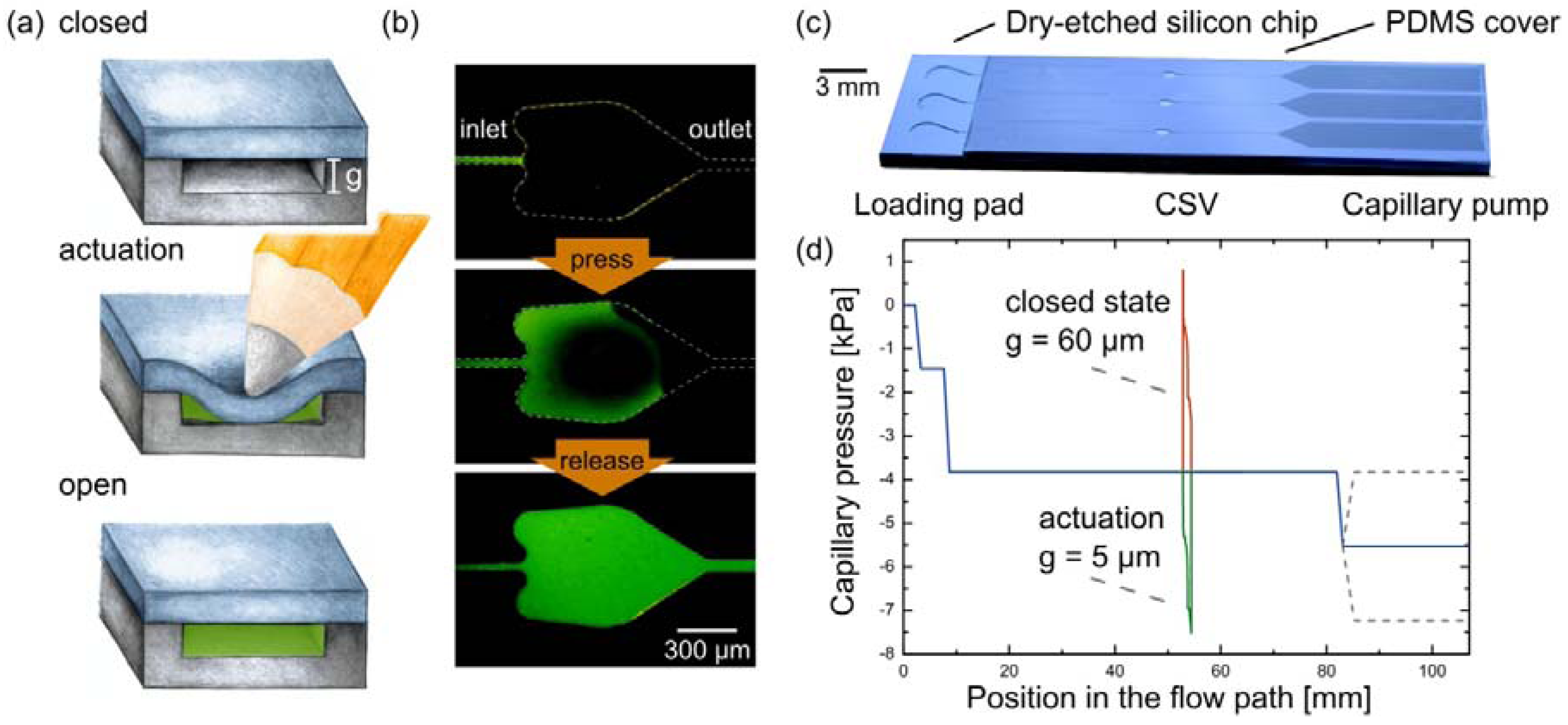
        <p>The working principle of a CSV is based on the fact that wetting properties and dimensions of a microchannel strongly influence its capillary pressure. A CSV consists of an abruptly expanding channel, which induces a barrier of capillary pressure and stops a liquid filling front at the inlet of the CSV. (<xref ref-type="fig" rid="micromachines-04-00001-f001">Figure 1</xref>a and b) Pressing the top of the CSV using, e.g., the tip of a pen, reduces the pressure barrier and the liquid can proceed. CSVs are small (footprint &lt; 0.6 mm<sup>2</sup>) and can be etched or molded together with other microstructures of the microfluidic chip. The chip is then sealed with a cover, which can be chosen to be slightly deformable such that it provides access for actuation of the CSVs on chip: CSVs are neutral in terms of fabrication complexity (<xref ref-type="fig" rid="micromachines-04-00001-f001">Figure 1</xref>c). The distribution of capillary pressure throughout the microfluidic network is key to the performance of a CSV. </p>
        <p>As demonstrated elsewhere, the capillary pressure can be calculated using the following Equation [<xref ref-type="bibr" rid="B12-micromachines-04-00001">12</xref>]:
		<disp-formula id="micromachines-04-00001-i001">
          <inline-graphic xmlns:xlink="http://www.w3.org/1999/xlink" xlink:href="micromachines-04-00001-i001.tif"/>
          <label>(1)</label>
          </disp-formula>
		where <italic>γ</italic> is the surface tension of the liquid, <italic>θ<sub>b,t,l,r</sub></italic> are the advancing contact angles of the liquid on the bottom, top, left and right wall, respectively, and <italic>d</italic>,<italic>w</italic> are the depth and width of the microchannel, respectively. </p>
        <fig id="micromachines-04-00001-f001" position="float">
          <label>Figure 1</label>
          <caption>
            <p>Capillary soft valves (CSVs). (<bold>a</bold>) Working principle of a CSV. (<bold>b</bold>) Fluorescence micrographs of a solution filling a CSV before, during and after actuation of the CSV. (<bold>c</bold>) Implementation of CSVs into microfluidic networks, which are dry-etched into a silicon chip and sealed with a PDMS cover. (<bold>d</bold>) Simulation of the capillary pressure throughout the network showing the pressure barrier formed by the CSV in the closed state and during actuation. </p>
          </caption>
          <graphic xmlns:xlink="http://www.w3.org/1999/xlink" xlink:href="micromachines-04-00001-g001.tif"/>
        </fig>
        <p>A simulation of the capillary pressure along a microchannel in the silicon chip of <xref ref-type="fig" rid="micromachines-04-00001-f001">Figure 1</xref>c, is shown in <xref ref-type="fig" rid="micromachines-04-00001-f001">Figure 1</xref>d. In the closed state the capillary pressure at the inlet of the CSV, increases to positive (repelling) pressures. This is due to the abruptly expanding microchannel, which induces an increased apparent contact angle because the wall bends away from the meniscus. During actuation, the top of the CSV is pressed into the channel and reduces the depth of the channel. The capillary pressure is now dominated by the first term of Equation (1). In the simulation presented here we used an average channel height of the CSV to give an estimation of the capillary pressure in the actuated state. A more adequate model for a microchannel would assume two parallel triangular microchannels along the curved outline of the CSV (see <xref ref-type="fig" rid="micromachines-04-00001-f001">Figure 1</xref>b, actuation). However, the actuation of a CSV takes a few seconds and can be released as soon as the meniscus has entered the outlet channel. From there on, the liquid flow can be again adequately described using Equation (1). We define the maximum capillary pressure of a CSV in the closed state as barrier height of the CSV. </p>
      </sec>
      <sec>
        <title>3.2. Performance of CSVs at Elevated Temperatures and with Different Liquids</title>
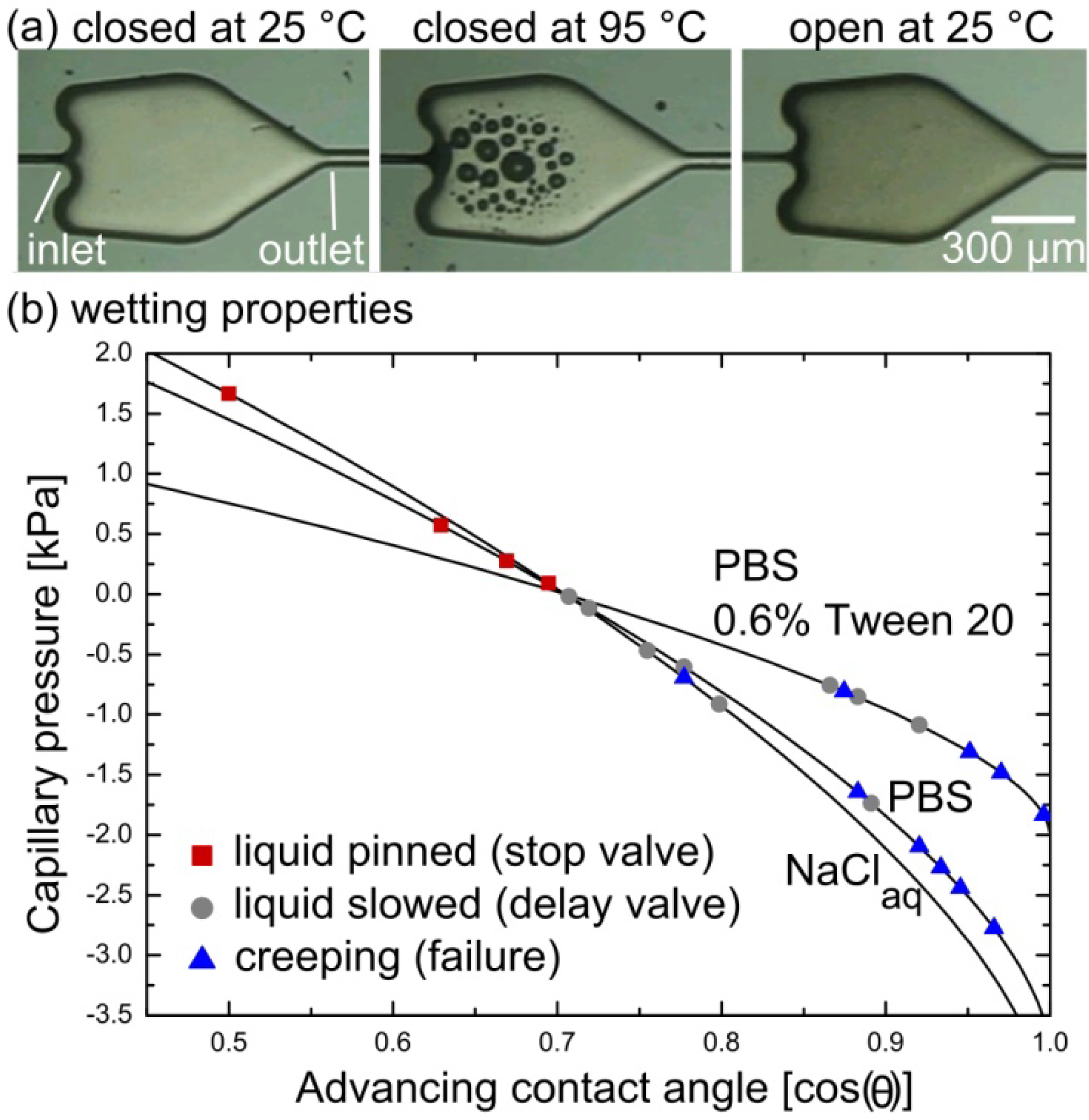
        <p>In real applications of CSVs inside microfluidic chips, experimental conditions and physical properties of liquids filling the channels might vary. In the following, we will discuss under what conditions CSVs can be used to stop different liquids filling microchannels and how heating of liquids inside microfluidic chips influences the performance of a CSV. For example, capillary filling of microchannels at temperatures above 60 °C is very challenging because liquid evaporates, condensates further down on the channel walls and forms droplets that eventually fill the entire microchannel and form airbubbles. Therefore, it is preferred to fill the liquid into a heating chamber, then stop the flow temporarily, perform the heating as needed and finally resume the flow of liquid once the temperature has dropped below 60 °C. <xref ref-type="fig" rid="micromachines-04-00001-f002">Figure 2</xref>a shows a CSV on a silicon chip, located downstream of a heating chamber. First, the liquid filling front is pinned to the inlet of the CSV (closed state, left image). When the chip is heated to 95 °C, some liquid evaporates and nucleates on the cover. However, evaporation is limited by the small surface area of the liquid meniscus since the meniscus is pinned to the small inlet channel of the CSV. Even after 10 min at 95 °C, droplets do not substantially merge or wet the outlet (center image). Finally, after the chip has cooled, the CSV can be actuated as described before (right image). Different liquids can substantially vary in their wetting properties on a surface. This effect is related to its surface tension and interfacial energies between the solid, liquid and gas phase and expressed in the advancing contact angle <italic>θ</italic>. The contact angle strongly influences the capillary filling of a microchannel, and thus also the characteristics of a CSV.</p>
        <fig id="micromachines-04-00001-f002" position="float">
          <label>Figure 2</label>
          <caption>
            <p>Performance of CSVs in varying experimental conditions. (<bold>a</bold>) CSVs in closed state at ambient temperature and at 95 °C, and in open state at ambient temperature. (<bold>b</bold>) Influence of the contact angle of a liquid filling a microfluidic chip on the performance of the CSV. Several different surface chemistries for the microfluidic chips and liquids having different surface tensions were tested. The capillary pressure barrier of the CSV was simulated and related to the filling behavior of liquids observed experimentally.</p>
          </caption>
          <graphic xmlns:xlink="http://www.w3.org/1999/xlink" xlink:href="micromachines-04-00001-g002.tif"/>
        </fig>
        <p><xref ref-type="fig" rid="micromachines-04-00001-f002">Figure 2</xref>b shows experimental results of the filling of liquids having different surface tensions in CSVs on microfluidic chips with different surface chemistries. The simulated height of the pressure barrier of the CSV is presented as black line. CSVs having contact angles above 45° (cos(<italic>θ</italic>) ≤ 0.7) were able to stop a liquid for at least 5 min (red rectangles). For intermediate contact angles (0.7 ≤ cos(<italic>θ</italic>) ≤ 0.9) CSVs act as delay valve by slowing down a liquid and letting it pass after less than 5 min without actuation of the CSV (gray circles). CSVs with contact angles below ~25° (cos(<italic>θ</italic>) &gt; 0.9) mostly fail during filling because liquid creeps along the corners of the CSV and wets the outlet before the entire CSV can be filled (blue triangles). </p>
        <p>The simulated capillary pressure supports the classification of stop valves as compared to delay valves. A characteristic of a CSV is the low aspect ratio (<italic>d/w</italic> &lt;&lt; 1). In this regime, the capillary pressure is dominated by the first term of Equation (1) and can reach positive values when the silicon chip is not too hydrophilic and a slightly hydrophobic cover is used. Thus, we classify a CSV to be a stop valve when the capillary pressure barrier of the CSV reaches positive values and therefore repels the liquid at the inlet of the CSV. Furthermore, <xref ref-type="fig" rid="micromachines-04-00001-f002">Figure 2</xref>b visualizes the fact, that liquids having a higher surface tension than water (6M NaCl, <italic>γ</italic><sub>NaCl</sub> = 83 mJ·m<sup>−2</sup>; H<sub>2</sub>O, <italic>γ</italic><sub>H2O</sub> = 72 mJ·m<sup>−2</sup>) are more easily stopped in a CSV. There are two main reasons for this: First, a liquid of high surface tension tend to have a higher contact angle on a surface and second, its capillary pressure varies stronger for different contact angles as compared to a liquid having a lower surface tension. Therefore, liquids with low surface tension, such as those containing surfactants (e.g., 0.6% PBS Tween20, <italic>γ</italic><sub>Tween</sub> = 37 mJ·m<sup>−2</sup>) require CSVs having a more hydrophobic surface chemistry and are usually more difficult to handle. The most dominant effect that leads to failure of CSVs is creeping of liquids along the corners of a microchannel. It is energetically favorable for the liquid to wet only a corner of a hydrophilic microchannel because the contact area of the liquid with the channel surface for a volume spread along a corner is larger than for the same volume filling the complete cross-section of the microchannel. This effect, also called wedge formation, was already reported for wide, shallow microchannels with hydrophilic surfaces by Lipowsky <italic>et al.</italic>, who observed vapor condensation in microchannels by means of atomic force microscopy [<xref ref-type="bibr" rid="B13-micromachines-04-00001">13</xref>].</p>
        <fig id="micromachines-04-00001-f003" position="float">
          <label>Figure 3</label>
          <caption>
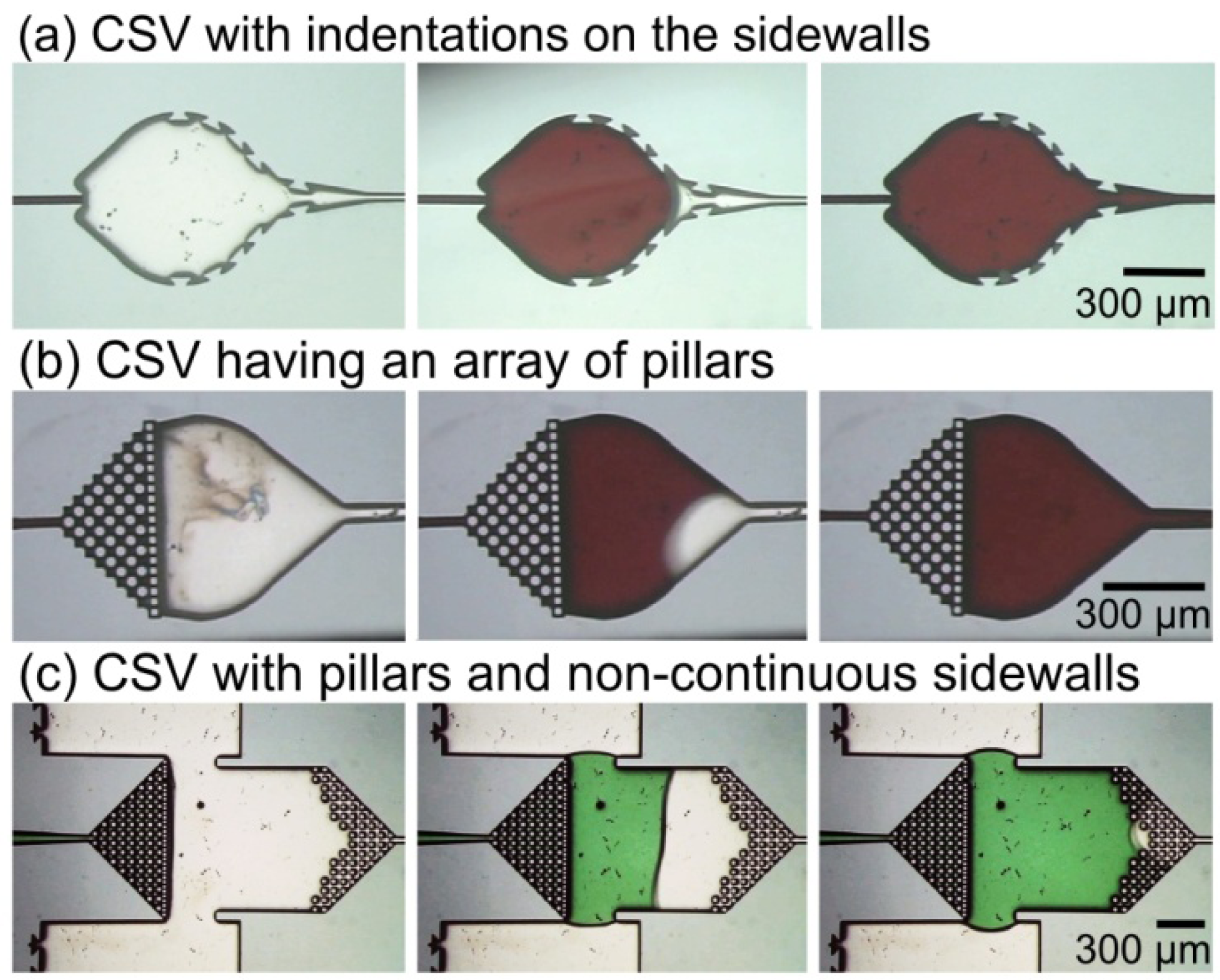
            <p>Advanced CSVs having auxiliary structures that help to prevent creeping along corners of microchannels using indentations (<bold>a</bold>), pillars (<bold>b</bold>) or non-continuous channels (<bold>c</bold>).</p>
          </caption>
          <graphic xmlns:xlink="http://www.w3.org/1999/xlink" xlink:href="micromachines-04-00001-g003.tif"/>
        </fig>
      </sec>
      <sec>
        <title>3.3. Advanced CSVs</title>
        <p>In the following, we propose advanced CSVs having auxiliary structures or half-rounded microchannels, which both address the problem of creeping and may increase the reliability and usability of CSVs for a large variety of liquids. <xref ref-type="fig" rid="micromachines-04-00001-f003">Figure 3</xref>a shows CSVs having indentations on the sidewalls that delay the filling front creeping along the corners of the CSV. The indentations increase the path length for the creeping liquid and additionally, the liquid meniscus is pinned to the sharp edges of the indentations. Yeomans <italic>et al.</italic> reported on capillary filling of patterned microchannels [<xref ref-type="bibr" rid="B14-micromachines-04-00001">14</xref>]. The authors observed contact line pinning of a liquid meniscus in arrays of micropillars. The implementation of such micropillars at the inlet of a CSV can help to hold back the liquid meniscus. <xref ref-type="fig" rid="micromachines-04-00001-f003">Figure 3</xref>b shows a CSV having an array of pillars consisting of (1) a triangular-shaped area of pillars having a circular cross-section at the inlet of the CSV, followed by (2) a line of rectangular pillars placed with a pitch of 10 μm. The liquid coming from the narrow inlet channel is distributed through the array of pillars over the whole width of the line of pinning pillars. These pinning pillars form a parallel network of narrow channels that induces a strong, attractive capillary pressure (see Equation (1)) and the 90°-angle at the outlet of the channels can hold back (“pin”) the liquid meniscus. Additionally, the sudden expansion of the microchannel forms again a barrier of capillary pressure, as described in section 3.1. CSVs can also be designed with non-continuous sidewalls (<xref ref-type="fig" rid="micromachines-04-00001-f003">Figure 3</xref>c). Here, creeping liquids will follow the corner until it reaches either a more hydrophobic area, or the rim of the chip. The design can of course be combined with arrays of pinning pillars and/or indentations. However, the designs of CSVs in <xref ref-type="fig" rid="micromachines-04-00001-f003">Figure 3</xref>b and c expose a much larger surface area of the meniscus to air and are therefore less suited for use at elevated temperatures. Furthermore, these designs rely on sharp corners and closely placed pillars. Therefore, high-precision methods such as optical lithography and dry etching of silicon are needed for fabrication and molding of such designs in polymer materials is very challenging. </p>
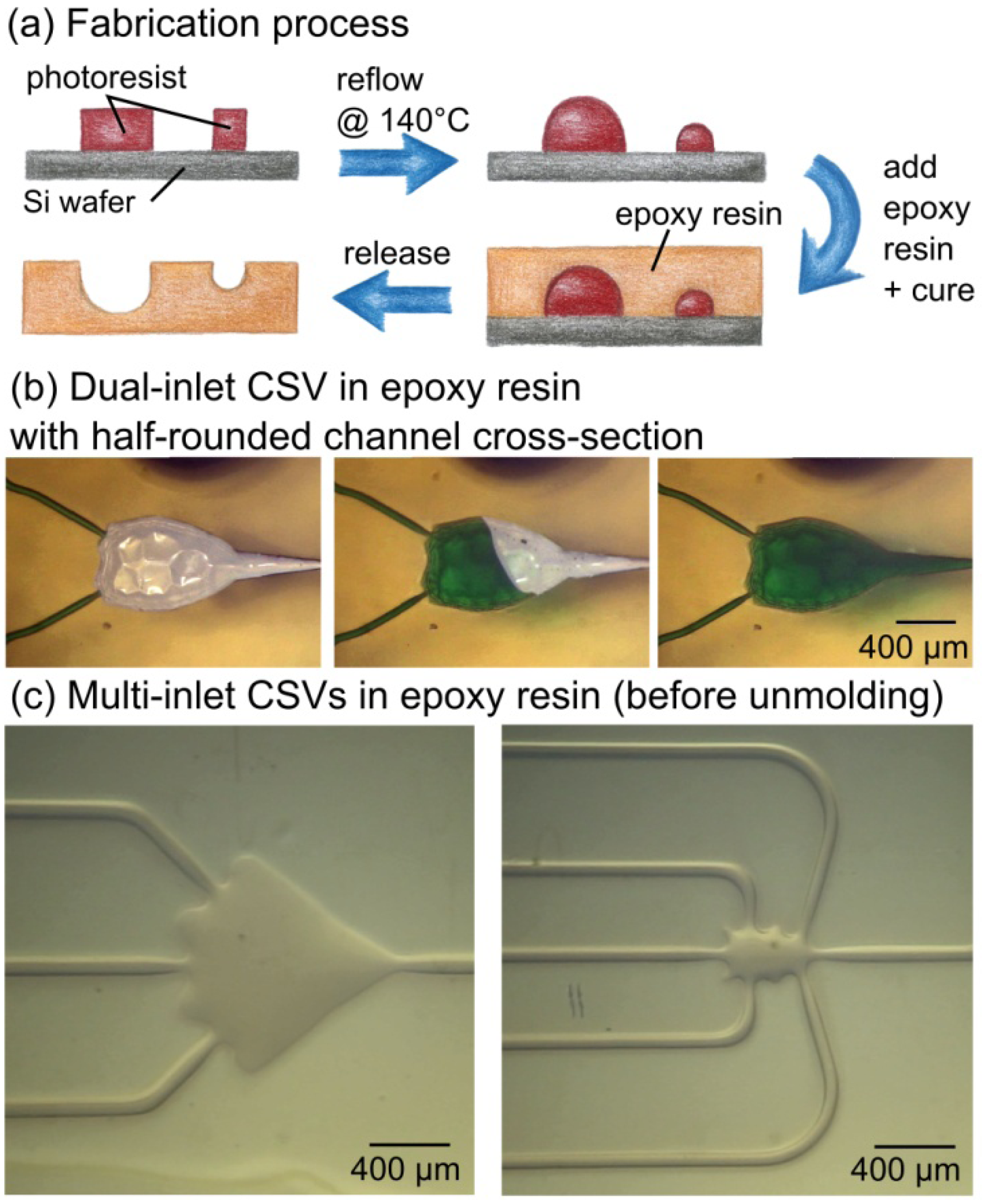
        <p><xref ref-type="fig" rid="micromachines-04-00001-f004">Figure 4</xref> presents advanced CSVs having channels with rounded cross-sections. The use of round microchannels is an efficient method to prevent creeping because the hydrophilic corners of the microchannels are replaced by curved structures. The top corners of the microfluidic chip are facing the slightly hydrophobic PDMS cover and are therefore less favored for creeping. In contrast to the designs of CSVs presented in <xref ref-type="fig" rid="micromachines-04-00001-f003">Figure 3</xref>, the fabrication of CSVs shown in <xref ref-type="fig" rid="micromachines-04-00001-f004">Figure 4</xref> can be realized using polymer molding or hot embossing. In this work, chips with half-rounded microchannels were molded from patterned and reflowed photoresist as sketched in <xref ref-type="fig" rid="micromachines-04-00001-f004">Figure 4</xref>a. The friction between a molded polymer chip and a master is significantly reduced in case of channels having a half-rounded cross-section as compared to vertical channel walls, which facilitates the release of a fabricated chip from the master. Advanced CSVs can also have multiple inlets (<xref ref-type="fig" rid="micromachines-04-00001-f004">Figure 4</xref>b and c), which can be useful to synchronize streams of liquid inside microfluidic chips. Finally, CSVs can be combined in series or parallel in microfluidic networks to allow for more complex flow control. </p>
      </sec>
    </sec>
    <sec sec-type="conclusions">
      <title>4. Conclusions</title>
      <p>CSVs enable precise timing for dissolving and mixing reagents, binding of analytes to receptors, and rinsing, which are all critical for diagnostic tests. CSVs have an intrinsic venting mechanism which is essential for capillary-driven microfluidics wherein a filling liquid needs to displace air. CSVs are single-use valves, which do not require power before and after actuation and can be triggered within seconds. Finally, CSVs can be fabricated in various materials including polymers and are therefore a useful approach for cost-sensitive applications and for the microfluidics community in general. We believe that advanced CSVs add important control features to self-driven microfluidics and that a profound understanding of the working mechanism of CSVs is crucial for the development of high-performance microfluidic chips. </p>
        <fig id="micromachines-04-00001-f004" position="float">
          <label>Figure 4</label>
          <caption>
            <p>Advanced CSVs having half-rounded cross-sections. (<bold>a</bold>) Fabrication process of microfluidic channels with half-rounded cross-sections. (<bold>b</bold>) Dual-inlet CSVs and their filling behavior with green colored liquid. (<bold>c</bold>) Multi-inlet CSVs in epoxy resin.</p>
          </caption>
          <graphic xmlns:xlink="http://www.w3.org/1999/xlink" xlink:href="micromachines-04-00001-g004.tif"/>
        </fig>
    </sec>
  </body>
  <back>
    <ack>
      <title>Acknowledgments</title>
      <p>We are grateful to Ute Drechsler, Robert Lovchik and Govind Kaigala for discussions and to Michel Despont, Walter Riess and Janos Vörös (ETHZ) for their continuous support. We acknowledge partial support by the European Commission under the 7th Framework Program (grant agreement n° 278720, “Chips for Life” project).</p>
    </ack>
    <ref-list>
      <title>References</title>
      <ref id="B1-micromachines-04-00001">
        <label>1.</label>
        <citation citation-type="journal">
          <person-group person-group-type="author">
            <name>
              <surname>Weibel</surname>
              <given-names>D.</given-names>
            </name>
            <name>
              <surname>Whitesides</surname>
              <given-names>G.</given-names>
            </name>
          </person-group>
          <article-title>Applications of microfluidics in chemical biology</article-title>
          <source>Curr. Opin. Chem. Biol.</source>
          <year>2006</year>
          <volume>10</volume>
          <fpage>584</fpage>
          <lpage>591</lpage>
          <pub-id pub-id-type="doi">10.1016/j.cbpa.2006.10.016</pub-id>
        </citation>
      </ref>
      <ref id="B2-micromachines-04-00001">
        <label>2.</label>
        <citation citation-type="journal">
          <person-group person-group-type="author">
            <name>
              <surname>Gervais</surname>
              <given-names>L.</given-names>
            </name>
            <name>
              <surname>de Rooij</surname>
              <given-names>N.</given-names>
            </name>
            <name>
              <surname>Delamarche</surname>
              <given-names>E.</given-names>
            </name>
          </person-group>
          <article-title>Microfluidics chips for point-of-care immunodiagnostics</article-title>
          <source>Adv. Mater.</source>
          <year>2011</year>
          <volume>23</volume>
          <fpage>H151</fpage>
          <lpage>H176</lpage>
          <pub-id pub-id-type="doi">10.1002/adma.201100464</pub-id>
        </citation>
      </ref>
      <ref id="B3-micromachines-04-00001">
        <label>3.</label>
        <citation citation-type="journal">
          <person-group person-group-type="author">
            <name>
              <surname>Oh</surname>
              <given-names>K.W.</given-names>
            </name>
            <name>
              <surname>Ahn</surname>
              <given-names>C.H.</given-names>
            </name>
          </person-group>
          <article-title>A review of microvalves</article-title>
          <source>J. Micromech. Microeng.</source>
          <year>2006</year>
          <volume>16</volume>
          <fpage>R13</fpage>
          <lpage>R35</lpage>
          <pub-id pub-id-type="doi">10.1088/0960-1317/16/5/R01</pub-id>
        </citation>
      </ref>
      <ref id="B4-micromachines-04-00001">
        <label>4.</label>
        <citation citation-type="journal">
          <person-group person-group-type="author">
            <name>
              <surname>Unger</surname>
              <given-names>M.A.</given-names>
            </name>
            <name>
              <surname>Chou</surname>
              <given-names>H.-P.</given-names>
            </name>
            <name>
              <surname>Thorsen</surname>
              <given-names>T.</given-names>
            </name>
            <name>
              <surname>Scherer</surname>
              <given-names>A.</given-names>
            </name>
            <name>
              <surname>Quake</surname>
              <given-names>S.R.</given-names>
            </name>
          </person-group>
          <article-title>Monolithic microfabricated valves and pumps by multilayer soft lithography</article-title>
          <source>Science</source>
          <year>2000</year>
          <volume>288</volume>
          <fpage>113</fpage>
          <lpage>116</lpage>
          <pub-id pub-id-type="doi">10.1126/science.288.5463.113</pub-id>
        </citation>
      </ref>
      <ref id="B5-micromachines-04-00001">
        <label>5.</label>
        <citation citation-type="journal">
          <person-group person-group-type="author">
            <name>
              <surname>Garcia-Cordero</surname>
              <given-names>J.L.</given-names>
            </name>
            <name>
              <surname>Kurzbuch</surname>
              <given-names>D.</given-names>
            </name>
            <name>
              <surname>Benito-Lopez</surname>
              <given-names>F.</given-names>
            </name>
            <name>
              <surname>Diamond</surname>
              <given-names>D.</given-names>
            </name>
            <name>
              <surname>Lee</surname>
              <given-names>L.P.</given-names>
            </name>
            <name>
              <surname>Ricco</surname>
              <given-names>A.J.</given-names>
            </name>
          </person-group>
          <article-title>Optically addressable single-use microfluidic valves by laser printer lithography</article-title>
          <source>Lab Chip</source>
          <year>2010</year>
          <volume>10</volume>
          <fpage>2680</fpage>
          <lpage>2687</lpage>
          <pub-id pub-id-type="doi">10.1039/c004980h</pub-id>
        </citation>
      </ref>
      <ref id="B6-micromachines-04-00001">
        <label>6.</label>
        <citation citation-type="journal">
          <person-group person-group-type="author">
            <name>
              <surname>Riegger</surname>
              <given-names>L.</given-names>
            </name>
            <name>
              <surname>Mielnik</surname>
              <given-names>M.M.</given-names>
            </name>
            <name>
              <surname>Gulliksen</surname>
              <given-names>A.</given-names>
            </name>
            <name>
              <surname>Mark</surname>
              <given-names>D.</given-names>
            </name>
            <name>
              <surname>Steigert</surname>
              <given-names>J.</given-names>
            </name>
            <name>
              <surname>Lutz</surname>
              <given-names>S.</given-names>
            </name>
            <name>
              <surname>Clad</surname>
              <given-names>M.</given-names>
            </name>
            <name>
              <surname>Zengerle</surname>
              <given-names>R.</given-names>
            </name>
            <name>
              <surname>Koltay</surname>
              <given-names>P.</given-names>
            </name>
            <name>
              <surname>Hoffmann</surname>
              <given-names>J.</given-names>
            </name>
          </person-group>
          <article-title>Dye-based coatings for hydrophobic valves and their application to polymer labs-on-a-chip</article-title>
          <source>J. Micromech. Microeng.</source>
          <year>2010</year>
          <volume>20</volume>
          <pub-id pub-id-type="doi">10.1088/0960-1317/20/4/045021</pub-id>
        </citation>
      </ref>
      <ref id="B7-micromachines-04-00001">
        <label>7.</label>
        <citation citation-type="journal">
          <person-group person-group-type="author">
            <name>
              <surname>Gui</surname>
              <given-names>L.</given-names>
            </name>
            <name>
              <surname>Liu</surname>
              <given-names>J.</given-names>
            </name>
          </person-group>
          <article-title>Ice valve for a mini/micro flow channel</article-title>
          <source>J. Micromech. Microeng.</source>
          <year>2004</year>
          <volume>14</volume>
          <fpage>242</fpage>
          <lpage>246</lpage>
          <pub-id pub-id-type="doi">10.1088/0960-1317/14/2/011</pub-id>
        </citation>
      </ref>
      <ref id="B8-micromachines-04-00001">
        <label>8.</label>
        <citation citation-type="journal">
          <person-group person-group-type="author">
            <name>
              <surname>Beebe</surname>
              <given-names>D.J.</given-names>
            </name>
            <name>
              <surname>Moore</surname>
              <given-names>J.S.</given-names>
            </name>
            <name>
              <surname>Bauer</surname>
              <given-names>J.M.</given-names>
            </name>
            <name>
              <surname>Yu</surname>
              <given-names>Q.</given-names>
            </name>
            <name>
              <surname>Liu</surname>
              <given-names>R.H.</given-names>
            </name>
            <name>
              <surname>Devadoss</surname>
              <given-names>C.</given-names>
            </name>
            <name>
              <surname>Jo</surname>
              <given-names>B.-H.</given-names>
            </name>
          </person-group>
          <article-title>Functional hydrogel structures for autonomous flow control inside microfluidic channels</article-title>
          <source>Nature</source>
          <year>2000</year>
          <volume>404</volume>
          <fpage>588</fpage>
          <lpage>590</lpage>
          <pub-id pub-id-type="doi">10.1038/35007047</pub-id>
        </citation>
      </ref>
      <ref id="B9-micromachines-04-00001">
        <label>9.</label>
        <citation citation-type="journal">
          <person-group person-group-type="author">
            <name>
              <surname>Mao</surname>
              <given-names>X.</given-names>
            </name>
            <name>
              <surname>Huang</surname>
              <given-names>T.J.</given-names>
            </name>
          </person-group>
          <article-title>Microfluidic diagnostics for the developing world</article-title>
          <source>Lab Chip</source>
          <year>2012</year>
          <volume>12</volume>
          <fpage>1412</fpage>
          <lpage>1416</lpage>
          <pub-id pub-id-type="doi">10.1039/c2lc90022j</pub-id>
        </citation>
      </ref>
      <ref id="B10-micromachines-04-00001">
        <label>10.</label>
        <citation citation-type="journal">
          <person-group person-group-type="author">
            <name>
              <surname>Gervais</surname>
              <given-names>L.</given-names>
            </name>
            <name>
              <surname>Hitzbleck</surname>
              <given-names>M.</given-names>
            </name>
            <name>
              <surname>Delamarche</surname>
              <given-names>E.</given-names>
            </name>
          </person-group>
          <article-title>Capillary-driven multiparametric microfluidic chips for one-step immunoassays</article-title>
          <source>Biosens. Bioelectron.</source>
          <year>2011</year>
          <volume>27</volume>
          <fpage>64</fpage>
          <lpage>70</lpage>
          <pub-id pub-id-type="doi">10.1016/j.bios.2011.06.016</pub-id>
        </citation>
      </ref>
      <ref id="B11-micromachines-04-00001">
        <label>11.</label>
        <citation citation-type="journal">
          <person-group person-group-type="author">
            <name>
              <surname>Hitzbleck</surname>
              <given-names>M.</given-names>
            </name>
            <name>
              <surname>Avrain</surname>
              <given-names>L.</given-names>
            </name>
            <name>
              <surname>Smekens</surname>
              <given-names>V.</given-names>
            </name>
            <name>
              <surname>Lovchik</surname>
              <given-names>R.D.</given-names>
            </name>
            <name>
              <surname>Mertens</surname>
              <given-names>P.</given-names>
            </name>
            <name>
              <surname>Delamarche</surname>
              <given-names>E.</given-names>
            </name>
          </person-group>
          <article-title>Capillary soft valves for microfluidics</article-title>
          <source>Lab Chip</source>
          <year>2012</year>
          <volume>12</volume>
          <fpage>1972</fpage>
          <lpage>1978</lpage>
          <pub-id pub-id-type="doi">10.1039/c2lc00015f</pub-id>
        </citation>
      </ref>
      <ref id="B12-micromachines-04-00001">
        <label>12.</label>
        <citation citation-type="journal">
          <person-group person-group-type="author">
            <name>
              <surname>Zimmermann</surname>
              <given-names>M.</given-names>
            </name>
            <name>
              <surname>Schmid</surname>
              <given-names>H.</given-names>
            </name>
            <name>
              <surname>Hunziker</surname>
              <given-names>P.</given-names>
            </name>
            <name>
              <surname>Delamarche</surname>
              <given-names>E.</given-names>
            </name>
          </person-group>
          <article-title>Capillary pumps for autonomous capillary systems</article-title>
          <source>Lab Chip</source>
          <year>2007</year>
          <volume>7</volume>
          <fpage>119</fpage>
          <lpage>125</lpage>
          <pub-id pub-id-type="doi">10.1039/b609813d</pub-id>
        </citation>
      </ref>
      <ref id="B13-micromachines-04-00001">
        <label>13.</label>
        <citation citation-type="journal">
          <person-group person-group-type="author">
            <name>
              <surname>Seemann</surname>
              <given-names>R.</given-names>
            </name>
            <name>
              <surname>Brinkmann</surname>
              <given-names>M.</given-names>
            </name>
            <name>
              <surname>Kramer</surname>
              <given-names>E.J.</given-names>
            </name>
            <name>
              <surname>Lange</surname>
              <given-names>F.F.</given-names>
            </name>
            <name>
              <surname>Lipowsky</surname>
              <given-names>R.</given-names>
            </name>
          </person-group>
          <article-title>Wetting morphologies at microstructured surfaces</article-title>
          <source>P. Natl. Acad. Sci. USA</source>
          <year>2005</year>
          <volume>102</volume>
          <fpage>1848</fpage>
          <lpage>1852</lpage>
          <pub-id pub-id-type="doi">10.1073/pnas.0407721102</pub-id>
        </citation>
      </ref>
      <ref id="B14-micromachines-04-00001">
        <label>14.</label>
        <citation citation-type="journal">
          <person-group person-group-type="author">
            <name>
              <surname>Kusumaatmaja</surname>
              <given-names>H.</given-names>
            </name>
            <name>
              <surname>Pooley</surname>
              <given-names>C.M.</given-names>
            </name>
            <name>
              <surname>Girardo</surname>
              <given-names>S.</given-names>
            </name>
            <name>
              <surname>Pisignano</surname>
              <given-names>D.</given-names>
            </name>
            <name>
              <surname>Yeomans</surname>
              <given-names>J.M.</given-names>
            </name>
          </person-group>
          <article-title>Capillary filling in patterned channels</article-title>
          <source>Phys. Rev. E</source>
          <year>2008</year>
          <volume>77</volume>
          <pub-id pub-id-type="doi">10.1103/PhysRevE.77.067301</pub-id>
        </citation>
      </ref>
    </ref-list>
  </back>
</article>