<?xml version="1.0" encoding="UTF-8"?>
<!DOCTYPE article PUBLIC "-//NLM//DTD Journal Publishing DTD v2.3 20070202//EN" "journalpublishing.dtd">
<article xmlns:mml="http://www.w3.org/1998/Math/MathML" xmlns:xlink="http://www.w3.org/1999/xlink" xml:lang="en" article-type="research-article">
  <front>
    <journal-meta>
      <journal-id journal-id-type="publisher-id">micromachines</journal-id>
      <journal-title>Micromachines</journal-title>
      <abbrev-journal-title abbrev-type="publisher">Micromachines</abbrev-journal-title>
      <abbrev-journal-title abbrev-type="pubmed">Micromachines</abbrev-journal-title>
      <issn pub-type="epub">2072-666X</issn>
      <publisher>
        <publisher-name>MDPI</publisher-name>
      </publisher>
    </journal-meta>
    <article-meta>
      <article-id pub-id-type="doi">10.3390/mi3010101</article-id>
      <article-id pub-id-type="publisher-id">micromachines-03-00101</article-id>
      <article-categories>
        <subj-group>
          <subject>Article</subject>
        </subj-group>
      </article-categories>
      <title-group>
        <article-title>Cylindrical Resonator Utilizing a Curved Resonant Grating as a Cavity Wall</article-title>
      </title-group>
      <contrib-group>
        <contrib contrib-type="author">
          <name>
            <surname>Ohtera</surname>
            <given-names>Yasuo</given-names>
          </name>
          <xref rid="c1-micromachines-03-00101" ref-type="corresp">*</xref>
        </contrib>
        <contrib contrib-type="author">
          <name>
            <surname>Iijima</surname>
            <given-names>Shohei</given-names>
          </name>
        </contrib>
        <contrib contrib-type="author">
          <name>
            <surname>Yamada</surname>
            <given-names>Hirohito</given-names>
          </name>
        </contrib>
      </contrib-group>
      <aff id="af1-micromachines-03-00101">Graduate School of Engineering, Tohoku University, Aramaki-Aza-Aoba 6-6, Aoba-ku, Sendai, Miyagi 980-8579, Japan; Email: <email>iijima@ecei.tohoku.ac.jp</email> (S.I.); <email>yamada@ecei.tohoku.ac.jp</email> (H.Y.)</aff>
      <author-notes>
        <corresp id="c1-micromachines-03-00101"><label>*</label> Author to whom correspondence should be addressed; Email: <email>ohtera@ecei.tohoku.ac.jp</email>; Tel./Fax: +81-22-795-7103.</corresp>
      </author-notes>
      <pub-date pub-type="epub">
        <day>27</day>
        <month>02</month>
        <year>2012</year>
      </pub-date>
      <pub-date pub-type="collection"><month>03</month>
        <year>2012</year>
      </pub-date>
      <volume>3</volume>
      <issue>1</issue>
      <fpage>101</fpage>
      <lpage>113</lpage>
      <history>
        <date date-type="received">
          <day>26</day>
          <month>12</month>
          <year>2011</year>
        </date>
        <date date-type="rev-recd">
          <day>15</day>
          <month>02</month>
          <year>2012</year>
        </date>
        <date date-type="accepted">
          <day>17</day>
          <month>02</month>
          <year>2012</year>
        </date>
      </history>
      <permissions>
        <copyright-statement>©  2012 by the authors; licensee MDPI, Basel, Switzerland.</copyright-statement>
        <copyright-year>2012</copyright-year>
        <license xmlns:xlink="http://www.w3.org/1999/xlink" license-type="open-access" xlink:href="http://creativecommons.org/licenses/by/3.0/">
          <p>This article is an open-access article distributed under the terms and conditions of the Creative Commons Attribution license (http://creativecommons.org/licenses/by/3.0/).</p>
        </license>
      </permissions>
      <abstract>
        <p>A thin-film grating on a curved substrate functions as a highly reflective and wavelength sensitive mirror for a diverging wave that has the same curvature as the substrate. In this paper we propose a cylindrical cavity surrounded by a curved resonant grating wall, and describe its resonance characteristics. Through finite-difference time-domain (FDTD) simulation we have clarified that this type of cavity supports two resonance modes: one is confined by Fresnel reflection and the other by resonance reflection of the wall. We have also demonstrated that the latter mode exhibits a Q factor several orders of magnitude higher than that of the former mode.</p>
      </abstract>
      <kwd-group>
        <kwd>resonant grating</kwd>
        <kwd>guided-mode resonance</kwd>
        <kwd>cylindrical cavity</kwd>
        <kwd>circular cavity</kwd>
      </kwd-group>
    </article-meta>
  </front>
  <body>
    <sec sec-type="intro">
      <title>1. Introduction</title>
      <p>The cylindrical cavity is one of the most fundamental types of resonant cavities, and has been used to construct, for example, wavelength filters for microwaves [<xref ref-type="bibr" rid="B1-micromachines-03-00101">1</xref>,<xref ref-type="bibr" rid="B2-micromachines-03-00101">2</xref>], millimeter waves [<xref ref-type="bibr" rid="B3-micromachines-03-00101">3</xref>,<xref ref-type="bibr" rid="B4-micromachines-03-00101">4</xref>] and Terahertz waves [<xref ref-type="bibr" rid="B5-micromachines-03-00101">5</xref>]. The cylindrical cavity also has a number of important applications in the lightwave field, such as couplers and laser cavities [<xref ref-type="bibr" rid="B6-micromachines-03-00101">6</xref>,<xref ref-type="bibr" rid="B7-micromachines-03-00101">7</xref>,<xref ref-type="bibr" rid="B8-micromachines-03-00101">8</xref>].</p>
      <p>Similar to other types of resonators, the quality factor (Q) of a cylindrical cavity, which is a basic characteristic, depends on the performance of the cavity walls. External Q increases with wall reflectivity, provided that the wall is lossless. The full width at half maximum (FWHM) of the resonance peak becomes narrow, while the free spectral range (FSR) widens as the cavity radius increases. This dependence is the same as conventional Fabry-Perot etalons which utilize a pair of flat mirrors. Various trials have been conducted in recent years aiming to control the resonance characteristics of circular cavities. One of the most straightforward approaches is to add sub-wavelength scale index perturbation to the walls. For example, the application of periodic index modulation along the radial [<xref ref-type="bibr" rid="B9-micromachines-03-00101">9</xref>,<xref ref-type="bibr" rid="B10-micromachines-03-00101">10</xref>] and azimuthal [<xref ref-type="bibr" rid="B11-micromachines-03-00101">11</xref>] directions has been found to be effective for selecting the specific order of resonance modes.</p>
      <p>Guided-mode resonance (GMR) is another useful phenomenon for controlling the reflection spectrum at material boundaries [<xref ref-type="bibr" rid="B12-micromachines-03-00101">12</xref>,<xref ref-type="bibr" rid="B13-micromachines-03-00101">13</xref>]. The main structure for GMR is a thin-film grating surrounded by relatively low-index materials. GMR occurs as a result of resonant coupling between an externally incident plane wave and a leaky guiding mode supported by the grating film as a periodic slab waveguide [<xref ref-type="bibr" rid="B14-micromachines-03-00101">14</xref>]. Coupled leaky mode propagates inside the slab and is again diffracted by the grating, and radiated out of the film. Theoretically, the reflectivity for plane wave incidence is as high as 100% at the wavelength and angle of incidence where all of the radiated waves interfere constructively [<xref ref-type="bibr" rid="B15-micromachines-03-00101">15</xref>]. Thin-film gratings are therefore often called Resonant Gratings (RG) or Resonant Sub-wavelength Gratings (RSG) [<xref ref-type="bibr" rid="B16-micromachines-03-00101">16</xref>,<xref ref-type="bibr" rid="B17-micromachines-03-00101">17</xref>]. A RG functions basically as a wavelength selective mirror, and its reflection spectrum can be tailored by designing the periodic structure appropriately [<xref ref-type="bibr" rid="B18-micromachines-03-00101">18</xref>]. Highly efficient reflection [<xref ref-type="bibr" rid="B19-micromachines-03-00101">19</xref>], as well as the ability to tailor the spatial beam profile, has been successfully demonstrated [<xref ref-type="bibr" rid="B20-micromachines-03-00101">20</xref>].</p>
      <fig id="micromachines-03-00101-f001" position="anchor">
        <label>Figure 1</label>
        <caption>
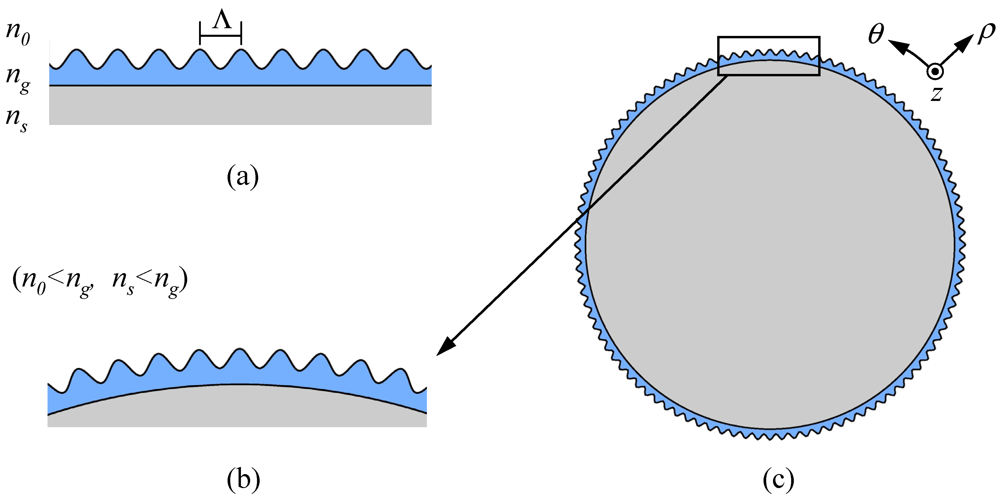
          <p>Schematic view of part of a flat/curved resonant grating and a circular cavity. (<bold>a</bold>) Conventional thin-film grating with a sinusoidal profile on a flat substrate; (<bold>b</bold>) Curved structure; (<bold>c</bold>) Cylindrical cavity with a curved grating wall.</p>
        </caption>
        <graphic xmlns:xlink="http://www.w3.org/1999/xlink" xlink:href="micromachines-03-00101-g001.tif"/>
      </fig>
      <p>Recently, attempts have been made to extend the GMR concept to curved substrate structures [<xref ref-type="bibr" rid="B21-micromachines-03-00101">21</xref>,<xref ref-type="bibr" rid="B22-micromachines-03-00101">22</xref>]. We have shown that RGs with constant local curvature exhibit similar resonant reflection for concentric circular waves [<xref ref-type="bibr" rid="B21-micromachines-03-00101">21</xref>]. Based on the insights obtained, in this paper we propose a novel cylindrical resonator surrounded by a curved RG wall. Our sample structure is based on the conventional thin-film surface grating with a sinusoidal cross-sectional profile as shown in <xref ref-type="fig" rid="micromachines-03-00101-f001">Figure 1</xref>. Some of the fundamental characteristics, such as resonance wavelength, Q factor, and modal fields are calculated by numerical simulation. It is also shown that the resonator supports extremely high-Q modes compared to conventional dielectric circular resonators. Note that the major difference between the proposed structure and the microgear disk resonator [<xref ref-type="bibr" rid="B11-micromachines-03-00101">11</xref>] is the refractive index inside the cavity. In our structure it is essential to make the index lower than that of the constituent material of the RG wall, in order to confine the light field inside the cavity by the effect of GMR. The resonant modes of the cavity to be confined thus have zero-th azimuthal order.</p>
    </sec>
    <sec>
      <title>2. Characteristics of a Curved RG</title>
      <sec>
        <title>2.1. Structure and Method of Calculation</title>
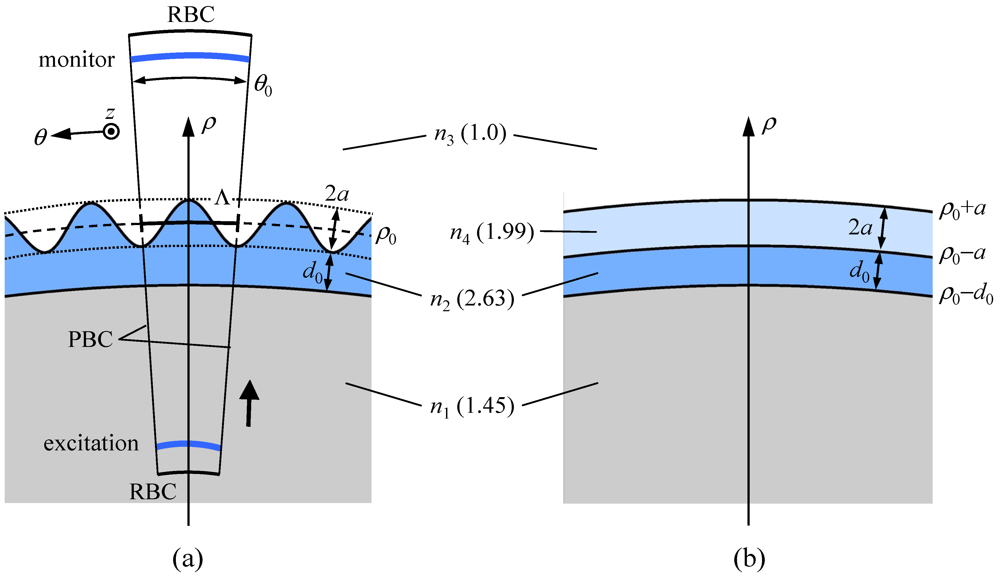
        <p>Before calculating the characteristics of the cavity, we first analyzed the reflection property of the wall part. A schematic diagram of the structure is shown in <xref ref-type="fig" rid="micromachines-03-00101-f002">Figure 2</xref>(a). One of our future targets is to design three-dimensional structures like a micro-disk resonator on a planar integrated light circuit. However, in this study, we simplified the structure as a two-dimensional one using the effective index method [<xref ref-type="bibr" rid="B23-micromachines-03-00101">23</xref>], to identify the main resonance characteristics of the curved RG-type resonator. Refractive index and electromagnetic fields were assumed to be uniform in the <italic>z</italic> (normal to the paper) direction of the figure. Throughout this paper we consider only TM modes (<italic>E<sub>z</sub></italic>, <italic>H<sub>θ</sub></italic>, and <italic>H<sub>ρ</sub></italic>).</p>
        <fig id="micromachines-03-00101-f002" position="anchor">
          <label>Figure 2</label>
          <caption>
            <p>Detail of the sample structures. (<bold>a</bold>) Curved resonant grating (proposed structure). <italic>ρ</italic><sub>0</sub>, 2<italic>a</italic> and <italic>d</italic><sub>0</sub> are the average radial position, depth and base thickness of the grating, respectively. The region surrounded by a solid line indicates the computational domain for FDTD. PBC and RBC stand for <underline>P</underline>eriodic and <underline>R</underline>adiation <underline>B</underline>oundary <underline>C</underline>onditions, respectively; (<bold>b</bold>) Reference curved slab structure. The grating region is replaced by an average refractive index layer.</p>
          </caption>
          <graphic xmlns:xlink="http://www.w3.org/1999/xlink" xlink:href="micromachines-03-00101-g002.tif"/>
        </fig>
        <p>Let the distance between the center of curvature and the average height of the grating be <italic>ρ</italic><sub>0</sub>. The depth and average thickness of the grating layer are 2<italic>a</italic> and <italic>d</italic><sub>0</sub>, respectively. The index of the grating layer, <italic>n</italic><sub>2</sub> = 2.63, is set close to the effective index of the fundamental TM mode of the InP/air disk structure [<xref ref-type="bibr" rid="B24-micromachines-03-00101">24</xref>]. The refractive indexes of the inner and outer spaces are <italic>n</italic><sub>1</sub> = 1.45 and <italic>n</italic><sub>3</sub> = 1.0, respectively. The local thickness of the grating layer, <italic>d</italic>(<italic>θ</italic>), is defined as:</p>
        <p><inline-graphic xmlns:xlink="http://www.w3.org/1999/xlink" xlink:href="micromachines-03-00101-i003.tif"/>    (1) </p>
        <p>where <italic>d</italic><sub>0</sub> = 0.68Λ and <italic>a</italic> = 0.25Λ.</p>
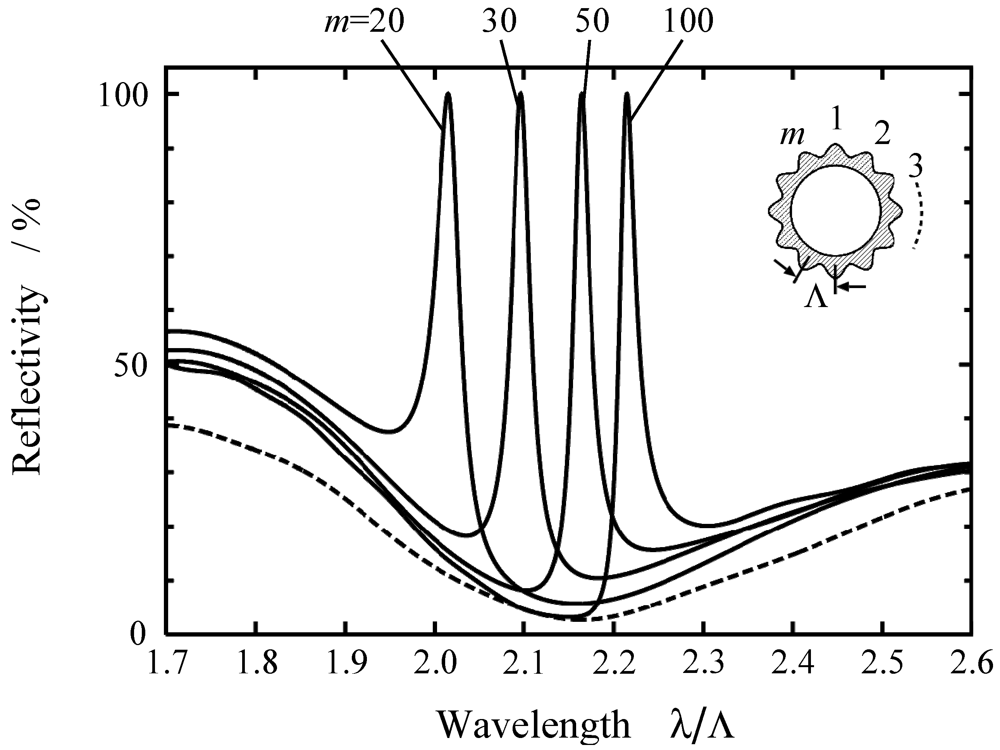
        <p>These parameters were determined so that the lowest-order GMR wavelength is in the valley region of the reflection spectrum (spectra are shown in <xref ref-type="fig" rid="micromachines-03-00101-f003">Figure 3</xref>).</p>
        <p>The angle <italic>θ</italic><sub>0</sub> denotes the azimuthal extent of a unit grating, and is expressed as <italic>θ</italic><sub>0</sub> = 2π/<italic>m</italic> [rad] where <italic>m</italic> is the total number of gratings on a wall edge. The pitch of the grating, Λ, is defined as the length of an arc at the average grating height, <inline-graphic xmlns:xlink="http://www.w3.org/1999/xlink" xlink:href="micromachines-03-00101-i004.tif"/>.</p>
        <fig id="micromachines-03-00101-f003" position="anchor">
          <label>Figure 3</label>
          <caption>
            <p>Reflection spectra viewed from inside the curved grating. “<italic>m</italic>” is the number of gratings on the outer edge of the cavity wall. The broken line shows the spectrum of the average index structure of <xref ref-type="fig" rid="micromachines-03-00101-f002">Figure 2</xref>(b) for <italic>m</italic> = 50.</p>
          </caption>
          <graphic xmlns:xlink="http://www.w3.org/1999/xlink" xlink:href="micromachines-03-00101-g003.tif"/>
        </fig>
        <p><xref ref-type="fig" rid="micromachines-03-00101-f002">Figure 2</xref>(b) shows a simple cylindrical structure where the grating region is replaced by a mean refractive index layer. This structure was also analyzed to see the resonance characteristics where the grating does not exhibit GMR. The average index of the replaced region, <italic>n</italic><sub>4</sub>, is defined as:</p>
        <p><inline-graphic xmlns:xlink="http://www.w3.org/1999/xlink" xlink:href="micromachines-03-00101-i006.tif"/>    (2) </p>
        <p>The reflectivity for a cylindrical wave launched from inside the curvature (<italic>ρ</italic> &lt; <italic>ρ</italic><sub>0</sub> − <italic>d</italic><sub>0</sub>) is calculated by a cylindrical coordinate version of the two-dimensional FDTD method [<xref ref-type="bibr" rid="B25-micromachines-03-00101">25</xref>]. The computational domain is surrounded by a solid line in <xref ref-type="fig" rid="micromachines-03-00101-f002">Figure 2</xref>(a). The angular direction is limited by one grating period. Both sides are connected by periodic boundary conditions (PBCs). The radial ends are terminated by radiation boundary conditions (RBCs) [<xref ref-type="bibr" rid="B26-micromachines-03-00101">26</xref>] to absorb inward converging and outward diverging waves.</p>
      </sec>
      <sec>
        <title>2.2. Reflection Spectra</title>
        <p>A concentric cylindrical wave of a center wavelength of λ<sub>0</sub> = 2Λ with a temporal Gaussian envelope was excited near the inner RBC. Because there is insufficient space between the excitation position and the inner surface of the RG, it is difficult to temporally separate the excited and reflected waves. Therefore we tried to estimate the reflectivity using the waveform monitored outside the RG. The recorded time-domain waveform of <italic>E<sub>z</sub></italic> and <italic>H</italic><italic><sub>θ</sub></italic> are Fourier transformed and then multiplied to obtain the radial component of the Poynting vector, <inline-graphic xmlns:xlink="http://www.w3.org/1999/xlink" xlink:href="micromachines-03-00101-i007.tif"/>. A similar calculation is carried out for a uniform space of <italic>n</italic> = 1.45 to obtain a reference Poynting vector <inline-graphic xmlns:xlink="http://www.w3.org/1999/xlink" xlink:href="micromachines-03-00101-i008.tif"/>. The reflectivity of RG is then evaluated by <inline-graphic xmlns:xlink="http://www.w3.org/1999/xlink" xlink:href="micromachines-03-00101-i009.tif"/>. The results for various curvature radii are plotted in <xref ref-type="fig" rid="micromachines-03-00101-f003">Figure 3</xref>. It is clearly seen that the spectra are the superposition of average structure reflectivity (<xref ref-type="fig" rid="micromachines-03-00101-f002">Figure 2</xref>(b)) and a sharp resonance peak.</p>
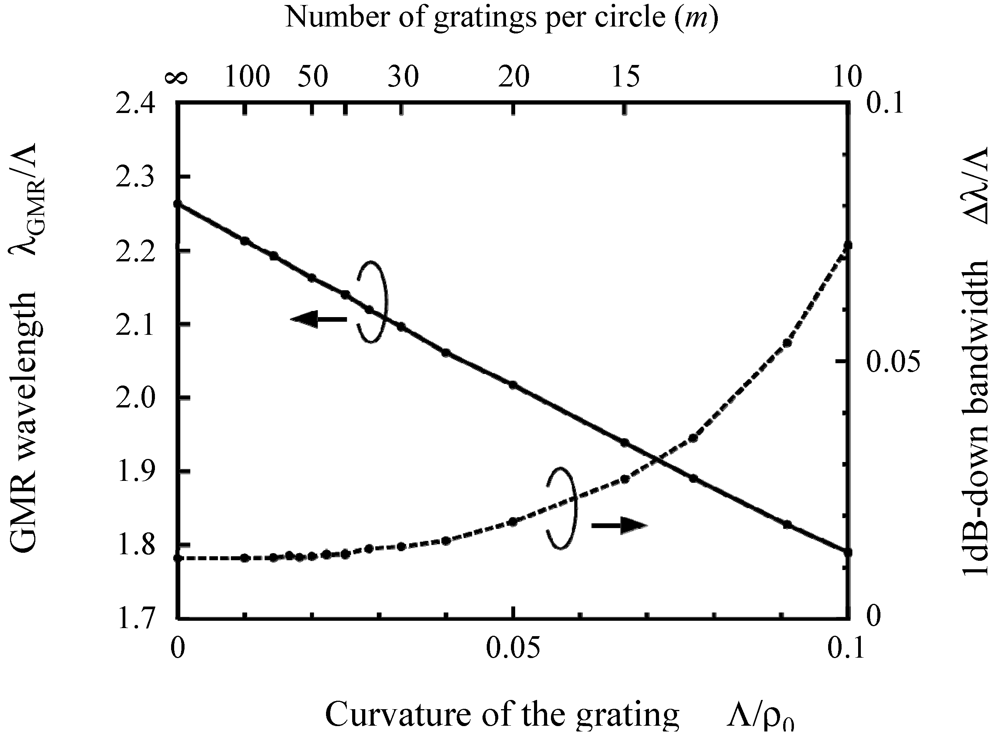
        <p>The relationships between GMR wavelength, bandwidth and curvature are summarized in <xref ref-type="fig" rid="micromachines-03-00101-f004">Figure 4</xref>, which shows that the resonance wavelength depends almost linearly on the curvature. This can be explained as follows: the modal field of a curved waveguide shifts to the outer side as the curvature increases [<xref ref-type="bibr" rid="B27-micromachines-03-00101">27</xref>]. In the structure of <xref ref-type="fig" rid="micromachines-03-00101-f002">Figure 2</xref>(a), the average refractive index outside the grating layer is low, and so the mean optical path length for the guided mode becomes small as the curvature increases. This tends to shorten the resonance wavelength.</p>
        <p>We also confirmed that the peak reflectivity at the GMR wavelength remains at almost 100% for structures with <italic>m</italic> &gt; 20.</p>
        <fig id="micromachines-03-00101-f004" position="anchor">
          <label>Figure 4</label>
          <caption>
            <p>Relationships between the curvature of the grating, GMR wavelength and 1-dB bandwidth.</p>
          </caption>
          <graphic xmlns:xlink="http://www.w3.org/1999/xlink" xlink:href="micromachines-03-00101-g004.tif"/>
        </fig>
      </sec>
      <sec id="sec2dot3-micromachines-03-00101">
        <title>2.3. Effective High-Index Mirror Position</title>
        <p>As we will show in the next section, resonance wavelengths of a RG-type cylindrical cavity exhibit strange behavior near the GMR wavelength of the RG wall. We thought that the key physics behind such behavior would be a rapid phase shift of the RG upon reflection. Because the phase of the reflection is directly connected with the effective reflection plane where the field amplitude becomes either minimum or maximum, it is convenient to regard RGs as a uniform medium with an effective reflection position. By substituting an effective cavity radius, which is a summation of the nominal cavity radius and the penetration depth of the effective reflection plane, into the equation for the conventional resonance condition, we will be able to obtain resonance wavelengths for the curved RG-type cavity. Also, through such calculation we will be able to explain the strange behavior of the resonance wavelength of the cavity. Note that outside GMR, the RG shows finite transmission. Therefore it is more reasonable to regard the RG as a high-index or low-index medium rather than a metallic mirror. The principle of calculating the effective reflection positions of curved RGs as a high-index medium is as follows.</p>
        <p>The electric field inside the curvature can be well approximated as a superposition of diverging and converging waves as follows, except for the region very close to the grating layer:</p>
        <p><inline-graphic xmlns:xlink="http://www.w3.org/1999/xlink" xlink:href="micromachines-03-00101-i011.tif"/> <inline-graphic xmlns:xlink="http://www.w3.org/1999/xlink" xlink:href="micromachines-03-00101-i012.tif"/>    (3) </p>
        <p>where <inline-graphic xmlns:xlink="http://www.w3.org/1999/xlink" xlink:href="micromachines-03-00101-i013.tif"/> and <inline-graphic xmlns:xlink="http://www.w3.org/1999/xlink" xlink:href="micromachines-03-00101-i014.tif"/> denote the 0th-order Hankel function of the first and second kind, and correspond to converging and diverging waves, respectively. <italic>A<sub>c</sub></italic> and <italic>A<sub>d</sub></italic> are their complex amplitudes. <italic>k</italic><sub>0</sub> and <italic>ρ</italic> are the free space wave number and the radial coordinate, respectively.</p>
        <p>We define the effective mirror plane as the radial position beyond which the space can be regarded as an infinitely extending high-index medium. The amplitude reflectivity of the electric field on such a plane <inline-graphic xmlns:xlink="http://www.w3.org/1999/xlink" xlink:href="micromachines-03-00101-i015.tif"/> should therefore be a negative real number. The electric field at such a plane can thus be expressed as:</p>
        <p><inline-graphic xmlns:xlink="http://www.w3.org/1999/xlink" xlink:href="micromachines-03-00101-i016.tif"/>    (4) </p>
        <p>where A and |<italic>r</italic>| are another complex amplitude and the norm of the amplitude reflectance, respectively. Considering Equation (3), the field inside the curvature can be expressed as follows.</p>
        <p><inline-graphic xmlns:xlink="http://www.w3.org/1999/xlink" xlink:href="micromachines-03-00101-i017.tif"/> <inline-graphic xmlns:xlink="http://www.w3.org/1999/xlink" xlink:href="micromachines-03-00101-i012.tif"/>    (5) </p>
        <p>Amplitude factors can be expressed using Equations (3) to (5) as follows:</p>
        <p><inline-graphic xmlns:xlink="http://www.w3.org/1999/xlink" xlink:href="micromachines-03-00101-i018.tif"/>, <inline-graphic xmlns:xlink="http://www.w3.org/1999/xlink" xlink:href="micromachines-03-00101-i019.tif"/>    (6) </p>
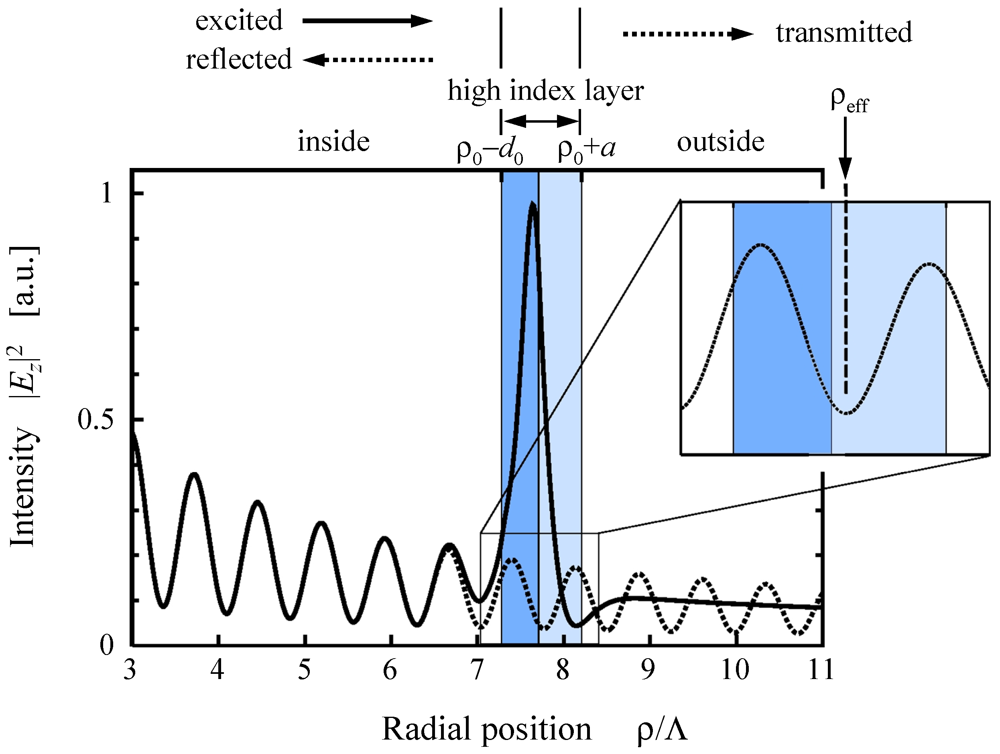
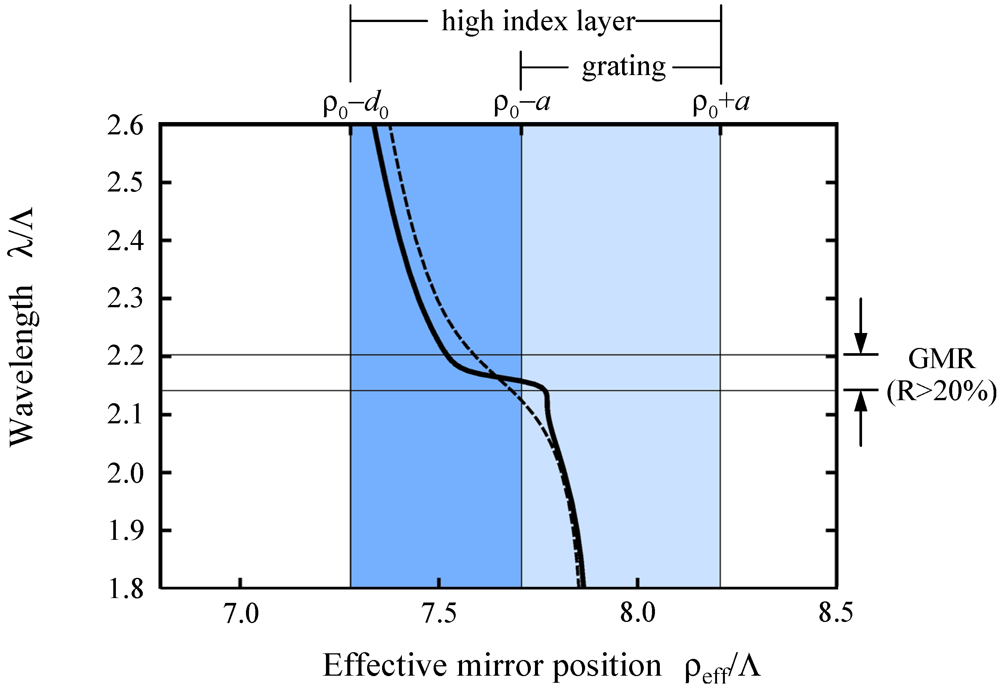
        <p>We tried to calculate the relationship between the wavelength and the effective mirror position (<italic>ρ<sub>eff</sub></italic>). First, we calculated the field distribution at a wavelength of interest using the FDTD method. An example for the <italic>m</italic> = 50 structure is shown by the solid line in <xref ref-type="fig" rid="micromachines-03-00101-f005">Figure 5</xref>. Then the data of <italic>ρ</italic>/Λ &lt; 6 was least-squares fitted to Equation (3) to obtain <italic>A<sub>c</sub></italic> and <italic>A<sub>d</sub></italic>. The fitted field is shown by the dotted line in the figure. Finally, |<italic>r</italic>| and <italic>ρ<sub>eff</sub></italic> were calculated using Equation (6). The inset of <xref ref-type="fig" rid="micromachines-03-00101-f005">Figure 5</xref> is a magnified view of the fitted field near the grating layer. The calculated relationships between wavelength and effective mirror position for RGs and average index structures are summarized in <xref ref-type="fig" rid="micromachines-03-00101-f006">Figure 6</xref>. This result clarifies that the mirror positions for both structures behave similarly far from the GMR wavelength. For the average layer structure, as the wavelength moves across the minimum reflection point, the mirror position slowly shifts by about a quarter wavelength; this phenomenon can be commonly seen in a flat dielectric film. On the other hand, for a curved RG this shift is more abrupt: the mirror position appears almost to jump at the GMR wavelength. This can be interpreted to mean that the complex reflectivity of the RG follows a sharp Lorentzian function near the resonance wavelength as described by Fan <italic>et al</italic>. [<xref ref-type="bibr" rid="B28-micromachines-03-00101">28</xref>].</p>
        <fig id="micromachines-03-00101-f005" position="anchor">
          <label>Figure 5</label>
          <caption>
            <p>Example of a calculated field intensity profile upon reflection (solid line) and its extrapolated curve (dotted line), for the <italic>m</italic> = 50 structure. The latter is a linear summation of <inline-graphic xmlns:xlink="http://www.w3.org/1999/xlink" xlink:href="micromachines-03-00101-i020.tif"/> and <inline-graphic xmlns:xlink="http://www.w3.org/1999/xlink" xlink:href="micromachines-03-00101-i021.tif"/>.</p>
          </caption>
          <graphic xmlns:xlink="http://www.w3.org/1999/xlink" xlink:href="micromachines-03-00101-g005.tif"/>
        </fig>
        <fig id="micromachines-03-00101-f006" position="anchor">
          <label>Figure 6</label>
          <caption>
            <p>Estimated effective high-index mirror positions, for the <italic>m</italic> = 50 structure. Solid and dashed lines are curved RG and average index slab, respectively.</p>
          </caption>
          <graphic xmlns:xlink="http://www.w3.org/1999/xlink" xlink:href="micromachines-03-00101-g006.tif"/>
        </fig>
      </sec>
    </sec>
    <sec>
      <title>3. Characteristics of RGC</title>
      <sec>
        <title>3.1. Resonance Wavelength of the Cavity Mode</title>
        <p>The relationships between the structural parameters of the cavity (such as radius and refractive index) and the resonance wavelength are fundamental information for the resonator. We calculated the resonance wavelengths of cylindrical cavities surrounded by the RG walls with various curvature radii. The domain for FDTD simulation was extended to the center of the cavity.</p>
        <p>We placed a point excitation source <italic>E<sub>z</sub></italic> at the center, and monitored the electromagnetic fields at two pitches outside the grating (<italic>ρ</italic> = <italic>ρ</italic><sub>0</sub> + 2Λ). Peak wavelengths contained in the monitored waveform were extracted using Fast Fourier Transformation (FFT). These wavelengths correspond to the resonance wavelengths of the cavity system.</p>
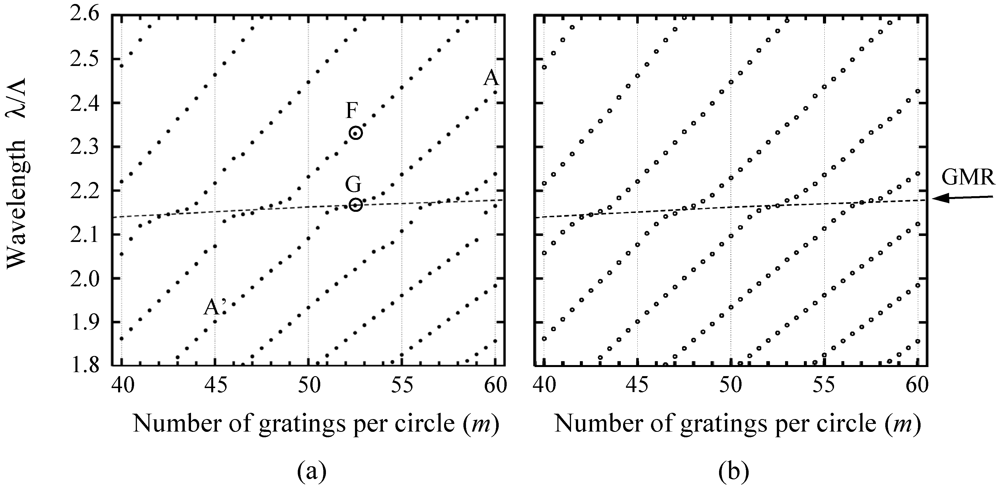
        <p>The above calculation was carried out for various cavity radii, and the results are plotted as a function of <italic>m</italic> in <xref ref-type="fig" rid="micromachines-03-00101-f007">Figure 7</xref>(a). This figure shows that there are roughly two kinds of resonance series: (a) an almost linear series extending from the top right to bottom left; and (b) A wavy series located around 2.1 &lt; λ/Λ &lt; 2.2. The former is the resonance modes where RG almost serves as a mean dielectric structure as in <xref ref-type="fig" rid="micromachines-03-00101-f002">Figure 2</xref>(b). The resonance wavelength and Q are determined by the Fresnel reflection constant of the multilayer, so we call these modes “<italic>Fresnel modes</italic>” hereafter. The latter series are dependent on the GMR spectrum of the RG, and we call them “<italic>Grating modes</italic>” for convenience.</p>
        <fig id="micromachines-03-00101-f007" position="anchor">
          <label>Figure 7</label>
          <caption>
            <p>Calculated resonance wavelengths for various cavity sizes. The dashed line indicates the GMR wavelength of the curved RG wall. (<bold>a</bold>) Determined from the peaks of radiation spectra monitored outside the cavity; (<bold>b</bold>) Estimated by <inline-graphic xmlns:xlink="http://www.w3.org/1999/xlink" xlink:href="micromachines-03-00101-i024.tif"/>, where <italic>ρ<sub>eff</sub></italic> is the radial position of the effective high-index mirror.</p>
          </caption>
          <graphic xmlns:xlink="http://www.w3.org/1999/xlink" xlink:href="micromachines-03-00101-g007.tif"/>
        </fig>
        <p>The resonance condition for TM modes of a hollow circular metallic cavity is given as zeros of a Bessel function as follows [<xref ref-type="bibr" rid="B29-micromachines-03-00101">29</xref>]:</p>
        <p><inline-graphic xmlns:xlink="http://www.w3.org/1999/xlink" xlink:href="micromachines-03-00101-i026.tif"/>    (7) </p>
        <p>where <inline-graphic xmlns:xlink="http://www.w3.org/1999/xlink" xlink:href="micromachines-03-00101-i027.tif"/> is the radius of the cavity. We tried to check whether or not this condition also applies to our RG-type resonator. We replaced the physical radius ( <inline-graphic xmlns:xlink="http://www.w3.org/1999/xlink" xlink:href="micromachines-03-00101-i027.tif"/>) by the effective one (<inline-graphic xmlns:xlink="http://www.w3.org/1999/xlink" xlink:href="micromachines-03-00101-i028.tif"/>) and plotted the wavelengths which satisfy the above relationship for various cavity sizes (<italic>m</italic>). The effective position, <inline-graphic xmlns:xlink="http://www.w3.org/1999/xlink" xlink:href="micromachines-03-00101-i028.tif"/>, for various curvatures was calculated by the procedure described in <xref ref-type="sec" rid="sec2dot3-micromachines-03-00101">Section 2.3</xref>. The result is shown in <xref ref-type="fig" rid="micromachines-03-00101-f007">Figure 7</xref>(b). These results look similar for both Fresnel and Grating modes. It is clear that the deformation of the resonance curve near the GMR wavelength corresponds to the behavior of <inline-graphic xmlns:xlink="http://www.w3.org/1999/xlink" xlink:href="micromachines-03-00101-i028.tif"/> seen in <xref ref-type="fig" rid="micromachines-03-00101-f006">Figure 6</xref>. This indicates that the resonance wavelength of the proposed cavity is also governed by the conventional resonance condition of Equation (7), regardless of the confinement mechanism (Fresnel reflection or resonant reflection) of the modes.</p>
      </sec>
      <sec>
        <title>3.2. Quality Factor</title>
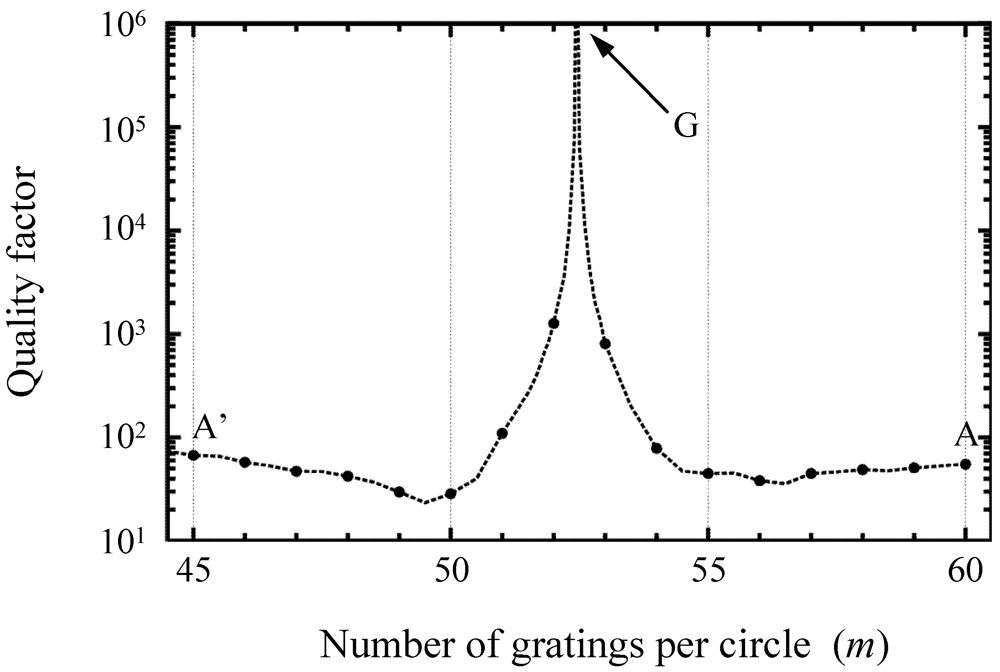
        <p>Next, Q-factors of the resonance series marked by A-A’ in <xref ref-type="fig" rid="micromachines-03-00101-f007">Figure 7</xref>(a) are evaluated using the following equation [<xref ref-type="bibr" rid="B30-micromachines-03-00101">30</xref>]:</p>
        <p><inline-graphic xmlns:xlink="http://www.w3.org/1999/xlink" xlink:href="micromachines-03-00101-i029.tif"/>    (8) </p>
        <p>where <italic>ω</italic><sub>0</sub> and <italic>τ</italic><sub>0</sub> are the angular frequency and the decay time, respectively. The results are plotted as filled circles in <xref ref-type="fig" rid="micromachines-03-00101-f008">Figure 8</xref>. Practically, the total number of gratings on the cavity wall (<italic>m</italic>) must be an integer number. However, according to our FDTD method, non-integer <italic>m</italic> can be handled without difficulty, because we need to specify only the azimuthal extent (<italic>θ</italic><sub>0</sub>) of the unit grating. In <xref ref-type="fig" rid="micromachines-03-00101-f008">Figure 8</xref>, the results for non-integer <italic>m</italic> structures are also plotted as a dotted line.</p>
        <fig id="micromachines-03-00101-f008" position="anchor">
          <label>Figure 8</label>
          <caption>
            <p>Quality factor of the resonance series indicated by A-A’ in <xref ref-type="fig" rid="micromachines-03-00101-f007">Figure 7</xref>(a).</p>
          </caption>
          <graphic xmlns:xlink="http://www.w3.org/1999/xlink" xlink:href="micromachines-03-00101-g008.tif"/>
        </fig>
        <p><xref ref-type="fig" rid="micromachines-03-00101-f008">Figure 8</xref> shows that Q of the grating mode (52 &lt; <italic>m</italic> &lt; 53) becomes extremely high, corresponding to the high reflectivity of the RG wall. Q of other Fresnel modes is less than 100. In other words, only one high-Q resonant mode exists in a wide range of wavelength, which means that this RG type cavity effectively behaves as a single-mode resonator.</p>
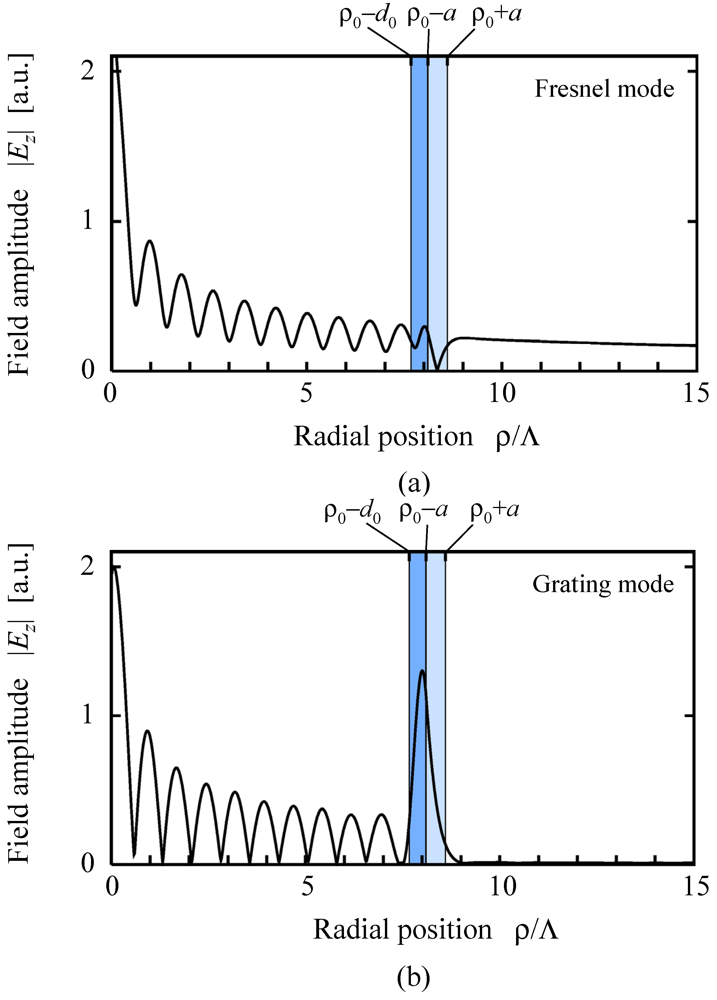
        <p>Electric field distributions of a Fresnel mode (point “F” in <xref ref-type="fig" rid="micromachines-03-00101-f007">Figure 7</xref>) and high-Q grating mode (point “G” in <xref ref-type="fig" rid="micromachines-03-00101-f007">Figure 7</xref> and <xref ref-type="fig" rid="micromachines-03-00101-f008">Figure 8</xref>) are displayed in <xref ref-type="fig" rid="micromachines-03-00101-f009">Figure 9</xref>(a,b), respectively. In <xref ref-type="fig" rid="micromachines-03-00101-f009">Figure 9</xref>(a), the standing wave ratio (SWR) inside the cavity looks small due to the low reflectivity of the cavity wall. The wavelength is far from GMR, and therefore the field intensity in the grating layer is of the same order as that inside the cavity. In addition, substantial field leakage is seen outside. On the contrary, in <xref ref-type="fig" rid="micromachines-03-00101-f009">Figure 9</xref>(b) the field intensity in the grating layer is enhanced due to the guided mode resonance. This characteristic is well known for RGs [<xref ref-type="bibr" rid="B31-micromachines-03-00101">31</xref>]. Also, the high reflectivity of the wall keeps the SWR almost at infinity. There is almost no field leakage outside the cavity.</p>
        <fig id="micromachines-03-00101-f009" position="anchor">
          <label>Figure 9</label>
          <caption>
            <p>(<bold>a</bold>) Electric field distribution of a Fresnel mode, indicated by “F” in <xref ref-type="fig" rid="micromachines-03-00101-f007">Figure 7</xref>(a); (<bold>b</bold>) High-Q grating mode, indicated by “G” in <xref ref-type="fig" rid="micromachines-03-00101-f007">Figure 7</xref>(a) and <xref ref-type="fig" rid="micromachines-03-00101-f008">Figure 8</xref>. The size of the cavity is <italic>m</italic> = 52.47 (virtual structure).</p>
          </caption>
          <graphic xmlns:xlink="http://www.w3.org/1999/xlink" xlink:href="micromachines-03-00101-g009.tif"/>
        </fig>
        <p>As we showed in <xref ref-type="fig" rid="micromachines-03-00101-f003">Figure 3</xref>, the basic characteristics of our curved RG mirror are similar to those of the conventional flat RG, and so the tolerance to changes in various structural or material parameters will be approximately the same. The cavity characteristics (tolerance for achieving high-Q) will also have a similar level of tolerance.</p>
      </sec>
    </sec>
    <sec sec-type="conclusions">
      <title>4. Conclusions</title>
      <p>We clarified the resonance characteristics of cylindrical resonant cavities surrounded by a curved grating wall through numerical simulation. The cavity was found to support two kinds of resonant modes, whose Q are determined by the Fresnel and GMR reflection constant at the cavity/wall boundary, respectively. We also showed that, in the example structure, the quality factor of the latter modes can be increased by several orders of magnitude compared with the former modes. The proposed cavity was found to function as a large-area, effectively single-mode cavity. This type of structure will be a useful platform for realizing micro-photonic devices such as single-mode lasers, high-finesse wavelength filters and biosensors. Having clarified the fundamental characteristics, we will investigate as our next study the optimum structural design which is more robust against fabrication errors of size, shape, and refractive index.</p>
    </sec>
  </body>
  <back>
    <ack>
      <title>Acknowledgment</title>
      <p>This research was in part supported by KAKENHI, Grant-in-Aid for Scientific Research (B) 23360145 of Japan Society for the Promotion of Science (JSPS).</p>
    </ack>
    <ref-list>
      <title>References</title>
      <ref id="B1-micromachines-03-00101">
        <label>1.</label>
        <citation citation-type="book">
          <person-group person-group-type="author">
            <name>
              <surname>Collin</surname>
              <given-names>R.E.</given-names>
            </name>
          </person-group>
          <article-title>Electromagnetic Resonators</article-title>
          <source>Foundations for Microwave Engineering</source>
          <edition>2nd</edition>
          <publisher-name>Wiley</publisher-name>
          <publisher-loc>Hoboken, NJ, USA</publisher-loc>
          <year>2001</year>
          <fpage>496</fpage>
          <lpage>517</lpage>
        </citation>
      </ref>
      <ref id="B2-micromachines-03-00101">
        <label>2.</label>
        <citation citation-type="journal">
          <person-group person-group-type="author">
            <name>
              <surname>Cohn</surname>
              <given-names>S.B.</given-names>
            </name>
          </person-group>
          <article-title>Microwave bandpass filters containing high-Q dielectric resonators</article-title>
          <source>IEEE Trans. Microw. Theory Tech.</source>
          <year>1968</year>
          <volume>MTT-16</volume>
          <fpage>218</fpage>
          <lpage>227</lpage>
          <pub-id pub-id-type="doi">10.1109/TMTT.1968.1126654</pub-id>
        </citation>
      </ref>
      <ref id="B3-micromachines-03-00101">
        <label>3.</label>
        <citation citation-type="journal">
          <person-group person-group-type="author">
            <name>
              <surname>Jiao</surname>
              <given-names>X.H.</given-names>
            </name>
            <name>
              <surname>Cuillon</surname>
              <given-names>P.</given-names>
            </name>
            <name>
              <surname>Bermudez</surname>
              <given-names>L.A.</given-names>
            </name>
            <name>
              <surname>Auxemery</surname>
              <given-names>P.</given-names>
            </name>
          </person-group>
          <article-title>Whispering-Gallery modes of dielectric structures: Applications to millimeter-wave bandstop filters</article-title>
          <source>IEEE Trans. Microw. Theory Tech. </source>
          <year>1987</year>
          <volume>MTT-35</volume>
          <fpage>1169</fpage>
          <lpage>1175</lpage>
        </citation>
      </ref>
      <ref id="B4-micromachines-03-00101">
        <label>4.</label>
        <citation citation-type="journal">
          <person-group person-group-type="author">
            <name>
              <surname>Cros</surname>
              <given-names>D.</given-names>
            </name>
            <name>
              <surname>Guillon</surname>
              <given-names>P.</given-names>
            </name>
          </person-group>
          <article-title>Whispering Gallery dielectric resonator modes for W-band devices</article-title>
          <source>IEEE Trans. Microw. Theory Tech.</source>
          <year>1990</year>
          <volume>38</volume>
          <fpage>1667</fpage>
          <lpage>1674</lpage>
          <pub-id pub-id-type="doi">10.1109/22.60014</pub-id>
        </citation>
      </ref>
      <ref id="B5-micromachines-03-00101">
        <label>5.</label>
        <citation citation-type="journal">
          <person-group person-group-type="author">
            <name>
              <surname>Preu</surname>
              <given-names>S.</given-names>
            </name>
            <name>
              <surname>Schwefel</surname>
              <given-names>H.G.L.</given-names>
            </name>
            <name>
              <surname>Malzer</surname>
              <given-names>S.</given-names>
            </name>
            <name>
              <surname>Dohler</surname>
              <given-names>G.H.</given-names>
            </name>
            <name>
              <surname>Wang</surname>
              <given-names>L.J.</given-names>
            </name>
            <name>
              <surname>Hanson</surname>
              <given-names>M.</given-names>
            </name>
            <name>
              <surname>Zimmerman</surname>
              <given-names>J.D.</given-names>
            </name>
            <name>
              <surname>Gossard</surname>
              <given-names>A.C.</given-names>
            </name>
          </person-group>
          <article-title>Coupled whispering gallery mode resonators in Terahertz frequency range</article-title>
          <source>Opt. Express</source>
          <year>2008</year>
          <volume>16</volume>
          <fpage>7336</fpage>
          <lpage>7343</lpage>
        <pub-id pub-id-type="doi">10.1364/OE.16.007336</pub-id><pub-id pub-id-type="pmid">18545439</pub-id></citation>
      </ref>
      <ref id="B6-micromachines-03-00101">
        <label>6.</label>
        <citation citation-type="journal">
          <person-group person-group-type="author">
            <name>
              <surname>Alexopoulos</surname>
              <given-names>N.G.</given-names>
            </name>
            <name>
              <surname>Kerner</surname>
              <given-names>S.</given-names>
            </name>
          </person-group>
          <article-title>Coupled power theorem and orthogonality relations for optical disk waveguides</article-title>
          <source>J. Opt. Soc. Am.</source>
          <year>1977</year>
          <volume>67</volume>
          <fpage>1634</fpage>
          <lpage>1638</lpage>
          <pub-id pub-id-type="doi">10.1364/JOSA.67.001634</pub-id>
        </citation>
      </ref>
      <ref id="B7-micromachines-03-00101">
        <label>7.</label>
        <citation citation-type="journal">
          <person-group person-group-type="author">
            <name>
              <surname>Vahala</surname>
              <given-names>K.J.</given-names>
            </name>
          </person-group>
          <article-title>Optical microcavities</article-title>
          <source>Nature</source>
          <year>2003</year>
          <volume>424</volume>
          <fpage>839</fpage>
          <lpage>846</lpage>
          <pub-id pub-id-type="doi">10.1038/nature01939</pub-id>
        </citation>
      </ref>
      <ref id="B8-micromachines-03-00101">
        <label>8.</label>
        <citation citation-type="journal">
          <person-group person-group-type="author">
            <name>
              <surname>Ilchenko</surname>
              <given-names>V.S.</given-names>
            </name>
            <name>
              <surname>Matsko</surname>
              <given-names>A.B.</given-names>
            </name>
          </person-group>
          <article-title>Optical resonators with whispering-gallery modes-part II: Applications</article-title>
          <source>IEEE J. Sel. Top. Quantum Electron.</source>
          <year>2006</year>
          <volume>12</volume>
          <fpage>15</fpage>
          <lpage>32</lpage>
          <pub-id pub-id-type="doi">10.1109/JSTQE.2005.862943</pub-id>
        </citation>
      </ref>
      <ref id="B9-micromachines-03-00101">
        <label>9.</label>
        <citation citation-type="journal">
          <person-group person-group-type="author">
            <name>
              <surname>Scheuer</surname>
              <given-names>J.</given-names>
            </name>
            <name>
              <surname>Yariv</surname>
              <given-names>A.</given-names>
            </name>
          </person-group>
          <article-title>Annular Bragg defect mode resonators</article-title>
          <source>J. Opt. Soc. Am. B</source>
          <year>2003</year>
          <volume>20</volume>
          <fpage>2285</fpage>
          <lpage>2291</lpage>
          <pub-id pub-id-type="doi">10.1364/JOSAB.20.002285</pub-id>
        </citation>
      </ref>
      <ref id="B10-micromachines-03-00101">
        <label>10.</label>
        <citation citation-type="journal">
          <person-group person-group-type="author">
            <name>
              <surname>Sun</surname>
              <given-names>X.</given-names>
            </name>
            <name>
              <surname>Yariv</surname>
              <given-names>A.</given-names>
            </name>
          </person-group>
          <article-title>Surface-emitting circular DFB, disk-, and ring-Bragg resonator laser with chirped gratings: A unified theory and comparative study</article-title>
          <source>Opt. Express</source>
          <year>2008</year>
          <volume>16</volume>
          <fpage>9155</fpage>
          <lpage>9164</lpage>
          <pub-id pub-id-type="doi">10.1364/OE.16.009155</pub-id>
        </citation>
      </ref>
      <ref id="B11-micromachines-03-00101">
        <label>11.</label>
        <citation citation-type="journal">
          <person-group person-group-type="author">
            <name>
              <surname>Fujita</surname>
              <given-names>M.</given-names>
            </name>
            <name>
              <surname>Baba</surname>
              <given-names>T.</given-names>
            </name>
          </person-group>
          <article-title>Microgear laser</article-title>
          <source>Appl. Phys. Lett.</source>
          <year>2002</year>
          <volume>80</volume>
          <fpage>2051</fpage>
          <lpage>2053</lpage>
          <pub-id pub-id-type="doi">10.1063/1.1462867</pub-id>
        </citation>
      </ref>
      <ref id="B12-micromachines-03-00101">
        <label>12.</label>
        <citation citation-type="journal">
          <person-group person-group-type="author">
            <name>
              <surname>Wang</surname>
              <given-names>S.S.</given-names>
            </name>
            <name>
              <surname>Magnusson</surname>
              <given-names>R.</given-names>
            </name>
            <name>
              <surname>Bagby</surname>
              <given-names>J.S.</given-names>
            </name>
            <name>
              <surname>Moharam</surname>
              <given-names>M.G.</given-names>
            </name>
          </person-group>
          <article-title>Guided-mode resonances in planar dielectric-layer diffraction gratings</article-title>
          <source>J. Opt. Soc. Am. A</source>
          <year>1990</year>
          <volume>7</volume>
          <fpage>1470</fpage>
          <lpage>1474</lpage>
          <pub-id pub-id-type="doi">10.1364/JOSAA.7.001470</pub-id>
        </citation>
      </ref>
      <ref id="B13-micromachines-03-00101">
        <label>13.</label>
        <citation citation-type="journal">
          <person-group person-group-type="author">
            <name>
              <surname>Wang</surname>
              <given-names>S.S.</given-names>
            </name>
            <name>
              <surname>Magnusson</surname>
              <given-names>R.</given-names>
            </name>
          </person-group>
          <article-title>Theory and applications of guided-mode resonance filters</article-title>
          <source>Appl. Opt.</source>
          <year>1993</year>
          <volume>32</volume>
          <fpage>2606</fpage>
          <lpage>2613</lpage>
          <pub-id pub-id-type="doi">10.1364/AO.32.002606</pub-id>
        </citation>
      </ref>
      <ref id="B14-micromachines-03-00101">
        <label>14.</label>
        <citation citation-type="journal">
          <person-group person-group-type="author">
            <name>
              <surname>Vincent</surname>
              <given-names>P.</given-names>
            </name>
            <name>
              <surname>Neviere</surname>
              <given-names>M.</given-names>
            </name>
          </person-group>
          <article-title>Corrugated dielectric waveguides: A numerical study of the second-order stop bands</article-title>
          <source>Appl. Phys.</source>
          <year>1979</year>
          <volume>20</volume>
          <fpage>345</fpage>
          <lpage>351</lpage>
          <pub-id pub-id-type="doi">10.1007/BF00895008</pub-id>
        </citation>
      </ref>
      <ref id="B15-micromachines-03-00101">
        <label>15.</label>
        <citation citation-type="journal">
          <person-group person-group-type="author">
            <name>
              <surname>Rosenblatt</surname>
              <given-names>D.</given-names>
            </name>
            <name>
              <surname>Sharon</surname>
              <given-names>A.</given-names>
            </name>
            <name>
              <surname>Friesem</surname>
              <given-names>A.A.</given-names>
            </name>
          </person-group>
          <article-title>Resonant grating waveguide structures</article-title>
          <source>IEEE J. Quantum Electron.</source>
          <year>1997</year>
          <volume>33</volume>
          <fpage>2038</fpage>
          <lpage>2059</lpage>
          <pub-id pub-id-type="doi">10.1109/3.641320</pub-id>
        </citation>
      </ref>
      <ref id="B16-micromachines-03-00101">
        <label>16.</label>
        <citation citation-type="journal">
          <person-group person-group-type="author">
            <name>
              <surname>Peters</surname>
              <given-names>D.W.</given-names>
            </name>
            <name>
              <surname>Kemme</surname>
              <given-names>S.A.</given-names>
            </name>
            <name>
              <surname>Hadley</surname>
              <given-names>G.R.</given-names>
            </name>
          </person-group>
          <article-title>Effect of finite grating, waveguide width, and end-facet geometry on resonant subwavelength grating reflectivity</article-title>
          <source>J. Opt. Soc. Am. A</source>
          <year>2004</year>
          <volume>21</volume>
          <fpage>981</fpage>
          <lpage>987</lpage>
          <pub-id pub-id-type="doi">10.1364/JOSAA.21.000981</pub-id>
        </citation>
      </ref>
      <ref id="B17-micromachines-03-00101">
        <label>17.</label>
        <citation citation-type="journal">
          <person-group person-group-type="author">
            <name>
              <surname>Peters</surname>
              <given-names>D.W.</given-names>
            </name>
            <name>
              <surname>Boye</surname>
              <given-names>R.R.</given-names>
            </name>
            <name>
              <surname>Wendt</surname>
              <given-names>J.R.</given-names>
            </name>
            <name>
              <surname>Kellogg</surname>
              <given-names>R.A.</given-names>
            </name>
            <name>
              <surname>Kemme</surname>
              <given-names>S.A.</given-names>
            </name>
            <name>
              <surname>Carter</surname>
              <given-names>T.R.</given-names>
            </name>
            <name>
              <surname>Samora</surname>
              <given-names>S.</given-names>
            </name>
          </person-group>
          <article-title>Demonstration of polarization-independent resonant subwavelength grating filter arrays</article-title>
          <source>Opt. Lett.</source>
          <year>2010</year>
          <volume>35</volume>
          <fpage>3201</fpage>
          <lpage>3203</lpage>
        <pub-id pub-id-type="doi">10.1364/OL.35.003201</pub-id><pub-id pub-id-type="pmid">20890333</pub-id></citation>
      </ref>
      <ref id="B18-micromachines-03-00101">
        <label>18.</label>
        <citation citation-type="journal">
          <person-group person-group-type="author">
            <name>
              <surname>Ding</surname>
              <given-names>Y.</given-names>
            </name>
            <name>
              <surname>Magnusson</surname>
              <given-names>R.</given-names>
            </name>
          </person-group>
          <article-title>Resonant leaky-mode spectral-band engineering and device applications</article-title>
          <source>Opt. Express</source>
          <year>2004</year>
          <volume>12</volume>
          <fpage>5661</fpage>
          <lpage>5674</lpage>
          <pub-id pub-id-type="doi">10.1364/OPEX.12.005661</pub-id>
        </citation>
      </ref>
      <ref id="B19-micromachines-03-00101">
        <label>19.</label>
        <citation citation-type="journal">
          <person-group person-group-type="author">
            <name>
              <surname>Liu</surname>
              <given-names>Z.S.</given-names>
            </name>
            <name>
              <surname>Tibuleac</surname>
              <given-names>S.</given-names>
            </name>
            <name>
              <surname>Shin</surname>
              <given-names>D.</given-names>
            </name>
            <name>
              <surname>Young</surname>
              <given-names>P.P.</given-names>
            </name>
            <name>
              <surname>Magnusson</surname>
              <given-names>R.</given-names>
            </name>
          </person-group>
          <article-title>High-efficiency guided-mode resonance filter</article-title>
          <source>Opt. Lett.</source>
          <year>1998</year>
          <volume>23</volume>
          <fpage>1556</fpage>
          <lpage>1558</lpage>
          <pub-id pub-id-type="doi">10.1364/OL.23.001556</pub-id>
        </citation>
      </ref>
      <ref id="B20-micromachines-03-00101">
        <label>20.</label>
        <citation citation-type="journal">
          <person-group person-group-type="author">
            <name>
              <surname>Fattal</surname>
              <given-names>D.</given-names>
            </name>
            <name>
              <surname>Li</surname>
              <given-names>J.</given-names>
            </name>
            <name>
              <surname>Peng</surname>
              <given-names>Z.</given-names>
            </name>
            <name>
              <surname>Fiorentino</surname>
              <given-names>M.</given-names>
            </name>
            <name>
              <surname>Beausoleil</surname>
              <given-names>R.G.</given-names>
            </name>
          </person-group>
          <article-title>Flat dielectric grating reflectors with focusing abilities</article-title>
          <source>Nature Photon.</source>
          <year>2010</year>
          <volume>4</volume>
          <fpage>466</fpage>
          <lpage>470</lpage>
          <pub-id pub-id-type="doi">10.1038/nphoton.2010.116</pub-id>
        </citation>
      </ref>
      <ref id="B21-micromachines-03-00101">
        <label>21.</label>
        <citation citation-type="journal">
          <person-group person-group-type="author">
            <name>
              <surname>Ohtera</surname>
              <given-names>Y.</given-names>
            </name>
            <name>
              <surname>Iijima</surname>
              <given-names>S.</given-names>
            </name>
            <name>
              <surname>Yamada</surname>
              <given-names>H.</given-names>
            </name>
          </person-group>
          <article-title>Guided-mode resonance in curved grating structures</article-title>
          <source>Opt. Lett.</source>
          <year>2011</year>
          <volume>36</volume>
          <fpage>1689</fpage>
          <lpage>1691</lpage>
          <pub-id pub-id-type="doi">10.1364/OL.36.001689</pub-id>
        </citation>
      </ref>
      <ref id="B22-micromachines-03-00101">
        <label>22.</label>
        <citation citation-type="journal">
          <person-group person-group-type="author">
            <name>
              <surname>Lu</surname>
              <given-names>M.</given-names>
            </name>
            <name>
              <surname>Zhai</surname>
              <given-names>H.</given-names>
            </name>
            <name>
              <surname>Magnusson</surname>
              <given-names>R.</given-names>
            </name>
          </person-group>
          <article-title>Focusing light with curved guided-mode resonance reflectors</article-title>
          <source>Micromachines</source>
          <year>2011</year>
          <volume>2</volume>
          <fpage>150</fpage>
          <lpage>156</lpage>
          <pub-id pub-id-type="doi">10.3390/mi2020150</pub-id>
        </citation>
      </ref>
      <ref id="B23-micromachines-03-00101">
        <label>23.</label>
        <citation citation-type="journal">
          <person-group person-group-type="author">
            <name>
              <surname>Hocker</surname>
              <given-names>G.B.</given-names>
            </name>
            <name>
              <surname>Burns</surname>
              <given-names>W.K.</given-names>
            </name>
          </person-group>
          <article-title>Mode dispersion in diffused channel waveguides by the effective index method</article-title>
          <source>Appl. Opt.</source>
          <year>1977</year>
          <volume>16</volume>
          <fpage>113</fpage>
          <lpage>118</lpage>
          <pub-id pub-id-type="doi">10.1364/AO.16.000113</pub-id>
        </citation>
      </ref>
      <ref id="B24-micromachines-03-00101">
        <label>24.</label>
        <citation citation-type="journal">
          <person-group person-group-type="author">
            <name>
              <surname>Huy</surname>
              <given-names>K.P.</given-names>
            </name>
            <name>
              <surname>Morand</surname>
              <given-names>A.</given-names>
            </name>
            <name>
              <surname>Amans</surname>
              <given-names>D.</given-names>
            </name>
            <name>
              <surname>Benech</surname>
              <given-names>P.</given-names>
            </name>
          </person-group>
          <article-title>Analytical study of the whispering-gallery mode in two-dimensional microgear cavity using coupled-mode theory</article-title>
          <source>J. Opt. Soc. Am. B</source>
          <year>2005</year>
          <volume>22</volume>
          <fpage>1793</fpage>
          <lpage>1803</lpage>
          <pub-id pub-id-type="doi">10.1364/JOSAB.22.001793</pub-id>
        </citation>
      </ref>
      <ref id="B25-micromachines-03-00101">
        <label>25.</label>
        <citation citation-type="book">
          <person-group person-group-type="author">
            <name>
              <surname>Taflove</surname>
              <given-names>A.</given-names>
            </name>
          </person-group>
          <source>Computational Electrodynamics: The Finite-Difference Time-Domain Method</source>
          <publisher-name>Artech House</publisher-name>
          <publisher-loc>Boston, MA, USA</publisher-loc>
          <year>1995</year>
          <fpage>397</fpage>
          <lpage>410</lpage>
        </citation>
      </ref>
      <ref id="B26-micromachines-03-00101">
        <label>26.</label>
        <citation citation-type="journal">
          <person-group person-group-type="author">
            <name>
              <surname>Xu</surname>
              <given-names>Y.</given-names>
            </name>
            <name>
              <surname>Vuckovic</surname>
              <given-names>J.S.</given-names>
            </name>
            <name>
              <surname>Lee</surname>
              <given-names>R.K.</given-names>
            </name>
            <name>
              <surname>Painter</surname>
              <given-names>O.J.</given-names>
            </name>
            <name>
              <surname>Scherer</surname>
              <given-names>A.</given-names>
            </name>
            <name>
              <surname>Yariv</surname>
              <given-names>A.</given-names>
            </name>
          </person-group>
          <article-title>Finite-difference time-domain calculation of spontaneous emission lifetime in a microcavity</article-title>
          <source>J. Opt. Soc. Am. B</source>
          <year>1999</year>
          <volume>16</volume>
          <fpage>465</fpage>
          <lpage>474</lpage>
          <pub-id pub-id-type="doi">10.1364/JOSAB.16.000465</pub-id>
        </citation>
      </ref>
      <ref id="B27-micromachines-03-00101">
        <label>27.</label>
        <citation citation-type="journal">
          <person-group person-group-type="author">
            <name>
              <surname>Gambling</surname>
              <given-names>W.A.</given-names>
            </name>
            <name>
              <surname>Matsumura</surname>
              <given-names>H.</given-names>
            </name>
            <name>
              <surname>Ragdale</surname>
              <given-names>C.M.</given-names>
            </name>
          </person-group>
          <article-title>Field deformation in a curved single-mode fibre</article-title>
          <source>Electron. Lett.</source>
          <year>1978</year>
          <volume>14</volume>
          <fpage>130</fpage>
          <lpage>132</lpage>
        <pub-id pub-id-type="doi">10.1049/el:19780089</pub-id></citation>
      </ref>
      <ref id="B28-micromachines-03-00101">
        <label>28.</label>
        <citation citation-type="journal">
          <person-group person-group-type="author">
            <name>
              <surname>Fan</surname>
              <given-names>S.</given-names>
            </name>
            <name>
              <surname>Joannopoulos</surname>
              <given-names>J.D.</given-names>
            </name>
          </person-group>
          <article-title>Analysis of guided resonances in photonic crystal slabs</article-title>
          <source>Phys. Rev. B</source>
          <year>2002</year>
          <volume>65</volume>
          <fpage>235112:1</fpage>
          <lpage>235112:8</lpage>
        </citation>
      </ref>
      <ref id="B29-micromachines-03-00101">
        <label>29.</label>
        <citation citation-type="book">
          <person-group person-group-type="author">
            <name>
              <surname>Pozer</surname>
              <given-names>D.M.</given-names>
            </name>
          </person-group>
          <source>Microwave Engineering</source>
          <edition>3rd</edition>
          <publisher-name>Wiley</publisher-name>
          <publisher-loc>Hoboken, NJ, USA</publisher-loc>
          <year>2005</year>
          <fpage>117</fpage>
          <lpage>126</lpage>
        </citation>
      </ref>
      <ref id="B30-micromachines-03-00101">
        <label>30.</label>
        <citation citation-type="book">
          <person-group person-group-type="author">
            <name>
              <surname>Haus</surname>
              <given-names>H.A.</given-names>
            </name>
          </person-group>
          <source>Waves and Fields in Optoelectronics</source>
          <publisher-name>Prentice-Hall</publisher-name>
          <publisher-loc>Upper Saddle River, NJ, USA</publisher-loc>
          <year>1984</year>
          <fpage>208</fpage>
        </citation>
      </ref>
      <ref id="B31-micromachines-03-00101">
        <label>31.</label>
        <citation citation-type="journal">
          <person-group person-group-type="author">
            <name>
              <surname>Magnusson</surname>
              <given-names>R.</given-names>
            </name>
            <name>
              <surname>S-Saremi</surname>
              <given-names>M.</given-names>
            </name>
          </person-group>
          <article-title>Widely tunable guided-mode resonance nanoelectromechanical RGB pixels</article-title>
          <source>Opt. Express</source>
          <year>2007</year>
          <volume>15</volume>
          <fpage>10903</fpage>
          <lpage>10910</lpage>
          <pub-id pub-id-type="doi">10.1364/OE.15.010903</pub-id>
        </citation>
      </ref>
    </ref-list>
  </back>
</article>