
<?xml version="1.0" encoding="UTF-8"?>
<!DOCTYPE article PUBLIC "-//NLM//DTD Journal Publishing DTD v2.3 20070202//EN" "journalpublishing.dtd">
<article xmlns:mml="http://www.w3.org/1998/Math/MathML" xmlns:xlink="http://www.w3.org/1999/xlink" xml:lang="en" article-type="research-article">
<front>
<journal-meta>
<journal-id journal-id-type="publisher-id">Micromachines</journal-id>
<journal-title>Micromachines</journal-title>
<issn pub-type="epub">2072-666X</issn>
<publisher>
<publisher-name>Molecular Diversity Preservation International (MDPI)</publisher-name></publisher></journal-meta>
<article-meta>
<article-id pub-id-type="doi">10.3390/mi2020258</article-id>
<article-id pub-id-type="publisher-id">micromachines-02-00258</article-id>
<article-categories>
<subj-group>
<subject>Article</subject></subj-group></article-categories>
<title-group>
<article-title>Optimization of Liquid DiElectroPhoresis (LDEP) Digital Microfluidic Transduction for Biomedical Applications</article-title></title-group>
<contrib-group>
<contrib contrib-type="author">
<name><surname>Renaudot</surname><given-names>Raphaël</given-names></name><xref ref-type="aff" rid="af1-micromachines-02-00258"><sup>1</sup></xref><xref ref-type="corresp" rid="c1-micromachines-02-00258"><sup>*</sup></xref></contrib>
<contrib contrib-type="author">
<name><surname>Agache</surname><given-names>Vincent</given-names></name><xref ref-type="aff" rid="af1-micromachines-02-00258"><sup>1</sup></xref></contrib>
<contrib contrib-type="author">
<name><surname>Daunay</surname><given-names>Bruno</given-names></name><xref ref-type="aff" rid="af2-micromachines-02-00258"><sup>2</sup></xref></contrib>
<contrib contrib-type="author">
<name><surname>Lambert</surname><given-names>Pierre</given-names></name><xref ref-type="aff" rid="af2-micromachines-02-00258"><sup>2</sup></xref></contrib>
<contrib contrib-type="author">
<name><surname>Kumemura</surname><given-names>Momoko</given-names></name><xref ref-type="aff" rid="af2-micromachines-02-00258"><sup>2</sup></xref></contrib>
<contrib contrib-type="author">
<name><surname>Fouillet</surname><given-names>Yves</given-names></name><xref ref-type="aff" rid="af1-micromachines-02-00258"><sup>1</sup></xref></contrib>
<contrib contrib-type="author">
<name><surname>Collard</surname><given-names>Dominique</given-names></name><xref ref-type="aff" rid="af2-micromachines-02-00258"><sup>2</sup></xref></contrib>
<contrib contrib-type="author">
<name><surname>Fujita</surname><given-names>Hiroyuki</given-names></name><xref ref-type="aff" rid="af3-micromachines-02-00258"><sup>3</sup></xref></contrib></contrib-group>
<aff id="af1-micromachines-02-00258">
<label>1</label> CEA-LETI, Department of Technology for Biology and Health, 38054 Grenoble, France; E-Mails: <email>vincent.agache@cea.fr</email> (V.A.); <email>yves.fouillet@cea.fr</email> (Y.F.)</aff>
<aff id="af2-micromachines-02-00258">
<label>2</label> LIMMS-CNRS/IIS(UMI 2820), The University of Tokyo, 153-8505 Tokyo, Japan; E-Mails: <email>daunay@iis.u-tokyo.ac.jp</email> (B.D.); <email>plambert@iis.u-tokyo.ac.jp</email> (P.L.); <email>kumemura@iis.u-tokyo.ac.jp</email> (M.K.); <email>collard@iis.u-tokyo.ac.jp</email> (D.C.)</aff>
<aff id="af3-micromachines-02-00258">
<label>3</label> Institute of Industrial Science, The University of Tokyo, 153-8505 Tokyo, Japan; E-Mail: <email>fujita@iis.u-tokyo.ac.jp</email></aff>
<author-notes>
<corresp id="c1-micromachines-02-00258">
<label>*</label> Author to whom correspondence should be addressed; E-Mail: <email>raphael.renaudot@cea.fr</email>; Tel.: +33-04-3878-1443.</corresp></author-notes>
<pub-date pub-type="collection">
<year>2011</year></pub-date>
<pub-date pub-type="epub">
<day>03</day>
<month>06</month>
<year>2011</year></pub-date>
<volume>2</volume>
<issue>2</issue>
<fpage>258</fpage>
<lpage>273</lpage>
<history>
<date date-type="received">
<day>05</day>
<month>04</month>
<year>2011</year></date>
<date date-type="rev-recd">
<day>22</day>
<month>05</month>
<year>2011</year></date>
<date date-type="accepted">
<day>25</day>
<month>05</month>
<year>2011</year></date></history>
<permissions>
<copyright-statement>© 2011 by the authors; licensee MDPI, Basel, Switzerland.</copyright-statement>
<copyright-year>2011</copyright-year>
<license>
<p>This article is an open access article distributed under the terms and conditions of the Creative Commons Attribution license (http://creativecommons.org/licenses/by/3.0/).</p></license></permissions>
<abstract>
<p>Digital microfluidic has recently been under intensive study, as an effective method to carry out liquid manipulation in Lab-On-a-Chip (LOC) systems. Among droplet actuation forces, ElectroWetting on Dielectric (EWOD) and Liquid DiElectroPhoresis (LDEP) are powerful tools, used in many LOC platforms. Such digital microfluidic transductions do not require integration of complex mechanical components such as pumps and valves to perform the fluidic operations. However, although LDEP has been proved to be efficient to carry and manipulate biological components in insulating liquids, this microfluidic transduction requires several hundreds of volts at relatively high frequencies (kHz to MHz). With the purpose to develop integrated microsystems μ-TAS (Micro Total Analysis System) or Point of Care systems, the goal here is to reduce such high actuation voltage, the power consumption, though using standard dielectric materials. This paper gives key rules to determine the best tradeoff between liquid manipulation efficiency, low-power consumption and robustness of microsystems using LDEP actuation. This study leans on an electromechanical model to describe liquid manipulation that is applied to an experimental setup, and provides precise quantification of both actuation voltage <italic>V<sub>th</sub></italic> and frequency <italic>f<sub>c</sub></italic> thresholds between EWOD and LDEP regimes. In particular, several parameters will be investigated to quantify <italic>V<sub>th</sub></italic> and <italic>f<sub>c</sub></italic>, such as the influence of the chip materials, the electrodes size and the device configurations. Compared to current studies in the field, significant reduction of both <italic>V<sub>th</sub></italic> and <italic>f<sub>c</sub></italic> is achieved by optimization of the aforementioned parameters.</p></abstract>
<kwd-group>
<kwd>liquid dielectrophoresis</kwd>
<kwd>dielectric high-k material</kwd>
<kwd>electromechanical force</kwd>
<kwd>open-microfluidic and parallel-plate microfluidic</kwd></kwd-group></article-meta></front>
<body>
<sec sec-type="intro">
<label>1.</label>
<title>Introduction</title>
<p>LOC microsystems have grown quickly in sophistication and number over the last ten years. This development is tightly linked to the growing field of digital microfluidics (DMF) systems. Indeed, DMF has emerged as a promising technology to manipulate droplets and bio-components at will on a 2D surface using, in most cases, EWOD forces. In such digital microfluidic circuit devices, most fluidic operations can be carried out on a chip using discrete droplets rather than usual continuous flows. Droplets creation and displacement using EWOD or LDEP allows for elementary microfluidic operations [<xref ref-type="bibr" rid="b1-micromachines-02-00258">1</xref>-<xref ref-type="bibr" rid="b5-micromachines-02-00258">5</xref>] and complex biological assays [<xref ref-type="bibr" rid="b5-micromachines-02-00258">5</xref>-<xref ref-type="bibr" rid="b9-micromachines-02-00258">9</xref>] with high precision in terms of displacement, reproducibility and low power consumption.</p>
<p>EWOD transduction mechanism is based on capillary forces modification at the interface in-between conductive liquid on top of an insulating layer. This modification occurs while applying an AC voltage to either underneath electrodes (in case of open microfluidic) or opposite-sides facing electrodes (in case of parallel-plate microfluidic). This concept has been widely studied [<xref ref-type="bibr" rid="b10-micromachines-02-00258">10</xref>-<xref ref-type="bibr" rid="b14-micromachines-02-00258">14</xref>] and benefits from its inherent effectiveness at the microscale and simplicity in terms of implementation. However, according to the literature, EWOD transduction is generally efficient unless the displaced liquids are conductive, and thereof could not be used to move organic solvents and dielectric solutions that may be required to carry complex biological protocols. Nevertheless, some articles show that low-conductive liquids and organic solvents can be manipulated by EWOD transduction [<xref ref-type="bibr" rid="b9-micromachines-02-00258">9</xref>,<xref ref-type="bibr" rid="b15-micromachines-02-00258">15</xref>]. Liquid actuation by Liquid DiElectroPhoresis (LDEP) is considered as an alternative solution, since it is more suitable for dielectric liquids. According to Jones <italic>et al.</italic> [<xref ref-type="bibr" rid="b16-micromachines-02-00258">16</xref>,<xref ref-type="bibr" rid="b17-micromachines-02-00258">17</xref>], EWOD and LDEP transduction can be modeled using frequency dependent electromechanical forces: in particularly above a critical frequency <italic>f<sub>c</sub></italic>, a given liquid is displaced by LDEP transduction, and reversely below <italic>f<sub>c</sub></italic> the EWOD transduction dominates. References [<xref ref-type="bibr" rid="b16-micromachines-02-00258">16</xref>,<xref ref-type="bibr" rid="b17-micromachines-02-00258">17</xref>] describe the LDEP as an electromechanical response of a liquid deposited onto two coplanar electrodes and polarized using an AC voltage. The electrodes create a non-uniform electrical field under AC voltage and the DEP force attracts the polarizable liquid into regions of higher electrical field. One of the identified issues related to LDEP actuation is the required actuation voltage which is usually above 200 V<sub>RMS</sub> for a single-plate open microfluidic device, together with a frequency range of 1 kHz to 1 MHz [<xref ref-type="bibr" rid="b18-micromachines-02-00258">18</xref>-<xref ref-type="bibr" rid="b20-micromachines-02-00258">20</xref>]. Such high voltages may lead to the chip dielectric layer breakdown and liquid electrolysis. Consequently, a current challenge is to lower the actuation voltage, to fit also the specifications of standard characterization equipments and enable future co-integration with the CMOS signal processing circuit to provide a complete μTAS system onto a single chip.</p>
<p>To achieve this goal, this paper is proposing some guidelines and design tools for a reliable LDEP actuation with low voltage and low frequency actuation. This study is based on the electromechanical models presented in References [<xref ref-type="bibr" rid="b21-micromachines-02-00258">21</xref>] and [<xref ref-type="bibr" rid="b22-micromachines-02-00258">22</xref>]. By integrating the effects of the geometry and the impact of the materials on the actuation voltage, this study gives key rules to minimize both threshold actuation voltage <italic>V<sub>th</sub></italic> and critical frequency <italic>f<sub>c</sub></italic>. The paper is organized as follows: first we introduce the LDEP theory. Next section describes the parameters of the LDEP experimental setup. Theoretical and experimental results are finally compared in the last section.</p></sec>
<sec>
<label>2.</label>
<title>LDEP Theory</title>
<p>A model for LDEP was developed in [<xref ref-type="bibr" rid="b16-micromachines-02-00258">16</xref>,<xref ref-type="bibr" rid="b17-micromachines-02-00258">17</xref>,<xref ref-type="bibr" rid="b21-micromachines-02-00258">21</xref>,<xref ref-type="bibr" rid="b23-micromachines-02-00258">23</xref>]. This model assumed that an electrostatic force is able to break the capillary equilibrium of a droplet. Recently, Reference [<xref ref-type="bibr" rid="b22-micromachines-02-00258">22</xref>] has completed the model by introducing a global electromechanical energy paradigm to describe both EWOD and LDEP transduction. According to [<xref ref-type="bibr" rid="b22-micromachines-02-00258">22</xref>], the liquid displacement is generated thanks to a unified electromechanical force, which is the sum of the LDEP force and the EWOD force. Depending on the liquid properties and the applied frequency, one force becomes preponderant beyond the other. For low frequencies, the EWOD force is assumed to be preponderant, while for higher frequencies the LDEP force becomes higher. The frequency limit between the two forces has to be determined. In the literature, two LDEP device configurations can be found: the parallel-plate closed microfluidic device [<xref ref-type="fig" rid="f1-micromachines-02-00258">Figure 1(b)</xref>] [<xref ref-type="bibr" rid="b24-micromachines-02-00258">24</xref>,<xref ref-type="bibr" rid="b25-micromachines-02-00258">25</xref>] and the single-plate open microfluidic device [<xref ref-type="fig" rid="f1-micromachines-02-00258">Figure 1(a)</xref>] [<xref ref-type="bibr" rid="b26-micromachines-02-00258">26</xref>-<xref ref-type="bibr" rid="b28-micromachines-02-00258">28</xref>]. In order to clearly establish the advantages and drawbacks of both systems, those configurations will be compared in this study. On the one hand, the single plate device features two coplanar electrodes, separated by a gap <italic>g</italic>, patterned onto a substrate [<xref ref-type="fig" rid="f1-micromachines-02-00258">Figure 1</xref>(a)]. The electrodes are covered by a dielectric layer and a thin hydrophobic layer (the dielectric layer can be itself hydrophobic preventing from an additional coating). The hydrophobic layer minimizes the effects of contact angle hysteresis and the static friction [<xref ref-type="bibr" rid="b20-micromachines-02-00258">20</xref>]. The electric field constrains the liquid in a semi circular profile centered in the inter-electrode gap [<xref ref-type="bibr" rid="b23-micromachines-02-00258">23</xref>]. On the other hand, the parallel-plate closed microfluidic device consists in applying a voltage between an electrode patterned onto the bottom substrate and a facing electrode located on the above plate [<xref ref-type="fig" rid="f1-micromachines-02-00258">Figure 1(b)</xref>]. A hydrophobic layer covers a dielectric layer in both plates.</p>
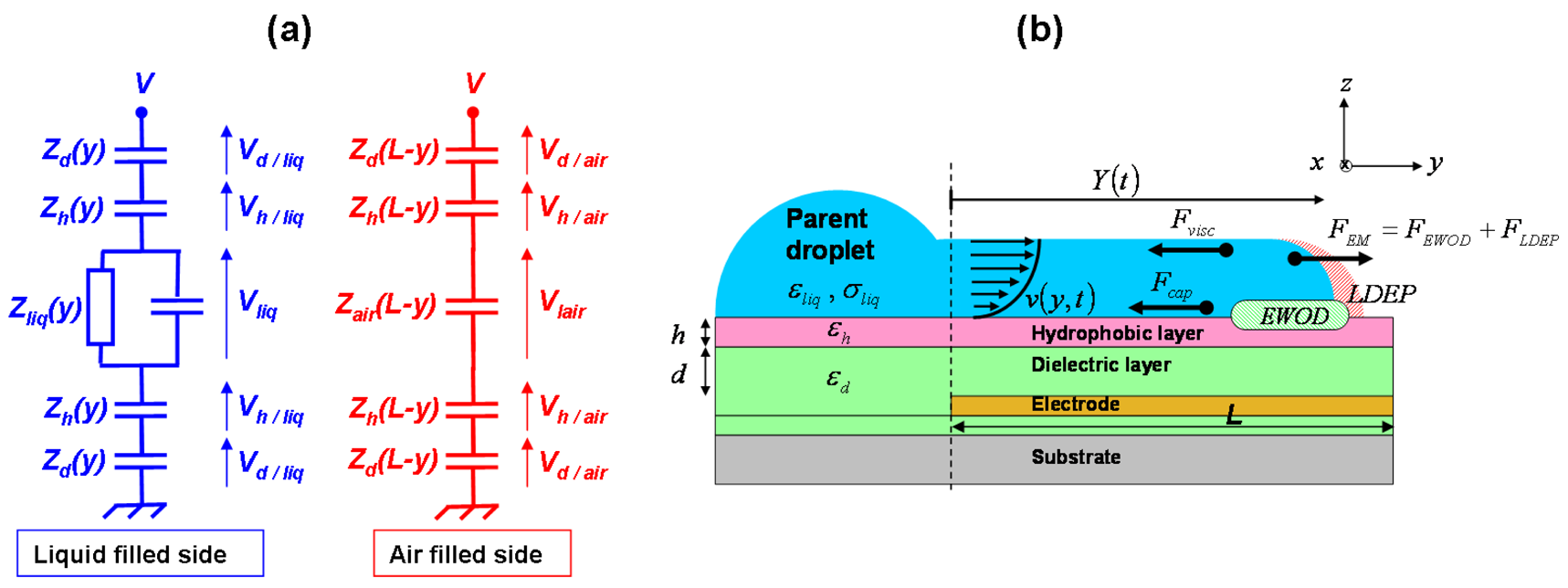
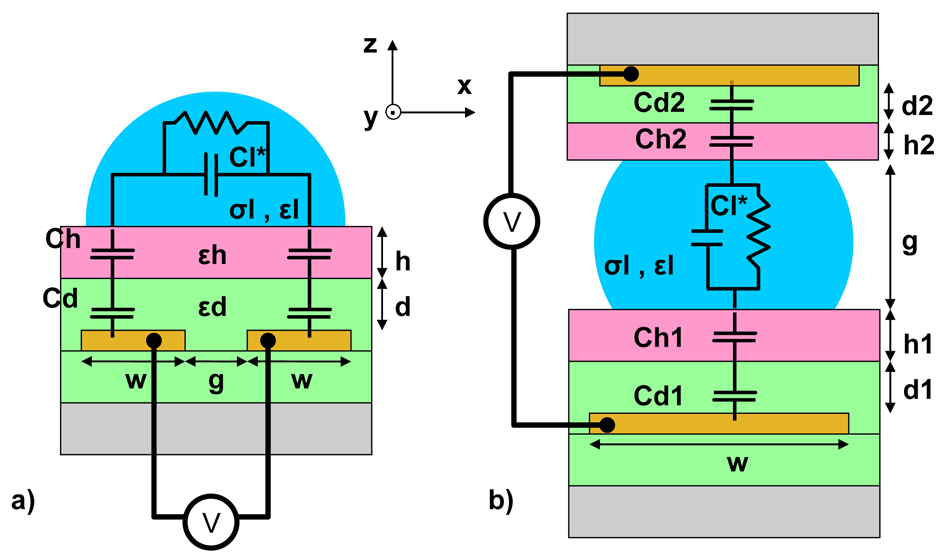
<p>In order to calculate the electromechanical force, the system is modeled as an equivalent electrical circuit. The equivalent circuit is described in <xref ref-type="fig" rid="f2-micromachines-02-00258">Figure 2(a)</xref>. Each dielectric/hydrophobic layer is considered as a pure capacitance. The liquid, as an imperfect conductor, is modeled using a resistance and a parallel capacitance. <italic>Z<sub>d</sub></italic>, <italic>Z<sub>h</sub></italic>, <italic>Z<sub>liq</sub></italic> and <italic>Z<sub>air</sub></italic> represent respectively the impedance of the dielectric layer, of the hydrophobic layer, of the liquid and of the air in the case of a single-plate open microfluidic device. The model described in this paragraph is related to the single-plate open microfluidic device configuration. A comparison between both configurations is presented later on.</p>
<p>The equivalent RC electrical circuit model is illustrated on the <xref ref-type="fig" rid="f2-micromachines-02-00258">Figure 2(a)</xref> where <italic>ε<sub>0</sub></italic>, <italic>ε<sub>d</sub></italic>, <italic>ε<sub>h</sub></italic>, <italic>ε<sub>liq</sub></italic> and <italic>σ<sub>liq</sub></italic>, are respectively the vacuum permittivity, the dielectric layer permittivity, the hydrophobic layer permittivity, the dielectric constant and the conductivity of the liquid. <italic>d</italic>, <italic>h</italic>, <italic>w</italic> and <italic>g</italic> represent respectively the dielectric layer thickness, the hydrophobic layer thickness, the electrode width and the inter-electrode gap. <italic>K(k)</italic> is the complete elliptic integral of the first kind [<xref ref-type="bibr" rid="b20-micromachines-02-00258">20</xref>] and its modulus is
<inline-formula>
<mml:math id="mm1" display="inline">
<mml:semantics id="sm1">
<mml:mrow>
<mml:mi>k</mml:mi>
<mml:mo>=</mml:mo>
<mml:mfrac>
<mml:mi>g</mml:mi>
<mml:mrow>
<mml:mi>g</mml:mi>
<mml:mo>+</mml:mo>
<mml:mn>2</mml:mn>
<mml:mi>w</mml:mi></mml:mrow></mml:mfrac></mml:mrow></mml:semantics></mml:math></inline-formula>. Lastly, the liquid is defined by a capacitance value <italic>C<sub>liq</sub></italic> and a conductance value <italic>g<sub>liq</sub></italic>.</p>
<p>Based on the equivalent circuit model [<xref ref-type="fig" rid="f2-micromachines-02-00258">Figure 2(a)</xref>], the electric potentials across each layer can be evaluated as a function of the RMS applied tension <italic>V</italic> and the complex impedances of the system. The total energy inside the system is deduced from the sum of each potential energy stored by each capacitance of the device [<xref ref-type="bibr" rid="b22-micromachines-02-00258">22</xref>]:
<disp-formula id="FD1">
<label>(10)</label>
<mml:math id="mm2" display="block">
<mml:semantics id="sm2">
<mml:mrow>
<mml:mi>U</mml:mi>
<mml:mo>=</mml:mo>
<mml:munder>
<mml:mo>∑</mml:mo>
<mml:mi>i</mml:mi></mml:munder>
<mml:mrow>
<mml:mfrac>
<mml:mn>1</mml:mn>
<mml:mn>2</mml:mn></mml:mfrac>
<mml:msub>
<mml:mi>C</mml:mi>
<mml:mi>i</mml:mi></mml:msub>
<mml:msubsup>
<mml:mi>V</mml:mi>
<mml:mi>i</mml:mi>
<mml:mn>2</mml:mn></mml:msubsup></mml:mrow></mml:mrow></mml:semantics></mml:math></disp-formula>
<disp-formula id="FD2">
<label>(11)</label>
<mml:math id="mm3" display="block">
<mml:semantics id="sm3">
<mml:mrow>
<mml:msub>
<mml:mi>V</mml:mi>
<mml:mi>i</mml:mi></mml:msub>
<mml:mo>=</mml:mo>
<mml:mfrac>
<mml:mrow>
<mml:msub>
<mml:mi>Z</mml:mi>
<mml:mi>i</mml:mi></mml:msub></mml:mrow>
<mml:mrow>
<mml:munder>
<mml:mtext>∑</mml:mtext>
<mml:mi>j</mml:mi></mml:munder>
<mml:mrow>
<mml:msub>
<mml:mi>Z</mml:mi>
<mml:mi>j</mml:mi></mml:msub></mml:mrow></mml:mrow></mml:mfrac>
<mml:mi>V</mml:mi></mml:mrow></mml:semantics></mml:math></disp-formula>where <italic>C<sub>i</sub></italic> is the capacitance and <italic>V<sub>i</sub></italic> the voltage at the terminals of the i<sup>th</sup> circuit element.</p>
<p>Considering all the capacitances inside the device, the total electromechanical force can now be expressed from the total energy derived with respect to the displacement direction (here according to the y-axis), and is given by:
<disp-formula id="FD3">
<label>(12)</label>
<mml:math id="mm4" display="block">
<mml:semantics id="sm4">
<mml:mrow>
<mml:msub>
<mml:mi>F</mml:mi>
<mml:mrow>
<mml:mi>E</mml:mi>
<mml:mi>M</mml:mi></mml:mrow></mml:msub>
<mml:mo>=</mml:mo>
<mml:mfrac>
<mml:mrow>
<mml:mo>∂</mml:mo>
<mml:mi>U</mml:mi></mml:mrow>
<mml:mrow>
<mml:mo>∂</mml:mo>
<mml:mi>y</mml:mi></mml:mrow></mml:mfrac>
<mml:mo>=</mml:mo>
<mml:msub>
<mml:mi>ε</mml:mi>
<mml:mn>0</mml:mn></mml:msub>
<mml:munder>
<mml:munder>
<mml:mrow>
<mml:msub>
<mml:mi>C</mml:mi>
<mml:mi>d</mml:mi></mml:msub>
<mml:mspace width="0.2em"/>
<mml:mrow>
<mml:mo>(</mml:mo>
<mml:mrow>
<mml:msup>
<mml:mrow>
<mml:msub>
<mml:mi>V</mml:mi>
<mml:mrow>
<mml:mi>d</mml:mi>
<mml:mo>/</mml:mo>
<mml:mtext mathvariant="italic">liq</mml:mtext></mml:mrow></mml:msub></mml:mrow>
<mml:mn>2</mml:mn></mml:msup>
<mml:mo>−</mml:mo>
<mml:msup>
<mml:mrow>
<mml:msub>
<mml:mi>V</mml:mi>
<mml:mrow>
<mml:mi>d</mml:mi>
<mml:mo>/</mml:mo>
<mml:mtext mathvariant="italic">air</mml:mtext></mml:mrow></mml:msub></mml:mrow>
<mml:mn>2</mml:mn></mml:msup></mml:mrow>
<mml:mo>)</mml:mo></mml:mrow>
<mml:mo>+</mml:mo>
<mml:msub>
<mml:mi>ε</mml:mi>
<mml:mn>0</mml:mn></mml:msub>
<mml:msub>
<mml:mi>C</mml:mi>
<mml:mi>h</mml:mi></mml:msub>
<mml:mspace width="0.2em"/>
<mml:mrow>
<mml:mo>(</mml:mo>
<mml:mrow>
<mml:msup>
<mml:mrow>
<mml:msub>
<mml:mi>V</mml:mi>
<mml:mrow>
<mml:mi>h</mml:mi>
<mml:mo>/</mml:mo>
<mml:mtext mathvariant="italic">liq</mml:mtext></mml:mrow></mml:msub></mml:mrow>
<mml:mn>2</mml:mn></mml:msup>
<mml:mo>−</mml:mo>
<mml:msup>
<mml:mrow>
<mml:msub>
<mml:mi>V</mml:mi>
<mml:mrow>
<mml:mi>h</mml:mi>
<mml:mo>/</mml:mo>
<mml:mtext mathvariant="italic">air</mml:mtext></mml:mrow></mml:msub></mml:mrow>
<mml:mn>2</mml:mn></mml:msup></mml:mrow>
<mml:mo>)</mml:mo></mml:mrow></mml:mrow>
<mml:mo stretchy="true">︸</mml:mo></mml:munder>
<mml:mrow>
<mml:msub>
<mml:mi>F</mml:mi>
<mml:mrow>
<mml:mtext mathvariant="italic">EWOD</mml:mtext></mml:mrow></mml:msub></mml:mrow></mml:munder>
<mml:munder>
<mml:munder>
<mml:mrow>
<mml:mo>+</mml:mo>
<mml:mfrac>
<mml:mrow>
<mml:msub>
<mml:mi>ε</mml:mi>
<mml:mn>0</mml:mn></mml:msub></mml:mrow>
<mml:mn>2</mml:mn></mml:mfrac>
<mml:mrow>
<mml:mo>(</mml:mo>
<mml:mrow>
<mml:msub>
<mml:mi>C</mml:mi>
<mml:mrow>
<mml:mtext mathvariant="italic">liq</mml:mtext></mml:mrow></mml:msub>
<mml:msup>
<mml:mrow>
<mml:msub>
<mml:mi>V</mml:mi>
<mml:mrow>
<mml:mtext mathvariant="italic">liq</mml:mtext></mml:mrow></mml:msub></mml:mrow>
<mml:mn>2</mml:mn></mml:msup>
<mml:mo>−</mml:mo>
<mml:msub>
<mml:mi>C</mml:mi>
<mml:mrow>
<mml:mtext mathvariant="italic">air</mml:mtext></mml:mrow></mml:msub>
<mml:msup>
<mml:mrow>
<mml:msub>
<mml:mi>V</mml:mi>
<mml:mrow>
<mml:mtext mathvariant="italic">air</mml:mtext></mml:mrow></mml:msub></mml:mrow>
<mml:mn>2</mml:mn></mml:msup></mml:mrow>
<mml:mo>)</mml:mo></mml:mrow></mml:mrow>
<mml:mo stretchy="true">︸</mml:mo></mml:munder>
<mml:mrow>
<mml:msub>
<mml:mi>F</mml:mi>
<mml:mrow>
<mml:mtext mathvariant="italic">LDEP</mml:mtext></mml:mrow></mml:msub></mml:mrow></mml:munder></mml:mrow></mml:semantics></mml:math></disp-formula>where <italic>V<sub>d/liq</sub></italic>, <italic>V<sub>d/air</sub></italic>, <italic>V<sub>h/liq</sub></italic>, <italic>V<sub>h/air</sub></italic>, <italic>V<sub>liq</sub></italic> and <italic>V<sub>air</sub></italic> represent the voltage across the dielectric layer at the liquid filled side and the air filled side, the voltage across the hydrophobic layer at the liquid filled side and the air filled side, the voltage of the liquid and the voltage of the surrounding air respectively [<xref ref-type="fig" rid="f2-micromachines-02-00258">Figure 2(a)</xref>]. Chaterjee <italic>et al.</italic> [<xref ref-type="bibr" rid="b22-micromachines-02-00258">22</xref>] assume the total force to be the sum of the EWOD force acting at the three-phase contact line and the LDEP force acting on the liquid-air interface advancing side.</p>
<p>An important parameter of LDEP actuation is the threshold frequency <italic>f<sub>c</sub></italic> of the AC electric field. Since liquids conductivity varies according to the applied voltage AC frequency, <italic>f<sub>c</sub></italic> represents a transition in the liquid behavior. When <italic>f</italic> ≪ <italic>f<sub>c</sub></italic>, the liquid behaves as a conductor (the liquid is isopotential) and is predominantly moved by EWOD forces. On the contrary if <italic>f</italic> ≫ <italic>f<sub>c</sub></italic>, the liquid behaves as a dielectric (electric field lines entering the liquid) and is moved using the LDEP forces. Literal expression of <italic>f<sub>c</sub></italic> is thereby written as the ratio of the overall capacitance of the liquid filled side over its total conductance [left branch of equivalent electric circuit in <xref ref-type="fig" rid="f2-micromachines-02-00258">Figure 2(a)</xref>].</p>
<disp-formula id="FD4">
<label>(13)</label>
<mml:math id="mm5" display="block">
<mml:semantics id="sm5">
<mml:mrow>
<mml:msub>
<mml:mi>f</mml:mi>
<mml:mi>c</mml:mi></mml:msub>
<mml:mo>=</mml:mo>
<mml:mfrac>
<mml:mn>1</mml:mn>
<mml:mrow>
<mml:mn>2</mml:mn>
<mml:mi>π</mml:mi></mml:mrow></mml:mfrac>
<mml:mfrac>
<mml:mrow>
<mml:msub>
<mml:mi>g</mml:mi>
<mml:mrow>
<mml:mi>l</mml:mi>
<mml:mi>i</mml:mi>
<mml:mi>g</mml:mi></mml:mrow></mml:msub></mml:mrow>
<mml:mrow>
<mml:msub>
<mml:mi>C</mml:mi>
<mml:mrow>
<mml:mi>e</mml:mi>
<mml:mi>q</mml:mi></mml:mrow></mml:msub></mml:mrow></mml:mfrac>
<mml:mo>=</mml:mo>
<mml:mfrac>
<mml:mn>1</mml:mn>
<mml:mrow>
<mml:mn>2</mml:mn>
<mml:mi>π</mml:mi></mml:mrow></mml:mfrac>
<mml:mfrac>
<mml:mrow>
<mml:msub>
<mml:mi>g</mml:mi>
<mml:mrow>
<mml:mtext mathvariant="italic">liq</mml:mtext></mml:mrow></mml:msub>
<mml:mo stretchy="false">(</mml:mo>
<mml:msub>
<mml:mi>C</mml:mi>
<mml:mi>d</mml:mi></mml:msub>
<mml:mo>+</mml:mo>
<mml:msub>
<mml:mi>C</mml:mi>
<mml:mi>h</mml:mi></mml:msub>
<mml:mo stretchy="false">)</mml:mo></mml:mrow>
<mml:mrow>
<mml:msub>
<mml:mi>C</mml:mi>
<mml:mi>d</mml:mi></mml:msub>
<mml:msub>
<mml:mi>C</mml:mi>
<mml:mrow>
<mml:mtext mathvariant="italic">liq</mml:mtext></mml:mrow></mml:msub>
<mml:mo>+</mml:mo>
<mml:msub>
<mml:mi>C</mml:mi>
<mml:mi>h</mml:mi></mml:msub>
<mml:msub>
<mml:mi>C</mml:mi>
<mml:mrow>
<mml:mtext mathvariant="italic">liq</mml:mtext></mml:mrow></mml:msub>
<mml:mo>+</mml:mo>
<mml:mfrac>
<mml:mrow>
<mml:msub>
<mml:mi>C</mml:mi>
<mml:mi>d</mml:mi></mml:msub>
<mml:msub>
<mml:mi>C</mml:mi>
<mml:mi>h</mml:mi></mml:msub></mml:mrow>
<mml:mn>2</mml:mn></mml:mfrac></mml:mrow></mml:mfrac></mml:mrow></mml:semantics></mml:math></disp-formula>
<p>Given the expression of both the electromechanical force and the other forces acting on the liquid (e.g., the capillary force <italic>F<sub>cap</sub></italic> and the viscous force <italic>F<sub>visc</sub></italic>), the fundamental dynamic principle leads to a literal expression describing both the position and velocity of the liquid finger as a function of time [<xref ref-type="bibr" rid="b29-micromachines-02-00258">29</xref>]
<disp-formula id="FD5">
<label>(14)</label>
<mml:math id="mm6" display="block">
<mml:semantics id="sm6">
<mml:mrow>
<mml:mi>ρ</mml:mi>
<mml:mfrac>
<mml:mrow>
<mml:mi>π</mml:mi>
<mml:msup>
<mml:mrow>
<mml:mrow>
<mml:mo>(</mml:mo>
<mml:mrow>
<mml:mi>w</mml:mi>
<mml:mo>+</mml:mo>
<mml:mfrac>
<mml:mi>g</mml:mi>
<mml:mn>2</mml:mn></mml:mfrac></mml:mrow>
<mml:mo>)</mml:mo></mml:mrow></mml:mrow>
<mml:mn>2</mml:mn></mml:msup></mml:mrow>
<mml:mn>2</mml:mn></mml:mfrac>
<mml:mfrac>
<mml:mi>d</mml:mi>
<mml:mrow>
<mml:mi>d</mml:mi>
<mml:mi>t</mml:mi></mml:mrow></mml:mfrac>
<mml:mrow>
<mml:mo>[</mml:mo>
<mml:mrow>
<mml:mi>y</mml:mi>
<mml:mfrac>
<mml:mrow>
<mml:mi>d</mml:mi>
<mml:mi>y</mml:mi></mml:mrow>
<mml:mrow>
<mml:mi>d</mml:mi>
<mml:mi>t</mml:mi></mml:mrow></mml:mfrac></mml:mrow>
<mml:mo>]</mml:mo></mml:mrow>
<mml:mo>=</mml:mo>
<mml:msub>
<mml:mi>F</mml:mi>
<mml:mrow>
<mml:mtext mathvariant="italic">EM</mml:mtext></mml:mrow></mml:msub>
<mml:mo>+</mml:mo>
<mml:msub>
<mml:mi>F</mml:mi>
<mml:mrow>
<mml:mtext mathvariant="italic">cap</mml:mtext></mml:mrow></mml:msub>
<mml:mo>+</mml:mo>
<mml:msub>
<mml:mi>F</mml:mi>
<mml:mrow>
<mml:mtext mathvariant="italic">visc</mml:mtext></mml:mrow></mml:msub>
<mml:mo stretchy="false">(</mml:mo>
<mml:mi>y</mml:mi>
<mml:mo>,</mml:mo>
<mml:mi>t</mml:mi>
<mml:mo stretchy="false">)</mml:mo></mml:mrow></mml:semantics></mml:math></disp-formula></p>
<p>At <italic>t</italic> = <italic>0</italic>, in order to enable the liquid to move along the y direction, the electromechanical force must overcome the capillary forces: <italic>F<sub>EM</sub></italic> &gt; <italic>F<sub>cap</sub></italic>. This condition is theoretically satisfied as soon as the RMS applied voltage <italic>V</italic> is higher than a threshold voltage <italic>V<sub>th</sub></italic> given by <xref rid="FD6" ref-type="disp-formula">Equation (15)</xref>.</p>
<disp-formula id="FD6">
<label>(15)</label>
<mml:math id="mm7" display="block">
<mml:semantics id="sm7">
<mml:mrow>
<mml:msub>
<mml:mi>V</mml:mi>
<mml:mrow>
<mml:mi>t</mml:mi>
<mml:mi>h</mml:mi></mml:mrow></mml:msub>
<mml:mo>=</mml:mo>
<mml:msqrt>
<mml:mrow>
<mml:mfrac>
<mml:mrow>
<mml:mn>2</mml:mn>
<mml:msub>
<mml:mi>F</mml:mi>
<mml:mrow>
<mml:mtext mathvariant="italic">cap</mml:mtext></mml:mrow></mml:msub></mml:mrow>
<mml:mrow>
<mml:mfrac>
<mml:mrow>
<mml:msub>
<mml:mi>ε</mml:mi>
<mml:mn>0</mml:mn></mml:msub></mml:mrow>
<mml:mrow>
<mml:mfrac>
<mml:mrow>
<mml:mn>2</mml:mn>
<mml:mi>d</mml:mi></mml:mrow>
<mml:mrow>
<mml:msub>
<mml:mi>ε</mml:mi>
<mml:mi>d</mml:mi></mml:msub>
<mml:mi>w</mml:mi></mml:mrow></mml:mfrac>
<mml:mo mathvariant="italic">+</mml:mo>
<mml:mfrac>
<mml:mrow>
<mml:mn>2</mml:mn>
<mml:mi>h</mml:mi></mml:mrow>
<mml:mrow>
<mml:msub>
<mml:mi>ε</mml:mi>
<mml:mi>h</mml:mi></mml:msub>
<mml:mi>w</mml:mi></mml:mrow></mml:mfrac>
<mml:mo>+</mml:mo>
<mml:mfrac>
<mml:mrow>
<mml:mn>2</mml:mn>
<mml:mi>K</mml:mi>
<mml:mo stretchy="false">(</mml:mo>
<mml:msup>
<mml:mi>k</mml:mi>
<mml:mn>2</mml:mn></mml:msup>
<mml:mo stretchy="false">)</mml:mo></mml:mrow>
<mml:mrow>
<mml:mi>K</mml:mi>
<mml:mo stretchy="false">(</mml:mo>
<mml:mn>1</mml:mn>
<mml:mo>−</mml:mo>
<mml:msup>
<mml:mi>k</mml:mi>
<mml:mn>2</mml:mn></mml:msup>
<mml:mo stretchy="false">)</mml:mo>
<mml:msqrt>
<mml:mrow>
<mml:msup>
<mml:mrow>
<mml:msub>
<mml:mi>ε</mml:mi>
<mml:mrow>
<mml:mtext mathvariant="italic">liq</mml:mtext></mml:mrow></mml:msub></mml:mrow>
<mml:mn>2</mml:mn></mml:msup>
<mml:mo>+</mml:mo>
<mml:msup>
<mml:mrow>
<mml:mrow>
<mml:mo>(</mml:mo>
<mml:mrow>
<mml:mfrac>
<mml:mrow>
<mml:msub>
<mml:mi>σ</mml:mi>
<mml:mrow>
<mml:mtext mathvariant="italic">liq</mml:mtext></mml:mrow></mml:msub></mml:mrow>
<mml:mrow>
<mml:msub>
<mml:mi>ε</mml:mi>
<mml:mn>0</mml:mn></mml:msub>
<mml:mn>2</mml:mn>
<mml:mi>π</mml:mi>
<mml:mi>f</mml:mi></mml:mrow></mml:mfrac></mml:mrow>
<mml:mo>)</mml:mo></mml:mrow></mml:mrow>
<mml:mn>2</mml:mn></mml:msup></mml:mrow></mml:msqrt></mml:mrow></mml:mfrac></mml:mrow></mml:mfrac>
<mml:mo>−</mml:mo>
<mml:mfrac>
<mml:mrow>
<mml:msub>
<mml:mi>ε</mml:mi>
<mml:mn>0</mml:mn></mml:msub></mml:mrow>
<mml:mrow>
<mml:mfrac>
<mml:mrow>
<mml:mn>2</mml:mn>
<mml:mi>d</mml:mi></mml:mrow>
<mml:mrow>
<mml:msub>
<mml:mi>ε</mml:mi>
<mml:mi>d</mml:mi></mml:msub>
<mml:mi>w</mml:mi></mml:mrow></mml:mfrac>
<mml:mo>+</mml:mo>
<mml:mfrac>
<mml:mrow>
<mml:mn>2</mml:mn>
<mml:mi>h</mml:mi></mml:mrow>
<mml:mrow>
<mml:msub>
<mml:mi>ε</mml:mi>
<mml:mi>h</mml:mi></mml:msub>
<mml:mi>w</mml:mi></mml:mrow></mml:mfrac>
<mml:mo>+</mml:mo>
<mml:mfrac>
<mml:mrow>
<mml:mn>2</mml:mn>
<mml:mi>K</mml:mi>
<mml:mo stretchy="false">(</mml:mo>
<mml:msup>
<mml:mi>k</mml:mi>
<mml:mn>2</mml:mn></mml:msup>
<mml:mo stretchy="false">)</mml:mo></mml:mrow>
<mml:mrow>
<mml:mi>K</mml:mi>
<mml:mo stretchy="false">(</mml:mo>
<mml:mn>1</mml:mn>
<mml:mo>−</mml:mo>
<mml:msup>
<mml:mi>k</mml:mi>
<mml:mn>2</mml:mn></mml:msup>
<mml:mo stretchy="false">)</mml:mo></mml:mrow></mml:mfrac></mml:mrow></mml:mfrac></mml:mrow></mml:mfrac></mml:mrow></mml:msqrt></mml:mrow></mml:semantics></mml:math></disp-formula>
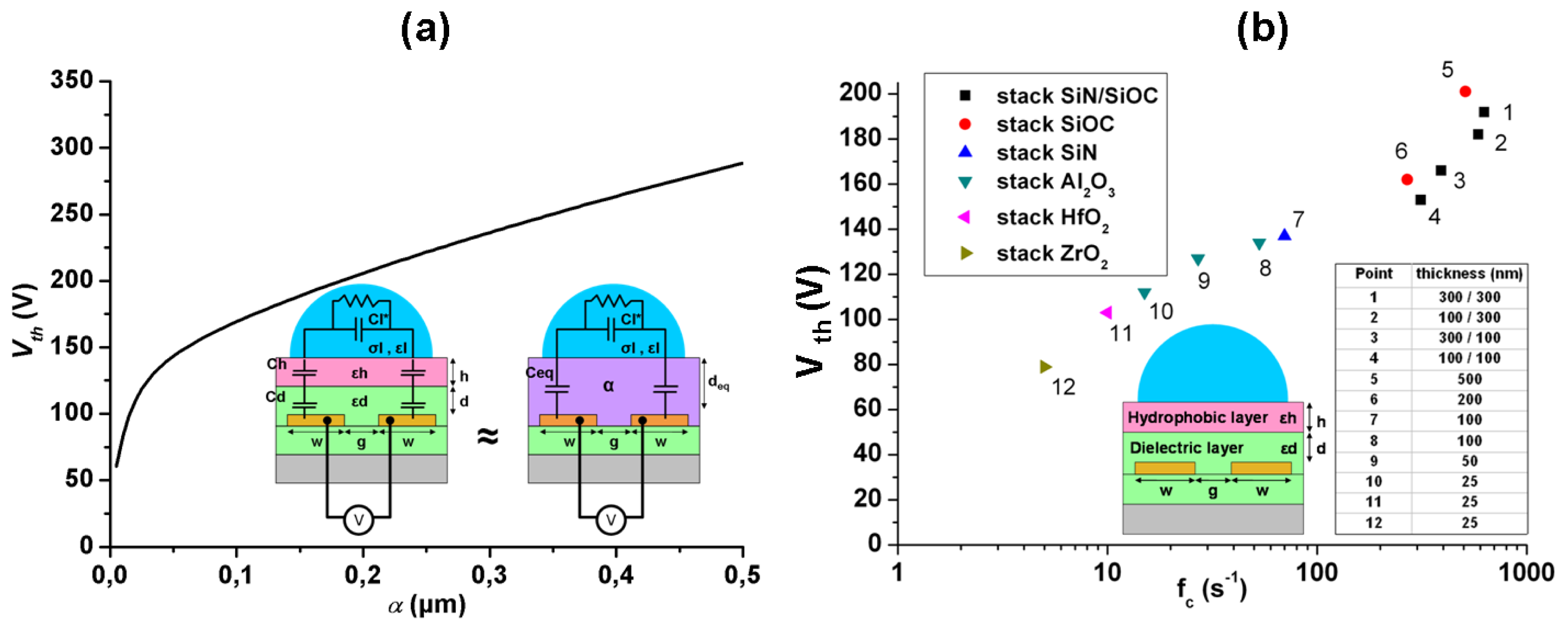
<p>The expression <xref rid="FD6" ref-type="disp-formula">(15)</xref> is associated to a typical stack composed of a dielectric layer (dielectric constant ε<sub>d</sub>, thickness <italic>d</italic>) and a hydrophobic layer (dielectric constant ε<sub>h</sub>, thickness <italic>h</italic>). The characteristic length <italic>α</italic> is introduced hereafter <xref rid="FD8" ref-type="disp-formula">(17)</xref>, and refers to the global dielectric/hydrophobic layer stack properties. As α is increasing, <italic>V<sub>th</sub></italic> is increasing satisfying the following <xref rid="FD7" ref-type="disp-formula">Equation (16)</xref>:
<disp-formula id="FD7">
<label>(16)</label>
<mml:math id="mm8" display="block">
<mml:semantics id="sm8">
<mml:mrow>
<mml:msub>
<mml:mi>V</mml:mi>
<mml:mrow>
<mml:mtext mathvariant="italic">th</mml:mtext></mml:mrow></mml:msub>
<mml:mo>=</mml:mo>
<mml:msqrt>
<mml:mrow>
<mml:mfrac>
<mml:mrow>
<mml:mn>2</mml:mn>
<mml:msub>
<mml:mi>F</mml:mi>
<mml:mrow>
<mml:mtext mathvariant="italic">cap</mml:mtext></mml:mrow></mml:msub>
<mml:mrow>
<mml:mo>(</mml:mo>
<mml:mrow>
<mml:mfrac>
<mml:mrow>
<mml:mn>2</mml:mn>
<mml:mspace width="0.2em"/>
<mml:mi>α</mml:mi></mml:mrow>
<mml:mrow>
<mml:msub>
<mml:mi>ε</mml:mi>
<mml:mn>0</mml:mn></mml:msub>
<mml:mspace width="0.2em"/>
<mml:mi>w</mml:mi></mml:mrow></mml:mfrac>
<mml:mo>+</mml:mo>
<mml:mfrac>
<mml:mn>1</mml:mn>
<mml:mrow>
<mml:msup>
<mml:mrow>
<mml:msub>
<mml:mi>C</mml:mi>
<mml:mrow>
<mml:mtext mathvariant="italic">liq</mml:mtext></mml:mrow></mml:msub></mml:mrow>
<mml:mo>*</mml:mo></mml:msup></mml:mrow></mml:mfrac></mml:mrow>
<mml:mo>)</mml:mo></mml:mrow>
<mml:mrow>
<mml:mo>(</mml:mo>
<mml:mrow>
<mml:mfrac>
<mml:mrow>
<mml:mn>2</mml:mn>
<mml:mspace width="0.2em"/>
<mml:mi>α</mml:mi></mml:mrow>
<mml:mrow>
<mml:msub>
<mml:mi>ε</mml:mi>
<mml:mn>0</mml:mn></mml:msub>
<mml:mspace width="0.2em"/>
<mml:mi>w</mml:mi></mml:mrow></mml:mfrac>
<mml:mo>+</mml:mo>
<mml:mfrac>
<mml:mn>1</mml:mn>
<mml:mrow>
<mml:msup>
<mml:mrow>
<mml:msub>
<mml:mi>C</mml:mi>
<mml:mrow>
<mml:mtext mathvariant="italic">air</mml:mtext></mml:mrow></mml:msub></mml:mrow>
<mml:mo>*</mml:mo></mml:msup></mml:mrow></mml:mfrac></mml:mrow>
<mml:mo>)</mml:mo></mml:mrow></mml:mrow>
<mml:mrow>
<mml:mfrac>
<mml:mn>1</mml:mn>
<mml:mrow>
<mml:msup>
<mml:mrow>
<mml:msub>
<mml:mi>C</mml:mi>
<mml:mrow>
<mml:mtext mathvariant="italic">liq</mml:mtext></mml:mrow></mml:msub></mml:mrow>
<mml:mo>*</mml:mo></mml:msup></mml:mrow></mml:mfrac>
<mml:mo>−</mml:mo>
<mml:mfrac>
<mml:mn>1</mml:mn>
<mml:mrow>
<mml:msup>
<mml:mrow>
<mml:msub>
<mml:mi>C</mml:mi>
<mml:mrow>
<mml:mtext mathvariant="italic">air</mml:mtext></mml:mrow></mml:msub></mml:mrow>
<mml:mo>*</mml:mo></mml:msup></mml:mrow></mml:mfrac></mml:mrow></mml:mfrac></mml:mrow></mml:msqrt></mml:mrow></mml:semantics></mml:math></disp-formula>
<disp-formula id="FD8">
<label>(17)</label>
<mml:math id="mm9" display="block">
<mml:semantics id="sm9">
<mml:mrow>
<mml:mi>α</mml:mi>
<mml:mo>=</mml:mo>
<mml:mfrac>
<mml:mrow>
<mml:mi>h</mml:mi>
<mml:mspace width="0.2em"/>
<mml:msub>
<mml:mi>ε</mml:mi>
<mml:mi>d</mml:mi></mml:msub>
<mml:mo>+</mml:mo>
<mml:mi>d</mml:mi>
<mml:mspace width="0.2em"/>
<mml:msub>
<mml:mi>ε</mml:mi>
<mml:mi>h</mml:mi></mml:msub></mml:mrow>
<mml:mrow>
<mml:msub>
<mml:mi>ε</mml:mi>
<mml:mi>d</mml:mi></mml:msub>
<mml:mspace width="0.2em"/>
<mml:msub>
<mml:mi>ε</mml:mi>
<mml:mi>h</mml:mi></mml:msub></mml:mrow></mml:mfrac></mml:mrow></mml:semantics></mml:math></disp-formula>where <italic>C<sub>liq</sub></italic> * and <italic>C<sub>air</sub></italic> * are respectively the capacitance of liquid and air derived with respect to the liquid displacement direction.</p>
<p>The previous expression is valid for chips composed of either two independent layers (an hydrophobic layer onto a dielectric layer) or a single layer featuring both dielectric and hydrophobic properties. The characteristic length <italic>α</italic> influence on the threshold voltage is inspected in Section 4.2.</p>
<p>The voltages across each layer, and therefore the electric fields contained in the layers or in the liquid, can be extracted from the previous LDEP model. Dielectric material has an inherent breakdown field. In order to prevent from dielectric breakdown voltage, the best matching in between dielectric and hydrophobic thicknesses can be adjusted by incorporating the electric field <italic>E<sub>h</sub></italic> (electric field across the hydrophobic layer) into the LDEP model. Indeed a linear relationship exists between thicknesses <italic>d</italic> and <italic>h</italic> as a function of <italic>E<sub>h</sub></italic> and the capacitances of the system. The relation <xref ref-type="disp-formula" rid="FD9">(18)</xref> is valid for <italic>V</italic> = <italic>V<sub>th</sub></italic> and the hydrophobic layer potential in the air filled side is neglected in regard with its potential in the liquid filled side.</p>
<disp-formula id="FD9">
<label>(18)</label>
<mml:math id="mm10" display="block">
<mml:semantics id="sm10">
<mml:mrow>
<mml:mi>h</mml:mi>
<mml:mo>=</mml:mo>
<mml:mo>−</mml:mo>
<mml:mfrac>
<mml:mrow>
<mml:msub>
<mml:mi>ε</mml:mi>
<mml:mi>h</mml:mi></mml:msub></mml:mrow>
<mml:mrow>
<mml:msub>
<mml:mi>ε</mml:mi>
<mml:mi>d</mml:mi></mml:msub></mml:mrow></mml:mfrac>
<mml:mspace width="0.4em"/>
<mml:mi>d</mml:mi>
<mml:mo>+</mml:mo>
<mml:mfrac>
<mml:mrow>
<mml:mfrac>
<mml:mrow>
<mml:msup>
<mml:mrow>
<mml:msub>
<mml:mi>E</mml:mi>
<mml:mi>h</mml:mi></mml:msub></mml:mrow>
<mml:mn>2</mml:mn></mml:msup></mml:mrow>
<mml:mrow>
<mml:mn>2</mml:mn>
<mml:msub>
<mml:mi>F</mml:mi>
<mml:mrow>
<mml:mtext mathvariant="italic">cap</mml:mtext></mml:mrow></mml:msub></mml:mrow></mml:mfrac>
<mml:mrow>
<mml:mo>(</mml:mo>
<mml:mrow>
<mml:msub>
<mml:mi>Z</mml:mi>
<mml:mrow>
<mml:mtext mathvariant="italic">liq</mml:mtext></mml:mrow></mml:msub>
<mml:msub>
<mml:mi>Z</mml:mi>
<mml:mrow>
<mml:mtext mathvariant="italic">air</mml:mtext></mml:mrow></mml:msub>
<mml:mo>−</mml:mo>
<mml:msup>
<mml:mrow>
<mml:msub>
<mml:mi>Z</mml:mi>
<mml:mrow>
<mml:mo mathvariant="italic">liq</mml:mo></mml:mrow></mml:msub></mml:mrow>
<mml:mn>2</mml:mn></mml:msup></mml:mrow>
<mml:mo>)</mml:mo></mml:mrow>
<mml:mo>−</mml:mo>
<mml:msup>
<mml:mrow>
<mml:msub>
<mml:mi>Z</mml:mi>
<mml:mi>h</mml:mi></mml:msub></mml:mrow>
<mml:mrow>
<mml:mo>*</mml:mo>
<mml:mn>2</mml:mn></mml:mrow></mml:msup>
<mml:msub>
<mml:mi>Z</mml:mi>
<mml:mrow>
<mml:mtext mathvariant="italic">liq</mml:mtext></mml:mrow></mml:msub></mml:mrow>
<mml:mrow>
<mml:mfrac>
<mml:mrow>
<mml:msup>
<mml:mrow>
<mml:msub>
<mml:mi>E</mml:mi>
<mml:mi>h</mml:mi></mml:msub></mml:mrow>
<mml:mn>2</mml:mn></mml:msup></mml:mrow>
<mml:mrow>
<mml:mn>2</mml:mn>
<mml:msub>
<mml:mi>F</mml:mi>
<mml:mrow>
<mml:mtext mathvariant="italic">cap</mml:mtext></mml:mrow></mml:msub></mml:mrow></mml:mfrac>
<mml:msup>
<mml:mrow>
<mml:msub>
<mml:mi>Z</mml:mi>
<mml:mi>h</mml:mi></mml:msub></mml:mrow>
<mml:mo>*</mml:mo></mml:msup>
<mml:mrow>
<mml:mo>(</mml:mo>
<mml:mrow>
<mml:mn>2</mml:mn>
<mml:msub>
<mml:mi>Z</mml:mi>
<mml:mrow>
<mml:mtext mathvariant="italic">air</mml:mtext></mml:mrow></mml:msub>
<mml:mo>−</mml:mo>
<mml:mn>2</mml:mn>
<mml:msub>
<mml:mi>Z</mml:mi>
<mml:mrow>
<mml:mtext mathvariant="italic">liq</mml:mtext></mml:mrow></mml:msub></mml:mrow>
<mml:mo>)</mml:mo></mml:mrow>
<mml:mo>−</mml:mo>
<mml:mn>2</mml:mn>
<mml:msup>
<mml:mrow>
<mml:msub>
<mml:mi>Z</mml:mi>
<mml:mi>h</mml:mi></mml:msub></mml:mrow>
<mml:mrow>
<mml:mo>*</mml:mo>
<mml:mn>3</mml:mn></mml:mrow></mml:msup></mml:mrow></mml:mfrac></mml:mrow></mml:semantics></mml:math></disp-formula>
<disp-formula id="FD10">
<label>(19)</label>
<mml:math id="mm11" display="block">
<mml:semantics id="sm11">
<mml:mrow>
<mml:msup>
<mml:mrow>
<mml:msub>
<mml:mi>Z</mml:mi>
<mml:mi>h</mml:mi></mml:msub></mml:mrow>
<mml:mo>*</mml:mo></mml:msup>
<mml:mo>=</mml:mo>
<mml:mfrac>
<mml:mn>1</mml:mn>
<mml:mrow>
<mml:mi>j</mml:mi>
<mml:mi>ω</mml:mi>
<mml:msub>
<mml:mi>ε</mml:mi>
<mml:mn>0</mml:mn></mml:msub>
<mml:mspace width="0.2em"/>
<mml:msub>
<mml:mi>ε</mml:mi>
<mml:mi>h</mml:mi></mml:msub>
<mml:mi>w</mml:mi></mml:mrow></mml:mfrac></mml:mrow></mml:semantics></mml:math></disp-formula>
<disp-formula id="FD11">
<label>(20)</label>
<mml:math id="mm12" display="block">
<mml:semantics id="sm12">
<mml:mrow>
<mml:msub>
<mml:mi>Z</mml:mi>
<mml:mrow>
<mml:mtext mathvariant="italic">liq</mml:mtext></mml:mrow></mml:msub>
<mml:mo>=</mml:mo>
<mml:mfrac>
<mml:mn>1</mml:mn>
<mml:mrow>
<mml:mi>j</mml:mi>
<mml:mi>ω</mml:mi>
<mml:msub>
<mml:mi>C</mml:mi>
<mml:mrow>
<mml:mtext mathvariant="italic">liq</mml:mtext></mml:mrow></mml:msub>
<mml:mo>+</mml:mo>
<mml:msub>
<mml:mi>g</mml:mi>
<mml:mrow>
<mml:mtext mathvariant="italic">liq</mml:mtext></mml:mrow></mml:msub></mml:mrow></mml:mfrac></mml:mrow></mml:semantics></mml:math></disp-formula>
<disp-formula id="FD12">
<label>(21)</label>
<mml:math id="mm13" display="block">
<mml:semantics id="sm13">
<mml:mrow>
<mml:msub>
<mml:mi>Z</mml:mi>
<mml:mrow>
<mml:mtext mathvariant="italic">air</mml:mtext></mml:mrow></mml:msub>
<mml:mo>=</mml:mo>
<mml:mfrac>
<mml:mn>1</mml:mn>
<mml:mrow>
<mml:mi>j</mml:mi>
<mml:mi>ω</mml:mi>
<mml:msub>
<mml:mi>C</mml:mi>
<mml:mrow>
<mml:mtext mathvariant="italic">air</mml:mtext></mml:mrow></mml:msub></mml:mrow></mml:mfrac></mml:mrow></mml:semantics></mml:math></disp-formula>
<p>Z<sub>h</sub>* represents the hydrophobic layer impedance per unit of length and is expressed in Ω.m<sup>−1</sup>. The threshold voltage used to optimize the LDEP device is exposed in <xref rid="FD6" ref-type="disp-formula">Equations (15)</xref> and <xref rid="FD7" ref-type="disp-formula">(16)</xref> for a frequency threshold written in <xref rid="FD4" ref-type="disp-formula">(13)</xref>. Similarly to the work of Saeki <italic>et al.</italic> [<xref ref-type="bibr" rid="b30-micromachines-02-00258">30</xref>] about voltage reduction for EWOD actuation, the next section deals with the influence of the parameters to be optimized in order to achieve LDEP actuation with low voltage and low frequency.</p></sec>
<sec sec-type="materials|methods">
<label>3.</label>
<title>Materials and Methods</title>
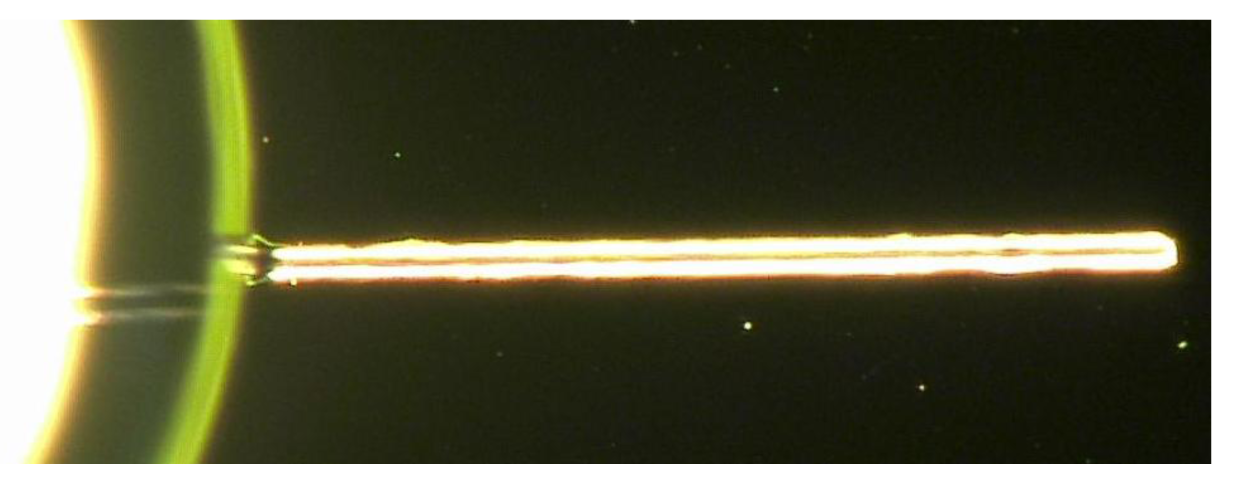
<p>In order to benchmark this model, the effect of the geometry has been studied experimentally, with the electrode width <italic>w</italic> ranging from 3 to 20 μm and the inter-electrodes gap <italic>g</italic> ranging from 2 to 20 μm. Since the model discussed previously focuses on protrusion generation and not on its break up into droplets, simple parallel coplanar electrodes have been designed (<xref ref-type="fig" rid="f3-micromachines-02-00258">Figure 3</xref>).</p>
<p>Chips have been manufactured by patterning 170 nm thick aluminum electrodes on a Si wafer (Pyrex), the latter being coated by a 100 nm Teflon-like passivating layer (on which DI water makes a contact angle <italic>θ</italic> = 110°).</p>
<p>The parent DI-water droplet is delivered with a manual 5 μL pipette directly on the electrodes. The experimental protocol consists in monitoring the threshold voltage which leads to a protrusion generation. All experiments have been done at 100 kHz.</p></sec>
<sec sec-type="results">
<label>4.</label>
<title>Numerical and Experimental Results</title>
<p>This section presents results towards the minimization of the threshold required voltage <italic>V<sub>th</sub></italic>. We present in Section 4.1 theoretical and experimental results showing the electrodes geometry effects onto <italic>V<sub>th</sub></italic>, in Section 4.2 the theoretical effect of materials on <italic>V<sub>th</sub></italic> (<italic>i.e.</italic>, the effect of the characteristic length <italic>α</italic>), in Section 4.3 the tradeoff in between the isolating layer(s) thickness reduction, and its electrical breakdown prevention is considered; and in Section 4.4 a comparison is carried out for both device microfluidic configurations.</p>
<sec>
<label>4.1.</label>
<title>Influence of Electrodes Dimensions</title>
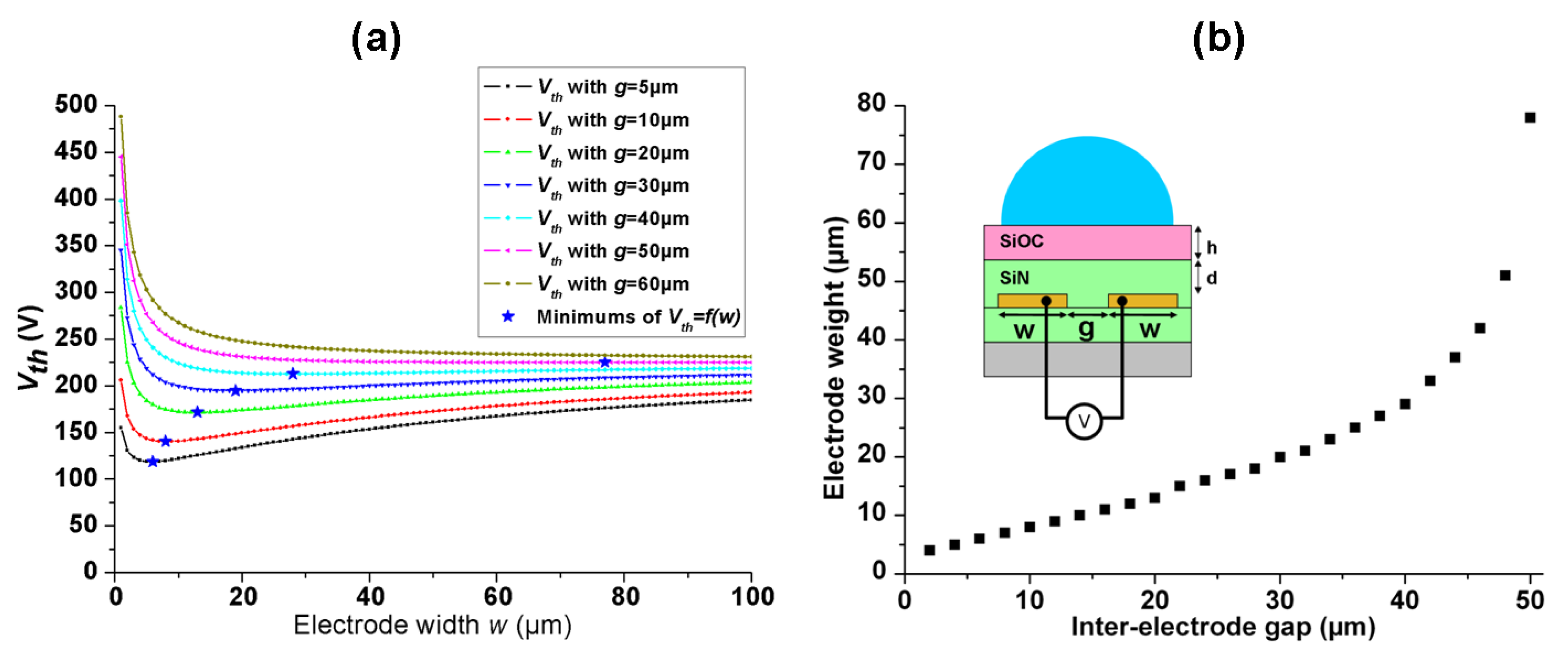
<p>The electrode width <italic>w</italic> and the inter-electrodes gap <italic>g</italic> determine both the droplet size and the threshold actuation voltage <italic>V<sub>th</sub></italic>. Consequently, they have to be carefully designed according to the final application. <xref ref-type="fig" rid="f4-micromachines-02-00258">Figure 4</xref> shows that <italic>V<sub>th</sub></italic> can be reduced by setting properly the parameters (<italic>w;g</italic>) for a given liquid volume. Indeed, <xref ref-type="fig" rid="f4-micromachines-02-00258">Figure 4(a)</xref> depicts <italic>V<sub>th</sub></italic> as a function of the electrode width <italic>w</italic> for a given inter-electrode gap <italic>g</italic>, highlighting the existence of a local minimum value. <xref ref-type="fig" rid="f4-micromachines-02-00258">Figure 4(b)</xref> shows the relationship between <italic>w</italic> and <italic>g</italic> corresponding to these <italic>minima</italic>. The simulations in <xref ref-type="fig" rid="f4-micromachines-02-00258">Figure 4</xref> have been carried out for ultra-pure water (<italic>σ<sub>liq</sub></italic> = 6 × 10<sup>−6</sup> S m<sup>−1</sup> and <italic>ε<sub>liq</sub></italic> = 80), while setting the applied frequency value <italic>f</italic> one order of magnitude above the critical frequency (<italic>f</italic> = <italic>10f<sub>c</sub></italic>), in order to clearly actuate the liquid in the LDEP regime. These results show that <italic>V<sub>th</sub></italic> voltage can be set 25 V lower than its usual value providing <italic>w</italic> and <italic>g</italic> are properly adjusted. As one may see in <xref ref-type="fig" rid="f4-micromachines-02-00258">Figure 4(a)</xref>, we point out that this minimum does not always exist. Indeed, above a critical gap <italic>V<sub>th</sub></italic> is monotonically decreasing while increasing electrode width <italic>w</italic>. As a conclusion, <italic>V<sub>th</sub></italic> can be reduced by maximizing the ratio
<inline-formula>
<mml:math id="mm14" display="inline">
<mml:semantics id="sm14">
<mml:mrow>
<mml:mfrac>
<mml:mi>w</mml:mi>
<mml:mi>g</mml:mi></mml:mfrac></mml:mrow></mml:semantics></mml:math></inline-formula>.</p>
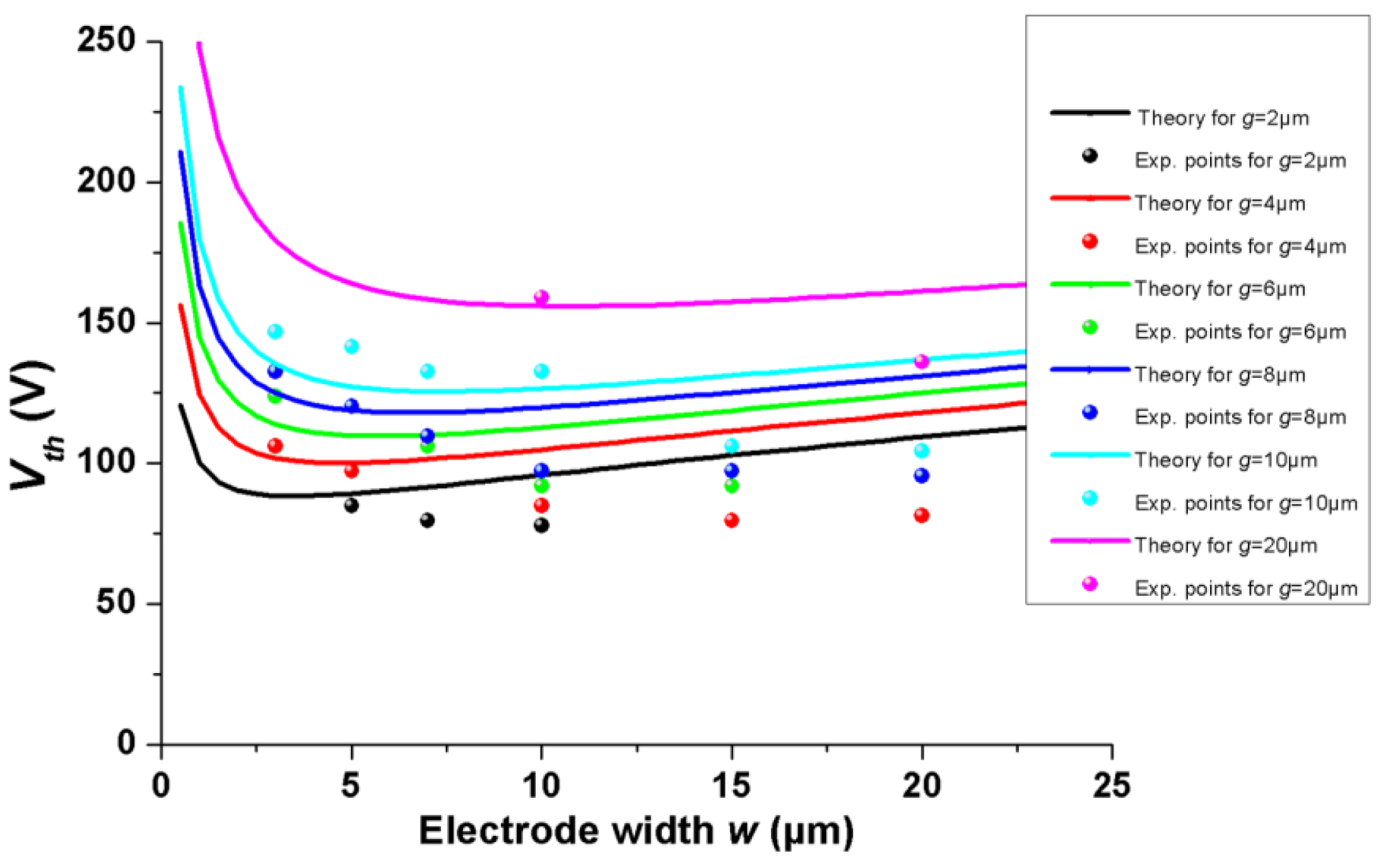
<p>Simulation results have been compared with experimental data corresponding to the materials described in Section 3. <xref ref-type="fig" rid="f5-micromachines-02-00258">Figure 5</xref> shows a three-dimensional plot of simulated and measured <italic>V<sub>th</sub></italic> as a function of <italic>w</italic> and <italic>g</italic> The overall order of magnitude for experimental data is in fair agreement with the simulations: the percentage error can reach 40% for some experimental points. We may explain this discrepancy by omission in our model of the liquid contact angle <italic>θ</italic> dependence regarding the applied voltage into the capillary forces expression (presently <italic>θ</italic> value is fixed to <italic>π</italic>/<italic>2</italic>). A current work is in progress to address this issue. Other phenomena may also be included such as friction forces applied to the liquid at the three-phase contact line [<xref ref-type="bibr" rid="b31-micromachines-02-00258">31</xref>]. However, those additional studies, although relevant, will certainly increase the complexity of the model, which presently gives quite fair tendency</p></sec>
<sec sec-type="materials">
<label>4.2.</label>
<title>Influence of the Chips Constituent Materials on the Threshold Voltage V<sub>th</sub></title>
<p>For LDEP actuation, the constituent materials must be carefully chosen in order to minimize the threshold voltage <italic>V<sub>th</sub></italic>. The <italic>V<sub>th</sub></italic> value computed from <xref rid="FD7" ref-type="disp-formula">Equation (16)</xref> has been plotted in <xref ref-type="fig" rid="f6-micromachines-02-00258">Figure 6(a)</xref>, for <italic>α</italic> ranging from 0.1 μm (corresponding to <italic>f</italic> = <italic>10f<sub>c</sub></italic> = 340 Hz) to 0.5 μm (corresponding to <italic>f</italic> = <italic>10f<sub>c</sub></italic> = 820 Hz). This curve confirms that the characteristic length <italic>α</italic> should be reduced (in other words, high global dielectric constant together with thin overall thickness is preferred) in order to lower <italic>V<sub>th</sub></italic>. From this consideration, using high-k materials as dielectric layer might be a promising strategy to pursue. Recently, Chang <italic>et al.</italic> [<xref ref-type="bibr" rid="b32-micromachines-02-00258">32</xref>] have demonstrated threshold voltage below 5 V for water droplet EWOD actuation, using Alumina Al<sub>2</sub>O<sub>3</sub> (<italic>ε</italic><sub><italic>Al</italic><sub>2</sub><italic>O</italic><sub>3</sub></sub> ≈ 8) deposited by Atomic Layer Deposition (ALD) as a dielectric layer. Diagram in <xref ref-type="fig" rid="f6-micromachines-02-00258">Figure 6(b)</xref> illustrate the expected <italic>V<sub>th</sub></italic>, <italic>f<sub>c</sub></italic> parameters for representative materials. According to the material and the related process, the constituent layers thicknesses vary as indicated in the <xref ref-type="fig" rid="f6-micromachines-02-00258">Figure 6(b)</xref> caption.</p></sec>
<sec sec-type="materials">
<label>4.3.</label>
<title>Influence of the Chips Constituent Materials on the Dielectric Breakdown Limit</title>
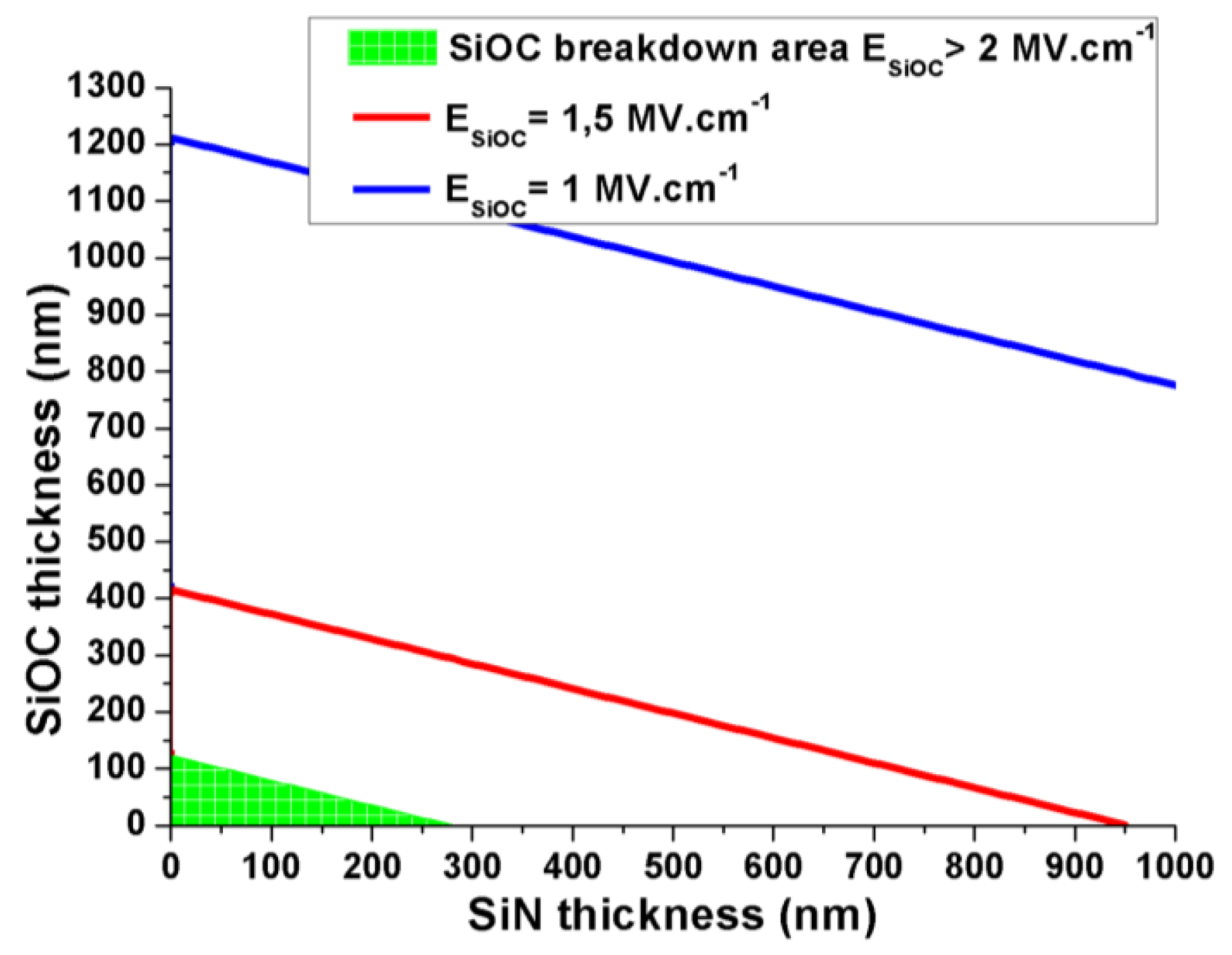
<p>Despite its favorable effect on <italic>V<sub>th</sub></italic>, the dielectric layer thickness cannot be reduced below the dielectric breakdown limit. In a typical dielectric/hydrophobic stack with the same order of magnitude for each layer thickness <italic>h</italic> and <italic>d</italic>, the electric field across the hydrophobic layer is generally larger since it usually features a lower dielectric constant. This layer is consequently more sensitive to electrical breakdown, and its thickness <italic>h</italic> must be larger than a critical value that depends on both the hydrophobic material electrical breakdown field <italic>E<sub>BV</sub></italic> and the dielectric thickness layer <italic>d</italic>. Based on the relationship <xref rid="FD9" ref-type="disp-formula">(18)</xref>, the <xref ref-type="fig" rid="f7-micromachines-02-00258">Figure 7</xref> highlights the SiOC layer breakdown area as a function of SiN and SiOC thicknesses, respectively <italic>d</italic> and <italic>h</italic>. The breakdown area represents the range of SiN and SiOC thicknesses that cause the dielectric breakdown of the SiOC layer. Such graph is particularly convenient to predict the electric field which can be supported for a given stack made of several dielectric materials.</p></sec>
<sec sec-type="conclusions">
<label>4.4.</label>
<title>Summary for the Single-Plate Open Microfluidic Device</title>
<p>In previous paragraphs, <italic>w</italic> and <italic>g</italic> are determined by the targeted droplets volume and by relationships ensuring a minimal threshold voltage. As indicated in <xref rid="FD7" ref-type="disp-formula">Equation (16)</xref>, <italic>V<sub>th</sub></italic> and <italic>f<sub>c</sub></italic> can be further decreased using high-K materials, such as aluminum oxide (<italic>ε</italic><sub><italic>Al</italic><sub>2</sub><italic>O</italic><sub>3</sub></sub> ≈ 8) or zirconium oxide (<italic>ε</italic><sub><italic>ZrO</italic><sub>2</sub></sub> ≈ 20). <xref ref-type="table" rid="t3-micromachines-02-00258">Table 3</xref> draws up a list of representative materials with the related LDEP parameters.</p></sec>
<sec>
<label>4.5.</label>
<title>Comparison between the Single-Plate Open Microfluidic and the Parallel-Plate Closed Microfluidic Devices</title>
<p>Both device configurations are associated to the same equivalent electrical circuit (<xref ref-type="fig" rid="f1-micromachines-02-00258">Figure 1</xref>). The electromechanical model detailed in the Section 2 is valid also for the parallel-plate closed microfluidic device. Furthermore, if we assume a similar stack for each plate in terms of materials and thickness (as described in the <xref ref-type="fig" rid="f1-micromachines-02-00258">Figure 1</xref>), the only difference between the two configurations is the expression of the liquid and air capacitance. Indeed, the layout of electrical field lines is different for the two cases, which induce significant variations for parameters such as the threshold voltage actuation. Here, the two capacitances
<inline-formula>
<mml:math id="mm15" display="inline">
<mml:semantics id="sm15">
<mml:mrow>
<mml:msub>
<mml:mi>C</mml:mi>
<mml:mrow>
<mml:mtext mathvariant="italic">liq</mml:mtext>
<mml:mo>/</mml:mo>
<mml:mn>1</mml:mn>
<mml:mi>P</mml:mi></mml:mrow></mml:msub>
<mml:mo stretchy="false">(</mml:mo>
<mml:mi>y</mml:mi>
<mml:mo stretchy="false">)</mml:mo>
<mml:mo>=</mml:mo>
<mml:mfrac>
<mml:mrow>
<mml:msub>
<mml:mi>ε</mml:mi>
<mml:mn>0</mml:mn></mml:msub>
<mml:mspace width="0.2em"/>
<mml:msub>
<mml:mi>ε</mml:mi>
<mml:mrow>
<mml:mtext mathvariant="italic">liq</mml:mtext></mml:mrow></mml:msub>
<mml:mi>K</mml:mi>
<mml:mo stretchy="false">(</mml:mo>
<mml:mn>1</mml:mn>
<mml:mo>−</mml:mo>
<mml:msup>
<mml:mi>k</mml:mi>
<mml:mn>2</mml:mn></mml:msup>
<mml:mo stretchy="false">)</mml:mo></mml:mrow>
<mml:mrow>
<mml:mn>2</mml:mn>
<mml:mi>K</mml:mi>
<mml:mo stretchy="false">(</mml:mo>
<mml:msup>
<mml:mi>k</mml:mi>
<mml:mn>2</mml:mn></mml:msup>
<mml:mo stretchy="false">)</mml:mo></mml:mrow></mml:mfrac>
<mml:mi>y</mml:mi></mml:mrow></mml:semantics></mml:math></inline-formula>in the single-plate open microfluidic and
<inline-formula>
<mml:math id="mm16" display="inline">
<mml:semantics id="sm16">
<mml:mrow>
<mml:msub>
<mml:mi>C</mml:mi>
<mml:mrow>
<mml:mtext mathvariant="italic">liq</mml:mtext>
<mml:mo>/</mml:mo>
<mml:mn>2</mml:mn>
<mml:mi>P</mml:mi></mml:mrow></mml:msub>
<mml:mo stretchy="false">(</mml:mo>
<mml:mi>y</mml:mi>
<mml:mo stretchy="false">)</mml:mo>
<mml:mo>=</mml:mo>
<mml:mfrac>
<mml:mrow>
<mml:msub>
<mml:mi>ε</mml:mi>
<mml:mn>0</mml:mn></mml:msub>
<mml:mspace width="0.2em"/>
<mml:msub>
<mml:mi>ε</mml:mi>
<mml:mrow>
<mml:mtext mathvariant="italic">liq</mml:mtext></mml:mrow></mml:msub>
<mml:mi>w</mml:mi></mml:mrow>
<mml:mi>g</mml:mi></mml:mfrac>
<mml:mi>y</mml:mi></mml:mrow></mml:semantics></mml:math></inline-formula>in the parallel-plate closed microfluidic will be evaluated and compared for a given liquid cross-section area (<italic>xz</italic> plane). The liquid cross-section area is
<inline-formula>
<mml:math id="mm17" display="inline">
<mml:semantics id="sm17">
<mml:mrow>
<mml:msub>
<mml:mi>S</mml:mi>
<mml:mrow>
<mml:mtext mathvariant="italic">liq</mml:mtext>
<mml:mo>/</mml:mo>
<mml:mn>1</mml:mn>
<mml:mi>P</mml:mi></mml:mrow></mml:msub>
<mml:mo>=</mml:mo>
<mml:mfrac>
<mml:mn>1</mml:mn>
<mml:mn>2</mml:mn></mml:mfrac>
<mml:mi>π</mml:mi>
<mml:msup>
<mml:mrow>
<mml:mrow>
<mml:mo>(</mml:mo>
<mml:mrow>
<mml:mi>w</mml:mi>
<mml:mo>+</mml:mo>
<mml:mfrac>
<mml:mi>g</mml:mi>
<mml:mn>2</mml:mn></mml:mfrac></mml:mrow>
<mml:mo>)</mml:mo></mml:mrow></mml:mrow>
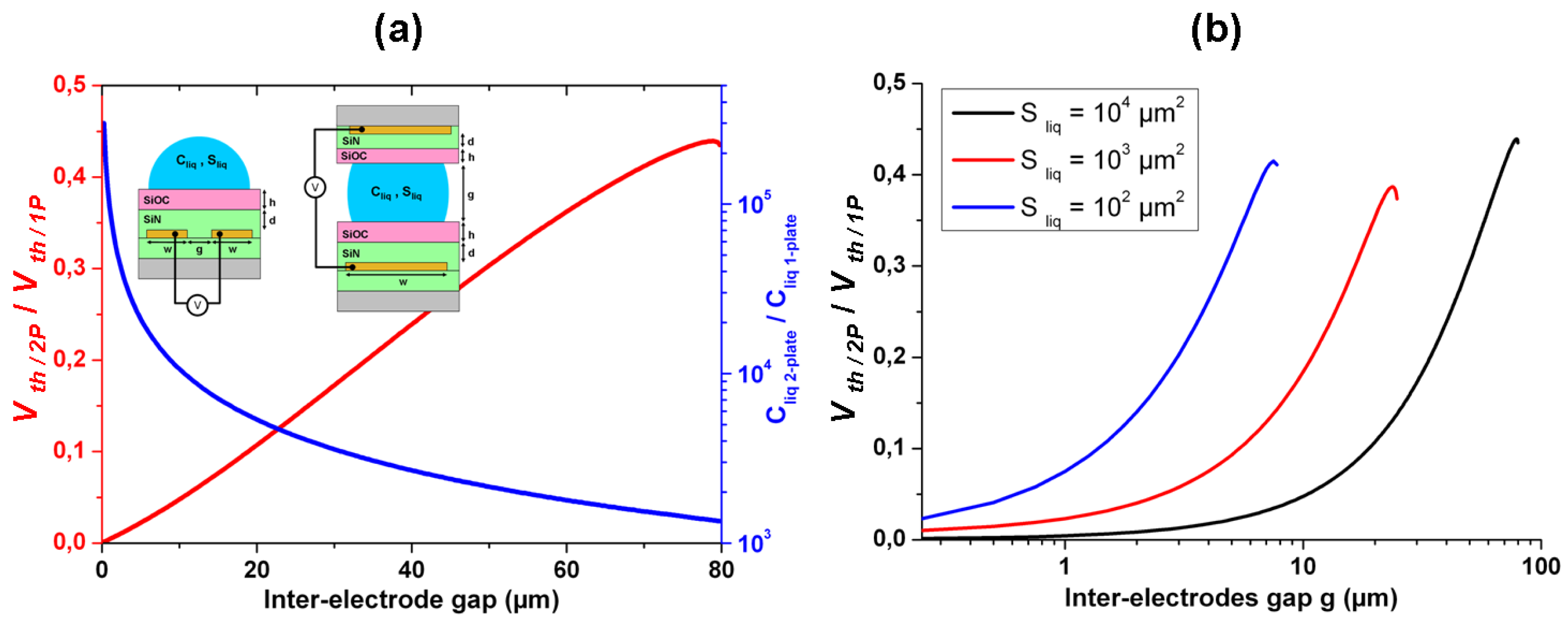
<mml:mn>2</mml:mn></mml:msup></mml:mrow></mml:semantics></mml:math></inline-formula>for the single-plate open microfluidic device, and can be approximated as <italic>S<sub>liq</sub></italic><sub>/2</sub><italic><sub>P</sub></italic> = <italic>wg</italic> for the parallel-plate closed microfluidic device. Then each capacitance is expressed as a function of the liquid cross-section and the inter-electrode gap <italic>g</italic> width. Threshold voltage actuation <italic>V<sub>th</sub></italic> and critical frequency <italic>f<sub>c</sub></italic> are also different according to the device configuration. For a given liquid cross-section area in the <italic>xz</italic> plane (orthogonal to the displacement direction), the threshold voltage in a single-plate device is about twice or more higher than in a parallel-plate device. To sum up, it is clear the two-plate configuration device is more favorable to decrease the LDEP voltage actuation.</p>
<p>The results shown in the <xref ref-type="fig" rid="f8-micromachines-02-00258">Figure 8</xref> agree with a T.B. Jones remark about the semi-circular profile of the liquid finger in an LDEP open device [<xref ref-type="bibr" rid="b23-micromachines-02-00258">23</xref>]. In the perpendicular plane to the liquid displacement, a force is applied in the liquid/air interface in the direction of the inter-electrode gap. Confining droplet into the inter-electrode gap requires energy, which does not lead to liquid actuation. Finally the parallel plate closed microfluidic device is more natural for the liquid because it effectively fills the inter-electrode gap.</p></sec></sec>
<sec>
<label>5.</label>
<title>Conclusion</title>
<p>Based on existing electromechanical models, this article suggests some design key rules to reduce both applied voltage and frequency for a LDEP actuation. The chip microfluidic configuration, its constituent layers dielectric properties, and the electrode design are the most important parameters to tune in order to reduce the actuation threshold voltage. Regarding the chip materials, numerical simulations highlighted that the layers should feature high dielectric constant together with low thickness, while preventing material dielectric breakdown and therefore electrolysis phenomenon. As an example, standard stacked layers composed of a 300 nm thick SiOC layer onto a 300 nm thick SiN layer leads to an expected actuation threshold voltage higher than 150 V<sub>RMS</sub>, while it is smaller than 50 V<sub>RMS</sub> for a single 50 nm thick Al<sub>2</sub>O<sub>3</sub> or ZrO<sub>2</sub> layer. These stacked layers theoretically prevent dielectric breakdown field since the electric fields across the layers do not exceed 2 MV cm<sup>−1</sup> (see <xref ref-type="table" rid="t3-micromachines-02-00258">Table 3</xref>). In other words, the threshold voltage can be decreased by a factor of 2/3. Besides the constituent chip material influences, LDEP model highlighted that there are also optimized electrode design parameters (<italic>w</italic>,<italic>g</italic>) which reduce the threshold voltage. Some electrode design examples have been compared experimentally and theoretically, based on a single 100 nm thick Teflon-like passivating layer, in a single plate open microfluidic configuration. The experiments have shown fair agreement between the measured threshold voltage and the expected theoretical value. The maximum error is less than 40%. As far as the comparison between the fluidic configurations (open single-plate or closed parallel-plate) is concerned, the numerical results predict lower threshold voltages associated to the parallel-plate closed microfluidic device compared to the single-plate open microfluidic device.</p></sec></body>
<back>
<sec sec-type="display-objects">
<title>Figures and Tables</title>
<fig id="f1-micromachines-02-00258" position="float">
<label>Figure 1.</label>
<caption>
<p>Schematics of a typical device used for LDEP actuation in <bold>(a)</bold> single-plate open microfluidic device configuration and <bold>(b)</bold> a parallel-plate closed microfluidic device configuration. The parameters of all the layers are summarized in <xref ref-type="table" rid="t1-micromachines-02-00258">Table 1</xref>. The layer in green refers to a dielectric layer; the layer in pink refers to a hydrophobic layer. The liquid is represented in blue and the wafer in grey. The electrodes are patterned in orange.</p></caption>
<graphic xlink:href="micromachines-02-00258f1.gif"/></fig>
<fig id="f2-micromachines-02-00258" position="float">
<label>Figure 2.</label>
<caption>
<p><bold>(a)</bold> Equivalent electric circuit of a LDEP actuation device. <bold>(b)</bold> Scheme describing liquid actuation using LDEP and forces acting on the protrusion.</p></caption>
<graphic xlink:href="micromachines-02-00258f2.gif"/></fig>
<fig id="f3-micromachines-02-00258" position="float">
<label>Figure 3.</label>
<caption>
<p>Optical micrograph of a 1,400 μm long liquid protrusion along electrodes without any bumps (<italic>w</italic> = <italic>5 μm</italic>, <italic>g</italic> = <italic>6 μm</italic>, <italic>f</italic> = <italic>100 kHz</italic>).</p></caption>
<graphic xlink:href="micromachines-02-00258f3.gif"/></fig>
<fig id="f4-micromachines-02-00258" position="float">
<label>Figure 4.</label>
<caption>
<p><bold>(a)</bold> Threshold voltage actuation as a function of the electrode width <italic>w</italic> for different inter-electrode gap <italic>g</italic> Blue star labels represent the minimum of the function <italic>V<sub>th</sub></italic> = <italic>f(w)</italic> for each given inter-electrode gap. <bold>(b)</bold> Electrode width <italic>w</italic> as a function of the gap <italic>g</italic>,corresponding to the minimum threshold actuation voltages <italic>V<sub>th</sub></italic>. (Both figures are obtained with <italic>f</italic> = <italic>10f<sub>c</sub></italic>, <italic>σ<sub>liq</sub></italic> = <italic>6</italic> × <italic>10<sup>−6</sup></italic> <italic>S m<sup>−1</sup></italic>, <italic>ε<sub>liq</sub></italic> = <italic>80</italic>, <italic>d</italic> = <italic>100 nm</italic> SiN (<italic>ε<sub>SiN</sub></italic> ≈ 6.3) and <italic>h</italic> = <italic>100 nm</italic> SiOC (<italic>ε<sub>SiOC</sub></italic> ≈ 2.75).</p></caption>
<graphic xlink:href="micromachines-02-00258f4.gif"/></fig>
<fig id="f5-micromachines-02-00258" position="float">
<label>Figure 5.</label>
<caption>
<p>Threshold voltage <italic>V<sub>th</sub></italic> as a function of the electrode width <italic>w</italic> and the inter-electrode gap <italic>g.</italic> Solid line curves and circle labels represent the numerical results and experimental data respectively. The actuated liquid corresponds to DI water (<italic>σ<sub>liq</sub></italic> = <italic>6</italic> × <italic>10<sup>−5</sup></italic> <italic>S m<sup>−1</sup></italic>, <italic>ε</italic><sub>liq</sub> = <italic>80</italic>) and chip materials are described in Section 3.</p></caption>
<graphic xlink:href="micromachines-02-00258f5.gif"/></fig>
<fig id="f6-micromachines-02-00258" position="float">
<label>Figure 6.</label>
<caption>
<p><bold>(a)</bold> Graphical illustration of <xref rid="FD7" ref-type="disp-formula">equation (16)</xref>: threshold actuation voltage V<sub>th</sub> as a function of <italic>α</italic> (ultra-pure water: <italic>σ<sub>liq</sub></italic> = <italic>6</italic> × <italic>10<sup>−6</sup></italic> <italic>S m<sup>−1</sup></italic>, <italic>ε<sub>liq</sub></italic> =<italic>80</italic>, <italic>w/g</italic> = 20/10 <italic>μm</italic>, <italic>f</italic> = <italic>10 f<sub>c</sub></italic>); <bold>(b)</bold> (<italic>V<sub>th</sub>;f<sub>c</sub></italic>) diagram according to different stacks and materials. The relative permittivity considered for SiN, SiOC, Al<sub>2</sub>O<sub>3</sub>, HfO<sub>2</sub> and ZrO<sub>2</sub> are respectively 6.3, 2.75, 8, 12 and 25. The first four points represent a stack composed by two layers. The table summarizes the thicknesses for each layer/stack. Calculations are performed for an ultra-pure water liquid (<italic>σ<sub>liq</sub></italic> = <italic>6</italic> × <italic>10<sup>−6</sup></italic> <italic>S m<sup>−1</sup></italic>, <italic>ε<sub>liq</sub></italic> = <italic>80</italic>) with. <italic>w/g</italic> = 20/10 <italic>μm</italic>.</p></caption>
<graphic xlink:href="micromachines-02-00258f6.gif"/></fig>
<fig id="f7-micromachines-02-00258" position="float">
<label>Figure 7.</label>
<caption>
<p>Diagram (dSiN ; hSiOC) illustrating the breakdown area given the dielectric breakdown electric field of the hydrophobic SiOC layer. The electric field breakdown considered for the SiOC is 2 MV cm<sup>−1</sup>. ESiOC represents the electric field in the SiOC layer. Calculations are carried out at V = Vth and f = 1 kHz for an ultra-pure water liquid finger actuation with w = 20 μm and g = 10 μm.</p></caption>
<graphic xlink:href="micromachines-02-00258f7.gif"/></fig>
<fig id="f8-micromachines-02-00258" position="float">
<label>Figure 8.</label>
<caption>
<p><bold>(a)</bold> Graph illustrating two ratios as a function of inter-electrode gap comparing both devices configuration: the single-plate open microfluidic device and the parallel-plate closed microfluidic device. Blue curve represents the ratio of liquid capacitance between the two microfluidic configurations. Red curve represents the ratio of threshold voltage actuation between the two microfluidic configurations. Calculations are carried out at <italic>f</italic> = <italic>10f<sub>c</sub></italic> for an ultra pure water (<italic>σ<sub>liq</sub></italic> = <italic>6</italic> × <italic>10<sup>−5</sup></italic> <italic>S m<sup>−1</sup></italic>, <italic>ε<sub>liq</sub></italic> = <italic>80</italic>) liquid finger actuation with a liquid cross-section area <italic>S<sub>liq</sub></italic> =<italic>10<sup>4</sup></italic> μm<sup>2</sup> and with 100 nm thick SiN layer and 100 nm thick SiOC layer. <bold>(b)</bold> Graph illustrating the threshold voltage actuation ratio between the two-plates and the single-plate device as a function of the inter-electrode gap for several liquid cross-sections considered. Calculations are made at <italic>f</italic> = <italic>10f<sub>c</sub></italic> for an ultra pure water liquid finger actuation and with 100 nm thick SiN and 100 nm thick SiOC.</p></caption>
<graphic xlink:href="micromachines-02-00258f8.gif"/></fig>
<table-wrap id="t1-micromachines-02-00258" position="float">
<label>Table 1.</label>
<caption>
<p>List of the impedances and capacitances describing the LDEP device in <xref ref-type="fig" rid="f1-micromachines-02-00258">Figures 1</xref> and <xref ref-type="fig" rid="f2-micromachines-02-00258">2(a)</xref>.</p></caption>
<table frame="hsides" rules="none">
<tbody>
<tr>
<td align="center" valign="top">
<disp-formula id="FD13">
<label>(1)</label>
<mml:math id="mm18" display="block">
<mml:semantics id="sm18">
<mml:mrow>
<mml:msub>
<mml:mi>Z</mml:mi>
<mml:mi>d</mml:mi></mml:msub>
<mml:mo stretchy="false">(</mml:mo>
<mml:mi>y</mml:mi>
<mml:mo stretchy="false">)</mml:mo>
<mml:mo>=</mml:mo>
<mml:mfrac>
<mml:mn>1</mml:mn>
<mml:mrow>
<mml:mi>j</mml:mi>
<mml:mi>ω</mml:mi>
<mml:msub>
<mml:mi>C</mml:mi>
<mml:mi>d</mml:mi></mml:msub>
<mml:mo stretchy="false">(</mml:mo>
<mml:mi>y</mml:mi>
<mml:mo stretchy="false">)</mml:mo></mml:mrow></mml:mfrac></mml:mrow></mml:semantics></mml:math></disp-formula></td>
<td align="center" valign="top">
<disp-formula id="FD14">
<label>(2)</label>
<mml:math id="mm19" display="block">
<mml:semantics id="sm19">
<mml:mrow>
<mml:msub>
<mml:mi>C</mml:mi>
<mml:mi>d</mml:mi></mml:msub>
<mml:mo stretchy="false">(</mml:mo>
<mml:mi>y</mml:mi>
<mml:mo stretchy="false">)</mml:mo>
<mml:mo>=</mml:mo>
<mml:mfrac>
<mml:mrow>
<mml:msub>
<mml:mi>ε</mml:mi>
<mml:mn>0</mml:mn></mml:msub>
<mml:msub>
<mml:mi>ε</mml:mi>
<mml:mi>d</mml:mi></mml:msub>
<mml:mi>w</mml:mi></mml:mrow>
<mml:mi>d</mml:mi></mml:mfrac>
<mml:mi>y</mml:mi></mml:mrow></mml:semantics></mml:math></disp-formula></td></tr>
<tr>
<td align="center" valign="top">
<disp-formula id="FD15">
<label>(3)</label>
<mml:math id="mm20" display="block">
<mml:semantics id="sm20">
<mml:mrow>
<mml:msub>
<mml:mi>Z</mml:mi>
<mml:mi>h</mml:mi></mml:msub>
<mml:mo stretchy="false">(</mml:mo>
<mml:mi>y</mml:mi>
<mml:mo stretchy="false">)</mml:mo>
<mml:mo>=</mml:mo>
<mml:mfrac>
<mml:mn>1</mml:mn>
<mml:mrow>
<mml:mi>j</mml:mi>
<mml:mi>ω</mml:mi>
<mml:msub>
<mml:mi>C</mml:mi>
<mml:mi>h</mml:mi></mml:msub>
<mml:mo stretchy="false">(</mml:mo>
<mml:mi>y</mml:mi>
<mml:mo stretchy="false">)</mml:mo></mml:mrow></mml:mfrac></mml:mrow></mml:semantics></mml:math></disp-formula></td>
<td align="center" valign="top">
<disp-formula id="FD16">
<label>(4)</label>
<mml:math id="mm21" display="block">
<mml:semantics id="sm21">
<mml:mrow>
<mml:msub>
<mml:mi>C</mml:mi>
<mml:mi>h</mml:mi></mml:msub>
<mml:mo stretchy="false">(</mml:mo>
<mml:mi>y</mml:mi>
<mml:mo stretchy="false">)</mml:mo>
<mml:mo>=</mml:mo>
<mml:mfrac>
<mml:mrow>
<mml:msub>
<mml:mi>ε</mml:mi>
<mml:mn>0</mml:mn></mml:msub>
<mml:msub>
<mml:mi>ε</mml:mi>
<mml:mi>h</mml:mi></mml:msub>
<mml:mi>w</mml:mi></mml:mrow>
<mml:mi>h</mml:mi></mml:mfrac>
<mml:mi>y</mml:mi></mml:mrow></mml:semantics></mml:math></disp-formula></td></tr>
<tr>
<td align="left" valign="top">
<disp-formula id="FD17">
<label>(5)</label>
<mml:math id="mm22" display="block">
<mml:semantics id="sm22">
<mml:mrow>
<mml:msub>
<mml:mi>Z</mml:mi>
<mml:mrow>
<mml:mtext mathvariant="italic">air</mml:mtext></mml:mrow></mml:msub>
<mml:mo stretchy="false">(</mml:mo>
<mml:mi>y</mml:mi>
<mml:mo stretchy="false">)</mml:mo>
<mml:mo>=</mml:mo>
<mml:mfrac>
<mml:mn>1</mml:mn>
<mml:mrow>
<mml:mi>j</mml:mi>
<mml:mi>ω</mml:mi>
<mml:msub>
<mml:mi>C</mml:mi>
<mml:mrow>
<mml:mtext mathvariant="italic">air</mml:mtext></mml:mrow></mml:msub>
<mml:mo stretchy="false">(</mml:mo>
<mml:mi>y</mml:mi>
<mml:mo stretchy="false">)</mml:mo></mml:mrow></mml:mfrac></mml:mrow></mml:semantics></mml:math></disp-formula></td>
<td align="center" valign="top">
<disp-formula id="FD18">
<label>(6)</label>
<mml:math id="mm23" display="block">
<mml:semantics id="sm23">
<mml:mrow>
<mml:msub>
<mml:mi>C</mml:mi>
<mml:mrow>
<mml:mtext mathvariant="italic">air</mml:mtext></mml:mrow></mml:msub>
<mml:mo stretchy="false">(</mml:mo>
<mml:mi>y</mml:mi>
<mml:mo stretchy="false">)</mml:mo>
<mml:mo>=</mml:mo>
<mml:mfrac>
<mml:mrow>
<mml:msub>
<mml:mi>ε</mml:mi>
<mml:mn>0</mml:mn></mml:msub>
<mml:mspace width="0.2em"/>
<mml:mi>K</mml:mi>
<mml:mo stretchy="false">(</mml:mo>
<mml:mn>1</mml:mn>
<mml:mo>−</mml:mo>
<mml:msup>
<mml:mi>k</mml:mi>
<mml:mn>2</mml:mn></mml:msup>
<mml:mo stretchy="false">)</mml:mo></mml:mrow>
<mml:mrow>
<mml:mn>2</mml:mn>
<mml:mi>K</mml:mi>
<mml:mo stretchy="false">(</mml:mo>
<mml:msup>
<mml:mi>k</mml:mi>
<mml:mn>2</mml:mn></mml:msup>
<mml:mo stretchy="false">)</mml:mo></mml:mrow></mml:mfrac>
<mml:mi>y</mml:mi></mml:mrow></mml:semantics></mml:math></disp-formula></td></tr>
<tr>
<td align="center" valign="middle" rowspan="2">
<disp-formula id="FD19">
<label>(7)</label>
<mml:math id="mm24" display="block">
<mml:semantics id="sm24">
<mml:mrow>
<mml:msub>
<mml:mi>Z</mml:mi>
<mml:mrow>
<mml:mtext mathvariant="italic">liq</mml:mtext></mml:mrow></mml:msub>
<mml:mo stretchy="false">(</mml:mo>
<mml:mi>y</mml:mi>
<mml:mo stretchy="false">)</mml:mo>
<mml:mo>=</mml:mo>
<mml:mfrac>
<mml:mn>1</mml:mn>
<mml:mrow>
<mml:msub>
<mml:mi>g</mml:mi>
<mml:mrow>
<mml:mtext mathvariant="italic">liq</mml:mtext></mml:mrow></mml:msub>
<mml:mo>+</mml:mo>
<mml:mi>j</mml:mi>
<mml:mi>ω</mml:mi>
<mml:msub>
<mml:mi>C</mml:mi>
<mml:mrow>
<mml:mtext mathvariant="italic">liq</mml:mtext></mml:mrow></mml:msub>
<mml:mo stretchy="false">(</mml:mo>
<mml:mi>y</mml:mi>
<mml:mo stretchy="false">)</mml:mo></mml:mrow></mml:mfrac></mml:mrow></mml:semantics></mml:math></disp-formula></td>
<td align="center" valign="top">
<disp-formula id="FD20">
<label>(8)</label>
<mml:math id="mm25" display="block">
<mml:semantics id="sm25">
<mml:mrow>
<mml:msub>
<mml:mi>C</mml:mi>
<mml:mrow>
<mml:mtext mathvariant="italic">liq</mml:mtext></mml:mrow></mml:msub>
<mml:mo stretchy="false">(</mml:mo>
<mml:mi>y</mml:mi>
<mml:mo stretchy="false">)</mml:mo>
<mml:mo>=</mml:mo>
<mml:mfrac>
<mml:mrow>
<mml:msub>
<mml:mi>ε</mml:mi>
<mml:mn>0</mml:mn></mml:msub>
<mml:msub>
<mml:mi>ε</mml:mi>
<mml:mrow>
<mml:mtext mathvariant="italic">liq</mml:mtext></mml:mrow></mml:msub>
<mml:mi>K</mml:mi>
<mml:mo stretchy="false">(</mml:mo>
<mml:mn>1</mml:mn>
<mml:mo>−</mml:mo>
<mml:msup>
<mml:mi>k</mml:mi>
<mml:mn>2</mml:mn></mml:msup>
<mml:mo stretchy="false">)</mml:mo></mml:mrow>
<mml:mrow>
<mml:mn>2</mml:mn>
<mml:mi>K</mml:mi>
<mml:mo stretchy="false">(</mml:mo>
<mml:msup>
<mml:mi>k</mml:mi>
<mml:mn>2</mml:mn></mml:msup>
<mml:mo stretchy="false">)</mml:mo></mml:mrow></mml:mfrac>
<mml:mi>y</mml:mi>
<mml:mspace width="0.2em"/>
<mml:mtext>and</mml:mtext></mml:mrow></mml:semantics></mml:math></disp-formula></td></tr>
<tr>
<td align="center" valign="top">
<disp-formula id="FD21">
<label>(9)</label>
<mml:math id="mm26" display="block">
<mml:semantics id="sm26">
<mml:mrow>
<mml:msub>
<mml:mi>g</mml:mi>
<mml:mrow>
<mml:mtext mathvariant="italic">liq</mml:mtext></mml:mrow></mml:msub>
<mml:mo stretchy="false">(</mml:mo>
<mml:mi>y</mml:mi>
<mml:mo stretchy="false">)</mml:mo>
<mml:mo>=</mml:mo>
<mml:mfrac>
<mml:mrow>
<mml:msub>
<mml:mi>σ</mml:mi>
<mml:mrow>
<mml:mtext mathvariant="italic">liq</mml:mtext></mml:mrow></mml:msub>
<mml:mi>K</mml:mi>
<mml:mo stretchy="false">(</mml:mo>
<mml:mn>1</mml:mn>
<mml:mo>−</mml:mo>
<mml:msup>
<mml:mi>k</mml:mi>
<mml:mn>2</mml:mn></mml:msup>
<mml:mo stretchy="false">)</mml:mo></mml:mrow>
<mml:mrow>
<mml:mn>2</mml:mn>
<mml:mi>K</mml:mi>
<mml:mo stretchy="false">(</mml:mo>
<mml:msup>
<mml:mi>k</mml:mi>
<mml:mn>2</mml:mn></mml:msup>
<mml:mo stretchy="false">)</mml:mo></mml:mrow></mml:mfrac>
<mml:mi>y</mml:mi></mml:mrow></mml:semantics></mml:math></disp-formula></td></tr></tbody></table></table-wrap>
<table-wrap id="t2-micromachines-02-00258" position="float">
<label>Table 2.</label>
<caption>
<p>Parameters values used for LDEP actuation experiments.</p></caption>
<table frame="hsides" rules="groups">
<thead>
<tr>
<th align="left" valign="top"><bold>Parameter</bold></th>
<th align="center" valign="top"><bold>Value</bold></th>
<th align="center" valign="top"><bold>Units</bold></th>
<th align="left" valign="top"><bold>Sources</bold></th></tr></thead>
<tbody>
<tr>
<td align="left" valign="top"><italic>g</italic></td>
<td align="center" valign="top"><italic>4–40</italic></td>
<td align="center" valign="top"><italic>μm</italic></td>
<td align="left" valign="top">Microscope</td></tr>
<tr>
<td align="left" valign="top"><italic>w</italic></td>
<td align="center" valign="top"><italic>3–20</italic></td>
<td align="center" valign="top"><italic>μm</italic></td>
<td align="left" valign="top">Microscope</td></tr>
<tr>
<td align="left" valign="top"><italic>h</italic></td>
<td align="center" valign="top"><italic>About 100</italic></td>
<td align="center" valign="top"><italic>nm</italic></td>
<td align="left" valign="top">Process duration</td></tr>
<tr>
<td align="left" valign="top"><italic>ε<sub>h</sub></italic></td>
<td align="center" valign="top"><italic>2.1</italic></td>
<td align="center" valign="top"><italic>unitless</italic></td>
<td align="left" valign="top">Literature</td></tr>
<tr>
<td align="left" valign="top"><italic>σ<sub>DI water</sub></italic></td>
<td align="center" valign="top"><italic>60</italic> × <italic>10<sup>−6</sup></italic></td>
<td align="center" valign="top"><italic>S m<sup>−1</sup></italic></td>
<td align="left" valign="top">Conductimeter</td></tr></tbody></table></table-wrap>
<table-wrap id="t3-micromachines-02-00258" position="float">
<label>Table 3.</label>
<caption>
<p>Usual stacked materials and related LDEP parameters: electrode width <italic>w</italic> and inter-electrode gap <italic>g</italic>, the liquid semi-circular cross-section (radius <italic>w + 0.5 g</italic>) The values (<italic>w;g</italic>) are directly chosen according to results presented in the Section 4.1. The * label refers to conditions for which the functions <italic>V<sub>th</sub></italic> = <italic>f(w)</italic> do not feature local minima: <italic>w</italic> and <italic>g</italic> are arbitrary chosen. <italic>F<sub>EM</sub></italic> is the electromechanical force in μN. <italic>E<sub>d</sub></italic> and <italic>E<sub>h</sub></italic> are the electric field (in MV cm<sup>−1</sup>) across the dielectric layer and the hydrophobic layer respectively.</p></caption>
<table frame="box" rules="groups">
<thead>
<tr>
<th align="center" valign="bottom"><italic>Liquid section</italic></th>
<th colspan="5" align="center" valign="bottom"><italic>10<sup>2</sup> μm<sup>2</sup></italic></th>
<th colspan="5" align="center" valign="bottom"><italic>10<sup>4</sup> μm<sup>2</sup></italic></th></tr>
<tr>
<th valign="bottom" colspan="12">
<hr/></th></tr>
<tr>
<th align="center" valign="bottom"><italic>Material and thickness (nm)</italic></th>
<th align="center" valign="bottom"><italic>(w;g) (μm)</italic></th>
<th align="center" valign="bottom"><italic>f<sub>c</sub> (Hz)</italic></th>
<th align="center" valign="bottom"><italic>V<sub>th</sub> (V)</italic></th>
<th align="center" valign="bottom"><italic>FEm (μN)</italic></th>
<th align="center" valign="bottom"><italic>E<sub>d</sub>/E<sub>h</sub>(MV.cm<sup>−1</sup>)</italic></th>
<th align="center" valign="bottom"><italic>(w;g)</italic></th>
<th align="center" valign="bottom"><italic>f<sub>c</sub></italic></th>
<th align="center" valign="bottom"><italic>V<sub>th</sub></italic></th>
<th align="center" valign="bottom"><italic>F<sub>em</sub></italic></th>
<th align="center" valign="bottom"><italic>E<sub>d</sub>/E<sub>h</sub></italic></th></tr></thead>
<tbody>
<tr>
<td align="center" valign="top"><italic>SiN 300/SiOC 300</italic></td>
<td align="center" valign="top"><italic>(9;2)</italic></td>
<td align="center" valign="top"><italic>960</italic></td>
<td align="center" valign="top"><italic>155</italic></td>
<td align="center" valign="top"><italic>2.2</italic></td>
<td align="center" valign="top"><italic>0.6/1.4</italic></td>
<td align="center" valign="top"><italic>(17.5;15)</italic></td>
<td align="center" valign="top"><italic>673</italic></td>
<td align="center" valign="top"><italic>206</italic></td>
<td align="center" valign="top"><italic>5.5</italic></td>
<td align="center" valign="top"><italic>0.6/1.3</italic></td></tr>
<tr>
<td align="center" valign="top"><italic>SiN 300/SiOC 100</italic></td>
<td align="center" valign="top"><italic>(8;4)</italic></td>
<td align="center" valign="top"><italic>762</italic></td>
<td align="center" valign="top"><italic>133</italic></td>
<td align="center" valign="top"><italic>2.2</italic></td>
<td align="center" valign="top"><italic>0.8/1.8</italic></td>
<td align="center" valign="top"><italic>(15.5;19)</italic></td>
<td align="center" valign="top"><italic>485</italic></td>
<td align="center" valign="top"><italic>187</italic></td>
<td align="center" valign="top"><italic>5.5</italic></td>
<td align="center" valign="top"><italic>0.7/1.6</italic></td></tr>
<tr>
<td align="center" valign="top"><italic>SiN 100/SiOC 300</italic></td>
<td align="center" valign="top"><italic>(8.5;3)</italic></td>
<td align="center" valign="top"><italic>890</italic></td>
<td align="center" valign="top"><italic>147</italic></td>
<td align="center" valign="top"><italic>2.2</italic></td>
<td align="center" valign="top"><italic>0.7/1.6</italic></td>
<td align="center" valign="top"><italic>(16.5;17)</italic></td>
<td align="center" valign="top"><italic>604</italic></td>
<td align="center" valign="top"><italic>199</italic></td>
<td align="center" valign="top"><italic>5.5</italic></td>
<td align="center" valign="top"><italic>0.6/1.4</italic></td></tr>
<tr>
<td align="center" valign="top"><italic>SiN 100/SiOC 100</italic></td>
<td align="center" valign="top"><italic>(7;6)</italic></td>
<td align="center" valign="top"><italic>616</italic></td>
<td align="center" valign="top"><italic>124</italic></td>
<td align="center" valign="top"><italic>2.2</italic></td>
<td align="center" valign="top"><italic>1.0/2.2</italic></td>
<td align="center" valign="top"><italic>(14.5;21)</italic></td>
<td align="center" valign="top"><italic>358</italic></td>
<td align="center" valign="top"><italic>175</italic></td>
<td align="center" valign="top"><italic>5.4.</italic></td>
<td align="center" valign="top"><italic>0.8/1.9</italic></td></tr>
<tr>
<td align="center" valign="top"><italic>SiOC 500</italic></td>
<td align="center" valign="top"><italic>(9;2)</italic></td>
<td align="center" valign="top"><italic>998</italic></td>
<td align="center" valign="top"><italic>164</italic></td>
<td align="center" valign="top"><italic>2.2</italic></td>
<td align="center" valign="top"><italic>1.4</italic></td>
<td align="center" valign="top"><italic>(18.5;13)</italic></td>
<td align="center" valign="top"><italic>722</italic></td>
<td align="center" valign="top"><italic>209</italic></td>
<td align="center" valign="top"><italic>5.5</italic></td>
<td align="center" valign="top"><italic>1.2</italic></td></tr>
<tr>
<td align="center" valign="top"><italic>SiOC 200</italic></td>
<td align="center" valign="top"><italic>(7.5;5)</italic></td>
<td align="center" valign="top"><italic>723</italic></td>
<td align="center" valign="top"><italic>131</italic></td>
<td align="center" valign="top"><italic>2.2</italic></td>
<td align="center" valign="top"><italic>2</italic></td>
<td align="center" valign="top"><italic>(14.5;17)</italic></td>
<td align="center" valign="top"><italic>463</italic></td>
<td align="center" valign="top"><italic>176</italic></td>
<td align="center" valign="top"><italic>5</italic></td>
<td align="center" valign="top"><italic>1.7</italic></td></tr>
<tr>
<td align="center" valign="top"><italic>SiN 100</italic></td>
<td align="center" valign="top"><italic>(6.5;7)</italic></td>
<td align="center" valign="top"><italic>286</italic></td>
<td align="center" valign="top"><italic>101</italic></td>
<td align="center" valign="top"><italic>2.1</italic></td>
<td align="center" valign="top"><italic>1.3</italic></td>
<td align="center" valign="top"><italic>(17.5; 15)*</italic></td>
<td align="center" valign="top"><italic>131</italic></td>
<td align="center" valign="top"><italic>128</italic></td>
<td align="center" valign="top"><italic>4.5</italic></td>
<td align="center" valign="top"><italic>0.9</italic></td></tr>
<tr>
<td align="center" valign="top"><italic>Al<sub>2</sub>O<sub>3</sub> 100</italic></td>
<td align="center" valign="top"><italic>(7.5;5)</italic></td>
<td align="center" valign="top"><italic>235</italic></td>
<td align="center" valign="top"><italic>90</italic></td>
<td align="center" valign="top"><italic>2.1</italic></td>
<td align="center" valign="top"><italic>1</italic></td>
<td align="center" valign="top"><italic>(17.5;15)*</italic></td>
<td align="center" valign="top"><italic>106</italic></td>
<td align="center" valign="top"><italic>119</italic></td>
<td align="center" valign="top"><italic>4.1</italic></td>
<td align="center" valign="top"><italic>0.8</italic></td></tr>
<tr>
<td align="center" valign="top"><italic>Al<sub>2</sub>O<sub>3</sub> 50</italic></td>
<td align="center" valign="top"><italic>(7.5;5)*</italic></td>
<td align="center" valign="top"><italic>130</italic></td>
<td align="center" valign="top"><italic>78</italic></td>
<td align="center" valign="top"><italic>1.8</italic></td>
<td align="center" valign="top"><italic>1.1</italic></td>
<td align="center" valign="top"><italic>(17.5;15)*</italic></td>
<td align="center" valign="top"><italic>55</italic></td>
<td align="center" valign="top"><italic>93</italic></td>
<td align="center" valign="top"><italic>2.8</italic></td>
<td align="center" valign="top"><italic>1</italic></td></tr>
<tr>
<td align="center" valign="top"><italic>Al<sub>2</sub>O<sub>3</sub> 25</italic></td>
<td align="center" valign="top"><italic>(7.5;5)*</italic></td>
<td align="center" valign="top"><italic>68</italic></td>
<td align="center" valign="top"><italic>62</italic></td>
<td align="center" valign="top"><italic>1.3</italic></td>
<td align="center" valign="top"><italic>1.4</italic></td>
<td align="center" valign="top"><italic>(17.5;15)*</italic></td>
<td align="center" valign="top"><italic>28</italic></td>
<td align="center" valign="top"><italic>68</italic></td>
<td align="center" valign="top"><italic>1.8</italic></td>
<td align="center" valign="top"><italic>1.4</italic></td></tr>
<tr>
<td align="center" valign="top"><italic>ZrO<sub>2</sub> 25</italic></td>
<td align="center" valign="top"><italic>(7.5;5)*</italic></td>
<td align="center" valign="top"><italic>23</italic></td>
<td align="center" valign="top"><italic>38</italic></td>
<td align="center" valign="top"><italic>0.7</italic></td>
<td align="center" valign="top"><italic>0.8</italic></td>
<td align="center" valign="top"><italic>(17.5;15)*</italic></td>
<td align="center" valign="top"><italic>9</italic></td>
<td align="center" valign="top"><italic>39</italic></td>
<td align="center" valign="top"><italic>1</italic></td>
<td align="center" valign="top"><italic>0.8</italic></td></tr></tbody></table></table-wrap></sec>
<ack>
<p>The authors would like to thank ADVANTEST Corporation for donation of the 8-inches EB writer F5112 + VD01 equipment (at VLSI Design and Education Center, the University of Tokyo) that has been used to fabricate the photolithography masks.</p></ack>
<app-group>
<app id="app1">
<title/>
<p>
<array>
<tbody>
<tr>
<td align="left" valign="top"><bold>Nomenclature</bold></td></tr>
<tr>
<td align="left" valign="top">Symbol Variables</td>
<td align="left" valign="top">Description</td>
<td align="left" valign="top">Units</td></tr>
<tr>
<td align="left" valign="top"><italic>ε<sub>0</sub></italic></td>
<td align="left" valign="top">Vacuum permittivity</td>
<td align="left" valign="top"><italic>m<sup>−3</sup> kg<sup>−1</sup> s<sup>4</sup> A<sup>2</sup></italic></td></tr>
<tr>
<td align="left" valign="top"><italic>ε<sub>d</sub></italic></td>
<td align="left" valign="top">Relative dielectric layer permittivity</td>
<td align="left" valign="top"><italic>dimensionless</italic></td></tr>
<tr>
<td align="left" valign="top"><italic>ε<sub>h</sub></italic></td>
<td align="left" valign="top">Relative hydrophobic layer permittivity</td>
<td align="left" valign="top"><italic>dimensionless</italic></td></tr>
<tr>
<td align="left" valign="top"><italic>ε<sub>liq</sub></italic></td>
<td align="left" valign="top">Relative liquid dielectric constant</td>
<td align="left" valign="top"><italic>dimensionless</italic></td></tr>
<tr>
<td align="left" valign="top"><italic>σ<sub>liq</sub></italic></td>
<td align="left" valign="top">Liquid electrical conductivity</td>
<td align="left" valign="top"><italic>S m<sup>−1</sup></italic></td></tr>
<tr>
<td align="left" valign="top"><italic>w</italic></td>
<td align="left" valign="top">Electrode width</td>
<td align="left" valign="top"><italic>m</italic></td></tr>
<tr>
<td align="left" valign="top"><italic>g</italic></td>
<td align="left" valign="top">Inter-electrode gap</td>
<td align="left" valign="top"><italic>m</italic></td></tr>
<tr>
<td align="left" valign="top"><italic>d</italic></td>
<td align="left" valign="top">Dielectric layer thickness</td>
<td align="left" valign="top"><italic>m</italic></td></tr>
<tr>
<td align="left" valign="top"><italic>h</italic></td>
<td align="left" valign="top">Hydrophobic layer thickness</td>
<td align="left" valign="top"><italic>m</italic></td></tr>
<tr>
<td align="left" valign="top"><italic>C<sub>d</sub></italic></td>
<td align="left" valign="top">Dielectric layer capacitance</td>
<td align="left" valign="top"><italic>F</italic></td></tr>
<tr>
<td align="left" valign="top"><italic>C<sub>h</sub></italic></td>
<td align="left" valign="top">Hydrophobic layer capacitance</td>
<td align="left" valign="top"><italic>F</italic></td></tr>
<tr>
<td align="left" valign="top"><italic>C<sub>air</sub></italic></td>
<td align="left" valign="top">Surrounding air capacitance</td>
<td align="left" valign="top"><italic>F</italic></td></tr>
<tr>
<td align="left" valign="top"><italic>C<sub>liq</sub></italic></td>
<td align="left" valign="top">Liquid capacitance</td>
<td align="left" valign="top"><italic>F</italic></td></tr>
<tr>
<td align="left" valign="top"><italic>g<sub>liq</sub></italic></td>
<td align="left" valign="top">Liquid conductance</td>
<td align="left" valign="top"><italic>S</italic></td></tr>
<tr>
<td align="left" valign="top"><italic>Z<sub>d</sub></italic></td>
<td align="left" valign="top">Dielectric layer impedance</td>
<td align="left" valign="top"><italic>Ω</italic></td></tr>
<tr>
<td align="left" valign="top"><italic>Z<sub>h</sub></italic></td>
<td align="left" valign="top">Hydrophobic layer impedance</td>
<td align="left" valign="top"><italic>Ω</italic></td></tr>
<tr>
<td align="left" valign="top"><italic>Z<sub>air</sub></italic></td>
<td align="left" valign="top">Air area impedance</td>
<td align="left" valign="top"><italic>Ω</italic></td></tr>
<tr>
<td align="left" valign="top"><italic>Z<sub>liq</sub></italic></td>
<td align="left" valign="top">Liquid impedance</td>
<td align="left" valign="top"><italic>Ω</italic></td></tr>
<tr>
<td align="left" valign="top"><italic>S<sub>liq</sub></italic></td>
<td align="left" valign="top">Liquid cross section area</td>
<td align="left" valign="top"><italic>m<sup>2</sup></italic></td></tr>
<tr>
<td align="left" valign="top"><italic>γ<sub>LG</sub></italic></td>
<td align="left" valign="top">Liquid-gaz surface tension</td>
<td align="left" valign="top"><italic>N m<sup>−1</sup></italic></td></tr>
<tr>
<td align="left" valign="top"><italic>f</italic></td>
<td align="left" valign="top">Applied frequency</td>
<td align="left" valign="top"><italic>Hz</italic></td></tr>
<tr>
<td align="left" valign="top"><italic>ω</italic></td>
<td align="left" valign="top">Applied pulsation</td>
<td align="left" valign="top"><italic>s<sup>−1</sup></italic></td></tr>
<tr>
<td align="left" valign="top"><italic>V</italic></td>
<td align="left" valign="top">Applied voltage</td>
<td align="left" valign="top"><italic>V(RMS)</italic></td></tr>
<tr>
<td align="left" valign="top"><italic>f<sub>c</sub></italic></td>
<td align="left" valign="top">Critical frequency</td>
<td align="left" valign="top"><italic>Hz</italic></td></tr>
<tr>
<td align="left" valign="top"><italic>V<sub>th</sub></italic></td>
<td align="left" valign="top">Threshold voltage</td>
<td align="left" valign="top"><italic>V(RMS)</italic></td></tr>
<tr>
<td align="left" valign="top"><italic>E<sub>d</sub></italic></td>
<td align="left" valign="top">Dielectric layer Electric field</td>
<td align="left" valign="top"><italic>V m<sup>−1</sup></italic></td></tr>
<tr>
<td align="left" valign="top"><italic>E<sub>h</sub></italic></td>
<td align="left" valign="top">Hydrophobic layer Electric field</td>
<td align="left" valign="top"><italic>V m<sup>−1</sup></italic></td></tr></tbody></array></p></app></app-group>
<ref-list>
<title>References</title>
<ref id="b1-micromachines-02-00258"><label>1.</label><citation citation-type="journal"><person-group person-group-type="author"><name><surname>Cho</surname><given-names>S.K.</given-names></name><name><surname>Moon</surname><given-names>H.</given-names></name><name><surname>Kim</surname><given-names>C.J.</given-names></name></person-group><article-title>Creating, transporting, cutting, and merging liquid droplets by electrowetting-based actuation for digital microfluidic circuits</article-title><source>J. Microelectromechanical Syst.</source><year>2003</year><volume>12</volume><fpage>70</fpage><lpage>80</lpage><pub-id pub-id-type="doi">10.1109/JMEMS.2002.807467</pub-id></citation></ref>
<ref id="b2-micromachines-02-00258"><label>2.</label><citation citation-type="journal"><person-group person-group-type="author"><name><surname>Pollack</surname><given-names>M.G.</given-names></name><name><surname>Shenderov</surname><given-names>A.</given-names></name><name><surname>Fair</surname><given-names>R.B.</given-names></name></person-group><article-title>Electrowetting-based actuation of droplets for integrated microfluidics</article-title><source>Lab Chip.</source><year>2002</year><volume>2</volume><fpage>96</fpage><lpage>101</lpage><pub-id pub-id-type="doi">10.1039/b110474h</pub-id><pub-id pub-id-type="pmid">15100841</pub-id></citation></ref>
<ref id="b3-micromachines-02-00258"><label>3.</label><citation citation-type="journal"><person-group person-group-type="author"><name><surname>Paik</surname><given-names>P.</given-names></name><name><surname>Pamula</surname><given-names>V.K.</given-names></name><name><surname>Pollack</surname><given-names>M.G.</given-names></name><name><surname>Fair</surname><given-names>R.B.</given-names></name></person-group><article-title>Electrowetting-based droplet mixers for microfluidic systems</article-title><source>Lab Chip</source><year>2003</year><volume>3</volume><fpage>28</fpage><lpage>33</lpage><pub-id pub-id-type="doi">10.1039/b210825a</pub-id><pub-id pub-id-type="pmid">15100802</pub-id></citation></ref>
<ref id="b4-micromachines-02-00258"><label>4.</label><citation citation-type="journal"><person-group person-group-type="author"><name><surname>Fouillet</surname><given-names>Y.</given-names></name><name><surname>Jary</surname><given-names>D.</given-names></name><name><surname>Chabrol</surname><given-names>C.</given-names></name><name><surname>Claustre</surname><given-names>P.</given-names></name><name><surname>Peponnet</surname><given-names>C.</given-names></name></person-group><article-title>Digital microfluidic design and optimization of classic and new fluidic functions for lab on a chip systems</article-title><source>Microfluid. Nanofluid.</source><year>2007</year><volume>4</volume><fpage>159</fpage><lpage>165</lpage></citation></ref>
<ref id="b5-micromachines-02-00258"><label>5.</label><citation citation-type="journal"><person-group person-group-type="author"><name><surname>Mugele</surname><given-names>F.</given-names></name><name><surname>Baret</surname><given-names>J.-C.</given-names></name></person-group><article-title>Electrowetting: From basics to applications</article-title><source>J. Phys. Condensed Matter.</source><year>2005</year><volume>17</volume><fpage>R705</fpage><lpage>R774</lpage><pub-id pub-id-type="doi">10.1088/0953-8984/17/28/R01</pub-id></citation></ref>
<ref id="b6-micromachines-02-00258"><label>6.</label><citation citation-type="journal"><person-group person-group-type="author"><name><surname>Hua</surname><given-names>Z.</given-names></name><name><surname>Rouse</surname><given-names>J.L.</given-names></name><name><surname>Eckhardt</surname><given-names>A.E.</given-names></name><name><surname>Srinivasan</surname><given-names>V.</given-names></name><name><surname>Pamula</surname><given-names>V.K.</given-names></name><name><surname>Schell</surname><given-names>W.A.</given-names></name><name><surname>Benton</surname><given-names>J.L.</given-names></name><name><surname>Mitchel</surname><given-names>T.G.</given-names></name><name><surname>Pollack</surname><given-names>M.G.</given-names></name></person-group><article-title>Multiplexed real-time polymerase chain reaction on a digital microfluidic platform</article-title><source>Anal. Chem.</source><year>2010</year><volume>82</volume><fpage>2310</fpage><lpage>2316</lpage><pub-id pub-id-type="doi">10.1021/ac902510u</pub-id><pub-id pub-id-type="pmid">20151681</pub-id></citation></ref>
<ref id="b7-micromachines-02-00258"><label>7.</label><citation citation-type="journal"><person-group person-group-type="author"><name><surname>Wheeler</surname><given-names>A.R.</given-names></name><name><surname>Moon</surname><given-names>H.</given-names></name><name><surname>Kim</surname><given-names>C.-J.</given-names></name><name><surname>Loo</surname><given-names>J.</given-names></name><name><surname>Garrell</surname><given-names>R.L.</given-names></name></person-group><article-title>Electrowetting-based microfluidics for analysis of peptides and proteins by matrix-assisted laser desorption/ionization mass spectrometry</article-title><source>Anal. Chem.</source><year>2004</year><volume>76</volume><fpage>4833</fpage><lpage>4838</lpage><pub-id pub-id-type="doi">10.1021/ac0498112</pub-id><pub-id pub-id-type="pmid">15307795</pub-id></citation></ref>
<ref id="b8-micromachines-02-00258"><label>8.</label><citation citation-type="journal"><person-group person-group-type="author"><name><surname>Kang</surname><given-names>K.H.</given-names></name><name><surname>Kang</surname><given-names>I.S.</given-names></name><name><surname>Lee</surname><given-names>C.M.</given-names></name></person-group><article-title>Wetting tension due to coulombic interaction in charge-related wetting phenomena</article-title><source>Langmuir.</source><year>2003</year><volume>19</volume><fpage>5407</fpage><lpage>5412</lpage><pub-id pub-id-type="doi">10.1021/la034163n</pub-id></citation></ref>
<ref id="b9-micromachines-02-00258"><label>9.</label><citation citation-type="journal"><person-group person-group-type="author"><name><surname>Srinivasan</surname><given-names>V.</given-names></name><name><surname>Pamula</surname><given-names>V.K.</given-names></name><name><surname>Fair</surname><given-names>R.B.</given-names></name></person-group><article-title>An integrated digital microfluidic lab-on-a-chip for clinical diagnostics on human physiological fluids</article-title><source>Lab Chip</source><year>2004</year><volume>4</volume><fpage>310</fpage><lpage>315</lpage><pub-id pub-id-type="doi">10.1039/b403341h</pub-id><pub-id pub-id-type="pmid">15269796</pub-id></citation></ref>
<ref id="b10-micromachines-02-00258"><label>10.</label><citation citation-type="journal"><person-group person-group-type="author"><name><surname>Moon</surname><given-names>H.</given-names></name><name><surname>Cho</surname><given-names>S.K.</given-names></name><name><surname>Garrell</surname><given-names>R.L.</given-names></name><name><surname>Kim</surname><given-names>C.-J.</given-names></name></person-group><article-title>Low voltage electrowetting-on-dielectric</article-title><source>J. Appl. Phys.</source><year>2002</year><volume>92</volume><fpage>4080</fpage><pub-id pub-id-type="doi">10.1063/1.1504171</pub-id></citation></ref>
<ref id="b11-micromachines-02-00258"><label>11.</label><citation citation-type="journal"><person-group person-group-type="author"><name><surname>Kang</surname><given-names>K.H.</given-names></name></person-group><article-title>How electrostatic fields change contact angle in electrowetting</article-title><source>Langmuir</source><year>2002</year><volume>18</volume><fpage>10318</fpage><lpage>10322</lpage><pub-id pub-id-type="doi">10.1021/la0263615</pub-id></citation></ref>
<ref id="b12-micromachines-02-00258"><label>12.</label><citation citation-type="journal"><person-group person-group-type="author"><name><surname>Park</surname><given-names>J.K.</given-names></name><name><surname>Lee</surname><given-names>S.J.</given-names></name><name><surname>Kang</surname><given-names>K.H.</given-names></name></person-group><article-title>Fast and reliable droplet transport on single-plate electrowetting on dielectrics using nonfloating switching method</article-title><source>Biomicrofluidics</source><year>2010</year><volume>4</volume><fpage>2</fpage><lpage>9</lpage></citation></ref>
<ref id="b13-micromachines-02-00258"><label>13.</label><citation citation-type="journal"><person-group person-group-type="author"><name><surname>Fair</surname><given-names>R.B.</given-names></name></person-group><article-title>Digital microfluidics: Is a true lab-on-a-chip possible?</article-title><source>Microfluid. Nanofluid.</source><year>2007</year><volume>3</volume><fpage>245</fpage><lpage>281</lpage><pub-id pub-id-type="doi">10.1007/s10404-007-0161-8</pub-id></citation></ref>
<ref id="b14-micromachines-02-00258"><label>14.</label><citation citation-type="journal"><person-group person-group-type="author"><name><surname>Quilliet</surname><given-names>C.</given-names></name><name><surname>Berge</surname><given-names>B.</given-names></name></person-group><article-title>Electrowetting: A recent outbreak</article-title><source>Curr. Opin. Colloid. Interface S.</source><year>2001</year><volume>6</volume><fpage>34</fpage><lpage>39</lpage><pub-id pub-id-type="doi">10.1016/S1359-0294(00)00085-6</pub-id></citation></ref>
<ref id="b15-micromachines-02-00258"><label>15.</label><citation citation-type="journal"><person-group person-group-type="author"><name><surname>Chatterjee</surname><given-names>D.</given-names></name><name><surname>Hetayothin</surname><given-names>B.</given-names></name><name><surname>Wheeler</surname><given-names>A.R.</given-names></name><name><surname>King</surname><given-names>D.J.</given-names></name><name><surname>Garrell</surname><given-names>R.L.</given-names></name></person-group><article-title>Droplet-based microfluidics with nonaqueous solvents and solutions</article-title><source>Lab Chip</source><year>2006</year><volume>6</volume><fpage>199</fpage><lpage>206</lpage><pub-id pub-id-type="doi">10.1039/b515566e</pub-id><pub-id pub-id-type="pmid">16450028</pub-id></citation></ref>
<ref id="b16-micromachines-02-00258"><label>16.</label><citation citation-type="journal"><person-group person-group-type="author"><name><surname>Jones</surname><given-names>T.B.</given-names></name></person-group><article-title>On the relationship of dielectrophoresis and electrowetting</article-title><source>Langmuir</source><year>2002</year><volume>18</volume><fpage>4437</fpage><lpage>4443</lpage><pub-id pub-id-type="doi">10.1021/la025616b</pub-id></citation></ref>
<ref id="b17-micromachines-02-00258"><label>17.</label><citation citation-type="journal"><person-group person-group-type="author"><name><surname>Jones</surname><given-names>T.B.</given-names></name><name><surname>Fowler</surname><given-names>J.D.</given-names></name><name><surname>Chang</surname><given-names>Y.S.</given-names></name><name><surname>Kim</surname><given-names>C.-J.</given-names></name></person-group><article-title>Frequency-based relationship of electrowetting and dielectrophoretic liquid microactuation</article-title><source>Langmuir</source><year>2003</year><volume>19</volume><fpage>7646</fpage><lpage>7651</lpage><pub-id pub-id-type="doi">10.1021/la0347511</pub-id></citation></ref>
<ref id="b18-micromachines-02-00258"><label>18.</label><citation citation-type="journal"><person-group person-group-type="author"><name><surname>Kumemura</surname><given-names>M.</given-names></name><name><surname>Yoshizawa</surname><given-names>S.</given-names></name><name><surname>Collard</surname><given-names>D.</given-names></name><name><surname>Fujita</surname><given-names>H.</given-names></name></person-group><article-title>Droplet formation and fusion for enzyme activity measurement</article-title><source>VLSI Design</source><year>2009</year><fpage>813</fpage><lpage>816</lpage></citation></ref>
<ref id="b19-micromachines-02-00258"><label>19.</label><citation citation-type="journal"><person-group person-group-type="author"><name><surname>Kaler</surname><given-names>K.</given-names></name><name><surname>Prakash</surname><given-names>R.</given-names></name><name><surname>Chugh</surname><given-names>D.</given-names></name></person-group><article-title>Liquid dielectrophoresis and surface microfluidics</article-title><source>Biomicrofluidics</source><year>2010</year><volume>4</volume><fpage>1</fpage><lpage>17</lpage></citation></ref>
<ref id="b20-micromachines-02-00258"><label>20.</label><citation citation-type="journal"><person-group person-group-type="author"><name><surname>Ahmed</surname><given-names>R.</given-names></name><name><surname>Jones</surname><given-names>T.B.</given-names></name></person-group><article-title>Dispensing picoliter droplets on substrates using dielectrophoresis</article-title><source>J. Electrostat.</source><year>2006</year><volume>64</volume><fpage>543</fpage><lpage>549</lpage><pub-id pub-id-type="doi">10.1016/j.elstat.2005.10.008</pub-id></citation></ref>
<ref id="b21-micromachines-02-00258"><label>21.</label><citation citation-type="web"><person-group person-group-type="author"><name><surname>Jones</surname><given-names>T.B.</given-names></name></person-group><article-title>Dynamics of dielectrophoretic liquid microactuation</article-title><comment>Available online: <ext-link xlink:href="www.ece.rochester.edu/~jones/" ext-link-type="uri">www.ece.rochester.edu/∼jones/</ext-link> (accessed on 18 May 2011)</comment></citation></ref>
<ref id="b22-micromachines-02-00258"><label>22.</label><citation citation-type="journal"><person-group person-group-type="author"><name><surname>Chatterjee</surname><given-names>D.</given-names></name><name><surname>Shepherd</surname><given-names>H.</given-names></name><name><surname>Garrell</surname><given-names>R.L.</given-names></name></person-group><article-title>Electromechanical model for actuating liquids in a two-plate droplet microfluidic device</article-title><source>Lab Chip</source><year>2009</year><volume>9</volume><fpage>1219</fpage><lpage>1229</lpage><pub-id pub-id-type="doi">10.1039/b901375j</pub-id><pub-id pub-id-type="pmid">19370240</pub-id></citation></ref>
<ref id="b23-micromachines-02-00258"><label>23.</label><citation citation-type="journal"><person-group person-group-type="author"><name><surname>Jones</surname><given-names>T.B.</given-names></name><name><surname>Gunji</surname><given-names>M.</given-names></name><name><surname>Washizu</surname><given-names>M.</given-names></name><name><surname>Feldman</surname><given-names>M.J.</given-names></name></person-group><article-title>Dielectrophoretic liquid actuation and nanodroplet formation</article-title><source>J. Appl. Phys.</source><year>2001</year><volume>89</volume><fpage>1441</fpage><pub-id pub-id-type="doi">10.1063/1.1332799</pub-id></citation></ref>
<ref id="b24-micromachines-02-00258"><label>24.</label><citation citation-type="journal"><person-group person-group-type="author"><name><surname>Chiu</surname><given-names>C.-P.</given-names></name><name><surname>Chen</surname><given-names>W.-J.</given-names></name><name><surname>Fan</surname><given-names>S.-K.</given-names></name></person-group><article-title>Enhanced droplet mixer by LDEP on spiral microelectrodes</article-title><source>Design</source><year>2007</year><fpage>951</fpage><lpage>954</lpage></citation></ref>
<ref id="b25-micromachines-02-00258"><label>25.</label><citation citation-type="journal"><person-group person-group-type="author"><name><surname>Fan</surname><given-names>S.-K.</given-names></name><name><surname>Chen</surname><given-names>W.-J.</given-names></name><name><surname>Linm</surname><given-names>T.-H.</given-names></name><name><surname>Wangm</surname><given-names>T.-T.</given-names></name><name><surname>Linm</surname><given-names>Y.-C.</given-names></name></person-group><article-title>Reconfigurable liquid pumping in electric-field-defined virtual microchannels by dielectrophoresis</article-title><source>Lab Chip</source><year>2009</year><volume>9</volume><fpage>1590</fpage><lpage>1595</lpage><pub-id pub-id-type="doi">10.1039/b900790c</pub-id><pub-id pub-id-type="pmid">19458867</pub-id></citation></ref>
<ref id="b26-micromachines-02-00258"><label>26.</label><citation citation-type="journal"><person-group person-group-type="author"><name><surname>Wee</surname><given-names>B.</given-names></name><name><surname>Kumemura</surname><given-names>M.</given-names></name><name><surname>Collard</surname><given-names>D.</given-names></name><name><surname>Fujita</surname><given-names>H.</given-names></name></person-group><article-title>Isolation of single DNA molecule in a picolitre-sized droplet formed by liquid</article-title><source>Analysis.</source><year>2008</year><fpage>36</fpage><lpage>38</lpage></citation></ref>
<ref id="b27-micromachines-02-00258"><label>27.</label><citation citation-type="journal"><person-group person-group-type="author"><name><surname>Wang</surname><given-names>K.-L.</given-names></name><name><surname>Jones</surname><given-names>T.B.</given-names></name><name><surname>Raisanen</surname><given-names>A.</given-names></name></person-group><article-title>DEP actuated nanoliter droplet dispensing using feedback control</article-title><source>Lab Chip</source><year>2009</year><volume>9</volume><fpage>901</fpage><lpage>909</lpage><pub-id pub-id-type="doi">10.1039/b816438j</pub-id><pub-id pub-id-type="pmid">19294300</pub-id></citation></ref>
<ref id="b28-micromachines-02-00258"><label>28.</label><citation citation-type="journal"><person-group person-group-type="author"><name><surname>Prakash</surname><given-names>R.</given-names></name><name><surname>Paul</surname><given-names>R.</given-names></name><name><surname>Kalerm</surname><given-names>K.</given-names></name></person-group><article-title>Liquid DEP actuation and precision dispensing of variable volume droplets</article-title><source>Lab Chip</source><year>2010</year><volume>d</volume><fpage>3094</fpage><lpage>3102</lpage></citation></ref>
<ref id="b29-micromachines-02-00258"><label>29.</label><citation citation-type="journal"><person-group person-group-type="author"><name><surname>Wang</surname><given-names>K.-L.</given-names></name><name><surname>Jones</surname><given-names>T.B.</given-names></name><name><surname>Raisanen</surname><given-names>A.</given-names></name></person-group><article-title>Dynamic control of DEP actuation and droplet dispensing</article-title><source>J. Micromech. Microeng.</source><year>2007</year><volume>17</volume><fpage>76</fpage><lpage>80</lpage><pub-id pub-id-type="doi">10.1088/0960-1317/17/1/010</pub-id></citation></ref>
<ref id="b30-micromachines-02-00258"><label>30.</label><citation citation-type="journal"><person-group person-group-type="author"><name><surname>Saeki</surname><given-names>F.</given-names></name><name><surname>Baum</surname><given-names>J.</given-names></name><name><surname>Moon</surname><given-names>H.</given-names></name><name><surname>Yoon</surname><given-names>J.-Y.</given-names></name><name><surname>Kim</surname><given-names>C.-J.</given-names></name><name><surname>Garrell</surname><given-names>R.L.</given-names></name></person-group><article-title>Electrowetting on dielectrics (EWOD): reducing voltage requirements for microfluidics</article-title><source>Polym. Mater. Sci. Eng.</source><year>2001</year><volume>85</volume><fpage>12</fpage><lpage>13</lpage></citation></ref>
<ref id="b31-micromachines-02-00258"><label>31.</label><citation citation-type="journal"><person-group person-group-type="author"><name><surname>Blake</surname><given-names>T.D.</given-names></name><name><surname>Clarke</surname><given-names>A.</given-names></name><name><surname>Stattersfield</surname><given-names>E.H.</given-names></name></person-group><article-title>An investigation of electrostatic assist in dynamic wetting</article-title><source>Langmuir</source><year>2000</year><volume>16</volume><fpage>2928</fpage><lpage>2935</lpage><pub-id pub-id-type="doi">10.1021/la990973g</pub-id></citation></ref>
<ref id="b32-micromachines-02-00258"><label>32.</label><citation citation-type="journal"><person-group person-group-type="author"><name><surname>Chang</surname><given-names>J.H.</given-names></name><name><surname>Choi</surname><given-names>D.Y.</given-names></name><name><surname>Han</surname><given-names>S.</given-names></name><name><surname>Pak</surname><given-names>J.J.</given-names></name></person-group><article-title>Driving characteristics of the electrowetting-on-dielectric device using atomic-layer-deposited aluminum oxide as the dielectric</article-title><source>Microfluid. Nanofluid.</source><year>2009</year><volume>8</volume><fpage>269</fpage><lpage>273</lpage></citation></ref></ref-list></back></article>